A CHURCH DICTIONARY.
1
ABACUS. The upper member of a
capital. (See Capital.)
In semi-Norman and early English architecture,
the abacus of engaged shafts is
frequently returned along the walls, in a
continued horizontal string: perhaps the
last lingering recognition of the effect of the
capital in representing that horizontal line,
which was so decided in the classic architrave,
and to which the spirit of Gothic
architecture is in the main so greatly opposed.
ABBA. A Syriac word signifying Father,
and expressive of attachment and
confidence. St. Paul says, Ye have received
the Spirit of adoption, whereby we cry
Abba, Father. (Rom. viii. 15; comp. Gal.
iv. 6.) The word is derived from the Hebrew
Ab: and, if we may ascend still higher,
that word itself (as many others which occur
in that language) proceeds from the
voice of nature; being one of the most
obvious sounds, to express one of the first
and most obvious ideas.
ABBÉ. The designation assumed in
France, before the Revolution, by certain
persons, who, whether in the higher orders
of the ministry or not, ostensibly devoted
themselves to theological studies, in the
hope that the king would confer upon them
a real abbey, i.e. a certain portion of the
revenues of a real abbey. Hence it became
the common title of unemployed secular
priests. In Italy the word Abate was
similarly used, to designate one who merely
adopted the clerical habit. [Vocabolario
della Crusca.]
ABBEY. The habitation of a society
devoted to religion. It signifies a monastery,
of which the head was an Abbot or
Abbess. (See Abbot.) Of cathedral abbeys
the bishop was considered to be virtually
the abbot: and therefore the Presbyteral
Superior of these establishments
was styled Prior. The abbey of Ely was
constituted a cathedral in 1109: when the
Abbot Harvey was made bishop. The
abbacy was henceforward united to the
bishopric: and therefore it is that the
bishops of Ely still occupy the first stall on
the right side of the choir, usually assigned
to the dean: the dean’s stall being the
first on the left side, formerly occupied by
the prior. (See Monasteries.)
Cranmer begged earnestly of Henry
VIII. that he would save some of the abbeys,
to be reformed and applied to holy
and religious uses, but his petition, and
the exertions of Latimer for the same purpose,
were in vain. For the arrangement
of the several buildings of an abbey, see
Cathedral and Monastery.
ABBOT. The Father or Superior of
an abbey of monks, or male persons, living
under peculiar religious vows. The word
abbot comes, through the late Latin abbas,
from the Syriac abba—father. (See Abba.)
The word Father, in its various forms of
Papa, Abbas, Padre, Père, &c., has in all
countries and all ages of Christianity been
applied as a title of respect to the superior
clergy and priesthood. In some parts of
the East and in Ireland, this term, abbas
or abbat, was frequently confounded with
that of bishop, from the fact of the abbots
being in the early times bishops also.
Among the abbeys in England before the
dissolution, were some which gave the title
of Mitred Abbot [or Abbots general, or sovereign]
to the superiors of them. These mitred
abbots sat and voted in the House of Lords.
They held of the king in capite per baroniam,
their endowments being at least an
entire barony, which consisted of thirteen
knights’ fees. The following are the abbeys
which conferred this distinction on
their abbots: St. Alban’s, Glastonbury, St.
Peter’s, Westminster; St. Edmondsbury,
2St. Bennet’s of Holm, Bardney, Shrewsbury,
Croyland (or Crowland), Abingdon,
Evesham, Gloucester, Ramsey, St. Mary’s,
York; Tewkesbury, Reading, Battle,
Winchcomb, Hide by Winchester, Cirencester,
Waltham, Malmesbury, Thorney,
St. Augustine’s, Canterbury; Selby, Peterborough,
St. John’s, Colchester; to which
was added, not long before the Reformation,
Tavistock. All mitred abbots were
of the Benedictine order, except those of
Waltham and Cirencester, who were Augustinians.
This fact Fuller has overlooked.
(See Dugdale’s Monasticon.)
But it is to be observed, that there were
two other lords of parliament, heads of religious
houses, who were not abbots: (1.)
The prior of St. John’s of Jerusalem, of
the Knights Hospitallers in England. He
ranked before the mitred abbots, and was
considered the first baron in England. (2.)
The prior of Coventry; a solitary instance
in England of the presbyteral head of a
cathedral being a spiritual peer. Of the
abbots, the abbot of Glastonbury had the
precedence, till A. D. 1154, when Pope
Adrian VII., an Englishman, from the affection
he entertained for the place of his
education, assigned this precedence to the
abbot of St. Alban’s. In consequence, Glastonbury
ranked next after him, and Reading
had the third place.
According to the ancient laws of Christendom,
confirmed by general councils, all
heads of monasteries, whether abbots or
priors, owed canonical obedience to their
diocesan. And the same law subsisted till
the Reformation, wherever special exemptions
had not been granted, which, however,
were numerous. Cowell, as quoted
by Johnson in his Dictionary, (voce Abbot,)
erroneously says that the mitred abbots
were exempted from episcopal jurisdiction,
but that the other sorts (i. e. the non-mitred)
were subject to their diocesans. The
truth is, that the former endeavoured after
their own aggrandizement in every possible
way, but had no inherent right of exemption
from the fact of their being lords
of parliament, or being invested with the
mitre. Thus it appears from Dugd. Monast.
that Gloucester, Winchcomb, and
Tewkesbury were subject to the visitation
and jurisdiction of the bishop of Worcester,
till the Reformation; Croyland, Peterborough,
Bardney, and Ramsey to the
bishop of Lincoln; St. Mary in York, and
Selby, to the archbishop of York, and Coventry
to the bishop of Lichfield. The abbots,
unless specially exempted, took the oath
of canonical obedience to their diocesan, and
after election, were confirmed by him, and
received his benediction. [Fuller, Collier,
Willis’s Mitred Abbeys.] In Ireland the
abbots who were mitred, or lords of parliament,
were those of St. Mary, Dublin;
St. Thomas, Dublin; Monastereven, Baltinglass,
Dunbrody, Duisk, Jerpoint, Bective,
Mellifont, Tracton, Monasternenagh,
Owney, and Holycross. All these were of
the Cistercian order, except the abbot of
St. Thomas, who was of St. Victor. The
other parliamentary lords, heads of religious
houses, were the cathedral priors
of Christ Church, Dublin, and of Downpatrick;
the priors of Allhallows, Dublin;
Conall, Kells, (in Kilkenny,) Louth, Athassel,
Killagh, Newton, and Rathboy. All
these were of the Augustinian order, except
the prior of Down, who was a Benedictine,
the preceptor of the Knights
Hospitallers at Wexford, and the prior of
the Knights Hospitallers at Kilmainham.
(See Monks.)
ABBESS. The Mother or Superior of an
abbey of nuns, or female persons living under
peculiar religious vows and discipline.
ABECEDARIAN HYMNS. Hymns
composed in imitation of the acrostic poetry
of the Hebrews, in which each verse, or
each part, commenced with the first and
succeeding letters of the alphabet, in their
order. This arrangement was intended as
a help to the memory. St. Augustine
composed a hymn in this manner, for the
common people to learn, against the error
of the Donatists. (See Acrostics.)
ABEYANCE, from the French bayer,
to expect, is that which is in expectation,
remembrance, and intendment of law. By
a principle of law, in every land there is a
fee simple in some body, or else it is in
abeyance; that is, though for the present
it be in no man, yet it is in expectancy
belonging to him that is next to enjoy the
land.—Inst.
Thus if a man be patron of a church,
and presenteth a clerk to the same; the
fee of the lands and tenements pertaining
to the rectory is in the parson; but if the
parson die, and the church becometh void,
then is the fee in abeyance, until there be
a new parson presented, admitted, and
inducted. For the frank tenement of the
glebe of a parsonage, during the time the
parsonage is void, is in no man; but in
abeyance or expectation, belonging to him
who is next to enjoy it.—Terms of the Law.
ABJURATION. A solemn renunciation
in public, or before a proper officer,
of some doctrinal error. A formal abjuration
is often considered necessary by the
Church, when any person seeks to be received
into her communion from heresy or
3schism. A form for admitting Romish recusants
into the Church of England was
drawn up by one of the Houses of Convocation
of 1714, but did not receive the
royal sanction. It is as follows:
A Form for admitting Converts from the
Church of Rome, and such as shall renounce
their errors.
The bishop, or some priests appointed
by him for that purpose, being at the communion
table, and the person to be reconciled
standing without the rails, the
bishop, or such priest as is appointed, shall
speak to the congregation as followeth:
Dearly beloved,
We are here met together for the reconciling
of a penitent (lately of the Church
of Rome, or lately of the separation) to
the Established Church of England, as to
a true and sound part of Christ’s holy
Catholic Church. Now, that this weighty
affair may have its due effect, let us in the
first place humbly and devoutly pray to
Almighty God for his blessing upon us in
that pious and charitable office we are going
about.
Prevent us, O Lord, in all our doings
with thy most gracious favour, and further
us with thy continual help, that in this
and all other our works, begun, continued,
and ended in thee, we may glorify thy
holy name, and finally by thy mercy obtain
everlasting life, through Jesus Christ our
Lord.
Almighty God, who showest to them
that be in error the light of thy truth, to
the intent that they may return into the
way of righteousness; grant unto all them
that are or shall be admitted into the
fellowship of Christ’s religion, that they
may eschew those things that are contrary
to their profession, and follow all such
things as are agreeable to the same, through
our Lord Jesus Christ.
Psalm cxix. 161.
Let my complaint come before thee, O
Lord; give me understanding according
to thy word.
Let my supplication come before thee;
deliver me according to thy word.
My lips shall speak of thy praise, when
thou hast taught me thy statutes.
Yea, my tongue shall sing of thy word,
for all thy commandments are righteous.
Let thine hand help me, for I have
chosen thy commandments.
I have longed for thy saving health, O
Lord, and in thy law is my delight.
O let my soul live, and it shall praise
thee and thy judgments shall help me.
I have gone astray, like a sheep that is
lost; O seek thy servant, for I do not forget
thy commandments.
Glory be to the Father, &c.
As it was in the beginning, &c.
The Lesson. Luke XV. to ver. 8.
Then drew near unto him the publicans
and sinners for to hear him. And the
Pharisees and Scribes murmured, saying,
This man receiveth sinners, and eateth with
them. And he spake this parable unto
them, saying, What man of you having an
hundred sheep, if he lose one of them,
doth not leave the ninety and nine in the
wilderness, and go after that which is lost,
until he find it? and when he hath found
it, he layeth it on his shoulders rejoicing;
and when he cometh home, he calleth together
his friends and his neighbours, saying
unto them, Rejoice with me, for I have
found my sheep which was lost. I say
unto you, that likewise joy shall be in heaven
over one sinner that repenteth, more
than over ninety and nine just persons
which need no repentance.
The hymn to be used when the penitent
comes from the Church of Rome.
Psalm cxv. to ver. 10.
Not unto us, O Lord, not unto us, but
unto thy name give the praise, for thy
loving mercy and for thy truth’s sake.
Wherefore shall the heathen say: Where
is now their God?
As for our God, he is in heaven; he hath
done whatsoever pleased him.
Their idols are silver and gold, even the
work of men’s hands.
They have mouths, and speak not; eyes
have they, and see not; they have ears,
and hear not; noses have they, and smell
not; they have hands, and handle not;
feet have they, and walk not; neither
speak they through their throat.
They that make them are like unto
them, and so are all such as put their
trust in them.
But thou, house of Israel, trust thou in
the Lord; he is their succour and defence.
Glory be to the Father, &c.
As it was in the beginning, &c.
If the penitent comes from the separation,
then this is to be used.
Psalm cxxii.
I was glad when they said unto me, We
will go into the house of the Lord.
Our feet shall stand in thy gates, O
Jerusalem.
Jerusalem is built as a city that is at
unity in itself.
4For thither the tribes go up, even the
tribes of the Lord, to testify unto Israel,
to give thanks unto the name of the Lord.
For there is the seat of judgment, even
the seat of the house of David.
O pray for the peace of Jerusalem, they
shall prosper that love thee.
Peace be within thy walls, and plenteousness
within thy palaces.
For my brethren and companions’ sake
I wish thee prosperity.
Yea, because of the house of the Lord
our God, I will seek to do thee good.
Glory be to the Father, &c.
As it was in the beginning, &c.
Then the bishop sitting in a chair, or the
priest standing, shall speak to the penitent,
who is to be kneeling, as follows:
Dear brother, or sister,
I have good hope that you have well
weighed and considered with yourself the
great work you are come about, before this
time; but inasmuch as with the heart man
believeth unto righteousness, and with the
mouth confession is made unto salvation,
that you may give the more honour to
God, and that this present congregation
of Christ here assembled may also understand
your mind and will in these things,
and that this your declaration may the
more confirm you in your good resolutions,
you shall answer plainly to these
questions, which we in the name of God
and of his Church shall propose to you
touching the same:
Art thou thoroughly persuaded that
those books of the Old and the New Testament,
which are received as canonical
scriptures by this Church, contain sufficiently
all doctrine requisite and necessary
to eternal salvation through faith in Jesus
Christ?
Answer. I am so persuaded.
Dost thou believe in God the Father
Almighty, Maker of heaven and earth, and
in Jesus Christ, his only begotten Son
our Lord, and that he was conceived of
the Holy Ghost, born of the Virgin Mary,
that he suffered under Pontius Pilate, was
crucified, dead, and buried, that he went
down into hell, and also did rise again the
third day, that he ascended into heaven,
and sitteth at the right hand of God the
Father Almighty, and from thence shall
come again, at the end of the world, to
judge the quick and the dead?
And dost thou believe in the Holy
Ghost, the holy Catholic Church, the communion
of saints, the remission of sins, the
resurrection of the flesh, and everlasting
life after death?
Answer. All this I stedfastly believe.
Art thou truly sorrowful that thou hast
not followed the way prescribed in these
Scriptures for the directing of the faith
and practice of a true disciple of Christ
Jesus?
Answer. I am heartily sorry, and I
hope for mercy through Jesus Christ.
Dost thou embrace the truth of the gospel
in the love of it, and stedfastly resolve
to live godly, righteously, and soberly in
this present world all the days of thy life?
Answer. I do embrace it, and do so
resolve, God being my helper.
Dost thou earnestly desire to be received
into the communion of this Church,
as into a true and sound part of Christ’s
holy Catholic Church?
Answer. This I earnestly desire.
If the penitent come from the Church
of Rome, this question is to follow:
Dost thou renounce all the errors and superstitions
of the present Romish Church,
so far as they are come to thy knowledge?
Answer. I do from my heart renounce
them all.
If the penitent from the Church of Rome
be in holy orders, let these further questions
be asked:
Dost thou in particular renounce the
twelve last articles added in the confession,
commonly called “the Creed of Pope Pius
IV.,” after having read them, and duly considered
them?
Answer. I do upon mature deliberation
reject them all, as grounded upon no warrant
of Scripture, but rather repugnant to
the word of God.
Dost thou acknowledge the supremacy
of the kings and queens of this realm, as
by law established, and declared in the
thirty-seventh article of religion?
Answer. I do sincerely acknowledge it.
Wilt thou then give thy faithful diligence
always so to minister the doctrine
and sacraments, and the discipline of
Christ, as the Lord hath commanded,
and as this Church and realm hath received
the same, according to the commandments
of God, so that thou mayest
teach the people with all diligence to keep
and observe the same?
Answer. I will do so by the help of
the Lord.
Wilt thou conform thyself to the liturgy
of the Church of England, as by law
established?
Answer. I will.
If the penitent come from the separation,
these questions are to be asked:
5Dost thou allow and approve of the
orders of bishops, priests, and deacons [as
what have been in the Church of Christ
from the time of the apostles]; and wilt
thou, as much as in thee lieth, promote all
due regard to the same good order and
government of the Church of Christ?
[Note. That within the crotchets is to be
used only when the penitent hath been
a teacher in some separate congregation.]
Answer. I do approve it, and will endeavour
that it may be so regarded, as
much as in me lieth.
Wilt thou conform thyself to the liturgy
of the Church of England, as by law established,
and be diligent in attending the
prayers and other offices of the Church?
Answer. I will do so by the help of
God.
If the penitent be one who has relapsed,
the following question is to be asked:
Art thou heartily sorry, that when thou
wast in the way of truth, thou didst so little
watch over thy own heart, as to suffer
thyself to be led away with the shows of
vain doctrine? and dost thou stedfastly
purpose to be more careful for the future,
and to persevere in that holy profession,
which thou hast now made?
Answer. I am truly grieved for my
former unstedfastness, and am fully determined
by God’s grace to walk more circumspectly
for the time to come, and to continue
in this my profession to my life’s end.
Then the bishop, or priest, standing up,
shall say:
Almighty God, who hath given you a
sense of your errors, and a will to do all
these things, grant also unto you strength
and power to perform the same, that he
may accomplish his work, which he hath begun
in you, through Jesus Christ. Amen.
The Absolution.
Almighty God, our heavenly Father,
who of his great mercy hath promised forgiveness
of sins to all them that with hearty
repentance and true faith turn unto him,
have mercy upon you, pardon and deliver
you from all your sins, confirm and
strengthen you in all goodness, and bring
you to everlasting life, through Jesus
Christ our Lord. Amen.
Then the bishop, or priest, taking the
penitent by the right hand, shall say unto
him:
I N., bishop of ——, or I A. B., do upon
this thy solemn profession and earnest request
receive thee into the holy communion
of the Church of England, in the
name of the Father, and of the Son, and
of the Holy Ghost.
People: Amen.
Then the bishop, or priest, shall say the
Lord’s Prayer, with that which follows,
all kneeling.
Let us pray.
Our Father, which art in heaven, &c.
O God of truth and love, we bless and
magnify thy holy name for thy great mercy
and goodness in bringing this thy servant
into the communion of this Church: give
him (or her) we beseech thee, stability
and perseverance in that faith of which he
(or she) hath in the presence of God and
of this congregation witnessed a good
confession. Suffer him (or her) not to be
moved from it by any temptations of Satan,
enticements of the world, the scoffs of
irreligious men, or the revilings of those
who are still in error; but guard him (or
her) by thy grace against all these snares,
and make him (or her) instrumental in
turning others from the errors of their
ways, to the saving of their souls from
death, and the covering a multitude of
sins. And in thy good time, O Lord,
bring, we pray thee, into the way of truth
all such as have erred and are deceived;
and so fetch them home, blessed Lord, to
thy flock, that there may be one fold under
one Shepherd, the Lord Jesus Christ;
to whom with the Father and the Holy
Spirit be all honour and glory, world
without end. Amen.
Then the bishop, or priest, standing up
(if there be no communion at that time),
shall turn himself to the person newly admitted,
and say:
Dear brother, or sister,
Seeing that you have by the goodness
of God proceeded thus far, I must put
you in mind, that you take care to go on
in that good way into which you are entered;
and for your establishment and
furtherance therein, that, if you have not
been confirmed, you endeavour to be so
the next opportunity, and receive the holy
sacrament of the Lord’s supper. And
may God’s Holy Spirit ever be with you.
Amen.
The peace of God, which passeth all
understanding, keep your heart and mind
by Christ Jesus. Amen.—Cardwell’s
Synodalia. Wilkins’s Concilia.
ABSOLUTION. (See Confession, Penance.)
The power of absolution consists
in removing the guilt and punishment of
sin, and receiving the guilty person into
favour, as if he were perfectly innocent.
This is variously expressed in holy Scripture.
6It is sometimes made the same with
justification, which is the acquitting a
person from guilt, and looking upon him
as perfectly righteous. It is opposed to
condemnation, which is a laying of sin to
his charge. This power is expressed by
remitting or retaining of sin, which is the
pardoning or punishing of it. It is called
sometimes the power of opening and shutting
the kingdom of heaven, which is by
admitting into, or excluding out of, the
Church; for none can be received into the
kingdom of glory hereafter but such as
are admitted into the church or kingdom
of grace here: called therefore the power
of the keys. It is called in St. Matthew
the power of binding and loosing, (xvi. 19,)
“Whatsoever ye shall bind on earth,” &c.
Sinners are said to be “tied and bound with
the chain of their sins,” to be “holden
with cords,” and to be “in the bond of
iniquity.” Now to loosen this bond, to
untie those cords, and so be freed from
these chains, is done by what we call the
power of absolution, or remission of sins:
and so the words of St. Matthew are the
same in effect with those of St. John,
“Whose soever sins ye remit,” &c. This
power of pardoning is annexed to some
acts of religion, instituted by God for this
purpose, and executed only by Christ’s
ministers. As, 1. Baptism was ordained
for the remission of sins; so St. Peter told
his converts, (Acts ii. 38,) “Repent, and
be baptized, every one of you,” &c. 2. The
holy sacrament of the eucharist was instituted
for this purpose: as we read, Matt.
xxvi. 28, where Christ’s body is said to
be broken, and “his blood shed for many
for the remission of sins.” 3. The preaching
the word is for the proclaiming of
pardon, called therefore the ministry, or
word, of reconciliation. (2 Cor. v. 18.)
4. The prayer of the elders over the sick
hath joined to it the forgiveness of sins.
(Jas. v. 14.) Now these ministerial acts
for the “remission of sins,” are peculiar
only to the “priest’s office:” neither is the
virtue or effect of them to be imparted to
any other; for to them it is said, and to
no other, “whose sins ye remit,” &c.; and
therefore a pardon pronounced by them
must be of greater efficacy than by any
ordinary person.—Hole.
The authority and power of conferring
absolution on penitents, wherewith our
gracious Saviour hath so clearly vested
his ministerial successors, “whose soever
sins ye remit,” &c., having been abused
by the Church of Rome into a lucrative
market of pardons and indulgences, it is
no wonder that Luther, and all our first
reformers, should have taken infinite offence
at a practice so flagitious, and so
directly contrary to the command of
Christ, “freely ye have received, freely
give.” This, however, should not have
been a reason, as it was with too many,
for rejecting all absolutions. The true
doctrine is, and must be, this: For the
consolation of his Church, and particularly
of such as class with the penitent publican
in the gospel, Christ hath left with his
bishops and presbyters a power to pronounce
absolution. This absolution is on
condition of faith and repentance in the
person or persons receiving it. On sufficient
appearance of these, and on confession
made with these appearances in particular
persons, the bishop or presbyter,
as the messenger of Christ, is to pronounce
it. But he cannot search the
heart; God only, who can, confirms it.
The power of absolution is remarkably
exercised by St. Paul, though absent, and
depending on both report and the information
of the Holy Spirit, in regard to
the Corinthian excommunicated for incest.
The apostle, speaking in the character of
one to whom the authority of absolution
had been committed, saith to the Church of
Corinth, “to whom ye forgave anything,
I forgive also.” (2 Cor. ii. 10.) Thus the
penitent was pardoned and restored to
communion by delegated authority, in the
person of Christ, lest such an one should
be swallowed up with over-much sorrow,
and lest Satan should get an advantage
over us. As these reasons for compassion
still remain, it seems evident that the
Church should still retain the same power
of showing that compassion, as far as human
understanding may direct its application.—Skelton.
Sacerdotal absolution does not necessarily
require any particular or auricular
confession of private sins; forasmuch as
that the grand absolution of baptism was
commonly given without any particular
confession. And therefore the Romanists
vainly found the necessity of auricular confession
upon those words of our Saviour,
Whose soever sins ye remit, they are remitted
unto them: as if there could be no absolution
without particular confession; when
it is so plain, that the great absolution of
baptism (the power of which is founded
by the ancients upon this very place) required
no such particular confession. We
may hence infer, that the power of any
sacerdotal absolution is only ministerial;
because the administration of baptism,
(which is the most universal absolution,)
so far as man is concerned in it, is no
7more than ministerial. All the office and
power of man in it is only to minister the
external form, but the internal power and
grace of remission of sins is properly God’s;
and so it is in all other sorts of absolution.—Bingham.
The bishops and priests of the whole
Christian Church have ever used to absolve
all that truly repented, and at this day it
is retained in our Church as a part of the
daily office; which being so useful, so
necessary, and founded on holy Scripture,
needs not any arguments to defend it, but
that the ignorance and prejudice of some
make them take offence at it, and principally
because it hath been so much
abused by the Papal Church. We may
declare our abhorrency of these evil uses
of absolution; though in that sober, moderate,
and useful manner we do perform
it, we do not vary from the prime intention
of Christ’s commission, and the practice
of antiquity: absolution was instituted by
Jesus, and if it have been corrupted by
men, we will cast away the corruptions,
not the ordinance itself.—Comber.
Sin is compared to a bond, (Acts viii. 23;
Prov. v. 22,) because it binds down the
soul by its guilt and power, and hinders it
from free converse with God, yea, makes
it liable to eternal condemnation: but Jesus
came to unloose these bonds, and actually
did so to divers, when he was upon
earth, and left this power to his apostles
and their successors, when he went to
heaven; and this unloosing men from the
bond of their sins is that which we properly
call absolution, and it is a necessary
and most comfortable part of the priest’s
office. But the sectaries do wholly disown
this power, and are so bold as to deride
us for the use thereof: yet it is certain
that Christ did give his disciples the
power of binding and loosing, (Matt. xvi.
19; xviii. 18,) or, as it is elsewhere called,
of remitting sins, (John xx. 22, 23,) frequently
repeating this commission, and
solemnly promising to ratify in heaven
what they did on earth. It is plain also,
that the apostles exercised this power,
(Acts ii. 38; 2 Cor. ii. 10,) and gave their
successors a charge to use it also (Gal. vi.
1; James v. 14, 15); and the primitive
histories do abundantly testify they did so
very often; so that they must cancel all
those lines of Scripture, and records of
antiquity also, before they can take away
this power. Nor can they fairly pretend
it was a personal privilege dying with the
apostles, since the Church hath used it
ever since, and penitents need a comfortable
application of their pardon now, as
well as they did then: and whereas they
object with the Jews, that “none can forgive
sins but God only,” (Luke v. 21,) we
reply, that God alone can exercise this
power in his own right, but he may and
hath communicated it to others, who did
it in his name, and by his authority; or,
as St. Paul speaks, in the person of Christ
(2 Cor. ii. 10); so that St. Ambrose saith,
“God himself forgives sins by them to
whom he hath granted the power of absolution.”—Comber.
Calvin’s liturgy has no form of absolution
in it: but he himself says that it was an
omission in him at first, and a defect in his
liturgy; which he afterwards would have
rectified and amended, but could not. He
makes this ingenuous confession in one of
his epistles: “There is none of us,” says
he, “but must acknowledge it to be very
useful, that, after the general confession,
some remarkable promise of Scripture
should follow, whereby sinners might be
raised to the hopes of pardon and reconciliation.
And I would have introduced
this custom from the beginning, but some
fearing that the novelty of it would give
offence, I was over-easy in yielding to
them; so the thing was omitted.” I must
do that justice to Calvin here, by the way,
to say, that he was no enemy to private
absolution neither, as used in the Church
of England. For in one of his answers to
Westphalus he thus expresses his mind
about it: “I have no intent to deny the
usefulness of private absolution: but as I
commend it in several places of my writings,
provided the use be left to men’s
liberty, and free from superstition, so to
bind men’s consciences by a law to it, is
neither lawful nor expedient.” Here we
have Calvin’s judgment, fully and entirely,
for the usefulness both of public and
private absolution. He owns it to be a
defect in his liturgy, that it wants a public
absolution.—Bingham.
Calvin’s own account of his facility
merits attention. In his character, flexibility
of disposition appears to be a lineament
either so faint, or so obscured by
more prominent features of a different
cast, that it has generally escaped vulgar
observation. His panegyrist, the learned
translator of Mosheim’s Eccles. Hist., [Maclaine,]
describes him as surpassing most of
the reformers “in obstinacy, asperity, and
turbulence.”—Shepherd.
This penitence our Church makes not
a new sacrament, (as doth the Church of
Rome,) but a means of returning to the
grace of God bestowed in baptism. “They
which in act or deed sin after baptism,
8(saith our homily,) when they turn to God
unfeignedly, they are likewise washed by
this sacrifice from their sins.”—Puller.
If our confession be serious and hearty,
this absolution is as effectual as if God did
pronounce it from heaven. So says the
Confession of Saxony and Bohemia, and
so says the Augustan Confession; and,
which is more, so says St. Chrysostom in
his fifth homily upon Isaiah, “Heaven
waits and expects the priest’s sentence
here on earth; the Lord follows the servant,
and what the servant rightly binds
or looses here on earth, that the Lord
confirms in heaven.” The same says St.
Gregory (Hom. 20) upon the Gospels:
“The apostles (and in them all priests)
were made God’s vicegerents here on
earth, in his name and stead to retain or
remit sins.” St. Augustine and Cyprian,
and generally all antiquity, say the same;
so does our Church in many places, particularly
in the form of absolution for the
sick; but, above all, holy Scripture is
clear, (St. John xx. 23,) “Whose soever
sins ye remit, they are remitted unto
them.” Which power of remitting sins
was not to end with the apostles, but is a
part of the ministry of reconciliation, as
necessary now as it was then, and therefore
to continue as long as the ministry of
reconciliation; that is, to the end of the
world. (Eph. iv. 12, 13.) When therefore
the priest absolves, God absolves, if
we be truly penitent. Now, this remission
of sins granted here to the priest, to
which God hath promised a confirmation
in heaven, is not the act of preaching, or
baptizing, or admitting men to the holy
communion. But this power of remitting
sins, mentioned John xx., was not granted
(though promised, Matt. xvi. 19) till now,
that is, after the resurrection, as appears
by the ceremony of breathing, signifying
that then it was given: and secondly, by
the word receive, used in that place, (ver.
22,) which he could not properly have
used, if they had been endued with this
power before. Therefore the power of
remitting, which here God authorizes, and
promises certain assistance to, is neither
preaching nor baptizing, but some other
way of remitting, viz. that which the
Church calls absolution. And if it be so,
then, to doubt of the effect of it, (supposing
we be truly penitent, and such as God
will pardon,) is to question the truth of
God: and he that, under pretence of
reverence to God, denies or despises this
power, does injury to God, slighting his
commission, and is no better than a Novatian,
says St. Ambrose.—Sparrow.
Our Church has not appointed the
indicative form of absolution to be used
in all these senses, but only once in the
office of the sick, and that may reasonably
be interpreted, (according to the account
given out of St. Jerome,) a declaration of
the sinner’s pardon, upon the apparent
evidences of a sincere repentance, and the
best judgment the minister can make of
his condition; beyond which none can go,
but the searcher of hearts, to whom alone
belongs the infallible and irreversible sentence
of absolution. The indicative form,
“I absolve thee,” may be interpreted to
mean no more than a declaration of God’s
will to a penitent sinner, that, upon the
best judgment the priest can make of his
repentance, he esteems him absolved before
God, and accordingly pronounces and declares
him absolved. As St. Jerome observes,
the priests under the old law were
said to cleanse a leper, or pollute him; not
that they were the authors of his pollution,
but that they declared him to be polluted,
who before seemed to many to have been
clean. As, therefore, the priest makes the
leper clean or unclean, so the bishop or
presbyter here binds or looses, not properly
making the guilty or the guiltless;
but according to the tenor of his office,
when he hears the distinction of sins, he
knows who is to be bound, and who is to
be loosed. Upon this also, the master of
the sentences (following St. Jerome) observes,
that the priests of the gospel have
that right and office which the legal priests
had of old under the law in curing the
lepers. These, therefore, forgive sins, or
retain them, whilst they show and declare
that they are forgiven or retained by God.
For the priests “put the name of the
Lord” upon the children of Israel, but it
was he himself that blessed them, as it is
read in Num. vi. 27.—Bingham.
Our Church maintains, appealing to
Scripture for the proof of it, that some
power of absolving or remitting sins, derived
from the apostles, remains with their
successors in the ministry; and accordingly,
at the ordination of priests, the words of
our Saviour, on which the power is founded,
are solemnly repeated to them by the
bishop, and the power at the same time
conferred. We do not pretend it is in any
sort a discretionary power of forgiving
sins, for the priest has no discernment of
the spirit and hearts of men, as the apostles
had, but a power of pronouncing authoritatively,
in the name of God, who has
committed to the priest the ministry of
reconciliation, his pardon and forgiveness
to all true penitents and sincere believers.
9That God alone can forgive sins, that he
is the sole author of all blessings, spiritual
as well as temporal, is undeniable: but
that he can declare his gracious assurance
of pardon, and convey his blessings to us,
by what means and instruments he thinks
fit, is no less certain. In whatever way
he vouchsafes to do it, it is our duty humbly
and thankfully to receive them; not
to dispute his wisdom in the choice of
those means and instruments; for, in that
case, he that despiseth, despiseth not man,
but God.—Waldo.
The following remarks on our forms of
absolution occur in “Palmer’s Origines
Liturgicæ.”
“An absolution followed the confession
formerly in the offices of the English
churches, for prime, or the first hour of
the day. We may, perhaps, assign to the
absolution thus placed, an antiquity equal
to that of the confession, though Gemma
Animæ and Durandus do not appear expressly
to mention it. The sacerdotal
benediction of penitents was in the earliest
times conveyed in the form of a prayer to
God for their absolution; but, in after
ages, different forms of benediction were
used, both in the East and West. With
regard to these varieties of form, it does
not appear that they were formerly considered
of any importance. A benediction
seems to have been regarded as equally
valid, whether it was conveyed in the
form of a petition or a declaration, whether
in the optative or the indicative mood,
whether in the active or the passive voice,
whether in the first, second, or third person.
It is true that a direct prayer to
God is a most ancient form of blessing;
but the use of a precatory, or an optative
form, by no means warrants the inference,
that the person who uses it is devoid of
any divinely instituted authority to bless
and absolve in the congregation of God.
Neither does the use of a direct indicative
form of blessing or absolution imply anything
but the exercise of an authority
which God has given, to such an extent,
and under such limitations, as Divine revelation
has declared.”
In the primitive Church absolution was
regarded to consist of five kinds: sacramental,
by baptism and the eucharist; declaratory,
by word of mouth and doctrine;
precatory, by imposition of hands and
prayer; judicial, by relaxation of Church
censures.—Bingham.
The Absolution in the Order for Morning
and Evening Prayer was first inserted
in the Second Book of King Edward VI.
It can be pronounced by the priest only or
alone. At the last review the word Minister
in the rubric preceding the absolution,
was changed into Priest: this change being
obviously adopted from the Scotch
Prayer Book in Charles I.’s time, where
the word in the same place is Presbyter.
The other two absolutions are coeval with
our reformed Prayer Book. The ministerial
absolution of persons unquiet in conscience,
before receiving the holy communion,
is mentioned in the first exhortation
on giving notice of the communion; and
the absolution of excommunicated persons
in the 65th Canon.
ABSTINENCE. (See Fasting.) In the
Romish Church, fasting and abstinence
admit of a distinction, and different days
are appointed for each of them. On their
days of fasting, they are allowed but one
meal in four and twenty hours; but, on
days of abstinence, provided they abstain
from flesh, and make but a moderate meal,
they are indulged in a collation at night.
The times by them set apart for the first
are, all Lent, except Sundays, the Ember
days, the vigils of the more solemn feasts,
and all Fridays except those that fall
within the twelve days of Christmas, and
between Easter and the Ascension. Their
days of abstinence are all the Sundays in
Lent, St. Mark’s day, if it does not fall in
Easter week, the three Rogation days, all
Saturdays throughout the year, with the
Fridays before excepted, unless either happen
to be Christmas day. The reason
why they observe St. Mark as a day of
abstinence is, as we learn from their own
books, in imitation of St. Mark’s disciples,
the first Christians of Alexandria, who,
under this saint’s conduct, were eminent
for their great prayer, abstinence, and sobriety.
They further tell us, that St. Gregory
the Great, the apostle of England,
first set apart this day for abstinence and
public prayer, as an acknowledgment of
the Divine mercy, in putting a stop to a
mortality in his time at Rome.
We do not find that the Church of
England makes any difference between
days of fasting and days of abstinence. It
is true, in the title of the table of Vigils,
&c., she mentions fasts and days of abstinence
separately; but when she comes to
enumerate the particulars, she calls them
all days of fasting or abstinence, without
distinguishing between the one and the
other. Nor does she anywhere point out
to us what food is proper for such times
or seasons, or seem to place any part of
religion in abstaining from any particular
kinds of meat. It is true, by a statute,
(5 Eliz. 5,) none were allowed to eat flesh
10on fish-days, (which are there declared to
be all Wednesdays, Fridays, and Saturdays
in the year,) without a licence first
obtained, for which they are to pay a
yearly fine, (except such as are sick, who
may be licensed either by the bishop or
minister,) under penalty of three pounds’
forfeiture, or three months’ imprisonment
without bail, and of forty shillings’ forfeiture
for any master of a family that suffers
or conceals it. But then this is declared
to be a mere political law, for the
increase of fishermen and mariners, and
repairing of port towns and navigation,
and not for any superstition to be maintained
in the choice of meats. For, by the
same act, whosoever, by preaching, teaching,
writing, &c., affirms it to be necessary
to abstain from flesh for the saving of the
soul of man, or for the service of God,
otherwise than other politic laws are or
be, is to be punished as a spreader of false
news. That is, he must suffer imprisonment
till he produce the author; and, if
he cannot produce him, must be punished
at the discretion of the king’s council.
The sections of this act which relate to
eating fish on Wednesdays, were repealed
by 27 Eliz. c. 11.
With us, therefore, neither Church nor
State makes any difference in the kinds of
meat; but as far as the former determines
in the matter, she seems to recommend an
entire abstinence from all manner of food
till the time of fasting be over; declaring
in her homilies, that fasting (by the decree
of the six hundred and thirty fathers,
assembled at the Council of Chalcedon,
which was one of the four first general
councils, who grounded their determination
upon the sacred Scriptures, and long-continued
usage or practice both of the
prophets and other godly persons, before
the coming of Christ, and also of the apostles
and other devout men in the New Testament)
is a withholding of meat, drink,
and all natural food from the body, for the
determined time of fasting.—Wheatly.
ABYSSINIA. The Abyssinian Church
was founded early in the fourth century.
Its first bishop, Frumentius, received consecration
from St. Athanasius, bishop of
Alexandria, and to this day the Abund of
Abyssinia is consecrated by the Alexandrian
patriarch. In the sixth century the
Christians of Abyssinia fell into the heresy
of the Monophysites, in which they still
remain; and they also agree with the
Greek Church in denying the procession
of the Holy Ghost from the Son. In the
fifth, and again in the seventeenth, century,
attempts were made to reduce the
Abyssinian Christians to obedience to the
Roman see, but the attempt in both instances
utterly failed. The number of
Christians in Abyssinia is said to amount
to three millions.
ACŒMETÆ. (Ἁκοιμηταί, Watchers.)
An order of monks instituted at the beginning
of the fifth century at Constantinople,
who were divided into three classes, who
performed the Divine service by rotation,
and so continued night and day without
intermission.
ACEPHALI. (ἀ and κεφαλὴ, literally,
without a head.) The name given to those of
the Egyptian Eutychians, who, after Peter
Magus, bishop of Alexandria, had signed
the Henoticon of Zeno, A. D. 482, formed a
separate sect. (See Henoticon.) The word
is also applied to those bishops who were
exempt from the jurisdiction of a metropolitan
or patriarch.
ACOLYTH, or ACOLYTE, (ἀκολουθος,)
in our old English called Collet, was an
inferior church servant, who, next under
the subdeacon, waited on the priests and
deacons, and performed the meaner offices
of lighting the candles, carrying the bread
and wine, &c. He was allowed to wear
the cassock and surplice. In the Church of
Rome it was accounted one of the minor
orders. In the Greek Church it is supposed
to be another name for the order of
subdeacons, according to Bingham.—Jebb.
ACROSTIC. A form of poetical composition
among the Hebrews, composed of
twenty-two lines, or stanzas, according to
the number of letters in the Hebrew alphabet,
each line or stanza beginning with
each letter in its order. Of the several
poems of this character, there are twelve
in all, in the Old Testament, viz. Psalms
xxv., xxxiv., xxxvii., cxi., cxii., cxix., cxlv.
Part of Proverbs xxxi. Lament. i., ii.,
iii., iv. Psalm cxix. is the most remarkable
specimen. It still retains in the Bible
translation the name of the several letters
of the Hebrew alphabet, to mark its several
divisions. This Psalm consists of twenty-two
stanzas, (the number of the letters
of the Hebrew alphabet,) each division
consisting of eight couplets; the first line
of each couplet beginning with that letter
of the alphabet which marks the division.
Psalm xxxvii. consists of twenty-two quatrains;
the first line only of each quatrain
being acrostical. Lam. i. and ii., of twenty-two
triplets, the first line of each only being
acrostical. Lam. iii., of twenty-two
triplets also, but with every line acrostical.
Lam. iv. and Psalms xxv., xxxiv., and
cxv., and part of Prov. xxxi., of twenty-two
couplets, the first line only of each
11being acrostical. Psalms cxi. and cxii., of
twenty-two lines each, in alphabetical order.
The divisions of the Hebrew poetry
into lines, not metrical, but rhythmical and
parallel in sentiment, is very much elucidated
by the alphabetical or acrostical
poems.—Jebb.
ACTS OF THE APOSTLES. One
of the canonical books of the New Testament.
It contains a great part of the
lives of St. Peter and St. Paul, beginning
at our Lord’s ascension, and continued
down to St. Paul’s arrival at Rome, after
his appeal to Cæsar; comprehending in
all about thirty years. St. Luke has been
generally considered the author of this
book; and his principal design in writing
it was to obviate the false Acts, and false
histories, which began to be dispersed up
and down the world. The exact time of
his writing it is not known; but it must
have been written at least two years after
St. Paul’s arrival at Rome, because it informs
us that St. Paul “dwelt two whole
years in his own hired house.” Perhaps
he wrote it while he remained with St.
Paul, during the time of his imprisonment,
Acts xxviii. 30.
St. Luke wrote this work in Greek; and
his language is generally purer, and more
elegant, than that of the other writers of the
New Testament. Epíphanius (Hæres. xxx.
chap. 3 and 6) tells us that this book was
translated by the Ebionites out of Greek
into Hebrew, that is, into Syriac, which
was the common language of the Jews in
Palestine; but that those heretics corrupted
it with a mixture of many falsities
and impieties, injurious to the memory of
the apostles. St. Jerome assures us, that a
certain priest of Asia added to the true,
genuine Acts, the voyages of St. Paul
and St. Thecla, and the story of baptizing
a lion. Tertullian (de Baptismo, chap.
xvii.) tells us that St. John the evangelist,
having convicted this priest of varying
from the truth in this relation, the good
man excused himself, saying, he did it
purely out of love to St. Paul.
The Marcionites and Manichæans, because
they were sensible that this book too
plainly condemned their errors, rejected
it out of the Canon of Scripture. (Tertull.
contra Marcion, lib. 5.)
There were several spurious Acts of
The Apostles; particularly, I. The Acts
of the Apostles, supposed to be written by
Abdias, the pretended bishop of Babylon,
who gave out, that he was ordained bishop
by the apostles themselves, when they were
upon their journey into Persia. II. The
Acts of St. Peter: this book came originally
from the school of the Ebionites. III.
The Acts of St. Paul, which is entirely
lost. Eusebius, who had seen it, pronounces
it of no authority. IV. The Acts
of St. John the Evangelist; a book made
use of by the Encratites, Manichæans, and
Priscillianists. V. The Acts of St. Andrew;
received by the Manichæans, Encratites,
and Apotactics. VI. The Acts of St.
Thomas the Apostle; received particularly
by the Manichæans. VII. The Acts of St.
Philip: this book the Gnostics made use
of. VIII. The Acts of St. Matthias. Some
have imagined that the Jews for a long
time had concealed the original Acts of the
Life and Death of St. Matthias, written in
Hebrew; and that a monk of the abbey
of St. Matthias at Treves, having got them
out of their hands, procured them to be
translated into Latin, and published them.
But the critics will not allow them to be
genuine and authentic.—Cotelerius. Fabricius
Apocr. N. T. Tillemont, Hist. Eccles.
ADAMITES. A sect of Christian heretics
who imitated Adam’s nakedness before
his fall, believing themselves as innocent
since their redemption by the death of
Christ, and therefore met together naked
upon all occasions, asserting that if Adam
had not sinned, there would have been no
marriages. They sprang from the Carpocratians
and Gnostics, and followed the
errors of an infamous person called Prodicus.
They gave the name of deity to
the four elements, rejected prayer, and
said it was not necessary to confess Jesus
Christ. This sect was renewed in Flanders
by one Tanchelm, (1115–1124,) who
being followed by 3000 soldiers, committed
all kinds of vice, calling their villanies
by a spiritual name. In the 15th century
one Picard, so called from the country of
his birth, renewed it in Bohemia, from
whence the sect spread into Poland: it
was said they met in the night, and used
these words, (originally ascribed to the
Priscillianists in the 4th century,) Swear,
forswear, and discover not the secret.
ADMINISTRATOR. An ancient officer
of the Church, whose duty was to defend
the cause of the widows, orphans,
and all others who might be destitute of
help.
ADMINISTRATION, in an ecclesiastical
sense, is used to express the giving or
dispensing the sacrament of our Lord.—In
its more general use it signifies the distribution
of the personal effects of intestates,
which is made by the ordinary according
to the enactment of sundry statutes; the
principal of which is 22 and 23 Car. II.
cap. x.
12ADMONITION. The first step of ecclesiastical
censure, according to the words
of the apostle, “a man that is an heretic,
after the first and second admonition, reject.”
(Tit. iii. 10.) This part of episcopal
discipline always precedes excommunication;
which, however, must necessarily
follow, if the offender continue contumacious,
and hardened in his error or crime.
Vide Canon 64, &c. The word also occurs
in the Ordination Service: “following with
a glad mind and will their godly admonition.”—Jebb.
ADMONITIONISTS. Certain Puritans
in the reign of Queen Elizabeth, who were
so called from being the authors of the
“Admonition to the Parliament,” 1571, in
which everything in the Church of England
was condemned, which was not after
the fashion of Geneva. They required
every ceremony to be “commanded in the
Word,” and set at nought all general rules
and canons of the Church.
ADOPTIANS. Heretics in several parts
of Spain, who held that our Saviour was
God only by adoption. Their notions
were condemned at Frankfort in the year
794.
ADOPTION. To adopt is to make him
a son who was not so by birth. The Catechism
teaches us that it is in holy baptism
that “we are made members of Christ,
children of God, and inheritors of the
kingdom of heaven.” God sent forth his
Son to redeem them that were under the
law, that we might receive the adoption of
sons. (Gal. iv. 4, 5.)
ADORATION. This word signifies a
particular sort of worship, which the Pagans
gave to their deities: but, amongst
Christians, it is used for the general respect
and worship paid to God. The heathens
paid their regard to their gods, by putting
their hands to their mouths, and kissing
them. This was done in some places standing,
and sometimes kneeling; their faces
were usually covered in their worship, and
sometimes they threw themselves prostrate
on the ground. The first Christians in
their public prayers were wont to stand;
and this they did always on Sundays, and
on the fifty days between Easter and Pentecost,
in memory of our Lord’s resurrection,
as is still common in the Eastern
Churches. They were wont to turn their
faces towards the east, either because the
East is a title given to Christ in the Old
Testament, (as by Zachariah, vi. 12, according
to the Septuagint and the Latin Vulgate,)
or else to show that they expected
the coming of Christ at the last day from
the east.
ADULT BAPTISM. (See Baptism.)
ADVENT. For the greater solemnity
of the three principal holidays, Christmas
day, Easter day, and Whit-Sunday, the
Church hath appointed certain days to
attend them: some to go before, and
others to come after them. Before Christmas
are appointed four “Advent Sundays,”
so called because the design of them
is to prepare us for a religious commemoration
of the advent or coming of Christ in
the flesh. The Roman ritualists would
have the celebration of this holy season to
be apostolical, and that it was instituted
by St. Peter. But the precise time of its
institution is not so easily to be determined;
though it certainly had its beginning
before the year 450, because
Maximus Taurinensis, who lived about
that time, writ a homily upon it. And it
is to be observed, that, for the more strict
and religious observation of this season,
courses of sermons were formerly preached
in several cathedrals on Wednesdays and
Fridays, as is now the usual practice in
Lent. And we find by the Salisbury
Missal, that, before the Reformation, there
was a special Epistle and Gospel relating to
Christ’s advent, appointed for those days
during all that time.—Wheatly.
It should be observed here, that it is
the peculiar computation of the Church, to
begin her year, and to renew the annual
course of her service, at this time of Advent,
therein differing from all other accounts
of time whatsoever. The reason
of which is, because she does not number
her days, or measure her seasons, so much
by the motion of the sun, as by the course
of our Saviour; beginning and counting
on her year with him, who, being the true
“Sun of righteousness,” began now to rise
upon the world, and, as “the Day-star on
high,” to enlighten them that sat in spiritual
darkness.—Bp. Cosin, Wheatly.
The lessons and services, therefore, for
the four first Sundays in her liturgical year,
propose to our meditations the two-fold
advent of our Lord Jesus Christ; teaching
us that it is he who was to come, and
did come, to redeem the world; and that
it is he also who shall come again, to be
our judge. The end proposed by the
Church in setting these two appearances of
Christ together before us, at this time, is
to beget in our minds proper dispositions
to celebrate the one and expect the other;
that so with joy and thankfulness we may
now “go to Bethlehem, and see this great
thing which is come to pass, which the
Lord hath made known to us,” even the
Son of God come to visit us in great
13humility; and thence, with faith unfeigned
and hope immoveable, ascend in heart and
mind to meet the same Son of God in the
air, coming in glorious majesty to judge
the quick and dead.—Bp. Horne.
ADVOCATE, the word used in our
Bibles as a translation of the Greek παράκλητος,
(see Paraclete,) which signifies one
who exhorts, defends, comforts; also one
who prays or intercedes for another. It
is an appellation given to the Holy Spirit
by our Saviour. (John xiv. 16;
xv. 26.)
ADVOCATES are mentioned in the
96th, 131st, and 133rd English Canons, as
regular members of the Ecclesiastical
Courts. The pleaders, or superior practitioners,
in all the English and Irish
Church Courts are so called. In London
they form a corporation, or college, called
Doctors’ Commons; because all Advocates
must be Doctors of Law, and they formerly
lived together in a collegiate manner, with
a common table, &c. The candidate Advocates
obtain a fiat from the archbishop
of Canterbury, and are admitted by the
judge to practise. In Ireland they do not
form a college: they must be Doctors of
Law, but generally practise in the common
law or equity courts, besides. They
are admitted to practise by the judge of
the Prerogative Court. The pleaders in
the supreme courts in Scotland, and generally
throughout Europe, are called Advocates.
The institution of the order is
very ancient. About the time of the
emperor Alexander Severus (see Butler’s
Life of L’Hopital) three ranks of legal
practitioners were established: the orators,
who were the pleaders; the advocates, who
instructed the orators in points of law;
and the cognitores, or procuratores, who
discharged much the same office as proctors
or attorneys now. The first order
gradually merged into the second.—Jebb.
ADVOWSON, is the right of patronage
to a church, or an ecclesiastical benefice;
and he who has the right of advowson is
called the patron of the church, from his
obligation to defend the rights of the
church from oppression and violence. For
when lords of manors first built churches
upon their own demesnes, and appointed
the tithes of those manors to be paid to
the officiating ministers, which before were
given to the clergy in common, the lord,
who thus built a church and endowed it
with glebe or land, had of common right
a power annexed of nominating such
minister as he pleased (provided he were
canonically qualified) to officiate in that
church, of which he was the founder, endower,
maintainer, or, in one word, the
patron.
Advowsons are of two sorts, advowsons
appendant, and advowsons in gross. When
annexed to a manor or land, so as to pass
with them, they are appendant; for so long
as the church continues annexed to the
possession of the manor, as some have done
from the foundation of the church to this
day, the patronage or presentation belongs
to the person in possession of the manor
or land. But when the property of the
advowson has been once separated from
that of the manor by legal conveyance, it
is called an advowson in gross, or at large,
and exists as a personal right in the person
of its owner, independent of his manor or
land. Advowsons are also either presentative,
collative, donative, or elective. An
advowson presentative is where the patron
has a right to present the parson to the
bishop or ordinary to be instituted and
inducted, if he finds him canonically qualified.
An advowson collative is where the
bishop is both patron and ordinary. An
advowson donative is where the king, or
any subject by his licence, founds a church
or chapel, and ordains that it shall be
merely in the gift or disposal of the patron;
subject to his visitation only, and not to
that of the ordinary; and vested absolutely
in the clerk by the patron’s deed of donation,
without presentation, institution, or
induction.
As to presentations to advowsons: where
there are divers patrons, joint-tenants, or
tenants in common, and they vary in their
presentment, the ordinary is not bound to
admit any of their clerks; and if the six
months elapse within which time they are
to present, he may present by the lapse;
but he may not present within the six
months; for if he do, they may agree and
bring a quare impedit against him, and remove
his clerk. Where the patrons are
co-parceners, the eldest sister, or her assignee,
is entitled to present; and then, at
the next avoidance, the next sister shall
present, and so by turns one sister after
another, till all the sisters, or their heirs,
have presented, and then the eldest sister
shall begin again, except they agree to
present together, or by composition to
present in some other manner. But if the
eldest presents together with another of
her sisters, and the other sisters every one
of them in their own name, or together, the
ordinary is not bound to receive any of
their clerks, but may suffer the church to
lapse. But in this case, before the bishop
can take advantage of the lapse, he must
direct a writ to inquire the right of patronage.
14Where an advowson is mortgaged,
the mortgager alone shall present,
when the church becomes vacant: and the
mortgagee can derive no advantage from
the presentation in reduction of his debt.
If a woman has an advowson, or part of an
advowson, to her and her heirs, and marries,
the husband may not only present jointly
with his wife, during the coverture, but
also after her death the right of presenting
during his life is lodged in him, as tenant
by courtesy, if he has children by her.
And even though the wife dies without
having had issue by her husband, so that
he is not tenant by courtesy, and the church
remains vacant at her death, yet the husband
shall present to the void turn; and
if in such case he does not present, his
executor may. If a man, seized of an advowson,
takes a wife, and dies, the heir
shall have two presentations, and the wife
the third, even though her husband may
have granted away the third turn. Or, if
a manor, to which an advowson is appendant,
descends to the heir, and he assigns
dower to his mother of the third part of
the manor, with the appurtenances, she is
entitled to the presentation of the third
part of the advowson; the right of presentation
being a chose in action which is not
assignable. If an advowson is sold, when
the church is vacant, it is decided that the
grantee is not entitled to the benefit of the
next presentation. If, during the vacancy
of a church, the patron die, his executor,
or personal representative, is entitled to
that presentation, unless it be a donative
benefice, in which case the right of donation
descends to the heir. But if the incumbent
of a church be also seized in fee of the advowson
of the same church, and die, his
heir, and not his executors, shall present.
As to the manner in which advowsons
descend, it has been determined, that advowsons
in gross cannot descend from the
brother to the sister of the entire blood,
but they shall descend to the brother of
the half blood, unless the first had presented
to it in his lifetime, and then it
shall descend to the sister, she being the
next heir of the entire blood.
ÆONS. (Αίῶνες, ages.) The name
given by some of the Gnostic heretics to
the spiritual beings, whom they supposed
to have emanated from the Divinity. (See
Valentinus.)
AERIANS. A small sect founded by
Aërius, a presbyter of Sebaste, in the lesser
Armenia, about A. D. 355. St. Augustine
tells us that Aërius, the author of this
heresy, was mortified at not attaining the
episcopate; and having fallen into the
heresy of Arius, and having been led into
many strange notions by impatience of the
control of the Church, he taught, among
other things, that no difference ought to
be recognised between a bishop and a presbyter;
whereas, until then, even all sectaries
had acknowledged the episcopate as a
superior order, and had been careful at their
outset to obtain episcopal ordination for
their ministers. Thus Aërius revenged
himself upon the dignity to which he had
unsuccessfully aspired; and he has left his
history and his character to future ages,
as an argument almost as forcible as direct
reasoning and evidence, of the apostolical
ordinance of the episcopate.
AFFINITY. (From affinis.) Relation
by marriage. Relation contracted by the
husband to the kindred of the wife, and
by the wife to those of the husband. It
is opposed to consanguinity, or relation by
birth.—Johnson. (See Consanguinity.)
AFFUSION. Although dipping or
plunging into the water were the more
ancient practice, and more universal in the
primitive times, yet sprinkling or pouring
water on the head of the baptized person
was of great antiquity in the Church likewise.
It had its beginning in the cases of
sick persons chiefly, who could not come
to the public baptistery, nor could the
weakness of their constitution admit of
their being dipped all over in the water;
and, therefore, the sprinkling or pouring
of a small quantity of water upon the face
or head was judged sufficient. In the
fourth and fifth centuries aspersion was
more common. After the heathen nations
were converted to Christianity, and by that
means the baptisms of adults were less frequent,
the tenderness of children’s bodies,
especially in the colder countries, not enduring
to be dipped in water, the use of
sprinkling generally succeeded in the
Church, instead of that of dipping. And,
indeed, during the more early ages of the
Church, and when adults were frequently
baptized, there were some particular cases
when aspersion was used instead of immersion;
as in that of some young women
noticed by St. Chrysostom. Our Church,
with great moderation, does not totally lay
aside immersion, if the strength of the
child will bear it, as indeed it seldom will
without danger in our cold country; in
which case she admits aspersion only, rather
than occasion any injury or danger to the
body of a tender babe; wisely considering,
that, in the sight of God, “mercy is
better than sacrifice.”—Dr. Nicholls.
Either of these modes of administering
baptism is sufficient. For it is not in this
15spiritual washing, as it is in the bodily,
where, if the bath be not large enough to
receive the whole body, some parts may
be foul, when the rest are cleansed. The
soul is cleansed after another manner; a
little water can cleanse the believer, as
well as a whole river. The old fashion
was to dip or sprinkle the person “thrice,”
to signify the mystery of the Trinity. The
Church so appointed then because of some
heretics that denied the Trinity: upon the
same ground, afterwards, it was appointed
to do it but once, (signifying the unity of
substance in the Trinity,) lest we should
seem to agree with the heretics that did
it thrice. This baptizing is to be at the
“font.”—Bp. Sparrow.
It should here be noticed, that our
Church doth not direct sprinkling or aspersion,
but affusion or “pouring of water”
upon the children to be baptized. It is
true the quantity of water to be used is
nowhere prescribed, nor is it necessary
that it should be; but, however the quantity
be left to the minister’s discretion, yet
it must be understood to determine itself
thus far: first, that the action be such as
is properly a “washing,” to make the administration
correspond with the institution;
and this we should observe as ministers
of Christ at large: secondly, that the
action be such, as is properly a “pouring
of water,” which is the rubrical direction
to express that washing at all times when
“dipping” is not practised; and this we
are bound to observe as ministers of the
Church of England in particular; taking
it always for granted, that there is a reason
for whatever is prescribed in a rubric,
and such an one as is not to be contradicted
by our private practice, or rejected
for the sake of any modes or customs
brought in we know not how.
And we should the rather keep to this
rule of affusion, because we have in a manner
lost that more primitive way of baptizing
by immersion. Custom having “certified”
in general, that it is the opinion
and judgment of all, who bring their children
to the font, that they are “too weak
to endure dipping.” Or, if we would have
their sentiments certified more explicitly,
there being a rubric to that purpose, we
are sure, as Dr. Wall observes, to find a
certificate of the children’s weakness in
their dress; and to ask for further satisfaction
would be a mighty needless inquiry.
I mention this observation of his, as the
best apology I know of for our present
practice of baptizing by affusion, without
any formal declaration being made, according
to rubric, of the danger of “dipping.”
It is not said we shall ask any
questions. And, when we are sure beforehand
what would be the answer if the
question were asked, we seem under no
obligation, as we are under no direction,
to put it at all.—Archdeacon Sharp. (See
Aspersion.)
AGAPÆ. Love feasts, or feasts of
charity, among the early Christians, were
usually celebrated in connexion with the
Lord’s supper, but not as a necessary part
of it. The name is derived from the
Greek word ἀγαπὴ, which signifies love or
charity. In the earliest accounts which
have come down to us, we find that the
bishop or presbyter presided at these
feasts. It does not appear whether the
food was dressed in the place appointed
for the celebration of the feast, or was previously
prepared by individual members
of the Church at their own homes; but
perhaps either of these plans was adopted
indifferently, according to circumstances.
Before eating, the guests washed their
hands, and a public prayer was offered up.
A portion of Scripture was then read, and
the president proposed some questions
upon it, which were answered by the persons
present. After this, any accounts
which had been received respecting the
affairs of other Churches were recited; for,
at that time, such accounts were regularly
transmitted from one community to another,
by means of which all Christians
became acquainted with the history and
condition of the whole body, and were thus
enabled to sympathize with, and in many
cases to assist, each other. Letters from
bishops and other eminent members of the
Church, together with the Acts of the Martyrs,
were also recited on this occasion;
and hymns or psalms were sung. At the
close of the feast, money was also collected
for the benefit of widows and orphans, the
poor, prisoners, and persons who had suffered
shipwreck. Before the meeting
broke up, all the members of the Church
embraced each other, in token of mutual
brotherly love, and the whole ceremony
was concluded with a philanthropic prayer.
As the number of Christians increased,
various deviations from the original practice
of celebration occurred; which called
for the censures of the governors of the
Church. In consequence of these irregularities,
it was appointed that the president
should deliver to each guest his
portion separately, and that the larger
portions should be distributed among the
presbyters, deacons, and other officers of
the Church.
While the Church was exposed to persecution,
16these feasts were not only conducted
with regularity and good order, but
were made subservient to Christian edification,
and to the promotion of brotherly
love, and of that kind of concord and
union which was specially demanded by
the circumstances of the times.
At first these feasts were held in private
houses, or in other retired places, where
Christians met for religious worship. After
the erection of churches, these feasts were
held within their walls; until, abuses
having occurred which rendered the observance
inconsistent with the sanctity of
such places, this practice was forbidden.
In the middle of the fourth century, the
Council of Laodicea enacted “that agapæ
should not be celebrated in churches;” a
prohibition which was repeated by the
Council of Carthage, in the year 391; and
was afterwards strictly enjoined during
the sixth and seventh centuries. By the
efforts of Gregory of Neocæsarea, Chrysostom,
and others, a custom was generally
established of holding the agapæ only
under trees, or some other shelter, in the
neighbourhood of the churches; and from
that time the clergy and other principal
members of the Church were recommended
to withdraw from them altogether.
In the early Church it was usual to celebrate
agapæ on the festivals of martyrs,
agapæ natalitiæ, at their tombs; a practice
to which reference is made in the epistle
of the church of Smyrna, concerning the
martyrdom of Polycarp.
These feasts were sometimes celebrated
on a smaller scale at marriages, agapæ connubiales,
and funerals, agapæ funerales.
The celebration of the agapæ was frequently
made a subject of calumny and
misrepresentation by the enemies of the
Christian faith, even during the earliest
and best ages of the Church. In reply to
these groundless attacks, the conduct of
the Christians of those times was successfully
vindicated by Tertullian, Minucius
Felix, Origen, and others. But real disorders
having afterwards arisen, and having
proceeded to considerable lengths, it became
necessary to abolish the practice
altogether; and this task was eventually
effected, but not without the application
of various means, and only after a considerable
lapse of time.—Riddle, from Augusti
and Siegel.
AGAPETÆ. In St. Cyprian’s time
certain ascetics (who wished, perhaps, to
add to their religious celibacy the additional
merit of a conquest over a special
and greater temptation) chose persons of
the other sex, devoted like themselves to
a life of celibacy, with whom they lived
under the sanction of a kind of spiritual
nuptials, still maintaining their chastity,
as they professed, though living, in all
things else, as freely together as married
persons. These were called Agapetæ, Subintroductæ,
Συνείσακτοι. This practice, however
pure in intention, gave rise to the utmost
scandal in the Church; and those
who had adopted it were condemned severely,
both by the individual authority of
St. Cyprian, and afterwards by the decrees
of councils. See Dodwell’s Dissertationes
Cyprianicæ.
AGISTMENT. The feeding of cattle
in a common pasture for a stipulated price;
and hence tithe of agistment is the tithe
due for the profit made by agisting. The
Irish parliament, in the last century, most
iniquitously declared that man an enemy
of his country who should demand tithe of
agistment.—Jebb.
AGNOETES or AGNOETÆ. (ἀ and
γνῶμι.) A sort of Christian heretics about
the year 370, followers of Theophronius
the Cappadocian, who joined himself with
Eunomius; they called in question the
omniscience of God, alleging that he knew
not things past in any other way than by
memory, nor things to come but by an
uncertain prescience.
AGNOETES. Another sort of heretics
about the year 535, who followed the errors
of Themistius, deacon of Alexandria, who
believed that Christ knew not when the
day of judgment should happen.
AGNUS DEI. A cake of wax, used
in the Romish Church, stamped with the
figure of a lamb supporting the banner of
the cross. The name literally signifies
The Lamb of God. These cakes, being
consecrated by the pope with great solemnity,
and distributed among the people,
are supposed to possess great virtues.
They cover them with a piece of stuff, cut
in the form of a heart, and carry them very
devoutly in their processions. From selling
these Agnus Deis to some, and presenting
them to others, the Romish clergy
and religious officers derive considerable
pecuniary advantage. The practice of
blessing the Agnus Dei took its rise about
the seventh or eighth century. It was common
in those times to mark converts with
the sign of the cross after baptism; and
in order to distinguish the converted from
heathens, they were commanded to wear
about their necks pieces of white wax
stamped with the figure of a lamb. This
was done in imitation of the heathenish
practice of hanging amulets around the
neck, as preservatives against accidents,
17diseases, or any sort of infection. Though
the efficacy of an Agnus Dei has not been
declared by Romish councils, the belief in
its virtue has been strongly and universally
established in the Church of Rome. Pope
Urban V. sent to John Palæologus, emperor
of the Greeks, an Agnus folded in
fine paper, on which were written verses
explaining all its properties. These verses
declare that the Agnus is formed of balm
and wax mixed with chrism, and that being
consecrated by mystical words, it possesses
the power of removing thunder and dispersing
storms, of giving to women with
child an easy delivery, of preventing shipwreck,
taking away sin, repelling the
devil, increasing riches, and of securing
against fire.
AISLE. (Ala.) The lateral divisions of
a church, or of any part of it, as nave, choir,
or transept, are called its aisles. (See
Church.) Where there is but one aisle to
a transept, it is always at the east. In
foreign churches the number of aisles is
frequently two on either side of the nave
and choir; at Cologne there are three.
This arrangement is very ancient, since it
is found in the Basilicas of St. John,
Lateran, and St. Paul, at Rome. In England
this was never perhaps the original
plan. All, except one on each side, are
clearly additions at Chichester, Manchester,
St. Michael’s, Coventry, Spalding, and
several other churches.
The last bay to the west, or that westward
of the porch in the south aisle, is
generally a little earlier in character than
the rest. It frequently happens, too, that
the north aisle is of an earlier type than
the south, where there is no reason to suppose
them of different dates. There is no
sufficient reason assigned for this. The
word has been very commonly, but incorrectly,
applied to the open space in the
nave of churches between the seats of the
congregation.
AISE. A linen napkin to cover the
chalice used in Bishop Andrew’s chapel,
and in Canterbury cathedral, before the
rebellion. See Canterbury’s Doom, 1646,
Neale’s Hist. of Puritans.
ALB. An ample linen tunic with
sleeves, named from its colour, (albus,
white,) worn next over the cassock and
amice. It was at first loose and flowing,
afterwards bound with a zone, mystically
signifying continence, according to some
ritualists; but more probably for the
greater convenience of ministering at the
communion office. It has been in other
points considerably altered from its primitive
form in the continental churches subject
to Rome; in the Greek churches it
more nearly resembles the form of the surplice
used in the English Church. Cardinal
Bona admits that the alb, as well
as the surplice, was anciently talaris, that
is, reaching to the feet, and it was therefore
called podéris in the Greek Church.
It was made originally of white linen; and
was probably the same as the surplice,
from which it now differs only in the form
of the sleeves, which are not flowing, but
closed at the wrists.
The rubrics of King Edward VI.’s First
Book prescribed the alb to be worn at the
communion by the principal minister and
his assistants, and by the bishop at all
times of his public ministrations. These
rubrics are referred to in our present
Prayer Book, in the notice preceding the
Morning Prayer: “And here it is to be
noted, that such ornaments of the Church,
and of the ministers thereof at all times of
their ministrations, shall be retained and
be in use as were in this Church of England
by the authority of parliament, in
the second year of the reign of King Edward
VI.” Most of our most eminent ritualists,
and constitutional lawyers, have
considered the rubric of King Edward VI.
as still binding in strictness of law. The
58th Canon apparently, but not really, contradicts
these rubrics, as it prescribes a
surplice with sleeves, to be used at the communion
as well as at other services. But
it is to be observed that an alb is, in fact,
a surplice with sleeves; and by these very
rubrics the terms seem to be almost convertible,
as the bishop is enjoined to wear a
surplice or alb: and in the rubric after the
communion, regulating the Wednesday
and Friday services, the priest is to wear a
plain alb or surplice. But even if the
canon did contradict the rubric, it ought
to be remembered that the rubric of 1662
is the final enactment of the Church, and
plainly ought to supersede the enactment
of 1604. The English alb is enjoined to be
plain, that is, not ornamental with lace, or
gold, as was the mediæval custom.—Jebb.
ALBATI. A sort of Christian hermits
(so called from the white linen which they
wore). Anno 1399, in the time of Pope
Boniface IX., they came down from the
Alps into several provinces of Italy, having
for their guide a priest clothed all in
white, and a crucifix in his hand: he pretended
so much zeal and religion, that he
was taken for a saint, and his followers
multiplied so fast, that the pope, growing
jealous of their leader’s aiming at his chair,
sent soldiers, who apprehended and put
him to death, upon which his followers
18dispersed. They professed sorrow and
weeping for the sins and calamities of the
times, they ate together in the highways,
and slept promiscuously like beasts.
ALBIGENSES. Certain religionists
who sprung up in the twelfth century.
They received their name from a town in
Aquitaine, called Albigia or Alby, where
their tenets were first condemned in a
council held in the year 1176. The Albigenses
grew so formidable, that the court
of Rome determined upon a league or
crusade against them. Pope Innocent III.,
desirous to put a stop to their progress,
stirred up the great men of France to
make war upon them. After suffering
cruelly from their persecutors, they dwindled
by little and little, till the time of
the Reformation; when such of them as
were left fell in with the Vaudois, and
conformed to the doctrine of Zuinglius
and the disciples of Geneva. The Albigenses
have been frequently confounded
with the Waldenses; from whom however
it is said that they differed in many
respects, both as being prior to them in
point of time, as having their origin in a
different country, and as being charged
with divers heresies, particularly Manicheism,
from which the Waldenses were exempt.
ALBIS (Dominica in). See Low Sunday.
ALIENATION, ecclesiastically speaking,
is the improper disposal of such lands
and goods as have become the property of
the Church. These being looked upon
as devoted to God and his service, to
part with them, or divert them to any
other use, may be considered as no less
than the sin of sacrilege. Upon some extraordinary
occasions, however, as the
redemption of captives from slavery, or the
relief of the poor in the time of famine,
this was permitted; in which cases it was
not unusual to sell even the sacred vessels
and utensils of the church. Some canons,
if the annual income of the church was
not sufficient to maintain the clergy, allowed
the bishop to sell certain goods of
the church for that purpose. By subsequent
canons, however, this was prevented,
unless the consent of the clergy was obtained,
and the sanction of the metropolitan,
lest, under the pretence of necessity
or charity, any spoil or devastation
should be made on the revenues of the
church. See Bing. Orig. Eccl. lib. v. ch.
vi. s. 6.
ALIENATION IN MORTMAIN, is
the conveying or making over lands or
tenements to any religious house or other
corporate body.
ALLELUIA, or HALLELUJAH. This
is a Hebrew word signifying Praise the
Lord, or Praise to the Lord. It occurs
at the beginning and at the end of many
of the Psalms, and was always sung by
the Jews on solemn days of rejoicing. An
expression very similar in sound seems to
have been used in many nations, who can
hardly be supposed to have borrowed it
from the Jews. Hence it has been supposed
to be one of the most ancient words
of devotion. St. John retains the word
without translation (Rev. xix. 1, 3, 4, 6);
and among the early Christians it was so
usual to sing Hallelujah, that St. Jerome
says little children were acquainted with it.
In evident imitation of the Jewish custom,
the Church has from very early times,
at least during the season of Easter, preceded
the daily Psalms with Alleluia, or
Praise ye the Lord. In the Roman and
unreformed offices it was disused during
certain penitential seasons; while Alleluia
was used in other parts of the service also
during the Easter season, &c. In the First
Book of King Edward VI., Allelujah was
sung after “Praise ye the Lord,” from
Easter to Trinity Sunday. The response,
“The Lord’s name be praised,” was added
at the last review. It had been inserted
in the Scotch Liturgy in King Charles I.’s
time. (See Gloria Patri.)—Jebb.
ALL SAINTS’ DAY. The festival of
All Saints is not of very high antiquity.
About the year 610, the bishop of Rome
ordered that the heathen Pantheon, a
temple dedicated to all the gods, should
be converted into a Christian church.
This was done, and it was appropriately
dedicated to the honour of All Martyrs;
hence came the origin of All Saints, which
was then celebrated on the first of May.
In the year 834 it was changed to November
1st, on which day it is still observed.
Our Church having, in the course of her
year, celebrated the memories of the holy
apostles, and the other most eminent saints
and martyrs of the first days of the gospel,
deems it unnecessary to extend her calendar
by any other particular festivals, but closes
her course with this general one. It should
be the Christian’s delight, on this day, to reflect,
as he is moved by the appointed scriptures,
on the Christian graces and virtues
which have been exhibited by that goodly
fellowship of saints who, in all ages, have
honoured God in their lives, and glorified
him in their deaths; he should pray for
grace to follow them “in all virtuous and
godly living;” he should meditate on the
glorious rest that remains for the people
of God, on which they have entered; he
19should gratefully contemplate that communion
of saints which unites him to their
holy fellowship, even while he is here
militant, if he be a faithful disciple of the
Saviour in whom they trusted; he should
earnestly seek that grace whereby, after a
short further time of trial, he may be
united with them in the everlasting services
of the Church triumphant. The
Church of England seems to have been
induced to sum up the commemoration of
martyrs, confessors, doctors, and saints in
this one day’s service, from the circumstance
of the great number of such days
in the Church of Rome having led to gross
abuses, some of which are enumerated in
the preface to the Book of Common
Prayer.
This day was popularly called “Allhallows
day.” “Hallow E’en” in Scotland,
and “Holy Eve” in Ireland, means the eve
of all Saints’ Day. This day is celebrated
as a high festival, or scarlet day, at the
Universities of Oxford and Cambridge.
ALL SOULS. A festival or holiday of
the Romish Church, on which special prayers
are made for the benefit of the souls of the
departed. Its observance has been traced
back to the year 998; about which time,
we are told, a certain monk, whose curiosity
had led him to visit Mount Ætna,
which he, in common with others of that
age, verily believed to be the mouth of
hell, returned to his abbot with the grave
story that he had overheard “the devils
within complain, that many departed souls
were taken out of their hands by the
prayers of the Cluniac monks.” (See
Clugni.) The compassionate abbot took
the hint, and set apart the second day of
November, to be annually kept by his
monks as a day of prayer for All Souls
departed. This local appointment was
afterwards changed by the pope into a
general one, obligatory on all the Western
Churches. The ceremonies observed on
this day were in good keeping with the
purpose of its institution. In behalf of the
dead, persons arrayed in black perambulated
the cities and towns, each provided
with a loud and dismal-toned bell, which
they rang in public places by way of exhortation
to the people to remember the
souls in purgatory, and give them the aid
of their prayers. In France and Italy, at
the present day, the annual Jour des Morts
is observed, by the population resuming
their mourning habits, and visiting the
graves of their friends for many years
after their decease. At the period of the
Reformation, the Church of England abrogated
altogether the observance of this
day, as based on false doctrine, and as
originating in a falsehood.
ALMONER. An officer in monasteries,
who had the care of the Almonry. In the
cathedral of St. Paul, London, the Almoner
had the distribution of the alms, and
the care of the burial of the poor. He
also educated eight boys in music and in
literature, for the service of the Church.
The office afterwards was practically that
of a Chori-master, or Master of the Boys,
and was usually held by a Vicar Choral.
See Dugdale’s History of St. Paul’s.
The Lord High Almoner is a Prelate,
who has the disposing of the King’s Alms,
and of other sums accruing to the Crown.
Till King James I.’s accession, when the
office of Dean of the Chapel Royal was
revived, he had the care of the King’s
Chapel; his office being then analogous
to that of the Grand Almoner of France.
See Heylin’s Life of Laud.
ALMONRY. A room where alms were
distributed, generally near to the church,
or a part of it. The Almonries in the principal
monasteries were often great establishments,
with endowments specially appropriated
to their sustentation, having a
chapel, hall, and chambers for the accommodation
of the poor and infirm. The
remains of the Almonry at Canterbury, for
example, are extensive and interesting.—Jebb.
ALMS. In the primitive Church, the
people who were of sufficient substance
used to give alms to the poor every Sunday,
as they entered the church. And the
poor, who were approved and selected by
the deacons or other ministers, were exhorted
to stand before the church doors to
ask for alms, as the lame man, who was
healed by Peter and John, at the Beautiful
Gate of the temple. The order in our
Church is, that these alms should be collected
at that part of the communion service
which is called the Offertory, while
the sentences are in reading which follow
the place appointed for the sermon. The
intention of the compilers of our service
was, that these alms should be collected
every Sunday, as is plain from the directions
in the rubric; and this, whether
there was a communion or not. It is much
to be regretted that the decay of charity
has caused this good custom to fall into
too general disuse; and it is one which all
sincere churchmen should endeavour to
restore. The alms are, and have immemorially
been, collected every Sunday in
Ireland.
ALMS-CHEST. Besides the alms collected
at the offertory, it may be supposed
20that devout persons would make contributions
to the poor on entering the church,
or departing from it, at evening service;
and to receive these alms, it is appointed
by the 84th Canon, that a chest be provided
and placed in the church.
ALOGIANS. Heretics in the second
century, who denied the Divine Logos, or
Word, and attributed the writings of St.
John, in which the Second Person of the
Godhead is so styled, to Cerinthus.
ALTAR. Altar was the name by which
the holy board was constantly distinguished
for the first three hundred years after
Christ; during all which time it does
not appear that it was above once called
“table,” and that was in a letter of Dionysius
of Alexandria to Xystus of Rome.
And when, in the fourth century, Athanasius
called it a “table,” he thought himself
obliged to explain the word, and to let
the reader know that by table he meant
altar, that being then the constant and
familiar name. Afterwards, indeed, both
names came to be promiscuously used; the
one having respect to the oblation of the
eucharist, the other to the participation:
but it was always placed altar-wise in the
most sacred part of the church, and fenced
in with rails to secure it from irreverence
and disrespect.—Wheatly.
In King Edward’s first service-book the
word altar was permitted to stand, as being
the name that Christians for many
hundred years had been acquainted withal.
Therefore, when there was such pulling
down of altars and setting up of tables in
Queen Elizabeth’s reign, she was fain to
make an injunction to restrain such ungodly
fury, and appointed decent and
comely tables covered to be set up again
in the same place where the altars stood,
thereby giving an interpretation of this
clause in our communion-book. For the
word “table” here stands not exclusively,
as if it might not be called an altar, but
to show the indifferency and liberty of the
name; as of old it was called “mensa
Domini,” the table of the Lord; the one
having reference to the participation, the
other to the oblation, of the eucharist.—Bp.
Cosin.
It is called an altar, 1. Because, the
holy eucharist being considered as a sacrifice,
we offer up the commemoration of
that sacrifice which was offered upon the
cross. 2. We offer, with the action, prayers
to God for all good things, and we need
not fear to call the whole action by the
name of a sacrifice, seeing part of it is an
oblation to God of hearty prayers, and it
is not unusual for that to be said of the
whole, which is exactly true but of one
part; and as the word sacrifice may be
used without danger, so also the ancient
Church did understand it.
And it is called a table, the eucharist
being considered as a sacrament; which is
nothing else but a distribution and application
of the sacrifice to the receivers;
and the proper use of a table is to set food
upon, and to entertain guests, both which
are applicable to this.—Clutterbuck.
But at the beginning of the Reformation
an unhappy dispute arose, viz. whether
those tables of the altar fashion, which had
been used in the Popish times, and on
which masses had been celebrated, should
still be continued? This point was first
started by Bishop Hooper, who in a sermon
before the king, in the third year of
his reign, declared, “that it were well, if
it might please the magistrate to have
altars turned into tables; to take away the
false persuasion of the people, which they
have of sacrifice, to be done upon altars;
because as long,” says he, “as altars remain,
both the ignorant people and priests
will dream of sacrifice.” This occasioned
not only a couple of letters from the king
and council, one of which was sent to all
the bishops, and the other to Ridley,
bishop of London, in both which they were
required to pull down the altars; but also
that, when the liturgy was reviewed in
1551, the above-said rubric was altered,
and in the room of it the priest was directed
to stand on the north side of the
table. But this did not put an end to the
controversy. Another dispute arising, viz.
whether the table, placed in the room of
the altar, ought to stand altar-wise; i. e. in
the same place and situation as the altar
formerly stood? This was the occasion
that in some churches the tables were
placed in the middle of the chancels, in
others at the east part thereof, next to the
wall. Bishop Ridley endeavoured to compromise
this matter, and therefore, in St.
Paul’s cathedral, suffered the table to
stand in the place of the old altar; but
beating down the wainscot partition behind,
laid all the choir open to the east,
leaving the table then to stand in the middle
of the chancel. Under this diversity
of usage, things went on till the death of
King Edward; when, Queen Mary coming
to the throne, altars were again restored
wherever they had been demolished; but
her reign proving short, and Queen Elizabeth
succeeding her, the people, (just got
free again from the tyranny of Popery,)
through a mistaken zeal fell in a tumultuous
manner to the pulling down of altars;
21though, indeed, this happened for the generality
only in private churches, they not
being meddled with in any of the queen’s
palaces, and in but very few of the cathedrals.
And as soon as the queen was sensible
of what had happened in other places,
she put out an injunction to restrain the
fury of the people, declaring it to be no
matter of great moment, whether there
were altars or tables, so that the sacrament
was duly and reverently administered; but
ordering, that where altars were taken
down, holy tables should be decently made,
and set in the place where the altars stood,
and so to stand, saving when the communion
of the sacrament was to be distributed;
at which time the same was to be
so placed in good sort within the chancel,
as thereby the minister might be more
conveniently heard of the communicants
in his prayer and ministration, and the
communicants also more conveniently and
in more number communicate with the
said minister. And after the communion,
done from time to time, the same holy
table was to be placed where it stood before.
Pursuant hereunto, this part of the
present rubric was added to the liturgy,
in the first year of her reign, viz. that “the
table, at the communion time, having a
fair white linen cloth upon it, shall stand
in the body of the church, or in the chancel,
where morning and evening prayer are
appointed to be said:” which was in those
times generally in the choir. But then it
is plain from the aforesaid injunction, as
well as from the eighty-second Canon of
the Church, (which is almost verbatim the
same,) that there is no obligation arising
from this rubric to move the table at the
time of the communion, unless the people
cannot otherwise conveniently hear and
communicate. The injunction declares,
that the holy tables are to be set in the
same place where the altars stood, which
every one knows was at the east end of
the chancel. And when both the injunction
and canon speak of its being moved
at the time of the communion, it supposes
that the minister could not otherwise be
heard: the interposition of a belfry between
the chancel and body of the church
hindering the minister in some churches
from being heard by the people, if he continued
in the church. And with the same
view seems this rubric to have been added,
and which therefore lays us under no
obligation to move the table, unless necessity
requires. But whenever the churches
are built so as the minister can be heard,
and conveniently administer the sacrament
at the place where the table usually stands,
he is rather obliged to administer in the
chancel, (that being the sanctum sanctorum,
or most holy place, of the church,) as appears
from the rubric before the Commandments,
as also from that before the
Absolution, by both which rubrics the
priest is directed to turn himself to the
people. From whence I argue, that if the
table be in the middle of the church, and
the people consequently round about the
minister, the minister cannot turn himself
to the people any more at one time than
another. Whereas, if the table be close
to the east wall, the minister stands on
the north side, and looks southward, and
consequently, by looking westward, turns
himself to the people.—Wheatly.
Great dispute has been raised in the last
age about the name of the communion
table, whether it was to be called the Holy
Table or an Altar. And indeed anything
will afford matter of controversy to men in
a disputing age. For the ancient writers
used both names indifferently; some calling
it Altar, others the Lord’s Table, the Holy
Table, the Mystical Table, the Tremendous
Table, &c., and sometimes both Table
and Altar in the same sentence ... Ignatius
uses only the name θυσιαστήριον, altar,
in his genuine Epistles ... Irenæus and
Origen use the same name ... Tertullian
frequently applies to it the name of Ara
Dei and Altare ... Cyprian uses both
names; but most commonly Altar ... It
is certain they did not mean by the altar
what the Jews and heathens meant; either
an altar dressed up with images, or an
altar for bloody sacrifices. In the first
sense they rejected altars, both name and
thing. But for their own mystical, unbloody
sacrifice, as they called the eucharist,
they always owned they had an altar....
In Chrysostom it is most usually
termed, “the mystical and tremendous
table,” &c. St. Austin usually gives it the
name of Mensa Domini, the Lord’s Table.
It were easy to add a thousand other testimonies,
where the altar is called the
Holy Table, to signify to us their notion
of the Christian sacrifice and altar at once,
that it was mystical and spiritual, and had
no relation either to the bloody sacrifices
of the Jews, or the idolatries of the Gentiles,
but served only for the service of the
eucharist, and the oblations of the people.—Bingham.
In the First Book of King Edward, the
terms used for this holy table are the
Altar, and God’s Board. In our present
Prayer Book, it is styled the Table, the
Holy Table, and the Lord’s Table. The
phrase communion table occurs in the Canons
22only, as in the 20th, and the 82nd.
The word altar is used in the Coronation
Service. It is employed without scruple
by Bishop Overall, one of the commissioners
for the revision of the Liturgy
in King James I.’s reign, and by those
who were employed in the last Review in
1662, who of course understood the real
spirit of the Church of England. For example,
the following are the words of Bishop
Sparrow, one of the Reviewers.
“That no man take offence at the word
Altar, let him know, that anciently both
these names, Altar, or Holy Table, were
used for the same thing; though most frequently
the fathers and councils use the
word Altar. And both are fit names for
that holy thing. For the holy eucharist
being considered as a sacrifice, in the representation
of the breaking of the bread,
and pouring forth of the cup, doing that
to the holy symbols which was done to
Christ’s body and blood, and so showing
forth and commemorating the Lord’s
death, and offering upon it the same sacrifice
that was offered upon the cross, or
rather the commemoration of that sacrifice,
(St. Chrysost. in Heb. x. 9,) it may fitly
be called an Altar; which again is as fitly
called an Holy Table, the Eucharist being
considered as a Sacrament, which is
nothing else but a distribution and application
of the sacrifice to the several receivers.”
And Bishop Cosins, who (Nicholl’s add.
notes, p. 42) speaks of the king and queen
presenting their offering “on their knees
at God’s altar:” though he adds afterwards,
(p. 50,) on the passage “This our
sacrifice of praise and thanksgiving,”—“In
which regard and divers others besides,
the eucharist may by allusion, analogy,
and extrinsical denomination, be fitly called
a sacrifice, and the Lord’s table an altar,
the one relating to the other; though neither
of them can be strictly and properly
so called.... The sacrament of the eucharist
carries the name of a sacrifice; and
the table, whereon it is celebrated, an
altar of oblation, in a far higher sense than
any of their former sacrifices did, which
were but the types and figures of those
services, which are performed in recognition
and memory of Christ’s own sacrifice,
once offered upon the altar of his
cross.”
Again, Bishop Beveridge, on the necessity,
&c., of frequent communion, uses the word;
“Upon Sundays and holy days, although
there be not such a number, and therefore
no communion, yet, however, the priest
shall go up to the altar,” &c.
And Bishop Bull (Charge to the Clergy
of St. David’s): “Before the priest goes
to the altar to read the second service,” &c.
Hence, though not presuming to dispute
the wisdom of the Reviewers, or, to speak
more reverently, the dispositions of God’s
providence, whereby the use of the word
altar was withheld from our Prayer Book,
there can be no doubt that the employment
of the word can be justified, if we understand
it as the ancient Church understood
it.—Jebb.
According to Bingham, the ancient altars
were of wood; and he considers that the
fashion of stone altars began in the time
of Constantine. Stone altars were enjoined
by the Council of Epone, (or Albon,) in
France, A. D. 509 or 517; and throughout
the whole of the time to which we look
for architectural examples, altars were of
stone.
The place of the high altar was uniformly,
in England at least, at the east of the
church; but in large churches room is left
for processions to pass behind it, and in
cathedral churches of Norman foundation
for the bishop’s throne. Where the end
of the church was apsidal, the high altar
was placed in the chord of the apse.
Chantry altars, not being connected with a
service in which processions were used,
were placed against the wall, and scarcely
an aisle or a transept was without one or
more. In form the high altar was generally
large and plain, relying for decoration
wholly on the rich furniture with which it
was loaded; very rarely its front was
panelled or otherwise ornamented. Chantry
altars were, perhaps, in ninety-nine
cases in a hundred, mere slabs built into
the wall. At Jervaulx, however, at the
end of each aisle, is a large plain altar
built up of separate stones, much in the
form of a high tomb. In situ but few
high altars remain, but chantry altars in
situ are frequent enough. They are not,
however, often found in the aisles and
transepts of our churches, but in places
where they would more readily escape observation,
as, for instance, under the east
window (or forming its sill) of a vestry, or
of a parvise, or in a gateway to a monastery,
or in private chapels and chapels of
castles. Altar stones not in situ, but used
in pavements and all places, are almost
innumerable, sometimes two or three or
more occurring in a single small church.
They may be recognised by five little
crosses, one in the centre, and one at each
corner. The multiplication of altars in
the same church is still strictly forbidden
in the Eastern Church, as it was in ancient
23times. (Vide Bingham, book viii. c. 6,
§ 16.)—Poole.
ALTARAGE, a legal term used to denote
the profits arising to the priest or parson
of the parish on account of the altar, called
obventio altaris. Since the Reformation
there has been much dispute as to the extent
of the vicar’s claim upon tithes as
altarage. In the 21st Eliz. it was decided
that the words Alteragium cum manso
competenti would entitle him to the small
tithes; but it has since been holden
and now generally understood, that the
extent of the altarage depends entirely
upon usage and the manner of endowment.
ALTAR CLOTH. By the 82nd Canon
it is appointed that the table provided for
the celebration of the holy communion
shall be covered, in time of divine service,
with a carpet of silk, or other decent stuff
thought meet by the ordinary of the place,
if any question be made of it; and with a
fair linen cloth at the time of the ministration,
as becometh that table. The sovereigns
of England, at their coronation,
present, as their first oblation, a pall or
altar cloth of gold, &c.
ALTAR PIECE. A picture placed over
the altar. It is not uncommon in English
churches to place paintings over the altar,
although it is a practice of modern introduction,
and although there would be a
prejudice against placing paintings in other
parts of the church. The English Reformers
were very strongly opposed to the introduction
of paintings into the sanctuary.
In Queen Elizabeth’s reign, a proclamation
was issued against pictures as well as images
in churches; and Dean Nowell fell under
her Majesty’s displeasure for procuring for
her use a Prayer Book with pictures. The
Puritans, who formed the religious world
of King Charles’s time, both in the Church
and out of it, destroyed pictures wherever
they could find them, as relics of Popery.
We may add that the feeling against pictures
prevailed not only in modern times,
but in the first ages of the primitive Church.
In the various catalogues of church furniture
that we possess, we never read of
pictures. There is a particular breviat of
the things found by the persecutors in the
church of Paul, bishop of Cirta, in Numidia,
(A. D. 303,) where we find mention made
of cups, flagons, two candlesticks, and vestments;
but of images and pictures there
is not a syllable. In Spain, at the Council
of Eliberis, A. D. 305, there was a positive
decree against them. And, at the end of
this century, Epiphanius, passing through
Anablatha, a village of Palestine, found a
veil there, hanging before the doors of the
sanctuary in the church, whereon was
painted the image of Christ, or some saint,
which he immediately tore in pieces, and
gave it as a winding-sheet for the poor,
himself replacing the hanging by one from
Cyprus. The first mention of pictures
we find at the close of the fourth century;
when Paulinus, bishop of Nola, to keep
the country people employed, when they
came together to observe the festival of
the dedication of the church of St. Felix,
ordered the church to be painted with
the images of saints, and stories from
Scripture history, such as those of Esther
and Job, and Tobit and Judith. (Paulinus,
Natal. 9. Felicis, p. 615.) The reader
will find a learned historical investigation
of this subject in note B to the translation
of Tertullian’s Apology in the Library of
the Fathers, which is thus summed up: 1.
In the first three centuries it is positively
stated that Christians had no images. 2.
Private individuals had pictures, but it was
discouraged. (Aug.) 3. The cross, not the
crucifix, was used; the first mention of the
cross in a church is in the time of Constantine.
4. The first mention of pictures in
churches, except to forbid them, is at the
end of the fourth century, and these historical
pictures from the Old Testament, or
of martyrdoms, not of individuals. 5. No
account of any picture of our Lord being
publicly used occurs in the six first centuries;
the first is A. D. 600. 6. Outward
reverence to pictures is condemned. We
find frequent allusion to pictures in the
writings of St. Augustine. We thus see
that the use of pictures in churches is to
be traced to the fourth century; and we
may presume that the practice of the age,
when the Church was beginning to breathe
after its severe persecutions, when the
great creed of the Church Universal was
drawn up, and when the canon of Scripture
was fixed, is sufficient to sanction the
use of pictures in our sanctuaries. That
in the middle ages, pictures as well as
images were sometimes worshipped, as
they are by many Papists in the present
day, is not to be denied. It was therefore
natural that the Reformers, seeing the
abuse of the thing, should be strongly
prejudiced against the retention of pictures
in our churches. But much of Romish
error consists in the abuse of what was
originally good or true. We may, in the
present age, return to the use of what was
originally good; but being warned that
what has led to Popish corruptions may
lead to them again, we must be very careful
to watch against the recurrence of those
24evil practices to which these customs have
been abused or perverted.
ALTAR RAILS, as such, and as distinguished
from the chancel screen, were
not known in the Western Church before
the Reformation. We probably owe them
to Archbishop Laud, who, in order to guard
against a continuance of the profanations
to which the holy table had been subjected,
while standing in the nave of the
church, or in the middle of the chancel,
ordered that it should be placed at the
east end of the chancel, and protected from
rude approach by rails. As the use of
altar rails arose out of, and visibly signified
respect for, the great mysteries celebrated
at the altar, they were, of course, a
mark for the hostility of the Puritans; and
accordingly, in the journal of William
Dowsing, parliamentary visitor of churches
in the great rebellion, we find that they
were everywhere destroyed. They have
generally, however, been restored; and
there are now few churches in England
where they are not found. In the East,
the altar has been enclosed by a screen or
an enclosure resembling our rails, from
ancient times. These were at first only
the cancelli, or κίγκλιδες, or, as Eusebius
styles them, reticulated wood-work. They
were afterwards enlarged into the holy
doors, which now wholly conceal the altar,
and which Goar admits to be an innovation
of later times. (pp. 17, 18.) These
are not to be confounded with the enclosure
of the choir; which, like the chancel
screen, was originally very low, a mere
barrier, but was enlarged afterwards into
the high screens which now shut out the
choir from the church.—Jebb.
ALTAR SCREEN. A screen behind
the altar, bounding the presbytery eastward,
and in our larger churches separating
it from the parts left free for processions
between the presbytery and the Lady
Chapel, when the latter is at the east end.
(See Cathedral.) These screens were of
comparatively late invention. They completely
interfered with the ancient arrangement
of the Apsis. (See Apsis.) The
most magnificent specimens of altar screens
are at Winchester cathedral, and at St.
Alban’s abbey. In college chapels, and
churches where an apse would be altogether
out of place, and where an east
window cannot be inserted, as at New College,
and Magdalene, Oxford, they are as
appropriate as they are beautiful.—Jebb.
AMBO. A kind of raised platform or
reading desk, from which, in the primitive
Church, the Gospel and Epistle were read
to the people, and sometimes used in
preaching. Its position appears to have
varied at different times; it was most frequently
on the north side of the entrance
into the chancel. Sometimes there was
one on each side, one for the Epistle,
the other for the Gospel, as may still
be seen in the ancient churches of St.
Clement and St. Lawrence, at Rome, &c.
The word Ambo has been popularly employed
for a reading desk within memory,
as in Limerick cathedral, where the desk
for the lessons in the centre of the choir
was so called. The singers also had
their separate ambo, and in many of the
foreign European churches it is employed
by the precentor and principal singers;
being placed in the middle of the choir,
like an eagle, but turned towards the
altar.—Jebb.
AMBROSIAN OFFICE. A particular
office used in the church of Milan. It
derives its name from St. Ambrose, who
was bishop of Milan in the fourth century,
although it is not certain that he took any
part in its composition. Originally each
church had its particular office; and even
when Pope Pius V. took upon him to impose
the Roman office on all the Western
churches, that of Milan sheltered itself
under the name and authority of St. Ambrose,
and the Ambrosian Ritual has continued
in use.—Brouqhton, Gueranger.
AMEDIEU, or Friends of God. A
kind of religious congregation in the
Church of Rome, who wore grey clothes
and wooden shoes, had no breeches, girding
themselves with a cord; they began in
1400, and grew numerous; but Pius V.
united their society partly with that of the
Cistercians, and partly with the Soccolanti.—Jebb.
AMEN. This, in the phraseology of the
Church, is denominated orationis signaculum,
or devotæ conscionis responsio, the
token for prayer—the response of the worshippers.
It intimates that the prayer of
the speaker is heard, and approved by him
who gives this response. It is also used
at the conclusion of a doxology. (Rom. ix.
5.) Justin Martyr is the first of the fathers
who speaks of the use of the response. In
speaking of the sacrament he says, that, at
the close of the benediction and prayer,
all the assembly respond, “Amen,” which,
in the Hebrew tongue, is the same as, “So
let it be.” According to Tertullian, none
but the faithful were permitted to join in
the response.
In the celebration of the Lord’s supper
especially, each communicant was required
to give this response in a tone of earnest
devotion. Upon the reception, both of
25the bread and of the wine, each uttered a
loud “Amen;” and at the close of the
consecration by the priest, all joined in
shouting a loud “Amen.” But the practice
was discontinued after the sixth century.
At the administration of baptism also,
the witnesses and sponsors uttered this
response in the same manner. In the
Greek Church it was customary to repeat
this response as follows: “This servant of
the Lord is baptized in the name of the
Father, Amen; and of the Son, Amen;
and of the Holy Ghost, Amen; both now
and for ever, world without end;” to which
the people responded, “Amen.” This
usage is still observed by the Greek Church
in Russia. The repetitions were given
thrice, with reference to the three persons
of the Trinity.—Coleman’s Christian Antiquities.
It signifies truly or verily. Its import
varies slightly with the connexion or position
in which it is placed. In the New
Testament it is frequently synonymous
with “verily,” and is retained in some
versions without being translated. At the
conclusion of prayer, as the Catechism
teaches, it signifies So be it; after the
repetition of the Creed it means So it is.
It will be observed, that the word
“Amen” is at the end of some prayers,
the Creed, &c., printed in the same Roman
letter, but of others, and indeed generally,
in Italics—“Amen.” This seems not to
be done without meaning, though unfortunately
the distinction is not correctly
observed in all the modern Prayer Books.
The intention, according to Wheatly, is
this: At the end of all the collects and
prayers, which the priest is to repeat or
say alone, it is printed in Italic, a different
character from the prayers themselves, probably
to denote that the minister is to
stop at the end of the prayer, and to leave
the “Amen” for the people to respond.
But at the end of the Lord’s Prayer, Confessions,
Creeds, &c., and wheresoever the
people are to join aloud with the minister,
as if taught and instructed by him what to
say, there it is printed in Roman, i. e. in
the same character with the Confessions
and Creeds themselves, as a hint to the
minister that he is still to go on, and by
pronouncing the “Amen” himself, to direct
the people to do the same, and so to
set their seal at last to what they had been
before pronouncing.
AMERICA. (See Church in America.)
AMICE. An oblong square of fine
linen used as a vestment in the ancient
Church by the priest. At first introduced
to cover the shoulders and neck, it afterwards
received the addition of a hood to
cover the head until the priest came before
the altar, when the hood was thrown
back. We have the remains of this in the
hood.
The “grey amice,” a tippet or cape of
fur, was retained for a time by the English
clergy after the Reformation; but, as there
was no express authority for this, it was
prohibited by the bishops in the reign of
Elizabeth.
The word Amice is sometimes used with
greater latitude. Thus Milton, (Par. Reg.
iv.,)
——morning fair
Came forth, with pilgrim steps, in amice grey.
By most ritualists, the Amictus, or
Amicia, and the Almutium, of the Western
Churches were considered the same.
But W. Gilbert French, in an interesting
and curiously illustrated Essay on “The
Tippets of the Canons Ecclesiastical,” considers
that there is a distinction between
the amice and the almuce. The former he
identifies with the definition given above.
The latter he considers to be the choir
tippet, worn by all members of cathedral
churches, of materials varying with the
ecclesiastical rank of the wearer. The
hood part of the almuce was in the
course of time disused, and a square cap
substituted; and the remaining parts gave
rise to the modern cape, worn in foreign
churches, and to the ornament resembling
the stole, like the ordinary scarf worn in our
churches. The almuce, or “aumusse,” is
now an ornament of fur or other materials
carried over the arm by the canons of
many French and other continental cathedrals.
In the Dictionnaire de Droit Canonique
(Lymr. 1787) it is defined as an
ornament which was first borne on the
head, afterwards carried on the arm. Cardinal
Bona only mentions the amictus, describing
it as in the first paragraph of this
article. He identifies it, but certainly
without any reason, with the Jewish
ephod. There seems nothing improbable
in the various terms above mentioned
having been originally identical. (See
Band, Hood, Scarf, and Tippet.)—Jebb.
AMPHIBALUM. (See Chasible.)
ANABAPTISTS. (See Baptists.) Certain
sectaries whose title is compounded
of two Greek words, (ἀνα and βαπτιζω,)
one of which signifies “anew,” and the
other “to baptize;” and whose distinctive
tenet it is, that those who have been baptized
in their infancy ought to be baptized
anew.
26John of Leyden, Münzer, Knipperdoling,
and other German enthusiasts about the
time of the Reformation, were called by this
name, and held that Christ was not the
son of Mary, nor true God; that we were
righteous by our own merits and sufferings,
that there was no original sin, and that
infants were not to be baptized. They
rejected, also, communion with other
churches, magistracy, and oaths; maintained
a communion of goods, polygamy,
and that a man might put away his wife if
not of the same religion with himself; that
the godly should enjoy monarchy here
on earth; that man had a free will in
spiritual things; and that any man might
preach and administer the sacraments.
The Anabaptists of Moravia called themselves
apostolical, going barefoot, washing
one another’s feet, and having community
of goods; they had a common steward, who
distributed equally things necessary; they
admitted none but such as would get their
livelihood by working at some trade; they
had a common father for their spirituals,
who instructed them in their religion, and
prayed with them every morning before
they went abroad; they had a general
governor of the church, whom none knew
but themselves, they being obliged to keep
it secret. They would be silent a quarter
of an hour before meat, covering their
faces with their hands, and meditating,
doing the like after meat, their governor
observing them in the mean time, to reprove
what was amiss; they were generally
clad in black, discoursing much of the
last judgment, pains of hell, and cruelty
of devils, teaching that the way to escape
these was to be rebaptized, and to embrace
their religion. They caused considerable
disturbance in Germany, but were at length
subdued. To this sect allusion is made in
our 38th Article. By the present Anabaptists
in England, the tenets subversive
of civil government are no longer professed.
The practice of rebaptizing proselytes
was used by some ancient heretics, and
other sectaries, as by the Montanists, the
Novatians, and the Donatists. In the
third century, the Church was much agitated
by the question whether baptism received
out of the Catholic communion
ought to be acknowledged, or whether
converts to the Church ought to be rebaptized.
Tertullian, St. Cyprian, and the
Africans generally, held that baptism without
the Church was null, as did also Firmilian,
bishop of Cæsarea in Cappadocia, and
the Asiatics of his time. On this account,
Stephen, bishop of Rome, declined communion
with the Churches of Africa and
of the East. To meet the difficulty, a
method was devised by the Council of
Arles, Can. 8, viz. to rebaptize those newly
converted, if so be it was found that they
had not been baptized in the name of the
Father, Son, and Holy Ghost; and so
the first Council of Nice, Can. 19, ordered
that the Paulianists, or followers of Paul
of Samosata, and the Cataphrygians should
be rebaptized. The Council of Laodicea,
Can. 7, and the second of Arles, Can. 16,
decreed the same as to some heretics.
But the notion of the invalidity of infant
baptism, which is the foundation of
the modern Anabaptism, was not taught
until the twelfth century, when Peterall
Bruis, a Frenchman, preached it.
ANABATA. A cope, or sacerdotal
vestment, to cover the back and shoulders
of a priest. This is no longer used in
the English Church.
ANALOGY OF FAITH, [translated
in our version, proportion of faith,] is the
proportion that the doctrines of the gospel
bear to each other, or the close connexion
between the truths of revealed religion.
(Rom. xii. 6.)
ANAPHORA. That part of the liturgy
of the Greek Church, which follows the
introductory part, beginning at the Sursum
corda, or, Lift up your hearts, to the
end, including the solemn prayers of consecration,
&c. It resembles, but does not
exactly correspond to, the Roman Canon.
(See Renandot.)—Jebb.
ANATHEMA, imports whatever is set
apart, separated, or divided; but is most
usually meant to express the cutting off
of a person from the communion of the
faithful. It was practised in the primitive
Church against notorious offenders. Several
councils, also, have pronounced anathemas
against such as they thought corrupted
the purity of the faith. The Church
of England in her 18th Article anathematizes
those who teach that eternal salvation
is to be obtained otherwise than
through the name of Christ, and in her
Canons excommunicates all who say that
the Church of England is not a true and
apostolic Church.—Can. 3. All impugners
of the public worship of God, established
in the Church of England.—Can. 4.
All impugners of the rites and ceremonies
of the Church.—Can. 6. All impugners
of episcopacy.—Can. 7. All authors of
schism.—Can. 9. All maintainers of
schismatics.—Can. 10. All these persons
lie under the anathema of the Church of
England.
ANCHORET. A name given to a hermit,
27from his dwelling alone, apart from
society (Ἀναχωρητής). The anchoret is
distinguished from the cœnobite, or the
monk who dwells in a fraternity, or Κοινόβια.
(See Monks.)
ANDREW’S (Saint) DAY. This festival
is celebrated by the Church of England,
Nov. 30, in commemoration of St.
Andrew, who was, first of all, a disciple of
St. John the Baptist, but being assured by
his master that he was not the Messias,
and hearing him say, upon the sight of our
Saviour, “Behold the Lamb of God!” he
left the Baptist, and being convinced himself
of our Saviour’s divine mission, by
conversing with him some time at the
place of his abode, he went to his brother
Simon, afterwards surnamed Peter by our
Saviour, and acquainted him with his
having found out the Messias; but he did
not become our Lord’s constant attendant
until a special call or invitation. After
the ascension of Christ, when the apostles
distributed themselves in various parts
of the world, St. Andrew is said to have
preached the gospel in Scythia, in Epirus,
in Cappadocia, Galatia, Bithynia, and the
vicinity of Byzantium, and finally, to have
suffered death by crucifixion, at Ægea, by
order of the proconsul of the place. The
instrument of his death is said to have
been in the form of the letter X, being a
cross decussate, or saltier, two pieces of
timber crossing each other in the middle;
and hence usually known by the name of
St. Andrew’s cross.
ANGEL. (See Idolatry, Mariolatry,
Invocation of Saints.) By an angel is
meant a messenger who performs the will
of a superior. The scriptural words, both
in Hebrew and Greek, mean a messenger.
Thus, in the letters addressed by
St. John to the seven churches in Asia
Minor, the bishops of those churches are
addressed as angels; ministers not appointed
by the people, but sent by God.
But the word is generally applied to those
spiritual beings who surround the throne
of glory, and who are sent forth to minister
to them that be heirs of salvation. It
is supposed by some that there is a subordination
of angels in heaven, in the several
ranks of seraphim, cherubim, thrones,
dominions, principalities, &c. We recognise
in the service of the Church, the three
orders of archangels, cherubim, and seraphim.
The only archangel, as Bishop
Horsley remarks, mentioned in Scripture,
is St. Michael. (See Cherub.) The word
seraph signifies in the Hebrew to burn.
It is possible that these two orders of
angels are alluded to in Psal. civ. 4, “He
maketh his angels spirits; and his ministers
a flaming fire.” The worship of
angels is one of the sins of the Romish
Church. It was first invented by a sect in
the fourth century, who, for the purpose
of exercising this unlawful worship, held
private meetings separate from those of
the Catholic Church, in which it was not
permitted. The Council of Laodicea, the
decrees of which were received and approved
by the whole Church, condemned
the sect in the following terms: “Christians
ought not to forsake the Church of
God, and depart and call on angels, and
make meetings, which are forbidden. If
any one, therefore, be found, giving himself
to this hidden idolatry, let him be
anathema, because he hath left the Lord
Jesus Christ, the Son of God, and hath
betaken himself to idolatry.” The same
principle applies to prayers made to any
created being. The worship of the creature
was regarded by the Church in the
fourth century as idolatry. See Bishop
Beveridge’s Expos. of Acts xxii.: see also
Bishop Bull, on the Corruption of the
Church of Rome, sect. iii., who, whilst
showing that the ancient fathers and councils
were express in their denunciation of
it, (e. g. the Council of Laodicea, Theodoret,
Origen, Justin Martyr, &c.,) says,
“It is very evident that the Catholic Christians
of Origen’s time made no prayers to
angels or saints, but directed all their
prayers to God, through the alone mediation
of Jesus Christ our Saviour. Indeed,
against the invocation of angels and
saints we have the concurrent testimonies
of all the Catholic Fathers of the first
three centuries at least.” Bishop Bull
then refers to his own Def. Fid. Nic. ii. to 8,
for a refutation of Bellarmine’s unfair citation
of Justin Martyr, (Apol. i. 6, p. 47,)
where he says, “I have evidently proved
that that plan of Justin, so far from giving
countenance to the religious worship of
angels, makes directly against it.” Also
the most ancient Liturgies, &c.
ANGELIC HYMN. A title given to
the hymn or doxology beginning with
“Glory be to God on high,” &c. It is so
called from the former part of it having
been sung by the angels on their appearance
to the shepherds of Bethlehem, to
announce to them the birth of the Redeemer.
(See Gloria in Excelsis.)
ANGELICI. A sort of Christian heretics,
who were supposed to have their rise
in the apostles’ time, but who were most
numerous about A.D. 180. They worshipped
angels, and from thence had their name.
ANGELITES. A sort of Sabellian
28heretics, so called from Agelius or Angelius,
a place in Alexandria, where they
used to meet.
ANGLO-CATHOLIC CHURCH. (See
Church of England.) Any branch of the
Church reformed on the principles of the
English Reformation.
In certain considerations of the first
spiritual importance, the Church of England
occupies a singularly felicitous position.
The great majority of Christians—the
Roman, Greek, and Eastern Churches—regard
Episcopacy as indispensable to
the integrity of Christianity; the Presbyterians
and others, who have no bishops,
nor, as far as we can judge, any means
of obtaining the order, regard episcopacy
as unnecessary. Supposing for a moment
the question to be dubious, the position of
the Presbyterian is, at the best, unsafe;
the position of the member of the Church
of England is, at the worst, perfectly safe:
at the worst, he can only be in the same
position at last as the Presbyterian is in at
present. On the Anti-episcopalian’s own
ground, the Episcopalian is on this point
doubly fortified; whilst, on the opposite
admission, the Presbyterian is doubly condemned,
first, in the subversion of a Divine
institution; and, secondly, in the invalidity
of the ordinances of grace. Proceeding,
therefore, on mere reason, it would be
most unwise for a member of the Church
of England to become a Presbyterian; he
can gain nothing by the change, and may
lose everything. The case is exactly the
reverse with the Presbyterian.
Again: by all apostolic Churches the
apostolic succession is maintained to be a
sine quâ non for the valid administration
of the eucharist and the authoritative remission
of sins. The sects beyond the pale
of the apostolic succession very naturally
reject its indispensability; but no one is
so fanatical as to imagine its possession
invalidates the ordinances of the Church
possessing it. Now, of all branches of the
Catholic Church, the Church of England is
most impregnable on this point; she unites
in her priesthood the triple successions of
the ancient British, the ancient Irish, and
the ancient Roman Church. Supposing,
therefore, the apostolic Churches to hold
the right dogma on the succession, the
member of the Church of England has
not the slightest occasion to disturb his
soul; he is trebly safe. Supposing, on
the other hand, the apostolic succession to
be a fortunate historical fact, not a divinely
perpetuated authority, he is still, at the
least, as safe as the dissenter; whereas, if
it is, as the Church holds, the only authority
on earth which the Saviour has commissioned
with his power, what is the
spiritual state of the schismatic who usurps,
or of the assembly that pretends to bestow,
what God alone can grant and has granted
to his Church only. No plausible inducement
to separate from the Church of
England can counterbalance this necessity
for remaining in her communion: and her
children have great cause to be grateful
for being placed by her in a state of such
complete security on two such essential
articles of administrative Christianity.—Morgan.
ANNATES, or FIRST-FRUITS.
These are the profits of one year of every
vacant bishopric in England, claimed at
first by the pope, upon a pretence of defending
the Christians from the infidels;
and paid by every bishop at his accession,
before he could receive his investiture from
Rome. Afterwards the pope prevailed on
all those who were spiritual patrons to
oblige their clerks to pay these annates;
and so by degrees they became payable by
the clergy in general. Some of our historians
tell us that Pope Clement was the
first who claimed annates in England, in
the reign of Edward I.; but Selden, in a
short account which he has given us of the
reign of William Rufus, affirms that they
were claimed by the pope before that
reign. Chronologers differ also about the
time when they became a settled duty.
Platina asserts that Boniface IX., who
was pope in the first year of Henry IV.,
Annalarum usum beneficiis ecclesiasticis
primum imposuit (viz.) dimidium annui
proventus fisco apostolico persolvere. Walsingham
affirms it to be above eighty years
before that time,(viz.) in the time of Pope
John XXII., who was pope about the
middle of the reign of Edward II., and
that he reservavit cameræ suæ primos fructus
beneficiorum. But a learned bishop of
Worcester has made this matter more clear.
He states that the old and accustomed fees
paid here to the feudal lords were called
beneficia; and that the popes, assuming to
be lords or spiritual heads of the Church,
were not contented with an empty though
very great title, without some temporal
advantage, and therefore Boniface VIII.,
about the latter end of the reign of Edward I.,
having assumed an absolute dominion
in beneficiary matters, made himself
a kind of feudal lord over the benefices
of the Church, and as a consequence thereof,
claimed a year’s profits of the Church,
as a beneficiary fee due to himself, the
chief lord. But though the usurped power
of the pope was then very great, the king
29and the people did not comply with this
demand; insomuch that, by the statute of
Carlisle, which was made in the last year
of his reign, and about the beginning of
the popedom of Clement V., this was called
a new imposition gravis et intolerabilis,
et contra leges et consuetudines regni; and
by reason of this powerful opposition the
matter rested for some time: but the successors
of that pope found more favourable
opportunities to insist on this demand,
which was a year’s profits of each vacant
bishopric, at a reasonable valuation, viz. a
moiety of the full value; and having obtained
what they demanded, they afterwards
endeavoured to raise the value, but were
opposed in this likewise by the parliament,
in the 6th of Henry IV., and a penalty was
inflicted on those bishops who paid more
for their first-fruits than was accustomed.
But, notwithstanding these statutes, such
was the plenitude of the pope’s power, and
so great was the profit which accrued to
him by this invention, that in little more
than half a century, the sum of £16,000
was paid to him, under the name of annates,
for expediting bulls of bishoprics only.
The payment of these was continued till
about the 25th year of Henry VIII., and
then an act was made, reciting, that since
the beginning of that parliament another
statute had been made (which act is not
printed) for the suppressing the exaction
of annates of archbishops and bishops.
But the parliament being unwilling to
proceed to extremities, remitted the putting
that act in execution to the king himself:
that if the pope would either put
down annates, or so moderate the payment
that they might no longer be a burthen to
the people, the king, by letters patent,
might declare the act should be of no force.
The pope, having notice of this, and
taking no care to reform those exactions,
that statute was confirmed; and because it
only extended to annates paid for archbishoprics
and bishoprics, in the next year
another statute was made, (26 Henry VIII.
cap. 3,) that not only those first-fruits formerly
paid by bishops, but those of every
other spiritual living, should be paid to
the king. Notwithstanding these laws,
there were still some apprehensions, that,
upon the death of several prelates who
were then very old, great sums of money
would be conveyed to Rome by their successors;
therefore, Anno 33 Henry VIII.,
it was enacted, that all contributions of
annates for bishoprics, or for any bulls to
be obtained from the see of Rome, should
cease; and if the pope should deny any
bulls of consecration by reason of this prohibition,
then the bishop presented should
be consecrated in England by the archbishop
of the province; and if it was in
the case of an archbishop, then he should
be consecrated by any two bishops to be
appointed by the king; and that, instead
of annates, a bishop should pay to the
pope £5 per cent. of the clear yearly value
of his bishopric. But before this time
(viz. 31 Henry VIII. cap. 22) there was
a court erected by the parliament, for the
levying and government of these first-fruits,
which court was dissolved by Queen
Mary; and in the next year the payment
was ordered to cease as to her. But in
the first of Elizabeth they were again restored
to the crown, and the statute 32
Hen. VIII., which directed the grant and
order of them, was recontinued; and that
they should be from thenceforth within
the government of the exchequer. But
vicarages not exceeding £10 per annum,
and parsonages not exceeding ten marks,
according to the valuation in the first-fruits’
office, were exempted from payment
of first-fruits; and the reason is because
vicarages, when this valuation was made,
had a large revenue, arising from voluntary
oblations which ceased upon the dissolution,
&c., and therefore they had this
favour of exemption allowed them afterwards.
By the before-mentioned statute,
a new officer was created, called a remembrancer
of the first-fruits, whose business
it was to take compositions for the same;
and to send process to the sheriff against
those who did not pay it; and by the act
26 Henry VIII. he who entered into a
living without compounding, or paying the
first-fruits, was to forfeit double the value.
To prevent which forfeiture, it was
usual for the clerk newly presented, to
give four bonds to pay the same, within
two years next after induction, by four
equal payments. But though these bonds
were executed, yet if the clergyman died,
or was legally deprived before the payments
became due, it was a good discharge
by virtue of the act 1 Elizabeth before-mentioned.
And thus it stood, until
Queen Anne, taking into consideration
the insufficient maintenance of the poor
clergy, sent a message to the House of
Commons by one of her principal secretaries,
signifying her intention to grant the
first-fruits for the better support of the
clergy; and that they would find out some
means to make her intentions more effectual.
Thereupon an act was passed, by
which the queen was to incorporate persons,
and to settle upon them and their
successors the revenue of the first-fruits;
30but that the statutes before-mentioned
should continue in force, for such intents
and purposes as should be directed in her
grant; and that this new act should not
extend to impeach or make void any
former grant made of this revenue. And
likewise any person, except infants and
femme-coverts, without their husbands,
might, by bargain and sale enrolled, dispose
lands or goods to such corporation,
for the maintenance of the clergy officiating
in the Established Church, without
any settled competent provision; and the
corporation might also purchase lands for
that purpose, notwithstanding the statute
of mortmain. Pursuant to this law, the
queen (in the third year of her reign) incorporated
several of the nobility, bishops,
judges, and gentry, &c., by the name of
the Governors of the Bounty of Queen
Anne, for the augmentation of the maintenance
of the poor clergy, to whom she
gave the first-fruits, &c., and appointed
the governors to meet at the Prince’s
Chamber, in Westminster, or in any other
place in London or Westminster, to be
appointed by any seven of them; of which
number a privy-counsellor, a bishop, a
judge, or counsellor at law, must be one;
there to consult about the distribution of
this bounty. That four courts shall be
held by these governors in every year, viz.
in the months of December, March, June,
and September; and that seven of the
said governors (quorum tres, &c.) shall be
a court, and that the business shall be
despatched by majority of votes: that such
courts may appoint committees out of the
number of the governors, for the better
managing their business; and at their first
or any other meeting, deliver to the queen
what methods they shall think fit for the
government of the corporation; which
being approved under the great seal, shall
be the rules of the government thereof.
That the lord keeper shall issue out writs
of inquiry, at their request, directed to
three or more persons, to inquire, upon
oath, into the value of the maintenance of
poor parsons who have not £80 per annum,
and the distance of their churches from
London; and which of them are in market
or corporate towns, or not; and how the
churches are supplied; and if the incumbents
have more than one living; that
care may be taken to increase their maintenance.
That after such inquiry made,
they do prepare and exhibit to the queen
a true state of the yearly value of the
maintenance of all such ministers, and of
the present yearly value of the first-fruits
and arrears thereof, and of such pensions
as are now payable out of the same, by
virtue of any former grants. That there
shall be a secretary, and a treasurer, who
shall continue in their office during the
pleasure of the corporation; that they
shall take an oath before the court for the
faithful execution of their office. That
the treasurer must give security to account
for the money which he receives; and that
his receipt shall be a discharge for what
he receives; and that he shall be subject
to the examination of four or more of the
governors. That the governors shall collect
and receive the bounties of other persons;
and shall admit into their corporation
any contributors, (whom they think fit
for so pious a work,) and appoint persons
under their common seal, to take subscriptions,
and collect the money contributed;
and that the names of the benefactors shall
be registered in a book to be kept for that
purpose.
Owing mainly to the exertion of Dean
Swift, a similar remission of the first-fruits
was made in Ireland during the reign of
Queen Anne, and a corporation for the
distribution of this fruit was appointed
under the designation of the Board of First-fruits,
consisting of all the archbishops and
bishops of Ireland, the dean of St. Patrick’s,
and the chief officers of the Crown. The
Board was dissolved by the act of parliament
which established the first Ecclesiastical
Commission, which now discharges
its functions.
ANNIVELAIS, or Annualais. The
chantry priests, whose duty it was to say
private masses at particular altars, were
so called; as at Exeter cathedral, &c.
They were also called chaplains.
ANNUNCIADA. A society founded
at Rome, in the year 1460, by Cardinal
John Turrecremata, for the marrying of
poor maids. It now bestows, every Lady-day,
sixty Roman crowns, a suit of white
serge, and a florin for slippers, to above
400 maids for their portion. The popes
have so great a regard for this charitable
foundation, that they make a cavalcade,
attended with the cardinals, &c., to distribute
tickets for these sixty crowns, &c.,
for those who are to receive them. If any
of the maids are desirous to be nuns, they
have each of them 120 crowns, and are
distinguished by a chaplet of flowers on
their head.
ANNUNCIADE, otherwise called the
Order of the Ten Virtues, or Delights, of
the Virgin Mary; a Popish order of women,
founded by Queen Jane, of France, wife to
Lewis XII., whose rule and chief business
was to honour, with a great many beads
31and rosaries, the ten principal virtues or
delights of the Virgin Mary; the first of
which they make to be when the angel
Gabriel annunciated to her the mystery of
the incarnation, from whence they have
their name; the second, when she saw her
son Jesus brought into the world; the
third, when the wise men came to worship
him; the fourth, when she found him disputing
with the doctors in the temple, &c.
This order was confirmed by the pope in
1501, and by Leo X. again in 1517.
ANNUNCIATION of the BLESSED
VIRGIN MARY. This festival is appointed
by the Church, in commemoration
of that day on which it was announced to
Mary, by an angel, that she should be the
mother of the Messiah. The Church of
England observes this festival on the 25th
of March, and in the calendar the day is
called the “Annunciation of our Lady,”
and hence the 25th of March is called
Lady-day. It is observed as a “scarlet
day” at the Universities of Cambridge and
Oxford.
ANOMŒANS. (From ἄνομοιος, unlike.)
The name of the extreme Arians
in the fourth century, because they held
the essence of the Son of God to be unlike
unto that of the Father. These heretics
were condemned by the semi-Arians, at
the Council of Seleucia, A. D. 359, but they
revenged themselves of this censure a year
after, at a pretended synod in Constantinople.
ANTELUCAN. In times of persecution,
the Christians being unable to meet
for divine worship in the open day, held
their assemblies in the night. The like
assemblies were afterwards continued from
feelings of piety and devotion, and called
Antelucan, or assemblies before daylight.
ANTHEM. A hymn, sung in parts
alternately. Such, at least, would appear
to be its original sense. The word is derived
from the Greek Ἀντιφωνὴ, which signifies,
as Isidorus interprets it, “Vox reciproca,”
&c., one voice succeeding another;
that is, two choruses singing by turns. (See
Antiphon.) In the Greek Church it was
more particularly applied to one of the
Alleluia Psalms sung after those of the
day. In the Roman and unreformed
Western offices it is ordinarily applied to a
short sentence sung before and after one
of the Psalms of the day: so called, according
to Cardinal Bona, because it gives
the tone to the Psalms which are sung
antiphonely, or by each side of the choir
alternately; and then at the end both
choirs join in the anthem. The same
term is given to short sentences said or
sung at different parts of the service;
also occasionally to metrical hymns. The
real reason of the application of the term
in these instances seems to be this, that
these sentences are a sort of response to,
or alternation with, the other parts of the
office. The preacher’s text was at the beginning
of the Reformation sometimes
called the Anthem. (Strype, Ann. of the
Ref. chap. ix. A. D. 1559.) In this sense
it is applied in King Edward’s First Book
to the sentences in the Visitation of the
Sick, “Remember not,” &c., &c., “O
Saviour of the world,” &c., which were obviously
never intended to be sung. In
the same book it is applied to the hymns
peculiar to Easter day, and to the prayer
in the Communion Service, “Turn thou
us,” &c., both of which are prescribed to
be said or sung. In our present Prayer
Book it occurs only in reference to the
Easter Hymn, and in the rubrics after the
third Collects of Morning and Evening
Prayer. These rubrics were first inserted
at the last Review, though there is no
doubt that the anthem had always been
customarily performed in the same place.
To the anthem so performed Milton alluded
in the well-known words, “In service high
and anthems clear;” these expressions, as
well as the whole phraseology of that unrivalled
passage, being technically correct:
the service meaning the Church Hymns,
set to varied harmonies; the anthem, (of
which two were commonly performed in
the full Sunday morning service,) the compositions
now in question.
The English Anthem, as the term has
long been practically understood, sanctioned
by the universal use of the Church
of England, has no exact equivalent in the
service of other Churches. It resembles,
but not exactly, the Motets of foreign
choirs, and occasionally their Responsories
or Antiphons. There are a few metrical
anthems, corresponding to the hymns of
those choirs. But, generally speaking, the
English anthem is set to words from Holy
Scripture, or the Liturgy; sung, not to a
chant, or an air, like that of a hymn, but
to varied consecutive strains, admitting of
every diversity of solo, verse, and chorus.
The Easter-day Anthem, at the time of
the last Review, was not usually sung, as
now, to a chant, but to varied harmonies,
(as is still the case at Salisbury cathedral,)—and
in the sealed book it is to be observed,
that it is not printed like the
Psalms, in verses, but in paragraphs.
Properly speaking, our services, technically
so called, (see Service,) are anthems; as are
also the hymns in the Communion and
32Burial Service. The responses to the
Commandments, and the sentence “O
Lord, arise,” &c., in the Liturgy, give a
tolerably correct notion of the Roman Antiphon.
The Church of England anthems consist
of three kinds: Full; or those sung
throughout by the whole choir. Full with
verse; that is, consisting of a chorus for
the most part, but with an occasional passage
sung by but a few voices. Verse;
consisting mainly of solos, duets, trios, &c.,
the chorus being the appendage, not the
substance. Objections have been made of
late to verse anthems; but there is no
question that they are nearly, if not quite,
coeval with the Reformation.
In many choirs, besides the anthem in its
proper place after the third Morning Collect,
another was sung on Sundays after
the sermon. In the Coronation Service
several anthems are prescribed to be used.—Jebb.
An anthem in choirs and places where
they sing is appointed by the rubric in
the daily service in the Prayer Book, after
the third Collect, both at Morning and
Evening Prayer.
ANTHOLOGIUM. (In Latin, Florilegium.)
The title of a book in the Greek
Church, divided into twelve months, containing
the offices sung throughout the
whole year, on the festivals of our Saviour,
the Virgin Mary, and other remarkable
saints. It is in two volumes; the first
contains six months, from the first day of
September to the last day of February;
the second comprehends the other six
months. It is observable from this book
that the Greek Church celebrates Easter
at the same time with the Church of England,
notwithstanding that they differ from
us in the lunar cycle.—Broughton.
ANTHROPOLATRÆ. (Man-worshippers.)
A name of abuse given to
churchmen by the Apollinarians, because
they maintained that Christ, whom both
admitted to be the object of the Christian’s
worship, was a perfect man, of a reasonable
soul and human flesh subsisting. This
the Apollinarians denied. It was always
the way with heretics to apply to churchmen
terms of reproach, while they assumed
to themselves distinctive appellations of
honour: thus the Manichees, for instance,
while they called themselves the elect, the
blessed, and the pure, gave to the churchmen
the name of simple ones. It is not
less a sign of a sectarian spirit to assume
a distinctive name of honour, than to impose
on the Church a name of reproach,
for both tend to divided communion in
spirit or in fact. There is this good, however,
to be gathered from these slanderous
and vain-glorious arts of heretics; that
their terms of reproach serve to indicate
some true doctrine of the Church: as, for
instance, that of Anthropolatræ determines
the opinion of Catholics touching Christ’s
human nature; while the names of distinction
which heretics themselves assume,
usually serve to throw light on the history
of their own error.
ANTHROPOMORPHITES. Heretics
who were so called because they maintained
that God had a human shape.
They are mentioned by Eusebius as the
opponents of Origen, and their accusation
of Origen implies their own heresy.
“Whereas,” they said, “the sacred Scriptures
testify that God has eyes, ears, hands,
and feet, as men have, the partisans of
Dioscorus, being followers of Origen, introduce
the blasphemous dogma that God
has not a body.” The Anthropomorphite
error was common among the monks of
Egypt about the end of the fourth century.
Dioscorus was a leader of the opposite
party.
ANTICHRIST. The man of sin, who
is to precede the second advent of our
blessed Saviour Jesus Christ. “Little
children,” saith St. John, “ye have heard
that Antichrist shall come.” And St. Paul,
in the Second Epistle to the Thessalonians,
describes him: “That day (the day of our
Lord’s second advent) shall not come
except there come a falling away first,
and that man of sin be revealed, the son of
perdition, who opposeth and exalteth himself
above all that is called God, or that is
worshipped; so that he, as God, sitteth in
the temple of God, showing himself that
he is God. Then shall that wicked be
revealed, whom the Lord shall consume
with the spirit of his mouth, and shall
destroy with the brightness of his coming;
even him whose coming is after the working
of Satan, with all power and signs and
lying wonders, and with all deceivableness
of unrighteousness in them that perish.”
Under the image of a horn that had
eyes, and a mouth that spake very great
things; that made war with the saints, and
prevailed against them till the Ancient of
days came; and under the image of a little
horn, which attacked the very heavens,
and trod down and trampled on the state,
Daniel is supposed to predict Antichrist.
St. John in the Apocalypse describes
Antichrist as a beast that ascendeth out of
the bottomless pit, and maketh war upon
the saints; as a beast rising out of the sea,
with two horns and two crowns upon his
33horns, and upon his heads the name of
blasphemy. In another place, he speaks
of the number of the beast, and says, it is
six hundred threescore and six.
It is not the purpose of this dictionary
to state the various ways in which this
prophecy has been understood. We therefore
pass on to say, that Antichrist is to
lay the foundation of his empire in Babylon,
i. e. (as many have supposed,) in Rome,
and he is to be destroyed by the second
coming of our Lord.
ANTINOMIANS. The Antinomians
derive their name from ἀντὶ, against, νόμος,
law, their distinguishing tenet being, that
the law is not a rule of life to believers
under the gospel. The founder of the
Antinomian heresy was John Agricola, a
Saxon divine, a contemporary, a countryman,
and at first a disciple, of Luther. He
was of a restless temper, and wrote against
Melancthon; and having obtained a professorship
at Wittemberg, he first taught
Antinomianism there, about the year 1535.
The Papists, in their disputes with the
Protestants of that day, carried the merit
of good works to an extravagant length;
and this induced some of their opponents,
as is too often the case, to run into the
opposite extreme. The doctrine of Agricola
was in itself obscure, and perhaps
represented worse than it really was by
Luther, who wrote with acrimony against
him, and first styled him and his followers
Antinomians—perhaps thereby “intending,”
as Dr. Hey conjectures, “to disgrace
the notions of Agricola, and make even
him ashamed of them.” Agricola stood
in his own defence, and complained that
opinions were imputed to him which he
did not hold.
About the same time, Nicholas Amsdorf,
bishop of Naumburg in Saxony, fell under
the same odious name and imputation,
and seems to have been treated more unfairly
than even Agricola himself. The
bishop died at Magdeburg in 1541, and
some say that his followers were called for
a time Amsdorfians, after his name.
This sect sprung up among the Presbyterians
in England, during the Protectorate
of Oliver Cromwell, who was himself
an Antinomian of the worst sort. The
supporters of the Popish doctrines deducing
a considerable portion of the arguments
on which they rested their defence
from the doctrines of the old law, Agricola,
in the height of his zeal for reformation,
was encouraged by the success of
his master, Luther, to attack the very
foundation of their arguments, and to deny
that any part of the Old Testament was
intended as a rule of faith or practice to
the disciples of Christ.
He is said to have taught that the law
ought not to be proposed to the people as
a rule of manners, nor used in the Church
as a means of instruction; and, of course,
that repentance is not to be preached from
the Decalogue, but only from the gospel;
that the gospel alone is to be inculcated
and explained, both in the churches and
the schools of learning; and that good
works do not promote our salvation, nor
evil works hinder it.
Some of his followers in England, in the
seventeenth century, are said to have expressly
maintained, that as the elect cannot
fall from grace, nor forfeit the Divine
favour, the wicked actions they commit
are not really sinful, nor are they to be
considered as instances of their violation
of the Divine law; and that, consequently,
they have no occasion either to confess
their sins, or to seek renewed forgiveness.
According to them, it is one of the essential
and distinctive characters of the elect,
that they cannot do anything displeasing
to God, or prohibited by the law. “Let
me speak freely to you, and tell you,” says
Dr. Tobias Crisp, (who may be styled the
primipilus of the more modern scheme of
Antinomianism, and was the great Antinomian
opponent of Baxter, Bates, Howe,
&c.,) “that the Lord hath no more to lay
to the charge of an elect person, yet in the
height of his iniquity, and in the excess of
riot, and committing all the abominations
that can be committed; I say, even then,
when an elect person runs such a course,
the Lord hath no more to lay to that person’s
charge, than God hath to lay to the
charge of a believer: nay, God hath no
more to lay to the charge of such a person
than he hath to lay to the charge of a saint
triumphant in glory. The elect of God,
they are the heirs of God; and as they are
heirs, so the first being of them puts them
into the right of inheritance, and there is no
time but such a person is the child of God.”
That the justification of sinners is an
immanent and eternal act of God, not only
preceding all acts of sin, but the existence
of the sinner himself, is the opinion of
most of those who are styled Antinomians,
though some suppose, with Dr. Crisp, that
the elect were justified at the time of
Christ’s death. In answer to the question,
“When did the Lord justify us?” Dr.
Crisp says, “He did, from eternity, in
respect of obligation; but in respect of
execution, he did it when Christ was on
the cross; and in respect of application,
he doth it while children are yet unborn.”
34The other principal doctrines which at
present bear the appellation of Antinomian,
are said to be as follows:
1. That justification by faith is no more
than a manifestation to us of what was
done before we had a being.
2. That men ought not to doubt of their
faith, or question whether they believe in
Christ.
3. That by God’s laying our iniquities
upon Christ, and our being imputed righteous
through him, he became as completely
sinful as we, and we as completely righteous
as Christ.
4. That believers need not fear either
their own sins or the sins of others, since
neither can do them any injury.
5. That the new covenant is not made
properly with us, but with Christ for us;
and that this covenant is all of it a promise,
having no conditions for us to perform;
for faith, repentance, and obedience,
are not conditions on our part, but on
Christ’s; and that he repented, believed,
and obeyed for us.
6. That sanctification is not a proper
evidence of justification—that our righteousness
is nothing but the imputation of
the righteousness of Christ—that a believer
has no holiness in himself, but in
Christ only; and that the very moment he
is justified, he is wholly sanctified, and he
is neither more nor less holy from that
hour to the day of his death.
Justification by a faith not necessarily
productive of good works, and righteousness
imputed to such a faith, are
the doctrines by which the members
of this denomination are chiefly distinguished.
While the Socinian Unitarians place the
whole of their religion in morality, in disregard
of Christian faith, the Antinomians
rely so on faith as to undervalue morality.
Their doctrines at least have too
much that appearance.
In short, according to Dr. Williams,
Dr. Crisp’s scheme is briefly this: “That
by God’s mere electing decree all saving
blessings are by Divine obligation made
ours, and nothing more is needful to our
title to these blessings: that on the cross
all the sins of the elect were transferred to
Christ, and ceased ever after to be their
sins: that at the first moment of conception
a title to all those decreed blessings is
personally applied to the elect, and they
are invested actually therein. Hence the
elect have nothing to do, in order to have an interest
in any of those blessings, nor ought
they to intend the least good to themselves
in what they do: sin can do them no harm
because it is none of theirs; nor can God
afflict them for any sin.” And all the rest
of his opinions “follow in a chain,” adds
Dr. W., “to the dethroning of Christ,
enervating his laws and pleadings, obstructing
the great design of redemption, opposing
the very scope of the gospel, and
the ministry of Christ and his prophets and
apostles.”—Adams.
High Calvinism, or Antinomianism, absolutely
withers and destroys the consciousness
of human responsibility. It confounds
moral with natural impotency,
forgetting that the former is a crime, the
latter only a misfortune; and thus treats
the man dead in trespasses and sins, as if
he were already in his grave. It prophesies
smooth things to the sinner going on
in his transgressions, and soothes to slumber
and the repose of death the souls of
such as are at ease in Zion. It assumes
that, because men can neither believe, repent,
nor pray acceptably, unless aided by
the grace of God, it is useless to call upon
them to do so. It maintains that the gospel
is only intended for elect sinners, and
therefore it ought to be preached to none
but such. In defiance, therefore, of the
command of God, it refuses to preach the
glad tidings of mercy to every sinner. In
opposition to Scripture, and to every
rational consideration, it contends that it
is not man’s duty to believe the truth of
God—justifying the obvious inference, that
it is not a sin to reject it. In short, its
whole tendency is to produce an impression
on the sinner’s mind, that if he is not saved
it is not his fault, but God’s; that if he is
condemned, it is more for the glory of the
Divine Sovereignty, than as the punishment
of his guilt.
So far from regarding the moral cure of
human nature as the great object and design
of the gospel, Antinomianism does
not take it in at all, but as it exists in Christ,
and becomes ours by a figure of speech.
It regards the grace and the pardon as
everything—the spiritual design or effect
as nothing. Hence its opposition to progressive
and its zeal for imputed sanctification:
the former is intelligible and tangible,
but the latter a mere figment of the
imagination. Hence its delight in expatiating
on the eternity of the Divine decrees,
which it does not understand, but which
serve to amuse and to deceive; and its
dislike to all the sober realities of God’s
present dealings and commands. It exults
in the contemplation of a Christ who is a
kind of concretion of all the moral attributes
of his people; to the overlooking of
that Christ who is the Head of all that in
35heaven and on earth bear his likeness. It
boasts in the doctrine of the perseverance
of the saints, while it believes in no saint
but one, that is, Jesus, and neglects to persevere.—Orme’s
Life of Baxter, vol. ii. p.
311.
ANTI-PÆDOBAPTISTS. (From ἀντὶ,
against, παῖς, child, βάπτισμα, baptism.)
Persons who are opposed to the baptism
of infants. In this country, this sect arrogate
to themselves the title of Baptists
par excellence, as though no other body of
Christians baptized: just as the Socinians
extenuate their heresy by calling themselves
Unitarians: thereby insinuating that
those who hold the mystery of the Holy
Trinity do not believe in one God. (See
Anabaptists, Baptism.)
ANTIPHON, or ANTIPHONY. (ἀντὶ
and φωνὴ.) The chant or alternate singing
of a Christian choir. This is the most
ancient form of church music. Diodorus
and Flavian, the leaders of the orthodox
party at Antioch during the ascendency of
Arianism, in the fourth century, and St.
Ambrose at Milan, instead of leaving the
chanting to the choristers, as had been
usual, divided the whole congregation into
two choirs, which sang the psalms alternately.
That the chanting of the psalms
alternately is even older than Christianity,
cannot be doubted, for the custom prevailed
in the Jewish temple. Many of the
psalms are actually composed in alternate
verses, evidently with a view to their being
used in a responsive manner. “I make
no doubt,” says Nicholls, “but that it is to
this way of singing used in the temple,
that that vision in Isaiah vi. alluded, when
he saw the two cherubims, and heard them
singing, ‘Holy, holy,’ &c. For these
words cannot be otherwise explained, than
of their singing anthem-wise; ‘they called
out this to that cherubim,’ properly relates
to the singing in a choir, one voice
on one side, and one on the other.” In
the earlier days of the Christian Church,
this practice was adopted, and became
universal. The custom is said, by Socrates
the historian, to have been first introduced
among the Greeks by Ignatius.
St. Basil tells us that, in his time, about
A. D. 470, the Christians, “rising from
their prayers, proceeded to singing of
psalms, dividing themselves into two parts,
and singing by turns.” Tertullian remarks,
that “when one side of the choir sing to
the other, they both provoke it by a holy
contention, and relieve it by a mutual supply
and change.” For these or similar
reasons, the reading of the Psalter is, in
places where there is no choir, divided between
the minister and people. In the cathedral
worship of the Church Universal, the
psalms of the day are chanted throughout.
And in order to preserve their responsive
character, two full choirs are stationed one
on each side of the church. One of these
having chanted one or two verses (the
usual compass of the chant-tune) remains
silent, while the opposite choir replies in
the verses succeeding; and at the end of
each psalm, (and of each division of the
119th Psalm,) the Gloria Patri is sung by
the united choirs in chorus, accompanied
by the peal of the great organ. The usage,
now prevalent in foreign churches subject
to Rome, of chanting one verse by a single
voice, and the other by the full choir, is not
ancient, and is admitted to be incorrect by
some continental ritualists themselves. This
method is quite destructive of the genuine
effect of antiphonal chanting, which ought
to be equally balanced on each side of the
choir. It may indeed be accepted as a
sort of modification of the ordinary parochial
mode; but in regular choirs it would
be a clear innovation, a retrograde movement,
instead of an improvement. In
some choirs the Gloria Patri is sung antiphonally,
but always to the great organ.—Jebb.
ANTIPHONAR. The book which contains
the invitatories, responsories, verses,
collects, and whatever else is sung in the
choir; but not including the hymns peculiar
to the Communion Service, which
are contained in the Gradual, or Grail.—Jebb.
ANTI-POPE. He that usurps the popedom
in opposition to the right pope. Geddes
gives the history of no less than twenty-four
schisms in the Roman Church caused
by anti-popes. Some took their rise from
a diversity of doctrines or belief, which
led different parties to elect each their
several pope; but they generally took
their rise from dubious controverted rights
of election. During the great schism,
which, commencing towards the close of
the 14th century, lasted for fifty years,
there was always a pope and anti-pope;
and as to the fact which of the two rivals
was pope, and which anti-pope, it is impossible
even now to decide. The greatest
powers of Europe were at this time
divided in their opinions on the subject.
As is observed by some Roman Catholic
writers, many pious and gifted persons,
who are now numbered among the saints
of the Church, were to be found indifferently
in either obedience; which sufficiently
proved, as they assert, that the
eternal salvation of the faithful was not,
36in this case, endangered by their error.
The schism began soon after the election
of Urban VI., and was terminated by the
Council of Constance. By that Council
three rival popes were deposed, and the
peace of the Church was restored by the
election of Martin V.
ANTI-TYPE. A Greek word, properly
signifying a type or figure corresponding
to some other type: the word is
commonly used in theological writings to
denote the person in whom any prophetic
type is fulfilled: thus, our blessed Saviour
is called the Anti-type of the Paschal
lamb under the Jewish law.
APOCALYPSE. A revelation. The
name sometimes given to the last book of
the New Testament, the Revelation of St.
John the Divine, from its Greek title,
ἀποκαλύψις, which has the same meaning.
This is a canonical book of the New
Testament. It was written, according to
Irenæus, about the year of Christ 96, in
the island of Patmos, whither St. John
had been banished by the emperor Domitian;
but Sir Isaac Newton fixes the time
of writing this book earlier, viz. in the time
of Nero. In support of this opinion he
alleges the sense of the earliest commentators,
and the tradition of the Churches
of Syria preserved to this day in the title
of the Syriac version of that book, which
is this: “The Revelation which was made
to John the Evangelist by God in the
island of Patmos, into which he was banished
by Nero the Cæsar.” This opinion,
he tells us, is further confirmed by the allusions
in the Apocalypse to the temple,
and altar, and holy city, as then standing;
as also by the style of it, which is fuller of
Hebraisms than his Gospel; whence it may
be inferred, that it was written when John
was newly come out of Judea. It is confirmed
also by the many Apocalypses
ascribed to the apostles, which appeared
in the apostolic age: for Caīus, who was
contemporary with Tertullian, tells us,
that Cerinthus wrote his Revelation in imitation
of St. John’s, and yet he lived so
early that he opposed the apostles at Jerusalem
twenty-six years before the death of
Nero, and died before St. John. To these
reasons he adds another, namely, that the
Apocalypse seems to be alluded to in the
Epistles of St. Peter, and that to the Hebrews;
and if so, must have been written
before them. The allusions he means, are
the discourses concerning the high priest
in the heavenly tabernacle; the σαββατισμὸς,
or the millennial rest; the earth,
“whose end is to be burned,” &c.; whence
this learned author is of opinion, that
Peter and John stayed in Judea and Syria
till the Romans made war upon their nation,
that is, till the twelfth year of Nero;
that they then retired into Asia, and that
Peter went from thence by Corinth to
Rome; that the Romans, to prevent insurrections
from the Jews among them,
secured their leaders, and banished St.
John into Patmos, where he wrote his
Apocalypsis; and that very soon after, the
Epistle to the Hebrews and those of Peter
were written to the churches, with reference
to this prophecy, as what they were
particularly concerned in. Some attribute
this book to the arch-heretic Cerinthus:
but the ancients unanimously ascribe it to
John the son of Zebedee, and brother of
James. The Revelation has not at all
times been esteemed canonical. There
were many Churches of Greece, as St. Jerome
informs us, which did not receive it;
neither is it in the catalogue of the canonical
books prepared by the Council of
Laodicea; nor in that of St. Cyril of Jerusalem;
but Justin, Irenæus, Origen, Cyprian,
Clemens of Alexandria, Tertullian,
and all the fathers of the fourth, fifth, and
following centuries, quote the Revelations
as a book then acknowledged to be canonical.
It is a part of this prophecy, that it
should not be understood before the last
age of the world; and therefore it makes
for the credit of the prophecy that it is
not yet understood.—The folly of interpreters
has been to foretell times and
things by this prophecy, as if God designed
to make them prophets. By this
rashness, they have not only exposed themselves,
but brought the prophecy also into
contempt. The design of God was much
otherwise. He gave this, and the prophecies
of the Old Testament, not to gratify
men’s curiosities by enabling them to
foreknow things, but that, after they were
fulfilled, they might be interpreted by the
event; and his own providence, not the interpreters,
be then manifested thereby to
the world.—There is already so much of
the prophecy fulfilled, that as many as will
take pains in this study, may see sufficient
instances of God’s providence.
The Apocalypse of John is written in
the same style and language with the prophecies
of Daniel, and hath the same relation
to them which they have to one another:
so that all of them together make
but one consistent prophecy, pointing out
the various revolutions that should happen
both to the Church and the State, and at
length the final destruction and downfal
of the Roman empire.
37APOCRYPHA. (See Bible, Scriptures.)
From ἀπὸ and κρύπτω, to hide, “because
they were wont to be read not openly and
in common, but as it were in secret and
apart.” (Bible of 1539, Preface to Apocrypha.)
Certain books appended to the
sacred writings. There is no authority,
internal or external, for admitting these
books into the sacred canon. They were
not received as portions of the Old Testament
by the Jews, to whom “were committed
the oracles of God;” they are not
cited and alluded to in any part of the
New Testament; and they are expressly
rejected by St. Athanasius and St. Jerome
in the fourth century, though these two
fathers speak of them with respect. There
is, therefore, no ground for applying the
books of the Apocrypha “to establish any
doctrine,” but they are highly valuable as
ancient writings, which throw considerable
light upon the phraseology of Scripture,
and upon the history and manners of the
East; and as they contain many noble
sentiments and useful precepts, the Church
of England doth read them for “example
of life and instruction of manners.” (Art.
VI.) They are frequently quoted with great
respect in the Homilies, although parties
who bestow much praise upon the Homilies
are wont to follow a very contrary
course. The corrupt Church of Rome, at
the fourth session of the Council of Trent,
admitted them to be of equal authority with
Scripture. Thereby the modern Church
of Rome differs from the Catholic Church;
and by altering the canon of Scripture,
and at the same time making her dictum
the rule of communion, renders it impossible
for those Churches which defer to
antiquity to hold communion with her.
Divines differ in opinion as to the degree
of respect due to those ancient writings.
The reading of the Apocryphal books in
churches formed one of the grievances
of the Puritans: our Reformers, however,
have made a selection for certain holy
days; and for the first lesson from the
evening of the 27th of September, till the
morning of the 23rd of November, inclusive.
Some clergymen take upon themselves
to alter these lessons; but for so
doing they are amenable to the ordinary,
and should be presented by the churchwardens,
at the yearly episcopal or archidiaconal
visitation; to say nothing of their
moral obligation. There were also Apocryphal
books of the New Testament; but
these were manifest forgeries, and of course
were not used or accepted by the Church.
(See the Acts of the Apostles.)
APOLLINARIANS. An ancient sect
who were followers of Apollinaris or Apollinarius,
bishop of Laodicea, about the
middle of the fourth century. He denied
that our Saviour had a reasonable human
soul, and asserted that the Logos or Divine
nature supplied the place of it. This is
one of the sects we anathematize when we
read the Athanasian Creed. The doctrine
of Apollinaris was condemned by several
provincial councils, and at length by the
General Council of Constantinople, in 381.
In short, it was attacked at the same time
by the laws of the emperors, the decrees of
councils, and the writings of the learned,
and sunk, by degrees, under their united
force.
APOLOGY. A word derived from two
Greek words, signifying from and speech,
and thus in its primary sense, and always
in theology, it means a defence from attack;
an answer to objections. Thus the
Greek word, ἀπολογία, from which it
comes, is, in Acts xxii. 1, translated by
defence; in xxv. 16, by answer; and in
2 Cor. vii. 11, by “clearing of yourselves.”
There were several Apologies for Christianity
composed in the second century,
and among these, those of Justin Martyr
and Tertullian are best known.
APOSTASY. (ἀποστάσις, falling away.)
A forsaking or renouncing of our religion,
either formally, by an open declaration in
words, or virtually, by our actions. The
word has several degrees of signification.
The primitive Christian Church distinguished
several kinds of apostasy: the
first, of those who went entirely from Christianity
to Judaism. The second, of those
who mingled Judaism and Christianity together.
The third, of those who complied
so far with the Jews, as to communicate
with them in many of their unlawful practices,
without formally professing their religion;
and the fourth, of those who, after
having been some time Christians, voluntarily
relapsed into Paganism. It is expressly
revealed in Holy Scripture that
there will be a very general falling away
from Christianity, or an apostasy, before
the second coming of our Lord.
(2 Thess. ii. 3; 1 Tim. iv. 1; 2 Tim. iv.
3, 4.)
In the Romish Church the term apostasy
is also applied to a renunciation of the
monastic vow.
APOSTLE. A missionary, messenger,
or envoy. The highest order in the ministry
were at first called Apostles; but the
term is now generally confined to those
first bishops of the Church who received
their commission from our blessed Lord
himself, and who were distinguished from
38the bishops who succeeded them, by their
having acted under the immediate inspiration
of the Holy Spirit, and by their
having frequently exercised the power of
working miracles. Matthias was chosen
into the place of Judas Iscariot, when it was
necessary that “another should take his
bishopric,” (Acts i. 20,) and is called an
apostle. St. Paul also and St. Barnabas
are likewise styled apostles. So that,
when we speak of the twelve apostles, we
allude to them only as they were when
our Lord was on earth. Afterwards,
even in the restricted sense, there were
more than twelve. But both while there
were but eleven, and afterwards when
there were more, they were called the
twelve, as the name of their college, so to
speak; as the LXXII. translators of the
Old Testament into Greek are called the
LXX. All the apostles had equal power;
a fact which is emphatically asserted by
St. Paul.
Our Lord’s first commission to his apostles
was in the third year of his public
ministry, about eight months after their
solemn election; at which time he sent
them out by two and two. (Matt. x. 5, &c.)
They were to make no provision of money
for their subsistence in their journey, but
to expect it from those to whom they
preached. They were to declare, that
the kingdom of heaven, or the Messiah,
was at hand, and to confirm their doctrine
by miracles. They were to avoid going
either to the Gentiles or the Samaritans,
and to confine their preaching to the people
of Israel. In obedience to their Master,
the apostles went into all the parts of
Palestine inhabited by the Jews, preaching
the gospel, and working miracles.
(Mark vi. 12.) The evangelical history
is silent as to the particular circumstances
attending this first preaching of the apostles,
and only informs us, that they returned,
and told their Master all that they
had done. (Luke ix. 10.)
Their second commission, just before
our Lord’s ascension into heaven, was of
a more extensive and particular nature.
They were now not to confine their preaching
to the Jews, but to “go and teach all
nations, baptizing them in the name of
the Father, and of the Son, and of the
Holy Ghost.” (Matt, xxviii. 19, 20.) Accordingly
they began publicly, after our
Lord’s ascension, to exercise the office of
their ministry, working miracles daily in
proof of their mission, and making great
numbers of converts to the Christian faith.
(Acts ii. 42–47.) This alarmed the Jewish
Sanhedrim; whereupon the apostles were
apprehended, and, being examined before
the high priest and elders, were commanded
not to preach any more in the
name of Christ. But this injunction did
not terrify them from persisting in the
duty of their calling; for they continued
daily, in the temple, and in private
houses, teaching and preaching the gospel.
(Acts ii. 46.)
After the apostles had exercised their
ministry for twelve years in Palestine,
they resolved to disperse themselves in
different parts of the world, and agreed to
determine by lot what parts each should
take. (Clem. Alex. Apollonius.) According
to this division, St. Peter went
into Pontus, Galatia, and those other provinces
of the Lesser Asia. St. Andrew
had the vast northern countries of Scythia
and Sogdiana allotted to his portion. St.
John’s was partly the same with St. Peter’s,
namely the Lesser Asia. St. Philip had
the Upper Asia assigned to him, with some
parts of Scythia and Colchis. Arabia
Felix fell to St. Bartholomew’s share.
St. Matthew preached in Chaldæa, Persia,
and Parthia. St. Thomas preached likewise
in Parthia, as also to the Hyrcanians,
Bactrians, and Indians. St. James the
Less continued in Jerusalem, of which
Church he was bishop. St. Simon had for
his portion Egypt, Cyrene, Libya, and
Mauritania; St. Jude, Syria and Mesopotamia;
and St. Matthias, who was chosen
in the room of the traitor Judas, Cappadocia
and Colchis. Thus, by the dispersion
of the apostles, Christianity was very early
planted in a great many parts of the world.
We have but very short and imperfect accounts
of their travels and actions.
In order to qualify the apostles for the
arduous task of converting the world to
the Christian religion, (Acts ii.,) they were,
in the first place, miraculously enabled to
speak the languages of the several nations
to whom they were to preach; and, in the
second place, were endowed with the
power of working miracles, in confirmation
of the doctrines they taught; gifts which
were unnecessary, and therefore ceased, in
the future ages of the Church, when Christianity
came to be established by the civil
power.
The several apostles are usually represented
with their respective badges or attributes;
St. Peter with the keys; St.
Paul with a sword; St. Andrew with a
cross; St. James the Less with a fuller’s
pole; St. John with a cup, and a winged
serpent flying out of it; St. Bartholomew
with a knife; St. Philip with a long staff,
whose upper end is formed into a cross;
39St. Thomas with a lance; St. Matthew
with a hatchet; St. Matthias with a battle-axe;
St. James the Greater with a pilgrim’s
staff, and a gourd-bottle; St. Simon
with a saw; and St. Jude with a club.
APOSTLES’ CREED is used by the
Church between the third part of the daily
service, namely, the lessons, and the fourth
part, namely, the petitions, that we may
express that faith in what we have heard,
which is the ground of what we are about
to ask. For as “faith cometh by hearing,
and hearing by the word of God,” (Rom.
x. 17,) so we must “ask in faith,” if we
“think to receive anything of the Lord.”
(James i. 6, 7.) For “how shall we call
upon him, in whom we have not believed?”
(Rom. x. 14.) But as all the doctrines of
Scripture, though equally true, are not of
equal importance, the more necessary
articles have been, from the beginning of
Christianity, collected into one body, called
in Scripture, “the form of sound words”
(2 Tim. i. 13); “the words of faith” (1
Tim. iv. 6); “the principles of the doctrine
of Christ” (Heb. vi. 1); but in our
common way of speaking at present, “the
Creed,” from the Latin word, credo, which
signifies “I believe.” Now the ancient
Churches had many such creeds; some
longer, some shorter; differing on several
heads in phrase, but agreeing in method
and sense, of which that called “the Apostles’
Creed” is one. And it deserves this
name, not so much from any certainty, or
great likelihood, that the apostles drew it
up in these very expressions; though some,
pretty early, and many since, have imagined
they did; as because it contains the chief
apostolic doctrines, and was used by a
Church which, before it grew corrupt, was
justly respected as the chief apostolic settlement,
I mean, the Roman.—Abp. Secker.
The opinion which ascribes the framing
of this Creed to the apostles in person,
though as ancient as the first account we
have of the Creed itself from Ruffinus, in
the year 390, is yet rendered highly improbable,
as by many collateral reasons, so
especially by this argument, that it is not
appealed to in elder times as the sacred
and unalterable standard. And therefore
our excellent Church with due caution
styles it, in her 8th Article, “that which is
commonly called the Apostles’ Creed.”
But though it seems not to have been compiled
or formally drawn up by the apostles
themselves, yet is its authority of sufficient
strength; since it may still be demonstrated
to be the apostles’, or rather the apostolic,
creed, in three several respects. First, as
it is drawn from the fountains of apostolical
Scripture. Secondly, as it agrees
in substance with the confessions of all
orthodox Churches, which make up the
Apostolic Church in the extended meaning
of the word. Thirdly, as it was the creed
of an Apostolic Church in the restrained
sense of that term, denoting a Church
founded by the apostles, as was that of
Rome.—Kennet.
Though this Creed be not of the apostles’
immediate framing, yet it may be truly
styled apostolical, not only because it contains
the sum of the apostles’ doctrine, but
also because the age thereof is so great,
that its birth must be fetched from the
very apostolic times. It is true, the exact
form of the present Creed cannot pretend
to be so ancient by four hundred years;
but a form, not much different from it,
was used long before. Irenæus, the scholar
of Polycarp, the disciple of St. John, where
he repeats a creed not much unlike to
ours, assures us, that “the Church, dispersed
throughout the whole world, had
received this faith from the apostles and
their disciples;” which is also affirmed by
Tertullian of one of his creeds, that “that
rule of faith had been current in the Church
from the beginning of the gospel:” and,
which is observable, although there was so
great a diversity of creeds, as that scarce
two Churches did exactly agree therein,
yet the form and substance of every creed
was in a great measure the same; so that,
except there had been, from the very
plantation of Christianity, a form of sound
words, or a system of faith, delivered by
the first planters thereof, it is not easy to
conceive how all Churches should harmonize,
not only in the articles themselves
into which they were baptized, but, in a
great measure also, in the method and order
of them.—Lord Chancellor King.
The Creed itself was neither the work
of one man, nor of one day; but the composure
of it was gradual. First, several
of the articles therein were derived from
the very days of the apostles: these were
the articles of the existence of God, the
Trinity; that Jesus was Christ, or the
Saviour of the world; the remission of
sins; and the resurrection of the dead.
Secondly, the others were afterwards added
by the primitive doctors and bishops,
in opposition to gross heresies and errors
that sprung up in the Church.—It hath
been received in all ages with the greatest
veneration and esteem. The ancients declare
their respect and reverence for it with
the most noble and majestic expressions;
and in these latter times, throughout several
centuries of years, so great a deference
40hath been rendered thereunto, that it hath
not only been used in baptism, but in
every public assembly it hath been usually,
if not always, read as the standard and
basis of the Christian faith.—Lord King.
But neither this, nor any other creed,
hath authority of its own equal to Scripture,
but derives its principal authority
from being founded on Scripture. Nor is
it in the power of any man, or number of
men, either to lessen or increase the fundamental
articles of the Christian faith:
which yet the Church of Rome, not content
with this its primitive creed, hath profanely
attempted, adding twelve articles more,
founded on its own, that is, on no authority,
to the ancient twelve, which stand on
the authority of God’s word. (See Creed
of Pope Pius IV.) But our Church hath
wisely refused to go a step beyond the
original form; since all necessary truths
are briefly comprehended in it, which it is
the duty of every one of us firmly to believe,
and openly to profess. “For with
the heart man believeth unto righteousness,
and with the mouth confession is
made unto salvation.” (Rom. x. 10.)—Abp.
Secker.
The place of the Creed in our liturgy is,
first, immediately after the lessons of Holy
Scripture, out of which it is taken; and
since faith comes by hearing God’s word,
and the gospel doth not profit without
faith, therefore it is very fit, upon hearing
thereof, we should exercise and profess our
faith. Secondly, the Creed is placed just
before the prayers, as being the foundation
of our petitions; we cannot “call on him,
on whom we have not believed” (Rom. x.
14); and since we are to pray to God the
Father in the name of the Son, by the
assistance of the Spirit, for remission of
sins and a joyful resurrection, we ought
first to declare that we believe in God
the Father, the Son, and the Holy
Ghost, and that there is remission here
and resurrection hereafter to be had for
all true members of the Catholic Church,
and then we may be said to pray in faith.
And hence St. Ambrose and St. Augustine
advise Christians to say it daily in their
private devotions; and so our old Saxon
councils command all to learn and use it,
not as a prayer, (as some ignorantly or
maliciously object,) but as a ground for
our prayers, and a reason for our faith and
hope of their acceptance: upon which account
also, as soon as persecution ceased,
and there was no danger of the heathens
overhearing it, the Creed was used in the
public service.
And there are many benefits which we
may receive by this daily use of it. For,
first, this fixes it firmly in our memories,
that we may never forget this blessed rule
of our prayers, nor be at any time without
this necessary touchstone to try all doctrines
by. Secondly, thus we daily renew
our profession of fidelity to Almighty God,
and repeat that watchword which was given
us when we were first listed under Christ’s
banner, declaring thereby that we retain
our allegiance to him and remain his faithful
servants and soldiers; and no doubt
that will move him the sooner to hear the
prayers which we are now making to him
for his aid. Thirdly, by this we declare
our unity amongst ourselves, and show
ourselves to be members of that holy
Catholic Church, by and for which these
common prayers are made. Those who
hold this one faith, and those only, have a
right to pray thus; nor can any other expect
to be admitted to join in them; and
therefore this Creed is the symbol and
badge to manifest who are fit to make
these prayers, and receive the benefit of
them.
Wherefore, in our daily use of this sacred
form, let us observe these rules:—First, to
be heartily thankful to God for revealing
these divine, mysterious, and saving truths
to us; and though the Gloria be only set at
the end of St. Athanasius’s Creed, yet the
duty of thanksgiving must be performed
upon every repetition of this Creed also. Secondly,
we must give our positive and particular
assent to every article as we go
along, and receive it as an infallible oracle
from the mouth of God; and for this
reason we must repeat it with an audible
voice after the minister, and in our mind
annex that word, “I believe,” to every
particular article; for, though it be but
once expressed in the beginning, yet it
must be supplied and is understood in
every article; and to show consent the
more evidently, we must stand up when
we repeat it, and resolve to stand up stoutly
in defence thereof, so as, if need were, to
defend it, or seal the truth of it, with our
blood. Thirdly, we must devoutly apply
every article, as we go along, to be both a
ground for our prayers and a guide to our
lives; for if we rightly believe the power
of the Father, the love of the Son, and the
grace of the Holy Ghost, it will encourage
us (who are members of the Catholic
Church) to pray heartily for all spiritual and
temporal blessings, and give us very lively
hopes of obtaining all our requests.
Again, since these holy principles were
not revealed and selected out from all
other truths, for any other end but to make
41us live more holily, therefore we must
consider, how it is fit that man should live,
who believes that God the Father is his
Creator, God the Son his Redeemer, and
God the Holy Ghost his Sanctifier; who
believes that he is a member of that Catholic
Church, wherein there is a communion
of saints, and remission for sins,
and shall be a resurrection of the body,
and a life everlasting afterwards. No man
is so ignorant but he can tell what manner
of persons they ought to be who believe
this; and it is evident, that whoever firmly
and fully believes all this, his faith will
certainly and necessarily produce a holy
life.—Dean Comber.
In the First Book of King Edward VI.,
the Apostles’ Creed followed the lesser
litany, “Lord, have mercy upon us,”—and
immediately after it was repeated the
Lord’s Prayer. The alteration, as it at
present stands, was made in the Second
Book.—Jebb.
APOSTOLIC, APOSTOLICAL, something
that relates to the apostles, or descends
from them. Thus we say, the apostolical
age, apostolical character, apostolical
doctrine, constitutions, traditions, &c. In
the primitive Church it was an appellation
given to all such Churches as were founded
by the apostles, and even to the bishops
of those Churches, as the reputed successors
of the apostles. These were confined to
four: Rome, Alexandria, Antioch, and
Jerusalem. In succeeding ages, the other
Churches assumed the same title, on account,
principally, of the conformity of
their doctrine with that of the Churches
which were apostolical by foundation, and
because all bishops held themselves successors
of the apostles, or acted in their
respective dioceses with the authority of
apostles. The first time the term apostolical
is attributed to bishops, is in a letter
of Clovis to the Council of Orleans, held in
511; though that king does not in it expressly
denominate them apostolical, but
apostolicâ sede dignissimi, highly worthy of
the apostolical see. In 581, Guntram calls
the bishops, assembled at Macon, apostolical
pontiffs. In progress of time, the
bishop of Rome increasing in power above
the rest, and the three patriarchates of
Alexandria, Antioch, and Jerusalem having
fallen into the hands of the Saracens, the
title apostolical came to be restricted to the
pope and his Church alone. At length
some of the popes, and among them Gregory
the Great, not content to hold the
title by this tenure, began to insist that it
belonged to them by another and peculiar
right, as the successors of St. Peter. In
1046, the Romish Council of Rheims
declared, that the pope was the sole
apostolical primate of the Universal
Church.
APOSTOLICAL CONSTITUTIONS
AND CANONS. These two collections
of ecclesiastical rules and formularies were
attributed, in the early ages of the Church
of Rome, to Clement of Rome, who was
supposed to have committed them to writing
from the mouths of the apostles, whose
words they pretended to record. The
authority thus claimed for these writings
has, however, been entirely disproved;
and it is generally supposed by critics, that
they were chiefly compiled during the
second and third centuries; or that, at
least, the greater part must be assigned to
a period before the first Nicene Council.
We find references to them in the writings
of Eusebius, Epiphanius, and Athanasius,
writers of the third and fourth centuries.
A modern critic supposes them not to have
attained their present form until the fifth
century. The Constitutions are comprised
in eight books. In these the apostles are
frequently introduced as speakers. They
contain rules and regulations concerning
the duties of Christians in general, the
constitution of the Church, the offices and
duties of ministers, and the celebration of
Divine worship. The tone of morality
which runs through them is severe and
ascetic. They forbid the use of all personal
decorations and attention to appearance,
and prohibit the reading of the works of
heathen authors. They enjoin Christians
to assemble twice every day in the church
for prayers and psalmody, to observe
various fasts and festivals, and to keep the
sabbath (i. e. the seventh day of the week)
as well as the Lord’s day. They require
extraordinary marks of respect and reverence
towards the ministers of religion;
commanding Christians to honour a bishop
as a king or a prince, and even as a kind
of God upon earth, to render to him absolute
obedience, to pay him tribute, and to
approach him through the deacons or servants
of the Church, as we come to God
only through Christ! This latter kind of
(profane) comparison is carried to a still
greater extent, for the deaconesses are declared
to resemble the Holy Spirit, inasmuch
as they are not able to do anything
without the deacons. Presbyters are said
to represent the apostles; and the rank of
Christian teachers is declared to be higher
than that of magistrates and princes. We
find here, also, a complete liturgy or form
of worship for Christian churches; containing
not only a description of ecclesiastical
42ceremonies, but the prayers to be used at
their celebration.
This general description of the contents
of the books of Constitutions is alone
enough to prove that they are no productions
of the apostolic age. Mention also
occurs of several subordinate ecclesiastical
officers, such as readers and exorcists, who
were not introduced into the Church until
the third century. And there are manifest
contradictions between several parts of the
work. The general style in which the
Constitutions are written is such as had
become prevalent during the third century.
It is useless to inquire who was the real
author of this work; but the date and
probable design of the forgery are of more
importance, and may be more easily ascertained.
Epiphanius, towards the end of
the fourth century, appears to be the first
author who speaks of these books under
their present title, Apostolical Constitutions.
But he refers to the work only as
one containing much edifying matter, without
including it among the writings of the
apostles; and indeed he expressly says
that many persons had doubted of its
genuineness. One passage, however, to
which Epiphanius refers, speaks a language
directly the reverse of what we find
in the corresponding passage of the work
now extant; so that it appears probable
that the Apostolical Constitutions, which
that author used, have been corrupted and
interpolated since his time. On the whole,
it appears probable, from internal evidence,
that the Apostolical Constitutions
were compiled during the reigns of the
heathen emperors, towards the end of the
third century, or at the beginning of the
fourth; and that the compilation was the
work of some one writer (probably a
bishop) of the Eastern Church. The advancement
of episcopal dignity and power
appears to have been the chief design of
the forgery.
If we regard the Constitutions as a production
of the third century, (containing
remnants of earlier compositions,) the work
possesses a certain kind of value. It contributes
to give us an insight into the state
of Christian faith, the condition of the
clergy and inferior ecclesiastical officers,
the worship and discipline of the Church,
and other particulars, at the period to
which the composition is referred. The
growth of episcopal power and influence,
and the derivation of the episcopal authority
from the apostles, is here clearly shown.
Many of the regulations prescribed, and
many of the moral and religious remarks,
are good and edifying; and the prayers
especially breathe, for the most part, a
spirit of simple and primitive Christianity.
But the work is by no means free from
traces of superstition; and it is occasionally
disfigured by mystical interpretations
and applications of Holy Scripture, and by
needless refinements in matters of ceremony.
We find several allusions to the
events of apostolical times; but occurrences
related exclusively in such a work,
are altogether devoid of credibility, especially
as they are connected with the design
of the compiler to pass off his book
as a work of the apostles.
The Canons relate chiefly to various particulars
of ecclesiastical polity and Christian
worship; the regulations which they
contain being, for the most part, sanctioned
with the threatening of deposition
and excommunication against offenders.
The first allusion to this work by name, is
found in the Acts of the Council which assembled
at Constantinople in the year 394,
under the presidency of Nectarius, bishop
of that see. But there are expressions in
earlier councils, and writers of the same
century, which appear to refer to the Canons,
although not named. In the beginning
of the sixth century, fifty of these
Canons were translated from the Greek into
Latin by the Roman abbot, Dionysius the
Younger; and, about the same time, thirty-five
others were appended to them in a
collection made by John, patriarch of Constantinople.
Since that time, the whole
number have been regarded as genuine in
the East; while only the first fifty have
been treated with equal respect in the
West. It appears highly probable, that
the original collection was made about the
middle of the third century, or somewhat
later, in one of the Asiatic Churches. The
author may have had the same design as
that which appears to have influenced the
compiler of the Apostolical Constitutions.
The eighty-fifth Canon speaks of the Constitutions
as sacred books; and from a
comparison of the two books, it is plain
that they are either the production of one
and the same writer, or that, at least, the
two authors were contemporary, and had
a good understanding with each other.
The rules and regulations contained in the
Canons are such as were gradually introduced
and established during the second
and third centuries. In the canon or list
of sacred books of the New Testament,
given in this work, the Revelation of St.
John is omitted; but the two Epistles of
St. Clement and Apostolical Constitutions
are inserted.—Augusti.
43APOSTOLICAL FATHERS. An appellation
usually given to the writers of
the first century, who employed their pens
in the cause of Christianity. Of these
writers, Cotelerius, and after him Le Clerc,
have published a collection in two volumes,
accompanied both with their own annotations
and the remarks of other learned
men. Among later editions may be particularly
mentioned that by the Rev. Dr.
Jacobson, Regius Professor of Divinity at
Oxford, which, however, does not include
Barnabas or Hermas. See also The Genuine
Epistles of the Apostolic Fathers, by Archbishop
Wake, and a translation of them
in one volume 8vo, by the Rev. Temple
Chevallier, B. D., formerly Hulsean lecturer
in the University of Cambridge. The
names of the apostolical fathers are, Clement,
bishop of Rome, Ignatius, bishop of
Antioch, Polycarp, bishop of Smyrna, and
Hermas. To these Barnabas the apostle
is usually added. The epistles and other
writings of these eminent men are still extant.
A more admirable appendix to the
pure word of God, and a more trustworthy
comment on the principles taught by inspired
men, cannot be conceived. As eye-witnesses
of the order and discipline of the
Church, while all was fresh and new from
the hands of the apostles, their testimony
forms the very summit of uninspired authority.
None could better know these
things than those who lived and wrote at
the very time. None deserve a greater
reverence than they who proclaimed the
gospel, while the echo of inspired tongues
yet lingered in the ears of the people.
APOSTOLICAL SUCCESSION. (See
Succession.) The line in which the ministry
of the Church is handed on from age
to age: the corporate lineage of the Christian
clergy, just as in the Jewish Church
there was a family lineage. The Church
of England maintains the apostolical succession
in the preface to her Ordination
Service. Those are said to be in apostolical
succession who have been sent to
labour in the Lord’s vineyard, by bishops
who were consecrated by those who, in
their turn, were consecrated by others, and
these by others, until the derived authority
is traced to the apostles, and through
them to the great Head of the Church.
The apostolical succession of the ministry
is essential to the right administration of
the holy sacraments. The clergy of the
Church of England can trace their connexion
with the apostles by links, not one
of which is wanting, from the times of St.
Paul and St. Peter to our own.—See Appendix
to Rose’s Commission and consequent
Duties of the Clergy: Perceval’s Doctrine
of the Apostolical Succession, 2nd edition;
Sinclair (Rev. John) on the Episcopal Succession;
and Courayer’s Defence of the
English Ordinations.
APOSTOLICI, or APOTACTICI. Heretics
in Christianity, who sprung from
the Encratites and Cathari, and took these
names because they pretended to be the
only followers of the apostles, and because
they made a profession of never marrying,
and renounced riches. Epiphanius observes,
that these vagabonds, who appeared
about the year 260, for the most part made
use of the apocryphal Acts of St. Andrew
and St. Thomas. There was another sect
of this name, about the twelfth century,
who were against marriage, and never
went without lewd women: they also despised
infant baptism, would not allow of
purgatory, invocation of saints, and prayers
for the dead, and called themselves the
true body of the Church, condemning all
use of flesh with the Manichæans.—Bingham,
Antiq. Chr. Ch.
APOTACTITÆ, or APOTACTICI.
(See Apostolici.)
APPARITOR. Apparitors (so called
from the principal branch of their office,
which consists in summoning persons to
appear) are officers appointed to execute
the orders and decrees of the ecclesiastical
courts. The proper business and employment
of an apparitor is to attend in court;
to receive such commands as the judge
shall please to issue forth; to convene and
cite the defendants into court; to admonish
or cite the parties to produce witnesses,
and the like. Apparitors are recognised
by the 138th English Canon, which wholly
relates to them.—Jebb.
APPEAL. The provocation of a cause
from an inferior to a superior judge. (1
Kings xviii.; Acts xxv.) Appeals are
divided into judicial and extra-judicial.
Judicial appeals are those made from the
actual sentence of a court of judicature.
In this case the force of such sentence is
suspended until the cause is determined
by the superior judge. Extra-judicial appeals
are those made from extra-judicial
acts, by which a person either is, or is
likely to be, wronged. He therefore resorts
to the legal protection of a superior
judge. By the civil law, appeals ought
to be made gradatim; but by the canon
law, as it existed before the Reformation,
they might be made omisso medio, and immediately
to the pope; who was reputed
to be the ordinary judge of all Christians
in all causes, having a concurrent power
with all ordinaries. Appeals to the pope
44were first sent from England to Rome in
the reign of King Stephen, by the pope’s
legate, Henry of Blois, bishop of Winchester
(A. D. 1135–1154). Prior to that
period, the pope was not permitted to enjoy
any appellate jurisdiction in England.
William the Conqueror refused to do him
homage. Anglo-Saxon Dooms do not so
much as mention the pope’s name: and
the laws of Edward the Confessor assert
the royal supremacy in the following words:—“Rex
autem, qui vicarius Summi Regis
est, ad hoc constitutus est, ut regnum et
populum Domini, et super omnia sanctam
ecclesiam, regat et defendat ab injuriosis;
maleficos autem destruat et evellat.” The
Penitential of Archbishop Theodore (A. D.
668–690) contains no mention of appeals
to Rome; and in the reign of Henry II.,
at the Council of Clarendon, (A. D. 1164,)
it was enacted, “De appellationibus si
emerserint ab archidiacono debebit procedi
ad episcopum, ab episcopo ad archiepiscopum,
et si archiepiscopus defuerit in
justitia exhibenda, ad dominum regem perveniendum
est postremo, ut præcepto ipsius
in curia archiepiscopi controversia
terminetur; ita quod non debeat ultra
procedi absque assensu domini regis.”
Notwithstanding this law, and the statutes
made against “provisors” in the reigns of
Edward I., Edward III., Richard II., and
Henry V., appeals used to be forwarded to
Rome until the reign of Henry VIII.,
when, by the statutes of the 24 Henry
VIII. c. 12, and the 25 Henry VIII. c.
19, all appeals to the pope from England
were legally abolished. By these statutes,
appeals were to be finally determined by
the High Court of Delegates, to be appointed
by the king in chancery under the
great seal. This jurisdiction was, in 1832,
by 2 & 3 William IV. c. 92, transferred
from the High Court of Delegates to the
Judicial Committee of the Privy Council;
whose “report or recommendation,” when
sanctioned by the Crown, is a final judgment.
The Crown, however, used to have the
power to grant a commission of review
after the decision of an appeal by the High
Court of Delegates. (26 Henry VIII. c.
1; 1 Eliz. c. 1, Goodman’s case in Dyer’s
Reports.) This prerogative Queen Mary
exercised by granting a review after a
review in Goodman’s case, regarding the
deanery of Wells. (See Lord Campbell’s
Judgment in the Court of Queen’s Bench
in Gorham v. the Bishop of Exeter.) It
is a remarkable fact that, although the
statutes for restraint of appeals had been
repealed on Queen Mary’s accession, no
appeal in Goodman’s case was permitted
to proceed out of England to the pope.
The commissions of review were not
granted by Queen Mary under the authority
of Protestant enactments, but by
virtue of the common law, regarding the
regalities of the Crown of England. It
does not appear that by the 2 & 3 William
IV. c. 92, 3 & 4 William IV. c. 41,
7 & 8 Vict., the prerogative is interfered
with; and that the Crown is compelled to
adopt the “report or recommendation” of
the Judicial Committee of the Privy
Council: on the contrary, the sovereign is
quite free to sanction or reject such report,
which only becomes valid as a decision
on the royal assent being given.
The ancient Appellant Court of Delegates
still subsists in Ireland.
APPELLANT. Generally, one who appeals
from the decision of an inferior court
to a superior. Particularly those among
the French clergy were called appellants,
who appealed from the bull Unigenitus,
issued by Pope Clement in 1713, either to
the pope better informed, or to a general
council. This is one of the many instances
in which the boasted unity of the Roman
obedience has been signally broken; the
whole body of the French clergy, and the
several monasteries, being divided into
appellants and non-appellants.
APPROPRIATION is the annexing of
a benefice to the use of a spiritual corporation.
This was frequently done in England
after the Norman Conquest. The
secular clergy were then Saxons or Englishmen;
and most of the nobility, bishops,
and abbots being Normans, they had no
kind of regard to the secular clergy, but
reduced them as low as they could to
enrich the monasteries; and this was the
reason of so many appropriations. But
some persons are of opinion, that it is a
question undecided, whether princes or
popes first made appropriations: though
the oldest of which we have any account
were made by princes; as, for instance,
by the Saxon kings, to the abbey of Crowland;
by William the Conqueror, to Battle
Abbey; and by Henry I., to the church of
Salisbury. It is true the popes, who were
always jealous of their usurped supremacy
in ecclesiastical affairs, did in their decretals
assume this power to themselves, and
granted privileges to several religious
orders, to take appropriations from laymen:
but in the same grant they were
usually required to be answerable to the
bishop in spiritualibus, and to the abbot
or prior in temporalibus, which was the
common form of appropriations till the
45latter end of the reign of Henry II. For
at first those grants were not in proprios
usus: it was always necessary to present
a clerk to the bishop upon the avoidance
of a benefice, who, upon his institution,
became vicar, and for that reason
an appropriation and a rectory were
then inconsistent. But because the formation
of an appropriation was a thing
merely spiritual, the patron usually petitioned
the bishop to appropriate the
church; but the king was first to give licence
to the monks that, quantum in nobis
est, the bishop might do it. The king being
supreme ordinary, might of his own authority
make an appropriation without the consent
of the bishop, though this was seldom
done. Appropriations at first were made
only to spiritual persons, such as were
qualified to perform Divine service; then
by degrees they were extended to spiritual
corporations, as deans and chapters; and
lastly to priories, upon the pretence that
they had to support hospitality; and lest
preaching should by this means be neglected,
an invention was found out to supply
that defect by a vicar, as aforesaid; and
it was left to the bishop to be a moderator
between the monks and the vicar, for his
maintenance out of the appropriated tithes;
for the bishop could compel the monastery
to which the church was appropriated to
set out a convenient portion of tithes, and
such as he should approve, for the maintenance
of the vicar, before he confirmed
the appropriation.
It is true the bishops in those days
favoured the monks so much, that they
connived at their setting out a portion of
small tithes for the vicar, and permitted
them to reserve the great tithes to themselves.
This was a fault intended to be
remedied by the statute 15 Rich. II.
cap. 6; by which it was enacted, that
in every licence made of an appropriation
this clause should be contained, viz. that
the diocesan should ordain that the vicar
shall be well and sufficiently endowed.
But this statute was eluded; for the abbots
appointed one of their own monks to officiate;
and therefore the parliament, in
the 4th year of Henry IV. cap. 12, provided
that the vicar should be a secular
clergyman, canonically instituted and inducted
into the church, and sufficiently
endowed; and that no regular should be
made vicar of a church appropriate. But
long before the making of these statutes
the kings of England made appropriation
of the churches of Feversham and Milton
in Kent, and other churches, to the abbey
of St. Augustine in Canterbury, by these
words: “Concessimus, &c., pro nobis, &c.,
abbati et conventui, &c., quod ipsi ecclesias
predictas appropriare ac eas sic appropriatas
in proprios usus tenere possint
sibi et successoribus in perpetuum.” The
like was done by several of the Norman
nobility, who came over with the king,
upon whom he bestowed large manors and
lands; and out of which they found tithes
were then paid, and so had continued to
be paid even from the time they were
possessed by the Saxons: but they did
not regard their law of tithing, and therefore
they held it reasonable to appropriate
all, or at least some part of, those tithes to
those monasteries which they had founded,
or to others as they thought fit; and in
such cases they reserved a power to provide
for him who served the cure; and
this was usually paid to stipendiary curates.
But sometimes the vicarages were endowed,
and the very endowment was expressed
in the grant of the appropriation,
viz. that the church should be appropriated
upon condition that a vicarage
should be endowed; and this was left to
the care of the bishop. But whenever the
vicar had a competent subsistence by endowment,
the monks took all opportunities
to lessen it; and this occasioned several
decretals prohibiting such usage without
the bishop’s consent, and that no custom
should be pleaded for it, where he that
served the cure had not a competent subsistence.
And it has been a question
whether an appropriation is good when
there is no endowment of a vicarage, because
the statute of Henry IV. positively
provides that vicarages shall be endowed.
But it is now settled, that if it is a vicarage
in reputation, and vicars have been instituted
and inducted to the church, it shall
be presumed that the vicarage was originally
endowed. Thus much for the
tithes: but the abbot and convent had not
only the tithes of the appropriate churches,
but the right of patronage too; for that
was extinct, as to the former patron, by
the appropriation, unless he had reserved
the presentation to himself; and that made
the advowson disappropriate, and the
church presentable as before, but not by
the old patron, but by the abbot and
convent, who were then bound, upon a
vacancy, to present a person to the bishop.
Sometimes the bishop would refuse the
person presented unless they consented to
such an allowance for his maintenance as
he thought fit, and therefore they would
present none. This occasioned the making
another decretal, which gave the bishop
power to present; but this did not often
46happen, because the monks were favoured
by the bishops; that is, the poorer sort,
for the rich would not accept his kindness.
They always got their appropriations confirmed
by the pope, and their churches
exempted from the jurisdiction of the
bishop. But now all those exemptions
are taken away by the statute 31 Henry
VIII. cap. 13, and the ordinary is restored
to his ancient right. Before giving an
account of that statute, it will not be improper
to mention the forms of appropriations
both before and since that time.
A licence being obtained of the king as
supreme ordinary, and the consent from
the diocesan, patron, and incumbent, thereupon
the bishop made the grant.
By the aforesaid statute, those appropriations
which were made formerly by
bishops, and enjoyed only by religious
houses, are now become the inheritance of
laymen; and though the bishop’s power in
such cases is not mentioned in the statute,
yet the law leaves all matters of right just
as they were before; for when those religious
houses were surrendered, the king
was to have the tithes in the same manner
as the abbots had them in right of their
monasteries; and there is a saving of the
rights and interests of all persons; so that,
if before the dissolution the vicar had an
antecedent right to a competent maintenance,
and the bishop had power to allow
it, it is not taken away now.
This is the law of England, and it is
founded on good reason: for tithes were
originally given for the service of the
Church, and not for the private use of
monasteries; and it may be a question,
whether a monastery was capable of taking
an appropriation, because it is not an ecclesiastical
body; for by the canons they
could not preach, baptize, or visit the sick,
and they had no cure of souls. This matter
was disputed between St. Bernard, a
Cistercian monk, and Peter the Venerable:
the first was dissatisfied that monks should
take tithe from the secular clergy, which
was given to support them in attending
the cure of souls; the other answered him,
that monks prayed for souls, but tithes
were not only given for prayers, but for
preaching, and to support hospitality.
Upon the whole matter, appropriations may
be made by the joint consent of the queen,
the ordinary, and the patron who hath the
inheritance of the advowson; and he must
have the queen’s licence, because she hath
an interest in it as supreme ordinary: for
it might happen that the presentation may
be devolved on her by lapse, and such
licence was usually granted when the
church was void; but if it is granted when
the church is full, it does not make the
appropriation void, though such grant
should be in general words, because, where
it may be taken in two intents, the one
good, the other not, it shall be expounded
in that sense which may make the grant
good. It is true, the best way is to give a
licence in particular words, importing that
the appropriation shall take effect after the
death of the incumbent: however, if it is
a license per verba de præsenti, yet it is
good for the reason already mentioned.
The bishop must likewise concur, for he
has an interest in the presentation, which
may come to him by lapse before it can be
vested in the queen. Besides, an appropriation
deprives him of institution, for it
not only carries the glebe and tithes, but
gives to the corporation a spiritual function,
and supplies the institution of the
ordinary: for in the very instrument of
appropriation it is united and given to the
body corporate in proprios usus, that is,
that they shall be perpetual parsons there:
this must be intended where there are no
vicarages endowed, and yet they cannot
have the cure of souls because they are a
body politic; but the vicar who is endowed
and comes in by their appointment, has
the cure.
APSE, or APSIS. A semicircular or
polygonal termination of the choir, or
other portion of a church. The word signifies
in Greek a spherical arch. It was
called in Latin testudo, or concha, from the
same reason that a hemispherical recess in
the school-room at Westminster was called
the shell. The ancient Basilicas, as may
still be seen at Rome, had universally a
semicircular apse, round which the superior
clergy had their seats; at the upper end
was the bishop’s throne; the altar was
placed on the chord of the arc; the transept,
or gallery, intervened between the
apse or the choir. There the inferior clergy,
singers, &c., were stationed, and there the
lessons were read from the ambos. (See
Choir and Chaunt.) This form was generally
observed, at least in large churches,
for many ages, of which Germany affords
frequent specimens. And as Mr. Neale
has shown in his very valuable remarks
on the Eastern churches, (Hist. of the Holy
Greek Church,) the apse is the almost invariable
form even in parish churches in
the East. Of this arrangement there are
traces in England. Then large Saxon
churches, as we collect from history, generally
had an eastern apse at least, and
often several others. In Norman churches
of large size, the apse was very frequent,
47and it was repeated in several parts of the
church. These inferior apses represented
the oriental exedræ, which usually terminate
their sacristies. Norwich and Peterborough
cathedrals convey a good impression
of the general character of Norman
churches in this respect. Traces of
the apse are found also at Winchester,
Rochester, Ely, Lincoln, Ripon, Gloucester,
and Worcester cathedrals, besides St. Alban’s,
Tewkesbury, and other conventual
churches. So also at Canterbury, where
the apse seems to have been disturbed by
subsequent arrangements. But it is remarkable
that the ancient archiepiscopal
chair stood behind the altar in a sort of
apse till late in the last century. Traces
of the ancient apse at Chester have been
discovered of late years. In small churches,
as Steetley, Derbyshire, and Birkin, Yorkshire,
the eastern apse alone is found, nor
is this at all a universal feature. See Mr.
Hussey’s Notice of recent discoveries in
Chester Cathedral. There are three very
interesting English specimens in Herefordshire,
viz. as at Kilpech, Moccas, and
Peter Church; all small parish churches,
and of Norman date; and with regular
chancel below the apse. In the early
British and Irish churches there is no
trace of an apse, even in those which the
learned Dr. Petrie, in his essay on round
towers, attributes to the 5th and 6th centuries.
With the Norman style the apse
was almost wholly discontinued, though
an early English apse occurs at Tidmarsh,
Berkshire, and a decorated apse at Little
Maplestead; the latter is, however, altogether
an exceptional case. There seems
to have been some tendency to reproduce
the apse in the fifteenth century, as at
Trinity church, Coventry, and Henry VII.’s
chapel, Westminster; but the latter examples
entirely miss the breadth and
grandeur of the Norman apse. Yet the
later styles might have had one great advantage
in the treatment of this feature in
their flying buttresses spanning the outer
aisle of the apse, which is often so striking
a feature in foreign churches, and to which
the perpendicular clerestory to the Norman
apse of Norwich makes some approach.
Some writers have confounded the apse
with the choir or chancel; and think that,
according to primitive usage, the holy
table ought to stand between the latter
and the nave: whereas in fact it always
stood above the choir; so that in churches
where there is no apse (and none was required
when there were no collegiate or capitular
clergy) its proper place is close to the
eastern wall of the church. See Cathedral.
AQUARII. A sect of heretics who
consecrated their pretended eucharist with
water only, instead of wine, or wine mingled
with water. This they did under the
delusion that it was universally unlawful
to drink wine; although, as St. Chrysostom
says, our blessed Lord instituted the
holy eucharist in wine, and himself drank
wine at his communion table, and after
his resurrection, as if by anticipation to
condemn this pernicious heresy. It is lamentable
to see so bold an impiety revived
in the present day, when certain men,
under the cloak of temperance, pretend
a eucharist without wine, or any fermented
liquor. These heretics are not to be confounded
with those against whom St. Cyprian
discourses at large in his letter to
Cæcilian, who, from fear of being discovered,
from the smell of wine, by the
heathen in times of persecution, omitted
the wine in the eucharist cup. It was
indeed very wrong and unworthy of the
Christian name, but far less culpable than
the pretence of a temperance above that
of Christ and the Church, in the Aquarii.
Origen engaged in a disputation with them.—Epiph.
Hæres. xlvi.; August. de Hæres.
c. 46.; Theodoret, de Fab. Hæret. lib. i.
cap. 20.; Cyprian, Ep. lxiii. ad Cæcilium.;
Conc. Carth. iii. can. xxiv.; Bingham.
ARABICS, or ARABIANS. Heretics
who appeared in Arabia in the third century.
According to Eusebius and St. Augustine,
they taught that the soul died,
and was corrupted with the body, and that
they were to be raised together at the last
day.
ARCADE. In church architecture, a
series of arches supported by pillars or
shafts, whether belonging to the construction,
or used in relieving large surfaces of
masonry: the present observations will be
confined to the latter, that is, to ornamental
arcades.
These were introduced early in the
Norman style, and were used very largely
to its close, the whole base story of exterior
and interior alike, and the upper
portions of towers and of high walls being
often quite covered with them. They
were either of simple or of intersecting
arches: it is needless to say that the latter
are the most elaborate in work, and the
most ornamental; they are accordingly
reserved in general for the richer portions
of the fabric. There is, moreover, another,
and perhaps even more effective, way of
complicating the arcade, by placing an
arcade within and behind another, so that
the wall is doubly recessed, and the play of
light and shadow greatly increased. The
48decorations of the transitional, until very
late in the style, are so nearly those of the
Norman, that we need not particularize the
semi-Norman arcade. In the next style
the simple arcade is, of course, most frequent.
This, like the Norman, often
covers very large surfaces. Foil arches are
often introduced at this period, and greatly
vary the effect. The reduplication of arcades
is now managed differently from the
former style. Two arcades, perfect in all
their parts, are set the one behind the other,
but the shaft of the outer is opposite to
the arch of the inner series, the outer
series is also more lofty in its proportions,
and the two are often of differently constructed
arches, as at Lincoln, where the
outer series is of trefoil, the inner of simple
arches, or vice versâ, the two always being
different. The effect of this is extremely
beautiful.
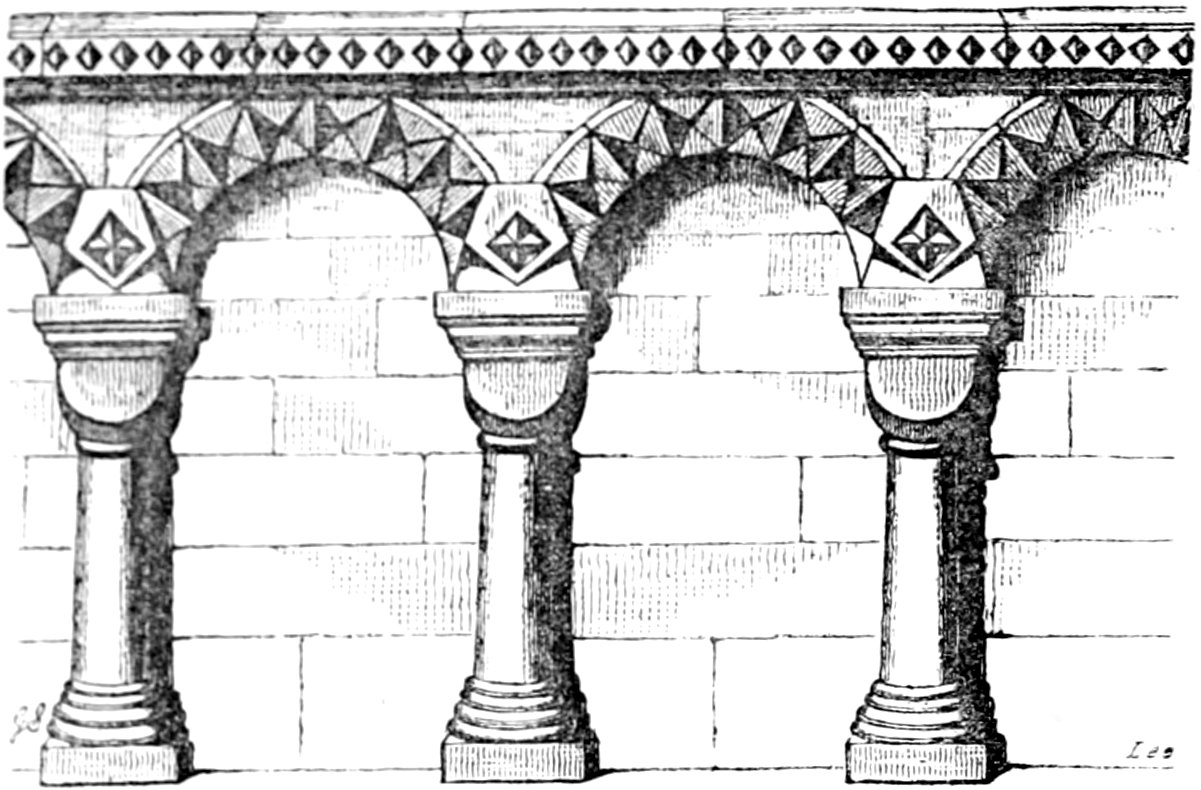
Norman Arcade from Canterbury.
But the most exquisite arcades are those
of the Geometrical period, where each arch
is often surmounted by a crocketted pediment,
and the higher efforts of sculpture
are tasked for their enrichment, as in the
glorious chapter-house of Salisbury, Southwell,
and York; these are, however, usually
confined to the interior. In the Decorated
period partially, and in the Perpendicular
entirely, the arcade gave place to panelling,
greatly to the loss of effect, for no delicacy
or intricacy of pattern can compensate for
the bright light and deep shadows of the
Norman and Early English arcades.
ARCANI DISCIPLINA. The name
given to a part of the discipline of the early
Church in withdrawing from public view
the sacraments and higher mysteries of our
religion: a practice founded on a reverence
for the sacred mysteries themselves, and
to prevent their being exposed to the
ridicule of the heathen. Irenæus, Tertullian,
and Clement of Alexandria are the
first who mention any such custom in the
Church. And the Disciplina Arcani gradually
fell into disuse after the time of
Constantine, when Christianity had nothing
to fear from its enemies.—Bingham.
Augusti.
ARCH. All architecture may be divided
into the architecture of the entablature
and of the arch, and as the very terms
denote, the arch is the differential of the
latter. Romanesque and Gothic fall under
this head. Our view of the arch is limited
to a description of its several forms; an
estimate of its effects on style, and its
mechanical construction, being beyond our
province.

Semicircular. Horse-shoe. Stilted.
The Saxon and the Norman arch were
alike semicircular in their normal form,
though in Norman buildings we often find
a greater arc of a circle, or “horse-shoe”
arch, or the semicircle is “stilted:” to one
or other of which constructions it was
necessary to resort when an arch of higher
proportion than a semicircle was required.
In the middle of the twelfth century the
pointed arch was introduced. It was used
for a long time together with the semicircle,
and often with an entire absence
of all but Norman details; and it is worthy
of note that the pointed arch is first used
49in construction, as in the great pier arches,
and evidently, therefore, from an appreciation
of its mechanical value, and not
till afterwards in lighter portions, as windows
and decorative arcades. The pointed
arch has three simple forms, the equilateral,
the lancet, and the drop arch; the first
described from the angles at the base of
an equilateral, the second of a triangle
whose base is greater, the third of a
triangle whose base is less, than the sides.
These forms are common to every style,
from Early English downwards. In the
Perpendicular period a more complex arch
was introduced, struck from four centres,
all within or below the base of the arch.
This modification of the arch is of great
importance, as involving differences of
construction in the fabric, especially in the
vaulting, so that it has a place in the history
of Gothic architecture only inferior to
the introduction of the pointed arch.
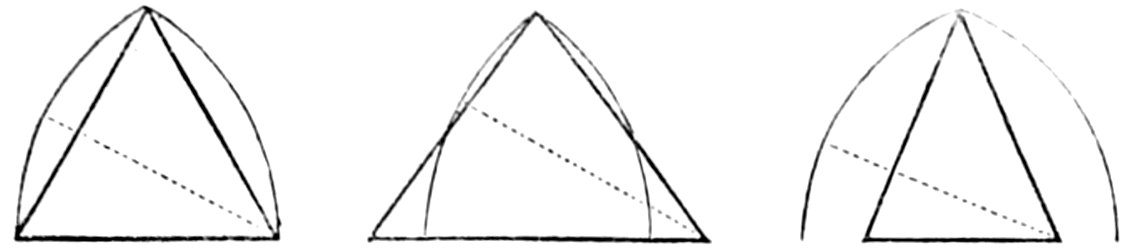
Equilateral. Lancet. Drop.
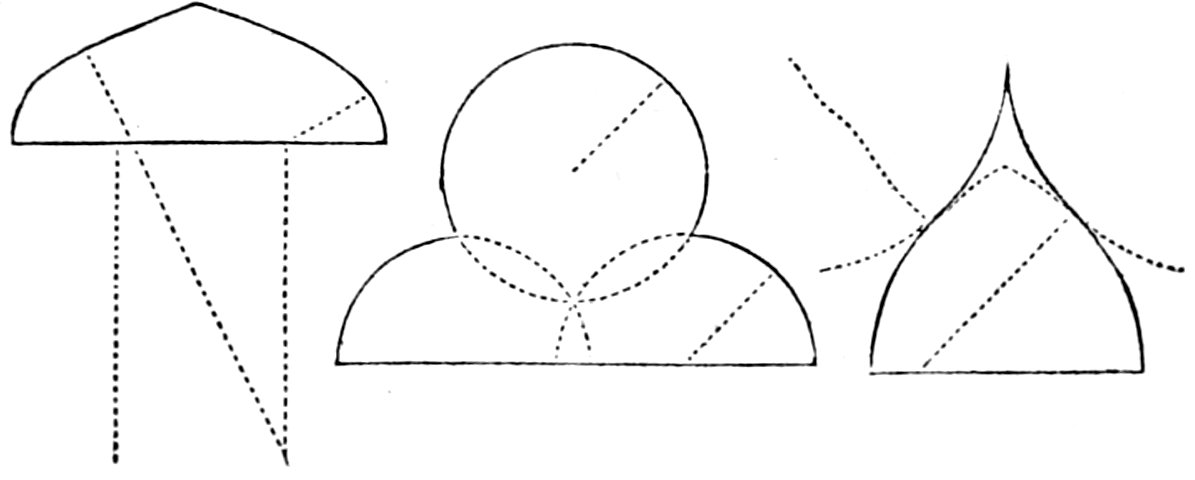
Four-centred. Foil. Ogee.
There are, besides, other modifications
of the arch, struck from more than two
centres, but these are either of less frequent
occurrence, or merely decorative. We may
mention the foil and the ogee arch; the
former struck from four centres, two without
and two within the resulting figure,
and flowing into one another; the latter
from several centres, according to the
number of foils, all generally within the
resulting figure, and cutting one another.
The foil arch precedes in history the foliation
or cusping of arches and tracery,
which it no doubt suggested; the ogee
arch came in with ogee forms of tracery
and of cusping, and outlived them.
ARCHBISHOP. An archbishop is the
chief of the clergy in a whole province;
and has the inspection of the bishops of
that province, as well as of the inferior
clergy, and may deprive them on notorious
causes. The archbishop has also his
own diocese wherein he exercises episcopal
jurisdiction, as in his province he
exercises archiepiscopal. As archbishop,
he, upon the receipt of the king’s writ, calls
the bishops and clergy within his province
to meet in convocation. To him all appeals
are made from inferior jurisdictions
within his province; and, as an appeal lies
from the bishops in person to him in person,
so it also lies from the consistory courts
of his diocese to his archiepiscopal court.
During the vacancy of any see in his province
he is guardian of the spiritualities
thereof, as the king is of the temporalities;
and, during such vacancy, all episcopal
rights belong to him. The archbishops in
England have from time to time exercised
a visitatorial power over their suffragans,
in use till the time of Archbishop Laud.
The archbishops of Ireland have immemorially
visited their suffragans triennially:
the Episcopal Visitation being
there annual. (See Stephens’ Edition of
the Book of Common Prayer, with notes,
vol. i. pp. 26–30.)
Some learned men are of opinion, that
an archbishop is a dignity as ancient as
the apostles’ time, for there were primi
episcopi then, though the name of archbishop
was not known until some ages
afterwards; and that the apostle himself
gave the first model of this government in
the Church, by vesting Titus with a superintendency
over all Crete. Certain it is
that there were persons soon after that
time, who, under the name of metropolitans,
50exercised the same spiritual and ecclesiastical
functions as an archbishop; as
for instance the bishop of Carthage, who
certainly assembled and presided in provincial
councils, and had ecclesiastical
jurisdiction over the bishops of Africa;
and the bishops of Rome, who had the
like primacy in the suburbiconian provinces,
viz. middle and southern Italy,
with Sicily, and other adjacent islands.
Moreover, the Apostolical Canons, which
were the rule of the Greek Church in the
third century, mention a chief bishop in
every province, and most of them about
the eighth century assumed the title of
archbishops; some of which were so in a
more eminent degree, viz. those of Rome,
Constantinople, Antioch, and Alexandria,
which were the four principal cities of the
empire. To these the archbishop of Jerusalem
was added by the Council of Chalcedon,
in 451, because that was the capital
city of the Holy Land, and these five were
called patriarchs.
The archbishop of Canterbury is styled
primate of all England and metropolitan,
and the archbishop of York primate of
England. They have the title of Grace,
and Most reverend Father in God by
Divine Providence. There are two provinces
or archbishoprics in England, Canterbury
and York. The archbishop of Canterbury
has the precedency of all the
other clergy; next to him the archbishop
of York. Each archbishop has, within
his province, bishops of several dioceses.
The archbishop of Canterbury has under
him, within his province, Rochester, London,
Winchester, Norwich, Lincoln, Ely,
Chichester, Salisbury, Exeter, Bath and
Wells, Worcester, Lichfield, Hereford,
Landaff, St. David’s, Bangor, and St.
Asaph; and four founded by King Henry
VIII., erected out of the ruins of dissolved
monasteries, viz. Gloucester and Bristol,
now united into one, Peterborough, and
Oxford. The archbishop of York has under
him six, viz. the bishop of Chester,
erected by Henry VIII., and annexed by
him to the archbishopric of York, the
bishops of Durham, Carlisle, Ripon, and
Manchester, and the Isle of Man, annexed
to the province of York by King Henry
VIII. The dioceses of Ripon and Manchester
have been formed in the province
of York within the last few years, by act
of parliament. The archbishop of Armagh
is styled primate of all Ireland. The archbishop
of Dublin, primate of Ireland. Before
the late diminution of the Irish episcopate,
there were two other archbishops,
viz. of Cashel, styled primate of Munster,
and Tuam, primate of Connaught. Under
Armagh were the bishoprics of *Meath,
*Down, *Derry, Dromore, Raphoe, *Kilmore,
and Clogher. Under Dublin, Kildare,
Ferns, and *Ossory. Under Cashel,
*Limerick, *Cork, Cloyne, *Killaloe, and
Waterford. Under Tuam, Clonfert, Elphin,
and Killala. At present Cashel is a suffragan
of Dublin, Tuam of Armagh; and
only those suffragan bishoprics marked
with an asterisk are retained. The bishops
of Calcutta and Sydney, being metropolitans,
are archbishops in reality, though
not in title.
ARCHDEACON. In the English branch
of the united Church, and most European
Churches, each diocese is divided into archdeaconries
and parishes. Sometimes a diocese
has but one archdeaconry; sometimes
four or five. But in Ireland there is but
one archdeacon to each diocese (several
dioceses being often united under one
bishop); and archdeaconries, as ecclesiastical
divisions, are there unknown. The
dioceses of Dublin and Ardfert may be
regarded as exceptions, but not with justice:
as the archdeaconry of Glendaloch
in the former, and of Aghadoe in the latter,
belonged originally to separate dioceses,
which have been drawn into the
adjacent ones: so that the dividing boundaries
are now unknown. (Jebb.) Over the
diocese the bishop presides; over the archdeaconry
one of the clergy is appointed
by the bishop to preside, who must be a
priest, and he is called an archdeacon;
over the parish the rector or vicar presides.
An archdeacon was so called anciently,
from being the chief of the deacons,
a most important office at a very early
period in the Christian Church.
The antiquity of this office is held to be
so high by many Roman Catholic writers,
that they derive its origin from the appointment
of the seven deacons, and suppose
that St. Stephen was the first archdeacon:
but there is no clear authority to
warrant this conclusion. Mention is also
made of Laurentius, archdeacon of Rome,
who suffered A. D. 260; but although he
was called archdeacon, (according to Prudentius,)
he was no more than the principal
man of the seven deacons who stood
at the altar. “Hic primus è septem viris
qui stant ad aram proximi.” (Prudent.
Hymn. de St. Steph.) At Carthage the
office appears to have been introduced
within the last forty years of the third
century, as St. Cyprian does not mention
it, whereas in the persecution of Diocletian
Cecilian is described as archdeacon,
under the bishop Mensurius. St. Jerome
51says, “that the archdeacon was chosen out
of the deacons, and was the principal deacon
in every church, just as the archpresbyter
was the principal presbyter.”
But even in St. Jerome’s time, the office
of archdeacon had certainly grown to great
importance. His proper business was, to
attend the bishop at the altar; to direct
the deacons and other inferior officers in
their several duties, for their orderly performance
of Divine service; to attend the
bishop at ordinations, and to assist him in
managing and dispensing the revenues of
the Church: but without anything that
could be called “jurisdiction,” in the present
sense of the word, either in the cathedral
or out of it.
After the Council of Laodicea, A. D. 360,
when it was ordained that no bishop should
be placed in country villages, the archdeacon,
being always near the bishop, and
the person mainly intrusted by him, grew
into great credit and power, and came by
degrees, as occasion required, to be employed
by him in visiting the clergy of
the diocese, and in the despatch of other
matters relating to the episcopal care.
He was the bishop’s constant attendant
and assistant, and, next to the bishop, the
eyes of the whole Church were fixed upon
him; it was therefore by no means unusual
for him to be chosen the bishop’s
successor before the presbyters, and St.
Jerome records, “that an archdeacon
thought himself injured if he was ordained
a presbyter.” (“Certe qui primus fuerit
ministrorum, quia per singula concionatur
in populos, et a pontificis latere non recedit,
injuriam putat si presbyter ordinetur.”—Hieron.
Com. in Ezek. c. 48.)
The author of the “Apostolical Constitutions”
calls him the Ὁ παρεστὼς τῷ
ἀρχιερεῖ; and St. Ambrose informs us, in
the account which he gives of Laurentius,
archdeacon of Rome, that it belonged to
him “to minister the cup to the people
when the bishop celebrated the eucharist,
and had administered the bread before
him.”—Ambros. de Offic. lib. i. c. 41.
At the beginning of the seventh century,
he seems to have been fully possessed of
the chief care and inspection of the diocese
in subordination to the bishop.
But the authority of the archdeacon, in
ancient times, was chiefly a power of inquiry
and inspection; and the gradual
growth of his “jurisdiction,” properly so
called, during the middle ages, is a subject
of difficult inquiry. Pope Clement V. gives
an archdeacon the title of “oculus Episcopi,”
saying that “he is in the bishop’s
place, to correct and amend all such matters
as ought to be corrected and amended
by the bishop himself, unless they be of
such an arduous nature, as that they cannot
be determined without the presence of
his superior the bishop.”
Regularly, the archdeacon cannot inflict
any punishment, but can only proceed by
“precepts” and “admonitions.”
Beyond this, all the rights that any
archdeacon enjoys, subsist by grants from
the bishop, made either voluntarily, or of
necessity, or by composition. (See the case
of composition made between the bishop
of Lincoln and his archdeacons, in Gibson’s
Codex, vol. ii. p. 1548.)
As to the divisions in England of dioceses
into archdeaconries, and the assignment
of particular divisions to particular
archdeaconries, this is supposed to have
begun a little after the Norman conquest.
We meet with no archdeacons vested with
any kind of jurisdiction in the Saxon times.
Archbishop Lanfranc was the first who
made an archdeacon with power of “jurisdiction,”
in his see of Canterbury, and
Thomas, the first archbishop of York after
the Conquest, was the first in England that
divided his diocese into archdeaconries; as
did also Remigius, bishop of Lincoln.
When the Norman bishops, by reason of
their baronies, were tied by the Constitutions
of Clarendon to strict attendance
upon the kings in their parliaments, they
were obliged, for the administration of
their dioceses, to grant larger delegations
of power to archdeacons, who visited when
they did not (de triennio in triennium).
Archdeacons, therefore, with us, could not
have this power of jurisdiction by common
right, or by immemorial custom; the power
which the archdeacon has is derived from
the bishop, although he himself is an ordinary,
and is recognised as such by the
books of common law, which adjudge an
administration made by him to be good,
though it is not expressed by what authority,
because, as done by the archdeacon, it
is presumed to be done “jure ordinario.”
In the 22nd of Henry I. we have the
first account of their being summoned to
convocation; and in the 15th of Henry III.,
and in the 32nd year of the same king, they
were summoned by express name.
This being the original of archdeacons,
it is impossible for them to prescribe to an
independency on the bishop, as it was declared
in a court of law they might, and
endeavoured to be proved by the gloss on
a legatine constitution, where we read that
an archdeacon may have a customary jurisdiction
distinct from the bishop, and to
which he may prescribe. But the meaning
52of it is, not that there can be an archdeaconry
by prescription, and independent
of the bishop, but that the archdeacon
may prescribe to a particular jurisdiction,
exempt from the ordinary; which jurisdiction
has customarily been enjoyed by him
and his predecessors time out of mind.
The archdeaconries of St. Alban’s, of
Richmond, and Cornwall, are cases of this
kind; these jurisdictions are founded upon
ancient customs, but the archdeacon is still
subordinate to the bishop in various ways;
he being, in our law, as he is according to
the canon law, vicarious episcopi.
According to Lyndwood and other canonists,
he can inquire into crimes, but not
punish the criminals; he has, in one sense,
according to the casuists, a cure of souls,
by virtue of his office, though it is in foro
exteriori tantum et sine pastorali cura; and
has authority to perform ministerial acts,
as to suspend, excommunicate, absolve,
&c., therefore by the ecclesiastical law he
is obliged to residence. And that may be
one reason why he may not be chosen to
execute any temporal office that may require
his attendance at another place;
another reason is because he is an ecclesiastical
person. But he has no parochial
cure, and therefore an archdeaconry is not
comprehended under the name of a benefice
with cure; for if one who has such benefice
accepts an archdeaconry, it is not void by
our law, though it is so by the canon law.
And yet, though he has not any parochial
cure, he is obliged to subscribe the declaration
pursuant to the statute, 14
Charles II. It is true, he is not expressly
named therein, but all persons in holy
orders are enjoined to subscribe by that
statute; and because an archdeacon must
be in those orders, therefore he must likewise
subscribe, &c. And as he has a jurisdiction
in certain cases, so, for the better
exercising the same, he has power to keep
a court, which is called the Court of the
Archdeacon, or his commissary, and this
he may hold in any place within his archdeaconry.
With regard to the Archdeacon’s
Court, it was said by the justices of
the Common Pleas, 2 & 3 William and
Mary, in the case of Woodward and Fox,
that though it might be supposed originally
that the jurisdiction within the diocese
was lodged in the bishop, yet the Archdeacon’s
Court had, “time out of mind,”
been settled as a distinct court, and that
the statute 24th of Henry VIII. chap. xii.
takes notice of the Consistory Court, which
is the bishop’s, and of the Archdeacon’s
Court, from which there lies an appeal to
the bishop’s. (See Appeal.) There is an
officer belonging to this court, called a
registrar, whose office concerns the administration
of justice, and therefore the
archdeacon cannot by law take any money
for granting it; if he does, the office will
be forfeited to the queen. Regarding
parochial visitations by archdeacons, see
“Articles and Directions to the Incumbents
and Churchwardens within the Archdeaconry
of Surrey,” in Gibson’s Codex,
vol. ii. p. 1551–1555; and see post, “Visitation.”
By 1 & 2 Vict. c. cvi. s. 2, an archdeacon
may hold, with his archdeaconry, two
benefices under certain restrictions; or a
benefice and a cathedral preferment.
He is also, whilst engaged in his archidiaconal
functions, considered to be resident
on his benefice. In cathedrals of the
old foundation, the archdeacons of the diocese,
how numerous soever, were members
of the greater chapter, and had stalls in
the choir. This was the universal custom
on the continent, and is uniformly the case
in Ireland, as it was also in Scotland. In
the diocese of Dublin, the archdeacon of
Dublin has a stall in both of the cathedrals
there, the archdeacon of Glendaloch however
only in that of St. Patrick’s.
The archdeacons of Ireland have not for
a long time exercised any jurisdiction. It
is however evident from old documents
that they did exercise it in ancient times.
The bishops hold annual visitation.
ARCHES, COURT OF. The Court
of Arches is an ancient court of appeal,
belonging to the archbishop of Canterbury,
whereof the judge is called the Dean of
Arches, because he anciently held his court
in the church of St. Mary-le-Bow (Sancta
Maria de Arcubus); though all the spiritual
courts are now holden at Doctors’ Commons.
ARCHIMANDRITE. A name formerly
given to the superior of a monastery:
it is derived from the word μάνδρα, by
which monasteries were sometimes called.
The term Archimandrite is still retained in
the Greek Church.
ARCHPRIEST, or ARCHIPRESBYTER.
An ancient title of distinction,
corresponding to our title, rural dean, revived
under most unhappy pretensions
among the Romanists of England, in the
year 1598. These men, finding themselves
without bishops, importuned the pope,
Clement VII., to supply their need; but
instead of sending them, as they desired, a
number of bishops, he gave them but one
ecclesiastical superior, Robert Blackwell,
who after all was merely a priest; an
archpriest indeed he was called, but as
53such having no episcopal power. In the
early times this title was given to the
chief presbyter in each church, presiding
over the church next under the bishop,
and taking care of all things relating to
the church in the bishop’s absence. In
this case however, instead of being placed
in a cathedral church, or discharging the
office of rural dean, under a bishop or
archdeacon, he was appointed to govern all
the Romish clergy of England and Scotland,
without one or the other. Here
then we find Rome, while preserving an
old title, inventing an office hitherto unknown
to the Christian world. And, when
appointed, what could the archpriest do?
He could merely be a rural dean on a large
scale. He could merely overlook his brother
clergy. He could not discharge any functions
properly episcopal. He could not
ordain priests, confirm children, nor consecrate
chapels, should circumstances permit
or require. It is plain, then, that the archpriest
was a very imperfect and insufficient
substitute for a bishop. The archpriest in
many foreign churches, in Italy especially,
answers to our cathedral dean. In some
Italian dioceses, somewhat to our rural
dean.—Darwell.
ARCHONTICS. Heretics who appeared
in the second century, about A. D.
175, and who were an offshoot of the Valentinians.
They held a quantity of idle
stories concerning the Divinity and the
creation of the world, which they attributed
to sundry authors; and hence they were
called Archontics, from the Greek word
ἀρχων, which means prince or ruler.
ARIANS. (See Councils.) Heretics,
so named from Arius, their first founder:
they denied the three persons in the Holy
Trinity to be of the same essence, and affirmed
the Word to be a creature, and that
once (although before the beginning of
time) he was not. They were condemned
by the Council of Nice, in 325.
The doctrine of Arius may be thus
stated:—The Son sprang not from the nature
of the Father, but was created from
nothing: he had, indeed, an existence
before the world, even before time, but
not from eternity. He is, therefore, in
essence different from the Father, and is
in the order of creatures, whom he, however,
precedes in excellence, as God created
all things, even time, by his instrumentality;
whence he was called the Son of
God, the Logos, or Word of God. As a
creature the Son is perfect, and as like to
the Father as a creature can be to the
Creator. But as he has received all things
as a gift, from the favour of the Father,—as
there was a period in which he was
not,—so there is an infinite distance between
him and the nature of the Father;
of which nature he cannot even form a
perfect idea, but can enjoy only a defective
knowledge of the same. His will was
originally variable, capable of good and of
evil, as is that of all other rational creatures:
he is, comparatively at least, free
from sin; not by nature, but by his good
use of his power of election; the Father,
therefore, foreseeing his perseverance in
good, imparted to him that dignity and
sublimity above all other creatures, which
shall continue to be the reward of his virtues.
Although he is called God, he is
not so in truth, but was deified in that
sense in which men, who have attained to
a high degree of sanctity, may arrive at a
participation of the Divine prerogatives.
The idea then of a generation of the Son
from the essence of the Father is to be
absolutely rejected.
This doctrine, which must have corresponded
to the superficial understandings,
and to the yet half-pagan ideas, of many
who then called themselves Christians,
attacked the very soul of the Christian
doctrine of the redemption; for, according
to this doctrine, it was not God made man,
but a changeable creature, who effected
the great work of the redemption of fallen
man. The devout Christian, to whom
faith in the God-man, Christ, the only
Divine Mediator, opened the way to an intimate
union with God, saw by this doctrine
that his Redeemer and Mediator
was as infinitely removed from the essence
of God as himself; he saw himself driven
back to the ancient pagan estrangement
from God, and removed to an unattainable
distance from him.—See Maimbourg, Hist.
of Arians. For an account of the revival of
Arianism in the last century, see Van Mildert’s
Life of Waterland.
ARK OF THE COVENANT. So the
Jews called a small chest or coffer, three
feet nine inches in length, two feet three
inches in breadth, and two feet three
inches in height, (Prideaux, Connect.
Part i. Book iii.,) in which were contained
“the golden pot that had manna, and
Aaron’s rod, and the tables of the covenant,”
as well the broken ones (according
to the Rabbins) as the whole. Heb. ix. 4.
Over the ark was the mercy-seat, and it
was the covering of it. It was made of
solid gold (Exod. xxv. 17–22); and at
the two ends of it were two cherubims
looking inward toward each other, with
expanded wings, which, embracing the
whole circumference of the mercy-seat,
54met on each side in the middle. The
whole (according to the Rabbins) was
made out of the same mass, without joining
any of the parts by solder. Here it
was that the Shechinah, or Divine presence,
rested, both in the tabernacle and in the
temple, and was visibly seen in the appearance
of a cloud over it. And from hence
the Divine oracles were given out, by an
audible voice, as often as God was consulted
in the behalf of his people. And
hence it is, that God is said, in Scripture,
to dwell between the cherubims, on the
mercy-seat, because there was the seat
or throne of the visible appearance of his
glory among them. And for this reason
the high priest appeared before this
mercy-seat once every year, on the great
day of expiation; at which time he was
to make his nearest approach to the
Divine presence, to mediate, and make
atonement for the whole people of Israel.—R.
Levi, Ben. Gersom, Solomon, &c. Lev.
xvi. 2; 1 Sam. iv. 4; 2 Sam. vi. 6; 2
Kings xix. 15; 1 Chron. xiii. 6; Psal.
lxxx. 1; Lev. xvi. 14, 15; Heb. ix. 7.
The ark of the covenant was, as it were,
the centre of worship to all those of that
nation, who served God according to the
Levitical law; and not only in the temple,
when they came thither to worship,
but everywhere else, in their dispersion
throughout the whole world, whenever
they prayed, they turned their faces towards
the place where the ark stood, and
directed all their devotions that way.
Whence the author of the book of Cosri
justly says, that the ark, with the mercy-seat,
and cherubims, were the foundation,
root, heart, and marrow, of the whole temple,
and all the Levitical worship therein
performed. And therefore had there been
nothing else wanting in the second temple,
but the ark only, this alone would have
been reason enough for the old men to
have wept, when they remembered the first
temple, in which it stood; and for the saying
of Haggai, that the second temple was
as nothing in comparison of the first; so
great a share had the ark of the covenant
in the glory of Solomon’s temple. However,
the defect was supplied as to the outward
form: for, in the second temple,
there was also an ark, of the same shape
and dimensions with the first, and put in
the same place: but it wanted the tables
of the law, Aaron’s rod, and the pot of
manna; nor was there any appearance of
the Divine glory over it, nor any oracles
delivered from it. The only use that was
made of it was, to be a representative of
the former on the great day of expiation,
and to be a repository of the Holy Scriptures;
that is, of the original copy of that
collection of them made by Ezra, after the
captivity. In imitation of which, the Jews,
in all their synagogues, have a like ark, or
coffer, in which they keep their Scriptures.
1 Kings viii. 48.—Lightfoot, of the Temple,
ch. xv. § 4.
The place of the temple where the ark
stood, was the innermost and most sacred
part, called the Holy of Holies, and sometimes
the most holy place; which was made
on purpose for its reception. This place,
or room, was of an exact cubic form, being
thirty feet square, and thirty feet high. In
the centre of it, the ark was placed upon a
stone (say the Rabbins) rising three fingers’
breadth above the floor. On the two
sides of it stood two cherubims, fifteen feet
high, at equal distance between the centre
of the ark and each side of the wall; where,
having their wings expanded, with two of
them they touched the side walls, whilst
the other two met and touched each other
exactly over the middle of the ark.—Yoma,
cap. v. § 2.
The ark, while it was ambulatory, with
the tabernacle, was carried on the shoulders
of the Levites, by the means of staves,
overlaid with gold, and put through golden
rings. Exod. xxv. 13, 14; xxvii. 6; Num.
iv. 4–6; 1 Chron. xv. 15.
What became of the old ark, on the destruction
of the temple by Nebuchadnezzar,
is a dispute among the Rabbins. Had
it been carried to Babylon with the other
vessels of the temple, it would have been
brought back again with them, at the end
of the captivity. But that it was not so,
is agreed on all hands; whence it is probable
it was destroyed with the temple.
The Jews contend, that it was hid and
preserved by Jeremiah. Some of them
will have it, that King Josiah, being foretold
by Huldah the prophetess that the
temple, soon after his death, would be destroyed,
caused the ark to be deposited in
a vault, which Solomon, foreseeing this
destruction, had built on purpose for the
preservation of it.—Buxtorf, de Arca, cap.
xxi., xxii.
ARMENIANS. The Christians of Armenia,
the first country in which Christianity
was recognised as the national
religion, in consequence of the preaching
of Gregory, called The Illuminator, in the
beginning of the fourth century. At a later
time the Armenians adopted the Eutychian
or Monophysite heresy, asserting that the
human nature of Christ is swallowed up of
the Divine; or is no more properly human
than a drop of vinegar put into the sea can
55afterwards be reckoned vinegar. They do
not deny the real presence in the eucharist,
they do not mix water with their wine,
nor do they consecrate unleavened bread.
They abstain from eating blood and things
strangled. They scrupulously observe
fasting; and fasts so frequently occur, that
their whole religion seems to consist in
fasting. They admit infants to the sacrament
of the eucharist: they reject purgatory
and prayers for the dead: they fast on
Christmas day, and they allow marriage in
their priests. The Armenians were anciently
subject to the patriarchs of Constantinople,
but they now have their own
patriarchs.
ARMINIANS. A powerful party of
Christians, so called from Arminius, professor
of divinity at Leyden, who was
the first that opposed the then received
doctrines in Holland, of an absolute predestination.
They took the name of
Remonstrants, from a writing called a
Remonstrance, which was presented by
them to the states of Holland, 1609, wherein
they reduced their peculiar doctrines to
these five articles:—
1. That God, from all eternity, determined
to bestow salvation on those who,
as he foresaw, would persevere unto the end
in their faith in Jesus Christ; and to
inflict everlasting punishment on those who
should continue in their unbelief, and resist,
to the end of life, his Divine assistance;
so that election was conditional; and reprobation,
in like manner, the result of
foreseen infidelity and persevering wickedness.
2. On the second point, they taught, That
Jesus Christ, by his suffering and death,
made an atonement for the sins of mankind
in general, and of every individual in
particular; that, however, none but those
who believe in him can be partakers of
that Divine benefit.
3. On the third article they held, That
true faith cannot proceed from the exercise
of our natural faculties and powers, nor
from the force and operation of free will;
since man, in consequence of his natural
corruption, is incapable either of thinking
or doing any good thing; and that, therefore,
it is necessary to his conversion and
salvation, that he be regenerated and renewed
by the operation of the Holy
Ghost, which is the gift of God, through
Jesus Christ.
4. On the fourth they believed, That
this Divine grace, or energy of the Holy
Ghost, begins, advances, and perfects
everything that can be called good in
man; and that, consequently, all good
works are to be attributed to God alone;
that nevertheless, this grace, which is
offered to all, does not force men to act
against their inclinations, but may be resisted
and rendered ineffectual by the perverse
will of the impenitent sinner.
5. And on the fifth, That God gives to
the truly faithful, who are regenerated by
his grace, the means of preserving themselves
in this state; and, though the first
Arminians entertained some doubt with
respect to the closing part of this article,
their followers uniformly maintain, That
the regenerate may lose true justifying
faith, fall from a state of grace, and die in
their sins.
The synod of Dort, consisting of Dutch,
French, German, and Swiss divines, and
held in 1618, condemned their opinions.
ARMS. Armorial bearings, whether
borne by individuals or by corporate bodies
and corporations sole: among which
are reckoned bishops, colleges, and other
ecclesiastical persons and bodies. A
bishop empales his family coat with the
arms of his see, to denote his spiritual
marriage with his Church; but the arms of
the see occupy the dexter side of the escutcheon,
or the side of greater honour. When
a bishop is married, he empales the arms of
his wife with his own family coat, on a
separate escutcheon; and this escutcheon
is placed by the sinister side of the shield,
empaling his own coat with the arms of
the see. Many of the arms of bishoprics
contain allusions to the spiritual character
of the person who bears them. Thus the
archbishops of Canterbury, Armagh, and
Dublin, each bear a pall, in right of their
sees; as did the archbishop of York till
his arms were changed about the beginning
of the sixteenth century to two keys crossed
saltierwise, and a crown royal in chief.
Colleges often assume the family coat of
their founder as their arms.
ARTICLES, THE THIRTY-NINE.
The Thirty-nine Articles, based on the
Forty-two Articles framed by Archbishop
Cranmer and Bishop Ridley in the reign of
Edward VI., were presented by his Grace
the archbishop of Canterbury, Dr. Parker,
to the convocation of the province of Canterbury
which was convened with the
parliament in January, 1562, and by the
convocation they were unanimously approved.
In 1566 a bill was brought into
parliament to confirm them. The bill
passed the Commons, but by the queen’s
command was dropped in the Lords. In
1571 the convocation revised the articles
of 1562, and made some alterations in them.
In the same year an act was passed, “to
56provide that the ministers of the Church
should be of sound religion.” It enacted
that all ecclesiastical persons should subscribe
to “all the articles of religion which
only contained the confession of the true
faith and of the sacraments, comprised
in a book imprinted, entitled ‘Articles,’
whereupon it was agreed by the archbishops
and bishops, and the whole clergy in convocation
holden at London, in the year of
our Lord God 1562, according to the
computation of the Church of England, for
the avoiding of diversities of opinions, and
for the establishing of consent touching
true religion, put forth by the queen’s
authority.” In 1628 an English edition
was published by royal authority, to which
is prefixed the declaration of Charles I.
The English Articles were adopted by the
Irish convocation in 1615.
Some have thought that they are only
articles of union and peace; that they are
a standard of doctrine, not to be contradicted
or disputed; that the sons of the
Church are only bound to acquiesce silently
in them; and that the subscription binds
only to a general compromise upon those
articles, that so there may be no disputing
or wrangling about them. By this means
they reckon, that though a man should
differ in his opinion from that which appears
to be the clear sense of any of the
articles; yet he may with a good conscience
subscribe them, if the article appears
to him to be of such a nature, that though
he thinks it wrong, yet it seems not to be
of that consequence, but that it may be
borne with and not contradicted.
Now as to the laity, and the whole body
of the people, certainly to them these are
only the articles of Church communion:
so that every person, who does not think
that there is some proposition in them that
is erroneous to so high a degree that he
cannot hold communion with such as hold
it, may, and is obliged to, continue in our
communion; for certainly there may be
many opinions held in matters of religion,
which a man may believe to be false, and
yet may esteem them to be of so little importance
to the chief design of religion,
that he may well hold communion with
those whom he thinks to be so mistaken.
But what the clergy are bound to by
their subscriptions is much more than this.
The meaning of every subscription is to be
taken from the design of the imposer, and
from the words of the subscription itself.
The title of the Articles bears, that they
were agreed upon in convocation, “for the
avoiding of diversities of opinions, and for
the establishing of consent touching true
religion.” Where it is evident that “a
consent in opinion” is designed. If we in
the next place consider the declarations
that the Church has made in the canons,
we shall find, that though by the fifth
canon, which relates to the whole body of
people, such only are declared to be excommunicated
ipso facto, who shall affirm
any of the articles to be erroneous, or such
as he may not with a good conscience subscribe
to; yet the thirty-sixth canon is
express for the clergy, requiring them to
subscribe “willingly and ex animo,” and
“acknowledge all and every article to be
agreeable to the word of God:” upon
which canon it is, that the form of the
subscription runs in these words, which
seem expressly to declare a man’s own
opinion, and not a bare assent to an article
of peace, or an engagement to silence and
submission. The statute of the 13th of
Queen Elizabeth, chap. 12, which gives
the legal authority to our requiring subscriptions,
in order to a man’s being capable
of a benefice, requires that every clergyman
should read the Articles in the Church,
with a declaration of his unfeigned assent
to them. These things make it appear
very plain, that the subscriptions of the
clergy must be considered as a declaration
of their own opinion, and not as a bare
obligation to silence.—Bishop Burnet.
We learn from the New Testament, that
those who first embraced the gospel declared
their faith in Jesus, as the promised
Messiah, in simple and general terms (Acts
viii. 37); and there is no ground for supposing
that the apostles required this declaration
to be made in any one particular
form of words. No such formulary is
transmitted to us; and, had any ever existed,
it would probably have been cited
or alluded to in the New Testament, or in
the early apologies for Christianity. Every
bishop was authorized to prescribe a formulary
for the use of his own church;
and there are still extant in writers who
lived near to the apostolic age, several abstracts
of Christian faith, which, though
they agree in substance, vary in expression.
But, when heresies gained ground,
and destroyed uniformity of belief among
Christians, it became necessary to have a
public standard of faith; and to this cause
we are to attribute the origin of creeds.
The design of these creeds was to establish
the genuine doctrines of the gospel, in
opposition to the errors which then prevailed;
and to exclude from communion
with the orthodox Church of Christ all
who held heretical opinions. New dissensions
and controversies continually arose;
57and we have to lament that, in process of
time, “the faith, which was once delivered
unto the saints,” became corrupted in the
highest degree; and that those very councils,
which were convened according to
the practice of the apostolic age, for the
purpose of declaring “the truth as it is in
Jesus,” gave their sanction and authority
to the grossest absurdities and most palpable
errors. These corruptions, supported
by secular power, and favoured by the
darkness and ignorance of the times, were
almost universally received through a succession
of many ages, till at last the glorious
light of the Reformation dispelled the
clouds which had so long obscured the
Christian world.
At that interesting period the several
Churches, which had separated themselves
from the Roman communion, found it expedient
to publish confessions of their
faith; and, in conformity to this practice,
Edward the Sixth, the first Protestant
king of England, caused to be published
by his royal authority forty-two “Articles,
agreed upon by the bishops and other
learned and good men, in the convocation
held at London in the year 1552, to root
out the discord of opinions, and establish
the agreement of true religion.” These
Articles were repealed by Queen Mary,
soon after her accession to the throne.
But Queen Elizabeth, in the beginning of
her reign, gave her royal assent to thirty-nine
[or rather thirty-eight] “Articles,
agreed upon by the archbishops and bishops
of both provinces, and the whole clergy, in
the convocation holden at London in the
year 1562, for avoiding diversities of opinion,
and for the establishing of consent
touching true religion.” These Articles
were revised, and some small alterations
made in them, in the year 1571; since
which time they have continued to be the
criterion of the faith of the members of
the Church of England on the subjects to
which they relate. The Articles of 1562
were drawn up in Latin only [in reality
the Articles both of 1552 and of 1562 were
set forth in our authorized English version,
as well as in Latin]; but, in 1571, they
were subscribed by the members of the
two houses of convocation, both in Latin
and English; and, therefore, the Latin and
English copies are to be considered as
equally authentic. The original manuscripts,
subscribed by the Houses of Convocation,
were burnt in the Fire of London;
but Dr. Bennet has collated the oldest
copies now extant, and it appears that
there are no variations of any importance.
It is generally believed that Cranmer
and Ridley were chiefly concerned in
framing the forty-two Articles, upon which
our thirty-nine are founded. But Bishop
Burnet says, that “questions relating to
them were given about to many bishops
and divines, who gave in their several answers,
which were collated and examined
very maturely; all sides had a free and
fair hearing before conclusions were made.”
Indeed, caution and moderation are no
less conspicuous in them than a thorough
knowledge of the Scriptures, and of the
early opinions and practice of Christians.
These Thirty-nine Articles are arranged
with great judgment and perspicuity, and
may be considered under four general divisions:
the first five contain the Christian
doctrines concerning the Father, the
Son, and the Holy Ghost; in the sixth,
seventh, and eighth, the rule of faith is
established; the ten next relate to Christians,
as individuals; and the remaining
twenty-one relate to them, as they are
members of a religious society. But, as all
confessions of faith have had a reference
to existing heresies, we shall here find, not
only the positive doctrines of the gospel
asserted; but also the principal errors and
corruptions of the Church of Rome, and
most of the extravagances into which certain
Protestant sects fell at the time of the
Reformation, rejected and condemned.—Bp.
Tomline.
The various forms through which the
Articles have passed, may be seen in Cardwell’s
Synodalia, and in Hardwick’s History
of the Articles. In 1615, a set of Articles
of a Calvinistic nature were compiled by
the Irish convocation; but it does not appear
that they ever received the sanction
of parliament. These, however, were superseded
in 1635 by the English Articles,
which were then adopted by the Irish Convocation.
(See Introduction to Stephens’
Book of Common Prayer, from the Dublin
MS., vol. i., xxxvii.–xxxix.) The old Articles
are given at length. In general, these
perfectly agree with the English Articles;
but the doctrines of the Lambeth Articles
are introduced.
ARTS. One of the faculties in which
degrees are conferred in the universities.
In the English and Irish universities there
are two degrees in arts, that of Bachelor
and that of Master. The whole circle of
the arts was formerly reduced to seven sciences,
grammar, rhetoric, logic, arithmetic,
geometry, music, and astronomy; and these
again were divided into the trivium, including
the first three, and the quadrivium,
including the remaining four. Music is
now considered as a separate faculty at
58Oxford, Cambridge, and Dublin; as the
degrees of Doctor and Bachelor of Music
are given. Grammar was a separate but
subordinate faculty at Oxford and Cambridge,
in which there were three degrees,
Doctor, Master, and Bachelor. There is
an instance in Wood’s Athenæ Oxon., of
a Doctor in Grammar and Rhetoric (Robt.
Whityndon, 1513). The last record of
grammatical degrees at Oxford is in 1568;
at Cambridge in 1539. The faculty of
arts is called that of philosophy in some
foreign and more modern universities,
there the degrees are Doctor and Candidate.
ASAPH, Psalms of. One of the three
Temple Choirs bore the designation of the
Sons of Asaph: from Asaph, their leader,
in the time of David. They were descendants
of Gershom, the eldest son of Levi.
Twelve Psalms are entitled Psalms of
Asaph: viz. the 50th, 73rd, 74th, 75th,
76th, 77th, 78th, 79th, 80th, 81st, 82nd,
and 83rd. Critics are divided in opinion,
as to whether these were composed or
adopted by the above-named Asaph, or by
one of the same name, but of later date,
or were appropriated to the peculiar use
of the Sons of Asaph, in the courses of attendance
at the temple.
ASCENSION DAY. This holy day
has been kept in the Christian Church
from the earliest times. It is reckoned by
the compiler of the Apostolic Constitutions
among the other great festivals, Christmas
day, the Epiphany, Easter, and Whitsunday;
and St. Augustine speaks of it as
either instituted by the apostles, or by
some early and numerously attended councils
of the primitive bishops, whose authority
he considered most beneficial in the
Church. “On this day,” says St. Chrysostom,
“the reconciliation between God and
mankind was completed, the long enmity
was dissolved, the blasting war brought
to an end.” “On this day, we, who had
been shown to be unworthy of earth, were
raised to the hope of heaven; we, who
were not fit to receive dominion even on
earth below, were exalted to the kingdom
which is above; and our nature, kept out
by cherubim from an earthly paradise, may
now sit above the cherubim on high.”
Christ, the first-fruits of our nature, having
obtained this perfection, we that are
his members may hope to partake the same
glory. This hope the returning day of his
ascension should ever bring into our minds,
and we should keep it for the sustaining of
our hope, and in thankfulness for the grace
it brought. It is one of the days which
the Church especially recommends for the
receiving of the holy communion. (See
the Special Preface in the Communion
Office.) It is difficult to account for the
too prevalent neglect of this high festival
of our Church, on any other ground than
the encroachment of worldly principles
upon the minds of men, to the displacing
of the principles of the Church. Ascension
day is one of the six holy days for which
special psalms are appointed. The three
Rogation days are appointed to prepare us
for its right celebration, and yet, because
it is not marked by worldly festivities,
many neglect and pass it by. It is observed
as a scarlet day at Oxford and
Cambridge. It is popularly called Holy
Thursday. By 27 Henry VI. cap. 5, the
holding of fairs or markets was prohibited
on Ascension day, as well as on other
high holidays, and on Sundays, &c.; making
an exception however of the four
Sundays in harvest: and it was enacted
that the fair should be held on some other
day preceding or following. That part of
the act which related to Sundays in harvest
was repealed by 13 and 14 Vict. cap.
23. The rest of the act remains unrepealed.
ASCETICS. Men in the second century,
who made profession of uncommon
degrees of sanctity and virtue, and declared
their resolution of obeying all the counsels
of Christ, in order to their enjoying communion
with God here; and also, in expectation
that, after the dissolution of their
mortal bodies, they might ascend to him
with the greater facility, and find nothing
to retard their approach to the supreme
centre of happiness and perfection. They
looked upon themselves as prohibited the
use of things which it was lawful for other
Christians to enjoy, such as wine, flesh,
matrimony, and commerce. They thought
it their indispensable duty to attenuate the
body by watchings, abstinence, labour, and
hunger. They looked for felicity in solitary
retreats, in desert places, where, by
severe and assiduous efforts of sublime
meditation, they thought to raise their souls
above all external objects and all sensual
pleasures. Both men and women imposed
upon themselves the most severe tasks, the
most austere discipline; all which, however
it might be the fruit of pious intention,
was in the issue extremely detrimental to
Christianity, and tended to introduce the
doctrine of justification by inherent righteousness.
These persons were called ascetics
(from ἀσκησις, exercise or discipline)
and philosophers; nor were they only distinguished
by their title from other Christians,
but also by their garb. In the second
59century, indeed, such as embraced this
austere kind of life submitted themselves
to all these mortifications in private, without
breaking asunder their social bonds,
or withdrawing themselves from the concourse
of men. But in process of time,
they retired into deserts; and, after the
example of the Essenes and Therapeutæ,
they formed themselves into certain companies.—See
Origen, contr. Cels. lib. v.;
Can. Apostol. cap. 51; Cyril, Catech. 10, n.
9; Bingham, Antiq. Chr. Ch.
ASCETICISM. The practice of the
Ascetics. We do not consider neglect
of the body—meaning by the term our
present material organization—a rule of
Christianity. The abnegation of sin is, of
course, the root of all religion, and the body
of sin is a scriptural phrase for our nature
in its unredeemed and antagonistic state;
but it ceases to be a body of sin, in this
sense, when it becomes a member of
Christ: it becomes in baptism a temple
of the Holy Ghost. But how are we to
judge that the spirit within is indeed regenerated?
Principally by the works of
the body. The existence of good works
manifests the operation of the spirit of
good, and the Christian character therefore
takes for its physical development—labour,
activity, perseverance, energy,
fortitude, courage; to all of which qualities
self-denial is the preliminary. Christianity,
therefore, does not eradicate the
powers of the body any more than it does
the feelings of the heart, or the faculties
of the mind; it eradicates their misdevotion.
What it aims at effecting is, to
assign to each in its sanctified character
its proper place and province. It defines
legitimate objects for the passions, legitimate
ambitions for the mind, legitimate
aspirations for the soul. Simply, Christianity
is human nature in rectitude, not
lethargy, of action. Nature in every instance
tells us that we possess such and
such powers; the gospel directs their application,
and reveals the important results
dependent on their use or abuse. The
right discipline, therefore, not the destruction,
of human capabilities, is inculcated
by the Scriptures. God has for the
wisest reasons placed the extirpation of
these internal organs of action beyond our
power, but within our power the regulating
them for good or evil, happiness or misery.
The choice is ours; the consequences attendant
on the choice are not ours: these
have been fixed from, and will extend into,
eternity.—Morgan.
ASCODRUTES, or ASCODROUTES.
An heretical sect of the Marcosians. They
rejected the sacraments, alleging that
things spiritual cannot be conveyed in corporeal
symbols.—Bingham, Antiq. Chr. Ch.
ASHES. Several religious ceremonies
depend upon the use of ashes. St. Jerome
relates, that the Jews, in his time, rolled
themselves in ashes, as a sign of mourning.
To repent in sackcloth and ashes is a frequent
expression in Scripture, for mourning and
being afflicted for our sins. Numb. xix. 17.
There was a sort of lustral water, made with
the ashes of an heifer, sacrificed on the
great day of atonement, the ashes whereof
were distributed among the people. In
the Romish Church, ashes are given among
the people on Ash-Wednesday: they must
be made from branches of olive, or some
other trees, that have been blessed the
foregoing year. (Pescara Cerem. Eccles.
Rom.) The sacristan, or vestry-keeper,
prepares these ashes, and lays them in a
small vessel on the altar: after which the
officiating priest blesses the ashes, which
are strewed by the deacons, and assistants,
on the heads of all that are present, accompanied
with these words, Memento,
homo, quod pulvis es, &c.; Remember, man,
that thou art dust, &c.—Religious Ceremonies
of all Nations, vol. iii. (See Ash-Wednesday.)
ASH-WEDNESDAY. (See Lent and
Commination.) This day seems to have
been observed as the first day of Lent in
the time of Gregory the Great. It is supposed
by some, that Gregory added three
days at the beginning of Lent, to make
the number forty, in more exact imitation
of the number of days in our blessed
Saviour’s fast; and that before his time
there were only thirty-six days, the Sundays
being always kept as festivals. It
was called, in his time, Dies cinerum, the
day of sprinkling ashes, or Caput jejunii,
the beginning of the fast. The custom of
open penance, which the name of the day
reminds us of, is one of those things which
the Church of England, at the time of the
Reformation, wished to see restored; but
on account of the prejudices of the time,
she could not carry out her wishes. (See the
Commination Service in the Prayer Book.)
ASPERGILLUM. An instrument resembling
a brush, used in the Roman
Catholic Church for the purpose of sprinkling
holy water over objects to be blessed.
ASPERSION. (See Affusion.) The
sprinkling with water in the sacrament of
baptism. This our rubric permits.
Then the priest shall take the child into his
hands, and say to the godfathers and
godmothers,
60Name this child.
And then naming it after them (if they shall
certify him that the child may well endure
it) he shall dip it in the water discreetly
and warily, saying,
N. I baptize thee in the name of the
Father, and of the Son, and of the Holy
Ghost. Amen.
But if they certify that the child is weak, it
shall suffice to pour water upon it, saying
the aforesaid words.
N. I baptize thee in the name of the
Father, and of the Son, and of the Holy
Ghost. Amen.
It is said by the Anabaptists that there
is no authority in Scripture for thus administering
the sacrament of baptism. But
we find in the primitive Church, that although
baptism was regularly administered
by immersion, yet in cases of sickness,
where clinic baptism was administered,
aspersion was used. We conclude, then,
that immersion is not essential to the sacrament;
and if sickness were an excuse
for not immersing under certain circumstances,
it is still a sufficient excuse, if in
our cold climate to immerse our children
would be attended with danger.—See
Bingham’s Origines Ecclesiasticæ.
ASSEMBLY OF DIVINES. The
title given to a notable assembly held at
Westminster, 1st July, 1643, convoked by
an ordinance of the Lords and Commons,
but forbidden to be held by the king, to
take the liturgy, government, and doctrines
of the Church under consideration. The
members were elected by the knights and
burgesses, two being returned for each
county. According to Clarendon, they
were most of them men of mean learning,
and some of them of scandalous morals.
Among the exceptions to this condemnatory
sentence were Lightfoot and Selden.
Usher was nominated, but with the few
Episcopalians elected did not serve. The
Scottish covenant was taken by this assembly:
the confession of faith still received in
the Scottish Presbyterian establishment,
and the larger and shorter catechisms, were
drawn up. But the opinions of the members
differed so widely on many points,
that the assembly broke up without accomplishing
the principal end for which it was
convened. (See Confessions of Faith.)
ASSUMPTION OF THE VIRGIN
MARY. A festival of the Romish Church,
instituted in the seventh century, and fixed
to the 15th of August, in honour of the
imaginary ascension of the Virgin Mary
into heaven, which, without any authority
from Scripture or tradition, some sects in
that corrupt Church teach to have occurred
in a miraculous manner, some years after
her death. Such is the corrupt practice
of the Romanists, that in many places
higher honour is paid to this legendary
festival than even to the anniversary of the
crucifixion of our Lord. (See Virgin
Mary.)
ASYLUM. A place of refuge. This
began to be a privilege of churches in the
time of Constantine. No persons could
be arrested in churches. In the middle
ages this was a great advantage, to prevent
the excesses of private revenge. In times
of great civilization it became an abuse,
and the privilege was taken away. (See
Sanctuary.)
ATHANASIAN CREED. The learned,
at this day, however they may differ in
their opinions about the age, or author,
make no question but that the composition
was originally in Latin. The style and
phraseology—its early acceptance with the
Latins, while unknown to the Greeks—the
antiquity and number of the Latin
MSS., and their general agreement with
each other, compared with the lateness, the
scarceness, and the disagreement of the
Greek copies—all seem to demonstrate
this.
As to the antiquity of the Athanasian
Creed, it was certainly become so famous
in the sixth century as to be commented
upon, together with the Lord’s Prayer and
Apostles’ Creed, about the year 570, by
Venantius Fortunatus, bishop of Poitiers,
in France. This is certain evidence for
the time specified, and presumptive for
much greater antiquity. For who can
imagine that it should grow into such repute
of a sudden?
From the doctrines contained in the
Creed, and from its manner of expressing
them, it is probable that it is earlier than
the times of Nestorius, or the Ephesine
council, in 431; the Creed not condemning
the heresy of the Nestorians in such
full, direct, critical terms as the Catholics
found to be necessary against the wiles and
subtleties of those men.
From the doctrine of the incarnation,
as expressed therein, we may be confident
that it is not earlier than the rise of the
Apollinarian heresy, which appeared at
first about the year 360, and grew to a
head about 370, or a little later. And
this consideration is against the opinion
that Athanasius made it, either during his
banishment at Treves, which ended in the
year 338, or during his stay at Rome, in
the year 343; or that he presented it to
61either Pope Julius, or Liberius, who were
both dead before the year 367. And Dr.
Waterland, whose researches were so extensive,
infers that the Athanasian Creed
is not earlier than the year 420.
It is observable that, about the year 426,
St. Augustine, then bishop of Hippo, in
Africa, held a close and intimate correspondence
with the Gallican Churches. For
one Leporius, a presbyter, having spread
false doctrine in Gaul, chiefly relating to
the incarnation, and being censured for it,
fled to Africa, and was there brought to a
sense of his errors by St. Augustine and
some other African bishops. The lives
and characters suiting extremely well with
place, time, occasion, and other circumstances,
all these concur to persuade that
the Creed was composed in Gaul, between
the years 426 and 430. And as Honoratus
of Marseilles tells us that Hilary, archbishop
of Arles, from 429, composed an
admirable “Exposition of the Creed,” and
as among the ancient titles given to this
Creed are, “An Exposition of the Catholic
Faith,” or, yet nearer, “An Exposition of
the Apostles’ Creed,” Hilary was probably
the author of this work: or else his Creed
is lost.
As to the name of Athanasius, now generally
prefixed to it, it may be remarked,
that upon the revival of the Arian controversy
in Gaul, under the influence of
the Burgundian kings, it was natural to
call one side Athanasians, and the other
side Arians; and so also to name the orthodox
faith the Athanasian faith, as the
other, the Arian. This Creed, therefore,
being an excellent summary of the Catholic
faith, as maintained by Athanasius, might
in process of time acquire the name of the
Athanasian faith, and so in a little while
occasion the mistake of ascribing it to him
as his composition.
His name, together with the intrinsic
worth and value of the form itself, gave
it credit enough to be received in France
as an orthodox formulary, or system of
belief, about the middle of the sixth century,
and into the public offices of the
Gallican Church about the year 670. In
Spain it was known and approved as a rule
of faith about the year 633, and was soon
after taken into the offices of the Church
in that kingdom. In Germany it was received
at lowest about 787. As to our
own country, we have proof of the Creed’s
being sung alternately in our churches in
the tenth century, when Abbo of Fleury,
an ear-witness of it, was here; and when
the Saxon versions, still extant, were of
standing use, for the instruction and benefit
both of clergy and people. These evidences
alone will prove the reception of this Creed
in England to have been as early as 950, or
930, or the time of Athelstan, whose Latin
Psalter has the Creed in it. But other circumstances
make it probable it was used as
early as 880. About fourscore years after
this, it was received in Italy. And in
Rome itself (which was always more desirous
of imposing her own offices upon
other churches, than of receiving any from
them) it was received in the tenth century,
and probably about the year 930.
From which time forwards this Creed has
been publicly recited in the Church offices
all over the West; and it seems in some
parts of the Greek Church also.—Waterland’s
Critical History of the Athanasian
Creed, &c.
Its reception has been both general and
ancient. It has been received by Greeks
and Latins all over Europe; and if it has
been little known among the African and
Asian Churches, the like may be said of
the Apostles’ Creed, which has not been
admitted, scarce known, in Africa, and but
little in Asia, except among the Armenians,
who are said to receive it. So that, for
generality of reception, the Athanasian
Creed may vie with any, except the Nicene,
or Constantinopolitan, the only general
Creed common to all the Churches.
As to the antiquity of its reception into
the sacred offices, it was received in several
countries, France, Germany, England,
Italy, and Rome itself, as soon as the
Nicene, or sooner; which is a high commendation
of it, as gaining ground by its
own intrinsic worth, and without the authority
of any general council to enforce
it. And there is this further to be observed,
that while the Nicene and Apostles’
Creeds were growing up to their present
perfection, in a course of years, or centuries
of years, and not completed till
about the year 600, this Creed was made
and perfected at once, and is more ancient,
if considered as an entire form, than
either of the others, having received its full
perfection while the others wanted theirs.—Waterland.
In the Greek and Roman Churches it
survived in the midst of all the corruptions
that arose: upon the Reformation there
was not a Protestant Church but what
received it in its fullest extent: Luther,
Calvin, Beza, and all the wisest and best
reformers, acknowledged the Athanasian
Creed, and made it their profession of
faith: the Puritans, in our own country,
the parent stock of all our modern dissenters,
embraced it as readily as the
62Church of England herself.—Dean Vincent.
This admirable summary of the Christian
faith, as to the great doctrines of the
Trinity and the incarnation, has met with
the esteem it deserves among all that have
at heart the welfare of Christianity. The
faith into which Christians are baptized
is this,—there is but one God, yet there
are three persons,—the Father, the Son,
and the Holy Spirit, who are equally
Divine, and must be together the one God,
since God is but one. This is the faith
which has been received in the Christian
Churches from the beginning; and this
faith, I doubt not, will continue universally
to prevail, till all the chosen people
are gathered in, and united in one
general assembly and church, in the pure
realms of blessedness above. In that happy
country, the noise of controversies will
cease. All who are brought to stand in
the presence of God, dressed in the unblemished
robes of innocence and immortality,
will know, that all the three Divine
persons were concerned in bringing them
thither; and as they owe their happiness
to the sacred three, they will join in
directing the same songs of praise to God,
the Father of mercies, who chose them to
himself before the foundation of the world;
to God the Son, who redeemed them from
wrath, by shedding his own precious blood;
and to God the Holy Spirit, who renewed
and sanctified them, and conducted them
safe through the wilderness of this world,
into the land of uprightness, the country
of rest and pure delight.—Taylor on the
Trinity.
On the clauses called damnatory, we
may offer the following observations from
several of our standard writers. “He
that believeth and is baptized shall be
saved; but he that believeth not shall be
damned.” (Mark xvi. 16.) These are the
words of him who is ordained of God to
be the judge of quick and dead; of him
who himself shall pronounce the final
doom of all men; spoken by him at the
time when he was taking his solemn leave
of his apostles, giving them his last and
final charge, and in which the fate of all
the world is determined. The meek and
humble Jesus makes use of very sharp
expressions, when he warns his disciples
against those who should oppose or dispute
those truths: “Beware (saith he) of false
prophets;” beware of false teachers, such as
corrupt sound doctrine in the essential and
fundamental articles of faith.—Wheatly.
Many unbelievers, and some Christians,
suppose opinions to be involuntary, and
therefore harmless. But let them consider
how far this will carry them. Nothing is
more expressly revealed in Holy Scripture,
than that he who does not believe the
Christian religion shall be condemned. If
it be said, that unbelief may arise from a
disorder or from a defect in the understanding,
every such case is, by implication,
excepted. This sentence is deemed
by us declaratory of the general will of
God, and does not imply an absolute exclusion
of every culpable individual from
his mercy.—Croft.
The denial of our Lord’s Divinity, as it
stands condemned by the laws both of our
Church and State, so it has, from the very
beginning, been esteemed a “damnable
heresy;” and all impugners of it have
been always excluded from the communion
of the Church. Primitive writers call it
an “abominable heresy,” “a God-denying
apostasy,” and, in those ages, those who
broached such doctrines were constantly
deposed and excommunicated.—Randolph
on the Trinity.
One sometimes finds in persons a wonderful
inattention and a strange indifference
with regard to the first and most
fundamental doctrines of their religion.
It might possibly be with some view to
this kind of conduct, that the compiler of
the Creed inserted what are called the
damnatory clauses. He was desirous to
excite their attention, and to rouse them
from this unmeaning slumber; to convince
them that something is to be believed, as
well as practised; and that in matters of
this importance men should not trifle with
God and their own consciences, and halt
between two opinions.—Horbery.
These clauses have occasioned much
needless uneasiness. When such men, I
say not as Chillingworth, for we have
judged him weak in religious reasoning,
but as Clarke, Tillotson, Secker, could be
uneasy under them, I can ascribe it to
nothing but the influence of religious terror;
a sentiment which operates in all possible
degrees; which makes us scruple to
admit in religion what would occasion no
difficulty in common affairs, lest our acquiescence
should be owing to some corrupt
or indirect motive. Scruples of this
kind are owing to not freely admitting
those limitations which common sense suggests
in the application of every general
proposition. Heresies are very numerous;
defiling the purity of the faith, making
men act on wrong principles, affording
handles to infidelity, and dividing Christians
amongst themselves, so as to defeat
the ends of religious society, and probably
63lose some degree of future happiness; it
seems needful, therefore, to draw the erroneous
notions, which are so pernicious,
into a small compass, and solemnly reject
them; that the unwary may be cautioned,
and the bold and busy innovator discouraged.
And lest the unstable, who are
tossed about with every wind of doctrine,
should continue to indulge their childish
fondness for novelty, and live on without
any regular and permanent principles, it
seems also needful to remind them of the
last solemn declaration of our blessed
Lord, not surely with a view to bias the
judgment, but only to enforce the duty of
a sober and serious attention to sacred
truth, uninfluenced by passion or caprice.—Hey’s
Lectures.
These clauses were inserted in this Creed,
and in most of the ancient Creeds, the
Arian as well as others, by no means to
intimate the condemnation, for want of
faith, of such as had no opportunity of receiving
the Christian religion; but of such
only as, having it duly preached to them,
should receive it in an evil heart of unbelief,
and, holding it in unrighteousness,
should mutilate or corrupt its essentials.
There is, surely, a wide difference between
condemning with severity, and believing
with sorrow and compassion that another
is condemned. A man who pronounces
this sentence, because he sees it pronounced
in the word of God, might die for the conversion
and retrieval of those on whom he
is forced, by the conviction of his faith, to
pronounce it.—Skelton.
Damnatory clauses, or anathemas, as
they are angrily called, deriving their authority
from Scripture, should be considered
as awful admonitions, which it
hath seemed good to Divine wisdom to
announce generally, in order to condemn
an indifference of mind in matters of religious
principle; to correct a fond admiration
of change or novelty; and to
intimidate, under the severest penalties of
God’s displeasure, the vain or interested
from broaching their wild and pernicious
heresies.—Bishop Cleaver.
Many have argued against the use of
this Creed; and some, with strange vehemence,
partly from the doctrines which it
teaches, but chiefly from the condemnation
which it pronounces on all who disbelieve
them. Now the doctrines are undeniably
the same with those that are contained in
the Articles of our Church, in the beginning
of our litany, in the conclusions of
many of our collects, in the Nicene Creed,
and, as we conceive, in that of the Apostles;
in the doxology, in the form of baptism,
and in numerous passages of both
Testaments; only here they are somewhat
more distinctly set forth, to prevent equivocation.—Archbishop
Secker.
Whenever we go contrary to a stream,
which has run in one channel for seventeen
centuries, we ought to doubt our own
opinions, and at least treat the general and
concurring testimony of mankind with respect.
If any one has his doubts on the
intricacies of this question, let him first
search the Scripture, and settle his principles
from thence; if he afterwards wishes
to pursue his researches, let him not recur
to the crude and hasty publications of the
present day, in which assertions are rashly
made, without foundation in Scripture,
antiquity, or the principles of any Church,
but to those learned writers who managed
this controversy fifty years ago in our own
country; or, if he has learning and leisure
sufficient, to the primitive fathers themselves.—Dean
Vincent.
Whoever wrote this Creed, he meant
nothing more than to collect things said in
various Catholic writers, against the various
heresies subsisting, and to simplify and
arrange the expressions, so as to form a
confession of faith the most concise, orderly,
and comprehensive, possible. Not with
any view of explaining any mysterious
truths, but with the sole design of rejecting
hurtful or heretical errors. And it
may have been adopted on account of its
excellence, in bringing the errors which
were to be shunned into a small compass,
in exposing them in a kind of poetic numbers,
which strike and possess the ear; and
may have been called “Athanasian,” only
on account of its containing doctrines
which have been defended with peculiar
force and brilliancy by the great prelate of
Alexandria.—Hey’s Lectures.
The Athanasian Creed only tells us what
we must believe, if we believe a Trinity in
unity, three persons and one God: and I
challenge any man, who sincerely professes
this faith, to tell me, what he can leave
out of this exposition, without destroying
the Divinity of some of the three persons,
or the unity of the Godhead. If each person
must be God and Lord, must not each
person be uncreated, incomprehensible,
eternal, almighty? If there be but one
God, and one Lord, can there be three
separated, uncreated, incomprehensible,
eternal, almighty Gods; which must of
necessity be three Gods, and three Lords!
This Creed does not pretend to explain
how there are three persons, each of which
is God, and yet but one God, but only asserts
the thing, that thus it is, and thus it
64must be, if we believe a Trinity in unity;
which should make all men, who would
be thought neither Arians nor Socinians,
more cautious how they express the least
dislike of it.—Sherlock on the Trinity.
Every Divine perfection and substantial
attribute of Deity is common to the three:
what is peculiar applies only to their relations,
order, or office; paternity, filiation,
procession—first, second, third persons—creation,
redemption, sanctification. The
Athanasian Creed is altogether illustrative
of this economy; and if it be carefully
considered under this point of view, I am
persuaded it will appear to be exceedingly
reasonable and judicious. There is something
in the mere sound of the clauses
which I doubt not beguiles it of its just
praise. Some have forgotten, perhaps, and
some have never known, its proper history.
The numerous sects whose different apprehensions
of the precise nature of the holy
Trinity led men in those distant days into
one, at least, of the two great errors, either
that of “confounding the persons” or
“dividing the substance,” are now perhaps
no more. They may indeed subsist under
other names; but men have long since
ceased to talk of the Sabellians, Noëtians,
Patripassians, Praxeans, Eunomians, Apollinarians,
Photinians, Cerinthians, and even
Arians, Nestorians, and Eutychians; for
these latter are the sects chiefly opposed
in the Athanasian Creed. But there is not
one clause of this ancient formulary that
is not directed, in the simplest manner
possible, against the different errors of all
these several sects; their wild and discordant
notions are all met by the constant
reiteration of that one great truth,
that though the Christian verity compels
us to acknowledge every person of the
holy Trinity to be God and Lord, yet the
Catholic religion equally forbids us to say
there be three Gods, or three Lords;
though, therefore, each is uncreate, each
eternal, each almighty, each God, and each
Lord, yet these attributes, as the exclusive
attributes of Deity, are common to the
three; the omnipotence, the eternity, the
Divinity, the power and dominion, the glory
and majesty, is one; “such as the Father
is, such is the Son, and such is the Holy
Ghost.”—Nares on the Creeds.
Whilst the Apostles’ Creed compendiously
sums up and declares the main articles
of our Christian faith, and the Nicene
Creed explains more fully the articles relating
to the Son and the Holy Ghost,
the Athanasian Creed stands as an excellent
guard and defence against the subtleties
of most kinds of heretics, who, were
it once removed, would soon find means
to enervate and evade the shorter Creeds,
where the Christian faith is more simply
declared.—Wheatly.
The intention of the Creed, as well as
of our Lord in the Gospel, is only to say,
that whoever rejects the doctrine of it,
from presumptuous self-opinion, or wilful
negligence, the case of such an one is desperate.
But though we pass judgment on
his errors without reserve, and, in general,
on all who maintain them, yet personally
and singly we presume not to judge of his
condition in the next world.—Archbishop
Secker.
The use of it is, to be a standing fence
and preservative against the wiles and
equivocations of most kinds of heretics.
This was well understood by Luther when
he called it “a bulwark to the Apostles’
Creed;” much to the same purpose with
what is cited of Ludolphus Saxo (“tria
sunt symbola; primum Apostolicum, secundum
Nicenum, tertium Athanasii; primum
factum est ad fidei instructionem,
secundum ad fidei explanationem, tertium
ad fidei defensionem”). And it was this and
the like considerations that have all along
made it to be of such high esteem among
all the Reformed Churches, from the days
of their great leader.—Waterland.
The Church of England proposes no
Creeds to be believed upon their own authority,
but because they are agreeable to
the word of God. The articles of the
Creed indeed are proposed as articles of
faith. But they are only collections of
some important truths to which that testimony
is given. They are, at the highest,
but extracts which are to be believed because
there contained; and so to be believed
as there delivered. Whatever doctrines
are consonant to the Scriptures, she
recommends to our faith; but what are
contrary to the word of God, she pronounces
not lawful for the Church to ordain.
She expects her members to believe
nothing as of Divine revelation, but what
the records of that revelation plainly contain.
Nor of the truths there discovered,
does she impose the belief of any as a necessary
term of communion, but what she
apprehends the sacred oracles themselves
to represent as a necessary term of salvation.
These were the creeds of the Western
Church before the Reformation; and
because, at the Reformation, she withdrew
from nothing but what was corrupt, therefore,
these being catholic and sound, she
still retains them.—Wheatly.
Why, it is often said, are we so zealous
in enforcing doctrines merely speculative?
65The answer is, we believe them to be inculcated
in Scripture, essential to the
Christian religion, and not merely speculative.
The Son and the Holy Ghost
are each of them said to be sent by the
Father, each of them contributes to the
great work of our salvation. To refuse
them Divine honour, is unquestionably to
deny their Divine power. We do not
presume to fix limits to Divine mercy; but
surely we endanger our title to it, when
we reject the conditions upon which it is
granted. The humble Christian hopes
for no benefit from the gospel covenant,
but from a firm reliance on the merits of
his Saviour, and the aid of the Holy
Spirit.—Croft.
In the sacred Scripture there is no mention
but of two sorts of men, whereof some
believe, so that they are saved; some
believe not, and they are damned. (Mark
xvi. 16; John iii. 18.) But neither the
Church, nor the individual rehearsing the
creed, is responsible for these denunciations.
It is a formulary which happens to
express suitably and well the exact opinions
of the Church of England, in regard
to the two great mysteries of the Trinity
and incarnation, as far as they can be
understood. True it is, indeed, that in
her eighth Article she asserts, that the three
creeds, Nicene, Athanasian, and that which
is commonly called the Apostles’ Creed,
“ought thoroughly to be received and believed,
for they may be proved by most
certain warrants of Holy Scripture.” And
has the Church of England no right to
make this declaration? Is she to be the
only society of Christians that shall not
have permission to assert that her faith is
the right faith? What dissenter from the
Church of England would hesitate to assume
this liberty? Who is there that
scruples to speak thus exclusively of his
own mode of thinking? Can anything be
more candidly or unexceptionably stated,
than her confidence that these creeds ought
to be believed, because they may be proved
by warrants of holy writ? In saying this,
does she preclude any man from examination?
Does she lock up the volume of
holy writ? She appeals solely to Scripture
for the truth of her doctrine, leaving
all who oppose her to the mercies of God.
She does not presume to say with those,
whose cause has lately been strangely popular,
and whose language in a sister kingdom
is such to this day, that whoever
presumes to separate from her, “eo ipso
illis nulla est speranda salus!” She does
not even venture to assert, with the celebrated
reformer Calvin, whose famous Institutes
were written on the model of the
Apostles’ Creed, and who must, no doubt,
have had a view, in saying it, to his own
peculiar Church, “extra ecclesiæ gremium,”
&c.; “out of the bosom of the Church
there is no hope whatever of salvation, or
remission of sins.” We may surely be
permitted to admire that strange course of
things, and confusion of circumstances,
that have lately conspired to render those
popular whose principles are truly exclusive
and intolerant; and the Church in some
respects unpopular, which is as truly tolerant.
Her language is constantly the same,
and perfectly apostolic: “Search the Scriptures.”
“Prove all things; hold fast that
which is good.”—Nares on the Creeds.
Let the gates of our communion be
opened as wide as is consistent with the
gospel of Christ; yet surely those will
stand excluded, who hold errors expressly
condemned in that gospel, and which that
gospel was particularly and purposely
wrote to guard against.—Randolph on the
Trinity.
The commissioners in 1688, thirty eminent
divines, appointed to review and correct
the liturgy, close the rubric they
had prepared in the following words,—“And
the condemning clauses (viz. in
the Athanasian Creed) are to be understood
as relating only to those who obstinately
deny the substance of the Christian
faith.”
It is no hard matter for witty men to
put very perverse senses on Scripture to
favour their heretical doctrines, and to
defend them with such sophistry as shall
easily impose upon unlearned and unthinking
men; and the best way in this case is,
to have recourse to the ancient faith of
the Christian Church, to learn from thence
how these articles were understood and
professed by them; for we cannot but
think, that those who conversed with the
apostles, and did not only receive the
Scriptures, but the sense and interpretation
of them, from the apostles, or apostolical
men, understood the true Christian
faith much better than those at a farther
remove; and therefore, as long as we can
reasonably suppose this tradition to be
preserved in the Church, their authority
is very venerable.—Sherlock on the Trinity.
These contentions were cause of much
evil, yet some good the Church hath
reaped by them, in that they occasioned
the learned and sound in faith to explain
such things as heresy went about to deprave.
And in this respect the Creed of
Athanasius, concerning that truth which
Arianism so mightily did impugn, was
66both in the East and West Churches accepted
as a treasure of inestimable price,
by as many as had not given up even the
very ghost of belief. That which heresy
did by sinister interpretations go about to
pervert in the first and most ancient apostolical
creed, the same being by singular
dexterity and plainness cleared from those
heretical corruptions, partly by this creed
of Athanasius. These catholic declarations
of our belief, delivered by them who were
so much nearer than we are unto the first
publication thereof, and continuing needful
for all men at all times to know, these
confessions, as testimonies of our continuance
in the same faith to this present
day, we rather use than any other gloss or
paraphrase devised by ourselves, which,
though it were to the same effect, notwithstanding
could not be of the like authority
and credit.—Hooker.
The doctrinal part of the creed has been
called a “bulwark;” and if it be maintained,
it should be maintained as a fortification.
In time of peace, the inconvenience
of keeping up fortifications occasions their
being sometimes neglected, but when war
breaks out afresh, every one is clamorous
in blaming the imprudence of such neglect.
If we are at peace now with the
powers which would attack us where our
creed would be our defence, we are always
liable to be at war with them again. We
have seen how naturally all the heresies
condemned in the creed arise, when men
once become eager in solving the difficulties
of the Trinity and the incarnation;
and such eagerness might at any time
arise, or any revolution, or great disturbance,
or confusion; and in case of renewed
attacks, our present creed would be a
much better defence than any new one
that would be made at the time it was
wanted.—Hey’s Lectures.
What the consequence may be, should
we part with our creed, may easily be inferred
from what followed upon the dropping
a single word (consubstantial, or, as
expressed in our English creed, “being of
one substance with the Father”) out
of the [Nicene] creed at the Council of
Ariminum. The Catholics, being deceived
by the great and earnest importunity of
the Arians for unity and peace, were at
last prevailed upon. The word consubstantial
was left out; and the Arians
boasted over all the world, that the Nicene
faith was condemned and Arianism
established in a general council. It is
candour, when good Catholics are divided
about words, to bring them to a right
understanding of one another, which will
set them at peace and unity again. But
it is tameness to give up the main bulwarks
of the faith to fallacious adversaries
and designing men, whose arts and aims,
however disguised, are always known to
strike at the foundation of religion.—Bingham
and Wheatly.
To the sceptic, the Arian, and the Socinian,
we do not expect to find such a creed
acceptable, because it was designed to restrain
the fantastic and pernicious opinions
started on their part upon the subjects
contained in it. But every firm and steady
believer may still, and indeed ought to,
hold high the value of the only creed delivered
to us from antiquity, which states
that first and great principle of Christian
revelation, the importance and necessity of
a just faith. Upon us, the ministers of the
Church, especially, it is incumbent, as occasions
offer, to explain and illustrate its
design and uses to the more unlearned, as
well as to obviate the crude exceptions
made against its doctrines or language, to
derive its due weight of authority from the
venerable antiquity of its origin, and to
draw an argument of its merits from the
universal approbation with which it has
been received. Who would not tremble
at the proposal of laying waste a fence,
which in any degree hath afforded protection
to what was obtained for us at so
inestimable a price; and of inviting, by a
voluntary surrender of our present security,
renewed instances of insult, in repeated
and incessant attacks to be made upon
the terms and obligations of our Christian
covenant?—Bp. Cleaver.
There are no kinds of heretics but hope
to make the vulgar understand their tenets
respectively, and to draw them aside from
the received faith of the Church: and,
therefore, it behoves the pastors of the
Church to have a standing form to guard
the people against any such attempts.
The Christian Churches throughout the
world, ever since the multiplication of
heresies, have thought it necessary to
guard their people by some such forms as
these in standing use amongst them. And
they are not so much afraid of puzzling
and perplexing the vulgar by doing it, as
they are of betraying and exposing them
to the attempts of seducers, should they
not do it. The common people will be in
no danger of running either into Sabellianism,
or tritheism, if they attend to the
Creed itself, (which fully obviates and confutes
both those heresies,) instead of listening
to those who first industriously labour
to deceive them into a false construction
of the Creed, and then complain of the
67common people’s being too apt to misunderstand
it.—Waterland.
Those in authority should be very cautious
how they give in to such schemes as,
under the plausible pretence of pruning
our vine, and reforming things in their
own nature indifferent and alterable, would
by degrees overturn our whole establishment.—Randolph
on the Trinity.
We may, perhaps, be reminded, that
some of our own most sanguine friends
have wished to expunge it. But one of
them lived to retract his opinion, and a
friend of truth is not to be overawed by
authority, however respectable, nor silenced
by popular clamour.—Croft.
So long as there shall be any men left
to oppose the doctrines which this Creed
contains, so long will it be expedient, and
even necessary, to continue the use of it,
in order to preserve the rest; and, I suppose,
when we have none remaining to
find fault with the doctrines, there will be
none to object against the use of the Creed,
or so much as to wish to have it laid aside.—Waterland,
Ath. Creed.
Whatever may be pretended, this is not
a controversy about some metaphysical
abstract notions of personality, subsistence,
or moral distinctions in the Divine nature;
in these there will be always room left for
different speculations and sentiments. It
is not a controversy about forms, but it is
a controversy about the very object of religious
worship. Should there be a falling
away from this profession, should there be
a denying of the Lord that bought us, or
of the Holy Spirit, the Sanctifier and
Comforter, disowning them to be truly
and properly by nature God, of the same
essence and eternity as the Father, and
with him the one God, not three Gods,
with too much reason it might be said, the
glory is departed from us, whether dissenters
or of the Established Church, that
hath been counted the head and great support
of the Protestant Churches. Should
we, or they, thus fall, those Protestants,
whose confessions we have mentioned, yea,
and all Christians abroad, must, upon their
professed principles, renounce us as not
holding the head.—London Ministers’ Cases,
Trinity.
The Creed of Athanasius, and that sacred
hymn of glory, than which nothing doth
sound more heavenly in the ears of faithful
men, are now reckoned as superfluities
which we must in any case pare away, lest
we cloy God with too much service. Yet
cause sufficient there is why both should
remain in use; the one as a most divine
explication of the chiefest articles of our
Christian belief, the other as an heavenly
acclamation of joyful applause to his praises
in whom we believe. Neither the one nor
the other unworthy to be heard sounding,
as they are, in the Church of Christ, whether
Arianism live or die.—Hooker. For
a detailed justification of the Athanasian
Creed, see Redcliffe on the Athanasian
Creed.
It is appointed to be said in the Church
of England on the great festivals, and on
certain holidays, in place of the Apostles’
Creed, at Morning Prayer. So that it
may be said once a month at least.—Sparrow.
Wheatly.
This Creed is called in the Roman offices
the Psalm, Quicunque vult, and was printed
for antiphonal chanting, as it is now recited
in our choirs; being alternated, like
the Psalms between minister and people
in parish churches. The right notion that
a creed is also a song of thanksgiving is
thus significantly cherished. It has been
objected to the Church of England, that
she has disingenuously attributed this Creed
to St. Athanasius: whereas in fact she has
not decided the question. It is called indeed
the Creed of St. Athanasius in the
rubric before the Apostles’ Creed; but
that is plainly an abbreviated term for the
full designation prefixed to the Creed
itself, “this confession of our Christian
faith, commonly called the Creed of Saint
Athanasius.” And even the running heading
does not so designate it. The words
“the Creed of Saint Athanasius,” was deliberately
altered by the correctors of the
sealed books for “at Morning Prayer,”
the present heading, in which, as in all
other corrections, the authentic copy was
followed. See the fac-simile of the corrected
sealed books in Stephens’s Book of
Common Prayer with notes. The same
remark may apply to the designation in
the 8th Article, Athanasius’s Creed.
ATHEIST. (From ἀ and θέος, without
God.) One who denies the being and
moral government of God. There have
been but few atheists in the strict sense of
the word, under any system, and at any
time. Some few perhaps still remain, and
adopt the system of Spinosa, which supposes
the universe to be one vast substance,
impelled to all its movements by some internal
force, which operates by a blind and
irresistible necessity.
The heathen, who vied with heretics in
giving names of opprobrium to true Christians,
called the primitive Christians Atheists,
because they did not worship their
gods.
ATONEMENT. (See Propitiation, Covenant
68of Redemption, Sacrifice, and Jesus
Christ.) The word atonement signifies
the satisfying of Divine justice, as mentioned
in the Article on the Covenant of
Redemption. The etymology of the word
conveys the idea of two parties, previously
at variance, being set at one again, and
hence at-one-ment, from originally signifying
reconciliation, comes, by a natural metonymy,
to denote that by which the reconciliation
is effected. The doctrine of
the atonement is thus stated by the Church:
“The Son, which is the Word of the Father,
begotten from everlasting of the
Father, the very and eternal God, and of
one substance with the Father, took
man’s nature in the womb of the blessed
Virgin, of her substance; so that two
whole and perfect natures, that is to say,
the Godhead and Manhood, were joined
together in one person, never to be divided,
whereof is one Christ, very God and very
Man; who truly suffered, was crucified,
dead and buried, to reconcile his Father
to us, and to be a sacrifice, not only for
original guilt, but also for actual sins of
men.”—Article 2.
That our blessed Lord suffered is sufficiently
clear from Scripture, and that it
was not for himself, but for us, that this
God-man lived so sorrowfully, and died
so painfully, the Scripture is full and clear:
and not only in general, that it was for
our sakes he did it; but, in particular, it
was for the reconciling his Father to us,
and to purchase the pardon of our sins for
us,—expressly telling us, that “he hath
reconciled both (Jew and Gentile) unto
God, in one body, by the cross, having
slain the enmity thereby.” (Eph. ii. 16.)
“Yea, when we were enemies, we were
reconciled to God by the death of his Son.”
(Rom. v. 10.) “So that us, who were
sometimes alienated, and enemies in our
minds by wicked works, now he hath reconciled
in the body of his flesh through
death, to present us holy, and unblameable,
and unreproveable in his sight.” (Col. i.
21, 22.) And the reason is, because “it
pleased the Father that in him should all
fulness dwell;” and, “having made peace
through the blood of his cross, by him to
reconcile all things to himself; by him, I
say, whether they be things in heaven or
things in earth.” (Verse 19, 20.) And this
reconciliation of God to us, he made by
offering up himself a sacrifice for us. For
“God sent his Son to be the propitiation
for our sins,” (1 John iv. 10,) “and he is
the propitiation for our sins, and not for
ours only, but also for the sins of the
whole world.” (Chap. ii. 2.) And therefore
when we see him sweating great drops of
blood under the burden of sin, we must
not think they were his own sins that lay
so heavy upon him: no, they were our
sins, which he had taken off from us and
laid upon himself; for he bore our griefs,
and carried our sorrows; “He was
wounded for our transgressions, he was
bruised for our iniquities; the chastisement
of our peace was upon him, and with
his stripes we are healed.” (Isaiah liii. 4,
5.) So undoubted a truth is this comfortable
assertion, that Jesus Christ by his
death and sufferings reconciled his Father
to us, and therefore was a sacrifice, not
only for “original guilt,” but also for
“actual sins of men.”—Beveridge.
ATTRITION. (See Contrition.) The
casuists of the Church of Rome have made
a distinction between a perfect and an imperfect
contrition. The latter they call
attrition, which is the lowest degree of
repentance, or a sorrow for sin arising
from a sense of shame, or any temporal
inconvenience attending the commission
of it, or merely from fear of the punishment
due to it, without any resolution to
sin no more: in consequence of which doctrine,
they teach that, after a wicked and
flagitious course of life, a man may be
reconciled to God, and his sins forgiven,
on his death-bed, by confessing them to
the priest with this imperfect degree of
sorrow and repentance. This distinction
was settled by the Council of Trent. It
might, however, be easily shown that the
mere sorrow for sin because of its consequences,
and not on account of its evil
nature, is no more acceptable to God than
hypocrisy itself can be.—Conc. Trident.
sess. xiv. cap. 4.
AUDIENCE, COURT OF. The Court
of Audience, which belongs to the archbishop
of Canterbury, was for the disposal
of such matters, whether of voluntary or
contentious litigation, as the archbishop
thought fit to reserve for his own hearing.
This court was afterwards removed from
the archbishop’s palace, and the jurisdiction
of it exercised by the master-official
of the audience, who held his court in the
consistory palace at St. Paul’s. But now
the three offices of official-principal of the
archbishop, dean or judge of the peculiars,
and official of the audience, being united in
the person of the dean of arches, its jurisdiction
belongs to him. The archbishop of
York has likewise his Court of Audience.
AUGSBURGH, or AUGUSTAN, CONFESSION.
In 1530, a diet of the German
princes was convened by the emperor
Charles V., to meet in that city, for the
69express purpose of pacifying the religious
troubles, by which most parts of Germany
were then distracted. “In his journey
towards Augsburgh,” says Dr. Robertson,
“the emperor had many opportunities of
observing the dispositions of the Germans,
in regard to the points in controversy,
and found their minds everywhere so
much irritated and inflamed, that nothing
tending to severity or rigour ought to be
attempted, till the other methods proved
ineffectual. His presence seems to have
communicated to all parties an universal
spirit of moderation and desire of peace.
With such sentiments, the Protestant
princes employed Melancthon, the man of
the greatest learning, as well as the most
pacific and gentlest spirit among the Reformers,
to draw up a confession of faith,
expressed in terms as little offensive to
the Roman Catholics as a regard to truth
would admit. Melancthon, who seldom
suffered the rancour of controversy to envenom
his style, even in writings purely
polemical, executed a task, so agreeable
to his natural disposition, with moderation
and success.”
The singular importance of this document
of Protestant faith seems to require,
in this place, a particular mention of its
contents. It consists of twenty-one articles.
In the first, the subscribers of it
acknowledge the unity of God and the
trinity of persons; in the second, original
sin; in the third, the two natures and
unity of person in Jesus Christ, and all
the other articles contained in the symbol
of the apostles, respecting the Son of God.
They declare in the fourth, that men are
not justified before God by their works
and merits, but by the faith which they
place in Jesus Christ, when they believe
that God forgives their sins out of love
for his Son. In the fifth, that the preaching
of the gospel and the sacraments are
the ordinary means used by God to infuse
the Holy Ghost, who produces faith,
whenever he wills, in those that hear his
word. In the sixth, that faith produces
the good works to which men are obliged
by the commandments of God. In the
seventh, that there exists a perpetual
Church, which is the assembly of saints;
and that the word of God is taught in
it with purity, and the sacraments administered
in a legitimate manner; that the
unity of this Church consists in the uniformity
of doctrine and sacraments; but
that an uniformity of ceremonies is not
requisite. In the eighth, they profess
that the word of God and the sacraments
have still their efficacy, although administered
by wicked clergymen. In the
ninth, that baptism is requisite for salvation,
and that little children ought to
be baptized. In the tenth, that, in the
sacrament of the last supper, both the
body and blood of the Lord are truly
present, and distributed to those who partake
of it. In the eleventh, that confession
must be preserved in the Church, but
without insisting on an exact enumeration
of sins. In the twelfth, that penance consists
of contrition and faith, or the persuasion,
that, for the sake of Jesus Christ,
our sins are forgiven us on our repentance;
and that there is no true repentance without
good works, which are its inseparable
fruits. In the thirteenth, that the sacraments
are not only signs of the profession
of the gospel, but proofs of the love of God
to men, which serve to excite and confirm
their faith. In the fourteenth, that a
vocation is requisite for pastors to teach
in the Church. In the fifteenth, that those
ceremonies ought to be observed which
keep order and peace in the Church; but
that the opinion of their being necessary
to salvation, or that grace is acquired, or
satisfaction done for our sins, by them,
must be entirely exploded. In the sixteenth,
that the authority of magistrates,
their commands and laws, with the legitimate
wars in which they may be forced to
engage, are not contrary to the gospel.
In the seventeenth, that there will be a
judgment, where all men will appear before
the tribunal of Jesus Christ; and
that the wicked will suffer eternal torments.
In the eighteenth, that the powers of free-will
may produce an exterior good conduct,
and regulate the morals of men towards
society; but that, without the grace of the
Holy Ghost, neither faith, regeneration,
nor true justice can be acquired. In the
nineteenth, that God is not the cause of
sin, but that it arises only from the corrupt
will of man. In the twentieth, that good
works are necessary and indispensable;
but that they cannot purchase the remission
of sins, which is only obtained in
consideration of faith, which, when it is
sincere, must produce good works. In
the twenty-first, that the virtues of the
saints are to be placed before the people,
in order to excite imitation; but that the
Scripture nowhere commands their invocation,
nor mentions anywhere any other
mediator than Jesus Christ. “This,” say
the subscribers of the Confession, “is the
summary of the doctrine taught amongst
us; and it appears from the exposition
which we have just made, that it contains
nothing contrary to Scripture; and that
70it agrees with that of the Catholic Church,
and even with the Roman Church, as far
as is known to us by their writers. This
being so, those who wish that we should
be condemned as heretics are very unjust.
If there be any dispute between us, it is
not upon articles of faith, but only upon
abuses that have been introduced into the
Church, and which we reject. This, therefore,
is not a sufficient reason to authorize
the bishops not to tolerate us, since we are
agreed in the tenets of faith which we
have set forth: there never has been an
exact uniformity of exterior practice since
the beginning of the Church, and we preserve
the greater part of the established
usages. It is therefore a calumny to say,
that we have abolished them all. But, as
all the world complained of the abuses
that had crept into the Church, we have
corrected those only which we could not
tolerate with a good conscience; and we
entreat your Majesty to hear what the
abuses are which we have retrenched, and
the reasons we had for doing it. We also
entreat, that our inveterate enemies, whose
hatred and calumnies are the principal
cause of the evil, may not be believed.”
They then proceed to state the abuses
in the Church of Rome, of which they
complain. The first is the denial of the
cup in the sacrament of the Lord’s supper;
the second, the celibacy of the clergy; the
third, the form of the mass. On this head
their language is very remarkable: “Our
Churches,” they say, “are unjustly accused
of having abolished the mass, since they
celebrate it with great veneration: they
even preserve almost all the accustomed
ceremonies, having only added a few German
hymns to the latter, in order that the
people may profit by them.” But they
object to the multiplicity of masses, and
to the payment of any money to a priest
for saying them. The fourth abuse of
which they complain, is the practice of
auricular confession: but, they observe,
that they have only taken from it the
penitent’s obligation to make to the priest
a particular enumeration of his sins, and
that they had retained the confession itself,
and the obligation of receiving absolution
from the priest. The fifth abuse is the
injunction of abstinence from particular
meats. Monastic vows they represent as
the sixth abuse. The seventh and last
abuse of which they complain, is that of
ecclesiastical power. They say that “a
view of the attempts of the popes to excommunicate
princes, and dispose of their
states, led them to examine and fix the
distinction between the secular and ecclesiastical
power, to enable themselves to
give to Cæsar what belongs to Cæsar, and
to the popes and bishops what belongs to
them.” That “ecclesiastical power, or the
power of the keys, which Jesus Christ
gave to his Church, consisted only of the
power of preaching the gospel, of administering
the sacraments, the forgiveness of
sins, and refusing absolution to a false
penitent: therefore,” say they, “neither
popes nor bishops have any power to dispose
of kingdoms, to abrogate the laws of
magistrates, or to prescribe to them rules
for their government;” and that, “if there
did exist bishops who had the power of
the sword, they derived this power from
their quality of temporal sovereigns, and
not from their episcopal character, or from
Divine right, but as a power conceded to
them by kings or emperors.”
It is not a little remarkable, that considerable
differences, or various readings,
are to be found in the printed texts of this
important document, and that it is far
from certain which copy should be considered
the authentic edition. The German
copies printed in 1530, in quarto and
octavo, and the Latin edition printed in
quarto in 1531, are in request among
bibliographical amateurs; but there is a
verbal, and, in some instances, a material,
discrepancy among them. The Wittenberg
edition, of 1540, is particularly
esteemed, and has been adopted by the
publishers of the “Sylloge Confessionum
Diversarum,” printed in 1804, at the Clarendon
press. [Later editions of the Sylloge
include also the form of 1531.] One of the
most important of these various readings
occurs in the tenth article. In some of the
editions which preceded that of 1540, it is
expressed, “that the body and blood of
Christ are truly present, and distributed
to those who partake of our Lord’s supper;
and the contrary doctrine is reprobated.”
The edition of 1540 expresses
that, “with the bread and wine, the body
and blood of Christ are truly given to
those who partake of our Lord’s supper.”
“In the Confession of Augsburgh,” says
Dr. Maclaine, the learned translator of
Mosheim’s Ecclesiastical History, “there
are three sorts of articles; one sort, adopted
equally by the Roman Catholics and Protestants;
another, that consists of certain
propositions, which the papal party considered
as ambiguous and obscure; and a
third, in which the doctrine of Luther was
entirely opposite to that of Rome. This
gave some reason to hope, that, by the
means of certain qualifications and modifications,
conducted mutually in a spirit of
71candour and charity, matters might be
accommodated at last. For this purpose,
select persons were appointed to carry on
the salutary work; at first, seven from
each party, consisting of princes, lawyers,
and divines; which number was afterwards
reduced to three. Luther’s obstinate,
stubborn, and violent temper rendering
him unfit for healing divisions, he was not
employed in these conferences; but he was
constantly consulted by the Protestant
party.”
The Confession was read, at a full meeting
of the diet, by the chancellor of the
elector of Saxony. It was subscribed by
that elector, and three other princes of the
German empire, and then delivered to the
emperor.—Butler’s Confessions of Faith.
Robertson’s Sylloge Confessionum.
AUGUSTINES. A religious order in
the Church of Rome, who followed St. Augustine’s
pretended rule, ordered them by
Pope Alexander IV., in 1256. It is divided
into several branches, as hermits of
St. Paul, the Jeronymitans, monks of St.
Bridget, the Augustines called Chaussez,
who go without stockings, begun in 1574,
by a Portuguese, and confirmed in 1600
and 1602, by Pope Clement VIII. As for
the pretended rules of St. Augustine,
they are reduced to three classes, the first
comprehending that the monks ought to
possess nothing in particular, nor call anything
their own; that the wealthy who
became monks ought to sell what they had,
and give the money to the poor; that
those who sued for the religious habit
ought to pass under trial before they were
admitted; that the monks ought to subtract
nothing from the monastery, nor
receive anything whatsoever, without the
leave of their superior, to whom they ought
to communicate those points of doctrine
which they had heard discoursed of without
the monastery; that if any one was stubborn
towards his superior, after the first
and second correction in secret he should
be publicly denounced as a rebel; if it
happened in the time of persecution that
the monks were forced to retire, they
ought immediately to betake themselves to
that place where their superior was withdrawn;
and if for the same reason a monk
had saved anything belonging to the monastery,
he should give it up as soon as
possible to his superior. The second class
imported that they were to love God and
their neighbour; how they were to recite
the psalms, and the rest of their office; the
first part of the morning they ought to
employ in manual works, and the rest in
reading, and to return in the afternoon to
their work again until the evening; that
they ought to possess nothing of their
own, be obedient to their superior, keep
silence in eating, have Saturday allowed to
provide themselves with necessaries; and
it was lawful for them to drink wine on
Sundays; that when they went abroad
they must always go two together; that
they were never to eat out of the monastery;
that they should be conscientious
in what they sold, and faithful in what
they bought; that they ought not to utter
idle words, but work with silence; and,
lastly, that whoever neglected the practice
of these precepts ought to be corrected
and beaten, and that the true observers of
them must rejoice and be confident of their
salvation. As for the third, after having
enjoined them to love God and their neighbour,
they ought to possess nothing but in
common; the superior ought to distribute
everything in the monastery, according to
each man’s necessity, and they should not
incline their hearts to temporal things; that
they ought to honour God in one another as
being become his holy temples; they must
attend prayers at canonical hours, and
were not to be hindered at any other time;
that they should pray with attention, and
sing only what was really appointed to be
sung; that they ought to apply themselves
to fasting and abstinence with discretion;
and that if any of them was not able to
fast, he ought not to eat between meals
unless he was sick; that they must mind
what was read to them while they were at
their meals; that none ought to be envious
to see the sick better treated than the rest
were, or that something more delicate was
given to those of a weaker constitution;
that those who were recovering ought
to make use of comfortable things, and,
when recovered, to return to the common
usage; to be grave and modest in their
habits; never to be far from their companion;
to express modesty and stayedness
in their outward behaviour; not to cast a
lustful eye upon women, nor wish to be seen
by them; nor when at church to harbour
any thoughts of women; that when it was
known a friar courted any woman, after
having been forewarned several times, he
ought to be corrected; and that if he would
not submit to the correction, he should be
turned out of the monastery; that all
correction should be inflicted with charity;
that they ought not to receive letters nor
presents in secret; they ought to be contented
with those habits that were given
them; that all their works should be rendered
in common; that if some of their
relations sent them clothes, it should be in
72the superior’s power to give them to whom
he pleased; that he who concealed anything
of his own should be proceeded
against as guilty of robbery; they were to
wash their own clothes, or have them
washed by others, with the superior’s leave;
those who were in any office should serve
their brethren without grudging; that
they ought to shun all lawsuits; that they
ought to ask their brethren forgiveness for
any injury done them; to forbear ill language
one to another; the superior was to
be obeyed, but not to be proud of his
dignity; that the monks ought to observe
these rules out of love, and not slavish fear;
and that this rule ought to be read once a
week in the presence of the monks.
The Augustine monks, (commonly called
Black Canons,) according to Fuller,
were established in England later than
the Benedictines, that is, in 1105, though
of older existence in Europe. They were
next to the Benedictines in power and
wealth. The members of these two orders
and their branches were called Monks,
those of the Mendicant orders, as Dominicans
and Franciscans, were called Friars.
(See Monastery.) But Canon was the title
more usually assigned to the Augustinians.
This order was more numerous and powerful
in Ireland than the Benedictines, though
inferior to them in England. The branches
of this order were the Premonstrants, (or
White Canons,) the Victorines, and the
Gilbertines. The Arroasians were merely
reformed Augustinians, not a separate
branch of the order. The Augustinians
possessed two mitred abbeys, Waltham
and Cirencester; one cathedral priory,
Carlisle; one abbey, afterwards converted
into a cathedral by Henry VIII., Bristol.
AUGUSTINE, or AUSTIN, FRIARS.
These are not to be confounded with the
above, being one of the minor Mendicant
orders, observing the rule of St. Augustine.
Fuller says they first entered England
in 1252: “and had (if not their first)
their finest habitation at St. Peter’s the
Poor, London, thence probably taking the
denomination of poverty. They were
good disputants; on which account they
are remembered still at Oxford by an act
performed by candidates for Mastership,
called Keeping of Augustines.” This exercise,
with other ancient forms, was abolished
by the University Statute towards
the beginning of the present century.—Jebb.
AURICULAR CONFESSION. (See
Confession, Absolution.) The confession of
sins at the ear of the priest. The following
is the chapter on confession in the
Council of Trent which is obligatory on the
Romish Church.
“From the institution of the sacrament
of repentance already set forth, the Church
has always understood, that an entire confession
of sins was also appointed by the
Lord; and that it is of Divine right necessary
to all who have lapsed after baptism.
Because our Lord Jesus Christ, when
about to ascend from earth to heaven, left
his priests, his vicars, to be, as it were,
the presidents and judges, to whom all
mortal sins, into which Christ’s faithful
people should fall, should be brought; in
order that by the power of the keys they
might pronounce sentence of remission or
retention. For it is plain that the priests
cannot exercise this judgment, without
knowledge of the cause, nor can they
observe equity in enjoining penalties, if
men declare their sins only generally, and
not rather particularly and separately.
From this it is inferred that it is right that
the penitents should recount in confession
all the deadly sins of which, upon examination,
their conscience accuses them, even
though they be most secret and only
against the two last commandments, which
not unfrequently grievously wound the
soul, and are more dangerous than those
which are openly practised; for as to
venial sins, by which we are not excluded
from the grace of God, and into which we
more frequently fall, although they may
be declared in confession, rightly, usefully,
and without any presumption, as the usage
of pious men declares, yet they may be
passed over in silence without offence, and
can be expiated by many other remedies.
But since all mortal sins, even thoughts,
make men the children of wrath and the
enemies of God, it is necessary to seek
from God the pardon of all, with open
and modest confession. When, therefore,
Christ’s faithful people desire to confess
all the sins which occur to their memory,
they expose them all beyond all doubt to
the mercy of God to be pardoned. But
they who do otherwise, and knowingly
keep back any, propose nothing to the Divine
mercy to be pardoned by the priest;
for if a sick man is ashamed to uncover
his wound to the physician, he cannot with
medicine cure that of which he has no
knowledge. It is, moreover, inferred that
those circumstances should be explained
in confession, which change the kind of the
sin; because, without these, neither can
the sins themselves be entirely disclosed
by the penitents, nor known to the judges;
nor can they rightly judge of the grievousness
of the sin, nor impose upon the penitents
73the fitting punishments. Whence it
is unreasonable to teach that these circumstances
were sought out by idle men, or
that only one circumstance should be confessed,
namely, to have sinned against a
brother. But it is impious to call this confession
impossible, which is appointed to
be performed in this manner, or to style it
the torture of consciences: for it appears
that nothing else is required of penitents
in the Church, than that, after a man has
diligently examined himself, and explored
the recesses and hiding-places of his conscience,
he should confess those sins by
which he remembers that he has mortally
offended his Lord and God. But the
other sins which do not occur to him when
taking diligent thought, are understood to
be included altogether in the same confession;
and for these we faithfully say
with the prophet, ‘Cleanse thou me, O
Lord, from my secret faults.’ But the
difficulty of this sort of confession, and the
shame of uncovering sins, would, indeed,
appear grievous, if it were not lightened
by the so many and great conveniences
and consolations which are most assuredly
conferred by absolution upon all who
rightly approach this sacrament. But as
regards the manner of secretly confessing
to the priest alone, although Christ has
not forbidden any man from publicly confessing
his faults, in revenge for his sins,
and humiliation of himself, both by way of
example to others, and for the edification
of the Church which he has offended; this
is not, however, a Divine command, nor
may it be advisedly enjoined by any human
law, that sins, especially secret ones, should
be disclosed by open confession. Wherefore,
since that secret sacramental confession
which the holy Church has used from
the beginning, and still uses, has always
been approved of by the holiest and most
ancient fathers, with great consent and
unanimity, the empty calumny is plainly
refuted of those who are not ashamed to
teach that it is contrary to the Divine command,
and a human invention, which had
its origin with the fathers who were assembled
in the Lateran Council. For the
Church did not order by the Lateran Council
that Christ’s faithful people should
confess, which she always had understood
to be necessary, and appointed by Divine
right, but that the command of confession
should be complied with at least once in
the year, by all and each who have come
to years of discretion; whence now, in the
universal Church, that wholesome custom
of confessing in the sacred, and especially
acceptable, time of Lent, is observed with
great benefit to the souls of the faithful;
which custom this holy synod highly approves,
and receives as pious and worthy
to be retained.”
Here an attempt is made to invest the
Christian priesthood with the prerogative
of the Most High, who is a searcher of the
hearts, and a discerner of the thoughts; in
forgetfulness of the very distinction which
God drew between himself and all men—“man
looketh to the outward part, the
Lord trieth the heart.” As Christ has
invested his ministers with no power to do
this of themselves, the Tridentine Fathers
have sought to supply what they must
needs consider a grievous omission on his
part, by enjoining all men to unlock the
secrets of their hearts at the command of
their priest, and persons of all ages and
sexes to submit not only to general questions
as to a state of sin or repentance, but
to the most minute and searching questions
as to their most inmost thoughts.
The extent to which the confessors have
thought it right to carry these examinations
on subjects concerning which the
apostle recommends that they be not once
named among Christians, and which may
be seen either in “Dens’ Theology,” or
“Burchard’s Decrees,” c. 19, Paris, 1549,
affords a melancholy, painful, and sickening
subject for contemplation; especially
when it is considered that they were Christian
clergy who did this, and that it was
done in aid, as they supposed, of the Christian
religion. The fearful effects of these
examinations upon the priests themselves,
we will do no more than allude to; he who
may think it necessary to satisfy himself
upon the point, may consult the cases contemplated
and provided for (among others)
by Cardinal Cajetan, in his Opuscula,
Lugd. 1562, p. 114. In the Bull of Pius
IV., Contra solicitantes in confessione, dated
Ap. 16, 1561, (Bullarium Magn. Luxemb.
1727, ii. p. 48,) and in a similar one of
Gregory XV., dated Aug. 30, 1622, (Gregory
XV. Constit. Rom. 1622, p. 114,) there
is laid open another fearful scene of danger
to female confitents from wicked priests,
“mulieres pœnitentes ad actus inhonestos
dum earum audiunt confessiones alliciendo
et provocando.” Against which flagrant
dangers, and the preparatory steps of sapping
and undermining the mental modesty
of a young person by examinations of particular
kinds, it is vain to think that the
feeble bulls of the bishops of Rome can
afford any security. These observations
apply to the system of the Roman Church,
peculiar to itself, of compelling the disclosure
of the most minute details of the
74most secret thoughts and actions. As to
encouraging persons whose minds are burthened
with the remembrance of fearful
sins, to ease themselves of the burthen by
revealing it to one at whose hands they
may seek guidance, and consolation, and
prayer, it is a totally distinct question, and
nothing but wilful art will attempt to confound
them. On this point we see no reason
to withdraw a regret which we have before
expressed as to its disuse in the Church of
England; for we cannot but believe that,
were it more frequently had recourse to,
many a mind would depart the world at
peace with itself and with God, which now
sinks to the grave under a bond of doubt
and fear, through want of confidence to
make use of ghostly remedies.—Perceval.
In the sixth canon of the Council of
Trent it runs thus:—“If any shall deny
that sacramental confession was instituted
and is necessary for salvation by Divine
right, or shall say that the custom of confessing
secretly to the priest alone, which
the Catholic Church has always observed
from the beginning, and continues to observe,
is foreign to the institution and
command of Christ, and is of human invention,
let him be accursed.”
Here sacramental confession is affirmed
to be of Divine institution, and auricular
confession likewise, and he is accursed
who shall deny it. This is bravely said;
yet the Tridentine Fathers might have
recollected that, in the Latin Church as
late as 813, it was matter of dispute whether
there was need to confess to a priest
at all, as appears from the thirty-third
canon of the Council of Cabaillon, which
is as follows: “Quidam Deo solummodo
confiteri debere dicunt peccata, quidam
vero sacerdotibus confitenda esse percensent:
quod utrumque non sine magno
fructu intra sanctam fit Ecclesiam. Ita
dumtaxat ut et Deo, qui Remissor est peccatorum,
confiteamur peccata nostra, et
cum David dicamus, Delictum meum cognitum
tibi feci, &c., et secundum institutionem
apostoli, confiteamur alterutrum
peccata nostra, et oremus pro invicem ut
salvemur. Confessio itaque quæ Deo fit,
purgat peccata, ea vero quæ sacerdoti fit,
docet qualiter ipsa purgentur peccata,” &c.
(Conc. vii. 1279.) Was Leo the Third
asleep, that he could suffer such heresy to
be broached and not denounced? But all
the world knows, that, till 1215, no decree
of pope or council can be adduced enjoining
the necessary observance of such a
custom. Then, at the Council of Lateran,
Innocent III. commanded it. As the
Latin Church affords no sanction to the
assertion of the Tridentine Fathers, so is
it in vain to look for it among the Greeks,
for there, as Socrates (Hist. Eccles. v. 19)
and Sozomen (Hist. Eccles. vii. 16) inform
us, the whole confessional was abolished
by Nectarius, the archbishop of Constantinople,
in the 4th century, by reason of
an indecency which was committed on a
female penitent, when pursuing her penance;
which, sure, he would not have ventured
to have done had he deemed it a
Divine institution. Sozomen, in his account
of the confessional, says, that the public
confession in the presence of all the people,
which formerly obtained, having been
found grievous, φορτικὸν ὡς εἰκὸς, a wellbred,
silent, and prudent presbyter was set
in charge of it; thus plainly denoting the
change from public to auricular confessions.
It was this penitential presbyter
whose office was abolished by Nectarius,
who acted by the advice of Eudæmon,
συγχωρῆσαι δὲ ἕκαστον, τῷ ἰδίῳ συνειδότι τῶν
μυστηρίων μετέχειν. And the reason he assigned
is one which the Church of Rome
would have done well to bear in mind;
οὕτω γὰρ μόνως ἔχειν τὴν ἐκκλησίαν τὸ ἀβλασφήμετον.
(See Perceval on Roman Schism,
Hooker, Eccl. Pol. book vi. Bp. Taylor,
Ductor Dubit. part ii. sect. 11.)
AUMBRIE. A little closet or locker.
(See Church.)
AURORA. The title of a Latin metrical
version of several parts of the Bible,
by Petrus de Riga, canon of Rheims, in
the 12th century.
AUTOCEPHALI. Αὐτοκεφαλοι, selfheaded,
or independent. A name originally
given to all metropolitans, as having
no ecclesiastical superior, and being amenable
only to the judgment of a synod.
After the division of the Church into patriarchates,
it was given to such metropolitans
as preserved their independence,
and were not subject to any patriarch—as
the bishop of Constantia, or Salamis,
in Cyprus. Bingham, book ii. chap. 18,
specifies three kinds of autocephali. 1. All
metropolitans, before patriarchates were
established. 2. Certain metropolitans after
the establishment of patriarchates, as those
of Bulgaria, Cyprus, and Iberia: and the
Churches of Britain before the coming of
St. Augustin. To which may be added
the Church of Ireland, before its submission
to Rome in the 12th century. 3.
Bishops immediately subject to the patriarch
of the diocese, who was to them as a
metropolitan. There were twenty-five such
subject to the bishop of Jerusalem. The
immediate suffragans of Rome are of the
same class. Bingham considers a fourth
75class mentioned by Valesius on Euseb. lib.
v. c. 23, as very doubtful; viz. bishops
wholly independent of all others.
AUTO DA FE (Spanish); an Act of
Faith. In the Spanish Church a solemn
day is held by the Inquisition for the
punishment of heretics, and the absolution
of the innocent accused. They usually
contrive the Auto to fall on some great
festival, that the execution may pass with
the more awe; and it is always on a Sunday.
The Auto da Fe may be called the
last act of the inquisitorial tragedy; it is a
kind of gaol delivery, appointed as often as
a competent number of prisoners in the
Inquisition are convicted of heresy, either
by their own voluntary or extorted confession,
or on the evidence of certain witnesses.
The process is this; in the morning
they are brought into a great hall,
where they have certain habits put on,
which they are to wear in the procession,
and by which they know their doom. The
procession is led up by Dominican friars,
after which come the penitents, being all
in black coats without sleeves, and barefooted,
with a wax candle in their hands.
These are followed by the penitents who
have narrowly escaped being burnt, who
over their black coats have flames painted,
with their points turned downwards. Next
come the negative and relapsed, who are
to be burnt, having flames on their habits
pointing upwards. After these come such
as profess doctrines contrary to the faith
of Rome, who, besides flames pointing upwards,
have their picture painted on their
breasts, with dogs, serpents, and devils, all
open-mouthed, about it. Each prisoner
is attended by a familiar of the Inquisition;
and those to be burnt have also a Jesuit
on each hand, who are continually preaching
to them to abjure. After the prisoners
comes a troop of familiars on horseback;
and after them the inquisitors, and other
officers of the court, on mules; last of all
the inquisitor-general on a white horse led
by two men with black hats and green hatbands.
A scaffold is erected large enough
for two or three thousand people; at one
end of which are the prisoners, at the other
the inquisitors. After a sermon made up
of encomiums of the Inquisition, and invectives
against heretics, a priest ascends a
desk near the scaffold, and, having taken
the abjuration of the penitents, recites the
final sentence of those who are to be put
to death, and delivers them to the secular
arm, earnestly beseeching at the same
time the secular power not to touch their
blood, or put their lives in danger. The
prisoners, being thus in the hands of the
civil magistrate, are presently loaded with
chains, and carried first to the secular gaol,
and from thence, in an hour or two,
brought before the civil judge, who, after
asking in what religion they intend to die,
pronounces sentence on such as declare
they die in the communion of the Church
of Rome, that they shall be first strangled,
and then burnt to ashes; on such as die in
any other faith, that they be burnt alive.
Both are immediately carried to the Ribera,
the place of execution, where there
are as many stakes set up as there are
prisoners to be burnt, with a quantity of
dry furze about them. The stakes of the
professed, that is, such as persist in the
heresy, are about four yards high, having
a small board towards the top for the prisoner
to be seated on. The negative and
relapsed being first strangled and burnt,
the professed mount their stakes by a
ladder, and the Jesuits, after several repeated
exhortations to be reconciled to the
Church, part with them, telling them that
they leave them to the devil, who is standing
at their elbow to receive their souls,
and carry them with him to the flames of
hell. On this a great shout is raised, and
the cry is, “Let the dogs’ beards be made,”
which is done by thrusting flaming furzes,
fastened to long poles, against their faces,
till their faces are burnt to a coal, which is
accompanied with the loudest acclamations
of joy. At last fire is set to the furze at
the bottom of the stake, over which the
professed are chained so high, that the top
of the flame seldom reaches higher than
the seat they sit on, so that they rather
seem roasted than burnt. The same diabolical
ceremony was observed in Portugal.
AVE MARIA. A form of devotion
used in the Church of Rome, comprising
the salutation addressed by the angel Gabriel
to the Blessed Virgin Mary. (Luke
i. 28.) The words “Ave Maria” are the
first two, in Latin, of the form as it appears
in the manuals of the Romish Church,
thus: “Hail Mary, (Ave Maria,) full of
grace, the Lord is with thee,” &c. To
which is appended the following petition:
“Holy Mary, mother of God, pray for
us sinners, now, and in the hour of our
death. Amen.” Here we find, first, a
misapplication of the words of Scripture,
and then an addition to them. It was not
used before the Hours, until the 16th century,
in the Romish offices. It was then
introduced into the Breviary by Cardinal
Quignon. Cardinal Bona admits that it is
modern.
“I cannot but observe,” says Bingham,
“that among all the short prayers used by
76the ancients before their sermons, there is
never any mention made of an Ave Mary,
now so common in the practice of the
Romish Church. Their addresses were all
to God; and the invocation of the Holy
Virgin for grace and assistance before
sermons was a thing not thought of. They
who are most concerned prove its use
can derive its original no higher than the
beginning of the fifteenth century.” But
Mosheim (Eccl. Hist. Cant. xiv. Part ii.
ch. iv.) says that Pope John XXII. [1316–33]
ordered Christians to add to their
prayers those words with which the angel
Gabriel saluted the Virgin Mary.
AVOIDANCE. Avoidance is where
there is a want of a lawful incumbent on a
benefice, during which vacancy the Church
is quasi riduata, and the possessions belonging
to it are in abeyance. There are many
ways by which avoidance may happen;
by death; by cession, or acceptance of a
benefice incompatible; by resignation; by
consecration; for when a clerk is promoted
to a bishopric, all his other preferments
are void the instant he is consecrated,
and the right of presentation
belongs to the Crown, unless he has a dispensation
from the Crown to hold them in
commendam: by deprivation, either first by
sentence declaratory in the ecclesiastical
court for fit and sufficient causes allowed
by the common law, such as attainder of
treason or felony, or conviction of other
infamous crimes in the king’s courts; for
heresy, infidelity, gross immorality, and the
like; or secondly, in pursuance of divers
penal statutes, which declare the benefice
void, for some nonfeasance or neglect, or
else some malfeasance or crime; as for
simony; for maintaining any doctrine in
derogation of the king’s supremacy, or of
the Thirty-nine Articles, or of the Book of
Common Prayer: for neglecting after institution
to read the liturgy and articles in
the church, or make the declarations against
Popery, or take the abjuration oath; for
using any other form of prayer than the
liturgy of the Church of England: or for
absenting himself sixty days in one year
from a benefice belonging to a Popish
patron, to which the clerk was presented
by either of the universities; in all which,
and similar cases, the benefice is ipso facto
void, without any formal sentence of deprivation.
No person can take any dignity
or benefice in Ireland until he has resigned
all his preferments in England; and by
such resignation the king is deprived of
the presentation.—Stephens on the Laws
relating to the Clergy, p. 91.
AZYMITES. A name given to the
Latins, by those of the Greek Church, because
they consecrate the holy eucharist in
unleavened bread (έν άζυμοις). The more
ancient custom was to consecrate a portion
of the oblations of the faithful, and therefore
of course in leavened bread. The
wafer, or unleavened bread, is still retained
in the Church of Rome, although the
catechism of the Council of Trent admits
that the eucharist may also be consecrated
in common bread. In the Church of England
unleavened bread was prescribed by
Queen Elizabeth’s injunctions, and was
generally used throughout her reign. At
Westminster, it was retained until 1642,
nor has it since been forbidden; but the
use of leavened bread is now universal, as
in the primitive Church.
BACHELOR. In the universities of
the Church, bachelors are persons who
have attained to the baccalaureate, or
taken the first degree in arts, divinity, law,
or physic. This degree in some universities
has no existence, in some the Candidatus
answers to it. It was first introduced
in the thirteenth century, by Pope
Gregory IX., though it is still unknown
in Italy. Bachelors of Arts are not admitted
to that degree at Oxford and Dublin
till after having studied four years at
those universities. At Cambridge, the
regular period of matriculation is in the
October term; and an undergraduate who
proceeds regularly will be admitted to his
B. A. in three years from the following
January. Bachelors of Divinity, before
they can acquire that degree either at
Oxford or Cambridge, must be of fourteen
years’ standing in the university.
Bachelors of Laws, to acquire the degree
in Oxford or Cambridge, must have previously
studied the law six years. Bachelors
of Canon Law are admitted after two
years’ study, and sustaining an act according
to the forms. Bachelors of Medicine
must have studied two years in medicine,
after having been four years M. A. in the
university, and must have passed an examination;
after which they are invested
with the fur in order to be licensed. Bachelors
of Music in the English and Irish
universities must have studied music for
a certain number of years, and are admitted
to the degree after the composition
and performance of a musical exercise.
Anciently the grade of Bachelor, at least
in arts, was hardly considered as a degree,
but merely a step towards the Doctorate
or Mastership. In fact, Bachelors in any
faculty, as such, have no voice in the university
convocations or senates. Bachelors
77in Divinity have, because they must necessarily
have been Masters of Art previously.
But Bachelors of Law and Medicine have
no votes, unless they happen to be Masters
of Arts also. In the French, as in
the Scotch universities, the degree of Bachelor
of Arts was taken while the student
was still in statu pupillari, and in fact corresponded
very much to the Sophisters in
our universities, the A. M. in these places
practically correspond to our degree of
A. B.
BAMPTON LECTURES. A course
of eight sermons preached annually at the
university of Oxford, set on foot by the
Reverend John Bampton, canon of Salisbury.
According to the directions in his
will, they are to be preached upon any
of the following subjects:—To confirm
and establish the Christian faith, and to
confute all heretics and schismatics; upon
the Divine authority of the Holy Scriptures;
upon the authority of the writings of the
primitive fathers, as to the faith and practice
of the primitive Church; upon the
Divinity of our Lord and Saviour Jesus
Christ; upon the Divinity of the Holy
Ghost; upon the articles of the Christian
faith, as comprehended in the Apostles’
and Nicene Creeds. For the support of
this lecture he bequeathed his lands and
estates to the chancellor, masters, and scholars
of the university of Oxford for ever,
upon trust that the vice-chancellor, for
the time being, take and receive all the rents
and profits thereof; and, after all taxes, reparations,
and necessary deductions made,
to pay all the remainder to the endowment
of these divinity lecture sermons. He also
directs in his will, that no person shall be
qualified to preach these lectures, unless
he have taken the degree of Master of
Arts, at least, in one of the two universities
of Oxford or Cambridge, and that the
same person shall never preach the same
sermon twice. A number of excellent
sermons preached at this lecture are now
before the public.
BAND. This part of the clerical dress,
which is too well known to need description,
is the only remaining relic of the
ancient amice. (See Amice.) When the
beard was worn, and when ruffs came in,
this ancient part of clerical dress fell into
disuse, but it was generally resumed after
the Restoration. The band is not, however,
an exclusively clerical vestment, being
part of the full dress of the bar and of
the universities, and of other bodies in
which a more ancient habit is retained,
as in some schools of old foundation.
Formerly it was worn by graduates, and
even under-graduates, at the universities;
nor was the custom altogether extinct
within memory. It is still worn by the
scholars at Winchester, &c., and was anciently
worn with the surplice by lay vicars,
singing men, and sometimes by parish
clerks.
BANGORIAN CONTROVERSY.
This was a celebrated controversy within
the Church of England in the reign of
George I., and received its name from
Hoadly, who, although bishop of Bangor,
was little else than a Socinian heretic.
Hoadly published “A Preservative
against the Principles and Practice of the
Nonjurors,” and soon after, a sermon, which
the king had ordered to be printed, entitled,
“The Nature of the Kingdom of
Christ.” This discourse is a very confused
production; nor, except in the bitterness
of its spirit, is it easy, amidst the author’s
“periods of a mile,” to discover his precise
aim. To the perplexed arguments of Bishop
Hoadly, Dr. Snape and Dr. Sherlock
wrote replies; and a committee of convocation
passed a censure upon the discourse.
An order from government arrested the
proceedings of the convocation. Snape
and Sherlock were removed from their
office of chaplains to the king; and the
convocation has never yet been again permitted
to assemble for the transaction of
business. But the exertion of power on
the part of the government was unable to
silence those who were determined, at any
sacrifice, to maintain God’s truth. This
controversy continued to employ the press
for many years, until those who held Low
Church views were entirely silenced by the
force of argument. Of the works produced
by the Bangorian Controversy, perhaps
the most important is Law’s Letters to
Hoadly, which were reprinted in “The
Scholar Armed,” and have since been republished.
Law’s Letters have never been
answered, and may indeed be regarded as
unanswerable.
BANNER. In the chapels of orders of
knighthood, as in St. George’s chapel,
Windsor, the chapel of the order of the
Garter; in Henry VII.’s chapel, at Westminster,
the chapel of the order of the
Bath; and in St. Patrick’s cathedral, the
chapel of the order of St. Patrick; the
banner of each knight, i. e. a little square
flag bearing his arms, is suspended, at his
installation, over his appropriate stall.
The installation of a knight is a religious
ceremony; hence the propriety of this act.
The same decorations formerly existed in
the chapel of Holyrood House, the chapel
of the order of the Thistle.
78Also it is not uncommon to see banners
taken in battle suspended over the tombs
of victorious generals. This is a beautiful
way of expressing thankfulness to God for
that victory which he alone can give; and
it were much to be wished that a spirit of
pride and vain-glory should never mingle
with the religious feeling.
Banners were formerly a part of the
accustomed ornaments of the altar, and
were suspended over it, “that in the
church the triumph of Christ may evermore
be held in mind, by which we also
hope to triumph over our enemy.”—Durandus.
BANNS OF MARRIAGE. “Bann”
comes from a barbarous Latin word which
signifies to put out an edict or proclamation.
“Matrimonial banns” are such proclamations
as are solemnly made in the
church, or in some other lawful congregation
of men, in order to the solemnization
of matrimony.
Before any can be canonically married,
except by a licence from the bishop’s
court, banns are directed to be published
in the church; and this proclamation should
be made on three several solemn days, in
all the churches of that place where the
parties, willing to contract marriage, dwell.
This rule is principally to be observed when
the said parties are of different parishes;
for the care of the Church to prevent clandestine
marriages is as old as Christianity
itself: and the design of the Church is,
to be satisfied whether there be any “just
cause or impediment,” why the persons so
asked “should not be joined together in
holy matrimony.”
The following are the regulations under
which the Church of England now acts on
this subject:—
No minister shall be obliged to publish
the banns of matrimony between any persons
whatsoever, unless they shall, seven
days at least before the time required for
the first publication, deliver or cause to be
delivered to him a notice in writing of
their true Christian and surnames, and of
the houses of their respective abodes within
such parish, chapelry, or extra-parochial
place, where the banns are to be published,
and of the time during which they have
inhabited or lodged in such houses respectively.
(26 George II. c. 33, s. 2.) And all
banns of matrimony shall be published in
the parish church, or in some public chapel
wherein banns of matrimony have been
usually published, (i. e. before the 25th of
March, 1754,) of the parish or chapelry
wherein the persons to be married shall
dwell. (26 George II. c. 33, s. 1.) And
where the persons to be married shall
dwell in divers parishes or chapelries, the
banns shall be published in the church or
chapel belonging to such parish or chapelry
wherein each of the said persons shall
dwell. And where both or either of the
persons to be married shall dwell in any
extra-parochial place, (having no church
or chapel wherein banns have been usually
published,) then the banns shall be published
in the parish church or chapel belonging
to some parish or chapelry adjoining
to such extra-parochial place. And
the said banns shall be published upon
three Sundays preceding the solemnization
of marriage during the time of morning
service, or of the evening service, if there
be no morning service in such church or
chapel on any of those Sundays, immediately
after the second lesson. (26 George
II. c. 33, s. 1.)
While the marriage is contracting, the
minister shall inquire of the people by
three public banns, concerning the freedom
of the parties from all lawful impediments.
And if any minister shall do otherwise, he
shall be suspended for three years.
Rubric. And the curate shall say after
the accustomed manner:—“I publish the
banns of marriage between M. of ——,
and N. of ——. If any of you know
cause or just impediment why these two
persons should not be joined together in
holy matrimony, ye are to declare it.
This is the first (second, or third) time of
asking.”
And in case the parents or guardians,
or one of them, of either of the parties,
who shall be under the age of twenty-one
years, shall openly and publicly declare,
or cause to be declared, in the church or
chapel where the banns shall be so published,
at the time of such publication, his
dissent to such marriage, such publication
of banns shall be void. (26 George II. c.
3, s. 3.)
Rubric. And where the parties dwell
in divers parishes, the curate of one parish
shall not solemnize marriage between them,
without a certificate of the banns being
thrice asked, from the curate of the other
parish.
Formerly the rubric enjoined that the
banns should be published after the Nicene
Creed; but the lamentable deficiency of
publicity of which this arrangement was
the cause, and the delay hence arising in
consequence of some parishes being without
any morning service on some Sundays,
induced the legislature to make the provisions
above cited. (26 George II. c. 33,
s. 1.)
79It is to be feared that much laxity prevails
among parties to whom the inquiries
as to parochial limits are intrusted; and
that recent enactments have rather augmented
than reformed such laxity. The
constitutions and canons of 1603 guard
cautiously against clandestine marriages.
Canon 62 is as follows:—
Ministers not to marry any persons without
banns or licence.—No minister, upon
pain of suspension per triennium ipso facto,
shall celebrate matrimony between any persons,
without a faculty or licence granted
by some of the persons in these our constitutions
expressed, except the banns of
matrimony have been first published three
several Sundays, or holidays, in the time
of Divine service, in the parish churches
and chapels where the said parties dwell,
according to the Book of Common Prayer.
Neither shall any minister, upon the like
pain, under any pretence whatsoever, join
any persons so licensed in marriage at any
unseasonable times, but only between the
hours of eight and twelve in the forenoon;
nor in any private place, but either in the
said churches or chapels where one of them
dwelleth, and likewise in time of Divine
service; nor when banns are thrice asked,
and no licence in that respect necessary,
before the parents or governors of the
parties to be married, being under the age
of twenty and one years, shall either personally,
or by sufficient testimony, signify
to them their consents given to the said
marriage.
Canon 63. Ministers of exempt churches
not to marry without banns or license.—Every
minister, who shall hereafter celebrate
marriage between any persons contrary
to our said constitutions, or any part
of them, under colour of any peculiar liberty
or privilege claimed to appertain to certain
churches and chapels, shall be suspended
per triennium by the ordinary of the place
where the offence shall be committed. And
if any such minister shall afterwards remove
from the place where he hath committed
that fault, before he be suspended,
as is aforesaid, then shall the bishop of the
diocese, or ordinary of the place where he
remaineth, upon certificate under the hand
and seal of the other ordinary, from whose
jurisdiction he removed, execute that censure
upon him.
See also canon 70. By the statute
6 & 7 W. IV. c. 85, sec. 1, it is enacted,
that where, by any law or canon in force
before the passing of this act, it is provided
that any “marriage may be solemnized
after publication of banns, such marriage
may be solemnized, in like manner, on
production of the registrar’s certificate as
hereinafter provided:” so that marriages
may now be solemnized in the Church of
England, without banns or licence, on production
of the superintendent registrar’s
certificate.
BAPTISM. (Βάπτειν, to wash.) Baptism
is one of the two sacraments, which,
according to the Catechism, “are generally
necessary to salvation.” Our blessed
Saviour says that “except a man be
born again he cannot see the kingdom
of God” (John iii. 3); and in explanation
of his meaning he adds, “Verily,
verily, I say unto thee, except a man be
born of water and of the Spirit, he cannot
enter into the kingdom of God” (ver. 5).
Upon this the Church remarks: “Beloved,
ye hear in this Gospel the express words
of our Saviour Christ, that, except a
man be born of water and of the Spirit,
he cannot enter into the kingdom of God:
whereby ye may perceive the great necessity
of this sacrament where it may be
had. Likewise immediately before his
ascension into heaven, as we read in the
last chapter of St. Mark’s Gospel, he gave
command to his disciples, saying, ‘Go ye
into all the world, and preach the gospel
to every creature. He that believeth and
is baptized shall be saved; but he that believeth
not shall be damned.’ Which also
showeth unto us the great benefit we reap
thereby. For which cause, St. Peter the
apostle, when, upon his first preaching of
this gospel, many were pricked at the
heart, and said unto him and the rest of
the apostles, ‘Men and brethren, what shall
we do?’ replied and said unto them, ‘Repent,
and be baptized every one of you for
the remission of sins, and ye shall receive
the gift of the Holy Ghost.’ The same
apostle testifieth in another place, ‘even
baptism doth also now save us, not the
putting away of the filth of the flesh, but
the answer of a good conscience towards
God, by the resurrection of Jesus Christ.’”—Office
of Adult Baptism. The Church
also states in the Catechism, that a sacrament,
as baptism is, hath two parts, the
outward visible sign, and the inward spiritual
grace: that the outward visible sign or
form in baptism is water, wherein the person
is baptized in the name of the Father,
and of the Son, and of the Holy Ghost;
and that the inward and spiritual grace,
which through the means of baptism we
receive, is a death unto sin, and a new
birth unto righteousness; for being by nature
born in sin and the children of wrath,
we are hereby, i. e. by baptism, made children
of grace. Therefore the Church, as
80soon as ever a child is baptized, directs the
minister to say, “Seeing now, dearly beloved
brethren, that this child is regenerate
and grafted into the body of Christ’s
Church, let us give thanks unto Almighty
God for these benefits, and with one accord
make our prayers unto him, that this
child may lead the rest of his life according
to this beginning.” The Church here first
declares that grace has been given, even
the grace of regeneration, and then implies
that the grace, if not used, may be lost. On
this subject more will be said in the article
on Regeneration. See also Infant Baptism.
Grotius (Annot. ad Matt. iii. 6) is of
opinion, that the rite of baptism had its
original from the time of the deluge; immediately
after which he thinks it was instituted,
in memory of the world having
been purged by water. Some learned men
think (W. Schickard, de Jur. Reg. cap. 5)
it was added to circumcision, soon after the
Samaritan schism, as a mark of distinction
to the orthodox Jews. Spencer, who is fond
of deriving the rites of the Jewish religion
from the ceremonies of the Pagan, lays it
down as a probable supposition, that the
Jews received the baptism of proselytes from
the neighbouring nations, who were wont
to prepare candidates for the more sacred
functions of their religion by a solemn ablution;
that, by this affinity of sacred rites,
they might draw the Gentiles to embrace
their religion, and the proselytes (in gaining
of whom they were extremely diligent,
Matt. xxiii. 15) might the more easily comply
with the transition from Gentilism to
Judaism. In confirmation of this opinion,
he observes, first, that there is no Divine
precept for the baptism of proselytes, God
having enjoined only the rite of circumcision,
(Exod. xii. 48,) for the admission
of strangers into the Jewish religion; secondly,
that, among foreign nations, the
Egyptians, Persians, Greeks, Romans, and
others, it was customary that those who
were to be initiated into their mysteries or
sacred rites, should be first purified by dipping
their whole body in water. Grotius,
on Matt. xxvi. 27, adds, as a further confirmation
of his opinion, that the “cup of
blessing” likewise, added to the Paschal
supper, seems plainly to have been derived
from a Pagan original: for the Greeks, at
their feasts, had one cup, called ποτήριον
ἀγαθοῦ δαίμονος, the cup of the good demon
or god, which they drank at the conclusion
of their entertainment, when the
table was removed. Since, then, a rite of
Gentile original was added to one of the
Jewish sacraments, viz. the Passover, there
can be no absurdity in supposing, that
baptism, which was added to the other
sacrament, namely, circumcision, might be
derived from the same source. In the last
place, he observes, that Christ, in the institution
of his sacraments, paid a peculiar
regard to those rites which were borrowed
from the Gentiles; for, rejecting circumcision
and the Paschal supper, he adopted
into his religion baptism and the sacred
cup; thus preparing the way for the conversion
and reception of the Gentiles into
his Church.
It is to be observed, under this head of
Jewish baptism, that the proselyte was
not to be baptized till the wound of circumcision
was perfectly healed; that then
the ceremony was performed by plunging
him into some large, natural receptacle of
water; and that baptism was never after
repeated in the same person, or in any of
his posterity, who derived their legal purity
from the baptism of their ancestor.—Selden,
de Jur. Nat. et Gent. lib. ii. cap. 1.
In the primitive Christian Church, (Tertull.
de Baptismo,) the office of baptizing
was vested principally in the bishops and
priests, or pastors of the respective parishes;
but, with the consent of the bishop,
it was allowed to the deacons, and in cases
of necessity even to laymen, to baptize;
but never, under any necessity whatever,
was it permitted to women to perform this
office. Nor was it enough that baptism
was conferred by a person called to the
ministry, unless he was also orthodox in
the faith. This became matter of great excitement
in the Church; and hence arose the
famous controversy between Cyprian and
Stephen, bishop of Rome, concerning the
rebaptizing those who had been baptized
by heretics, Cyprian asserting that they
ought to be rebaptized, and Stephen maintaining
the contrary opinion.
The persons baptized were either infants
or adults. To prove that infants were admitted
to the sacrament of baptism, we
need only use this argument. None were
admitted to the eucharist till they had received
baptism: but in the primitive
Church children received the sacrament
of the Lord’s supper, as appears from what
Cyprian relates concerning a sucking child,
who so violently refused to taste the sacramental
wine, that the deacon was obliged
forcibly to open her lips and pour it down
her throat. Origen writes, that children
are baptized, “for the purging away of the
natural filth and original impurity inherent
in them.” We might add the testimonies
of Irenæus and Cyprian; but it
will be sufficient to mention the determination
of an African synod, held A. D.
81254, at which were present sixty-six bishops.
The occasion of it was this. A certain
bishop, called Fidus, had some scruples
concerning the time of baptizing infants,
whether it ought to be done on the second
or third day after their birth, or not before
the eighth day, as was observed with respect
to circumcision under the Jewish
dispensation. His scruples were proposed
to this synod, who unanimously decreed,
that the baptism of children was not to be
deferred so long, but that the grace of God,
or baptism, should be given to all, and
most especially unto infants.—Justin Martyr,
Second Apology; De Lapsis, § 20;
In Lucam, Hom. xiv. Apud Cyprian.
Epist. lix. § 2–4. Tertull. de Baptismo,
c. 19.
As for the time, or season, at which
baptism was usually administered, we find
it to have been restrained to the two
solemn festivals of the year, Easter and
Whitsuntide: at Easter, in memory of
Christ’s death and resurrection, correspondent
to which are the two parts of the
Christian life, represented and shadowed
out in baptism, dying unto sin, and rising
again unto newness of life; and at Whitsuntide,
in memory of the Holy Ghost’s
being shed upon the apostles, the same,
in some measure, being represented and
conveyed in baptism. It is to be observed,
that these stated returns of the time of
baptism related only to persons in health:
in other cases, such as sickness, or any
pressing necessity, the time of baptism
was regulated by occasion and opportunity.
The place of baptism was at first unlimited;
being some pond or lake, some
spring or river, but always as near as possible
to the place of public worship. Afterwards
they had their baptisteries, or (as
we call them) fonts, built at first near the
church, then in the church-porch, and at
last in the church itself. There were many
in those days who were desirous to be
baptized in the river Jordan, out of reverence
to the place where our Saviour
himself had been baptized.
The person to be baptized, if an adult,
was first examined by the bishop, or officiating
priest, who put some questions to
him; as, first, whether he abjured the
devil and all his works; secondly, whether
he gave a firm assent to all the articles of
the Christian faith: to both which he answered
in the affirmative. Concerning
these baptismal questions, Dionysius Alexandrinus,
in his letter to Xistus, bishop of
Rome, speaks of a certain scrupulous person
in his church, who, being present at
baptism, was exceedingly troubled, when
he heard the questions and answers of
those who were baptized. If the person
to be baptized was an infant, these interrogatories
were answered by his sponsores,
or godfathers. Whether the use of sponsores
was as old as the apostles’ days, is uncertain:
perhaps it was not, since Justin
Martyr, speaking of the method and form
of baptism, says not a word of them.—Tertull.
de Coron. Milit. Cyprian, Epist.
vii. § 5. Justin Martyr, Apolog. 2. Apud
Euseb. lib. vii. c. 9; Apolog. 2.
After the questions and answers, followed
exorcism, the manner and end of
which was this. The minister laid his
hands on the person’s head, and breathed
in his face, implying thereby the driving
away, or expelling, of the devil from him,
and preparing him for baptism, by which
the good and holy Spirit was to be conferred
upon him.
After exorcism, followed baptism itself:
and first the minister, by prayer, consecrated
the water for that use. Tertullian
says, “any waters may be applied to that
use; but then God must be first invocated,
and then the Holy Ghost presently
comes down from heaven, and moves upon
them, and sanctifies them.” The water
being consecrated, the person was baptized
“in the name of the Father, and of
the Son, and of the Holy Ghost;” by
which “dedication of him to the blessed
Trinity, the person” (says Clemens Alexandrinus)
“is delivered from the corrupt
trinity, the devil, the world, and the flesh.”—Tertull.
de Baptismo. Justin Martyr,
Apolog. 2.
In performing the ceremony of baptism,
the usual custom was to immerse and dip
the whole body. Thus St. Barnabas, describing
a baptized person, says, “We go
down into the water full of sin and filth,
but we ascend bearing fruit in our hearts.”
And that all occasions of scandal and immodesty
might be prevented in so sacred
an action, the men and women were baptized
in distinct apartments; the women
having deaconesses to undress and dress
them. Then followed the unction, by
which (says St. Cyril) was signified, that they
were now cut off from the wild olive, and
were ingrafted into Christ, the true olive-tree;
or else to show, that they were now
to be champions for the gospel, and were
anointed thereto, as the old Athletæ were
against their solemn games. With this
anointing was joined the sign of the cross,
made upon the forehead of the person
baptized; which being done, he had a
white garment given him, to denote his
being washed from the defilements of sin, or
82in allusion to the words of the apostle, “as
many as are baptized into Christ have put
on Christ.” From this custom the feast of
Pentecost, which was one of the annual
seasons of baptism, came to be called
Whitsunday, i. e. Whitesunday. This
garment was afterwards laid up in the
church, that it might be an evidence against
such persons as violated or denied that
faith which they had owned in baptism.
Of this we have a remarkable instance
under the Arian persecution in Africa.
Elpidophorus, a citizen of Carthage, had
lived a long time in the communion of the
Church, but, apostatizing afterwards to the
Arians, became a most bitter and implacable
persecutor of the orthodox. Among
several whom he sentenced to the rack,
was one Miritas, a venerable old deacon,
who, being ready to be put upon the rack,
pulled out the white garment with which
Elpidophorus had been clothed at his
baptism, and, with tears in his eyes, thus
addressed him before all the people.
“These, Elpidophorus, thou minister of
error, these are the garments that shall
accuse thee, when thou shalt appear before
the majesty of the Great Judge; these are
they which girt thee, when thou camest
pure out of the holy font; and these are
they which shall bitterly pursue thee,
when thou shalt be cast into the place of
flames; because thou hast clothed thyself
with cursing as with a garment, and hast
cast off the sacred obligation of thy baptism.”—Epist.
Cathol. § 9. Cave’s Primitive
Christianity, p. i. c. 10. Epiph.
Hæres. 79. Ambrose de Sacr. lib. i. c. 21.
Gal. iii. 27. Victor. Utic. de Persecut.
Vandal. lib. iii.
But though immersion was the usual
practice, yet sprinkling was in some cases
allowed, as in clinic baptism, or the baptism
of such persons as lay sick in bed. It is
true, this kind of baptism was not esteemed
so perfect and effectual as that by immersion
or dipping; for which reason, in
some Churches, none were advanced to the
order of the priesthood, who had been
so baptized; an instance of which we have
in Novatian, whose ordination was opposed
by all the clergy upon that account; though
afterward, at the entreaties of the bishop,
they consented to it. Notwithstanding
which general opinion, Cyprian, in a set
discourse on this subject, declares that he
thought this baptism to be as perfect and
valid as that performed more solemnly by
immersion.—Epist. Cornel. ad Fabium
Antioch. apud Euseb. lib. vi. cap. 43. Epist.
lxxvi. § 9. Apolog. 2.
When baptism was performed, the person
baptized, according to Justin Martyr,
“was received into the number of the faithful,
who then sent up their public prayers
to God, for all men, for themselves, and
for those who had been baptized.”
As the Church granted baptism to all
persons duly qualified to receive it, so
there were some whom she debarred from
the benefits of this holy rite. The author
of the Apostolical Constitutions mentions
several. Bingham, Orig. Eccles. b. xi. cap.
5, § 6, &c. Const. Apost. lib. viii. cap. 32.
Such were panders, or procurers; whores;
makers of images or idols; actors and stage-players;
gladiators, charioteers, and gamesters;
magicians, enchanters, astrologers,
diviners, and wandering beggars. Concerning
stage-players, the Church seems to
have considered them in the very same
light as the ancient heathens themselves
did: for Tertullian (Tertull. de Spectac.
cap. 22) observes that they who professed
those arts were branded with infamy, degraded,
and denied many privileges, driven
from the court, from pleading, from the
order of knighthood, and all other honours
in the Roman city and commonwealth. It
has been a question, whether the military
life disqualified a man for baptism: but
the contrary appears from the Constitutions,
lib. viii. cap. 32, which admit soldiers to
the baptism of the Church, on the same
terms that St. John Baptist admitted them
to his; namely, that they should do violence
to no man, accuse no one falsely, and
be content with their wages, Luke iii. 14.
The state of concubinage is another case
which has been matter of doubt. The
rule in the Constitutions, lib. viii. c. 32,
concerning the matter is this: a concubine,
that is, a slave to an infidel, if she keep
herself only to him, may be received to
baptism; but, if she commit fornication
with others, she shall be rejected. The
Council of Toledo (Conc. Tolet. 1, can. 17)
distinguishes between a man’s having a
wife and a concubine at the same time, and
keeping a concubine only: the latter case
it considers as no disqualification for the
sacraments, and only insists that a man
be content to be joined to one woman
only, whether wife or concubine, as he
pleases.
Though baptism was esteemed by the
Church as a Divine and heavenly institution,
yet there wanted not sects, in the
earliest ages, who either rejected it in whole
or in part, or greatly corrupted it. The
Ascodrutæ wholly rejected it, because they
would admit of no external or corporeal
symbols whatever. The Archontics, who
imagined that the world was not created
83by the supreme God, but by certain ἄρχοντες,
or powers, the chief of whom they
called Sabaoth, rejected this whole rite, as
a foreign institution, given by Sabaoth,
the God of the Jews, whom they distinguished
from the supreme God. The
Seleucians and Hermians rejected baptism
by water, on pretence that it was not the baptism
instituted by Christ; because St. John
Baptist, comparing his own baptism with
that of Christ, says, “I baptize you with
water, but he that cometh after me shall
baptize you with the Holy Ghost and
with fire,” Matt. iii. 11. They thought
that the souls of men consisted of fire and
spirit, and therefore that a baptism by fire
was more suitable to their nature. Another
sect which rejected water-baptism, were
the Manichees, who looked upon it as of
no efficacy towards salvation: but whether
they admitted any other kind of baptism,
we are not told. The Paulicians, a branch
of this heresy, maintained that the word of
the gospel is baptism, because our Lord
said, “I am the living water.”—Bingham
Orig. Eccles. b. x. cap. 2, § 1.
Epiph. Hæres. 40. Theod. Hær. Fab. l. i.
cap. 11. August. de Hæres. cap. 59. Philastr.
de Hæres. Prædestinat. Hæres. 40.
Euthym. Panoplia, Par. ii. tit. 21.
Though the ancient Church considered
baptism as indispensably necessary to salvation,
it was always with this restriction,
provided it could be had: in extraordinary
cases, wherein baptism could not be had,
though men were desirous of it, they
made several exceptions in behalf of other
things, which in such circumstances were
thought sufficient to supply the want of
it. (Bingham, § 19, 20.) The chief of
these excepted cases was martyrdom, which
usually goes by the name of second baptism,
or baptism in men’s own blood, in
the writings of the ancients. (Cyprian.
Ep. lxiii. ad Julian.) This baptism, they
suppose, our Lord spoke of, when he said,
“I have another baptism to be baptized
with,” alluding to his own future martyrdom
on the cross. In the Acts of the Martyrdom
of Perpetua, there is mention of
one Saturus, a catechumen, who, being
thrown to a leopard, was, by the first bite
of the wild beast, so bathed in blood,
that the people, in derision of the Christian
doctrine of martyrdom, cried out
salvum lotum, salvum lotum, baptized and
saved, baptized and saved. (Bingham,
§ 24.) But these exceptions and allowances
were with respect to adult persons
only, who could make some compensation,
by acts of faith and repentance, for the
want of the external ceremony of baptism.
But, as to infants who died without baptism,
the case was thought more difficult,
because they were destitute both of “the
outward visible sign and the inward
spiritual grace of baptism.” Upon which
account they who spoke the most favourably
of their case, would only venture to
assign them a middle state, neither in
heaven nor hell.—Greg. Naz. Orat. 40.
Sever. Catena in Johan. iii.
For the rest, the rite of baptism was
esteemed as the most universal absolution
and grand indulgence of the ministry of
the Church; as conveying a general pardon
of sin to every true member of Christ;
and as the key of the sacraments, that
opens the gate of the kingdom of heaven.
Bingham, b. xix, c. i. § 9.
Baptism is defined by the Church of
Rome (Alet’s Ritual) to be “a sacrament,
instituted by our Saviour, to wash away
original sin, and all those we may have
committed; to communicate to mankind
the spiritual regeneration, and the grace
of Christ Jesus; and to unite them to
him, as the living members to the head.”
When a child is to be baptized in that
Church, the persons who bring it wait for
the priest at the door of the Church, who
comes thither in his surplice and purple
stole, attended by his clerks. He begins
with questioning the godfathers, whether
they promise, in the child’s name, to live
and die in the true Catholic and Apostolic
faith, and what name they would give the
child. Then follows an exhortation to
the sponsors; after which the priest, calling
the child by its name, asks it as follows:
“What dost thou demand of the Church?”
The godfather answers, “Eternal life.” The
priest goes on; “If you are desirous of
obtaining eternal life, keep God’s commandments,
Thou shalt love the Lord thy
God,” &c. After which he breathes three
times in the child’s face, saying, “Come
out of this child, thou evil spirit, and make
room for the Holy Ghost.” This said, he
makes the sign of the cross on the child’s
forehead and breast, saying, “Receive the
sign of the cross on thy forehead, and in
thy heart.” Then, taking off his cap, he
repeats a short prayer, and, laying his hand
gently on the child’s head, repeats a second
prayer: which ended, he blesses some salt,
and, putting a little of it into the child’s
mouth, pronounces these words: “Receive
the salt of wisdom.” All this is performed
at the church door.
The priest, with the godfathers and
godmothers, coming into the church, and
advancing towards the font, repeat the
Apostles’ Creed and the Lord’s Prayer.
84Being come to the font, the priest exorcises
the evil spirit again, and, taking a
little of his own spittle, with the thumb of
his right hand, rubs it on the child’s ears
and nostrils, repeating, as he touches the
right ear, the same word (Ephatha, “be
thou opened”) which our Saviour made use
of to the man born deaf and dumb. Lastly,
they pull off its swaddling-clothes, or strip
it below the shoulders, during which the
priest prepares the oils, &c.
The sponsors then hold the child directly
over the font, observing to turn it due
east and west; whereupon the priest asks
the child, “whether he renounces the devil
and all his works,” and, the godfather
having answered in the affirmative, the
priest anoints the child between the shoulders
in the form of a cross. Then, taking
some of the consecrated water, he pours
part of it thrice on the child’s head, at
each perfusion calling on one of the persons
of the holy Trinity. The priest concludes
the ceremony of baptism with an
exhortation.
It is to be observed, that, in the naming
the child, all profane names, such as those
of the heathens and their gods, are never
admitted; and that a priest is authorized
to change the name of a child (though it
be a Scripture name) who has been baptized
by a Protestant minister. Benserade,
we are told, had like to have had his
Christian name, which was Isaac, changed,
when the bishop confirmed him, had he
not prevented it by a jest: for, when they
would have changed his name, and given
him another, he asked them, “What they
gave him into the bargain;” which so
pleased the bishop, that he permitted him
to retain his former name.
The Romish Church allows midwives, in
cases of danger, to baptize a child before it
is come entirely out of its mother’s womb:
where it is to be observed, that some part
of the body of the child must appear before
it can be baptized, and that it is baptized
on the part which first appears: if it be
the head it is not necessary to rebaptize
the child; but if only a foot or hand appears,
it is necessary to repeat baptism.
A still-born child, thus baptized, may be
buried in consecrated ground. A monster,
or creature that has not the human form,
must not be baptized: if it be doubtful
whether it be a human creature or not, it
is baptized conditionally thus, “If thou
art a man, I baptize thee,” &c.
The Greek Church differs from the
Romish, as to the rite of baptism, chiefly,
in performing it by immersion, or plunging
the infant all over in the water, which the
relations of the child take care to have
warmed, and throw into it a collection of
the most odoriferous flowers.—Rycaut’s
State of the Greek Church.
The Church of England (Article xxvii.)
defines baptism to be, “not only a sign of
profession, and mark of difference, whereby
Christian men are discerned from others
that be not christened; but it is also a
sign of regeneration, or new birth, whereby,
as by an instrument, they that receive
baptism rightly are grafted into the
Church: the promises of the forgiveness of
sin, of our adoption to be the sons of God,
by the Holy Ghost, are visibly signed and
sealed, faith is confirmed, and grace increased,
by virtue of prayer to God.” It is
added, “that the baptism of young children
is in any wise to be retained in the Church,
as most agreeable with the institution of
Christ.”
In the rubrics of her liturgy, (see Office
for Ministration of Public Baptism,) the
Church prescribes, that baptism be administered
only on Sundays and holy days, except
in cases of necessity. She requires sponsors
for infants; for every male child two godfathers
and one godmother; and for every
female two godmothers and one godfather.
We find this provision made by a constitution
of Edmond, archbishop of Canterbury,
A. D. 1236; and in a synod held at
Worcester, A. D. 1240. By the 29th canon
of our Church, no parent is to be admitted
to answer as godfather to his own child.—Bp.
Gibson’s Codex, vol. i. p. 439.
The form of administering baptism is too
well known to require a particular account
to be given of it. We shall only observe
some of the more material differences
between the form, as it stood in the first
liturgy of King Edward, and that in our
Common Prayer Book at present. First,
in that of King Edward, we meet with a
form of exorcism, founded upon the like
practice of the primitive Church, which our
reformers left out, when they took a review
of the liturgy in the 5th and 6th of
that king. It is as follows.
“Then let the priest, looking upon the
children, say;
“I command thee, unclean spirit, in the
name of the Father, and of the Son, and
of the Holy Ghost, that thou come out, and
depart from these infants, whom our Lord
Jesus Christ hath vouchsafed to call to his
holy baptism, to be made members of his
body, and of his holy congregation. Therefore,
thou cursed spirit, remember thy
sentence, remember thy judgment, remember
the day to be at hand, wherein
85thou shalt burn in fire everlasting, prepared
for thee and thy angels. And presume
not hereafter to exercise any tyranny
towards these infants, whom Christ hath
bought with his precious blood, and by
this his holy baptism calleth to be of his
flock.”
The form of consecrating the water did
not make a part of the office in King
Edward’s liturgy, as it does in the present,
because the water in the font was changed
and consecrated but once a month. The
form likewise itself was something different
from that we now use, and was introduced
with a short prayer, that “Jesus
Christ, upon whom (when he was baptized)
the Holy Ghost came down in the likeness
of a dove, would send down the same
Holy Spirit, to sanctify the fountain of
baptism; which prayer was afterwards left
out, at the second review.
By King Edward’s First Book, the minister
is to “dip the child in the water thrice;
first dipping the right side; secondly the
left; the third time dipping the face toward
the font.” This trine immersion was
a very ancient practice in the Christian
Church, and used in honour of the Holy
Trinity: though some later writers say, it
was done to represent the death, burial, and
resurrection of Christ, together with his
three days’ continuance in the grave. Afterwards,
the Arians making an ill use of it,
by persuading the people that it was used
to denote that the three persons in the
Trinity were three distinct substances, the
orthodox left it off, and used only one
single immersion.—Tertull. adv. Prax. c.
26. Greg. Nyss. de Bapt. Christi. Cyril,
Catech. Mystag.
By the first Common Prayer of King
Edward, after the child was baptized, the
godfathers and godmothers were to lay
their hands upon it, and the minister was
to put on him the white vestment commonly
called the Chrysome, and to say:
“Take this white vesture, as a token of the
innocency which, by God’s grace, in this
holy sacrament of baptism, is given unto
thee; and for a sign, whereby thou art
admonished, so long as thou livest, to give
thyself to innocence of living, that, after
this transitory life, thou mayest be partaker
of the life everlasting. Amen.” As
soon as he had pronounced these words, he
was to anoint the infant on the head, saying,
“Almighty God, the Father of our
Lord Jesus Christ, who hath regenerated
thee by water and the Holy Ghost, and
hath given unto thee remission of all thy
sins; vouchsafe to anoint thee with the
unction of his Holy Spirit, and bring thee
to the inheritance of everlasting life.
Amen.” This was manifestly done in imitation
of the practice of the primitive
Church.
The custom of sprinkling children, instead
of dipping them in the font, which
at first was allowed in case of the weakness
or sickness of the infant, has so far prevailed,
that immersion is at length almost
excluded. What principally tended to
confirm the practice of affusion or sprinkling,
was, that several of our English
divines, flying into Germany and Switzerland,
during the bloody reign of Queen
Mary, and returning home when Queen
Elizabeth came to the crown, brought
back with them a great zeal for the Protestant
Churches beyond sea where they
had been sheltered and received; and,
having observed that at Geneva (Calvin,
Instit. lib. iv. c. 15) and some other places
baptism was administered by sprinkling,
they thought they could not do the Church
of England a greater piece of service than
by introducing a practice dictated by so
great an oracle as Calvin. This, together
with the coldness of our northern climate,
was what contributed to banish entirely
the practice of dipping infants in the font.
Lay-baptism we find to have been permitted
by both the Common Prayer Books
of King Edward, and that of Queen Elizabeth,
when an infant is in immediate
danger of death, and a lawful minister
cannot be had. This was founded upon
the mistaken notion of the impossibility of
salvation without the sacrament of baptism;
but afterwards, when they came to have
clearer notions of the sacraments, it was
unanimously resolved in a convocation,
held in the year 1575, that even private
baptism, in a case of necessity, was only to
be administered by a lawful minister.—Bp.
Gibson’s Codex, tit. xviii. vol. i. ch. 9, p. 446.
It remains to be observed, that, by a
provincial constitution, made in the year
1236, (26th of Hen. III.,) neither the
water, nor the vessel containing it, which
have been made use of in private baptism,
are afterwards to be applied to common
uses: but, out of reverence to the sacrament,
the water is to be poured into the
fire, or else carried into the church and
put into the font; and the vessel to be
burnt, or else appropriated to some use in
the church. But no provision is made for
the disposition of the water used in the
font at church. In the Greek Church,
particular care is taken that it be not
thrown into the street like common water,
but poured into a hollow place under
the altar, (called θαλασσίδιον or χωνεῖον,)
86where it is soaked into the earth, or finds
a passage.—Broughton. Bp. Gibson’s Codex,
tit. xviii. c. 2, vol. i. p. 435. Dr. Smith’s
Account of the Gr. Church.
BAPTISM, ADULT. “It was thought
convenient, that some prayers and thanksgivings,
fitted to special occasions, should
be added; particularly an office for the
baptism of such as are of riper years;
which, although not so necessary when the
former book was compiled, yet by the
growth of anabaptism, through the licentiousness
of the late times crept in amongst
us, is now become necessary, and may be
always useful for the baptizing of natives
in our plantations, and others converted to
the faith.”—Preface to the Book of Common
Prayer.
Rubric. “When any such persons of
riper years are to be baptized, timely notice
shall be given to the bishop, or whom
he shall appoint for that purpose, a week
before at the least, by the parents or some
other discreet persons; that so due care
may be taken for their examination, whether
they be sufficiently instructed in the
principles of the Christian religion; and
that they may be exhorted to prepare
themselves with prayers and fasting for the
receiving of this holy sacrament. And if
they shall be found fit, then the godfathers
and godmothers (the people being assembled
upon the Sunday or holy day appointed)
shall be ready to present them at
the font, immediately after the second
lesson, either at morning or evening prayer,
as the curate in his discretion shall think
fit. And it is expedient that every person
thus baptized should be confirmed by the
bishop, so soon after his baptism as conveniently
may be; that so he may be admitted
to the holy communion.”
BAPTISM, INFANT. Article 27. “The
baptism of young children is in anywise to
be retained in the Church, as most agreeable
with the institution of Christ.”
Rubric. “The curates of every parish
shall often admonish the people, that they
defer not the baptism of their children
longer than the first or second Sunday
next after their birth, or other holy day
falling between; unless upon a great and
reasonable cause, to be approved by the
curate.”
The practice of infant baptism seems to
be a necessary consequence of the doctrine
of original sin and of the grace of baptism.
If it be only by union with Christ that
the children of Adam can be saved; and
if, as the apostle teaches, in baptism “we
put on Christ,” then it was natural for
parents to ask for permission to bring
their little ones to Christ, that they might
be partakers of the free grace that is offered
to all; but though offered to all, to be
applied individually. It may be because
it is so necessary a consequence of the
doctrine of original sin, that the rite of
infant baptism is not enjoined in Scripture.
But though there is no command in Scripture
to baptize infants, and although for
the practice we must plead the tradition
of the Church Universal, still we may find
a warrant in Scripture in favour of the
traditional practice. We find it generally
stated that the apostles baptized whole
households, and Christ our Saviour commanded
them to baptize all nations, of
which infants form a considerable part.
And in giving this injunction, we may
presume that he intended to include infants,
from the very fact of his not excluding
them. For he was addressing
Jews; and when the Jews converted a heathen
to faith in the God of Israel, they were
accustomed to baptize the convert, together
with all the infants of his family. And,
consequently, when our Lord commanded
Jews, i.e. men accustomed to this practice,
to baptize nations, the fact that he did not
positively repel infants, implied an injunction
to baptize them; and when the Holy
Spirit records that the apostles, in obedience
to that injunction, baptized whole
households, the argument gains increased
force. This is probably what St. Paul
means, when, in the seventh chapter
of the First Corinthians, verse 14, he
speaks of the children of believers as
being holy: they are so far holy, that
they may be brought to the sacrament of
baptism. From the apostles has come
down the practice of baptizing infants, the
Church requiring security, through certain
sponsors, that the children shall be brought
up to lead a godly and a Christian life.
And by the early Christians the practice
was considered sufficiently sanctioned by
the passage from St. Mark, which is read
in our baptismal office, in which we are
told, that the Lord Jesus Christ, having
rebuked those that would have kept the
children from him, took them up in his
arms and blessed them. He blessed them,
and his blessing must have conveyed grace
to their souls; therefore, of grace, children
may be partakers. They may receive spiritual
life, though it may be long before
that life develope itself; and that life they
may lose by sinning.
BAPTISM, LAY. We shall briefly
state the history of lay baptism in our
Church both before and after the Reformation.
In the “Laws Ecclesiastical” of
87Edmund, king of England, A. D. 945, it
is stated:—“Women, when their time of
child-bearing is near at hand, shall have
water ready, for baptizing the child in
case of necessity.”
In the national synod under Otho, 1237,
it is directed: “For cases of necessity, the
priests on Sundays shall frequently instruct
their parishioners in the form of baptism.”
To which it is added, in the Constitutions
of Archbishop Peckham, in 1279, “Which
form shall be thus: I crysten thee in the
name of the Fader, and of the Sone, and
of the Holy Goste.”
In the Constitutions of the same archbishop,
in 1281, it is ruled that infants
baptized by laymen or women (in imminent
danger of death) shall not be baptized
again; and the priest shall afterwards
supply the rest.
By the rubrics of the second and of the
fifth of Edward VI. it was ordered thus:
“The pastors and curates shall often admonish
the people, that without great cause
and necessity they baptize not children at
home in their houses; and when great need
shall compel them so to do, that then they
minister it in this fashion:—First, let
them that be present call upon God for his
grace, and say the Lord’s Prayer, if the
time will suffer; and then one of them shall
name the child and dip him in the water,
or pour water upon him, saying these
words, I baptize thee in the name of the
Father, and of the Son, and of the Holy
Ghost.”
In the manuscript copy of the Articles
made in convocation in the year 1575, the
twelfth is, “Item, where some ambiguity
and doubt hath arisen among divers, by
what persons private baptism is to be administered;
forasmuch as by the Book of
Common Prayer allowed by the statute, the
bishop of the diocese is authorized to expound
and resolve all such doubts as shall
arise, concerning the manner how to understand
and to execute the things contained
in the said book; it is now, by the
said archbishop and bishops, expounded
and resolved, and every of them doth expound
and resolve, that the said private
baptism, in case of necessity, is only to be
ministered by a lawful minister or deacon
called to be present for that purpose, and
by none other; and that every bishop in
his diocese shall take order that this exposition
of the said doubt shall be published
in writing, before the first day of May
next coming, in every parish church of his
diocese in this province; and thereby all
other persons shall be inhibited to intermeddle
with the ministering of baptism
privately, being no part of their vocation.”
This article was not published in the
printed copy; but whether on the same
account that the fifteenth article was left
out, (namely, because disapproved by the
Crown,) does not certainly appear. However,
the ambiguity remained till the conference
at Hampton Court, in which the
king said, that if baptism was termed private,
because any but a lawful minister
might baptize, he utterly disliked it, and
the point was then debated; which debate
ended in an order to the bishops to explain
it, so as to restrain it to a lawful minister.
Accordingly, in the Book of Common
Prayer, which was set forth the same year,
the alterations were printed in the rubric
thus:—“And also they shall warn them,
that without great cause they procure not
their children to be baptized at home in
their houses. And when great need shall
compel them so to do, then baptism shall
be administered on this fashion: First, let
the lawful minister and them that be present
call upon God for his grace, and say
the Lord’s Prayer, if the time will suffer;
and then the child being named by some
one that is present, the said minister shall
dip it in the water, or pour water upon it.”
And other expressions, in other parts of
the service, which seemed before to admit
of lay baptism, were so turned, as expressly
to exclude it.
BAPTISM, PRIVATE. Rubric. “The
curates of every parish shall often warn the
people, that without great cause and necessity,
they procure not their children to
be baptized at home in their houses.”
Canon 69. “If any minister being duly,
without any manner of collusion, informed
of the weakness and danger of death of
any infant unbaptized in his parish, and
thereupon desired to go or come to the
place where the said infant remaineth, to
baptize the same, shall either wilfully refuse
so to do, or of purpose or of gross
negligence shall so defer the time, as when
he might conveniently have resorted to the
place, and have baptized the said infant, it
dieth through such his default unbaptized,
the said minister shall be suspended for
three months, and before his restitution
shall acknowledge his fault, and promise
before his ordinary that he will not wittingly
incur the like again. Provided, that
where there is a curate, or a substitute,
this constitution shall not extend to the
parson or vicar himself, but to the curate
or substitute present.”
Rubric. “The child being named by some
one that is present, the minister shall pour
water upon it.
88“And let them not doubt, but that the
child so baptized is lawfully and sufficiently
baptized, and ought not to be baptized
again. Yet, nevertheless, if the child
which is after this sort baptized do afterward
live, it is expedient that it be brought
into the church, to the intent that the
congregation may be certified of the true
form of baptism privately before administered
to such child.”
BAPTISM, PUBLIC. At first baptism
was administered publicly, as occasion
served, by rivers; afterwards the baptistery
was built, at the entrance of the
church or very near it, which had a large
basin in it, that held the persons to be
baptized, and they went down by steps
into it. Afterwards, when immersion
came to be disused, fonts were set up at
the entrance of churches.
By the “Laws Ecclesiastical” of King
Edmund, it is directed that there shall be
a font of stone, or other competent material,
in every church; which shall be decently
covered and kept, and not converted
to other uses.
And by canon 81, There shall be a font
of stone in every church and chapel where
baptism is to be administered; the same to
be set in the ancient usual places: in
which only font the minister shall baptize
publicly.
The rubric directs that the people are
to be admonished, that it is most convenient
that baptism shall not be administered
but upon Sundays and other holy days,
when the most number of people come together;
as well for that the congregation
there present may testify the receiving of
them that be newly baptized into the
number of Christ’s Church, as also because
in the baptism of infants, every man present
may be put in remembrance of his
own profession made to God in his baptism.
Nevertheless, if necessity so require,
children may be baptized upon any other
day.
And by canon 68, No minister shall
refuse or delay to christen any child
according to the form of the Book of
Common Prayer, that is brought to the
church to him upon Sundays and holy
days to be christened (convenient warning
being given him thereof before). And
if he shall refuse so to do, he shall be suspended
by the bishop of the diocese from
his ministry by the space of three months.
The rubric also directs, that when there
are children to be baptized, the parents
shall give knowledge thereof over-night,
or in the morning before the beginning of
morning prayer, to the curate.
The rubric further directs, that there
shall be for every male child to be baptized
two godfathers and one godmother;
and for every female, one godfather and
two godmothers.
By the 29th canon it is related, that no
parent shall be urged to be present, nor
admitted to answer as godfather for his
own child: nor any godfather or godmother
shall be suffered to make any other
answer or speech, than by the Book of
Common Prayer is prescribed in that behalf.
Neither shall any persons be admitted
godfather or godmother to any
child at christening or confirmation, before
the said person so undertaking hath received
the holy communion.
According to the rubric, the godfathers
and godmothers, and the people with the
children, must be ready at the font, either
immediately after the last lesson at morning
prayer, or else immediately after the
last lesson at evening prayer, as the curate
by his discretion shall appoint.
The rubric appoints that the priest coming
to the font, which is then to be filled
with pure water, shall perform the office of
public baptism.
It may be here observed, that the questions
in the office of the 2 Edward VI.,
“Dost thou renounce?” and so on, were
put to the child, and not to the godfathers
and godmothers, which (with all due submission)
seems more applicable to the end
of the institution; besides that it is not
consistent (as it seems) with the propriety
of language, to say to three persons collectively,
“Dost thou in the name of this
child do this or that?”
By a constitution of Archbishop Peckham,
the ministers are to take care not to permit
wanton names, which being pronounced
do sound to lasciviousness, to be given to
children baptized, especially of the female
sex; and if otherwise it be done, the same
shall be changed by the bishop at confirmation;
which being so changed at confirmation
(Lord Coke says) shall be deemed
the lawful name, though this appears to
be no longer the case. In the ancient
offices of Confirmation, the bishop pronounced
the name of the child; and if the
bishop did not approve of the name, or the
person to be confirmed, or his friends, desired
it to be altered, it might be done by the
bishop’s then pronouncing a new name;
but by the form of the present liturgy, the
bishop doth not pronounce the name of the
person to be confirmed, and therefore cannot
alter it.
The rubric goes on to direct, The priest,
taking the child into his hands, shall say
89to the godfathers and godmothers, “Name
this child:” and then naming it after them,
(if they shall certify him that the child
may well endure it,) he shall dip it in the
water discreetly and warily, saying, “N. I
baptize thee in the name of the Father,
and of the Son, and of the Holy Ghost.”
But if they certify that the child is weak,
it shall suffice to pour water upon it.
Here we may observe that the dipping
by the office of the 2 Edward VI. was not
all over; but they first dipped the right
side, then the left, then the face towards
the font.
The rubric directs that the minister shall
sign the child with the sign of the cross.
And to take away all scruple concerning
the same, the true explication thereof, and
the just reasons for retaining of this ceremony,
are set forth in the thirtieth canon.
The substance of which canon is this, that
the first Christians gloried in the cross of
Christ; that the Scripture sets forth our
whole redemption under the name of the
cross; that the sign of the cross was used
by the first Christians in all their actions,
and especially in the baptizing of their
children; that the abuse of it by the Church
of Rome does not take away the lawful use
of it; that the same has been approved by
the reformed divines, with sufficient cautions
nevertheless against superstition in
the use of it; that it is no part of the substance
of this sacrament, and that the infant
baptized is by virtue of baptism, before
it be signed with the sign of the cross, received
into the congregation of Christ’s
flock as a perfect member thereof, and not
by any power ascribed to the sign of the
cross; and therefore, that the same, being
purged from all Popish superstition and
error, and reduced to its primary institution,
upon those rules of doctrine concerning
things indifferent which are consonant
to the word of God and to the judgments
of all the ancient fathers, ought to be retained
in the Church, considering that
things of themselves indifferent do, in some
sort, alter their natures when they become
enjoined or prohibited by lawful authority.
The following is Dr. Comber’s analysis of
our baptismal office:—The first part of the
office, or the preparation before baptism,
concerns either the child or the sureties.
As to the child, we first inquire if it want
baptism; secondly, show the necessity of
it in an exhortation; thirdly, we pray it
may be fitted for it in the two collects.
First, the priest asks if this child have been
already baptized, because St. Paul saith,
“there is but one baptism” (Ephes. iv. 5);
and as we are born, so we are born again,
but once. Secondly, the minister begins
the exhortation, showing, 1. what reason
there is to baptize this child, namely, because
of its being born in original sin,
(Psalm li. 5,) and by consequence liable
to condemnation (Rom. v. 12); the only
way to free it from which is baptizing it
with water and the Holy Ghost. (John
iii. 5.) And, 2. beseeching all present,
upon this account, to pray to God, that,
while he baptizes this child with water,
God will give it his Holy Spirit, so as
to make it a lively member of Christ’s
Church, whereby it may have a title to
“remission of sins.” Thirdly, the two collects
follow, made by the priest and all the
people for the child: the first collect commemorates
how God did typify this salvation,
which he now gives by baptism, in
saving Noah and all his by water (1 Pet.
iii. 21); and by carrying the Israelites
safe through the Red Sea. (1 Cor. x. 2.)
And it declares also how Christ himself,
by being baptized, sanctified water for remission
of sin: and upon these grounds we
pray that God will by his Spirit cleanse
and sanctify this child, that he may be
delivered from his wrath, saved in the ark
of his Church, and so filled with grace as
to live holily here, and happily hereafter.
The second collect, after owning God’s
power to help this child, and to raise him
from the death of sin to the life of righteousness,
doth petition him to grant it may
receive remission and regeneration, pleading
with God to grant this request, by his
promise to give to them that ask, that so
this infant may be spiritually cleansed by
God’s grace in its baptism, and come at
last to his eternal kingdom, through Christ
our Lord. Amen.
The next part of the preparation concerns
the godfathers or sureties, who are,
1. encouraged in the gospel and its application,
with the thanksgiving; 2. instructed
in the preface before the covenant;
3. engaged in the questions and
answers. The Jews had sureties at circumcision,
who promised for the child till
it came to age (Isaiah viii. 2); and the
primitive Christians had sponsors to engage
for such as were baptized, and since children
cannot make a covenant themselves,
it is charity to appoint (as the laws of men
do) others to do it for them till they be of
age; and this gives security to the Church,
the child shall not be an apostate; provides
a monitor both for the child and its parents,
to mind them of this vow, and keep the
memory of this new birth, by giving the
child new and spiritual relations of godfathers
and godmothers. Now to these the
90priest next addresseth, 1. in the Gospel (Mark
x. 13–16); which shows how the Jews,
believing that Christ’s blessing would be
very beneficial to young children, brought
them to him in their arms, and when the
disciples checked them, Christ first declares
that infants, and such as were like
them, had the only right to the kingdom
of heaven, and therefore they had good
right to his love and his blessing, and to
all means which might bring them to it,
and accordingly he took them in his arms
and blessed them. After this follows the
explication, and applying this gospel to the
sureties; for if they doubt, here they may
see Christ’s love to infants, and their
right to heaven and to this means, so that
they may firmly believe he will pardon and
sanctify this child, and grant it a title to
his kingdom; and that he is well pleased
with them, for bringing this child to his
holy baptism; for he desires this infant, as
well as we all, may come to know and
believe in him. Wherefore, thirdly, here
is a thanksgiving to be offered up by all,
beginning with praising God for calling
us into his Church, where we may know
him and obtain the grace to believe, it
being very proper for us to bless God for
our being Christians, when a new Christian
is to be made; and then follows a
prayer, that we who are Christians may
grow in grace, and that this infant may
receive the Spirit in order to its regeneration
and salvation. After which form of
devotion, fourthly, there is a preface to the
covenant, wherein the godfathers and godmothers
are put in mind, first, what hath
been done already, namely, they have
brought the child to Christ, and begged
of him in the collects to accept it, and
Christ hath showed them in the Gospel
that the child is capable to receive, and he
willing to give it, salvation and the means
thereof, upon the conditions required of
all Christians, that is, repentance, faith,
and new obedience. Secondly, therefore,
they are required to engage in the name
of this child, till it come of age, that it
shall perform these conditions required on
its part, that it may have a title to that
which Christ doth promise, and will certainly
perform on his part. Fifthly, the
engagement itself follows, which is very
necessary, since baptism is a mutual covenant
between God and man, and therefore,
in the beginning of Christianity, (when the
Church consisted chiefly of such as were
converted from the Jews and Heathens,
after they came to age,) the parties baptized
answered these very same questions,
and entered into these very engagements,
for themselves; which infants (who need
the benefits of baptism as much as any)
not being able to do, the Church lends
them the feet of others to bring them, and
the tongues of others to promise for them;
and the priest stands in God’s stead to
take this security in his name; he “demands,”
therefore, of the sureties, first, if
they in the name and stead of this child
will renounce all sinful compliances with
the devil, the world, and the flesh, which
tempt us to all kinds of sin, and so are
God’s enemies, and ours also, in so high
a measure, that unless we vow never to
follow and be led by them, we cannot be
received into league and friendship with
God: to this they reply in the singular
number, as if the child spake by them, “I
renounce them all.” Secondly, as Philip
asked the eunuch if he did believe before
he baptized him, (Acts viii. 37,) so the
priest asks if they believe all the articles
of the Christian faith, into which religion
they are now to be entered; and therefore
they must engage to hold all the fundamental
principles thereof, revealed in Scripture
and comprised in the Apostles’ Creed;
and they are to answer, “All this I stedfastly
believe.” Thirdly, that it may appear
to be their own free act to admit
themselves into this holy religion, they are
asked if they will be baptized into this
faith, and they answer, “That is my desire;”
for who would not desire to be a
child of God, a member of Christ, and an
heir of heaven? But since these benefits of
baptism are promised only to them who
live holily, fourthly, it is demanded if they
will keep God’s holy will and commandments
as long as they live, since they now
take Christ for their Lord and Master,
and list themselves under his banner, and
receive his grace in this sacrament, to renew
and strengthen them to keep this
vow? Upon these accounts they promise
“they will” keep God’s commandments.
And now the covenant is made between
God and this infant, he hath promised it
pardon, grace, and glory, and is willing to
adopt it for his own child: and this child,
by its sureties, hath engaged to forsake all
evil ways, to believe all truth, and to practise
all kind of virtue.—Dean Comber.
BAPTISM, REGISTRATION OF.
When the minister has baptized the child
he has a further duty to perform, in making
an entry thereof in the parish register,
which is a book in which formerly all
christenings, marriages, and burials were
recorded, and the use of which is enforced
both by the canon law and by the statute.
The keeping of parochial registries of
91baptism, and also of burial, are, so far as
regards the duties of clergymen in that
respect, regulated by the statute 52 Geo.
III. c. 146, whereby it is enacted that registers
of public and private baptisms,
marriages, and burials, solemnized according
to the rites of our Church, shall be
made and kept by the rector or other the
officiating minister of every parish or chapelry,
on books of parchment, or durable
paper, to be provided by the king’s printer,
at the expense of the parishes; and the
particular form of the book, and of the
manner of making the entries, are directed
according to a form in the schedule to
the act.
The register book is to be deemed the
property of the parish; the custody of it
is to be in the rector or other officiating
minister, by whom it is to be kept in an
iron chest provided by the parish, either
in his own house, if he resides in the parish,
or in the church, and the book is to be
taken from the chest only for the purpose
of making entries, being produced when
necessary in evidence, or for some of the
purposes mentioned in the act.
The act 6 & 7 W. IV., called the General
Registration Act, provides that nothing
therein contained shall affect the
registration of baptisms or burials, as now
by law established; so that whatever any
parishioner, incumbent, or curate had respectively
a right to insist upon, with regard
to the regulation of baptisms, may be
equally insisted upon by either party now.
There are, however, enactments of 6 & 7
W. IV. c. 86, which are to be observed in
addition to those of 52 Geo. III. c. 146.
If any child born in England, whose
birth shall have been registered according
to the provisions of 6 & 7 W. IV. c. 86,
shall, within six calendar months after it
has been so registered, have any name
given to it in baptism, the parents or persons
so procuring such name to be given
may, within seven days afterwards, procure
and deliver to the registrar a certificate
according to a prescribed form, signed by
the minister who shall have performed the
rite of baptism, which certificate the minister
is required to deliver immediately
after the baptism, whenever it shall then
be demanded, on payment of the fee of 1s.,
which he shall be entitled to receive for
the same; and the registrar, or superintendant
registrar, upon the receipt of that
certificate, and upon payment of a fee of
1s., shall, without any erasure of the original
entry, forthwith register that the
child was baptized by such a name; and
such registrar, or superintendant registrar,
shall thereupon certify upon the certificate
the additional entry so made, and forthwith
send the certificate through the post
to the registrar-general. Every rector,
&c., and every registrar, &c., who shall
have the keeping for the time being of any
register book, shall, at all reasonable
times, allow searches to be made, and shall
give a copy certified under his hand of
any entry or entries in the same, upon payment
of a fee of 1s., for every search extending
over a period of not more than
one year, and 6d. additional for every
half year, and 2s. 6d. for every single certificate.
BAPTISTERY. Properly a separate,
or special, building for the administration
of holy baptism. In this sense, a baptistery,
originally intended and used for the
purpose, does not occur in England; for
that which is called the baptistery at Canterbury,
and contains the font, was never
so called, or so furnished, till the last century.
The remains of an ancient baptistery
chapel have lately been discovered in Ely
cathedral; and the chapel is now in the
course of restoration.
One of the most ancient baptisteries now
existing is that of St. John Lateran at
Rome, erected by Constantine. It is a detached
building, and octagonal. In the
centre is a large font of green basalt, into
which the persons to be baptized descended
by the four steps which still remain. It
has two side chapels or exedræ. (See
Eustace, Classical Tour in Italy.)
Detached baptisteries still exist in many
cities in Italy: the most famous are those
at Florence and Pisa. These served for
the whole city; anciently no town churches
but the cathedral church having fonts.
(See Bingham, book viii. ch. 7, § 6.)
Sometimes the canopy to the font grows
to so great amplitude as to be supported
by its own pillars, and to receive persons
within it at the baptismal service, and then
it may be called a baptistery. This is the
case at Trunch and at Aylsham, both in
Norfolk. (See Font.)
BAPTISTS. A name improperly assumed
by those who deny the validity of
infant baptism, defer the baptism of their
own children, and admit proselytes into
their community by a second washing.
They are more properly called Anabaptists,
(see Anabaptists,) from their baptizing
again; or Antipædobaptists, from their
denying the validity of infant baptism.
Their assumed name of Baptists would intimate
that they alone truly baptize, and
it ought not therefore to be allowed them.
We ought no more to call them Baptists,
92than to call Socinians Unitarians, or Papists
Catholics, as if we did not hold the Unity
of the Godhead, and Socinians were distinguished
from us by that article; or as
if the Papists, and not we, were catholic
or true Christians.
The following is the account of the denomination
given by Burder. The members
of this denomination are distinguished
from all other professing Christians by
their opinions respecting the ordinance of
Christian baptism. Conceiving that positive
institutions cannot be established by
analogical reasoning, but depend on the
will of the Saviour revealed in express
precepts, and that apostolical example illustrative
of this is the rule of duty, they
differ from their Christian brethren with
regard both to the subjects and the mode
of baptism.
With respect to the subjects, from the
command which Christ gave after his resurrection,
and in which baptism is mentioned
as consequent to faith in the gospel,
they conceive them to be those, and those
only, who believe what the apostles were
then enjoined to preach.
With respect to the mode, they affirm
that, instead of sprinkling or pouring, the
person ought to be immersed in the water,
referring to the primitive practice, and observing
that the baptizer as well as the
baptized having gone down into the water,
the latter is baptized in it, and both come
up out of it. They say, that John baptized
in the Jordan, and that Jesus, after being
baptized, came up out of it. Believers are
said also to be “buried with Christ by
baptism into death, wherein also they are
risen with him;” and the Baptists insist
that this is a doctrinal allusion incompatible
with any other mode.
But they say that their views of this
institution are much more confirmed, and
may be better understood, by studying its
nature and import. They consider it as
an impressive emblem of that by which
their sins are remitted or washed away,
and of that on account of which the Holy
Spirit is given to those who obey the Messiah.
In other words, they view Christian
baptism as a figurative representation of
that which the gospel of Jesus is in testimony.
To this the mind of the baptized
is therefore naturally led, while spectators
are to consider him as professing his faith
in the gospel, and his subjection to the
Redeemer. The Baptists, therefore, would
say, that none ought to be baptized except
those who seem to believe this gospel; and
that immersion is not properly a mode of
baptism, but baptism itself.
Thus the English and most foreign Baptists
consider a personal profession of faith,
and an immersion in water, as essential to
baptism. The profession of faith is generally
made before the congregation, at a
church-meeting. On these occasions some
have a creed, to which they expect the
candidate to assent, and to give a circumstantial
account of his conversion; but
others require only a profession of his faith
as a Christian. The former generally consider
baptism as an ordinance, which initiates
persons into a particular church;
and they say that, without breach of Christian
liberty, they have a right to expect an
agreement in articles of faith in their own
societies. The latter think that baptism
initiates merely into a profession of the
Christian religion, and therefore say that
they have no right to require an assent to
their creed from such as do not intend to
join their communion; and, in support of
their opinion, they quote the baptism of
the eunuch, in the eighth chapter of the
Acts of the Apostles.
The Baptists are divided into the General,
who are Arminians, and the Particular,
who are Calvinists. Some of both classes
allow mixed communion, by which is understood,
that those who have not been
baptized by immersion on the profession
of their faith, (but in their infancy, which
they themselves deem valid,) may sit down
at the Lord’s table along with those who
have been thus baptized. This has given
rise to much controversy on the subject.
Some of both classes of Baptists are, at
the same time, Sabbatarians, and, with the
Jews, observe the seventh day of the week
as the sabbath. This has been adopted by
them from a persuasion that, all the ten
commandments are in their nature strictly
moral, and that the observance of the
seventh day was never abrogated or repealed
by our Saviour or his apostles.
In discipline, the Baptists differ little
from the Independents. In Scotland they
have some peculiarities, not necessary to
notice.
BARDESANISTS. Christian heretics
in the East, and the followers of Bardesanes,
who lived in Mesopotamia in the
second century, and was first the disciple
of Valentinus, but quitted that heresy, and
wrote not only against it, but against the
Marcionite and other heresies of his time;
he afterwards unhappily fell into the errors
he had before refuted. The Bardesanists
differed from the Catholic Church on three
points:—1. They held the devil to be a
self-existent, independent being. 2. They
taught that our Lord was not born of a
93woman, but brought his body with him
from heaven. 3. They denied the resurrection
of the body.—Euseb. Præp. Evang.
lib. vi. c. 9. Epiph. Hæres. 5, 6. Origen,
contr. Marcion, § 3.
BARNABAS, EPISTLE OF. The
Epistle of St. Barnabas is published by
Archbishop Wake, among his translations
of the works of the Apostolical Fathers;
and in the preliminary dissertation the
reader will find the arguments which are
adduced to prove this to be the work of
St. Barnabas. By others it is referred to
the second century, and is supposed to be
the work of a converted Alexandrian Jew.
Du Pin speaks of it as a work full of edification
for the Church, though not canonical.
By Clemens Alexandrinus and
Origen, by Eusebius and St. Jerome, the
work is attributed to St. Barnabas, though
they declare that it ought not to be esteemed
of the same authority as the canonical
books, “because, although it really belongs
to St. Barnabas, yet it is not generally
received by the whole Catholic Church.”—Wake.
Du Pin.
BARNABAS’ DAY (ST.). 11th of
June. This apostle was born in the island
of Cyprus, and was descended from parents
of the house of Levi. He became a student
of the Jewish law, under Gamaliel, who
was also the instructor of St. Paul. St.
Barnabas was one of those who freely
gave up his worldly goods into the common
stock, which was voluntarily formed
by the earliest converts to Christianity.
After the conversion of St. Paul, St. Barnabas
had the distinguished honour of
introducing him into the society of the
apostles; and was afterwards his fellow-labourer
in many places, especially at Antioch,
where the name of Christian was
first assumed by the followers of Jesus.
It has been said that St. Barnabas founded
the Church of Milan, and that he was
stoned to death at Salamis, in Cyprus;
but these accounts are very uncertain.
For the Epistle ascribed to him, see the
preceding article.
BARNABITES. Called canons regular
of St. Paul: an order of Romish monks
approved by Pope Clement VII. and Pope
Paul III. There have been several learned
men of the order, and they have several
monasteries in France, Italy, and Savoy:
they call them by the name of canons of
St. Paul, because their first founders had
their denomination from their reading St.
Paul’s Epistles; and they are named Barnabites
for their particular devotion for St.
Barnabas.—Du Pin.
BARSANIANS, or SEMIDULITES.
Heretics that began to appear in the sixth
age; they maintained the errors of the
Gradanaites, and made their sacrifices
consist in taking wheat flour on the top
of their finger, and carrying it to their
mouths.
BARTHOLOMEW’S DAY (ST.).
24th of August. The day appointed for
the commemoration of this apostle. In the
catalogue of the apostles, which is given
by the first three of the evangelists, Bartholomew
makes one of the number. St.
John, however, not mentioning him, and
recording several things of another disciple,
whom he calls Nathanael, and who is
not named by the other evangelists, this
has occasioned many to be of the opinion
that Bartholomew and Nathanael were the
same person. St. Bartholomew is said to
have preached the gospel in the Greater
Armenia, and to have converted the Lycaonians
to Christianity. It is also believed
that he carried the gospel into India: and
as there is no record of his return, it is
not improbable that he suffered martyrdom
in that country.
St. Bartholomew’s day is distinguished
in history on account of that horrid and
atrocious carnage, called the Parisian Massacre.
This shocking scene of religious
phrensy was marked with such barbarity
as would exceed all belief, if it were not
attested by authentic evidence. In 1572,
in the reign of Charles IX., numbers of
the principal Protestants were invited to
Paris, under a solemn oath of safety, to
celebrate the marriage of the king of Navarre
with the sister of the French king.
The queen dowager of Navarre, a zealous
Protestant, was poisoned by a pair of gloves
before the marriage was solemnized. On the
24th of August, being St. Bartholomew’s
day, about morning twilight, the massacre
commenced on the tolling of a bell of the
church of St. Germain l’Auxerrois. The
Admiral Coligni was basely murdered in
his own house, and then thrown out of a
window, to gratify the malice of the Duke
of Guise. His head was afterwards cut
off, and sent to the king and the queen
mother; and his body, after a thousand
indignities offered to it, was hung up by
the feet upon a gibbet. The murderers
then ravaged the whole city of Paris, and
put to death more than ten thousand persons
of all ranks. “This,” says Thuanus,
“was a horrible scene. The very streets
and passages resounded with the groans of
the dying, and of those who were about to
be murdered. The bodies of the slain were
thrown out of the windows, and with them
the courts and chambers of the houses
94were filled. The dead bodies of others
were dragged through the streets, and the
blood flowed down the channels in such
torrents, that it seemed to empty itself into
the neighbouring river. In short, an innumerable
multitude of men, women with
child, maidens, and children, were involved
in one common destruction; and all the
gates and entrances to the king’s palace
were besmeared with blood. From Paris,
the massacre spread throughout the kingdom.
In the city of Meaux, the Papists
threw into gaol more than two hundred
persons; and after they had ravished and
killed a great number of women, and
plundered the houses of the Protestants,
they executed their fury on those whom
they had imprisoned, whom they killed in
cold blood, and whose bodies were thrown
into ditches, and into the river Maine.
At Orleans they murdered more than five
hundred men, women, and children, and
enriched themselves with the plunder of
their property. Similar cruelties were
exercised at Angers, Troyes, Bourges,
La Charité, and especially at Lyons, where
they inhumanly destroyed more than eight
hundred Protestants, whose bodies were
dragged through the streets and thrown
half dead into the river. It would be
endless to mention the butcheries committed
at Valence, Roanne, Rouen, &c.
It is asserted that, on this dreadful occasion,
more than thirty thousand persons
were put to death. This atrocious massacre
met with the deliberate approbation
of the pope and the authorities of
the Romish Church, and must convince
every thinking man that resistance to
Popish aggression is a work of Christian
charity.
BARUCH (THE PROPHECY OF).
One of the apocryphal books, subjoined
to the canon of the Old Testament. Baruch
was the son of Neriah, who was the
disciple and amanuensis of the prophet
Jeremiah. It has been reckoned part of
Jeremiah’s prophecy, and is often cited by
the ancient fathers as such. Josephus
tells us, Baruch was descended of a noble
family; and it is said, in the book itself,
that he wrote this prophecy at Babylon;
but at what time is uncertain.—Clem.
Alexand. Pædag. ch. 10. Cyprian. de
Testimon. ad Quirinum, lib. ii.
The subject of it is an epistle sent, or
feigned to be sent, by king Jehoiakim,
and the Jews in captivity with him at
Babylon, to their brethren the Jews, who
were left behind in the land of Judea, and
in Jerusalem: there is prefixed an historical
Preface, (Pref. to the Book of Baruch,)
which relates, that Baruch, being then at
Babylon, did, by the appointment of the
king and the Jews, and in their name,
draw up this epistle, and afterwards read
it to them for their approbation; after
which it was sent to Jerusalem, with a
collection of money, to Joachim the high
priest, the son of Hilkiah, the son of Shallum,
and to the priests, and to all the people,
to buy therewith burnt-offerings, and
sin-offerings, and incense, &c.
It is difficult to determine in what language
this prophecy was originally written.
There are extant three copies of it; one
in Greek, the other two in Syriac; but
which of these, or whether any one of
them, be the original, is uncertain.—Hieron.
in Præfat. ad Jerem.
The Jews rejected this book, because it
did not appear to have been written in
Hebrew; nor is it in the catalogue of sacred
books, given us by Origen, Hilary,
Ruffinus, and others. But in the Council
of Laodicea, in St. Cyril, Epiphanius, and
Athanasius, it is joined with the prophecy
of Jeremiah.
BASILIAN MONKS. Monks of the
order of St. Basil, who lived in the fourth
century. St. Basil, having retired into a
desert in the province of Pontus, founded
a monastery for the convenience of himself
and his numerous followers; and for the
better regulation of this new society, it is
said that he drew up in writing certain
rules which he wished them to observe,
though some think that he did not compose
these rules. This new order soon spread
over all the East, and after some time
passed into the West. Some authors pretend
that St. Basil saw himself the spiritual
father of more than 90,000 monks in the
East only; but this order, which flourished
during more than three centuries, was considerably
diminished by heresy, schism, and
a change of empire. They also say, that it
has produced 14 popes, 1805 bishops, 3010
abbots, and 11,085 martyrs. This order
also boasts of several emperors, kings, and
princes, who have embraced its rule.—Tillemont,
Hist. Eccles., tom. ix. The order
of St. Basil prevails almost exclusively in
the orthodox Greek Churches.
BASILICA. The halls of justice and of
other public business among the Romans
were thus called; and many of them, when
converted into Christian churches, retained
the same name. The general ground-plan
of the basilica was also frequently retained
in the erection of a church. The basilicas
terminated with a conchoidal recess, or
apsis, (see Apse,) where the prætor and
magistrates sat: beneath this was a transverse
95hall or gallery, the origin of the
transept, and below was the great hall with
its side passages, afterwards called the nave
and aisles.
The bishop of Rome had seven cathedrals
called Basilicæ. Six of these were
erected or converted into churches by
Constantine, viz. St. John Lateran, (the
regular cathedral of Rome,) the ancient
church of St. Peter, on the Vatican Hill,
St. Sebastian, St. Laurence, the Holy
Cross, St. Mary the Greater; and one by
Theodosius, viz. St. Paul. There are
other very ancient churches in Rome,
basilicas in form and name, but not cathedrals;
for example, St. Clement’s church,
supposed to have been originally the
house of the apostolical bishop of that
name, and the most ancient existing church
in the world. Several Italian churches
are called Basilicas; at Milan especially;
often more than one in a city. (See Cathedrals.)—Jebb.
It is sometimes said, but without any
certain foundation, that some of the
churches in England with circular apsidal
terminations of the chancel, (such as Kilpeck
and Steetly,) were originally Roman
basilicas. They rather derive their form
from the Oriental country churches, which
are uniformly apsidal. The most that can
be said of them is, that they do, in some
respects, resemble the basilicas in arrangement.
But as to the cathedrals of
England, the case is different: and since
old Saxon or Norman churches were unquestionably
debasements of the Roman
style in their architectural features, it is
possible that they derived from Rome
the characteristics uniformly observed in
the old basilicas. The conversion of the
apses into sepulchral chapels for shrines,
as at Westminster and Canterbury, as superstition
increased, destroyed the ancient
arrangements.—Jebb.
BASILIDIANS. A sect of the Gnostic
heretics, the followers of Basilides, who
taught that from the Unborn Father was
born his Mind, and from him the Word,
from him Understanding (φρόνησις), from
him Wisdom and Power, and from them
Excellencies, and Princes, and Angels,
who made a heaven. He then introduced
a successive series of angelic beings, each
set derived from the preceding one, to the
number of 365, and each the author of
their own peculiar heaven. To all these
angels and heavens he gave names, and
assigned the local situations of the heavens.
The first of them is called Abraxas, a
mystical name, containing in it the number
365: the last and lowest is the one which
we see; the creators of which made this
world, and divided its parts and nations
amongst them. In this division the Jewish
nation came to the share of the prince
of the angels; and as he wished to bring
all other nations into subjection to his
favourite nation, the other angelic princes
and their nations resisted him and his
nation. The Supreme Father, seeing
this state of things, sent his first-begotten
Mind, who is also called Christ, to deliver
those who should believe in him from the
power of the creators. He accordingly
appeared to mankind as a man, and wrought
mighty deeds. He did not, however, really
suffer, but changed forms with Simon of
Cyrene, and stood by laughing, while
Simon suffered; and afterwards, being
himself incorporeal, ascended into heaven.
Building upon this transformation, Basilides
taught his disciples that they might
at all times deny him that was crucified,
and that they alone who did so understood
the providential dealings of the Most
High, and by that knowledge were freed
from the power of the angels, whilst those
who confessed him remained under their
power. Like Saturninus, however, but in
other words, he asserted that the soul alone
was capable of salvation, but the body
necessarily perishable. He taught, moreover,
that they who knew his whole system,
and could recount the names of the angels,
&c., were invisible to them all, and could
pass through and see them, without being
seen in return; that they ought likewise
to keep themselves individually and personally
unknown to common men, and even
to deny that they are what they are; that
they should assert themselves to be neither
Jews nor Christians, and by no means reveal
their mysteries.—Epiph. Hæres. xxiv.
c. 1. Cave, Hist. Liter. Sæc. Gnosticum.
BASON (or BASIN) [so spelt in the
sealed books] FOR THE OFFERTORY.
“Whilst the sentences for the
Offertory are in reading, the deacons, churchwardens,
and other fit persons appointed
for that purpose, shall receive the alms for
the poor, and other devotions of the people,
in a decent bason, to be provided by the
parish for that purpose.”—Rubric.
It is clear from this expression, “other
devotions,” that our reformers did not intend
to interfere with the ancient destination
of alms in the holy communion; but
that they intended that all our gifts,
whether for the relief of the poor—to which
indeed the Church assigns the first place—or
for any other good purpose, should
be made as an offering to God; the word
devotions signifying an act of giving up and
96dedicating to Almighty God, and accompanied
with prayer. In Exeter cathedral,
and others as we believe, the alms are still
apportioned to these three purposes,—relief
of the poor, support of the fabric of the
church, and of the clergy. To this latter
use in the early Church they were almost
exclusively devoted, the clergy being the
chief almoners for the poor, as the Church
by her rightful office now is. It is often
objected to giving largely in the Offertory
that there are now poor laws; but surely
the laws of the state should not cramp the
free-will offerings of Christ’s people. Is
it too much to make the Church the steward
of our offerings for the cause of Christ?
It were much to be wished that all gifts
were again made through this quiet and
authorized channel. It is quite within the
province of the donor to specify the object
on which he wishes the gift to be expended,
and the clergy will gladly aid the people
in obedience to their holy mother the
Church.
BATH-KOL, or BATH-COL, signifies
Daughter of the Voice. It is a name by
which the Jewish writers distinguish what
they call a revelation from God, after
verbal prophecy had ceased in Israel, that
is, after the prophets Haggai, Zechariah,
and Malachi. The generality of their
traditions and customs are founded on
this Bath-Kol. They pretend, that God
revealed them to their elders, not by prophecy,
but by secret inspiration, or tradition:
and this they call the Daughter of
the Voice. The Bath-Kol, as Dr. Prideaux
shows, was a fantastical way of divination,
invented by the Jews, like the
Sortes Virgilianæ among the heathens.
With the heathen, the words dipt at, in
opening the works of Virgil, were the
oracle by which they prognosticated those
future events of which they desired to be
informed. In like manner by the Jews,
when they appealed to Bath-Kol, the next
words which they heard were considered
as the desired oracle. Some Christians,
when Christianity began to be corrupted,
used the Scriptures in the same manner
as the heathens employed the works of
Virgil.
BATTLE, or more properly BATTEL,
Wager of. One of the forms of ordeal, or
appeal to the judgment of God in the old
Norman courts of this kingdom. (See Ordeal.)
In cases of murder, and some others,
when the evidence against the accused did
not amount to positive proof, he was allowed
to assert his innocence by this appeal. If
a prosecutor appeared, before he could put
in his charge, it was necessary, in cases of
murder, that he should prove himself to
be of the blood of the deceased. In cases of
homicide, that he was allied to the slain as
a relation, or vassal, or lord, and could
speak of the death on the testimony of his
own senses. The accused might then plead
not guilty, and, at his option, throw down
his glove, and declare his readiness to defend
his innocence with his body. If the
appellant took up the glove, and professed
himself willing to prove the charge in the
same manner, the judges, unless the guilt
or innocence of the accused were evident,
proceeded to award a trial by battle. The
appellee, with the book of the Gospels in
his right hand, and the right hand of his
adversary in his left, took the following
oath: “Hear me, thou whom I hold by the
right hand, I am not guilty of the felony
with which thou hast charged me. So help
me God and His saints. And this will I
defend with my body against thee, as this
court shall award.” Then exchanging
hands, and taking the book, the appellant
swore, “Hear me, thou whom I hold by
the hand. Thou art perjured, because
thou art guilty. So help me God and His
saints. And this will I prove against thee
with my body, as this court shall award.”
On the day appointed by the court, the two
combatants were led to battle. Each had
his head, arms, and legs bare, was protected
by a square target of leather, and employed
as a weapon a wooden stave one ell
in length, and turned at the end. If the
appellee was unwilling to fight, or in the
course of the day was unable to continue
the combat, he was immediately hanged, or
condemned to forfeit his property, and lose
his members. If he slew the appellant, or
forced him to call out “Craven,” or protracted
the fight till the stars appeared in
the evening, he was acquitted. Nor did his
recreant adversary escape punishment. If
he survived the combat, he was fined sixty
shillings, was declared infamous, and stript
of all the privileges of a freeman.
In the court of chivalry the proceedings
were different. When the cause could not
be decided on the evidence of witnesses, or
the authority of documents, the constable
and mareschal required pledges from the
two parties, and appointed the time of
battle, the place, and the weapons,—a long
sword, a short sword, and a dagger; but
allowed the combatants to provide themselves
with defensive armour according to
their own choice. A spot of dry and even
ground, sixty paces in length and forty in
breadth, was enclosed with stakes seven
feet high, around which were placed the
serjeants-at-arms, with other officers, to
97keep silence and order among the spectators.
The combatants entered at opposite
gates; the appellant at the east, the
defendant at the west end of the lists: and
each severally swore that his former allegations
and answers were true; that he
had no weapons but those allotted by the
court; that he wore no charms about him;
and that he placed his whole confidence on
God, on the goodness of his cause, and on
his own prowess. Then taking each other
by the hand, the appellant swore that he
would do his best to slay his adversary, or
compel him to acknowledge his guilt: the
defendant, that he would exert all his
powers to prove his own innocence. When
they had been separately conducted to the
gates at which they entered, the constable,
sitting at the foot of the throne, exclaimed
thrice, “Let them go,” adding to the third
exclamation, “and do their duty.” The
battle immediately began: if the king interposed,
and took the quarrel into his own
hands, the combatants were separated by
the officers with their wands, and then led
by the constable and mareschal to one of
the gates, through which they were careful
to pass at the same moment, as it was
deemed a disgrace to be the first to leave
the place of combat. If either party was
killed, or cried “Craven,” he was stripped
of his armour on the spot where he lay, was
dragged by horses out of the lists, through
a passage opened in one of the angles, and
was immediately hanged or beheaded in
presence of the mareschal.
Trial by battle was used not only in
military and criminal cases, but also in one
kind of civil action, namely, in writs of
right, which were not to determine the jus
possessionis, but the less obvious and more
profound question of the jus proprietatis.
In the simplicity of ancient times, it was
thought not unreasonable that a matter of
such difficulty should be left to the decision
of Providence by the wager of battle. In
this case the battle was waged by champions,
because, in civil actions, if any party
to the suit dies, the suit must abate, or end,
and therefore no judgment could be given.
The last trial by battle that was waged
in the court of Common Pleas at Westminster
was in the thirteenth year of
Queen Elizabeth, A. D. 1571, as reported
by Sir James Dyer; and was held in Tothill
Fields “non sine magnâ juris consultorum
perturbatione.” There was afterwards
one in the court of Chivalry in 1631,
and another in the county palatine of
Durham in 1628.
The Wager of Battle was accounted obsolete,
until it was unexpectedly demanded
and admitted in 1817, in a case of supposed
murder; and it has since been abolished
by act of parliament, 59 George III. c. 46.
BAY. (More anciently Severy.) One
whole compartment of a building. As the
whole structure consists of a repetition of
98bays, the description of one bay comprises
most of the terms used in architectural
nomenclature. The accompanying block
figures are purposely composed of discordant
parts, to comprise the greater number
of terms.
- A.
- Aisle.
- I.
- Basement.
- II.
- Parapet.
- a.
- Corbel table.
- b.
- Cornice.
- c.
- Gurgoyle.
- III.
- Buttress.
- d.
- Pedimental set-off.
- e.
- Plain set-off.
- f.
- Finial.
- g.
- Flying buttress, or arch-buttress.
- IV.
- Aisle roof.
- C.
- Clerestory.
- A.
- Aisle.
- V.
- Pier.
- h.
- Capital.
- i.
- Shaft.
- k.
- Base.
- l.
- Band.
- VI.
- Pier arch.
- m.
- Spandril.
- VII.
- Vaulting shaft.
- n.
- Corbel.
- o.
- Capital.
- B.
- Triforium.
- VIII.
- Triforium arcade.
- p.
- Blank arches.
- q.
- Pierced arches.
- C.
- Clerestory.
- D.
- Vault.
- r.
- Groining ribs.
- s.
- Bosses.
COMMON TO EXTERIOR & INTERIOR.
- E.
- Aisle windows.
- t.
- Jamb shafts.
- u.
- Tracery (Perpendicular).
- v.
- Mullions.
- w.
- Transom.
- x.
- Batement lights.
- F.
- Clerestory windows.
- y.
- Tracery (Geometrical).
- z.
- Cusping or foliation.
- aa.
- Tracery (Flowing).
- bb.
- Hood, in the exterior more correctly dripstone.
- cc.
- Corbel, or label.
DECORATIONS COMMON TO BOTH.
- 1.
- Arcading (Norman to Decorated.)
- 2.
- Panelling (Perpendicular).
- 3.
- Niche.
- 4.
- Panel.
- 5.
- String.
BEADS, or BEDES. A word of Saxon
origin, which properly signifies prayers;
hence Bidding the Bedes meant desiring the
prayers of the congregation, and from the
forms used for this purpose before the
Reformation is derived the Bidding of
prayer, prescribed by the English canons
of 1603. (See Bidding Prayer.) From
denoting the prayers themselves, the word
came to mean the little balls used by the
Romanists in rehearsing and numbering
their Ave-marias and Paternosters. (See
Rosary.) A similar practice prevails among
the dervises and other religious persons
throughout the East, as well Mahometans
as Buddhists and other heathens. The
ancient form of the Bedes, or Bidding
Prayer, is given in the Appendix to Collier’s
Eccl. Hist. vol. ii. No. 54, which
shows that our present Bidding Prayer
was founded on that model.
BEATIFICATION. (See Canonization.)
In the Romish Church, the act by which
the pope declares a person happy after
death. Beatification differs from canonization.
In the former the pope does not act
as a judge in determining the state of the
beatified, but only grants a privilege to
certain persons to honour him by a particular
religious worship, without incurring
the penalty of superstitious worshippers.
In canonization, the pope blasphemously
speaks as a judge, and determines, ex cathedrâ,
on the state of the canonized. It
is remarkable, that particular orders of
monks assume to themselves the power of
beatification.
BEDDERN, BEDERNA. The name
still retained of the vicar’s college at
York, and of the old collegiate building
at Beverley. Query, whether it may be
somewhat the same as Bedehouse, i. e. an
hospital?—Jebb.
BEGUINES. A congregation of nuns,
founded either by St. Begghe, duchess of
Brabant, in the seventh century, or by
Lambert le Begue, a priest and native of
Liege, who lived in the twelfth century.
99They were established first at Liege, and
afterwards at Nivelle, in 1207, or, as some
say, in 1226. From this last settlement
sprang the great number of Beguinages,
which are spread over all Flanders, and
which have passed from Flanders into
Germany. In the latter country, some of
them fell into extravagant errors, and persuaded
themselves that it was possible in
the present life to attain to the highest
perfection, even to impeccability, and a
clear view of God, and in short, to so eminent
a degree of contemplation, that, after
this, there was no necessity of submitting
to the laws of mortal men, civil or ecclesiastical.
The Council of Vienne, in 1311,
condemned these errors, but permitted
those who continued in the true faith to
live in chastity and penitence, either with
or without vows. There still subsist many
communities of Beguines in Flanders.—Hist.
des Ord. Relig. viii. c. i.
BEL AND THE DRAGON (THE
HISTORY OF). An apocryphal and uncanonical
book of Scripture. It was always
rejected by the Jewish Church, and
is extant neither in the Hebrew nor the
Chaldee language, nor is there any proof
that it ever was so. St. Jerome gives it no
better title than “the fable of Bel and the
Dragon.” It is, however, permitted to be
read, as well as the other apocryphal
writings, for the instruction and improvement
of manners.
Selden (De Diis Syris, Syntagma ii. cap.
17) thinks, this little history ought rather
to be considered as a sacred poem or fiction,
than a true account. As to the
Dragon, he observes, that serpents (dracones)
made a part of the hidden mysteries
of the Pagan religion; as appears from
Clemens Alexandrinus, Julius Firmicus,
Justin Martyr, and others. And Aristotle
relates, that, in Mesopotamia, there were
serpents which would not hurt the natives
of the country, and infested only strangers.
Whence it is not improbable that both the
Mesopotamians themselves and the neighbouring
people might worship a serpent,
the former to avert the evil arising from
those reptiles, the latter out of a principle
of gratitude. But of this there is no clear
proof, nor is it certain that the Babylonians
worshipped a dragon or serpent.—Aristot.
περὶ θαυμασιων ἀκουσματων.
BELFRY. The place where the bells
are hung; sometimes being a small arch
placed on the gable of the church, sometimes
a tower or turret. The belfries
were originally detached from the church,
as may be still seen in many places in
Italy. Instances of this have been known
in England, as at Chichester, and at Salisbury
(the belfry in the latter place was
destroyed some years ago). The great
central towers of our cathedrals and abbeys
were not originally constructed for
bells, but for lanterns, to give light to the
central portion of the church. The bells
were contained in the towers, or turrets, at
the west end, or at the angles of the
church. Many churches had more than
one bell tower. In Canterbury cathedral
the ring of bells is contained in the south-western
tower; the small bell, or Bell-Hurry,
which is rung just before the
service, is placed in the great central
tower.
BELIEVERS (πιστοὶ, or Faithful). A
name given to the baptized in the early
Church, as distinguished from the Catechumens.
The believer was admitted to all
the rites of Divine worship, and instructed
in all the mysteries of the Christian religion.—Bingham.
BELLS. Bells of a small size are very
ancient, but larger ones are of a much later
date. The lower part of the blue robe
worn by the Jewish high priest was adorned
with pomegranates and gold bells. The
kings of Persia are said to have had the
hem of their robes adorned in like manner.
The high priest probably gave notice
to the people, and also desired permission
to enter the sanctuary, by the sound of
these bells, and by so doing escaped the
punishment of death annexed to an indecent
intrusion.
On the origin of church bells, Mr. Whitaker,
in his “History of Manchester,” observes,
that bells being used, among other
purposes, by the Romans, to signify the
times of bathing, were naturally applied
by the Christians of Italy to denote the
hours of devotion, and summon the people
to church.
“Bells,” says Nicholls, “were not in use
in the first ages of Christianity. For, before
the Christians received countenance
from the civil power, they were called together
by a messenger, who went about from
house to house, some time before the hour
the congregation met. After this they
made use of a sounding plank hanging by
a chain, and struck with a hammer. The
precise time when bells first came in use
is not known. Paulinus, bishop of Nola,
in Campania, in order to give notice to the
most remote inhabitants when prayers began,
hung up a large brass vessel, which,
when struck upon by a hammer, gave such
a sound as he desired for his purpose.
This was about the year 420. Hence the
two Latin names for a great bell—Nola,
100from the town; and Campana, from the
country where they were first used.”
But, whatever may be the connexion of
bells with the city of Nola, there is no
ground for referring the first use of them
to Paulinus; Bingham pronounces the
opinion to be “certainly a vulgar error.”
Others say they took the latter of these
names, not from their being invented in
Campania, but because it was there the
manner of hanging and balancing them,
now in use, was first practised; at least
that they were hung on the model of a sort
of balance invented or used in Campania.
The Greek Christians are usually said to
have been unacquainted with bells till the
ninth century, when their construction
was first taught them by a Venetian. But
it is not true that the use of bells was
entirely unknown in the ancient Eastern
churches, and that they called the people
to church, as at present, with wooden mallets,
like the clappers or cresselles, used
instead of bells in many churches of the
Romish communion, during the holy week.
(See Cresselle.) Leo Allatius, in his Dissertation
on the Greek Temples, proves
the contrary from several ancient writers.
He says bells first began to be disused
among them after the taking of Constantinople
by the Turks; who, it seems, prohibited
them, lest their sound should disturb
the repose of the souls which, according
to them, wander in the air.
In Britain, bells were used in churches
before the conclusion of the seventh century,
in the monastic societies of Northumbria,
and as early as the sixth, even in
those of Caledonia. And they were therefore
used from the first erection of parish
churches among us. Those of France and
England appear to have been furnished
with several bells. In the time of Clothaire
II., king of France, A. D. 610, the
army of that king was frightened from
the siege of Sens, by ringing the bells of
St. Stephen’s Church. The second excerption
of Egbert, about A. D. 750, which
is adopted in a French capitulary of 801,
commands every priest, at the proper
hours, to sound the bells of his church,
and then to go through the sacred offices
to God. And the Council of Eanham,
in 1009, requires all the mulcts for sins
to be expended in the reparation of the
church, clothing and feeding the ministers
of God, and the purchase of church
vestments, church books, and church bells.
These were sometimes composed of iron
in France; and in England, as formerly
at Rome, were frequently made of brass;
and, as early as the ninth century, there
were many cast of a large size and deep
note. Ingulphus mentions, that Turketulus,
abbot of Croyland, who died about
A. D. 870, gave a great bell to the church
of that abbey, which he named Guthlac;
and afterwards six others, viz. two which
he called Bartholomew and Betelin, two
called Turkettul and Tatwin, and two
named Pega and Bega, all which rang together;
the same author says, “Non erat
tunc tanta consonantia campanarum in
totâ Angliâ.” Not long after, Kinsius,
archbishop of York, (1051–1061,) gave
two great bells to the church of St. John,
at Beverley, and at the same time provided
that other churches in his diocese
should be furnished with bells. Mention
is made by St. Aldhelm, and William of
Malmesbury, of bells given by St. Dunstan
to churches in the West. The number
of bells in every church gave occasion
to a curious and singular piece of architecture
in the campanile or bell tower: an
addition which is more susceptible of the
grander beauties of architecture than any
other part of the edifice. It was the constant
appendage to every parish church of
the Saxons, and is actually mentioned as
such in the laws of Athelstan.
The uses of church bells are summed up
in the following monkish distichs:—
“Laudo Deum verum, plebem voco, congrego clerum,
Defunctos ploro, pestem fugo, festa decoro.”
“Funero plango, fulgura frango, sabbata pango,
Excito lentos, dissipo ventos, paco cruentos.”
Before bells were hung, they were formerly,
and in the Romish communion they
still are, washed, crossed, blessed, anointed
with chrism, and named by the bishop.
This ceremony was commonly styled baptizing
them. (See Martène de Antiq. Eccl.
Ritibus, ii. 296.) Some say that it was
introduced by Pope John XIII., who occupied
the pontifical chair from 965 to
972, and who first consecrated a bell in
the Lateran church, and gave it the name
of John the Baptist. But it is evidently
of an older standing, there being an express
prohibition of the practice in a capitular
of Charlemagne in 789—ut clocæ non baptizentur.
The following are the regulations of the
Church of England on the subject of bells.
By a constitution of Archbishop Winchelsea,
the parishioners shall find, at their
own expense, bells with ropes.
Canon 81. The churchwardens or questmen,
and their assistants, shall not suffer
the bells to be rung superstitiously, upon
holy days or eves abrogated by the Book of
Common Prayer, nor at any other times,
101without good cause to be allowed by the
minister of the place, and by themselves.
Canon 111. The churchwardens shall
present all persons, who by untimely ringing
of bells do hinder the minister or
preacher.
Canon 15. Upon Wednesdays and Fridays
weekly, the minister at the accustomed
hour of service shall resort to the
church or chapel, and warning being given
to the people by tolling of a bell, shall say
the litany.
Canon 67. When any is passing out of
this life, a bell shall be tolled, and the
minister shall not then slack to do his last
duty. And after the party’s death, (if it
so fall out,) there shall be rung no more
but one short peal, and one other before
the burial, and one other after the burial.
Rubric concerning the service of the
church. “And the curate that ministereth
in every parish church or chapel, being
at home, and not being otherwise reasonably
hindered, shall say the same in the
parish church or chapel when he ministereth,
and shall cause a bell to be tolled
thereunto a convenient time before he begin,
that the people may come to hear
God’s word, and to pray with him.”
Although the churchwardens may concur
in directing the ringing or tolling of the
bells on certain public and private occasions,
the incumbent may prevent the
churchwardens from ringing or tolling
them at undue hours, or without just
cause. Proceedings may be instituted in
the ecclesiastical court against churchwardens
who have violently and illegally persisted
in ringing the bells without consent
of the incumbents.
Bells were used in Ireland at a very
early period. Harris, in his edition of
Ware, (vol. ii. p. 129,) quotes Bede as an
authority for the use of bells in the sixth
century, and observes on Molyneux’s opinion
that the popular name of the round
tower in Ireland was derived from a Germanico-Saxon
word, signifying a bell.
Mr. Petrie, in his recent laborious essay
on the Irish Round Towers, has shown
that these towers, as their name denotes,
their form and locality suggest, and tradition
teaches, were intended for ecclesiastical
belfries. And in the same work, as
well as in the documents collected by Irish
antiquarians, it is shown that bells were
known in Ireland as far back as the age of
St. Patrick. Some of these ancient bells
are still in existence.
Nankin, in China, was anciently famous
for the largeness of its bells; but their
enormous weight having brought down
the tower in which they were hung, the
whole building fell to ruin, and the bells
have ever since been disregarded. One of
these bells is near 12 English feet high, the
diameter 7½ feet, its circumference 23 feet,
and the thickness of the metal about the
edges 7 inches; its figure almost cylindrical,
except for a swelling in the middle.
From these dimensions its weight is computed
at 50,000 lbs.
In the churches of Russia the bells are
numerous, and distinguished by their immense
size; they are hung, particularly at
Moscow, in belfries or steeples detached
from the churches, with gilt or silvered
cupolas, or crosses; and they do not swing,
but are fixed immoveably to the beams,
and rung by a rope tied to the clapper,
and pulled sideways. One of these bells,
in the belfry of St. Ivan’s church at Moscow,
weighed 127,836 English lbs. It has
always been esteemed a meritorious act of
religion to present a church with bells, and
the piety of the donor has been estimated
by their magnitude. The emperor Bodis
Godunof gave a bell of 288,000 lbs. to the
cathedral of Moscow, but he was surpassed
by the empress Anne, (or, as Dr. Clarke
and others say, Alexis, in 1653,) at whose
expense a bell was cast, weighing no less
than 443,772 lbs., which exceeds in size
every bell in the known world. Its height
is 21 feet, the circumference at the bottom
67 feet 4 inches, and its greatest thickness
23 inches. The beam to which this vast
machine was fastened being accidentally
burnt by a fire in 1737, the bell fell down,
and a fragment was broken off towards
the bottom, which left an aperture large
enough to admit two persons abreast without
stooping.
In the Russian Divine service the number
of strokes on the bell announces what
part of it is beginning. Several blows
are struck before the mass; three before
the commencement of the liturgy; and,
in the middle of it, a few strokes apprize
the people without, that the hymn to the
holy Virgin is about to be sung, when all
work is immediately suspended, they bow
and cross themselves, repeating silently
the verse then singing in the church.—Overall.
For some curious directions as
to the chiming of the bells in ancient times
in Lichfield cathedral, see Dugd. Monast.
ed. 1830, vi. 1256.—Jebb.
BELL, BOOK, AND CANDLE. Between
the seventh and the tenth century,
the sentence of excommunication was attended
with great solemnities. The most
important was the extinction of lamps or
candles by throwing them on the ground,
102with an imprecation, that those against
whom the curse was pronounced might
be extinguished or destroyed by the vengeance
of God. The people were summoned
to attend this ceremony by the
sound of a bell, and the curses accompanying
the ceremony were pronounced out of
a book by the minister, standing in a balcony.
Hence originated the phrase of
cursing by bell, book, and candle.
BEMA. The name of the bishop’s throne
in the primitive church, or, as some understand
it, the whole of the upper end of the
church, containing the altar and the apsis.
This seat or throne, together with those of
the presbyters, was always fixed at the
upper end of the chancel, in a semicircle
beyond the altar. For anciently, the seats
of the bishops and presbyters were joined
together, and both were called thrones.
The manner of their sitting is related by
Gregory Nazianzen in his description of
the church of Anastasia, where he speaks
of himself as bishop, sitting upon the high
throne, and the presbyters on lower benches
on each side of him.—Bingham. (See
Apsis and Cathedral.)
BENEDICITE. A canticle used at
Morning Prayer, after the first lesson.
This canticle is so called because, in the
Latin version, it so begins. It is called
“The Song of the Three Children,” because
Hananiah, Mishael, and Azariah
(whom the prince of the eunuchs named
Shadrach, Meshach, and Abednego, Dan.
i. 7) are reported to have sung it in
the burning fiery furnace, into which they
were cast by order of Nebuchadnezzar for
adhering stedfastly to their God, (Dan. iii.
19,) &c., and in which God preserved
them in a miraculous manner (ver. 27).—Dr.
Bennet.
This and the Te Deum are the only
hymns used in our service that are of
man’s composing. Our Church being careful,
even beyond all the ancient Churches,
in singing to God, to sing in the words of
God.—Dr. Bisse. This statement of Dr.
Bisse is not altogether correct. The hymns
“Holy, holy, holy Lord God of hosts,”
and the “Gloria in Excelsis,” though suggested
by Holy Scripture, are human compilations.
And the metrical Veni Creator
is also of man’s composing. The Benedicite
was prescribed to be used in Lent,
by King Edward VI.’s First Book.—Jebb.
BENEDICTINES. An order of monks
who profess to follow the rules of St. Benedict.
The Benedictines, being those only
that are properly called monks, wear a
loose black gown, with large white sleeves,
and a capuche, or cowl, on their heads,
ending in a point behind. In the canon
law they are styled black friars, from the
colour of their habit. The rules of St.
Benedict, as observed by the English
monks before the dissolution of the monasteries,
were as follows: they were obliged
to perform their devotions seven times in
twenty-four hours, the whole circle of which
devotions had respect to the passion and
death of Christ: they were obliged always
to go two and two together: every day in
Lent they were obliged to fast till six in
the evening; and abated of their usual
time of sleeping and eating; but they were
not allowed to practise any voluntary
austerity without leave of their superior:
they never conversed in their refectory at
meals, but were obliged to attend to the
reading of the Scriptures: they all slept in
the same dormitory, but not two in a bed:
they lay in their clothes: for small faults
they were shut out from meals: for greater
they were debarred religious commerce,
and excluded from the chapel: incorrigible
offenders were excluded from the monasteries.
Every monk had two coats, two
cowls, a table book, a knife, a needle, and
a handkerchief; and the furniture of his
bed was a mat, a blanket, a rug, and a
pillow.
The time when this order came into
England is well known, for in 596 Gregory
the Great sent hither Augustine, prior of
the monastery of St. Andrew at Rome,
with several other Benedictine monks. Augustine
became archbishop of Canterbury;
and the Benedictines founded several monasteries
in England, as also the metropolitan
church of Canterbury. Pope John
XXII., who died in 1354, after an exact
inquiry, found, that, since the first rise of
the order, there had been of it twenty-four
popes, near 200 cardinals, 7000 archbishops,
15,000 bishops, 15,000 abbots of renown,
above 4000 saints, and upwards of 37,000
monasteries. There have been likewise
of this order twenty emperors and ten empresses,
forty-seven kings, and above fifty
queens, twenty sons of emperors, and forty-eight
sons of kings, about one hundred
princesses, daughters of kings and emperors,
besides dukes, marquises, earls, countesses,
&c., innumerable. This order has
produced a vast number of eminent authors
and other learned men. Rabanus set up
the school of Germany. Alcuinus founded
the university of Paris. Dionysius Exiguus
perfected the ecclesiastical computation.
Guido invented the scale of music,
and Sylvester the organ. They boast to
have produced Anselm, Ildephonsus, Venerable
Bede, &c. There are nuns likewise
103who follow the order of St. Benedict:
among whom those who call themselves
mitigated, eat flesh three times a week, on
Sundays, Tuesdays, and Thursdays; the
others observe the rule of St. Benedict in
its rigour, and eat no flesh unless they are
sick. The Benedictines were the most extensive
and powerful order in England.
All the cathedral convents, with the exception
of the Augustinian monastery of
Carlisle, were of this order, as were four
out of the five that were converted into
cathedrals by Henry VIII., viz. Gloucester,
Oxford, Peterborough, and Chester: and
all the mitred abbeys, with the exception
of Waltham and Cirencester, which were
Augustinian. In Ireland they yielded in
importance and numbers to the Augustinians.
They were the great patrons of
church architecture and of learning in
England. The chief branches of the Benedictine
order in England were the Cluniacs,
founded by Bernon, abbot of Gigniac,
in 913; and the Cistercian, founded
by Robert, abbot of Molême, at Citeaux in
Burgundy, in 1098. (See Cluniacs and
Cistercians.)
BENEDICTION. A solemn act of
blessing performed by the bishops and
priests of the Church. In the Jewish
Church, the priests, by the command of
God, were to bless the people, by saying,
“The Lord bless thee, and keep thee.
The Lord make his face to shine upon thee,
and be gracious unto thee. The Lord
lift up his countenance upon thee, and give
thee peace.” In the Church of England,
several forms of blessing are used agreeing
with the particular office of which they
form a part. The ordinary benediction at
the close of Divine service, from the end
of the Communion office, is in these words:
“The peace of God, which passeth all understanding,
keep your hearts and minds
in the knowledge and love of God, and of
his Son Jesus Christ our Lord: and
the blessing of God Almighty, the Father,
the Son, and the Holy Ghost, be amongst
you, and remain with you always.” The
former part of this is taken from Philippians
iv. 7, and the latter may be considered
as a Christian paraphrase of Numbers
vi. 24, &c. Other forms of blessing,
or modifications of the above, may be
found in the offices for Confirmation, Matrimony,
and Visitation of the Sick. The
benediction at the end of the Communion
Service must be said by the bishop, if he
be present.
In the Romish Church, on Holy Thursday,
the officiating priest blesses, consecrates,
and exorcises, three sorts of oils.
The first is that used in extreme unction;
the second that of the Chrysma; the
third that of the Catechumens; ending
with this salutation, Ave sanctum oleum,
“Hail holy oil!” after which the new-made
holy oils are carried in procession
into the sacristy.—Piscara, Praxis Cerem.
In Spain, and some parts of France
bordering upon Spain, the custom of blessing
meats at Easter is still preserved.
This is supposed to be done in opposition
to the heresy of the Priscillianists, which
infected Spain and Guienne: for Priscillian
held, that the devil, and not God, was the
creator of flesh, and that the faithful ought
to reject it as impure and wicked. This
blessing is scarce ever used, except in
those churches, and near those places,
where that heresy formerly prevailed.—Alcet’s
Ritual.
On Easter eve they perform the ceremony
of blessing the new fire. At the
ninth hour, the old fire is put out, and at
the same time an Acolyth lights the new
fire without the church. The officiating
priest, with his attendants, walks in procession
to the place where the ceremony is
to be performed. After repeating a form
of prayer, he makes the sign of the cross
over the fire. In the mean time the Thuriferary
puts some coals into the thurible,
into which the priest throws some frankincense,
having first blessed it: then he
sprinkles the fire with holy water, saying,
Asperges me, Domine, “Thou wilt sprinkle
me, O Lord.” This ceremony of the holy
fire seems to be borrowed from pagan superstition;
for the ancient Romans used to
renew the fire of Vesta in the month of
March, as Ovid informs us;
Adde quod arcanâ fieri novus ignis in æde
Dicitur, et vires flamma refecta capit.
Add that the hallowed fire new vigour takes,
And round the sacred walls with added lustre breaks.
The principal use of this holy fire, among
the Roman Catholics, is to light therewith
the Paschal taper; which likewise receives
its benediction, or blessing, by the priest’s
putting five grains of incense, in the form
of a cross, into the taper. This blessed
taper must remain on the gospel-side of
the altar from Easter eve to Ascension
day.—Baudry, Manual. Cerem. Fast. lib.
iii. 144. Piscara, Praxis Cerem.
The blessing of baptismal fonts (another
piece of Popish superstition) is performed,
among other ceremonies, by the priest’s
blowing thrice on the water, and in three
different places; and afterwards plunging
a taper thrice into it, observing to sink it
104deeper the second time than the first, and
the third than the second, saying at each
immersion, Descendat in hanc plenitudinem
fontis virtus Spiritus Sancti, i. e. “May the
influence of the Holy Spirit descend on
this water.”—Piscara, ibid.
On the eve before Christmas, the holy
father blesses a sword, enriched with precious
stones, wrought in the form of a
dove; with a ducal hat fixed on the point
of it, richly adorned with jewels. (Sacra
Cerem. Eccl. Rom.) This he sends as a
present to some prince, for whom he has a
particular affection, or some great general,
who has deserved it by fighting against
the enemies of the Church. Pope Pius
II. sent the hat and sword to Lewis XI.,
with four Latin verses engraved on the
blade, by which his Holiness exhorted him
to destroy the Ottoman empire. The popes,
according to Aymon, ground this custom on
what is said in the Second Book of the
Maccabees, c. v., that “Judas the Maccabee,
going to fight Nicanor, general of the
army of Antiochus, saw in a dream the
high priest Onias praying to God for the
Jewish people, and the prophet Jeremiah
presenting him with a sword, and saying
these words; ‘Receive, Judas, this holy
sword, which is given thee by the Lord, to
destroy the enemies of Israel.’”
But one of the most extraordinary benedictions
of this kind is that of bells; in
the performance of which there is a great
deal of pomp and superstition. (See Bells.)
BENEDICTUS. The Latin for “blessed,”
which is the first word in one of the
hymns to be said or sung after the second
lesson in the Morning Service of the Church.
The Benedictus is taken from Luke i., from
the 68th to the 72nd verse, being part of
the song of Zacharias the priest, concerning
his son John the Baptist, who was to be
the forerunner of Christ, but was then
only in his infancy.
When the gospel was first published to
the world, the angels sang praise; and all
holy men, to whom it was revealed, entertained
these “good tidings” with great
joy. And since it is our duty also, whenever
we hear the gospel read, to give glory
to God, therefore the Church appoints
this hymn, which was composed by holy
Zacharias upon the first notice that God
had sent a Saviour to mankind, and is one
of the first evangelical hymns indited by
God’s Spirit upon this occasion. Its original
therefore is Divine, its matter unexceptionable,
and its fitness for this place
unquestionable.—Dean Comber.
This prophecy of Zacharias, called “Benedictus,”
for the reason already mentioned,
was uttered on the birth of John the Baptist;
and is a thanksgiving for the redemption
of mankind, of which he was to publish
the speedy approach. It copies very
nearly the style of the Jewish prophets,
who described spiritual blessings by temporal
imagery. Thus meaning to praise
the “Father of mercies” (2 Cor. i. 3) for
delivering all nations from the dominion
of the wicked one, it “blesses the Lord
God of Israel for saving his people from
their enemies, and from the hand of those
that hate them.” Now this kind of language
was laid aside after our Saviour’s
ascension; and therefore the prophecy
before us is not of later date, but genuine.
Yet it sufficiently explains to what sort of
“salvation” it refers, by mentioning “the
remission of sins, the giving of light to
them that sat in darkness, and the guiding
of their feet into the way of peace.” And
so it may teach us both the fitness and the
method of assigning to the Old Testament
predictions an evangelical interpretation.
The people, in repeating it, should remember,
that the words, “And thou, child,
shalt be called the prophet of the Highest,”
belong, not to our Saviour, but to the
Baptist. And it is easily to be apprehended,
that if, in the dawning which preceded
“the Sun of righteousness,” (Mal. iv. 2,)
good Zacharias offered up his thanks with
such transport, we, to whom he shines out
in full splendour, ought to recite it with
double gratitude.—Abp. Secker.
Though the hundredth psalm is almost
constantly used after the second lesson,
there seems no good reason why this hymn
should be laid aside. They are both equally
indited by the Holy Spirit, and both
admirably calculated to assist the devotion
and elevate the affections of a Christian
congregation: and the hymn, being placed
first, seems to have been intended for
more general use than the psalm.—Waldo.
The Church hath appointed two songs
of praise and thanksgiving to be used,
either of them after each lesson, but not so
indifferently but that the former practice of
exemplary Churches and reason may guide
us in the choice. For the “Te Deum,”
“Benedictus,” “Magnificat,” and “Nunc
Dimittis,” being the most expressive jubilations
and rejoicings for the redemption
of the world, may be said more often than
the rest, especially on Sundays and other
festivals of our Lord.—Bishop Sparrow.
The Benedictus was used exclusively
after the second lesson in the First Book of
King Edward VI.
BENEFICE. In the ecclesiastical sense
of the word, means a church endowed with
105a revenue for the performance of Divine
service, or the revenue itself assigned to
an ecclesiastical person, by way of stipend
for the service he is to do that church.
As to the origin of the word, we find it
as follows, in Alcet’s Ritual: “This word
was anciently appropriated to the lands,
which kings used to bestow on those who
had fought valiantly in the wars; and was
not used in this particular signification,
but during the time that the Goths and
Lombards reigned in Italy, under whom
those fiefs were introduced, which were
peculiarly termed Benefices, and those who
enjoyed them, Beneficiarii, or vassals. For
notwithstanding that the Romans also bestowed
lands on their captains and soldiers,
yet those lands had not the name of Benefices
appropriated to them, but the word
benefice was a general term, which included
all kinds of gifts or grants, according
to the ancient signification of the Latin
word. In imitation of the new sense, in
which that word was taken with regard to
fiefs, it began to be employed in the
Church, when the temporalities thereof
began to be divided, and to be given up
to particular persons, by taking them out
of those of the bishops. This the bishops
themselves first introduced, purposely to
reward merit, and assist such ecclesiastics
as might be in necessity. However, this
was soon carried to greater lengths, and at
last became unlimited, as has since been
manifest in the clericate and the monasteries.
A benefice therefore is not merely
a right of receiving part of the temporalities
of the Church, for the service a person
does it; a right, which is founded
upon the gospel, and has always subsisted
since the apostolic age; but it is that of
enjoying a part of the temporalities of the
Church, assigned and determined in a
special form, so as that no other clergyman
can lay any claim or pretension to it.—And
in this age it is not barely the
right of enjoying part of the temporalities
of the Church; but is likewise a fixed and
permanent right, in such a manner that it
devolves on another, after the death of the
incumbent; which anciently was otherwise;
for, at the rise of benefices, they
were indulged to clergymen only for a
stated time, or for life; after which they
reverted to the Church.”
It is not easy to determine when the
effects of the Church were first divided.
It is certain that, till the 4th century, all
the revenues were in the hands of the
bishops, who distributed them by their
Œconomi or stewards; and they consisted
chiefly in alms and voluntary contributions.
When the Church came to have
inheritances, part of them were assigned
for the maintenance of the clergy, of which
we find some footsteps in the 5th and 6th
centuries; but the allotment seems not
to have been a fixed thing, but to have
been absolutely discretional, till the 12th
century.
Benefices are divided by the canonists
into simple and sacerdotal. The first sort
lays no obligation, but to read prayers,
sing, &c. Such kind of Beneficiaries are
canons, chaplains, chantors, &c. The second
is charged with the cure of souls,
the guidance and direction of consciences,
&c. Such are rectories, vicarages, &c.
The canonists likewise specify three ways
of vacating a benefice; viz. de jure, de
facto, and by the sentence of a judge. A
benefice is void de jure, when a person
is guilty of crimes, for which he is disqualified
by law to hold a benefice; such
are heresy, simony, &c. A benefice is
void both de facto and de jure, by the natural
death, or resignation, of the incumbent.
Lastly, a benefice is vacated by
sentence of the judge, when the incumbent
is dispossessed of it by way of punishment
for immorality, or any crime against the
state.
The Romanists, again, distinguish benefices
into regular and secular. Regular
benefices are those held by a religious or
monk of any order, abbey, priory, or convent.
Secular benefices are those conferred
on the secular priests; of which sort
are most of their cures.
The Church distinguishes between dignities
and benefices. The former title is
only applicable to bishoprics, deaneries,
archdeaconries, and prebends: the latter
comprehends all ecclesiastical preferments
under those degrees; as rectories and
vicarages. It is essential to these latter,
that they be bestowed freely, reserving nothing
to the patron; that they be given
as a provision for the clerk, who is only
an usu-fructuary, and hath no inheritance
in them; and that all contracts concerning
them between patron and incumbent
be, in their own nature, void.
BENEFICIARIES, or BENEFICIATI.
The inferior, non-capitular members of
cathedrals, &c., were so called in many
Churches abroad; as possessing a benefice
or endowment in the Church. They
very much corresponded to our minor
canons and vicars choral, &c.—Jebb.
BENEFIT OF CLERGY. The privilegium
clericale, or, in common speech, the
benefit of the clergy, had its origin from
the pious regard paid by Christian princes
106to the Church of Christ. The exemptions
which they granted to the Church
were principally of two kinds: 1. Exemption
of places consecrated to religious
offices from criminal arrests, which was
the foundation of sanctuaries. (See Sanctuary,
Asylum.) 2. Exemptions of the
persons of the clergy from criminal process
before the secular magistrate in a few
particular cases, which was the true origin
and meaning of the privilegium clericale.
Originally the law was held that no man
should be admitted to the privilege of the
clergy but such as had the habitum et tonsuram
clericalem. But, in process of time,
a much wider and more comprehensive
criterion was established, every one that
could read being accounted a clerk or clericus,
and allowed the benefit of clerkship,
whether in holy orders or not.
BEREANS. An obscure sect of seceders
from the Scottish establishment,
which originated in the exclusion of one
Barclay from the parish of Fettercairn, in
Kincardineshire, in 1773. They adopted
the name of Bereans in allusion to the
text—“These (the Bereans) were more
noble than those in Thessalonica, in that
they received the word with all readiness
of mind, and searched the Scriptures daily,
whether those things were so.” (Acts xvii.
11.) The Bereans reject all natural religion,—they
take faith to be a simple
credence of God’s word,—they consider
personal assurance of the essence of faith,
and unbelief as the unpardonable sin.
They deny any spiritual interpretation to
the historical books of the Old Testament,
and reckon the Psalms so exclusively typical
or prophetical of Christ, as to be
without application to the experience of
individual Christians.
BEREFELLARII. In the collegiate
church of Beverley the seven inferior
clergymen, ranking next after the prebendaries,
were so called. The origin of the
name is unknown; though it appears from
ancient records, that it was a popular and
vulgar one; their proper designation being
Rectores Chori; that is, a sort of minor
canons. They were also called Personæ.
(See Rector Chori, and Persona.)—See
Dugdale’s Monasticon, ed. 1830, vi. 1307.—Jebb.
BERENGARIANS. A denomination,
in the eleventh century, which adhered to
the opinions of Berenger, archdeacon of
Angers, the learned and able opponent of
Lanfranc, whose work has been in part
recovered, and was printed a few years
since at Berlin. “It was never my assertion,”
says he, “that the bread and wine
on the altar are only sacramental signs.
Let no one suppose that I affirm that the
bread was not become the body of Christ
from being simple bread by consecration
on the altar. It plainly becomes the body
of Christ, but not the bread which in its
matter and essence is corruptible, but in
as far as it is capable of becoming what it
was not, it becomes the body of Christ,
but not according to the manner of the
production of his very body, for that body,
once generated on earth so many years
ago, can never be produced again. The
bread, however, becomes what it never
was before consecration, and from being
the common substance of bread, is to us
the blessed body of Christ.” His followers,
however, did not hold to his doctrines,
which, in themselves, were a Catholic
protest against Romish errors.—Cave,
Hist. Literar. Sæc. Hildebrand.
BIBLE. (See Scripture and Canon of
Scripture.) The name applied by Christians
by way of eminence to the sacred
volume, in which are contained the revelations
of God. The names and numbers
of the canonical books will be found under
the word Scripture.
The division of the Scriptures into chapters,
as they are at present, took place in
the middle ages. Some attribute it to Stephen
Langton, archbishop of Canterbury,
in the reigns of John and Henry III. But
the real author of this invention was Hugo
de Sancto Caro, commonly called Hugo
Cardinalis, from his being the first Dominican
raised to the degree of cardinal.
This Hugo flourished about the year 1240.
He wrote a Comment on the Scriptures,
and projected the first Concordance, which
is that of the Latin Vulgate Bible. As
the intention of this work was to render
the finding of any word or passage in the
Scriptures more easy, it became necessary
to divide the book into sections, and the
sections into subdivisions. These sections
are the chapters into which the Bible has
been divided since that time. But the
subdivision of the chapters was not then
in verses as at present. Hugo subdivided
them by the letters A, B, C, D, E, F, G,
which were placed in the margin at an
equal distance from each other, according
to the length of the chapters. About the
year 1445, Mordecai Nathan, a famous
Jewish Rabbi, improved Hugo’s invention,
and subdivided the chapters into verses, in
the manner they are at present.
The first English Bible we read of was
that translated by Wickliff, about the year
1360. A translation of the New Testament
by Wickliff was printed by Lewis,
107about 1731, and the whole of Wickliff’s
translation has lately been published at
Oxford. J. de Trevisa, who died about
1398, is also said to have translated the
whole Bible; but whether any copies of
his translation are remaining, does not appear.
The first printed Bible in our language
was that translated by W. Tindal,
assisted by Miles Coverdale, printed abroad
in 1526; but most of the copies were
bought up and burnt by Bishop Tunstal
and Sir Thomas More. Of this edition but
two copies are known to exist, one of which
was discovered by Archdeacon Cotton, in
St. Paul’s Library. It only contained the
New Testament, and was revised and republished
by the same person in 1530.
The prologues and prefaces added to it
reflect on the bishops and clergy; but this
edition was also suppressed, and the copies
burnt. In 1532, Tindal and his associates
finished the whole Bible, except the Apocrypha,
and printed it abroad; but while
he was afterwards preparing a second edition,
he was taken up and burnt for heresy
in Flanders. On Tindal’s death, his work
was carried on by Coverdale, and John
Rogers, superintendent of an English
Church in Germany, and the first martyr
in the reign of Queen Mary, who translated
the Apocrypha, and revised Tindal’s
translation, comparing it with the Hebrew,
Greek, Latin, and German, and adding
prefaces and notes from Luther’s Bible.
The earliest edition was printed in 1535, it
is supposed at Zurich; though the book
has no place nor name. He dedicated
the whole to Henry VIII. in 1537, under
the borrowed name of Thomas Matthews;
whence this has been usually called Matthews’
Bible. It is supposed to have been
printed at Hamburgh, and licence obtained
for publishing it in England, by the favour
of Archbishop Cranmer, and the Bishops
Latimer and Shaxton. The first Bible
printed by authority in England, and publicly
set up in churches, was this same
Tindal’s version, revised and compared
with the Hebrew, and in many places
amended, by Miles Coverdale, afterwards
bishop of Exeter; and examined after him
by Archbishop Cranmer, who added a preface
to it; whence this was called Cranmer’s,
or the great Bible. It was printed
in 1539 by Grafton and Whitchurch, and
in 1540 by Whitchurch, (some copies have
“Richard Grafton,”) and published in 1540;
and, by a royal proclamation, every parish
was obliged to set one of the copies in
their church, under the penalty of forty
shillings a month: yet, two years after, the
Popish bishops obtained its suppression by
the king. It was restored under Edward
VI., suppressed again under Queen Mary’s
reign, and restored again in the first year
of Queen Elizabeth, and a new edition of
it given, 1562, printed by Harrison. Some
English exiles at Geneva, in Queen Mary’s
reign, viz. Goodman, Gilbie, Sampson,
Cole, Whittingham, and Knox, made a
new translation, printed there in 1560, the
New Testament having been printed in
1557; hence called the Geneva Bible, containing
the variations of readings, marginal
annotations, &c., on account of which
it was much valued by the Puritan party
in that and the following reigns. Coverdale
has also been supposed to have had
a part in this version; but from what is
known of his movements, it appears impossible
that he should have been concerned
in it. Archdeacon Cotton says,
“The first edition of this version was
for many years the most popular one in
England, as its numerous editions may
testify. After the appearance of King
James’s translation, the use of it seems to
have declined; yet a fondness for its notes
still lingered; and we have several instances
of their being attached to editions
of the royal translation, one of which kind
was printed so lately as 1715.” Archbishop
Parker resolved on a new translation
for the public use of the Church; and
engaged the bishops and other learned
men to take each a share or portion; these,
being afterwards joined together and printed,
with short annotations, in 1568, in
large folio, by Richard Jugge, made, what
was afterwards called, the Great English
Bible, and commonly the Bishops’ Bible.
In 1569 it was also published in octavo,
in a small but fine black letter; and here
the chapters were divided into verses, but
without any breaks for them, in which
the method of the Geneva Bible was followed,
which was the first English Bible
where any distinction of verses was made.
It was afterwards printed in large folio,
with corrections, and several prolegomena,
in 1572; this is called Matthew Parker’s
Bible. The initial letters of each translator’s
name were put at the end of his
part; ex. gr. at the end of the Pentateuch,
W. E. for William Exon; that is, William
[Alley], bishop of Exeter, whose allotment
ended there; at the end of Samuel, R. M.
for Richard Menevensis, or Richard [Davies],
bishop of St. David’s, to whom the
second allotment fell, and so with the rest.
The archbishop overlooked, directed, examined,
and finished the whole. This translation
was used in the churches for forty
years, though the Geneva Bible was more
108read in private houses, being printed above
twenty times in as many years. King
James bore to the Geneva version an inveterate
hatred, on account of the notes,
which, at the Hampton Court conference,
he charged as partial, untrue, seditious,
&c. The Bishops’ Bible, too, had its faults.
The king frankly owned that he had seen
no good translation of the Bible in English;
but he thought that of Geneva the worst
of all. After the translation of the Bible
by the bishops, two other private versions
had been made of the New Testament;
the first by Laurence Thompson, from
Beza’s Latin edition, with the notes of
Beza, published in 1582, in quarto, and
afterwards in 1589, varying very little
from the Geneva Bible; the second by the
Romanists at Rheims, in 1584, called the
Rhemish Bible, or Rhemish translation.
These translators finding it impossible to
keep the people from having the Scriptures
in their vulgar tongue, resolved to give a
version of their own, as favourable to their
cause as might be. It was printed on large
paper, with a fair letter and margin. One
complaint against it was, its retaining a
multitude of Hebrew and Greek words
untranslated, for want, as the editors express
it, of proper and adequate terms in
the English to render them by; as the words
azymes, tunike, holocaust, prepuce, pasche,
&c.: however, many of the copies were
seized by Queen Elizabeth’s searchers, and
confiscated; and Thomas Cartwright was
solicited by Secretary Walsingham to refute
it; but after some progress had been
made in it, Archbishop Whitgift prohibited
his proceeding further, judging it improper
that the doctrine of the Church of England
should be committed to the defence of a
Puritan. He appointed Dr. Fulke in his
place, who refuted the Rhemists with great
spirit and learning. Cartwright’s Refutation
was also afterwards published in 1618,
under Archbishop Abbot. About thirty
years after their New Testament, the Roman
Catholics published a translation of
the Old, at Douay, 1609 and 1610, from
the Vulgate, with annotations, so that the
English Roman Catholics have now the
whole Bible in their mother tongue; though
it is to be observed, they are forbidden to
read it without a licence from their superiors:
and it is a curious fact, that there
is not an edition of the Bible which does
not lie under the ban of one or of all the
popes, most of them being in the Index
Expurgatorius. The last English Bible
was that which proceeded from the Hampton
Court conference in 1603: where,
many exceptions being made to the Bishops’
Bible, King James gave order for a new
one: not, (as the preface expresses it,) for a
translation altogether new, nor yet to make
a good one better, or, of many good ones,
one best. Fifty-four learned men were
appointed to this office by the king, as
appears by his letter to the archbishop,
dated 1604; which being three years before
the translation was entered upon, it is probable
seven of them were either dead, or
had declined the task; since Fuller’s list
of the translators makes but forty-seven,
who, being ranged under six divisions,
entered on their province in 1607. It was
published in 1611 in fol. by Barker, with a
dedication to James, and a learned preface;
and is commonly called King James’s
Bible. After this, all the other versions
dropped, and fell into disuse, except the
Epistles and Gospels in the Common
Prayer Book, which were still continued
according to the Bishops’ translation till
the alteration of the liturgy in 1661, and
the Psalms and Hymns, which are to this
day continued as in the old version. See
for a full list of the editions of the English
Bible, Archd. Cotton’s List of the Editions
of the English Bible, &c.
The New Testament was translated into
Irish in the 16th century. Nicholas
Walsh, chancellor of St. Patrick’s, and
John Kearney, treasurer of the same
cathedral, began this work in 1573. In
1577 Walsh was appointed bishop of Ossory,
but still proceeded in his undertaking,
till he was murdered in 1585. Some
years before this, Nehemiah Donnellan
(who was archbishop of Tuam in 1595)
had joined Walsh and Kearney in their
undertaking. This translation was completed
by William O’Donnell, or Daniel,
successor of Donnellan in the archiepiscopal
see, and published in 1603. Bishop Bedell
procured the Old Testament to be translated
by Mr. King, who being ignorant of
the original languages, executed it from
the English version. Bedell revised it,
comparing it with the Hebrew, the LXX.,
and the Italian version of Diodati. He
supported Mr. King, during the undertaking,
with his utmost ability, and, when
the translation was finished, would have
printed it at his own house, if he had not
been prevented by the troubles in Ireland.
This translation (together with Archbishop
Daniel’s version of the New Testament)
was printed in London in 1685, at the expense
of the celebrated Robert Boyle.—King’s
Primer of the Church History of
Ireland. Horne’s Introduction to the Holy
Scriptures.
The Welsh version (the New Testament
109only) was published in the 16th century.
The act of 5 Eliz. c. 28, directed that the
Bible and Prayer Book should be translated
into Welsh; committing the direction
of this version to the four Welsh
bishops. The translators were, Thomas
Huet, precentor of St. David’s, Richard
Davies, bishop of St. David’s, and William
Salesbury. It was printed in London in
1567. The former edition was revised, and
the Old Testament translated, chiefly by
William Morgan, bishop of Llandaff, afterwards
of St. Asaph. This was printed in
1588, and was revised by Richard Parry,
bishop of St. Asaph, and reprinted in 1620:
the basis of all subsequent editions.—Horne’s
Introd.
The Manx version of the Bible was begun
by the exertions of Bishop Wilson, by
whom the Gospel of St. Matthew only
was printed. His successor, Bishop Hilderley,
had the New Testament completed
and printed between the years 1756 and
1760. The Old Testament was completed
two days before his death in 1772.—Horne’s
Introd. Butler’s Life of Bishop Hilderley.
By the 80th canon, “a Bible of the
largest volume” is one of those things
which the churchwardens are bound to
provide for every parish church.
BIDDING PRAYER. The formulary
which the Church of England, in the 55th
of the canons of 1603, directs to be used
before all sermons, lectures, and homilies,
is called the Bidding Prayer, because in it
the preacher is directed to bid or exhort
the people to pray for certain specified
objects. The custom of bidding prayers
is very ancient, as may be seen in St.
Chrysostom’s and other liturgies, where the
biddings occur frequently, and are called
Allocutions.
The 55th canon of the Convocation of
1603, is as follows: “Before all sermons,
lectures, and homilies, the preachers and
ministers shall move the people to join
with them in prayer, in this form, or to this
effect, as briefly as conveniently they may:
‘Ye shall pray for Christ’s Holy Catholic
Church, that is, for the whole congregation
of Christian people dispersed throughout
the whole world, and especially for the
Churches of England, Scotland, and Ireland.
And herein I require you most
especially to pray for the king’s most excellent
Majesty, our sovereign Lord James,
King of England, Scotland, France, and
Ireland, defender of the faith, and supreme
governor in these his realms, and all other
his dominions and countries, over all persons,
in all causes, as well ecclesiastical
as temporal. Ye shall also pray for our
gracious Queen Anne, the noble Prince
Henry, and the rest of the king and queen’s
royal issue. Ye shall also pray for the
ministers of God’s holy word and sacraments,
as well archbishops and bishops,
as other pastors and curates. Ye shall
also pray for the king’s most honourable
council, and for all the nobility and magistrates
of this realm, that all and every of
these in their several callings may serve
truly and faithfully, to the glory of God,
and the edifying and well-governing of His
people, remembering the account that they
must make. Also ye shall pray for the
whole commons of this realm, that they
may live in the true faith and fear of God,
in humble obedience to the king, and
brotherly charity one to another. Finally,
let us praise God for all those which are
departed out of this life in the faith of
Christ, and pray unto God that we may
have grace to direct our lives after their
good example, that, this life ended, we may
be made partakers with them of the glorious
resurrection in the life everlasting,’ always
concluding with the Lord’s Prayer.”
The special pleading of some Presbyterians
and their advocates, renders it
necessary to observe, that the Church of
Scotland alluded to, is not the present
Presbyterian establishment.
The assertion made by the adversaries
of the Church of England is this, that the
55th canon bids us pray for the Church of
Scotland, and must have recognised “that
Church under a Presbyterian form as it
now is, because none other, at that time,
existed.”
Now we may commence our observations
by remarking upon the extreme improbability
of the alleged fact, that those
who passed the 55th canon should contemplate
in the Bidding Prayer, the Presbyterian
community of Scotland, and regard
it as a sister to the Churches of England
and Ireland.
The leading members of the Convocation
were, Andrewes, Overall, and King, eminent
men, and of most decided views on
Church government. Can the student of
ecclesiastical history refrain from smiling
when he is told that a Convocation of the
English clergy, headed by these divines,
who had already given a character to the
age in which they lived, intended to place
the “Holy Kirk,” as the Presbyterians
styled their denomination, on the same
footing as the Churches of England and
Ireland?
The president of the Convocation was
Bancroft. Dr. Sumner has taught us how
immense are the powers which the president
110of a Convocation possesses, and how
unscrupulously those powers can be used
to silence the Convocation, if it be suspected
that the majority of the members differ
in opinion from the president. Bishop
Bancroft was certainly not more likely to
be tolerant of opposition than our present
primate, and what Bancroft’s opinion of
Presbyterianism was, is stated in a sermon
which he published. Of “the Holy Kirk,”
as the Presbyterians called themselves,
Bancroft said that “they perverted the
meaning of the Scriptures for the maintenance
of false doctrine, heresy, and schism,”
and he likens that “Holy Kirk” to
“the devil’s chapel in the churchyard in
which Christ hath erected his Church.”
We consider Bancroft’s language as unjustifiably
violent; but such being his language,
it is monstrous to suppose that he
intended to place that Kirk, in his estimation
so unholy, on the same footing as
the Churches of England and Ireland, or
that he would not have discontinued the
Convocation, if he had suspected that it
would recognise that Kirk as a sister
Church.
The king who gave his consent to the
canons, and who, in giving his consent,
acted, not as a sovereign in these days, on
the advice of his ministers, but on his own
authority, was James I. And King James’s
opinion on Presbyterianism was sufficiently
decided, and by this time well known:
“That bishops ought to be in the Church,
I have ever maintained as an apostolic
institution, and so the ordinance of God;
contrary to the Puritans, and likewise to
Bellarmine, who denies that bishops have
their jurisdiction immediately from God.
(But it is no wonder he takes the Puritans’
side, since Jesuits are nothing but Puritanpapists.)
And as I ever maintained the
state of bishops and the ecclesiastical
hierarchy for order’ sake, so was I ever an
enemy to the confused anarchy or parity
of the Puritans, as well appeareth in my
Basilicon Doron. Heaven is governed by
order, and all the good angels there; nay,
hell itself could not subsist without some
order; and the very devils are divided
into legions, and have their chieftains:
how can any society then upon earth exist
without order and degrees? And therefore
I cannot enough wonder with what
brazen face this Answerer could say, that I
was a Puritan in Scotland and an enemy to
Protestants: I that was persecuted by Puritans
there, not from my birth only, but
ever since four months before my birth?
I that, in the year of God 1584, erected
bishops, and depressed all their popular
parity, I then being not eighteen years of
age? I that in my said book to my son do
speak ten times more bitterly of them nor
of the Papists; having in my second
edition thereof affixed a long apologetic
preface, only in odium Puritanorum? I
that, for the space of six years before my
coming into England, laboured nothing so
much as to depress their parity and reerect
bishops again? Nay, if the daily
commentaries of my life and actions in
Scotland were written, (as Julius Cæsar’s
were,) there would scarcely a month pass
in all my life, since my entering into the
13th year of my age, wherein some accident
or other would not convince the cardinal
of a lie in this point. And surely I
give a fair commendation to the Puritans
in that place of my book, where I affirm
that I have found greater honesty with the
Highland and Border thieves than with
that sort of people.”—Premonition to the
Apology for the Oath of Allegiance, p. 44.
Now is it credible that a monarch, despotic
in his disposition, and peculiarly
despotic in what related to the Church; in
an age when the supremacy was asserted
and exercised with as much of inconsiderate
tyranny as the most determined liberal of
the present age could wish or recommend,—is
it credible that a despotic sovereign,
holding these opinions, would give his
sanction to a canon which would raise the
system he dreaded and abhorred to a parity
with the Church of England and Ireland?
Certainly the advocates of Presbyterianism
must be prepared to believe things
very incredible to men of reasoning minds,
if they can believe this to be probable.
But if we refer to history, what we find
to be thus improbable, is proved to be impossible.
“The Church, under a Presbyterian
form, as it now is,” did not at that
time exist as a recognised body, or an
establishment. We will refer for proof, in
the first place, to the Compendium of the
Laws of Scotland, published by authority,
where we read that “From the time that
the Assembly of Perth was held, (1597,) the
Presbyterian Constitution of the Church,
as established in 1592, and the legitimate
authority of its General Assemblies and
other judicatories, may be regarded as subverted
by the interferences of King James
the Sixth. On the 19th December, 1597,
soon after the Assemblies of Perth and
Dundee, he brought his projects under the
consideration of parliament; when an act
was passed ordaining that such pastors and
ministers as his Majesty should at any
time please to invest with the office, place,
and dignity of bishop, abbot, or other prelate,
111should, in all time hereafter, have
vote in parliament, in the same way as
any prelate was accustomed to have; declaring
that all bishoprics presently vacant,
or which might afterwards become vacant,
should be given by his Majesty to actual
preachers and ministers. Henceforward,
therefore, and indeed from the Assembly
at Perth, (1597,) the Church of Scotland
must be regarded as Episcopalian;”—in
principle, we may add, though not fully
developed.”—Compendium of the Laws of
the Church of Scotland, part ii. p. 36.
In the year 1600, “the Presbyterian
form of government was, after eight years
of intolerable agitation, abolished by the
king, with the full consent of an overwhelming
majority of the ministers and
the applause of the people, whose opinions
seem to have been changed by experience
of its tyranny.”—Stephens’s History of the
Church of Scotland, vol. i. p. 417.
The Scottish parliament had also passed
an act, in 1597, “That such pastors and
ministers as his Majesty should promote
to the place, dignity, and title of a bishop,
or other prelate, at any time, should have
a voice in parliament, as freely as any ecclesiastical
prelate had in times past.” In
the year 1600, the king informed the Assembly,
that “there was a necessity of restoring
the ancient government of the
Church;” and, consequently, under the
sanction of parliament, “persons were
nominated to the bishoprics that were
void,” before the end of the year.—Skinner’s
Church History, vol. ii. pp. 234–236.
And so we find that what, reasoning a
priori, we should consider so improbable
as to be almost incredible, was in point of
fact impossible, “The Church of Scotland
under a Presbyterian form, as it now is,”
could not be intended by the canon, for
such a Church did not exist as a recognised
body in the state. On the contrary, as
early as 1598, an act of the Scottish parliament
had secured to the bishops and
other ecclesiastical prelates to be appointed
by the king their seats in parliament. And
before the year 1600, bishops were nominated
to the sees of Aberdeen, Argyle, Dunkeld,
Brechin, and Dunblane. David
Lindsay and George Gladstone were in
that year designated to the sees of Ross
and Caithness.
But it is said, these were not persons
whom we regard as bishops; they were
not consecrated, they were only titular
bishops. Every child who has looked into
ecclesiastical history knows this. But
what do the advocates of Presbyterianism
take by the fact? The fact is this, Presbyterianism
was legally abolished: Episcopacy
was legally established: the bishops
were nominated: but the bishops designate
were not yet consecrated. Can it be
doubted to what the canon referred? It
is absolutely certain that it could not refer
to Presbyterianism; to what, then, did it
refer? Ecclesiastical affairs in Scotland
were in a transitional state. It was known
that the king intended to introduce the
substance of Episcopacy as well as the
form. His principles were known. His
power undoubted. The act of parliament
enabled him to designate bishops. He
had designated them; but he himself said,
“I cannot make you bishops,” that was to
be done by consecration. The Church of
Scotland was in the very act of being
formed and organized. The Convocation,
acting prospectively, spoke of it as it was
about to be, and as it soon after became.
The bishops designate were consecrated in
1610.
But we must not stop here. So far
from true is it, that “the Church of Scotland
under a Presbyterian form, as it now
is,” was the Church contemplated by the
55th canon, that by other canons passed
in this very Convocation of 1603, the
Presbyterians were actually excommunicated.
The Presbyterians had anathematized
the Church of England. We have only
to refer to the “Book of the universal
Kirk,” to see that at the fourth session of
the General Assemblie, held at Dundee,
in 1580, the following was enacted: “Forasmeickle
as the office of a bischop, as it
is now usit, and commonly taken within
this realme, hes no sure warrand, auctoritie,
nor good ground out of the Book and
Scriptures of God, but is brocht in by the
folie and corruptions of [men’s] invention,
to the great overthrow of the Kirk of God;
the haill assembly of the Kirk, in ane
voice, after liberty given to all men to
reason in the matter, none opposing themselves
in defending the said pretendit
office, finds and declares the samein pretendit
office, useit and termeit, as above
said, unlawfull in the selfe, as have had
neither foundation ground, nor warrant
within the Word of God.”—Pt. ii. 453.
This was subsequently ratified in the
second session of the General Assembly,
holden at Edinburgh, in 1592. Again,
in the Conference connected with the
General Assembly, holden at Montrose,
in 1600, it was maintained by the Kirk,
that “The Anglican Episcopal dignities,
offices, places, titles, and all Ecclesiastical
Prelacies, are flat repugnant to the Word of
112God;” and that “all corruptions of these
bishopricks are damned and rejected.”
So spake the sect which the advocates
of Presbyterianism maintain that we place
in our Bidding Prayer on the same footing
as the Churches of England and Ireland.
How the members of this “Holy Kirk”
spoke of the Prayer Book, we learn from
the president of the Convocation himself.
Their language was, “That it (the Prayer
Book) is full of corruption, confusion, and
profanation; that it contains at least five
hundred errors; that the orders therein
described are carnal, beggarly, dung, dross,
lousy, and anti-Christian. They say we
eat not the Lord’s supper, but play a pageant
of our own, to make the poor silly
souls believe they have an English Mass;
and so put no difference betwixt truth and
falsehood, betwixt Christ and anti-Christ,
betwixt God and the devil!”—See Bancroft’s
Sermon, p. 284.
Such were the feelings and principles
and charity and forbearance of the Presbyterians
of that age; and how does the
Church of England deal with such persons?
Let the Church of England speak
for herself through the canons of 1603:—
Canon 4. “Whosoever shall affirm,
That the form of God’s worship in the
Church of England, established by law,
and contained in the Book of Common
Prayer and Administration of Sacraments,
is a corrupt, superstitious, or unlawful
worship of God, or containeth anything in
it that is repugnant to the Scriptures; let
him be excommunicated ipso facto, and
not restored, but by the bishop of the
place, or archbishop, after his repentance,
and public revocation of such his wicked
errors.”
Canon 6. “Whosoever shall hereafter
affirm, That the rites and ceremonies of
the Church of England by law established
are wicked, anti-Christian, or superstitious,
or such as, being commanded by lawful
authority, men, who are zealously and
godly affected, may not with any good
conscience approve them, use them, or, as
occasion requireth, subscribe unto them;
let him be excommunicated ipso facto, and
not restored until he repent, and publicly
revoke such his wicked errors.”
Canon 7. “Whosoever shall hereafter
affirm, That the government of the Church
of England, under his Majesty, by archbishops,
bishops, deans, archdeacons, and
the rest that bear office in the same, is
anti-Christian, or repugnant to the word of
God; let him be excommunicated ipso
facto, and so continue until he repent, and
publicly revoke such his wicked errors.”
Canon 8. “Whosoever shall hereafter
affirm, or teach, That the form and manner
of making and consecrating bishops,
priests, or deacons, containeth anything
that is repugnant to the word of God; or
that they who are made bishops, priests,
or deacons in that form, are not lawfully
made, nor ought to be accounted, either
by themselves or by others, to be truly
either bishops, priests, or deacons, until
they have some other calling to those divine
offices; let him be excommunicated
ipso facto, not to be restored until he publicly
revoke such his wicked errors.”
Canon 9. “Whosoever shall hereafter
separate themselves from the communion
of saints, as it is approved by the apostles’
rules in the Church of England, and combine
themselves together in a new brotherhood,
accounting the Christians who are
conformable to the doctrine, government,
rites, and ceremonies of the Church of
England, to be profane, and unmeet for
them to join with in Christian profession;
let them be excommunicated ipso facto,
and not restored, but by the archbishop,
after their repentance, and public revocation
of such their wicked errors.”
We can conceive nothing in the records
of absurdity, more absurd than the idea
that the very parties by whom Presbyterians
were excommunicated, should be the
parties to speak of their denomination as
a sister Church. At the time when the
55th canon was enacted, the two kingdoms
had been united, and the king of
the two kingdoms had expressed his determination
to unite the two Churches;
he had already taken measures to effect
his purpose, and in a few years he succeeded
in his object. The Convocation,
acting under his commands, excommunicated
the Presbyterians, whom he hated,
and held out the hand of fellowship to the
Church, which he was rearing amidst the
ecclesiastical anarchy of Scotland. “True,”
says a learned writer: “the bishops were
not consecrated till a few years later, but
when the law of the land had recognised
their estate, and the men were known and
appointed, it appears to me a verbal shuffle,
and something more, (unintentional, of
course,) to say, ‘the Church of Scotland
was then, as now, Presbyterian.’”
The reader who desires to see the subject
more fully treated, is referred to Chancellor
Harington’s most able Letter on the
55th Canon. To Chancellor Harington
the writer of this article is indebted for
the extract from the Premonition. It is
quoted, but imperfectly, in Macrie’s Life of
Andrew Melville.
113BIER. A carriage on which the dead
are carried to the grave. It is to be provided
by the parish.
BIRTH-DAYS. In the ancient Church,
this term, in its application to martyrs,
and the festivals in honour of them, expressed
the day on which they suffered
death, or were born into the glory and
happiness of the kingdom above. In this
sense it stood distinct from the time of
their natural birth into the world, which
was considered as an event so inferior,
that its ordinary designation was merged
in that of a translation to the joys of a
better world. “When ye hear of a birthday
of saints, brethren,” says Peter Chrysologus,
bishop of Ravenna in the 5th
century, “do not think that that is spoken
of in which they are born on earth, of the
flesh, but that in which they are born from
earth into heaven, from labour to rest,
from temptations to repose, from torments
to delights, not fluctuating, but strong,
and stable, and eternal: from the derision
of the world to a crown and glory. Such
are the birthdays of the martyrs that we
celebrate.”
BISHOP. (See Orders, Apostolical
Succession, Succession, Archbishop.) This
is the title now given to those who are of
the highest order in the Christian ministry.
The English word comes from the
Saxon bischop, which is a derivative from
the Greek Ἐπισκοπος, an overseer or inspector.
The doctrine of Scripture, as it relates
to the office of bishop, may be briefly stated
thus:—As the Lord Jesus Christ was sent
by the Father, so were the apostles sent by
him. “As my Father hath sent me,” he
says soon after his resurrection, “even so
send I you.” Now, how had the Father
sent him? He had sent him to act as his
supreme minister on earth; as such to appoint
under him subordinate ministers, and,
to do what he then did when his work on
earth was done, to hand on his commission
to others. The apostles, in like manner,
were sent by Christ to act as his chief
ministers in the Church, to appoint subordinate
ministers under them, and then, as
he had done, to hand on their commission
to others. And on this commission, after our
Lord had ascended up on high, the apostles
proceeded to act. They formed their
converts into Churches: these Churches
consisted of baptized believers, to officiate
among whom subordinate ministers, priests,
and deacons were ordained; while the
apostle who formed any particular Church
exercised over it episcopal superintendence,
either holding an occasional visitation, by
sending for the clergy to meet him, (as St.
Paul summoned to Miletus the clergy of
Ephesus,) or else transmitting to them those
pastoral addresses, which, under the name
of Epistles, form so important a portion of
Holy Scripture. At length, however, it
became necessary for the apostles to proceed
yet further, and to do as their Lord
had empowered them to do, to hand on
their commission to others, that at their
own death the governors of the Church
might not be extinct. Of this we have an
instance in Titus, who was placed in Crete
by St. Paul, to act as chief pastor or bishop;
and another in Timothy, who was in like
manner set over the Church of Ephesus.
And when Timothy was thus appointed to
the office of chief pastor, he was associated
with St. Paul, who, in writing to the Philippians,
commences his salutation thus:
“Paul and Timotheus to the servants of
Jesus Christ who are at Philippi, with
the bishops and deacons.” Now we have
here the three orders of the ministry clearly
alluded to. The title of bishop is, doubtless,
given to the second order: but it is
not for words, but for things, that we are to
contend. Titles may be changed, while
offices remain; so senators exist, though
they are not now of necessity old men;
and most absurd would it be to contend
that, when we speak of the emperor Constantine,
we can mean that Constantine
held no other office than that held under
the Roman republic, because we find Cicero
also saluted as emperor. So stood the
matter in the first age of the gospel, when
the chief pastors of the Church were generally
designated apostles or angels, i. e.
messengers sent by God himself. In the
next century, the office remaining, the
designation of those who held it was
changed, the title of Apostle was confined
to the Twelve, including St. Paul; and the
chief pastors who succeeded them were
thenceforth called bishops, the subordinate
ministers being styled priests and deacons.
For when the name of bishop was given to
those who had that oversight of presbyters,
which presbyters had of their flocks, it
would have been manifestly inconvenient,
and calculated to engender confusion, to
continue the episcopal name to the second
order. And thus we see, as Christ was
sent by the Father, so he sent the apostles;
as the apostles were sent by Christ,
so did they send the first race of bishops;
as the first race of bishops was sent by the
apostles, so they sent the second race of
bishops, the second the third, and so down
to our present bishops, who thus trace their
spiritual descent from St. Peter and St.
114Paul, and prove their Divine authority to
govern the Churches over which they are
canonically appointed to preside.
The three orders of the ministry in the
New Testament stand thus: 1st order,
Apostle. 2nd order, Bishop, Presbyter, or
Elder. 3rd order, Deacon. Afterwards,
the office remaining the same, there was a
change in the title, and the ministers of
Christ were designated thus: 1st order,
Bishop, formerly Apostle. 2nd order, Presbyter
or Elder. 3rd order, Deacon.
The offices of an apostle and a bishop
are thus distinguished by the learned Barrow:
“The apostleship is an extraordinary
office, charged with instruction and government
of the whole world; but episcopacy
is an ordinary standing charge
affixed to one place, and requiring a special
attendance there.”—See Consecration
of Bishops.
The judgment of the Church of England
with respect to the primitive existence of
the episcopal order is this: “It is evident
unto all men diligently reading Holy Scripture
and ancient authors, that from the
apostles’ time there have been these orders
of ministers in Christ’s Church,—Bishops,
Priests, and Deacons.”—Preface to the
Ordination Service.
BISHOPS’ BIBLE. (See Bible.)
BISHOPS, ELECTION OF. When
cities were at first converted to Christianity,
the bishops were elected by the
clergy and people: for it was then thought
convenient that the laity, as well as the
clergy, should concur in the election, that
he who was to have the inspection of them
all might come in by general consent.
But as the number of Christians increased,
this was found to be inconvenient;
for tumults were raised, and sometimes
murders committed, at such popular elections.
To prevent such disorders, the
emperors, being then Christians, reserved
the election of bishops to themselves; but
the bishop of Rome, when he had obtained
supremacy in the Western Church, was
unwilling that the bishops should have any
dependence upon princes; and therefore
brought it about that the canons in cathedral
churches should have the election of
their bishops, which elections were usually
confirmed at Rome.
But princes had still some power in
those elections; and in England we read,
that, in the Saxon times, all ecclesiastical
dignities were conferred by the king in
parliament.
From these circumstances arose the long
controversy about the right of investiture,
a point conceded, so far as our Church is
concerned, by Henry I., who only reserved
the ceremony of homage to himself from
the bishops in respect of temporalities.
King John afterwards granted his charter,
by common consent of the barons, that the
bishops should be eligible by the chapter,
though the right of the Crown in former
times was acknowledged. This was afterwards
confirmed by several acts of parliament.
This election by the chapter was to
be a free election, but founded upon the
king’s congé d’ élire: it was afterwards to
have the royal assent; and the newly-elected
bishop was not to have his temporalities
assigned until he had sworn allegiance to
the king; but it was agreed, that confirmation
and consecration should be in the
power of the pope, so that foreign potentate
gained in effect the disposal of all the
bishoprics in England.
But the pope was not content with this
power of confirmation and consecration;
he would oftentimes collate to the bishoprics
himself: hence, by the statute of the
26 Edward III. sec. 6, it was enacted as
follows, viz. The free elections of archbishops,
bishops, and all other dignities
and benefices elective in England, shall
hold from henceforth in the manner as
they were granted by the king’s progenitors,
and the ancestors of other lords,
founders of the said dignities and other
benefices. And in case that reservation,
collation, or provision be made by the
court of Rome, of any archbishopric, bishopric,
dignity, or other benefice, in disturbance
of the free elections aforesaid,
the king shall have for that time the collations
to the archbishoprics and other
dignities elective which be of his advowry,
such as his progenitors had before that
free election was granted; since that the
election was first granted by the king’s
progenitors upon a certain form and condition,
as to demand licence of the king to
choose, and after the election to have his
royal assent, and not in other manner;
which conditions not kept, the thing ought
by reason to resort to its first nature.
Afterwards, by the 25 Henry VIII. c.
20, all Papal jurisdiction whatsoever in
this matter was entirely taken away: by
which it is enacted—That no person shall
be presented and nominated to the bishop
of Rome, otherwise called the pope, or to
the see of Rome, for the office of an archbishop
or bishop; but the same shall utterly
cease, and be no longer used within
this realm.
And the manner and order as well of
the election of archbishops and bishops, as
of the confirmation of the election and
115consecration, is clearly enacted and expressed
by that statute. By the statute
of the 1 Edward VI. c. 2, all bishoprics
were made donative, and it has been supposed
by some, that the principal intent of
this act was to make deans and chapters
less necessary, and thereby to prepare the
way for a dissolution of them.
But this statute was afterwards repealed,
and the matter was brought back again,
and still rests upon the statute of the 25th
Henry VIII. c. 20.
When a bishop dies, or is translated, the
dean and chapter certify the queen thereof
in Chancery, and pray leave of the queen
to make election. Thereupon the sovereign
grants a licence to them under the
great seal, to elect the person, whom by
her letters missive she has appointed; and
they are to choose no other. Within
twenty-six days after the receipt of this
licence they are to proceed to election,
which is done after this manner: the dean
and chapter having made their election,
must certify it under their common seal to
the queen, and to the archbishop of the
province, and to the bishop elected; then
the queen gives her royal assent under the
great seal, directed to the archbishop,
commanding him to confirm and consecrate
the bishop thus elected. The archbishop
subscribes it thus, viz. Fiat confirmatio,
and grants a commission to his
vicar-general to perform all acts requisite
to that purpose. Upon this the vicar-general
issues a citation to summon all
persons who oppose this election, to appear,
&c., which citation (in the province
of Canterbury) is affixed by an officer of
the Arches, on the door of Bow church,
and he makes three proclamations there
for the opposers, &c. to appear. After
this, the same officer certifies what he has
done to the vicar-general; and no person
appearing, &c., at the time and place appointed,
&c., the proctor for the dean and
chapter exhibits the royal assent, and the
commission of the archbishop directed to
his vicar-general, which are both read, and
then accepted by him. Afterwards the
proctor exhibits his proxy from the dean
and chapter, and presents the newly-elected
bishop to the vicar-general, returns the
citation, and desires that three proclamations
may be made for the opposers to
appear; which being done, and none appearing,
he desires that they may proceed
to confirmation, in pœnam contumaciæ;
and this is subscribed by the vicar-general
in a schedule, and decreed by him accordingly.
Then the proctor exhibits a summary
petition, setting forth the whole
process of election; in which it is desired
that a certain time may be assigned to him
to prove it, and this is likewise desired by
the vicar-general. Then he exhibits the
assent of the queen and archbishop once
more, and that certificate which he returned
to the vicar-general, and of the
affixing the citation on the door of Bow
church, and desires a time may be appointed
for the final sentence, which is also
decreed. Then three proclamations are
again made for the opposers to appear,
but none coming they are pronounced
contumaces; and it is then decreed to proceed
to sentence, and this is in another
schedule read and subscribed by the vicar-general.
On one memorable occasion, see
Reg. v. Abp. of Canterbury, Q. B., Jan.
25, 1848, the court of Q. B. pronounced
this to be a mere useless form and ceremony.
It was a time when political and
party feeling ran higher, perhaps, than at
any time since the reign of James II.,
and it is hoped that, should a similar
case occur, justice would be done to the
Church. Then the bishop elect takes the
oath of supremacy, canonical obedience,
and that against simony, and then the
dean of the Arches reads and subscribes
the sentence. The dean and chapter are
to certify this election in twenty days after
the delivery of the letters missive, or they
incur a premunire. And if they refuse to
elect, then the queen may nominate a person
by her letters patent. So that, to the
making a bishop, these things are requisite,
viz. election, confirmation, consecration,
and investiture. Upon election, the person
is only a bishop Nomine, and not In
re, for he has no power of jurisdiction
before consecration.
In the time of the Saxons, as indeed
was generally the case throughout Europe,
all bishops and abbots sat in state councils,
by reason of their office, as they were
spiritual persons, and not upon account of
any tenures; but after the Conquest the
abbots sat there by virtue of their tenures,
and the bishops in a double capacity, as
bishops and likewise as barons by tenure.
When, in the 11th year of Henry II.,
Archbishop Becket was condemned in
parliament, there was a dispute who should
pronounce the sentence, whether a bishop,
or a temporal lord: those who desired that
a bishop should do it, alleged that they
were ecclesiastical persons, and that it was
one of their own order who was condemned;
but the bishops replied, that this was not
a spiritual but a secular judgment; and
that they did not sit there merely as
bishops, but as barons; and told the House
116of Peers, Nos barones, vos barones pares hic
sumus. In the very year before, in the
tenth of Henry II., it was declared by the
Constitutions of Clarendon, that bishops,
and all other persons who hold of the king
in capite, have their possessions of him
sicut baroniam, et sicut cæteri barones,
debent interesse judiciis curiæ regis, &c.;
and that they ought to sit there likewise
as bishops; that is, not as mere spiritual
persons, vested with a power only to ordain
and confirm, &c., but as they are the
governors of the Church. It is for this
reason that, on the vacancy of a bishopric,
the guardian of the spiritualities is
summoned to the parliament in the room
of the bishop; and the new bishops of
Bristol, Chester, Gloucester, Oxford, and
Peterborough, which were made by Henry
VIII., and the bishops of Ripon and Manchester,
have no baronies, and yet they sit
in parliament as bishops of those sees by
the king’s writ. This view of the case is
confirmed by the analogy of Scotland,
where the bishops sat in parliament as representing
the spirituality, one of the
estates of the realm. The bishops of
Ireland were, from the time of the submission
of that country to Henry II., elected
exactly as in England, under the king’s
licence, and by virtue of a congé d’élire
directed to the chapters. The statute of
provisors was in force in Ireland as well
as England; and although, from the unsettled
state of the country, irregular elections
occasionally took place in distant provinces,
it can be clearly shown that this
was in consequence of the weakness of the
Crown, and in contradiction to the law.
(See Ware’s Irish Bishops, passim, and
Cotton’s Facti Ecclesiæ Hibern.) The right
of election was taken away from the chapters,
as in England, in the reign of Henry
VIII., and never restored. The Irish
bishops are, in consequence, still nominated,
as their English brethren were till
Queen Elizabeth’s reign, by letters patent.
BLASPHEMY. (From the Greek word,
βλασφημέω, quasi βλάπτω τὴν φήμην.) An
injury to the reputation of any, but now
used almost exclusively to designate that
which derogates from the honour of God,
whether by detracting from his person or
attributes, or by attributing to the creature
what is due to God alone.
Blasphemy is a crime both in the civil
and canon law, and is punishable both by
the statute and common law of England.
The sin of blasphemy incurred the public
censure of the primitive Christian
Church. They distinguished blasphemy
into three sorts. 1. The blasphemy of
apostates, whom the heathen persecutors
obliged, not only to deny, but to curse
Christ. 2. The blasphemy of heretics,
and other profane Christians. 3. The
blasphemy against the Holy Ghost. The
first sort we find mentioned in Pliny, who,
giving Trajan an account of some Christians,
whom the persecutions of his times
had made to apostatize, tells him, they all
worshipped his images, and the images of
the gods, and cursed Jesus Christ. And
that this was the common way of renouncing
their religion, appears from the
demand of the proconsul to Polycarp, and
Polycarp’s answer. He bid him revile
Christ: to which Polycarp replied; “These
eighty-six years I have served him, and he
never did me any harm; how then can I
blaspheme my King and my Saviour?”—These
blasphemers, as having added blasphemy
to apostasy, were reckoned among
the apostates, and punished as such, to the
highest degree of ecclesiastical censure.—Bingham,
Origin. Eccles. b. xvi. ch. 7, § 1.
Plin. Ep. 97, lib. x. Euseb. Hist. Eccles.
lib. iv. cap. 15.
The second sort of blasphemers were
such as made profession of the Christian
religion, but yet, either by impious doctrines
or profane discourses, derogated
from the majesty and honour of God and
his holy religion. This sense of blasphemy
included every kind of heresy; whence the
same punishment the Church had appointed
for heretics, was the lot of this kind of
blasphemers. And that in this notion of
blasphemy they included all impious and
profane language, appears from Synesius’s
treatment of Andronicus, governor of Ptolemais.
He was contented to admonish
him for his other crimes; but, when he
added blasphemy to them, saying, no one
should escape his hands, though he laid
hold of the very foot of Christ, Synesius
thought it high time to proceed to anathemas
and excommunication.—Bingham,
ibid. § 2.
The third sort of blasphemy was that
against the Holy Ghost: concerning
which the opinions of the ancients varied.
Some applied it to the sin of lapsing into
idolatry and apostasy, and denying Christ
in time of persecution. Others made it to
consist in denying Christ to be God; in
which sense Hilary charges the Arians
with sinning against the Holy Ghost.
Origen thought that whoever, after having
received the gifts of the Holy Ghost by
baptism, afterwards ran into sin, was guilty
of the unpardonable sin against the Holy
Ghost. Athanasius refutes this notion,
and delivers his own opinion in the following
117manner. “The Pharisees, in our Saviour’s
time, and the Arians, in our own,
running into the same madness, denied
the real Word to be incarnate, and
ascribed the works of the Godhead to the
devil and his angels.—They put the devil
in the place of God—which was the same
thing as if they had said, that the world
was made by Beelzebub, that the sun rose
at his command, and the stars moved by
his direction.—For this reason Christ declared
their sin unpardonable, and their
punishment inevitable and eternal.” St.
Ambrose likewise defines this sin to be a
denying the Divinity of Christ. There
are others, who make it to consist in denying
the Divinity of the Holy Ghost.
Epiphanius calls these blasphemers πνευματόμαχοι,
“fighters against the Holy
Ghost.” Others, again, place this sin in
a perverse and malicious ascribing the
operations of the Holy Spirit to the
power of the devil; and that against express
knowledge and conviction of conscience.
That the ancients did not look upon the
sin against the Holy Ghost, in the several
kinds of it here mentioned, as absolutely
irremissible, or incapable of pardon,
appears from hence, that they did not shut
the door of repentance against such offenders,
but invited them to repent, and
prayed for their conversion, and restored
them to communion, upon their confession,
and evidences of a true repentance. Wherever
they speak of it as unpardonable both
in this world and the next, they always
suppose the sinner to die in obduracy, and
in resistance to all the gracious motions
and operations of the Holy Spirit.
Whence it must be concluded, that they
did not think the sin against the Holy
Ghost, whatever it was, in its own nature
unpardonable, but only that it becomes so
through final impenitence. Thus the author
of the book, “Of True and False Repentance,”
under the name of St. Austin,
says, they only sin against the Holy
Ghost, who continue impenitent to their
death. And Bacchiarius, an African writer
about the time of St. Austin, says this sin
consists in such a despair of God’s mercy,
as makes men give over all hopes of recovering
that state, from which they are
fallen.—Synes. Ep. 58. Bingham, ibid. §
3. Cypr. Ep. 10. Hilar. in Mat. Can. 12,
p. 164. Athan. in illud, Quicunque dixerit
verbum, &c., p. 975. Ambros. Comment. in
Luc. lib. vii. c. 12. Epiphan. Hæres. lxxiv.
Aug. Quæst. in Vet. et Nov. Test. 102. Bingham,
ibid. Aug. de vera et falsa Pœnit. cap.
iv. Bacchiar. Epist. de recipiend. lapsis.
St. Austin speaks often of this crime,
and places it in a continued resistance of
the motions and graces of the Holy Spirit,
and persisting in impenitency to our death.
“Impenitency is the blasphemy, which has
neither remission in this world, nor in the
world to come; but of this no one can
judge so long as a man continues in this
life. A man is a Pagan to-day; but how
knowest thou but he may become a Christian
to-morrow? To-day he is an unbelieving
Jew; to-morrow he may believe in
Christ. To-day he is an heretic; to-morrow
he may embrace the Catholic truth.”
Out of this notion of St. Austin, the schoolmen,
according to their usual chymistry,
have extracted five several species of blasphemy
against the Holy Ghost; viz. despair,
presumption, final impenitency, obstinacy
in sin, and opposition to the known
truth.
If we consider the Scripture account of
this sin, nothing can be plainer than that
it is to be understood of the Pharisees imputing
the miracles, wrought by the power
of the Holy Ghost, to the power of the
devil. Our Lord had just healed one possessed
of a devil, upon which the Pharisees
gave this malicious turn to the miracle;
“This fellow doth not cast out devils, but
by Beelzebub, the prince of the devils.”
(Matt. xii. 24.) This led our Saviour to
discourse of the sin of blasphemy, and to
tell his disciples; “Wherefore I say unto
you, all manner of sin and blasphemy shall
be forgiven unto men, but the sin against
the Holy Ghost shall not be forgiven unto
men,” (Ver. 31.) The Pharisees therefore
were the persons charged with this
sin, and the sin itself consisted in ascribing
what was done by the finger of God to the
agency of the devil. And the reason why
our Lord pronounced it unpardonable is
plain, because the Jews, by withstanding
the evidence of miracles, resisted the strongest
means of their conviction. From all
which it will follow, that no person now
can be guilty of the sin against the Holy
Ghost, in the sense in which our Saviour
originally intended it; though there may
be sins which bear a very near resemblance
to it.—August., Serm. xi. de Verbis Domini.
Brouqhton.
BLOOD. From the earliest times the
clergy have been forbidden to sit in judgment
on capital offences, or in cases of
blood; a rule still maintained among us;
for the bishops, who, as peers of parliament,
are a component part of the highest
court of judicature in the kingdom, always
retire when such cases are before the
House.
118BODY. The Church is called a body.
(Rom. xii. 5; 1 Cor. x. 17; xii. 13; Eph.
iv. 4; Col. iii. 15.) Like every other body,
society, or corporation, it has a prescribed
form of admission, baptism; a constant
badge of membership, the eucharist; peculiar
duties, repentance, faith, obedience;
peculiar privileges, forgiveness of sins, present
grace, and future glory; regularly
constituted officers, bishops, priests, and
deacons. The Church is the body, of
which Christ is the Head.
BOHEMIAN BRETHREN. A sect
which sprung up in Bohemia in the year
1467. In 1503 they were accused by the
Roman Catholics to King Ladislaus II.,
who published an edict against them, forbidding
them to hold any meetings, either
privately or publicly. When Luther declared
himself against the Church of Rome,
the Bohemian Brethren endeavoured to
join his party. At first, that reformer
showed a great aversion to them; but the
Bohemians sending their deputies to him
in 1535, with a full account of their doctrines,
he acknowledged that they were a
society of Christians whose doctrine came
near to the purity of the gospel. This sect
published another confession of faith in
1535, in which they renounced anabaptism,
which they at first professed; upon this
an union was concluded with the Lutherans,
and afterwards with the Zuinglians,
whose opinions from thenceforth they continued
to follow.
BOUNTY, QUEEN ANNE’S. (See
Annates.)
BOWING AT THE NAME OF JESUS.
(See East.) It is enjoined by the
eighteenth canon of the Constitutions of
the Church of England, that “When in
time of Divine service the Lord Jesus
shall be mentioned, due and lowly reverence
shall be done by all persons present,
as it hath been accustomed; testifying by
these outward ceremonies and gestures,
their inward humility, Christian resolution,
and due acknowledgment that the Lord
Jesus Christ, the true eternal Son of
God, is the only Saviour of the world, in
whom alone all the mercies, graces, and
promises of God to mankind, for this life
and the life to come, are fully and wholly
comprised.” We do not bow when our
Lord is spoken of as Christ; for when
we speak of him as the Christ, we speak
of his office, the anointed, the prophet,
priest, and king of our race, which implies
his Divine nature. But Jesus is the name
of his humanity, the name he was known
by as man; whenever, therefore, we pronounce
that name, we bow, to signify that
he who for our sakes became man, is also
God.
With reference to turning to the east
when we say the Creed, and bowing at the
name of Jesus, Dr. Bisse remarks: As to
the first, it was the custom of the ancient
Church to turn to the altar or east, not
only at the confessions of faith, but in all
the public prayers. And therefore Epiphanius,
speaking of the madness of the
impostor Elxæus, counts this as one instance
of it among other things, that he
forbade praying towards the east. (Lib. i.
Hæres. 18.) Now this is the most honourable
place in the house of God, and is
therefore separated from the lower and inferior
parts of the Church, answering to
the Holy of Holies in the Jewish tabernacle,
which was severed by a veil from the sanctuary;
and the holy table or altar in the
one answers to the mercy-seat in the other.
As then the Jews worshipped, “lifting up
their hands towards the mercy-seat,” (Psal.
xxviii. 2,) and even the cherubim were
formed with their faces looking towards it,
(Exod. xxv. 19,) so the primitive Christians
did in their worship look towards the
altar, of which the mercy-seat was a type.
And therefore the altar was usually called
“the tabernacle of God’s glory,” his “chair
of state,” “the throne of God,” “the type
of heaven,” “heaven itself:” for these reasons
did they always in praying look towards
it. But in rehearsing our Creeds
this custom is still more proper and significant,
for we are appointed to perform it
“standing;” by this posture declaring our
resolution to stand by, or defend, that faith,
which we have professed: so that all these
times we resemble, not so much an assembly,
as an army: as then in every well-marshalled
army all look and move one
way, so should we always do in a regular
assembly; but especially at the confessions
of faith all “Christ’s faithful soldiers”
should show, by this uniformity of gesture,
that they hold the unity of faith.
The other usage, of bowing at the name
of Jesus, seems founded on that Scripture,
where it is declared, that “God hath given
him a name which is above every name;
that at the name of Jesus every knee
should bow, and every tongue should confess
that Jesus Christ is Lord, to the
glory of God the Father,” (Isa. xlv. 23;
Phil. ii. 9,) &c. Now though the rubric
be silent herein, yet the canon of our
Church thus enjoins. Now if such reverence
be due to that great and ever-blessed
name, when it is mentioned in the lesson
or sermon, how much more in the Creeds,
when we mention it with our own lips,
119making confession of our faith in it, adding
the very reason given in the canon,
that we believe in him as “the only Son,”
or “only-begotten Son of God,” the Saviour
of the world; and when too we do
this “standing,” which is the proper posture
for doing reverence!—Dr. Bisse.
BOWING TO THE ALTAR. A reverent
custom still practised at Windsor
chapel, in college chapels and cathedrals,
of which the synod of 1640 said, “We
heartily commend it to all good and well-affected
people, that they be ready to
tender to the Lord their reverence and
obeisance, both at their coming in and
going out of church, according to the most
ancient custom of the primitive Church in
the purest times.” “In the practice or
omission of this rite, we desire that the
rule of charity prescribed by the apostle
may be observed, which is, that they which
use this rite despise not those who use it
not, and they who use it not, condemn not
them who use it.”
BOYLE’S LECTURE. A lecture
founded under the will of the Hon.
Robert Boyle, in 1691, which consists of a
course of eight sermons, to prove the truth
of Christianity against infidels, and to answer
new difficulties, &c., without entering into
controversies existing among Christians.
BRANDENBURG, CONFESSION
OF. A formulary, or confession of faith,
drawn up in the city of Brandenburg by
order of the elector, with a view to reconcile
the tenets of Luther with those of
Calvin, and to put an end to the disputes
occasioned by the Confession of Augsburgh.
BRASSES. Monumental slabs of brass,
much used in the middle ages, with effigies
carved in outline upon them. An historical
and descriptive account of brasses used as
sepulchral memorials would occupy too
much space for this work. Perhaps as
much of the history as we shall be expected
to give is included in the following
paragraph from the “Manual of Monumental
Brasses,” (Oxford, 1848,) to which
we may refer for a full discussion on this
subject.
“The earliest brass of which we have
any record was that of Simon de Beauchamp,
who died before 1208, thus mentioned
by Leland, “He lyith afore the
highe altare of S. Paule’s chirch in Bedeford,
with this epitaphie graven in bras,
and set on a flat marble stone:—
De Bello Campo jacet hic sub marmore Simon
Fundator de Neweham.”
Several others of the thirteenth century,
now lost, are enumerated by Gough.”
At the present time, the earliest brass
known is that of Sir John d’Abernon,
1277; one other of the same century still
remains at Trumpington. From this period
their numbers gradually increased until
about the middle of the sixteenth century,
when they became less common. The
latest observed example is at St. Mary
Cray, Kent, 1776. It is remarkable that
the earliest brasses are quite equal, in
beauty of form and execution, to any of a
later date. From the early part of the
fifteenth century a gradual decline of the
art is visible, and towards the end of the
sixteenth century it became utterly degenerate.
It seems needless to add, that the interest
of brasses is derived, in a great degree,
from the light which they throw on mediæval
costume, and the habits of our ancestors.
The destruction of brasses at the
Reformation was great; at the Rebellion
still greater. The mention of this spoliation
by Drake, the historian of York, is
worth volumes of mere particulars. “Let
no man hereafter say, ‘Exegi monumentum
ære perennius;’ for now an æris sacra
fames has robbed us of most of the ancient
monumental inscriptions that were in the
church. At the Reformation this hairbrained
zeal began to show itself against
painted glass, stone statues, and grave-stones,
many of which were defaced and
utterly destroyed, along with other more
valuable monuments of the church, till
Queen Elizabeth put a stop to these most
scandalous doings by an express act of parliament.
In our late civil wars, and during
the usurpation, our zealots began again
these depredations on grave-stones, and
stripped and pillaged to the minutest piece
of metal. I know it is urged that their
hatred to Popery was so great, that they
could not endure to see an “orate pro
animâ,” or even a cross, over a monument
without defacing it; but it is plain that it
was more the poor lucre of the brass, than
zeal, which tempted these miscreants to
this act, for there was no gravestone which
had an inscription cut on itself that was
defaced by anything but age throughout
this whole church.”
BRAWLING. The act of quarrelling,
and, in its more limited and technical sense,
the act of quarrelling within consecrated
precincts. If any person shall, by words
only, quarrel, chide, or brawl in any church
or churchyard, it shall be lawful unto the
ordinary of the place, where the same
offence shall be done, and proved by two
lawful witnesses, to suspend every person
so offending; if he be a layman, from the
120entrance of the church; and if he be a
clerk, from the ministration of his office,
for so long time as the said ordinary shall
think meet according to the fault. (5 & 6
Edw. VI. c. 4, s. 1.)
BREVIARY. A daily office or book of
Divine service in the Romish Church. So
called from being a compilation in an abbreviated
form, convenient for use, of the
various books anciently used in the service,
as antiphoners, psalters, &c. After the
prayers of the liturgy, or missal, those held
in the greatest veneration by Roman Catholics
are the prayers contained in the
church office, or canonical hours. This
office is a form of prayer and instruction
combined, consisting of psalms, lessons,
hymns, prayers, anthems, versicles, &c.,
combined in an established order, separated
into different hours of the day. It is
divided into seven, or rather eight parts;
and, like the English liturgy, it has a reference
to the mystery or festival celebrated.
The festival, and therefore the
office, begins with vespers, i. e. with the
evening prayer, about six o’clock, or sunset.
This office is called, on the eves of
Sundays and holidays, the first Vespers.
Next follows compline, to beg God’s protection
during sleep. At midnight come
the three nocturns, as they are called, or
matins, the longest part of the office.
Lauds, or matin lauds, or the morning
praises of God, are appointed for the cock-crowing,
or before the break of day. At
six o’clock, or sunrise, prime shall be recited;
and tierce, sext, and none, every
third hour afterwards. (See Canonical
Hours.) These canonical hours of prayer
are still regularly observed by many religious
orders, but less regularly by the
secular clergy, even in the choir. When
the office is recited in private, though the
observance of regular hours may be commendable,
it is thought sufficient if the
whole be gone through any time in the
twenty-four hours. The church office, exclusive
of the mass and occasional services,
is contained in what is called the breviary.
In consequence of a decree of the Council
of Trent, Pope Pius V. ordered a number
of learned and able men to compile the
breviary; and by his bull, Quod a nobis,
July, 1566, sanctioned it, and commanded
the use thereof to the clergy of the Roman
Catholic Church all over the world. Clement
VIII., in 1602, finding that the
breviary of Pius V. had been altered and
depraved, restored it to its pristine state;
and ordered, under pain of excommunication,
that all future editions should strictly
follow that which he then printed at the
Vatican. Lastly, Urban VIII., in 1631,
had the language of the whole work, and
the metres of the hymns, revised. The
value which the Church of Rome sets upon
the breviary, may be known from the
strictness with which she demands the
perusal of it. Whoever enjoys any ecclesiastical
revenue; all persons of both sexes,
who have professed in any of the regular
orders; all subdeacons, deacons, and priests,
are bound to repeat, either in public or in
private, the whole service of the day, out
of the breviary. The omission of any
one of the eight portions of which that
service consists is declared to be a mortal
sin, i. e. a sin that, unrepented, would be
sufficient to exclude from salvation. The
person guilty of such an omission loses
all legal right to whatever portion of his
clerical emoluments is due for the day or
days wherein he neglected that duty, and
cannot be absolved till he has given the
forfeited sums to the poor. Such are the
sanctions and penalties by which the reading
of the breviary is enforced. The
scrupulous exactness with which this duty
is performed by all who have not secretly
cast off their spiritual allegiance is quite
surprising. The office of the Roman Catholic
Church was originally so contrived,
as to divide the psalter between the seven
days of the week. Portions of the old
Scriptures were also read alternately, with
extracts from the legends of the saints, and
the works of the fathers. But as the calendar
became crowded with saints, whose
festivals take precedence of the regular
church service, little room is left for anything
but a few psalms, which are constantly
repeated, a very small part of the
Old Testament, and mere fragments of the
Gospels and Epistles.
The lessons are taken partly out of the
Old and New Testaments, and partly out
of the Acts of the Saints, and writings of
the holy fathers. The Lord’s Prayer, the
Hail Mary, or Angelical Salutation, the
Apostles’ Creed, and the Confiteor, are frequently
said. This last is a prayer, by which
they who use it acknowledge themselves sinners,
beg pardon of God, and the intercession
on their behalf of the angels, of the saints,
and of their brethren upon earth. No
prayers are more frequently in the mouths
of Roman Catholics than these four; to
which we may add the doxology, repeated
during the psalmody in every office, but
though not uniformly at the end of every
psalm, and in other places. In every
canonical hour a hymn is also said, often
composed by Prudentius, or some other
ancient father. The Roman breviary contains
121also a small office, in honour of the
Blessed Virgin, and likewise what is called
the office of the dead. We there find,
also, the penitential and the gradual psalms,
as they are called, together with the litanies
of the saints, and of the Virgin Mary of
Loretto, which are the only two that have
the sanction of the Church. The breviary
is generally printed in four volumes, one
for each season of the year.
BRIEFS (see Bulls) are pontifical letters
issued from the court of Rome, sealed in
red wax, with the seal of the fisherman’s
ring: they are written in Roman characters,
and subscribed by the secretary of
briefs, who is a secretary of state, (usually
either a bishop or a cardinal,) required to
be well versed in the legal style of papal
documents, and in the sacred canons. The
word Brief, in our Prayer Book, signifies
the sovereign letters patent, authorizing a
collection for a charitable purpose; as they
are now styled, Queen’s letters. These are
directed to be read among the notices after
the Nicene Creed.
BROACH. In strictness any spire, but
generally used to signify a spire, the junction
of which with the tower is not marked
by a parapet. Lancet and Geometrical
spires are generally thus treated; Decorated,
frequently; Perpendicular, rarely.
BULL in Cœna Domini. This is the
name given to a bull in the Church of
Rome, which is publicly read on the day
of the Lord’s supper, viz. Holy Thursday,
by a cardinal deacon in the pope’s presence,
accompanied with the other cardinals and
the bishops. The same contains an excommunication
of all that are called, by that
apostate Church, heretics, stubborn and
disobedient to the holy see. And after the
reading of this bull, the pope throws a
burning torch into the public place, to
denote the thunder of this anathema. It
is declared expressly, in the beginning of
the bull of Pope Paul III., of the year
1536, that it is the ancient custom of the
sovereign pontiffs to publish this excommunication
on Holy Thursday, to preserve
the purity of the Christian religion, and to
keep the union of the faithful; but the
original of this ceremony is not inserted
in it. The principal heads of this bull concern
heretics and their upholders, pirates,
imposers of new customs, those who falsify
the bulls and other apostolic letters; those
who abuse the prelates of the Church; those
that trouble or would restrain ecclesiastical
jurisdiction, even under pretence of preventing
some violence, though they might
be counsellors or advocates, generals to
secular princes, whether emperors, kings,
or dukes; those who usurp the goods of
the Church, &c. All these cases are reserved
to the pope, and no priest can give
absolution in such a case, if it be not at the
point of death. The Council of Tours, in
1510, declared the bull in Cœna Domini
void in respect of France, which has often
protested against it, in what relates to the
king’s prerogative, and the liberties of the
Gallican Church; and there are now but
few other Popish princes or states that
have much regard to it. So much has the
authority of the papal chair declined since
the Reformation, even over those who still
remain in the communion of what they
call the Roman Catholic Church.
BULLS (see Briefs) are pontifical letters,
in the Romish Church, written in old
Gothic characters upon stout and coarse
skins, and issued from the apostolic chancery,
under a seal (bulla) of lead; which
seal gives validity to the document, and is
attached, if it be a “Bull of Grace,” by a
cord of silk; and if it be a “Bull of Justice,”
by a cord of hemp.
The seal of the fisherman’s ring corresponds,
in some degree, with the privy
seal; and the bulla, or seal of lead, with
the great seal of England.
The bulla is, properly, a seal of empire.
The imperial bulla is of gold; and it was
under a seal of this description that King
John resigned the crown of England to
the Pope.
Briefs and Bulls differ from each
other.
1. Briefs are issued from the Roman
court by the apostolic secretary, sealed
with red wax by the fisherman’s ring.
Bulls are issued by the apostolic chancellor,
under a seal of lead, having on one
side impressed the likeness of St. Peter
and St. Paul; and, on the other, the name
of the reigning pope.
2. Briefs are written upon fine and
white skins. Bulls, upon those which
are thick, coarse, and rude.
3. Briefs are written in Roman characters,
in a legible, fair, and elegant
manner. Bulls, though in Latin, are
written in old Gothic characters, without
line or stop, or that regard to spelling
which is observed in briefs.
4. Briefs are dated “a die nativitatis;”
Bulls dated “a die incarnationis.”
5. Briefs have the date abbreviated;
Bulls have it given in length.
6. Briefs begin in a different form,
with the name of the pope: thus “Clem.
Papa XII. &c.” Bulls begin with the
words “[Clemens] Episcopus servus servorum
Dei;” by way of distinct heading.
1227. Briefs are issued before the pope’s
coronation, but Bulls are not issued till
afterwards. (See on this subject, Corrad.
in Praxi Dispens. lib. ii. c. 7, n. 29; Rosam
de Executione Liter. Apostol. c. 2, n.
67; Cardinal de Luca. in relat. Romanæ
Curiæ, discurs, 7, and other canonists.)
Notwithstanding the above-mentioned
differences between Briefs and Bulls,
and that greater weight is usually attached
to a bull than to a brief, on account of its
more formal character, still Briefs have
the same authority as Bulls on all the
matters to which they relate; both being
equally acts of the pope, though issued
from different departments of his Holiness’s
government.
BURIAL. (See Cemetery, Dead.) Christians
in the first centuries used to bury
their dead in the places used also by the
heathen, in caves or vaults by the wayside,
or in fields out of their cities. The
heathen used to burn the bodies of the
dead, and collect the ashes in urns, but
Christians thought it to be a barbarity
and insult to destroy a body appointed to
a glorious resurrection. They therefore
restored the older and better practice of
laying the remains decently in the earth.
Their persecutors, knowing their feelings
on this subject, often endeavoured to prevent
them from burying their dead, by
burning the bodies of their martyrs, as
they did that of Polycarp, bishop of
Smyrna; or by throwing their ashes into
rivers, as they did those of the martyrs of
Lyons and Vienne in France, A. D. 177.
And although the heathen seemed to think
it unlucky and of evil omen to perform
their funerals by day, carrying out their
dead after night-fall, and by torch-light;
the Christians used to follow their deceased
friends to the grave, in the light of the sun,
with a large attendance of people walking
in procession, sometimes carrying candles
in token of joy and thanksgiving, and
chanting psalms. It was also the custom,
before they went to the grave, to assemble
in the church, where the body was laid,
and a funeral sermon was sometimes
preached. The holy communion was administered
on these occasions to the friends
of the deceased, for which a service, with
an appropriate Collect, Epistle, and Gospel,
was set forth in our own Church in the
First Book of King Edward VI., and in the
reign of Queen Elizabeth, A. D. 1560. The
office for the Burial of the Dead used by the
English Church corresponds in all respects
with the offices of the primitive Church,
particularly as regards the psalms, the anthem,
“Man that is born of a woman,”
&c., and the portions of Scripture appointed
to be read.
No person can be buried in the church,
or in any part of it, without the consent of
the incumbent, to whom alone the common
law has given this privilege, because the
soil and freehold of the church is in the
parson only. But upon the like ground of
freehold, the common law has one exception
to the necessity of the leave of the
parson, namely, where a burying-place
within the church is prescribed for as belonging
to a manor house. By the common
law of England, any person may be buried
in the churchyard of the parish where he
dies, without paying anything for breaking
the soil, unless a fee is payable by prescription,
or immemorial usage. But ordinarily
a person may not be buried in the churchyard
of another parish than that wherein
he died, at least without the consent of the
parishioners or churchwardens, whose parochial
right of burial is invaded thereby,
and perhaps also of the incumbent whose
soil is broken; but where a person dies on
his journey or otherwise, out of the parish,
or where there is a family vault or burial-place
in the church, or chancel, or aisle of
such other parish, it may be otherwise.
Burial cannot be legally refused to dead
bodies on account of debt, even although
the debtor was confined in prison at the
time of his death.
By canon 68. “No minister shall refuse
or delay to bury any corpse that is brought
to the church or churchyard, (convenient
warning being given him thereof before,)
in such manner and form as is prescribed
in the Book of Common Prayer. And if
he shall refuse so to do, except the party
deceased were denounced excommunicated
majori excommunicatione, for some grievous
and notorious crime, (and no man able
to testify of his repentance,) he shall be
suspended by the bishop of the diocese
from his ministry by the space of three
months.” But by the rubric before the
office for Burial of the Dead, the said office
likewise shall not be used for any that die
unbaptized, or that have laid violent hands
upon themselves. The proper judges,
whether persons who died by their own
hands were out of their senses, are doubtless
the coroner’s jury. The minister of
the parish has no authority to be present
at viewing the body, or to summon or
examine witnesses. And therefore he is
neither entitled nor able to judge in the
affair; but may well acquiesce in the
public determination, without making any
private inquiry. Indeed, were he to make
one, the opinion which he might form from
123thence could usually be grounded only on
common discourse and bare assertion. It
cannot be justifiable to act upon these in
contradiction to the decision of a jury after
hearing witnesses upon oath. Even though
there may be reason to suppose that the
coroner’s jury are frequently too favourable
in their judgment, in consideration of the
circumstances of the family of the deceased
with respect to the forfeiture, and their
verdict is in its own nature traversable, yet
the burial may not be delayed until that
matter upon trial shall finally be determined.
On acquittal of the crime of self-murder
by the coroner’s jury, the body in that case
not being demanded by the law, it seems
that the clergyman may and ought to admit
that body to Christian burial.
The rubric directs that the priests and
clerks meeting the corpse at the entrance of
the churchyard, and going before it either
into the church or towards the grave, shall
say or sing as is there appointed. By which
it seems to be discretionary in the minister,
whether the corpse shall be carried into the
church or not. And there may be good
reason for not bringing it into the church,
especially in cases of infection.
Canon 67. After the party’s death
there shall be rung no more than one short
peal, and one before the burial, and one
other after the burial.
The corpse that is buried belongs to no
one, but is subject to ecclesiastical cognizance,
if abused or removed; and a
corpse, once buried, cannot be taken up or
removed without licence from the ordinary,
if it is to be buried in another place, or the
like; but in the case of a violent death
the coroner may take up the body for his
inspection, if it is interred before he comes
to view it.—Dr. Burn.
With reference to the Order for the
Burial of the Dead in the Book of Common
Prayer, we must note that the ignorance
and corruption of the latter centuries had
not vitiated any of the sacred administrations
more than this of burial; on which
the fancies of purgatory and prayers for the
dead had so great an influence, that most
of the forms now extant consist of little
else but impertinent and useless petitions
for the dead. Our Protestant reformers
therefore, remembering St. Augustine’s
rule, that all this office is designed rather
for the comfort of the living, than the
benefit of the dead, have justly rejected
these superstitions; and contrived this
present form wholly for the instruction,
admonition, and comfort of the attendants
on this solemnity, and therein have reduced
this matter to its prime intention
and use. It is not easy to tell exactly what
the primitive form of burial was; but the
psalms were a principal part of it, as all
the fathers testify. They are now also a
chief part of this office, and the rest is
generally taken out of Holy Scripture,
being such places as are most proper to
the occasion, so as to form altogether a
most pious and practical office.—Dean
Comber.
Although all persons are for decency to
be put under ground, yet that some are
not capable of Christian burial appears not
only from the canons of the ancient Church,
but also from the following rubric prefixed
to our office at the last review: “Here it
is to be noted, that the office ensuing is not
to be used for any that die unbaptized, or
excommunicate, or have laid violent hands
upon themselves.”
The persons capable of Christian burial
are only those within the pale of the
Church, for the rubric excludes all others
from this privilege; which is agreeable to
the sense of all nations, who have generally
thought fit to punish some kinds of malefactors
with the want of these rites after
their death, as well to afflict the criminal,
while he lives, with apprehensions of the
disgrace to be done to his body, which is
naturally dear to all men; as to perpetuate
the odium of the crime, while the corpse
is exposed to public scorn after the offender
hath parted with his life. Thus murderers
were punished among the Romans: and
among the Greeks, robbers of temples and
sacrilegious persons, as also those that
betrayed their country, with divers other
notorious transgressors. But none have
been so justly and so universally deprived
of that natural right, which all men seem
to have in a grave, as those who break that
great law of nature, the law of self-preservation,
by laying violent hands upon
themselves. Among the Jews, these were
forbidden to be buried, and among the
ancient Romans also. And when many of
the Milesian virgins made themselves away,
the rest were restrained from so vile a
crime by a decree, that whosoever so died,
she should not be buried, but her naked
body should be exposed to the common
view. And, to confirm the equity of these
customs, we find the Christian councils, as
well abroad as at home, have forbidden the
clergy to bury those that killed themselves;
as doth also our present rubric in imitation
of those ancient constitutions. And
for very great reason, namely, to terrify all
from committing so detestable and desperate
a sin, as is the wilful destroying of
God’s image, the casting away of their
124own souls, as well as their opportunities of
repentance: the Church hereby declaring,
that she hath little hopes of their salvation,
who die in an act of the greatest
wickedness, which they can never repent
of after it be committed.
To these are to be added all that die
under the sentence of excommunication,
who in the primitive times were denied
Christian burial also, with the intent of
bringing the excommunicated to seek their
absolution and the Church’s peace for their
soul’s health, ere they leave this world;
and, if not, of declaring them cut off from
the body of Christ, and by this mark of
infamy distinguishing them from obedient
and regular Christians.
This office is also denied to infants not
yet admitted into the Church by baptism;
not so much to punish the infants, who
have done no crime, as the parents, by
whose neglect this too often happens. And
perhaps this external and sensible kind of
punishment may move them to be more
careful to accomplish the office in due
time, than higher and more spiritual considerations
will do.
Not that the Church determines anything
concerning the future state of those
that depart before they are admitted to
baptism; but since they have not been received
within the pale of the Church, we
cannot properly use an office at their
funeral, which all along supposes the person
that is buried to have died in her communion.
Whether this office is to be used over
such as have been baptized by the dissenters
or sectaries, who have no regular
commission for the administering of the
sacraments, has been a subject of dispute;
people generally determining on one side,
or the other, according to their different
sentiments of the validity or invalidity of
such disputed baptisms.—Wheatly.
All other persons that die in the communion
of the visible Church are capable
of these rites of Christian burial, according
to the rules and practice both of the primitive
and the present ages.—Dean
Comber.
Though this rubric was not drawn up
till 1661, and none of the regulations
which it enjoins, excepting only what relates
to persons excommunicate, was before
that time specified in any of our articles,
or ecclesiastical constitutions, yet it must
not be considered as a new law, but merely
as explanatory of the ancient canon law,
and of the previous usage in England.—Shepherd.
The Order for the Burial of the Dead is
much modified from the service in the
First Book of King Edward VI. The
psalms were the 116th, 139th, and 146th:
the prayers were in many respects different;
and there are certain passages omitted
in the Second Book. The psalms in
the First Book were omitted in the subsequent
revisals, and the lesson was recited
after the anthem, “I heard a voice from
heaven:” and the present psalms were
not inserted till the last Review.
At solemn funerals it has not been unusual
to combine the Burial Service with
the office of Evening Prayer, substituting
the psalms and lessons for those of the day;
but the regularity of this usage is questionable.—Jebb.
BUTTRESS. An external support to
a wall, so arranged as to counteract the
lateral thrust of roofs and vaulting.
The buttress is not used in Classic architecture,
where the thrust is always vertical;
and in Romanesque it is hardly
developed. It is, in fact, a correlative of
the pointed arch, especially when used in
vaulting, and so first attains considerable
depth in the Lancet period. In the Tudor
period, when it had to support fan vaulting
of vast expanse and weight, its depth or
projection was proportionably increased.
The flying buttress, arch-buttress, or cross-springer,
is an arch delivering the weight
to be supported at a distance, as of a spire
at the angle of the tower, of a clerestory at
the aisle buttress, or of the chapter-house
roof at Lincoln, to the heavy masses of masonry
prepared at a distance to receive it.
The pinnacles which frequently terminate
buttresses are intended to add to the
weight of the supporting mass. (See Bay.)
CABBALA. (Hebrew.) Tradition.
Among the Jews, it principally means the
mystical interpretations of their Scriptures,
handed down by tradition. The manner
in which Maimonides explains the Cabbala,
or Traditions of the Jews, is as follows:
“God not only delivered the law to
Moses on Mount Sina, but the explanation
of it likewise. When Moses came down
from the mount, and entered into his tent,
Aaron went to visit him, and Moses acquainted
Aaron with the laws he had received
from God, together with the explanation
of them. After this, Aaron
placed himself at the right hand of Moses,
and Eleazar and Ithamar, the sons of
Aaron, were admitted; to whom Moses
repeated what he had just before told to
Aaron. These being seated, the one on
the right, the other on the left hand of
Moses, the seventy elders of Israel, who
125composed the Sanhedrim, came in. Moses
again declared the same laws to them, with
the interpretations of them, as he had done
before to Aaron and his sons. Lastly, all
who pleased of the common people were
invited to enter, and Moses instructed
them likewise in the same manner as the
rest. So that Aaron heard four times
what Moses had been taught by God upon
Mount Sina; Eleazar and Ithamar three
times; the seventy elders twice; and the
people once. Moses afterwards reduced
the laws, which he had received, into
writing, but not the explanations of them;
these he thought it sufficient to trust to
the memories of the above-mentioned persons,
who, being perfectly instructed in
them, delivered them to their children,
and these again to theirs, from age to
age.”
The Cabbala, therefore, is properly the
Oral Law of the Jews, delivered down, by
word of mouth, from father to son; and it
is to these interpretations of the written
law our Saviour’s censure is to be applied,
when he reproves the Jews for “making
the commands of God of none effect
through their traditions.”
Some of the Rabbins pretend that the
origin of the Cabbala is to be referred to
the angels; that the angel Raziel instructed
Adam in it; the angel Japhiel, Shem;
the angel Zedekiel, Abraham, &c. But
the truth is, these explications of the Law
are only the several interpretations and
decisions of the Rabbins on the Law of
Moses; in the framing of which they
studied principally the combinations of
particular words, letters, and numbers, and
by that means pretended to discover clearly
the true sense of the difficult passages of
Scripture.
This is properly called the Artificial
Cabbala, to distinguish it from simple tradition:
and it is of three sorts. The first,
called Gematria, consists in taking letters
as figures, and explaining words by the
arithmetical value of the letters of which
they are composed. For instance, the
Hebrew letters of Jabo-Schiloh (Shiloh
shall come) make up the same arithmetical
number as Messiach (the Messiah): from
whence they conclude that Shiloh signifies
the Messiah.
The second kind of Artificial Cabbala,
which is called Notaricon, consists in taking
each particular letter of a word for an
entire diction. For example, of Rereschith,
which is the first word of Genesis,
composed of the letters B. R. A. S. C. H.
J. T., they make Bura-Rakia-Arex-Schamaim-Jain-Tehomoth,
i. e. he created the
firmament, the earth, the heavens, the sea,
and the deep. Or in forming one entire
diction out of the initial letters of many:
thus, in Atah-Gibbor-Leholam-Adonai,
(Thou art strong for ever, O Lord,) they
put the initial letters of this sentence together,
and form the word Agla, which
signifies either, I will reveal, or, a drop of
dew, and is the Cabbalistic name of God.
The third kind, called Themura, consists
in changing and transposing the letters of
a word: thus of the word Bereschith (the
first of the book of Genesis) they make
A-betisri, the first of the month Tisri, and
infer from thence that the world was created
on the first day of the month Tisri,
which answers very nearly to our September.
The Cabbala, according to the Jews, is
a noble and sublime science, conducting
men by an easy method to the profoundest
truths. Without it, the Holy Scriptures
could not be distinguished from profane
books, wherein we find some miraculous
events, and as pure morality as that of the
law, if we did not penetrate into the truths
locked up under the external cover of the
literal sense. As men were grossly deceived,
when, dwelling upon the sensible
object, they mistook angels for men; so
also they fall into error or ignorance when
they insist upon the surface of letters or
words, which change with custom, and
ascend not up to the ideas of God himself,
which are infinitely more noble and
spiritual.
Certain visionaries among the Jews believe
that our blessed Lord wrought his
miracles by virtue of the mysteries of the
Cabbala. Some learned men are of opinion,
that Pythagoras and Plato learned
the Cabbalistic art of the Jews in Egypt;
others, on the contrary, say the philosophy
of Pythagoras and Plato furnished
the Jews with the Cabbala. Most of the
heretics, in the primitive Christian Church,
fell into the vain conceits of the Cabbala;
particularly the Gnostics, Valentinians, and
Basilidians.—Broughton.
CABBALISTS. Those Jewish doctors
who profess the study of the Cabbala. In
the opinion of these men, there is not a
word, letter, or accent in the law, without
some mystery in it. The first Cabbalistical
author that we know of is Simon, the son
of Joachai, who is said to have lived a little
before the destruction of Jerusalem by
Titus. His book, entitled Zohar, is extant;
but it is agreed that many additions
have been made to it. The first part of
this work is entitled Zeniutha, or Mystery;
the second Idra Rabba, or the Great Synod;
126the third, Idra Latta, or the Little Synod,
which is the author’s last adieu to his disciples.—Broughton.
CAINITES, or CANIANS. Christian
heretics, a sect of the Gnostics of the second
century: they were called according
to Cain’s name, who, they say, was formed
by a celestial and almighty power, and
that Abel was made by a weak one: they
held that the way to be saved was to make
trial of all manner of things, and to satisfy
their lusts with all wicked actions: they
fancied a great number of angels, to which
they gave barbarous names, attributing to
each of them a particular sin; so that
when they were about any wicked action,
they invoked the angel whom they fancied
to preside over it. They composed a
book called St. Paul’s Ascension to Heaven,
which they filled with blasphemies and
execrable impieties, as if they were the
secret words which that apostle heard in
his ecstasy: they had a particular veneration
for Cain, Corah, Dathan, and Abiram,
the Sodomites, and especially for Judas,
on whose Gospel they relied, because his
treachery occasioned the death of Christ;
and they made use of a Gospel that bore
that false disciple’s name.
CALENDAR. The word calendar is
derived from calendæ, the first day of the
Roman month. Our calendar in the Prayer
Book consists of several columns. The
first shows the days of the month in their
numerical order; the second contains the
letters of the alphabet affixed to the days
of the week; the third, as printed in the
larger Common Prayer Books, (and as it
ought to be in all,) has the calends, nones,
and ides, which was the method of computation
used by the old Romans and primitive
Christians, and is still useful to those
who read ecclesiastical history.
The last four columns contain the course
of lessons for morning and evening prayer
for ordinary days throughout the year.
The intermediate column, namely, the
fourth, contains, together with the holy days
observed by the Church of England, such
Popish holy days as it was thought best to
retain. The reasons why the names of
these saints’ days and holy days were resumed
into the calendar are various. Some
of them being retained upon account of
our courts of justice, which usually made
their returns on these days, or else upon
the days before or after them, which were
called in the writs, Vigil., Fest., or Crast.,
as in Vigil. Martin, Fest. Martin, Crast.
Martin, and the like. Others are probably
kept in the calendar for the sake of such
tradesmen, handicraftsmen, and others, as
are wont to celebrate the memory of their
tutelar saints: as the “Welshmen do of St.
David, the shoemakers of St. Crispin, &c.
And again, churches being in several places
dedicated to some or other of these saints,
it has been the usual custom in such places
to have wakes or fairs kept upon those
days; so that the people would probably
be displeased, if, either in this, or the
former case, their favourite saint’s name
should be left out of the calendar. Besides,
the histories which were writ before the
Reformation do frequently speak of transactions
happening upon such a holy day, or
about such a time, without mentioning the
month, relating one thing to be done at
Lammas-tide, and another about Martinmas,
&c.; so that were these names quite
left out of the calendar, we might be at a
loss to know when several of these transactions
happened. For this and the foregoing
reasons our second reformers under
Queen Elizabeth (though all those days
had been omitted in both books of King
Edward VI., excepting St. George’s day,
Lammas day, St. Laurence, and St. Clement,
which two last were in his Second
Book) thought convenient to restore the
names of them to the calendar, though not
with any regard of being kept holy by the
Church. For this they thought prudent
to forbid, as well upon the account of the
great inconveniency brought into the
Church in the times of Popery, by the observation
of such a number of holy days,
to the great prejudice of labouring and
trading men, as by reason that many of
those saints they then commemorated were
oftentimes men of none of the best characters.
Besides, the history of these saints,
and the accounts they gave of the other
holy days, were frequently found to be
feigned and fabulous. An effort to reform
the calendar was made in the reign of
Queen Elizabeth, but was never carried
into effect. By the acts 24 Geo. ii. c. 23,
and 25 Geo. ii. c. 30, the calendar was reformed,
and the new style introduced: in
consequence of which the calendar (only
so far as its astronomical errors were concerned)
has attained to that form in which
it is now prefixed to the Prayer Book.
See Stephens’s Book of Common Prayer,
with notes, where both the ancient and
modern calendar are given at length.—Wheatly.
CALL TO THE MINISTRY. There
are two sorts of motions or calls to the
ministry. First, the outward; whereby
those who have a right of recommending
a person to the execution of any ecclesiastical
office, do fix upon him as one in their
127judgment qualified for it; and the bishop,
approving their judgment, does admit him
into such office in due manner, as the laws
of God and the rites of the Church do
require. But the inward call is something
preceding this, and is required by our
Church as a qualification for the latter.
Now it has been some matter of doubt
what is meant here by being “inwardly
moved by the Holy Ghost.” But I think
no one can judge, that the compilers of
this office did ever entertain such enthusiastical
notions, as to imagine that no persons
were to be admitted into any degree of
the ecclesiastical orders, without having a
special revelation from the Holy Spirit,
that God had particularly commissioned
them to take upon them that office, as St.
Paul says of himself, that he was “an
apostle called of God.” (Rom. i. 1; 1 Cor.
i. 1.) For such calls as these were miraculous
and extraordinary, and remained
not much longer than the apostolical times.
It remains, therefore, that this motion or
call must be something in a more ordinary
and common way.
Now we know that the Scripture teaches,
that the common and ordinary graces, and
all good dispositions and resolutions, are
attributed to the Holy Spirit of God.
“Every good and perfect gift cometh from
above.” (Jam. i. 17.) “It is God that
worketh in you, both to will and to do, of
his good pleasure.” (Phil. ii. 13.) The
apostle calls the ordinary graces of love,
joy, peace, long-suffering, gentleness, goodness,
meekness, temperance, “the fruits of
the Spirit.” (Gal. v. 22, 23.) Thus the belief
of the gospel is called “the spirit of faith.”
(2 Cor. iv. 13.) And it is said expressly,
that “no one saith that Jesus is the Lord,
but by the Holy Ghost.” (1 Cor. xii. 3.)
Now, I conceive, all that is here meant by
“inward motion of the Holy Ghost,” is
his ordinary motion, by which Christians
are stirred up to every good resolution
which they make, or good action which
they do. And whereas a resolution to take
upon one the office of the ministry, without
any bad design mixing with it, is a good
resolution, so he that takes it up may be
properly said to be moved by the Holy
Ghost to do it. For it must be undoubtedly
owned, that such a resolution is a
good and pious one, since the apostle says
plainly, laying it down as an undoubted
truth, “This is a true saying, if a man
desireth the office of a bishop, he desireth
a good work.” (1 Tim. iii. 1.) And, to be
sure, in those times it seldom happened,
that this or any other ecclesiastical office
was desired, but only from a pure view of
doing good. For these were exposed the
foremost to the rage of the persecutors, and
men must be actuated by a noble zeal for
the gospel, to lay themselves under the
necessity of being exposed to the most
grievous sufferings, or laying down their
lives for the sake of it. And in these times,
likewise, men may, and frequently, I doubt
not, do, take upon them the ecclesiastical
employs upon very good aims. Therefore
the meaning of this question is, whether,
after an impartial examination of their
hearts, they find that they do not take this
sacred employ upon them, barely for a
maintenance in the world, or that thereby
they may acquire those superior dignities
and profits, which in these peaceable ages
of Christianity some of the clergy do partake
of; but only that they think they
may be serviceable in God’s vineyard, and
are willing to contribute the best of their
labours therein, “for the promoting of
God’s glory and the edifying of his people.”
I do not think the question intends, that
all who are to be ordained should profess
that they would be desirous of this office,
though there were no temporal advantages
attending it, and though it exposed men
not only to starving, but to apparent persecution
and death; for then most, even
the best persons, as times go now, might
justly scruple the answering to such a
question: but I take it to mean no more
than that, since they are to take upon them
some employ or other for their own subsistence
and the benefit of the community,
they choose to take upon them the office
of the ministry, wherein they think they
can act more for God’s glory and the
benefit of their Christian brethren, than by
exercising any temporal calling; and that
they verily believe, that it was not without
the assistance of God’s good Spirit that
they formed this judgment and resolution.—Dr.
Nicholls.
The candidate for deacon’s orders has
the question of the inward call put to him
thus: Do you trust that you are inwardly
moved by the Holy Ghost, to take upon
you this office and ministration to serve
God, in promoting his glory, and the edifying
of his people?
This is a great question indeed, and that
which no man can give a true and positive
answer to, without having searched narrowly
into his own heart, and seriously
considered the bent and inclinations of his
soul. But it is a question very necessary
to be propounded, for the Holy Ghost
now supplies the place and room of our
blessed Saviour in his Church militant
here on earth. And therefore, as it was
128by him that the several offices themselves
were at first constituted, so it is by him
that men are called to the execution of
them; and it is by him alone that all ecclesiastical
ministrations, performed by such
officers, are made effectual to the purposes
for which they are appointed; and therefore
the Church is bound to take care
that none be admitted into her ministry
but such as she believes and hopes to be
called to it by the Holy Ghost. But she
can have no ground to believe this, but
only from the persons themselves, none
but themselves being acquainted with the
motions of God’s Spirit upon their own
hearts. And therefore the bishop requires
them to deal plainly and faithfully with
him and the Church, and to tell him
whether they really trust that they are
moved by the Holy Ghost to take this
office upon them? To which every one is
bound to answer, “I trust so:” not that
he knows it, or is certain of it, for it is
possible that his heart may deceive him in
it, but that he trusts or hopes it is so.
But what ground can any one have to
trust that he is moved by the Holy Ghost
to take the ministry upon him? To that
I answer in short, that if a man finds that,
upon due examination, the bishop of the
diocese, where he is to serve, is satisfied of
his abilities and qualifications for the ministry;
and that his great end and design in
undertaking it is to serve God, for the
promoting of his glory and the edifying of
his people; he hath good grounds to trust,
that he is moved to it by the Holy Ghost,
it being only by him that any man can be
duly qualified for it, and moved to take it
upon him, out of so good and pious a design
as that is. But if either of these things
be wanting; as, if a man be not fitted for
the office, he may conclude he is not called
to it by the Holy Ghost, for he neither
calls nor useth any but fit instruments in
what he doth; or, if a man be moved to it
out of a design, not to do good, but to get
applause or preferment in the world, he
may thence infer that he is not moved to
it by the Spirit of God, but by the spirit
of pride and covetousness, and then can
have no ground to expect that the Holy
Ghost should ever bless and assist him in
the execution of his office. According to
these rules, therefore, they who are to be
ordained may discern whether they can
truly give the answer required to this
great question that will be propounded to
them. As for their qualifications for it,
the bishop hath already approved of them;
but as to their main end and design in
undertaking the ministry, that must be left
to God and their own consciences, who
alone know it, and so can best judge
whether they can truly say that they
“trust they are moved to it by the Holy
Ghost.”—Bp. Beveridge.
The following is Calvin’s definition of
the inward call in his book of Institutes,
which being published about ten years
before the Ordinal of Edward the Sixth,
might probably be a guide to our Reformers
in framing this question: “That it is
the good testimony of our own heart, that
we have taken this office, neither for ambition,
covetousness, nor any evil design, but
out of a true fear of God, and a desire to
edify the Church.” Now this we may
know by duly considering, whether it were
the external honours and revenues that are
annexed to this profession, or any other
worldly end, that first or chiefly did incline
us to the ministry. If so, we were moved
by carnal objects, and led on by our own
corrupt will and affections. But if our
principal motives were spiritual, that is, a
zeal for God’s glory, and a desire to promote
the salvation of souls, then we were
“moved by the Spirit, and inwardly called
by God.” I grant we cannot but know
there are honours and rewards piously and
justly annexed to this holy function; and,
as men, we cannot but hope for a competency
of them; yea, this may be a subordinate
motive. But I may say of the
priesthood, as Christ of the kingdom of
heaven, it must be sought in the first place
for itself, and the other only as additional
consequences thereof. (Matt. vi. 33.) We
must love the duties of this calling; reading,
study, praying, preaching, &c., more than
the rewards. Yea, if persecution should
ever strip the Church of these provisions,
as it hath often done, we must not cast off
our holy ministrations. (1 Cor. ix. 16.)
This inward call thus explained is the
first and one of the principal qualifications
for him that is to be employed about heavenly
things. And therefore it is inserted,
not only into ours, but other reformed
offices for ordination; where it is inquired,
“if they believe that God by the Church
calls them to this ministry, and if they did
not seek for worldly riches or glory,” as in
the liturgy of the Belgic Church. Our
candidates know this question will be asked:
wherefore let them examine their
hearts strictly, and answer it in the sincerity
of their souls; not doubting but
that good Spirit, who excited them to
this work, will assist and bless all their
performances.—Dean Comber.
We may here observe, that the first question
put to those who are to be ordained
129priests, concerning their being moved by
the Holy Ghost to take that office upon
them, is now omitted. For, these having
been ordained deacons before, it is supposed
that they were then moved by the
Spirit of Christ to take the ministry of
his gospel upon them, and there is no need
of any further call from him. For being
once called by him, though it was but to
the lowest office of his own institution, the
Church takes it for granted that it is his
pleasure they should be promoted to any
higher office, if there be sufficient reason
and occasion for it.—Bp. Beveridge.
CALOYERS. A general name given
to the monks of the Greek Church. It is
taken from the Greek καλεγόροι, which
signifies “good old men.”—Hist. des Ord.
Relig. P. i. cap. 19. These religious consider
St. Basil as their father and founder,
and look upon it as a crime to follow any
other rule than his. There are three degrees
among them; the novices, who are
called Archari; the ordinary professed,
called Microchemi; and the more perfect,
called Megalochemi. They are likewise
divided into Cœnobites, Anchorets, and
Recluse.
The Cœnobites are employed in reciting
their office from midnight to sunset; and
as it is impossible, in so long an exercise,
they should not be overtaken with sleep,
there is one monk appointed to wake them;
and they are obliged to make three genuflexions
at the door of the choir, and, returning,
to bow to the right and left to
their brethren. The Anchorets retire from
the conversation of the world, and live in
hermitages in the neighbourhood of the
monasteries. They cultivate a little spot
of ground, and never go out but on Sundays
and holidays, to perform their devotions
at the next monastery; the rest of
the week they employ in prayer and working
with their hands. As for the Recluse,
they shut themselves up in grottos and
caverns on the tops of mountains, which
they never go out of, abandoning themselves
entirely to Providence. They live
on the alms sent them by the neighbouring
monasteries.
In the monasteries, the religious rise at
midnight, and repeat a particular office,
called from thence Mesonycticon; which
takes up the space of two hours: after
which, they retire to their cells till five
o’clock in the morning, when they return
to the church to say matins. At nine
o’clock they repeat the Terce, Sexte, and
Mass; after which they repair to the refectory,
where is a lecture read till dinner.
Before they leave the refectory, the cook
comes to the door, and, kneeling down,
demands their blessing. At four o’clock
in the afternoon, they say vespers; and at
six go to supper. After supper, they say
an office, from thence called Apodipho;
and at eight, each monk retires to his
chamber and bed till midnight. Every
day, after matins, they confess their faults
on their knees to their superior.
They have four Lents. The first and
greatest is that of the Resurrection of our
Lord. They call it the Grand Quarantain,
and it lasts eight weeks. During this
Lent, the religious drink no wine, and
their abstinence is so great, that if they
are obliged, in speaking, to name milk,
butter, or cheese, they always add this
parenthesis, Timitis agias saracostis, i. e.
“Saving the respect due to holy Lent.”
The second Lent is that of the holy Apostles,
which begins eight days after Whit-Sunday:
its duration is not fixed, it continuing
sometimes three weeks, and at
other times longer. During this Lent,
they are allowed to drink wine. The
third Lent is that of the Assumption of
our Lady: it lasts fourteen days; during
which they abstain from fish, excepting on
Sundays, and the day of the Transfiguration
of our Lord. The fourth Lent is
that of Advent, which they observe after
the same manner as that of the Apostles.
The Caloyers, besides the usual habit of
the monastic life, wear over their shoulders
a square piece of stuff, on which are represented
the cross, and the other marks
of the passion of our Saviour, with these
letters, JC. XC. VC., i. e. Jesus Christus
Vincit.
All the monks are obliged to labour for
the benefit of their monastery, as long as
they continue in it. Some have the care
of the fruits, others of the grain, and others
of the cattle. The necessity the Caloyers
are under of cultivating their own lands,
obliges them to admit a great number of
lay-brothers, who are employed the whole
day in working.
Over all these Caloyers there are visitors
or exarchs, who visit the convents
under their inspection, only to draw from
them the sums which the patriarch demands
of them. Yet, notwithstanding the
taxes these religious are obliged to pay,
both to their patriarch and to the Turks,
their convents are very rich.
The most considerable monastery of
the Greek Caloyers in Asia, is that of
Mount Sinai, which was founded by the
emperor Justinian, and endowed with
sixty thousand crowns revenue. The abbot
of this monastery, who is also an
130archbishop, has under him two hundred
religious. This convent is a large square
building, surrounded with walls fifty feet
high, and with but one gate, which is
blocked up to prevent the entrance of the
Arabs. On the eastern side there is a
window, through which those within draw
up the pilgrims in a basket, which they
let down by a pulley. Not many miles beyond
this, they have another, dedicated to
St. Catharine. It is situated in the place
where Moses made the bitter waters sweet.
It has a garden, with a plantation of more
than ten thousand palm-trees, from whence
the monks draw a considerable revenue.
There is another in Palestine, four or five
leagues from Jerusalem, situated in the
most barren place imaginable. The gate
of the convent is covered with the skins
of crocodiles, to prevent the Arabs setting
fire to it, or breaking it to pieces with
stones. It has a large tower, in which
there is always a monk, who gives notice
by a bell of the approach of the Arabs, or
any wild beasts.
The Caloyers, or Greek monks, have a
great number of monasteries in Europe;
among which that of Penteli, a mountain
of Attica, near Athens, is remarkable for
its beautiful situation, and a very good
library. That of Calimachus, a principal
town of the island of Chios, is remarkable
for the occasion of its foundation. It
is called Niamogni, i. e. “The sole Virgin,”
its church having been built in memory
of an image of the holy Virgin, miraculously
found on a tree, being the only
one left of several which had been consumed
by fire. Constantin Monomachus,
emperor of Constantinople, being informed
of this miracle, made a vow to build a
church in that place, if he recovered his
throne, from which he had been driven;
this vow he executed in the year 1050. The
convent is large, and built in the manner
of a castle. It consists of about two hundred
religious, and its revenues amount to
sixty thousand piasters, of which they pay
five hundred yearly to the Grand Seignor.
There is in Amourgo, one of the islands
of the Archipelago called Sporades, a
monastery of Greek Caloyers, dedicated to
our Lady: it is a large and deep cavern,
on the top of a very high hill, and is entered
by a ladder of fifteen or twenty
steps. The church, refectory, and cells of
the religious, who inhabit this grotto, are
dug out of the sides of the rock with admirable
artifice.
But the most celebrated monasteries of
Greek Caloyers are those of Mount Athos
in Macedonia. They are twenty-three in
number; and the religious live in them so
regularly, that the Turks themselves have
a great esteem for them, and often recommend
themselves to their prayers. Everything
in them is magnificent; and, notwithstanding
they have been under the
Turk for so long a time, they have lost
nothing of their grandeur. The principal
of these monasteries are De la Panagia
and Anna Laura. The religious, who
aspire to the highest dignities, come from
all parts of the East to perform here their
noviciate, and, after a stay of some years,
are received, upon their return into their
own country, as apostles.
The Caloyers of Mount Athos have a
great aversion to the pope, and relate
that a Roman pontiff, having visited their
monasteries, had plundered and burned
some of them, because they would not adore
him.
There are female Caloyers, or Greek
nuns, who likewise follow the rule of St.
Basil. Their nunneries are always dependent
on some monastery. The Turks buy
sashes of their working, and they open
their gates freely to the Turks on this
occasion. Those of Constantinople are
widows, some of whom have had several
husbands. They make no vow, nor confine
themselves within their convents. The
priests are forbidden, under severe penalties,
to visit these religious.—Broughton.
CALVINISTS. Those who interpret
Scripture in accordance with the views
of John Calvin, who was born at Noyon,
A. D. 1509, and afterwards settled at Geneva,
and who established a system both of
doctrine and of discipline peculiarly his
own.
The essential doctrines of Calvinism
have been reduced to these five: particular
election, particular redemption, moral inability
in a fallen state, irresistible grace,
and the final perseverance of the saints.
These are termed, by theologians, the five
points; and ever since the synod of Dort,
(see Dort,) when they were the subjects of
discussion between the Calvinists and
Arminians, and whose decrees are the
standard of modern Calvinism, frequent
have been the controversies agitated respecting
them. Even the Calvinists themselves
differ in the explication of them:
it cannot therefore be expected that a very
specific account of them should be given
here. Generally speaking, however, they
comprehend the following propositions:—
1st, That God has chosen a certain
number in Christ to everlasting glory, before
the foundation of the world, according
to his immutable purpose, and of his free
131grace and love, without the least foresight
of faith, good works, or any conditions performed
by the creature; and that the rest
of mankind he was pleased to pass by, and
ordain them to dishonour and wrath for
their sins, to the praise of his vindictive
justice.
2ndly, That Jesus Christ, by his sufferings
and death, made an atonement only
for the sins of the elect.
3dly, That mankind are totally depraved
in consequence of the fall; and, by virtue
of Adam’s being their public head, the
guilt of his sin was imputed, and a corrupt
nature conveyed to all his posterity, from
which proceeds all actual transgression;
and that by sin we are made subject to
death, and all miseries, temporal, spiritual,
and eternal.
4thly, That all whom God has predestinated
to life, he is pleased, in his appointed
time, effectually to call, by his word and
Spirit, out of that state of sin and death, in
which they are by nature, to grace and
salvation by Jesus Christ.
And 5thly, That those whom God has
effectually called and sanctified by his Spirit,
shall never finally fall from a state of grace.
CAMALDOLI. A religious order of
Christians founded by St. Romuald, about
the end of the tenth century: this man
gave his monks the rule of St. Bennet’s
order, with some particular constitutions,
and a white habit, after a vision he had of
several persons clothed so, who were going
up on a ladder to heaven. He was of a
noble family of Ravenna, and having found
on the Apennine hills near Arezzo a
frightful solitary place, called Campo Maldoli,
he began to build a monastery there,
about the year 1009, and this monastery
gave its name to all the order. The congregation
of hermits of St. Romuald, or of
Mount Couronne, is a branch of the Camaldoli,
to which it was joined in 1532. Paul
Justinian, of Venice, began its establishment
in 1520, and founded the chief monastery
in the Apennine, in a place called the
Mount of the Crown, ten miles from Perugia,
and dedicated to our Saviour in 1555.—Hist.
des Ord. Relig.
CAMERONIANS. A party of Presbyterians
in Scotland, so called from Archibald
Cameron, a field preacher, who was
the first who separated from communion
with the other Presbyterians, who were
not of his opinion concerning the ministers
that had accepted of his indulgence from
King Charles II. He considered the acceptance
of the indulgence to be a countenancing
of the supremacy in ecclesiastical
affairs. The other Presbyterians wished
the controversy to drop, till it could be
determined by a general assembly; but
the Cameronians, through a transport of
zeal, separated from them, and some who
associated with them ran into excess of
frenzy; declaring that King Charles II.
had forfeited his right to the crown and
society of the Church, by his breaking the
solemn league and covenant, which was
the terms on which he received the former;
and by his vicious life, which, de jure,
they said, excluded him from the latter;
they pretended both to dethrone and excommunicate
him, and for that purpose
made an insurrection, but were soon suppressed.
Since the accession of King William
III. to the crown, they complied with
and zealously served the government; and
as regards their former differences in Church
matters, they were also laid aside, the
preachers of their party having submitted
to the General Assembly of the Scottish
establishment in 1690, of which they still
continue members.
CAMISARDS. The popular name of
the Protestants who rose in the Cevennes
against the oppression of Louis XIV. of
France. There are various etymologies of
the word; the most probable is that which
derives it from camisa or chemise, in allusion
to the blouse or smock-frock which
was generally worn.
CANCELLI. (See Chancel.)
CANDLES. (See Lights on the Altar.)
CANDLEMAS DAY. A name formerly
given to the festival of the Purification
of the Virgin Mary, observed in our
Church, February 2. In the mediæval
Church, this day was remarkable for the
number of lighted candles which were
borne about in processions, and placed in
churches, in memory of him who, in the
words of Simeon’s song at the Purification,
came to be “a light to lighten the Gentiles,
and the glory of his people Israel.”
From this custom the name is supposed to
be derived.
CANON. The laws of the Church are
called canons, the word canon being derived
from a Greek word, which signifies
a rule or measure.
Since the Church is a society of Christians,
and since every society must have
authority to prescribe rules and laws for
the government of its own members, it
must necessarily follow that the Church
has this power; for otherwise there would
be great disorder amongst Christians. This
power was exercised in the Church before
the Roman empire became Christian, as
appears by those ancient canons which
were made before that time, and which are
132mentioned in the writings of the primitive
fathers; by the apostolical canons, which,
though not made by the apostles themselves,
are nevertheless of great antiquity;
and by various canons which were made
in councils held in the second century,
which were not directory alone, but binding,
and to be observed by the clergy,
under the penalty of deprivation; and by
the laity, under pain of excommunication.
Under this title we will mention: 1. Foreign
canons. 2. Such as have been received here.
3. The power of making new canons.
(I.) As to the first, Constantine the
Great, the first emperor who gave Christians
some respite from persecution, caused
general councils and national and provincial
synods to be assembled in his dominions;
where, amongst other things, rules
were made for the government of the
Church, which were called canons; the
substance of which was at first collected
out of the Scriptures, or the ancient
writings of the fathers. We will not
trouble the reader with a long history of
provincial constitutions, synodals, glossaries,
sentences of popes, summaries, and
rescripts, from which the canon law has,
by degrees, been compiled, since the days
of that emperor; it is sufficient to state,
that they were collected by Ivo, bishop of
Chartres, about the 14th year of our King
Henry I., in three volumes, which are
commonly called the Decrees. These
decrees, corrected by Gratian, a Benedictine
monk, were published in England
in the reign of King Stephen; and the
reason of the publication at that time
might be to decide the quarrel between
Theobald, archbishop of Canterbury, and
Henry, bishop of Winchester, the king’s
brother, who being made a legate, the
archbishop looked upon it as a diminution
of his power, and an encroachment upon
that privilege which he had as legatus
natus. (See Legate.) These decrees were
received by the clergy of the Western
Church, but never by those of the East,
which is one reason why their priests continued
to marry, which the clergy of the
West were, by these decrees, forbidden
to do.
The next, in order of time, were the
Decretals (see Decretals,) which are canonical
epistles written by popes alone, or
assisted by some cardinals, to determine
any controversy; and of these there are
likewise three volumes. The first volume
of these Decretals was compiled by Raimundus
Barcinus, who was chaplain to
Gregory IX., and were published by him
about the 14th year of King Henry III.,
A. D. 1226. This was appointed to be read
in all schools, and was to be taken for law
in all ecclesiastical courts. About sixty
years afterwards, Simon, a monk of Walden,
began to read these laws in the university
of Cambridge, and the next year in
Oxford. The second volume was collected
and arranged by Boniface VIII., and published
about the 27th year of our King
Edward I., A. D. 1298. The third volume
was collected by Clement V., and published
in the Council of Vienna, and likewise
here, in the 2nd year of Edward II., A. D.
1308, and from him were called Clementines.
These decretals were never received in
England, or anywhere else, but only in
the pope’s dominions, which are therefore
called by canonists Patriæ obedientiæ, as
particularly the canon concerning the investiture
of bishops by a lay hand. John
Andreas, a celebrated canonist in the
fourteenth century, wrote a commentary
on these decretals, which he entitled Novellæ,
from a very beautiful daughter he
had of that name, whom he bred a scholar:
the father being a professor of law at Bologna,
had instructed his daughter so well
in it, that she assisted him in reading lectures
to his scholars, and, therefore, to
perpetuate her memory, he gave that book
the title of Novellæ.
About the tenth year of King Edward
II., John XXII. published his Extravagants.
But as to the Church of England,
even at that time, when the papal authority
was at the highest, none of these foreign
canons, or any new canons, made at any
national or provincial synod here, had any
manner of force if they were against the
prerogative of the king, or the laws of the
land. It is true that every Christian nation
in communion with the pope sent
some bishops, abbots, or priors, to those
foreign councils, and generally four were
sent out of England; and it was by those
means, together with the allowance of the
civil power, that some canons made there
were received here, but such as were
against the laws were totally rejected.
Nevertheless, some of these foreign
canons were received in England, and
obtained the force of laws by the general
approbation of the king and people (though
it may be difficult to know what these
canons are); and it was upon this pretence
that the pope claimed an ecclesiastical
jurisdiction, independent of the king, and
sent his legates to England with commissions
to determine causes according to
those canons, which were now compiled
into several volumes, and called Jus Canonicum:
these were not only enjoined to
133be obeyed as laws, but publicly to be read
and expounded in all schools and universities
as the civil law was read and
expounded there, under pain of excommunication
to those who neglected. Hence
arose quarrels between kings and several
archbishops and other prelates, who adhered
to those papal usurpations.
(II.) Besides these foreign canons, there
were several laws and constitutions made
here for the government of the Church, all
of which are now in force, but which had
not been so without the assent and confirmation
of the kings of England. Even
from William I. to the time of the Reformation,
no canons or constitutions made
in any synods were suffered to be executed
if they had not the royal assent.
This was the common usage and practice
in England, even when the papal usurpation
was most exalted; for if at any time the
ecclesiastical courts did, by their sentences,
endeavour to force obedience to such
canons, the courts at common law, upon
complaint made, would grant prohibitions.
So that the statute of submission, which
was afterwards made in the 25th year of
Henry VIII., seems to be declarative of
the common law, that the clergy could not
de jure, and by their own authority, without
the king’s assent, enact or execute any
canons. These canons were all collected
and explained by Lyndwood, dean of the
Arches, in the reign of Henry VI., and
by him reduced under this method.
1. The canons of Stephen Langton,
archbishop of Canterbury, made at a council
held at Oxford, in the 6th year of
Henry III.
2. The canons of Otho, the pope’s legate,
who held a council in St. Paul’s
church, in the 25th year of Henry III.,
which from him were called the Constitutions
of Otho; upon which John de Athon,
one of the canons of Lincoln, wrote a
comment.
3. The canons of Boniface, of Savoy,
archbishop of Canterbury, in the 45th of
Henry III., which were all usurpations
upon the common law, as concerning the
boundaries of parishes, the right of patronage,
and against trials of the right of
tithes in the king’s courts against writs of
prohibition, &c. Although he threatened
the judges with excommunication (some of
the judges being at that time clergymen)
if they disobeyed the canons, yet they proceeded
in these matters according to the
laws of the realm, and kept the ecclesiastical
courts within their proper jurisdiction.
This occasioned a variance between
the spiritual and temporal lords;
and upon this the clergy, in the 31st of
Henry III., exhibited several articles of
their grievances to the parliament, which
they called Articuli Cleri: the articles
themselves are lost, but some of the answers
to them are extant, by which it appears
that none of these canons made by Boniface
was confirmed.
4. The canons of Cardinal Ottobon, the
pope’s legate, who held a synod at St.
Paul’s, in the 53rd of Henry III., in which
he confirmed those canons made by his
predecessor Otho, and published some new
ones; and by his legantine authority commanded
that they should be obeyed: upon
these canons, likewise, John de Athon
wrote another comment.
5. The canons of Archbishop Peckham,
made at a synod held at Reading, in the
year 1279, the 7th of Edward I.
6. The canons of the same archbishop,
made at a synod held at Lambeth, two
years afterwards.
7. The canons of Archbishop Winchelsea,
made in the 34th of Edward I.
8. The canons of Archbishop Reynolds,
at a synod held at Oxford, in the year
1322, the 16th of Edward II.
9. The canons of Symon Mepham, archbishop
of Canterbury, made in the year
1328, the 3rd of Edward III.
10. Of Archbishop Stratford.
11. Of Archbishop Simon Islip, made
1362, the 37th of Edward III.
12. Of Symon Sudbury, archbishop of
Canterbury, made in the year 1378, the
2nd of Richard II.
13. Of Archbishop Arundel, made at a
synod at Oxford, in the year 1403, the
10th of Henry IV.
14. Of Archbishop Chichely, in the year
1415, the 3rd of Henry V.
15. Of Edmond and Richard, archbishops
of Canterbury, who immediately
succeeded Stephen Langton.
It was intended to reform these canons
soon after the Reformation; and Archbishop
Cranmer and some other commissioners
were appointed for that purpose by
Henry VIII. and Edward VI. The work
was finished, but the king dying before it
was confirmed, it remains unconfirmed to
this day. The book is called “Reformatio
Legum Ecclesiasticarum ex Authoritate Regis
Henry VIII. inchoata et per Edward VI.
prorecta:” it was put into elegant Latin
by Dr. Haddon, who was then university
orator of Cambridge, assisted by Sir John
Cheke, who was tutor to Edward VI. The
above canons made by our Church before
the Reformation, are, of course, binding
on our Church now, and are acted upon
134in the ecclesiastical courts, except where
they are superseded by subsequent canons,
or by the provisions of an act of parliament.
(III.) The next thing to be considered
is, the authority of making canons at this
day; and this is grounded upon the statute
25 Henry VIII., commonly called the act
of submission of the clergy, by which they
acknowledge that the convocation had
been always assembled by the king’s writ;
and they promised in verbo sacerdotis,
not to attempt, claim, or put in use, or
enact, promulge, or execute, any new
canons in convocation, without the king’s
assent or licence. Then follows this enacting
clause, viz. That they shall not attempt,
allege, or claim, or put in use, any
constitutions or canons without the king’s
assent; and so far this act is declarative of
what the law was before. The clause before
mentioned extends to such canons as
were then made both beyond sea and in
England, viz. to foreign canons, that they
should not be executed here until received
by the king and people as the laws of the
land, and to canons made here which were
contrary to the prerogative, or to the laws
and customs of the realm. This appears
by the proviso, that no canons shall be
made or put in execution within this realm,
which shall be contrary to the prerogative
or laws. But the next are negative words,
which relate wholly to making new canons,
viz. “nor make, promulge, or execute any
such canons without the king’s assent.”
These words limit the clergy in point of
jurisdiction, viz. that they shall not make
any new canons but in convocation: and
they cannot meet there without the king’s
writ; and when they are met and make
new canons, they cannot put them in execution
without a confirmation under the
great seal. Some years after this statute,
the clergy proceeded to act in convocation,
without any commission from Henry
VIII. But the canons which they made
were confirmed by that king and some of
his successors, as particularly the injunctions
published in the 28th year of Henry
VIII., for the abolishing superstitious
holy days; those for preaching against the
use of images, relics, and pilgrimages;
those for repeating the Creed, the Lord’s
Prayer, and Ten Commandments in the
English tongue. Henry VIII. sometimes
acted by the advice of his bishops, out of
convocation, as about the injunctions published
in the 30th year of Henry VIII.,
for admitting none to preach but such as
were licensed; those for keeping a register
of births, weddings, and burials; and for
the abolishing the anniversary of Thomas
à Becket. The like may be said of those
injunctions published in the 2nd year of
Edward VI., prohibiting the carrying of
candles on Candlemas day, and ashes in
Lent, and palms on Palm Sunday. Queen
Elizabeth, in the second year of her reign,
published several injunctions by the advice
of her bishops. And two years afterwards
she published a book of orders without the
confirmation of her parliament. When she
was settled in her government, all Church
affairs were debated in convocation. Several
canons were made in her reign, and
confirmed by her letters patent: but as she
did not bind her heirs and successors to
the observance of them, those canons expired
with her reign. In all these reigns
the old canons were still in force, but in
the first year of King James, 1603, the
clergy being lawfully assembled in convocation,
the king gave them leave, by his
letters patent, to treat, consult, and agree on
canons: these they presented to him, and
he gave them his royal assent; and by other
letters patent, for himself, his heirs and
successors, ratified and confirmed the same.
These canons thus established were not
then invented, but were collected out of
ordinances which lay dispersed in several
injunctions published in former reigns, and
out of canons and other religious customs
which were made and used in those days;
and being thus confirmed, are the laws of
the land, and by the same authority as any
other part of the law; for being authorized
by the king’s commission, according to the
form of the statute 25 Henry VIII., they
are warranted by act of parliament; and
such canons made and confirmed, shall
bind in ecclesiastical matters as much as
any statute. An act of parliament may
forbid the execution of any canon; but it
has been usual to respect all those which
enjoin some moral duty; yet a canon not
confirmed by an act of parliament cannot
alter any other law. It is agreed that canons
made in convocation, and confirmed
by letters patent, bind in all ecclesiastical
affairs; that no canons in England are absolutely
confirmed by parliament, yet they
are part of the laws of the land, for the
government of the Church, and in such
case bind the laity as well as the clergy;
that though such canons cannot alter the
common law, statutes, or royal prerogative,
yet they may alter other canons,
otherwise the convocation could not make
new canons. All that is required in making
such canons is, that the clergy confine
themselves to Church affairs, and do not
meddle with things which are settled by
135the common law. But though no canons
are absolutely confirmed by act of parliament,
yet those which are neither contrary
to the laws of the land, nor to the queen’s
prerogative, and which are confirmed by
her, are made good, and allowed to be so,
by the statute 25 Henry VIII. And as to
those canons which tend to promote the
honour of God and service of religion, they
must necessarily bind our consciences.
Such are those which enjoin the sober
conversation of ministers, prohibiting their
frequenting taverns, playing at dice, cards,
or tables; this was anciently prohibited
by the Apostolical Canons, and in the old
articles of Visitation here, and in several
diocesan synods. Such are those canons,
also, which relate to the duties of ministers
in praying, preaching, administering
sacraments, and visiting the sick.
It may be as well, for the convenience
of students, to insert here, from Bishop
Halifax’s Analysis of the Civil Law, a few
explanations of the method of quoting the
Jus Canonicum. The Decretum of Gratian
(which must not be confounded with
the Decretals) is divided into, 1. Distinctions.
2. Causes. 3. Treatise concerning
consecration. The Decretals are divided
into, 1. Gregory IX. Decretals in 5 books.
2. The sixth Decretal. (Boniface, 1298.)
3. The Clementine Constitutions (of Pope
Clement V.). Now in the Decretum, 1st
part, e. g. “1 dist. c. 3,” Lex, [or i. d. Lex,]
is the first distinction, 3rd Canon, beginning
with the word Lex. In the Decretum,
2nd part, e. g. “3 qu. 9, c. 2,” means the
third cause, ninth question, 2nd Canon.
The 3rd part of the Decretum is quoted as
the first, with the addition of the words de
consecratione.
In the Decretals (the first division) is
given the name of title, number of chapter,
with the addition of extra, or a capital X.
E. g. “c. 3, extra de usuris,” means the
3rd chapter of Gregory’s Decretals, inscribed
“de usuris,” i.e. the 19th of the
5th book. “c. cum contingat 36 X. de
off. et Pot. Jud. del.,” means the 36th
chapter beginning with “cum contingat,”
of the Title in Gregory’s decrees, inscribed
“de officio.” The sixth Decretal, and the
Clementine Constitutions, are quoted the
same way, except that instead of extra, or
X., is subjoined in sexto, or in 6; and in
Clementini, or in Clem. The Extravagants
of John XXII. are contained in one book,
xiv. titles. The following are the
CANONS OF 1603.
Constitutions and Canons Ecclesiastical,
treated upon by the Bishop of London,
President of the Convocation for
the Province of Canterbury, and the rest
of the Bishops and Clergy of the said
Province; and agreed upon with the
King’s Majesty’s Licence, in their Synod
begun at London, Anno Domini 1603,
and in the year of the Reign of our
Sovereign Lord JAMES, by the Grace
of God, King of England, France, and
Ireland, the First, and of Scotland the
Thirty-seventh: and now published for
the due observation of them, by his
Majesty’s Authority under the Great
Seal of England.
James, by the grace of God, King of
England, Scotland, France, and Ireland,
Defender of the Faith, &c., to all to whom
these presents shall come, greeting: Whereas
our Bishops, Deans of our Cathedral
Churches, Archdeacons, Chapters, and
Colleges, and the other Clergy of every
Diocese within the Province of Canterbury,
being summoned and called by virtue of
our Writ directed to the Most Reverend
Father in God, John, late Archbishop of
Canterbury, and bearing date the one and
thirtieth day of January, in the first year of
our reign of England, France, and Ireland,
and of Scotland the thirty-seventh, to have
appeared before him in our Cathedral
Church of St. Paul in London, the twentieth
day of March then next ensuing, or
elsewhere, as he should have thought it
most convenient, to treat, consent, and conclude
upon certain difficult and urgent
affairs mentioned in the said Writ; did
thereupon, at the time appointed, and within
the Cathedral Church of St. Paul aforesaid,
assemble themselves, and appear in
Convocation for that purpose, according to
our said Writ, before the Right Reverend
Father in God, Richard Bishop of London,
duly (upon a second Writ of ours, dated
the ninth day of March aforesaid) authorized,
appointed, and constituted, by reason
of the said Archbishop of Canterbury his
death, President of the said Convocation,
to execute those things, which, by virtue of
our first Writ, did appertain to him the said
Archbishop to have executed if he had lived.
We, for divers urgent and weighty causes
and considerations as thereunto especially
moving, of our especial grace, certain knowledge,
and mere motion, did, by virtue of
our Prerogative Royal, and Supreme Authority
in causes Ecclesiastical, give and
grant by our several Letters Patent under
our Great Seal of England, the one dated
the twelfth day of April last past, and the
other the twenty-fifth day of June then
next following, full, free, and lawful liberty,
136licence, power, and authority unto the said
Bishop of London, President of the said
Convocation, and to the other Bishops,
Deans, Archdeacons, Chapters, and Colleges,
and the rest of the Clergy before
mentioned, of the said Province, that they
from time to time, during our first Parliament
now prorogued, might confer, treat,
debate, consider, consult, and agree of and
upon such Canons, Orders, Ordinances, and
Constitutions, as they should think necessary,
fit, and convenient, for the honour and
service of Almighty God, the good and
quiet of the Church, and the better government
thereof, to be from time to time
observed, performed, fulfilled, and kept as
well by the Archbishops of Canterbury,
the Bishops, and their Successors, and the
rest of the whole Clergy of the said Province
of Canterbury in their several callings,
offices, functions, ministries, degrees, and
administrations; as also by all and every
Dean of the Arches, and other Judge of
the said Archbishop’s Courts, Guardians
of Spiritualities, Chancellors, Deans, and
Chapters, Archdeacons, Commissaries, Officials,
Registrars, and all and every other
Ecclesiastical Officers, and their inferior
Ministers, whatsoever, of the same Province
of Canterbury, in their and every other of
their distinct Courts, and in the order and
manner of their and every of their proceedings:
and by all other persons within this
realm, as far as lawfully, being members of
the Church, it may concern them, as in our
said Letters Patent amongst other clauses
more at large doth appear. Forasmuch as
the Bishop of London, President of the
said Convocation, and others, the said
Bishops, Deans, Archdeacons, Chapters,
and Colleges, with the rest of the Clergy,
having met together at the time and place
before mentioned, and then and there, by
virtue of our said authority granted unto
them, treated of, concluded, and agreed
upon certain Canons, Orders, Ordinances,
and Constitutions, to the end and purpose by
us limited and prescribed unto them; and
have thereupon offered and presented the
same unto us, most humbly desiring us to
give our royal assent unto their said
Canons, Orders, Ordinances, and Constitutions,
according to the form of a certain
Statute or Act of Parliament, made in that
behalf in the twenty-fifth year of the reign
of King Henry the Eighth, and by our said
Prerogative Royal and Supreme Authority,
in Causes Ecclesiastical, to ratify by our
Letters Patent under our Great Seal of
England, and to confirm the same, the
title and tenor of them being word for
word as ensueth:
The Table of the Constitutions and Canons Ecclesiastical.
Of the Church of England.
- 1.
- The King’s Supremacy over the Church of England, in Causes Ecclesiastical, to be
maintained.
- 2.
- Impugners of the King’s Supremacy censured.
- 3.
- The Church of England a true and apostolical Church.
- 4.
- Impugners of the public Worship of God, established in the Church of England, censured.
- 5.
- Impugners of the Articles of Religion, established in the Church of England, censured.
- 6.
- Impugners of the Rites and Ceremonies, established in the Church of England, censured.
- 7.
- Impugners of the Government of the Church of England, by Archbishops, Bishops, &c.,
censured.
- 8.
- Impugners of the Form of consecrating and ordering Archbishops, Bishops, &c. in the
Church of England, censured.
- 9.
- Authors of Schism in the Church of England censured.
- 10.
- Maintainers of Schismatics in the Church of England censured.
- 11.
- Maintainers of Conventicles censured.
- 12.
- Maintainers of Constitutions made in Conventicles censured.
Of Divine Service, and Administration of the Sacraments.
- 13.
- Due Celebration of Sundays and Holy-days.
- 14.
- The prescript Form of Divine Service to be used on Sundays and Holy-days.
- 15.
- The Litany to be read on Wednesdays and Fridays.
- 16.
- Colleges to use the prescript Form of Divine Service.
- 17.
- Students in Colleges to wear Surplices in time of Divine Service.
- 18.
- A reverence and attention to be used within the Church in time of Divine Service.
- 19.
- Loiterers not to be suffered near the Church in time of Divine Service.
- 20.
- Bread and Wine to be provided against every Communion.
- 21.
- The Communion to be thrice a Year received.
- 22.
- Warning to be given beforehand for the Communion.
- 23.
- Students in Colleges to receive the Communion four times a Year.
- 24.
- Copes to be worn in Cathedral Churches 137by those that administer the Communion.
- 25.
- Surplices and Hoods to be worn in Cathedral Churches, when there is no Communion.
- 26.
- Notorious Offenders not to be admitted to the Communion.
- 27.
- Schismatics not to be admitted to the Communion.
- 28.
- Strangers not to be admitted to the Communion.
- 29.
- Fathers not to be Godfathers in Baptism, and Children not Communicants.
- 30.
- The lawful use of the Cross in Baptism explained.
Ministers, their Ordination, Function, and Charge.
- 31.
- Four solemn times appointed for the making of Ministers.
- 32.
- None to be made Deacon and Minister both in one day.
- 33.
- The Titles of such as are to be made Ministers.
- 34.
- The Quality of such as are to be made Ministers.
- 35.
- The Examination of such as are to be made Ministers.
- 36.
- Subscription required of such as are to be made Ministers. The Articles of Subscription.
The Form of Subscription.
- 37.
- Subscription before the Diocesan.
- 38.
- Revolters after Subscription censured.
- 39.
- Cautions for Institution of Ministers into Benefices.
- 40.
- An Oath against Simony at Institution into Benefices.
- 41.
- Licences for Plurality of Benefices limited, and Residence enjoined.
- 42.
- Residence of Deans in their Churches.
- 43.
- Deans and Prebendaries to preach during their Residence.
- 44.
- Prebendaries to be resident upon their Benefices.
- 45.
- Beneficed Preachers, being resident upon their Livings, to preach every Sunday.
- 46.
- Beneficed Men, not Preachers, to procure monthly Sermons.
- 47.
- Absence of Beneficed Men to be supplied by Curates that are allowed Preachers.
- 48.
- None to be Curates but allowed by the Bishop.
- 49.
- Ministers, not allowed Preachers, may not expound.
- 50.
- Strangers not admitted to preach without showing their Licence.
- 51.
- Strangers not admitted to preach in Cathedral Churches without sufficient Authority.
- 52.
- The Names of strange Preachers to be noted in a Book.
- 53.
- No public Opposition between Preachers.
- 54.
- The Licences of Preachers refusing Conformity to be void.
- 55.
- The Form of a Prayer to be used by all Preachers before their Sermons.
- 56.
- Preachers and Lecturers to read Divine Service, and administer the Sacraments twice a
Year at the least.
- 57.
- The Sacraments not to be refused at the hands of unpreaching Ministers.
- 58.
- Ministers reading Divine Service, and administering the Sacraments, to wear Surplices,
and Graduates therewithal Hoods.
- 59.
- Ministers to catechize every Sunday.
- 60.
- Confirmation to be performed once in three Years.
- 61.
- Ministers to prepare Children for Confirmation.
- 62.
- Ministers not to marry any Persons without Banns or Licence.
- 63.
- Ministers of exempt Churches not to marry without Banns or Licence.
- 64.
- Ministers solemnly to bid Holy-days.
- 65.
- Ministers solemnly to denounce Recusants and Excommunicates.
- 66.
- Ministers to confer with Recusants.
- 67.
- Ministers to visit the Sick.
- 68.
- Ministers not to refuse to christen or bury.
- 69.
- Ministers not to defer Christening, if the Child be in danger.
- 70.
- Ministers to keep a Register of Christenings, Weddings, and Burials.
- 71.
- Ministers not to preach, or administer the Communion, in private Houses.
- 72.
- Ministers not to appoint public or private Fasts or Prophecies, or to exorcise, but by
Authority.
- 73.
- Ministers not to hold private Conventicles.
- 74.
- Decency in Apparel enjoined to Ministers.
- 75.
- Sober Conversation required in Ministers.
- 76.
- Ministers at no time to forsake their Calling.
- 77.
- None to teach School without Licence.
- 78.
- Curates desirous to teach, to be licensed before others.
- 79.
- The duty of Schoolmasters.
Things appertaining to Churches.
- 80.
- The Great Bible, and Book of Common Prayer, to be had in every Church.
138
- 81.
- A Font of Stone for Baptism in every Church.
- 82.
- A decent Communion-Table in every Church.
- 83.
- A Pulpit to be provided in every Church.
- 84.
- A Chest for Alms in every Church.
- 85.
- Churches to be kept in sufficient Reparations.
- 86.
- Churches to be surveyed, and the decays certified to the high Commissioners.
- 87.
- A Terrier of Glebe-lands and other Possessions belonging to Churches.
- 88.
- Churches not to be profaned.
Churchwardens or Questmen, and Side-men or Assistants.
- 89.
- The choice of Churchwardens, and their Account.
- 90.
- The choice of Side-men, and their joint office with Churchwardens.
- 91.
- Parish-Clerks to be chosen by the Minister.
Ecclesiastical Courts belonging to the Archbishop’s Jurisdiction.
- 92.
- None to be cited into divers Courts for Probate of the same Will.
- 93.
- The Rate of Bona notabilia liable to the Prerogative Court.
- 94.
- None to be cited into the Appeals or Audience, but dwellers within the Archbishop’s
Diocese, or Peculiars.
- 95.
- The Restraint of double Quarrels.
- 96.
- Inhibitions not to be granted without the Subscription of an Advocate.
- 97.
- Inhibitions not to be granted, until the Appeal be exhibited to the Judge.
- 98.
- Inhibitions not to be granted to factious Appellants, unless they first subscribe.
- 99.
- None to marry within the Degrees prohibited.
- 100.
- None to marry under Twenty-one Years, without their Parents’ consent.
- 101.
- By whom licences to marry without Banns shall be granted, and to what sort of persons.
- 102.
- Security to be taken at the granting of such Licences, and under what Conditions.
- 103.
- Oaths to be taken for the Conditions.
- 104.
- An Exception for those that are in Widowhood.
- 105.
- No sentence for Divorce to be given upon the sole confession of the parties.
- 106.
- No Sentence for Divorce to be given but in open Court.
- 107.
- In all sentences for Divorce, Bond to be taken for not marrying during each other’s life.
- 108.
- The Penalty for Judges offending in the Premises.
Ecclesiastical Courts belonging to the Jurisdiction of Bishops and Archdeacons, and the Proceedings in them.
- 109.
- Notorious Crimes and Scandals to be certified into Ecclesiastical Courts by Presentment.
- 110.
- Schismatics to be presented.
- 111.
- Disturbers of Divine Service to be presented.
- 112.
- Non-Communicants at Easter to be presented.
- 113.
- Ministers may present.
- 114.
- Ministers shall present Recusants.
- 115.
- Ministers and Churchwardens not to be sued for presenting.
- 116.
- Churchwardens not bound to present oftener than twice a year.
- 117.
- Churchwardens not to be troubled for not presenting oftener than twice a year.
- 118.
- The old Churchwardens to make their Presentments before the new be sworn.
- 119.
- Convenient time to be assigned for framing Presentments.
- 120.
- None to be cited into Ecclesiastical Courts by process of Quorum Nomina.
- 121.
- None to be cited into several Courts for one Crime.
- 122.
- No Sentence of Deprivation or Deposition to be pronounced against a Minister, but by the
Bishop.
- 123.
- No Act to be sped but in open Court.
- 124.
- No Court to have more than one Seal.
- 125.
- Convenient Places to be chosen for the keeping of open Courts.
- 126.
- Peculiar and inferior Courts to exhibit the original Copies of Wills into the Bishop’s
Registry.
Judges Ecclesiastical, and their Surrogates.
- 127.
- The Quality and Oath of Judges.
- 128.
- The Quality of Surrogates.
- 129.
- Proctors not to retain Causes without the lawful Assignment of the Parties.
- 130.
- Proctors not to retain Causes without the Counsel of an Advocate.
- 131.
- Proctors not to conclude in any Cause without the Knowledge of an Advocate.
- 132.
- Proctors prohibited the Oath, In animam domini sui.
- 133.
- Proctors not to be clamorous in Court.
- 134.
- Abuses to be reformed in Registrars.
139
- 135.
- A certain Rate of Fees due to all Ecclesiastical Officers.
- 136.
- A Table of the Rates and Fees to be set up in Courts and Registries.
- 137.
- The whole Fees for showing Letters of Orders, and other Licences, due but once in every
Bishop’s time.
- 138.
- The Number of Apparitors restrained.
- 139.
- A National Synod the Church Representative.
- 140.
- Synods conclude as well the absent as the present.
- 141.
- Depravers of the Synod censured.
CANONS OF 1640. On the 27th May,
1640, the archbishop of Canterbury stated
before the convocation that the Canons
agreed upon in the sacred synod had been
read before the king and the privy-council,
and unanimously approved. The first
Canon is concerning the regal power; and,
I. Enacts that every parson, vicar, curate,
or preacher, shall, under pain of suspension,
on four Sundays in each year, at
morning prayer, read certain explanations
of the regal power, to the effect:—
(1.) That the sacred order of kings is of
Divine right, that a supreme power is
given by God in Scripture to kings to rule
all persons civil and ecclesiastical.
(2.) That the care of God’s Church is
committed to kings in the Scripture.
(3.) That the power to call and dissolve
national and provincial councils within
their own territories is the true right of
princes.
(4.) That it is treason against God and
the prince for any other to set up any independent
co-active power, either papal or
popular, within the prince’s territory.
(5.) That subjects who resist their natural
prince by force resist God’s ordinance,
and shall receive damnation.
(6.) That as tribute is due from subjects
to their prince, so those subjects have not
only possession of, but a true and just
title to, all their goods and estates; that
as it is the duty of subjects to supply their
king, so is it his duty to defend them in
their property.
Forbids, under pain of excommunication,
all persons to preach or teach anything
contrary to the tenor of these explanations.
II. For the better keeping of the day of
his Majesty’s most happy inauguration.
Orders all persons to keep the morning
of the said day in coming diligently to
church, and that due inquiry be made by
bishops and others as to how the day is
observed, in order that offenders may be
punished.
III. For suppressing the growth of
Popery.
Orders all ecclesiastical persons, bishops,
&c., having exempt or peculiar jurisdiction,
and all officials, and others having the
cure of souls, to confer privately with the
parties, and by Church censures, &c., to
reduce those who are misled into Popish
superstition to the Church of England.
Such private conferences to be performed
by the bishop himself, or by some one
or more persons of his appointment.
The said ecclesiastical persons to inform
themselves of all persons, above the age of
twelve years, in every parish, who do not
come to church, or receive the holy eucharist,
and who say or hear mass.
Ministers, churchwardens, &c., to present
all such persons.
If neither private conferences nor Church
censures will avail with such offenders,
their names shall be certified by the bishop
of the diocese unto the justices of assize.
Marriages, burials, and christenings of
recusants, celebrated otherwise than according
to the form of the Church of England,
to be declared by churchwardens
and others at visitations.
Diligent inquiry to be made as to who
are employed as schoolmasters of the children
of recusants. Churchwardens to give
upon oath the names of those who send
their children to be brought up abroad.
IV. Against Socinianism.
Forbids any one to print, sell, or buy
any book containing Socinian doctrines
upon pain of excommunication, and orders
all ordinaries to signify the names of offenders
to the metropolitan, in order to be
by him delivered to the king’s attorney-general,
that proceedings may be taken
against them.
No preacher to vent such doctrine in a
sermon, under pain of excommunication,
and for a second offence deprivation. No
university student or person in holy orders,
except graduates in divinity, to have any
Socinian book in his possession: all books
so found to be burned: diligent inquiry
to be made after offenders.
V. Against sectaries.
Declares that all the enactments of the
canon against Popish recusants shall, as far
as they are applicable, stand in full force
against all Anabaptists, Brownists, Separatists,
Familists, and other sects.
That the clauses in the canons against
Socinianism, referring to Socinian books,
140shall stand in full force against all books
devised against the discipline and government
of the Church of England.
Orders all church and chapel wardens
and questmen to present at visitations the
names of those disaffected persons who
neglected the prayers of the church, and
came in for sermon only, thinking thereby
to avoid the penalties enacted against
such as wholly absented themselves.
VI. An oath enjoined for the preventing
of all innovations in doctrine and government.
Declares that all archbishops, bishops,
and all other priests and deacons shall, to
secure them against suspicion of Popery or
other superstition, take the oath which it
prescribes.
Offenders, after three months’ delay
granted them, if they continue obstinate,
to be deprived.
Orders that the following shall also be
compelled to take the prescribed oath, viz.
all masters of arts, bachelors and doctors
in divinity, law, or physic, all licensed
practitioners of physic, all registrars, proctors,
and schoolmasters, all graduates of
foreign universities who come to be incorporated
into an English university, and
all persons about to be ordained or licensed
to preach or serve any cure.
VII. A declaration concerning some
rites and ceremonies.
Declares the standing of the communion
table sideways under the east window of
every chancel or chapel, to be in its own
nature indifferent, and that therefore no
religion is to be placed therein, or scruple
to be made thereof.
That although at the Reformation all
Popish altars were demolished, yet it was
ordered by Queen Elizabeth’s injunction,
that the holy tables should stand where
the altars stood, and that, accordingly, they
have been so continued in the royal chapels,
most cathedrals, and some parish
churches, that all churches and chapels
should conform to the example of the cathedral
mother churches in this particular,
saving always the general liberty left to
the bishop by law during the time of administration
of the holy communion. Declares
that this situation of the holy table
does not imply that it is or ought to be
esteemed a true and proper altar, whereon
Christ is again really sacrificed; but it
is, and may be, by us called an altar in
that sense in which the primitive Church
called it an altar.
Orders that in order to prevent profane
abuses of the communion table, it shall be
railed in.
Orders that at the words “draw near,”
&c., all communicants shall with all humble
reverence approach the holy table.
Recommends to all good and well-affected
members of the Church, that they
do reverence and obeisance both at their
coming in and going out of the church,
chancel, or chapel, according to the custom
of the primitive Church and the Church of
England in the reign of Elizabeth.
VIII. Of preaching for conformity.
Orders all preachers, under pain of suspension,
to instruct the people in their
sermons twice a year at least, that the rites
and ceremonies of the Church of England
are lawful and commendable, and to be
submitted to.
IX. One Book of Articles of inquiry to
be used at all parochial visitations.
Declares that the synod had caused a
summary or collection of visitatory articles
(out of the rubrics of the service book and
the canons and warrantable rules of the
Church) to be made and deposited in the
records of the archbishop of Canterbury,
and that no bishop or other ordinary shall,
under pain of suspension, cause to be printed,
or otherwise to be given in charge to
the churchwardens or others which shall
be sworn to make presentments, any other
articles or forms of inquiry upon oath,
than such as shall be approved by his metropolitan.
X. Concerning the conversation of the
clergy.
Charges all clergymen carefully to abstain
from all excess and disorder, and that
by their Christian and religious conversation
they shine forth as lights to others in
all godliness and honesty.
Requires all to whom the government
of the clergy is committed, to set themselves
to countenance godliness, and diligently to
labour to reform their clergy where they
require it.
XI. Chancellor’s patents.
Forbids bishops to grant any patent to
any chancellor, commissary, or official, for
longer than the life of the grantee, nor
otherwise than with the reservation to
himself and his successors of the power
to execute the said place, either alone or
with the chancellor, if the bishop shall please
to do so; forbids, under the heaviest censures,
to take any reward for such places.
XII. Chancellors alone not to censure
any of the clergy in sundry cases.
All cases involving suspension or any
higher censure to be heard by the bishop
or by his chancellor, together with two
grave, dignified, or beneficed ministers of
the diocese.
141XIII. Excommunication and absolution
not to be pronounced but by a priest.
No excommunications or absolutions to
be valid, unless pronounced by the bishop,
or by some priest appointed by the bishop;
such sentence of absolution to be pronounced
either in open consistory, or, at
least, in a church or chapel, the penitent
humbly craving it on his knees.
XIV. Concerning commutations and the
disposing of them.
No chancellor or other to commute
penance without the bishop’s privity; or
if by himself, he shall render strict account
of the moneys received, which shall be applied
to charitable and public uses.
XV. Touching concurrent jurisdiction.
That in places wherein there is concurrent
jurisdiction, no executor be cited
into any court or office for the space of ten
days after the death of the testator.
XVI. Concerning licences to marry.
No licence shall be granted by any
ordinary to any parties, except one of
the parties have been living in the jurisdiction
of the said ordinary for one
month immediately before the licence be
desired.
XVII. Against vexatious citations.
No citations grounded only upon pretence
of a breach of law, and not upon
presentment or other just ground, shall
issue out of any ecclesiastical court, except
under certain specified circumstances, and
except in cases of grievous crime, such as
schism, incontinence, misbehaviour in
church, &c.
These canons were ratified by the king
under the great seal, June 30th, 1640.
An attempt was made at the time to set
aside their authority, upon the plea that
convocation could not lawfully continue its
session after the dissolution of parliament,
which took place on the 5th of May; but
the opinion of all the judges taken at
the time was unanimously in favour of
the legality of their proceeding, as appears
by the following document:—
“The convocation being called by the
king’s writ under the great seal, doth continue
until it be dissolved by writ or commission
under the great seal, notwithstanding
the parliament be dissolved.
“14th May, 1640.
“Jo. Finch.
“C. S. H. Manchester.
“John Bramston.
“Edward Littleton.
“Ralphe Whitfield.
“Jo. Bankes.
“Ro. Heath.”
An act of parliament, passed in the
thirteenth year of Charles II., leaves to
these canons their full canonical authority,
whilst it provides that nothing contained
in that statute shall give them the force of
an act of parliament.
The acts of this convocation were unanimously
confirmed by the synod of York.—Cardwell,
vol. ii. p. 593, vol. i. p. 380.
Wilkins, Conc. vol. iv. p. 538.
These canons, though passed in convocation,
are not in force for the following
reason: In 1639 a parliamentary writ was
directed to the bishops to summon these
clergy to parliament ad consentiendum, &c.,
and the convocation writ to the archbishops
ad tractand. et consentiend. The
parliament met on the 13th of April, 1640,
and was dissolved on the 15th of May following.
Now though the convocation, sitting
by virtue of the first writ directed to
the bishops, must fall by the dissolution of
that parliament, yet the lawyers held that
they might sit till dissolved by like authority.
But this being a nice point, a
commission was granted about a week
after the dissolution of the parliament for
the convocation to sit, which commission
the king sent to them by Sir Harry Vane,
his principal Secretary of State, and by
virtue thereof they were turned into a provincial
synod. The chief of the clergy
then assembled desired the king to consult
all the judges of England on this matter,
which was done: and upon debating
it in the presence of his council, they asserted
under their hands the power of convocation
in making canons. Upon this
the convocation sat a whole month, and
composed a Book of Canons, which was
approved by the king by the advice of his
privy-council, and confirmed under the
broad seal. The objection against the
Canons was that they were not made pursuant
to the statute 25 Hen. VIII., because
they were made in a convocation,
sitting by the king’s writ to the archbishops,
after the parliament was dissolved,
though there is nothing in the
statute which relates to their sitting in
time of parliament only.
After the Restoration, when an act was
passed to restore the bishops to their ordinary
jurisdiction, a proviso was made
that the act should not confirm the Canons
of 1640. This clause makes void the
royal confirmation. Hence we may conclude
that canons should be made in a
convocation, the parliament sitting; that
being so made, they are to be confirmed
by the sovereign; and that without such
confirmation they do not bind the laity,
142much less any order or rule made by a
bishop alone, where there is neither custom
nor canon for it.—Burn.
Canon is used in the service of the
Roman Church to signify that part of the
communion service, or the mass, which follows
immediately after the Sanctus and
Hosanna; corresponding to that part of
our service which begins at the prayer,
“We do not presume,” &c. It is so called
as being the fixed rule of the Liturgy,
which is never altered. Properly speaking,
the canon ends just before the Lord’s
Prayer, which is recited aloud; the canon
being said in a low voice. In the First
Book of King Edward VI., the word is
used in this sense, viz. in the Visitation of
the Sick, after the Gospel, the service proceeds
as follows:
“The Preface. The Lord be with you.
Answer. And with thy spirit.
¶ Lift up your hearts, &c.
Unto the end of the canon.”
The Anaphora of the Greek Church
somewhat resembles the canon of the Roman.
(See Anaphora.)—Jebb.
CANON. (See Deans and Chapters.)
The name of canon, as applied to an officer
in the Church, is derived from the same
Greek word already alluded to, which also
signifies the roll or catalogue of the
Church, in which the names of the ecclesiastics
were registered; hence the clergy
so registered were denominated Canonici
or Canons. Before the Reformation, they
were divided into two classes, Regular and
Secular. The Secular were so called, because
they canonized in seculo, abroad in
the world.
Regular canons were such as lived under
a rule, that is, a code of laws published by
the founder of that order. They were a
less strict sort of religious than the monks,
but lived together under one roof, had a
common dormitory and refectory, and
were obliged to observe the statutes of
their order.
The chief rule for these canons is that of
St. Augustine, who was made bishop of
Hippo in the year 395. But they were but
little known till the tenth or eleventh century,
were not brought into England till
after the Conquest, and seem not to have
obtained the name of Augustine canons till
some years after. The general opinion is,
that they came in after the beginning of the
reign of King Henry I., about the year 1105.
Their habit was a long black cassock,
with a white rochet over it, and over that
a black cloak and hood; from whence they
were called Black Canons Regular of St.
Augustine.
The monks were always shaved, but
these canons wore beards, and caps on
their heads.
There were about 175 houses of these
canons and canonesses in England and
Wales.
But besides the common and regular
sort of these canons, there were also the
following particular sorts.
As first, such as observed St. Augustine’s
rule, according to the regulations of St.
Nicholas of Arroasia; as those of Harewolde
in Bedfordshire, Nutley or Crendon
in Buckinghamshire, Hertland in Devonshire,
Brunne in Lincolnshire, and Lilleshul
in Shropshire.
Others there were of the rule of St.
Augustine, and order of St. Victor; as at
Keynsham and Worsping in Somersetshire,
and Wormsley in Herefordshire.
Others of the order of St. Augustine, and
the institution of St. Mary of Meretune,
or Merton; as at Buckenham in Norfolk.
The Præmonstratenses were canons who
lived according to the rule of St. Augustine,
reformed by St. Norbert, who set up this
regulation about the year 1120, at Præmonstratum
in Picardy, a place so called
because it was said to have been foreshown,
or Præmonstrated, by the Blessed Virgin, to
be the head seat and mother of the church
of the order. These canons were, from
their habit, called White Canons. They
were brought into England soon after the
year 1140, and settled first at Newhouse
in Lincolnshire. They had in England a
conservator of their privileges, but were
nevertheless often visited by their superior
at Premonstre, and continued under
his jurisdiction till the year 1512, when
they were exempted from it by the bull of
Pope Julius II., confirmed by King Henry
VIII.; and the superiority of all the
houses of this order in England and
Wales, was given to the abbot of Welbeck
in Nottinghamshire. There were about
thirty-five houses of this order.
The Sempringham or Gilbertine canons
were instituted by St. Gilbert at Sempringham
in Lincolnshire, in the year 1148.
He composed his rule out of those of St.
Augustine and St. Benedict, (the women
following the Cistercian regulation of St.
Benedict’s rule, and the men the rule of
St. Augustine,) with some special statutes
of their own. The men and women lived
in the same houses, but in such different
apartments that they had no communication
with each other; and increased so
fast, that St. Gilbert himself founded thirteen
monasteries of this order; viz. four
for men alone, and nine for men and
143women together, which had in them 700
brethren and 1500 sisters. At the dissolution
of the monasteries there were about
twenty-five houses of this order in England
and Wales.
Canons regular of the Holy Sepulchre
were instituted in the beginning of the
12th century, in imitation of the regulars
instituted in the church of the Holy Sepulchre
of our Saviour at Jerusalem. The
first house they had in England was at
Warwick, which was begun for them by
Henry de Newburgh, earl of Warwick,
who died in the year 1123, and perfected
by his son Roger. They are sometimes
called canons of the Holy Cross, and wore
the same habit with the other Austin canons,
distinguished only by a double red
cross upon the breast of their cloak or
upper garment. The endeavours of these
religious for regaining the Holy Land
coming to nothing after the loss of Jerusalem,
in the year 1188, this order fell into
decay, their revenues and privileges were
mostly given to the Maturine friars, and
only two houses of them continued to the
dissolution.—Burn.
CANON OF SCRIPTURE. (See Scripture,
and Bible.) The books of Holy Scripture
as received by the Church, who, being
the “witness and keeper of Holy Writ,”
had authority to decide what is and what
is not inspired.
That the Holy Scriptures are a complete
rule of faith is proved, first, by the authority
of the Holy Scriptures. And this is so
plainly laid down therein, that nothing
but a strange prejudice and resolution to
support a cause could contradict it. Those
words of St. Paul are very full to this purpose.
“All Scripture is given by inspiration
of God, and is profitable for doctrine,
for reproof, for correction, for instruction
in righteousness, that the man of God may
be perfect, thoroughly furnished unto all
good works.” (2 Tim. iii. 16, 17.) Moses
expressly forbids that any one should
“add unto the word that I command you,
neither shall ye diminish ought from it.”
(Deut. iv. 2.) “Whatsoever I command
unto you to observe and do it, thou shalt
not add thereto, nor diminish from it.”
(Deut. xii. 32.) The same prohibition is
given out in the New Testament. For St.
John, closing his Book of Revelation, and
with that our Christian canon, so that it
may not improbably seem to bear relation
to the whole New Testament, forbids any
addition or diminution, with a curse annexed
to it: “If any man shall add unto
these things, God shall add unto him the
plagues that are written in this book; and
if any man shall take away from the words
of the book of this prophecy, God shall
take away his part out of the book of life,
and out of the holy city, and from the
things which are written in this book.”
(Rev. xxii. 18, 19.) But the substance of
this had been before declared by St. Paul:
“Though we, or an angel from heaven,
preach any other gospel unto you than
that which we have preached unto you, let
him be accursed.” (Gal. i. 8.) And as for
the endeavour of some to piece out God’s
written word by tradition, our Saviour
warns us against this, when he blames the
Pharisees for it; namely, in “teaching for
doctrines the commandments of men,”
(Matt. xv. 9,) and “making the commandment
of God of none effect by their traditions.”
(Ver. 3, 6.)
Secondly, by reason, drawn from the
nature of the thing, and the whole order
of the gracious dispensation of the gospel,
with which God hath been pleased to bless
mankind, this is no more than we might
expect. For our Saviour having first
made known the gospel to the world by
his own preaching and suffering, and propagated
it throughout the several parts
thereof by the preaching of his apostles, in
order to be conveyed down to successive
generations, this could not well be effected
without a written word. For to have delivered
down the gospel truths by word
of mouth, or oral tradition, would have
made it subject to as many errors as the
prejudices, fancies, and mistakes of the
several relators could have given it. Now
since God has been pleased to make use of
this method to convey these truths which
he has revealed unto us, it is but reasonable
to think that all the truths which he
has judged necessary for our salvation, and
which he has required of us to believe, are
contained in this written word. For why
God should leave some of the gospel truths
to be conveyed in a purer, and others in a
more corrupt, channel, some by Scripture
and others by tradition, is unaccountable:
why, since he designed the Scripture to be
in some measure the rule of faith, he should
not at the same time render it a complete
one; why this Divine law of God must be
eked out by human traditions, which have
been uncertain in the best times, and pernicious
in some, and which strangely vary
according to different countries and ages;—these
notions highly reflect upon the Divine
wisdom and goodness, and are taken
up only to defend the corrupt practices of
the Romish Church, which that Church is
resolved to maintain at any rate, rather
than to part with them.
144The like reasons are alleged by the ancient
divines of the Church.—Dr. Nicholls.
The ancient fathers always speak of the
Scriptures as containing a complete rule of
faith and practice; and appeal to them,
and to them only, in support of the doctrines
which they advance.—Bp. Tomline.
CANON LAW. The canon law which
regulates the discipline of the Romish
Church consists, 1. Of the Decree of
Gratian, (Decretum Gratiani,) a compilation
made by a Benedictine monk, whose
name it bears, at Bologna in Italy, in
1150, and made up of the decrees of different
popes and councils, and of several
passages of the holy fathers and other reputable
writers.
2. Of the Decretals, collected by order
of Pope Gregory IX., in the year 1230, in
five books.
3. Of the compilation made by order
of Boniface VIII., in 1297, known by the
name of the Sixth Book of Decretals, because
added to the other five, although it
is itself divided into five books.
4. Of the Clementines, as they are called,
or Decretals of Pope Clement V., published
in the year 1317 by John XXII.
5. Of other decretals, known under the
name of Extravagantes, so called because
not contained in the former decretals.
These Extravagantes are two-fold;—the
first, called common, containing constitutions
of various popes down to the year
1483; and, secondly, the particular ones of
John XXII.
These, containing besides the decrees of
popes and the canons of several councils,
constitute the body of the canon law.
The constitutions of subsequent popes and
councils have also the force of canons,
although not hitherto reduced into one
body, nor digested, as the others, under
proper heads, by any competent authority.
These, together with some general customs,
or peculiar ones of different places,
having the force of laws, and certain conventions
entered into between the popes
and different Roman Catholic states, determine
the discipline of the Church of Rome.
CANONICAL. That which is done in
accordance with the canons of the Church.
CANONICAL HOURS. The first,
third, the sixth, and the ninth hours of the
day, that is, six, nine, twelve, and three
o’clock, are so denominated. Bishop Patrick
remarks that “the Universal Church
anciently observed certain set hours of
prayer, that all Christians throughout the
world might at the same time join together
to glorify God; and some of them were of
opinion that the angelic host, being acquainted
with those hours, took that time
to join their prayers and praises with those
of the Church.” The directions in the
Apostolical Constitutions are as follows:
“Offer up your prayers in the morning, at
the third hour, at the sixth, and at the
ninth, and in the evening; in the morning
returning thanks that the Lord hath sent
you light, and brought you through the
perils of the night; at the third hour, because
at that hour the Lord received sentence
of condemnation from Pilate; at the
sixth, because at that hour he was crucified;
at the ninth, because at that hour all
things were in commotion at the crucifixion
of our Lord, as trembling at the bold attempt
of the wicked Jews, and at the injury
offered to their Master; in the evening,
giving thanks that he has given thee the
night to rest from thy daily labours.”
In the Church of Rome, the canonical
hours begin with vespers, i. e. evening
prayer, about six o’clock, or sunset; next
follows compline, to beg God’s protection
during sleep; at midnight, the three nocturns
or matins, the longest part of the
office. Lauds or morning praises of God
are appointed for cock-crowing, or before
break of day; at six o’clock, or sunrise,
prime should be recited; and terce, sext,
and none, every third hour afterwards.
CANONICAL OBEDIENCE. (See
Orders.) The obedience which is due,
according to the canons, to an ecclesiastical
superior. Every clergyman takes an oath
of canonical obedience to his bishop when
he is instituted to a benefice, or licensed
to a cure.
CANONISATION. (See Beatification,
and Saints.) A ceremony in the
Romish Church, by which persons deceased
are ranked in the catalogue of saints.
It succeeds beatification. When a person
is to be canonised, the pope holds four
consistories. In the first, he causes the
petition of those who request the canonisation
to be examined by three auditors of
the rota, and directs the cardinals to revise
all the necessary instruments. In the
second, the cardinals report the matter to
the pope. In the third, which is held in
public, the cardinals pay their adoration
to the pope, and an advocate makes a
pompous oration in praise of the person
who is to be created a saint. This advocate
expatiates at large on the supposed
miracles which the person has wrought,
and even pretends to know from what
motives he acted. In the fourth consistory,
the pope, having summoned together
all the cardinals and prelates, orders the
report concerning the deceased to be read,
145and then takes their votes, whether he
is to be canonised or not. On the day
of canonisation, the church of St. Peter is
hung with rich tapestry, on which are embroidered
the arms of the pope, and those
of the prince who desires the canonisation.
The church is most brilliantly illuminated,
and filled with thousands of Romanists,
who superstitiously think that the more
respect they show to the saint, the more
ready will he be to hear their prayers, and
offer them to God. During this ceremony
the pope and all the cardinals are dressed
in white. It costs the prince who requests
the canonisation a great sum of money, as
all the officers belonging to the Church of
Rome must have their fees; but this is considered
a trifle, when it is expected that
the saint will intercede in heaven for his
subjects, who, indeed, poor as they are,
generally pay all the expenses attending
the ceremony.
Canonisation of saints was not known to
the Christian Church till towards the middle
of the tenth century. So far as we are
able to form an opinion, the Christians in
that age borrowed this custom from the
heathens; for it was usual with both the
Greeks and Romans to deify all those
heroes and great men who had rendered
themselves remarkable. It is not allowed
to enter into inquiries prior to canonisation,
till at least fifty years after the death of
the person to be canonised. This regulation,
however, though now observed, has
not been followed above a century. Thomas
Becket was canonised within three years
of his death. It has been properly objected
against canonisation, that it is performed
by human beings, who assume a power
of rendering some one an object of divine
worship, who in this life was no more than
mortal; that it is a direct violation of the
Saviour’s command, “Judge not;” and
that it lies at the foundation of that idolatry
of which the Church of Rome is justly
charged.—Broughton.
CANONRY. A canonry is a name of
office, and a canon is the officer; in like
manner as a prebendary; and a prebend
is the maintenance or stipend both of the
one and the other.—Gibson. It is not
easy to assign a reason why this name
should have been given to members of
cathedral churches. Some have thought
it was because a great number of them
were regular priests, and obliged to observe
the canons or rules of their respective
orders, or founders, or visitors. According
to Nicholls, the name is of a higher origin,
and not so directly from the Greek word
κάνων, regula, a statute or ordinance, as
from the Latin word canon, an allowance
or stated quantity of provision. Thus
it is used by Cicero. So the collection
of the respective quotas of the provinces
sent in corn to Rome for the subsistence
of the poorer citizens was called
the canon. Afterwards, when Christianity
prevailed, the word was adapted to an
ecclesiastical use, and those clergymen
that had the canon, or sportula, taken from
the common bank of the church offerings
delivered out to them for their maintenance,
come to be called canonici. As the
church revenues were divided into four
parts—one for the maintenance of the
bishop, a second for the fabric of the
church, and a third for the poor, so a fourth
part was divided among the subordinate
clergy, who lived in a collegiate manner
about the bishop.
It seems most likely, however, that the
word canon meant to designate one who
resided at the cathedral church constantly,
and followed the rule of Divine service
there. So the application of the word at
home and abroad would seem to indicate.
Thus, till a very late enactment, 3 & 4
Vic. c. 113, the word canon was restricted
in cathedrals of the old foundation to the
residentiaries. Prebendary was statutably
applied to all, because all had a præbenda,
either fixed stipend, or an estate in fee:
while in the cathedrals of new foundation
all were called indifferently canons
or prebendaries, because all were equally
bound to residence. The act referred to
has now directed that all shall be styled
canons (except perhaps the prebendaries
retained, but without their ancient stipends
or estates) in the cathedrals of old
foundation. Nevertheless, all canons are
still really prebendaries, as long as they
have any property. In Ireland, the only
prebendaries denominated canons, are
those of Kildare. These form the lesser
chapter.
Canons in most cathedrals were divided
into two classes, major, or minor. (See
Minor Canons.)
The fellowships of the collegiate church
in Manchester, since its elevation into a
cathedral, have been recently erected into
canonries, and the warden of former times
is now called dean.
Canonry, or chanonrie, in Scotland, was
the same as the cathedral precinct in England.
Thus at Aberdeen the canonry included
the cathedral, bishop’s palace, prebendal
houses, gardens, and an hospital,
all surrounded by a stone wall. (Kennedy’s
Annals of Aberdeen.) The cathedral town
of Rosemarkie, or Fortrose, in the diocese
146of Ross, was sometimes called the canonry
town, or channery town.
CANTICLES. This literally signifies
songs, but it is peculiarly applied to a
canonical book of the Old Testament,
called in Hebrew the Song of Songs, that
is, the most excellent of all songs. The
word canticle in our Prayer Book is applied
to the Benedicite, and was so first used in
King Edward’s Second Book.
CAPITAL. The highest member of a
pillar.
The capital consists of the abacus, the
bell, the neck, or astragal, and each of these
varies in the several styles, as well in form
as in relative importance. A few of the
more prominent variations may be enumerated.
In the Saxon period, the abacus is usually
a low, flat, unmoulded slab; the rest of the
capital, if it has any character, approaches
that of the succeeding style.
In the Norman capital the abacus is
square, of considerable thickness, generally
slightly bevelled at the lower side, and
sometimes moulded. The bell, resting on
a cylindrical shaft, and fitted with a square
abacus, is circular at the bottom, and becomes
square at the top, and the way of resolving
the round into the square gives it
its peculiar character. In examples, however,
of any richness, the abundance of
decoration often obscures its constructive
character.
In the period of transition to Early English,
the abacus sometimes becomes octagonal,
seldom, however, a regular octagon,
but a square with the corners slightly cut
off. It is also sometimes circular. The
upper surface continues flat, but the under
part is more frequently moulded. The bell
often approaches the Classic capital in
design, and sometimes even in treatment,
as at Canterbury; but this is a rare amount
of excellence. More frequently a lotus-like
flower rises from the neck, and curls beneath
the abacus. The neck is still a mere
round bead.
In the next, or Lancet period, the abacus
more frequently becomes circular, the top
is seldom flat, the mouldings usually consist
of two rounds, with a deep undercut,
hollow between, the upper one a little overhanging
the under, and in the hollow a
trail of nail-head or dog-tooth is often
found. The bell, also, is deeply undercut,
and in some instances, where effect is
sought in moulding rather than in carving,
it is repeated; but, in moderately rich
examples, the bell is usually covered with
foliage of which the stems spring from the
neck, generally crossing one another as
they rise, and breaking into leaves near
the top, where they throw off a profusion
of crisped foliage, which curls under the
abacus; a stray leaf, in very rich and
rather late examples, sometimes shooting
up, over the hollow, to the upper member of
the abacus. The whole treatment of this
foliage in capitals and corbels, where it
follows the same law, has sometimes a
boldness and a grace, though it never deserts
its conventional type, of which no description,
and no engraving even, except on a
large scale, can convey an idea. The neck
of the Early English capital is generally
either a rounded bowtel of rather more
than half a cylinder, or a semi-hexagon,
the latter with the sides sometimes slightly
hollowed.
In the Geometrical period, the abacus
continues round. It is no longer, except
in rare instances, flat at the top: the scroll
moulding begins to appear, and sometimes
a hollow intervenes between it and the
first member of the bell. The bell, when
moulded, rather follows the routine of the
last style; but, when foliated, the leaves
or flowers, without losing anything of the
force and boldness of the latter, have a
naturalness never approached in any other
style: we begin to recognise the oak, the
hawthorn, or the maple, as familiar friends,
and no longer need to employ conventional
terms to designate their foliage, or the
method of its treatment.
In the Decorated period, the scrollmoulding
is almost constantly employed
for the abacus and for the neck; the ball-flower
sometimes occurs in the hollow of
the abacus, but not so frequently as the
dog-tooth in the Lancet period. The mouldings
of the bell are generally the roll and
fillet, or the scroll, in some of their forms;
and the foliage entirely loses the nature of
the Geometrical, without recovering the
force of the Early English. It surrounds
the bell as a chaplet, instead of creeping
up it, and, instead of indicating the shape
which it clothes, converts the whole between
the neck and the abacus into a
flowered top.
In the next and last period, the abacus
is sometimes so nearly lost in the bell, or
the bell in the abacus, that it is hard to
separate them. The form of both becomes
generally octagonal, and a great poverty
of design is apparent: this is the case in
ordinary instances of pillars with entire
capitals. In later examples, and where
there are greater pretensions, the capital
does not extend to the whole pillar, but
the outer order of the arches is continued
to the base, without the intervention of a
147capital, only the inner order being supported
and stopped by an attached shaft,
or bowtel, with its capital, and so the
capital loses all its analogy with the classic
architrave, and no longer carries the eye
along in a horizontal line.
CAPITULAR. A term often used in
foreign countries to designate a major canon
or prebendary; a capitular member of
a cathedral or collegiate church.
CAPITULARIES. Ordinances of the
kings of France, in which are many heads
or articles which regard the government of
the Church, and were done by the advice
of an assembly of bishops. The original of
the word comes from capitula, which were
articles that the prelates made and published
to serve as instructions to the clergy
of their dioceses, so that at last this name
of capitularies was given to all the articles
which related to ecclesiastical affairs.
Those of Charlemagne and Louis the Meek
were collected in four books by the abbot
Angesius; those of King Lothaire, Charles
and Louis, sons of Louis the Meek, were
collected by Bennet the Levite, or deacon,
into three books, to which there have been
since four or five additions; and Father
Simon published those of Charles the
Bald.
CAPUCHINS. Monks of the order of
St. Francis. They owe their original to
Matthew de Bassi, a Franciscan of the
duchy of Urbino, who, having seen St.
Francis represented with a sharp-pointed
capuche, or cowl, began to wear the like
in 1525, with the permission of Pope Clement
VII. His example was soon followed
by two other monks, named Louis and
Raphael de Fossembrun; and the pope,
by a brief, granted these three monks
leave to retire to some hermitage, and retain
their new habit. The retirement they
chose was the hermitage of the Camaldolites
near Massacio, where they were very
charitably received.
This innovation in the habit of the order
gave great offence to the Franciscans, whose
provincial persecuted these poor monks,
and obliged them to fly from place to
place. At last they took refuge in the
palace of the Duke de Camerino, by whose
credit they were received under the obedience
of the conventuals, in the quality of
Hermits Minors, in the year 1527. The
next year, the pope approved this union,
and confirmed to them the privilege of
wearing the square capuche, and admitting
among them all who would take the habit.
Thus the order of the Capuchins, so called
from wearing the capuche, began in the
year 1528.
Their first establishment was at Colmenzono,
about a league from Camerino, in a
convent of the order of St. Jerome, which
had been abandoned; but, their numbers
increasing, Louis de Fossembrun built
another small convent at Montmelon, in
the territory of Camerino. The great number
of conversions which the Capuchins
made by their preaching, and the assistance
they gave the people in a contagious
distemper with which Italy was afflicted
the same year, 1528, gained them an universal
esteem.
In 1529, Louis de Fossembrun built for
them two other convents, the one of Alvacina
in the territory of Fabriano, the other
at Fossembrun in the duchy of Urbino.
Matthew de Bassi, being chosen their vicar-general,
drew up constitutions for the government
of this order. They enjoined,
among other things, that the Capuchins
should perform Divine service without
singing; that they should say but one
mass a day in their convents; they directed
the hours of mental prayer, morning
and evening, the days of disciplining
themselves, and those of silence; they forbade
the monks to hear the confessions of
seculars, and enjoined them always to travel
on foot; they recommended poverty in
the ornaments of their church, and prohibited
in them the use of gold, silver, and
silk; the pavilions of the altars were to be
of stuff, and the chalices of tin.
This order soon spread itself all over
Italy and into Sicily. In 1573, Charles
IX. demanded of Pope Gregory XIII. to
have the order of Capuchins established in
France, which that pope consented to; and
their first settlement in that kingdom was
in the little town of Picpus near Paris,
which they soon quitted to settle at Meudon,
from whence they were introduced
into the capital of the kingdom. In 1606,
Pope Paul V. gave them leave to accept
of an establishment which was offered them
in Spain. They even passed the seas to
labour on the conversion of the infidels;
and their order is become so considerable,
that it is at present divided into more than
sixty provinces, consisting of near 1600
convents, and 25,000 monks, besides the
missions of Brazil, Congo, Barbary, Greece,
Syria, and Egypt.
Among those who have preferred the
poverty and humility of the Capuchins to
the advantages of birth and fortune, was
the famous Alphonso d’Este, duke of Modena
and Reggio, who, after the death of
his wife Isabella, took the habit of this
order at Munich, in the year 1626, under
the name of Brother John-Baptist, and
148died in the convent of Castlenuovo, in
1644. In France, likewise, the great duke
de Joyeuse, after having distinguished
himself as a general, became a Capuchin
in September, 1587.
Father Paul (of Ecclesiastical Benefices,
cap. 53) observes, that “The Capuchins
preserve their reputation by reason of their
poverty, and that if they should suffer the
least change in their institution, they would
acquire no immoveable estates by it, but
would lose the alms they now receive.”
He adds: “It seems, therefore, as if here
an absolute period were put to all future
acquisitions and improvements in this gainful
trade; for whoever should go about to
institute a new order, with a power of acquiring
estates, such an order would certainly
find no credit in the world; and if
a profession of poverty were a part of the
institution, there could be no acquisitions
made whilst that lasted, nor would there
be any credit left when that was broke.”—Hist.
des Ord. Relig. T. vii. c. 27.
There is likewise an order of Capuchin
Nuns, who follow the rule of St. Clare.
Their first establishment was at Naples in
1538, and their foundress the venerable
mother Maria Laurentia Longa, of a noble
family of Catalonia—a lady of the most
uncommon piety and devotion. Some
Capuchins coming to settle at Naples, she
obtained for them, by her credit with the
archbishop, the church of St. Euphebia,
without the city; soon after which she
built a monastery of virgins, under the
name of Our Lady of Jerusalem, into which
she retired in 1534, together with nineteen
young women, who engaged themselves by
solemn vows to follow the third rule of St.
Francis. The pope gave the government
of this monastery to the Capuchins; and,
soon after, the nuns quitted the third rule
of St. Francis, to embrace the more rigorous
rule of St. Clara, from the austerity of
which they had the name of Nuns of the
Passion, and that of Capuchines from the
habit they took, which was that of the
Capuchins.
After the death of their foundress, another
monastery of Capuchines was established
at Rome, near the Quirinal palace,
and was called the monastery of the Holy
Sacrament; and a third, in the same city,
built by Cardinal Baronius. These foundations
were approved, in the year 1600, by
Pope Clement VIII., and confirmed by
Gregory XV. There were afterwards several
other establishments of Capuchines,
in particular one at Paris, in 1604, founded
by the Duchesse de Mercœur, who put
crowns of thorns on the heads of the young
women whom she placed in her monastery.—Broughton.
CAPUTIUM. (See Hood.)
CARDINAL. This is the title given
to one of the chief governors of the Romish
Church. The term has long been in use,
and originally signified the same as præcipuus,
principalis, id quod rei cardo est,
synonymous with prælatus; or else it was
derived from cardinare or incardinare, to
hinge or join together, and was applied to
the regular clergy of the metropolitan
church. In Italy, Gaul, &c., such churches
early received the title of cardinal churches;
the ministers of these churches were also
called cardinals.
The following statements comprise the
important historical facts relative to the
office of cardinal:
1. The institution of the office has been
ascribed by respectable Roman Catholic
writers to Christ himself, to the apostle of
their faith, to the Roman bishop Evaristus,
to Hyginus, Marcellus, Boniface III., and
others. But we only know that cardinals,
presbyters, and deacons occur in history
about the sixth and seventh centuries, who
were, however, not itinerant, but stationary
church officers for conducting religious
worship. The deacons and presbyters of
Rome especially bore this name, who composed
the presbytery of the bishop of the
place. The title was also conferred upon
the suffragan bishops of Ostia, Albano,
and others in the immediate vicinity, but
without any other rights than those which
were connected appropriately with the
ministerial office.
2. The import of the term was varied
still more in the ninth century, and especially
in the eleventh, by Nicolaus II., who
in his constitution for the election of the
Roman pontiff, not only appointed his
seven suffragan bishops as members of the
pope’s ecclesiastical council, but also constituted
them the only legitimate body for
the election of the pope. To these he gave
the name of cardinal bishops of the Church
of Rome, or cardinals of the Lateran Church.
This is the important period in history
when the first foundation was laid for
rendering the hierarchy of the Church independent
both of the clergy and of the
secular power. This period has not been
noticed so particularly by historians as its
importance requires. They seem especially
to have overlooked the fact, that the
famous Hildebrand, (Gregory VII.,) in the
year 1073, concerted these measures for
the independence of the Church, as the
following extract will show: “It was the
deep design of Hildebrand, which he for a
149long time prosecuted with unwearied zeal,
to bring the pope wholly within the pale
of the Church, and to prevent the interference,
in his election, of all secular influence
and arbitrary power. And that
measure of the council which wrested from
the emperor a right of so long standing
and which had never been called in question,
may deservedly be regarded as the
master-piece of popish intrigue, or rather
of Hildebrand’s cunning. The concession
which disguised this crafty design of his
was expressed as follows: that the emperor
should ever hold from the pope the right of
appointing the pope.”
3. As might have been expected, this
privilege was afterwards contested by the
princes of the German States, especially
by those of Saxony and the House of
Hohenstaufen. But these conflicts uniformly
resulted in favour of the ambitious
designs of the pope. A momentary concession,
granted under the pressure of circumstances,
became reason sufficient for
demanding the same ever afterwards as an
established right. In the year A. D. 1179,
Alexander III., through the canons of the
Lateran, confirmed yet more the independent
election of the pope, so that, after
this, the ratification of the emperor was
no longer of any importance. Something
similar was also repeated by Innocent III.,
A. D. 1215, and Innocent IV., A. D. 1254.
The former had already, in the year A. D.
1198, renounced the civil authority of
Rome, and ascended the papal throne. In
the year 1274, the conclave of cardinals
for the election of the pope was fully established
by Gregory X., and remains the
same to this day.
4. The college of cardinals, which, until
the twelfth century, had been restricted
to Rome and its vicinity, has since been
greatly enlarged, so as to become the supreme
court of the Romish Church throughout
the world. Priests of illustrious name
in other provinces and countries have been
elevated to the dignity of cardinals. Of this,
Alexander III. gave the first example in the
year 1165, by conferring the honour upon
Galdinus Sala, archbishop of Milan, and
upon Conrad, archbishop of Mentz. But,
to the injury of the Church, the greater
part have ever been restricted to the limits
of Rome and Italy.
5. The formal classification of the cardinals
into three distinct orders, 1. cardinal
bishops; 2. cardinal presbyters; 3.
cardinal deacons, was made by Paul II. in
the fifteenth century. He also gave them,
instead of the scarlet robe which they had
worn since the year 1244, a purple robe,
from whence they derived the name of the
purple; a title indicative, not merely of
their superiority to bishops and archbishops,
but of their regal honours and
rights. Boniface VIII. gave them the
title of eminentissimi, most eminent; and
Pius V., in the year 1567, decrees that no
other should have the name of cardinal.
6. The number of cardinals was at first
not less than seven; and, after having
ranged from seven to fifty-three, it was
reduced again in the year 1277 to the
minimum above-mentioned. The General
Assembly of the Church of Basil limited
the number to twenty-four; but the popes
from this time increased them at their
pleasure. Under Leo X. there were sixty-five
cardinals: Paul IV. and Pius V. decreed
that the maximum should be seventy—equal
in number to the disciples of our
Lord. These were arranged under the following
grades: 1. Six cardinal bishops, with
the following titles:—the bishops of Ostia,
Porta, Albano, Frascati, Sabina, and Palæstrina;
2. Fifty cardinal priests, who
were named after the parochial and cathedral
churches of Rome; 3. Fourteen cardinal
deacons, who were named after the
chapels. This number was seldom full;
but, since 1814, they have again become
quite numerous.—Augusti.
The canons in some foreign cathedrals
are called cardinals; as at Milan and Salerno.
In the cathedral of St. Paul’s,
London, two of the minor canons are still
so designated. Their statutable duties are
to superintend the behaviour of the members
of the choir, in order to the correction
of offenders by the dean and chapter,
and to see to the burial of the dead, &c.—Jebb.
CARMELITES, or WHITE FRIARS.
Monks of the order of Our Lady of Mount
Carmel. They pretend to derive their
original from the prophets Elijah and
Elisha; and this occasioned a very warm
controversy between this order and the
Jesuits, about the end of the seventeenth
century; both parties publishing several
works, and petitioning the popes Innocent
XI. and Innocent XII.; the latter of whom
silenced them both, by a brief of the 20th
November, 1698.
What we know of their original is, that,
in the twelfth century, Aimerie, legate of
the holy see in the east, and patriarch of
Antioch, collected together several hermits
in Syria, who were exposed to the violence
and incursions of the barbarians, and
placed them on Mount Carmel, formerly
the residence of the prophets Elijah and
Elisha; from which mountain they took
150the name of Carmelites. Albert, patriarch
of Jerusalem, gave them rules in 1205,
which Pope Honorius III. confirmed in
1224.
The peace concluded by the emperor
Frederic II. with the Saracens, in the year
1229, so disadvantageous to Christendom,
and so beneficial to the infidels, occasioned
the Carmelites to quit the Holy Land under
Alan, the fifth general of the order.
He first sent some of the monks to Cyprus,
who landed there in the year 1238, and
founded a monastery in the forest of Fortania.
Some Sicilians, at the same time,
leaving Mount Carmel, returned to their
own country, where they founded a monastery
in the suburbs of Messina. Some
English departed out of Syria, in the year
1440, to found others in England. Others
of Provence, in the year 1244, founded a
monastery in the desert of Aigualates, a
league from Marseilles; and thus, the number
of their monasteries increasing, they
held their first European general chapter
in the year 1245, at their monastery of
Aylesford, in England.
After the establishment of the Carmelites
in Europe, their rule was in some
respects altered: the first time, by Pope
Innocent IV., who added to the first article
a precept of chastity, and relaxed the
eleventh, which enjoins abstinence at all
times from flesh, permitting them, when
they travelled, to eat boiled flesh. This
pope likewise gave them leave to eat in a
common refectory, and to keep asses or
mules for their use. Their rule was again
mitigated by the popes Eugenius IV. and
Pius II. Hence the order is divided into
two branches, viz. the Carmelites of the
ancient observance, called the moderate or
mitigated, and those of the strict observance,
who are the barefooted Carmelites; a reform
set on foot, in 1540, by S. Theresa, a nun
of the convent of Avila, in Castile: these
last are divided into two congregations,
that of Spain and that of Italy.
The habit of the Carmelites was at first
white, and the cloak laced at the bottom
with several lists; but Pope Honorius IV.
commanded them to change it for that of
the Minims. Their scapulary is a small
woollen habit, of a brown colour, thrown
over their shoulders. They wear no linen
shirts, but instead of them linsey-woolsey.—Broughton.
CAROLS. Hymns sung by the people
at Christmas in memory of the song of the
angels, which the shepherds heard at our
Lord’s birth.
CARPOCRATIANS. Heretics who
sprang up in the second century; followers
of Carpocrates, of the island of Cephalenia,
according to Epiphanius, or, according to
Theodoret and Clemens Alexandrinus, of
the city of Alexandria. This Carpocrates
was a man of the worst morals, and addicted
to magic. Eusebius says expressly,
he was the father of the heresy of the
Gnostics; and it is true that all the infamous
things imputed to the Gnostics are
ascribed likewise to the Carpocratians. It
is sufficient to mention two of their principles:
the one is, a community of wives;
the other, that a man cannot arrive at perfection,
nor deliver himself from the power
of the princes of this world, as they expressed
it, without having passed through
all sorts of criminal actions; laying it down
for a maxim, that there is no action bad in
itself, but only from the opinion of men.
This induced them to establish a new kind
of metempsychosis, that those who have
not passed through all sorts of actions in
the first life, may do it in a second, and,
if that be not sufficient, in a third, and so
on, till they have discharged this strange
obligation. Accordingly, they are charged
with committing the most infamous things
in their Agapæ, or love-feasts.
As to their theology, they attributed the
creation of the world to angels; they said
that Jesus Christ was born of Joseph and
Mary in a manner like other men; that
his soul alone was received into heaven,
his body remaining on the earth; and, accordingly,
they rejected the resurrection of
the body.
They marked their disciples at the bottom
of the right ear with a hot iron, or
with a razor.
They had images of Jesus Christ as well
in painting as in sculpture, which they said
were made by Pilate; they kept them in
a little box or chest. They had likewise
the images of Pythagoras, Plato, Aristotle,
and other philosophers. They put crowns
on all these images, and paid them the
same superstitious honours which the Pagans
did to their idols, adoring them, and
offering sacrifice to them. A woman of
this sect, named Marcellina, came to Rome,
in the pontificate of Anicetus, where she
made a great many proselytes. She worshipped
the images of Jesus Christ, Paul,
Homer, and Pythagoras, and offered incense
to them.
Carpocrates had a son, named Epiphanes,
who, by means of the Platonic philosophy,
gave a greater extent to the fabulous
opinions of the Carpocratians. He died at
seventeen years of age, but in that short
time had acquired so great a reputation
among the disciples of his father, that, after
151his death, he was revered by them as a god,
insomuch that they built a temple to him
in the island of Cephalenia, and the Cephalenians,
every first day of the month,
solemnized the feast of his apotheosis,
offering sacrifices to him, and singing
hymns to his honour.
Epiphanius relates of himself, that in his
youth he accidentally fell into company
with some women of this sect, who revealed
to him the most horrible secrets of the
Carpocratians. They were armed with
beauty sufficient to make an impression on
a person of his age; but, by the grace of
God, he says, he escaped the snare which
the devil had laid for him. (See Gnostics.)—Brouqhton.
CARTHUSIANS. A religious order,
founded in the year 1080 by one Bruno, a
very learned man, a native of Cologne,
and canon of Cologne, and afterwards
Canon Scholaster or Theologal, (i. e. a
lecturer in theology,) at Rheims. The occasion
of its institution is related as follows:
a friend of Bruno’s, Raimond Diocre, an
eminent canon of Paris, who had been
looked upon as a good liver, being dead,
Bruno attended his funeral. Whilst the
service was performing in the church, the
dead man, who lay upon a bier, raised himself
up and said, “By the just judgment of
God, I am accused.” The company being
astonished at this unusual accident, the
burial was deferred to the next day, when
the concourse of people being much greater,
the dead man again raised himself up and
said, “By the just judgment of God, I am
judged:” and on a third similar occasion,
“By the just judgment of God, I am condemned.”
This miracle, it is pretended,
wrought such an effect on Bruno and six
more, that they immediately retired to the
desert of Chartreux, in the diocese of
Grenoble, in Dauphiné, where Hugh,
bishop of that diocese, assigned them a
spot of ground, and where Bruno, A. D.
1084, (or 1086, according to Baronius,)
built his first monastery, under the following
rigid institutes:—
His monks were to wear a hair-cloth
next their body, a white cassock, and over
it a black cloak: they were never to eat
flesh; to fast every Friday on bread and
water; to eat alone in their chambers, except
upon certain festivals; and to observe
an almost perpetual silence; none were
allowed to go out of the monastery, except
the prior and procurator, and they only
about the business of the house.
The Carthusians, so called from the
place of their first institution, are a very
rigid order. They are not to go out of
their cells, except to church, without leave
of their superior. They are not to speak
to any person, even their own brother, without
leave. They may not keep any part
of their portion of meat or drink till the
next day, except herbs or fruit. Their
bed is of straw, covered with a felt or
coarse cloth; their clothing, two haircloths,
two cowls, two pair of hose, a cloak, &c.,
all coarse. Every monk has two needles,
some thread, scissors, a comb, a razor, a
hone, an ink-horn, pens, chalk, two pumice-stones;
likewise two pots, two porringers,
a basin, two spoons, a knife, a drinking cup,
a water-pot, a salt, a dish, a towel; and for
fire, tinder, flint, wood, and an axe.
In the refectory they are to keep their
eyes on the meat, their hands on the table,
their attention on the reader, and their
heart fixed on God. When allowed to
discourse, they are to do it modestly, not
to whisper, nor talk aloud, nor to be contentious.
They confess to the prior every
Saturday. Women are not allowed to
come into their churches, that the monks
may not see anything which may provoke
them to lewdness.
It is computed there are a hundred and
seventy-two houses of Carthusians, whereof
five are of nuns, who practise the same
austerities as the monks. They are divided
into sixteen provinces, each of which has
two visitors. There have been several
canonised saints of this order; four cardinals,
seventy archbishops and bishops,
and a great many very learned writers.
The story of the motive of St. Bruno’s
retirement into the desert was inserted in
the Roman Breviary, but was afterwards
left out, when that Breviary was reformed,
by order of Pope Urban VIII.; and this
gave occasion to several learned men of
the seventeenth century to publish writings
on that subject, some to vindicate the
truth of the story, and others to invalidate
it. It is rejected by Pagius, the learned
annotator on Baronius, who says it was
invented two centuries after Bruno’s time.—Jebb.
In the year 1170, Pope Alexander III.
took this order under the protection of the
holy see. In 1391, Boniface IX. exempted
them from the jurisdiction of the bishops.
In 1420, Martin V. exempted them from
paying the tenths of the lands belonging
to them; and Julius II., in 1508, ordered
that all the houses of the order, in whatever
part of the world they were situated,
should obey the prior of the Grand Chartreuse,
and the general chapter of the
order.
The convents of this order are generally
152very beautiful and magnificent; that of
Naples, though but small, surpasses all the
rest in ornaments and riches. Nothing
is to be seen in the church and house but
marble and jasper. The apartments of
the prior are rather those of a prince than
of a poor monk. There are innumerable
statues, bas-reliefs, paintings, &c., together
with very fine gardens; all which, joined
with the holy and exemplary life of the
good monks, draws the curiosity of all
strangers who visit Naples.
The Carthusians settled in England
about the year 1140. They had several
monasteries here, particularly at Witham,
in Somersetshire; Hinton, in the same
county; Beauval, in Nottinghamshire;
Kingston-upon-Hull; Mount Grace, in
Yorkshire; Eppewort, in Lincolnshire;
Shene, in Surrey, and one near Coventry.
In London they had a famous monastery,
since called, from the Carthusians who settled
there, the Charter House.—See Du
Pin, and Baronius.
CARTULARIES, according to Jerom
de Costa, were papers wherein the contracts,
sales, exchanges, privileges, immunities,
and other acts that belong to
churches and monasteries were collected,
the better to preserve the ancient deeds,
by rendering frequent reference to them
less necessary.
CASSOCK. The under dress of all
orders of the clergy; it resembles a long
coat, with a single upright collar. In the
Church of Rome it varies in colour with
the dignity of the wearer. Priests wear
black; bishops, purple; cardinals, scarlet;
and popes, white. In the Church of
England, black is worn by all the three
orders of the clergy, but bishops, upon
state occasions, often wear purple coats.
The 74th English canon enjoins that beneficed
clergymen, &c. shall not go in public
in their doublet and hose, without coats
or cassocks.—Jebb.
CASUIST. One who studies cases of
conscience.
CASUISTRY. The doctrine and science
of conscience and its cases, with the
rules and principles of resolving the same;
drawn partly from natural reason or equity,
and partly from the authority of Scripture,
the canon law, councils, fathers, &c.
To casuistry belongs the decision of all
difficulties arising about what a man may
lawfully do or not do; what is sin or not
sin; what things a man is obliged to do
in order to discharge his duty, and what
he may let alone without breach of it. The
most celebrated writers on this subject, of
the Church of England, are Bishop Jeremy
Taylor, in his “Ductor Dubitantium;” and
Bishop Sanderson, in his “Cases of Conscience.”
There was a professor of casuistry
in the university of Cambridge, but the
title of the professorship has lately been
altered to Moral Philosophy.
CASULA. (See Chasible.)
CATACOMBS. Burying-places near
Rome; not for Christians only, but for all
sorts of people. There is a large vault
about three miles from Rome, used for this
purpose; there is another near Naples.
That at Naples consists of long galleries
cut out of the rock, of three stories, one
above another. These galleries are generally
about twenty feet broad, and fifteen
high. Those at Rome are not above three
or four feet broad, and five or six feet high.
They are very long, full of niches, shaped
according to the sizes of bodies, wherein
the bodies were put, not in coffins, but
only in burial clothes. Many inscriptions
are still extant in them; and the same
stone sometimes bears on one side an inscription
to heathen deities and marks of
Christianity on the other. But see a large
account of these in Bishop Burnet’s Travels,
in his fourth letter; also “The Church in
the Catacombs,” by Dr. C. Maitland; and
Macfarlane’s “Catacombs of Rome.”
The name “Catacombs” is now generally
applied to the stone vaults for the
dead constructed in the public cemeteries
of England.
CATAPHRYGES. Christian heretics,
who made their appearance in the second
century; they had this name given to them
because the chief promoters of this heresy
came out of Phrygia. They followed Montanus’s
errors. (See Montanists.)
CATECHISM, is derived from a Greek
term, (κατηχέω,) and signifies instruction in
the first rudiments of any art or science,
communicated by asking questions and
hearing and correcting the answers. From
the earliest ages of the Church the word
has been employed by ecclesiastical writers
in a more restrained sense, to denote instruction
in the principals of the Christian
religion by means of questions and answers.—Dean
Comber. Shepherd.
By canon 59, “Every parson, vicar, or
curate, upon every Sunday and holy day,
before evening prayer, shall, for half an
hour or more, examine and instruct the
youth and ignorant persons of his parish,
in the ten commandments, the articles of
the belief, and in the Lord’s Prayer; and
shall diligently hear, instruct, and teach
them the catechism set forth in the Book of
Common Prayer. And all fathers, mothers,
masters, and mistresses shall cause their
153children, servants, and apprentices, which
have not learned the catechism, to come to
the church at the time appointed, obediently
to hear, and to be ordered by the
minister, until they have learned the same.
And if any minister neglect his duty herein,
let him be sharply reproved upon the
first complaint, and true notice thereof
given to the bishop or ordinary of the
place. If after submitting himself he
shall willingly offend therein again, let him
be suspended. If so the third time, there
being little hope that he will be therein
reformed, then excommunicated, and so
remain until he be reformed. And likewise,
if any of the said fathers, mothers,
masters, or mistresses, children, servants,
or apprentices, shall neglect their duties, as
the one sort in not causing them to come,
and the other in refusing to learn, as aforesaid,
let them be suspended by their ordinaries,
(if they be not children,) and if
they so persist by the space of a month,
then let them be excommunicated.”
And by the rubric, “The curate of
every parish shall diligently upon Sundays
and holy days, after the second lesson at
evening prayer, openly in the church instruct
and examine so many children of
his parish sent unto him, as he shall think
convenient, in some part of the catechism.
And all fathers and mothers, masters and
dames, shall cause their children, servants,
and apprentices (who have not learned
their catechism) to come to the church at
the time appointed, and obediently to hear,
and be ordered by the curate, until such
time as they have learned all that therein
is appointed for them to learn.”
In the office of public baptism the
minister directs the godfathers and godmothers
to “take care that the child be
brought to the bishop, to be confirmed
by him, so soon as he or she can say the
Creed, the Lord’s Prayer, and the ten
commandments in the vulgar tongue, and
be further instructed in the Church Catechism
set forth for that purpose.”
The catechism of children is enjoined by
God, (Deut. vi. 7; Prov. xxii. 6; Ephes.
vi. 4,) and was always practised by pious
men, (Gen. xviii. 19; 1 Chron. xxviii. 9;
2 Tim. i. 5,) and it is Christ’s especial
charge to ministers, to feed his lambs.
(John xxi. 15.) The Jewish doctors took
care of this. (Luke ii. 42.) And in the
Christian churches there was a peculiar
officer who was the catechist; and all the
new converts, who were to be baptized at
Easter, were catechized all the forty days
of Lent. But since we have few such now,
and generally baptize infants, who cannot
at that time understand the covenant which
is entered into, therefore we are bound to
take more care to make them understand
it afterward, by instructing them in the
“Catechism of the Church;” which is
drawn up according to the primitive forms
by way of question and answer, (Acts viii.
37; 1 Pet. iii. 21,) being not a large system
of divinity to puzzle the heads of young
beginners, but, like those of the ancients, a
short and full explication of the baptismal
vow; teaching them, first, what their baptismal
vow is, namely, what were the
benefits promised on God’s part, Quest.
I., II., and what were the duties promised
on their part, to renounce all evil, to believe
all divine truth, and to keep God’s commandments,
Quest. III.; together with
their grateful owning of this covenant,
Quest. IV. Secondly, the parts of the
vow are explained: first, as to the matter
of them, in repeating and expounding the
creed, Quest. V., VI., and repeating and
explaining the ten commandments, Quest.
VII., VIII., IX., X., XI. Secondly, as
to the means to enable them to keep them,
which are prayer and the holy sacraments:
and the duty of prayer is taught them in
the Lord’s Prayer, and the explication
thereof, Quest. XII., XIII. The due use
of the sacraments is taught them, first in
general, as to their number, nature, and
necessity, Quest. XIV., XV. Secondly
in particular, baptism, Quest. XVI.–XX.;
and the Lord’s supper, Quest. XXI.–XXV.
This is all that is absolutely necessary
to be known in order to salvation,
and all that the primitive Church did teach
their catechumens. And if children be but
made to repeat this perfectly, and understand
it fully, they will increase in knowledge
as they grow in years.—Dean Comber.
It is the peculiar glory of Christianity to
have extended religious instruction, of
which but few partook at all before, and
scarce any in purity, through all ranks and
ages of men, and even women. The first
converts to it were immediately formed
into regular societies and assemblies; not
only for the joint worship of God, but the
further “edifying of the body of Christ”
(Eph. iv. 12); in which good work some
of course were stated teachers, or, to use
the apostle’s own expression, “catechizers
in the word:” others taught or catechized.
(Gal. vi. 6.) For catechizing signifies, in
Scripture at large, instructing persons in
any matter, but especially in religion. And
thus it is used, Acts xviii. 25, where we
read, “This man was instructed in the way
of the Lord;” and Luke i. 4, where, again,
we read, “That thou mayest know the
154certainty of those things wherein thou
hast been instructed.” The original word,
in both places, is catechized.
But as the different advances of persons
in knowledge made different sorts of instructions
requisite, so, in the primitive
Church, different sorts of teachers were
appointed to dispense it. And they who
taught so much only of the Christian doctrine,
as might qualify the hearers for
Christian communion, had the name of
catechists appropriated to them: whose
teaching being usually, as was most convenient,
in a great measure by way of
question and answer, the name of Catechism
hath now been long confined to
such instruction as is given in that form.
But the method of employing a particular
set of men in that work only, is in most
places laid aside.
Under the darkness of Popery almost all
religious instruction was neglected. “Very
few,” to use the words of one of our homilies,
“even of the most simple people, were
taught the Lord’s Prayer, the articles of
the faith, or the ten commandments, otherwise
than in Latin, which they understood
not;” so that one of the first necessary
steps taken towards the Reformation in
this country, was a general injunction, that
parents and masters should first learn them
in their own tongue, then acquaint their
children and servants with them: which
three main branches of Christian duty,
comprehending the sum of what we are to
believe, to do, and to petition for, were
soon after formed, with proper explanations
of each, into a catechism. To this was
added, in process of time, a brief account
of the two sacraments; all together making
up that very good, though still improveable,
“form of sound words” (2 Tim. i. 13) which
we may now use.—Abp. Secker.
As to the form of our catechism, it is
drawn up after the primitive manner, by
way of question and answer: so Philip
catechized the eunuch, (Acts viii. 37,)
and so the persons to be baptized were
catechized in the first ages. And, indeed,
the very word catechism implies as much;
the original κατηχέω, from whence it is
derived, being a compound of ἠχὼ, which
signifies an echo, or repeated sound. So
that a catechism is no more than an instruction
first taught and instilled into a
person, and then repeated upon the catechist’s
examination.
As to the contents of our catechism, it
is not a large system or body of divinity,
to puzzle the heads of young beginners,
but only a short and full explication of the
baptismal vow. The primitive catechisms,
indeed, (that is, all that the catechumens
were to learn by heart before their baptism
and confirmation,) consisted of no more
than the renunciation, or the repetition of
the baptismal vow, the creed, and the
Lord’s prayer: and these, together with
the ten commandments, at the Reformation,
were the whole of ours. But it being
afterwards thought defective as to the doctrine
of the sacraments, (which in the
primitive times were more largely explained
to baptized persons,) King James
I. appointed the bishops to add a short
and plain explanation of them, which was
done accordingly in that excellent form we
see; being penned by Bishop Overall, then
dean of St. Paul’s, and allowed by the bishops.
So that now (in the opinion of the
best judges) it excels all catechisms that
ever were in the world; being so short,
that the youngest children may learn it by
heart; and yet so full, that it contains all
things necessary to be known in order to
salvation.
In this also its excellency is very discernible,
namely, that as all persons are
baptized, not into any particular Church,
but into the Catholic Church of Christ;
so here they are not taught the opinion of
this or any other particular Church or people,
but what the whole body of Christians
all the world over agree in. If it may anywhere
seem to be otherwise, it is in the
doctrine of the sacraments; but even this
is here worded with so much caution and
temper, as not to contradict any other particular
Church, but so as that all sorts of
Christians, when they have duly considered
it, may subscribe to everything that is
here taught or delivered.—Wheatly.
The country parson, says Herbert, values
catechizing highly.... He exacts
of all the doctrine of the catechism; of the
younger sort, the very words; of the elder,
the substance. Those he catechizeth publicly;
these privately, giving age honour,
according to the apostle’s rule. He requires
all to be present at catechizing; first, for
the authority of the work; secondly, that
parents and masters, as they hear the answers
proved, may, when they come home,
either commend or reprove, either reward
or punish; thirdly, that those of the elder
sort, who are not well grounded, may then
by an honourable way take occasion to be
better instructed; fourthly, that those who
are well grown in the knowledge of religion,
may examine their grounds, renew their
vows, and by occasion of both enlarge
their meditation. Having read Divine service
twice fully, and preached in the
morning, and catechized in the afternoon,
155he thinks he hath, in some measure, according
to poor and frail man, discharged
the public duties of the congregation.—Herbert’s
Country Parson.
With respect to the catechetical instruction
of youth, I would remind you, that
it was the primitive method, employed by
the apostles and their immediate followers,
and in after ages by the whole succession
of the catholic and apostolic Church, for
training up and organizing the visible
community of Christians in sound principles
of faith, in the love of God and man,
and in purity of life and conversation. It
is observable, accordingly, that in exact
proportion as catechizing has been practised
or neglected, in the same proportion
have the public faith and morals been seen
to flourish or decline.... In the earlier
ages of the Church, catechetical schools
were established in the great cities of the
empire; over which men of the profoundest
learning, and most brilliant talents,
felt themselves honoured when they were
called to preside; while each particular
church had its catechists; and the catechumens
formed a regular and ascertained
class or division of every congregation.
And it is not too much to say, that, next
to an established liturgy, and beyond all
prescribed confessions of faith, the single
ordinance of catechetical instruction has,
under Providence, been the great stay and
support, throughout Christendom, of orthodox,
unwavering Christianity....
Let not the common prejudice be entertained,
that catechizing is a slight and
trifling exercise, to be performed without
pain and preparation on your part. This
would be so, if it were the mere rote-work
asking and answering of the questions in
our Church Catechism: but to open, to
explain, and familiarly to illustrate those
questions, in such a manner, as at once to
reach the understanding and touch the
affections of little children, is a work which
demands no ordinary acquaintance at once
with the whole scheme of Christian theology,
with the philosophy of the human
mind, and with the yet profounder mysteries
of the human heart. It has, therefore,
been well and truly said, by I recollect
not what writer, that a boy may preach,
but to catechize requires a man.—Bp. Jebb.
CATECHIST. The person who catechizes.
There were officers of this name
in the ancient Church; but they did not
form a distinct order. Sometimes the
bishop catechized, sometimes the catechists
were selected from the inferior orders, as
readers, &c.—(See Bingham.)
CATECHUMENS. A name given, in
the first ages of Christianity, to the Jews
or Gentiles who were being prepared and
instructed to receive baptism. It comes
from the Greek word κατηχεῖν, which signifies
to teach by word of mouth, or viva
voce: and of that word this other, κατηχούμενος,
is formed, which denotes him that is
so taught: these had people on purpose
to instruct them. Eusebius makes mention
of Pantænus, Clemens, and Origen,
who were catechists in the Church of Alexandria,
and had a peculiar place in the
church where they used to teach, and the
same was called the place of the catechumens,
as appears by the canons of the
Council of Neocæsarea: they tell us the
catechumens were not permitted to be
present at the celebration of the holy eucharist;
but, immediately after the Gospel
was read, the deacons cried with a loud
voice: “Withdraw in peace, you catechumens,”
for so the book of the Apostolical
Constitutions will have it. The service
from the beginning to the Offertory was
called Missa catechumenorum. The catechumens,
not being baptized, were not to
receive, nor so much as permitted to see,
the consecrated elements of the eucharist.
Some writers suppose that they received
some of the consecrated bread, called eulogicæ;
but Bingham shows that this idea
is founded on a misconstruction of a passage
in St. Augustine, and that the use of
eulogicæ was not known in the Church,
until long after the discipline of the catechumens
had ceased. According to a
canon of the Council of Orange, they were
not permitted to pray with the faithful or
those in full communion. There were several
degrees of favour in the state of the
catechumens: at first they were instructed
privately, or by themselves, and afterwards
admitted to hear sermons in the church;
and these last were called audientes.
There was a third sort of catechumens,
called orantes or genuflectentes, because
they were present and concerned in some
part of the prayers: to which we may add
a fourth degree of catechumens, which
were the competentes; for so they were
called when they desired to be baptized.
CATENA. From a Greek word signifying
a chain. By a Catena Patrum is
meant a string or series of passages from
the writings of various fathers, and arranged
for the elucidation of some portions
of Scripture, as the Psalms or Gospels.
They seem to have originated in the short
scholia or glosses which it was customary in
MSS. of the Scriptures to introduce in the
margin. These by degrees were expanded,
and passages from the homilies or sermons
156of the fathers were added to them. The
most celebrated catena is the Catena Aurea
of Thomas Aquinas. It was translated at
Oxford, under the superintendence of Mr.
Newman, of Oriel College. The subsequent
conduct of that gentleman has led
those who were willing to attach some
authority to the work to examine it carefully,
and the result has been, the detection
that Thomas Aquinas has sometimes falsified
the quotations he has made from the
fathers; and the whole, as a commentary,
is inferior to the commentaries of modern
theologians.
CATHARISTS. The last surviving sect
of Manichæans, or Gnostics, who gave themselves
that name, (from καθαρὸς, pure,) to
indicate their superior purity. There were
many different degrees of error among
them, but the following tenets were common
to all:—That matter was the source
of all evil; that the Creator of the visible
world was not the same as the Supreme
Being; that Christ had not a real body,
nor was properly speaking born, nor really
died; that the bodies of men were the
production of the evil principle, and were
incapable of sanctification and a new life;
and that the sacraments were but vain
institutions, and without power. They
rejected and despised the Old Testament,
but received the New with reverence. The
consequence of such doctrines was, of course,
that they made it the chief object of their
religion to emancipate themselves from
whatever was material, and to macerate
their bodies to the utmost; and their perfect
disciples, in obedience to this principle,
renounced animal food, wine, and
marriage. The state of their souls, while
united with the body, was in their estimation
a wretched incarceration, and they
only escaped from some portion of the horrors
of such a dungeon, by denying themselves
all natural enjoyments, and escaping
from the solicitations of all the senses.
The Catharists in the twelfth century
spread themselves from Bulgaria over most
of the European provinces, but they met
everywhere with extensive persecution, and
are not heard of after that time.
CATHEDRAL. The chief church in
every diocese is called the Cathedral, from
the word cathedra, a chair, because in it
the bishop has his seat or throne. The
cathedral church is the parish church of
the whole diocese (which diocese was therefore
commonly called parochia in ancient
times, till the application of this name to
the lesser branches into which it was divided,
caused it for distinction’ sake to be
called only by the name of diocese): and
it has been affirmed, with great probability,
that if one resort to the cathedral
church to hear Divine service, it is a resorting
to the parish church within the
natural sense and meaning of the statute.
By the 5th canon of the 5th Council of
Carthage it is ordained, that every bishop
shall have his residence at his principal or
cathedral church, which he shall not leave,
to betake himself to any other church in
his diocese; nor continue upon his private
concerns, to the neglect of his cure, and
hinderance of his frequenting the cathedral
church.—Bingham.
By the constitutions of Archbishop
Langton, 1222, it is enjoined, bishops shall
be at their cathedrals on some of the
greater feasts, and at least in some part
of Lent.
By the constitutions of Otho, 1237,
bishops shall reside at their cathedral
churches, and officiate there on the chief
festivals, on the Lord’s days, and in Lent,
and in Advent.
By the constitutions of Othobon, in 1268,
bishops shall be personally resident to take
care of their flock, and for the comfort of
the churches espoused to them, especially
on solemn days, in Lent and Advent, unless
their absence is required by their superiors,
or for other just cause.
Canon 24. “In all cathedral and collegiate
churches, the holy communion shall
be administered upon principal feast days,
sometimes by the bishop, (if he be present,)
and sometimes by the dean, and
sometimes by a canon or prebendary; the
principal minister using a decent cope,
and being assisted with the gospeller and
epistler agreeably, according to the advertisements
published in the seventh year
of Queen Elizabeth (hereafter following).
The said communion to be administered at
such times, and with such limitation, as is
specified in the Book of Common Prayer.
Provided that no such limitation by any
construction shall be allowed of, but that
all deans, wardens, masters, or heads of
cathedral and collegiate churches, prebendaries,
canons, vicars, petty canons, singing
men, and all others of the foundation,
shall receive the communion four times
yearly at the least.”
Canon 42. “Every dean, master, or
warden, or chief governor of any cathedral
or collegiate church, shall be resident there
fourscore and ten days, conjunctim or divisim,
in every year at the least, and then
shall continue there in preaching the word
of God, and keeping good hospitality; except
he shall be otherwise let with weighty
and urgent causes, to be approved by the
157bishop, or in any other lawful sort dispensed
with.”
Canon 43. “The dean, master, warden,
or chief governor, prebendaries and canons,
in every cathedral and collegiate church,
shall preach there, in their own persons, so
often as they are bound by law, statute,
ordinance, or custom.”
Canon 44. “Prebendaries at large shall
not be absent from their cures above a
month in the year; and residentiaries shall
divide the year among them; and, when
their residence is over, shall repair to their
benefices.”
And by Canon 51, “the deans, presidents,
and residentiaries of any cathedral
or collegiate church, shall suffer no stranger
to preach unto the people in their churches,
except they be allowed by the archbishop
of the province, or by the bishop of the
same diocese, or by either of the universities.
And if any in his sermon shall
publish any doctrine either strange, or
disagreeing from the word of God, or from
any of the Thirty-nine Articles, or from the
Book of Common Prayer, the dean or the
residents shall by their letters, subscribed
with some of their hands that heard him,
so soon as may be, give notice of the same
to the bishop of the diocese, that he may
determine the matter, and take such order
therein as he shall think convenient.”
The passage of the advertisements published
in the seventh year of Queen Elizabeth,
referred to in Canon 24, is as follows:
“Item, in the ministration of the holy
communion in cathedral and collegiate
churches, the principal minister shall use
a cope with gospeller and epistoler agreeably;
and at all other prayers to be said
at the communion table, to use no copes
but surplices. Item, that the dean and
prebendaries wear a surplice, with a silk
hood, in the choir; and when they preach
in the cathedral or collegiate church, to
wear a hood.” And at the end of the
service book in the second year of Edward
VI., it is ordered that “in all cathedral
churches, the archdeacons, deans, and prebendaries,
being graduates, may use in the
choir, beside their surplices, such hoods as
pertaineth to their several degrees, which
they have taken in any university within
this realm.”
Churches collegiate and conventual were
always visitable by the bishop of the diocese,
if no special exemption was made by
the founder thereof. And the visitation of
cathedral churches belongs unto the metropolitan
of the province, and to the king
when the archbishopric is vacant.—Burn.
All cathedrals throughout the world had
a body of clergy and ministers belonging
to them; which were divided into various
orders and degrees; they were gradually
incorporated in Western Christendom, but
not in the East. (See Chapter.) In England
no diocese has more than one cathedral.
There are many instances of a
plurality of cathedrals even in the same
city, as at Rome, Milan, &c., and formerly
in France. These churches were called
concathedrals. One instance exists in
Ireland, viz. in Dublin, where Christ
Church and St. Patrick’s enjoy all the
rights of cathedrals; and while the congé
d’ élire existed, conjointly elected the
archbishop; and their united consent must
still be given to all acts which require the
sanction of a chapter. This plurality of
cathedrals in one see is not to be confounded
with a plurality of cathedrals
under the same bishop, when, as generally
in Ireland, he has under his charge two or
more dioceses. One Irish diocese (Meath)
has no cathedral; and two others (Kilmore
and Ardagh) have no cathedral chapters.
These anomalies are not, as some have
supposed, remnants of a primitive order of
things; for it can be proved that they did
not originally exist in the respective dioceses
now mentioned; but were the consequences
of poverty, barbarism, and other
unhappy causes which mutilated the external
framework of the Irish church.—Jebb.
With reference to the architecture of a
cathedral: the normal plan of an English
cathedral is in the form of a Latin cross;
a cross, that is, whose transverse arms are
less than the lower longitudinal limb; and,
in a general architectural description, its
parts are sufficiently distinguished as nave,
choir, and transept, with their aisles,
western towers, and central tower; but in
more minute description, especially where
ritual arrangements are concerned, these
terms are not always sufficiently precise,
and we shall hardly arrive at the more
exact nomenclature, without tracing the
changes in a cathedral church from the
Norman period to our own.
In a Norman cathedral, the east end, or
architectural choir, usually terminated in
an apse, (see Apse,) surrounded by the
continuation of the choir aisles. The aisles
formed a path for processions at the back
of the altar, and were called the processionary.
The bishop’s throne was placed
behind the altar, and the altar itself in the
chord of the apse; and westward of this
was a considerable space, unoccupied in
ordinary cases, which was called the presbytery.
The choir, or place in which the
158daily service was performed, was under the
central tower, with perhaps one or two
bays of the nave in addition; so that the
ritual and the architectural choir did not
coincide, but the ritual choir occupied the
tower and a considerable portion of the
architectural nave. This arrangement
seems unnatural, and even inconvenient;
but it was perhaps required by the connexion
of the cathedral with the monastic
or other offices of the establishment; for
these were arranged around a quadrangle,
of which the architectural nave, or western
limb of the church, formed one side, and
length was gained to the quadrangle, without
disproportionate enlargement of the
church, by making the western limb sufficiently
large to receive part, at least, of
the ritual choir. (See Monastery.)
The transept was not originally symbolical
in its form; but was derived from
the transverse hall or gallery in the ancient
basilicas at the upper end of the nave, its
length equal to the breadth of the nave
and aisles. The accidental approximating
to the form of the cross was doubtless
perceived by later Christian architects,
who accordingly in many instances lengthened
the transept so as to make the ground-plan
of the church completely cuneiform.—Jebb.
In the transepts and aisles, and also in
the crypt, which generally extended beneath
the whole eastern limb of the church,
were numerous altars, and little chapels
were often thrown out, of an apsidal form,
for their altars. One chapel, especially,
was dedicated to the Blessed Virgin, and
called the Lady chapel, but its place does
not seem to have been constant.
Subsequent churches were of course
subject to many variations, but they generally
followed much this course. First, the
apse was taken down, and the eastern arm
of the cross was extended considerably, so
as to enlarge the presbytery, or part in
which the altar stood, and to add a retrochoir
in place of the old processionary behind
it; and this change was probably
connected always in prospect, and often
at once, with the carrying up of the choir
eastward of the great tower, or in other
words, reconciling the ritual with the architectural
arrangement. After this yet
another addition was made to the east end,
which was often nearly equal to the nave
in length; and the Lady chapel was built
beyond the presbytery and retrochoir.
In the course of these arrangements the
several screens, the rood screen and the
altar screen, had to be removed. The
rood screen was placed within the eastern
arch of the tower, which may now be called
its proper place, wherever the church
has received its usual additions. This
screen is now almost universally used as
an organ loft; and it is obvious to remark,
that though the organ intercepts the view
from the west end of the church, it certainly
does not do so more than the rood
and its accompaniments formerly did. The
altar screen first became necessary at the
enlarging of the space behind the altar: it
formed the separation of the presbytery
from the retrochoir. In some instances
this arrangement has been disturbed of late
years, but always with bad effect.
The modifications of these plans and
arrangements are various, but oftener on
the side of excess than of defect. The
Lady chapel is not always at the extreme
east. At Ely, for instance, and once at
Peterborough, it was at the north. The
great transept is never omitted (Manchester
can hardly be called an exception, since it
has only lately been made a cathedral);
but a second transept to the east of the
tower was often added, as at Canterbury,
Lincoln, and Salisbury. Sometimes, as at
Durham, the second transept is carried to
the extreme east end of the church, which
it crosses in the form of a T. Sometimes
there was a western transept, treated in
the same way as at Ely and Peterborough;
and at Durham, Ely, and Lincoln was
another considerable addition, called the
Galilee porch. At Canterbury, the whole
arrangement of the east end is very remarkable,
the crown of Archbishop Becket
taking the usual place of the Lady chapel.
The shrines of reputed saints, and chantry
monuments inserted in different portions
of the fabric, with too little respect for its
general effect, are constant additions to the
plan; but it would be useless to attempt
to reduce these to a general rule, and endless
to enumerate particular cases.
The cathedrals in Ireland and Scotland
were originally very small. That of Armagh,
the largest, it is supposed, of ancient
date, and originally built by St. Patrick,
was without transepts, which were added
many ages after. The most interesting
relics of very ancient cathedrals in Ireland
are at Tuam and Clonfert. Many of
them in Scotland, as Elgin, were modelled
on the plan of Lincoln cathedral.—Poole.
CATHOLIC. (καθ’ ὅλον.) Universal or
general. “The Church,” says St. Cyril,
“is called catholic, because it is throughout
the world, from one end of the earth to the
other; and because it teaches universally
and completely all the truths which ought
to come to men’s knowledge, concerning
159things both visible and invisible, heavenly
and earthly; and because it subjugates, in
order to godliness, every class of men,
governors and governed, learned and unlearned;
and because it universally treats
and heals every sort of sins which are committed
by soul or body, and possesses in
itself every form of virtue which is named,
both in deeds and words, and every kind
of spiritual gifts.”—Catechetical Lectures,
xviii. 23.
The term was first applied to the Christian
Church to distinguish it from the
Jewish, the latter being confined to a single
nation, the former being open to all who
should seek admission into it by holy baptism.
Hence, the Christian Church is
general or universal. The first regularly
organized Christian Church was formed at
Jerusalem. When St. Peter converted
three thousand souls, (Acts ii. 41,) the new
converts were not formed into a new Church,
but were added to the original society.
When Churches were formed afterwards at
Samaria, Antioch, and other places, these
were not looked upon as entirely separate
bodies, but as branches of the one holy
Catholic or Apostolic Church. St. Paul
says, (1 Cor. xii. 13,) “By one Spirit we
are all baptized into one body;” and, (Eph.
iv. 4,) “There is one body and one Spirit.”
A Catholic Church means a branch of this
one great society, as the Church of England
is said to be a Catholic Church; the Catholic
Church includes all the Churches in the
world under their legitimate bishops.
When in after-times teachers began to
form separate societies, and to call them
by their own name, as the Arians were
named from Arius, the Macedonians from
Macedonius; and, in later times, Calvinists
from Calvin, Wesleyans from Wesley;
the true churchmen, refusing to be designated
by the name of any human leader,
called themselves Catholics, i. e. members,
not of any peculiar society, but of the
Universal Church. And the term thus
used not only distinguished the Church
from the world, but the true Church from
heretical and schismatical parties. Hence,
in ecclesiastical history, the word catholic
means the same as orthodox, and a catholic
Christian denotes an orthodox Christian.
From this may be seen the absurdity of
calling those who receive the decrees of
the Council of Trent Catholics. The Romanists,
or Papists, or Tridentines, belong
to a peculiar society, in which Romanism
or Romish errors are added to orthodox
truth. When we call them Catholics, we
as much as call ourselves Heretics, we as
much as admit them to be orthodox; and
they gladly avail themselves of this admission,
on the part of some ignorant Protestants,
to hold up an argument against the
Church of England. Let the member of the
Church of England assert his right to the
name of Catholic, since he is the only person
in England who has a right to that
name. The English Romanist is a Romish
schismatic, and not a Catholic.
CATHOLIC EPISTLES. The Epistles
of St. James, St. Peter, St. Jude, and
St. John are called Catholic Epistles, either
because they were not written to any particular
person, or Church, but to Christians
in general, or to Christians of several countries:
or because, whatever doubts may at
first have been entertained respecting some
of them, they were all acknowledged by
the Catholic or Universal Church, at the
time this appellation was attached to them,
which we find to have been common in the
fourth century.
CAVEAT. A caveat is a caution entered
in the spiritual court, to stop probates,
administrations, licences, &c., from
being granted without the knowledge of
the party that enters the caveat.
CELESTINES. A religious order of
Christians, which derives its name from its
founder, Pietro de Morone, afterwards Celestin
V., a hermit, who followed the rules
of St. Bennet, who founded the order in
1254, and got the institution confirmed by
Pope Urban VIII. in 1264, and by Gregory
X. in 1273, at the second general
Council of Lyons: this order soon multiplied
in Italy, and was brought into France
in 1300, by Philip the Fair, who sent to
Peter of Sorrel, a singer of the Church of
Orleans, or according to others, of that of
Amiens, his ambassador then at Naples,
to beg of the abbot-general of it twelve of
this order, to be sent into France. When
they were arrived, the king gave them two
monasteries, one in the forest of Orleans,
at a place called Ambert, and the other in
the forest of Compiegne, in Mount Chartres.
Charles, dauphin and regent of France, in
1352, while King John, his father, was
prisoner in England, sent for six of these
monks of Mount Chartres, to establish them
at Paris, at a place called Barrez, where
there was, till the Revolution, a monastery
of that order: and that prince, in 1356,
gave them every month a purse under the
seal of the chancelery, which gift was confirmed
by a patent in 1361, at King John’s
return. When Charles came to the crown
himself, he made them a gift of a thousand
livres of gold, with twelve acres of the best
timber in the forest of Moret, to build
their church with, whereof he himself laid
160the first stone, and had it consecrated in
his presence. After which he settled a
considerable parcel of land upon the same
monastery. The Celestines were called
hermits of St. Damian before their institutor
became pope. Their first monastery
was at Monte Majella, in the kingdom of
Naples.
CELIBACY. The state of unmarried
persons: a word used chiefly in speaking
of the single life of the Romish clergy, or
the obligation they are under to abstain
from marriage.
At the time of the Reformation, scarcely
any point was more canvassed than the
right of the clergy to marry. The celibacy
of the clergy was justly considered as a
principal cause of irregular and dissolute
living; and the wisest of the Reformers
were exceedingly anxious to abolish a
practice, which had been injurious to the
interests of religion, by its tendency to
corrupt the morals of those who ought to
be examples of virtue to the rest of mankind.
The marriage of priests was so far
from being forbidden by the Mosaic institution,
that the priesthood was confined
to the descendants of one family, and consequently
there was not only a permission,
but an obligation upon the Jewish priests
to marry. Hence we conclude that there
is no natural inconsistency, or even unsuitableness,
between the married state
and the duties of the ministers of religion.
Not a single text in the New Testament
can be interpreted into a prohibition
against the marriage of the clergy under
the gospel dispensation; but, on the contrary,
there are many passages from which
we may infer that they are allowed the
same liberty upon this subject as other
men enjoy. One of the twelve apostles,
namely, St. Peter, was certainly a married
man (Matt. viii. 14); and it is supposed
that several of the others were also married.
Philip, one of the seven deacons,
was also a married man (Acts xxi. 9);
and if our Lord did not require celibacy
in the first preachers of the gospel, it
cannot be thought indispensable in their
successors. St. Paul says, “Let every
man have his own wife” (1 Cor. vii. 2);
and that marriage is honourable in all,
(Heb. xiii. 4,) without excepting those
who are employed in the public offices
of religion. He expressly says, that “a
bishop must be the husband of one wife”
(1 Tim. iii. 2); and he gives the same direction
concerning elders, priests, and deacons.
When Aquila travelled about to
preach the gospel, he was not only married,
but his wife Priscilla accompanied
him (Acts xviii. 2); and St. Paul insists
that he might have claimed the privilege
“of carrying about a sister or wife, (1 Cor.
ix. 5,) as other apostles did.” The “forbidding
to marry” (1 Tim. iv. 3) is mentioned
as a character of the apostasy of
the latter times. That the ministers of the
gospel were allowed to marry for several
centuries after the days of the apostles
appears certain. Polycarp mentions Valens,
presbyter of Philippi, who was a
married man, and there are now extant
two letters of Tertullian, a presbyter of
the second century, addressed to his wife.
Novatus was a married presbyter of Carthage,
as we learn from Cyprian, who was,
in the opinion of some historians, himself
a married man; and so was Cæcilius,
the presbyter who converted him, and
Numidius, another presbyter of Carthage.
That they were allowed to cohabit with
their wives after ordination appears from
the charge which Cyprian brought against
Novatus, that he had struck and abused
his wife, and by that means caused her to
miscarry. In the Council of Nice, A. D.
325, a motion was made, that a law might
pass to oblige the clergy to abstain from
all conjugal society: but it was strenuously
opposed by Paphnutius, a famous Egyptian
bishop, who, although himself unmarried,
pleaded that marriage was honourable, and
that so heavy a burden as abstaining from
it ought not to be laid upon the clergy.
Upon which the motion was laid aside, and
every man left to his liberty, as before.
All that Valesius, after Bellarmine, has to
say against this is, that he suspects the
truth of the thing, and begs leave to dissent
from the historian; which is but a
poor evasion in the judgment of Du Pin
himself, who, though a Romanist, makes
no question but that the Council of Nice
decreed in favour of the married clergy.
The same thing is evident from other
councils of the same age; as the councils
of Gangra, Ancyra, Neocæsarea, Eliberis,
and Trullo. We have also a letter from
Hilary of Poictiers, written to his daughter
when he was in exile; and from what can
be collected concerning her age, it seems
probable that she was born when he was a
bishop. At the same time it must be
owned, that many things are said in praise
of a single life in the writings of the ancient
fathers; and the law of celibacy had
been proposed, before or about the beginning
of the fourth century, by some individuals.
The arguments are forcible
which are used, but there is one general
answer to them all: the experiment has
been made, and it has failed. In a country
161where there are no nunneries, the wives of
the clergy are most useful to the Church.
Siricius, who, according to Dufresnoy, died
in the year 399, [397, Barenius,] was the
first pope who forbade the marriage of the
clergy; but it is probable that this prohibition
was little regarded, as the celibacy
of the clergy seems not to have been completely
established till the papacy of Gregory
VII., at the end of the eleventh century,
and even at that time it was loudly
complained of by many writers. The history
of the following centuries abundantly
proves the bad effects of this abuse of
Church power. The old English and Welsh
records show that the clergy were married
as late as the eleventh century. See the
Liber Landavensis, passim.
CELLITES. A certain religious order
of Popish Christians, which has houses in
Antwerp, Louvain, Mechlin, Cologne, and
in other towns in Germany and the Netherlands,
whose founder was one Mexius,
a Roman, mentioned in the history of
Italy, where they are also called Mexians.
CEMETERY means originally a place
to sleep in, and hence by Christians, who
regard death as a kind of sleep, it is applied
to designate a place of burial. Cemetery
is derived from κοιμάω, to sleep, because
the primitive Christians spoke of death as
a sleep, from which men are to awake at
the general resurrection. The first Christian
sepulchres were crypts or catacombs.
The custom of burying in churches was
not practised for the first 300 years of the
Christian era; and severe laws were passed
against burying even in cities. The first
step towards the practice of burying in
churches, was the transferring of the relics
of martyrs thither: next, sovereigns and
princes were allowed burial in the porch:
in the sixth century churchyards came
into use. By degrees the practice prevailed
from the ninth to the thirteenth century,
encouraged first by special grants from
popes, and by connivance, though contrary
to the express laws of the Church.—See
Bingham. (See 9 & 10 Vict. c. 68,
entitled “An Act for better enabling the
Burial Service to be performed in one
chapel, where contiguous burial-ground
shall have been provided for two or more
parishes or places.”)
The following is a list of the several acts
of parliament recently passed relating to
church building, and to cemeteries and
churchyards:—43 Geo. III. c. 108; 51
Geo. III. c. 115; 56 Geo. III. c. 141; 58
Geo. III. c. 45; 59 Geo. III. c. 134; 3
Geo. IV. c. 72; 5 Geo. IV. c. 103; 7 & 8
Geo. IV. c. 72; 9 Geo. IV. c. 42; 1 & 2
Wm. IV. c. 38; 2 & 3 Wm. IV. c. 61; 1
Vict. c. 75; 1 & 2 Vict. c. 107; 2 & 3
Vict. c. 49; 3 & 4 Vict. c. 60; 7 & 8 Vict.
c. 56; 8 & 9 Vict. c. 70; 9 & 10 Vict. c.
88; 10 & 11 Vict. c. 65; 11 & 12 Vict. c.
37; 11 & 12 Vict. c. 71.
In the neighbourhood of London are
several cemeteries endowed with privileges
under acts of parliament specially applicable
to them. The principal is that of
Kensall Green, established 2 & 3 Wm. IV.,
and consecrated by the bishop of London
in 1832; the South London, at Norwood,
was established 6 & 7 Wm. IV., 1836.
There are four others in the neighbourhood
of London. There are large cemeteries
also at Manchester, Liverpool, Reading,
and several other towns.
In 1850 was passed the act 13 & 14
Vict. c. 52, which gave to the General
Board of Health very extensive powers
for abolishing existing places of sepulture,
whether in the neighbourhood of churches
or not, and for establishing public cemeteries.
This very elaborate act, containing
seventy-seven sections and four schedules,
has hitherto been found impracticable,
except in so far as it relates to the appointment
of a new commissioner of the Board
of Health to work the act. In the year
1852 was passed the 15 & 16 Vict. c. 85,
making provision for interments in the
metropolis. In 1853, by 16 & 17 Vict. c.
134, most of the provisions of the act of
1852 were extended to all England.
CENOBITES. A name formerly given
to such as entered into a monastic life, and
lived in communities, to distinguish them
from such as passed their lives in wildernesses
and alone, as hermits and anchorites.
The word is derived from κοινόβιον, vitæ
communis societas.
CENOTAPH. (κενοτάφιον, from κενὸς
and τάφος, an empty tomb.) A memorial of
a deceased person, not erected over his
body. So far as churches may be considered
memorials of the saints whose
name they bear, they are analogous either
to monuments, when the bodies of the
saints there repose, (as, for instance, St.
Alban’s, and the ancient church at Peransabulo,)
or to cenotaphs, when, as is far
more generally the case, the saint is buried
far off. A great part of the monuments
which disfigure Westminster Abbey and
St. Paul’s are cenotaphs.
CENSURES ECCLESIASTICAL.
The penalties by which, for some remarkable
misbehaviour, Christians are deprived
of the communion of the Church, or clergymen
are prohibited to execute the sacerdotal
office. These censures are, excommunication,
162suspension, and interdict; or
else, irregularity, which hinders a man
from being admitted into holy orders.
The canonists define an ecclesiastical
censure to be a spiritual punishment, inflicted
by some ecclesiastical judge, whereby
he deprives a person baptized of the use
of some spiritual things, which conduce, not
only to his present welfare in the Church,
but likewise to his future and eternal
salvation. It differs from civil punishments,
which consist only in things temporal; as
confiscation of goods, pecuniary mulcts or
fines, and the like; but the Church, by its
censures, does not deprive a man of all
spirituals, but only of some in particular.
This definition speaks of such things as
conduce to eternal salvation, in order to
manifest the end of this censure; for the
Church, by censures, does not intend the
destroying of men’s souls, but only the
saving them; by enjoining repentance for
past errors, a return from contumacy, and
an abstaining from future sins.
CENTURIES, MAGDEBURG. A
celebrated and extraordinary ecclesiastical
history, projected by Flacius Illyricus, and
prosecuted by him, in conjunction with
several others, many of them divines of
Magdeburg. Their names were, Nicolaus
Gallus, Johannes Wigandus, and Matthias
Judex, all ministers of Magdeburg, assisted
by Caspar Nidpruckius, an Imperial
Counsellor, Johannes Baptista Heincelius,
an Augustinian, Basil Faber, and others.
The centuriators thus describe the process
employed in the composition of their work.
Five directors were appointed to manage
the whole design; and ten paid agents
supplied the necessary labour. Seven of
these were well-informed students, who
were employed in making collections from
the various pieces set before them. Two
others, more advanced in years, and of
greater learning and judgment, arranged
the matter thus collected, submitted it to
the directors, and, if it were approved, employed
it in the composition of the work.
As fast as the various chapters were composed,
they were laid before certain inspectors,
selected from the directors, who
carefully examined what had been done,
and made the necessary alterations; and,
finally, a regular amanuensis made a fair
copy of the whole.
At length, in the year 1560, (though
probably printed in 1559,) appeared the
first volume of their laborious undertaking.
It was printed at Basle. But the city in
which the first part of it was composed
has given it a distinctive title; and the
first great Protestant work on Church history
has been always commonly known as
the Magdeburg Centuries.
It was in every point of view an extraordinary
production. Though the first
modern attempt to illustrate the history of
the Church, it was written upon a scale
which has scarcely been exceeded. It
brought to light a large quantity of unpublished
materials; and cast the whole
subject into a fixed and regular form.
One of its most remarkable features is the
elaborate classification. This was strictly
original, and, with all its inconveniences,
undoubtedly tended to introduce scientific
arrangement and minute accuracy into
the study of Church history. Each century
is treated separately, in sixteen heads
or chapters. The first of these gives a
general view of the history of the century;
then follow, 2. The extent and propagation
of the Church. 3. Persecution and
tranquillity of the Church. 4. Doctrine.
5. Heresies. 6. Rites and Ceremonies.
7. Government. 8. Schisms. 9. Councils.
10. Lives of Bishops and Doctors.
11. Heretics. 12. Martyrs. 13. Miracles.
14. Condition of the Jews. 15. Other religions
not Christian. 16. Political condition
of the world.
Mr. Dowling (from whose excellent
work on the study of Ecclesiastical History
this article is taken) adds, that this peculiarity
of form rendered the work of the
centuriators rather a collection of separate
treatises, than a compact and connected
history; while, their object being to support
a certain form of polemical theology,
their relations are often twisted to suit
their particular views.
CERDONIANS. Heretics of the second
century, followers of Cerdon. The
heresy consisted chiefly in laying down the
existence of two contrary principles; in
rejecting the law, and the prophets as
ministers of a bad God; in ascribing, not
a true body, but only the phantasm of a
body, to our blessed Lord, and in denying
the resurrection.—Tertullian. Epiphanius.
CEREMONY. This word is of Latin
origin, though some of the best critics in
antiquity are divided in their opinions, in
assigning from what original it is derived.
Joseph Scaliger proves by analogy, that as
sanctimonia comes from sanctus, so does
ceremonia from the old Latin word cerus,
which signifies sacred or holy. The Christian
writers have adapted the word to
signify external rites and customs in the
worship of God; which, though they are
not of the essence of religion, yet contribute
much to good order and uniformity
163in the church. If there were no ornaments
in the church, and no prescribed
order of administration, the common people
would hardly be persuaded to show
more reverence in the sacred assemblies
than in other ordinary places, where they
meet only for business or diversion. Upon
this account St. Augustine says, “No religion,
either true or false, can subsist without
some ceremonies.” Notwithstanding
this, some persons have laid it down, as a
fundamental principle of religion, that no
ceremony, or human constitution, is justifiable,
but what is expressly warranted in the
word of God. This dogma Mr. Cartwright
has reduced into a syllogistical demonstration.
“Wheresoever faith is wanting,
there is sin. In every action not commanded,
faith is wanting; ergo, in every
action not commanded, there is sin.” But
the falsity of this syllogism is shown at
large by Hooker, in his second book of
Ecclesiastical Polity, by arguments drawn
from the indifference of many human actions—from
the natural liberty God has
afforded us—from the examples of holy
men in Scripture, who have differently
used this liberty—and from the power
which the Church by Divine authority is
vested with. That apostolical injunction,
“Let all things be done with decency, and
in order,” (1 Cor. xiv. 40,) is a much better
demonstration, that the Church has a
power to enjoin proper ceremonies, for the
good order and comeliness of ecclesiastical
conventions, than Mr. Cartwright’s syllogism
is for the people’s contempt of them
when enjoined.—Nicholls.
We still keep, and esteem, not only those
ceremonies which we are sure were delivered
us from the apostles, but some
others too besides, which we thought might
be suffered without hurt to the Church of
God; for that we had a desire that all
things in the holy congregation might, as
St. Paul commandeth, be done with comeliness,
and in good order. But as for all
those things which we saw were either
very superstitious, or utterly unprofitable,
or noisome, or mockeries, or contrary to
the Holy Scriptures, or else unseemly for
sober and discreet people, whereof there
be infinite numbers now-a-days, where the
Roman religion is used; these, I say, we
have utterly refused without all manner of
exception, because we would not have the
right worshipping of God to be defiled any
longer with such follies.—Bp. Jewell.
Wise Christians sit down in the mean
now under the gospel, avoiding a careless
and parsimonious neglect on the one side,
and a superstitious slovenliness on the
other: the painted looks and lascivious
gaudiness of the Church upon the hills,
and the careless, neglected dress of some
Churches in the valley.—Bp. Hall.
Far be it from me to be a patron of
idolatry or superstition in the least degree,
yet I am afraid lest we, who have reformed
the worship of God from that pollution,
(and blessed be his name therefor!) by
bending the crooked stick too much the
other way, have run too far into the other
extreme.—Mede.
It may be objected, that my superior
may enjoin me such a law, as my conscience
tells me is scandalous to my brother,
not convenient, not edifying, &c.; what
shall I do in this condition? If I conform,
I sin against my conscience (Rom. xiv.
23); if I do not, I sin against his authority.
Answer, that text of Rom. xiv. 23,
hath only reference to things not only
indifferent in their own nature, but left
free from any superior command interposing,
and therefore the text is not ad idem;
for though such laws may be of things
indifferent, yet being commanded by just
authority, the indifference by that command
determineth, and they become necessary.—L’Estrange.
The Reformation gave such a turn to
weak heads, that had not weight enough
to poise themselves between the extremes
of Popery and fanaticism, that everything
older than yesterday was looked upon to
be Popish and anti-Christian. The meanest
of the people aspired to the priesthood,
and were readier to frame new laws for
the Church, than obey the old.—Sherlock.
It is a rule in prudence, not to remove
an ill custom when it is well settled, unless
it bring great prejudices, and then it is
better to give one account why we have
taken it away, than to be always making
excuses why we do it not. Needless alteration
doth diminish the venerable esteem
of religion, and lessen the credit of ancient
truths. Break ice in one place, and it will
crack in more.—Archbishop Bramhall.
Our Saviour and his apostles did use
indifferent things, which were not prescribed
in Divine worship. Thus he joined
in the synagogue worship, (John xviii. 20,
&c.,) though (if the place itself were at all
prescribed) the manner of that service was
not so much as hinted at. Thus he used
the cup of charity in the Passover, though
it was not instituted. (Luke xxii. 17.)
The feast of dedication was a human institution,
yet he vouchsafed to be present
at it. Nay, he complied with the Jews in
the very posture of the Passover, which
they changed to sitting, though God had
164prescribed standing. The apostles also
observed the hours of prayer, which were
of human institution. (Acts iii. 1.) Now
if Christ and his apostles did thus under
the Jewish law, which was so exact in prescribing
outward ceremonies, certainly we
may do the same under the gospel. I may
add, that the primitive Christians not only
complied with the Jews in such rites as
were not forbidden, but also had some
ritual observations taken up by themselves.
Thus they washed the disciples’ feet in imitation
of Christ, and used love-feasts, till
they thought it convenient to lay them
aside. From whence it appears, that prescription
is not necessary to make a rite
lawful; it is enough if it be not forbidden.—Bennet.
Calvin, in his book of the True Way of
Reformation, saith, he would not contend
about ceremonies, not only those which are
for decency, but those that are symbolical.
Œcolampadius looked on the gesture at
the sacrament as indifferent. Bucer thought
the use of the sign of the cross after baptism
neither indecent nor unprofitable. Crocius
says, that the nature of ceremonies is to be
taken from the doctrine which goes along
with them; if the doctrine be good, the
rites are so, or, at least, are tolerable; if it
be false, then they are troublesome, and
not to be borne; if it be impure, and lead
to idolatry, then the ceremonies are tainted
with the poison of it.—Stillingfleet.
No abuse of any gesture, though it be in
the most manifest idolatry, doth render that
gesture simply evil, and for ever after
unlawful to be used in the worship of God
upon that account. For the abuse of a
thing supposes the lawful use of it; and if
anything otherwise lawful becomes sinful
by an abuse of it, then it is plain that it is
not in its own nature sinful, but by accident,
and with respect to somewhat else.
This is clear from Scripture; for if rites
and ceremonies, after they have been abused
by idolaters, become absolutely evil, and
unlawful to be used at all, then the Jews
sinned in offering sacrifices—erecting altars—burning
incense to the God of heaven—bowing
down themselves before him—wearing
a linen garment in the time of
Divine worship—and observing other things
and rites which the heathens observe in the
worship of false gods. Kneeling at prayers,
and standing, and sitting, and lifting up
the hands and eyes to heaven, and bowing
of the body, together with prayer, and
praise, and singing, have been all notoriously
abused to idolatry, and are so to
this day.—Bennet. Nay, this principle
would render Christianity impracticable;
because there is no circumstance, no instrument,
no ministry in worship, but may
have been in some way or other abused by
Pagan or Romish idolatries.—Bennet.
Bucer, in a letter to Johannes a Lasco,
says, “If you will not admit such liberty
and use of vesture to this pure and holy
Church, because they have no commandment
of the Lord, nor no example for
it, I do not see how you can grant to
any Church, that it may celebrate the
Lord’s supper in the morning, &c.; for we
have received for these things no commandment
of the Lord, nor any example;
yea, rather, the Lord gave a contrary
example.”
The word ceremony occurs in the title
page of the Prayer Book, in the prefatory
section, (of Ceremonies,) in the 34th Article,
and the vi., xiv., xviii., and xxx. Canons,
&c. It is plainly a different thing from
Common Prayer, (i. e. the ordinary public
service as contrasted with the occasional
services,) the administration of sacraments,
or rites.
Dr. Nicholls says that the cross in baptism,
and, it may be, the marriage ring, are
perhaps the only ceremonies enjoined in
the Book of 1662, which can in a strict and
proper sense be called so. But, as is observed
in a note to Stephens’s Common
Prayer Book with notes, (vol. i. p. 139,)
“Dr. Nicholls uses ceremony in a limited
sense, which is by no means sanctioned by
our best writers and divines. Ceremonia
in its classical sense was a general term
for worship. Johnson’s definition, outward
rite, external form in religion, is fully
supported by his references, and especially
Hooker, who, throughout his book, applies
it to all that is external in worship. It
seems that rite and ceremony are thus to
be distinguished. A rite is an act of religious
worship, whether including ceremonies
or not. A ceremony is any particular
of religious worship, (included in a
rite,) which prescribes action, position, or
even the assumption of any particular vesture.
The latter sense is plainly recognised
by Hooker. (Eccl. Pol. book iv. sect. i.;
book v. sect. 29.) The Preface to the Book
of Common Prayer speaks first of common
prayer, viz. the offices intended for the
common and periodical use of all at stated
times; next, the administration of the sacraments;
next, of other rites and ceremonies;
i. e. the occasional services, whether
public or private, and all the methods
of administration which these involve. Now
among ceremonies, the prescribed procession
in the Marriage and Burial Services,
the standing at certain parts of the service,
165the bowing at the name of Jesus, as prescribed
by the 18th canon, ought to be included.”
It may be observed, that the
18th canon expressly calls the bowing just
mentioned, a ceremony, as also in the 30th
canon, the sign of the cross.—See Hooker,
book iii. sect. 11, and book v. sect. 6.
CERINTHIANS. Ancient heretics, the
followers of Cerinthus. This man, who
was a Jew by birth, attempted to form a
new and singular system of doctrine and
discipline, by combining the doctrines of
Christ with the opinions and errors of the
Jews and Gnostics. He taught that the
Creator of the world, whom he considered
also as the Sovereign and Lawgiver of the
Jews, was a Being endued with the greatest
virtues, and derived his birth from the
Supreme God; that this Being gradually
degenerated from his former virtue; that,
in consequence of this, the Supreme Being
determined to destroy his empire, and, for
that purpose, sent upon earth one of the
ever happy and glorious æons whose name
was Christ; that this Christ chose for
his habitation the person of Jesus, into
whom he entered in the form of a dove,
whilst Jesus was receiving baptism of John
in the waters of Jordan; that Jesus, after
this union with Christ, opposed the God
of the Jews, at whose instigation he was
seized and crucified by the Hebrew chiefs;
that when Jesus was taken captive, Christ
ascended on high, and the man Jesus alone
was subjected to the pain of an ignominious
death.
CESSION. This is where the incumbent
of any living is promoted to a bishopric;
the church in that case is void by
cession.
CHALDEANS. A modern sect of
Christians in the East, in obedience to the
see of Rome. Dr. Grant, in his Nestorians,
quotes with approval the following passage
from Smith and Dwight’s Researches in
Armenia: which is also confirmed by Mr.
Badger, in his Nestorians and their Rituals
(vol. i. p. 177–181). “In 1681, the Nestorian
metropolitan of Diarbekir, having
quarrelled with his patriarch, was first consecrated
by the pope Patriarch of the
Chaldeans. The sect was as new as the
office, and created for it. Converts to Papacy
from the Nestorians” [not from the
Jacobites, as Mr. Badger corrects Dr. Grant]
“were dignified with the name of the
Chaldean Church. It means no more than
Papal Syrians, as we have in other parts
Papal Armenians and Papal Greeks.” (See
Nestorians.)
CHALDEE LANGUAGE. This was
a dialect of the Hebrew, almost identical
with the old Syriac, spoken formerly in
Assyria, and the vernacular language of
the Jews after the Babylonish captivity.
The following parts of the Old Testament
are written in Chaldee: Jer. x., xi.; Dan.
ii. 4 to the end of chap. vii.; Ezra iv. 8 to
vi. 19, and vii. 12–17.—Jebb.
CHALDEE PARAPHRASE, in the
Rabbinical style, is called Targum. There
are three Chaldee paraphrases in Walton’s
Polyglot, viz. 1. Of Onkelos. 2. Of Jonathan,
son of Uzziel. 3. Of Jerusalem.
The first of these is supposed to have been
composed about the time that our blessed
Lord was on earth. It comprises the
Pentateuch. The second, comprising the
Prophets and Historical Books, is supposed
to have been composed about the same
time as the former. The Jerusalem Targum
is considered a compilation not earlier
than the eighth century. It comprises
the Pentateuch.—Another Targum, falsely
ascribed to Jonathan Ben Uzziel, was probably
written two centuries after Christ, if
not later. There are other inferior Targums.—See
Horne on the Scriptures.
CHALICE. (Lat. calix.) This word
was formerly (as by Shakspeare) used to
denote any sort of cup, but is now usually
restricted to the cup in which the consecrated
wine for the eucharist is administered.
The primitive Christians, desirous
of honouring the holy purpose for which it
was used, had it made of the most costly
substances their circumstances would allow—of
glass, crystal, onyx, sardonyx, and
gold.
By a canon of the Council of Rheims, in
Charles the Great’s time, all churches were
obliged to have chalices of some purer
metal. The ancient chalices were of two
kinds: the greater, which were in the nature
of our flagons, containing a large
quantity of wine, which was all consecrated
in them together; and the lesser, which
were otherwise called “ministeriales,” because
the priest delivered the wine to be
drunk out of them; for communion in one
kind was not then invented by the Romish
Church.—Dr. Nicholls. (See Cup.)
CHAMFER. The flat slope formed by
cutting away an angle in timber, or masonry.
The chamfer is the first approach
to a moulding, though it can hardly itself
be called one. The chamfer plane, in
speaking of mouldings, is used for the
plane at an angle of 45°, or thereabouts,
with the face of the wall, in which some of
the mouldings often, and sometimes all of
them, lie. The resolution of the chamfer
into the square is called a stop-chamfer; it
is often of considerable elegance.
166CHANCEL. The upper part of the
church, containing the holy table, and
the stalls for the clergy. It is called the
Chori in cathedrals, college chapels, and
large churches: and in many of the ancient
English parish churches is inferior
in height and width to the nave. (See
Choir.)—Jebb. (Cancellus.) So called a
Cancellis, from the lattice-work partition
betwixt the choir and the body of the
church, so framed as to separate the one
from the other, but not to intercept the
sight. By the rubric before the Common
Prayer, it is ordained that “the chancels
shall remain as they have done in times
past,” that is to say, distinguished from the
body of the church in manner aforesaid;
against which distinction Bucer (at the
time of the Reformation) inveighed vehemently,
as tending only to magnify the
priesthood; but though the king and the
parliament yielded so far as to allow the
daily service to be read in the body of the
church, if the ordinary thought fit, yet
they would not suffer the chancel to be
taken away or altered.
The chancel is the freehold of the rector,
and part of his glebe, and therefore he
ought to repair it: but if the rectory is
impropriate, then the impropriator must
do it: and this he is enjoined to do, not
only by the common law, but by the
canons of the Church; for in the gloss
upon the Constitutions of Othobon it is
said, that chancels must be repaired by
those who are thereunto obliged; which
words must refer to the common custom
of England, by which rectors are obliged
to repair the chancels. As to seats in the
chancel, it has been made a question,
whether the ordinary may place any person
there? The objections against it are,—1.
Because it is the freehold of the rector.
2. Because he is to repair it. But
these are not sufficient reasons to divest
the ordinary of that jurisdiction; for the
freehold of the church is in the parson,
and yet the bishop hath a power of placing
persons there.
Unhappy disputes have arisen concerning
the situation of the Lord’s table in
the chancels. The first, in the beginning
of the Reformation, was, whether those of
the altar fashion, which had been used in
the Popish times, and on which the masses
were celebrated, should be kept up. This
point was first started by Bishop Hooper,
in a sermon before King Edward VI.; and,
after this, altars were ordered to be taken
down; and, instead of them, a table to be
set up, in some convenient place of the
chancel. In the first liturgy it was directed,
that the priest officiating should
stand before the midst of the altar. In
the second, that the priest shall stand on
the north side of the table. And thus
the first dispute was at an end. But then
there followed another controversy, whether
the table, placed in the room of the
altar, ought to stand altar-wise? i. e. in
the same place and situation of the altar.
In some churches the tables were placed
in the middle of the chancels; in others,
at the east part thereof, next to the wall.
Bishop Ridley endeavoured to make a
compromise in his church of St. Paul’s,
suffering the table to stand in the place of
the old altar; but, beating down the wainscot
partition behind, laid all the choir
open to the east, leaving the table then to
stand in the middle of the chancel. Under
this diversity of usage matters continued
during this king’s reign; but when Queen
Elizabeth came to the crown, and a new
review of the liturgy was made, the present
clause was added—“and the chancels
shall remain as they have done in
times past.” Whereby an indulgence is
given to those cathedral or collegiate
churches, where the table stood altar-wise,
and fastened to the east part of the chancel,
to retain their ancient practice; but
the general rule is otherwise, especially as
to parish churches; as in the rubric before
the Communion, “the table having, at the
communion time, a fair white linen cloth
upon it, shall stand in the body of the
church, or in the chancel, where morning
or evening prayer shall be appointed to
be said.” So that, by these authorities,
where tables were fixed, they ought to
remain as they were; and, at the time of
the communion, they might either stand
at the east wall of the church, or in other
place more convenient. But this latitude
being granted, several inconveniences
arose. Great irreverence was used towards
the holy table, hats and gloves were thrown
upon it, and the churchwardens and overseers
were frequently writing their accounts
thereon, the processioning boys
eating their loaves and cakes, and dogs
leaping up at the bread, to the great scandal
of our reformation, not only among
the Papists, but also among the Protestant
churches abroad. Archbishop Laud, out
of zeal to reform these abuses, endeavoured
to have the communion table set altar-wise,
at the east end of the chancel, and to
be railed in, engaging many of the bishops
to press this in their visitation articles:
and it is one of the injunctions of Queen
Elizabeth, “that the holy table in every
church be decently made, and set in the
167place where the altar stood; and there
commonly covered, as thereto belongeth,
and so stand, saving when the communion
of the sacrament is to be distributed; at
which time, the same shall be so placed in
good sort within the chancel,” &c. Great
contentions were for many years kept up
in this controversy, till the civil war came
on, and all things, civil and sacred, were
overwhelmed with confusion. Since the
Restoration, no positive determination
therein being made, the dispute has happily
died, and the tables have generally been
settled altar-wise, and railed in; the generality
of parishioners esteeming it a decent
situation.—Nicholls.
CHANCELLOR. In ancient times,
emperors and kings esteemed so highly the
piety of bishops, that they gave them jurisdiction
in particular causes, as in marriages,
adultery, last wills, &c., which were
determined by them in their consistory
courts. But when many controversies
arose in these and other causes, it was not
consistent with the character of a bishop
to interpose in every litigious matter, neither
could he despatch it himself; and
therefore it was necessary for the bishop
to depute some subordinate officer, experienced
both in the civil and canon law, to
determine those ecclesiastical causes: and
this was the original of diocesan chancellors.
For, in the first ages of the
Church, the bishops had officers who were
called ecclesiecdici, that is, church lawyers,
who were bred up in the knowledge of
the civil and canon law, and their business
was to assist the bishop in his jurisdiction
throughout the whole diocese. But probably
they were not judges of ecclesiastical
courts, as chancellors are at this day,
but only advised and assisted the bishops
themselves in giving judgment; for we
read of no chancellors here in all the
Saxon reigns, nor after the Conquest, before
the time of Henry II. That king,
requiring the attendance of bishops in his
state councils, and other public affairs, it was
thought necessary to substitute chancellors
in their room, to despatch those causes which
were proper for the bishop’s jurisdiction.
In a few years a chancellor became
such a necessary officer to the bishop,
that he was not to be without him; for if
he would have none, the archbishop of
the province might enjoin him to depute
one, and if he refuse, the archbishop
might appoint one himself; because it is
presumed that a bishop alone cannot
decide so many spiritual causes as arise
within his diocese. The person thus deputed
by the bishop has his authority
from the law; and his jurisdiction is not,
like that of a commissary, limited to a
certain place and certain causes, but extends
throughout the whole diocese, and
to all ecclesiastical matters; not only for
reformation of manners, in punishment of
criminals, but in all causes concerning
marriages, last wills, administrations, &c.—Burn.
The chancellor in cathedral churches, and
anciently in some colleges, was a canon,
who had the general care of the literature
of the church. He was the secretary of
the chapter, the librarian, the superintendent
of schools connected with the church,
sometimes of the greater schools in the
diocese; sometimes, as in Paris, had an
academical jurisdiction in the university
of the place. He also had the supervision
of readers in the choirs, the regulation of
preachers in the cathedral, and in many
places the more frequent delivery of sermons
and of theological lectures than
fell to the turn of the other canons.
All these offices were not always combined;
but one or more of them always
belonged to the chancellor. Every cathedral
of old foundation in England, and
most in Ireland, had originally a chancellor.
The title was not so common in France or
Italy, where the above-named offices were
frequently divided among canons with
other official titles. The chancellor of the
church (the above-named officer) is not
to be confounded with the chancellor of
the diocese.—Jebb.
CHANT. This word, derived from the
Latin cantus, “a song,” applies, in its
most extended sense, to the musical performance
of all those parts of the liturgy
which, by the rubric, are permitted to be
sung. A distinction, however, is to be
made between singing and chanting. Chanting
does not apply to the performance of
those metrical versions of the Psalms, the
use of which in parish churches, though
legitimate, as sanctioned by authority, is
not contemplated by the rubric. Neither
does it apply to those musical arrangements
of the canticles, hymns, and of the
Nicene Creed, used in collegiate churches,
and technically called “services,” which
though originally derived from chants, have
long found a distinct feature in the choral
service. The chant properly signifies
that plain tune to which the prayers, the
litany, the versicles, and responses, and the
psalms, and (where services are not in use)
the canticles, are set, in choirs and places
where they sing. In the chant, when
properly and fully performed, both the
minister and the choir bear their respective
168parts. The minister recites the prayers,
and all the parts of the service which he
is enjoined to say alone, (except the lessons,)
in one sustained note, occasionally varied
at the close of a cadence: and the choir
makes the responses in harmony, sometimes
in unison. But in the psalms and
canticles both the minister and choir join
together in the chant, without distinction,
each verse being sung in full harmony.
The chanting of the prayers has always
been observed in our principal cathedrals;
and till recent times, it was universal in
all those places within the reformed Church
of England where choral foundations existed;
and therefore the disuse of this
custom, in any such establishments, is a
plain contradiction to the spirit of our
liturgy. It is an usage so very ancient,
that some learned men have derived it,
with every appearance of probability, from
the practice of the Jewish Church; whence
we have unquestionably derived the chanting
of the psalms. It has prevailed in
every portion of the Church, eastern or
western, reformed or unreformed, since a
liturgy has been used. And traces of this
custom are to be found in all places of the
world.
Of the chants for the psalms, the most
ancient which are used in our Church are
derived from some coeval, in all likelihood,
with Christianity itself. Of this, however,
there is no proof: and it is a mere baseless
conjecture to refer them, as some do, to
the strains of the temple worship. According
to present custom, the chant consists
of two kinds, single and double. The
single chant, which is the most ancient
kind, is an air consisting of two parts; the
first part terminating with the point or
colon (:), which uniformly divides each
verse of the psalms or canticles in the
Prayer Book, the second part terminating
with the verse itself. The double chant is
an air consisting of four strains, and consequently
extending to two verses. This
kind of chant does not appear to be older
than the time of Charles II.; and is peculiar
to the Church of England.
In chanting, special heed should be
taken to two things: first, to observe strictly
the “pointing” of the psalms and hymns,
“as they are to be sung or said in churches.”
We have no more right to alter the rubric
in this respect than in any other. Secondly,
to chant reverentially, which implies distinctness
of utterance, clearness of tone,
and moderate slowness as to time. A
rapid and confused mode of singing the
awful hymns of the Church, is not only
utterly destructive of musical effect, but,
what is of much greater consequence, is
hostile to the promotion of the honour of
God, and of the edification of man.—Jebb.
Persons who have heard extempore praying
from the mouths of illiterate characters,
must have been struck by the rude modulated
chant in which it is delivered. Objectors
to the cathedral mode of service sometimes
aver “intoning” to be unnatural. This
is a misconception. “Intoning,” musical or
unmusical, is the natural key in which vent
is given to a large and important class of
devotional feelings: cathedral intoning is
this voice correctly timed and tuned to
harmony. Non-intoning, on the other hand,
or reading, is artificial. No one hears an
uneducated person attempt to read in the
same tone as he speaks. Reading is an
artificial drill, the correction of natural,
undisciplined locution.—Morgan.
CHANTER. (See Precentor.) In foreign
churches it is synonymous with our
lay clerks. The chanters in Dublin college
are certain officers selected from the
foundation students, whose duty is to officiate
as chapel clerks. They are so called
from formerly constituting the choir of the
chapel.
CHANTRY. A chapel, or other separated
place in a church, for the celebration
of masses for the soul of some person
departed this life. Their ordinary places
are mentioned under the head Church.
The chantry sometimes included the tomb
of the person by whom it was founded,
as in the splendid examples in Winchester
cathedral. It was sometimes an entire
aisle, as the golden choir at St. Mary’s,
Stamford; and sometimes a separate
chapel, as the Beauchamp chapel, St.
Mary’s, Warwick, and Henry VII.’s chapel
at Westminster.
In the reign of Henry VIII., when the
belief of purgatory began to decline, it
was thought an unnecessary thing to continue
the pensions and endowments of
chantry priests; therefore, in the 37 of
Henry VIII. cap. 4, those chantries were
given to the king, who had power at any
time to issue commissions to seize their
endowments, and take them into his possession:
but this being in the last year of
his reign, there were several of those endowments
which were not seized by virtue
of any such commissions; therefore, in the
first year of Edward VI. cap. 14, those
chantries which were in being five years
before the session of that parliament, and
not in the actual possession of Henry VIII.,
were adjudged to be, and were, vested in
that king. Cranmer endeavoured to obtain
that the disposal of the chantries, &c.,
169should be deferred until the king should be
of age—hoping that if they were saved
from the hands of the laity until that time,
Edward might be persuaded to apply the
revenues to the relief of the poor parochial
clergy; but the archbishop’s exertions
were unsuccessful.
CHAPEL. In former times, when the
kings of France were engaged in wars,
they always carried St. Martin’s cope
(cappa) into the field, which was kept as a
precious relic, in a tent where mass was
said, and thence the place was called
capella, the chapel. The word was gradually
applied to any consecrated place of
prayer, not being the parish church.
With us in England there are several
sorts of chapels:
1. Royal chapels. (See Chapel Royal.)
2. Domestic chapels, built by noblemen
for private worship in their families. 3.
College chapels, attached to the different
colleges of the universities. 4. Chapels of
ease, built for the ease of parishioners, who
live at too great a distance from the parish
church, by the clergy of which the services
of the chapel are performed. 5. Parochial
chapels, which differ from chapels
of ease on account of their having a permanent
minister, or incumbent, though
they are in some degree dependent upon
the mother church. A parochial chapelry,
with all parochial rites independent of the
mother church, as to sacraments, marriages,
burials, repairs, &c., is called a reputed
parish. 6. Free chapels; such as were
founded by kings of England, and made
exempt from episcopal jurisdiction. 7.
Chapels which adjoin to any part of the
church; such were formerly built by
persons of consideration as burial-places.
To which may be added chapels of corporation
societies, and eleemosynary foundation;
as the mayor’s chapel at Bristol,
&c., the chapels of the inns of court,
chapels of hospitals and almshouses.—Burn.
The word chapel in foreign countries
frequently means the choir or chancel.
This may possibly be the meaning intended
in the rubric preceding Morning
Prayer, directing the Morning and Evening
Prayers to be used in the accustomed
place of the church, chapel, or chancel.
It may allude to the college chapels, or
such collegiate chapels as St. George’s at
Windsor, or to the usage of some cathedrals
of having early morning prayer (as at
Gloucester, &c.) in the Lady chapel, or
late evening prayer (as at Durham) in the
Galilee chapel. Henry VII.’s chapel at
Westminster was, at least in the reign of
Queen Elizabeth, used for this purpose.—Jebb.
CHAPEL ROYAL. The chapel royal
is under the government of the dean of the
chapel, and not within the jurisdiction of
any bishop. But the archbishop is the
first chaplain and parochus of the sovereign.
The deanery was an office of ancient
standing in the court, but discontinued in
1572, till King James’s accession, then it
was revived in the person of Dr. Montague.—Heylin’s
Life of Laud. Next to the
dean is the subdean, who has the special
care of the chapel service; a clerk of the
court, with his deputies, a prelate or clergyman,
whose office it is to attend the sovereign
at Divine service, and to wait on her
in her private oratory.—There are forty-eight
chaplains in ordinary, who wait four
in each month, and preach on Sundays
and holidays; to read Divine service when
required on week days, and to say grace in
the absence of the clerk of the closet. The
other officers are, a confessor of the household,
now called chaplain of the household,
who has the pastoral care of the
royal household; ten priests in ordinary
(whose duties are like those of chaplains,
or vicars in cathedrals); sixteen gentlemen
of the chapel, who with ten choristers now
form the choir; and other officers. The
officiating members of the chapel royal
were formerly much more numerous than
now; thus there were thirty-two gentlemen
of the chapel in King Edward VI.’s
reign, and twenty-three in King James I.’s.
The priests in ordinary, properly speaking,
form part of the choir. In strictness this
establishment is ambulatory, and ought to
accompany the sovereign, of which practice
we have many proofs in ancient records.
The chapel royal in Dublin consists of
a dean and twenty-four chaplains, (who
preach in turn,) and a choir of laymen.
Before the legal establishment of Presbyterianism
in Scotland, the royal chapel of
Holyrood had a full establishment of chaplains,
&c., and the liturgy was then celebrated
chorally, at least in the reign of
King Charles I.
CHAPLAIN. A person authorized to
officiate in the chapels of the queen, or in
the private oratories of noblemen. The
name is derived from capella; the priests
who superintend the capella being called
Capellani. According to a statute of Henry
VIII., the persons vested with a power of
retaining chaplains, together with the number
each is allowed to qualify, are as follow:
“an archbishop, eight; a duke or
bishop, six; marquis or earl, five; viscount,
four; baron, knight of the garter, or lord
170chancellor, three; a duchess, marchioness,
countess, baroness, the treasurer or comptroller
of the king’s household, clerk of the
closet, the king’s secretary, dean of the
chapel, almoner, and master of the rolls,
each of them, two; chief justice of the
King’s Bench, and warden of the Cinque
Ports, each, one.” In England there are
forty-eight chaplains to the queen, called
chaplains in ordinary. Clergymen who officiate
in the army and navy, in the gaols,
public hospitals, and workhouses, are called
chaplains. Chaplain is also a comprehensive
name, applied, more rarely in
England than abroad, to the members of
cathedrals and collegiate churches and
chapels, who are responsible for the daily
service. In a few instances it is applied to
the superior members. Thus at Lichfield,
there were five capellani principales, major
canons, whose office it was to serve at the
great altar, rule the choir, &c., (Dugd. Mon.
ed. 1830, vi. 1257,) and at Winchester
college the ten fellows are called, in the
original charter, “capellani perpetui;” in
contradistinction to the capellani conductitii,
or remotivi;—and the principal duty of
these chaplain-fellows was to officiate in
the chapel. But in general, a chaplain
signified a minister of the Church of inferior
rank, a substitute for and coadjutor
of the canons in chanting, and in the performance
of the Divine offices. (See Dictionnaire
de droit canonique, par Durand de
Maillane, Lyons, 1787.) They were so
called from serving in the capella or choir,
at the various offices, and in the various
side chapels, in contradistinction to the
capitular canons, whose peculiar privilege
it was to serve at the great altar. Under
the name of chaplain, were included minor
canons, vicars choral, and similar officers,
who had a variety of designations abroad,
unknown to us, such as porticuristi, demi-canons,
semi-prebends, &c., &c.
The name of chaplain, in its choral
sense, is retained with us only at Christ
Church Oxford, Manchester, and the colleges
at the universities. At the latter,
they are frequently styled in the old
charters, capellani conductitii or remotivi;
by which is to be understood, that they
were originally, at least, intended to be
mere stipendiaries, adjuncts to the foundation;
as contrasted with those who have
a permanent, corporate interest, or an endowment
in fee; like the præbendati in
the foreign cathedrals, or the incorporated
vicars choral in our own cathedrals. (See
College, Prebendary, and Vicars Choral.)
The chaplains at Cambridge are commonly
called conducti, though originally they were
designated, as at Oxford, capellani conductitii;
a designation which it were to be
wished were changed for the more proper
name of chaplain. Before the Reformation
the capellani to be found in many of the
old cathedrals, were exclusive of the vicars
choral, and were chanting priests. These
sometimes formed corporations or colleges.
Abroad, the chaplains in many places discharged
both the duties of chanting priests
and vicars choral, or minor canons; each
having his separate chapel for daily mass;
but all being obliged to unite in discharging
the Divine offices, at least at matins
and vespers in the great choirs.—Jebb.
CHAPTER. (See Bible.) The word
is derived from the Latin caput, head; and
signifies one of the principal divisions of a
book, and, in reference to the Bible, one
of the larger sections into which its books
are divided. This division, as well as that
consisting of verses, was introduced to
facilitate reference, and not to indicate any
natural or accurate division of the subjects
treated in the books. For its origin, see
Bible.
CHAPTER. (See Dean and Chapter.)
A chapter of a cathedral church consists
of persons ecclesiastical, canons and prebendaries,
whereof the dean is chief, all
subordinate to the bishop, to whom they
are as assistants in matters relating to the
Church, for the better ordering and disposing
the things thereof, and for confirmation
of such leases of the temporalities
and offices relating to the bishopric, as the
bishop from time to time shall happen to
make.—God. 58.
And they are termed by the canonists,
capitulum, being a kind of head, instituted
not only to assist the bishop in manner
aforesaid, but also anciently to rule and
govern the diocese in the time of vacation.—God.
56.
Of these chapters, some are ancient,
some new: the new are those which are
founded or translated by King Henry VIII.
in the places of abbots and convents, or
priors and convents, which were chapters
whilst they stood, and these are new chapters
to old bishoprics; or they are those
which are annexed unto the new bishoprics
founded by King Henry VIII., and are,
therefore, new chapters to new bishoprics.—1
Inst. 95.
The chapter in the collegiate church is
more properly called a college; as at Westminster
and Windsor, where there is no
episcopal see.—Wood, b. i. c. 3. But
however this may originally have been,
the rule has long been disregarded throughout
Europe.
171There may be a chapter without any
dean; as the chapter of the collegiate
church of Southwell: and grants by or to
them are as effectual as other grants by
dean and chapter.—Wats. c. 38.
In the cathedral churches of St. David’s
and Llandaff there never hath been any
dean, but the bishop in either is head of
the chapter; and at the former the chantor,
at the latter the archdeacon presides, in
the absence of the bishop, or vacancy of
the see.—Johns. 60. [St. David’s and
Llandaff are now placed on the same footing
with other cathedrals in this respect.]
One bishop may possibly have two
chapters, and that by union or consolidation:
and it seemeth that if a bishop hath
two chapters, both must confirm his leases.—God.
58. In cathedrals of the old foundation
chapters are of two kinds, the greater
and the lesser. The greater chapter consists
of all the major canons and prebendaries,
whether residentiary or not; and
their privileges are now considered to be
limited to the election of a bishop, of
proctors in convocation, and possibly a
few other rare occasions; the lesser chapter
consists of the dean and residentiaries,
who have the management of the chapter
property, and the ordinary government of
the cathedral. This however has been
the growth of later ages: as it is certain
that all prebendal members had a voice in
matters which concerned the interests of
the cathedral church. In Ireland the distinction
now mentioned is unknown, except
at Kildare.
In the statutes of the old cathedrals, by
chapter is also understood, a sort of court
held by one or more of the canons, sometimes
even by the non-capitular officers,
for the administering the ordinary discipline
of the church, fining absentees, &c.
The word chapter is occasionally applied
abroad to boards of universities or other
corporations.
The assemblies of the knights of the orders
of chivalry, (as of the Garter, Bath,
&c.,) are also called chapters.
CHAPTER HOUSE. The part of a
cathedral in which the dean and chapter
meet for business. Until the thirteenth
century, the chapter house was always
rectangular. Early in that century it
became multagonal, generally supported
by a central shaft, and so continued to the
latest date at which any such building has
been erected. The greatest cost was expended
on the decoration of the chapter
house, and there is little even in the choir
of our cathedrals, of greater beauty than
such chapter houses as Lincoln, Salisbury,
Southwell, York, and Howden. That of
old St. Paul’s in London, to judge by the
plates in Dugdale’s History of St. Paul’s,
must have been very beautiful. It stood
in an unique position, in the centre of a
cloister. For the plan of the chapter
house, in the arrangement of the conventual
buildings, see Monastery. Some have
imagined that the idea of the circular or
polygonal chapter houses was derived from
the circular baptisteries abroad.
CHARGE. This is the address delivered
by a bishop, or other prelate called
ordinary, at a visitation of the clergy under
his jurisdiction. A charge may be considered,
in most instances, rather in the
light of an admonitory exhortation, than
of a judgment or sentence; although the
ordinary has full power in the charge to
issue authoritative commands, and to cause
them to be obeyed, by means of the other
legal forms, for the exercise of his ordinary
jurisdiction. It appears also that the
clergy are legally bound by their oath of
canonical obedience, and by their ordination
vows, reverently to obey their ordinary.
It is customary for archdeacons,
and other ecclesiastics having peculiar
jurisdiction, to deliver charges. Archdeacons
have a charge of the parochial
churches within the diocese to which they
belong, and have power to hold visitations
when the bishop is not there.—Burn. (See
Visitation.)
CHARTREUX. (See Carthusians.)
CHASIBLE. (Chasuble, Casula.) The
outermost dress formerly worn by the
priest in the service of the altar, but not
now used in the English Church, though
prescribed under the title of Vestment, in
the rubric of King Edward VI.’s First
Book, to be worn by the priest or bishop
when celebrating the communion, indifferently
with the cope. In the time of the
primitive Church, the Roman toga was becoming
disused, and the pænula was taking
its place. The pænula formed a perfect
circle, with an aperture to admit the
head in the centre, while it fell down so
as completely to envelope the person of
the wearer. A short pænula was more
common, and a longer for the higher orders;
it was this last which was used by
the clergy in their services. The Romish
Church has altered it much by cutting it
away laterally, so as to expose the arms,
and leave only a straight piece before and
behind. The Greek Church retains it in
its primitive shape, under the title of φαινόλιον,
or φινώλιον: the old brasses in England
also show the same form, some even
172since the Reformation. And many tombs
of bishops in the 13th century, and later,
show it in a graceful and flowing form.
CHERUB, or (the plural) CHERUBIM,
a particular order of angels. When God
drove Adam and Eve out of Paradise, “he
placed at the east of the garden of Eden
cherubims, and a flaming sword which
turned every way, to keep the way of the
tree of life.” (Gen. iii. 24.) When Moses
was commanded by God to make the ark
of the covenant with the propitiatory, or
mercy-seat, he was (Exod. xxv. 19, 20) to
make one cherub on the one end, and
another cherub on the other end; the
cherubims were to stretch forth their wings
on high, and to cover the mercy-seat with
them; and their faces were to look one to
the other. Moses has left us in the dark
as to the form of these cherubims. The
Jews suppose them to have been in the
shape of young naked men, covered for the
sake of decency with some of their wings;
and the generality of interpreters, both
ancient and modern, suppose them to have
had human shapes. But it is certain that
the prophet Ezekiel (i. 10, and x. 14) represents
them quite otherwise, and speaks
of the face of a cherub as synonymous
with that of an ox or calf; and in the
Revelation (iv. 6) they are called ζῶα,
beasts. Josephus (Antiq. lib. iii.) says
that they were a kind of winged creatures,
answering to the description of those which
Moses saw about the throne of God, but
the like to which no man had ever seen
before. Grotius, Bochart, and other learned
moderns, deriving the word from charab,
which in the Chaldee, Syriac, and Arabic,
signifies to plough, make no difficulty to
suppose that the cherubim here spoken of
resembled an ox, either in whole or in part.
The learned Spencer supposes them to
have had the face of a man, the wings of
an eagle, the back and mane of a lion,
and the feet of a calf. This he collects
from the prophetical vision of Ezekiel (i.),
in which the cherubims are said to have
four forms, those of a man, a lion, an ox,
and an eagle. There is something in this
mixed form, according to that author,
which is very suitable to the regular character
which God bore among the Jews,
and the peculiar circumstances of the
time. The Israelites were then in the
wilderness, and encamped in four cohorts;
and the Hebrews have a tradition, that the
standard of the tribe of Judah and the
associated tribes carried a lion, the tribe
of Ephraim an ox, the tribe of Reuben a
man, and the tribe of Dan an eagle. God
therefore would sit upon cherubims bearing
the forms of these animals, to signify that
he was the Leader and King of the four
cohorts of the Israelites. The same writer,
in another place, makes the cherubims of
the mercy-seat to be of Egyptian extraction;
for Porphyry, speaking of the priests
of Egypt, says, “Among these, one god is
formed like a man as high as the neck,
and they give him the face of some bird,
or of a lion, or of some other animal; and
again, another has the head of a man, and
the other parts of other animals.” Add
to this, that the Apis of the Egyptians was
worshipped under the figure of an ox.
Nor can any other reason, he thinks, be
assigned why God should order the cherubims
to be fashioned in the shape of
different animals, particularly the ox, but
that he did it out of indulgence to the
Israelites, who, being accustomed to such
kinds of representations, not only easily
bore with them, but ardently desired them.
The cherubims of the mercy-seat, Bochart
supposes to have had a mystical and symbolical
relation to God, the angels, the
tabernacle, and the people. As to God,
they represented his great power according
to that of the Psalmist, (xcix. 1,) “The
Lord reigneth, let the people tremble; he
sitteth between the cherubims, let the
earth be moved.” They represented likewise
the nature and ministry of angels.
By the lion’s form is signified their strength,
generosity, and majesty; by that of the
ox, their constancy and assiduity in executing
the commands of God; by the
human shape, their humanity and kindness;
and by that of the eagle, their agility
and speed. As to the tabernacle, the cherubims
denoted that the holy place was the
habitation of the King of heaven, whose
immediate attendants the angels are supposed
to be. Lastly, with respect to the
people, the cherubims might teach them
that God, who sat between them, was
alone to be the object of their worship.
Upon this subject see the curious and
interesting, though somewhat painful dissertation
of Mr. Parkhurst in his Hebrew
and Greek Lexicons.
By many it has been considered that the
four symbols, applied from very ancient
times to the four evangelists, are derived
from the cherubic figures. The cherubims
are also described in Rev. iv. 7.
It is surely derogatory to right ideas of
religion, to suppose that these mysterious
symbols were derived from the images of
heathen idolatry, in order to indulge the
prejudices of the Israelites. This would
be to encourage idolatry, against which
the Divine vengeance was so markedly
173directed. It is much more consistent and
probable to believe that the corresponding
symbols of Egyptians and Assyrians (the
latter so wonderfully illustrated by the late
discoveries at Nineveh) were derived from
patriarchal traditions; distortions of that
pure worship of God which was derived to
the whole world from Noah. This solution
will account for many of those extraordinary
resemblances between heathen
and Jewish customs, which have been
stumbling-blocks to neologists, especially
in our day.
CHERUBICAL HYMN. A title sometimes
given to the Tersanctus or Trisagion.
(See Tersanctus.)
CHILIASTS, or MILLENARIANS.
(See Millennium.) A school of Christians
who believe that, after the general or last
judgment, the saints shall live a thousand
years upon earth, and enjoy all manner
of innocent satisfaction. It is thought
Papias, bishop of Hierapolis, who lived in
the second century, and was disciple to St.
John the evangelist, or, as some others
think, to John the Elder, was the first who
maintained this opinion. The authority
of this bishop, supported by some passages
in the Revelation, brought a great many
of the primitive fathers to embrace his
persuasion, as Irenæus, Justin Martyr, and
Tertullian; and afterwards Nepos, an
Egyptian bishop, living in the third century,
was so far engaged in this belief, and maintained
it with so much elocution, that
Dionysius, bishop of Alexandria, thought
himself obliged to write against him: upon
which Coracion, one of the principal abettors
of this doctrine, renounced it publicly,
which practice was followed by the generality
of the West. The Millenarians were
in like manner condemned by Pope Damasus,
in a synod held at Rome against
the Apollinarians. Some of the modern
Millenarians have refined the notion of
Cerinthus, and made the satisfactions rational
and angelical, untainted with anything
of sensuality or Epicurism. As for
the time of this thousand years, those that
hold this opinion are not perfectly agreed.
Mr. Mede makes it to commence and determine
before the general conflagration;
but Dr. Thomas Burnet supposes that this
world will be first destroyed, and that a
new paradisaical earth will be formed out
of the ashes of the old one, where the
saints will converse together for a thousand
years, and then be translated to a higher
station.
CHIMERE. The upper robe worn by
a bishop, to which the lawn sleeves are
generally attached. Before and after the
Reformation, till Queen Elizabeth’s time,
the bishops wore a scarlet chimere or garment
over the rochet, as they still do when
assembled in convocation; and when the
sovereign attends parliament. But Bishop
Hooper, having superstitiously scrupled at
this as too light a robe for episcopal gravity,
it was in her reign changed into a
chimere of black satin.
The chimere seems to resemble the garment
used by bishops during the middle
ages, and called mantelletum; which was a
sort of cope, with apertures for the arms
to pass through.—See Du Cange’s Glossary.
The name of chimere is probably
derived from the Italian zimarra, which is
described as “vesta talare de’ sacerdoti et
de’ chierici.”—Palmer.
The scarlet chimere strongly resembles
the scarlet habit worn in congregation, and
at St. Mary’s, by doctors at Oxford. Some
have supposed that our episcopal dress is
in fact merely a doctorial habit. Perhaps,
however, the origin of both the
chimere, the Oxford habit, and the Cambridge
doctorial cope, and the episcopal
mantelletum, may all be derived from the
dalmatic or tunicle, (see Dalmatic,) which
was formerly a characteristic part of the
dress of bishops and deacons; from which
the chimere differs in being open in front.
The sewing of the lawn sleeves (now of
preposterous fulness) to the chimere, is a
modern innovation. They ought properly
to be fastened to the rochet.—Jebb.
CHOIR, or QUIRE. This word has
two meanings. The first is identical with
chancel, (see Chancel,) signifying the place
which the ministers of Divine worship occupy,
or ought to occupy. The word, according
to Isidore, is derived from chorus
circumstantium, because the clergy stood
round the altar. Custom has usually
restricted the name of chancel to parish
churches, that of choir to cathedrals, and
such churches or chapels as are collegiate.
In the choirs of cathedrals, (see Cathedral,)
which are very large, the congregation also
assemble; but the clergy and other members
of the foundation occupy the seats on
each side, (which are called stalls,) according
to the immemorial custom of all Christian
countries.
The second, but more proper sense of
the word, is, a body of men set apart for
the performance of all the services of the
Church, in the most solemn form. Properly
speaking, the whole corporate body
of a cathedral, including capitular and lay
members, forms the choir; and in this extended
sense ancient writers frequently
used the word. Thus the “glorious company
174of the apostles” is called in Latin
“apostolorum chorus.” The choir is used
in some very ancient documents for the
cathedral chapter. But, in its more restricted
sense, we are to understand that
body of men and boys who form a part of
the foundation of these places, and whose
special duty it is to perform the service to
music. The choir properly consists of
clergymen, both capitular (including the
precentor) and non-capitular, laymen, and
chorister boys; and should have at least
six men and six boys at every week-day
service, these being essential to the due
performance of the chants, services, and
anthems. Every choir is divided into two
parts, stationed on each side of the chancel,
in order to sing alternately the verses of
the psalms and hymns, one side answering
the other. The alternate chanting by one
or a few voices and a chorus, in the psalms,
now very general abroad, is a corruption,
and inconsistent with the true idea of antiphonal
singing. This alternate, or antiphonal,
recitation is very ancient, as old as
the time of Miriam, who thus alternated
her song with the choir of Israel. (Exod.
xv. 20.) And we know from Isaiah that
the angels in heaven thus sing. (Isaiah
vi. 3.) So that while we chant, we obey
the practice of the Church in earth and
heaven.
In the first Common Prayer Book of King
Edward VI., the rubric, at the beginning
of the morning prayer, ordered the priests,
“being in the quire, to begin the Lord’s
Prayer;” so that it was the custom of the
minister to perform Divine service at the
upper end of the chancel near the altar.
Against this, Bucer, by the direction of
Calvin, made a great outcry, pretending
“it was an antichristian practice for the
priest to say prayers only in the choir, a
place peculiar to the clergy, and not in
the body of the church among the people,
who had as much right to Divine worship
as the clergy.” This occasioned an alteration
of the rubric, when the Common
Prayer Book was revised in the fifth year
of King Edward, and it was ordered, that
prayers should be said in such part of the
church “where the people might best
hear.” However, at the accession of Queen
Elizabeth to the throne, the ancient practice
was restored, with a dispensing power left
in the ordinary, of determining it otherwise
if he saw just cause. Convenience at last
prevailed, so that the prayers are very
commonly read in the body of the church,
and in those parish churches where the
service is read in the chancel, the minister’s
place is at the lower end of it.—Jebb.
CHOREPISCOPUS. (Country bishops,
Χωρεπίσκοποι, Episcopi rurales, from χώρα
or χωρίον country.)
Some considerable difference of opinion
has existed relative to the true ministerial
order of the chorepiscopi, some contending
that they were mere presbyters, others that
they were a mixed body of presbyters and
bishops, and a third class that they were
all invested with the authority of the episcopal
office. That the latter opinion, however,
is the correct one, is maintained by
Bishop Barlow, Dr. Hammond, Beveridge,
Cave, and other eminent divines of the
English Church, together with Bingham, in
his “Antiquities of the Christian Church.”
Their origin seems to have arisen from a
desire on the part of the city or diocesan
bishops to supply the churches of the
neighbouring country with more episcopal
services than they could conveniently render.
Some of the best qualified presbyters
were therefore consecrated bishops, and
thus empowered to act in the stead of the
principal bishop, though in strict subordination
to his authority. Hence, we find
them ordaining presbyters and deacons
under the licence of the city bishop; and
confirmation was one of their ordinary
duties. Letters dimissory were also given
to the country clergy by the chorepiscopi,
and they had the privilege of sitting and
voting in synods and councils. The difference
between the chorepiscopus and
what was, at a later period, denominated
a suffragan, is scarcely appreciable, both
being under the jurisdiction of a superior,
and limited to the exercise of their powers
within certain boundaries, enjoying only
a delegated power.
The chorepiscopi were at first confined
to the Eastern Church. In the Western
Church, and especially in France, they began
to be known about the fifth century.
They have never been numerous in Spain
and Italy. In Germany they must have
been frequent in the seventh and eighth
centuries. In the East, the order was
abolished by the Council of Laodicea,
A. D. 361. But so little respect was entertained
for this decree, that the order continued
until the tenth century. They were
first prohibited in the Western Church in
the ninth century; but, according to some
writers, they continued in France until the
twelfth century, when the arrogance, insubordination,
and injurious conduct of
this class of ecclesiastics became a subject
of general complaint in that country; and
they are said to have existed in Ireland
until the thirteenth century. The functions
of the chorepiscopi are now in great part
175performed by archdeacons, rural deans,
and vicars-general. (See Suffragans.)
CHOREUTÆ. A sect of heretics, who,
among other errors, persisted in keeping
the Sunday as a fast.
CHORISTER. A singer in a choir. It
properly means a singing boy; and so it is
used in all old documents and statistics.
CHRISM. (Χρίσμα, oil.) Oil consecrated
in the Romish and Greek Churches
by the bishop, and used in baptism, confirmation,
orders, and extreme unction.
This chrism is consecrated with great ceremony
upon Holy Thursday. There are two
sorts of it; the one is a composition of oil
and balsam, made use of in baptism, confirmation,
and orders; the other is only
plain oil consecrated by the bishop, and
used for catechumens and extreme unction.
Chrism has been discontinued in
the Church of England since the Reformation.
CHRISOME, in the office of baptism,
was a white vesture, which in former times
the priest used to put upon the child, saying,
“Take this white vesture for a token
of innocence.”
By a constitution of Edmund, archbishop
of Canterbury, A. D. 736, the chrisomes,
after having served the purposes of baptism,
were to be made use of only for the
making or mending of surplices, &c., or
for the wrapping of chalices.
The first Common Prayer Book of King
Edward orders that the woman shall offer
the chrisome, when she comes to be
churched; but, if the child happens to die
before her churching, she was excused
from offering it; and it was customary to
use it as a shroud, and to wrap the child
in it when it was buried. Hence, by an
abuse of words, the term is now used not
to denote children who die between the
time of their baptism and the churching of
the mother, but to denote children who
die before they are baptized, and so are
incapable of Christian burial.
CHRIST. From the Greek word (Χριστος)
corresponding with the Hebrew word Messiah,
and signifying the Anointed One. It
is given pre-eminently to our blessed Lord
and Saviour Jesus Christ. As the holy
unction was given to kings, priests, and
prophets, by describing the promised Saviour
of the world under the name of
Christ, Anointed, or Messiah, it was
sufficient evidence that the qualities of
king, prophet, and high priest would eminently
centre in him; and that he would
exercise them not only over the Jews, but
over all mankind, and particularly over
those whom he should elect into his
Church. Our blessed Saviour was not,
indeed, anointed to these offices by oil; but
he was anointed by the power and grace
of the Holy Ghost, who visibly descended
upon him at his baptism. Thus, (Acts x.
38,) “God anointed Jesus of Nazareth
with the Holy Ghost and with power.”—See
Matt. iii. 16, 17. John iii. 34. (See
Jesus and Messiah.)
CHRISTEN, To. To baptize; because,
at baptism, the person receiving that sacrament
is made, as the catechism teaches,
a member of Christ.
CHRISTENDOM. All those regions
in which the kingdom or Church of Christ
is planted.
CHRISTIAN. The title given to those
who call upon the name of the Lord Jesus.
It was at Antioch, where St. Paul and St.
Barnabas jointly preached the Christian
religion, that the disciples were first called
Christians, (Acts xi. 26,) in the year of our
Lord 43. They were generally called by
one another brethren, faithful, saints, and
believers. The name of Nazarenes was, by
way of reproach, given them by the Jews.
(Acts xxiv. 5.) Another name of reproach
was that of Galilæans, which was the emperor
Julian’s style whenever he spoke of
the Christians. Epiphanius says, that they
were called Jesseans, either from Jesse, the
father of David, or, which is more probable,
from the name of Jesus, whose disciples
they were. The word is used but three
times in Holy Scripture: Acts xi. 26;
xxvi. 28; 1 St. Pet. iv. 16.
CHRISTIAN NAME. (See Name.)
The name given to us when we are made
Christians, i. e. at our baptism.
The Scripture history, both of the Old
and New Testament, contains many instances
of the names of persons being
changed, or of their receiving an additional
name, when they were admitted into
covenant with God, or into a new relation
with our blessed Lord; and it was at circumcision,
which answered, in many respects,
to baptism in the Christian Church,
that the Jews gave a name to their children.
This custom was adopted into the
Christian Church, and we find very ancient
instances of it recorded. For example,
Thascius Cyprian, at his baptism, changed
his first name to Cæcilius, out of respect
for the presbyter who was his spiritual
father. The custom is still retained, a
name being given by the godfather and
godmother of each child at baptism, by
which name he is addressed by the minister
when he receives that holy sacrament.
(See Baptismal Service.)
Our Christian names serve to remind us
176of the duties and privileges on which we
entered at baptism. Our surname is a
memorial of original sin, or of the nature
which we bring into the world.
CHRISTIANS OF ST. THOMAS.
(See Thomas, St., Christians of.)
CHRISTMAS DAY. The 25th December;
the day on which the universal
Church celebrates the nativity or birthday
of our Lord and Saviour Jesus Christ.
The observance of this day in the Western
Church is most ancient, although we may
not give much belief to the statement of
the forged decretal epistles, that Telesiphorus,
who lived in the reign of Antoninus
Pius, ordered Divine service to be
celebrated, and an angelical hymn to be
sung, the night before the nativity. While
the persecution raged under Diocletian,
who kept his court at Nicomedia, that tyrant,
among other acts of cruelty, finding
multitudes of Christians assembled together
to celebrate the nativity of Christ, commanded
the church doors to be shut, and
fire put to the building, which soon reduced
them and the place to ashes. In
the East it was for some time confounded
with the Epiphany; and St. Chrysostom
mentions that it was only about his time
that it became a distinct festival at Antioch.
The Athanasian Creed is ordered to be
said or sung on this day. This is one of
the days for which the Church of England
appoints special psalms, and a special preface
in the Communion Service; and if it
fall on a Friday, that Friday is not to be
a fast day.—Cave. Bingham.
It is one of the scarlet days at Oxford
and Cambridge: and in cathedrals and
choirs the responses and litany (if to be
used) ought to be solemnly sung to the
organ. In the First Book of King Edward,
there were separate Collects, Epistles, and
Gospels appointed for the first and second
communion on this and on Easter day.
The chronological correctness of keeping
the birthday of our Lord on the 25th of
December, has been demonstrated in a
most careful analysis, by the late lamented
Dr. Jarvis, in his Chronological Introduction
to the History of the Church.—Jebb.
CHRISTOLYTES. (Χριστολύται, separators
of Christ.) A sect in the sixth century,
which held, that when Christ descended
into hell, he left his soul and
body there, and only rose with his Divinity
to heaven.
CHRISTOPHORI and THEOPHORI,
(Χριστοφόροι και Θεοφόροι, Christ-bearers and
God-bearers,) names given to Christians in
the earliest times, on account of the communion
between Christ, who is God, and
the Church. Ignatius commences his Epistles
thus, Ἰγνάτιος ὁ καὶ Θεοφόρος: and it is
related in the acts of his martyrdom, that
hearing him called Theophorus, Trajan
asked the meaning of the name; to which
Ignatius replied, it meant one that carries
Christ in his heart. “Dost thou then,”
said Trajan, “carry him that was crucified
in thy heart?” “Yes,” said the holy martyr,
“for it is written, I will dwell in them,
and walk in them.”
CHRONICLES. Two canonical books
of the Old Testament. They contain the
history of about 3500 years, from the creation
until after the return of the Jews
from Babylon. They are fuller and more
comprehensive than the Books of Kings.
The Greek interpreters hence call them
Παραλειπομένα, supplements, additions. The
Jews make but one book of the Chronicles,
under the title Dibree hajamin, i. e. journal
or annals. Ezra is generally supposed to
be the author of these books. The Chronicles,
or Paraleipomena, are an abridgment,
in fact, of the whole Scripture history. St.
Jerome so calls it, “Omnis traditio Scripturarum
in hoc continetur.” The First Book
contains a genealogical account of the descent
of Israel from Adam, and of the reign
of David. The Second Book contains the
history of Judah to the very year of the
Jews’ return from the Babylonish captivity—the
decree of Cyrus granting them liberty
being in the last chapter of this
Second Book.
CHURCH. (See Catholic.) The word
church is derived from the Greek κυριακὸς (belonging
to the Lord)—the Teutonic nations
having, at their first conversion, generally
adopted the Greek ecclesiastical terms. The
truth of this etymology is confirmed by the
fact, that in the Sclavonic languages the
names for the Church resemble the Teutonic,
evidently because derived from a common
Greek original. The Church, meaning by
the word the Catholic or Universal Church,
is that society which was instituted by our
blessed Lord, and completed by his apostles,
acting under the guidance of the Holy
Spirit, to be the depository of Divine
truth and the channel of Divine grace.
Every society, or organized community,
may be distinguished from a mere multitude
or accidental concourse of people, by
having a founder, a form of admission, a
constant badge of membership, peculiar
duties, peculiar privileges, and regularly
appointed officers. Thus the Catholic
Church has the Lord Christ for its
founder; its prescribed form of admission
is the holy sacrament of baptism; its constant
177badge of membership is the holy sacrament
of the eucharist; its peculiar
duties are repentance, faith, obedience; its
peculiar privileges, union with God, through
Christ its Head, and hereby forgiveness
of sins, present grace, and future glory;
its officers are bishops and priests, assisted
by deacons, in regular succession from the
apostles, the first constituted officers of
this body corporate. It has the Bible for
its code of laws, and tradition for precedents,
to aid its officers in the interpretation
of that code on disputed points. It is
through the ordinances and sacraments of
the Church, administered by its divinely
appointed officers, that we are brought
into union and communion with the invisible
Saviour; it is through the visible
body that we are to receive communications
from the invisible Spirit; and, says
the apostle, in the fourth chapter to the
Ephesians, “There is,” not merely one
Spirit, “there is one body and one Spirit,
even as ye are called in one hope of your
calling.” Again, (1 Cor. x. 17,) “We being
many are one bread and one body.” And
in the first chapter to the Colossians, the
same apostle tells us that this body is the
Church. And thus we must, if we are
scriptural Christians, believe that there is
one holy Catholic and Apostolic Church.
Of this one Church there are many
branches existing in various parts of the
world, (not to mention the great division
of militant and triumphant,) just as there
is one ocean, of which portions receive a
particular designation from the shores
which they lave. But of this one society
there cannot be two branches in one and
the same place opposed to each other,
either in discipline or in doctrine. Although
there be two opposing societies or
more in one place, both or all claiming to
be Christ’s Church in that place, yet we
are quite sure that only one of them can
be the real Church. So here, in this realm
of England, speaking nationally, there is
but one Church, over which the archbishops
of Canterbury and York, with
their suffragans, preside: and in each diocese
there is only that one Church, over
which the diocesan presides, a branch of
the national Church, as the national is a
branch of the universal Church: and
again, in each parish there is but one
Church, forming a branch of the diocesan
Church, over which the parochial minister
presides.
“Religion being, therefore, a matter
partly of contemplation, partly of action, we
must define the Church, which is a religious
society, by such differences as do properly
explain the essence of such things; that is
to say, by the object or matter whereabout
the contemplation and actions of the Church
are properly conversant; for so all knowledge
and all virtues are defined. Whereupon,
because the only object which separateth
ours from other religions is Jesus
Christ, in whom none but the Church
doth believe, and whom none but the
Church doth worship, we find that accordingly
the apostles do everywhere distinguish
hereby the Church from infidels and
from Jews, accounting them which call
upon the name of our Lord Jesus Christ
to be his Church.”—Hooker’s Eccl. Pol.
Hooker’s assertion as to the Church in this
country must be so far modified, that now,
by change of political circumstances, the
Churches of England and Ireland are
politically united, and form but one Church,
over which two primates, that of Canterbury
and Armagh, of co-ordinate jurisdiction,
preside, with other archbishops and
suffragans, &c.—Jebb.
CHURCH IN NORTH AMERICA.
It is not possible, in such a publication
as this, to give an account of the various
branches of the one Catholic Church,
which are to be found in the various parts
of the world; but it would be improper
not to notice the Church in the United
States of America, since it is indebted for
its existence, under the blessing of the
Great Head of the Church Universal,
to the missionary labours of the Church of
England; or rather we should say, of
members of that Church acting under the
sanction of their bishops, and formed into
the Society for the Propagation of the
Gospel in Foreign Parts. Before the
American Revolution it can scarcely be
said that the Church existed in our American
colonies. There were congregations
formed chiefly through the Society just
mentioned, and the clergy who ministered
in these congregations were under the
superintendence of the bishop of London.
We may say that the first step taken for
the organization of the Church was after
the termination of the revolutionary war,
at a meeting of a few of the clergy of New
York, New Jersey, and Pennsylvania, at
New Brunswick, N. Y., in May, 1784.
Though this meeting was called on other
business, yet the project of a general
union of the churches throughout the
States became a topic of sufficient interest
to lead to the calling of another
meeting, to be held in October following,
in the city of New York. At this latter
meeting, “although the members composing
it were not vested with powers
178adequate to the present exigencies of the
Church, they happily, and with great unanimity,
laid down a few general principles
to be recommended in the respective States,
as the ground on which a future ecclesiastical
government should be established.”
It was also recommended that the several
States should send clerical and lay deputies
to a future meeting in Philadelphia,
on September the twenty-seventh, of the
following year. In the interim, the
churches of Connecticut, having made
choice of the Rev. Dr. Seabury for a bishop,
he had proceeded to England with
a view to consecration. In this application
he was not successful, the English
bishops having scruples, partly of a political
nature, and partly relative to the reception
with which a bishop might meet,
under the then imperfect organization of
the Church in America. Resort was
therefore had to the Church in Scotland,
where Dr. Seabury received consecration
in November, 1784.
According to appointment, the first
general convention assembled in 1785,
in Philadelphia, with delegates from seven
of the thirteen States. At this convention
measures were taken for a revisal of
the Prayer Book, to adapt it to the political
changes which had recently taken
place; articles of union were adopted; an
ecclesiastical constitution was framed; and
the first steps taken for the obtaining of
an episcopate direct from the Church of
England.
In June, 1786, the convention again
met in Philadelphia. A correspondence
having meanwhile been carried on with
the archbishops and bishops of the English
Church, considerable dissatisfaction was
expressed on their part relative to some
changes in the liturgy, and to one point
of importance in the constitution. The
latter of these was satisfied by the proceeding
of the then session, and the former
were removed by reconsideration in
a special convention summoned in October
in the same year. It soon appearing that
Dr. Provoost had been elected to the
episcopate of New York, Dr. White to
that of Pennsylvania, and Dr. Griffith for
Virginia, testimonials in their favour were
signed by the convention. The two former
sailed for England in November, 1786,
and were consecrated at Lambeth on the
4th of February in the following year, by
the Most Reverend John Moore, archbishop
of Canterbury. Before the end
of the same month they sailed for New
York, where they arrived on Easter Sunday,
April 7th, 1787.
In July, 1789, the general convention
again assembled. The episcopacy of
Bishops White and Provoost was recognised;
the resignation of Dr. Griffith, as
bishop elect of Virginia, was received;
and in this and an adjourned meeting of
the body, in the same year, the constitution
of 1786 was remodelled; union was happily
effected with Bishop Seabury and the
northern clergy; the revision of the Prayer
Book was completed; and the Church
already gave promise of great future prosperity.
In September, 1790, Dr. Madison
was consecrated bishop of Virginia at
Lambeth in England, by the same archbishop,
who, a few years before, had imparted
the apostolic commission to Drs.
White and Provoost. There being now
three bishops of the English succession,
besides one of the Scotch, everything
requisite for the continuation and extension
of the episcopacy was complete.
Accordingly the line of American consecration
opened in 1792, with that of Dr.
Claggett, bishop elect of Maryland. In
1795 Dr. Smith was consecrated for South
Carolina; in 1797 the Rev. Edward Bass,
for Massachusetts, and in the same year
Dr. Jarvis, for Connecticut, that diocese
having become vacant by the death of
Bishop Seabury. From that time the
consecration of bishops has proceeded
according to the wants of the Church,
without impediment, to the present day.
At the beginning of the present century
the Church had become permanently
settled in its organization, and its stability
and peace were placed on a secure
footing. In 1811 there were already eight
bishops and about two hundred and thirty
other clergymen distributed through thirteen
States. A spirit of holy enterprise
began to manifest itself in measures for
the building up of the Church west of the
Alleghany Mountains, and in other portions
of the country, where heretofore it
had maintained but a feeble existence.
The ministry numbers in its ranks men of
the first intellectual endowments, and of
admirable self-devotion to the cause of the
gospel. With a steady progress, unawed
by the assaults of sectarianism and the
reproaches of the fanatic, the Church
gradually established itself in the affections
of all who came with a spirit of candour
to the examination of her claims.
The blessing of her Great Head was
apparent, not only in the peace which
adorned her councils, but in the demands
which were continually made for a wider
extension of her influence. Hence the
establishment of the General Theological
179Seminary by Bishop Hobart (1817–1821),
and afterwards of the Domestic and Foreign
Missionary Society (1835); both of which
institutions were instrumental in providing
heralds of the gospel for the distant places
of the West. These were followed by the
diocesan seminaries of Virginia, Ohio, and
Kentucky, and efforts for the founding of
several in other dioceses. At the general
convention of 1835, the whole Church
assumed the position of one grand missionary
organization, and has already her
bands of missionaries labouring in the
cause of the Church in the remotest districts
of the country; and her banner has
been lifted up in Africa, China, Greece,
and other foreign parts. The year 1852
was distinguished by remarkable demonstrations
of communion between the
Churches of England and America. The
American Church, in token of her connexion
with the mother Church, and of
gratitude for benefits received from the
Society for the Propagation of the Gospel
while the American States were part of
the British dominions, deputed Bishop
M’Coskry, of Michigan, and Bishop De
Lancey, of Western New York, to attend
the third Jubilee of the Society. These
bishops were received in England with cordial
affection, and the bishop of Michigan
preached the Jubilee Sermon at St. Paul’s
cathedral. A few months later the English
bishop Fulford, of Montreal, shared
in consecrating Dr. Wainwright, who had
been a member of the deputation to England,
coadjutor bishop of Eastern New
York. In 1853 Bishop Spenser, Archdeacon
Sinclair, and the Rev. Ernest
Hawkins, were deputed by the Society for
Propagating the Gospel to return the visit
of the American prelates, and were received
with great cordiality by the general
convention of the American Church. An
attempt to excite a Romanizing spirit on
the part of a few half-educated persons has
signally failed, by the suppression, for want
of support, of the Journal they established.
With her 37 bishops, 2000 clergy, and
more than 2,000,000 of lay members;
with her numerous societies for the spread
of the Bible and the Liturgy; and with her
institutions of learning, and presses constantly
pouring out the light of the truth,
may we not predict, under the Divine protection,
a day of coming prosperity, when
Zion shall be a praise in all the earth;
when her temples and her altars shall be
seen on the far-off shores of the Pacific;
when even “the wilderness and the solitary
place shall be glad for them, and the desert
shall rejoice and blossom as the rose?”
For a more detailed history of the
Church in America, the reader may consult
Bishop White’s Memoirs of the Protestant
and Episcopal Church in America;
Caswall’s America and the American
Church; the History of the Church in
America in the Christian’s Miscellany:
and the more recent History by Bishop
Wilberforce, published in the Englishman’s
Library.
CHURCH OF ENGLAND. (See
Anglo-Catholic Church.) By the Church
of England we mean that branch of the
Catholic Church which is established under
its canonical bishops in England. Properly
speaking, at present it forms only a
branch of the united Church of England
and Ireland. When and by whom the
Church was first introduced into Britain
is not exactly ascertained, but it has been
inferred from Eusebius that it was first
established here by the apostles and their
disciples; some have supposed, by St. Paul.
According to Archbishop Usher, there was
a school of learning to provide the British
churches with proper teachers in the year
182. But when the Britons were conquered
by the Anglo-Saxons, who were heathens,
the Church was persecuted, and the
professors of Christianity were either driven
to the mountains of Wales, or reduced to
a state of slavery. The latter circumstances
prepared the way for the conversion
of the conquerors, who, seeing the pious
and regular deportment of their slaves,
soon learned to respect their religion. We
may gather this fact from a letter written
by Gregory, the bishop of Rome, in the
sixth century, to two of the kings of France,
in which he states that the English nation
was desirous of becoming Christian; and
in which he, at the same time, complains
to those monarchs of the remissness of
their clergy in not seeking the conversion
of their neighbours. And hence it was
that Gregory, with that piety and zeal for
which he was pre-eminently distinguished,
sent over Augustine, and about forty
missionaries, to England, to labour in the
good work. The success of these missionaries,
the way having thus been paved
before them, was most satisfactory. They
converted Ethelbert, who was not only
king of Kent, but Brætwalda, or chief of
the Saxon monarchs. His example was
soon followed by the kings of Essex and
East Anglia, and gradually by the other
sovereigns of England.
The successful Augustine then went
over to Arles in France, where he was
consecrated by the prelate of that see;
and, returning, became the first archbishop
180of Canterbury, the patriarch and metropolitan
of the Church of England. His
see was immediately endowed with large
revenues by King Ethelbert, who likewise
established, at the instance of the archbishop,
the dioceses of Rochester and London.
Another portion of the Anglo-Saxons
were converted by the Scottish
bishops. And thus gradually the Anglo-Saxon
kings created bishoprics equal in
size to their kingdoms. And the example
was followed by their nobles, who converted
their estates into parishes, erecting fit
places of worship, and endowing them with
tithes.
It is a great mistake to suppose, as some
do, that the old churches in England were
built or endowed by laws of the state or
acts of parliament. They were the fruit
of the piety of individuals of all ranks,
princes and nobles, and private citizens.
This fact accounts for the unequal sizes
of our dioceses and parishes: the dioceses
were (though subsequently subdivided) of
the same extent as the dominions of the
respective kings; the parishes corresponded
with the estate of the patrons of particular
churches. Nor was the regard of
those by whom the Church was established
and endowed, confined to the spiritual
edification of the poor; no, they knew that
righteousness exalteth a nation, and estimating
properly the advantages of infusing
a Christian spirit into the legislature, they
summoned the higher order of the clergy
to take part in the national councils.
From those times to these, an uninterrupted
series of valid ordinations has
carried down the apostolical succession in
our Church.
That in the Church of England purity
of doctrine was not always retained may be
readily admitted. In the dark ages, when
all around was dark, the Church itself
suffered from the universal gloom: this
neither our love of truth, nor our wishes,
will permit us to deny. About the seventh
century the pope of Rome began to establish
an interest in our Church. The
interference of the prelate of that great
see, before he laid claim to any dominion
of right, was at first justifiable, and did
not exceed just bounds, while it contributed
much to the propagation of the
gospel. That the bishop of Rome was
justified as a Christian bishop, of high
influence and position, in endeavouring to
aid the cause of Christianity here in England,
while England was a heathen nation,
will not be disputed by those who
recognise the same right in the archbishop
of Canterbury with respect to foreign
heathens. But, in after ages, what was
at first a justifiable interference was so increased
as to become an intolerable usurpation.
This interference was an usurpation
because it was expressly contrary to
the decisions of a general council of the
Church, and such as the Scripture condemns,
in that the Scripture places all
bishops on an equality; and so they ought
to continue to be, except where, for the
sake of order, they voluntarily consent to
the appointment of a president or archbishop,
who is nothing more than a primus
inter pares, a first among equals. This
usurpation for a time continued, and with
it were introduced various corruptions, in
doctrine as well as in discipline.
At length, in the reign of Henry VIII.,
the bishops and clergy accorded with the
laity and government of England, and
threw off the yoke of the usurping pope
of Rome. They, at the same time, corrected
and reformed all the errors of doctrine,
and most of the errors of discipline,
which had crept into our Church during
the reign of intellectual darkness and
papal domination. They condemned the
monstrous doctrine of transubstantiation,
the worship of saints and images, communion
in one kind, and the constrained
celibacy of the clergy; having first ascertained
that these and similar errors were
obtruded into the Church in the middle
ages. Thus restoring the Church to its
ancient state of purity and perfection, they
left it to us, their children, as we now find
it. They did not attempt to make new,
their object was to reform, the Church.
They stripped their venerable mother of
the meretricious gear in which superstition
had arrayed her, and left her in that plain
and decorous attire with which, in the
simple dignity of a matron, she had been
adorned by apostolic hands.
Thus, then, it seems that ours is the old
Church of England, tracing its origin, not
to Cranmer and Ridley, who only reformed
it; but that it is the only Church of England,
which traces its origin up through
the apostles to our Saviour Himself. To
adopt the words of a learned and pious
writer: “The orthodox and undoubted
bishops of Great Britain are the only persons
who, in any manner, whether by ordination
or possession, can prove their descent
from the ancient saints and bishops
of these isles. It is a positive fact that
they, and they alone, can trace their ordinations
from Peter and Paul, through
Patrick, Augustine, Theodore, Colman,
Columba, David, Cuthbert, Chad, Anselm,
Osmund, and all the other worthies of our
181Church.” “It is true that there are some
schismatical Romish bishops in these
realms, but they are of a recent origin, and
cannot show the prescription and possession
that we can. Some of these teachers
do not profess to be bishops of our
churches, but are titular bishops of places
we know not. Others usurp the titles of
various churches in these islands, but are
neither in possession themselves, nor can
prove that their predecessors ever occupied
them. The sect (the sect of English
Papists or Roman Catholics) arose in the
reign of Queen Elizabeth, when certain
persons, unhappily and blindly devoted to
the see of Rome, refused to obey and communicate
with their lawful pastors, who,
in accordance with the laws of God and
the canons, asserted the ancient independence
of the British and Irish Church; and
the Roman patriarch then ordained a few
bishops to sees in Ireland, which were already
occupied by legitimate pastors. In
England this ministry is of later origin;
for the first bishop of that communion was
a titular bishop of Chalcedon in the seventeenth
century.
The ecclesiastical state of England, as it
stands at this day, is divided into two provinces
or archbishoprics, of Canterbury
and York, which are again subdivided into
several dioceses. (See Archbishop.)
For the safeguard of the doctrine and
discipline of the Church of England, many
provisions are made both by the civil and
canon law.
Whoever shall come to the possession of
the crown of England shall join in communion
with the Church of England, as by law
established. (12 & 13 Will. III. c. 2, s. 3.)
By the 1 Will. III. c. 6, an oath shall be
administered to every king or queen who
shall succeed to the imperial crown of this
realm, at their coronation; to be administered
by one of the archbishops or bishops,
to be thereunto appointed by such king or
queen; that they will do the utmost in
their power to maintain the laws of God,
the true profession of the gospel, and Protestant
reformed religion established by
law; and will preserve unto the bishops
and clergy of this realm, and to the churches
committed to their charge, all such rights
and privileges as by law do or shall appertain
unto them, or any of them.
And by the 5 Anne, c. 5, the king, at
his coronation, shall take and subscribe an
oath to maintain and preserve inviolably
the settlement of the Church of England,
and the doctrine, worship, discipline, and
government thereof, as by law established.
(s. 2.)
By Canon 3, whoever shall affirm that
the Church of England, by law established,
is not a true and apostolical Church, teaching
and maintaining the doctrine of the
apostles, let him be excommunicated ipso
facto, and not restored but only by the
archbishop, after his repentance and public
revocation of this his wicked error.
And by Canon 7, whoever shall affirm
that the government of the Church of
England under Her Majesty, by archbishops,
bishops, deans, archdeacons, and
the rest that bear office in the same, is
antichristian, or repugnant to the word of
God, let him be excommunicated ipso facto,
and so continue until he repent, and publicly
revoke such his wicked errors.
And moreover, seditious words, in derogation
of the established religion, are indictable,
as tending to a breach of the
peace.
CHURCH OF IRELAND. Of the first
introduction of the Church into Ireland
we have no authentic records; nor is it
necessary to search for them, since, of the
present Church, the founder, under God,
was St. Patrick, in the fifth century. From
him it is that the present clergy, the reformed
clergy, and they only, have their
succession, and through him from the
apostles themselves. That, by a regular
series of consecrations and ordinations, the
succession from Patrick and Palladius, and
the first Irish missionaries, was kept up until
the reign of Queen Elizabeth, our opponents,
the Irish Papists, will allow. The
question, therefore, is whether that succession
was at that time lost. The onus probandi
rests with our opponents, and we
defy them to prove that such was the case.
It is a well-known fact, that of all the
countries of Europe, there was not one in
which the process of the Reformation was
carried on so regularly, so canonically, so
quietly, as it was in Ireland. Carte, the
biographer of Ormond, having observed
that the Popish schism did not commence
in England until the twelfth year of Queen
Elizabeth’s reign, but that for eleven years
those who most favoured the pretensions
of the pope conformed to the reformed
Catholic Church of England, remarks,
“The case was much the same in Ireland,
where the bishops complied with the Reformation,
and the Roman Catholics (meaning
those who afterwards became Roman, instead
of remaining reformed Catholics)
resorted in general to the parish churches
in which the English service was used,
until the end of Queen Elizabeth’s reign.”
It is here stated that the bishops of the
Church of Ireland, that is, as the Papists
182will admit, the then successors of St. Patrick
and his suffragans, those who had a
right to reform the Church of Ireland, consented
to the Reformation; and that, until
the end of Queen Elizabeth’s reign, (and
she reigned above forty-four years,) there
was no pretended Church, under the dominion
of the pope, opposed to the true
Catholic Church, as is unfortunately now
the case. The existing clergy of the Church
of Ireland, whether we regard their order
or their mission, and consequently the
Church itself, are the only legitimate successors
of those by whom that Church was
founded. That in the Church of Ireland,
as well as in the Church of England, corruptions
in doctrine as well as in practice
prevailed before the Reformation, and that
the pope of Rome gradually usurped over
it an authority directly contrary to one of
the canons of a general council of the
Church Universal, (that of Ephesus,) we
fully admit. But that usurpation was resisted
and renounced, and those corruptions removed
and provided against at the Reformation.
After the English Reformation the
Irish Church received the English liturgy,
in conformity with the principle now professed
by the English government, though
not always consistently or fairly carried out,
of promoting a close ecclesiastical unity
between the two countries. Articles of
Religion, of a Calvinistic tendency, were
passed by the Irish convocation of 1615,
but in 1635 the English Articles were received
and approved by a canon of convocation,
and have ever since been subscribed
by Irish clergymen. In 1662 the revised
Prayer Book of England was adopted
by the Irish convocation. At the time
of the union of the two kingdoms, the two
Churches were united under the title of
the United Church of England and Ireland.
Doubts have been expressed as to what
this union means. It does not mean
union in doctrine. The Churches were in
full communion in every respect before;
and still are, except in a few particulars,
merely circumstantial. It does not mean
distinct synodical rights, for the two English
provinces have their convocations distinct
one from the other, and the decrees
of the one do not, of necessity, bind the
other. The union is national and political.
When the two kingdoms became politically
and legislatively one, the two Churches, in
conformity with the ancient and avowed
principles of English government, were declared
to be identified. This identification
was solemnly declared by the sovereign
and parliament of both countries, as an indispensable
and fundamental article of union,
asserted by the spiritual lords of each;
without the slightest reclamation on the
part of the clergy or laity. Now this declaration
of legislative union is in fact a
solemn declaration on the part of the state
of identification of interests. If each of
the English provinces of the United Church
claim synodical rights, a right of advising
when the great interests of the Church are
concerned, the claim of the Irish provinces
of the same Church are equally strong, are
strictly parallel. If the property and
rights of the English clergy are to be protected,
the Irish clergy have as strong a
claim to protection. How far the avowed
principle has been acted upon, it is not
difficult to determine. The property of
the Irish clergy has been dealt with upon
principles altogether different from those
which still protected the property of their
English brethren. No provision whatever
was made for perpetuating the Irish convocations,
which are still in abeyance, even
as to outward form, though formerly they
had as defined a system as in England.
(See Convocation.) In an age, when the
multiplication of bishops has been urged,
and generally admitted as necessary, the
Church in Ireland has been disheartened
by a retrograde movement. For, in opposition
to the earnest reclamation of her
clergy, ten of her bishops were, by a very
tyrannical act of the state, suppressed;
and two of her archiepiscopal sees (Cashel
and Tuam) reduced to the rank of suffragans;
and this to meet a mere fiscal
exigency, to provide for the Church Rates;
for which, be it observed, the clergy of
Ireland, whose revenues have been in many
other ways legislatively curtailed, are now
taxed.
The words of the fifth article of the Union
with Ireland are these: “That it be the fifth
article of Union, that the Churches of England
and Ireland, as now by law established,
be united into one Protestant Episcopal
Church, to be called, The United Church
of England and Ireland; and that the
doctrine, worship, discipline, and government
of the said United Church shall be,
and shall remain in full force for ever, as
the same are now by law established for
the Church of England; and that the continuance
and preservation of the said
United Church, as the established Church
of England and Ireland, shall be deemed
and taken to be an essential and fundamental
part of the Union.”
The Church in Ireland had till lately
four archbishops: 1. Armagh, with seven
suffragans, viz. Meath, Down, ‡Dromore,
Derry, Kilmore, ‡Raphoe, and ‡Clogher.
1832. Dublin, with three suffragans, viz.
‡Kildare, ‡Ferns, and Ossory. 3. Cashel,
with five suffragans, viz. Limerick, Cork,
‡Cloyne, Killaloe, and ‡Waterford. 4.
Tuam, with three suffragans, viz. ‡Clonfert,
‡Elphin, and ‡Killala. [Those which are
marked thus ‡ are now suppressed.] Formerly
there had been 32 bishops in all;
but the sees had become so impoverished
that it became necessary from time to
time to unite some of these to others, (but
for reason and under sanction far different
from those which influenced the late innovations,)
so that in the 17th century they
were much the same as stated above. The
bishops of Meath and Kildare had precedence
over the other bishops.—See Jebb’s
Charge to the Clergy of Limerick.
CHURCH OF ROME. (See Pope,
Popery, Council of Trent, Romanism.) The
Church of Rome is properly that particular
Church over which the bishop of Rome
presides, as the Church of England is that
Church over which the bishop of Canterbury
presides. To enter into the history
of that foreign Church, to describe its
boundaries, to explain those peculiar doctrines,
which are contrary to Catholic doctrines,
but which are retained in it, to
discuss its merits or its corruptions, would
be beside the purpose of this Dictionary.
But there are certain schismatical communities
in these kingdoms which have set up
an altar against our altar, and which are
designated as the Church of Rome in England,
and the Church of Rome in Ireland;
and with the claims of these schismatical
sects, in which the obnoxious doctrines of
the Church of Rome, as asserted in the
so-called general Council of Trent, are
maintained, and in which the supremacy
of the pope of Rome is acknowledged, we
are nearly concerned. It will be proper,
therefore, to give an account of the introduction
of Romanism or Popery into this
country and into Ireland, subsequently to
the Reformation. From the preceding
articles it will have been seen that the
Churches of England and Ireland were
canonically reformed. The old Catholic
Church of England, in accordance with the
law of God and the canons, asserted its ancient
independence. That many members
of the Church were in their hearts opposed
to this great movement, is not only probable,
but certain; yet they did not incur
the sin of schism by establishing a sect in
opposition to the Church of England, until
the twelfth year of Elizabeth’s reign, when
they were hurried into this sin by foreign
emissaries from the pope of Rome, and
certain sovereigns hostile to the queen.
Mr. Butler, himself a Romanist, observes,
that “Many of them conformed for a while,
in hopes that the queen would relent, and
things come round again.”—Memoirs, ii.
p. 280. “He may be right,” says Dr.
Phelan, “in complimenting their orthodoxy
at the expense of their truth; yet it
is a curious circumstance, that their hypocrisy,
while it deceived a vigilant and
justly suspicious Protestant government,
should be disclosed by the tardy candour
of their own historians.” The admission,
however, is important; the admission of a
Romanist that Romanism was for a season
extinct, as a community, in these realms.
The present Romish sect cannot, therefore,
consistently claim to be what the clergy
of the Church of England really and truly
are, the representatives of the founders of
the English Church. The Romish clergy
in England, though they have orders, have
no mission, on their own showing, and are
consequently schismatics. The Romanists
began to fall away from the Catholic Church
of England, and to constitute themselves
into a distinct community or sect, about the
year 1570, that is, about forty years after
the Church of England had suppressed
the papal usurpation. This act was entirely
voluntary on the part of the Romanists.
They refused any longer to obey their
bishops; and, departing from our communion,
they established a rival worship, and
set up altar against altar. This sect was
at first governed by Jesuits and missionary
priests, under the superintendence of Allen,
a Roman cardinal, who lived in Flanders,
and founded the colleges at Douay and
Rheims. In 1598, Mr. George Blackwell
was appointed archpriest of the English
Romanists, (see Archpriest,) and this form
of ecclesiastical government prevailed
among them till 1623, when Dr. Bishop
was ordained titular bishop of Chalcedon,
and sent from Rome to govern the Romish
sect in England. Dr. Smith, the next
bishop of Chalcedon, was banished in 1628,
and the Romanists were without bishops
till the reign of James II.—Palmer, ii. 252.
During the whole of the reign of James I.,
and part of the following reign, the Romish
priesthood, both in England and in Ireland,
were in the interest, and many of
them in the pay, of the Spanish monarchy.
The titulars of Dublin and Cashel are
particularly mentioned as pensioners of
Spain. The general memorial of the Romish
hierarchy in Ireland, in 1617, was
addressed to the Spanish court, and we
are told by Berrington, himself a Romanist,
that the English Jesuits, 300 in number,
were all of the Spanish faction. In
184Ireland, as we have seen before, the bishops
almost unanimously consented, in the beginning
of Queen Elizabeth’s reign, to remove
the usurped jurisdiction of the Roman
pontiff, and consequently there, as in England,
for a great length of time there were
scarcely any Popish bishops. But “Swarms
of Jesuits,” says Carte, “and Romish
priests, educated in the seminaries founded
by King Philip II., in Spain and the Netherlands,
and by the cardinal of Lorraine
in Champagne, (where, pursuant to the
vows of the founders, they sucked in, as
well the principles of rebellion, as of what
they call catholicity,) coming over to that
kingdom, as full of secular as of religious
views, they soon prevailed with an ignorant
and credulous people to withdraw from
the public service of the Church.” Macgauran,
titular archbishop of Armagh, was
sent over from Spain, and slain in an act
of rebellion against his sovereign. In 1621
there were two Popish bishops in Ireland,
and two others resided in Spain. These
persons were ordained in foreign countries,
and could not trace their ordinations
to the ancient Irish Church. The audacity
of the Romish hierarchy in Ireland
has of late years been only equalled by
their mendacity. But we know them who
they are; the successors, not of St. Patrick,
but of certain Spanish and Italian prelates,
who, in the reign of James I., originated,
contrary to the canons of the Church, the
Romish sect—a sect it truly is in that
country, since there can be but one Church,
and that is the Catholic, in the same place,
(see article on the Church,) and all that
they can pretend to is, that without having
any mission, being therefore in a state of
schism, they hold peculiar doctrines and
practices which the Church of Ireland may
have practised and held for one, two, three,
or at the very most four hundred out of
the fourteen hundred years during which
it has been established; while even as a
counterpoise to this, we may place the
three hundred years which have elapsed
between the Reformation and the present
time. Since the above article was written,
the Romish sect has assumed a new character
in England. The pope of Rome
has added to his iniquities by sending here,
in 1850, schismatical prelates, with a view
of superseding the orthodox and catholic
bishops of the English Church; an act
which has increased the abhorrence of
Popery in every true Englishman’s heart,
and which should lead to greater union
among all who repudiate idolatry, and love
the Lord Jesus.
CHURCH IN SCOTLAND. The
early history of the ancient Church of
Scotland, like that of Ireland, is involved
in much obscurity; nor is it necessary to
investigate it, since, at the period of our
Reformation, it was annihilated; it was
entirely subverted; not a vestige of the
ancient Christian Church of that kingdom
remained. Meantime the Scottish nation
was torn by the fiercest religious factions.
The history of what occurred at the so-called
Reformation of Scotland—the fierceness,
the fury, the madness of the people,
who murdered with Scripture on their
lips—would make an infidel smile, and a
pious Christian weep. It is probable that
a sense of the danger to his throne may
have led King James I. to his first measures,
taken before his accession to the
English crown, for the restoration of episcopacy
in his own dominion. His first
step was to obtain, in December, 1597, an
act of the Scottish parliament, “that such
pastors and ministers as the king should
please to provide to the place, title, and
dignity of a bishop, abbot, or other prelate,
should have voice in parliament as freely
as any ecclesiastical prelate had at any
time by-past.” This act was followed by
the appointment of certain ministers, with
the temporal title of bishops, in the next
year.—Abp. Spottiswood’s Hist. 449, 456.
But the assembly of ministers at Montrose,
in March, 1599, jealous of the king’s intention,
passed a resolution of their own,
“that they who had a voice in parliament
should have no place in the general assembly,
unless they were authorized by a
commission from the presbyters.” The
bishops, however, took their seats in parliament,
and voted in the articles of union
for the two kingdoms, A. D. 1601. At
length, in A. D. 1610, the bishops were admitted
as presidents or moderators in the
diocesan assemblies; and, in 1612, “after
fifty years of confusion, and a multiplicity
of windings and turnings, either to improve
or set aside the plan adopted in
1560,” (to use Bishop Skinner’s words,) “we
see an episcopal Church once more settled
in Scotland, and a regular apostolical succession
of episcopacy introduced, upon the
extinction of the old line which had long
before failed, without any attempt, real or
pretended, to keep it up.” For in this year
the king caused three of them to be consecrated
in London; “and that,” says Bishop
Guthrie, “not without the consent
and furtherance of many of the wisest
amongst the ministry.” Now in common
justice to Episcopalians it must be remembered,
as Bishop Skinner observes, that
the restoration of the primitive order was
185strictly legal. “A regular episcopacy by
canonical consecration had been adopted
by the general assemblies of the Church, and
confirmed by unquestionable acts of parliament.”
King Charles I. endeavoured to
complete the good work which his father
had begun, but, for the sins of the Scottish
people, he was not permitted to succeed in
his labour of love; nay, rather, the attempt
to introduce the English Prayer Book so
exasperated the Scots against him, that
they finally proved their ignorance of
Scripture, and their want of true Christian
principles, by assenting to the parricide of
their sovereign, when it was effected by
their disciples in England. The general
assembly of 1638 was held in opposition to
the sovereign, and to the law; it declared
all assemblies since 1605 void; proscribed
the service book; and abjured Episcopacy,
condemning it as antichristian, and the bishops
were excommunicated and deposed.
In 1613, the Scotch general assembly
passed the Solemn League and Covenant,
adopted by that assembly of divines at
Westminster, who drew up the Confession,
which afterwards was established by law
as the Faith of the Kirk of Scotland. The
Catholic Church, after the martyrdom of
Charles, became extinct in Scotland; but
it was once more restored at the restoration
of his son. By the solemn act of
parliament, Episcopacy was reestablished,
and declared to be most agreeable to the
word of God; and synods were constituted,
very much upon the system of the English
convocation. Four Scottish divines were
again consecrated in London in 1661. These
prelates took possession of the several sees
to which they had been appointed, and the
other ten sees were soon canonically filled
by men duly invested with the episcopal
character and function. So things remained
until the Revolution of 1688. The
bishops of Scotland, mindful of their oaths,
refused to withdraw their allegiance from
the king, and to give it to the Prince of
Orange, who had been elected by a portion
of the people to sovereignty, under the
title of William III. The Prince of Orange
offered to protect them, and to preserve
the civil establishment of the Church,
provided that they would come over to
his interest, and support his pretensions
to the throne. This they steadily refused
to do; and consequently, by the
prince and parliament, the bishops and the
clergy were ordered either to conform to
the new government, or to quit their
livings. There were then fourteen bishops
in Scotland, and nine hundred clergy of
the other two orders. All the bishops,
and by far the greater number of the other
clergy, refused to take the oaths; and in
the livings they were thus compelled to
relinquish, Presbyterian ministers were in
general placed. And thus the Presbyterian
sect was established (so far as it can be
established by the authority of man) instead
of the Church in Scotland. It was
stated that this was done, not because
bishops were illegal and unscriptural, but
because the establishment of the Church
was contrary to the will of the people,
who, as they had elected a king, ought, as
it was supposed, to be indulged in the still
greater privilege of selecting a religion.
And yet it is said, in the Life of Bishop
Sage, “it was certain, that not one of three
parts of the common people were then for
the presbytery, and not one in ten among
the gentlemen and people of education.”
The system of doctrine to which the established
Kirk of Scotland subscribes is the
Westminster Confession of Faith, and to
the Kirk (for it was passed in 1643 by the
general assembly of the Kirk) belongs the
national and solemn League and Covenant,
(a formulary more tremendous in its anathemas
than any bull of Rome,) to “endeavour
the extirpation of Popery and
prelacy,” i. e. “Church government by archbishops,
bishops, and all ecclesiastical officers
dependent upon the hierarchy.” This
League was approved by that very assembly
at Westminster, whose Confession was
now nationally adopted. And certainly,
during their political ascendency, the members
of that establishment have done their
best to accomplish this, so far as Scotland
is concerned, although, contrary to their
principles, there are some among them
who would make an exception in favour
of England, if the Church of England
would be base enough to forsake her sister
Church in Scotland. That Church is now
just in the position in which our Church
would be, if it pleased parliament, in what
is profanely called its omnipotence, to
drive us from our sanctuaries, and to establish
the Independents, or the Wesleyans,
in our place.
The bishops of the Scottish Church, thus
deprived of their property and their civil
rights, did not attempt to keep up the
same number of bishops as before the Revolution,
nor did they continue the division
of the country into the same dioceses, as
there was no occasion for that accuracy,
by reason of the diminution which their
clergy and congregations had suffered,
owing to the persecutions they had to
endure. They have also dropped the designation
of archbishops, now only making
186use of that of Primus, (a name formerly
given to the presiding bishop,) who being
elected by the other bishops, six in number,
is invested thereby with the authority
of calling and presiding in such meetings
as may be necessary for regulating the affairs
of the Church. The true Church of
Scotland has thus continued to exist from
the Revolution to the present time, notwithstanding
those penal statutes, of the
severity of which some opinion may be
formed when it is stated, that the grandfather
of the present venerable bishop of
Aberdeen, although he had taken the oaths
to the government, was committed to prison
for six months; and why? for the heinous
offence of celebrating Divine service according
to the forms of the English Book of
Common Prayer, in the presence of more
than four persons! But in vain has the
Scottish establishment thus persecuted the
Scottish Church; as we have said, she still
exists, perhaps, amidst the dissensions of
the establishment, to be called back again
to her own. The penal statutes were repealed
in the year 1792. But even then
the clergy of that Church were so far prohibited
from officiating in the Church of
England, that the clergyman, in whose
church they should perform any ministerial
act, was liable to the penalties of a premunire.
Although a clergyman of any
of the Greek churches, although even a
clergyman of the Church of Rome, upon
his renouncing those Romish peculiarities
and errors, which are not held by our
Scottish brethren, could serve at our altars,
and preach from our pulpits, our brethren
in Scotland and America were prevented
from doing so. This disgrace however has
now been removed by the piety of the late
archbishop of Canterbury, who has obtained
an act which restores to the Church one of
her lost liberties. At the end of the last
century, the Catholic Church in Scotland
adopted those Thirty-nine Articles which
were drawn up by the Church of England
in the reign of Queen Elizabeth. They,
for the most part, make use of our liturgy,
though in some congregations the old
Scotch liturgy is used, and it is expressly
appointed that it shall always be used at
the consecration of a bishop.
The Church of Scotland, before the political
recognition of Presbyterianism, had
fourteen bishops: viz. The archbishop of
St. Andrew’s, primate of Scotland, with
nine suffragans; viz. Edinburgh, Aberdeen,
Moray, Dunkeld, Brechin, Caithness,
Dunblane, Orkney, and Ross. The archbishop
of Glasgow, with three suffragans;
viz. Galloway, Argyle, and the Isles. The
bishops of Edinburgh and Galloway had
precedence over the others. All the bishops
sat in the Scottish parliament, but
they had no convocation, like those of the
Church of England in ancient times, their
synods being episcopal. After the Reformation,
their assemblies were long of
an anomalous kind, and bore witness to a
continual struggle between the episcopal
and presbyterian, or rather democratic,
principle, which finally prevailed. In
1663, however, an act of parliament was
passed regulating their national synod.
(See Convocation.)
CHURCH, GALLICAN, or THE
CHURCH OF FRANCE, although in communion
with the see of Rome, maintained
in many respects an independent position.
(See Concordat and Pragmatic Sanction.)
This term is very ancient, for we find it
used in the Council of Paris, held in the year
362, and the Council of Illyria, in 367.
This Church all along preserved certain
ancient rites, which she possessed time out
of mind; neither were these privileges any
grants of popes, but certain franchises and
immunities, derived to her from her first
original, and which she will take care never
to relinquish. These liberties depended
upon two maxims, which were always
looked upon in France as indisputable.
The first is, that the pope had no authority
or right to command or order anything,
either in general or particular, in which
the temporalities or civil rights of the
kingdom were concerned. The second
was, that, notwithstanding the pope’s supremacy
was owned in cases purely spiritual,
yet, in France, his power was limited
and regulated by the decrees and canons
of ancient councils received in that realm.
The liberties or privileges of the Gallican
Church were founded upon these two
maxims, and the most considerable of them
are as follows:
I. The king of France has a right to
convene synods, or provincial and national
councils, in which, amongst other important
matters relating to the preservation of the
state, cases of ecclesiastical discipline are
likewise debated.
II. The pope’s legates à latere, who are
empowered to reform abuses, and to exercise
the other parts of their legantine office,
are never admitted into France unless at
the desire, or with the consent, of the king:
and whatever the legates do there, is with
the approbation and allowance of the king.
III. The legate of Avignon cannot exercise
his commission in any of the king’s
dominions, till after he hath obtained his
Majesty’s leave for that purpose.
187IV. The prelates of the Gallican Church,
being summoned by the pope, cannot depart
the realm upon any pretence whatever,
without the king’s permission.
V. The pope has no authority to levy
any tax or imposition upon the temporalities
of the ecclesiastical preferments,
upon any pretence, either of loan, vacancy,
annates, tithes, procurations, or otherwise,
without the king’s order, and the consent
of the clergy.
VI. The pope has no authority to depose
the king, or grant away his dominions
to any person whatever. His Holiness can
neither excommunicate the king, nor absolve
his subjects from their allegiance.
VII. The pope likewise has no authority
to excommunicate the king’s officers for
their executing and discharging their respective
offices and functions.
VIII. The pope has no right to take
cognizance, either by himself or his delegates,
of any pre-eminencies or privileges
belonging to the crown of France, the king
being not obliged to argue his prerogatives
in any court but his own.
IX. Counts palatine, made by the pope,
are not acknowledged as such in France,
nor allowed to make use of their privileges
and powers, any more than those created
by the emperor.
X. It is not lawful for the pope to grant
licences to churchmen, the king’s subjects,
or to any others holding benefices in the
realm of France, to bequeath the titles and
profits of their respective preferments, contrary
to any branch of the king’s laws, or
the customs of the realm, nor to hinder the
relations of the beneficed clergy, or monks,
to succeed to their estates, when they enter
into religious orders, and are professed.
XI. The pope cannot grant to any person
a dispensation to enjoy any estate or
revenues, in France, without the king’s
consent.
XII. The pope cannot grant a licence
to ecclesiastics to alienate church lands,
situate and lying in France, without the
king’s consent, upon any pretence whatever.
XIII. The king may punish his ecclesiastical
officers for misbehaviour in their
respective charges, notwithstanding the
privileges of their orders.
XIV. No person has any right to hold
any benefice in France, unless he be either
a native of the country, naturalized by the
king, or has royal dispensation for that
purpose.
XV. The pope is not superior to an
œcumenical or general council.
XVI. The Gallican Church does not receive,
without distinction, all the canons,
and all the decretal epistles, but keeps
principally to that ancient collection called
Corpus Canonicum, the same which Pope
Adrian sent to Charlemagne towards the
end of the eighth century, and which, in
the year 860, under the pontificate of
Nicolas I., the French bishops declared to
be the only canon law they were obliged
to acknowledge, maintaining that in this
body the liberties of the Gallican Church
consisted.
XVII. The pope has no power, for any
cause whatsoever, to dispense with the law
of God, the law of nature, or the decrees
of the ancient canons.
XVIII. The regulations of the apostolic
chamber, or court, are not obligatory to
the Gallican Church, unless confirmed by
the king’s edicts.
XIX. If the primates or metropolitans
appeal to the pope, his Holiness is obliged
to try the cause, by commissioners or delegates,
in the same diocese from which the
appeal was made.
XX. When a Frenchman desires the
pope to give him a benefice lying in France,
his Holiness is obliged to order him an instrument,
sealed under the faculty of his
office; and, in case of refusal, it is lawful
for the person pretending to the benefice
to apply to the parliament of Paris, which
court shall send instructions to the bishop
of the diocese to give him institution,
which institution shall be of the same validity
as if he had received his title under
the seals of the court of Rome.
XXI. No mandates from the pope, enjoining
a bishop, or other collator, to present
any person to a benefice upon a vacancy,
are admitted in France.
XXII. It is only by sufferance that the
pope has what they call a right of prevention,
to collate to benefices which the ordinary
has not disposed of.
XXIII. It is not lawful for the pope to
exempt the ordinary of any monastery, or
any other ecclesiastical corporation, from
the jurisdiction of their respective diocesans,
in order to make the person so
exempted immediately dependent on the
holy see.
These liberties were esteemed inviolable,
and the French kings, at their coronation,
solemnly swore to preserve and maintain
them. The oath ran thus: “Promitto
vobis et perdono quod unicuique de vobis
et ecclesiis vobis commissis canonicum privilegium
et debitam legem atque justitiam
servabo.”
The bishoprics were entirely in the hands
of the Crown. There were, in France, 18
188archbishops, 112 bishops, 160,000 clergymen
of various orders, and 3400 convents.
The archbishops were: 1. Rheims, (primate
of France,) eight suffragans. 2. Lyons,
(primate of Gaul,) five suffragans. 3.
Rouen, (primate of Normandy,) six suffragans.
4. Paris, four suffragans. 5. Sens,
three suffragans. 6. Tours, eleven suffragans.
7. Bordeaux, nine suffragans. 8.
Bourges, five suffragans. 9. Toulouse,
seven suffragans. 10. Narbonne, eleven
suffragans. 11. Besançon, one suffragan.
12. Arles, four suffragans. 13. Auch, ten
suffragans. 14. Aix, five suffragans. 15.
Alby, five suffragans. 16. Embrun, six
suffragans. 17. Vienne, four suffragans.
18. Cambray, two suffragans, with six other
bishops under foreign archbishops. The
archbishop of Cambray and his suffragans,
and the archbishop of Besançon with his
suffragan, and eight other bishops, were
not considered properly to form part of the
Gallican Church.
Such was the Church of France with
the “Gallican Liberties,” previously to the
great French Revolution of 1789–1793.
Jansenism (see Jansenists) became very
prevalent in the Gallican Church before the
Revolution; and the antipapal principle of
Jansenism, combined with the revolutionary
mania, developed in 1790 the civil constitution
of the clergy in France, under which
false appellation the constituent assembly
affected extraordinary alterations in spiritual
matters. M. Bouvier, the late bishop
of Mans, remarks, that this constitution
“abounded with many and most grievous
faults.” “First,” he says, “the National
Convention, by its own authority, without
any recourse to the ecclesiastical power,
changes or reforms all the old dioceses,
erects new ones, diminishes some, increases
others, &c.; (2.) forbids any Gallican church
or citizen to acknowledge the authority of
any foreign bishop, &c.; (3.) institutes a
new mode of administering and ruling
cathedral churches, even in spirituals; (4.)
subverts the divine authority of bishops,
restraining it within certain limits, and imposing
on them a certain council, without
whose judgment they could do nothing,”
&c. The great body of the Gallican bishops
naturally protested against this constitution,
which suppressed 135 bishoprics, and
erected 83 in their stead, under different
titles. The Convention insisted that they
should take the oath of adhesion to the
civil constitution in eight days, on pain of
being considered as having resigned; and,
on the refusal of the great majority, the
new bishops were elected in their place,
and consecrated by Talleyrand, bishop of
Autun, assisted by Gobel, bishop of Lydda,
and Miroudet of Babylon.
M. Bouvier proves, from the principles
of his Church, that this constitution was
schismatical; that all the bishops, rectors,
curates, confessors, instituted by virtue of
it, were intruders, schismatics, and even
involved in heresy; that the taking of the
oath to observe it was a mortal sin, and
that it would have been better to have
died a hundred times than to have done so.
Certainly, on all the principles of Romanists
at least, the adherents of the civil constitution
were in schism and heresy.
Nevertheless, these schismatics and heretics
were afterwards introduced into the
communion of the Roman Church itself, in
which they propagated their notions. On
the signature of the Concordat between
Bonaparte and Pius VII. in 1801, for the
erection of the new Gallican Church, the
first consul made it a point, that twelve of
these constitutional bishops should be appointed
to sees under the new arrangements.
He succeeded. “He caused to
be named to sees twelve of those same
constitutionals who had attached themselves
with such obstinate perseverance, for
ten years, to the propagation of schism in
France.... One of the partisans of the
new Concordat, who had been charged to
receive the recantation of the constitutionals,
certified that they had renounced
their civil constitution of the clergy. Some
of them vaunted, nevertheless, that they
had not changed their principles; and one
of them publicly declared that they had
been offered an absolution of their censures,
but that they had thrown it into
the fire!” The government forbad the
bishops to exact retractations from the
constitutional priest, and commanded them
to choose one of their vicars-general from
among that party. They were protected
and supported by the minister of police,
and by Portalis, the minister of worship.
In 1803, we hear of the “indiscreet and
irregular conduct of some new bishops,
taken from among the constitutionals, and
who brought into their dioceses the same
spirit which had hitherto directed them.”
Afterwards it is said of some of them, that
they “professed the most open resistance to
the holy see, expelled the best men from
their dioceses, and perpetuated the spirit
of schism.” In 1804, Pius VII., being at
Paris, procured their signature to a declaration
approving generally of the judgments
of the holy see on the ecclesiastical
affairs of France; but this vague and general
formulary, which Bouvier and other
Romanists pretend to represent as a recantation,
189was not so understood by these
bishops; and thus the Gallican Church
continued, and probably still continues, to
number schismatical bishops and priests in
her communion. Such is the boasted
and most inviolable unity of the Roman
Church!
We are now to speak of the Concordat
of 1801, between Bonaparte, first consul
of the French republic, and Pope Pius VII.
The first consul, designing to restore Christianity
in France, engaged the pontiff to
exact resignations from all the existing
bishops of the French territory, both constitutional
and royalist. The bishoprics
of old France were 130 in number; those
of the conquered districts (Savoy, Germany,
&c.) were 24; making a total of
154. The constitutional bishops resigned
their sees; those, also, who still remained
in the conquered districts, resigned them
to Pius VII. Eighty-one of the exiled
royalist bishops of France were still alive;
of these forty-five resigned, but thirty-six
declined to do so. The pontiff derogated
from the consent of these latter prelates,
annihilated 159 bishoprics at a blow, created
in their place 60 new ones, and arranged
the mode of appointment and consecration
of the new bishops and clergy,
by his bull Ecclesia Christi and Qui
Christi Domini. To this sweeping Concordat
the French government took care
to annex, by the authority of their “corps
législatif,” certain “Organic Articles,” relating
to the exercise of worship. According
to a Romish historian, they “rendered
the Church entirely dependent, and
placed everything under the hand of
government. The bishops, for example,
were prohibited from conferring orders
without its consent; the vicars-general
of a bishop were to continue, even after
his death, to govern the diocese, without
regard to the rights of chapters; a multitude
of things which ought to have been
left to the decision of the ecclesiastical
authority were minutely regulated,” &c.
The intention was, “to place the priests,
even in the exercise of their spiritual functions,
in an entire dependence on the
government agents!” The pope remonstrated
against these articles—in vain:
they continued, were adopted by the Bourbons,
and, with some modifications, are in
force to this day; and the government of
the Gallican Church is vested more in the
conseil d’ etat, than in the bishops. Bonaparte
assumed the language of piety, while
he proceeded to exercise the most absolute
jurisdiction over the Church. “Henceforward
nothing embarrasses him in the government
of the Church; he decides everything
as a master; he creates bishoprics,
unites them, suppresses them.” He apparently
found a very accommodating episcopacy.
A royal commission, including
two cardinals, five archbishops and bishops,
and some other high ecclesiastics, in 1810
and 1811, justified many of the “Organic
Articles” which the pope had objected to;
acknowledged that a national council could
order that bishops should be instituted
by the metropolitan or senior bishop, instead
of the pope, in case of urgent circumstances;
and declared the papal bull
of excommunication against those who had
unjustly deprived the pope of his states,
was null and void.
These proceedings were by no means
pleasing to the exiled French bishops, who
had not resigned their sees, and yet beheld
them filled in their own lifetime by new
prelates. They addressed repeated protests
to the Roman pontiff in vain. His
conduct in derogating from their consent,
suppressing so many sees, and appointing
new bishops, was certainly unprecedented.
It was clearly contrary to all the canons of
the Church universal, as every one admits.
The adherents of the ancient bishops refused
to communicate with those whom
they regarded as intruders. They dwelt
on the odious slavery under which they
were placed by the “Organic Articles;”
and the Abbés Blanchard and Gauchet,
and others, wrote strongly against the
Concordat, as null, illegal, and unjust;
affirmed that the new bishops and their
adherents were heretics and schismatics,
and that Pius VII. was cut off from the
Catholic Church. Hence a schism in the
Roman churches, which continues to this
day, between the adherents of the new
Gallican bishops and the old. The latter
are styled by their opponents, “La Petite
Eglise.” The truly extraordinary origin of
the present Gallican Church sufficiently
accounts for the reported prevalence of ultramontane
or high papal doctrines among
them, contrary to the old Gallican doctrines,
and notwithstanding the incessant
efforts of Napoleon and the Bourbons to
force on them the four articles of the
Gallican clergy of 1682. They see, plainly
enough, that their Church’s origin rests
chiefly on the unlimited power of the pope.—Broughton.
Palmer.
CHURCH, GREEK. The Oriental
(sometimes called the Greek) Church, prevails
more or less in Russia, Siberia, North
America, Poland, European Turkey, Servia,
Moldavia, Wallachia, Greece, the
Archipelago, Crete, Cyprus, the Ionian
190Islands, Georgia, Circassia, Mingrelia, Asia
Minor, Syria, Palestine, Egypt. The vast
and numerous Churches of the East, are
all ruled by bishops and archbishops, of
whom the chief are the four patriarchs of
Constantinople, Alexandria, Antioch, and
Jerusalem. The Russian Church was subject
to a fifth patriarch, from the latter
part of the sixteenth century, [1588,] but
since the reign of Peter the Great, the appointment
to this high office has been suspended
by the emperor, who deemed its
power too great, and calculated to rival
that of the throne itself. It was abolished
in 1721. In its place Peter the Great
instituted the “Holy Legislative Synod,”
which is directed by the emperor....
Many of these Churches still subsist after
an uninterrupted succession of eighteen
hundred years: such as the Churches of
Smyrna, Philadelphia, Corinth, Athens,
Thessalonica, Crete, Cyprus. Many others,
founded by the apostles, continued to subsist
uninterruptedly, till the invasion of the
Saracens in the seventh century, and revived
again after their oppression had relaxed.
Such are the Churches of Jerusalem,
Antioch, Alexandria, and others; from
these apostolical Churches the whole Oriental
Church derives its origin and succession;
for wherever new Churches were
founded, it was always by authority of the
ancient societies previously existing. With
these all the more recent Churches held
close communion; and thus, by the consanguinity
of faith and discipline and
charity, were themselves apostolical. They
were also apostolical in their ministry; for
it is undeniable, that they can produce a
regular uninterrupted series of bishops,
and of valid ordinations in their churches,
from the beginning. No one denies the
validity of their ordination.—Palmer.
The descendants of the ancient Christians
of the East, who still occupy the
Oriental sees, are called the Greek Church.
The Greek Church was not formerly so
extensive as it has been since the emperors
of the East thought proper to lessen or
reduce the other patriarchates, in order to
aggrandize that of Constantinople; a task
which they accomplished with the greater
ease, as they were much more powerful
than the emperors of the West, and had
little or no regard to the consent of the
patriarchs, in order to create new bishoprics,
or to confer new titles and privileges.
Whereas, in the Western Church, the popes,
by slow degrees, made themselves the sole
arbiters in all ecclesiastical concerns; insomuch,
that princes themselves at length
became obliged to have recourse to them,
and were subservient to their directions on
every momentous occasion.
The Greek Churches, at present, deserve
not even the name of the shadow of what
they were in their former flourishing state,
when they were so remarkably distinguished
for the learned and worthy pastors
who presided over them; but now nothing
but wretchedness, ignorance, and poverty
are visible amongst them. “I have seen
churches,” says Ricaut, “which were more
like caverns or sepulchres than places set
apart for Divine worship; the tops thereof
being almost level with the ground. They
are erected after this humble manner for
fear they should be suspected, if they
raised them any considerable height, of
an evil intention to rival the Turkish
mosques.” It is, indeed, very surprising
that, in the abject state to which the
Greeks at present are reduced, the Christian
religion should maintain the least
footing amongst them. Their notions of
Christianity are principally confined to the
traditions of their forefathers and their
own received customs; and, among other
things, they are much addicted to external
acts of piety and devotion, such as the observance
of fasts, festivals, and penances:
they revere and dread the censures of their
clergy; and are bigoted slaves to their religious
customs, many of which are absurd
and ridiculous; and yet it must be acknowledged,
that, although these errors reflect a
considerable degree of scandal and reproach
upon the holy religion they profess, they
nevertheless prevent it from being entirely
lost and abolished amongst them. A fire
which lies for a time concealed under a heap
of embers, may revive and burn again as
bright as ever; and the same hope may be
conceived of truth, when obscured by the
dark clouds of ignorance and error.
Caucus, archbishop of Corfu, in his Dissertation
on what he calls the erroneous
doctrines of the modern Greeks, dedicated
to Gregory XIII., has digested their tenets
under the following heads:
I. They rebaptize all Romanists who
are admitted into their communion.
II. They do not baptize their children
till they are three, four, five, six, ten, and
even sometimes eighteen years of age.
III. They exclude confirmation and extreme
unction from the number of the
sacraments.
IV. They deny there is any such place
as purgatory, although they pray for the
dead.
V. They deny the papal supremacy, and
assert that the Church of Rome has abandoned
the doctrines of her fathers.
191VI. They deny, by consequence, that
the Church of Rome is the true Catholic
mother Church, and on Holy Thursday
excommunicate the pope and all the Latin
prelates, as heretics and schismatics, praying
that all those who offer up unleavened
bread in the celebration of the sacrament
may be covered with confusion.
VII. They deny that the Holy Ghost
proceeds from the Father and the Son.
VIII. They refuse to receive the host
consecrated by Romish priests with unleavened
bread. They likewise wash the
altars on which Romanists have celebrated
mass, and will not suffer a Romish priest
to officiate at their altars.
IX. They assert that the usual form of
words, wherein the consecration, according
to the Church of Rome, wholly consists,
is not sufficient to change the bread and
wine into the body and blood of Christ.
X. They insist that the sacrament of
the Lord’s supper ought to be administered
in both kinds to infants, even before
they are capable of distinguishing this
spiritual food from any other, because it
is a Divine institution. For which reason
they give the eucharist to infants immediately
after baptism, and look upon the
Romanists as heretics for not observing
the same custom.
XI. They hold that the laity are under
an indispensable obligation, by the law of
God, to receive the communion in both
kinds, and look on the Romanists as heretics
who maintain the contrary.
XII. They assert that no members of
the Church, when they have attained to
years of discretion, ought to be compelled
to receive the communion every Easter, but
should have free liberty to act according
to the dictates of their own conscience.
XIII. They pay no religious homage, or
veneration, to the holy sacrament of the
eucharist, even at the celebration of their
own priests; and use no lighted tapers
when they administer it to the sick.
XIV. They are of opinion that such
hosts as are consecrated on Holy Thursday
are much more efficacious than those consecrated
at other times.
XV. They maintain that matrimony is a
union which may be dissolved. For which
reason they charge the Church of Rome
with being guilty of an error, in asserting
that the bonds of marriage can never be
broken, even in case of adultery, and that
no person upon any provocation whatsoever
can lawfully marry again.
XVI. They condemn all fourth marriages.
XVII. They refuse to celebrate the solemnities
instituted by the Romish Church
in honour of the Virgin Mary and the
Saints. They reject likewise the religious
use of graven images and statues, although
they admit of pictures in their churches.
XVIII. They insist that the canon of
the mass of the Roman Church ought to
be abolished, as being full of errors.
XIX. They deny that usury is a mortal
sin.
XX. They deny that the subdeaconry
is at present a holy order.
XXI. Of all the general councils that
have been held in the Catholic Church by
the popes at different times, they pay no
regard to any after the sixth, and reject
not only the seventh, which was the second
held at Nice, for the express purpose of
condemning those who rejected the use of
images in their Divine worship, but all
those which have succeeded it, by which
they refuse to submit to any of their institutions.
XXII. They deny auricular confession
to be a Divine precept, and assert that it is
only a positive injunction of the Church.
XXIII. They insist that the confession
of the laity ought to be free and voluntary;
for which reason they are not compelled
to confess themselves annually, nor
are they excommunicated for the neglect
of it.
XXIV. They insist that in confession
there is no Divine law which enjoins the
acknowledgment of every individual sin,
or a discovery of all the circumstances
that attend it, which alter its nature and
property.
XXV. They administer the communion
to their laity both in sickness and in health,
though they have never applied themselves
to their confessors; the reason of which
is, that they are persuaded all confessions
should be free and voluntary, and that a
lively faith is all the preparation that is
requisite for the worthy receiving of the
sacrament of the Lord’s supper.
XXVI. They look down with an eye of
disdain on the Romanists for their observance
of the vigils before the nativity of our
blessed Saviour, and the festivals of the
Virgin Mary and the apostles, as well as
for their fasting in Ember-week. They
even affect to eat meat more plentifully at
those times than at any other, to testify
their contempt of the Latin customs. They
prohibit, likewise, all fasting on Saturdays,
that preceding Easter only excepted.
XXVII. They condemn the Romanists
as heretics, for eating such things as have
been strangled, and such other meats as
are prohibited in the Old Testament.
192XXVIII. They deny that simple fornication
is a mortal sin.
XXIX. They insist that it is lawful to
deceive an enemy, and that it is no sin to
injure and oppress him.
XXX. They are of opinion that, in
order to be saved, there is no necessity to
make restitution of such goods as have
been stolen or fraudulently obtained.
XXXI. To conclude: they hold that
such as have been admitted into holy
orders may become laymen at pleasure.
From whence it plainly appears that they
do not allow the character of the priesthood
to be indelible. To which it may be
added, that they approve of the marriage
of their priests, provided they enter into
that state before their admission into holy
orders, though they are never indulged in
that respect after their ordination.
The patriarch of Constantinople assumes
the honourable title of Universal or Œcumenical
Patriarch. As he purchases his
commission of the Grand Seignior, it may
be easily supposed that he makes a tyrannical
and simoniacal use of a privilege
which he holds himself by simony. The
patriarchs and bishops are always single
men; but the priests (as observed before)
are indulged in marriage before ordination;
and this custom, which is generally
practised all over the Levant, is
very ancient. Should a priest happen
to marry after ordination, he can officiate
no longer as priest, which is conformable
to the injunctions of the Council of
Neocesarea. The marriage, however, is
not looked upon as invalid; whereas, in
the Romish Church, such marriages are
pronounced void and of no effect, because
the priesthood is looked upon as a lawful
bar or impediment.—Broughton.
Their Pappas, or secular priests, not
having any settled and competent livings,
are obliged to subsist by simoniacal practices.
“The clergy,” says Ricaut, “are
almost compelled to sell those Divine mysteries
which are intrusted to their care.
No one, therefore, can procure absolution,
be admitted to confession, have his children
baptized, be married or divorced, or
obtain an excommunication against his
adversary, or the communion in time of
sickness, without first paying down a valuable
consideration. The priests too often
make the best market they can, and fix a
price on their spiritual commodities in proportion
to the devotion or abilities of their
respective customers.”
The national Church of the kingdom of
Greece has lately been reconstructed similarly
to that of Russia, by the establishment
of a synod.—See King’s Rites of the
Greek Church, and Cowel’s Account of the
Greek Church, 1722.
CHURCH, ARCHITECTURE OF.
There seems to be an absurdity in the
modern practice of building churches for
the ritual of the nineteenth century, on
the model of churches designed for the
ritual of the fourteenth century. And for
a service such as ours, nothing more is required
than a nave and a chancel; the only
divisions which we find in the primitive
Eastern churches. But as we have inherited
churches which were erected during
the middle ages, it is rather important
that we should understand their designed
arrangement. We find in such churches a
nave (navis) with its aisles (alæ); a chancel;
a tower, generally at the west end; and a
porch, generally to the second bay of the
south aisle. The uses of the nave and
chancel are obvious; the aisles were added
in almost all cases perhaps, prospectively
at least in all, that they might serve for
places for the erection of chantry altars,
and for the same end served the transepts
and chancel aisles, or side chapels, to the
chancels, sometimes found even in small
churches. To the chancel, generally at
the north, a vestry was often attached; and
this was sometimes enlarged into a habitation
for the officiating priest, by the addition
of an upper chamber, with fire-place
and other conveniences. But the more
frequent place for this domus inclusa was
over the porch, when it is commonly called
parvise; and sometimes the tower has
evidently been made habitable, though, in
this case, it may be rather suspected that
means of defence have been contemplated.
In the domus inclusa, in the vestry, and in
the parvise, was often an altar, which not
unfrequently remains. (See Altar.)
The chancel was separated from the
nave by a screen, cancelli, from which the
word chancel is derived, and over the
screen a loft was extended, bearing the
rood—a figure of our blessed Lord on the
cross, and, on either side, figures of the
Blessed Virgin and of St. John. But few
rood lofts remain, but the screen is of frequent
occurrence, especially in the northern
and eastern counties. The loft was
generally gained by a newel stair running
up the angle between the chancel and the
nave, but sometimes apparently by moveable
steps. The side chapels were generally
parted off from the adjoining parts of
the church by screens, called parcloses.
The chancel, if any conventual body was
attached to the church, was furnished with
stalls, which were set against the north
193and south walls, and returned against the
rood screen, looking east. Connected with
the altar, and sometimes, also, with some
of the chantry altars, were sedilia, in the
south wall of the chancel, varying in number
from one to five, for the officiating clergy;
and, eastward of these, the piscina; also
an aumbrie, or locker, in the north chancel
wall. The altar and these accessories were
generally raised at least one step above the
level of the rest of the chancel floor, and
the chancel itself the like height from the
nave. The font stood against the first
pillar to the left hand, entering at the south
porch; it was often raised on steps, and
furnished with an elaborate cover. (See
Baptistery.) The pulpit always stood in
the nave, generally against a north pillar
in cathedrals; but in other churches, generally
against a south pillar, towards the
east. The seats for the congregation were
placed in a double series along the nave,
with an alley between, and looking east.
There are a few instances of seats with
doors, but none of high pews till the time
of the Puritans.
The doors to the church were almost
always opposite to one another in the
second bay of the aisles: besides these,
there was often a west door, and this is
generally supposed to denote some connexion
with a monastic body, and was,
perhaps, especially used on occasions of
greater pomp, processions, and the like.
What is usually called the priest’s door,
at the south side of the chancel, opens
always from within, and was, therefore, not
(as is usually supposed) for the priest to
enter by: in which case, moreover, it would
rather have been to the north, where the
glebe house usually stands. Was it for
the exit of those who had assisted at mass?
A little bell-cot is often seen over the nave
and altar, or on some other part of the
church, called the service-bell-cot; for the
bell rung at certain solemn parts of the
service of the mass; as at the words “Sanctus,
sanctus, sanctus Deus Sabaoth,” and
at the elevation of the Host. If, as is
supposed, those who were not in the church
were accustomed to kneel at this time, there
is an obvious reason for the external position
of this bell.
CHURCHING OF WOMEN. The
birth of man is so truly wonderful, that it
seems to be designed as a standing demonstration
of the omnipotence of God. And
therefore that the frequency of it may not
diminish our admiration, the Church orders
a public and solemn acknowledgment to
be made on every such occasion by the
woman on whom the miracle is wrought;
who still feels the bruise of our first parents’
fall, and labours under the curse which
Eve then entailed upon her whole sex.
As to the original of this custom, it is
not to be doubted but that, as many other
Christian usages received their rise from
other parts of the Jewish economy, so did
this from the rite of purification, which is
enjoined so particularly in the twelfth
chapter of Leviticus. Not that we observe
it by virtue of that precept, which we
grant to have been ceremonial, and so not
now of any force; but because we apprehend
some moral duty to have been implied
in it by way of analogy, which must be
obligatory upon all, even when the ceremony
is ceased. The uncleanness of the
woman, the set number of days she is to
abstain from the tabernacle, and the sacrifices
she was to offer when she first came
abroad, are rites wholly abolished, and
what we no ways regard; but then the
open and solemn acknowledgment of God’s
goodness in delivering the mother, and
increasing the number of mankind, is a
duty that will oblige to the end of the
world. And therefore, though the mother
be now no longer obliged to offer the
material sacrifices of the law, yet she is
nevertheless bound to offer the evangelical
sacrifice of praise. She is still publicly to
acknowledge the blessing vouchsafed her,
and to profess her sense of the fresh obligation
it lays her under to obedience.
Nor indeed may the Church be so reasonably
supposed to have taken up this rite
from the practice of the Jews, as she may
be, that she began it in imitation of the
Blessed Virgin, who, though she was rather
sanctified than defiled by the birth of our
Lord, and so had no need of purification
from any uncleanness, whether legal or
moral; yet wisely and humbly submitted
to this rite, and offered her praise, together
with her blessed Son, in the temple. And
that from hence this usage was derived
among Christians seems probable, not only
from its being so universal and ancient,
that the beginning of it can hardly anywhere
be found; but also from the practice
of the Eastern Church, where the mother
still brings the child along with her, and
presents it to God on her churching-day.
The priest indeed is there said to “purify”
them: and in our first Common Prayer,
this office with us was entitled “the Order
of the Purification of Women.” But that
neither of these terms implied, that the
woman had contracted any uncleanness in
her state of child-bearing, may not only
be inferred from the silence of the offices
both in the Greek Church and ours, in
194relation to any uncleanness; but is also
further evident from the ancient laws relating
to this practice, which by no means
ground it upon any impurity from which
the woman stands in need to be purged.
And therefore, when our own liturgy came
to be reviewed, to prevent all misconstructions
that might be put upon the word,
the title was altered, and the office named,
(as it is still in our present Common Prayer
Book,) “The Thanksgiving of Women
after Child-birth, commonly called, The
Churching of Women.”—Dean Comber,
Wheatly.
When Holy Scripture describes excessive
sorrow in the most expressive manner, it
likens it to that of a woman in travail.
And if this sorrow be so excessive, how
great must the joy be to be delivered from
that sorrow! commensurate certainly, and
of adequate proportion: and no less must be
the debt of thankfulness to the benefactor,
the donor of that recovery; whence a necessity
of “thanksgiving of women after
child-birth.” If it be asked, why the Church
hath appointed a particular form for this
deliverance, and not for deliverance from
other cases of equal danger? the answer is,
the Church did not so much take measure
of the peril, as accommodate herself to
that mark of separation which God himself
hath put between this and other maladies.
“To conceive and bring forth in
sorrow” was signally inflicted upon Eve;
and, in her, upon all mothers, as a penalty
for her first disobedience (Gen. iii. 16);
so that the sorrows of child-birth have, by
God’s express determination, a more direct
and peculiar reference to Eve’s disobedience
than any other disease whatsoever;
and, though all maladies are the
product of the first sin, yet is the malediction
specifically fixed and applied to this
alone. Now, when that which was ordained
primarily as a curse for the first
sin, is converted to so great a blessing,
God is certainly in that case more to be
praised in a set and solemn office.—L’ Estrange.
In the Greek Church the time for performing
this office is limited to be on the
fortieth day; but, in the West, the time
was never strictly determined. And so
our present rubric does not pretend to
limit the day when the woman shall be
churched, but only supposes that she will
come “at the usual time after her delivery.”
The “usual time” is now about
a month, for the woman’s weakness will
seldom permit her coming sooner. And
if she be not able to come so soon, she is
allowed to stay a longer time, the Church
not expecting her to return her thanks for
a blessing before it is received.—Wheatly.
It is required, that whenever a woman
is churched, she “shall come into the
church.” And this is enjoined, first, for
the honour of God, whose marvellous works
in the formation of the child, and the preservation
of the woman, ought publicly to
be owned, that so others may learn to put
their trust in him. Secondly, that the
whole congregation may have a fit opportunity
for praising God for the too much
forgotten mercy of their birth. And, thirdly,
that the woman may, in the proper
place, own the mercy now vouchsafed her,
of being restored to the happy privilege of
worshipping God in the congregation of
his saints.
How great, therefore, is the absurdity
which some would introduce, of stifling
their acknowledgments in private houses,
and of giving thanks for their recovery
and enlargement in no other place than
that of their confinement and restraint; a
practice which is inconsistent with the
very name of this office, which is called
“the churching of women,” and which consequently
implies a ridiculous solecism, of
being churched at home. Nor is it anything
more consistent with the end and devotions
prescribed by this office, than it is
with the name of it. For with what decency
or propriety can the woman pretend to
“pay her vows in the presence of all God’s
people, in the courts of the Lord’s house,”
when she is only assuming state in a bedchamber
or parlour, and perhaps only accompanied
with her midwife or nurse? To
give thanks, therefore, at home (for by no
means call it “churching”) is not only an
act of disobedience to the Church, but a
high affront to Almighty God; whose
mercy they scorn to acknowledge in a
church, and think it honour enough done
him, if he is summoned by his priest to
wait on them at their house, and to take
what thanks they will vouchsafe him there.
But methinks a minister, who has any regard
for his character, and considers the
honour of the Lord he serves, should disdain
such a servile compliance and submission,
and abhor the betraying of his
Master’s dignity. Here can be no pretence
of danger in the case, should the
woman prove obstinate, upon the priest’s
refusal (which ministers are apt to urge
for their excuse, when they are prevailed
upon to give public baptism in private);
nor is the decision of a council wanting to
instruct him, (if he has any doubts upon
account of the woman’s ill health,) that he
is not to perform this office at home, though
195she be really so weak as not to be able to
come to church.—Conc. 3, Mediol. cap. 5.
For if she be not able to come to church,
let her stay till she is; God does not require
any thanks for a mercy, before he
has vouchsafed it: but if she comes as soon
as her strength permits, she discharges her
obligations both to him and the Church.—Wheatly.
The rubric, at the end of the service,
directs the woman that cometh to give her
thanks, to offer the accustomed offerings.
By “the accustomed offerings” is to be
understood some offering to the minister
who performs the office, not under the notion
of a fee or reward, but of something
set apart as a tribute or acknowledgment
due to God, who is pleased to declare himself
honoured or robbed according as such
offerings are paid or withheld. We see
under the law, that every woman, who
came to be purified after child-bearing,
was required to bring something that put
her to an expense; even the poorest among
them was not wholly excused, but obliged
to do something, though it were but small.
And though neither the kind nor the value
of the expense be now prescribed, yet sure
the expense itself should not covetously be
saved: a woman that comes with any thankfulness
or gratitude should scorn to offer
what David disdained, namely, “of that
which costs nothing.” And indeed with
what sincerity or truth can she say, as she
is directed to do in one of the Psalms, “I
will pay my vows now in the presence of
all his people,” if at the same time she designs
no voluntary offering, which vows
were always understood to imply?
But, besides the accustomed offering to
the minister, the woman is to make a yet
much better and greater offering, namely,
an offering of herself, to be a reasonable,
holy, and lively sacrifice to God. For the
rubric declares, that “if there be a communion,
it is convenient that she receive
the holy communion;” that being the most
solemn way of praising God for him by
whom she received both the present and
all other God’s mercies towards her; and
a means also to bind herself more strictly
to spend those days in his service, which,
by this late deliverance, he hath added to
her life.—Wheatly.
In the Greek and Ethiopic Churches
women upon these occasions always did
receive the holy sacrament; and it seems
in this very Church above a thousand years
ago; and still we carry them up to the
altar to remind them of their duty. And
doubtless the omission of it occasions the
too soon forgetting of this mercy, and the
sudden falling off from piety, which we see
in too many. Here they may praise God
for our Lord Jesus Christ, and for this
late temporal mercy also: here they may
quicken their graces, seal their vows and
promises of obedience, offer their charity,
and begin that pious life to which they are
so many ways obliged. To receive the
sacrament, while the sense of God’s goodness
and her own engagements is so fresh
upon her, is the likeliest means to make
her remember this blessing long, apply
it right, and effectually to profit by it.
Wherefore let it not be omitted on this
occasion.—Dean Comber.
The woman is directed to kneel down in
“some convenient place, as hath been accustomed.”
No general rule is either prescribed
or observed as to time or place, and
therefore these are matters which fall within
the office of the ordinary to determine.
Many read the office just before the General
Thanksgiving: others, though not so usually,
at some part of the Communion Service;
some at the altar, others at the desk: the
woman in some churches occupies a seat
specially set apart for this office; in others
she kneels at the altar table, and there
makes her offering. And in others a custom
prevails (which does not seem worthy
of imitation) of performing this service at
some time distinct from the office of Common
Prayer.
CHURCH RATE. (See Rate.)
CHURCHWARDENS. These are
very ancient officers, and by the common
law are a lay corporation, to take care of
the goods of the church, and may sue and
be sued as the representatives of the parish.
Churches are to be repaired by the churchwardens,
at the charge of all the inhabitants,
or such as occupy houses or lands
within the parish.
In the ancient episcopal synods, the
bishops were wont to summon divers
creditable persons out of every parish, to
give information of, and to attest the disorders
of clergy and people. They were
called testes synodales; and were, in after
times, a kind of empanelled jury, consisting
of two, three, or more persons in every
parish, who were, upon oath, to present
all heretics and other irregular persons.
And these, in process of time, became
standing officers in several places, especially
in great cities, and from hence were
called synods-men, and by corruption
sidesmen: they are also sometimes called
questmen, from the nature of their office,
in making inquiry concerning offences.
And these sidesmen or questmen, by Canon
90, are to be chosen yearly in Easter week,
196by the minister and parishioners, (if they
can agree,) otherwise to be appointed by
the ordinary of the diocese. But for the
most part this whole office is now devolved
upon the churchwardens, together with
that other office which their name more
properly imports, of taking care of the
church and the goods thereof, which has
long been their function.
By Canon 118. The churchwardens and
sidesmen shall be chosen the first week
after Easter, or some week following, according
to the direction of the ordinary.
And by Canon 89. All churchwardens
or questmen in every parish shall be
chosen by the joint consent of the minister
and the parishioners, if it may be; but
if they cannot agree upon such a choice,
then the minister shall choose one, and
the parishioners another; and without
such a joint or several choice, none shall
take upon them to be churchwardens. But
if the parish is entitled by custom to choose
both churchwardens, then the parson is
restrained of his right under this canon.
For further information on this subject
the reader is referred to Dean Prideaux’s
“Practical Guide to the Duties of Churchwardens
in the execution of their Office,” a
new edition of which has recently appeared,
edited by C. G. Prideaux, barrister-at-law.
(See Sidesmen and Visitation.)
CHURCHYARD. The ground adjoining
to the church, in which the dead
are buried. As to the original of burial-places,
many writers have observed, that,
at the first erection of churches, no part
of the adjacent ground was allotted for the
interment of the dead; but some place for
this purpose was appointed at a further
distance. This practice continued until
the time of Gregory the Great, when the
monks and priests procured leave, for
their greater ease and profit, that a liberty
of sepulture might be in churches or places
adjoining to them. But, by the ninth
canon, entitled De non sepeliendo in ecclesiis,
this custom of sepulture in churches
was restrained, and no such liberty allowed
for the future, unless the person was a
priest or some holy man, who, by the
merits of his past life, might deserve such
peculiar favour.
By Canon 85. The churchwardens or
questmen shall take care that the churchyards
be well and sufficiently repaired,
fenced, and maintained with walls, rails,
or pales, as have been in each place accustomed,
at their charges unto whom by law
the same appertains.
The churchyard is the freehold of the
parson: but it is the common burial-place
of the dead, and for that reason it is to be
fenced at the charge of the parishioners,
unless there is a custom to the contrary,
or for a particular person to do it, in respect
of his lands adjoining to the churchyard;
and that must be tried at common
law. But though the freehold is in the
parson, he cannot cut down trees growing
there, except for the necessary repairs of
the chancel; because they are planted and
grow there for the ornament and shelter
of the church. (See Burial and Cemetery.)
CIBORIUM. A small temple or tabernacle
placed upon the altar of Roman Catholic
churches, and containing the consecrated
wafer.
CIRCUMCELLIONS. A sect of the
Donatist Christians in Africa, in the fourth
century, being so called, because they
rambled from one town to another, and
pretended to public reformation and redressing
of grievances; they manumitted
slaves without their master’s leave, forgave
debts which were none of their own, and
committed a great many other insolencies:
they were headed by Maxides and Faser.
At the beginning of their disorders they
marched only with staves, which they
called the staves of Israel, in allusion to
the custom of the Israelites eating the
paschal lamb with staves in their hands,
but afterwards they made use of all sorts
of arms against the Catholics. Donatus
called them the saints’ chiefs, and revenged
himself by their means upon the Catholics.
A mistaken zeal for martyrdom made these
people destroy themselves; some of them
threw themselves down precipices, others
leaped into the fire, and some cut their
own throats: so that their bishops, not
being able to prevent such horrible and
unnatural violences, were obliged to apply
themselves to the magistracy to put an
end to their phrensy.—August. Hæres, 69;
Optatus, lib. iii.; Theod. Hist. Eccles. lib.
iv. c. 6.
CIRCUMCISION of JESUS CHRIST.
This feast is celebrated by the Church, to
commemorate the active obedience of our
Lord in fulfilling all righteousness, which
is one branch of the meritorious cause of
our redemption; and by that means abrogating
the severe injunctions of the
Mosaical establishment, and putting us
under the grace of the gospel. The institution
of this feast is of very considerable
antiquity. In the sixth century a special
and appropriate service for it was in use.
It sometimes took the name of the “Octave
of Christmas,” or the eighth day from
that festival, being observed on January
1st. (See Octave.) It is one of the scarlet
197days at the universities of Cambridge and
Oxford.
CISTERCIANS. Towards the conclusion
of the 11th century, Robert, abbot
of Molême, in Burgundy, having employed,
in vain, his most zealous efforts to revive
the decaying piety and discipline of his
convent, and to oblige his monks to observe
more exactly the rule of St. Benedict,
retired with about twenty monks to a
place called Citeaux, in the diocese of
Chalons. In this retreat Robert founded
the famous order of the Cistercians, which
made a most rapid and astonishing progress,
spread through the greatest part of Europe
in the following century, was enriched
with the most liberal and splendid donations,
acquired the form and privileges of
a spiritual republic, and exercised a sort
of dominion over all the monastic orders.
The great and fundamental law of this
new fraternity was the rule of St. Benedict,
which was to be rigorously observed. (See
Benedictines.) To this were added several
other injunctions intended to maintain the
authority of the rule. The first Cistercian
monastery in England was that of Waverley,
in Surrey, 1129. In the reign of Edward I.
there were sixty-one Cistercian
monasteries.—Monast. Angl.; Hist. des
Ord. Relig. tom. v. c. 33.
CITATION. This is a precept under
the seal of the ecclesiastical judge, commanding
the person against whom the
complaint is made to appear before him,
on a certain day, and at a certain place
therein mentioned, to answer the complaint
in such a cause, &c.
CLAIRE, ST. A religious order of
women in the Romish Church, the second
that St. Francis instituted. This order
was founded in 1213, and was confirmed
by Innocent III., and after him by Honorius
III., in 1223. It took its name from
its first abbess and nun, Clara of Assisi, and
was afterwards divided into Damianists
and Urbanists; the first follow the ancient
discipline in all its rigour, but the other
the rule with Urban IV.’s allowance.—Hist.
des Ord. Relig. t. vii. c. 25.
CLARENDON, CONSTITUTIONS
OF. Certain constitutions made in the
reign of Henry II., A. D. 1164, in a parliament
or council held at Clarendon, a
village three miles distant from Salisbury.
These are as follows:—
I. When any difference relating to the
right of patronage arises between the laity,
or between the laity and clergy, the controversy
is to be tried and ended in the
king’s courts.
II. Those churches which are fees of the
Crown cannot be granted away in perpetuity
without the king’s consent.
III. When the clergy are charged with
any misdemeanour, and summoned by the
justiciary, they shall be obliged to make
their appearance in his court, and plead
to such parts of the indictments as shall
be put to them. And likewise to answer
such articles in the ecclesiastical court as
they shall be prosecuted for by that jurisdiction;
always provided that the king’s
justiciary shall send an officer to inspect
the proceedings of the court Christian.
And in case any clerk is convicted or
pleads guilty, he is to forfeit the privilege
of his character, and be protected by the
Church no longer.
IV. No archbishops, bishops, or parsons
are allowed to depart the kingdom without
a licence from the Crown; and, provided
they have leave to travel, they shall give
security not to act or solicit anything
during their passage, stay, or return, to
the prejudice of the king or kingdom.
V. When any of the laity are prosecuted
in the ecclesiastical courts, the charge ought
to be proved before the bishop by legal
and reputable witnesses: and the course
of the process is to be so managed, that
the archdeacon may not lose any part of
his right, or the profits accruing to his office:
and if any offenders appear screened
from prosecution upon the score either of
favour or quality, the sheriff, at the bishop’s
instance, shall order twelve sufficient men
of the vicinage to make oath before the
bishop, that they will discover the truth
according to the best of their knowledge.
VI. Excommunicated persons shall not
be obliged to make oath, or give security
to continue upon the place where they live,
but only to abide by the judgment of the
Church, in order to their absolution.
VII. No person that holds in chief of
the king, or any of his barons, shall be
excommunicated, or any of their estates
put under an interdict, before application
made to the king, provided he is in the
kingdom: and in case his Highness is out
of England, then the justiciary must be
acquainted with the dispute, in order to
make satisfaction: and thus that which
belongs to the cognizance of the king’s
court must be tried there, and that which
belongs to the courts Christian must be
remitted to that jurisdiction.
VIII. In case of appeals in ecclesiastical
causes, the first step is to be made from
the archdeacon to the bishop, and from
the bishop to the archbishop; and if the
archbishop fails to do him justice, a further
recourse may be had to the king; by whose
198order the controversy is to be finally decided
in the archbishop’s court. Neither
shall it be lawful for either of the parties
to move for any further remedy without
leave from the Crown.
IX. If a difference happen to arise between
any clergyman and layman concerning
any tenement; and that the clerk pretends
it held by frank-almoine, and the
layman pleads it a lay-fee, in this case the
tenure shall be tried by the inquiry and
verdict of twelve sufficient men of the
neighbourhood, summoned according to
the custom of the realm; and if the tenement,
or thing in controversy, shall be
found frank-almoine, the dispute concerning
it shall be tried in the ecclesiastical
court; but if it is brought in a lay-fee, the
suit shall be followed in the king’s courts,
unless both the plaintiff and defendant
hold the tenement in question of the same
bishop; in which case the cause shall be
tried in the court of such bishop or baron,
with this further proviso, that he who is
seized of the thing in controversy shall not
be disseized pending the suit, upon the
score of the verdict above-mentioned.
X. He who holds of the king in any
city, castle, or borough, or resides upon
any of the demesne lands of the Crown, in
case he is cited by the archdeacon or
bishop to answer to any misbehaviour belonging
to their cognizance; if he refuses
to obey their summons, and stand to the
sentence of the court, it shall be lawful for
the ordinary to put him under an interdict,
but not to excommunicate him till
the king’s principal officer of the town
shall be pre-acquainted with the case, in
order to enjoin him to make satisfaction to
the Church. And if such officer or magistrate
shall fail in his duty, he shall be fined
by the king’s judges. And then the bishop
may exert his discipline on the refractory
person as he thinks fit.
XI. All archbishops, bishops, and other
ecclesiastical persons, who hold of the king
in chief, and the tenure of a barony, are,
for that reason, obliged to appear before
the king’s justices and ministers, to answer
the duties of their tenure, and to observe
all the usages and customs of the realm;
and, like other barons, are bound to be
present at trials in the king’s court, till
sentence is to be pronounced for the losing
of life or limbs.
XII. When any archbishopric, bishopric,
abbey, or priory of royal foundation,
becomes vacant, the king is to make
seizure; from which time all the profits and
issues are to be paid into the exchequer,
as if they were the demesne lands of the
Crown. And when it is determined the
vacancy shall be filled up, the king is to
summon the most considerable persons of
the chapter to the court, and the election
is to be made in the chapel royal, with the
consent of our sovereign lord the king,
and by the advice of such persons of the
government as his Highness shall think fit
to make use of. At which time the person
elected, before his consecration, shall be
obliged to do homage and fealty to the
king, as his liege lord; which homage
shall be performed in the usual form, with
a clause for the saving the privilege of his
order.
XIII. If any of the temporal barons, or
great men, shall encroach upon the rights
of property of any archbishop, bishop, or
archdeacon, and refuse to make satisfaction
for the wrong done by themselves or their
tenants, the king shall do justice to the
party aggrieved. And if any person shall
disseise the king of any part of his lands,
or trespass upon his prerogative, the archbishops,
bishops, and archdeacons shall
call him to an account, and oblige him to
make the Crown restitution.
XIV. The goods and chattels of those
who lie under forfeitures of felony or
treason, are not to be detained in any
church or churchyard, to secure them
against seizure and justice; because such
goods are the king’s property, whether
they are lodged within the precincts of a
church, or without it.
XV. All actions and pleas of debt,
though never so solemn in the circumstances
of the contract, shall be tried in
the king’s court.
XVI. The sons of copyholders are not
to be ordained without the consent of the
lord of the manor where they were born.
CLERESTORY. That part of a church
with aisles which rises on the nave arches
over the aisle roofs. Constructively, the
clerestory is often to be referred to the
roof. The original roof of small, and
sometimes even of large, churches usually
covered nave and aisles at one span. When
the original roof needed repair, the old
timbers were made available by cutting
off the ends which had suffered most. But
this process rendered them unfit for a
compass roof of high pitch. An addition,
therefore, was made to the walls of the
nave, by which the roof might rise as high
as before in the centre, though of lower
pitch.
CLERGY. (See Bishop, Presbyter,
Priest, Deacon, Apostolical Succession,
Orders.) The general name given to the
body of ecclesiastics of the Christian Church,
199in contradistinction to the laity. It is derived
from κλῆρος, a lot or portion.
The distinction of Christians into clergy
and laity was derived from the Jewish
Church, and adopted into the Christian by
the apostles themselves. Wherever any
number of converts was made, as soon as
they were capable of being formed into a
congregation or church, a bishop or presbyter,
with a deacon, were ordained to
minister to them, as Epiphanius relates
from the ancient histories of the Church.
The author of the Comment on St. Paul’s
Epistles, under the name of St. Ambrose,
says, indeed, that at first all Christ’s
disciples were clergy, and had all a general
commission to preach the gospel and
baptize: but this was in order to convert
the world, and before any multitude of
people were gathered, or churches founded,
wherein to make a distinction. But, as
soon as the Church began to spread itself
over the world, and sufficient numbers
were converted to form themselves into a
regular society, then rulers, and other ecclesiastical
officers, were appointed among
them, and a distinction made that each
might not interfere with the other.
The clergy, originally, consisted only of
bishops, priests, and deacons; but, in the
third century, many inferior orders were
appointed, as subservient to the office of
deacon, such as subdeacons, acolyths,
readers, &c.
There is another name for the clergy,
very commonly to be met with in the
ancient councils, which is that of canonici:
a name derived from the Greek word
κάνων, which signifies, among other things,
the roll or catalogue of every church, in
which the names of the ecclesiastics, belonging
to each church, were written.
The privileges and immunities which
the clergy of the primitive Christian
Church enjoyed, deserve our notice. In
the first place, whenever they travelled
upon necessary occasions, they were to be
entertained by their brethren of the clergy,
in all places, out of the public revenues of
the Church. When any bishop or presbyter
came to a foreign Church, they were
to be complimented with the honorary
privilege of performing divine offices, and
consecrating the eucharist in the church.
If any controversies happened among the
clergy, they freely consented to have them
determined by their bishops and councils,
without having recourse to the secular
magistrate for justice. The great care the
clergy had of the characters and reputations
of those of their order appears from
hence, that, in all accusations, especially
against bishops, they required the testimony
of two or three witnesses, according
to the apostle’s rule; they likewise examined
the character of the witnesses, before their
testimony was admitted; nor would they
suffer a heretic to give evidence against
a clergyman. These instances relate to
the respect which the clergy mutually paid
to each other.
With regard to the respect paid to the
clergy by the civil government, it consisted
chiefly in exempting them from some kind
of obligations, to which others were liable,
and in granting them certain privileges
and immunities which others did not enjoy.
Thus, by a law of Justinian, no secular
judge could compel a bishop to appear in
a public court, to give his testimony, but
was to send one of his officers to take it
from his mouth in private; nor was a
bishop obliged to give his testimony upon
oath, but only upon his bare word. Presbyters,
we find, were privileged from being
questioned by torture, as other witnesses
were. But a still more extensive privilege
was, the exemption of the clergy from the
ordinary cognizance of the secular courts
in all causes purely ecclesiastical; such
being reserved for the hearing of the
bishops and councils, not only by the
canons of the Church, but by the laws of
the state also; as appears from several
rescripts of the emperors Constantius, Valentinian,
Gratian, Theodosius the Great,
Arcadius and Honorius, Valentinian II.,
and Justinian.
Another privilege, which the clergy enjoyed
by the favour of Christian princes,
was, that, in certain cases, they were exempt
from some of the taxes laid upon the
rest of the Roman empire. In the first
place, they were exempt from the census
capitum, or personal tribute, but not from
the census agrorum, or tribute arising from
men’s lands and possessions. In the next
place they were not obliged to pay the
aurum tironicum, soldiers’ money, nor the
equorum canonicorum adæratio, horse money;
which were taxes laid on some provinces,
for furnishing the emperor with
new levies, and fresh horses, for the wars.
A third tax from which the clergy was
exempt was the χρυσάργυροι, the silver and
gold tax, which was laid upon trade and
commerce; and the fourth, the metatum,
so called from the word metatores, which
signifies the emperor’s forerunners or harbingers;
being a duty incumbent on the
subjects of the empire to give entertainment
to the emperor’s court and retinue,
when they travelled. The clergy were also
exempt from contributing to the reparation
200of highways and bridges, and from the
duties called angariæ and parangariæ, &c.,
by which the subjects were obliged to
furnish horses and carriages for the conveying
of corn for the use of the army.
Another sort of immunity which the
clergy enjoyed, was their exemption from
civil offices in the Roman empire. But
this privilege was confined to such of the
clergy as had no estates, but what belonged
to the Church by the laws of Constantine.
For the Christian princes always made a
wide difference between the public patrimony
of the Church, and the private
estates of such of the clergy as had lands
of a civil or secular tenure. For the one,
the clergy were obliged to no duty or
burden of civil offices; but for the other,
they were, and could not be excused from
them otherwise than by providing proper
substitutes to officiate for them.
After this account of the privileges of
the ancient Christian clergy, it may not
be improper to take some notice of the
principal laws made for the regulation of
their lives and conversations.
And, first, we may observe what sort of
crimes were thought worthy of degradation.
It was not every slight failing or
infirmity, for which a clergyman was degraded,
but only crimes of a deeper dye,
such as theft, murder, fraud, perjury,
sacrilege, and adultery: to which may be
added, drinking and gaming, those two
great consumers of time, and enemies to
all noble undertakings and generous services;
as, also, the taking of money upon
usury, which is condemned by many of
the ancient canons as a species of covetousness
and cruelty. And therefore,
instead of lending upon usury, the clergy
were obliged to be exemplary for the contrary
virtues, hospitality and charity to
the poor, frugality, and a contempt of the
world. And, to guard against defamation
and scandal, it was enacted by the canons
of several councils, that no bishops, presbyters,
or deacons should visit widows
and virgins alone, but in the company and
presence of some other of the clergy, or
some grave Christians.
With regard to the laws, more particularly
relating to the exercise of the
duties and offices of their function, the
clergy were, in the first place, obliged to
lead studious lives. But it was not all
sorts of studies that were equally recommended
to them: the principal was the
study of the Holy Scriptures, as being the
fountains of that learning, which was most
proper for their calling. Next to the
Scriptures, they were to study the canons
of the Church, and the best ecclesiastical
authors. In after ages, in the time of
Charles the Great, we find some laws
obliging the clergy to read, together with
the canons, Gregory’s book “De Cura
Pastorali.” As to other books, they were
more cautious and sparing in the study
and use of them. Some canons forbad a
bishop to read heathen authors; nor was
he allowed to read heretical books, except
when there was occasion to confute them,
or to caution others against the poison of
them. But the prohibition of heathen
learning was to be understood with a little
qualification. It was only forbidden so
far as it tended to the neglect of Scripture
and more useful studies. We pass over the
obligations incumbent on them to attend
the daily service of the Church, to be
pious and devout in their public addresses
to God, to be zealous in defending the
truth, and maintaining the unity of the
Church, &c.
By the ecclesiastical laws, no clergyman
was allowed to relinquish or desert his
station without just grounds and leave:
yet, in some cases, resignation was allowed
of,—such as old age, sickness, or other
infirmity. No clergyman was to remove
from one diocese to another, without the
consent, and letters dimissory, of his own
bishop. The laws were no less severe
against all wandering clergymen, or such
as, having deserted their own church,
would fix in no other, but went roving
from place to place: these some of the
ancients called βακαντιβοι or Vacantivi.
By the laws of the Church, the bishops
were not to permit such to officiate in
their dioceses, nor indeed so much as to
communicate in their churches. Other
laws there were, which obliged the clergy
to residence, or a constant attendance
upon their duty. The Council of Sardica
has several canons relating to this matter.
Others inhibited pluralities, or the officiating
in two parochial churches. In
pursuance of the same design, of keeping
the clergy strict and constant to their duty,
laws were also made to prohibit them following
any secular employment, which
might divert them too much from their
proper business and calling. In some
times and places, the laws of the Church
were so strict about this matter, that they
would not suffer a bishop, or presbyter,
to be left trustee to any man’s will. By
other laws they were prohibited from taking
upon them the office of pleading at the
bar in any civil contest.
Another sort of laws respected the outward
behaviour of the clergy. Such were
201the laws against corresponding and conversing
too freely with Jews, and Gentile
philosophers; and the canons which restrained
them from eating and drinking in
a tavern, or being present at the public
theatres. To this sort of laws we may
reduce the ancient rules which concern
the garb and habit of the clergy; which
were to be such as might express the
gravity of their minds, without any affectation,
or superstitious singularity. As to
the kind or fashion of their apparel, it
does not appear, for several ages, that
there was any other distinction observed
therein between them and the laity, than
the modesty and gravity of their garb,
without being tied to any certain habit, or
form of dress.
These were the principal laws and regulations
by which the clergy of the primitive
Christian Church were governed; and
it is remarkable, that the apostate emperor
Julian was so convinced of their excellency,
that he had a design of reforming
the heathen priesthood upon the model of
the Christian clergy.
The clergy of the Church of Rome are
distinguished into regular and secular.
The regular clergy consist of those monks,
or religious, who have taken upon them
holy orders, and perform the offices of the
priesthood in their respective monasteries.
The secular clergy are those who are not
of any religious order, and have the care
and direction of parishes. The canons of
such cathedrals as were not monastic
foundations were so called; i.e. secular
canons. In the Saxon times these might
be married. The Protestant clergy are all
seculars.
The Romish Church forbids the clergy
of her communion to marry, and pretends
that a vow of perpetual celibacy, or abstinence
from conjugal society, was required
of the clergy, as a condition of their ordination,
even from the apostolical ages.
But the contrary is evident from innumerable
examples of bishops and presbyters,
who lived, in those early ages, in a
state of matrimony.—Bingham. (See
Celibacy.)
CLERK. This word is in fact only an
abbreviation of the word clericus, or clergyman.
It is still used, in a few instances,
to designate clergymen: as clerk of the
king’s closet, clerks in orders in certain
parish churches. In foreign churches, it
is usually applied to the ministers in minor
orders. But it is now used to designate
certain laymen, who are appointed to conduct
or lead the responses of the congregation,
and otherwise to assist in the services
of the church. In most cathedrals and
collegiate churches, and in some colleges,
there are several of these lay clerks (see
Vicar Choral, Secondary, and Stipendiary);
in parish churches, generally, there is but
one, who is styled the parish clerk. These
were, originally, real clerks, i. e. clergymen,
generally in minor orders, who assisted
the officiating priest. But the minor
orders have long ceased to be conferred,
except as symbolical steps towards the
higher grades of the ministry; so that in
countries of the Romish communion, as
well as among ourselves, the office which
used to be performed by one or more clergymen
has devolved upon laymen. There
can be little doubt that, in parishes where
there are more than one clergyman resident,
the duties of the parish clerk should
be performed by them, especially in leading
the responses, singing, giving notices,
&c.; but long custom has so familiarized
us to the services of a lay-clerk, that we
permit him, as of right, to do even in the
presence of the clergy what, strictly speaking,
belongs to the clerical office. It is a
great fault in a congregation when they
permit the lay-clerk to do more than lead
them in the responses or their singing. The
eighteenth canon directs all persons, man,
woman, and child, to say in their due
places, audibly with the minister, the Confession,
the Lord’s Prayer, and the Creed,
and make such other answers to the public
prayer as are appointed in the Book of
Common Prayer; and the laity forfeit a
high privilege when they leave their share
of the service to the lay-clerk alone.
Clerks are mentioned in the Prayer
Book in the Rubric before the second occurrence
of the Lord’s Prayer, in Morning
and Evening Prayer: “The minister,
clerks, and people shall say the Lord’s
Prayer with a loud voice:” in the Marriage
Service, “The minister and clerks, going
to the Lord’s table, shall say or sing this
Psalm following:” in the Burial Service,
“The priest and clerks meeting the corpse
at the entrance of the churchyard, &c.,
shall say or sing:” and when they are come
to the grave, “The priest shall say, or the
priest and clerks shall sing:” and in the
Commination Service, “The priest and
clerks, kneeling, (in the place where they
are accustomed to say the Litany,) shall
say this Psalm, Miserere mei, Deus.” The
clerk in the singular number is mentioned
but once only, which is in the Marriage
Service; where the man is directed to lay
the ring on the book “with the accustomed
duty to the priest and clerk.”—Jebb.
Canon 91. Parish clerks to be chosen by
202the minister.—No parish clerk upon any
vacation shall be chosen, within the city of
London, or elsewhere within the province
of Canterbury, but by the parson or vicar:
or, where there is no parson or vicar, by
the minister of that place for the time
being; which choice shall be signified by
the said minister, vicar, or parson, to the
parishioners the next Sunday following, in
the time of Divine service. And the said
clerk shall be of twenty years of age at the
least, and known to the said parson, vicar,
or minister, to be of honest conversation,
and sufficient for his reading, writing, and
also for his competent skill in singing, if
it may be. And the said clerks so chosen
shall have and receive their ancient wages
without fraud or diminution, either at the
hands of the churchwarden, at such times
as hath been accustomed, or by their own
collection, according to the most ancient
custom of every parish.
Since the making of this canon, the
right of putting in the parish clerk has
often been contested between incumbents
and parishioners, and prohibitions prayed,
and always obtained, to the spiritual court,
for maintaining the authority of the canon
in favour of the incumbent, against the plea
of custom in behalf of the parishioners.
All incumbents once had the right of
nomination of the parish clerks, by the
common law and custom of the realm.
Parish clerks, after having been duly
chosen and appointed, are usually licensed
by the ordinary. And when they are licensed,
they are sworn to obey the minister.
By a recent regulation, (7 & 8 Vict.
c. 59,) persons in holy orders may be appointed
to the office of parish clerk, which
is to be held under the same tenure as that
of a stipendiary curacy. Lay-clerks may
also be dismissed by the minister, without
the intervention of a mandamus from the
Queen’s Bench.
By 7 & 8 Wm. III. c. 35, a parish clerk,
for assisting at a marriage, without banns
or licence, shall forfeit five pounds for
every such offence.
CLINIC BAPTISM. Baptism on a sick
bed (κλινη) was so called in the primitive
Church. In the earlier ages of Christianity
certain solemn days were set apart for the
administration of holy baptism, and only
on extraordinary occasions were converts
baptized, except on one or other of those
days; but if one already a candidate for
baptism fell sick, and if his life was endangered,
he was allowed to receive clinic
baptism. There was, however, a kind of
clinics to whom great suspicion attached;
some persons who were converts to the
doctrines of Christianity would not be
baptized while in health and vigour,
because of the greater holiness of life to
which they would account themselves
pledged, and because they thought that
baptism administered on their death-bed
would wash away the sins of their life.
Such persons, though they recovered after
their baptism, were held to be under
several disabilities, and especially they
were not admitted as candidates for holy
orders.
CLOISTER. (See Monastery.) A
covered walk, not unusually occupying the
four sides of a quadrangle, which is almost
an invariable appendage to a monastic or
ancient collegiate residence. The most
beautiful cloister remaining in England is
at Gloucester cathedral. Several of the
cathedrals which were not monastic have
or had cloisters; as York, old St. Paul’s,
Chichester, Exeter, Hereford, Lincoln, Salisbury,
Wells; formerly St. Patrick’s in
Dublin; and some colleges, as New College,
Magdalen, and Corpus at Oxford;
Winchester College. A cloister was projected
for King’s College by the founder,
but never executed. St. George’s Chapel
at Windsor has also a cloister.
CLUNIAC MONKS. Religious of the
order of Clugni. It is the first branch of
the order of St. Benedict.
St. Bernon, abbot of Gigniac, of the family
of the earls of Burgundy, was the
founder of this order. In the year 910,
he built a monastery for the reception of
Benedictine monks, in the town of Clugni,
situated in the Maconnois, a little province
of France, on the river Saone. The noble
abbey of Clugni was destroyed in 1789.
The monks of Clugni (or Cluni) were
remarkable for their sanctity. They every
day sang two solemn masses. They so
strictly observed silence, that they would
rather have died than break it before the
hour of prime. When they were at work,
they recited psalms. They fed eighteen
poor persons every day, and were so profuse
of their charity in Lent, that one year,
at the beginning of Lent, they distributed
salt meat, and other alms, among 7000
poor.
The preparation they used for making
the bread which was to serve for the eucharist
is worthy to be observed. They
first chose the wheat grain by grain, and
washed it very carefully. Then a servant
carried it in a bag to the mill, and washed
the grindstones, and covered them with
curtains. The meal was afterwards washed
in clean water, and baked in iron moulds.
The extraordinary discipline observed in
203the monasteries of Clugni soon spread its
fame in all parts. France, Germany, England,
Spain, and Italy, desired to have some
of these religious, for whom they built new
monasteries. They also passed into the
East; and there was scarcely a place in
Europe where the order was not known.
The principal monasteries in which the
discipline and rules of Clugni were observed,
were those of Tulles in the Limousin,
Aurillac in Auvergne, Bourgdieu
and Massa in Berri, St. Benet on the Loire
in the Orleanois, St. Peter le Vif at Sens,
St. Allire of Clermont, St. Julian of Tours,
Sarlat in Perigord, and Roman-Mourier in
the country of Vaux.
This order was divided into ten provinces,
being those of Dauphiné, Auvergne,
Poitiers, Saintonge, and Gascony, in
France; Spain, Italy, Lombardy, Germany,
and England.
At the general chapters, which were at
first held yearly, and afterwards every
three years, two visitors were chosen for
every province, and two others for the monasteries
of nuns of this order, fifteen definitors,
three auditors of causes, and two
auditors of excuses. There were formerly
five principal priories, called the five first
daughters of Clugni; but, since the dissolution
of the monasteries in England,
which involved that of St. Pancrace, at
Lewes in Sussex, there remained but four
principal priories, being those of La Charité
sur Loire, St. Martin des Champs at
Paris, Souvigni, and Souxillanges.
The Cluniac monks were first brought
into England by William, earl of Warren,
about the year of our Lord, 1077. These
religious, though they lived under the rule
of St. Benedict, and wore a black habit,
yet, because their discipline and observances
differed in many things from those
of the Benedictines, therefore they were
not called Benedictines, but monks of the
order of Clugni. In the reign of Henry V.,
the Cluniac monasteries, by reason of the
war between England and France, were
cut off from the obedience of the abbot of
Clugni, nor were they permitted to have
any intercourse with the monasteries of
their order out of England. The monasteries
of Cluniac monks in England amounted
in number to thirty-eight.—Broughton’s
Bibliotheca Historico-Sacra.
COADJUTOR. In cases of any habitual
distemper of the mind, whereby the
incumbent is rendered incapable of the
administration of his cure, such as frenzy,
lunacy, and the like, the laws of the Church
have provided coadjutors. Of these there
are many instances in the ecclesiastical
records, both before and since the Reformation;
and we find them given generally
to parochial ministers, (as most numerous,)
but sometimes also to deans, archdeacons,
prebendaries, and the like; and no doubt
they may be given, in such circumstances,
at the discretion of the ordinary, to any
ecclesiastical person having ecclesiastical
cure and revenue.
CŒNOBITES. Monks, who lived together
in a fixed habitation, and formed
one large community under a chief, whom
they called father or abbot. The word is
derived from κοινοβιον, vitæ communis societas.
(See Monks.)
COLIDEI. (See Culdees.)
COLLATION. This is where a bishop
gives a benefice, which either he had as
patron, or which came to him by lapse.
This is also a term in use among ecclesiastical
writers to denote the spare meal
on days of abstinence, consisting of bread
or other fruits, but without meat.
COLLECTS. These are certain brief
and comprehensive prayers, which are
found in all known liturgies and public
devotional offices. Ritualists have thought
that these prayers were so called, because
they were used in the public congregation
or collection of the people; or from the fact
of many petitions being here collected
together in a brief summary; or because
they comprehend objects of prayer collected
out of the Epistles and Gospels.
But whatever may be the origin of the
term, it is one of great antiquity. It is
indeed difficult to trace the antiquity of
repeating collects at the end of the service.
It certainly, however, prevailed in our
own Church, the Church of England, even
during the period preceding the Norman
Conquest. The very collects that we still
use, formed part of the devotional offices
of our Church long before the Reformation.
They are generally directed to God
the Father, in the name of Jesus Christ
our Lord; for so they usually conclude,
though sometimes they are directed to
Christ himself, who is God co-equal and
co-eternal with the Father. They consist
usually of two parts, an humble acknowledgment
of the adorable perfection and
goodness of God, and a petition for some
benefits from him. Among the advantages
resulting from the regulation of the Church
in making use of these short collects are,—the
relief they give to the worshipper;
the variety they throw into the service;
the fixing of attention by new impulses of
thought; the solemnizing of the mind by
frequent invocations of the hearer of
prayer; the constant reference of all our
204hopes to the merits and mediation of
Christ, in whose name every collect is
offered; and, lastly, the inspiring feeling,
that in them we are offering up our prayers
in the same words which have been on
the lips of the martyrs and saints of all
ages.
The more usual name in the Latin
Church was collectæ, collects, because the
prayers of the bishop, which in any part
of the service followed the joint prayers
of the deacon and congregation, were both
a recollection and recommendation of the
prayers of the people. In this sense
Cassian takes the phrase, colligere orationem,
when speaking of the service in the Egyptian
monasteries and Eastern churches, he
says, “after the psalms they had private
prayers, which they said partly standing
and partly kneeling; which being ended,
he that collected the prayer rose up, and
then they all rose up together with him,
none presuming to continue longer upon
the ground, lest he should seem rather to
pursue his own prayers than go along with
him who collected the prayers, or closed up
all with his concluding collect.” Where we
may observe, that a collect is taken for the
chief minister’s prayer at the close of some
part of Divine service, collecting and concluding
the people’s preceding devotions.
Uranius, speaking of one John, bishop of
Naples, who died in the celebration of
Divine service, says, “he gave the signal
to the people to pray, and then, having
summed up their prayers in a collect, he
yielded up the ghost.”—Bingham.
Walapidus Strabo, as quoted by Wheatly,
says that they are so called because
the priest collects the petitions of all in a
compendious brevity. To which Dr. Bisse
assents, and considers the word to mean
the collecting into one prayer the petitions
which were anciently divided between
him and the people by versicles and
responses. They are in fact used in contradistinction
to the alternate versicles,
and the larger and less compendious
prayers.
Morinus, in his notes on Greek Ordination,
remarks on the resemblance between
the Greek word συναπτὴ, and the Latin collecta:
but shows that the συναπτὴ, though
meaning a connected prayer, has a very different
use. The συναπτὴ was sometimes a
sort of litany, sometimes a set of versicles
resembling the “preces” of the Roman
Church, or our versicles and responses
after the Creed. The συναπτὴ μέγαλη,
again, is like our Prayer for the Church
Militant. The Greek εὐχὴ, said after the
συναπτὴ, is more like our collect: but
there is nothing exactly resembling it in
the Greek formularies. Their prayers are
generally much longer.
The collects are (for the most part)
constructed upon one uniform rule, consisting
of three parts. (1.) The commemoration
of some special attribute of
God. (2.) A prayer for the exercise of
that attribute in some special blessing.
(3.) A prayer for the beneficial and permanent
consequences of that blessing.
The punctuation of the Prayer Book most
accurately brings out the meaning of the
collects. The apodosis of the sentence is
(for the most part) begun by a capital
letter.
In many of the collects, God is desired
to hear the petitions of the people, those
that the people had then made before the
collect. These come in at the end of
other devotions, and were by some of old
called missæ, that is to say, dismissions,
the people being dismissed upon the pronouncing
of them and the blessing; the
collects themselves being by some of the
ancients called blessings, and also sacramenta,
either for that their chief use was
at the communion, or because they were
uttered per sacerdotum, by one consecrated
to holy offices.—Sparrow.
Our Reformers observed, first, that some
of those collects were corrupted by superstitious
alterations and additions, made by
some later hand. Secondly, that the modern
Roman missals had left some of the
primitive collects quite out, and put in
their stead collects containing some of
their false opinions, or relating to their
innovations in practice. Where the mass
had struck out an old, and put in a new,
collect, agreeable to their new and false
doctrines or practices, there the Reformers
restored the old collect, being pure and
orthodox. At the restoration of King
Charles II., even those collects made or
allowed at the Reformation were strictly
reviewed, and what was deficient was supplied,
and all that was but incongruously
expressed was rectified; so that now they
are complete and unexceptionable, and
may be ranked into three several classes.
First, the ancient primitive collects, containing
nothing but true doctrine, void
of all modern corruptions, and having a
strain of the primitive devotion, being
short, but regular, and very expressive;
so that it is not possible to touch more
sense in so few words: and these are those
taken out of Pope Gregory’s Sacramentary,
or out of those additions made to it by the
abbot Grimoaldus. Many of these were
retained in their native purity in the
205missals of York and Salisbury, and the
breviaries; but were no more depreciated
by standing there than a jewel by lying
on a dunghill. The second order of collects
are also ancient as to the main; but
where there were any passages that had
been corrupted, they were struck out, and
the old form restored, or that passage
rectified; and where there was any defect
it was supplied. The third order are such
as had been corrupted in the Roman
missals and breviaries, and contained something
of false doctrine, or at least of superstition,
in them; and new collects were
made, instead of these, at the Reformation,
under King Edward VI.; and some few
which were wanting were added, anno
1662.—Comber.
The objection, that our service is taken
from the Popish, affects chiefly the collects.
But those of ours which are the same
with theirs, are mostly derived from prayer
books brought over in the days of that
pope by whose means our Saxon ancestors
were converted to Christianity, above
1100 [now 1200] years ago; and they were
old ones then, much older than the main
errors of Popery.—Secker.
It appears that the service of the Church
is far more ancient than the Roman missal,
properly speaking. And whoever has attended
to the superlative simplicity, fervour,
and energy of the prayers, will have
no hesitation in concluding, that they
must, the collects particularly, have been
composed in a time of true evangelical
light and godliness.—Milner’s Church Hist.
It is the boast of the Church of England,
and her praise, that her Common Prayer
corresponds with the best and most ancient
liturgies which were used in the Church
in the most primitive and purest times.—Directions
to Commissioners in 1661.
Here I entreat the people to remember
that these collects, and the following
prayers, are to be vocally pronounced by
the minister only, though the people are
obliged to join mentally therein. Wherefore
let none of the congregation disturb
the rest, especially those that are near
them, by muttering over their prayers in
an audible manner, contrary to the design
and rule of the Church, which always tells
the people when their voices are allowed
to be heard, and consequently commands
them at all other times to be silent, and
to speak to God in a mental manner only.—Bennett.
COLLECTS FOR THE DAY. Our
Church, endeavouring to preserve not only
the spirit, but the very forms, as much as
may be, and in a known tongue, of ancient
primitive devotion, has retained the same
collects.
For the object, they are directed to
God, in the name of “Jesus Christ our
Lord;” a few are directed to Christ;
and in the Litany some supplications to the
Holy Ghost, besides that precatory hymn
of “Veni Creator,” in the book of Ordination.
Some collects, especially for great
festivals, conclude with this acknowledgment,—that
Christ, with the Father,
and the Holy Ghost, “liveth and reigneth,
one God, world without end.” This seems
to be done to testify what the Scripture
warrants, that although, for more congruity,
we in the general course of our
prayers go to the Father by the Son,
yet that we may also invocate both the Son
and the Holy Ghost; and that while we
call upon one, we equally worship and
glorify all three together.
For their form and proportion, as they
are not one long-continued prayer, but
divers short ones, they have many advantages;
the practice of the Jews of old, in
whose prescribed devotions we find a certain
number of several prayers or collects,
to be said together; the example of our
Lord in prescribing a short form; and
the judgment and practice of the ancient
Christians in their liturgies. St. Chrysostom,
among others, commends highly, short
and frequent prayers with little distances
between. And they are most convenient
for keeping away coldness, distraction, and
illusions from our devotion; for what we
said in praise of short ejaculations, is true
also concerning collects; and that not
only in respect of the minister, but the
people also, whose minds and affections
become hereby more erect, close, and earnest,
by the oftener breathing out their
hearty concurrence, and saying all of them
“Amen” together, at the end of each collect.
The matter of them is most excellent.
It consists usually of two parts; an
humble acknowledgment of the adorable
perfection and goodness of God, and a
congruous petition for some benefit from
him. The first is seen not only in the collects
for special festivals or benefits, but
in those also that are more general; for
even in such what find we in the beginning
of them, but some or other of these
and the like acknowledgments?—That
God is almighty, everlasting, full of goodness
and pity; the strength, refuge, and
protector of all that trust in him; without
whom nothing is strong, nothing is holy.
That there is no continuing in safety
without him; that such is our weakness
and frailty, that we have no power of
206ourselves to help ourselves, to do any
good, or to stand upright, and therefore
cannot but fall. That we put no trust in
anything that we do, but lean only upon
the help of his heavenly grace. That he is
the author and giver of all good things;
from whom it comes that we have an
hearty desire to pray, or do him any true
or laudable service. That he is always
more ready to hear than we to pray, and
to give more than we desire or deserve;
having prepared for them that love him
such good things as pass man’s understanding.—Sparrow.
That most of our collects are very ancient,
appears by their conformity to the
Epistles and Gospels, which were selected
by St. Hierom, and put into the lectionary
ascribed to him. Many believed he first
framed them for the use of the Roman
Church, in the time of Pope Damasus, above
1300 [now nearly 1500] years ago. Certain
it is that Gelasius, who was bishop of
Rome above 1200 years since, [A. D. 492–6,]
did range those collects, which were then
used, into order, and composed some new
ones; and that office of his was again corrected
by Pope Gregory the Great, A. D.
600, whose Sacramentary contains most of
those collects which we now use.—Comber.
One of the principal reasons why our
public devotions are, and should be,
divided into short collects, is this,—our
blessed Saviour hath told us, that whatsoever
we ask the Father in his name
he will give it us. It cannot then but be
necessary that the name of Christ be
frequently inserted in our prayers, that
so we may lift up our hearts unto him,
and rest our faith upon him, for the obtaining
those good things we pray for.
And therefore, whatsoever we ask of God,
we presently add, “through Jesus Christ
our Lord.”—Wheatly.
The petitions are not in one long prayer,
but several short ones; which method is
certainly as lawful as the other, and, we
think, more expedient. It reminds us
oftener of the attributes of God and
merits of Christ, which are the ground of
our asking in faith; and, by the frequency
of saying “Amen,” it stirs up our attention
and warms our devotions, which are
too apt to languish.—Secker.
We may refer to Shepherd on the Common
Prayer for a classified arrangement
of the collects; (1.) which were retained
from ancient liturgies at the Reformation;
(2.) which were altered by the Reformers
and reviewers; and (3.) which were
composed anew. Those composed anew
in 1549 are the collects for the 1st and
2nd Sunday in Advent, Christmas, the
Epiphany, Quinquagesima, Ash-Wednesday,
1st Sunday in Lent, 1st and 2nd Sundays
after Easter; St. Thomas’s day, St.
Matthias’s, St. Mark’s, St. Barnabas’s, St.
John Baptist’s, St. Peter’s, St. James’s, St.
Matthew’s, St. Luke’s, St. Simon and St.
Jude’s; All-Saints’. In 1552, St. Andrew’s.
In 1662, 3rd Sunday in Advent;
6th Sunday after Epiphany; Easter Even.
The prayers denominated collects in our
liturgy are those of the day, and the 2nd
and 3rd at Morning and Evening Prayer
respectively; the Prayer for all Conditions
of Men, which is called also a collect;
the prayer preceding the ten commandments,
the prayer for the sovereign in the
Communion Service, and the six occasional
collects following it; the prayer
following the Lord’s Prayer in the Confirmation
Service; the prayer preceding
the psalm in the Visitation of the Sick,
that in the Communion of the Sick, and
the prayer preceding the blessing in the
Burial of the Dead; three in the Ordering
of Priests and Deacons respectively, and
one in the Consecration of Bishops.
COLLEGE. A community. Hence we
speak of an episcopal college, or college of
bishops. It was an old maxim of Roman
law, that by fewer than three persons a
college could not be formed. Hence, as
a bishop is to be consecrated not by a
single bishop, but by a synod or college,
at least three are required to be present
at each consecration. Every corporation,
in the civil law, is called a college, and so
it has been applied in England, in some
rare instances, irrespective of social combinations:
and abroad it was very extensively
applied to incorporated boards. But
in England it generally implies a society
of persons, living in a common habitation,
and bound together by statutes which have
respect to their daily life. The minor corporations
of the universities, and those of
Eton and Winchester, are specially so
termed: and residences for the members,
a chapel, hall, and library, are considered
as essential features of the college. As it
is unquestionable that our academical colleges
were all instituted for the promotion
of godliness, as well as of human knowledge,
that they were intended to be handmaids
of the Church, as their highest function,
besides nurseries of good learning, they
deserve special notice in a Church Dictionary.
All cathedral and collegiate
churches are colleges; and the word in
this sense comprehends all the members
of each establishment, whether inferior or
superior. The buildings of some of our
207cathedrals containing the residence of the
members, are still often popularly called
“the college.” The word is also applied
to those inferior corporations attached to
the cathedrals of old foundation. (See
Minor Canons and Vicars Choral.)
The colleges of our universities are each
independent societies, having their own
statutes, and property as strictly their
own as that of any lay proprietor. Still
they are connected with a greater corporation,
which is called the university. It
has been commonly thought, that these
relations between minor and major academical
corporations is an anomaly peculiar
to England. The fact is otherwise.
The most ancient universities, as Paris,
Bologna, and Salamanca, had each several
colleges, which bore an analogous relation
to the university. (See University.)
COLLEGIATE CHURCHES. Churches
with a body of canons and prebendaries,
&c., and inferior members, with corporate
privileges. The services and forms in
these churches are, or ought to be, like
those in cathedral churches. The number
of collegiate churches has been much diminished
since the Reformation; those at
present existing in England, are Westminster,
Windsor, Southwell, Wolverhampton,
Middleham, and Brecon; and in Ireland,
the collegiate church of Galway.
COLLYRIDIANS. Certain heretics
that worshipped the Virgin Mary as a
goddess, and offered cake in sacrifice to
her; they appeared in the fourth century,
about the year 373. Their name is derived
from κολλυρα, a little cake.
COMMANDRIES. New houses of the
same kind among the Knights Hospitallers
as the Preceptories among the Templars.
(See Preceptories.)
COMMEMORATIONS. The recital
of the names of famous martyrs and confessors,
patriarchs, bishops, kings, great
orthodox writers, munificent benefactors:
which recitation was made at the altar out
of diptychs or folded tables. There are
Commemoration days at Oxford and Cambridge,
on which the names of all the
known benefactors to the universities are
proclaimed, special psalms and lessons
recited, and special collects and versicles.
These have been coeval with the Reformation,
and sanctioned by the highest authority.
(See Diptychs.)
COMMENDAM. Commendam is a
living commended by the Crown to the care
of a clergyman until a proper pastor is
provided for it. These commendams for
some time have been seldom or never
granted to any but bishops, who, when
their bishoprics were of small value, were,
by special dispensation, allowed to hold
their previous benefices, which, on their
promotion, had devolved into the patronage
of the Crown.
COMMENDATORY LETTERS. (See
Literæ formatæ.)
COMMENTARY. An exposition; a
book of annotations on Holy Scripture.
In selecting a commentary much care is
necessary, because a skilful commentator
may wrest the Scriptures so as to make
them support his private opinion. A Calvinist
makes Scripture speak Calvinism,
an Arminian makes it speak Arminianism.
The question to be asked, therefore, is,
According to what principle does the annotator
profess to interpret Scripture? If
he takes the Church for his guide; if he
professes to interpret according to the doctrines
of the Church, although he may err
in a matter of detail, he cannot seriously
mislead us. We may instance the third
chapter of St. John’s Gospel. How very
different will be the meaning of that chapter
interpreted by a Calvinist, who denies
the scriptural doctrine of baptismal regeneration,
from the meaning which will
be attached to it by one who holds the
truth as it is taught in the Church, and
who, with the Church of England, in the
Office for the Baptism of Persons in Riper
Years, applies what is said in that chapter
to baptismal grace.
To give a complete list of commentaries
is, in such a work as the present, impossible.
The reader who would pursue the
subject is referred to the authorities mentioned
in the next article, Commentators.
Some of the leading commentaries most
used in the Church of England are here
given.
Theophylact; the last edition of whose
works is that published at Venice, 1754–1763,
in four volumes, folio. In Theophylact
we have the pith of St. Chrysostom,
whose works also are useful, especially his
Homilies on St. Matthew and on St. Paul’s
Epistles. They have lately been translated.
“Critici Sacri, sive Annotata doctissimorum
Virorum in Vetus ac Novum Testamentum;
quibus accedunt Tractatus
varii Theologico-Philologici,” 9 tomis in 12
voluminibus. Amsterdam, 1698, folio.
This is considered the best edition of this
great work, which was first published in
London, in 1660, in nine volumes, folio, under
the direction of the celebrated Bishop
Pearson and other learned divines. In 1701
there were published at Amsterdam, “Thesaurus
Theologico-Philologicus,” in two
208volumes folio, and two additional volumes
in 1732. These complete the work.
“Mathæi Poli Synopsis Criticorum aliorumque
SS. Interpretum,” London, 1669–1674;
five volumes, folio. This has been
reprinted, the best edition being that of
Utrecht, 1686. It is a valuable abridgment
and consolidation of the “Critici
Sacri.” It gives the conclusions, without
the arguments, of that work.
Bishop Hall’s “Contemplations on the
Old and New Testament,” of which valuable
work there have been several reprints.
Patrick, Lowth, Whitby, and Arnold’s
“Commentary on the Bible.” London,
1727–1760: seven volumes, folio. Reprinted
in 4to, 1821; and lately in large
8vo. This is a standard work.
“An Exposition of the Old and New
Testament,” by the Rev. Matthew Henry:
folio, five volumes. There have been
many reprints of this truly excellent commentary.
“A Commentary on the Books of the
Old and New Testaments, in which are inserted
the Notes and Collections of John
Locke, Esq., Daniel Waterland, D. D., and
the Earl of Clarendon and other learned
persons, with Practical Improvements.”
London, 1770: three volumes, folio. This
was reprinted in six volumes, 4to, in 1801,
by Dr. Coke, a Methodist, with some retrenchments
and unimportant additions,
and goes by the name of “Coke’s Commentary.”
It is very useful for practical
purposes.
“The Holy Bible, with Original Notes
and Practical Observations,” by Thomas
Scott, M. A., Rector of Aston Sandford:
London. This has been often reprinted.
“The Holy Bible, with Notes,” by Thomas
Wilson, D. D., Bishop of Sodor and
Man: London, 1785: three volumes, 4to.
Whatever comes from the pen of Bishop
Wilson is valuable; but the notes are
rather suggestive than illustrative.
“The Holy Bible, with Notes explanatory
and practical;” taken principally from
the most recent writers of the United
Church of England and Ireland, prepared
and arranged by Dr. D’Oyley and Bishop
Mant. Oxford and London, 1817: three
volumes, 4to, and since reprinted. This
work, published under the sanction of the
Society for promoting Christian Knowledge,
is perhaps the most sound and useful
that we possess.
It is impossible to enumerate the commentators
on separate books of the Bible,
but we may mention Dean Graves on the
Pentateuch, Bishops Horne and Horsley on
the Psalms, Bishop Lowth on Isaiah, Dr.
Blayney on Jeremiah, Archbishop Newcome
on Ezekiel, Mr. Wintle on Daniel,
Bishop Horsley on Hosea, Dr. Blayney on
Zechariah, Dr. Stock on Malachi, Dr. Pococke
on Hosea, Joel, Micah, and Malachi;
Archbishop Newcome on the Twelve
Minor Prophets.
On the New Testament, we may refer to
Hammond, Whitby, Burkitt, Doddridge,
Bishop Pearce, Dr. Trapp, Bishop Porteus
on St. Matthew, Biscoe on the Acts, Macknight,
Bishop Fell, Bishop Davenant, Pyle
on the Epistles, Archbishop Leighton on St.
Peter, Mede, Daubeny, Lowman, Sir Isaac
Newton, and Bishop Newton on the Apocalypse.
We have omitted, in this list, contemporary
writers, for obvious reasons, and
we have referred to commentaries chiefly
used by English churchmen; the more
learned reader will, not without caution,
have recourse to foreign critics also; of
whom we may mention, as persons much
consulted, Vitringa, Tittmann, Bengel,
Olshausen, Tholuck, Wolfius, Raphelius,
Calmet, and Hengstenberg. The “Catena
Aurea” of Thomas Aquinas has lately been
translated; but it is useful rather to the
antiquarian and the scholar, than to those
who wish to ascertain the exact meaning of
Scripture; and in the quotations from the
Fathers, Aquinas is not to be depended upon.
COMMENTATORS. “A complete history
of commentators,” says Mr. Hartwell
Horne, “would require a volume of no
ordinary dimensions.” The reader who is
desirous of prosecuting this subject, will
find much interesting information relative
to the early commentators in Rosenmüller’s
“Historia Interpretationis Librorum Sacrorum
in Ecclesiâ Christianâ, inde ab
Apostolorum Ætate usque ad Origenem,
1795–1814.” This elaborate work treats
exclusively of the early commentators.
Father Simon’s “Histoire Critique de
Vieux Testament,” 4to, 1680, and his
“Histoire Critique des Principaux Commentateurs
du Nouveau Testament,” 4to,
Rotterdam, 1689, contain many valuable
strictures on the expositors of the Old and
New Testament up to his own time. In
1674 was published at Frankfort, in two
volumes folio, Joh. Georg. Dorschei “Biblia
Numerata, seu Index Specialis in Vetus
Testamentum ad singula omnium Librorum
Capita et Commenta.” It contains a list of
commentators, 191 in number, who had
illustrated every book, chapter, or verse of
the Scriptures, with reference to the books,
chapters, and pages of their several works.
The merits and demerits of commentators
are likewise discussed in Walchius’s “Bibliotheca
Theologica Selecta;” in Ernesti’s
209“Institutio Interpretis Novi Testamenti;”
in Morus’s “Acroases Academicæ.” Professor
Keil, in his “Elementa Hermeneutices
Novi Testamenti,” and Professor Beck,
in “Monogrammata Hermeneutices, Librorum
Novi Fœderis,” Seiler’s Biblical
Hermeneutices, (translated from the German
by Dr. Wright, 1835,)—respectively
notice the principal expositors of the
Scriptures.
COMMINATION, means a threat or
denunciation of vengeance. There is an
ancient office in the Church of England,
entitled, “A Commination, or denouncing
of God’s Anger and Judgment against Sinners,
with certain Prayers, to be used on
the first Day of Lent, and at other times, as
the Ordinary shall appoint.” This office,
says Mr. Palmer, is one of the last memorials
we retain of that solemn penitence,
which during the primitive ages occupied
so conspicuous a place in the discipline of
the Christian Church. In the earliest ages,
those who were guilty of grievous sins
were solemnly reduced to the order of
penitents; they came fasting and clad in
sackcloth and ashes on the occasion, and
after the bishop had prayed over them,
they were dismissed from the church.
They then were admitted gradually to
the classes of hearers, substrati, and consistentes,
until at length, after long trial
and exemplary conduct, they were again
decreed worthy of communion. This penitential
discipline at length, from various
causes, became extinct, both in the
Eastern and Western Churches: and, from
the twelfth or thirteenth century, the solemn
office of the first day of Lent was the
only memorial of this ancient discipline
in the West. The Church of England
has long used this office nearly as we do
at present, as we find almost exactly the
same appointed in the MS. Sacramentary
of Leofric, which was written for our Church
about the ninth or tenth century; and
year by year she directs her ministers to
lament the defection of the godly discipline
we have been describing.
The preface which the Church has prefixed
to this office will supply the room of
an introduction. It informs us that, “in
the primitive Church, there was a godly
discipline; that, at the beginning of Lent,
such persons as stood convicted of notorious
crimes were put to open penance, and
punishment in this world, that their souls
might be saved in the day of the Lord;
and that others, admonished by their example,
might be the more afraid to offend.”
The manner in which this discipline was
inflicted, is thus recorded by Gratian: On
the first day of Lent the penitents were to
present themselves before the bishop,
clothed with sackcloth, with naked feet,
and eyes turned to the ground: and this
was to be done in the presence of the principal
clergy of the diocese, who were to
judge of the sincerity of their repentance.
These introduced them into the Church,
where the bishop, all in tears, and the rest
of the clergy, repeated the seven penitential
psalms. Then, rising from prayers, they
threw ashes upon them, and covered their
heads with sackcloth; and then with
mournful sighs declared to them, that as
Adam was cast out of paradise, so they
must be cast out of the Church. Then the
bishop commanded the officers to turn
them out of the church doors, and all the
clergy followed after, repeating that curse
upon Adam, “In the sweat of thy brow
thou shalt eat bread.” The like penance
was inflicted upon them the next time the
sacrament was administered, which was
the Sunday following. And all this was
done, to the end that the penitents, observing
how great a disorder the Church
was in by reason of their crimes, should
not lightly esteem of penance.
Though this discipline was severe, yet
the many good consequences of it showed
it worthy the imitation of the Church in
succeeding ages; so that it was anciently
exercised in our own, as well as in foreign
churches. But in latter ages, during the
corruption of the Church of Rome, this
godly discipline degenerated into a formal
and customary confession upon Ash Wednesdays,
used by all persons indifferently,
whether penitents or not, from whom no
other testimony of their repentance was
required, than that they should submit to
the empty ceremony of sprinkling ashes
upon their heads. But this our wise reformers
prudently laid aside as a mere
shadow and show; and not without hearty
grief and concern, that the long continuance
of the abominable corruptions of the
Romish Church, in their formal confessions
and pretended absolutions, in their sale of
indulgences, and their sordid commutations
of penance for money, had let the
people loose from those primitive bands of
discipline, which tended really to their
amendment, but to which, through the
rigour and severity it enjoins, they found
it impracticable to reduce them again.
However, since they could not do what
they desired, they desired to do as much
as they could; and therefore, till the said
discipline may be restored again, (which is
rather to be wished than expected in these
licentious times,) they have endeavoured
210to supply it as well as they were able, by
appointing an office to be used at this
season, called “A Commination, or denouncing
of God’s Anger and Judgments
against Sinners;” that so the people, being
apprized of God’s wrath and indignation
against their wickedness and sins, may not
be encouraged, through the want of discipline
in the Church, to follow and pursue
them; but be moved, by the terror of the
dreadful judgments of God, to supply that
discipline to themselves, by severely judging
and condemning themselves, and so to
avoid being judged and condemned at the
tribunal of God.
2. But, besides “the first day of Lent,”
on which it is expressly enjoined, it is also
supposed, in the title of it, to be used “at
other times, as the ordinary shall direct.”
This was occasioned by the observation of
Bucer; for it was originally ordered upon
Ash Wednesdays only, and therefore in
the first Common Prayer Book, it had no
other title, but “The First Day of Lent,
commonly called Ash Wednesday.” But
Bucer approving of the office, and not
seeing reason why it should be confined to
one day, and not used oftener, at least
four times a year, the title of it was altered
when it came to be reviewed; from which
time it was called, “A Commination against
Sinners, with certain Prayers to be used at
divers times in the Year.” How often, or
at what particular times, we do not find
prescribed; except that Bishop Cosin informs
us from the Visitation Articles of
Archbishop Grindal for the province of
Canterbury, in the year 1576, that it was
appointed three times a year; namely, on
one of the three Sundays next before
Easter, on one of the two Sundays next
before Pentecost, and on one of the two
Sundays next before Christmas; that is, I
suppose the office was appointed yearly to
be used on these three days, as well as on
Ash Wednesday. For that Ash Wednesday
was then the solemn day of all, and on
which this office was never to be omitted,
may be gathered from the preface, which
is drawn up for the peculiar use of that
day. And accordingly we find, that, in the
Scotch Common Prayer, a clause was added,
that it was to be used “especially on the
first day of Lent, commonly called Ash
Wednesday.” However, in our own liturgy,
the title stood as above, till the last
review, when a clause was added for the
sake of explaining the word commination;
and the appointing of the times on which
it should be used was left to the discretion
of the bishop, or the ordinary. So
that the whole title, as it stands now, runs
thus: “A Commination, or denouncing of
God’s Anger and Judgments against Sinners,
with certain Prayers to be used on
the first Day in Lent, and at other Times, as
the Ordinary shall appoint.” The ordinaries,
indeed, seldom or never make use of
the power here given them, except that
sometimes they appoint part of the office,
namely, from the fifty-first Psalm to the
end, to be used upon solemn days of fasting
and humiliation. But as to the whole
office, it is never used entirely but upon
the day mentioned in the title of it, namely,
“the first day of Lent.”—Wheatly.
The Commination properly means that
part of the special service which precedes
the Psalm; the rest coming under the
title of “certain prayers;” and it would
seem that the latter are alone to be used at
other times that the ordinary shall appoint.—Jebb.
COMMISSARY, is a title of jurisdiction,
appertaining to him that exercises
ecclesiastical jurisdiction, in places so far
distant from the chief city, that the chancellor
cannot call the people to the bishop’s
principal consistory court without great
trouble to them.
Chancellors, or bishops’ lawyers, were
first introduced into the Church by the
2nd canon of the Council of Chalcedon,
and were men trained up in the civil and
canon law, to direct bishops in matters of
judgment relating to ecclesiastical affairs.
Whatever the extent of the chancellor’s
authority as a judge may be, throughout
the diocese, with relation to the bishop’s,
it is quite clear that the commissary’s authority
extends only to such particular
causes, in such parts of the diocese, for
which he holds the bishop’s commission to
act.
In the Clementine constitutions this
officer is termed officialis foraneus. By
the 21st of Henry VIII. c. 13, he shall not
be within the statute of non-residence; he
may grant licences; he may excommunicate,
and prove a last will and testament;
but that shall be in the name of the ordinary;
and a grant of such power does not
hold good beyond the life of the ordinary,
and does not bind his successor: where, by
prescription or by composition, there are
archdeacons, who have jurisdiction in their
archdeaconries, as in most places they have,
there the office of commissary is superfluous.—See
Gibson’s Codex, vol. i. Introductory
Discourse, p. 25.
COMMON PRAYER. (See Liturgy.)
By Common Prayer we are to understand
a form of prayer adapted and enjoined for
common or universal use: in the vernacular
211language, such as may be understood
of people, and in which they are required
to join with one heart and voice. It is
contrasted with those services which have
either actually or virtually become exclusive,
or confined to but a few: such as the
forms of matins in the Roman breviary,
which from its extreme length, and from
the inconvenience of the hour when it is
prescribed to be recited, are impracticable
to the people, to all in fact but the inmates
of monasteries or collegiate churches. Such,
indeed, are all those services which are
written in a language which is no longer
vernacular.
Bishop Sparrow observes, that the Common
Prayer contains in it many holy offices
of the Church; as prayers, confessions of
faith, holy hymns, divine lessons, priestly
absolutions, and benedictions; all which
are set and prescribed, not left to private
men’s fancies to make or alter. So it was
of old ordained. Conc. Carthag. can. 106,
“It is ordained, that the prayers, prefaces,
and impositions of hands, which are confirmed
by the Synod, be observed and
used by all men: these, and no other.”
So is our 14th English Canon.... “And as
these offices are set and prescribed, so are
they moreover appointed to be one and
the same throughout the whole national
Church.”
By Canon 4. “Whosoever shall affirm
that the form of God’s worship in the
Church of England, established by law,
and contained in the Book of Common
Prayer and Administration of the Sacraments,
is a corrupt, superstitious, or unlawful
worship of God, or containeth anything
in it that is repugnant to the Scriptures,
let him be excommunicated ipso facto,
and not restored but by the bishop of the
place, or archbishop, after his repentance
and public revocation of such his wicked
errors.”
By Canon 38. “If any minister, after
he has subscribed to the Book of Common
Prayer, shall omit to use the form of
prayer, or any of the orders or ceremonies
prescribed in the Communion Book, let
him be suspended; and if after a month
he does not reform and submit himself,
let him be excommunicated; and then, if
he shall not submit himself within the
space of another month, let him be deposed
from the ministry.”
And by Canon 98. “After any judge
ecclesiastical has pronounced judicially
against contemners of ceremonies, for not
observing the rites and orders of the
Church of England, or for contempt of
public prayer, no judge ad quem shall
allow of his appeal, unless the party appellant
do first personally promise and
avow, that he will faithfully keep and
observe all the rites and ceremonies of the
Church of England, as also the prescribed
form of Common Prayer, and do likewise
subscribe to the same.
COMMUNION. This is one of the
names given to the sacrament of the eucharist,
and was undoubtedly taken from
St. Paul’s account of that sacrament,
where he teaches, as the learned Dr.
Waterland observes, that the effect of this
service is the communion of the body and
blood of Christ. (1 Cor. x. 16.) He
does not, indeed, call the sacrament by
that name, as others have done since. He
was signifying what the thing is, or what
it does, rather than how it was then called.
(See Eucharist, Lord’s Supper, and Consecration
of the Elements.)
The office for the Holy Communion is a
distinct office, and there is no direction at
what time of the day it shall be used, only
custom, in accordance with the almost invariable
usage of Christendom, has determined
that it shall be used in the forenoon.
The communion is appointed for
every Sunday, only the Church has ordered
that there shall be no communion except
four (or three at least) communicate with
the priest. The absence of the weekly eucharist
therefore proves one of two things;
either that the sin of the people is so
great that even in large parishes three
such persons ready to communicate are
not to be found every Sunday, and so only
part of the service can be used; or else if
three communicants can be found, the sin
of the clergy is great in not having weekly
communion. “In cathedral and collegiate
churches, where there are many priests
and deacons, they shall all receive the communion
with the priest every Sunday at
the least.” We here subjoin the directions
of the canons and rubric.
The rubric decrees, there shall none be
admitted to the holy communion until
such time as he be confirmed, or be ready
and desirous to be confirmed.
By the canons of Archbishop Peckham,
1279, it is ruled that none shall give the
communion to the parishioner of another
priest, without his manifest licence; which
ordinance shall not extend to travellers,
or to persons in danger, nor to cases of
necessity.
And by Canon 28. “The churchwardens
or questmen, and their assistants, shall
mark, as well as the minister, whether
any strangers come often and commonly
from other parishes to their church, and
212show their minister of them, lest perhaps
they be admitted to the Lord’s table
amongst others; which they shall forbid,
and remit such home to their own parish
churches and ministers, there to receive
the communion with the rest of their own
neighbours.”
Rubric. “And if any be an open and
notorious evil liver, or have done any
wrong to his neighbours by word or deed,
so that the congregation be thereby offended,
the curate, having knowledge
thereof, shall call him and advertise him,
that in anywise he presume not to come
to the Lord’s table until he has openly
declared himself to have truly repented
and amended his former naughty life, that
the congregation may thereby be satisfied,
which before were offended; and that he
has recompensed the parties to whom he
has done wrong; or at least declare himself
to be in full purpose so to do, as soon
as he conveniently may.”
Rubric. “The same order shall the
curate use with those between whom he
perceiveth malice and hatred to reign, not
suffering them to be partakers of the
Lord’s table until he know them to be
reconciled. And if one of the parties so
at variance be content to forgive, from
the bottom of his heart, all that the other
has trespassed against him, and to make
amends for that he himself has offended,
and the other party will not be persuaded
to a godly unity, but remain still in his
frowardness and malice, the minister in
that case ought to admit the penitent person
to the holy communion, and not him
that is obstinate. Provided that every
minister so repelling any, as is specified
in this or the next preceding paragraph
of this rubric, shall be obliged to give an
account of the same to the ordinary,
within fourteen days after at the farthest;
and the ordinary shall proceed against the
offending person according to the canon.”
By Canon 26. “No minister shall in anywise
admit to the receiving of the holy
communion any of his cure or flock, which
be openly known to live in sin notorious
without repentance; nor any who have
maliciously and openly contended with
their neighbours; nor any churchwardens
or sidesmen who refuse or neglect to make
presentment of offences according to their
oaths.”
By Canon 27. “No minister, when he
celebrateth the communion, shall wittingly
administer the same to any but to such as
kneel, under pain of suspension; nor,
under the like pain, to any that refuse to
be present at public prayers, according to
the order of the Church of England; nor
to any that are common and notorious
depravers of the Book of Common Prayer
and Administration of the Sacraments, and
of the orders, rites, and ceremonies therein
prescribed; or of anything that is contained
in the book of ordering priests and
bishops; or to any that have spoken
against and depraved his Majesty’s sovereign
authority in causes ecclesiastical; except
every such person shall first acknowledge
to the minister before the churchwardens
his repentance for the same, and
promise by word (if he cannot write) that
he will do so no more; and except (if he
can write) he shall first do the same under
his handwriting, to be delivered to the
minister, and by him sent to the bishop
of the diocese, or ordinary of the place.
Provided that every minister so repelling
any (as is specified either in this or the
next preceding constitution) shall upon
complaint, or being required by the ordinary,
signify the cause thereof unto him,
and therein obey his order and direction.”
By Canon 109. “If any offend their
brethren, either by adultery, whoredom,
incest, or drunkenness, or by swearing,
ribaldry, usury, or any other uncleanness,
or wickedness of life, such notorious offenders
shall not be admitted to the holy
communion till they be reformed.”
Canon 71. “No minister shall administer
the holy communion in any private house,
except it be in times of necessity, when
any being either so impotent as he cannot
go to the church, or very dangerously
sick, are desirous to be partakers of this
holy sacrament, upon pain of suspension
for the first offence, and excommunication
for the second. Provided that houses are
here reputed for private houses, wherein
are no chapels dedicated and allowed by
the ecclesiastical laws of this realm. And
provided also, under the pains before expressed,
that no chaplains do administer
the communion in any other places, but in
the chapels of the said houses; and that
also they do the same very seldom upon
Sundays and holy-days; so that both the
lords and masters of the said houses and
their families shall at other times resort
to their own parish churches, and there
receive the holy communion at least once
every year.”
Canon 22. “We do require every minister
to give warning to his parishioners
publicly in the church at morning prayer,
the Sunday before every time of his administering
that holy sacrament, for their
better preparation of themselves; which
said warning we enjoin the said parishioners
213to accept and obey, under the penalty
and danger of the law.”
And by the rubric. “The minister shall
always give warning for the celebration of
the holy communion upon the Sunday or
some holy-day immediately preceding.”
Rubric. “So many as intend to be partakers
of the holy communion shall signify
their names to the curate, at least some
time the day before.”
Rubric. “There shall be no celebration
of the Lord’s supper, except there be a
convenient number to communicate with
the priest, according to his discretion.
And if there be not above twenty persons
in the parish, of discretion to receive the
communion, yet there shall be no communion,
except four (or three at the least)
communicate with the priest. And in
cathedral and collegiate churches and colleges,
where there are many priests and
deacons, they shall all receive the communion
with the priest every Sunday at the
least, except they have reasonable cause
to the contrary.” The rubric implies
daily communion. “The Collect, Epistle,
and Gospel, appointed for the Sunday, shall
serve all the week after, when it is not in
this book otherwise ordered.” In the First
Book of King Edward, daily communion is
expressly mentioned. “Upon Wednesdays
and Fridays ... though there be none
to communicate with the priest, yet these
days, after the Litany ended, the priest
shall ... say all things at the altar, appointed
to be said at the celebration of the
Lord’s supper, until after the offertory.”
“In cathedral churches, or other places,
where there is daily communion,” &c.
From the Pietas Londinensis it appears
that in some London churches at the
beginning of the last century, the communion
was celebrated daily in the octaves of
the great festivals. And a remembrance of
this daily communion was formerly kept up
at Durham, where, in Bishop Cosin’s time,
the ante-communion was daily performed,
as it still is at St. Patrick’s, on Wednesdays
and Fridays in Lent.
Canon 82. “Whereas we have no doubt
but that in all churches convenient and
decent tables are provided and placed for
the celebration of the holy communion,
we appoint that the same tables shall from
time to time be kept and repaired in sufficient
and seemly manner, and covered in
time of Divine service with a carpet of
silk or other decent stuff, thought meet by
the ordinary of the place, if any question
be made of it, and with a fair linen cloth
at the time of the ministration as becometh
that table; and so stand, saving when the
holy communion is to be administered, at
which time the same shall be placed in so
good sort within the church or chancel,
as thereby the minister may be more conveniently
heard of the communicants in
his prayer and ministration, and the communicants
also more conveniently and in
more number may communicate with the
said minister.”
By Canon 20. “The churchwardens,
against the time of every communion,
shall, at the charge of the parish, with the
advice and direction of the minister, provide
a sufficient quantity of fine white
bread, and of good and wholesome wine,
for the number of communicants that shall
receive there; which wine shall be brought
to the communion table in a clean and
sweet standing pot or stoop of pewter, if
not of purer metal.”
And by the rubric. “The bread and
wine for the communion shall be provided
by the curate and churchwardens at the
charge of the parish. And to take away
all occasion of dissension and superstition,
which any person has or might have concerning
the bread and wine, it shall suffice
that the bread be such as is usual to be
eaten, but the best and purest wheat bread
that conveniently may be gotten.”
In the rubric, in the communion service
of the Second Edward VI., it was ordained,
that, “whyles the clearkes do syng the
offertory, so many as are disposed shall
offer to the poore mennes boxe, every one
accordinge to his habilitie and charitable
mynde.”
And by the present rubric, “whilst the
sentences of the offertory are in reading,
the deacons, churchwardens, or other fit
person appointed for that purpose, shall
receive the alms for the poor, and other
devotions of the people, in a decent basin,
to be provided by the parish for that purpose,
and reverently bring it to the priest,
who shall humbly present and place it
upon the holy table.” And “after the
Divine service ended, the money given at
the offertory shall be disposed of to such
pious and charitable uses as the minister
and churchwardens shall think fit; wherein
if they disagree, it shall be disposed of as
the ordinary shall appoint.”
Rubric. “Such ornaments of the church,
and of the ministers thereof, at all times
of their ministration, shall be retained
and be in use as were in this Church of
England by the authority of parliament,
in the second year of the reign of King
Edward VI.” And by the rubric of 2 Edward
VI., which had this authority of parliament,
it is ordained, that “upon the
214day, and at the time appointed for the
ministration of the holy communion, the
priest that shall execute the holy ministry
shall put upon him the vesture appointed
for that ministration; that is to say, a
white albe plain, with a vestment or cope:
and where there be many priests or deacons,
then so many shall be ready to help
the priest in the ministrations as shall be
requisite, and shall have upon them likewise
the vestures appointed for their ministry,
that is to say, albes with tunicles.
And whensoever the bishop shall celebrate
the holy communion in the church, or
execute any other public ministration, he
shall have upon him, besides his rochet, a
surplice or albe, and a cope or vestment,
and also his pastoral staff in his hand, or
else borne or holden by his chaplain.”
And by Canon 24. “In all cathedral
churches, the holy communion shall be administered
upon principal feast days, sometimes
by the bishop, if he be present, and
at sometimes by a canon or prebendary,
the principal minister using a decent cope,
and being assisted with the Gospeller and
Epistler agreeably, according to the advertisements
published anno 7 Eliz.”
Art. 28. “Transubstantiation (or the
change of the substance of bread and wine)
in the supper of the Lord cannot be proved
by Holy Writ; but is repugnant to the
plain words of Scripture, overthroweth the
nature of a sacrament, and hath given occasion
to many superstitions.”
Art. 30. “The cup of the Lord is not
to be denied to the lay people; for both
the parts of the Lord’s sacrament, by
Christ’s ordinance and commandment,
ought to be ministered to all Christian men
alike.”
And by the statute of the 1 Edward VI.
c. 1. “Forasmuch as it is more agreeable
to the first institution of the said sacrament,
and more conformable to the common
use and practice of the apostles and of the
primitive Church, for above 500 years after
Christ’s ascension, that the same should
be administered under both the kinds, of
bread and wine, than under the form of
bread only; and also it is more agreeable
to the first institution of Christ, and to
the usage of the apostles and the primitive
Church, that the people should receive the
same with the priest, than that the priest
should receive it alone; it is enacted that
the said most blessed sacrament be commonly
delivered and ministered unto the
people, under both the kinds, that is to
say, of bread and wine, except necessity
otherwise require. And also that the priest
which shall minister the same shall, at the
least one day before, exhort all persons
which shall be present likewise to resort
and prepare themselves to receive the same.
And when the day prefixed cometh, after
godly exhortation by the minister made,
(wherein shall be further expressed the
benefit and comfort promised to them
which worthily receive the holy sacrament,
and danger and indignation of God
threatened to them which shall presume to
receive the same unworthily, to the end
that every man may try and examine his
own conscience before he shall receive the
same,) the said minister shall not, without
a lawful cause, deny the same to any person
that will devoutly and humbly desire
it; not condemning hereby the usage of
any Church out of the king’s dominions.”
Rubric. “If any of the bread and wine
remain unconsecrated, the curate shall
have it to his own use; but if any remain
of that which was consecrated, it shall not
be carried out of the church, but the priest,
and such other of the communicants as he
shall then call unto him, shall immediately
after the blessing reverently eat and drink
the same.”
By a constitution of Archbishop Langton
it is enjoined, that no sacrament of the
Church shall be denied to any one, upon
the account of any sum of money; but if
anything hath been accustomed to be given
by the pious devotion of the faithful, justice
shall be done thereupon to the churches
by the ordinary of the place afterwards.
And by the rubric. “Yearly at Easter,
every parishioner shall reckon with the
parson, vicar, or curate, or his or their
deputy or deputies, and pay to them or
him all ecclesiastical duties, accustomably
due, then and at that time to be paid.”
By the ancient canon law, every layman
(not prohibited by crimes of a heinous
nature) was required to communicate at
least thrice in the year, namely, at Easter,
Whitsuntide, and Christmas; and the
Council of Agdæ, A. D. 500, enacted that
the secular clergy not communicating at
those times were not to be reckoned
amongst the Catholics. The fourth Council
of Lateran, A. D. 1215, reduced the necessary
number of times to one, and the
Council of Trent has sanctioned this as the
rule for the Romish Church. Our reformers
laudably reverted to the earlier
order, directing by the rubric in the Book
of Common Prayer, that “every parishioner
shall communicate at least three times in
one year, of which Easter to be one.”
And by Canon 21. “In every parish
church and chapel where sacraments are
to be administered, the holy communion
215shall be administered by the parson, vicar,
or minister, so often, and at such times, as
every parishioner may communicate at the
least three times in the year, whereof the
feast of Easter to be one; according as
they are appointed by the Book of Common
Prayer. And the churchwardens or
questmen, and their assistants, shall mark,
(as well as the minister,) whether all and
every of the parishioners comes so often
every year to the holy communion as the
laws and constitutions do require.” Canon
28. “And shall yearly, within forty days
after Easter, exhibit to the bishop or his
chancellor, the names and surnames of all
the parishioners, as well men as women,
which being of the age of sixteen years
received not the communion at Easter before.”
By Canon 24. “All deans, wardens,
masters, or heads of cathedral and collegiate
churches, prebendaries, canons, vicars,
petty canons, singing men, and all others
of the foundation, shall receive the communion
four times yearly at the least.”
And by Canon 23. “In all colleges and
halls, within both the universities, the
masters and fellows, such especially as have
any pupils, shall be careful that all their
said pupils, and the rest that remain among
them, do diligently frequent public service
and sermons, and receive the holy communion,
which we ordain to be administered
in all such colleges and halls the
first and second Sunday of every month;
requiring all the said masters, fellows, and
scholars, and all the rest of the students,
officers, and all other the servants there,
so to be ordered, that every one of them
shall communicate four times in the year
at the least, kneeling reverently and decently
upon their knees, according to the
order of the communion book prescribed
in that behalf.”
By the 1 Edward VI. c. 1. “Whosoever
shall deprave, despise, or contemn the most
blessed sacrament of the body and blood
of our Saviour Jesus Christ, commonly
called the sacrament of the altar, and in
Scripture, the supper and table of the Lord,
the communion and partaking of the body
and blood of Christ, in contempt thereof,
by any contemptuous words or by any
words of depraving, despising, or reviling;
or whosoever shall advisedly in any other
wise contemn, despise, or revile the said
most blessed sacrament, contrary to the
effects and declaration above-said, shall
suffer imprisonment of his body, and make
fine and ransom at the king’s will.”
Rubric. “Upon the Sundays, and other
holy-days, (if there be no communion,)
shall be said all that is appointed at the
communion, until the end of the general
prayer for the whole state of Christ’s
Church militant here in earth, together
with one or more of the collects last before
rehearsed, concluding with the blessing.”
Since the death of Christ hath reconciled
God to mankind, and his intercession
alone obtains all good things for us, we
are enjoined to make all our prayers in his
name; and, as a more powerful way of
interceding, to commemorate his passion
by celebrating the holy eucharist, which in
the purest ages was always joined to their
public and common prayers. (Acts ii. 42.)
And as evidence that our Church wishes it
were so still, she appoints a great part of
this office to be used on all Sundays and
holy-days, and orders the priest to say it
at the altar, the place where all the prayers
of the Church of old were wont to be made,
because there was the proper place to
commemorate Jesus our only Mediator,
by whom all our prayers become accepted.
And hence the ancients call this office “the
service of the altar,” which in the time of
celebration was then also, as our rubric
now enjoins, covered with a fair linen
cloth. As for the primitive and original
form of administration, since Christ did
not institute any one method, it was various
in divers churches, only all agreed in
using the Lord’s Prayer, and reciting the
words of institution, which therefore some
think was all the apostles used; but their
successors in several churches added several
devout forms thereunto, which being
joined to the original order used by the
founder of each church, was for greater
honour called by the name of that first
author; and hence we have now the liturgy
used at Jerusalem, called “The Liturgy
of St. James;” that of Alexandria, called
“The Liturgy of St. Mark;” that of Rome,
called “The Liturgy of St. Clement;”
with others of lesser value: which, by the
fancy of adding to them in every age, have
contracted many superstitions of later times,
and yet do still contain many genuine and
substantial pieces of true primitive devotion,
easily distinguished from the modern
and corrupt additions. But since none of
these apostolical liturgies were believed of
Divine institution, St. Basil and St. Chrysostom
made new forms for their own
churches, now generally used in the East;
and St. Ambrose and St. Gregory the
Great composed sacramentaries for their
several churches; and the Christians in
Spain had a peculiar order for this office,
called the Mazarabic form; the Gallican
Church had another distinct from all these;
216so had the Irish Church, and St. Gregory
was so far from imposing the Roman missal
on this Church of England, that he
advises Augustine the monk to review all
liturgies, and take out of them what was
best, and so to compose a form for this
nation. And when the Roman missal
(afterward imposed here) was shamefully
corrupted, our judicious reformers made
use of this ancient and just liberty; and,
comparing all liturgies, they have out of
them all extracted what is most pure and
primitive, and so composed this admirable
office, which, as Bishop Jewel affirms,
“comes as nigh as can be to the apostolic
and ancient Catholic Church,” and indeed
is the most exact now extant in the Christian
world, the explaining whereof will
effectually serve to assist the communicant
in order to a worthy preparation before
the receiving, devout affections in receiving,
and the confirming of his holy purposes
afterwards: for it doth instruct us
in all that is necessary to be known and
to be done in this sacred and sublime duty,
and is contrived in this curious method.
(See Liturgy.)
The whole communion office consists of
four parts. First, a more general preparation
to the communion, and as either common
to the whole congregation in the exercise
of, 1. Repentance, by the Lord’s
Prayer, the collect for Purity, and the ten
commandments. 2. Holy desires, by the
collects for the King and the Day. 3. Of
obedience, by the hearing of the Epistle
and Gospel. 4. Of faith, by repeating
the Creed. 5. Of charity, by the Offertory
and the prayer for the holy Catholic
Church: or else this general preparation
is proper to those who ought to communicate,
namely, the warning before the
communion, and the exhortation to it.
Secondly, there is the more immediate
preparation, contained in, 1. The proper
instructions, in the exhortation at the
communion, and the immediate invitation.
2. The form of acknowledging our offences,
in the confession. 3. The means
of insuring our pardon, by the absolution,
and the sentences. 4. The exciting our
love and gratitude, in the preface, and the
hymn called Trisagium. Thirdly, there
is the celebration of the mystery, consisting
of, 1. The communicant’s humble approach,
in the address. 2. The minister’s
blessing the elements, in the prayer of
consecration. 3. His distributing them
according to the form of administration.
Lastly, there is the post-communion, containing,
1. Prayers and vows, in the Lord’s
Prayer, the first and second prayers after
the Communion. 2. Praises and thanksgiving,
in the Gloria in excelsis. 3. The
dismission by the final blessing.—Dean
Comber.
This service is called “The Communion
Service” in the liturgy; and well it
were that the piety of the people were
such as to make it always a communion.
The Church, as appears by her pathetical
exhortation before the communion,
and the rubric after it, labours to bring
men oftener to communicate than she
usually obtains. Private and solitary communions,
of the priest alone, she allows
not; and therefore, when others cannot be
had, she appoints only so much of the service
as relates not of necessity to a present
communion, and that to be said at the
holy table: and upon good reason; the
Church thereby keeping, as it were, her
ground, visibly minding us of what she
desires and labours towards, our more frequent
access to that holy table: and in the
mean while, that part of the service, which
she uses, may perhaps more fitly be called
“the second service” than “the communion.”
And so it is often called, though
not in the rubric of the liturgy, yet in
divers fast-books, and the like, set out by
authority. If any should think, that it
cannot properly be called the second service,
because the morning service and
Litany go before it, which indeed are two
distinct services,—whereby this should
seem to be the third, rather than the
second service,—it is answered, that sometimes
the communion service is used upon
such days as the Litany is not; and then
it may, without question, be called the
second service. Nay, even then, when
the Litany and all is used, the communion
service may be very fitly called the
second service; for though, in strictness of
speech, the Litany is a service distinct, yet
in our usual acceptation of the word service,—namely,
for a complete service with all the
several parts of it, psalms, readings, creeds,
thanksgivings, and prayers,—so the Litany
is not a service, nor so esteemed, but called
“the Litany,” or supplications; and looked
upon sometimes, when other offices follow,
as a kind of preparative, though a distinct
form, to them, as to the Communion,
Commination, &c. And therefore it was
a custom in some churches, that a bell was
tolled while the Litany was saying, to give
notice to the people that the communion
service was now coming on.—Bp. Sparrow.
Of the many compellations given to
this sacrament in former ages, our Church
has very wisely thought fit to retain these
two (namely, the exhortation before and
217the rubric after the communion service)
in her public service, as those which are
most ancient and scriptural. As for the
name of “the Lord’s supper,” which name
the Papists cannot endure to have this
sacrament called by, because it destroys
their notion of a sacrifice, and their use of
private mass, we find this given to it, as
its proper name in the apostles’ time, by
St. Paul himself, “when ye come together
into one place, this is not to eat the Lord’s
supper.” (1 Cor. xi. 20.) And this name
is frequently given to it by ancient writers.
So for “the communion;” this is plainly
another scriptural name of the same holy
sacrament. “The cup of blessing which
we bless, is it not the communion of the
blood of Christ?” (1 Cor. x. 16.) Which
name is given to it, partly, because by this
we testify our communion with Christ our
Head; partly, because it unites us together
with all our fellow-Christians; partly, because
all good Christians have a right to
partake of it; hence, with St. Chrysostom
and St. Basil, “to communicate” is the
common word to express the participation
of this sacrament.—Dr. Nicholls.
The reason why it is enjoined that notice
shall be given to the minister when
we intend to communicate is, that the
minister of the parish may have time to
inform himself of the parties who design
to receive: so that, if there be any among
them who are not duly qualified, he may
persuade them to abstain for some time;
or, in case of their refusal, repel them.
Now, in several cases, persons may be unqualified
to partake of this sacrament,
either by the prescript of God’s word, or by
the canons of the Church.
1. A want or a contempt of the rite of
confirmation unqualifies persons to receive;
for the rubric of the Common Prayer,
which is confirmed by the Act of Uniformity,
says, “No one shall be admitted to the
holy communion, until such time as he be
confirmed, or be ready and desirous to be
confirmed.” This is agreeable to the
provisions of the ancient Church; and
the only reasonable impediment to confirmation
is the want of a bishop near the
place.
2. Persons excommunicate, or who are
doing penance by church censure for any
notorious fault, are unqualified to receive;
for such persons are shut out from the
communion, and therefore called excommunicate.
3. Persons under phrensy are unqualified
to partake of the holy communion. And
all persons, under the foregoing want of
qualification, may lawfully be refused admission
to the communion by the minister;
for the ecclesiastical law imposes great
penalties upon the minister, who shall give
them the communion in such cases.
4. A person may be unqualified by notorious
wickedness, or flagitiousness of life.
But of this more in the next note.—Dr.
Nicholls.
In the primitive times, when discipline
was strictly maintained, all such persons,
as soon as known, were put under censure;
but if, before censure, they offered themselves
at the communion, they were repelled.
And indeed such severe discipline
might not be amiss, whilst it was grounded
only upon piety and zeal for God’s honour,
as it was in those devout times. But,
afterwards, some persons being debarred
from the communion out of private pique
and resentment, an imperial injunction
prohibited all, both bishops and presbyters,
from shutting out any one from the
communion, before just cause be shown
that the holy canons do give them power
so to do. And the canon law did not
allow a discretionary power to the priest
to thrust away every ill person from the
sacrament: “a vicious person, offering himself
to receive the communion, is not to be
expelled, but is to be carried privately
aside, and to be exhorted not to receive
the communion.” Indeed the later canonists
did interpret this only of occult crimes,
and such as were not generally known;
allowing only persons “notoriously guilty”
to be expelled; and of this opinion were
the compilers of our rubrics in Edward
the Sixth’s time, as appears from their
wording this rubric, “If any be an open
and notorious evil liver,” &c. But, however,
they limited this discretionary power
of the minister, obliging him, even in “notorious”
crimes, to “admonish” such persons
first to abstain, and only upon obstinacy
to repel. But, nevertheless, this
formerly gave occasion to several exceptions
and disputes; and therefore, in the last
revision of the Common Prayer, repulsion
was not left to the absolute power of the
minister, but he was obliged to give notice
thereof to the diocesan, and to take his
advice therein. And still it remains so
uncertain, what is “notoriety,” both in
presumption, law, and fact, that a minister
is not out of danger of transgressing his
rule, if, before judicial conviction of a
crime, he goes further than admonishing
any person to abstain.—Dr. Nicholls. Our
law in England will not suffer the minister
to judge any man as a notorious offender,
but him who is convicted by some legal
sentence.—Bp. Andrewes.
218Notoriety in fact is one thing, and notoriety
in presumption is another. And
in either case it should be a notoriety in
law too, to indemnify the minister for proceeding
upon the rubric, or to render him
safe, in point of law, for repelling any person
from the communion.
Upon the whole of the matter, however,
though this rubric may “require some
explanation,” as Bishop Cosin remarks,
“for the avoiding of disputes and doubts
between the communicants and curates;”
yet, if it be taken in all its parts, namely,
that no person, however “notoriously
wicked,” shall be withheld from the communion,
till he be admonished to withdraw
himself; and that when he is repelled
upon his obstinacy, it is only till such time
as the advice of the ordinary can be had
therein, to whom the curate is obliged to
give early notice of such his act; it seems
in this view the best, and I think the only
ecclesiastical, rule we have to go by in
such case; nor doth it appear liable to exceptions,
unless it be in that particular, of
how far we are safe in acting according
to it.
But, as this is properly a point of law,
it is not so fit for me to undertake any
determination of it; it must be left to the
gentlemen of that profession. Only thus
much I would put in, that, if a clergyman’s
conduct in this matter shall appear to be
upright, dispassionate, and disinterested,
(and I wish it may never appear otherwise,)
so as to gain the approbation of reasonable
and indifferent persons,—which I think it
would gain in all notorious and flagrant
cases, which are those mentioned in the
rubric,—it is to be hoped and presumed,
that the interpreters of the law would, in
their turn too, show him all the favour and
regard they could.—Archdeacon Sharp.
COMMUNION OF THE SICK. In
this office we have an example of the benevolent
care exhibited by the Church towards
her suffering members. As all
mortal men be subject to many sudden
perils, diseases, and sicknesses, and ever
uncertain what time they shall depart out
of this life, the Church has not only provided
for their baptism, and for the visitations
of the pastor, but has authorized and
directed the administration to them of
“the most comfortable sacrament of the
body and blood of Christ.”
Although the Church maintains that the
eucharist, as a general rule, is to be publicly
administered in the consecrated house
of God, and has signified her disapproval
of solitary communion in all cases; yet,
when by sickness her members are incapable
of presenting themselves at the altar,
there is a wise and tender relaxation of
her usages, corresponding with the peculiar
necessity of the case. This too “is
exactly conformable to the most early
practice of the primitive Church; for there
is nothing more frequently mentioned by
the ancient writers, than the care of the
Church to distribute the eucharist to all
dying persons that were capable of receiving
it.”
“There are many instances,” says Palmer,
“in antiquity, of the celebration of
the eucharist in private for the sick. Thus
Paulinus, bishop of Nola, caused the eucharist
to be celebrated in his own chamber,
not many hours before his death.
Gregory Nazianzen informs us, that his
father communicated in his own chamber,
and that his sister had an altar at home;
and Ambrose is said to have administered
the sacrament in a private house at Rome.
The Church is therefore justified in directing
the eucharist to be consecrated in private
houses, for the benefit of the sick;
and she has taken care, in the rubric immediately
preceding the office, that the
sacrament shall be decorously and reverently
administered.”
In the distribution of the elements, the
rubric orders that the sick person shall
receive last. This is done, “because those
who communicate with him, through fear
of some contagion, or the noisomeness of
his disease, may be afraid to drink out of
the same cup after him.”
By a constitution of Archbishop Peckham,
the sacrament of the eucharist shall
be carried with due reverence to the sick,
the priest having on at least a surplice or
stole, with a light carried before him in a
lantern, with a bell, that the people may
be excited to due reverence; who by the
minister’s direction shall be taught to
prostrate themselves, or at least to make
humble adoration, wheresoever the King
of Glory shall happen to be carried under
the cover of bread.
But by the rubric of the 2 Edward VI.
it was ordered, that there shall be no elevation
of the host, or showing the sacrament
to the people.
By the present rubric, before the office
for the Communion of the Sick, it is ordered
as follows: “Forasmuch as all mortal men
be subject to many sudden perils, diseases,
and sicknesses, and ever uncertain what
time they shall depart out of this life;
therefore, to the intent they may be always
in a readiness to die whensoever it shall
please Almighty God to call them, curates
shall diligently from time to time (but
219especially in the time of pestilence or
other infectious sickness) exhort their
parishioners to the often receiving of the
holy communion of the body and blood
of our Saviour Christ, when it shall be
publicly administered in the church; that,
so doing, they may, in case of sudden visitation,
have the less cause to be disquieted
for lack of the same. But if the sick
person be not able to come to the church,
and yet is desirous to receive the communion
in his house, then he must give
timely notice to the curate, signifying also
how many there are to communicate with
him, (which shall be three, or two at the
least,) and having a convenient place in
the sick man’s house, with all things necessary
so prepared, that the curate may
reverently minister, he shall there celebrate
the holy communion.
“But if a man, either by reason of extremity
of sickness, or for want of warning
in due time to the curate, or for lack of
company to receive with him, or by any
other just impediment, do not receive the
sacrament of Christ’s body and blood,
the curate shall instruct him, that if he do
truly repent him of his sins, and stedfastly
believe that Jesus Christ hath suffered
death upon the cross for him, and shed
his blood for his redemption; earnestly
remembering the benefits he hath thereby,
and giving him hearty thanks therefore;
he doth eat and drink the body and blood
of our Saviour Christ profitably to his
soul’s health, although he do not receive
the sacrament with his mouth.
“In the time of plague, sweat, or other
such like contagious times of sickness or
diseases, when none of the parish can be
gotten to communicate with the sick in
their houses, for fear of infection, upon
special request of the deceased, the minister
may only communicate with him.”
It has been the constant usage of the
Church, in all probability derived from the
apostolical times, for persons dangerously
sick to receive the holy sacrament of the
Lord’s supper for their spiritual comfort
and assistance. Hence this private communion
obtained the name of viaticum
among the Latins, and a correspondent
name among the Greeks; that is, provision,
as it were, laid in to sustain them
in their journey to the other world. Our
Church follows this example of the primitive
ages. And rather than the sick man
should want so necessary a comfort, we
are allowed to dispense it in a private
house, and to a small company, which in
other cases we avoid. Indeed there are
divers weighty reasons why the dying
Christian should receive this sacrament,
and why ministers should persuade them
to it, and labour to fit them for the worthy
receiving of it. For, 1. This is the
highest mystery of religion, and fittest for
those who are by sickness put into a heavenly
frame and are nearest to perfection.
2. This is God’s seal of remission to all
that receive it with penitence and faith.
3. This arms them against the fear of
death, by setting Jesus before them, who
died for them, and hath pulled out the
sting of death. 4. This assures them of
their resurrection, by keeping them members
of Christ’s body. (John vi. 54.) 5.
It declares they die in the peace and communion
of the true Church, out of which
there is no salvation. And if the sick man
have done all the duties in the foregoing
office, he is prepared to die, and therefore
fit for this communion; and if he do receive
it with devotion, the comfortable assurances
of God’s love which he gets here
will never leave him till he see God face
to face. We shall only add, that, lest the
fears of the Divine displeasure which sick
men are very apt to entertain, should
trouble their minds, and hinder their joy
and comfort in this holy ordinance, the
Church hath chosen a peculiar Epistle and
Gospel on purpose to comfort them and
deliver them from these fears, and also
made a proper collect to beg patience for
them under this their affliction. All which
are so plain they need no explication, but
only require the sick man’s devout attention,
and then it is hoped they will not
fail of their desired effect.—Dr. Nicholls.
Dean Comber.
COMMUNION OF SAINTS. (See
Saints.) This is an article of the Creed in
which we profess to believe, as a necessary
and infallible truth, that such persons as are
truly sanctified in the Church of Christ,
while they live among the crooked generations
of men, and struggle with the miseries
of this world, have fellowship with
God the Father, (1 John i. 3; 2 Peter
i. 4,) with God the Son, (1 John i. 3;
2 John 9; John xvii. 20, 21, 23,) with God
the Holy Ghost, (Phil. ii. 1; 2 Cor. xiii.
14,) as dwelling with them, and taking
up THEIR habitations in them; that they
partake of the care and kindness of the
blessed angels, who take delight in the
ministration for their benefit, being “ministering
spirits sent forth to minister for
them who shall be heirs of salvation”
(Heb. i. 14; Luke xv. 10; Matt, xviii. 10);
that besides the external fellowship which
they have in the word and sacraments,
with all the members of the Church, they
220have an intimate union and conjunction
with all the saints on earth, as the living
members of Christ. (1 John i. 7; Col.
ii. 19.) Nor is this union separated by
the death of any; but as Christ, in whom
they live, is the Lamb slain from the
foundation of the world, so have they fellowship
with all the saints, who, from the
death of Abel, have departed in the true
faith and fear of God, and now enjoy the
presence of the Father, and follow the
Lamb whithersoever he goeth. (Heb. xii.
22, 23.) “Indeed,” says Bishop Pearson,
from whom this article is taken, “the
communion of saints in the Church of
Christ with those who are departed is demonstrated
by their communion with the
saints alive. For if I have communion
with a saint of God as such, while he
liveth here, I must still have communion
with him when he is departed hence; because
the foundation of that communion
cannot be removed by death. The mystical
union between Christ and his Church,
the spiritual conjunction of the members
with the head, is the true foundation of
that communion which one member hath
with another, all the members living and
increasing by the same influence which
they receive from him. But death, which
is nothing else but the separation of the
soul from the body, maketh no separation
in the mystical union, no breach of the
spiritual conjunction; and, consequently,
there must continue the same communion,
because there remaineth the same foundation.
Indeed the saint before his death
had some communion with the hypocrite,
as hearing the word, professing the faith,
receiving the sacraments together; which
being in things only external, as they
were common to them both, and all such
external actions ceasing in the person
dead, the hypocrite remaining loseth all
communion with the saint departing, and
the saints surviving cease to have farther
fellowship with the hypocrite dying. But
seeing that the true and unfeigned holiness
of man, wrought by the powerful influence
of the Spirit of God, not only remaineth,
but also is improved after death; seeing
that the correspondence of the internal
holiness was the true communion with
other persons during life, they cannot be
said to be divided by death, which hath
no power over that sanctity by which they
were first conjoined. But although this
communion of the saints in paradise and
on earth, upon the mystical union of
Christ their head, be fundamental and
internal, yet what acts or external operations
it produces is not so certain. That
we communicate with them in hope of
that happiness which they actually enjoy
is evident; that we have the Spirit of God
given us as an earnest, and so a part of
their felicity, is certain. But what they
do in heaven in relation to us on earth
particularly considered, or what we ought
to perform in reference to them in heaven,
besides a reverential respect and study of
imitation, is not revealed unto us in the
Scriptures, nor can be concluded by necessary
deduction from any principles of
Christianity. They who first found this
part of the article in the creed, and delivered
their exposition to us, have made
no greater enlargement of this communion,
as to the saints of heaven, than the society
of hope, esteem, and imitation on our side,
of desires and supplications on their side;
and what is now taught by the Church of
Rome is as an unwarrantable, so a novitious,
interpretation.”
COMMUNION IN ONE KIND. The
principal advocates of Popery at the beginning
of the Reformation were not willing
to own, that the universal practice of
the primitive Church was against the modern
sacrilege of denying the cup to the
people; and, therefore, though they confessed
there were some instances in antiquity,
of communion under both kinds, yet
they maintained the custom was not universal.
So Eckius and Harding, and
many others. But they who have since
considered the practice of the ancient
Church more narrowly, are ashamed of this
pretence, and freely confess, that for twelve
centuries there is no instance of the people’s
being obliged to communicate only
in one kind, in the public administration
of the sacrament; but in private they think
some few instances may be given. This is
Cardinal Bona’s distinction. “It is very
certain,” says he, “that anciently all in
general, both clergy and laity, men and
women, received the holy mysteries in both
kinds, when they were present at the solemn
celebration of them, and they both
offered and were partakers. But out of
the time of sacrifice, and act of the Church,
it was customary always and in all places
to communicate only in one kind. In the
first part of the assertion all agree, as well
Catholics as sectaries; nor can any one
deny it, that has the least knowledge of
ecclesiastical affairs. For the faithful always
and in all places, from the very first foundation
of the Church to the twelfth century,
were used to communicate under the species
of bread and wine; and in the beginning
of that age the use of the cup began by
little and little to be laid aside, whilst
221many bishops interdicted the people the
use of the cup, for fear of irreverence and
effusion.” (Book ii. c. 18, n. 1.) And what
they did first for their own Churches, was
afterward confirmed by a canonical sanction
of the Council of Constance [A. D.
1414].... At this day the Greeks, and
Maronites, and Abyssins, and all the Orientals,
never communicate but in both
kinds, as Bona himself confesses (Book ii.
c. 18, n. 2).—Bingham. The following is
the decree of the popish Council of Constance
[A. D. 1418] on this subject.
“Whereas, in some parts of the world,
certain persons rashly presume to assert, that
the Christian people ought to receive the
holy sacrament of the eucharist under both
kinds of bread and wine; and do everywhere
communicate the laity, not only in
the bread, but also in the wine; and pertinaciously
assert also, that they ought to
communicate after supper, or else not fasting,
doing this contrary to the laudable
custom of the Church, which is agreeable
to reason, which they damnably endeavour
to reprobate as sacrilegious, this present
holy general Council of Constance, lawfully
assembled in the Holy Ghost, earnestly
desiring to protect the safety of the
faithful against this error, after much and
mature deliberation had of many who are
learned both in Divine and human law,
declares, decrees, and determines, that,
although Christ instituted this venerable
sacrament after supper, and administered
it to his disciples under both kinds of bread
and wine, yet, notwithstanding this, the
laudable authority of the sacred canons,
and the approved custom of the Church
has observed, that this sacrament ought
not to be performed after supper, nor be
received by the faithful unless fasting,
except in the case of sickness, or any other
necessity, either duly conceded or admitted
by the Church; and, in like manner, that
although in the primitive Church this sacrament
was received of the faithful under
both kinds, yet for the avoiding any dangers
and scandals, the custom has reasonably
been introduced, that it be received
by the officiating persons under both kinds,
but by the laity only under the kind of
bread; since it is to be believed most
firmly, and in nowise to be doubted, that
the whole body and blood of Christ is
truly contained as well under the species
of bread as under that of wine.”
On which we may fairly remark, “full
well ye reject the commandment of God,
that ye may keep your own tradition.”
For Christ, when he celebrated the Eucharist,
gave the cup to all who were present;
and when he appointed his apostles
his ministers to celebrate it, he bade them
do the same, “Do this in remembrance of
me.” But ye say, whosoever shall dare to
do as Christ has bidden him, shall be
effectually punished. Can human impiety
exceed this?—Perceval.
COMMUNION TABLE. A name for
the altar in the Christian Church. It is
both altar and table. An altar with respect
to the oblation; a table with respect to
the feast. (See Altar.)
COMMUTATION OF PENANCE.
Penance is an ecclesiastical punishment,
used in the discipline of the Church, which
affects the body of the penitent; by which
he is obliged to give public satisfaction to
the Church for the scandal he has occasioned
by his evil example. Commutation
of Penance is the permission granted by
the ecclesiastical judge to pay a certain
sum of money for pious uses, in lieu of
public penance. (See Penitents.)
COMPETENTES. An order of catechumens
in the primitive Church, being
the immediate candidates for baptism.
COMPLINE, or COMPLETORIUM,
was, before the Reformation, the last service
of the day. This hour of prayer was
first appointed by the celebrated abbot
Benedict, in the sixth century.
The Church of England, at the revision
of our offices in the reign of Edward the
Sixth, only prescribed public worship in
the morning and the evening; and in
making this regulation she was perfectly
justified: for though it is the duty of
Christians to pray continually, yet the
precise times and seasons of prayer, termed
canonical hours, do not rest on any Divine
command; nor have they ever been pronounced
binding on all Churches by any
general council: neither has there been
any uniformity in the practice of the
Christian Church in this respect. Besides
this, the Churches of the Alexandrian
patriarchate, which were founded by the
holy evangelist Mark, only appointed two
public assemblies in the day; and no more
were customary, even in the monasteries
of Egypt, the rest of the day being left for
private and voluntary prayer and meditation.
Thus also the Church of England
left her clergy and people to follow in
private the injunction of the apostle, to
“pray without ceasing;” for, as John
Cassian observes, a voluntary gift of praise
and prayer is even more acceptable to
God than those duties which are compelled
by the canons; and, certainly, the Church
of England did not intend that her children
should offer the sacrifice of praise
222and thanksgiving only in the morning and
evening when she appointed those seasons
for public worship. Indeed, we find that
a book of private devotion, containing
offices for several hours of prayer, and
entitled the “Horarium,” was published by
royal authority, A. D. 1560, from which
Dr. Cosin, bishop of Durham, chiefly derived
his “Collection of Private Devotion,”
&c. The office of Evensay, or Evening
Prayer, is a judicious abridgment of the
office of Evensay and Compline, as formerly
used by the English Church.—Palmer.
CONCEPTION (IMMACULATE) OF
THE HOLY VIRGIN. The immaculate
conception is a festival of the Roman
Church, observed on December 8, in honour
of the alleged conception of the
Virgin Mary without sin. The doctrine
itself was invented about the middle of the
twelfth century. The devotion offered to
the Blessed Virgin having grown to an
extravagant height, it was asserted by
some obscure theologians, not only that
she was sanctified from her birth, but also
that she was conceived without sin. The
opinion was at first generally condemned,
and it would have had its place among
other forgotten heresies, if Duns Scotus,
the great opponent of the Dominicans,
had not undertaken its defence.
The testimony of Scripture to the universal
corruption of human nature is as
plain as possible, and no trace of any exception
is to be found. The witness of the
primitive Church is equally clear, and not
a single writer, for more than a thousand
years, can be cited as having given the
least countenance to the modern view.
But although the Roman Church has
afforded the highest sanction and encouragement
to a doctrine which is condemned
alike by Scripture and the Fathers,
the inconsistencies and contradictions
of its authorized teaching on the
subject are endless. The Council of Basle,
for instance, in its thirty-sixth session, declared
the belief in the immaculate conception
to be conformable to the Catholic
faith; but on the other side it is urged, that
the council was in schism when it passed
the decree, on account of the deposition
which it had pronounced against Eugenius.
The Council of Trent, in its decree on the
subject of original sin, expressly stated
that it had no intention of including the
Blessed Virgin in the terms which it employed;
but in conclusion it only enjoined
the observance of the decree of Sixtus IV.,
which left the question open. The parties
of Dominicans and Franciscans were so
equally balanced that the Council did not
venture to pronounce in favour of the one
at the expense of the other. Their disputes
were only kept from proceeding to
extremity by the intervention of the legate.
Pius V. in the same way, forbade the censure
of those who denied, as well as of
those who affirmed, the doctrine. Gregory
XV. prohibited the imputation of original
sin to the Blessed Virgin, even in private
disputations; but he made an exception in
favour of the Dominicans, that is to say,
while giving his highest sanction to the
dogma, he granted an immunity to those
who had from the first resisted it. Alexander
VII. decreed that the immaculate
conception is a pious doctrine and worthy
of honour, but he forbade the censure of
those who should reject it. The university
of Paris, at one period, compelled all candidates
for the highest degree in theology
to bind themselves to defend it; while at
the same time the chief authority in the
Church permitted its denial. Austria received
from Benedict XIII. the grant of
an office for the immaculate conception,
but the phrase itself is carefully excluded
from the prayers. The evidence, such as
it is, on both sides is equally conflicting.
The Franciscans, for instance, produced a
revelation of St. Bridget in favour of the
doctrine, while the Dominicans appealed to
a similar revelation made to St. Catherine
of Sienna, in which the contrary is affirmed.
A question was raised in consequence,
whether one of the so called saints is not to
be believed rather than the other, though
both have their place as objects of worship
in the Roman calendar.
To sober-minded Christians it seems as
idle a question as ever occupied the time,
or roused the bad passions, of theological
disputants, since, according to Thomas
Aquinas and others, it regards only an inconceivably
minute instant of time; yet it
sufficed at one period to throw the whole
kingdom of Spain into confusion, and it
has furnished for centuries the watchword
of parties in the Roman Church, who have
maintained the fiercest opposition to each
other; and the controversy is still undecided.
Although it is said that the doctrine
is full of blessing, that the whole of Christendom
is devoutly waiting for its authoritative
declaration, and that this would be
the great glory and joy of an age which is
to witness the restoration of catholicity,
the See of Rome is restrained by great and
insurmountable difficulties. If the immaculate
conception were decreed to be a
necessary article of faith, no one could
deny that an addition had been made to
223the ancient creeds, and in a case to which
even the loose principle of development
could hardly be made applicable: while at
the same time there would be an implied
condemnation not only of the primitive
fathers, but of the greatest theologians
whom the Church of Rome has ever produced.
CONCEPTION OF OUR LADY. A
religious order in the Romish Church,
founded by Beatrix de Sylva, sister of
James, first count of Portolegro, in the
kingdom of Portugal. This lady, being
carried to the court of Castile by Elizabeth,
daughter of Edward, king of Portugal,
whom the king of Castile had
married, and the king falling in love with
her on account of her beauty, the jealous
queen locked her up in a chamber, where
she left her without meat or drink for
three days. In this condition she implored
the assistance of the Virgin Mary,
who, according to the legendary statement,
appeared to her and comforted her, promising
her a speedy release, which soon
happened. But Beatrix, fearing the further
resentment of the queen, privately
withdrew from court, and fled to Toledo;
where arriving, she retired to a monastery
of Dominican nuns, in which she continued
forty years in the practice of all sorts of
austerities. Here she again imagined, or
pretended, that the Virgin Mary reappeared
to her, and inspired her with the
desire of founding an order in honour of
her own immaculate conception. To this
end she obtained of the queen a grant of
the palace of Galliana, where was a chapel
dedicated to the honour of St. Faith.
Beatrix, accompanied by twelve young
maids of the Dominican monastery, took
possession of it in the year 1484. These
religious were habited in a white gown
and scapulary, and a blue mantle, and
wore on their scapulary the image of the
Blessed Virgin. Pope Innocent VIII.
confirmed the order in 1489, and granted
them permission to follow the rule of the
Cistercians. The pious foundress died in
the year 1490, at sixty-six years of age.
After the death of Beatrix, Cardinal
Ximenes put the nuns of the Conception
under the direction of the Franciscans, as
being the most zealous defenders of the
immaculate conception; at the same time,
he gave them the rule of St. Clara to
follow. The second convent of the order
was founded in the year 1507, at Torrigo,
in the diocese of Toledo, which produced
seven others, the first of which was at
Madrid. This order passed into Italy,
and got footing in Rome and Milan. In
the reign of Louis XIV., king of France,
the Clarisses of the suburb of St. Germain,
at Paris, embraced the order of the Conception.
These religious, besides the grand
office of the Franciscans, recite on Sundays
and holy-days a lesser office, called the
office of the Conception of the Holy Virgin.—Broughton.
CONCEPTION, MIRACULOUS. The
production of the human nature of the
Son of God out of the ordinary course of
generation, by the power of the Holy
Ghost. (Matt. i. 18, 25.)
It were not difficult to show that the
miraculous conception, once admitted, naturally
brings after it the great doctrines
of the incarnation and the atonement.
The miraculous conception of our Lord
evidently implies some higher purpose of
his coming than the mere business of a
teacher. The business of a teacher might
have been performed by a mere man,
enlightened by the prophetic spirit. For
whatever instruction men have the capacity
to receive, a man might have been made
the instrument to convey. Had teaching,
therefore, been the sole purpose of our
Saviour’s coming, a mere man might have
done the whole business, and the supernatural
conception had been an unnecessary
miracle. He, therefore, who came in
this miraculous way, came upon some
higher business, to which a mere man was
unequal. He came to be made a sin-offering
for us, that we might be made the
righteousness of God in him.—Bp. Horsley.
CONCLAVE. The place where the
cardinals meet for the choosing of a new
pope: the assembly itself is also called by
this name, and it depends upon the members
themselves to choose the place, although
for some time the Vatican has been
constantly used. Here they erect, in a large
apartment, as many cells of deal wood as
there are cardinals, with lodges and places
for the conclavists, who shut themselves
in to wait and serve the cardinals. These
little chambers have their numbers, and
are drawn by lot, so that it often happens
that cardinals of different factions lodge
near one another. These are made up
during the nine days’ ceremony for the
pope’s funeral; during which time anybody
may go in and see the cells, which are
hung on the outside with green serge or
camlet, only those that belong to the
favourites of the deceased, or are such as
had been promoted by him, are covered
with deep violet-coloured cloth, and over
each are the arms of the cardinal who
lives in it. Between the cells and the
windows of the palace there is a long
224gallery for the convenience of the conclave,
and it is from this that the cells receive
their light. The day after the pope’s
burial, that is, the tenth after his decease,
the cardinals, having heard mass, invoke
the Holy Ghost (as they term it) and go
in procession two by two into the conclave,
where they all meet in the chapel every
morning and evening for a scrutiny, which
is done by writing their suffrages in little
billets, and putting them into a chalice
that stands upon the altar: when all are
put in, two cardinals are chosen by the
rest to read those openly who are named,
and to keep an account of the number of
each, and this is done till two-thirds join
for the same person; but a pope is seldom
chosen after this manner. When it appears
that after the scrutiny they do not
agree, they come to what they call an
accez or access, that is, a trial whether he
who has most voices in the scrutiny could
reach to two-thirds; but it is observable
that they cannot give their suffrages in the
accez to those whom they have appeared
for in the scrutiny. If this does not
succeed, they have recourse to the way of
inspiration, (as they term it,) which is an
open declaration, or rather combination of
many cardinals to cry together such a
cardinal is pope. For example, Altieri
Papa is begun by one or two chiefs of a
party, when they find suffrages enough to
assure them that this method will not fail,
and then the rest of the cardinals are
forced to join, that they may not incur the
pope’s displeasure, who would be chosen
in spite of them. The scrutiny is managed
in the following manner: each cardinal
prepares his billet, wherein he writes his
own name and that of the person for whom
he votes, and another word of device; the
cardinal’s name is written under the fold
of the paper, and sealed with a seal for
that purpose. The name of the chosen is
written by the conclavist under another
fold without the seal, and the word by
which the cardinal knows that it is his
name which is read, is written on the
outside, as Deo volente, or the like; the
fold which covers the cardinal’s name is
never opened until the pope be chosen,
who, to know those who voted for him,
unfolds all. The motto serves in the accez,
that it may appear that each cardinal has
given another besides that in the scrutiny,
seeing two billets with different persons
under the same name; and at the end of
the scrutiny and accez, if the suffrage be
not sufficient to complete the election,
they burn all the billetings that the electors’
names may be kept secret. Each
cardinal during the conclave is allowed
but two servants, or three at most, and
this only to princes, or for some particular
privilege. Several seek for this employment
because the new-elected pope gives
each conclavist three or four hundred
livres, and they have the pleasure of seeing
all that passes: yet the place is troublesome
enough, because they must take in
their meat and drink from a certain place
common to all that live in the same part,
must wait at table, and be as strictly confined
as their masters.—Augusti.
CONCORDANCE, a dictionary or index
to the Bible, wherein all the leading
words are ranged alphabetically, and the
books, chapters, and verses wherein they
occur, referred to, to assist in finding out
passages, and comparing the several significations
of the same word. The earliest
attempt at a Concordance is the collection
of parallel passages in the margin of the
5th volume of the Complatensian Polyglot.
The first English Polyglot was published
by John Merbeck, or Marbeck, a celebrated
English musician, in 1550.
Of English Concordances, Cruden’s is
well known and valued by every biblical
student.
Crutwell’s “Concordance of Parallels” is
useful, but the number of parallel passages
referred to, and sometimes the slightness
of their connexion, renders the work less
useful on ordinary occasions than the marginal
references in our Bibles.
Gastrell’s “Christian Institutes,” Locke
and Dodd’s “Common-place Book of
Scripture,” Strutt’s work with the same
title, and Matthew Talbot’s “Analysis of
the Holy Bible,” all assume the character
of a concordance. The best Hebrew concordance
is Calasios. For the Septuagint,
Trommius, for the Greek Testament,
Schmidt, (a very beautiful 12mo edition of
which was edited by Mr. Greenfield in
1830,) and for the Vulgate, Cardinal
Hugo’s Concordance may be consulted.
CONCORDAT. An instrument executed
in 1801, between Bonaparte and
Pope Pius VII., to which the present
Gallican Church owes its origin, in a much
stronger sense than any in which the
Romanist can refer the origin of the
Church of England to the Reformation.
For an account of this concordat the
reader is referred to the article on the
Church of France. (See Church.)
CONCORDAT. There is also a much
earlier agreement between the crown of
France and the pope, generally known by
the same name, viz. the agreement of
Francis I. with Pope Leo X. in 1516,
225to abolish the Pragmatic Sanction; and
here we must observe, that Clothaire II.
issued an edict in 615, approved by all
the bishops of his kingdom, assembled
at the fifth Council of Paris, by which
he ordered that no bishop, though chosen
by the clergy and people, should be consecrated
if the king did not approve of
him: and he that should be nominated by
the king should be accepted, if the metropolitan
found no just cause to reject him.
Now King Charles VII., in the Council of
Bourges, in 1439, established the Pragmatic
Sanction, whereby part of the clergy,
without consulting with the people or the
archbishops, or other bishops of provinces,
chose their bishops, leaving the king the
privilege of consenting to and confirming
the election if he liked it. This the court
of Rome resented; the court first desired,
and afterwards in the Lateran Council cited,
this king and the clergy of France to appear
and give their reasons, why they did
not abolish that ordinance; whereupon
King Francis I. made this agreement, called
a Concordat, with Pope Leo X., whereby
the king had the power to nominate such
as he thought fit for bishops, &c.; and the
pope, if he found no fault, either in respect
of the capacity or life of the person in nomination,
was to issue the papal bull for
the consecration. The parliament, clergy,
and the university of Paris were much
against registering this agreement; and,
though they consented to it at last, yet
they solemnly protested, that they did it
only in obedience to the king’s repeated
commands. This concordat differed from
that of Clothaire, that the pope, by this,
had no power to examine the ability of the
person elected; so that, in his time, they
consecrated their bishops, without troubling
themselves to send to Rome for bulls.
(See Pragmatic Sanction.)
CONCORDAT, GERMANIC, or the
Concordat of Germany. A treaty relating
to ecclesiastical affairs, made in 1488, between
Pope Nicholas V. and the emperor
Frederick III., confirmed by Clement VIII.
and Gregory XIII. It comprehended
four parts; in the first of which the pope
reserved to himself the conferring of all
vacant benefices at Rome, and 100 days’
journey from it, of whatever degree, either
secular or regular, which before went by
election, without exception of cardinals or
other officers of the holy see. The second
concerns the elections that are to be confirmed
by the pope, as metropolises, cathedrals,
and monasteries, depending immediately
on the pope, and having the
privilege of canonical election. The third
concerns livings that are successively given
by the popes and their proper patrons;
that the pope has the privilege to confer
both secular and regular livings, for the
months of January, March, May, July,
September, November; and the bishop or
archbishop within the district of their dioceses
during the other months. The fourth
and last part speaks of the annates or first-fruits,
after the death or removal of the
incumbent.
CONDIGNITY and CONGRUITY.
Terms used by the schoolmen to express
their peculiar opinions relative to human
merit and deserving. The Scotists maintain
that it is possible for man in his
natural state so to live as to deserve the
grace of God, by which he may be enabled
to obtain salvation; this natural fitness
(congruitas) for grace, being such as to
oblige the Deity to grant it. Such is the
merit of congruity. The Thomists, on the
other hand, contend that man, by the Divine
assistance, is capable of so living as
to merit eternal life, to be worthy (condignus)
of it in the sight of God. In this
hypothesis, the question of previous preparation
for the grace which enables him
to be worthy, is not introduced. This is
the merit of condignity.
Article XIII. “Works done before the
grace of Christ, and the inspiration of his
Spirit, are not pleasant to God, forasmuch
as they spring not of faith in Jesus Christ,
neither do they make men meet to receive
grace, or (as the school-authors say) deserve
grace of congruity: yea, rather, for
that they are not done as God hath willed
and commanded them to be done, we
doubt not but they have the nature of sin.”
CONDUCT. A name given to chaplains
of colleges in the university of Cambridge
and at Eton; meaning a “Capellanus
conductitius.” (See Chaplain.)
CONFALON, or GONFALON, Society
of the. So called from the Gonfalon, or
banner, bearing the figure of the Virgin
Mary, which was their ensign.—Raynaldus.
A confraternity of seculars in the Church
of Rome, called penitents, established first
of all by some Roman citizens in 1267:
and confirmed by Pope Gregory XIII. in
1576. Henry III. began one at Paris in
1583, and himself assisted in the habit of
a penitent, at a procession wherein the cardinal
of Guise carried the cross, and his
brother the duke of Mayenne was master
of the ceremonies.
CONFESSION. (See Auricular Confession.)
The verbal acknowledgment of
sin. The following are the rules laid down
by the Church of England on this subject.
226The Warning for the Celebration of the
Holy Communion: “Because it is requisite
that no man should come to the holy communion
but with a full faith in God’s
mercy, and with a quiet conscience; therefore,
if there be any of you who by this
means cannot quiet his conscience therein,
but requireth further comfort or counsel,
let him come to me, or to some other discreet
and learned minister of God’s word,
and open his grief, that by the ministration
of God’s holy word he may receive the
benefit of absolution, together with ghostly
counsel and advice to the quieting of his
conscience, and avoiding of all scruple and
doubtfulness.” Rubric, in the Office for
the Visitation of the Sick: “Here shall
the sick person be moved to make a special
confession of his sins, if he feel his conscience
troubled with any weighty matter.
After which confession, the priest shall
absolve him (if he humbly and heartily
desire it) after this sort.” By the 113th
canon, empowering ministers to prevent
offences at the court of visitation, it is provided
that “if any man confess his secret
and hidden sins to the minister, for the
unburdening of his conscience, and to receive
spiritual consolation and ease of
mind from him, he shall not in anywise
be bound by this constitution, but is
strictly charged and admonished that he
do not at any time reveal and make known
to any person whatsoever, any crime or
offence so committed to his trust and
secrecy, (except they be such crimes as, by
the laws of this realm, his own life may
be called in question for concealing the
same,) under pain of irregularity.”
In the primitive Church, no other confession
of sins was required in order to
receive baptism than the general renunciation
of the devil and all his works.
Nor did the Church lay any obligation
on the consciences of men, to make either
public or private confession of their sins
to any but God, in order to qualify them
for the communion. The confessions of the
primitive Christians were all voluntary,
and not imposed upon them by any laws
of the Church. Notwithstanding which it
must be owned, that private confession,
though not absolutely required, yet was
allowed and encouraged by the ancients,
in some cases, and upon special occasions.
For, first, they advised men, in case of
lesser sins, to make confession mutually to
each other, that they might have each
other’s prayers and assistance, according to
the advice of St. James, “Confess your
faults one to another, and pray for one
another, that ye may be healed.” Which,
though it be produced by the Romanists
in favour of auricular confession to a priest,
yet the ancients understood it only as a
direction to Christians to confess mutually
to each other. 2. In case of injuries done
to any private person, it was expected that
the offender should make a private confession
of his fault to the person injured. 3.
When men were under any perplexities of
mind, or troubles of conscience, this was
another case in which they were directed
to have recourse to some pastor, and to
take his counsel and advice. 4. Origen
gives another reason for confessing private
sins to the priest, which is, that he was the
fittest judge when it was proper to do
public penance for private offences. (See
Penitentiary.)—Bingham, b. xv. ch. 8, § 6.
The Romish Church not only requires
confession as a duty, but has advanced it
to the dignity of a sacrament; and this
greatly adds to the power of the clergy of
that Church over the laity. “Confession
submits a fearful penitent, whose conscience
is oppressed with scruples, loaded
with remorse, and weakened by the remembrance
of its sins, to the absolute will
of a cunning priest, who beholds sceptres
at his feet, humbles crowns, and makes
those tremble who strike terror into whole
nations.” Confession, in the Church of
Rome, must be made in the day-time, and,
if possible, when there are people in the
church. As soon as the penitent comes
up to the confessional, or the seat of the
priest who confesses, he makes the sign of
the cross, and asks the confessor’s blessing.
Then the penitent kneels, with his hands
clasped and uplifted. The confessional is
open before, and has two lattice windows
in it, one on each side. The confessor
sits with his cap on his head, and his ear
stooped towards the penitent, in which
posture he receives his confession in a
whisper; whence it is called auricular confession.
This ended, the priest uncovers
himself, and stretching out his right hand
towards the penitent, pronounces the absolution.
(See Penance.)—Casal de Veter.
Christ. Ritib. Alet’s Ritual.
That confession is a custom observed in
the Greek Church is past all dispute.
Ricaut calls this practice “One of the fundamental
pillars of the Eastern Churches;
the axis upon which their whole ecclesiastical
polity turns, and that without which
the clergy would no longer have any
authority or influence over the consciences
of the people, and would very seldom be
able to reprove them in a country where
they could fly to the arms of infidels for
shelter and protection against the censures
227and reprehensions of their own pastors.”
There are four stated times in the year for
confession. The penitent withdraws with
the priest to some remote corner of the
church, where he sits down, with his head
uncovered, and the confessor assures him,
the angel of the Lord is there present to take
his confession, exhorting him at the same
time to conceal none of his sins. After
confession, the penitent receives absolution,
and gives the priest a small gratuity
of money for his trouble. If we may credit
a judicious and learned traveller, the practice
of confession is enormously abused by
the Greeks. If a penitent acknowledges
he has robbed another, the priest asks him
whether the person injured be a native of
his own country, or a Frank: if the penitent
answers, the latter, “Then there is no
harm done,” says the priest, “provided we
share the booty between us.” These are
natural consequences of the ignorance and
poverty of the Greeks in general.—Tournefort’s
Voyages.
“It standeth with us in the Church of
England,” saith Hooker, “as touching public
confession, thus: First, seeing day by
day we in our Church begin our public
prayers to Almighty God with public acknowledgment
of our sins, in which confession
every man, prostrate before his
glorious majesty, crieth against himself,
and the minister with one sentence pronounceth
universally all clear whose acknowledgment
hath proceeded from a true
penitent mind, what reason is there every
man should not, under the general terms
of confession, represent to himself his
own particulars whatsoever, and adjoining
thereto that affection which a contrite
spirit worketh, embrace to as full effect
the words of Divine grace, as if the same
were severally and particularly uttered,
with addition of prayers, imposition of
hands, and all ceremonies and solemnities,
that might be used for the strengthening
of men’s affiance in God’s peculiar mercy
towards them? The difference of general
and particular forms in confession, is not so
material that any man’s safety or ghostly
good should depend upon it.” “As for
private confession,” says Bishop Jewel,
“abuses and errors set apart, we condemn
it not, but leave it at liberty.”—Broughton.
Bingham.
All that can plainly be deduced from
the scriptural doctrine concerning confession
is this, that, in common or ordinary
sins, we are to acknowledge them before
Almighty God, either particularly in our
private, or generally in our public devotion;
but as for some sins of a more extraordinary
kind, the heinousness whereof
ordinary Christians may not be sufficiently
apprized of, or which may be attended
with such nice circumstances as perplex
their consciences, here resort is proper to
be made to the ministers of the Church,
who, as physicians of the soul, are best
able to advise the fittest remedies upon
such uncommon emergencies. Matters of
this kind stood within these limits for
a considerable time after the first propagating
of the gospel; but, during the
piety of very early times, another sort
of confession came in use, for it having
been the practice for excommunicates,
before their reception into the Church, to
make a solemn confession of their faults
before the whole congregation, some persons
who had fallen into a great sin, though
they had never been censured for it,
thought it a part of their duty to take
upon themselves a public shame for it,
by discovering it to the whole congregation
they were members of, and to
desire their prayers to God for their pardon.
Some difficulties and inconvenience
arising from this practice, about the year
360, the office of a public penitentiary in
the Greek Church began, who was to be
a presbyter of good conversation, prudent,
and one who could keep a secret; to
whom those who were lapsed into any
greater sin might confess it; and he, according
to his discretion, was to enjoin a
penance for it. But still there was no
command for all people to confess their
sins to this presbyter. In the Latin
Church, the practice of public confession
to the whole congregation continued 100
years longer, viz. till the time of Pope
Leo, which was about the year 450, who,
by an injunction of his, did abrogate it;
and, after some time, the Greek Church
began to grow weary of this private confession
to a penitentiary, and so laid it
aside. But whilst private confession to
ministers was practised, in some of the
earlier ages of the Church, recourse was
had to them only as spiritual physicians
and counsellors, as appears by many passages
of antiquity. In the Council of
Lateran, A. D. 1215, every person, of each
sex, was obliged once in a year to confess
to the minister of his parish, the sins
which he had been guilty of. Auricular
confession to the priest being thus established,
some of the school divines of the
Romish Church carried it to further
lengths, making it to be an article of faith;
to be received by the priest, not ministerially,
but judicially and authoritatively;
that every single sin must be discovered
228to them, with all its aggravating circumstances,
&c. All which horrible tyranny
over men’s consciences, and diving into
the secrets of families and governments,
was confirmed by the Council of Trent.
The excellent compilers of our liturgy,
willing to settle this upon the ancient
bottom, ordered only a general confession
of sins to be pronounced by all persons
indifferently, not requiring any particular
confessions to be made, thereby coming
much nearer to the apostolical practice
than the Roman liturgy can pretend to,
in all which service there is no confession
which the people share in; for their
“Confiteor tibi, Domine,” &c. in the mass,
relates to the priest, and the “Confiteor
Deo omnipotenti,” “Beatæ Mariæ,” &c. in
the breviary, is the confession only of the
clergy.—Nicholls.
Forms of confession are generally to be
met with in the liturgies of antiquity, but
a form superior, or equal, to our own is
nowhere to be found. Our confession,
like the prayer which Jesus taught us,
though concise, is comprehensive and full.
It is conceived in general terms, yet at
the same time it is so particular, that it
includes every kind of sin. Where the
minister is not too precipitate, when he
allows the congregation time to repeat it,
with such deliberation, that their hearts
may go along with their words, each individual
may, and ought, under the general
form, to make a particular mental confession
of his own personal sins, known only to
God and his own conscience.—Shepherd.
At the time of the review of the liturgy,
A. D. 1661, it was objected by the Presbyterian
clergy against this Confession,
that there was no preparatory prayer for
God’s assistance and acceptance; and that
it was defective in not clearly expressing
“original sin,” nor enumerating actual sins
with their aggravations. To which it was
answered by the Episcopalian commissioners,
that the preparatory sentences, and
the preceding exhortation, amply supplied
this; and that the form being so general
is rather a perfection than a defect, as in
such case all may join, since in many
things we offend all. And as to the notice
of original sin, they conceived that to be
sufficiently acknowledged in the sentence,
(with others, as the “devices and desires
of our own hearts,” &c.,) “and there is no
health in us.” With respect to the general
terms used throughout the Common Prayer
Book, dissenters have complained of such
expressions as, “that we may do God’s
will”—“that we may be kept from all
evil,” &c.; to which the Episcopalians properly
remark, “these are almost the very
terms in the Lord’s Prayer; so that they
must reform that, before they can pretend
to amend our liturgy in these petitions.”
The reader may judge how far the objections
are worthy of notice, by the form
composed by Calvin himself, and used by
the French reformed Churches, which is
as follows:—“O Lord God, eternal and
almighty Father, we acknowledge and
confess before thy sacred Majesty, that we
are miserable sinners, conceived and born
in sin and iniquity; prone to evil, and indisposed
to every good work; and that
being vicious, we make no end of transgressing
thy holy commandments. Hereby
we call destruction upon ourselves from
thy just judgment. But yet, O Lord, we
are heartily sorry for having offended thee,
and we condemn ourselves and sins by
true repentance, desiring thy grace may
relieve our misery. Therefore, O God,
merciful Father, vouchsafe us thy mercy,
in the name of thy Son Jesus Christ our
Lord. Blot out our sins, and purge away
all our filth, and daily increase in us the
gifts of thy Holy Spirit. That we, acknowledging
our iniquity from the bottom
of our hearts, may more and more displease
ourselves, and be excited to true
repentance; which, mortifying us and all
our sins, may produce in us the fruits of
righteousness and innocence, acceptable
unto thee through the same Jesus Christ
our Lord.” It appears, indeed, that our
Confession was in great measure suggested
by this form, or rather by the translation
of it made by Valerandus Pollanus, for
the reformed congregation of Strasburg.—See
Laurence’s Bampton Lectures.
There is hardly anything in public worship
which requires more caution and
prudence in the ordering of it, than that
confession of sin which is to be made by
the whole congregation; it may be too
loose and general on the one side, or it
may be too particular and distinct on the
other. There may be this inconvenience
in a confession very short and general,
that takes in all, that it does not so well
serve to excite or to express that due
sense of sin, nor to exercise that humility
and self-abasement, wherewith we should
always confess our sins to God. On the
other hand, the inconvenience of a very
particular and distinct confession of sins
will be this, that some sins, with their aggravations,
may be confessed in the name
of the whole congregation, of which it is
by no means to be supposed that all are
guilty; and then they, who through the
grace of God have been kept from them,
229cannot in good earnest make such confession.—Clagett’s
Answer to Dissenters.
The General Confession with the Absolution,
was first inserted in the Morning
and Evening Prayer, by the Second Book
of King Edward VI.
A Confession was formerly recited in the
office for the first hour of the morning, according
to the rites of the English Churches.
It occurred in the course of prayers which
came at the end of the service: and had this
arrangement been regarded by the reformers,
the Confession and Absolution would
now be placed immediately before the collect
for the day. There were, however, good
reasons for placing the Confession at the
beginning of the office. Christian humility
would naturally induce us to approach the
infinitely holy God with a confession of
our sinfulness and unworthiness; and this
position of the Confession is justified by
the practice of the Eastern Church in the
time of Basil, who observes that the people
all confessed their sins with great contrition,
at the beginning of the nocturnal
service, and before the psalmody and
lessons commenced.—Palmer.
Even in the most penitential parts of
our service, even in the midst of accommodation
to the wants of persons entering on
a course of amendment, there is a prospect
opened, of mature, established, and victorious
Christianity.... Our “Almighty
and most merciful Father” is entreated
not only to remit the punishment, but to
abolish the power of sin. And the absolution
and remission of our sins itself, is
made to consist, not merely in the reversal
of a sentence, and removal of a curse, but
in the influence of the Holy Spirit, consequent
on true repentance, and productive,
not of mere temporary and outward amendment,
but of that inward abiding “purity
and holiness, for the rest of our life,”
which, “at the last,” will bring us to
“God’s eternal joy.”—Bishop Jebb.
CONFESSIONS OF FAITH. The
systems of theology drawn up by foreign
reformers were frequently called Confessions
of Faith. The following are the Confessions
of the different Churches.
1. That of the Greek Church, entitled
“The Confessions of the True and Genuine
Faith,” which was presented to Mohammed
II., in 1453, but which gave place to the
“Orthodox Confession of the Catholic and
Apostolic Greek Church,” composed by
Mogila, metropolitan of Kiev, in Russia,
and approved in 1643, with great solemnity,
by the patriarchs of Constantinople,
Alexandria, Antioch, and Jerusalem. It
contains the standard of the principles of
the Russian Greek Church.—See Mr.
Palmer’s (of Magd. Coll. Oxf.) Collection
of Russian Symbolical Books; and Mr.
Neale’s Hist. of the Greek Church.
2. The Church of Rome, though she has
always received the Apostles’, Nicene, and
Athanasian Creeds, had no fixed public
and authoritative symbol till the Council
of Trent. A summary of the doctrines
contained in the canons of that council is
given in the creed published by Pius IV.,
(1564,) in the form of a bull. It is introduced
by the Nicene Creed, to which it
adds twelve articles, comprising those doctrines
which the Church of Rome finally
adopted after her controversies with the
Reformers. (See Creed of Pope Pius
IV.)
3. The Lutherans call their standard
books of faith and discipline, “Libri Symbolici
Ecclesiæ Evangelicæ.” They contain
the three creeds above mentioned, the
Augsburg Confession, the Apology for that
Confession by Melancthon, the Articles of
Smalcald, drawn up by Luther; the Catechisms
of Luther; and, in many churches,
the Form of Concord, or Book of Torgau.
The best edition is that by Tittmann,
Leipsic, 1817. The Saxon, (composed by
Melancthon,) Wurtemberg, Suabian, Pomeranian,
Mansfeldtian, and Copenhagen
Confessions agree in general with the symbolical
books of the Lutherans, but are of
authority only in the countries from which
they are respectively called.
4. The Confessions of the Calvinistic
Churches are numerous. The following
are the principal:—(1.) The Helvetic Confessions
are three—that of Basle, 1530;
the Summary and Confession of the Helvetic
Churches, 1536; and the “Expositio
Simplex,” &c., 1566, ascribed to Bullinger.
(2.) The Tetrapolitan Confession, 1531,—which
derives its name from the four cities
of Strasburg, Constance, Memmingen,
and Lindau, by the deputies of which it
was signed,—is attributed to Bucer. (3.)
The Palatine or Heidelberg Confession,
framed by order of the Elector Palatine
John Casimir, 1575. (4.) The Confession
of the Gallic Churches, accepted at the first
synod of the reformed, held at Paris, 1559.
(5.) The Confession of the Reformed
Churches in Belgium, drawn up in 1559,
and approved in 1561. (6.) The Confession
of Faith of the Kirk of Scotland,
which was that composed by the assembly
at Westminster, was received as the standard
of the Scotch national faith, in 1690.—See
the following article. See also Harmony
of Confessions, or the Faith of Christian
and Reformed Churches, 1643; and
230Sylloge Confessionum, sub tempus Reformandæ
Ecclesiæ, Oxon. 1804.
CONFESSION OF FAITH, WESTMINSTER.
The Confession of Faith
which was drawn up by the Puritans in
England, and which is adopted by the
Scottish establishment. The ordinance
under which the assembly which drew up
this Confession sat at Westminster commences
thus:
An Ordinance of the Lords and Commons
assembled in Parliament, for the calling
of an Assembly of learned and godly
Divines, and others, to be consulted
with by the Parliament, for the settling
of the government and liturgy of the
Church of England; and for vindicating
and clearing of the doctrine of the said
Church from false aspersions and interpretations.
June 12, 1643.
Whereas, amongst the infinite blessings
of Almighty God upon this nation, none
is nor can be more dear unto us than the
purity of our religion; and for that, as
yet, many things remain in the liturgy,
discipline, and government of the Church,
which do necessarily require a further and
more perfect reformation than as yet hath
been attained; and whereas it hath been
declared and resolved by the Lords and
Commons assembled in Parliament, that
the present Church-government by archbishops,
their chancellors, commissars,
deans, deans and chapters, archdeacons,
and other ecclesiastical officers depending
upon the hierarchy, is evil, and justly offensive
and burdensome to the kingdom, a
great impediment to reformation and
growth of religion, and very prejudicial to
the state and government of this kingdom;
and therefore they are resolved that the
same shall be taken away, and that such a
government shall be settled in the Church
as may be most agreeable to God’s holy
word, and most apt to procure and preserve
the peace of the Church at home,
and nearer agreement with the Church of
Scotland, and other Reformed Churches
abroad; and, for the better effecting hereof,
and for the vindicating and clearing of
the doctrine of the Church of England
from all false calumnies and aspersions, it
is thought fit and necessary to call an
Assembly of learned, godly, and judicious
Divines, who, together with some members
of both the Houses of Parliament, are
to consult and advise of such matters and
things, touching the premises, as shall be
proposed unto them by both or either of
the Houses of Parliament, and to give
their advice and counsel therein to both or
either of the said Houses, when, and as
often as, they shall be thereunto required.
The Confession consists of thirty-three
chapters, of which the following are the
heads:—
CHAP.
I. Of the Holy Scripture.
II. Of God, and of the Holy Trinity.
III. Of God’s Eternal Decree.
IV. Of Creation.
V. Of Providence.
VI. Of the Fall of Man, of Sin, and of the Punishment thereof.
VII. Of God’s Covenant with Man.
VIII. Of Christ the Mediator.
IX. Of Free Will.
X. Of Effectual Calling.
XI. Of Justification.
XII. Of Adoption.
XIII. Of Sanctification.
XIV. Of Saving Faith.
XV. Of Repentance unto Life.
XVI. Of Good Works.
XVII. Of the Perseverance of the Saints.
XVIII. Of Assurance of Grace and Salvation.
XIX. Of the Law of God.
XX. Of Christian Liberty, and Liberty of Conscience.
XXI. Of Religious Worship, and the Sabbath-day.
XXII. Of lawful Oaths and Vows.
XXIII. Of the Civil Magistrate.
XXIV. Of Marriage and Divorce.
XXV. Of the Church.
XXVI. Of Communion of Saints.
XXVII. Of the Sacraments.
XXVIII. Of Baptism.
XXIX. Of the Lord’s Supper.
XXX. Of Church Censures.
XXXI. Of Synods and Councils.
XXXII. Of the State of Men after Death, and of the Resurrection of the Dead.
XXXIII. Of the last Judgment.
The Westminster Confession of Faith
was approved by the general assembly of
the Kirk of Scotland, on the 27th of
August, 1647, Sess. 23, and was ratified
by Act of the Scottish Parliament, 7th
February, 1649.—See next article.
CONFESSION OF FAITH OF THE
KIRK OF SCOTLAND, or THE NATIONAL
COVENANT.
Subscribed at first by the King’s Majesty,
and his Household, in the Year 1580;
thereafter by persons of all ranks in the
year 1581, by ordinance of the Lords of
secret council, and acts of the General
Assembly; subscribed again by all sorts
of persons in the year 1590, by a new
ordinance of council, at the desire of the
231General Assembly: with a general bond
for the maintaining of the true Christian
religion, and the King’s person; and,
together with a resolution and promise,
for the causes after expressed, to maintain
the true religion, and the King’s
Majesty, according to the foresaid Confession
and acts of Parliament, subscribed
by Barons, Nobles, Gentlemen, Burgesses,
Ministers, and Commons, in the
year 1638: approven by the General
Assembly 1638 and 1639; and subscribed
again by persons of all ranks and
qualities in the year 1639, by an ordinance
of council, upon the supplication
of the General Assembly, and act of the
General Assembly, ratified by an act of
Parliament 1640; and subscribed by
King Charles II. at Spey, June 23, 1650,
and Scoon, January 1, 1651.
We all and every one of us under-written,
protest, That, after long and due
examination of our own conscience in
matters of true and false religion, we are
now throughly resolved in the truth by the
word and Spirit of God: and therefore we
believe with our hearts, confess with our
mouths, subscribe with our hands, and constantly
affirm, before God and the whole
world, that this only is the true Christian
faith and religion, pleasing God, and bringing
salvation to man, which now is, by the
mercy of God, revealed to the world by the
preaching of the blessed evangel; and is
received, believed, and defended by many
and sundry notable kirks and realms, but
chiefly by the kirk of Scotland, the King’s
Majesty, and three estates of this realm, as
God’s eternal truth, and only ground of our
salvation; as more particularly is expressed
in the Confession of our Faith, established
and publickly confirmed by sundry acts of
Parliaments, and now of a long time hath
been openly professed by the King’s Majesty,
and whole body of this realm both
in burgh and land. To the which Confession
and Form of Religion we willingly agree
in our conscience in all points, as unto
God’s undoubted truth and verity, grounded
only upon his written word. And
therefore we abhor and detest all contrary
religion and doctrine; but chiefly all kind
of Papistry in general and particular heads,
even as they are now damned and confuted
by the word of God and Kirk of Scotland.
But, in special, we detest and refuse the
usurped authority of that Roman Antichrist
upon the Scriptures of God, upon the
kirk, the civil magistrate, and consciences
of men; all his tyrannous laws made upon
indifferent things against our Christian
liberty; his erroneous doctrine against the
sufficiency of the written word, the perfection
of the law, the office of Christ, and his
blessed evangel; his corrupted doctrine
concerning original sin, our natural inability
and rebellion to God’s law, our justification
by faith only, our imperfect sanctification
and obedience to the law; the nature,
number, and use of the holy sacraments;
his five bustard sacraments, with all his
rites, ceremonies, and false doctrine, added
to the ministration of the true sacraments
without the word of God; his cruel judgment
against infants departing without the
sacrament; his absolute necessity of baptism;
his blasphemous opinion of transubstantiation,
or real presence of Christ’s body in
the elements, and receiving of the same by
the wicked, or bodies of men; his dispensations
with solemn oaths, perjuries, and
degrees of marriage forbidden in the word,
his cruelty against the innocent divorced;
his devilish mass; his blasphemous priesthood;
his profane sacrifice for sins of the
dead and the quick; his canonization of
men; calling upon angels or saints departed,
worshipping of imagery, relicks, and
crosses; dedicating of kirks, altars, days;
vows to creatures; his purgatory, prayers
for the dead; praying or speaking in a
strange language, with his processions,
and blasphemous litany, and multitude of
advocates or mediators; his manifold
orders, auricular confession; his desperate
and uncertain repentance; his general and
doubtsome faith; his satisfactions of men
for their sins; his justification by works,
opus operatum, works of supererogation,
merits, pardons, peregrinations, and stations;
his holy water, baptizing of bells,
conjuring of spirits, crossing, sayning,
anointing, conjuring, hallowing of God’s
good creatures, with the superstitious opinion
joined therewith; his worldly monarchy,
and wicked hierarchy; his three
solemn vows, with all his shavellings of
sundry sorts; his erroneous and bloody
decrees made at Trent, with all the subscribers
or approvers of that cruel and
bloody band, conjured against the kirk
of God. And finally, we detest all his
vain allegories, rites, signs, and traditions
brought in the kirk, without or
against the word of God, and doctrine of
this true reformed kirk; to the which we
join ourselves willingly, in doctrine, faith,
religion, discipline, and use of the holy
sacraments, as lively members of the same
in Christ our Head: promising and swearing,
by the great name of the Lord our
God, that we shall continue in the obedience
of the doctrine and discipline of this
232kirk,[3] and shall defend the same, according
to our vocation and power, all the days
of our lives; under the pains contained in
the law, and danger both of body and soul
in the day of God’s fearful judgment.
And seeing that many are stirred up by
Satan, and that Roman Antichrist, to
promise, swear, subscribe, and for a time use
the holy sacraments in the kirk deceitfully,
against their own conscience; minding
hereby, first, under the external cloak of
religion, to corrupt and subvert secretly
God’s true religion within the kirk; and
afterward, when time may serve, to become
open enemies and persecutors of the same,
under vain hope of the pope’s dispensation,
devised against the word of God, to his
greater confusion, and their double condemnation
in the day of the Lord Jesus:
we therefore, willing to take away all
suspicion of hypocrisy, and of such double
dealing with God, and his kirk, protest,
and call the Searcher of all hearts for
witness, that our minds and hearts do fully
agree with this our Confession, promise,
oath, and subscription: so that we are not
moved with any worldly respect, but are
persuaded only in our conscience, through
the knowledge and love of God’s true religion
imprinted in our hearts by the Holy
Spirit, as we shall answer to him in the day
when the secrets of all hearts shall be
disclosed.
And because we perceive, that the quietness
and stability of our religion and kirk
doth depend upon the safety and good behaviour
of the King’s Majesty, as upon a comfortable
instrument of God’s mercy granted
to this country, for the maintaining of his
kirk, and ministration of justice amongst
us; we protest and promise with our
hearts, under the same oath, hand-writ, and
pains, that we shall defend his person and
authority with our goods, bodies, and lives,
in the defence of Christ, his evangel, liberties
of our country, ministration of justice,
and punishment of iniquity, against all
enemies within this realm or without, as
we desire our God to be a strong and merciful
defender to us in the day of our death,
and coming of our Lord Jesus Christ; to
whom, with the Father, and the Holy Spirit,
be all honour and glory eternally. Amen.
Likeas many Acts of Parliament, not
only in general do abrogate, annul, and
rescind all laws, statutes, acts, constitutions,
canons civil or municipal, with all
other ordinances, and practique penalties
whatsoever, made in prejudice of the true
religion, and professors thereof; or of the
true kirk, discipline, jurisdiction, and freedom
thereof; or in favours of idolatry
and superstition, or of the Papistical kirk:
as Act 3, Act 31, Parl. 1, Act 23, Parl. 11,
Act 114, Parl. 12, of King James VI.
That Papistry and superstition may be
utterly suppressed, according to the intention
of the Acts of Parliament, repeated
in the fifth Act, Parl. 20, King James VI.
And to that end they ordain all Papists
and priests to be punished with manifold
civil and ecclesiastical pains, as adversaries
to God’s true religion, preached, and by
law established, within this realm, Act 24,
Parl. 11, King James VI.; as common
enemies to all Christian government, Act
18, Parl. 16, King James VI.; as rebellers
and gainstanders of our Sovereign Lord’s
authority, Act 47, Parl. 3, King James VI.;
and as idolaters, Act 104, Parl. 7, King
James VI. But also in particular, by and
attour the Confession of Faith, do abolish
and condemn the Pope’s authority and
jurisdiction out of this land, and ordains
the maintainers thereof to be punished,
Act 2, Parl. 1, Act 51, Parl. 3, Act 106,
Parl. 7, Act 114, Parl. 12, King James VI.,
do condemn the Pope’s erroneous doctrine,
or any other erroneous doctrine repugnant
to any of the articles of the true and
Christian religion, publicly preached and
by law established in this realm; and
ordains the spreaders and makers of books,
or libels, or letters or writs of that nature,
to be punished, Act 46, Parl. 3, Act 106,
Parl. 7, Act 24, Parl. 11, King James VI.,
do condemn all baptism conform to the
Pope’s kirk, and the idolatry of the mass;
and ordains all sayers, wilful hearers, and
concealers of the mass, the maintainers
and resetters of the priests, Jesuits, trafficking
Papists, to be punished without
any exception or restriction, Act 5, Parl.
1, Act 120, Parl. 12, Act 164, Parl. 13, Act
193, Parl. 14, Act 1, Parl. 19, Act 5, Parl.
20, King James VI., do condemn all erroneous
books and writs containing erroneous
doctrine against the religion presently
professed, or containing superstitious
rites and ceremonies Papistical, whereby
the people are greatly abused, and ordains
the home-bringers of them to be punished,
Act 25, Parl. 11, King James VI., do condemn
the monuments and dregs of bygone
idolatry, as going to crosses, observing the
festival days of saints, and such other superstitious
233and Papistical rites, to the dishonour
of God, contempt of true religion,
and fostering of great error among the
people; and ordains the users of them to
be punished for the second fault as idolaters,
Act 104, Parl. 7, King James VI.
Likeas many Acts of Parliament are conceived
for maintenance of God’s true and
Christian religion, and the purity thereof,
in doctrine and sacraments of the true
church of God, the liberty and freedom
thereof, in her national, synodal assemblies,
presbyteries, sessions, policy, discipline,
and jurisdiction thereof; as that
purity of religion, and liberty of the church
was used, professed, exercised, preached,
and confessed, according to the reformation
of religion in this realm. As for instance,
the 99th Act, Parl. 7, Act 25, Parl.
11, Act 114, Parl. 12, Act 160, Parl. 13, of
King James VI., ratified by the 4th Act of
King Charles. So that the 6th Act, Parl.
1, and 68th Act, Parl. 6, of King James
VI., in the year of God 1579, declare the
ministers of the blessed evangel, whom
God of his mercy had raised up, or hereafter
should raise, agreeing with them that
then lived, in doctrine and administration
of the sacraments; and the people that
professed Christ, as he was then offered
in the evangel, and doth communicate
with the holy sacraments (as in the reformed
kirks of this realm they were presently
administrate) according to the Confession
of Faith, to be the true and holy kirk of
Christ Jesus within this realm. And
decerns and declares all and sundry, who
either gainsay the word of the evangel received
and approved as the heads of the
Confession of Faith, professed in Parliament
in the year of God 1560, specified also
in the first Parliament of King James VI.,
and ratified in this present Parliament, more
particularly do express; or that refuse the
administration of the holy sacraments, as
they were then ministrated; to be no
members of the said kirk within this realm,
and true religion presently professed, so
long as they keep themselves so divided
from the society of Christ’s body. And
the subsequent Act 69, Parl. 6, of King
James VI. declares, that there is no other
face of kirk, nor other face of religion,
than was presently at that time, by the
favour of God, established within this
realm: “Which therefore is ever styled
God’s true religion, Christ’s true religion,
the true and Christian religion, and
a perfect religion;” which, by manifold
Acts of Parliament, all within this realm
are bound to profess, to subscribe the articles
thereof, the Confession of Faith, to
recant all doctrine and errors repugnant
to any of the said articles, Act 4 and 9,
Parl. 1, Acts 45, 46, 47, Parl. 3, Act 71,
Parl. 6, Act 106, Parl. 7, Act 24, Parl. 11,
Act 123, Parl. 12, Act 194 and 197, Parl.
14, of King James VI. And all magistrates,
sheriffs, &c. on the one part, are
ordained to search, apprehend, and punish
all contraveners: For instance, Act 5, Parl.
1, Act 104, Parl. 7, Act 25, Parl. 11, King
James VI.; and that, notwithstanding of
the King’s Majesty’s licences on the contrary,
which are discharged, and declared
to be of no force, in so far as they tend in
anywise to the prejudice and hinder of the
execution of the Acts of Parliament against
Papists and adversaries of true religion,
Act 106, Parl. 7, King James VI. On the
other part, in the 47th Act, Parl. 3, King
James VI. it is declared and ordained.
Seeing the cause of God’s true religion
and his Highness’s authority are so joined,
as the hurt of the one is common to both;
that none shall be reputed as loyal and
faithful subjects to our sovereign Lord, or
his authority, but be punishable as rebellers
and gainstanders of the same, who
shall not give their confession, and make
their profession of the said true religion:
and that they who, after defection, shall
give the confession of their faith of new,
they shall promise to continue therein in
time coming, to maintain our sovereign
Lord’s authority, and at the uttermost of
their power to fortify, assist, and maintain
the true preachers and professors of
Christ’s religion, against whatsoever enemies
and gainstanders of the same; and,
namely, against all such, of whatsoever
nation, estate, or degree they be of, that
have joined or bound themselves, or have
assisted, or assist, to set forward and execute
the cruel decrees of the Council of
Trent, contrary to the true preachers and
professors of the word of God; which is
repeated, word by word, in the articles of
pacification at Perth, the 23rd of February,
1572, approved by Parliament the last of
April, 1573, ratified in Parliament 1587,
and related Act 123, Parl. 12, of King
James VI.; with this addition, “That they
are bound to resist all treasonable uproars
and hostilities raised against the true religion,
the King’s Majesty, and the true
professors.”
Likeas, all lieges are bound to maintain
the King’s Majesty’s royal person and authority,
the authority of Parliaments, without
the which neither any laws or lawful
judicatories can be established, Acts 130
and 131, Parl. 8, King James VI., and the
subjects’ liberties, who ought only to live
234and be governed by the King’s laws, the
common laws of this realm allenarly, Act
48, Parl. 3, King James I., Act 79, Parl.
6, King James IV.; repeated in the Act
131, Parl. 8, King James VI.; which if
they be innovated and prejudged, “the
commission anent the union of the two
kingdoms of Scotland and England, which
is the sole act of the 17th Parl. of King
James VI., declares,” such confusion would
ensue as this realm could be no more a
free monarchy: because, by the fundamental
laws, ancient privileges, offices, and
liberties of this kingdom, not only the
princely authority of his Majesty’s royal
descent hath been these many ages maintained,
but also the people’s security of
their lands, livings, rights, offices, liberties,
and dignities preserved. And, therefore,
for the preservation of the said true
religion, laws, and liberties of this kingdom,
it is statute by the 8th Act, Parl. 1,
repeated in the 99th Act, Parl. 7, ratified
in the 23rd Act, Parl. 11, and 114th Act,
Parl. 12, of King James VI., and 4th Act,
Parl. 1, of King Charles I., “That all
Kings and Princes at their coronation,
and reception of their princely authority,
shall make their faithful promise by their
solemn oath, in the presence of the eternal
God, that, enduring the whole time of
their lives, they shall serve the same eternal
God, to the uttermost of their power,
according as he hath required in his most
holy word, contained in the Old and New
Testament; and according to the same
word, shall maintain the true religion of
Christ Jesus, the preaching of his holy
word, the due and right ministration of
the sacraments now received and preached
within this realm, (according to the Confession
of Faith immediately preceding,)
and shall abolish and gainstand all false
religion contrary to the same; and shall
rule the people committed to their charge,
according to the will and command of
God revealed in his foresaid word, and according
to the laudable laws and constitutions
received in this realm, nowise repugnant
to the said will of the eternal God;
and shall procure, to the uttermost of their
power, to the kirk of God, and whole
Christian people, true and perfect peace in
all time coming; and that they shall be
careful to root out of their empire all heretics
and enemies to the true worship of
God, who shall be convicted by the true
kirk of God of the foresaid crimes.”
Which was also observed by his Majesty,
at his coronation in Edinburgh, 1633, as
may be seen in the order of the coronation.
In obedience to the commandment of
God, conform to the practice of the godly
in former times, and according to the laudable
example of our worthy and religious
progenitors, and of many yet living amongst
us, which was warranted also by act of
council, commanding a general band to be
made and subscribed by his Majesty’s subjects
of all ranks; for two causes: one
was, For defending the true religion, as it
was then reformed, and is expressed in the
Confession of Faith above written, and a
former large Confession established by
sundry acts of lawful General Assemblies
and of Parliaments, unto which it hath relation,
set down in public Catechisms; and
which hath been for many years, with a
blessing from Heaven, preached and professed
in this kirk and kingdom, as God’s
undoubted truth, grounded only upon his
written word. The other cause was, For
maintaining the King’s Majesty, his person
and estate; the true worship of God
and the King’s authority being so straitly
joined, as that they had the same friends
and common enemies, and did stand and
fall together. And finally, being convinced
in our minds, and confessing with our
mouths, that the present and succeeding
generations in this land are bound to keep
the foresaid national oath and subscription
inviolable.
We Noblemen, Barons, Gentlemen, Burgesses,
Ministers, and Commons undersubscribing,
considering divers times before,
and especially at this time, the danger
of the true reformed religion, of the King’s
honour, and of the public peace of the
kingdom, by the manifold innovations and
evils, generally contained, and particularly
mentioned in our late supplications, complaints,
and protestations; do hereby profess,
and before God, his angels, and the
world, solemnly declare, That with our
whole heart we agree, and resolve all the
days of our life constantly to adhere unto
and to defend the foresaid true religion,
and (forbearing the practice of all innovations
already introduced in the matters
of the worship of God, or approbation of
the corruptions of the public government
of the kirk, or civil places and power of
kirkmen, till they be tried and allowed in
free assemblies and in parliament) to labour,
by all means lawful, to recover the
purity and liberty of the Gospel, as it was
established and professed before the foresaid
novations. And because, after due
examination, we plainly perceive, and undoubtedly
believe, that the innovations
and evils contained in our supplications,
complaints, and protestations, have no
warrant of the word of God, are contrary
235to the articles of the foresaid Confession,
to the intention and meaning of the blessed
reformers of religion in this land, to the
above-written Acts of Parliament; and do
sensibly tend to the re-establishing of the
Popish religion and tyranny, and to the
subversion and ruin of the true reformed
religion, and of our liberties, laws, and
estates; we also declare, That the foresaid
Confessions are to be interpreted, and
ought to be understood of the foresaid novations
and evils, no less than if every one
of them had been expressed in the foresaid
Confessions; and that we are obliged
to detest and abhor them, amongst other
particular heads of Papistry abjured therein.
And therefore, from the knowledge
and conscience of our duty to God, to our
King and country, without any worldly
respect or inducement, so far as human
infirmity will suffer, wishing a further
measure of the grace of God for this effect;
we promise and swear, by the great
name of the Lord our God, to continue
in the profession and obedience of
the foresaid religion; and that we shall
defend the same, and resist all these contrary
errors and corruptions, according to
our vocation, and to the uttermost of that
power that God hath put in our hands, all
the days of our life.
And in like manner, with the same heart,
we declare before God and men, That we
have no intention nor desire to attempt
anything that may turn to the dishonour
of God, or to the diminution of the King’s
greatness and authority; but, on the contrary,
we promise and swear, That we
shall, to the uttermost of our power, with
our means and lives, stand to the defence
of our dread Sovereign the King’s Majesty,
his person and authority, in the defence
and preservation of the foresaid true religion,
liberties, and laws of the kingdom;
as also to the mutual defence and assistance
every one of us of another, in the
same cause of maintaining the true religion,
and his Majesty’s authority, with
our best counsel, our bodies, means, and
whole power, against all sorts of persons
whatsoever; so that whatsoever shall be
done to the least of us for that cause, shall
be taken as done to us all in general, and
to every one of us in particular. And
that we shall neither directly nor indirectly
suffer ourselves to be divided or
withdrawn, by whatsoever suggestion,
combination, allurement, or terror, from
this blessed and loyal conjunction; nor
shall cast in any let or impediment that
may stay or hinder any such resolution as
by common consent shall be found to conduce
for so good ends; but, on the contrary,
shall by all lawful means labour to
further and promote the same: and if any
such dangerous and divisive motion be
made to us by word or writ, we, and every
one of us, shall either suppress it, or, if
need be, shall incontinent make the same
known, that it may be timeously obviated.
Neither do we fear the foul aspersions of
rebellion, combination, or what else our
adversaries, from their craft and malice,
would put upon us; seeing what we do is
so well warranted, and ariseth from an
unfeigned desire to maintain the true
worship of God, the majesty of our King,
and the peace of the kingdom, for the
common happiness of ourselves and our
posterity.
And because we cannot look for a blessing
from God upon our proceedings, except
with our profession and subscription
we join such a life and conversation as beseemeth
Christians who have renewed their
covenant with God; we therefore faithfully
promise for ourselves, our followers,
and all others under us, both in public,
and in our particular families, and personal
carriage, to endeavour to keep ourselves
within the bounds of Christian
liberty, and to be good examples to others
of all godliness, soberness, and righteousness,
and of every duty we owe to God
and man.
And, that this our union and conjunction
may be observed without violation,
we call the living God, the searcher
of our hearts, to witness, who knoweth
this to be our sincere desire and unfeigned
resolution, as we shall answer to Jesus
Christ in the great day, and under the
pain of God’s everlasting wrath, and of
infamy and loss of all honour and respect
in this world: most humbly beseeching
the Lord to strengthen us by his Holy
Spirit for this end, and to bless our desires
and proceedings with a happy success;
that religion and righteousness may
flourish in the land, to the glory of God,
the honour of our King, and peace and
comfort of us all. In witness whereof, we
have subscribed with our hands all the
premises.
The article of this covenant, which
was at the first subscription referred to
the determination of the General Assembly,
being now determined; and thereby the
five articles of Perth, the government of
the kirk by bishops, and the civil places
and power of kirkmen, upon the reasons
and grounds contained in the Acts of the
General Assembly, declared to be unlawful
236within this kirk, we subscribe according
to the determination aforesaid.
This, together with the Solemn League
and Covenant, (which see,) is bound up
with and added to the Westminster Confession
of Faith, and published by authority
of the Scottish Establishment. But
an eminent member of that establishment
officiating at present as a dissenting minister
in London, asserts that no licentiate or
minister of the Scottish Establishment has
signed or been asked to sign this, or the
Solemn League and Covenant, for the last
150 years. This does not, however, exonerate
the religious community which still
publishes these documents authoritatively
from the charge of intolerance; and all
classes of Episcopalians, including of
course the Church of England, are involved
in these fearful anathemas.
CONFESSION OF AUGSBOURG, or
AUGUSTAN CONFESSION. A confession
of faith, drawn up by Melancthon,
and presented by him and Luther to the
emperor Charles V. at Augsbourg, in the
year 1530. It was divided into two parts,
and was designed to support all the points
of the Lutheran reformation, and to show
the heterodoxy of the Church of Rome.—Maimbourg,
Hist. du Lutheranisme.
The first part contained twenty-one articles.
The first acknowledged and agreed
to all the decisions of the first four general
councils, concerning the Trinity. The second
admitted of original sin, but defined
it differently from the Church of Rome,
making it to consist only in concupiscence.
The third contained the substance of the
Apostles’ Creed. The fourth maintained,
against the Pelagians, that a man cannot
be justified by the mere strength and
capacity of nature; and, against the Roman
Catholics, that justification is the
effect of faith, exclusive of good works.
The fifth agreed with the Church of Rome,
that the word of God, and the sacraments,
are the means of conveying the Holy
Spirit, but differed from that communion,
by asserting that this Divine operation is
never present without faith. The sixth affirmed,
that our faith ought to produce
good works, purely in obedience to God,
and not in order to our own justification.
The seventh made the true Church to consist
of none but the righteous. The eighth
acknowledged the validity of the sacraments,
though administered by hypocrites
or wicked persons. The ninth asserted,
against the Anabaptists, the necessity of
infant baptism. The tenth acknowledged
the presence of the body and blood of
Christ under the consecrated elements;
adding, that this mysterious presence in
the holy sacrament continued with the
elements only during the time of receiving,
and that the eucharist ought to be given
in both kinds. The eleventh granted the
necessity of absolution to penitents, but
denied their being obliged to make a particular
confession of their sins. The twelfth
condemned the Anabaptists, who affirm,
that whoever is once justified cannot fall
from grace; as also the Novatians, who
refused absolution to sins committed after
baptism; asserting withal, against the
Church of Rome, that a repenting sinner
is not made capable of forgiveness by any
acts of penance whatever. The thirteenth
required actual faith from those who participate
of the sacraments. The fourteenth
forbad those, who were not lawfully called,
to teach in the Church, or administer the
sacraments. The fifteenth appointed the observation
of the festivals, and prescribed the
ceremonies of the Church. The sixteenth
acknowledged the obligation of civil laws.
The seventeenth acknowledged the resurrection,
heaven, and hell, and condemned
the two following errors of the Anabaptists
and Fifth-monarchy men; viz. That
the punishment of the devils and the
damned will have an end, and that the
saints will reign with Christ a thousand
years upon earth. The eighteenth declared,
that our wills are not sufficiently
free, in actions relating to the promoting
of our salvation. The nineteenth maintained,
that, notwithstanding God created
man, and still continues to preserve him,
God neither is, nor can be, the author of sin.
The twentieth affirmed, that good works
are not altogether unprofitable: and the
twenty-first forbad the invocation of saints.
The second part of the Augustan Confession
is altogether in opposition to the
Church of Rome, referring to the seven
principal abuses, on which the Lutherans
found the necessity of separating from the
communion of that Church. The first head
enjoined communion in both kinds, and
forbad the procession of the holy sacrament.
The second condemned the celibacy
of priests. By the third, private masses
were abolished, and some part at least of
the congregation were obliged to communicate
with the priest. The fourth declared
against the necessity of making a particular
confession of sins to the priest. The
fifth rejected tradition. The sixth disallowed
of monastic vows: and the seventh
asserted, that the power of the Church
consisted only in preaching the gospel
and administering the sacraments.
237This confession of faith was signed by
the Elector of Saxony, and his eldest son,
by the Marquis of Brandenbourg, by the
Landgrave of Hesse, the Prince of Hainault,
and the republics of Nuremberg and
Rutlingua. It was argued before the emperor
Charles V., but rejected; the Roman
Catholics having a majority of votes in the
council. This was followed by a conference
between seven deputies of each party;
in which, Luther being absent, Melancthon,
by his mollifying explanations, brought
both sides to an agreement in relation to
fifteen of the first twenty-one articles. But
the conference broke up without adjusting
all the differences between them.
CONFESSIONAL. (See Confession and
Auricular Confession.) An enclosed seat
or recess in Roman churches where penitents
make confession to the priests.
CONFESSOR. A name given to those
who confessed the doctrine of Christ before
heathen or persecuting judges; or to
those who firmly endured punishment for
defending the faith: if they died under
their torments they were called martyrs.
Our Lord says that he will confess before
his heavenly Father them that shall confess
him before men. (Matt. x. 32.) The
Church of England can bless God for
having honoured her with many confessors,
especially during the persecution which
was, under the usurpation of Oliver Cromwell,
raised against her by Presbyterians,
Independents, and Infidels. In the time
of Queen Mary, also, there were confessors,
as well as martyrs.
CONFESSOR, in the Romish Church,
is a priest who receives confession. (See
Auricular Confession.)
CONFIRMATION. This is a Latin
word which signifies strengthening. It is
used to express the rite in which the
indwelling grace of the Holy Ghost is
sought for those who have been made
children of God in baptism; to which
sacrament it is, strictly speaking, a supplemental
rite. This ordinance is called
confirmation, because they who duly receive
it are confirmed or strengthened for
the fulfilment of their Christian duties by
the grace therein bestowed upon them.
The words which accompany confirmation
in the Eastern Churches are, “The seal
of the gift of the Holy Ghost:” and the
effect of it is well expressed in that ancient
prayer which, from the earliest times, has
been used in all the Western Churches:
“Almighty and everlasting God, who hast
vouchsafed to regenerate these thy servants,
by water and the Holy Ghost, and
hast given unto them forgiveness of all
their sins,—pour into them thy sevenfold
Spirit, the Holy Comforter from heaven;”
or, “Strengthen them, we beseech
thee, with the Holy Ghost, the Comforter.”
In the Greek and African Churches confirmation
is administered with chrism, an
unguent consecrated by a bishop; in the
Latin Churches with the same, at a bishop’s
hands; in the English Churches, by laying
on of the bishop’s hands, the only rite
mentioned in connexion with it in the
Scriptures: “Then laid they their hands
upon them, and they received the Holy
Ghost.” (Acts viii. 17.)
In the Epistle to the Hebrews, confirmation
(there spoken of under the term
“laying on of hands”) is ranked among
the chief fundamentals of Christian doctrine,
(Heb. vi. 2,) and must therefore be
of perpetual obligation. In the first ages
of the Church, confirmation appears to
have been administered in all cases as
soon after baptism as possible, as it continues
to be in the Greek and African
Churches. But in the Western Churches,
for the last three or four hundred years,
the bishops have interposed a delay of
seven years after infant baptism: which
delay in the English Churches has latterly
been extended to fifteen or sixteen years—the
determination of the age being left to
the bishop. At the last revision of our
Prayer Book, in 1661, confirmation was
made an occasion of requiring from those
who have been baptized in infancy, a renewal,
in their own persons, of the engagements
of the baptismal covenant. The
dispositions of mind required of those who
would benefit by confirmation are the
same which are necessary to fit men for
receiving grace in the sacraments; namely,
repentance and faith: without which,
where persons are capable of them, neither
this nor any of the means of grace can
benefit those to whom they are administered.
No persons are admissible to the holy
communion unless they have been confirmed,
or are ready and desirous to be
confirmed.—Rubric.
When children are well instructed in
the vow made for them at baptism, by the
Church Catechism, it is then required they
should take it upon themselves, and be
confirmed by the bishop: which holy rite
of confirmation, though it were not instituted
by Christ, and so be not properly
a sacrament, yet the apostles did lay their
hands on such as had been before baptized
by an inferior minister. (Acts viii. 14–17;
and xix. 6.) This custom the primitive
Church imitated in the bishops laying on
238their hands with holy prayers, upon persons
that had been baptized; which was
believed to convey the Holy Spirit to
them for enabling them to keep their vow.
And this holy rite is still retained in the
Eastern and Western Churches, and in all
Protestant Churches where they have bishops.
And we have an excellent office
for it, containing, first, the preparation for
it by a serious admonition to all that come
to it, a solemn engagement from the parties
to keep their vow, with some acts of praise
and prayer suited to the occasion. Secondly,
the rite itself consists of the ceremony,
which is the laying on of the bishop’s hands,
and his benediction. Thirdly, the office is
concluded with prayers; general, as the
Lord’s Prayer; and peculiar to the occasion,
as the two collects; and with a final
blessing.
The person who doth confirm is a
bishop, to which order the ancient Church
did always reserve the dispensing of this
rite, because the apostles only did this
(Acts viii. 14); and therefore the bishops
are highly obliged to take care that all in
their dioceses, who need and desire it, may
not want the opportunity of coming to it.
The persons who are to be confirmed are
all that have been baptized, from the time
they come to years of discretion, or however
to be able to understand the nature
of their baptismal vow, which they are here
to take upon themselves; and since we
baptize infants, it is more necessary to
bring them to confirmation; and their godfathers
can no way better acquit themselves
of the charge they have undertaken, than
by taking care, as the Church in this exhortation
requires, that they may learn
their catechism, and understand their vow;
and here solemnly, before God and many
witnesses, renew it in their own name.
For, secondly, the bishop doth particularly
inquire, if they do here in God’s presence,
and before all the congregation, renew
that solemn vow in their own names made
at their baptism; and if they do engage to
perform and do what was promised for
them by their sureties: to which they must
every one answer, with great reverence
and serious consideration, that “they do.”
Thirdly, the bishop and the priests that
are present begin their devotions, encouraging
the parties who have promised this,
by minding them that they shall have
“help” from him that made heaven and
earth, (Psal. cxxiv. 7,) and praising God
for bringing these persons into so blessed
a condition. (Psal. cxiii. 2.) Finally, desiring
him to hear the prayers now to
be made for them. Fourthly, there is a
larger form of prayer made by the bishop,
wherein he first acknowledges God’s mercy
in granting them regeneration and pardon
of their sins in their baptism; and now
that they are to exercise that warfare they
then engaged themselves to, he prays for
a larger supply of God’s holy Spirit with
its sevenfold gifts (Isa. xi. 2); so that
they may be made so wise as to understand
their duty, and so strong as to perform it,
desiring they may by his ministry have
these gifts conveyed to them now, and, by
their diligent improving of them, keep
them for ever.
Being thus prepared, the rite itself is
now to be administered by the ancient
ceremony of laying the bishop’s hand on
the head of each person, used by the
apostles as the means of conveying the
Holy Spirit (Acts viii. 17); whence the
whole office is called laying on of hands
(Heb. vi. 2); (yet the Papists omit this
apostolical ceremony, and use the anointing
with chrism, which came later into the
Church). The bishop also gives a solemn
blessing to every one, desiring God to defend
that person with his heavenly grace,
from forsaking his faith, or breaking God’s
commandments; that is, to take him for
his own, and seal him with his Spirit, so
that he may ever after look on him as one
of his own children, and praying that he
may daily increase in grace and grow wiser
and better, until he be fit for that heavenly
kingdom which God hath promised to him
in baptism; and this prayer thus offered
up by a holy man, and one of the chief
officers of Christ’s Church, shall be effectual
to the obtaining of the Spirit for all
that have duly prepared themselves, and
do sincerely make and renew this vow.
And now the bishop concludes the office,
first with the usual form, desiring God
may be with them, to assist them in these
prayers, as they also desire he may be with
his spirit who is to offer them; calling also
upon God, as the common Father of all
that are confirmed, and so in covenant
with him: to which is joined the proper
collect, beginning with a preface, which
confesseth, that this good desire and resolution
of these persons to keep their vow
came from God, and by him they must
have grace acceptably to perform it. And
then here are petitions for them, first, that
as the bishop’s hand was over them, so the
good hand of his providence signified thereby
may be ever over them to preserve them:
secondly, that the Holy Spirit, now imparted
to them by this holy rite, may be
ever with them, the blessed effect of which
is here declared to be, that this will make
239them understand God’s word, and enable
them to obey it, so that at the end of their
lives they may be certainly saved through
Jesus Christ; to whom, with the whole
Trinity, for these means of salvation, we offer
up our praises and acknowledgments: and
to this is added a devout collect out of the
Communion Service, that God, who hath
sealed these his vowed servants with his
Spirit, will direct, sanctify, and govern their
souls and bodies in the ways of his laws,
so that they may ever be holy, safe, and
happy. Finally, the office is concluded
with the bishop’s blessing, who now in the
name of God wishes the blessing of the
Father, Son, and Holy Ghost may be
now bestowed on you, and remain upon
you for ever. Thus our Church appoints
this necessary and pious office shall be
done; and the due administration thereof
would highly conduce to make the benefits
of baptism more visible, to increase knowledge
and piety in the younger sort, and
to secure them from being seduced by
Papists or sectaries; it would make the
Church to flourish and be at unity, and
convey mighty blessings to all that reverently
and devoutly receive it: wherefore,
as the bishops are ready to do their part,
let all that want it be willing and very desirous
to come, and let parents and masters,
and especially godfathers and godmothers,
encourage them to come to it, and labour
to fit them for it, that it may be done to
God’s glory and their comfort.—Dean
Comber.
CONFIRMATION OF A BISHOP.
To understand what is meant by the confirmation
of a bishop, it may be proper to
state the process adopted in England before
a presbyter can be consecrated to the
episcopal office, the king having issued his
congé d’ élire to the dean and chapter, and
nominating, in his “letters missive,” the
person whom he thinks fit to be chosen.
The dean and chapter are obliged, within
twenty days next after the receipt of this
licence, to make the election, which being
accepted by the party elected, is certified
both to the sovereign and to the archbishop
of the province. If the dean and
chapter fail to certify the election within
twenty days after the delivery of the “letters
missive,” they incur the penalty of
præmunire; and if they refuse to elect,
the king may nominate by letters patent.
The election being certified, the king grants
his royal assent under the great seal, directed
to the archbishop, commanding him
to confirm and consecrate the bishop thus
elected; and the archbishop subscribes it
“fiat confirmatio,” and grants a commission
to his vicar-general for that purpose.
The vicar-general issues a citation to summon
opposers, which is affixed on the door
of Bow Church, and three proclamations
are made thereof; this being certified to
the vicar-general, at the time and place
appointed, the proctor for the dean and
chapter exhibit the royal assent, and the
archbishop’s commission directed to the
vicar-general. After this, a long and
formal process is gone through, and after
six proclamations for opposers, if none appear,
they are pronounced contumacious.
It is then decreed to proceed to sentence.
The bishop elect takes the oaths of office,
the sentence is subscribed by the vicar-general,
and the election is ratified and
decreed to be good. (See Bishops, Election
of.)
Not only bishops, but deans of many
cathedrals, were confirmed by their diocesans;
as at St. Paul’s in London, and
St. Patrick’s in Dublin. See Oughton
Ordo Judicium de ecclesici Cathedr. cxxvii.,
and Mason’s Hibernia, p. 219.
CONFORMITY, DECLARATION
OF. A declaration is required of all persons
who are to be licensed or instituted to
an ecclesiastical charge in the Church of
England, in the following words:—“I,
A. B., do declare that I will conform to
the liturgy of the Church of England, as
it is now by law established.” This declaration
is to be made and subscribed before
the bishop or his commissary, and the
making and subscription thereof is to be
testified under the episcopal seal of the
bishop, and under the hand of the bishop
or his commissary. (See also Reading in.)
CONGÉ D’ ÉLIRE. This is a French
term, and signifies leave to choose: and is
the king’s writ or licence to the dean and
chapter of the diocese to choose a bishop, in
the time of vacancy of the see. Prior to the
reign of Henry I., the kings of England
used to invest bishops with the ring and
staff, in virtue of their donative right.
Henry I. so far ceded this right as to give
a congé d’ élire to deans and chapters for
the election of bishops. Henry VIII.
added “letters missive,” nominating the
person whom he required them to elect,
under pain of præmunire; and Edward
VI. (1 Edw. VI. c. 1, 2) abolished elections
by writ of congé d’ élire, as being
“indeed no elections,” and “seeming also
derogatory and prejudicial to the king’s
prerogative royal, to whom only appertaineth
the collation and gift of all archbishoprics,
and bishoprics, and suffragan
bishops, within his Highness’s said realm.”
The statute goes on to enact, “That no
240election of any archbishop or bishop shall
be made by the dean and chapter;” but
that the king by his “letters patent, at all
times when the archbishopric or bishopric
be void, shall confer the same to any person
whom the king shall think meet.” This
statute was repealed by Queen Mary, and
never afterwards revived. The law now
rests upon the 25 Henry VIII. c. 20, which
statute was revived by Queen Elizabeth.—Burn.
(See Jurisdiction.) But in Ireland,
the act of 2 Eliz. c. 4, established
the same manner of appointment by the
sovereign, without election, as the English
act of Edward, and so it has continued to
this day.
CONGREGATION. In its largest sense,
this word includes the whole body of Christian
people, considered as assembled, not
locally, but in some act of fellowship, as
when it is said, “Let the congregation of
saints praise Him:” but the word is more
commonly used for the worshippers, being
members of the true Church assembled in
a particular place; a sense in which the
word is plainly used in the prayer for the
Church militant, where an especial distinction
is made between all God’s people, or
the congregation of the saints, and the particular
congregation present when the prayer
is used: “To all Thy people give Thy
heavenly grace, and especially to this congregation
here present.” The word congregation
follows therefore the use of the
word Church; we use “The Church” for the
whole body of Christ’s people, and “a
Church,” or “this Church,” for a particular
portion of them. And as a Church is the
immediate bond of union to each individual
with the Church, so is a congregation the
immediate company with which the individual
joins, and the immediate sign of his
adherence to the congregation of saints.
Thus, in the Order of Confirmation, the
preface declares that before the Church
children should ratify their baptismal vow,
and they are consequently asked by the
bishop whether they do this “in the presence
of God and of this congregation.”
Congregation and Church are considered
by our translators convertible terms: e.g.
Psal. xxii. 22, “In the midst of the congregation”
is rendered in Heb. ii. 12, “In
the midst of the Church.”
CONGREGATION IN THE PAPAL
COURT, means a committee of cardinals
met for the despatch of some particular
business, and each congregation is denominated
from the peculiar business it has to
despatch.
I. The Pope’s Congregation, instituted
by Sixtus V.—They are to prepare the
most difficult beneficiary matters, which
are afterwards to be debated in the consistory,
in the presence of the pope. This
congregation is composed of several cardinals,
whose number is not fixed. The
cardinal-deacon, or, in his absence, some
other cardinal chosen by the pope pro tempore,
presides in this assembly. The affairs
treated in it are, the erecting of new sees
and cathedral churches; re-unions, suppressions,
and resignations of bishoprics,
coadjutorships, alienations of church revenues;
and, lastly, the taxes and annates of
all the benefices to which the pope collates.
II. The Congregation of the Holy Office,
or Inquisition. This congregation was instituted
by Pope Paul III., at the desire
of Cardinal Caraffa, who, being afterwards
raised to the pontificate under the name of
Paul IV., enlarged the privileges thereof,
to which Sixtus V. added statutes, by which
means this tribunal became so powerful
and formidable, that the Italians at that
time used to say, “Il sommo pontifice Sisto
non la perdonarebb’ a Christo,” i. e. “Pope
Sixtus would not pardon Christ himself.”
This congregation generally consists of
twelve cardinals, and sometimes many
more, as also of a considerable number of
prelates and divines of different orders,
both secular and regular, who are called
Consulters and Qualificators of the Holy
Office. This congregation takes cognizance
of heresies, and all novel opinions; as also
of apostasy, magic, witchcraft, the abuse of
the sacraments, and the spreading of pernicious
books. For this purpose, an assembly
is held every Wednesday at the general
of the Jacobins, and every Thursday before
the pope, who is president thereof.
The palace of the Holy Office serves
likewise by way of prison for such as are
accused or suspected of the above-mentioned
crimes; who, in case they are found
guilty, are delivered over to the secular
arm. But at present they seldom go further
than punishing them with perpetual
imprisonment. Nor is this tribunal as
rigorous and severe as in Spain, Portugal,
and other countries where the Inquisition
is established. (See Inquisition.)
III. The Congregation de Propagandâ
Fide.—It was instituted by Gregory XV.,
and consists of eighteen cardinals, one of
the secretaries of state, an apostolical prothonotary,
a referendary, an assistant or
lateral judge, and a secretary of the Holy
Office. All these prelates and officers meet
in the pope’s presence, as often as occasion
requires, in order to examine whatever
may be of advantage to religion, and to
consult about missions, &c.
241IV. The Congregation for explaining the
Council of Trent.—At the breaking up of
that council, Pius IV. deputed certain cardinals
who had assisted in it, to put an end
to all doubts which might arise concerning
its decrees. Sixtus V. fixed this congregation,
and empowered it to interpret all
points both of discipline and faith. This
congregation meets once a week at the
palace of the senior cardinal, the whole
assembly being composed of persons of
that dignity. The president is chosen out
of the body by the pope, and is paid twelve
hundred crowns of gold yearly out of the
apostolic chamber. The other cardinals
have no salaries, but think it the highest
honour to assist in explaining the most
important matters relating to religion.
V. The Congregation of the Index.—The
fathers of the so-called Council of Trent,
considering the great number of pernicious
and heretical books published since the
invention of printing, deputed certain cardinals,
and other divines, to examine into
such books. These deputies drew up a
list of them, divided into several classes;
and the council gave orders for correcting,
in a second impression, whatever these examiners
had altered or expunged. Pope
Pius V. confirmed the establishment of this
congregation, and empowered it to examine
all books written since the Council
of Trent, and all such as shall be published
hereafter. This congregation is composed
of several cardinals, and a secretary
of the order of St. Dominic; but it seldom
assembles, except on affairs of the highest
importance. (See Indexes.)
VI. The Congregation of Immunities,
established by Pope Urban VIII., in order
to obviate the difficulties and disputes which
arose in the judgments of such suits as
were carried on against churchmen for
various matters, whether civil or criminal.
This congregation is composed of several
cardinals, nominated by his Holiness, and
takes cognizance of all ecclesiastical immunities
and exemptions. It is held in
the palace of the senior cardinal every
Tuesday.
VII. The Congregation of Bishops and
Regulars.—Pope Sixtus V., in the beginning
of his pontificate, united two congregations,
under the name above-mentioned.
It is composed of a certain number of cardinals
at his Holiness’s pleasure, and of a
prelate, who is the secretary thereof, and
has six writers under him. This congregation
has power to regulate all such disputes
as arise between bishops and the
monastic orders, and assembles every Friday
for that purpose.
VIII. The Congregation for the Examination
of Bishops, instituted by Gregory
XIV., to examine into the qualifications
of all such churchmen as are nominated to
bishoprics. It is composed of eight cardinals,
six prelates, ten divines of different
orders, both secular and regular, some of
whom must be doctors of the canon law.
These examiners are chosen by the pope,
and assemble in his palace every Tuesday
and Friday, when any affair is to be examined.
All the Italian bishops are obliged
to submit to this examination before they
are consecrated; and for this purpose they
present themselves upon their knees before
his Holiness, who is seated in an easy
chair, whilst the examiners, standing on
each hand of him, interrogate them on
such heads of divinity and the canon law
as they think proper. Such as are raised
to the cardinalate, before they are made
bishops, are dispensed from this examination;
as are all cardinal-nephews.
IX. The Congregation of the Morals of
Bishops, instituted by Pope Innocent XI.,
to inquire into the morals of churchmen
recommended to ecclesiastical dignities. It
is composed of three cardinals, two bishops,
four prelates, and a secretary, who is the
pope’s auditor. It is held alternately in
the palaces of the three cardinals, where
they examine very strictly the certificates
of the life and manners of the candidates.
However, those who have led irregular
lives, find several ways of eluding the examination
of this tribunal.
X. The Congregation for the Residence
of Bishops.—It has the power of enjoining,
or dispensing with, the residence of
the Italian bishops, and obliging all abbots
to reside in their several communities. It
consists of three cardinals, three prelates,
and a secretary. But, having very little
business, they assemble but seldom, and
that only at the request of such bishops or
abbots as desire to be absent from their
churches, for reasons specified in their petitions.
XI. The Congregation for such Monasteries
as are to be suppressed.—This congregation
was instituted by Pope Innocent
X., to inquire into the state of the
Italian monasteries, and to suppress those
whose temporalities were so far diminished,
that the remainder was not sufficient for
the maintenance of six religious. It is
composed of eight cardinals and a certain
number of monks, deputed by the provincials
of orders to take care of their interests.
This assembly regulates the pretensions
of founders and benefactors, and
their heirs, and disposes of the remains of
242the temporalities of abandoned and ruined
houses: it likewise examines the petitions
of such communities, or cities, as desire to
rebuild, and found anew, any monastery,
for which it despatches the proper instruments.
XII. The Congregation of the Apostolical
Visitation.—It is composed of a certain
number of cardinals and prelates,
whose business it is to visit, in the name
of the pope, as archbishop of Rome, the
six bishoprics, suffragans to the metropolis
of Rome.
XIII. The Congregation of Relics.—It
is composed of six cardinals and four prelates
and their business is to superintend
the relics of ancient martyrs, that are said
to be frequently found in catacombs and
other subterraneous places in Rome, and
to distinguish their bones, shrines, and
tombs, from those of the heathens, who
were buried undistinguished in those subterraneous
caverns. After the congregation
has pronounced sentence on the validity
of any relics, they are consigned to the
vicar and the pope’s sacristan, who distribute
them to such as desire them.
XIV. The Congregation of Indulgences.—This
congregation, the number of whose
cardinals and prelates is not fixed, assembles
in the palace of the senior cardinal,
to examine into the causes and motives of
those who sue for indulgences. The registrar
of this congregation sends the minutes
and conclusions of petitions to the
secretary of the briefs, who despatches
them under the fisherman’s seal.
XV. The Congregation of Rites.—Pope
Sixtus V. founded this congregation to
regulate the ceremonies and rites of the
new offices of saints, which are added to
the Romish calendar, when any person is
canonized. It has authority to explain the
rubrics of the mass-book and breviary,
when any difficulties are started in relation
thereto; and its power extends to pronounce
sentence, from which there is no
appeal, on all disputes relating to the precedency
of churches. It is composed of
eight cardinals and a secretary, who assemble
once a month in the palace of the
senior cardinal.
XVI. The Congregation for the Building
of Churches.—Pope Clement VIII. founded
this congregation, to superintend the building
of St. Peter’s church, adjoining to the
Vatican, and it is employed, to this day,
in repairing and beautifying it. It consists
of eight cardinals and four prelates,
who assemble at the palace of the senior
cardinal on the Monday or Saturday nearest
to the beginning and middle of each
month. This congregation has the peculiar
privilege of altering the last wills and
testaments of those who bequeath sums to
be employed in pious uses, and to apply
the money towards supporting the fabric
of St. Peter’s.—Broughton.
CONGREGATION is also applied in
England to one of the assemblies of the
university of Oxford, consisting of Regents,
who transact the ordinary business of the
university.
CONGREGATIONALISTS are nearly
the same as Independents. (See Independents.)
The chief point of difference is
that the Congregationalists hold the principle
of a communion of Churches.
CONGRUITY. (See Condignity.)
CONSANGUINITY. Alliance by
blood, as affinity is alliance by marriage.
Certain degrees of consanguinity are
among the impediments to marriage, both
by the law of nature and by the revealed
word of God. These degrees, as well as
those of affinity, are defined by the Church,
and are expressed in a table drawn up by
Archbishop Parker, in 1563, and set forth
by authority. This table is as follows:
A Table of Kindred and Affinity, wherein whosoever are related are forbidden in Scripture and our laws to marry together.
1 GRANDMOTHER,
2 Grandfather’s Wife,
3 Wife’s Grandmother.
4 Father’s Sister,
5 Mother’s Sister,
6 Father’s Brother’s Wife.
7 Mother’s Brother’s Wife,
8 Wife’s Father’s Sister,
9 Wife’s Mother’s Sister.
10 Mother,
11 Step-Mother,
12 Wife’s Mother.
13 Daughter,
14 Wife’s Daughter,
15 Son’s Wife.
16 Sister,
17 Wife’s Sister,
18 Brother’s Wife.
19 Son’s Daughter,
20 Daughter’s Daughter,
21 Son’s Son’s Wife.
22 Daughter’s Son’s Wife,
23 Wife’s Son’s Daughter,
24 Wife’s Daughter’s Daughter.
25 Brother’s Daughter,
26 Sister’s Daughter,
27 Brother’s Son’s Wife.
28 Sister’s Son’s Wife,
29 Wife’s Brother’s Daughter,
30 Wife’s Sister’s Daughter.
A woman may not marry with her
1 GRANDFATHER,
2 Grandmother’s Husband,
3 Husband’s Grandfather.
4 Father’s Brother,
5 Mother’s Brother,
6 Father’s Sister’s Husband.
7 Mother’s sister’s Husband,
8 Husband’s Father’s Brother,
9 Husband’s Mother’s Brother.
10 Father,
11 Step-Father,
12 Husband’s Father.
13 Son,
14 Husband’s Son,
15 Daughter’s Husband.
16 Brother,
17 Husband’s Brother,
18 Sister’s Husband.
19 Son’s Son,
20 Daughter’s Son,
21 Son’s Daughter’s Husband.
22 Daughter’s Daughter’s Husband,
23 Husband’s Son’s Son,
24 Husband’s Daughter’s Son.
25 Brother’s Son,
26 Sister’s Son,
27 Brother’s Daughter’s Husband.
28 Sister’s Daughter’s Husband,
29 Husband’s Brother’s Son,
30 Husband’s Sister’s Son.
243CONSECRATION. The solemn act
of dedicating anything or person to a Divine
service and use.
CONSECRATION OF A BISHOP.
By this we mean the separating of a person
for the holy office of a bishop, by imposition
of hands and prayer. According
to a canon of the first Nicene Council, there
must be four, or at least three, bishops
present at the consecration of a bishop.
The form used in the Church of England
may be found in the Book of Common
Prayer. And it is stated in the preface
thereto, that “no one shall be accounted or
taken to be a bishop, or suffered to execute
the same function, unless he be called, tried,
and admitted thereunto according to that
form, or hath had formerly episcopal consecration.”
The concluding portion of this
sentence recognises the validity of consecrations
given in foreign churches by any
other form adopted by those Churches.
Thus a French, or an Italian, or a Greek
bishop, conforming to the rules of the
Church of England, requires no fresh consecration,
but is at liberty to officiate
among us.
By the eighth canon, “Whoever shall
affirm or teach, that the form and manner
of making and consecrating bishops, priests,
and deacons, containeth anything in it that
is repugnant to the word of God; or that
they who are made bishops, priests, or deacons
in that form are not lawfully made,
nor ought to be accounted, either by themselves
or others, to be truly either bishops,
priests, or deacons, until they have some
other calling to those Divine offices; let
him be excommunicated ipso facto, not to
be restored until he repent, and publicly
revoke such his wicked errors.”
And by the thirty-sixth of the Thirty-nine
Articles, “the book of consecration of
archbishops and bishops, and ordering of
priests and deacons, lately set forth in the
time of Edward VI., and confirmed at the
same time by authority of parliament, doth
contain all things necessary to such consecrating
and ordering; neither hath it anything
that of itself is superstitious and ungodly.
And therefore whosoever are consecrated
or ordered according to the rites
of that book, since the second year of the
forenamed King Edward unto this time, or
hereafter shall be consecrated or ordered
according to the same rites, we decree all
such to be rightly, orderly, and lawfully
consecrated and ordered.” And by the Act
of Uniformity in the 13th and 14th Charles
II., all subscriptions to be made unto the
Thirty-nine Articles shall be construed to
extend (touching the said thirty-sixth
article) to the book containing the form
and manner of making, ordaining, and
consecrating of bishops, priests, and deacons,
in this said act mentioned, as the
same did heretofore extend unto the book
set forth in the time of King Edward VI.
(13 & 14 Charles II. c. 4, s. 30, 31.)
Here we may allude to the Nag’s Head
story, one of the most flimsy, as well as
wicked, inventions of the Romanists, to invalidate
the orders of the Church of England.
It refers to the consecration of
Archbishop Parker, on which depends the
validity of orders in the English Church:
for if Archbishop Parker’s consecration
was not good, all those who were consecrated
by him were not bishops, because
he could not confer that character upon
others which he had not himself.
The Papists assert that his consecration
244was irregular, both as to the place where
it was performed, which they say was at
the Nag’s Head Tavern, Cheapside, and as
to the manner of doing it, which they say
was by one of the bishops then present,
who laid the Bible on Dr. Parker’s head,
and then pronounced the words, “Take
thou authority,” &c. It is further objected,
that three of the four bishops then present
were only bishops elect, and had no sees;
and that the other was a suffragan.
The story, which has long since been
abundantly refuted, and which is now given
up by the best authorities among the Romanists,
was as follows: The queen issued
forth her warrant, directed to the bishop
of Llandaff; to Dr. Scory, elect of Hereford;
Dr. Barlow, elect of Chichester; Dr.
Coverdale, elect of Exeter; and Dr. Hodgkins,
suffragan of Bedford. All these
persons met at the Nag’s Head Tavern,
where it had been usual for the dean of
the Arches and the civilians to refresh
themselves, after any confirmation of a
bishop; and there one Neale, who was
Bonner’s chaplain, peeped through a hole
in the door, and saw all the other bishops
very importunate with Llandaff, who had
been dissuaded by Bonner to assist in this
consecration, which he obstinately refusing,
Dr. Scory bid the rest kneel, and he laid
the Bible on each of their shoulders or
heads and pronounced these words, “Take
thou authority,” &c., and so they stood up
all bishops. This story was certainly invented
after the queen’s reign; for if it
had been true, it is so remarkable, that
some of the writers of that time would
undoubtedly have taken notice of it. But
Bishop Burnet has discovered the falsity
of it, from an original manuscript of the
consecration of this very archbishop, which
was done in the chapel at Lambeth, on
Sunday, the 17th of December, in the first
year of the queen’s reign, where Dr. Parker
came a little after five in the morning
in a scarlet gown and hood, attended by
the said four bishops, and lighted by four
torches; and there, after prayers, Dr.
Scory preached; and then the other
bishops presented the archbishop to him,
and the mandate for his consecration being
read by a doctor of the civil law, and he
having taken the oaths of supremacy, and
some prayers being said, according to the
form of consecration then lately published,
all the four bishops laid their hands on the
archbishop’s head, and said, “Receive the
Holy Ghost,” &c. And this was done in
the presence of several other clergy. See
Archbishop Bramhall’s “Consecration and
Succession of Protestant Bishops Justified,”
with the additions in vol. iii. of his
works, Oxford, 1844.
CONSECRATION OF CHURCHES.
The law recognises no place as a church
until it has been consecrated by the
bishop.
In the Church of England the bishop is
left to his own discretion as to the form he
will use in the consecration of a church;
but in the 21 Henry VIII. c. 13, which
limits the number of chaplains that each
person may have, one reason assigned why
a bishop may retain six chaplains is because
he must occupy that number in the
consecration of churches.
The custom of solemnly setting apart,
from ordinary and secular use, whatever
is appropriated to the service of Almighty
God, has the highest possible sanction; for
many are the instances of it recorded in the
Holy Scriptures. True it is that there is
no record of any such ceremonial having
been used among Christians in reference
to churches, before the fourth century,
though some ritualists are of opinion that
a form of dedication was common much
earlier. No sooner, however, was the
sword of persecution sheathed, and God
permitted his Church to serve him in all
godly quietness, than such solemnities became
general. Then, as Eusebius tells us,
“there was an incessant joy, and there
sprung up for all a certain celestial gladness,
seeing every place, which but a short
time before had been desolated by the
impieties of the tyrants, reviving again,
and recovering from a long and deadly
distemper; temples again rising from the
soil to a lofty height, and receiving a
splendour far exceeding those which had
been formerly destroyed.” And again:
“after this the sight was afforded us, so
eagerly desired and prayed for by all,—the
festivals of dedications, and consecrations
of the newly-erected houses of prayer
throughout the cities. After this, the
convention of bishops, the concourse of
foreigners from abroad, the benevolence
of people to people, the unity of the members
of Christ concurring in one harmonious
body. Then was it according to the
prophetic declaration, mystically indicating
what would take place, ‘bone was brought
to bone, and joint to joint,’ and whatsoever
other matters the Divine word faithfully
intimated before. There was, also, one
energy of the Divine Spirit pervading
all the members, and one soul among all,
one and the same ardour of faith, one song
of praise to the Deity; yea now, indeed,
complete and perfect solemnities of the
prelates and heads of the Church, sacred
245performances of sacred rites, and solemn
rituals of the Church. Here you might
hear the singing of psalms; there, the
performance of divine and sacred mysteries.
The mystic symbols of our Saviour’s
passion were celebrated; and, at
the same time, each sex of every age,
male and female, with the power of the
mind, and with a mind and whole heart
rejoicing in prayer and thanksgiving, gave
glory to God, the author of all good.
Every one of the prelates present also
delivered panegyrical discourses, desirous
of adding lustre to the assembly, according
to the ability of each.” One such discourse,
pronounced by Eusebius himself, still remains.
In his Life of Constantine, Eusebius gives
an instance of the ceremonial thus described
in the consecration, amid a full
synod of bishops of the church of Jerusalem,
which Constantine had built over
our Saviour’s sepulchre, A. D. 335. Socrates
records a similar consecration of the
famous church of Antioch, called Dominicum
Aureum, which was begun by Constantine
and finished by Constantius, A. D.
341. Testimony to the prevalency of this
custom is also borne by St. Athanasius,
who defends himself in his apology to
Constantius, (c. 14–18,) when charged
with having used a building for public
worship, before it was dedicated by the
emperor, and consecrated by himself, on
the ground of necessity; for since during
Lent the congregations in the ordinary
churches had been so crowded as to prove
injurious to the persons present, and anticipating
still more crowded assemblies at
Easter, he thought himself justified, under
such circumstances, to use an edifice which
was unconsecrated. St. Gregory Nazianzen
likewise speaks of this ceremonial
as an ancient custom παλαιὸς νόμος.
Such then were the offices connected
with the consecration of churches in primitive
times. Bishops, from distant provinces,
with a vast concourse of clergy and
laity, were present; an appropriate sermon
or sermons were preached; the holy eucharist
was always administered; in the
course of which prayers suitable to the occasion
were offered. Of these prayers one
is still preserved in the writings of St.
Ambrose.
On this model it was that the consecration
services of the Church Catholic were
formed, each church, at first, varying in
non-essentials, as circumstances may have
required.
In the English Church, various records
of very early date exist relating to the
consecration of churches. Geoffrey of
Monmouth, who professes to follow Gildas,
says that in the time of King Lucius (A. D.
162) pagan temples were consecrated in
Britain to the honour of the true God.
And we find from Bede, that the passage
just quoted from Eusebius was applicable
to our own island. It is known that
Bertha, wife of Ethelbert, king of Kent,
repaired or rebuilt a church, first built
by the Romans, and had it dedicated to
the honour of St. Martin of Tours, an
eminent saint among the Christians of her
native country. This was the church
granted by Ethelbert to Augustine, on
his landing in the isle of Thanet, A. D.
596. Some time after his arrival, Gregory
the Great sent Augustine particular instructions
about the dedication of the
temples of the Anglo-Saxons; and when
the bishop had his episcopal see assigned
him in the royal city, he recovered therein
a church, which he was informed had been
built by the ancient Roman Christians, and
consecrated it in the name of our holy
Saviour, God and Lord, Jesus Christ.
From the same historian we learn, that
Laurentius, Augustine’s successor in the
primacy, consecrated a church to St. Peter
and St. Paul, afterwards called St. Augustine’s,
in honour of Augustine, who
had commenced building it. Mellitus,
who succeeded Laurentius, consecrated
the church of the Holy Mother of God,
built by King Eadbald, A. D. 622. There
is a detailed account of the consecration
of the church of Ripon, by Wilfrid, archbishop
of York, A. D. 665, given in the Life
of that prelate, written by Eddius and
Fridegode. Numerous subsequent canons
are found, bearing on the same subject.
For instance, one of Archbishop Ecgbriht’s
“Excerptions,” A. D. 740, relates to the consecration
of churches. In Archbishop Wilfrid’s
canons, A. D. 816, it is ordered:
“When a church is built, let it be consecrated
by the bishop of its own diocese,
according to the ministerial book.”
Again, in the canons of Archbishop
Corboyl, A. D. 1126, in the canons at Westminster,
A. D. 1138, and in Archbishop
Richard’s canons, A. D. 1175, similar injunctions
are given.
From the constitutions of Otho, A. D.
1237, it would appear—so unfounded is
the boast of the Romanists, that the time
when Popery was dominant in England
was a period of reverence and devotion
never since known to her Church—that
this solemnity was then much neglected.
This is evident from the first of these
canons, which, after observing that the
246dedication of royal temples is known to
have taken its beginning from the Old
Testament, and was observed by the holy
fathers in the New Testament, under which
it ought to be done with the greater care
and dignity, &c., goes on to enact,
“That because we have ourselves seen,
and heard by many, that so wholesome a
mystery is despised, at least neglected, by
some, (for we have found many churches,
and some cathedrals, not consecrated with
holy oil though built of old,) we, therefore,
being desirous to obviate so great a neglect,
do ordain and give in charge, that
all cathedrals, conventual and parochial
churches, which are ready built, and their
walls perfected, be consecrated by the
diocesan bishops, to whom they belong, or
others authorized by them, within two
years: and let it so be done in a like time
in all churches hereafter to be built; and
lest so wholesome a statute grow into contempt,
if such like places be not dedicated
within two years from the time of their
being finished, we decree them to remain
interdicted from the solemnization of masses
until they be consecrated, unless they be
excused for some reasonable cause.”
In the constitutions of Othobon, A. D.
1268, there is a similar canon.
From these canons it is plain, that the
office of consecration had contracted many
of those Romish superstitions which were
retained until the Reformation. Not that
our reformers, when reforming the other
services of the Church, extended their
labours to that of consecration. Indeed,
as that was a period, to use the words of
Bishop Short, when more churches were
destroyed than built, there was no immediate
use for the service in question. This
task was reserved for Bishop Andrews,
whose service was compiled, as were all
the offices of the English Church, from the
formularies in use before the Reformation.
Unanswerable as was Hooker’s defence
of the consecration of churches, it was
insufficient to protect Laud from the clamour
of his implacable enemies, when he
consecrated St. Catherine Cree church, as
bishop of London, in 1630. And in the
well-known London petition, presented to
the Long Parliament, by the notorious
Alderman Pennington, about ten years
later, the consecration of churches was
not forgotten to be included “among the
manifold evils, pressures, and grievances,
caused, practised, and occasioned by the
prelates and their dependants.”
At the Restoration the custom revived,
and the subject was again discussed; but
as there was no authorized office, (Laud,
having been prevented from drawing up a
form, as he intended, in the convocation
of 1640,) the preparation of one was committed
to Bishop Cosin in the convocation
of 1661. When prepared it was presented
to the house, and referred to a committee
of four bishops for revision, but nothing
seems ultimately to have been done about
it. Since that period each bishop has
adopted any form he thought best, though
perhaps the form of consecrating churches,
chapels, and churchyards, or places of
burial, which was sent down by the bishops
to the lower houses of convocation, (1712,)
and altered by a committee of the whole
house, is the one, not that it is enjoined
by any competent authority, now most
generally used.—Teale.
Different rites were prepared by Barlow,
bishop of Lincoln, Patrick, bishop of Ely,
and King, bishop of London.—Palmer;
Supplement. (See Harrington, on the Consecration
of Churches.)
CONSECRATION OF THE ELEMENTS.
The following is the rubric
with reference to the consecration of the
elements in the Lord’s supper: “When
the priest, standing before the table, hath
so ordered the bread and wine, that he
may with the more readiness and decency
break the bread before the people, and
take the cup into his hands, he shall
say the prayer of consecration.” If it
be asked, whether the priest is to say
this prayer standing before the table, or
at the north end of it, I answer, at the
north end of it; for, according to the
rules of grammar, the participle “standing”
must refer to the verb “ordered,” and not
to the verb “say.” So that, whilst the
priest is “ordering the bread and wine,”
he is to stand before the table; but when
he says the prayer, he is to stand so as
“that he may with the more readiness and
decency break the bread before the people,”
which must be on the north side. For if
he stood “before” the table, his body would
hinder the people from seeing; so that he
must not stand there, and consequently he
must stand on the north side; there being,
in our present rubric, no other place mentioned
for performing any part of this
office. In the Romish Church indeed they
always stand “before” the altar during the
time of consecration, in order to prevent
the people from being eye-witnesses of
their operation in working their pretended
miracle; and in the Greek Church they
shut the chancel door, or at least draw a
veil or curtain before it, I suppose, upon
the same account. But our Church, that
pretends no such miracle, enjoins, we see,
247the direct contrary to this, by ordering the
priest so “to order the bread and wine,
that he may with the more readiness and
decency break the bread and take the cup
into his hands before the people.” And
with this view it is probable the Scotch
liturgy ordered, that, “during the time of
consecration, the presbyter should stand at
such a part of the holy table, where he may
with the more ease and decency use both
his hands.”—Wheatly.
The consecration of the elements being
always esteemed an act of authority, and
standing being therefore a more proper
posture, as well as a more commodious one,
for this purpose, the priest is here directed
to stand.—Collis.
We do not eat our common food without
first praying for a blessing on it; which
pious custom is so universal, that it is certainly
a piece of natural religion; how
much more then are we obliged, before we
eat and drink this bread and wine, which
Christ designed to set forth the mystery
of his death, to consecrate it and set it
apart by a solemn prayer; especially since
Christ himself in the institution of this
sacred ordinance, while he was teaching
his apostles how to celebrate it, did use a
form of blessing over it (Matt. xxvi. 26);
which St. Paul calls “giving thanks.”
(1 Cor. xi. 24.) Wherefore all churches
in the world, from the apostles’ days, have
used such a form, the ancient and essential
part of which is the words of our Saviour’s
institution; for, since he makes this sacramental
charge, it hath been thought fit by
all churches to keep his own words, which
being pronounced by a lawful priest, do
properly make the consecration; wherefore
our Church has cut off all the later superstitious
additions, by which the Roman
Church hath corrupted this form, and given
us a prayer of consecration, consisting only
of the words of our Saviour’s institution,
and a proper prayer to introduce it. The
first part is a prayer directed to “Almighty
God our heavenly Father,” commemorating
his mercy in giving his Son to die
for us, and the all-sufficient merit of his
death, together with his command for our
remembering it in this sacrament; and on
these grounds desiring that, since we obey
him in thus celebrating it, we may therein
receive Christ’s body and blood. The
second part is the repetition of the words
and actions of our Lord at the institution,
concerning both the time and the manner
of its institution.—Dean Comber.
If it be here demanded, to what words
the consecration of the elements ought to
be ascribed, I answer, to the prayer of the
faithful offered by the priest, and to the
words of institution repeated by him.
This was the sense of the ancient Church
of Christ, which used them both in their
eucharistical offices; and never held, that
the elements were changed from their
common to a more sublime use and efficacy
by the bare repeating of the words, “This
is my body,” and “This is my blood,” as
the Papists absurdly hold. To bring about
this change must be the work of the Holy
Ghost; and thereupon it is requisite, that
we should pray to God, to endue the
elements with this life-giving virtue. Now
the words of institution can by no means
be called a prayer: they were addressed
by our Saviour to his disciples, and not
to God: to them he said, “Take and eat.”
When we use them, they are historical,
recounting what our Lord said and did,
when he ordained this sacrament. And
though when he said, “This is my body,
this is my blood,” these words effectually
made them so, showing that it was his will
and pleasure that they should be taken as
his sacramental body and blood; though
the virtue of those words, once spoken by
Christ, doth still operate towards making
the bread and wine his body and blood;
yet, as now used and spoken by the priest,
they do not contain in them any such
power, unless they be joined with prayer
to God.
Our Lord himself did, besides pronouncing
them, give thanks and bless the
elements. Thus our Church uses prayer,
as well as the words of institution; and
doth not attribute the consecration to the
one without the other. “If the consecrated
bread or wine be all spent, before all have
communicated, the priest,” it is true, is
ordered by the rubric to “consecrate
more,” by repeating only the words of institution.
But the virtue of the prayer,
which the Church hath last made, is to be
understood as concurring therewith; and
this is only a particular application to these
particular elements. Hence comes the
propriety of saying “Amen” at the end of
those words; which would not be so properly
added, unless it referred back to the
preceding petitions. And that this is the
sense of the Church of England is further
plain, in that she in her rubric calls this
“the prayer of consecration,” in which the
words of institution are contained; and it
is addressed to Almighty God, &c., whereas
the words of Christ were not supplicatory
to God, but declaratory to his disciples.
After the same manner, in the “Office of
Public Baptism,” in imitation of the custom
of the ancient Christians, who dedicated
248the baptismal water to the holy and spiritual
use for which it was designed, our
Church not only repeats the words of institution
of that other sacrament, but
likewise adds a solemn prayer, that God
would “sanctify the water to the mystical
washing away of sin.” And, as in that sacrament
she joins the prayer of the faithful
to the words of Christ, so in the sacrament
of the altar she thinks them both
necessary to complete the consecration.—Archdeacon
Yardley.
A prayer of consecration, or setting apart
the bread and wine to the sacred purpose
in which they are about to be employed,
hath been used for that end at least 1600
years. And the mention which ours makes
of the institution of the Lord’s supper,
from the words, “who in the same night
that he was betrayed,” to the conclusion,
is in every old liturgy in the world. The
Romanists have put into their prayer of
consecration names of saints, and commemorations
of the dead which we have
thrown out. And indeed we have left
nothing that so much as needs explaining,
unless it may be useful to observe, that
our Saviour’s “one oblation of himself”
is opposed to the various kinds of oblations
under the law; and, “once offered,” to the
continual repetition of them: though probably
a further view was to intimate, that
he is not, as the Papists pretend, really
sacrificed anew in this holy ordinance.—Abp.
Secker.
The death of Christ, if we regard the
persons for whom it was undergone, is a
“sacrifice;” if we regard him who offered
it, it is a free “oblation;” if we consider
him to whom it was offered, it is a “satisfaction;”
and, in every one of these respects,
it is “full, perfect, and sufficient:”
or, particularly, it is a “full satisfaction,”
a “perfect oblation,” and a “sufficient sacrifice;”
not, like the legal offerings, for
the sins of one kind, or the offences of one
nation or of one person, but for the sins of
all the world. Let none therefore mistake,
or imagine we are about to sacrifice
Christ again, as the Roman Church falsely
teacheth; for that is not only needless and
impossible, but a plain contradiction to St.
Paul, who affirms, that Jesus was offered
only “once” (Heb. ix. 26; x. 10, 12); and
by that “one oblation he hath perfected
for ever them that are sanctified” (ver.
14); so that there needs “no more offering
for sin” (ver. 18).—Dean Comber.
From these passages of the Epistle to
the Hebrews it is plain, to use Bishop
Overall’s words, that “Christ can be no
more offered, as the doctors and priests of
the Roman party fancy it to be, and vainly
think that, every time they say mass, they
offer up and sacrifice Christ anew, as
properly and truly as he offered up himself
in his sacrifice upon the cross. And
this is one of the points of doctrine, and
the chief one, whereof the Popish mass
consisteth; abrogated and reformed here
by the Church of England, according to
the express word of God.”
CONSERVATORIES. Public schools
of music in Italy, so called because they
are intended to preserve the purity of the
science and practice of music. The Conservatorios
are pious foundations, kept up
at the expense of rich citizens, in which
orphans, foundlings, and the children of
poor parents are boarded, lodged, and
taught gratuitously. There are separate
foundations for pupils of each sex. These
institutions, which ought to provide the
churches of Italy with well-instructed
choristers, and to limit their attention to
this object, do in fact supply the theatre,
as well as the Church, with the most admired
performers. See Dr. Burney’s
Present State of Music in France and
Italy, for an account of these conservatorios.
CONSISTENTES. (English, Co-standers.)
The last order of penitents in the
primitive Church, so called from their
having the liberty, after other penitents,
energumens, and catechumens were dismissed,
to stand with the faithful at the
altar, and join in the common prayers,
and see the oblation offered; but yet they
might neither make their own oblations,
nor partake of the eucharist with them.—Bingham.
CONSISTORY. A word used to denote
the Court Christian, or Spiritual Court.
Every bishop has his consistory court held
before his chancellor or commissary, in
his cathedral church, or other convenient
place of his diocese, for ecclesiastical causes.
In the Church of England, before the Norman
Conquest, the ecclesiastical jurisdiction
was not separated from the civil; for
the earl and bishop sat in one court, that
is, in the ancient county court.
CONSTANCE, COUNCIL OF. This
council assembled in 1414, by the combined
authority of the emperor and the
pope. It was attended by thirty cardinals,
three patriarchs, twenty archbishops, one
hundred and fifty bishops, besides an immense
number of the inferior clergy. It
included sovereign princes, electors of
Germany, as well as representatives from
every country in communion with Rome.
Its objects were, to put an end to the
249schism, to reform the Church, and to put
down the so-called heresy of Bohemia.
During a period of nearly forty years
rival popes had claimed the see of Rome;
and the whole of Christendom had been
scandalized by their intrigues, their falsehoods,
and their mutual anathemas. Each
side had the support of universities and of
learned divines. Each pleaded a Divine revelation,
which was said to have been communicated
on behalf of the one to St.
Bridget, and of the other to St. Catherine
of Sienna.
The council not only removed the two
popes whose title had been previously disallowed,
but also deposed the third, who
had been legitimately appointed, and had
forfeited his right by many and great
crimes. The wickedness of John XXIII.
seems to have been almost without parallel.
Some charges against him were
indeed suppressed, because it was thought
that the papacy itself would be endangered
by their publication; but enough was
proved on unquestionable testimony to
insure unanimous consent to his deposition.
In the mean while the necessity of reformation
was urged on all sides. In the
council itself, cardinals and bishops, as
well as other divines, declaimed against
the ignorance and vicious lives of the
clergy, which bore testimony to the ill
effects resulting from the lengthened
schism; while the German people presented
a memorial demanding reformation
of the evils by which they affirmed the
Church to be overrun, and that it should
take place of all other business. A vehement
contest on this subject ensued between
the secular and ecclesiastical authorities,
somewhat similar to that which
afterwards occurred at Trent; but in the
end the urgent duty was postponed until
the election of the pope had taken place,
and then it was successfully evaded.
John Huss, who was a learned and eloquent
man, of blameless life, and of great
influence, arrived at Constance soon after
the meeting of the council. He had embraced
the opinions of Wickliff, and had
been especially earnest in denouncing the
avarice and immoralities of the priests, as
well as the frauds practised upon the people
by pretended miracles. He was accused
and thrown into prison. The emperor at
first expressed great indignation at his
arrest, but having been influenced by members
of the council, he not only withdrew
his protection, but deputed the elector palatine,
as vicar of the empire, to place him
in the hands of the secular magistrate.
The pleas on which this breach of faith
have been defended by Roman writers are
inconsistent and self-contradictory. Some
endeavour to maintain that Huss did not
possess the safe-conduct until after his
arrest; some, that he broke the conditions
on which it was granted; and some, that
no engagement of the emperor could limit
the authority of the council. All impartial
judges have long been agreed in condemning
the act as a deep and indelible
disgrace to the Roman Church. The
letters of the martyr himself, as well as the
language of his defence, describe in touching
and Christianly terms, the harshness
and injustice with which he was treated.
Having resisted all efforts to procure his
recantation, whether by threats or persuasion,
he was condemned, and met his
death with wonderful calmness and heroism,
on the 7th July, 1415. The immediate
effect of his condemnation, and that
of Jerome of Prague, which speedily followed,
was to kindle the flames of civil war
in Bohemia, during which the names of
Wickliff and Huss formed the watchword
on the one side, and that of the pope on
the other. It is said that the descendant
of Sigismund, in the fourth generation,
believed himself to be suffering under
the wrath of God on account of his ancestor’s
sin.
In the fourth and fifth sessions, the
absolute superiority of a general council
over the pope was expressed in the form
of an exact decree. It was declared that
the council holds its authority directly
from Christ; and that all persons, including
those of papal dignity, are amenable
to its jurisdiction, and are liable to punishment
for disobedience. No language
could be more precise than that which
was employed. The same doctrine had
been previously asserted in the Council of
Pisa; and was afterwards confirmed in
the Council of Basle. It was the judgment
of the constitutional party which had
gradually become strong in the Roman
Church; and it was now embodied in the
solemn act by which three popes were set
aside, and Martin V. substituted in their
place; in the validity of whose appointment
the papal succession is inseparably
bound up. The decision of the council
was gravely and deliberately adopted; and
it had the fullest support of the learned
divines who were present, such as Cardinal
P. d’ Ailli, who had been chancellor of the
university of Paris, and his still more illustrious
pupil and successor John Gerson,
who, beyond all other theologians, influenced
and represented the mind of that
250age. It has always furnished an insurmountable
difficulty to controversialists
of the ultramontane school. They cannot
reject its authority without giving up the
legitimacy of every pope since Martin V.;
while, on the other hand, it is plainly at
variance with the decrees of the Council of
Florence.
The decrees of their fourth and fifth
sessions have been strenuously maintained
by the Gallican Church, especially by Bossuet,
and the very learned men who shared
his opinions in the seventeenth century;
as well as by the universities of Paris,
Louvain, and Cologne.
Materials for the history of the Council
of Constance are provided abundantly by
the invaluable collection of documents
made by H. Von der Hardt.
CONSUBSTANTIAL. Co-essential; of
the same substance with another. Thus we
say of our blessed Lord, that he is consubstantial
with the Father, being “of one
substance with the Father.” The term
(ὁμοούσιος) was first adopted by the fathers
in the Council of Nice, A. D. 325, to express
more precisely the orthodox doctrine, and
to serve as a precaution against the subtleties
of the Arians, who admitted every
thing except the consubstantiality, using a
word similar in sound, but very different
in meaning, ὁμοιούσιος. This word is still
the distinguishing criterion between the
catholic or orthodox Christian and the
Arian heretic.
CONSUBSTANTIATION. The Romish
divines fell into the error of endeavouring
to explain the manner in which our blessed
Lord is present in the eucharist. (See
Transubstantiation.) Luther and his followers,
while opposing the Romanists, fell
into a similar error, only insisting on a
different manner of explaining the inexplicable
mystery. Luther and his followers
maintained, that, after the consecration
of the elements, the body and
blood of our Saviour are substantially
present together with the bread and wine.
This doctrine is called consubstantiation.
They believe that the real body and blood
of our Lord are united in a mysterious
manner, through the consecration, with
the bread and wine, and are received with
and under them in the sacrament of the
Lord’s supper.
CONTRITION. (See Attrition.) Romanists
define contrition to be a sorrow
for sin, with a sincere resolution of reforming.
The word is derived from the
Latin conterere, to break or bruise. The
Psalmist says, “A broken and a contrite
heart, O God, thou wilt not despise.”
(Psalm li. 17.)—Conc. Trident. § 14,
c. 4.
CONVENT. A religious house; a monastery;
more usually used to signify a
nunnery. For its architectural arrangements,
see Monastery.
CONVENTICLE. A diminutive of convent,
denoting properly a cabal, or secret
assembly of a part of the monks of a convent,
to make a party in the election of an
abbot. It is now the legal term to denote
any place of worship used by those who
depart from the Church of England.
By the 73rd canon it is thus ordained:
“Forasmuch as all conventicles and secret
meetings of priests and ministers have ever
been justly accounted very hateful to the
state of the Church wherein they live, we
do ordain that no priests or ministers of
the Word of God, nor any other persons,
shall meet together in any private house,
or elsewhere, to consult upon any matter
or course to be taken by them, or upon
their motion or direction by any other,
which may any way tend to the impeaching
or depraving of the doctrine of the
Church of England, or the Book of Common
Prayer, or any part of the government
or discipline now established in the
Church of England, under pain of excommunication
ipso facto.”
CONVERSION. A change of heart
and life from sin to holiness. This change,
when it takes place in a heathen or an
infidel, comprises a reception and confession
of the truths of Christianity: when it
takes place in a person already baptized
and a Christian in profession, it implies a
saving and influential impression on his
heart, of those truths which are already
received by the mind and acknowledged
with the lips. To the heathen and infidel
conversion is absolutely and always necessary
to salvation. The baptized Christian
may by God’s grace so continue in that
state of salvation in which he was placed
in baptism, (see Church Catechism,) that
conversion, in this sense, is not necessary
to him: still even he, day by day, will fall
into sins of infirmity, and he will need renewal
or renovation: and all these—the
daily renewal of the pious Christian, the
conversion of the nominal Christian, and
the conversion of the infidel or heathen—are
the work of the Holy Spirit of God on
the hearts of men.
Some persons have confused conversion
with regeneration, and have taught that all
men—the baptized, and therefore in fact
regenerate—must be regenerated afterwards,
or they cannot be saved. Now this
is in many ways false; for regeneration,
251which the Lord Jesus Christ himself has
connected with holy baptism, cannot be
repeated: moreover, not all men (though
indeed most men do) fall into such sin
after baptism, that conversion, or, as they
term it, regeneration, is necessary to their
salvation; and if a regeneration were necessary
to them, it could only be obtained
through a repetition of baptism, which
were an act of sacrilege. Those who speak
of this supposed regeneration, uncharitably
represent the orthodox as denying the necessity
both of regeneration and of conversion;
because they themselves call these
by wrong names, and the orthodox only
proclaim their necessity in their true sense.
They who object to the expression Baptismal
Regeneration, by regeneration mean,
for the most part, the first influx of irresistible
and indefectible grace; grace that
cannot be repelled by its subject, and which
must issue in his final salvation. Now, of
such grace our Church knows nothing, and
of course, therefore, means not by regeneration
at baptism the first influx of such
grace. That the sins, original and actual,
of the faithful recipient of baptism, are
washed away, she doth indeed believe; and
also that grace is given to him by the immediate
agency of the Holy Spirit; yet
so that the conscience thus cleansed may
be again defiled, and that the baptized
person may, and often does, by his own
fault, fall again into sin, in which if he die
he shall without doubt perish everlastingly;
his condemnation not being avoided,
but rather increased, by his baptismal privilege.
So that, in fact, we say not that
any one is regenerated at baptism, according
to the meaning of these words in the
lips of our opponents. And if they will
not admit that baptism is the Divinely
appointed medium of regeneration in our
sense of that term, what grace can they
imagine so trifling as to comport with their
views of that sacrament, and at the same
time so lofty and essential, as to be contemplated
by Christ in the solemn institution
of a sacrament; and in his declarations
concerning the efficacy and necessity
of that sacrament; and by the apostles,
and the whole Church, in their sense of the
same matter, and their consequent practice?
What approaches most nearly to
that grace of their own imagining, which
they call regeneration, is the repentance
not to be repented of, and followed by
fruits of righteousness to the glory of
God’s grace, and to the salvation of the
Christian, which we call conversion or renewal,
and attribute to the same Spirit
from whom we receive our new life at
baptism; and which we hold to be as necessary
to the salvation of one who has
fallen from his baptismal purity, (and who
has not so fallen?) as we hold baptismal
regeneration to be, and as they hold their
supposed regeneration. Except in words,
then, we and our opponents are more
nearly agreed than is at first sight apparent;
and if the choice of terms be the
chief point at issue, we have this to say for
the expressions which we use, that they
are consentient, and even identical, with
those which are used in the Scriptures;
and that they are the same which the
whole Church employed, until the days of
certain founders of sects, called after their
own names at the continental Reformation;
so that they rest on the highest possible
grounds of Scripture and authority.—Poole.
(See Regeneration.)
CONVOCATION (see Synod.) is an assembly
of the bishops and other clergy of
each of the provinces of the Church of
England to consult on matters ecclesiastical.
As much is in these days said of
convocation, and as many seem to think
that a convocation must be holden to settle
the disputes now unhappily prevailing
among the clergy, it may be interesting if
we extend this article, that we may supply
our readers with a history of convocations.
It will be abridged from the account given
by Dr. Burn.
That the bishop of every diocese in
England, as in all other Christian countries,
had power to convene the clergy of
his diocese, and, in a common synod or
council, with them to transact such affairs
as specially related to the order and government
of the churches under his jurisdiction,
is not to be questioned. These
assemblies of the clergy were as old almost
as the first settlement of Christianity
amongst us, and, amidst all other revolutions,
continued to be held till the time of
King Henry VIII.
What the bishop of every diocese did
within his own district, the archbishop of
each province, after the kingdom was
divided into provinces, did within his proper
province. They called together first
the bishops, afterwards the other prelates,
of their provinces; and by degrees added
to these such of their inferior clergy as
they thought needful. In these two assemblies
of the clergy (the diocesan synods
and provincial councils) only the spiritual
affairs of the Church were wont for a long
time to be transacted: so that, in this respect,
there was no difference between the
bishops and clergy of our own and of other
Christian churches. Our metropolitans
252and their suffragans acted by the same
rules here as they did in all other countries.
They held these assemblies by the
same power, convened the same persons,
and did the same things in them. When
the papal authority had prevailed here,
as in most other kingdoms and countries
in Europe, by the leave of our kings, and
at the command of the legates sent from
Rome, another and yet larger sort of councils
was introduced amongst us, of the
bishops and prelates of the whole realm.
These were properly national Church
councils, and were wont to be held for
some special designs, which either the pope,
the king, or both, had to promote by them.
But besides these synods common to us
with all other Christian Churches, and
which were in their nature and end, as
well as constitution, properly and purely
ecclesiastical, two other assemblies there
were of the clergy of this realm, peculiar
to our own state and country; in which the
clergy were convened, not for the spiritual
affairs of the Church, but for the good and
benefit of the realm, and to act as members
of the one as well as of the other. Now
the occasion of these was this: when the
faith of Christ was thoroughly planted
here, and the piety of our ancestors had
liberally endowed the bishops and clergy
of the Church with temporal lands and
possessions, not only the opinion which the
political government had of their prudence
and piety prompted it to take the most eminent
of them into the public councils, but the
interest which they had by that means in
the state made it expedient so to do, and
to commit the direction and management
of offices and affairs to them. Hence our
bishops first, and then some of our other
prelates, (as abbots and priors,) were very
early brought into the great councils of the
realm, or parliament, and there consulted
and acted together with the laity. And
in process of time, our princes began to
have a further occasion for them. For
being increased both in number and in
wealth, not only our kings, but the people
began to think it reasonable, that the
clergy should bear a part in the public
burdens, as well as enjoy their share of
the public treasure. Hence our Saxon
ancestors, under whom the Church was
the most free, yet subjected the lands of
the clergy to the threefold necessity of
castles, bridges, and expeditions. And
the granting of aids in these cases brought
on assemblies of the clergy, which were
afterwards distinguished by the name of
convocations.
In the Saxon times, the lords spiritual
(as well as the other clergy) held by frankalmoigne,
but yet made great part (as was
said) of the grand council of the nation;
being the most learned persons that, in
those times of ignorance, met to make
laws and regulations. But William the
Conqueror turned the frankalmoigne tenures
of the bishops and some of the great
abbots into baronies; and from thenceforwards
they were obliged to send persons
to the wars, or were assessed to the
escuage, (which was a fine or payment in
money instead thereof,) and were obliged
to attend in parliament. But the body of
the clergy had no baronies, and holding
by frankalmoigne, were in a great measure
exempt from the charges which were
assessed upon the laity, and were therefore
by some other way to be brought
under the same obligation. In order hereunto
several measures were taken, till at
last they settled into that method which
finally obtained, and set aside the necessity
of any other way. First, the pope laid a
tax upon the Church for the use of the
king; and both their powers uniting, the
clergy were forced to submit to it. Next,
the bishops were prevailed with, upon
some extraordinary occasions, to oblige
their clergy to grant a subsidy to the king,
in the way of a benevolence; and for this,
letters of security were granted back by
the king to them, to insure them that what
they had done should not be drawn into
example or consequence. And these concessions
were sometimes made by the
bishops in the name of their clergy; but
the common way was, that every bishop
held a meeting of the clergy of his diocese.
Then they agreed what they would do;
and empowered first the bishops, afterwards
their archdeacons, and finally proctors
of their own, chosen for that end, to
make the concession for them.
Thus stood this matter till the time of
Edward the First, who, not willing to continue
at such a precarious rate with his
clergy, took another method; and, after
several other experiments, fixed at last
upon an establishment, which has, to a
certain extent, continued ever since, viz.
that the earls and barons should be called
to parliament as formerly, and embodied
in one house; and that the tenants in
burgage should also send their representatives;
and that the tenants by knight’s
service, and other soccage tenants in the
counties, should send their representatives;
and these were embodied in the other
house. He designed to have the clergy
as a third estate; and as the bishops were
to sit per baroniam in the temporal parliament,
253so they were to sit with the
inferior clergy in convocation. And the
project and design of the king was, that,
as the two temporal estates charged the
temporalities, and made laws to bind all
temporal things within this realm; so this
other body should have given taxes to
charge the spiritual possessions, and have
made canons to the ecclesiastical body:
to this end was the præmunientes clause
(so called from the first word thereof) in
the summons to the archbishops and bishops,
by which he required them to summon
such of their inferior clergy to come
with them to parliament, as he then specified
and thought sufficient to act for the
whole body of the clergy. This altered
the convocation of the Church of England
from the foreign synods; for these were
totally composed of the bishops, who were
pastors of the Church; and therefore the
bishops only were collected to compose
such foreign synods, to declare what was
the doctrine, or should be the discipline, of
the Church.
Edward I. projected making the clergy
a third estate, dependent on himself; and,
therefore, not only called the bishops,
whom as barons he had a right to summon,
but the rest of the clergy, that he might
have their consent to the taxes and assessments
made on that body. But the clergy,
foreseeing they were likely to be taxed,
alleged that they could not meet under a
temporal authority, to make any laws or
canons to govern the Church. And this
dispute was maintained by the archbishops
and bishops, who were very loath the
clergy should be taxed, or that they should
have any interest in making ecclesiastical
canons, which formerly were made by the
sole authority of the bishops; for even if
those canons had been made at Rome, yet,
if they were not made in a general council,
they did not think them binding here,
unless they were received by some provincial
constitution of the bishops. The
whole body of the Church being thus dissatisfied,
the archbishops and bishops
threatened to excommunicate the king:
but he and the temporal estate took it so
ill that the clergy would not bear any
part of the public charge, that they were
beforehand with them, and the clergy
were all outlawed, and their possessions
seised into the king’s hands. This so
humbled the clergy that they at last consented
to meet. And to take away all pretence,
there was a summons, besides the
præmunientes clause, to the archbishop,
that he should summon the bishops, deans,
archdeacons, colleges, and whole clergy of
his province. From hence, therefore, the
bishops, deans, archdeacons, colleges, and
clergy, met by virtue of the archbishop’s
summons; to which, being an ecclesiastical
authority, they could not object. And so
the bishops and clergy came to convocation
by virtue of the archbishop’s summons;
they esteeming it to be in his power, whether
he would obey the king’s writ or
not: but when he had issued his summons,
they could not pretend it was not
their duty to come. But the præmunientes
writ was not disused; because it directed
the manner in which the clergy were to
attend, to wit, the deans and archdeacons
in person, the chapter by one, and the
clergy by two proctors. So that the clergy
were doubly summoned; first, by the bishop,
to attend the parliament; and, secondly,
by the archbishop, to appear in
convocation. And that the archbishop
might not appear to summon them solely
in pursuance of the king’s writ, he for the
most part varied in his summons from the
king’s writ, both as to the time and place
of their meeting. And lest it might be
thought still (of which they were very
jealous) that their power was derived from
temporal authority, they sometimes met
on the archbishop’s summons without the
king’s writ; and in such convocation the
king demanded supplies, and by such request
owned the episcopal authority of
convening. So that the king’s writ was
reckoned by the clergy no more than one
motive for their convening. From henceforward,
instead of making one state of
the kingdom, as the king designed, the
clergy composed two ecclesiastical synods,
i. e. of Canterbury and York, under the
summons of each of the archbishops; and
being forced into those two synods before
mentioned, they sat and made canons, by
which each respective province was bound,
and gave aids and taxes to the king. But
the archbishop of Canterbury’s clergy,
and that of York, assembled each in their
own province; and the king gratified the
archbishops, by suffering this new body of
convocation to be formed in the nature of
a parliament. The archbishop sat as king;
his suffragans sat in the upper house as
his peers; the deans, archdeacons, and the
proctor for the chapter represented the
burghers; and the two proctors for the
clergy, the knights of the shire. And so
this body, instead of being one of the
estates as the king designed, became an
ecclesiastical parliament, to make laws,
and to tax the possessions of the Church.
But although they thus sat as a parliament,
and made laws for the Church, yet
254they did not make a part of the parliament
properly so called. Sometimes indeed the
lords, and sometimes the commons, were
wont to send to the convocation for some
of their body to give them advice in spiritual
matters: but still this was only by
way of advice; for the parliament have
always insisted that their laws, by their
own natural force, bind the clergy; as the
laws of all Christian princes did in the first
ages of the Church. And even the convocation
tax always passed both houses of
parliament, since it could not bind as a
law till it had the consent of the legislature.
Thus the case stood when the act of
submission (25 Henry VIII. c. 19) was
made; by which it is enacted as followeth:—“Whereas
the king’s humble and obedient
subjects, the clergy of this realm of
England, have not only acknowledged, according
to the truth, that the convocation
of the same clergy is, always hath been,
and ought to be assembled only by the
king’s writ; but also submitting themselves
to the king’s Majesty have promised, in
verbo sacerdotii, that they will never from
henceforth presume to attempt, allege,
claim, or put in ure, enact, promulge, or
execute any new canons, constitutions, ordinances,
provincial or other, or by whatsoever
name they shall be called, in the
convocation, unless the king’s most royal
assent and licence may to them be had, to
make, promulge, and execute the same,
and that his Majesty do give his most
royal assent and authority in that behalf:
it is therefore enacted, according to the
said submission, that they, nor any of them,
shall presume to attempt, allege, claim, or
put in ure any constitutions or ordinances
provincial, by whatsoever name or names
they may be called, in their convocations
in time coming (which shall always be assembled
by authority of the king’s writ);
unless the same clergy may have the king’s
most royal assent and licence to make,
promulge, and execute such canons, constitutions,
and ordinances, provincial or
synodal; upon pain of every one of the
said clergy doing contrary to this act, and
being thereof convict, to suffer imprisonment,
and make fine at the king’s will.”
It was resolved upon this statute, by the
two chief justices and divers other justices,
at a committee before the lords in
parliament, in the eighth year of James I.,
1. That a convocation cannot assemble at
their convocation without the assent of the
king. 2. That after their assembly they
cannot confer, to constitute any canons,
without licence of the king. 3. When
they upon conference conclude any canons,
yet they cannot execute any of their canons
without the royal assent. 4. That
they cannot execute any after the royal
assent, but with these four limitations:
(1.) that they be not against the prerogative
of the king; nor (2.) against the
common law; nor (3.) against the statute
law; nor (4.) against any custom of the
realm.
The clergy having continued to tax themselves
in convocation as aforesaid, these
assemblies were regularly kept up till the
act of the 13 Charles II. c. 4, was passed,
when the clergy gave their last subsidy: it
being then judged more advantageous to
continue the taxing them by way of landtax
and poll-tax, as it had been in the
time of the Long Parliament during the
civil wars.
And in the year 1664, by a private
agreement between Archbishop Sheldon
and the Lord Chancellor Clarendon, and
other the king’s ministers, it was concluded
that the clergy should silently waive the
privilege of taxing their own body, and
permit themselves to be included in the
money bills prepared by the commons.
And this hath made convocations unnecessary
to the Crown, and inconsiderable
in themselves.
And since that time the clergy have
been allowed to vote in choosing knights
of the shire, as other freeholders, which in
former times they did not.
And from that time the convocation has
never passed any synodical act; and from
thenceforth, until the year 1700, for the
most part they were only called, and very
rarely did so much as meet together in a
full body, and with the usual solemnity.
It is true that, during the remainder of
King Charles the Second’s reign, when the
office of prolocutor was void by death or
promotion, so many of the lower house
came together as were thought sufficient
to choose a new one; and those members
that were about the town commonly met,
during parliament, once a week, had prayers
read, and were formally continued till
the parliament was dissolved, and the convocation
together with it. And in King
James the Second’s time, the writs issued
out of course, but the members did not
meet. In the year 1689, after the accession
of William and Mary to the throne, a
convocation was not only called, but began
to sit in due form; but their resolutions
came to nothing. And from thence
till the year 1700 they were only called,
but did not meet; but in that year, and
ever since, at the meeting of the parliament,
the convocation of the clergy has
255likewise been solemnly opened, and the
lower clergy have been permitted to form
themselves into a house, and to choose
their prolocutor; nor have they been finally
dismissed as soon as that solemnity was
over, but they continued from time to time
till the parliament hath broke up, or been
dissolved. And now it seems to be agreed
that they are of right to be assembled concurrently
with parliaments, and may act
and proceed as provincial councils, when
her Majesty in her royal wisdom shall judge
it expedient.
In Ireland, the convocations of the four
provinces assembled all together in Dublin;
and were formed exactly upon the
model of those of England; consisting of
the upper house, consisting of the bishops;
and of the lower, consisting of deans, archdeacons,
proctors of the chapters, and
proctors of the clergy of each diocese.—See
Wilkins’s Concilia, iv. 496, and for the
rules and privileges of the convocation, iv.
632.
Mr. Stephens, in his Introduction to the
Irish Common Prayer Book, (xxxvii. &c.,)
remarks that, “In 1615, a convocation of
the Irish clergy, formed after the model
of the English convocation, assembled in
Dublin. This seems to have been the first
convocation ever held in Ireland. The
clergy do not appear to have granted any
subsidies, or ever to have claimed the right
of taxing themselves.... In the reign
of Henry VIII. there does not seem to be
any reference of ecclesiastical matters to
the convocation, nor any claim of exemption
on the part of the clergy.” [He then
quotes the preamble of 28 Henry VIII. c.
12.] “In the second year of Elizabeth a
parliament was assembled, and no mention
is made of a convocation, though acts
with respect to the Church were passed.
And in the third year of Elizabeth there
was not any parliament, yet she signifies
her pleasure to Lord Sussex, the lord
lieutenant, for a general meeting of the
clergy, and the establishment of the Protestant
religion. This of course was an
order to summon not a convocation, but
the ancient synod of the clergy, which had
the power of settling all matters concerning
religion.... In Ireland the provincial
synod had not been suspended, and by
their consent given at three different times
in the reign of Edward, ... the clergy revived
the use of the English liturgy, and
expressed their conformity to the doctrine
of the English Church.” There is, indeed,
a passage in the Manuscript Collections of
Dudley Loftus, which has been adduced
as proof of a convocation having been held
in 1560: “This year was held a convocation
of bishops at the queen’s command,
for establishing the Protestant religion.”
But he must have used the word convocation
merely “to express a meeting of the
bishops, and would have adopted a very
different phraseology to describe the meeting
of the convocation.” See also Ebrington’s
Life of Ussher, 38–40. As before
observed, (see Church of Ireland,) no provision
whatever has been made since the
Irish Union, for the assembling even formally
of the convocation of the Irish province
of the Church. Still it appears (vide
11 Parl. Reg. 164 and 274) that it was by
no means intended that the Irish provinces
should be deprived of their convocations.
It was proposed on the 20th April, 1800,
that the archbishops, bishops, and clergy
of Ireland, should be summoned to sit in
the convocation of the United Church.
Mr. Pitt expressly said, in proposing the
amendment to this resolution, “that the
prosperity of the Church of Ireland never
could be permanent, unless it be a part of
the Union to have, as a guard, power to
the United Parliament to make some provision
in this respect;” i.e. convocation.
“And afterwards,” he said, “it was judged
better to omit the insertion of any provisional
article respecting the convocation,
till the Union actually took place.” This
pledge has never been redeemed.—See an
article on the United Church and its Synods,
in the Law Review for Feb. 1851.
In Scotland, by an act of parliament,
1663, an order was made for regulating the
meetings of the national synod, or, as it
is called in England, the convocation of
the Church of Scotland; and an act was
passed, That this synod shall consist of
the two archbishops and their suffragans,
all the deans and archdeacons, the fixed
moderators, along with one minister of
every presbytery, and one commissioner
from each of the four universities: That
the synod, then constituted, is to meet at
such places and times as his Majesty by
proclamation shall appoint, and is to debate,
treat, consider, consult, conclude, and
determine upon such pious matters, causes,
and things, concerning the doctrine, worship,
discipline, and government of this
Church, as his Majesty shall, from time to
time, under his loyal hand, deliver, or cause
to be delivered, to the archbishop of St.
Andrew’s, president of the said national
assembly, to be by him offered to their
consideration: That unless his Majesty or
his commissioner be present, no national
assembly can be held: And that no act,
canon, order, or ordinance, shall be owned
256as an act of the national synod of the
Church of Scotland, but such as shall have
been considered, consulted, and agreed
upon by the president and major part of
the number above specified.—Skinner’s
Eccles. Hist. of Scotland.
COPE. (Cappa, called also pallium, or
pluviale.) A kind of cloak worn during
Divine service by the clergy. It reaches
from the neck nearly to the feet, and is
open in front, except at the top, where it
is united by a band or clasp. It is in use
in the Western Church only; and is probably
only a modification of the vestment,
or chasuble. The latter, in the Roman
Church, is used by the officiating priest at
mass only; the other, by all orders of the
clergy in procession, &c., on solemn occasions.
The rubrics of King Edward VI.,
still legally in force, prescribe a cope or vestment
for the priest administering the holy
communion, and for the bishops, when executing
any public ministration in the
church; for which a vestment may be
substituted either by priest or bishop. By
the 24th canon the cope only is prescribed
to the priest administering the communion,
and that only in cathedral churches. But
the rubric being subsequently enacted,
which refers to the regulation of Edward
VI.’s First Prayer Book, the latter is more
strictly to be considered as the law of the
Church. It was used in several churches
and college chapels in the 17th century,
(see Jebb’s Church Service, p. 217,) and was
in use at Durham cathedral and Westminster
till the middle of the last century.
De Foe, in his anonymous Tour through
England, 1762, says that “the old vestments,
which the clergy before the Reformation
wore, are still used on Sundays and
holidays, by the residents.” And Dr. Collis,
in his Rubric of the Church of England examined,
1737, says that “no copes are
worn at present in any cathedral or collegiate
church in the ministration of the holy
communion, except in the churches of
Westminster and Durham.” The cope
has always been worn by officiating bishops,
and by the dean and prebendaries of Westminster
at coronations, and occasionally
at state funerals.
COPIATÆ. The office of the Copiatæ,
(κοπιάω, to travail,) who are called in Latin
Fossarii, was to superintend funerals, and
to see that all persons had a decent burial.
They performed their office gratuitously
towards the poor.—Cave.
COPTS. The Monophysite, or Jacobite,
Christians of Egypt, who have been for
eleven centuries in possession of the patriarchal
chair of Alexandria, and the dominant
sect among the Christians of that
region, are called Copts. They were placed
in possession of the Egyptian churches on
the irruption of the Saracens in the seventh
century. Their numbers are now perhaps
about 100,000. They have three liturgies,
one ascribed to St. Basil, which they use
on fast days; that of St. Cyril, which they
use in Lent; and that of St. Gregory,
which they use on festivals. Their service
is very much crowded with ceremonies.
The Coptic tongue, in which their worship
is conducted, is to them a dead language,
and not even understood by many of their
priests. Their habits of life are ascetic,
and they have many monasteries. They
have a patriarch, who resides at Cairo, but
takes his title from Alexandria.
CORBEL. A bracket. A projection
supporting a weight; and so corbel-table,
a table or horizontal projection supported
by corbels. Corbel-tables are almost confined
to the Norman, Transition, and Early
English periods. Corbels in other places
are of course continued; they are often of
extreme beauty.
CORDELIERS. (Monks of the Order
of St. Francis.) They wear coarse grey
cloth with a little cowl, and a rope girdle
with three knots; from this girdle they
are called Cordeliers. They are the same
with the Minorites; but had the name of
Cordeliers given them upon this occasion,
they having repulsed the infidels in a war
which St. Louis made against them, the
king asked their name, and was answered,
they were des Gens des Cordelies—people
with cords about them. (See Franciscans.)
CORONATION. The solemn religious
rite by which a sovereign prince is consecrated
to his high office, in which also
the queen consort in Christian countries
is usually associated with her husband, not
for office’ sake, but honoris gratia.
By ancient custom the coronation of the
sovereign of England belongs to the archbishop
of Canterbury, and that of the
queen consort to the archbishop of York.
The place is Westminster Abbey. The
kings of Scotland were crowned at Scone.
According to Mr. Palmer, (Supplement,)
the coronation of sovereigns may be traced
to A. D. 457, when Leo was crowned emperor
by Anatolius, patriarch of Constantinople.
Pepin was the first French
monarch who was crowned. The first
coronation in England was that of Egferth
king of Mercia; and we have still the
forms used in the time of the Heptarchy,
from which our coronation service (slightly
modified from time to time) is substantially
derived.—See Dr. Silver’s Coronation
257Service, or Consecration of the Anglo-Saxon
Kings.
It is a form of immemorial prescription,
substantially the same as that used at the
inauguration of our Christian monarchs in
Saxon times, and sanctioned by the solemn
approval of all the estates of the realm,
the nobility, the clergy, and the people,
assembled at its celebration. The prayers
are framed in the best spirit of antiquity,
with the rhythm so characteristic of primitive
forms, and with an elevation and
majesty of sentiment unsurpassed in any
part of our liturgy. The service is, however,
peculiarly valuable, as recording
certain high religious and political principles,
which of course must be considered
as receiving the full sanction of the Church
and nation. Thus, there is an acknowledgment
of the sovereignty of Christ
over the whole world, and the derivation
of all kingly power from Him. “When
you see this orb set under the cross, remember
that the whole world is subject to
the power and empire of Christ our Redeemer.
For He is the Prince of the
kings of the earth, King of kings, and
Lord of lords; so that no man can reign
happily, who derives not his authority
from Him, and directs not all his actions
according to His laws.” It is declared
that Christian sovereigns, like the Jewish
kings of old, are consecrated to the fulness
of their office by the religious rite of unction,
and that their function is not merely
secular. “Bless and sanctify thy chosen
servant Victoria, who by our office and
ministry is now to be anointed with this
oil, and consecrated Queen of this realm.”
There is a strict recognition of the prerogative
of the clergy, empowered as the
ministers of Christ, to assert the dominion
of our Lord, who exalts her to her holy
dignity: “Stand firm and hold fast from
henceforth the seat and the state of royal
and imperial dignity, which is this day
delivered to you in the name and by the
authority of Almighty God, and by the
hands of us the bishops and servants of
God, though unworthy: and as you see us
to approach nearer to God’s altar, so vouchsafe
the more graciously to continue to
us your royal favour and protection. And
the Lord God Almighty, whose ministers
we are, and the stewards of his mysteries,
establish you therein in righteousness, that
it may stand fast for evermore.”—Palmer.
CORNET. A species of horn or trumpet
formerly much used in the Church
service; in the king’s chapel especially.
Dr. Rimbault, in his Notes on Roger
North’s Memoirs of Music, states, that in
the Statutes of Canterbury cathedral,
provision is made for players on sackbuts
and cornets, on high festivals. After the
Restoration, as appears from North’s Life
of Guildford, the cornet was used at Durham
and York cathedrals; and Matthew
Lock says, that for about a year after the
opening of the Royal Chapel, the cornet
was used to supply the want of treble
voices.
Evelyn, in his Memoirs, (21 Dec. 1663,)
complains of violins being substituted in
the Royal Chapel, “instead of the ancient,
grave, and solemn wind-music, accompanying
the organ:” and that “we no more
heard the cornet, which gave life to the
organ, that instrument quite left off, in
which the English were so skilful.”—Jebb.
CORPORAL. This is the name given
to the linen cloth which is spread over the
body, (corpus,) or consecrated bread, after
the communion. It was of common use in
the Church in the fifth century, as is evident
from the testimony of Isidore of Pelusium,
who observes that the design of
using it was to represent the body of our
Saviour being wrapped in fine linen by
Joseph of Arimathea.
The direction concerning this “fair linen
cloth” in our Order of the Holy Communion
is as follows: “When all have communicated,
the minister shall return to the
Lord’s table, and reverently place upon it
what remaineth of the consecrated elements,
covering the same with a fair linen
cloth.” Our reformers may have been influenced
in their retention of this decent
ceremony after consecration, as a protest
against the elevation of the host, and
“gazing” at the sacrament.
CORPUS CHRISTI, FEAST OF. A
Roman festival, instituted by Pope Urban
IV., A. D. 1264, and observed on the Thursday
of the week after Pentecost. The
institution was the natural result of the
acceptance of the doctrine of transubstantiation.
Hildebert of Tours was the first
who made use of the high-sounding term
transubstantiatio. Most of the earlier
scholastics, and the disciples of Lanfranc
in particular, had, however, previously defended
both the doctrine of the change of
the bread into the body of Christ, and
that of the accidentia sine subjecto; but it
was not made an article of faith till the
time of Innocent III. By the institution
of the Corpus Christ day, by Urban, this
doctrine was expressed in a liturgical form,
and its popularity was secured. The festival
was established in honour of the consecrated
host, and with a view to its adoration.
Its origin is connected with some
258of those “lying wonders,” in which we
read one of the marks of the scriptural
condemnation of the Church of Rome.
The Romish legend states that, in 1230,
Juliana, a nun of Liege, while looking at
the full moon, saw a gap in its orb; and,
by a peculiar revelation from heaven,
learned that the moon represented the
Christian Church, and the gap the want of
a certain festival—that of the adoration of
the body of Christ in the consecrated host—which
she was to begin to celebrate, and
announce to the world. In 1264, while a
priest at Bolsena, who did not believe in
the change of the bread into the body of
Christ, was going through the ceremony
of benediction, drops of blood fell on his
surplice, and when he endeavoured to conceal
them in the folds of his garment,
formed bloody images of the host. The
bloody surplice is still shown as a relic at
Civita Vecchia. It was in this year that
Pope Urban published his bull, and it is
with such authority that the Church of
Rome is contented!
CORSNED. (See Ordeal.)
COUNCILS. (See Synod.) General or
œcumenical councils, or synods, are assemblies
of bishops from all parts of the Church,
to determine some weighty controversies of
faith or discipline. Of such councils the
Catholic or Universal Church has never
received or approved more than six, although
the Romish Church acknowledges
several others. This is one of the many
instances in which the Romish Church is
at variance with the Catholic Church. The
first Catholic Council is that of Nice, which
was convened by the emperor Constantine,
A. D. 325, to terminate the controversy
raised by Arius, presbyter of Alexandria,
who denied the Divinity of the Son of God,
maintaining that he was a creature brought
forth from nothing, and susceptible of vice
and virtue. The council condemned his
doctrine as heretical, and declared the
faith of the Church in that celebrated
creed called the Nicene Creed, which is
repeated by us in the Communion Service,
and which has, ever since its promulgation,
been received and venerated by the Universal
Church, and even by many sects and
heretics. This council also made several
regulations in matters of discipline. The
second general council was that of Constantinople,
assembled by the emperor
Theodosius the Elder, in 381, to appease
the troubles of the East. The heresy of
Macedonius, who blasphemously taught
that the Holy Ghost was a creature, was
herein anathematized, and the Nicene
Creed was brought into its present form by
the addition of some passages concerning
the orthodox doctrine of the incarnation,
and of the real Divinity of the Holy
Ghost. The third general council was
assembled at Ephesus, A. D. 431, by the
emperor Theodosius the Younger, to determine
the controversy raised by Nestorius,
bishop of Constantinople, who declaimed
against the title of Theotokos,
(Mother of God,) which the Church had
long applied to the mother of him who
was both God and man; and taught that
the Son of man and God the Word were
different persons, connected only by a
moral or apparent union, contrary to the
Scripture, which declared that “the Word
was made flesh and dwelt among us,” and
that God purchased the Church “with his
own blood.” (Acts xx. 28.) By this council
the Nestorian heretics were condemned.
The fourth general council was assembled
by the emperor Marcian, in 451, at Chalcedon.
This council published a confession,
or definition of faith, in which the
doctrine and creed of the three preceding
Councils of Nice, Constantinople, and
Ephesus, were confirmed, and the orthodox
doctrine of the existence of two perfect
and distinct natures, the Divine and human,
in the unity of the person of our Lord
Jesus Christ, was clearly defined. Eutyches,
and Dioscorus bishop of Alexandria,
who maintained that there was only one
nature in our Lord Jesus Christ, after
the incarnation or union of the Divinity
and humanity, were condemned as heretics
by this council. The fifth general council,
commonly called the Second Council of
Constantinople, was convened by the emperor
Justinian, in 553; but it is only to
be viewed as a supplement to the third
general council, being engaged like it in
condemning the Nestorian heresy. The
sixth council, called the Third Council of
Constantinople, was assembled in 680, by
the emperor Constantine Pogonatus. It
stands in the same relation to the fourth
council that the fifth does to the third.
“These are the only councils,” says Mr.
Palmer, “which the Universal Church has
ever received and approved as general.”
The doctrine of these general councils,
having been approved and acted on by the
whole body of the Catholic Church, and
thus ratified by an universal consent, which
has continued ever since, is irrefragably
true, unalterable, and irreformable; nor
could any Church forsake or change the
doctrine without ceasing to be Christian.
In the act of the first of Elizabeth ...
the commissioners, in their judgment of
heresies, were enjoined to adhere, in the
259first place, to the authority of the canonical
Scriptures; secondly, to the decisions
of the first four general councils; and
thirdly, to the decision of any other general
council, founded on the express and plain
words of Holy Scripture. In this act, one
particular deserves, and demands, very
special attention; namely, the unqualified
deference paid to the first four general
councils. The latest of these councils sat
and deliberated in the year 451. A point
of time, therefore, is fixed, previously to
which the Church of England unreservedly
recognises the guidance of the Catholic
Church, in the interpretation of Christian
verities.—Bishop Jebb, Appendix to Practical
Sermons.
Provincial councils consist of the metropolitan
and the bishops subject to him.
Diocesan councils are assemblies of the
bishop and his presbyters to enforce canons
made by general or provincial councils,
and to consult and agree upon rules of
discipline for themselves. (For an account
of the Romish councils, see Lateran. For
the authority of councils in the Church of
England, see Heresy.)
COUNSEL. Besides the common signification
of the word, it is frequently used
in Scripture to signify the designs or purposes
of God, or the orders of his providence.
(Acts iv. 28, and Psalm lxxiii.
24.) It also signifies his will concerning
the way of salvation. (Luke vii. 30;
Acts xx. 27.)
This word is also used by the doctors of
the Romish Church, to denote those precepts
which they hold to be binding upon
the faithful, in virtue of an implied direction
or recommendation of our Lord and
his apostles. Thus the celibacy of the
clergy is numbered by them among “evangelical
counsels,” which, receiving the
acceptance of the Church, they hold, heretically,
to be equally binding with the commands
of canonical Scripture.
COURT CHRISTIAN. The ecclesiastical
courts are so designated. In the Church
of England there are six spiritual courts.
1. The Archdeacon’s Court, which is
the lowest, and is held in such places
where the archdeacon, either by prescription
or composition, has jurisdiction in
spiritual or ecclesiastical causes within his
archdeaconry. The judge of this court
is called the official of the archdeaconry.
2. The Consistory Courts of the archbishops
and bishops of every diocese, held
in their cathedral churches, for trial of all
ecclesiastical causes within the diocese.
The bishop’s chancellor or commissary is
the judge.
3. The Prerogative Court, held at Doctors’
Commons, in London, in which all
testaments and last wills are proved, and
administrations upon the estates of intestates
granted, where the party dies
beyond seas or within his province, leaving
bona notabilia.
4. The Arches Court, (so called because
anciently held in the arched church of
St. Mary, in Cheapside, London,) is that
which has jurisdiction upon appeal in all
ecclesiastical causes, except what belong
to the Prerogative Court. The judge is
the official principal of the archbishop.
5. The Court of Peculiars, of the archbishop
of Canterbury, subservient to, and
in connexion with, that of the Arches.
6. The Court of Delegates, so called
because the judges are delegated and sit
in virtue of the king’s commission, under
the great seal, pro hac vice, upon appeals
to the king on ecclesiastical matters. The
powers of this court are now in England
transferred to the Judicial Committee of
the Privy Council. It remains in Ireland.
(See Delegates, and Appeal.)
COVENANT. A mutual agreement
between two or more parties. (Gen. xxi.
32.) In the Hebrew the word signifies,
1. A disposition, dispensation, institution,
or appointment of God to man. (Hebrews
ix. 16, 17, 20.) 2. The religious dispensation
or institution which God appointed
to Abraham and the patriarchs. (Acts iii.
25; Luke i. 72; Acts vii. 8.) 3. The
dispensation from Sinai. (Heb. viii. 9;
Gal. iv. 24.) 4. The dispensation of faith
and free justification, of which Christ is
the Mediator, (Heb. vii. 22–viii. 6,)
and which is called new in respect of the
old or Sinai covenant, (2 Cor. iii. 6; Heb.
viii. 8, 13; ix. 15,) and whence the New
Covenant or Testament became the title
of the books in which this new dispensation
is contained. Into this covenant we are
admitted by union with Christ; and into
union with Christ all infants, and such
adults as are properly qualified by faith and
repentance, may be admitted in holy baptism.
(Gal. iii. 27.) 5. The old dispensation
is used for the books of Moses containing
that dispensation by St. Paul. (2
Cor. iii. 14.)
We renew our baptismal covenant in
our confirmation, and in each faithful participation
of the eucharist.
COVENANT OF REDEMPTION.
This is said to be the mutual stipulation
between the everlasting Father and the
co-eternal Son, relating to the salvation of
our fallen race, previously to any act upon
the part of Christ under the character of
260Mediator. That there was such a covenant,
either tacit or express, we may assuredly
conclude, from the importance of
the work undertaken by God the Son,
and the awful sacrifice made for its accomplishment.
All the prophecies which
relate to what was to be done by the
Messiah on the one hand, and the benefits
and rewards which were to be conferred
upon him and his people on the other,
may properly be considered as intimations
of such a covenant. (1 Pet. i. 11. Compare
John xvii. 1–5, 14; vi. 37; Tit. i. 2;
2 Tim. i. 9; Rev. xiii. 8; Ps. lxxxix. 19.)
By this covenant, the everlasting Son,
who, with the Father and the Holy Spirit,
is without beginning, God of God,
Light of light, very God of very God, undertook
to become incarnate, to dwell a
certain time upon earth, subject to the law
of human nature; directing his whole conduct
while he should continue here, in
such a manner as most effectually to promote
the honour of his Father and the
salvation of his people; that at length he
would voluntarily deliver himself to sufferings
and death, and remain for a time
in the grave; thereby, in human nature,
offering a satisfaction to the law of perfect
obedience to the will of the Creator, which
human nature had violated, and removing
the obstacle to the operation of Divine
mercy, which Divine justice interposed;
also, that, after his resurrection and ascension
into heaven, he would employ his
renewed life as the God-Man, and his
extensive authority in the mediatorial
kingdom, to the same great purposes which
engaged him to become incarnate. (Ps.
xl. 6–9; Heb. x. 5–10; Isa. lxi. 1–3;
Luke iv. 18; Isa. i. 5, 6.) God the
Father, on the other hand, stipulated to
produce a human body for his co-eternal
Son, in the womb of the Virgin; that he
would strengthen his human nature by
the gifts and graces of the Holy Spirit,
for the extraordinary work before him;
that he would raise him from the dead, and
elevate his human nature to the right
hand of power; and that he would accept
the atonement when offered. It is added,
that God the Holy Ghost stipulated to
regenerate, renew, and sanctify those of
mankind, whom God the Father gave to
his Son. (Besides the texts given above,
see Isa. vii. 14; xi. 2, &c.; lii. 13–15;
liii. 10–12; lv. 4, 5; xlix. 1–12, compared
with Luke ii. 32; 2 Cor. vi. 2; Rev.
vii. 16, 17; Ps. ii. 7–9; Luke xxii. 29;
John v. 22–29; Heb. xii. 2.)
COVENANT, in ecclesiastical history,
denotes a contract or convention agreed
to by the Scots in 1638, for maintaining
the Presbyterian religion free from innovation.
In 1581, the general assembly
of Scotland drew up a confession of faith,
or national covenant, condemning the episcopal
government of the Christian Church,
under the name of hierarchy. It was
signed by James VI., who was compelled
to enjoin it upon all his subjects. It was
again subscribed in 1590 and 1596; and,
in 1638, it was taken with an oath on the
part of the subscribers, to maintain religion
in the state it was in in 1580. The
oath annexed to the confession of faith
received the name of Covenant, and those
who subscribed it were called Covenanters.
(See Confession of Faith, Westminster.)
CREDENCE, or CREDENTIAL. A
table or shelf near the altar, on which the
bread and wine to be used in the eucharist
are placed, previously to consecration,
called in the Greek Church τράπεζα προθεσέος,
mensa propositionis. The table of
Prothesis in the Greek Church is placed in
a side vestry; and here many prefatory
prayers and ceremonies are performed,
before the priest goes into the chancel.
The word credence appears to be derived
from the Italian “credenzare,” to taste
meats and drink before they were offered
to be enjoyed by another; an ancient court
practice, which was performed by the cup-bearers
and carvers, who for this reason
were also called in German credenzer.
Hence also the credenz-teller—credence-plate,
on which cup-bearers credenced the
wine; and, in general, a plate on which a
person offers anything to another: credenztisch,
credence-table, a sideboard, an artificial
cupboard with a table for the purpose
of arranging in order and keeping
the drinking apparatus therein. (See
Adelung’s German Dictionary, word “Credenzen.”)
This table or shelf is used for
the more convenient observance of the
rubric following the Offertory sentences, in
which it is directed: “And when there is
a communion, the priest shall THEN place
upon the table so much bread and wine as
he shall think sufficient.” Where the staff
of the clergy is large, the rubric can be
conveniently observed without this aid.
Archbishop Laud, (Troubles and Tryal, ch.
33,) in his chapel at Lambeth, had a credential,
(or side-table,) from which the
elements were fetched, and set reverently
upon the communion table. He defends
this, by saying that both Bishop Andrewes
and some other bishops used it so all their
time, and no exception taken. From the
plan of the chapel of Bishop Andrewes, in
Archbishop Laud’s possession, and adduced
261as evidence against him by Prynne,
it appears that the credential was placed
on the south side of the communion table,
the vessels for the communion being placed
upon it. There are many credences in
various churches; among others, in the
collegiate and in St. John’s churches,
Manchester, and in the parish church at
Ludlow, where they have been in use from
time immemorial.—Jebb.
CREED. (See Apostles’ Creed, Athanasian
Creed, Nicene Creed.) By the word
creed (from credo, I believe) is meant the
substance of the Christian’s faith. There
are three creeds recognised by the Catholic
Church,—the Apostles’ Creed, the Nicene
Creed, and the Athanasian Creed. The
Latin name for creed is symbolum, which
signifies a watchword, or signal in war.
Ludolph of Saxony, in his Life of Christ,
describes the creeds of the Catholic Church
thus: “There are three symbols, (watchwords
or tokens, such as are used among
soldiers of a garrison, to recognise their
comrades, and to detect insidious intruders,)—the
first of the Apostles, the second
of the Nicene Council, the third of
St. Athanasius; the first for instruction in
the faith, the second for the explanation
of the faith, the third for defence of the
faith.” Three in name, but one in fact,
and which, except a man believe faithfully,
he cannot be saved.
The cause of a gradual adoption of a
series of creeds is simply this: the truth
being but one and unvarying, the plain
assertion of it is, in the first instance, all
that is necessary, all that can be done for
it: and this was done by the Apostles’
Creed. Error, on the other hand, is multiform;
and consequently, as error upon
error continued to rise, correctives unthought
of before were to be found to
meet the exigency: hence the Nicene
Creed. Again, subsequent to that, new
errors were broached, the old were revived,
clever evasions of the terms of the existing
creeds were invented, the vehemence of
opponents was increased; but all desiring
still, with all their mischievous errors, to
be within the pale of the Church, it became
still more imperatively necessary to fence
in the Church from such dangers; and the
creed called that of St. Athanasius, was
compiled from the logical forms of expression
which prevail in his writings, and those
of similar champions of the catholic faith,
and was very soon adopted by the Church
as an additional bulwark to preserve that
faith in its original integrity and purity.
Luther calls this creed, “the bulwark of
the Apostles’ Creed.”
It is a mistake to imagine that creeds
were, at first, intended to teach, in full
and explicit terms, all that should be
necessary to be believed by Christians.
They were designed rather for hints and
minutes of the main credenda, to be recited
by catechumens before baptism; and
they were purposely contrived short, that
they might be the more easily retained
in memory, and take up the less time in
reciting. Creeds, very probably, at first,
were so far from being paraphrases or
explications of the form of baptism, (or of
Scripture texts,) that they went no farther,
or very little farther, than the form itself,
and wanted as much explaining and paraphrasing,
in order to be rightly and distinctly
understood, as any other words or
forms could do. Hence it was that the
catechumens were to be instructed in the
creed, previously to baptism, for many
days together. As heresies gave occasion,
new articles were inserted; not that they
were originally of greater importance than
any other articles omitted, but the opposition
made to some doctrines rendered it
the more necessary to insist upon an explicit
belief and profession of them.—Waterland’s
Sermons on the Divinity of Christ.
As the apostles had foretold, “false
teachers” crept into the Church, and “privily
brought in damnable heresies, denying
the Lord that bought them,” even “the
only Lord God, and our Lord Jesus
Christ.” (2 Pet. ii. 1, and Jude 4.) As
these spread their poison, it became necessary
to provide an antidote; for which
purpose it was wisely ordered, that creeds,
or summaries of the Christian faith, should
be drawn up, and published for general
use.—Waldo.
As to the primitive Churches, their constant
way was to enlarge their creeds in
proportion to the growth of heresies, that
so every corruption arising to the faith of
Christ might have an immediate remedy.
The design was to keep up, as strictly as
possible, the whole fabric of the Christian
faith as it stands in Scripture; and if any
part came to be attacked, they were then
to bend all their cares to succour and relieve
that part, in order still to secure the
whole. The sum of Christian practice is
contained in two brief rules,—to love God,
and to love one’s neighbour. But mistakes
and perverse sentiments may arise;
to correct and remove which it may be
necessary to enlarge the rule of practice,
and to branch it out into many other
particulars.—Waterland on the Athanasian
Creed.
If our creeds be found fault with for
262not being expressed in scriptural terms
only, let them bear the blame who, by an
artful misapplication of Scripture terms at
first, made it necessary for the guardians
of the faith to express the Scripture doctrine
in other terms, more explicit, and
not so liable to be perverted and abused.—Wheatly
on the Creeds.
We must ever lament that the misapplied
curiosity of men should have made it at
all necessary to enlarge upon mysterious
doctrines. It might have been fortunate
for the peace and tranquillity of the Christian
Church, if the Apostles’ Creed had
been sufficient. But since men will be
“wise above what is written,” some remedy
must be found out, which may either
satisfy or restrain their curiosity. And
whoever peruses the several parts of the
Athanasian Creed will find, that, so far from
creating minute inquiries concerning the
doctrine of the Trinity, it is more especially
calculated to discountenance and prevent
them. Sublime truths require modesty
and caution in our expressions; and whatever
checks presumption, prepares the
mind for the reception of sound and useful
doctrine. The abuse of Scriptural language
first occasioned a deviation from it
in creeds, and common candour will compel
all parties to acknowledge the difficulty
of finding proper words to express so much
as it was intended for us to know, and no
more.—Croft’s Bamp. Lectures.
CREED OF POPE PIUS IV. A succinct
and explicit summary of the doctrine
contained in the canons of the Council of
Trent, is expressed in the creed which was
published by Pius IV. in 1564, in the form
of a bull, and which usually bears his name.
It is received throughout the whole Roman
Catholic Church; every person who is admitted
into the Roman Catholic Church
publicly reads and professes his assent to
it. It is by these additional articles to the
Nicene Creed, that the Romish Church
cuts itself off from the Church Catholic,
and becomes heretical.
The tenor of it is as follows: “I, N., believe
and profess, with a firm faith, all and
every one of the things which are contained
in the Symbol of Faith, which is
used in the holy Roman Church, viz.
“I believe in one God the Father Almighty,
Maker of heaven and earth, and
of all things visible and invisible; and in
one Lord Jesus Christ, the only begotten
Son of God, Light of light, true God
of true God, begotten, not made, consubstantial
to the Father, by whom all things
were made; who for us men, and for our
salvation, came down from heaven, and
was incarnate by the Holy Ghost of the
Virgin Mary, and was made man, was
crucified also for us under Pontius Pilate,
suffered, and was buried, and rose again
the third day according to the Scriptures,
and ascended into heaven, sits at the right
hand of the Father, and will come again
with glory to judge the living and the
dead, of whose kingdom there will be no
end; and in the Holy Ghost, the Lord
and Life-giver, who proceeds from the
Father and the Son; who, together with
the Father and the Son, is adored and
glorified; who spoke by the prophets. And
one holy Catholic and Apostolic Church.
I confess one baptism for the remission of
sins, and I expect the resurrection of the
body, and the life of the world to come.
Amen.
“I most firmly admit and embrace apostolical
and ecclesiastical traditions, and all
other constitutions and observances of the
same Church.
“I also admit the sacred Scriptures according
to the sense which the holy mother
Church has held, and does hold, to whom
it belongs to judge of the true sense and
interpretation of the Holy Scriptures; nor
will I ever take and interpret them otherwise
than according to the unanimous consent
of the Fathers.
“I profess also, that there are truly and
properly seven sacraments of the new law,
instituted by Jesus Christ our Lord, and
for the salvation of mankind, though all
are not necessary for every one; viz. baptism,
confirmation, eucharist, penance, extreme
unction, order, and matrimony, and
that they confer grace; and of these, baptism,
confirmation, and order cannot be
reiterated without sacrilege.
“I also receive and admit the ceremonies
of the Catholic Church, received and
approved in the solemn administration of
all the above-said sacraments.
“I receive and embrace all and every
one of the things which have been defined
and declared in the holy Council of Trent,
concerning original sin and justification.
“I profess likewise, that in the mass is
offered to God a true, proper, and propitiatory
sacrifice for the living and the
dead; and that in the most holy sacrament
of the eucharist there is truly, really,
and substantially the body and blood,
together with the soul and divinity, of
our Lord Jesus Christ; and that there
is made a conversion of the whole substance
of the bread into the body, and of
the whole substance of the wine into the
blood, which conversion the Catholic
Church calls transubstantiation.
263“I confess also, that, under either kind
alone, whole and entire, Christ and a true
sacrament is received.
“I constantly hold that there is a purgatory,
and that the souls detained therein
are helped by the suffrages of the faithful.
“Likewise that the saints reigning together
with Christ, are to be honoured
and invocated, that they offer prayers to
God for us, and that their relics are to be
venerated.
“I most firmly assert, that the images
of Christ, and of the Mother of God ever
virgin, and also of the other saints, are to
be had and retained; and that due honour
and veneration are to be given to them.
“I also affirm, that the power of indulgences
was left by Christ in the Church;
and that the use of them is most wholesome
to Christian people.
“I acknowledge the holy Catholic and
Apostolic Roman Church, the mother and
mistress of all Churches; and I promise
and swear true obedience to the Roman
bishop, the successor of St. Peter, prince of
the apostles, and vicar of Jesus Christ.
“I also profess and undoubtedly receive
all other things delivered, defined, and declared
by the sacred canons and general
councils, and particularly by the holy
Council of Trent; and likewise I also condemn,
reject, and anathematize all things
contrary thereto, and all heresies whatsoever
condemned and anathematized by the
Church.
“This true catholic faith, out of which
none can be saved, which I now freely
profess and truly hold, I, N., promise, vow,
and swear most constantly to hold and
profess the same, whole and entire, with
God’s assistance, to the end of my life.
Amen.”
CRESSELLE. An instrument of wood,
made use of in the Romish Church during
Passion week, instead of bells, to give
notice of Divine service. This is done in
imitation of the primitive Christians, who,
they suppose, made use of such an instrument,
before the invention of bells, to call
their brethren secretly to prayers. There
are mysteries in the Cresselle. It represents
Christ praying on the cross, and
calling nations to his preaching; as also
his humility, &c.—Jebb.
CREST. (In ecclesiastical architecture.)
An ornamental finish at the top of a screen,
or other subordinate feature.
CROSIER. A crosier is the pastoral
staff of an archbishop, and is to be distinguished
from the pastoral staff of a bishop;
the latter terminating in an ornamented
crook, while the crosier always terminates
in a cross. At the end of the Common
Prayer Book established in the second
year of Edward VI., which is referred to
as still obligatory, so far as the ornaments
of the church and of the ministers thereof
are concerned, in the rubric immediately
before the Morning Prayer it is ordered,—“Whensoever
the bishop shall celebrate
the holy communion, or execute any other
public office, he shall have upon him, besides
his rochet, an alb, and cope or vestment,
and also his pastoral staff in his
hand, or else borne by his chaplain.”
CROSS. The cross was the instrument
of death to our most blessed Lord and
Saviour, and it has been considered in
all ages by the Church as the most appropriate
emblem, or symbol, of the Christian
religion. The sign of the cross was made
in the primitive Church in some part of
almost every Christian office. The Church
of England, in the constitutions of 1603,
has a long canon (the 30th) on this subject,
wherein it is said: “The Holy Ghost,
by the mouths of the apostles, did honour
the name of the cross, being hateful among
the Jews, so far that, under it, he comprehended
not only Christ crucified, but the
force, effects, and merits of his death and
passion, with all the comforts, fruits, and
promises which we receive or expect
thereby. Secondly, the honour and dignity
of the name of the cross begat a
reverent estimation even in the apostles’
times, for aught that is known to the contrary,
of the sign of the cross, which the
Christians shortly after used in all their
actions; thereby making an outward show
and profession, even to the astonishment
of the Jews, that they were not ashamed
to acknowledge him for their Lord and
Saviour, who died for them upon the
cross. And this sign they not only used
themselves, with a kind of glory, when
they met with any Jews, but signed therewith
their children, when they were christened,
to dedicate them by that badge to
his service, whose benefits bestowed upon
them in baptism, the name of the cross
did represent. And this use of the sign
of the cross was held in the primitive
Church, as well by the Greeks as by the
Latins, with one consent, and great applause.
At which time, if any had opposed
themselves against it, they would certainly
have been censured as enemies of the
name of the cross, and consequently of
Christ’s merits, the sign whereof they
could no better endure. This continual
and general use of the sign of the cross, is
evident by many testimonies of the ancient
Fathers. Thirdly, it must be confessed
264that, in process of time, the sign of the
cross was greatly abused in the Church of
Rome, especially after that corruption of
Popery had once possessed it. But the
abuse of a thing doth not take away the
lawful use of it. Nay, so far was it from
the purpose of the Church of England to
forsake and reject the Churches of Italy,
France, Spain, Germany, or any such like
Churches, in all things that they held and
practised, that, as Bishop Jewel’s “Apology
of the Church of England” confesseth,
it doth with reverence retain those
ceremonies which do neither endamage
the Church of God, nor offend the minds
of sober men; and only departed from
them in those particular points wherein
they were fallen, both from themselves in
their ancient integrity, and from the apostolical
Churches which were their first
founders. In which respect, amongst some
other very ancient ceremonies, the sign of
the cross in baptism hath been retained in
this Church, both by the judgment and
practice of those reverend fathers and
grave divines in the days of King Edward
VI., of whom some constantly suffered for
the profession of the truth; and others,
being exiled in the time of Queen Mary,
did, after their return, in the beginning of
the reign of our late dread sovereign, continually
defend and use the same.”
The sign of the cross is appointed to be
used at baptism. After the priest hath
baptized the child, he receives it into
the congregation, by this solemnity declaring
that he is by baptism made a
member of the Church. (1 Cor. xii. 13.)
“We are all baptized into one body.”
And when he thus receives it, he signs it
with the sign of the cross, as of old it was
wont, according to St. Augustine; and on
the forehead, the seat of blushing and
shame, that he may not hereafter blush and
be ashamed of the disgraced cross of
Christ, as St. Cyprian saith. By this
badge is the child dedicated to his service,
whose benefits, bestowed upon him in baptism,
the name of the cross in Holy Scripture
does represent. Whosoever desires
to be fully satisfied concerning the use of
the cross in baptism, let him read the
thirtieth canon of our Church, in the year
1603.—Bp. Sparrow.
The Church, studious to retain this ancient
and universal ceremony of the purest
primitive times, was also careful to decline
all fear of superstitious intendment; as if
she thought the sacrament imperfect without
it. Therefore, whereas the primitive
mode made it to usher in baptism, our
Church inverted the order, and made it
come after, and so to follow it, as she expressly
first declareth, “the child to be received
into the congregation of Christ’s
flock, as a perfect member thereof, and not
by any power ascribed to the sign of the
cross.” (Canon 30.) And further to assure
all distrustful minds, that she maketh it
not of the substance of the sacrament, she
hath totally omitted it in the office of private
baptism.—L’ Estrange.
The child, being now baptized, is become
a member of the Christian Church, into
which the minister (as a steward of God’s
family) doth solemnly receive it; and, for
the clearer manifestation that it now belongs
to Christ, solemnly signs it in the
forehead with the sign of the “cross.” For
the better understanding of which primitive
ceremony, we may observe, that it was an
ancient rite for masters and generals to
mark the foreheads or hands of their servants
and soldiers with their names or
marks, that it might be known to whom
they did belong; and to this custom the
angel in the Revelation is thought to
allude: “Hurt not the earth, &c., till we
have sealed the servants of our God in
their foreheads” (Rev. vii. 3): thus again
the retinue of the Lamb are said to “have
his Father’s name written in their foreheads”
(chap. xiv. 1). And thus, lastly, in
the same chapter, as Christ’s flock carried
his mark on their foreheads, so did his
great adversary the beast sign his servants
there also: “If any man shall receive the
mark of the beast in his forehead, or in his
hand,” &c. (ver. 9). Now that the Christian
Church might hold some analogy with
those sacred applications, she conceived it
a most significant ceremony in baptism,
(which is our first admission into the
Christian profession,) that all her children
should be signed with the cross on their
foreheads, signifying thereby their consignment
up to Christ; whence it is
often called by the ancient Fathers, the
“Lord’s signet” and “Christ’s seal.”—Wheatly.
The true sense and intention of the
Church of England in appointing this sign
appears from Dr. Burgess’s sense of the
matter, which was accepted by King James
the First, and affirmed by the archbishop
of Canterbury [Bancroft] to be the sense
of the Church. His words are these which
follow:—“I know it is not made any part
of the sacrament of baptism, which is acknowledged
by the canon to be complete
without it, and not perfected or bettered
by it.
“I understand it not as any sacramental,
or operative, or efficacious sign
265bringing any virtue to baptism, or the
baptized.
“Where the book says, ‘and do sign him
with the sign of the cross in token,’ &c.,
I understand the book not to mean, that
the sign of the cross has any virtue in it to
effect or further this duty; but only to
intimate and express by that ceremony, by
which the ancients did avow their profession
of Christ crucified, what the congregation
hopeth and expecteth hereafter from
the infant; namely, that he shall not be
ashamed to profess the faith of Christ
crucified, into which he was even now baptized.
“And therefore also when the 30th canon
saith, that the infant is ‘by that sign dedicated
unto the service of Christ,’ I understand
that dedication to import, not a real
consecration of the child, which was done
in baptism itself; but only a ceremonial
declaration of that dedication, like as the
priest is said to make clean the leper,
whose being clean he only declared.”
The Church’s use of the sign of the cross
and her expressions concerning it, are fairly
capable of this construction; and so authentic
a declaration is sufficient to satisfy
any sober inquirer, that this sense not
only may be, but ought to be, received.—Dr.
Bennet.
The heathens were wont to deride the
Christians, and to speak disdainfully of
them, as worshippers of a malefactor crucified.
To encounter which reproach, and
to show that they “gloried in the cross of
Christ,” (Gal. vi. 14,) taking it to be an
honour, not an ignominy; they assumed
this ceremony of signing themselves with
the cross, both in baptism, and at several
other times. And this sign being significant
of a duty to be elicited by future
practice, good reason had our Church to
continue it.—L’ Estrange.
It is, in brief, a mark, by which we, as
the primitive Christians did, declare our
religion, and no more than that, wherewith
we conclude all our prayers and thanksgivings,
when we say through Jesus Christ
our Lord and Saviour.—Clutterbuck.
Upon the whole, the ceremony is exceeding
proper, and very innocent; used
by most Christians; approved by all the
ancients, and by some of the most eminent
reformed divines expressly; and condemned
by no Church: so that, if this ceremony be
rejected by any, they ought to consider that
the fault is in themselves, not in the thing,
at which offence is taken, but none justly
given, if the Church be but rightly understood.—Dean
Comber.
CRUCIFIX. A cross upon which a
sculptured or carved image of the body
of our Lord is fastened. It is much used
by the Romanists and the Lutheran Protestants,
to excite in their minds a strong
idea of our Saviour’s passion. It has
never been used in the Church of England
since the Reformation, on the ground of
its having been abused to superstition and
idolatry.
CRUSADE. A name given to the
Christian expeditions against the infidels,
for the recovery of the Holy Land out of
their hands, because they who engaged
themselves in the undertaking wore a cross
on their clothes, and had one in their
standards. There were eight crusades.
The first, in 1096, at the solicitation of
the Greek emperor and patriarch of Jerusalem.
Peter the Hermit, who was the
preacher of this crusade, was made general
of a great army, a thing that did not very
well agree with his profession, being a
priest; and all the princes,—Hugo the
Great, count of Vermandois, brother to
Philip I. king of France; Robert, duke of
Normandy; Robert, count of Flanders;
Raymond, count of Toulouse and St. Giles;
Godfrey of Bouillon, duke of Lorraine,
with his brothers, Baldwin and Eustace;
Stephen, count of Chartres and Blois;
Hugo, count of St. Paul, with a great
number of other lords, took different ways
to meet at Constantinople. The first who
marched his troops was the famous Godfrey
de Bouillon, who had a greater share
than any of the rest in this undertaking,
though not the command of the whole
army. He commenced his march Aug. 15,
1096, with 10,000 horse and 70,000 foot;
and before the other princes were come to
Constantinople, passing the Hellespont,
besieged Nice, which, notwithstanding the
double-dealing of the Greek emperor
Alexis, after six weeks’ siege, was surrendered
to him; after which he victoriously
entered Syria and took Antioch. Jerusalem
was taken in 1099, and Godfrey of
Bouillon chosen king; a little after which
the Christians gained the famous battle of
Ascalon against the sultan of Egypt; which
victory put an end to the first crusade;
for the princes and lords, with those who
followed them, believing they had fully accomplished
the vow they had made, took
their leave of Godfrey, and returned to
their respective countries.
The second crusade was in 1144, and
this was headed by the emperor Conrad III.
and Louis VII. of France: the emperor’s
army was either destroyed by the enemy,
or perished through the treachery of the
Greek emperor and his brother-in-law;
266and the second army, through the unfaithfulness
and treachery of the Christians of
Syria, was forced to quit the siege of Damascus.
The third crusade was in 1188, after
the taking of Jerusalem by Saladin, sultan
of Egypt. The most distinguished persons
engaged in this expedition were the
emperor Frederick Barbarossa; Frederick,
duke of Swabia, his second son; Leopold,
duke of Austria; Berthold, duke of Moravia;
Herman, marquis of Baden; the
counts of Nassau, Thuringen, Meissen, and
Holland, and above sixty more of the
chief princes of the empire, with divers
bishops. Barbarossa, in spite of the emperor
of Constantinople, having got into
Asia Minor, defeated the sultan at Iconium,
but, drawing near to Syria, sickened
and died in 1190: however his son Frederick
led the army to Antioch, and joined
with Guy, king of Jerusalem, in the siege
of Ptolemais, but, failing of success, he
died soon after, which proved the ruin of
his army. Nevertheless, Richard, king
of England, and Philip Augustus, king of
France, arriving some months after in the
Holy Land, with a great force, compelled
Ptolemais to surrender, July 12, 1191.
After which, Philip returned home in discontent,
while the brave King Richard
concluded a peace with Saladin, upon these
conditions,—that all the coast from Joppa
to Tyre should be left to the Christians,
and that Saladin should have all the rest
of Palestine, except Ascalon, which was to
belong to the party who, at the end of the
truce, obtained possession of it; and that,
during the truce, which was to last three
years, three months, three weeks, and three
days, it should be lawful for the Christians
to go to Jerusalem in small companies, to
pay their devotions there.
The fourth was undertaken in 1195, by
the emperor Henry VI., after Saladin’s
death: his army started for the Holy Land
three several ways, and, he himself at
length arriving at Ptolemais, the Christians
gained several battles against the
infidels, and took many towns; but the
death of the emperor compelled them to
quit the Holy Land, and return into Germany.
The fifth crusade was published by the
artifice of Pope Innocent III. in 1198.
Most of the adventurers in this expedition
employed themselves in taking Zara for
the Venetians, and afterwards in making
war against the Greek emperor; and those
who proceeded to Palestine suffered a defeat
in 1204.
The sixth crusade began in 1228, in
which the Christians took the town of Damietta,
but were forced to surrender it
again. The emperor Frederick, in 1229,
went to the Holy Land, and next year
made a peace with the sultan for ten years,
upon these conditions—that the sultan
should deliver to the Christians the towns
of Jerusalem, Bethlehem, Nazareth, Tyre,
and Sidon, but the temple of Jerusalem
should be left to the Saracens, to perform
the free exercise of their law; after which
the emperor returned home. About 1240,
Richard, earl of Cornwall, and brother to
Henry III., king of England, arrived in
Palestine, but, finding all efforts useless,
while the Templars and Hospitallers continued
their disputes and private animosities,
he, with the advice of the duke of
Burgundy, the great master of the Hospitallers,
and chief persons of the crusade,
accepted the advantageous conditions the
sultan offered, whereby the Christians were
to enjoy some lands in Palestine, then in
the soldan’s possession. In 1244, the Corasmins,
the descendants of the ancient
Parthians, fell upon the Christians in Palestine,
and almost extirpated them.
The seventh crusade was led by St.
Louis, king of France, who appeared before
Damietta, after the feast of Whitsuntide,
in 1249. He took it, but after some
battles his army was at last defeated, and
himself taken prisoner; after which a truce
was concluded for ten years, and the Christians
were to keep what they were in possession
of, except Damietta, which was to
be delivered to the sultan for the king’s
ransom, with a great sum of money; this
done, the king sailed for Syria, and having
put Acre and other sea-ports in a good
condition, returned home in 1254.
The same prince put himself at the head
of the eighth crusade in 1270, and laying
siege to Tunis without success, died there:
but his son, Philip the Bold, and Charles,
king of Sicily, afterwards brought the king
of Tunis to agree to a truce for ten years,
upon condition that he should set all the
slaves of his kingdom at liberty; that he
should give the Dominican and Franciscan
friars leave to preach the gospel in his
territories, and build monasteries, and baptize
all those that should desire it, besides
a sum of money to be paid Charles yearly.
About this time, Prince Edward of England
arrived at Ptolemais with a small force of
300 men. He hindered Benzdoctar from
laying siege to Ptolemais, but was obliged
soon after to quit the Holy Land on account
of his father’s death, and his consequent
succession to the crown of England.
In 1291 the town of Ptolemais, or Acre,
267was taken, and the Christians were driven
out of Syria. Since which time there has
been no crusade, though the popes have
more than once attempted to stir up Christians
to the undertaking.
CRYPT. The subterranean vault under
any portion of a church. The original use
of the crypt seems to have been to increase
the number of places for altars; they were
also sometimes used as places of burial,
not as being set apart for that purpose, but
that persons would desire to be buried before
this or that altar, or in some particular
place in the crypt, as they chose any
part of the church for the same purpose.
The crypt is generally found under the
east end of the church, and it is often the
oldest part of it, and, as such, full of interest
to the student of ecclesiastical architecture
and antiquities. It often contains
evidence of the form and extent of the
church in its original condition, which
would elsewhere be sought in vain. The
most remarkable crypts in England are
those of Canterbury, Gloucester, and Rochester.
At Wrexham and Ripon portions
of the Saxon remains are retained in the
crypt, and at York the size and form of the
Norman choir is displayed in the older
portion of the crypt.
CULDEES. [Kelidei, or Colidei.] The
name Culdee is derived from the Gaelic
Gille De, (or Irish Ceile De,) which signifies
God’s servant. There is an evident
affinity between this and the cultores Dei
of the Latin: and the same affinity has
been remarked between many of the Latin
and Gallic words. There seems every reason
for believing that the name of Culdees
was bestowed on the indigenous clergy
of the country from the time it was Christianized.—Lyon’s
Hist. of St. Andrews.
As to the Culdees, it is very certain
that there was a sort of monks, and of
secular priests also, who went under that
appellation, not only among the Scots, but
among the Britons and Irish, and even also
among the northern English, who were
first converted by the Scots, particularly
in the cathedral of York.—Goodall, Preliminary
Dissert. prefixed to Bp. Russell’s
edition of Keith’s Scottish Bishops.
The Culdees were, as far as antiquarians
can discover, the first order of monks that
settled in the British Isles; and wherever
the Celtic language was used, whether in
Scotland, Ireland, or Wales, the name of
Culdee was given to every one, who, relinquishing
the temporal pursuits of life,
joined an association of a religious character,
for the purpose of fasting, meditation,
and prayer.—Bishop Russell’s Supplement
to the above Dissertation.
The name was not exclusively applied
to the followers of St. Columba at Iona,
but establishments of the Culdees were
founded by Columba, a native of Ireland,
in 563, and for a long period remained
independent of the see of Rome, and free
from the corruptions of that Church.
The abbot of Iona was their head; not
that he assumed episcopal authority (for
the superiority of bishops, quoad spiritualia,
was acknowledged even by Columba
himself, who refused to consecrate the
eucharist, as we are told by Adamnan in
his Life of that abbot, in the presence of
a bishop); but because he exercised full
authority over his monks quoad civilia.—See
Lyon’s Hist. of St. Andrews.
The Colidei, or Culdees in general, (as
appears from the old authorities, and
from Ware,) were in fact the ancient collegiate
clergy of Ireland and Scotland; including
those who led a monastic life, that
is, under vows of celibacy; yet including
communities of cathedral canons, who
were frequently married, though living together
near their cathedral, with an abbot
or prior at their head. In Scotland the
Culdees constituted the chapter of several
cathedrals, and elected the bishop, as Mr.
Goodall shows from charters and documents
still extant. At St. Andrew’s they
were the sole chapter and electors of the
bishop till 1140, when canons regular were
introduced, who shared the privileges of
the Culdees till 1273. Great jealousy subsisted
between these ancient communities,
and the interior secular canons and monks;
who in the course of time expelled or superseded
the Culdees. There was no difference
of doctrine however between them;
for the Culdees, though originally independent
of Rome, adopted Roman systems,
like the other clergy. The causes of dispute
were those differences in discipline, and
those jealousies which have ever prevailed
among rival communities. The Culdees
had in many instances a kind of hereditary
succession to their benefices.
Ware (Antiq. of Ireland, chap. xxxvi.
sect. 4, ed. Harris) states, that there were
some secular priests, called Colidei, who
served in the cathedral church of Armagh,
and their president was called Prior of the
College of the Colidei; and was in the
nature of a chanter to that church: elected
by Colidei, and confirmed by the archbishop.
(Harris adds, that it was a body corporate,
and had considerable estates, till these fell
to the Crown on the abdication of the community
after the Reformation.) Ware
268gives other instances in Ireland. The ministers
of York cathedral were called Colidei
in the time of Athelstan.
In a fine MS. Antiphonary anciently belonging
to Armagh cathedral, and now in
the library of Trinity College, Dublin,
there are several entries of the obits of the
Colidei of Armagh.
Some derive the name from Cylle, which
signifies in Gaelic a cell, and tee, or dee, a
house. But the derivation given above
seems the most consistent with history and
tradition.
CUP. (See Communion in one Kind.)
The sacred vessel in which the consecrated
wine in the Lord’s supper is conveyed to
the communicant, distinguished from the
flagon, in which the wine is brought to
the altar, and in which, if more than the
cup will conveniently hold is required, it
is consecrated. The rubric directs that it
shall be delivered to each communicant.
Rubric. “When the priest, standing
before the table, hath so ordered the bread
and wine, that he may with the more readiness
and decency break the bread before
the people, and take the cup into his hands,
he shall say the prayer of consecration, as
followeth.” And in the prayer of consecration,
“Here he is to take the cup into
his hand,” and, “Here to lay his hand upon
every vessel (be it chalice or flagon) in
which there is any wine to be consecrated.”
“The minister that delivereth the cup
to any shall say, The Blood of our Lord
Jesus Christ,” &c.
Article 30. “The cup of the Lord is
not to be denied to the lay people; for
both the parts of the Lord’s sacrament,
by Christ’s ordinance and commandment,
ought to be ministered to all Christian men
alike.”
This article is directed against the
Romish custom of denying the cup to the
laity, concerning which it may be enough
to say, that it is clearly and confessedly
contrary to the custom of the Church;
that for twelve centuries there was no instance
to be adduced of any receiving in
one kind at the public celebration of the
eucharist; and that it was even accounted
sacrilege to deprive any of either part of
our blessed Lord’s ordinance.—See Bingham,
xv. 5, and xvi. 6–27.
It appears from the unanimous testimony
of the Fathers, and from all the ancient
rituals and liturgies, that the sacrament of
the Lord’s supper was, in the early ages
of the Church, administered in both kinds,
as well to the laity as to the clergy. The
practice of denying the cup to the laity
arose out of the doctrine of transubstantiation.
The belief that the sacramental
bread and wine were actually converted
into the body and blood of Christ, naturally
produced, in a weak and superstitious
age, an anxious fear lest any part of them
should be lost or wasted. To prevent
anything of this kind in the bread, small
wafers were used, which were put at once
into the mouths of the communicants by
the officiating ministers; but no expedient
could be devised to guard against the
occasional spilling of the wine in administering
it to large congregations. The
bread was sopped in the wine, and the
wine was conveyed by tubes into the
mouth, but all in vain; accidents still
happened, and therefore it was determined
that the priests should entirely withhold
the cup from the laity. It is to be supposed
that a change of this sort, in so important
an ordinance as that of the Lord’s
supper, could not be effected at once. The
first attempt seems to have been made in
the twelfth century; it was gradually submitted
to, and was at last established by
the authority of the Council of Constance,
in the year 1414; but in their decree they
acknowledged that “Christ did institute
this sacrament of both kinds, and that the
faithful in the primitive Church did receive
both kinds; yet a practice being reasonably
introduced to avoid some dangers and
scandals, they appoint the custom to continue
of consecrating in both kinds, and of
giving to the laity only in one kind,” thus
presuming to depart from the positive
commands of our Lord respecting the
manner of administering the sign of the
covenant between himself and mankind.
From that time it has been the invariable
practice of the Church of Rome to confine
the cup to the priests. And it was again
admitted at the Council of Trent, that the
Lord’s supper was formerly administered
in both kinds to all communicants, but it
was openly contended that the Church had
power to make the alteration, and that
they had done it for weighty and just
causes. These causes are not stated in the
canon of the council. The reformed
churches, even the Lutheran, which maintains
the doctrine of consubstantiation, restored
the cup to the laity. In a convocation
held in the first year of Edward the
Sixth’s reign, it was unanimously voted
that the sacrament of the Lord’s supper
should be received in both kinds by the
laity as well as the clergy; and therefore
it is remarkable that there was nothing on
this subject in the articles of 1552: both
this and the preceding article [the 29th]
were added in 1562.—Bp. Tomline.
269Wherever the institution of the Lord’s
supper is mentioned, there is not the least
hint that the clergy are to receive it in one
manner, and the laity in another. And if
one part of this sacrament be more necessary
than the other, it seems to be the cup;
since it represents the blood of Christ, to
which remission of sins and our redemption
are more often ascribed in Scripture than
to his body. It is trifling in the Romanists
to say that the blood is with the body:
since in the eucharist we commemorate,
not the life of our Lord, but his death, in
which the blood was separated from his
body; (see 1 Cor. xi. 26; Luke xxii. 19,
20;) and to represent his blood, thus separated
from his body, the cup was consecrated
apart by him. Christ himself also
seems to have guarded designedly against
this piece of sacrilege of denying the cup
to the laity, by commanding that “all”
should drink of the cup. (Matt. xxvi. 27.)
And in Mark xiv. 23, it is said, that “all
drank of it;” which is nowhere expressly
said of eating the bread. See also 1 Cor.
xi. 26–28, in all which verses the Corinthians
in general are expressly required to
“drink of that cup.”—Archdeacon Welchman.
Veneer.
There is not any one of all the controversies
that we have with the Church of
Rome, in which the decision seems more
easy and shorter than this. And, as there
is not any one in which she has acted more
visibly contrary to the gospel than in this, so
there is not any one that has raised higher
prejudices against her, that has made more
forsake her, and has possessed mankind
more against her, than this. This has cost
her dearer than any other.—Bp. Burnet.
For the material of the cup, see Chalice.
CURATE. The person who has the
cure of souls in a parish. In this sense the
word is used in the Prayer Book, “all
bishops and curates,” as the word is still
employed in France, Spain, &c.
The word is, in common parlance, used
to denote the minister, whether presbyter
or deacon, who is employed under the
spiritual rector or vicar, as assistant to
him in the same church, or else in a chapel
of ease within the same parish, belonging
to the mother church. Where there is in
a parish neither spiritual rector nor vicar,
but a clerk employed to officiate there by
the impropriator, this is called a perpetual
curacy, and the priest thus employed the
perpetual curate. The impropriator, by
the terms of his sacrilegious gift, is bound
to “maintain” the priest: how far this is
complied with by those lay impropriators
who allow the same stipend now that was
given 200 or 300 years ago, we need not
wait to inquire. The appointment of a
curate to officiate under an incumbent, in
his own church, must be by such incumbent’s
nomination of him to the bishop.
To every one of these several kinds of
curates, the ordinary’s licence is necessary
before he shall be admitted to officiate.
For by Canon 41, “No curate or minister
shall be permitted to serve in any place
without examination and admission of the
bishop of the diocese, or ordinary of the
place having episcopal jurisdiction, under
his hand and seal, having respect to the
greatness of the cure, and meetness of the
party.”
And by the same canon, “If the curates
remove from one diocese to another, they
shall not be by any means admitted to
serve without testimony in writing of the
bishop of the diocese, or ordinary of the
place having episcopal jurisdiction, from
whence they came, of their honesty, ability,
and conformity to the ecclesiastical laws of
the Church of England.”
By Canon 36, “No person shall be suffered
to preach, to catechize, or to be a
lecturer, in any parish church, chapel, or
other place, except he be licensed either
by the archbishop or by the bishop of the
diocese, and except he shall first subscribe
to the three articles specified in the said
canon, concerning the king’s supremacy,
the Book of Common Prayer, and the
Thirty-nine Articles of religion.”
And by Canon 37, “None who hath
been licensed to preach, read, lecture, or
catechize, and shall afterwards come to reside
in another diocese, shall be permitted
there to preach, read, lecture, catechize, or
administer the sacraments, or to execute
any other ecclesiastical function, by what
authority soever he be thereunto admitted,
unless he first consent and subscribe to
the three articles before mentioned, in the
presence of the bishop of the diocese
wherein he is to preach, read, lecture,
catechize, or administer the sacraments as
aforesaid.”
He must also, within two months, or at
the time when he reads the morning and
evening prayers as aforesaid, (on the like
pain of deprivation ipso facto,) read and
assent to the Thirty-nine Articles, if it be a
place with cure. (13 Eliz. c. 12. 23 Geo.
II. c. 28.)
A curate not licensed may be removed
at pleasure; but, if licensed, he can be removed
only by the consent of the bishop,
or where the rector or vicar does the duty
himself.
By the 76th section of 1 & 2 Vict. c. 106,
270it is enacted as follows: “And be it enacted,
that in every case where a curate is appointed
to serve in any benefice upon
which the incumbent either does not reside,
or has not satisfied the bishop of his
full purpose to reside during four months
of the year, such curate shall be required
by the bishop to reside within the parish
or place in which such benefice is situate,
or if no convenient residence can be procured
within such parish or place, then
within three statute miles of the church or
chapel of the benefice in which he shall be
licensed to serve, except in cases of necessity,
to be approved of by the bishop, and
specified in the licence, and such place of
residence shall also be specified in the
licence.”
By the 81st section of the same act it is
enacted as follows: “And be it enacted,
that every bishop to whom any application
shall be made for any licence for a curate
to serve for any person not duly residing
upon his benefice, shall, before he shall
grant such licence, require a statement of
all the particulars by this act required to
be stated by any person applying for a
licence for non-residence; and in every
case in which application shall be made to
any bishop for a licence for any stipendiary
curate to serve in any benefice, whether
the incumbent be resident or non-resident,
such bishop shall also require a declaration
in writing, to be made and subscribed by
the incumbent and the curate, to the purport
and effect that the one bonâ fide intends
to pay, and the other bonâ fide intends
to receive, the whole actual stipend
mentioned in such statement, without any
abatement in respect of rent or consideration
for the use of the glebe house, and
without any other deduction or reservation
whatever.”
By the 83rd section of the same act it is
enacted as follows: “And be it enacted,
that it shall be lawful for the bishop of
the diocese, and he is hereby required,
subject to the several provisions and restrictions
in this act contained, to appoint
to every curate of a non-resident incumbent
such stipend as is specified in this
act; and every licence to be granted to a
stipendiary curate, whether the incumbent
of the benefice be resident or non-resident
thereon, shall specify the amount of the
stipend to be paid to the curate; and in
case any difference shall arise between the
incumbent of any benefice and his curate
touching such stipend, or the payment
thereof, or of the arrears thereof, the
bishop, on complaint to him made, may
and shall summarily hear and determine
the same, without appeal; and in case of
wilful neglect or refusal to pay such stipend,
or the arrears thereof, he is hereby
empowered to enforce payment of such
stipend, or the arrears thereof, by monition,
and by sequestration of the profits of
such benefice.”
The following papers are to be sent to
the bishop by a curate applying to be
licensed:—
1. A nomination by the incumbent.
The following form of nomination is intended
to serve where the incumbent is
non-resident.
“To the Right Reverend —— Lord Bishop
of ——.
“I, G. H. of ——, in the county of ——,
and your lordship’s diocese of ——, do
hereby nominate E. F., bachelor of arts, (or
other degree,) to perform the office of a
curate in my church of —— aforesaid;
and do promise to allow him the yearly
stipend of ——, to be paid by equal quarterly
payments, [as to amount of stipend, see
1 & 2 Vic. c. 106, and the latter part of this
article,] with the surplice fees, amounting
to —— pounds per annum, (if they are intended
to be allowed,) and the use of the
glebe house, garden, and offices which he
is to occupy (if that be the fact; if not,
state the reason, and name where and at
what distance from the church the curate
purposes to reside): and I do hereby state
to your lordship, that the said E. F. does
not serve any other parish, as incumbent
or curate; and that he has not any cathedral
preferment or benefice, and does not
officiate in any other church or chapel (if
however, the curate does serve another church
as incumbent, or as curate, or has any cathedral
preferment, or a benefice, or officiates
in any other church or chapel, the same
respectively must be correctly and particularly
stated): that the net annual value of
my said benefice, estimated according to
the act 1 & 2 Vict. c. 106, ss. 8 & 10,
is ——, and the population thereof, according
to the latest returns of population
made under the authority of parliament
is ——; that there is only one church
belonging to my said benefice (if there be
another church or chapel, state the fact);
and that I was admitted to the said benefice
on the —— day of ——, 18—.
“Witness my hand this —— day of ——, in the year of our Lord one thousand eight hundred and ——
[Signature and address of] G. H.”
271Declaration to be written at the foot of the
Nomination.
“We the before-named G. H. and E. F.
do declare to the said Lord Bishop of ——, as
follows: namely, I the said G. H. do
declare, that I bonâ fide intend to pay, and
I the said E. F. do declare that I bonâ fide
intend to receive, the whole actual stipend
mentioned in the foregoing nomination and
statement, without any abatement in respect
of rent, or consideration for the use
of the glebe house, garden, and offices,
thereby agreed to be assigned, and without
any other deduction or reservation whatsoever.
Witness our hands this —— day of ——, one thousand eight hundred and ——.
[Signatures of] G. H. and E. F.”
The following form of nomination is
proposed where the incumbent is resident.
The same form as the preceding, so far as
“quarterly payments;” then proceed as follows:
“And I do hereby state to your lordship,
that the said E. F. intends to reside
in the said parish, in a house (describe its
situation so as clearly to identify it) distant
from my church —— mile (if E. F. does
not intend to reside in the parish, then state
at what place he intends to reside, and its
distance from the said church); and that
the said E. F. does not serve any other
parish as incumbent or curate; and that
he has not any cathedral preferment or
benefice, and does not officiate in any other
church or chapel (if, however, the curate
does serve another parish, as incumbent or
as curate, or has any cathedral preferment
or a benefice, or officiates in any other church
or chapel, the same respectively must be correctly
and particularly stated).
Witness my hand this —— day of ——, in the year of our Lord one thousand eight hundred and ——.
[Signature and address of] G. H.”
Declaration to be written at the foot of the
Nomination.
The declaration to be signed by the incumbent
and curate is to be in the same
form as that given above, so far as the
word “statement;” after which, proceed
as follows: “Without any deduction or
reservation whatsoever.
Witness our hands this —— day of ——, one thousand eight hundred and ——.
[Signatures of] G. H. and E. F.”
2. Letters of orders, deacon and priest.
3. Letters testimonial to be signed by
three beneficed clergymen, in the following
form:
“To the Rt. Rev. ——, Lord Bishop of ——.
“We, whose names are here under written,
testify and make known that A. B.,
clerk, bachelor of arts, (or other degree,)
of —— college, in the university of ——,
nominated to serve the cure of ——, in
the county of ——, hath been personally
known to us for the space of[A] three years
last past; that we have had opportunities
of observing his conduct; that during the
whole of that time we verily believe that
he lived piously, soberly, and honestly, nor
have we at any time heard anything to the
contrary thereof; nor hath he at any time,
as far as we know or believe, held, written,
or taught anything contrary to the doctrine
or discipline of the United Church of
England and Ireland; and, moreover, we
believe him in our consciences to be, as to
his moral conduct, a person worthy to be
licensed to the said curacy.
In witness whereof we have hereunto set our hands this —— day of ——, in the year of our Lord one thousand eight hundred and ——.
E. F. vicar of ——.
G. H. rector of ——.”
To be countersigned, if all or either of
the subscribers to the testimonial are not
beneficed in the diocese of the bishop to
whom it is addressed, by the bishop of the
diocese wherein their benefices are respectively
situate.
On receipt of these papers, the bishop,
if he be satisfied with them, will either appoint
the clergyman nominated to attend
him, to be licensed, or issue a commission
to some neighbouring incumbent.
Before the licence is granted, the curate
is to subscribe the Thirty-Nine Articles,
and the three articles in the 36th canon;
to declare his conformity to the liturgy of
the United Church of England and Ireland,
and to take the oaths of allegiance and supremacy,
and of canonical obedience:—
“I, E. F., do swear that I will pay true
and canonical obedience to the Lord Bishop
of —— in all things lawful and honest.
So help me God.”
The licence will be sent by the bishop
272to the registry-office, and from thence it
will be forwarded to the churchwardens.
Within three months after he is licensed,
the curate is to read in the church the
declaration appointed by the Act of Uniformity,
and also the certificate of his
having subscribed it before the bishop.
By the 106th section of the Residence
Act, (1 & 2 Vict. c. 106,) it is enacted that
no spiritual person shall serve more than
two benefices in one day, unless in case
of unforeseen and pressing emergency, in
which case he shall forthwith report the
circumstance to the bishop.
The directions as to notices to be given
for the curate to give up the cure, are contained
in the 95th section of the said act,
and for his quitting the house of residence
in the 96th section; and as to notice of the
curate’s intention to relinquish the cure, in
the 97th section; and power is given to
the bishop, by the 98th section, to revoke
any licence to a curate, (after having given
him sufficient opportunity to show reason
to the contrary,) subject to an appeal to
the archbishop of the province within one
month after service of revocation.
(1.) Form of notice by a new incumbent to
a curate to quit curacy, or to give up
possession of house of residence.
“I, A. B., clerk, having been duly admitted
to the rectory of ——, in the county
of ——, and diocese of ——, do hereby, in
pursuance of the power and authority for
this purpose vested in me by virtue of the
act of parliament passed in the first and
second years of her present Majesty’s reign,
intituled ‘An Act to abridge the holding
of benefices in plurality, and to make
better provision for the residence of the
clergy,’ give notice to and require you,
C. D., clerk, to quit and give up the curacy
of —— aforesaid [the following to be added
where applicable, and to deliver up possession
of the rectory house of —— aforesaid,
and the offices, stables, gardens, and appurtenances
thereto belonging, and (if any)
such part of the glebe land as has been
assigned to you] at the expiration of six
weeks from the giving of this notice to
you.
Witness my hand this —— day of ——, one thousand eight hundred and ——.”
(2.) Form of notice by an incumbent, with
consent of the bishop, to a curate to quit
curacy, or to give up house of residence.
“I, A. B., clerk, rector of ——, in the
county of ——, and diocese of ——, in
pursuance of the power and authority for
this purpose vested in me by virtue of the
act of parliament passed in the first and
second years of her present Majesty’s reign,
intituled ‘An Act to abridge the holding
of benefices in plurality, and to make
better provision for the residence of the
clergy,’ do hereby, with the permission of
the Right Reverend —— Lord Bishop of
the diocese of —— aforesaid, signified by
writing under his lordship’s hand, give
notice to, and require you, C. D., clerk, my
licensed curate of —— aforesaid, to quit
and give up the said curacy of —— [the
following to be added where applicable, and
the rectory house of —— aforesaid, and
the offices, stables, gardens, and appurtenances
thereto belonging, and (if any)
such part of the glebe land as has been
assigned to you] at the expiration of six
calendar months from the giving of this
notice to you.[5]
Witness my hand this —— day of ——, one thousand eight hundred and ——.”
Form of bishop’s permission to an incumbent
to give his curate notice to quit
curacy, or give up possession of house of
residence.
(Applicable to notice No. 2. only.)
“I, ——, Lord Bishop of ——, do hereby,
on the application of A. B., clerk, rector
of ——, in the county of ——, and my
diocese of ——, signify my permission for
him to require and direct C. D., clerk, his
licensed curate at —— aforesaid, to quit
and give up the said curacy [the following
to be added where applicable, and to deliver
up possession of the rectory house of ——
aforesaid, and the offices, outhouses, gardens,
and appurtenances thereto belonging,
and (if any) such part of the glebe land as
has been assigned to the said C. D., as such
curate] upon six calendar months’ notice
thereof being given to such curate.
Given under my hand this —— day of ——, one thousand eight hundred and ——.”
Note.—The notice No. 1. applies only to
an incumbent newly admitted to a benefice,
and must be given within six months after
such admission.
The notice No. 2. applies to every other
case of an incumbent requiring his curate
to quit the curacy. The consent of the
bishop is required only in the latter case.
The 112th section of the act referred
to in the notices contains directions as
to the mode in which the notice is to be
273served; and it directs that “it shall be
served personally upon the spiritual person
therein named, or to whom it shall be directed,
by showing the original to him and
leaving with him a true copy thereof, or,
in case such spiritual person cannot be
found, by leaving a true copy thereof at
his usual or last known place of residence,
and by affixing another copy thereof upon
the church door of the parish in which
such place of residence shall be situate.”
The notice must, immediately after the
service thereof, be returned into the Consistorial
Court, (or the Court of Peculiars,
in the case of an archbishop’s or bishop’s
peculiar; see sect. 108,) and be there filed,
together with an affidavit of the time and
manner in which the same shall have been
served.
The stipends to be paid to curates by
non-resident incumbents must be in strict
conformity with the directions of the act
of parliament 1 & 2 Vict. c. 106. Clergymen
who were incumbents of benefices
before July 20th, 1813, cannot be compelled
(see sect. 84) to pay more than £75
per annum as a stipend to the curates of
such benefices, but the bishop may add to
that sum £15 in lieu of a house.
Non-resident incumbents admitted to
benefices after the above date, are to allow
stipends according to the following scale,
prescribed by the 85th section:
| The lowest stipend is |
£ 80 |
| If the population amount to 300, the stipend is to be |
100 |
| If the population amount to 500, the stipend is to be |
120 |
| If the population amount to 750, the stipend is to be |
135 |
| If the population amount to 1000, the stipend is to be |
150 |
or the whole value of the benefice, if it
does not exceed these sums respectively.
Where the net yearly income of a benefice
exceeds £400, the bishop may (by sect. 86)
assign a stipend of £100, notwithstanding
the population may not amount to 300;
and if with that income the population
amounts to 500, he may add any sum not
exceeding £50 to any of the stipends payable
by the last-mentioned incumbent,
where the curate resides within the benefice,
and serves no other cure. Where the
population exceeds 2000, the bishop may
require the incumbent to nominate two
curates, with stipends not exceeding together
the highest rate of stipend allowed
to one curate.
Incumbents who have become incapable
of performing their duties from age, sickness,
or other unavoidable cause, (and to
whom, from these or from any other special
and peculiar circumstances, great hardship
would arise if they were required to pay
the full stipend,) may (by sect. 87) be relieved
by the bishop, with the consent of
the archbishop of the province.
The bishop may (by sect. 89) direct that
the stipend to a curate licensed to serve
two parishes or places shall be less for each
by a sum not exceeding £30 per annum
than the full stipend.
All agreements for payment of a less
stipend than that assigned by the licence
are (by sect. 90) declared to be void; and
if less be paid, the remainder may be afterwards
recovered by the curate or his representatives.
When a stipend, equal to
the whole value of a benefice, is assigned
to the curate, he is (by sect. 91) to be
liable to all charges and outgoings legally
affecting the benefice; and (by sect. 94)
when such a stipend as last mentioned is
assigned, and the curate is directed to reside
in the glebe house, he is to be liable
to the taxes, parochial rates, and assessments
of the glebe house and premises;
but in every other case in which the curate
shall so reside by such direction, the bishop
may, if he shall think fit, order that the
incumbent shall pay the curate all or any
part of such sums as he may have been
required to pay, and shall have paid, within
one year, ending at Michaelmas day next
preceding the date of such order for any
such taxes, parochial rates, or assessments,
as should become due at any time after the
passing of the act.
For other particulars as to curates’ stipends
and allowances, &c., see the act 1 &
2 Vict. c. 106, from sect. 75 to 102, both
inclusive.
CURE. The spiritual charge of a parish,
or, in a larger sense, the parish itself.
When Christianity was first planted in this
nation, the bishops were constantly resident
at their cathedrals, and had several
clergymen attending them at that place,
whom they sent to preach and convert the
people, where there was the greatest probability
of success; and the persons thus
sent either returned or continued in those
places, as occasion required, having no
fixed cures or titles to particular places;
for being all entered in the bishop’s registry,
(as the usual course then was,) they
could not be discharged without his consent.
Afterwards, when Christianity prevailed,
and many churches were built, the
cure of souls was limited both as to places
and persons. The places are those which
we now call parishes, the extent whereof
274is certainly known, and the boundaries are
now fixed by long usage and custom. The
parsons are the ministers, who, by presentation,
institution, and induction, are entitled
to the tithes and other ecclesiastical
profits arising within that parish, and have
the cure of souls of those who live and reside
there: and this the canonists call a cure In
foro interiori tantum; and they distinguish
it from a cure of souls, In foro exteriori, such
as archdeacons have, to suspend, excommunicate,
and absolve, and which is Sine
pastorali cura: and from another cure,
which they say is In utroque simul, that is,
both In exteriori et interiori foro: and such
the bishop has, who has a superintendent
care over the whole diocese, intermixed
with jurisdiction.
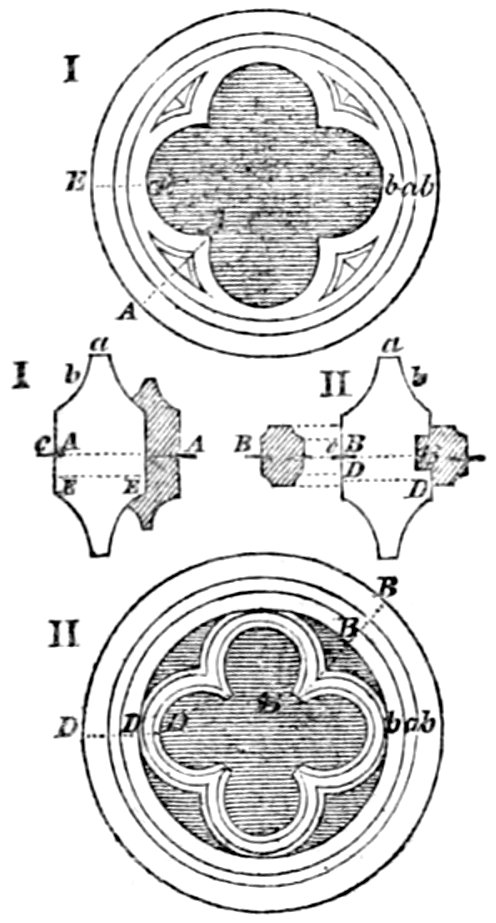
CUSPS. (In church architecture.) The
projecting points from the foliation of
arches or tracery. Cusping first appeared
in the Geometric period, and was continued
so long as Gothic architecture was
employed. Besides the more obvious differences
arising from the number of cusps,
which, however, it is needless to particularize,
there is one very great peculiarity
of the earlier cusping which ought to be
clearly understood. Let the tracery bar
consist of three planes, a the wall, b the
chamfer, and c soffit plane (the latter of
course not being visible in the two larger
diagrams, which, being elevations, show no
line at right angles to the wall). In the
more common cusping, the cusp is formed
by carrying out the whole of the soffit and
part of the chamfer plane, and leaving an
unpierced hollow, or eye, in the tracery
bar, as at A A, fig. I; A A in the section
answering to A A in the elevation, and E E to
E E. In the Earlier or Geometrical cusping,
the tracery bar is completed all round, and
the cusp carries with it no part either of
the soffit or of the chamfer, but is let into
the soffit, always in appearance, sometimes
in fact, as a separate piece of stone, as at
B D, fig. II. Here, too, the cusp leaves
a free space between itself and the tracery
bar, as at B B B in elevation, and section
II. D D D, representing the place of departure
of the cusp from the tracery bar.
This is generally called soffit cusping, from
its springing exclusively from the soffit
plane.
DAILY PRAYERS. “All priests and
deacons are to say daily the morning and
evening prayer, either privately or openly,
not being let by sickness or some other
urgent cause. And the curate that ministereth
in every parish church or chapel,
being at home, and not being otherwise
reasonably hindered, shall say the same
in the parish church or chapel where he
ministereth, and shall cause a bell to be
tolled thereunto a convenient time before
he begin, that the people may come to hear
God’s word, and pray with him.”—Preface
to the Book of Common Prayer. As this
is not only a direction of the Church, but
also part of an act of parliament, any
parishioners desirous of attending daily
prayers might compel the clergyman to
officiate, by bringing an action against
him, as well as by complaining to the
bishop. For this, of course, there can
seldom be any necessity, as most of the
clergy would be too happy to officiate, if
they could secure the attendance of two or
three of their parishioners. By the general
practice of the clergy it seems to be decided,
that they are to say the morning and
evening prayer in private, if they cannot
obtain a congregation; though, even under
those circumstances, the letter of the rubric
seems to direct them to say the offices
at church, if possible. It is a cheering sign
of the times, that the number of instances
in which the daily prayers are duly said in
church is rapidly on the increase.
DALMATIC, was formerly the characteristic
dress of the deacon in the administration
of the holy eucharist. It was also
worn by the bishop at stated times; and
in the Latin Church still forms part of the
episcopal dress, under the chasuble. It is
a robe reaching below the knees, and open
at each side for a distance varying at different
periods. It is not marked at the
back with a cross like the chasuble, but in
the Latin Church with two narrow stripes,
the remains of the angusti clavi worn on
the old Roman dress. In the Greek
275Church it is called colobion, is covered with
a multitude of small crosses, and has no
sleeves. The dalmatic is seen on the
effigies of bishops on monuments, and in
some old brasses, over the alb and the stole,
the fringed extremities of which reach just
below it. It has received its name from
being the regal vest of Dalmatia. It is
the same as the tunicle, which is directed
to be worn according to the rubrics of
King Edward VI.’s First Prayer Book, by
the priests and deacons who may assist the
priest at the holy communion. Like all
the other ecclesiastical vestures, it was
curtailed by the corrupt practice of later
ages in the West, so as not to reach further
than the knees.—Jebb.
DAMNATORY CLAUSES. (See
Athanasian Creed.)
DANIEL (THE BOOK OF). A canonical
book of the Old Testament.
Daniel descended from the royal house of
the kings of Judah, and was contemporary
with Ezekiel. (An. 606, before Christ.)
He was of the children of the captivity,
being carried to Babylon when he was
about eighteen years of age. His name is
not prefixed to his book; yet the many
passages in which he speaks in the first
person, are a sufficient proof that he was
the author of it. The style of Daniel is
not so lofty and figurative as that of the
other prophets: it is clear and concise, and
his narrations and descriptions simple and
natural; in short, he writes more like an
historian than a prophet.
He was a very extraordinary person, and
was favoured of God, and honoured of
men, beyond any that had lived in his
time. His prophecies concerning the coming
of the Messiah, and the other great
events of after-times, are so clear and explicit,
that Porphyry objected to them,
that they must have been written after the
facts were done.—Prideaux, Connect. P. I.
b. iii. Ann. 534. Hieron. in Proœm. ad
Com. in Dan.
The Jews do not reckon Daniel among
the prophets; and the reason they assign
is, because he rather lived the life of a
courtier, in the palace of the king of Babylon,
than that of a prophet. They add,
that, though he had Divine revelations
given to him, yet it was not in the prophetic
way, but by dreams and visions of
the night, which they look upon as the
most imperfect way of revelation, and below
the prophetic. But Josephus, one of
the ancientest writers of that nation, reckons
him among the greatest of the prophets,
and says further of him, that he conversed
familiarly with God, and not only foretold
future events, as other prophets did, but
determined likewise the time when they
should come to pass. But our Saviour,
by acknowledging Daniel as a prophet,
puts his prophetic character out of all dispute.—Maimonid,
in More Nevochim, p.
2, ch. 45. Huet. Demonstr. Evangel.
Prop. 4, ch. 14. Joseph. Antiq. lib. x. ch.
12. Matt. xxiv. 15.
Part of the book of Daniel was originally
written in the Chaldee language; that is,
from the fourth verse of the second chapter
to the end of the seventh chapter; and the
reason was, because, in that part, he treats
of the Chaldean or Babylonish affairs. All
the rest of the book is in Hebrew.—Hieron.
in Præf. ad Dan. The Greek translation,
used by the Greek Churches throughout
the East, was that of Theodotion. In the
Vulgar Latin Bible, there is added, in the
third chapter, after the twenty-fourth
verse, the Song of the Three Children,
and, at the end of the book, the History of
Susanna, and of Bel and the Dragon: the
former is made the thirteenth, and the
latter the fourteenth chapter of the book,
in that edition. But these additions were
never received into the canon by the Jews;
neither are they extant in the Hebrew or
the Chaldee language, nor is there any
proof that they ever were so.
The first six chapters of the book of
Daniel are a history of the kings of Babylon,
and what befell the captive Jews
under their government. In the last six,
he is altogether prophetical, foretelling,
not only what should happen to his own
Church and nation, but events in which
foreign princes and kingdoms were concerned;
particularly the rise and downfal
of the four secular monarchies of the world,
and the establishment of the fifth, or spiritual
kingdom of the Messiah.
It is believed that Daniel died in Chaldea,
and that he did not take advantage
of the permission granted by Cyrus to the
Jews of returning to their own country.
St. Epiphanius says he died at Babylon,
and herein he is followed by the generality
of historians.
“Amongst the old prophets,” says the
great Sir Isaac Newton, “Daniel is most
distinct in order of time, and easiest to be
understood; and therefore, in those things
which relate to the last times, he must be
made the key to the rest. His prophecies
are all of them related to one another, as
if they were but several parts of one general
prophecy. The first is the easiest to
be understood, and every following prophecy
adds something new to the former.”—Observations
on Daniel, pp. 15, 24.
276DATARY. An officer in the pope’s
court. He is always a prelate, and sometimes
a cardinal, deputed by his Holiness
to receive such petitions as are presented
to him, touching the provision of benefices.
By his post, the datary is empowered to
grant, without acquainting the pope therewith,
all benefices that do not produce
upwards of twenty-four ducats annually;
but for such as amount to more, he is
obliged to get the provisions signed by the
pope, who admits him to audience every
day. If there be several candidates for
the same benefice, he has the liberty of
bestowing it on which of them he thinks
proper, provided he has the requisite
qualifications. The datary has a yearly
salary of two thousand crowns, exclusive
of the perquisites, which he receives from
those who apply to him for any benefice.
This office has a substitute, named
the sub-datary, who is likewise a prelate,
and has a yearly pension of a thousand
crowns: but he is not allowed to confer
any benefice, without acquainting the
datary therewith. When a person has
obtained the pope’s consent for a benefice,
the datary subscribes his petition with an
annuit sanctissimus, i. e. the most holy father
consents to it. The pope’s consent is subscribed
in these words, Fiat ut petitur, i. e. Be
it according to the petition. After the petition
has passed the proper offices, and is registered,
it is carried to the datary, who dates
it, and writes these words—Datum Romæ
apud, &c.: Given at Rome in the pontifical
palace, &c. Afterwards the pope’s bull,
granting the benefice, is despatched by the
datary, and passes through the hands of
more than a thousand persons, belonging
to fifteen different offices, who have all
their stated fees. The reader may from
hence judge how expensive it is to procure
the pope’s bull for a benefice, and what
large sums go into the office of the datary,
especially when the provisions, issued from
thence, are for bishoprics, and other rich
benefices.—Broughton.
DEACON. (See Bishop, Presbyter,
Priest, Orders, Clergy.) The name Διάκονοι,
which is the original word for deacons, is
sometimes used in the New Testament
for any one that ministers in the service of
God: in which large sense we sometimes
find bishops and presbyters styled deacons,
not only in the New Testament, but in
ecclesiastical writers also. But here we
take it for the name of the third order of
the clergy in the Church. Deacons are
styled by Ignatius, “ministers of the mysteries
of Christ,” adding that they are “not
ministers of meats and drinks, but of the
Church of God.” In another place he
speaks of them as “ministers of Jesus
Christ,” and gives them a sort of presidency
over the people, together with the
bishops and presbyters. Cyprian speaks
of them in the same style, calling them
“ministers of episcopacy and the Church,”
and referring their origin to the Acts of
the Apostles; and he asserts that they
were called ad altaris ministerium, to the
ministry and service of the altar. Optatus
had such an opinion of them as to reckon
their office a lower degree of the priesthood.
At the same time it is to be observed,
that in this he was singular. By
those who regarded them as a sacred order,
they were generally distinguished from
priests by the name of ministers and Levites.
The ordination of a deacon differed
in the primitive Church from that of a
presbyter, both in the form and manner of
it, and also in the gifts and powers that
were conferred by the ordinance. In the
ordination of a presbyter, the presbyters
who were present were required to join in
imposition of hands with the bishop. But
the ordination of a deacon might be performed
by the bishop alone, because, as the
[fourth] Council of Carthage words it, he
was ordained not to the priesthood, but
to the inferior services of the Church:
“quia non ad sacerdotium sed ad ministerium
consecratur.” It belonged to the
deacons to take care of the holy table and
all the ornaments and utensils appertaining
thereto; to receive the oblations of the
people, and present them to the priest; in
some churches, to read the Gospel both in
the communion service and before it also;
to minister the consecrated bread and wine
to the people in the eucharist; in some
churches, to baptize; to act as directors to
the people in public worship, for which
purpose they were wont to use certain
known forms of words, to give notice when
each part of the service began, and to excite
people to join attentively therein; to
preach, with the bishop’s licence; in extreme
cases to reconcile the excommunicated
to the Church; to attend upon the
bishop, and sometimes to represent him
in general councils. Deacons seem also
to have discharged most of the offices
which now devolve upon churchwardens.—Bingham.
The Church of England enjoins that
“none shall be admitted a deacon except
he be twenty-three years of age, unless he
have a faculty;” and she describes the
duties of a deacon in her office as follows:
“It appertaineth to the office of a deacon,
in the church where he shall be appointed
277to serve, to assist the priest in Divine service,
and specially when he ministereth the
holy communion, and to help him in the
distribution thereof, and to read Holy
Scripture and homilies in the church; and
to instruct the youth in the catechism;
in the absence of the priest to baptize infants,
and to preach, if he be admitted
thereto by the bishop. And, furthermore,
it is his office, where provision is so made,
to search for the sick, poor, and impotent
people of the parish, to intimate their
estates, names, and places where they
dwell, unto the curate, that by his exhortation
they may be relieved with the alms
of the parishioners, or others.”
In the rubric after the sentences of the
Offertory, it is ordered, that “while these
sentences are in reading, the deacons,
churchwardens, or other fit persons appointed
for that purpose, shall receive the
alms for the poor,” &c.
The deacon cannot pronounce the absolution,
or minister at the holy communion,
except as an assistant. And if the rubrics
be strictly construed according to the letter,
neither can he read the versicles before
the Psalms, or after the Lord’s Prayer,
(at its second occurrence,) nor the latter
part of the Litany, beginning at the Lord’s
Prayer; nor any part of the Communion
Service, except the Gospel, (not according
to the rubric, however, but in virtue of the
licence in the Ordination Service,) the
Creed, and the confession. He is permitted
to baptize only in the absence of the
priest; and perhaps the same remark may
apply to the other occasional offices.
DEACONESS. A woman who served
the Church in those offices in which the
deacons could not with propriety exercise
themselves. This order was also appointed
in the apostolic age. They were generally
widows who had been only once
married, though this employment was
sometimes exercised by virgins. Their
office consisted in assisting at the baptism
of women, in previously catechizing and
instructing them, in visiting sick persons
of their own sex, and in performing all
those inferior offices towards the female
part of the congregation, which the deacons
were designed to execute for the men.
St. Paul (Rom. xvi.) speaks of Phœbe as
servant, or deaconess, of the church at
Cenchrea, which was a haven of Corinth.
Deaconesses appear to be the same persons
as those whom Pliny, in his famous
letter to Trajan, styles “ancillæ quæ ministræ
dicebantur;” that is, “female attendants,
called assistants, ministers, or servants.”
It appears, then, that these were
customary officers throughout the churches;
and when the fury of persecution fell on
Christians, these were among the first to
suffer. They underwent the most cruel
tortures, and even extreme old age was
not spared. It is probable that they were
blessed by the laying on of hands, but it
is certain they were not permitted to execute
any part of the sacerdotal office.
This order continued in the Greek Church
longer than in the Latin. It was generally
disused in the Western Church in the
fifth century, but continued in the Eastern
Church until the twelfth. The deacon’s
wife appears sometimes to have been
called a deaconess, as the presbyter’s wife
was styled presbytera, and the bishop’s
wife episcopa.
DEAD. (See Burial of the Dead.) If
all our prayers and endeavours for our
friend prove unavailable for the continuance
of his life, we must with patience
submit to the will of God, “to whom the
issues of life and death belong:” and
therefore, after recommending his soul to
God, which immediately upon its dissolution
returns to Him, it is fit we should decently
dispose of his body, which is left to
our management and care. Not that the
dead are anything the better for the honours
which we perform to their corpses
(for we know that several of the ancient
philosophers cared not whether they were
buried or not; and the ancient martyrs of
the Christian Church despised their persecutors
for threatening them with the want
of a grave). But those who survive could
never endure that the shame of nature
should lie exposed, nor see the bodies of
those they loved become a prey to birds
and beasts. For these reasons, the very
heathens called it a Divine institution, and
a law of the immortal gods. And the
Romans especially had a peculiar deity to
preside over this affair. The Athenians
were so strict, that they would not admit
any to be magistrates, who had not taken
care of their parents’ sepulture, and beheaded
one of their generals after he had
gotten a victory, for throwing the dead
bodies of the slain, in a tempest, into the
sea. And Plutarch relates, that, before
they engaged with the Persians, they took
a solemn oath, that, if they were conquerors,
they would bury their foes; this
being a privilege which even an enemy
hath a right to, as being a debt which is
owing to humanity.
2. It is true, indeed, the manner of
funerals has varied according to the different
customs of several countries; but
all civilized nations have ever agreed in
278performing some funeral rites or other.
The most ancient manner was by “burying
them in the earth;” which is, indeed, so
natural, that some brutes have been observed,
by mere instinct, to bury their
dead with wonderful care. The body, we
know, was formed of the dust at first, and
therefore it is fit it should “return to the
earth as it was” (Gen. iii. 19; Eccles. xii.
7); insomuch that some heathens have,
by the light of reason, called burying in
the earth the being “hid in our mother’s
lap,” and the being “covered with her
skirt.” And that “interment,” or enclosing
the dead body in the grave, was used
anciently by the Egyptians and other nations
of the East, is plain from the account
we have of the embalming, and from their
mummies, which are frequently found to
this day whole and entire, though some of
them have lain above three thousand years
in their graves. That the same practice
of burying was used by the patriarchs, and
their successors the Jews, we have abundant
testimony from the most ancient
records in the world, the books of Moses;
by which we find, that their funerals were
performed, and their sepulchres provided
with an officious piety (Gen. xxiii. 4;
xxv. 9; xxxv. 29; xlix. 31); and that it
was usual for parents to take an oath of
their children, (which they religiously performed,)
that they should bury them with
their fathers, and carry their bones with
them, whenever they quitted their land
where they were. (Gen. xlvii. 29–31;
xlix. 29–33; l. 25, 26; Exod. xiii. 19.
See also Josh. xxiv. 32; Acts vii. 16; Heb.
xi. 22.) In succeeding ages, indeed, it
became a custom in some places to burn
the bodies of the dead; which was owing
partly to a fear that some injury might be
offered them if they were only buried, by
digging their corpses again out of their
graves; and partly to a conceit, that the
souls of those that were burnt were carried
up by the flames to heaven.
3. But though other nations sometimes
used interment and sometimes burning,
yet the Jews confined themselves to the
former alone. There is a place or two indeed
in our translation of the Old Testament,
(1 Sam. xxxi. 12; Amos vi. 10,)
which might lead us to imagine that the
rite of burning was also used by them
sometimes. But upon consulting the original
texts, and the customs of the Jews,
it does not appear that the burnings there
mentioned were anything more than the
burning of odours and spices about their
bodies, which was an honour they usually
performed to their kings. (2 Chron. xvi.
14; xxi. 19; Jer. xxxiv. 5.) So that, notwithstanding
these texts, we may safely
enough conclude, that interment, or burying,
was the only rite with them; as it
was also in after-times with the Christian
Church. For wherever Paganism was extirpated,
the custom of burning was disused;
and the first natural way of laying
up the bodies of the deceased entire in the
grave obtained in the room of it.
4. And this has always been done with
such solemnity, as is proper to the occasion.
Sometimes, indeed, it has been attended
with an expensive pomp, that is unseemly
and extravagant. But this is no reason
why we should not give all the expressions
of a decent respect to the memory of those
whom God takes from us. The description
of the persons who interred our Saviour,
the enumeration of their virtues, and the
everlasting commendation of her who spent
three hundred pennyworth of spikenard to
anoint his body to the burial, have always
been thought sufficient grounds and encouragements
for the careful and decent
sepulture of Christians. And, indeed, if
the regard due to a human soul, rendered
some respect to the dead a principle that
manifested itself to the common sense of
heathens, shall we think that less care is
due to the bodies of Christians, who once
entertained a more glorious inhabitant,
and were living temples of the Holy
Ghost? (1 Cor. vi. 19;) to bodies which
were consecrated to the service of God;
which bore their part in the duties of religion;
fought the good fight of faith and
patience, self-denial and mortification; and
underwent the fatigue of many hardships
and afflictions for the sake of piety and
virtue;—to bodies which, we believe, shall
one day be awakened again from their
sleep of death; have all their scattered
particles of dust summoned together into
their due order, and be “fashioned like to
the glorious body of Christ” (Phil. iii. 21;
see also 1 Cor. xv. 42–44); as being made
partakers of the same glory with their immortal
souls, as once they were of the same
sufferings and good works. Surely bodies
so honoured here, and to be so glorified
hereafter, and which too we own, even in
the state of death, to be under the care of
a Divine providence and protection, are
not to be exposed and despised by us as
unworthy of our regard. Moved by these
considerations, the primitive Christians,
though they made no use of ointments
whilst they lived, yet they did not think
the most precious too costly to be used
about the dead. And yet this was so far
from being reproached with superstition,
279that it is ever reported as a laudable custom,
and such as had something in it so
engaging, so agreeable to the notions of
civilized nature, as to have a very considerable
influence upon the heathens, who
observed and admired it; it becoming instrumental
in disposing them to a favourable
opinion at first, and afterwards to the
embracing of the Christian religion, where
these decencies and tender regards to deceased
friends and good people, were so
constantly, so carefully, and so religiously
practised.—Dean Comber. Wheatly.
Christ’s Church, that is, the whole
number of the faithful, is usually divided
into two parts; namely, the Church militant,
and the Church triumphant. By the
Church militant, or in a state of warfare,
we mean those Christians who are at
present alive, and perpetually harassed
with the temptations and assaults of the
world, the flesh, and the devil, and whose
life is consequently a continual warfare
under the banner of our blessed Saviour.
By the Church triumphant, we mean those
Christians who have departed this life in
God’s true faith and fear; and who now
enjoy in some measure, and after the day
of judgment shall be fully possessed of,
that glory and triumph, which is the fruit
of their labours, and the reward of those
victories which they obtained over their
spiritual adversaries, during the time of
their trial and combat here upon earth.—Dr.
Bennet.
After the Offertory in the eucharist is
said, and the oblations of bread and wine,
with the alms for the poor, are placed
upon the table, the minister addresses this
exhortation to the people: “Let us pray for
the whole state of Christ’s Church militant
here in earth.” The latter part of
this sentence is wanting in Edward’s First
Book. The words “militant here in earth,”
which were designed expressly to exclude
prayer for the dead, were inserted in the
Second Book, in which that part of this
prayer, which contained intercession for
the dead, was expunged. It was the
intention of the divines who made this alteration,
to denote that prayers are not to
be offered up for the dead, whose spiritual
warfare is already accomplished; but for
those only who are yet “fighting the good
fight of faith,” and are consequently in a
capacity of needing our prayers.—Shepherd.
Although the doctrine of purgatory be
a comparatively modern doctrine, yet
prayers for the justified dead, for the increase
of their happiness, and for our reunion
with them, were introduced early
into the Church. But it can be proved:
First. That, the prayers of the primitive
Church for the dead, being especially
for those who were accounted saints par
excellence, and including even the Blessed
Virgin and the Holy Apostles, prayer to
the departed saints, whoever they may be,
as it is practised by the churches under
the Roman obedience, must be contrary
in theory, as it is in fact, to the primitive
practice; since it were impossible to pray
to and for the same persons.
Secondly. That it was not for the release
of the spirit of the departed from
purgatory that the Church supplicated
Almighty God. For this also were incompatible
with prayer for the Blessed
Virgin, and other eminent saints, of which
there was never any doubt but that they
were already in Abraham’s bosom, or
even, as in the case of martyrs, in heaven
itself.
Thirdly. That works of supererogation
formed no part of the system of primitive
theology; since all were prayed for as
requiring the mercy of God, though it
was not declared to what particular end.
Fourthly. That the use of hired masses
for the dead, who may have been persons
of exceeding criminality, and have died
in mortal sin, is utterly at variance with
the practice of the Church of old.—See
Archbishop Usher and Bingham.
DEADLY SIN. We pray in the Litany
to be delivered from “all deadly sin.” In
the strict sense of the word every sin is
deadly, and would cause eternal death if
it were not for the intervention of our
blessed Saviour. Even what are called
infirmities and frailties, are in this sense
deadly. But persons under grace have
for these offences “an Advocate with the
Father, Jesus Christ the righteous, and
he is the propitiation for our sins.” (1 John
ii. 2.) Their infirmities and frailties,
therefore, if they are trying to overcome
them, are not deadly to persons under
grace, or baptized persons justified by
faith, although, if persevered in, and uncorrected,
they may terminate in deadly
sin; and they consequently require continual
repentance, lest they should grow
into such a fearful burden. But even to
persons under grace we learn, from 1 John
v. 16, 17, that there are “sins unto death,”—which
must mean sins that put us out
of a state of grace, and this is done by
any wilful sin persevered in. By deadly
sin in a Christian is meant wilful sin,
persevered in, which deprives us of all
Christian privileges. (See Sin.)
DEAN. Of deans there are two sorts;
1st, the dean of a cathedral, who is an
280ecclesiastical magistrate, next in degree to
the bishop. He is chief of the chapter,
and it is supposed is called a dean, (Decanus,)
from a similar title in ancient monasteries,
of an officer who presided over ten
monks.
The dean represents the Archpresbyter,
or Protopapas, who all the world over,
from the most ancient times, was found
under one denomination or another in the
principal church of the diocese, to which
a body of clergy was uniformly attached.
Notre Dame at Paris had a dean as early
as 991 at least. There was a dean of Bangor
in 603; of Llandaff in 612; at Canterbury
from 825 to 1080, then the name
of Prior was substituted. Salisbury had
its dean in 1072; Lincoln, 1092. In conventual
cathedrals, the head was generally
prior, the bishop being virtually abbot.
The dean was the first dignitary of the
cathedral; the head of the corporation;
and, in subordination to the bishop, has,
according to the statutes of more ancient
cathedrals, the cure of souls over the members
of the cathedral, and the administration
of the corrective discipline of the
Church. He has also duties in the choir and
the chapter in common with all the chapter.
He is by our law a sole corporation,
that is, he represents a whole succession,
and is capable of taking an estate as dean,
and conveying it to his successors. 2nd,
Rural deans, whose office is of ancient date
in the Church of England, long prior to
the Reformation, as it has been throughout
Europe, and which many of the
bishops are now reviving. Their chief
duty is to visit a certain number of parishes,
and to report their condition to the
bishop. (See Rural Dean.) The dean
was not always head of the chapter abroad;
the provost being sometimes the superior.
But he had always the administration of
the discipline in spirituals, [curam animarum,
as it is expressly called in statutes
both of home and foreign Churches,] the
provosts often concerning themselves
merely in temporals, and he had the superintendence
of the choir, or cathedral body.
(See Dictionnaire de Droit Canonique,
Lyons, 1787, voce Doyen.) They were, in
fact, very much like the deans in our colleges,
though more strictly limited ad
sacra. The Dean of Faculty, in most
ancient and some modern universities,
presided over the meetings of their respective
faculties, and maintained the academical
discipline.
DEAN AND CHAPTER. This is the
style and title of the governing body of a
cathedral. A chapter consists of the dean,
with a certain number of canons, or prebendaries,
heads of the church—capita
ecclesiæ. The origin of this institution is
to be traced to a remote antiquity. A
missionary bishop, when converting our
ancestors, would take his position in some
central town, with his attendant priests:
these, as opportunity offered, would go to
the neighbouring villages to preach the
gospel, and administer the other offices of
the Church. But they resided with the
bishop, and were supported out of his
revenues. By degrees parochial settlements
were made; but still the bishop
required the attendance of certain of the
clergy at his cathedral, to be his council;
(for the bishops never thought of acting
without consulting their clergy;) and also
to officiate in his principal church or cathedral.
These persons, to qualify themselves
for their office, gave themselves up
to study, and to the maintenance and decoration
of their sanctuary; the services
of which were to be a model to all the
lesser churches of the diocese. Forming,
in the course of time, a corporation, they
obtained property, and ceased to be dependent
upon the bishop for a maintenance.
And being considered the representatives
of the clergy, upon them devolved
the government of the diocese when
vacant; and they obtained the privilege,
doubtless on the same principle, of choosing
the bishop, which originally belonged
to the whole clergy of the diocese, in conjunction
with the bishops of the province.
In this privilege they were supported by
the kings of the country, who perceived
that they were more likely to intimidate
a chapter into the election of the royal
nominee, than the whole of the clergy of
a diocese. But still the deans and chapters
sometimes acting independently, an
act was passed under Henry VIII., by
which a dean and chapter refusing to elect
the king’s nominee to the bishopric become
individually outlawed, lose all their
property, and are to be imprisoned during
pleasure. Since that time these corporations
have always succumbed to the royal
will and pleasure. The great object of
the institution, it will be perceived, is, 1st,
To provide the bishop with a council;
2nd, To make provision for a learned body
of divines, who, disengaged from parochial
cares, may benefit the cause of religion
by their writings; 3rd, To make
provision, also, that in the cathedral
church of each diocese the services shall
be performed with rubrical strictness, and
with all the solemnity and grandeur of
which our services are capable.
281It is not to be denied, that, during the
last century, this institution was greatly
abused. Patrons made use of it to enrich
their own families or political partisans;
and the cathedral clergy, instead of giving
themselves up to learned labours, dwelt
chiefly on their livings, coming merely for
a short time to their cathedrals: as their
estates advanced in value, they expended
the income on themselves, instead of increasing
the cathedral libraries, and rendering
the choirs more efficient, by raising
the salaries of the choristers, and doubling
or trebling their number: finally, being
forgetful of the command of the Church,
that, “in cathedral and collegiate churches
and colleges, where there are many priests
and deacons, they shall all receive the
communion with the priest, every Sunday
at the least,” many deans and chapters
have, most unjustifiably, discontinued the
weekly communion. Whether individual
members of chapters consider these observances
superstitious or not, it is on these
conditions they enjoy their property; and
if they cannot conscientiously keep the
conditions, they ought conscientiously to
resign their places. These things required
reform; and forecasting men, seeing no
symptoms of improvement, expected that
the arm of the Lord would be made bare
for vengeance; and the Lord made use of
the secular government of England as his
instrument of chastisement. The British
legislature, acting on the precedent of
Cardinal Wolsey and Henry VIII., has
seized a large portion of the property belonging
to the deans and chapters, and
has reduced the number of canons. May
this be a warning to the deans and chapters
as they now exist! May patrons make
the cathedral close the abode of men of
learning, and may the members of chapters
sacrifice even their private property to
render their cathedral choirs what they
ought to be! May they have strength of
mind to sacrifice all they have in the
world, rather than elect as a bishop an unworthy
nominee of the Crown, if, peradventure,
the Crown nominate a Sabellian,
or an Arian, or a Socinian heretic. (See
Chapters, Canons, and Prebendaries.)
DECALOGUE. The ten precepts, or
commandments, delivered by God to Moses,
and by him written on two tables of stone,
and delivered to the Hebrews, as the basis
and foundation of their religion. The
history of this great event, together with
the ten commandments themselves, are recited
at large in the 19th and 20th chapters
of the book of Exodus.
The Jews called these commandments,
by way of excellence, the ten words, from
whence they had afterwards the name of
Decalogue. But it is to be observed, that
they joined the first and second into one,
and divided the last into two. They understand
that against stealing to relate to
the stealing of men, or kidnapping, alleging,
that the stealing of another’s goods
or property is forbidden in the last commandment.—De
Legib. Hebr. lib. i. c. 2.
“Most divines,” says the learned Spencer,
“seem to have been of opinion, that
God gave the Decalogue, to be a general
rule of life and manners, and as it were a
summary, to which all other precepts,
either of the law or the gospel, may be
reduced. Hence they rack their brains,
to fix so large and extensive a meaning
on all these commands, that all duties, respecting
God or our neighbour, may be
understood to be contained in them. But
no one, who duly considers the matter,
can think it probable, that the Decalogue
was therefore given, that it might be a
kind of compendium of all the other laws
of the Pentateuch; since those eminent
precepts of the law, ‘Thou shalt love the
Lord thy God with all thy heart,’ and
‘Thou shalt love thy neighbour as thyself,’
cannot be found in the Decalogue,
without affixing a meaning to some commands
quite foreign to the natural sense
of the words, and subjecting them to an
arbitrary interpretation. To give my opinion
in a few words; the chief scope and
intent of the Decalogue was to root out
idolatry and its more immediate effects,
and to add force and authority to the
other laws contained in the Pentateuch.
For who can persuade himself, that God
would have collected together, into the
one little system of the Decalogue, those
ten precepts, which have scarce any connexion
with each other, had they not all
naturally tended to destroy idolatry and
its primary effects?” The author then
proceeds to confirm the truth of this assertion
by a distinct consideration of each
precept of the two tables.
It has been a question, and even matter
of admiration, why God, in delivering laws
to the Hebrews, kept precisely to the number
ten. This question is answered by the
above-cited author, (Id. ib. § 2,) who assigns
the following reasons for this proceeding.
“First, the number ten exceeds
all others in perfection and capacity: for
in it are comprehended all the diversities
of numbers and their analogies, and all
the geometrical figures which have any
relation to numbers. Secondly, A Decad
seems to have been in most esteem and
282use, among all nations, from the earliest
times. Thirdly, As the number ten comprehends
in it all others, so the Decalogue
was to be a kind of representative of all
the other laws of Moses, which were too
numerous to be distinctly and separately
rehearsed from Mount Sinai. Lastly, The
number ten was a sacred number, and
most frequently applied to the things mentioned
in the Law: as will be evident to
those, who carefully read over the institutes
of Moses.”
The Samaritans, to raise and maintain
the credit of their temple on Mount Gerizim,
forged an eleventh command or precept,
which in their Pentateuch they added
at the end of the Decalogue, both in
Exodus and Deuteronomy. It was this:
“When the Lord thy God shall have
brought thee into the land of Canaan,
whither thou goest to possess it, thou
shalt erect to thyself large stones, and
shalt write on them all the words of this
Law. And, after thou shalt have passed
over Jordan, thou shalt place those stones,
which I command thee this day, on Mount
Gerizim, and shalt build there an altar to
the Lord thy God, an altar of stone,” &c.
DECLARATION. (See Conformity.)
DECORATED. The style of architecture
which succeeded the Geometrical
about 1315, and gave place to the Perpendicular
about 1360.
The most obvious characteristic of this
style is the window tracery (see Tracery);
but all the parts and details have also
their appropriate features. The doorway
is no longer divided by a central shaft.
The windows are larger than in the former
style, and their mullions have in general
fewer subordinations of mouldings. The
corner buttresses are usually set diagonally
instead of in pairs, and the buttresses generally
are of considerable projection, and
much enriched with pediments and niches.
The piers consist generally of four shafts
with intervening hollows, set lozengewise;
and the detached shaft is wholly discontinued.
The triforium, which had begun
to lose its relative importance in the Geometrical,
is in this style generally treated
as a mere course of panelling at the base
of the clerestory windows, which are proportionally
enlarged. Arcading begins to
be superseded by panelling. Foliage, and
other carving, is treated with less force
and nature than in the preceding style;
and heraldry begins to appear. The
vaulting (see Vaulting) is more intricate.
One or two mouldings and decorations are
almost peculiar to this style, especially the
ogee in all its forms and in every position.
The ball-flower and the scroll moulding, it
has in common with the Geometrical, but
far more frequently. (See Moulding.) The
broach spire is still used, but begins to
give way to the parapet and spire.
DECRETALS. The name given to
the letters of popes, being in answer to
questions proposed to them by some bishop
or ecclesiastical judge, or even particular
person, in which they determined business,
as they thought fit. In the ninth century
there appeared a collection of decretal
letters ascribed to more than thirty popes,
succeeding each other in the first three
centuries. The author is unknown, but
they are generally ascribed to a certain
Isidore Mercator, and pass usually under
his name. Their uniform tendency is to
exalt papal power, and exactly on those
points for which no sanction can be alleged
from Scripture, or from the early periods
of any genuine Church history; such as
supreme authority over bishops, the receiving
appeals from all parts of the world, and
the reservation of causes for the hearing
of the Roman see. In the words of Fleury,
“They inflicted an irreparable wound on
the discipline of the Church, by the new
maxims which they introduced in regard
to the judgment of bishops and the authority
of the pope.” Dr. Barrow mentions
them among the chief causes by which the
power of the bishop of Rome has been
advanced: “The forgery of the decretal
epistles (wherein the ancient popes are
made expressly to speak and act according
to some of his highest pretences, devised
long after their times, and which they
never thought of, good men) did hugely
conduce to his purpose; authorizing his
encroachments by the suffrage of ancient
doctrine and practice.” “Upon these spurious
decretals,” (writes the historian of the
middle ages,) “was built the great fabric
of papal supremacy over the different national
Churches: a fabric which has stood
after its foundation crumbled beneath it;
for no one has pretended to deny, during
the last two centuries, that the imposture
is too palpable for any but the most ignorant
ages to credit.” Their effect was, to
diminish the authority of metropolitans
and provincial synods, by allowing to an
accused bishop, not only the right of appeal,
but the power also of removing any
process into the supreme court at Rome.
And on this account it has been supposed
that the decrees were forged by some
bishop who desired to reduce the power of
his immediate superior. But whoever may
have been the author, and whatever the
origin, there is no doubt that the popes
283became, from the first, their most strenuous
defenders.
The best account of these forgeries is to
be found in the posthumous work of Van
Espen, Commentarius in Jus Novum Canonicum,
part ii. diss. 1, p. 451–475. See
also De Marca, De Concord. iii. c. 4, 5, p.
242; Natalis Alexandri Hist. Eccles. sæc.
i. diss. 13, p. 213; Coci Censura quorundam
Scriptorum, &c., passim.—Sanderson.
Robins, Evidence of Scripture against the
Roman Church.
DEDICATION, FEAST OF. The
wake or customary festival for the dedication
of churches signifies the same as
vigil or eve. The reason of the name is
thus assigned in an old manuscript: “Ye
shall understand and know how the evens
were first founded in old times. In the beginning
of Holy Church it was so, that the
people came to the church with candles
burning, and would wake and come with
lights towards night to the church in their
devotions: and after, they fell to lechery,
and songs, and dances, harping and piping,
and also to gluttony and sin; and so turned
the holiness to cursedness. Wherefore
the holy Fathers ordained the people to
leave that waking, and to fast the even.
But it is still called vigil, that is, waking
in English: and it is also called the even,
for at even they were wont to come to
church.” It was in imitation of the primitive
ἀγάπαι, or love feasts, (see Agapæ,)
that such public assemblies, accompanied
with friendly entertainments, were first
held upon each return of the day of consecration,
though not in the body of
churches, yet in the churchyards, and most
nearly adjoining places. This practice was
established in England by Gregory the
Great; who, in an epistle to Mellitus the
abbot, gives injunctions to be delivered to
Augustine the monk, a missionary to England;
amongst which he allows the solemn
anniversary of dedication to be celebrated
in those churches which were made out of
heathen temples, with religious feasts kept
in sheds or arbours, made up with branches
and boughs of trees round the said church.
But as the love feasts held in the place of
worship were soon liable to such great
disorders, that they were not only condemned
at Corinth by St. Paul, but prohibited
to be kept in the house of God by
the 20th canon of the Council of Laodicea,
and the 30th of the third Council of Carthage:
so, from a sense of the same inconveniences,
this custom did not long continue
of feasting in the churches or
churchyards; but strangers and inhabitants
paid the devotion of prayers and offerings
in the church, and then adjourned their
eating and drinking to the more proper
place of public and private houses. The
institution of these church encœnia, or
wakes, was, without question, for good and
laudable designs: at first, thankfully to
commemorate the bounty and munificence
of those who had founded and endowed
the church; next, to incite others to the
like generous acts of piety; and, chiefly, to
maintain a Christian spirit of unity and
charity, by such sociable and friendly
meetings. And therefore care was taken
to keep up the laudable custom. The laws
of Edward the Confessor gave peace and
protection in all parishes during the solemnity
of the day of dedication, and the
same privilege to all that were going to
or returning from such solemnity. In a
council held at Oxford, in the year 1222,
it was ordained, that among other festivals
should be observed the day of dedication
of every church within the proper parish.
And in a synod under Archbishop Islip,
(who was promoted to the see of Canterbury
in the year 1349,) the dedication
feast is mentioned with particular respect.
This solemnity was at first celebrated on
the very day of dedication, as it annually
returned. But the bishops sometimes gave
authority for transposing the observance to
some other day, and especially to Sunday,
whereon the people could best attend the
devotions and rites intended in this ceremony.
Henry VIII. enjoined that all
wakes should be kept the first Sunday in
October.
This laudable custom of wakes prevailed
for many ages, till the Puritans began to
exclaim against it as a remnant of Popery.
By degrees the humour grew so popular,
that at the summer assizes held at Exeter,
in the year 1627, the Lord Chief Baron
Walter and Baron Denham made an order
for suppression of all wakes. And a
like order was made by Judge Richardson
for the county of Somerset, in the year
1631. But on Bishop Laud’s complaint
of these innovations, the king commanded
the last order to be reversed; which Judge
Richardson refusing to do, an account was
required from the Bishop of Bath and
Wells, how the said feast days, church
ales, wakes, and revels, were for the most
part celebrated and observed in his diocese.
On the receipt of these instructions,
the bishop sent for and advised with
seventy-two of the most orthodox and able
of his clergy; who certified under their
hands, that, on these feast days, (which
generally fell on Sundays,) the service of
God was more solemnly performed, and
284the church much better frequented, both
in the forenoon and afternoon, than on
any other Sunday in the year; that the
people very much desired the continuance
of them; that the ministers did in most
places the like, for these reasons, viz. for
preserving the memorial of the dedication
of their several churches, for civilizing the
people, for composing differences by the
mediation and meeting of friends, for increase
of love and unity by these feasts of
charity, and for relief and comfort of the
poor. On the return of this certificate,
Judge Richardson was again cited to the
council table, and peremptorily commanded
to reverse his former order. After which
it was thought fit to reinforce the declaration
of King James, when perhaps this was
the only good reason assigned for that unnecessary
and unhappy licence of sports:
“We do ratify and publish this our blessed
father’s decree, the rather because of late,
in some counties of our kingdom, we find,
that, under pretence of taking away abuses,
there hath been a general forbidding not
only of ordinary meetings, but of the feasts
of the dedication of churches, commonly
called wakes.” However, by such a popular
prejudice against wakes, and by the
intermission of them in the confusions that
followed, they are now discontinued in
many counties, especially in the east and
some western parts of England, but are
commonly observed in the north and in
the midland counties.
DEFENDER OF THE FAITH. (Fidei
Defensor.) A peculiar title belonging to
the sovereign of England; as Catholic to
the king of Spain, and Most Christian to
the king of France. These titles were
given by the popes of Rome. That of Fidei
Defensor was first conferred by Pope Leo
X. on King Henry VIII., for writing
against Martin Luther; and the bull for it
bears date quinto idus Octobris, 1521. It
was afterwards confirmed by Clement VII.
On Henry’s suppression of the monasteries,
the pope of Rome deprived him of this
title, and had the presumption and absurdity
to depose him from his crown. Therefore
the title was conferred by a higher
authority than the pope, the parliament of
England, in the thirty-fifth year of Henry’s
reign. By some antiquarians it is maintained
that the bull of Leo only revived a
title long sustained by the English kings.
DEGRADATION is an ecclesiastical
censure, whereby a clergyman is deprived
of the holy orders which formerly he had,
as of a priest or deacon; and by the canon
law this may be done two ways, either
summarily or by word only, or solemnly,
as by divesting the party degraded of those
ornaments and rights which were the ensigns
and order of his degree.
Collier thus describes the form of degradation
of a priest, in the case of Fawke,
burnt for heresy in the reign of Henry IV.
After being pronounced a heretic relapsed,
he was solemnly degraded in the following
manner:
| From the order of |
To be taken from him, |
| 1 Priest. |
1 The paten, chalice, and pulling off his chasuble. |
| 2 Deacon. |
2 The New Testament and the stole. |
| 3 Sub-deacon. |
3 The albe and the maniple. |
| 4 Acolyth. |
4 The candlestick, taper, urceolum. |
| 5 Exorcist. |
5 The office for exorcisms. |
| 6 Reader. |
6 The lectionarium, or legend book. |
| 7 Ostiarius, or Sexton. |
7 The keys of the church-doors, and surplice. |
After this, his ecclesiastical tonsure was
obliterated, and the form of his degradation
pronounced by the archbishop; and
being thus deprived of his sacerdotal character,
and dressed in a lay habit, he was
put into the hands of the secular court,
with the significant request, that he might
be favourably received.
The ancient law for degradation is set
forth in the sixth book of the Decretals;
and the causes for degradation and deprivation
are enumerated by Bishop Gibson.—See
Gibson’s Codex, p. 1066–1068.
By Canon 122, Sentence against a minister,
of deposition from the ministry,
“shall be pronounced by the bishop only,
with the assistance of his chancellor and
the dean, (if they may conveniently be had,)
and some of the prebendaries, if the court
be kept near the cathedral church; or of
the archdeacon, if he may be had conveniently,
and two other at the least grave
ministers and preachers to be called by the
bishop, when the court is kept in other
places.”
DEGREE. Psalms or Songs of Degrees
is a title given to fifteen psalms,
which are the 120th and all that follow to
the 134th inclusive. The Hebrew text
calls them a song of ascents. Junius and
Tremellius translate the Hebrew, by a
song of excellencies, or an excellent song,
because of the excellent matter of them,
as eminent persons are called men of high
degree. (1 Chr. xvii. 17.) Some call them
psalms of elevation, because, say they, they
were sung with an exalted voice; or because
at every psalm the voice was raised:
but the translation of psalms of degrees
has more generally obtained. Some interpreters
think, that they were so called because
they were sung upon the fifteen
steps of the temple; but they are not
agreed about the place where these fifteen
steps were. Others think they were so
called, because they were sung in a gallery,
which they say was in the court of Israel,
285where sometimes the Levites read the law.
But others think, that the most probable
reason why they are called songs of degrees,
or of ascent, is, because they were
composed and sung by the Jews on the
occasion of their going up to Jerusalem,
after the deliverance from the captivity
of Babylon, whether it were to implore
this deliverance from God, or to return
thanks for it after it had happened: others,
that they were severally composed not
only upon this, but upon other remarkable
occasions when they made their ascent to
the temple.
DEGREES in the universities denote
a quality conferred on the students or
members thereof, as a testimony of their
proficiency in the arts and sciences, and
entitling them to certain privileges. They
were first instituted by Pope Eugenius III.
at the suggestion of Gratian, the celebrated
compiler of the canon law, in 1151;
but were limited to the faculty of canon
law, for the encouragement of which they
were instituted; and consisted of the ranks
of bachelor, licentiate, and doctor. Shortly
after Peter Lombard instituted similar
degrees in theology in the university of
Paris. In the course of time degrees were
given in other faculties, those of arts and
medicine being added. In many of the
foreign universities, theology and canon
law have each their three classes of degrees
as above stated; medicine has generally
but two, bachelor and doctor; and
arts two, bachelor and master. The designation
of doctor in philosophy is very
modern. The English universities have
only two degrees, bachelor and doctor in
the superior faculties; master and bachelor
in arts. The student of civil law is not,
properly speaking, a graduate. Formerly
separate degrees were given in England
(as abroad) in canon and civil law; but
the distinction ceased in the 17th century.
Oxford has for some time ceased to confer
degrees in utroque jure, (i. e. civil and canon
law,) but only in civil law. Hence
her graduates are D. C. L. and B. C. L., and
not L. L. D. and L. L. B., as at Cambridge
and Dublin. The three ancient
universities of England and Ireland confer
degrees in music. Anciently degrees in
grammar, doctorate, mastership, and baccalaurenti
were given at Oxford or Cambridge.
But they fell into disuse in the
17th century.
DEISTS. Those who deny the existence
and necessity of any revelation, and
profess to acknowledge that the being of a
God is the chief article of their belief.
The term Deist is derived from the Latin
word Deus, God. The same persons are
frequently called infidels, on account of
their incredulity, or want of belief in the
Christian dispensation of religion.—Consult
Boyle’s Lectures, Leland’s View of
Deistical Writers, Leslie’s Short and Easy
Method with the Deists, Watson’s Apology
for the Bible.
Dr. Clarke, (Evidences of Nat. and Rev.
Rel. Introd.,) taking the denomination in its
most extensive signification, distinguishes
deists into four sorts. The first are, such
as pretend to believe the existence of an
eternal, infinite, independent, intelligent
Being; and who, to avoid the name of Epicurean
Atheists, teach also, that this Supreme
Being made the world; though, at
the same time, they agree with the Epicureans
in this, that they fancy, God does
not at all concern himself in the government
of the world, nor has any regard to,
or care of, what is done therein.
The second sort of deists are those, who
believe, not only the being, but also the
providence of God, with respect to the natural
world; but who, not allowing any
difference between moral good and evil,
deny that God takes any notice of the
morally good or evil actions of men; these
things depending, as they imagine, on the
arbitrary constitution of human laws.
A third sort of deists there are, who,
having right apprehensions concerning the
natural attributes of God, and his all-governing
providence, and some notion of
his moral perfections also; yet, being prejudiced
against the notion of the immortality
of the human soul, believe, that men
perish entirely at death, and that one generation
shall perpetually succeed another,
without any future restoration or renovation
of things.
A fourth, and the last sort of deists, are
such, as believe the existence of a Supreme
Being, together with his providence in the
government of the world, as also all the
obligations of natural religion; but so far
only as these things are discoverable by
the light of nature alone, without believing
any Divine revelation.
These, Dr. Clarke observes, are the only
true deists: but, as the principles of these
men would naturally lead them to embrace
the Christian revelation, he concludes,
there is now no consistent scheme of deism
in the world. “The heathen philosophers,
those few of them, who taught and lived
up to the obligations of natural religion,
had indeed a consistent scheme of deism
so far as it went. But the case is not so
now. The same scheme is not any longer
consistent with its own principles, if it
286does not now lead men to believe and embrace
revelation, as it then taught them to
hope for it. Deists, in our days, who reject
revelation when offered to them, are
not such men as Socrates and Cicero were;
but, under pretence of deism, it is plain,
they are generally ridiculers of all that is
truly excellent in natural religion itself.
Their trivial and vain cavils; their mocking
and ridiculing, without and before examination;
their directing the whole stress
of their objections against particular customs,
or particular and perhaps uncertain
opinions, or explications of opinions, without
at all considering the main body of
religion; their loose, vain, and frothy discourses;
and, above all, their vicious and
immoral lives; show plainly and undeniably,
that they are not really deists, but
mere atheists; and consequently not capable
to judge of the truth of Christianity.”
“We are fallen into an age, (says another
learned author, Jenkyns, Reasonableness of
Christ. Relig. in the Preface,) in which there
are a sort of men, who have shown so
great a forwardness to be no longer Christians,
that have catched at all the little
cavils and pretences against religion—but
they both think and live so ill, that it is
an argument for the goodness of any cause
that they are against it. It was urged as
a confirmation of the Christian religion by
Tertullian, that it was hated and persecuted
by Nero, the worst of men: and I am
confident, it would be but small reputation
to it in any age, if such men should be
fond of it. They speak evil of the things
they understand not, and are wont to talk
with as much confidence against any point
of religion, as if they had all the learning
in the world in their keeping, when commonly
they know little or nothing of what
has been said for that against which they
dispute.”
Prateolus (Elench. Hæres.) mentions a
sect of deists (as they were called) which
sprung up in Poland, in the year 1564.
They were a branch of the Lutherans, and,
coming into France in 1566, settled at
Lyons. Their leader (he tells us) was one
Gregorius Pauli, a minister of Cracow.
They boasted, that God had bestowed on
them much greater gifts than on Luther
and others, and that the destruction of
Antichrist was reserved for them. They
asserted, that there is one nature, or Deity,
common to the Father, Son, and Holy
Ghost, but not one and the same essence;
and that the Father alone is the one only
true God.
These deists (as Prateolus calls them)
ought rather to be denominated Arians.
DELEGATES. The court of delegates
was so called, because these delegates sat
by force of the king’s commission under
the great seal, upon an appeal to the king
in the court of Chancery, in three causes:
1. When a sentence was given in any ecclesiastical
cause by the archbishop or his
official: 2. When any sentence was given in
any ecclesiastical cause in places exempt:
3. When a sentence was given in the admiral’s
court, in suit civil and marine, by
the order of the civil laws. And these
commissioners were called delegates, because
they were delegated by the king’s
commission for these purposes.
For the origin of the high court of delegates,
see 24 Hen. VIII. c. 12, and 25 Hen.
VIII. c. 19, §4. By the 2 & 3 Wm. IV.
c. 92, the powers of the high court of delegates,
both in ecclesiastical and maritime
causes, are transferred to her Majesty in
council; which transfer is further regulated
by the 3 & 4 Wm. IV. c. 41, and by 7 & 8
Vict. c. 69. This act does not extend to
Ireland.
The Judicial Committee of the Privy
Council, consists of
| The Lord President. |
|
| The Lord Chancellor. |
|
| The Lord Keeper of the Great Seal. |
Provided they be councillors. |
| The Chief Justice of the Court of Queen’s Bench. |
| The Master of the Rolls. |
| The Vice-chancellor. |
| The Chief Justice of the Court ofCommon Pleas. |
| The Chief Baron of the Exchequer. |
| The Judge of the Prerogative Court of Canterbury. |
| The Judge of the Admiralty Court. |
| The Chief Judge of the Bankruptcy Court. |
| All who have held the aforenamed offices. |
| Two privy-councillors appointed by |
| the sign-manual. |
|
No matter is to be heard unless in the
presence of at least four members of the
committee; and no report or recommendation
made to the Crown, unless a majority
of the members present at the
hearing shall concur in such report or
recommendation.
DEMIURGE. (From δημιουργὸς, an artificer.)
The name given by some Gnostic
sects to the Creator of the world, who, according
to them, was different from the
supreme God. (See Gnostics.)
DEMONIACS. Persons possessed of
the devil. That the persons spoken of in
the New Testament as possessed of the
devil, were not simply lunatics, is clear
287from a mere perusal of the facts recorded.
The devils owned Christ to be the Messiah;
they besought him not to torment
them; they passed into the swine and
drove them into the sea. The manner in
which our Lord addressed the demoniacs
clearly shows that they were really such:
he not only rebuked the devils, but called
them unclean spirits, asking them questions,
commanding them to come out, &c.
We find also that, for some time, in the
early ages of the Church, demoniacs existed,
as there was a peculiar service appointed
in the Church for their cure. (See
Energumens.)
DENARII DE CARITATE. (Lat.)
Customary oblations, anciently made to
cathedral churches, about the time of
Pentecost, when the parish priests, and
many of their parishioners, went in procession
to visit their mother-church. This
custom was afterwards changed into a
settled due, and usually charged upon the
parish priest, though at first it was but a
gift of charity, or present, towards the
support and ornament of the bishop’s see.
DENOMINATIONS, THE THREE.
The general body of dissenting ministers
of London and Westminster form an association
so styled, which was organized
in 1727. The object of the association
appears to be political. The Three Denominations
are, the Presbyterian, (now
Socinian,) Independent, and Baptist.
DEO GRATIAS. (Lat.) God be
thanked. A form of salutation, anciently
used by Christians, when they accosted
each other. The Donatists ridiculed the
use of it; which St. Augustine defended,
affirming, that a Christian had reason to
return God thanks when he met a brother
Christian. It is at present used only in
the sacred offices of the Romish Church.
We have something like it in the Communion
Service of our own Church, in which
the minister says, Let us give thanks unto
our Lord God.
DEPOSITION. (See Degradation.)
DEPRECATIONS. (See Litany.)
DEPRIVATION is an ecclesiastical
sentence, whereby a clergyman is deprived
of his parsonage, vicarage, or other spiritual
promotion or dignity.
By Canon 122. Sentence against a minister,
of deprivation from his living, “shall
be pronounced by the bishop only with the
assistance of his chancellor and the dean,
(if they may conveniently be had,) and
some of the prebendaries, if the court be
kept near the cathedral church; or of the
archdeacon, if he may be had conveniently,
and two other at the least grave ministers
and preachers to be called by the bishop,
when the court is kept in other places.”
The causes of deprivation may be reduced
to three heads, viz. to want of
capacity, contempt, and crimes. Nonconformity
is thus specially punished by
1 Eliz. c. 2, 13 Eliz. c. 12, 14 Car. II. c. 4.
Dilapidation used to be held a good cause
of deprivation, yet that it has ever been
inflicted as a punishment of dilapidation
does not appear, either by the books of
common or canon law. In all causes of
deprivation, where a person is in actual
possession of an ecclesiastical benefice,
these things must concur: 1st, A monition
or citation of the party to appear: 2nd,
A charge given against him by way of
libel or articles, to which he is to give an
answer: 3rd, A competent time must be
assigned, for proofs and interrogatories:
4th, The person accused shall have the
liberty of counsel to defend his cause, to
except against witnesses, and to bring
legal proofs against them: and 5th, There
must be a solemn sentence, read by the
bishop, after hearing the merits of the
cause, or pleadings on both sides. These
are the fundamentals of all judicial proceedings
in the ecclesiastical courts, in
order to a deprivation. And if these
things be not observed, the party has a
just cause of appeal, and may have a remedy
in a superior court.
By 1 & 2 Vict. c. 106, s. 31, spiritual
persons trading contrary to the provisions
of that act, may be, for the third offence,
deprived.
DESK. This is the name usually given
to the pulpit or pew in which morning
and evening prayers are sung or said in
the English churches. The using of this
pulpit for prayer is peculiar to the English
Church, and has a very unpleasant effect.
The First Prayer Book of Edward VI.
ordered “the priest, being in the choir, to
begin the Lord’s Prayer, called Pater
Noster, (with which the morning and evening
services then began,) with a loud
voice:” so that it was at that time the
custom for the minister to sing or say the
morning and evening prayer, not in a
desk or pulpit, but at the upper end of
the choir or chancel, near the altar, towards
which, whether standing or kneeling,
he always turned his face in the prayers.
This gave great offence, however, though
it had been the custom of the Church of
England for many hundred years, to some
superstitious weaker brethren, who so far
forgot their charity as to call it anti-Christian.
The outcry, however frivolous
and vexatious, prevailed so far, that when,
288in the fifth year of King Edward, the
Prayer Book was altered, the following
rubric appeared instead of the old one,
viz. “The morning and evening prayers
shall be used in such places of the church,
chapel, or chancel, and the minister shall
so turn him, as the people best may hear.
And if there be any controversy therein,
the matter shall be referred to the ordinary,
and he or his deputy shall appoint
the place.” This caused great contentions—the
more orthodox kneeling in the old
way, and singing or saying the prayers in
the chancel, and the innovators, or ultra-Protestants,
adopting new forms, and performing
all the services in the body of the
church. In the reign of Elizabeth, the
rubric was brought to its present form:
“that the morning and evening prayers
shall be used in the accustomed place in
the church, chapel, or chancel,” by which
was clearly meant the choir or chancel,
which had been for centuries the accustomed
place; and it cannot be supposed
that the Second Book of Edward, which
lasted only one year and a half, could
establish a custom. A dispensing power,
however, was left with the ordinary, who
might determine it otherwise, if he saw
just cause. Pursuant to this rubric, the
morning and evening services were again,
as formerly, sung or said in the chancel or
choir. But in some churches, owing to the
too great distance of the chancel from the
body of the church, in others owing to the
ultra-Protestant superstition of the parishioners,
the ordinaries permitted the
clergy to leave the chancel, and read
prayers from a pew in the body of the
church. This innovation and novelty,
begun first by some few ordinaries, and
recommended by them to others, grew by
degrees to be more general, till at last
it came to be the universal practice; insomuch
that the convocation, in the beginning
of King James the First’s reign,
ordered that in every church there should
be a convenient seat made for the minister
to read service in. In new churches,
where there can be no complaint of the
size of the chancels, there seems to be no
reason why the ordinaries should not now
remove the desk, and send the clergy
back to their proper place, to sing or say
the prayers in the chancel. At all events,
they might get rid of that unsightly nuisance,
a second pulpit instead of a reading
pew. If the prayers are to be preached
to the people, as well as the sermon, one
pulpit might suffice. It is gratifying to
know, that since the article was written in
the first edition of this work, this disfigurement
of our churches has been very generally
removed. It is to be observed, that
the word does not once occur in the Prayer
Book.
DEUS MISEREATUR. The Latin
name for Psalm lxvii., which may be used
after the second lesson at evening prayers,
instead of the Nunc Dimittis, except on
the twelfth day of the month, when it occurs
among the psalms of the day. It was
first inserted in our service in the Second
Book of King Edward VI.
DEUTERONOMY. A canonical book
of the Old Testament. The word implies
a second law, the principal design of it
being, a repetition of the laws already delivered;
which was a necessary thing, inasmuch
as the Israelites, who had heard it
before, were dead in the wilderness, and
there was sprung up another generation of
men, who had not heard the Decalogue,
or any other of the laws openly proclaimed.
It contains likewise some new laws;
such as the taking down malefactors from
the tree in the evening; the making of
battlements on the roofs of houses; the
expiation of an unknown murder; the
punishment to be inflicted upon a rebellious
son; the distinction of the sexes
by apparel; the marrying a brother’s wife
after his decease: as also, orders and injunctions
concerning divorce; laws concerning
men-stealers; concerning unjust
weights and measures; concerning the
marrying of a captive woman; concerning
servants that desert their master’s service;
and several other laws, not only ecclesiastical
and civil, but also military. There
are inserted likewise some transactions,
which happened in the last year of the
travels of the Israelites through the wilderness.
Deuteronomy is the last book of the
Pentateuch, or five books of Moses; though
some have questioned whether it was
written by that legislator, because, in the
last chapter, mention is made of his death
and burial, and of the succession of Joshua
after him. But this only proves that the
last chapter was not written by Moses, but
added by some other person; most probably
by Ezra, when he published an edition
of the Holy Scriptures. (See Pentateuch.)
DEVIL. From Διάβολος, which signifies
an accuser, or calumniator. The two
words, Devil and Satan, are used in Scripture
to signify the same wicked spirit, who
with many others, his angels or under-agents,
is fighting against God; and who
has dominion over all the sons of Adam,
except the regenerate; and who is, in his
289kingdom of this world, the nearest imaginable
approximation, at infinite distance indeed,
to the omnipotence of the Godhead.
DIACONATE. The office or order of
a deacon. (See Deacon.)
DIACONICUM. (Gr. and Lat.) This
word has different significations in ecclesiastical
authors. Sometimes it is taken
for that part of the ancient church in which
the deacons used to sit during the performance
of Divine service, namely, at the
rails of the altar; sometimes for a building
adjoining to the church, in which the sacred
vessels and habits were laid up; sometimes
for that part of the public prayers
which the deacons pronounced. Lastly, it
denotes an ecclesiastical book, in which are
contained all things relating to the duty
and office of a deacon, according to the
rites of the Greek Church.
DIAPER. In church architecture, a
decoration of large surfaces with a constantly
recurring pattern, either carved or
painted. Norman diapers are usually either
fretted or zigzag lines, or imbrications of
the masonry; and not only plain surfaces,
but pillars, and small shafts, and even
mouldings, are diapered, as the cable
moulding surrounding the nave at Rochester.
In the succeeding styles, flowers and
leaves are the most frequent patterns,
which, in the Geometrical style, are often
of extreme beauty and delicacy. After
the fourteenth century, diapers are painted
only, and now even the hollows of mouldings
are thus treated.
DIET. The assembly of the states of
Germany. We shall only notice the more
remarkable of those which have been held
on the affairs of religion.
The Diet of Worms, in 1521, where Alexander,
the pope’s nuncio, having charged
Luther with heresy, the Duke of Saxony
said, that Luther ought to be heard;
which the emperor granted, and sent him
a pass, provided he did not preach on
this journey. Being come to Worms, he
protested that he would not recant unless
they would show him his errors by the
word of God alone, and not by that of
men; wherefore the emperor soon after
outlawed him by an edict.
The first Diet of Nuremberg was held
in 1523, when Francis Cheregat, Adrian
VI.’s nuncio, demanded the execution of
Leo X.’s bull, and of Charles V.’s edict,
published at Worms, against Luther: but
it was answered, that it was necessary to
call a council in Germany, to satisfy the
nation about its grievances, which were reduced
to a hundred articles, some whereof
struck at the pope’s authority, and the
discipline of the Roman Church: they
added that, in the interim, the Lutherans
should be commanded not to write against
the Roman Catholics, &c. All these things
were brought into the form of an edict,
and published in the emperor’s name.
The second Diet of Nuremberg was in
1524. Cardinal Cangegio, Pope Clement
VII.’s legate, entered the town incognito,
for fear of exasperating the people there:
the Lutherans having the advantage, it
was decreed that, with the emperor’s consent,
the pope should call a council in
Germany; but, in the interim, an assembly
should be held at Spire, to determine
what was to be believed and practised;
and that to obey the emperor, the princes
ought to order the observance of the edict
of Worms as strictly as they could. Charles,
angry at this, commanded that edict to be
very strictly observed, and prohibited the
assembly at Spire.
The first Diet of Spire was held in 1526.
The emperor Charles V. being then held in
Spain, named his brother, Archduke Ferdinand,
to preside over that assembly, where
the Duke of Saxony and Landgrave of
Hesse demanded a full and free exercise
of the Lutheran religion, so that the Lutherans
preached there publicly against
Popery; and the Lutheran princes’ servants
had these five capital letters, V.D.
M.I.Æ., embroidered on their sleeves, signifying,
Verbum Dei manet in Æternum,
to show publicly they would follow nothing
else but the pure word of God.
The archduke, not daring to oppose this,
proposed two things, the first concerning
the Popish religion, which was to be maintained
in observing the edict of Worms;
and the second concerning the aid demanded
by Lewis, king of Hungary,
against the Turks: the Lutherans prevailing
about the first, it was decreed, that
the emperor should be desired to call a
general or national council in Germany
within a year, and that in the mean time
every one was to have liberty of conscience,
and whilst they were deliberating in vain
about the second, King Lewis was defeated
and slain at the battle of Mohatz.
The second Diet of Spire was held in
1529. It was decreed against the Lutherans,
that wherever the edict of Worms
was received, it shall be lawful for nobody
to change his opinion; but in the countries
where the new religion (as they termed
it) was received, it should be lawful to
continue in it till the next council, if the
old religion could not be reestablished
there without sedition. Nevertheless the
mass was not to be abolished there, and
290no Roman Catholic was allowed to turn
Lutheran; that the Sacramentarians should
be banished out of the empire, and the Anabaptists
put to death; and that preachers
should nowhere preach against the doctrine
of the Church of Rome. This decree
destroying that of the first Diet, six Lutheran
princes, viz. the Elector of Saxony,
the Marquis of Brandenburg, the two Dukes
of Lunenburg, the Landgrave of Hesse, and
the Prince of Anhalt, with the deputies of
fourteen imperial towns, protested in writing,
two days after, in the assembly, against
that decree, which they would not obey, it
being contrary to the gospel; and appealed
to the general or national council,
to the emperor, and to any other unprejudiced
judge. From this solemn protestation
came that famous name of Protestants,
which the Lutherans took presently, and
the Calvinists and other reformed Christians
afterwards. They also protested
against contributing anything towards
the war against the Turks, till after the
exercise of their religion was free in all
Germany. Next year the emperor held
the famous Diet of Augsburg.
The first Diet of Augsburg was called
in the year 1530, by the emperor Charles
V., to reunite the princes about some
matters of religion, and to join them
all together against the Turks. Here the
Elector of Saxony, followed by many
princes, presented the confession of faith
called the Confession of Augsburg. The
conference about matters of faith and discipline
being concluded, the emperor ended
the Diet by a decree, that nothing should
be altered in the doctrine and ceremonies
of the Church of Rome till a council should
order it otherwise.
The second Diet of Augsburg was held
in 1547. The electors being divided concerning
the decisions of the Council of
Trent, the emperor demanded that the
management of this affair should be left to
him, and it was resolved, that every one
should conform to the council’s decisions.
The third Diet of Augsburg was held in
1548, when, the commissioners named to
examine some memoirs about a confession
of faith, not agreeing together, the emperor
named three divines, who drew the
design of that famous Interim so well
known in Germany and elsewhere.
The fourth Diet of Augsburg was held in
1550, when the emperor complained that
the Interim was not observed, and demanded
that all should submit to the
council, which they were going to renew at
Trent; but Duke Maurice, one of Saxony’s
deputies, protested that their master did
submit to the council on this condition,
that the divines of the Confession of
Augsburg not only should be heard there,
but should vote also like the Roman Catholic
bishops, and that the pope should
not preside: but, by plurality of votes,
submission to the council was resolved on.
The first Diet of Ratisbon was held in
1541, for uniting the Protestants to the
Church of Rome. The pope’s legate having
altered the twenty-two articles drawn up
by the Protestant divines, the emperor proposed
to choose some learned divines that
might agree peaceably upon the articles,
and being desired by the Diet to choose
them himself, he named three Papists, viz.
Julius Phlugus, John Gropperus, and
John Eckius; and three Protestants, viz.
Philip Melancthon, Martin Bucer, and
John Pistorius. After an examination
and dispute of a whole month, those divines
could never agree upon more than
five or six articles, wherein the Diet still
found some difficulties; wherefore the emperor,
to end these controversies, ordered
by an edict, that the decision of those
doctors should be reserved to a general
council, or to the national council of all
Germany, or to the next Diet eighteen
months after; and that, in the mean while,
the Protestants should keep the articles
agreed on, forbidding them to solicit anybody
to change the old religion, (as they
called it,) &c. But to gratify the Protestants
in some measure, he gave them
leave, by patent, to retain their religion,
notwithstanding the edict.
The second Diet at Ratisbon was held in
1546: none of the Protestant confederate
princes appeared; so that it was easily decreed
here, by plurality of votes, that the
Council of Trent was to be followed, which
yet the Protestant deputies opposed, and
this caused a war against them.
The third Diet of Ratisbon was held in
1557: the assembly demanded a conference
between some famous doctors of both
parties; which conference, held at Worms,
between twelve Lutheran and as many
Popish divines, was soon dissolved by the
Lutherans’ division among themselves.—Broughton.
DIGNITARY. One who holds cathedral
or other preferment to which jurisdiction
is annexed.
The dignitaries in British cathedrals are,
for the most part, the dean, precentor,
chancellor, treasurer, and archdeacon.
Sometimes the subdean and succentor canonicorum
are so called; and in a few
churches in Ireland, the provost, and sacrist
(or treasurer). The only dignitary in cathedrals
291of the new foundation is the dean;
as the archdeacon is not necessarily a member
of such chapters. It is a vulgar error
to style prebendaries, or canons residentiary,
dignitaries. The prebendaries without dignity
were styled canonici (or prebendarii)
simplices.—Jebb.
DILAPIDATION is the incumbent suffering
the chancel, or any other edifices,
of his ecclesiastical living, to go to ruin or
decay, by neglecting to repair the same;
and it likewise extends to his committing,
or suffering to be committed, any wilful
waste in or upon the glebe, woods, or any
other inheritance of the church. By the
injunctions of King Edward VI. it is required,
“that the proprietors, parsons, vicars,
and clerks, having churches, chapels,
or mansions, shall yearly bestow on the
said mansions or chancels of their churches,
being in decay, the fifth part of their benefices,
till they be fully repaired; and the
same being thus repaired, they shall always
keep and maintain them in good
estate.”—See Art. XIII. of Queen Elizabeth’s
Injunctions.
By the constitutions of Othobon it is
ordained, that “all clerks shall take care
decently to repair the houses of their benefices
and other buildings, as need shall require,
whereunto they shall be earnestly
admonished by their bishops or archdeacons;
and if any of them, after the monition
of the bishops or archdeacons, shall
neglect to do the same for the space of
two months, the bishop shall cause the
same effectually to be done, at the cost
and charges of such clerk, out of the profits
of his church and benefice, by the authority
of this present statute, causing so
much thereof to be received as shall be
sufficient for such reparation: the chancels
also of the church they shall cause to be
repaired by those who are bound thereunto
according as is above expressed; also
we do enjoin, by attestation of the Divine
judgment, the archbishops and bishops,
and other inferior prelates, that they do
keep in repair their houses and other edifices,
by causing such reparation to be
made as they know to be needful.”—See
13 Eliz. c. 10; 17 Geo. III. c. 53; 21 Geo.
III. c. 66; Gibson’s Codex, pp. 751–754,
and Hodgson’s Instructions to the Clergy.
DIMISSORY LETTERS. In the ancient
Christian Church, they were letters
granted to the clergy, when they were to
remove from their own diocese and settle
in another, to testify, that they had the
bishop’s leave to depart; whence they were
called Dimissoriæ, and sometimes Pacificæ.
In the Church of England, dimissory
letters are such as are used when a candidate
for holy orders has a title in one diocese,
and is to be ordained in another; in
which case the proper diocesan sends his
letters, directed to the ordaining bishop,
giving leave that the bearer may be ordained
by him.
Persons inferior to bishops cannot grant
these letters, unless the bishop shall, by
special commission, grant this power to his
vicar-general; or unless the bishop be at
a great distance from his diocese, in which
case his vicar-general in spirituals may
grant such licence as the chapter of a
cathedral may do sede vacante; or, lastly,
when a bishop is taken prisoner by the
enemy, for then the chapter exercises the
same rights and powers as if the bishop
were naturally dead.
DIOCESE. The circuit of a bishop’s
jurisdiction. The ecclesiastical division in
England is, primarily, into two provinces,
those of Canterbury and York. In Ireland
into two, Armagh and Dublin; till lately,
however, into four, Cashel and Tuam, besides
the two now mentioned. A province
is a circuit of an archbishop’s jurisdiction.
Each province contains divers dioceses, or
sees of suffragan bishops; whereof Canterbury
includes twenty, and York five. Armagh
and Dublin, five each; though till
lately Armagh had seven, Dublin three,
Cashel five, and Tuam three. Though,
properly speaking, the Irish dioceses
are far more numerous, as most of the
bishops have more than one see under
their jurisdiction; which nevertheless,
though thus united as to episcopal government,
have their separate chapters,
ecclesiastical officers, &c. Every diocese
in England is divided into archdeaconries,
and each archdeaconry into rural deaneries,
and every deanery into parishes.
In Ireland, there is but one archdeaconry
to each diocese, though in two instances,
those of Glendaloch and Aghadoe, these
dioceses have been so long united to the
adjacent sees, that their boundaries are
now unknown, and consequently the diocese
of Dublin and Ardfert have apparently,
though not really, two archdeacons
each. The division into rural deaneries
and parishes is as in England.
The division of the Church into dioceses
may be viewed as a natural consequence
of the institution of the office of bishops.
The authority to exercise jurisdiction, when
committed to several hands, requires that
some boundaries be defined within which
each party may employ his powers; otherwise
disorder and confusion would ensue,
and the Church, instead of being benefited
292by the appointment of governors, might
be exposed to the double calamity of an
overplus of them in one district, and a total
deficiency of them in another. Hence we
find, so early as the New Testament history,
some plain indications of the rise of
the diocesan system, in the cases respectively
of James, bishop of Jerusalem;
Timothy, bishop of Ephesus; Titus, of
Crete, to whom may be added the “angels”
or bishops of the seven churches in Asia.
These were placed in cities, and had jurisdiction
over the churches and inferior
clergy in those cities, and probably in the
country adjacent. The first dioceses were
formed by planting a bishop in a city or
considerable village, where he officiated regularly,
and took the spiritual charge, not
only of the city itself, but of the suburbs, or
region lying round about it, within the
verge of its [civil] jurisdiction; which
seems to be the plain reason of that great
and visible difference which we find in the
extent of dioceses, some being very large,
others very small, according as the civil
government of each city happened to have
a larger or lesser jurisdiction.
Thus, in our own Church, there were at
first only seven bishoprics, and these were
commensurate with the Saxon kingdoms.
Since that time our Church has thought fit
to lessen the size of her dioceses, and to
multiply them into above twenty; and if
she thought fit to add forty or a hundred
more, she would not be without precedent
in the primitive Church. It is a great
misfortune to the Church of England that
her dioceses, compared with the population,
are so extensive and so few. It is
impossible for our bishops to perform all
their canonical duties, such as visiting
annually every parish in the diocese, inspecting
schools, Divine service, instruction,
&c., besides baptizing, confirming,
consecrating. Episcopal extension, as well
as Church extension, is most important.
We must seek to add to the number of our
bishops. There will be prejudices and
difficulties for some time to be overcome
on the part of the State, which is not sufficiently
religious to tolerate an increase in
the number of spiritual peers. An addition
to the number of our spiritual peers is
however not what we seek, but that our
spiritual pastors may be more numerous.
The ancient bishoprics being baronies,
the possessors of them might sit in parliament;
while the new bishoprics, not having
baronies attached, might only qualify for a
seat in the upper house of convocation.
The beginning of a new system was made
on the erection of the see of Manchester,
in 1847, since which time the junior bishop
has no seat in the House of Lords.
DIOCESAN. A bishop, as he stands
related to his diocese. (See Bishop.)
DIPPERS. (See Dunkers.)
DIPTYCH. A kind of sacred book, or
register, made use of in the ancient Christian
Church, and in which were written
the names of such eminent bishops, saints,
and martyrs, as were particularly to be
commemorated, just before oblation was
made for the dead. It was called diptych
(δίπτυχος) from its being folded together;
and it was the deacon’s office to recite the
names written in it, as occasion required.
Some distinguish three sorts of diptychs:
one, wherein the names of bishops only
were written, such especially as had been
governors of that particular church; a
second, in which the names of the living
were written, such in particular as were
eminent for any office or dignity, or some
benefaction and good work, in which rank
were bishops, emperors, and magistrates;
lastly, a third, containing the names of
such as were deceased in catholic communion.
Theodoret mentions these kind of registers
in relation to the case of St. Chrysostom,
whose name, for some time, was
left out of the diptychs, because he died
under the sentence of excommunication,
pronounced against him by Theophilus,
bishop of Alexandria, and other Eastern
bishops, with whom the Western Church
would not communicate until they had
replaced his name in the diptychs; for,
to erase a person’s name out of these
books was the same thing as declaring him
to have been an heretic, or some way deviating
from the faith.—Bingham.
DIRECTORY. A kind of regulation
for the performance of religious worship,
drawn up by the Assembly of Divines in
England, at the instance of the parliament,
in the year 1644. It was designed to supply
the place of the Liturgy, or Book of Common
Prayer, the use of which the parliament
had abolished. It consisted only of some
general heads, which were to be managed
and filled up at discretion; for it prescribed
no form of prayer or circumstances
of external worship, nor obliged the people
to any responses, excepting Amen. The
use of the Directory was enforced by an
ordinance of the Lords and Commons at
Westminster, which was repeated August
3rd, 1645. By this injunction, the Directory
was ordered to be dispersed and published
in all parishes, chapelries, donatives,
&c. In opposition to this injunction, King
Charles issued a proclamation at Oxford,
293November 13th, 1645, enjoining the use of
the Common Prayer according to law, notwithstanding
the pretended ordinances for
the new Directory.
To give a short abstract of the Directory:
It forbids all salutations and civil ceremony
in the churches. The reading the
Scripture in the congregation is declared
to be part of the pastoral office. All the
canonical books of the Old and New Testament
(but none of the Apocrypha) are to
be publicly read in the vulgar tongue.
How large a portion is to be read at once
is left to the minister, who has likewise the
liberty of expounding, when he judges it
necessary. It prescribes heads for the
prayer before sermon; among which part
of the prayer for the king is, to save him
from evil counsel. It delivers rules for
managing the sermon; the introduction to
the text must be short and clear, drawn
from the words or context, or some parallel
place of Scripture; in dividing the text,
the minister is to regard the order of the
matter more than that of the words; he
is not to burden the memory of his
audience with too many divisions, nor perplex
their understandings with logical
phrases and terms of art; he is not to
start unnecessary objections; and he is to
be very sparing in citations from ecclesiastical,
or other human writers, ancient or
modern.
The Directory recommends the use of
the Lord’s Prayer, as the most perfect
model of devotion. It forbids private or
lay persons to administer baptism, and enjoins
it to be performed in the face of the
congregation. It orders the communion
table at the Lord’s supper to be so placed
that the communicants may sit about it.
The dead, according to the rules of the
Directory, are to be buried without any
prayers or religious ceremony.
The Roman Catholics publish an annual
Directory for their laity, which serves the
purpose of a book of reference in matters
of ceremonial as settled by their communion.—Broughton.
DISCIPLE, in the first sense of the
word, means one who learns any thing
from another. Hence the followers of any
teacher, philosopher, or head of a sect, are
usually called his disciples. In the Christian
sense of the term, disciples are the
followers of Jesus Christ in general;
but, in a more restrained sense, it denotes
those who were the immediate followers
and attendants on his person. The names
disciple and apostle are often used synonymously
in the gospel history; but sometimes
the apostles are distinguished from disciples,
as persons selected out of the number
of disciples, to be the principal ministers
of his religion. Of these there were
twelve; whereas those who are simply
styled disciples were seventy, or seventy-two,
in number. There was not as yet
any catalogue of the disciples in Eusebius’s
time, i. e. in the fourth century. The
Latins kept the festival of the seventy or
seventy-two disciples on the 15th of July,
and the Greeks on 4th of January.
DISCIPLINE, ECCLESIASTICAL.
The Christian Church being a spiritual
community or society of persons professing
the religion of Jesus, and, as such, governed
by spiritual or ecclesiastical laws, her
discipline consists in putting those laws in
execution, and inflicting the penalties enjoined
by them against several sorts of
offenders. To understand the true nature
of church discipline, we must consider how
it stood in the ancient Christian Church.
And, first,
The primitive Church never pretended
to exercise discipline upon any but such
as were within her pale, in the largest
sense, by some act of their own profession;
and even upon these she never pretended
to exercise her discipline so far as to cancel
or disannul their baptism. But the discipline
of the Church consisted in a power
to deprive men of the benefits of external
communion, such as public prayer, receiving
the eucharist, and other acts of Divine
worship. This power, before the establishment
of the Church by human laws, was a
mere spiritual authority, or, as St. Cyprian
terms it, a spiritual sword, affecting the
soul, and not the body. Sometimes, indeed,
the Church craved assistance from
the secular power, even when it was heathen,
but more frequently after it was become
Christian. But it is to be observed,
that the Church never encouraged the
magistrate to proceed against any one for
mere error, or ecclesiastical misdemeanour,
further than to punish the delinquent by
a pecuniary mulct, or bodily punishment,
such as confiscation or banishment; and
St. Austin affirms, that no good men in
the Catholic Church were pleased that
heretics should be prosecuted unto death.
Lesser punishments, they thought, might
have their use, as means sometimes to bring
them to consideration and repentance.
Nor was it a part of the ancient discipline
to deprive men of their natural or
civil rites. A master did not lose his
authority over his family, a parent over
his children, nor a magistrate his office and
charge in the state, by being cast out of
the Church. But the discipline of the
294Church being a mere spiritual power, was
confined to, 1. The admonition of the offender;
2. The lesser and greater excommunication.
As to the objects of ecclesiastical discipline,
they were all such delinquents as
fell into great and scandalous crimes after
baptism, whether men or women, priests
or people, rich or poor, princes or subjects.
That princes and magistrates fell under
the Church’s censures, may be proved by
several instances; particularly St. Chrysostom
relates, that Babylas denied communion
to one of the Roman emperors on
account of a barbarous murder committed
by him: St. Ambrose likewise denied communion
to Maximus for shedding the blood
of Gratian; and the same holy bishop absolutely
refused to admit the emperor
Theodosius the Great into his church, notwithstanding
his humblest entreaties, because
he had inhumanly put to death 7000
men at Thessalonica, without distinguishing
the innocent from the guilty.
DISPENSATION. The providential
dealing of God with his creatures. We
thus speak of the Jewish dispensation and
the Christian dispensation. (See Covenant
of Redemption.)
In ecclesiastical law, by dispensation is
meant the power vested in archbishops of
dispensing, on particular emergencies, with
certain minor regulations of the Church,
more especially in her character as an
establishment.
DISSENTERS. Separatists from the
Church of England, and the service and
worship thereof, whether Protestants or
Papists. At the Revolution a law was
enacted, that the statutes of Elizabeth and
James I., concerning the discipline of the
Church, should not extend to Protestant
Dissenters. But persons dissenting were
to subscribe the declaration of 30 Car. II.
c. 1, and take the oath or declaration of
fidelity, &c. They are not to hold their
meetings until their place of worship is
certified to the bishop, or to the justices of
the quarter sessions, and registered; also
they are not to keep the doors of their
meeting-houses locked during the time of
worship. Whoever disturbs or molests them
in the performance of their worship, on conviction
at the sessions, is to forfeit £20 by
the statute of 1 W. & M.—Broughton.
At the present time there are in England
34 dissenting communities or sects; 26 native
or indigenous, 9 foreign.
Scottish Presbyterians:
Church of Scotland.
United Presbyterian Synod.
Presbyterian Church in England.
Independents, or Congregationalists.
Baptists:
General.
Particular.
Seventh Day.
Scotch.
New Connexion General.
Society of Friends.
Unitarians.
Moravians, or United Brethren.
Wesleyan Methodists:
Original Connexion.
New Connexion.
Primitive Methodists.
Bible Christians.
Wesleyan Association.
Independent Methodists.
Wesleyan Reformers.
Calvinistic Methodists:
Welsh Calvinistic Methodists.
Countess of Huntingdon’s Connexion.
Sandemanians, or Glassites.
New Church.
Brethren.
FOREIGN:
Lutherans.
German Protestant Reformers.
Reformed Church of the Netherlands.
French Protestants.
Roman Catholics.
Greek Church.
German Catholics.
Italian Reformers.
Irvingites, or Catholic and Apostolic
Church.
Latter-day Saints, or Mormons.
JEWS.
Registrar-general’s Report.
DIVINE. Something relating to God;
a minister of the gospel; a priest; a theologian.
(See Clergy.)
DIVINITY. The science of Divine
things; theology; a title of the Godhead.
(See Theology.) In strictness, meaning that
department of sacred knowledge which has
more peculiar reference to the attributes
and essence of God.
DIVORCE. A separation of a married
man and woman by the sentence of an ecclesiastical
judge qualified to pronounce
the same.
Among us, divorces are of two kinds, à
mensâ et thoro, from bed and board; and
à vinculo matrimonii, from the marriage tie.
The former neither dissolves the marriage,
nor debars the woman of her dower, nor
bastardizes the issue; but the latter absolutely
295dissolves the marriage contract,
making it void from the very beginning.
The causes of a divorce à mensâ et thoro
are adultery, cruelty of the husband, &c.;
those of a divorce à vinculo matrimonii,
precontract, consanguinity, impotency, &c.
On this divorce the dower is gone, and the
children, if any begotten, bastardized. On
a divorce for adultery, some acts of parliament
have allowed the innocent person to
marry again.
DOCETÆ. Heretics, so called ἀπὸ
τοῦ δοκέειν (apparere), because they taught
that our Lord had only a seeming body,
and that his actions and sufferings were
not in reality, but in appearance. There
was in the second century a sect which
especially bore this name; but the Docetic
error was common to many kinds of Gnostics.
(See Gnostics.)
DOCTOR. One who has the highest
degree in the faculties of divinity, law,
physic, or music. (See Degree.)
DOCTRINE. A system of teaching.
By Christian doctrine should be intended
the principles or positions of the Holy
Catholic and Apostolic Church.
DOGMA. A word used originally to
express any doctrine of religion formally
stated. Dogmatic theology is the statement
of positive truths in religion. The indifference
of later generations to positive truth
is indicated, among other things, by the
different notion which has come to be
attached, in common discourse, to these
words. By a dogma is now generally
meant too positive or harsh a statement of
uncertain or unimportant articles; and the
epithet dogmatic is given to one who is
rude or obtrusive, or overbearing in the
statement of what he judges to be true.
DOMINICAL or SUNDAY LETTER.
In the calendar, the first seven letters of
the alphabet are applied to the days of the
week, the letter A being always given to
the 1st of January, whatsoever that day
may be, and the others in succession to the
following days. If the year consisted of
364 days, making an exact number of
weeks, it is evident that no change would
ever take place in these letters: thus, supposing
the 1st of January in any given
year to be Sunday, all the Sundays would
be represented by A, not only in that year,
but in all succeeding. There being, however,
365 days in the year, the first letter
is again repeated on the 31st of December,
and consequently the Sunday letter for the
following year will be G. This retrocession
of the letters will, from the same
cause, continue every year, so as to make
F the dominical letter of the third, &c.
If every year were common, the process
would continue regularly, and a cycle of
seven years would suffice to restore the
same letters to the same days as before.
But the intercalation of a day, every bissextile
or fourth year, has occasioned a
variation in this respect. The bissextile
year, containing 366 instead of 365 days,
will throw the dominical letter of the following
year back two letters, so that if the
dominical letter at the beginning of the
year be C, the dominical letter of the next
year will be, not B, but A. This alteration
is not effected by dropping a letter altogether,
but by changing the dominical letter
at the end of February, where the
intercalation of a day takes place. In consequence
of this change every fourth year,
twenty-eight years must elapse before a
complete revolution can take place in the
dominical letter, and it is on this circumstance
that the period of the solar cycle is
founded.
DOMINICAN MONKS. The religious
order of Dominic, or friars preachers;
called in England Black friars, and in
France Jacobins.
Dominic de Guzman was born in the year
1170, at Calaruega, a small town of the diocese
of Osma, in Old Castile. According to
the Romish legend, his mother, being with
child of him, dreamed she was delivered of
a little dog, which gave light to all the
world, with a flambeau in his mouth. At
six years of age he began to study humanity
under the direction of his uncle, who
was archpriest of the church of Gumyel
de Ystan. The time he had to spare from
his studies was spent in assisting at divine
offices, singing in the churches, and adorning
the altars. At thirteen years of age,
he was sent to the university of Palencia,
in the kingdom of Leon, where he spent
six years in the study of philosophy and
divinity. From that time he devoted himself
to all manner of religious austerities,
and he employed his time, successfully,
in the conversion of sinners and heretics.
This raised his reputation so high, that the
bishop of Osma, resolving to reform the
canons of his church, cast his eyes upon
Dominic for that purpose, whom he invited
to take upon him the habit of a canon
in the church of Osma. Accordingly,
Dominic astonished and edified the canons
of Osma by his extraordinary humility,
mortification, and other virtues. Some
time after, Dominic was ordained priest
by the bishop of Osma, and was made
sub-prior of the chapter. That prelate,
making a scruple of confining so great a
treasure to his own church, sent Dominic
296out to exercise the ministry of an evangelical
preacher; accordingly, he went
through several provinces, as Galicia, Castile,
and Aragon, converting many, till, in
the year 1204, the bishop of Osma, being
sent ambassador into France, took Dominic
with him. In their passage through Languedoc,
they were witnesses of the desolation
occasioned by the Albigenses, and
obtained leave of Pope Innocent III. to
stay some time in that country, and labour
on the conversion of those heretics. Here it
was that Dominic resolved to put in execution
the design he had long formed, of instituting
a religious order, whose principal
employment should be, preaching the gospel,
converting heretics, defending the
faith, and propagating Christianity. By
degrees he collected together several persons,
inspired with the same zeal, whose
number soon increased to sixteen. Pope
Innocent III. confirmed this institution, at
the request of Dominic, who went to Rome
for that purpose. They then agreed to
embrace the rule of St. Augustine, to which
they added statutes and constitutions which
had formerly been observed either by the
Carthusians, or the Premonstratenses. The
principal articles enjoined perpetual silence,
abstinence from flesh at all times, wearing
of woollen, rigorous poverty, and several
other austerities.
The first monastery of this order was
established at Toulouse, by the bounty of
the bishop of Toulouse, and Simon earl of
Montfort. From thence Dominic sent out
some of the community to several parts, to
labour in preaching, which was the main
design of his institute. In the year 1218
he founded the convent of Dominicans at
Paris, in the Rue St. Jaques, from whence
they had the name of Jacobins. At Metz,
in Germany, he founded another monastery
of his order; and another, soon after, at
Venice. At Rome, he obtained of Pope
Honorius III. the church of St. Sabina,
where he and his companions took the
habit which they pretended the Blessed
Virgin showed to the holy Renaud of
Orleans, being a white garment and
scapular, to which they added a black
mantle and hood ending in a point. In
1221, the order had sixty monasteries,
being divided into eight provinces, those
of Spain, Toulouse, France, Lombardy,
Rome, Provence, Germany, and England.
St. Dominic, having thus settled and enlarged
his order, died at Bologna, August
4th, 1221, and was canonized by Pope
Gregory IX., July 13th, 1234.
The order of the Dominicans, after the
death of their founder, made a very considerable
progress in Europe and elsewhere.
They therefore erected four new provinces,
namely, those of Greece, Poland, Denmark,
and the Holy Land. Afterwards the number
of monasteries increased to such a degree,
that the order was divided into forty-five
provinces, having spread itself into all
parts of the world. It has produced a great
number of martyrs, confessors, bishops, and
holy virgins: there are reckoned of this
order 3 popes, 60 cardinals, 150 archbishops,
800 bishops, besides the masters
of the sacred palace, who have always been
Dominicans.
There are nuns of this order, who owe
their foundation to St. Dominic himself,
who, whilst he was labouring on the conversion
of the Albigenses, was so much
concerned to see that some gentlemen of
Guienne, not having wherewith to maintain
their daughters, either sold or gave
them to be brought up by heretics, that,
with the assistance of the archbishop of
Narbonne, and other charitable persons,
he laid the foundation of a monastery at
Prouille, where those poor maids might be
brought up, and supplied with all necessaries
for their subsistence. The habit
of these religious was a white robe, a
tawny mantle, and a black veil. Their
founder obliged them to work at certain
hours of the day, and particularly to spin
yarn and flax. The nuns of this order
had above 130 houses in Italy, 45 in
France, 50 in Spain, 15 in Portugal, 40 in
Germany, and many in Poland, Russia, and
other countries. They never eat flesh,
excepting in sickness; they wear no linen,
and lie on straw beds; but many monasteries
have mitigated this austerity.
In the year 1221, Dominic sent Gilbert
du Fresney, with twelve brothers, into
England, where they founded their first
house at Oxford the same year, and soon
after another at London. In the year
1276, the mayor and aldermen of the city
of London gave them two streets by the
river Thames, where they had a very commodious
monastery; whence that place is
still called Black Friars. They had monasteries
likewise at Warwick, Canterbury,
Stamford, Chelmsford, Dunwich, Ipswich,
Norwich, Thetford, Exeter, Brecknock,
Langley, and Guildford.
The Dominicans, being fortified with an
authority from the court of Rome to preach
and take confessions, made great encroachments
upon the English bishops and the
parochial clergy, insisting upon a liberty
of preaching wherever they thought fit.
And many persons of quality, especially
women, deserted from the parochial clergy,
297and confessed to the Dominicans, insomuch
that the character of the secular clergy
was greatly sunk thereby. This innovation
made way for a dissoluteness of manners;
for the people, being under no necessity of
confessing to their parish priest, broke
through their duty with less reluctancy, in
hopes of meeting with a Dominican confessor,
those friars being generally in a
travelling motion, making no stay where
they came, and strangers to their penitents.—Brouqhton.
DONATISTS. Schismatics, originally
partisans of Donatus, an African by birth,
and bishop of Casæ Nigræ, in Numidia.
A secret hatred against Cecilian, elected
bishop of Carthage, notwithstanding the
opposition of Donatus, excited the latter
to form one of the most pernicious schisms
that ever disturbed the peace of the Church.
He accused Cecilian of having delivered
up the sacred books to the Pagans, and
pretended that his election was thereby
void, and all those who adhered to him
heretics. Under this false pretext of zeal
for the Church, he set up for the head of
a party, and about the year 312, taught
that baptism, administered by heretics,
was null; that the Church was not infallible;
that it had erred in his time; and
that he was to be the restorer of it. But
a council, held at Arles in 314, acquitted
Cecilian, and declared his election valid.
The schismatics, irritated at this sentence,
refused to acquiesce in the decisions
of the council; and the more firmly to support
their cause, they thought it better to
subscribe to the opinions of Donatus, and
openly to declaim against the Catholics:
they gave out, that the Church was become
prostituted; they rebaptized the Catholics;
they trod under foot the eucharist
consecrated by priests of the Catholic communion;
they overthrew their altars, burned
their churches, and ran up and down
decrying the Church. (See Circumcellians.)
They had chosen into the place of Cecilian
one Majorinus; but he dying soon after,
they brought in one Donatus, different
from him of Casæ Nigræ.
This new head of the cabal used so
much violence against the Catholics, that
the schismatics took their name from him.
But as they could not prove that they
composed a true Church, they sent one of
their bishops to Rome, who secretly took
upon him the title of bishop of Rome.
This bishop being dead, the Donatists appointed
him a successor. They attempted
likewise to send some bishops into Spain,
that they might say, their Church began
to spread itself everywhere; but it was
only in Africa that it could gain any considerable
footing, and this want of diffusion
was much insisted on by their opponents
as an argument against their pretensions.
After many vain efforts to crush this
schism, the emperor Honorius assembled
a council of bishops at Carthage, in the
year 410; where a disputation was held
between seven of each party. Marcellinus,
the emperor’s deputy, who presided in
that assembly, decided in favour of the
Catholics, and ordered them to take possession
of all the churches, which the
Donatist bishops had seized on by violence,
or otherwise. This decree exasperated
the Donatists; but the Catholic
bishops used so much wisdom and prudence,
that they insensibly brought over
most of those who had strayed from the
bosom of the Church. It appears, however,
that the schism was not quite extinct
till the 7th century.—Broughton.
DONATIVE. A donative is when the
king, or any subject by his licence, founds
a church or chapel, and ordains that it
shall be merely in the gift or disposal of
the patron, and vested absolutely in the
clerk by the patron’s deed of donation,
without presentation, institution, or induction.
This is said to have been anciently
the only way of conferring ecclesiastical
benefices in England; the method of institution
by the bishop not being established
more early than the time of Archbishop
Becket in the reign of Henry II.
And therefore Pope Alexander III., (Decretal,
1. 3, t. 7, c. 3,) in a letter to Becket,
severely inveighs against the prava consuetudo,
as he calls it, of investiture conferred
by the patron only: this however
shows what was then the common usage.
Others contend, that the claim of the
bishops to institution is as old as the first
planting of Christianity in this island; and,
in proof of it, they allege a letter from the
English nobility to the pope in the reign
of Henry III., recorded by Matthew Paris,
(A. D. 1239,) which speaks of presentation
to the bishop as a thing immemorial. The
truth seems to be that, where a benefice
was to be conferred on a mere layman, he
was first presented to the bishop, in order
to receive ordination, who was at liberty
to examine and refuse him: but where
the clerk was already in orders, the living
was usually vested in him by the sole
donation of the patron; until about the
middle of the twelfth century, when the
pope endeavoured to introduce a kind of
feudal dominion over ecclesiastical benefices,
and, in consequence of that, began
298to claim and exercise the right of institution
universally as a species of spiritual
investiture.
By the act 14 & 15 Vict. c. 97, sec. 9,
the right of perpetual nomination of an
incumbent may be acquired by the person
or body, their heirs, &c., who shall procure
a church to be erected and endowed.
DONNELLAN LECTURES. Mrs.
Anne Donnellan, in the last century, bequeathed
a sum of £1243 to the college
of Dublin, for the encouragement of religion,
learning, and good manners; the
application of the sum being intrusted to
the provost and senior fellows; who, consequently,
in 1794, resolved, that a lecturer
should be annually appointed to preach
six lectures in the college chapel: the
subject of the lectures for each year being
determined by them. The other regulations
are analogous to those of the Bampton
Lectures at Oxford. Many distinguished
works have been the fruits of this Lecture:
among them may be mentioned Dr.
Graves’s Lectures on the Pentateuch, Archbishop
Magee on Prophecy, &c.
DORMITORY, DORTOR, or DORTURE.
The sleeping apartment in a monastic
institution.
A place of sepulture is also so called,
with reference, like the word cemetery,
which has the same meaning, to the resurrection,
at which time the bodies of the
saints, which for the present repose in their
graves, shall arise, or awake. But it must
be borne in mind, that the word has reference
to the sleep of the body, and not of
the soul, which latter was never an article
of the Christian faith.
DORT. The Synod of Dort was convened
to compose the troubles occasioned
by the celebrated Arminian controversy.
Arminius, professor of divinity at Leyden,
had received his theological education
at Geneva. After much profound meditation
on the abstruse subject of predestination,
he became dissatisfied with Calvin’s
doctrine of the absolute decrees of God,
in respect to the salvation and perdition of
man; and, while he admitted the eternal
prescience of the Deity, he held, with the
Roman Catholic Church, that no mortal is
rendered finally unhappy, by an eternal
and invincible decree; and that the misery
of those who perish comes from themselves.
Many who were eminent for their
talents and learning, and some who filled
high situations in Holland, embraced his
opinions; but, apparently at least, a great
majority sided against them. The most
active of these was Gomar, the colleague
of Arminius in the professorship. Unfortunately,
politics entered into the controversy.
Most of the friends of Arminius
were of the party which opposed the politics
of the Prince of Orange; while, generally,
the adversaries of Arminius were
favourable to the views of that prince.
Barneveldt and Grotius, two of the most
respectable partisans of Arminius, were
thrown into prison for their supposed
practices against the state. The former
perished on the scaffold; the latter, by his
wife’s address, escaped from prison. While
these disturbances were at the highest,
Arminius died.
On his decease, the superintendence of
the party devolved to Episcopius, who
was, at that time, professor of theology at
Leyden, and universally esteemed for his
learning, his judgment, and his eloquence.
The Arminian cause prospering under him,
the opposite party took the alarm, and, in
1618, a synod was called at Dort, by the
direction, and under the influence, of
Prince Maurice. It was attended by deputies
from the United Provinces, and from
the Churches of England, Hesse, Bremen,
Switzerland, and the Palatinate.
The synod adopted the Belgic Confession,
decided in favour of absolute decrees,
and excommunicated the Arminians. Its
canons were published under the title of
“Judicium Synodi nationalis reformatarum
ecclesiarum habiti Dordrechti anno
1618 et 1619, de quinque doctrinæ capitibus,
in ecclesiis Belgicis, controversis:
Promulgatum VI. Maii MDCXIX. 4to.”
It concludes the Sylloge Confessionum,
printed at the Clarendon press.—Butler’s
Confession of Faith.
DOXOLOGY. (See Gloria Patri.) A
hymn used in the Divine service of Christians.
The ancient doxology was only a
single sentence, without a response, running
in these words: “Glory be to the
Father, and to the Son, and to the Holy
Ghost, world without end. Amen.” Part
of the latter clause, “As it was in the beginning,
is now, and ever shall be,” was
inserted some time after the first composition.
The fourth Council of Toledo, in
the year 633, added the word “honour” to
it, and read it, “Glory and honour be to
the Father,” &c., because the prophet
David says, “Bring glory and honour to
the Lord.” It is not easy to say at what
time the latter clause was inserted. Some
ascribe it to the Council of Nice, and suppose
it was added in opposition to the
Arians. But the first express mention
made of it is in the second Council of Vaison,
an. 529, above two centuries later.
There was another small difference in
299the use of this ancient hymn; some reading
it, “Glory be to the Father, and to
the Son, with the Holy Ghost;” others,
“Glory be to the Father, in (or by) the
Son, and by the Holy Ghost.” This difference
of expression occasioned no disputes
in the Church, till the rise of the
Arian heresy: but, when the followers of
Arius began to make use of the latter, and
made it a distinguishing character of their
party, it was entirely laid aside by the
Catholics, and the use of it was enough to
bring any one under suspicion of heterodoxy.
This hymn was of most general use, and
was a doxology, or giving of praise to
God, at the close of every solemn office.
The Western Church repeated it at the
end of every psalm, with some few exceptions;
and omitted it on the three days
before Easter, and in offices of the dead;
and the Eastern Church used it only at
the end of the last psalm. Many of their
prayers were also concluded with it, particularly
the solemn thanksgiving, or consecration-prayer
at the eucharist. It was
also the ordinary conclusion of their sermons.
There was likewise another hymn, of
great note in the ancient Church, called the
great doxology, or angelical hymn, beginning
with those words, which the angels
sung at our Saviour’s birth, “Glory be to
God on high,” &c. This was chiefly used
in the Communion Service. It was also
used daily in men’s private devotions. In
the Mozarabic liturgy it is appointed to be
sung before the lessons on Christmas day.
St. Chrysostom often mentions it, and observes
that the Ascetics, or Christians who
had retired from the world, met together
daily to sing this hymn. Who first composed
it, adding the remaining part to the
words sung by the angels, is uncertain.
Some suppose it to be as ancient as the
time of Lucian, about the beginning of the
second century. Others take it for the
Gloria Patri; which is a dispute as difficult
to be determined, as it is to find out
the first author and original of this hymn.
Both these doxologies have a place in
the liturgy of the Church of England, the
former being repeated after every psalm,
the latter used in the Communion Service.
As the ancient doxology of “Glory to
the Father, Son, and Holy Ghost” was,
among the Christians, a solemn profession
of their belief in the Holy Trinity, so the
Mohammedans, by their doxology, “There
is but one God,” (to which they sometimes
add, “and Mohammed is his prophet,”)
which they use both in their public and
private prayers, and in their acclamations,
sufficiently show their disbelief of a Trinity
of persons in the Godhead.—Bingham.
DRIPSTONE. In church architecture,
the projecting moulding which crowns
doors, windows, and other arches, in the
exterior of a building.
DULCINISTS. Heretics, so denominated
from one Dulcinus, a layman, of Novara
in Lombardy, who lived in the beginning
of the 14th century. He pretended
to preach the reign of the Holy Ghost;
and while he justly enough rejected the
pope’s authority, he foolishly made himself
to be the head of that third reign, saying,
that the Father had reigned from the
beginning of the world to the coming of
Christ; and the Son’s reign began then,
and continued until the year 1300. He
was followed by a great many people to the
Alps, where he and his wife were taken and
burnt by the order of Clement IV.
DULIA. (Δουλεία.) The worship paid
by Romanists to saints and angels, and to
images. Not denying that all these are
made by them objects of worship, the Papists
invent a distinction of many kinds
and degrees of worship, and very accurately
assign to each object of worship its
proper amount of reverence. The lowest
degree is the dulia, which is given to saints
and angels. Hyperdulia (ὑπερδουλεία) is
reserved for the Blessed Virgin alone: and
Latria (λατρεια) is given to the Lord himself,
and to each person in the ever blessed
and glorious Trinity. Images of either of
these receive a relative worship of the same
order. An image of a saint or angel, relative
Dulia: an image of the Blessed Virgin,
relative hyperdulia: an image of either
person of the Blessed Trinity, relative
Latria. (See Idolatry, Images, Invocation
of Saints.)
DUNKERS, or DIPPERS. A sect of
Baptists, originating (1724) in the teaching
of one Conrad Peysel or Beissel, a German,
in Philadelphia, one of the American states.
They are distinguished not only by their
adherence to the rite of baptism with trine
immersion, which, like other Baptists, they
of course confine to adults, but also by
their rigid abstinence from flesh, except
on particular occasions; by their living in
monastic societies, by their peculiar garb,
like that of the Dominican friars, and by
their scruples with regard to resistance,
war, slavery, and litigation. Their great
settlement is at a place which they call
Euphrata, in allusion to the lament of the
Hebrews in their captivity, which they
used to pour forth to their harps as they
sat on the banks of the Euphrates.
300EAGLE. A frequent, and the most
beautiful, form of the lectern for reading
the lessons from in churches. It has probably
some reference to the eagle, which
is the symbolical companion of St. John,
in ecclesiastical design. The eagle is frequently
employed in foreign churches, but
generally for the chanting of the service,
not for the lessons. Sometimes it is employed
for the reading of the Epistles and
Gospels, and there are instances of one
being on each side of the choir or chancel.
Several of the cathedrals and colleges in
our universities have this kind of lecterns.
Before the civil wars in 1651, there
was in the cathedral of Waterford, a
“great standing pelican to support the
Bible, a brazen eagle,” and other ornaments.—Ryland’s
Waterford. Winchester
and St. John’s College, Cambridge, have of
late years been provided with eagle lecterns.
The “Lecterna” or Bible eagle at
Peterborough was given by Abbot Ramsay
and John Maldon in 1471.—Dugd. Monast.
ed. 1830, i. 344.—Jebb.
EARLY ENGLISH, or LANCET,
the first style of pure Gothic architecture,
fully established about 1190, and merging
in the Geometrical about 1245. The Lancet
window is the principal characteristic
of this style; but it has, besides, various peculiarities,
(see Arcade, Capital, Moulding,
Vaulting,) among which are the following:—The
doorways are frequently divided by
a central shaft. As compared with the preceding
style, the buttresses have a considerable projection,
and they usually terminate in a plain pediment. The flying
buttress becomes frequent. Gables are of
very high pitch; the parapet usually retains
the corbel-table. Piers consist of a
circular or octagonal shaft, surrounded by
four or eight smaller ones, which stand
free, except that, when of great length, they
are generally banded in the centre. Purbeck
or Petworth marble is often used both
for the central, which is really the bearing
shaft, and the smaller ones; but in this case
the marble of the bearing shaft is laid as
in the quarry, while the smaller shafts are
set upwards, for the sake of greater length.
The triforium still maintains its importance,
though hardly so lofty as in the Norman
style: it is usually of two smaller
behind a principal arch, or of four smaller
behind two principal arches. The clerestory
is generally of the three Lancets, the
central one much more lofty than the two
others. The carving is extremely sharp
and good, and very easily recognised, when
it contains foliage, by the stiff stalks ending
in crisped or curled leaves. Panels
are often used to relieve large spaces of
masonry, either blank or pierced; and
sometimes in window-heads, and in triforium
arcades, approach very nearly to
the character of tracery. They are also
often filled with figures. The dog-tooth,
which had made its appearance in the
Transition, is now extremely abundant,
often filling the hollows of the mouldings
in two or three continuous trails. The
spires are almost invariably broach-spires.
EAST. (See also Bowing and Apostles’
Creed.) In the aspect of their churches,
the ancient Christians reversed the order
of the Jews, placing the altar on the east,
so that in facing towards the altar in their
devotions they were turned to the east.
As the Jews began their day with the
setting sun, so the followers of Christ
began theirs with the rising sun. The
eye of the Christian turned with peculiar
interest to the east, whence the day-spring
from on high had visited him. There the
morning star of his hope fixed his admiring
gaze. Thence arose the Sun of righteousness
with all his heavenly influences.
Thither, in prayer, his soul turned with
kindling emotions to the altar of his God.
And even in his grave, thither still he directed
his slumbering eye, in quiet expectation
of awakening to behold in the same
direction the second appearing of his Lord,
when he shall come in the clouds of heaven
to gather his saints.
In the ancient Church it was a ceremony
almost of general use and practice, the
turning the face to the east in their solemn
adorations, which custom seems derived
from the ceremonies of baptism, when it
was usual to renounce the devil with the
face to the west, and then turn to the
east and make the covenant with Christ.
Several reasons were given by the Fathers
for this. First, As the east, the place of
the day-spring from darkness, was the
symbol of Christ, “the Sun of righteousness.”
2ndly, As it was the place of paradise,
lost by the fall of the first Adam, and
to be regained by the second Adam.
3rdly, That Christ made his appearance
on earth in the east; there ascended into
heaven; and thence will again come at
the last day. And, 4thly, That the east,
as the seat of light and brightness, was the
most honourable part of the creation, and
therefore peculiarly ascribed to God, the
fountain of light, and illuminator of all
things; as the west was ascribed to the
devil, because he hides the light, and brings
darkness on men to their destruction.
When we repeat the creed, it is customary
to turn towards the east, that so,
301whilst we are making profession of our
faith in the blessed Trinity, we may look
towards that quarter of the heavens where
God is supposed to have his peculiar residence
of glory.—Wheatly.
Turning towards the east is an ancient
custom,—as indeed in most religions, men
have directed their worship some particular
way. And this practice being intended
only to honour Christ, the Sun of righteousness,
who hath risen upon us, to enlighten
us with that doctrine of salvation
to which we then declare our adherence, it
ought not to be condemned as superstition.—Secker.
Most churches are so contrived, that
the greater part of the congregation faces
the east. The Jews, in their dispersion
throughout the world, when they prayed,
turned their faces towards the mercy-seat
and cherubim, where the ark stood. (2
Chron. vi. 36–38.) Daniel was found
praying towards Jerusalem, (Dan. vi. 10,)
because of the situation of the temple.
And this has always been esteemed a very
becoming way of expressing our belief in
God.—Collis.
EASTER. A festival of the Christians
observed in the memory of our Saviour’s
resurrection. The Latins, and others, call
it Pascha, an Hebrew word, which signifies
“passage,” and is applied to the Jewish
feast of the Passover, to which the
Christian festival of Easter corresponds.
This festival is called, in English, Easter,
from the Saxon Eostre, an ancient goddess
of that people, worshipped with peculiar
ceremonies in the month of April.
Concerning the celebration of this festival,
there were anciently very great disputes
in the Church. Though all agreed
in the observation of it in general, yet they
differed very much as to the particular
time when it was to be observed; some
keeping it precisely on the same stated day
every year; others, on the fourteenth day of
the first moon in the new year, whatever
day of the week it happened on; and
others, on the first Sunday after the first
full moon. This diversity occasioned a
great dispute, in the second century, between
the Asiatic Churches and the rest
of the world; in the course of which Pope
Victor excommunicated all those Churches.
But the Council of Nice, in the year 324,
decreed, that all Churches should keep
the Pasch, or festival of Easter, on one and
the same day, which should be always a
Sunday. This decree was afterwards confirmed
by the Council of Antioch, in the
year 341. Yet this did not put an end to
all disputes concerning the observation of
this festival; for it was not easy to determine
on what Sunday it was to be held,
because, being a movable feast, it sometimes
happened, that the Churches of one
country kept it a week, or a month, sooner
than other Churches, by reason of their
different calculations. Therefore the Council
of Nice is said to have decreed further,
that the bishops of Alexandria should
adjust a proper cycle, and inform the rest
of the world, on what Sunday every year
Easter was to be observed. Notwithstanding
which, the Roman and Alexandrian
accounts continued to differ, and sometimes
varied a week, or a month, from each
other; and no effectual cure was found
for this, till, in the year 525, Dionysius
Exiguus brought the Alexandrian canon,
or cycle, entirely into use in the Roman
Church. Meantime, the Churches of
France and Britain kept to the old Roman
canon, and it was two or three ages after,
before the new Roman, that is, the Alexandrian
canon was, not without some struggle
and difficulty, settled among them.—Bingham,
Orig. Eccles. b. xx. c. 5. Theod. lib.
i. c. 10. Socrat. lib. ii. c. 9. Euseb. de Vit.
Const. lib. iii. c. 14. Leo, Ep. 63, ad Marcian.
Imper.
But though the Christian Churches differed
as to the time of celebrating Easter,
yet they all agreed in showing a peculiar
respect and honour to this festival. Gregory
Nazianzen calls it the Queen of Festivals,
and says, it excels all others as far
as the sun exceeds the other stars. Hence,
in some ancient writers, it is distinguished
by the name of Dominica Gaudii, i. e. the
“Sunday of joy.” One great instance of
the public joy was given by the emperors,
who were used to grant a general release
to the prisons on this day, with an exception
only to such criminals as were guilty
of the highest crimes. The ancient Fathers
frequently mention these Paschal indulgences,
or acts of grace, and speak of them
with great commendations. It was likewise
usual at this holy season for private
persons to grant slaves their freedom or
manumission.—Orat. 19, in fun. Patris, t.
v. Cod. Theod. lib. ix. tit. 38, leg. 3. Cod.
Justin. lib. iii. tit. 12, leg. 8.
To these expressions of public joy may
be added, that the Christians were ambitious,
at this time especially, to show their
liberality to the poor. They likewise kept
the whole week after Easter day, as part
of the festival; holding religious assemblies
every day, for prayer, preaching, and
receiving the communion. Upon which
account the author of the Constitutions
requires servants to rest from their labour
302the whole week. All public games were
prohibited during this whole season; as
also all proceedings at law, except in some
special and extraordinary cases.—Lib. viii.
c. 53. Cod. Theod. lib. xv. tit. v. leg. 5.
Ib. lib. ii. tit. viii.
The festival of Easter was, likewise,
the most noted and solemn time of baptism,
which, except in cases of necessity, was
administered only at certain stated times
of the year.
The eve, or vigil, of this festival was
celebrated with more than ordinary pomp,
with solemn watchings, and with multitudes
of lighted torches, both in the
churches and in private houses, so as to
turn the night itself into day. This they
did as a prodromus, or forerunner of that
great light, the Sun of righteousness, which
the next day arose upon the world.—Greg.
Naz. Orat. ii. in Pasch.
The paschal canon, or rule, of Dionysius
having become the standing rule, for the
celebration of Easter, to all the Western
Churches, it will be proper briefly to explain
it. The particulars of it are as follows:
viz. That Easter be always on the
Sunday next after the Jewish Passover;
that, the Jewish Passover being always on
the fourteenth day of the first vernal moon,
the Christian Easter is always to be the
next Sunday after the said fourteenth day
of that moon; that, to avoid all conformity
with the Jews in this matter, if the
fourteenth day of the said moon be on a
Sunday, this festival is to be deferred to
the Sunday following; that the first vernal
moon is that, whose fourteenth day is
either upon the day of the vernal equinox,
or the next fourteenth day after it; that
the vernal equinox, according to the Council
of Nice, is fixed to the twenty-first day
of March; that therefore the first vernal
moon, according to this rule, is that, whose
fourteenth day falls upon the 21st of March,
or the first fourteenth day after; that the
next Sunday after the fourteenth day of
the vernal moon (which is called the paschal
term) is always Easter day; that,
therefore, the earliest paschal term being
the 21st of March, the 22nd of March is
the earliest Easter possible; and the 18th
of April being the latest paschal term, the
seventh day after, that is, the 25th of
April, is the latest Easter possible; that
the cycle of the moon, or golden number,
always shows us the first day of the paschal
moon, and the cycle of the sun, or dominical
letter, always shows us which is the
next Sunday after.—Prideaux, Connect.
part ii. b. iv.
In the Romish Church, on Easter eve,
the bells are rung about four in the afternoon;
the ornaments of the churches and
altars are changed from black to white;
and the paschal taper is placed in a great
candlestick made in the shape of an angel.
On the morning of Easter Sunday, matins
are said before day-break, because our
Saviour rose at that time. When the pope
officiates, two cardinal deacons are placed
on the right and left of the altar, dressed
in white robes, to represent the two angels
who watched our Saviour’s sepulchre.—Sacra
Cerem. Eccl. Rom. lib. ii.
In the Greek Church, it is usual, on
Easter day, upon meeting their friends, to
greet them with this salutation, “Jesus
Christ is risen from the dead;” to which
the person accosted replies, “He is risen
indeed.” On Good Friday, two priests
carry in procession, on their shoulders, the
picture or representation of a tomb, in
which the crucified Jesus, painted on a
board, is deposited. On Easter Sunday,
this sepulchre is carried out of the church,
and exposed to public view, when the priest
solemnly assures the people, that Christ
is risen from the dead, and shows them
the picture turned on the other side, which
represents Jesus Christ rising out of the
sepulchre. The whole congregation embrace
each other, and, in transports of joy,
shoot off pistols.—Tournefort’s Voyages,
Letter III. Broughton.
The anniversary festival appointed in
remembrance of the resurrection of our
blessed Saviour from the state of death,
to which he had subjected himself as an
atonement for the sins of men. It is stated
by Venerable Bede, that this name was
given to this festival at the time when
Christianity was first introduced among
our Saxon ancestors in this island. Those
people, says Bede, worshipped an imaginary
deity, called Eostre, whose feast they
celebrated every year at this season; the
name remained when the worship was
altered. Others conceive the name to be
derived from an old Saxon word importing
rising; Easter day thus signifying the day
of resurrection. Easter Sunday is not
strictly the anniversary day of our Saviour’s
resurrection, but is the day appointed
by the Church to be kept in remembrance
of that event. After great
difference of opinions, it was decided in
the Council of Nice that Easter day should
be kept on the Sunday following the Jewish
feast of the Passover, which Passover is
kept on the 14th day, or full moon, of the
Jewish month Nisan. At the same time,
to prevent all uncertainty in future, it was
made a further rule of the Church, that
303the full moon next to the vernal (or spring)
equinox should be taken for the full moon
in the month Nisan, and the 21st of March
be accounted the vernal equinox. Easter
Sunday, therefore, is always the Sunday
following the full moon which falls on, or
next after, the 21st of March. Easter is
thus observed with reference to the feast
of the Passover, on account of the typical
quality of that day; the annual sacrifice
commanded by the Jewish law being regarded
as a type of the greater sacrifice of
Christ for our redemption, and the deliverance
of the Israelites out of Egypt as
a type of our deliverance from sin and death
by his merits.
This was the birthday of our Saviour
in his state of glory and exaltation, as his
nativity was his birthday to his state of
humiliation. It was anciently called the
“great day,” and “the feast of feasts;”
being by eminence “the day which the
Lord hath made,” (Ps. cxviii. 24,) for the
Fathers unanimously expound that passage
of this day, and therefore with them, as
with us, that psalm was always part of the
office of the day. For the antiquity of the
observation of this day innumerable authors
might be produced; but the matter
is not at all controverted.—L’Estrange.
This is the highest of all feasts, saith
Epiphanius: this day Christ opened to
us the door of life, being the first-fruits of
those that rose from the dead: whose resurrection
was our life; for he rose again
for our justification. (Rom. iv. 25.)—Bp.
Sparrow.
In the primitive times the Christians of
all Churches on this day used this morning
salutation, “Christ is risen;” to which
those who were saluted answered, “Christ
is risen indeed;” or else thus, “and hath
appeared unto Simon;” a custom still retained
in the Greek Church. And our
Church, supposing us as eager of the joyful
news as they were, is loth to withhold
from us long the pleasure of expressing it;
and therefore, as soon as the absolution is
pronounced, and we are thereby rendered
fit for rejoicing, she begins her office of
praise with anthems proper to the day,
encouraging her members to call upon one
another “to keep the feast; for that
Christ our Passover is sacrificed for us,
and is also risen from the dead, and become
the first-fruits of them that slept,”
&c.—Wheatly.
The first lesson in the morning is the
twelfth chapter of Exodus, in which is
mentioned the institution of the Passover,
proper for this day, the feast of the Passover:
for, as St. Augustine observes, “we
do in this feast not only call to mind the
history of our Saviour’s resurrection, but
also celebrate the mystery of ours.” That
as Christ this day rose again from death
to life, so by Christ, and the virtue of his
resurrection, shall we be made alive, and
rise from death to life eternal. Christ is
therefore our true Passover, whereof the
other was a type: the lesson then is proper
for the day. So is the first lesson for the
evening, (Exod. xiv.,) for it is concerning
the Israelites’ deliverance out of Egypt, a
type of our deliverance from hell this day
by Christ’s glorious resurrection. As
that day Israel saw that great work, which
the Lord did upon Egypt, (ver. 31,) so
this day we see the great conquest over
hell and death finished by Christ’s triumphant
resurrection from the dead. The
second lessons are plain. The Gospel gives
us the full evidence of Christ’s resurrection;
the Epistle tells us what use we
should make of it, “If Christ be risen,
seek those things that are above,” &c. The
collect prays for grace, to make the use of
it which the Epistle directs.
Thus holy Church is careful to teach and
instruct all her children in the matter of
the feast, preaching Christ’s resurrection
to us, both in the type and prophecy out
of the Old Testament, and in the history
of it out of the New. And she does not
only teach us to know what God hath
done for us this day, but also she is careful
that we may do our duty to God for this
his marvellous goodness, commanding and
directing us to pray for grace to do our
duty, prescribing us excellent forms of
adoring and blessing God for his mercy
this day, such methods as the Holy Ghost
hath set down, in which we may be sure to
pray and praise God by the spirit.—Bp.
Sparrow. On this day, as on Christmas
day, there were formerly [in the First Book
of King Edward VI.] two communions,
whereof we have retained the former Epistle
and Gospel.—Bp. Cosin.
Easter day is a scarlet day at the universities
of Cambridge and Oxford. In
choirs, the Responses and Litanies used to
be universally, and in many places are still,
solemnly sung to the organ; and the Responses,
on the Monday and Tuesday following.—Jebb.
EASTER ANTHEMS. On Easter day,
instead of the Venite, certain anthems are
appointed to be said or sung. At the last
review the first two verses now used were
prefixed, and the authorized translation
adopted. In the First Book of King
Edward VI., these anthems were appointed
to be said or sung “afore matins, the
304people being assembled in the church;”
and were followed by the following Versicle
and Response.
Priest. Show forth to all the nations the
glory of God.
Answ. And among all people his wonderful
works.
With a special prayer. (See Anthem.)
EBIONITES. Heretics in the first century;
so called from their leader, Ebion.
The Ebionites, as well as the Nazarenes,
had their origin from the circumcised
Christians, who had retired from Jerusalem
to Pella, during the war between the
Jews and Romans, and made their first
appearance after the destruction of Jerusalem,
about the time of Domitian, or a
little before.
Ebion, the author of the heresy of the
Ebionites, was a disciple of Cerinthus, and
his successor. He improved upon the
errors of his master, and added to them
new opinions of his own. He began his
preaching in Judea: he taught in Asia,
and even at Rome: his tenets infected the
isle of Cyprus. St. John opposed both
Cerinthus and Ebion in Asia; and it is
thought that this apostle wrote his Gospel,
in the year 97, particularly against this
heresy.
The Ebionites held the same errors as
the Nazarenes. They united the ceremonies
of the law with the precepts of the
gospel: they observed both the Jewish
Sabbath and the Christian Sunday. They
called their place of assembling a synagogue,
and not a church. They bathed
every day, which was the custom of the
Jews. In celebrating the eucharist, they
made use of unleavened bread, but no
wine.
They added to the observance of the law
divers superstitions. They adored Jerusalem
as the house of God. Like the
Samaritans, they would not suffer a person
of another religion to touch them. They
abstained from the flesh of animals, and
even from milk: and, lest any one should
object to them that passage of the Gospel,
where our Lord says he desires to eat of
the passover, they corrupted it. When
they were sick, or bitten by a serpent, they
plunged themselves into water, and invoked
all sorts of things to their assistance.
They disagreed among themselves in relation
to our Lord Jesus Christ. Some
of them said he was born, like other men,
of Joseph and Mary, and acquired sanctification
only by his good works. Others of
them allowed that he was born of a virgin,
but denied that he was the Word of God,
or had a pre-existence before his human
generation. They said he was indeed the
only true prophet, but yet a mere man,
who, by his virtue, had arrived at being
called Christ and the Son of God. They
supposed that Christ and the devil were
two principles, which God had opposed
the one to the other.
Though the Ebionites observed the law,
yet they differed from the Jews in many
points. They acknowledged the sanctity
of Abraham, Isaac, Jacob, Moses, Aaron,
and Joshua; but they laughed at all those
who came after them. They rejected some
parts of the Pentateuch; and when they
were too closely pressed by these books,
they entirely abandoned them.
Of the New Testament, they acknowledged
only the Gospel of St. Matthew,
that is, that which was written in Hebrew,
and which they called the Gospel according
to the Hebrews. But they took from it the
two first chapters, and corrupted other
passages of it. They absolutely rejected
St. Paul as an apostate, and an enemy of
the law, and published several calumnies
against him. They had likewise false Acts
of the Apostles, in which they mixed a
great many fables.
As to their manner of life, they imitated
the Carpocratians, the most infamous of all
heretics. They rejected virginity and continence:
they obliged children to marry
very young: they allowed married persons
to separate from each other, and marry
again, as often as they pleased.
St. Justin, St. Irenæus, and Origen,
wrote against the Ebionites. Symmachus,
author of one of the Greek versions of the
Scriptures, was an Ebionite.
ECCLESIASTES. A canonical book
of the Old Testament. It is called “The
words of the Preacher, the son of David,
king of Jerusalem,” that is, of Solomon,
who, from the great excellency of his instructions,
was emphatically styled “the
preacher.” The design of it is to show
the vanity of all sublunary things, in order
to which the author enumerates the several
objects upon which men place their
happiness in this life, and then discovers
the emptiness and insufficiency of all
worldly enjoyments, by many various reflections
on the evils of human life. The
conclusion of the whole is, in the words of
the preacher, “Fear God, and keep his
commandments, for this is the whole duty
of man.” St. Jerome observes, that this
pious inference prevented the Jews from
suppressing this whole book of Ecclesiastes,
which they had thoughts of doing, (as well
as many other writings of Solomon, which
are now lost and forgotten,) because it
305asserts that the creatures of God are vain,
and all things as nothing; it was also
thought to contain some dangerous opinions,
and some particular expressions
that might infuse doubts concerning the
immortality of the soul.
The word Ecclesiastes, which is Greek,
signifies a preacher. The Hebrews call it
Coheleth, which literally signifies a collector,
because it is supposed to be a sermon or
discourse delivered to an assembly. The
Talmudists will have King Hezekiah to be
the author of it. Kimchi ascribes it to
Isaiah, and Grotius to Zorobabel; but the
book itself affords no foundation for these
conjectures. On the contrary, as observed
by Mr. Holden, “The author is expressly
styled in the initiatory verse, the son of
David, king in Jerusalem: and in the 12th
verse he is described as king over Israel,
in Jerusalem. These passages are found
in every known MS., and in all the ancient
versions; and Solomon, as is well known,
was the only son of David who ever
reigned in Jerusalem. The book has been
thus admitted into the sacred canon as the
production of Solomon, to whom it has
also been ascribed by a regular and concurrent
tradition. A collateral proof arises
from the contents of the work itself, in
which the author is stated to have excelled
in wisdom beyond all who were before
him in Jerusalem, and to have composed
many proverbs: circumstances descriptive
of Solomon, and of no other personage
whose name is recorded in the Holy Scriptures.
The writer is likewise represented
as abounding in wealth and treasure, &c.,
extremely applicable to Solomon.” Mr.
Holden, and Mr. Desvœux, in their very
learned and exhaustive dissertations, completely
refute the really shallow objections
of Grotius, Dathe, Eichhorn, and others,
as to Solomon’s authorship. They do not,
however, quite agree as to the scope of
the book. Mr. Desvœux (to whom Dr.
Graves, in his Lectures on the Pentateuch,
assents) states that his object is to prove
the immortality of the soul, or rather the
necessity of another state after this life,
from such arguments as may be afforded
by reason and experience. Mr. Holden
abides by the generally received opinion,
that it is “an arguing into the summum
bonum, or chief good: not however merely
as regarding happiness in this life, but
that which in all its bearings and relations
is conducive to the best interests of man.
This he finally determines to be true wisdom: ...
and every part of the discourse,
when considered in reference to this object,
tends to develope the nature of true wisdom,
to display its excellence, or to recommend
its acquirement.” So Bishop
Gray: “he endeavours to illustrate the
insufficiency of earthly enjoyment; not
with design to excite in us a disgust to
life, but to influence us to prepare for that
state where there is no vanity.” Ecclesiastes
may justly be considered as a sequel
to the Book of Proverbs. Ecclesiastes, according
to a modern author, is a dialogue
in which a man of piety disputes against a
libertine who favoured the opinions of the
Sadducees; his reason is, because there are
some things in it which seem to contradict
each other, and could not proceed from the
same person. But this may be wholly
owing to Solomon’s method of disputing
pro and con, and proposing the objections
of the Sadducees, to which he replies.
The generality of commentators believe
this book to be the product of Solomon’s
repentance, after having experienced all
the follies and pleasures of life; notwithstanding
which, some have questioned
whether Solomon be saved, and his repentance
is still a problem in the Church of
Rome.
ECCLESIASTIC. A person holding
any office in the sacred ministry of the
Church. (See Bishop, Priest, and Deacon.)
ECCLESIASTICAL HISTORIANS.
(See Historians.)
ECCLESIASTICUS. An apocryphal
book of Scripture, distinguished by this
name because it was read (in ecclesia) in
the church as a book of piety and instruction,
but not of infallible authority; or it
is so called, perhaps, to distinguish it from
the book of Ecclesiastes; or to show that
it contains, as well as the former, precepts
and exhortations to wisdom and virtue.
The anonymous preface to this work informs
us, that the author of it was a Jew,
called Jesus, the son of Sirach, who wrote
it in Hebrew; but it was rendered into
Greek by his grandson of the same name.
The Hebrew copy of this book, which St.
Jerome saw, was entitled Proverbs. By
many of the ancients it was styled Παναρετος,
the book of every virtue: but the most
common name among the Greeks is, The
Wisdom of Jesus the son of Sirach. This
book was written under the high priesthood
of Onias III., and translated in the
reign of Ptolemy Euergetes, or Physcon.
Some of the ancients have ascribed it to
Solomon. The author, no doubt, had in
his view the subject and thoughts expressed
in the Proverbs of that king, and has
followed his method of teaching morality
by sentences or maxims. This book begins
with an exhortation to the pursuit of
306wisdom; after which follow many maxims of
morality to the forty-fourth chapter, where
the author begins to rehearse the praises of
famous men, such as the patriarchs, prophets,
and the most illustrious men of the
Jewish nation. The Latin version of
Ecclesiasticus has more in it than the
Greek, several particulars being inserted in
that, which are not in the other. These,
Dr. Prideaux observes, seem to have been
interpolated by the first author of that
version; but now, the Hebrew being lost,
the Greek, which was made from it by the
grandson of the author, must stand for the
original; and from that the English translation
was made.
Parts of Ecclesiasticus are strikingly like
the style of Solomon, and truly Hebraic
in their cast, as has been remarked by
Bishop Lowth in his 24th Prelection; who
subjoins a translation of the 24th chapter
into Hebrew. He recognises however a
considerable difference between its style
and that of Solomon.
ECLECTICS. A sect which arose in the
Christian Church towards the close of the
second century. They professed to make
truth the only object of their inquiry, and
to be ready to adopt from all the different
systems and sects such tenets as they
thought agreeable to it; and hence their
name, from ἐκλεγω, to select. They preferred
Plato to the other philosophers, and
looked upon his opinions concerning God,
the human soul, and things invisible, as
conformable to the spirit and genius of the
Christian doctrine. One of the principal
patrons of this system was Ammonius
Saccas, who at this time laid the foundation
of that sect, afterwards distinguished
by the name of the New Platonists, in the
Alexandrian School.—Broughton.
ECONOMICAL. The economical method
of disputing was that in which the
disputants accommodated themselves, as
much as possible, to the taste and prejudices
of those whom they were endeavouring
to gain over to the truth. Some of
the early Christians carried this condescension
too far, and abused St. Paul’s example.
(1 Cor. ix. 20.) The word is
derived from οἰκονομία, dispensatio rei familiaris,
the discretionary arrangement of
things in a house according to circumstances.
ECONOMIST. (Œconomus.) An officer
in some cathedrals of Ireland, chosen periodically
by the chapter out of their own
body, whose office is to manage the common
estate of the cathedral, to see to the
necessary repairs, pay the church officers,
&c.—Jebb.
ECONOMY ESTATE, or FUND. In
some Irish cathedrals the common fund,
for the support of the fabric, the payment
of the inferior church officers, and sometimes
certain members of the choir, is so
called. It is not divisible among the cathedral
body themselves. About half the
cathedrals in Ireland are destitute of any
common or corporate fund whatever.—Jebb.
ECUMENICAL. (From οἰκουμένη, the
world.) A term applied to general councils
of the Church, to distinguish them
from provincial and diocesan synods. (See
Councils.)
EDIFICATION. Literally, a building
up; and in the figurative language of the
New Testament, a growing in grace and
holiness, whether of individuals or of the
Church.
A pretence of greater edification has
been a common ground of separation from
the Church; but most absurdly, for “edification,”
says Dean Sherlock, in his resolution
of some cases of conscience which
respect Church communion, is building
up, and is applied to the Church, considered
as God’s house and temple; and it is an
odd way of building up the temple of God,
by dividing and separating the parts of it
from each other. The most proper signification
of the word which our translators
render by “edification,” is a house or building;
and this is the proper sense wherein
it belongs to the Christian Church: “ye are
God’s husbandry, ye are God’s building,”
that is, the Church is God’s house or
building. Thus the same apostle tells us
that in Christ, “the whole building” (that
is, the whole Christian Church) “fitly framed
together, groweth unto an holy temple in
the Lord.” (Ephes. ii. 21.) Hence the governors
of the Church are called builders,
and the apostles are called “labourers together
with God,” in erecting this spiritual
building; and St. Paul calls himself a
“master builder.” Hence the increase,
growth, and advances towards perfection
in the Church, is called the building or
edification of it. For this reason, St. Paul
commends prophecy, or expounding the
Scriptures, before speaking in unknown
tongues without an interpreter, because by
this the Church receives building or edification.
All those spiritual gifts, which were bestowed
on the Christians, were for the
building and edifying of the Church. The
apostolical power in Church censures was
“for edification, not for destruction” (2
Cor. x. 8); to build, and not to pull down;
that is, to preserve the unity of the Church
307entire, and its communion pure. And we
may observe, that this edification is primarily
applied to the Church: “that the
Church may receive edifying;” “that ye
may excel to the edifying of the Church;”
“for the edifying of the body of Christ.”
(1 Cor. xiv. 5, 12; Ephes. iv. 12.) And it
is very observable wherein the apostle
places the edification of the body of Christ,
viz. in unity and love: “till we all come
in the unity of the faith, and of the knowledge
of the Son of God, to a perfect man,
unto the measure of the stature of the fulness
of Christ.” (Ephes. iv. 12, 13.) Till
we are united by one faith unto one body,
and perfect man, and “speaking the truth
in love, may grow up into him in all things,
which is the head, even Christ; from whom
the whole body fitly joined together, and
compacted by that which every joint supplieth,
according to the effectual working in
the measure of every part, maketh increase
of the body unto the edifying of itself
in love.” (Ephes. iv. 15, 16.) This is an
admirable description of the unity of the
Church, in which all the parts are closely
united and compacted together, as stones
and timber are to make one house; and
thus they grow into one body, and increase
in mutual love and charity, which is
the very building and edification of the
Church, which is edified and built up in
love, as the apostle adds, that “knowledge
puffeth up, but charity edifieth.” (1 Cor.
viii. 1.) This builds up the Church of
Christ; and that not such a common
charity as we have for all mankind, but
such a love and sympathy as is peculiar to
the members of the same body, and which
none but members can have for each other.
And now methinks I need not prove that
schism and separation are not for the edification
of the Church; to separate for edification
is to pull down instead of building
up. But these men do not seem to have
any great regard to the edification of the
Church, but only to their own particular
edification: and we must grant that edification
is sometimes applied to particular
Christians in Scripture, according to St.
Paul’s exhortation, “Comfort yourselves
together, and edify one another, even as
also ye do.” (1 Thess. v. 11.) And this
edifying one another, without question,
signifies our promoting each other’s growth
and progress in all Christian graces and
virtues; and so the building and edification
of the Church, signifies the growth
and improvement of the Church in all
spiritual wisdom and knowledge, and
Christian graces. The edification of the
Church consists in the edification of particular
Christians; but then this is called
edification or building, because this growth
and improvement is in the unity and
communion of the Church, and makes
them one spiritual house and temple.
Thus the Church is called the temple of
God, and every particular Christian is
God’s temple, wherein the Holy Spirit
dwells; and yet God has but one temple,
and the Holy Spirit dwells only in the
Church of Christ; but particular Christians
are God’s temple, and the Holy
Spirit dwells in them as living members
of the Christian Church; and thus by the
same reason the Church is edified and
built up, as it grows into a spiritual house
and holy temple, by a firm and close union
and communion of all its parts: and
every Christian is edified, as he grows up
in all Christian graces and virtues in the
unity of the Church. And, therefore,
whatever extraordinary means of edification
men may fancy to themselves in a
separation, the apostle knew no edification
but in the communion of the Church; and
indeed, if our growth and increase in all
grace and virtue be more owing to the
internal assistance of the Divine Spirit,
than to the external administrations, as
St. Paul tells us, “I have planted and
Apollos watered, but God gave the increase;
so then, neither is he that planteth anything,
nor he that watereth, but God that
giveth the increase” (1 Cor. iii. 6, 7);
and if the Divine Spirit confines his influences
and operations to the unity of the
Church, as the same apostle tells us that
there is but “one body and one spirit,”
(Eph. iv. 4,) which plainly signifies that
the operations of this one spirit are appropriated
to this one body, as the soul is to
the body it animates;—then it does not
seem a very likely way for edification, to
cut ourselves off from the unity of Christ’s
body.
ELDERS. (πρεσβύτεροι, hence Presbyterians.)
Presbyterian sects have
supposed that the order of lay-elders,
as they denominate some of their officers,
is sanctioned by Holy Scripture.
It appears certain, however, that the
“elders” mentioned by St. Paul (1 Tim.
v.) did not hold the same office as those
in the Presbyterian sects, but “laboured
in the word and doctrine.” In this
place the apostle means only ministers,
when he directs that double honour should
be paid to the elders that rule well, especially
those who labour in the word and
doctrine; and the distinction does not appear
to consist in the order of officers, but
in the degree of their diligence, faithfulness,
308and eminence in laboriously fulfilling
their ministerial duties. It is said that
Calvin admitted lay-elders into Church
courts, on what he conceived to be the
sanction of primitive practice, and, as an
effectual method of preventing the return
of inordinate power in a superior order of
the clergy. To this it is answered by Catholics,
that neither the name nor office of
lay-elder was ever known to any general
or provincial council, or even to any particular
Church in the world, before the
time of Calvin. (See Presbyterians.)
ELECTION. (See Predestination, Calvinism,
Armininnism.) There are three
views taken of election, all parties agreeing
that some doctrine of election is taught
in Holy Scripture,—the Calvinistic, the
Arminian, and the Catholic.
By the Calvinists, (see Calvinism,) election
is judged to be the election of certain
individuals out of the great mass of mankind,
directly and immediately, to eternal
life, while all other individuals are either
passively left, or actively doomed, to a certainty
of eternal death; and the moving
cause of that election is defined to be God’s
unconditional and irrespective will and
pleasure, inherent in, and exercised in consequence
of, his absolute and uncontrollable
sovereignty.
By the Arminians, or Remonstrants, (see
Arminianism,) Scriptural election is pronounced
to be the election of certain individuals,
out of the great mass of mankind,
directly and immediately to eternal life;
and the moving cause of that election is
asserted to be God’s eternal prevision of
the future persevering holiness and consequent
moral fitness of the individuals
themselves, who thence have been thus
elected.
Election under the gospel or Catholic
view denotes, the election of various individuals
into the pale of the visible Church,
with God’s merciful purpose, that through
faith and holiness they should attain everlasting
glory, but with a possibility (since
God governs his intelligent creatures on
moral principles only) that through their
own perverseness they may fail of attaining
it.
Stanley Faber, from whose learned and
most satisfactory work these definitions are
taken, very clearly proves this to be the
doctrine of the reformed Church of England;
where, in the seventeenth Article,
the Church of England, speaking of predestination
to life, teaches not an election of
certain individuals, either absolute or previsional,
directly and immediately, to eternal
happiness. But she teaches an election
of certain individuals into the Church
catholic, in order that there, according to
the everlasting purpose and morally operating
intention of God, they may be delivered
from curse and damnation, and
thus, indirectly and mediately, may be
brought, through Christ, to everlasting
glory; agreeably to God’s promises, as
they are generically, not specifically, set
forth to us in Holy Scripture.
That such is the real doctrine of the
Church of England—in other words, that
she teaches a predestination to life, not
direct and immediate, but indirect and
mediate—inevitably follows from the circumstance
that, while in her sixteenth
Article she hints at the possibility of the
elect individually departing from grace
given, in her Homilies and in her Burial
Service, she distinctly states, that the elect,
in her sense of the word, may, in their individual
capacity, fall away utterly, and
thus perish finally. Now, this statement
is palpably incompatible with the tenet of
a direct and immediate predestination of
individuals to eternal life; for individuals,
so predestinated, could not, by the very
terms of their predestination, fall away utterly
and irrecoverably. Therefore, the
predestination to life, mentioned in the
seventeenth Article, can only mean an indirect
and mediate predestination of individuals;
or, in other words, it can only
mean a predestination of individuals to
eternal life, through the medium of election
into the Catholic Church; in God’s
everlasting purpose and intention indeed;
but still, (since God, in executing his purpose
and intention, operates upon the
minds of his intelligent creatures not physically,
but morally,) with a possibility of
their defeating that merciful purpose and
intention, and thence of their finally falling
away to everlasting destruction.
As the article, in connexion with the
other documents of the Anglican Church,
must, unless we place them in irreconcilable
collision with each other, be understood
to propound the doctrine of predestination
after the manner and in the sense
which has been specified; so it distinctly
enjoins us to receive God’s promises, as
they are generally set forth to us in Holy
Scripture.
The word generally in this place is not
opposed to unusually, but to particularly,
and signifies generically. And the other
documents of the Church of England agree
with this interpretation of the seventeenth
Article.
We may refer, in the first instance, to
the peculiar phraseology introduced into
309the office of Infant Baptism. “Regard, we
beseech thee, the supplications of thy congregation:
sanctify this water to the mystical
washing away of sin: and grant that
this child, now to be baptized therein, may
receive the fulness of thy grace, and ever remain
in the number of thy faithful and elect
children, through Jesus Christ our Lord.”
Thus, in systematically generalizing
phraseology, runs the prayer. Now the
same prayer is recited over every child.
Consequently, by the inevitable force of
the word “remain” as here used, every
child, baptismally brought into the pale of
the Church, is declared to be, at that time,
one of the number of God’s elect.
But the largest charity cannot believe
that every child, baptismally brought into
the pale of the Church, is elect in the
sense of election as jointly maintained by
Calvin and Arminius.
Therefore, agreeably to the tenor of her
own explicit phraseology, the idea which
the English Church annexes to the term
election, can only be that of ecclesiastical
individual election.
The matter is yet additionally established
by the parallel phraseology, which
occurs in the somewhat more modern office
of Adult Baptism.
With the sole requisite alteration of
“this person” for “this child,” the prayer
is copied verbatim from the older office.
Every adult, therefore, who is baptismally
introduced into the pale of the Church, is,
as such, declared to be one of the number
of God’s elect people.
The same matter is still further established
by the strictly homogeneous language
of the Catechism.
Each questioned catechumen, who, as
an admitted member of the Church, has
already, in the baptismal office, been declared
to be one of the elect, is directed to
reply: that, as a chief article of the faith
propounded in the Creed, he has learned
“to believe in God the Holy Ghost, who
sanctifieth” him “and all the elect people
of God.”
Now, such an answer plainly makes
every catechumen declare himself to be
one of the elect.
But, in no conceivable sense which will
harmonize with the general phraseology of
the Anglican Church, save in that of ecclesiastical
individual election only, can every
catechumen be deemed one of God’s elect
people.
Therefore the idea which to the Scriptural
term election, is annexed by the
Church of England, is that of ecclesiastical
individual election.
The matter is also established by the
parallel phraseology introduced into the
Burial Service.
“We beseech thee, that it may please
thee, of thy gracious goodness, shortly to
accomplish the number of thine elect, and
to hasten thy kingdom; that we, with all
those that are departed in the true faith of
thy holy name, may have our perfect consummation
and bliss, both in body and
soul, in thy eternal and everlasting glory,
through Jesus Christ our Lord.”
In this prayer, the generic term “we”
occurs in immediate connexion with “the
number of thine elect.”
Therefore the evidently studied arrangement
of the words, enforces the conclusion
that every member of the Church, as designated
by the term “we,” must be deemed
one of God’s elect people.
Finally, the same matter is established,
even in the familiar course of daily recitation,
by the language of the very liturgy
itself.
“Endue thy ministers with righteousness:
and make thy chosen people joyful.
“O Lord, save thy people: and bless
thine inheritance.”
Now, who are the “chosen people,”
whom the Lord is here supplicated to
“make joyful?”
Can we reasonably pronounce them, in
the judgment of the Anglican Church, to
be certain individuals of each actually
praying congregation, who, in contradistinction
to other individuals of the same
congregation, are predestinated, either absolutely
or previsionally, to eternal life?
Assuredly, the whole context forbids so
incongruous a supposition; for, assuredly,
the whole context requires us to pronounce,
that “thy chosen people” are
identical with “thine inheritance.”
But the entire tenor of the liturgy identifies
“thine inheritance” with the Catholic
Church.
Therefore, “thy chosen people” and the
Catholic Church are terms, in point of
import, identical. (See Perseverance.)
ELECTION OF BISHOPS. (See
Bishops.)
ELEMENTS. The materials used in
the sacraments, appointed for that purpose
by our Lord himself. Thus water is the
element of baptism, and bread and wine
are the elements of the eucharist. With
respect to the elements of the eucharist, it
is ordered by the Church of England that,
“when there is a communion, the priest
shall then place upon the table so much
bread and wine as he shall think sufficient;”
Then, that is, after the offertory,
310and after presenting the basin with the
alms. This rubric being added to our
liturgy at the last review, at the same
time with the word “oblations,” in the
prayer following, it is clearly evident, as
Bishop Patrick has observed, that by that
word are to be understood the elements of
bread and wine, which the priest is to
offer solemnly to God as an acknowledgment
of his sovereignty over his creatures,
and that from henceforth they might become
properly and peculiarly his. For in
all the Jewish sacrifices, of which the people
were partakers, the viands or materials
of the feast were first made God’s by a
solemn oblation, and then afterwards eaten
by the communicants, not as man’s, but as
God’s provisions, who by thus entertaining
them at his own table, declared himself
reconciled, and again in covenant with
them. And therefore our blessed Saviour,
when he instituted the new sacrament of
his own body and blood, first gave thanks
and blessed the elements; that is, offered
them up to God as Lord of the creatures,
as the most ancient Fathers expound that
passage; who for that reason, whenever
they celebrated the holy eucharist, always
offered the bread and wine for the communion
to God upon the altar by this or
some short ejaculation: “Lord, we offer
thee thine own out of what thou hast
bountifully given us.” After which they
received them into the sacred banquet of
the body and blood of his dear Son.
In the ancient Church they had generally
a side table, or prothesis, near the
altar, upon which the elements were laid
till the first part of the communion service
was over. Now, though we have not
always a side table, and there is no express
provision for one made in the Church of
England, yet in the first Common Prayer
Book of King Edward VI., the priest himself
was ordered, in this place, to set both
bread and wine upon the altar; but at the
review in 1551, this and several other
pious usages were thrown out, in condescension
to ultra-Protestant superstition.
(See Credence.) After which the Scotch
liturgy was the first wherein we find it
restored; and Mr. Mede having observed
our liturgy to be defective in this particular,
was probably the occasion, that, in the
review of it after the Restoration, this
primitive practice was restored, and the
bread and wine ordered by the rubric to
be set solemnly on the table by the priest
himself. It appears, indeed, that the traditional
practice of the immediately preceding
times maintained its ground in
many places after the alteration of the
rubric; (see Hicke’s Treatises, i. 127–129,
322–324;) but the history of the change
gives so marked a character to our present
rubric, that a neglect of it is clearly a violation
of the priest’s obligation to conformity.
If the priest thus offends the consciences
of the more enlightened members of a congregation,
they should point out to him
his mistake, which can only proceed from
traditional negligence. In the coronation
service of Queen Victoria, after the reading
of the sentences in the Offertory, this
rubric occurs. “And first the Queen
offers bread and wine for the communion,
which being brought out of King Edward’s
chapel, and delivered into her hands, the
bread upon the paten by the bishop who
read the Epistle, and the wine in the
chalice by the bishop that read the Gospel,
are by the archbishop received from the
Queen, and reverently placed upon the
altar, and decently covered with a fair
linen cloth, the archbishop first saying this
prayer,” &c. (See Oblation and Offertory.)—See
Wheatly.
ELEVATION. In architecture, a representation
of a building, or of any portion
of it, as it would appear if it were
possible that the eye should be exactly
opposite every part of it at the same time.
ELEVATION OF THE HOST. This
Romish ceremony, condemned in our
twenty-fifth Article, is not, comparatively
speaking, an ancient rite. The Roman
ritualists, Bona, Merati, Benedict XIV.,
Le Brun, &c., acknowledge that there is
no trace of its existence before the eleventh
or twelfth century in the West. The Ordo
Romanus, Amalarius, Walafrid Strabo,
and Micrologus, make no mention of the
rite, though the last of these ritualists
lived at the end of the eleventh century.
The truth is, that no certain documents
refer to it until the beginning of the
thirteenth century, but it may possibly
have existed in some places in the twelfth.
The synodical constitutions of Odo de Sulli,
bishop of Paris, about 1200, appoint this
elevation, and it was probably then first
introduced into the diocese of Paris. Innocent
III., who wrote on the ceremonies
of the mass at the beginning of the thirteenth
century, does not speak of it; but,
in the time of Honorius III., it had come
into use, for he mentions it in an epistle
to the Latin bishops of the patriarchate of
Antioch, A. D. 1219, where he commands
that, at the elevation, the people should
reverently bow. “Sacerdos quilibet frequenter
doceat plebem suam, ut cum in
celebratione missarum elevatur hostia salutaris,
quilibet reverenter inclinet.” This
311was inserted in the decretals (c. sane de
celebratione missarum) by Gregory IX.,
his successor, and thus became the law of
the West. It is spoken of by Bonaventure,
Durand, and the Council of Lambeth, in
the latter part of the same century; and
Cardinal Guido is said to have introduced
this rite, or some part of it, at Cologne,
about 1265.
We know then, that, in the thirteenth
century, the host was elevated, and the
people bowed or knelt at the same time.
But if we are to judge by the authorities
referred to by the Roman ritualists themselves,
the writers of that and the following
ages did not always interpret this as
designed for the adoration of the elements,
or even of Christ in the eucharist. Bonaventure
(A. D. 1270) assigns eight reasons
for the elevation, some of which relate to
the duty or dispositions of the people on
the occasion; but he does not notice the
adoration of the elements. William, bishop
of Paris, about 1220, ordered a bell to be
rung at the elevation, that the people
might be excited to pray: not to worship
the host. “Præcipitur quod in celebratione
missarum, quando corpus Christi
elevatur, in ipsa elevatione, vel paulo ante,
campana pulsetur, sicut alias fuit statutum,
ut sic mentes fidelium ad orationem excitentur.”
Cardinal Guido (A. D. 1265)
ordained, that at the elevation all the
people should pray for pardon. “Bonam
illic consuetudinem instituit, ut ad elevationem
hostiæ omnis populus in ecclesia
ad sonitum nolæ veniam peteret, sicque
usque ad calicis benedictionem prostratus
jaceret.” The synod of Cologne (A. D.
1536) explained the people’s duty at the
elevation to consist, in remembering the
Lord’s death, and returning him thanks
with minds raised to heaven. “Post elevationem
consecrati corporis ac sanguinis
Domini ... tum videretur silendum, et
ab omni populo mortis Dominicæ commemoratio
habenda, prostratisque humi corporibus,
animis in cœlum erectis, gratiæ
agendæ Christo Redemptori, qui nos sanguine
suo lavit morteque redemit.”
On the other hand, Durand, (1286,)
Lyndwood, (1430,) the diocesan synod of
Augsburg, (1548,) and Cardinal Hosius,
one of the papal legates at the synod of
Trent, understood the prostration of the
people as designed for the adoration of
Christ as present in the eucharist. Certainly
this has latterly become the common
opinion, but from what has been said above
it appears that, before the Reformation, and
afterwards, many persons at the elevation
directed their worship to God and Christ
simply, without any exclusive reference to
the presence of Christ in the eucharist.—Palmer.
EMBER DAYS. These are the Wednesday,
Friday, and Saturday, after the
first Sunday in Lent, the feast of Whitsunday,
the 14th of September, and the
13th of December, all being fasting days;
the Sundays following these days being
the stated times of ordination in the Church.
It is to be remarked, that the Sunday in
December which begins the Ember week
is always the third Sunday in Advent. The
week in which these days fall are called
Ember week. But as Sunday begins the
week, the Ember collect is always to be
read on the Sunday preceding the Ember
days, not on that which follows them, as
is sometimes erroneously done.
The derivation of the name is uncertain.
It has been supposed by some to signify
“ashes,” and by others “abstinence,” in
allusion to the ancient custom connected
with fasting. The fact that the Ember
weeks return at stated periods, has led
others to trace the name to a Saxon word
signifying a “course,” or “cycle.” In the
Western Church they were denominated
“the Fasts of the Four Seasons:” and from
this comes another, and perhaps the most
probable, illustration—the Latin quatuor
tempora (four seasons) being abbreviated
into the German quatemper or quatember,
and again, into the English ember. On
these days the design of the Church is to
call her members, by prayer and fasting,
to invoke the Divine aid and blessing on
the choice and commission of ministers
of the gospel. The deep interest every
Christian heart should feel in a matter of
such infinite moment, should secure for
these days the pious observance of the
members of the Church.
EMBLEM. A visible, and usually an
ornamental, symbol of some spiritual thing;
of some great truth concerning the object
of a Christian’s worship, of some object of
his faith and hope, or of some mystery or
privilege.
The use of emblems, under which the
truths of Christianity were veiled from the
heathen, while they were presented vividly
to the minds of the faithful, is probably as
old as Christianity itself: and the fancy
of pious persons has continued it to the
present day; many particular emblems
having been so generally and almost universally
used, as to have been interwoven
almost with the very external habit of the
Church itself. Among the most apt and
venerable may be mentioned, the trine
compass, (as it is called by Chaucer,)
312“That of the trine compas Lord and gide is,”
or a circle inscribed within an equilateral
triangle; denoting the co-equality and
co-eternity of the three Divine persons in
the ever blessed and undivided Trinity:
the hand extended from the clouds in the
attitude of benediction, for the first Person
in the Trinity: the Lamb triumphant, the
fish, (see Piscis,) the pelican wounding
her own breast to feed her young, and
others, for the Son of God, Jesus Christ
our Lord: the dove, for the Holy Ghost.
The chalice receiving the blood of the
wounded Lamb, for the holy eucharist:
the phœnix rising from the flames, for the
resurrection: the cross, for the Christian’s
life of conflict; the crown, for his hope of
glory. All these are beautifully significant,
and are very innocent in their use, as well
as pious in their intention.
It is of the essence of a proper emblem
that it be not, nor pretend to be, a simple
representation. It then loses its allusive
character, and becomes a mere picture of
the thing itself. In theology there is another
reason why this should be avoided:
for when we attempt a representation of
any object of Christian worship, we too
nearly fall into idolatry. Hence the cross
is admissible where the crucifix is not:
and the not unfrequent representation of
the Holy Trinity, in which the Father is
represented as a man, supporting the
Lord Jesus on the cross, is shocking to
the reverent eye. For the like reasons the
representations of the holy eucharist, under
the old figure of a crucifix pouring blood
into four cups placed to receive it, is very
objectionable.
With regard to the use of emblems,
they still afford very happy ornaments for
churches and church furniture, especially
perhaps for painted windows. In the
primitive Church, the pious sometimes
carried them on their persons. Clement
of Alexandria has mentioned some which
we ought to avoid, and others which we
may employ; of which latter we may name
a dove, a fish, a ship borne along by a full
breeze, and an anchor. As the reason of
the rule which he gives still holds, we may
refer to his Pædag. iii. 11.
EMMANUEL, or IMMANUEL. A
Hebrew word, which signifies “God with
us.” Isaiah, (vii. 14,) in that celebrated
prophecy, in which he foretells to Ahaz
the birth of the Messiah from a virgin,
says, This child shall be called Emmanuel,
God with us. He repeats this while
speaking of the enemy’s army, which, like
a torrent, was to overflow Judea: “The
stretching of his wings shall fill the breadth
of thy land, O Emmanuel.” St. Matthew
(i. 23) informs us, that this prophecy was
accomplished in the birth of Christ, born
of the Virgin Mary, in whom the two
natures, Divine and human, were united;
so that he was really Emmanuel, or “God
with us.”
ENCŒNIA. Festivals anciently kept
on the days on which cities were built, or
churches consecrated; and in later times,
ceremonies renewed at certain periods, as
at Oxford and Cambridge, at the celebration
of founders and benefactors.
ENCRATITES, or CONTINENTS. A
name given to a sect in the second century,
because they condemned marriage,
forbade the eating of flesh or drinking of
wine, and rejected with a sort of horror
all the comforts and conveniences of life.
Tatian, an Assyrian, and a disciple of
Justin Martyr, was the leader of this sect.
He was greatly distinguished for his genius
and learning, and the excessive austerity
of his life and manners. He regarded
matter as the fountain of all evil, and
therefore recommended in a peculiar manner
the mortification of the body. He
distinguished the Creator of the world
from the Supreme Being, denied the reality
of Christ’s body, and blended the
Christian religion with several corrupt tenets
of the Oriental philosophy.
ENERGUMENS, DEMONIACS, from
ἐνεργουμένοι, which in the largest sense
denotes persons under the motion or operation
of any spirit whatever, good or bad;
but, in a restrained sense, is used by ecclesiastical
writers to denote persons
whose bodies are possessed by an evil
spirit. Mention is often made in the primitive
Church, of persons possessed of an
evil spirit. The regulations of the Church
bestowed upon them special care. They
constituted a distinct class of Christians,
bearing some relation both to the catechumens
and the faithful; but differing from
both in this, that they were under the
special oversight and direction of exorcists,
while they took part in some of the religious
exercises of both classes.
Catechumens who, during their probationary
exercises, became demoniacs, were
never baptized until thoroughly healed,
except in case of extreme sickness. Believers
who became demoniacs, in the
worst stage of their disease, like the weeping
penitents, were not permitted to enter
the church; but were retained under close
inspection in the outer porch. When
partially recovered they were permitted,
with the audientes, to join in public worship,
313but they were not permitted to partake
of the eucharist until wholly restored,
except in the immediate prospect of death.
In general, the energumens were subject
to the same rules as the penitents.—Bingham.
ENGLAND. (See Church of England.)
ENOCH, THE PROPHECY OF. An
apocryphal book, of which there remains
but a few fragments.
Enoch was certainly one of the most
illustrious prophets of the first world, since
Moses says of him, that he “walked with
God.” (Gen. v. 24.) This prophet is famed
in the Church for two things: the first is,
his being taken up into heaven without
seeing death (Heb. xi. 5); the second is,
his Prophecy, a passage of which St. Jude
has cited in his Epistle. (Ver. 14.) The
ancients greatly esteemed the Prophecy of
Enoch. Tertullian expresses his concern,
that it was not generally received in the
world. That Father, on the authority of
this book, deduces the original of idolatry,
astrology, and unlawful arts, from the
revolted angels, who married with the
daughters of men. And it is on the testimony
of this book, that the Fathers of the
2nd and 3rd centuries, as Irenæus, Cyprian,
Lactantius, received for true this fable of
the marriage of the angels with the
daughters of men. St. Augustine, who was
less credulous, allows, indeed, that Enoch
wrote something divine because he is cited
by St. Jude; but he says, it was not without
reason that this book was not inserted
in the Canon, which was preserved in the
temple of Jerusalem, and committed to the
care of the sacrificators. St. Augustine sufficiently
insinuates, that the authority of
this book is doubtful, and that it cannot be
proved that it was really written by Enoch.
Indeed the account it gives of giants
engendered by angels, and not by men, has
manifestly the air of a fable; and the most
judicious critics believe it ought not to be
ascribed to Enoch. De Habitu Mulier. c. iii.
De Civit. Dei, lib. xv. c. 23.
This apocryphal book lay a long time
buried in darkness; till the learned Joseph
Scaliger recovered a part of it. That
author gives us some considerable fragments
of it, in his notes on the chronicle of
Eusebius; particularly in relation to the
above-mentioned story of the marriage of
the angels with the daughters of men.
Scaliger, Isaac Vossius, and other learned
men, attribute this work to one of those
Jews, who lived in the times between the
Babylonish captivity and our Saviour
Jesus Christ. Others are of opinion, it
was written after the rise and establishment
of Christianity, by one of those fanatics,
with whom the primitive Church was
filled, who made a ridiculous mixture of the
Platonic philosophy and the Christian divinity:
such as the authors, or forgers, of the
Sibylline Oracles, the Dialogues of Hermes
Trismegistus, and the like. The reasons of
this opinion are these. 1. The original of
the book is Greek; and therefore it was
not composed by any Jew, living in Judea,
or Chaldea; for they always wrote in Hebrew,
or in some of its dialects. 2. It is
evident the author was a Christian, because
he makes perpetual allusions to the texts
of the New Testament. It is therefore,
probably, the invention of some Christian,
who took occasion from the Epistle of St.
Jude to forge this work. As for St. Jude
himself, it is probable he cites what concerns
the general judgment, not from
any book then subsisting under the name
of Enoch, but from tradition.—Jurieu,
Hist. des Dogmes et Cultes, part i. c. 4.
ENTHRONISATION. (See Bishop.)
The placing of a bishop in his stall or
throne in his cathedral.
A distinction is sometimes made between
the enthronisation of an archbishop and a
bishop, the latter being called installation:
but this appears to be a mere refinement of
the middle ages, of which we have many
such.—Jebb.
EPACT. In chronology, and in the
tables for the calculation of Easter, a
number indicating the excess of the solar
above the lunar year. The solar year
consisting, in round numbers, of 365 days,
and the lunar of twelve months, of twenty-nine
and a half days each, or 354 days,
there will be an overplus in the solar year
of eleven days, and this constitutes the
Epact. In other words, the epact of any
year expresses the number of days from
the last new moon of the old year (which
was the beginning of the present lunar
year) to the first of January. In the first
year, therefore, it will be 0; in the second
11 days; in the third twice 11 or 22; and
in the fourth it would be 11 days more, or
33; but 30 days being a synodical month,
will in that year be intercalated, making
thirteen synodical months, and the remaining
three is then the epact. In the following
year, 11 will again be added, making
fourteen for the epact, and so on to the
end of the cycle, adding 11 to the epact of
the last year, and always rejecting thirty,
by counting it as an additional month.
The epact is inserted in the table of moveable
feasts in the Prayer Book.
EPHOD, a sort of ornament or upper
garment, worn by the Hebrew priests.
314The word אפוד, ephod, is derived from
אפד, aphad, which signifies to gird, or tie,
for the ephod was a kind of girdle which,
brought from behind the neck, and over
the two shoulders, and hanging down
before, was put cross upon the stomach;
then carried round the waist, and made
use of as a girdle to the tunic. There
were two sorts of ephods, one of plain
linen for the priests, and another embroidered
for the high priest. As there
was nothing singular in that used by common
priests, Moses does not dwell upon
the description of it, but of that belonging
to the high priest he gives us a large and
particular account. (Exod. xxviii. 6, &c.)
It was composed of gold, blue, purple,
crimson, and twisted cotton: upon that
part of it which passed over the shoulders
were two large precious stones, one on
each shoulder, upon which were engraven
the names of the twelve tribes, six upon
each stone; and, where the ephod crossed
upon the high priest’s breast, there was a
square ornament called the pectoral, or
breastplate.
St. Jerome observes, that the ephod was
peculiar to the priesthood; and it was an
opinion among the Jews, that no sort of
worship, true or false, could subsist without
a priesthood and ephod. Thus Micah,
having made an idol and placed it in his
house, did not fail to make an ephod for it.
(Judges xvii. 5.) God foretold by Hosea,
(iii. 4,) that the Israelites should be for a
long time without kings, princes, sacrifices,
altar, ephod, and teraphim; and Isaiah,
speaking of the false gods who were worshipped
by the Israelites, ascribes ephods
to them.
The ephod is often taken for the pectoral
or breastplate, and for the Urim and
Thummim, which were fastened to it, because
all this belonged to the ephod, and
made but one piece with it. Though the
ephod was properly an ecclesiastical habit,
yet we find it sometimes worn by laymen.
Samuel, though a Levite only, and a child,
wore a linen ephod. (1 Sam. ii. 18.) And
David, in the ceremony of removing the
ark from the house of Obed-edom to Jerusalem,
was girt with a linen ephod. (2 Sam.
vi. 14.) The Levites regularly were not
allowed to wear the ephod; but in the
time of Agrippa, as we are told by Josephus,
a little time before the taking of Jerusalem
by the Romans, the Levites obtained of
that prince permission to wear the linen
stole as well as the priests. The historian
observes, that this was an innovation contrary
to the laws of their country, which
were never struck at with impunity.
Spencer and Cunæus are of opinion,
that the Jewish kings had a right to wear
the ephod, because David coming to Ziglag,
and finding that the Amalekites had
plundered the city, and carried away his
and the people’s wives, ordered Abiathar
the high priest to bring him the ephod,
which being done, David inquired of the
Lord, saying, “Shall I pursue after this
troop?” &c. (1 Sam. xxx. 8); whence
they infer that David consulted God by
Urim and Thummim, and consequently
put on the ephod. The generality of
commentators believe, that David did not
dress himself in the high priest’s ephod,
and that the text signifies no more than
that the king ordered Abiathar to put on
the ephod, and consult God for him.
The ephod of Gideon is remarkable for
having become the occasion of a new kind
of idolatry to the Israelites. (Judges viii.
27.) What this consisted in, is matter of
dispute among the learned. Some authors
are of opinion that this ephod, as it is called,
was an idol; others, that it was only a
trophy in memory of that signal victory;
and that the Israelites paid a kind of Divine
worship to it, so that Gideon was the
innocent cause of their idolatry; in like
manner as Moses was, when he made the
brazen serpent, which came afterwards to
be worshipped.
EPIGONATON. An appendage of a
lozenge shape, somewhat resembling a
small maniple, worn on the right side, depending
from the girdle. It is considered
to represent the napkin with which our
blessed Lord girded himself at the last
supper, and has embroidered on it either a
cross or the head of our Lord. In the
Romish Church its use is confined to the
pope. In the Greek Church it is used by
all bishops. The epigonaton does not occur
in the sacerdotal vestments of the
English Church.—Palmer.
EPIPHANY. The epiphany, or manifestation
of Christ to the Gentiles, is
commemorated in the Church on the 6th
of January, and denotes the day on which
the wise men came from the East to worship
the infant Jesus. (Matt. ii. 2.) Let
us be thankful for the light of the gospel,
which on that day began to shine on those
who sat in darkness. (Isa. ix. 2; Matt.
iv. 16.)
The word epiphany is derived from the
compound verb ἐπιφαίνω, which signifies
to manifest or declare. The Epiphany is
observed as a scarlet day at the universities
of Cambridge and Oxford.
The feast of Epiphany was not, originally,
a distinct festival, but made a part of
315that of the nativity of Christ; which being
celebrated twelve days, the first and last
of which, according to the custom of the
Jews in their feasts, were high or chief
days of solemnity, either of these might
fitly be called Epiphany, as that word signifies
the appearance of Christ in the
world.
This festival was, in one respect, more
taken notice of, in the Greek Church, than
the Nativity itself, being allowed as one of
the three solemn times of baptism, which
the Nativity was not; a privilege which it
wanted in the Latin Church. St. Chrysostom
tells us, that, this being likewise the
day of our Saviour’s baptism, it was usual
to carry home water, at midnight, from the
church, and that it would remain as fresh
and uncorrupt for one, two, or three years,
as if immediately drawn from the spring.—Homil.
24, de Bapt. Christi.
Theodosius the Younger gave this festival
an honourable place among those days,
on which the public games were not allowed;
and Justinian made it a day of
vacation from all pleadings at law, as well
as from popular pleasures. It is to be observed,
likewise, that those to whom the
care of the Paschal cycle, or rule for finding
Easter, was committed, were obliged,
on or about the time of Epiphany, to give
public notice when Easter and Lent were
to be kept the ensuing year.—Cod. Theod.
lib. xv. tit. 5, leg. 5. Cod. Just. lib. iii. tit.
12, leg. 6.
EPISCOPACY. (See Bishops and Orders.)
The ancient apostolical form of
Church government, consisting in the superintendency
of one over several other
church officers. Bishops were always allowed
to be of an order superior to presbyters;
and, indeed, having all the powers
that presbyters have, and some more peculiar
to themselves, they must be of a
different order necessarily. It is their peculiar
office to ordain, which never was
allowed to presbyters; and, anciently, the
presbyter acted in dependence upon the
bishop in the administration of the Lord’s
supper and baptism, and even in preaching,
in such manner that he could not do it regularly
without the bishop’s approbation.
Our Church asserts, in the preface to
the Ordinal, that the order of bishops was
“from the apostles’ time;” referring us to
those texts of Scripture occurring in the
history of the Acts, and the apostolical
Epistles, which are usually urged for the
proof of the episcopal order. And of a
great many which might be alleged these
are some. In the short history which we
have of the apostles, we find them exercising
all the peculiar offices of the episcopal
order. They ordain church ministers:
“And when they had prayed they laid
their hands on them.” (Acts vi. 6.) They
confirm baptized persons: “Who, when
they were come down, prayed for them,
that they might receive the Holy Ghost”
(viii. 15). They excommunicate notorious
offenders, as the incestuous person. (1 Cor.
v. 5.) The like episcopal powers we find
in Scripture committed to others, whom,
from the tenor of Scripture, and the testimony
of antiquity, we judge to have been
advanced to that order. Not only a power
of ordination, but a particular charge in
conferring it, is given to Timothy; namely,
that he “lay hands suddenly on no man.”
(1 Tim. v. 22.) That he caution the presbyters
under him “that they teach no
other doctrine” (i. 3). Rules are given
him how he should animadvert on an
offending presbyter: “Against an elder
receive not an accusation but before two
or three witnesses,” (v. 19,) and to what
conduct he should oblige the deacons
(iii. 8). The same episcopal powers are
committed to Titus, to “ordain elders in
every city,” (Tit. i. 5,) and to excommunicate
heretics after the first or second
admonition (iii. 10). Now these are very
good proofs to all reasonable men that
diligently read the Holy Scriptures, that
the order of bishops was inclusively “from,”
that is, in, “the apostles’ time.”
But to all diligent and impartial readers
of ancient writers the case is yet more out
of doubt. The earliest ecclesiastical writer
extant is Clemens Romanus, who wrote his
first epistle to the Corinthians within forty
years after our Saviour’s ascension. And
he speaks not only of presbyters and deacons,
but of bishops likewise, as an order
in use in his time, clearly distinguishing
also between the two orders of bishops and
presbyters. In the epistles of Ignatius,
who was bishop of Antioch seventy years
after Christ, in which he continued forty
years, being martyred in the year of our
Lord 108, just seven years after St. John’s
death, all the three orders are clearly and
exactly distinguished. Of lower authorities
the instances are innumerable. Clement
of Alexandria wrote in the latter end
of the second century; and he mentions
the three orders as the established use of
the Church in his time. Origen, who lived
at the same time, uses corresponding language.
Tertullian likewise mentions these
three orders as established ranks of the
hierarchy. And so infinite other authors
make these three orders perfectly distinct.—Dr.
Nicholls.
316Of the distinction among the governors
of the Church there was never in ancient
times made any question; nor did it seem
disputable in the Church, except to one
malcontent, Aërius, who did indeed get a
name in story, but never made much noise,
or obtained any vogue in the world. Very
few followers he found in his heterodoxy.
No great body even of heretics could find
cause to dissent from the Church in this
point. But all Arians, Macedonians, Novatians,
Donatists, &c. maintained the distinction
of orders among themselves, and
acknowledged the duty of the inferior
clergy to their bishops. And no wonder;
seeing it standeth upon so very firm and
clear grounds; upon the reason of the case,
upon the testimony of Holy Scripture,
upon general tradition, and unquestionable
monuments of antiquity, upon the common
judgment and practice of the greatest
saints, persons most renowned for wisdom
and piety in the Church.
Reason doth plainly require such subordinations.
This all experience attesteth;
this even the chief impugners of episcopal
presidency do by their practice confess,
who for prevention of disorders have been
fain, of their own heads, to devise ecclesiastical
subordination of classes, provinces,
and nations; and to appoint moderators,
or temporary bishops, in their assemblies.
So that reason hath forced the dissenters
from the Church to imitate it.
The Holy Scripture also doth plainly
enough countenance this distinction. For
therein we have represented one “angel”
presiding over principal churches, which
contained several presbyters, (Rev. ii. 1,)
&c.: therein we find episcopal ordination
and jurisdiction exercised: we have one
bishop constituting presbyters in divers
cities of his diocese, (Tit. i. 5; 1 Tim. v.
1, 17, 19, 20, 22,) &c.; ordering all things
therein concerning ecclesiastical discipline;
judging presbyters; rebuking “with
all authority,” or imperiousness, as it
were, (Tit. ii. 15,) and reconciling offenders,
secluding heretics and scandalous persons.
In the Jewish Church there were an high
priest, chief priest, a sanhedrim, or senate,
or synod.
The government of congregations among
God’s ancient people, which it is probable
was the pattern that the apostles,
no affecters of needless innovation, did follow
in establishing ecclesiastical discipline
among Christians, doth hereto agree; for
in their synagogues, answering to our
Christian churches, they had, as their elders
and doctors, so over them an ἀρχισυνάγωγος,
the head of the eldership, and president of
the synagogue.
The primitive general use of Christians
most effectually doth back the Scripture,
and interpret it in favour of this distinction,
scarce less than demonstrating it constituted
by the apostles. For how otherwise
is it imaginable, that all the Churches
founded by the apostles in several most
distant and disjointed places, at Jerusalem,
at Antioch, at Alexandria, at Ephesus, at
Corinth, at Rome, should presently conspire
in acknowledgment and use of it?
How could it, without apparent confederacy,
be formed, how could it creep in without
notable clatter, how could it be admitted
without considerable opposition, if
it were not in the foundation of those
Churches laid by the apostles? How is it
likely, that in those times of grievous persecution,
falling chiefly upon the bishops,
when to be eminent among Christians
yielded slender reward, and exposed to
extreme hazard; when to seek pre-eminence
was in effect to court danger and
trouble, torture and ruin, an ambition of
irregularly advancing themselves above
their brethren should so generally prevail
among the ablest and best Christians?
How could those famous martyrs for the
Christian truth be some of them so unconscionable
as to affect, others so irresolute
as to yield to, such injurious encroachments?
And how could all the holy Fathers,
persons of so renowned, so approved
wisdom and integrity, be so blind as not to
discern such a corruption, or so bad as to
abet it? How indeed could all God’s
Church be so weak as to consent in judgment,
so base as to comply in practice, with
it? In fine, how can we conceive, that all
the best monuments of antiquity down
from the beginning, the acts, the epistles,
the histories, the commentaries, the writings
of all sorts, coming from the blessed
martyrs and most holy confessors of our
faith, should conspire to abuse us; the
which do speak nothing but bishops; long
catalogues and rows of bishops succeeding
in this and that city; bishops contesting
for the faith against pagan idolaters and
heretical corrupters of Christian doctrine;
bishops here teaching, and planting our
religion by their labours, their suffering,
and watering it with their blood?—Dr.
Isaac Barrow.
It was so well known that a bishop was
of a superior order to a presbyter, that it
was deemed sacrilege by the fourth general
council to thrust a bishop down from the
first to the second degree. So that, however
persecution and dire necessity may
317perhaps excuse some late Churches, for
being forced to mix the two first orders,
and to have only priests and deacons; yet
we, who have a prescription of above 1600
(now 1700) years for us, even from the
apostles’ time, have the right of our side,
and must never depart therefrom.—Dean
Comber.
EPISTLE. The Scriptural Epistles are
letters which were addressed by the inspired
apostles to Churches or individuals.
Of these, the apostle Paul wrote fourteen;
viz.
- 1.
- The Epistle to the Romans.
- 2.
- The First Epistle to the Corinthians.
- 3.
- The Second Epistle to the Corinthians.
- 4.
- The Epistle to the Galatians.
- 5.
- The Epistle to the Ephesians.
- 6.
- The Epistle to the Philippians.
- 7.
- The Epistle to the Colossians.
- 8.
- The First Epistle to the Thessalonians.
- 9.
- The Second Epistle to the Thessalonians.
- 10.
- The First Epistle to Timothy.
- 11.
- The Second Epistle to Timothy.
- 12.
- The Epistle to Titus.
- 13.
- The Epistle to Philemon.
- 14.
- The Epistle to the Hebrews.
St. James wrote one, general, Epistle.
St. Peter, two.
St. John, three: and
St. Jude, one.
But by the Epistle in the liturgy we mean
the first lesson in the Communion Service,
which is so styled because it is generally
taken from the Epistles of the holy apostles.
Sometimes, however, it is taken from the
Acts, and occasionally from the prophets.
Almost all the lessons now read as Epistles
in the English liturgy have been appointed
to their present place, and used by our
Church, for many ages. They are found
in all the liturgies of our Church used
before the revision, in the reign of Edward
VI., and they also appear in all the monuments
of the English liturgy, before the
invasion of William the Conqueror. It is,
in fact, probable that they are generally as
old as the time of Augustine, A. D. 595.
In this view, the lessons entitled Epistles
in our liturgy have been used, with some
alterations, for 1200 years by the Church
of England. We must consider this more
as a subject of interest and pleasure than
of any great importance, since all Scripture
is given by inspiration of God. Yet we
may remark, that the extracts read from
the Epistles are generally devotional and
practical, and, therefore, best adapted for
ordinary comprehension and general edification.
EPISTOLER. In the 24th canon, and
in the injunctions of Queen Elizabeth, we
find that a special reader, entitled an epistoler,
is to read the Epistle in collegiate
churches, vested in a cope. The canon
and the injunctions here referred to will
be found under the head Cathedral.
Epistolers are still statuteable officers in
several cathedrals of the new foundation;
though in most it has fallen into desuetude.
It is retained at Durham. The epistoler
and gospeller are sometimes called deacon
and subdeacon, in the cathedral statutes.
The epistoler, according to our present
rubric, strictly interpreted, must be a priest.
In the Roman Church he is a subdeacon.
But by Archbishop Grindal’s Injunctions
in 1571, it was required that parish
clerks should be able to read the first Lesson
and Epistle.—Jebb.
EPOCH. A term in chronology signifying
a fixed point of time from which the
succeeding years are numbered. The first
epoch is the creation of the world, which,
according to the Vulgate Bible, Archbishop
Usher fixes in the year 710 of the
Julian periods, and 4004 years before
Jesus Christ. The second is the deluge,
which, according to the Hebrew text,
happened in the year of the world 1656.
Six other epochs are commonly reckoned
in sacred history: the building of the
tower of Babel; the calling of Abraham;
the departure of the Israelites out of
Egypt; the dedication of the temple; the
end of the Babylonish captivity; and the
birth of Jesus Christ. In profane history
are reckoned four epochs: the æra of Nabonassar,
or death of Sardanapalus; the
reign of Cyrus at Babylon; the reign of
Alexander the Great over the Persians;
and the beginning of the reign of Augustus,
in which our Saviour was born.
ERASTIANS. So called from Erastus,
a German heretic of the 16th century.
The pastoral office, according to him, was
only persuasive, like that of a professor of
science over his students, without any
power of the keys annexed. The Lord’s
supper, and other ordinances of the gospel,
were to be free and open to all. The
minister might dissuade the vicious and
unqualified from the communion, but
might not refuse it, or inflict any kind of
censure; the punishment of all offences,
either of a civil or religious nature, being
referred to the civil magistrate.
ESDRAS, the name of two apocryphal
books of Scripture, which were always excluded
318the Jewish canon, and are too
absurd to be admitted as canonical by the
Romanists themselves. They are supposed
to have been originally written in Greek,
by some Hellenistical Jews, though some
imagine that they were first written in
Chaldee, and afterwards translated into
Greek. It is uncertain when they were
composed, though it is generally agreed
that the author wrote before Josephus.
The First Book of Esdras is chiefly historical,
and gives an account of the return
of the Jews from the Babylonish captivity,
the building of the temple, and the establishment
of Divine worship. The truth it
contains is borrowed from the canonical
books of Ezra (or Esdras, as the Greeks
and Latins call him, and thence term these
books, the Third and Fourth Book of Esdras);
the rest is exceeding fabulous and
trifling: this book however is by the
Greeks allowed to be canonical. The Second
Book of Esdras is written in the prophetical
way, and pretends to visions and
revelations, but so ridiculous and absurd,
that the Spirit of God could have no concern
in the dictating of them. The author
believed that the day of judgment was at
hand, and that all the souls both of good
and bad men would be delivered out of
hell after the day of judgment. He speaks
of two monstrous animals created by God
at the beginning of the world, in order to
make a feast with them for all the elect,
after the resurrection. He says, that the
ten tribes are gone into a certain country,
which he calls Arseret; that Ezra repaired
the whole body of the Holy Scriptures,
which were entirely lost; and he
speaks of Jesus Christ and his apostles in
so clear a manner, that the gospel itself is
not more express.
The Books of Esdras are not read in the
service of the Church of England. In the
list of apocryphal books in the 6th Article,
these are called the Third and Fourth Books
of Esdras, because Ezra and Nehemiah were
formerly joined in one book; and when
they were separated, the book of Nehemiah,
being considered as a continuation
of the book of Ezra, was called by his
name.—Bishop Tomline.
ESPOUSE, ESPOUSALS. A ceremony
of betrothing, or coming under obligation
for the purpose of marriage. It
was a mutual agreement between the two
parties, which usually preceded the marriage
some considerable time. The distinction
between espousals and marriage
ought to be carefully attended to, as
espousals in the East are sometimes contracted
for years before the parties cohabit,
and sometimes in very early youth. This
custom is alluded to figuratively, as between
God and his people, (Jer. ii. 2,) to
whom he was a husband. (Jer. xxxi. 32.)
The apostle says that he acted as a kind
of assistant (pronuba) on this occasion
(2 Cor. xi. 2.): “I have espoused you to
Christ,” that is, I have drawn up the
writings, settled the agreements, given
pledges, &c., of that union. (See Isa. liv.
5; Matt. xxv. 6; Rev. xix.)
ESSENES. A very ancient sect, which
was spread abroad through Syria, Egypt,
and the neighbouring countries. They
maintained that religion consisted wholly
in contemplation and silence. Some of
them passed their lives in a state of celibacy;
others embraced the state of matrimony,
which they considered as lawful,
when entered into with the sole design of
propagating the species, and not to satisfy
the demands of lust. Some of them held
the possibility of appeasing the Deity by
sacrifices, though different from that of the
Jews; and others maintained that no offering
was acceptable to God but that of
a serene and composed mind, addicted to
the contemplation of divine things. They
looked upon the law of Moses as an allegorical
system of spiritual and mysterious
truths, and renounced, in its explication,
all regard to the outward letter.
ESTABLISHMENT. By a religious
establishment is generally meant, in the
present day, the religion, whether Christian
or not, which is recognised by the
State. Thus Presbyterianism is the establishment
of Scotland, Mahomedanism that
of Turkey. In England and Ireland the
Catholic Church is the establishment. It
has not been endowed by the State, which
has rather robbed than enriched it; nor
has it been established, like Presbyterianism
in Scotland, by an act of the legislature.
But being endowed by individual piety, it
was for many ages the only community in
this country which even pretended to be
the Church: as such it was recognised by
the State, and when in process of time the
Catholic Church in this country asserted
its independence of Rome, and reformed
the abuses which had crept into it, it continued
to be, as it always was, the religious
community connected with the
State; although, in the reign of Queen
Elizabeth, a sect in communion with Rome
was founded in England, and arrogated
to itself the name and titles which belong
to our ancient Church, and to her alone.
A slight reference to history will show
what is meant. Soon after Augustine had
been consecrated, in France, the first archbishop
319of Canterbury, his see was endowed
with large revenues by King Ethelbert,
who likewise established, at the instance of
the archbishop, the dioceses of Rochester
and London. The other kings of the
heptarchy erected bishoprics equal to the
size of their kingdoms. And the example
was followed by their nobles, who converted
their estates into parishes, erecting fit
places of worship, and endowing them with
tithes. (See Church of England.)
Thus was the Church established. For
many years there appears to have continued
a good understanding between the
civil and ecclesiastical authorities, the
powers of which were, in most respects,
as in these days, blended. But, after the
moral world had been subdued, and papal
tyranny had been established by the marvellous
energies of Hildebrand, his crafty
successors, the popes of Rome, soon perceived
that, in order to secure their dominion,
it was important, as far as possible,
to sever the alliance which had hitherto
subsisted between the Church and the
State. Representing the Church as independent,
they regarded the king as the
head of the State, and the pope as supreme
over the Church. No sectarian of the present
day can be more hostile to the alliance
between Church and State than were those
divines, who in the middle ages were
devoted to the popedom. Although the
pope, however, had here in England, as
elsewhere, many creatures and advocates,
yet many and manful were the repulses he
met with from our clergy, our kings, and
the people. His authority, indeed, was, in
this realm, a mere assumption, for he was
never elected by any synod of our Church
as its head. Still, assuming rights to which
he could lay no lawful claim, his usurpations
were continued until, in the reign of
Henry VIII., the clergy, the monarch, and
the people, could bear the tyranny no
longer, but, throwing off the yoke, declared
that the pope was not the head of the
Church of England, but that, in these
realms, the king is, as in times past he was,
over all persons, and in all causes, ecclesiastical
as well as civil, in these his dominions,
supreme. This is the fact, and
the history of the fact. The property of
the Church remains with those who have
descended in an unbroken line from the
clergy to whom it was originally granted.
If our title be disputed, it devolves upon
the adversary to establish a prior claim.
This the Protestant dissenter does not
attempt to do; and, with respect to the
Roman Catholic dissenters, we know, that
instead of being descended from the original
grantees, their line of succession
began at Rome scarcely more than two
centuries ago. Nor can they claim on the
ground of greater similarity of doctrine, for
transubstantiation, the worship of saints
and images, half communion, constrained
celibacy, &c., the doctrines and practices
which distinguish the modern Romanists,
were unknown to the Anglo-Saxon Church.
Admitting, then, that we may differ in
some particulars of practice from our ancestors,
yet certainly we do not differ
from them so much as the modern Romanists.
ESTHER. The Book of Esther is a
canonical book of Scripture, containing the
history of Esther. There has been some
dispute whether it was a canonical book
among the Jews. St. Jerome and other
Christian writers maintain the affirmative,
but St. Athanasius and some others incline
to the opposite conclusion. It has,
however, been received as canonical by the
Church. The last six chapters, beginning
at the fourth verse of the tenth chapter,
are not in the Hebrew text. These are
probably a composure of several pieces
collected by the Hellenistical Jews, and
are therefore deservedly thrown out of the
canon of the sacred books by the Protestant
Church; but the Latin and Greek
Churches hold them canonical. As to the
author of the Book of Esther, there is
great uncertainty. Many of the Christian
fathers attribute this history to Ezra.
Eusebius believes it to be more modern.
Others ascribe it to Joachim the high
priest, the grandson of Josedec. Most
conceive Mordecai to have been the author
of it, and join Esther with him in the composition
of it. M. Du Pin conjectures,
that the great synagogue, to preserve the
memory of this remarkable event, and to
account for the original of the feast of
Purim, ordered this book to be composed,
which they approved and placed in the
canon of their sacred books. It has been
remarked, as a singular circumstance, that
the Divine name does not once occur in
this book.
ETERNITY. That mysterious attribute
of God which implies his existence, as
without end, so without beginning. The
self-existent Being, observes Dr. Clarke,
must of necessity be eternal. The ideas of
eternity and self-existence are so closely
connected, that, because something must
of necessity be eternal, independently and
without any outward cause of its being,
therefore it must necessarily be self-existent;
and, because it is impossible but
something must be self-existent, therefore
320it is necessary that it must likewise be
eternal. To be self-existent, is to exist
by an absolute necessity in the nature of
the thing itself. Now this necessity being
absolute, and not depending upon anything
external, must be always unalterably
the same, nothing being alterable but what
is capable of being affected by somewhat
without itself. That being, therefore,
which has no other cause of its existence
but the absolute necessity of its own nature,
must, of necessity, have existed from
everlasting, without beginning, and must,
of necessity, exist to everlasting, without
end.
As to the manner of this eternal existence,
it is manifest it herein infinitely
transcends the manner of the existence of
all created beings, even of such as shall
exist for ever; that whereas it is not possible
for their finite minds to comprehend
all that is past, or to understand perfectly
all things that are present, much less to
know all that is future, or to have entirely
in their power anything that is to come,
but their thoughts, and knowledge, and
power, must, of necessity, have degrees
and periods, and be successive and transient
as the things themselves: the eternal,
supreme cause, on the contrary, must
of necessity have such a perfect, independent,
unchangeable comprehension of all
things, that there can be no one point or
instant of his eternal duration, wherein all
things that are past, present, and to come,
will not be as entirely known and represented
to him in one single thought or
view, and all things present and future be
as equally and entirely in his power and
direction, as if there was really no succession
at all, but all things were actually
present at once.
This is, in reality, the most incomprehensible
of the Divine attributes. God is
without beginning; the Father, always a
Father, without beginning; the Son, always
the only begotten of the Father,
without beginning; the Holy Ghost, always
proceeding from the Father and
the Son, without beginning; the one God,
always existing in the Trinity of his persons,
without beginning.
“There is but one living and true God,
everlasting, without body, parts, or passions;
of infinite power, wisdom, and goodness;
the maker and preserver of all things
visible and invisible; and in the unity of
this Godhead, there be Three Persons, of
one substance, power, and eternity, the
Father, the Son, and the Holy Ghost.”—Article
I.
EUCHARIST. (From εὐχαριστία, giving
of thanks.) (See Communion, Lord’s Supper,
Elements, Consecration of the Elements,
Sacrament, Sacrifice, Real Presence.) Sacramentum
eucharistiæ is the name given
to the Lord’s supper in our Latin articles,
signifying, properly, thanksgiving or blessing,
and fitly denoting this holy service as
a sacrifice of praise and thanksgiving. It
occurs in Ignatius, Irenæus, Clemens of
Alexandria, Origen, and others; and was
adopted into the Latin language, as may
be seen from Tertullian and Cyprian in
many places.—Waterland. We have, however,
an earlier allusion to the liturgy, under
the title of eucharistia, or thanksgiving,
in the First Epistle of St. Paul to the Corinthians;
where, in forbidding and reasoning
against the practice of some persons,
who used the miraculous gift of
tongues in an improper manner, namely,
by celebrating the liturgy in an unknown
language, he says, “When thou shalt bless
with the Spirit, how shall he that occupieth
the room of the unlearned say Amen
at thy giving of thanks, seeing he understandeth
not what thou sayest?” (1 Cor.
xiv. 16.) ἐπεὶ, εἂν εὐλογήσῃς τῷ πνεύματι, ὁ
ἀναπληρῶν τὸν τόπον τοῦ ἰδιώτου πῶς ἐρεῖ
τὸ ἀμὴν ἐπὶ τῇ σῇ εὐχαριστιᾳ; ἐπειδὴ, τί
λέγεις, οὐκ οἶδε. The meaning of this passage
is obvious: “If thou shalt bless the
bread and wine in an unknown language,
which has been given to thee by the Holy
Spirit, how shall the layman say Amen,
‘so be it,’ at the end of thy thanksgiving
or liturgy, seeing he understandeth not
what thou sayest?” It is undeniable that
St. Paul in this place uses exactly the
same expressions to describe the supposed
action as he has employed a short time
before in designating the sacraments of
Christ’s body and blood, and describing
our Lord’s consecration at the last supper.
Τὸ ποτήριον τῆς εὐλογίας ὃ εὐλογοῦμεν, οὐχὶ
κοινωνία τοῦ αἵματος τοῦ Χοιστοῦ ἐστι; “The
cup of blessing which we bless, is it not
the communion of the blood of Christ?”
(1 Cor. x. 16.) Ὁ Κύριος Ἰησοῦς ἐν τῇ νυκτὶ
ᾖ παρεδίδοτο, ἔλαβεν ἄρτον, καὶ εὐχαριστήσας
ἔκλασε. (1 Cor. xi. 23.) “The Lord Jesus,
in the same night in which he was betrayed,
took bread, and when he had given
thanks, he brake it.” The language of
St. Paul also in the passage under consideration,
as well as the action which he
describes, is perfectly conformable to the
description given by Justin Martyr of the
celebration of the eucharist. “Then bread
and a cup of water and wine is offered to
the president of the brethren; and he,
taking them, sends up praise and glory to
the Father of all, in the name of the Son
321and of the Holy Ghost, and makes a
very long thanksgiving, because God has
thought us worthy of these things. And
when he has ended the prayers and thanksgiving,
all the people that are present signify
their approbation, saying, Amen. For
Amen in the Hebrew language signifies
‘so be it.’” Here we observe the “president”
corresponding to the person who
“blesses,” according to St. Paul, and performs
the “thanksgiving.” The “people”
corresponding to the “unlearned person”
(or layman, as Chrysostom and Theodoret
interpret the word) of St. Paul, and replying
Amen, “so be it,” at the end of the
thanksgiving in both passages. If we refer
to all the ancient and primitive liturgies
of the East and of Greece, the peculiar
applicability of St. Paul’s argument to the
Christian liturgy will appear still more.
In the liturgy of Constantinople or Greece,
which has probably been always used at
Corinth, the bishop or priest takes bread,
and “blesses” it in the course of a very
long “thanksgiving,” at the end of which
all the people answer, “Amen.” The same
may be said of the liturgies of Antioch
and Cæsarea, and, in fine, of all the countries
of the East and Greece through which
St. Paul bare rule or founded Churches.
It may be added, that there is, we believe,
no instance in the writings of the most
primitive fathers, in which the Amen is
ever said to have been repeated at the end
of an office containing both blessing and
thanksgiving, except in the liturgy of the
eucharist.
All this shows plainly that the argument
of St. Paul applies immediately and directly
to the celebration of this sacrament.
Whether we regard his own previous expressions,
the language and the words of
the earliest fathers, or the customs of the
primitive Church exhibited in the ancient
liturgies, we see the accurate coincidence
between the case which he refers to, and
the celebration of the eucharist.—Palmer’s
Origines Liturgicæ, p. 114. We virtually
adopt this word, when in the prayer after
communion, we pray to God to accept this
our sacrifice of praise and thanksgiving.
EUCHARISTIC. Belonging to the service
of the holy eucharist; or, in a larger
sense, having the character of thanksgiving.
EUCHELAION. (Gr.) The oil of
prayer. To such penitents (in the Greek
Church) as are conscious of the guilt of
any mortal sin, as adultery, fornication, or
pride, is administered the sacrament of τὸ
εὐχέλαιον, Euchelaion, which is performed
by the bishop, or archbishop, assisted by
seven priests, and begins with this prayer,
“O Lord, who with the oil of thy mercies
hast healed the wounds of our souls, do
thou sanctify this oil, that those who are
anointed therewith may be freed from their
infirmities, and from all corporeal and
spiritual evils.” This oil of prayer is pure
and unmixed oil, without any other composition;
a quantity whereof, sufficient to
serve for the whole year, is consecrated,
on Wednesday in the Holy Week, by the
archbishop, or bishop. The Euchelaion of
the Greek answers to the Extreme Unction
of the Romanists.
In the administration of this oil of
prayer, the priest dips some cotton at the
end of a stick, and therewith anoints the
penitent, in the form of a cross, on the
forehead, on the chin, on each cheek, and
on the backs and palms of the hands:
after which he repeats this prayer—“Holy
Father, physician of souls and bodies, who
hast sent thine only Son Jesus Christ,
healing infirmities and sins, to free us
from death; heal this thy servant of corporeal
and spiritual infirmities, and give
him salvation and the grace of thy Christ,
through the prayers of our more than holy
lady, the mother of God, the eternal Virgin,
through the assistance of the glorious,
celestial, and incorporeal powers, through
the virtue of the holy and life-giving cross,
of the holy and glorious prophet, the forerunner,
John the Baptist, and of the holy
and glorious apostles.”—Ricaut.
EUCHOLOGION. (From εὐχὴ, preces,
and λόγος, sermo.) The name of a liturgical
book of the Greek Church, containing
a collection of Divine services for the
administration of the sacraments, conferring
of orders, and other religious offices:
it is properly their ritual, containing
everything relating to religious ceremonies.
Father Simon observes, that
several of the most considerable divines
of that Church, in Europe, met at Rome
under Pope Urban VIII., to examine the
Euchologion: Morinus, who was one of the
congregation, mentions this ritual in his
book De Congregationibus: the greatest
part of the divines, being influenced by
the sentiments of the schoolmen, were
willing to reform this Greek ritual by that
of the Church of Rome, as if there had
been some heresies in it, or rather some
passages which made the administration
of the sacraments invalid; but some, who
more perfectly understood the controversy,
opposed the censure of the Euchologion:
they proved this ritual was agreeable to
the practice of the Greek Church before
the schism of Photius, and that for this
322reason it could not be condemned, without
condemning all the old Eastern communion.
EUDOXIANS. Certain heretics in the
fourth century, whose founder was Eudoxius,
bishop of Antioch, and afterwards
of Constantinople. They adhered to the
errors of the Aëtians and Eunomians,
affirming the Son to be differently affected
in his will from the Father, and made of
nothing.
EULOGIÆ. (Gr.) So the Greek
Church calls the Panis benedictus, or bread,
over which a blessing is pronounced, and
which is distributed to those who are
unqualified to communicate. The name
Eulogiæ was likewise anciently given to
the consecrated pieces of bread which the
bishops and priests sent to each other for
the keeping up a friendly correspondence:
those presents likewise, which were made
out of respect or obligation, were called
Eulogiæ.
St. Paulinus, bishop of Nola, about the
end of the fourth century, having sent five
Eulogiæ at one time to Romanian, speaks
to him in these terms: “That I may not
be wanting in the duties of brotherly love,
I send you five pieces of bread, of the ammunition
of the warfare of Jesus Christ,
under whose standard we fight, following
the laws of temperance and sobriety.”
EUNOMIANS. A sect, so called from
Eunomius, who lived in the fourth century
of Christianity; he was constituted bishop
of Cyzicum, and stoutly defended the
Arian heresy, maintaining that the Father
was of a different nature from the Son,
because no creature could be like his
creator: he held that the Son of God did
not substantially unite himself to the
human nature, but only by virtue and his
operations; he affirmed blasphemously
that he knew God as well as God himself;
and those that were baptized in the name
of the Holy Trinity he rebaptized, and
was so averse to the mystery, that he
forbade the trinal immersion at baptism.
Upon divulging his tenets, he was expelled
Cyzicum and forced also to leave Samosata,
where he was also obtruded by the Arian
faction. Valens restored him to Cyzicum,
but being again expelled by the people,
he applied himself to Eudoxius at Constantinople.
EUSTATHIANS. A denomination in
the fourth century, who derived their
name from Eustathius, a monk. This
man was the occasion of great disorders
and divisions in Armenia, Pontus, and the
neighbouring countries; and, in consequence,
he was condemned and excommunicated
by the Council of Gangra, which
was held soon after that of Nice.
EUTYCHIANS. Heretics in the fifth
century, the followers of the error of
Eutyches, who being a Constantinopolitan
abbot, and contending against Nestorius,
fell into a new heresy. He and his followers
affirmed that Christ was one thing,
the Word another; they denied the flesh
of Christ to be like ours, but said he had
a celestial body, which passed through
the Virgin as through a channel; that
there were two natures in Christ before
the hypostatical union, but that, after it,
there was but one, compounded of both;
and thence concluded that the Divinity
of Christ both suffered and died. Being
condemned in a synod at Constantinople,
he appealed to the emperor: after which,
by the assistance of Dioscorus, bishop of
Alexandria, he obtained a synod at Ephesus,
called Latrocinium, or the assembly of
thieves and robbers, wherein he got his
heresy to be approved: however, in the
fourth general council, under Marcian,
A. D. 451, his errors were a second time
condemned.
EVANGEL. (From εὐ, bene, and ἀγγελία,
nuncius.) The gospel of Christ. The
revealed history of our blessed Lord’s
life.
EVANGELICAL. Agreeable to the
gospel, or “evangel.” The term is used
by that class of dissenters whose private
judgment leads them to regard as Scriptural
the facts of our Lord’s Divinity and
atonement, to distinguish them from another
class of dissenters, whose private
judgment leads them to hold these sacred
truths as unscriptural. (See the Evangelical
Magazine.) The name is sometimes
given to those persons who conform to the
Church, but whose notions are supposed
more nearly to coincide with the opinions
of dissenters than with the doctrines of
the Church; thereby most unjustly insinuating
that the principles of all consistent
members of the Church are not according
to the gospel. The use of terms of distinction
among members of the Church is
much to be reprobated: among sects it
cannot be avoided. In the strict and
proper sense of the words, he who is truly
evangelical must be a true member of the
Church, and every true member of the
Church must be truly evangelical.
EVANGELISTS. Persons chosen by
the apostles to preach the gospel. It being
impracticable for the twelve only to
preach the gospel to all the world, Philip,
among others, was engaged in this function.
As for their rank in the Church,
323St. Paul places them after the apostles
and prophets, but before the pastors and
teachers, (Eph. iv. 11,) which makes Theodoret
call them apostles of the second
rank: they had no particular flock assigned,
as bishops or ordinary pastors, but travelled
from one place to another, according
to their instructions received from the
apostles, to whom they returned after they
had executed their commission, so that, in
short, this office, being extraordinary, expired
with the apostles.
The title of Evangelists is now more
particularly given to those four holy persons
who wrote the history of our Saviour.
EVENS, or VIGILS. The nights or
evenings before certain holy-days of the
Church. Vigils are derived from the
earliest periods of Christianity. In those
times of persecution Christians held their
assemblies in the night, in order to avoid
detection. On these occasions they celebrated
the memory of Christ’s death in
the holy mysteries. When persecution
had intermitted and finally ceased, although
Christians were able to celebrate
all their rites, and to minister the sacraments
in the day-time, yet a custom which
had commenced from necessity was retained
from devotion and choice. The
reason why some of the festivals have
evens or vigils assigned, and some have
not, appears to be this, that the festivals
which have no vigils fall generally between
Christmas and the Purification, or between
Easter and Whitsuntide; which were always
esteemed such seasons of joy that
the Church did not think fit to intermingle
them with any days of fasting and humiliation.
To this rule there are exceptions,
which may be severally accounted for, but
such seems to be the rule: e.g. There is
no vigil on St. Michael’s day, because, as
Dr. Bisse remarks, the saints entered into
joy through sufferings, and therefore their
festivals are preceded by fasts; which circumstance
is not applicable to the angels
of God. St. Paul’s day commemorates
not his martyrdom, but his conversion; St.
Luke was not an apostle, nor does the
calendar represent him as a martyr. The
holy-days which have vigils may be seen in
the Prayer Book, in the table of the Vigils,
Fasts, and Days of Abstinence to be observed
in the Year.
The eves are in some respects observed
in colleges and choirs as Sundays. For
example, in those places where the choral
service was not daily, it was nevertheless
performed on Saturday evenings and eves,
as is still usual; though in some choirs the
custom has fallen into abeyance. But in all
colleges the regulation of the 17th canon is
still observed, which directs that “all masters
and fellows of colleges and halls, and
all the scholars and students in either of
the universities, shall in their churches
and chapels, upon all Sundays, holy-days,
and their eves, at the time of Divine service,
wear surplices, according to the order of
the Church of England; and such as are
graduates, shall agreeably wear with their
surplices such hoods as do severally appertain
to their degrees.” At Oxford, however,
except at Christ Church, the rule is
not generally understood as applying to
any but foundation members.
It is difficult to determine what analogy
these evening services, preceding Sundays
and holy-days, bear to those of the
unreformed Church of England. The
service for the vigil, in the Breviary, is not
at vespers. There is a distinct service for
the vigil from matins to nones inclusive,
which has collects, &c. different from that
of the Sunday or holy-day which it precedes.
Ordinary Sundays have not vigils,
either in our Church or in the Roman,
except at Easter and Pentecost. By our
calendar, therefore, the eve of the Sunday
is plainly a different matter from the vigil.
Though the collect for the Sunday is uniformly
read on the preceding Saturday
evening, it is not read when the holy-day
has no vigil or eve. The Saturday evening
service is to be considered as an introduction
to that of Sunday.
Some clergymen doubt whether, in case
of a holy-day with a vigil or eve falling
on a Monday, the collect for that holy-day
is to be read on the Sunday evening or
on the Saturday. That the vigil or fast
day must be kept on the Saturday, and not
on the Sunday, is plain from the calendar.
But whether this keeping of the vigil includes
the commemoration of the holy-day
by reading the collect, is not so evident.
The question must first be solved, whether
the service of the preceding evening is a
vigil service, or the first vespers.—Jebb.
EVEN-SONG. (See Liturgy, Common
Prayer.) Evening prayer, which is appointed
to be sung or said. The office of
even-song, or evening prayer, is a judicious
abridgment of the offices of vespers (i. e.
even-song) and compline, as used in our
Church before the Reformation; and it
appears that the revisers of our offices
formed the introduction to evening prayer
from those parts of both vespers and compline
which seemed best suited to this
place, and which presented uniformity with
the introduction to morning prayer.
Even-song occurs in the table of Proper
324Lessons for Sundays and Holy-days, and
Proper Psalms. It is in fact the same as
the old word vespers; and only differs
from the other authorized expression, evening
prayer, in having more special reference
to the psalms and hymns, and the anthem,
those holy songs which make up so
large a portion of the service.
EXALTATION OF THE CROSS. A
festival of the Greek and Romish Churches
observed on the 14th of December. It is
founded on the following legend:
In the reign of Heraclius, Chosroes, king
of Persia, sacked Jerusalem, and, together
with other plunder, carried off that part of
the cross left there in memory of our Saviour,
by the empress Helena, which Chosroes
sent into Persia. After many battles,
in which the Persian was always defeated,
Heraclius had the good fortune to recover
the cross. This prince carried it to Jerusalem
himself; and, laying aside his imperial
ornaments, marched with it on his
shoulders to the top of Mount Calvary,
from whence it had been taken. The memory
of this action was perpetuated by the
festival of the re-establishment, or (as it is
now called) the exaltation of the cross.
The latter name was given to this festival,
because on this day they exalted or
set up the cross in the great church at
Constantinople, in order to show it to the
people.
EXAMINATION FOR ORDERS. By
Canon 35, “The bishop, before he admit
any person to holy orders, shall diligently
examine him, in the presence of those
ministers that shall assist him at the imposition
of hands; and if the bishop have
any lawful impediment, he shall cause the
said ministers carefully to examine every
such person so to be ordered.... And if
any bishop or suffragan shall admit any to
sacred orders who is not so examined, and
qualified as before we have ordained, [viz.
in Canon 34,] the archbishop of his province,
having notice thereof, and being
assisted therein by one bishop, shall suspend
the said bishop or suffragan so offending,
from making either deacons or priests
for the space of two years.”
Of common right, this examination pertaineth
to the archdeacon, saith Lyndewood;
and so saith the canon law, in which
this is laid down as one branch of the archidiaconal
office. Which is also supposed
in our present form of ordination, both of
priests and deacons, where the archdeacon’s
office is to present the persons that are
apt and meet. And for the regular method
of examination, we are referred by Lyndewood
to the canon upon that head, inserted
in the body of the canon law, viz.
When the bishop intends to hold an ordination,
all who are desirous to be admitted
into the ministry are to appear on the
fourth day before the ordination; and
then the bishop shall appoint some of the
priests attending him, and others skilled
in the Divine law, and exercised in the
ecclesiastical sanctions, who shall diligently
examine the life, age, and title of the persons
to be ordained; at what place they
had their education; whether they be
well learned; whether they be instructed
in the law of God; and they shall be
diligently examined for three days successively;
and so on the Saturday, they
who are approved shall be presented to
the bishop.
EXAMINATION BEFORE INSTITUTION.
In the first settlement of the
Church of England, the bishops of the
several dioceses had them under their own
immediate care, and that of the clergy living
in a community with them, whom they sent
abroad to several parts of their dioceses,
as they saw occasion to employ them; but
by degrees, they found it necessary to
place presbyters within such a compass,
that they might attend upon the service
of God amongst the inhabitants. These
precincts, which are since called parishes,
were at first much larger; and when lords
of manors were inclined to build churches
for their own convenience, they found it
necessary to make some endowments, to
oblige those who officiated in their churches
to a diligent attendance: upon this, the
several bishops were very well content to
let those patrons have the nomination of
persons to those churches, provided they
were satisfied of the fitness of those persons,
and that it were not deferred beyond
such a limited time. So that the right of
patronage is really but a limited trust;
and the bishops are still in law the judges
of the fitness of the persons to be employed
in the several parts of their dioceses. The
patrons never had the absolute disposal of
their benefices upon their own terms; but
if they did not present fit persons within
the limited time, the care of the places did
return to the bishop, who was then bound
to provide for them.
By the statute Articuli cleri, 9 Edward
II. s. 1, c. 13, it is enacted as follows:—“It
is desired that spiritual persons, whom
our lord the king doth present unto benefices
of the Church, (if the bishop will not
admit them, either for lack of learning, or
for other cause reasonable,) may not be
under the examination of lay persons in
the cases aforesaid, as it is now attempted,
325contrary to the decrees canonical; but
that they may sue unto a spiritual judge
for remedy, as right shall require.” The
answer:—“Of the ability of a person presented
unto a benefice of the Church, the
examination belongeth to a spiritual judge;
so it hath been used heretofore, and shall
be hereafter.”
“Of the ability of a person presented”—De
idoneitate personæ: so that it is required
by law, that the person presented
be idonea persona; for so be the words
of the king’s writ, præsentare idoneam personam.
And this idoneitas consisteth in
divers expressions against persons presented:—1.
Concerning the person, as if
he be under age or a layman. 2. Concerning
his conversation, as if he be criminous.
3. Concerning his inability to
discharge his pastoral duty, as if he be
unlearned, and not able to feed his flock
with spiritual food. And the examination
of the ability and sufficiency of the person
presented belongs to the bishop, who is
the ecclesiastical judge; and in this examination
he is a judge, and not a minister,
and may and ought to refuse the
person presented, if he be not idonea persona.
“The examination belongeth to a spiritual
judge;” and yet in some cases, notwithstanding
this statute, idoneitas personæ
shall be tried by the country, or else there
should be a failure of justice, which the
law will not suffer; as if the inability or
insufficiency be alleged in a man that is
dead, this case is out of the statute; for
in such case the bishop cannot examine
him; and, consequently, though the matter
be spiritual, yet shall it be tried by a
jury; and the court, being assisted by
learned men in that profession, may instruct
the jury as well of the ecclesiastical
law in that case, as they usually do of the
common law.
By a constitution of Archbishop Langton:—“We
do enjoin, that if any one
be canonically presented to a church, and
there be no opposition, the bishop shall not
delay to admit him longer than two
months, provided he be sufficient.”
But by Canon 95—“Albeit by former
constitutions of the Church of England,
every bishop hath had two months’ space
to inquire and inform himself of the sufficiency
and qualities of every minister after
he hath been presented unto him to be
instituted into any benefice, yet for the
avoiding of some inconveniences, we do
now abridge and reduce the said two
months unto eight and twenty days only.
In respect of which abridgment we do
ordain and appoint that no double quarrel
shall hereafter be granted out of any of
the archbishops’ courts, at the suit of any
minister whatsoever, except he shall first
take his personal oath, that the said eight
and twenty days at the least are expired
after he first tendered his presentation to
the bishop, and that he refused to grant him
institution thereupon; or shall enter into
bond with sufficient sureties to prove the
same to be true; under pain of suspension
of the granter thereof from the execution
of his office for half-a-year toties quoties,
to be denounced by the said archbishop,
and nullity of the double quarrel aforesaid
so unduly procured, to all intents and
purposes whatsoever. Always provided,
that within the said eight and twenty
days, the bishop shall not institute any
other to the prejudice of the said party
before presented, sub pœna nullitatis.
“Every bishop hath had.”—The canon
mentions bishops, only because institution
belongeth to them of common right; but
it must also be understood to extend to
others, who have this right by privilege or
custom, as deans, deans and chapters, and
others who have peculiar jurisdiction.
Concerning whom it hath been unanimously
adjudged, that if the archbishop
shall give institution to any peculiar belonging
to any ecclesiastical person or
body, it is only voidable; because they
being not free from this jurisdiction and
visitation, the archbishop shall be supposed
to have a concurrent jurisdiction,
and in this case only to supply the defects
of the inferiors, till the contrary appears.
But if the archbishop grant institution to
a peculiar in a lay hand, it is null and void;
because he can have no jurisdiction there.
“To inquire and inform himself.”—In
answer to an objection made, that the
bishop ought to receive the clerk of him
that comes first, otherwise he is a disturber,
Hobart saith, the law is contrary;
for as he may take competent time to
examine the sufficiency and fitness of a
clerk, so he may give convenient time to
persons interested, to take knowledge of
the avoidance, (even in case of death, and
where notice is to be taken and not given,)
to present their clerks to it.
Canon 39. “No bishop shall institute
any to a benefice, who hath been ordained
by any other bishop, except he first show
unto him his letters of orders; and bring
him a sufficient testimony of his former
good life and behaviour, if the bishop
shall require it; and, lastly, shall appear
upon due examination to be worthy of his
ministry.”
326“Except he first show unto him his
letters of orders.”—And by the 13 & 14
Charles II. c. 4, no person shall be capable
to be admitted to any parsonage,
vicarage, benefice, or other ecclesiastical
promotion or dignity whatsoever, before
such time as he shall be ordained priest,
and bring a sufficient testimony of his
former good life and behaviour. By the
ancient laws of the Church, and particularly
of the Church of England, the four
things in which the bishop was to have
full satisfaction in order to institution,
were age, learning, behaviour, and orders.
And there is scarce any one thing which
the ancient canons of the Church more
peremptorily forbid, than the admitting
clergymen of one diocese to exercise their
function in another, without first exhibiting
the letters testimonial and commendatory
of the bishop by whom they were ordained;
and the constitutions of the Archbishops
Reynolds and Arundel show that
the same was the known law of the English
Church, to wit, that none should be admitted
to officiate (not so much as a chaplain
or curate) in any diocese in which he
was not born or ordained, unless he bring
with him his letters of orders, and letters
commendatory of his diocesan.
And, lastly, “shall appear, upon due
examination, to be worthy of his ministry.”—As
to the matter of learning, it hath
been particularly allowed, not only by the
courts of the King’s Bench and Common
Pleas, but also by the High Court of Parliament,
that the ordinary is not accountable
to any temporal court, for the measures
he takes or the rules by which he
proceeds, in examining and judging (only
he must examine in convenient time, and
refuse in convenient time); and that the
clerk’s having been ordained (and so presumed
to be of good abilities) doth not
take away or diminish the right which the
statute above recited doth give to the
bishop to whom the presentation is made
to examine and judge.
EXARCH. An officer in the Greek
Church, whose business it is to visit the
provinces allotted to him, in order to inform
himself of the lives and manners of
the clergy; take cognizance of ecclesiastical
causes; the manner of celebrating
Divine service; the administration of the
sacraments, particularly confession; the
observance of the canons; monastic discipline;
affairs of marriages; divorces, &c.
The title of exarchs, borrowed from the
civil administration of the empire, was
given about the fourth century to the chief
bishops of certain large provinces; as the
bishops of Cæsarea in Cappadocia, and of
Ephesus.
EXCOMMUNICATION is an ecclesiastical
censure, whereby the person against
whom it is pronounced is for the time cast
out of the communion of the Church.
Excommunication is of two kinds, the
lesser and the greater: the lesser excommunication
is the depriving the offender
of the use of the sacraments and Divine
worship; and this sentence is passed by
judges ecclesiastical, on such persons as
are guilty of obstinacy or disobedience, in
not appearing upon a citation, or not submitting
to penance, or other injunctions of
the court.
The greater excommunication is that
whereby men are deprived, not only of the
sacraments and the benefit of Divine offices,
but of the society and conversation of the
faithful.
If a person be excommunicated generally,
as if the judge say, I excommunicate
such a person, this shall be understood of
the greater excommunication.
The law in many cases inflicts the censure
of excommunication ipso facto upon
offenders; which nevertheless is not intended
so as to condemn any person without
a lawful trial for his offence: but he
must first be found guilty in the proper
court; and then the law gives that judgment.
And there are divers provincial
constitutions, by which it is provided, that
this sentence shall not be pronounced (in
ordinary cases) without previous monition
or notice to the parties, which also is
agreeable to the ancient canon law.
By Canon 65. “All ordinaries shall in
their several jurisdictions carefully see and
give order, that as well those who for
obstinate refusing to frequent Divine service
established by public authority within
this realm of England, as those also (especially
those of the better sort and condition)
who for notorious contumacy, or
other notable crimes, stand lawfully excommunicate,
(unless within three months
immediately after the said sentence of excommunication
pronounced against them,
they reform themselves, and obtain the
benefit of absolution,) be every six months
ensuing, as well in the parish church as in
the cathedral church of the diocese in
which they remain, by the minister, openly
in the time of Divine service upon some
Sunday, denounced and declared excommunicate,
that others may be thereby
both admonished to refrain their company
and society, and excited the rather to procure
a writ de excommunicato capiendo,
thereby to bring and reduce them into
327due order and obedience. Likewise the
registrar of every ecclesiastical court shall
yearly, between Michaelmas and Christmas,
duly certify the archbishop of the province
of all and singular the premises
aforesaid.”
By Canon 68. “If the minister refuse to
bury any corpse, except the party deceased
were denounced excommunicated by the
greater excommunication, for some grievous
and notorious crime, and no man able
to testify of his repentance, he shall be
suspended by the bishop from his ministry
for the space of three months.”
But by the rubric in the Book of Common
Prayer, the Burial Office shall not be
used for any that die excommunicate.
EXEAT. The permission given by the
authorities in a college, to persons in statu
pupillari, to leave their college residence
for a time.
EXEDRÆ, in ecclesiastical antiquity,
is the general name of such buildings as
were distinct from the main body of the
churches, and yet within the bounds of
the Church, taken in its largest sense. Thus
Eusebius, speaking of the church of Paulinus
at Tyre, says, “When that curious
artist had finished his famous structure
within, he then set himself about the exedræ,
or buildings that joined one to another
by the sides of the church.” Among
the exedræ, the chief was the baptistery, or
place of baptism. Also the two vestries,
or sacristies, as we should call them, still
found in all Oriental churches; viz. the
Diaconicum, wherein the sacred utensils, &c.
were kept; and the Prothesis, where the
side-table stood, on which the elements
before consecration were placed.—Jebb.
EXEMPTION, in the ecclesiastical
sense of the word, means a privilege given
by the pope to the clergy, and sometimes
to the laity, to exempt or free them from
the jurisdiction of their respective ordinaries.
When monasteries began to be erected,
and governed by abbots of great quality,
merit, and figure, these men, to cover their
ambition, and to discharge themselves from
the subjection which they owed to the bishops,
procured grants from the court of
Rome, to be received under the protection
of St. Peter, and to be put immediately
under subjection to the pope. This request
being for the interest of the court of
Rome, inasmuch as it contributed greatly
to the advancement of the papal authority,
all the monasteries were presently exempted.
The chapters also of cathedral
churches obtained exemptions upon the
same score.
St. Bernard, who lived at the time when
this invention was first put in practice,
took the freedom to tell Pope Eugenius III.
that it was no better than an abuse, and
that it was by no means defensible, that
an abbot should withdraw himself from
the obedience due to his bishop; that the
Church militant ought to be governed by
the precedent of the Church triumphant,
in which no angel ever said, “I will not
be under the jurisdiction of an archangel.”
In after ages this abuse was carried so
far, that, for a small charge, private priests
procured exemption from the jurisdiction
of their bishop. The Council of Trent
made a small reformation in this matter,
by abolishing the exemption of particular
priests and friars, not living in cloisters,
and that of chapters in criminal causes.—Sarpi’s
Council of Trent.
EXHORTATION. By this general
name the addresses of the minister to the
people in the liturgy are called. While
they are said, the people stand, in sign of
respectful attention, but do not repeat
them after the minister, since they are not
addresses to the Almighty made in their
name, but addresses to them only.
The ancient Church, indeed, had no such
exhortations as those in our Communion
Service; for their daily, or at least weekly,
communions made it known that there was
then no solemn assembly of Christians
without it, and every one (not under censure)
was expected to communicate. But
now, when the time is somewhat uncertain,
and our long omissions have made
some of us ignorant, and others forgetful
of this duty; most of us unwilling, and all
of us more or less indisposed for it; it was
thought both prudent and necessary to
provide these exhortations to be read
“when the minister gives warning of the
communion, which he is always to do upon
the Sunday, or some holy-day immediately
preceding.”
As to the composures themselves, they
are so extraordinary suitable, that if every
communicant would duly weigh and consider
them, they would be no small help
towards a due preparation. The first contains
proper exhortations and instructions
how to prepare ourselves; the latter is
more urgent, and applicable to those who
generally turn their backs upon those holy
mysteries, and shows the danger of those
vain and frivolous excuses which men frequently
make for their staying away. For
which reason it is appointed by the rubric
to be used instead of the former, whenever
the minister shall observe that the people
are “negligent to come.”—Wheatly.
328The service of the Church of England
is distinguished by the number and fitness
of its exhortations. These are:
one at the beginning of Morning and
Evening Prayer; two in the Communion
Service, when notice is given of the holy
communion; another at the time of celebration.
Five in the Baptismal Service;
two in the office for receiving those into
the Church who have been privately baptized;
and five in the Baptism of those of
Riper Years; one in the Confirmation Office;
two in the Solemnization of Matrimony;
two in the Visitation of the Sick;
one in the Churching Service; two in the
Commination Service; besides those in the
Ordination Service. These may be considered
as so many sermons of the Church,
which assert her doctrines, and fully show
what she expects from the faith and practice
of her children.
EXODUS. (From the Greek ἔξοδος,
going out; the term generally applied to
the departure of the Israelites from Egypt.)
The second book of the Bible is so called,
because it is chiefly occupied with the account
of that part of the sacred history.
It comprehends the transactions of 145
years, from the death of Joseph in 2369 B. C.
to the building of the Tabernacle in 2114.
EXORCISMS (from ἐξορκίζω, to conjure)
were certain prayers used of old in
the Christian churches for the dispossessing
of devils. This custom of exorcism
is as ancient as Christianity itself, being
practised by our Saviour, the apostles,
and the primitive Church; and the Christians
were so well assured of the prevalency
of their prayers upon these occasions,
that they publicly offered the heathens to
venture their lives upon the success of
them.
In the form of baptism, in the liturgy of
the 2 Edward VI., it was ordered thus:—“Then
let the priest, looking upon the
children, say, ‘I command thee, unclean
spirit, in the name of the Father, of the
Son, and of the Holy Ghost, that thou
come out and depart from these infants,
whom our Lord Jesus Christ hath vouchsafed
to call to his holy baptism, to be
made members of his body, and of his
holy congregation; therefore, thou cursed
spirit, remember thy sentence, remember
thy judgment, remember the day to be at
hand wherein thou shalt burn in fire everlasting,
prepared for thee and thy angels;
and presume not hereafter to exercise any
tyranny towards these infants whom Christ
hath bought with his precious blood, and
by this his holy baptism called to be of
his flock.’”
There was a custom which obtained in
the early ages of the Church, which was
to exorcise the baptized person, or to cast
Satan out of him, who was supposed to
have taken possession of his body in his
unregenerate state. But because, in process
of time, many superstitious and unwarrantable
practices mixed with this ancient
rite, especially in the Roman Church,
our Reformers wisely thought fit to lay it
quite aside, and to substitute in lieu of it
these short excellent prayers: wherein the
minister and the congregation put up their
petitions to Almighty God, that the child
may be delivered from the power of the
devil, and receive all the benefits of the
Divine grace and protection, without the
ancient ceremony attending it.—Dr.
Nicholls.
Canon 72. “No minister shall, without
the licence of the bishop of the diocese,
under his hand and seal, attempt, upon
any pretence whatsoever, to cast out any
devil or devils, under pain of the imputation
of imposture or cozenage, and deposition
from the ministry.”
EXORCISTS were persons ordained in
the latter end of the third century, on purpose
to take care of such as were demoniacs,
or possessed with evil spirits. In
the first ages of Christianity there were
many persons who are represented as possessed
with evil spirits, and exorcism was
performed not by any particular set of
men, but afterwards it was judged requisite
by the bishops to appropriate this office
by ordination. They are still a separate
order in the Church of Rome.
EXPECTATION WEEK. The whole
of the interval between Ascension Day
and Whit Sunday is so called, because at
this time the apostles continued in earnest
prayer and expectation of the Comforter.
EXPIATION. A religious act, by
which satisfaction or atonement is made for
some crime, the guilt removed, and the obligation
to punish cancelled. (Lev. xv. 15.)
EXPIATION, THE GREAT DAY OF.
An annual solemnity of the Jews, observed
upon the 10th day of the month Tisri,
which answers to our September. The
Hebrews call it Chippur, that is, “pardon,”
because the sins of the whole people were
then expiated or pardoned. (Lev. xvi. 29,
30.) On this occasion, the high priest laid
aside his pectoral and embroidered ephod,
because it was a day of humiliation. He
offered first a bullock and a ram for his
own sins and those of the priests; then
he received from the heads of the people
two goats for a sin offering, and a ram for
a burnt offering, to be offered in the name
329of the whole multitude. It was determined
by lot, which of the goats should be sacrificed,
and which set at liberty. After this,
he perfumed the sanctuary with incense,
and sprinkled it with blood. Then, coming
out, he sacrificed the goat upon which the
lot had fallen. This done, the goat which
was to be set at liberty being brought to
him, he laid his hands upon its head, confessed
his sins and the sins of the people,
and then sent it away into some desert
place.
The great day of Expiation was a day
of rest and strict fasting: they confessed
themselves ten times, and repeated the
name of God as often: on this day likewise
they put an end to all differences, and
were reconciled to each other. Many
Jews spent the night preceding the day of
Expiation in prayer and penitential exercises.
It was customary for the high
priest to separate from his wife seven days
before this solemnity. Upon the vigil,
some of the elders attended the high priest,
and their business was to prevent his eating
too much, lest he should fall asleep.
He was likewise to swear, that he would
not change the ancient rites in any particular.
On the day itself, the high priest
washed himself five times, and changed
his habit as often. When the ceremony
was over, the high priest read the law, and
gave the blessing to the people.—Buxtorf,
Synag. Jud. c. xx. Basnage, Hist. des
Juifs, t. v. lib. vii. c. 15.
The modern Jews prepare themselves
for the great day of Expiation by prayer,
and ablution. They carry wax candles to
the synagogue: the most devout have two,
one for the body, and the other for the
soul. The women at the same time light
up candles in their houses, from the brightness
of which, and the consistency of the
tallow or wax, they form presages. The
whole day is spent in strict fasting, without
exception of age or sex. At the conclusion
of the solemnity, the high priest
gives the blessing to the people; who return
home, change their clothes, and sit
down to a good meal.
The Jews believe, that Adam repented,
and began his penance, on the solemn day
of Expiation; that, on the same day,
Abraham was circumcised, and Isaac
bound in order to be sacrificed; lastly,
that on this day, Moses descended from
Mount Sinai, with the new tables of the
law.
As sacrificing is now impracticable to the
modern Jews, in regard that their temple
is destroyed, they sacrifice a cock on this
occasion, instead of the legal victims, in
the manner following. The men take each
of them a cock in their hands, and the
women a hen. Then the master of the
family walks into the middle of the room,
and repeating several verses out of the
Psalms, dashes the cock thrice on the head,
pronouncing these words; “Let this cock
pass as an exchange for me; let him stand
in my place; let him be an expiation for
me; let death befall this cock, but life and
happiness belong to me, and all the people
of Israel. Amen.” This prayer is thrice
repeated by the master of the family; for
himself, his children, and the strangers of
his family. Then they proceed to kill the
cock, and throw his entrails upon the top
of the house, that the crows may come
and carry them away, together with the
sins of the family, into the wilderness:
this is done by way of resemblance with
the scape goat.
It is of this fast we are to understand
that passage of the Acts, where St. Luke
says, that St. Paul comforted those who
were with him in the ship, “when sailing
was become dangerous, because the fast
was already past.” (Acts xxvii. 9.) For
tempests are very frequent in the month
of September, in which this solemnity falls,
and this was much about the time that St.
Paul took his voyage to Rome.
EXTRAVAGANTS. (See Decretals.)
A name given to those decretal epistles of
the popes after the Clementines. The first
Extravagants are those of John XXIII.,
successor to Clement V.; they were so
named because, at first, they were not digested,
nor ranged with the other papal
constitutions, but seemed to be, as it were,
detached from the canon law; and they
retained the same name when they were
afterwards inserted into the body of the
canon law. The collection of decretals, in
1483, were called the Common Extravagants,
notwithstanding they were likewise
embodied with the rest of the canon law.
EXTREME UNCTION. Of extreme
unction the Romish Council of Trent asserts,
“The holy unction of the sick was
instituted by our Lord Christ, as truly
and properly a sacrament of the New Testament,
as is implied, indeed, in St. Mark;
but commended and declared to the faithful
by James, the apostle and brother of
the Lord. “Is any sick among you? Let
him call for the elders of the Church, and
let them pray over him, anointing him
with oil in the name of the Lord; and the
prayer of faith shall save the sick, and the
Lord shall raise him up, and if he have
committed sins they shall be forgiven him.””
From which words, as the Church hath
330learned from apostolic tradition handed
down, she teaches the matter, form, proper
minister, and effect of this wholesome sacrament;
for the Church has understood
that the matter is oil blessed by the bishop,
for unction most aptly represents the grace
of the Holy Spirit wherewith the soul of
the sick man is invisibly anointed: then
that the form consists of these words, “By
this anointing,” &c.
The following are the canons upon the
subject passed by that council.
Canon I. If any shall say, that extreme
unction is not truly or properly a sacrament
instituted by our Lord Christ, and
declared by the blessed apostle James;
but only a rite received from the Fathers,
or a human invention; let him be accursed.
Canon II. If any shall say, that the
holy anointing of the sick does not confer
grace, nor remit sins, nor relieve the sick,
but that it has ceased, as if it were formerly
only the grace of healing; let him
be accursed.
Canon III. If any shall say, that the
rite and usage of extreme unction, which,
the holy Roman Church observes, is contrary
to the sentence of the blessed apostle
James, and, therefore, should be changed,
and may be despised by Christians without
sin; let him be accursed.
Canon IV. If any shall say, that the
presbyters of the Church, whom St. James
directs to be called for the anointing of
the sick, are not priests ordained by the
bishops, but elders in age, in any community;
and that, therefore, the priest is
not the only proper minister of extreme
unction; let him be accursed.
Here the institution of extreme unction
by our Lord is implied by Mark vi. 13,
where it is said of the apostles, that “they
anointed with oil many that were sick, and
healed them.” But, by-and-by, (session 22,
ch. 1,) we are told that the Christian priesthood
was not instituted until our Lord’s
last supper. Either, then, extreme unction
is no sacrament, or they who are no priests
can administer a sacrament; for the apostles
were not priests, according to the
Church of Rome, at the time spoken of by
St. Mark. But, further, a sacrament is a
visible form of invisible grace; but the
passage in St. Mark speaks only of healing
the body; and, therefore, Cajetan, as cited
by Catharinus, rejects this text as inapplicable
to this sacrament; and Suarez
(in part iii. disp. 39, sect. 1, n. 5) says,
that “when the apostles are said to anoint
the sick and heal them, (Mark vi. 13,) this
was not said in reference to the sacrament
of unction, because their cures had not of
themselves an immediate respect to the
soul.” Nor will this pretended sacrament
derive more assistance from the passage in
St. James, in which they say that the institution
by our Lord is proclaimed and
declared by that apostle, at least if Cardinal
Cajetan is any authority, who is thus
cited by Catharinus in his Annotationes,
Paris, 1535, p. 191, de Sacramento Unctionis
Extremæ. “Sed et quod scribit
B. Jacobus, ‘Infirmatur quis in vobis?’
&c., pariter negat reverendissimus ad hoc
sacramentum pertinere, ita scribens, nec
ex verbis, nec ex effectu, verba hæc loquuntur
de sacramentali unctione extremæ
unctionis, sed magis de unctione quam
instituit Dominus Jesus exercendum in
ægrotis. Textus enim non dicit, Infirmatur
quis ad mortem? sed absolutè, Infirmatur
quis?” &c. But that this rite,
which they now call a sacrament, was originally
applied chiefly to the healing of
the body, is manifest from the prayers
which accompanied it. “Cura quæsumus,
Redemptor noster, gratia Spiritüs Sancti
languores istius infirmi,” and so the directions,
“in loco ubi plus dolor imminet, amplius
perungatur.” Let the patient have
most oil applied in the part where the pain
is greatest.—Sacr. Gregor. by Menard,
Paris, 1542, p. 252. From all which we
come to the conclusion, that the allegations
of the Council of Trent on this matter
must be pronounced “not proven.” Which,
if it were a mere opinion, would be of no
great consequence. But when their assertion
is supported by anathema, and every
communicant in their Church bound to
believe it as necessary to salvation, it serves
to show the cruelty of this Roman mother
both to her own children, and to them
whom she reckons strangers. It is in
vain that the Roman writers attempt to
strengthen their cause by appeals to the
Greek mysteries. The Greek mysteries
and the Latin sacraments are not synonymous.
And as concerns this of unction,
which (as its epithet “extreme,” which the
Romans have added, implies) is designed
for persons in articulo mortis, or in exitu
vitæ, as we have it in the third chapter,
this derives as little countenance from the
Greek Church as it does from St. James.
For, in the Greek Church, the service of
anointing is used to persons in any illness;
and is used by them solely for recovery
from sickness, as the following prayer at
the application of the oil clearly shows.
“O holy Father, the physician of our souls
and bodies, who didst send thine only-begotten
Son, our Lord Jesus Christ, to
331heal all diseases, and to deliver us from
death, heal this thy servant M. from the
bodily infirmity under which he now
labours, and raise him up by the grace
of Christ.”—Perceval, Roman Schism.
King’s Greek Church.
Now that this miraculous gift (of healing
all manner of diseases) is ceased, there
is no reason why the mere ceremony of
anointing with oil should continue; which
yet is still used in the Church of Rome,
and made a sacrament; though it signify
nothing; for they do not pretend to heal
men by it, nay, they pretend the contrary,
because they never use it but in extremity,
and where they look upon the person as
past recovery; and if they do not think so,
they would not use it.—Abp. Tillotson.
EZEKIEL, THE PROPHECY OF.
A canonical book of the Old Testament.
Ezekiel was the son of Buzi, of the house
of Aaron. He was carried captive to Babylon
with Jechoniah. He began to prophesy
in the fifth year of this captivity,
which is the æra by which he reckons in
all his prophecies. He continued to prophesy
during twenty years. He was contemporary
with Jeremiah, who prophesied
at the same time in Judea. He foretold
many events, particularly the destruction
of the temple; the fatal catastrophe of
those who revolted from Babylon to Egypt;
and, at last, the happy return of the Jews
into their own land. He distinctly predicts
the plagues which were to fall upon
the enemies of the Jews, as the Edomites,
Moabites, Ammonites, Egyptians, Assyrians,
and Babylonians. He foretells the
coming of the Messiah, and the flourishing
state of his kingdom.—Du Pin, Canon of
Scripture, b. i. c. iii. § 20.
The greatest part of this prophecy is
easy, plain, and intelligible, referring
chiefly to the manners and corruption of
that degenerate age. Of all the prophets,
Ezekiel abounds the most in enigmatical
visions. His style (in the opinion of St.
Jerome) is neither eloquent nor mean, but
between both. He abounds in fine sentences,
rich comparisons, and shows a great
deal of learning in profane matters. The
beginning and end of this book (by reason
of the abstruse mysteries contained in
them) were forbidden to be read by the
Jews, before thirty years of age.
Ezekiel was called to be a prophet by
being carried in a vision to Jerusalem, and
there shown all the several sorts of idolatry,
which were practised by the Jews in that
place. This makes the subject of the 8th,
9th, 10th, and 11th chapters of his prophecies.
At the same time God promised
to those of the captivity, who kept themselves
from these abominations, that he
would be their protector, and restore them
to the land of Israel. This is his theme
in the 15th and following chapters. The
26th, 27th, and 28th chapters contain the
threatenings of God’s judgments against
Tyre, for insulting on the calamitous estate
of Judah and Jerusalem. To these we
may add his prophecy concerning the
captivity of Zedekiah, contained in the
12th chapter; and that against Pharaoh
Hophra, king of Egypt, in the 33rd. These
are the principal prophecies of this book.—Prideaux,
Connect. p. i. b. i.
It is said, that Ezekiel was put to death
by the prince of his people, because he
exhorted him to leave idolatry. It is pretended
likewise, that his body was deposited
in the same cave wherein Shem and
Arphaxad were laid, on the bank of the
Euphrates. His tomb, they say, is still to
be seen: the Jews keep a lamp always
burning in it, and boast, that they have
there the prophet’s book, written with his
own hand, which they read every year
upon the great day of Expiation.
The Jewish Sanhedrim, we are told,
once took it under their consideration,
whether they should not suppress the prophecy
of Ezekiel, on account of the obscurity
of some parts of it; but that Rabbi
Chananias prevented this design, by offering
to remove all the difficulties. His
proposal, they say, was accepted, and a
present was made him of three hundred
tun of oil for the use of his lamp, while he
was employed in this undertaking. We
may easily discover, that this is a mere
fable and an hyperbole of the Talmudists.
EZRA. One of the canonical books of
Scripture is called the Book of Ezra.
The book of Ezra was written in the
latter end of the author’s life, and comprehends
the transactions of about eighty,
or, as some say, a hundred years. It includes
the history of the Jews from the
time of Cyrus’s edict for their return, to
the twentieth year of Artaxerxes Longimanus.
In this book are recorded the
number of those Jews who returned from
the captivity, Cyrus’s proclamation for the
rebuilding of the temple, the laying of the
foundations thereof, &c. Part of this
book was written in the Chaldee language,
namely, from the eighth verse of the fourth
chapter to the twenty-seventh verse of the
seventh chapter; all the rest was written
in Hebrew.
FACULTY COURT belongs to the
archbishop of Canterbury, and his officer
332is called the Master of the Faculties. His
power is to grant dispensation to marry,
to eat flesh on days prohibited, to hold two
or more benefices ordinarily incompatible,
and such like.
FAITH. (See Grace, Justification.)
“We are accounted righteous before God,
only for the merit of our Lord and Saviour
Jesus Christ, by Faith, and not for
our own works or deservings. Wherefore,
that we are justified by faith only is a
most wholesome doctrine, and very full of
comfort, as more largely is expressed in
the Homily of Justification.”—Article XI.
Faith, in its generic sense, either means
the holding rightly the creeds of the Catholic
Church, or means that very Catholic
faith, which except a man believe faithfully,
he cannot be saved. Thus, when
the priest is directed, in the office for the
Baptism of those of Riper Years, to inquire
into the faith of the candidate, he asks
his assent to one of the creeds; and, in
the office for the Visitation of the Sick, he
is required to use the same test, and this
of course agrees with St. Paul’s statement:
“With the heart man believeth unto righteousness,
and with the mouth confession is
made unto salvation.”
It should be noted, that we are justified
by faith, not because of faith; for there is
no more “merit” in our faith, than in our
works. Faith therefore is not the cause,
but the condition, of our justification,
which is solely to be attributed to the
bounty of God, and the merits of Christ.—Archdeacon
Welchman.
I am sensible, says Dr. Waterland, that
some very eminent men have expressed
a dislike of the phrase, of the instrumentality
of faith; and have also justly rejected
the thing, according to the false
notion which some had conceived of it. It
cannot, with any tolerable sense or propriety,
be looked upon as an instrument of
conveyance in the hand of the efficient or
principal cause; but it may justly and
properly be looked upon as the instrument
of reception in the hand of the recipient.
It is not the mean by which the grace is
wrought, effected, or conferred; but it
may be, and is, the mean by which it is
accepted or received: or, to express it a
little differently, it is not the instrument
of justification in the active sense of the
word, but it is in the passive sense of it.
It cannot be for nothing that St. Paul so
often and so emphatically speaks of man’s
being justified by faith, or through faith
in Christ’s blood; and that he particularly
notes it of Abraham, that he believed,
and that his faith was counted to him for
justification; when he might as easily
have said, had he so meant, that man is
justified by faith and works, or that Abraham,
to whom the gospel was preached,
was justified by gospel faith and obedience.
Besides, it is certain, and is on all hands
allowed, that, though St. Paul did not directly
and expressly oppose faith to evangelical
works, yet he comprehended the
works of the moral law under those works
which he excluded from the office of justifying,
in his sense of justifying, in those
passages; and further, he used such arguments
as appear to extend to all kinds of
works: for Abraham’s works were really
evangelical works, and yet they were excluded.
Add to this, that if justification
could come even by evangelical works,
without taking in faith in the meritorious
sufferings and satisfaction of a mediator,
then might we have “whereof to glory,” as
needing no pardon; and then might it be
justly said, that “Christ died in vain.” I
must further own, that it is of great weight
with me, that so early and so considerable
a writer as Clemens of Rome, an apostolical
man, should so interpret the doctrine
of justifying faith, so as to oppose it
plainly even to evangelical works, however
exalted. It runs thus: “They (the ancient
patriarchs) were all, therefore, greatly
glorified and magnified; not for their own
sake, or for their own works, or for the
righteousness which they themselves
wrought, but through his good pleasure.
And we also, being called through his good
pleasure in Christ Jesus, are not justified
by ourselves, neither by our own wisdom,
or knowledge, or piety, or the works which
we have done in holiness of heart, but by
that faith by which Almighty God justified
all from the beginning.” Here it is
observable, that the word faith does not
stand for the whole system of Christianity,
or for Christian belief at large, but for
some particular self-denying principle by
which good men, even under the patriarchal
and legal dispensations, laid hold
on the mercy and promises of God, referring
all, not to themselves or their own
deservings, but to Divine goodness, in and
through a mediator. It is true, Clemens
elsewhere, and St. Paul almost everywhere,
insists upon true holiness of heart, and
obedience of life, as indispensable conditions
of salvation or justification; and of
that one would think there could be no
question among men of any judgment or
probity: but the question about conditions
is very distinct from the other question
about instruments; and, therefore, both
parts may be true, viz. that faith and obedience
333are equally conditions, and equally
indispensable where opportunities permit;
and yet faith over and above is emphatically
the instrument both of receiving and
holding justification, or a title to salvation.
To explain this matter more distinctly,
let it be remembered, that God may be
considered (as I before noted) either as a
party contracting with man, on very gracious
terms, or as a judge to pronounce
judgment upon him.
Man’s first coming into covenant (supposing
him adult) is by assenting to it, and
accepting of it, to have and to hold it on
such kind of tenure as God proposes: that
is to say, upon a self-denying tenure, considering
himself as a guilty man, standing
in need of pardon, and of borrowed merits,
and at length resting upon mercy. So
here the previous question is, whether a
person shall consent to hold a privilege
upon this submissive kind of tenure or
not? Such assent or consent, if he comes
into it, is the very thing which St. Paul
and St. Clemens call faith; and this previous
and general question is the question
which both of them determine against any
proud claimants who would hold by a
more self-admiring tenure.
Or, if we next consider God as sitting
in judgment, and man before the tribunal,
going to plead his cause; here the question
is, What kind of plea shall a man resolve
to trust his salvation upon? Shall
he stand upon his innocence, and rest upon
strict law; or shall he plead guilty, and
rest in an act of grace? If he chooses the
former, he is proud, and sure to be cast;
if he chooses the latter, he is safe so far,
in throwing himself upon an act of grace.
Now this question also, which St. Paul has
decided, is previous to the question, what
conditions even the act of grace itself
finally insists upon? A question which
St. James in particular, and the general
tenor of the whole Scripture, has abundantly
satisfied; and which could never
have been made a question by any considerate
or impartial Christian. What
I am at present concerned with is to observe,
that faith is emphatically the instrument
by which an adult accepts the
covenant of grace, consenting to hold by
that kind of tenure, to be justified in that
way, and to rest in that kind of plea, putting
his salvation on that only issue. It
appears to be a just observation which
Dr. Whitby makes, (Pref. to the Epist. to
Galat. p. 300,) that Abraham had faith
(Heb. xi. 8) before what was said of his
justification in Gen. xv. 6, and afterwards
more abundantly, when he offered
up his son Isaac; but yet neither of those
instances was pitched upon by the apostle
as fit for his purpose, because in both,
obedience was joined with faith: whereas,
here was a pure act of faith, without works,
and of this act of faith it is said, “it was
imputed to him for righteousness.” The
sum is, none of our works are good enough
to stand by themselves before Him who is
of purer eyes than to behold iniquity.
Christ only is pure enough for it at first
hand, and they that are Christ’s at second
hand, in and through him. Now, because
it is by faith that we thus interpose, as it
were, Christ between God and us, in
order to gain acceptance by him; therefore
faith is emphatically the instrument
whereby we receive the grant of justification.
Obedience is equally a condition or
qualification, but not an instrument, not
being that act of the mind whereby we
look up to God and Christ, and whereby
we embrace the promises.—Waterland on
Justification.
There is not any one word which hath
more significations than this hath in the word
of God, especially in the New Testament.
It sometimes signifies the acknowledgment
of the true God, in opposition to heathenism;
sometimes the Christian religion, in
opposition to Judaism; sometimes the believing
the power of Christ to heal diseases;
sometimes the believing that he is
the promised Messias; sometimes fidelity
or faithfulness; sometimes a resolution of
conscience concerning the lawfulness of
anything: sometimes a reliance, affiance,
or dependence on Christ either for temporal
or spiritual matters; sometimes believing
the truth of all Divine relations;
sometimes obedience to God’s commands
in the evangelical, not legal sense; sometimes
the doctrine of the gospel, in opposition
to the law of Moses; sometimes it
is an aggregate of all other graces; sometimes
the condition of the second covenant
in opposition to the first: and other senses
of it also there are, distinguishable by the
contexture, and the matter treated of
where the word is used.—Hammond,
Practical Catechism.
FAITH, IMPLICIT. (See Implicit
Faith.)
FAITHFUL. This was the favourite
and universal name uniformly used in the
primitive Church, to denote those who had
been instructed in the Christian religion,
and received by baptism into the communion
of the Church. The apostolical Epistles
are all addressed to “faithful men,”
that is, to those who formed the visible
Church in their respective localities; those
334who had made profession of the faith of
Christ in holy baptism.
FALD STOOL. A small desk, at which
the Litany is enjoined to be sung or said.
It is generally placed, in those churches in
which it is used, in the middle of the choir,
sometimes near the steps of the altar. This
word is probably derived from the barbarous
Latin, falda, a place shut up, a fold.
(See Litany.)
FALDISTORY. The episcopal seat, or
throne, within the chancel; but more particularly,
the bishop’s chair, near the altar,
mentioned in the Ordination Service, in
which he sits, while addressing the candidates
for orders, &c.
FALL OF MAN. (See Original Sin.)
The loss of those perfections and that happiness
which his Maker bestowed on man
at his creation, for the transgression of a
positive command, given for the trial of
his obedience. This doctrine may be stated
in the language of our ninth Article:—“Original
sin standeth not in the following
of Adam, (as the Pelagians do vainly talk,)
but it is the fault and corruption of the
nature of every man, that naturally is engendered
of the offspring of Adam, whereby
man is very far gone (the Latin is quam
longissime i. e. as far as possible) from
original righteousness, and is of his own
nature inclined to evil, so that the flesh
lusteth always contrary to the Spirit; and
therefore, in every person born into this
world, it deserveth God’s wrath and damnation.
And this infection of nature doth
remain, yea, in them that are regenerated,
whereby the lust of the flesh, called in
Greek φρόημα σάρχος, which some do expound
the wisdom, some sensuality, some
the affection, some the desire of the flesh,
is not subject to the law of God. And
although there is no condemnation for
them that believe and are baptized, yet
the apostle doth confess that concupiscence
and lust hath of itself the nature of sin.”
FAMILIARS OF THE INQUISITION.
(See Inquisition.) In order to
support the cruel proceedings of the Inquisition
in Spain, great privileges were
bestowed upon such of the nobility as were
willing to degrade themselves so far as to
become familiars of the holy office. The
king himself assumed the title, and was
protector of the order.
The business of these familiars was to
assist in the apprehending of such persons
as were accused, and to carry them to
prison; upon which occasion the unhappy
person was surrounded by such a number
of these officious gentlemen, that, though
he was neither fettered nor bound, there
was no possibility of escaping out of their
hands. As a reward of this base employment,
the familiars were allowed to commit
the most enormous actions, to debauch,
assassinate, and kill with impunity. If
they happened to be prosecuted for any
crime, the Inquisition took upon itself the
prosecution, and immediately the familiar
entered himself as their prisoner; after
which he was at liberty to go where he
pleased, and act in all things as if he were
free.
A gentleman, a familiar of the holy office
at Corduba, having killed a person, the inquisitors
were so strongly solicited against
him, that they could not help condemning
him pursuant to the laws. But the rest of
the gentleman familiars getting a horse
ready for him, and a sum of money, let
him privately out of prison. Another,
being put in prison for having disputed on
free-will and grace, (for which any other
person would have been punished with the
utmost severity,) was only admonished not
to argue any more upon religion, and presently
set at liberty.—Broughton.
FANATICISM. When men add to
enthusiasm and zeal for the cause which
they believe to be the cause of truth, a
hatred of those who are opposed to them,
whether in politics or religion, they fall
into fanaticism, and thus violating the law
of Christian charity, are guilty of a great
sin.
FARSE. An addition, used before the
Reformation, in the vernacular tongue, to
the Epistle in Latin, anciently used in some
churches, forming an explication or paraphrase
of the Latin text, verse by verse,
for the benefit of the people. The subdeacon
first repeated each verse of the
epistle or lectio in Latin, and two choristers
sang the farse or explanation. The
following is an example from the Epistle
with a farse for new-year’s day. “Good
people, for whose salvation God deigned
to clothe himself in flesh, and humbly live
in a cradle, who has the whole world in
his hands, render him sweet thanks, who
in his life worked such wonders, and for
our redemption humbled himself even to
death.”—Lectio Epistolæ, &c. Then follows
the lesson from the Epistle of St. Paul
to Titus, and then the farse proceeds. “St.
Paul sent this ditty,” &c.—See Burney’s
History of Music, ii. 256.
FASTING. (See Abstinence and Fasts.)
Abstinence from food.
By the regulations of the Church, fasting,
though not defined as to its degree, is inculcated
at seasons of peculiar penitence
and humiliation, as a valuable auxiliary to
335the cultivation of habits of devotion and
self-denial. Respecting its usefulness, there
does not appear to have been much diversity
of opinion until late years. Fasting
was customary in the Church of God long
before the introduction of Christianity, as
may be seen in the Old Testament Scriptures.
That it was sanctioned by our
Saviour and his apostles, is equally plain.
And that it was intended to continue in
the future Church can scarcely be questioned;
for Christ gave his disciples particular
instructions respecting it, and in
reprobating the abuses of it among the
Pharisees, never objects to its legitimate
use. He even declares, that after his ascension
his disciples should fast: “The
days will come when the bridegroom shall
be taken away from them, and then they
shall fast in those days.” (Luke v. 35.)
Accordingly, in the Acts of the Apostles
occur several notices of fastings connected
with religious devotions. St. Paul evidently
practised it with some degree of
frequency. (2 Cor. xi. 27.) He also recognises
the custom, as known in the Corinthian
Church, and makes some observations
implying its continuance. From the
days of the apostles to the present time,
fasting has been regarded under various
modifications as a valuable auxiliary to
penitence. In former times, Christians
were exceedingly strict in abstaining from
every kind of food for nearly the whole of
the appointed fast days, receiving only at
stated times what was actually necessary
for the support of life. At the season of
Lent, much time was spent in mortification
and open confession of sin, accompanied
by those outward acts which tend to
the control of the body and its appetites;
a species of godly discipline still associated
with the services of that solemn period of
the ecclesiastical year.
In the practice of fasting, the intelligent
Christian will not rest in the outward act,
but regard it only as a means to a good
end. All must acknowledge that this restraint,
even upon the innocent appetites
of the body, is eminently beneficial in
assisting the operations of the mind. It
brings the animal part of our nature into
greater subservience to the spiritual. It
tends to prevent that heaviness and indolence
of the faculties, as well as that
perturbation of the passions, which often
proceed from indulgence and repletion of
the body. It is thus highly useful in
promoting that calmness of mind and
clearness of thought, which are so very
favourable to meditation and devotion.
The great end of the observance is to
“afflict the soul,” and to increase a genuine
contrition of heart, and godly sorrow for
sin. This being understood, abstinence
will be approved of God, and made conducive
to a growth in spiritual life.
The distinction between the Protestant
and the Romish view of fasting is this, that
the Roman regards the use of fasting as a
means of grace; the Protestant, only as a
useful exercise. It is not a means of grace,
for it is nowhere ordained as such in the
Scriptures of the New Testament; but it is
a useful preparation for the means of grace,
and as such the Scriptures have assumed
that it will be resorted to by Christians.
FASTS. Those days which are appointed
by the Church as seasons of abstinence
and peculiar sorrow for sin. These
are the forty days of Lent, including Ash
Wednesday and Good Friday; the Ember
days, the three Rogation days, and all the
Fridays in the year, (except Christmas
Day,) and the eves or vigils of certain
festivals.
By Canon 72. “No minister shall, without
the licence and direction of the bishop
under hand and seal, appoint or keep any
solemn fasts, either publicly, or in any
private houses, other than such as by law
are, or by public authority shall be, appointed,
nor shall be wittingly present at
any of them; under pain of suspension for
the first fault, of excommunication for the
second, and of deposition from the ministry
for the third.”
By the rubric, the table of Vigils, Fasts,
and Days of Abstinence to be observed in
the Year, is as followeth, (which, although
not in words, yet in substance, is the same
with what is above expressed in the aforesaid
statute,) viz. “The evens or vigils
before the Nativity of our Lord, the Purification
of the Blessed Virgin Mary, the
Annunciation of the Blessed Virgin, Easter
Day, Ascension Day, Pentecost, St.
Matthias, St. John Baptist, St. Peter, St.
James, St. Bartholomew, St. Matthew, St.
Simon and St. Jude, St. Andrew, St.
Thomas, All Saints. And if any of these
feasts fall upon a Monday, then the vigil
or fast day shall be kept upon the Saturday,
and not upon the Sunday, next before it.”
(See Fasting.)
That fasting or abstinence from our
usual sustenance is a proper means to express
sorrow and grief, and a fit method
to dispose our minds towards the consideration
of anything that is serious, nature
seems to suggest; and therefore all nations,
from ancient times, have used fasting as a
part of repentance, and as a means to avert
the anger of God. This is plain in the
336case of the Ninevites, (Jonah iii. 5,) whose
notion of fasting, to appease the wrath of
God, seems to have been common to them
with the rest of mankind. In the Old
Testament, besides the examples of private
fasting by David, (Ps. lxix. 10,) and
Daniel, (Dan. ix. 3,) and others, we have
instances of public fasts observed by the
whole nation of the Jews at once upon
solemn occasions. (See Lev. xxiii. 26, &c.;
2 Chron. xx. 3; Ezra viii. 21; Jer. xxxvi.
9; Zech. viii. 19; Joel i. 14.) It is true
indeed, in the New Testament, we find no
positive precept, that expressly requires
and commands us to fast; but our Saviour
mentions fasting with almsgiving and
prayer, which are unquestionable duties
(Matt. vi. 1–18); and the directions he
gave concerning the performance of it
sufficiently suppose its necessity. And he
himself was pleased, before he entered
upon his ministry, to give us an extraordinary
example in his own person, by fasting
forty days and forty nights. (Matt. iv.
2.) He excused, indeed, his disciples from
fasting, so long as he, “the bridegroom,
was with them;” because that being a time
of joy and gladness, it would be an improper
season for tokens of sorrow; but
then he intimates at the same time, that
though it was not fit for them then, it
would yet be their duty hereafter: for “the
days,” says he, “will come, when the bridegroom
shall be taken from them, and then
they shall fast.” (Matt. ix. 15.) And accordingly
we find, that, after his ascension,
the duty of fasting was not only recommended,
(1 Cor. vii. 5,) but practised by
the apostles, as any one may see by the
texts of Scripture here referred to. (Acts
xiii. 2, and xiv. 23; 1 Cor. ix. 27; 2 Cor.
vi. 5, and xi. 27.) After the apostles, we
find the primitive Christians very constant
and regular in the observation of both their
annual and weekly fasts. Their weekly
fasts were kept on Wednesdays and Fridays,
because on the one our Lord was
betrayed, on the other crucified. The
chief of their annual fasts was that of Lent,
which they observed by way of preparation
for their feast of Easter.
In the Church of Rome, fasting and abstinence
admit of a distinction, and different
days are appointed for each of them. But
I do not find that the Church of England
makes any difference between them. It is
true, in the title of the table of Vigils, &c.
she mentions “fasts and days of abstinence”
separately; but when she comes to
enumerate the particulars, she calls them
all “days of fasting or abstinence,” without
distinguishing the one from the other.
The times she sets apart are such as she
finds to have been observed by the earliest
ages of the Church.—Wheatly.
FATHERS, THE. A term of honour
applied generally to all the ancient Christian
writers, whose works were in good
repute in the Church, and who were not
separated from its communion or from its
faith. St. Bernard, who flourished in the
twelfth century, is reputed to be the last
of the Fathers. The Christian theologians
after his time, adopted a new style of
treating religious matters, and were called
scholastics. Those writers who conversed
with the apostles are generally called apostolical
Fathers, as Ignatius, &c.
Of the authority of the Fathers, the Rev.
Geo. Stanley Faber very justly observes:
“Among unread or half-read persons of
our present somewhat confident age, it
is not an uncommon saying, that THEY
disregard the early Fathers; and that THEY
will abide by nothing but the Scriptures
alone. If by a disregard of the early
Fathers, they mean that they allow them
not individually that personal authority
which the Romanists claim for them, they
certainly will not have me for their opponent.
And accordingly I have shown,
that in the interpretation of the Scripture
terms, Election and Predestination, I regard
the insulated individual authority of St.
Augustine just as little as I regard the
insulated individual authority of Calvin.
“But if by a disregard of the early
Fathers, they mean that they regard them
not as evidence of the FACT of what doctrines
were or were not received by the
primitive Church, and from her were or
were not delivered to posterity, they might
just as rationally talk of the surpassing
wisdom of extinguishing the light of history,
by way of more effectually improving
and increasing our knowledge of past
events; for, in truth, under the aspect in
which they are specially important to us,
the early Fathers are neither more nor less
than so many historical witnesses.
“And if, by an abiding solely by the
decision of Scripture, they mean that, utterly
disregarding the recorded doctrinal
system of that primitive Church which
conversed with, and was taught by, the
apostles, they will abide by nothing save
their own crude and arbitrary private expositions
of Scripture; we certainly may
well admire their intrepidity, whatever we
may think of their modesty; for in truth,
by such a plan, while they call upon us to
despise the sentiments of Christian antiquity,
so far as we can learn them, upon
distinct historical testimony, they expect
337us to receive, without hesitation, and as
undoubted verities, their own more modern
upstart speculations upon the sense of
God’s holy word; that is to say, the evidence
of the early Fathers, and the hermeneutic
decisions of the primitive Church,
we may laudably and profitably contemn,
but themselves we must receive (for they
themselves are content to receive themselves)
as well nigh certain and infallible
expositors of Scripture.”
The Apostolic Fathers are those writers
of the apostolic age, whose names are
given to certain treatises still extant;
though some of them are spurious. These
were Barnabas, Clement, Hermas, Ignatius,
and Polycarp.
FEASTS, FESTIVALS, or HOLY-DAYS.
Among the earliest means adopted
by the holy Church for the purpose of
impressing on the minds of her children
the mysterious facts of the gospel history,
was the appointment of a train of anniversaries
and holy-days, with appropriate
services commemorative of all the prominent
transactions of the Redeemer’s life
and death, and of the labours and virtues
of the blessed apostles and evangelists.
These institutions, so replete with hallowed
associations, have descended to our own
day; and the observance of them is commended
by the assent of every discerning
and unprejudiced mind, and is sustained by
the very constitution of our nature, which
loves to preserve the annual memory of
important events, and is in the highest
degree reasonable, delightful, profitable,
and devout.
There is something truly admirable in
the order and succession of these holy-days.
The Church begins her ecclesiastical
year with the Sundays in Advent, to remind
us of the coming of Christ in the
flesh. After these, we are brought to
contemplate the mystery of the incarnation;
and so, step by step, we follow the
Church through all the events of our Saviour’s
pilgrimage, to his ascension into
heaven. In all this the grand object is to
keep Christ perpetually before us, to
make him and his doctrine the chief object
in all our varied services. Every Sunday
has its peculiar character, and has reference
to some act or scene in the life of our
Lord, or the redemption achieved by him,
or the mystery of mercy carried on by the
blessed Trinity. Thus every year brings
the whole gospel history to view; and it
will be found as a general rule, that the
appointed portions of Scripture, in each
day’s service, are mutually illustrative;
the New Testament casting light on the
Old, prophecy being admirably brought in
contact with its accomplishment, so that
no plan could be devised for a more profitable
course of Scripture reading than
that presented by the Church on her holy-days.
The objections against the keeping of
holy-days are such as these. St. Paul
says, “Ye observe days, and months, and
times, and years.” This occurs in the
Epistle to the Galatians. Again, in the
Epistle to the Colossians, “Let no man
judge you in respect of a holy-day,” &c.
From these it is argued, that as we are
brought into the liberty of the gospel, we
are no longer bound to the observance of
holy-days, which are but “beggarly elements.”
Respecting the first, it is surprising
that no one has “conscientiously”
drawn from it an inference for the neglect
of the civil division of time; and in relation
to both, it requires only an attentive
reading of the Epistles from which they are
taken, to see that they have no more connexion
with the holy-days of the Church
than with episcopacy. The apostle is
warning the Gentile Christians to beware
of the attempts of Judaizing teachers to
subvert their faith. It was the aim of
these to bring the converts under the obligations
of the Jewish ritual, and some
progress appears to have been made in
their attempts. St. Paul, therefore, reminds
them that these were but the shadow
of good things to come, while Christ was
the Body. The passages therefore have
no relevancy to the question; or if they
have, they show that while Christians
abandoned the Jewish festivals, they were
to observe their own. If they were to forsake
the shadow, they were to cleave to
the substance. It should moreover be remembered,
that they apply to the Lord’s
day no less than other holy-days appointed
by the Church. To observe “Sabbaths,”
is as much forbidden as aught else.
And it is but one of the many inconsistencies
of the Genevan doctrine with Scripture,
that it enjoins a judaical observance
of Sunday, and contemns a Christian observance
of days hallowed in the Church’s
history, and by gratitude to the glorious
company of the apostles, the noble army
of martyrs, and the illustrious line of confessors
and saints, who have been baptized
in tears and blood for Jesu’s sake.
Again; if we keep holy-days, we are said
to favour Romanism. But these days were
hallowed long before corruption was known
in the Roman Church. And waiving this,
let it be remembered, that we are accustomed
to judge of things by their intrinsic
338worth, and the main point to be determined
is, whether they are right or wrong.
If they are right, we receive them; and if
they are not right, we reject them, whether
they are received by the Church of Rome
or not.
Rubric before the Common Prayer. “A
Table of all the Feasts that are to be observed
in the Church of England throughout
the Year: All Sundays in the year, the
Circumcision of our Lord Jesus Christ,
the Epiphany, the Conversion of St. Paul,
the Purification of the Blessed Virgin, St.
Matthias the Apostle, the Annunciation
of the Blessed Virgin, St. Mark the Evangelist,
St. Philip and St. James the Apostles,
the Ascension of our Lord Jesus
Christ, St. Barnabas, the Nativity of St.
John Baptist, St. Peter the Apostle, St.
James the Apostle, St. Bartholomew the
Apostle, St. Matthew the Apostle, St.
Michael and all Angels, St. Luke the
Evangelist, St. Simon and St. Jude the
Apostles, All Saints, St. Andrew the Apostle,
St. Thomas the Apostle, the Nativity
of our Lord, St. Stephen the Martyr, St.
John the Evangelist, the Holy Innocents,
Monday and Tuesday in Easter week,
Monday and Tuesday in Whitsun week.”
Rubric after the Nicene Creed. “The
curate shall then declare to the people what
holy-days or fasting days are in the week
following to be observed.”
Canon 64. “Every parson, vicar, or
curate shall, in his several charge, declare
to the people every Sunday, at the time
appointed in the communion book, whether
there be any holy-days or fasting days the
week following. And if any do hereafter
wittingly offend herein, and being once
admonished thereof by his ordinary, shall
again omit that duty, let him be censured
according to law, until he submit himself
to the due performance of it.”
Canon 13. “All manner of persons
within the Church of England shall from
henceforth celebrate and keep the Lord’s
day, commonly called Sunday, and other
holy-days, according to God’s will and
pleasure, and the orders of the Church of
England prescribed on that behalf; that
is, in hearing the word of God read and
taught, in private and public prayers, in
acknowledging their offences to God and
amendment of the same, in reconciling
themselves charitably to their neighbours
where displeasure hath been, in oftentimes
receiving the communion of the body and
blood of Christ, in visiting of the poor
and sick, using all godly and sober conversation.”
Canon 14. “The Common Prayer shall
be said or sung, distinctly and reverently,
upon such days as are appointed to be
kept holy by the Book of Common Prayer,
and their eves.”
Time is a circumstance no less inseparable
from religious actions and place; for
man, consisting of a soul and body, cannot
always be actually engaged in the service
of God: that’s the privilege of angels, and
souls freed from the fetters of mortality.
So long as we are here, we must worship
God with respect to our present state, and
consequently of necessity have some definite
and particular time to do it in. Now,
that man might not be left to a floating
uncertainty, in a matter of so great importance,
in all ages and nations, men have
been guided by the very dictates of nature,
to pitch upon some certain seasons, wherein
to assemble, and meet together, to perform
the public offices of religion.—Cave’s Prim.
Christianity; and see this same sentiment,
and the subject excellently treated, in Nelson’s
Festivals and Fasts,—the Preliminary
Instructions concerning Festivals.
This sanctification, or setting apart, of
festival days, is a token of that thankfulness,
and a part of that public honour,
which we owe to God, for his admirable
benefits; and these days or feasts set apart
are of excellent use, being, as learned
Hooker observes, the 1. Splendour and
outward dignity of our religion; 2. Forcible
witnesses of ancient truth; 3. Provocations
to the exercise of all piety; 4.
Shadows of our endless felicity in heaven; 5.
On earth, everlasting records, teaching by
the eye in a manner whatsoever we believe.
And concerning particulars: as, that
the Jews had the sabbath, which did continually
bring to mind the former world
finished by creation; so the Christian
Church hath her Lord’s days, or Sundays,
to keep us in perpetual remembrance of a
far better world, begun by him who came
to restore all things, to make heaven and
earth new. The rest of the holy festivals
which we celebrate, have relation all to
one head, Christ. We begin therefore
our ecclesiastical year (as to some accounts,
though not as to the order of our services)
with the glorious annunciation of his birth
by angelical message. Hereunto are added
his blessed nativity itself, the mystery of
his legal circumcision, the testification of
his true incarnation by the purification of
his blessed mother the Virgin Mary; his
glorious resurrection and ascension into
heaven; the admirable sending down of
his Spirit upon his chosen.
Again, forasmuch as we know that
Christ hath not only been manifested
339great in himself, but great in other, his
saints also; the days of whose departure
out of this world are to the Church of
Christ as the birth and coronation days
of kings or emperors; therefore, special
choice being made of the very flower of all
occasions in this kind, there are annual
selected times to meditate of Christ glorified
in them, which had the honour to
suffer for his sake, before they had age
and ability to know him, namely, the
blessed Innocents;—glorified in them
which, knowing him, as St. Stephen, had
the sight of that before death, whereinto
such acceptable death doth lead;—glorified
in those sages of the East, that came from
far to adore him, and were conducted by
strange light;—glorified in the second
Elias of the world, sent before him to prepare
his way;—glorified in every of those
apostles, whom it pleased him to use as
founders of his kingdom here;—glorified
in the angels, as in St. Michael;—glorified
in all those happy souls already possessed
of bliss.—Sparrow’s Rationale.
In the injunctions of King Henry VIII.,
and the convocation of the clergy, A. D.
1536, it was ordered, that all the people
might freely go to their work upon all
holidays usually before kept, which fell
either in the time of harvest, (counted from
the 1st day of July to the 29th of September,)
or in any time of the four terms,
when the king’s judges sat at Westminster.
But these holidays (in our book mentioned)
are specially excepted, and commanded
to be kept holy by every man.—Cosin’s
Notes.
By statute 5 & 6 Edward VI. ch. 3,
it was provided, that it should be “lawful
for every husbandman, labourer, fisherman,
and every other person of what
estate, degree, or condition they be, upon
the holidays aforesaid, in harvest, or at
any other time in the year when necessity
shall require, to labour, ride, fish, or work
any kind of work, at their free wills and
pleasure.” This was repealed by Queen
Mary, but revived by James I. Queen
Elizabeth, in the mean while, however,
declared in her “injunctions,” that the
people might “with a safe and quiet conscience,
after their common prayer,” (which
was then at an early hour,) “in the time
of harvest, labour upon the holy and festival
days, and save that thing which God
hath sent.”
The moveable feasts are those which
depend upon Easter, and consequently do
not occur on the same day every year.
There are, besides Easter, the Sundays
after the Epiphany, Septuagesima Sunday,
the first day of Lent, Rogation Sunday,
(i. e. the Sunday before the Ascension,)
Ascension Day, Whitsunday, Trinity Sunday,
the Sundays after Trinity, and Advent
Sunday.
FELLOWSHIP. An establishment in
one of the colleges of an university, or in
one of the few colleges not belonging to
universities, with a share of its revenues.
FEUILLANS. A congregation of monks,
settled towards the end of the 15th century,
by John de la Barriere; he was a
Cistercian, and the plan of his new congregation
was a kind of a reformation of that
order. His method of refining upon the
old constitution was approved of by Pope
Sixtus V.; the Feuillantines are nuns,
who followed the same reformation.
FIFTH MONARCHY MEN were a
set of enthusiasts in the time of Cromwell,
who expected the sudden appearance of
Christ to establish on earth a new monarchy
or kingdom.
FILIATION OF THE SON OF GOD.
(See Generation, Eternal.)
FINIAL, (in church architecture,) more
anciently Crop. The termination of a
pinnacle, spire, pediment, or ogeed hood-mould.
Originally the term was applied
to the whole pinnacle.
FIRST FRUITS were an act of simony,
invented by the pope, who, during
the period of his usurpation over our
Church, bestowed benefices of the Church
of England upon foreigners, upon condition
that the first year’s produce was
given to him, for the regaining of the Holy
Land, or for some similar pretence: next,
he prevailed on spiritual patrons to oblige
their clergy to pay them; and at last he
claimed and extorted them from those who
were presented by the king or his temporal
subjects. The first Protestant king,
Henry VIII., took the first fruits from the
pope, but instead of restoring them to the
Church, vested them in the Crown. Queen
Anne restored them to the Church, not by
remitting them entirely, but by applying
these superfluities of the larger benefices
to make up the deficiencies of the smaller.
To this end she granted her royal charter,
whereby all the revenue of first fruits and
tenths is vested in trustees for ever, to
form a perpetual fund for the augmentation
of small livings. This is usually called
Queen Anne’s Bounty. (See Annates.)
FIVE POINTS (see Arminians and
Calvinism) are the five doctrines controverted
between the Arminians and Calvinists;
relating to, 1. Particular Election; 2.
Particular Redemption; 3. Moral Inability
340in a Fallen State; 4. Irresistible Grace;
and 5. Final Perseverance of the Saints.
FLAGELLANTS. A name given, in
the 13th century, to a sect of people among
the Christians, who made a profession of
disciplining themselves: it was begun in
1260, at Perugia, by Rainerus, a hermit,
who exhorted people to do penance for
their sins, and had a great number of followers.
In 1349, they spread themselves
over all Poland, Germany, France, Italy,
and England, carrying a cross in their
hands, a cowl upon their heads, and going
naked to the waist; they lashed themselves
twice a day, and once in the night, with
knotted cords stuck with points of pins,
and then lay grovelling upon the ground,
crying out mercy: from this extravagance
they fell into a gross heresy, affirming that
their blood united in such a manner with
Christ’s that it had the same virtue; that
after thirty days’ whipping they were acquitted
from the guilt and punishment of
sin, so that they cared not for the sacraments.
They persuaded the common
people that the gospel had ceased, and
allowed all sorts of perjuries. The frenzy
lasted a long time, notwithstanding the
censures of the Church, and the edicts of
princes, for their suppression.
FLAGON. A vessel used to contain
the wine, before and at the consecration,
in the holy eucharist. In the marginal
rubric in the prayer of consecration, the
priest is ordered “to lay his hand upon
every vessel (be it chalice or flagon) in
which there is any wine to be consecrated,”
but in the same prayer he is told to take
the cup only in his hand; and the rubric
before the form of administering the cup
stands thus, “the minister that delivereth
the cup.” The distinction then between
the flagon and the cup or chalice will be,
that the latter is the vessel in which the
consecrated wine is administered; the
flagon, that in which some of the wine is
placed for consecration, if there be more
than one vessel used.
FLORID STYLE OF GOTHIC ARCHITECTURE.
The later division of
the Perpendicular style, which prevailed
chiefly during the Tudor era, and is often
called the Tudor style.
FLOWERS. Strewing with flowers is
a very simple and most innocent method
of ornamenting the Christian altar, which
is enjoined indeed by no law, but which is
sanctioned by the custom of some churches
in this kingdom, in which also the Protestant
churches in Germany agree. This
way of bringing in the very smallest of
God’s works to praise him is extremely
ancient, and is several times alluded to by
the Fathers; especially by St. Jerome,
who does not think it unworthy a place in
the panegyric of his friend Nepotian, that
his pious care for the Divine worship was
such that he made flowers of many kinds,
and the leaves of trees, and the branches
of the vine, contribute to the beauty and
ornament of the church. These things,
says St. Jerome, were, indeed, but trifling
in themselves; but a pious mind, devoted
to Christ, is intent upon small things as
well as great, and neglects nothing that
pertains even to the meanest office of the
Church. This custom has been immemorially
observed in some English churches.
It has also been the custom in some places,
on Easter morning to adorn with flowers
the graves of those at least who died within
the year.
FONT. (Fons, a fountain.) The vase
or basin at which persons seeking regeneration
are baptized. The rites of baptism
in the first times were performed in fountains
and rivers, both because their converts
were many, and because those ages
were unprovided with other baptisteries.
We have no other remainder of this rite
but the name: for hence it is that we call
our baptisteries “Fonts,” which, when religion
found peace, were built and consecrated
for the more reverence and respect
of the sacrament. These were placed at
first at some distance from the church;
(see Baptistery;) afterwards in the church
porch, and that significantly, because baptism
is the entrance into the Church mystical,
as the porch of the temple. At last
they were introduced into the church itself,
being placed at the west end, near the
south entrance. They were not admitted
in the first instance into every church, but
into the cathedral of the diocese, thence
called “the mother church,” because it
gave spiritual birth by baptism. Afterwards
they were introduced into rural
churches. Wheresoever they stood, they
were always held in high estimation by
true Christians. A font preserved in the
royal jewel-house, and formerly used for
the baptism of the infants of the royal
family, was of silver. In England, the
fonts are generally placed near the west
door, or south-western porch.
Edm. “There shall be a font of stone or
other competent material in every church,
which shall be decently covered and kept,
and not converted to other uses. And
the water wherein the child shall be baptized
shall not be kept above seven days
in the font.”
By Canon 81. “According to a former
341constitution, too much neglected in many
places, there shall be a font of stone in
every church and chapel where baptism is
to be ministered, the same to be set in the
ancient usual places; in which only font
the minister shall baptize publicly.”
“When there are children to be baptized,
the parents shall give knowledge
thereof over-night, or in the morning before
the beginning of morning prayer, to
the curate. And then the godfathers and
godmothers, and the people with the children,
must be ready at the font, either immediately
after the last lesson at morning
prayer, or else immediately after the last
lesson at evening prayer, as the curate by
his discretion shall appoint. And the
priest coming to the font, (which is then
to be filled with pure water,) and standing
there, shall say.”—Rubric to the Ministration
of Public Baptism of Infants, to be
used in Church.
In which rubric it may be observed,
that there is no note of a pewter, crockery,
wedgewood, or other such like basin within
the font, to hold the water, which the
carelessness or irreverence of some has
permitted of late; but that the font is to
be filled with pure water: and also that it
is then to be filled, and not just at the
convenience of the clerk at any time previous;
the like reverence being shown
herein as in the parallel order about the
elements in the other holy sacrament,
“The priest shall then place upon the
table,” &c.
“And if they shall be found fit, then
the godfathers and godmothers (the people
being assembled upon the Sunday or holy-day
appointed) shall be ready to present
them at the font, immediately after the
second lesson, either at morning or evening
prayer, as the curate in his discretion
shall think fit.”
“Then shall the priest take each person
to be baptized by the right hand, and
placing him conveniently by the font, according
to his discretion, shall ask the
godfathers and godmothers the name? and
then shall dip him in the water, or pour
water upon him, saying.”—Rubrics in the
Ministration of Baptism to such as are of
Riper Years.
FORMATÆ. (See Literæ Formatæ.)
FORMS OF PRAYER, for Special
Occasions. Besides the great festivals and
fasts of the Church universal, there will
be, in each Church, continually recurring
occasions of thanksgiving or humiliation,
and some events of importance, which
ought to be thus celebrated, and for which
forms of prayer will be accordingly appointed
by competent authority. The
days thus set apart in the Church of England
for the celebration of great events in
our history are four: the 5th of November,
the 30th of January, the 29th of
May, and the 20th of June, the reasons
for which are thus set forth in the several
titles to the services enjoined on those
days:—
“A Form of Prayer with Thanksgiving, to
be used yearly upon the 5th day of November,
for the happy deliverance of
King James I., and the three estates
of England, from the most traitorous
and bloody-intended massacre by gunpowder.
And also for the happy arrival
of his Majesty King William on
this day, for the deliverance of our
Church and nation.”
“A Form of Prayer with Fasting, to be
used yearly on the 30th of January,
being the day of the martyrdom of the
blessed King Charles the First; to implore
the mercy of God, that neither
the guilt of that sacred and innocent
blood, nor those other sins, by which
God was provoked to deliver up both
us and our king into the hands of cruel
and unreasonable men, may at any time
hereafter be visited upon us or our posterity.”
“A Form of Prayer with Thanksgiving to
Almighty God, for having put an end
to the great Rebellion, by the restitution
of the king and royal family, and
the restoration of the government, after
many years’ interruption; which unspeakable
mercies were wonderfully
completed upon the 29th of May, in the
year 1660. And in memory thereof
that day in every year is by act of parliament
appointed to be for ever kept
holy.”
“A Form of Prayer with Thanksgiving to
Almighty God, to be used in all churches
and chapels within this realm, every
year, upon the 20th day of June, being
the day on which her Majesty began her
happy reign.”
When passing events, such as a pestilence,
or its removal, call for humiliation
or thanksgiving, it is usual for the Crown
to require the archbishop of Canterbury
to prepare a form of prayer for the occasion,
which is then sent through the several
suffragan bishops to the clergy in
their respective dioceses, with the command
of the archbishop and bishop that it
shall be used on certain fixed days, so long
as the occasion shall demand.
This charge would fall on each separate
342bishop, were the Church of England separated
from the State, and not distributed
into provinces.
FORMULARY. (See Common Prayer,
Liturgy.) A book containing the rites,
ceremonies, and prescribed forms of the
Church. The formulary of the Church of
England is the Book of Common Prayer.
This may be a convenient place to treat
of forms of prayer generally.
To the illustrious divines who conducted
the reformation of our Church, in the
reigns of Henry, Edward, and Elizabeth,
any abstract objections to a prescribed
form of prayer seem never to have occurred,
for these were all the inventions
of a later period. Ridiculous it would be,
if we were going to address a human sovereign,
to permit one of our number to
utter in the royal presence any unpremeditated
words, which might chance
at the time to come into his head; and not
less ridiculous,—if it be allowable to use
such an expression under such circumstances,—would
they have thought it to
permit the priest to offer at the footstool
of the King of kings, a petition in the
name of the Church, of which the Church
had no previous cognizance; to require
the people to say “Amen” to prayers they
had never considered, or to offer as joint
prayers what they had never agreed to
offer.
But, as has been observed, it was not
upon the abstract question that they were
called to decide. In their Church, the
Church of England, when they were appointed
to preside over it, they found prescribed
forms of prayer in use. They
were not rash innovators, who thought
that whatever is must be wrong; but, on
the contrary, they regarded the fact that
a thing was already established as an argument
a priori in its favour; and therefore
they would only have inquired, whether
prescribed forms of prayer were contrary
to Scripture, if such an inquiry had been
necessary. We say, if such an inquiry had
been necessary, because the slightest acquaintance
with Scripture must at once
have convinced them that contrary to
Scripture could not be that practice, for
which we can plead the precedent of
Moses and Miriam, and the daughters of
Israel, of Aaron and his sons when they
blessed the people, of Deborah and Barak;
when the practice was even more directly
sanctioned by the Holy Ghost at the time
he inspired David and the psalmists; for
what are the psalms but an inspired form
of prayer for the use of the Church under
the gospel, as well as under the law?
The services of the synagogue, too, it is
well known, were conducted according to
a prescript form. To those services our
blessed Lord did himself conform: and
severely as he reproved the Jews for their
departure, in various particulars, from the
principles of their fathers, against their
practice in this particular never did he
utter one word of censure; nay, he confirmed
the practice, when he himself gave
to his disciples a form of prayer, and
framed that prayer too on the model, and
in some degree in the very words, of
prayers then in use. Our Lord, moreover,
when giving his directions to the
rulers of his Church, at the same time that
he conferred on them authority to bind
and to loose, directed them to agree
touching what they should ask for, which
seems almost to convey an injunction to
the rulers of every particular Church to
provide their people with a form of prayer.
The fact that we find this injunction in
Scripture, renders probable the universal
tradition of the universal Church, which
traces to the apostles, or apostolic men, the
four great liturgies, (which have, in all
parts of the Church, afforded the model
according to which all others have been
framed,) and which affirms that the apostles
instituted a form of worship wherever
they established a Church. It would be
easy, if the occasion required it, to show,
from a variety of passages in holy writ,
that while much can be adduced in corroboration
of this tradition, nothing but conjecture
can be cited against it. With respect
to those passages which, referring
prayer to the influence of the Holy Spirit
upon the soul of man, are sometimes brought
forward as militating against the adoption
of a form, they cannot have fallen under
the notice of our reformers, since the application
of them to this purpose was never
dreamt of till about 200 years ago, when
men, having determined in their wilfulness
to reject the liturgy, searched for every
possible authority which might, by constructions
the most forced, support their
determination; and the new interpretation
they thus put upon Scripture, may be considered
as rather the plea of their wishes
than the verdict of their conviction. The
adduction, indeed, of such passages for
such a purpose is a gratuitous assumption
of the question in dispute, and will not for
a moment hold weight in the balance of
the sanctuary. According to the interpretation
of those ancients, whose judgment
is the more valuable because (living
before any controversy was raised on the
subject) they were little likely to be warped,
343or their opinions determined, by the prejudices
of sect, or the subtleties of system,
what these passages of Scripture mean is
this, and simply this: that the Holy Ghost,
who is the author and giver of every good
and perfect gift, must stir up in our hearts
that spirit of devotion and holiness of temper,
without which the service we render
is but the service of the lips, and is useless,
if not profane.
It is, then, to the mind with which we
pray, not to the words which we adopt,
that those passages of Scripture refer, in
which we are exhorted to pray in the
Spirit. But admitting, for the sake of
argument, that where we are told that the
Spirit will teach us to pray, the promise
is applicable to the very expressions, even
this cannot be produced as an argument
against a form of prayer. For, whatever
may be a man’s imaginary gift of prayer,
this is quite certain, that his thoughts
must precede his tongue; that before he
speaks he must think. And not less clear
is it, that after he has conceived a thought,
he may, for a moment, restrain his tongue,
and set down that thought upon paper.
To suppose that the intervention of the
materials for committing his thoughts to
writing must, of necessity, drive away the
Holy Spirit, would not only in itself be
absurd, but it would be tantamount to a
denial of the inspiration of the written
Scriptures. If the first conceptions were
of God and God’s Spirit, then, of course,
they are so still, even after they have been
written;—the mere writing of them, the
mere committing of them to paper, can
have nothing whatever to do with the
question of inspiration, either one way or
the other. If a man, therefore, asserts
that his extemporary prayers are to be
attributed to the inspiration of the Holy
Ghost, we can at once reply that our
prayers, in our Prayer Book, are, on his
own principles, quite as much so, with this
further advantage, that they have been
carefully compared with Scripture, and
tested thereby. No Scriptural Christian,
no one not mad with folly, will contend
that, on that account, they are less spiritual;
though, on the other hand, we may
fairly doubt whether an extemporiser is
not acting in direct opposition to Scripture,
for Scripture says, (Eccles. v. 2,) “Be
not rash with thy mouth to utter anything
before God, for God is in heaven, and
thou upon earth:” and who in the world
is hasty to utter anything before God, if
it be not the man who prays to him extemporally?
Again, the bishops and divines, by whom
our Church was reformed, recognised it as
the duty of the Church to excite emotions
of solemnity rather than of enthusiasm,
when she leads her children to the footstool
of that throne which, if a throne of
grace, is also a throne of glory. And,
therefore, when discarding those ceremonies
which, not of primitive usage, had
been abused, and might be abused again,
to the purposes of superstition, they still
made ample provision that the services of
the sanctuary should be conducted with
decent ceremony, and orderly form, and
impressive solemnity, and in our cathedrals
and the royal chapels with magnificence
and grandeur. They sought not
to annihilate; they received with the
profoundest respect those ancient ceremonials
and forms of prayer which had
been used in their Church from the first
planting of Christianity in this island.
These ancient forms, however, had been
used in many respects, though gradually
corrupted. In every age, men had made
the attempt to render them more and more
conformable to the spirit of the age, and
(in ages of darkness) superstitions in practice,
and novelties, and therefore errors, in
doctrine, had crept in. Our wise-hearted
reformers, intent, not on pleasing the people,
nor regaining popularity, nor on consulting
the spirit of the age, but simply
and solely on ascertaining and maintaining
the truth as it is in Jesus, having obtained
a commission from the Crown, first of all
compared the existing forms of worship
with the inspired word of God, being determined
at once to reject what was plainly
and palpably at variance therewith. For
example, the prayers before the Reformation
had been offered in the Latin language,
a language no longer intelligible to
the mass of the people; but to pray in a
tongue not understood by the people, is
plainly and palpably at variance with Scripture;
and, consequently, the first thing
they did was to have the liturgy translated
into English. Having taken care that nothing
should remain in the forms of worship
contrary to Scripture, they proceeded (by
comparing them with the most ancient
rituals) to renounce all usages not clearly
primitive; and, diligently consulting the
works of the Fathers, they embodied the
doctrines universally received by the early
Church in that book which was the result
and glory of their labours, the Book of
Common Prayer. The work of these commissioned
divines was submitted to the
convocation of the other bishops and clergy,
and being approved by them, and authorized
by the Crown, was laid before the two
344houses of parliament, and was accepted
by the laity, who respectfully thanked the
bishops for their labour. And thus it is
seen, that the English Prayer Book was
not composed in a few years, or by a few
men; it has descended to us from the first
ages of Christianity. It has been shown
by Palmer, that there is scarcely a portion
of our Prayer Book which cannot, in some
way, be traced to ancient offices. And
this it is important to note; first, because
it shows that as the Papist in England is
not justified in calling his the old Church,
since ours is the old Church reformed, his
a sect, in this country, comparatively new;
so neither may he produce his in opposition
to ours as the old liturgy. All that is
really ancient we retained, when the
bishops and divines who reformed our old
Church corrected, from Scripture and antiquity,
our old liturgy. What they rejected,
and the Papists adhered to, were innovations
and novelties introduced during the
middle ages. And it is important to observe
this, in the next place, since it is this
fact which constitutes the value of the
Prayer Book, regarded, as we do regard it,
not only as a manual of devotion, but also
as an interpreter of Scripture. It embodies
the doctrines and observances which the
early Christians (having received them from
the apostles themselves) preserved with
reverential care, and handed down as a
sacred deposit to their posterity.
FRANCISCANS, or MINORITES.
(Fratres Minores, as they were called by
their founder.) An order of friars in the
Romish Church, and so denominated from
him they call St. Francis, their first
founder in 1206, who prescribed the following
rules to them: That the rule and
life of the brother minors (for so he would
have those of his order called) was to observe
the gospel under obedience, possessing
nothing as their own, and live in charity;
then he showed how they should receive
novices after a year’s noviciate, after which
it was not allowed them to leave the order;
he would have his friars make use of the
Roman breviary, and the converts or lay-brethren
to write every day, for their office,
seventy-six Paternosters; besides Lent, he
ordered them to fast from All-saints to
Christmas, and to begin Lent on twelfthtide;
he forbade them to ride on horseback,
without some urgent necessity; and
would have them in their journeys to eat
of whatsoever was laid before them: they
were to receive no money, neither directly
nor indirectly; that they ought to get their
livelihood by the labour of their hands,
receiving for it anything but money; that
they ought to possess nothing of their own,
and when their labour was not sufficient
to maintain them, they ought to go a begging,
and, with the alms so collected, to
help one another; that they ought to confess
to their provincial ministers those
sins, the absolution of which was reserved
to them, that they might receive from them
charitable corrections; that the election
of their general ministers, superiors, &c.
ought to be in a general assembly; that
they ought not to preach without leave of
the ordinaries of each diocese, and of their
superiors. Then he prescribed the manner
of admonition and correction; how that
they ought not to enter into any nunnery,
to be godfathers to any child, nor to undertake
to go into any foreign countries
to convert infidels, without leave of their
provincial ministers; and then he bids them
ask of the pope a cardinal for governor,
protector, and corrector of the whole order.
Francis, their founder, was born in 1182,
at Assisi, in the province of Umbria, in
Italy, of noble parentage, but much more
renowned for his holy life. His baptismal
name was John, but he assumed that of
Francis, from having learned the French
language. He renounced a considerable
estate, with all the pleasures of the world,
to embrace a voluntary poverty, and live
in the practice of the greatest austerities.
Going barefoot, and embracing an apostolical
life, he performed the office of
preacher on Sundays and other festivals,
in the parish churches. In the year 1206,
or 1209, designing to establish a religious
order, he presented to Pope Innocent III.
a copy of the rules he had conceived, praying
that his institute might be confirmed
by the holy see. The pope, considering
his despicable appearance, and the extreme
rigour of his rules, bid him go find out
swine, and deliver them the rule he had
composed, as being fitter for such animals
than for men. Francis, being withdrawn,
went and rolled himself in the mire with
some swine, and, in that filthy condition,
again presented himself before the pope,
beseeching him to grant his request. The
pope, moved hereby, granted his petition,
and confirmed his order.
From this time Francis became famous
throughout all Italy, and many persons of
birth, following his example, forsook the
world, and put themselves under his direction.
Thus this order of friars, called
Minors, spread all over Europe; who,
living in cities and towns, by tens and
sevens, preached in the villages and parish
churches, and instructed the rude country
people. Some of them likewise went
345among the Saracens, and into Pagan countries,
many of whom obtained the crown
of martyrdom. Francis died at Assisi in
1226. He never received higher orders
than the diaconate.
It is pretended that, a little before the
death of St. Francis, there appeared
wounds in his hands and feet, like those
of our Saviour, continually bleeding, of
which, after his death, there appeared not
the least token. He was buried in his
own oratory at Rome, and his name was
inserted in the catalogue of saints.
The first monastery of this order was
at Assisi, in Italy, where the Benedictines
of that place gave St. Francis the church
of St. Mary, called Portiuncula. Soon
after, convents were erected in other places;
and afterwards St. Francis founded others
in Spain and Portugal. In the year 1215,
this order was approved in the general
Lateran council. Then St. Francis, returning
to Assisi, held a general chapter,
and sent missions into France, Germany,
England, and other parts. This order made
so great a progress in a short time, that,
at the general chapter held at Assisi, in
1219, there met 5000 friars, who were only
deputies from a much greater number.
There were in the middle of the last century
above 7000 houses of this order, and
in them above 115,000 monks: there are
also above 900 monasteries of Franciscan
nuns. This order has produced four popes,
forty-five cardinals, and an infinite number
of patriarchs, archbishops, and two electors
of the empire; besides a great number of
learned men and missionaries.
The Franciscans came into England
during the life of their founder, in the
reign of King Henry III. Their first establishment
was at Canterbury. They zealously
opposed King Henry VIII., in the
affair of his divorce; for which reason, at
the suppression of the monasteries, they
were expelled before all others, and above
200 of them thrown into gaols; thirty-two
of them coupled in chains like dogs, and
sent to distant prisons; others banished,
and others condemned to death. Whilst
this order flourished in England, this
province was divided into seven parts or
districts, called custodies, because each of
them was governed by a provincial, or
superior, called the custos, or guardian
of the district. The seven custodies were,
that of London, consisting of nine monasteries;
that of York, consisting of seven
monasteries; that of Cambridge, containing
nine monasteries; that of Bristol, containing
nine monasteries; that of Oxford,
in which were eight monasteries; that of
Newcastle, in which were nine monasteries;
and that of Worcester, in which were nine
monasteries; in all, sixty monasteries.
The first establishment of Franciscans
in London was begun by four friars, who
hired for themselves a certain house in
Cornhill, of John Travers, then sheriff of
London, and made it into little cells;
where they lived till the summer following,
when they were removed, by John Iwyn,
citizen and mercer of London, to the
parish of St. Nicholas in the shambles.
There he assigned them land for the building
of a monastery, and entered himself
into the order.
FRATERNITIES, in Roman Catholic
countries, are societies for the, so-called,
improvement of devotion. They are of
several sorts and several denominations.
Some take their name from certain famous
instruments of piety. The more remarkable
are,
1. The fraternity of the Rosary. This
society owes its rise to Dominic, the
founder of the Rosary. He appointed
it, they say, by order of the Blessed
Virgin, at the time when he was labouring
on the conversion of the Albigenses.
After the saint’s death, the devotion
of the Rosary became neglected,
but was revived by Alanus de Rupe, about
the year 1460. This fraternity is divided
into two branches, that of the Common
Rosary, and that of the Perpetual Rosary.
The former is obliged, every week, to say
the fifteen divisions of ten beads each, and
to confess, and communicate, every first
Sunday in the month. The brethren of it
are likewise obliged to appear at all processions
of the fraternity. The latter are
under very strong engagements, the principal
of which is, to repeat the rosary
perpetually; i. e. there is always some one
of them, who is actually saluting the
Blessed Virgin in the name of the whole
fraternity. 2. The fraternity of the Scapulary,
whom it is pretended, according
to the Sabbatine bull of Pope John XXII.,
the Blessed Virgin has promised to deliver
out of hell the first Sunday after their
death. 3. The fraternity of St. Francis’s
girdle are clothed with a sack of a grey
colour, which they tie with a cord; and in
processions walk barefooted, carrying in
their hands a wooden cross. 4. That of
St. Austin’s leathern girdle comprehends
a great many devotees. Italy, Spain, and
Portugal are the countries where are seen
the greatest number of these fraternities,
some of which assume the name of arch-fraternity.
Pope Clement VII. instituted
the arch-fraternity of charity, which distributes
346bread every Sunday among the
poor, and gives portions to forty poor
girls on the feast of St. Jerome, their
patron. The fraternity of death buries
such dead as are abandoned by their relations,
and causes masses to be celebrated
for them.—Broughton.
FRATRICELLI. Certain heretics of
Italy, who had their rise in the marquisate
of Ancona, about 1294. They were most
of them apostate monks, under a superior,
called Pongiloup. They drew women after
them on pretence of devotion, and were
accused of uncleanness with them in their
nocturnal meetings. They were charged
with maintaining a community of wives
and goods, and denying magistracy. Abundance
of libertines flocked after them, because
they countenanced their licentious
way of living.
FREEMASONS. An ancient guild of
architects, to whom church architecture
owes much, and to whom is to be attributed
a great part of the beauty and uniformity
of the ecclesiastical edifices of the several
well-marked architectural æras of the
middle ages.
The Freemasons at present arrogate to
themselves a monstrous antiquity; it is
certain, however, that they were in existence
early in the tenth century, and
that before the close of that century they
had been formally incorporated by the
pope, with many exclusive privileges,
answering to those which are now involved
in a patent. The society consisted of
persons of all nations and of every rank;
and being strictly an ecclesiastical society,
the tone of the architecture to which they
gave their study became distinctively
theological and significant. The principal
ecclesiastics of the day were ranked among
its members, and probably many of its
clerical brethren were actually and actively
engaged in its practical operations.
In the present day, if the clergy would
pay a little more attention to ecclesiastical
architecture, we might perhaps rather
emulate than regret the higher character
of the sacred edifices of the middle ages.
FREE WILL. Since the introduction
of Calvinism many persons have been led
into perplexity on this subject, by not sufficiently
distinguishing between the free will
of spontaneous mental preference, and the
good will of freely preferring virtue to vice.
By the ancients, on the contrary, who
were frequently called upon to oppose the
mischievous impiety of fatalism, while yet
they stood pledged to maintain the vital
doctrine of Divine grace, this distinction
was well known and carefully observed.
The Manicheans so denied free will, as
to hold a fatal necessity of sinning, whether
the choice of the individual did or
did not go along with the action.
The Pelagians so held free will, as to
deny the need of Divine grace to make that
free will a good will.
By the Catholics, each of these systems
was alike rejected. They held, that man
possesses free will; for, otherwise, he could
not be an accountable subject of God’s
moral government. But they also held,
that, in consequence of the fall, his free
will was a bad will: whence, with a perfect
conscious freedom of choice or preference,
and without any violence put upon
his inclination, he, perpetually, though
quite spontaneously, prefers unholiness to
holiness; and thus requires the aid of Divine
grace to make his bad will a good
will.
The reader may see this point established
by quotations from the Fathers in
Faber’s work on “Election,” from which
this article is taken. He shows also that
the doctrine taught by Augustine and the
ancients, is precisely that which is maintained
by the reformers of our Anglican
Church.
Those venerable and well-informed moderns
resolve not our evil actions into the
compulsory fatal necessity of Manicheism,
on the one hand; nor, on the other hand,
according to the presumptuous scheme of
Pelagianism, do they claim for us a spontaneous
choice or preference of good independently
of the Divine assistance.
The simple freedom of man’s will, so
that, whatever he chooses, he chooses not
against his inclination, but through a direct
and conscious internal preference of the
thing chosen to the thing rejected: this
simple freedom of man’s will they deny not.
But, while they acknowledge the simple
freedom of man’s will, they assert the
quality of its choice or preference to be so
perverted by the fall, and to be so distorted
by the influence of original sin, that, in
order to his choosing the good and rejecting
the evil, the grace of God, by Christ,
must both make his bad will a good will,
and must also still continue to co-operate
with him even when that goodness of the
will shall have been happily obtained.
In the tenth Article of the English
Church, it is often not sufficiently observed,
that our minutely accurate reformers
do not say, that the grace of God,
in the work of conversion, gives us free
will, as if we were previously subject to a
fatal necessity; but only that the grace of
God, by Christ, prevents us that we may
347have a good will, and co-operates with us
when we have that good will.
The doctrine, in short, of the English
Church, when she declares that fallen man
cannot turn and prepare himself, by his
own natural strength and good works, to
faith and calling upon God, is not that
we really prefer the spiritual life to the
animal life, and are at the same time by a
fatal necessity prevented from embracing
it; but it is that we prefer the animal life
to the spiritual life, and through the badness
of our perverse will, shall continue to
prefer it, until (as the Article speaks) the
grace of God shall prevent us that we may
have a good will, or until (as Holy Scripture
speaks) the people of the Lord shall
be willing in the day of his power.
FRIAR. (From frater, brother.) A term
common to monks of all orders: founded
on this, that there is a kind of brotherhood
presumed between the religious persons of
the same monastery. It is however commonly
confined to monks of the mendicant
orders. Friars are generally distinguished
into these four principal branches,—1.
Franciscans, Minors, or Grey Friars; 2.
Augustines; 3. Dominicans, or Black Friars;
4. Carmelites, or White Friars. From
these four the rest of the orders in the Roman
Church descend. In a more particular
sense the term Friar is applied to
such monks as are not priests: for those
in orders are usually dignified with the
appellation of Father.
FRIDAY. Friday was, both in the
Greek Church and Latin, a Litany or humiliation
day, in memory of Christ crucified:
and so is kept in ours. It is our
weekly fast for our share in the death of
Christ, and its gloom is only dispersed if
Christmas day happens to fall thereon.
FUNERAL SERVICES. (See Burial
of the Dead and Dead.) The office which
the English Church appoints to be used at
the burial of the dead is, like all her other
offices, of most ancient date, having been
used by the Church in the East and the
West from the remotest antiquity, and having
been only translated into English by
the bishops and divines who reformed our
Church. But against this office, as against
others, cavils have been raised. The expression
chiefly cavilled at in this service is
that with which we commit our brother’s
“body to the ground, earth to earth, ashes
to ashes, dust to dust, in sure and certain
hope of the resurrection to eternal life,
through our Lord Jesus Christ.” Now
here it will be observed, that no certainty
is expressed that the individual interred
will rise to the resurrection of glory.
The certainty is,—that there will be a resurrection
to eternal life,—while a hope
is first implied, and afterwards expressed,
that in this resurrection the individual
buried will have a part. And who are
they who will chide the Church for hoping
thus,—even though it be sometimes a hope
against hope? The Church refuses to
perform the funeral service over persons
not baptized, or who have been excommunicated,
because she only performs her
good offices for those who are within her
communion. More than this cannot be
expected of any society. But the only
class of persons who may have died within
her communion, over whom she refuses
to perform the burial service, is that of
those who have died guilty of self-murder.
It is so very evident that such persons
died in impenitence and mortal sin, (unless
they were insane when they did the act,)
that she is therefore obliged to exclude
them. With respect to all others, she
remembers our Lord’s injunction—Judge
not. He does not say, judge not harshly—he
says, judge not—judge not at all.
The province of judging belongs to God,
and to God only. The Church leaves it
to that supreme and irresponsible jurisdiction
to make the necessary particular
distinctions in the individual application
of the doctrine she teaches generally.
Surely those very persons who now cavil
at the Church for her charity in this respect,
would be the first to cast the stone
at her, if, when they brought the body of
a dead brother to the church, our clergy
should have to say, “We will not express a
hope in this case, because it does not admit
of a hope;” as they must do if they were to
take upon themselves the authority to judge
in each particular case. No. Throughout
the Burial Service we look to the bright
side of the question, we remember that
there is a resurrection to life, and we
hope that to that resurrection each brother
we inter will be admitted. And is
the Church wrong? Then let the caviller
stay away. If he chooses to judge of
his departed relative, and to consign him
without hope to the grave, let him bury
him with the burial of an ass. We do not
compel him to attend the services of the
Church,—let him, then, stay away; if he
comes, however, to the church, the Church
will express her hope:
Better in silence hide their dead and go,
Than sing a hopeless dirge, or coldly chide
The faith that owns relief from earthly woe.
The last line of this quotation suggests
another point to which attention must be
directed, viz. the fact of our returning
348thanks to Almighty God for having “delivered
our brother out of the miseries of
this sinful world.” How, it is asked, can
this be done with sincerity, at the very
time when the tears and moans of weeping
friends seem to belie the assertion? And
we answer, it is because the Church assumes
that those who attend her services
are under the influence of Christian faith;
and of Christian faith a most important
part consists in the belief of God’s especial
providence. Except by God’s permission,
the true Christian believes that not a
sparrow can fall to the ground, not a hair
on our head can perish; and the true
Christian also believeth that God doth not
willingly afflict the children of men, but
that when he chasteneth, he doth it even
as a father chasteneth his child, for our
profit, that we may be partakers of his
holiness. Suppose that a parent be taken
in the vigour of his strength, from a loving
wife and helpless little ones,—and this
is, perhaps, the severest dispensation we
can conceive:—that the desolate and the
destitute should grieve is natural. And
are they to be blamed for this? No; for
at the grave of Lazarus our blessed Lord
groaned in his spirit and wept. Why,
indeed, is affliction sent? Is it not sent
for this very purpose—to make us grieve?
And while affliction is impending, we may
pray that it may be averted. Did not the
Lord Jesus do the same? Thrice, in his
agony, he prayed that the cup of sorrow
might be removed from him; thereby
affording us an example, that we may pray
for the turning away of a calamity,—though
at the same time affording us an
example to say, when the prayer has not
been granted, “Father, not my will, but
thine be done.” And if the petition, the
petition for the life of a parent or a friend,
has not been granted, why has it been
unheeded by the Father of mercies?
The faith of the true Christian answers,
even because God foresaw that it would
be more conducive to the everlasting welfare
of the lost one, the everlasting welfare
of his desolate wife, to the everlasting welfare
of his destitute children, that he should
be taken at the very time he was. This,
says the heart of faith, is mysterious in
our eyes, but it is the Lord’s doing; it is
the Lord, let him do what seemeth him
good. It is thus that, in the midst of
sighs and groans, the Christian spirit can
give God thanks while nature weeps, grace
consoles, and faith assures us that what has
been done is right.
GALILEE. An appendage of some of
our large churches is traditionally known
by this name, and is supposed to be connected
with some purposes of discipline,
and to have borrowed its name from the
words of the angel at the sepulchre to the
women, “Go your way, tell his disciples
and Peter that he goeth before you into
Galilee, there shall ye see him, as he said
unto you.” (Mark xvi. 7.) The churches
where a Galilee occurs are Durham, Lincoln,
and Ely; but they have little in common
except the name. That at Ely agrees
with that at Durham in being at the west
end of the church, but it differs in being
to all appearance a mere porch of entrance,
while that at Durham is a spacious
building with five aisles and three altars;
and, so far from its use being as a porch
of entrance, the great west entrance was
actually closed in the fifteenth century,
while the Galilee in all probability retained
its original use. That at Lincoln
is at the south-west corner of the south
transept; it is cruciform in plan, and has
over it another chamber of the like size,
once apparently arranged as a court of
judicature, which favours the idea that the
Galilee had some connexion with discipline.
This was certainly the case at Durham,
for there the consistory court has been
held from time immemorial: and there
Cardinal Langton erected a font for the
children of persons who were excommunicate.
But this was nearly 300 years after
the building of the Galilee, which was certainly
erected by Hugh Pudsey in the
twelfth century, that women, who were allowed
to proceed but a short distance into
that particular church, might have a place
where they might frequent the Divine
ordinances; and this in itself had something
of the nature of discipline. It may
be worth noticing in addition, that all the
three Galilees still remaining were erected
between the middle of the twelfth and the
middle of the thirteenth century.
GALLICAN CHURCH. (See Church
of France.)
GARGOYLE, or GURGOYLE. A
water spout, usually in Gothic buildings
formed of some grotesque figure.
GEHENNA. The true origin and occasion
of this word is this: there was an
idol of Moloch, near Jerusalem, in the
Valley of Hinnom, to which they offered
human sacrifices. The Rabbis say, that
they were wont to beat a drum, lest the
people should hear the cries of the children
that were thrown into the fire when
they sacrificed them to idols. This valley
was called Geenon, from Ge, which signifies
349a valley, and Ennom, which comes from
Nahom, that signifies to groan; therefore
hell, the place of eternal fire, is called
Gehenna. The ancient writers did not
make use of this word, and it was first
used in the gospel.
GENERATION, THE ETERNAL.
(See Eternity.) It is thus that the filiation
without beginning of the Only Begotten
of the Father is expressed.
The distinction of a threefold generation
of the Son is well known among the
learned, and is thus explained:—1. The
first and most proper filiation and generation
is his eternally existing in and of the
Father, the eternal Λόγος of the eternal
Mind. In respect of this, chiefly, he is the
only begotten, and a distinct person from
the Father. His other generations were
rather condescensions, first to creatures in
general, next to men in particular. 2.
His second generation was his condescension,
manifestation, coming forth, as it were,
from the Father, (though never separated
or divided from him,) to create the world:
this was in time, and a voluntary thing;
and in this respect, properly, he may be
thought to be first-born of every creature,
or before all creatures. 3. His third generation,
or filiation, was when he condescended
to be born of a pure virgin, and
to become man also without ceasing to be
God.—Waterland.
The second person of the Trinity is
called the Son, yea, and the “only begotten
Son of God,” because he was begotten
of the Father, not as others are,
by spiritual regeneration, but by eternal
generation, as none but himself is, for the
opening whereof we must know that God
that made all things fruitful is not himself
sterile or barren; but he that hath given
power to animals to generate and produce
others in their own nature, is himself much
more able to produce one, not only like
himself, but of the self-same nature with
himself, as he did in begetting his Son, by
communicating his own unbegotten essence
and nature to him. For the person of the
Son was most certainly begotten of the
Father, or otherwise he would not be
his Son; but his essence was unbegotten,
otherwise he would not be God; and
therefore the highest apprehensions that
we can frame of this great mystery, the
eternal generation of the Son of God, is
only by conceiving the person of the Father
to have communicated his Divine
essence to the person of the Son; and so
of himself begetting his other self the Son,
by communicating his own eternal and
unbegotten essence to him; I say, by communicating
of his essence, not of his person
to him (for then they would be both the
same person, as now they are of the same
essence); the essence of the Father did
not beget the Son by communicating his
person to him, but the person of the
Father begat the Son by communicating
his essence to him; so that the person of
the Son is begotten, not communicated,
but the essence of the Son is communicated,
not begotten.
This notion of the Father’s begetting
the Son, by communicating his essence to
him, I ground upon the Son’s own words,
who certainly best knew how himself was
begotten: “For as the Father,” saith he,
“hath life in himself, so hath he given to
the Son to have life in himself.” (John
v. 26.) To have life in himself is an essential
property of the Divine nature; and,
therefore, wheresoever that is given or
communicated, the nature itself must needs
be given and communicated too.
Now here we see how God the Father
communicated this his essential property,
and so his essence, to the Son; and, by
consequence, though he be a distinct person
from him, yet he hath the same unbegotten
essence with him; and therefore as
the Father hath life in himself, so hath
the Son life in himself, and so all other
essential properties of the Divine nature,
only with this personal distinction, that
the Father hath this life in himself, not
from the Son, but from himself; whereas,
the Son hath it, not from himself, but
from the Father; or, the Father is God
of himself, not of the Son; the Son is the
same God, but from the Father, not from
himself, and therefore not the Father, but
the Son, is rightly called by the Council
of Nice, God of God, Light of light, yea,
very God of very God.—Beveridge.
What we assert is, that God the Father
from all eternity communicated to his Son
his own individual nature and substance;
so that the same Godhead which is in the
Father originally and primarily, is also in
the Son by derivation and communication.
By this communication there was given to
the Son all those attributes and perfections
which do simply and absolutely belong to
the Divine nature; there was a communication
of all the properties which naturally
belong to the essence communicated; and
hence it is that the Son is eternal, omniscient,
omnipresent, and the like, in the
same infinite perfection as his Father is.
The natural properties were thus communicated;
but we cannot say the same of
the personal properties, it being impossible
they should be communicated, as being
350inseparable from the person: such are,
the act of communicating the essence, the
generation itself, and the personal pre-eminence
of the Father, founded on that
generation. These were not communicated,
but are proper to the Father; as,
on the other hand, the personal properties
of the Son (filiation and subordination)
are proper to the Son, and do not belong
to the Father. And although in this incomprehensible
mystery we use the term
generation, (the Scripture having given us
sufficient authority to do so, by styling
him God’s Son, his proper Son, and his
only begotten Son,) yet, by this term, we
are not to understand a proceeding from
non-existence to existence, which is the
physical notion of generation; nor do we
understand it in that low sense in which it
is agreeable to creatures; but as it is consistent
with the essential attributes of God,
of which necessary existence is one. Nor,
further, are we in this generation to suppose
any division of the essence, or any
external separation. The communication
of the nature was not a separate one, like
that of finite beings, but merely internal:
and, though the Son be generated from
the substance of the Father, (and thence
be a distinct person from him,) yet he still
continues to be in the Father, and the
Father in him; herein differing from the
production of all created beings, that in
them the producer and the produced become
two distinct individuals, which in this
generation cannot be affirmed. The term
used by the Greek Fathers to express this
internal or undivided existence in the
same nature, ἐμπεριχώρησις that of the
Latin Fathers, circumincessio; and that distinction
of the schoolmen, generatio ab
intra; are terms which are as expressive
as any words can be of a mystery so far
above our comprehension. The Father
and the Son by this communication do not
become two Gods, (as Adam and Seth are
two men,) but are only one God in the
same undivided essence. The communication
of this nature neither did, nor could,
infringe the unity of it, because the Divine
essence is simply one, and therefore cannot
be divided; is absolutely infinite, and
therefore incapable of being multiplied into
more infinities. And this, by the way, sufficiently
shows the weakness and falseness
of that charge which has been so often
thrown on the orthodox scheme of the
Trinity, namely, that it is downright tritheism,
and that to maintain that the three
persons are each of them God, is in effect
to maintain three Gods; a charge which
is so far from being a just consequence of
our principles, that it is manifestly inconsistent
with them, and impossible to be
true upon them. We hold the Divine essence
to be one simple, indivisible essence;
we assert that the Father communicated
to the Son, without division, this his individual
substance; and therefore, upon
these our principles, the unity of the Divine
essence must still unavoidably be preserved;
and upon this scheme the three
distinct persons neither are, nor can be,
(what is falsely suggested against us,)
three distinct Gods. This communication
of the Divine substance to God the Son
was not a temporary one, but strictly and absolutely
eternal; eternal in the proper sense
of that word; in the same sense in which
eternity is ascribed to the Divine nature
itself; and eternal, in the same sense as
God the Father himself is so.—Stephens.
GENESIS. The first book of the Bible.
The Hebrews call it ברשית, Bereschith,
which signifies, in the beginning; these
being the first words of the book. The
Greeks gave it the name of Genesis, or
Generation, because it contains the genealogy
of the first patriarchs from Adam to
the sons and grandsons of Jacob; or because
it begins with the history of the
creation of the world. It includes the
history of 2369 years, from the beginning
of the world to the death of the patriarch
Joseph. Besides the history of the creation,
it contains an account of the original
innocence and fall of man, the propagation
of mankind, the rise of religion, the
invention of arts, the general defection
and corruption of the world, the deluge,
the restoration of the world, the division
and peopling of the earth, the original of
nations and kingdoms, the history of the
first patriarchs down to Joseph, at whose
death it ends.
GENTILE. (From Gentes.) All the
people in the world, except the Jews, were
called Gentiles.
GENTLEMEN OF THE CHAPEL
ROYAL. The lay singers of the Royal
Chapel are so called; and their duty is to
perform with the priests, in order, the
choral service there, which was formerly
daily. According to the present rule, they
attend in monthly courses of eight at a
time. In ancient times this body was more
numerous: Edward VI.’s chapel had thirty-two
gentlemen; Queen Elizabeth’s thirty;
James I.’s twenty-three.
GEOMETRICAL. The style of Gothic
architecture which succeeded the Early
English about 1245, and gave place to the
Decorated about 1315.
In this style window tracery was first
351introduced, and it is distinguished from
the tracery of the succeeding style by the
use of simple geometrical forms, each in
general perfect in itself, and not running
into one another. (See Tracery, and the
engravings there given.) From the use
of tracery large windows naturally followed,
sometimes even extending to six
or eight lights; and from these larger
openings in the walls some constructive
changes followed, especially in the greater
weight and projection of the buttresses.
The doors are very often, as in the Early
English, divided by a central shaft. The
piers very soon lose the detached shafts,
and are rather formed of solid clusters. In
early examples the triforium is still retained
as a distinct feature; in later, it is
treated as a decorative band of panelling.
Arcading is either discontinued, or increases
very greatly in richness. Vaulting
hardly advances upon the simple forms of
the preceding style. All decorative features
are of the very highest order of excellence,
and are far more natural than
either before or after, without losing in
grace, or force, or character. There is no
single decoration peculiar to this style, but
crockets first appear in it, as also the ball-flower;
on the other hand, the dog-tooth
is quite given up.
GHOST. (See Holy Ghost.) A spirit.
The third person in the blessed Trinity is
spoken of as the Holy Ghost. Giving up
the ghost means expiring, or dying.
GIRDLE. A cincture binding the alb
round the waist. Formerly it was flat and
broad, and sometimes adorned with jewels;
in the Roman Catholic Church it has been
changed into a long cord with dependent
extremities and tassels. The zone is regarded
as a type of purity.—Jebb.
GLEBE. Every church is of common
right entitled to house and glebe.
These are both comprehended under the
name of manse, and the rule of the canon
law is, “Sancitum est, ut unicuique ecclesiæ
unus mansus integer, absque ullo
servitio, tribuatur.” This is repeated in
the canons of Egbert; and the assigning
of these was of such absolute necessity,
that without them no church could be
regularly consecrated. The fee simple of
the glebe is in abeyance, from the French
bayer, to expect, i. e. it is only in the remembrance,
expectation, and intendment,
of law. Lord Coke says, this was provided
by the providence and wisdom of the law,
for that the parson and vicar have cure of
souls, and were bound to celebrate Divine
service, and administer the sacraments, and
therefore no act of the predecessor should
make a discontinuance, to take away the
entry of the successor, and to drive him to
a real action whereby he might be destitute
of maintenance in the mean time.
After induction, the freehold of the
glebe is in the parson, but with these
limitations: (1.) That he may not alienate,
nor exchange, except upon the conditions
set forth in the statutes cited below; (2.)
that he may not commit waste by selling
wood, &c.
But it has been adjudged that the digging
of mines in glebe lands is not waste;
for the court said, in denying a prohibition,
“if this were accounted waste, no
mines that are in glebe lands could ever
be opened.”
Glebe lands, in the hands of the parson,
shall not pay tithe to the vicar, though
endowed generally of the tithes of all lands
within the parish; nor being in the hands
of the vicar, shall they pay tithe to the
parson. This is according to the known
maxim of the canon law, that “The Church
shall not pay tithes to the Church;” but
otherwise if the glebe be leased out, for
then it shall be liable to pay tithes respectively
as other lands are. By a statute of
Henry VIII., if the parson dies in possession
of glebe, and another is inducted before
severance of the crop from the ground,
his executor shall have the corn, but the
successor shall have the tithes: the reason
is, because, although the executor represents
the testator, yet he cannot represent
him as parson; inasmuch as another parson
is inducted. By 13 Eliz. c. 10, the
term for leasing glebe is limited to twenty-one years,
or three lives. The 55 Geo. III.
c. 147, 56 Geo. III. c. 52, 1 Geo. IV. c. 6,
are acts for “enabling spiritual persons to
exchange their parsonage houses or glebe
lands.” (See also 6 Geo. IV. c. 8; 7 Geo.
IV. c. 66; 1 & 2 Vict. c. 23; 2 & 3 Vict.
c. 49; 5 & 6 Vict. c. 27; 1 & 2 Vict. c.
106, s. 93.)
Canon 87. A Terrier of Glebe lands, and
other Possessions belonging to Churches.—“We
ordain that the archbishops and all
bishops within their several dioceses shall
procure (as much as in them lieth) that a
true note and terrier of all the glebes,
lands, meadows, gardens, orchards, houses,
stocks, implements, tenements, and portions
of tithes, lying out of their parishes,
(which belong to any parsonage, or vicarage,
or rural prebend,) be taken by the
view of honest men in every parish, by the
appointment of the bishop, (whereof the
minister to be one,) and be laid up in the
bishop’s registry, there to be for a perpetual
memory thereof.”
352By 1 & 2 Vict. c. 106, the bishop may
assign four acres of glebe to the curate,
occupying the house of a non-resident incumbent,
at a fixed rent, to be approved
of by the bishop.
GLORIA IN EXCELSIS. “Glory be
[to God] on high.” One of the doxologies
of the Church, sometimes called the angelic
hymn, because the first part of it was sung
by the angels at Bethlehem. The latter
portion of this celebrated hymn is ascribed
to Telesphorus, bishop of Rome, about the
year of Christ 139; and the whole hymn,
with very little difference, is to be found
in the Apostolical Constitutions, and was
established to be used in the Church service
by the fourth Council of Toledo, A. D. 633.
It is used by both the Greek and Latin
Church. “In the Eastern Church,” says
Palmer, “this hymn is more than 1500
years old, and the Church of England has
used it, either at the beginning or end of
the liturgy, for above 1200 years.” It is
now used at the conclusion of the Communion
Service; but in the First Book of
King Edward VI. was placed near the
beginning. It is directed to be sung or
said; and ought to be sung in all cathedrals
at least, as it is still at Exeter, Durham,
and occasionally at Worcester and
Windsor.
GLORIA PATRI. “Glory be to the
Father.” The Latin title of one of the
primitive doxologies of the Church, sometimes
called the lesser doxology, to distinguish
it from the Gloria in excelsis, or
angelic hymn. From the times of the
apostles it has been customary to mingle
ascriptions of glory with prayer, and to conclude
the praises of the Church, and also
sermons, with glory to the Father, to the
Son, and to the Holy Ghost. The first
part of the Gloria Patri is traced by St.
Basil to the apostolic age. In the writings
of the Fathers, doxologies are of very frequent
occurrence, and in the early Church
they appear to have been used as tests, by
which orthodox Christians and Churches
were distinguished from those which were
infected with heresy. The doxologies then
in use, though the same in substance, were
various in form and mode of expression.
The Arians soon took advantage of this
diversity, and wrested some of them so as
to appear to favour their own views. One
of the doxologies which ran in these words,
“Glory be to the Father, by the Son, in
the Holy Ghost,” was employed by them
in support of their heretical opinions. In
consequence of this, and to set the true
doctrine of the Church in the clearest light,
the form, as now used, was adopted as the
standing doxology of the Church. (See
Doxology.)
Of the hymns that made a part of the
service of the ancient Church, one of the
most common was what is called the lesser
doxology. The most ancient form of it
was only a single sentence without a response—“Glory
be to the Father, and
to the Son, and to the Holy Ghost, world
without end. Amen.” Part of the latter
clause, “As it was in the beginning, is now,
and ever shall be,” was inserted some time
after the first composition. In the fourth
Council of Toledo, an. 633, the words,
“As it was in the beginning,” &c., are
omitted, but the word “honour” is added
to “glory,” according to a decree of that
council; that it should be said, “Glory
and honour be to the Father:” forasmuch
as the prophet David says, “Bring
glory and honour to the Lord,” and John
the Evangelist, in the Revelation, heard
the voice of the heavenly host, saying,
“Honour and glory be to our God, who
sitteth on the throne.” (Rev. v. 13.) From
whence they conclude, that it ought to be
said on earth as it is sung in heaven.
The Mozarabic liturgy, which was used in
Spain a little after this time, has it in the
very same form: “Glory and honour be
to the Father, and to the Son, and to the
Holy Ghost, world without end. Amen.”
The Catholics themselves of old were wont
to say, some, “Glory be to the Father,
and to the Son, and to the Holy Ghost;”
others, “with the Holy Ghost;” and
others, “in or by the Son, and by the
Holy Ghost.” These different ways of
expressing were all allowed, so long as no
heterodox opinion was suspected to be
couched under them. But when Arius
had broached his heresy in the world, his
followers would use no other form of
glorification but the last, and made it a
distinguishing character of their party to
say, “Glory be to the Father, in, or by,
the Son, and Holy Ghost:” intending
hereby to denote, that the Son and Holy
Ghost were inferior to the Father in
substance, and, as creatures, of a different
nature from him, as Sozomen and other
ancient writers inform us. From this time
it became scandalous, and brought any one
under the suspicion of heterodoxy to use
it, because the Arians had now, as it were,
made it the shibboleth of their party. We
may observe, that it was a hymn of most
general use, and a doxology offered to God
in the close of every solemn office. The
Western Church repeated it at the end of
every psalm, and the Eastern Church at
the end of the last psalm.—The whole
353commonly running thus: “To Father,
Son, and Holy Ghost, be all glory,
worship, thanksgiving, honour, and adoration,
now and for ever, throughout all
ages, world without end. Amen.”—Bingham.
In this diversity there was certainly
nothing either intended ill towards the
truth, or which could be directly drawn
into ill construction; but when, about the
time of the Nicene Council, the Arians
began to sow their seeds of heresy touching
the inequality of the three persons, and,
the better to colour their pretences, sheltered
themselves under the protection of
the doxology, “the Father, by the Son,
in the Holy Ghost,” formerly used, to
which they constantly adhere, the Council
of Nice, to avoid all occasion of future
question, held herself to that form which
came nighest to the form of baptism composed
by our Saviour, and the doctrine of
Christian faith; prescribing it to be punctually
observed by all such as were of the
orthodox party.—L’Estrange.
It were well if this ancient heresy were
so buried as never to rise or revive any
more. But, alas! that weed was never so
thoroughly rooted out, but the seeds of it
soon sprang up again, to the depraving of
the doctrine and disturbing the peace of
the Church. In these later years there
hath arisen up one Socinus, a man of a
subtle and crafty wit, who hath rubbed up
and revived the same heresy, by denying
the Divinity and satisfaction of our blessed
Saviour, and hath carried away many by
his cunning and corrupt reasoning.—Hole.
If the reasoning of Basil be conclusive,
or his opinion may be relied upon, this
hymn, Gloria Patri, derives its origin from
the apostles. Glorifying the Father, and
the Son, together with the Holy Ghost,
was in Basil’s judgment practised and
prescribed by the apostles themselves.
This, he believes, was one of the “ordinances,”
or “traditions,” which St. Paul
praises the Corinthians for keeping, as
they had been delivered to them by him
(1 Cor. xi. 2); and exhorts the Thessalonians
to hold, as they had been taught,
whether by word, or by epistle. (2 Thess.
ii. 15.) On this principle, Basil accounts
for the practice of ascribing glory to the
Trinity, which in his day was universal.—In
different passages of his works we
find him thus arguing: “As we have received,
so must we be baptized; as we are
baptized, so must we believe; and as we
have believed, so must we glorify the
Father, the Son, and the Holy Ghost.”—Shepherd.
The earliest instance that we meet with
of the use of this hymn, is found in the
circular epistle of the Church of Smyrna,
concerning the martyrdom of their beloved
bishop Polycarp, from whence we learn
that a doxology, nearly resembling Gloria
Patri, was the last words he uttered.
Polycarp was conversant with the apostles,
and was consecrated bishop of Smyrna by
St. John the Evangelist. To him, among
others, St. John is said to have addressed
the Revelation, in which Polycarp is entitled
“the angel of the Church of Smyrna.”
With some little difference in the phrase
of their doxologies, the Christians of the
three first ages agreed in uniformly expressing
the same thing. Believing and
confessing, that in the eternal Godhead
there existed three, the Father, the Son,
and the Holy Ghost, they ascribed to them
all honour and glory.—Shepherd.
To this very day this serves for these
two uses; first, as a shorter creed, and
confession of our believing in “three persons
and one God,” whereby we both
declare ourselves to be in the communion
of the Catholic Church, and also renounce
all heretics who deny this great and distinguishing
article of our faith; secondly,
for a hymn of praise, by which we magnify
the Father for our creation, the Son for
our redemption, and the Holy Ghost for
our sanctification; and to quicken us herein,
we declare it was so “in the beginning,”
for the angels sung the praises of the
Trinity in the morning of the creation;
and the patriarchs, prophets, and apostles,
saints and martyrs, did thus worship God
from the beginning. The whole Church
militant and triumphant doth it “now,”
and shall do it for “ever,” not only in this
“world,” but in that which is “without
end.” Let us, therefore, with great devotion,
join with this blessed company in
so good a work, and give glory to the
Father who granted our pardon, to the
Son who purchased it, and to the Holy
Ghost who sealed it.—Comber.
GLOSS. A comment.
GNOSTICS. (From γνώσις, knowledge.)
The word Gnostic properly signifies a
learned or enlightened person; and thus
Clement of Alexandria uses it to denote
the perfect Christian, who is the true
Gnostic. But in its more common use,
the term signifies a class of heretics, who
pretended to superior knowledge, and
mixed up some Christian ideas and terms
with systems based on Platonism, Oriental
philosophy, or corrupt Judaism. To this
class most of the earliest sects belonged.
Simon Magus may be considered as the
354forerunner of Gnosticism; and in the second
century there were many varieties of Gnostics—as
the followers of Basilides Saturninus,
Carpocrates, Valentinus, &c. Of
these the Carpocratians alone are said to
have assumed the name.
The Gnostic systems held in common a
belief in one supreme God, dwelling from
eternity in the Pleroma, or fulness of
light. From him proceed successive generations
of spiritual beings—called by
Valentinus Æons. In proportion as these
emanations are more remote from the
primal source, the likeness of his perfections
in them is continually fainter.
Matter is regarded as eternal, and as inherently
evil. Out of it the world was
formed, not by the Supreme God, but by
the Demiurge—a being who is represented
by some heresiarchs as merely a subordinate
and unconscious instrument of the
Divine will, and by others as positively
malignant, and hostile to the Supreme.
The Demiurge was the national God of
the Jews—the God of the Old Testament;
according, therefore, as he is viewed, the
Mosaic economy is either recognised as
preparatory, or is rejected as evil. The
mission of Christ was for the purpose of
delivering man from the tyranny of the
Demiurge. But the Christ of Gnosticism
was neither very God nor very man. His
spiritual nature, being an emanation from
the Supreme God, was necessarily inferior
to its original; and, on the other hand, an
emanation from God could not dwell in a
material, and consequently evil, body.
Either, therefore, Jesus was a mere man,
on whom the Æon Christ descended at his
baptism, to forsake him again before his
crucifixion; or the body with which Christ
seemed to be clothed was only a phantom,
and all his actions were only in appearance.
(See Docetæ.)
The same view as to the evil nature of
matter led the Gnostics to deny the resurrection
of the body. They could admit
no other than a spiritual resurrection; the
object of their philosophy was to emancipate
the soul from its gross and material
prison at death; the soul of the perfect
Gnostic, having already risen in baptism,
was to be gathered into the bosom of God,
while such souls as yet lacked their full
perfection, were to work it out in a series
of transmigrations.
Since matter was evil, the Gnostic was
required to overcome it. But here arose
an important practical difference; for,
while some sought the victory by a high
ascetic abstraction from the things of sense,
the baser kind professed to show their
superiority and indifference by wallowing
in impurity and excess.—(See Bardesanists,
Basilidians, Carpocratians, Marcionites,
Ophitæ, Valentinians.)
GOD. This is the name we give to
that eternal, infinite, and incomprehensible
Being, the Maker and Preserver of all
things, who exists One Being in a Trinity
of Persons. The name is derived from
the Icelandic Godi, which signifies the supreme
magistrate.
Article I. “There is but one living and
true God, everlasting, without body, parts,
or passions; of infinite power, wisdom, and
goodness; the Maker and Preserver of all
things, both visible and invisible. And
in unity of this Godhead there be three
persons, of one substance, power, and
eternity; the Father, the Son, and the
Holy Ghost.”
The Father is God.
God the Father (John vi. 27; Gal. i. 1,
3; 1 Thess. i. 1). God, even the Father
(1 Cor. xv. 24; 2 Cor. i. 3; James iii. 9).
One God and Father (Eph. iv. 6). One
God the Father (1 Cor. viii. 6); and the
passages where God is spoken of as the
Father of our Lord Christ, the Son of
the living God (Matt. xvi. 16; John iii.
16; vi. 27; Rom. v. 10; viii. 3; xv. 6).
The Son is God.
I. So expressly declared.
The mighty God (Isa. ix. 6). Make
straight—a highway for our God! (xl. 3).
Thy throne, O God, is for ever and ever!
(Ps. xlv. 6, with Heb. i. 8). I will save
them by the Lord their God (Hosea i. 7).
Immanuel, God with us (Isa. vii. 14; Matt.
i. 23). The Word was God (John i. 1).
My Lord and my God! (xx. 28; see Ps.
xxxv. 23). Feed the Church of God,
which he has purchased with his own blood
(Acts xx. 28). They stoned Stephen, calling
upon God, and saying, Lord Jesus,
&c. (vii. 59). Christ is over all, God,
blessed for ever! (Rom. ix. 5.) God was
manifest in the flesh, &c., believed on in
the world, received up into glory (1 Tim.
iii. 16). God our Saviour. (Titus ii.
10). The great God (13). Our God
and Saviour, Jesus Christ (Gr.) (2 Pet.
i. 1, with Titus ii. 13). Hereby perceive
we the love of God, because he laid down
his life for us (1 John iii. 16). The true
God, and eternal life (v. 20).
II. By necessary implication.
The angel Jehovah is God (Gen. xxxi.
11, with 13; and xxxv. 9–13, and 15;
xvi. 9, with 13; Ex. iii. 2, with 4, and 6).
I am Alpha and Omega—he that overcometh—I
will be his God (Rev. xxi. 6,
7). We must all stand before the judgment
355seat of Christ, for,—every tongue
shall confess to God (Rom. xiv. 10, 11).
I saw the dead, small and great, stand
before God, &c. (Rev. xx. 12). Many
shall he (John the Baptist) turn to the
Lord their God, for he shall go before
him (Luke i. 16, 17; with Matt. iii. 11,
and xi. 10). The Lord God of the holy
prophets sent his angel (Rev. xxii. 6, with
16). I Jesus have sent mine angel to
testify, &c. They tempted the most high
God (Ps. lxxviii. 56), applied to Christ
(1 Cor. x. 9). Behold the Lord God will
come—behold his reward is with him (Isa.
xl. 10, with Rev. xxii. 12, 20). Behold
I come quickly, and my reward is with me—I
am Alpha and Omega. Surely I come
quickly, Amen! even so, come, Lord Jesus!—To
the only wise God, our Saviour, be
glory, &c. Amen! (Jude 25).
III. From his attributes.
As he is wisdom itself (Prov. viii.
throughout; Luke xi. 49, with Col. ii. 3).—As
he is the holy one (Ps. xvi. 10); the
most holy (Dan. ix. 24, with Rev. iii. 7).—As
he is the truth (John xiv. 6, and
Rev. iii. 7, with 1 John v. 20).—As he is
eternal.—Eternal life (1 John i. 1, 2, and
v. 20).—From his unchangeableness (Heb.
i. 11, 12, and xiii. 8, with Mal. iii. 6).—His
omnipresence (John iii. 13; Matt. xviii.
20; xxviii. 20; Eph. i. 23; iv. 10).—His
omniscience (Rev. ii. 23; John ii. 24, 25;
v. 42). Knowing the thoughts (Matt. ix.
4; xii. 15, 25; Mark ii. 8; Luke v. 22;
vi. 8; ix. 47; xi. 17; John vi. 61, 64;
xvi. 19; xxi. 17, with 1 Cor. iv. 5; this
with 1 Kings viii. 39). Thou, even thou
only, (O Lord God,) knowest the hearts of
all the children of men.—Omnipotence:
The works of creation. All things were
made by him; and without him was not
anything made that was made (John i. 3,
with Ps. cii. 25; Col. i. 16, and Jer. x.
10, 11).—And providence. By him all
things consist (Col. i. 17). Upholding all
things by the word of his power (Heb. i.
3).—Judging the world. The Lord Jesus
Christ, who shall judge the quick and the
dead (2 Tim. iv. 1, &c., with Gen. xviii.
25, and Ps. l. 6). God is judge himself.—Raising
the dead (John vi. 40, 54; v.
28, 29; with Deut. xxxii. 39). I, even I,
am he, and there is no God with me; I
kill, and I make alive!—The forgiveness
of sins (Mark ii. 10, 11, &c., with Isa.
xliii. 25). I, even I, am he that blotteth
out thy transgressions, and Mark ii. 7.
IV. As Divine worship is due, and paid
to him.
Being directed by prophecy. All kings
shall fall down before him (Ps. lxxii. 11).
All dominions shall serve and obey him
(Dan. vii. 27). Kiss the Son, lest he be
angry, and ye perish from the way (Ps. ii.
12). He is thy Lord, and worship thou
him (xlv. 11). Let all the angels of God
worship him! (Heb. i. 6.) All men should
honour the Son, even as they honour the
Father. External worship was paid by
the wise men (Matt. ii. 11)—by the leper
(viii. 2)—by the ruler (ix. 18)—by the
seamen in the storm (xiv. 33)—by the
woman of Canaan (xv. 25)—by the blind
man (John ix. 38)—by the Marys, &c.
(Matt. xxviii. 9), and by his disciples (Rev.
i. 17). At the name of Jesus every knee
should bow in heaven and in earth (Phil.
ii. 10; compare this with Matt. iv. 10,
Thou shalt worship the Lord thy God,
and him only shalt thou serve; and Neh.
ix. 6, Thou, even thou, art Lord alone;
thou hast made heaven, &c., and the host
of heaven worshippeth thee!).
V. As there must be faith, and hope,
and trust in him.
See John iii. 15, 16; xiv. 1; xii. 44;
Rom. x. 11; xv. 12; Acts xvi. 31; Eph.
i. 12, 13, with Jer. xvii. 5. Cursed be the
man that trusteth in man; whose heart
departeth from the Lord! but blessed are
all they that put their trust in him!
VI. As praise and thanksgiving are offered
to him.
Daily shall he be praised (Ps. lxxii. 15).
Unto him that loved us, and washed us
from our sins, be glory and dominion for
ever and ever! (Rev. i. 5, 6; compare Ps.
cxlviii. 13). Let them praise the name of
the Lord, for his name alone is excellent.
Whosoever shall call upon the name of
the Lord shall be saved. Saints, with all
that in every place call upon the name of
Jesus Christ (1 Cor. i. 2, and Rev. v.
11–13). Worthy is the Lamb that was
slain, to receive honour, and glory, and
blessing—blessing and honour and glory
and power be unto him that sitteth upon
the throne, and unto the Lamb, for ever
and ever!—Salvation to our God, who sitteth
upon the throne, and unto the Lamb.
Blessing, &c. be unto our God for ever
and ever. Amen! (Rev. vii. 10–12).
The Holy Ghost is God.
This perhaps is only to be proved by
implication and analogy.
I. In regard to title.
The Spirit of the Lord spake by me—the
God of Israel said, the Rock of Israel
spake (2 Sam. xxiii. 2, 3). That holy thing
which shall be born of thee shall be called
the Son of God (Luke i. 35). She was
found with child of the Holy Ghost
(Matt. i. 18). Why—lie to the Holy
356Ghost—thou hast lied unto God (Acts v.
3, 4). Born of the Spirit (John iii. 6).
Be born of God (1 John v. 4). Consider,
too, no man taketh this honour to himself,
but he that is called of God (Heb. v. 4).
Pray the Lord of the harvest that he will
send forth labourers (Matt. ix. 38).—The
Holy Ghost said, Separate me Barnabas
and Saul for the work whereunto I have
called them.—So they, being sent forth by
the Holy Ghost, departed (Acts xiii. 2,
and 4). They shall be all taught of God
(John vi. 45). Not in the words which
man’s wisdom teacheth, but which the
Holy Ghost teacheth (1 Cor. ii. 13). Ye
are the temple of God (1 Cor. iii. 16).
Your body is the temple of the Holy
Ghost (vi. 19). The hand of the Lord
God fell there upon me, and he put forth
the form of an hand, and took me by a
lock of mine head, and the Spirit lifted me
up (Ezek. viii. 1–3).
See also the following passages, as respectively
explaining each other: Luke ii.
26, with John xiv. 16, 17, and 1 Cor. xiv.
25.—Matt. iv. 1, with Luke xi. 4.—2 Cor.
i. 3, with Acts ix. 31; John xiv. 26, &c.—1
Cor. ii. 11, with 14.—Matt. iv. 7, with
Acts v. 9.—Gen. vi. 3, with 1 Pet. iii. 20.—Luke
xi. 20, with Matt. xii. 28.—Acts
iv. 24, 25, with i. 16,—and Luke i. 68, 70,
with Acts xxviii. 25; and various others
that might be noticed.
That the Father, under whatever names
he is described and addressed, is God, is
not disputable. That the Son is also God,
it would seem much of rashness to doubt;
since he was foretold by prophecy before
his manifestation in the flesh, to be God,
and appeared as God to the patriarchs.—God
the Son, the angel and guardian of
his people; for “God”—the Trinity in
unity—“no man hath seen at any time.”
That he must be a God who has such titles
applied to him, such Divine attributes and
offices, and to whom Divine worship is
paid, the Arian allows, and the Socinian
did not always deny; but that he is another—an
inferior God, thus making more
Gods than one, the voice of revelation expressly
contradicts.
The Divinity of the Son is in fact proved
both directly and incidentally; but the personality
and Divinity of the Holy Spirit
are less decisively expressed and treated
of—apparently because the Holy Ghost
was never incarnate, nor appeared in a
bodily form upon earth, and therefore we
have not his frequent declarations, as we
have those of the Son, nor direct addresses
to him, as we have to the Father, to
illustrate this point, but are left to gather
the truth from the mouths of the prophets—the
holy men of God, who spake as
they were moved by the Holy Ghost.
From their preaching we sufficiently learn
that he joined in the work of creation—that
he dwells in the temple of the body,
(1 Cor. iii. 16; vi. 19, 20; 2 Cor. vi. 16,)
and the faithful are therefore dedicated to
him—that he is eternal, omnipresent, infinite
in power and knowledge—that obedience
is due to him, and the sin against
him considered unpardonable—and that
he is to be worshipped is implied by the
apostolic form of benediction. That the
Holy Spirit is a person is proved, independently
of analogous reasoning, by a
clear personal distinction between him and
the Father and the Son.
The term God, when used in Holy
Scripture in relation to the Father of our
Lord Christ, is evidently used in a personal
sense; and in such sense the Church
also speaks of God the Son and God the
Holy Ghost. But when it is announced
that there is but one God, though he is
the Father of all, the term is used essentially,
and comprehends the sacred three.
The unity of the Godhead is so unequivocally
declared in Holy Scripture, that
we dare not deny it: but neither, it is presumed,
can we safely deny that the Father,
the Son, and the Holy Ghost are
each of them God, without either impeaching
the authenticity of most of the passages
cited in this article, or making the word
of God (itself) of none effect, by strifes of
words, not to say profane and vain babblings.
GODFATHER. (See Sponsors.) He
that holds the child at the baptismal font,
and answers for him. The custom of godfathers
or sponsors is very ancient in the
Church. We find them mentioned by
Tertullian, the Apostolical Constitutions,
St. Chrysostom, and St. Augustine. There
were three sorts of sponsors: 1. For children.
2. For adult persons, who through
sickness were not able to answer for themselves.
3. For such as could answer. The
sureties for the first were obliged to be
guardians of children’s Christian education;
and indeed at first they were the
parents of the children, and it was in
extraordinary cases, either when the
parent could not or would not, that others
were admitted to be sureties. Sureties of
the second sort were such as engaged to
the Church that the adult person, who
was grown incapable to answer for himself,
did, when he was capable, desire to be
baptized. But those of the third sort, who
appeared with the person to be baptized,
357obliged themselves to admonish the person
of his duty, as they had, before baptism,
instructed him in it. Anciently
deaconnesses were the sponsors for women,
and the deacons were for the men. Parents
were not forbidden to be sponsors
for their children, before the Council of
Mentz, A. D. 813. In the Church of Rome
it is not lawful to marry any person to
whom one stands related in this spiritual
way; and this occasions numberless disputes,
and numberless dispensations, which
ring great sums of money to the exchequer
of Rome.
Rubric. “There shall be for every male
child to be baptized, two godfathers and
one godmother; and for every female, one
godfather and two godmothers.”
Canon 29. “No person shall be urged
to be present, nor be admitted to answer
as godfather for his own child; nor any
godfather or godmother shall be suffered
to make any other answer or speech, than
by the Book of Common Prayer is prescribed
in that behalf. Neither shall any
person be admitted godfather or godmother
to any child at christening or confirmation,
before the said person so undertaking
hath received the holy communion.”
Rubric. “And the godfathers and godmothers,
and the people with the children,
must be ready at the font, either immediately
after the last lesson at morning
prayer, or else immediately after the last
lesson at evening prayer, as the curate by
his discretion shall appoint.”
GOLDEN NUMBER. By referring
to the astronomical tables at the beginning
of the Prayer Book, it will be seen that a
large proportion of them are simply calculations
of the day on which Easter will
fall in any given year, and, by consequence,
the moveable feasts depending on it. In
the early Church, it is well known that
there were many and long disputes on this
point, the Eastern and Western Churches
not agreeing on the particular day for the
celebration of this festival. To remove
these difficulties, the Council of Nice came
to a decision, from which the following
rule was framed, viz. “Easter day is
always the first Sunday after the full
moon which happens upon or next after
the 21st day of March; and if the full
moon happens upon a Sunday, Easter day
is the Sunday after.”
To determine the time of Easter in any
year, it was therefore only necessary to
find out the precise time of the above full
moon, and to calculate accordingly. Now
if the solar year exactly corresponded with
the lunar, the time of the paschal moon
would be liable to no variation, and Easter
would fall on the same day of every year;
but as the lunar year is really shorter than
the solar, by eleven days, it follows that
the paschal moon must, for a course of
years, always happen at a different period
in each successive year. If then the above
rule be observed, the time of Easter may
vary from the 22nd of March to the 25th
of April, but somewhere within these
limits it will always fall. Hence the adoption
by the Council of Nice of the Metonic
Cycle, by which these changes might be
determined with tolerable accuracy. From
the great usefulness of this cycle, its numbers
were usually written on the calendar
in letters of gold, from which it derived
the name of Golden Number.
GOOD FRIDAY. The Friday in Passion
week received this name from the
blessed effects of our Saviour’s sufferings,
which are the ground of all our joy, and
from those unspeakable good things he
hath purchased for us by his death, whereby
the blessed Jesus made expiation for the
sins of the whole world, and by the shedding
of his own blood, obtained eternal
redemption for us. Among the Saxons
it was called Long Friday; but for what
reason, except for the long fastings and
offices they then used, does not appear.
The commemoration of our Saviour’s
sufferings hath been kept from the very
first age of Christianity, and was always
observed as a day of the strictest fasting
and humiliation; not that the grief and affliction
they then expressed did arise from
the loss they sustained, but from a sense
of the guilt of the sins of the whole world,
which drew upon our blessed Redeemer that
painful and shameful death of the cross.
The Gospel for this day (besides its
coming in course) is properly taken out of
St. John rather than any other evangelist,
because he was the only one that was
present at the passion, and stood by the
cross while others fled: and, therefore, the
passion being as it were represented before
our eyes, his testimony is read who
saw it himself, and from whose example
we may learn not to be ashamed or afraid
of the cross of Christ. The Epistle proves,
from the insufficiency of the Jewish sacrifices,
that they only typified a more sufficient
one, which the Son of God did, as on
this day, offer up, and by one oblation of
himself then made upon the cross, complete
all the other sacrifices, (which were
only shadows of this,) and made full satisfaction
for the sins of the whole world.
In imitation of which Divine and infinite
love, the Church endeavours to show her
358charity to be boundless and unlimited, by
praying in one of the proper collects, that
the effects of Christ’s death may be as
universal as the design of it, namely, that
it may tend to the salvation of all, Jews,
Turks, infidels, and heretics.
How suitable the proper psalms are
to the day, is obvious to any one that
reads them with a due attention: they
were all composed by David in times of
the greatest calamity and distress, and do
most of them belong mystically to the
crucifixion of our Saviour; especially the
twenty-second, which is the first for the
morning, which was in several passages
literally fulfilled by his sufferings, and,
either part of it, or all, recited by him upon
the cross. And for that reason (as St. Austin
tells us) was always used upon that day
by the African Church.
The first lesson for the morning is
Genesis xxii., containing an account of
Abraham’s readiness to offer up his son;
thereby typifying that perfect oblation
which was this day made by the Son of
God; which was thought so proper a lesson
for this occasion, that the Church used
it upon this day in St. Austin’s time. The
second lesson is St. John xviii., which
needs no explanation. The first lesson for
the evening contains a clear prophecy of
the passion of Christ, and of the benefits
which the Church thereby receives. The
second lesson exhorts us to patience under
afflictions, from the example of Christ,
who suffered so much for us.—Wheatly.
The proper psalms and both the second
lessons for Good Friday were added at the
last review: and Genesis xxii., the first
morning lesson, which was formerly read
all through, limited to ver. 20.
GOOD WORKS. “Albeit that good
works, which are the fruits of faith, and
follow after justification, cannot put away
our sins, and endure the severity of God’s
judgment; yet are they pleasing and acceptable
to God in Christ, and do spring
out necessarily of a true and lively faith;
insomuch that by them a lively faith may
be as evidently known as a tree discerned
by the fruit.”—Article XII.
Good works are inseparable from our
union with Christ; but then as effects of
that union, not as causes or instruments.
“We are created in Christ Jesus unto
good works.” “Ye are become dead to the
law by the body of Christ, that ye should
be married to another, even to him who
is raised from the dead, that we should
bring forth fruit unto God.” “As the
branch cannot bear fruit of itself except it
abide in the vine, no more can ye, except
ye abide in me. I am the vine, ye are the
branches. He that abideth in me, and I
in him, the same bringeth forth much
fruit; for without me—separate from me—ye
can do nothing.” While, however,
we regard good works as effects of our
union with Christ, we must remember
that they are an end also, nay, the end for
which we have been united to him; and if
so, a condition of the continuance of our
union. “The branch cannot,” it is true,
“bear fruit of itself except it abide in the
vine;” but yet its fruitfulness is the object
of the care and pains which the vinedresser
bestows upon it, and therefore a
condition on which it is suffered to remain.
“I am the true vine, and my Father is
the husbandman. Every branch in me
that beareth not fruit he taketh away. If
a man abide not in me, he is cast forth as
a branch, and is withered; and men gather
them, and cast them into the fire, and they
are burned.” And as fruitfulness in good
works is a condition on which we are
suffered to continue in Christ, so also is
it the measure according to which fresh
supplies of grace are given; “every branch
that beareth fruit, he purgeth it, that it
may bring forth more fruit.” “Whosoever
hath, to him shall be given, and he shall
have more abundance.” And yet further,
which indeed follows upon the foregoing—our
works are the rule by which God
will judge us at the last day. These will
declare, beyond all controversy, how far
we have answered the end of our new
creation; how far we have improved the
talents intrusted to us; how far we are
qualified and prepared for that kingdom,
into which “there shall in nowise enter
anything that defileth,” where “the people
shall be all righteous,” where “the merciful”
“shall receive mercy,” where “the
pure in heart” “shall see God;” where the
servant, who has so improved the pound
intrusted to him as to have gained five
pounds, shall be appointed to reign over
five cities, and he who has gained ten
pounds, shall have authority over ten cities.
It is one great secret of holy living to
remember, that holiness is to be sought in
and from Christ; to be wrought in us by
his Spirit. We are too prone to overlook
this great truth; to forget the strength
which we have in Christ. We act as
though, notwithstanding all that Christ
hath done for us and in us, Christian virtue
were nothing more than moral habits
strengthened by exercise. Whereas, in
truth, it takes a far higher range. It consists
in habits doubtless; but they are
habits of him who has been created anew
359in Christ Jesus; they are the habits of
him who is one with Christ, and partaker
of the Spirit of Christ; who has
been planted together with Christ, in the
likeness of his death, that he should be also
in the likeness of his resurrection; and
who has that blessed promise to cheer and
encourage him in striving against sin.
“Sin shall not have dominion over you,
for ye are not under the law, but under
grace.”—Heurtley.
GOSPEL. (A word compounded of
two Saxon words, god, “good,” and spell, a
“message” or “tidings,” and so answering
to the Greek εὐαγγέλιον.) God’s or Good
Tidings—the glad tidings of the salvation
wrought for man by the Lord Jesus
Christ.
In a stricter sense, the word means each
of the four histories of our Saviour, written
by the Evangelists: in a more confined
sense still, it means that portion of Scripture
which is read immediately after the
Epistle in the ante-communion service, and
which is taken from one of the four Gospels.
A Gospel is also read in the Baptismal
Service.
In the mediæval Church there were
always peculiar ceremonies used in honour
of the Gospel, as for instance, the bringing
special lights even during day-time, placing
the book of the Gospels reverently on the
altar, incensing them, &c. In the Anglican
Church we retain some vestiges of this in
standing whilst the Gospel is read, and
preceding it by the “Glory be to thee, O
Lord,” a sentence retained traditionally
from the ancient Church.
GOSPELLER. The priest who in the
Communion Service reads the Gospel,
standing at the north side of the altar.
In some cathedrals one of the clergy is so
designated, and has this special duty among
others to perform. By the 24th Canon,
in cathedral and collegiate churches, a
Gospeller (as well as an Epistoler) is to
assist the priest, vested in a cope. Gospellers
are statutable members of the several
cathedrals of the new foundation,
and an officer so called still officiates at
Durham, though the office has generally
fallen into desuetude; and, contrary to the
ancient universal usage of the Church,
even when many priests and deacons are
present, it is usual for but two ministers
to attend at the first part of the Communion
Service: the principal minister reading
the Gospel. Strictly speaking, the deacon
is the minister for the Gospel; since, in the
ordering of deacons, authority is given
them to “read the Gospel in the Church of
God.”—Jebb. (See also Epistoler.)
GOSSIP. A sponsor for an infant in
baptism, from God and sib, a Saxon word,
which signifies kindred, affinity: kin in
God.
GOTHIC. A general term for that
style of mediæval architecture of which the
pointed arch is the most prominent character.
Together with Romanesque (an
equally general term for that style of which
the round arch is the most prominent character)
it comprehends all mediæval ecclesiastical
architecture in England. The
substyles with their dates may be roughly
stated as follows:
| Romanesque— |
|
| |
Saxon |
to 1060 |
| |
Norman |
1066–1145 |
| |
Transition |
1145–1190 |
| Gothic— |
|
| |
Early English |
1190–1245 |
| |
Geometrical |
1245–1315 |
| |
Decorated |
1315–1360 |
| |
Perpendicular |
1360–1550 |
The more minute characteristics must
be sought under these several names, and
it must be obvious that the accounts given
within the small limits we can devote to
the subject must be very superficial. The
subject may be pursued in a number of
works now before the public, as, first in
date and not last in importance, Rickman’s
“Attempt to distinguish the Styles of
Architecture in England,” and last in time,
Sharpe’s “Seven Periods of English Architecture.”
The same mode of architecture
prevailed in Ireland and Scotland, with
some characteristic distinctions.
GRACE. This word is used in a variety
of senses in Holy Scripture: but
the general idea, as it relates to God, is his
free favour and love; as it relates to
men, the happy state of reconciliation and
favour with God, wherein they stand,
and the holy endowments, qualities, or
habits of faith, hope, and love, which they
possess.
“We are accounted righteous before
God, only for the merit of our Lord and
Saviour Jesus Christ by faith, and not
for our own works or deservings: wherefore,
that we are justified by faith only is
a most wholesome doctrine, and very full
of comfort, as more largely is expressed in
the homily of justification.”—Article XI.
The most pious of those who lived under
the Mosaic dispensation, often acknowledge
the necessity of assistance from God.
David prays to God to “open his eyes,
to guide and direct him” (Ps. cxix. 18,
32–35); to “create in him a clean heart,
and renew a right spirit within him.”
360(Ps. li. 10.) And Solomon says, that
God “directeth men’s paths, and giveth
grace to the lowly.” Even we, whose
minds are enlightened by the pure precepts
of the gospel, and influenced by the motives
which it suggests, must still be convinced
of our weakness and depravity, and of the
necessity of Divine grace to regulate and
strengthen our wills, and to co-operate with
our endeavours after righteousness, as is
clearly asserted in the New Testament.
See the texts above cited, which sufficiently
prove that we stand in need both
of a preventing and of a co-operating grace;
or, in the words of the Article, that “we
have no power to do good works pleasant
and acceptable to God, without the grace
of God by Christ preventing us, that we
may have a good will, and working with
us, when we have that good will.”
Dr. Nicholls, after quoting many authorities
to show, that the doctrine of Divine
grace always prevailed in the Catholic
Church, adds, “I have spent perhaps more
time in these testimonies than was absolutely
necessary; but whatever I have
done is to show, that the doctrine of Divine
grace is so essential a doctrine of Christianity,
that not only the Holy Scriptures
and the primitive Fathers assert it, but
likewise that the Christians could not in
any age maintain their religion without
it; it being necessary, not only for the discharge
of Christian duties, but for the performance
of our ordinary devotions.” And
this seems to have been the opinion of the
compilers of our most excellent liturgy, in
many parts of which both a preventing
and co-operating grace is unequivocally
acknowledged; particularly in the second
collect for Evening Service, in the fourth
collect at the end of the Communion Service,
and in the collects for Easter Day, for the
fifth Sunday after Easter, and for the 3rd,
9th, 17th, 19th, and 25th Sundays after
Trinity.
This assistance of Divine grace is not inconsistent
with the free agency of men (see
Free Will): it does not place them under
an irresistible restraint, or compel them to
act contrary to their will. Though human
nature is greatly depraved, yet every good
disposition is not totally extinguished, nor
is all power of right action entirely annihilated.
Men may therefore make some
spontaneous, though feeble, attempt to act
conformably to their duty, which will be
promoted and rendered effectual by the co-operation
of God’s grace: or the grace of
God may so far “prevent” our actual endeavours,
as to awaken and dispose us to
our duty; but yet not in such a degree,
that we cannot withstand its influence.
In either case our own exertions are necessary
to enable us to “work out our own
salvation,” but our “sufficiency” for that
purpose is from God. The joint agency of
God and man in the work of human
salvation is pointed out in the following
passage: “Work out your own salvation
with fear and trembling; for it is God that
worketh in you both to will and to do of
his good pleasure” (Phil. ii. 12, 13); and
therefore we may assure ourselves that free
will and grace are not incompatible, though
the mode and degree of their co-operation
be utterly inexplicable.
GRACE AT MEALS. A short prayer,
invoking a blessing upon our food, and
expressive of gratitude to God for supplying
our wants. The propriety of this
act is evident from the traditional custom
of the Church, and from the Divine command,
as interpreted by this custom, (1
Thess. v. 18; 1 Cor. x. 31; 1 Tim. iv. 5,)
and from the conduct of our Lord. (Mark
viii. 6, 7.)
GRADUAL, or GRAIL. The antiphonary
which, before the Reformation,
supplied the anthems or verses for the beginning
of the Communion, the Offertory,
&c., was often called the Gradual, because
some of the anthems were chanted on the
steps (gradus) of the ambon or pulpit.
The Gradual is also an anthem sung in
the Roman Church immediately after the
Epistle.—Jebb.
GRAVE. The resting-place of a dead
body. The spoliation and desecration of
ancient sepulchres is as much an ecclesiastical
offence as the robbing of a more
recent grave; but where none feel themselves
especially aggrieved, there are none
to seek redress, and to bring offenders to
justice. The law upon the subject seems
to stand thus: A corpse once buried
cannot legally be taken up to be deposited
in another place, without a licence from
the ordinary. But in case of a violent
death the coroner may order the body
to be disinterred, if it has been buried
before he has had an opportunity of taking
a view for the purposes of his inquest.
If the body, after it has been committed
to the grave, be disturbed or removed, it
is a subject of ecclesiastical cognizance:
yet the common law also protects the
corpse; for the taking up of dead bodies,
for the purposes of dissection, is an indictable
offence, as highly indecent, and
contra bonos mores.
The property of things deposited with
the dead, as the grave-clothes, &c., is in
him that had property therein when the
361dead body was wrapped therewith, and the
taking them is felony. The property in
hatchments, or other ensigns of honour, is
in the heir, or the person concerned in the
hereditary distinction. (See Burial, and
the list of acts of parliament appended to
the word Cemetery.)
GREEK CHURCH. (See Church,
Greek.)
GREGORIAN CHANT. (See Chant.)
This general designation is given to the
collection of chants compiled by Gregory
the Great, bishop of Rome, about A. D.
600. These chants have continued to be
in use from that time to the present day,
in the Western Church, and form the basis
of our cathedral music. It is known that
Gregory merely collected, arranged, and
improved the chants which had already
been used for centuries before his time.
The most learned writers on the subject
suppose that they are derived from those
introduced by St. Ambrose into his church,
at Milan, about A. D. 384. Great improvements,
however, having been made
in the science of music, subsequently to
the time of St. Ambrose, Gregory took
advantage of those improvements, and increased
the number of ecclesiastical tones,
(which somewhat resemble our modern
keys,) from four to eight, of which number
the Gregorian chants, properly so called,
still consist. The four original tones are
called authentic, the others plagal. All the
eight are now used in some parts of the
Greek Church, as in Russia, doubtless
adopted from the West. They have been
harmonized according to the more recently
discovered laws of music, and thus harmonized
possess a singular gravity, which
character would alone justify their perpetual
retention in the Church as the basis of
church music.
The Gregorian chant is not limited to
psalm chants; it includes the antiphons,
versicles, graduals, &c., in short, all the
hymns at the various services of the Romish
Church. The eight tones, (which are
by some multiplied to twelve,) are in fact
so many scales, and all the Gregorian
hymns or anthems must be written in one
or other of these tones. The ancient
Gregorian scale admitted no half notes,
with the exception of B flat. The Psalm
chants had considerable variation in each
tone; these variations occurring in the
second part of the chant: thus one tone
may have three or four cadences; which in
fact form so many separate chants. Much
of the old English church music, since the
Reformation, is based upon the Gregorian
chant: though none of our standard musicians
were ever servile followers of a system,
which, though very venerable, is imperfect.
It may be as well to subjoin a simple
rule for ascertaining the tones in which the
Gregorian music is written in the old
books. In the ancient breviaries and antiphonies,
&c., the word EVOVAE frequently
occurs, written under certain notes
preceding the psalms appropriated to certain
offices. This word contains the
vowels of the concluding words of the
Gloria Patri; viz. sEcVlOrVm AmEn:
and by this is meant, that the notes placed
above it form the second part of the chant
to which the following psalm or psalms
are sung: the first part being rarely written.
Now to find the tone of the chant,
we must take the first note of the Evovae,
which is the dominant, or the prevailing, or
reciting note of the chant (not the dominant
as now technically understood by
musicians): and we must take the last
note of the Antiphon which follows the
Psalm at length: and these two, according
to the table here subjoined, give the tone
of the chant: the first part of each variation
in tone being, as before remarked,
always the same; the second part being
given in the Evovae. The Psalm Tones
must be found out in one of the many
movements of the Gregorian chant. Care
must be taken not to take the last note of
the abbreviated antiphon which precedes,
but of that which follows, the psalm.
|
Final note, in the Antiphon. |
Dominant or reciting note, in the Evovae. |
| 1st Tone |
D |
A |
| 2nd Tone |
D |
F |
| 3rd Tone |
E |
C |
| 4th Tone |
E |
A |
| 5th Tone |
F |
C |
| 6th Tone |
F |
A |
| 7th Tone |
G |
D |
| 8th Tone |
G |
C |
Of these tones the odd numbers are authentic,
the even plagal. The authentic
has always a relation to its plagal which
follows, and has the same final note, though
a different dominant.—Jebb.
GREY FRIARS. The Franciscans
were so called from their grey clothing.
GUARDIAN OF THE SPIRITUALITIES.
This is the person or persons in
whom the ecclesiastical jurisdiction of any
diocese resides, after the death or translation
of a bishop. If the vacant see should
be an archbishopric, then the dean and
chapter are guardians. If a bishop, then
the archdeacon of the province.
GURGOILE. (See Gargoyle.)
362HABAKKUK, THE PROPHECY OF.
A canonical book of the Old Testament.
There is no mention in Scripture, either
of the time when this prophet lived, or of
the parents from whom he was descended.
But as he prophesied the coming of the
Chaldeans in the same manner as Jeremiah,
it is conjectured that he lived at the same
time.
The works of Habakkuk, which are indisputably
his, are contained in three chapters.
In these the prophet complains very
pathetically of the disorders, which he observed
in the kingdom of Judea. God
reveals to him, that he would shortly
punish them in a very terrible manner by
the arms of the Chaldeans. He foretells
the conquests of Nebuchadnezzar, his metamorphosis,
and death. He foretells that
the vast designs of Jehoiakim would be
frustrated. He speaks against a prince
(probably the king of Tyre) who built with
blood and iniquity; and he accuses another
king (perhaps the king of Egypt) of having
intoxicated his friend, in order to discover
his nakedness. The third chapter is a
song, or prayer to God, whose majesty the
prophet describes with the utmost grandeur
and sublimity of expression.
HADES. (From ἁ, privative, and ἰδειν,
to see; the invisible state of the departed.)
See Hell.
HAGGAI, THE PROPHECY OF. A
canonical book of the Old Testament.
Haggai was born, in all probability, at
Babylon, from whence he returned with
Zerubbabel. It was this prophet, who, by
command from God, exhorted the Jews,
after their return from the captivity, to
finish the rebuilding of the temple, which
they had intermitted for fourteen years.
His remonstrances had their effect; and to
encourage them to proceed in the work,
he assured them from God, that the glory
of this latter house should be greater than
the glory of the former house: which was
accordingly fulfilled, when Christ honoured
it with his presence; for, with respect to
the building, this latter temple was nothing
in comparison of the former.
We know nothing certain of Haggai’s
death. The Jews pretend, that he died in
the last year of the reign of Darius, at the
same time with the prophets Zechariah
and Malachi, and that thereupon the spirit
of prophecy ceased among the children of
Israel. Epiphanius asserts that he was
buried at Jerusalem among the priests.
The Greeks keep his festival on the 16th
of December, and the Latins on the 4th of
July—De Vita et Morte Prophetarum.
HAGIOGRAPHA, i.e. Holy Writings.
(From ἅγιος, holy, and γραφὴ, writing.)
A word of great antiquity in the Christian
Church, and often used by St. Jerome,
taken from the custom of the synagogues,
by which the Old Testament was divided
into three parts, viz. Moses’s law, the Prophets,
and the Hagiographa; by which
last he meant the Psalms, the Proverbs,
Job, Ezra, Chronicles, Solomon’s Song,
Ruth, Ecclesiastes, and Esther. The Jews
reckon the Book of Daniel and the Lamentations
among the Hagiographa, and
not among the Prophets, for which Theodoret
blames them: but it matters not
much, since they acknowledge those books,
which they call Hagiographa, to be inspired
by God, and part of the sacred
canon, as well as those of the first and
second order.
HAGIOSCOPE. In church architecture,
a contrivance, whether by perforating
a wall, or by cutting away an angle of it,
by which an altar may be seen from some
place in a church, or about it, from which
it would be otherwise hid. There is a
most curious example at Ryhall in Rutland,
where there is (or rather was, for it
is now blocked up) an opening in the west
wall of the north aisle, by which the three
altars in the chancel and two aisles were
commanded by a person outside the church,
though within what seems to have been a
little oratory, (now entirely removed,) dedicated
to S. Tibald.
Openings sometimes seem to command
other points, and may then be well enough
called “Squints.” At Hannington, in
Northamptonshire, for instance, is one
which seems intended to enable a person
in the porch to see the approach of the
minister from Walgrave, a parish very
generally united under the same incumbency
with Hannington.
HALF COMMUNION, or COMMUNION
IN ONE KIND. (See Communion
and Cup.) The withholding of the
cup in the eucharist from the laity. This
is the practice of the Church of Rome, and
is one of those grievous errors in which
that corrupt Church deviates from Catholicism.
Not the slightest colour can be
brought in its favour, as the Romanists
themselves at the Council of Constance
were forced to confess: the authority of
the primitive Church is against them, as
that council acknowledges; nor can they
plead the authority of any one of the
ancient liturgies. The Church of Rome
then is, in this matter, singular and schismatical.
HALLELUJAH. (See Alleluia.)
HAMPTON COURT CONFERENCE.
363A conference appointed by James I. at
Hampton Court, in 1603, in order to settle
the disputes between the Church and the
Puritans. Nine bishops, and as many dignitaries
of the Church, appeared on one
side, and four Puritan ministers on the
other. It lasted for three days. Of this
conference the result was a few slight alterations
in the liturgy; the baptizing of infants
by women, which had been practised
in our Church for many hundred years,
was forbidden; “remission of sins” inserted
in the rubric of absolution; confirmation
termed “laying on of hands;” all the
thanksgivings, except the general one, were
inserted in the Prayer Book; to the catechism
was annexed the whole of the latter
portion, relative to the two sacraments;
and some words were altered in the dominical
lessons, with a view to a new translation
of the sacred volume.
HATCHMENT; more properly
ACHIEVEMENT. In heraldry, the whole
armorial bearings of any person fully emblazoned,
with shield, crest, supporters,
&c. This word is used in particular for
the emblazonment of arms hung up in
churches, in memory of a gentleman of
coat armour, or one of any higher degree.
There was formerly much of religion in
heraldry; and as the coat was assumed
with a religious feeling, so was it at last restored
to the sanctuary, in token of thankful
acknowledgment to Almighty God,
with whose blessing it had been borne.
HEARSE. A frame set over the coffin
of any great person deceased, and covered
with a pall: also the carriage in which
corpses are carried to the grave.
HEATHEN. (From ἔθνη, nations, or
Gentiles.) Pagans who worship false gods.
HEAVEN. That place where God affords
a nearer and more immediate view of
himself, and a more sensible manifestation
of his glory, than in other parts of the universe.
That it is a place as well as a state,
is clear from John xiv. 2, 3, and from the
existence of our Lord’s body there, and
the bodies of Enoch and Elijah.
HEBDOMADARIUS. The priest whose
weekly turn it was to perform the divine
offices in cathedrals and colleges. In some
foreign cathedrals it is the designation of
a clergyman corresponding to our minor
canons, &c. In the Scottish universities
the name was given to one of the superior
members, whose weekly turn it was to superintend
the discipline of the students.
The office was effectively exercised at St.
Andrew’s, at least, till of late years.—Jebb.
HELL. (Anglo-Saxon and Icelandic
Hele, Hela, a “cavern;” “concealed place;”
“mansion of the dead.”) Two entirely different
words in the original language of
the New Testament are rendered in our
version by the single word “hell.” The
first of these is Hades, which occurs eleven
times in the New Testament, and in every
case but one is translated “hell.” Now
Hades is never used to denote the place of
final torment, the regions of the damned;
but signifies “the place of departed spirits,”
whether good or bad,—the place where
they are kept until the day of judgment,
when they shall be re-united to their
bodies, and go each to his appointed destiny.
The other word, Gehenna, signifies
the place of torment,—the eternal abode
of the wicked. At the time when our
translation was made, and the Prayer Book
compiled, the English word “hell” had a
more extensive meaning than it has at
present. It originally signified to cover
over or conceal; and it is still used in this
sense in several parts of England, where,
for example, to cover a church or a house
with a roof is to hell the building, and the
person by whom it is done is called a
hellier. But the word also denoted the
place of future misery, and is accordingly
used in that sense in the New Testament,
as the translation of Gehenna; and in
consequence of the changes which our language
has experienced during the last 200
years, it is now restricted to this particular
meaning. (See Gehenna.)
Bearing in mind, then, that Hades was
translated by the word “hell,” for want
of another more exactly corresponding
with the original, the reader will perceive
that the article in the Creed, “He descended
into hell,” does not refer to the
place of final misery; but to that general
receptacle of all departed human souls,
both penitent and impenitent, where they
are reserved in a state of comparative enjoyment
or misery, to wait the morning
of the resurrection, when their bodies
being united to their souls, they will be
advanced to complete felicity or woe, in
heaven or hell.
One great use of the system of catechising,
as enjoined by the Church, is the opportunity
it affords of inculcating upon
the people such distinctions as these.
It was necessary that our Lord’s death
should be attended with all those circumstances
which mark the death of men.
Christ was possessed of a human nature,
both body and soul, besides his Divinity.
The body of man at death sinks to the
grave; and the soul goes to Hades, or the
place of departed spirits. In like manner
the body of our Lord was laid in the
364tomb, but his soul went to the general repository
of human disembodied spirits,
“the lower parts of the earth,” (Ps.
xvi. 10; Eph. iv. 9, with Ps. lxiii. 9, and
Isa. v. 14,) Hades, the place of separated
souls, not Gehenna, the place of condemnation;
because if it relate to the place of
either bliss or misery, it must be the former,
in consistence with the Lord’s promise to
the penitent thief. (Luke xxiii. 43.)
Five different opinions have been entertained
on this subject. First, that the
word “descended” is to be taken metaphorically;
implying only the efficacy of
Christ’s death as to the souls departed.
But this seems refuted by the passage,
“Thou wilt not leave my soul in hell,”
(Ps. xvi. 10,) whereas the efficacy of our
Lord’s death still continues.
Secondly, that the descent into hell signifies
the suffering the torments of the
damned; and this in the stead of those
who otherwise must have endured them.
But it is not to be believed that our Lord
could suffer from the “worm that never
dieth”—the remorse of conscience, and a
sense of the continuance and consequences
of the displeasure of God, and consequent
despair; or that he who overcame the
powers of hell could suffer under their
vengeance. Nor, again, can he, in this
article, be said by a metaphor to have felt
the torments of hell, by this meaning only
the greatest torments, because all that he
felt which we know of, was antecedent to
his death, and not afterwards. The torments
of hell then cannot be here meant
literally, because not supported by truth,
nor figuratively, because not applicable.
Thirdly, that the word “soul” does in
this passage mean the body, and “hell”
merely the grave; and the same words,
both in Hebrew and Greek, as used respectively
by the psalmist and the apostle,
and translated the “soul,” do elsewhere
in the Scriptures mean the “body.” As
in Numb. vi. 6; Lev. xxi. 11; and xxii. 4;
and more particularly, Numb. xix. 11,
and 13. And Ainsworth, whose translation
is the most literal of any, so uses the
word. And again, with respect to the
word “hell;” in some passages it can mean
nothing but the grave, and is so used by
our translation, when Ainsworth uses the
word “hell,” as in Gen. xxxvii. 35, and
xlii. 38. This mode of explication too,
connected with the following article, will
fulfil the prophecy, “Thou shalt not
leave my soul (body) in hell” (the grave).
Fourthly, that by the “soul” may be
understood the nobler part distinguished
from the body; or the whole person, both
soul and body; or the living soul distinguished
from the immortal spirit. And
by “hell,” no place whatever, but merely
the condition of men in death. But this
explanation involves an entirely novel
idea as to Hades, which was always understood
as some place where the souls of
men entered, whether this is in the earth,
or out of it, or in whatever unknown part;
and from which the Greeks considered
those to be excluded who came to a premature
death, or whose bodies lay unburied.
And in addition, the descent into
hell thus explained would be tautologous,
meaning nothing more than the being dead,
which the preceding article had declared.
Fifthly, and this is apparently the best
explanation, as it was always the opinion
entertained by the Church—that the
“soul” was the spirit, or rational part, of
Christ, that which the Jews could “not
kill,” and “hell,” a place distinguished
equally from earth and from heaven. The
passage may then mean, “Thou shalt not
suffer my soul,” when separated from the
body, and carried to the place assigned,
as other souls are, to continue there as
theirs do, but shalt, after a short interval
only, reunite it to my body. That this
was an opinion general in the Church, is
proved, not only by the direct testimony
of the Fathers, but by their arguments on
the subject in answer to heretics.
They all fully agreed in a real descent
of the soul of Christ into the place of
souls departed; though they differed as to
the persons whom he descended to visit,
and the end for which he went. Some of
them considered Hades, or “hell,” as the
common receptacle of souls, both of the
just and the unjust, and then thought that
the soul of Christ went unto those only
who had departed in the true faith and
fear of God. But to this many could not
agree, not thinking that Hades could ever,
in Scripture, be taken for the place of
happiness. And as to the end, those who
held the former opinion of the common
receptacle, imagined that Christ went
unto the faithful to dissolve the power by
which they were detained, and translate
them into heaven. But to this change of
place or condition many objected, conceiving
that the souls of men shall not
enter into heaven till after the general
resurrection.
Some there were who, conceiving that
this place did not include the blessed,
imagined that the object of our Lord’s
going into the place of torment, was to
deliver some of the suffering souls, and
translate them to a place of happiness.
365That this was done by preaching the
gospel to them, that they after death
might have an opportunity of receiving
him, and then pass with him from death
to life.
So that they all imagined that the soul
of Christ descended into hell to preach
the gospel to the spirits there, but differed
as to whether it was to those who before
believed, that they might now receive him;
or to those who had before rejected him,
that they might yet believe on him.
But there seem insurmountable objections
both to the opinion that he preached
to the faithful, for they were not “disobedient,”
(as “in the days of Noah,”) nor
could they need a publication of the gospel
after the death of Christ, by virtue of
which they were accepted while they lived;
and to that, that he preached to the
wicked, for they were not proper objects,
or likely to be persuaded. The effect too
of the preaching may be denied. There
is no repentance in the grave, nor any
passing the “great gulf” of separation.
Again, with respect to the faithful, it is
not certain that their souls were in a place
where Christ would descend; or that they
are now in another and better place than
they were at first; or that Christ did
descend into such place for such purpose;
or that such effect was produced at such
a time.
There is another opinion that has obtained,
and perhaps more in our own
Church, that Christ descended into hell
to triumph over Satan and his powers in
their own dominions, principally grounded
on Col. ii. 11–15; Eph. iv. 8, 9. But
these passages are not conclusive; and the
argument seems inconsistent in those who
object to the opinion, that the souls of the
wicked have been released, or those of
the saints removed.
The sound conclusion as to the whole,
and what our belief might be, is, perhaps,
first, as to fact, that the soul of Christ,
separated from his body by death, did go
into the common place of departed spirits,
in order that he might appear, both alive
and dead, as perfect man. All that was
necessary for our redemption, by way of
satisfaction, was effected on the cross.
The exhibition of what was there merited,
was effected by his resurrection; and
between these, he satisfied the law of death.
Secondly, as to the effect. By the descent
of Christ into the regions of darkness,
the souls of believers are kept from the
torments which are there. As the grave
and hell had no power over him, the
“head,” so neither shall it have over “the
members.” By his descent he freed us
from all fear, by his resurrection and
ascension he has secured our hope; and thus
through “death, destroyed him that hath
the power of death, that is, the devil.”
As he “was delivered for our offences,”
so was he “raised again for our justification.”
(Rom. iv. 25.) If this had not
taken place, our “faith” would have been
“vain;” we should have been “yet in our
sins,” (1 Cor. xv. 14, 17,) for as we are
“buried with him in baptism, we are
quickened together with him,” (Col. ii.
12, 13,) and “begotten again to a lively
hope,” by his “resurrection from the
dead;” if “by him we believe in God that
raised him up from the dead,” (1 Pet. i.
3, 21,) and “walk in newness of life.”
(Rom. vi. 4; viii. 11; 1 Cor. vi. 14; 2 Cor.
iv. 14; Eph. i. 19, 20; Heb. xiii. 20.)
Therefore, “on the third day, he rose again
from the dead, a living body,” (Luke xxiv.
39; John xx. 20, 27,) “quickened by the
spirit,” (1 Pet. iii. 18,) and raised by
himself, (John x. 18; ii. 19,) as this was
typified in Isaac, “received” again by his
father, as “in (or for) a figure,” (Heb. xi.
19,) and by the waved sheaf, the dedicated
“first-fruits of the harvest.” (Lev. xxiii.
10, 11.) This, too, on the third day—the
“first day of the week,” the Christian
“sabbath,” (Matt, xxviii. 1; xx. 19,
(thenceforward called “the Lord’s day,”
Rev. i. 10,) John xx. 26; Acts xx. 7; 1
Cor. xvi. 2,) according to the deliverance
of his type Jonah. (Matt. xii. 39, 40.) As
this was frequently predicted by himself,
(Matt. xii. 39, 40, and xvi. 21; xvii. 9; John
ii. 19, 21,) confirmed by his enemies,
(Matt. xxvi. 61; xxvii. 63; Mark xv. 29,)
and by the angel, (Matt. xxviii. 6, 7, 17,)
and the truth of it proved also by the
precautions of his enemies, (Matt, xxviii.
13–15,) by his showing himself to his
disciples several times, and “many days,”
(John xx. 19, 26; xxi. 14; Acts xiii. 31,) as
to “witnesses chosen before of God,” (Acts
x. 41,) appointed expressly to bear testimony
to this great truth, “unto the uttermost
parts of the earth,” (Acts i. 8, 22;
ii. 24, 31, 32; iii. 15; iv. 33; v. 32; x. 40;
1 Cor. xv. 15,) as was “also the Holy
Ghost.” (Acts v. 32, and to others, 1 Cor.
xv. 4–8.) Which truth, that “God hath
raised him from the dead,” is to be received
by “all men” as an “assurance” that “God
will judge the world in righteousness by
him.” (Acts xvii. 30–32.)
HERESIARCH. A leader in heresy.
HERESY. This word is derived from
the Greek, αἵρεσις, a choice, and it means
an arbitrary adoption, in matters of faith,
366of opinions at variance with the doctrines
delivered by Christ and the apostles, and
received by the Catholic Church. At the
same time we may remark, that it is generally
agreed that the opinion must be pertinaciously
and obstinately held, in order
to constitute formal heresy. And if there
be a legitimate doubt in a controversy
which of the two contrary doctrines is
stated in Scripture and received by the
Church, either may be held without heresy.
It is obvious, also, that mere ignorance, or
a temporary error in ignorance, is altogether
different from heresy.
In the first year of Queen Elizabeth, an
act of parliament was passed to enable
persons to try heretics, and the following
directions were given for their guidance:—“And
such persons to whom the queen
shall by letters patent under the great
seal give authority to execute any jurisdiction
spiritual, shall not in anywise have
power to adjudge any matter or cause to
be heresy, but only such as heretofore
have been adjudged to be heresy by the
authority of the canonical Scriptures, or
by some of the first four general councils,
or by any other general council wherein
the same was declared heresy by the express
and plain words of the said canonical
Scriptures, or such as hereafter shall
be judged or determined to be heresy by
the high court of parliament, with the assent
of the clergy in their convocation.”
Heresies began very early in the Christian
Church. Eusebius fixes the beginning
of most of them to the reign of the emperor
Adrian. And yet it is certain, that
Simon Magus had published his errors before
that time, and set up a sect, which gave
rise to most of the ancient heresies.
The laws, both of the Church and State,
were very severe against those who were
adjudged to be heretics. Those of the
State, made by the Christian emperors
from the time of Constantine, are comprised
under one title, De Hæreticis, in the
Theodosian Code. The principal of them
are, 1. The general note of infamy affixed
to all heretics in common. 2. All commerce
forbidden to be held with them. 3.
The depriving them of all offices of profit
and dignity. 4. The disqualifying them
to dispose of their estates by will, or receive
estates from others. 5. The imposing
on them pecuniary mulcts. 6. The proscribing
and banishing them. 7. The inflicting
corporal punishment on them,
such as scourging, &c., before banishment.
Besides these laws, which chiefly affected
the persons of heretics, there were several
others, which tended to the extirpation of
heresy: such as, 1. Those which forbade
heretical teachers to propagate their doctrines
publicly or privately. 2. Those
which forbade heretics to hold public disputations.
3. Such laws as prohibited all
heretical meetings and assemblies. 4.
Those which deny to the children of heretical
parents their patrimony and inheritance,
unless they return to the
Church. And, 5. Such laws as ordered
the books of heretics to be burned. There
were many other penal laws made against
heretics, from the time of Constantine to
Theodosius junior and Valentinian III.
But the few already mentioned may be
sufficient to give an idea of the rigour
with which the empire treated such persons
as held, or taught, opinions contrary
to the faith of the Catholic Church, whose
discipline towards heretics was no less
severe than the civil laws.
For, 1. The Church was accustomed to
pronounce a formal anathema or excommunication
against them. Thus the Council
of Nice ends her creed with an anathema
against all those who opposed the doctrine
there delivered. And there are innumerable
instances of this kind to be found in
the volumes of the Councils. 2. Some
canons debarred them from the very lowest
privileges of Church communion, forbidding
them to enter into the church, so
much as to hear the sermon, or the Scriptures
read in the service of the catechumens.
But this was no general rule; for
liberty was often granted to heretics to be
present at the sermons, in hopes of their
conversion; and the historians tell us,
that Chrysostom by this means brought
over many to acknowledge the Divinity of
Christ, whilst they had liberty to come
and hear his sermons. 3. The Church
prohibited all persons, under pain of excommunication,
to join with heretics in
any religious offices. 4. By the laws of
the Church, no one was to eat, or converse
familiarly with heretics; or to read their
writings, or to contract any affinity with
them: their names were to be struck out
of the Diptychs, or sacred registers of the
Church; and, if they died in heresy, no
psalmody, or other solemnity, was to be
used at their funeral. 5. The testimony
of heretics was not to be taken in any
ecclesiastical cause whatever. These are
the chief ecclesiastical laws against heretics.
As to the terms of penance imposed
upon relenting heretics, or such as were
willing to renounce their errors, and be
reconciled to the Church, they were various,
and differed according to the canons
367of different councils, or the usages of different
Churches. The Council of Eliberis
(soon after A. D. 300) appoints ten years’
penance, before repenting heretics are admitted
to communion. The Council of
Agde (A. D. 506) contracted this term into
that of three years. The Council of Epone
(A. D. 517) reduced it to two years only.
The ancient Christian Church made a
distinction between such heretics as contumaciously
resisted the admonitions of
the Church, and such as never had any
admonition given them, for none were reputed
formal heretics, or treated as such,
till the Church had given them a first and
second admonition, according to the apostle’s
rule.
The principal sects of heretics, which
disturbed the peace of the Church, sprung
up in the first six centuries: most of the
heresies, in after ages, being nothing but
the old ones new vamped, or revived. The
following table may serve to give the
reader a compendious view of the most
remarkable of the ancient heresies.
1. The Simonians, or followers of Simon
Magus; who maintained that the world was
created by angels; that there is no resurrection
of the body; that women ought to
be in common, &c.
2. Cerinthians and Ebionites, followers
of Cerinthus and Ebion; who denied the
Divinity of our Saviour, and blended the
Mosaical ceremonies with Christianity, &c.
3. The Nicolaites, followers of Nicolas,
deacon of Antioch; who allowed the promiscuous
use of women, &c., alluded to by
St. John in Rev. ii. 6, 15.
4. The Basilidians, followers of Basilides
of Alexandria; who espoused the heresies
of Simon Magus, and denied the reality of
our Saviour’s crucifixion, &c.
5. The Carpocratians, followers of Carpocrates;
who, besides adhering to the
heresies of Simon Magus, rejected the Old
Testament, and held that our Saviour
was but a mere man, &c.
6. The Valentinians, followers of Valentinus;
who corrupted the Christian doctrine
with the Pythagorean and Platonic
notions, &c.
7. The Gnostics; so called from their pretences
to superior knowledge. The term
Gnostics seems to have been a general name
for many of the earliest heretics. (See
Gnostics.)
8. The Nazarenes; who ingrafted the
law of Moses on Christianity, &c.
9. The Millenarians or Chiliasts; so
called, because they expected to reign
with Christ, a thousand years, upon the
earth.
10. The Cainites; a branch of the Valentinians,
but particularly remarkable for
paying a great regard to Cain and all the
wicked men mentioned in the Scripture, &c.
11. The Sethians; who held that Seth,
the son of Adam, was the Messiah.
12. The Quartodecimans; who observed
Easter on the fourteenth day of the first
month, in conformity to the Jewish custom
of keeping the Passover.
13. The Cerdonians, followers of Cerdon;
who held two contrary principles,
denied the resurrection of the body, and
threw the Four Gospels out of the canon
of Scripture.
14. The Marcionites, followers of Marcion;
who held three principles, denied
the resurrection of the body, and declaimed
against marriage, &c.
15. The Cataphrygians, or Montanists;
who baptized the dead, and held Montanus
to be the Holy Ghost, &c.
16. The Encratites, or Tatianists, followers
of Tatian; who boasted of an extraordinary
continency, and condemned
marriage, &c.
17. The Alogians; so called, because
they denied the Divinity of the Word, and
rejected St. John’s Gospel, which particularly
asserts it.
18. The Artotyrites; so called, because
they offered bread and cheese in the eucharist.
19. The Angelics; so called, because
they worshipped angels.
20. The Monarchici, or Patripassians,
followers of Praxeas; who denied a plurality
of persons in the Trinity, and affirmed
that our Saviour was God the Father.
21. The Arabici; who believed that the
soul dies, or sleeps, till the day of judgment,
and then rises with the body.
22. The Aquarians; who used only water
in the eucharist.
23. The Novatians; who would not allow
those, who had lapsed in time of persecution,
to be restored, upon repentance, to
communion.
24. The Origenists, followers of Origen;
who, among other things, held that the
devil, and all the damned, will at last be
saved.
25. The Melchisedechians: who held Melchisedech
to be the Messiah.
26. The Sabellians, followers of Sabellius;
who denied the Trinity, and affirmed
368that the distinction of persons in the Godhead
was merely nominal, and founded
only upon a diversity of attributes, &c.
27. The Manicheans, followers of Manes;
who held that two opposite principles
reigned over the world, the one good,
the other bad, &c.
28. The Arians, followers of Arius, a
priest of Alexandria; who believed the
Father and the Son not to be of the same
nature, substance, or essence, and that
there was a time when the Son was not, &c.
29. The Colluthians, followers of Colluthus;
who confounded the evil of punishment
with the evil of sin.
30. The Macedonians; who denied the
Divinity of the Holy Ghost.
31. The Agnoëtæ; so called, because
they denied the certainty of the Divine
prescience.
32. The Apollinarians, followers of Apollinaris;
who asserted that our Saviour, at
his incarnation, assumed a human body
without a soul, and that the Word supplied
the place of a soul, &c.
33. The Timotheans; who held, that our
Saviour was incarnate only for the benefit
and advantage of our bodies.
34. The Collyridians; so called, because
they made a kind of goddess of the Blessed
Virgin, and offered cakes to her.
35. The Seleucians, followers of Seleucus;
who held that the Deity was corporeal;
and that the matter of the universe was
co-eternal with God.
36. The Priscillianists, followers of Priscillian,
a Spanish bishop; who held all the
errors of the Gnostics and Valentinians.
37. The Anthropomorphites; so called,
because they ascribed a body to God, understanding
literally those passages of
Scripture which speak of God as having
hands, eyes, feet, &c.
38. The Jovinianists, followers of Jovinian;
who denied the virginity of Mary.
39. The Messalians; who chiefly pretended
to prophecy.
40. The Bonosians, followers of Bonosus;
who held that Jesus Christ was the
Son of God only by adoption.
41. The Pelagians, followers of Pelagius;
who denied the necessity of Divine grace,
in order to salvation, &c.
42. Nestorians, followers of Nestorius;
who distinguished our blessed Saviour
into two persons, the one Divine, the other
human.
43. The Eutychians, followers of Eutyches;
who fell into the opposite error, and
held, that there was but one nature in
Jesus Christ.
44. The Theopaschites, followers of Petrus
Fullo, bishop of Antioch; so called,
because they affirmed that all the three
persons in the Trinity were incarnate, and
suffered upon the cross.
45. The Predestinarians; so called, because
they held that the salvation or damnation
of men is pre-ordained, and that no
man is saved or damned by his works.
46. The Apthartodocetes, or Incorruptibilists;
so called, because they held that
our Saviour’s body was incorruptible, and
exempt from passion.
47. A second sect of Agnoëtæ; so called,
because they held that our blessed Saviour,
when upon earth, did not know the day of
judgment.
48. The Monotheletes; who held that
there was but one will in Jesus Christ.
These were the principal sects of heretics,
which, in those early ages, infested
the Christian Church. The succeeding
ages produced a great variety of heretics
likewise; as the Gnosimachi and Lampetians,
in the seventh century; the Agonyclites
in the eighth; the Berengarians,
Simoniacs, and Vecilians, in the eleventh;
the Bogomiles, in the twelfth; the Fratricelli
and Beguards, in the thirteenth; to
enumerate all which would be both tedious
and uninteresting.—Broughton.
HERETIC. Dr. Johnson, in his dictionary,
defines a heretic to be, “one who
propagates his private opinions in opposition
to the Catholic Church;” and the
Catholic or universal Church, in the second
general council, has pronounced those to
be heretics “who, while they pretend to
confess the sound faith, have separated and
held meetings contrary to our canonical
bishops.”—Conc. Const. Can. 6.
A man may be erroneous in doctrine
and yet not a heretic; for heresy is a pertinacious
adherence to an opinion when
it is known that the Church has condemned
it. (See the preceding article.)
Although the Scripture only is our guide,
there are certain points of disputable
doctrine on which the Church Universal
has decided, e. g. the doctrine of the
Trinity; and he who refuses “to hear the
Church” on these points, is held a heretic
by the Church Universal. There are certain
points on which our own Church has
decided, e. g. the doctrine of transubstantiation,
and he who holds this doctrine is
regarded as a heretic by the Church of
369England. For those who do not defer to
the Church, to pronounce any one a heretic
who professes to take the Bible for his
guide, is an inconsistency which can only
be accounted for by the existence, on the
part of the offender, of a very intolerant
and tyrannical disposition.
HERMENEUTÆ. (From ἑρμηνεύω, to
interpret.) Persons in the ancient Church,
whose business it was to render one language
into another, as there was occasion,
both in reading the Scriptures, and in the
homilies that were made to the people;
an office which was very important in those
churches where the people spoke different
languages, as in Palestine, where some
spoke Syriac, others Greek; and in Africa,
where some spoke the Latin, and others
the Punic tongue.
HERMENEUTICS. (From ἑρμηνεύω,
to interpret.) The principles and practice
of translation and interpretation of the
sacred Scriptures.—See Hartwell Horne’s
Introduction and Ernesti’s Institutes.
HERMITAGES were cells constructed
in private and solitary places, for single
persons, or for small communities, and
were sometimes annexed to larger religious
houses.
HETERODOX. Contrary to the faith
or doctrine established in the true Church.
HEXAPLA. A book containing the
Hebrew text of the Bible, written in Hebrew
and Greek characters, with the translations
of the Septuagint, of Aquila, Theodotion,
and Symmachus, in six several
columns. There was added to it a fifth
translation, found at Jericho, without the
author’s name; and a sixth, named Nicopolitanum,
because found at Nicopolis:
Origen joined to it a translation of the
Psalms, but still the book retained the
name of Hexapla, because the fifth and
sixth translations did not extend to the
whole Bible; and so the same book of
Origen had but six columns in divers
places, eight in some, and nine in the
Psalms. Others are of opinion that the
two columns of the Hebrew text were not
reckoned; and that the translation of the
Psalms was not to be considered so as to
give a new name to the book. When the
edition contained only the translations of
the Septuagint, Aquila, Theodotion, and
Symmachus, it was called Tetrapla, and
the name of Octapla was sometimes given
to the eight versions, that is, to the collections
containing the translations of Jericho
and Nicopolis. Ruffinus, speaking of this
elaborate work, affirms that Origen undertook
it because of the continual controversies
between the Jews and Christians:
the Jews citing the Hebrew, and the
Christians the Septuagint, in their disputes,
this father was willing to let the Christians
understand how the Jews read the
Bible; and to this end, he laid the versions
of Aquila, and some other Greek translations,
before them, which had been made
from the Hebrew; but few people being
able to buy so great a work, Origen undertook
to abridge it, and for that purpose
published a version of the Septuagint,
to which he added some supplements,
taken out of Theodotion’s translation, in
the places where the Septuagint had not
rendered the Hebrew text; and which
supplements were marked with an asterisk.
He added also a small line like a
spit, where the Septuagint had something
that was not in the Hebrew text. The
loss of the Hexapla is one of the greatest
which the Church has sustained. But a
few fragments remain, published by Montfauçon,
in 1713; and by Bahrdt, (an
abridgment, and not a very skilful one,
of the former,) in 1769.
HIERARCHY. (See Bishops.) A
designation equally applied to the ranks of
celestial beings in the Jerusalem above,
and to the apostolic order of the ministry
in the Church below. In reference to the
latter, it is an error to suppose that it
necessarily implies temporal distinction,
wealth, splendour, or any other adjuncts
with which the ministry may, in certain
times and countries, have been distinguished.
These are mere accidents, which
prejudice has identified with the being of a
hierarchy, but from which no just inference
can be drawn against the inherent spiritual
dignity of the Christian priesthood.
HIGH PRIEST. The highest person
in the divinely appointed ecclesiastical
polity of the Jews. To him in the Christian
Church answers the bishop, the presbyter
answering to the priest, and the
deacon to the Levite.
HISTORIANS, ECCLESIASTICAL.
Those writers who record the acts and
monuments of the Christian Church. After
the evangelical historians, the most distinguished
is Hegesippus, who lived principally
in the reign of Marcus Aurelius (A. D.
161–180). He wrote five books of ecclesiastical
history, called Commentaries of
the Acts of the Church, wherein he described
the character of the holy apostles,
their missions, &c., the remarkable events
in the Church, and the several heresies,
schisms, and persecutions which had afflicted
it from our Lord’s death to the
writer’s own times. All the writings of
Hegesippus are now lost. Next follows
370Eusebius, bishop of Cæsarea, a pupil of
Pamphilus, on which account he is often
called Eusebius Pamphili. He wrote an
ecclesiastical history in ten books, comprising
a history of the Church from our
Lord’s birth to the conversion of Constantine
the Great, which he compiled chiefly
from the commentary of Hegesippus. St.
Jerome and Nicephorus derive the materials
of their history from Eusebius. The
histories written by Socrates, Theodoret,
and Sozomen, relate to their own times
only. These are the sources from which
all modern historians of the early Church
derive their materials.
HOLY-DAY. The day of some ecclesiastical
festival. The rubric after the
Nicene Creed directs that “the curate
shall then declare to the people what holy-days
or fasting days are in the week following
to be observed.”
Canon 64. “Every parson, vicar, or curate
shall, in his several charge, declare to
the people every Sunday, at the time appointed
in the Communion Book, whether
there be any holy-days or fasting days the
week following. And if any do hereafter
willingly offend herein, and, being once
admonished thereof by his ordinary, shall
again omit that duty, let him be censured
according to law until he submit himself
to the due performance of it.”
Canon 13. “All manner of persons
within the Church of England shall from
henceforth celebrate and keep the Lord’s
day, commonly called Sunday, and other
holy-days, according to God’s will and
pleasure, and the orders of the Church of
England prescribed on that behalf: that
is, in hearing the word of God read and
taught, in private and public prayers, in
acknowledging their offences to God, and
amendment of the same, in reconciling
themselves charitably to their neighbours
where displeasure has often been, in oftentimes
receiving the communion of the
body and blood of Christ, in visiting of
the poor and sick, using all godly and
sober conversation.”
Canon 14. “The Common Prayer shall
be said or sung distinctly and reverently
upon such days as are appointed to be kept
holy by the Book of Common Prayer, and
their eves.”
HOLY GHOST. (See Procession.)
The third Person of the adorable Trinity.
“The Holy Ghost, proceeding from
the Father and the Son, is of one substance,
majesty, and glory with the Father
and the Son, very and eternal God.”—Article
V.
The name Ghost, or Gast, in the ancient
Saxon, signifies a spirit, to which the word
holy is applied, as signifying a communication
of the Divine holiness. Having been
baptized “in the name of the Father, and
of the Son, and of the Holy Ghost,” we
cannot say with the ignorant disciples, that
“we have not so much as heard whether
there be any Holy Ghost” (Acts xix. 2);
we are therefore called upon to believe in
the Holy Ghost as we do in the Father
and the Son; and for our authority in
considering him to be a person as well as
the others, we have not only the analogy
of faith, but sufficient evidence in holy
writ.
First, he is plainly distinguishable from
the others; from the Father, as proceeding
from him, (John xv. 26,) and from the
Father and the Son, in being sent by one
from the other; “The Comforter, whom I,”
says our Lord, “will send unto you from
the Father;” “If I go not away, the
Comforter will not come unto you, but if I
depart, I will send him unto you.” (John
xv. 26; xvi. 7.) This was the Spirit promised
before of the Father. (Isa. xliv.
3; Ezek. xxxvi. 25, with John xiv. 16;
Acts i. 4; ii. 33.) He is sometimes termed
“the Spirit of the Son,” as well as of the
Father, (Gal. iv. 6,) and is given by the
Father, (Eph. i. 17,) and sent in his Son’s
name, (John xiv. 26,) as at other times
by the Son. (John xv. 26; xvi. 7; xx.
21, 22.)
Secondly, such properties, attributes,
and acts are ascribed to him as are only
applicable to a person. He is spoken of
in formal opposition to evil spirits, who
are clearly represented as persons (1 Sam.
xvi. 14; 2 Chron. xviii. 20, 21); and if
expressions are used not exactly suitable to
our conceptions of a person, this may well
be allowed without its making him a mere
quality or attribute. When God is said
to “give” the Holy Ghost “to them that
obey him,” (Acts v. 32,) it may be compared
with similar passages respecting the
Son: “God so loved the world, that he
gave his only begotten Son,” &c., (John
iii. 16,) in conformity to the prophecy,
“Unto us a Son is given.” (Isa. ix. 6.)
Thirdly, he is also truly God, as is
proved from the titles given to him by fair
implication, (Acts v. 3, 4; Luke i. 35; and
see 2 Sam. xxiii. 2, 3,) and the attributes
of God, (Job xxxiii. 4; Ps. cxxxix. 7; Isa.
xlviii. 16; with Acts xiii. 2; xx. 28; Mark
xiii. 11; Rom. viii. 14; xv. 13, 19; 1 Cor.
ii. 11,) and he is in two grand instances
united to the Father and the Son, in
perfect equality,—the form of baptism, by
which we are admitted into the Church of
371God, (Matt. xxviii. 19,) and the apostolic
benediction, the common Christian salutation.
(2 Cor. xiii. 14.)
As he is the Holy Spirit of God, “the
Spirit of holiness,” (Rom. i. 4,) so is he
the cause of all holiness in man. That as
the Son, by his sacrifice, put us in the way
of salvation, (John iii. 16,) so must the
Holy Spirit co-operate in sealing “us
unto the day of redemption,” through his
“sanctification,” and “belief of the truth,”
(Rom. viii. 16; 2 Cor. i. 22; v. 5; Gal. vi.
8; Eph. i. 13, 14; iv. 30; Phil. i. 19;
2 Thess. ii. 13; Tit. iii. 5,) according as he
has been promised. (Deut. xxix. 4; Jer.
xxxii. 40; Ezek. xxxvi. 27; John vi.
44.) And this he does by regenerating
us at baptism, (Matt. iii. 11; John iii. 5;
Gal. iv. 29; Tit. iii. 5,) and making us
the “sons of God,” (Rom. viii. 14–16;
Gal. iv. 6,) and thus uniting us to our
“head,” (1 Cor. vi. 17; xii. 12, 13; Eph.
iv. 4; 1 John iii. 24,) and by instructing
us in our duty, (Prov. i. 23; Ps. clxiii. 10;
Isa. lix. 21: 1 Cor. ii. 10, 11; xii. 3; 2
Cor. iii. 3; Gal. v. 16, 25,) illuminating
the understanding, (Neh. ix. 20; Isa. xxxii.
15, 16; Ezek, xxxvi. 27; Micah iii. 8;
Rom. viii. 2, 5; Eph. i. 17, 18; 1 John iii.
24; iv. 13,) disposing the will, (Heb. iii. 7,
8; 1 Pet. i. 2, 22,) settling us in the faith
and love of God, (Rom. v. 5; 2 Cor. iv.
13; 2 Tim. i. 7,) giving us power to obey,
(Zech. iv. 6; 2 Cor. iii. 17; Eph. iii. 16,)
helping us in prayer, (Zech. xii. 10; Rom.
viii. 26; 1 Cor. xiv. 15; Jude 20,) and
sanctifying us. (Rom. xv. 16; 1 Cor. vi.
11; Gal. v. 16.) And as his very name,
“the Comforter,” implies, he gives consolation
and joy. (Acts ix. 31; Rom. xiv.
17; xv. 13; Gal. v. 22; 1 Thess. i. 6.)
It is necessary, then, that we believe in
the Holy Ghost, as having been baptized
to God in his name; and as we would receive
the apostolic benediction, (2 Cor.
xiii. 14; Phil. ii. 1,) and enjoy the kingdom
of God on earth, which is “righteousness,
and peace, and joy,” in him. (Rom.
xiv. 17; Acts xiii. 52.)
HOLY TABLE, (ἅγια τράπεζα.) (See
Altar.) The altar on which the appointed
memorials of the death of Christ, namely,
the bread and wine, are presented before
God, as an oblation of thanksgiving, is
called the Lord’s table, or the holy table;
because his worshippers do there, as his
guests, eat and drink these consecrated
elements, in faith, to be thereby fed and
nourished unto eternal life, by the spiritual
food of his most precious body and blood.
HOLY THURSDAY. The day of our
Lord’s ascension. (See Ascension Day.)
HOLY WATER. In the Romish Church,
water blessed with an appropriate service
by the priest, and placed in a shallow
basin, called the holy water stoup,
at the entrance of the Church. Its primary
use was, that the hands of the worshippers
might be washed, and “pure
hands lifted up in prayer;” afterwards it
symbolized their purification from defilement
before engaging in prayer. The
modern Romanists forget this, and, as if
they thought that some intrinsic benefit
resulted from the physical application of
the holy water, independent of its mystic
meaning, use it both on entering and
leaving a church.
So many superstitions had become connected
with the use of holy water, that it
was discontinued at the Reformation.
HOLY WEEK. (See Passion Week.)
The Passion week—the last week in Lent,
in which the Church commemorates the
cross and passion of our blessed and only
Saviour.
HOMILIES. (From ὁμιλία, a sermon
or discourse, delivered in a plain manner,
so as to be understood by the common
people.) The Homilies of the Church
of England are two books of plain discourses,
composed at the time of the Reformation,
and appointed to be read in
churches, on “any Sunday or holy-day,
when there is no sermon.” The first volume
of them was set out in the beginning
of King Edward the Sixth’s reign in 1547,
having been composed (as it is thought)
by Archbishop Cranmer and Bishops Ridley
and Latimer, when a competent number of
ministers of sufficient abilities to preach
in a public congregation was not to be
found. It was reprinted in 1560. The
second book appeared in 1563, having been
printed the year before, (see Strype’s Life
of Parker,) in the reign of Elizabeth.
Bishop Jewell is supposed to have had a
great share in its composition. In the
first book, the homily on “Salvation” was
probably written by Cranmer, as also those
on “Faith” and “Good Works.” The
homilies on the “Fear of Death,” and on
the “Reading of Scripture,” have likewise
been ascribed to the archbishop. That on
the “Misery of Mankind,” which has
sometimes been attributed to him, appears
in Bishop Bonner’s volume of Homilies,
A. D. 1555, with the name of “Jo.
Harpesfield” attached to it. The homilies
on “the Passion,” and on “the Resurrection,”
are from Taverner’s “Postills,” published
in 1540. Internal evidence arising
out of certain homely expressions, and peculiar
forms of ejaculation, the like to
372which appear in Latimer’s sermons, pretty
clearly betray the hand of the Bishop of
Worcester to have been engaged in the
homily against “Brawling and Contention;”
the one against “Adultery” may
be safely given to Thomas Becon, one of
Cranmer’s chaplains, in whose works,
published in 1564, it is still to be found;
of the rest nothing is known, but by the
merest conjecture. In the second book, no
single homily of them all has been appropriated.
All members of the Church of England
agree that the Homilies “contain a godly
and wholesome doctrine;” but they are
not agreed as to the precise degree of
authority to be attached to them. In
them the authority of the Fathers, of the
first six general Councils, and of the judgments
of the Church generally, the holiness
of the primitive Church, the secondary
inspiration of the Apocrypha, the sacramental
character of marriage and other
ordinances, regeneration in holy baptism,
and the real presence in the eucharist, are
asserted. To some of these assertions
ultra-Protestants of course demur.
By this approbation of the two books of
Homilies it is not meant that every passage
of Scripture, or argument that is made use
of in them, is always convincing; or that
every expression is so severely worded,
that it may not need a little correction or
explanation: all that we profess about
them is only that they “contain a godly
and wholesome doctrine.” This rather
relates to the main importance and design
of them, than to every passage in them.
Though this may be said concerning them,
that, considering the age wherein they were
written, the imperfection of our language,
and some inferior defects, they are two
very extraordinary books. Some of them
are better writ than others, and are equal
to anything that has been writ upon those
subjects since that time. Upon the whole
matter, every one, who subscribes the
Articles, ought to read them, otherwise he
subscribes a blank; he approves a book
implicitly, and binds himself to read it, as
he may be required, without knowing anything
concerning it. This approbation is
not to be stretched so far, as to carry in it
a special assent to every particular in that
whole volume: but a man must be persuaded
of the main of the doctrine that is
taught in them.—Bp. Burnet.
The Church requires our assent and approbation
to the Articles, and so in like
manner to the Rubric, to be expressed in a
different degree and manner from that in
which we express our assent to the Homilies
and the Canons; the same degree of
preference being given to the Articles of
religion before the Homilies, in point of
doctrine, and to the Rubric before the
body of Canons, in point of practice.
The Thirty-nine Articles, for instance,
being the capital rule of our doctrine, as
we are teachers in this Church; (they
being this Church’s interpretation of the
word of God in Scripture, so far as they
go;) and designed as a bulwark against
Popery and fanaticism; we are bound to
a very full and explicit acknowledgment
under our hands, that we do deliberately,
and advisedly, and ex animo, assent to
every part and proposition contained in
them. For this everybody knows to be
the meaning of clerical subscriptions, both
before ordination, and as often as the three
articles of the thirty-sixth canon are subscribed
by us.
In the like manner the Rubric being the
standard of uniformity of worship in our
communion; the adding to which tends
towards opening a gap to Popish superstitions,
and the increase of human inventions
in the service of God; and the subtracting
from which tends towards paving a way to
a fanatical disuse and contempt of rites
and ceremonies; therefore we are obliged,
not only to declare our ex animo approbation,
assent, and consent, to the matter of
the Rubric, but are laid under religious
promises, that we will in every particular,
prescribed in and by it, conform ourselves
to it as the rule of our ministration.
And, indeed, considering that both the
Articles and the Rubric are statute as well
as canon law, and have equally the sanction
and authority both of the temporal
and spiritual legislatures; and considering
the condition upon which we are admitted
to minister in this established Church,
which is our solemn reception of them
both as our rule; I do not see how any
man can, with a good conscience, continue
acting as a minister of our Church, who
can allow himself either to depart from
her doctrine as expressed in her Articles,
or from her rites and ceremonies as prescribed
in the Service Book. Wherefore
it is not without reason that the thirty-eighth
canon, which is entitled “Revolters
after subscription censured,” expressly denounces,
that “if any minister, after having
subscribed the three articles of the 36th
canon, shall omit to use any of the orders
and ceremonies prescribed in the Communion
Book, he shall be suspended;
and if after one month he reform not,
he shall be excommunicated; and if after
the space of another month he submit
373not himself, he shall be deposed from the
ministry.”
But the case of Homilies and Canons is
different from that of the Articles and
Rubric. They are indeed equally set forth
by authority. The one is as truly the doctrine,
and the other is as truly the law, of
the Church. But still the regard that
we are supposed to pay to them is not
equally the same. For, though we subscribe
to the Homilies, yet this subscription
amounts to no more than our acknowledgment,
that “they contain a godly and
wholesome doctrine necessary for the
times they were written in, and fitting to
be publicly taught unto the people;” and
not that we will maintain every particular
doctrine, or argument, or assertion, contained
in them.
In like manner we say as to the Canons.
“We receive them in general as a good body
of ecclesiastical laws. We acknowledge
the wholesomeness and fitness of them all
for discipline, and order, and edification,
and proper in every respect for the times
in which they were drawn up. But we do
not look upon every particular thereby
enjoined as absolutely and indispensably
requisite to be practised now by us in the
manner it is enjoined, any more than we
hold our approbation of every sentence or
expression in the Book of Homilies to be
necessary.—Archdeacon Sharp.
Were I asked the question, whether the
clergymen of the Church of England subscribe
to the doctrines of the Homilies, as
well as to the Articles of Religion, I should,
in sincerity and truth, be obliged to reply,
most undoubtedly not. Neither at ordination,
nor upon collation or institution to
benefices, nor at any other period, is any
such subscription required of the clergy.
We cannot help remarking a broad distinction
in the degree of authority attributed
by our Church, to the Liturgy, the
Articles, and the Books of Homilies, respectively.
To the Liturgy, all beneficed
clergymen are bound, within a limited
period after institution or collation, open
and publicly, before the congregation to
which they have been appointed ministers,
to declare their unfeigned assent and consent.
To the Articles, the clergy are
obliged, at various times, and on different
occasions, solemnly to subscribe. But,
however venerable and valuable the Homilies
unquestionably are, we do not find
them treated with any such distinction;
and, by the simple fact, that no provision
is made for their being signed, subscribed,
or solemnly assented to, they are placed in
an immeasurably lower grade than the
other formularies. It is, indeed, asserted
in the thirty-fifth Article, that “the Second
Book of Homilies doth contain a goodly
and wholesome doctrine, and necessary for
these times,” [the times in which it was
prepared and published,] “as doth the
former Book of Homilies:”—and, in subscribing
to the Articles, every clergyman
admits the truth of this assertion. But
the assertion itself is both limited and
guarded, and is very different from that
full assurance and conviction expressed by
the Church, and demanded of her ministers,
respecting both our Articles and Liturgy....
I conceive the framers of our Articles
merely to have asserted, that the Homilies,
generally speaking, contained religious and
moral instruction, good, and salutary, and
necessary to be so administered under the
peculiar circumstance of their own times.—Bishop
Jebb: the Homilies considered.
It seems the author of the Homilies
wrote them in haste, and the Church did
wisely to reserve this authority of correcting
and setting forth others. (See Rubric
before Offertory.) For they have many
scapes in them in special, although they
contain in general many wholesome lessons
for the people; in which sense our
ministers do subscribe unto them, and no
other.—Bp. Overall.
The authors of several of the Homilies
are mentioned in Corry’s recent edition of
them, who also shows how they were intended
to bear upon the Antinomian as
well as the Popish errors of the day.
HOMOIOUSIANS. Semi-Arians, who
held that the nature of God the Son,
though not the same, was similar to that
of God the Father.
HOMOOUSIANS. A name given by
Arians to Catholic Christians, for holding
the doctrine of the Homoousion.
HOMOOUSION. (See Trinity.) This
is the critical word of the Nicene Creed,
and is used to express the real Divinity of
Christ, and that, as derived from, and one
with, the Father. The word was adopted
from the necessity of the case, in a sense
different from the ordinary philosophical
use of it. Ὁμοούσιος properly means of the
same nature, i. e. under the same general
nature, or species; i. e. is applied to things
which are but similar to each other, and
are considered as one by an abstraction of
our minds. Thus Aristotle speaks of the
stars being ὁμοούσια with each other; and
Porphyry, of the souls of brute animals
being ὁμοούσιαι to ours. When, however,
it was used in relation to the incommunicable
essence of God, there was obviously
no abstraction possible in contemplating
374him, who is above all comparison with his
works. His nature is solitary, peculiar to
himself, and one; so that, whatever was
accounted to be ὁμοούσιος with him, was
necessarily included in his individuality
by all who would avoid recurring to the
vagueness of philosophy, and were cautious
to distinguish between the incommunicable
essence of Jehovah and all created intelligences.
And hence the fitness of the term
to denote without metaphor the relation
which the Logos bore in the orthodox
creed to his eternal Father. Its use is
explained by Athanasius as follows:
“Though,” he says, “we cannot understand
what is meant by the οὐσία of God,
yet we know as much as this, that God
exists (εῖναι), which is the way in which
Scripture speaks of him; and after this
pattern, when we wish to designate him
distinctly, we say God, Father, Lord.
When then he says in Scripture, ‘I am
ὁ ὤν,’ and ‘I am Jehovah, God,’ or uses
the plain word ‘God,’ we understand by
such statements nothing but his incomprehensible
οὐσία, and that he, who is there
spoken of, exists (ἐστίν). Let no one then
think it strange, that the Son of God
should be said to be ἐκ τῆς οὐσίας τοῦ Θεοῦ,
of the substance of God; rather, let him
agree to the explanation of the Nicene
fathers, who, for the words ἐκ Θεοῦ, substituted
the ἐκ τῆς οὐσίας. They considered
the two phrases substantially the same,
because, as we have said, the word God
denotes nothing but the οὐσία αὐτοῦ τοῦ
ὄντος. On the other hand, if the word be
not in such sense ἔκ τοῦ Θεοῦ, as to be the
true Son of the Father according to his
nature, but be said to be ἐκ τοῦ Θεοῦ,
merely as all creatures are such as being
his work, then indeed he is not ἐκ τῆς
οὐσίας τοῦ Πατρός, nor Son κατ’ ὑσίαν, but
so called from his virtue, as we may be
who receive the title from grace.
Bishop Bull says that ὁμοούσιος is used
by standard Greek writers to signify that
which is of the same substance, essence, or
nature. And he shows at large that the
term was not invented by the Nicene
Fathers, but was known in its present
theological acceptation long before; by
Irenæus, by Origen, (as Dionysius of Alexandria
and Athanasius testify,) by Gregory
Thaumaturgus, &c. See the 2nd section
of that exhaustive and irrefragable treatise,
the Defensio Fidei Nicænæ. See also
Suicer in voc., from which it appears that
the ante-Nicene fathers defined the word as
signifying “that which is of the same nature,
essence, eternity, and energy,” without
any difference.
HOOD. The hood as used by us, is
partly derived from the monastic caputium,
partly from the canonical amice, or almutium.
It was formerly used by the laity as
well as the clergy, and by the monastic orders.
In cathedral and collegiate churches,
the hoods of the canons and prebendaries
were frequently lined with fur or wool, and
always worn in the choir. The term almutium,
or amice, was peculiarly applied to
these last. And such is the present usage
in foreign churches, where the capitular
canons are generally distinguished from
the inferior members, by the colour or materials
of the almuce. (See Amice.)—Palmer.
As used in England and Ireland, it is an
ornamental fold that hangs down the back
of a graduate to mark his degree. This part
of the dress was formerly not intended for
distinction and ornament, but for use. It
was generally fastened to the back of the
cope or other vesture, and in case of rain
or cold was drawn over the head. In the
universities the hoods of the graduates
were made to signify their degrees by varying
the colours and materials. The hoods
at our three principal universities, Oxford,
Cambridge, and Dublin, vary considerably
from one another: with this agreement,
that all Doctors are distinguished by a
scarlet hood, the linings (at Oxford and
Dublin) varying according to the different
faculties. Originally however it would
appear that they were the same, probably
till after the Restoration. Masters of Arts
had originally fur hoods, like the proctors
at Oxford, whose dress is in fact that of
full costume of a Master of Arts; Bachelors
in other faculties wore silk hoods of some
intermediate colour; and Bachelors of Arts
stuff hoods lined with lambs’ wool. The
hoods in the Scottish universities followed
the pattern of those of the university of
Paris.—Jebb.
By the 58th canon, every minister saying
the public prayers, or ministering the
sacraments, or other rites of the Church,
if they are graduates, shall wear upon
their surplice, at such times, such hoods
as by the orders of the universities are
agreeable to their degrees.
HOSANNA, signifies as much as Save
now. The Jews call their feast of Tabernacles,
Hosanna Rabba, i. e. the great
Hosanna; the origin of that word is, because
on that day they prayed for the salvation
and forgiveness of all the sins of the
people. Therefore they used the word Hosanna
in all their prayers; which implies,
Save, I pray, according to Buxtorf; but
Anthony Nebrissensis observes after Rabbi
375Elias, that the Jews call the willow branches,
which they carry at the feast, Hosanna,
because they sing Hosanna, shaking them
everywhere. And Grotius observes, that
the feasts of the Jews did not only signify
their going out of Egypt, the memory of
which they celebrated, but also the expectation
of the Messias: and that still
on the day when they carry those branches,
they wished to celebrate that feast at the
coming of the Messias; from whence he
concludes, that the people carrying those
branches before our Saviour, showed
their joy, acknowledging him to be the
Messias.
HOSPITALS, were houses for the relief
of poor and impotent persons, and were
generally incorporated by royal patents,
and made capable of gifts and grants in
succession. Some of these in England are
very noble foundations, as St. Cross at
Winchester, founded in the reign of King
Stephen, &c. In most cathedral towns
there are hospitals, often connected with
the cathedrals. Christ’s Hospital in London
was one of those many excellent endowments,
to which the funds of alienated
monasteries would have been more largely
directed, had secular avarice permitted.
HOSPITALLERS, or Knights of St.
John of Jerusalem. Knights who took
their name from an hospital built in Jerusalem
for the use of pilgrims coming to the
Holy Land. They were to provide for
such pilgrims, and to protect them on the
road. They came to England in the year
1100, and here they arrived to such power
that their superior had a seat in the House
of Lords, and ranked as the first lay baron.
HOSPITIUM, or Domus Hospitium.
In ancient monasteries, the place where
pilgrims and other strangers were received
and entertained.
HOST. (See Transubstantiation.) From
hostia, a victim. The bread used by the
Roman Catholic Church in the celebration
of the eucharist. It is unleavened, thin,
flat, and of circular form, and has certain
mystic signs impressed on it. Romanists
worship the host, under a false presumption
that the elements are no longer bread and
wine, but transubstantiated into the real
body and blood of Christ.
HOSTIARIUS. (See Ostiarius.) The
second master in some of the old endowed
schools, as Winchester, is so called. Hence
usher.
HOUR GLASS. The usual length of
sermons in the English Church, from the
Reformation till the latter part of the
seventeenth century, was an hour. Puritans
preached much longer—two, three,
and even four hours. For the measurement
of the time of sermon, hour glasses were
frequently attached to pulpits, and in some
churches the stand for the glass, if not the
instrument itself, still remains.
HOURS OF PRAYER. The Church
of England, at the revision of our offices
in the reign of Edward VI., only prescribed
public worship in the morning and evening:
and in making this regulation she
was perfectly justified: for though it is
the duty of Christians to pray continually,
yet the precise times and seasons of prayer,
termed Canonical Hours, do not rest on
any Divine command; neither have they
ever been pronounced binding on all
Churches by any general council; neither
has there been any uniformity in the practice
of the Christian Church in this respect.
The hours of prayer before the Reformation
were seven in number,—matins, the
first, third, sixth, and ninth hours, vespers,
and compline. The office of matins, or
morning prayer, according to the Church
of England, is a judicious abridgment of
her ancient services for matins, lauds, and
prime; and the office of even-song, or
evening prayer, in like manner, is an
abridgment of the ancient service for vespers
and compline. Both these offices
have received several improvements in
imitation of the ancient discipline of the
Churches of Egypt, Gaul, and Spain.—Palmer.
The offices for the third, sixth, and ninth
hours, were shorter than the others, and
were nearly the same every day. Bishop
Cosin drew up, by royal command, a
form of devotion for private use for the
different canonical hours. It is supposed
that the seven hours of prayer took their
rise from the example of the psalm, “Seven
times a day do I give thanks unto
thee;” but the ancient usage of the Church
does not sanction more than two or three
times for stated public prayer. (See Primer.)
HOUSEL. (Saxon.) The blessed eucharist.
Johnson derives it from the
Gothic hunsel, a sacrifice, or hostia, dim.
hostiola, Latin. Todd, in his emendations,
remarks on the verb to housel, that an old
lexicography defines it specially, “to administer
the communion to one who lieth
on his death-bed.” It was, perhaps, in
later times more generally used in this
sense: still it was often employed, as we
find from Chaucer, and writers as late as
the time of Henry VIII., as in Saxon times,
to signify absolutely the receiving of the
eucharist.—Jebb.
HUGUENOTS. A name by which the
French Protestants were distinguished,
376very early in their history. The name is
of uncertain derivation; some deduce it
from one of the gates of the city of Tours,
called Hugon’s, at which these Protestants
held their first assemblies; others from the
words Huc nos, with which their original
protest commenced; others from the German,
Eidgenossen, (associated by oath,)
which first became Egnots and afterwards
Huguenots.
The origin of the sect in France dates
from the reign of Francis I., when the
principles and doctrines of the German
Reformers found many disciples among
their Gallic neighbours. As everywhere
else, so in France, the new doctrines spread
with great rapidity, and called forth the
energies both of Church and State to repress
them. Both Francis and his successor,
Henry II., placed the Huguenots
under various penal disabilities, and they
were subjected to the violence of the factious
French among their opponents, without
protection from the State: but the
most terrible deed of horror which was
perpetrated against them was the massacre
of St. Bartholomew’s day. (See Bartholomew.)
A scene which stands recorded
in history, as if to teach us to how great a
depth of cruelty and oppression mankind
may be driven by fanaticism.
In the reign of Henry IV. the Huguenots
were protected by the edict of Nantes,
which was revoked, however, in 1685, by
Cardinal Mazarin, the minister of Louis
XIV.: on this occasion 500,000 of this
persecuted race took refuge in the neighbouring
Protestant states. At the Revolution,
the Huguenots were restored to
their civil rights, so far as civil rights were
left to any citizens of a libertine and infidel
state: and at present their ministers,
like those of all Christian sects, are paid a
scanty pittance by the State.
In doctrine and discipline the Huguenots
symbolized with Calvin, and the sect
which he originated at Geneva.
HULSEAN LECTURES. Lectures delivered
at Cambridge, under the will of
the Rev. John Hulse, late of Elworth,
bearing date the 12th day of July, 1777.
The number, originally twenty, is now reduced
to eight.
HUMANITY OF OUR LORD, is his
possessing a true human body and a true
human soul. (See Jesus.)
HUSSITES. The followers of John
Huss, of Bohemia, who maintained Wickliff’s
opinions in 1407, with wonderful zeal.
The emperor Sigismond sent to him, to
persuade him to defend his doctrine before
the Council of Constance, which he did
A. D. 1414, having obtained a passport and
an assurance of safe conduct from the
emperor. There were seven months spent
in examining him, and two bishops were
sent into Bohemia, to inform themselves
of the doctrine he preached; and for his
firm adherence to the same, he was condemned
to be burnt alive with his books,
which sentence was executed in 1415, contrary
to the safe-conduct, which the Council
of Constance basely said that the emperor
was not bound to keep to a heretic. His followers
believed that the Church consisted
only of those predestinated to glory, and
that the reprobates were no part of it;
that the condemnation of the five and forty
articles of Wickliff was wicked and unreasonable.
Moreri adds, that they partly
afterwards subdivided, and opposed both
their bishops and secular princes in Bohemia;
where, if we must take his word,
they were the occasion of great disorders
and civil commotions in the fifteenth century.
HUTCHINSONIANS. “The name of
Hutchinsonians,” says Jones of Nayland,
who, with Bishops Horne and Horsley,
was the most distinguished of those who
bore the name, “was given to those gentlemen
who studied Hebrew, and examined
the writings of John Hutchinson, Esq.,
[born at Spennythorpe, in Yorkshire,
1674,] and became inclined to favour his
opinions in theology and philosophy. The
theological opinions of these divines, so
far as they were distinguished from those
of their own age, related chiefly to the
explanation of the doctrine of the Trinity,
[see Note L. to Dr. Mill’s five Sermons on
the Temptation of Christ,] and to the manner
in which they confirmed Divine revelation
generally, by reference to the natural
creation. The notion of a Trinity, it
was maintained, was the token from the
three agents in the system of nature, fire,
light, and air, on which all natural light
and motion depend, and which were said
to signify the three supreme powers of the
Godhead in the administration of the
spiritual world. This led to their opposing
Newton’s theory of a vacuum and gravity,
and to their denying that most matter
is, like the mind, capable of active qualities,
and to their ascribing attraction, repulsion,
&c., to subtle causes not immaterial.
In natural philosophy they maintained
that the present condition of the earth
bears evident marks of an universal flood,
and that extraneous fossils are to be accounted
for by the same catastrophe. They
urged great precaution in the study of
classical heathen literature, under the conviction
377that it had tended to produce pantheistic
notions, then so popular. They
also looked with some suspicion upon what
is called natural religion, and to many
passages of Scripture they gave a figurative,
rather than a literal, interpretation.—See
Jones’s Life of Bishop Horne.
The learned and pious Parkhurst was a
Hutchinsonian; and his peculiar opinions
not a little influenced his etymological conjectures,
though in no way interfering with
his orthodoxy and sound scholarship.
HYMN. A song of adoration. It is
certain from Holy Scripture, that the
Christians were wont to sing hymns in the
apostles’ time; and it is probable that St.
Ignatius appointed them to be sung by
each side of the choir. It is probable also
that the place of these hymns was, as now,
after the lessons: for St. Ambrose notes,
that as, after one angel had published the
gospel, a multitude joined with him in
praising God, so, when one minister hath
read the gospel, all the people glorify
God. The same appears to have been the
custom from St. Augustine, and from a
constitution of the Council of Laodicea, in
the year 365. As for the particular hymns
of our Church, they are, as of old in the
primitive Church, generally taken out of
Scripture; yet as they also made use of
some hymns not found in Scripture, so
do we.
Hymns may be said to consist of three
kinds: (1.) Metrical, such as were in use
in the daily service of the unreformed
Church. Of this kind there is but one
formally authorized by the Church of England,
viz. the Veni Creator. (2.) Canticles,
appointed to be said or sung in the daily
service, and divided into verses, and pointed,
like the Psalms. The Te Deum, and
the Benedictus, are so expressly called in
the Prayer Book; and such by implication
are the Benedicite, (called a canticle,) the
Magnificat, and Nunc Dimittis. (3.) Those
portions of the Communion Service which
are appointed to be said or sung, but not
arranged like the Canticles: as the Tersanctus,
and the Gloria in Excelsis. St.
Paul (Eph. v. 19, and Col. iii. 16) speaks
of psalms, and hymns, and spiritual songs.
The first of these words would seem to
refer to the mizmor, or psalm, properly so
called; the second to the tehikah, or jubilant
song of praise; the last to the shir,
or song; all of which words occur both in
the titles, and the text, of the Book of
Psalms. (See Song.)
HYPERDULIA. (See Dulia and Idolatry.)
HYPOSTASIS. A theological Christian
term, for the true knowledge of the
meaning of which take this short account.
The Greeks took it in the first three centuries
for particular substance, and therefore
said there were three hypostases, that
is, three “Persons,” according to the Latins.
Where some of the Eastern people understanding
the word hypostases in another
sense, would not call the Persons three
hypostases. Athanasius showed them in a
council held at Alexandria in 362, that
they all said the same thing, and that all
the difference was, that they gave to the
same word two different significations: and
thus he reconciled them together. It is
evident that the word hypostasis signifies
two things: first, an individual particular
substance; secondly, a common nature or
essence. Now when the Fathers say there
are “three hypostases,” their meaning is
to be judged from the time they lived in;
if it be one of the three first centuries,
they meant all along three distinct agents,
of which the Father was supreme. If
one of much later date uses the expression,
he means, most probably, little more than
a mode of existence in a common nature.
HYPOSTATICAL UNION. The union
of the human nature of our LORD with
the Divine; constituting two natures in
one person, and not two persons in one
nature, as the Nestorians assert. (See
Union.)
HYPOTHETICAL, This term is sometimes
used in relation to a baptism administered
to a child, of whom it is uncertain
whether he has been already baptized
or not. The rubric states, that “if
they who bring the infant to the church
do make such uncertain answers to the
priest’s questions, as that it cannot appear
that the child was baptized with water, in
the name of the Father, and of the Son,
and of the Holy Ghost,” then the priest,
on performing the baptism, is to use this
form of words, viz. “If thou art not
already baptized, N——, I baptize thee in
the name,” &c.
This, therefore, is called an hypothetical
or conditional form, being used only on the
supposition that the child may not have
already received baptism.
HYPSISTARIANS. Heretics in the
fourth century of Christianity. According
to Gregory Nazianzen, (whose own father
had once been a member of the sect, but
afterwards became a Christian bishop,) they
made a mixture of the Jewish religion and
paganism, for they worshipped fire with
the pagans, and observed the sabbath, and
legal abstinence from meats, with the
Jews.
378ICONOCLASTS, or IMAGE BREAKERS.
(See Images, Image Worship, and
Idolatry.) From εἰκὼν, an image, and κλάω,
to break. A name given to the image-breakers
in the eighth century. Sarantapechs, or
Serantampicus, a Jew, persuaded Ezidus,
or Gizidus, king of the Arabs, to take the
images of saints out of churches that belonged
to the Christians: and some time
after, Bazere, [but Baronius writes Beser,]
becoming a Mahometan in Syria, where he
was a slave, insinuated himself so much
into the favour of Leo Isauricus, that this
prince, at his and the persuasion of other
Jews, who had foretold him his coming to
the empire, declared against images, about
726, ordered the statue of Christ, placed
over one of the gates of the city, to be thrown
down, and being enraged at a tumult occasioned
thereby, issued a proclamation
wherein he abolished the use of statues,
and menaced the worshippers with severe
punishments; and all the solicitations of
Germanus the patriarch, and of the bishop
of Rome, could prevail nothing in their
favour. His son and successor Constantine
forbade praying to saints or the Virgin; he
set at nought the pope, and assembled a
council, in which his proceedings were
approved; but this council, being condemned
at Rome, the emperor strove more
than ever to gain his point. Leo IV.
succeeded in 775, and reigned but four
years, leaving his son Constantine under
the tutelage of the empress Irene. In her
time, A. D. 787, was held the second
Council of Nice, in which, according to
Baronius, a request was made that the
image of Christ and of the saints might be
restored. But Spanheim says that Philip
the emperor, and John, patriarch of Constantinople,
having rejected the sixth
general council against the Monotheletes
in 712, took away the pictures of the
Fathers of that and the former councils,
hung up by the emperor Justinian, in the
portico of St. Sophia; and that the pope
thereupon, in a synod at Rome, ordered
the like images to be placed in St. Peter’s
church, and thenceforth worshipped; their
use until that time being purely historical.
The Saracens, offended at that superstition,
persecuted the Christians; and Leo
calling a synod issued a proclamation,
condemning the worship of images, but
granting that they might be hung up in
churches, the better to prevent idolatry;
and upon a further dispute with Pope
Gregory II., who excommunicated him,
and absolved his subjects from their obedience
in 730, he commanded that they
should be quite taken down and destroyed.
Constantine Copronymus followed his
father’s example, and in the thirteenth
year of his reign, anno 744, assembled the
seventh general council of the Greeks,
wherein images and their worshippers were
condemned. His son Leo IV. followed
his steps, who, at his death, leaving the
empress Irene to administer the state during
the minority of Constantine VII., she,
to gain the monks over to her interest, made
use of them to restore images, advanced
Tarasius from a laic to be patriarch of
Constantinople, and so managed the council
which she called at Nice, that they decreed
several sorts of worship to images; as salutation,
incense, kissing, wax lights, &c.,
but neither approved images of the Trinity,
statues, nor any carved work. Constantine
being of age, and opposing this
procedure, was barbarously deprived of his
sight and life by his unnatural mother
Irene; an act which is commended by
Cardinal Baronius, who declared the emperor
Leo incapable of the crown, which
he calls a rare example to posterity not to
suffer heretical princes to reign. On the
other side, the popes imitated their predecessors
in their hatred to the Greek emperors,
whom they despoiled of their exarchate
of Ravenna, and their other possessions
in Italy, which, by the help of the
French, was turned into St. Peter’s patrimony;
but that the French, Germans, and
other northern countries, abhorred image
worship, is plain by the capitulary of Charlemagne
against images, and the acts of
the synod of Frankfort under that prince,
who also wrote four books to Pope Adrian
against image worship, and the illegal
Council of Nice above mentioned. Image
worship was also opposed by other emperors
who succeeded; as also by the
Churches of Italy, Germany, France, and
Britain, particularly by the learned Alcuin.
IDES. A word occurring in the Roman
calendar, inserted in all correct editions of
the Prayer Book. The ides were eight
days in each month: in March, May, July,
and October, the ides ended on the 15th,
and in all other months, on the 13th day.
The word Ides, taken from the Greek,
(ειἶδος,) means an aspect or appearance, and
was primarily used to denote the full
moon. The system of the original Roman
calendar was founded on the change of
the moon, the nones being the completion
of the first quarter, as the ides were of
the second.—Stephens, Book of Common
Prayer; Notes on the Calendar.
IDOLATRY. (See Images and Iconoclasts.)
From εἶδωλον, an idol, and λατρεία,
worship. The worship of idols. This is
379one of the crying sins of the Church of
Rome. Palmer, in his Essay on the Church,
mentions some of the idolatries and heresies
which are held without censure in the
Roman communion.
I. It is maintained without censure that
Latria, or the worship paid to the Divine
nature, is also due to—
Images of Christ;
Images of the Trinity;
Images of God the Father;
Relics of the blood, flesh, hair, and nails
of Christ;
Relics of the true cross;
Relics of the nails, spear, sponge,
scourge, reed, pillar, linen, cloth, napkin of
Veronica, seamless coat, purple robe, inscription
on the cross, and other instruments
of the passion;
Images of the cross;
The Bible;
The Blessed Virgin.
All these creatures ought, according to
the doctrines taught commonly and without
censure in the Roman communion, to
receive the very worship paid to God.
II. Divine honours are practically offered
to the Virgin and to all the saints and
angels. It has been repeatedly and clearly
shown, that they are addressed in exactly
the same terms in which we ought to
address God; that the same sort of confidence
is expressed in their power; that
they are acknowledged to be the authors
of grace and salvation. These idolatries
are generally practised without opposition
or censure.
III. The Virgin is blasphemously asserted
to be superior to God the Son, and
to command him. She is represented as
the source of all grace, while believers are
taught to look on Jesus with dread. The
work of redemption is said to be divided
between her and our Lord.
IV. It is maintained that justification
leaves the sinner subject to the wrath and
vengeance of God.
V. That the temporal afflictions of the
righteous are caused by the wrath of an
angry God.
VI. That the righteous suffer the tortures
of hell-fire after death.
VII. That the sacrifice of Christ on the
cross is repeated or continued in the eucharist.
These and other errors contrary to faith
are inculcated within the communion of
the Roman Church, without censure or
open opposition.—Palmer.
ILE. (See Aisle.) The passages in a
church, parallel to the nave, from which
they are separated by rows of columns and
piers, being narrower and lower. The
same term is applied to the side passages
which sometimes mark the transept and
the choir. The aisles of the apin are more
properly called the ambulatory. The aisles
were adopted from the ancient Basilicas,
in which they are for the most part found.
They are of comparatively rare occurrence
in the Oriental churches. The word is
derived from the Latin ala, which was used
in an architectural sense to mean a side
building, as we use wing. Thus Vitruvius,
as quoted by Facciolati; “In ædificiis alæ
dicuntur structura ad latria ædium, dextra,
et sinistra protensæ, ut columnarum ordines,
vel porticus; quas Græci quoque
πτερὰ et πτέρυγας appellant.” And thus in
French, the same word aile signifies a wing
and a church aisle.
ILLUMINATI, or ALLUMBRADOS.
Certain Spanish heretics who began to
appear in the world about 1575; but the
authors being severely punished, this sect
was stifled, as it were, until 1623, and then
awakened with more vigour in the diocese
of Seville. The edict against them specifies
seventy-six different errors, whereof
the principal are, that with the assistance
of mental prayer and union with God,
(which they boasted of,) they were in
such a state of perfection as not to need
either good works, or the sacraments of
the Church. Soon after these were suppressed,
a new sect, under the same name,
appeared in France. These, too, were
entirely extinguished in the year 1635.
Among other extravagances, they held
that friar Antony Bocquet had a system
of belief and practice revealed to him which
exceeded all that was in Christianity; that
by virtue of that method, people might
improve to the same degree of perfection
and glory that saints and the Virgin Mary
had; that none of the doctors of the Church
knew anything of devotion; that St. Peter
was a good, well-meaning man only; St.
Paul never heard scarce anything of devotion;
that the whole Church lay in darkness
and misbelief; that God regarded
nothing but himself; that within ten years
their notions would prevail all the world
over; and then there would be no occasion
for priests, monks, or any religious distinctions.
IMAGES. In the religious sense of
the word, there appears to have been
little or no use of images in the Christian
Church for the first three or four
hundred years, as is evident from the
silence of all ancient authors, and of the
heathens themselves, who never recriminated,
or charged the use of images on
380the primitive Christians. There are positive
proofs in the fourth century, that the
use of images was not allowed; particularly,
the Council of Eliberis decrees that
pictures ought not to be put in churches,
lest that which is worshipped be painted
upon the walls. Petavius gives this general
reason for the prohibition of all images
whatever at that time—because the remembrance
of idolatry was yet fresh in men’s
minds. About the latter end of the fourth
century, pictures of saints and martyrs
began to creep into the churches. Paulinus,
bishop of Nola, ordered his church
to be painted with Scripture histories, such
as those of Esther, Job, Tobit, and Judith.
And St. Augustine often speaks of the
pictures of Abraham offering his son Isaac,
and those of St. Peter and St. Paul, but
without approving the use of them; on
the contrary he tells us, the Church condemned
such as paid a religious veneration
to pictures, and daily endeavoured to
correct them, as untoward children.
It was not till after the second Council
of Nice that images of God, or the Trinity,
were allowed in churches. Pope Gregory
II., who was otherwise a great stickler for
images, in that very epistle which he wrote
to the emperor Leo to defend the worship
of them, denies it to be lawful to make any
image of the Divine nature. Nor did the
ancient Christians approve of massy images,
or statues of wood, metal, or stone, but
only pictures or paintings to be used in
churches, and those symbolical rather than
any other. Thus, a lamb was the symbol
of Jesus Christ, and a dove of the Holy
Ghost. But the sixth general council forbade
the picturing Christ any more under
the figure of a lamb, and ordered that he
should be represented by the effigies of a
man. By this time, it is presumed, the
worship of images was begun, anno 692.
The worship of images occasioned great
contests both in the Eastern and Western
Churches. (See Iconoclasts.) Nicephorus,
who had wrested the empire from Irene,
in the year 802, maintained the worship of
images. The emperor Michael, in 813,
declared against the worship of images,
and expelled Nicephorus, patriarch of Constantinople,
Theodorus Studita, Nicetas,
and others, who had asserted it. Michael
II., desiring to re-establish peace in the
East, proposed to assemble a council, to
which both the Iconoclasts (those who
broke down images) and the asserters of
image worship should be admitted; but
the latter refusing to sit with heretics, as
they called the Iconoclasts, the emperor
found out a medium. He left all men free
to worship or not worship images, and
published a regulation, forbidding the
taking of crosses out of the churches, to
put images in their place; the paying of
adoration to the images themselves; the
clothing of statues; the making them godfathers
and godmothers to children; the
lighting candles before them, and offering
incense to them, &c. Michael sent ambassadors
into the West to get this regulation
approved. These ministers applied themselves
to Louis le Debonnaire, who sent
an embassy to Rome upon this subject.
But the Romans, and Pope Pascal I., did
not admit of the regulation; and a synod,
held at Paris in 824, was of opinion, that
though the use of images ought not to be
prohibited, yet it was not allowable to pay
them any religious worship. At length
the emperor Michael settled his regulation
in the East; and his son Theophilus, who
succeeded him in the year 829, held a council
at Constantinople, in which the Iconoclasts
were condemned, and the worship of
images restored. It does not appear that
there was any controversy afterwards about
images. The French and Germans used
themselves, by degrees, to pay an outward
honour to images, and conformed to the
Church of Rome.
Image worship is one great article of
modern Popery. “No sooner is a man advanced
a little forward into their churches,
(says a modern author, speaking of the Roman
Catholics,) and begins to look about
him, but he will find his eyes and attention
attracted by the number of lamps and wax
candles, which are constantly burning before
the shrines and images of their saints;
a sight which will not only surprise a
stranger by the novelty of it, but will
furnish him with one proof and example
of the conformity of the Romish with the
Pagan worship, by recalling to his memory
many passages of the heathen authors,
where their perpetual lamps and candles
are described as continually burning before
the altars and statues of their deities.”
The Romanists believe that the saint to
whom the image is dedicated presides in a
particular manner about its shrine, and
works miracles by the intervention of its
image; insomuch that, if the image were
destroyed or taken away, the saint would
no longer perform any miracle in that place.
This is exactly the notion of Paganism, that
the gods resided in their statues or images.
“Minucius Felix, rallying the gods of the
heathens, (they are M. Jurieu’s words,)
says: Ecce funditur, fabricatur; nondum
Deus est. Ecce plumbatur, construitur, erigitur:
nec adhuc Deus. Ecce ornatur, consecratur,
381oratur; tum postremo Deus est.
I am mistaken if the same thing may not
be said of the Romish saints. They cast
an image, they work it with a hammer; it is
not yet a saint. They set it upright, and
fasten it with lead; neither is it yet a saint.
They adorn, consecrate, and dedicate it; behold,
at last, a complete saint!”
By a decree of the Council of Trent, it
is forbidden to set up any extraordinary
and unusual image in the churches, without
the bishop’s approbation first obtained.
As to the consecration of images, they
proceed in the same manner as at the
benediction of a new cross. At saying the
prayer, the saint, whom the image represents,
is named: after which the priest
sprinkles the image with holy water. But
when an image of the Virgin Mary is to
be blessed, it is thrice incensed, besides
sprinkling: to which are added the Ave
Mary, psalms, and anthems, and a double
sign of the cross.
The Roman Catholics talk much of the
miraculous effects of the images of their
saints, forgetting that lying wonders are a
sign of Antichrist. The image of Jesus
Christ, which, feeling itself wounded with
a dagger by an impious wretch, laid its
hand upon the wound, is famous at Naples.
The image of St. Catharine of Siena has
often driven out devils, and wrought other
miracles. Our Lady of Lucca, insolently
attacked by a soldier, (who threw stones
at her, and had nearly broken the holy
child’s head, which she held on her right
arm,) immediately set it on her left; and
the child liked sitting on that arm so well,
that, since that accident, he has never
changed his situation.—Broughton.
IMAGE WORSHIP. All the points
of doctrine or practice in which the Church
of Rome differs from the Church of England
are novelties, introduced gradually in the
middle ages: of these the worship of images
is the earliest practice, which received the
sanction of what the Papists call a general
council, though the second Council of Nice,
A. D. 787, was in fact no general council.
As this is the earliest authority for any of
the Roman peculiarities, and as the Church
of England at that early period was remarkably
concerned in resisting the novelty,
it may not be out of place to mention
the circumstances as they are concisely
stated by Perceval. The emperor Charlemagne,
who was very much offended at
the decrees of this council in favour of
images, sent a copy of them into England.
Alcuin, a most learned member of the
Church of England, attacked them, and
having produced Scriptural authority
against them, transmitted the same to
Charlemagne in the name of the bishops
of the Church of England. Roger Hoveden,
Simon of Durham, and Matthew of
Westminster, mention the fact, and speak
of the worship of images as being execrated
by the whole Church. Charlemagne, pursuing
his hostility to the Nicene Council,
drew up four books against it, and transmitted
them to Pope Adrian; who replied
to them in an epistle “concerning images,
against those who impugn the Nicene Synod,”
as the title is given, together with
the epistle itself, in the seventh volume of
Labbe and Cossart’s Councils. The genuineness
of these books is admitted by
all the chief Roman writers. For the purpose
of considering the subject more fully,
Charlemagne assembled a great council
of British, Gallican, German, and Italian
bishops at Frankfort, at which two legates
from the bishop of Rome were present;
where, after mature deliberation, the decrees
of the soi-disant general Council of
Nice, notwithstanding Pope Adrian’s countenance,
were “rejected,” “despised,” and
“condemned.” The synod at Frankfort remains
a monument of a noble stand in defence
of the ancient religion, in which the
Church of England had an honourable
share, occupying, a thousand years ago,
the self-same ground we now maintain, of
protesting against Roman corruptions of
the Catholic faith.
IMMACULATE CONCEPTION. (See
Conception, Immaculate.)
IMMERSION. A mode of administering
the sacrament of baptism, by which
first the right side, then the left, then the
face, are dipped in the font. Immersion is
the mode of baptizing first prescribed in
our office of public baptism; but it is permitted
to pour water upon the child, if the
godfathers and godmothers certify that the
child is weak. (See Affusion.)
IMMOVEABLE FEASTS. (See Moveable
Feasts.)
IMPANATION. A term (like transubstantiation
and consubstantiation) used to
designate a false notion of the manner of
the presence of the body and blood of our
blessed Lord in the holy eucharist.
This word is formed from the Latin
panis (bread), as the word incarnation is
formed from the Latin caro, carnis (flesh):
and as incarnation signifies the eternal
Word’s becoming flesh, or taking our nature
for the purpose of our redemption;
so does impanation signify the Divine person
Jesus Christ, God and man, becoming
bread [and wine], or taking the nature of
bread, for the purposes of the holy eucharist:
382so that, as in the one Divine person
Jesus Christ there were two perfect natures,
God and man; so in the eucharistic
elements, according to the doctrine expressed
by the word impanation, there are
two perfect natures—one of the Divine Son
of the Blessed Virgin, and another of the
eucharistic elements; the two natures being
one, not in a figurative, but in a real
and literal sense, by a kind of hypostatical
union.
It does not occur to us that there is any
sect which holds this false notion; but
there are some individuals to whom it
seems the true method of reconciling those
apparent oppositions, (which are of the
very essence of a mystery,) which occur in
the Catholic statement of the doctrine of
the holy eucharist. The nearest approach
to the doctrine of impanation avowed by
any sect, is that of the Lutherans. (See
Consubstantiation.)
IMPLICIT FAITH. The faith which
is given without reserve or examination,
such as the Church of Rome requires of
her members. The reliance we have on
the Church of England is grounded on the
fact, that she undertakes to prove that all
her doctrines are Scriptural, but the Church
of Rome requires credence on her own authority.
The Church of England places the
Bible as an authority above the Church,
the Church of Rome makes the authority
of the Church co-ordinate with that of the
Bible. The Romish divines teach that we
are to observe, not how the Church proves
anything, but what she says: that the will
of God is, that we should believe and confide
in his ministers in the same manner as
himself. Cardinal Toletus, in his instructions
for priests, asserts, “that if a rustic
believes his bishop proposing an heretical
tenet for an article of faith, such belief is
meritorious.” Cardinal Cusanus tells us,
“That irrational obedience is the most
consummate and perfect obedience, when
we obey without attending to reason, as a
beast obeys his driver.” In an epistle to
the Bohemians he has these words: “I assert
that there are no precepts of Christ
but those which are received as such by the
Church (meaning the Church of Rome).
When the Church changes her judgment,
God changes his judgment likewise.”
IMPOSITION, or LAYING ON OF
HANDS. St. Paul (Heb. vi. 2) speaks of
the doctrine of laying on of hands as one
of the fundamentals of Christianity: it is
an ecclesiastical action, by which a blessing
is conveyed from God through his minister
to a person prepared by repentance and
faith to receive it. It is one of the most
ancient forms in the world, sanctioned by
the practice of Jacob, Moses, the apostles,
and our blessed Lord himself. It is the
form by which the bishop conveys his
blessing in confirmation.
This ceremony has been always esteemed
so essential a part of ordination, that any
other way of conferring orders without it
has been judged invalid. The imposition
of hands undoubtedly took its rise from
the practice of the Jewish Church, in initiating
persons for performing any sacred
office, or conferring any employ of dignity
or power. Thus Joshua was inaugurated
to his high office. (Numb. xxvii. 23.)
Hence the Jews derived their custom of
ordaining their rabbis by imposition of
hands. The same ceremony we find used
by the apostles, as often as they admitted
any new members into the ministry of the
Church. For, when they ordained the first
deacons, it is recorded, that after praying
“they laid hands on them.” (Acts vi. 6.)
At the ordination of Barnabas and Paul it
is said, that they “fasted and prayed and
laid their hands on them.” (Acts xiii. 3.)
When St. Paul bids Timothy have regard
to the graces conferred in his ordination,
he observes that these were conferred by
imposition of hands: “Neglect not the
gift that is in thee, which was given thee
by prophecy, with the laying on of the
hands of the presbytery.” (1 Tim. iv. 14.)
And in his other Epistle he exhorts him to
“stir up the gift of God which was in him
by the putting on of his hands.” (2 Tim.
i. 6.) The primitive Christians, following
exactly after this copy, never admitted any
into orders but with this ceremony: so
that the ancient councils seldom use any
other word for ordination than “imposition
of hands;” and the ancient writers of the
Church signify, that the clerical character,
and the gifts of the Spirit, were conferred
by this action.
It must be observed here, that the imposition
of the bishop’s hand alone is required
in the ordination of a deacon, in
conformity to the usage of the ancient
Church.—Dr. Nicholls.
This was always a distinction between
the three superior and five inferior orders,
that the first were given by imposition
of hands, and the second were not.—Dr.
Burn.
IMPROPRIATION. Ecclesiastical
property, the profits of which are in the
hands of a layman; thus distinguished from
appropriation, which is when the profits
of a benefice are in the hands of a college,
&c. Impropriations have arisen from the
confiscation of monasteries in the time of
383Henry VIII., when, instead of restoring
the tithes to ecclesiastical uses, they were
given to rapacious laymen. Archbishop
Laud exerted himself greatly to buy up
impropriations.
IMPUTATION. The attributing a
character to a person which he does not
really possess; thus, when in holy baptism
we are justified, the righteousness is imputed
as well as imparted to us. The imputation
which respects our justification
before God, is God’s gracious reckoning
of the righteousness of Christ to believers,
and his acceptance of these persons as
righteous on that account; their sins being
imputed to him, and his obedience being
imputed to them. Rom. iv. 6, 7; v. 18,
19; 2 Cor. v. 21. (See Faith and Justification.)
INCARNATION. The act whereby
the Son of God assumed the human nature;
or the mystery by which the Eternal
Word was made man, in order to accomplish
the work of our salvation.
The doctrine of the incarnation as laid
down in the third General Council, that
of Ephesus, (A. D. 431,) is as follows:—“The
great and holy synod (of Nice) said,
that he ‘who was begotten of the Father,
as the only-begotten Son by nature; who
was true God of true God, Light of light,
by whom the Father made all things;
that he descended, became incarnate, and
was made man, suffered, rose on the third
day, and ascended into the heavens.’
These words and doctrines we ought to
follow, in considering what is meant by
the Word of God being ‘incarnate and
made man.’
“We do not say that the nature of the
Word was converted and became flesh;
nor that it was changed into perfect man,
consisting of body and soul: but rather,
that the Word, uniting to himself personally
flesh, animated by a rational soul, became
man in an ineffable and incomprehensible
manner, and became the Son of man, not
merely by will and affection, nor merely
by the assumption of one aspect or appearance;
but that different natures were
joined in a real unity, and that there is
one Christ and Son, of two natures; the
difference of natures not being taken away
by their union.... It is said also, that
he who was before all ages and begotten
of the Father, was ‘born according to
the flesh, of a woman:’ not as if his Divine
nature had taken its beginning from the
Holy Virgin ... but because for us, and
for our salvation, he united personally to
himself the nature of man, and proceeded
from a woman; therefore he is said to be
‘born according to the flesh.’... So also
we say that he ‘suffered and rose again,’
not as if God the Word had suffered in
his own nature the stripes, the nails, or
the other wounds; for the Godhead cannot
suffer, as it is incorporeal: but because
that which had become his own body suffered,
he is said to suffer those things for
us. For he who was incapable of suffering
was in a suffering body. In like manner
we understand his ‘death.’... Because
his own body, by the grace of God, as
Paul saith, tasted death for every man,
he is said to suffer death,” &c.
INCENSE. The use of incense in connexion
with the eucharist was unknown
in the Church until the time of Gregory
the Great, in the latter part of the sixth
century. It then became prevalent in the
Church, but has been long disused by the
Church of England.—Bingham.
INCOMPREHENSIBLE. In the Athanasian
Creed it is said, that “the Father
is incomprehensible, the Son incomprehensible,
the Holy Ghost incomprehensible;”
which means that the Father is
illimitable, the Son illimitable, the Holy
Ghost illimitable. At the time when this
creed was translated, the word incomprehensible
was not confined to the sense it
now bears, of inconceivable, or beyond the
reach of our understanding; but it then
meant, not comprehended within limits.
INCORRUPTICOLÆ, or Aphthartodocetæ,
or Phantasiastæ. Heretics who had
their original at Alexandria, in the time of
the emperor Justinian. The beginning of
the controversy was among the Eutychians,
whether the body of Christ was corruptible
or incorruptible from his conception:
Severus held it corruptible; Julian of Halicarnassus
held the contrary, that our
Lord’s body was not obnoxious to hunger,
thirst, or weariness; and that he did
but seemingly suffer such things; from
whence they were called Phantasiastæ.
The emperor Justinian, in the very end of
his reign, favoured these heretics, and persecuted
the orthodox.
INCUMBENT. He who is in present
possession of a benefice.
INDEPENDENTS. Like the Presbyterians,
the Independents sprang from
Puritanism, and were originally formed in
Holland, about the year 1610, but their
distinguishing doctrine seems to have been
previously maintained in England by the
Brownists, who were banished, or emigrated,
in 1593.
The Independent idea of the word
“Church,” says Adam, from whom this
article is abridged, is, that it is never used
384but in two senses—as including the whole
body of the redeemed, whether in heaven
or in earth, who are called “the general
assembly,” &c. (Heb. xii. 23); and, again,
“the whole family in heaven and in earth”
(Eph. iii. 15); or, as one single congregation.
Hence their distinguishing tenet is
grounded upon the notion that the primitive
bishops were not overseers of dioceses,
but pastors of single independent congregations.
That which unites them, or rather which
distinguishes them from other denominations
of Christians, is their maintaining
that the power of Church government and
discipline is lodged neither in the bishop,
nor in a presbytery or senate of Church
rulers distinct from the people, but in the
community of the faithful at large; and
their disclaiming, more or less, every form
of union between Churches, and assigning
to each congregation the exclusive government
of itself, as a body corporate, having
full power within itself to admit and exclude
members; to choose Church officers;
and, when the good of the society requires
it, to depose them, without being accountable
to classes, presbyteries, synods, convocations,
councils, or any jurisdiction whatever.
In doctrine they are strictly Calvinistic.
But many of the Independents, both at
home and abroad, reject the use of “all
creeds and confessions drawn up by fallible
men;” and merely require of their teachers
a declaration of their belief in the truth of
the gospel and its leading doctrines, and
of their adherence to the Scriptures as the
sole standard of faith and practice, and the
only test of doctrine, or the only criterion
of faith. And in general they require from
all persons who wish to be admitted into
their communion, an account, either verbal
or written, of what is called their experience;
in which, not only a declaration of
their faith in the Lord Jesus, and their
purpose, by grace, to devote themselves to
him, is expected, but likewise a recital of
the steps by which they were led to a
knowledge and profession of the gospel.
In regard to Church government and
discipline, it may be sufficient to remark
here, after what has already been said, that
Independents in general agree with the
Presbyterians, “in maintaining the identity
of presbyters and bishops, and believe
that a plurality of presbyters, pastors, or
bishops, in one church, is taught in Scripture,
rather than the common usage of one
bishop over many congregations;” but
they conceive their own mode of discipline
to be “as much beyond the presbyterian,
as presbytery is preferable to prelacy:”
and, that one distinguishing feature of
their discipline is, their maintaining “the
right of the Church, or body of Christians,
to determine who shall be admitted into
their communion, and also to exclude from
their fellowship those who may prove themselves
unworthy members.
This their regard to purity of communion,
whereby they profess to receive only
accredited, or really serious Christians,
has been termed the grand Independent
principle.
The earliest account of the number of
Independent congregations refers to 1812;
before that period, Independent and Presbyterian
congregations were returned together.
In 1812, there seem to have been
1024 Independent churches in England
and Wales (799 in England, and 225 in
Wales). In 1838, an estimate gives 1840
churches in England and Wales. The
present Census makes the number 3244
(2604 in England, and 640 in Wales);
with accommodation (after making an
allowance for 185 incomplete returns) for
1,063,136 persons. The attendance on the
Census-Sunday was as follows—after
making an addition for 59 chapels for
which the numbers are not given—Morning,
524,612; Afternoon, 232,285; Evening,
457,162.—Registrar’s Report, 1851.
INDEXES. (Prohibitory and Expurgatory.)
The books generally bearing the
title of Prohibitory and Expurgatory Indexes,
are catalogues of authors and works
either condemned in toto, or censured and
corrected chiefly by expunction, issued
from the Church of modern Rome, and
published by authority of her ruling members
and societies so empowered.
The Prohibitory Index specifies and prohibits
entire authors or works, whether of
known or of unknown authors. This book
has been frequently published, with successive
enlargements, to the present time,
under the express sanction of the reigning
pontiff. It may be considered as a kind of
periodical publication of the papacy.
The other class of indexes, the Expurgatory,
contains a particular examination
of the works occurring in it, and specifies
the passages condemned to be expunged
or altered. Such a work, in proportion
to the number of works embraced by it,
must be, and in the case of the Spanish
indexes of the kind, is, voluminous. For
a general history of these indexes the
reader is referred to Mendham’s “Literary
Policy of the Church of Rome.”
INDUCTION. This may be compared
to livery and seisin of a freehold, for it is
385putting a minister in actual possession of
the Church to which he is presented, and
of the glebe land and other temporalities
thereof; for before induction he hath no
freehold in them. The usual method of
induction is by virtue of a mandate under
the seal of the bishop, to the archdeacon
of the place, who either himself, or by his
warrant to all clergymen within his archdeaconry,
inducts the new incumbent by
taking his hand, laying it on the key of
the church in the door, and pronouncing
these words, “I induct you into the real
and actual possession of the rectory or
vicarage of H——, with all its profits and
appurtenances.” Then he opens the door
of the church, and puts the person in possession
of it, who enters to offer his devotions,
which done he tolls a bell to summon
his parishioners.
INDULGENCES. One of the evil
practices of the Church of Rome, of whose
doctrine upon the subject the following
outline may be given:—
The conferring of indulgences, which
are denominated “the heavenly treasures
of the Church,” (Conc. Tri. Decret. Sess.
XX.,) is said to be the “gift of Christ to
the Church.” (Sess. XXV.) To understand
the nature of indulgences we must
observe, that “the temporal punishment
due to sin, by the decree of God, when its
guilt and eternal punishment are remitted,
may consist either of evil in this life, or
of temporal suffering in the next, which
temporal suffering in the next life is
called purgatory; that the Church has
received power from God to remit both
of these inflictions, and this remission is
called an indulgence.”—Butler’s Book of
the Rom. Cath. Ch. p. 110. “It is the
received doctrine of the Church, that an
indulgence, when truly gained, is not
barely a relaxation of the canonical penance
enjoined by the Church, but also an
actual remission by God himself, of the
whole, or part, of the temporal punishment
due to it in his sight.”—Milner’s End of
Controv. p. 305. Pope Leo X., in his bull
De Indulgentiis, whose object he states
to be “that no one in future may allege
ignorance of the doctrine of the Roman
Church respecting indulgences, and their
efficacy,” declares, “that the Roman pontiff,
vicar of Christ on earth, can, for
reasonable causes, by the powers of the
keys, grant to the faithful, whether in
this life or in purgatory, indulgences, out
of the superabundance of the merits of
Christ and of the saints (expressly called
a treasure); and that those who have
truly obtained these indulgences are released
from so much of the temporal
punishment due for their actual sins to
the Divine justice, as is equivalent to the
indulgence granted and obtained.”—Bulla
Leon. X. adv. Luther. Clement VI., in
the bull Unigenitus, explains this matter
more fully:—“As a single drop of Christ’s
blood would have sufficed for the redemption
of the whole human race,” so the rest
was not lost, but “was a treasure which
he acquired for the militant Church, to be
used for the benefit of his sons; which
treasure he would not suffer to be hid in
a napkin, or buried in the ground, but
committed it to be dispensed by St. Peter,
and his successors, his own vicars upon
earth, for proper and reasonable causes,
for the total or partial remission of the
temporal punishment due to sin; and for
an augmentation of this treasure the merits
of the Blessed Mother of God, and of all
the elect, are known to come in aid.” “We
have resolved,” says Pope Leo XII., in his
bull of indiction for the universal jubilee,
in 1824, “in virtue of the authority given
us by heaven, fully to unlock that sacred
treasure, composed of the merits, sufferings,
and virtues of Christ our Lord, and of
his Virgin Mother, and of all the saints,
which the author of human salvation has
intrusted to our dispensation. During
this year of the jubilee, we mercifully give
and grant, in the Lord, a plenary indulgence,
remission, and pardon of all
their sins, to all the faithful of Christ,
truly penitent, and confessing their sins,
and receiving the holy communion, who
shall visit the churches of blessed Peter
and Paul,” &c. “We offer you,” says
Ganganelli, in his bull De Indulgentiis,
“a share of all the riches of Divine mercy,
which have been intrusted to us, and
chiefly those which have their origin in the
blood of Christ. We will then open to
you all the gates of the rich reservoir of
atonement, derived from the merits of the
Mother of God, the holy apostles, the
blood of the martyrs, and the good works
of all the saints. We invite you, then, to
drink of this overflowing stream of indulgence,
to enrich yourselves in the inexhaustible
treasures of the Church, according
to the custom of our ancestors. Do
not, then, let slip the present occasion,
this favourable time, these salutary days,
employing them to appease the justice of
God, and obtain your pardon.”
The reasonable causes, on account of
which indulgences are given, are, where
“the cause be pious, that is, not a work
which is merely temporal, or vain, or in
no respect pertaining to the Divine glory,
386but for any work whatsoever, which tends
to the honour of God, or the service of the
Church, an indulgence will be valid. We
see, occasionally, the very greatest indulgences
given for the very lightest causes;
as when a plenary indulgence is granted
to all who stand before the gates of St.
Peter, whilst the pope gives the solemn
blessing to the people on Easter day;” for
“indulgences do not depend, for their efficacy,
on consideration of the work enjoined,
but on the infinite treasure of the
merits of Christ and the saints, which is
a consideration surpassing and transcending
everything that is granted by an indulgence.”
In some cases “the work enjoined
must not only be pious and useful,
but bear a certain proportion with the
indulgence; that is, the work enjoined
must tend to an end more pleasing in the
sight of God, than the satisfaction remitted,”
“although it is not necessary that it
be in itself very meritorious, or satisfactory,
or difficult, and laborious, (though
these things ought to be regarded too,)
but that it be a mean apt and useful towards
obtaining the end for which the
indulgence is granted.” “As the large
resort of people,” before the gates of St.
Peter, when the pope gives his solemn
blessing, “is a mean, apt and useful, to
set forth faith, respecting the head of the
Church, and to the honour of the apostolic
see, which is the end of the indulgence.”—Bellarmine
de Indulgentiis, lib. i. c. 12.
The first General Lateran Council granted
“remission of sins to whoever shall go to
Jerusalem, and effectually help to oppose
the infidels.”—Can. XI. The third and
fourth Lateran Councils granted the same
indulgence to those who set themselves to
destroy heretics, or who shall take up
arms against them.—See Labbe, vol. x. p.
1523. Boniface VIII. granted, not only a
full and large, but the most full, pardon
of all sins to all that visit Rome the first
year in every century. Clement V. decreed,
that they who should, at the jubilee, visit
such and such churches, should obtain “a
most full remission of all their sins;” and
he not only granted a “plenary absolution
of all sins, to all who died on the road to
Rome,” but “also commanded the angels
of paradise to carry the soul direct to
heaven.”
“Sincere repentance,” we are told, “is
always enjoined, or implied, in the grant
of an indulgence, and is indispensably
necessary for every grace.”—Milner’s
End of Controversy, p. 304. But as the
dead are removed from the possibility, so
are they from the necessity, of repentance;
“as the pope,” says Bellarmine, “applies
the satisfactions of Christ and the saints
to the dead, by means of works enjoined
on the living, they are applied, not in the
way of judicial absolution, but in the way
of payment (per modum solutionis). For
as when a person gives alms, or fasts, or
makes a pilgrimage, on account of the
dead, the effect is, not that he obtains
absolution for them from their liability
to punishment, but he presents to God
that particular satisfaction for them, in
order that God, on receiving it, may liberate
the dead from the debt of punishment
which they had to pay. In like
manner, the pope does not absolve the
deceased, but offers to God, out of the
measure of satisfaction, as much as is necessary
to free them.”—Id. Their object
is “to afford succour to such as have
departed real penitents in the love of
God, yet before they had duly satisfied,
by fruits worthy of penance, for sins of
commission and omission, and are now
purifying in the fire of purgatory; that
an entrance may be opened for them into
that country, where nothing defiled is
admitted.”—Bull. Leo. XII.
“As the power of granting indulgences
was given by Christ to the Church, and
she has exercised it in the most ancient
times, this holy synod teaches, and commands,
that the use of them, as being
greatly salutary to the Christian people,
and approved by the authority of councils,
shall be retained; and she anathematizes
those who say they are useless, or deny to
the Church the power of granting them;
but in this grant, the synod wishes that
moderation, agreeably to the ancient and
approved practice of the Church, be exercised;
lest, by too great facility, ecclesiastical
discipline be weakened.”—Conc.
Trid. Sess. XXV. de Indulg.
“The chief pontiffs, by virtue of the
supreme authority given them in the Universal
Church, have justly assumed the
power of reserving some graver criminal
causes to their own peculiar judgment.”—Conc.
Trid. Sess. XIV. cap. 7. “The
more weighty criminal charges against
bishops, which deserve deposition and deprivation,
may be judged and determined
only by the supreme Roman pontiff.”—Conc.
Trid. Sess. XXIV. cap. 5.
“No testimony,” says Clementius, “can
be produced from any father, or any
ancient Church, that either this doctrine,
or the practice of such indulgences, was
known, or used, for 1200 years.”—Exam.
Conc. Trid. de Indulg. c. 4. Many of
these indulgences can only be obtained
387from the supreme pontiff; for obtaining
which an office is opened at Rome, and a
table of fees, payable to the chancery of
Rome, published by authority. The pardon
of a heretic is fixed at £36 9s.; whilst
marrying one wife, after murdering another,
may be commuted by the payment
of £8 2s. 9d. A pardon for perjury is
charged at 9s.; simony, 10s. 6d.; robbery,
12s.; seduction, 9s.; incest, 7s. 6d.; murder,
7s. 6d. Now, is not this taxation a
virtual encouragement to the commission
of the most shocking crimes, when absolution
for them is granted and proffered
on such easy terms? This seems to be,
in fact, the establishing a complete traffic
for sins, and must be accounted a great
source of corruption and depravity.
“These pardons,” says Silvester de
Prierio, “are not known to us by the
authority of the Scriptures, but by the
authority of the Church of Rome, and the
popes; which is greater than the authority
of the Scriptures.”—Con. Luth. pag. Indul.
They were first sanctioned by Urban II.,
as a reward for those who engaged in a
crusade against the Mahometans, for the
recovery of Palestine. To these Urban
promised the remission of all their sins,
and to open to them the gates of heaven.
From these extracts we may learn,
that the members of the Church of Rome
did formerly, and do now, teach and
believe on the subject of indulgences; 1st,
That these pardons are to be paid for;
2nd, That they are granted through the
merits of the Virgin and of the saints, as
well as through the death and sufferings
of our blessed Saviour; 3rd, That these
pardons are more effectual at Rome than
elsewhere, and that they are better at the
time of the pope’s jubilee than in other
years.
Now in all this, such doctrines do openly
and plainly contradict the word of God.
For in the first place, the prophet Isaiah,
instead of calling for money, says, “Ho
every one that thirsteth, come ye to the
waters, and he that hath no money, come
ye, buy, and eat; yea, come, buy wine
and milk, without money and without
price.” (lv. 1.) Instead of speaking like
Tetzel, St. Paul says, “Being justified
freely by his grace, through the redemption
that is in Christ Jesus, whom God hath
set forth to be a propitiation through faith
in his blood.” (Rom. iii. 24, 25.) And,
unlike the pope, “The spirit and the bride
say, Come. And let him that heareth say,
Come. And let him that is athirst come.
And whosoever will, let him take the water
of life freely.” (Rev. xxii. 17.)
In the next place, the merits of saints
are never said in Scripture to be the
cause of their own salvation, or of that of
others; for all that are saved are said to
be saved through faith in Christ; which
faith produceth in them good works, as naturally
as a tree produceth fruit. St. Peter
declares, that “there is none other name
under heaven given among men, whereby
we must be saved, but only the name of
our Lord Jesus Christ.” (Acts iv. 12.)
And, in the last place, as to the idea,
that it is better to worship God in one
city or country than in another, our Lord
has plainly said, No, in his conversation
with the woman of Samaria. She said,
“Our fathers worshipped in this mountain,
and ye say that in Jerusalem is the place
where men ought to worship. Jesus saith
unto her, Woman, believe me, the hour
cometh, when ye shall neither in this
mountain, nor yet at Jerusalem, worship
the Father.... But the hour cometh,
and now is, when the true worshippers
shall worship the Father in spirit and in
truth, for the Father seeketh such to
worship him.” (John iv. 20–23.)
In saluting the Corinthian Church, St.
Paul joins with them “all that in every
place call upon the name of Jesus Christ
our Lord, both theirs and ours.” (1 Cor.
i. 2.) The Scripture does not tell us of
any particular times, in which prayer is
more acceptable to God than at others;
but they exhort us to “seek the Lord
while he may be found, and to call upon
him while he is near.” (Isa. i. 6.) “To-day,
if you will hear his voice, harden not
your heart.” (Ps. xcv. 7, 8.) “Boast not
thyself of to-morrow, for thou knowest
not what a day may bring forth.” (Prov.
xxvii. 1.) “Now is the accepted time,
now is the day of salvation.” (2 Cor.
vi. 2.) So that while God thus offers in
the Bible, forgiveness through Christ, to
all who shall repent and believe the gospel;
the Church of Rome presumes to tell her
people, that it will be better for them,
while they profess to repent and believe,
to pay their money; and safer for them to
come to Rome on jubilee years, or to some
other place in a jubilee month, to receive
the benefits of their absolution. Surely the
people who believe all this, rather than
their Bible, are like the Jews whom Jeremiah,
in God’s name, thus describes:—“My
people have committed two evils;
they have forsaken me, the fountain of
living waters, and hewed them out cisterns,
broken cisterns, that can hold no
water.” (Jer. ii. 13.) Or, rather, it is to
be feared, that the whole body, teachers
388and people, are like those of whom our
Lord said, “They be blind leaders of the
blind; and if the blind lead the blind, both
shall fall into the ditch.” (Matt. xv. 14.)—O’Donoghue.
INDULTS, in the Church of Rome, is
a power of presenting to benefices, granted
to certain persons by the pope. Of this
kind is the Indult of kings, and sovereign
princes, in the Romish communion, and
that of the parliament of Paris. By the
Concordat for the abolition of the Pragmatic
Sanction, made between Francis I.
and Leo X. in 1516, the king has the
power of nominating to bishoprics, and
other consistorial benefices in his realm.
At the same time, by a particular bull, the
pope granted to the king the privilege of
nominating to the churches of Bretagne
and Provence. The bishoprics of Metz,
Toul, and Verdun, being yielded to the
French king by the treaty of Munster, in
1648, Pope Alexander VIII. in 1664, and
Clement IX. in 1668, granted the king an
Indult for these three bishoprics; and in
1668 the same Pope Clement IX. granted
the king an Indult of the same purport, for
the benefices in the counties of Rousillon,
Artois, and the Low Countries.
In the year 1424, Pope Martin V.
granted to the parliament of Paris this
right of presentation to benefices, which
they declined to accept. Eugenius IV.
granted them the like privilege, which did
not take effect by reason of a decree of the
Council of Basil, which took away all expectative
graces. Lastly, at the interview
between the emperor Charles V. and King
Francis I. at Nice, in 1538, Pope Paul III.,
who was present as a mediator, gave an
Indult to the parliament of Paris, reviving
that formerly granted by Eugenius IV.
The cardinals, likewise, have an Indult
granted them by agreement between Pope
Paul IV. and the sacred college, in 1555,
which is always confirmed by the popes at
the time of their election. By this treaty
or agreement the cardinals have the free
disposal of all the benefices depending on
them, without being interrupted by any
prior collations from the Pope. By this
Indult the cardinals are empowered, likewise,
to bestow a benefice in commendam.
INFALLIBILITY. In one sense the
universal Church is infallible. It has an infallible
guide in the Holy Scriptures. Holy
Scripture contains all religious truth. And
the Church having the Scriptures is so
far infallibly guided. But there is no infallible
guide to the interpretation of Scripture.
If it were so, then there would be
an authority above the Scriptures. Hence
the wisdom of our twentieth Article: “The
Church hath power to decree rites or ceremonies,
and authority in controversies of
faith; and yet it is not lawful for the
Church to ordain anything that is contrary
to God’s word written, neither may
it so expound one place of Scripture that
it be repugnant to another. Wherefore
although the Church be a witness and a
keeper of holy writ, yet as it ought not to
decree anything against the same, so besides
the same ought it not to enforce
anything to be believed for necessity of
salvation.”
Here the authority of the Church in
subordination to Scripture is clearly laid
down. To the same effect is our twenty-first
Article. “General councils may not
be gathered together without the commandment
and will of princes. And
when they be gathered together, (forasmuch
as they be an assembly of men,
whereof all be not governed with the
spirit and word of God,) they may err,
and sometime have erred, even in things
pertaining unto God. Wherefore things
ordained by them, as necessary to salvation,
have neither strength nor authority,
unless it may be declared that they be
taken out of Holy Scripture.”—Beveridge.
But although we can have no infallible
guide beyond the Scriptures, yet there
may be a proper certainty in matters of
faith, doctrine, and discipline, without
infallibility. This, in his “Importance of
the Doctrine of the Holy Trinity,” that
great divine, Dr. Waterland, shows from
the words of Chillingworth. “Though we
pretend not to certain means of not erring
in interpreting all Scripture, particularly
such places as are obscure and ambiguous,
yet this, methinks, should be no impediment;
but that we may have certain means
of not erring in and about the sense of
those places which are so plain and clear
that they need no interpreters; and in
such we say our faith is contained. If you
ask me, how I can be sure that I know
the true meaning of these places? I ask
you again, can you be sure that you understand
what I or any man else says?
God be thanked that we have sufficient
means to be certain enough of the truth
of our faith; but the privilege of not being
in possibility of erring, that we challenge
not, because we have as little reason as
you to do so, and you have none at all.
If you ask, seeing we may possibly err,
how can we be assured we do not? I ask
you again, seeing your eyesight may deceive
you, how can you be sure you see
389the sun when you do see it? A pretty
sophism! That whosoever possibly may
err, cannot be certain that he doth not
err. A judge may possibly err in judgment;
can he, therefore, never have assurance
that he hath judged right? A traveller
may possibly mistake his way; must
I, therefore, be doubtful whether I am in
the right way from my hall to my chamber?
Or can our London carrier have no
certainty, in the middle of the day, when
he is sober and in his wits, that he is in
the way to London? These, you see, are
right worthy consequences, and yet they
are as like to your own, as an egg to an
egg, or milk to milk.
“Methinks, so subtile a man as you are
should easily apprehend a wide difference
between authority to do a thing and infallibility
in doing it. The former, the
doctor, together with the Article of the
Church of England, attributeth to the
Church, nay, to particular Churches, and
I subscribe to his opinion; that is, an
authority of determining controversies of
faith, according to plain and evident Scripture
and universal tradition and infallibility,
while they proceed according to
this rule. As if there should arise an heretic
that should call in question Christ’s
passion and resurrection, the Church has
authority to determine this controversy,
and infallible direction how to do it, and
to excommunicate this man if he should
persist in his errors.
“The ground of your error here is, your
not distinguishing between actual certainty
and absolute infallibility. Geometricians
are not infallible in their own
science; yet they are very certain of what
they see demonstrated: and carpenters are
not infallible, yet certain of the straightness
of those things which agree with their rule
and square. So though the Church be not
infallibly certain that in all her definitions,
whereof some are about disputable and
ambiguous matters, she shall proceed according
to her rule; yet being certain of
the infallibility of her rule, and that in
this or that thing she doth manifestly proceed
according to it, she may be certain of
the truth of some particular decrees, and
yet not certain that she shall never decree
but what is true.
“Though the Church being not infallible,
I cannot believe her in everything
she says; yet I can and must believe her
in everything she proves, either by Scripture,
reason, or universal tradition, be it
fundamental or not fundamental. Though
she may err in some things, yet she does
not err in what she proves, though it be
not fundamental. Protestants believing
Scripture to be the word of God, may be
certain enough of the truth and certainty
of it. For what if they say the Catholic
Church, much more themselves, may
possibly err in some fundamental points,
is it therefore consequent they can be
certain of none such? What if a wiser
man than I may mistake the sense of some
obscure place of Aristotle, may I not,
therefore, without any arrogance or inconsequence,
conceive myself certain that I
understand him in some plain places which
carry their sense before them? We pretend
not at all to any assurance that we
cannot err, but only to a sufficient certainty
that we do not err, but rightly understand
those things that are plain, whether fundamental
or not fundamental. That God
is, and is a rewarder of them that seek
him; that, &c. These we conceive both
true, because the Scripture says so, and
truths fundamental, because they are
necessary parts of the gospel, whereof our
Saviour says, Qui non crediderit, damnabitur.
“I do heartily acknowledge and believe
the articles of our faith to be in themselves
truths as certain and infallible as the very
common principles of geometry or metaphysics;
but that there is required of us
a knowledge of them and an adherence to
them, as certain as that of sense or science;
that such a certainty is required of us
under pain of damnation, so that no man
can hope to be in a state of salvation but
he that finds in himself such a degree of
faith, such a strength of adherence; this
I have already demonstrated to be a great
error, and of dangerous and pernicious
consequence.
“Though I deny that it is required of
us to be certain in the highest degree, infallibly
certain, of the truth of the things
which we believe, (for this were to know
and not believe, neither is it possible unless
our evidence of it, be it natural or supernatural,
were of the highest degree,) yet
I deny not but we ought to be, and may
be, infallibly certain that we are to believe
the religion of Christ. For, 1. This is
most certain, that we are in all things to
do according to wisdom and reason, rather
than against it. 2. This is as certain, that
wisdom and reason require that we should
believe those things which are by many
degrees more credible and probable than
the contrary. 3. This is as certain, that
to every man who considers impartially
what great things may be said for the
truth of Christianity, and what poor things
they are which may be said against it,
390either for any other religion, or for none at
all, it cannot but appear by many degrees
more credible, that the Christian religion
is true, than the contrary. And from all
these premises, this conclusion evidently
follows, that it is infallibly certain, that
we are firmly to believe the truth of the
Christian religion. There is an abundance
of arguments exceedingly credible, inducing
men to believe the truth of Christianity;
I say, so credible, that though
they cannot make us evidently see what
we believe, yet they evidently convince,
that in true wisdom and prudence, the
articles of it deserve credit, and ought to
be accepted as things revealed by God.”—Waterland.
Chillingworth.
The Roman Church has no authorized
doctrine of infallibility, though its existence
is practically assumed, and is bound
up with the whole catalogue of usurpations.
The Council of Trent defined many minute
and unimportant matters, yet on that which
involved so much, it published no definition
at all; neither pronouncing where the
gift is lodged, nor under what conditions
it is exercised, nor to what subjects it extends;
nay, not even asserting that it
exists at all. Suarez says that the pope’s
infallibility is a question of faith; Bellarmine,
that it is not; and Stapleton, that,
though the denial of it is scandalous and
offensive, it is perhaps not heretical; while
Gerson, with a very large and learned school
of Roman theologians, rejects the doctrine
altogether. And none of these opinions
have been censured.
Again, if we ask whether, in point of
fact, any pope has ever been a heretic, we
shall get nothing but inconsistent and
contradictory replies. Coster says, that
not one has ever taught heresy, or fallen
into error; and he makes this an argument
for the doctrine itself. Pighius goes further,
and says, that the pope is so confirmed
in the faith, that he could not fall
into error either publicly or privately, even
if he would; while, on the other hand,
there is a multitude of Roman writers, who
fully admit the heresies of Liberius, Vigilius,
Honorius, and the rest; either condemning
them absolutely, or extenuating
their acts on some special ground. The
Council of Pisa, A. D. 1409, in its sentence
of deposition against the rivals, pronounces
them both heretics. And so previous
councils have condemned former popes;
yet the question is still in debate.
As a matter of doctrine, then, we have a
long line of the greatest theologians that
the Roman Church has ever produced,
denying in explicit terms that any gift of
infallibility at all was conveyed to the
bishops of Rome by the words of Christ.
And on the question of fact we find the
very chief defenders of the pope’s prerogatives,
admitting that he may deceive men
by his example, and lead them into error;
and that he may publish decrees, and
insert them in the body of canon law,
which yet contradict the tradition of the
Church and the truth of the gospel. The
claim of infallibility, which advances no
Scripture proof, except one perverted
text; and which is maintained in the face
of all these hesitations and contradictions,
these disproofs on the one side, and injurious
admissions on the other; can be
nothing else but a delusion and a fraud.—S.
Robins.
INFALLIBILITY OF THE CHURCH
OF ROME. (See Church of Rome, Popery.)
On this subject we give the following
remarks of Bishop Beveridge:—That
the Catholic or universal Church is infallible,
so as constantly and firmly to maintain
and hold every particular truth delivered
in the gospel, in one place or other of it, I
think cannot well be denied; but that any
particular Church, or the Church of Rome
in particular, is infallible, we have expressly
denied and opposed in the Thirty-nine
Articles, it being there expressly
asserted, that “the Church of Rome hath
erred,” and that “not only in their living
and manner of ceremonies, but even in
matters of faith.”
Now to prove that the Church of Rome
hath erred, even in matters of faith, I
think the best way is to compare the doctrine
maintained by them with the doctrine
delivered in these Articles. For whatsoever
is contained in these Articles, we have,
or shall, by the assistance of God, prove
to be consonant to Scripture, reason, and
Fathers; and, by consequence, to be a real
truth. And, therefore, whatsoever is any
way contrary to what is here delivered,
must needs be an error. And so that besides
other errors which the Church of
Rome holds, be sure, whereinsoever it differs
from the doctrine of the Church of
England, therein it errs. Now to prove
that the Church of Rome doth hold such
doctrines as are contrary to the doctrine
of the Church of England, I shall not insist
upon any particular, though never so
eminent, persons amongst them that have
delivered many doctrines contrary to ours.
For I know, as it is amongst ourselves,
that is not an error of our Church which
is the error of some one or many particular
persons in it; so also amongst them,
everything that Bellarmine, Johannes de
391Turrecremata, Gregorius de Valentia, Alphonsus
de Castro, or any of the grandees
of their Church, saith, cannot be accounted
as an error of their Church if it be false;
nor if it be true, as the truth of the whole
Church. A Church may be Catholic though
it hath many heretics in it; and a Church
may be heretical though it hath many
Catholics in it. And therefore I say, to
prove the doctrine of their Church to be
erroneous, I shall not take any notice of
the errors of particular persons, but of the
errors deliberately and unanimously concluded
upon, and subscribed to, and published
as the doctrine of that Church, by
the whole Church itself met together in
council. For the doctrine delivered by a
council cannot be denied to be the doctrine
of the whole Church there represented.
As the doctrine delivered in these
Articles, because it was concluded upon in
a council of English divines, is accounted
the doctrine of the Church of England; so
the doctrine concluded upon in a council
of Romish divines, cannot be denied to be
the doctrine of the Church of Rome. And
of all the councils they have held, that
which I shall pitch upon in this case, is
the Council of Trent, both because it was
the most general council they ever held,
and also because it was held about the
same time at Trent that our convocation
that composed these Articles was held at
London. For it was in the year of our
Lord 1562, that our convocation, that
concluded upon these Articles, was holden
at London; and though the Council of
Trent was begun in the year of our Lord
1545, yet it was not concluded nor confirmed
till the fifth year of Pope Pius IV.,
A. D. 1563, as appears from Pope Pius III.’s
bull for the confirmation of it. So that
our convocation was held within the same
time that that council was; and so our
Church concluded upon truths here, whilst
theirs agreed upon errors there. Neither
need we go any further to prove that they
agreed upon errors, than by showing that
many things that they did then subscribe
to, were contrary to what our Church,
about the same time, concluded upon. For
all our Articles are, as we may see, agreeable
to Scripture, reason, and Fathers; and
they delivering many things quite contrary
to the said Articles, so many of them must
needs be contrary to Scripture, reason, and
Fathers too, and therefore cannot but be
errors. And so in showing that the doctrine
of the Church of Rome is, in many
things, contrary to the Church of England,
I shall prove from Scripture, reason, and
Fathers, the truth of this proposition, that
the Church of Rome hath erred even in
matters of faith.
Now, though there be many things
wherein the Church of Rome did at that,
and so still doth at this, time disagree with
ours; yet I shall pick out but some of
those propositions that do, in plain terms,
contradict these Articles.
As, first, we say, (Art. VI.,) “Scripture
is sufficient, &c., and the other books,
(viz. commonly called the Apocrypha,) the
Church doth not apply them to establish
any doctrine.” But the Church of Rome
thrusts them into the body of canonical
Scriptures, and accounts them as canonical
as any of the rest; saying, “But this
synod thought good to write down to this
decree an index of the holy books, lest
any one should doubt which they are that
are received by this council. Now they
are the under-written. Of the Old Testament,
the five books of Moses, Genesis,
Exodus, Leviticus, Numbers, Deuteronomy:
Joshua, Judges, Ruth, four books of
the Kings, two of the Chronicles, Esdras
the first and second, which is called Nehemias,
Tobias, Judith, Hester, Job, Psalter
of one hundred and fifty Psalms,
Proverbs, Ecclesiastes, Canticles, the Wisdom
of Solomon, Ecclesiasticus, Isaiah,
Jeremiah with Baruch, Ezekiel, Daniel,
twelve Lesser Prophets, that is, Osee, &c.,
two books of the Maccabees, the first and
second. Of the New Testament, the four
Gospels, &c. as ours. But if any one doth
not receive all these books, with every
part of them, as they use to be read in
the Catholic (viz. the Roman) Church,
and as they are contained in the ancient
vulgar Latin edition, for holy and canonical,
and shall knowingly contemn the aforesaid
traditions, let him be anathema.”
Secondly, we say that “original sin is
the fault and corruption of every man, none
excepted.” (Art. IX.) But they say, “but
this synod declares it is not their intention
to comprehend the blessed and unspotted
Virgin Mary, the mother of God, in this
decree, where it treats of original sin.”
Thirdly, we say, “We are accounted
righteous before God only for the merit
of our Lord Jesus Christ by faith, and
so justified by faith only.” (Art. XI.) But
they say, “If any one say that a sinner is
justified by faith only, that he so understand
that nothing else is required to
attain the grace of justification, and that it
is no ways necessary that he should be
prepared and disposed by the motion of
his own will, let him be anathema.”
Fourthly, we say, “Works before justification
have the nature of sin.” (Art. XIII.)
392But they, “If any one say, that all the
works which are done before justification,
howsoever they are done, are truly sins,
or deserve the hatred of God; or by how
much the more vehemently a man strives
to dispose himself for grace, by so much
the more grievously doth he sin, let him
be anathema.”
Fifthly, we say, “Christ was alone
without sin.” (Art. XV.) They say, that
the Virgin Mary also was. “If any one
say, that a man being once justified can
sin no more, nor lose his grace, and therefore
he who falls and sins was never truly
justified; or, on the contrary, that he can
avoid through his whole life all even venial
sins, unless by a special privilege from
God, as the Church holdeth concerning
the blessed Virgin, let him be anathema.”
Sixthly, we say, “The Romish doctrine
concerning purgatory, pardons, worshipping,
and adoration, as well of images as
relics, and also invocation of saints, is a
fond thing, vainly invented, and grounded
upon no warrant of Scripture, but rather
repugnant to the word of God.” (Art.
XXII.) But they, “Seeing the Catholic
Church taught by the Holy Ghost out of
the Holy Scriptures, and the ancient tradition
of the Fathers, in holy councils, and
last of all in this general synod, hath
taught that there is a purgatory, and that
souls there detained are helped by the suffrages
of the faithful, but principally by
the sacrifices of the acceptable altar; this
holy synod commands the bishops, that
they would diligently study, that the sound
doctrine concerning purgatory delivered
from the holy Fathers and sacred councils
be, by Christ’s faithful people, believed,
held, taught, and preached everywhere.”
And again, “This holy synod commands all
bishops and others, that have the charge
and care of teaching, that according to
the use of the Catholic and Apostolic
Church, received from the primitive times
of the Christian religion, and the consent
of the holy Fathers, and the decrees of
sacred councils, especially concerning the
intercession and invocation of saints, the
honour of relics, and the lawful use of
images, they diligently instruct the faithful,
teaching that the saints, reigning
together with Christ, do offer up their
prayers to God for men, and that it is
good and profitable simply to invocate or
pray unto them,” &c. And that, “the
bodies of the holy martyrs, and others,
that live with Christ, are to be worshipped,”
&c. And also, “that images of
Christ, the God-bearing Virgin, and other
saints, are to be had and retained, especially
in churches, and that due honour
and veneration be given to them.” And
presently, “But if any one teach or think
anything contrary to these decrees, let
him be anathema.”
Seventhly, we say, “It is a thing plainly
repugnant to the word of God, and the
custom of the primitive Church, to have
public prayer in the church, or to administer
the sacraments, in a tongue not understanded
of the people.” (Art. XXIV.)
But they, “If any one say, that the custom
of the Church of Rome, whereby part
of the canon and the words of consecration
are uttered with a loud voice, is to be
condemned, or that mass ought to be
celebrated only in the vulgar tongue, or
that water ought not to be mixed with
the wine that is to be offered in the cup,
for that it is contrary to Christ’s institution,
let him be anathema.”
Eighthly, we say, “There are but two
sacraments.” (Art. XXV.) They, “If any
one say, that the sacraments of the new
law were not all instituted by Jesus Christ
our Lord, or that there are more or less
than seven, to wit, baptism, confirmation,
the eucharist, penance, extreme unction,
orders, and matrimony, or that any of these
seven is not truly and properly a sacrament,
let him be anathema.”
Ninthly, we say, “Transubstantiation
is repugnant to the Scripture, and overthroweth
the nature of a sacrament.”
(Art. XXVIII.) But they, “But because
Christ our Redeemer said, that that which
he offered under the shape of bread was
truly his body, therefore it was always
believed in the Church of God; and, last
of all, this holy synod doth now declare it,
that, by the consecration of bread and
wine is made the changing of the whole
substance of the bread into the substance
of the body of Christ our Lord, and of
the whole substance of wine into the substance
of his blood; which change is fitly
and properly called, by the holy Catholic
Church, transubstantiation.”
Tenthly, we say, “The sacrament of our
Lord’s supper is not to be worshipped.”
(Art. XXVIII.) But they, “There is
therefore no place of doubting left, but
that all the faithful of Christ, according
to the custom always received in the Catholic
Church, should give to this most
holy sacrament, in the adoration of it, that
worship of service which is due to the
true God.”
Eleventhly, we say, “The cup of the
Lord is not to be denied to the lay-people.”
(Art. XXX.) But they, “If any
one say, that, from the command of God
393and the necessity of salvation, all and
every believer in Christ ought to receive
both kinds of the most holy sacrament of
the eucharist, let him be anathema.”
Twelfthly, we say, “The sacrifices of
the mass are blasphemous fables and dangerous
deceits.” (Art. XXXI.) But they,
“If any one say that in the mass there is
not a true and proper sacrifice offered to
God, or that to be offered is nothing else
but for Christ to be given to us to eat, let
him be anathema.”
There are many other things wherein
the doctrine established by the Church of
Rome contradicteth ours; but these may
be enough to show both the falseness of
the calumny that ignorant people put
upon our Church of England, as if it was
returning to Popery, whereas the doctrine
established by our Church doth, in so
many and plain terms, contradict the
established doctrine of theirs; and also it
shows the truth of this part of our doctrine,
that some part of theirs is false. For
seeing whatsoever is here set down as the
doctrine of our Church, is grounded upon
Scripture, consented to by reason, and delivered
by the Fathers, it cannot but be
true doctrine; and seeing theirs do so frequently
contradict ours, it cannot but in
such things that are so contradictory to
ours be false doctrine. And therefore we
may well conclude, that even the Church
of Rome too hath erred, yea, in matters
of faith, and that if she denies it, she
must add that to the rest of her errors.—Beveridge.
Concerning the pretended infallibility
of the Church of Rome, the celebrated Bishop
Bull observes, “We Protestants profess
and prove, by most evident arguments,
that the Church of Rome hath in sundry
points erred, and is guilty of innovation.
The patrons of that Church, not able to
answer those arguments of ours, tell us
this cannot be; that the Church of Rome
is infallible, and cannot possibly be guilty
of such innovation. Is not this an admirable
way of reasoning and disputation?
Can the Romanists produce arguments to
prove that their Church cannot err, so
clear and evident as these alleged by us to
demonstrate that she hath erred? Surely
no. To make this plain, if I can be infallibly
certain that my senses, rightly
disposed, and all due requisites to sensation
supposed, are infallible, and cannot be
deceived about their proper objects (and if
I cannot be assured of this, the apostles had
no infallible assurance of that which is the
foundation of the Christian faith, the resurrection
of Christ, which was evidenced to
them by their testimony of sense, and that
testimony pronounced infallible, Acts i. 3;
1 John i. 1, 2); then I may be infallibly
certain that the Church of Rome is not infallible,
yea, that she hath grossly erred in
her doctrine of transubstantiation, teaching
the bread and wine, after the words of
consecration, to be turned into the very
flesh and blood of Christ, which yet all
my senses assure me to remain still the
same in nature and substance, that is,
bread and wine. If I can be infallibly
certain that Christ himself is infallible,
that he would not, could not, appoint an
institution that should be dangerous and
scandalous to his Church, viz. of receiving
the holy eucharist in both kinds; if I can
be infallibly certain that the whole Church
of Christ, that was under the guidance
and direction of the apostles, were not
grossly deceived, and engaged by the
apostles themselves in a practice dangerous
and scandalous (and of this I may be as
infallibly sure as I am of the truth of the
gospel itself); then I may be infallibly
certain that the Church of Rome not only
may err, but hath grossly erred in that
determination of hers, whereby she rejects
(in the Council of Constance) communion
in both kinds, as a dangerous and scandalous
practice. And in the same manner
we might proceed to show the falsehood of
divers other determinations of the Church
of Rome, if this paper would permit; but
these are sufficient to any person that
shall consult his serious reason. Indeed,
I look upon it as a wonderful both just
and wise providence of God, that he
hath suffered the Church of Rome to fall
into such gross errors, (which otherwise it
is scarce imaginable how men in their
wits, that had not renounced not only the
Scriptures, but their reason, yea, and
their senses too, could be overtaken with,)
and to determine them for articles of faith.
For hereby a person of the meanest capacity
(so he be sincere, and not under the
prejudice of education) may evidently discern
with what a strange kind of impudence
that Church arrogates to herself an
infallibility in all her determinations. And
for such of our Church that have been
informed of these things, and yet shall
leave our communion, and follow the
guidance of that Church upon the account
of her infallibility, I fear they are in the
number of those miserable persons described
by the apostle, (2 Thess. ii. 11, 12,)
who are given up to strong delusion, that
they may believe a lie, &c. That which
follows in the text I dread to mention;
God avert it from them!”
394INFANT BAPTISM. (See Baptism,
Infant.)
INFIRMARIAN. An officer in a monastery,
who had the care of the sick and
infirm. A dignitary in Nice cathedral
was so called.—Jebb.
INFINITY. An attribute of God. The
idea of infinity or immensity is so closely
connected with that of self-existence, that,
because it is impossible but something
must be infinite, independently and of itself,
therefore it must of necessity be self-existent:
and because something must of
necessity be self-existent, therefore it is
necessary that it must likewise be infinite.
A necessarily existent being must be everywhere
as well as always unalterably the
same. For a necessity, which is not everywhere
the same, is plainly a consequential
necessity only, depending upon some external
cause. Whatever therefore exists
by an absolute necessity in its own nature,
must needs be infinite, as well as eternal.
To suppose a finite being to be self-existent,
is to say, that it is a contradiction for
that being not to exist, the absence of
which may yet be conceived without a
contradiction; which is the greatest absurdity
in the world.
From hence it follows, that the infinity
of the self-existent Being must be an infinity
of fulness, as well as of immensity;
that is, it must not only be without limits,
but also without diversity, defect, or interruption.
It follows, likewise, that the
self-existent Being must be a most simple,
unchangeable, incorruptible Being, without
parts, figure, motion, divisibility, or
any other such properties, as we find in
matter. For all these things do plainly
and necessarily imply finiteness in their
very notion, and are utterly inconsistent
with complete infinity.
As to the particular manner in which
the Supreme Being is infinite, or everywhere
present—this is as impossible for
our finite understandings to comprehend
and explain, as it is for us to form an adequate
idea of infinity. The schoolmen
have presumed to assert, that the immensity
of God is a point, as his eternity (they
think) is an instant. But this being altogether
unintelligible, we may more safely
affirm, that the Supreme Cause is at all
times equally present, both in his simple
essence, and by the immediate and perfect
exercise of all his attributes, to every point
of the boundless immensity, as if it were
really all but one single point.—Clarke.
INITIATED. In the early ages of
the Church, this term was applied to those
who had been baptized, and admitted to
a knowledge of the higher mysteries of
the gospel. The discipline of the Church
at that period, made it necessary that
candidates for baptism should pass through
a long probation, in the character of catechumens.
While in this preparatory
state, they were not allowed to be present
at the celebration of the eucharist; and in
sermons and homilies in their presence,
the speaker either waived altogether any
direct statement of the sublimer doctrines
of Christianity, or alluded to them in an
obscure manner, not intelligible to the
uninitiated, but sufficiently clear to be
interpreted by those for whom they were
intended, viz. the baptized or initiated.
Hence the phrase so common in the homilies
of the Fathers, “the initiated understand
what is said.”
INNOCENTS’ DAY. One of the holy-days
of the Church. Its design is to
commemorate one of the most thrilling
events in the gospel history. The innocents
were they who suffered death under
the cruel decree of Herod, who thought,
by a general slaughter of young children,
to have accomplished the death of the
infant Jesus. They are so called from
the Latin term innocentes or innocui, harmless
babes, altogether incapable of defending
themselves from the malice of their
inhuman persecutors. The celebration of
the martyrdom of these innocents was
very ancient. It occurs on the 28th of
December.
INQUISITION. A tribunal, or court
of justice, in Roman Catholic countries,
erected by the popes for the examination
and punishment of heretics.
Before the conversion of the empire to
Christianity, there was no other tribunal,
for the inquiry into matters of faith and
doctrine, but that of the bishops; nor any
other way of punishing obstinate heretics,
but that of excommunication. But the
Roman emperors, being converted to Christianity,
thought themselves obliged to interpose
in the punishment of crimes committed
against God, and for this purpose made
laws, (which may be found in the Theodosian
and Justinian codes,) by which
heretics were sentenced to banishment and
forfeiture of estates. Thus there were
two courts of judicature against heretics,
the one spiritual, the other civil. The
ecclesiastical court pronounced upon the
right, declared what was heresy, and excommunicated
heretics. When this was
done, the civil courts undertook the prosecution,
and punished those, in their persons
and fortunes, who were convicted of
heresy.
395This method lasted till after the year
800. From this time the jurisdiction
of the Western bishops over heretics was
enlarged, and they had now authority both
to convict and punish them, by imprisonment,
and several acts of discipline, warranted
by the canons and custom: but
they could not execute the imperial laws
of banishment upon them. Matters stood
thus until the 12th century, when the
great growth and power of heresies (as
they were called) began to give no small
disturbance to the Church. However, the
popes could do no more than send legates
and preachers to endeavour the conversion
of heretics, particularly the Albigenses,
who about this time were the occasion of
great disturbances in Languedoc. Hither
Father Dominic and his followers (called
from him Dominicans) were sent by Pope
Innocent III., with orders to excite the
Catholic princes and people to extirpate
heretics, to inquire out their number and
quality, and to transmit a faithful account
thereof to Rome. Hence they were called
Inquisitors; and this gave birth to the
formidable tribunal of the Inquisition,
which was received in all Italy, and the dominions
of Spain, excepting the kingdom
of Naples, and the Low Countries, where
Charles V., and after him Philip II. of
Spain, endeavouring to establish it, in 1567,
by the Duke of Alva, thereby incurred
the loss of the United Provinces.
This tribunal takes cognizance of heresy,
Judaism, Mahometanism, and polygamy;
and the people stand in so much fear of
it, that parents deliver up their children,
husbands their wives, and masters their
servants, to its officers, without daring in
the least to murmur. The prisoners are
shut up in frightful dungeons, where they
are kept for several months, till they themselves
turn their own accusers, and declare
the cause of their imprisonment; for they
are never confronted with witnesses. Their
friends go into mourning, and speak of
them as dead, not daring to solicit their
pardon, lest they should be brought in as
accomplices. When there is no shadow of
proof against the pretended criminal, he
is discharged, after a tedious imprisonment,
and the loss of the greatest part of
his effects.
The sentence against the prisoners of
the Inquisition is publicly pronounced,
and with extraordinary solemnity. This
is called Auto da fé, that is, Act or Decree
of Faith. In Portugal, they erect a theatre,
capable of holding 3000 persons, on
which they place a very rich altar, and
raise seats on each side in the form of
an amphitheatre, where the criminals are
placed; over against whom is a high chair,
whither they are called one by one, to
hear their doom, pronounced by one of the
Inquisitors. The prisoners know their
doom by the clothes they wear that day.
Those who wear their own clothes, are
discharged upon payment of a fine. Those
who have a Santo Benito, or straight yellow
coat without sleeves, charged with St.
Andrew’s cross, have their lives, but forfeit
their effects. Those who have the
resemblance of flames, made of red serge,
sewed upon their Santo Benito, without any
cross, are pardoned, but threatened to be
burnt, if ever they relapse. But those
who, besides these flames, have on their
Santo Benito their own picture, environed
with figures of devils, are condemned to
die. The Inquisitors, who are ecclesiastics,
do not pronounce the sentence of
death, but form and read an act, wherein
they say, that the criminal, being convicted
of such a crime by his own proper
confession, is delivered with much reluctancy
to the secular power, to be punished
according to his demerits. This writing
they give to seven judges, who attend at
the right side of the altar. These condemn
the criminal to be first hanged, and
then burnt: but Jews are burnt alive.
The public place for execution in Portugal
is called Roussi, whither the Confraternity
of Mercy attend, and pray for the
prisoner.
The Inquisition of Goa, in the Indies, is
very powerful, the principal inquisitor having
more respect showed him than either
the archbishop or viceroy. The criminals,
sentenced by this tribunal to die, are clad
much after the same manner as in Portugal.
Such as are convicted of magic, wear
paper caps in the form of sugar-loaves,
covered with flames and frightful figures
of devils. All the criminals go in procession
to a church chosen for the ceremony,
and have each of them a godfather, who
is answerable for their forthcoming after
the ceremony is over. In this procession
the criminals walk barefooted, carrying
lighted tapers in their hands: the least
guilty march foremost. After the last of
them that are to be discharged, comes one
carrying a crucifix, and followed by those
who are to die. The next day after the
execution, the pictures of the executed are
carried to the church of the Dominicans.
The head only is represented surrounded
with firebrands, and underneath is written
the name, quality, and crime of the person
executed.
The Inquisition of Venice, consisting of
396the pope’s nuncio residing there, the patriarch
of Venice, the father inquisitor,
and two senators, is nothing near so severe
as those of Spain and Portugal. It does
not hinder the Greeks and Armenians
from the exercise of their religion; and it
tolerates the Jews, who wear scarlet caps
for the sake of distinction. In fine, the
power of this tribunal is so limited by the
states, that, in the university of Padua,
degrees are taken without requiring the
candidates to make the profession of faith
enjoined by the popes; insomuch that
schismatics, Jews, and those they call heretics,
daily take their degrees in law and
physic there.
The Inquisition of Rome is a congregation
of twelve cardinals, and some other
officers, and the pope presides in it in
person. This is accounted the highest
tribunal in Rome. It began in the time
of Pope Paul IV., on occasion of the
spreading of Lutheranism. The standard
of the Inquisition is of red damask, on
which is painted a cross, with an olive
branch on one side, and a sword on the
other: the motto in these words of the
73rd psalm, Exurge, Domine, et judica
causam meam.
INSPIRATION. (See Holy Ghost.)
The extraordinary and supernatural influence
of the Spirit of God on the human
mind, by which the prophets and sacred
writers were qualified to receive and set
forth Divine communications, without any
mixture of error. In this sense the term
occurs in 2 Tim. iii. 16. “All Scripture
is given by inspiration of God,” &c. (See
Scriptures, Inspiration of.)
The word inspiration also expresses that
ordinary operation of the Spirit, by which
men are inwardly moved and excited both
to will and to do such things as are pleasing
to God, and through which all the
powers of their minds are elevated, purified,
and invigorated. “There is a spirit
in man; and the inspiration of the Almighty
giveth them understanding.” (Job
xxxii. 8.) In this latter sense the term
and its kindred verb frequently appear in
the offices of the Church; as in the petitions,
“Grant, that by thy holy inspiration
we may think those things that are good;”
“Cleanse the thoughts of our hearts by
the inspiration of thy Holy Spirit;” “Beseeching
thee to inspire continually the
universal Church with the spirit of truth,
unity, and concord;” and
“Come, Holy Ghost, our souls inspire,
And lighten with celestial fire;”
“Visit our minds, into our hearts
Thy heavenly grace inspire.”
INSTALLATION. The act of giving
visible possession of his office to a canon
or prebendary of a cathedral, by placing
him in his stall. It is also applied to the
placing of a bishop in his episcopal throne
in his cathedral church; enthronization
being said to be proper to archbishops
only; but this appears a technical and
unreal distinction invented in the middle
ages.
The installation of the Knights of the
Garter is a religious ceremony, performed
in the Chapel of St. George, at Windsor.
(See Ashmole’s Institution of the Order of
the Garter.) Those of the Knights of the
Bath in Henry VII.’s Chapel in Westminster
Abbey, and of the Knights of St.
Patrick in the Cathedral of St. Patrick’s
in Dublin, are, according to the statutes of
the orders, conducted upon the same model.
INSTITUTION. The act by which the
bishop commits to a clergyman the cure
of a church.
Canon 40. “To avoid the detestable
sin of simony, every archbishop, bishop, or
other person having authority to admit,
institute, or collate, to any spiritual or ecclesiastical
function, dignity, or benefice,
shall, before every such admission, institution,
or collation, minister to every person
to be admitted, instituted, or collated, the
oath against simony.”
The following papers are to be sent to
the bishop by the clergyman, who is to be
instituted or collated:—
1. Presentation to the benefice or cathedral
preferment, duly stamped and executed
by the patron [or petition, not on
stamp, if the person to be instituted happens
to be patron of the benefice].
The stamp duty upon presentations is
now regulated by the acts 5 & 6 Vict. c.
79, and 6 & 7 Vict. c. 72, and it is an ad
valorem duty upon the net yearly value of
the preferment or benefice, such value to
be ascertained by the certificate of the
ecclesiastical commissioners for England
indorsed upon the instrument of presentation.
The following is the scale of stamp duty
to which presentations are liable:—
| Where the annual value is under £300 |
£5 stamp. |
| If it amounts to £300 and is less than £400 |
10 |
| If it amounts to £400 and is less than £500 |
15 |
| If it amounts to £500 and is less than £600 |
20 |
| and so on; an additional £5 being required for every £100 annual value. |
397In the case of collations, and also of institutions
proceeding upon the petition of
the patron, the certificate of yearly value
must be written upon, and the stamp affixed
to, the instrument of collation, or of
institution, respectively.
The following is the scale of duty to
which collations and institutions proceeding
upon petition are liable:—
| Where the annual value is under £300 |
£7 stamp. |
| If it amounts to £300 and is less than £400 |
12 |
| If it amounts to £400 and is less than £500 |
17 |
| If it amounts to £500 and is less than £600 |
22 |
| and so on; an additional £5 being required for every £100 annual value. |
In order to procure the certificate of
value from the ecclesiastical commissioners,
application should be made by the
secretary to the commissioners, in the following
form:—
Application for Certificate of the Value of
a Living under 5 & 6 Vict. c. 79, and 6
& 7 Vict. c. 72.
TO THE ECCLESIASTICAL COMMISSIONERS FOR ENGLAND.
The ——, of ——, in the county of
——, and diocese of ——, and in the
patronage of ——, having become vacant
on the —— day of —— last, by the —— of
the Rev. ——; and the Rev. —— being
about to be —— thereto, the ecclesiastical
commissioners for England are requested
to certify the net yearly value thereof, according
to the provisions of the acts 5 &
6 Vict. c. 79, and 6 and 7 Vict. c. 72.
(Date) ——.
(Signature) ——.
In answer to this application, a form of
certificate will be sent from the office of
the ecclesiastical commissioners, which is
to be indorsed on the instrument of presentation,
&c., and then transmitted to the
same office for signature; after which, the
presentation, &c. will, on its being taken
to the Stamp Office, be properly stamped.
2. Letters of orders, deacon, and priest.
3. Letters testimonial by three beneficed
clergymen, in the following form:—
To the Right Reverend ——, Lord Bishop of ——.
We, whose names are hereunder written,
testify and make known, that A. B.,
clerk, A. M., (or other degree,) presented
(or to be collated, as the case may be) to
the canonry, &c., &c., (or to the rectory or
vicarage, as the case may be,) of ——, in
the county of ——, in your lordship’s diocese,
hath been personally known to us for
the space of three years last past; that
we have had opportunities of observing
his conduct; that, during the whole of
that time, we verily believe that he lived
piously, soberly, and honestly; nor have
we at any time heard anything to the contrary
thereof; nor hath he at any time, as
far as we know or believe, held, written,
or taught anything contrary to the doctrine
or discipline of the United Church of
England and Ireland; and, moreover, we
believe him in our consciences to be, as to
his moral conduct, a person worthy to be
admitted to the said canonry, or benefice
(as the case may be).
In witness whereof we have hereunto set our hands, this —— day of ——, in the year of our Lord 18—
C. D. rector of ——.
E. F. vicar of ——.
G. H. rector of ——.
If all the subscribers are not beneficed in
the diocese of the bishop to whom the
testimonial is addressed, the counter-signature
of the bishop of the diocese
wherein their benefices are respectively
situate is required.
4. A short statement of the title of the
patron in case of a change of patron since
the last incumbent was presented.
The same subscriptions and declarations
are to be made, and oaths taken, as by a
clergyman on being licensed to a perpetual
curacy. (See Curacy.)
If the clergyman presented, or to be
collated, should be in possession of other
preferment, it will be necessary for him,
(if he wishes to continue to hold a cathedral
preferment, or a benefice with the
cathedral preferment, or benefice to which
he has been presented, or is to be collated,)
to look to the provisions of the act 1 & 2
Vict. c. 106, sect. 1 to sect. 14, before he
is instituted, or collated.
INTENTION. Priest’s Intention. On
this subject the following is the eleventh
canon of the Council of Trent:—“If any
shall say that there is not required in the
ministers while they perform and confer
the sacraments, at least the intention of
doing what the Church does, let him be
accursed.”
This is a monstrous and fearful assertion,
which supposes it to be in the power
of every malicious or sceptical priest to
deprive the holiest of God’s worshippers
of the grace which is sought in the sacraments.
398There is mention of this notion
in Pope Eugenius’s letter to the Armenians
at the Council of Florence; but this
was the first time that a reputed general
council sanctioned it. But the Church of
Rome is not content with placing all receivers
of sacraments at the mercy of the
priest’s intention; and when we know how
many avowed infidels there have been
found in the ranks of her priesthood, this
alone (according to her own theory) opens
a fearful door to doubt and hesitation,
affecting the validity of the ordinations
and administrations within her pale since
the Council of Trent; but in the sacrament
of the holy eucharist she has placed the
communicants at the mercy of the baker’s
and vintner’s intention, and any malevolent
tradesman who supplies the wine and
wafers to be used in the Lord’s supper,
has it in its power, according to their
rubrics, to deprive the communicants of
the grace of the sacrament. For, “Si
panis non sit triticeus, vel si triticeus, admixtus
sit granis alterius generis in tanta
quantitate, ut non mancat panis triticeus,
vel sit alioqui corruptus: non conficitur
sacramentum.” “Si sit confectus de aqua
rosacea, vel alterius distillationis, dubium
est an conficiatur.” “Si vinum sit factum
penitus acetum, vel penitus putridum, vel
de uvis acerbis seu non maturis expressum;
vel ei admixtum tantum aquæ ut
vinum sit corruptum, non conficitur sacramentum.”—Rubricæ
Generales Missalis
Rom.
INTERCESSIONS. That part of the
Litany in which, having already prayed for
ourselves, we now proceed to supplicate
God’s mercy for others. The intercessions
are accompanied by the response, “We
beseech thee to hear us, good Lord.”
(See Litany.) The different species of
prayer are alluded to by St. Paul, 1 Tim.
ii. 1. “I exhort, therefore, that first of all,
supplications, prayers, intercessions, and
giving of thanks, be made for all men.”
δεήσεις, προσευχὰς, ἐντεύξεις, εὐχαριστίας.
INTERCESSOR. (See Lord and Jesus.)
One who pleads in behalf of another.
The title is applied emphatically to our
blessed Lord, “who ever liveth to make
intercession for us.” The practice of the
Romanists in investing angels and departed
saints with the character of intercessors,
is rejected as being unsanctioned by Catholic
antiquity, as resting on no Scriptural
authority, and as being derogatory to the
dignity of our Redeemer. (See Invocation,
Saints, Idolatry.)
INTERDICT. An ecclesiastical censure,
whereby the Church of Rome forbids
the administration of the sacraments and
the performance of Divine service to a
kingdom, province, town, &c. Some people
pretend this custom was introduced in
the fourth or fifth century; but the opinion
that it began in the ninth, is much more
probable: there are some instances of it
since that age, and particularly Alexander
III., in 1170, superciliously put the kingdom
of England under an interdict, forbidding
the clergy to perform any part
of Divine service unless baptism to infants,
taking confessions, and giving absolutions
to dying penitents, which was the usual
restraint of an interdict; but the succeeding
popes, for reasons best known to themselves,
seldom make use of it.—Broughton.
INTERIM. (Lat.) The name of a
formulary, or confession of faith, obtruded
upon the Protestants, after the death of
Luther, by the emperor Charles V., when
he had defeated their forces. It was so
called, because it was only to take place
in the Interim, till a general council should
decide all the points in question between
the Protestants and Catholics. The occasion
of it was this: the emperor had made
choice of three divines, viz. Julius Pflug,
bishop of Naumberg, Michael Helding,
titular bishop of Sidon, and John Agricola,
preacher to the Elector of Brandenburg;
who drew up a project consisting of twenty-six
articles concerning the points of religion
in dispute between the Catholics
and Protestants. The controverted points
were, the state of Adam before and after
his fall; the redemption of mankind by
Jesus Christ; the justification of sins;
charity and good works; the confidence
we ought to have in God, that our sins
are remitted; the Church, and its true
marks; its power, authority, and ministers;
the pope and bishops; the sacraments;
the mass; the commemoration of saints;
their intercession; and prayers for the
dead.
The emperor sent this project to the
pope for his approbation, which he refused;
whereupon Charles V. published
the imperial constitution called the Interim,
wherein he declared, that “it was his
will, that all his Catholic dominions should,
for the future, inviolably observe the customs,
statutes, and ordinances of the Universal
Church; and that those who had
separated themselves from it, should either
reunite themselves to it, or at least conform
to this constitution; and that all
should quietly expect the decisions of the
general council.” This ordinance was
published in the Diet of Augsburg, May
15th, 1548. But this device neither
399pleased the pope nor the Protestants; the
Lutheran preachers openly declared they
would not receive it, alleging that it reestablished
Popery. Some chose rather
to quit their chairs and livings than to subscribe
it; nor would the Duke of Saxony
receive it. Calvin, and several others,
wrote against it. On the other side, the
emperor was so severe against those who
refused to accept, that he disfranchised
the cities of Magdeburg and Constance,
for their opposition.—Broughton.
INTERMEDIATE STATE. A term
made use of to denote the state of the soul
between death and the resurrection. From
the Scriptures speaking frequently of the
dead sleeping in their graves, many have
supposed that the soul sleeps till the resurrection,
i. e. is in a state of entire insensibility.
But against this opinion, and that
the soul, after death, enters immediately
into a state of conscious happiness or
misery, though not of final reward or
punishment, the following passages seem to
be conclusive: Matt. xvii. 3; Luke xxiii.
43; 2 Cor. v. 6; Phil. i. 21; Luke xvi. 22,
23; Rev. vi. 9. (See Hell.)
INTONATION, properly speaking, the
recitation by the chanter, or rector chori,
of the commencing words of the psalm or
hymn, before the choir begins: as is often
practised in the English choirs, with respect
to the Venite, the Te Deum, the Nicene
Creed, and the Gloria in Excelsis.
The intonations of the Gregorian Psalm
chant are regularly prescribed. Intonation
is also applied to the commencement
of each verse of the Canticles (sung however
by the choir) before the reciting note.
The intonations are the same as in the
psalm chants; but in the latter they are
confined to the first verse of each psalm.
The word is sometimes, but inaccurately,
used for the chanting of the services by
the priest or minister in the musical tone
proper to choirs—Jebb.
INTROIT. In the ancient Church a
psalm was sung or chanted immediately
before the collect, Epistle, and Gospel. As
this took place while the priest was entering
within the septum or rails of the
altar, it acquired the name of Introitus or
Introit.
Cardinal Bona says that Introits, as used
in the Roman Church, were introduced
by Pope Cœlestine (A. D. 422–432). The
Introit consists of one or more verses,
generally from the Psalms, but sometimes
from other parts of Scripture. This anthem
is the Introit, properly so called.
Then follows a verse from the psalm (anciently
a whole psalm): then the Gloria
Patri, after which the Introit, or commencing
anthem, is repeated. The First
Prayer Book of Edward VI., (A. D. 1549,)
appoints special psalms to be used as Introits
on all Sundays and holy-days. These
differ altogether from the Roman Introits,
both in their selection and in their construction.
They are entire psalms, with
the Gloria Patri, and without any verse.
The psalm or hymn now universally sung
in our churches before the Communion
Service, may be said to represent the
Introit, as Bishop Bull observes. “In
cathedral or mother churches there is
still a decent distinction between the two
services: for before the priest goes to the
altar to read the second service, there is a
short but excellent anthem sung, in imitation
whereof in the churches of London,
and in other greater churches of the country,
instead of that anthem there is part of
a psalm sung.”—Jebb.
In Clifford’s Introduction, (1664,) it appears
that a voluntary at that time preceded
the Communion Service at St. Paul’s.
Shortly after this time, the custom arose,
now universal in choirs, of singing a
Sanctus in this place: St. Paul’s, Westminster,
and Canterbury were the first to
adopt it. In parish churches, a metrical
psalm is usually sung in this place, and
very properly.
INVENTION OF THE HOLY CROSS.
A festival kept by the Church of Rome, in
memory of the day on which they affirm
our Saviour’s cross was found by the
empress Helena, in the time of Constantine
the Great; concerning which the following
story has been fabricated. That
princess being at Jerusalem, was informed
that the cross of our Saviour was buried
in the sepulchre, upon which she ordered
them to dig, when they found the cross
and the nails, together with the crosses of
the two thieves: but the wood on which
the inscription was made being separated
from the cross, they could not distinguish
that of our Saviour from the others, till
Macarius, bishop of Jerusalem, found out
the following expedient: he ordered a
dying woman to be brought and laid upon
the crosses, two of which gave her no
manner of relief, but being set upon the
third, she perfectly recovered from the first
moment she touched it, whereby they
plainly discovered that it was the same
on which our Saviour suffered. The empress
built a stately church in the place
where the cross was found, where she left
some part of the wood richly ornamented,
carrying the rest with the nails to Constantinople.
400INVESTITURE. The act of conferring
a bishopric, by delivering a pastoral staff or
ring. Concerning the right of investiture,
violent disputes arose in the middle ages,
between the emperors and the popes, for
an account of which the reader is referred
to Mosheim, Cent. XI. part ii. chap. 2, the
account being too long for insertion here.
INVISIBLES. A distinguishing name
given to the disciples of Osiander, Flacius
Illyricus, Swenkfeld, &c., being so
denominated because they denied the perpetual
visibility of the Church. Palmer
remarks, that the reformed seem generally
to have taught the doctrine of the
visibility of the Church, until some of them
deemed it necessary, in consequence of
their controversy with the Romanists, who
asked them where their Church existed
before Luther, to maintain that the Church
might sometimes be invisible. This mistaken
view appears in the Belgic Confession,
and was adopted by some of the
Protestants; but it arose entirely from
their error in forsaking the defensive
ground which their predecessors had taken
at first, and placing themselves in the
false position of claiming the exclusive
title of the Church of Christ, according
to the ordinary signification of the term.
Jurieu, a minister of the French Protestants,
has shown this, and has endeavoured
to prove that the Church of Christ is
essentially visible, and that it never remained
obscured, without ministry or sacraments,
even in the persecutions, or in
the time of Arianism. The same truth
has been acknowledged by several denominations
of dissenters in Britain.
INVITATORY. Some text of Scripture,
adapted and chosen for the occasion
of the day, and used in ancient times before
the Venite, which is also called the
Invitatory Psalm.
The Invitatories, as given in the Roman
Breviaries, are two verses, “Adoremus Dominum,
qui fecit nos,” and “qui fecit nos:”
the former sung before and after the psalm,
and at the end of the 2nd, 6th, and 1Oth
verses; and the latter at the end of the 4th
and 8th.—Jebb.
INVOCATION. The commencing part
of the Litany, containing the invocation of
each Person of the Godhead, severally, and
of the Blessed Trinity in Unity. This distinction
is made in the margin of Nicholls’s
edition of the Common Prayer.
INVOCATION OF SAINTS. The
thirty-fifth canon of the Council of Laodicea
runs thus: “It does not behove
Christians to leave the Church of God,
and go and invoke angels, and make assemblies;
which things are forbidden. If,
therefore, any one be detected idling in
their secret idolatry, let him be accursed,
because he has forsaken our Lord Jesus
Christ, the Son of God, and gone to idolatry.”
This plain testimony of the fathers of
the primitive Church, against the invocation
and worshipping of angels, which is denounced
as idolatry, is not to be set aside
by all the ingenuity of the Roman writers.—See
their attempts, Labbe and Cossart,
i. 1526. The subtle distinctions of Latria,
Dulia, and the rest, had not entered the
imagination of Theodoret when he cited
this canon as condemning the worshipping
of angels, σύνοδος ἐν Λαοδικείᾳ τῆς Φρυγίας
νόμῳ κεκώλυκε τὸ τοῖς ἀγγέλοις προσεύχεσθαι
(Comm. Coloss. ii. 18); nor into that of
Origen, who expressly says, that men ought
not to worship or adore the angels, for that
all prayer and supplication, and intercession
and thanksgiving, should be made to
God alone, (Contra Celsum, v. § 4,) and
that right reason forbids the invocation of
them.—Ibid. § 5.
But in the twenty-fifth session of the
Popish Council of Trent, the synod thus
rules: “Of the invocation, veneration, and
relics of the saints, and the sacred images,
the holy synod commands the bishops and
others who have the office and care of instruction,
that according to the custom of
the Catholic and Apostolic Church, which
has been received from the first ages of
the Christian religion, the consent of the
holy Fathers, and the decrees of the sacred
councils, they make it a chief point diligently
to instruct the faithful concerning
the intercession and invocation of saints,
the honour of relics, and the lawful use of
images, teaching them that the saints
reigning together with Christ, offer to
God their prayers for men; that it is good
and useful to invoke them with supplication,
and, on account of the benefits
obtained from God through his Son Jesus
Christ our Lord, who alone is our Redeemer
and Saviour, to have recourse to
their prayers, aid, and assistance; but that
they who deny that the saints enjoying
eternal happiness in heaven are to be invoked,
or who assert either that they do
not pray for men, or that the invoking
them that they may pray for each of us,
is idolatry; or that it is contrary to the
word of God, and opposed to the honour
of the one Mediator between God and
man; or that it is folly, either by word
or thought, to supplicate them who are
reigning in heaven; are impious in their
opinions.
“Also that the holy bodies of the holy
401martyrs and others living with Christ,
which were living members of Christ, and
the temple of the Holy Ghost, and are
by him to be raised to eternal life, and
glorified, ought to be venerated by the
faithful; by means of which the faithful
receive many benefits. So that they who
declare that veneration and honour are
not due to the relics of the saints, or that
the honour which the faithful pay to them
and other sacred monuments is useless,
and that it is in vain to celebrate the
memory of the saints for the sake of obtaining
their assistance, are utterly to be
condemned, as the Church already has
condemned them, and does so at the present
time.
“Moreover, that the images of Christ,
of the Virgin Mother of God, and other
saints, are to be especially had and retained
in the churches; and due honour and
veneration to be given to them, not because
it is supposed that there is any
divinity or virtue in them on account of
which they are to be worshipped, nor
because anything is to be asked of them,
nor that confidence is to be placed in
images, as of old was done by the heathens,
who placed their hope in idols, but because
the honour which is shown to them is
referred to the prototypes which they represent;
so that by the images which we
kiss, and before which we uncover our
heads and fall down, we worship Christ,
and venerate the saints, whose likeness they
bear. That is what has been sanctioned
by the decrees of the councils against the
opposers of images, especially those of the
second Nicene Synod.
“But let the bishops diligently teach that
by stories of the mysteries of our redemption,
expressed in pictures or other representations,
the people are taught and confirmed
in commemorating and carefully
bearing in mind the articles of faith, as
also that great advantage is derived from
all the sacred images, not only because
the people are thereby reminded of the
benefits and gifts which Christ has conferred
upon them, but also because the
miracles of God by the saints, and their
wholesome examples, are submitted to the
eyes of the faithful, that they may give
thanks to God for them, and dispose their
lives and manners in imitation of the
saints; and may be excited to adore and
love God, and to cultivate religion.
“Canon. If any shall teach or think
contrary to these decrees, let him be accursed.”
The first council which decreed this
invocation and intercession, is denounced
by the Romanists themselves as schismatical
and heretical; it was the Council
at Constantinople, under Constantine
Copronymus. Nor have all the researches
of the Romish advocates availed to adduce
from the early ages one single
writer, layman or ecclesiastic, who has
enjoined this practice as a duty. All that
they have succeeded in showing is, that in
the course of the first five centuries several
individual writers are to be found who
commend the practice as useful. Against
these we will cite the following; and from
a comparison of the passages cited on both
sides, it will be clear that although, notwithstanding
the reproof of the apostle,
(Col. ii. 18,) the invocation of angels, and
afterwards of saints, obtained in some
places in the Christian Church, it was always
an open point which men were free
to reject or not, as they might think fit;
and that, therefore, both the Council of
Copronymus in the eighth century, and
the Council of Trent in the sixteenth, were
violating ecclesiastical tradition, when by
their anathemas they sought to abridge
Christian liberty by confirming a corrupt
and foolish custom; especially when the
caution of the apostle Paul, and the decree
of the Council of Laodicea, are taken into
consideration. It is a remarkable thing
that, among all the liturgies which Messrs.
Kirke and Berrington have cited in their
volume, entitled, “The Faith of the Catholics,”
Lond. 1830, amounting to eleven,
only one is to be found, and that of the
Nestorian heretics, containing an invocation
to a saint for intercession:—thus
showing how wide a distinction is to be
drawn between the excited expressions of
individual writers, and the authorized
practice of the Church. All the other
liturgies do no more than the Roman canon
of the mass; viz. 1st, assume, generally,
that the saints departed pray for the saints
militant; and, 2ndly, pray to God to hear
their intercessions. This is no more tantamount
to an invocation of the saints,
than a prayer to God for the assistance of
the angels would be tantamount to a prayer
to the angels themselves.—Perceval.
IRELAND. (See Church of Ireland.)
IRVINGITES. The followers of Edward
Irving, a minister of the Scottish
establishment, who was born in 1792, and
died in 1834. In 1822, he was appointed
to a Scotch presbyterian congregation, and
for some years officiated in a chapel with
great applause, but was at length deposed
from his ministry by the presbytery, for
holding an awful heresy concerning our
blessed Lord, whose nature he considered
402as peccable, or capable of sin. He still
continued, however, to act as minister of a
congregation in London. Both in Scotland
and in England he had many followers; and
since his death Irvingism has found its
way into Germany and other foreign countries.
The first form which his party assumed
was connected with certain notions
concerning the millennium, and the immediately
impending advent of our blessed
Lord: and presently after, as precursors
of the expected event, miraculous gifts of
tongues, of prophecy, of healing, and even
of raising the dead, were pretended to by
his followers; though Irving himself never
pretended to those more miraculous endowments.
Superadded to these notions,
was a singularly constructed hierarchy, of
apostles, angels, &c. They affect the name
of Apostolicals.
The Irvingites call themselves The Catholic
and Apostolic Church; and the following
sketch of the denomination was
supplied by a member to Mr. Horace
Mann, and printed by him in the Census
Report of 1851.
“The body to which this name is applied
make no exclusive claim to it: they simply
object to be called by any other. They
acknowledge it to be the common title of
the one Church baptized into Christ, which
has existed in all ages, and of which they
claim to be members. They have always
protested against the application to them
of the term ‘Irvingites;’ which appellation
they consider to be untrue and offensive,
though derived from one whom, when
living, they held in high regard as a devoted
minister of Christ.
“They do not profess to be, and refuse
to acknowledge that they are, separatists
from the Church established or dominant
in the land of their habitation, or from the
general body of Christians therein. They
recognise the continuance of the Church
from the days of the first apostles, and of
three orders of bishops, priests, and deacons,
by succession from the apostles.
They justify their meeting in separate congregations
from the charge of schism, on
the ground of the same being permitted
and authorized by an ordinance of paramount
authority, which they believe God
has restored for the benefit of the whole
Church. And so far from professing to be
another sect in addition to the numerous
sects already dividing the Church, or to be
‘the One Church,’ to the exclusion of all
other bodies, they believe that their special
mission is to reunite the scattered
members of the one body of Christ.
“The only standards of faith which they
recognise are the three creeds of the Catholic
Church—the Apostles’ Creed, the
Nicene or Constantinopolitan Creed, and
that called the Creed of St. Athanasius.
The speciality of their religious belief,
whereby they are distinguished from other
Christian communities, stands in this: that
they hold apostles, prophets, evangelists,
and pastors, to be abiding ministries in the
Church, and that these ministries, together
with the power and gifts of the Holy
Ghost, dispensed and distributed among
her members, are necessary for preparing
and perfecting the Church for the second
advent of the Lord; and that supreme
rule in the Church ought to be exercised,
as at the first, by twelve apostles, not
elected or ordained by men, but called and
sent forth immediately by God.
“The congregations which have been
authorized as above stated, are placed under
the pastoral rule of angels or bishops,
with whom are associated, in the work of
the ministry, priests and deacons. The
deacons are a distinct and separate order
of ministers, taken from the midst of, and
chosen by, the respective congregations in
which they are to serve, and are ordained
either by apostles or by angels receiving
commission thereunto. The priests are
first called to their office by the word
through the prophets, (“no man taking
this honour to himself,”) and then ordained
by apostles; and from among the priests,
by a like call and ordination, are the angels
set in their places.
“With respect to the times of worship,
the holy eucharist is celebrated, and the
communion is administered, every Lord’s
day, and more or less frequently during
the week, according to the number of
priests in each particular congregation;
and, where the congregations are large, the
first and last hours of every day, reckoning
from 6 A. M. to 6 P. M., are appointed for
Divine worship; and, if there be a sufficient
number of ministers, there are, in addition,
prayers daily at 9 A. M. and 3 P. M., with
other services for the more special object
of teaching and preaching.
“In the forms of worship observed, the
prayers and other devotions to be found
in the principal liturgies of the Christian
Church are introduced by preference, wherever
appropriate; and in all their services
the bishops and clergy of the Catholic
Church, and all Christian kings, princes,
and governors, are remembered before God.
It may also be observed, that in their ritual
observances and offices of worship external
and material things have their place. They
contend that, as through the washing of
403water men are admitted into the Christian
covenant, and as bread and wine duly consecrated
are ordained to be used not merely
for spiritual food, but for purposes of sacramental
and symbolic agency, so also that
the use of other material things, such as
oil, lights, incense, &c., as symbols and exponents
of spiritual realities, belongs to
the dispensation of the gospel.
“Besides free-will offerings, the tenth of
their increase, including income of every
description, is brought up to the Lord, (it
being regarded as a sacred duty that tithe
should be dedicated to his service alone,)
and is apportioned among those who are
separated to the ministry.
“In England there are about 30 congregations,
comprising nearly 6000 communicants;
and the number is gradually
on the increase. There are also congregations
in Scotland and Ireland, a considerable
number in Germany, and several in
France, Switzerland, and America.”
Of late years, it is said, this denomination
has made considerable progress, so that from
1846 to 1851 the number of communicants
in England has increased by a third, while
great success has been achieved on the
continent and in America. Returns from
32 chapels (chiefly in the southern counties
of England) have been furnished to the
Census Office. These contained (allowing
for one chapel for which the sittings are
not mentioned) accommodation for 7437
persons. The attendance, on the Census-Sunday,
was, (making an estimated addition
for two chapels with regard to which
no information was received,) Morning,
3176; Afternoon, 1659; Evening, 2707.
ISAIAH, THE PROPHECY OF. A
canonical book of the Old Testament.
Isaiah is the first of the four greater prophets,
the other three being Jeremiah,
Ezekiel, and Daniel. He was of royal
blood, his father Amos being brother to
Azariah, king of Judah. He prophesied
from the end of the reign of Uzziah, to the
time of Manasseh; by whose order, according
to a Jewish tradition, he was sawn
asunder with a wooden saw. He delivered
his predictions under the reigns of Uzziah,
Jotham, Ahaz, and Hezekiah. The first
five chapters of his prophecy relate to the
reign of Uzziah; the vision of the sixth
chapter happened in the time of Jotham;
the next chapters, to the fifteenth, include
his prophecies under the reign of Ahaz;
and those that happened under the reigns
of Hezekiah and Manasseh are related in
the next chapters, to the end.
The style of this prophet is noble, sublime,
and florid. Grotius calls him the
Demosthenes of the Hebrews. He had
the advantage above the other prophets
of improving his diction by conversing
with men of the greatest parts and elocution.
This added a gravity, force, and
vehemence to what he said. He impartially
reproved the vices and disorders of
the age he lived in, and openly displayed
the judgments of God, which were hanging
over the Jewish nation; at the same
time denouncing vengeance on those foreign
nations, which were instrumental in
inflicting those judgments, viz. the Assyrians,
Egyptians, Ethiopians, Moabites,
Edomites, Tyrians, and Arabians. He
clearly foretold the deliverance of the Jews
from their captivity in Babylon, by the
hand of Cyrus king of Persia; and this he
expressly mentioned an hundred years before
it came to pass. But the most remarkable
of his predictions are those concerning
the Messiah. He, in plain terms,
foretold, not only the coming of Christ
in the flesh, but all the great and memorable
circumstances of his life and death.
He speaks, says St. Jerome, rather of
things past than to come; and he may
rather be called an Evangelist, than a Prophet.
Besides the prophecies of Isaiah still extant,
he wrote a book concerning the actions
of Uzziah, cited in the Chronicles;
but it is now lost. Origen, Epiphanius,
and St. Jerome speak of another book,
called “The Ascension of Isaiah.” Some
of the Jews ascribe to him the Proverbs,
Ecclesiastes, Solomon’s Song, and the Book
of Job.
ITALIC VERSION. The old Italic
Version, or Vetus Itala, is the name usually
given to that translation of the sacred
Scriptures into the Latin language, which
was generally used until the time of St.
Jerome, being distinguished for its clearness
and fidelity among the many versions
then existing. It was however translated
from the Greek in the Old Testament, as
well as the New; and is supposed to have
been executed in the early part of the 2nd
century. St. Jerome, dissatisfied with the
ruggedness and imperfections of the old
Italic, first commenced a revision of it,
which, however, he did not complete; and
afterwards made a new translation, which
at first gradually, but at length universally,
obtained in the Latin Church, under the
name of the Vulgate. Of the old Italic
Version, the Psalter and Book of Job, corrected
by Jerome, remain; and are published
in the Benedictine edition of St.
Jerome’s Works. The apocryphal books
of Baruch, Ecclesiasticus, Wisdom, the two
404Books of Maccabees, and perhaps, as may
be collected from Dr. Hody, the remaining
chapters of Esther, and the Song of the
Three Children, also belong to this translation.
(See Vulgate and Psalter.) Consult
Walton’s Prolegomena, and Hodius de Bibliorum
textibus originalibus, (who corrects
Walton in one of his statements,) for a full
account of this version.
JACOBITES, or JACOBINS. Eastern
Christians, so denominated from Jacob, a
Syrian, the disciple of Eutyches and Dioscorus,
whose heresy he spread so much in
Asia and Africa, in the 6th century, that
at last, in the 7th, the different sects of the
Eutychians were swallowed up by that of
the Jacobites, which also comprehended all
the Monophysites of the East, i. e. such as
acknowledged only one nature in Christ.
Their Asian patriarch resides at Caramit,
in Mesopotamia; Alexandria is the see of
the African one, and he follows the errors
of Dioscorus and the Cophti. M. Simon
relates that under the name of Jacobins
must be included all the Monophysites of
the East, whether Armenians, Cophti, or
Abyssines, acknowledging but one nature
in Christ; he adds, the number of the
Jacobins, properly so called, is but small,
there not being above thirty or forty thousand
families of them, which principally
inhabit Syria and Mesopotamia: they are
divided among themselves, one part embracing,
and the other disowning, the communion
of the Church of Rome. These
last are not all united, having two opposite
patriarchs, one at Caramit, and the other
at Dorzapharan; besides these two, he
says, there is one of the same opinion with
the Latins, residing at Aleppo.
JAMES’S, ST., DAY, (July 25th,) the
day on which the Church celebrates the
memory of the apostle James the Great,
or the Elder. He was one of the sons of
Zebedee, and brother of St. John. He
was the first of the apostles who won the
crown of martyrdom. (Acts xii. 2.)
JAMES’S, ST., GENERAL EPISTLE.
A canonical book of the New Testament.
It was written by St. James the Less, called
also the Lord’s brother; who was chosen
by the apostles bishop of Jerusalem. The
date of this Epistle is placed by Dr. Mills
in, or just before, the year 60; two years
after which the writer suffered martyrdom,
under the high priesthood of Ananus, and
procuratorship of Albinus.
This general Epistle is addressed partly
to the infidel, and partly to the believing
Jews. The writer’s design was to correct
the errors, soften the ungoverned zeal, and
reform the indecent behaviour, of the
former; and to comfort the latter under
the hardships they then did, or shortly
were to suffer, for the sake of Christianity.
It is directed to the Jews and Jewish converts
of the dispersion, but no doubt was
calculated for the improvement likewise of
those Jews, over whom the apostle presided
in the special character of their
bishop.
This Epistle is the first of the Catholic
or General Epistles, in the canon of Scripture;
which are so called, because they
were written, not to one, but to several
Christian Churches.
JANSENISTS, in France, are those
who follow the opinions of Jansenius, a
doctor of divinity of the university of
Louvain, and bishop of Ypres. In the
year 1640, the two universities of Louvain
and Douay thought fit to condemn the
loose doctrine of the Jesuits, particularly
Father Molina and Father Leonard Celsus,
concerning grace and predestination.
This having set the controversy on foot,
Jansenius opposed to the doctrine of the
Jesuits the sentiments of St. Augustine,
and wrote a treatise upon grace, which he
entitled Augustinus. The treatise was attacked
by the Jesuits, who accused Jansenius
of maintaining dangerous and heretical
opinions: nor did they stop here,
but obtained of Pope Urban VIII., in
1642, a formal condemnation of Jansenius’s
treatise. The partisans of Jansenius gave
out, that this bull was spurious, and composed
by a person entirely devoted to the
Jesuits.
After the death of Urban VIII., the
affair of Jansenism began to be more
warmly controverted, and gave birth to
an infinite number of polemical writings
concerning Grace. What occasioned some
mirth in these disputes was, the titles
which each party gave to their writings.
One writer published The Torch of St.
Augustine; another found Snuffers for St.
Augustine’s Torch. F. Veron composed A
Gag for the Jansenists: and the like. In
the year 1650, sixty-eight bishops of
France subscribed a letter to Pope Innocent
X., to obtain of him an inquiry into,
and condemnation of, the five famous propositions
which follow, extracted from
Jansenius’s Augustinus:—
I. Some of God’s commandments are
impossible to be kept by the righteous,
even though they are willing to observe
them.
II. A man doth never resist inward
grace, in the state of fallen nature.
III. In order to merit, or not merit, it
405is not necessary that a man should have
a liberty free from necessity. It is sufficient
that he hath a liberty free from restraint.
IV. The Semi-Pelagians were heretics,
because they asserted the necessity of an
inward preventing grace for every action.
V. It is a Semi-Pelagian opinion to say,
that Jesus Christ died for all mankind,
without exception.
In the year 1652, the pope appointed a
congregation for examining into the matter
relating to Grace. In this congregation
Jansenius was condemned, and the bull
of condemnation published, May 31, 1653.
After its publication at Paris, the pulpits
were filled with violent outcries and alarms
against the heresy of the Jansenists. The
year 1656 produced the famous “Provincial
Letters” of M. Pascal, under the name
of Louis de Montalte, in defence of Messieurs
de Port Royal, who were looked
upon as the bulwark of Jansenism. The
same year, Pope Alexander VII. issued
another bull, in which he condemned the
five propositions of Jansenius. The Jansenists
affirm that the five condemned propositions
are not to be found in Jansenius’s
treatise upon Grace, but that some enemies
of Jansenius, having caused them to be
printed on a sheet, inserted them in a
book, and thereby deceived the pope.
Among the enemies of the Jansenists
was a certain sect of fanatics, called Brothers
of the Sodality of the blessed Sacrament.
They sprung up at Caen, in 1659,
and gave out that their smell was so nice,
that they could distinguish a Jansenist by
the very scent, and that all the clergy in
that city, except two, were Jansenists.
At last Clement XI. put an end to the
disputes about Jansenism by his constitution
of July 17, 1705; in which, after
having recited the constitutions of his
predecessors in relation to this affair, he
declares, that, to pay a proper obedience
to the papal constitutions concerning the
present question, it is necessary to receive
them with a respectful silence. The clergy
assembled at Paris approved and accepted
this bull, on the 21st of August, the same
year; and no one dared to oppose it.
This is the famous bull Unigenitus, so
called from its beginning with the words,
Unigenitus Dei Filius.—Broughton.
Jansenism still exists in Holland, where
the archbishop of Utrecht presides over
the communion.
JANUARY, THIRTIETH OF. (See
Forms of Prayer.)
JEHOVAH. One of the names given
in Scripture to Almighty God, and peculiar
to him, signifying the Being who is
self-existent, and gives existence to others.
The name is also given to our blessed
Saviour, and is a proof of his Godhead.
(Compare Isaiah xl. 3, with Matt. iii. 3,
and Isaiah vi., with John xii. 41.) The
Jews had so great a veneration for this
name, that they left off the custom of pronouncing
it, whereby its true pronunciation
was forgotten. It is called the Tetragrammaton,
(Τετραγράμματον,) or name of
four letters, and containing in itself the
past and future tenses, as well as the present
participle, and signifies, He who was,
is, and shall be: i. e. the Eternal, the Unchangeable,
the Faithful.
The same veneration seems to have actuated
most Christian communities in their
translation of the word, rendered in Greek
by Κύριος, in Latin by Dominus, and in
English by Lord. The word Jehovah
occurs but four times simply, and five
times in composition, in our authorized
translation.
JEREMIAH, THE PROPHECY OF.
A canonical book of the Old Testament.
This divine writer was of the race of the
priests, the son of Hilkiuh of Anathoth,
in the tribe of Benjamin. He was called
to the prophetic office, when he was
very young, about the thirteenth year of
Josiah, and continued in the discharge
of it above forty years. He was not carried
captive to Babylon with the other
Jews, but remained in Judea, to lament
the desolation of his country. He was
afterwards a prisoner in Egypt, with his
disciple Baruch, where it is supposed he
died in a very advanced age. Some of the
Christian Fathers tell us, he was stoned to
death by the Jews for preaching against
their idolatry; and some say, he was put
to death by Pharaoh Hophra, because of
his prophecy against him.
Part of the prophecy of Jeremiah relates
to the time after the captivity of
Israel, and before that of Judah, from the
first chapter to the forty-fourth; and part
of it was in the time of the latter captivity,
from the forty-fourth chapter to the end.
The prophet lays open the sins of the
kingdom of Judah with great freedom and
boldness, and reminds them of the severe
judgments which had befallen the ten
tribes for the same offences; he passionately
laments their misfortune, and recommends
a speedy reformation to them. Afterwards
he predicts the grievous calamities
that were approaching, particularly
the seventy years’ captivity in Chaldea.
He likewise foretells their deliverance and
happy return, and the recompence which
406Babylon, Moab, and other enemies of the
Jews, should meet with in due time.
There are likewise several intimations in
this prophecy concerning the kingdom of
the Messiah; also several remarkable
visions and types, and historical passages
relating to those times.
The fifty-second chapter does not belong
to the prophecy of Jeremiah, which concludes,
at the end of the fifty-first chapter,
with these words: “Thus far are the
words of Jeremiah.” The last, or fifty-second
chapter, (which probably was added
by Ezra,) contains a narrative of the taking
of Jerusalem, and of what happened during
the captivity of the Jews in Babylon,
to the death of Jechonias. St. Jerome has
observed upon this prophet, that his style
is more easy than that of Isaiah and Hosea;
that he retains something of the rusticity
of the village where he was born; but that
he is very learned and majestic, and equal
to those two prophets in the sense of his
prophecy.
JESUITS, or the SOCIETY OF JESUS.
A society which, at one period,
extended its influence to the very ends of
the earth, and proved the main pillar of the
papal hierarchy,—which wormed itself into
almost absolute power, occupying the high
places, and leading captive the ecclesiastical
dictator of the world,—must be an object
of some curiosity to the inquisitive mind.
Ignatius Loyola, a native of Biscay, is
well known to have been the founder of
this, nominally, religious order. He was
born in 1491, and became first a page
to Ferdinand V., king of Spain, and then
an officer in his army. In 1521 he was
wounded in both legs at the siege of Pampeluna,
when having had leisure to study
a book of Lives of the Saints, he devoted
himself to the service of the Virgin; and
his military ardour becoming metamorphosed
into superstitious zeal, he went on
a pilgrimage into the Holy Land. Upon
his return to Europe, he studied in the
universities of Spain, whence he removed
into France, and formed a plan for the
institution of this new order, which he
presented to the pope. But, notwithstanding
the high pretensions of Loyola
to inspiration, Paul III. refused his request,
till his scruples were removed by
an irresistible argument addressed to his
self-interest: it was proposed that every
member should make a vow of unconditional
obedience to the pope, without
requiring any support from the holy see.
The order was, therefore, instituted in
1540, and Loyola appointed to be the first
general.
The plan of the society was completed
by the two immediate successors of the
founder, Lainez and Aquaviva, both of
whom excelled their master in ability and
the science of government; and, in a few
years, the society established itself in every
Catholic country, acquiring prodigious
wealth, and exciting the apprehensions of
all the enemies of the Romish faith.
To Lainez are ascribed the Secreta
Monita, or secret instructions of the order;
which were first discovered when Christian,
duke of Brunswick, seized the Jesuits’
college at Paderborn, in Westphalia, at
which time he gave their books and manuscripts
to the Capuchins, who found these
secret instructions among the archives of
their rector. After this, another copy
was detected at Prague, in the college of
the Jesuits.
The Jesuits are taught to consider
themselves as formed for action, in opposition
to the monastic orders, who retire
from the concerns of the world; and in engaging
in all civil and commercial transactions,
insinuating themselves into the
friendship of persons of rank, studying
the disposition of all classes, with a view
of obtaining an influence over them, and
undertaking missions to distant nations, it
is an essential principle of their policy, by
every means, to extend the Catholic faith.
No labour is spared, no intrigue omitted,
that may prove conducive to this purpose.
The constitution of the society is monarchical.
A general is chosen for life by
deputies from the several provinces. His
power is supreme and universal. Every
member is at his entire disposal, and is
required to submit his will and sentiments
to his dictation, and to listen to his injunctions,
as if uttered by Christ himself.
The fortune, person, and conscience of
the whole society are at his disposal, and
he can dispense his order not only from
the vows of poverty, chastity, and monastic
obedience, but even from submission
to the pope whenever he pleases. He
nominates and removes provincials, rectors,
professors, and all officers of the
order, superintends the universities, houses,
and missions, decides controversies, and
forms or dissolves contracts. No member
can express any opinion of his own; and
the society has its prisons, independent of
the secular authority.
There are four classes of members,—the
novitiates or probationers, the approved
disciples, the coadjutors, and the
professors of the four vows. The education
of youth was always considered by
them as their peculiar province,—aware of
407the influence which such a measure would
infallibly secure over another generation:
and before the conclusion of the sixteenth
century the Jesuits had obtained the chief
direction of the youthful mind in every
Roman Catholic country in Europe. They
had become the confessors of almost all
its monarchs, and the spiritual guides of
nearly every person distinguished for rank
or influence. At different periods they
obtained the direction of the most considerable
courts, and took part in every
intrigue and revolution.
Notwithstanding their vow of poverty,
they accumulated, upon various pretences,
immense wealth. They claimed exemption
from tithes under a bull of Gregory XIII.,
who was devoted to their interests; and,
by obtaining a special licence from the
court of Rome to trade with the nations
whom they professed to convert, they carried
on a lucrative commerce in the East
and West Indies, formed settlements in
different countries, and acquired possession
of a large province in South America,
(Paraguay,) where they reigned as sovereigns
over some hundred thousand subjects.
Their policy is uniformly to inculcate
attachment to the Order, and by a pliant
morality to soothe and gratify the passions
of mankind, for the purpose of securing
their patronage. They proclaim the duty
of opposing princes who are inimical to
the Catholic faith, and have employed
every weapon, every artful and every intolerant
measure, to resist the progress of
Protestantism.
In Portugal, where the Jesuits were
first received, they obtained the direction
of the court, which for many years delivered
to them the consciences of its
princes and the education of the people.
Portugal opened the door to their missions,
and gave them establishments in Asia,
Africa, and America. They usurped the
sovereignty of Paraguay, and resisted the
forces of Portugal and Spain, who claimed
it. The court of Lisbon, and even Rome
herself, protested in vain against their
excesses. The league in France was, in
reality, a conspiracy of the Jesuits, under
the sanction of Sixtus V., to disturb the
succession to the throne of France. The
Jesuits’ college at Paris was the grand
focus of the seditions and treasons which
then agitated the state, and the ruler of
the Jesuits was president of the Council
of Sixteen, which gave the impulse to the
leagues formed there and throughout
France. Matthieu, a Jesuit and confessor
of Henry III., was called “the
Courier of the League,” on account of his
frequent journeys to and from Rome at
that disastrous period.
In Germany the society appropriated
the richest benefices, particularly those of
the monasteries of St. Benedict and St.
Bernard. Catherine of Austria confided
in them, and was supplanted; and loud
outcries were uttered against them by the
sufferers in Vienna, in the states of Styria,
Carinthia, Carniola, and elsewhere. Their
cruelties in Poland will never be forgotten.
They were expelled from Abyssinia, Japan,
Malta, Cochin, Moscow, Venice, and other
places, for their gross misconduct; and in
America and Asia they carried devastation
and blood wherever they went. The great
object of the persecution of the Protestants
in Savoy was the confiscation of their
property, in order to endow the colleges
of the Jesuits. They had, no doubt, a
share in the atrocities of the Duke of Alva
in the Low Countries. They boasted of
the friendship of Catherine de Medicis,
who espoused their cause, and under whose
influence the massacre of St. Bartholomew
was executed. Louis XIV. had three
Jesuit confessors, which may explain the
revocation of the edict of Nantes.
The Jesuits have been notorious for attempting
the lives of princes. The reign
of Queen Elizabeth presents a succession
of plots. In her proclamation, dated Nov.
15, 1602, she says, that “the Jesuits had
fomented the plots against her person,
excited her subjects to revolt, provoked
foreign princes to compass her death, engaged
in all affairs of state, and by their
language and writings had undertaken to
dispose of her crown.”
Lucius enumerates five conspiracies of
the Jesuits against James I. before he had
reigned a year. They contrived the Gunpowder
Plot. So late as the time of
George I. both houses of parliament reported,
that the evidence examined by
them on the conspiracy of Plunket and
Layer had satisfactorily shown that it had
for its object the destruction of the king,
the subversion of the laws, and the crowning
of the Popish pretender; and they
state that “Plunket was born at Dublin,
and bred up at the Jesuits’ college at
Vienna.” Henry III. of France was assassinated
by Clement, a Jesuit, in 1589.
The Jesuits murdered William, prince of
Orange, in 1584. They attempted the life
of Louis XV. for imposing silence on the
polemics of their order, and were also
guilty of innumerable other atrocities.
The pernicious spirit and constitution
of this order rendered it early detested by
408the principal powers of Europe; and while
Pascal, by his “Provincial Letters,” exposed
the morality of the society, and thus
overthrew their influence over the multitude,
different potentates concurred, from
time to time, to destroy or prevent its
establishments. Charles V. opposed the
order in his dominions: it was expelled in
England by the proclamation of James I.
in 1604; in Venice, in 1606; in Portugal,
in 1759; in France, in 1764; in Spain
and Sicily, in 1767, and suppressed and
abolished by Pope Clement XIV. in 1775.
Our own age has witnessed its revival,
and is even now suffering from the increased
energy of its members.
JESUITESSES. An order of nuns,
who had monasteries in Italy and Flanders.
They followed the Jesuit rules; and though
their order was not approved at Rome,
yet they had several monasteries, where
they had a lady abbess, who took the Jesuit
vows of poverty, chastity, and obedience.
They did not confine themselves to their
cloisters, but went abroad and preached.
They were two English young women,
who, by the instigation of Father Gerard,
set up this order, intending it for the use
of missionaries into England. This order
was suppressed by a bull of Pope Urban
VIII., A. D. 1630.
JESUS, is the same with the Hebrew
name Joshua, or Jehoshua, i. e. Jehovah
the Saviour. As the name Jesus was
given to the blessed Lord by Divine
command, so was the name of the son of
Nun changed by Moses from Hoshea,
(the Saviour,) to Joshua; he being a type
of our blessed Lord. (Num. xiii. 16.)
(See Christ, Messiah, Lord.) The name
that was given by the Divine command to
the Saviour of the world. He is called
Christ (anointed), because he was anointed
to the mediatorial office, and Jesus
(Saviour), because he came to save his
people from their sins.
We are to regard him, as he is our
Saviour. I will place salvation in Jesus
“the Saviour” (Phil. iii. 20),—thus declared
by prophecy (Isa. xix. 20), and for
this reason so expressly called (Matt. i. 21;
Luke i. 31), and the prophecies truly fulfilled
(Luke ii. 11; Acts v. 31, xiii. 23),
is “the Saviour of the world” (John iv.
42; iii. 17; 1 John iv. 14), “the Saviour
of all men” (1 Tim. iv. 10; Luke ix. 56;
John xii. 47), who “came into the world
to save sinners” (1 Tim. i. 15; Luke v.
32; Rom. v. 8; 1 John iii. 5), “the Lord
and Saviour” (2 Pet. ii. 20; iii. 2), “the
captain of their salvation” (Heb. ii. 10).
And he is revealed as the only way to
salvation thus predicted (Isa. xxxv. 8; xlix.
6; li. 5; lix. 16; lxiii. 1; Joel ii. 32; Matt.
i. 21; Acts iv. 12; Heb. ix. 8),—so by
himself declared (Matt. xviii. 11; Luke
xix. 9),—and by those speaking through
the inspiration of the Holy Spirit (Luke
i. 69, with 67; ii. 30, with 26, 27; Acts ii.
21; Eph. ii. 18).
He was sent by God for this purpose
(John iii. 17; Acts v. 31, xiii. 23; 1 John
iv. 14), and is declared to be “the author
of eternal salvation unto all them that
obey him” (Heb. v. 9; Isa. li. 6, 8),—that
“confess” him (Rom. x. 9), “believe on”
him (Rom. x. 9; Eph. ii. 8; Acts xvi. 31;
x. 43,) and “call on the name of the
Lord” (Acts ii. 21),—“to the Jews first”
(Rom. i. 16; Isa. xlv. 17; xlvi. 13; lxii.
1, 11; Jer. xxxiii. 15, 16; Zech. ix. 9;
Luke i. 69, 77; Acts xi. 19; xv. 11; xiii.
23, 46), “and also to the Greek” (Rom.
i. 16),—the Gentiles (Isa. xlv. 22; xlix. 6;
li. 5; lii. 10; Luke iii. 6; Acts xxviii. 28;
Rom. iii. 29; x. 12; xv. 16; Gal. iii. 28;
Col. iii. 11.)
To “that blessed hope” we now look
(Tit. ii. 13), through “the righteousness
of God and our Saviour” (of our God
and Saviour, Gr.) (2 Pet. i. 1),—“our
Saviour Jesus Christ” (2 Tim. i. 10;
Tit. i. 4; iii. 6). Our salvation has been
effected by the sacrifice of himself; “in
him have we redemption—the forgiveness
of sins;” not purchased “with corruptible
things,” but with his own “precious
blood” (Eph. i. 7; 1 Pet. i. 18, 19), for
“he gave himself a ransom for all” (1 Tim.
ii. 6). And thus having made “peace
through the blood of his cross,” he has
“reconciled both”—Jews and Gentiles—“unto
God in one body.” (Col. i. 20;
Eph. ii. 16.) (See Bowing at the name of
Jesus.) Joshua, the successor of Moses, is
called Jesus in our translation of the New
Testament, Acts vii. 45, and Heb. iv. 8.
Both names are the same in the LXX. and
the Greek Testament, Ἰησοῦς.
JEWS. The general name given the
descendants of Abraham, though in strictness
it originally belonged only to the
tribes of Judah and Benjamin, with the
Levites settled among them, who constituted
the kingdom of Judah. It has long
been synonymous with Israelites. On
their laws and customs the reader must
consult the books of Moses. The modern
Jews have introduced many very remarkable
customs. When any person is buried,
his nearest relation keeps the house a week,
sitting on the ground all the time, excepting
on the sabbath day, when they go to
prayers. During this week they do no
409business. The husband and the wife are
to lodge asunder; and there come at least
ten people, morning and evening, to say
the accustomed prayers. They pray for
the soul of the person deceased constantly
that week. When the week is ended they
go to the synagogue, and light up lamps
and pray, and promise to give alms for the
soul of the deceased. This charitable service
is repeated at the end of every month,
and every year. It is customary for the
son to say every morning and evening the
prayer for his father’s or mother’s soul.
They believe a paradise, where the blessed
enjoy a beatific vision: and a hell for
wicked men, in which some shall continue
for ever, others only for a time. No Jew,
unless a heretic, or nonconformist to their
Rabbins’ rules, shall continue in hell above
a year. Their creed consists of thirteen
articles:—1. There is one God, Creator
of all things, all-perfect, all-sufficient. 2.
That he is an uncompounded, invisible
essence. 3. That he is immaterial. 4.
Absolutely eternal. 5. Alone to be worshipped,
without any mediators or intercessors.
6. That there have been, and
may be, prophets. 7. That Moses was the
greatest prophet. 8. That every syllable
of the law was given to Moses by inspiration;
and that the traditionary expositions
of the precepts were entirely a Divine revelation
given to Moses. 9. That the law is
immutable. 10. That God knows and
governs all our actions. 11. That he rewards
the observance, and punishes the
violation, of his laws. 12. That the Messiah
will appear, but that his coming is
delayed. 13. That God will raise the
dead, and judge all mankind.
They confess to none but God Almighty;
and this commonly on Mondays, and
Thursdays, and all fast-days: on the great
day of expiation they repeat their confessions
several times.
There are three sects of them in these
times. The greatest and first of these is
that of the Rabbanim, who, besides the
Scriptures, receive the Talmud. The second
is the Caraites, who receive only the
Scriptures; and the third is that of the
Cuthim, of which there are very few, who
admit only the Pentateuch, or books of
Moses.—Broughton.
JOB. One of the books in the sacred
canon, the first of the poetical books of the
Old Testament, and probably the most
ancient work that exists in any form.
There have been many differences of
opinion upon almost all imaginable questions
concerning this book, the date, the
scene, the author, whether it is to be accounted
a narrative of real events, or a
Divine allegory, being warmly debated by
different critics. That Job is a real person,
seems however to be determined by
the mention of him with Noah and Daniel,
(of whose proper personal existence and
history there can be no doubt,) in the
fourteenth chapter of Ezekiel. Into the
other questions it is less important to enter.
JOHN, ST., BAPTIST’S DAY. This
festival, in honour of St. John the Baptist,
is observed on the 24th of June.
JOHN, ST., THE EVANGELIST’S
DAY. The day appointed for the commemoration
of “the beloved disciple.”
St. John the evangelist (so called from
the Greek term which signifies the messenger
of glad tidings) was a Galilean by
birth, the son of Zebedee and Salome, the
younger brother of James, but not of him
who was surnamed the Just, and who was
the brother of our Lord. His brother
James and he were surnamed by Jesus the
Sons of Thunder, for their peculiar zeal
and fervency for his honour, which we see
manifested in St. John’s sedulous assertions
of our Lord’s Divinity. He was the
most beloved by our Saviour of all the
disciples.
St. John exercised his ministry in Asia
Minor, and having excited enemies through
preaching the doctrines of Christ, was
carried prisoner from Ephesus to Rome,
in the year 92. Subsequently to this he
was banished to the isle of Patmos, where
he wrote his Revelation. He was afterwards
recalled from his exile by Nero the
emperor, and then returned to Ephesus.
His three Epistles were written with reference
to some prevailing heresies of the
times; and the scope of his Gospel, which
was his last work, shows that the apostle
had in view the same deniers of the Divinity
of the Saviour. He survived till the
reign of Trajan, and died at the age of
nearly 100 years.
St. John the Evangelist’s day is on the
27th of December.
JOHN’S, ST., GENERAL EPISTLES.
Three canonical books of the New Testament,
being letters written by St. John
the evangelist. (See the last article.)
The First Epistle of St. John has always
been received by the Church as genuine.
Though there is neither inscription nor
direction, it appears, by the beginning of
chap. ii., to be a Catholic or General Epistle,
addressed not to one, but many Christians.
It is probable he wrote it towards
the end of his life, because he mentions
the opinion which then prevailed, that the
day of judgment was at hand, and Antichrist
410ready to appear. He insists upon
the advantages of faith in Christ; he exhorts
those to whom he writes not to
suffer themselves to be seduced by false
teachers; and recommends to them good
works, the love of God and our neighbour,
purity, and other Christian virtues. This
Epistle, for matter and style, is much like
the Gospel written by the same apostle.
The two other Epistles which carry his
name, have not always been so generally
received. On the contrary, some of the
ancients were of opinion that they were
written by another John, called the Elder,
a disciple of the apostle’s, mentioned by
Papias. However, Irenæus quotes the
second under the name of John, the disciple
of our Lord. In truth, the spirit,
the sentiments, and style of these two
Epistles are not only like, but often the
same as the First Epistle; which plainly
bespeaks one and the same author.
The Second Epistle of St. John is directed
to the elect Lady; by which some
understand a lady named Electa; others,
only some lady of dignity and distinction;
and others, an elect or chosen Church, metaphorically
styled Lady. Whoever she
be, the apostle congratulates her, because
her children led a Christian life. He
cautions her likewise to beware of impostors,
who denied that Christ was come in
the flesh.
The Third Epistle of St. John is directed
to Gaius, or Caius. Whoever he be, (for
it is controverted,) the apostle declares to
him the joy he conceived, when he heard
of his piety and charity.
It is probable St. John wrote his Epistles,
as well as his Gospel, from Ephesus,
after his return from the isle of Patmos.
JOHN’S, ST., GOSPEL. A canonical
book of the New Testament, being a recital
of the life, actions, doctrine, death,
&c., of our Saviour Jesus Christ, written
by St. John the apostle and evangelist.
(See the preceding article.)
St. John wrote his Gospel at Ephesus,
after his return from the isle of Patmos,
at the desire of the Christians and bishops
of Asia. St. Jerome says, he would not
undertake it, but on condition they should
appoint a public fast, to implore the assistance
of God; and that, the fast being
ended, St. John, filled with the Holy
Ghost, broke out into these words; “In
the beginning was the Word,” &c. The
ancients assign two reasons for this undertaking.
The first is, because, in the other
three Gospels, there was wanting the
history of the beginning of Jesus Christ’s
preaching till the imprisonment of John
the Baptist; which therefore he applied
himself particularly to relate. The second
reason was, in order to confound the
errors of the Cerinthians, Ebionites, and
other heretics, who denied the Divinity of
Jesus Christ.
Some critics have thought, that St.
John’s Gospel ended at the 20th chapter
with these words, “Many other signs truly
did Jesus,” &c., and that the following
chapter was added, after the death of St.
John, by the Church of Ephesus.
Clement of Alexandria calls this Gospel,
“the spiritual Gospel;” and St. Jerome
says of this evangelist, that he wrote of
our Saviour’s Divinity in a very sublime
manner, and with a happy temerity. Pagan
philosophers have admired the sublimity
of St. John’s Gospel. Thus, the Platonist
Amelius, having read the beginning of it,
and finding it conformable to the doctrine
of Plato, cried out, “O Jupiter! this barbarian
believes with Plato, that the Word
is the beginning.”
Julian the Apostate accuses St. John of
introducing novelties into the Christian
religion, by making Jesus Christ pass for
a God, which neither St. Paul, nor the
other evangelists, had dared to do.
It is observable, that the history of the
woman taken in adultery, related in the
8th chapter, is not to be found in all the
manuscripts of this Gospel. Grotius, and
others, believed, that the story was taken
from the Gospel of the Nazarenes, and
inserted afterwards in that of St. John.
Others pretend, that the Novatians had
razed it out. But St. Augustine thinks,
some good orthodox people had expunged
it, lest their wives should make use of it,
to prevent that chastisement which their
disloyalty might deserve.—Broughton.
JONAH. The most ancient of the prophetic
books of the Old Testament, which
contains also a part of the history of the
prophet whose name it bears. Jonah is
supposed to have prophesied to the ten
tribes towards the close of Jehu’s reign, or
in the beginning of Jehoahaz’s reign; but
the great subject of the book which bears
his name, is the prophecy which he was
commissioned to utter against Nineveh,
with his refusal to go, his punishment, his
second mission, and the repentance of the
Ninevites. The continuing of Jonah three
days in the belly of the great fish, is declared
by our blessed Lord himself to have
been a predictive sign of his own burial,
and of his resurrection on the third day.
This gives great additional importance to
the book of Jonah.—Broughton.
JOSHUA, THE BOOK OF. A canonical
411book of the Old Testament. The
learned are divided in their opinions about
the author of the Book of Joshua; the
title at the head of the book being supposed,
not to denote its author, but the
subject matter of it, being the history of
the wars and transactions which happened
under the administration of Joshua. Some
think the 26th verse of the last chapter
are an evidence, that Joshua was the
author of this book: the words are;
“Joshua wrote all these words in the
book of the law of the Lord.” But this
may only relate to what is said in this
chapter concerning the covenant that the
people made with God. For Joshua, a
little before his death, having assembled
the Israelites at Sichem, and laid them
under a solemn engagement to serve only
the Lord, gave them fresh laws and ordinances,
and “wrote all these words in the
book of the law of the Lord.” Some allege
what is said concerning Joshua in the
Book of Ecclesiasticus, (ch. xlvi.,) that “he
was the successor of Moses in prophecies,”
as a proof that he wrote a sacred book.
But this may mean no more, than that he
succeeded Moses in the spirit of prophecy.
The ancient Talmudists, and many of later
date, expressly ascribe this book to Joshua,
and the Jews reckon him among the first
prophets, as they call them, though the
book is merely historical.
Some of the ancients, and many of the
moderns, deny, that Joshua was the author
of this book. Theodoret affirms, that it
was compiled a long time after the death
of Joshua, and that it was but an abstract
of an ancient commentary, called “The
Book of Jasher,” or “just men,” spoken of
in the tenth chapter of this book. Others
have endeavoured to show, from particular
passages of the book, that it could not be
Joshua’s; as when it is said, (ch. iv. ver.
9,) that “the twelve stones, that Joshua
set up in the midst of Jordan, remain to
this day:” and, in another place, “This
place is called Gilgal to this day.” But
these, and the like passages, might have
been afterwards added to the collections
of Joshua.
However it be, the Hebrews, as well as
the Greeks and Latins, have distinguished
this book by the title of Joshua, or Jesus.
This great personage was the son of Nun,
of the tribe of Ephraim. He was first
called Oshea; but Moses changed his
name to Jehoshua, or Joshua. These
names, which have all the same root, signify
a Saviour: and Joshua was appointed
by God to be the successor of Moses, and
to lead the Israelites in safety, by subduing
their enemies, into the promised
land; the history of which great event is
the subject of the Book of Joshua; which
may be divided into three parts. The first
is a history of the conquest of the land of
Canaan. The second, which begins at the
twelfth chapter, is a description of that
country, and the division of it among the
tribes. The third, comprised in the two
last chapters, contains the renewal of the
covenant he caused the Israelites to make,
and the death of their victorious leader
and governor. The whole comprehends a
term of seventeen, or, according to others,
twenty-seven years.
JUBILATE DEO. (“O be joyful in
God.”) One of the psalms appointed to
be used after the second lesson in the
morning service. It is the same with the
100th Psalm in the Psalter. It was first
inserted in the Prayer Book in the Second
Book of King Edward VI.
JUBILEE. A solemn season recurring
at stated intervals in the Church of Rome,
chiefly marked by the indulgences then
granted by the pope to all of his communion.
Boniface VIII. was the first that
instituted it, in 1300, in imitation of that
of the Jews, ordering it to be observed
every hundredth year. Clement VI. reduced
it to fifty, Urban IV. to thirty, and
Sixtus IV. to twenty-five, where it hath
continued ever since. Besides this, the
popes, upon their exaltation to the see of
Rome, have frequently celebrated a jubilee,
as likewise upon other extraordinary
occasions. The ceremony observed at
Rome, for the jubilee, at every twenty-five
years’ end, which they call the holy year, is
this: The pope goes to St. Peter’s church
to open the holy gate, (as they call it,)
which is walled up, and only opened upon
this occasion; and knocking three times at
the said gate, with a golden hammer, says
these words, Aperite mihi portas justitiæ,
&c., “Open to me the gates of righteousness;
I will go into them and I will praise
the Lord” (Psalm cxviii. 19); whereupon
the masons fall to work to break down the
wall that stopped the gate; which done, the
pope kneels down before it, whilst the penitentiaries
of St. Peter wash him with
holy water, and then taking up the cross,
he begins to sing Te Deum, and enters the
church, followed by the clergy. In the
mean while, three cardinal legates are sent
to open the other three holy gates, with
the same ceremonies, which are in the
churches of St. John of Lateran, of St.
Paul, and St. Mary Major; and the next
morning the pope gives his benediction to
the people in the jubilee form. When the
412holy year is expired, they shut up the holy
gates again on Christmas eve in this manner.
The pope, after he has blessed the
stones and mortar, lays the first stone, and
leaves there twelve boxes full of gold and
silver medals.
The Jewish jubilee was celebrated every
fifty years. The word is derived from jovel,
which in Hebrew signifies the blast of
a trumpet, (Josh. vi. 4, 13); because
the year of jubilee was proclaimed with
trumpets. This year was a year of general
rest and universal liberty, wherein
all servants were restored to their freedom,
and all sold possessions returned to their
first owners. The Jews observed these
jubilees very exactly till the Babylonian
captivity, but after their return did no
longer observe it; for their doctors assure
us that there were no jubilees under the
second temple. See Lev. xxv. 9, et seq.
JUDGES, THE BOOK OF. A canonical
book, of the authenticity of which
there is no doubt in the Church, though
the author is unknown; some ascribing it
to Phinehas, others to Ezra or Hezekiah,
though most to Samuel.
JUNE THE TWENTIETH. (See
Forms of Prayer.)
“JURE DIVINO.” By Divine right;
an expression frequently occurring in controversial
writings, especially in relation to
the ministry of the Church.
It is evident, and generally confessed,
that the right to minister in holy things is
not in every man’s power. If it were so,
the very idea of the ministry, as a distinct
class of men, empowered to act “in
Christ’s stead,” would be broken up, and
the Church would lose its character as a
society; for that implies the existence of
officers and of subordination. It is also
confessed that in the Christian Church men
are not born to the ministry, as they were
under the Jewish dispensation. Whence,
then, comes that authority with which the
ambassador of Christ is invested? Is it
human? Can any body of men confer the
power to rule and minister in a society,
the full control of which is in the hands
of the eternal God? Most evidently not.
Human power, or a commission derived
from human resources, is as void and inadequate
in qualifying for the functions of
the ministry, as it would be in the attempt
to create a world, or to found a new rank
in the hierarchy of heaven. We are driven
then, at once, to the Divine institution as
the foundation of all legitimate power in
the Church.
The Head of the Church established a
ministry, with the right and ability to execute
all its appointed functions. It was
not intellectual eminence, or high station,
or influence, wealth, courage, or any other
human attribute, which brought into being
“the glorious company of the apostles;”
but it was the sovereign power alone of
him “in whom dwelt all the fulness of the
Godhead bodily.” And was this power
to be recalled on the demise of those who
were every day doomed to stripes, imprisonments,
perils, and death in a thousand
shapes? No; for either the Church for
the future must fail, the sacraments be
obliterated, the “watching for souls” be
abolished, or the continuation of the sacred
ministry must be demanded with all its
original spiritual functions. To the apostles,
therefore, was given, (jure divino,) and
to them alone, the ability to perpetuate or
transmit the gift which the Redeemer
had bestowed. From them the prerogatives
of episcopacy (or apostolate) were
communicated to younger men, including
the transmissive or ordaining faculty. Under
these, the elders and deacons were put
in trust with a share of the original grant
of ministerial power,—a power they were
themselves incapable of delegating; and
by an unbroken succession, in the line of
bishops, the Divine commission has reached
these latter days of the Church.
If then, as we have shown, Divine right
is the only foundation on which the ministry
can stand, there is no alternative left
to any one claiming office in the Church
of God, but to vindicate the legality of his
mission by miracle, or some other tangible
Divine verification, which no man can dispute;
or else to bring forth such credentials
as Timothy, Titus, and the ministers
ordained by them had to show, viz. the
simple evidence of the fact that the apostles,
or their successors, had imparted to them
the authority they claim to possess. This
every bishop, priest, and deacon, in the
Catholic Church, is prepared to do.
JURISDICTION. The power and authority
vested in a bishop, by virtue of the
apostolical commission, of governing and
administering the laws of the Church
within the bounds of his diocese. The
same term is used to express the bounds
within which a bishop exercises his power,
i. e. his diocese.
In the Saxon times, before the Norman
Conquest, there was no distinction of jurisdiction;
but all matters, as well spiritual
as temporal, were determined in the
county court, called the Sheriff’s Tourn,
where the bishop and earl (or in his absence
the sheriff) sat together; or else in
the hundred court, which was held in like
413manner before the lord of the hundred
and ecclesiastical judge.
For the ecclesiastical officers took their
limits of jurisdiction from a like extent of
the civil powers. Most of the old Saxon
bishoprics were of equal bounds with the
distinct kingdoms. The archdeaconries,
when first settled into local districts, were
commonly fitted to the respective counties.
And rural deaneries, before the Conquest,
were correspondent to the political tithings.
Their spiritual courts were held,
with a like reference to the administration
of civil justice. The synods of each province
and diocese were held at the discretion
of the metropolitan and the bishop, as
great councils at the pleasure of the prince.
The visitations were first united to the
civil inquisitions in each county; and
afterwards, when the courts of the earl and
bishop were separated, yet still the visitations
were held like the sheriff’s tourns,
twice a year, and like them too after
Easter and Michaelmas, and still, with
nearer likeness, the greater of them was
at Easter. The rural chapters were also
held, like the inferior courts of the hundred,
every three weeks; then, and like
them too, they were changed into monthly,
and at last into quarterly meetings. Nay,
and a prime visitation was held commonly,
like the prime folemote or sheriff’s tourn,
on the very calends of May.
And accordingly Sir Henry Spelman
observes, that the bishop and the earl sat
together in one court, and heard jointly
the causes of Church and commonwealth;
as they yet do in parliament. And as the
bishop had twice in the year two general
synods, wherein all the clergy of his diocese
of all sorts were bound to resort for
matters concerning the Church; so also
there was twice in the year a general assembly
of all the shire for matters concerning
the commonwealth, wherein, without
exception, all kinds of estates were
required to be present, dukes, earls, barons,
and so downward of the laity; and especially
the bishop of that diocese among the
clergy. For in those days the temporal
lords did often sit in synods with the
bishops, and the bishops in like manner in
the courts of the temporality, and were
therein not only necessary, but the principal
judges themselves. Thus by the laws
of King Canute, “the shyre-gemot (for so
the Saxons called this assembly of the
whole shire) shall be kept twice a year,
and oftener if need require, wherein the
bishop and the alderman of the shire shall
be present, the one to teach the laws of
God, the other the laws of the land.”
And among the laws of King Henry I., it
is ordained, “first, let the laws of true
Christianity (which we call the ecclesiastical)
be fully executed with due satisfaction;
then let the pleas concerning the
king be dealt with; and, lastly, those between
party and party: and whomsoever
the Church synod shall find at variance,
let them either make accord between them
in love, or sequester them by their sentence
of excommunication.” And the bishop
first gave a solemn charge to the
people touching ecclesiastical matters,
opening unto them the rights and reverence
of the Church, and their duty therein
towards God and the king, according
to the word of God: then the alderman in
like manner related unto them the laws of
the land, and their duty towards God, the
king, and commonwealth, according to the
rule and tenure thereof.
The separation of the ecclesiastical from
the temporal courts was made by William
the Conqueror: for upon the conquest
made by the Normans, the pope took the
opportunity to usurp upon the liberties of
the crown of England; for the Conqueror
came in with the pope’s banner, and under
it won the battle. Whereupon the pope
sent two legates into England, with whom
the Conqueror called a synod, deposed
Stigand, archbishop of Canterbury, because
he had not purchased his pall from
Rome, and displaced many bishops and
abbots to make room for his Normans.
This admission of the pope’s legates first
led the way to his usurped jurisdiction in
England; yet no decrees passed or were
put in execution, touching matters ecclesiastical,
without the royal assent; nor would
the king submit himself in point of fealty
to the pope, as appears by his epistle to
Gregory VII. Yet in his next successor’s
time, namely, in the time of King William
Rufus, the pope, by Anselm, archbishop
of Canterbury, attempted to draw appeals
to Rome, but did not prevail. Upon this
occasion it was, that the king said to Anselm,
that none of his bishops ought to be
subject to the pope, but the pope himself
ought to be subject to the emperor; and
that the king of England had the same
absolute liberty in his dominions, as the
emperor had in the empire. Yet in the
time of the next king, King Henry I., the
pope usurped the patronage and donation
of bishoprics, and of all other benefices ecclesiastical.
At this time, Anselm told the
king, that the patronage and investiture of
bishops was not his right, because Pope
Urban had lately made a decree, that no
lay person should give any ecclesiastical
414benefice. And after this, at a synod held
at London, in the year 1107, a decree was
made to which the king assented, that
from thenceforth no person should be invested
in a bishopric by the giving of a
ring and pastoral staff (as had been before);
nor by any lay hand. Upon which
the pope granted that the archbishop of
Canterbury for the time being should be
for ever legatus natus: and Anselm for the
honour of his see obtained, that the archbishop
of Canterbury should in all general
councils sit at the pope’s foot, as alterius
orbis papa, or pope of this part of the
world. Yet after Anselm’s death, this
same king gave the archbishopric of Canterbury
to Rodolph, bishop of London, and
invested him with the ring and pastoral
staff; and this because the succeeding
popes had broken Pope Urban’s promise,
touching the not sending of legates into
England unless the king should require it.
And in the time of the next king, King
Stephen, the pope gained appeals to the
court of Rome; for in a synod at London,
convened by Henry, bishop of Winchester,
the pope’s legate, it was decreed, that appeals
should be made from provincial
councils to the pope: before which time
appeals to Rome were not in use. Thus
did the pope usurp three main points of
jurisdiction, upon three several kings after
the Conquest, (for of King William Rufus
he could gain nothing,) viz. upon the
Conqueror, the sending of the legates or
commissioners to hear and determine ecclesiastical
causes; upon Henry I., the
donation and investiture of bishoprics and
other benefices; and upon King Stephen,
the appeals to the court of Rome. And
in the time of King Henry II., the pope
claimed exemption for clerks from the
secular power. And finally, in the time of
King John, he took the crown from off
the king’s head, and compelled him to accept
his kingdom from the pope’s donation.
Nevertheless all this was not obtained
without violent struggle and opposition:
and this caused the statutes of provisors
to be made, in the reigns of King Edward
III. and King Richard II. The limits
of ecclesiastical jurisdiction were finally
settled by the statute of 24 Henry VIII.
c. 12. Jurisdiction is also applied to
the power vested in certain dignitaries,
as dean, chancellor, &c., in some cathedrals;
and in many, when each individual
prebendary had a peculiar jurisdiction.
JUSTIFICATION. (See Faith and
Sanctification.) Justification, in the language
of Scripture, signifies our being
accounted just or righteous in the sight of
God.—Tomline.
A clear understanding of the difference
between the Church of England and the
Church of Rome upon this subject is most
important, since the difference between the
two Churches on this point causes an essential
and vital difference through the whole
system of their theology. The definition
of the Church of England is set forth in
her Articles and Homilies: and it is there
propounded in a manner so perspicuous, as
to preclude, it might well be thought, all
possibility of misapprehension.
As contained in the eleventh and twelfth
and thirteenth Articles, the definition runs
in terms following:
“We are accounted righteous before God,
only for the merit of our Lord and Saviour
Jesus Christ, by faith; and not for our
own works or deservings. Wherefore,
that we are justified by faith only, is a
most wholesome doctrine and very full of
comfort: as more largely is expressed in
the homily of justification.
“Albeit that good works, which are the
fruits of faith and follow after justification,
cannot put away our sins and endure the
severity of God’s judgment; yet are they
pleasing and acceptable to God in Christ,
and do spring out necessarily of a true and
lively faith; insomuch that, by them, a
lively faith may be as evidently known, as
a tree is discerned by the fruit.
“Works done before the grace of Christ
and the inspiration of his Spirit, are not
pleasant to God, forasmuch as they spring
not of faith in Jesus Christ; neither do
they make men meet to receive grace, or
(as the school-authors say) deserve grace
of congruity; yea, rather, for that they are
not done as God hath willed and commanded
them to be done, we doubt not
but they have the nature of sin.”
The homily referred to in the eleventh
Article, under the title of The Homily of
Justification, is styled, in the first Book of
Homilies itself, “A sermon of the salvation
of mankind, by only Christ our
Saviour, from sin and death everlasting:”
and this homily is described as more
largely expressing the doctrine of justification
than the necessary brevity of an
article admitted. Therefore, obviously,
the statement contained in it challenges
our especial attention.
“Because all men be sinners and offenders
against God, and breakers of his law
and commandments; therefore can no man,
by his own acts, words, and deeds, (seem
they never so good,) be justified and made
righteous before God: but every man of
415necessity is constrained to seek for another
righteousness of justification, to be received
at God’s own hands; that is to say,
the forgiveness of his sins and trespasses
in such things as he hath offended. And
this justification or righteousness, which
we so receive of God’s mercy and Christ’s
merits, embraced by faith, is taken, accepted,
and allowed, of God, for our perfect
and full justification.
“The apostle toucheth specially three
things, which must go together in our justification:
upon God’s part, his great
mercy and grace; upon Christ’s part,
justice, that is, the satisfaction of God’s
justice, or the price of our redemption by
the offering of his body and shedding of
his blood, with fulfilling of the law perfectly
and thoroughly; and, upon our part,
true and lively faith in the merits of Jesus
Christ, which yet is not ours but by God’s
working in us. So that, in our justification,
there is not only God’s mercy and
grace, but also his justice, which the apostle
calleth the justice of God: and it consisteth,
in paying our ransom, and fulfilling
of the law. And so the grace of God doth
not shut out the justice of God in our
justification, but only shutteth out the
justice of man, that is to say, the justice
of our works, as to be merits of deserving
our justification. And therefore St. Paul
declareth nothing upon the behalf of man
concerning his justification, but only a
true and lively faith: which, nevertheless,
is the gift of God, and not man’s only
work without God. And yet that faith
doth not shut out repentance, hope, love,
dread, and the fear of God, to be joined
with faith in every man that is justified;
but it shutteth them out from the office
of justifying. So that, although they be
all present together in him that is justified,
yet they justify not altogether. Neither
doth faith shut out the justice of our good
works, necessarily to be done afterwards
of duty toward God; for we are most
bounden to serve God, in doing good
deeds, commanded by him in his Holy
Scripture, all the days of our life: but it
excludeth them, so that we may not do
them to this intent, to be made just by
doing of them. For all the good works
that we can do, be imperfect; and, therefore,
not able to deserve our justification.
But our justification doth come freely, by
the mere mercy of God, and of so great
and free mercy, that, whereas all the
world was not able of themselves to pay
any part toward their ransom, it pleased
our heavenly Father of his infinite mercy,
without any our desert or deserving, to
prepare for us the most precious jewels of
Christ’s body and blood; whereby our
ransom might be fully paid, the law fulfilled,
and his justice fully satisfied. So
that Christ is now the righteousness of
all them that truly do believe in him. He,
for them, paid their ransom by his death.
He, for them, fulfilled the law in his life.
So that now, in him and by him, every
true Christian man may be called a fulfiller
of the law; forasmuch as that, which
their infirmity lacked, Christ’s justice
hath supplied.
“That we be justified by faith only,
freely, and without works, we do read ofttimes
in the best and most ancient writers:
as, beside Hilary, Basil, and St. Ambrose,
we read the same in Origen, St. Chrysostom,
St. Cyprian, St. Augustine, Prosper,
Œcumenius, Photius, Bernardus, Anselm,
and many other writers, Greek and Latin.
Nevertheless, this sentence, that ‘we be
justified by faith only,’ is not so meant of
them that the said justifying faith is
alone in man, without true repentance,
hope, charity, dread, and the fear of God,
at any time and season. Nor, when they
say, that we should be justified freely, do
they mean that we should or might afterward
be idle, and that nothing should be
required on our parts afterward. Neither
do they mean so to be justified without
good works, that we should do no good
works at all. But this saying, that ‘we
be justified by faith only, freely, and without
works,’ is spoken for to take away
clearly all merit of our works, as being
unable to deserve our justification at
God’s hands, and thereby most plainly to
express the weakness of man and the goodness
of God, the great infirmity of ourselves
and the might and power of God,
the imperfection of our own works and
the most abundant grace of our Saviour
Christ; and therefore wholly to ascribe
the merit and deserving of our justification
unto Christ only, and his most precious
blood-shedding. This faith the Holy
Scripture teacheth us: this is the strong
rock and foundation of the Christian religion:
this doctrine all old ancient authors
of Christ’s Church do approve: this doctrine
advanceth and setteth forth the true
glory of Christ, and beateth down the
vain glory of man: this whosoever denieth,
is not to be accounted for a Christian man,
nor for a setter-forth of Christ’s glory,
but for an adversary to Christ and his
gospel, and for a setter-forth of men’s vain
glory.”
The doctrine of the Church of Rome
must be taken from the Council of Trent.
416The exposition of the Tridentine fathers,
assembled in their sixth session, runs
through sixteen chapters; and so extreme
is its verboseness, and so perplexing is its
incessant alternation, that we might be
somewhat puzzled to form a distinct idea
of their views in respect to justification, if
the last of those chapters had not given us,
in the shape of an article or summary, the
result of their prolix theologising.
Omitting, then, the discussion upon
which their definition is built, we will
proceed immediately to the definition
itself.
“Since Jesus Christ, as the head into
the members and as the vine into the
branches, perpetually causes his virtue to
flow into the justified; which virtue always
precedes and accompanies and follows
their good works, and without which
they would in nowise be grateful to God
and meritorious; we must believe, that
nothing more is wanting to the justified
themselves, which need prevent us from
thinking, both that they can satisfy the
Divine law according to the state of this
life, by those works which are performed
in God; and that, in their own time, provided
they depart in grace, they may truly
merit the attainment of eternal life.
“Thus, neither our own proper righteousness
is so determined to be our own, as
if it were from ourselves; nor is the righteousness
of God either unknown or rejected.
For that which is called our
righteousness, because, through it being
inherent in us, we are justified; that same
is the righteousness of God, because it is
infused into us by God through the merit
of Christ.
“Far, however, be it from a Christian
man, that he should either trust or glory
in himself and not in the Lord; whose
goodness to all men is so great, that, what
are truly his gifts, he willeth to be estimated
as their merits.”
This article or summary removes all
possibility of misapprehension. Through
it, the Church of Rome determines that
we are justified, not by any imputation to
us of righteousness, or by any imputation
to us of faith in the place of righteousness,
(though each of these imputations is insisted
upon by St. Paul,) but by our own
inherent righteousness.
On this, the Romish system, the judicious
Hooker remarks: “When they are required
to show, what the righteousness is whereby
a Christian man is justified, they answer,
that it is a Divine spiritual quality: which
quality, received into the soul, doth first
make it to be one of them who are born
of God; and, secondly, endue it with power
to bring forth such works as they do that
are born of him: even as the soul of man,
being joined to his body, doth first make
him to be of the number of reasonable
creatures; and, secondly, enable him to
perform the natural functions which are
proper to his kind: that it maketh the soul
amiable and gracious in the sight of God,
in regard whereof it is termed Grace; that
it purgeth, purifieth, and washeth out, all
the stains and pollutions of sins; that, by
it, through the merit of Christ, we are
delivered, as from sin, so from eternal
death and condemnation, the reward of
sin. This grace they will have to be applied
by infusion; to the end that, as the body is
warm by the heat which is in the body,
so the soul might be made righteous by
inherent grace: which grace they make
capable of increase; as the body may be
more and more warm, so the soul more
and more justified according as grace
should be augmented; the augmentation
whereof is merited by good works, as good
works are made meritorious by it. Wherefore,
the first receipt of grace, in their divinity,
is the first justification: the increase
thereof, the second justification.
As grace may be increased by the merit of
good works, so it may be diminished by
the demerit of sins venial; it may be lost
by mortal sin. Inasmuch, therefore, as it
is needful, in the one case to repair, in the
other to recover, the loss which is made,
the infusion of grace hath her sundry
after-meals; for the which cause they
make many ways to apply the infusion of
grace. It is applied to infants through
baptism, without either faith or works;
and, in them, really it taketh away original
sin, and the punishment due unto it: it is
applied to infidels and wicked men in the
first justification, through baptism, without
works, yet not without faith: and it
taketh away sins both actual and original
together, with all whatsoever punishment,
eternal or temporal, thereby deserved.
Unto such as have attained the first justification,
that is to say, the first receipt of
grace, it is applied further by good works
to the increase of former grace: which is
the second justification. If they work
more and more, grace doth more increase:
and they are more and more justified. To
such as diminish it by venial sins, it is applied
by holy water, Ave Marias, crossings,
papal salutations, and such like:
which serve for reparations of grace decayed.
To such as have lost it through
mortal sin, it is applied by the sacrament
(as they term it) of penance: which sacrament
417hath force to confer grace anew;
yet in such sort, that, being so conferred,
it hath not altogether so much power as at
the first. For it only cleanseth out the
stain or guilt of sin committed; and
changeth the punishment eternal into a
temporal satisfactory punishment—here, if
time do serve, if not, hereafter, to be endured;
except it be lightened by masses,
works of charity, pilgrimages, fasts, and
such like; or else shortened by pardon
for term, or by plenary pardon quite removed
and taken away. This is the mystery
of the man of sin. This maze the
Church of Rome doth cause her followers
to tread, when they ask her the way to
justification. Whether they speak of the
first or second justification, they make
‘the essence of a Divine quality inherent,’
they make it ‘righteousness which is in
us.’ If it be in us, then it is ours: as our
souls are ours, though we have them from
God, and can hold them no longer than
pleaseth him; for, if he withdraw the
breath of our nostrils, we fall to dust.
But the righteousness, wherein we must
be found, if we will be justified, is ‘not
our own.’ Therefore we cannot be justified
by any inherent quality. The Church
of Rome, in teaching justification by inherent
grace, doth pervert the truth of
Christ: and, by the hands of the apostles,
we have received otherwise than she
teacheth. Now, concerning the righteousness
of sanctification, we deny it not to be
inherent: we grant, that, unless we work,
we have it not: only we distinguish it, as
a thing different in nature from the righteousness
of justification. By the one, we
are interested in the right of inheriting:
by the other, we are brought to the actual
possession of eternal bliss. And so the
end of both is ‘everlasting life.’”
The difference between the two systems
may be pointed out in a few words. The
Romish Church teaches that a man is justified
by an inherent righteousness, which,
though originally a gift of God, as are his
soul and his bodily members, is nevertheless,
like his soul, his own.
The Anglican Church, on the contrary,
in common with all the other Churches of
the Reformation, teaches: “that man is
justified by an extrinsic righteousness,
which is not his own, but the righteousness
of Christ; the faith which instrumentally
lays hold of it and appropriates
it, and which itself is the gift of God, being
forensically imputed to him of God,
instead of a righteousness which he himself
possesses not; so that he is justified
through faith, though not on account of
faith; the sole particular, on account of
which he is justified, being the merit and
perfect righteousness of our Lord and
only Saviour Jesus Christ.”
Whichever scheme of doctrine may be
preferred as most agreeable to Scripture
and to antiquity, it is clear, that the two
statements here given are at least incapable
of misapprehension. Right or wrong,
the two schemes stand flatly and diametrically
opposed to each other. The Roman
Church asserts: the Anglican Church denies.
Conversely, the Roman Church denies:
the Anglican Church asserts. The
Roman Church asserts the doctrine of justification
by an infused and personal inherent
righteousness: the Anglican Church
strenuously denies that doctrine; admitting,
indeed, that the inherent righteousness
of sanctification is always consequentially
present with the really justified; but
refusing to it any, even the least, share in
“the procurement of justification.” The
Roman Church denies, that the ungodly is
justified through faith alone, nothing else
being required to obtain the grace of justification:
the Anglican Church asserts,
that the ungodly is justified through faith
alone without works, nothing save faith
being required to obtain the grace of justification,
inasmuch as the office of works
is not the procurement of our justification,
and inasmuch as it is a contradictory hysteron-proteron
to say that works which
“follow after” justification, and are its
“effect,” can yet “procure” it and be its
“cause.”
It has been customary to speak of the
doctrine of forensic justification as if it
were a Calvinistic doctrine. That Calvin
held it is not to be denied, but all history
bears witness that it is not a peculiarity of
the Calvinistic system.
Calvin was born in 1509, and he was yet
a schoolboy, or a pluralist in the Romish
Church, (as he became in his twelfth year,)
when Luther was using this doctrine, as
the doctrine by which to lay low the whole
fabric of Romish superstition.
Again, it was the doctrine of our English
reformers, as most clearly stated in
our Articles and Homilies; and Archbishop
Laurence has triumphantly established the
historical fact, that our reformers were not
Calvinists.
If we wish for a clear statement of the
doctrine of forensic justification, we may
indeed refer to Bishop Andrewes; and the
theology of Andrewes had certainly no
affinity to that of Calvin. Let the reader
peruse with attention the following passage
from his sermon on justification.
418“In the Scripture, then, there is a double
righteousness set down, both in the Old
and in the New Testament.
“In the Old, and in the very first place
that righteousness is named in the Bible:
‘Abraham believed, and it was accounted
unto him for righteousness.’ A righteousness
accounted. And again, in the very
next line, it is mentioned, ‘Abraham will
teach his house to do righteousness.’ A
righteousness done. In the New likewise.
The former, in one chapter, even the
fourth to the Romans, no fewer than
eleven times, Reputatum est illi ad justitiam.
A reputed righteousness. The
latter in St. John: ‘My beloved, let no
man deceive you, he that doeth righteousness
is righteous.’ A righteousness done.
Which is nothing else but our just dealing,
upright carriage, honest conversation. Of
these, the latter the philosophers themselves
conceived and acknowledged; the
other is proper to Christians only, and altogether
unknown in philosophy. The one
is a quality of the party; the other, an act
of the judge declaring or pronouncing
righteous. The one ours by influence or
infusion, the other by account or imputation.
That both these there are, there is
no question. The question is, whether of
these the prophet here principally meaneth
in this Name? This shall we best inform
ourselves of by looking back to the verse
before, and without so looking back we
shall never do it to purpose. There the
prophet setteth one before us, in his royal
judicial power, in the person of a king, and
of a king set down to execute judgment;
and this he telleth us, before he thinks
meet to tell us his name. Before this
king, thus set down in his throne, there
to do judgment, the righteousness that
will stand against the law, our conscience,
Satan, sin, the gates of hell, and the power
of darkness; and so stand that we may be
delivered by it from death, despair, and
damnation; and entitled by it to life, salvation,
and happiness eternal; that is
righteousness indeed, that is it we seek for,
if we may find it. And that is not this
latter, but the former only; and therefore
that is the true interpretation of Jehovah
justitia nostra. Look but how St. Augustine
and the rest of the Fathers, when they
have occasion to mention that place in the
Proverbs, Cum Rex justus sederit in solio,
quis potest dicere, Mundum est cor meum?—look
how they interpret it then, and it will
give us light to understand this name;
and we shall see, that no name will serve
then, but this name. Nor this name
neither, but with this interpretation of it.
And that the Holy Ghost would have it
ever thus understood, and us ever to represent
before our eyes this King thus
sitting in his judgment-seat, when we
speak of this righteousness, it is plain two
ways. 1. By way of position. For the
tenor of the Scripture touching our justification
all along runneth in judicial terms,
to admonish us still what to set before us.
The usual joining of justice and judgment
continually all along the Scriptures, show
it is a judicial justice we are to set before
us. The terms of, 1. A judge: ‘It is the
Lord that judgeth me.’ 2. A prison:
Kept and shut up under Moses. 3. A
bar: ‘We must all appear before the bar.’
4. A proclamation: ‘Who will lay anything
to the prisoner’s charge?’ 5. An
accuser: ‘The accuser of our brethren.’
6. A witness: ‘Our conscience bearing
witness.’ 7. An indictment upon these:
‘Cursed be he that continueth not in all
the words of this law to do them;’ and
again, ‘He that breaketh one is guilty of
all.’ A conviction that all may be ὑπόδικοι,
‘guilty’ or culpable ‘before God.’ Yea,
the very delivering of our sins under the
name of ‘debts;’ of the law under the
name of a ‘handwriting;’ the very terms
of ‘an advocate,’ of ‘a surety made under
the law;’ of a pardon, or ‘being justified
from those things which by the law we
could not:’—all these, wherein for the
most part this is still expressed, what speak
they but that the sense of this name cannot
be rightly understood, nor what manner
of righteousness is in question, except
we still have before our eyes this same
coram rege justo judicium faciente.”—Bishop
Andrewes’ Sermon on Justification
in Christ’s Name. See also Barrow’s Sermon
on Justification. Waterland on Justification.
Heurtley on Justification. Stanley
Faber on Justification.
KEYS, POWER OF THE. The authority
existing in the Christian priesthood
of administering the discipline of the
Church, and communicating or withholding
its privileges; so called from the declaration
of Christ to St. Peter, (Matt. xvi.
19,) “And I will give unto thee the keys
of the kingdom of heaven; and whatsoever
thou shalt bind on earth, shall be bound
in heaven; and whatsoever thou shalt
loose on earth, shall be loosed in heaven.”
The power here promised was afterwards
conferred on St. Peter and the other
apostles, when the Saviour breathed on
them and said, “Receive ye the Holy
Ghost. Whose soever sins ye remit, they
are remitted unto them; and whose soever
419sins ye retain, they are retained.” (Matt.
xvi. 19; xviii. 18; John xx. 23.)
The power of the keys is only a ministerial
power. By administering the sacraments,
they who have that power do
that which conveys grace to certain souls.
But whose souls are these? The souls of
faithful and repentant men. They who
are qualified will receive the outward
ordinance which conveys to them the
pardon they require: but, to those who
are not qualified by repentance and faith,
no blessing can be conveyed; the blessing
of the minister will return to him again.
The power of the keys must likewise
refer to the authority of spiritual rulers to
“bind” their people by some ordinances,
and to “loose” them from others, when
they have been abused, always excepting
the two sacraments of the gospel, baptism
and the eucharist, which, instituted by our
Lord himself, are always binding. When
the bishops of a Church bind their people
by an ordinance, their act is ratified in
heaven: and they who seek grace through
that ordinance, receive it. Whereas, if
they loose us from an ordinance, as from
many ordinances we were loosed at the Reformation,
this act again is ratified in
heaven, and to observe that ordinance becomes
superstition, not religion.
Upon Peter’s confession, that Jesus
was “the Christ, the Son of the living
God,” 1. He promiseth to build his Church
upon the rock of that truth, and the
rock confessed in it; 2. He promiseth
“the keys of the kingdom of heaven”
to Peter only, of all the apostles; meaning
thereby, that he should be the man
that should first unlock the door of faith
and of the gospel unto the Gentiles, which
was accomplished in Acts x. And, 3.
He giveth him power of “binding and
loosing,” and this power the other disciples
had in common with him. “Binding
and loosing,” in the language and style
most familiarly known to the Jewish nation,
(and it can be little doubted that
Christ speaketh according to the common
and most familiar sense of the language,)
did refer more properly to things than to
persons; therefore he saith, (Matt. xvi. 19,)
ὃ ἐὰν δήσῃς, not ὃν; and in Matt. xviii. 18,
ὅσα ἐὰν δήσητε, not ὃσους. The phrase, “to
bind and to loose,” in their vulgar speech,
meant, to prohibit and to permit; or, to
teach what is prohibited or permitted, what
lawful, what unlawful; as may appear by
these instances—a few produced, whereas
thousands may be alleged out of their
writings. “Our wise men say that in
Judah they did work on the Passover eve
till noon, but in Galilee not at all; and as
for the night, the school of Shammai bound
it, that is, forbade to work on it, or taught
that it was unlawful; but the school of
Hillel loosed it till sunrising, or taught
that it was lawful to work till sunrise.”
They are speaking about washing in the
baths of Tiberias on the sabbath, and they
determine how far this was lawful in these
words, “They bound washing to them,
but they loosed sweating;” meaning, they
taught that it was lawful to go into the bath
to sweat, but not to bathe for pleasure.
“They send not letters by the hand of a
Gentile on the eve of the sabbath, nor on
the fifth day of the week. Nay, on the
fourth day of the week, the school of
Shammai bound it, but the school of Hillel
loosed it.” “Women may not look in a
looking-glass on the sabbath; but if it
were fastened upon a wall, Rabbi loosed
the looking into it; but the wise man
bound it.” “R. Jochanan went from Tsipporis
to Tiberias; he saith, ‘Why brought
ye me to this elder? for what I loose, he
bindeth; and what I bind, he looseth.’”
“The scribes have bound leaven;” that is,
they have prohibited it. “They have,
upon necessity, loosed salutation on the
sabbath;” that is, they have permitted it,
or taught that it was lawful.
Thousands of instances of this nature
might be produced, by all which it is clear
that the Jews’ use of the phrase was of
their doctors’ or learned men’s teaching
what was lawful and permitted, and what
was unlawful and prohibited. Hence is
that definition of such men’s office and
work: “A wise man that judgeth judgment,
and maketh unclean and maketh
clean, bindeth and looseth, that is, teacheth
what is clean and unclean, what is permitted
or prohibited.” And Maimonides,
giving the relation of their ordaining of
elders, and to what several employments
they were ordained, saith thus, “A wise
man that is fit to teach all the law, the
consistory had power to ordain him to
judge, but not to teach bound and loose:
or power to teach bound and loose, but not
a judge in pecuniary matters; or power to
both these, but not to judge in matters of
mulct,” &c. So that the ordination of one
to that function,—which was more properly
ministerial, or to teach the people
their duty, as, what was lawful, what not;
what they were to do, and what not to do,—was
to such a purpose, or to such a tenor
as this, “Take thou the power to bind and
loose, or to teach what is bound and loose.”
By this vulgar and only sense of this
phrase in the nation, the meaning of
420Christ using it thus to his disciples is
easily understood, namely, that he first
doth instate them in a ministerial capacity
to teach what bound and loose, what to be
done and what not; and this as ministers:
and thus all ministers successively, to the
end of the world. But, as they were
apostles, of that singular and unparalleled
order as the like were never in the Church
again, he gives them power to “bind and
loose” in a degree above all ministers that
were to follow: namely, that whereas some
part of Moses’s law was now to stand in
practice, and some to be laid aside; some
things under the law prohibited, were now
to be permitted; and some things, then
permitted, to be now prohibited, he promiseth
the apostles such assistance of his
Spirit, and giveth them such power, that
what they allowed to stand in practice
should stand, and what to fall, should fall;
“what they bound in earth should be
bound in heaven,” &c.—Lightfoot.
There is one thing still behind, which
we must by no means omit, especially
upon this occasion, and that is, the power
of governing the Church which our Lord
left with his apostles and their successors
to the end of the world; but so that he,
according to his promise, is always present
with them at the execution of it. For
this power is granted to them in the very
charter to which this promise is annexed;
for here our Lord gives them commission
not only to baptize, but likewise to teach
those who are his disciples, to observe
whatsoever he had commanded. Whereby
they are empowered both to declare what
are those commands of Christ which men
ought to observe, and also to use all means
to prevail upon men to observe them; such
as in correcting or punishing those who
violate, rewarding and encouraging those
who keep them. But our Saviour’s kingdom
being, as himself saith, not of this
world, but purely spiritual, he hath authorized
his substitutes in the government of
it to use rewards and punishments of the
same nature; even to admonish delinquents
in his name to forsake their sins;
and if they continue obstinate, and neglect
such admonitions, to excommunicate, or
cast them out of his Church; and, upon
their repentance, to absolve and receive
them in again. This power our Saviour
first promised to St. Peter, and in him to
the rest of the apostles. But it was not
actually conferred upon them till after his resurrection,
when, having breathed on them,
he said unto them, “Receive the Holy
Ghost: whose soever sins ye remit, they
are remitted unto them; and whose soever
sins ye retain, they are retained.” As if
he should have said, “I, the Son of man,
having power upon earth also to forgive
sins, do now commit the same to you; so
that whose sins soever are remitted or retained
by you, are so by me also.” From
whence it is plain, both that the apostles
received power to remit and retain sins,
and that Christ himself concurs with them
in the exercise of that power; and how he
doth it, even by his Holy Spirit now
breathed into them. To explain the full
extent and latitude of this power would
require more time than can be allowed
upon this day, whereon it is to be exercised;
and therefore I shall observe only
two things concerning it, whereof the first
is, that how great soever the power be
which our Lord committed to his apostles
and their successors for the government of
his Church in all ages, it is but ministerial;
they act only under him as his ministers
and stewards, and must one day give an
account to him of all their actions. Yea,
whatsoever power they have of this nature,
it is still his power in their hands; they
derive it continually from him, who is always
present with them. And, therefore,
as they themselves need to have a care how
they exert this power, or neglect the exerting
of it, so others had need take care,
too, that they neither resist nor despise it.—Beveridge.
Bishop Jeremy Taylor expresses, with
great clearness, the primitive doctrine on
this subject: “The same promise of binding
and loosing (which certainly was all
that the keys were given for) was made
afterwards to all the apostles, (Matt. xviii.,)
and the power of remitting and retaining,
which in reason, and according to the
style of the Church, is the same thing in
other words, was actually given to all the
apostles; and unless that was the performing
the first and second promise, we find
it not recorded in Scripture how or when,
or whether yet or no, the promise be performed.”
And again: “If the keys were
only given and so promised to St. Peter,
that the Church hath not the keys, then
the Church can neither bind nor loose,
remit nor retain, which God forbid: if any
man should endeavour to answer this argument,
I leave him and St. Austin to
contest it.”
The apostles knew nothing of any different
power conveyed to one of their
number beyond what was common to him
with the rest, as we may reasonably conclude,
since there is no record of any authority
exercised on the one side, or of
obedience rendered on the other.
421The proposed distinction is, indeed, utterly
untenable, and the whole testimony
of antiquity is against it; yet it is maintained
by some of the chief Roman commentators.
Maldonat, for instance, who
is one of the best known and most popular,
in his exposition of this place, declares the
keys to have been given to Peter, that is,
the power of binding and loosing, of opening
and shutting, in subordination to
Christ alone, while the rest of the apostles
received only an inferior jurisdiction. For
this interpretation he advances no proof at
all, except the mention of the keys in the
address to Peter, and the omission in what
was spoken to the rest, which he pronounces
an irrefragable argument; and on
the foundation of this alleged separate gift
to Peter he builds the right of jurisdiction
for his successors, extending to the supreme
decision of spiritual causes on earth,
and the regulating the condition of souls
in purgatory. Cornelius Van den Steen,
or à Lapide, as he is usually called, seems
to have followed the interpretation of
Maldonat, and says, that by the keys is
signified the power of order and jurisdiction
granted to Peter over the whole
Church; and that Christ explains his
meaning in the words which follow. He
falls into the fallacy of representing the
term “rock” as conveying the notion of
government; and then, as if this were an
unquestionably accurate representation, he
goes on to blend figures which have nothing
in common, and assumes that in this
way the supreme power of the pope is
adequately proved. Like his predecessor,
he vindicates the most unlimited exercise
of it, whether in enforcing obedience, or
in granting dispensations, in enacting ecclesiastical
laws, pronouncing excommunications
and other censures, delivering decisions
on questions of faith, with other
acts which fall under the head of binding,
or those of an opposite character, which
belong to the power of loosing. In order
to dispose of the difficult fact that Christ
is recorded to have given the same power
of binding and loosing to others as well,
he affirms that Peter was first singled out,
to signify that the rest of the apostles were
committed to his care as his subjects, and
that he was empowered to control, limit,
or take away their jurisdictions as he
should see fit; though it is clear both that
the apostles exercised, in point of fact, the
highest Church discipline, and that there
is not a word which implies their having
done so by delegation. He very characteristically
confirms his exposition by a
synodical letter, which the great Roman
annalist had given up as spurious some
years before.
Both these writers were theologians of
the highest repute, the one professor at
Paris, the other at Louvain. They may
be fairly taken to express the judgment of
the party at present dominant in the
Roman Church. Nothing can be more
extravagant than their interpretations, or
more feebly supported by proofs; yet they
are indispensable to the position of the
ultramontanes. This extreme doctrine,
revived by the Jesuits, for it was invented
a century earlier, has no pretence of confirmation
from any of the primitive expositors
of Scripture. They declare, with
one voice, that the keys were given to the
Church in the person of Peter. In the
words of Ambrose, “what is said to Peter,
is said to the apostles.” Cyprian and
Origen, Jerome and Basil, are of one mind
on this point. The statement of Augustine,
repeated in a multitude of places, is
as clear as possible that the Church received
the power of the keys, and not an
individual apostle. The Fathers were not
writing with any view to the present controversy;
and many of their expressions,
taken separately, would give a very untrue
representation of their meaning, by making
them maintain opinions which, in their
time, had not been even suggested. Thus
Cyprian, in his treatise on the unity of the
Church, applies the disputed texts to
Peter; but then he speaks of him as the
type of unity, the representative of a great
principle; and to guard his meaning
against perversion, he states, in the plainest
terms, that the rest of the apostles
were what Peter was, and had equal participation
of honour and authority. So
the Fathers continually speak of him as
figuring the oneness of the Church universal.
They exalt his chair, but they are
careful to explain that they are speaking,
not of an individual bishop possessing supreme
authority, which was the farthest
from their thoughts, but of that one undivided
episcopacy, to use Cyprian’s well-known
words, of which every bishop
possesses a portion.
Dupin affirms that the Fathers are unanimous
in assigning ecclesiastical power,
either to the Church generally, or to the
apostles, and, after them, to bishops; that
there is not one to be found who holds it
to have been given to Peter and his successors
alone; and that they have guarded
against any wrong inference which might
be drawn from the promise given to Peter,
by showing that he was regarded as the
representative of the Church. He furnishes
422some authorities on this subject, not
only from the early Fathers, but from
popes, great bishops of the Roman Church,
scholastic writers, and universities; and
he adds, that the number of passages
which might be adduced is infinite. The
same great writer states strongly the importance
of the question: for if, as he says,
the power of the keys belongs to the pope
alone, there can be no doubt that he has
authority over the whole Church; since,
upon this hypothesis, neither the Church
nor its prelates can have any other power
than such as they derive from him.
In the Council of Paris, held in the
eighth century, under the emperors Louis
and Lothaire, the bishops expressly claimed
this power of binding and loosing, without
any reference to the successor of St. Peter.
The Council of Constance, in its fourth session,
declared, in the strongest language,
that the Church has its jurisdiction immediately
from Christ; and this judgment
was embodied in acts of the highest significancy
and importance. The Council
of Basle, in its first session, passed a decree
in exactly the same spirit, and almost
in the very same words. Æneas Sylvius,
the historian of the council, and afterwards
Pius II., expressly vindicates the text in
question from the interpretation which
favours the pontifical authority. So Cardinal
de Cusa, writing at the same period,
claims for the other apostles the very same
power of binding and loosing which was
conveyed to Peter by the words of Christ.
And John Gerson refers to this very place,
in maintaining the superiority of a council
to a pope. Even in the Council of Trent,
we find the Cardinal of Lorraine speaking
to the same effect; and though he may be
worthless as a theologian, he is valuable
as a witness. He alleged various passages,
from Augustine and others, in proof that
bishops derive their jurisdiction immediately
from God. And, indeed, the whole
argument of the French and Spanish prelates
in favour of the divine right of episcopacy
was based on the very interpretation
of our Lord’s words which the Jesuit
school condemns.
The canonists bear the same testimony.
Thus Van Espen, and there are few higher
authorities, delivers it as the doctrine of
the Fathers on this subject, that, while
Christ spoke to Peter in the singular, he
made conveyance of the powers in question
to all the apostles. Duaren speaks to
the same effect. He affirms that the power
of binding and loosing was given to the
Church, and not to an individual.
Some even of the Roman commentators
give a similar interpretation. Thus Nicholas
de Lyra says that, as the confession of
Peter was the confession of the rest, so the
power given to him was bestowed on all.
D’Espence and many others give the same
exposition.
The severe rebuke administered to Peter,
following so closely upon his confession,
puts another difficulty in the way of those
who insist on his great personal prerogatives.
Gregory de Valentia proposes, as a
rule of interpretation, that some things are
to be taken as addressed to Peter in his
public, and some in his private, character.
Thus he supposes him to have been called
the Rock in the former, and Satan in the
latter; but this distinction is arbitrary,
and obviously invented to serve a purpose.
We shall not be more disposed to adopt
the opinion of Hilary, who would have us
consider the one part of the sentence addressed
to Peter, the other to the evil
spirit. But while, with the great body of
ancient doctors, we admit the sin, we may
well believe that God in his wisdom overruled
it for good, by making it a warning
that we should not think even of this eminent
apostle more highly than we ought to
think.—S. Robins.
KINDRED. (See Consanguinity.)
KING’S EVIL. This disease is connected
with the ecclesiastical history of
England by the power to cure it, which was
for many centuries attributed to the kings
of England, and which was, from the time
of Edward the Confessor, held to be exercised
as a part of the religion attached to
the person of the king. The cure, too, was
always accompanied by a religious service.
The kings of France also claimed the
gift of healing, (but upon no other occasions
than at their coronation,) and the
ceremony was used at the coronation of
Charles X., at Rheims. George I. made
no pretensions to this gift, and it has never
been claimed by his successors.
Bishop Bull says, “that divers persons
desperately labouring under the king’s
evil, have been cured by the mere touch of
the royal hands, assisted with the prayers
of the priests of our Church attending, is
unquestionable, unless the faith of all our
ancient writers, and the consentient report
of hundreds of most credible persons in our
own age, attesting the same, is to be
questioned.”—Sermon on St. Paul’s Thorn
in the Flesh.
In January, 1683, a proclamation was
issued by the privy-council, and was
ordered to be published in every parish in
the kingdom, enjoining that the time for
presenting persons for the “public healings”
423should be from the feast of All-saints,
till a week before Christmas; and
after Christmas until the first day of March,
and then to cease till Passion week.
The office for the ceremony was called
“The Ceremonies,” or “Prayers for the
Healing.” The Latin form was used in the
time of Henry VII., and was reprinted by
the king’s printer in 1686. The English
forms were essentially the same, with some
modifications. These occur in the Common
Prayer Books of the reigns of Charles I.,
Charles II., James II., and Anne (and, as
it appears from Mr. Stephens’s own statement,
in that of George I., in 1715). They
all vary; and a new one appears to have
been drawn up for each sovereign, so late
as 1719. (See Pegge’s Curialia Miscellanea,
161; taken from a folio Prayer Book,
1710. Also Kennet’s Register, 731, and
Sparrow’s Articles, 165, which latter form
seems to have been used in the reign of
Charles I.) In Mr. Stephens’s editions of
the Common Prayer Book, from which the
foregoing article has been abridged, the
Latin form is given, (i. 997,) and the
English form in 1715 (1002).
The following is the form in Sparrow’s
Collections, printed in 1684.
AT THE HEALING.
The Gospel written in the 16th chapter of St. Mark, beginning at the 14th verse.
Jesus appeared unto the eleven as they
sat at meat, and cast in their teeth their
unbelief and hardness of heart, because
they believed not them which had seen
that he was risen again from the dead.
And he said unto them, Go ye into all the
world, and preach the gospel to all creatures:
He that believeth and is baptized,
shall be saved; but he that believeth not
shall be damned. And these tokens shall
follow them that believe: In my name
they shall cast out devils, they shall speak
with new tongues, they shall drive away
serpents, and if they drink any deadly
thing it shall not hurt them. [6]They shall
lay their hands on the sick, and they shall
recover. So when the Lord had spoken
unto them, he was received into heaven,
and is on the right hand of God. And
they went forth, and preached everywhere,
the Lord working with them, and confirming
the word with miracles following.
The Gospel written in the 1st chapter of
St. John, beginning at the 1st verse.
In the beginning was the Word, and the
Word was with God, and the Word was
God. The same was in the beginning
with God. All things were made by it,
and without it was made nothing that was
made. In it was life, and the life was the
light of men, and the light shined in the
darkness, and the darkness comprehended
it not. There was sent from God a man
whose name was John. The same came
as a witness, to bear witness of the Light,
that all men through him might believe.
He was not that Light, but was sent to bear
witness of the Light. [7]That Light was
the true Light, which lighteth every man that
cometh into the world. He was in the
world, and the world was made by him,
and the world knew him not. He came
among his own, and his own received him
not. But as many as received him, to
them gave he power to be made sons of
God, even them that believed on his name:
which were born, not of blood, nor of the
will of the flesh, nor yet of the will of man,
but of God. And the same Word became
flesh, and dwelt among us, and we saw the
glory of it, as the glory of the only begotten
Son of the Father, full of grace and truth.
Vers. Lord have mercy upon us.
Resp. Lord have mercy upon us.
Vers. Christ have mercy upon us.
Resp. Christ have mercy upon us.
Vers. Lord have mercy upon us.
Resp. Lord have mercy upon us.
Our Father which art in Heaven. Hallowed
be thy Name. Thy kingdom come.
Thy will be done on Earth as it is in Heaven.
Give us this day our daily bread.
And forgive us our trespasses, as we forgive
them that trespass against us. And
lead us not into temptation, but deliver
us from evil. Amen.
(These Answers are to be made by them that come to be healed.)
Vers. O Lord, save thy servants.
Resp. Which put their trust in thee.
Vers. Send help unto them from above.
Resp. And evermore mightily defend
them.
Vers. Help us, O God our Saviour.
Resp. And for the glory of thy Name
deliver us; be merciful unto us sinners for
thy Name’s sake.
Vers. O Lord, hear our prayer.
Resp. And let our cry come unto thee.
O Almighty God, who art the giver of
all health, and the aid of them that seek
424to Thee for succour, we call upon Thee for
thy help and goodness mercifully to be
showed unto these thy servants, that they
being healed of their infirmity, may give
thanks unto thee in thy holy Church,
through Jesus Christ our Lord. Amen.
The grace of our Lord Jesus Christ,
and the love of God, and the fellowship of
the Holy Ghost, be with us all evermore.
Amen.
The same form appears at the end of
L’Estrange’s Alliance of the Divine Offices,
1699. It seems that in some of Queen
Anne’s Prayer Books, (not in 1715, as
stated by Mr. Stephens,) the form was
altered, by the omission of the second
Gospel, and the addition of certain
prayers.
There seems to be little doubt that, by
the mere force of imagination, a cure was
not unfrequently occasioned.
KINGS, BOOKS OF. Two canonical
books of the Old Testament, so called,
because they contain the history of the
kings of Israel and Judah, from the beginning
of the reign of Solomon down to
the Babylonish captivity, for the space of
near 600 years; taking into the account
the two preceding Books of Samuel. In
the Greek Bibles, as well as in the Latin,
the two Books of Samuel are called the
First and Second Books of Kings; so that in
these copies of the Bible there are four
Books of Kings. Anciently these four
were but two in the Hebrew Bibles, the
first whereof was called Samuel, and the
second Kings, or Kingdoms: but at present,
in the Hebrew copies, the first of
these books is styled the First and Second
Book of Samuel; and the other, the First
and Second of Kings, as in our English
version of the Bible.
It is probable that the two Books of
Kings were composed by Ezra, who extracted
them out of the public records
which were kept of what passed in that
nation.
KIRK OF SCOTLAND. (See Presbyterians.)
The Kirk of Scotland acknowledges
as its founder the celebrated
John Knox, a disciple of Calvin. From
its foundation, it adopted the doctrine and
ecclesiastical government of the Church
of Geneva. In 1581, King James, with
his whole family and the whole nation,
subscribed a confession of faith, with
a solemn league and covenant, obliging
themselves to maintain and defend the
Protestant religion and Presbyterian government.
The title of this confession
is, “A General Confession of the true
Christian Faith and Religion, according to
God’s Word, and Acts of our Parliament,
subscribed by the King’s Majestic and his
Household; with sundrie others. To the
glory of God, and good example of all men.
At Edinburgh, the 28th day of Januarie.
The year of our Lord 1581. And in the
14th year of his Majestie’s reign.” (See
Confessions of Faith.)
KISS OF PEACE. (See Pax.) This
form of salutation, as a token of Christian
affection, appears to have been an apostolic
custom. (Rom. xvi. 16; 1 Cor. xvi. 20;
2 Cor. xiii. 12; 1 Thess. v. 26; 1 Pet. v.
14.) It was one of the rites of the eucharistic
service in the primitive Church. It
was omitted on Good Friday in remembrance
of the traitorous kiss of Judas
Iscariot.—Augusti.
KNEELING. The posture which the
Church prescribes in prayer, acts of confession,
&c.
The practice of kneeling in confession,
in prayer, and in adoration, is of great
antiquity; a reference to it being apparently
made in Isaac’s blessing on Jacob,
(Gen. xxvii. 29,)—compared with his brother’s
subsequent conduct, (xlii. 6,) and
with the edict of Pharaoh, “Bow the knee”
(xli. 43); and again in the second commandment.
(Exod. xx. 5.) David says,
“Let us worship and bow down, let us
kneel before the “Lord our Maker.””
(Ps. xcv. 6.) “We will go into his tabernacle,
and fall low on our knees before his
footstool.” (cxxxii. 7.) Solomon “kneeled
on his knees” before the altar of the Lord,
with his hands spread up to heaven. (1
Kings viii. 54.) Ezra fell upon his knees,
and spread out his hands unto God, and
made his confession. (Ezra ix. 5–15.)
Daniel “kneeled upon his knees three
times a day,” and prayed “as he did aforetime.”
(Dan. vi. 10.) The holy martyr
Stephen “kneeled down, and cried with a
loud voice,” praying for his murderers.
(Acts vii. 60.) So Peter “kneeled down,
and prayed,” (Acts ix. 40,) and also St.
Paul. (Acts xx. 36; xxi. 5.)
That the posture was a customary one
may be inferred from the conduct of the
man beseeching Christ to heal his son,
(Matt. xvii. 14,) and of the rich young
man, (Mark x. 17,) as also of the leper
(Mark i. 40); but the example of our
blessed Lord himself, who, though without
sin, yet “kneeled down” when he prayed,
(Luke xxii. 41,) cannot but recommend
the practice to every devout worshipper.
Some of the early Christians so frequently
used this posture of humility, as visibly to
wear away the floor on which they kneeled;
425and Eusebius says of St. James the Just,
that he had, by the continual exercise of
his devotions, contracted a hardness on his
knees, like that on the knees of camels.
The practice was altogether so common,
that prayer itself was termed κλίσις γονάτων—“bending
the knees.” It is to be
noticed, however, that the primitive Christians,
out of a peculiar regard for the
Lord’s day, and the joyful season between
Easter and Whitsuntide, did (with the exception
of the penitents, who were denied
this privilege) then perform their whole
devotions standing, instead of kneeling:
and this custom was confirmed by the
Council of Nice, for the sake of uniformity.
It was from this circumstance, probably,
that the Ethiopic and Muscovitish Churches
adopted the attitude of standing, generally,
a custom which they continue to this day.
Bingham remarks (book xiii. 8. 4) that
though these two postures of prayer were
very indifferent in their own nature, yet it
was always esteemed an instance of great
negligence, or great perverseness, to interchange
them unseasonably one for the
other, that is, to pray kneeling on the
Lord’s day, when the Church required
standing; or standing on other days, when
the rules and custom of the Church required
men to kneel. And therefore, as
the Canons of Nice and of the Council in
Trullo reflect upon those who were superstitiously
bent upon kneeling on the Lord’s
day, so others with equal severity complain
of the remissness and negligence of such
as refused to kneel at other times, when
the Church appointed it. It is a very indecent
and irregular thing, says Cæsarius
of Arles, that when the deacon cries out,
“Let us bend the knee,” the people should
then stand erect as pillars in the Church.
These were but small observations in themselves,
but of great consequence, we see,
when done perversely, to the scandal and
disorder of the Church, whose great rule in
all such cases is that of the apostle, “Let
all things be done decently and in order.”
In the whole of the primitive religious
service there is not any circumstance
casual; every particular, every gesture, is
instructive. In the presence of God man
fell upon his face to the ground; and, by
that act, humbly confessed his original:
hence bowing to the ground is the formal
word for worshipping, which it was high
treason to practise toward any idol. And
when, from that posture, man raised himself
to praise and to bless God, he raised
himself no further than the knee, still so
far retaining the posture of humility; and
from this posture the word to signify blessing
is taken. As bowing to the ground is
used to signify worshipping, kneeling is
used to signify blessing.—Forbes’ Thoughts
on Religion.
Posture of body is a thing which, how
slight soever it may now be thought to be,
yet is not without its moment, if either
Scripture, or reason, or the practice of holy
men, may be our judges. For if we ought
to glorify God in our bodies, as well as in
our spirits; if we are forbidden to bow
down before a graven image, lest we should
thereby be thought by God to impart his
honour to it; in fine, if our Saviour refused
to fall down, and worship the devil,
upon the account of God’s challenging
that honour unto himself; then must it be
thought to be our duty to make use of such
a posture of body towards God, as may
bespeak our inward reverence, and particularly
in prayer, which is one of the
most immediate acts of the glorification of
him.—Towerson on the Creed.
St. Augustine says, “I know not how it
comes to pass, but so it is, that though
these motions of the body be not made
without a foregoing motion of the mind,
yet, again, by the outward and visible
performance of them, that more inward
and invisible one, which caused them, is
increased; and so the affection of the
heart, which was the cause of their being
done, is itself improved by the doing of
them.”—Aug. de Cura pro Mortuis.
In the morning and evening service,
the minister or priest is directed to kneel
(with the people) at the Confession, Lord’s
Prayer, and two versicles which follow;
the versicles after the Creed, (a lesser Litany,)
and the Lord’s Prayer following,
and at the Collects. No position is enjoined
for the Litany; but universal custom
prescribes kneeling. In the Communion
Service, the priest is to kneel only at
the general confession, at the prayer immediately
following the Sanctus, and when
receiving the holy communion. The directions
for the people are not as explicit
here as elsewhere; but they are directed
to kneel in the part before the sermon,
with the following exceptions,—at the
reading of the Gospel (for the Epistle no
posture is prescribed) and at the Creed.
After the sermon they are directed to kneel
only at the confession, and the reception
of the communion.
KNELL. A bell tolled at funerals.
KORAH, SONGS OR PSALMS OF
THE SONS OF. The “sons of Korah”
formed one of the three choirs of the
temple, all Levites. They are sometimes
called Korhites, or Kohathites, being descended
426from Kohath, the second son of
Levi; Kohath’s grandson being Korah.
Heman was the director of this choir in
the time of King David: but it seems not
to have survived the captivity, as the sons
of Asaph are alone named by Nehemiah.
Twelve psalms are inscribed Psalms or
Songs of the Sons of Korah; and are supposed
to have been specially performed by
that choir, or composed by some of its
members. They are the forty-second to
the forty-ninth, eighty-fourth, eighty-fifth,
eighty-seventh, and eighty-eighth.—Jebb.
KYRIE ELEISON. The Greek of
“Lord have mercy” upon us. This earnest
and pathetic appeal of the penitent heart
has, from the apostolic age, been freely
incorporated into the liturgies of the
Church. It is perpetually repeated in the
Greek liturgies; and in our own it is of
frequent occurrence: so frequent, indeed,
that exceptions have sometimes been taken
to our forms, as tinctured with an overabundant
sorrow and self-abasement, for
those who are called to be the sons of
God. The fault, however, is fortunately
on the right side; and, as Bishop Sparrow
remarks, on the Kyrie between the commandments,
if there be any that think this
might have been spared, as being fitter for
poor publicans than saints, let them turn
to the parable of the publican and Pharisee
going up to the temple to pray, (Luke
xviii.,) and here they shall receive an answer.
It generally precedes the Lord’s
Prayer. In the Litany, each of the three
clauses is repeated severally by both minister
and people. In the First Book of
King Edward VI., it was used at the beginning
of the Communion Service, and
the figure iii. was prefixed to each clause,
to signify that each was to be preceded
three times. The Kyrie Eleison is generally
called “the Lesser Litany.”
KYRIE, “O Lord,” (in Church music,)
the vocative of the Greek word signifying
Lord, with which word all the musical
masses in the Church of Rome commence,
that is, the above-mentioned Kyrie Eleison.
Hence it has come to be used substantively
for the whole piece, as one may say,
a beautiful Kyrie, a Kyrie well executed, &c.
It is sometimes applied to the responses
between the commandments in our Prayer
Book.—Jebb.
LABARUM. The celebrated imperial
standard used by Constantine the Great.
Near the extremity of the shaft of a lance,
sheathed in plates of gold, was affixed, in
a horizontal position, a small rod, so as to
form the exact figure of a cross. From
this transverse little bar hung drooping a
small purple veil of the finest texture, interwoven
with golden threads, and starred
with brilliant jewels. Above this rose the
sacred monogram of Jesus Christ encircled
with a golden crown. Under this
banner were his victories gained. It was
carried near the emperor, and defended
specially by the flower of his army. The
etymology of the word is utterly unknown.
LAITY, LAYMAN. The people (λαὸς)
as distinguished from the clergy. This
distinction was derived from the Jewish
Church, and adopted into the Christian by
the apostles themselves. Every one knows
that the offices of the priests and Levites
among the Jews were distinct from those
of the people. And so it was among
Christians from the first foundation of the
Church. Wherever any number of converts
were made, as soon as they were
capable of being formed into a Church, a
bishop or a presbyter, with a deacon, was
ordained to minister to them, as Epiphanius
delivers from the ancient histories of
the Church.
Every true Christian Church is a body
of men associated for religious purposes,
and composed of two distinct classes,—the
clergy and the laity: the clergy especially
and divinely set apart for sacred
offices; the laity exercising the duties and
receiving the privileges of religion, in the
midst of temporal occupations and secular
affairs. But the clergy are thus set apart,
not for their own benefit only, but for the
benefit of the Church in general, of their
lay brethren among the rest; and the
laity also are bound to employ their temporal
opportunities not for themselves exclusively,
but for the Church in general,
and for their clerical brethren among the
rest. They who minister at the altar,
minister for those who partake of the altar;
and they who partake of the altar are
bound to support those who minister at
the altar; and this is one out of a thousand
applications of the general principles
of communion, and of the reciprocal rights
and privileges on which it is founded.
Compacted by these reciprocal duties
and privileges, but still more truly and
effectually by ordinances and sacraments,
and by a divine and mystical agency which
animates all with one spirit, and sanctifies
all with one grace, clergy and laity together
form but one body. The clergy
alone no more constitute the Church, either
in a spiritual, in an ecclesiastical, or in a
political sense, than do the laity alone;
and the Church has no existence, no duties,
no rights, no authority, except as it is
427composed of both clergy and laity. It is
because they forget this that we continually
hear persons speaking of the Church as it
were only an hierarchy. If regulations of
any kind are proposed for the prosperity
of the Church, they start at the sound as if
it meant the aggrandizement of the clergy:
if the Church is said to be in danger, they
only think of the fall of mitres and the impoverishing
of benefices. The real truth
is, that the Church’s privilege and authority
belong to the whole body, whoever
may be their immediate recipients and executors;
and whoever maintains them,
whether he be lay or clerical, maintains
his own rights and his own patrimony.
And the part of the laity in the Church
is no more purely political, than the part
of the clergy is purely spiritual. Nothing
could be less just than to deny to the laity
a spiritual character, although they are
not appointed to spiritual offices. The
sacraments which the ministers distribute,
and the laity partake with them, are spiritual;
the one (that is, holy baptism) originating,
the other (that is, the blessed
eucharist) continuing a spiritual character
in the recipients. The minister offers up
spiritual lauds and prayers for his flock.
Even external discipline has a spiritual
object, and would be both absurd and unjust,
if exercised over those who are not
members of the Church spiritual as well as
visible. And, finally and principally, the
ever blessed fountain and stream of a true
spiritual character, without whom no external
sacrament or rite can be to any
purpose, even the Holy Ghost, is purchased
by Christ for his whole Church;
and sent from Him and from the Father,
not exclusively upon any order of men,
but upon all, from the highest order of the
clergy to the least and lowest of the laity
who maintain their spiritual character.
As the precious unguent poured upon
Aaron’s head, flowed not only over his own
beard, but even to the skirts of his clothing;
so does that spiritual stream of a holy
character flow from the Head of the Church,
not on those only whose office is sacred,
but on those also whose character is sanctified;
not only upon those whose part it
is to govern, but on those also who must
obey in spiritual things. And so it is that
the mystical temple of Christ “groweth
together in Christ, which is the Head;
from whom the whole body, fitly joined together
and compacted by that which every
joint supplieth, according to the effectual
working in the measure of every part,
maketh increase of the body.”
And this is, indeed, the right clue to
the interpretation of those passages of
Scripture in which all Christ’s people are
designated as priests, and which have been
perverted into an authority for the exercise
of clerical functions by the laity. It
is the spiritual character, not the spiritual
office, of every Christian, of which St.
Peter speaks, when he says, “Ye also, as
living stones, are built up, a spiritual house,
an holy priesthood, to offer up spiritual
sacrifices unto God by Jesus Christ.”
And again, “Ye are a chosen generation,
a royal priesthood, a holy nation, a peculiar
people.” So also when St. John says,
“Unto him that loved us, and washed us
from our sins in his own blood, and hath
made us kings and priests unto God the
Father, to him be glory and dominion
for ever and ever:” and when Moses declares
of the Israelites, as they typified the
Christian Church, “Ye shall be unto me
a kingdom of priests, and a holy nation:”
they convey an assurance to us, not of the
priestly office, but of the spiritual character
and privileges of every member of the
Church of Christ.
And it is as partaking in this spiritual
character with them that the laity share
with the clergy in many other things.
They have the same privilege of the Christian
altar, and for their children the same
privilege of the Christian font: the promises
of God to them are the same; and
spiritual benefits, both present and future,
clergy and laity share together: their
duties are almost all of them in common,
varying principally in the external manner
in which they are to be performed: and
even where there is the most apparent exclusion
of the laity from the ceremonial,
they are by no means excluded from the
authority which sanctions the ceremonial.
It would be most wicked and presumptuous
for a layman to take on himself the
ordination of another, or the consecration
of the eucharist; but it would be nothing
short of heresy, though a new heresy, to
deny that the bishop and the priest perform
these acts with that authority which is
vested in the Church, as a society of faithful
men, lay as well as clerical. It is in
the name, not of the clergy, but of the
Church, that the bishop confirms and ordains;
that the minister pronounces absolution
and a blessing; that discipline is
enforced, and penitents are restored: and
in all these cases the minister is the representative
and instrument, not of the clergy,
nor of his individual bishop, but of the
Church at large. But it is not only in the
authority and privileges of the Church, but
in its responsibility also, that the laity are
428included. If a Church fall into heresy, or
error of doctrine or of practice, though
the hierarchy may be the chief instigators
and movers of such error, yet the laity,
still maintaining their communion, are
necessarily involved in their sin. And so,
on the other hand, if the laity fall into
spiritual error, the clergy also are responsible,
and involved in the sin. It mattered
not whether it were the heresy of the
Nicolaitanes, or the religious indifference
of the body of a Church which had left its
first love: the candlestick was removed,
not from the clergy only in the one case,
nor from the laity only in the other, but
all were swept away together. The laity
among the Arians were not excused because
they left the Catholic faith in company
with their bishops; nor were those of
the clergy, who, in latter days, cast off episcopal
authority because of the clamours of
the people, thus justified. God only can
precisely judge of the degree of sin in
parties thus situated; but as a point of
sound theory in religion and theology,
the clergy are concerned in the errors of
their flocks; the laity are involved in
the heresies and schisms, and other ecclesiastical
crimes, of their bishops and
pastors.
This mutual responsibility of clergy and
laity would result even from the principles
of a civil polity, of the nature of which the
Church, as a society, necessarily partakes:
but they follow still more manifestly among
the consequences of her spiritual union;
and are plainly stated in the sacred Scriptures,
by the rules of which the Church is
ever to be judged. Surely nothing can
be clearer than the words of St. Paul,
“Whether one member suffer, all the members
suffer with it, or one member be
honoured, all the members rejoice with it;
now ye are the body of Christ, and members
in particular.”
Thus we see that, in matters purely
spiritual, the laity are very seriously responsible
for the proceedings of the Church
as carried on, well or ill, by its appointed
ministers. How greatly they are interested
in the same matters, needs not to be
proved at much length; since the validity
of the sacraments, the soundness of doctrine,
the catholicity of fellowship, certainly
concern them quite as nearly as
the clergy themselves. But so soon as we
take into consideration those matters in
which the Church partakes of the nature
of a civil polity, we find the interest of the
laity in its regulations so much increased,
that sometimes they are even more nearly
concerned than the clergy themselves. A
single line of George Herbert will illustrate
these principles; he says,
“The Scriptures bid us fast; the Church says
now.”
Here in the Scriptural part, (the propriety
and benefit of fasting,) laity and clergy
are concerned equally; but so soon as the
Church exerts its authority in the way of
polity, (to determine the time,) the laity,
upon whose secular habits a religious exercise
makes a greater incursion, are by far
the most concerned. The same thing
holds in every rule for the regulation of
penance or communion, for the determining
of the proper recipients of baptism,
the proper candidates for holy orders, and
the like. And to go a step farther; there
are parts of the ecclesiastical polity which
are spiritual only by accident, and indirectly;
such as the means used in collecting
funds for charitable or religious purposes,
and for the carrying on of the
government of the Church; and in these
the immediate and direct interest of the
laity is altogether paramount.
These, which are the true Church principles
on the subject of the clergy and
the laity, will be sufficient to answer the
charge of priestcraft against those of the
clergy who enforce sound principles on
this subject; and to make those of the
laity who wish to act up to the high principles
which they profess, feel that as
churchmen they possess a sacred character
which must not be lightly compromised,
and spiritual privileges which they may
well think worth contending for, against
the low principles of dissenters and quasidissenters.—Poole
on the Admission of Lay
Members to the Synods of the Church in
Scotland.
LAMBETH ARTICLES. Certain
articles so called because they were drawn
up at Lambeth, in the year 1595, by the
then archbishop of Canterbury and the
bishop of London.
It appears that towards the close of Queen
Elizabeth’s reign, the errors of Calvinism
had spread among the clergy of the Church
of England. These errors were opposed
by some of the most learned divines of
Cambridge. But the opponents of Calvinism
were denounced as persons addicted
to Popery; and the heads of houses ventured
to censure one divine because he
denied some points of Calvinistic doctrine,
and spoke disrespectfully of Calvin, Peter
Martyr, and others. Archbishop Whitgift,
and some other bishops, were inclined
to take part with the heads of houses at
Cambridge, and, adhering to the popular
side, to condemn the orthodox divines.
429They met together at Lambeth palace,
and there Archbishop Whitgift, Dr. Vaughan,
elect of Bangor, Dr. Fletcher, elect
of London, Dr. Tyndall, dean of Ely, and
the Calvinistic divines from Cambridge,
digested under the nine following heads
what are called the Lambeth Articles:
“1. God hath from eternity predestinated
certain persons to life, and hath reprobated
certain persons unto death. 2.
The moving or efficient cause of predestination
unto life is not the foresight of
faith, or of perseverance, or of good works,
or of anything that is in the persons predestinated;
but the alone will of God’s
good pleasure. 3. The predestinate are a
predetermined and certain number, which
can neither be lessened nor increased. 4.
Such as are not predestinated to salvation
shall inevitably be condemned on account
of their sins. 5. The true, lively, and
justifying faith, and the spirit of God justifying,
is not extinguished, doth not utterly
fail, doth not vanish away in the
elect, either finally or totally. 6. A true
believer, that is, one who is endued with
justifying faith, is certified by the full assurance
of faith that his sins are forgiven,
and that he shall be everlastingly saved by
Christ. 7. Saving grace is not allowed,
is not imparted, is not granted to all men,
by which they may be saved if they will.
8. No man is able to come to Christ,
unless it be given him, and unless the
Father draw him; and all men are not
drawn by the Father, that they may come
to his Son. 9. It is not in the will or
power of every man to be saved.”
These articles, asserting the most offensive
of the Calvinistic positions, were not
accepted by the Church, and consequently
were of no authority, although they were
employed at the time to silence those by
authority against whom argument could
not prevail. The prelates who drew them
up acted without authority, for they were
not assembled in a synod. A synod is an
assembly of bishops and presbyters duly
convened. In this instance there was no
convention. The meeting was a mere
private conference; and the decision was
of no more weight than the charge of a
bishop delivered without a consultation
with his clergy, which is only the expression
of a private opinion, it may be that
even of an Arian or Sabellian; and which,
though heard with respect, is only to be
treated as the opinion of an individual,
until the clergy have officially received it
as orthodox: it was to be received with
respect, and examined with reference not
to the authority with which it was given,
but according to its merits. There can
be no greater proof of the absence of Calvinism
from the Thirty-nine Articles than
the fact, that the very persons who were
condemning the orthodox for innovation,
were compelled to invent new articles
before they could make our Church Calvinistic.
The conduct of the archbishop
gave much offence to many pious persons,
and especially to the queen; and this attempt
to introduce Calvinism into our
Church entirely failed.
LAMBETH DEGREES. The popular
designation given to degrees conferred by
the archbishop of Canterbury, who has the
power of giving degrees in any of the
faculties. This is supposed to be a relic
of legislative authority.
LAMENTATIONS OF JEREMIAH.
A canonical book of the Old Testament.
(See Jeremiah.)
This book is a kind of funeral elegy
on the death of the good king Josiah, as
appears from what is recorded: “Jeremiah
lamented for Josiah, and all the singing
men and singing women spake of Josiah
in their lamentations to this day, and made
them an ordinance in Israel; and behold
they are written in the Lamentations.”
This is confirmed by the Jewish historian
Josephus.
St. Jerome imagines this prophet laments
the loss of Josiah, as the beginning of those
calamities which followed: accordingly he
prophetically bewails the miserable state
of the Jews, and the destruction of Jerusalem;
though some are of opinion, the
Lamentations were composed after the
taking of Jerusalem.
The first two chapters of this book are
employed in describing the calamities of
the siege of Jerusalem. In the third, the
author deplores the persecutions he himself
had suffered. The fourth turns upon
the desolation of the city and temple, and
the misfortune of Zedekiah. The fifth
chapter is a kind of form of prayer for the
Jews in their dispersion and captivity. At
the end of all, he speaks of the cruelty of
the Edomites, who had insulted Jerusalem
in her misery.
The first four chapters of the Lamentations
are in acrostic verse, and abecedary;
every verse or couplet beginning with one
of the letters of the Hebrew alphabet, in
their alphabetical order.
There is a preface to the Lamentations
of Jeremiah, in the Greek, and in the Vulgar
Latin, which is not in the Hebrew, nor
in the Chaldee Paraphrase, nor in the Syriac;
and which was manifestly added by
way of Argument of the book.
430LAMMAS DAY. A festival of the
Romish Church, otherwise called St. Peter’s
chains, or St. Peter in the fetters, in memory
of the imprisonment of that apostle.
Two derivations have been given of the
name Lammas. 1st, The literal sense,
arising from a ludicrous notion of the
vulgar, that St. Peter was patron of the
lambs, from our Saviour’s words to him,
“Feed my lambs.” 2. From a Saxon
word, meaning “Loaf-mass,” it having
been the custom of the Saxons to offer on
this day (August 1) an oblation of loaves
made of new wheat, as the first-fruits of
their new corn.
LAMPADARY. An officer in the ancient
Church of Constantinople; so called,
because it was his business to see that the
lamps of the church were lighted, and to
carry a taper before the emperor, the empress,
and the patriarch, when they went
to church, or in procession. The taper,
borne before the emperor, was encompassed
with several golden circles representing
crowns: those carried before the empress
and patriarch had but one. These tapers
were emblematical, and signified that these
illustrious personages were to enlighten
the rest of the world by the splendour of
their virtues.
LANTERN. The central tower of a
cross church, when it is open over the
cross. This seems always to have been the
vernacular term for such a tower. Thus,
William de Chambre says of Bishop Skirlaw,
“Magnam partem campanilis, vulgo
lantern, ministerii Eboracensis construxit.”
LAPSE. When a patron neglects to
present a clergyman to a benefice in his
gift, within six months after its vacancy,
the benefice lapses to the bishop; and if
he does not collate within six months, it
lapses to the archbishop; and if he neglects
to collate within six months, it lapses
to the Crown.
LAPSED. Those persons were so called,
who in time of persecution denied the
faith of Christ; but again, on persecution
ceasing, sought reconciliation and Church
communion.
The discipline with which such persons
were visited included a long absence from
the holy eucharist, which however was not
denied them in case of extreme illness.
And the maternal solicitude of the Church
for her sons was so great, that when dangerous
sickness was prevalent, or when
another persecution seemed to impend, it
somewhat relaxed the rule. This is especially
shown in the conduct and writings
of St. Cyprian; in whose times the case of
the lapsed was brought before the Church,
by circumstances, more fully, and was also
more clearly determined, than it had been
before. One of his most celebrated tracts
refers especially to their case.
Different circumstances gave to different
individuals of the lapsed the names of Sacrificati,
Thurificati, and Libellatici. (See
these words.) The Traditores were not
held wholly free from the crime of the
lapsed. (See Traditors.)
Those who absolutely and for ever fell
away were classed by the Church as heathens,
and had of course no ecclesiastical
position, however low.
LATERAN COUNCILS. Under this
head, to which reference has been made
under the article on Councils, we shall
include all the councils of the Romish
Church.
Lateran (I.) in the year 1123. It was
convened by Pope Calixtus II., who presided
in person. It consisted of 300
bishops. It decreed that investiture to
ecclesiastical dignities was the exclusive
right of the Church; and that the practice
of secular princes giving such investiture
was an usurpation. The celibacy of the
clergy was also decreed.
Lateran (II.) in 1139, composed of
nearly 1000 bishops, under the presidency
of Pope Innocent II. It decided on the
due election of this pope, and condemned
the errors of Peter de Bruys and Arnold
of Brescia.
Lateran (III.) in 1179. At this council,
with Pope Alexander III. at their head,
302 bishops condemned what they were
pleased to call the “errors and impieties”
of the Waldenses and Albigenses.
Lateran (IV.) in 1215, composed of 412
bishops, under Innocent III., had for its
objects the recovery of the Holy Land,
reformation of abuses, and the extirpation
of heresy.
Lyons (I.) in 1245, consisting of 140
bishops, was convened for the purpose of
promoting the Crusades, restoring ecclesiastical
discipline, and dethroning Frederick
II., emperor of Germany. It was
also decreed at this council that cardinals
should wear red hats.
Lyons (II.) in 1274. There were 500
bishops and about 1000 inferior clergy
present. Its principal object was the reunion
of the Greek and Latin Churches.
Vienne in Gaul, 1311, consisting of 300
bishops, who were convoked to suppress
the Knights Templars, condemn those who
were accused of heresy, and assist the
Christians in Palestine.
Constance, in 1414–1418. The German
emperor, the pope, 20 princes, 140
431counts, more than 20 cardinals, 7 patriarchs,
20 archbishops, 91 bishops, 600
other clerical dignitaries, and about 4000
priests, were present at this celebrated
ecclesiastical assembly, which was occasioned
by the divisions and contests that
had arisen about the affairs of the Church.
From 1305–1377, the popes had resided
at Avignon; but in 1378, Gregory XI.
removed the papal seat back to Rome:
after his death, the French and Italian
cardinals could not agree upon a successor,
and so each party chose its own
candidate. This led to a schism, which
lasted forty years. Indeed, when the
emperor Sigismund ascended the throne,
in 1411, there were three popes, each of
whom had anathematized the two others.
To put an end to these disorders, and to
stop the diffusion of the doctrines of Huss,
Sigismund went in person to Italy, France,
Spain, and England, and (as the emperor
Maximilian I. used to say, in jest, performing
the part of the beadle of the Roman
empire) summoned a general council.
The pretended heresies of Wickliff and
Huss were here condemned, and the latter,
notwithstanding the assurances of safety
given him by the emperor, was burnt,
July 7, 1415; and his friend and companion,
Jerome of Prague, met with the
same fate, May 30, 1416. The three
popes were formally deposed, and Martin
V. was legally chosen to the chair of St.
Peter.
Basle, 1431, under the presidency of
the cardinal legate Juliano Cæsarini of
St. Angelo, after holding not fewer than
forty-five sessions, terminated its labours,
May 16, 1443. Its objects, which were
partly attained, were to extirpate heresies,
limit the power of the pope, effect a reformation
of the clergy, and consolidate
the interests of the Church. Its decrees
are not admitted into any of the Roman
collections, and are considered of no authority
by the Roman lawyers. They are,
however, recognised in points of canon
law in France and Germany; and though
some later concordats have modified the
application of them, they have never been
formally and entirely annulled.
Florence, 1439–1442. It was composed
of 141 bishops, the patriarch of Constantinople,
and the legates of the patriarchs
of Alexandria, Antioch, and Jerusalem.
It effected a renunciation of schism on
the part of the Greeks, and an abjuration
of heresy on the part of the Armenians.
Lateran (V.) in 1512, convened by Pope
Julius II., to oppose another held by nine
cardinals of high rank the year before at
Pisa, with a view to bridle his wild animosity,
turbulence, and contumacy. It
declared that council schismatic, abolished
the Pragmatic Sanction, and strengthened
the power of the Roman see.
Trent, convoked and opened by Paul III.
in 1545; continued under Julius III.; and,
after numerous interruptions, brought to
a close in 1563, under the pontificate of
Pius IV. Its object was professedly to
reform ecclesiastical abuses, but really to
counteract and crush the Reformation.
(See Trent.)
LATITUDINARIANS. Certain divines
so called from the latitude of their
principles. The term is chiefly applied to
some divines of the seventeenth century,
who were attached to the English establishment,
as such, but regarded episcopacy,
and forms of public worship, as among the
things indifferent. They would not exclude
from their communion those who
differed from them in those particulars.
Many of the latitudinarian divines commenced
as Calvinists, and ended as Socinians.
LATTER-DAY SAINTS. (See Mormonists.)
LATRIA. (See Dulia.)
LAUDS. The service which followed
next after the nocturn was so designated
before the Reformation. It was sometimes
called matin lauds. The lauds are
now, in the reformed Church of England,
merged in the matins. The office of Lauds
contains the Benedicite and the Benediction,
as that of Matins does the Te Deum.
Both have psalmody and hymns.
LAUDS, in Church music, hymns of
praise.
LAURA. A name given to a collection
of little cells at some distance from each
other, in which the hermits of ancient
times lived together in a wilderness.
These hermits did not live in community,
but each monk provided for himself in his
distinct cell. The most celebrated Lauras
mentioned in ecclesiastical history were in
Palestine; as the Laura of St. Euthymius,
St. Saba, the Laura of the Towers, &c.
The most ancient monasteries in Ireland
were Lauras.
LAVACRUM. (See Piscina.)
LAY BAPTISM. (See Baptism.) Baptism
administered by persons not in holy
orders, i. e. by laymen.
It is a first principle in the Church of
God, that no one has a right to execute
any function of the ministry, till he has
been lawfully invested with the ministerial
office. It is also confessed that the administration
of baptism is one of the functions
432of the ministry. It follows, therefore,
that none have a right to administer baptism,
but those holding ministerial authority.
Here, then, there can be no dispute;
laymen have no right to baptize. But
what if they should baptize in spite of this
virtual interdict? Is there any force or
validity in an act done in open violation
of a fixed principle of the Church? Here
is the important question of the controversy—the
very “pith of the matter;”
and it resolves itself into this simple inquiry:—Suppose
that a layman has no
right to baptize, has he also no ability?
The distinction between these it will be
well to keep in view. A man may have
ability to do an action without the right
to exercise that ability, and so vice versâ.
And again, a citizen may be in full possession
of intellectual and physical qualifications
for a public office; but without
either right or ability to perform the authoritative
acts of such an office, till these
are conferred upon him by the superior
power. Whence then does a layman derive
any ability to baptize? We do not
here mean the ability to perform the physical
acts of reciting the form, and pouring
the water, (for these are in every one’s
power,) but that of standing as God’s
agent in effecting “a death unto sin, and
a new birth unto righteousness;” in conferring
remission of sins, and declaring
that “hereby,” in this very act of usurpation,
“children of wrath are made the
children of grace.” How can any one,
not a lawful minister, possess ability to
this extent? With all humility we reply,
that we know not, unless the sacrament
work ex opere operato: and thus the Romish
Church is so far consistent in allowing
midwives and others to baptize.
She does believe that the sacrament works
ex opere operato; but is it not a little singular
that the extremes of ultra-Protestantism
and Romanism should here meet?
If a layman should perform the external
part of ordination, confirmation, absolution,
consecration of the eucharist, &c., we
agree in the conclusion, that this is null
and void, because he has no power over
the internal and spiritual part of such
offices. If baptism, therefore, be anything
more than an external ceremony, the same
conclusion would seem to follow, for anything
we can learn from Scripture to the
contrary. We have no proof that Christ
ever promised to sanction lay baptism; or
that he conferred the power of baptizing
on any but the clergy; or that the apostles
ever imparted it to any other but clergy;
or that Christ ever pledged himself to
bind or loose in heaven what laymen might
bind or loose on earth. To say the least,
then, there is very great uncertainty as to
the spiritual effect of baptisms administered
by those whom neither the Head of the
Church, nor his apostles, ever commissioned
to baptize. This appears to us a manifest
result of the principle from which we
started: and, unless that principle be preserved,
we see not how the integrity of
the Church can be maintained, or how the
prerogatives and powers of the ministry
can be asserted; or why, except as a mere
matter of expediency, there should be any
ministry at all. For, if it be granted that
though laymen have no right to perform
priestly offices, yet, if they choose, they
can perform them; i. e. their usurped
acts are ratified in heaven, equally with
those of an empowered ministry; this is
to overturn the very foundations of apostolic
order; to deprive the clergy of their
Divine commission, or to effectually neutralize
it; and, finally, to reduce their
office, in the judgment of the world, to
the low rank of a mere literary profession,
or ecclesiastical employment.
So much, then, for the legitimate consequences
of the principle on which the doctrine
of the ministry rests. But when we
turn to the practice of the Church, we are
struck with an apparent contrariety. In
very early times, the baptisms of laymen,
and of degraded or schismatical priests,
were not in all cases repeated, though
there were not wanting those who, like St.
Cyprian, were resolved to maintain the
strictest view of their invalidity. That
such baptisms were suffered to pass in the
century next after the apostles, it would
be difficult to prove; and in the succeeding
age the probability is, that they were only
tolerated in cases of extreme necessity.
Still the fact is undeniable, that for more
than a thousand years lay baptisms have
occurred in the Church, and in such cases
re-baptization was not always thought necessary.
How, then, could the Church vindicate
herself in a procedure which seemed subversive
of one of her cardinal principles?
for, at first sight, the charge of inconsistency
appears inevitable; and yet, as every
tyro knows, the ancient Church was tenacious
of her rights, and exact in her administration,
almost to a proverb. To us,
the key to the matter seems to have been
this. While the Church acknowledged no
authority in laymen to baptize, yet if they
did go through the regular forms, the external
part of the sacrament was actually
performed. Hence, in all cases, diligent
433inquiry was made whether the element of
water was applied, and whether this was
done in the name of the sacred Trinity.
On proof of this, the concession was made
that so far baptism had been given. But
while the Church allowed that laymen
could perform the external part of baptism,
she seems to have denied altogether that
they could communicate its spiritual graces;
and, therefore, if we mistake not, a lay
baptism was never esteemed perfect, complete,
and without defect, i. e. valid both
in its external and internal parts. A person
so baptized, on returning to the unity
of the Church, or on application for admittance
to its higher privileges, was received
without the repetition of the external
part of the initiatory sacrament, but
was endued with remission and the Holy
Spirit, by the laying on of the bishop’s
hands in confirmation, these spiritual gifts
being those which were wanting in the
applicant’s lay baptism. Now, if this were
so, the Church stands clear of any charge
of inconsistency; nay, more, she exhibits
her adherence to principle in the strongest
light, by treating lay baptism as a mere
form of that sacrament, “without the power
thereof.” This, we think, was the ordinary
practice of the Church. And though confirmation
is an ordinance distinct from
baptism, yet it always preserved a closer
alliance with that sacrament than with
the holy eucharist, being anciently given
either in immediate connexion with baptism,
or at a period very little subsequent
to it.
So far as the irregular baptisms of heretics
and schismatics were concerned, it is
incontestable that the compensating practice
just referred to was very generally
adopted. And that confirmation was given,
in such cases, not only for the conferring
of its own proper graces, but also with the
direct object of correcting the deficiencies
of a previous baptism, is manifest from the
language of early writers. Leo, in writing
to Nicetius, bishop of Aquileia, remarks,
“that such as received baptism from heretics * * *
were to be received only by
invocation of the Holy Spirit, and imposition
of hands, and that because they
had before only received the form of baptism,
without the sanctifying power of it.”
St. Augustine “supposes,” says Bingham,
“that they who are thus baptized received
the outward visible sacrament, but not the
invisible, internal, sanctifying grace of the
Spirit.” These graces, “heretics and
schismatics were not supposed qualified to
give, nor they who desired baptism at their
hands qualified to receive, till they returned
with repentance and charity to the
unity of the Church again; and then the
Church, by imposition of hands, and invocation
of the Holy Spirit, might obtain
for them those blessings and graces which
might have been had in baptism, &c. This
was the general sense of the Church; for
which reason they appointed that imposition
of hands should be given to such as
returned to the Church, in order to obtain
the grace of the Holy Ghost for them
by prayer, which they wanted before, as
having received baptism from those who
had no power to give the Holy Ghost.
Innocent says, that ‘their ministrations
were defective in this, that they could not
give the Holy Ghost; and therefore such
as were baptized by them were imperfect,
and were to be received with imposition of
hands, that they might thereby obtain the
grace of the Holy Ghost.’” “This,”
adds Bingham, “was the true and only
method of supplying the defects of heretical
baptism, as is evident from all the
passages which speak of the use of the
sacred unction, which was joined with
imposition of hands and prayer, to implore
the grace of remission of sins, and
the other gifts of the Holy Spirit, which
were wanting before.” Confirmation was
therefore regarded as supplying all that
was deficient in the unauthorized baptism
of heretics and schismatics; and though
less is said about the usurped baptism of
orthodox laymen, yet analogy would lead
us to judge that a resort was had to the
same expedient to relieve their imperfection.
Thus much we know, that the ancient
Church stood firmly on principle,
and yet that laymen sometimes baptized,
in direct defiance of that principle, and in
such cases the external part was frequently
not repeated; therefore, by some process,
this imperfect baptism was legalized and
consummated, and we read of no other
such process than that just stated.
In the Church of England there is some
diversity both of opinion and practice with
respect to lay baptisms. By some persons
they are regarded as valid; by others, as
imperfect, till ratified by confirmation, or
by the use of the hypothetical form; by a
third class, as totally invalid. From the
time of Augustine, the first archbishop of
Canterbury, till that of Archbishop Bancroft,
in the reign of James I., lay baptisms
were recognised in our Church; but they
were baptisms by authorized persons, persons
who had received episcopal licence for
the act. In the reign of Edward VI., it
was ordered in the Office of Private Baptism,
that they “that be present shall call
434upon God for his grace, and say the Lord’s
Prayer, if the time will suffer, and then one
of them shall name the child, and dip him
in water, or pour water upon him, saying,”
&c. But the rubric now stands altered
thus: “First let the minister of the parish
(or in his absence any other lawful minister
that can be procured) with them that are
present call upon God and say the Lord’s
Prayer, and so many of the collects appointed
to be said before in the form of
Public Baptism, as the time and present
exigence will suffer. And then the child
being named by some one that is present,
the minister shall throw water upon it,
saying,” &c. This would seem to show a
desire on the part of the Church to prevent
laymen from baptizing, though it attaches,
of course, such great importance to
this holy sacrament, that she permits any
lawful minister, i. e. any minister of the
Church, to officiate on such an occasion,
even though in another man’s parish.
Having now given the reader an abstract
of the state of this question, we leave him
to judge as well as he can, where lies the
preponderance of truth, and the place of
greatest safety. That the lawfully ordained
ministers of Christ have the power
and right of administering true baptism, is
incontestable. Whether any others possess
the like power, we shall know and
acknowledge, when they produce their
commission to “go and teach all nations,
baptizing them in the name of the
Father, and of the Son, and of the Holy
Ghost.”
LAY-BROTHERS, among the Romanists,
are the servants of a convent.
A lay-brother wears a different habit
from that of the religious: he never enters
into the choir, nor is present at the chapters.
He is not in any orders, nor makes
any vow, except of constancy and obedience.
He is employed in the temporal concerns
of the convent, and has the care of the
kitchen, gate, &c.
The institution of lay-brothers began in
the eleventh century. The persons, on
whom this title and office were conferred,
were too ignorant to become clerks, and
therefore applied themselves wholly to
bodily work, in which they expressed that
zeal for religion, which could not exert itself
in spiritual exercises.
In the nunneries there are also lay-sisters,
who are retained in the convents for the
service of the nuns, in like manner as the
lay-brothers are for that of the monks.
LAY-CLERKS. Clerici Laici. Singing
men so called in the Statutes of the Cathedrals,
founded or remodeled by King
Henry VII. In general, their number
was commensurate with that of the Minor
Canons. Lay-Vicars are sometimes incorrectly
so styled.
LAY-VICARS. (See Vicars Choral.)
LAY-ELDERS. After Calvin had
settled the presbyterian form of government
at Geneva, and that model was followed
elsewhere, laymen were admitted
into a share or part of the administration
of the Church, under the denomination
of lay-elders. This sort of officers was
utterly unknown in the Church before the
sixteenth century, and is now admitted
only where the presbyterian government
obtains.
LAYING ON OF HANDS. (See
Imposition of Hands.)
LEAGUE, SOLEMN LEAGUE AND
COVENANT. (See Confessions of Faith
and Covenant.) This was a compact established
in 1643, to form a bond of union
between the Scottish and English Presbyterians.
Those who took it pledged themselves,
without respect of persons, to endeavour
the “extirpation of Popery and
prelacy, (i. e. church government by archbishops,
bishops, their chancellors and
commissaries, deans, deans and chapters,
archdeacons, and all other ecclesiastical
officers depending on that hierarchy,) superstition,
heresy, schism, profaneness, and
whatever shall be found contrary to sound
doctrine and the power of godliness.” It
was opposed by the parliament and assembly
at Westminster, and ratified by the
General Assembly of the Scottish Kirk,
in 1645. In 1650, Charles II., under compulsion
and hypocritically, declared his
approbation of it. The league was ratified
by parliament in 1651, and subscription
required of every member. At the Restoration
it was voted illegal by parliament.
The following is the document which is
still bound up with the Westminster Confession,
as one of the formularies of the
Scottish Establishment, though the ministers
are no longer obliged to sign it:—
The solemn League and Covenant for
Reformation and Defence of Religion,
the Honour and Happiness of the King,
and the Peace and Safety of the Three
Kingdoms of Scotland, England, and
Ireland; agreed upon by Commissioners
from the Parliament and Assembly of
Divines in England, with Commissioners
of the Convention of Estates, and
General Assembly in Scotland; approved
by the General Assembly of the Church
of Scotland, and by both Houses of Parliament
and Assembly of Divines in
435England, and taken and subscribed by
them, Anno 1643; and thereafter, by
the said authority, taken and subscribed
by all Ranks in Scotland and England
the same Year; and ratified by Act of
the Parliament of Scotland, Anno 1644:
And again renewed in Scotland, with
an Acknowledgment of Sins, and Engagement
to Duties, by all Ranks, Anno
1648, and by Parliament 1649; and
taken and subscribed by King Charles
II. at Spey, June 23, 1650; and at Scoon,
January 1, 1651.
We Noblemen, Barons, Knights, Gentlemen,
Citizens, Burgesses, Ministers of
the Gospel, and Commons of all sorts, in
the kingdoms of Scotland, England, and
Ireland, by the providence of GOD, living
under one King, and being of one reformed
religion, having before our eyes the
glory of GOD, and the advancement of
the kingdom of our Lord and Saviour
Jesus Christ, the honour and happiness
of the King’s Majesty and his posterity, and
the true publick liberty, safety, and peace of
the kingdoms, wherein every one’s private
condition is included: And calling to mind
the treacherous and bloody plots, conspiracies,
attempts, and practices of the
enemies of GOD, against the true religion
and professors thereof in all places, especially
in these three kingdoms, ever since
the reformation of religion; and how much
their rage, power, and presumption are of
late, and at this time, increased and exercised,
whereof the deplorable state of the
church and kingdom of Ireland, the distressed
estate of the church and kingdom
of England, and the dangerous estate of
the church and kingdom of Scotland, are
present and public testimonies; we have
now at last, (after other means of supplication,
remonstrance, protestation, and
sufferings,) for the preservation of ourselves
and our religion from utter ruin and
destruction, according to the commendable
practice of these kingdoms in former
times, and the example of GOD’S people
in other nations, after mature deliberation,
resolved and determined to enter into a
mutual and solemn League and Covenant,
wherein we all subscribe, and each one of
us for himself, with our hands lifted up to
the most High GOD, do swear,
I. That we shall sincerely, really, and
constantly, through the grace of GOD, endeavour,
in our several places and callings,
the preservation of the reformed religion
in the Church of Scotland, in doctrine, worship,
discipline, and government, against
our common enemies; the reformation of
religion in the kingdoms of England and
Ireland, in doctrine, worship, discipline,
and government, according to the word of
GOD, and the example of the best reformed
Churches; and shall endeavour to bring
the Churches of God in the three kingdoms
to the nearest conjunction and uniformity
in religion, confession of faith,
form of church-government, directory for
worship and catechising; that we, and our
posterity after us, may, as brethren, live in
faith and love, and the Lord may delight
to dwell in the midst of us.
II. That we shall in like manner, without
respect of persons, endeavour the
extirpation of Popery, Prelacy, (that is,
church-government by Archbishops, Bishops,
their Chancellors, and Commissaries,
Deans, Deans and Chapters, Archdeacons,
and all other ecclesiastical Officers depending
on that hierarchy,) superstition, heresy,
schism, profaneness, and whatsoever shall
be found to be contrary to sound doctrine
and the power of godliness, lest we partake
in other men’s sins, and thereby be in
danger to receive of their plagues; and
that the Lord may be one, and his name
one, in the three kingdoms.
III. We shall, with the same sincerity,
reality, and constancy, in our several
vocations, endeavour, with our estates and
lives, mutually to preserve the rights and
privileges of the Parliaments, and the
liberties of the kingdoms; and to preserve
and defend the King’s Majesty’s person
and authority, in the preservation and
defence of the true religion, and liberties
of the kingdoms; that the world may
bear witness with our conscience of our
loyalty, and that we have no thoughts or
intentions to diminish his Majesty’s just
power and greatness.
IV. We shall also, with all faithfulness,
endeavour the discovery of all such as have
been or shall be incendiaries, malignants,
or evil instruments, by hindering the reformation
of religion, dividing the king
from his people, or one of the kingdoms
from another, or making any faction or
parties amongst the people, contrary to
this League and Covenant; that they may
be brought to public trial, and receive
condign punishment, as the degree of their
offences shall require or deserve, or the
supreme judicatories of both kingdoms
respectively, or others having power from
them for that effect, shall judge convenient.
V. And whereas the happiness of a
blessed peace between these kingdoms,
denied in former times to our progenitors,
is, by the good providence of GOD, granted
unto us, and hath been lately concluded
436and settled by both Parliaments; we shall
each one of us, according to our place and
interest, endeavour that they may remain
conjoined in a firm peace and union to all
posterity; and that justice may be done
upon the wilful opposers thereof, in manner
expressed in the precedent article.
VI. We shall also, according to our
places and callings, in this common cause
of religion, liberty, and peace of the kingdoms,
assist and defend all those that
enter into this League and Covenant, in
the maintaining and pursuing thereof;
and shall not suffer ourselves, directly or
indirectly, by whatsoever combination,
persuasion, or terror, to be divided and
withdrawn from this blessed union and
conjunction, whether to make defection to
the contrary part, or to give ourselves to a
detestable indifferency or neutrality in this
cause which so much concerneth the glory
of GOD, the good of the kingdom, and
honour of the King; but shall, all the
days of our lives, zealously and constantly
continue therein against all opposition, and
promote the same, according to our power,
against all lets and impediments whatsoever;
and, what we are not able ourselves
to suppress or overcome, we shall reveal
and make known, that it may be timely
prevented or removed: All which we shall
do as in the sight of God.
And, because these kingdoms are guilty
of many sins and provocations against
GOD, and his Son Jesus Christ, as is
too manifest by our present distresses and
dangers, the fruits thereof; we profess and
declare before GOD and the world, our
unfeigned desire to be humbled for our
own sins, and for the sins of these kingdoms:
especially, that we have not as we
ought valued the inestimable benefit of
the gospel; that we have not laboured for
the purity and power thereof; and that
we have not endeavoured to receive Christ
in our hearts, nor to walk worthy of him
in our lives; which are the causes of other
sins and transgressions so much abounding
amongst us: and our true and unfeigned
purpose, desire, and endeavour for ourselves,
and all others under our power and
charge, both in publick and in private, in
all duties we owe to GOD and man, to
amend our lives, and each one to go before
another in the example of a real reformation;
that the Lord may turn away
his wrath and heavy indignation, and
establish these churches and kingdoms in
truth and peace. And this Covenant we
make in the presence of ALMIGHTY
GOD, the Searcher of all hearts, with a
true intention to perform the same, as we
shall answer at that great day, when the
secrets of all hearts shall be disclosed;
most humbly beseeching the Lord to
strengthen us by his Holy Spirit for this
end, and to bless our desires and proceedings
with such success as may be deliverance
and safety to his people, and encouragement
to other Christian churches,
groaning under, or in danger of, the yoke
of antichristian tyranny, to join in the
same or like association and covenant, to
the glory of GOD, the enlargement of the
kingdom of Jesus Christ, and the peace
and tranquillity of Christian kingdoms and
commonwealths.
LECTURER. Long prior to the Reformation
persons were appointed to read
lectures, chiefly on the schoolmen, before
the universities. Hence they were called
lecturers. From the universities they
passed into monasteries, and eventually
into parishes: either upon the settlement
of a stipend to support them, or upon
voluntary contribution of the inhabitants
under the licence of the bishop. The
lecture in parish churches was nothing
more than a sermon, extra ordinem, as
being no part of the duty of the incumbent,
and therefore delivered at such times
as not to interfere with his ministrations.
Although lecturers were continued after
the Reformation, and we read of Travers
being evening lecturer at the Temple in
the reign of Elizabeth, the first injunction
respecting them is in the canons of James I.
In the year 1604 directions for their conduct
were issued by Archbishop Bancroft;
and in 1622 the Primate Abbot enjoined
that no lecturer “should preach upon Sundays
and holy-days in the afternoon, but
upon some part of the catechism, or some
text taken out of the creed, Lord’s Prayer,
or ten commandments.” At this period
they do not appear to have been numerous;
but, about the year 1626, their
numbers were much increased by twelve
persons having been legally empowered to
purchase impropriations belonging to laymen,
with the proceeds of which they
were allowed to provide parishes, where
the clergy were not qualified to preach,
with preaching ministers, or lecturers.
The power thus granted to the feoffees of
the impropriations, ostensibly for the good
of the Church, was soon abused, and made
a handle of by Puritanism in the appointment
of unorthodox preachers. Dr. Heylyn,
in an act sermon, preached at Oxford, first
pointed out the evil of this new society.
Accordingly, in 1633, Archbishop Laud
procured a bill to be exhibited by the
attorney-general in the Court of Exchequer
437against the feoffees, wherein they were
charged with diverting the charity wherewith
they were intrusted to other uses,
by appointing a morning lecturer, a most
violent Puritan, as Clarendon also witnesses,
to St. Antholin’s church, London,
where no preacher was required; and
generally nominating nonconformists to
their lectureships. These charges having
been established, the court condemned
their proceedings, as dangerous to the
Church and State, at the same time pronouncing
the gifts and feoffments made to
such uses illegal; and so dissolved the
same, confiscating the money to the king’s
use. But this judgment does not appear
to have had the desired effect; since we
find the bishop of Norwich, three years
afterwards, (1636,) certifying that lecturers
were very frequent in Suffolk, and many
of them set up by private gentlemen,
without either consulting the ordinary, or
observing the canons and discipline of the
Church. The lecturers in the country
were also said to run riot, and live wide
of discipline. In 1637, therefore, Laud
proceeded with increased rigour against
them, and obtained the king’s instructions
for prohibiting all lecturers preaching,
who refused to say the Common Prayer
in hood and surplice—a vestment which,
being considered by them as a rag of
Popery, they refused to wear. So there
seems every reason to coincide with the
bishop of London in his charge of 1842,
wherein he assigns the origin of the disuse
of the surplice in preaching to these lecturers.
They also introduced the afternoon
sermon, and thus, according to Archbishop
Wake, were the first to bring into
disrepute the venerable custom of catechising.
When in 1641 the revenues of
archbishops and bishops, deans and chapters,
were confiscated, the advowsons and
impropriations belonging to them were
employed in providing lecturers, who,
under the garb of superior sanctity, “turned
religion into rebellion, and faith into
faction.” For these, their innovations,
their avarice, and their faction, lecturers
have been somewhat roughly handled by
Selden in his Table Talk.
After the Restoration their evil influence
was sufficiently guarded against by the Act
of Uniformity, which enacts that no person
shall be allowed or received as a lecturer,
unless he declare his unfeigned assent and
consent to the Thirty-nine Articles, and
the Book of Common Prayer, and to the
use of all the rites, ceremonies, forms, and
orders therein contained. It is further
enacted, that prayers shall always be said
before a lecture is delivered. Archbishop
Sheldon (1665) issued the last orders
concerning lectures and lecturers. The
incumbent may at any time prevent a
lecturer preaching by occupying the pulpit
himself. Lecturers of parishes are
now generally elected by the vestry or
principal inhabitants, and are usually
afternoon preachers. There are also lecturers
in some cathedral churches, as the
divinity lectureship at St. Paul’s, now a
sinecure, (see Prælector,) and several lectureships
have been founded by private
individuals, such as Lady Moyer’s, Mr.
Boyle’s, the Bampton at Oxford, and the
Hulsean at Cambridge. The act 7 & 8
Vict. c. 59, intituled “An act for better
regulating the offices of lecturers and
parish clerks,” authorizes the bishop, with
the consent of the incumbent, to require a
lecturer or preacher to perform such clerical
or ministerial duties, as assistant curate,
or otherwise, within the parish, &c., as the
bishop, with the assent of the incumbent,
shall think proper. The following papers
are to be sent to the bishop by a clergyman
to be licensed.
1. A certificate of his having been duly
elected to the office, or an appointment
under the hand and seal of the person or
persons having power to appoint; on the
face of which instrument it should be
shown by whom and in what manner the
office had been vacated.
2. A certificate signed by the incumbent
of the church, of his consent to the
election or appointment.
3. Letters of orders, deacon, and priest.
4. Letters testimonial, by three beneficed
clergymen. (See form No. 3, for Stipendiary
Curates, adding “and moreover we
believe him in our consciences to be, as to
his moral conduct, a person worthy to be
licensed to the said lectureship.”)
Before the licence is granted, the same
subscriptions, declarations, and oaths are
to be made and taken, as in the case of a
licence to a stipendiary curacy, and the lecturer
is to read the Thirty-nine Articles.
Within three months after he is licensed,
he is to read, in the church where he is
appointed lecturer, the declaration appointed
by the Act of Uniformity, and also
the certificate of his having subscribed it
before.
LECTURES. (See Bampton, Boyle,
Donnellan, Hulsean, Moyer, and Warburton.)
LECTURN, or LECTERN. The reading
desk in the choir of ancient churches
and chapels. The earliest examples remaining
are of wood, many of them beautifully
438carved. At a later period it was
commonly of brass, often formed of the
figure of an eagle with out-spread wings.
(See Reading Desk and Eagle.)
The lectern in English cathedrals generally
stands in the midst of the choir
facing westwards. They were formerly
more common in collegiate churches and
chapels than now, as ancient ground-plans
and engravings show. In many places the
fine old eagles or carved desks are thrown
into a corner and neglected.
When the capitular members read the
lessons, they usually do so from the stalls.
The regularity of this custom may be
doubted; its impropriety is evident. It
appears from Dugd. Mon. viii. 1257, ed.
1830, that in Lichfield cathedral, all,
whether canons or vicars, anciently read
the collects and lessons, not from their
own stalls, but from the proper place: the
dean alone being permitted to read from
his stall. At Canterbury the canons now
use the lectern.
LEGATE. A person sent or deputed by
another to act in his stead, but now confined
to those who are deputed by the pope.
Of these there are three kinds.
1. Legati a latere, cardinals sent from
the side or immediate presence, and invested
with most of the functions of the
Roman pontiff himself. They can absolve
the excommunicated, call synods, grant
dispensations in cases reserved to the
pope, fill up vacant dignities or benefices,
and hear ordinary appeals. Otho and
Othobon, sent into England by Gregory
IX. and Clement IV. in the reign of Henry
III., were of this order. The legatine constitutions,
or ecclesiastical laws enacted in
national synods convened by these cardinals,
may be seen in Johnson’s collections.
Cardinal Wolsey was also a legate a latere,
and the bulls of Leo X. and Adrian VI.,
investing him with that high function, are
printed by Rymer, from which we learn
that he was empowered to visit the monasteries
and the whole clergy of England, as
well as to dispense with the laws of the
Church for a year. Cardinal Pole was
also legatus a latere.
2. Legati nati are such as hold the
legatine commission ex officio, by virtue of
office, and till the latter part of the tenth
century they were the legates usually employed
by the papal power. Before the
Reformation, the archbishop of Canterbury
was the legatus natus of England. It
is a relic of the legatine authority which
enables the primate of all England to
confer degrees independently of the universities.
3. Legati dati, legates given, or special
legates, hold authority from the pope by
special commission, and are, pro tempore,
superior to the other two orders. They
began to be employed after the tenth century,
and displayed unbounded arrogance.
They held councils, promulgated canons,
deposed bishops, and issued interdicts at
their discretion. Simple deacons are frequently
invested with this office, which at
once places them above bishops.
It may be added, that the functions of a
legate do not commence till he is forty
miles distant from Rome. The first legate
sent into England was John, precentor of
St. Paul’s, and abbot of the monastery of
St. Martin. He was deputed by Agutho,
bishop of Rome, to Theodore, archbishop
of Canterbury, in 679. The first legate in
Ireland was Gille, or Gillebert, bishop of
Limerick early in the twelfth century. The
Roman chants were introduced by him
into Britain.
It was one of the ecclesiastical privileges
of England, from the Norman Conquest,
that no foreign legate should be obtruded
upon the English, unless the king should
desire it, upon some extraordinary emergency,
as when a case was too difficult for
the English prelates to determine. Hence,
in the reign of Henry II., when Cardinal
Vivian, who was sent legate into Scotland,
Ireland, and Norway, arrived in England
on his journey thither, the king sent the
bishops of Winchester and Ely to ask him
by whose authority he ventured into the
kingdom without his leave: nor was he
suffered to proceed till he had given an
oath not to stretch his commission beyond
his Highness’s pleasure in any particular.
LEGENDS. (Legenda.) By this word
we are to understand those idle and ridiculous
stories which the Romanists tell
concerning their saints, and other persons,
in order to support the credit of their
religion.
The Legend was, originally, a book used
in the old Romish churches, containing the
lessons that were to be read at Divine service.
Hence the lives of saints and martyrs
came to be called legends, because
chapters were to be read out of them at
matins, and in the refectories of the religious
houses. The Golden Legend is a
collection of the lives of the saints, composed
by James de Varase, better known
by his Latin name of John de Voragine,
or Varagnie, vicar-general of the Dominicans,
and afterwards archbishop of Genoa,
who died in 1298. It was received in the
Church of Rome with great applause, which
it maintained for 200 years; but, in truth,
439it is so full of ridiculous and romantic
stories, that the Romanists themselves are
ashamed of them.
The Romish Breviaries are full of legendary
stories, which are appointed to be
read on the saints’ days; which, being almost
as numerous as the days in the year,
there is hardly a day free from having
idle tales mixed in its service. However,
there have been considerable reformations
made in this matter, several legends having
been from time to time retrenched, insomuch
that the service of the Church of
Rome is much freer from these fooleries
than formerly.
But, besides these written legends, there
are others which may be called traditionary;
by which we mean those idle stories
which are delivered by word of mouth, and
with which every traveller is entertained
in his passage through Popish countries.
We will just give the reader a specimen
of these legends from Skippon.
At Mentz, in Germany, they relate that
a drunken fellow swearing he would kill
the first man he met, a crucifix coming by
him, he struck at it with his sword, which
drew blood from the crucifix, and the fellow
immediately sunk up to the knees in
the ground, where he stood till the magistrates
apprehended him.
At Landsberg, in Bavaria, the Franciscans
show a crucifix in their church over
the altar, which, they pretend, a fellow
spewed upon, and immediately the devil
carried him away through the south wall,
a round window being made where the
hole was.
At Aix-la-Chapelle, in Germany, is a
church of our Lady, on the south side of
which is a great pair of brass gates, one of
which has a crack in the brass, occasioned,
as the legend says, thus:—When Charlemagne
began the building of this church,
the devil came and asked him what he intended;
the emperor told him he designed
a gaming-house, which the devil being
very well satisfied with, went away. The
emperor having set up some altar-tables,
the devil came again, and inquired what
these meant; Charlemagne replied, they
were only for gamesters to play on, which
encouraged the devil to give his assistance
toward the building. Accordingly,
he brought a great pair of brass gates on
his shoulders; but, seeing a crucifix, he
took to his heels, letting the gates fall, one
of which in the fall received the crack,
which is still shown.
At Milan, they tell you that St. Ambrose,
who was bishop of that city, after a
fight between the Catholics and the Arians,
prayed that it might be revealed how to
distinguish the bodies of one party from
the other. His request was granted, and
he found all the Catholics with their faces
upwards, and the Arians with their faces
downward.
At St. Agatha, a city of Calabria, is a
chapel, in which they show a piece of a
pillar, kept in a glass case, which they say
shined when St. Paul preached there. It
was broken by the Turks, when they took
this place, and this piece was kept at
Messina till they brought it hither. The
Jesuits would have carried it to their college,
but several men, they pretend, could
not stir it; nevertheless, when it was resolved
to place it in this chapel, one man’s
strength was sufficient.
We will add but one legend more. At
Malta they tell this story. Three Maltese
knights were taken prisoners by the Turks,
and carried before the Grand Seignior,
who endeavoured, by sending priests to
them, to convert them from the Christian
religion; but they continued stedfast. The
Grand Seignior’s daughter observing them,
fell in love with them, and told her father
she would endeavour their conversion.
After this, she discovered to them her affection;
but they informed her of their
obligation to live chastely, and discoursed
about the Christian religion, and their
order, and promised to show her the true
representation of the Virgin Mary. Accordingly,
they undertook to carve a piece
of wood; but none of them being skilful
in that art, they prayed for assistance,
and suddenly appeared the image of the
Virgin shaped exactly like her. Upon the
sight of this, the princess turned Christian,
and procuring the means of their escape,
went away with them, and placed herself
in a nunnery.—Broughton.
LEGION, THUNDERING. In the
wars of the Romans, under the emperor
Marcus Antoninus, with the Marcomanni,
the Roman troops being surrounded by the
enemy, and in great distress from intense
thirst, in the midst of a burning desert, a
legion of Christians, who served in the
army, imploring the merciful interposition
of Christ, suddenly a storm with thunder
and lightning came on, which refreshed the
fainting Romans with its seasonable rain,
while the lightning fell among the enemy,
and destroyed many of them. The Christian
legion to whose prayers this miraculous
interposition was granted, was (according
to the common account) thenceforth
called The Thundering Legion.
LEIRE. (Probably a corruption of the
old French lieure, for livre, a book.) A
440Service Book. “Two great leires, garnished
with stones, and two lesser leires,
garnished with stones and pearls,” are
mentioned among the furniture of the
communion table of the Royal Chapel,
1565, in Leland’s Collectania, vol. ii. pp.
691, 692, 1770.—Jebb.
LENT. (A Teutonic word: in German,
Lenz, the “Spring.”) The holy seasons
appointed by the Church will generally be
found to date their rise from some circumstance
in the life of our Lord, some event
in Scripture history, or a desire to keep in
remembrance the virtues and piety of the
saints who adorned the early Church. But
the origin of the season of Lent is not so
obvious, though it is usually supposed that
Lent is observed in commemoration of our
Saviour’s temptation and fasting of forty
days in the wilderness. It is most probable
that the Christian Lent originated from a
regard to those words of the Redeemer,
“the days will come when the bridegroom
shall be taken away from them, and then
shall they fast in those days.” We learn
from the history of the Church that the
primitive Christians considered, that in this
passage Christ has alluded to the institution
of a particular season of fasting and
prayer in his future Church. Accordingly
they, in the first instance, began this solemn
period on the afternoon of the day on which
they commemorated the crucifixion, and
continued it until the morning of that of
the resurrection. The whole interval would
thus be only about forty hours. But by
degrees this institution suffered a considerable
change, different however at different
times and places. From the forty
hours, or the two days, originally observed,
it was extended to other additional days,
but with great variety in their number,
according to the judgment of the various
Churches. Some fasted three days in the
week before Easter, some four, and others
six. A little after, some extended the fast
to three weeks, and others to six, and other
Churches appointed certain portions of
seven weeks in succession. The result of
all this was the eventual fixing of the time
at forty days, commencing on the Wednesday
in the seventh week before Easter, and
excluding the intermediate Sundays. It
is not, however, to be supposed that the
Church remained long in uncertainty on
this point, for it appears that the Lent of
forty days can be traced to a period very
near that of the apostles. That its term
of forty days was settled at a very early
period, is evident from the writings of the
bishops of those times, who refer us, in
vindication of it, to the example of Moses,
Elias, and our Lord, all of whom fasted
forty days. From all this, then, we arrive
at the conclusion, that though fasting is
frequently alluded to in the Scriptures as
a Christian duty, yet the set times for it are
to be referred solely to the authority of
the Church. It may here be remarked,
that the name we apply to this season is
derived from the time of the year when it
occurs. The term Lent, in the Saxon language,
signifies Spring; and, as we use it,
indicates merely the spring fast, preparatory
to the rising of Christ from the grave.
The Lenten fast does not embrace all
the days included between Ash Wednesday
and Easter, for the Sundays are so many
days above the number of forty. They
are excluded, because the Lord’s day is
always held as a festival, and never as a
fast. These six Sundays are, therefore,
called Sundays in Lent, not Sundays of
Lent. They are in the midst of it, but
do not form part of it. On them we continue,
without interruption, to celebrate
our Saviour’s resurrection.
The principal days of Lent are, the first
day, Passion Week, and particularly the
Thursday and Friday in that week. The
first day of Lent was formerly called the
head of the fast, and also by the name
which the Church retains—Ash Wednesday.
In the Church of England there is
a solemn service appointed for Ash Wednesday,
under the title of a “Commination,
or denouncing of God’s Anger and Judgments
against Sinners.” This was designed
to occupy, as far as could be, the place of
the ancient penitential discipline, as is sufficiently
declared in the beginning of the
office in the English Prayer Book. The
last week of Lent, called Passion Week,
has always been considered as its most
solemn season. It is called the Great
Week, from the important transactions
which are then commemorated; and Holy
Week, from the increase of devotional exercises
among believers. The Thursday
in Passion Week is that on which we celebrate
the institution of the Lord’s supper.
The Epistle for the day has been selected
by the Church with a view to this fact.
On the following day we commemorate the
sufferings, and particularly the death, of our
Saviour Christ. And, from the mighty
and blessed effects of these, in the redemption
of man, the day is appropriately called
Good Friday. As this day has been kept
holy by the Church from the earliest times,
so has it also been made a time of the
strictest devotion and humiliation.
The general design of this institution is
thus set forth by St. Chrysostom: “Why
441do we fast these forty days? Many heretofore
were used to come to the communion
indevoutly, and inconsiderately, especially
at this time, when Christ first gave it to
his disciples. Therefore our forefathers,
considering the mischiefs arising from such
careless approaches, meeting together, appointed
forty days for fasting and prayer,
and hearing of sermons, and for holy assemblies;
that all men in these days being
carefully purified by prayer and alms-deeds,
and fasting, and watching, and tears, and
confession of sins, and other the like exercises,
might come, according to their capacity,
with a pure conscience, to the holy
table.”
But if we inquire more particularly into
the reasons of instituting the Lent fast,
we shall find them to be these following:
First, the apostles’ sorrow for the loss of
their Master. For this reason, the ancients
observed these two days in which our Saviour
lay in the grave, with the greatest
strictness. Secondly, the declension of
Christian piety from its first and primitive
fervour. Thirdly, that the catechumens
might prepare themselves for baptism, and
the penitents for absolution; Easter being
one of the settled times of baptizing the
catechumens, and absolving the penitents.
This solemn season of fasting was universally
observed by all Christians, though
with a great liberty, and a just allowance
for men’s infirmities; and this was in a
great measure left to their own discretion.
If men were in health, and able to bear
it, the rule and custom was for them to
observe it. On the other hand, bodily infirmity
and weakness were always admitted
as a just apology for their non-observance
of it.
The manner of observing Lent, among
those who were piously disposed to observe
it, was to abstain from all food till evening.
Whence it is natural to conclude, that the
pretence of keeping Lent only by a change
of diet from flesh to fish, is but a mock
fast, and an innovation utterly unknown
to the ancients, whose Lent fast was a
strict and rigorous abstinence from all food
till the evening. Their refreshment was
only a supper, and then it was indifferent
whether it was flesh, or any other food,
provided it was used with sobriety and
moderation. But there was no general
rule about this matter, as appears from
the story which Sozomen tells of Spiridion,
bishop of Trimithus in Cyprus: that a
stranger once happening to call upon him
in Lent, he, having nothing in his house
but a piece of pork, ordered that to be
dressed and set before him: but the
stranger refusing to eat flesh, saying he
was a Christian; Spiridion replied, For
that very reason thou oughtest not to refuse
it; for the word of God has pronounced
all things clean to them that are
clean.
Lent was thought the proper season for
exercising more abundantly all sorts of
charity. Thus what they spared from
their own bodies, by abridging them of a
meal, was usually given to the poor. They
likewise employed their vacant hours in
visiting the sick and imprisoned, in entertaining
strangers, and reconciling differences.
The imperial laws forbade all prosecution
of men in criminal actions, which
might bring them to corporal punishment
and torture, during this whole season.
Lent was a time of more than ordinary
strictness and devotion; and therefore, in
many of the great churches, they had religious
assemblies for prayer and preaching
every day. They had also frequent communions
at this time, at least on every
sabbath and Lord’s day. All public games
and stage-plays were prohibited at this
season; as also the celebration of all festivals,
birthdays, and marriages, as unsuitable
to the present occasion.
These were the common rules observed
in keeping the Lent fast, when it was come
to the length of forty days. But there
was one week, called the Hebdomas magna,
or the Great Week before Easter, which
they observed with a greater strictness
and solemnity than all the rest. This is
usually called the Passion Week, because it
was the week in which our Saviour suffered.
(See Passion Week.)
The Christians of the Greek Church
observe four Lents. The first commences
on the fifteenth of November, or forty
days before Christmas. The second is our
Lent, which immediately precedes Easter.
The third begins the week after Whitsunday,
and continues till the festival of
St. Peter and St. Paul. The number of
days therefore comprised in the Lent is
not settled and determined, but they are
more or less, according as Whitsunday
falls sooner or later. Their fourth Lent
commences the first of August, and lasts
no longer than till the fifteenth. These
Lents are observed with great strictness
and austerity. On Saturdays and Sundays
they indulge themselves in drinking wine
and using oil, which are prohibited on
other days.
Lent was first commanded to be observed,
in England, by Ercombert, seventh
king of Kent (A. D. 640–660). No meat
was, formerly, to be eaten in Lent, but by
442licence, under certain penalties. And
butchers were not to kill flesh in Lent,
except for victualling of ships, &c.—Compiled
from various authorities.
LESSONS, among ecclesiastical writers,
are portions of the Holy Scriptures
read in churches at the time of Divine
service. In the ancient Church, reading
the Scriptures was one part of the service
of the catechumens, at which all persons
were allowed to be present in order to
obtain instruction.
The lessons in the unreformed offices
are in general very short. Nine lessons
are appointed to be read at matins on
Sundays, and three on every week-day,
besides a chapter, or capitular, at each of
the six daily services. But of the nine
Sunday lessons, only three are from Scripture,
the six others being extracts from
homilies or martyrologies. At matins only
is there anything like a continuous lesson
read. The capitula or lectioner verses at
the other services, are each nothing more
than one verse (very rarely two short
verses) from Scripture, and these are seldom
varied. As to the matin lessons, they
do not on an average consist of more than
three verses each: for though the three lessons
are generally in sequence, the sense is
interrupted by the interposition between
each lesson of a responsory, versicles, and
the Gloria Patri, so that edification is hereby
effectually hindered, as is remarked in
the Preface to our Common Prayer, “Concerning
the Service of the Church.”—Jebb.
The Church of England in the appointment
of lessons observes two different
courses; one for ordinary days, and another
for holy-days. On ordinary days she
begins the course of her first lessons with
the book of Genesis, in the beginning of
her civil year, January; and proceeds
regularly through the greatest part of the
Bible. Isaiah alone is not read in the
order in which it stands; our Church reserving
the evangelical prophet, in conformity
to primitive usage, to be read in the
season of Advent. Before Isaiah, and
after the other canonical Scriptures, the
Church substitutes some apocryphal lessons
in the room of the canonical Scripture
that has been omitted.
But though the most part of the Bible is
read through every year once, yet some
chapters of particular books, and three
whole books, are left unread for reasons
that sufficiently appear.
Of Genesis, (containing 50 chapters,) 10,
11, and 36 are not read; 10 and 36, evidently,
because they contain little else
than genealogies. The first nine verses of
chapter 11, giving an account of a most
extraordinary display of the Divine power,
the confusion of tongues at Babel, is received
into the table of lessons for holy
days, viz. Monday in Whitsun week. Of
Exodus, (40 chapters,) the first 24 chapters
are read, excepting some repetitions and
genealogies in the latter part of chapter 6.
From chapter 25 to the end of the book,
there is little that does not relate to
the ark, and other local and temporary
particulars, except chapters 32, 33, 34,
which are accordingly read. Chapters 35
and 40 are retained in the Scottish calendar.
Of Leviticus, (27 chapters,) as it
treats chiefly of Jewish sacrifices, and
ceremonial observances of clean and unclean
beasts and birds, lepers, &c., only 4
chapters are read, viz. the 18, 19, 20, and
26. In the Scottish calendar the 9, 12,
16, 21, 23, 24, 25, and 27 are retained.
Of Numbers, (36 chapters,) the first 10
chapters are omitted, which relate to the
men of war, the Levites, their services and
offerings. Chapters 15, 18, 19, 26, 28, 29,
33, and 34 are also omitted, as containing
similar subjects; the Scottish liturgy retains
chapters 5, 6, 8, 9, 10, and 15. All
Deuteronomy (34 chapters) is read, except
chapter 23, which the Scottish calendar retains,
while it rejects chapter 14. In
Joshua, (24 chapters,) the history contained
from chapter 11 to 22, treating of
the destruction of several kings, and the
division of the land of Canaan, is not read;
but chapters 14, 20, and 22 are retained
in the Scottish calendar. The whole of the
book of Judges is read, (21 chapters,) and
also that of Ruth (4 chapters). So are
also the two books of Samuel (the first,
“otherwise called the First Book of the
Kings,” containing 31 chapters; and the
second, “otherwise called the Second
Book of the Kings,” containing 24 chapters).
Also the two Books of Kings (the
first, “commonly called the Third Book of
the Kings,” containing 22 chapters, and the
second, “commonly called the Fourth Book
of the Kings,” containing 25 chapters).
Both the Books of Chronicles (the first
containing 29 chapters, and the second 36
chapters) are entirely omitted, probably
because they consist of the details of facts
which are related in the preceding historical
books. In the Scottish calendar, 1
Chronicles, chap. 10, is to be read instead
of the apocryphal lessons, at morning
prayer on November 23; and then from
13 to 22, with 28, 29, and 30. Of 2 Chronicles,
1, 2, 5, 6, &c. to 36, are read, extending
to evening prayer, on December
16. Of Ezra, (10 chapters,) chapter 2,
443being a catalogue of names, is omitted, as
are also chapters 8 and 10, partly for the
same reason. In the Scottish calendar,
chapter 7 is omitted, and 8 and 10 retained.
Of Nehemiah, (13 chapters,) 3, 7,
11, and 12, consisting of the names of the
builders of the wall, genealogies, &c., are
omitted. Of Esther, (10 chapters,) the
10th, containing only three verses, is
omitted, probably on that account. In
the Scottish calendar chapters 9 and 10
make one lesson; a rare occurrence in
that calendar, but frequent in ours. The
whole of the Book of Job (consisting of 42
chapters) is read. The Book of Psalms
(150) is passed over as being otherwise
used. Of Proverbs, (31 chapters,) chapter
30, the Prayer of Agur, &c., is alone omitted;
but the Scottish calendar retains it.
The book of Ecclesiastes (12 chapters) is
read throughout; but the whole of the
Song of Solomon (8 chapters) is omitted;
as containing mystical descriptions not
likely to edify. The Jews did not permit
this book to be read by any one under
thirty years of age. The whole Book of
Isaiah is read, (66 chapters,) but not in its
regular place, as before remarked; the 1st
chapter being read on the 23rd of November,
and the 66th concluding the year.
In the Scottish calendar it retains its proper
place. The whole of Jeremiah (52
chapters) with the Lamentations of Jeremiah
(5 chapters) are read throughout.
Of Ezekiel (48 chapters) only 9 are read,
viz. 2, 3, 6, 7, 13, 14, 18, 33, and 34. For
the omission of so large a portion may be
assigned the reason given for the omission
of almost the whole of the Revelation. It
consists in a great degree of visions, many
of which are very obscure even to the
most learned. The Scottish liturgy retains
nearly the whole book. The remainder of
the Old Testament is read through regularly,
viz. Daniel, 12 chapters; Hosea, 14
chapters; Joel, 3 chapters; Amos, 9 chapters;
Obadiah, 1 chapter; Jonah, 4 chapters;
Micah, 7 chapters; Nahum, 3 chapters;
Habakkuk, 3 chapters; Zephaniah,
3 chapters; Haggai, 2 chapters; Zechariah,
14 chapters; Malachi, 4 chapters.
See more fully, as to the subjects of the
omitted chapters, Bennet’s Paraphrase,
Common Prayer, Appendix; and Shepherd,
Common Prayer.
Of the apocryphal lessons, (from ἀπὸ τῆς
κρύπτης, removed from the place, or chest
where the sacred books were kept; or
from ἀποκρυπτω, to conceal or hide; i. e.
either as being kept from the people, or as
not being canonical; and see fully Hey’s
Lectures, and Bingham’s Antiquities, book
xiv. ch. 3, sec. 15, 16,) those read and those
omitted are as follows:—The whole of
Esdras (2 books, of 9 and 16 chapters) is
omitted. The whole book of Tobit (14
chapters) is read, except chapter 5. The
whole of Judith (16 chapters) is read.
The remainder of the Book of Esther (6½
chapters) is passed over. The Wisdom of
Solomon (19 chapters) is read throughout.
And the whole of the Wisdom of Jesus the
son of Sirach, or Ecclesiasticus, (51 chapters,)
except the 26, and part of the 25,
30, and 46. The whole of Baruch is read
(6 chapters). But the Song of the Three
Children, (1 chapter,) a continuation of
Daniel iii. 23, is omitted; principally, perhaps,
as the greater part of it is the “Benedicite,”
&c. The History of Susannah
(1 chapter) and that of Bel and the Dragon
(1 chapter) are both read. The two Books
of Maccabees (16 chapters and 15 chapters)
are omitted.
We fix articles of faith, and things necessary
to salvation, upon the Scriptures;
we do not allow any part of the apocrypha
a casting voice in the establishment
of any doctrine.—Boys on the Thirty-Nine
Articles.
The New Testament is read through
three times in the year, for the second
lessons; i. e. the Four Gospels and the
Acts, for the second lessons in the morning
service; and the Epistles (the Revelation
of St. John being omitted) for the second
lesson in the evening service. The Gospel
of St. Matthew, and the Epistle to the
Romans, beginning respectively on the 1st
day of January—the 3rd and 2nd of May—and
the 31st of August—the 1st chapter
of St. Luke being, on the first and third
reading, divided into two portions, and the
7th chapter of Acts on the third reading.
Of the Epistles, the 2nd and 3rd chapters
of 1 Timothy and of Titus, are read together;
as are also the 2nd and 3rd Epistles of St.
John, on the first and second reading, but
not on the third. This order is broken
into only on four Sundays in the year, i. e.
the sixth Sunday in Lent, (or Sunday before
Easter,) Easter day, Whitsunday,
and Trinity Sunday, but more frequently
in holy-days; for all which days proper lessons
are appointed.
The Book of the Revelation of St. John
is wholly omitted, except on his own peculiar
day, when the 1st and 22nd chapters
(the first and the last) are read; and on
All-saints day, when part of the 19th
chapter is read.
When a Sunday and a saint’s day coincide,
we appear to be left in some degree
of uncertainty, whether the first lesson together
444with the service for the holy-day, or
that for the Sunday, is to be read. The
consequence is, says Archdeacon Sharp,
(Visit. ch. 3, Disc. iv.,) that the clergy
differ in their practice, and use the service
appropriated to that festival, to which, in
their private opinion, they give the preference.
Some choose to intermix them,
using the collects appointed to each, and
preferring the first lesson for the Sunday,
taken out of a canonical book, to that for
the holy-day, if it happens to be appointed
in the Apocrypha. Uniformity of practice
was certainly intended by the Church, and
what now may seem to require the direction
of a rubric, or at least the decision of
the diocesan, our forefathers, in all probability,
thought sufficiently plain. They
knew that, prior to the Reformation, (admitting
that the practice of England corresponded
with that of the Roman and
Gallican Churches,) the service for all the
holy-days now retained being “Doubles,”
generally took place of that appointed for
ordinary Sundays, excepting those of Advent
and Lent, with Easter day, Whitsunday,
and Trinity Sunday. They would,
therefore, naturally read the service for the
saint’s day, and omit that for the Sunday
in general. This continues to be the practice
of the Roman Church, and it was the
practice of the Gallican Church for more
than a century after the æra of our Reformation.
In some parts of the late Gallican
Church a change took place about the beginning
of the present century, and the
service for the Sunday was appointed to
supersede that for the saint’s day. But in
our Church no such alterations have been
made by lawful authority. Hence it would
appear that the service for the saint’s day,
and not that for the Sunday, should be
used. And notwithstanding there exists
some diversity of opinion on this subject,
yet the most general practice seems to be
to read the collect, Epistle, and Gospel for
the saint’s day; and it is most consonant
to that practice to read also the first lesson
appropriated to that day. This remark I
have heard made by the lord bishop of
London.—Shepherd.
When the feast day falls upon a Sunday,
it was ordered in the service of Sarum,
that the Sunday service should give way
to the proper service ordained for the festival,
except some peculiar Sunday only,
and then the one or the other was transferred
to some day of the week following.—Bp.
Cosin.
LETTERS OF ORDERS. (See Orders.)
The bishop’s certificate of his having
ordained a clergyman, either priest or deacon.
Churchwardens have the power to
demand a sight of the letters of orders
of any one offering to assist in the church
of which they are the guardians.
LEVITICUS, a canonical book of Scripture,
being the third book of the Pentateuch
of Moses; thus called because it
contains principally the laws and regulations
relating to the priests, the Levites,
and sacrifices; for which reason the Hebrews
call it the priests’ law, because it
includes many ordinances concerning sacrifices.
The Jews term it likewise Vajicra,
because in Hebrew it begins with this
word, which signifies, “and he called.”
All the world agree, that Leviticus is a
canonical book, and of Divine authority.
It, as well as the rest of the Pentateuch,
is generally held to be the work of
Moses. It contains the history of what
passed during the eight days of Aaron’s
and his sons’ consecration, which was performed
in the year of the world 2514.
The laws which were prescribed in it upon
other subjects, besides sacrifices, have no
other chronological mark, whereby we may
be directed to judge at what time they
were given. Only four chapters of Leviticus
are read in our Church, as remarked
in the article on Lessons.
LIBELLATICI. A designation of one
kind of the lapsed from Christianity in
times of persecution. They are first mentioned
in the Decian persecution, and the
origin of the name seems to have been
this. It is probable that the emperor had
decreed that every one who was accused
or suspected of being a Christian, should
be permitted to purge himself before a
magistrate, on which occasion a libellus or
certificate was given him, that he had
never been a Christian, or that he had abjured
the name of Christ. Some Christians,
who were not so abandoned as to
forsake the true faith utterly, were yet
weak and dishonest enough to procure
those libelli, or certificates, by fraudulent
compromise with the magistrate: thus
avoiding, as they might hope, the sin of
apostasy, and at the same time escaping
the sufferings and penalties of convicted
Christians. The Church, however, refused
to sanction their deceit and cowardice, and
they were classed among the lapsed, though
not considered quite so culpable as the
Sacrificati and Thurificati.
LIBERTINES. A sect of Christian
heretics, whose ringleaders were Quintin,
a tailor of Picardy, and one Copin, who
about 1525 divulged their errors in Holland
and Brabant: they maintained that
whatsoever was done by men, was done by
445the Spirit of God; and from thence
concluded there was no sin, but to those
that thought it so, because all came from
God: they added, that to live without any
doubt or scruple, was to return to the
state of innocency, and allowed their followers
to call themselves either Catholics
or Lutherans, according as the company
they lighted amongst, were.
LIGHTS ON THE ALTAR. Among
the ornaments of the Church enjoined by
the laws, and sanctioned by the usage of
the Church of England, are two lights
upon the altar, to be a symbol to the people
that Christ, in his two-fold nature, is
the very true Light of the world.
The laws of the Church, to which we
refer, are as follows:
The rubric immediately preceding “the
Order for Morning and Evening Prayer
daily throughout the Year” stands thus:—
“And here it is to be noted that such ornaments
of the Church and of the ministers
thereof at all times of their ministration shall
be retained and be in use, as were in this
Church of England, by authority of parliament,
in the second year of the reign of
Edward VI.”
But the rubrics are a part of the laws of
the Church, framed by convocation, and
ratified by parliament; so that, if it appear
that in the second year of King Edward
VI. lights were used, as in this rubric is
mentioned, no authority short of a convocation
for the Church, and for the State an
act of parliament, can reverse the authority
on which lights are still used upon the
altar.
Now, in the injunctions of King Edward
VI., set forth in 1547, it is expressly ordered,
“that all deans, archdeacons, parsons,
vicars, and other ecclesiastical persons, shall
suffer, from henceforth, no torches nor candles,
tapers, or images of wax, to be set
before any image or picture. But only
two lights upon the high altar, before
the sacrament, which, for the
signification that Christ is the very
true light of the world, they shall
suffer to remain still.”
Some persons who are ignorant of the
history of those times, object that this injunction
is not to the purpose, because we
have no high altar: the truth is, that it is
the high altar alone which is left in our
churches, all the rest being removed by
authority, on account of the idolatrous and
corrupt practices which were connected
with them.
It is also objected by some, who would
be above falling into so great and unhappy
a mistake as to suppose that the high altar
is removed from our churches, that “the
sacrament” before which, on the altar, the
lights were to remain, is taken away; for
by this term, say they, was meant the consecrated
wafer, suspended in a pyx on the
altar. If, then, this is taken away, so also
must the lights be taken away which were
to burn before it. But even allowing that
the sacrament, in this sense, is removed,
yet the injunction gives another reason for
lights, and may surely be allowed to speak
its meaning better than those who must,
to serve their turn, give to it an idolatrous
meaning. The injunction does not say that
the lights are to remain before the sacrament
as an additional kind of adoration of
the host, but for the signification that
Christ is the very true light of the world.
It would be very illiberal to suppose that
those who quarrel with the lights deny
the truth which they are thus made by
authority to symbolize; but it is really
strange that they will overlook this sound
reason given by the injunction, in order to
set forth a questionable reason not given,
by way of getting rid of the obnoxious
lights.
But the injunction not only thus explains
itself, but is interpreted by the custom of
the Church to enjoin the use of lights for
the signification that Christ is the very
true light of the world, after the pyx had
been removed; for, from the time of Edward,
there seems never to have been a
time when the lights were not retained
in cathedral churches, and wherever we
might look for an authoritative interpretation
of the law. And to the present day
the candles are to be seen on the altar of
almost all the cathedrals. In collegiate
churches, also, they are usually found;
and so also in the chapels royal, and in
the chapels of the several colleges in Oxford
and Cambridge. The use of these
ornaments in Oxford and Cambridge is a
matter of special importance, for it serves
to give a singular character to the objection
which some, even of the clergy, make
to the candles on the ground of novelty.
Almost every clergyman must again and
again have seen on the altar of his college
chapel these appropriate and symbolical
ornaments; and yet some clergymen, when
they wish to condemn them elsewhere, so
far forget what they have seen as to call
them a novelty.
In how many parochial churches, or
chapels of ancient chapelries, or private
chapels, in this kingdom, candles on the
altar have been retained since the times of
the Puritans, we know not; in some they
certainly have been: but surely the rule
446of the Church being express for their use,
the custom of those whose ritual and furniture
is most carefully maintained under
the eye of persons best qualified to judge
in such matters, and the guardians of the
Church’s constitution, is sufficient, at the
very least, to serve as a witness to the rule,
and to make it clear that it is still the rule,
the acknowledged rule, of the Church of
England.
Thus, then, the custom of the Church is
with those who use, and not with those
who omit the use of, lights, although custom
is an argument brought confidently
against them. And here also we may note
that all the commentators on the Prayer
Book, whose judgment we would look to
with respect, agree in declaring that it is
the law and the custom of the Church of
England to retain the two lights on the
altar.
That their use has been, however, too
much neglected, cannot be denied; but, in
fact, the disuse of lights, where they have
been disused, when it is traced to its real
cause, tells almost as much in their favour
as the continued use of them where they
are retained. It was not our reformers
who removed them from the altar; we
have already proved that they deliberately
commanded their use: it was the Puritans,
who took their origin in the days of Queen
Elizabeth, from the refugees in Holland
and Geneva during the persecutions of the
bloody Queen Mary. There they learned
a less Scriptural ritual, which, working on
the saturnine dispositions of some, led
eventually to the greatest extremes of
fanaticism, impiety, and crime. As some
controversy has arisen on this subject, as
stated in former editions of this work, the
following observations are added on a
point of very minor importance, but still
one on which correct information is interesting.
The ancient Church appears to have used
lights, not only at those services which were
performed at late hours, after sunset, or,
as some have supposed, when the Christians
assembled in caves of the earth, and in
the catacombs at Rome, during the times of
public persecution; but in token of public
rejoicing, at festivals and other solemn occasions,
during the day-time. St. Gregory
Nazianzen speaks of lights as being carried
at the funerals of pious Christians, probably
of higher rank, as it occurs in his
mention of the honours which were paid
after death to the emperor Constantius.—Orat.
iv. p. 118, ed. Morell. He also speaks
of them as used at baptisms.—Orat. xl. p.
672. At the baptism of Theodosius the
Younger, a little later than this, an early
writer says that the crowd of noble persons
bearing tapers made the earth appear
as if spangled with stars.—Marc. Diacon.
Vit. Porphyr. c. 7. It seems also to have
been a practice at Church festivals, and
solemn days kept in memory of saints and
martyrs.—S. Paulin. Nol. Carm. vi. 35–37.
Greg. Nazianzen. Orat. xxxix. and xlii.
Theodoret speaks of “the burning of incense
and lights” as accompanying “the
mystical sacrifice of the holy table.”—Quæst.
in Exod. xxv.–xxviii. Opp. vol. i.
p. 164, ed. Schulze. And St. Jerome,
more distinctly, “In all the churches of
the East, when the Gospel is about to be
read, lights are kindled, though the sun
may be shining bright, not to put the darkness
to flight, but to show a sign of rejoicing.”—Contr.
Vigilantium, tom. i. p. 394,
ed. Vallars. It seems not at all improbable
that Archbishop Theodore, coming as
he did from Tarsus, may have introduced
this custom of the Eastern Church among
the Anglo-Saxons.
The mention of lamps and candlesticks
among church furniture occurs in very
early times. The passage referred to in a
former edition of this work, may be found
in Baluze, Miscell. tom. i. p. 22. The date
of the acts there recited is said to be the
year in which Diocletian was consul for the
eighth time, and Maximian for the seventh,
i. e. probably A. D. 296, a few years before
the breaking out of the tenth persecution.
The church furniture there said to be taken
from the Christians of Cirta is set down as
follows: “Two golden chalices, six silver
chalices, six silver flagons or ewers, a silver
round vessel, (cucumellum,) seven silver
lamps, two candlestands, (cereofala,) seven
short candlesticks with their lights, eleven
brazen lamps with the chains on which
they were hung,” and a quantity of male
and female articles of clothing, which appear
to have been kept in the church-stores
for distribution to the poor. It seems not
improbable that the two tall candlestands
here mentioned, and the seven short candlesticks,
each contained lights used at the
reading of the Gospel; the former would
be placed on the ground at a little distance
in front of the holy table, the latter on the
table itself. It was done, as Theodoret
seems to show, in imitation of the solemnities
in the temple service. The lamps would
be for lighting the church after sunset.
Many records are found of the use of
candlesticks and lamps in our national
Church from the time of Bede to the Norman
Conquest, particularly a remarkable
list of church books and furniture, which
447is to be found in the will of Leofric, bishop
of Exeter, in the time of Edward the Confessor.—For
authorities see Bishop Cosin,
Wheatly, Bishop Mant.
Though it might admit of a question,
whether the very ancient and (at one time)
universal custom of burning lights during
the Communion Office, was ever abrogated
by the permanent laws of our Church, still
that custom, now plainly obsolete, is very
different from retaining candlesticks on the
altar, with tapers to be lighted when they
are required. Queen Elizabeth, though
opposed to superstition, yet had a crucifix,
and “two candlesticks, and two tapers
burning on the altar” of her chapel.—Strype,
Annals Ref. 1559, p. 175; 1560,
p. 200, fol. ed. And though objections
were made both by the archbishop of Canterbury
and Bishop Cox, still it would appear
that these were rather directed to the
use of the crucifix; and nothing is said of
the illegality of candles. For their use on
the holy table, we have the continuous
sanction of cathedrals, royal chapels, and
colleges, down to the time of the Rebellion;
and it could be, and has been, very amply
shown that the replacing these articles of
ecclesiastical furniture at the Restoration
was very frequent. As an instance out of
many, Parry, bishop of Ossory, in 1677, left
by will a pair of large silver candlesticks
gilt to Christ Church, Dublin. Bishop
Cosin, speaking of the manner in which
the communion (not ought to be, but) “is
celebrated in our churches,” says it “is
after this manner: first of all, it is enjoined,
that the table or altar should be spread
over with a clean linen cloth, or other decent
covering; upon which the Holy Bible,
the Common Prayer Book, the plate and
chalice, are to be placed; two wax candles
are to be set upon it.”—Nicholls on the
Common Prayer, Add. Notes, p. 34. It
is difficult to believe that, had this been
unlawful, the practice should have been so
largely sanctioned by the heads of the
Church, especially by those who revised the
Prayer Book.
After all, are candlesticks and lights
mere ornaments? They are something
more; though ornamental in themselves,
and in the position they occupy, they are
for use, and are properly church furniture;
and therefore no more within the contemplation
of the rubric respecting ornaments,
than the stalls, desks, eagle, communion
rails, organ, or any other part of the moveable
or permanent furniture of the church.
There appears no sound reason, why, when
the church must of necessity be lit, the
ancient custom of lighting the chancel by
means of two candlesticks on the holy
table, should not be kept up according to
ancient and unbroken usage. But if no
part of the ecclesiastical furniture is to
stand in the church, except when actually
in use, this rule would lead to moveable
pulpits, organs, &c. And, indeed, would
be in a great measure impracticable.—Stephens’s
Common Prayer Book.
In Christ Church cathedral in Dublin,
within memory, two silver gilt candlesticks
with large wax candles in them always
stood on the holy table on Sundays and
holy-days, and were lit when required at
the evening service, then celebrated at a
late hour.—Jebb.
In the Hiereugia Anglicana there are a
great many detailed proofs adduced of the
use of lights and candlesticks on the holy
table in the English Church, from the Reformation
downwards. The authorities are
all given.
LINCOLN. (See Use.)
LITANY. The term “Litany” is used
by ancient writers in many different senses.
At first it seems to have been applied as
a general appellation for all prayers and
supplications, whether public or private.
In the fourth century it was given more
especially to those solemn offices which
were formed with processions of the clergy
and people. Public supplications and
prayers to God, on occasions of especial
urgency, were certainly prevalent in the
Church during the fourth and fifth centuries.
(See Rogation Days.) These supplications
were called Litanies in the Eastern
Church, from whence the name passed
to the West. Here they were known as
Rogations or supplications, until the name
of Litany became more prevalent than any
other. The Church of England appears to
have received the stated Rogation or Litany
days of the Gallican Church at an early
period; and, from that time to the present,
she has reckoned them among her days of
fasting. Formerly, in this Church, there
were processions on all these days.
The Litany of the Church of England is
not an exact transcript of any ancient
form, though composed of materials of
very ancient date. It differs essentially
from the Romish Litanies by containing no
invocations to angels and departed saints.
Our invocations are made to the three
persons of the sacred Trinity, and to them
alone, while the office of Mediator and
Intercessor is throughout ascribed only to
our Lord Jesus Christ.
In the original arrangement, the Litany
formed a distinct service, not used at the
time of the other services. But by later
448usage it has been united with the morning
prayer, though still retaining its separate
place in the Prayer Book. Formerly
there was a rubric, requiring that, “after
morning prayer, the people being called
together by the ringing of a bell, and
assembled in the church, the English
Litany shall be said after the accustomed
manner;” and it was also required by the
15th canon, that “every householder dwelling
within half a mile of the church should
come or send some one at the least of his
household, fit to join with the minister in
prayers.” The ordinary arrangement was
to hold morning prayer at eight o’clock,
the Litany and the Communion at ten. This
practice is still observed in some of the
English churches; and Bishop White, in
his “Memoirs of the American Church,”
remarks that when he was in England,
being on a visit to the archbishop of Canterbury,
he observed that on Wednesdays
he, with the other bishops, retired to the
chapel before dinner; and on accompanying
them he found that their object was to
use the Litany, in compliance with the
original custom.
The Litany is usually considered as embracing
four main divisions, viz. the Invocations,
Deprecations, Intercessions,
and Supplications.—See Nicholls
on the Common Prayer.
The word Litany is used by the most
ancient Greek writers for “an earnest
supplication to the gods, made in time of
adverse fortune:” and in the same sense
it is used in the Christian Church for “a
supplication and common intercession to
God, when his wrath lies upon us.” Such
a kind of supplication was the fifty-first
Psalm, which begins with “Have mercy
upon me,” &c., and may be called David’s
Litany. Such was that Litany of God’s
appointing (Joel ii. 17); where, in a
general assembly, the priests were to say
with tears, “Spare thy people, O Lord,”
&c. And such was that Litany of our
Saviour, (Luke xxii. 42,) which kneeling
he often repeated with strong crying and
tears (Heb. v. 7); and St. Paul reckons
up “supplications” among the kinds of
Christian offices, which he enjoins shall be
daily used (1 Tim. ii. 1); which supplications
are generally expounded Litanies
for removal of some great evil. As for
the form in which they are now made,
namely, in short requests by the priests, to
which the people all answer, St. Chrysostom
saith it is derived from the primitive
age. And not only the Western, but
the Eastern Church also, have ever since
retained this way of praying. This was
the form of the Christians’ prayers in
Tertullian’s time, on the days of their
stations, Wednesdays and Fridays, by
which he tells us they removed drought.
Thus, in St. Cyprian’s time, they requested
God for deliverance from enemies, for
obtaining rain, and for removing or moderating
his judgments. And St. Ambrose
hath left a form of Litany, which bears his
name, agreeing in many things with this
of ours. For when miraculous gifts ceased,
they began to write down divers of those
primitive forms, which were the original
of our modern office: and about the year
400 these Litanies began to be used in
procession, the people walking barefoot,
and saying them with great devotion.
And Mamertus, bishop of Vienna, did
collect a Litany to be so used, by which
his country was delivered from dreadful
calamities, in the year 460. And soon
after, Sidonius, bishop of Arverne, [Clermont
in Auvergne,] upon the Gothic invasion,
made use of the same office; and
about the year 500, [511,] the Council of
Orleans enjoined they should be used at
one certain time of the year, in this public
way of procession; and in the next
century, Gregory the Great did, out of all
the Litanies extant, compose that famous
sevenfold Litany, by which Rome was delivered
from a grievous mortality, which
hath been a pattern to all Western
Churches ever since; and ours comes
nearer to it than that in the present
Roman missal, wherein later popes had
put in the invocation of saints, which our
reformers have justly expunged. But by
the way we may note, that the use of
Litanies in procession about the fields,
came up but in the time of Theodosius in
the East, and in the days of Mamertus of
Vienna, and Honoratus of Marseilles,
namely, in the year 460, in the West;
and it was later councils which did enjoin
the use of it in Rogation Week; but the
forms of earnest supplications were far
more ancient and truly primitive. As for
our own Litany, it is now enjoined on
Wednesdays and Fridays, the two ancient
fasting days of the Christians, in which
they had of old more solemn prayers;
and on Sundays, when there is the fullest
assembly: and no Church in the world
hath so complete a form, as the curious
and comprehensive method of it will declare.—Dean
Comber.
Epiphanius referreth this order to the
apostles. The Jews in their synagogues
observed for their special days of assembling
together those that dwelt in villages,
Mondays and Thursdays besides the sabbath.
449The precedent of the Jews directed
the Church not to do less than they did.
They made choice of Mondays and Thursdays,
in regard of some great calamities
that befell their nation upon those days;
and that they might not be three days together
without doing some public service
to God. The Church had the like reason
of Wednesdays and Fridays, whereon our
Saviour was betrayed and crucified; the
moral reason of once in three days, with
a convenient distance from Sunday, concurring.
The observance of these days for
public assemblies was universal, and the
practice of the oldest times.—Bp. Cosin.
Next to the Morning and Evening Service
in our Prayer Book stands the Litany,
or more earnest supplication for averting
God’s judgments, and procuring his mercy.
This earnestness, it was thought, would be
best excited and expressed by the people’s
interposing frequently to repeat with their
own mouths the solemn form of “beseeching”
God to “deliver” and to “hear”
them: in which however the minister is
understood to join equally; as the congregation
are in every particular specified
by him. Such Litanies have been used in
the Church at least 1400 years. And they
were appointed first for Wednesdays and
Fridays, these being appropriated to penitence
and humiliation, and for other fasts;
but not long after for Sundays also, there
being then the largest congregation, and
most solemn worship: and our Litany is
further directed to be used at such other
times as the ordinary shall think proper.
Originally it was intended for a distinct
service, to come after the Morning Prayer,
as the rubric of our liturgy still directs,
and before the office for the Communion,
at a proper distance of time from each:
of which custom a few churches preserve
still, or did lately, some remains. But, in
the rest, convenience or inclination hath
prevailed to join them all three together,
excepting that in some places there is a
psalm or anthem between the first and
second; and between the second and third,
almost everywhere: besides that the latter
part of the Morning Prayer is, most of it,
ordered to be omitted, when the Litany is
said with it. But still by this close conjunction
many things may appear improper
repetitions, which, if the offices were
separate, would not. However, as it is,
they who use extempore prayers in public
have small right to reproach us on this
head. For doth it not frequently happen
that, during one assembly of theirs, different
ministers praying successively, or the
same minister in several prayers, or perhaps
in one only, shall fall into as many
repetitions, as are in the different parts of
our liturgy, or more? But, be that as it
will, to these last all persons would easily
be reconciled, if an interval were placed,
in their minds at least, between the services;
and they would consider each, when
it begins, as a new and independent one,
just as if it were a fresh time of meeting
together.
The Litany of our Church is not quite
the same with any other, but differs very
little from those of the Lutherans in Germany
and Denmark. It is larger than
the Greek, but shorter than the Roman,
which is half filled up with the names of
saints invoked; whereas we invoke, first,
the three persons of the holy Trinity,
separately and jointly; then, in a more
particular manner, our Redeemer and Mediator,
“to whom all power is given in
heaven and earth.” (Matt. xxviii. 18.)—Abp.
Secker..
The posture in which the minister is to
repeat the Litany, is not prescribed in any
present rubric, except that, as it is now a
part of the Morning Service for the days
above mentioned, it is included in the
rubric at the end of the suffrages after the
second Lord’s Prayer, which orders “all
to kneel” in that place, after which there
is no direction for “standing.” And the
injunctions of King Edward and Queen
Elizabeth both appoint, that “the priests,
with others of the choir, shall kneel in
the midst of the church, and sing or say
plainly and distinctly the Litany, which is
set forth in English, with all the suffrages
following, to the intent the people may
hear and answer,” &c. As to the posture
of the people, nothing needs to be said in
relation to that, because, whenever the
priest kneels, they are always to do the
same.—Wheatly.
If the Litany be, as certainly it is, our
most fervent address to God, fit is it that
it should be made in the most significant,
that is, in the lowest, posture of supplication.—L’Estrange.
The Litany hath been lately brought into
that absolute perfection, both for matter
and form, as not any Church besides can
show the like, so complete and full;...
so that needs must they be upbraided,
either with error, or somewhat worse,
whom in all parts this principal and excellent
prayer doth not fully satisfy.—Bishop
Cosin.
The Litanies in the Roman and the English
unreformed Church were said on Easter
eve, St. Mark’s day, the three Rogation
days, and Wednesdays and Fridays in Lent.
450The Litany of the Church of England is
used on Wednesdays and Fridays, as was
the Lenten practice of the West, and its
Sunday use is in conformity to the prayers
resembling it, which are found at the beginning
of the directed communion offices.
In many choirs now, formerly in all, (as
would appear from direct notice,) the Litany
was sung, since the Reformation, by
two ministers, (sometimes deacons,) at other
times by laymen, at the faldstool in the
centre of the choir. The singing by two
laymen is a manifest abuse, reprehended
by most of our ritualists; and seems to
have arisen from a misconstruction of the
ancient rules, which directed it to be sung
by two of the choir: but the choir included
priests and deacons, and clergy in orders,
though of the second form.
As to the latter part of the Litany however,
the rubric, added at the last review,
is confirmatory of the ancient practice of
the Church, which assigned the performance
of this part to the priest, or superior
minister. This is observed in many choirs.
And at Oxford and Cambridge, on those
days when the Litany is performed before
the university, the vice-chancellor, if in
orders, reads the Lord’s Prayer, and the
remaining part.—Jebb.
The Latin Litany is performed on certain
days before the university at Oxford
and Cambridge. Its musical arrangement,
as retained at Oxford, contains the most
solemn harmonies known to the Church.
LITERÆ FORMATÆ. According
to the rules and practice of the ancient
Church, no Christian could travel without
taking letters of credence with him from
his own bishop, if he meant to communicate
with the Church in a foreign country.
These letters were of several kinds,
according to the different occasions, or
quality of the person who carried them.
They are generally reduced to three kinds,
commendatory, communicatory, and dimissory.
The first were such as were granted
only to persons of quality, or to persons
whose reputation had been called in question,
or to the clergy who had occasion to
travel in foreign countries. The second
sort were granted to all who were in peace
and communion of the Church, whence
they were also called pacifical and ecclesiastical,
and sometimes canonical. The
third sort were given only to the clergy,
when they were removing from one church
to settle in another, and they were to testify
that the bearer had the bishop’s leave
to depart, whence they were called dimissory.
All these went under the general
name of formed letters, because they were
written in a particular form, with particular
marks and characters, whereby
they might be distinguished from counterfeits.—Bingham.
LITURGIUM. (Gr.) The name of
a book, in the Greek Church, containing
the three liturgies of St. Basil, St. Chrysostom,
and that of the Presanctified, said
to be composed by Pope Gregory, called
Dialogus.
In celebrating these three liturgies, the
Greeks observe the following order. The
liturgy of St. Basil, as appears by the introduction,
is sung over ten times in the
year; namely, on the eve of Christmas day,
on the feast of St. Basil, on the eve of the
feast of Lights, on the Sundays of Lent,
excepting Palm Sunday, on the festival of
the Virgin, and on the Great Sabbath.
The liturgy of the Presanctified is repeated
every day in Lent, the forementioned days
excepted. The rest of the year is appropriated
to the liturgy of St. Chrysostom.
(See Liturgy.)
LITURGY. (See Common Prayer,
Formulary, and Public Worship.) From
the Greek word λειτουργία, a public act or
duty. This term was originally used to
denote the service or form employed in
the celebration of the eucharist. In the
Eastern Churches, that service was frequently
called the “Divine” or “mystical”
liturgy; while in the West, though
the term “liturgy” was used, yet the name
of “missa” was more common. At the
present day, the word is employed to
designate the ordinary prescribed service
of the Church, either with or without
the Communion Office. (See article on
Formularies, where the general question
of forms of prayer is treated.) The history
of liturgies may thus be briefly stated.
When the Christians were no longer in
fear of the violence and persecutions of
the heathens, and in that age when the
Church came to be settled, (that is, from
the time of Constantine to that of St.
Augustine,) we find there was a liturgy in
the Eastern Church.
The first Cyril of Jerusalem mentions
some parts of an ancient liturgy used in
that place, both in respect to the form of
baptism, and the celebration of the eucharist.
St. Basil composed a liturgy himself,
which is to be seen in the Bibliotheca
Patrum, and in his book De Spiritu
Sancto; and he tells us how the service
of the Church was directed by rules and
rubrics.
In St. Chrysostom’s time, Omnes unam
eandemque precem concipiēbant, and this
451was not only a public prayer, but a public
form; for in that collection of his works
set forth by Sir Henry Saville, we find a
liturgy of his own making, which was
translated out of the Syriac by Masius,
and used generally throughout all the
Greek churches.
Now, if it should be granted that premeditated
prayers are not required by
God in our private addresses to him, yet
it is plain from those instances already
mentioned, such prayers were always held
necessary in the public services of the
Church; and this further appears by the
form prescribed by our Saviour himself,
who, when we pray, commanded us to say,
“Our Father,” &c.; and St. Matthew tells
us, that he went away again, and prayed
the third time, saying the same words.
The Apostolical Canons mention some
set forms of prayer, both before and after
the communion; and St. Basil and St.
Chrysostom, before mentioned, not only
composed set forms themselves, but they
describe set liturgies as having been composed
by St. Mark and St. James; and
the adversaries to such forms have no
other plausible pretence to deny these
authorities than by alleging these liturgies
to be supposititious, which is an answer
that may serve upon any occasion to evade
an argument, which cannot otherwise be
answered.
St. Ambrose and Prosper tell us, there
were set forms of prayers used in the
Church in their time; and they give the
reason for it, ne in diversum intellectum
nostro evagemur arbitrio: and St. Hilary
hath this expression on the 66th Psalm,
viz. Let those without the Church hear
the voice of the people praying within.
Now the word praying of the people must
signify something more than the bare
suffrage Amen; it must import their joint
concurrence in the actual performance of
the whole duty, which cannot be done but
where the prayers are in a set form.
And these are the prayers which Isidore
tells us were used in the ancient congregations
of the Christians; and it is most
certain that such were in use in that great
apostate Julian’s time; for Nazianzen informs
us, that he endeavoured to establish
the heathen ceremonies in imitation
of the Christian services, by appointing,
not only certain times, but set forms of
prayer.
It is true, that many of the ancient
liturgies were destroyed by the persecuting
heathens, yet some fragments of them still
remain in the writings of the Fathers, and
are such as are used in our Church at this
day; as the words before and after the
consecration of the sacrament are to be
found in St. Ambrose: the question demanded
of the godfathers in the sacrament
of baptism, viz. “Whether they do,
in the name of the infant, renounce the
devil and all his works, and the pomps
and vanities of this wicked world,” are to
be found in the same St. Ambrose, and in
Tertullian; the Gloria Patri, of which
more hereafter, is in Sozomen; and the
supplement to that doxology, viz. “As it
was in the beginning,” &c., is to be found
in Irenæus.
In the sacrament of the Lord’s supper,
the words pronounced by the priest, viz.
“Lift up your hearts,” and the answer,
“We lift them up; it is meet and right for
us so to do,” are to be found in St. Augustine
and St. Chrysostom; and so are these
words, viz. “The Lord be with you, And
with thy spirit;” and, lastly, Isidore mentions
the usual conclusion of all our collects,
viz. “Through Jesus Christ our Lord,” &c.
In the Western Church, St. Cyprian
tells us there was a liturgy, viz. in the
Church of Africa, which is usually accounted
amongst the Churches of the
West; and we find some pieces of such
liturgies in St. Augustine; and not only
approved by him, but by all the Fathers
of that Church assembled in a synod, as it
appears by the canons which they made,
and which are mentioned both by Balsamon
and Zonaras, viz. that prayers be
performed by all, and not any to be said
in public, but only such as have been
composed by wise and understanding men,
lest anything should be vented against the
faith, either through ignorance or want of
meditation.
Tertullian mentions a liturgy used in
Rome, which was probably begun by St.
Peter, for it bears his name; and Platina
tells us, that several additions were made
to it by St. Basil in his time; and in some
things this author is very particular, as
that Celestine added the Introitus, Gregory
added the Kyrie Eleison, Telesphorus the
Gloria in Excelsis, Sixtus the First added
“Holy, holy, holy, Lord God of Hosts,”
which is called the Trisagion; Gelasius
the Collects, St. Jerome the Epistles and
Gospels.
The Gloria Patri, which has been mentioned
before, was not only appointed by
the Council of Nice to encounter the Arian
heresy, but it was used long before that
council, even by the apostles themselves,
who were commanded by their Master to
baptize in the name of the Father, and
of the Son, and of the Holy Ghost.
452This is found in the writings of all those
ancient fathers who lived near the time
of the apostles, as in Clemens, who was
their scholar, and in Dionysius of Alexandria;
but the following words, which
make up the whole form of the doxology,
viz. “As it was in the beginning, is now,
and ever shall be, world without end,”
were not brought into the Church till the
Arian heresy began to spread, and this was
about the time of the Council of Nice.
It is true this began first in the Eastern
Church, and from thence it came to the
West, where Pope Damasus [A. D. 366–384]
was the first who appointed it to be
used at the end of the psalms, which made
up the greatest part of the public liturgy
of that Church. The Churches of France,
Spain, and England had the like liturgies,
though not exactly the same.
Although we have no certain account
what rites or forms were used here among
the Britons, yet Bede, in his ecclesiastical
history, tells us, that as soon as the gospel
was planted here, there was a liturgy
formed out of the rituals of the most
flourishing Churches then in the world. For
Pope Gregory advised St. Augustine not
to follow the Roman office strictly, but to
take what he should approve in any Church,
and prescribe the same to the English,
which he did; and this liturgy of St. Augustine
continued for some ages, till Osmond,
bishop of Sarum, [A. D. 1078,] finding
that new prayers and offices abounded
everywhere, reduced them all to one form,
and from thence it was called secundum
usum Sarum.
The liturgy of the Irish Church, according
to Mr. Palmer, was, during the first
ages, probably the same as that of Britain.
The ancient Irish liturgy still extant differs
considerably from the Roman. It
seems, he adds, that in later times there
were great varieties in the mode of celebrating
Divine worship in Ireland, which
were mentioned by Gillebert, bishop of
Limerick, A. D. 1090. And which appear
to have been removed by the Synod of
Arles, A. D. 1152, when the Roman rites
were established.
By the seventh statute of the Synod, or
rather Council, of Cashel, 1172, the regulations
of the Irish Church were assimilated
to those of England. The use of Sarum
was adopted; though it has been supposed
that the Irish use lingered for a considerable
time in parts of the more distant
provinces.
As to the liturgy now used amongst us,
it was reformed at the time of the Reformation:
for the offices of the Church before
that time consisting in missals, breviaries,
psalteries, graduals, and pontificals, and
every religious order having peculiar rites
observed among themselves, it was thought
proper that the worship of God should be
brought under a set form; and moreover,
that nothing should be changed merely
out of an affectation of novelty, or because
it had been used in times of Popery, so as
it had been practised in the primitive
times. (See next article.)
LITURGY OF THE CHURCH OF
ENGLAND. (See Common Prayer and
Formulary.) This book is entitled The
Book of Common Prayer and Administration
of the Sacraments, and other Rites and
Ceremonies of the Church, according to the
use of the United Church of England and
Ireland.
Before the Reformation, our liturgy was
only in Latin, being a collection of prayers,
made up partly of some ancient forms
used in the primitive Church, and partly
of some others of later original. But when
the nation, in King Henry VIII.’s time,
was disposed to a reformation, it was
thought necessary both to have the service
in the English or vulgar tongue, and to
correct and amend the liturgy, by purging
it of those gross corruptions which had
gradually crept into it.
And, first, the convocation appointed a
committee, A. D. 1537, to compose a book,
which was entitled “The godly and pious
Institution of a Christian Man, containing
a declaration of the Lord’s Prayer, the Ave
Maria, the Creed, the Ten Commandments,
and the Seven Sacraments, &c.” This book
was again published in 1539, with corrections
and alterations. In 1543 appeared
another Primer, in substance the
same as the former, under the title of “A
necessary doctrine and Erudition for any
Chrysten Man.” In the same year, a committee
of bishops and other divines was
appointed by King Henry VIII., to reform
the rituals and offices of the Church; and
the next year the king and clergy ordered
the prayers for processions and litanies to
be put into English, and to be publicly
used. The English Litany accordingly,
not much differing from that now in use,
was publicly adopted in 1544. Afterwards,
in 1545, came out the King’s Primer, containing
the whole Morning and Evening
Prayer in English, not very different from
what is in our present Common Prayer.
Thus far the reformation of our liturgy
was carried in the reign of Henry VIII.
In the year 1547, the first of King
Edward VI., the convocation unanimously
declared, that the communion ought to be
453administered in both kinds; whereupon an
act of parliament was made, ordering it
to be administered. Then a committee of
bishops and other learned divines was
appointed, to compose An uniform order
of communion, according to the rules of
Scripture, and the use of the primitive
Church. The committee accordingly met
in Windsor Castle, and drew up such a
form. This order of the communion was
appointed for general use, by royal proclamation,
in 1548. This made way for a
new commission, empowering the same
persons to finish the whole liturgy, by
drawing up public offices for Sundays and
holy-days, for baptism, confirmation, matrimony,
burial, and other special occasions.
The committee appointed to compose
this liturgy were—
1. Thomas Cranmer, archbishop of Canterbury.
2. Thomas Goodrich, bishop of Ely.
3. Henry Holbech, bishop of Lincoln.
4. George Day, bishop of Chichester.
5. John Skip, bishop of Hereford.
6. Thomas Thirlby, bishop of Westminster.
7. Nicholas Ridley, bishop of Rochester,
and afterwards of London.
8. Dr. William May, dean of St. Paul’s.
9. Dr. John Taylor, dean, afterwards
bishop, of Lincoln.
10. Dr. Simon Haynes, dean of Exeter,
and master of Queen’s College, Cambridge.
11. Dr. John Redman, prebendary of
Westminster, and master of Trinity College,
Cambridge.
12. Dr. Richard Cox, dean of Christ
Church, Oxon., and Westminster; afterwards
bishop of Ely.
13. Mr. Thomas Robertson, archdeacon
of Leicester; afterwards dean of Durham.
Our excellent liturgy, thus compiled,
was revised and approved by the archbishops,
bishops, and clergy of both provinces
of Canterbury and York, and then
confirmed by the king and three estates in
parliament, A. D. 1548, second and third of
Edward VI. ch. 1. In 1549, an act passed
for appointing six bishops and six other
learned men, to draw up a form for consecrating
bishops, priests, and deacons.
Heylin conjectures that these were the
same as those above mentioned, with the
exception of Bishop Day, who had refused
to subscribe the liturgy.
But, about the end of the year 1550,
exceptions were taken against some parts
of this book, and Archbishop Cranmer
proposed a new review. The principal
alterations occasioned by this second review
were the addition of the Sentences,
Exhortation, Confession, and Absolution, at
the beginning of the morning and evening
services, which in the first Common Prayer
Book began with the Lord’s Prayer; the
addition of the Commandments at the
beginning of the Communion Office; the
removing of some rites and ceremonies retained
in the former book, such as the use
of oil in confirmation, the unction of the
sick, prayers for departed souls, the invocation
of the Holy Ghost at the consecration
of the eucharist, and the prayer of
oblation that used to follow it; the omitting
the rubric that ordered water to be
mixed with the wine, with several other
less material variations, The habits, likewise,
which were prescribed in the former
book were in this laid aside; and, lastly,
a rubric was added at the end of the Communion
Office, to explain the reason of
kneeling at the sacrament. The liturgy,
thus revised and altered, was again confirmed
by parliament, A. D. 1551, with this
declaration, that the alterations made in
it proceeded from curiosity rather that any
worthy cause. But both this and the
former act in 1548 were repealed in the
first year of Queen Mary.
Upon the accession of Queen Elizabeth,
the act of repeal was set aside, and several
learned divines appointed to take
another review of King Edward’s liturgies.
These (according to Camden and Strype)
were—
1. Dr. Matthew Parker, afterwards archbishop
of Canterbury.
2. Dr. Richard Cox, afterwards bishop
of Ely; one of the original compilers.
3. Dr. William May; one of the original
compilers.
4. Dr. William Bill, afterwards dean of
Westminster.
5. Dr. James Pilkington, afterwards bishop
of Durham.
6. Sir Thomas Smith.
7. Mr. David Whitehead.
8. Mr. Edmund Grindal, afterwards bishop
of London, and archbishop of York
and Canterbury.
To these were afterwards added,
9. Dr. Edwyn Sandys, afterwards bishop
of Worcester.
10. Mr. Edmund Guest, afterwards bishop
of Rochester and Salisbury.
It was debated, at first, which of the
two books of King Edward should be received.
At length the second was pitched
upon, and confirmed by parliament, which
commanded it to be used, with one alteration
or addition of certain lessons to be
used on every Sunday in the year, and
454the form of the Litany altered and corrected,
and two sentences added in the
delivery of the sacrament to the communicants,
and none other or otherwise.
The alteration in the Litany here mentioned
was the leaving out the deprecation,
“from the tyranny of the bishop of Rome
and all his detestable enormities,” and
adding these words to the petition for the
sovereign, “strengthen in the true worshipping
of thee, in righteousness and holiness
of life.” The two sentences added
in the delivery of the sacrament, were,
“The body of our Lord Jesus Christ,”
&c., and “The blood of our Lord Jesus
Christ,” &c., which were taken out of
King Edward’s First Book; whereas, in the
Second Book, these sentences were left out,
and in the room of them were used, “Take,
eat, or drink, this,” with what follows;
but now, in Queen Elizabeth’s book, both
these forms were united.
There are some other variations in this
book from the Second of King Edward.
The first rubric, concerning the situation
of the chancel, and the proper place of
reading Divine service, was altered; the
habits, enjoined by the First Book of King
Edward, and forbidden by the Second,
were now restored; at the end of the
Litany was added a prayer for the sovereign,
and another for the clergy. Lastly,
the rubric, that was added at the end of
the Communion Office, in King Edward’s
Second Book, against our Saviour’s corporeal
presence in the sacrament, was left
out in this. This was done, that the aforesaid
notion might remain as a speculative
opinion, not determined; it being the
queen’s design to unite the nation, as near
as possible, in one faith.
In this state the liturgy continued, without
further alteration, till the first year
of King James I.; when a conference
was held at Hampton Court between
that prince, with Archbishop Whitgift
and other bishops and divines, on the
one side, and Dr. Reynolds, with some
other Puritans, on the other: the result
of which was, the adding some forms of
thanksgiving at the end of the Litany, and
an addition to the catechism in relation
to the sacraments. Likewise, in the rubric
at the beginning of the Office for Private
Baptism, the words “lawful minister” were
inserted to prevent midwives and laymen
from presuming to baptize, with one or two
more small alterations.
But, immediately after the Restoration,
King Charles II., at the request of several
of the Presbyterian ministers, issued out a
commission for a new review of the liturgy,
empowering twelve of the bishops and
twelve Presbyterian divines to make such
reasonable and necessary alterations as
they should jointly agree upon. Nine
coadjutors were added on each side, to
supply the place of any of the twelve principal
who should happen to be absent.
Their names are these:
On the Episcopalian side.
Principals.
- 1.
- Dr. Frewen, archbishop of York.
- 2.
- Dr. Sheldon, bishop of London.
- 3.
- Dr. Cosin, bishop of Durham.
- 4.
- Dr. Warner, bishop of Rochester.
- 5.
- Dr. King, bishop of Chichester.
- 6.
- Dr. Henchman, bishop of Salisbury.
- 7.
- Dr. Morley, bishop of Worcester.
- 8.
- Dr. Sanderson, bishop of Lincoln.
- 9.
- Dr. Laney, bishop of Peterborough.
- 10.
- Dr. Walton, bishop of Chester.
- 11.
- Dr. Stern, bishop of Carlisle.
- 12.
- Dr. Gauden, bishop of Exeter.
- 1.
- Dr. John Erle, dean of Westminster, afterwards bishop of Worcester.
- 2.
- Dr. Peter Heylyn, prebendary of Westminster.
- 3.
- Dr. John Hackett, archdeacon of Bedford, afterwards bishop of Lichfield.
- 4.
- Dr. John Barwick, successively dean of Durham and St. Paul’s.
- 5.
- Dr. Peter Gunning, successively master of Corpus and St. John’s, Cambridge, afterwards
bishop of Chichester.
- 6.
- Dr. John Pearson, successively master of Jesus and Trinity College, Cambridge, afterwards
bishop of Chester.
- 7.
- Dr. Pierce.
- 8.
- Dr. Anthony Sparrow, archdeacon of Sudbury, afterwards bishop of Norwich.
- 9.
- Mr. Hubert Thorndike, prebendary of Westminster.
On the Presbyterian side.
Principals.
- 1.
- Dr. Reynolds.
- 2.
- Dr. Tuckney.
- 3.
- Dr. Conant.
- 4.
- Dr. Spurstow.
- 5.
- Dr. Wallis.
- 6.
- Dr. Manton.
- 7.
- Dr. Calamy.
- 8.
- Mr. Baxter.
- 9.
- Mr. Jackson.
- 10.
- Mr. Case.
- 11.
- Mr. Clark.
- 12.
- Mr. Newcomen.
- 1.
- Dr. Horton.
- 2.
- Dr. Jacob.
- 3.
- Mr. Bates.
- 4.
- Mr. Rawlinson.
- 5.
- Mr. Cooper.
- 6.
- Dr. Lightfoot.
- 7.
- Dr. Collins.
- 8.
- Dr. Woodbridge.
- 9.
- Mr. Drake.
455These commissioners had several meetings
at the Savoy, but to very little purpose;
the Presbyterians reviving all the
old scruples of the Puritans against the
liturgy, and adding several new ones of
their own. Baxter had the assurance to
affirm, that our liturgy was too bad to be
mended, and confidently proposed to compose
a new one, which he had the insolence
to offer to the bishops. Upon this the
conference broke up, without anything
being done, except that some particular
alterations were proposed by the episcopal
divines; which, the May following, were
considered and agreed to by the whole
clergy in convocation. The principal of
these alterations were, that several lessons
in the calendar were changed for others
more proper for the days; the prayers for
particular occasions were disjoined from
the Litany, and the two prayers to be used
in the Ember weeks, the prayer for the
parliament, that for all conditions of men,
and the general thanksgiving, were added.
Several of the collects were altered; the
Epistles and Gospels were taken out of the
last translation of the Bible, being read
before according to the old translation.
The Office for Baptism of those of Riper
Years, and the Forms of Prayer to be used
at Sea, were added. In a word, the whole
liturgy was then brought to the state in
which it now stands, and was unanimously
subscribed by both houses of convocation
of both provinces, on Friday, Dec. 20,
1661. And being brought to the House
of Lords the March following, both Houses
very readily passed an act for its establishment;
and the Earl of Clarendon, then
lord chancellor, was ordered to return
the thanks of the lords to the bishops and
clergy, for their care and industry shown
in the review of it.
The English liturgy was adopted in Ireland
shortly after the Reformation in England.
In 1551, Edward VI. issued an
injunction to Sir Anthony St. Leger, the
lord deputy there, to have the English
Common Prayer Book read in the Irish
churches. The lord deputy accordingly
summoned the whole clergy, and after opposition
from the primate and some of the
bishops, a proclamation was issued, and
the English Prayer Book publicly used in
Christ Church, on Easter Sunday that
year: having been printed in Dublin, with
these words on the title page, After the use
of the Church of England. No order is
extant for the adoption of King Edward’s
Second Book; nor does it appear that any
act was passed in Queen Mary’s reign prohibiting
the use of the First. In 1560, an
Act of Uniformity, copied from the English
act, was passed, enjoining the Book of
Common Prayer as then revised in England:
this act was passed with the consent
of seventeen out of nineteen prelates, that
is, of the spiritual estate, as the Irish
Church was then constituted. In 1662 the
English revised liturgy was referred for
consideration to the Irish bishops; on their
approval it was passed by convocation; and
nearly four years after, the Act of Uniformity
was enacted by parliament.—See
Stephens’s Introduction to the Irish Book of
Common Prayer.
The peculiar excellencies of our Church
of England service are to be traced to a
variety of causes. One prominent cause is
obvious and important; namely, that our
reformers most closely adhered to the
model of primitive devotion.... To approach,
as near as possible, to the Church
of the apostles, and to that of the old
Catholic bishops and fathers, so long as
they deemed it pure and unadulterated,
was the paramount direction of their tastes,
their judgments, and their hearts....
In the formation of our liturgy, it has been
happily, and doubtless providentially,
guarded alike from excess and deficiency.
It possesses a peculiar temperament, equally
remote from all extremes, and harmoniously
blending all excellencies: it is not
superstitious, it is not fanatical, it is not
cold and formal, it is not rapturous and
violent; but it unites, perhaps beyond any
other human composition, sublime truth
and pure spirit; the calmest wisdom and
the most energetic devotion. Under various
trying circumstances it has been so
signally and repeatedly preserved, that we
cannot doubt it is continued to us for
some greater purpose than it has hitherto
effected. While the very memory of many
contending parties, that threatened its destruction,
has nearly passed away, it remains
uninjured and unaltered; giving us
to conjecture, that it is reserved for still
nobler, more extended, and more enduring
triumphs.—Bishop Jebb.
As for the English liturgy’s symbolizing
with the Popish Missal, as some have odiously
and falsely calumniated, it doth no
more than our communion, or Lord’s
supper celebrated in England, doth with the
mass at Rome; or our doctrine about the
eucharist doth with theirs about transubstantiation;
or our humble veneration of
our God and Saviour in that mystery
doth with their strange gesticulations and
superstitions. In all which particulars,
how much the Church of England differed
both in doctrine and devotion from that of
456Rome, no man that is intelligent and
honest can either deny or dissemble.—Gauden’s
Tears of the Church of England.
The Nonconformists say, the liturgy is
in great part picked and culled out of the
mass-book; but it followeth not thence,
that either it is, or was esteemed by them,
a devised or false worship; for many things
contained in the mass-book itself are good
and holy. A pearl may be found upon a
dunghill. We cannot more credit the man
of sin than to say, that everything in the
mass-book is devilish and antichristian,
for then it would be antichristian to pray
unto God in the mediation of Jesus Christ—to
read the Scriptures—to profess many
fundamental truths necessary to salvation.
Our service might be picked and culled
out of the mass-book, and yet be free from
all fault and tincture, from all show and
appearance of evil; though the mass-book
itself was fraught with all manner of abominations.
It is more proper to say the
mass was added to our Common Prayer,
than that our Common Prayer was taken
out of the mass-book; for most things in
our Common Prayer were to be found in
the liturgies of the Church long before the
mass was heard of in the world.”—Stillingfleet
on Separation.
A man would wonder how it is possible
for those, who understand wherein the
iniquity of Popery consists, to make this
objection against the Book of Common
Prayer.
The Papists have corrupted Christianity
by adding many unwarrantable particulars;
whereas the Protestants have rejected
those unwarrantable particulars, and
retained pure Christianity. Wherefore, as
the Protestant religion is very good, although
it is in some sense the same with
that of the Papists; so also may an English
reformed Prayer Book be very good, although
it be in some sense the same with
the Popish liturgies. Upon supposition
that the matter of fact were never so certainly
true, and that the Book of Common
Prayer were taken word for word out of
the Popish liturgies, yet this is no just
objection against it. For as the Popish
religion is a mixture of things good and
bad; so their liturgies are of the same
kind. They contain many excellent prayers
addressed to the true and only God;
which every good Christian cannot but
heartily approve of; though at the same
time there are other prayers addressed to
angels and saints, and containing unsound
matter. So that it is possible for us to
make a choice of admirable devotions out
of the Popish liturgies, if we take care to
separate the good from the bad; if we reject
their superstitions, and retain what is
truly Christian.—Bennet’s Paraph. Com.
Prayer, Appendix I.
If it may be concluded that our liturgy
is not good because it is comprehended
in the mass-book, or in the breviary, we
must, by the same reason, infer, that our
doctrine is unsound, because it is all to be
found in the councils, and in the writings
of the doctors of the Romish Church. But
so the Lord’s Prayer, the Apostles’ Creed,
and many sentences of Scripture which are
used in that missal, or in that breviary,
as also the doctrine of the Trinity, of the
incarnation, passion, &c., which are comprehended
in the councils, would all of
them be but superstitions and heresies.
Again, to say that our liturgy is naught,
because it hath been extracted out of the
mass-book or breviary, if that were true,
yet it is just such an argument, as if men
had hit Luther and Calvin in the teeth
with this, that they were superstitious,
Popish heretics, because they came the one
out of a convent from among friars, and
the other out of a cathedral from the midst
of prebendaries, who were all infected with
Popish heresies and superstitions. And
would they not have had great cause to
complain, if upon this pretence they had
been always suspected, rejected, or condemned?
Therefore, as they were reputed
sound and orthodox in that respect, after
their doctrine had been examined, and
nothing was found therein of the leaven
of Rome, although they came out of her
communion, let our liturgy have but the
same right done unto it; let it be examined,
and that, if they please, with exactness
and the greatest rigour; but in consequence
let it be also declared innocent, if
no harm be found therein, though that
should prove true, that it had been wholly
taken out of the mass-book, or breviary,
which will never be found to be so. For
I dare say that among one hundred of
them who so confidently affirm it, there is
not one that ever saw the missal or the
breviary, or but knows so much as what
the books are. And if we should put those
books into their hands, that they might
produce some proofs of this rash affirmation,
which is so frequent in their mouths,
they would be infinitely puzzled. They
would not find, either in the missal, or in
the breviary, that wise economy which our
liturgy useth in the reading of the Holy
Scriptures, nor those excellent passages
which set before our eyes the greatness of
our guilt towards God, and of his mercy
in pardoning the same unto us; which
457passages are placed in the very beginning
of it. They would not find there that
godly exhortation to repentance, and to
the confession of our sins in the presence
of God, which followeth immediately the
reading of those passages. Nor yet the
confession of sins, nor the absolution which
followeth the same, for there is not one
line of all this in the mass-book. The ten
commandments are not to be found there,
nor that prayer which is made at the end
of every commandment which the minister
hath pronounced; nor the Commination,
nor several prayers of the Litany, or of the
other forms. But in it they will meet with
the Lord’s Prayer, the Creeds, the songs
of Zachary, Simeon, of the Blessed Virgin,
and of some others, which are word for
word in the Scripture, or are extracted out
of it, and are grounded upon the same, and
were in use in the primitive Christian
Church before ever the mass was hatched.
Therefore it is manifest that to say that
our liturgy is either the mass, or taken
out of it, is a mere slander, proceeding
from malice, or ignorance, or both.—Durel’s
Government of the Reformed
Churches—Sermon on the English Liturgy.
LOGOS. The Word; from the Greek
ὁ Λόγος. A title given to our blessed Lord
and Saviour; so designated not only because
the Father first created and still
governs all things by him, but because, as
men discover their sentiments and designs
to one another, by the intervention
of words, speech, or discourse, so God by
his Son discovers his gracious designs to
men. All the various manifestations of
himself, whether in the works of creation,
providence, or redemption, all the revelations
he has been pleased to give of his will,
are conveyed to us through him; and
therefore he is, by way of eminence, called
the Word of God.—Tomline.
The word appears to be used as an abstract
for the concrete, as St. John employs
Light for enlightener, Life for giver of life;
so that the expression means speaker, or
interpreter. So, (John i. 18,) “No man
hath seen God at any time; the Only Begotten,
who is in the bosom of the Father,
he hath declared him.” In the first verse
he is described as the Word which “was
with God in the beginning, and was God.”
(See Jesus and Lord.)
As to the reason of this name or title of
the Word, given by the evangelist to our
blessed Saviour; he seems to have done
it in compliance with the common way of
speaking among the Jews, who frequently
call the Messias by the name of the Word
of the Lord; of which I might give many
instances; but there is one very remarkable,
in the Targum of Jonathan, which
renders the words of the psalmist, which
the Jews acknowledged to be spoken of
the Messias, viz. The Lord said unto my
Lord, Sit thou on my right hand, &c.,
thus, “The Lord said unto his Word,”
&c. And so likewise Philo the Jew calls
him “by whom God made the world,
the Word of God, and the Son of
God:” and Plato probably had the same
notion from the Jews, which made Amelius,
the Platonist, when he read the beginning
of St. John’s Gospel, to say, “This
barbarian agrees with Plato, ranking the
Word in the order of principles;” meaning,
that he made the Word the principle
or efficient cause of the world, as Plato
also hath done. And this title of the
Word was so famously known to be given
to the Messias, that even the enemies of
Christianity took notice of it. Julian the
apostate calls Christ by this name: and
Mahomet in his Alcoran gives this name
to Jesus the Son of Mary. But St. John
had probably no reference to Plato, any
otherwise than as the Gnostics, against
whom he wrote, made use of several of
Philo’s words and notions. So that in all
probability St. John gives our blessed Saviour
this title with regard to the Jews
more especially, who anciently called Messias
by this name.—Archbishop Tillotson.
See the very learned article on the word
Λόγος (under its 16th head) in Rose’s edition
of Parkhurst’s Greek Lexicon.
LOLLARDS. A religious sect, which
arose in Germany about the beginning of
the fourteenth century; so called, as many
writers have imagined, from Walter Lollard,
who began to dogmatize in 1315, and
was burnt at Cologne; though others think
that Lollard was no surname, but merely
a term of reproach applied to all heretics,
who concealed the poison of error under
the appearance of piety. In England, the
followers of Wickliff were called, by way of
reproach, Lollards, from the supposition
that there was some affinity between some
of their tenets: though others are of
opinion that the English Lollards came
from Germany. (See Wickliffites.)
LOMBARDICKS. Flat tombstones,
generally of granite or alabaster, coffin-shaped,
with a slightly raised cross in the
centre, and a legend running round it.
LORD, OUR LORD. The Lord Jesus
Christ is such to us, as He is,
1. Our Saviour.
I will place salvation in Zion. (Isa. xlvi.
13.) Behold thy salvation cometh. (Isa.
lxii. 11.) I speak in righteousness, mighty
458to save. (Isa. lxiii. 1.) Thou shalt call his
name Jesus, for he shall save his people
from their sins. (Matt. i. 21.) The Father
sent the Son to be the Saviour of the world.
(1 John iv. 14.) To be a Prince and a
Saviour. (Acts v. 31.) The author of
eternal salvation. (Heb. v. 9.) God our
Saviour. (Tit. ii. 10.) The great God, and
even our Saviour Jesus Christ. (Tit. ii.
13.) God hath not appointed us to wrath;
but to obtain salvation by our Lord
Christ Jesus. (1 Thess. v. 9.) That the
world through him might be saved. (John
iii. 17.) This is a faithful saying, &c., that
Jesus Christ came into the world to save
sinners. (1 Tim. i. 15.) Neither is there
salvation in any other; for there is none
other name under heaven given among
men, whereby we must be saved. (Acts
iv. 12. See also Matt. i. 21; xviii. 11;
Luke ii. 11; John iii. 17; iv. 42; xii. 47;
Acts xv. 11; Rom. v. 9; x. 9; Eph. v.
23; Phil. iii. 20; 1 Thess. i. 10; Heb. ii.
3; vii. 25; Tit. iii. 5, 6.)
2. Our Sacrifice for sin.
The Spirit—testified beforehand the
sufferings of Christ. (1 Pet. i. 11.) Behold
the Lamb of God, which taketh away
(beareth) the sin of the world. (John i.
29.) The Lamb slain from the foundation
of the world. (Rev. xiii. 8.) Christ our
passover is sacrificed (slain) for us. (1 Cor.
v. 7.) Christ died for our sins according
to the Scriptures. (1 Cor. xv. 3.) His own
self bare our sins in his own body on the
tree. (1 Pet. ii. 24.) And hath given himself
for us, an offering and a sacrifice to
God. (Eph. v. 2.) An offering for sin.
(Isa. liii. 10.) Once offered to bear the sins
of many. (Heb. ix. 28.) Thus it behoved
Christ to suffer. (Luke xxiv. 46.) The
just for the unjust, that he might bring us
to God. (1 Pet. iii. 18.) Hereby perceive
we the love of God, because he laid down
his life for us. (1 John iii. 16. See also
Isa. liii. 6–12; Dan. ix. 26; Luke xxiv.
26; John iii. 14, 15; xv. 13; Acts iii. 18;
xxvi. 23; Rom. iv. 25; 2 Cor. v. 21; Heb.
ix. 26; x. 5; 1 John i. 7; ii. 2.)
3. Our Redeemer.
I know that my Redeemer liveth, and
that he shall stand at the latter day upon
the earth. (Job xix. 25.) The redeemer
shall come to Zion. (Isa. lix. 20.) Christ
hath redeemed us from the curse of the
law, being made a curse for us. (Gal. iii.
13.) Redeemed with the precious blood of
Christ. (1 Pet. i. 18, 19.) Having obtained
eternal redemption for us. (Heb. ix.
12. See also Job xxxiii. 23, 24; Matt.
xxvi. 28; Rom. iii. 24; 1 Cor. i. 30; Eph.
i. 7; Rev. v. 9.)
4. Our Mediator.
There is one Mediator between God and
man, the man Christ Jesus. (1 Tim. ii. 5.)
He is the Mediator of a new—a better—covenant.
(Heb. viii. 6; xii. 24.) The
Mediator of the New Testament. (Heb. ix.
15.) No man cometh to the Father but
by me. (John xiv. 6. See also Job ix. 2;
John xvi. 23; Heb. vii. 25; xi. 9; 1 Pet.
ii. 5.)
5. Our Advocate.
We have an advocate with the Father,
Jesus Christ the righteous. (1 John ii. 1.
See also Heb. ix. 24.)
6. Our Intercessor.
He saw that there was no man, and
wondered that there was no Intercessor;
therefore his arm brought salvation. (Isa.
lix. 16.) He made intercession for the
transgressors. (Isa. liii. 12.) He ever liveth
to make intercession for them. (Heb. vii.
25. See also Rom. viii. 34.)
7. Our Propitiation.
He is the propitiation for our sins: and
not for ours only, but also for the sins of
the whole world. (1 John ii. 2.) Whom
God hath set forth to be a propitiation,
through faith in his blood. (Rom. iii.
25.)
8. Our Ransom.
He is gracious unto him, and saith,
Deliver him from going down to the pit, I
have found a ransom. (Job xxxiii. 24.)
The Son of man came—to give his life a
ransom for many. (Matt. xx. 28.) A ransom
for all to be testified in due time.
(1 Tim. ii. 6.)
9. Our Righteousness.
Their righteousness is of me, saith the
Lord. (Isa. liv. 17.) The righteousness of
God which is in faith by Jesus Christ to
all. (Rom. iii. 22.) The Lord our righteousness.
(Jer. xxiii. 6. See also Isa. lxi.
10; Dan. ix. 24; 1 John ii. 1, 29.)
10. Our Wisdom.
Christ Jesus, who of God is made unto
us wisdom. (1 Cor. i. 17, 30. See also Isa.
ix. 6; Eph. i. 17; iii. 4.)
11. Our Sanctification.
Jesus also, that he might sanctify the
people with his own blood, suffered without
the gate. (Heb. xiii. 12.) We are
sanctified through the offering of the body
of Jesus Christ. (Heb. x. 10. See also
Mal. iii. 3; Matt. iii. 12; John xvii. 19;
1 Cor. i. 2; vi. 11; Eph. v. 25, 26; Heb.
x. 14; 1 John i. 7.)
(Of him are ye in Christ Jesus, who of
God is made unto us wisdom, and righteousness,
and sanctification, 1 Cor. i. 30.)
12. Our Lord and our God.
John xx. 28.
459II. As He is,
1. The Messiah.
Messiah the prince. (Dan. ix. 25, 26.)
We have found the Messias, which is,
being interpreted, the Christ (the anointed).
(John i. 41.) Anointed—to preach
good tidings unto the meek. (Isa. lxi. 1.)
To preach the gospel to the poor, &c.
(Luke iv. 18.)
2. The Head of the Church.
Christ is the Head of the Church. (Eph.
v. 23.) God—gave him to be the head
over all things to the Church, which is his
body. (Eph. i. 22, 23. See also Ps.
cxviii. 22; Matt. ii. 6; xxi. 42; John x.
14; Acts iv. 11; Rom. xii. 5; 1 Cor. vi.
15; xii. 27; Eph. ii. 20; iv. 12–15; v.
29; Col. i. 18, 24; Heb. iii. 1; xiii. 20; 1
Pet. ii. 6, 25.)
3. The Power of God.
Unto them which are called—Christ
the power of God. (1 Cor. i. 24.) Declared
to be the Son of God with power.
(Rom. i. 4.) The brightness of his glory,
and the express image of his person, and
upholding all things by the word of his
power. (Heb. i. 3.) For in him dwelleth
all the fulness of the Godhead bodily.
(Col. ii. 9. See also Matt. ix. 6; xi. 27;
xxviii. 18; Luke iv. 32; Acts xx. 32; Eph.
i. 20, 21; Col. ii. 10; 2 Tim. i. 12; 1 Pet.
iii. 22; Rev. xi. 15.)
4. The Truth.
I am the truth. (John xiv. 6.) Grace
and truth came by Jesus Christ,—the
only begotten of the Father, full of grace
and truth. (John i. 17, 14.) The Amen,
the faithful and true witness. (Rev. iii.
14. See also Isa. xlii. 3; John viii. 14,
32; xviii. 37; 2 Cor. xi. 10; Eph. iv. 21;
1 John v. 20; Rev. xix. 11; xxii. 6.)
5. The King of kings, and Lord of
lords.
Rev. xvii. 14; xix. 16. And see also
Ps. lxxxix. 27; Dan. vii. 14, 27; Zech.
xiv. 9; 1 Tim. vi. 15; Rev. i. 5; xi.
15.
6. The Lord of Glory.
1 Cor. ii. 8; Jas. ii. 1.
7. The Lord of All.
Jesus Christ, he is Lord of all. (Acts
x. 36.) To this end Christ both died,
and rose, and revived, that he might be
Lord both of the dead and living. (Rom.
xiv. 9.) And that every tongue should
confess that Jesus Christ is Lord. (Phil.
ii. 11. See also Josh. v. 14; Micah v. 2;
John xiii. 13; xvi. 15; Acts ii. 36; Rom.
x. 12; 1 Cor. viii. 6; xii. 5; xv. 47; 2
Thess. i. 7; 2 Tim. iv. 8; Col. iii. 24; Heb.
i. 2; ii. 8; xiii. 20; Rev. i. 8; v. 5.)
III. Through Him we have,
1. Grace. (John i. 16; Acts xv. 11;
Rom. i. 5; iii. 24; v. 2, 15–21; xvi. 20,
and similar passages. 1 Cor. i. 4; xv. 10;
2 Cor. viii. 9; xii. 9; Eph. i. 7; ii. 7; iv.
7; vi. 24; 1 Tim. i. 2, 14; 2 Tim. i. 9; 2
Pet. iii. 18.)
2. Power. (1 Cor. i. 18; 2 Cor. xii. 9;
Eph. vi. 8; Phil. iv. 13; Col. i. 29; 1 Tim.
i. 12; 2 Tim. i. 9, 12; Heb. ii. 14, 18;
xiii. 21.)
3. Faith. (Matt. ix. 2; John vi. 45;
Acts xxvi. 18; iii. 16; Rom. iii. 22, 25; v.
2; 1 Cor. iii. 5; Gal. ii. 20; iii. 22; Eph.
ii. 8; Phil. i. 29; iii. 9; Col. ii. 5, 7; 1
Tim. iii. 13; iv. 6; 1 Pet. ii. 6; 1 John
v. 14.)
4. Forgiveness of sins. (Zech. xiii. 1;
Matt. ix. 6; Luke xxiv. 47; John i. 29;
Acts ii. 38; v. 31; x. 43; xiii. 38; Rom.
viii. 1; 2 Cor. ii. 10; Eph. i. 7; iv. 32;
Heb. ix. 26; 1 John ii. 12; Rev. i. 5.)
5. Justification. (Isa. liii. 11; Acts xiii.
39; Rom. iii. 24, 26; iv. 25; v. 1, 9, 16, 18;
viii. 1; x. 4; 1 Cor. vi. 11; Gal. ii. 16, 21;
iii. 8, 11, 24; Phil. iii. 9; Tit. iii. 7.)
6. Patience. (Ps. xxxvii. 7, with 2
Thess. iii. 5; 1 Thess. i. 3; 2 Thess. i. 4;
2 Tim. ii. 24; Heb. vi. 12; x. 36; xii. 1;
James v. 7, 8; Rev. i. 9; ii. 2, 3, 19; iii.
10; xiv. 12.)
7. Light. (Isa. xlix. 6; Luke ii. 32;
John i. 9; iii. 19; viii. 12; ix. 5; xii. 35,
36, 46; 2 Cor. iv. 4, 6; Eph. v. 14; 1 John
ii. 8; Rev. xxi. 23.)
8. Life. (John i. 4; iii. 36; v. 21, 24;
vi. 27, 33, 40; x. 10, 28; xi. 25; xiv. 6;
xx. 31; Acts iii. 15; Rom. v. 15–21; vi.
8, 11, 23; viii. 2; xiv. 9; 1 Cor. xv. 22;
2 Cor. iv. 10; Phil. i. 21; Col. iii. 4; 1
Thess. v. 10; 2 Tim. i. 1, 10; 1 John i. 1;
ii. 25; iv. 9; v. 11, 12, 20; Jude, ver. 21.)
9. Peace. (Isa. ix. 6; Ezek. xxxiv. 25;
Zech. ix. 10; Luke i. 79; ii. 14; xix. 38;
John xiv. 27; xvi. 33; Acts x. 36; Rom.
i. 7, and the similar passages, and v. 1; x.
15; Eph. ii. 14–17; vi. 15; Phil. iv. 7;
Col. i. 20; 1 Pet. v. 14.)
10. Blessing. (Gal. iii. 14; Eph. i. 3;
2 Tim. iv. 22.)
11. All we need. (Ps. xxiii. 1; John
xv. 7, 16; 1 Cor. viii. 6; Phil. iv. 19.)
12. Joy and consolation. (Luke ii. 25;
John xvi. 20; Rom. v. 11; xv. 13; 2 Cor.
i. 5; Phil. ii. 1; iii. 1; iv. 4; 2 Thess.
ii. 16.)
13. Victory. (Rom. viii. 37; 1 Cor. xv.
57; 2 Cor. ii. 14; 1 John iv. 4; v. 4, 5;
Rev. xii. 11.)
14. The kingdom of heaven. (Luke
xxii. 28, 29; John xiv. 3; Eph. ii. 6; v.
4605; 1 Thess. iv. 17; 2 Tim. ii. 12; iv. 8;
2 Pet. i. 11; Rev. iii. 21; xxi. 22.)
IV. Through Him we are,
1. Reconciled to God. (Dan. ix. 24;
John xi. 52; Rom. v. 1, 10; xi. 15; 2 Cor.
v. 18, 19; Eph. i. 10; ii. 13, 16; iii. 6;
Col. i. 20, 21; Heb. ii. 17; 1 John iv. 10.)
2. Made sons of God. (Isa. lvi. 5; Luke
xii. 32; John i. 12; Gal. iii. 26; iv. 5–7;
Eph. i. 5; 1 John iii. 1.)
V. Through Him we must,
1. Offer thanks. (Rom. i. 8; vii. 25;
Eph. i. 6; v. 20; Col. iii. 17; 1 Thess. v.
18; Heb. xiii. 15; 1 Pet. ii. 5.)
2. Give glory to God. (John xiv. 13;
Rom. xvi. 27; 2 Cor. viii. 23; Eph. iii.
21; 1 Pet. iv. 11.)
3. Be accepted. (Eph. i. 6.)
VI. In Him we must,
1. Have faith. (Isa. xxviii. 16; John i.
12; iii. 16; vi. 29, 47; xx. 31; Acts xvi.
31; xviii. 8; xx. 21; xxiv. 24; Rom. ix.
33; x. 9; Gal. ii. 16; Eph. ii. 8; Phil. i.
29; 2 Tim. i. 13; 1 John ii. 22; iii. 23;
v. 1, 10.)
2. Hope. (Acts xxviii. 20; 1 Cor. xv.
19; Col. i. 27; 1 Tim. i. 1.)
3. Trust. (2 Cor. i. 20; iii. 4; xi. 10;
Eph. i. 12.)
4. Die. (Rom. vii. 4; viii. 10, 36; 1 Cor.
iv. 9; ix. 15; xv. 31; 2 Cor. i. 5; iv. 10,
11; vi. 9; Phil. ii. 30.)
5. Become new creatures. (2 Cor. iv.
16; v. 17; Gal. vi. 15.)
6. Have our conversation. (John xv.
16, 22; Rom. vi. 4; viii. 9; xiii. 14; 1 Cor.
iii. 23; 2 Cor. iv. 10; xiii. 5; Gal. i. 10;
ii. 17; v. 24; Eph. iii. 19; iv. 15; vi. 6;
Phil. i. 10, 11, 27; ii. 5, 21; iii. 18; Col.
i. 10; ii. 6; iii. 1, 16; 1 Thess. ii. 11, 12;
iv. 1; 2 Tim. ii. 1–3, 19; Tit. ii. 10; Heb.
ix. 14; 1 Pet. iii. 16; Rev. vii. 14.)
VII. In His name,
1. We are exhorted. (1 Cor. i. 10; iii.
1; v. 4; 1 Thess. iv. 1, 2; 1 Tim. v. 21;
vi. 13; 2 Tim. iv. 1.)
2. We must speak. (Rom. ix. 1, 2; 2 Cor.
ii. 17; xii. 19; 1 Tim. ii. 7.)
3. We must ask. (Matt. xviii. 19, 20;
John xiv. 13; xv. 7; xvi. 23, 24; 2 Cor.
xii. 8, 9; 1 John v. 14, 15.)
VIII. We must,
1. Acknowledge His power. (Isa. lxiii.
1–6; John v. 23; Rom. xiv. 11; Phil. ii.
10, 11; Rev. v. 13.)
2. Confess His name. (Matt. x. 32;
Luke xii. 8, 9; Acts viii. 37; Phil. ii. 11;
1 John iv. 15; 2 John, ver. 7; Rev. ii. 13;
iii. 8.)
3. And in His name do all things.
(Eph. vi. 7; Col. iii. 17, 23.)
IX. In Him we are united.
Rom. viii. 17, 39; xii. 5; xvi. 7, 9–13;
1 Cor. i. 13; iii. 1; vi. 15; vii. 22; x. 17;
xii. 13, 20, 27; 2 Cor. xii. 2; Gal. i. 22;
iii. 27, 28; Eph. i. 10, 22, 23; ii. 14, 16,
21; iii. 6; iv. 12, 16, 20, 25; v. 30; Col.
i. 18, 24; 1 Thess. iv. 16; Heb. iii. 14;
1 John i. 3; v. 20.
X. For Him we must suffer.
Matt. v. 11, 12; xvi. 24; Acts xiv. 22;
Rom. v. 3; viii. 17; 1 Cor. iv. 9; 2 Cor.
i. 5; iv. 10; vi. 10; vii. 4; xii. 10; Gal.
ii. 20; Phil. i. 12; iii. 8; Col i. 24;
1 Thess. iii. 3; 2 Tim. ii. 11, 12; iii. 12;
Heb. x. 34; xi. 26; xiii. 13; James i. 2;
1 Pet. i. 6; ii. 21; iv. 13, 14, 16; Rev. i.
9; ii. 3.
XI. He judgeth all things.
John v. 22; Acts xvii. 31; Rom. ii. 16;
xiv. 10; 1 Cor. iv. 5; 2 Cor. v. 10; 2 Tim.
iv. 1; 1 Pet. iv. 5; Jude, ver. 14, 15; Rev.
xx. 12.
LORD’S DAY. The first day of the
week is so designated in the Christian
Church;—it is the κυριακὴ ἡμέρα of St. John
and Ignatius (see Schleusner in voc.);—and
as Friday is appointed as the weekly
fast, in commemoration of our Lord’s crucifixion,
so is Sunday the weekly feast, in
commemoration of his resurrection.
God has commanded us to dedicate at
least a seventh portion of our time to him.
We read in Genesis, (ii. 3,) that God
blessed the seventh day and sanctified it.
Here we are told that the seventh day,
or as we shall presently show, one day in
seven, was not only blessed, but sanctified
by God. Now, by sanctifying a thing or
person, we understand their being separated
or set apart for a religious purpose.
When therefore the Almighty is said to
sanctify a portion of time, it cannot be in
reference to himself, to whom all days,
times, and seasons are alike—equally pure,
equally holy,—but in reference to man;
and the sanctifying a day must, consequently,
imply a command to man to keep
it holy. That one day in seven was from
the beginning dedicated to the service of
the Almighty, will receive confirmation
by reference to the chapter which immediately
follows that from which the quotation
just made is taken. For there we
are told that Cain and his brother Abel
made a sacrifice,—not “in the process of
time” merely,—but, as it is given in the
margin of our Bibles, “at the end of the
days.” The latter reading we prefer, because,
461while the former conveys but an
indistinct idea to the mind, the latter is
confirmed by one of the oldest versions of
Scripture, called the Septuagint. But if
to this expression,—“at the end of the
days,” we attach any meaning at all, it
must surely signify at the end of the six
days of labour, that is, on the seventh day,
previously sanctified by the Almighty.
When, in addition to this, we take into
consideration the evil character of Cain, it
seems less probable that he should have
come voluntarily forward, with a grateful
heart, to worship his Maker, than that he
carelessly complied with a custom to which
he had been habituated from his childhood:
he came to sacrifice, as some come now to
Church, after each interval of six days,
from habit rather than piety.
We have also another corroborating
evidence in favour of this interpretation of
our text. Holy Job is generally supposed
to have lived before the time of Moses;
and in the Book of Job we find mention
made of “the day on which the sons of
God came to present themselves unto the
Lord,” which we may fairly conclude alludes
to the sabbath. It is remarkable,
also, that we find some traces of this institution
among the heathen, for two of
their oldest poets, Homer and Hesiod,
speak of the seventh as being a sacred
day. It is probable that in the same manner
in which they obtained the notion of a
Deity, namely, by tradition from father to
son of a revelation made to Adam and
Noah, they arrived at a knowledge which
gradually died away, of this sacredness of
the seventh day.
But when we remember that this rule
was given to Adam, and was, in consequence,
binding, not upon a chosen few,
but upon all his descendants, it does not
appear likely that any one particular day
was designated, but merely that a general
rule was laid down that one day in seven
should be dedicated to direct offices of
religious duties; for it would have been
impossible for men, scattered, as they were
soon to be, over all the face of the earth,
to observe, all of them, the same day, since
the beginning of every day, and of course
of the seventh, must have been eighteen
hours later in some parts of the world
than in Eden or Palestine, or wherever we
suppose the sabbath to have been first
established. A law for a single nation
may be particular; a law for all mankind
must be general: the principle must be
laid down and enforced; the particulars
must depend upon circumstances. Besides,
although it is easy to demonstrate that the
Israelites ought to have set apart for their
religious duties one day in seven, previously
to the ceremonial institution of
the sabbath on Mount Sinai, yet it is
equally clear that they did not keep the
same day before the delivery of the law,
as they did afterwards. For although in
the 16th chapter of Exodus, previously to
the delivery of the law, the sabbath is
spoken of as an institution well known to
the Israelites, yet as to the particular day
on which it was kept there is no mention
made. It was not till AFTERWARDS that
one certain particular day was appointed,
(namely, that on which they came out of
Egypt,) for the two-fold purpose, that as
men they might commemorate the creation,
and as Israelites celebrate their deliverance.
Now we may reasonably infer that
they would not have set out from Egypt
on the sabbath day, and that consequently
their sabbath was not observed at the same
time before, as it was after, its re-institution
on Mount Sinai.
That we, then, together with every human
being, are bound to dedicate one day
in seven to religious duties, is evident, because
the commandment was given, not to
Moses, but to Adam; not to the Israelites,
but to all the descendants of Eve. But
the observance of that one particular day
sanctified to the Jews, not only to celebrate
the universal love of God in the creation
of the world, but his special loving-kindness
to their individual nation, is not
any longer obligatory upon us, because it
formed part of the ceremonial law. It
remains, therefore, now to inquire on what
authority it is that we observe the first day
of the week in preference to any other, or,
in other words, by whom the festival of the
Lord’s day was instituted.
That we in the present age keep the first
day of the week as a holy-day dedicated to
the service of our Maker and Redeemer
is certain; the question is, whether this
was an arbitrary innovation, introduced
when our Church was corrupted by Popery,
and retained at its reformation as a useful
institution, or whether it has higher claims
to our respect. It is not a Popish innovation
or novelty, because we find it mentioned
by our great divines in those primitive
and purer ages of our Church, before
Popery or any of its doctrines were invented
or dreamt of. For, in examining
such writers as lived in the age of the
apostles, or those immediately succeeding,
we find them alluding to the fact, (and
their testimony is confirmed by contemporary
and infidel historians,) that Christians
were always accustomed to meet on the
462first day of the week for the performance
of their religious exercises. If we examine
them more minutely, we find that, as the
Jewish sabbath was fixed to a certain day,
on account of their deliverance from Pharaoh,
so the Christians kept this festival in
grateful acknowledgment of the mercies of
the Redeemer, who, as on this day, accomplished
the victory over the grave, by
rising from the dead. If we attend them
yet further, we find those who, too honest
to deceive, lived too near the apostolic age
to be deceived, asserting that this festival
was instituted by the apostles; and if by
the apostles, who acted under the immediate
direction and influence of the Holy
Ghost, then of course we may conclude
that the institution was Divine.
Having thus far shown what the tradition
is, let us now consult our Bibles, to
ascertain whether it be confirmed or contradicted,
for without this it will be of no
avail. Now, that the gospel does not expressly
command the religious observance
of the first day in the week must be conceded.
The apostles and Jewish Christians
do not appear to have neglected the Jewish
sabbath. As long as the temple continued
standing, they kept the last day of the week
as a fast; the first, as a festival. That
the apostles did keep the first day of the
week as a festival, is quite clear. St. Paul,
we are told, preached at Troas, “on the first
day of the week.” When all the disciples
had, as they were in the habit of doing,
“come together to break bread,” that is, to
receive the holy eucharist, which ought
always to form a part of the public service,
he gave orders also to the Corinthians to
make a collection for the saints at Jerusalem,
when, according to their custom, they
assembled together on the first day of the
week, which day is expressly called by St.
John the Lord’s day. (Rev. i. 10.) But if
the testimony of man is great, the testimony
of God is greater. Their observance
of this festival was sanctioned by our Lord
himself, by his repeated appearance among
his apostles on that day; after his resurrection
it is sanctioned by the Holy Ghost,
by the miraculous effusion of the Spirit
upon the apostles when they were together
on the day of Pentecost, which must, that
year, have fallen upon the first day of the
week. Now, take these facts of Scripture
(and others may be found) and compare
them with the universal tradition to which
we have alluded, and surely we must agree
with one of the most celebrated divines
who have appeared in modern times, when
speaking of the most important doctrine of
our religion, that of the Trinity, “if what
appears probably to be taught in Scripture
appears certainly to have been taught in
the primitive and Catholic Church, such
probability, so strengthened, carries with
it the force of demonstration.”
We may perceive from this, that our
practice of keeping holy the first day of
the week is sanctioned by the apostles.
What is our authority, if we except the
high authority of the Church, for not observing
the last day of the week also, it
were hard to say. But if the authority of
the Church is to be received, we must
remember that what she teaches is, that
we are to dedicate at least a seventh portion
of our time to God. But this we do
not do, unless every moment of the Sunday
is so devoted. And yet who can do
this? Therefore the Church also requires
of us a portion of Friday, and a portion of
the saints’ days.
LORD’S PRAYER. The prayer which
our blessed Lord himself hath taught us.
It is to be used as a model for all our devotions,
our blessed Lord saying, (Matt.
vi. 9,) “After this manner pray ye;” and it
is to be used in express words whenever
we pray, our Lord commanding us, (Luke
xi. 2,) “When ye pray, say, Our Father,”
&c. Therefore the Church of Christ hath
used from the first to begin and end her services
with the Lord’s Prayer. This being
the foundation upon which all other prayers
should be built, therefore, saith Tertullian,
we begin with it, that so, the right foundation
being laid, we may justly proceed to
our ensuing requests. And it being the
perfection of all prayer, therefore, saith
St. Augustine, we conclude our prayers
with it. Let no man, therefore, quarrel
with the Church’s frequent use of the
Lord’s Prayer, for the Catholic Church
ever did the same. Besides, as St. Cyprian
observes, if we would hope to have our
prayers accepted of the Father only for
his Son’s sake, why should we not hope to
have them most speedily accepted when
they are offered up in his Son’s own words?
It is objected by some persons in the
present day, (for the objection was unknown
to the primitive Church,) that our Saviour
did not give this as an express form of
prayer, but only as a pattern, or direction.
In support of this they quote the passage,
Matt. vi. 9, &c., in which it is introduced,
“After this manner pray ye;” not laying
so much stress on the similar passage,
Luke xi. 2, &c., where our Saviour expressly
says, “When ye pray, say.” On
this it may be remarked, that where there
are two texts on any particular doctrine,
or practice, the one worded ambiguously,
463as in that of St. Matthew, “After this manner,”
&c., (or as the translation would more
properly be, “Pray thus,” and the ambiguity
would then almost vanish,) and the
other clearly expressed; as in that of St.
Luke, “When ye pray, say,” it is a settled
and a natural rule of interpretation, that
the doubtful words should be explained by
those which are clear. Now he who uses
these very words as a form, acts in evident
obedience to both the letter and the spirit
of the one precept, and yet not in contradiction
to the other. But he who rejects
this as a form, though he may act in obedience
to the spirit of the one, certainly acts
in disobedience to the letter, if not to the
spirit of the other, “When ye pray, say,” &c.
Had not our Lord given this as a settled
form of prayer, he would have been very
likely to have dilated somewhat on the
various subjects it embraces—of adoration,
prayer, and praise: and perhaps have introduced
illustrations according to his custom;
and would not improbably have said,
“When ye pray, address yourselves in the
first place to God who is your heavenly
Father, but forget not his sovereignty,
and ask him to give you,” &c. But instead
of this he dictates, in both cases, a few
comprehensive sentences, convenient for
all persons, and under all circumstances,
and of which the eloquent Tertullian thus
rapturously exclaims, “In this compendium
of few words, how many declarations
of prophets, evangelists, and apostles are
contained! How many discourses, parables,
examples, precepts of our Lord!
How many duties towards God are briefly
expressed! Honour to the Father, faith,
profession in his name, offering of obedience
in his will, expression of hope in his
kingdom; petition for the necessaries of
life in the bread, confession of sins in the
supplication, solicitation against temptations
in the asking of protection. What
wonder! God alone could teach how he
chose to be prayed to.” St. Cyprian says,
that “it is so copious in spiritual virtue,
that there is nothing omitted in all our
prayers and petitions which is not comprehended
in this epitome of heavenly
doctrine.”
It is necessary to be understood that
the transactions mentioned by St. Matthew
and St. Luke were not one and the same,
but occurred at different times, and on
different occasions. Our Lord first introduced
this form of prayer uncalled for,
in the sermon on the mount, at the commencement
of his commission, comprehending
a doxology, or concluding tribute
of glory and praise. But he gave it for
the second time, after an interval of about
two years and a half, as is clear from the
various events that occurred, and that are
enumerated in the chapters (Luke vii.–xi.)
which form the greater part of the
acts of his ministry.
It is not impossible that the disciples
themselves did, on the first occasion, regard
it as conveying a general idea only in
what terms God should be addressed, and
therefore not having used it as a common
prayer, the circumstance of our Lord’s
“praying in a certain place” induced one
of his disciples, “when he ceased,” to say,
“Lord, teach us to pray, as John also
taught his disciples;” alluding to a well-known
custom of the Hebrew masters,
which it thus appears John had adopted, of
teaching their scholars a particular form of
words in their addresses to God, varying,
no doubt, according to their particular
sentiments. Our Lord’s disciples here,
therefore, ask of him a precise form, and
that form he gives them in compliance
with their wishes, not only for their use,
but for the use of all who should embrace
the profession of Christianity—“When ye
pray, say,” &c.
It is supposed by some, and there seems
much reason for the idea, that the disciple
who thus asked was a new convert, and not
present at the delivery of the sermon on
the mount, and that our Lord repeated
the form which he had then before given.
Indeed, if that which was first given had
not been considered as a settled form, or a
groundwork for it, it would appear extraordinary
that it should be repeated in so
nearly the same words, and precisely in the
same order of sentences. Grotius remarks
on this subject, that so averse was our
Lord, the Lord of the Church, (tam longe
abfuit ipse Dominus ecclesiæ,) to unnecessary
innovation, and an affectation of novelty,
that he “who had not the Spirit by measure,”
but “in whom were all the hidden
treasures of wisdom and knowledge,” selected
the words and phrases in a great
degree from forms of prayer then well
known among the Jew; as in his doctrines
he also made use of proverbs and
sayings well understood in that age.
The difference between the form given in
the sermon on the mount and on that second
occasion is, that to the latter he does not
affix the doxology, which many indeed
suppose to be an interpolation; leaving
this perhaps to be added according to the
occasion and to the zeal of the worshipper.
It cannot be imagined that either the
disciples of our Lord, or of John, had
hitherto neglected the duty of prayer, or
464that they performed it in an uncertain or
disorderly manner, as they had set forms
and hours of prayer, which all the devout
Jews observed; it seems therefore obvious
that a particular form is alluded to in the
case of both, and the request to our Lord
was made in pursuance of his encouraging
direction, “Ask, and ye shall have,” and
was gratified by him in compliance with
the reasonable and well-known existing
custom. “Thus,” as the learned Mede
says on this subject, (see his discourse on
Matt. vi. 9,) “their inadvertency” (in not
understanding it the first time as a form)
“becomes our confirmation. For, as Joseph
said to Pharaoh, ‘the dream is doubled
unto Pharaoh, because the thing is established
by God,’ (Gen. xli. 32,) so may we
say here, the delivery of this prayer was
doubled unto the disciples, that they and
we might thereby know the more certainly
that our Saviour, intended and commended
it unto his Church for a set form
of prayer.”
Our blessed Lord appears afterwards
to refer to the custom now adopted by his
disciples, and the well-known forms used,
when he says, “And when ye stand praying,
forgive, if ye have aught against any:
that your Father also which is in heaven
may forgive you your trespasses” (Mark
xi. 25); thus pointedly referring to two of
its principal features, couched too in the
same words. The apostle St. Peter seems
to make the same allusion when he says,
“If ye call on the Father,” &c. (1 Pet.
i. 17.)
Some have argued that this prayer is
to be considered as temporary only, and
not of perpetual obligation, because we do
not in it ask in the name of Christ, according
to his direction; but a transaction
may be opposed to this, recorded in the
Acts of the Apostles, (iv. 24,) in which it is
seen, unless the apostles and disciples had
so quickly forgotten the direction of their
Lord, that prayers may be considered as
offered up in the name of Christ, though
addressed to God; for there the disciples,
on the liberation of Peter and John by the
Jewish council, lift up their voice and say,
“Lord, thou art God, which hast made
heaven and earth, and the sea, and all that
in them is;” and they mention Christ as
his holy child Jesus. In our addresses to
God, our heavenly Father, we cannot
forget him through whom we have access
as to a father, being “joint-heirs with him.”
Another objection is made, that it does
not appear in Scripture that the apostles
used this prayer; but to this it may be
remarked, that neither does it appear they
used any other form, and yet some form of
words must have been generally known
and used by them, or how could “they
lift up their voice with one accord.” (Acts
iv. 24; i. 14.)
Bishop Jeremy Taylor justly says, “That
the apostles did use the prayer their Lord
taught them, I think need not much to be
questioned; they could have no other end
of their desire; and it had been a strange
boldness to ask for a form which they intended
not to use, or a strange levity not
to do what they intended.”
The learned Bingham observes, that if
there were no other argument to prove the
lawfulness of set forms of prayer in the
judgment of the ancients, the opinion which
they had of the Lord’s Prayer, and their
practice pursuant to this opinion, would
sufficiently do it; and he remarks that
they unequivocally looked upon it as a
settled form: for Tertullian says expressly
that “our Lord prescribed a new form of
prayer for the new disciples of the New
Testament, and that though John had
taught his disciples a form, yet that he did
this only as a forerunner of Christ, so that
when Christ was increased, (‘he must increase,
but I must decrease,’) then the
work of the servant passed over to the
Lord. Thus the prayer of John is lost,
while that of our Lord remains, that
earthly things may give way to heavenly.”
In similar terms speaks Irenæus, (who
had himself heard Polycarp, the disciple of
St. John,) Origen, Tertullian, St. Cyprian,
St. Cyril, St. Jerome, St. Chrysostom, and
St. Augustine. The last says expressly,
that as the Church always used this prayer,
she did it at the commandment of Christ.
“He said to his disciples—he said to his
apostles and to us, pray thus.” St. Chrysostom
refers continually to the Lord’s Prayer,
as in common use among them by the
express commandment of Christ, and observes,
“that the Father well knows the
words and meaning of his Son.” St. Cyprian
says, “Let the Father recognise in
your prayers the words of the Son;” and
he considers it as a peculiar instance of
mercy, “that he who made us taught us
how to pray; that whilst we speak unto
the Father in that prayer and address
which the Son taught us, we may the more
easily be heard.” He adds, “Since we have
an Advocate with the Father for our sins,
we should, whenever we pray for pardon,
allege unto God the very words which
our Advocate has taught us. We have his
promise, that whatever we shall ask in his
name we shall receive: and must we not
465more readily obtain our desires, when we
not only use his name in asking, but in his
very words, present our request unto God.
Our Advocate in heaven has taught us to
say this prayer upon earth, that between
his intercession and our supplications the
most perfect harmony may subsist.” The
judicious Hooker observes, that “should
men speak with the tongues of angels, yet
words so pleasing to the ears of God, as
those which the Son of God himself has
composed, it were not possible for man to
frame.”
There was, indeed, hardly any office in
the primitive Church in which the celebration
of this prayer did not make a solemn
part; so that at length it was called the
Oratio quotidiana, the daily, the common
prayer; the Oratio legitima the established
prayer, or the prayer of the Christian
law; the “epitome of the gospel:” and St.
Augustine even terms it, “the daily baptism,”
and a “daily purification,” “for,”
says he, “we are absolved once by baptism,
but by this prayer daily.” When in succeeding
ages some of the clergy in Spain
occasionally omitted it in the daily service,
they were censured by a council, as “proud
contemners of the Lord’s injunction; and
it was enacted, that every clergyman omitting
it either in private or public prayer
should be degraded from the dignity of his
office.” It is worthy of remark, that the
heathen writer Lucian, nearly contemporary
with the apostles, makes a Christian,
in one of his dialogues, speak of the prayer
which began, “Our Father.”
The early Fathers were even of opinion,
that the making use of this prayer was of
vast efficacy to incline God to pardon sins
of infirmity, especially those committed
through want of fervour and sufficient attention
in our other prayers. “As for our
daily and slight sins,” says St. Augustine,
“without which no one can live, the daily
prayer will be accepted by God for pardon
of them;” and the fourth Council of Toledo
enjoins it for this among other reasons.
This doctrine the Papists afterwards perverted,
by their distinction of sins into
venial and mortal, and by the pure opus
operatum of repeating the Lord’s Prayer.
Of this abuse there is happily no shadow
in the present service of our Church, our
reformers having wholly rejected and
abolished the technical repetition of it
(the Paternoster) with chaplets and rosaries,
to which truly “vain repetitions”
the Church of Rome had annexed indulgences.
In conclusion, in whatever else the various
liturgies differ, they all agree in the
constant and frequent use of this prayer.
Dr. Featly says, “the reformed Churches
generally conclude their prayers before
sermon with the Lord’s Prayer, partly in
opposition to the Papists, who close up
their devotions with an Ave Maria, partly
to supply all the defects and imperfections
of their own.” And the learned Bingham
pointedly declares, “I dare undertake to
prove, that for 1500 years together, none
ever disliked the use of the Lord’s Prayer,
but only the Pelagians; and they did not
wholly reject the use of it neither, nor
dislike it because it was a form, but for
another reason, because it contradicted
one of their principal tenets, which was,
that some men were so perfect in this
world, that they needed not to pray to
God for the forgiveness of their own sins,
but only for those of others.”
For these reasons we cannot but protest
against the conclusion of the following
paragraph taken from the works of Mr.
Boston, a man of exemplary piety, but, as
it would seem, of strong prejudices: “From
the whole, I think it is evident, that a
prayer formed upon the model of this excellent
pattern, having the substance of
the several petitions interspersed through
it, though expressed in other words, is a
true Scriptural prayer” (granted, it must
be so); “and that there is no necessity to
conclude with the Lord’s Prayer” (this is
less certain). “And, therefore, I cannot
but think that Papists, and many Protestants
who conclude their prayers with the
very words of the Lord’s Prayer, make a
very superstitious use of it, causing people
to imagine that the bare recital of the
words of the Lord’s Prayer sanctifies their
other prayers; and that no prayer can be
accepted of God where this, I cannot but
call it vain, repetition is omitted.” It is confidently
hoped that, if what is collected in
the present article be perused with attention,
the members of the Church of England
will be led to exclaim, “We ‘have not
so learned Christ.’”
The Lord’s Prayer is to be said with an
audible voice.—It was an ancient custom
for the priest to say some parts of the liturgy
internally, (secreto, ἐν ἑαυτῷ, or μυστικῶς,)
in an unintelligible whisper; and
in some instances the people joined in this
manner, as was the case with respect to
the Lord’s Prayer and the creed. This
unreasonable practice was put an end to
at the Reformation, and the Lord’s Prayer
in particular was directed to be said “with
an audible voice,” “with a loud voice;”
probably that the people might sooner
learn this most essential prayer; a practice
466from which the ignorant may even
now find benefit.
The flaming ardency of the seven spirits,
and of all the heavenly choir, appears in the
intenseness and loudness of their songs,
“To him all angels cry aloud!” They do
not breathe out faint or forced hallelujahs;
their songs resemble, as St. John describes
them, “the voice of many waters,” and
“the voice of mighty thunderings.” (Rev.
xix. 6.) But where are the least tokens of
this seraphic ardency in our worship here
on earth? The sacrifice of this our public
service, like Elijah’s, is put in excellent
order, but we ourselves “put no fire under!”
On the contrary, a voluntary coldness
runs through all the parts and offices
of it, like the water poured on by Elijah,
which “ran round the altar and filled all the
trenches.” And it is next to a miracle if
God accepts such cold offerings, or answers
us from heaven, unless with the fire, not of
acceptance, but of vengeance.—Bisse on
the Lord’s Prayer.
The people are to repeat it with the priest.—When
the Lord’s Prayer was directed
to be said with an audible voice, it was,
in the Romish Church, said by the priest
alone; but in the Greek and ancient Gallican
Churches, by the priest and people
together—a custom which the Church of
England has adopted in preference to the
Roman. Until the review of 1661, the minister
began the prayer, and went through
it alone to the conclusion of the last petition,
“but deliver us from evil,” which the
people said; in order, as Bishop Sparrow
remarks, that they might not be interrupted
from bearing a part in so divine a
prayer. In a rubric in the Communion
Service, near the conclusion, the manner in
which the Lord’s Prayer should be used is
clearly laid down. “Then shall the priest
say the Lord’s Prayer, the people repeating
after him every petition.”
In none of the successive editions of the
Prayer Book till the last review, was there
any direction for the people prefixed to
the first occurrence of the Lord’s Prayer.
In King Edward’s First Book at its second
recurrence, after the creed, the latter
clause, “but deliver us from evil,” was inserted.
This was altered in the Second
Book of King Edward; and the direction,
“Then the minister, clerks, and people,”
&c., inserted, as we have it now. In the
Litany, the two last clauses were marked
as verse and response, till the last review.
In the Communion no direction was given
for the people;—at its second occurrence,
the verse and response were marked, as in
the Litany: but in the Second Book, the
people were directed to repeat after him
every petition, as now. The Scotch Prayer
Book (temp. K. Chas. I.) first inserted the
doxology, at both its occurrence in Morning
and Evening Prayer, and at its last in
the Communion. At the last review the
doxology was inserted at its first occurrence
in the Morning and Evening Prayer, and at
the end of the Communion; and the versicular
arrangement in the Litany was
altered. The notation of the verse and
response, with their proper cadences, is retained
in the old choral manuals.
Wheatly remarks that “the doxology
was appointed by the last review to be
used in this place, partly, he supposes, because
many copies of St. Matthew have it,
and the Greek Fathers expound it; and
partly because the office here is a matter
of praise, it being used immediately after
the absolution.” And again, in the Post
Communion, “the doxology is here annexed,
because all these devotions are designed
for an act of praise, for the benefits
received in the holy sacrament.” And in
the Churching of Women, “the doxology
was added to the Lord’s Prayer at the
last review, by reason of its being an office
of thanksgiving.”
In the Romish service, except in the
Mass, the priest speaks the words, “Et ne
nos,” &c., “Lead us not into temptation,”
in a peculiar tone of voice, by which the
people are apprized of its being the time
for them to answer, “But deliver us from
evil.” This also is a custom at the end of
every prayer, that the people may know
when to say “Amen.” In the Mosarabic
liturgy the priest says the prayer by himself,
and the people answer “Amen” to
each petition.
The catechumens and the energumens,
or those possessed with evil spirits, were
not suffered in the primitive Church to
join in the tremendous cry sent up by the
people, but only bowed their heads in token
of assent.
It may be observed that the several
paragraphs of the Lord’s Prayer are made
to begin, in our Church Prayer Book, with
a capital letter, in order, most probably, to
mark accurately the places where the people
should take up their parts; and this
method is adopted in the confession in the
daily service, in the creeds, the Gloria in
excelsis, in the Communion Service, and in
the confession and deprecation in the Commination
Service on Ash Wednesday.
But it must likewise be observed, that
this method does not seem to be so closely
followed in the Cambridge as in the Oxford
books, the former combining the fourth
467and fifth paragraphs, the seventh and
eighth, and the eleventh, twelfth, and thirteenth
in the Lord’s Prayer; and yet in
these copies the word “and” is retained
before “the power,” &c., but dropped in
the latter.
To make this matter clear, however, we
subjoin the prayer as printed and pointed
in the sealed books, at the beginning of
Morning and Evening Prayer.
Our Father, which art in Heaven, Hallowed
be thy Name. Thy Kingdom come.
Thy will be done in Earth, As it is in
Heaven. Give us this day our daily bread.
And forgive us our trespasses, As we forgive
them, that trespass against us. And
lead us not into temptation; But deliver us
from evil: For thine is the Kingdom, the
Power, And the Glory, For ever and ever.
Amen.
Here and before the Power is, in all the
collated copies of sealed books, crossed out
with a pen, both in the Morning and Evening
Prayer.
In the Post Communion Service, there
is some difference of punctuation and of
type: e.g.
Our Father which art in heaven; Hallowed
be thy Name. Thy Kingdom come.
Thy will be done in earth, As it is in
heaven. Give us this day our daily bread.
And forgive us our trespasses, As we forgive
them that trespass against us. And
lead us not into temptation: But deliver
us from evil. For thine is the kingdom,
The power and the glory, For ever and
ever. Amen.
Here and was never inserted before The
power.
After the Creed, the punctuation is as
in the first specimen, except a colon after
temptation, and a full stop with “Amen”
after evil. Heaven and Earth do not begin
with capitals. The same in the Litany,
except there is a semicolon after temptation.
At its first occurrence in the Communion,
the punctuation, &c. is the same as in the
Post Communion, except that there is a
comma after temptation. A full stop and
“Amen” after evil.
Demosthenes said, when he was reproved
for studying his orations, that it argued his
reverence for the people of Athens. So
doth our study, in making exact forms,
declare our esteem for Almighty God.—Comber.
And we have this sacred form
from the Wonderful Counsellor, who came
out of the bosom of his Father, and knew
his treasures, as well as our wants; he
best could inform us what was fit for us
to ask, and what most likely for him to
grant: he was to go to heaven to be our
advocate there, and he hath taught us to
use this here, that there may be a harmony
between our requests and his. For which
cause it ought to be united to all our offices
to make up their defects, and recommend
them to “Our heavenly Father,” who
cannot deny us when we speak the very
same words which his dear Son hath put
in our mouths, if we use them with understanding
and devotion.—Ibid.
LORD’S SUPPER. An ancient name
for the sacrament of the holy eucharist.
The name occurs in 1 Cor. xi. 20; but in
that passage it is generally supposed by
the most learned divines, that reference is
made to the love-feast, kept in imitation of
our Lord’s last supper, which was previous
to the original eucharist. Thus much,
however, says Dr. Waterland, is certain,
that in the apostolical times the love-feast
and the eucharist, though distinct, went
together, and were nearly allied to each
other, and were both of them celebrated
at one meeting. (See Eucharist, Agapæ,
and Communion.)
As by the sacrament of baptism we
enter into the Christian covenant, so by
that of the Lord’s supper we profess our
thankful continuance in it: and therefore
the first answer of our catechism concerning
this ordinance tells us, that it was
appointed “for the continual remembrance
of the sacrifice of the death of Christ,
and of the benefits which we receive
thereby.”—Abp. Secker.
It is called the Lord’s supper because
it was both instituted by our Lord at
supper, and was designed to succeed into
the place of the paschal supper of the
Jews. (Matt. xxvi. 26, &c.; Mark xiv.
22; 1 Cor. xi. 23–25, &c.)—Abp. Wake.
LORD’S TABLE. One of the names
given to the altar in Christian churches.
(See Altar.)
LOUD VOICE. A term in our liturgy
which may be considered technical; as not
merely meaning audible, (though this expression
is also used,) but as being a contradistinction
to the secretò of the unreformed
service, and the mystic voice (μυστικῶς)
of the Greek Church: certain prayers and
part of the service having been repeated in
an inaudible whisper. (See Secretò, and
Mystic Voice, also Lord’s Prayer.)
LOVE-FEASTS. (See Agapæ.) Feasts
held in the apostolic age before the celebration
of the eucharist, and discontinued
on account of the abuse of them.
LOVE, THE FAMILY OF. A sect
of enthusiasts, which arose in Holland, and
being propagated across the Channel, appeared
in England about the year 1580.
468These sectaries pretended to a more
than ordinary sanctity, which gained upon
the affections of the common people. They
affirmed, that none were of the number of
the elect, but such as were admitted into
their family, and that all the rest were
reprobate, and consigned over to eternal
damnation. They held, likewise, that it
was lawful for them to swear to an untruth
before a magistrate, for their own
convenience, or before any person, who
was not of their society. In order to propagate
their opinions, they dispersed books,
translated out of Dutch into English, entitled,
The Gospel of the Kingdom. Documental
Sentences. The Prophecy of the
Spirit of Love. The Publishing of Peace
upon Earth, &c.
These Familists could by no means be
prevailed upon to discover their author:
nevertheless it was afterwards found to be
Henry Nicholas of Leyden, who blasphemously
pretended that he partook of the
Divinity of God, and God of his humanity.
Queen Elizabeth issued a proclamation
against these impious sectaries, and ordered
their books to be publicly burnt.
LOW SUNDAY. Upon the octave
of the first Sunday after Easter day, it
was the custom of the ancients to repeat
some part of the solemnity which was
used upon Easter day; whence this Sunday
took the name of Low Sunday, being
celebrated as a feast, though of a lower
degree than Easter day itself.
It was also called Dominica in albis, [or
rather, post albas depositas, according to
some ritualists, as Wheatly remarks,] because
it was the day on which those who
had been baptized on Easter eve put off
their white garments.
LUCIFERIANS, in ecclesiastical antiquity,
is the name of those Christians
who persisted in the schism of Lucifer,
bishop of Cagliari, the capital of Sardinia.
Lucifer lived in the fourth century, and
was famous for his extraordinary virtues
and abilities. He was deputed by the
pope to the emperor Constantius, and
procured the calling of a council at Milan
in the year 355, by which he himself, and
the rest of the orthodox prelates, who
defended Athanasius, were condemned to
banishment. He was recalled from his
exile by the emperor Julian, in 361,
when, coming to Antioch, where the
church was extremely divided between
the followers of Euzoius the Arian, and
of Meletius and Eustathius, orthodox
bishops, he, to put an end to the schism,
ordained Paulinus bishop, whom neither
of the orthodox parties approved. Eusebius
of Vercelli, whom the Council of
Alexandria had sent to heal the divisions,
extremely disapproved this ordination;
whereupon Lucifer, who was of an inflexible
spirit, broke off communion with
him and the other prelates, and retired to
Sardinia, where to his death he persisted
in his separation, and, by this means, gave
birth to a schism, which caused a great
deal of mischief to the Church. It continued
to the end of the reign of Theodosius
the Great, after which time authors
make little or no mention of it.
LUKE, ST., THE EVANGELIST’S
DAY. A festival of the Christian Church,
observed on the 18th of October.
St. Luke was born at Antioch, and professed
physic. It is not agreed whether he
was, by birth, a Jew, or a heathen. Epiphanius,
who makes him to be one of the
seventy disciples, and consequently a Jew,
thinks he was one of those who left Jesus
Christ upon hearing these words, “He
who eateth not my flesh, and drinketh not
my blood, is not worthy of me;” but that
he returned to the faith upon hearing St.
Paul’s sermons at Antioch. Some authors
suppose he was Cleopas’s companion, and
went with him to Emmaus, when Jesus
Christ joined them.
St. Luke accompanied St. Paul in his
several journeys; but at what time they
first came together is uncertain. Some
think he met St. Paul at Antioch, and
from that time never forsook him. Others
believe they met at Troas, because St.
Luke himself says, “immediately we endeavoured
to go into Macedonia, from
Troas.”
Some think he survived St. Paul many
years, and that he died at eighty-four
years of age: but where, authors are not
agreed. Achaia, Thebes in Bœotia, Elea
in the Peloponnesus, Ephesus, and Bithynia,
are severally named as the place of
his death. Nor are authors better agreed
as to the manner of it. Some believe
he suffered martyrdom; and the modern
Greeks affirm he was crucified on an olive-tree.
Others, on the contrary, and among
them many of the moderns, think he died
a natural death.
LUKE’S, ST., GOSPEL. A canonical
book of the New Testament. Some think
it was properly St. Paul’s Gospel, and that
when St. Paul speaks of his Gospel, he
means what is called St. Luke’s Gospel.
Irenæus says only, that St. Luke digested
into writing what St. Paul preached to the
Gentiles; and Gregory Nazianzen tells us,
that St. Luke wrote with the assistance of
St. Paul.
469This evangelist addresses his Gospel,
and the Acts of the Apostles, to one Theophilus,
of whom we have no knowledge;
many of the ancients have taken this name,
in an appellative sense, for any one who
loves God.
LUTHERANS. Those Christians who
follow the opinions of Martin Luther.
This sect took its rise from the just
offence which was taken at the indulgences
(see Indulgences) which, in 1517, were
granted by Pope Leo X., to those who
contributed towards the finishing St. Peter’s
church, at Rome. It is said, the
pope at first gave the princess Cibo, his
sister, that branch of the revenue of indulgences
which were collected in Saxony;
that afterwards these indulgences were
farmed out to those who would give most
for them; and that these purchasers, to
make the most of their bargain, pitched
upon such preachers, receivers, and collectors
of indulgences, as they thought
proper for their purpose, who managed
their business in a scandalous manner.
The pope had sent these indulgences to
Prince Albert, archbishop of Mentz, and
brother to the Elector of Brandenburg, to
publish them in Germany. This prelate
put his commission into the hands of John
Tetzel, a Dominican, and an inquisitor,
who employed several of his own order to
preach up and recommend these indulgences
to the people. These Dominicans
managed the matter so well, that the
people eagerly bought up all the indulgences.
And the farmers, finding money
come in very plentifully, spent it publicly
in a luxurious and libertine manner.
John Staupitz, vicar-general of the
Augustines in Germany, was the first who
took occasion to declare against these
abuses; for which purpose he made use
of Martin Luther, the most learned of all
the Augustines. He was a native of Eisleben,
a town of the county of Mansfeld,
in Saxony; and he taught divinity at the
university of Wittemberg. This learned
Augustine mounted the pulpit, and declaimed
vehemently against the abuse of
indulgences. Nor did he stop here; he
fixed ninety-five propositions upon the
church doors of Wittemberg, not as dogmatical
points which he himself held, but
in order to be considered and examined
in a public conference. John Tetzel, the
Dominican, immediately published 106
propositions against them, at Frankfort
upon the Oder; and, by virtue of the
office of inquisitor, ordered those of Luther
to be burnt; whose adherents, to revenge
the affront offered to Luther, publicly burnt
those of Tetzel at Wittemberg. Thus war
was declared between the Dominicans and
Augustines, and soon after between the
Roman Catholics and the Lutheran party,
which from that time began to appear
openly against the Western Church.
In the year 1518, Eckius, professor of
divinity at Ingolstadt, and Silvester Prierius,
a Dominican, and master of the sacred
palace, wrote against Luther’s Theses,
who answered them in a tract, which he
sent to the pope and the bishop of Brandenburg,
his diocesan, offering to submit
to the Holy See in the points contested.
But Prierius having published a discourse
full of extravagant amplifications of the
pope’s power, Luther took occasion from
thence to make the papal authority appear
odious to the Germans. In the mean time,
the process against Luther going on at
Rome, the pope summoned him to appear
there within sixty days: but, at the instance
of the duke of Saxony, his Holiness
consented that the cause should be examined
in Germany, and delegated his legate,
Cardinal Cajetan, to try it. This
cardinal gave Luther a peremptory order
to recant, and not to appear any more before
him unless he complied; upon which
Luther, in the night-time, posted up an
appeal to the pope, and retired to Wittemberg.
Afterwards, fearing he should be
condemned at Rome, he published a protestation
in form of law, and appealed to a
general council.
In the beginning of the next year, 1519,
the emperor Maximilian dying, and the
Elector of Saxony, who protected Luther,
being vicar of the empire during the interregnum,
that reformer’s interest and
character were greatly raised, and he was
generally looked upon as a man sent from
God to correct the abuses which had
crept into the Roman Church. In June,
the same year, there was a famous conference
between Luther, Eckius, and Carolostadius,
at Leipsic; in which they
agreed to refer themselves to the universities
of Erfurt and Paris. The points
debated upon were, free-will, purgatory,
indulgences, penance, and the pope’s supremacy.
In 1520, Luther sent his book De Libertate
Christianâ to the pope; in which
he grounds justification upon faith alone,
without the assistance of good works; and
asserts, that Christian liberty rescues us
from the bondage of human traditions, and
particularly the slavery of papal impositions.
Afterwards, in a remonstrance written
in High Dutch, he proceeded to deny
the authority of the Church of Rome.
470In June the same year, the pope resolved
to apply the last remedies which
the Church makes use of against her enemies,
and began with condemning in writing
forty-one propositions extracted from
Luther’s writings, giving him sixty days
to recant: but Luther refusing to comply,
the pope declared him excommunicated,
and sent the bull by Eckius to the Elector
of Saxony and the university of Wittemberg,
who agreed to defer the publication
of it. In the mean time Luther wrote
against the bull with great warmth and
freedom, and appealed once more from the
pope to a general council. Besides which,
he caused a large bonfire to be made without
the walls of Wittemberg, and threw
into it with his own hands the pope’s bull,
together with the decretals, extravagants,
and Clementines. This example was followed
by his disciples in several other
towns.
The emperor Charles V. declared against
Luther, and ordered his books to be burnt.
Upon the opening of the Diet of Worms,
in 1521, Luther, with the emperor’s permission,
appeared there, and made a speech
in defence of himself and his opinions.
But, when the diet found that he would
neither stand to the decisions of councils
nor the decrees of popes, the emperor gave
him twenty days to retire to a place of
security, and, a month after, published his
imperial edict, by which Luther was put
under the ban of the empire, as an heretic
and schismatic. But the duke of Saxony
gave private orders to convey Luther to
the castle of Wartburg, where he was concealed
three quarters of a year. He worked
hard in this retirement, which he called
his Isle of Patmos, and kept up the spirit
of his party by writing new books; among
which were his “Tracts” against auricular
confession, private masses, monastic vows,
and the celibacy of the clergy. About this
time the university of Paris, to which he
had appealed, condemned a hundred propositions
extracted out of his books; and
King Henry VIII. of England wrote against
him in defence of the seven sacraments.
Luther replied both to the Sorbonne and
to the king of England, but in a very rude
and unmannerly way.
Soon after he broke out of his retirement,
and was so hardy as to publish a
bull against the pope’s bull In cœna Domini,
calling it the Bull and Reformation
of Doctor Luther. About this time he
published part of his translation of the
Bible, in which he departed from the
Vulgate, so long authorized and received
by the Church.
The Elector of Saxony, who all along
favoured and protected Luther, now gave
him leave to reform the churches of Wirtemberg
as he thought fit. The reformer
proposed likewise a regulation concerning
the patrimony of the Church; which was,
that the bishops, abbots, and monks should
be expelled, and all the lands and revenues
of the bishoprics, abbeys, and monasteries,
should escheat to the respective princes;
and that all the convents of Mendicant
friars should be turned into public schools
or hospitals. This project pleased the
princes and magistrates, who began to
relish Luther’s doctrine extremely; insomuch
that, at the Diet of Wirtemberg in
1523, when Pope Adrian VI. insisted upon
the bull of Leo X. and the Edict of
Worms against Luther, he could not prevail
with the princes to put them in execution,
but was answered, that a general
council ought to be called, and that there
ought to be a reformation of the ecclesiastics,
and especially of the court of Rome.
This year, Luther had the satisfaction to
see a league contracted between Gustavus,
king of Sweden, and Frederick, king of
Denmark, who both agreed to establish
Lutheranism in their dominions. And
now Luther’s persuasion, which, from the
Upper Saxony, had spread itself into the
northern provinces, began to be perfectly
settled in the duchies of Lunenburg,
Brunswick, Mecklenburg, and Pomerania;
and in the archbishoprics of Magdeburg
and Bremen; and in the towns
of Hamburg, Wismar, Rostock; and all
along the Baltic, as far as Livonia and
Prussia.
About this time Luther left off the habit
of a monk, and dressed himself like a
doctor, refusing to be saluted with the title
of reverend father. Erasmus having written
a book concerning free-will, (De Libero Arbitrio,)
Luther answered it in another, entitled
De Servo Arbitrio. In 1525, Thomas
Münzer and Nicholas Storc, taking their
leave of Luther, put themselves at the
head of the Anabaptists and Fanatics.
About this time Luther married a nun,
called Catharine Boren, exhorting all the
ecclesiastics and monks to follow his example.
In 1526, Philip, Landgrave of
Hesse, turned Lutheran, who gave great
life and spirit to that party.
In March, 1529, the Diet of Spire decreed
that the Catholics should not have
the liberty to change their religion; that
the Lutherans should be tolerated till
the meeting of a council, but not allowed
to molest the Catholics; and that the
preachers should deliver nothing in their
471sermons contrary to the received doctrines
of the Church. The Lutheran princes
entered a solemn protestation against this
decree, from whence came the name of
Protestants, taken up first by the Lutherans,
and afterwards received among the
Calvinists.
The beginning of October, this year,
was held at Marburg the conference between
Luther and Zwinglius, in relation
to the eucharist; the latter affirming that
there is nothing more than bread and wine
in the Lord’s supper, which elements are
the figure and representation of his body
and blood; and Luther asserting that his
body and blood are really present, but
under the substance of bread and wine,
and that only in the act of receiving the
sacrament; after which he did not acknowledge
the continuance of this presence.
This conference broke up without
coming to any accommodation.
In 1530, the Lutherans or Protestants
drew up a Confession of Faith, which they
presented to the Diet of Augsburg. (See
Augsburg, Confession of.)
The year after, the Protestant princes
made the famous league of Smalcalde,
which obliged the emperor to grant the
Lutherans a toleration, till the differences
in religion were settled by a council, which
he engaged himself to call in six months.
The Lutheran party gaining strength
every day, and having refused the bull for
convening a council at Mantua, the emperor
summoned a general diet at Ratisbon,
where a scheme of religion for reconciling
the two parties was examined: but, after
they had examined and disputed for a
month together, the divines could agree
upon no more than five or six articles,
concerning justification, free-will, original
sin, baptism, good works, and episcopacy;
for, when they came to other points, and
especially the eucharist, the Lutherans
would by no means yield to the other
party. The diet ended with a decree of
the emperor, strictly forbidding the Lutherans
to tamper with any person to make
them quit their old religion, and at the
same time suspending all the edicts published
against them.
Martin Luther lived to see the opening
of the famous Council of Trent, for accommodating
the differences in religion;
which put him upon acting with more
vigour and warmth against the Church of
Rome, as foreseeing that his opinions
would be condemned there. In short, he
left no stone unturned to engage the Protestant
princes to act against the council;
which measures he continued to pursue
until his death, which happened in February,
1546.
Maurice, the Elector of Saxony, having
taken the field against the emperor, and
concluded a peace with him at Passaw, in
1552, it was stipulated that the exercise
of Lutheranism, as stated by the Confession
of Augsburg, should be tolerated all over
the empire; which toleration was to last
for ever, in case the differences in religion
could not be accommodated within six
months. And thus Lutheranism was perfectly
settled in Germany.
The Lutherans are generally divided
into the moderate and the rigid. The moderate
Lutherans are those who submitted
to the Interim, published by the emperor
Charles V. Melancthon was the head of
this party. (See Interim.)
The rigid Lutherans are those who would
not endure any alteration in any of Luther’s
opinions. The head of this party
was Matthias Flacius, famous for writing
the Centuries of Magdeburg, in which he
had three other Lutheran ministers for his
assistants.
To these are added another division,
called Luthero-Zwinglians, because they
held some of Luther’s tenets and some of
Zwinglius, yielding something to each side,
to prevent the ill consequence of disunion
in the Reformation.
The Lutherans retain the use of the
altar for the celebration of the holy communion,
some of the ancient vestments,
and the mitre and pastoral staff for their
bishops, at least in Sweden. They likewise
make use of lighted tapers in their
churches, of incense, and a crucifix on the
altar, of the sign of the cross, and of
images, &c. Several of their doctors acknowledge
that such materials add a lustre
and majesty to Divine worship, and fix at
the same time the attention of the people.
The Lutherans retain the observance of
several solemn festivals after their reformation.
They keep three solemn days of
festivity at Christmas. In some Lutheran
countries, the people go to church on the
night of the nativity of our blessed Saviour
with lighted candles or wax tapers in their
hands; and the faithful, who meet in the
church, spend the whole night there in
singing and saying their prayers by the
light of them. Sometimes they burn such
a large quantity of incense, that the smoke
of it ascends like a whirlwind, and their
devotees may properly enough be said to
be wrapped up in it. It is customary,
likewise, in Germany, to give entertainments
at such times to friends and relations,
and to send presents to each other,
472especially to the young people, whom they
amuse with very idle and romantic stories,
telling them that our blessed Saviour
descends from heaven on the night of his
nativity, and brings with him all kinds of
playthings.
They have three holidays at Easter, and
three at Whitsuntide, as well as those
before mentioned at Christmas. These
festivals have nothing peculiar in them
with respect to the ceremonies observed at
those times; but with regard to some
particular superstitions, they are remarkable
enough; as, for instance, that of the
paschal water, which is looked on as a
sovereign remedy for sore eyes, and very
serviceable in uniting broken limbs. This
paschal water is nothing more than common
river water, taken up on Easter Day,
before the rising of the sun. They have
another superstitious notion with respect
to their horses: they imagine that the
swimming them in the river on Easter
Day, before the sun rises, preserves them
from lameness.
The other festivals observed by the
Lutherans are, New Year’s Day, or the
Circumcision, a festival not near so ancient
as the four above mentioned; the
festival of the Three Kings, or, otherwise,
the Epiphany; the Purification of the
Blessed Virgin, or Candlemas; and Lady
Day, or the Annunciation. There is no
public work nor service devoted to the
Blessed Virgin, nor are there any processions,
or other ceremonies, which are
observed by the Roman Catholics on the
two latter festivals. The festival of the
Sacred Trinity is solemnized on the Sunday
after Whitsunday; that of St. John
Baptist, on the 24th of June; and that of
the Visitation of the Blessed Virgin, on
the 2nd of July, as it is by the Roman
Catholics. To conclude, the festival of
St. Michael the Archangel, or rather the
ceremonies observed by the Lutherans on
that day, are the remains only of an ancient
custom, which has been preserved
amongst them, although somewhat extraordinary,
as the members of their communion
retain no manner of veneration for
angels.
In 1523, Luther drew up a formulary
of the mass and communion for the particular
service of the church of Wittemberg.
Without attempting to particularize
the various parts of it, it may be observed
that all the churches where Lutheranism
prevailed were obliged entirely to conform
to it. However, those orders were never
punctually obeyed. Some Lutheran countries
have one ritual, and some another.
There is a difference, likewise, in their
liturgies, though, as to the fundamental
articles, they all agree.—Broughton.
LYCH-GATE, or CORPSE-GATE.
From leich, “a dead body”—(hence Leitchfield).
A gate at the entrance of the churchyard,
where the body was placed before
burial. These are of frequent occurrence
in ancient churchyards.
LYCHNOSCOPE. A narrow window
near the ground, very frequently found at
the south-west end of a chancel, not infrequently
at the north-west, and sometimes,
though seldom, in other parts of the
church. The name was given on the assumption,
(which is now, perhaps, universally
abandoned,) that its use was to watch
the pasch-light from without the church.
The theory now commonly adopted, and
at least in part proved, is, that lychnoscopes
were confessionals. The last and
fullest exposition and examination of the
various theories of the use of these windows
may be found in a paper by Mr.
Lowe, in the first volume of the “Transactions
of the Northamptonshire, Lincolnshire,
and other Architectural Societies.”
In this paper their use as ventilators is
suggested.
MACCABEES. There are two books
of this name in the Apocrypha, both of an
uncertain order. They are called Maccabees,
because they relate the patriotic
and gallant exploits of Judas Maccabeus
and his brethren. The first book, which
is a most valuable and authentic history,
contains the history of the Jews from the
beginning of the reign of Antiochus Epiphanes
to the death of Simon, a period of
about thirty-four years. The second book,
which is far less valuable, and less to be
depended upon, and which is in some
places at variance with canonical Scripture,
contains the history of about fifteen years,
A. M. 3828 to 3843, from the commission of
Heliodorus to pillage the temple, to the
victory of Judas Maccabeus over Nicanor.
These two books are accounted canonical
by the Roman Catholics; but there are besides
two other books, called the third and
fourth books of Maccabees, of very little
authority, and which were never admitted
into the canon by any Church. The Books
of Maccabees are not read in the service
of the Church of England.
MACEDONIANS. So called from
Macedonius, a bishop of Constantinople,
deposed from his see by a council of 360,
and also Pneumatomachians, from πνεῦμα,
(Spiritus,) and μάχομαι, (pugno,) from their
distinctive error: a sect of heretics who
473arose in the fourth century, who denied the
separate personality of the Holy Ghost.
They were condemned by the second
general council, (of Constantinople,) anno
381, and against their errors the expansion
of the latter portion of the Nicene Creed
was directed: “I believe in the Holy
Ghost, the Lord and giver of life, who
proceedeth from the Father and the Son,
who with the Father and the Son together
is worshipped and glorified, who
spake by the prophets.”
MAGDEBURG CENTURIES. (See
Centuries.)
MAGISTRAL. An officer in cathedral
and collegiate churches and royal chapels
in Spain, generally a canon, whose duty it
was to preach a certain course of sermons.
He was so called, as it was necessary for
him to be a master (or, as we should call
it, bachelor) in theology. This was a prebenda
de oppositione, that is, it was conferred
upon the successful candidate in a public
disputation so called.
MAGNIFICAT. The song of the blessed
Virgin Mary, which is appointed to be
said or sung in English after the first
lesson at Evening Prayer, unless the 90th
Psalm, called Cantate Domino, is used.
MALACHI, THE PROPHECY OF.
A canonical book of the Old Testament.
The author of the Lives of the Prophets,
and the Alexandrian Chronicle, say, that
Malachi was of the tribe of Zebulun, and
a native of Sapha, and that the name of
Malachi was given him because of his
angelical mildness; which made Origen
and Tertullian believe, that he was an
“angel incarnate.” He is called an “angel”
by most of the Fathers, and in the version
of the Septuagint. Some think that Malachi
is no other than Ezra, or Esdras, and
this is the opinion of the ancient Hebrews, of
the Chaldee Paraphrast, and of St. Jerome.
Malachi is the last of the twelve lesser
prophets. He prophesied about three
hundred years before Christ, reproving
the Jews for their wickedness after their
return from Babylon, charging them with
rebellion, sacrilege, adultery, profaneness,
and infidelity, and condemning the priests
for being careless and scandalous in their
ministry. At the same time, he forgets
not to encourage the “pious remnant,”
who, in that corrupt age, “feared the
Lord, and thought upon his name.”
This prophet distinctly points at the
Messiah, who was “suddenly to come to
his temple,” and to be introduced by
Elijah the prophet, that is, by John the
Baptist, who came “in the spirit and
power of Elias,” or Elijah.
The Jews pretend that, in the time of
Darius, son of Hystaspis, there was held
a general assembly of the heads of their
nation, to settle the canon of their Scriptures;
that Daniel, Haggai, Zechariah,
and Malachi presided in this council,
and that Esdras was their secretary. But
it is certain Daniel did not live at that
time. They add, that in the last year of
Darius, died the prophets Haggai, Zechariah,
and Malachi, and with them ceased
the spirit of prophecy among the Israelites;
and that this was the sealing up of vision
and prophecy, spoken of by Daniel.
The death of the prophet Malachi is
placed, in the Roman martyrology, on the
14th of January.
MANASSES, PRAYER OF. One of
the apocryphal books of the Old Testament,
which is rejected as spurious even
by the Church of Rome; and though in
the list of the apocryphal books contained
in the sixth Article, is not read in the
service of the Church of England. It
cannot be traced to a higher source than
the Vulgate version; and is evidently not
the prayer of King Munasseh, mentioned
in 2 Chron. xxxiii. 18, 19, as it never was
extant in the Hebrew.—Horne’s Introd.
MANICHEANS. Christian heretics,
who took their name from one Manes. The
ancients do not well agree as to the time
of this heretic’s first appearance. But
Spanheim says, it was in the time of Probus,
a little before Diocletian, and that his
heresy was a compound of the Pythagorean,
Gnostic, and Marcionite opinions.
According to the accounts given by the
Greeks, (from whom, however, the Oriental
writers differ considerably,) one Terebinthus,
disciple to Scythianus, a magician,
finding that in Persia, whither he was
forced to retire out of Palestine, the priests
and learned men of the country did
strongly oppose his errors and designs,
retired into a widow’s house, where (it is
said) he was killed, either by angels or
by demons, as he was engaged in incantations.
This woman, being heiress to the
money and books of Terebinthus, bought
a slave named Cubricus, whom she afterwards
adopted, and caused to be instructed
in all the sciences of Persia. This man,
after the woman’s death, changed his
name, to obliterate the memory of his first
condition, and assumed that of Manes.
He pretended to be the apostle of Christ,
and that he was the Comforter our Saviour
promised to send. He promised
the king of Persia that he would cure his
son; whereupon the father sent away all
the physicians, and the patient died soon
474after: whereupon Manes was imprisoned,
but made his escape; but being soon apprehended
again, was flayed alive, and his
carcass thrown to the wild beasts.
Manes held that there were two principles,
the one good, from whence proceeded
the good soul of man, and the
other bad, from whence proceeded the evil
soul, and likewise the body with all corporeal
creatures. He taught his disciples
to profess a great severity of life, notwithstanding
which they were able to wallow
in all impurity, and he forbade to give alms
to any that were not of his own sect. He
attributed the motions of concupiscence to
the evil soul; he gave out that the souls
of his followers went through the elements
to the moon, and afterwards to the sun,
to be purified, and then to God, in whom
they did rejoin; and those of other men,
he alleged, went to hell, to be sent into
other bodies. He alleged, that Christ
had his residence in the sun; the Holy
Ghost in the air; wisdom in the moon;
and the Father in the abyss of light: he
denied the resurrection, and condemned
marriage; he held Pythagoras’s transmigration
of souls; that Christ had no real
body; that he was neither dead nor risen,
and that he was the Serpent that tempted
Eve. He forbade the use of eggs, cheese,
milk, and wine, as creatures proceeding
from a bad principle; he used a form of
baptism different from that of the Church.
He taught that magistrates were not to
be obeyed, and condemned the most lawful
wars. It were next to impossible to
recount all the impious and damnable
tenets of this heresiarch, insomuch that
Leo the Great said of him, that the devil
reigned in all other heresies, but he had
built a fortress and raised his throne in
that of the Manicheans, who embraced all
the errors and impieties that the spirit of
man was capable of; for whatever profanation
was in Paganism, carnal blindness
in Judaism, unlawful curiosity in magic,
or sacrilegious in other heresies, did all
centre in that of the Manicheans.
The Manicheans were divided into
hearers and the elect: of the elect, twelve
were called masters, in imitation of the
twelve apostles; and there was a thirteenth,
who was a kind of pope amongst them.
Authors charge them with ascribing a
body to God, and alleging that he was
substantially in everything, though never
so base as mire, dirt, &c., but was separated
from them by the coming of Christ,
and by the Manicheans eating the fruits of
the earth. They likewise maintained, that
there had been a great combat between
the princes of darkness and light, wherein
they who held for God were taken prisoners,
and that he laboured still for their
redemption. Moreover, he held that the
sun and the moon were ships, that the soul
of a man and of a tree were of the same
substance, and both of them a part of
God; that sin was a substance, and not a
quality or affection, and therefore natural,
and that acquired by the fall; he likewise
held a fatality, and denied free-will. The
emperors, in the fourth century, made laws
against these heretics, who renewed their
opinions in Africa, Gaul, and Rome, where
a council was held against them.—But
Manicheism continued to exist among the
heretics of the middle ages.—See Burton.
Augusti.
MANIPLE, or MANUPLE. Originally
a narrow strip of linen suspended
from the left arm of the priest, and used
to wipe away the perspiration from the
face: gradually it received embellishments,
it was bordered by a fringe, and decorated
with needle-work. It is not improbable
that its use might be to clean the sacred
vessels, as has been supposed by some, for
in the eleventh century it was given to
the subdeacons as the badge of their
order. It is distinguished from the epigonaton
by being worn on the left side.
The maniple is not retained among the
ecclesiastical vestments of the Church of
England.
MANSE. Mansio. The ancient name
(as appears from old records) for an ecclesiastical
residence, whether parochial or
collegiate. In Scotland it was peculiarly
appropriated to parsonage houses; and
now designates the residences of the ministers
of the Presbyterian establishment.
It was anciently applied also to the prebendal
houses there.—See M’Ure’s History
of Glasgow.
MANSIONARIES. The permanently
resident canons in some Italian cathedrals:
in others of the same country the term was
applied to certain of the inferior clergy.
MANUDUCTOR, (Lat.,) in the ancient
Christian Church, was an officer, who, from
the middle of the choir, where he was
placed, gave the signal to the choristers to
sing, marked the measure, beat the time,
and regulated the music. He was so called,
because he led or guided the choir by
the motions and gesture of the hand.
The Greeks called the same kind of
officer Mesochoros, because he was seated
in the middle of the choir.
MARANATHA. On this word, which
is added by St. Paul to the word Anathema,
in 1 Cor. xvi. 22, Bingham, who has collected
475the authorities of the Fathers, tells
us that St. Chrysostom says it is a Hebrew
word, signifying The Lord is come: and
he particularly applies it to the confusion
of those who still abused the privileges of
the gospel, notwithstanding that the Lord
was come among them. “This word,”
says he, “speaks terror to those who make
their members the members of an harlot,
who offend their brethren by eating things
offered to idols, who name themselves by
the names of men, who deny the resurrection.
The Lord of all is come down
among us; and yet ye continue the same
men ye were before, and persevere in your
sins.” St. Jerome says, it was more a
Syriac than a Hebrew word, though it had
something in it of both languages, signifying
Our Lord is come. But he applies it
against the perverseness of the Jews, and
others who denied the coming of Christ:
making this the sense of the apostle, “If
any man love not the Lord Jesus Christ,
let him be Anathema, the Lord is come;
wherefore it is superfluous for any to contend
with pertinacious hatred against him,
of the truth of whose coming there is such
apparent demonstration.” The same sense
is given by Theodoret, by Hilary the
deacon, and Pelagius, whose writings have
passed under the names of St. Ambrose
and St. Jerome respectively. And it is received
by Estius and Dr. Lightfoot as the
truest interpretation. So that, according
to this sense, Maranatha could not be any
part of the form of excommunication, but
only a reason for pronouncing Anathema
against those who expressed their hatred
against Christ, by denying his coming;
either in words, as the Jews did, who blasphemed
Christ, and called Jesus Anathema
or accursed; or else by wicked works,
as those who lived profanely under the
name of Christian. But Parkhurst is rather
inclined to derive it from the Hebrew,
miharem atha, signifying cursed art thou;
the m being changed into n, as was frequent
among Hellenizing Jews.
MARCIONITES. Heretics of the second
century, so called from Marcion.
He was born at Sinope, in Paphlagonia or
Helenopontus, on the coast of the Pontus
Euxinus, or Black Sea, and for that reason
is sometimes called Ponticus. He studied
the Stoic philosophy in his younger years,
and was a lover of solitude and poverty;
but being convicted of uncleanness with a
virgin, he was, by his father, who was a
bishop, expelled from the Church. After this
he went to Rome, where being not admitted
into Church communion, because
his father had not consented to it, he in
spite embraced Cerdon’s heresy, and became
the author of new heresies, about A. D.
134. He held with Cerdon two gods, the
one good, the other bad: the latter, he
said, was the author of the world, and of
the law; but the good, he said, was the
author of the gospel and redeemer of the
world. He said that Christ was sent on
purpose to abolish the law, as being bad.
Origen affirms, that he supposed there was
a God of the Jews, a God of the Christians,
and a God of the Gentiles. Tertullian
wrote against him, and, more curiously
than anybody else, observes the rest
of his opinions, as that he denied the resurrection
of the body, condemned marriage,
excluding married people from salvation,
whom he would not baptize, though
he allowed of three sorts, and that the
living were sometimes baptized for the
dead. In his sect, the women commonly
administered the sacraments. Rhodon, a
Greek author, quoted by Eusebius, says,
the disciples of this heresiarch added many
other errors to his tenets; that the heresiarch
meeting Polycarp in the streets of
Rome, asked him whether he knew him.
“Very well,” answered the good bishop,
“I know you very well to be the first-born
of Satan.” Constantine the Great published
an edict against the Marcionites
and the other heretics, in 366; and Theodoret,
bishop of Cyrus, converted 10,000
of them in 420.
MARIOLATRY. (See Angels, Idolatry,
Popery, Virgin Mary, Mother of
God.) The worship of the Virgin Mary:
one of the sins of the Church of Rome,
for defending which her theologians are
guilty of heresy. The fact of the Romanists
praying to the Virgin Mary is not
denied. Their manner of doing so, not
merely seeking her intercession, but actually
addressing her in terms which sound
very like blasphemy to those whose religion
is catholic and Scriptural, may be
seen from the following extracts made
from the Psalter of Bonaventure.
Extract from the “Crown of the Blessed
Virgin:”[8]
“O thou, our governor, and most benignant
Lady, in right of being his mother,
command your most beloved Son, our
Lord Jesus Christ, that he deign to
raise our minds from longing after earthly
things to the contemplation of heavenly
things.”
Extract from a serious parody on the To
Deum, by the same writer:
“We praise thee, Mother of God; we
476acknowledge thee to be a virgin. All the
earth doth worship thee, the spouse of the
eternal Father. All the angels and archangels,
all thrones and powers, do faithfully
serve thee. To thee all angels cry aloud,
with a never-ceasing voice. Holy, holy,
holy, Mary, mother of God.... The
whole court of heaven doth honour thee
as queen. The holy Church throughout
all the world doth invoke and praise thee,
the mother of Divine majesty.... Thou
sittest with thy Son on the right hand of
the Father.... In thee, sweet Mary,
is our hope; defend us for evermore.
Praise becometh thee; empire becometh
thee; virtue and glory be unto thee for
ever and ever.”
Extract from a parody on the Athanasian
Creed, by the same writer:
“Whosoever will be saved, before all
things it is necessary that he hold the
right faith concerning Mary; which faith,
except every one do keep whole and undefiled,
without doubt he shall perish
everlastingly.... He (Jesus Christ)
sent the Holy Spirit upon his disciples,
and upon his mother, and at last took her
up into heaven, where she sitteth on the
right hand of her Son, and never ceaseth
to make intercession with him for us.
“This is the faith concerning the Virgin
Mary, which, except every one do believe
faithfully and firmly, he cannot be saved.”
Extract from a work by Alphonso
Liguori, called “The Glories of Mary:”[9]
“During the pontificate of Gregory the
Great, the people of Rome experienced
in a most striking manner the protection
of the Blessed Virgin. A frightful pestilence
raged in the city to such an extent,
that thousands were carried off, and so
suddenly, that they had not time to make
the least preparation. It could not be
arrested by the vows and prayers which
the holy pope caused to be offered in all
quarters, until he resolved on having recourse
to the Mother of God. Having
commanded the clergy and people to go
in procession to the church of our lady,
called St. Mary Major, carrying the picture
of the holy Virgin, painted by St.
Luke, the miraculous effects of her intercession
were soon experienced: in every
street as they passed the plague ceased,
and before the end of the procession an
angel in human form was seen on the
tower of Adrian, named ever since the
castle of St. Angelo, sheathing a bloody
sabre. At the same moment the angels
were heard singing the anthem, ‘Regina
Cœli,’ ‘Triumph, O Queen,’ Hallelujah.
The holy pope added, ‘Ora pro nobis
Deum,’ ‘Pray for us,’ &c. The Church has
since used this anthem to salute the
Blessed Virgin in Easter time.”—True
Devotion to the Blessed Virgin, p. 21.
Extract from the Encyclical Letter of
Pope Gregory XVI.:
“Having at length taken possession of
our see in the Lateran Basilica, according
to the custom and institution of our predecessors,
we turn to you without delay,
venerable brethren; and in testimony of
our feeling towards you, we select for the
date of our letter this most joyful day, on
which we celebrate the solemn festival of
the most Blessed Virgin’s triumphant assumption
into heaven; that she, who has
been through every great calamity our
patroness and protectress, may watch over
us writing to you, and lead our mind by
her heavenly influence to those counsels
which may prove most salutary to Christ’s
flock.... But that all may have a successful
and happy issue, let us raise our
eyes to the most Blessed Virgin Mary,
who alone destroys heresies, who is our
greatest hope, yea, the entire ground of
our hope.”
For other quotations to the same purpose,
see the very useful and learned
volume “On Roman Fallacies and Catholic
Truths,” by the Rev. H. T. Powell.
The adoration of the Virgin was first introduced
in the fourth century, and was
regarded as a heresy by the Catholic
Church. It commenced in Arabia, about
the year 373, and seems to have given
rise to the opposite heresy, that of the
Antidicomarians, who spoke irreverently
of the Blessed Virgin. We learn that the
simple and misguided persons who adopted
this new worship, made offerings of cakes
to the Virgin, from which they were called
Collyridians (a word which signified the
nature of the offering). There is no evidence
that they separated from the Church
or its worship, or refused to worship God,
or regarded the Virgin as equal with God.
They, however, offered external worship to
the Virgin, and were, therefore, regarded
as heretics. In the following century, a
reaction against the Nestorian refusal of
the title Theotokos (Mother of God) to the
Blessed Virgin, tended greatly to pave the
way for the Mariolatry of later times. (See
Nestorians, Mother of God.) Our great
Bishop Bull observes, “We abominate the
impious imposture of those who have translated
the most humble and holy Virgin
477into an idol of pride and vanity, and represented
her as a vain-glorious and aspiring
creature; like Lucifer, (I tremble at the
comparison,) thirsting after Divine worship
and honour, and seeking out superstitious
men and women, whom she may
oblige to her more especial service, and
make them her perpetual votaries. For
what greater affront than this could they
have offered to her humility and sanctity?
How fulsome, yea, how perfectly loathsome
to us, are the tales of those that have
had the assurance to tell us of the amorous
addresses of the Blessed Virgin to certain
persons, her devout worshippers; choosing
them for her husbands, bestowing her
kisses liberally on them, giving them her
breasts to suck, and presenting them with
bracelets and rings of her hair as lovetokens!
The fables of the Jewish Talmudists,
yea, of Mahomet, may seem grave,
serious, and sober histories, compared to
these and other such like impudent fictions.
Insomuch that wise men have
thought that the authors of these romances
in religion were no better than the tools
and instruments of Satan, used by him to
expose the Christian religion, and render
it ridiculous, and thereby to introduce
atheism. And indeed we are sure, that
the wits of Italy, where these abominable
deceits have been and are chiefly countenanced,
were the first broachers and patrons
of infidelity and atheism in Europe, since
the time that Christianity obtained in it.”
In a word, such is the worship given to
the Blessed Virgin by many in the Church
of Rome, that they deserve to be called
Mariani, rather than Christiani, &c.
MARK, ST., THE EVANGELIST’S
DAY. A festival of the Christian Church,
observed on the 25th of April.
St. Mark was, by birth, a Jew, and descended
of the tribe of Levi. He was converted
by some of the apostles, probably
by St. Peter, to whom he was a constant
companion in all his travels, supplying the
place of an amanuensis and interpreter.
He was by St. Peter sent into Egypt, fixing
his chief residence at Alexandria, and
the places thereabout: where he was so
successful in his ministry, that he converted
multitudes both of men and women.
He afterwards removed westward, toward
the parts of Libya, going through the
countries of Marmorica, Pentapolis, and
others thereabouts; where, notwithstanding
the barbarity and idolatry of the inhabitants,
he planted the gospel. Upon his
return to Alexandria, he ordered the affairs
of that Church, and there suffered
martyrdom in the following manner. About
Easter, at the time the solemnities of Serapis
were celebrated, the idolatrous people,
being excited to vindicate the honour
of their deity, broke in upon St. Mark,
while he was performing Divine service,
and, binding him with cords, dragged him
through the streets, and thrust him into
prison, where in the night he had the comfort
of a Divine vision. Next day, the
enraged multitude used him in the same
manner, till, his spirits failing, he expired
under their hands. Some add, that they
burnt his body, and that the Christians
decently interred his bones and ashes near
the place where he used to preach. This
happened in the year of Christ 68.
MARK’S, ST., GOSPEL. A canonical
book of the New Testament. (See the
preceding article.)
This evangelist wrote his Gospel at
Rome, whither he accompanied St. Peter
in the year of Christ 44. Tertullian, and
others, pretend, that St. Mark was no more
than an amanuensis to St. Peter, who
dictated this Gospel to him. Others affirm
that he wrote it after St. Peter’s death.
MARONITES. Certain Eastern Christians,
so called, who inhabit near Mount
Lebanon, in Syria. The name is derived
either from a town in the country called
Maronia, or from St. Maron, who built a
monastery there in the fifth century.
The Maronites hold communion with
the Romish Church. Pope Gregory XIII.
founded a college at Rome, where their
youth are educated by the Jesuits, and
then sent to their own country. They
formerly followed the errors of the Jacobites,
Nestorians, and Monothelites; but
these they renounced for the errors of
the Roman Church in the time of Gregory
XIII. and Clement VIII. The patriarch
of the Maronites was present in the fourth
Lateran Council, under Innocent III., in
1215.
The Maronites have their patriarch,
archbishops, bishops, and about 150 inferior
clergy, who are so oppressed by the
Turks, that they are reduced to work for
their living. They keep Lent according
to the ancient rigour, eating but one meal
a day, and that after mass, which is said
at four o’clock in the afternoon. Their
priests are distinguished by a blue scarf,
which they wear about their caps. Married
men may become priests, but none may
marry after he is in orders. They wear
no surplices, observe particular fasts and
feasts, and differ in many other things
from the Church of Rome.
The patriarch of the Maronites is a
monk of St. Anthony, claims the title of
478patriarch of Antioch, and is always called
Peter. He has about nine bishops under
him, and resides at Edem Canobin, a monastery
built on a rock. They read their
service both in the vulgar language and
in Latin, and, while they perform it, turn
their heads sometimes on one side, and
sometimes on the other, pronouncing the
word Num or Eynam softly, which signifies
yes or yes verily, by which they express
their assent to what they read. They
have so great a veneration for their bishops,
that they often prostrate themselves before
them.
As to the particular tenets of the Maronites,
before their adhesion to the Church
of Rome, it is said, they denied the procession
of the Holy Ghost, observed
Saturday as well as the Lord’s day, condemned
fourth marriages as unlawful;
held that all souls were created together,
and that those of good men do not enter
into heaven till after the resurrection; that
they administered the eucharist to children,
and communicated in both kinds.
In 1180, the Maronites were above
40,000 in number, and very valiant. They
did the kings of Jerusalem great service
against the Saracens.
Besides several convents of Maronite
monks, there is one of nuns, who are
highly esteemed for their sanctity. This
edifice is no more than a church, in which
the nuns are shut up close, like pigeons in
their holes, in little corners or cells, which
are so low, that few of them can stand
upright, or turn themselves round in them.
MARRIAGE. (See Matrimony.)
MARTINMAS. A festival formerly
kept on the 11th of November, in honour
of St. Martin, bishop of Tours, in France,
who, after distinguishing himself by destroying
the heathen altars and images remaining
in his day, died in the year 400,
having been bishop about twenty-six years.
MARTYR. One who lays down his
life, or suffers death, for the sake of religion.
The word is Greek, and properly
signifies a “witness.” It is applied, by
way of eminence, to those who suffer in
witness of the truth of the gospel.
The Christian Church has abounded
with martyrs, and history is filled with
surprising accounts of their singular constancy
and fortitude under the most cruel
torments human nature was capable of
suffering. The primitive Christians were
falsely accused by their enemies of paying
a sort of Divine worship to martyrs. Of
this we have an instance in the answer of
the Church of Smyrna to the suggestion
of the Jews, who, at the martyrdom of
Polycarp, desired the heathen judge not
to suffer the Christians to carry off his
body, lest they should leave their crucified
master, and worship him in his stead. To
which they answered, “We can neither
forsake Christ, nor worship any other:
for we worship him as the Son of God,
but love the martyrs as the disciples and
followers of the Lord, for the great affection
they have shown to their King and
Master.” A like answer was given at the
martyrdom of Fructuosus, in Spain; for
when the judge asked Eulogius, his deacon,
whether he would not worship Fructuosus,
as thinking that, though he refused to
worship heathen idols, he might yet be
inclined to worship a Christian martyr,
Eulogius replied, “I do not worship Fructuosus,
but him whom Fructuosus worships.”
The first martyr in the Christian Church
was St. Stephen. His memory is celebrated
on the day which bears his name.
In the collect for that day, he is expressly
named the “first Martyr St. Stephen,”
and we are there taught to pray God, that
we may “learn to love and bless our persecutors,
by following this blessed martyr’s
example.” The Church loves to dwell on
the memory of those who have yielded up
even their lives in a faithful attachment to
their Redeemer, and who, from the midst
of the fires, could rejoice in God, and
trust in his grace. In that beautiful hymn,
the Te Deum, their memory is celebrated
in the words,—“The noble army of martyrs
praise thee.” And well may they be
counted “an army,” whether we consider
their numbers or their valour; and a
“noble army,” because, as true soldiers of
Christ, these have fought against sin with
their lives in their hands, and, in the apostolic
phrase, “have resisted unto blood.”
The Church of England can boast of the
only royal martyr. Our glorious martyr,
King Charles I., having been dethroned by
the Presbyterians, was murdered by the
Independents.—Broughton.
MARTYRDOM. The death of a
martyr.
The same name is sometimes given to a
church erected over the spot where a martyr
has suffered.
MARTYROLOGY, in the Church of
Rome, is a catalogue or list of martyrs,
including the history of their lives and
sufferings for the sake of religion.
The Martyrologies draw their materials
from the calendars of particular churches,
in which the several festivals, dedicated to
them, are marked. They seem to be derived
from the practice of the ancient Romans,
479who inserted the names of heroes
and great men in their Fasti, or public
registers.
The Martyrologies are very numerous.
Those ascribed to Eusebius and St. Jerome
are reckoned spurious. Bede is the first
who, in the eighth century, composed two
Martyrologies, one in prose, and the other
in verse. Florus, the deacon of Lyons, in
the ninth century, enlarged Bede’s “Martyrology,”
and put it almost in the condition
it is at present. Valdelbertus, a
monk of the diocese of Treves, in the same
century, wrote a martyrology in verse,
extracted from Bede and Florus, and now
extant in Ducherius’s Spicilegium. About
the same time, Rabanus Maurus, archbishop
of Mentz, drew up a martyrology,
published by Canisius, in his Antiquæ Lectiones.
After these, Ado, archbishop of
Vienne, compiled a new Martyrology, while
he was travelling in Italy, where, in a
journey from Rome to Ravenna, A. D. 857,
he saw a manuscript of an ancient martyrology,
which had been brought thither
from Aquileia.
In the year 870, Usuardus, a monk of
St. Germain des Près, drew up a much
larger and more correct martyrology than
those above mentioned. This performance
was well received, and began to be made
use of in the offices of the Western Church.
About the beginning of the next century,
Notkerus, a monk of Switzerland, drew up
another martyrology from Ado’s materials.
This martyrology, published by Canisius,
had not the same success with that of
Usuardus. The churches and monasteries,
which used this last, made a great many
additions and alterations in it. This gave
rise to a vast number of different martyrologies
during the six following centuries.
The moderns, at last, desirous to rectify
the errors and defects of the old martyrologies,
compiled new ones. Augustinus
Belinus, of Padua, began this reform in
the fifteenth century. After him, Francis
Maruli or Maurolycus, abbot of Messina,
in Sicily, drew up a martyrology, in which
he has entirely changed Usuardus’s text.
John Vander Meulen, known by the name
of Molanus, a doctor of Louvain, restored
it, with alterations and very learned notes.
About the same time, Galesinus, apostolic
prothonotary, drew up a martyrology, and
dedicated it to Gregory XIII.; but this was
not approved at Rome. Baronius’s “Martyrology,”
written some time after, with
notes, was better received, being approved
by Pope Sixtus Quintus, and has since
passed for the modern martyrology of the
Roman Church. It has been several times
corrected, and was translated into French
by the Abbot Chatlain, canon of Notre
Dame at Paris, with notes, in the year
1709.
There are very ridiculous and even contradictory
narratives, in these several
martyrologies; which is easily accounted
for, if we consider how many forged and
spurious accounts of the lives of saints
and martyrs, from whence the martyrologies
were compiled, appeared in the first
ages of the Church; and which the legendary
writers of those times adopted without
examining into the truth of them. Those
of later ages, who have written the lives
of saints and martyrs, either through prepossession,
or want of courage to contradict
received opinions, have made use of a
great part of this fabulous stuff, and passed
it off for genuine history. However, some
good critics of late years have gone a
great way towards clearing the lives of the
saints and martyrs from the monstrous
heap of fiction they laboured under. Of
this number are M. de Launoy, of Paris,
M. Baillot, in his “Lives of the Saints,”
M. le Nain de Tillemont, and others.—Broughton.
MARY. (See Virgin Mary and Mariolatry.)
MASORA. A term in Jewish theology,
signifying tradition. It includes notes of
all the variations of words, letters, and
points which occur in the Hebrew Scriptures;
an enumeration of all the letters,
&c.; in short, the minutest points of verbal
criticism, and pretends to an immaculate
accuracy. The authors of it are unknown.
Some attribute it to Moses;
others to Ezra; others to the Masorites of
Tiberias. The probability is, according to
Bishop Walton, that the Masora was begun
about the time of the Maccabees, and
was continued for many ages.—See Bishop
Walton’s Prolegomena to his Polyglott
Bible.
MASORITES. A society of learned
Jews, who had a school or college at Tiberias.
They paid great attention to the
critical study of the Hebrew Scriptures;
and to them by many able scholars, as
Walton, Capellus, &c., is attributed the
invention of the vowel points now used for
the guidance of the pronunciation in reading
Hebrew.
MASS. In Latin, Missa. This word at
first imported nothing more than the dismissal
of a Church assembly. By degrees
it came to be used for an assembly and
for Church service; and from signifying
Church service in general, it came at
length to denote the Communion Service
480in particular, and so that most emphatically
came to be called Mass. Since the
Reformation, the word has been generally
confined to express the form of celebrating
the holy communion in the Romish Church.
But in the First Book of King Edward VI.,
the Communion Service is thus headed:
“The Supper of the Lord, and the Holy
Communion, commonly called the Mass.”
Formerly there was the missa catechumenorum
and the missa fidelium, not because
they had two kinds of communion,
but because the primitive Christians dismissed
their congregations at different
times, first sending away the heathens and
heretics, then the catechumens and public
penitents, after having prayed; the faithful
alone being suffered to remain during
the celebration of the holy communion.
The practice of the modern Romish Church
contrasts strikingly with this: they not
only allow catechumens to be present at
their missa fidelium, but also heretics and
unbelievers, and make a profit by the exhibition:
in this again the English Church
more nearly resembles the primitive
Church, retaining her sensitive seclusion
during the solemn service.
The mass, almost universally adopted in
the churches of the Roman obedience, is
contained in the Roman Missal, and a description
of this will be now presented to
the reader. Unless in very particular circumstances,
such as times of persecution,
&c., mass is not said anywhere but in a
church, or place set aside for public worship.
It can be said only from morning
dawn till mid-day, at least in ordinary
cases, as at Christmas, &c. The priest
who says it must be fasting from the midnight
before, “out of respect for the victim
of which he is to partake;” and, in
general, no priest can say more than one
mass on one day. When the priest officiates,
he is attired in sacred vestments,
which are understood “to represent those
with which Christ was clothed in the
course of his bitter passion;” and also to
be the emblems of those virtues with which
the soul of a priest ought to be adorned.
These garments are intended to hide the
littleness of man; to make him forget himself
while clothed in the robes of a superior
character; to gain the respect of the
people, who no longer consider on that
occasion what he is, as a man, but lose
sight of the individual, who is lost in the
character of Jesus Christ, which he represents.
Mass is never said except on an
altar, fixed or portable, set aside for that
particular purpose by the solemn prayer
and benediction of a bishop. The altar
is always covered with linen cloths, and
generally contains relics of saints. As the
mass is commemorative of our Saviour’s
passion and death upon the cross; to put
the priest and people in mind of these,
there is always an image of Christ crucified
upon the altar. There are also two
or more lighted candles, as tokens of joy,
“and to denote the light of faith.” In
solemn masses incense is used, as an emblem
of prayer ascending to God, as the
smoke ascends from the censer. Incense
is also used as a token of honour to the
thing incensed. Masses are divided into
solemn or high mass, and plain or low
mass; mass sung, or said; public mass, or
private mass. A solemn mass, is mass offered
up with all the due solemnities, by
the bishop or priest, attended by a deacon,
subdeacon, and other ministers, each officiating
in his part. Such a mass is always
sung; and hence a choir of singers accompanies
it, with an organ, if possible; and,
at times, other instrumental music. Mass,
when divested of all these solemnities, and
in which only the priest officiates, is a
plain or low mass. The priest, however,
may either sing the mass, attended by the
choir, or say it. Hence the difference between
mass sung and said. Mass may
be attended by a crowd of people, or it
may be said with few or none present, except
the clerk, to attend the officiating
priest. When the mass is numerously attended,
all, or many, of those present may
partake of the sacrifice, by communion, or
none may communicate with the priest.
These differences make the mass public or
private, and it is admitted that private
masses have become more common in latter
ages. The priest who is to celebrate, after
some time previously spent in prayer and
meditation, by way of preparation for the
solemn mystery, as well to recollect his
thoughts, as to specify the intention with
which he offers up the mass, whether it be
for any individual, living or dead, for the
whole Church, for himself, or for the necessities
of the congregation present, proceeds,
with the deacon, subdeacon, and
other ministers, to put on the sacred vestment.
He then goes in procession with
them from the vestry to the altar, the
acolytes carrying incense and lights, while
the choir sing the anthem and psalm,
which, for this reason, is called the introit.
The priest, being come before the altar,
stops at the foot of it, bows, confesses
generally to the Almighty God, and to all
the saints, that he has sinned most grievously,
and that in every way, both by
thoughts, words, and deeds, and through
481his own most grievous fault. This being
the case, he begs all the saints of heaven,
whom he has called as the witnesses of his
sins, to be also intercessors for his pardon,
and to pray to the Lord our God for him.
The minister and assistants then, in like
manner, on behalf of the people, repeat
the same confession after the priest, acknowledging
that they are altogether an
assembly of sinners, who have come to
implore the Divine mercy, because they
stand in need of it. This confession is to
beg of God pardon for daily and unknown
faults, that the awful mystery may be celebrated
with all imaginable purity. For
the same reason Kyrie eleison, Christe eleison,
are several times repeated; being addressed
three times to God the Father,
as our creator, as our protector, and as our
parent: thrice to God the Son, as our
high priest, as our victim of atonement, and
as our brother; and, lastly, to the Holy
Ghost, as the author of grace, the inspirer
of prayer, and the sanctifier of our
souls. This being finished, the priest,
without moving from his place, begins the
Gloria in excelsis, which is called the
Hymn of the Angels, because the first
words of it were sung by the angels at our
Saviour’s birth. As this is a canticle
of joy and gladness, the Church, when
in mourning, in Lent, in Advent, and in
masses for the dead, forbids the use of this
hymn, even in the time of mass, because
the minds of the congregation should then
be wholly occupied with affections of grief,
melancholy, or sorrow, for our Saviour’s
passion, for our own sins, or the sufferings
of the souls for whom she is praying. The
Gloria being ended, the priest, kissing the
altar, and turning towards the people with
extended arms, salutes them in these words:
“Dominus vobiscum,” “The Lord be with
you.” The people answer, by applying the
same earnest wish to him, saying, “And
with thy spirit.” The arms are extended,
and then closed, to express, by that gesture,
the affection with which he embraces
his flock. The priest then goes up to the
altar; bows down in the posture of humiliation;
kisses it with respect; makes mention
of the saint whose relics are there;
incenses it; and having saluted the people,
immediately turns to the book, and reads
the prayer of the day. On great festivals
there is only one prayer, which has always
reference to the solemnity then celebrating.
Thus, at Easter, allusion is made to the
resurrection of our Saviour; at Christmas,
to his nativity; in masses for the
dead, mention is made of the souls prayed
for; and on the feasts of saints, we commemorate
the particular virtues for which
they were each distinguished. In Lent,
and penitentiary times, there are other
prayers beside that of the day, still bearing
some allusion to the circumstances of
the times. The subdeacon then sings (or,
in low masses, the priest himself reads) a
lesson of the Old or New Testament, called
the Epistle, because commonly taken from
the Epistles of St. Paul, or of the other
apostles. This is followed by the singing
of Alleluias, or some verses of the Psalms,
called the Gradual or Tract.
In Lent, and penitential times, instead
of these expressions of joy, strains of the
deepest compunction and regret only are
used. These being concluded, the book is
removed to the other side of the altar,
when all the people rise up, to show, by
their postures of standing, their eagerness
to hear the gospel; the priest also, as he
passes from one side of the altar to the
other, bows down in the middle, and the
deacon prays on his knees that God would
make him worthy to announce the gospel;
and, after having received the priest’s blessing,
proceeds to the place appointed for
the solemn recitation of it accompanied by
the acolytes, with lights and incense. As
soon as the book of the Gospel appears, all
rise up, and continue standing while it is
read, to show their readiness to perform
what is there taught. In naming the
evangelist from which the Gospel is taken,
the reader signs the cross upon his forehead,
his mouth, and his breast. On his
forehead, to show that he is not ashamed
of Christ’s doctrine; on his mouth, to
show his readiness to proclaim it to others;
and on his breast, to show that he entertains
a sincere affection for it in his heart.
When the Gospel is finished, the book is
conveyed to the priest, who kisses it as a
token of respect. After the Gospel, follows
the Nicene Creed, which is immediately
recited at the altar, while it is sung by the
choir; it is omitted on some days, particularly
in masses for the dead. In low
masses, the priest himself reads the Gospel.
At this part of the mass, in parish churches,
and sometimes in other places, a discourse,
or exhortation, drawn from the Gospel, is
delivered to the people. Here ends the
first part of the mass.
The second part commences by the priest,
from the altar, again saluting the people,
and then making an oblation to God, of
bread and wine, which are the matters of
the sacrifice. The wine is first mixed with
a little water, to represent the water which
flowed, with blood, from the side of Christ,—to
signify the union of the Divine and
482human nature in him, and of the faithful
with Jesus Christ. Being now about to
bless these offerings, the priest bows down
his head, in a spirit of humility, then lifts
up his hands to heaven, whence every blessing
must come, and makes the sign of the
cross upon the offerings, and says, “Come,
thou Sanctifier, and bless this sacrifice,
which is prepared for thy holy name.” The
priest, in high masses, then incenses the
oblation. After this he proceeds to receive
the offerings of the people, where the custom
of receiving offerings from them prevails:
the priest then proceeds to wash his
hands, begging of God the necessary purity.
In this ceremony, the priest only washes
the tips of his fingers, not his whole hands,
to signify, that the purity with which he
ought to approach the altar should be not
only from larger and mortal sins, but even
from the most trivial offences or affections
to sin, which are properly enough represented
by the extremities of the fingers;
then, turning about, the priest recommends
himself to the prayers of the people.
This is the last time that the priest turns
to the people, till the sacrifice is accomplished,
and the communion received.
The reason of this is, that he is now entering
upon the most solemn part of the mass,
which requires his utmost attention, which
must not, henceforward, be distracted by
turning away from the object; nor does
the priest turn his back towards the altar,
during the presence of the sacrament upon
it, lest he might appear to act irreverently.
After this follows the Secret, being one or
more prayers, always said in silence, corresponding
to the collect of the day, and
which immediately precedes the preface,
by which the second part of the mass ends,
and the third begins. At this time is also
rung a little bell, to give notice to all the
people, that the priest is now reciting the
Holy Canticle. It is usual also for the
people, at this part of the mass, to bow
down their heads and their breasts. With
hearts thus prepared, and minds raised
above earthly things, the priest, the ministers,
and people, proceed to attend to
the most awful part of the mass, in the
Canon or rule for consecrating the eucharist,
which is never materially changed,
whatever be the office. It is said by the
priest in a low voice, to express the silence
of Christ in his passion, and that all may
be impressed with reverence and awe for
the sacred mysteries. It consists of five
prayers. In the first, the priest prays for
all the Church; and by name, for the
pope, and the bishop of the diocese; for
those whom he desires particularly to
recommend, for all the assistants, their
families, &c. He makes mention of the
Blessed Virgin, the apostles, and some
martyrs, in order to express the union between
the Church militant and triumphant,
and to obtain the assistance of their
prayers. Then he stretches his hands
over the oblation, begging that it may become
acceptable to God, by becoming the
body and blood of Jesus Christ. The
third prayer contains the history of the
institution and the consecration of the elements,
by the priest’s pronouncing the
words of Jesus Christ himself. We have
already seen that the essence of the sacrifice
is contained in the consecration. As
soon as the words of the consecration are
pronounced, the priest kneels down to
adore Jesus Christ present; and immediately
elevates first the host, and then
the chalice, in memory of Christ’s being
raised upon the cross, and that the people
also may adore him. Having laid these
down on the altar, the priest kneels again,
and bows his head in a second act of adoration.
During this ceremony, the server
tinkles a little bell, to awaken the attention
of the congregation. In the mean
time, the people also bow down their heads,
being already upon their knees, and strike
their breasts. He then continues the third
prayer, making a commemoration of the
passion, resurrection, and ascension of Jesus
Christ, and beseeching God that he
would vouchsafe to receive the sacrifice
favourably, as he did those of Abel, Abraham,
and Melchisedech, which were figures
of it; and that those who partake of it
may be replenished with every heavenly
blessing. The attitude of the priest is
changed when he comes to this part. Hitherto
he has recited the prayers of the
canon in an erect posture, with his hands
mostly lifted up to heaven; but now he
joins his hands before his breast, and bows
down his head to the lowest degree that
the altar will admit. In this posture of
prostrate humility, he recites the prayer,
till, towards the conclusion, he kisses the
altar, and resumes his former upright posture.
In the fourth prayer, the priest recommends
to God the faithful departed in
general, and those in particular for whom
he intends to pray. “Be mindful, O Lord,
of thy servants, men and women, who are
gone before us in the sign of faith, and
have rested in the sleep of peace.” Having
said these words, the priest, joining his
hands before his breast, prays a few moments
for them, and mentions any names
of persons for whom he particularly wishes
to pray, or offer up the mass. Then, extending
483his hands again, he concludes his
prayer in these words: “To these, O Lord,
and to all the rest in Christ, grant, we
beseech thee, a place of refreshment, light,
and peace.” In the fifth, he mentions
several saints, and beating his breast, begs
that we sinners may have some part of
their glory, through the mercy of God.
In fine, he lifts the host over the chalice,
honouring the Blessed Trinity, acknowledging
the Divine goodness to us through
Jesus Christ, and, through him, offering
it all honour and glory. During the elevation,
all the ministers kneel in profound
adoration, and either themselves hold tapers,
or others are introduced bearing
lighted torches. Thus finishes the third
part of the mass.
The fourth part begins by the priest’s
breaking the long silence he has observed
since the preface, by chanting, or reciting
aloud, the Lord’s Prayer, which is followed
up by a prayer for deliverance from evil,
and for peace in our days. At the conclusion
of this prayer, the priest kneels
down to adore the Blessed Sacrament; he
then breaks the host into three pieces, to
imitate that done by Jesus Christ himself,
at the last supper, and in remembrance
of his body being broken on the
cross: one of the parts he drops into the
chalice, to signify that the body and blood
of Christ are but one sacrament: he then
once more begs for peace, concord, and
charity, in order to approach the spotless
Lamb. For a token of this peace, in solemn
masses, the clergy embrace each
other. After this follow three prayers, by
way of preparation for receiving Jesus
Christ. The priest, after striking his
breast, and declaring himself unworthy,
proceeds to communicate himself, in both
kinds, in order to consume the sacrifice,
and then administers the communion, in
the species of bread, to such of the assistants
as may be disposed to partake of
the sacrifice. The prayer used by the
priest is repeated three times, and at each
repetition the little bell tinkles, to excite
the attention of the congregation; and as
a signal to the laity, who intend to communicate,
to approach the sacred table.
Having made the sign of the cross, the
priest immediately receives the communion,
and, with his hands joined before
him, stands for a little while in deep but
silent meditation upon what he has done.
The priest then proceeds, by an ablution,
first of wine, and then of water, to remove
from the chalice and his own fingers all
remains of the consecrated elements. The
mass concludes with a versical thanksgiving
out of the Scriptures, and some prayers
for the same purpose, some of them bearing
a reference to the office of the day,
and analogous to the collect; after which
the priest, or deacon in high masses, gives
the people leave to depart. The priest
gives them his blessing previous to their
departure, and reads the first part of St.
John’s Gospel, which bears such ample testimony
to the Divinity and incarnation of
the Son of God, as well as his goodness in
regard to man. This constitutes the chief
part, if not the whole, of the morning service
of the Church: and, in all this, the
congregation in general appear to be little
interested or concerned; for though they
are “taught to assist at mass, with the
same disposition that a good Christian
would have cherished at the foot of the
cross,” they are left at liberty to accompany
the priest through the different parts,
according to the directions contained in
their manuals, or “to exercise their souls
in other corresponding prayers;” and the
consequence is, that many, it is too apparent,
do neither the one nor the other.
And though the mass is thus celebrated,
at least every Lord’s day, the present discipline
of the Church requires her members
to communicate only once a year;
and while comparatively few receive much
oftener, many, it is feared, are not even
annual communicants. They are, indeed,
instructed, “when they do not communicate
in reality, to do so in spirit, by fervent
desires of being made worthy to
partake of the sacred mysteries, acknowledging
their own unworthiness, and begging
of God a share of those graces, which
the sacrifice and sacrament so plentifully
contain.”
In Picart’s “Religious Ceremonies” we
have the following explanation of the mass,
and its attendant mystical ceremonies,
which is offered to the reader as an example
of the awful departure of the apostate
Church from the spirituality and simplicity
of the Christian faith and worship.
1. The priest goes to the altar in reference
to our Lord’s retreat with his apostles
to the garden of Olives. 2. Before
he begins mass, he says a preparatory
prayer; he is there to look upon himself
as one abandoned of God, and driven out
of paradise for the sin of Adam. 3. The
priest makes confession for himself and for
the people, in which it is required that he
be free from mortal and venial sin. 4.
The priest kisses the altar, as a token of
our reconciliation with God, and our
Lord’s being betrayed with a kiss. 5.
The priest goes to the opposite side of the
484altar, and thurifies or perfumes it with incense.
Jesus Christ is now supposed to
be taken and bound! 6. The introit is
said or sung, applicable to the circumstances
of our Lord’s being taken before
Caiaphas. 7. The priest says the “Kyrie
eleison,” (“Lord, have mercy upon us,”)
in allusion to Peter’s denying our Lord
thrice. 8. The priest, turning towards the
altar, says, “Dominus vobiscum,” the people
returning the salutation by “Et cum spiritu
tuo,” and this means, Christ looking at
Peter. 9. The priest reads the Epistle relative
to Jesus being accused before Pilate.
10. The priest, bowing before the altar,
says “Munda cor,” and the devotion is directed
to our Saviour’s being brought
before Pilate, and making no reply. 11.
The priest reads the Gospel in which Jesus
Christ is sent from Herod to Pilate; the
Gospel is carried from the right of the altar
to the left, to denote the tender of the
gospel to the Gentiles, after the refusal of
the Jews. 12. The priest uncovers the
chalice, and this means the stripping of
our Lord in order to be scourged. 13.
The oblation of the host; the priest then
kisses the altar and offers up the host, to
represent the scourging of Christ. 14.
The priest elevates the chalice and then
covers; this means the crowning with
thorns. 15. The priest washes his fingers,
as Pilate washed his hands; declares Jesus
innocent, blesses the bread and wine, blesses
the frankincense, and perfumes the bread
and wine.
Can it be necessary to go further into
this singular detail to say, “that the priest,
spreading out his arms on the altar, is the
representation of the cross; that he lifts
the host, to express the lifting of our
Lord; that he adores (for such is the
word, and the inconceivable fact) the
wafer that he holds in his fingers as the
very God; that he then mingles another
adoration with this, and prays to the Virgin
Mary and the saints for their mediation;
that he breaks the wafer, to represent
Christ’s giving up the ghost; that a
fragment of this wafer put into the chalice
figures our Lord’s descent into hell;” till
the series of these representations, amounting
in the whole to thirty-five, is closed by
a benediction representing the blessings
of the descent of the Holy Ghost.—O’Donoghue.
MASS, SACRIFICE OF THE. The
following is the Romish doctrine on the
subject: “I profess likewise, that in the
mass there is offered to God a true, proper,
and propitiatory sacrifice for the living
and the dead: and that in the most
holy sacrament of the eucharist there is
truly, really, and substantially, the body
and blood, together with the soul and Divinity,
of our Lord Jesus Christ; and
that there is made a conversion of the whole
substance of the bread into the body, and
of the whole substance of the wine into
the blood; which conversion the Catholic
Church calls transubstantiation. I also
confess, that, under either kind alone,
Christ is received whole and entire, and
a true sacrament.”—Pius’s Creed. “Whosoever
shall say, that, in the holy sacrament
of the eucharist, the substance of
bread and wine remains together with the
substance of the body and blood of our
Lord Jesus Christ, and shall deny that
wonderful and singular change of the
whole substance of the bread into the
body, and of the whole substance of the
wine into the blood, the species of bread
and wine still remaining, which change
the Catholic Church very fitly calls transubstantiation,
let him be accursed.”—Con.
Trid. Sess. XIII. Can. 2.
It is, moreover, decreed, “that, after the
consecration of the bread and wine, the
true God and man is truly, really, and
substantially contained under the appearance
of the sensible elements.”—Id. c. 1.
So that “the bread and wine which are
placed on the altar are, after consecration,
not only the sacrament, but also the true
body and blood of our Lord Jesus
Christ; and are, sensually, not only in
sacrament, but in truth, handled and
broken by the hands of the priests, and
bruised by the teeth of the faithful.”—Con.
Rom. apud Pop. Nichol. I. And the
Fathers of the second Nicene Council pronounced,
“that the eucharist is not the
mere image of Christ’s body and blood,
but that it is Christ’s body and blood,
their own literal and proper physical
selves.”—Labbe, Con. vol. vii. p. 448. “Nor
in this is there any repugnance; that
Christ, according to his natural manner of
existence, should always remain in heaven,
at the right hand of his Father; and
that, at the same time, he should be present
with us, in many places, really but
sacramentally.”—Con. Trid. XIII. c. 1.
And “if any one says, that a true and
proper sacrifice is not offered up to God
at the mass, or that to be offered is anything
else than Jesus Christ given to
be eaten, let him be anathema.”—Id. Sess.
XXII. Can. 1. “And if any one says,
that the sacrifice of the mass is only a
sacrifice of praise and thanksgiving, or a
bare memorial of the sacrifice which was
completed upon the cross, and that it is
485not propitiatory, nor profitable to any but
him that receives it, and that it ought not
to be offered for the living and for the
dead, for their sins, their punishments,
their satisfactions, and their other necessities,
let him be accursed.” “For the
holy synod teaches that this sacrifice is
truly propitiatory, and that by it the sins
we commit, however enormous they be,
are remitted.”—Id. Can. 3. It was decreed
by the Council of Constance, “that, whereas
in several parts of the world, some have
presumed rashly to assert, that all Christians
ought to receive the holy sacrament
of the eucharist under both species of
bread and wine, and that, also, after supper,
or not fasting, contrary to the laudable
custom of the Church, justly approved of,
which they damnably endeavour to reprobate
as sacrilegious. Hence it is, that this
holy general Council of Constance, assembled
by the Holy Ghost to provide for
the salvation of the faithful against this
error, declares, decrees, and defines, that
although Christ did after supper institute
this holy sacrament, and administered it to
his disciples in both kinds of bread and
wine; yet this, notwithstanding the laudable
authority of the sacred canons, and
the approved custom of the Church, has
fixed, and doth fix, that this sacrament
ought not to be consecrated after supper,
nor received by the faithful, except fasting.
And as this custom, for the purpose of
avoiding certain dangers and scandals, has
been rationally introduced, and that although
this sacrament was received by the
faithful under both kinds in the primitive
Church, it was afterwards received under
both kinds by the officiating priest only,
and by the people under the species of
bread only, it being believed most certainly,
and nothing doubted, that the entire
body and blood of Christ are really
contained as well under the species of
bread as of wine: this, therefore, being
approved, is now made a law. Likewise
this holy synod decrees and declares,
as to this matter, to the reverend fathers
in Christ, patriarchs, lords, &c., that they
must effectually punish all such as shall
transgress this decree, or shall exhort the
people to communicate in both kinds.”—Conc.
Gen. XII. 100.
“The holy synod (of Trent) following
the judgment of the Church, (as pronounced
at Constance,) and its usage, declares
and teaches, that neither laity nor
unofficiating clergy are bound, by any
Divine command, to receive the sacrament
of the eucharist under both species; and
that it cannot be doubted, without a breach
of faith, that communion in either kind
suffices for them. For though Christ, at
his last supper, instituted this venerable
sacrament under the forms of bread and
wine, and then delivered it to his apostles,
yet that institution, and that delivering,
do not show that all the faithful, by the
command of Christ, are bound to receive
both kinds.”—Sess. XXI. c. 1. “And
though, in the earlier ages, the use of both
kinds was not unfrequent, yet the practice,
in process of time, being widely changed,
the Church, for weighty and just reasons,
approved the change, and pronounced it to
be a law, which no one, without the authority
of that Church, is allowed to reject
or alter.”—Id. c. 2. “It must be acknowledged,
that the whole and entire
Christ, and the true sacrament, are taken
under either kind; and therefore, as to
the fruit, that they who thus receive are
deprived of no necessary grace.”—Id. c. 3.
“And if any one shall say, that all Christians
ought, by God’s command, or for the
sake of salvation, to receive the most holy
sacrament of the eucharist in both kinds,
let him be accursed.”—Id.
By the 5th Canon, c. 8, Sess. XXII., of
the Council of Trent, it is expressly declared,
that “we are to offer up to the honour
of saints and angels the sacrifice of the
mass, in order to obtain their patronage
and intercession with God.”
“If any one shall deny that the body
and blood of Christ is really and substantially
contained, together with his very
soul and Divinity, in the sacrament of the
eucharist, let him be accursed.”—Conc.
Trid. Sess. XIII. Can. 1. Or, “If he
shall say that there yet remains any substance
of the bread and wine in conjunction
with the body and blood of our Lord
Jesus Christ, and that the conversion is
not real and total, let him be accursed.”—Id.
Can. 2. “If any man shall deny that
Christ is entirely contained under either
species, and in every individual portion of
that species,” (Id. Can. 3,) or “that Christ
is only spiritually eaten, and not really and
substantially, let him be accursed.”—Id.
Can. 9.
Bishop Hall’s remarks on this doctrine
are as follows:—It sounds not more prodigiously
that a priest should every day
make his God, than that he should sacrifice
him.
Antiquity would have as much abhorred
the sense, as it hath allowed the word.
Nothing is more ordinary with the Fathers
than to call God’s table an altar; the holy
elements, an oblation; the act of celebration,
an immolation; the actor, a priest.
486St. Chrysostom reckons ten kinds of
sacrifice; and at last, as having forgotten
it, adds the eleventh: all which we well
allow. And, indeed, many sacrifices are
offered to God in this one: but “a true,
proper, propitiatory sacrifice for quick and
dead,” which the Tridentine Fathers would
force upon our belief, would have seemed
no less strange a solecism to the ears of
the ancients, than it doth to ours.
St. Augustine calls it a designation of
Christ’s offering upon the cross; St. Chrysostom,
and Theophylact after him, a remembrance
of his sacrifice; Emissenus, a
daily celebration in mystery of that which
was once offered in payment; and Lombard
himself, a memorial and representation of
the true sacrifice upon the cross.
That which Cassander cites from St.
Ambrose or Chrysostom may be instead of
all. “In Christ, is the sacrifice once offered,
able to give salvation. What do we,
therefore? Do we not offer every day?
Surely, if we offer daily, it is done for a
recordation of his death.”
This is the language and meaning of
antiquity; the very same which the Tridentine
Synod condemneth in us: “If any
man shall say that the sacrifice of the mass
is only a sacrifice of praise and thanksgiving,
or a bare commemoration of the
sacrifice offered upon the cross, let him be
accursed.”
How plain is the Scripture, while it tells
us that our High Priest “needeth not daily,
as those high priests” under the law, “to
offer up sacrifice; first, for his own sins,
then for the people: for this he did once,
when he offered up himself!”—Heb. vii. 27.
The contradiction of the Trent Fathers
is here very remarkable. “Christ,” say
they, “who, on the altar of the cross, offered
himself in a bloody sacrifice, is now
this true propitiatory sacrifice in the mass,
made by himself. He is one and the same
sacrifice; and one and the same offerer of
that sacrifice, by the ministry of his priests,
who then offered himself on the cross.”
So then they say, that Christ offered up
that sacrifice then, and this now; St. Paul
says he offered up that sacrifice, and no
more. St. Paul says our High Priest needs
not to offer daily sacrifice; they say these
daily sacrifices must be offered by him.
St. Paul says, that he offered himself but
once for the sins of the people; they say
he offers himself daily for the sins of quick
and dead. And if the apostle, in the
spirit of prophecy, foresaw this error, and
would purposely forestall it, he could not
speak more directly than when he saith,
“We are sanctified through the offering
of the body of Jesus Christ, once for all.
And every high priest standeth daily ministering
and offering oftentimes the same
sacrifices, which can never take away sins:
but this man, after he had offered one
sacrifice for sins, for ever sat down on the
right hand of God; from henceforth expecting
till his enemies are made his footstool.
For, by one offering, he hath perfected
for ever them that are sanctified.”—Heb.
x. 10–14.
Now let the vain heads of men seek
subtle evasions in the different manner of
this offering; bloody then, unbloody now.
The Holy Ghost speaks punctually of the
very substance of the act, and tells us absolutely
there is but one sacrifice once
offered by him, in any kind; else the opposition
that is there made betwixt the
legal priesthood and his should not hold,
if, as they, so he, had often properly and
truly sacrificed.
That we may not say they build herein
what they destroy, for an unbloody sacrifice,
in this sense, can be no other than
figurative and commemorative, is it really
propitiatory? “Without shedding of blood
there is no remission.” (Heb. ix. 22.) If,
therefore, sins be remitted by this sacrifice,
it must be in relation to that blood, which
was shed in his true personal sacrifice upon
the cross: and what relation can be betwixt
this and that but of representation and
remembrance? in which their moderate
Cassander fully resteth.
In reason there must be in every sacrifice,
as Cardinal Bellarmine grants, a destruction
of the thing offered: and shall
we say that they make their Saviour to
crucify him again? No; but to eat him:
for, “consumptio seu manducatio, quæ fit
à sacerdote,” &c.; “The consumption or
manducation, which is done of the priest,
is an essential part of this sacrifice,” saith
the same author; “for, in the whole action
of the mass, there is,” saith he, “no other
real destruction but this.”
Suppose we, then, the true human flesh,
blood, and bone of Christ, God and man,
really and corporally made such by this
transubstantiation, whether is more horrible,
to crucify or to eat it?
By this rule, it is the priest’s teeth, and
not his tongue, that makes Christ’s body
a sacrifice.
By this rule it shall be hostia, “a host,”
when it is not a sacrifice; and a reserved
host is no sacrifice, howsoever consecrated.
And what if a mouse, or other vermin,
should eat the host, (it is a case put by
themselves,) who then sacrificeth?
To stop all mouths, laics eat as well as
487the priest: there is no difference in their
manducation: but laics sacrifice not. And,
as Salmeron urges, the Scripture distinguisheth
betwixt the sacrifice and the participation
of it: “Are not they, which eat
of the sacrifices, partakers of the altar?”
(1 Cor. x. 18.) And, in the very canon
of the mass, “Ut quotquot,” &c., the
prayer is, “That all we, which, in the
participation of the altar, have taken the
sacred body and blood of thy Son,” &c.
“Wherein it is plain,” saith he, “that
there is a distinction betwixt the host and
the eating of the host.”
Lastly, sacrificing is an act done to God:
if, then, eating be sacrificing, the priest
eats his God to his God: “Quorum Deus
venter.”
While they, in vain, study to reconcile
this new-made sacrifice of Christ already
in heaven, with “Jube hæc perferri,” &c.
“Command these to be carried by the
hands of thy holy angels to thy high altar
in heaven, in the sight of thy Divine
Majesty,” we conclude that this proper and
propitiatory sacrifice of the mass, as a new,
unholy, unreasonable sacrifice, is justly
abhorred by us; and we, for abhorring it,
unjustly ejected.—Bp. Hall.
MASTER. The designation of all the
heads of colleges at Cambridge, with the
exception of two, and of some at Oxford.
The heads of some ancient hospitals, as
Sherburn, are so called. It is recognised
by the 42nd and 43rd Canons, &c., as one
of the names of governors of cathedral
and collegiate churches.
MASTER OF ARTS. The highest
degree in arts, signifying one who is competent
to teach, answering to that of Doctor
in other faculties; conferred in all universities,
though in a few modern instances
superseded by that of Doctor of Philosophy.
In England, the Masters of Arts
form the privileged body of the ancient
universities there; and there are many
offices in the Church to which none are
eligible but those who have at least taken
that degree. By Canon 128, surrogates
must be M. A. at least; and by Canon 74,
M. A., being beneficed, are enjoined to
wear hoods or tippets of silk or sarcenet,
and square caps.
MASTER OF THE CEREMONIES.
An officer in many foreign cathedrals,
whose business it is to see that all the
ceremonies, vestments, &c., peculiar to
each season and festival, are observed in
the choir.—Jebb.
MASTER OF THE FACULTIES.
The principal officer of the Court of Faculties.
(See Faculties.)
MASTERS OF THE SCHOOLS.
Three Masters of Arts, in the university of
Oxford, annually elected, who preside over
certain exercises of under-graduates. Before
the ancient disputations and determinations
were abolished, their office was
much more onerous than at present.
MASTER OF THE SENTENCES.
The name commonly given to the celebrated
Peter Lombard, bishop of Paris,
one of the founders of scholastic divinity;
so called from his great work of the Sentences,
divided into four books, illustrative
of doctrines of the Churches, in sentences,
or passages taken from the Fathers.—Dupin.
MASTER OF THE SONG. A name
for the instructor of the choristers, or
choir-master.
MASTER OF THE TEMPLE. The
principal minister in the Temple Church,
in London, styled also the Custos; who,
since the time of Henry VIII., has been
appointed by royal letters patent, without
institution or induction. This is a post of
great eminence, and has been held by
many able divines, as Hooker, Bishop
Sherlock, &c.
MATINS. The ancient name for early
morning prayers, which usually began
about day-break.
The hours of prayer in the Church of
England, before the Reformation, were
seven in number, viz. matins, the first or
prime, the third, sixth, and ninth hours,
vespers, and compline. The office of matins,
or morning prayer, according to the
Church of England, is a judicious abridgment
of her ancient services for matins,
lauds, and prime.
The office of matins, or morning prayer,
according to the English ritual, may be
divided into three principal parts. First,
the introduction, which extends from the
beginning of the office to the end of the
Lord’s Prayer: secondly, the psalmody
and reading, which extends to the end of
the Apostles’ Creed: and, thirdly, the prayers
and collects, which occupy the remainder
of the service.—Palmer.
MATRIMONY. The nuptial state.
The State in England has declared that
marriage may be henceforth regarded
merely as a civil contract; and, so far as
the effects of the law are concerned, they
who contract marriage by a merely civil
ceremony, will undergo no disabilities,
their children will not be illegitimate, and
they will themselves be regarded, to all
intents and purposes, as man and wife.
Yet, although this be the case, the Church,
(in this respect opposed to the State, or
488rather the State having placed itself in opposition
to the Church,) at the very commencement
of the Marriage Service, declares
that so many as are coupled together
otherwise than God’s word doth allow, are
not joined together by God, neither is
their matrimony lawful: it is not lawful,
that is to say, in the eyes of God,—for its
legality in the eyes of the State cannot be
questioned. The case is actually this: the
State says, if you choose to consider matrimony
to be a civil contract, the law of the
land will permit you to enter into the marriage
state by a civil ceremony: but the
Church has not as yet been silenced, and
she affirms, that though the State may permit
this, the word of God instructs us
otherwise, and marriage is a religious contract;
therefore do not avail yourselves of
the permission given by the State.
That such is the doctrine of the Church
now, must at once be admitted; and equally
admitted it will be, that it was so at the
Reformation of the Church of England,
and before the Reformation. But the
question is, was it one of those dogmas
introduced in the Middle Ages, such as
transubstantiation, praying to the saints,
worshipping images, and certain other superstitions
which distinguish the Church of
Rome from the Church of England? And
we may answer at once in the negative, because
we find allusion to the sacred nature
of the marriage contract in the writings of
the very earliest Christian authors. For
instance, St. Ignatius, the disciple of St.
John, (who was afterwards bishop of Ephesus,
and died a blessed martyr,) waiting
to Polycarp, bishop of Smyrna, says expressly:
“It becomes those who marry, and
those that are given in marriage, to take
this yoke upon them with the consent or
direction of the bishop, that their marriage
may be according to the will of God, and
not their own lusts.” Another early Father
(Tertullian) exclaims, “How shall I sufficiently
set forth the happiness of the marriage
which the Church brings about by
her procurement, which the eucharist confirms,
which angels report when done, and
the Father ratifies!”
In those days the members of the Church
were in much the same situation as that in
which we are ourselves now placed. The
law of the land regarded marriage as a
civil contract, and the Church did not annul
or disallow the legality of such marriages,
or solemnize them again, on the
parties becoming converts: it admitted the
validity of the act when done, though it
declared it to be done unlawfully, according
to God’s law, and severely censured
the members of the Church whenever they
were married without the sacerdotal benediction.
The practice for Christians to be
married in the Church appears at first to
have been universal, except when a Christian
was unequally yoked with an unbeliever;
he was then obliged to have recourse
to the civil authorities, because the
Church, censuring the alliance, absolutely
refused to solemnize the marriage.
When the Church, in the time of Constantine,
became allied with the State, and
religion began to cool, (the laws of the empire
still remaining the same,) some Christians
began to fall off from the primitive
practice, some for one reason and some
for another, and to contract marriages according
to the civil form. To correct
which abuse Charles the Great enacted in
the eighth century for the Western empire,
and Leo Sapiens in the tenth century
for the Eastern empire, that marriages
should be celebrated in no other way, except
with the sacerdotal blessing and prayers,
to be succeeded by the reception of
the eucharist or Lord’s supper. And this
continued to be the practice in our own
country until the usurpation of Cromwell,
when marriage was declared to be a merely
civil contract. At the Restoration of
Charles II. marriage was again regarded
as a religious ordinance, though the Church
no longer insisted that the parties married
should receive the communion, (a regulation
which had in practice been much
disregarded,) but contented herself with remarking
in the rubric succeeding the ordinance,
that “it is expedient that the new-married
couple should receive the holy
communion at the time of their marriage, or
at the first opportunity after their marriage,”
declaring the duty, but not absolutely
compelling its observance; and thus things
continued till the present time. Of course,
all churchmen must now adhere to their
principle, that marriage is a religious
contract, and that those marriages only are
lawful in the sight of God which are contracted
in his name and by his ordinance.
And for thus acting we have the highest
authority which earth and heaven can
afford, that of our blessed Lord and Saviour
Jesus Christ himself. When he
was in the flesh, marriage was regarded by
Jews and Gentiles as a mere civil contract,
and that of no very binding nature. He
did not on this account declare the offspring
of such marriages to be illegitimate;
and yet, when appealed to, he assumed the
fact as one which the Scriptures plainly
declared, that marriage was of Divine institution.
(Matt. xix. 4–9.) The Pharisees
489came unto him, tempting him, and saying
unto him, “Is it lawful for a man to put
away his wife for every cause?” Now,
this was a very natural question for those
to ask who considered marriage as a mere
civil contract. Wherever such is the case,
one of two things in process of time is
found to follow—polygamy, or the allowance
of frequent divorce. Men soon came
to reason thus: If marriage be merely a
bargain between two parties for mutual
convenience, why should not the bargain be
dissolved when the convenience no longer
exists? and why, if a man wishes for more
wives than one, should he be prevented
from having them, provided the parties
making the contract agree that the first
wife shall have the pre-eminence, and her
children be the heirs of the family property?
It is all a matter of mere civil
convenience and expediency. The Jews
thus arguing had permitted polygamy;
they did possess many wives, and now they
entertained the question, whether these
wives might not be dismissed for almost
any cause whatever. The subject being
much under discussion, they appealed to
our Lord, and how did he meet them?
By arguments against the expediency of
polygamy, or frequent divorce? No; but
by assuming at once, that, according to
Scripture, marriage is not a mere civil, but
a religious contract. “Have ye not read,”
he says, thus referring to Scripture, “that
he which made them at the beginning,
made them male and female, and said, For
this cause shall a man leave father and
mother and shall cleave to his wife, and
they twain shall be one flesh. Wherefore
they are no more twain, but one flesh.
What, therefore, God hath joined together
let no man put asunder.” The permission
of divorce is out of the jurisdiction of
man, because the ordinance is of God. If
the contract were merely a civil contract,
man might legislate with respect to it; but
man may not legislate for it, because it is
an ordinance of God—a religious, and not
a mere civil, contract.
And all this is the more remarkable,
because our Lord, in his reply to the
Herodians, carefully distinguishes between
the things of Cæsar and the things of God,
and on several occasions disclaims all intention
to interfere with those things which
had reference merely to the civil authority;
yet, observe, when the Pharisees appeal to
him on a doubtful disputation, growing
out of their allowance of divorce, he does
not, as on another occasion, put the question
aside by asking who made him a judge
in such matters, but he instantly exercises
his judicial authority without reservation;
thereby, in that very fact, declaring that
God, not Cæsar, or the State, is the supreme
authority, to whose tribunal the decision
with respect to matrimony belongs. He
pronounces the vital principle of marriage
to be the making twain one flesh, and expressly
declares that it is by God’s joining
them together that this blending of their
nature takes effect, and that the contract,
once made, is on this account inviolable;
nay, he declares it to be an exempt jurisdiction
reserved by God exclusively to
himself, and not to be modified, or in any
respect invaded, by human authority. Man’s
law indeed may couple male and female
together; but as the Church declares, on
the authority of our Lord, it is their being
joined together by God, and as God’s law
doth allow, that in his sight makes their
matrimony lawful.
Indeed, the Scriptures from first to last
envelope this union with a sacred and
mysterious solemnity. The first marriage,
that of Adam and Eve, God himself solemnized,
even God, who, by that very act,
instituted the ordinance, and stamped it as
Divine, and not a mere human contract.
The whole proceeding, with respect to the
marriage of Adam and Eve, is related
under circumstances calculated to awaken
the most solemn attention. As to the other
creatures of his hand, they were produced
by a fiat of the Almighty will, (male and
female of every species,) a corporeal and
instinctive adaptation to herd together
being the bounds of their perfection. But
in the case of the human species, a very
different course was observed. Man is first
formed, a splendidly gifted creature, who
soon is made to feel his social wants, (by a
survey of all God’s creatures mated except
himself,) and to express, by a plaintive
reference to his own comparative destitution,
how desolate he was even in Paradise,
being alone in the garden of delights; and
how hopeless was the search for a helpmeet
for him throughout the whole compass of
hitherto animated nature. Then it is that
God puts his last finish to the visible universe
by his own wonderful counsel for
supplying the deficiency. He takes from
man’s own substance the material from
which his second self is to be formed;
as the term employed by Moses imports,
he works upon it with the skill of a profound
artificer; and having framed and
modelled out of it, after man’s own image,
softened and refined, but still retaining its
Divine similitude, the grace of social life,
he himself brings her to him to be his
bosom counsellor and partner of his joys,
490(for cares and sorrows he, as yet, had none,)
knitting them together, and pouring on
them the most precious benedictions. Thus
was the marriage first solemnized by the
great God himself. And even so do his
ambassadors now; they, as an ancient
writer observes, they, as the representatives
of God, come forth to the persons who are
to be joined together, to confirm this their
sacred covenant by the offering up of holy
prayers.
By Canon 62, it is enjoined that no
minister shall join persons in marriage in
any private place, but either in the churches
or chapels where one of them dwelleth,
and likewise in time of Divine service.
(See Banns.)
An uniformity of principle prevails
throughout the sacred Scriptures, and to
the sacredness of the marriage contract
frequent allusions are made. Thus Israel
is said to have been married to the Lord;
and idolatry (that is, the following of the
gods of the heathens) is represented as
adultery, a breach of the covenant between
God and Israel. God’s reproofs to them
for their infidelity are sharpened by the
recollection of their marriage relation with
him. The state of believers in this world
is compared by the apostle Paul to the
time that used to elapse between the betrothing
and the actual marriage among
the Jews; nay, St. Paul goes further, he
alludes to this sacred contract as a type or
representation of the mysterious love of
Jesus to his Church. For our Lord forsook
his heavenly Father, and did cleave
unto our nature, becoming one flesh with
us, giving to the Church his Spirit for a
dowry, and heaven for a jointure, feeding
her at his table, adorning her by his grace,
and protecting her by his power; and from
this love of Christ to his spouse, the
Church, are many converts begotten unto
God through the gospel, and (born again
of water and the Holy Ghost) they become
heirs of glory. Thus honoured is
the marriage contract, by being made an
emblem of so Divine and mysterious a
mercy. It was indeed to hallow the rite
by this application that St. Paul wrote,
since in the passage referred to he was
arguing against certain seducers who would
have disfigured Christianity by imputing to
it the forbidding of its disciples to marry.
He shows, on the contrary, that marriage,
so far from having any discredit cast upon
it by the gospel, is advanced in honour.
He describes, indeed, the ministerial office
to consist in espousing the Church to
Christ; and St. John, in the Apocalypse,
depicts the consummation of all things as
the marriage of the Lamb and his wife,
the beatific union between Christ and
his redeemed ones, between God and the
Church, when the Church has been cleansed
and sanctified, and become a glorious
Church, without spot or wrinkle, or any
such thing.
MATTHEW, ST., THE EVANGELIST’S
DAY. A festival of the Christian
Church, observed on the 21st of September.
St. Matthew, the son of Alpheus, was
also called Levi. He was of Jewish original,
as both his names discover, and probably
a Galilean. Before his call to the
apostolate, he was a publican or tollgatherer
to the Romans; an office of bad
repute among the Jews, on account of the
covetousness and exaction of those who
managed it. St. Matthew’s office particularly
consisted in gathering the customs
of all merchandise that came by the
sea of Galilee, and the tribute that passengers
were to pay who went by water.
And here it was that Matthew sat at the
“receipt of custom,” when our Saviour
called him to be a disciple. It is probable,
that, living at Capernaum, the place of
Christ’s usual residence, he might have
some knowledge of him before he was
called.
Matthew immediately expressed his satisfaction,
in being called to this high
dignity, by entertaining our Saviour and
his disciples at a great dinner at his own
house, whither he invited all his friends,
especially those of his own profession,
hoping, probably, that they might be influenced
by the company and conversation
of Christ.
St. Matthew continued with the rest of
the apostles till after our Lord’s ascension.
For the first eight years afterwards
he preached in Judea. Then he betook
himself to propagating the gospel among
the Gentiles, and chose Ethiopia as the
scene of his apostolical ministry; where it
is said he suffered martyrdom, but by what
kind of death is altogether uncertain. It
is pretended, but without any foundation,
that Hyrtacus, king of Ethiopia, desiring
to marry Iphigenia, the daughter of his
brother and predecessor Æglippus, and
the apostle having represented to him that
he could not lawfully do it, the enraged
prince ordered his head immediately to be
cut off.
MATTHEW’S, ST., GOSPEL. A canonical
book of the New Testament. (See
the preceding article.)
St. Matthew wrote his Gospel in Judea,
at the request of those he had converted.
It is thought he began this work about
491the year 41, eight years after our Saviour’s
resurrection. Irenæus thinks he wrote it
whilst St. Peter and St. Paul were preaching
at Rome. It was written (according
to the testimony of all the ancients) in the
Hebrew or Syriac language, which was
then common in Judea.
The true Hebrew Gospel of St. Matthew
is no longer in being anywhere, as far as
can be discovered. Those printed by Sebastian
Munster, and du Tillet, are modern,
and translated into Hebrew from the Latin
or Greek.
The Greek version of St. Matthew’s
Gospel, and which at this day passes for
the original, is as old as the apostolical
times. The author is unknown. Some
ascribe it to St. Matthew himself; others,
to St. James the less, bishop of Jerusalem;
others, to St. John the evangelist, or to St.
Paul, or to St. Luke, or to St. Barnabas.
MATTHIAS’S, ST., DAY. A festival
of the Christian Church, observed on the
24th of February.
St. Matthias was an apostle of Jesus
Christ, but not of the number of the
twelve, chosen by Christ himself. He
obtained this high honour upon a vacancy,
made in the college of the apostles by the
treason and death of Judas Iscariot. The
choice fell on Matthias by lot; his competitor
being Joseph called Barsabas, and
surnamed Justus.
Matthias was qualified for the apostleship,
by having been a constant attendant
upon our Saviour all the time of his ministry.
He was, probably, one of the seventy
disciples. After our Lord’s resurrection,
he preached the gospel first in Judea.
Afterwards it is probable he travelled eastward,
his residence being principally near
the irruption of the river Apsarus and the
haven Hyssus. The barbarous people
treated him with great rudeness and inhumanity;
and, after many labours and
sufferings in converting great numbers to
Christianity, he obtained the crown of
martyrdom; but by what kind of death is
uncertain.
The observance of this festival among
us has been attended with some confusion.
The Common Prayer Book of Queen Elizabeth
directs, that, in Leap-years, an intercalary
or additional day shall be added
between the 23rd and 24th days of February.
Hence St. Matthias’s day, which,
in common years, was observed on the 24th
of February, was, in Leap-years, observed
on the 25th. But, in the review of our
liturgy, it was thought more proper to add
a 29th day to February. So that now,
there being no variation of the days, this
festival must always keep to the 24th day.
But, notwithstanding the case is so clear,
some almanack-makers continued to follow
the old custom, which occasioned the day
to be variously observed. Archbishop
Sancroft decided the matter by an injunction,
Feb. 5, 1683, requiring “all vicars
and curates to take notice, that the feast
of St. Matthias is to be celebrated, not
upon the 25th of February, (as the common
almanack-makers boldly and erroneously
set it,) but upon the 24th of February for
ever, whether it be Leap-year or not, as
the calendar in the liturgy, confirmed by
act of uniformity, appoints and enjoins.”
MAUNDY THURSDAY. The Thursday
before Easter, being the day on which
our Lord instituted the holy sacrament
of his body and blood. The name of
Maundy, Maunday, or Mandate, (Dies
Mandati,) is said to have allusion to the
mandate or new commandment which, on
this day, Christ gave to his disciples, that
they should love one another, as he had
loved them. It has also been supposed by
others, that the name arose from the
maunds, or baskets of gifts, which, at this
time, it was an ancient custom for Christians
to present one to another, in token of
that mutual affection which our Lord so
tenderly urged, at this period of his sufferings,
and as a remembrancer of that “inestimable
gift” of Christ, to be our spiritual
food in the sacrament of his body
and blood. Says a writer of the age of
Wickliff, “Christ made his maundy and
said, Take, eat,” &c.
On this day it was customary for bishops,
sovereigns, and nobles, to wash the feet of
the poor, a ceremony still observed in
many places abroad. In the Hierurgice
Anglicana (p. 282, 283) is given an account
of the ceremonial observed by Queen Elizabeth.
King James II. is said to have
been the last of our sovereigns who performed
it. It is still the custom on Maundy
Thursday for the Lord Almoner to
distribute certain royal donations to the
poor in the Royal Chapel at Whitehall.
This service consists of appropriate psalms,
lessons, anthems, and special prayers. It
is performed with great solemnity. For
the full particulars see Stephens’s edition
of the Common Prayer Book.
MAY, TWENTY-NINTH OF. (See
Forms of Prayer.)
MEANS OF GRACE. (See Ordinances
and Sacraments.) The sacraments
and other ordinances of the Church,
through which grace is conveyed to souls
prepared by faith and penitence to receive
it.
492MEDIATOR. (See Jesus, Lord, Christ,
Messiah.) A person who intervenes between
two parties at variance. Thus our
blessed Lord and Saviour Jesus Christ
is the Mediator between God and man.
This appears from 1 Tim. ii. 5, “For
there is one God, and one Mediator between
God and men, the man Christ
Jesus.” When we call him a Mediator,
we call him so, not only as he is our Redeemer,
but also as he is our Intercessor.
“For, if any man sin, we have an advocate
with the Father, Jesus Christ the righteous.”
(1 John ii. 1.)—Archdeacon Welchman.
It is to be remembered, however,
that by a mediator here the Church means,
not barely an intercessor or transactor of
business between two parties, in which
sense Moses was a mediator between God
and the Israelites with respect to the ceremonial
law; but such a mediator, intercessor,
and transactor, as can plead the
merit of his own blood, offered up in man’s
stead, to reconcile an offended God to
sinful man. In this sense Christ is the
only mediator between God and man,
being both God and man.—Dr. Bennet.
It has been already proved that Christ
partook both of the Divine and human
nature: and St. Paul expressly says,
“There is one mediator,” &c. Christ is
represented, both in the Old and New
Testament, as the only redeemer of mankind,
as the only sacrifice for the sins of
the whole world. His merits will extend
to all who lived before and after the promulgation
of the gospel. “As in Adam
all die, so in Christ shall all be made
alive.” (1 Cor. xv. 22.) “He is the Lamb
which was slain from the foundation of the
world.” (Rev. xiii. 8.)—Bp. Tomline.
MELCHITES. The name which is
given to the Syriac, Egyptian, and other
Christians of the Levant; who, though not
Greeks, follow the doctrines and ceremonies
of the Greek Church, and submit to
the decisions of the Council of Chalcedon.
The term Melchites is borrowed from the
Hebrew or Syriac word Melec, which signifies
king. So that Melchites is as much
as to say Royalists, and is a term of reproach,
given to the orthodox by the
Eutychians, or Jacobites, on account of
their implicit submission to the edicts of
the emperors, for the publication and reception
of the above-mentioned council.
The Melchites, excepting some few
points of little or no importance, which
relate only to their ceremonies and ecclesiastical
discipline, are in every respect
professed Greeks. They have translations,
in the Arabian language, of the Greek
rituals; but their versions are for the
most part very incorrect. In general, the
Christians of the Levant are so far from
being just and correct in their translations
of the Greek authors, that they imagine
they have a right to make them speak according
to their own sentiments. This is
evident in the Arabic canons of the Council
of Nice, in which the Melchites find
sufficient arguments to justify their notions
against those of the Jacobites; and
the Jacobites, on the other hand, by the
very same canons, vindicate their tenets
against those of the Melchites.
The Melchites are governed by a particular
patriarch, who resides at Damascus,
and assumes the title of Patriarch of Antioch.
The great difficulty they meet with
in finding such ministers as can read Greek,
is said to be the true reason why they celebrate
mass in the Arabian language:
and even those who are acquainted with
the Greek tongue, yet read the Epistle and
Gospel in Arabic.
The monks among the Melchites follow
the rule of St. Basil, the common rule of
all the Greek monks. They have four fine
convents, distant about a day’s journey
from Damascus. They never go out of the
cloister.
MELETIANS. There were in the
fourth century two schisms called Meletian.
1. The Meletians of Egypt had their name
from Meletius, a bishop of Lycopolis, the
second of the Egyptian sees in dignity. It
has been most commonly supposed that
Meletius sacrificed to the heathen gods in
a persecution about the year 301, or perhaps
in the last general persecution a few
years later. But there seems to be reason
for supposing that the occasion of his
schism was of an opposite kind—that he
objected to the lenity with which Peter,
bishop of Alexandria, treated those who
had lapsed in the persecution; and this
explanation agrees better with the character
of the sect, who rejected all from their
communion, who in time of persecution
fell from Christ, though they afterwards
repented. Meletius proceeded to ordain
bishops, and at one time had nearly thirty
of these in his communion. He was prohibited
for ever to ordain by the Council
of Nice, but his followers were admitted
to communion without re-ordination. He
submitted to this at first, but afterwards
resumed his practice of schismatical ordinations.
The Arians attempted to draw
the Meletians into a connexion with them,
on the ground of their common enmity to
the orthodox bishops of Alexandria; and
thus the schismatics whose original difference
493with the Church had been limited to
questions of discipline, became infected
with heresy.
2. The Meletians of Antioch were so called
from Meletius, who in 360 was appointed
to the bishopric of that city. Although
he owed his appointment to the Arians, he
soon showed that he was orthodox; whereupon
he was deposed and banished. He
afterwards recovered his see, but the adherents
of Eustathius, who had been deposed
by the Arians many years before,
refused to communicate with him; and
Lucifer, bishop of Cagliari, by ordaining
Paulinus in opposition to him, contributed
to exasperate the differences of the orthodox.
The schism of Antioch was not
finally healed until the year 415.
MENAION. The name which the
Greeks give to the twelve volumes of their
Church Service. These volumes answer to
the twelve months in the year, each volume
taking in a month. In this book is
contained the offices for the saints of every
day, methodically digested.
From the Menaion is drawn the Menologium,
(Menology,) or Greek calendar, in
which the lives of the saints in short, or
their names only, are cited. The Menaion,
therefore, of the Greek answers to the
Breviary of the Latins, and the Menology
to the Martyrology. (See Breviary and
Martyrology.)
MENDICANTS, or BEGGING
FRIARS. There are several orders of
monks or friars, in Popish countries, who,
having no income or revenues, are supported
by the charitable contributions of
others. These, from their manner of life,
are called Mendicants.
This sort of friars began in the thirteenth
century, when Dominic de Guzman, with
nine more of his companions, founded the
order of Preaching Friars, called from
their founder Dominicans. The other
three Mendicant orders are, the Franciscans,
Augustines, and Carmelites.
These monks gave great disturbance to
the secular clergy, by pretending to a right
of taking confessions and granting absolution,
without asking leave of the parochial
priests, or even the bishops themselves.
Pope Innocent IV. restrained this licence,
and prohibited the Mendicants to confess
the faithful without leave of the curé.
Alexander IV. restored this privilege to
them. And Martin IV., to accommodate
the dispute, granted them a permission to
receive confessions, upon condition that
the penitents, who applied to them, should
confess once a year to their proper pastor.
However, this expedient falling short of
full satisfaction, Boniface VIII. ordered
that the superiors of religious houses
should make application to the bishops,
for their permission to such friars as should
be commissioned by their respective abbots
to administer the sacrament of penance.
And upon the foot of this constitution the
matter now rests.
MENGRELIANS. Christians of the
Greek religion, converted by Cyrillus and
Methodius. They baptize not their children
till the eighth year, and enter not into the
Church (the men especially) till the sixtieth
(others say the fortieth) year, but hear Divine
service standing without the temple.
MENNONITES. A sect of Anabaptists
in Holland, so denominated from one
Mennon Simonis of Frisia, who lived in
the sixteenth century. The Protestants,
as well as the Romanists, confuted them.
Mr. Stoupp explains their doctrine thus:
Mennon is not the first of the Anabaptists;
but having rejected the enthusiasms and
revelations of the first Anabaptists and
their opinions, concerning the new kingdom
of Jesus Christ, he set up other
tenets, which his followers hold to this
time. They believe that the New Testament
is the only rule of our faith; that
the terms Person and Trinity are not to
be used in speaking of the Father, Son,
and Holy Ghost; that the first men were
not created just; that there is no original
sin; that Jesus Christ had not his flesh
from the substance of his mother Mary,
but from the essence of his Father; that
it is not lawful for Christians to swear, or
exercise any office of magistracy, nor use
the sword to punish evil-doers, nor to
wage war upon any terms; that a Christian
may attain to the height of perfection
in this life; that the ministers of the gospel
ought not to receive any salary; that
children are not to be baptized; that the
souls of men after death rest in an unknown
place.
In the mean time these Mennonites
broke into several divisions, for very inconsiderable
reasons; many among them
embraced the opinions of the Socinians, or
rather of the Arians, touching the Deity of
Christ; and they were all for moderation
in religion, not thinking that they might
lawfully debar from their assemblies any
man leading a pious life, and that owned
the Scriptures for the word of God. These
were called Galenites, and borrowed their
name from a physician of Amsterdam,
called Galen. Some of them in Holland
are called Collegiates, because they meet
privately, and every one in their assembly
hath the liberty to speak, to expound the
494Scriptures, to pray, and to sing: they that
are truly Collegiates are Trinitarians:
they never receive the communion in their
college, but they meet twice a year, from
all parts of Holland, at Rhinsburg, a village
about two leagues from Leyden;
there they receive the sacrament. The
first that sits at table may distribute it to
the rest; and all sects are admitted, even
the Roman Catholics, if they would come.
MESSALIANS, or MASSALIANS. So
called from a Chaldee word, which signifies
to pray, as does the Greek εὐχομαι,
from which these sectaries had also the
name of Euchites, because they prayed
continually, and held nothing necessary
to salvation but prayer: they rejected
preaching and the sacraments: they held
that the supreme God was visible; and
that Satan was to be worshipped that he
might do no hurt: they pretended to cast
out devils; and rejected almsgiving. This
heresy prevailed under Valentinian and
Valens, about A. D. 370.
MESSIAH signifies the anointed. (See
Christ, Jesus, and Lord.) It is the title
given by way of eminence to our blessed
Saviour, meaning in Hebrew the same as
Christ in Greek, and it alludes to the
authority he possesses to assume the characters
of prophet, priest, and king, and so
of the Saviour of the world.
Christ the Messiah (“anointed”) was
promised by God, (Gen. iii. 15; xxi. 12,)
and foretold by the prophets, (Gen. xlix.
10; 1 Sam. ii. 10 and 35; Ps. ii. 2; xlv.
7; Micah v. 2, with John vii. 42; Mal. iii.
1,) as the “redeemer” of Israel, (Job xix.
25; Isa. lix. 20; Luke xxiv. 21,) and
“the desire of all nations” (Haggai ii. 7).
He who was born in the days of Herod, of
a pure virgin, and called “Jesus,” according
to prophecy, (Luke i. 31,) is that
“Messiah,” “the Christ,” (John i. 41;
Acts ii. 36,) as he declares himself to be,
(John x. 24, 25,) whose coming was then
expected (Matt. ii. 1, 2; John iv. 25, 29,
42). Who was “anointed,” not with any
material and typifying “oil,” as were those
who preceded him—his types—but with
“the Spirit of God,” (Matt. iii. 16; John
i. 32, 33,) “the Spirit of the Lord,” as promised,
(Isa. xi. 2; xlii. 1; Matt. xii. 18,)
a spiritual unction—“the oil of gladness,
above his fellows” (Ps. xlv. 7); and thus
was he consecrated to the three offices,
divided in others, being the great Prophet
predicted, (Deut. xviii. 15, 18,) and acknowledged,
(John vi. 14; vii. 40,) the
eternal High Priest, (Ps. cx. 4; Heb. viii.
1; x. 12, 14,) and universal King (Gen.
xlix. 10; Num. xxiv. 17; Ps. ii. 6; Dan.
vii. 14; Zech. xiv. 9; Matt. xxv. 34; Rev.
xi. 15). And this Spirit he received as the
head, (Heb. i. 9,) and conveys to the members
of his body (2 Cor. i. 21; 1 John
ii. 20).
MESSIANIC. A term invented by
modern critics, to signify those Psalms or
other portions of Scripture which specially
relate to or personify the Messiah.
METHODISTS, POPISH. Polemical
doctors, who arose in France about the
middle of the seventeenth century, in
opposition to the Huguenots, or French
Protestants.
METHODISTS. This is the distinctive
appellation of the followers of the late
Mr. John Wesley, who was born in 1703,
and died in 1791.
Under the general term of “Methodists”
are comprehended two principal and several
subordinate sections, having totally distinct
ecclesiastical organizations. The two grand
sections differ from each other upon points
of doctrine; one professing Arminian, and
the other Calvinistic, sentiments. The
former are the followers of John Wesley,
and from him are called “Wesleyan Methodists;”—the
latter were originated by
the labours of George Whitfield, but their
founder’s name is not perpetuated in their
title, which is generally that of “Calvinistic
Methodists.” Each of the two grand
sections is divided into several smaller
sections, differing from each other upon
points of Church government and discipline:
the Wesleyan Methodists comprise the
“Original Connexion,” the “New Connexion,”
the “Primitive Methodists,” and
the “Wesleyan Association”—the Calvinistic
Methodists comprise the body bearing
that specific name, and also the churches
belonging to what is known as “The Countess
of Huntingdon’s Connexion.”
As at present settled, the form of Church
government somewhat resembles that of
the Scottish Presbyterian Churches in the
order of the courts, in the relation they
bear to each other, and in their respective
constitutions and functions. The difference
is in the greater degree of authority
in spiritual matters exercised by the
Wesleyan ministers, who preside in their
courts not as mere chairmen or moderators,
but as pastors. This is said by them to
secure an equitable balance of power
between the two parties, lay and clerical,
in these courts, and thus to provide against
abuse on either side. How far this is
the case will be more clearly seen by a
description of these various courts, tracing
495them upwards from the lowest to the
highest,—from the Class to the Conference.
The Classes were the very first of the
arrangements introduced by Mr. Wesley.
They consist, in general, of about 12
persons; each class having its appointed
“leader,” (an experienced Christian layman,
nominated by the superintendent
of a circuit, and appointed by a leaders’
meeting,) whose duty is to meet his class
once every week—converse with each class
member, hear from him a statement of his
spiritual condition, and give appropriate
counsel. Every member of a class, except
in cases of extreme poverty, is expected to
contribute at least a penny per week towards
the funds of the society. Out of the
proceeds of this contribution, assisted by
other funds, the stipends of the ministers
are paid. The system of class meetings
is justly considered the very life of Methodism.
The public worship of these societies is
conducted in each circuit by two descriptions
of preachers, one clerical, the other lay.
The clerics are separated entirely to the
work of the ministry—are members of, or
in connexion with, or received as probationers
by, the Conference—and are
supported by funds raised for that purpose
in the classes and congregations. From
one to four of these, called “itinerant
preachers,” are appointed annually for not
exceeding three years in immediate succession
to the same circuit. Their ministry is
not confined to any particular chapel in the
circuit, but they act interchangeably from
place to place, seldom preaching in the
same place more than one Sunday without
a change, which is effected according
to a plan generally re-made every quarter.
Of itinerant preachers there are at present
about 915 in Great Britain. The lay, or
“local” preachers, as they are denominated,
follow secular callings, like other of their
fellow subjects, and preach on the sabbaths
at the places appointed for them in the
above-mentioned plan; as great an interval
being observed between their appointments
to the same place as can be conveniently
arranged.
The public services of Methodists present
a combination of the forms of the Church
of England with the usual practice of
Dissenting Churches. In the larger chapels,
the Church Liturgy is used; and, in all,
the sacrament is administered according
to the Church of England rubric. Independently
of sabbath worship, love feasts
are occasionally celebrated; and a midnight
meeting, on the last day of each year,
is held as a solemn “watch night,” for
the purpose of impressing on the mind
a sense of the brevity and rapid flight of
time.
At present there are 428 circuits in
Great Britain. Besides preaching in the
various chapels in their respective circuits,
the itinerant preachers administer the sacraments
of baptism and the Lord’s supper.
One or other of them, according to
an arrangement amongst themselves, meets
every class in his circuit once in every
quarter, personally converses with every
member, and distributes to all such as
have throughout the past three months
walked orderly a ticket, which authenticates
their membership. One of the ministers
in every circuit is called the “superintendent,”
whose duties, in addition to
his ordinary labours as a travelling preacher,
are, to see that the Methodist discipline
is properly maintained,—to admit
candidates into membership, (subject to a
veto by a leaders’ meeting,)—and to expel
from the society any member whom a
leaders’ meeting shall pronounce guilty of
any particular offence. Appeal, however,
lies from his decision to a District meeting,
and ultimately to the Conference.
There is also a “circuit steward,” whose
duty is to receive from the society stewards
the contributions of class members, and to
superintend their application for the purposes
of the circuit.
The Conference, the highest Wesleyan
court, is composed exclusively of ministers.
It derives its authority from a deed of
declaration, executed by Mr. Wesley in
1784, by which it was provided that, after
the decease of himself and his brother
Charles, 100 persons, named in the deed,
“being preachers and expounders of God’s
holy word, under the care and in connexion
with the said John Wesley,” should
exercise the authority which Wesley himself
possessed, to appoint preachers to the
various chapels. Vacancies in the “hundred”
were to be filled up by the remainder
at an annual Conference. In
pursuance of this deed, a Conference of
100 ministers meets yearly in July, with
the addition of the representatives selected
by the district meetings, and such other
ministers as are appointed or permitted to
attend by the district committees. The
custom is, for all these ministers to share
in the proceedings and to vote; though
all the decisions thus arrived at must be
sanctioned by the legal “hundred,” ere
they can have binding force. The Conference
must sit for at least five days, but
not beyond three weeks. Its principal
transactions are, to examine the moral and
496ministerial character of every preacher—to
receive candidates on trial—to admit
ministers into the connexion—and to appoint
ministers to particular circuits or
stations. Independently of its functions
under this deed poll, the Conference exercises
a general superintendence over the
various institutions of the body; including
the appointment of various committees, as,
(1.) The Committee of Privileges for guarding
the interests of the Wesleyan Connexion;
(2.) The Committee for the management
of Missions; (3.) The Committee
for the management of Schools for educating
the children of Wesleyan ministers;
(4.) The General Book Committee
(for superintending the publication and
sale of Wesleyan works); (5.) The Chapel
Building Committee (without whose previous
consent in writing no chapel, whether
large or small, is to be erected, purchased,
or enlarged); (6.) The Chapel Relief Committee;
(7.) The Contingent Fund Committee;
(8.) The Committee of the Auxiliary
Fund for worn-out ministers and
ministers’ widows; and the committees for
the various schools, theological institutions,
&c.
The Conference has also assumed to itself
the power of making new laws for the
government of the Connexion: provided
that, if any circuit meeting disapprove
such law, it is not to be enforced in that
circuit for the space of one year. Any
circuit has the power of memorializing
Conference on behalf of any change considered
desirable, provided the June quarterly
meeting should so determine.
The doctrines held by the Wesleyans
are substantially accordant with the Articles
of the Established Church, interpreted
in their Arminian sense. In this they
follow Mr. Wesley rather than Arminius;
for although the writings of the latter are
received with high respect, the first four
volumes of Wesley’s Sermons, and his
Notes on the New Testament, (which they
hold to be “neither Calvinistic on the one
hand nor Pelagian on the other,”) are referred
to as the standard of their orthodoxy.
The continued influence of their
founder is manifested by the general adherence
of the body to his opinions on the
subject of attainment to Christian perfection
in the present life—on the possibility
of final ruin after the reception of Divine
grace—and on the experience by every
convert of a clear assurance of his acceptance
with God through faith in Jesus
Christ.
The Census Accounts show 6579 chapels
in England and Wales, belonging to
this Connexion in March 1851; containing
(allowance being made for defective
returns) accommodation for 1,447,580 persons.
The number of attendants on the
Census Sunday was: Morning, 492,714;
Afternoon, 383,964; Evening, 667,850:
including an estimate for 133 chapels, for
which the number of attendants was not
stated.
The following table shows the principal
societies and institutions for religious
objects supported by the Wesleyan Original
Connexion. Others, in part supported
by Wesleyans, are mentioned in
the General List at page cxvii. of the
Report.
| Name of Society or Institution. |
Date of Foundation. |
Annual Income. |
|
A.D. |
£ |
| Contingent Fund |
1756 |
10,065 |
| Auxiliary Fund |
1813 |
7,163 |
| The Children’s Fund |
1818 |
3,280 |
| Wesleyan Theological Institution |
1834 |
4,688 |
| General Chapel Fund |
1818 |
3,984 |
| Wesleyan Seamen’s Mission |
1843 |
160 |
| Wesleyan Missionary Society |
1817 |
105,370 |
| Kingswood and Woodhouse Grove School |
1748
1811 |
8,048 |
| Education Fund |
1837 |
2,800 |
In 1839 was celebrated the Centenary
of the existence of Wesleyan Methodism;
and the gratitude of the people towards
the system under which they had derived
so much advantage was displayed by contributions
to the large amount of £216,000,
which sum was appropriated to the establishment
of theological institutions in Yorkshire
and at Richmond—the purchase of
the “Centenary Hall and Mission House”
in Bishopsgate Street—the provision of a
missionary ship—the discharge of chapel
debts—and the augmentation of the incomes
of the Methodist religious societies.
Of late years a considerable agitation
(to be more particularly mentioned when
497describing “Wesleyan Reformers”) has
diminished to a great extent the number
of the members in connexion. It is stated
that by this division the Original Connexion
has sustained a loss of 100,000
members.
THE METHODIST NEW CONNEXION.
For some time after Mr. Wesley’s death
in 1791, considerable agitation was observable
throughout the numerous societies
which, under his control, had rapidly
sprung up in every part of England. The
more immediate subjects of dispute had
reference to, (1.) “the right of the people
to hold their public religious worship at
such hours as were most convenient, without
being restricted to the mere intervals
of the hours appointed for service in the
Established Church;” and, (2.) “the right
of the people to receive the ordinances of
Baptism and the Lord’s supper from the
hands of their own ministers, and in their
own places of worship;” but the principal
and fundamental question in dispute concerned
the right of the laity to participate in
the spiritual and secular government of the
body. Wesley himself had, in his lifetime,
always exercised an absolute authority;
and after his decease the travelling preachers
claimed the same extent of power.
A vigorous opposition was, however, soon
originated, which continued during several
years; the Conference attempting various
unsuccessful measures for restoring harmony.
A “Plan of Pacification” was
adopted by the Conference in 1795, and
was received with general satisfaction so
far as the ordinances were concerned; but
the question of lay influence remained untouched
till 1797, when the Conference
conceded that the leaders’ meetings should
have the right to exercise an absolute veto
upon the admission of new members to the
Society, and that no member should be expelled
for immorality, “until such immorality
had been proved at a leaders’ meeting.”
Certain lesser rights were at the
same time conceded to the quarterly meetings,
in which the laity were represented
by the presence of their stewards and class
leaders. But this was the extent of the
concessions made by the preachers; and
all propositions for lay delegation to the
Conference and the district meetings were
conclusively rejected.
Foremost amongst many who remained
unsatisfied by these concessions was the
Rev. Alexander Kilham, who, singularly
enough, was born at Epworth in Lincolnshire,
the birth-place of the Wesleys. Mr.
Kilham, first acquiring prominence as
an assertor of the right of Methodists
to meet for worship in church hours, and
to receive the sacraments from their own
ministers, was gradually led to take an
active part in advocacy of the principle of
lay participation in the government of the
Connexion.
Originated by a movement for a certain
and specific alteration in the constitution
of Wesleyan Methodism, the New Connexion
differs from the parent body only
with respect to those ecclesiastical arrangements
which were then the subjects of dispute.
In doctrines, and in all the essential
and distinctive features of Wesleyan Methodism,
there is no divergence: the
Arminian tenets are as firmly held by the
New as by the Old Connexion; and the
outline of ecclesiastical machinery—comprising
classes, circuits, districts, and the
Conference—is in both the same. The
grand distinction rests upon the different
degrees of power allowed in each communion
to the laity. It has been shown
that, in the “Original Connexion,” all authority
is virtually vested in the preachers:
they alone compose the Conference—their
influence is paramount in the inferior
courts—and even when, as in financial
matters, laymen are appointed to committees,
such appointments are entirely in
the hands of Conference. The “New
Connexion,” on the contrary, admits, in all
its courts, the principle of lay participation
in Church government: candidates
for membership must be admitted by the
voice of the existing members, not by the
minister alone; offending members cannot
be expelled but with the concurrence of a
leaders’ meeting; officers of the body,
whether leaders, ministers, or stewards, are
elected by the Church and ministers conjointly;
and in district meetings and the
annual Conference lay delegates (as many
in number as the ministers) are present,
freely chosen by the members of the
Churches.
The progress of the New Connexion
since its origin has been as follows, in the
aggregate, comprising England, Ireland,
and the colonies:
| Year. |
Members. |
| 1797 |
5,000 |
| 1803 |
5,280 |
| 1813 |
8,067 |
| 1823 |
10,794 |
| 1833 |
14,784 |
| 1840 |
21,836 |
| 1846 |
20,002 |
| 1853 |
21,384 |
At present (1853) the state of the Connexion,
498In England and Wales, is reported
to be as follows:
| Chapels |
301 |
| Societies |
298 |
| Circuit preachers |
95 |
| Local preachers |
814 |
| Members |
16,070 |
| Sabbath schools |
273 |
| Sabbath-school teachers |
7,335 |
| Sabbath-school scholars |
44,337 |
Returns have been received at the Census
Office from 297 chapels and stations
(mostly in the northern counties) belonging
to this Connexion, containing accommodation,
after an estimate for 16 defective
returns, for 96,964 persons. The
number of attendants on the Census Sunday
was: Morning, 36,801; Afternoon,
22,620; Evening, 39,624: including an
estimate for three chapels, the attendance
in which was not stated.
In 1847 the Jubilee of the Connexion
was celebrated, and it was resolved to
raise a fund of £20,000, to be appropriated
to the relief of distressed chapels,
to the erection of a theological institution,
the extension of home and foreign missions,
and the provision for aged and
retired ministers.
About the commencement of the present
century, certain among the “Wesleyans
(and conspicuously Hugh Bourne and
William Clowes) began to put in practice
a revival of those modes of operation,
which had by that time been abandoned
by the then consolidated body. The Conference
of 1807 affirmed a resolution adverse
to such unprescribed expedients;
and the consequence of this disapprobation
was the birth of the Primitive Methodist
Connexion,—the first class being
formed at Standley in Staffordshire in
1810. The following table, furnished by
the Conference itself, will show the progress
made by the Connexion since that period.
| Period. |
Chapels. |
Preachers. |
Class Leaders. |
Members. |
Sabbath Schools. |
| Connexional. |
Rented Rooms, &c. |
Travelling. |
Local. |
Schools. |
Teachers. |
Scholars. |
| 1810 |
|
|
|
|
|
10 |
|
|
|
| 1811 |
|
|
2 |
|
|
260 |
|
|
|
| 1820 |
|
|
202 |
1,435 |
|
7,842 |
|
|
|
| 1830 |
421 |
|
240 |
2,719 |
|
35,733 |
|
|
|
| 1840 |
1,149 |
|
487 |
6,550 |
|
73,990 |
|
11,968 |
60,508 |
| 1850 |
1,555 |
3,515 |
519 |
8,524 |
6,162 |
104,762 |
1,278 |
20,114 |
103,310 |
| 1853 |
1,789 |
3,565 |
568 |
9,594 |
6,767 |
108,926 |
1,535 |
22,792 |
121,394 |
These statistics refer as well to the
foreign stations of the Connexion as to
England and Wales; but the deduction to
be made upon this account will not exceed
two or three per cent. of the above figures.
The number of chapels, &c. returned by
the Census officers was only 2871, so that
many of the above must probably be small
rooms, which thus escaped the notice of
the enumerators. The number of connexional
circuits and missions is, altogether,
313, of which, 13 are in Canada,
2 in South Australia, 1 in New South
Wales, 1 in Victoria, and 3 in New Zealand.
The “Missions,” whether abroad or
at home, are localities in which the labours
of the preachers are remunerated not from
local sources, but from the circuit contributions,
or from the general funds of the
Connexion appropriated to missions.
The doctrines held by the Primitive
Methodists are precisely similar to those
maintained by the Original Connexion,
and the outline of their ecclesiastical polity
is also similar, the chief distinction being
the admission, by the former body, of lay
representatives to the Conference, and the
generally greater influence allowed, in all
the various courts, to laymen.
Camp meetings, though occasionally held,
are much less frequent now than formerly:
the people, it is thought, are more accessible
than 50 years ago to other agencies.
The “Bible Christians” (sometimes
called Bryanites) are included here among
the Methodist communities, more from a
reference to their sentiments and polity
than to their origin. The body, indeed,
was not the result of a secession from the
Methodist Connexion, but was rather the
origination of a new community, which, as
it grew, adopted the essential principles of
Methodism.
The founder of the body was Mr. William
O’Bryan, a Wesleyan local preacher in
Cornwall, who, in 1815, separated from
499the Wesleyans, and began himself to form
societies upon the Methodist plan. In a
very few years considerable advance was
made, and throughout Devonshire and
Cornwall many societies were established;
so that, in 1819, there were nearly 30
itinerant preachers. In that year, the first
Conference was held, when the Connexion
was divided into 12 circuits. Mr. O’Bryan
withdrew from the body in 1829.
In doctrinal profession there is no distinction
between “Bible Christians” and
the various bodies of Arminian Methodists.
The forms of public worship, too, are of
the same simple character; but, in the
administration of the sacrament of the
Lord’s supper, “it is usual to receive the
elements in a sitting posture, as it is believed
that that practice is more conformable
to the posture of body in which
it was at first received by Christ’s apostles,
than kneeling; but persons are at liberty
to kneel, if it be more suitable to their
views and feelings to do so.”
According to the Census returns, the
number of chapels belonging to the body
in England and Wales in 1851 was 482;
by far the greater number being situated
in the south-western counties of England.
The number of sittings, (after adding an
estimate for 42 imperfect returns,) was
66,834. The attendance on the Census
Sunday was: Morning, 14,902; Afternoon,
24,345; Evening, 34,612; an estimate being
made for eight chapels the number of attendants
at which was not stated in the
returns. The Minutes of Conference for
1852 present the following view:—
|
In Circuits. |
In Home Missionary Stations. |
Total. |
| Chapels |
293 |
110 |
403 |
| Itinerant Ministers |
61 |
52 |
113 |
| Local Preachers |
741 |
345 |
1,059 |
| Members |
10,146 |
3,716 |
13,862 |
THE WESLEYAN METHODIST ASSOCIATION.
In 1834 a controversy was originated as
to the propriety of the proposed establishment
of a Wesleyan Theological Institution;
and a minister who disapproved of
such a measure, and prepared and published
some remarks against it, was expelled
from the Connexion. Sympathizers with
him were in similar manner expelled.
The “Association” differs from the “Old
Connexion” only with regard to the specific
subjects of dispute which caused the
rupture. The only variations, therefore,
are in constitutional arrangements, and
the principal of these are as follows:—
The Annual Assembly (answering to the
Old Wesleyan Conference) is distinguished
by the introduction of the laity as representatives.
It consists of such of the itinerant
and local preachers, and other official or
private members, as the circuits, societies,
or churches in union with the Association
(and contributing £50 to the support of
the ministry) elect. The number of representatives
is regulated by the number of
constituents. Circuits with less than 500
members send one; those with more than
500 and less than 1,000 send two; and
such as have more than 1,000 send three.
The Annual Assembly admits persons on
trial as preachers, examines them, receives
them into full connexion, appoints them to
their circuits, and excludes or censures
them when necessary. It also directs the
application of all General or Connexional
Funds, and appoints a committee to represent
it till the next Assembly. But it does
not interfere with strictly local matters,
for “each circuit has the right and power
to govern itself by its local courts, without
any interference as to the management
of its internal affairs.”
As was to be expected from the reason
of its origin, the Association gives more
influence to the laity in matters of Church
discipline than is permitted by the Old
Connexion. Therefore it is provided, that
“no member shall be expelled from the
Association except by the direction of a
majority of a leaders’ society or circuit
quarterly meeting.”
According to the Minutes of the 17th
Annual Assembly, the following was the
state of the Association in England and
Wales in 1852, no allowance having, however,
been made for several incomplete
returns:—
| Itinerant preachers and missionaries |
90 |
| Local preachers |
1,016 |
| Class leaders |
1,353 |
| Members in society |
19,411 |
| Chapels |
329 |
| Preaching places, rooms, &c. |
171 |
| Sunday schools |
322 |
| Sunday-school teachers |
6,842 |
| Sunday-school scholars |
43,389 |
500The Census Returns make mention of
419 chapels and preaching rooms, containing
(after an estimate for the sittings in 34
cases of deficient information) accommodation
for 98,813 persons. The attendance
on the Census Sunday (making an allowance
for five chapels, the returns from
which are silent on this point) was: Morning,
32,308; Afternoon, 21,140; Evening,
40,655.
WESLEYAN METHODIST REFORMERS.
In 1840, another of the constantly recurring
agitations with respect to ministerial
authority in matters of Church discipline
arose, and still continues. Some
parties having circulated through the Connexion
certain anonymous pamphlets called
“Fly Sheets,” in which some points of
Methodist procedure were attacked in a
manner offensive to the Conference, that
body, with a view to ascertain the secret
authors, (suspected to be ministers,) adopted
the expedient of tendering to every
minister in the Connexion a “Declaration,”
reprobating the obnoxious circulars, and
repudiating all connexion with the authorship.
Several ministers refused submission
to this test, as being an unfair attempt to
make the offending parties criminate themselves,
and partaking of the nature of an
Inquisition. The Conference, however,
held that such a method of examination
was both Scripturally proper, and accordant
with the usages of Methodism; and
the ministers persisting in their opposition
were expelled. This stringent measure
caused a great sensation through the various
societies, and meetings were convened
to sympathize with the excluded ministers.
The Conference, however, steadily pursued
its policy—considered all such meetings
violations of Wesleyan order—and, acting
through the superintendent ministers in all
the circuits, punished by expulsion every
member who attended them. In consequence
of this proceeding, the important
question was again, and with increased
anxiety, debated,—whether the admission
and excision of Church members is exclusively
the duty of the minister, or whether,
in the exercise of such momentous discipline,
the other members of the Church
have not a right to share.
The agitation on these questions (and
on some collateral ones suggested naturally
by these) is still prevailing, and has
grown extremely formidable. It is calculated
that the loss of the Old Connexion, by
expulsions and withdrawals, now amounts
to 100,000 members. The Reformers have
not yet ostensibly seceded, and can therefore
not be said to form a separate Connexion.
They regard themselves as still
Wesleyan Methodists, illegally expelled,
and they demand the restoration of all
preachers, officers, and members who have
been excluded. In the mean time, they
have set in operation a distinct machinery
of Methodism, framed according to the
plan which they consider ought to be
adopted by the parent body. In their own
returns it is represented that they had in
1852, 2000 chapels or preaching places,
and 2800 preachers.
At the time of the Census, in March
1852, the movement was but in its infancy;
so that the returns received, though possibly
an accurate account of the then condition
of the body, will fail to give an
adequate idea of its present state. From
these returns it seems there were at that
time 339 chapels in connexion with the
movement; having accommodation (after
estimates for 51 defective schedules) for
67,814 persons. The attendance on the
Census Sunday (making an allowance for
five cases where the numbers were not
given) was as follows: Morning, 30,470;
Afternoon, 16,080; Evening, 44,953.
George Whitfield, born in 1714, the son
of an innkeeper at Gloucester, where he
acted as a common drawer, was admitted
as a servitor in Pembroke College, Oxford,
in 1732. Being then the subject of religious
impressions, to which the evil character
of his early youth lent force and
poignancy, he naturally was attracted to
those meetings for religious exercises which
the brothers Wesley had a year or two before
originated. After a long period of
mental anguish, and the practice, for some
time, of physical austerities, he ultimately
found relief and comfort; and, resolving
to devote himself to the labours of the
ministry, was admitted into holy orders by
the bishop of Gloucester. Preaching in
various churches previous to his embarkation
for Georgia, whither he had determined
to follow Mr. Wesley, his uncommon
force of oratory was at once discerned, and
scenes of extraordinary popular commotion
were displayed wherever he appeared. In
1737 he left for Georgia, just as Wesley
had returned. He ministered with much
success among the settlers for three months,
and then came back to England, for the
purpose of procuring aid towards the
foundation of an orphan house for the
colony. The same astonishing sensation
was created by his preaching as before;
the churches overflowed with eager auditors,
501and crowds would sometimes stand
outside. Perceiving that no edifice was
large enough to hold the numbers who
desired and pressed to hear him, he began
to entertain the thought of preaching in
the open air; and when, on visiting Bristol
shortly after, all the pulpits were denied
to him. he carried his idea into practice,
and commenced his great experiment by
preaching to the colliers at Kingswood.
His first audience numbered about 200;
the second, 2000; the third, 4000; and so
from ten to fourteen and to twenty thousand.
Such success encouraged similar
attempts in London; and accordingly,
when the churchwardens of Islington forbade
his entrance into the pulpit, which
the vicar had offered him, he preached in
the churchyard; and, deriving more and
more encouragement from his success, he
made Moorfields and Kennington Common
the scenes of his impassioned eloquence,
and there controlled, persuaded, and subdued
assemblages of thirty and forty thousand
of the rudest auditors. He again
departed for Georgia in 1748, founded
there the orphan house, and, requiring
funds for its support, again returned to
England in 1751.
Up to this period, Wesley and Whitfield
had harmoniously laboured in conjunction;
but there now arose a difference of
sentiment between them on the doctrine
of election, which resulted in their separation.
Whitfield held the Calvinistic tenets,
Wesley the Arminian; and their difference
proving, after some discussion, to be quite
irreconcilable, they thenceforth each pursued
a different path. Mr. Wesley steadily
and skilfully constructing the elaborate
machinery of Wesleyan Methodism; and
Whitfield following his plan of field itinerancy,
with a constant and amazing popularity,
but making no endeavour to originate
a sect. He died in New England in
1769, at the age of 55.
His followers, however, and those of
other eminent evangelicals who sympathized
with his proceedings, gradually settled
into separate religious bodies, principally
under two distinctive appellations; one, the
“Countess of Huntingdon’s Connexion,”
and the other, the “Welsh Calvinistic
Methodists.” These, in fact, are now the
only sections which survive as individual
communities; for most of Whitfield’s congregations,
not adopting any connexional
bond, but existing as independent churches,
gradually became absorbed into the Congregational
body.
THE COUNTESS OF HUNTINGDON’S CONNEXION.
Selina, daughter of the Earl of Ferrers,
and widow of the Earl of Huntingdon, was
one of those on whom the preaching of
Whitfield made considerable impression.
In 1748 he became her chaplain; and by
his advice she assumed a kind of leadership
over his followers, erected chapels,
engaged ministers or laymen to officiate
in them, and founded a college at Trevecca
in South Wales, for the education
of Calvinistic preachers. After her death,
this college was, in 1792, transferred to
Cheshunt, (Herts,) and there it still exists.
The doctrines of the Connexion are almost
identical with those of the Church of
England, and the form of worship does not
materially vary; for the liturgy is generally
employed, though extemporary prayer
is frequent.
Although the name “Connexion” is still
used, there is no combined or federal ecclesiastical
government prevailing. The
Congregational polity is practically adopted;
and of late years, several of the congregations
have become, in name as well
as virtually, Congregational churches.
The number of chapels mentioned in the
Census as belonging to this Connexion, or
described as “English Calvinistic Methodists,”
was 109, containing (after an allowance
for the sittings in five chapels, the
returns for which are defective) accommodation
for 38,727 persons. The attendants
on the Census Sunday (making an
estimated addition for seven chapels, the
returns from which were silent on the
point) were: Morning, 21,103; Afternoon,
4380; Evening, 19,159.
WELSH CALVINISTIC METHODISTS.
The great revival of religion commenced
in England by Wesley and Whitfield had
been preceded by a similar event in Wales.
The principal agent of its introduction
there was Howel Harris, a gentleman of
Trevecca, in Brecknockshire, who, with a
view to holy orders, had begun to study
at Oxford, but, offended at the immorality
there prevalent, had quitted college, and
returned to Wales. He shortly afterwards
began a missionary labour in that country,
going from house to house, and preaching
in the open air. A great excitement was
produced; and multitudes attended his
discourses. To sustain the religious feeling
thus awakened, Mr. Harris, about the
year 1736, instituted “Private Societies,”
similar to those which Wesley was, about
the same time, though without communication,
502forming in England. By 1739 he
had established about 300 such societies
in South Wales. At first, he encountered
much hostility from magistrates and mobs;
but after a time his work was taken up by
several ministers of the Church of England;
one of whom, the Reverend Daniel
Rowlands, of Llangeitho, Cardigan, had
such a reputation, that “persons have
been known to come 100 miles to hear
him preach on the sabbaths of his administering
the Lord’s supper;” and he
had no less than 2000 communicants in
his church. In 1742, 10 clergymen were
assisting in the movement, and 40 or 50
lay preachers. The first chapel was erected
in 1747, at Builth in Brecknockshire.
In the mean time, North Wales began to
be in similar manner roused; and, in spite
of considerable persecution, many members
were enrolled, and several chapels built.
The Rev. Thomas Charles, of Bala, one of
the founders of the British and Foreign
Bible Society, was, towards the termination
of the century, a prominent instrument
in effecting this result.
The growth of the movement, both in
North and South Wales, was extremely
rapid; but the process of formation into a
separate body was more gradual and slow.
At first, as several of the most conspicuous
labourers were clergymen of the Established
Church, the sacraments were administered
exclusively by them; but, as converts
multiplied, the number of evangelical
clergymen was found inadequate to the
occasion: many members were obliged to
seek communion with the various dissenting
bodies; till, at last, in 1811, 12 among
the Methodist preachers were ordained, at
a considerable Conference, and from that
time forth the sacraments were regularly
administered by them in their own chapels,
and the body assumed distinctly the appearance
of a separate Connexion.
A county in Wales corresponds with a
Wesleyan “Circuit,” or to a Scottish
Presbytery. All the Church officers within
a county, whether preachers or leaders
of private societies, are members of the
“Monthly Meeting” of the county. The
province of this meeting is to superintend
both the spiritual and secular condition of
the societies within the county.
The “Quarterly Association” performs
all the functions of the Wesleyan “Conference,”
or of the “Synod” amongst Presbyterians.
There are two meetings held
every quarter; one in North Wales, and
the other in South Wales. The Association
consists of all the preachers and
leaders of private societies in the Connexion.
“At every Association, the whole
Connexion is supposed to be present
through its representatives, and the decisions
of this meeting are deemed sufficient
authority on every subject relating to the
body through all its branches. It has the
prerogative to superintend the cause of
Christ among the Welsh Calvinistic Methodists
through Wales and England, to
inquire into the affairs of all the private
and monthly societies, and to direct any
changes or alterations which it may think
requisite.” It is at this meeting that the
ministers are selected who are to administer
the sacraments.
The ministers, among the Welsh Calvinistic
Methodists, are itinerant. They are
selected by the private societies, and reported
to the monthly meetings, which
examine into their qualifications, and permit
them to commence on trial. A certain
number only, who must previously have
been preachers for at least five years, are
ordained to administer the sacraments,
and this ordination takes place at the
Quarterly Associations. The preachers
are appointed each to a particular county;
but generally once in the course of a year
they undertake a missionary tour to distant
parts of Wales, when they preach twice
every day, on each occasion at a different
chapel. Their remuneration is derived
from the monthly pence contributed by the
members of each congregation; out of
which fund a trifling sum is given to them
after every sermon. In 1837, a college for
the education of ministers was established
at Bala, and in 1842 another was established
at Trevecca.
The doctrines of the Welsh Calvinistic
Methodists may be inferred from the
appellation of the body, and be said to
be substantially accordant with the Articles
of the Established Church, interpreted according
to their Calvinistic sense.
The number of chapels returned at the
Census as pertaining to the body was 828;
containing (after an estimate for 53 chapels
which made no return of sittings) accommodation
for 211,951 persons. The attendance
on the Census Sunday was: Morning,
79,728; Afternoon, 59,140; Evening,
125,244. It is computed that the body
have expended in the erection and repairs
of their chapels, between the year 1747 and
the present time, a sum amounting to
nearly a million sterling. From the
“Dyddiadwr Methodistaidd” for 1853 we
learn that the number of ministers was
207, and of preachers 234. The number
of communicants was stated on the same
authority at 58,577.
503The principal societies supported by the
Connexion are those connected with Home
and Foreign Missions; the contributions
to which amount to about £3000 a year.
The operations of the Home Mission are
carried on among the English population
inhabiting the borders between England
and Wales. The Foreign Mission has a
station in Brittany (north-west of France)—the
language of that country being a
sister dialect of the Welsh—and stations at
Cassay and Sylhet in India, the presidency
of Bengal.
METROPOLITAN. (See Archbishop,
Bishop.) The bishop who presides over the
other bishops of a province. The writers
of the Latin Church use promiscuously the
words archbishop and metropolitan, making
either name denote a bishop, who, by
virtue of his see, presides over or governs
several other bishops. Thus in England
the archbishops of Canterbury and York,
and in Ireland the archbishops of Armagh
and Dublin, are metropolitans. But the
Greeks use the name only to denote him
whose see is really a civil metropolis.
There are some bishops in our Church who
are metropolitans without the title of archbishop,
viz. the bishops of Calcutta and
Sydney.
MICHAEL, ST., AND ALL ANGELS.
A festival of the Christian Church observed
on the 29th of September.
The Scripture account of Michael is;
that he was an archangel, who presided
over the Jewish nation, as other angels did
over the Gentile world, as is evident of
the kingdoms of Persia and Greece; that
he had an army of angels under his command;
that he fought with the dragon, or
Satan and his angels; and that, contending
with the devil, he disputed about the
body of Moses.
As to the combat between Michael and
the dragon, some authors understand it
literally, and think it means the expulsion
of certain rebellious angels, with their
head or leader, from the presence of God.
Others take it in a figurative sense, and
refer it, either to the contest that happened
at Rome between St. Peter and Simon
Magus, in which the apostle prevailed over
the magician; or to those violent persecutions,
under which the Church laboured
for three hundred years, and which happily
ceased when the powers of the world
became Christian.
The contest about the body of Moses is,
likewise, taken both literally and figuratively.
Those who understand it literally
are of opinion, that Michael, by the
order of God, hid the body of Moses after
his death, and that the devil endeavoured
to discover it, as a fit means to entice the
people to idolatry by a superstitious worship
of his relics. But this dispute is
figuratively understood to be a controversy
about rebuilding the temple, and restoring
the service of God among the Jews at Jerusalem,
the Jewish Church being fitly
enough styled “the body of Moses.” It
is thought by some that this story of the
contest between Michael and the devil
was taken by St. Jude out of an apocryphal
book, called “The Assumption of Moses.”—Broughton.
MILITANT. (From militans, “fighting.”)
A term applied to the Church on earth,
as engaged in a warfare with the world, sin,
and the devil; in distinction from the
Church triumphant in heaven. It is used
in the prefatory sentence of the prayer
after the Offertory in our Communion
Service, and was first inserted in the
Second Book of King Edward VI.
MILLENARIANS and MILLENNIUM.
A name which is given to those
who believe that Christ will reign personally
for a thousand years upon earth, their
designation being derived from the Latin
words, mille, “a thousand,” and annus, “a
year.” In the words of Greswell, we may
define their doctrine and expectation, generally,
as the belief of a second personal
advent or return of our Lord Jesus
Christ, some time before the end of the
present state of things on the earth; a resurrection
of a part of the dead in the
body, concurrently with that return; the
establishment of a kingdom, for a certain
length of time, upon earth, of which Jesus
Christ will be the sovereign head, and
good and holy men who lived under the
Mosaic dispensation before the gospel æra,
or have lived under the Christian, since,
whether previously raised to life, or found
alive in the flesh at the time of the return,
will be the subjects, and in some manner or
other admitted to a share of its privileges.
This is what is meant by the doctrine
of the Millennium in general: the fact of a
return of Jesus Christ in person before
the end of the world; of a first or particular
resurrection of the dead; of a reign of
Christ, with all saints, on the earth; and
all this before the present state of things
is at an end, and before time and sense,
whose proper period of being is commensurate
with the duration of the present
state of things, have given place to spirit
and eternity in heaven.
The Millenarian, says the same learned
writer, Mr. Greswell, expects the following
events, and as far as he can infer their
504connexion, in the following order, though
that is not, in every instance, a point of
paramount importance, or absolute certainty,
on which room for the possibility of
a different succession of particulars may
not be allowed to exist.
First, a personal reappearance of the
prophet Elijah, before any second advent
of Jesus Christ.
Secondly, a second advent of Jesus
Christ in person, before his coming to
judgment at the end of the world.
Thirdly, a conversion of the Jews to
Christianity, collectively, and as a nation.
Fourthly, a resurrection of part of the
dead, such as is called, by way of distinction,
“the resurrection of the just.”
Fifthly, the restitution of the kingdom
to Israel, including the appearance and
manifestation of the Messiah to the Jews,
in the character of a temporal monarch.
Sixthly, a conformation of this kingdom
to a state or condition of society of
which Christ will be the head, and faithful
believers, both Jews and Gentiles, will
be the members.
A distribution of rewards and dignities
in it, proportioned to the respective merits
or good deserts of the receivers.
A resulting state of things, which though
transacted upon earth, and adapted to the
nature and conditions of a human society
as such, leaves nothing to be desired for
its perfection and happiness.
Bishop Newton, in his “Dissertations on
the Prophecies,” says, with reference to the
millennium, when these great events shall
come to pass, of which we collect from the
prophecies, this is to be the proper order:
the Protestant witnesses shall be greatly
exalted, and the 1260 years of their prophesying
in sackcloth, and of the tyranny
of the beast, shall end together; the conversion
and restoration of the Jews succeed;
then follows the ruin of the Ottoman
empire; and then the total destruction
of Rome and of antichrist. When these
great events, I say, shall come to pass,
then shall the kingdom of Christ commence,
or the reign of the saints upon
earth. So Daniel expressly informs us
that the kingdom of Christ and the saints
will be raised upon the ruins of the kingdom
of antichrist (vii. 26, 27). “But the
judgment shall sit, and they shall take away
his dominion, to consume and to destroy
it unto the end; and the kingdom and dominion,
and the greatness of the kingdom
under the whole heaven, shall be given to
the people of the saints of the Most High,
whose kingdom is an everlasting kingdom,
and all dominions shall serve and obey
him.” So likewise St. John saith, that, upon
the final destruction of the beast and the
false prophet, (Rev. xx.,) “Satan is bound
for a thousand years: and I saw thrones,
and they sat upon them, and judgment
was given unto them; and I saw the souls
of them that were beheaded for the witness
of Jesus Christ and for the word of God,
which had not worshipped the beast, neither
his image, neither had received his
mark upon their foreheads or in their
hands: and they lived and reigned with
Christ a thousand years. But the rest of
the dead lived not again until the thousand
years were finished. This is the first resurrection.”
It is, I conceive, to these great
events, the fall of antichrist, the re-establishment
of the Jews, and the beginning of
the glorious millennium, that the three different
dates in Daniel of 1260 years, 1290
years, and 1335 years, are to be referred.
And as Daniel saith, (xii. 12,) “Blessed
is he that waiteth and cometh to the 1335
years;” so St. John saith, (Rev. xx. 6,)
“Blessed and holy is he that hath part in
the first resurrection.” Blessed and happy
indeed will be this period: and it is very
observable that the martyrs and confessors
of Jesus, in Papist as well as Pagan times,
will be raised to partake of this felicity.
Then shall all those gracious promises in
the Old Testament be fulfilled, of the amplitude
and extent, of the peace and prosperity,
of the glory and happiness of the
Church in the latter days. “Then,” in the
full sense of the words, (Rev. xi. 15,) “shall
the kingdoms of this world become the
kingdoms of our Lord, and of his Christ,
and he shall reign for ever and ever.” According
to tradition, these thousand years
of the reign of Christ and the saints will
be the seventh millenary of the world; for
as God created the world in six days, and
rested on the seventh, so the world, it is
argued, will continue six thousand years,
and the seventh thousand will be the great
Sabbatism, or holy rest of the people of
God; “One day (2 Pet. iii. 8) being with
the Lord as a thousand years, and a thousand
years as one day.” According to tradition,
too, these thousand years of the
reign of Christ and the saints are the
great “day of judgment,” in the morning or
beginning whereof shall be the coming of
Christ in flaming fire, and the particular
judgment of antichrist and the first resurrection;
and in the evening or conclusion
whereof shall be the general resurrection
of the dead, “small and great; and they
shall be judged, every man, according to
their works!”
MINIMS. A religious order, in the
505Church of Rome, whose founder was St.
Francis de Paulu, so called from the place
in Calabria, where he was born in 1416.
He composed his rule in 1493, and it
was approved by Pope Alexander VI., at
the recommendation of the king of France.
This pontiff changed the name of Hermits
of St. Francis, which these monks bore,
into that of Minims, (the Least,) because
they called themselves in humility Minimi
Fratres Eremitæ, and gave them all the
privileges of the religious mendicant or
begging friars. In 1507, the holy founder
of this order died, at the age of ninety-one
years, and was canonized by Pope Leo X.,
in 1519. His body was preserved in the
church of the convent of Plessis, until the
Huguenots, in 1562, dragged it out of its
tomb, and burnt it with the wood of a
crucifix belonging to the church. His
bones, however, were saved out of the fire
by some zealous Catholics who mixed with
the Calvinist soldiers, and were distributed
afterwards among several churches.
This order is divided into thirty-one
provinces, of which twelve are in Italy,
eleven in France and Flanders, seven in
Spain, and one in Germany. It has, at
present, about 450 convents. The Minims
have passed even into the Indies, where
there are some convents which do not compose
provinces, but depend immediately
on the general.
What more particularly distinguishes
these monks from all others, is the observation
of what they call the quadragesimal
life, that is, a total abstinence from flesh,
and everything which has its origin from
flesh, as eggs, butter, cheese, excepting in
case of great sickness. By this means they
make the year one continued Lent fast.
Their habit is coarse black woollen stuff,
with a woollen girdle of the same colour,
tied in five knots. They are not permitted
to quit their habit and girdle night nor
day. Formerly they went barefooted, but
for these last hundred years they have
been allowed the use of shoes.
MINOR CANONS. Priests in collegiate
churches, next in rank to the canons
and prebendaries, but not of the chapter,
who are responsible for the performance of
the daily service. In cathedrals of the old
foundation, they are not often found, their
duties being generally performed there by
priest-vicars. There are minor canons at
St. Patrick’s, Hereford, and Chichester,
and formerly were at Salisbury; and at all
those places there are priest-vicars also:
twelve minor canons at St. Paul’s, and
seven at Windsor, where there are only lay-vicars
besides. It appears from the original
statutes of St. Patrick’s and St.
Paul’s, that the minor canons held a middle
place between the canons and vicars;
and that besides their attendance on the
daily service, they were required to take
the place of the major canons when required.
At Hereford, they are responsible
for the reading of the daily prayers, the
vicars choral for the Litany and lessons;
which seems to mark this office as being
more presbyteral than that of the vicars.
As the number of minor canons is generally
but four or five, (at St. Patrick’s statutably
six, though there never have been
more than four,) it would appear as if
these offices were originally instituted to
supply the place of the four junior canons,
whose proper duty it was to perform the
daily service of the choir. Thus, in the
Causes Celebres, viii. 345, on remarking on
the constitution of the cathedral of Verdun,
it is stated that, “par le service de
chœur, on entend l’obligation des quatre
chanonies qui sont dans les ordres sacrés,
de porter la chappe, et de faire chœur tous
les jours de l’année à leur tour. Cette
fonction pénible a déja été retranchée;
elle a été exercée par des chapelains,
gagés par les nouveaux chanonies,” &c.
Chaplain and minor canon are convertible
terms in many churches abroad, as at St.
Peter’s at Rome, where there are fifty
minor canons or chaplains. (Eustace’s
Classical Tour.) At Rouen there were
eight Moindees Chanonies. They were
elsewhere called semi (or demi) prebendaries.
The minor canons of St. Paul and of
St. Patrick form corporate bodies, and had
their common hall and collegiate buildings
in ancient times. There is also a
college of vicars-choral at St. Patrick’s.
At Hereford the minor canonries are held
by priest-vicars; but they have separate
estates, as minor canons, with designation,
like prebendaries, for their individual
stalls.
In the cathedrals of the new foundation
there are no priest-vicars, but all the inferior
clerical members are minor canons.
They ought to be all priests, and skilled
in church music, according to the statutes,
a qualification required by the laws of all
cathedrals. Formerly the minor canons
were more numerous than now, being commensurate
to the number of the prebendaries:
e. g. twelve at Canterbury, twelve
at Durham, ten at Worcester: a number
by no means too great for the due and
solemn performance of the service. They
were in fact, but not in name, the vicars
of the prebendaries.—Jebb.
506MINISTER. This is the Latin term to
designate that officer who is styled deacon
in Greek. The term was applied generally
to the clergy about the time of the great
rebellion, since which time it has been used
to denote the preacher of any religion.
Joseph Mede protested against our calling
presbyters ministers of the Church, or of
such or such a parish: we should call
them, he observes, ministers of God, or
ministers of Christ, not ministers of men,
because they are only God’s ministers, who
sends them, but the people’s pastors, to
teach, instruct, and oversee them. Were it
not absurd to call the shepherd the sheep’s
minister? The word has, however, obtained
such general currency, that it would be
pedantic to refuse to use it. The word
seems generally to imply an assistant,
whether presbyteral or diaconal, in Divine
service. Thus in the statutes of the cathedrals
of the new foundation, the minor
canons and other members of the choir
are called minister. These represent the
deacons, readers, chanters, &c. of the ancient
Church.
Some trace of the division of the service
between the superior and inferior clergy,
(the priest and the deacon,) is perhaps still
visible in our liturgy. The word minister
is prefixed, in the order both for Morning
and Evening Prayer, to those parts of the
service only where there is exhortation, or
in which the people audibly join, or which
are said kneeling, such as the General
Confession, Lord’s Prayer, Apostles’ Creed,
and Lesser Litany. Minister also occurs
in one of the rubrics respecting the reading
of the lessons, which the custom of the
Church, both Eastern and Western, has
always permitted to the inferior ministers.
The word priest is prefixed to the absolution,
and to all those prayers which the
clergyman performs standing; such as the
versicles before the psalms, beginning at the
Gloria Patri, and those before the collects.
To the collects themselves no direction is
prefixed. There are a few exceptions
which may be accounted for.
MINORESS. A nun under the rule of
St. Clair.
MIRACLE. An effect that does not
follow from any of the regular laws of
nature, or which is inconsistent with some
law of it, or contrary to the settled constitution
and course of things: accordingly,
all miracles pre-suppose an established
system of nature, within the limits of which
they operate, and with the order of which
they disagree.
The following statement is true beyond
controversy:—Man cannot, in the present
constitution of his mind, believe that religion
has a Divine origin, unless it be accompanied
with miracles. The necessary
inference of the mind is, that if an Infinite
Being act, his acts will be superhuman in
their character; because the effect, reason
dictates, will be characterized by the nature
of its cause. Man has the same reason to
expect that God will perform acts above
human power and knowledge, that he has
to suppose the inferior orders of animals
will, in their actions, sink below the power
and wisdom which characterize human
nature. For, as it is natural for man to
perform acts superior to the power and
knowledge of the animals beneath him, so
reason affirms that it is natural for God to
develope his power by means and in ways
above the skill and ability of mortals.
Hence, if God manifest himself at all—unless,
in accommodation to the capacities
of men, he should constrain his manifestations
within the compass of human ability—every
act of God’s immediate power
would, to human capacity, be a miracle.
But, if God were to constrain all his acts
within the limits of human means and
agencies, it would be impossible for man
to discriminate between the acts of the
Godhead and the acts of the manhood.
And man, if he considered acts to be of a
Divine origin which were plainly within
the compass of human ability, would
violate his own reason.
Suppose, for illustration, that God
desired to reveal a religion to men, and
wished them to recognise his character and
his benevolence in giving that revelation.
Suppose, further, that God should give
such a revelation, and that every appearance
and every act connected with its introduction
were characterized by nothing
superior to human power; could any rational
mind on earth believe that such a
system of religion came from God? Impossible!
A man could as easily be made
to believe that his own child, who possessed
his own lineaments, and his own nature,
belonged to some other world, and some
other order of the creation. It would not
be possible for God to convince men that
a religion was from heaven, unless it was
accompanied with the marks of Divine
power.
Suppose, again, that some individual
were to appear either in the heathen or
Christian world—that he claimed to be a
teacher sent from God, yet aspired to the
performance of no miracles—that he assumed
to do nothing superior to the wisdom
and ability of other men. Such an individual,
although he might succeed in gaining
507proselytes to some particular view of a
religion already believed, yet he could
never make men believe that he had a
special commission from God to establish
a new religion, for the simple reason that
he had no grounds more than his fellows,
to support his claims as an agent of the
Almighty. But if he could convince a
single individual that he had wrought a
miracle, or that he had power to do so,
that moment his claims would be established
in that mind as a commissioned
agent from Heaven. So certainly and so
intuitively do the minds of men revere and
expect miracles as the credentials of the
Divine presence.
This demand of the mind for miracles,
as testimony of the Divine presence and
power, is intuitive with all men; and those
very individuals who have doubted the
existence or necessity of miracles, should
they examine their own convictions on this
subject, would see that, by an absolute
necessity, if they desired to give the world
a system of religion, whether truth or imposture,
in order to make men receive it
as of Divine authority, they must work
miracles to attest its truth, or make men
believe that they did so. Men can produce
doubt of a revelation in no way until they
have destroyed the evidence of its miracles;
nor can faith be produced in the Divine
origin of a religion until the evidence of
miracles is supplied.
The conviction that miracles are the
true attestation of immediate Divine agency,
is so constitutional (allow the expression)
with the reason, that so soon as men
persuade themselves they are the special
agents of God in propagating some particular
truth in the world, they adopt likewise
the belief that they have ability to
work miracles. There have been many
sincere enthusiasts, who believed that they
were special agents of Heaven; and, in such
cases, the conviction of their own miraculous
powers arises as a necessary concomitant
of the other opinion. Among such,
in modern times, may be instanced Emanuel
Swedenborg, and Irving, the Scotch
preacher. Impostors also, perceiving that
miracles were necessary in order that the
human mind should receive a religion as
Divine, have invariably claimed miraculous
powers. Such instances recur constantly
from the days of Elymas down to the
Mormon, Joseph Smith.
All the multitude of false religions that
have been believed since the world began,
have been introduced by the power of this
principle. Miracles believed, lie at the
foundation of all religions which men have
ever received as of Divine origin. No
matter how degrading or repulsive to
reason in other respects, the fact of its
establishment and propagation grows out
of the belief of men that miraculous
agency lies at the bottom. This belief will
give currency to any system, however
absurd; and, without it, no system can be
established in the minds of men, however
high and holy may be its origin and its
design.
Such, then, is the constitution which the
Maker has given to the mind. Whether
the conviction be an intuition or an induction
of the reason, God is the primary
cause of its existence; and its existence
puts it out of the power of man to receive
a revelation from God himself, unless accompanied
with miraculous manifestations.
If, therefore, God ever gave a revelation
to man, it was necessarily accompanied
with miracles, and with miracles of such a
nature, as would clearly distinguish the
Divine character and the Divine authority
of the dispensation.—Plan of the Philosophy
of Salvation.
MIRACLES, or MIRACLE-PLAYS.
(See Moralities.)
MISCHNA, or MISNA. A part of the
Jewish Talmud. From a word which
signifies repetition: i. e. a secondary law.
It is believed by the Jews to be the tradition
delivered, unwritten, to Moses by
God; and preserved only by the doctors of
the synagogue till the time of Rabbi Judas
the Holy, who committed it to writing
about A. D. 180. It is in fact the canon
and civil law of the Jews; treating of
tithes, festivals, matrimonial laws, mercantile
laws, idolatry, oaths, sacrifices, and
purifications. The heads of the synagogue
who are said to have preserved the
Mischna, were thought to have had the
privilege of hearing the Bath-Col, or
oracular voice of God. (See Bath-Col.)
The Mischna contains the text; and the
Gemara, which is the second part of the
Talmud, contains the commentaries; so
that the Gemara is, as it were, a glossary
to the Mischna.
MISERERE. The seat of a stall, so
contrived as to turn up and down, according
as it is wanted as a support in long
standing, or as a seat. Misereres are
almost always carved, and often very
richly; more often, too, than any other
part of the wood-work, with grotesques.
MISSAL. (See Mass.) In the Romish
Church, a book containing the services of
the mass for the various days of the year.
In the ancient Church, the several parts of
Divine service were arranged in distinct
508books. Thus the collects and the invariable
portion of the Communion Office
formed the book called the Sacramentary.
The lessons from the Old and New Testaments
constituted the Lectionary, and the
Gospels made another volume, with the
title of Evangelistarium. The Antiphonary
consisted of anthems, &c. designed
for chanting.
About the eleventh or twelfth century
it was found convenient, generally, to unite
these books, and the volume obtained the
name of the Complete or Plenary Missal,
or Book of Missæ. Of this description
were almost all the liturgical books of the
Western Churches, and the arrangement is
still preserved in our own.—Palmer’s
Origines Liturgicæ.
MISSION. A power or commission to
preach the gospel. Thus our blessed Lord
gave his disciples and their successors the
bishops their mission, when he said, “Go
ye into all the world, and preach the gospel
to every creature.”
It certainly is essential that the true
ministers of God should be able to prove
that they have not only the power, but the
right, of performing sacred offices. There
is an evident difference between these
things, as may be seen by the following
cases. If a regularly ordained priest should
celebrate the eucharist in the church of
another, contrary to the will of that person
and of the bishop, he would have the
power of consecrating the eucharist, it actually
would be consecrated; but he would
not have the right of consecrating; or, in
other words, he would not have mission for
that act. If a bishop should enter the
diocese of another bishop, and, contrary to
his will, ordain one of his deacons to the
priesthood, the intruding bishop would have
the power, but not the right, of ordaining;
he would have no mission for such
an act.
In fact, mission fails in all schismatical,
heretical, and uncanonical acts, because
God cannot have given any man a right
to act in opposition to those laws which he
himself has enacted, or to those which the
apostles and their successors have instituted,
for the orderly and peaceable regulation
of the Church: he “is not the author
of confusion, but of peace, as in all the
churches of the saints” (1 Cor. xiv. 33);
and yet, were he to commission his ministers
to exercise their offices in whatever
places and circumstances they pleased, confusion
and division without end must be
the inevitable result.
Mission can only be given for acts in
accordance with the Divine and ecclesiastical
laws, the latter of which derive their
authority from the former; and it is conferred
by valid ordination. It would be
easy to prove this in several ways; but it
is enough at present to say, that no other
method can be pointed out by which mission
is given. Should the ordination be
valid, and yet uncanonical, mission does
not take effect until the suspension imposed
by the canons on the person ordained is in
some lawful manner removed.
Mr. Palmer, from whom the above remarks
are taken, shows, in his Origines
Liturgicæ, that the English bishops and
clergy alone have mission in England.
MISSIONARY. A clergyman, whether
bishop, priest, or deacon, deputed or sent
out by ecclesiastical authority, to preach
the gospel, and exercise his other functions,
in places where the Church has
hitherto been unknown, or is in the infancy
of its establishment.
MITRE. The episcopal coronet. From
Eusebius it seems that St. John wore an
ornament which many have considered to
be a mitre (φέταλον).
The most ancient mitres were very low
and simple, being not more than from three
to six inches in elevation, and they thus
continued till the end of the thirteenth
century. In the fourteenth century they
gradually increased in height to a foot or
more, and became more superbly enriched;
their contours also presented a degree of
convexity by which they were distinguished
from the older mitres. The two horns of
the mitre are generally taken to be an
allusion to the cloven tongues as of fire,
which rested on each of the apostles on the
day of Pentecost.
Mitres, although worn in some of the
Lutheran Churches, (as in Sweden,) have
fallen into utter desuetude in England,
even at coronations. They were worn
however at the coronations of Edward VI.
and Queen Elizabeth. See Hiereugia
Anglicana, p. 81, et seq. In which work,
however, at p. 89, there is an assertion of
Dr. Milner’s, which is incorrect, viz. that
they were worn at the coronation of
George III. In the detailed accounts of
that ceremony (see e. g. the Annual Register
for 1761) the bishops are described
as carrying their square caps, and putting
them on when the lay peers assumed their
coronets. The mitre is now merely an
heraldic decoration, and, as such, occasionally
carried at funerals.
MODUS DECIMANDI. This is when
lands, or a yearly pension, or some money
or other thing, is given to a parson in lieu
of his tithes.
509MONASTERIES. Convents or houses
built for those who profess the monastic
life, whether abbeys, priories, or nunneries.
(For the origin of monasteries, see Abbey
and Monk.)
In their first institution, and in their
subsequent uses, there can be no doubt
that monasteries were amongst the most
remarkable instances of Christian munificence,
and they certainly were in the dark
ages among the beneficial adaptations of
the talents of Christians to pious and charitable
ends. They were schools of education
and learning, where the children of
the great received their education; and
they were hospitals for the poor: they afforded
also a retirement for the worn-out
servants of the rich and noble; they protected
the calmer spirits, who, in an age of
universal warfare, shrunk from conflict,
and desired to lead a contemplative life.
But the evils which grew out of those societies
seem quite to have counterbalanced
the good. Being often exempted from the
authority of the bishop, they became hotbeds
of ecclesiastical insubordination; and
were little else but parties of privileged
sectaries within the Church. The temptations
arising out of a state of celibacy, too
often in the first instance enforced by improper
means, and always bound upon the
members of these societies by a religious
vow, were the occasion of great scandal.
And the enormous wealth with which some
of them were endowed, brought with it a
greater degree of pride, and ostentation,
and luxury, than was becoming in Christians;
and still more in those who had
vowed a life of religion and asceticism.
The dissolution of houses of this kind
began so early as the year 1312, when the
Templars were suppressed; and, in 1323,
their lands, churches, advowsons, and liberties,
here in England, were given by
17 Edward II. stat. iii. to the prior and
brethren of the hospital of St. John of
Jerusalem. In the years 1390, 1437, 1441,
1459, 1497, 1505, 1508, and 1515, several
other houses were dissolved, and their revenues
settled on different colleges in Oxford
and Cambridge. Soon after the last
period, Cardinal Wolsey, by licence of the
king and pope, obtained a dissolution of
above thirty religious houses for the founding
and endowing his colleges at Oxford
and Ipswich. About the same time a
bull was granted by the same pope to
Cardinal Wolsey to suppress monasteries,
where there were not above six monks, to
the value of eight thousand ducats a year,
for endowing Windsor and King’s College
in Cambridge; and two other bulls were
granted to Cardinals Wolsey and Campeius,
where there were less than twelve
monks, to annex them to the greater
monasteries; and another bull to the same
cardinals to inquire about abbeys to be
suppressed in order to be made cathedrals.
Although nothing appears to have been
done in consequence of these bulls, the
motive which induced Wolsey and many
others to suppress these houses, was the
desire of promoting learning; and Archbishop
Cranmer engaged in such suppression
with a view of carrying on the reformation.
There were other causes that concurred
to bring on their ruin: many of the
monks were loose and vicious; they were
generally thought to be in their hearts attached
to the pope’s supremacy; their revenues
were not employed according to the
intent of the donors; many cheats in images,
feigned miracles, and counterfeit relics, had
been discovered, which brought the monks
into disgrace; the Observant friars had
opposed the king’s divorce from Queen
Catharine; and these circumstances operated,
in concurrence with the king’s want
of a supply, and the people’s desire to save
their money, to forward a motion in parliament,
that, in order to support the king’s
state, and supply his wants, all the religious
houses which were not able to spend
above £200 a year, might be conferred
upon the Crown; and an act was passed for
that purpose, 27 Henry VIII. c. 28. By
this act about 380 houses were dissolved,
and a revenue of £30,000 or £32,000 a
year came to the Crown; besides about
£200,000 in plate and jewels. The suppression
of these houses occasioned discontent,
and at length an open rebellion:
when this was appeased, the king resolved
to suppress the rest of the monasteries,
and appointed a new visitation, which
caused the greater abbeys to be surrendered
apace; and it was enacted by 31
Henry VIII. c. 13, that all monasteries
which had been surrendered since the 4th
of February, in the twenty-seventh year of
his Majesty’s reign, and which thereafter
should be surrendered, should be vested in
the king. The knights of St. John of Jerusalem
were also suppressed by the 32nd
Henry VIII. c. 24. The suppression of
these greater houses by these two acts
produced a revenue to the king of above
£100,000 a year, besides a large sum in
plate and jewels. The last act of dissolution
in this king’s reign was the act of 37
Henry VIII. c. 4, for dissolving colleges,
free chapels, chantries, &c., which act was
further enforced by 1 Edward VI. c. 14.
By this act were suppressed 90 colleges,
510110 hospitals, and 2374 chantries and free
chapels.
Whatever were the offences of the race
of men then inhabiting them, this destruction
of the monasteries was nothing less
than sacrilege, and can on no ground be
justified. They were the property of the
Church; and if, while the Church cast off
divers errors in doctrine which she had
too long endured, she had been permitted
to purge these institutions of some practical
errors, and of certain flagrant vices,
they might have been exceedingly serviceable
to the cause of religion. Cranmer felt
this very forcibly, and begged earnestly of
Henry VIII. that he would save some of
the monasteries for holy and religious uses;
but in vain. Ridley also was equally
anxious for their preservation. It is a
mistake to suppose that the monasteries
were erected and endowed by Papists.
Many of them were endowed before most
of the errors of the Papists were thought
of: and the founders of abbeys afterwards
built and endowed them, not as Papists,
but as churchmen; and when the Church
became pure, she did not lose any portion
of her right to such endowments as were
always made in supposition of her purity.
(See Num. xviii. 32; Lev. xxv. 23, 24;
Ezek. xlviii. 14.)
Although much of the confiscated property
was profligately squandered and consumed
by the Russells, the Cavendishes,
&c., still, out of the receipts, Henry VIII.
founded six new bishoprics, viz. those of
Westminster, (which was changed by Queen
Elizabeth into a deanery, with twelve prebends
and a school,) Peterborough, Chester,
Gloucester, Bristol, and Oxford. And
in eight other sees he founded deaneries
and chapters, by converting the priors and
monks into deans and prebendaries, viz.
Canterbury, Winchester, Durham, Worcester,
Rochester, Norwich, Ely, and Carlisle.
He founded also the colleges of
Christ Church in Oxford, and Trinity in
Cambridge, and finished King’s College
there. He likewise founded professorships
of divinity, law, physic, and of the Hebrew
and Greek tongues in both the said universities.
He gave the house of Greyfriars
and St. Bartholomew’s Hospital to the city
of London, and a perpetual pension to the
poor knights of Windsor, and laid out
great sums in building and fortifying many
ports in the Channel. It is observable that
the dissolution of these houses was an act,
not of the Church, but of the State, in the
period preceding the Reformation, by a
king and parliament of the Roman Catholic
communion in all points except the king’s
supremacy; to which the pope himself, by
his bulls and licences, had led the way.
Of the monasteries which had been
attached to cathedrals before the Reformation,
the heads were called Priors, (which
answered to dean,) never Abbots; as the
bishop was considered as virtually the
abbot. The bishop of Ely actually occupied,
as he still does, the abbot’s place in
the choir, (i. e. the stall usually assigned
by the dean,) as he did since the Reformation
at Carlisle, though in the latter
place he had a throne also. Christ Church
monastery in Dublin, which had always
been a cathedral chapter, was also secularized
at the Reformation.
MONASTERY. In architectural arrangement,
monastic establishments, whether
abbeys, priories, or other convents,
followed nearly the same plan.
The great enclosure, (varying, of course,
in extent with the wealth and importance
of the monastery,) and generally with a
stream running beside it, was surrounded
by a wall, the principal entrance being
through a gateway to the west or north-west.
This gateway was a considerable
building, and often contained a chapel,
with its altar, besides the necessary accommodation
for the porter. The almery,
or place where alms were distributed,
stood not far within the great gate, and
generally a little to the right hand: there,
too, was often a chapel with its altar. Proceeding
onwards the west entrance of the
church appeared. The church itself was
always, where it received its due development,
in the form of a Latin cross; a cross,
i.e. of which the transepts are short in
proportion to the nave. Moreover, in
Norman churches, the eastern limb never
approached the nave or western limb in
length. Whether or no the reason of this
preference of the Latin cross is found in
the domestic arrangements of the monastic
buildings, it was certainly best adapted to
it; for the nave of the church with one
of the transepts formed the whole of one
side and part of another side of a quadrangle;
and any other than a long nave
would have involved a small quadrangle,
while a long transept would leave too little
of another side, or none at all, for other
buildings. How the internal arrangements
were affected by this adaptation of the
nave to external requirements, we have
seen under the head Cathedral, to which
also we refer for the general description
of the conventual church.
Southward of the church, and parallel
with the south transept, was carried the
western range of the monastic offices; but
511it will be more convenient to examine
their arrangement within the court. We
enter then by a door near the west end
of the church, and passing through a
vaulted passage, find ourselves in the
cloister court, of which the nave of the
church forms the northern side, the transept
part of the eastern side and other buildings,
in the order to be presently described,
complete the quadrangle. The cloisters
themselves extended around the whole of
the quadrangle, serving, among other purposes,
as a covered way from every part
of the convent to every other part. They
were furnished, perhaps always, with lavatories,
on the decoration and construction
of which much cost was expended; and
sometimes also with desks and closets of
wainscot, which served the purpose of a
scriptorium.
Commencing the circuit of the cloisters
at the north-west corner, and turning
southward, we have first the dormitory, or
dorter, the use of which is sufficiently indicated
by its name. This occupied the
whole of the western side of the quadrangle,
and had sometimes a groined passage
beneath its whole length, called the
ambulatory, a noble example of which, in
perfect preservation, remains at Fountains.
The south side of the quadrangle contained
the refectory, with its correlative, the
coquina or kitchen, which was sometimes
at its side, and sometimes behind it. The
refectory was furnished with a pulpit, for
the reading of some portion of Scripture
during meals. On this side of the quadrangle
may also be found, in general, the
locutorium, or parlour, the latter word
being, at least in etymology, the full equivalent
of the former. The abbot’s lodge
commonly commenced at the south-east corner
of the quadrangle; but, instead of conforming
itself to its general direction, rather
extended eastward, with its own chapel,
hall, parlour, kitchen, and other offices, in
a line parallel with the choir or eastern
limb of the church. Turning northwards,
still continuing within the cloisters, we
come first to an open passage leading outwards,
then to the chapter-house, or its
vestibule; then, after another open passage,
to the south transept of the church.
Immediately before us is an entrance into
the church, and another occurs at the
end of the west cloister.
The parts of the establishment especially
connected with sewerage, were built over
or close to the stream; and we may remark
that, both in drainage, and in the
supply of water, great and laudable care
was always taken.
The stream also turned the abbey mill,
at a small distance from the monastery.
Other offices, such as stables, brew-houses,
bake-houses, and the like, in the larger
establishments, usually occupied another
court; and, in the smaller, were connected
with the chief buildings in the only quadrangle.
It is needless to say that, in so
general an account, we cannot enumerate
exceptional cases. It may, however, be
necessary to say, that the greatest difference
of all, that of placing the quadrangle
at the north instead of the south side of
the church, is not unknown; it is so at
Canterbury and at Lincoln, for instance.
The subject may be followed out in
the several plans of monasteries scattered
among our topographical works, and in a
paper read by Mr. Bloxam before the Bedfordshire
Architectural Society, and published
in their Report for 1850.
MONKS. The word monk, being derived
from the Greek μόνος, solus, signifies
the same as a solitary, or one who lives
sequestered from the company and conversation
of the rest of the world, and is
usually applied to those who dedicate
themselves wholly to the service of religion,
in some monastery (as it is called) or
religious house, and under the direction of
some particular statutes, or rule. Those
of the female sex who devote themselves
in like manner to a religious life, are called
nuns. (See Nuns.)
There is some difference in the sentiments
of learned men concerning the original and
rise of the monastic life. But the most
probable account of this matter seems to
be as follows:
Till the year 250, there were no monks,
but only ascetics, in the Church. (See
Ascetics.)
In the Decian persecution, which was
about the middle of the third century,
many persons in Egypt, to avoid the fury
of the storm, fled to the neighbouring
deserts and mountains, where they not
only found a safe retreat, but also more
time and liberty to exercise themselves in
acts of piety and Divine contemplations;
which sort of life became so agreeable to
them, that when the persecution was over,
they refused to return to their habitations
again, choosing rather to continue in those
cottages and cells which they had made for
themselves in the wilderness.
The first and most noted of these solitaries
were Paul and Anthony, two famous
Egyptians, whom therefore St. Jerome calls
the fathers of the Christian hermits. Some
indeed carry up the original of the monastic
life as high as John Baptist and Elias.
512But learned men generally reckon Paul
the Thebæan, and Anthony, as the first
promoters of this way of living among the
Christians.
As yet there were no bodies or communities
of men embracing this life, nor any
monasteries built, but only a few single
persons scattered here and there in the
deserts of Egypt, till Pachomius, in the
peaceable reign of Constantine, procured
some monasteries to be built in Thebais in
Egypt, from whence the custom of living in
societies was followed by degrees in other
parts of the world, and in succeeding ages.
Macarius peopled the Egyptian desert
of Scetis with monks. Hilarion, a disciple
of Anthony’s, was the first monk in
Palestine or Syria. Not long after, Eustathius,
bishop of Sebaste, brought monachism
into Armenia, Paphlagonia, and
Pontus. But St. Basil is generally considered
as the great father and patriarch
of the Eastern monks. It was he who reduced
the monastic life to a fixed state of
uniformity, who united the Anchorets and
Cœnobites, and obliged them to engage
themselves by solemn vows. It was St. Basil
who prescribed rules for the government and
direction of the monasteries, to which rules
most of the disciples of Anthony, Pachomius,
and Macarius, and the other ancient
fathers of the deserts, submitted. And to
this day, all the Greeks, Nestorians, Melchites,
Georgians, Mingrelians, and Armenians,
follow the rule of St. Basil.
The monastic profession made no less
progress in the West. Athanasius, bishop
of Alexandria, retiring to Rome, about
the year 339, with several priests, and
two Egyptian monks, made known to
several pious persons the life of Anthony,
who then lived in the desert of Thebais;
upon which many were desirous to embrace
so holy a profession. To this effect
several monasteries were built at Rome,
and this example was soon followed all
over Italy. Benedict of Nursia appeared
in that country in the early part of the
sixth century, and published his rule, which
was universally received throughout the
West; for which reason that saint was
styled the patriarch of the Western monks,
as St. Basil was of the Eastern.
France owes the institution of the monastic
life to St. Martin, bishop of Tours,
in the fourth century; who built the monasteries
of Lugugé and Marmontier. The
Council of Saragossa, in Spain, anno 380,
which condemns the practice of clergymen,
who affected to wear the monastical
habits, is a proof that there were monks
in that kingdom in the fourth century,
before St. Donatus went thither out of
Africa, with seventy disciples, and founded
the monastery of Sirbita.
Augustine, being sent into England by
Gregory the Great, in the year 596, to
preach the faith, at the same time introduced
the monastic state into this kingdom.
It made so great a progress here,
that, within the space of 200 years, there
were thirty kings and queens who preferred
the religious habit to their crowns,
and founded stately monasteries, where
they ended their days in retirement and
solitude.
The monastic profession was also carried
into Ireland by St. Patrick, who is looked
upon as the apostle of that kingdom, and
multiplied there in so prodigious a manner,
that it was called the Island of Saints.—Broughton.
The monastic life soon made a very
great progress all over the Christian world.
Rufinus, who travelled through the East in
373, assures us there were almost as many
monks in the deserts, as inhabitants in the
cities. From the wilderness (contrary to
its original institution) it made its way
into the towns and cities, where it multiplied
greatly: for the same author informs
us, that, in the single city of Oxirinca,
there were more monasteries than private
houses, and above 30,000 monks.
The ancient monks were not, like the
modern, distinguished into orders, and denominated
from the founders of them; but
they had their names from the places where
they inhabited, as the monks of Scetis,
Tabennesus, Nitria, Canopus in Egypt, &c.
or else were distinguished by their different
ways of living. Of these the most remarkable
were,
1. The anchorets, so called from their retiring
from society, and living in private
cells in the wilderness. (See Anchorets.)
2. The Cœnobites, so denominated from
their living together in common. (See
Cœnobites.)
All monks were, originally, no more than
laymen: nor could they well be otherwise,
being confined by their own rules to some
desert or wilderness where there could be
no room for the exercise of the clerical
functions. Accordingly St. Jerome tells
us, the office of a monk is, not to teach, but
to mourn. The Council of Chalcedon expressly
distinguishes the monks from the
clergy, and reckons them with the laymen.
Gratian himself, who is most interested for
the moderns, owns it to be plain from ecclesiastical
history, that to the time of
Pope Sircius and Zosimus, the monks were
only mere monks, and not of the clergy.
513In some cases, however, the clerical and
monastic life were capable of being conjoined;
as, first, when a monastery happened
to be at so great a distance from its
proper church, that the monks could not
ordinarily resort thither for Divine service,
which was the case of the monasteries in
Egypt and other parts of the East. In
this case, some one or more of the monks
were ordained for the performance of divine
offices among them. Another case, in
which the clerical and monastic life were
united, was, when monks were taken out of
monasteries by the bishops, and ordained
for the service of the Church. This was
allowed, and encouraged, when once monasteries
were become schools of learning
and pious education. In this case they
usually continued their ancient austerities;
and upon this account the Greeks styled
them ἱερομοναχοι, clergy-monks. Thirdly,
it happened sometimes that a bishop and
all his clergy embraced the monastic life
by a voluntary renunciation of property,
and enjoyed all things in common. Eusebius
Vercellensis was the first who brought
in this way of living, and St. Augustine
lived thus among the clergy of Hippo.
And so far as this was an imitation of
cœnobitic life, and having all things in
common, it might be called a monastic as
well as a clerical life.
The Cœnobites, or such monks as lived
in communities, were chiefly regarded by
the Church, and were therefore under the
direction of certain laws and rules of
government, of which we shall here give a
short account. And,
First, All men were not allowed to turn
monks at pleasure, because such an indiscriminate
permission would have been
detrimental both to the Church and State.
Upon this account the civil law forbids
any of those officers called curiales to
become monks, unless they parted with
their estates to others, who might serve
their country in their stead. For the
same reason servants were not to be admitted
into any monastery without their
masters’ leave. Indeed, Justinian afterwards
abrogated this law by an edict of
his own, which first set servants at liberty
from their masters, under pretence of betaking
themselves to a monastic life. The
same precautions were observed in regard
to married persons and children. The
former were not to embrace the monastic
life, unless with the mutual consent of both
parties. This precaution was afterwards
broke through by Justinian; but the
Church never approved of this innovation.
As to children, the Council of Gangra
decreed that if any such, under pretence
of religion, forsook their parents, they
should be anathematized. But Justinian
enervated the force of this law likewise,
forbidding parents to hinder their children
from becoming monks or clerks. And as
children were not to turn monks without
consent of their parents, so neither could
parents oblige their children to embrace a
monastic life against their own consent.
But the fourth Council of Toledo, A. D. 633,
set aside this precaution, and decreed that,
whether the devotion of their parents, or
their own profession, made them monks,
both should be equally binding, and there
should be no permission to return to a
secular life again, as was before allowable,
when a parent offered a child before he
was capable of giving his own consent.
The manner of admission to the monastic
life was usually by some change of habit
or dress, not to signify any religious mystery,
but only to express their gravity and
contempt of the world. Long hair was
always thought an indecency in men, and
savouring of secular vanity; and therefore
they polled every monk at his admission,
to distinguish him from seculars;
but they never shaved any, for fear they
should look too like the priests of Isis.
This, therefore, was the ancient tonsure, in
opposition to both these extremes. As to
their habit and clothing, the rule was the
same: they were to be decent and grave,
as became their profession. The monks
of Tabennesus, in Thebais, seem to have
been the only monks, in those early days,
who were confined to any particular habit.
St. Jerome, who often speaks of the habit
of the monks, intimates that it differed
from others only in this, that it was a
cheaper, coarser, and meaner raiment, expressing
their humility and contempt of
the world, without any singularity or affectation.
The father is very severe
against the practice of some who appeared
in chains or sackcloth. And Cassian blames
others who carried wooden crosses continually
about their necks, which was only
proper to excite the laughter of the spectators.
In short, the Western monks used
only a common habit, the philosophic
pallium, as many other Christians did.
And Salvian seems to give an exact description
of the habit and tonsure of the
monks, when, reflecting on the Africans
for their treatment of them, he says, “they
could scarce ever see a man with short
hair, a pale face, and habited in a pallium,
without reviling, and bestowing some reproachful
language on him.”
We read of no solemn vow, or profession,
514required at their admission: but they
underwent a triennial probation, during
which time they were inured to the exercises
of the monastic life. If, after that
time was expired, they chose to continue
the same exercises, they were then admitted
without any further ceremony into
the community. This was the method
prescribed by Pachomius, the father of the
monks of Tabennesus, from which all others
took their model.
Nor was there, as yet, any solemn vow
of poverty required; though it was customary
for men voluntarily to renounce the
world by disposing of their estates to charitable
uses, before they entered into a
community, where they were to enjoy all
things in common. Nor did they, after
renouncing their own estates, seek to enrich
themselves, or their monasteries, by
begging, or accepting, the estates of others.
The Western monks did not always adhere
to this rule, as appears from some Imperial
laws made to restrain their avarice. But
the monks of Egypt were generally just in
their pretensions, and would accept of no
donations but for the use of the poor.
Some, indeed, did not wholly renounce all
property, but kept their estates in their
own hands, the whole yearly revenue
of which they distributed in charitable
uses.
As the monasteries had no standing
revenues, all the monks were obliged to
exercise themselves in bodily labour to
maintain themselves, without being burdensome
to others. They had no idle mendicants
among them; they looked upon a
monk that did not work as no better than
a covetous defrauder. Sozomen tells us,
that Serapion presided over a monastery
of ten thousand monks, near Arsinoë in
Egypt, who all laboured with their own
hands, by which means they not only
maintained themselves, but had enough to
relieve the poor.
The monasteries were commonly divided
into several parts, and proper officers appointed
over each of them. Every ten
monks were subject to one, who was called
the decanus, or dean, from his presiding
over ten; and every hundred had another
officer called centenarius, from his presiding
over a hundred. Above these were the
patres, or fathers of the monasteries, called
likewise abbates, abbots, from the Greek
ἄββας, which signifies father; and hegumeni
(ἡγούμενοι) presidents; and archimandrites,
from mandru, a sheep-fold. The
business of the deans was to exact every
man’s daily task, and bring it to the œconomus,
or steward, who gave a monthly
account thereof to the father, or abbot.
(See Abbot.)
To their bodily exercises they joined
others that were spiritual. The first of
these was a perpetual repentance. Upon
which account the life of a monk is often
styled the life of a mourner. And in allusion
to this, the isle of Canopus, near
Alexandria, formerly a place of great
lewdness, was, upon the translation and
settlement of the monks of Tabennesus
there, called Insulæ Metanœæ, the Isle of
Repentance.
The next spiritual exercise was extraordinary
fasting. The Egyptian monks
kept every day a fast till three in the
afternoon, excepting Saturdays, Sundays,
and the fifty days of Pentecost. Some
exercised themselves with very great austerities,
fasting two, three, four, or five
days together; but this practice was not
generally approved. They did not think
such excessive abstinence of any use, but
rather a disservice to religion. Pachomius’s
rule, which was said to be given
him by an angel, permitted every man to
eat, drink, and labour, according to his
bodily strength. So that fasting was a
discretionary thing, and matter of choice,
not of compulsion.
Their fastings were accompanied with
extraordinary and frequent returns of devotion.
The monks of Palestine, Mesopotamia,
and other parts of the East, had
six or seven canonical hours of prayer.
Besides which they had their constant
vigils, or nocturnal meetings. The monks
of Egypt met only twice a day for public
devotion; but, in their private cells, whilst
they were at work, they were always repeating
psalms, and other parts of Scripture,
and intermixing prayers with their
bodily labour. St. Jerome’s description
of their devotion is very lively: “When
they are assembled together, (says that
father,) psalms are sung, and the Scriptures
read: then, prayers being ended, they all
sit down, and the father begins a discourse
to them, which they hear with the profoundest
silence and veneration. His
words make a deep impression on them;
their eyes overflow with tears, and the
speaker’s commendation is the weeping of
his hearers. Yet no one’s grief expresses
itself in an indecent strain. But when he
comes to speak of the kingdom of heaven,
of future happiness, and the glory of the
world to come, then one may observe each
of them, with a gentle sigh, and eyes lifted
up to heaven, say within himself, ‘Oh that I
had the wings of a dove, for then would
I flee away, and be at rest!’” In some
515places, they had the Scriptures read during
their meals at table. This custom was
first resorted to in the monasteries of Cappadocia,
to prevent idle discourses and
contentions. But in Egypt they had no
occasion for this remedy; for they were
taught to eat their meat in silence. Palladius
mentions one instance more of their
devotion, which was only occasional;
namely, their psalmody at the reception
of any brethren, or the conducting them
with singing of psalms to their habitation.
The laws did not allow monks to interest
themselves in any public affairs, either
ecclesiastical or civil; and those who were
called to any employment in the Church,
were obliged to quit their monastery thereupon.
Nor were they permitted to encroach
upon the duties, or rights and privileges,
of the secular clergy.
By the laws of their first institution, in
all parts of the East, their habitation was
not to be in cities, or places of public concourse,
but in deserts, and private retirements,
as their very name implied. The
famous monk Anthony used to say, “That
the wilderness was as natural to a monk,
as water to a fish; and therefore a monk
in a city was quite out of his element, like
a fish upon dry land.” Theodosius enacted,
that all who made profession of the
monastic life should be obliged by the
civil magistrate to betake themselves to
the wilderness, as their proper habitation.
Baronius, by mistake, reckons this law a
punishment, and next to a persecution of
the monks. Justinian made laws to the
same purpose, forbidding the Eastern
monks to appear in cities; but, if they
had any business of concern to be transacted
there, they might do it by their
Apocrisarii or Responsales, that is, their
proctors or syndics, which every monastery
was allowed for that purpose.
But this rule admitted of some exceptions.
As, first, in times of common danger
to the faith. Thus Anthony came to Alexandria,
at the request of Athanasius, to
confute the Arian heresy. Sometimes
they thought it necessary to come and intercede
with the emperors and judges for
condemned criminals. Thus the monks
in the neighbourhood of Antioch forsook
their cells, to intercede with the emperor
Theodosius, who was highly displeased
with that city for demolishing the imperial
statues. Afterwards, indeed, this practice
grew into an abuse, and the monks
were not contented to petition, but would
sometimes come in great bodies or troops,
and deliver criminals by force. To repress
which tumultuous way of proceeding, Arcadius
published a law, forbidding any
such attempts under very severe penalties.
As the monks of the ancient Church
were under no solemn vow or profession,
they were at liberty to betake themselves
to a secular life again. Julian himself was
once in the monastic habit. The same is
observed of Constans, the son of that Constantine,
who, in the reign of Honorius,
usurped the empire in Britain. The rule
of Pachomius, by which the Egyptian
monks were governed, has no mention of
any vow at their entrance, nor any punishment
for such as deserted their station
afterwards.
In process of time, it was thought proper
to inflict some punishment on such as
returned to a secular life. The civil law
excludes deserters from the privilege of
ordination. Justinian added another
punishment; which was, that if they were
possessed of any substance, it should be all
forfeited to the monastery which they had
deserted. The censures of the Church
were likewise inflicted on deserting monks
in the fifth century.
MONOPHYSITES. (From μόνος, only,
and φύσις, nature.) A general name given to
all those sectaries in the Levant who only
own one nature in our blessed Saviour
and who maintain that the Divine and
human nature of Jesus Christ were so
united as to form only one nature, yet
without any change, confusion, or mixture
of the two natures. (See Eutychians.)
MONOTHELITES. Christian heretics
in the seventh century, so called from
the Greek words μόνος (only) and θέλημα
(will), because they maintained, that,
though there were two natures in Jesus
Christ, the human and the Divine, there
was but one will, which was the Divine.
The author of this sect was Theodore,
bishop of Pharan in Arabia, in 626, who
first started the question, and maintained
that the manhood in Christ was so united
to the Word, that, though it had its faculties,
it did not act by itself, but the whole
act was to be ascribed to the Word, which
gave it the motion. Thus, he said, it was
the manhood of Christ that suffered hunger,
thirst, and pain; but the hunger, thirst,
and pain were to be ascribed to the Word.
In short, the Word was the sole author
and mover of all the operations and wills
in Christ.
Sergius, patriarch of Constantinople, was
of the same sentiment; and the emperor
Heraclius embraced the party so much the
more willingly, as he thought it a means
of reconciling some other heretics to the
Church.
516Pope Martin I. called a council at Rome
in 649, upon the question about the two
operations and two wills. In this council,
at which were present 105 Italian bishops,
the doctrine of the Monothelites was generally
condemned. The emperor Constans,
who looked upon this condemnation as a
kind of rebellion, caused Pope Martin to
be violently carried away from Rome, and,
after most cruel usage, banished him to
Chersona.
However, this heresy was finally condemned
in the sixth general council, held
at Constantinople, under Constantine Pogonatus,
in the year 680.
MONTANISTS. Christian heretics, who
sprung up about the year 171, in the reign
of the emperor Marcus Aurelius. They
were so called from their leader, the heresiarch
Montanus, a Phrygian by birth,
whence they are sometimes styled Phrygians
and Cataphrygians.
Montanus, it is said, embraced Christianity
in hopes of rising to the dignities
of the Church. He pretended to inspiration,
and gave out that the Holy Ghost
had instructed him in several points which
had not been revealed to the apostles.
Priscilla and Maximilla, two enthusiastic
women of Phrygia, presently became his
disciples, and in a short time he had a
great number of followers. The bishops
of Asia, being assembled together, condemned
his prophecies, and excommunicated
those who dispersed them. Afterwards,
they wrote an account of what had
passed to the Western Churches, where the
pretended prophecies of Montanus and his
followers were likewise condemned.
The Montanists, finding themselves exposed
to the censure of the whole Church,
formed a schism, and set up a distinct
society, under the direction of those who
called themselves prophets. Montanus, in
conjunction with Priscilla and Maximilla,
was at the head of the sect.
These sectaries made no alteration in the
creed. They only held that the Holy
Spirit made Montanus his organ for delivering
a more perfect form of discipline
than that which was delivered by the
apostles. They refused communion for
ever to those who were guilty of notorious
crimes, and believed that the bishops had
no authority to reconcile them. They held
it unlawful to fly in time of persecution.
They condemned second marriages, allowed
the dissolution of marriage, and observed
three Lents.
The Montanists became separated into
two branches, one of which were the disciples
of Proclus, and the other of Æschines.
The latter are charged with following the
heterodoxy of Praxeas and Sabellius concerning
the Trinity. The celebrated Tertullian
was a Montanist.
MONUMENT. The memorial placed
over the body of a Christian, after his
burial in consecrated ground.
The earliest monuments in England
which have come down to us are, perhaps,
not older than the Norman Conquest; and
the most ancient is the simplest form. A
stone coffin is covered with a single stone
slab, which is also the only recipient of whatever
device may be designed to commemorate
the tenant of the narrow dwelling over
which it closes. So early as the middle of
the ninth century, (840,) Kenneth, king of
Scotland, made an ordinance that such coffins
should be adorned with the sign of the
cross, in token of sanctity, on which no one
was on any account to tread; and, perhaps,
there were none but purely religious
emblems employed for some generations
after this time. The sign of the cross still
continued for centuries the most usual
ornament of tombs, but by-and-by it became
associated with others which were
most of them intended to designate the profession
of him whose dust they honoured.
Hence we have the crosier and mitre, with
perhaps a chalice and paten, upon the
tomb of an ecclesiastic, of an abbot, or a
bishop; the knight has a sword, and his
shield at first plain, but afterwards charged
with his arms on his tomb. Sometimes an
approach to religious allegory is discovered
on monuments even of these very early
ages, such as, for instance, the cross or
crosier stuck into the mouth of a serpent
or cockatrice, indicating the victory of the
cross and of the Church over the devil.
These, and the like devices, occurring
before any attempt at the human figure
was made, are in a low relief, or indented
outline.
By-and-by the human figure was added,
recumbent, and arrayed in the dress of the
individual commemorated; and this figure
soon rose from low relief to an effigy in
full proportions. The knight and the ecclesiastic
are now discovered so perfectly
attired according to their order and degree,
that the antiquary gathers his knowledge
of costume from these venerable
remains. Some affecting lessons of mortality
are now forcibly inculcated by circumstances
introduced into the sepulchre;
for instance, the figure of the deceased
appears nearly reduced to a skeleton, and
laid in a shroud; a few instances occur in
which the corpse thus represented is below
a representation of the living person. Another
517interesting intimation of the character
of the deceased appears in the crossed
legs of those who had vowed a pilgrimage
to the Holy Land; and the lion is frequently
found, as well as the serpent, at
the feet of the recumbent figure, perhaps
in allusion to the words of the psalmist,
“Thou shalt tread upon the lion and adder:
the young lion and the dragon shalt
thou trample under thy feet.”
All this time the tomb has been gradually
increasing in height and in general
splendour, the sides are adorned with
figures in several compartments, which
run into niches or panels, according to the
advance of architectural design, and at last
they are surmounted with an arch, low at
first and little decorated, but afterwards
very elaborately wrought into a rich canopy.
Religious allegories become more
complex on the sides of the tomb, and we
have instances of some which have since
been borrowed by artists of name, and
perhaps accounted new by many; for instance,
it is not rare to see a representation
of the soul of the dying conveyed to
heaven by angels, while the corpse lies
upon the litter, and this was a design
chosen for the cenotaph of the Princess
Charlotte. The relatives of the deceased
are sometimes represented by many small
statues in the niches; or armorial bearings
are introduced, sparing at first, and often,
as on the tomb of Lionell Lord Wells, in
Methley church, supported on the breasts
of angels. Angels also frequently support
the head of the recumbent figure, and at
the feet are sometimes one or more priests
with an open book in their hands. The
space in the wall behind the tomb and beneath
the canopy allows of allegorical devices,
sometimes in fresco, sometimes in
mosaic. But what most demands attention
are the recumbent figures themselves,
generally with both hands raised in the
attitude of prayer; or, if they be bishops,
with the right hand as if giving a blessing.
The effigies of the man and his wife appear
always on the same tomb, lying side
by side, and in the same pious attitude; a
frequently recurring sight, which inspired
the lines of Piers Plowman:—
“Knyghts in ther conisance clad for the nones,
Alle it semed seyntes ysacred opon erthe,
And lovely ladies ywrought leyen by her sides.”
And surely there is a beauty and propriety
in that character of monuments for
Christian men in Christian churches, which
could suggest the words,
“Alle it semed seyntes ysacred opon erthe,”
far greater than we recognise in the vain-glorious
boastings of success in secular
pursuits, perhaps even in sinful undertakings,
which cumber church walls. It
is a holier thought to remember what was
sacred in the Christian man; who, imperfect
as he may have been, was yet, as
he was a Christian, in some sense a saint,
and to embody it in some pious attitude
upon his tomb, than to forget everything
that is Christian, and to celebrate only the
secular or the vicious.
Gorgeous as some of these tombs are,
they did not satisfy the splendour of that
age, and the canopy swells into an actual
chapel, sometimes in the body of the larger
church, as that of William of Wykeham,
in Winchester, and those of Cardinal
Beaufort, and Bishops Waynflete and Fox,
in the same cathedral. Sometimes the
chapel is a building complete in itself, as
that of the Beauchamps, at St. Mary’s
church, Warwick, and that of Henry VII.
at Westminster.
MORALITIES, MYSTERIES, and
MIRACLES. A kind of theatrical representations,
which were made by the
monks, friars, and other ecclesiastics of the
middle ages, the vehicle of instruction to
the people. Their general character was
the same, but the miracles may be distinguished
as those which represented the
miracles wrought by the holy confessors,
and the sufferings by which the perseverance
of the martyrs was manifested; of
which kind the first specified by name is
a scenic representation of the legend of
St. Catherine. The moralities were certain
allegorical representations of virtues or
vices, always so contrived as to make
virtue seem desirable, and vice ridiculous
and deformed. The mysteries were representations
often of great length, and requiring
several days’ performance, of the
Scripture narrative, or of several parts of
it, as, for instance, the descent of Christ
into hell. Of these mysteries two complete
series have lately been published from ancient
manuscripts, the Townley Mysteries,
performed by the monks of Woodchurch,
near Wakefield, and the different leading
companies of that town; and the Coventry
Mysteries, performed with like help of the
trades in Coventry, by the Grey Friars of
that ancient city. Both of these collections
begin with the creation, and carry on the
story in different pageants or scenes until
the judgment-day.
It will not be supposed that these plays
are free from the deformities of every
518other kind of literature of the times to
which they are referred; nor that the performance
of them was without a great deal
more of the coarseness of an unrefined
age than would be tolerated now: neither
need it be concealed that the theology
therein embodied was sometimes rather
Popish than Catholic.
On the whole it may fairly be said, that
these miracles, mysteries, and moralities,
were wholesome for the times; and that
though they afterwards degenerated into
actual abuses, yet that they are not to be
condemned without measure and without
mercy.
Their history and character are interesting,
not only as giving a fair picture of the
character of remote ages, but also because
they seem to be the original from which
arose stage plays and oratorios.
As a specimen of these old moralities
see in Dodsley’s collection of Old Plays—God’s
Promises, by Bale, bishop of Ossory,
which dramatizes the leading events of
the Sacred History. It was printed in 1538.
MORAVIANS, or UNITED BRETHREN.
A sect generally said to have
arisen under Nicholas Lewis, count of
Zinzendorf, a German nobleman of the
last century, and thus called because the
first converts to the system were some
Moravian families. According to the society’s
own account, however, they derive
their origin from the Greek Church in the
ninth century, when, by the instrumentality
of Methodius and Cyrillus, two
Greek monks, the kings of Bulgaria and
Moravia, being converted to the faith,
were, together with their subjects, united
in communion with the Greek Church.
Methodius was their first bishop, and for
their use Cyrillus translated the Scriptures
into the Sclavonian language.
It is sometimes supposed that because
the Moravians have bishops, they are less
to be blamed than other dissenting sects.
But, to say nothing of the doubt that
exists with respect to the validity of their
orders, an episcopal church may be, as the
Moravians and Romanists of this country
are, in a state of schism. And the very
fact that the difference between them and
the Church is not great, if this be so, makes
the sin of their schism, in not conforming,
yet greater.
Though the Brethren acknowledge no
other standard of truth than the sacred
Scriptures, they in general profess to adhere
to the Augsburg Confession of Faith.
Both in their Summary of Christian Doctrine,
which is used for the instruction of
their children, and in their general instructions
and sermons, they teach the
doctrine of the Trinity; and in their
prayers, hymns, and litanies address the
Father, Son, and Holy Ghost, in the
same manner as is done in other Christian
Churches; yet they chiefly direct their
hearers to Jesus Christ, as the appointed
channel of the Deity, in whom God is
known and made manifest unto man.
They dwell upon what he has done and
suffered, and upon the glorious descriptions
given of him as an Almighty Saviour.
They recommend love to him, as the constraining
principle of the Christian’s conduct;
and their general manner is more
by beseeching men to be reconciled to God,
than by alarming them with the terrors
of the law, and the threatenings against
the impenitent, which they, however, do
not fail occasionally to set before their
hearers. They avoid, as much as possible,
everything that would lead to controversy;
and though they strongly insist upon salvation
by grace alone through faith, yet
they will not enter into any explanation,
or give any decided opinion, concerning
particular election. They have, therefore,
been considered by high Calvinists as leaning
to Arminianism, and by others as Calvinists;
but they themselves decline the
adoption of either name, and conceive that
the gospel may be preached by both. They
profess to believe that the kingdom of
Christ is not confined to any party, community,
or church; and they consider
themselves, though closely united in one
body or visible Church, as spiritually joined
in the bond of Christian love to all who
are taught of God, and belong to the universal
Church of Christ, however much
they may differ in forms, which they deem
non-essentials.
See Crantz’s History of the Brethren;
Spangenberg’s Exposition of Christian Doctrine;
Ratio Disciplinæ Unit. Fratrum, by
Loretz, &c.
MORMONISTS, or LATTER DAY
SAINTS. The Census Report published in
1854, gives the following account of these
enthusiasts. Although, in origin, the Mormon
movement is not English, but American,
yet, as the new creed, by the missionary
zeal of its disciples, has extended into
England, and is making some not inconsiderable
progress with the poorer classes
of our countrymen, it seems desirable to
give, as far as the inadequate materials
permit, some brief description of a sect,
the history of whose opinions, sufferings,
and achievements, shows, perhaps, the
most remarkable religious movement that
has happened since the days of Mahomet.
519Joseph Smith, the prophet of the new
belief, was born in humble life in 1805, at
Sharon in the state of Vermont, from
whence in 1815 he removed with his
parents to Palmyra, New York. When
about 15 years old, being troubled by convictions
of his spiritual danger, and perplexed
by the multitude of mutually hostile
sects, he saw, he says, while praying
in a grove, a vision of “two personages,”
who informed him that his sins were pardoned,
and that all existing sects were
almost equally erroneous. This vision was
repeated three years afterwards, in 1823,
when an angel, he reports, informed him
that the American Indians were a remnant
of the Israelites, and that certain records,
written by the Jewish prophets and containing
history and prophecy, had, when
the Indians fell into depravity, been buried
in the earth at a spot which the angel indicated.
Smith was further told, that he
had been selected as the instrument by
which these valuable records should be
brought to light; the revelations they
contained being necessary for the restoration
of that purity of creed and worship
from which all the modern churches had
alike departed.
Accordingly, upon the 22nd of September,
1823, Smith, the story runs, discovered
in the side of a hill, about four miles from
Palmyra in Ontario County, a stone box,
just covered by the earth, in which was
deposited the “Record,”—a collection of
thin plates of gold, held together by three
golden rings. Part of this golden book
was sealed, but the portion open to inspection
was engraven thickly with “Reformed
Egyptian” characters. Together with the
book he found two crystal lenses “set in
the two rims of a bow,” apparently resembling
an enormous pair of spectacles;
this instrument he said was the Urim and
Thummim used by ancient seers.
The simple inspection of these treasures
was the whole extent of Smith’s achievements
on his first discovery of them; he
was not permitted by the angel to remove
them until four years afterwards, on the
22nd of September, 1827. During the interval
he received occasional instruction
from his supernatural visitant.
The news of his discovery attracted such
attention, and procured him so much obloquy,
that, according to the narrative of
his biographers, he was exposed to personal
violence, and was obliged to fly to
Pennsylvania, carrying his golden plates
concealed in a barrel of beans. When
thus in some security, he, by the aid of
the Urim and Thummim, set to work upon
the translation of the unsealed portion,
which, when complete, composed a bulky
volume, which he called the “Book of
Mormon”—“Mormon” meaning, he explained,
more good, from “mor,” a contraction
for more, and “mon,” Egyptian
for good. “Mormon,” too, was the name of
a supposed prophet living in the fourth or
fifth century, who, after the principal portion
of the American Israelites had fallen
in battle, and the whole of them become
degenerate, engraved on plates a summary
of their history and prophecies.
These plates, his son, Moroni, in the troublous
times which followed, hid for safety
in a hill then called Cumora, about the
year A. D. 420.
Mormons defend the authenticity of this
recital, by asserting the improbability that
Smith, an illiterate person, could invent
it, and, unaided, write so large and peculiar
a volume. To the objection that the
golden plates are not produced, they give
Smith’s own reply to the applications made
to him by his disciples for a view—that
such an exhibition of them is prohibited
by special revelation. Nevertheless, in
further proof of Smith’s veracity, three
“witnesses” were found to testify that they
had actually seen the plates, an angel having
shown them; and a similar testimony
was borne by eight other “witnesses,”—four
of those belonging to a family named
Whitmer, and three being the two brothers
and the father of Smith. The utmost that
Smith did towards allowing access by indifferent
parties to the plates, was to give
to one of his inquiring followers a copy
upon paper of a portion of the plates in
the original hieroglyphics, viz. the “Reformed
Egyptian.” This was submitted
by the yet unsatisfied disciple to Professor
Anthon of New York, who, however, did
not recognise the characters as those of
any ancient language known to him. The
Mormon advocates appear to think these
evidences irresistible.—Upon the other
hand, it is asserted, by opponents of the
Mormons, that about the years 1809–12, a
person of the name of Solomon Spaulding,
who had been a clergyman, conceived and
executed the design of writing a religious
tale, the scenes and narrative of which
should be constructed on the theory that
the American Indians were the lost ten
tribes of Israel. This work, when finished,
he entitled “The Manuscript found;” and
the purport of the fiction was, to trace the
progress of the tribes from Jerusalem to
America, and then describe their subsequent
adventures in the latter country,—“Mormon”
and his son “Moroni” being
520prominent characters, and Nephi, Lehi,
and the Lamanites (names frequently occurring
in the Book of Mormon) being
also mentioned. The MS. of this production,
it is further stated, found its way
into the hands of one Sidney Rigdon, who
was intimately connected with Smith from
the commencement of his career.
The “Book of Mormon” was succeeded
by a “Book of Doctrine and Covenants,”
being a collection of the special revelations
made to Smith and his associates upon all
points connected with the course and welfare
of the Church. This was continually
enlarged as further revelations, consequent
upon the varying fortunes and requirements
of the body, were received. Amongst
these was one by which the “Aaronic
Priesthood” was revived—another by
which baptism by immersion was commanded—a
third for the institution of
“Apostles”—and others for the temporal
regulation of the Church from time to
time. In these productions the peculiar
phraseology of the sacred Scriptures was
profusely imitated.
It appears that at the end of about three
years after Smith’s announcement of himself
as a prophet, about thirty persons were
convinced of the reality of his pretensions,
and from this time forward converts rapidly
increased. Smith removed to Kirtland
in Ohio, and set up a mill, a store,
and a bank.
It was not without opposition that this
progress was effected. As appears to be
usual upon the rise of new religious sects,
the Mormons were accused of holding
many outrageous and immoral doctrines,
and, amongst them, that of a community
of wives. The popular hostility was often
violently manifested, and the “saints” were
subjected to much ill-treatment. Smith
himself, in 1832, was tarred and feathered
by a midnight mob; and, in the following
year, the whole of the Mormons in Missouri
(amounting to above a thousand
persons) were expelled from Independence,
Jackson County, which had been described
by Smith as the Zion appointed by
revelation for the resting-place of the
“saints.” They removed to Clay County,
where, in 1837, they were joined by the
prophet himself, whose bank in Kirtland
had failed. Meantime, the prejudice against
the Mormons followed them to their new
habitation, and, in 1838, after several sanguinary
outbreaks, Joseph Smith and his
brother Hyrum were imprisoned, and the
whole community of Mormons were expelled
from their possessions in Missouri.
They took refuge in the neighbouring state
of Illinois. Here, in 1839, their prophet, who
had managed to escape from prison, joined
them. They now numbered 15,000 souls.
In Illinois, they chose the village of
Commerce as their residence, which soon became
converted into a considerable town, of
which the “prophet” was appointed mayor.
This town they called Nauvoo, or “Beautiful,”
according to the language of the
Book of Mormon. A body of militia,
called the Nauvoo Legion, was established—Smith
being “General.” In 1841, a
“revelation” ordered the construction of
a splendid temple, towards which object all
the Mormons were to contribute a full tithe
of their possessions. It is said that they
expended on this structure nearly a million
of dollars.
In Nauvoo, the Mormons seem to have
increased and prospered greatly: the town
extended fast; the temple gradually rose;
and the prophet was the absolute head
of a comparatively powerful community,
which hardly recognised the ordinary laws
of the state. In 1843 he became a candidate
for the presidency, and put forth a
statement of his views. In 1844, however,
occurred the final catastrophe of his life.
A Nauvoo paper, having printed certain
scandal of him, was, by order of the council
of the town, suppressed, and its office
razed; on which, the editors retired to
Carthage, and obtained a warrant against
Smith and his brother. This warrant
Smith refused to recognise: the county
force prepared to execute it; and the
“saints” prepared their city for defence.
To save the town, however, Smith surrendered
on the promise of protection from
the governor. This promise proved of
little value; for, on the 27th of June, 1844,
a mob broke into Carthage prison, and
Joseph and Hyrum Smith were shot.
Upon the prophet’s death there were two
competitors for the vacant supremacy—Sidney
Rigdon and Brigham Young. The
former was the earliest associate of Smith,
and professed to be acquainted with “all
his secrets;” but, as the prominent advocate
of the “Spiritual Wife” doctrine, he
was looked upon with disfavour as the
virtual author of much of the suspicion
and hostility with which the Mormons
were regarded. Brigham Young succeeded
therefore to the post of “prophet,” (which
he still retains,) and Rigdon was expelled
from the community. An interval of
scarcely interrupted progress followed,
during which the temple was completed;
but in 1845 the troubles were renewed:
perpetual conflicts, in which blood was
shed, occurred, and the city of Nauvoo
521itself was regularly besieged. At length the
Mormons, conscious of their inability alone
to cope with their antagonists, and seeing
that no confidence could be reposed upon
the law for their protection, undertook
(since nothing less would satisfy their
enemies) that they would altogether quit
the State—commencing their departure in
the spring of 1846.
This time it was no mere temporary,
neighbouring refuge which the Mormons
sought. The elders of the church, aware
of the hostility to which it would be constantly
exposed in any portion of the populated
States, resolved, with equal policy
and daring, to escape entirely from the
settled territory, and to seek far off, beyond
the Rocky Mountains, some secluded and
unoccupied retreat in which they could,
secure from molestation, build their earthly
“Zion,” and, by gathering thither from all
quarters of the world the converts to their
faith, become a thriving and a powerful
community, too potent to be further interfered
with. This remarkable pilgrimage,
involving the removal of some thousands
of men, women, children, cattle, and stores,
over thousands of untrodden miles—across
wide unbridged rivers—by the difficult
passes of snow-capped mountains—and
through deserts, prairies, and tribes of predatory
Indians—was at once commenced.
A party of pioneers set out from Nauvoo
in February, 1846, when it was still winter—the
waggons crossing the Mississippi on
the ice. These were to prepare the way
for the main body of the citizens, who, according
to stipulation, might remain in
Nauvoo till these preparations were completed.
Their departure was, however,
hastened by the fresh hostility of their
opponents, who—concluding from the progress
still continued in the decorations of
the temple that the Mormons secretly intended
to elude their promise and return—attacked
the town in September, 1846,
and expelled the whole of its remaining
population. These then followed and overtook
the pioneering party, which, after
dreadful sufferings from cold and heat,
from hunger and disease, had, finding it
impossible to reach their destination till
the following year, encamped upon the
banks of the Missouri, on the lands of the
Omahas and Pottawatamies. Here they
had sown the land to some extent with
grain, the crops of which were to be reaped
by their successors. After a dreary winter,
spent in this location, they began their
march towards their final settlement. In
April, 1847, the first detachment of 143,
with 70 waggons, crossed the Rocky Mountains;
arriving at the basin of the Great
Salt Lake, in the latter portion of July,
in time to sow the land for an autumn
crop. The second party started in the
summer with 566 waggons and a great
supply of grain. The others followed in
the course of 1848—their passage much
alleviated by the tracks prepared by their
predecessors, and the harvests left for
them to gather.
The valley of the Great Salt Lake is a
territory of considerable extent, enclosed on
all sides by high rocky mountains. The
Lake itself is nearly 300 miles in circumference,
with islands rising from its surface
to an elevation of some thousand feet: its
shores are covered in some places with the
finest salt, and its water is as buoyant as
the waves of the Dead Sea. Portions of
the land are desert; but a vast expanse is
wonderfully fertile, and abounds in all
facilities for pasturage and cultivation.
Here the Mormons have now firmly fixed
themselves, and made, since 1848, continual
progress. Further settlements have
been established, and several cities founded:
that of the Great Salt Lake itself has
a plot of several acres, destined to support
a temple whose magnificence shall far exceed
the splendour of the former Nauvoo
edifice. Relying on the inexhaustible resources
of the region to sustain innumerable
inhabitants, the principal endeavour
of the rulers is to gather there as many
immigrants as possible, professing the same
faith. They calculate that thus, established
in an almost inaccessible retreat, with
numbers continually augmenting, they will
soon be able to defy external enmity, and
rear upon a lasting basis their ecclesiastical
republic. Missionary agents are despatched
to almost every portion of the
world to make fresh converts and facilitate
their transit to America. In England
these endeavours have been followed by no
slight success: it is computed that at least
as many as 30,000 persons in this country
belong to the community, and nearly 20,000
have already, it is said, departed for the
Great Salt Lake. This settlement itself
has now, by the name of “Utah,” been
admitted to the United States’ Confederacy;
but it seems, from a report of the
judges sent there by the recent President,
that the authority of the federal government
is virtually set at nought; the laws
and their administration being always
found accordant with the pleasure of the
Mormon rulers.
A printed “Creed” presents the following
summary of their opinions, but omits
some rather material points:—
522“We believe in God the eternal Father,
and his Son Jesus Christ, and in the Holy
Ghost.
“We believe that men will be punished
for their own sins, and not for Adam’s
transgressions.
“We believe that through the atonement
of Christ all mankind may be saved, by
obedience to the laws and ordinances of
the Gospel.
“We believe that these ordinances are:
1st, Faith in the Lord Jesus Christ. 2d,
Repentance. 3d, Baptism by immersion
for the remission of sins. 4th, Laying on
of hands for the gift of the Holy Spirit.
5th, The Lord’s supper.
“We believe that men must be called of
God by inspiration, and by laying on of
hands by those who are duly commissioned
to preach the gospel and administer in the
ordinances thereof.
“We believe in the same organization
that existed in the primitive church, viz.
apostles, prophets, pastors, teachers, evangelists,
&c.
“We believe in the powers and gifts of
the everlasting gospel, viz. the gift of
faith, discerning of spirits, prophecy, revelation,
visions, healing, tongues and the
interpretation of tongues, wisdom, charity,
brotherly love, &c.
“We believe in the word of God recorded
in the Bible. We also believe the
word of God recorded in the Book of
Mormon and in all other good books.
“We believe all that God has revealed,
all that he does now reveal; and we believe
that he will yet reveal many more great
and important things pertaining to the
kingdom of God, and Messiah’s second
coming.
“We believe in the literal gathering of
Israel, and in the restoration of the ten
tribes; that Zion will be established upon
the Western continent; that Christ will
reign personally upon the earth a thousand
years; and that the earth will be renewed
and receive its paradisaical glory.
“We believe in the literal resurrection of
the body, and that the dead in Christ will
rise first, and that the rest of the dead live
not again until the thousand years are
expired.
“We claim the privilege of worshipping
Almighty God according to the dictates of
our conscience, unmolested, and allow all
men the same privilege, let them worship
how or where they may.
“We believe in being subject to kings,
queens, presidents, rulers, and magistrates,
in obeying, honouring, and sustaining the
law.
“We believe in being honest, true,
chaste, temperate, benevolent, virtuous,
and upright, and in doing good to all men;
indeed, we may say that we follow the
admonition of Paul,—we ‘believe all
things,’ we ‘hope all things,’ we have
endured very many things, and hope to be
able to ‘endure all things.’ Everything
virtuous, lovely, praiseworthy, and of good
report we seek after, looking forward to
the ‘recompence of reward.’”
A rather more specific outline of some
points of their belief is given by one of
their “apostles.” According to him, the
“saints” believe that all mankind, in consequence
of Adam’s sin, are in a state of ruin:
from this, however, they are all delivered
by the sacrifice of Christ, and are made
secure of everlasting happiness, unless they
commit any actual sin. Infants, therefore,
being irresponsible, will be eternally redeemed;
and such among the people of
the earth as have not had the benefit of
revelation will receive a mitigated punishment.
The rest, in order to be saved from
endless ruin, must comply with four conditions:—(1.)
they must believe in Christ’s
atonement; (2.) they must repent of their
transgressions; (3.) they must receive
baptism by immersion for the remission of
sins, administered only by one authorized
of Christ; and (4.) they must receive the
laying on of hands for the gift of the Holy
Ghost—this ordinance also being, like that
of baptism, only to be administered by
duly authorized apostles or elders. All
who comply with these conditions obtain
forgiveness of their sins and are made
partakers of the Holy Ghost—enjoying,
too, the gifts of prophecy and healing,
visions and revelations, and the power of
working miracles.
Among the prominent opinions, not included
in these statements, are their doctrines
of the materiality of the Deity, and
of the two-fold order of the priesthood, viz.
the Melchisedekian and the Aaronic. They
are also charged by their opponents with
the practice and the sanction of polygamy;
and evidence is not unplentiful of their
allowance of something closely similar;
and in their various publications very peculiar
doctrines on the subject of marriage
are propounded. Their standard books,
however, specially denounce the crime.
In England and Wales there were, in
1851, reported by the Census officers as
many as 222 places of worship belonging
to this body—most of them however
being merely rooms. The number of sittings
in these places (making an allowance
for 53, the accommodation in which was
523not returned,) was 30,783. The attendance
on the Census Sunday (making an estimated
addition for 9 chapels from which
no intelligence on this point was received)
was: Morning, 7,517; Afternoon, 11,481;
Evening, 16,628. The preachers, it appears,
are far from unsuccessful in their
efforts to obtain disciples: the surprising
confidence and zeal with which they promulgate
their creed—the prominence they
give to the exciting topics of the speedy
coming of the Saviour and his personal
millennial reign—and the attractiveness to
many minds of the idea of an infallible
church, relying for its evidences and its
guidance upon revelations made perpetually
to its rulers,—these, with other influences,
have combined to give the Mormon
movement a position and importance with
the working classes, which, perhaps, should
draw to it much more than it has yet
received of the attention of our public
teachers.
MORTAL SIN. (See Deadly Sin.)
MORTIFICATION. Any severe penance
observed on a religious account.
The mortification of sin in believers is a
duty enjoined in the sacred Scriptures.
(Rom viii. 13; Col. iii. 5.) It consists in
breaking the league with sin; declaration
of open hostility against it; and strong
resistance to it. (Eph. vi. 10, &c.; Gal.
v. 24; Rom. viii. 13.)
MORTMAIN. This is where lands are
given to some spiritual person or corporation
and to their successors; and because
the lands were never to revert to the donor,
or his heirs, and by that means the services
and other profits due for the same
were extinct, therefore it was called a gift
mortua manu.
The first statute against mortmain was
that of Magna Charta, (9 Hen. III. c. 36,)
which declares, “that if any one shall
give lands to a religious house, the grant
shall be void, and the land forfeited to the
lord of the fee.” The next was the 7 Edw.
I. stat. ii., commonly called the statute
“De Religiosis,” which restrained people,
at the time of their death or otherwise,
from giving or making over any lands or
rents to churches or religious houses,
without the king’s leave first obtained.
This is called the statute of mortmain;
but being evaded, the 13 of Edw. I. was
passed, and afterwards by the 15 Rich. II.
c. 5, it was declared, “that it was within
the compass of the statute of Edward I. to
convert any land into a churchyard, though
it be done with the consent or connivance
of the ter-tenant, and confirmed by the
pope’s bull.
This last statute extended only to bodies
corporate, and, therefore, by the 23 Hen.
VIII. c. 10, it is enacted, “that if any
grants of lands or other hereditaments
should be made in trust to the use of any
churches, chapels, churchwardens, guilds,
fraternities, &c., to have perpetual obits,
or a continual service of a priest for ever,
or for sixty or eighty years, or to such
like uses or intents, all such uses, intents,
and purposes shall be void; they being
no corporations, but erected either of devotion,
or else by the common consent of
the people; and all collateral assurances
made for defeating this statute shall be
void, and the said statute shall be expounded
most beneficially for the destruction
of such uses as aforesaid.”
Though the prohibition by the statute
of mortmain in the Magna Charta was
absolute, yet a royal charter of licence
(18 Edw. III. stat. iii. c. 3) afforded relaxation
of the restraint, and by the 17 Car.
II. c. 3, the following relief was granted:—“Every
owner of any impropriations,
tithes, or portion of tithes, in any parish
or chapelry, may give and annex the same,
or any part thereof, unto the parsonage
or vicarage of the said parish church or
chapel where the same do lie or arise; or
settle the same in trust for the benefit of
the said parsonage or vicarage, or of the
curate and curates there successively,
where the parsonage is impropriate and
no vicar endowed, without any licence of
mortmain.
“And if the settled maintenance of any
parsonage, vicarages, churches, and chapels
united, or of any other parsonage or
vicarage with cure, shall not amount to
the full sum of £100 a year clear and
above all charges and reprises, it shall be
lawful for the parson, vicar, and incumbent
of the same, and his successors, to take
and purchase to him and his successors
lands and tenements, rents, tithes, or other
hereditaments, without any licence of mortmain.”
This dispensing power was carried
so high in the reign of King James II., that
by the 1 Wm. III. sess. ii. c. 2, it was enacted,
that no dispensation, by “non obstante,” to
any statute shall be allowed. By the 7 &
8 Wm. III. c. 37, and 2 & 3 Anne, c. 11,
certain relaxations were again made; but
by the 9 Geo. II. c. 36, further restraints
were imposed, which render it impossible
for the Church of England to augment
poor livings, under the provisions of 17
Car. II. c. 3, already recited.
By 12 & 13 Vict. c. 49, s. 4, grants of
land for sites of schools, not exceeding
five acres, made by owners or tenants
524in tail are valid, although the grantor die
within twelve months.
MORTUARY, (Mortuarium,) in the
English ecclesiastical law, is a gift left by
a man at his death to his parish church,
in recompence of personal tithes omitted
to be paid in his lifetime; or, it is that
beast, or other cattle, which, after the
death of the owner, by the custom of the
place, is due to the parson or vicar, in
lieu of tithes or offerings forgot, or not
well and truly paid by him that is
dead.
Selden tells us, it was usual anciently
to bring the mortuary along with the
corpse, when it came to be buried, and to
offer it to the Church as a satisfaction for
the supposed negligence and omission the
deceased had been guilty of in not paying
his personal tithes; and from thence it
was called a corpse present.
A mortuary is not properly due to an
ecclesiastical incumbent from any but
those of his own parish; but by custom,
in some places, they are paid to the incumbents
of other parishes, when corpses
are carried through them. The bishops of
Bangor, Landaff, St. David’s, &c. had formerly
mortuaries of priests, abolished by
12 Anne, stat. ii. c. 6. And it was customary,
in the diocese of Chester, for the
bishop to have a mortuary, on the death
of every priest dying within the archdeaconry
of Chester, of his best beast,
saddle and bridle, and best gown or cloak,
hat, and upper garment under the gown.
By 28 Geo. II. c. 6, mortuaries in the
diocese of Chester were abolished, and the
rectory of Waverton attached to the see in
lieu thereof. By the 21 Hen. VIII. c. 6,
mortuaries were commuted into money
payments, which were regulated as follows:—“No
parson, vicar, curate, parish priest,
or other, shall for any person dying or
dead, and being at the time of his death
of the value in moveable goods of ten
marks or more, clearly above his debts paid,
and under the sum of £30, take for a mortuary
above 3s. 4d. in the whole. And for
a person dying or dead, being at the time
of his death of the value of £30 or above,
clearly above his debts paid, in moveable
goods, and under the value of £40, there
shall no more be taken or demanded for a
mortuary, than 6s. 8d. in the whole. And
for any person dying or dead, having at the
time of his death of the value in moveable
goods of £40 or above, to any sum whatsoever
it be clearly above his debts paid,
there shall be no more taken, paid, or
demanded for a mortuary, than 10s. in the
whole. The Welsh bishoprics and the diocese
of Chester were excepted from the
operation of this statute, and therefore
subsequent acts were passed with respect
to them.
MOTETT, in Church music, a short
piece of music highly elaborated, of which
the subject is taken from the psalms or
hymns of the Church. It somewhat resembles
our anthems. The derivation is from
the Italian Mottetto, a little word or sentence;
originally signifying a short epigram
in verse; and afterwards applied as
now defined, as the words of the Motett
properly consist of a short sentence from
Holy Scripture.—Jebb.
MOTHER OF GOD. (See Mariolatry,
Virgin Mary, Nestorians.) “The Virgin
Mary,” says Pearson on the Creed, “is
frequently styled the Mother of Jesus in
the language of the evangelists, and by
Elizabeth, particularly, the Mother of her
Lord, as also, by the general consent of
the Church, because he which was born of
her was God, the Deipara: which, being a
compound title, begun in the Greek Church,
was resolved into its parts by the Latins,
and so the Virgin was plainly named the
Mother of God.”
We admit that the Virgin Mary is the
mother of God; but we protest against
the conclusion that she is, on that account,
to be treated with peculiar honour, or to
be worshipped; for this expression is
used not to exalt her, but to assert unequivocally
the Divinity of her Son: He
whom she brought forth was God, and
therefore she is a bringer forth or mother
of God.
The term was first brought prominently
forward at the Council of Ephesus, (A. D.
431,) the third of those four general councils,
the decisions of which are authoritative in
the Church of England; and it was adopted
as a formula against the Nestorians. The
Nestorian controversy originated thus. In
the year 428, Nestorius was bishop of
Constantinople, and he had brought with
him from Antioch, where he had before
resided, a priest named Anastasius, his
chaplain and friend; this person, preaching
one day in the church of Constantinople,
said, “Let no one call Mary mother of
God, for she was a woman, and it is impossible
that God should be born of a
human creature.” These words gave
great offence to many both of the clergy
and laity; for they had always been taught,
says the historian Socrates, to acknowledge
Jesus Christ as God, and not to
sever him in any way from the Divinity.
Nestorius, however, declared his assent
to what Anastasius had said, and became,
525from his high position in the Church, the
heresiarch.
When the heresy had spread into Egypt,
it was refuted by St. Cyril, bishop of
Alexandria, in a pastoral letter, which he
published for the direction of his people.
“I wonder,” he says, “how a question
can be raised, as to whether the Holy
Virgin should be called mother of God;
for if our Lord Jesus Christ is God,
how is not the Holy Virgin, his mother,
the mother of God? This is the faith
we have been taught by the apostles.”
He next proves that he who was born of
the Virgin Mary is God in his own nature,
since the Nicene Creed says that the only
begotten Son of God, of the same substance
with the Father, himself came
down from heaven and was incarnate;
and then he proceeds, “You will say,
perhaps, is the Virgin, then, mother of
the Divinity? We answer, It is certain
that the Word is eternal, and of the substance
of the Father. Now, in the order
of nature, mothers, who have no part in
the creation of the soul, are still called
mothers of the whole man, and not of the
body only; for surely it would be a hypercritical
refinement to say, Elizabeth is
mother of the body of John, and not of
his soul. In the same way, therefore, we
express ourselves in regard to the birth of
Emmanuel, since the Word, having taken
flesh upon him, is called Son of Man.”
In a letter to Nestorius himself he enters
into a fuller explanation: “We must
admit in the same Christ two generations:
first, the eternal, by which he proceeds
from his Father; second, the temporal,
by which he is born of his mother. When
we say that he suffered and rose again, we
do not say that God the Word suffered in
his own nature, for the Divinity is impassible;
but because the body which was
appropriated to him suffered, so also we
say that he suffered himself. So too we
say he died. The Divine Word is in his
own nature immortal. He is life itself;
but because his own true body suffered
death, we say that he himself died for us.
In the same way, when his flesh is raised
from the dead, we attribute resurrection
to him. We do not say that we adore
the man along with the Word, lest the
phrase ‘along with’ should suggest the
idea of non-identity; but we adore him
as one and the same person, because the
body assumed by the Word is in no degree
external or separated from the Word.”—Conc.
Eph. part i. v. 8. “It is in this
sense,” he says afterwards, “that the Fathers
have ventured to call the Holy Virgin
mother of God, not that the nature of
the Word, or his Divinity, did receive beginning
of his existence from the Holy
Virgin, but because in her was formed and
animated a reasonable soul and a sacred
body, to which the Word united himself
in hypostasis, which is the reason of its
being said, ‘he was born according to the
flesh.’”
It was jealousy for the Lord Jesus
Christ, and anxiety to maintain his honour,
and to assert his Divinity, which influenced
the Fathers at the Council of Ephesus, and
not any special regard to the creature
through whose instrumentality he was
brought into the world. And the decisions
of that council, because they can be proved
to be scriptural, the Church of England
accepts. The council vindicated this title,
not because it was a high title for Mary,
but because to deny it is to deny that he
is God whom she brought forth. The
heresy of Nestorius related to the incarnation
or junction of the two natures in
Christ, which he affirmed not to be a
union, but merely a connexion; whereas
the object of the Council of Ephesus was
to assert “the real and inseparable union
of the two natures in Christ, and to show
that the human nature, which Christ
took of the Holy Virgin, never subsisted
separately from the Divine person of the
Son of God.”
To the use of the term, however, though
we contend for its propriety, divines of
the Church of England are not partial,
because, by the subtilty of the Romish
controversialists, it has been so used, or
rather misused, as to make it seem to confer
peculiar honour and privileges upon
the Virgin Mary. The primitive Christians,
like ourselves, were contented with
speaking of the Virgin as “the mother of
my Lord;” and this phrase sufficed until,
as we have seen, heretics arose who understood
the word Lord in an inferior sense,
and then it became necessary to assert that
God and Lord, as applied to our blessed
Saviour, are synonymous terms. And
sound theologians will still occasionally
use the term Mother of God, lest Nestorianism
should be held unconsciously by
persons who wish to be orthodox, and
people forget the great truth expressed by
St. Paul, that “God purchased the Church
with his own blood;” and that Christ is
“over all, God blessed for ever.”
The Council of Ephesus caused the Nicene
Creed, and several passages out of
St. Cyprian, St. Basil, Athanasius, Gregory
Nazianzen, and many others, to be read in
council. And from them they gathered,
526and therefore pronounced, that according
to the Scriptures, as interpreted by the
catholic Church, Christ, though he have
two natures, yet he is but one person, and
by consequence that the Virgin Mary
might properly be called Θεοτόκος, because
the same person who was born of her is
truly God as well as man: which being
once determined by an universal council
to be the true sense and meaning of the
Scriptures in this point, hath been acknowledged
by the universal Church ever
since, till this time.—Bishop Beveridge.
MOULDING. An ornamental form
given to angles and edges of masonry or
wood-work, and carried uniformly along a
considerable extent. The use of mouldings
must commence with the earliest attempts
at ornament in masonry or carpentry.
The Saxon mouldings, so far as
we can collect from existing specimens,
were extremely rude and simple; but with
the Norman mouldings the case is precisely
the reverse, so far, at least, as simplicity
is concerned: for though the mouldings
themselves may be resolved into a
very few forms and combinations, they
were often either treated as if themselves
broken and mitred together at various
angles, as in the case of the chevron and
embattled mouldings; or they were themselves
decorated with forms not of their
own nature, as the medallion, beak head,
and other like mouldings, which are however,
strictly speaking, rather decorations
of mouldings, than themselves mouldings.
It would far exceed our limits to describe
the several mouldings of the succeeding
styles. We must be content with saying,
in general, that in the Early English they
reached their greatest complexity and
depth, and that they gradually became
less numerous, and shallower, to the Perpendicular;
the happy mean being reached
in this, as in almost everything else, in the
Geometrical. The particular mouldings,
which may be said to be distinctive of a
style, are chiefly the ogee, in several of its
forms, of the Decorated; the scroll of the
Decorated, with the later Geometric; the
wide and shallow casement or hollow of
the Perpendicular. The hollows, in the
Early English, usually separate single
mouldings, in the Decorated groups of
mouldings. The earlier mouldings, as
Norman and Early English, generally occupy
the planes of the wall and of the
soffit; the later, especially Perpendicular,
the chamfer plane only. To be at all appreciated,
the subject of mouldings must
be studied in the “Oxford Glossary,” or
in Paley’s “Manual of Gothic Mouldings;”
and to be mastered, it must be pursued,
pencil in hand, in our ancient ecclesiastical
edifices.
MOVEABLE and IMMOVEABLE
FEASTS. The feasts kept in the Christian
Church are called moveable and immoveable,
according as they fall always on
the same day in the calendar in each year,—as
the saints’ days; or depend on other
circumstances,—as Easter, and the feasts
calculated from Easter. The Book of
Common Prayer contains several tables
for calculating Easter, and the following
rules to know when the moveable feasts
and holy-days begin:
“Easter Day, on which the rest depend,
is always the first Sunday after the full
moon which happens upon, or next after,
the twenty-first day of March; and if the
full moon happens upon a Sunday, Easter
Day is the Sunday after.
“Advent Sunday is always the nearest
Sunday to the feast of St. Andrew, whether
before or after.
| Septuagesima |
Sunday is |
Nine |
Weeks before Easter. |
| Sexagesima |
Eight |
| Quinquagesima |
Seven |
| Quadragesima |
Six |
| |
|
|
|
| Rogation Sunday |
is |
Five Weeks |
after Easter.” |
| Ascension Day |
Forty Days |
| Whit Sunday |
Seven Weeks |
| Trinity Sunday |
Eight Weeks |
MOYER’S LECTURE. A lecture
established by Lady Moyer. The following
is an extract from the will of the Lady
Moyer, or, as she is therein styled, “Dame
Rebecca Moyer, late of the parish of St.
Andrew, Holborn, in the county of Middlesex,
widow.”
“My now dwelling-house in Bedford
Row, or Jockey Field, I give to my dear
child Eliza Moyer, that out of it may be
paid twenty guineas a year to an able
minister of God’s word, to preach eight
sermons every year on the Trinity and Divinity
of our ever-blessed Saviour, beginning
with the first Thursday in November,
and to the first Thursday in the seven
sequel months, in St. Paul’s, if permitted
there, or, if not, elsewhere, according to
the discretion of my executrix, who will
not think it any encumbrance to her
house. I am sure it will bring a blessing
on it, if that work be well and carefully
carried on, which in this profligate age is
so neglected. If my said daughter should
leave no children alive at her death, or
they should die before they come to age,
then I give my said house to my niece,
Lydia Moyer, now wife to Peter Hartop,
Esq., and to her heirs after her, she always
527providing for that sermon, as I have begun,
twenty guineas every year.”
There is a list of the preachers of this
lecture at the end of Mr. John Berriman’s
“Critical Dissertation on 1 Tim. iii. 16,”
(which is the substance of the lectures he
preached,) down to the year 1740–1: and
in a copy of that book in Sion College
library, there is a continuation of the list
in MS., by Mr. John Berriman, to the year
1748. In the year 1757, they were
preached by Mr. William Clements, librarian
of Sion College, but he did not publish
them till 1797. In the year 1764, or
thereabouts, the preacher was Benjamin
Dawson, LL.D., who printed them under
the title of “An Illustration of several
Texts of Scripture, particularly wherein
the Logos occurs, 1765.” Dr. Thomas
Morell, author of the “Thesaurus Græcæ,
Poeseos,” is supposed to have been the
last. Mr. Watts, librarian of Sion College,
(to whom the reader is indebted for the
information here given,) heard him preach
one of them in January, 1773. One of
these lectures Dr. Morell published, without
his name, in April, 1774. It was written
against Lindsey, and entitled “The
Scripture Doctrine of the Trinity justified.”
In the “Gentleman’s Magazine for 1804,”
p. 187, mention is made of a Mrs. Moyer,
who “died at Low Layton, February,
1804, the widow of Benjamin Moyer, Esq.,
son of Lawrence Moyer, merchant, who
succeeded as heir of his uncle, Sir Samuel
Moyer, a rich Turkey merchant, sheriff of
Essex in 1698; Bart., 1701; died, 1716.
His widow Rebecca, sister of Sir William
Jolliffe, Knt., founded the lecture for a
limited number of years.” This does not,
however, appear to have been the case, no
limitations being mentioned in Lady Moyer’s
will. But since there is no compulsory
obligation in the will to perpetuate
the lecture, the probability is that, in
course of time, (perhaps immediately after
Dr. Morell’s turn expired,) the property
fell into other hands, and the lecture was
no longer continued.
MOZARABIC LITURGY. The ancient
liturgy of Spain; the name Mozarabic
signifying those Christians who were
mixed with, or lived in the midst of, Arabs,
or Moors. Mr. Palmer considers that
this liturgy was derived at a very early
age from that of Gaul, which it much resembles.
It was abolished in 1060 in
Arragon, but was not for some time afterwards
relinquished in Navarre, Castile, and
Leon. Cardinal Ximenes founded a college
and chapel in Toledo for the celebration
of this rite: the only place perhaps in
Spain where it is preserved.—Palmer’s
Origin. Liturg.
MOZECTA, MUZECTA, MOZZETTO.
An ecclesiastical vestment, like the bishop’s
colobrium or tunicle, worn by the canons
in certain cathedrals of Sicily.—Peiri Sicilia
Sacra.
MULLION, more correctly Monial. The
upright bars dividing a traceried window
into lights.
MUSIC, as connected with the Church
service, is sometimes used in a peculiar
and technical sense, to signify the accompaniment
of a band of instrumental music,
as violins and wind instruments, not the
organ only. A service in music abroad is
understood in this sense. These kind of
accompaniments are foreign to the genuine
spirit of the Church of England, which, as
a general rule, recognises the organ only.
Charles II. introduced the foreign style of
music into his chapel, which, however, was
but short-lived. Evelyn in his Memoirs,
(Dec. 22, 1662,) speaking of the service at
the Chapel Royal when he was present,
says, “Instead of the ancient, grave, and
solemn wind music accompanying the
organ, was introduced a concert of 24
violins between every pause, after the
French fantastical light way, better suiting
a tavern or a play-house than a church.”
The only stated musical service in the
Church was that performed annually a few
years since at the feast of the sons of the
clergy at St. Paul’s. The instrumental
accompaniments are now laid aside. At
what are called musical festivals the
service is so accompanied.
MUSIC TABLE. A sort of Lectern,
with three sides, round which the choir
were placed, in the middle of Bishop Andrewes’s
chapel; as appears by the plan
given in Canterbury’s Doom, 1646.
MYNCHERY. A nunnery. A corruption
of ministere, or minster.
MYSTERY. (From μύειν τὸ στόμα, to
shut the mouth; hence μυστήριον, mystery.)
Something secret, hidden from human
comprehension, or revealed only in part.
The term is applied both to doctrines and
facts. By the usage of the Church it also
denotes that inscrutable union in the sacrament
of the inward and spiritual grace
with the outward and visible sign. Hence
in the early Church the sacraments were
denominated “mysteries,” and the term
derived a still greater force, from the
secrecy which was observed in the administration
of those ordinances. More especially,
however, was the holy communion
thus designated, as we learn from the
ancient Fathers, who speak repeatedly of
528the “sacred” and “tremendous mysteries,”
in allusion to this sacrament. With this
application, the term appears in our own
Communion Office, where Christ is said
to have “instituted and ordained holy
mysteries, as pledges of his love, and for
a continual remembrance of his death.”
We are also exhorted so to prepare ourselves,
that we may be “meet partakers
of those holy mysteries;” and after their
reception, thanks are rendered to God,
that he has vouchsafed to “feed us who
have duly received these holy mysteries,
with the spiritual food of the most precious
body and blood of his Son, our Saviour,
Jesus Christ.”
MYSTERIES. (See Moralities.)
MYSTIC. Sacredly obscure.
MYSTIC RECITATION. Several parts
of the Greek liturgy are ordered to be said
μυστικῶς, that is, in a low voice, or whisper,
like the secreto of the Roman offices.—Jebb.
MYSTICAL. Having a hidden, allegorical,
or secret meaning. In the baptismal
offices we read, “Sanctify this water
to the mystical washing away of sin:”
from which it would be absurd to infer
that the mere physical application of water
can remove sin; and yet, on the other hand,
the fact that the remission of sin is associated
with baptism, rests on Scriptural
authority. There is, therefore, a secret
operation of God’s grace in cleansing the
soul linked to the sacramental application
of water to the body; and the concurrence
or co-existence of these the Church regards
as a “mystical washing away of sin.”
Again: in the Communion Office, the
faithful recipients are said to be “very
[true] members incorporate of the mystical
body of Christ.” Now, how the Church
can constitute “the body of Christ,” will
appear to any one an inscrutable mystery,
if he will but divest himself of the familiarity
of the terms. As to the fact, it is
indisputable; but the manner is beyond
our full comprehension, partaking in some
measure of the nature of allegory, and
being strictly mystical. It is worth while
to add, that the Church does not recognise
the notion of an invisible Church, as constituting
this “mystical body,” composed
of those only who shall be finally saved;
for she goes on to pray for the assistance
of God’s grace, “that we may continue in
that holy fellowship,” &c., a petition
somewhat irrelevant if such an hypothesis
be adopted.
MYSTICS. A party which arose towards
the close of the third century, distinguished
by their professing pure, sublime,
and perfect devotion. They excuse their
fanatical ecstasies by alleging the passage
of St. Paul, “The Spirit prays in us with
sighs and groans which cannot be uttered.”
They contend that, if the Spirit prays
within us, we must resign ourselves to its
motions, and be guided and swayed through
its impulse by remaining in a state of mere
inaction. The principles proceeded from
the known doctrine of the Platonic school,
which was also adopted by Origen and his
disciples, that the Divine nature was
diffused through all human souls; or that
the faculty of reason, from which proceed
the health and vigour of the mind, was an
emanation from God into the human soul,
and comprehended in it the principles and
elements of all truth, human and divine.
They denied that men could, by labour or
study, excite this celestial flame in their
breasts; and therefore they disapproved
highly of the attempts of those who, by
definitions, abstract theorems, and profound
speculations, endeavoured to form
distinct notions of truth, and to discover
its hidden nature. On the contrary, they
maintained that silence, tranquillity, repose,
and solitude, accompanied with such acts
as might tend to extenuate and exhaust
the body, were the means by which the
hidden and internal word was excited to
produce its latent virtues, and to instruct
them in the knowledge of Divine things.
For thus they reasoned: Those who
behold with a noble contempt all human
affairs; who turn away their eyes from
terrestrial vanities, and shut all the avenues
of the outward senses against the contagious
influences of a material world, must
necessarily return to God when the spirit
is thus disengaged from the impediments
that prevented that happy union; and in
this blessed frame they not only enjoy inexpressible
raptures from their communion
with the Supreme Being, but are also invested
with the inestimable privilege of
contemplating truth undisguised and uncorrupted
in its native purity, while
others behold it in a vitiated and delusive
form.
The number of the Mystics increased
in the fourth century, under the influence
of the Grecian fanatic, who gave himself
out for Dionysius the Areopagite, disciple
of St. Paul, and probably lived about this
period; and by pretending to higher degrees
of perfection than other Christians,
and practising greater austerity, their cause
gained ground, especially in the Eastern
provinces, in the fifth century. A copy of
the pretended works of Dionysius was
sent by Balbus to Louis the Meek, in the
529year 824, which kindled the holy flame of
mysticism in the Western provinces, and
filled the Latins with the most enthusiastic
admiration of this new religion. In the
twelfth century, these Mystics took the
lead in their method of expounding the
Scriptures. In the thirteenth century they
were the most formidable antagonists of
the Schoolmen; and, towards the close
of the fourteenth, many of them resided
and propagated their tenets in almost every
part of Europe.
Among the Mystics of that time we
may notice the Dominican John Tauler,
of Strasburg, A. D. 1361; Henry Suso of
Ulm, A. D. 1365; and especially John
Ruysbroock, called Doctor Ecstaticus,
A. D. 1381, who of all the Mystics was the
most dreamy and enthusiastic. Among
Protestants there have been and are many
Mystics, but they have not formed a sect.—Mosheim.
Gieseler.
NAG’S HEAD FABLE. (See Consecration
of Bishops.)
NAHUM, THE PROPHECY OF. A
canonical book of the Old Testament.
Nahum is the seventh of the twelve lesser
prophets; a native of Elkoshai, a little
village of Galilee, the ruins of which were
still to be seen in the time of St. Jerome.
The particular circumstances of this prophet’s
life are altogether unknown.
Authors are divided as to the time when
Nahum prophesied, some fixing it to the
reign of Ahaz, others to that of Manasseh,
and others to the times of the captivity.
St. Jerome places it in the reign of Hezekiah,
after the war of Sennacherib in
Egypt, which the prophet speaks of as a
thing passed.
The subject of Nahum’s prophecy is the
destruction of Nineveh, which he describes
in the most lively and pathetic manner;
and this prophecy was verified in the siege
of that city by Astyages in the year of the
world 3378, before Christ 622.
NAME. (See Christian Name.) The
Christian name is given us in baptism.
All things being prepared for the baptism
of the child, the minister is now to
“take it into his hands,” and to ask the
godfathers and godmothers to “name”
it. For the “Christian name” being given
as a badge that we belong to Christ, we
cannot more properly take it upon us,
than when we are enlisted under his
banner. We bring one name into the
world with us, which we derive from our
parents, and which serves to remind us of
our original guilt, and that we are born in
sin: but this new name is given us at our
baptism, to remind us of our new birth,
when, being washed in the laver of regeneration,
we are thereby cleansed from
our natural impurities, and become in a
manner new creatures, and solemnly dedicate
ourselves to God. So that the naming
of children at this time hath been
thought by many to import something
more than ordinary, and to carry with it
a mysterious signification. We find something
like it even among the heathens;
for the Romans had a custom of naming
their children on the day of their lustration,
(that is, when they were cleansed
and washed from their natural pollution,)
which was therefore called “Dies Nominalis.”
And the Greeks also, when they
carried their infants, a little after their
birth, about the fire, (which was their
ceremony of dedicating or consecrating
them to their gods,) were used at the
same time to give them their names.
And that the Jews named their children
at the time of circumcision, the Holy
Scriptures, (Gen. xxi. 3, 4; Luke i. 59, 60;
ii. 21,) as well as their own writers, expressly
tell us. And though the rite itself
of circumcision was changed into that
of baptism by our Saviour, yet he made
no alteration as to the time and custom of
giving the name, but left that to continue
under the new, as he had found it under
the old dispensation. Accordingly we find
this time assigned and used to this purpose
ever since; the Christians continuing
from the earliest ages to name their children
at the time of baptism.—Wheatly.
NANTES, EDICT OF. An edict of
toleration, promulgated by Henry IV. of
France in 1598, which restored the Protestants
to all the favours which had been
granted them in former reigns, and gave
them the liberty of serving God according
to their conscience, and a full participation
in all civil rights and privileges.
This edict was, at the instigation of the
Jesuits, revoked by Louis XIV. in the
year 1685.
NARTHEX. (Gr. and Lat.) This name
is given by ancient writers to a part of the
fabric of the Christian church. There was
the exterior or outward, and the interior
or inward, Narthex.
The exterior narthex, which we may call
the ante-temple, consisted of the whole
circumference of the outward courts, including
the vestibulum or porch, and the
atrium or area before the church.
The interior narthex, or ante-temple
within the church, (the only part properly
so called,) was the first section or division
of the fabric, after entering into the church,
and was peculiarly allotted to the monks
530and women, and used for the offices of rogations,
supplications, and night watches.
Here likewise they placed the dead corpses,
whilst the funeral rites were performing.
This lower part of the church was the
place of the Energumens and the Audientes;
and hither Jews, heathens, heretics,
and schismatics were sometimes allowed
to come, in hopes of their conversion by
hearing the Scriptures read and sermons
preached.
Dr. Beveridge and others seem to place
here the font or baptistery, as in our modern
churches. But it is certain that, for
many ages, the baptistery was a distinct
place from the body of the church, and
reckoned among the Exedræ, or buildings
adjoining to the church.
This part of the church was called Narthex,
because being long, but narrow, and
running across the front of the church, it
was supposed to resemble a ferula, that is,
a rod or staff; for any oblong figure was
by the Greeks called νάρθηξ, Narthex.
NATIONAL COVENANT. (See Confessions
of Faith.)
NAVE. The central passage of the church,
extending from the west end to the transept
or choir. The derivation of this word
has been a matter of dispute. Some very
plausibly derive it from νάος, others from
navis, a ship, since the nave resembles the
hull of a ship turned upside down; and
refer both this term and νάος also to the
ancient Phœnicians, whose original temples
were said to be their vessels thus reversed.
At all events it is remarkable that
both the old French nef, the Italian and
Spanish nave, and the Latin navis, all signify
a ship as well as the nave of a church.
(See Churches and Cathedral.)
NAVICULA; ship, or ark. A vessel
formed “like the keel of a boat,” out of
which the frankincense was poured in
Bishop Andrewes’ chapel, and Queen Elizabeth’s
chapel. Canterbury’s Doom, 1646.
See Hiereugia Anglicana, pp. 4, 5, and 9.
NAZARENES. Christian heretics, so
called. This name was originally given
to all Christians in general, because Jesus
Christ was of the city of Nazareth. But
afterwards it was restrained to a sect of
heretics, who affected to assume it rather
than that of Christians. Their religion
was a strange jumble of Judaism and Christianity:
for they were Jews by birth, were
circumcised, kept the sabbath, and other
observances of the Mosaical law; and at
the same time received the New Testament
as well as the Old, acknowledged Jesus
Christ to be the Messiah, and practised
the Christian baptism. Theodoret indeed
pretends they honoured Jesus Christ
only as a just and good man; and he places
the beginning of their heresy about the
time of Domitian. St. Augustine makes
them the successors of those whose obstinacy
in the like opinions was condemned
by the apostolical Council of Jerusalem.
The Nazarenes (as well as the Ebionites)
were descended from those Christians,
who left Jerusalem a little before the siege,
and retired to the country about Jordan,
called Perea; whence they are sometimes
called Peratics. There were some of them
remaining in the time of St. Augustine.
They dwelt about Pella in Decapolis, near
the river Jordan, and at Berea, a city of
Lower Syria. They perfectly understood
the Hebrew tongue, in which they read
the books of the Old Testament.
These heretics, keeping the mean between
the Jews and the Christians, pretended
to be friends alike to both: nevertheless,
the Christians treated them as
abominable heretics, and the Jews detested
them more than the other Christians, because
they acknowledged Jesus Christ to
be the Messiah. Epiphanius says, they
cursed and anathematized them three times
a day in their synagogues.—Broughton.
NEHEMIAH, THE BOOK OF. A
canonical book of the Old Testament. Nehemiah
was born at Babylon during the
captivity, and succeeded Ezra in the government
of Judah and Jerusalem; whither
he came with a commission from Artaxerxes
Longimanus, authorizing him to
repair and fortify the city in the same
manner as it was before its destruction by
the Babylonians.
Nehemiah was a Jew, and was promoted
to the office of cup-bearer to the Persian
king; and the opportunities he had of
being daily in the king’s presence, together
with the favour of Esther the queen, procured
him the privileges he obtained for
building the city, and the settlement of his
country. When he came to Jerusalem, he
finished the rebuilding of the walls in fifty-two
days, and dedicated the gates of the
city with great solemnity. Then he reformed
some abuses, which had crept in
among his countrymen, particularly the
extortion of the usurers, by which the poor
were so oppressed, as to be forced to sell
their lands and children to support themselves
and their families. Then he returned
to Persia, and came back again with a
new commission, by virtue of which he
regulated everything relating both to the
state and religion of the Jews. The history
of these transactions is the subject matter
of this Book of Nehemiah.
531Nehemiah died at Jerusalem, having
governed the people of Judah for about
thirty years.
NEOLOGIANS. German Rationalists
are so designated; from νέος, new, and λόγος,
doctrine. They are distinguished from
mere deists and pantheists, by admitting
the principal facts of the Bible, though
they attempt to explain away what is miraculous,
while they treat the Scriptures
with no more of reverence than they would
show to any other ancient book, and regard
our Lord himself as they would regard
any good and wise philosopher.
NESTORIANS. (See Mother of God.)
The followers of Nestorius, bishop of Constantinople,
who lived in the fifth century.
They believed that in Christ there were
not only two natures, but two persons;
of which the one was Divine, even the
Eternal Word, and the other, which
was human, was the man Jesus; that
these two persons had only one aspect;
that the union between the Son of God
and the Son of man was formed in the
moment of the Virgin’s conception, and
was never to be dissolved; that it was
not, however, an union of nature or of
person, but only of will and affection; that
Christ was therefore to be carefully distinguished
from God, who dwelt in him as
in his temple; and that Mary was to be
called the mother of Christ, and not the
mother of God.
This heresy was condemned by the fourth
general council, that of Ephesus, A. D. 431;
in which all are anathematized who refuse
to call the Virgin Mary the mother of God.
For a full account of this people, see Mr.
Badger’s Nestorians and their Rituals.
NEWEL. The central column round
which the steps of a winding stair are disposed.
They are sometimes designed with
considerable taste, and carefully executed.
NICENE CREED; sometimes called
the Constantinopolitan Creed. This creed
was chiefly composed by the orthodox fathers
of the first general Council of Nice,
A. D. 325, to define the Christian faith, in
opposition to the heresy of Arius. As
sanctioned by this assembly it ended with
“I believe in the Holy Ghost.” The remainder
was added by the second general
council, held at Constantinople, A. D. 381,
in which the heresy of Macedonius, with
regard to the Divinity of the Holy Spirit,
was condemned. In the fifth century, the
Western churches added to this creed the
words filioque, in conformity with the doctrine,
that the Holy Spirit proceeds from
the Son, as well as from the Father.
The Church for three hundred years had
been content to profess in her creed, that
Christ was the Lord; comprehending,
under this title, the highest appellations
given to him in Scripture, without stating
minutely, or scrutinizing too narrowly, a
doctrine proposed rather to us as an object
of faith than of understanding. Happy
had it been for the Christian world, if this
moderation of the Church had been suffered
to continue; but Arius, a discontented
priest of Alexandria in Egypt,
either having conceived a different opinion,
or wishing to bring himself into notice by
the assertion of a novelty, took upon him
to maintain that Christ was not a Divine
person, in the highest sense, but a creature,
superior indeed to human nature, but not
a partaker of the supreme Godhead.
The publishing of this opinion raised a
violent ferment and schism in the Church.
Constantine the Roman emperor summoned
a council at Nice, in Bithynia, to
settle this dispute; and there, in the year
325, Arius’s doctrine was condemned in
an assembly of 300 bishops, and that creed
framed, which from the name of the city
was called the Nicene Creed. And here it
is necessary to observe, that the meaning
of the three creeds of our Church, and all
creeds that can be composed on gospel
principles, is nothing more than a declaration
of the sense in which we accept the
profession made in our baptism. By baptism
we are admitted into the Church of
Christ; by the command of Christ we
are baptized “in the name of the Father,
and of the Son, and of the Holy Ghost.”
This is the condition, by which alone we
can partake of the Christian covenant;
this is the mark by which alone we are
distinguished from the professors of every
other religion upon earth.
When we repeat a creed, therefore, we
do no more than declare our repeated assent
to the conditions of the baptismal covenant;
and it would be sufficient to do
this in the very words that Christ enjoins,
“I believe in the Father, the Son, and
the Holy Ghost,” if explanations had not
been demanded, to show what we mean by
this declaration. Creeds then do not, properly
speaking, contain articles of faith,
but an explanation of the sense in which
we understand the primary position of our
religion. And this view of the matter will
show us the reason, why no creed is prescribed
in Scripture; why all creeds ever
have been, and ever must be, the composition
of men.—Dean Vincent.
The three creeds, which are the three
barriers of the faith of our Church, extracted
from the Holy Scripture in the
532purer ages of Christianity, though variously
expressed, are yet the same in substance;
agreeable to each other; and all
agreeable to the word of God, and approved
all along by the Catholic Church.
In these forms she calls upon her members
to declare their belief to be consonant to
that of the Church universal. The Apostles’
Creed, as the plainest and shortest
form, is appointed for common and daily
use. The Athanasian, for festivals which
relate more immediately to our Saviour;
or which are placed at such convenient
distances from each other, as that none
may be wholly ignorant of the mysteries
therein contained. And the Nicene Creed
is to be repeated whenever the eucharist
is administered according to the institution
of our Lord, whose eternal generation,
Godhead, incarnation, sufferings, and exaltation,
are therein summarily contained
and acknowledged.—Archdeacon Yardley.
It is called “the Nicene Creed,” because
it was for the most part framed at the great
Council of Nice. But because the great
Council of Constantinople added the latter
part, and brought it to the frame which we
now use, therefore it is called also “the
Constantinopolitan Creed.” This creed
began to be used in churches at the Communion
Service immediately after the Gospel,
in the year of our Lord 339. [The
introduction of it in this place is, however,
more commonly referred to Peter the Fuller,
bishop of Antioch, about A. D. 471.]
Afterwards it was established in the
churches of Spain and France, after the
custom of the Eastern Church, by the
Council of Toledo, and continued down to
our times. The reason why this creed
follows immediately after the Epistle and
Gospel, is the same that was given for the
Apostles’ Creed following next after the
lessons at morning and evening prayer. To
which the canon of Toledo hath added
another reason for saying it here, before the
people draw near to the holy communion;
namely, that the breasts of those who approach
to those dreadful mysteries, may
be purified by a true and right faith.—Bp.
Sparrow.
The creed is a summary of the doctrine
of the gospel, and here is placed next to
it, because it is grounded upon it. In the
gospel we “believe with our heart unto
righteousness;” in the creed we “confess
with our mouth unto salvation” (Rom. x.
10); for all the people ought to repeat the
creed after the minister. It doth more
largely condemn all heresies than the Apostles’
Creed: wherefore it is fitly enjoined
to be recited by all before the sacrament,
to show that all the communicants are free
from heresy, and in the strictest league of
union with the Catholic Church; as also
to prepare themselves for worthy receiving,
by exercising that faith, of which they
have so much use at the Lord’s table, as
the Council of Toledo ordained in the year
600 [589]. So that every one must openly
profess and firmly embrace all these articles,
before he can be fit to receive; yea,
and while he repeats them with his lips,
he must resolve to show forth in his life,
that he doth sincerely believe them, by
strictly living according to them.—Dean
Comber.
As in the Morning Prayer, so in the
Communion Service, for the same reason,
after reading the Scripture, we recite the
creed: only then we have that of the ancient
Latin Church; here that of the ancient
Greek.—Abp. Secker.
Besides the general reasons for repeating
the creed, the rehearsal of our faith
before the receiving of the holy communion
is founded on these two special
grounds:—1. It is meet that all should
first profess the same faith, who partake of
the same mysteries; for surely, if “no
stranger, nor uncircumcised person,” could
eat of the passover, that typical sacrament,
(Exod. xii. 43, 48,) much more no stranger
to the Christian faith, nor unbeliever,
should partake of the real sacrament of
the Lord’s supper. 2. As the acknowledgment
of the articles of our Christian
faith is part of the vow made at our baptism,
so ought the same acknowledgment to be
repeated at the Lord’s supper, wherein we
renew that vow.—Dr. Bisse.
Add to this, that every solemn confession
of our faith must be looked upon as
giving glory and honour to God, in recognising
his essence and attributes, and the
blessings which flow from those sources on
mankind: and hence it, in a peculiar
manner, befits this holy service of thanks
and praise. In this we imitate the most
ancient liturgies of the Church; which,
when this holy sacrament was celebrated,
had an eucharistical form, wherein God’s
power and goodness were acknowledged
in the creation, preservation, and redemption
of the world. Thus we, though in a
shorter form of undoubted authority, confess
to the holy and undivided Trinity,
and distinctly own the Divinity of each person.
We commemorate the creation of the
world by “God the Father Almighty.”
We acknowledge Jesus Christ to be our
“Lord;” to have been “begotten” from
all eternity, to be “of one substance with
the Father,” and with him Creator of all
533things: that “for our salvation he came
down from heaven, was made man, suffered,
and died” for us. We commemorate
his resurrection, ascension, and sitting
at God’s right hand: express our expectation
of his second coming; and declare
that “his kingdom shall have no end.”
We confess to God, that he hath inspired
the prophets; that he hath built a Church
on the foundation of the apostles; that he
hath appointed baptism for the remission
of sins; and given us leave to “look for
the resurrection of the dead” and an happy
eternity.
What more glorious hymn than this
can we sing to the honour of God? Is it
possible to mention anything else that can
so much redound to his glory? May not
this our service be well styled the eucharist,
when we thus give praise and glory
to Almighty God for the wonderful manifestation
of his attributes, and the inestimable
blessings he hath bestowed upon us?
Let not any one therefore think, that repeating
the creed is barely a declaration
of his faith to the rest of the congregation:
for, besides that, it is a most solemn act of
worship, in which we honour and magnify
God, both for what he is in himself, and
for what he hath done for us. And let us
all, sensible of this, repeat it with reverential
voice and gesture; and lift up our
hearts with faith, thankfulness, and humble
devotion, whenever we say, “I believe,”
&c.—Archdeacon Yardley.
The Nicene Creed is properly sung in
all choirs. Bishop Beveridge says, “We
stand at the creeds; for they being confessions
of our faith in God, as such they
come under the proper notion of hymns or
songs of praise to him.” The rubric sanctions,
that is, enjoins in choirs, the custom:
and such has been the usage of most choirs
since the Reformation; an usage kept up
throughout the Western Church, according
to Mr. Palmer, since the year 1012. It
is not adapted to chanting, like the Psalms.
In our Prayer Book it is divided, like the
Apostles’ Creed and the Gloria in excelsis,
into three paragraphs, of which the
central one has special reference to God
the Son.—Jebb.
NICOLAITANS. Heretics who arose
in the Christian Church during the time
of the apostles, (as appears from Rev. ii. 6,
15,) and are taken to be the fathers of the
Gnostics. Some of the ancient fathers affirm
that Nicolas, one of the seven first
deacons, was the founder of this sect; that
being blamed by the apostles for keeping
company with his wife, whom he had left
before to live in continence, he invented
this brutal error to excuse his proceeding,
and thought that impurity was a necessary
means to attain to eternal happiness:
others say that the holy apostles, reproaching
him for being jealous of his wife, who
was very handsome, he sent for her, and
in a great assembly gave her leave to
marry whom she pleased: upon which
some libertines framed a heresy of their
own, and unjustly called it by his name.
They denied the Divinity of Christ by an
hypostatical union, saying, the Divine inhabited,
but was not united to, the human
nature; they held that all pleasures were
good, and that it was lawful to eat meats
offered to idols. Becoming too much
known by this name, they assumed that of
the Gnostics, and divided themselves into
other sects, called Phibionites, Stratiotics,
Levitics, and Barborites.
NIPTER. (Gr. In Latin, pediluvium.)
The ceremony of washing feet. This is
performed by the Greek Christians on
Good Friday, in imitation of our Saviour,
who on that day washed his disciples’ feet
with his own hands.
In the monasteries, the abbot represents
our Saviour, and twelve of the monks the
twelve apostles. Among these the steward
and porter have always a place; the former
acts the part of St. Peter, and imitates his
refusal to let Jesus wash his feet; the
latter personates the traitor Judas, and is
loaded with scoffs and derision. The office
used on this occasion is extant in the
Euchologium.
NOCTURNS. Services anciently held
during the night. In the Breviary, the
Psalter is divided into portions, the first of
which consists of fourteen Psalms, the
second of three, and the third of three.
These all form a part of the Sunday office
of matins, each of which portions is called
a nocturn. These were designed to be
read at these nightly assemblies, with
other services appointed in order for the
various nights.
NOETIANS. Christian heretics in the
third century, followers of Noëtus, a philosopher
of Ephesus, who pretended that he
was another Moses sent by God, and that
his brother was a new Aaron. His heresy
consisted in affirming that there was but
one person in the Godhead, and that the
Word and the Holy Spirit were but
external denominations given to God in
consequence of different operations: that as
creator he is called Father; as incarnate,
Son; and as descending upon the apostles,
the Holy Ghost.
This heresiarch, being summoned to appear
before the assembly of the Church of
534Ephesus, to give an account of his doctrine,
made a very catholic profession of faith;
but he had no sooner gained a dozen followers,
than he began publicly to teach
and spread his opinions. He was excommunicated
by the Church of Ephesus, and
after his death denied ecclesiastical burial.
Being reprehended by his superiors, he
is said to have replied, “What harm have
I done? I adore one only God; I own
none but him. He was born, suffered, and
is dead.”
NOMINALISTS. At the restoration
of the study of logic in the eleventh century,
many disputes took place, trivial in
their origin, but important on account of
the colour which they gave to religious controversy,
concerning the objects of logic.
Agreeing that the essential object of logic
was the discussion of universals, as distinguished
from particular or individual
things, two parties were formed on the
question whether universals are words and
names only, or things and real essences.
Those who declared them to be only names
and words, and who of course, therefore,
determined that logic was only conversant
with words, were called Nominalists, and
basing their philosophy on that of Aristotle,
were principally supported by the talent
and authority of Roscellinus. Those who
held that universals were real existences,
and so that logic was conversant with
things and realities, were called Realists.
They supported their hypothesis on the
authority of Plato. Johannes Scotus Erigena,
in the ninth century, had taught
this doctrine, but without leaving behind
him any school of avowed followers. The
controversy with the Nominalists was commenced
in the eleventh century, and in
the thirteenth the greater part of the schoolmen
were Realists.
NOMINATION. This is the offering
of a clerk to him who has the right of presentation,
that he may present him to the
ordinary. (For form of Nomination, see
Curacy.)
The nominator must appoint his clerk
within six months after the avoidance, for,
if he does not, and the patron presents his
clerk before the bishop hath taken any
benefit of the lapse, he is bound to admit
that clerk.
But where one has the nomination, and
another the presentation, if the right of
presentation should afterwards come to
the queen, it has been held, that he that
has the nomination will be entitled to both,
because the queen, who is to present, is
only an instrument to him who nominates,
and it is not becoming the dignity of a
queen to be subservient to another; but
the nominator should name one to the
lord chancellor, who, in the name of the
queen, should present to the ordinary.
And as the presentation, so the right of
nomination, may be forfeited to the queen.
It is true, if the patron, upon a corrupt
agreement unknown to the nominator, presents
his clerk, this shall not be prejudicial
to the nominator within the statute of
simony; but if the nominator corruptly
agrees to nominate, his right of nomination
shall be forfeited to the queen.
NONES. A term employed in the Roman
calendar, inserted in all correct editions
of the Prayer Book. The nones
were the fifth day of each month, excepting
in March, May, July, and October,
when the nones fell on the 7th day. They
were so called from their being the ninth
day in each month before the ides.—Stephens’s
Book of Common Prayer, notes
on the Calendar, p. 270.
NONJURORS. Those conscientious
men who refused to renounce their oath
of allegiance to King James II., and to
transfer it to the Prince of Orange. What
was at first a necessary separation from
the Church of England, degenerated, after
a time, into a wilful schism. The history
of the Nonjurors is written by Lathbury
(London, 1845).
NORMAN. The highest development
of Romanesque architecture in England,
which succeeded the Saxon at the Conquest,
and admitted the pointed arch which
marks the Transition, about 1145. It must
be observed, however, that many buildings,
generally called Norman, and which agree
with the Norman style in all essential particulars,
except in the accident of their
being built before 1066, must, architecturally,
be classed with this style. The
Norman is so absolutely distinguished from
all Gothic orders by the round arch, that it
is needless to enter into its differentials.
Several of its peculiarities will be found
under the heads Buttress, Capital, Cathedral,
Mouldings, Pier, Pillar.
NORTH SIDE. In the rubric immediately
preceding the office for the Holy
Communion, the priest is directed to stand
at the north side of the table. As this
work is not a Dictionary of the English
language, it might seem beside our purpose
to offer any explanation of those
words, which are sufficiently clear, though
they have been perplexed by the unreasonable
scruples of some of our generation.
Johnson gives the following as one of the
definitions of side, “any part of any body
opposed to any other part:” another is,
535“right or left.” The north side then is
that which is opposed to the south; viz.
the left side to those who look to the east,
where the holy table is placed. By a side
is meant that which is lateral, as contradistinguished
from that which is opposite
or vertical. A side is the short end of the
table, and so the Scotch liturgy understood
the word, “the north side, or end thereof.”
The table usually in English churches
stands at the end of the chancel: the
exceptions are so few as clearly to prove
a rule; and it must be obvious to common
sense, that when placed differently, the
priest’s position there should be the same
relatively to the church as if the table
stood at the east; that is, at the left side
of those who look towards the chancel
from the body of the church. Universal
custom has been in conformity with the
plain meaning of the rule; and the priest
always has stood at that which formed the
north or left side of the square table. Had
the intention of the compilers of the liturgy
been different, the rubric would have been
worded in some such way as this, “the
priest standing at the north-west corner, or
angle,” or “left angle.” An angle, or
corner, is not a side; and could never be
so interpreted, unless the table were placed
diagonally. The following authorities are
explicit.
“The design is, that the priest may be
the better seen and heard, which, as our
altars are now placed, he cannot be, but
at the north or south side. And as Bishop
Beveridge has shown, that whenever in
the ancient liturgies the minister is directed
to stand before the table, the north
side of it is always meant.”—Wheatly.
“This seems to have been ordered, for
the purpose of avoiding the fashion of the
priest’s standing with his face towards the
east, as is the Popish practice.”—L’
Estrange.
As to the words in the rubric preceding
the Collect for the Queen, the priest standing
as before, Mr. Collis observes, that
these mean “not standing as he rehearsed
the Commandments; for if that were designed
nothing would have been said here.
But standing as before, namely, as he stood
at the north side of the table, before he
was ordered to turn to the people. When
the Commandments are read by him, he
directs himself to the people; when he
comes to the collect, he directs himself to
the Almighty by prayer.”
NOTES OF THE CHURCH. The
necessity of devising some general notes
of the Church, and of not entering at
once on controversial debates concerning
all points of doctrine and discipline, was
early perceived by Christian theologians.
Tertullian appeals, in refutation of the
heresies of his age, to the antiquity of the
Church derived from the apostles, and its
priority to all heretical communities; Irenæus,
to the unity of the Church’s doctrines,
and the succession of her bishops from the
apostles; St. Augustine, to the consent of
nations; St. Jerome, to the continued
duration of the Church from the apostles,
and the very appellation of the Christian
name. In modern times, Bellarmine the
Romanist added several other notes, such
as,—agreement with the primitive Church
in doctrine; union of members among
themselves and with their head; sanctity
of doctrine and of founders; continuance
of miracles and prophecy; confession of
adversaries; the unhappy end of those who
are opposed to the Church, and the temporal
felicity conferred on it. Luther assigned
as notes of the true Church, the
true and uncorrupted preaching of the
gospel; administration of baptism, of the
eucharist, and of the keys; a legitimate
ministry, public service in a known tongue,
and tribulations internally and externally.
Calvin reckons only truth of doctrine and
right administration of the sacraments,
and seems to reject succession. The
learned theologians of the Church of England
adopt a different view in some respects.
Dr. Field admits the following
notes of the Church: truth of doctrine;
use of sacraments and means instituted by
Christ; union under lawful ministers;
antiquity without change of doctrine;
lawful succession, i. e. with true doctrine;
and universality in the successive sense,
i. e. the prevalence of the Church successively
in all nations. Bishop Taylor admits,
as notes of the Church, antiquity,
duration, succession of bishops, union
of members among themselves and with
Christ, sanctity of doctrine.
Palmer, from whom this account is
abridged, takes, as notes of the Church,
what the Nicene, or Constantinopolitan,
Creed gives, as the Church’s attributes,
“One, Holy, Catholic and Apostolic.”
NOVATIANS. A Christian sect, which
sprang up in the third century; occasioned
by the jealousy which Novatian, a priest
of Rome, conceived upon seeing Cornelius
raised to the episcopate of the Roman
Church, to which he himself aspired. Enraged
at the disappointment, he endeavoured
to blacken the character of Cornelius,
by charging him with a criminal
lenity towards those who had apostatized
during the persecution of Decius. He
536maintained, that such persons ought indeed
to be exhorted to repentance, but never
to be absolved by the Church, reserving
their absolution to God alone, who had
the power and authority to remit sins.
Hence he was led to deny, in general, that
the Church had the power of remitting
mortal sins, upon the offender’s repentance.
And at last he went so far as to deny that
apostates could ever hope for pardon even
from God himself: a doctrine which so
terrified some of those who had lapsed and
repented, that, in despair, they quite abjured
Christianity, and returned to Paganism.
The followers of Novatian added to
this original heresy of their master another,
which was the unlawfulness of second
marriages; against which they were as
severe as against apostates; denying communion
for ever to such persons as married
a second time after baptism, and
treating widows who married again as
adulteresses.
As these heretics pretended that the
Church was corrupted by the communion
it granted to sinners, it is no wonder they
rebaptized those they gained over to their
sect. In baptizing, they used the received
forms of the Church, and had the same
belief concerning the Father, Son, and
Holy Ghost, in whose name they baptized.
St. Cyprian rejected their baptism,
as he did that of all heretics; but it was
admitted by the eighth canon of the Council
of Nice.
The Novatians put on the external appearance
of great piety and purity; and
though they did not refuse the title of
Novatians, they assumed the proud appellation
of Catharii, that is, the Pure, or
Puritans; and like the Pharisees among
the Jews, they would not suffer other men
to come near them, lest their purity should
be defiled thereby.
The schism which Novatian had formed
in the Roman Church was not confined to
Rome, nor to Italy, nor even to the West.
It made its way into the East, and subsisted
a long time at Alexandria, in several
provinces of Asia, at Constantinople, in
Scythia, and in Africa. The Novatians
abounded particularly in Phrygia and
Paphlagonia. Constantine seems to have
favoured them a little by a law of the
year 326; which preserves to them their
churches and burying-places, provided
they never belonged to the Catholic Church.
But in a famous edict about the year 331,
he sets them at the head of the most detestable
of all heretics, forbidding them to
hold public or private assemblies, confiscating
their oratories or churches, and
condemning their leaders to banishment.
It is pretended this edict had not the
designed effect as to the Novatians, by
means of Acesius their bishop, who resided
at Constantinople, and was in great
esteem with the emperor, on account of
his virtuous and irreproachable life. The
Novatian sect was entirely extinct, or at
least reduced to a very inconsiderable party,
about the middle of the fifth century.
NOVEMBER, FIFTH OF. (See
Forms of Prayer.)
NOVICES, in countries where monachism
prevails, are those persons who are
candidates, or probationers, for a religious
life. The time of their probation is called
the Noviciate; after which, if their behaviour
is approved, they are professed,
that is, admitted into the order, and allowed
to make the vows, wear the habit, &c.
The novices among the Jesuits are disciplined
in a very peculiar manner. To
make them the better understand the
nature and extent of the obedience they
owe to their superiors, they have certain
emblematical pictures in their chambers or
studies. For example: in the middle of
the canvass is a boy stooping down with a
piece of timber on his shoulders, with this
motto, fortiter, upon it. He has a harp
in his hand, to intimate the cheerfulness of
his submission. On the right hand is a
little dog in a rising posture, to show that
the novice is to obey with despatch and
expedition. His breast is open, to show
that his superiors have his heart as well as
his limbs at their service. His mouth is
represented shut, to show that there must
be no grumbling or contesting the point
with his superiors; and his ears are stopped,
to intimate that he must submit to
orders however unacceptable to that sense.
If a novice breaks through any part of
this submission, he has a penance enjoined
him according to the nature of his misbehaviour.
For instance, if he discovers a
haughty disposition, he is ordered to go
into the infirmary and perform the coarsest
offices to the sick and decrepit. If he refuses
to do as he is bid, or murmurs at it,
he is brought into the refectory at dinner
or supper time, and obliged to confess his
fault upon his knees before all the company.
NUMBERS, THE BOOK OF. A canonical
book of the Old Testament. It is
the fourth book of the Pentateuch or Five
Books of Moses, and receives its denomination
from the numbering of the families
of Israel, by Moses and Aaron; who mustered
the tribes, and marshalled the army
537of the Hebrews, in their passage through
the wilderness.
A great part of this Book is historical,
relating several remarkable events which
happened in that journey; as, the sedition
of Aaron and Miriam; the rebellion of
Korah and his companions; the murmurings
of the whole body of the people; Balaam’s
prophecy; the miraculous budding
of Aaron’s rod, &c. It gives likewise a
distinct account of the several stages of
journeyings through the wilderness. But
the greatest part of this Book is spent in
enumerating the several laws and ordinances,
not mentioned in the preceding
books; such as, the office and number of
the Levites; the trial by the waters of
jealousy; the rites to be observed by the
Nazarites; the making of fringes on the
borders of their garments; the law of inheritance;
of vows; of the cities of refuge,
&c.
The Book of Numbers comprehends the
history of about thirty-eight years, though
the most part of the things related in it fell out
in the first and last of these years, and it
does not appear when those things were
done which are related in the middle of
the Book.
NUMERALS. The designation of
twelve priests, in the cathedral of Nola (inferior
to the canons).—Jebb.
NUNS. Those women who devote
themselves, in a cloister or nunnery, to a
religious life. (See Monks.)
There were women, in the ancient
Christian Church, who made public and
open profession of virginity, before the
monastic life, or name, was known in the
world; as appears from the writings of
Cyprian and Tertullian. These, for distinction’s
sake, are sometimes called ecclesiastical
virgins, and were commonly enrolled
in the canon or matricula of the
Church. They differed from the monastic
virgins chiefly in this—that they lived
privately in their fathers’ houses, whereas
the others lived in communities. But their
profession of virginity was not so strict as
to make it criminal in them to marry afterwards,
if they thought fit.
In the following ages, the censures of
the Church began to be inflicted upon
professed virgins who should marry; and
these censures seem to have grown more
severe, in proportion to the esteem and
value Christians set upon celibacy and the
monastic life. Yet there never was any
decree for rescinding or making null such
marriages.
Some canons allowed virgins to be consecrated
at twenty-five years of age, and
others at sixteen or seventeen; but time
quickly showed, that neither of these terms
were so conveniently fixed as they might
be. Other canons, therefore, required
virgins to be forty years old, before they
were veiled, as may be seen in the Councils
of Agde and Saragossa. And the imperial
laws decreed, that, if any virgin was
veiled before that age, either by the violence
or hatred of her parents, (which was
a case that often happened,) she was at
liberty to marry. Hence appears a wide
difference between the practice of the
ancient Christian Church in this matter,
and that of the modern Church of Rome.
As to the consecration of virgins, it had
some things peculiar in it. It was usually
performed publicly in the church by the
bishop. The virgin made a public profession
of her resolution, and then the bishop put
upon her the accustomed habit of sacred
virgins. One part of this habit was a
veil, called the sacrum velamen; another
was a kind of mitre, or coronet, worn on
the head. In some places the custom of
shaving professed virgins prevailed; as it
did in the monasteries of Syria and Egypt,
in St. Jerome’s time: but the Council of
Gangra strongly condemned this practice,
accounting that a woman’s hair was given
her by God as a mark of subjection.
Theodosius the Great added a civil sanction
to this ecclesiastical decree: whence
it appears that the tonsure of virgins was
anciently no allowed custom of the Church,
however it came to prevail in the contrary
practice of later ages.
As the society of virgins was of great
esteem in the Church, so they had some
particular honours paid to them. Their
persons were sacred, and severe laws were
made against any that should presume to
offer the least violence to them. The
emperor Constantine charged his own
revenues with the maintenance of them;
and his mother Helena often entertained
them and waited upon them at her own
table. The Church gave them also a
share of her own revenues, and assigned
them an honourable station in the churches,
whither the most noble and religious matrons
used to resort with earnestness to
receive their salutations and embraces.
The ancient names of these virgins were
Nonnæ, Moniales, Sanctimoniales, and Ascetriæ.
The term Nonnæ (from whence
our English word nuns) is, according to
Hospinian, an Egyptian name signifying a
virgin.
In the Romish Church, when a young
woman is to be professed, that is, to be
made a nun, the habit, veil, and ring of
538the candidate are carried to the altar, and
she herself, accompanied by her nearest
relations, is conducted to the bishop. Two
ancient venerable matrons attend upon
her as bridewomen. When the bishop
has said mass, the archpriest chants an
anthem, the subject of which is, that she
ought to have her lamp lighted, because
the bridegroom is coming to meet her.
Then the bishop calls her in a kind of
recitative, to which she answers in the
same manner. Being come before the
prelate, and on her knees, she attends to
the exhortation he makes to her with
regard to a religious life, and in the mean
time the choir chants the Litanies. Then
the bishop, having the crosier in his left
hand, pronounces the benediction. She
then rises up, and the bishop consecrates
the new habit, sprinkling it with holy
water. When the candidate has put on
her religious habit, she again presents herself
before the bishop, and sings on her
knees, Ancilla Christi sum, &c., i. e. “I am
the servant of Christ.” Then she receives
the veil, and afterwards the ring, by which
she is married to Jesus Christ; and,
lastly, the crown of virginity. When she
is crowned, an anathema is denounced
against all who shall attempt to break her
vows. After the communion, the prelate
gives her up to the conduct of the abbess,
saying to her: “Take care to preserve
pure and spotless this young woman, whom
God has consecrated,” &c.—Broughton.
NUNC DIMITTIS. The first words
in Latin of the Song of Simeon, “Lord,
now lettest thou thy servant depart in
peace,” appointed as one of the hymns to
be used after the second lesson at even-song.
It was used in this place in the
most ancient times. It is found in the
Apostolical Constitutions. And even at
the present day this hymn is repeated at
evening prayer in the patriarchate of Constantinople.
The hymn occurs in the Latin
office for compline, from which, and from
the vesper service, our office of Evening
Prayer was compiled.
After the second evening lesson out of
the Epistles of the holy apostles, this hymn
is most commonly used. The author of it is
supposed to be that holy doctor whom the
Jews call Simeon the Just, son of the
famous Rabbi Hillel, a man of eminent integrity,
and one who opposed the then
common opinion of the Messiah’s temporal
kingdom. The occasion of composing it
was his meeting Christ in the temple
when he came to be offered there, wherein
God fulfilled his promise to him, that he
should not die till he had seen the Messiah:
taking Jesus therefore in his arms, inspired
with joy and the Holy Ghost, he sang
this “Nunc dimittis:” and though we
cannot see our Saviour with our bodily
eyes as he did, yet he is, by the writings
of the apostles, daily presented to the eyes
of our faith; and if we were as much concerned
for heaven, and as loose from the
love of this world, as old Simeon was, and
as we ought to be, we might, upon the
view of Christ in His holy word by faith,
be daily ready to sing this hymn; which
was indited by the Spirit, recorded in holy
writ, and is adopted into the public service
of all Christian Churches, Greek and Latin,
Reformed and Roman, and used to be
sung in extraordinary by divers saints and
martyrs a little before their death.—Dean
Comber.
This hymn, called from the Latin beginning
of it “Nunc dimittis,” expresses the
gratitude of good old Simeon, “a just man
and devout,” as we read in St. Luke ii.
25–32, “and waiting for the consolation
of Israel; to whom it was revealed that he
should not die till he had seen the Lord’s
Christ.” Accordingly, “he came by the
Spirit into the temple; and when the
parents brought in the child Jesus, he
took him up in his arms, (image to yourselves
the scene, I beg you,) and blessed
God, and said, Lord, now lettest thou thy
servant depart in peace,” that is, in comfort,
“according to thy word; for mine
eyes have seen thy salvation, which thou
hast prepared” to set “before the face of
all people.” And the following sentence
hath a strong appearance of being designed
by the Holy Ghost to intimate, (whether
the speaker of it perceived the design or
not,) that, contrary to the expected and
natural order of things, Christ should
first “be a light to lighten the Gentiles;”
then, afterwards, “the glory of God’s
people Israel.” To perceive the fitness of
Simeon’s thanksgiving for our use, it needs
only to be remembered, and ever should
in repeating it, that we also “have seen
the Lord’s salvation.” For though we
have not yet beheld our Saviour with our
bodily eyes, to that of faith he is exhibited
continually in the gospel history and
sacraments: we may meet him in his
Church; we may converse with him in our
private meditations. And this we should
think happiness enough for us here, whatever
else we want or suffer; and be always
prepared, and always willing, to “bless
God,” and “depart in peace.”—Abp. Secker.
This hymn comes very properly after
the second lesson, which is always taken
out of the New Testament, wherein is
539contained and delivered to us that gospel,
the enjoyment and participation of which
is the ground and foundation of the whole
hymn. It should be added, that this hymn
is addressed to God; and since it may be
used as the personal address of every
devout Christian, no one should repeat it
after a careless manner; but consider to
whom it is repeated, and utter the whole
after a suitable manner.—Dr. Bennet.
NUNCIO. An ambassador from the
pope to some prince or state; or a person
who attends on the pope’s behalf at a
congress, or at an assembly of several
ambassadors. A nuncio, in fact, is the
pope’s ambassador, as the internuncio is
his envoy extraordinary. A nuncio has a
jurisdiction, and may delegate judges in
all the states where he resides, except in
France, where he has no authority beyond
that of a simple ambassador. Sometimes
a nuncio is invested with the functions of
a legatus natus. (See Legate.)
OATHS. “As we confess that vain
and rash swearing is forbidden Christian
men by our Lord Jesus Christ, and
James his apostle, so we judge that the
Christian religion doth not prohibit, but
that a man may swear when the magistrate
requireth, in a cause of faith and charity,
so it be done according to the prophet’s
teaching, in justice, judgment, and truth.”—Article
xxxix. The first oath mentioned
in the Holy Scriptures is that of Abraham,
Gen. xiv. 22, 23.
The Oath of Allegiance is as follows:—“I,
A. B., do sincerely promise and
swear, that I will be faithful, and bear true
allegiance, to her Majesty, Queen Victoria.
So help me God.” This is taken by Protestant
dissenting ministers, when licensed
by the civil magistrates; as is also the following:
Oath of Supremacy:—“I, A. B., do
swear, that I do from my heart abhor,
detest, and abjure, as impious and heretical,
that damnable doctrine and position, that
princes excommunicated or deprived by
the pope, or any authority of the see of
Rome, may be deposed or murdered by
their subjects, or any other whatsoever.
And I do declare, that no foreign prince,
person, prelate, state, or potentate, hath or
ought to have any jurisdiction, power,
pre-eminence, or authority, ecclesiastical
or spiritual, within this realm. So help
me God.”
OBADIAH, THE PROPHECY OF.
A canonical book of the Old Testament.
This prophecy is contained in one single
chapter, and is partly an invective against
the cruelty of the Edomites, who mocked
and derided the children of Israel, as they
passed into captivity, and, with other
enemies their confederates, invaded and
oppressed these poor strangers, and divided
the spoil amongst them; and partly a
prediction of the deliverance and salvation
of Israel, and of the victory and triumph
of the whole Church over her enemies.
The time when this prophecy was delivered
is wholly uncertain. The Hebrews
believe, that this prophet was the same
with the governor of Ahab’s house, mentioned
in the First Book of Kings, who hid
and fed the hundred prophets, whom
Jezebel would have destroyed. Some say
he was that Obadiah whom Josiah made
overseer of the works of the temple. But
most writers make him contemporary with
Hosea, Amos, and Joel.
OBIT. An office performed at funerals,
when the corpse was in the church before it
was buried; it afterwards came to be performed
on the anniversary of the death of a
benefactor. Thus, in many of our colleges,
the obit or anniversary of the death of the
founder is piously observed. (See Commemoration.)
The obiit Sundays (once a quarter)
at St. George’s at Windsor, were celebrated
formerly with great magnificence,
and are to a certain degree still. In Kennet’s
Register, p. 765, (as quoted in the
Hiereugia Anglicana, p. 211,) there is the
following notice. “1662, Sept. 10.—This
day was published the service that is performed
in the King’s Free Chapel of St.
George, in the castle of Windsor, upon
Obiit Sunday in the morning, (that is, the
Sunday before every quarter day,) and at
the offering up of the achievements of the
deceased Knights of the Garter.
The Rubric. The service is the same
that is appointed in the Book of Common
Prayer, until you come to the Psalm for
the day of the month, instead of which
you have these proper Psalms, xxi., cxlvi.,
cxlvii. After the Psalm the junior canon
upon the place cometh out of his stall with
the verger before him, and readeth the
lesson at the desk, which is taken out of
the forty-fourth chapter of Ecclesiasticus.
After the lesson Te Deum laudamus is
sung. After the Te Deum is ended, they
all depart out of the quire in the body of
the church to sermon. After sermon is
ended, the canons go to the altar, and the
quire go to their stalls, and the communion
service beginneth. The Epistle is
taken out of the twenty-third chapter of
Deuteronomy; the Gospel in the fifth of
St. John, beginning at the twenty-fourth
and ending at the thirtieth verse. After
540the sacrament (which is always on the
Obiit Sunday) is ended, and the blessing
given at the altar, the canons go to their
stalls, and these following prayers are read:
Priest. O Lord, save the king.
Quire. And mercifully hear us when
we call upon thee.
Collect. O Lord, our heavenly Father
and merciful Saviour, we praise and thank
thee, O Lord, &c.
God save our gracious sovereign, and all
the companions of the most honourable
and noble Order of the Garter.
Here endeth the obiit service.
The verse and response, O Lord, save
the queen, &c., are used daily after the
anthem in St. George’s Chapel.—Jebb.
OBLATION. An offering to God.
In the office for the holy communion we
pray God to “accept our alms and oblations.”
The word oblations was added to
this prayer for the Church militant here
on earth, at the same time that the rubric
enjoined, that, if there be a communion,
“the priest is then,” just before this prayer,
“to place upon the table so much bread
and wine as he shall think sufficient.”
Hence it is clearly evident that by that
word we are to understand the elements
of bread and wine, which the priest is to
offer solemnly to God, as an acknowledgment
of his sovereignty over his creatures,
and that from henceforth they may be
peculiarly his. For in all the Jewish
sacrifices, of which the people were partakers,
the viands or materials of the feast
were first made God’s by a solemn oblation,
and then afterwards eaten by the communicants,
not as man’s, but as God’s provision,
who, by thus entertaining them at
his own table, declared himself reconciled
and again in covenant with them. And
therefore our blessed Saviour, when he
instituted the sacrament of his body and
blood, first gave thanks, and blessed the
elements, i. e. offered them up to God as
the Lord of the creatures, as the most
ancient Fathers expound that passage;
who for that reason, whenever they celebrated
the eucharist, always offered the
bread and wine for the communion to God
upon the altar, by this or some such short
ejaculation, “Lord, we offer thine own out
of what thou hast bountifully given us.”
After which they received them, as it were,
from him again, in order to convert them
into the sacred banquet of the body and
blood of his dear Son. Consonant to this,
in the First Common Prayer of King Edward
VI., the priest was ordered in this
place to set the bread and wine upon the
altar. But at the second review, to conciliate
the ultra-Protestants, this ancient
usage appears to have been thrown out.
It was however restored at the last review
of the Prayer Book in the reign of Charles
II., when it was ordered that the bread
and wine should be placed solemnly on
the table by the priest himself. Whence
it appears that the placing of the elements
upon the altar before the beginning of the
morning service, by the hands of a lay-clerk
or sexton, as is sometimes the irreverent
practice, is a profane breach of the
aforesaid rubric.—Mede. Wheatly.
The English liturgy is not without a
verbal oblation, which occurs at the beginning
of the prayers and commemorations.
After the elements have been placed on
the table, and thus devoted to the service
and honour of God, the priest prays to
God thus: “We humbly beseech thee
most mercifully to accept our alms and oblations,
and to receive these our prayers,
which we offer unto thy Divine Majesty.”
Here three species of sacrifice or oblation
are verbally offered: first, the “alms,”
which St. Paul describes as a sacrifice
well-pleasing to God; secondly, the “oblations,”
namely, the creatures of bread and
wine; thirdly, the “prayers,” which, according
to St. John, are offered with incense
on the heavenly altar, and of which the
holy Fathers speak as a sacrifice and oblation
to God.—Palmer.
In a more extended sense of the word,
we mean by oblations whatever religious
Christians offer to God and the Church,
whether in lands or goods. It is probable
that the example of St. Paul might incite
the primitive Christians to offer these gifts
to the Church; for he appointed every one
of the Corinthians and Galatians to yield
something to God for the saints every
Lord’s day: but this being thought too
often, therefore Tertullian tells us it was
afterwards done every month, and then ad
libitum: but it was always the custom for
communicants to offer something at receiving
the sacrament, as well for holy
uses, as for relief of the poor, which custom
is, or ought to be, observed at this day.
In the first ages of the Church, those
deposita pietatis, which are mentioned by
Tertullian, were all voluntary oblations,
and they were received in lieu of tithes;
for the Christians at that time lived chiefly
in cities, and gave out of their common
stock, both to maintain the Church, and
those who served at the altar.
But when their numbers increased, and
they were spread abroad in the countries,
then a more fixed maintenance was necessary
for the clergy; but still oblations
541were made by the people, which, if in the
mother Church, then the bishop had half,
and the other was divided amongst the
clergy; but if offered in a parish church,
then the bishop had a third part, and no
more.
These oblations, which at first were
voluntary, became afterwards, by a continual
payment, due by custom.
It is true there are canons which require
every one who approaches the altar to
make some oblation to it, as a thing convenient
to be done.
And it is probable that, in obedience to
the canons, it became customary for every
man who made a will before the Reformation,
to devise something to the high altar
of the church where he lived, and something
likewise to the mother church or
cathedral; and those who were to be buried
in the church usually gave something towards
its reparations.
But at the great festivals all people were
obliged to offer something, not only as
convenient, but as a duty; but the proportion
was left to the discretion of the
giver; and we think, with great reason,
for the bounty of the Christians in those
ages was so great, that men would build
churches on their own lands, on purpose
that they might have an equal share of
those oblations with the clergy.
And this might be the occasion that
the emperors Constantine and Valentinian
made laws to prohibit such excessive gifts,
which in those days were kept in store-houses
built for that very purpose.
But in succeeding ages there was little
occasion for such laws, for the zeal of the
people was so considerably abated, that,
instead of those repositories, the clergy had
little chests to contain those gifts, till at
last they dwindled into so small a portion,
that now, as a quaint writer observes, they
can scarce be felt in the parson’s pocket.
We have the authority of Bishop Patrick
to show that, in the prayer after the Offertory,
the elements are specially intended
by the word oblations. “We humbly beseech
God,” he says, “to accept not only
our alms, but also our oblations. These
are things distinct; and the former, alms,
signifying that which was given for the
relief of the poor, the latter, oblations, can
signify nothing else but (according to the
style of the ancient Church) the bread and
wine presented unto God.”—Christian
Sacrifice, p. 77. But it is no less unquestionable,
(adds a note in Stephens’s edition
of the Common Prayer Book, vol. i. p.
1175,) that this term was also employed to
signify money, intended for the maintenance
of the clergy, for the service of God,
for merciful works of the more spiritual
kind, and that it sometimes even denotes
the alms for relief of temporal necessities;
and numerous authorities exist to prove
that, ecclesiastically speaking, “oblations”
were not to be confined to the sacred elements
exclusively: although oblations are
expressly distinguished from alms.
The ecclesiastical meanings of the word
oblation may be illustrated from the coronation
service of Queen Victoria. Her
“first oblation” was a pall or altar cloth of
gold, and an ingot of gold: the next a
sword: and afterwards at the Offertory
were two “oblations;” the first being bread
and wine for the communion, which were
“by the archbishop received from the
queen, (who was kneeling,) and reverently
placed upon the altar, and decently covered
with a fine linen cloth:” with a prayer,
“Bless, O Lord, we beseech thee, these
thy gifts, and sanctify them unto their
holy use,” &c. “Then the queen, kneeling
as before, makes her second oblation,
a purse of gold;” and then follows a
prayer to God “to receive these oblations.”
OCTAVE. The octave is the eighth day
after any principal festival of the Church.
In ancient times it was customary to observe
these days with much devotion, including
the whole period also from the
festival to the octave. It was thought
that the subject and occasion of these high
festivals called for their being lengthened
out in this manner; and the period of
eight days was chosen because the Jews
celebrated their greater feasts, some for
seven days, and the feast of Tabernacles
for eight days. Such Jewish institutions
being only types and shadows, the Christians
thought it fit not to have their commemorations
of shorter duration.
In our Prayer Book we retain the observance
of the octaves of Christmas,
Easter, Ascension, and Whitsunday, by
using, for seven days after each of these
festivals, an appropriate “Preface,” in the
Communion Service, if that sacrament is
administered on any of these days. The
preface for Whitsunday is, however, only
to be used for six days after, because the
seventh (or octave of Whitsunday) would
be Trinity Sunday, which has a preface of
its own.
The first two days of the octaves of
Easter and Whitsunday have special services,
and in some cathedrals are observed
with nearly the same solemnity as the festival
itself. It appears by the Pietas Londinensis,
published in 1714, that in the
church of St. Dunstan in the West, the
542holy communion was administered on every
day during the octaves of Christmas, Easter,
and Whitsuntide.—Jebb.
OFFERING DAYS. “The four general
offering days,” Bishop Cosin says,
“in the Church of England enjoined by
convocation in 1536, [ought to be 1537,]
were Christmas Day, St. John Baptist’s
Day, St. Michael’s Day, [Easter Day.]
Which order is in some places still observed,
and the king and queen in their
chapel royal, or wherever they be at church
on those days, never omit it, but arise from
their seat and go in solemn manner to
present their offering upon their knees at
God’s altar. And then is read by the
priest or bishop attending, the sentence
here prescribed, 1 Cor. ix.”—Jebb.
OFFERTORY. So called, because it is
that part of the Communion Service in which
the offerings are made. The custom of
making oblations at the communion is certainly
apostolical, as appears from 1 Cor.
xvi. 2: “On the first day of the week let
every one lay by him in store as God hath
prospered him.” Which custom continued
down to the following ages, as appears
from different passages in Justin Martyr,
Tertullian, St. Cyprian, St. Ambrose, and
other ancient writers. Out of those offerings,
which were not always in money,
but in bread, wine, corn, &c., were taken
as much bread and wine as served for the
celebration of the communion at the time;
but if any persons were under public infamy,
by reason of any ill actions by them
committed, their offerings were not to be
received. These offerings in the primitive
times were so considerable, that they were
divided into four portions; one for the
relief of the poor; the second the bishop
retained for his maintenance; the third
was for the maintenance of the church
and its ornaments; and the fourth for the
clergy. The office of the Offertory was
used in Walafrid Strabo’s time, who lived
in the middle of the ninth century; and it
was so long before his time, that he could
not tell to whom to ascribe its original.—Dr.
Nicholls.
Formerly, Mr. Palmer observes, this
anthem was probably sung in choirs. The
sentences at the Offertory are set to varied
melodies, in Marbeck’s book, according to
the licence given in King Edward VI.’s
First Book, either to sing or say them.
This licence is withdrawn by the rubric as
it now stands, so altered in King Edward’s
Second Book, since the saying of the sentences
by the priest is expressly enjoined.
Of the old custom a vestige is preserved in
the ceremony of the installation of Knights
of the Garter, and formerly was at coronations.
OFFICIAL. The official is the person
to whom cognisance of causes is committed
by such as have an ecclesiastical
jurisdiction. The official of an archdeacon
stands in like relation to him as the chancellor
does to the bishop.
OGEE. (Ogive, French.) An inflected
curve; a curve formed of two segments of
a circle, one struck from one side, and the
other from the other side of the same right
line. This curve occurs chiefly in mouldings,
and is principally characteristic of the
Decorated style; but it occurs in other
styles also, and has several variations according
to its place and date. The word
is used in French as a generic term for
pointed architecture.
OPHITÆ (from ὄφις, a serpent); also
called Serpentinians. A ridiculous sort of
heretics, who had for their leader a man
called Euphrates. They entertained almost
the same fantastic opinions that were
holden by the other Egyptian Gnostics
concerning the æons, the eternal matter, the
creation of the world in opposition to the
will of God, the rulers of the seven planets
that presided over this world, the tyranny
of Demiurge, and also concerning Christ
united to the man Jesus, in order to
destroy the empire of this usurper. But
besides these, they maintained the following
particular tenet (whence they received
the name of Ophites): “That the Serpent
by which our first parents were deceived,
was either Christ himself, or Sophia,
[Wisdom,] concealed under the form of that
animal;” and in consequence of this
opinion they are said to have nourished a
certain number of serpents, which they
looked upon as sacred, and to which they
offered a sort of worship, a subordinate
kind of divine honours. There is some
curious information about the Ophitæ in
the lately discovered work of Hippolytus.
OPTION. An archbishop had the choice
or option of any one dignity or benefice
in the gift of every bishop consecrated or
confirmed by him, which he may confer on
his chaplain, or whom else he pleases.
This was styled his option. The privilege
has been relinquished by English archbishops
since 1845, in consequence of a
construction put on some words in the
cathedral act (3 & 4 Vict. c. 113, sect. 42).
“That it shall not be lawful for any spiritual
person to sell or assign any patronage
or presentation belonging to him by
virtue of any dignity or spiritual office
held by him.”
Bishop Sherlock, on his appointment to
543the see of London in 1749, had a dispute
with Archbishop Herring as to the right of
option. A compromise took place: but
the bishop printed a pamphlet on the subject
in 1755. It never was published, and
but 50 copies were printed.—Heylin’s
Life of Bishop Sherlock, prefixed to his
Works, vol. i. lx.
OPUS OPERATUM. An expression
frequently occurring in discussions respecting
the efficacy of the sacraments, &c.,
importing a necessary spiritual effect flowing
from the outward administration, (from
the thing done,) irrespective of the moral
qualities of the recipient. This doctrine
is alleged as one of the corruptions of the
Church of Rome, and, if carried out, would
obviously equalize, in a great measure, the
benefits received by the worthy and the
unworthy who approach the altar, and
would justify the administration of baptism
to the heathen, &c., not only on consent,
but by the application of physical force.
In a certain sense it is unquestionably
true, that all the appointed means of grace
have an effect ex opere operato, inasmuch
as the act itself, though inefficacious in its
own nature, is an institution of God, and
consecrated by him as an instrument not
to be made void at the caprice of man.
Thus, the preaching of the gospel is inevitably
a savour of life or of death. The
administration of baptism is invariably an
admission into the Church. But that the
use of an appointed ordinance goes beyond
this, and results in all cases in a moral
effect on the individual, and in the insuring
of higher portions of Divine grace ex necessitate,
is contrary to the views of the
Church, the doctrine of Scripture, and the
preservation of man’s free agency.
ORARIUM. (See Stole.)
ORATORIO. In Church music, a musical
drama, of which the subject is always
sacred, and intended to be performed in a
church. The origin of this kind of spiritual
and musical drama, which has now
run into great excesses, is found in the plan
of Filippo Neri, in the early part of the
sixteenth century, to arrest the attention
of those to whom he preached, by procuring
the execution of pieces of sacred music
of more than common interest before and
after his sermon. This custom, which
commenced in the congregation of the
Oratory, (whence the name Oratorio,) was
imitated by all the societies of the same
foundation, and soon became so popular,
that the best masters, both in composition
and in execution, were found to take a
part in it. The performance in the time
of Filippo Neri himself was scarcely more
than a cantata, but it soon after assumed
a more perfectly dramatic form, being distributed
between several persons, and accompanied
with action and scenic representation,
so as to present much of the
character of a musical mystery. (See Moralities.)
In this way many sacred subjects
were performed, such as Job and his
friends, the Good Samaritan, and the Prodigal
Son.
Oratorio derived its name from the
Oratorio, or chapel in the church of St.
Girolamo della Carita at Rome, where Filippo
Neri’s confraternity assembles. (See
Priests of the Oratory.)
In England, oratorios have been much
used in our cathedrals. Among the most
celebrated oratorios are the Messiah of
Handel, and the Creation of Haydn.
ORATORY. A name given by Christians
to certain places of religious worship.
In ecclesiastical antiquity, the term
houses of prayer, or oratories, is frequently
given to churches in general, of which
there are innumerable instances in ancient
Christian writers. But in some canons the
name oratory seems confined to private
chapels, or places of worship set up for the
convenience of private families, yet still
depending on the parochial churches, and
differing from them in this, that they were
only places of prayer, but not for celebrating
the communion; or, if that were
at any time allowed to private families,
yet, at least, upon great and solemn festivals,
they were to resort for communion to
the parish churches.—Broughton.
ORATORY, PRIESTS OF THE.
There are two congregations of monks,
one in Italy, the other in France, which
are called by this name.
The priests of the oratory in Italy had
for their founder, Philip de Neri, a native
of Florence, who, in the year 1548, founded
at Rome the Confraternity of the Holy
Trinity. This society originally consisted
of but fifteen poor persons, who assembled
in the church of St. Saviour in campo,
every first Sunday in the month, to practise
the exercises of piety prescribed by
the holy founder. The pope gave leave to
assemble in the church of St. Girolamo
dell Carita, from the Oratorio or chapel in
which church they derived their name.
Afterwards, their number increasing, by
the addition to the society of several persons
of distinction, Neri proceeded to
establish an hospital for the reception of
poor pilgrims, who, coming to Rome to
visit the tombs of St. Peter and St. Paul,
were obliged, for want of a lodging, to lie
in the streets, and at the doors of the
544churches. For this charitable purpose,
Pope Paul IV. gave to the society the parochial
church of St. Benedict, close by
which church was built an hospital so large,
that, in the Jubilee year, 1600, it received
44,500 men, and 25,500 women, who came
in pilgrimage to Rome.
Philip Neri, besides this charitable foundation
for pilgrims, held spiritual conferences
at Rome, in a large chamber accommodated
in the form of an oratory: in
which he was assisted by the famous Baronius,
author of the “Ecclesiastical Annals.”
Here were delivered lectures of religion
and morality, and the auditors were instructed
in ecclesiastical history. The
assembly always ended with prayers, and
hymns to the glory of God; after which,
the founder, and his companions, visited
the churches and hospitals, and took care
of the sick. And now it was that this
religious society began to be called Priests
of the Oratory.
In 1574, the Florentines at Rome, with
the permission of Pope Gregory XIII.,
built a very spacious oratory, in which
Neri continued his religious assemblies.
The pope likewise gave him the parochial
church of Vallicella, and, the same year,
approved the constitutions he had drawn
up for the government of his congregation,
of which St. Philip himself was the first
general.
This new institute soon made a great
progress, and divers other establishments
were made on the same model; particularly
at Naples, Milan, Fermo, and Palermo.
The founder having resigned the
office of general, he was succeeded therein
by Baronius, who was afterwards promoted
to the dignity of a cardinal. Neri
died the 25th of May, 1595, and was canonized
in 1622 by Pope Gregory XV.
After his death, this congregation made a
further progress in Italy, and has produced
several cardinals and eminent writers, as
Baronius, Oderic Rainaldi, and others.
The priests of the Oratory in France
were established upon the model of those
in Italy, and owe their rise to Cardinal
Berulle, a native of Champagne; who resolved
upon this foundation, in order to
revive the splendour of the ecclesiastical
state, which was greatly sunk through the
miseries of the civil wars, the increase of
heresies, and a general corruption of manners.
To this end he assembled a community
of ecclesiastics, in 1611, in the suburb
of St. James, where is at present the
famous monastery of Val-de-Grace. They
obtained the king’s letters patent for their
establishment; and, in 1613, Pope Paul V.
approved this congregation under the title
of the Oratory of Jesus.
This congregation consisted of two sorts
of persons; the one, as it were, incorporated,
the other only associates. The
former governed the houses of this institute;
the latter were only employed in
forming themselves to the life and manners
of ecclesiastics. And this was the true
spirit of this congregation, in which they
taught neither human learning, nor theology,
but only the virtues of the ecclesiastical
life.
After the death of Cardinal Berulle,
which happened the 2nd of October,
1629, the priests of the Oratory made a
great progress in France and other countries.
This order had eleven houses in the
Low Countries, one at Liege, two in the
county of Avignon, and one in Savoy,
besides fifty-eight in France. The first
house, which was, as it were, the mother
of all the rest, was that of the street St.
Honoré, at Paris, where the general resided.
The priests of this congregation
were not, properly speaking, monks, being
obliged to no vows, and their institute
being purely ecclesiastical or sacerdotal.—Broughton.
The Oratorians have lately
appeared in England.
ORDEAL. An appeal to the judgment
of Almighty God, in criminal cases, when
the innocence or guilt of the accused rested
on insufficient evidence.
Among the Saxons and Normans, if
any person was charged with theft, adultery,
murder, treason, perjury, &c., in these
cases, if the person neither pleaded guilty,
nor could be convicted by legal evidence,
it was either in the prosecutor’s or judge’s
power to put him upon the ordeal; and
provided he passed through this test unhurt,
he was discharged; otherwise he
was put into the hands of justice, to be
punished as the law directed, in case he
had been cast by the ordinary forms of
prosecution. For we are to observe, that
this trial by ordeal was not designed for
the punishment of those in whose cases the
ordinary forms had miscarried; the intention
of it was rather to clear the truth,
where it could not be otherwise discovered,
and make way for the execution of
the law.
There are several sorts of this inquiry;
the trial was sometimes made by cold, and
sometimes by scalding, water; sometimes
by ploughshares, or bars of iron, heated
burning hot; sometimes the accused purged
their innocence by receiving the sacrament;
and sometimes by eating a piece of barley
bread called the corsned.
545In the trial by cold water, the persons
suspected were thrown naked into a pond,
or river: if they sank they were acquitted,
but if they floated upon the river without
any swimming postures it was taken for an
evidence of guilt.
When scalding water was the test, they
were to plunge their arm in a tub, or
kettle, to the elbow; if this was done
without any signs of pain, or marks of
scalding, the person was discharged; but
if there was the least complaint under the
operation, or any scar or impression to be
seen, it was taken for proof against him.
Slaves, peasants, and people of mean condition,
were put upon this water ordeal.
Persons of figure and quality were
generally tried by the burning iron. This
ordeal had different circumstances in proportion
to the crimes objected. If the
person was only impeached for a single
crime, the iron was to weigh but one
pound: but if he was prosecuted upon
several articles, the weight of the iron was
to increase proportionably; and here the
person impeached was either to hold a
burning ball of iron in his hand, and
move with it to a certain distance, or else
to walk barefoot upon heated ploughshares,
placed about a yard from each
other. If after this trial his hands and
feet were untouched, and he discovered
no signs of feeling any pain, he was discharged
by the court; but if the matter
fell out otherwise, he was remitted to the
punishment of the law.
Before the person accused was brought
to the ordeal, he was obliged to swear his
innocence, and sometimes receive the holy
eucharist.
The Christians of this age had a strong
reliance upon this way of trial, not in the
least doubting but that God would suspend
the force of nature, and clear the
truth by a supernatural interposition. If
we may believe the records of those times,
we shall find that innocent persons were
frequently rescued, in a surprising manner,
perhaps by some skilful management
on the part of the authorities aware of the
fact.
To proceed to some of the preliminaries
of the ordeal. After the charge was
legally brought in, the person impeached
was to spend three days in fasting and
prayer. At the day of the trial, which
was made in the church, the priest, appearing
in the habit of his function, took
up the iron which lay before the altar,
and, repeating the hymn of the Three
Children, put it into the fire. This being
done, he proceeded to some forms of benediction
over the fire and iron; after which,
he sprinkled the iron with holy water, and
made the sign of the cross in the name of
the Blessed Trinity: upon which the person
accused passed through the test.
The ceremony of the scalding water
ordeal was much the same. But when the
trial was to be made by cold water, the
three days’ fast and the other religious
circumstances being premised, the person
suspected drank a draught of holy water,
to which the priest added an imprecation
in case he was guilty: then the water, into
which the presumed criminal was to be
thrown, had a sort of exorcising form of
prayer said over it; by which the element
was, as it were, conjured, by the most
solemn expressions, to detect the guilty
and discover the truth.
The bread called the corsned was another
way of trial. The person prosecuted
took an ounce of it fasting, or sometimes
the same quantity in cheese, and sometimes
the holy eucharist. Immediately
before this was done, the priest read the
Litany proper to the occasion, and proceeded
to another prayer, in which he desired
that God would please to bring the
truth of the matter in question to light,
and that the evil spirits might have no
power to perplex the inquiry, and prevent
the discovery; that if the person was
guilty, the morsel might stick in his throat
and find no passage; that his face might
turn pale, his limbs be convulsed, and an
horrible alteration appear in his whole
body; but if innocent, he desired that
which the party received might make its
way easily into his stomach, and turn to
health and nourishment.
Notwithstanding the commonness of
this custom in England, and other parts
of Christendom, it began to be disliked at
last, and fell several times under the censure
of the Church and State: thus Louis,
and Lotharius his successor, emperors of
Germany, positively forbade the ordeal by
cold water. The trial likewise by scalding
water, and burning iron, was condemned
by Pope Stephen V. It is probable they
might think it a rash way of proceeding,
and a tempting of God; and that it was
unreasonable to put innocence upon supernatural
proof, and pronounce a man guilty,
unless he had a miracle to acquit him. The
first public discountenance of it from the
State which we meet with in England, was
in the third year of King Henry III. Most
of the judges in their circuits received an
order from the king and council not to put
any person upon the trial ordeal, in regard
it was prohibited by the court of Rome.
546This order of the king and council, Sir
Edward Coke, as Sir Henry Spelman observes,
mistakes for an act of parliament.
It is true, as that learned antiquary goes
on to say, at that time of day, a public regulation,
passed in council, and sealed with
the king’s seal, had the force of a law. It
must, however, be said, this prohibition
does not run to the judges of all the circuits;
but, it may be, the rest of the justices
might receive the same instructions
another way. And though we meet with
no express law afterwards to this purpose,
yet this method of trial, standing condemned
by the canons, languished by degrees,
and at last grew quite out of practice.
ORDER. The rules or laws of a monastic
institution; and afterwards, in a
secondary sense, the several monastics
living under the same rule or order. Thus
the Order of Clugni signifies literally the
new rule of discipline prescribed by Odo
to the Benedictines already assembled in
the monastery of Clugni; but secondarily,
and in the more popular sense, the great
body of monastic institutions, wherever
established, which voluntarily subjected
themselves to the same rule.
ORDERS, HOLY. (See Bishop, Clergy,
Deacon, Ordinal, Ordination, Presbyter,
Priest.) “It is evident unto all men diligently
reading the Holy Scriptures and ancient
authors, that from the apostles’ time
there have been these orders of ministers
in Christ’s Church; bishops, priests, and
deacons. Which offices were evermore had
in such reverent estimation, that no man
might presume to execute any of them except
he were first called, tried, examined,
and known to have such qualities as are
requisite for the same; and also by public
prayer, with imposition of hands, were approved
and admitted thereunto by lawful
authority. And therefore, to the intent
that these orders might be continued and
reverently used and esteemed, in the united
Church of England and Ireland, no man
shall be accounted or taken to be a bishop,
priest, or deacon in the united Church of
England or Ireland, or suffered to execute
any of the said functions, except he be
called, tried, examined, and admitted thereunto,
according to the form hereafter following,
or hath had formerly episcopal consecration
or ordination.”—Preface to the
English Ordinal.
As it is here said, in the ancient Church
these three orders of ministry, as established
by Christ and his apostles, universally
prevailed. But, besides the bishops,
priests, and deacons, there were, in most
of the Churches, other ecclesiastical persons
of inferior rank, who were allowed to
take part in the ministrations of religion.
These constituted what are called the inferior
orders, and in some of the ancient
canons they have the name of “clergy.”
There is this great difference between
the three holy orders and the others, that
the former are everywhere mentioned as
those degrees of men whose ministrations
were known and distinguished, and without
which no Church was looked upon as
complete; but to show that the inferior
orders were never thought to be necessary
in the same degree, let it be considered,
that different Churches, or the same Church
in different ages, had more or fewer of the
inferior orders. In some were only readers;
in others, subdeacons, exorcists, and
acolyths. The Apostolic Canons mention
only subdeacons, readers, and singers. The
Laodicean enumerate these, and also exorcists
and ostiaries. But while there was
no standing rule respecting these merely
ecclesiastical orders, the three essential
grades of the ministry were found in all
parts of the Church.
In the Church of England, the following
are the regulations respecting admission
to Holy Orders observed in the various
dioceses, as given in Hodgson’s “Instructions.”
Persons desirous of being admitted as
candidates for deacon’s orders, are recommended
to make a written application to
the bishop,[10] six months before the time of
ordination, stating their age, college, academical
degree, and the usual place of
their residence; together with the names
of any persons of respectability to whom
they are best known, and to whom the
bishop may apply, if he thinks fit, for further
information concerning them.
The following six papers are to be sent
by a candidate for deacon’s orders, to the
bishop in whose diocese the curacy which
is to serve as a title is situate, three weeks
before the day of ordination, or at such
other time as the bishop shall appoint;
and in due time he will be informed by
the bishop’s secretary when and where to
attend for examination.
1. Letters testimonial from his college;
and in case the candidate shall have quitted
college, he must also present letters testimonial
for the period elapsed since he
quitted college, in the following form,
signed by three beneficed clergymen, and
countersigned by the bishop of the diocese
in which their benefices are respectively
547situate, if they are not beneficed in the
diocese of the bishop to whom the candidate
applies for ordination.
2. Form of letters testimonial for orders.
“To the
[11]Right Reverend ——, by Divine permission Lord Bishop of —— [
the bishop in whose diocese the curacy conferring the title is situate].
Whereas our beloved in Christ, A. B.,
bachelor of arts, (or other degree,) of ——
college, in the university of ——, hath declared
to us his intention of offering himself
as a candidate for the sacred office of
a deacon, and for that end hath requested
of us letters testimonial of his good life
and conversation; we therefore, whose
names are hereunto subscribed, do testify
that the said A. B. hath been personally
known to us for the space of[12]—— last
past; that we have had opportunities of
observing his conduct; that during the
whole of that time we verily believe that
he lived piously, soberly, and honestly;
nor have we at any time heard anything
to the contrary thereof; nor hath he at
any time, as far as we know or believe,
held, written, or taught anything contrary
to the doctrine or discipline of the united
Church of England and Ireland; and,
moreover, we believe him, in our consciences,
to be, as to his moral conduct, a
person worthy to be admitted to the sacred
order of deacons.
In witness whereof we have hereunto
subscribed our names, this —— day of
——, in the year of our Lord 18—.
E. F. vicar of ——.
G. H. rector of ——.”
3. Form of notice or “Si quis,” and of
the certificate of the same having been
published in the church of the parish
where the candidate usually resides,
to be presented by the candidate if he
shall have quitted college.
“Notice is hereby given, that A. B.,
bachelor of arts, (or other degree,) of ——
college, Oxford, [or Cambridge,] and now
resident in this parish, intends to offer
himself a candidate for the holy office of
a deacon, at the ensuing ordination of the
Lord Bishop of ——;[14] and if any person
knows any just cause or impediment for
which he ought not to be admitted into
holy orders, he is now to declare the same,
or to signify the same forthwith to the
Lord Bishop of ——.
We do hereby certify, that the above
notice was publicly read by the undersigned
C. D., in the parish church of ——,
in the county of ——, during the time of
Divine service on Sunday the —— day of
last [or instant], and no impediment was
alleged.
Witness our hands this —— day of ——, in the year of our Lord 18—.
C. D. officiating minister.
E. F. churchwarden.”
4. Certificate from the divinity professor
in the university, that the candidate
has duly attended his lectures. Also a
certificate from any other professor whose
lectures the candidate may have been directed
by the bishop to attend.
5. Certificate of the candidate’s baptism,
from the register book of the parish where
he was baptized, duly signed, by the officiating
minister, to show that he has completed
his age of twenty-three years; and
in case he shall have attained that age, but
cannot produce a certificate of his baptism,
then his father or mother, or other competent
person, must make a declaration, before
a justice of the peace, of the actual
time of his birth: and here it may be necessary
to remark, that by an act of the
44 Geo. III. c. 43, intituled “An Act to
enforce the due observance of the canons
and rubric respecting the ages of persons
to be admitted into the sacred order of
deacon and priest,” it is enacted, that
thenceforth no person shall be admitted a
deacon before he shall have attained the
age of three and twenty years complete;
and that no person shall be admitted a
priest before he shall have attained the
age of four and twenty years complete:
and that if a person shall be admitted a
deacon before he shall have attained the
age of twenty-three years complete, or a
priest before he shall have attained the
age of twenty-four years complete, such
admission shall be void in law; and the
person so admitted shall be incapable of
holding any ecclesiastical preferment.
5486. The form of a nomination to serve as
a title for orders, if the incumbent is
non-resident.
To the Right Reverend ——, Lord
Bishop of ——.
These are to certify your lordship, that
I, C. D., rector [or vicar, &c.] of ——, in
the county of ——, and your lordship’s
diocese of ——, do hereby nominate A. B.,
bachelor of arts, (or other degree,) of ——
college in the university of ——, to
perform the office of curate in my church
of —— aforesaid; and do promise to allow
him the yearly stipend of —— pounds, to
be paid by equal quarterly payments, [as
to amount of stipend, see title “Stipends
payable to Curates,”] with the surplice
fees, amounting on an average to ——
pounds per annum, (if they are intended to
be allowed,) and the use of the glebe-house,
garden, and offices, which he is to occupy
(if that be the fact; if not, state the reason,
and name where and what distance[15] from the
church the curate purposes to reside): and
I do hereby state to your lordship, that
the said A. B. does not intend to serve, as
curate, in any other parish, nor to officiate in
any other church or chapel (if such be the
fact, otherwise state the real fact); that
the net annual value of my said benefice,
estimated according to the act of parliament
1 & 2 Victoria, c. 106, sects. 8 and
10, is —— pounds, and the population
thereof, according to the latest returns of
population made under the authority of
parliament, is ——. That there is only
one church belonging to my said benefice
(if there be another church or chapel, state
the fact); and that I was admitted to the
said benefice on the —— day of —— 18—.[16]
“And I do hereby promise and engage
with your lordship and the said A. B., that
I will continue to employ the said A. B.,
in the office of curate in my said church,
until he shall be otherwise provided of
some ecclesiastical preferment, unless, for
any fault by him committed, he shall be
lawfully removed from the same; and I
hereby solemnly declare that I do not
fraudulently give this certificate, to entitle
the said A. B. to receive holy orders, but
with a real intention to employ him in my
said church, according to what is before
expressed.”
Witness my hand this —— day of ——, in the year of our Lord 18—.
[Signature and address of] C. D.
Declaration [to be written at the foot of the
Nomination].
“We the before-named C. D. and A. B.
do declare to the said Lord Bishop of ——,
as follows; namely, I the said C. D. do
declare that I bonâ fide intend to pay, and
I the said A. B. do declare that I bonâ fide
intend to receive, the whole actual stipend
mentioned in the foregoing nomination
and statement, without any abatement in respect
of rent or consideration for the use of
the glebe-house, garden, and offices thereby
agreed to be assigned, and without any
other deduction or reservation whatsoever.
Witness our hands this —— day of ——, 18—.
[Signatures of] C. D.
A. B.”
6. (a) The form of nomination to serve
as a title for orders, if the incumbent
is resident.
The same form as No. 6, so far as
“quarterly payments;” then proceed as
follows:—And I do hereby state to your
lordship, that the said A. B. intends to reside
in the said parish, in a house [describe
its situation, so as clearly to identify it],
distant from my church —— mile [if A.
B. does not intend to reside in the parish,
then state at what place he intends to reside,
and its distance from the said church]; that
the said A. B. does not intend to serve, as
curate, any other parish, nor to officiate in
any other church or chapel (if such be the
fact, otherwise state the real fact); and I
do hereby promise and engage with your
lordship, and so on [in the same form as
No. 6, to the end].
Witness my hand this —— day of ——, 18—.
[Signature and address of] C. D.
The declaration to be written at the foot
of the nomination is to be in the same
form as No. 6, so far as the word “statement,”
after which proceed as follows:—“Without
any deduction or reservation
whatsoever.
Witness our hands this —— day of ——, 18—.
[Signatures of] C. D.
A. B.”
It is proper to observe, that the following
declaration is to be subscribed previous
to ordination, in the bishop’s presence, by
all persons who are to be ordained:—
“I, A. B., do willingly, and from my
heart, subscribe to the thirty-nine articles
549of religion of the united Church of England
and Ireland, and to the three articles
in the thirty-sixth canon; and to all things
therein contained.”
N. B.—The following are the three articles
referred to:
“1. That the Queen’s majesty, under
God, is the only supreme governor of this
realm, and of all other her highness’s dominions
and countries, as well in all spiritual
or ecclesiastical things or causes, as
temporal; and that no foreign prince, person,
prelate, state, or potentate hath, or
ought to have, any jurisdiction, power,
superiority, pre-eminence, or authority, ecclesiastical
or spiritual, within her majesty’s
said realms, dominions, and countries.
“2. That the Book of Common Prayer,
and of ordering of bishops, priests, and
deacons, containeth in it nothing contrary
to the word of God, and that it may lawfully
so be used; and that he himself will
use the form in the said book prescribed,
in public prayer and administration of the
sacraments, and none other.
“3. That he alloweth the book of articles
of religion, agreed upon by the archbishops
and bishops of both provinces and the whole
clergy, in the convocation holden at London,
in the year of our Lord one thousand
five hundred sixty and two; and that he
acknowledgeth all and every the articles
therein contained, being in number nine
and thirty, besides the ratification, to be
agreeable to the word of God.”
Oaths to be taken by those who are to be
ordained, at the time of Ordination.
“I, A. B., do sincerely promise and
swear, that I will be faithful, and bear
true allegiance to her Majesty Queen Victoria.
So help me God.”
“I, A. B., do swear, that I do from my
heart abhor, detest, and abjure, as impious
and heretical, that damnable doctrine and
position, that princes excommunicated or
deprived by the pope, or any authority of
the see of Rome, may be deposed or
murdered by their subjects, or any other
whatsoever. And I do declare, that no
foreign prince, person, prelate, state, or
potentate hath, or ought to have, any
jurisdiction, power, superiority, pre-eminence,
or authority, ecclesiastical or spiritual,
within this realm. So help me
God.”
The act of parliament 59 Geo. III. c. 60,
contains directions for the use and guidance
of candidates for orders who are to
officiate as clergymen in the colonies, or
for her Majesty’s foreign possessions.
Instructions as to Priest’s orders.[17]
The following papers are to be sent by a
candidate for priest’s orders to the bishop,
three weeks before the day of ordination,
or at such other time as the bishop shall
appoint, and in due time he will be informed
by the bishop’s secretary when and
where to attend for examination.
Where a candidate applies for priest’s
orders to the same bishop who ordained
him deacon, the papers 1 and 2 only are
required.
1. Letters testimonial of his sound doctrine,
good life, and behaviour, for the time
elapsed since he was ordained deacon,
signed by three beneficed clergymen, and
countersigned by the bishop of the diocese
in which their benefices are respectively
situate, if not beneficed in the diocese of
the bishop to whom the candidate applies
for ordination. (See Form of Testimonial,
in Instructions as to Deacon’s Orders,
No. 2.)
2. Notice, or “Si quis,” and certificate
of the publication thereof. (See Form
thereof, in the Instructions as to Deacon’s
Orders, No. 3.)
In case the candidate was ordained deacon
by the bishop of another diocese, he
must produce not only the papers, Nos. 1
and 2, but also the following papers, Nos.
3, 4, and 5.
As it is not common for a deacon to be
ordained priest by any other than the
bishop who admitted him to deacon’s orders,
a candidate applying to the bishop of
another diocese must, in the first instance,
state to him the particular circumstances
which occasion the application, the curacy
which he served, and for what period.
3. Letters of deacon’s orders.
4. A certificate of baptism.
5. Nomination, if not already licensed.
The same subscriptions and oaths are
made and taken by candidates for priest’s
orders, as by candidates for deacon’s orders.
With respect to foreign Protestants, Palmer
observes: “We are not bound to condemn
Presbyterian orders in every case:
for instance, the appointment of ministers
by the Protestants in Germany during the
Reformation, was most probably invalid;
and yet, considering their difficulties, the
fact of their appeal to a general council,
their expectation of reunion with the
Church, and therefore the impossibility of
550establishing a rival hierarchy, I think we
are not bound to condemn their appointments
of ministers, as many learned and
orthodox writers have done; who, however,
seem not to have observed the peculiarities
of their position, and to have supposed
that they were at once definitively
separated from the Roman churches. Certain
differences of opinion, then, in reference
to the question of Presbyterian ordinations,
may exist without any material
inconvenience.
“That ordinations by mere presbyters
are, (however excusable under circumstances
of great difficulty,) in fact, unauthorized
and invalid, is the more usual sentiment of
theologians, and is most accordant with
Scripture, and with the practice of the
Catholic Church in general, and of our
Churches in particular, which do not recognise
any such ordinations.”
ORDERS OF MONKS. The several
orders of monks are distinguished in this
manner by their habits. The White Friars
are canons regular of the order of St.
Augustine. Grey Friars are Cistercian
monks, who changed their black habit into
a grey one. The Black Friars are Benedictines.
ORDINAL. The Ordinal is that book
which contains the forms observed in the
Church for making, ordaining, and consecrating,
bishops, priests, and deacons. In
the liturgy established in the second year
of King Edward VI., there was also a form
of consecrating and ordaining of bishops,
priests, and deacons, not much differing
from the present form. Afterwards, by
the 3 & 4 Edward VI. c. 10, it was enacted
that all books heretofore used for the
service of the Church, other than such as
shall be set forth by the king’s majesty,
shall be clearly abolished (s. 1). And by
the 5 & 6 Edward VI. c. 1, it is thus enacted:
The king, with the assent of the
lords and commons in parliament, has annexed
the Book of Common Prayer to this
present statute, adding also a form and
manner of making and consecrating of
archbishops, bishops, priests, and deacons,
to be of like force and authority as the
Book of Common Prayer. And, by Art.
36: “The book of consecration of archbishops
and bishops, and ordering of priests
and deacons, lately set forth in the time of
Edward VI., and confirmed at the same
time by authority of parliament, doth contain
all things necessary to such consecration
and ordering; neither hath it anything
that of itself is superstitious and
ungodly. And therefore whosoever are
consecrated or ordered according to the
rites of that book, since the second year
of the forenamed King Edward unto this
time, or hereafter shall be consecrated or
ordered according to the same rites, we
declare all such to be rightly ordered, and
lawfully consecrated and ordered.” And
by Canon 8: “Whosoever shall affirm or
teach, that the form and manner of making
and consecrating bishops, priests, and deacons,
containeth anything that is repugnant
to the word of God; or that they who
are made bishops, priests, and deacons, in
that form, are not lawfully made, nor ought
to be accounted either by themselves or
others to be truly either bishops, priests,
or deacons, until they have some other
calling to those Divine offices, let him be
excommunicated, ipso facto, not to be restored
until he repent and publicly revoke
such his wicked errors.”
The form in which orders are conferred
in our Church is this: “The bishop, with
the priests present, shall lay their hands
severally upon the head of every one that
receiveth the order of priesthood; the receivers
humbly kneeling, and the bishop
saying, ‘Receive the Holy Ghost for the
office and work of a priest, in the Church
of God, now committed unto thee by the
imposition of our hands. Whose sins thou
dost forgive, they are forgiven; and whose
sins thou dost retain, they are retained.
And be thou a faithful dispenser of the
word of God, and of his holy sacraments:
in the name of the Father, and of the Son,
and of the Holy Ghost.’” In the office
for the ordering of deacons, the bishop lays
on his hands, but does not use the words,
“Receive the Holy Ghost,” &c., or grant
authority to forgive or retain sins. In the
office for the consecration of bishops, the
form is thus: “Then the archbishop and
bishops present shall lay their hands upon
the head of the elected bishop, kneeling
before them on his knees, the archbishop
saying, ‘Receive the Holy Ghost for the
office and work of a bishop in the Church
of God, now committed unto thee by the
laying on of our hands, in the name of the
Father, and of the Son, and of the Holy
Ghost. Amen. And remember that thou
stir up the grace of God which is given thee
BY the imposition of our hands, for God hath
not given us the spirit of fear, but of power,
and love, and soberness.’”
Several Protestant dissenting communities
have taken it upon themselves to lay
on hands when a person is elected to the
dissenting ministry; but none, that we are
aware of, have ever assumed the solemn
office of thus conferring the grace of God
by the imposition of human hands, which
551would clearly be blasphemous, except there
existed a commission from God to do so,
which commission, without the apostolical
succession, cannot be proved, unless by
miracle. This form has given great offence
to many conscientious ultra-Protestants.
Attempts are sometimes made to explain
the words away; but such explanations
have been seldom found satisfactory, except
to those whose interest it is to be
satisfied. It is evident that they are to be
understood simply, clearly, unequivocally,
to express that the grace of God is given
by the imposition of the bishop’s hands;
and that if we speak of this as superstitious
or ungodly, we are, as may be seen from
the 36th Article and the 8th Canon, under
the anathema of our Church. On the
other hand, the comfort is indescribably
great to those who believe that grace ministerial
is thus conveyed in attending the
ministry of the Church; the efficacy of the
ministrations of whose ministers depends
not on the merit or talent of the individual,
but on the grace of God, of which
he is the authorized, though unworthy,
dispenser.
ORDINANCES OF THE CHURCH.
Rites ordained by God to be means of
grace, such as, 1. Baptism (Matt. xxviii.
19); 2. The Lord’s supper (Matt. xxvi.
26; 1 Cor. xi. 24, &c.); 3. Preaching and
reading the word (Mark xvi. 15; Rom.
x. 15); 4. Hearing the gospel (Mark iv.
24; Rom. x. 17); 5. Public and private
prayer (1 Cor. xiv. 15, 19; Matt. vi. 6;
Ps. v. 1, 7); 6. Singing of psalms (Col.
iii. 16; Eph. v. 19); 7. Fasting (Matt.
ix. 15; Joel ii. 12); 8. Solemn thanksgiving
(Ps. ix. 14; 1 Thess. v. 18). See Rites.
ORDINARY. The person who has
ecclesiastical jurisdiction, as of course and
of common right, in opposition to persons
who are extraordinarily appointed. In
some acts of parliament we find the bishop
called ordinary, and so he is taken at the
common law, as having ordinary jurisdiction
in causes ecclesiastical; albeit, in a
more general acceptation, the word Ordinary
signifies any judge authorized to take
cognizance of causes in his own proper
right, as he is a magistrate, and not by
way of deputation or delegation.
ORDINATION. (See Orders.) The
apostles appointed bishops, priests, and
deacons, to be the standing guides and
governors of the Church; and because
there should be a succession of them continued
in all ages, for the peace and preservation
of those churches which they
had planted, therefore it is necessary that
there should be a power lodged somewhere,
to set apart some distinct orders
of men to those public offices, and this is
called ordination. Many dissenting sects
hold it necessary that there should be such
a power, but they dispute where it is.
Some affirm that a man ought not to take
upon him the ministry without a lawful
call, which is very true. They likewise
agree that ordination ought to be continued,
and they define it to be a solemn
setting apart of some person to a church
office; but they say it is only to be done
by preaching presbyters, and that those
who are not set apart themselves for the
work of the ministry, have no power to
join in setting apart others for that purpose;
and this form of ordination was proposed
to the parliament, in the year 1643,
by an assembly of those persons, in order to
be ratified. There is another sort of people
who hold that where there are no such
preaching presbyters, in such case, other
persons, sufficiently qualified and approved
for their gifts and graces by other ministers,
being chosen by the people, and set
apart for the ministry, by prayer and fasting
in the congregation, may exercise that office,
so that some place the power of ordination
in simple presbyters, and others in the people.
There are others who maintain that
ordination is not to be justified by Scripture,
and that the word itself signifies a
lifting up of hands, and is used in Scripture
for giving a vote, which in all popular
assemblies is customary even at this day:
from whence they infer that the Christian
churches were at first democratical, that
is, the whole congregation chose their pastor;
and that by virtue of such choice he
did not pretend to any peculiar jurisdiction
distinct from others, but he was only
approved by the congregation for his parts,
and appointed to instruct the people, to
visit the sick, and to perform all other
offices of a minister, and at other times
he followed his trade; and that the Christians
in those days had no notion how a
pastor could pretend to any succession to
qualify him for the ministry, for that the
pretence of dispensing divine things by
a mere human constitution was such an
absurdity that it could not be reconciled
to reason.
This and many more such calumnies
were cast on ordination, and the bishops
themselves were called ordination-mongers;
but it was by those who alleged that the
purity of the Christian religion, and the
good and orderly government of the world,
had been much better provided for without
any clergy. But we will show from
Scripture, from antiquity, and from the
552concurrent testimony of the Fathers, that
bishops had, and ought to have, the power
of ordination.
When our Saviour established the
Christian Church, he made his apostles
governors thereof, and vested them with a
power to ordain others to the ministry;
and, accordingly, they ordained the seven
deacons, and consecrated St. James bishop
of Jerusalem, and he ordained presbyters
of that church. That Timothy, as soon as
he was made bishop of Ephesus by the
great apostle of the Gentiles, but not
before, had this power of ordination, is
allowed by St. Chrysostom himself, who
magnified the power of presbyters more
than any of the Fathers; and he proves it
thus, viz. because St. Paul gave Timothy
a caution, not to admit any one rashly to
an ecclesiastical office. It is true he likewise
bid him not to despise the gift which
was given to him by prophecy, with laying
on of the hands of the company of elders;
but he could not mean by those words an
assembly of ordinary presbyters, for as
such they could not have conferred any
extraordinary commission, especially upon
Timothy, because he was, at that very
time, a bishop, and ordained by St. Paul
himself. He had a jurisdiction over all the
presbyters of Asia; for he had power
given him by that apostle to inquire into
their conversation and abilities, and then
to admit them into that holy office, if he
found them qualified, and not otherwise.
Titus had the same power throughout that
populous island of Crete; and these things
are so plain, that they must deny the
authority of the Scriptures, who deny the
power of ordination to be originally in
bishops: and therefore they have invented
a senseless objection, viz. that though
Timothy and Titus were superior to presbyters,
yet their power was but temporary;
for they were chosen by the apostles at
that time, upon a particular occasion, to
preside in the assemblies of presbyters, to
moderate the affairs of those churches,
which power was to determine at the expiration
of their commission. But this
cannot be proved by history, or any records.
It is a mere invention, contrived
to make a party between those two distinct
orders of men; and it can have no foundation
in Scripture, from the promiscuous use
of the words bishop and presbyter: for
though it is true that the last is used to
show the humility of a bishop, yet it is
as true that the word apostle is likewise
used to show his superiority. So that, in
the primitive times, bishops ordained as
bishops, and not as presbyters; for in those
days, as it has been already observed,
bishops and presbyters were accounted
distinct in order, whatever has of late years
been advanced to the contrary. Therefore,
the objection that a bishop and presbyter
were neither distinct in order or office;
that though the apostles, and those who
immediately succeeded them, exercised a
large jurisdiction, yet it was granted to
them by our Saviour as they were
apostles, and did in no wise concern their
successors, to whom he gave no such
authority, nor any manner of superiority
over their fellow presbyters,—these, and
such like, are doctrines which neither agree
with the Scripture, nor with the Fathers;
they are contrary to the plain and constant
usage in the Church for 1600 years, during
all which time all Christian churches
were governed by bishops.
By the 31st canon of the Church of
England it is ordained: “Forasmuch as
the ancient Fathers of the Church, led by
the example of the apostles, appointed
prayers and fasts to be used at the solemn
ordaining of ministers, and to that purpose
allotted certain times, in which only sacred
orders might be given and conferred, we,
following their holy and religious example,
do constitute and decree, that no deacons
or ministers be made or ordained, but
only on Sundays immediately following
jejunia quatuor temporum, commonly called
Ember Weeks, appointed in ancient time
for prayer and fasting, (purposely for this
cause at the first institution,) and so continued
at this day in the Church of England.”
(See Ember Days.)
ORGAN. The greatest of all instruments
of music, consisting of pipes, or
flutes, made vocal by wind, which is supplied
by bellows, and acted on by keys
touched by the hands and feet. The Latin
word organum, means an instrument in
general; (just as we now employ the word
organ;) but in the course of time it was
more specially applied, in a more limited
sense, to instruments of music, and specially
to that great vehicle of sound,
which is in part a combination of many
instruments, and is an orchestra in itself.
The first organ was made by Ctesibius of
Alexandria, about 200 years B. C., (as appears
from Athenæus, iv. 75,) with pipes
of bronze and lead, with keys, levers, and
slides: the wind from a bellows, in which
the pressure of water supplied the place of
the weight now placed on the bellows.
This sort of organ was called hydraulic;
and continued in use so late as the ninth
century. An epigram of Julian the Apostate,
in the middle of the fourth century,
553describes it as played with the fingers, not
with the fists, and as having copper pipes.
(Brunck, Analecta ii. 403.) St. Augustine
describes it as “grande, et inflata follibus.”
It is also spoken of by Ammianus Marcellinus;
and exactly described by Claudian,
in the fourth century; and Cassiodorus (in
the fifth century) defines it as a tower, made
with various pipes, inflated by bellows,
and played on by the fingers, and as having
great sweetness and power. It was
never used in the Greek Church. Its first
ecclesiastical use in the West is a matter
of obscurity. Bellarmine states, though on
doubtful authority, that, in 660, Pope Vitalian
introduced it into the church service
at Rome. D. Rimbault, in his very
interesting notes to Roger North’s Memoirs
of Music, (p. 48,) says, that it was
introduced into the English service by
Theodore and Adrian, emissaries of Vitalian;
and from a passage in the writings
of Adhelm, bishop of Sherborne, who died
in 709, it appears that the external case
was gilt, (“auratis capsis,”) and that the
pipes were numerous: “maxima millenis
organa flabris.” All ecclesiastical historians
relate, that in 757 the Eastern emperor
Constantine Copronymus sent an
organ to Pepin, which was placed, as
affirmed by M. Hamel, (Manuel des Facteurs
des Orgues,) in a church at Compiegne.
In 811, ambassadors from Constantinople
brought two organs to Charlemagne.
However, it is supposed that its
use did not become generally known in
France till 826, when a Venetian priest
introduced what is supposed to be an
hydraulic organ. In the same century,
Walafred Strabo says, Louis le Debonnaire
gave an organ to Aix la Chapelle.
In 994, according to Petronius, there were
organs at Erfurt and Magdeburg. In
951, Wulstan relates that Elphege, bishop
of Winchester, gave an organ to Winchester
with 400 pipes, 40 keys, and (if
his meaning is clear) 26 pairs of bellows,
played by two organists. (See Turner’s
Anglo-Saxons, book ix. c. 9.) In the tenth
century, Dunstan, archbishop of Canterbury,
gave an organ to Malmesbury, described
by William of Malmesbury as having
copper pipes. At the same time an
organ was given to Ramsey church, with
copper pipes, “emitting a sweet melody
and far-resounding peal,” played on feast
days. (See Turner, as before.) In the
twelfth century, an organ is mentioned in
the abbey of Fécamp. And Gervas the
monk, describing Canterbury cathedral as
he knew it before the fire in 1172, says,
that it had arches to carry organs.
The above notices suffice to show the
error of Bingham’s statement, that organs
were not used in churches till after Thomas
Aquinas’ time in 1250. Aquinas merely
specifies harps and psalteries, as not used,
“which our Church does not assume, lest
she should seem to judaize.” The south
of France, as also the south of Italy, long
retained Oriental customs in their churches;
thus at Lyons organs were for a long time
unemployed. Cardinal Caietan says, the organ
was not used in the primitive Church,
and gives this as a reason why it is not
used in the pope’s chapel. A tenacious
respect for antiquity seems to be the only
reason which forbids its use in the Greek
churches: since, in some branches of that
communion, as in Russia, vocal harmony
in the sacred offices is carried to great
perfection. Hospinian, an ultra-Protestant
writer, contends against the use of it,
on the authority of St. Paul.
So strongly prejudiced were other writers
of the ultra-Protestant school against organs
that Newte, in his preface to Dodwell
on Music, after mentioning the report of
Balæus, that organs were introduced in the
year 660, adds, “or rather that it may not
want the mark of the beast of the Revelation,
as the Magdeburg continuators say, 666.” It
is difficult to understand the principle of
the objection. The ordering of the instrumental
as well as oral music in the temple
was a matter, be it remembered, of Divine
institution: thus in 2 Chron. xxix. 25.
“And he set the Levites in the house of
the Lord with cymbals, with psalteries, and
with harps, according to the commandment
of David, and of Gad the king’s seer,
and Nathan the prophet: for so was the
commandment of the Lord by his prophets.”
To be consistent, all oral song, nay, the
words of the sacred songs themselves, ought
to be silenced also.
At the time of the Reformation, organs
were considered as among the vilest remnants
of Popery, by all the more enthusiastic
partisans of Protestantism. And by
those who carried out the principles of
ultra-Protestantism to their legitimate extent
at the great Rebellion, organs were
so generally demolished, that scarcely an
instrument could be found in England at
the Restoration; and foreigners were
brought over to play on some of those
which were then erected. It is satisfactory
to see such prejudices wearing away. We
now find those whose horror at fasting, or
at self-denials, or at turning to the east in
prayer, or at preaching in a surplice, as
the Prayer Book directs, or implies, or at
bowing to the altar, or at preferring prayer
554to preaching, &c., is unfeigned, and who
see in these observances nothing but Popery,
nevertheless expending large sums
of money to erect organs, which are now
heard to sound in their very meeting-houses.
We believe the Kirk of Scotland
is alone consistent in this respect, and true
to the principles of their ultra-Protestant
forefathers; the members of that Establishment
do not even yet tolerate what
at the Reformation was called “a squeaking
abomination.”
The organ in the Anglican Church had
been the regular accompaniment of the
choral service for some hundred years before
the Reformation. It is still used in
cathedrals, collegiate and royal churches
and chapels, more frequently than abroad;
where it is more employed for symphonies
than for an accompaniment, and that in
general only on Sundays, holy-days, and
eves; whereas in regular English choirs it
is used at least twice daily, accompanying
the psalms, canticles, and anthems, and
those parts of the service which are allowed
by the rubric to be sung, including the responses
and litanies on more solemn occasions.
In ancient times (till the great
Rebellion) organs were more common in
the college chapels at the universities than
now. The general introduction of organs
into London parish churches, however, did
not take place till after the Restoration.
Their use appears never to have been very
general, even in cathedrals, in Ireland; and
in Scotland it is supposed that they were
not introduced till the 15th century.
The phrase pair of organs occurs in
many old books. It had its origin probably
in the two stops which were common
in the smaller mediæval organs: possibly,
however, to the two organs, which in the
middle ages, as now, entered into the construction
of the larger instruments. These
large organs consist in reality of three or
four instruments, each having its separate
sound-board and set of keys; viz. 1. The
great organ, for choruses and louder passages:
2. The choir organ, softer than the
former, used for the verse passages, &c., and
the alternate chant of the psalms; generally
placed in front of the great organ; not
called from chair, as some suppose, (as
being placed behind the organist’s chair,)
but from the choir: as appears from
Dugd. Mon. ed. 1830, ii. 103, “when in
the 15th century the abbot of Croyland
gave two organs to his church; the greater
one being placed in the nave, the lesser in
the choir.” 3. The swell, an English invention,
formerly the third manual, played
what was called the echo; which is still
occasionally found abroad. 4. The pedal
organ, or that which is played by the feet.
Foreign organs have frequently four rows
of manuals, and two of pedals.
It appears from Mr. Hamel’s work, already
mentioned, that the organ of the
middle ages was by no means so small as
is commonly imagined by those who have
been misled by ancient monuments and
drawings. In the 16th century began the
construction of those enormous machines,
for which Germany is so renowned: and
in consequence it became customary in the
north of Europe to transfer the organ
from one side of the choir to the chancel
screen, (the worst position possible,) or the
west end. The improvement of the organ
has been progressively advancing ever
since.
It may be considered consistent with the
object of a Church Dictionary to conclude
this long article with some observation
on an objection often made to the employment
in sacred music of what are wrongly
called the imitative stops of the organ.
In reality very few of its stops are imitative.
The organ is properly a collection
of several instruments, which a most complicated
machinery enables the organist to
play at the same time. The trumpet, the
bassoon, and hautboy stops, for example,
are each a set of real instruments of these
names, differing from those usually so
called, only in being inflated by a bellows,
not by the mouth, and each giving but one
note, and played on by keys. Thus when
the psalmist calls on us to praise him with
the sound of the trumpet, it is a literal response
to his summons to accompany the
voice with the stop of that name.
See Hamel, Manuel des Facteurs des
Orgues, (comprehending Bedos’ great
work;) and Roger North’s Memoirs of
Music, edited by Rimbault, already referred
to; Burney and Hawkins’s Histories
of Music; and Burney’s Musical Tour.
The Organ mentioned in Scripture as
the invention of Jubal, (Gen. iv. 21,) and
in Job xxi. 12, and Ps. cl. 4, is in the Hebrew
Huggab, meaning, as Parkhurst supposes,
a fastening or joining together. It
is supposed by Calmet (see Music) to have
been like the ancient Pandean pipes, a set
of unequal flutes played by the mouth. As
used in Gen. iv. it seems to indicate wind
instruments generally; but its form and
capacity is altogether unknown.
ORGANIST. An ecclesiastical officer,
whose business it is to play upon the
organ in churches. In ancient times there
was no stated organist, the vicars choral
being responsible for this duty in turn.
555In cathedrals and choral foundations, he
is, or ought to be, an essential member of
the collegiate body. The duty of English
cathedral organists is responsible, arduous,
and of a sacred character. They are
bound to attend twice every day; and in
order to be efficient, ought to be skilful
musicians, profound harmonists, versed in
the knowledge of both instrumental and
vocal harmony, and endued with religious
feeling. No pains ought to be spared by
the governing members of collegiate bodies
to render the office not only respectable
and efficient, but religious also.
ORIGINAL SIN. “Original sin standeth
not in the following of Adam (as the
Pelagians do vainly talk); but it is the
fault and corruption of the nature of
every man that naturally is engendered of
the offspring of Adam; whereby man is
very far gone from original righteousness,
and is of his own nature inclined to evil,
so that the flesh lusteth always contrary
to the spirit; and therefore in every person
born into this world, it deserveth
God’s wrath and damnation. And this infection
of nature doth remain, yea, in them
that are regenerated; whereby the lust
of the flesh, called in the Greek phronema
sarkos, which some do expound the wisdom,
some sensuality, some the affection, some
the desire of the flesh, is not subject to
the law of God. And although there is
no condemnation for them that believe, and
are baptized,” [renatis, i. e. born again, is
the word used in the Latin copy,] “yet
the apostle doth confess, that concupiscence
and lust hath of itself the nature of sin.”—Article
ix. This article was intended to
oppose the notion of the School divines,
who maintained that the infection of our
nature is not a mental, but a mere corporeal
taint; that the body alone receives
and transmits the contagion, while the
soul proceeds, in all cases, immaculate
from the hands of the Creator. Original
sin they directly opposed to original righteousness,
and this they considered, not as
something connatural with man, but as a
superinduced habit, or adventitious ornament,
the removal of which could not
prove detrimental to the native powers
of the mind. Thus the School divines
maintained, in opposition to our Articles,
that the lapse of Adam conveys to us
solely imputed guilt, the corporeal infection
which they admitted, not being sin
itself, but the subject matter; not peccatum,
but fomes peccati. The Lutherans taught
that original sin is a corruption of our
nature in a general sense, the depravation
of the mental faculties and the corporeal
appetites. The Calvinists maintain that
lust and concupiscence are truly and properly
sin.
The Scriptures teach us that the sin of
Adam not only made him liable to death,
but that it also changed the upright nature
in which he was originally formed, into
one that was prone to wickedness; and
that this liability to death, and propensity
to sin, were entailed from him upon the
whole race of mankind: “By one man sin
entered into the world, and death by sin;
and so death passed upon all men, for that
all have sinned.” (Rom. v. 12.) “As
by the offence of one, judgment came
upon all men to condemnation, even so,
by the righteousness of one, the free gift
came upon all men unto justification of
life.” (ver. 18.) “By one man’s disobedience
many were made sinners.”
(ver. 19.) “Through the offence of one,
many be dead.” (ver. 15.) “By one
man’s offence death reigned by one.”
(ver. 17.) “By man came death.” (1
Cor. xv. 21.) “In Adam all die.” (ver.
22.) “The imagination of man’s heart
is evil from his youth.” (Gen. viii. 21.)
“There is no man that sinneth not.” (1
Kings viii. 46.) “God made man upright,
but they found out many inventions.”
(Ecc. vii. 29.) “If we say that
we have no sin, we deceive ourselves, and
the truth is not in us.” (1 John i. 8.)
“The heart is deceitful above all things,
and desperately wicked.” (Jer. xvii. 9.)
“The flesh is weak.” (Matt. xxvi. 41.)
“The flesh lusteth against the spirit,
and the spirit against the flesh, and these
are contrary the one to the other, so that
ye cannot do the things that ye would.”
(Gal. v. 17.) “I see another law in my
members warring against the law of my
mind, and bringing me into captivity to
the law of sin, which is in my members.”
(Rom. vii. 23.) The general corruption of
human nature, in consequence of Adam’s
disobedience, was acknowledged by the
ancient Fathers of the Christian Church.
The term Original Sin was first used by
Augustine, and before his time it was
called the old guilt—the ancient wound—the
common curse—the old sin, &c.—Tomline.
In Scripture this is called “the sin that
dwelleth in us” (Rom. vii. 17); “the body
of sin” (vi. 6); “the law of sin and death”
(viii. 2); “lust” (vii. 7); “the sin which
so easily besets us” (Heb. xii. 1); “the
flesh” (Gal. v. 16); “the old man” (Eph.
iv. 22); “the likeness of Adam” (Gen.
v. 3).
The corruption of nature called “original
556sin” is derived by continual descent
from father to son; wherewith all the
powers of the soul and body are infected,
and that in all men equally. And then,
actual sin arising from hence, the understanding
is blinded with ignorance and
infidelity. The memory is prone to forget
the good things which the understanding
hath conceived. The will is disobedient
to the will of God, understood and remembered
by us, (the freedom of holiness,
which it had at the first, being now lost,)
and is wholly bent to sin. The affections
are ready to overrule the will, and are
subject to all disorder. And the conscience
itself is distempered and polluted.—Usher.
Let us look into the world, let us look
into ourselves, and we shall see sufficient
proofs of this original corruption; even in
our infancy it shows itself in many instances
of obstinacy and perverseness;
and as we grow up it increases with our
years; and unless timely checked by our
utmost care and diligence, (through the
assistance of Divine grace,) produces habits
of all manner of iniquity. Let the proud
deist boast of the dignity of his nature,
the sufficiency of his reason, and the excellency
of his moral attainments; but let
us Christians not be ashamed to own our
own misery and our guilt; that our understandings
are darkened, our wills corrupted,
and our whole nature depraved:
then may we apply to the Physician of our
souls for the succours of his grace, which
alone can help and relieve us.—Waldo.
ORIGENISTS. Heretics, in the fourth
century, so called, because they pretended
to draw their opinions from the writings
of the famous Origen, a priest of Alexandria.
The Origenists made their first appearance
in Italy in 397. Rufinus of Aquileia,
a priest of Alexandria, had studied the
works of Origen with so much application,
that he adopted that writer’s Platonic
notions for Catholic truths. Full of these
ideas, he went to Jerusalem, where Origen
had a great many partisans. There he
made his court to Melania, a Roman lady,
who had embraced Origen’s opinions.
Afterwards he came to Rome with this
lady, who was greatly esteemed in that
city. Here he set out with an outward
show of simplicity, and pretended, after
the example of Origen, an universal contempt
of all worldly things. This made
him looked upon as one who lived up to
the highest Christian perfection. Rufinus
took advantage of this prejudice in his
favour to propagate his opinions, in which
the credit of Melania was of great use to
him. And now he began to have a great
number of followers, and to form a considerable
sect. But another Roman lady,
named Marcella, having acquainted Pope
Anastasius, that Rufinus and Melania were
spreading very dangerous opinions in
Rome, under the veil of piety, the holy
father examined into the fact, and forbade
them to teach any more. Rufinus and
Melania submitted to the prohibition;
Melania returned to Jerusalem, and Rufinus
to Aquileia. However, the opinions
they had broached continued to be maintained
and defended by many learned
men, who were therefore distinguished by
the name of Origenists.
The errors ascribed to the Origenists are
in number nine, and are as follows:—
1. The souls of men were holy intelligences,
who enjoyed the presence of God;
but being tired with the Divine contemplation,
they degenerated; and as their first
fervour was greatly abated, the Greeks
therefore called the soul νους, from the
word νοσεω, which signifies to slacken or
grow cold.
2. Our Saviour’s soul was united to the
Word, before his conception, and before
he was born of the Holy Virgin.
3. The body of our Saviour Jesus
Christ was first formed entire in the Virgin’s
womb; and afterwards his soul, which
long before had been united to the Word,
came and was joined to it.
4. The Word of God has been successively
united with all the angelical natures;
insomuch that it has been a cherub,
seraph, and all the celestial virtues, one
after another.
5. After the resurrection, the bodies of
men will be of a spherical figure, and not
of their present erect stature.
6. The heavens, sun, moon, and stars,
are animated bodies, and have an intelligent
soul.
7. In future ages, our Saviour Jesus
Christ will be crucified for the salvation
of the devils, as he has already been for
that of men.
8. The power of God is not infinite,
and was so exhausted in the creation of
things, that he has no more left.
9. The punishment of the devils, and of
the damned, will continue only for a certain
limited time.
These nine errors are distinctly recited
by the second Council of Constantinople,
at the end of a letter of the emperor
Justinian against Origen. The recital of
them is immediately followed by an anathema
against Origen, and all who maintained
557his opinions: in which it is remarkable,
that the council excommunicated
Origen near three hundred years after his
death.
The heresy of the Origenists spread
widely in Egypt, and especially among the
monks. Several eminent bishops opposed
them, particularly Theophilus, bishop of
Alexandria, who, in the year 399, assembled
a council in that city, in which the
monks inhabiting the mountain of Nitria
were condemned as Origenists.
Avitus, a Spanish priest, revived the
errors of the Origenists in Spain, about
the year 415; and probably it was against
the followers of this Avitus, that the Council
of Toledo was held in 633.
ORNAMENTS OF THE CHURCH.
The common feelings of our nature would
suggest the decent adornment of the house
of our God: “Shall we,” in the words of
our homily, “be so mindful of our common
base houses, deputed to so low occupying,
and be forgetful toward that house of
God wherein be administered the words
of our eternal salvation; wherein are entreated
the sacraments and mysteries of
our redemption; the fountain of the regeneration
is there presented unto us; the
partaking of the body and blood of our
Saviour Christ is there offered unto us;
and shall we not esteem the place where
so heavenly things are handled?”
The following are the chief enactments
of the Church and the State, with reference
to the ornaments of the church. By
the rubric before the Common Prayer, as
also by the 1st of Elizabeth, c. 2, “Such
ornaments of the church, and of the ministers
thereof, at all times of their ministration,
shall be retained and be in use
as were in this Church of England, by
authority of parliament, in the second
year of the reign of King Edward the
Sixth.”
Reynolds. “The archdeacons shall take
care that the clothes of the altar be decent
and in good order; that the church have
fit books both for singing and reading;
and at least two sacerdotal vestments.”
By the statute of Circumspecte agatis,
13 Edward I. st. iv. “The king to his
judges sendeth greeting:—Use yourselves
circumspectly in all matters concerning the
prelates, where they do punish for that
the church is not conveniently decked: in
which case the spiritual judge shall have
power to take knowledge, notwithstanding
the king’s prohibition.”
“Not conveniently decked.” For the
law allows the ecclesiastical court to have
cognizance in this case, of providing decent
ornaments for the celebration of Divine
service.
Canon 85. “The churchwardens or
questmen shall take care that all things in
the church be kept in such an orderly and
decent sort, without dust, or anything that
may be either noisome or unseemly, as
best becometh the house of God, and is
prescribed in a homily to that effect.”
Canon 82. “Whereas we have no doubt
but that in all churches within the realm
of England, convenient and decent tables
are provided and placed for the celebration
of the holy communion; we appoint that
the same tables shall from time to time be
kept and repaired in sufficient and seemly
manner, and covered in time of Divine
service with a carpet of silk or other decent
stuff, thought meet by the ordinary of
the place, (if any question be made of it,)
and with a fair linen cloth at the time of
the ministration, as becometh that table,
and so stand, saving when the said holy
communion is to be administered.”
In ancient times, the bishops preached
standing upon the steps of the altar. Afterwards
it was found more convenient to
have pulpits erected for that purpose.
And by Canon 83. “The churchwardens
or questmen, at the common charge
of the parishioners, in every church, shall
provide a comely and decent pulpit, to be
set in a convenient place within the same,
by the discretion of the ordinary of the
place (if any question do arise); and to
be there seemly kept for the preaching of
God’s word.”
Canon 82. “And likewise a convenient
seat shall be made at the charge of
the parish, for the minister to read service
in.”
Canon 58. “Every minister saying the
public prayers, or ministering the sacraments
or other rites of the Church, shall
wear a decent and comely surplice with
sleeves, to be provided at the charge of
the parish. And if any question arise
touching the matter, decency, or comeliness
thereof, the same shall be decided by the
discretion of the ordinary.”
Canon 81. “According to a former constitution,
(viz. among the constitutions of
1570,) too much neglected in many places,
we appoint, that there shall be a font of
stone in every church and chapel where
baptism is to be ministered: the same to
be set in the ancient usual places. In
which only font the minister shall baptize
publicly.”
In an act in the 27 Henry VIII. it
was enacted, that money collected for the
poor should be kept in the common coffer
558or box standing in the church of every
parish.
And by Canon 84. “The churchwardens
shall provide and have, within three
months after the publishing of these constitutions,
a strong chest, with a hole in
the upper part thereof, to be provided at
the charge of the parish, (if there be none
such already provided,) having three keys;
of which one shall remain in the custody
of the parson, vicar, or curate, and the
other two in the custody of the churchwardens
for the time being; which chest
they shall set and fasten in the most convenient
place, to the intent the parishioners
may put into it their alms for their poor
neighbours. And the parson, vicar, or
curate shall diligently, from time to time,
and especially when men make their testaments,
call upon, exhort, and move their
neighbours, to confer and give as they
may well spare to the said chest: declaring
unto them, that whereas heretofore
they have been diligent to bestow much
substance otherwise than God commanded,
upon superstitious uses, now they ought at
this time to be much more ready to help
the poor and needy, knowing that to relieve
the poor is a sacrifice which pleaseth
God: and that also, whatsoever is given
for their comfort, is given to Christ himself,
and is so accepted of Him, that He
will mercifully reward the same. The
which alms and devotion of the people, the
keepers of the keys shall yearly, quarterly,
or oftener, (as need requireth,) take out of
the chest, and distribute the same in the
presence of most of the parish, or of six of
the chief of them, to be truly and faithfully
delivered to their most poor and needy
neighbours.”
Rubric. “Whilst the sentences of the
offertory are reading, the deacons, churchwardens,
or other fit persons appointed
for that purpose, shall receive the alms for
the poor, and other devotions of the people,
in a decent basin, to be provided by
the parish for that purpose.”
This offertory was anciently an oblation
for the use of the priest; but at the Reformation
it was changed into alms for
the poor.
Canon 20. “The churchwardens against
the time of every communion shall, at the
charge of the parish, with the advice and
direction of the minister, provide a sufficient
quantity of fine white bread, and of
good and wholesome wine: which wine
we require to be brought to the communion
table in a clean and sweet standing
pot, or stoop of pewter, if not of purer
metal.”
Winchelsea. “The parishioners shall find
at their own charge, the chalice, or cup, for
the wine.”
Which, says Lyndwood, “although expressed
in the singular number, yet is not
intended to exclude more than one, where
more are necessary.”
Winchelsea. The parishioners, at their
own charge, shall find bells with ropes.
Winchelsea. The parishioners shall find,
at their own charge, a bier for the dead.
“If any parishes be yet unfurnished of
the Bible of the largest volume, the
churchwardens shall, within convenient
time, provide the same at the charge of
the parish.”
By Canon 80. “The churchwardens or
questmen of every church and chapel
shall, at the charge of the parish, provide
the Book of Common Prayer, lately explained
in some few points, by his Majesty’s
authority according to the laws and his
Highness’s prerogative in that behalf; and
that, with all convenient speed, but, at the
furthest, within two months after the publishing
of these our constitutions.”
By the 1 Eliz. c. 2. The Book of Common
Prayer shall be provided at the charge
of the parishioners of every parish and
cathedral church. (s. 19.)
By the 13 & 14 Charles II. c. 4. “A
true printed copy of the (present) Book of
Common Prayer shall, at the costs and
charges of the parishioners of every parish
church and chapelry, cathedral, church,
college, and hall, be provided before the
feast of St. Bartholomew, 1662, on pain of
£3 a month for so long time as they shall
be unprovided thereof.” (s. 2.)
Canon 80. “If any parishes be yet unfurnished
of the Book of Homilies allowed
by authority, the churchwardens shall,
within convenient time, provide the same
at the charge of the parish.”
By Canon 17. “In every parish church
and chapel shall be provided one parchment
book at the charge of the parish,
wherein shall be written the day and year
of every christening, wedding, and burial
within the parish; and for the safe keeping
thereof, the churchwardens, at the charge
of the parish, shall provide one sure coffer,
with three locks and keys, whereof one to
remain with the minister, and the other
two with the churchwardens severally.”
Canon 99. “The table of degrees of marriages
prohibited shall be, in every church,
publicly set up at the charge of the
parish.”
Canon 82. “The Ten Commandments
shall be set, at the charge of the parish,
upon the east end of every church and
559chapel, where the people may best see and
read the same.”
Canon 82. “And other chosen sentences
shall, at the like charge, be written upon
the walls of the said churches and chapels
in places convenient.”
Lord Coke says, “Concerning the building
or erecting of tombs, sepulchres, or
monuments for the deceased in church,
chancel, common chapel, or churchyard,
in convenient manner, it is lawful; for it
is the last work of charity that can be
done for the deceased; who, whilst he
lived, was a living temple of the Holy
Ghost, with a reverent regard and Christian
hope of a joyful resurrection. And
the defacing of them is punishable by the
common law, and those who build or erect
the same shall have the action during their
lives, and, after their decease, the heir of
the deceased shall have the action. But
the building or erecting the sepulchre,
tomb, or other monument, ought not to
be to the hinderance of the celebration of
Divine service.”
Of grave-stones, (he says,) winding-sheets,
coats of arms, penons, or other ensigns of
honour, hung up, laid, or placed in memory
of the dead, the property remains in the
executors; and they may have actions
against such as break, deface, or carry
them away, or an appeal of felony.
But Sir Simon Degge says, he conceives
that this must be intended, by licence of
the bishop, or consent of the parson and
churchwardens.
Dr. Watson says, this is to be understood
of such monuments only as are set
up in the aisles belonging to particular
persons; or if they be set up in any other
part of the church, he supposes it is to be
understood that they were placed there
with the incumbent’s consent.
And Dr. Gibson observing thereupon
says thus:—“Monuments, coat armour,
and other ensigns of honour, set up in
memory of the deceased, may not be removed
at the pleasure of the ordinary or
incumbent. On the contrary, if either
they or any other person shall take away
or deface them, the person who set them
up shall have an action against them
during his life, and after his death the
heir of the deceased shall have the same,
who (as they say) is inheritable to arms,
and the like, as to heir-looms: and it
avails not that they are annexed to the
freehold, though that is in the parson.
But this, as he conceives, is to be understood
with one limitation; if they were
set up with consent of the ordinary; for
though (as my Lord Coke says) tombs,
sepulchres, or monuments may be erected
for the deceased, in church or chancel, in
convenient manner, the ordinary must be
allowed the proper judge of that conveniency;
inasmuch as such erecting, he adds,
ought not to be to the hinderance of the
celebration of Divine service. And if they
are erected without consent, and upon inquiry
and inspection be found to the hinderance
of Divine service, he thinks it will
not be denied that in such case the ordinary
has sufficient authority to decree a
removal, without any danger of an action
at law.”
If any superstitious pictures are in a
window of a church or aisle, it is not lawful
for any to break them without licence
of the ordinary: and in Pricket’s case,
Wray, chief justice, bound the offender to
good behaviour.
Besides what has been observed in particular,
there are many other articles for
which no provision is made by any special
law, and therefore must be referred to the
general power of the churchwardens, with
the consent of the major part of the parishioners
as aforesaid, and under the direction
of the ordinary; such as the erecting
galleries, adding new bells, (and of
consequence, as it seems, salaries for the
ringers,) organs, clock, chimes, king’s arms,
pulpit cloths, hearse cloth, rushes or mats,
vestry furniture, and such like. The soil
and freehold of the church and churchyard
is in the parson; but the fee simple
of the glebe is in abeyance. And if the
walls, windows, or doors of the church be
broken by any person, or the trees in the
churchyard be cut down, or grass there be
eaten up by a stranger; the incumbent of
the rectory (or his tenant, if they be let)
may have his actions for the damages. But
the goods of the church do not belong to
the incumbent, but to the parishioners;
and if they be taken away or broken, the
churchwardens shall have their action of
trespass at the common law.
The magnificence of the first Jewish
temple was acceptable to God; and the
too sparing contributions of the people
towards the second, was severely reproved;
and therefore no one can justly complain,
that the ornaments now made use of in
our churches are too many, or expensive.
Far from us be all ornaments unbecoming
the worship of a spirit, or the gravity of a
church; but it has an ill aspect when men
think that well enough in God’s house,
which they would not endure in the meanest
offices of their own. It is not enough
barely to devote churches to the public
services of religion, unless they are set
560apart with the solemn rites of a formal dedication.
By these solemnities the founders
were accustomed to surrender all the right
they had in them, and make God himself
the sole owner. And whoever gave any
lands or endowments to the service of God,
gave it in a formal writing, sealed and
witnessed, (as is now usual in common
transactions,) the tender of the gift being
made upon the altar, by the donor on his
knees. At the consecration of both the
tabernacle and the temple of the Jews, it
pleased the Almighty to give a manifest
sign that he then took possession of them.
(Ex. xl. 34; 1 Kings viii. 10, 11.)—Wheatly.
Temples, and other utensils designed by
God himself, are holy as related to him by
that designation. Temples, utensils, lands,
&c. devoted and lawfully separated by man,
for holy uses, are holy as justly related to
God by that lawful separation. To say,
as some do, that they are indeed consecrated
and separated, but not holy, is to
be ridiculously wise by self-contradiction,
and the masterly use of the word holy
contrary to custom and terms. Ministers
are more holy than temples, lands, or
utensils, as being more nearly related to
holy things. And things separated by God
himself are more holy than those justly separated
by man. And so of days.—Baxter.
Can we judge it a thing seemly for any
man to go about the building of an house
to the God of heaven, with no other appearance
than if his end were to rear up a
kitchen, or a parlour, for his own use?
or when a work of such a nature is finished,
remaineth there nothing but presently to
use it, and so an end? Albeit the true
worship of God be to God in itself acceptable,
who respecteth not so much in what
place, as with what affection he is served;
and therefore Moses in the midst of the
sea, Job on the dunghill, Ezekiah in bed,
Jeremy in mire, Jonas in the whale,
Daniel in the den, the Children in the
furnace, the Thief on the cross, Peter and
Paul in prison, calling unto God were
heard, as St. Basil noteth, manifest notwithstanding
it is, that the very majesty
and holiness of the place where God is
worshipped hath in regard of us great
virtue, force, and efficacy, for that it
serveth as a sensible help to stir up devotion.—Hooker.
The reader who desires to possess a perfect
knowledge on this head, is referred to
Bingham’s “Origines Ecclesiasticæ,” or
Antiquities of the Christian Church, b. viii.
ORTHODOXY. (Ὀρθὸς and δοκέω.)
Soundness of doctrine.
Of course the question here to be decided
is, What is soundness of doctrine?
If two men take Scripture for their guide,
and professing to have no other guide,
come to opposite conclusions, it is quite
clear that neither has a right to decide
that the other is not orthodox. On this
principle it is as uncharitable and illogical
for the Trinitarian to call the Socinian
not orthodox, as it is for the Socinian to
predicate the same of the Trinitarian. But
if we interpret Scripture by the sense of
the Church, then we may consistently call
those orthodox who hold the doctrines
which she deduces from Scripture, and
those heterodox who do not hold those
doctrines. So that orthodoxy means
soundness of doctrine, the doctrine being
proved to be sound by reference to the
consentient testimony of Scripture and
the Church. Hence perhaps it is, that as
those low-churchmen, who repudiate Socinian
notions, are by some called evangelicals,
so high-churchmen are designated
orthodox. Both titles, if intended to be
applied exclusively, are applied incorrectly.
ORTLIBENSES. (Lat.) A sect, or
branch, of the ancient Vaudois or Waldenses.
The Ortlibenses denied there was a
Trinity before the nativity of Jesus Christ,
who, according to them, was not till that
time the Son of God. To these two persons
of the Godhead they added a third,
during the preaching of Jesus Christ;
namely, St. Peter, whom they acknowledged
to be the Holy Ghost. They held
the eternity of the world; but had no
notion of the resurrection of the body, or
the immortality of the soul. Notwithstanding
which, they maintained (perhaps
by way of irony) that there would be a
final judgment, at which time the pope and
the emperor would become proselytes to
their sect.
They denied the death and resurrection
of Jesus Christ. His cross, they pretended,
was penance and their own abstemious
way of life: this, they said, was
the cross our Saviour bore. They ascribed
all the virtue of baptism to the
merit of him who administered it. They
were of opinion, that Jews might be saved
without baptism, provided they embraced
their sect. They boldly asserted, that they
themselves were the only true mystical
body, that is to say, the Church of Christ.
PACIFICATION, EDICTS OF, were
decrees or edicts, granted by the kings of
France to the Protestants, for appeasing
the troubles occasioned by their persecution.
561The first edict of pacification was
granted by Charles IX., in January, 1562,
permitting the free exercise of the reformed
religion near all the cities and
towns of the realm. March 19, 1563, the
same king granted a second edict of pacification,
at Amboise, permitting the free
exercise of the reformed religion in the
houses of gentlemen and lords high-justiciaries
(or those that had the power of life
and death) to their families and dependants
only; and allowing other Protestants
to have their sermons in such towns as
they had them in before the seventh of
March; obliging them withal to quit the
churches they had possessed themselves of
during the troubles. Another, called the
edict of Lonjumeau, ordering the execution
of that of Amboise, was published March
27, 1558, after a treaty of peace. This
pacification was of but short continuance;
for Charles, perceiving a general insurrection
of the Huguenots, revoked the said
edicts in September, 1568, forbidding the
exercise of the Protestant religion, and
commanding all the ministers to depart
the kingdom in fifteen days. But, on the
eighth of August, 1570, he made peace
with them again, and published an edict
on the eleventh, allowing the lords high-justiciaries
to have sermons in their houses
for all comers, and granting other Protestants
two public exercises in each government.
He likewise gave them four cautionary
towns, viz. Rochelle, Montauban,
Cognac, and La Charité, to be places of
security for them during the space of two
years. Nevertheless, in August, 1572, he
authorized the Bartholomew massacre, and
at the same time issued a declaration, forbidding
the exercise of the Protestant
religion.
Henry III., in April, 1576, made peace
with the Protestants, and the edict of
pacification was published in parliament,
May 14, permitting them to build churches,
and have sermons where they pleased.
The Guisian faction, enraged at this general
liberty, began the famous league for
defence of the Catholic religion, which
became so formidable, that it obliged the
king to assemble the states of the kingdom
at Blois, in December, 1576; where it
was enacted, that there should be but one
religion in France, and that the Protestant
ministers should be all banished. In 1577,
the king, to pacify the troubles, published
an edict in parliament, October 8th, granting
the same liberty to the reformed which
they had before. However, in July, 1585,
the league obliged him to publish another
edict, revoking all former concessions to
the Protestants, and ordering them to depart
the kingdom in six months, or turn
Papists. This edict was followed by more
to the same purpose.
Henry IV. coming to the crown, published
a declaration, July 4, 1591, abolishing
the edicts against the Protestants.
This edict was verified in the parliament
of Chalons; but the troubles prevented
the verification of it in the parliaments of
the other provinces; so that the Protestants
had not the free exercise of their
religion in any place but where they were
masters, and had banished the Romish
religion. In April, 1598, the king published
a new edict of pacification at Nantes,
granting the Protestants the free exercise
of their religion in all places where they
had the same in 1596 and 1597, and one
exercise in each bailiwick.
This edict of Nantes was confirmed by
Louis XIII. in 1610, and by Louis XIV.
in 1652. But his letter, in 1685, abolished
it entirely; since which time the Protestants
ceased to be tolerated in France till
the Revolution.—Broughton.
PÆDO-BAPTISM. (From παῖς, a child,
and βαπτίζω, to baptize.) The baptism of
children. (See Baptism of Infants.)
PALL, or PALLIUM. The word pallium
properly signifies a cloak, thrown over
the shoulders: afterwards it came to denote
a sort of cape or tippet, and hence
the ecclesiastical designation in the Western
Church.
The origin of the pall, which has been
generally worn by the Western metropolitans,
is disputed; but whoever considers
the ancient figures of it which are found
in manuscripts, &c., will see that it was
originally only a stole wound round the
neck, with the ends hanging down behind
and before. In the East the pall is called
omophorion, and has been used, at least,
since the time of Chrysostom. It is used
by all the Eastern bishops, above the phenolion
or vestment, during the eucharist;
and, as used by them, resembles the ancient
pall much more nearly than that worn
by the Western metropolitans.—Palmer.
The pall was part of the imperial habit,
and originally granted by the emperors to
the patriarchs. Thus Constantine gave
the use of the pall to the bishop of Rome;
and Anthimus, patriarch of Constantinople,
being expelled his see, is said to have returned
the pall to the emperor Justinian;
which implies his having received it from
him. And the reason of the royal consent
in this manner seems to be, because it was
high treason to wear any part of the imperial
habit without licence.
562In after ages, when the see of Rome
had carried its authority to the highest
pitch, under Pope Innocent III., that pontiff,
in the Lateran Council, A. D. 1215,
decreed the pall to be a mark and distinction,
intimating the plenitude of the
apostolic power, and that neither the
function nor title of archbishop should be
assumed without it; and this, not only
when a bishop was preferred to the degree
of archbishop, but likewise in case of
translations, when an archbishop was removed
from one see to another. It was
decreed, likewise, that every archbishop
should be buried in his pall, that his successor
might make no use of it, but be obliged
to apply to the pope for another. By
these means the court of Rome brought
vast sums of money into its exchequer.
In the Romish Church the following is
the description of the pall as given by
Romish writers. The pallium is a part of
the pontifical dress worn only by the pope,
archbishops, and patriarchs. It is a white
woollen band of about three fingers’ breadth,
made round, and worn over the shoulders,
crossed in front with one end hanging
down over the breast; the other behind it
is ornamented with purple crosses, and
fastened by three golden needles or pins.
It is made of the wool of perfectly white
sheep, which are yearly, on the festival of
St. Agnes, offered and blessed at the celebration
of the holy eucharist, in the church
dedicated to her in the Nomentan Way in
Rome. The sheep are received by two
canons of the church of St. John Lateran,
who deliver them into the charge of the
subdeacons of the Apostolic College, and
they then are kept and fed by them until
the time for shearing them arrives. The
palliums are always made of this wool, and
when made they are brought to the church
of St. Peter and St. Paul, and are placed
upon the altar over their tomb on the eve
of their festival, and are left there the
whole night, and on the following day are
delivered to the subdeacons, whose office
it is to take charge of them. The pope
alone always wears the pallium, and wherever
he officiates, to signify his assumed
authority over all other particular churches.
Archbishops and patriarchs receive it from
him, and cannot wear it, except in their
own churches, and only on certain great
festivals when they celebrate the mass.
An archbishop in the Romish Church,
although he be consecrated as bishop, and
have taken possession, cannot before he
has petitioned for, and received and paid
for the pallium, either call himself archbishop,
or perform such acts as belong to
the “greater jurisdiction;” those, namely,
which he exercises not as a bishop, but as
archbishop, such as to summon a council,
or to visit his province, &c. He can, however,
when his election has been confirmed,
and before he receives the pallium, depute
his functions, in the matter of ordaining
bishops, to his suffragans, who may lawfully
exercise them by his command. If, however,
any archbishop in the Romish Church,
before he receives the pallium, perform
those offices which result immediately from
the possession of it, such as, for instance,
those relating to orders and to the chrism,
&c., the acts themselves are valid, but
the archbishop offends against the canons
and laws of the Church.
The pall is still retained as an heraldic
ensign, in the arms of the archbishops of
Canterbury, Armagh, and Dublin, and
formerly constituted those of the archbishop
of York also.
Pall is also used for a covering; as the
black cloth which covers the coffin at funerals,
and sometimes for an altar cloth.
Thus at the coronation, the sovereign makes
an oblation of a pall, or altar cloth of gold.
PALM SUNDAY. The Sunday next
before Easter, so called from palm branches
being strewed on the road by the multitude,
when our Saviour made his triumphal
entry into Jerusalem.
This week, immediately preceding the
feast of Easter, is more especially designed
to fit us for that great solemnity; and, to
that end, is to be spent in more than
ordinary piety and devotion. It was anciently
called sometimes the Great Week,
sometimes the Holy Week, because it
hath a larger service than any other week,
every day having a second service appointed
for it, in which are rehearsed at
large the sufferings of Christ, as they are
described by the four evangelists; that by
hearing and reading the history of his
passion, we may be better prepared for
the mystery of his resurrection; that, by
his rising from the dead, we may be
quickened to newness of life. This day,
which begins this holy week, is called by
the name of Palm Sunday, being the day
on which our Saviour entered Jerusalem
with great joy; some spreading their garments,
others cutting down branches of
palm, carrying them in their hands, and
strewing them in the way, which hath
been remembered with great solemnity.—Dr.
Hole.
In the missals this Sunday is called
Palm Sunday; and in many parts of England
it still retains its ancient name. On
this day, till the æra of the Reformation,
563the people in solemn procession carried in
their hands palms, or branches of some
other tree, in commemoration of Christ’s
triumphal entry into Jerusalem five days
before his death. The palms were then
placed on the altar by the clerks, before
the time of the celebration of the eucharist;
and numerous benedictory collects were
pronounced over them by the priest.—Shepherd.
The collect for the day puts us in mind
of the tender love of God towards mankind,
in sending his Son, not only to take
upon him our flesh, but to suffer in it the
death of the cross for our sins; to the
intent, “that all mankind should follow
the example of his great humility;” and
thence teaches us to pray, “that we may
both follow the example of his patience,
and also be made partakers of his resurrection.”
The Epistle for the day presents us to
this purpose with the highest and best
pattern for our imitation, even the Son of
God, who hath done and suffered all these
great things for us.
This Gospel, with the rest that follow
on each day of this holy week, gives us
an ample account of the death and passion
of our blessed Saviour, together with the
many circumstances that went before and
came after it.—Dr. Hole.
PANTHEISM. (Πᾶν, all; Θεὸς, God.)
A subtle kind of atheism, which makes
God and the universe the same, and so
denies the existence and sovereignty of
any God over the universe. It is to be
feared that much of the mere natural
religion of the present day partakes of the
character of Pantheism.
PAPA. (Πάππας, Greek.) A name
originally given to the bishops of the
Christian Church, though now it is become
in the West the pretended prerogative and
sole privilege of the pope, or bishop of
Rome. The word signifies no more than
father.
Tertullian, speaking indefinitely of any
Christian bishop who absolves penitents,
gives him the name of Benedictus Papa.
Heraclas, bishop of Alexandria, has the
same title given him. St. Jerome gives
the title of Papa to Athanasius, Epiphanius,
and Paulinus; and, writing often to
St. Augustine, he always inscribes his
epistles Beatissimo Papæ Augustino.
The name Papa was sometimes given
to the inferior clergy, who were called
Papæ Pisinni, that is, little fathers; in
comparison of whom Balsamon calls presbyters
Protopapæ, i.e. chief fathers.
The Greek Christians have continued
to give the name Papa to their priests.
And there is, in all Oriental cathedrals,
and at Messina in Sicily, (where Oriental
customs are largely retained,) there was
formerly an ecclesiastical dignitary styled
Protopapa, who, besides a jurisdiction over
several churches, had a particular respect
paid him by the cathedral. For, upon
Whitsunday, the prebendaries went in procession
to the Protopapa’s church, (called
the Catholic,) and attended him to the cathedral,
where he sang solemn Vespers,
according to the Greek rituals, and was
afterwards waited upon back to his own
church with the same pompous respect.
The Vespers, and the Epistle and Gospel,
at Pentecost, are still sung by Greek
priests.—Pirri-Sicilia Sacra. (See Pops.)
PAPISTS. (See Popery and Roman
Catholics. For the form of reconciling
Papists to the Church of England, see
Abjuration.)
PARABLE. The parabolical, enigmatical,
figurative, and sententious way of
speaking was the language of the Eastern
sages and learned men; and nothing was
more insupportable than to hear a fool
utter parables: “The legs of the lame are
not equal; so is a parable in the mouth of
fools.” (Prov. xxvi. 7.)
It is generally applied, as in the New
Testament, to a figurative discourse, or a
story with a typical meaning; but in the
Old Testament, it sometimes signifies a
mere discourse: as Job’s parable, which
occupies many chapters of the book of Job
(xxvi.——xxxi. inclusive). The same title
is applied by its inspired composer to the
seventy-eighth Psalm, (ver. 2,) which is
historical, not deeply mystical, like the
forty-ninth.
Our Saviour in the Gospel seldom
speaks to the people but in parables:
thereby verifying the prophecy of Isaiah,
(vi. 9,) that the people should see without
knowing, and hear without understanding,
in the midst of instruction. Some parables
in the New Testament are supposed to be
true histories. In others our Saviour
seems to allude to some points of history
in those times; as that describing a king
who went into a far country to receive a
kingdom. This may hint at the history
of Archelaus, who, after the death of his
father, Herod the Great, went to Rome,
to receive from Augustus the confirmation
of his father’s will, by which he had the
kingdom of Judea left to him.
PARABOLANI. (Lat.) In the ancient
Christian Church were certain officers, deputed
to attend upon the sick, and to take
care of them all the time of their weakness.
564At Alexandria, the Parabolani were incorporated
into a society, to the number
of 500 or 600, elected by the bishop of the
place, and under his direction. But that
this was not an order peculiar to the
Church of Alexandria is very evident, because
there is mention made of Parabolani
at Ephesus at the time of the second
council held there. (A. D. 449.)
They were called Parabolani from their
undertaking a most dangerous and hazardous
office, (παραβολον εργον,) in attending
the sick, especially in infectious and pestilential
diseases. The Greeks used to call
those παραβολοι, who hired themselves out
to fight with wild beasts in the amphitheatre;
for the word παραβαλλειν signifies
exposing a man’s life to danger. In this
sense, the Christians were often called
Parabolani by the heathens, because they
were so ready to expose their lives to
martyrdom. And, upon the like account,
the name Parabolani was given to the
officers we are speaking of.
These Parabolani, being men of a bold
and daring spirit, were ready upon all
occasions to engage in any quarrel that
should happen in Church or State, as they
seem to have done in the dispute between
Cyril the bishop and Orestes the governor
of Alexandria. Wherefore the emperor
Theodosius put them under the inspection
of the Præfectus Augustalis, and strictly
prohibited them to appear at any public
shows, or in the common council of the
city, or in the courts of judicature, unless
any of them had a cause of his own, or
appeared as syndic for the whole body.
Which shows that the civil government
always looked upon the Parabolani as a
formidable body of men, and kept a watchful
eye over them, that, while they were
serving the Church, they might not do any
disservice to the State.—Bingham.
PARACLETE. A comforter and advocate;
a title applied to God the Holy
Ghost. (John xv. 26.)—See Holy Ghost.
PARACLETICE, (Gr.,) among the
Greek Christians, is a book of anthems, or
hymns, so called, because they chiefly tend
to comfort the sinner, or because they are
partly invocatory, consisting of pious addresses
to God and the saints.
The hymns or anthems in this book are
not appropriated to particular days, but
contain something proper to be recited
every day, in the mass, vespers, matins,
and other offices.
Allatius finds great fault with this book,
and says there are many things in it disrespectful
to the Virgin Mary, and many
things ascribed to her against all reason
and equity; that it affirms that John the
Baptist, after his death, preached Christ
in hell; and that Christ himself, when he
descended into hell, freed all mankind from
the punishments of that place and the
power of the devil.
PARAPET. A low wall protecting the
gutter in the roof of churches or other
buildings. Early parapets are universally
plain, but, with the Decorated style, they
begin to be panelled, and sometimes pierced
with various patterns, and in the Perpendicular
they are very frequently crenellated.
PARAPHRASE. (Chaldaic.) It is
commonly believed that the first translation
of the holy Bible was in Chaldee, and
that the ignorance of the Jews in the
Hebrew tongue, after the Babylonish captivity,
was the occasion of that version,
called the Targum, or Chaldee paraphrase,
which was neither done by one author,
nor at the same time, nor made upon all
the books of the Old Testament. The
first upon the Pentateuch was done by
Onkelos, a proselyte, who lived about the
time of our Saviour, if we believe the
Hebrew authors; the second upon the
Pentateuch is attributed to Jonathan, the
son of Uzziel, who is not the same with the
Theodotion, which in Greek has the same
signification as Jonathan in Hebrew; that
is, the gift of God. The third upon the
same book is called the Targum Hierosolymitanum,
or the Jerusalem paraphrase;
the author of which is not certainly known,
nor the time when it was composed. Schikard
believes it to bear the same date as
the Targum of Jerusalem, which was
written about 300 years after the last destruction
of the temple, burnt in the seventieth
year after our Lord’s incarnation.
There are, besides these, three paraphrases
upon the books of Moses; another upon
the Psalms, Job, and Proverbs; there is
also one upon the Canticles, Ruth, Lamentations,
Ecclesiastes, and Esther, but the
author not known; and we have a Chaldee
paraphrase upon Joshua, Judges, Kings,
and the Prophets, by Jonathan, the son of
Uzziel, who, according to the Jews, had
before written the paraphrase upon the
Pentateuch.
Several learned men believe that all the
rabbins say concerning the Chaldee paraphrase
is fabulous, and that the oldest of
all the translations is that of the Septuagint:
it is also added that they are later
than St. Jerome, who, having great acquaintance
with the most learned rabbins,
and having written so much upon that
subject, could not fail of speaking of the
565Chaldee paraphrases, if there had been any
such in his time. The Jews affirm they
were composed in the time of the prophets,
and they have them in so great veneration,
that they are obliged to read in their synagogue
a section of Onkelos’ paraphrase,
when they have read a Hebrew text in
the Bible.
PARCLOSE. Screens separating chapels,
especially those at the east end of the
aisles, from the body of the church, are
called parcloses.
PARDONS. (See Indulgences.) In the
Romish Church, pardons or indulgences are
releasement from the temporal punishment
of sin; the power of granting which is supposed
to be lodged in the pope, to be dispensed
by him to the bishops and inferior
clergy, for the benefit of penitents throughout
the Church. In the theory of pardons,
the point is assumed, that holy men
may accomplish more than is strictly required
of them by the Divine law; that
there is a meritorious value in this overplus;
that such value is transferable, and
that it is deposited in the spiritual treasury
of the Church, subject to the disposal of
the pope, to be, on certain conditions, applied
to the benefit of those whose deficiencies
stand in need of such a compensation.
A distinction is then drawn between
the temporal and the eternal punishment
of sin; the former of which not only embraces
penances, and all satisfactions for
sin in the present life, but also the pains of
purgatory in the next. These are supposed
to be within the control and jurisdiction
of the Church; and, in the case of
any individual, may be ameliorated or
terminated by the imputation of so much
of the overabundant merits of the saints,
&c., as may be necessary to balance the
deficiencies of the sufferer.
The privilege of selling pardons, it is
well known, was frequently granted by the
pope to monastic bodies in every part of
the Church; and the scandals and disorders
consequent upon them, was one of the
first moving causes of the Reformation.
Against these most pernicious and soul-destroying
errors, the Church of England
protests in her twenty-second Article:
“The Romish doctrine concerning purgatory,
pardons, worshipping, and adoration,
as well of images as of relics, and also of
invocation of saints, is a fond thing, vainly
invented, and grounded upon no warranty
of Scripture, but rather repugnant to the
word of God.”
In treating this subject we will first show
what the Romish doctrine is, and then how
repugnant it is to Scripture.
As for the first, what their doctrine concerning
pardons is, it is difficult to determine;
they have had so many crotchets
about it, that one can scarce tell where to
find them. We shall endeavour to explain
it in these following propositions:—
First, They assert, as Bellarmine saith,
that “many holy men have suffered more
for God and righteousness’ sake than the
guilt of the temporal punishment, which
they were obnoxious to for faults committed
by them, could exact.”
Secondly, Hence they say, as Johannes
de Turrecremata, “That one can satisfy for
another, or one can acceptably perform
satisfactory punishment for another,” viz.
“because they suffer more than is due to
their own sins; and seeing all sufferings
are satisfactory, what they undergo more
than is due to their own is satisfactory for
other men’s sins.”
Thirdly, “Seeing they who thus undergo
satisfactory punishments for others do not
appoint the fruit of this their satisfaction
to any particular persons, it therefore,” as
Roffensis saith, “becomes profitable to the
whole Church in common, so that it is now
called the common treasury of the Church,
to wit, that from thence may be fetched
whatsoever any others lack of due satisfaction.”
Fourthly, “This common treasure,” saith
Bellarmine, “is the foundation of pardons.”
So that, as he saith, “the Church hath
power to apply this treasure of satisfaction,
and by this to grant our pardons.”
By this, therefore, we may have some
sight into this great mystery, and perceive
what they mean by pardons. For as Laymanus
the Jesuit saith, “A pardon or indulgence
is the remission of a temporal
punishment due to God without the sacrament,
by the application of the satisfaction
of Christ and the saints.” Or, as Gregorius
de Valentia saith, “An ecclesiastical
pardon or indulgence is a relaxation of a
temporal punishment by God’s judgment
due to actual sins, after the remission of
the fault made without the sacrament (of
penance), by the application of the superabundant
satisfaction of Christ and the
saints, by him who hath lawful authority
to do it.” But let us hear what a pope
himself saith concerning these pardons.
Leo X., in his decretal, ann. 1518, saith,
“The pope of Rome may, for reasonable
causes, grant to the same saints of Christ
who, charity uniting them, are members
of Christ, whether they be in this life or
in purgatory, pardons out of the superabundancy
of the merits of Christ and the
saints; and that be used, for the living as
566well as for the dead, by his apostolic power
of granting pardons, to dispense or distribute
the treasure of the merits of Christ
and the saints, to confer the indulgence
itself, after the manner of an absolution,
or transfer it after the manner of a suffrage.”
So that, as Durandus saith, “The
Church can communicate from this treasure
to any one, or several, for their sins, in
part or in whole, according as it pleases
the Church to communicate more or less
from the treasure.” And hence it is that
we find it said in the book of indulgences
or pardons, that “Pope Sylvester and Gregory,
that consecrated the Lateran Church,
gave so many pardons, that none could
number them but God; Boniface being
witness, who said, ‘if men knew the pardons
of the Lateran Church, they would
not need to go by sea to the holy sepulchre.
In the chapel of the saints are
twenty-eight stairs that stood before the
house of Pilate in Jerusalem. Whosoever
shall ascend those stairs with devotion
hath, for every sin, nine years of pardons;
but he that ascends them kneeling, he shall
free one soul out of purgatory.’” So that
it seems the pope can not only give me a
pardon for sins past, but to come; yea,
and not only give me a pardon for my own
sins, but power to pardon other men’s sins,
else I could not redeem a soul from purgatory.
We have been the larger in the opening
of this great Romish mystery, because we
need do no more than open it; for, being
thus opened, it shows itself to be a ridiculous
and impious doctrine, utterly repugnant
to the Scriptures. For this doctrine,
thus explained, is grounded upon works
of supererogation; for it is from the treasury
of these good works that the Romish
Church fetches all her pardons. Now this
is but a bad foundation, contrary to Scripture,
reason, and Fathers; as we have seen
in the fourteenth Article. And if the
foundation be rotten, the superstructure
cannot be sound. Again, this doctrine
supposes one man may and doth satisfy
for another; whereas the Scriptures hold
forth “Christ [as] our propitiation,” (1
John ii. 2,) “Who trode the wine-press
of his Father’s wrath alone” (Isaiah
lxiii. 3). Lastly, this doctrine supposes
that a pope, a priest, a finite creature, can
pardon sins; whereas the Scripture holds
forth this as the prerogative only of the
true God. For “who is a God like unto
thee,” saith the prophet Micah, “that pardoneth
iniquities?” (Mic. vii. 18.) And
therefore the scribes and Pharisees, when
they said, “Who can forgive sins but God
alone?” (Luke v. 21,) what they said,
though wickedly said by them, not acknowledging
Christ to be God, and so
not to have that power, yet it was truly
said in itself: for, had not Christ been
God, he would have had no more power
to forgive sins than the pope.
And whatsoever the doctors of the Romish
Church now hold, we are sure the
Fathers of old constantly affirmed that it
was God only could forgive sin. So Chrysostom
saith, “For none can pardon sins
but only God.” Euthymius, “None can
truly pardon sins, but he alone who beholds
the thoughts of men.” Gregory,
“Thou who alone sparest, who alone forgivest
sins. For who can forgive sins but
God alone?” Ambrose, “For this cannot
be common to any man with Christ to
forgive sins. This is his gift only who took
away the sins of the world.” Certainly
the Fathers never thought of the pope’s
pardons, when they let such and the like
sentences slip from them. Nay, and
Athanasius was so confident that it was
God only could pardon sin, that he brings
this as an argument against the Arians, to
prove that Christ was God, because he
could pardon sin. “But how,” saith he,
“if the Word was a creature, could he
loose the sentence of God, and pardon sin?”
It being written by the prophets that this
belongs to God; for “who is a God like
to thee, pardoning sins, and passing by
transgressions?” For God said, “Thou
art earth, and unto earth thou shalt return.”
So that men are mortal: and how
then was it possible that sin should be
pardoned or loosed by creatures? Yet
Christ loosed and pardoned them. Certainly
had the pope’s pardons been heard
of in that age, this would have been but a
weak argument. For Arius might easily
have answered, “It doth not follow, that,
because Christ could pardon sin, he was
therefore God; for the pope is not God,
and yet he can pardon sin.” But thus we
see the Fathers confidently averring, it is
God only can pardon sins, and therefore
that the pope cannot pardon them by any
means whatsoever, unless he be God,
which as yet they do not assert. And so
that the Romish doctrine concerning pardons
is a fond thing, repugnant to the
Scriptures.—Beveridge.
PARISH. A parish is that circuit of
ground which is committed to the charge
of one parson or vicar, or other minister
having cure of souls therein. A reputed
parish is where there is a parochial chapel,
with all parochial rites entirely independent
of the mother-church, as to sacraments,
567marriages, burials, repairs, &c. (See Chapel.)
The word parish is from the Greek
word παροικία, (paroichia,) which signifies
sojourning, or living as a stranger or inmate;
for so it is used among the classical
Greek writers. The Septuagint translate
the Hebrew word גר, (Ger,) peregrinus, by
πάροικος, (Gen. xv. 13, &c.,) and the word
מגור, (Magor,) peregrinatio, by παροικία.
(Ps. cxix. 54.)
The primitive Christians received a great
part of their customs, and also their phraseology
from the Jews; who, when they
travelled abroad, and many of them were
settled in any town, either built them a
synagogue, or else procured a large room,
where they performed their public worship;
and all that were strangers in that
place met there at the times of public devotion.
This brotherhood of Jews, which
was mixed with the inhabitants of the
place, they called the παροικία, or the society
of the sojourners. At the beginning
of Christianity, the Christians were in the
same condition with the Jews, they being
themselves either Jews, or Jewish proselytes,
or living in a retired condition, sequestered
from the world, and little mixing
with affairs. Upon which account St.
Peter addresses them ὡς παροικοὺς, &c., as
strangers and pilgrims. (1 Pet. ii. 11.)
This number of strangers in the heathen
cities was called the παροικία, over which
there was set, by apostolical authority, a
bishop, a προεσθώς, a cazan, (an inspector,)
or a rhosh cohel (a head of the congregation);
all which names denoted the episcopal
authority, and which in little time
centred in the one most usual name, of
ἐπίσκοπος, or bishop, as is plainly seen by
the Ignatian epistles. So that the ἐπίσκοπος
and παροικία became relative terms; he
that had the superintendency of the congregation,
whether one or more, was called
the bishop, and the congregation under his
care was called the παροικία. Hence, in
the most early time of the Greek Church,
the word παροικία was used to signify,
what we now call a diocese; and thus, in
the apostolic canons, a bishop that leaves
his diocese παροικίαν for another is to be
reduced to lay-communion. Hence it is
said, “The bishop of the diocese παροικιας
of Alexandria departed this life.” And
again, “the glory παροικιας of the diocese
of Cæsarea.” The Latins took up the
same way of expression, from the Greek,
denoting a diocese by the word parochia,
which mode of expression lasted till after
the time of Charlemagne.
But it is to be observed, that when the
word parochia signified a diocese, the word
diocesis signified a parish. So in the
Council of Agatha, presbyter dum diocesin
tenet, “whilst the presbyter is in possession
of his living.” And in the third Council
of Orleans, diocesis is the same with basilica,
a parish church. But in the seventh
or eighth century, when parish churches
began frequently to be founded in villages,
the old names shifted, and diocesis was
used to denote the extent of the bishop’s
jurisdiction; and parochia, the place where
the presbyter’s care was limited.
That the word παροικία was not exclusively
applied to a parish, and that a
bishop’s diocese was not anciently confined
to a single parish, as it has been asserted
by the advocates for Presbyterianism, see
Maurice’s “Defence of Diocesan Episcopacy,”
and Scater’s “Original Draught of
the Primitive Church.”
How ancient the division of parishes is,
may at present be difficult to ascertain;
for it seems to be agreed on all hands,
that, in the early ages of Christianity in
this island, parishes were unknown, or at
least signified the same that a diocese does
now. There was then no appropriation
of ecclesiastical dues to any particular
Church; but every man was at liberty
to contribute his tithes to whatever priest
or church he pleased, provided only that
he did it to some; or if he made no
special appointment or appropriation
thereof, they were paid into the hands
of the bishop, whose duty it was to distribute
them among the clergy, and for
other pious purposes, according to his own
discretion. Mr. Camden says, England
was divided into parishes by Archbishop
Honorius, about the year 630. Sir Henry
Hobart lays it down, that parishes were
first erected by the Council of Lateran,
which was held A. D. 1179. Each widely
differing from the other, and both of them
perhaps from the truth; which will probably
be found in the medium between
the two extremes: for Mr. Selden has
clearly shown, that the clergy lived in
common without any division of parishes,
long after the time mentioned by Camden;
and it appears from the Saxon laws, that
parishes were in being long before the date
of that Council of Lateran, to which they
are ascribed by Hobart.
Many parish churches were founded in
great towns and villages in Italy, Spain,
and France, during the fourth, fifth, and
sixth centuries, under the cathedral church
of the bishop; and though they were later
in England, yet there are some instances as
early as the year 700: for about that time
568Bede relates, that the bishop of Hexham
consecrated a parish church in the manor
of one Pach, a Saxon earl, and not long
after for one Addi. Nay, before this he
relates of Birinus, first bishop of the West
Saxons, that he built and dedicated several
churches in his diocese of Dorchester.
When Egbert, archbishop of York, made
his constitutions, about the year 750, they
seem to be growing up apace. By that
canon, “Unusquisque sacerdos ecclesiam
suam cum omni diligentia ædificet.”—Spelman.
And he forbids that the tithes formerly
paid to the mother-church should
be paid to the new-built oratories. By
the time of Edward the Confessor these
parishes were grown so numerous, that
complaint was made that the clergy were
impoverished thereby. After which time
the division of parishes was not much
altered; for the survey of England in
Doomsday Book is not very different from
our later ones.—Nicholls.
Before the establishment of parishes in
England, the bishops sent out their clergy
(who lived with them) to preach to the
people as occasion required; but as Christianity
extended, and the number of converts
increased, this method became inconvenient,
and a resident clergy was
found expedient. Parishes were then
formed, and churches were built, and endowed
by lords of manors and others;
and hence arose the patronage of laymen.
The cause of the great difference in the
extent of different parishes is this: that
churches were most of them built by lords
of the manor for their tenants; and so the
parish was of the size of the lord’s manor.
In 1520, according to a book made out
by Cardinal Wolsey, the number of parish
churches is reckoned 9407, but Chamberlain
makes them 9913. Camden reckons
9284. The number of charity briefs issued
was according to an account in Burns’
“Ecclesiastical Law,” 10,489. Formerly
Archdeacon Plymley, in his charge to the
clergy of Salop, 1793, says that, from the
“Liber Regis,” there were in England and
Wales 5098 rectories, 3687 vicarages, and
2970 churches, neither rectorial nor vicarial;
in all 11,755 churches in the 10,000
parishes. It is scarcely necessary to add,
that both churches and parishes have much
increased since that period.
As to divisions and consolidations of
parishes, see 58 Geo. III. c. 45; 59 Geo.
III. c. 134; 8 & 9 Vic. c. 70. See also 3
& 4 Vic. c. 60, sec. 6.
PARSON. (Persona ecclesiæ.) Parson
properly signifies the rector of a parish
church, because, during the time of his
incumbency, he represents the Church,
and in the eye of the law sustains the
person thereof, as well in suing as in being
sued, in any action touching the same.
Parson imparsonee (persona impersonata)
is he that, as lawful incumbent, is in actual
possession of a parish church, and with
whom the church is full, whether it be
presentative or impropriate. The word
persona is however applied in ancient
documents to others besides parochial incumbents,
that is, to ecclesiastical officers
who had a personal responsibility for the
services and duties proper to their churches.
(See Persona.)
PARSONAGE. The parson’s residence.
It is applicable both to rectories and to vicarages,
and indeed to the official residences of
all incumbents of parishes, parochial districts,
or chapelries. As to giving of lands
for parsonages, see 55 Geo. III. c. 147.
PARVISE. A chamber over a church
porch. The parvise was most likely always
a kind of domus inclusa for some officer of
the church, as, for instance, the sacristan;
and from the frequent occurrence of an
altar in the east window, we may presume
that it was sometimes a temporary lodging
for a priest.
PASCH. The festival of Easter.
PASCHAL. Pertaining to the Passover.
The lamb offered in this Jewish festival
being a prominent type of Christ, the
terms paschal and paschal lamb are often
used in application to the Redeemer. An
example occurs in the proper preface for
Easter Day, in the Communion Office, thus:
“Thy Son Jesus Christ our Lord, for he
is the very Paschal Lamb, which was offered
for us, and hath taken away the sin of the
world,” &c.
PASSALORYNCHITES, or PATTALORYNCHIANS.
Certain heretics, the
followers of Montanus, who made profession
of never speaking, and for that purpose
always held their fingers upon their
mouths, grounding it upon certain words
of the 140th Psalm. They began to appear
in the second age; and St. Jerome
testifies, that even in his time he found
some of them in Galatia, as he travelled to
Ancyra.
PASSING BELL. By the sixth canon
it is enjoined, “When any is passing out
of this life, a bell shall be tolled, and the
minister shall not then slack to do his last
duty. And after the party’s death (if so
it fall out) there shall be rung no more
but one short peal, and one other before
the burial, and one other after the burial.”
PASSION WEEK. So we denominate
the week immediately preceding the festival
569of Easter, because in that week our
Saviour’s passion and death happened.
The primitive Christians called it Hebdomas
Magna, or the Great Week. No
one can better describe it to us than St.
Chrysostom, who says, “It was called the
Great Week, not because it consisted of
longer days, or more in number, than other
weeks, but because at this time great things
were wrought for us by our Lord. For
in this week the ancient tyranny of the
devil was dissolved, death was extinct, the
strong man was bound, his goods were
spoiled, sin was abolished, the curse was
destroyed, paradise was opened, heaven
became accessible, men and angels were
joined together, the middle wall of partition
was broken down, the barriers were
taken out of the way, the God of peace
made peace between things in heaven and
things in earth; therefore it is called the
Great Week. And as this is the head of
all other weeks, so the Great Sabbath is the
head of this week. Therefore, in this week,
many increase their labours; some adding
to their fastings, others to their watchings;
others give more liberal alms, testifying the
greatness of the Divine goodness by their
care of good works, and more intense piety
and holy living. As the Jews went forth to
meet Christ, when he had raised Lazarus
from the dead, so now not only one city,
but all the world, go forth to meet him,
not with palm branches in their hands, but
with alms-deeds, humanity, virtue, fastings,
tears, prayers, watchings, and all kinds of
piety, which they offer to Christ their
Lord. And not only we, but the emperors
of the world, honour this week,
making it a time of vacation from all civil
business. The imperial letters are sent
abroad at this time, commanding all prisoners
to be set at liberty from their chains.
For, as our Lord, when he descended into
hell, set free those that were detained by
death; so the servants, according to their
power, imitating the kindness of their
Lord, loose men from their corporal bonds,
when they have no power to relax the
spiritual.”
It is plain from hence, that the ancient
Christians paid an extraordinary regard to
this Holy Week, and that this consisted
in additional exercises of devotion, longer
fastings, more liberal alms, vacation from
all civil business, and a general release of
prisoners, some particular cases of criminals
only excepted.
The Thursday in this week, which was
the day on which Christ was betrayed,
was observed with some peculiar customs.
In some churches, the communion was administered
in the evening after supper, in
imitation of the communion of the apostles
at our Lord’s last supper. On this day
the Competentes, or candidates of baptism,
publicly rehearsed the creed before the
bishops or presbyters in the church. And
on this day it was customary for servants
to receive the communion. The modern
ritualists call this day Maundy Thursday.
(See Maundy Thursday.)
The Friday was called Good Friday, or
Pasch of the Cross, in opposition to Easter,
or the Pasch of the Resurrection. On this
day, not only penitents were absolved, but
a general absolution and indulgence was
proclaimed to all the people, observing the
day with fasting, prayers, and contrition.
The Saturday of this week was known
by the name of the Great Sabbath. It had
many peculiarities belonging to it. For
this was the only Sabbath throughout the
year that the Greek churches, and some
of the Western, kept as a fast; all other
Saturdays, or Sabbaths, being observed as
festivals. On this day they continued to
fast, not only till evening, but till cock-crowing
in the morning, which was the
supposed time of our Saviour’s resurrection.
And the preceding time of the
night was spent in Divine service, praying,
preaching, and baptizing such of the catechumens
as presented themselves. A remnant
of which custom seems still to be
kept up in the Latin offices, which prescribe
the reading of numerous chapters
from the Holy Scriptures, called prophecies,
with prayers, &c. interspersed. Eusebius
tells us that, in the time of Constantine,
this vigil was kept with great pomp. For
that emperor set up lofty pillars of wax, to
burn as torches all over the city, so that
the night seemed to outshine the sun at
noonday. The fifth Sunday in Lent is
called in the Roman office, Passion Sunday,
that name being applied to it in reference
to our Lord’s prediction on that day
of his approaching passion. And some
persons call the week, of which Passion
Sunday is the first day, Passion Week;
and the real Passion Week they call Holy
Week. This is, however, a piece of pedantry,
founded on a mistake.
PASSOVER. (Pesach, Heb., which signifies
a leap, a passage.) (Pascha, in the
LXX.) The Passover was a solemn festival
of the Jews, instituted in commemoration
of their coming out of Egypt, because
the night before their departure the
destroying angel, that slew the first-born
of the Egyptians, passed over the houses
of the Hebrews without entering them,
because they were marked with the blood
570of the lamb, which for this reason was
called the paschal lamb.
PASTOR. Literally, a shepherd; figuratively,
the bishop of a diocese, or the
priest of a parish, whose people are, likewise,
figuratively called their flock. It is
employed in this sense in one of the prayers
for the Ember Week, and in the Ordination
Services.
PASTORAL STAFF. (See Crosier.)
It is mentioned in one of the rubrics of
King Edward VI.’s First Prayer Book,
which is still the law of the Church, according
to the present rubric as to the “ornament
of the Church,” which prescribes that
the bishop shall in his public ministrations,
besides his proper vestments, have “his
pastoral staff in his hand, or else borne or
holden by his chaplain.”
PATEN. The plate on which the sacred
bread in the eucharist is laid. The original
word signifies a wide open dish. It occurs
in our Communion Office, at consecration,
“here the priest is to take the paten into
his hands.”
PATRIARCHS. (From the Greek
πατριὰ, family, and ἄρχων, head or ruler.)
Patriarchs among Christians are ecclesiastical
dignitaries, or bishops, so called
from their paternal authority in the
Church.
In the ancient Christian Church, patriarchs
were next in order to metropolitans
or primates. They were originally styled
archbishops, and exarchs of a diocese. For
the name archbishop was anciently a more
extensive title than now, and scarce given
to any but those whose jurisdiction extended
over a whole imperial diocese, as
the bishops of Rome, Alexandria, Antioch,
&c. After the setting up the patriarchal
power, the name archbishop was appropriated
to the patriarchs.
The first time we meet with the name
patriarch given to any bishop by public
authority of the Church, is in the Council
of Chalcedon, which mentions the most
holy patriarchs, particularly Leo, patriarch
of great Rome. Among private authors,
the first who mentions patriarchs by name
is Socrates, who wrote his history about
the year 440, eleven years before the
Council of Chalcedon. But though we
cannot trace the name any higher, yet the
power itself was much earlier. The Romanists
carry it up to the time of the
apostles. Others fix it to a little before the
Council of Nice. Others ascribe its rise
to that very council. In a matter so obscure,
and so variously controverted among
learned men, it is no easy matter to determine
where the right lies. But, however
it be, the fourth century affords pregnant
proofs of the establishment and growth of
the patriarchal power.
The power of patriarchs was not one
and the same precisely in all churches, but
differed according to the different customs
of places and countries, or the pleasure of
kings or councils. The patriarch of Constantinople
grew to be a patriarch over
the patriarchs of Ephesus and Cæsarea.
And the patriarch of Alexandria had some
prerogatives which no other patriarchs
besides himself enjoyed. Such was the
right of consecrating and approving every
single bishop under his jurisdiction.
The general privileges of the patriarchate
were these following:—First, the patriarchs
ordained all the metropolitans under
them; but they themselves were to be
ordained by a diocesan synod. Secondly,
they had the power of convening all their
metropolitans and provincial bishops to a
diocesan synod. Thirdly, they had the
privilege of receiving appeals from metropolitans
and provincial synods, and reversing
their decrees. In the fourth place,
they might inquire into the administration
of metropolitans, and censure them in case
of heresy or misdemeanour. By virtue of
this power, Chrysostom deposed Gerontius,
bishop of Nicomedia. Fifthly, a patriarch
had power to delegate, or send a metropolitan
into any part of his diocese, as
his commissioner, to hear and determine
ecclesiastical causes in his name. Sixthly,
the metropolitans did nothing of moment
without consulting the patriarchs. Seventhly,
it was the patriarch’s office to
publish both ecclesiastical and civil laws,
which concerned the Church. The last
privilege of patriarchs was, that they were
all co-ordinate and independent of one
another. After ages, it is true, made great
alteration in this matter.
Learned men reckon up thirteen patriarchs
in those early ages, that is, one in
every capital city of each diocese in the
Romish empire. The patriarchs were as
follows:—
The patriarchs of Antioch and Ephesus, in Asia.
The patriarch of Cæsarea, in Cappadocia.
The patriarch of Thessalonica, in Macedonia.
The patriarch of Sirmium, in Illyricum.
The patriarchs of Rome and Milan, in Italy.
The patriarchs of Alexandria and Carthage, in Egypt.
The patriarch of Lyons, in France.
The patriarch of Toledo, in Spain.
571The patriarch of York, in Britain.
The patriarch of Constantinople, styled the Œcumenical, or Universal Patriarch.
All these were independent of one
another, till Rome by encroachment, and
Constantinople by law, gained a superiority
over some of the rest. The subordinate
patriarchs, nevertheless, still retained the
title of exarchs of the diocese, and continued
to sit and vote in councils.
The title of patriarch is still kept up in
the Greek Church; the supreme head of
which is the patriarch of Constantinople,
who pays a large sum (sometimes ten,
sometimes twenty, thousand crowns) to
the Grand Seignor, for his instalment. His
revenue amounts to near forty thousand
crowns a year, arising from the sale of
bishoprics and other benefices; besides
that every priest in Constantinople pays
him a crown per annum. There are about
150 bishops and archbishops dependent on
this patriarch.
After the patriarch of Constantinople,
the richest is the patriarch of Jerusalem.
The patriarch of Antioch is the poorest of
them all. The patriarch of Alexandria is
very powerful: he assumes the title of
Grand Judge of the whole world. But
what distinguishes him more than all the
rest from the patriarch of Constantinople
is, his being less exposed to the avarice
and resentments of the Turks.
The patriarch of Constantinople is elected
by the archbishops and bishops, with
the consent and approbation of the Grand
Seignor, who presents the new patriarch
with a white horse, a black capuch, a crosier,
and an embroidered caftan. The
bishop of Heraclea, as chief archbishop,
has a right to consecrate him. This prelate,
dressed in pontifical robes, conducts
the patriarch to his throne, and vests him
with the cross, mitre, and other ornaments.
He is attended to the church by some of
the officers of the Porte, who read over
his letters patent at the church door, with
a strict charge to the people to own him
as their head, to maintain him suitably to
his dignity, and to pay his debts, under
penalty of bastinado and confiscation of
their effects.
The Jews had their patriarchs, who
were governors set up upon the destruction
of Jerusalem. One of these had his
residence at Tiberias, and another at Babylon;
who were the heads of the Jews
dispersed throughout the Roman and Persian
empires. They continued in great
power and dignity till the latter end of
the fourth century, about which time the
order ceased.
PATRIMONY. A name anciently given
to church estates, or revenues. Thus we
find mentioned, in the letters of St. Gregory,
not only the patrimony of the Roman
Church, but those likewise of the Churches
of Rimini, Milan, and Ravenna. This
name, therefore, does not peculiarly signify
any sovereign dominion or jurisdiction,
belonging to the Roman Church, or
the pope.
Churches, in cities whose inhabitants
were but of modern subsistence, had no
estates left to them out of their own district:
but those in imperial cities, such as
Rome, Ravenna, and Milan, where senators,
and persons of the first rank, inhabited,
were endowed with estates in divers
parts of the world. St. Gregory mentions
the patrimony of the Church of Ravenna
in Sicily, and another of the Church of
Milan in that kingdom. The Roman
Church had patrimonies in France, Africa,
Sicily, in the Cottian Alps, and in many
other countries. The same St. Gregory
had a lawsuit with the bishop of Ravenna
for the patrimonies of the two
Churches, which afterwards ended by
agreement.
PATRIPASSIANS. (A patre passo.)
A denomination that arose in the second
century. Praxeas, a man of genius and
learning, denied any real distinction between
the Father, Son, and Holy Ghost,
and maintained that the Father, sole
Creator of all things, had united to himself
the human nature of Christ. Hence his
followers were called Monarchians, because
of their denying a plurality of persons
in the Deity; and also Patripassians,
because they believed that the Father
was so intimately united with the man
Christ, his Son, that he suffered with
him the anguish of an afflicted life, and
the torments of an ignominious death. It
does not appear that this sect formed to
itself any separate place of worship, or
removed from the ordinary assemblies of
Christians.
PATRON. The person who has the
right to present to a benefice. The greatest
part of the benefices in England are
presentative; the thanes or lords, who
built and endowed churches, having first
agreed with the bishops that they should
have the privilege of presenting fit clerks
to serve and receive the profits of the
churches founded by them; which right is
continued to their posterity, and those who
have purchased of them. See the 14 & 15
Vic. c. 97, for a new legislative right of patronage
to builders and endowers of new
churches.
572PAUL, ST., THE CONVERSION OF.
A festival of the Christian Church, observed
on the twenty-fifth of January.
The Church chooses to commemorate
St. Paul by his Conversion, because, as it
was wonderful in itself, and a miraculous
effect of the powerful grace of God, so
was it highly beneficial to the Church of
Christ: for, while the other apostles had
their particular provinces, he had the care
of all the Churches, and by his indefatigable
labours contributed very much to
the propagation of the gospel throughout
the world.
It is remarkable of this great apostle of
the Gentiles, that, after his conversion, he
changed his name, being called before
Saul, a name famous among the tribe of
Benjamin (to which he belonged) ever
since the first king of Israel, Saul, was
chosen out of that tribe. The name Paul,
which he afterwards assumed, related to
the Roman corporation where he was born;
though some have thought it was in memory
of his converting Sergius Paulus,
the Roman governor.
Among other reasons which may be
assigned for the miraculous conversion of
St. Paul, the most considerable seems to
be, that this might add the greater weight
and authority to his preaching; which was
necessary, considering the great share he
was to have in planting Christianity in the
world. Add to this, that St. Paul appears
to have had a very honest mind, and to
have been influenced with a regard only
to what he thought truth; but being prejudiced
by education, and pushed on by
the heat of his natural temper, was transported
with furious zeal; and therefore
God was pleased to “show mercy to him,”
because what he did was done “ignorantly,
in unbelief;” and in a miraculous manner
to convince him of the truth of that religion
which he persecuted.
PAUL’S, ST., CROSS. (See Cross.)
PAULIANISTS. The Paulianists derive
their name from Paulus Samosatensis,
who was elected bishop of Antioch, A. D.
260. He maintained, amongst other errors,
that our Lord was a mere man, and had
not come down from heaven. He was
condemned and deposed by a council at
Antioch, A. D. 272. One of the canons of
Nice required the Paulianists to be rebaptized,
because in baptizing they did not
use the only lawful form according to our
Saviour’s command.
PAULICIANS. Heretics in the seventh
century, disciples of Constantine, a native
of Armenia, and a favourer of the errors
of Manes.
As the name of Manicheans was become
odious to all nations, he gave those of his
sect the title of Paulicians, on pretence that
they followed only the doctrine of St. Paul.
One of their most detestable maxims was,
not to give alms to the poor, that they
might not contribute to the support of
creatures who were the work of the bad god.
The sect of the Paulicians did not spread
much till the reign of the emperor Nicephorus,
who began to reign in 801. The
protection of this prince drew great numbers
to their party. But the empress
Theodora, regent during the minority of
Michel, published an edict, obliging them
to follow the Catholic faith, or to depart
out of the empire. Many of them chose
rather to suffer death than to obey; and
several, who lay concealed, afterwards took
up arms against the emperor Basil, the
Macedonian.
PAX. A small tablet of silver, or some
fit material, often very elaborately ornamented,
by means of which the kiss of
peace was, in the mediæval Church, circulated
through the congregation. It was
introduced when the primitive kiss of
peace, which used to circulate throughout
the Christian assemblies, was discontinued
on account of some appearance of scandal
which had grown out of it. In the place
of this, a small tablet of silver or ivory, or
some appropriate material, having first
received the kiss of the priest, was presented
by him to the deacon, and by him
again to the people, by all of whom it was
kissed in order; thus receiving and transmitting
from each to all the symbol of
Christian love and unity, without any possibility
of offence.
In the Syrian churches, the following
seems to be the way in which the same
thing is symbolized. In a part of the
prayers, which has a reference to the birth
of Christ, on pronouncing the words
“Peace on earth, good will towards men,”
the attending ministers take the officiating
priest’s right hand between both their hands,
and so pass the peace to the congregation,
each of whom takes his neighbour’s right
hand, and salutes him with the word peace.
In the Romish Church the Pax is still used.
By the Church of England it was omitted
at the Reformation as a useless ceremony.
Though the pax as an ornament is found
among the ornaments of the altar, preserved
in many churches after the Reformation.—See
Hiereugia Anglicana.
PAX VOBISCUM. (Lat.) In English,
“Peace be with you.” A form of salutation
frequently made use of in the offices
of the ancient Christian Church.
573First, It was usual for the bishop to
salute the people, in this form, at his first
entrance into the church. This is often
mentioned by St. Chrysostom, who derives
it from apostolical practice.
Secondly, The reader began the reading
of the lessons with this form. St. Cyprian
plainly alludes to this, when, speaking of
a new reader, whom he had ordained to
that office, he says, Auspicatus est Pacem,
dum dedicat lectionem; he began to use the
salutation, Peace be with you, when he first
began to read. The third Council of Carthage
took away this privilege from the
readers, and gave it to the deacons, or
other superior ministers of the church.
Thirdly, In many places, the sermon
was introduced with this form of salutation,
and often ended with it.
Fourthly, It was always used at the
consecration of the eucharist: and,
Lastly, At the dismission of the congregation.
And, whenever it was said by the
officiating minister, the people always answered,
And with thy spirit.
St. Chrysostom lays open the original
intent and design of this practice. For he
says, it was an ancient custom in the apostles’
days, when the rulers of the Church
had the gift of inspiration, for the people
to say to the preacher, Peace be with thy
spirit; acknowledging thereby that they
were under the guidance and direction of
the Spirit of God.
In our own liturgy we use an equivalent
salutation, namely. The Lord be with
you; to which the people answer, (as the
primitive Christians did,) And with thy
spirit. It occurs but twice in our Prayer
Book, i. e. after the Creed at Morning and
Evening Prayer. In the First Book of King
Edward it followed the versicles, immediately
preceding the collect for the day:
besides being used more than once in
other offices.
PECULIARS. Those parishes and
places are called peculiars, which are exempted
from the jurisdiction of the proper
ordinary of the diocese where they lie.
These exempt jurisdictions are so called,
not because they are under no ordinary,
but because they are not under the ordinary
of the diocese, but have one of their
own. They are a remnant of Popery.
The pope, before the Reformation, by a
usurped authority, in defiance of the canons
of the Church, exempted them from the
jurisdiction of the bishop of the diocese.
At the Reformation, by an oversight, they
were not restored to the jurisdiction of
the diocesan, but remained under the sovereign,
or under such other person, as by
custom or purchase obtained the right of
superintendence.
The act 6 & 7 Will. IV. c. 77, which
constituted the ecclesiastical commission,
empowered the commissioners “to propose
those parishes, churches, or chapelries
which are locally situate in any diocese,
but subject to any peculiar jurisdiction,
other than the jurisdiction of the bishop of
the diocese in which the same are locally
situate, shall be only subject to the jurisdiction
of the bishop of the diocese within
which such parishes, churches, or chapelries
are locally situate.” (Sect. 10.) In
consequence of recommendations by the
commissioners, peculiars have been abolished
in most, if not all, dioceses of England.
PELAGIANS. Heretics who first appeared
about the latter end of the fourth,
or beginning of the fifth, century.
Pelagius, author of this sect, was a Briton,
being born in Wales. His name, in
the British language, was Morgan, which
signifies sea-born; from whence he had
his Latin name Pelagius. He is said to
have been a monk by profession; but probably
was no otherwise such than as those
were so called who led stricter lives than
others within their own houses. Some
of our ancient historians pretend that he
was abbot of Bangor. But this is not
likely, because the British monasteries
(according to a learned author) were of a
later date. St. Augustine gives him the
character of a very pious man, and a Christian
of no vulgar rank. According to the
same father, he travelled to Rome, where
he associated himself with persons of the
greatest learning and figure. Here he instructed
several young persons, particularly
Cœlestius and Julianus; as also Timasius
and Jacobus, who afterwards renounced
his doctrine, and applied themselves to St.
Augustine. During this time he wrote his
“Commentaries on St. Paul’s Epistles,” and
his Letters to Melania and Demetrias.
Pelagius, being charged with heresy,
left Rome, and went into Africa, where
he was present at the famous conference
held at Carthage, between the Catholics
and Donatists. From Carthage he travelled
into Egypt, and at last went to
Jerusalem, where he settled. He was
accused before the Council of Diospolis in
Palestine, where he recanted his opinions;
but relapsing, and discovering the insincerity
of his recantation, he was afterwards
condemned by several councils in Africa,
and by a synod at Antioch. Pelagius died
somewhere in the East, but where is uncertain.
His principal tenets, as we find
574them charged upon his disciple Cœlestius
by the Church of Carthage, were these:
I. That Adam was by nature mortal,
and, whether he had sinned or not, would
certainly have died.
II. That the consequences of Adam’s
sin were confined to his person, and the
rest of mankind received no disadvantage
thereby.
III. That the law qualified men for the
kingdom of heaven, and was founded upon
equal promises with the gospel.
IV. That, before the coming of our
Saviour, some men lived without sin.
V. That new-born infants are in the
same condition with Adam before his fall.
VI. That the general resurrection of the
dead does not follow in virtue of our
Saviour’s resurrection.
VII. That a man may keep the commands
of God without difficulty, and preserve
himself in a perfect state of innocence.
VIII. That rich men cannot enter into
the kingdom of heaven, unless they part
with all their estate.
IX. That the grace of God is not
granted for the performance of every moral
act; the liberty of the will, and information
in points of duty, being sufficient for
this purpose.
X. That the grace of God is given in
proportion to our merits.
XI. That none can be called the sons of
God, but those who are perfectly free
from sin.
XII. That our victory over temptation
is not gained by God’s assistance, but by
the liberty of the will.
The heresy of Pelagius, notwithstanding
its condemnation, made its way into
Britain, where its author was born; being
conveyed thither by one Agricola, the son
of Severianus, a Pelagian bishop of Gaul.
The orthodox party were very diligent in
opposing its progress, and for that purpose
requested the Gallican bishops to send
over some persons of eminence to manage
the contest. Those chosen for this purpose
were Germanus, bishop of Auxerre,
and Lupus, bishop of Troyes; who, arriving
in Britain, held a famous conference with
the Pelagians at St. Alban’s, in which the
latter were put to silence, and the people
gave sentence, by their acclamations, for
Germanus and Lupus. The Pelagian
error respecting original sin is noticed in
our ninth Article.
PENANCE. (Pœnitentia, Latin.) As
repentance is the principle and inward
feeling of sorrow for sin, which we are
determined to forsake, so penance is the
outward profession of that sorrow. An
account of penance in the primitive Church
may be seen in Bingham, and more concisely
in Coleman, from whom we shall
quote in this article. Penance, in the
Christian Church, is an imitation of the
discipline of the Jewish synagogue; or,
rather, it is a continuation of the same institution.
Excommunication in the Christian
Church is essentially the same as
expulsion from the synagogue of the Jews;
and the penances of the offender, required
for his restoration to his former condition,
were not materially different in the Jewish
and Christian Churches. The principal
point of distinction consisted in this, that
the sentence of excommunication affected
the civil relations of the offender under
the Jewish economy; but in the Christian
Church it affected only his relations to
that body. Neither the spirit of the primitive
institutions of the Church, nor its
situation, nor constitution in the first three
centuries, was at all compatible with the
intermingling or confounding of civil and
religious privileges or penalties.
The act of excommunication was, at
first, an exclusion of the offender from the
Lord’s supper, and from the agapæ. The
term itself implies separation from the
communion. The practice was derived
from the injunction of the apostle, 1 Cor. v.
11, “With such an one no not to eat.”
From the context, and from 1 Cor. x. 16–18;
xi. 20–34, it clearly appears that
the apostle refers, not to common meals,
and the ordinary intercourse of life, but to
these religious festivals.
Examples of penitence or repentance
occur in the Old Testament; neither are
there wanting instances, not merely of
individuals, but of a whole city or people,
performing certain acts of penance,—fasting,
mourning, &c. (Nehem. ix. and
Jonah iii.) But these acts of humiliation
were essentially different, in their relations
to individuals, from Christian penance.
We have, however, in the New Testament,
an instance of the excommunication
of an offending member, and of his restoration
to the fellowship of the Church by
penance, agreeably to the authority of
St. Paul, 1 Cor. v. 1–8; 2 Cor. ii. 5–11.
This sentence of exclusion from the Church
was pronounced by the assembled body, and
in the name of the Lord Jesus Christ.
By this sentence, the offender was separated
from the people of the Lord, with
whom he had been joined by baptism, and
was reduced to his former condition as a
heathen man, subject to the power of Satan,
and of evil spirits. This is, perhaps,
575the true import of delivering such an one
up to Satan.
A similar act of excommunication is
described briefly in 1 Cor. xvi. 22, “If
any man love not the Lord Jesus Christ,
let him be anathema maranatha.” The
μαράν ἀθὰ corresponds, in sense, with the
Hebrew חרם, and denotes a thing devoted
to utter destruction; (which, however, is
by some supposed to be the Syro-Chaldaic
מרנא אתה, expressed in the Greek character,
meaning, “The Lord cometh.”) (See
Maranatha.) The whole sentence implies
that the Church leaves the subject of it to
the Lord, who cometh to execute judgment
upon him. All that the apostle requires
of the Corinthians is, that they
should exclude him from their communion
and fellowship; so that he should no longer
be regarded as one of their body. He
pronounces no further judgment upon the
offender, but leaves him to the judgment
of God. “What have I to do to judge
them that are without?” (ver. 12,) i. e.
those who are not Christians, to which class
the excommunicated person would belong.
“Do not ye judge them that are within?”
i. e. full members of the Church. But
them that are without God judgeth; or
rather will judge, κρινεῖ, as the reading
should be. It appears from 2 Cor. ii. 1–11,
that the Church had not restored such to
the privileges of communion, but were
willing to do so; and that the apostle very
gladly authorized the measure.
It is important to remark that, in the
primitive Church, penance related only to
such as had been excluded from the communion
of the Church. Its immediate
object was, not the forgiveness of the
offender by the Lord God, but his reconciliation
with the Church. It could, therefore,
relate only to open and scandalous
offences. De occultis non judicat ecclesia—the
Church takes no cognizance of secret
sins—was an ancient maxim of the Church.
The early Fathers say expressly, that the
Church offers pardon only for offences
committed against her. The forgiveness
of all sin she refers to God himself. Omnia
autem, says Cyprian, Ep. 55, remisimus
Deo omnipotenti, in cujus potestate sunt
omnia reservata. Such are the concurring
sentiments of most of the early writers on
this subject. It was reserved for a later
age to confound these important distinctions,
and to arrogate to the Church the
prerogative of forgiving sins.
The readmission of penitents into the
Church was the subject of frequent controversy
with the early Fathers, and ancient
religious sects. Some contended
that those who had once been excluded
from the Church for their crimes, ought
never again to be received to her fellowship
and communion. But the Church
generally were disposed to exercise a more
charitable and forgiving spirit.
PENANCE. In the law of England,
penance is an ecclesiastical punishment
or penalty, used in the discipline of the
Church of England, by which an offender
is obliged to give a public satisfaction
to the Church for scandal done
by his evil example. For small offences
and scandals, a public satisfaction or penance
is required to be made before the
minister, churchwardens, and some of the
parishioners, as the ecclesiastical judge
shall think fit to decree. These penances
may be moderated at the discretion of the
judge, or commuted for money to be devoted
to pious uses. In the case of incest
or incontinency the offender is sometimes
enjoined to do public penance in the cathedral,
the parish church, or the market-place,
bare-legged, bare-headed, and in a
white sheet, and to make open confession
of his crime in a form of words prescribed
by the judge. This sort of punishment,
however, being contrary to the spirit of
the age, and the profligate being found to
make parties to abet the offender, it has
fallen into desuetude.
PENANCE, THE SACRAMENT OF.
The Romanists define penance a sacrament,
wherein a person, who has the
requisite dispositions, receives absolution
at the hands of the priest, of all sins committed
since baptism. (See Auricular Confession,
Satisfaction, Purgatory, Absolution.)
The Council of Trent (sess. 14, can. 1)
has expressly decreed, that every one is
accursed who shall affirm that penance is
not truly and properly a sacrament instituted
by Christ in the universal Church,
for reconciling those Christians to the Divine
majesty who have fallen into sin after
baptism; and this sacrament, it is declared,
consists of two parts—the matter and the
form: the matter is the act of the penitent,
including contrition, confession, and satisfaction;
the form of it is the act of absolution
on the part of the priest. Accordingly
it is enjoined, that it is the duty of every
man, who hath fallen after baptism, to
confess his sins once a year, at least, to a
priest; that this confession is to be secret;
for public confession is neither commanded
nor expedient; and that it must be exact
and particular, including every kind and
act of sin, with all the circumstances attending
it. When the penitent has so
done, the priest pronounces an absolution,
576which is not conditional or declarative only,
but absolute and judicial. This secret or
auricular confession was first decreed and
established in the fourth Council of Lateran,
under Innocent III., in 1215 (cap. 21).
And the decree of this council was afterwards
confirmed and enlarged in the Council
of Florence, and in that of Trent, which
ordains that confession was instituted by
Christ; that, by the law of God, it is
necessary to salvation, and that it has
always been practised in the Christian
Church. As for the penances imposed on
the penitent by way of satisfaction, they
have been commonly the repetition of certain
forms of devotion, as Paternosters or
Ave-Marias, the payment of stipulated
sums, pilgrimages, fasts, or various species
of corporeal discipline. But the most formidable
penance, in the estimation of many
who have belonged to the Roman communion,
has been the temporary pains of
purgatory. But, under all the penalties
which are inflicted or threatened in the
Romish Church, it has provided relief by
its indulgences, and by its prayers or
masses for the dead, performed professedly
for relieving and rescuing the souls that
are detained in purgatory.
The reader need scarcely be reminded
how entirely opposed all this is to the
doctrine of the Church of England. The
Church of Rome affirms “penance” to be
a “sacrament,” instituted by Christ himself,
and secret “confession” to be one of
its constituent parts, instituted by the
Divine law; and she anathematizes those
who contradict her:—the Church of England
denies “penance” to be a sacrament
of the gospel; affirms it to have “grown
of the corrupt following of the apostles;”
and “not to have” the proper “nature of
a sacrament,” as “not having any visible
sign or ceremony ordained of God;” and
of course denies the sacramental character
of “confession.” The Church of Rome
pronounces, that, by the Divine law, “all
persons” must confess their sins to the
priest:—the Church of England limits her
provisions for confession to “sick persons.”
The Church of Rome pronounces that all
persons are “bound” to confess:—the
Church of England directs, that the sick
“be moved” to make confession. The
Church of Rome insists upon a confession
of “all sins whatsoever:”—the Church of
England recommends “a special confession
of sins,” if the sick person “feel his conscience
troubled with any weighty matter.”
The Church of Rome represents penance
as instituted for reconciling penitents to
God “as often as they fall into sin after
baptism;” and imposes confession “once a
year:”—the Church of England advises it
on a peculiar occasion. And the purpose
of the Church of England in so advising it
evidently is the special relief of a troubled
conscience: whereas the Church of Rome
pronounces it to be “necessary to forgiveness
of sin and to salvation;” and denounces
with an anathema “any one who
shall say, that confession is only useful for
the instruction and consolation of the
penitent.” And let it be observed, in the
first place, that as the Church of England, in
her Commination Service, speaks of the
ancient ordinance of open penance as “a
discipline” the restoration of which is
“much to be wished,” she hereby recognises
the ancient systems essentially different
from that of Rome: namely, a public
expression of sorrow and repentance, to
satisfy the congregation, scandalized by
the offence; not as a private purchase of
indemnity to the individual: and, in the
next place, when she uses the word penance,
in the second exhortation in the same
service, “Seeking to bring forth worthy
fruits of penance,” she but quotes the words
of John the Baptist, (St. Luke iii. 8,) and
thus identifies penance with repentance,
μετάνοια, that is, change of mind or heart.
So that the outward penance is the mere
outward symbol of the inward repentance.
PENITENTIAL. A collection of canons
in the Romish Church, which appointed
the time and manner of penance to be
regularly imposed for every sin, and forms
of prayer that were to be used for the receiving
of those who entered into penance,
and reconciling penitents by solemn absolution;
a method chiefly introduced in the
time of the degeneracy of the Church.
PENITENTIAL PSALMS. (See
Psalms.)
PENITENTIARIES, in the ancient
Christian Church, were certain presbyters,
or priests, appointed in every church, to
receive the private confessions of the people;
not in prejudice to the public discipline,
nor with a power of granting absolution
before any penance was performed,
but to facilitate the exercise of public
discipline, by acquainting men what sins
the laws of the Church required to be
expiated by public penance, and by directing
them in the performance of it; and
only to appoint private penance for such
private crimes as were not proper to be
publicly censured, either for fear of doing
harm to the penitent himself, or giving
scandal to the Church.
The office of penitentiary priests was
abrogated by Nectarius, bishop of Constantinople,
577in the reign of Theodosius,
upon a certain accident that happened in
the church. A gentlewoman, coming to
the penitentiary, made a confession of the
sins she had committed since her baptism.
The penitentiary enjoined her to fast and
pray. Soon after she came again, and
confessed that, during the course of her
penance, one of the deacons of the Church
had defiled her. This occasioned the
deacon to be cast out of the Church, and
gave great offence to the people. Whereupon
the bishop, by the advice of a presbyter
named Eudæmon, took away the penitentiary’s
office, leaving every one to his
own conscience; this being the only way
to free the Church from reproach.—Bingham.
Nectarius’s example was followed by all
the bishops of the East, who took away
their penitentiaries. However, the office
continued in use in the Western Churches,
and chiefly at Rome. A dignitary in many
of the foreign cathedrals is so called.
PENITENTS. (See Penance.) Penance
in the primitive Church, as Coleman from
Augusti remarks, was wholly a voluntary
act on the part of those who were subject
to it. The Church not only would not
enforce it, but they refused even to urge
or invite any to submit to this discipline.
It was to be sought as a favour, not inflicted
as a penalty. But the offending
person had no authority or permission to
prescribe his own duties as a penitent.
When once he had resolved to seek the forgiveness
and reconciliation of the Church,
it was exclusively the prerogative of that
body to prescribe the conditions on which
this was to be effected. No one could even
be received as a candidate for penance,
without permission first obtained of the
bishop, or presiding elder.
The duties required of penitents consisted
essentially in the following particulars:
1. Penitents of the first three classes
were required to kneel in worship, whilst
the faithful were permitted to stand.
2. All were required to make known
their penitential sorrow by an open and
public confession of their sin. This confession
was to be made, not before the
bishop or the priesthood, but in the presence
of the whole Church, with sighs, and
tears, and lamentations. These expressions
of grief they were to renew and continue
so long as they remained in the first or
lowest class of penitents, entreating at the
same time, in their behalf, the prayers and
intercessions of the faithful. Some idea of
the nature of these demonstrations of penitence
may be formed from a record of them
contained in the works of Cyprian. Almost
all the canons lay much stress upon
the sighs and tears accompanying these
effusions.
3. Throughout the whole term of penance,
all expressions of joy were to be restrained,
and all ornaments of dress to be
laid aside. The penitents were required,
literally, to wear sackcloth, and to cover
their heads with ashes. Nor were these
acts of humiliation restricted to Ash Wednesday
merely, but then especially they
were required.
4. The men were required to cut short
their hair, and to shave their beards, in
token of sorrow. The women were to
appear with dishevelled hair, and wearing
a peculiar kind of veil.
5. During the whole term of penance,
bathing, feasting, and sensual gratifications,
allowable at other times, were prohibited.
In the spirit of these regulations, marriage
was also forbidden.
6. Besides these restrictions and rules
of a negative character, there were certain
positive requirements with which the penitents
were expected to comply.
They were obliged to be present, and to
perform their part, at every religious assembly,
whether public or private; a regulation
which neither believers nor catechumens
were required to observe.
They were expected to abound in deeds
of charity and benevolence, particularly in
almsgiving to the poor.
Especially were they to perform the duties
of the parabolani, in giving attendance
upon the sick, and in taking care of them.
These offices of kindness they were expected
particularly to bestow upon such as
were affected with contagious diseases.
It was also their duty to assist at the
burial of the dead. The regulations last
mentioned are supposed to have been
peculiar to the Church of Africa.
These duties and regulations collectively
were sometimes included under the general
term εξομολόγησις, confession. By this was
understood not only words, but works;
both, in connexion, being the appropriate
means of manifesting sorrow for sin, and
the purpose of amendment.
PENITENTS IN POPISH COUNTRIES.
There are, in Popish countries,
particularly in Italy, several fraternities
(as they are called) of penitents, distinguished
by the different shape and colour
of their habits. These are secular societies,
who have their rules, statutes, and
churches; and make public processions
under their particular cross or banner.
Of these there are more than a hundred;
578the most considerable of which are as
follows:—
I. White Penitents. These are of different
sorts at Rome. The most ancient
is that of Gonfalon, instituted in 1264, in
the church of St. Mary Major: in imitation
of which four others were established
in the church of Ara-Cœli; the first under
the title of the Nativity of our Lord; the
second under the invocation of the Holy
Virgin; the third under the protection of
the Holy Innocents; and the fourth under
the patronage of St. Helena. The brethren
of this fraternity, every year, give portions
to a certain number of young girls, in
order to their being married. Their habit
is a kind of white sackcloth, and on the
shoulder is a circle, in the middle of which
is a red and white cross.
II. Black Penitents. The most considerable
of these are the Brethren of
Mercy, or St. John Baptist. This fraternity
was instituted in 1488, by some
Florentines, in order to assist criminals at
the time of their death, and during their
imprisonment. On the day of execution,
they walk in procession before them, singing
the seven Penitential Psalms, and the
Litanies; and, after they are dead, they
take them down from the gibbet, and bury
them. Their habit is black sackcloth.
There are others whose business is to bury
such persons as are found dead in the
streets. They wear a death’s head on one
side of their habit.
| III. |
Blue Penitents. |
All these are remarkable only for the different colours of their habits. |
| IV. |
Grey Penitents. |
| V. |
Red Penitents. |
| VI. |
Green Penitents. |
| VII. |
Violet Penitents. |
The Church of Rome wrongly renders
our word repentance by penance, penance
being an attendant on repentance: and
she has erred in making penance a sacrament
in the same sense as baptism and
the Lord’s supper. This our Church
condemns, but she speaks of the ancient
discipline of the Church in a manner
which greatly shocks ultra-Protestants.
We allude to the following address in the
Commination Service:—“Brethren, in the
Primitive Church there was a godly discipline,
and, at the beginning of Lent,
such persons as stood convicted of notorious
sin were put to open penance, and
punished in this world, that their souls
might be saved in the day of the Lord;
and that others, admonished by their example,
might be the more afraid to offend.
Instead whereof (until the said discipline
may be restored again, which is much to
be wished) it is thought good, that at
this time (in the presence of you all)
should be read the general sentences of
God’s cursing against impenitent sinners,
gathered out of the seven and twentieth
chapter of Deuteronomy, and other places
of Scripture; and that ye should answer
to every sentence, Amen: to the intent
that, being admonished of the great indignation
of God against sinners, ye may
the rather be moved to earnest and true
repentance, and may walk more warily
in these dangerous days, fleeing from such
vices, for which ye affirm with your own
mouths the curse of God to be due. (See
Penance.)
PENTATEUCH, from two Greek words,
signifying five books. It is the general or
collective designation of the five books of
Moses. The Samaritan Pentateuch, discovered
and brought to England in the
17th century, by the instrumentality of
Archbishop Usher and others, is the Hebrew
Pentateuch written in the ancient
Hebrew letters. It is supposed by many
learned men to be the actual text of the
Scriptures used by the Samaritans, when
at their petition, Shalmaneser, king of Assyria,
appointed one of the Jewish priests
to dwell at Bethel and teach them how
they should fear the Lord. (2 Kings xvii.
28.) The copy of the Scriptures then said
to be brought by this priest, contained the
canon of Scripture, as it then existed; and
the Samaritans never recognised any other.
By several critics the text is supposed
more correct than the Hebrew; and as an
element of biblical criticism it is invaluable.
PENTECOST. (From Πεντηκοστὸς, the
fiftieth.) A solemn festival of the Jews,
so called because it was celebrated fifty
days after the feast of the Passover. (Lev.
xxiii. 15, 16.) It corresponds with the
Christian Whitsuntide, which is sometimes
called by the same name.
PENTECOSTALS. These were oblations
made by the parishioners to their
priest at the feast of Pentecost, which are
sometimes called Whitsun-farthings; but
they were not at first offered to their
priests, but to the mother-church; and this
may be the reason that the deans and prebendaries
in some cathedrals are entitled
to receive these oblations, and in some
places the bishop and archdeacons, as at
Gloucester.
PERAMBULATION. Perambulations,
for ascertaining the boundaries of parishes,
are to be made by the minister, churchwardens,
and parishioners, by going round
the same once a year, in or about Ascension
week. The parishioners may justify
579going over any man’s land in their perambulations,
according to usage; and it is
said may abate all nuisances in their way.
There is a homily appointed to be used before
this ceremony, and Queen Elizabeth’s
injunctions appointed the 103rd and 104th
Psalms to be said in the course of the perambulation.
(See Rogation Days.) The
perambulations are still kept up in several
parishes; but have lost their religious character.
However, they have been observed
religiously within the memory of some old
persons in distant parts of England.
PERNOCTATIONS, watching all night,—long
a custom with the more pious
Christians, especially before the greater
festivals.
PERPENDICULAR. The last style
of pure Gothic architecture, which succeeded
the Decorated about 1360. It is
most readily distinguished by its window
tracery (see Tracery); but the use of the
four-centred arch (see Arch) is a more
important character, though by no means
invariably found in this style. Other characteristics
will be found under Capital,
Pillar, Vaulting, Moulding.
PERPETUAL CURATE. The incumbent
of a church, chapel, or district, which
is within the boundaries of a rectory or
vicarage; so called from a curate assistant,
whose office expires with the incumbency
of the person who employs him.
PERPETUALS. Twenty ministers of
the choir at Lyons, so called from being
bound to perpetual service there:—like
our vicars-choral.
PERSECUTION. The sufferings which
are inflicted by the world upon the Church
in all ages, the most striking of which were
those which are designated in history the
Ten Persecutions, and which raged from
the time of Nero, A. D. 64, to the accession
of Constantine, under the successive Roman
emperors, Domitian, (A. D. 81–86,) Trajan,
Adrian, Aurelius, Antoninus, Severus,
Maximus, Decius, Valerian, Diocletian,
and Maximian, under the last of whose
rule the persecution raged against the
Church in East and West for the space of
ten years. Each of these periods swelled
the list of the noble army of martyrs.
Under Nero, the apostles St. Peter and
St. Paul suffered. St. Clement, bishop of
Rome; Simeon, bishop of Jerusalem; and
Ignatius, bishop of Antioch, were put to
death in the reign of Trajan. In the
persecution of Aurelius, Justin Martyr,
Athenagoras, Apollinaris, and Tatian presented
their apologies, as did Tertullian in
the next persecution under Severus (200).
Nicephorus, an ecclesiastical historian, tells
us that it were easier to count the sands
upon the seashore than to number the martyrdoms
in the persecution under Decius
(249). The great St. Cyprian, bishop of
Carthage, suffered under Valerian (14th of
September, 258).
Though the above ten are the most
memorable of the persecutions of the cross
of Christ, the Church has ever been opposed
by the world. Thus in our country,
during the Rebellion, the king and primate
underwent martyrdom, while thousands of
faithful men suffered the loss of all things
for the name of Christ. And, even in
this day, though physical persecution is
forbidden by the law, moral persecution is
more or less endured by every self-denying
Christian, who has to bear taunts and
nicknames from ungodly men.
PERSEVERANCE, FINAL. According
to the Calvinistic system, the elect receive
the grace of perseverance, so that
when grace has once been received, they
cannot finally fall from it. This follows
from their view of election. But, according
to the Catholic view of grace and of election,
men may fall, and fall finally, from
the grace they have once received. The
reader is requested to refer to the article
on Election; this may be considered a
continuation. Since the reformed Church
of England (with the primitive and Catholic)
regards election as an admission
into the pale of the visible Church Catholic,
not a necessary and infallible admission
into eternal glory, she obviously
could not teach the doctrine of the assured
final perseverance of every individual
among the elect; but, annexing a
totally different sense to the word elect
itself from that which is jointly advocated
by Calvin and by Arminius, she consistently
pronounces that the elect, as she understands
the term, may finally fall away,
and thence may everlastingly perish.
To this moral possibility of final apostasy
the Anglican Church, as was felt by the
Calvinistic party in the conference at
Hampton Court, alludes, though she does
not specifically there define the matter, in
her sixteenth Article.
“After we have received the Holy
Ghost, we may depart from grace given
and fall into sin; and, by the grace of
God, we may rise again, and amend our
lives.”
Here it seems to be not obscurely intimated,
that the elect, even after they have
received the Holy Ghost, may so depart
from grace given, and may so fall into sin,
that they either may, or may not, be restored
by the influential grace of God.
580Such, accordingly, was doubtless perceived
to be the case by the Calvinistic
party; for otherwise it is impossible to account
for their proposed alteration of the
article, which would have made it speak
the language of assured personal final perseverance.
They moved King James, that, to the
original words of the article, “after we
have received the Holy Ghost, we may
depart from grace given, and fall into sin,”
might be subjoined the following explanatory
addition, “yet neither totally nor
finally.”
Had this addition been made, the seventeenth
Article would doubtless have taught
the doctrine of the final perseverance of all
the elect. The wish to make it do so imported
a consciousness that the reformed
Anglican Church held no such doctrine.
Nor was this consciousness ill-founded.
The homily on “Falling from God” as we
might anticipate from its very title, distinctly
asserts, in both its parts, the moral
possibility, in the elect, of finally departing
from grace given, and of thus perishing
everlastingly.
The doctrine of the possibility of the
elect finally falling away, says Faber in
his work on “Election,” from grace to
perdition; a doctrine which, in truth, is
nothing more than the inevitable and necessary
result of that ideality of election,
which, from primitive antiquity, has been
adopted by the Anglican Church, is very
distinctly and very affectingly propounded
also in her admirable and sublime burial
service.
“Spare us, Lord most holy, O God most
mighty, O holy and merciful Saviour, thou
most worthy Judge eternal, suffer us not,
at our last hour, for any pains of death, to
fall from thee.”
The prayer before us is couched in the
pluralizing form, and the persons who are
directed concurrently with the officiating
minister to use it, are those identical persons
who, having been chosen in the course
of Divine providence, and brought by baptism
into the pale of the visible Church,
have thence been declared to be the elect
people of God.
Consequently those who, in the judgment
of the Church of England, are the elect
people of God, are nevertheless directed
to pray, that the Lord would not suffer
them, at their last hour, for any pains of
death, to fall from him.
Hence, as the English Church understands
the term elect, it is possible, from
the very necessity of such a prayer, that
those who are elect may not only for a
season fall away from God and be afterward
renewed by repentance, but may even
fall away from him totally and finally.
PERSON. (See Trinity.) On the awful
subject of the persons in the Trinity we
shall merely quote the Athanasian Creed.
“The Catholic faith is this. That we worship
One God in Trinity, and Trinity in
Unity; neither confounding the Persons,
nor dividing the substance. For there is
One Person of the Father, another of the
Son, and another of the Holy Ghost.
“But the Godhead of the Father, of
the Son, and of the Holy Ghost, is all
One: the glory equal, the majesty co-eternal.”
The application of the term “Persons”
to the sacred Three has been objected to;
but it is defensible on the ground of the
impossibility of finding a phrase equally
expressive, and less objectionable. Archbishop
Tillotson well says, “Because we
find the Father, Son, and Holy Ghost
spoken of in Scripture as we should speak
of three Persons, therefore we call them
Persons; and since the Holy Spirit of
God in Scripture hath thought fit, in
speaking of these three, to distinguish
them from one another, as we use in common
speech to distinguish three several persons,
I cannot see any reason why, in the
explication of this mystery, which purely
depends upon Divine revelation, we should
not speak of it in the same manner as the
Scripture doth.” Precision in speaking of
objects of faith seems, beyond this, impossible.
That the Father, Son, and Holy
Ghost are three, distinguished from each
other in Scripture, is clear; as it is also
that there is but one God. Why, then,
refuse the word “Persons,” used with due
reverence and humility, by which we only
understand a peculiar distinction in each,
making, in some way, a difference from
the other two? Indeed the objection was
despised as a bad one by even Socinus
himself.
But in fact the word “Person” is used
by St. Paul as applied both to the Father
and the Son; to the former, Heb. i. 3; to
the latter, 2 Cor. ii. 10, and also iv. 6, as
it should have been rendered.
The word was used, and well applied,
against the opinion entertained by the
Sabellians, that there was but one real
Person in the Godhead with different
manifestations; and the notion of three
hypostases with an individual unity in the
Divine essence, was generally received in
the Church as a proper mean for avoiding
the opposite heresies of Sabellius and
Arius.
581The Latin Church understanding “substance”
by the term hypostasis, as used
by the Greek Church, and denying three
substances, would not readily use that
term, but adopted the word “Person,”
(Persona,) to characterize the three distinct
subsistencies in the one Divine essence.
And hence has arisen a charge, (the word
hypostasis being used for Person in the
Greek copies of the Creed,) that the Nicene
and Athanasian Creeds are in opposition
to each other; the former asserting that
the Son “is of one substance with the
Father,” while, according to the latter,
there is one substance of the Father,
another of the Son, &c. But as the word
is rightly translated in our version “Person,”
from the original Latin, the objection,
which is still repeated, (the passage
being quoted as if it were one “substance”—not
one “Person—of the Father,”
&c.,) is persevered in under a mistake,
if it be not a wilful misrepresentation.—See
Bull and Waterland.
PERSONA. A term applied in ancient
cathedral and collegiate churches to those
who held particular offices, not necessarily
of dignity, or of jurisdiction, but involving
personal responsibility, and strict residence.
In England, at Salisbury and other cathedrals
of the old foundation, the dignitaries,
as the dean, precentor, chancellor, and
treasurer, &c., were called Personæ Principales,
or Privilegiatæ, as having each a
peculiar office, connected with the service
of the church. At St. Paul’s the four archdeacons
were included in this title, though
somewhat incorrectly.—Dugdale’s St.
Paul’s, p. 235. In other places, as at York,
and Beverley, the inferior priests were called
Personæ. Abroad the Personnate were
chiefly offices of the inferior collegiate
clergy, generally implying some individual
office, as subchanter, sacristan, &c. &c.—Jebb.
PETER-PENCE was an annual tribute
of one penny, paid at Rome out of every
family, at the feast of St. Peter. This,
Ina, the Saxon king, when he went in
pilgrimage to Rome, about the year 740,
gave to the pope, partly as alms, and
partly by way of recompense for a house
erected in Rome for English pilgrims. It
continued to be generally paid until the
time of King Henry VIII., when it was
enacted, that henceforth no person shall
pay any pensions, Peter-pence, or other
impositions, to the use of the bishop and
see of Rome.
PETER’S, ST., DAY. A festival of the
Christian Church, observed on the twenty-ninth
of June.
St. Peter was born at Bethsaida, a town
situated upon the banks of the sea of
Galilee. He was originally called Simon,
or Simeon, to which our Saviour, after
his conversion, added the name of Cephas,
which, in the vulgar language of the Jews,
signified a stone, or rock: from thence it
was derived into the Greek Πέτρος, (Petrus,)
which is of the same import. Our Lord
probably intended to denote thereby the
constancy and firmness of his faith, and
his activity in building up the Church.
St. Peter was a fisherman by trade, and
brother of St. Andrew, who first brought
him to our Saviour. He became a disciple
and follower of Christ, upon seeing
the miracle of the great draught of fishes,
and was one of his most immediate companions.
He is by the ancients styled the
mouth of the apostles, because he was the
first and forwardest, on all occasions, to
profess his zeal and attachment to our
Saviour; for which reason our Lord
pronounced him blessed. But it does not
appear that our Saviour gave any personal
prerogative to St. Peter, as universal
pastor and head of the Church. He is first
placed among the apostles, because, as
most think, he was first called. If he is
styled “a rock,” all the apostles are equally
styled “foundations;” and the power of
the keys is promised to the rest of the
apostles as well as to St. Peter.
This apostle became a great example of
human frailty, in his behaviour upon the
approach of our Saviour’s sufferings. It
is well known, that, for fear of being involved
in the punishment with which his
Master was threatened, he disclaimed all
knowledge of him, and denied him thrice.
But he soon recovered from his fall, and
endeavoured by penitential tears to wash
away his guilt.
St. Peter’s first mission, after our Saviour’s
ascension, was to those Christians
whom Philip the deacon had converted in
Samaria; where he conferred on them the
gift of the Holy Ghost, and severely rebuked
Simon Magus, for imagining the gift
of God could be purchased with money.
Some time after, he had a special vision
from heaven, by which the Divine goodness
removed those prejudices of his education,
which the Jews had entertained
against the Gentiles. In the dispute between
the Jewish and Gentile converts, he
declared God’s acceptance of the Gentiles,
and that the yoke of the Jewish rites ought
not to be laid upon them. Yet afterwards
he dissembled his Christian liberty, and
thereby confirmed the judaizing Christians
in their errors; for which he stands justly
582rebuked by St. Paul. Being imprisoned
by Herod, he was miraculously delivered
by an angel, who knocked off his chains,
and conducted him to a place of safety.
St. Peter, afterwards, preached at Antioch,
and was the first bishop of that
place. He likewise preached the gospel
to the Jews dispersed in Pontus, Galatia,
Cappadocia, and Asia. Towards the latter
end of his life, he went to Rome, about
the second year of the emperor Claudius,
where he laboured in establishing Christianity,
chiefly among the Jews, being the
apostle of the circumcision. Here he set
himself to expose the impostures of Simon
Magus, which he did successfully, by working
himself those wonders that Simon
falsely boasted of. Particularly, he raised
to life a kinsman of the emperor, which
the magician had attempted in vain. And,
when Simon Magus, to recover his reputation,
pretended to fly up to heaven from
the hill of the Capitol, by the prayers of
St. Peter his artificial wings failed him,
and falling he was so bruised, that in a
short time he died.
St. Peter suffered martyrdom about the
year of Christ 69, under the emperor Nero,
whom he had provoked by his success
against Simon Magus, and by his reducing
many dissolute women to a sober and
virtuous life; and it was probably in that
persecution when the emperor burnt Rome,
and charged the Christians with the guilt
and punishment of it. He was crucified
with his head downwards. It is said, his
body was embalmed by Marcellinus the
presbyter, and buried in the Vatican, near
the Triumphal Way, where there was a
church erected to his memory, now the
famous cathedral of St. Peter’s at Rome.
PEWS. These are enclosed seats in
churches. Pews, according to modern
use and idea, were not known till long
after the Reformation. Enclosed pews
were not in general use before the middle
of the seventeenth century: they were for
a long time confined to the family of the
patron.
There were, however, long before there
were enclosed pews, appropriated seats:
and as concerning seats many disputes
arise, we will mention what the law is as
to these particulars. As to seats in the
body of the church, the freehold of the
soil is in the incumbent, and the seats are
fixed to the freehold; yet, because the
church itself is dedicated to the service of
God, and the seats are built that the
people may more conveniently attend
Divine service, therefore, where there is
any contention about a seat in the body of
the church, upon complaint made to the
ordinary, he may decide the controversy
by placing that person in it whom he
thinks fit: and this power is conferred
upon him by law, because he who has the
general cure of souls within his diocese, is
presumed to have a due regard to the
qualities of the contending parties, and to
give precedence to him who ought to have
it. And though the seats are built and
repaired at the charge of the parish; and
the churchwardens should prescribe, that,
by reason thereof, they have used to dispose
them to such persons as they thought
fit, yet since of common right the ordinary
has the disposal thereof, and by the same
right the parishioners ought to repair
them, therefore such prescription shall not
be allowed against his jurisdiction. But
this jurisdiction extends only to placing
or displacing the inhabitants of the parish;
for the ordinary cannot grant a seat to a
man and his heirs, because a seat in the
church properly belongs to some house in
the parish, and not to the person, but as
owner of the house; and if such grant
should be good to a man and his heirs,
they would have the seat, though they
lived in another parish, which is very unreasonable,
and contrary to the original
intention of building seats in churches,
which was for the inhabitants of that
parish, that they might more conveniently
attend the service of the church; and certainly
if the bishop cannot make such a
grant, no private person can do it, for the
reasons before mentioned.
But where there is no contention, and
the ordinary does not interpose, because
there is no complaint, there the parson
and churchwardens have power to place
the parishioners in seats; and in some
places the churchwardens alone have that
power by custom, as in London. If a seat
is built in the body of the church, without
the consent of the bishop, the churchwardens
may pull it down, because it was
set up by a private person without the
licence of the ordinary; but it hath been
held, that if in removing such seat they
cut the timber, or break it, an action of
trespass lies against them. This, like
many other cases reported by Mr. Noy, is
not law: for the freehold of the church
being in the incumbent, when the person
has fixed a seat to it, it is then become
parcel of his freehold, and consequently
the right is in him, so that the breaking
the timber could not be prejudicial to the
other, because he had no legal right to
the materials after they were fixed to the
freehold. And because seats in the body
583of the church are to be disposed by the
parson and churchwardens, therefore it
was formerly held that a man cannot prescribe
for a seat there; and yet he might
prescribe for the upper part of a seat
there. But now the law is settled as to
this matter, viz. that one may prescribe
for a seat in the body of the church, setting
forth that he is seised of an ancient
house, &c., and that he and all those whose
estate he hath therein, have, time out of
mind, used and had a seat in the body of
the church for themselves and their families,
as belonging to the said house, and
that they repaired the said seat; and the
reason why he must allege that he repaired
it is, because the freehold being in the
parson, there must be some special cause
shown for such a prescription; but as to
this matter the court distinguished between
an action on the case brought against
a disturber and a suggestion for a prohibition:
for in the first case you need
not allege that you repair, because the
action is brought against a wrong-doer;
but upon a suggestion for a prohibition it
must be alleged that you repair, because
otherwise you shall not divest the ordinary
of that right which properly belongs to
him. Tenants in common cannot make a
joint prescription to a seat in a church,
but they may prescribe severally; and if
they should bring an action jointly for a
disturbance, and upon the evidence it
should appear they are tenants in common,
they must be nonsuited, because such evidence
will not maintain the title upon
which the action is founded, for though it
is a possessory action, yet since that possession
must be maintained by a title
derived out of a prescription, they must
prescribe severally. And in these prescriptions
there is not much exactness required;
for if an action on the case is
brought for disturbing the plaintiff, &c., it
is not sufficient for him to allege, that he
is seised in fee of a messuage, &c., (without
saying it is an ancient messuage,) and
that he, and all those whose estate he hath
in the said messuage, had (without saying
time out of mind) a seat in the church,
which they used to repair as often as there
was occasion, &c., this is well enough, because
the action is founded on a wrong
done by one who disturbed him in his
possession; in which action the plaintiff
will recover damages, if the verdict is
found for him. It is true he may libel in
the spiritual court, and prescribe there
for a seat, &c.; but if the prescription is
denied, a prohibition will be granted; if
it is not denied, then that court may
proceed to sentence, which, if it happen
to be against the prescription, in such case
also a prohibition will lie, because the
suit being upon a prescription, the proceedings
in it were coram non judice in
that court; but this seems unreasonable,
for it can be only to discharge the person
of the costs which he ought to pay. As
to seats in aisles of churches, the law is,
that if a man has a house in a parish, and
a seat in the aisle of the church which he
has repaired at his own charge, he shall
not be dispossessed by a bishop: if he
should, he may have a prohibition, because
it shall be intended to be built by
his ancestors, with the consent of parson,
patron, and ordinary, and appropriated by
them to his and their use; and if he is
disturbed by any other person in sitting
there, he may have an action on the case
against him, but then he must prove that
he repaired it: and so it was adjudged
between Dawtree and Dee, for seats in a
little chapel in the north part of the
chancel of Petworth, in Sussex; for though
no man can tell the true reason of prescriptions,
yet some probable reason must
be alleged to gain such a peculiar right,
and none is more probable than repairing
it. And this will entitle a man to a seat
in an aisle, though he lives in another
parish; and therefore, where the plaintiff
set forth that he had an ancient messuage
in the parish of H., and that he and all
those whose estate he had in the said
house, had a seat in the aisle in the parish
church of B.; this is a good prescription
for a seat in the aisle, because he or they
might build or repair it, though it is not
a good prescription to have a seat in nave
ecclesiæ of another parish. As to the
chancel, the ordinary hath no authority to
place any one there, for that is the freehold
of the rector; and so is the church;
but he repairs the one, but not the other,
and it is for this reason that an impropriator
hath the chief seat in the chancel. But
yet a man may prescribe to have a seat
here, as belonging to ancient messuage.
So much for the laws of pews: the
history of their gradual introduction into
churches seems to be as follows:—
The first mention that we find made of
a reading pew is in Bishop Parkhurst’s
Articles of Visitation for his diocese of
Norwich, (1596,) where it is ordered, “That
in great churches, where all the people
cannot conveniently hear the minister, the
churchwardens and others, to whom the
charge doth belong, shall provide and
support a decent and convenient seat in
the body of the church, where the said
584minister may sit or stand, and say the whole
of the Divine service, that all the congregation
may hear and be edified therewith;
and that in smaller churches there be some
convenient seat outside the chancel door,
for that purpose.”
Before this time, the appointed place for
the priest was in the choir, or, as appointed
in the Second Book of King Edward, in
such place of the church, chapel, or chancel,
as the people may best hear, without any
note of the provision of a pew, or any
mention of “a little tabernacle of wainscot,
provided for the purpose.” The first
authority for the setting up of reading
desks in all our churches, is the canon of
1603.
The earliest pew for the use of the congregation
remaining, whose age is determined
by the appearance of a date, is in
the north aisle of Geddington St. Mary,
Northamptonshire, and has the following
inscription:
Churchwardens, William Thorn,
John Wilkie,
Minister, Thomas Jones, 1602.
Another pew occurs in the same church,
dated 1604.
From this time till the episcopate of
Wren, bishop of Hereford, pews seem to
have become more universal, and only
then to have found their deserved rebuke.
Among other questions in his several
articles of visitation we find the following:
“Are all the seats and pews so ordered,
that they which are in them may kneel
down in time of prayer, and have their
faces up to the holy table?” “Are there
any privy closets or close pews in your
church? Are any pews so loftily made,
that they do any way hinder the prospect
of the church or chancel, so that they
which be in them are hidden from the face
of the congregation?”
The last question points at another
objection to pews, besides their destructive
effect on the interior of a church. They
seem to have originated with the Puritans,
and to have been intended to conceal the
persons sitting in them, that they might,
without conviction, disobey the rubrics and
canons, providing for a decent deportment
during Divine service. The injunctions
especially avoided under cover of pews,
were the order to bow at the name of
Jesus, and the rule to stand at the Gloria
Patri.
It would, however, be equally absurd
and unjust to apply such remarks to the
present times; nor shall we offer any
reasons against pews instead of open
benches, except that they destroy the ecclesiastical
character of a church, that they
encourage pride, that they make a distinction
where no distinction ought to exist,
and that they must be erected at a loss of
20 per cent. of church accommodation.—See
the Cambridge Camden Society’s History
of Pews.
PHARISEES. From the Hebrew word
Pharez, division, or separation. (In other
words, sectarians, or separatists.) The
most sanctimonious sect of the Jews, forming
their religious world. They were denounced
by our Lord for their hypocrisy,
that is to say, the hypocrisy of the majority.
St. Paul was originally a Pharisee:
“after the most strictest sect (αἵρεσιν) of
our religion, I lived a Pharisee.” Acts
xxvi. 5.
PHILIP, ST., AND ST. JAMES’S
DAY. A festival of the Christian Church,
observed on the first day of May.
I. St. Philip was a native of Bethsaida,
in Galilee, and probably a fisherman, the
general trade of that place. He had the
honour of being first called to be a disciple
of our blessed Saviour. It was to
Philip our Saviour proposed that question,
what they should do to procure so much
bread as would feed the vast multitude
that followed him? It was to him the
Gentile proselytes addressed themselves,
when desirous to see Jesus. And it was
with Philip our Lord had that discourse
concerning himself before the last supper.
The Upper Asia fell to this apostle’s lot,
where he took great pains in planting the
gospel, and by his preaching and miracles
made many converts. In the latter end of
his life, he came to Hierapolis in Phrygia,
a city very much addicted to idolatry, and
particularly to the worship of a serpent or
dragon of prodigious bigness. St. Philip,
by his prayers, procured the death, or, at
least, the disappearing, of this monster, and
convinced its worshippers of the absurdity
of paying Divine honours to such odious
creatures. But the magistrates, enraged
at Philip’s success, imprisoned him, and
ordered him to be severely scourged, and
then put to death; which, some say, was
by crucifixion; others, by hanging him up
against a pillar.
St. Philip is generally reckoned among
the married apostles; and it is said, he
had three daughters, two whereof persevered
in their virginity, and died at Hierapolis;
the third, having led a very spiritual
life, died at Ephesus. He left behind him no
writings. The Gospel, under his name, was
forged by the Gnostics, to countenance
their bad principles, and worse practices.
585II. St. James the Less is styled, in Scripture,
our Lord’s brother; and by Josephus,
eminently skilful in matters of genealogy,
expressly called the brother of Jesus
Christ: by which the ancient Fathers understand,
that he was Joseph’s son by a
former wife. He was surnamed the Less, to
distinguish him from the other St. James;
and that either from the stature of his
body, or the difference of his age. But
he acquired a more honourable appellation
from the piety and virtue of his life; which
was that of St. James the Just, by which
he is still known.
After our Saviour’s ascension, St. James
was chosen bishop of Jerusalem. St. Paul,
after his conversion, addressed himself to
this apostle, by whom he was honoured
with the right hand of fellowship. It was
to St. James, St. Peter sent the news of
his miraculous deliverance out of prison.
This apostle was principally active at the
Synod of Jerusalem, in the great controversy
concerning the Jewish rites and ceremonies.
He was of a meek and humble
disposition. His temperance was admirable;
for he wholly abstained from flesh,
and drank neither wine nor strong drink,
nor ever used the bath. Prayer was his
constant business and delight, and by his
daily devotions his knees were become as
hard and brawny as camels.
St. Paul having escaped the malice of
the Jews, by appealing to Cæsar, they resolved
to revenge it upon St. James, who
was accused before their council of transgressing
the Law, and blaspheming against
God. The scribes and Pharisees endeavoured,
by flattering speeches, to engage
him, at the confluence of the paschal solemnity,
to undeceive the people concerning
Jesus Christ; and, that he might be
the better heard, they carried him with
them to the top of the temple. There
they addressed him in these words; “Tell
us, O just man, what are we to believe
concerning Jesus Christ, who was crucified?”
He answered with a loud voice;
“He sits in heaven on the right hand of
the Majesty on high, and will come again
in the clouds of heaven.” Enraged at this
reply, they threw him down from the place
where he stood; and being very much
bruised, though not killed, he recovered
strength enough to get upon his knees,
and pray for his murderers, who loaded
him with a shower of stones, till one with
a fuller’s club beat out his brains.
PHOTINIANS, or SUTINIANS. Heretics,
in the fourth century, so denominated
from Photinus, bishop of Simich,
a person of great accomplishments, and
who, in the first years of his administration
of that see, appeared very regular, but
changed suddenly after he had taught the
people the knowledge of the true God,
that is, attempted to corrupt them, says
Vincentius Lirinensis, by his detestable
opinions and doctrine; for, not contented
with renewing the errors of Sabellius,
Paulus Samosatenus, Cerinthus, and Ebion,
he added to their impieties, that Jesus
Christ was not only mere man, but began
to be the Christ when the Holy Ghost
descended upon him in Jordan.
PHYLACTERY. (φυλακτήριον.) This
word is derived from the Greek, and properly
denotes a preservative, such as pagans
carried about them to preserve them from
evils, diseases, or dangers; for example,
they were stones, or pieces of metal, engraved
under certain aspects of the planets.
The East is to this day filled with this
superstition; and the men do not only
wear phylacteries for themselves, but for
their animals also.
PICARDS. The name of a Christian
sect, who improved the mistakes of the
Adamites to the extravagance of going
naked. They sprung up in the beginning
of the fifteenth century, and were denominated
from one Picard, who set it on
foot: he ordered all his proselytes to go
naked, called himself the Son of God, and
pretended he was sent into the world as a
new Adam, by his Father, to refresh the
notion, and restore the practice of the law
of nature, which, he said, consisted principally
in two things, the community of
women, and going stark naked. And one
of the principal tenets of this people was,
that their party were the only free people
in nature, all other men being slaves, especially
those who wore any clothes upon
the score of modesty.
PIE. This was the table used before
the Reformation to find out the service
belonging to each day. If the word be of
Greek origin, it may be referred to πίναξ
or πινακίδιον. But the Latin word is pica,
which perhaps came from the ignorance of
the friars, who have thrust in many barbarous
words into the liturgies. Some say
pie is derived from litera picata, a great
black letter in the beginning of some new
order in the prayer, and among printers
that term is still used, the pica letter.
PIER. The solid masses of masonry
between arched openings, as in bridges,
and between windows and doors. This
name is so often given to the pillars in
Gothic architecture, that it would be pedantic
entirely to disuse it in that sense;
but it ought in strictness to be confined at
586least to those wall-like square pillars,
which are found in Norman architecture;
as, for instance, alternately with proper
pillars in Durham cathedral, or in the
nave of Norwich.

PIETISTS. A set of zealous but misguided
men in Germany, the followers of
Philip James Spener, who attempted the
revival of what he called vital religion in
Germany in the seventeenth century, and
to that end assembled around him those
like-minded with himself, and in societies
which he formed, commonly called Colleges
of Piety, laid the foundations of many disorders.
His disciples, as is usual, far outran
the more measured zeal of their
master; and their false notions, amounting
sometimes to principles of mutiny and
sedition, gave rise to a long and bitter
controversy in Germany.
PILGRIMAGE. A kind of superstitious
discipline, which consists in making
a journey to some holy place, in order to
adore the relics of some deceased saint.
Pilgrimages began to be made in the
fourth century, but they were most in
vogue after the end of the eleventh century,
when every one was for visiting places of
devotion, not excepting kings and princes;
and even bishops made no difficulty of
being absent from their churches on the
same account.
PILLAR. The isolated support of an
arch, including base, shaft, and capital, in
Norman and Gothic architecture. There
were great variations in the forms of pillars
during the progress of ecclesiastical
architecture. The Norman pillar is often
a square, pier-like mass, relieved by attached
semi-pillars, or by three-quarter
shaft in retiring angles, as in the accompanying
example from Norwich; or it
is a cylindrical shaft, often fluted, or cut
in zigzags or other diaper patterns. The
Early English pillar frequently consists
of a central bearing shaft, surrounded by
smaller detached shafts; either set almost
close to the central shaft, sometimes even
within hollows, as at York, so as to lose
the effect of their separateness, or at a
very considerable distance from the central
shaft, as at Chichester and Ely.

The Geometrical pillar but seldom retains
the detached shaft. Its section is
587perhaps more usually a quatrefoil than any
other single form; but there are countless
varieties, the mouldings always of
course following the style to which they
belong. The accompanying example is
from St. Asaph. The Decorated pillar is
equally various in section; where it is
moulded, the ogee usually forms part of it,
but in small and plain examples it is very
frequently a simple octagon. In the Perpendicular
the pillar follows the general
poverty of the style, but it is also distinguished
by the base being stilted; by the
outer mouldings being continuous, and the
inner order only being carried by an attached
shaft with a capital; and by its
being narrower from east to west than
from north to south. The exceptions, however,
to all these rules are so numerous,
that they could only be represented by
many illustrations.

PINNACLE. A small spire-like termination
to a buttress, or to any decorative
shaft rising above the parapet. In buttresses,
especially flying buttresses, the
pinnacles are of great use in resisting the
outward pressure by their weight. They
do not occur in Norman architecture; they
are, in fact, a correlative of the pointed
arch.
The pinnacle at the temple at Jerusalem
was probably the gallery, or parapet, or
wall on the top of the buttresses, which
surrounded the roof of the temple, properly
so called. Josephus tells us that the roof
of the temple was defended by pretty tall
golden spikes, to hinder birds from alighting
thereon. It was not on the roof of the
temple that Jesus Christ was placed, but
on the wall that surrounded the roof.—Calmet’s
Dict. of the Bible, ed. Taylor.
PISCINA. Originally signified a fishpond;
and in a secondary sense, any vessel
for holding or receiving water. A water
drain, usually accompanied with decorative
features, near the altar, on the south side.
The piscina is often the only remaining
indication of the place where an altar has
been. Some churches have double piscinas.
PISCIS, PISCICULI, and VESICA
PISCIS. The fish is an hieroglyphic of
Jesus Christ, very common in the remains
of Christian art, both primitive and
mediæval. The origin of it is as follows:—From
the name and title of our blessed
Lord, Ἰησοῦς Χριστὺς Θεοῦ Ὑιὸς Σωτὴρ, Jesus
Christ, the Son of God, the Saviour,
the early Christians, taking the first letter
of each word, formed the name ἸΧΘΥΣ,
Piscis, a fish. From this name of our
blessed Lord, Christians also came to be
called Pisciculi, fishes, with reference to
their regeneration in the waters of baptism,
consecrated to that effect by our blessed
Lord, the mystical ἸΧΘΥΣ. Thus Tertullian,
speaking of Christians, says, “for
we, after our Lord and Saviour, Jesus
Christ, our ἸΧΘΥΣ, are also fishes, and
born in the water; nor are we otherwise
saved but by remaining in the water.”
The Vesica Piscis, which is the figure of
an oval, generally pointed at either end,
and which is much used as the form of the
seals of religious houses, and to enclose
figures of Jesus Christ, or of the saints,
also has its rise from this name of our
blessed Lord: though some say, that the
mystical Vesica Piscis has no reference, except
in its name, to a fish, but represents
the almond, the symbol of virginity and
self-production. Clement of Alexandria,
in writing of the ornaments which a Christian
may consistently wear, mentions the
fish as a proper device for a ring, and says,
that it may serve to remind the Christian
of the origin of his spiritual life.
PIUS IV. (See Creed.)
PLANETA. (See Chasuble.)
PLENARTY, (from the word plenus,
“full,”) signifying that a church is full, or
provided with, an incumbent.
PLURALITY. This is where the same
person obtains two or more livings with
cure of souls. There are various canons
of the Church against the practice; and
the authorities of the Church are taking
prompt measures to abolish it in the English
Church. The statute 1 & 2 Vic. c.
106, and subsequently the 13 and 14 Vic.
c. 98, made very important changes in the
law of England regarding pluralities.
PLUVIALE. Another name for the
cope: so called because it was originally
a cloak, a defence from the rain. (See
Cope.)
PLYMOUTH BRETHREN. Of this
sect, who call themselves the Brethren, the
following account is taken from the Register-general’s
return.
“Those to whom this appellation is applied
receive it only as descriptive of their
individual state as Christians—not as a
name by which they might be known collectively
588as a distinct religious sect. It is
not from any common doctrinal peculiarity
or definite ecclesiastical organization that
they have the appearance of a separate
community; but rather from the fact that,
while all other Christians are identified
with some particular section of the Church
of God, the persons known as ‘Brethren’
utterly refuse to be identified with any.
Their existence is, in fact, a protest against
all sectarianism; and the primary ground
of their secession from the different bodies
to which most of them have once belonged,
is, that the various tests by which, in all
these bodies, the communion of true Christians
with each other is prevented or impeded,
are unsanctioned by the Word of
God. They see no valid reason why the
Church (consisting of all true believers)
which is really one, should not be also
visibly united, having as its only bond of
fellowship and barrier of exclusion, the reception
or rejection of those vital truths by
which the Christian is distinguished from
the unbeliever. Looking at existing
churches, it appears to them that all are
faulty in this matter; national Churches
by adopting a too lax—dissenting Churches
by adopting a too limited—criterion of
membership. The former, it appears to
Brethren, by considering as members all
within a certain territory, mingle in one
body the believers and the unbelievers;
while the latter, by their various tests of
doctrine or of discipline, exclude from
their communion many who are clearly
and undoubtedly true members of the universal
Church. The Brethren, therefore,
may be represented as consisting of all
such as, practically holding all the truths
essential to salvation, recognise each other
as, on that account alone, true members of
the only Church. A difference of opinion
upon aught besides is not regarded as sufficient
ground for separation; and the
Brethren, therefore, have withdrawn themselves
from all those bodies in which tests,
express or virtual, on minor points, are
made the means of separating Christians
from each other.
“In the judgment of the Brethren, the
disunion now existing in the general
Church is the result of a neglect to recognise
the Holy Spirit as its all-sufficient
guide. Instead, they say, of a reliance on
his promised presence and sovereignty as
Christ’s vicar on earth, ever abiding to
assert and maintain his lordship in the
Church according to the written Word,
men, by their creeds and articles, have
questioned the sufficiency of Scripture as
interpreted to all by him, and, by their
ministerial and ritual appointments, have
assumed to specify the channels through
which only can his blessings be communicated.
All these various human forms
and systems are believed by Brethren to
be destitute of scriptural authority, and
practically restrictive of the Holy Spirit’s
operations.
“Chiefly with regard to ministry are these
opinions urged; the usual method of ordaining
special persons to the office, being
held to be unscriptural and prejudicial.
They conceive that Christians in general
confound ministry (i.e. the exercise of a
spiritual gift) with local charges, as eldership,
&c. Such charges, they infer from
Scripture, required the sanction of apostles
or their delegates, to validate the appointment
(Acts xiv. 23; Titus i. 5); whereas
the ‘gifts’ never needed any human authorization
(Acts xviii. 24–28; Rom. xii.;
1 Cor. xii.—xvi.; Phil. i. 14; 1 Peter iv.
9, 10). Further, they urge that while
Scripture warrants the Church to expect a
perpetuity of ‘gifts,’—as evangelists, pastors,
teachers, exhorters, rulers, &c.,—because
they are requisite for the work of
the ministry, (Eph. iv. 7–13,)—it nowhere
guarantees a permanent ordaining power,
without which the nomination or ordaining
of elders is valueless. All believers
are, it is affirmed, true spiritual priests
capacitated for worship, (Heb. x. 19–25,)
and all who possess the qualifications
from the Lord are authorized to evangelize
the world or instruct the Church; and
such have not alone the liberty, but also
an obligation to employ whatever gift may
be intrusted to their keeping. Hence, in
their assemblies, Brethren have no pre-appointed
person to conduct or share in the
proceedings; all is open to the guidance
of the Holy Ghost at the time, so that
he who believes himself to be so led of the
Spirit, may address the meeting, &c. This
arrangement is considered to be indicated
as the proper order in 1 Cor. xiv.,—to flow
from the principle laid down in 1 Cor. xii.,—and
to be traceable historically in the
Acts of the Apostles. By adopting it, the
Brethren think that they avoid two evils,
by which all existing sects are, more or
less, distinguished; the first, the evil of
not employing talents given to believers
for the Church’s benefit; the second, the
evil of appointing as the Church’s teachers
men in whom the gifts essential for the
work have not yet been discovered. The
Brethren, therefore, recognise no separate
orders of ‘clergy’ and ‘laity’—all are
looked upon as equal in position, (Matt.
xxiii. 8; 1 Cor. x. 17; xii. 12–20, &c.,)
589differing only as to ‘gifts’ of ruling,
teaching, preaching, and the like (Rom.
xii. 4–8; 1 Cor. xii. 18, 28, &c.). The
ordinances, consequently, of baptism, when
administered, and the Lord’s supper,
which is celebrated weekly, need no special
person to administer or preside (Acts ix.
10–18; x. 48; xx. 7; 1 Cor. xi.). Another
feature of some importance is, that
wherever gifted men are found among the
Brethren, they, in general, are actively engaged
in preaching and expounding, &c.,
on their own individual responsibility to the
Lord, and quite distinct from the assembly.
So that, though they may occasionally use
the buildings where the Brethren meet, it
is in no way as ministers of the Brethren,
but of Christ.
“The number of places of worship which
the Census officers in England and Wales
returned as frequented by the Brethren
was 132; but probably this number is
below the truth, in consequence of the objection
which they entertain to acknowledge
any sectarian appellation. Several
congregations may be included with the
number (96) described as ‘Christians’ only.”
PŒNULA. (See Chasuble.)
POLITY, ECCLESIASTICAL. By
this is meant the constitution and government
of the Christian Church, considered
as a society.
Scarce anything in religion (says a
learned author) has been more mistaken
than the nature and extent of that power,
which our blessed Saviour established in
his Church. Some have not only excluded
the civil magistrates of Christian states
from having any concernment in the exercise
of this power, and exempted all
persons invested with it from the civil
courts of justice, but have raised their
supreme governor of the Church to a
supremacy, even in civil affairs, over the
chief magistrate; insomuch that he has
pretended, on some occasions, to absolve
subjects from their allegiance to their lawful
princes; and others have run so far
into contrary mistakes, as either to derive
all spiritual power wholly from the civil
magistrate, or to allow the exercise thereof
to all Christians without distinction. The
first of these opinions manifestly tends to
create divisions in the State, and to excite
subjects to rebel against their civil governors:
the latter do plainly strike at the
foundation of all ecclesiastical power; and
wherever they are put in practice, not only
the external order and discipline, but even
the sacraments of the Church must be destroyed,
and its whole constitution be
quite dissolved.
The nature of ecclesiastical polity will
be best understood by looking back to
the constitution of the ancient Christian
Church.
The Church, as a society, consisted of
several orders of men. Eusebius reckons
three: viz. the Ἡγούμενοι, Πιστοὶ, and
Κατηχούμενοι, i. e. rulers, believers, and catechumens.
Origen reckons five orders:
but then he divides the clergy into three
orders, to make up the number. Both
these accounts, when compared together,
come to the same thing. Under the Ἡγούμενοι,
or rulers, are comprehended the
clergy, bishops, priests, and deacons; under
the Πιστοὶ, or believers, the baptized
laity; and under the Κατηχούμενοι, or catechumens,
the candidates for baptism.
The believers were perfect Christians;
the catechumens imperfect. The former,
having received baptism, were allowed to
partake of the eucharist; to join in all the
prayers of the Church; and to hear discourses
upon the most profound mysteries
of religion: more particularly the use of
the Lord’s Prayer was the sole prerogative
of the believers, whence it was called
Εὐχὴ πιστῶν, the prayer of believers.
From all these privileges the catechumens
were excluded. (See Catechumens.)
The distinction between the laity and
the clergy may be deduced from the very
beginnings of the Christian Church; notwithstanding
that Rigaltius, Salmasius,
and Selden pretend there was originally
no distinction, but that it is a novelty, and
owing to the ambition of the clergy of the
third century, in which Cyprian and Tertullian
lived. (See Clergy.)
The clergy of the Christian Church
consisted of several orders, both superior
and inferior.
The superior orders of the clergy were,
1. The Bishops; 2. The Presbyters; 3.
The Deacons.
It has been pretended that the bishops
and presbyters were the same; and this
opinion has given rise to the sect of the
Presbyterians. But it is clearly proved
against them, from ecclesiastical antiquity,
that bishops and presbyters were distinct
orders of the clergy. (See Bishops, Deacons,
Presbyters, and Presbyterians.)
Among the bishops there was a subordination,
they being distinguished into,
1. Primate Metropolitans; 2. Patriarchs
or Archbishops; 3. Diocesan Bishops; 4.
Chorepiscopi or Suffragan Bishops. (See
the articles Archbishops, Chorepiscopi, Diocese,
Patriarchs. and Primates.)
The presbyters were the second order
of the superior clergy, and besides being
590the bishop’s assistants in his cathedral
church, had the care of the smaller districts,
or parishes, of which each diocese
consisted. (See Parishes and Presbyters.)
The deacons were the third order of the
superior clergy, and were a kind of assistants
to the bishops and presbyters, in the
administration of the eucharist, and other
parts of Divine service. There were likewise
deaconesses, or female deacons, who
were employed in the service of the women.
Out of the order of deacons was chosen the
archdeacon, who presided over the deacons
and all the inferior officers of the Church.
(See the articles Archdeacons, Deacons,
and Deaconesses.)
The inferior orders of the clergy were,
1. The Sub-deacons; 2. The Acolyths;
3. The Exorcists; 4. The Readers; 5. The
Door-keepers; 6. The Singers; 7. The
Copiatæ, or Fossarii; 8. The Parabolani;
9. The Catechists; 10. The Syndics; 11.
The Stewards. (See each under their
respective articles.)
All these orders of the clergy were appointed
to their several offices in the
Church by solemn forms of consecration
or ordination, and had their respective privileges,
immunities, and revenues. And,
by means of this gradation and subordination
in the hierarchy, the worship and
discipline of the primitive Church were
exactly kept up, according to St. Paul’s
direction, “Let everything be done decently,
and in order.”
How far the constitution of our own
Church agrees with, or has departed from,
this plan of the ancient hierarchy, may be
seen at one glance of the eye. We have
the general distinction of bishops, presbyters
or priests, and deacons. Among the
first we retain only the distinction of archbishops
(with the title likewise of primates)
and bishops, having no patriarchs or chorepiscopi.
And as to the inferior orders of
the clergy, as acolyths, &c., they are all
unknown to the Church of England. The
Romish Church has retained most of them,
but it were to be wished she came as near
to the faith and worship, as she does to
the external constitution, of the hierarchy
of the ancient Church.
But, as no society can subsist without
laws, and penalties annexed to the breach
of them, so the unity and worship of the
Christian Church were secured by laws
both ecclesiastical and civil. The ecclesiastical
laws were, either rules and orders
made by each bishop for the better regulation
of his particular diocese; or laws
made, in provincial synods, for the government
of all the diocese of a province; or,
lastly, laws respecting the whole Christian
Church, made in general councils, or assemblies
of bishops from all parts of the
Christian world. (See Synods.)
The civil laws of the Church were those
decrees and edicts, made from time to time
by the emperors, either restraining the
power of the Church, or granting it new
privileges, or confirming the old.
The breach of these laws was severally
punished both by the Church and State.
The ecclesiastical censures, respecting offenders
among the clergy, were, chiefly,
suspension from the office, and deprivation
of the rights and privileges of the order.
Those respecting the laity consisted chiefly
in excommunication, or rejection from the
communion of the Church, and penance
both public and private.
POLYGLOTT BIBLES, are such Bibles,
or editions of the Holy Scriptures,
as are printed in various languages, at
least three, the texts of which are ranged
in opposite columns. Some of these Polyglott
editions contain the whole Bible,
others but a part of it. The principal
Polyglotts that have yet appeared are
these following:—
1. The Bible of Francis Ximenes, cardinal
of the order of St. Francis. It was
printed in 1514–17, in four languages—Hebrew,
Chaldee, Greek, and Latin. From
having been printed at Alcala, in Spain,
anciently Complutum, this is called the
Complutensian Polyglott. It cost Cardinal
Ximenes 50,000 ducats.
2. The Psalter of Justiniani, bishop of
Nebbio, of the order of St. Dominic. It
appeared in 1516, in five languages; Hebrew,
Chaldee, Greek, Latin, and Arabic.
3. The Psalter, by John Potken, provost
of the collegiate church of St. George,
at Cologne, published in 1518, in four languages—Hebrew,
Greek, Chaldee, and
Latin.
4. The Pentateuch, published by the
Jews, at Constantinople, in 1546, in Hebrew,
Chaldee, Persian, and Arabic; with
the commentaries of Solomon Jarchi.
5. The Pentateuch, by the same Jews,
in the same city, in 1547, in four languages—Hebrew,
Chaldee, the vulgar Greek, and
Spanish.
6. An imperfect Polyglott, containing
only fragments of the book of Genesis and
of the Psalms; the Proverbs, the prophets
Micah and Joel, with part of Isaiah, Zechariah,
and Malachi; published by John
Draconitis, of Carlostad, in Franconia, in
1563–5, in five languages—Hebrew, Chaldee,
Greek, Latin, and German.
7. Christopher Plantin’s Polyglott Bible,
591published by order of Philip II., king of
Spain, Antwerp, in 1569, 1572. It is in
eight volumes, and in Hebrew, Chaldee,
Greek, and Latin: with the Syriac version
of the New Testament. This is called the
Antwerp Polyglott.
8. Vatablus’s Polyglott Bible, being the
Old Testament in Hebrew and Greek, with
two Latin versions, one of St. Jerome, the
other of Sanctus Pagninus; and Vatablus’s
notes. The editorship is attributed
to R. Stephens, by Bishop Walton. Dibdin
ascribes it to Bertramus, Hebrew professor
at Geneva. It appeared at Heidelberg, in
1586.
9. A Bible in four languages, Hebrew,
Greek, Latin, and German, published by
David Wolder, a Lutheran minister, at
Hamburg, in 1596.
10. The Polyglotts of Elias Hutter, a
German. The first, printed at Nuremberg,
in 1599, contains the Pentateuch,
Joshua, Judges, and Ruth, in six languages;
viz. the Hebrew, Chaldee, Greek,
Latin, Luther’s German, and Sclavonian;
or French, Italian, or Saxon; the copies
varying according to the nations they were
designed for.
This author published the Psalter and
New Testament, in Hebrew, Greek, Latin,
and German. But his chief work is the
New Testament in twelve languages, viz.
Syriac, Greek, Hebrew, Italian, Spanish,
French, Latin, German, Bohemian, English,
Danish, and Polish. This was printed
at Nuremberg, in 1599.
11. M. le Jay’s Bible, in seven languages,
printed at Paris, in 1645. The
languages are, the Hebrew, Samaritan,
Chaldee, Greek, Syriac, Latin, and Arabic.
12. Walton’s Polyglott, published in
England, in 1657. In nine languages, viz.
the Hebrew, Chaldee, Greek, Samaritan,
Syrian, Arabic, Æthiopic, Persic, and
Latin; though no one book is printed in
so many. This was the most complete and
perfect Polyglott ever published. It consists
of five volumes, with prolegomena, by
Walton, which are in themselves a treasure
of biblical criticism, some treatises in the
first volume, several new Oriental versions
in the fourth and fifth, and a very large
collection of various readings in the sixth.
13. Reineccius’, or the Leipsic Polyglott,
printed at Leipsic, 1753, in 3 vols., in
Latin, German, Hebrew, and Greek: a
cheap and commodious edition.
14. Bagster’s Polyglott, London, 1821,
4to and 8vo, in five languages, Hebrew,
Greek, Latin, English. Syriac.
POLYGLOTT PRAYER BOOK. The
English Prayer Book was published in
1819, in eight languages, English, French,
Italian, German, Spanish, ancient and
modern Greek, and Latin.
PONTIFICAL. A book containing
the offices used by a bishop, at consecration
of churches, &c. Thus the Roman
Pontifical is the book of offices for a bishop,
according to the rites of the Roman
Church. In England the Pontifical is not
by authority published separately from the
liturgy, so that it is never called by that
name; though the offices of confirmation
and ordination, in fact, compose the English
Pontifical. For the consecration of
churches and churchyards we have no
office appointed by sufficient authority.
(See Consecration of Churches.)
PONTIFICALIA. Properly the ensigns
of a pontiff’s or bishop’s office; but
the term is loosely used for any ecclesiastical
dress. It is so used in the account
of Bishop Andrewes’ consecration of St.
Mary’s, Southampton, in Sparrow’s collection:
“Episcopus capellam statim ingressus
niduit se pontificalibus.”
POOR MAN’S BOX; or Poor Men’s
Box. Till the last review, it was directed
that the collection at the offertory should
be put into the Poor Man’s Box: a term
which (in imitation of the Scotch liturgy)
was altered in the last review to a decent
basin. It is clear, however, from many
documents, that basins of gold and silver,
and other metinal were used in the Church
of England ever since the Reformation.
In Ireland the Poor Man’s Box, or poor-box,
as it is generally called, is still in general
use. An oval box, half covered, of
copper or wood, with a long handle. The
Poor Man’s Box does not seem to be the
same as the Alms’ Chest, prescribed by
the 84th canon. So Wheatly observes:
“not, I presume, into that fixed in the
church, but into a little box which the
churchwardens, or some other proper persons,
carried about with them in their
hands, as is still the custom at the Temple
Church in London.”—Jebb.
POPE, THE. The sovereign pontiff, or
supreme head, of the Romish Church. The
appellation of Pope (Papa) was, anciently,
given to all Christian bishops: but, about
the latter end of the eleventh century, in
the pontificate of Gregory VII., it was
usurped by the bishop of Rome, whose
peculiar title it has ever since continued.
The spiritual monarchy of Rome sprang
up soon after the declension of the Roman
empire; and one great, though remote,
instrument, in promoting the increase of
this monarchy, so pernicious to the supreme
civil power, was, the barbarity and
592ignorance which from that time spread
itself over the Western parts.
Rome was chosen for the place of residence
of the ecclesiastical monarchy, because
this city had the particular prerogative
of being the capital city of the Roman
empire, where the Christian religion had
its first rise and increase. For what is
related concerning St. Peter’s chair is
nothing but a vain pretence, which may
easily be seen from hence, that, afterwards,
the bishop of Constantinople had the next
place assigned him after the bishop of
Rome, only because that city was then the
place of the emperor’s residence, and called
New Rome. And when afterwards the
Western empire was come to decay, and
the city of Rome had lost its former lustre,
the bishop of Constantinople disputed the
precedency with the Roman bishop. It
is true the emperor Phocas granted the
right of precedency to Boniface III., then
bishop of Rome, who thereupon took upon
him the title of Œcumenical bishop: but
this did not imply any power or jurisdiction
over the rest; for the other patriarchs
never acknowledged any. So that here
are no footsteps of Divine institution to be
found, the papal power being purely human,
and an usurpation upon the rights of other
sees.
The bishops of Rome did not extend
their power over the Western parts all at
once; but it was introduced from time to
time, by degrees, by various artifices, and
under various pretences. What chiefly
contributed to its growth was, first, the
emperors choosing other places of residence
besides Rome; for, by their constant
presence there, they might easily have kept
under the ambitious designs of the bishops.
In the next place, the Western empire was
divided into several new kingdoms, erected
by the several barbarous and pagan nations,
and these, having been converted
to the Christian faith by the direction of
the Romish Church, thought themselves
obliged to pay her the profoundest respect.
In the fifth century, the bishops on this
side of the Alps began to go to Rome, to
visit the sepulchres of St. Peter and St.
Paul. This voluntary devotion insensibly
grew into a necessity. From hence it was
easy for the popes afterwards to pretend,
that the bishops ought to receive their
confirmation from Rome. Besides, some
other bishops and churches, that were
novices in comparison of the ancient Roman
Church, used to refer themselves to,
and ask the advice of, the Church of Rome,
concerning matters of great consequence,
and the true interpretation of the canons.
Hence the bishops of Rome, perceiving
their answers were received as decisions,
began to send their decrees before they
were demanded. And hence they set
themselves up as judges of the differences
arising between the bishops, and, encroaching
on the right and jurisdiction of the
metropolitans, proceeded to suspend and
depose whom they thought fit. At the
same time, by making void the decisions
of the provincial synods, they so diminished
their authority, that by degrees
they were quite abolished. Add to this,
that Gregory VII. forced the bishops to
take an oath of fealty to the popes, and by
a decree enacted that none should dare to
condemn any one, who had appealed to the
pope. Nor did they forget to send legates
or nuncios to all places, whose business
was to exercise, in the pope’s name, the
same authority, which had formerly belonged
to the bishops and provincial synods.
(See Legate.)
It is certain that many Romish bishops,
especially among those on this side the Alps,
were to a late period opposed to the pope’s
authority; which evidently appeared at the
Council of Trent, where the French and
Spanish bishops insisted very strongly to
have it decided, that bishops are obliged to
residence by the law of God; the consequence
of which was, the deriving their authority
from God alone. The pope met with
great difficulty before he could surmount
this obstacle; and therefore it is very
likely this will be the last council, since
the pope will scarce put his grandeur to
the hazard and decision of such another
assembly. Not to mention that they are
now of no farther use, since the Jesuits
and others have taught, that the pope is
infallible, and superior to councils. However
that may be, the bishops are obliged
for their own sakes not to withdraw themselves
from the pope’s jurisdiction, since
thereby they would fall under the civil
power, and would be obliged to seek protection
from their sovereigns, who must
be potent princes, if they could protect
them against the pope; so that they think
it wiser, of two evils to choose the least.
The spiritual monarchy of Rome could
not have been established, had its bishops
continued dependent on any temporal
prince; and therefore the popes took their
opportunity to exempt themselves from
the jurisdiction of the Greek emperors,
whose authority was mightily decayed in
Italy. This was greatly forwarded by the
dispute concerning the use of images.
For the emperor Leo Isaurus having quite
ejected them out of the churches, Pope
593Gregory II., who stood up for the images,
took occasion to oppose him, and stirred
up the Romans and Italians to refuse to
pay him tribute; by which means the
power of the Greek emperors was lost in
Italy, and these countries began to be
free and independent of any foreign jurisdiction.
The pope, having freed himself from the
authority of the emperors of Constantinople,
and being in danger from the Lombards,
who endeavoured to make themselves
masters of Italy, had recourse for
protection to the kings of France. Pepin,
and afterwards Charles the Great, having
entirely subdued the Lombards, these
princes gave to the papal chair all that
tract of land, which had been formerly
subject to the Greek emperors. To obtain
this gift, it is said, the pope made use of
a fictitious donation of Constantine the
Great, which, in those barbarous times,
was easily imposed upon the ignorant
world. By virtue of this grant, the popes
pretended to a sovereign jurisdiction over
these countries; which the people at first refused
to submit to, thinking it very strange,
that the pope, who was an ecclesiastical
person, should at the same time pretend
to be a temporal prince. When, therefore,
the Romans mutinied against Leo III., he
was forced to seek for assistance from
Charles the Great, who restored the pope.
On the other hand, the pope and people
of Rome proclaimed Charles emperor;
whereby he was put in possession of the
sovereignty of that part of Italy, which
formerly belonged to the governors of
Ravenna, and the other remnants of the
Western empire; so that the popes afterwards
enjoyed these countries under the
sovereign jurisdiction of the emperor, who
therefore used to be called the patron and
defender of the Church, till the reign of
the emperor, Henry VI.
The popes at length began to grow
weary of the imperial protection, because
the emperor’s consent was required in the
election of a pope, and, if they were mutinous,
the emperors used to check them,
and sometimes turn them out of the chair.
The popes, therefore, for a long time,
employed various artifices to exempt
themselves from the power of the emperors.
To this end, they frequently
raised intestine commotions against them.
But the reign of Henry IV. furnished
them with an opportunity of putting their
designs in execution. For Pope Gregory
VII., surnamed Hildebrand, had the boldness
to excommunicate this emperor, on
pretence that he made a traffic of church
benefices, by selling them to all sorts of
persons, whom he installed before they
had taken orders. And, not satisfied with
this, he cited the emperor before him, to
answer to the complaints of his subjects,
and declared him to have forfeited all
right and title to the empire. This obliged
the emperor to renounce the right of constituting
bishops. And though his son,
Henry V., endeavoured to recover what
was forcibly taken away from his father,
and made Pope Paschal a prisoner, yet
were the whole clergy in Europe so dissatisfied,
that he was obliged at last to
resign the same right again into the pope’s
hands. This affair gave rise to the factions
of the Guelfs and Ghibelines, the first of
which were for the pope, the latter for the
emperor. The succeeding emperors found
so much work in Germany, that they were
not in a condition to look after Italy;
whereby the pope had sufficient leisure to
make himself sovereign, not only over his
own possessions, but over all possessions
pertaining to the Church.
But the pope, not satisfied with this
degree of grandeur, quickly set on foot a
pretension of far greater consequence.
For now he pretended to an authority over
princes themselves, to command a truce
between such as were at war together, to
take cognizance of their differences, to put
their kingdoms under an interdict, and,
if they refused submission to the see of
Rome, to absolve their subjects from their
allegiance, and to deprive them of their
crowns. This has been attempted against
many crowned heads, and put in execution
against some of them. And for this abominable
pretension they pleaded their fictitious
decretals, (see Decretals,) which grant
to the popes an unlimited power over all
Christians whatever. Pope Boniface VIII.
gave the world clearly to understand his
meaning, at the jubilee kept in the year
1300, when he appeared sometimes in the
habit of an emperor, and sometimes in that
of a pope, and had two swords carried
before him, as the ensigns of the ecclesiastical
and civil power.
But the popes could not long enjoy this
intolerable usurpation in quiet; for it was
often called in question, till they were
obliged to desist in part from their pretensions.
In particular, Philip the Handsome,
king of France, gave several great
blows to the papal authority. But the
ensuing schisms, and the double elections,
when the opposite factions chose two different
popes at the same time, contributed
most towards weakening the power of the
holy see. Hence an occasion was taken
594to bridle the pope’s authority by general
councils, which often proceeded so far as
to depose the holy fathers. Therefore it
is not to be wondered that, since the
Council of Trent, the popes have been very
averse to the calling of general councils,
and seem to have bid adieu to them for
ever. To this may be added, that the
translation of the papal chair, by Clement
V., from Rome to Avignon, where the
popes constantly resided for seventy years
together, carried along with it several inconveniences,
which proved greatly prejudicial
to the ecclesiastical monarchy.
Among others, the pope’s authority being
founded upon this belief, that St. Peter
had been at Rome, and by his presence had
communicated a particular prerogative
and holiness to that chair, it was very
much questioned whether the same could
be transferred to Avignon.
But, when the ecclesiastical monarchy
seemed to be come to the pinnacle of its
grandeur, when all the Western parts were
either in communion with, or in obedience
to, the Church of Rome, by the influence of
the Reformation, the pope became only the
spiritual head of a sect, and eventually, as
a civil power, of very slight importance.
The manner of the election of a pope is
as follows: nine or ten days after the
funeral of a deceased pope, the cardinals
enter the conclave, which is generally held
in the Vatican, in a long gallery, where
cells of board are erected, covered with
purple cloth, one for each cardinal. (See
Conclave.)
The election is made by scrutiny, access,
or adoration. The first is, when each cardinal
writes the name of him whom he
votes for, in a scroll of five pages. On the
first is written by one of his servants, that
the cardinal may not be discovered by his
hand, “Ego eligo in summum pontificem
reverendum dominum meum cardinalem.”
On this fold two others are doubled down,
and sealed with a private seal. On the
fourth the cardinal writes his own name,
and covers it with the fifth folding. Then,
sitting in order on benches in the chapel,
with their scrolls in their hands, they go
up to the altar by turns, and, after a short
prayer on their knees, throw the scroll into
a chalice upon the table, the first cardinal
bishop sitting on the right hand, and the
first cardinal deacon on the left. The
cardinals being returned to their places,
the cardinal bishop turns out the scrolls
into a plate, which he holds in his left
hand, and gives them one by one to the
cardinal deacon, who reads them with an
audible voice, while the cardinals note
down how many voices each person has;
and then the master of the ceremonies
burns the scrolls in a chafing-dish, that it
may not be known for whom any one gives
his voice. If two-thirds of the number
present agree, the election is made, and
he, on whom the two-thirds fall, is declared
pope.
When the choice is made by access, the
cardinals rise from their places, and, approaching
him whom they would have
elected, say, Ego accedo ad reverendissimum
Dominum. The choice by adoration
is much after the same manner, only the
cardinal approaches him whom he would
have chosen with the profoundest reverence.
But both the one and the other
must be confirmed by the scrutiny.
There has been another way of choosing
a pope, namely, by compromise: that is,
when the differences have risen so high
that they could not be adjusted in the
conclave, they have referred the choice to
three or five, giving them leave to elect
any one, provided it were determined
within the time that a candle lighted by
common consent should last. Sometimes
they have had recourse to what is called
inspiration; that is, the first cardinal rises
up in chapel, and, after an exhortation to
make choice of a capable person, immediately,
as if inspired, names one himself:
to which, if two-thirds of the cardinals present
agree, he is reckoned legally chosen.
When one of the cardinals is chosen
pope, the master of the ceremonies comes
to his cell, to acquaint him with the news
of his promotion. Whereupon he is conducted
to the chapel, and clad in the pontifical
habit, and there receives the adoration,
or the respects paid by the cardinals
to the popes. Then, all the gates of the
conclave being opened, the new pope shows
himself to the people, and blesses them,
the first cardinal deacon proclaiming aloud
these words: Annuntio vobis gaudium magnum;
Papam habemus. Reverendissimus
Dominus Cardinalis—electus est in summum
Pontificem, et eligit sibi nomen. After this,
he is carried to St. Peter’s church, and
placed upon the altar of the holy apostles,
where the cardinals come a second time to
the adoration. Some days after is performed
the ceremony of his coronation,
before the door of St. Peter’s church,
where is erected a throne, upon which the
new pope ascends, has his mitre taken off,
and a crown put upon his head, in the
presence of the people. Afterwards is a
grand cavalcade from St. Peter’s church
to St. John Lateran, where the archbishop
of that church presents the new
595pope with two keys, one of gold the other
of silver.
It is probable that, in the first ages of
the Church, the Roman clergy elected the
pope; and some think the people had a
share in the election. Afterwards, Odoacer,
king of the Eruli, and Theodoric, king
of the Goths in Italy, would suffer no election
of a pope to be made without their
consent. But this was abolished in 502,
under Pope Symmachus. The succeeding
princes, however, reserved to themselves
a right to confirm the newly elected pope,
who, without this confirmation, could not
take possession of the pontificate. The
tenth century saw several popes elected
and deposed at the fancy of the Roman
nobility and Italian princes. But, since
the election of Celestin II., in 1443, the
cardinals have retained the power of election,
independent of the Roman people, or
of any sovereign prince whatever.
It is a general maxim, in the choice of
a pope, to elect an Italian; which is done,
not only because they choose rather to
bestow this dignity on a native of Italy
than on a foreigner, but also because the
security and preservation of the papal
chair depends, in a great measure, on the
balance which is to be kept between France
and Spain: but this is not to be expected
from a French or Spanish pope, who would
quickly turn the scale, and, by granting
too great privileges to his countrymen, endeavour
to exclude others from the papal
chair. It is also a sort of maxim, to choose
a pope who is pretty far advanced in years,
that there may be the quicker succession,
and that it may not be in the power of a
pope, during a long reign, to alter their
customs, or, by making his family too
powerful, to entail, as it were, the papal
chair upon his house. They also take care
that he be not too near akin to the deceased
pope, that the vacant church benefices
may not be engrossed by one family.
It often happens, that one is chosen pope,
of whom nobody thought before; and this
comes to pass, when the cardinals are
tired out by so many intrigues, and are
glad to get out of the conclave. It is
also observed, that a pope often proves
quite another man, when he comes to sit
in the chair, than that he was before, when
only a cardinal.
Ever since the time of Pope Sixtus IV.,
that is, since the year 1471, the popes have
made it their business to enrich their
families out of the Church revenues, of
which there are very remarkable instances.
For it is related that Sixtus V., during a
reign of five years, bestowed upon his family
above three millions of ducats. The
house of the Barbarini, at the death of
Urban VIII., was possessed of 227 offices
and Church benefices, whereby they amassed
thirty millions of scudi.
Sergius III., (A. D. 904,) or Sergius IV.,
(A. D. 1009,) who was before called Os Porci,
i. e. Swine-Face, is said to have been the
first pope who changed his name upon his
exaltation to the pontificate. This example
has been followed by all the popes since
his time, and they assume the names of
Innocent, Benedict, Clement, &c.
When a pope is elected, they put on
him a cassock of white wool, shoes of red
cloth, on which is embroidered a gold
cross, a mantle of red velvet, the rochet,
the white linen albe, and a stole set with
pearls. At home, his habit is, a white silk
cassock, rochet, and scarlet mantle. In
winter his Holiness wears a fur cap; in
summer, a satin one. When he celebrates
mass, the colour of his habit varies according
to the solemnity of the festival.
At Whitsuntide, and all festivals of the
martyrs, he officiates in red; at Easter,
and all festivals of virgins, in white; in
Lent, Advent, and eves of fasting days,
in violet; and on Easter-eve, and at all
masses for the dead, in black. All these
colours are typical: the red expresses the
cloven tongue, and the blood of the martyrs;
the white, the joy caused by our
Saviour’s resurrection, and the chastity
of virgins; the violet, the pale aspect of
those who fast; and the black, grief and
mourning.
The pope’s tiara, or crown, is a kind of
conic cap, with three coronets, rising one
above the other, and adorned with jewels.
Paul II. was the first who added the ornaments
of precious stones to his crown.
The jewels of Clement VIII.’s crown were
valued, they say, at 500,000 pieces of gold.
That of Martin V. had five pounds and a
half weight of pearls in it. “Nor is there
anything unreasonable in this, (says Father
Bonani,) since the pope governs the kingdom
of Christ in quality of his viceroy;
now this kingdom is infinitely superior to
all the empires of the universe. The high
priest of the Jews wore on his head and
breast the riches which were to represent
the majesty of the Supreme God. The
pope represents that of the Saviour of
the world, and nothing better expresses it
than riches.” We must not omit, that the
two strings of the pontifical tiara represent
the two different manners of interpreting
the Scriptures, the mystical and
the literal.
The pope has two seals. One is called
596“the fisherman’s ring,” and is the impression
of St. Peter holding a line with a
bait to it in the water. It is used for those
briefs that are sealed with red wax. The
other seal is used for the bulls which are
sealed with lead, and bears the figures of
St. Peter and St. Paul, with a cross on one
side, and a bust, with the name of the
reigning pope, on the other. Upon the
decease of a pope, these seals are defaced
and broken by the cardinal Camerlengo,
in the presence of three cardinals.
When the pope goes in procession to St.
Peter’s, the cross is carried before him on
the end of a pike about ten palms long.
“Many reasons,” says F. Bonani, “authorize
this custom. It is a monument of
the sufferings of Jesus Christ, and of the
pope’s adherence to the Saviour of the
world. It is the true mark of the pontifical
dignity, and represents the authority of
the Church, as the Roman fasces did that
of the consuls.” At the same time two
grooms bear two fans on each side of his
Holiness’s chair, to drive away the flies.
This (according to the above-cited author)
represents the seraphim covering the face
of God with their wings.
The custom of kissing the pope’s feet is
very ancient; to justify which practice, it
is alleged, that the pope’s slipper has the
figure of the cross upon the upper leather;
so that it is not the pope’s foot, but the
cross of Christ, which is thus saluted.
There are but few instances of the
papal power in England before the Norman
Conquest. But the pope, having
favoured and supported William I. in his
invasion of this kingdom, made that a
handle for enlarging his encroachments,
and, in that king’s reign, began to send
legates hither. Afterwards he prevailed
with King Henry I. to part with the right
of nominating to bishoprics; and, in the
reign of King Stephen, he gained the prerogative
of appeals. In the reign of Henry
II. he exempted all clerks from the secular
power. This king, at first, strenuously
opposed his innovation; but, after the
death of Becket, who, for having violently
opposed the king, was slain by some of the
royal adherents, the pope got such an advantage
over the king, that he was never
able to execute the laws he had made. Not
long after this, by a general excommunication
of the king and his people, for several
years, King John was reduced to such
straits, that he surrendered his kingdoms
to the pope, to receive them again, and
hold them of him under a rent of a
thousand marks. In the following reign
of Henry III., partly from the profits of
our best Church benefices, and partly from
the taxes imposed by the pope, there went
yearly out of the kingdom to Rome £70,000
sterling. But in the reign of Edward I.,
it was declared by the parliament, that the
pope’s taking upon him to dispose of English
benefices to foreigners, was an encroachment
not to be endured; and this was
followed by the statute of Provisors against
popish bulls, and against disturbing any
patron, in presenting to a benefice; which
was afterwards enacted in Ireland also.
But the pope’s power received a mortal
blow in England, by the reformation in
religion, begun in the reign of Henry
VIII.; since which time, to maintain the
pope’s authority here, by writing, preaching,
&c., was, till lately, made a premunire
upon the first conviction, and high treason
upon the second.
POPERY. (See Church of Rome,
Council of Trent, Romanism.) By Popery
we mean the peculiar system of doctrine,
by adopting which the Church of Rome
separates herself from the rest of the
Catholic Church, and is involved in the
guilt of schism. The Church of Rome,
or Popery, has departed from the apostles’
doctrine, by requiring all who communicate
with her to believe, as necessary to
salvation,
1st, That that man is accursed who does
not kiss, and honour, and worship the holy
images.
2nd, That the Virgin Mary and other
saints are to be prayed to.
3rd, That, after consecration in the
Lord’s supper, the bread is no longer
bread, and the wine no longer wine.
4th, That the clergyman should be excommunicated
who, in the sacrament of
the Lord’s supper, gives the cup to the
people.
5th, That they are accursed who say
that the clergy may marry.
6th, That there is a purgatory; that is,
a place where souls which had died in repentance
are purified by suffering.
7th, That the Church of Rome is the
mother and mistress of all churches.
8th, That obedience is due from all
Churches to the bishop of Rome.
9th, That they are accursed who deny
that there are seven sacraments.
From those doctrines, contrary to Scripture
and the primitive Church, have resulted
these evil practices.
From the veneration of images has
sprung the actual worship of them.
The invocation of the Blessed Virgin,
and of other saints, has given rise to the
greatest blasphemy and profaneness.
597The bread in the eucharist has been
worshipped as though itself were the eternal
God.
From the doctrine of purgatory has
sprung that of indulgences, and the practice
of persons paying sums of money to
the Romish bishops and clergy, to release
the souls of their friends from the fabulous
fire of purgatory.
Popery is a corrupt addition to the
truth, and we can give the very dates of
the several corruptions.
Attrition, as distinguished from contrition,
was first pronounced to be sufficient.
The priest’s right intention was first pronounced
to be indispensable to the valid
participation of the sacraments, and
Judicial absolution was first publicly
authorized, by the Council of Trent, A. D.
1551.
Auricular confession was first enjoined
by Innocent III., at the fourth Council of
Lateran, A. D. 1215.
Apocrypha received as canonical first
at the Council of Trent, A. D. 1547.
Compulsory celibacy of the clergy, first
enjoined publicly at the first Council of
Lateran, A. D. 1123.
Communion in one kind only, first authoritatively
sanctioned by the Council of
Constance, A. D. 1414.
Use of images and relics in religious
worship, first publicly affirmed and sanctioned
in the second Council of Nice, A. D.
787.
Invocation of saints, first taught with
authority by the fourth Council of Constantinople,
A. D. 754.
Papal infallibility was utterly unknown
to the third Council of Constantinople,
A. D. 680.
Papal supremacy, first publicly asserted
by the fourth Council of Lateran, A. D.
1215.
Prayers in a foreign tongue, first deliberately
sanctioned by the Council of Trent,
were expressly forbidden by the fourth
Council of Lateran, A. D. 1215.
Purgatory and indulgences, first set
forth by the Council of Florence, A. D.
1438.
The Roman number of the sacraments
was first taught by the Council of Trent,
A. D. 1545.
Transubstantiation was first publicly insisted
on by the fourth Council of Lateran,
A. D. 1215.
POPPY HEAD. The ornamental
finial of a stall end. In design the poppy
heads are extremely various; but they are
almost universally made to assume the
outline of the fleur-de-lis, to which not
only foliage, but figures, faces, and whole
groups, are made to conform themselves.
PORCH. A part of the church in
which anciently considerable portions of
the marriage service and of the baptismal
services were performed. Being commenced
here they were finished in the
church.
POSTILS. A name anciently given to
sermons or homilies. The name sprung
from the fact that these were usually delivered
immediately after reading of the
Gospel (quasi post illa, sc. Evangelia).
Also, printed expositions of Scripture,
from the text being first exhibited, and
post illa (after the words of the text) the
explication of the writer.
PRÆMUNIRE, in law, is either taken
for a form of writ, or for the offence
whereon the writ of præmunire is granted.
The writ in question is named from its
initial words Præmunire facias, and it is
chiefly known in ecclesiastical matters from
a persecuting use to which it is applied by
the statute of 25 Hen. VIII. c. 20, which
enacts, that if the dean and chapter refuse
to elect the person nominated by the king
to the vacant bishopric, or if any archbishop
or bishop refuse to confirm or consecrate
him, they shall incur the penalties
of the statutes of the præmunire. These
penalties are no less than the following:—From
the moment of conviction, the defendant
is out of the king’s protection, his
body remains in prison during the king’s
pleasure, and all his goods, real or personal,
are forfeited to the Crown. He can
bring no action, nor recover damages, for
the most atrocious injuries, and no man
can safely give him comfort, aid, or relief.
PRAGMATIC SANCTION, THE.
(From πρᾶγμα, business.) A rescript or
answer of the sovereign, declared by advice
of his council, to some college, order, or
body of people, upon their consulting him
in some case of their community.—Hutman.
Referring to the expression historically,
the earliest Pragmatic Sanction on record
is that drawn up by Louis IX., king of
France, in 1268, against the encroachments
of the Church and Court of Rome. It
related chiefly to the rights of the Gallican
Church, with reference to the elections of
bishops and clergy. It was superseded
in 1438 by the Pragmatic Sanction of
Charles VII., which was drawn up at Bourges.
This having re-asserted the rights
and privileges claimed for the Gallican
Church under Louis IX., it accorded with
the Council of Basle, at that time sitting,
in maintaining that a general council is
598independent of the pope, and in asserting
that all papal bulls should be null and
void unless they received the consent of
the king. It withheld also the payment
of annates. (See Annates.) Pope Pius II.
succeeded in obtaining the abrogation of
this sanction for a time. But the parliament
of Paris refused to approve the
conduct of Louis XI. in setting it aside,
and he was compelled to restore it to its
original influential position. It accordingly
remained in full force up to the
year 1517, when it was supplanted by the
concordat, which was agreed upon between
Francis I. and Pope Julius II. Although
by the concordat privileges were given
and received on both sides, yet the real
advantages were on the side of Rome;
which advantages it has ever since been
her constant aim to improve.
PRAISE. A reverent acknowledgment
of the perfections of God, and of the blessings
flowing from them to mankind, usually
expressed in hymns of gratitude and
thanksgiving, and especially in the reception
of the holy eucharist—that “sacrifice
of praise, and sublimest token of our joy.”
(See Eucharist.)
PRAXEANISTS. (See Patripassians.)
PRAYER. The offering up of our desires
to God for things agreeable to his
will, in the name of Christ, by the aid of
his Spirit, with confession of our sins, and
thankful acknowledgment of his mercies.
The necessity of prayer is so universally
acknowledged by all who profess and call
themselves Christians, and so clearly enjoined
in Scripture, that to insist upon
this duty—this sacred and pleasant exercise
to the renewed in heart—is unnecessary.
Prayer is either private or public,
and it implies faith in the particular providence
of God. The general providence
of God acts through what are called the
laws of nature. By his particular providence
God interferes with those laws,
and he hath promised to interfere in behalf
of those who pray in the name of Jesus.
As we are to shape our labours by ascertaining,
through the circumstances under
which we are providentially placed, what
is the will of God with reference to ourselves;
as, for example, the husbandman,
the professional man, the prince, all labour
for different things placed within their
reach, and do not labour for that which
God evidently does not design for them;
so we are to regulate our prayers, and we
may take it as a general rule, that we may
pray for that for which we may lawfully
labour, and for that only. And when we
pray for what is requisite and necessary
for the body or the soul, we are at the same
time to exert ourselves. Prayer without
exertion is a mockery of God, as exertion
without prayer is presumption. The general
providence of God requires that we
should exert ourselves, the particular providence
of God that we should pray.
(For public prayer, see Liturgy and
Formulary.)
PRAYER BOOK. (See Liturgy and
Formulary.)
PREACHING. Proclaiming or publicly
setting forth the truths of religion.
Hence the reading of Scripture to the
congregation is one branch of preaching,
and is so denominated in Acts xv. 21.
“Moses of old time hath in every city them
that preach him, being read in the synagogues
every sabbath day.” See Archbishop
King’s valuable Treatise On the
Inventions of Men, in which he demonstrates
the extensive sense of preaching,
as scripturally used; showing that all
public services in the church are, in a certain
sense, preaching. The term is, however,
generally restricted to the delivering of
sermons, lectures, &c.
Article XXIII. “It is not lawful for any
man to take upon him the office of public
preaching, or ministering the sacraments
in the congregation, before he be lawfully
called and sent to execute the same. And
those we ought to judge lawfully called
and sent, which be chosen and called to
this work by men who have public authority
given unto them in the congregation,
to call and send ministers into the Lord’s
vineyard.”
In the same convocation in which subscription
in the Thirty-nine Articles was
imposed upon the clergy, it was enjoined,
with respect to preachers: “In the first
place, let preachers take care that they
never teach anything in the way of preaching,
which they wish to be retained religiously
and believed by the people, except
what is agreeable to the doctrine of the
Old and New Testament, and what the
catholic fathers and ancient bishops have
collected from that same doctrine.”—Canon.
Eccles. Angl. xix. A. D. 1571.
Canon 36. “No person shall be received
into the ministry, nor admitted to any
ecclesiastical living, nor suffered to preach,
to catechise, or to be a lecturer or reader
of divinity in either university, or in any
cathedral, or collegiate church, city, or
market town, parish church, chapel, or any
other place within this realm, except he
be licensed either by the archbishop or by
the bishop of the diocese where he is to be
placed, under their hands and seals, or by
599one of the two universities under their
seal likewise; and except he shall first
subscribe to the three articles concerning
the king’s supremacy, the Book of Common
Prayer, and the Thirty-nine Articles
(see Orders): and if any bishop shall
license any person without such subscription,
he shall be suspended from giving
licences to preach for the space of twelve
months.”
And by the 31 Elizabeth, c. 6. “If any
person shall receive or take any money,
fee, reward, or any other profit, directly
or indirectly, or any promise thereof, either
to himself or to any of his friends, (all ordinary
and lawfully fees only excepted,) to
procure any licence to preach, he shall
forfeit £40.”
After the preacher shall be licensed,
then it is ordained as follows:
Canon 45. “Every beneficed man, allowed
to be a preacher, and residing on
his benefice, having no lawful impediment,
shall, in his own cure, or in some other
church or chapel (where he may conveniently)
near adjoining, where no preacher
is, preach one sermon every Sunday of the
year; wherein he shall soberly and sincerely
divide the word of truth, to the
glory of God, and to the best edification
of the people.”
Canon 47. “Every beneficed man, licensed
by the laws of this realm (upon
urgent occasions of other service) not to
reside upon his benefice, shall cause his
cure to be supplied by a curate that is a
sufficient and licensed preacher, if the
worth of the benefice will bear it. But
whosoever hath two benefices shall maintain
a preacher licensed, in the benefice
where he doth not reside, except he preach
himself at both of them usually.”
By Canon 50. “Neither the minister,
churchwardens, nor any other officers of
the Church, shall suffer any man to preach
within their churches or chapels, but such
as by showing their licence to preach shall
appear unto them to be sufficiently authorized
thereunto, as is aforesaid.”
Canon 51. “The deans, presidents, and
residentiaries of any cathedral or collegiate
church shall suffer no stranger to
preach unto the people in their churches,
except they be allowed by the archbishop
of the province, or by the bishop of the
same diocese, or by either of the universities;
and if any in his sermon shall
publish any doctrine either strange or disagreeing
from the word of God, or from
any of the Thirty-nine Articles, or from the
Book of Common Prayer, the dean or
residents shall by their letters, subscribed
with some of their hands that heard him,
so soon as may be, give notice of the same
to the bishop of the diocese, that he may
determine the matter, and take such order
therein as he shall think convenient.”
Canon 52. “That the bishop may understand
(if occasion so require) what sermons
are made in every church of his diocese,
and who presume to preach without
licence, the churchwardens and sidesmen
shall see that the names of all preachers
which come to their church from any
other place be noted in a book, which they
shall have ready for that purpose, wherein
every preacher shall subscribe his name,
the day when he preached, and the name
of the bishop of whom he had licence to
preach.”
Canon 53. “If any preacher shall in the
pulpit particularly, or namely of purpose,
impugn or confute any doctrine delivered
by any other preacher in the same church,
or in any church near adjoining, before he
hath acquainted the bishop of the diocese
therewith, and received order from him
what to do in that case, because upon such
public dissenting and contradicting there
may grow much offence and disquietness
unto the people, the churchwardens or
party aggrieved shall forthwith signify the
same to the said bishop, and not suffer the
said preacher any more to occupy that place
which he hath once abused, except he
faithfully promise to forbear all such matter
of contention in the church, until the
bishop hath taken further order therein;
who shall with all convenient speed so
proceed therein, that public satisfaction
may be made in the congregation where
the offence was given. Provided, that if
either of the parties offending do appeal,
he shall not be suffered to preach pendente
lite.”
Canon 55. “Before all sermons, lectures,
and homilies, the preachers and ministers
shall move the people to join with them in
prayer, in this form, or to this effect, as
briefly as conveniently they may: Ye shall
pray for Christ’s Holy Catholic Church,”
&c. (See Bidding Prayer.)
PREBEND. (Lat. Præbenda.) The
stipend which is received by a prebendary,
from the revenues of the cathedral or collegiate
church with which he is connected.
It denoted originally any stipend or reward,
given out of the ecclesiastical revenues,
to a person who had by his labours
procured benefit to the Church; and the
gratuity which was given either to a
proctor or advocate, or any other person
of the like kind. When the cathedral
churches became well endowed, they left
600off receiving the income of their lands into
one common bank, and dividing it among
the members, but parcelled out the lands
into several shares, appropriating them for
the maintenance of each single clergyman
who resided about the cathedral, calling it
Præbenda, or Corpus Præbendæ, the Corps
of the Prebend. Hence arose the difference
between a prebend and a canonry.
A canonry was a right which a person
had in a church, to be deemed a member
thereof, to have the right of a stall therein,
and of giving a vote in the chapter;
but a prebend was a right to receive certain
revenues appropriated to his place.
The number of prebends in the several
cathedral churches was increased by the
benefactions of respective founders; oftentimes
out of the revenues of the rural
clergy, and oftentimes by exonerating the
lands of prebends from paying tithes to the
ministers of the parishes where they lay.—Nicholls.
PREBENDARY. A clergyman attached
to a cathedral or collegiate church,
who enjoys a prebend in consideration of
his officiating at stated times in the church.
(See Dean and Chapter.)
In Scotland, there were established by
the respective founders in the colleges of
St. Salvador, at St. Andrew’s, and King’s
College, Aberdeen, certain “Prebendaries,
or perpetual chaplains, to sing and serve
in the choir” of the chapel. These were,
in fact, the same as chaplains in the choral
colleges of England.
PRECENTOR. The leader of a choir.
The precentor in almost all cathedrals of
old foundation in England, and very generally
on the continent, was the first dignitary
in the chapter, ranking next to the
dean. In some few instances the archdeacons
preceded him. He superintended
the choral service, and the choristers; and
in Paris the precentor of Notre Dame had
the supervision of the lesser schools in the
city, as the chancellor had of the greater.
In all the new foundations, except Christ
Church in Dublin, where he is a dignitary,
the precentor is a minor canon: an anomalous
and modern provision. In most
ancient cathedrals the precentor had for
his badge of office a silver staff or baculus.
In choral colleges the precentor is a chaplain.
At Llandaff and St. David’s, till
very lately, the precentor was presbyteral
head of the chapter.
PRECEPTORIES were manors or
estates of the Knights Templars, on which
they erected churches for religious service,
and convenient houses for habitation, and
placed some of their fraternity under the
government of one of those more eminent
Templars, who had been by the grand
master created “præceptores templi,” to
take care of the lands and rents in that
place and neighbourhood: these preceptories
were only cells to the Temple, or
principal house of the knights, in London.
Preceptor was the title of the head of some
old hospitals.
PRECES. A general word for prayers;
but it is often applied in a technical sense
to the shorter sentences, as versicles and
suffrages which are said in the way of
verse and response. In the English choral
service the term is limited to those versicles
(with the Gloria Patri) immediately
preceding the Psalms, beginning “O Lord,
open thou our lips.” These anciently
formed a regular part of the harmonized
services for cathedral choirs, which were
set to music by an earlier musician.—Jebb.
(See Responses, Versicles, and Service.)
PREDESTINATION. (See Election;
see also Calvinism and Arminianism.) Of
predestination and election our 17th
Article thus speaks: “Predestination to
life is the everlasting purpose of God,
whereby (before the foundations of the
world were laid) he hath constantly decreed
by his counsel secret to us, to deliver
from curse and damnation those whom he
hath chosen in Christ out of mankind,
and to bring them by Christ to everlasting
salvation, as vessels made to honour.
Wherefore they which be endued with so
excellent a benefit of God, be called according
to God’s purpose, by his Spirit
working in due season; they through grace
obey the calling; they be justified freely;
they be made sons of God by adoption;
they be made like the image of his only-begotten
Son Jesus Christ; they walk
religiously in good works; and at length,
by God’s mercy, they attain to everlasting
felicity. As the godly consideration of
predestination and our election in Christ
is full of sweet, pleasant, and unspeakable
comfort to godly persons, and such as feel
in themselves the working of the Spirit of
Christ, mortifying the works of the flesh
and their earthly members, and drawing
up their mind to high and heavenly things,
as well because it doth greatly establish
and confirm their faith of eternal salvation
to be enjoyed through Christ, as because
it doth fervently kindle their love towards
God: so, for curious and carnal persons
lacking the Spirit of Christ, to have continually
before their eyes the sentence of
God’s predestination, is a most dangerous
downfal, whereby the devil doth thrust
them either into desperation, or into
601wretchlessness of most unclean living, no
less perilous than desperation. Furthermore,
we must receive God’s promises in
such wise, as they be generally set forth
to us in Holy Scripture: and, in our doings,
that will of God is to be followed, which
we have expressly declared unto us in the
Word of God.”
Such is the barrier which the Church
places between this solemn subject and
irreverent inquiries; but the Scripture
doctrine of predestination may be further
stated without any forgetfulness of the
spirit here inculcated. We are told indeed
by the Church, that “the godly consideration
of predestination and our election in
Christ is full of sweet and unspeakable
comfort to godly persons” (Art. xvii.);
and it is certain that it can be full neither
of profit nor of comfort, unless we meditate
upon it. And if it be among the things
“hard to be understood,” (2 Pet. iii. 16,)
this is no reason why we should not try
to understand it, and, by understanding,
cease to be “unlearned and unstable,” and
so take care that it shall not be wrested to
our destruction.
In the first chapter to the Ephesians,
we find that there are certain persons
whom God hath chosen in Christ, before
the foundation of the world; having predestinated
them unto the adoption of
children of Jesus Christ to himself, not
on account of their good works, but according
to the good pleasure of his will.
(Eph. i. 4, 5.) Again, in another Epistle,
we are told that God hath “called us with
a holy calling, not according to our works,
but according to his own purpose and
grace, which was given us in Christ Jesus
before the world began.” (2 Tim. i. 9.)
These are persons whose names are said to
have been written in heaven, in the book
of life, called the Lamb’s book of life,
(Rev. xx. 15; xxi. 27,) because the first
among God’s elect is he who, being God
as well as man, is the Lamb of God, slain
from the foundation of the world (Rev.
xiii. 8) as a propitiation for sins. (1 John
ii. 2; iv. 10.) Thus, then, we see that
there are persons who, in the words of St.
Paul, are “vessels which God hath afore
prepared unto glory.” (Rom. ix. 22–24.)
And now comes the question, Who are
those who are thus predestinated to the
glories of the new heaven, the new earth,
the new Jerusalem, which is to come down
from above? (Rev. xxi. 2.) Let St. Paul
give the answer: “Whom he did predestinate,
them he also called” (Rom. viii.
30): called by the circumstances under
which he providentially placed them,
either by the appearance, in the first ages,
of an apostle or an evangelist; or, as is the
case with us, by the fact of our being born
in a Christian land: “and whom he called,
them he also justified;” receiving them, for
Christ’s sake, as his own children in holy
baptism, he justified, or, for the same
Saviour’s sake, counted as holy, those
who as yet were not actually so: “and
whom he justified, them he also glorified.”
He glorified them by regenerating them,
and making them temples of the Holy
Ghost (1 Cor. vi. 11, 19); than which
what greater glory can pertain to the sons
of men?
The foregoing passage furnishes us with
a description of Christians, of baptized
persons; and consequently to Christians
we are to refer those other passages which
relate to God’s predestination: them God
hath predestinated to glory. And as such,
as God’s elect people, predestinated not
merely to means of grace, for this were
clearly inadequate, but to glory in the
kingdom of glory, the inspired writers were
wont to address the multitude of the baptized.
Thus the apostle addresses the
Church of the Thessalonians, good and bad
commingled, as “knowing” their “election
of God.” (1 Thess. i. 4.) Thus St. Peter
speaks of “the strangers scattered throughout
Pontus, Galatia, Cappadocia, Asia, and
Bithynia,” as “elect according to the foreknowledge
of God the Father” (1 Pet. i.
2); and he speaks of them afterwards as
“a chosen generation, a royal priesthood,
a holy nation, a peculiar people;” and St.
Paul, in the Epistle to the Hebrews, addresses
the Hebrews, meaning those who
had made profession of the Christian
faith, as “holy brethren, partakers of the
heavenly calling.” Such, then, is our
blessing, our privilege, our high hope as
Christians. In the temple of the first
Jerusalem there was a variety of chambers
or mansions, employed for different purposes,
though all relating directly or indirectly
to the services of the sanctuary.
In the new Jerusalem, which will itself be
the temple of the universe, there will in
like manner be “many mansions” or chambers:
but if so, those mansions or chambers
in the earthly Jerusalem having been intended
for a variety of different offices, we
may conclude that offices of different characters
will exist in the new Jerusalem.
It is very possible that we are not only
each of us predestined to heaven, but predestined
also each to our own particular
place in heaven, that our very mansion is
fixed. We know that God has predestinated
particular persons to particular
602offices here on earth, long before their
birth: as, for example, in the case of
Jeremiah, God saith, “Before I formed
thee in the belly, I knew thee; and before
thou camest forth of the womb, I sanctified
thee, and ordained thee a prophet unto the
nation.” And so with respect also to St.
Paul, we are told that it “pleased God to
separate him from his mother’s womb, that
he might preach Christ among the heathen.”
(Gal. i. 15, 16.) Nay, we find that
this is really to be the case with respect to
the next world, in some cases at least;
for example, when the Son of man shall
sit on the throne of his glory, the apostles
shall sit on twelve thrones, judging the
twelve tribes of Israel (Matt. xix. 28): a
particular office is allotted to them; to a
particular office they are predestinated.
When the mother of Zebedee’s children
prayed that her children might sit, the one
on the right hand, and the other on the
left, in our Lord’s kingdom of glory, our
Lord said, “to sit on my right hand and
on my left, is not mine to give.” (Matt.
xx. 23.) No. These places are designed
for certain persons who are preparing, or
shall be prepared, to fill the same. This
is already fixed in the counsels of God.
These places, therefore, are not mine to
give. They are already given. Your
place is also designated: prepare for it by
doing your duty. We know that some of
the saints are predestinated to a mysterious
office, the nature of which we cannot
understand, but they will judge angels.
(1 Cor. vi. 2, 3.) And at the last day shall
the King say unto them that are on his
right hand, “Come, ye blessed of my Father,
inherit the kingdom prepared for
you from the foundation of the world.”
(Matt. xxv. 34.)
But this predestination to glory is, like
our election, conditional. We shall not
only be saved, but we shall occupy a predestined
post of glory, if we escape condemnation
at the day of judgment; not
otherwise. The omission of all reference
to the day of judgment is the vice of the
Calvinistic system. The man, condemned
at the day of judgment, will find an addition
to his pangs, by knowing the glory to
which he had been predestined, had he
not perverted his ways. But if our sins
are then found blotted out by the blood of
the Lamb, we know that a certain place
in heaven is designed for us, for which we
are shaped and prepared by the circumstances
under which we are placed while
on earth. (See Bishop Pearson’s 23 and 24
Lectiones “de Prædestinatione” in Archdeacon
Churton’s edition of his minor Works.)
PRE-EXISTENCE OF CHRIST, OUR
LORD. (See Generation.) His existence
before he was born of the Virgin Mary,
and even before the creation of the world
by him. The fact is stated thus by Bishop
Bull in his “Defence of the Nicene Creed:”—All
the catholic doctors of the first three
centuries taught, that Jesus Christ, he
who was afterwards so called, existed before
he became man, or before he was
born, according to the flesh, of the Blessed
Virgin, in another nature, far more excellent
than the human nature; that he appeared
to holy men, giving them an earnest,
as it were, of his incarnation; that he always
presided over, and provided for, the
Church, which in time to come he would
redeem with his own blood; and of consequence
that, from the beginning, the whole
order or thread of the Divine dispensation,
as Tertullian speaks, ran through him:
further yet, that he was with the Father
before the foundations of the world, and
that by him all things were made.
PREFACES. Certain short occasional
forms in the Communion Service, which
are introduced by the priest, on particular
festivals, immediately before the anthem,
beginning, “Therefore with angels and
archangels,” &c. This anthem is a song
of praise, or an act of profound adoration,
equally proper at all times; but the Church
calls upon us more especially to use it on
her chief festivals, in remembrance of those
events which are then celebrated. Thus,
on Christmas Day, the priest having said—“It
is very meet, right, and our bounden
duty, that we should at all times, and in
all places, give thanks unto thee, O Lord,
Holy Father, Almighty, everlasting God,”—adds
the proper preface which assigns
the reason for peculiar thankfulness on
that particular day, viz. “Because thou
didst give Jesus Christ, thine only Son,
to be born as at this time for us; who, by
the operation of the Holy Ghost, was
made very man, of the Virgin Mary his
mother, and that without spot of sin, to
make us clean from all sin: therefore, with
angels, &c.” The days for which these prefaces
are provided are, Christmas, Easter,
Ascension, and seven days after each of
these festivals; also Whitsunday, and six
days after; together with Trinity Sunday.
The antiquity of such prefaces may be
estimated from the fact that they are mentioned
and enjoined by the 103rd canon of
the African code, which code was formed
of the decisions of many councils prior to
the date of 418.
The decay of devotion let fall the apostolical
and primitive use of daily and
603weekly communions, and the people in the
later ages did not receive but at the greater
festivals: upon which custom there were
added to the general preface mentioned,
before some special prefaces relating to the
peculiar mercy of that feast on which they
did communicate, the Church thinking it
fit, that, since every festival was instituted
to remember some great mercy, therefore
they who received on such a day, besides
the general praises offered for all God’s
mercies, should at the Lord’s table make a
special memorial of the mercy proper to
that festival; and this seemed so rational
to our reformers, that they have retained
those proper prefaces which relate to Christmas,
Easter, Ascension Day, Whitsunday,
and Trinity Sunday, so as to praise God
for the mercies of Christ’s birth, resurrection,
and ascension, for the sending the
Holy Ghost, and for the true faith of the
holy Trinity.—Dean Comber.
Our Lord himself, before he brake the
bread and distributed it, gave thanks; and
the Church has thought fit to do the same
thing. But, because our Lord has not
prescribed any set form for this, but used
one agreeable to the thing and the time,
the Church therefore, as matters and occasion
required, has accordingly adapted
peculiar forms of prayer and thanksgiving,
suited, as St. Augustine says, to the
diversity of festival days, in which different
benefits are commemorated.—Bp. Cosin.
On the greater festivals there are proper
prefaces appointed, which are also to be
repeated, in case there be a communion,
for seven days after the festivals themselves
(excepting that of Whitsunday,
which is to be repeated only six days after,
because Trinity Sunday, which is the
seventh, hath a preface peculiar to itself);
to the end that the mercies may be the
better remembered by often repetition, and
also that all the people (who in most places
cannot communicate all in one day) may
have other opportunities, within those
eight days, to join in praising God for
such great blessings.
2. The reason of the Church’s lengthening
out these high feasts for several days
is plain: the subject-matter of them is of
so high a nature, and so nearly concerns
our salvation, that one day would be too
little to meditate upon them, and praise
God for them as we ought. A bodily deliverance
may justly require one day of
thanksgiving and joy; but the deliverance
of the soul by the blessings commemorated
on these times, deserves a much longer
time of praise and acknowledgment. Since,
therefore, it would be injurious to Christians
to have their joy and thankfulness
for such mercies confined to one day, the
Church, upon the times when these unspeakable
blessings were wrought for us,
invites us, by her most seasonable commands
and counsels, to fill our hearts with
joy and thankfulness, and let them overflow
eight days together.
3. The reason of their being fixed to
eight days is taken from the practice of
the Jews, who by God’s appointment observed
their greater festivals, some of them
for seven, and one, namely, the feast of
Tabernacles, for eight days. And therefore
the primitive Church, thinking that the
observation of Christian festivals (of which
the Jewish feasts are only types and
shadows) ought not to come short of them,
lengthened out their higher feasts to eight
days.—Bp. Sparrow. Wheatly.
These prefaces are very ancient, though
there were some of them, as they stood in
the Latin service, of later date. For as
there are ten in that service, whereof the
last, concerning the Virgin Mary, was
added by Pope Urban, 1095, so it follows
that the rest must be of a more considerable
antiquity. Our Church has only
retained five, and those upon the principal
festivals of the year, which relate only to
the persons of the ever-blessed Trinity, and
not to any saint.—Dr. Nicholls.
Mr. Palmer remarks that “the repetition
by the people of the portion of the
Preface, beginning ‘therefore with angels,’
never was the custom of the primitive
Church, and could not have been intended
by those who revised our liturgy, nor is it
warranted by the nature of the Preface
itself. It has perhaps,” he adds, “arisen
from the custom of printing the latter part
of the Preface in connexion with the
hymn Tersanctus, and from the indistinctness
of the rubric, which, in fact, gives no
special direction for the people to join in
repeating the hymn Tersanctus.” It may
be remarked that the Tersanctus is marked
as a separate paragraph in the two books
of King Edward VI.
With respect to the Preface, there is an
ambiguity in our rubrics, but none whatever
in the choral usage, which is in accordance
with the universal practice of the
Church. The Preface is that part recited
by the priest, beginning with “It is very
meet, right,” &c., ending with “evermore
praising thee and saying.” It is commonly
imagined that the choir or congregation
are to repeat with the priest the words,
“Therefore with angels and archangels,”
&c.; but this is contrary to all precedent.
The choral communion services, and the
604one of Durham, all agree in beginning the
hymn at the words, “Holy, holy, holy,” &c.
The rubric merely says, “After each of
which Prefaces shall immediately be sung
or said;” it does not say by whom. The
direction is as indeterminate as that of the
Litany, which, like the passage in question,
is sung distributively between minister and
people in sequence.—Jebb.
PRELATE. An ecclesiastic having
jurisdiction over other ecclesiastics. The
title, though applicable to bishops, is not
confined to their order. Before the Reformation
abbots were styled prelates.
Archdeacons are prelates in this sense of
the word. (See Episcopacy, Bishop.)
PRELECTOR. A Lecturer. In the
cathedral of Hereford, one of the prebendaries
is elected to the office of Prelector,
to hold it till he succeeds to a residentiary
canonry, for which he is statutably considered
to have a claim to be a candidate.
His duty is to preach on Tuesdays, or else
on any holiday which may occur during
the week for a considerable portion of the
year.
PREMONSTRATENSES. (Lat.) In
French, Prémontrés. A religious order,
founded by St. Norbert, descended from
a noble family in the diocese of Cologne.
He was educated suitably to his quality,
and lived for some time at the emperor
Henry the Fifth’s court. At about thirty
years of age he was ordained deacon and
priest; and, soon after, entering upon a
very strict and mortified way of living, he
resigned his church preferments, and distributed
a large patrimonial estate to the
poor. Then he embraced the rule of St.
Augustine, and retiring with thirteen companions
to a place called Premonstratum,
in the diocese of Laon, in Picardy, he
there began his order, about the year
1119. This ground, with the chapel of
St. John Baptist, was given to St. Norbert
by the bishop of Laon, with the approbation
of Louis le Gros, king of France,
who gave the Premonstratenses a charter
of privileges. The place was called Premonstratum,
because it was pretended
the Blessed Virgin herself pointed out
(premonstravit) this place for the principal
house of the order, and at the same
time commanded them to wear a white
habit.
The monks of this order were, at first,
so poor, that they had nothing they could
call their own but one poor ass, which
served them to carry wood, which they
cut down every morning and sent to Laon,
where it was sold to purchase bread. But,
in a short time, they received so many
donations, and built so many monasteries,
that, thirty years after the foundation of
this order, they had above one hundred
abbeys in France and Germany.
The popes and kings of France have
granted many privileges, and been very
liberal, to the Premonstratenses. Besides
a great number of saints, who have been
canonized, this order has had several persons
of distinguished birth, who have been
contented with the humble condition of
lay-brothers: as, Guy, earl of Brienne;
Godfrey, earl of Namur, &c. It has likewise
given the Church a great number of
archbishops and bishops.
The order of Premonstratenses increased
so greatly, that it had monasteries in all
parts of Christendom, amounting to 1000
abbeys, 300 provostships, a vast number
of priories, and 500 nunneries. These
were divided into 30 cyrcaries or provinces.
But this number of houses is
greatly diminished; for, of 65 abbeys it
had in Italy, there is not one remaining at
present; not to mention the loss of all
their monasteries in Sweden, Norway,
Denmark, England, Scotland, and Ireland.
These monks, vulgarly called White
Canons, came first into England in the year
1146, where their first monastery, called
New House, was built in Lincolnshire, by
Peter de Saulia, and dedicated to St.
Martialis. In the reign of Edward I.,
when that king granted his protection to
the monasteries, the Premonstratenses had
twenty-seven houses in this kingdom.
PREROGATIVE COURT. The Prerogative
Court of the archbishops of Canterbury
and Armagh, is that court wherein
all testaments are proved, and all administrations
granted, when a party dying within
the province has bona notubilia in some
other diocese than where he dies; and is
so called from having a prerogative throughout
the whole province for the said purposes.
(See Canons 92, 93, &c.)
PRE-SANCTIFIED. A word used by
the Greek Church, who have a liturgy
called that of the Presanctified, because
that upon those days they do not consecrate
the bread or wine, but receive the bread
which was consecrated the day before.
This service is observed all Lent long,
except Saturdays and Sundays, and the
Annunciation of the Blessed Virgin, which,
being festivals, are exempt from fasting;
the Greeks being of opinion that the
whole communion service is not to be
celebrated on fasting days, and upon this
account charging the Latin Church with
breach of the canons, because they celebrate
the eucharist in Lent time, as they
605do the rest of the year, Good Friday
excepted; for on that day this liturgy of
the Presanctified is offered in the Latin
Church; the priest then consecrating neither
bread nor wine, but making use of
the bread which was consecrated the day
before, and communicating only under
one kind; for the wine he receives is only
for ablution, being unconsecrated. The
Greeks do the same thing, from whence
we may conclude that they communicate
only in one kind during Lent, the wine
that they then receive being not consecrated.
The Communion of the Sick, as enjoined
by the First Book of King Edward,
if administered on any day of public communion,
was a liturgy of the pre-sanctified;
as the elements were not consecrated in the
private house, but previously in the church.
PRESBYTER. (See Bishop, Deacon,
Priest, Orders, Clergy.) The name πρεσβύτερος
(elder) is a word borrowed from the
Greek translation of the Old Testament,
which commonly signifies a ruler or governor,
being, as St. Jerome observes, a
name of office, not a mere indication of a
man’s age; for elders were chosen, not by
their age, but by their merits and wisdom.
So that, as a senator among the Romans,
and an alderman in our own language, signifies
a person of such an order and station
without any regard to age, in like manner
a presbyter or elder in the Christian
Church is one who is ordained to a certain
office, and authorized by his quality, not
his age, to discharge the several duties of
that office and station in which he is placed.
In this large and extensive sense, bishops
were sometimes called presbyters in the
New Testament, for the apostles themselves
did not refuse that title. On the
other hand, it is the opinion of many
learned men, both ancient and modern,
that presbyters were sometimes called
bishops, while bishops who were properly
such were distinguished by other titles, as
that of chief priests, apostles, &c. Bingham
shows, however, that those who maintained
the identity of the names, did not
thence infer identity of offices, but always
esteemed bishops and presbyters to be
distinct officers.
We know not the exact period at which
the apostles first ordained presbyters. We
do not read of their existence before A. D.
43, when the disciples at Antioch sent
their collections to the presbyters of Judea.
About A. D. 56, St. Paul sent for “the
presbyters of the church” of Ephesus;
and we afterwards read of bishops or presbyters
at Philippi: and the directions to
Timothy and Titus for their ordination in
every city; the exhortation of St. Peter to
“the presbyters;” and of St. James, “is
any one sick among you, let him send for
the presbyters of the church;” suffice to
prove the general ordination of presbyters
by the apostles.
The office of presbyters, like that of
bishops, consisted in “feeding the Church
of God,” and overseeing it; exhorting
and convincing the gainsayers by sound
doctrine. Being invested with the power
of teaching, they also possessed authority
in controversies. The Church of Antioch
sent to Jerusalem to consult the apostles
and “presbyters” on the question of circumcision;
and we find afterwards that
heretics were sometimes condemned by the
judgment of presbyters, as well as by bishops
in councils. They possessed in their degree
the power of remitting or retaining
sins by absolution, and by spiritual censures.
They must, even at the beginning,
have had the power of baptizing and celebrating
the eucharist, of performing other
rites, and offering up public prayers in the
absence of the apostles, or by their permission;
and the institution of bishops in
every Church by the apostles only restrained
the ordinary exercise of these powers.
We know in particular from St. James,
that presbyters had authority to visit the
sick and offer prayers, anointing them with
oil for the recovery of their health. From
the time of the apostles, the office of public
teaching in the Church, and of administering
the sacraments, was always
performed by the bishop, unless in cases
of great necessity. The power of spiritual
jurisdiction in each Church, of regulating
its affairs generally, and especially its discipline,
was shared by the bishop with the
presbyters, who also instructed and admonished
the people in private. The presbyters
sat on seats or thrones at the east
end of the church, and the bishop on a
higher throne in the midst of them. In
some churches they laid their hands with
the bishops on the head of those who were
ordained presbyters, and in others administered
confirmation.
The wealth and temporal power of bishops
during the middle ages may have
induced some of the ignorant to suppose
that presbyters were exceedingly inferior
to bishops; but the Catholic Church,
which sees with the eye of faith, as she
acknowledges the same sacred dignity of
the priesthood in every bishop, whether
oppressed with extreme poverty, or whether
invested with princely dignity and
wealth, also views the greatness and the
sanctity of the office of presbyter as little
606inferior to those even of the chief pastors
who succeeded the apostles; and the Church
has never flourished more, nor has the
episcopate ever been held in truer reverence,
than under the guidance of those
apostolical prelates who, like St. Cyprian,
resolved to do nothing without the consent
of the clergy, and who have sedulously
avoided even the appearance of “being
lords over God’s heritage.” The spirit of
a genuine Christianity will lead the presbyters
to reverence and obey the bishops
as their fathers; and will induce bishops
to esteem the presbyters as fellow-workers
together with them, and brethren in Jesus
Christ.—Bingham. Palmer. Augusti.
The word presbyter is substituted for
priest in the Scotch liturgy, compiled in
the reign of King Charles I.
PRESBYTERIANS. A Protestant
sect, which maintains that there is no
order in the Church superior to presbyters,
and on that account has separated from
the Catholic Church. This sect is established
by law in Scotland, where there
nevertheless exists a national branch of
the Catholic Church, under canonical
bishops. The establishment of a sect
cannot, of course, convert that sect into a
Church: for instance, if the Socinian sect
were established in England, it would not
be a whit more a Church than it is at
present. (See Church in Scotland.)
The Presbyterians had many endowed
chapels in England, but the trustees and
ministers having become Socinians, these
endowed chapels, upwards of 170 in number,
are the strongholds of Socinianism
and Rationalism in this country. In England,
Socinian and Presbyterian have thus
become synonymous terms. These observations
do not, however, apply to the
meeting-houses in England of the Scotch
Presbyterians.
The following statement is taken from
the Registrar’s return:
“The Scottish Kirk adopts the Confession,
Catechism, and Directory prepared by the
Westminster Assembly as its standards of
belief and worship. Its discipline is administered
by a series of four courts or
assemblies. (1.) The Kirk Session is the
lowest court, and is composed of the minister
of a parish and a variable number of
lay elders, appointed from time to time by
the session itself. (2.) The Presbytery
consists of representatives from a certain
number of contiguous parishes, associated
together in one district. The representatives
are the ministers of all such parishes
and one lay elder from each. This assembly
has the power of ordaining ministers
and licensing probationers to preach,
before their ordination: it also investigates
charges respecting the conduct of
members, approves of new communicants,
and pronounces excommunication against
offenders. An appeal, however, lies to the
next superior court; viz. (3.) The Provincial
Synod, which comprises several
presbyteries, and is constituted by the
ministers and elders by whom these presbyteries
themselves were last composed.
(4.) The General Assembly is the highest
court, and is composed of representatives
(ministers and elders) from the presbyteries,
royal burghs, and universities of
Scotland, to the number (at present) of
363; of which number rather more than
two-fifths are laymen.
“The National Church of Scotland has
three presbyteries in England; that of
London, containing five congregations,—that
of Liverpool and Manchester, containing
three congregations,—and that of the
North of England, containing eight congregations.
“Various considerable secessions have
from time to time occurred in Scotland
from the National Church, of bodies which,
while holding Presbyterian sentiments,
dissent from the particular mode in which
they are developed by the Established
Kirk, especially protesting against the
mode in which Church patronage is administered,
and against the undue interference
of the civil power. The principal
of these seceding bodies are,—the ‘United
Presbyterian Church,’ and the ‘Free Church
of Scotland;’ the former being an amalgamation
(effected in 1847) of the ‘Secession
Church’ (which separated in 1732)
with the ‘Relief Synod’ (which seceded
in 1752); and the latter having been constituted
in 1843.
“The ‘United Presbyterian Church’ has
five presbyteries in England, containing
seventy-six congregations; of which, however,
fourteen are locally in Scotland, leaving
the number locally in England 62.
“The ‘Free Church of Scotland’ has no
ramifications, under that name, in England;
but various Presbyterian congregations
which accord in all respects with that
community, and which, before the disruption
of 1843, were in union with the Established
Kirk, compose a separate Presbyterian
body under the appellation of the
‘Presbyterian Church in England,’ having,
in this portion of Great Britain, seven
presbyteries and eighty-three congregations.”
PRESBYTERIUM, or PRESBYTERY,
the space in collegiate and large
607churches between the easternmost stalls of
the choir and the altar; answering to the
solea of the ancient basilicas.
PRESENCE. (See Real Presence.)
PRESENTATION, (see Patron and
Benefice,) is the offering of a clerk to the
bishop by the patron of a benefice. It
differs from nomination in this, that while
presentation signifies the offering a clerk
to the bishop for institution, nomination
signifies offering a clerk to the patron in
order that he may be presented.
PRIEST. (See Orders, Ordination,
Presbyter, Sacrifice, and Absolution.) Who
can deny that our word priest is corrupted
of presbyter? Our ancestors, the Saxons,
first used preoster; whence, by further
contraction, came preste and priest. The
High and Low Dutch have priester; the
French, prestre [now contracted into prêtre];
the Italian, prete; but the Spaniard
only speaks full, presbytero.—Joseph Mede.
The Greek and Latin words, (ἱερεύς, sacerdos,)
which we translate “priest,” are
derived from words that signify holy: and
so the word priest, according to the etymology,
signifies him whose mere charge
and function is about holy things; and
therefore seems to be a most proper word
to him who is set apart to the holy public
service and worship of God, especially
when he is in the actual ministration of
holy things. If it be objected that, according
to the usual acceptation of the
word, it signifies him that offers up a sacrifice,
and therefore cannot be allowed to
a minister of the gospel, who hath no sacrifice
to offer, it is answered, that the
ministers of the gospel have sacrifices to
offer, (1 Pet. ii. 5,) “Ye are built up a
spiritual house, an holy priesthood, to offer
up spiritual sacrifices” of prayer, praises,
thanksgiving, &c. In respect of these, the
ministers of the gospel may safely, in a
metaphorical sense, be called priests; and
in a more eminent manner than other
Christians, because they are taken from
among men to offer up these sacrifices for
others. But besides these spiritual sacrifices
mentioned, the ministers of the gospel
have another sacrifice to offer, viz. the
“unbloody sacrifice,” as it was anciently
called, the commemorative sacrifice of the
blood of Christ, which does as really and
truly show forth the death of Christ, as
those sacrifices under the law did; and in
respect of this sacrifice of the eucharist,
the ancients have usually called those that
offer it up, priests.—Fludyer’s Comm.
That it might not be doubted by whom
the form of absolution may be pronounced,
the rubric expressly informs us, that it is
the priest who officiates. By priest, in
Church language, is understood a person
who is advanced in the ecclesiastical orders
to the dignity of a presbyter; and no
person, in any age of the Church, who was
under this degree, did ever pretend, as
of right, to pronounce absolution. The
penitentiaries, in the ancient and more
modern ages of the Church, were always
of this degree. It was adopted into an
axiom in the canon law, “ejus est absolvere
cujus est ligare.” No one could pronounce
absolution but he who had power to excommunicate.
In the body of that law,
absolutions of all kinds are reserved either
to presbyters or bishops; and in our provincial
constitutions it is strictly enjoined,
“de pœnitentia præcipimus quod diaconi
pœnitentias dare non presumant,” unless the
priest be away when a man is dying.—Lyndwood.
Our Church, in the last review
of the liturgy, has chosen to put in the
word priest instead of minister, (which was
in King Edward VI.’s Second Book, and in
Queen Elizabeth’s,) to the end that no one
might pretend to pronounce this but one
in priest’s orders; being sensible that some
bold innovations have been made herein,
by reason of some persons misunderstanding
or misapplying the word minister.
But the first compilers of the Common
Prayer understood the same by minister as
we do now by priest, that being the general
acceptation of the word at that time.
The compilers of the Second Book of Edward VI.
(in which the Confession and
Absolution were first inserted) put into
the rubric, “to be pronounced by the
minister” (or priest) “alone,” to avoid the
imputation which the Papists had charged
some of the reformed with, for permitting
absolution to be pronounced by persons not
of this order. For in the provincial Council
of Sens, A. D. 1528, which was before that
of Trent, and twenty years before the compiling
our Common Prayer, we find the
Protestants found fault with for affirming,
that laics and women among them might
pronounce absolution; which indeed was
Luther’s opinion, but only so (as Chemnitius
explains it) that in case of extreme
necessity they might use it; which doctrine
he had from the Papists themselves.—Nicholls;
and see his long note on the
subject, if necessary, in his “Commentary
on the Common Prayer,” Evening
Service.
In the diocese of Alexandria, the privilege
of giving absolution to great criminals
and scandalous offenders was reserved to
the patriarch; as appears in the case of
Lamponianus, an excommunicated presbyter.
608“Though,” says he, “he expressed
his repentance with tears, and the people
interceded for him, yet I refused to absolve
him; only assuring this, that if he
should be in manifest danger of death, any
presbyter should receive him into communion
by my order.” And in general,
in the primitive Church, the granting absolution
to reconcile penitents, was the
bishop’s sole prerogative, and rarely committed
to presbyters; but never to deacons,
except in cases of extreme necessity, when
neither bishop nor presbyter was at hand.—Bingham.
The privilege was also allowed in times
of persecution, to martyrs and confessors
in prison; but then they always signified
what they had done to the bishop.—See
Cave’s Prim. Ch.
At the last review of the Common
Prayer Book, A. D. 1661, the Presbyterian
divines requested that “as the word
minister, and not priest or curate, is used
in the Absolution, and in divers other
places, it may throughout the whole book
be so used, instead of those two words.”
To which the Episcopalian commissioners
replied, that “it is not reasonable the word
minister should be only used in the liturgy.
For since some parts of the liturgy
may be performed by a deacon, and others,
such as absolution and consecration, by
none under the order of a priest, it is fit
that some such word as priest should be
used for those offices, and not minister,
which signifies at large every one that
ministers in that holy office, of what order
soever he be.” Accordingly the word
“priest,” in its exclusive sense, and in contradistinction
to the word deacon, was
inserted, and the sense of the Church of
England on this subject, ascertained
through the objection made by the Presbyterian
divines, was adopted and ratified
by the act of parliament.
In the primitive Church, the deacons
were ranked among the “sacred orders;”
and though their office has not always
been so accurately defined as that of the
presbyters, or priests, yet in the Church
of England they are to most purposes
considered as an inferior degree of “the
priesthood.” Their duties are laid down
in the office of “the Form and Manner of
making Deacons;” and, “for the resolution
of all doubts,” the preface to the Book of
Common Prayer has wisely directed, that
“the parties that so doubt, or diversely
take anything, shall always resort to the
bishop of the diocese, who by his discretion
shall take order for the quieting and appeasing
of the same; so that the same
order be not contrary to anything contained
in this book.”
It has generally been customary for deacons
to substitute a prayer taken from the
liturgy, which has been usually one of
the collects in the conclusion of the Communion
Service; and a pious commentator
(Mr. Waldo) countenances this by saying,
“a deacon, when he officiates, is never to
use it, but is to offer up some short prayer
in its stead.” But this is improperly said.
For if a deacon, an officiating minister
of the lowest order, may be considered at
liberty to make this alteration in breach
of the act for uniformity, where is the
point at which he shall stop? What in
this case he should do seems settled by
the authorities referred to by Shepherd.
“If a deacon is neither to read the Absolution,
nor to substitute a prayer in its
room, what is he to do? The rule is plain,
and leaves him no alternative. After the
confession, he is to remain kneeling, and
to proceed to the Lord’s Prayer. This
always appeared to me to be the necessary
and only conclusion to be drawn from the
premises. Suspecting, however, the validity
of my own arguments, I requested the
opinion of a respectable divine, for whose
modesty I have such regard, that I dare
describe him only as having been, for
many years, the confidential and intimate
friend of Bishop Lowth. By his judgment,
the opinion already given was sanctioned
and confirmed. In consequence of further
inquiry, I have since learned, that the
heads of a cathedral church lately recommended
the same practice. It is the
business of priest vicars, I understand,
in some cathedrals, to read morning and
evening prayer; and it once happened,
that a deacon was appointed a priest vicar.
When it came to his turn to officiate, he
was directed to omit the Absolution, and
after the confession to say the Lord’s
Prayer.”—Shepherd.
PRIEST’S INTENTION. (See Intention.)
PRIMATES, or METROPOLITANS.
In the Christian hierarchy, or scheme of
Church government, are such bishops of a
province, as preside over the rest.
Some derive the original of primates or
metropolitans from apostolical constitution.—Bingham,
Orig. Eccles. b. ii. c. 16. But
it may be doubted, whether the apostles
made any such general settlement in every
province; and the records of the original
of most churches being lost, it can never
be proved that they did. It is most probable,
that this order of bishops commenced
not long after the apostolic age, when
609sects and schisms began to break in apace,
and controversies multiplying between
particular bishops, it was found necessary
to pitch upon one in every province, to
whom the decision of cases might be referred,
and by whom all common and public
affairs might be directed. Or, it might
take its rise from that common respect
and deference, which was usually paid by
the rest of the bishops to the bishop of
the metropolis, or capital city, of each province:
which advancing into a custom,
was afterwards settled by a canon of the
Council of Nice.—Conc. Nic. c. 6.
As to the offices and privileges of primates
or metropolitans, they were as follows.
First, they were to regulate the
elections of all their provincial bishops,
and either ordain, or authorize the ordination
of them: and no election or ordination
of bishops was valid without their
approbation. Nor was this power at all
infringed by setting up the patriarchs
above them. For, though the metropolitans
were to be ordained by the patriarchs,
yet still the right of ordaining their
own suffragans was preserved to them. It
is to be observed, that this power was not
arbitrary: for the primates had no negative
voice in the matter, but were to be
determined and concluded by the major
part of a provincial synod.—Conc. Chalced.
Act. 16.
Their next office was, to preside over
the provincial bishops, and, if any controversies
arose among them, to interpose
their authority to end and decide them:
also to hear the accusations of others, who
complained of injury done to them by
their own bishops, from whom there was
always liberty of appeal to the metropolitan.
But still there lay an appeal from the metropolitan
to a provincial synod, of which
he was only the president or moderator.
A third office of the metropolitans or
primates was, to call provincial synods,
and preside in them. To this end, their
circular letters, called Synodicæ and Tractoriæ,
were a legal summons, which no
bishop of the province might disobey under
pain of suspension, or other canonical
censure, at the discretion of the metropolitan
and council.
Fourthly, it belonged to the primates to
publish and disperse such imperial laws
and canons, as were made either by the
emperors or the councils, for the common
good of the Church. This gave them a
right to visit, and inquire into neglects,
abuses, and disorders, committed by any
bishop throughout the whole province.
Fifthly, bishops, when they travelled
into foreign countries on extraordinary
occasions, used to consult the primate,
and take his Formatæ, or letters of commendation.
This was particularly required
of the African bishops by the third Council
of Carthage.
A sixth branch of the metropolitan
office was, to take care of all vacant sees
within their province, by administering
the affairs of the Church, securing the revenues
of the bishopric, and procuring a
speedy election of a new bishop.
Seventhly, it belonged to the metropolitans,
yearly to review the calculation of
the time of Easter, and give notice to their
suffragans of it. The care of composing
the cycle was, indeed, by the Nicene fathers
particularly committed to the bishop
of Alexandria. But due care not being
always taken in this matter, the metropolitan
in every province was concerned
to settle the time, and acquaint the whole
province with it.
The primate of Alexandria was the
greatest metropolitan in the world, both
for the absoluteness of his power, and the
extent of his jurisdiction. For he was not
metropolitan of a single province, but of
all the provinces of Egypt, Libya, and
Pentapolis, in which there were at least
six large provinces, out of which above an
hundred bishops were called to a provincial
synod.
Besides an actual primacy of power,
there was likewise a primacy of honour;
that is, some bishops had the name and
title of primates, but not the jurisdiction.
Of these there were three sorts. First,
the senior bishops in each province, next
to the metropolitan. These primates had
no power above others, except when the
metropolitans were some way disabled, or
disqualified for discharging their office,
by irregularity or suspension. In this case,
their power devolved on the senior bishop
of the province.
The second sort of honorary primates
were the titular metropolitans, or bishops
of such cities as had the name and title of
metropolis bestowed on them by some
emperor, without the privileges, which
were still continued to the ancient metropolis
of the province. Of this sort were
the cities of Chalcedon and Nice.
Thirdly, some bishops were honoured
with the title of primates, in regard to the
eminency of their see, being some mother-church,
or particularly honoured by ancient
prescription. This was the case of the
bishop of Jerusalem, in consideration of
its being the mother-church of the Christian
world.
610The division of England into two provinces,
Canterbury and York, in 1152,
gave occasion to the introducing primacies
among us. Canterbury, which before was
the metropolis, gives to its bishop the title
of Primate of all England; York, only
that of Primate of England. Accordingly,
the former has some jurisdiction over all
England, which the latter has only in his
own province.
The archbishop of Armagh is primate
of all Ireland; of Dublin, that of Ireland.
Until the late mutilation of the Irish branch
of the Church, the archbishop of Cashel
was primate of Munster; of Tuam, primate
of Connaught. The archbishop of
St. Andrew’s was primate of Scotland.
The archbishop of Rheims is primate of
France; of Rouen, primate of Normandy;
of Lyons, primate of Gaul; of Toledo,
primate of Spain, &c.
PRIME. The service said at sunrising.
(See Canonical Hours.)
PRIMER. (Primarius, Lat. A book
of primary or elementary instruction.) Dr.
Burton, in his preface to King Henry
VIII.’s Three Primers, shows that the
word was in use at least as far back as
1527, when a Primer of the Salisbury use
was printed: and that it was “applied to
a first or elementary book, which was put
into the hands of children. The term was,
perhaps, sometimes applied to a mere
spelling-book, or to any book which was
used for teaching children to read; but it
seems generally to have conveyed the notion
of religious instruction. The lessons
were taken from the Creed, the Lord’s
Prayer, the Ten Commandments, the Ave
Maria, or from some other common formulary,
with short and easy explanations, for
the use of young beginners, or for private
devotion. In course of time, the word
came to have a still more limited meaning,
as applied to offices of religion, and
was analogous to the modern term Prayer
Book, with the exception that a Primer
was not confined to any one definite set
of prayers, but contained different selections,
according to the choice of the compiler;
though the Creed, Pater Noster,
and Ave Maria, always held a prominent
place in the Primer.”
The earliest Primer printed by Dr. Burton
was in Henry VIII.’s reign, in 1535:
“A goodly Primer in English.” This was
an improved edition of a former one, and
was one of the first overt advances towards
reformation, though containing
much Romish doctrine. It contains, among
a great many other things, an exposition
of the Ten Commandments, and the Creed,
and the Offices for the Seven Hours, mainly
taken from the old offices. In 1537
appeared the Institution of a Christian
Man, a still further advance; published by
authority of convocation. In 1539 appeared
a Primer by Bp. Hilsey of Rochester,
the subject, though not the form,
being much the same as in the first-mentioned
Primer. In 1545 King Henry
VIII.’s Primer appeared. The services
for the Hours in this, formed the basis for
all future Primers, and were much the same
as in Queen Elizabeth’s of 1559. In Edward
VI.’s reign appeared, in 1547, a reprint
of Henry VIII.’s Primer. In 1549,
1551, 1552, improved editions, with omissions
of the superstitious invocations of the
Virgin Mary. Queen Elizabeth’s first
Primer, 1559, was a reprint of King Edward’s
of 1551, or rather, 1552. The next,
in 1566, was altered a good deal from the
form. A second edition was published in
1575. All these had the services of the
Hours, besides Litanies, and other prayers.
Some the catechism, some the penitential
psalms, &c. A Latin Form of Prayer,
like the Primer, was published by authority
in 1560, and Preces Privatæ, a distinct,
though similar publication, in 1564.
The last Primer which appeared (though
not under that name) was Dr. (afterwards
Bp.) Cosin’s “Collection of Private Devotions:
in the practice of the ancient
Church, called the Hours of Prayer; as
they were after this manner published by
authority of Queen Elizabeth, 1560, &c.”
This was published in 1627, by command
of King Charles I. See Mr. Clay’s valuable
edition of “Private Prayer,” &c.,
during the reign of Elizabeth, edited for
the Parker Society; and Dr. Burton’s
Three Primers.
PRIMICERIUS, or Primmicerius, defined
by Suicer as “qui in primâ cerâ
hæres scriptus,” one who is designated as
the principal heir. Hence it came to
signify one who presided over any particular
department; the chief notary, for
instance, was called πριμμικήριος νοταρίων:
and so the chief reader, the chief chanter,
&c., in great churches. It is the title of a
dignitary in several Italian cathedrals, and
is supposed to answer to our chancellor;
a name not used in Italy as that of a
cathedral officer. The precentor of Aberdeen
cathedral was anciently called Primicerius,
as Kennedy states in his Annals of
Aberdeen.
PRIMITIVE CHURCH. (See Tradition.)
The Church as it existed in the ages
immediately after its first establishment.
From its near connexion with the apostles
611and other inspired men, the primitive
Church enjoyed many advantages, of which,
at later periods, it was deprived. To the
earliest ages we naturally look for illustrations
of obscurities in the New Testament,
for evidence and testimony of matter of
fact, for sound interpretations of doctrine,
for proofs of the efficacy of the gospel, and
for examples of undaunted Christian heroism.
Hence the value we are accustomed to
attach to the writings which have come
down to us from the first three centuries
after Christ; and this value is considerably
enhanced by the fervour, the beauty,
and the surpassing eloquence which
adorned the Church in that early day, and
in the ages following. These were familiarly
known to the Reformers of the
Church of England; and, having taken the
primitive Church as their model, and as
the best witness of Catholic principles and
usages, they transfused its spirit, not only
into the liturgy, but into the whole framework
and superstructure of that venerable
fabric they aimed to restore. How well
they succeeded, is evidenced in that fearless
appeal which Catholics ever make,
first to the Apostolic Church, then to those
who drew their principles from it along
with their infant breath, and flourished
and died in an age when inspiration itself
was scarcely extinct. That Church has
nothing to dread which can lay its standards
on the altar of antiquity, and return
them to her bosom, signed with the glorious
testimony of a Polycarp, an Ignatius,
a Clement, and a “noble army of martyrs;”
nothing has she to dread but the possibility
of declension, and unfaithfulness to her
sacred trust.
PRIOR. (See Monk.) The head or
superior of a convent of monks, or the
second person after the abbot, corresponding
nearly to the dean in churches of secular
canons.
PRIORY. (See Monastery.) A house
occupied by a society of monks or nuns,
the chief of whom was termed a prior or
prioress; and of these there were two sorts:
first, where the prior was chosen by the
convent, and governed as independently
as any abbot in his abbey; such were the
cathedral priors, and most of those of the
Augustine order. Secondly, where the
priory was a cell subordinate to some great
abbey, and the prior was placed or displaced
at the will of the abbot. But
there was a considerable difference in the
regulation of these cells; for some were
altogether subject to their respective abbots,
who sent what officers and monks
they pleased, and took their revenues into
the common stock of the abbeys; whilst
others consisted of a stated number of
monks, under a prior sent to them from
the superior abbey, and those priories
paid a pension yearly, as an acknowledgment
of their subjection, but acted in
other matters as independent bodies, and
had the rest of the revenues for their own
use. The priories or cells were always of
the same order as the abbeys on which
they depended, though sometimes their
inmates were of a different sex; it being
usual, after the Norman Conquest, for the
great abbeys to build nunneries on some
of their manors, which should be subject
to their visitation.
Alien priories were cells or small religious
houses in our country, dependent
on large foreign monasteries. When manors
or tithes were given to distant religious
houses, the monks, either to increase
the authority of their own order, or perhaps
rather to have faithful stewards of
their revenues, built convenient houses for
the reception of small fraternities of their
body, who were deputed to reside at and
govern those cells.
PRISCILLIANISTS. Certain heretics
whose founder was Priscillian, a Spaniard
of noble extraction, very wealthy, and
endued with much wit, learning, and eloquence.
Mark, an Egyptian heretic, having
sown the errors of Gnosticism in Gaul,
went into Spain, where carnal pleasure,
which was the principal article of his doctrine,
procured him quickly a great many
disciples, the chief whereof was Priscillian,
who covered his vanity under the appearance
of a profound humility. He taught,
besides the abominations of the Gnostics,
that the soul was of the same substance
with God, and that, descending to the
earth, through seven heavens, and certain
other degrees of principality, it fell into
the hands of the evil one, who put it into
the body, which he made to consist of
twelve parts, over each of which presided
a celestial sign. He condemned the eating
of the flesh of animals, and marriage
as an unlawful copulation, and separated
women from their husbands without their
consent; and, according to his doctrine,
man’s will was subject to the power of the
stars. He confounded the holy persons in
the Trinity, like Sabellius, ordered his
followers to fast on Sundays and Christmas
day, because he believed Christ had not
taken true flesh upon him. Lying, a most
abominable vice, and so contrary to the
God of truth, was a thing tolerated
amongst his followers. There was a volume
composed by them called Libra, because
612that in the twelve questions in it, as
in twelve ounces, their whole doctrine was
explained. Priscillian broached his heresy
in the fourth century. He was put to
death, with some of his followers, at Treves,
in 385, by order of the usurper Maximus,
contrary to the earnest instance of St.
Martin, bishop of Tours. This was the
first instance of the infliction of death for
heresy, and at the time excited universal
horror among Christians. St. Ambrose
refused to communicate with the bishops
who had taken part in it, and a synod at
Turin excommunicated them.
PROCESSION OF THE HOLY
GHOST. As the Father is eternal,
without beginning, so is the Son without
beginning, the only begotten God of God,
Light of light, being very God of very God:
in like manner the Holy Ghost, without
beginning, has proceeded from the Father
and the Son. This is one of the mysteries
which must be always incomprehensible,
from our inability to comprehend
an eternity a parte ante. In all discussions
relating to these subjects, we may quote
to the objector the wise words of Gregory
Nazianzen: “Do you tell me how the
Father is unbegotten, and I will then
attempt to tell you how the Son is begotten
and the Spirit proceeds.”
We will first give the doctrine as stated
in the Articles and Creed, and then give
from Dr. Hey the history of the controversy
which has long subsisted between
the Eastern and the Western Church.
Of the Holy Ghost the fifth article
says, “The Holy Ghost, proceeding from
the Father and the Son, is of one substance,
majesty, and glory, with the Father
and the Son, very and eternal God.”
The same doctrine is declared in the
Nicene and Athanasian Creeds.
In the Nicene Creed:
“I believe in the Holy Ghost, who
proceedeth from the Father and the
Son.”
In the Athanasian Creed:
“The Holy Ghost is of the Father
and of the Son, neither made nor created
nor begotten, but proceeding.”
In the fourth, fifth, and sixth centuries,
various disputes took place with the followers
of Macedonius with respect to the
nature and procession of the Holy Ghost.
It may be particularly mentioned, with a
view to what followed, that so soon as the
years 430 and 431, in the Councils of
Alexandria and Ephesus, it was declared
that the Holy Ghost proceedeth from
the Son as well as from the Father. In
order to terminate these disputes, the
Church in general made a sort of settlement
or determination what should be
accounted Catholic doctrine; and, to avoid
further adjustings of formularies, agreed
that nothing should from that time be
added to those then under consideration.
It is probable that, at that time, the question
whether the Holy Ghost should be
spoken of as proceeding from the Father
and the Son, (Filioque is the famous word,)
did not occur to men’s minds. Filioque
was not in the creeds, though it was not
new. The students in the Western Church
seem ere long to have contracted an
opinion, that it was proper for them to
profess in a creed, that the Holy Ghost
proceedeth from the Son; they, therefore,
inserted (or, one might say, restored)
Filioque, meaning, probably, no harm; and
then the Eastern Church thought as little
of complaining as the Western of offending.
Afterwards, however, contentions
for worldly grandeur produced contentions
about theological truth. Rome and Constantinople
were rivals, not only for imperial
but for spiritual pre-eminence. The
patriarch of Constantinople styled himself
Episcopus Œcumenicus. Gregory the
Great, bishop of Rome, was more lowly in
the title he assumed; he was “servus
servorum” scilicet Dei; but in his pretensions
to authority he was equally ambitious.
The patriarch was at the head
of the Eastern Church, the pope of the
Western. This rivalship made the Churches
seek occasions for blaming each other,
and thus the insertion of Filioque came to
be complained of as a breach of faith. It
was defended by the Western Church,
because the word contained right doctrine:
this was enough to make the Eastern
Church dispute the doctrine: they did so,
and the dispute still subsists, and still
causes a separation between the Eastern
and Western Churches. One pope (Leo
III.) did once, for the sake of peace, order
Filioque to be put out of the creed, at the
same time ratifying the doctrine which it
comprehends; but he could only prevail
in those churches which were under his
immediate sanction, and that only for a
time. The obstinate resistance of the
Greek or Eastern Church to the insertion
of Filioque, is the more likely to be owing
to some worldly consideration, as several
of the Greek fathers have the doctrine in
their works clearly expressed.—Hey. (See
Holy Ghost.)
PROCESSION. The formal march of
the clergy and the people putting up
prayer.
The first processions mentioned in ecclesiastical
613history are those begun at
Constantinople by St. Chrysostom. The
Arians of that city being forced to hold
their meetings without the town, went
thither night and morning, singing anthems.
Chrysostom, to prevent their perverting
the Catholics, set up counter-processions,
in which the clergy and people
marched by night, singing prayers and
hymns, and carrying crosses and flambeaux.
From this period, the custom of
processions was introduced among the
Greeks, and afterwards among the Latins;
but they have subsisted longer, and been
more frequently used, in the Western than
in the Eastern Church. The name of Procession
was formerly sometimes used for
the Litany. (See Litany, Rogation Days.)
PROCTOR. (Procurator, Lat.) Proctors
are officers established to represent, in
judgment, the parties who empower them
(by warrant under their hands, called a
proxy) to appear for them to explain their
rights, to manage and instruct their cause,
and to demand judgment.
The representatives of the clergy in convocation
are also called proctors.
The same name is given to university
officers, whose business is to guard the
morals and preserve the quiet of the university
at Oxford and Cambridge; to present
candidates in arts and music for their
degrees; and (formerly in a more special
manner than at present) to superintend
their public exercises. The latter is now
the prominent practice of the proctors in
the university of Dublin: the senior proctor
presiding at the Masters’ exercises, the
junior at the Bachelors’. They are two
in number, and chosen annually by the
several colleges in cycle.
Procurators were officers in some of the
ancient universities of Europe, as in Paris;
they were then four in number, elected annually,
each by one of the four nations into
which the students were divided: and the
rector, the deans of divinity, law, medicine,
and the four proctors, formed the standing
council of the university: somewhat analogous
to the caput at Cambridge. The
deans were the proctors of their respective
faculties. Anciently the university of Oxford
was divided into two “nations,” as
they might be called, each of which was
represented by a proctor.
PROCURATION. A pecuniary sum
or composition by an incumbent to an
ordinary or other ecclesiastical judge, to
commute for the provision, or entertainment,
which he was formerly expected to
provide for such ordinary at the time of
visitation. (See Synodal.)
PROFESSOR. A public teacher in a
university.
PROPHECY. (From προφητεία.) The
prediction of future things. (See Scripture,
Inspiration of, and Miracles.)
PROPHESYINGS. Religious exercises
of the clergy in the reign of Queen
Elizabeth, instituted for the purpose of
promoting knowledge and piety. The
ministers of a particular division at a set
time met together in some church of a
market or other large town, and there
each in order explained, according to their
abilities, some portion of Scripture allotted
to them before. This done, a moderator
made his observations on what had been
said, and determined the true sense of the
place, a certain space of time being fixed
for despatching the whole. These exercises
being however abused, by irregularity,
disputations, and divisions, were
restrained.—Canon 72.
PROPHET. One who foretells future
events. We have in the Old Testament
the writings of sixteen prophets; that is,
of four greater prophets, and twelve lesser
prophets. The four greater prophets are,
Isaiah, Jeremiah, Ezekiel, and Daniel.
The Jews do not place Daniel among the
prophets, because (they say) he lived in
the splendour of temporal dignities, and a
kind of life different from other prophets.
The twelve lesser prophets are, Hosea,
Joel, Amos, Obadiah, Micah, Jonah, Nahum,
Habakkuk, Zephaniah, Haggai, Zechariah,
and Malachi.
PROPITIATION. (See Covenant of
Redemption, Sacrifice, Atonement, Satisfaction,
Jesus.) Propitiation is originally
a Latin word, and signifies the appeasing
of the wrath of God, or doing something
whereby he may be rendered propitious,
kind, or merciful, to us, notwithstanding
that we have provoked him to anger
by any sin or offence committed against
him. And the original word, ἱλασμὸς,
is used by the Greeks exactly in the
same sense, as might easily be shown.
But that we may fully understand the
true notion of the word, as it is here
used, our best way will be to consider
how it is used in the Greek translation of
the Old Testament, made long before St.
John’s time; for he, writing to those who
were generally accustomed to the words
and phrases in that translation, it cannot
be supposed but he useth this, as well as
other words, in the same sense as it is used
there: for otherwise they would not so
well have understood him. Now there we
find that ἱλάσκεσθαι and ἐξιλάσασθαι all
along answer to the כפר, which signifies
614to appease, to pacify, to reconcile, a person
offended, to atone or make him at one
again with the offender. So both the Hebrew
and the Greek words are used, where
it is said, “The wrath of a king is as messengers
of death, but a wise man will
pacify it.” And also where Jacob, having
sent a present before him to his brother
Esau, that was offended with him, saith,
“I will appease him with the present that
goeth before me.” He calls his present
מנחה, a word commonly used for offerings
to God. That was his propitiation, whereby
his brother was reconciled to him. So
were the sacrifices of the Levitical law:
they were the Ιλασμοhὶ, the expiations, or
propitiations, whereby God was atoned or
appeased towards him which brought them;
or, as it is there expressed, they were accepted
for him, to make atonement for
him. And when a man had thus brought
his offering, and the priest had therewith
made atonement for him, for the sin he
had committed, then it was forgiven him,
as we often read. In all which places,
both the Hebrew and Greek words before
mentioned are used; the first by Moses
himself, the other by the Seventy which
translated him. And therefore we cannot
doubt but that the Greek word, coming
from the same root, is here also used in
the same sense for such a propitiation, or
propitiatory sacrifice, whereby God is reconciled,
or rendered propitious, to us, and
our sins are forgiven us; God accepting,
as it were, of that sacrifice, instead of the
punishment which was due unto us for
them.
The same appears also from several
words derived from the same Hebrew
root, as כפר, which the Seventy sometimes
translate λύτρα, or λύτρον, which signifies
a ransom, a price paid for the redemption
of man’s life, that was forfeited by any
capital crime, something given in recompence
and satisfaction for the crime whereby
it was done away; sometimes ἄλλαγμα,
commutation or propitiation, as the vulgar
Latin renders it: sometimes περικάθαρμα,
“piaculum,” or a sacrifice offered for the
purging or expiating some heinous crime;
or for the diverting some heavy judgment
from one to another, as in Prov. xxi. 18,
where the wise man saith, “The wicked
shall be a ransom (as we translate it) for
the righteous;” that is, as he himself elsewhere
explains it, “The righteous is delivered
out of trouble, and the wicked
cometh in his stead.” Sometimes they
translate it Ἰξίλασμα, propitiation, expiation.
And so the Jews anciently used this
word in their common discourse; for when
one of them would show the greatest love
he could to another, he would say, כפרי הנני,
“Behold, let me be his expiation;”
that is, as one of their most learned writers
interprets it, “Let his iniquities be upon
me, that I may bear the punishments of
them,” which will give us great light into
the true notion of the word, as we shall
see anon.
Another word from the same Hebrew
root is כפרים, which is commonly used
likewise for a ransom, atonement, expiation,
propitiation, or the like. As where
we read of the כסף הכפרים, the atonement
money, the Seventy render it τὸ ἀργύριον
τῆς εἰσφορᾶς, the tribute money that every
man was to give for the ransom of his life,
when the people were numbered—the sin-offering
of atonement, τῆς ἐξιλάσεως, of propitiation,
as the Seventy translate it. The
ram of the atonement, in the Greek, κριὸς
τοῦ ἱλασμοὺ, the ram of propitiation. In all
which places we see the word is used to
denote something offered or laid down for
the pardon of a man’s sins, and so for the
redemption of his life that was forfeited
by them. But that which is most observable
in this case is, that the great day,
when the two goats were chosen, the one
for a sin-offering, with the blood whereof
the high priest made atonement for the
people in the most holy place; and the
other for the scape-goat, upon the head
whereof he confessed and laid the sins of
the people, and then sent him away into
the wilderness, never to be heard of more:
this day, I say, is called יום הכפרים, the
day of atonement, or, as the Seventy render
it, ἡμέρα τοῦ ἱλασμοῦ, and, which is
the same, τοῦ ἐξιλασμοῦ, the day of propitiation.
To which we might also add,
that the lid or cover of the ark where the
law lay, is called כפרת, which the Seventy
translate ἱλαστήριον, the propitiatory, we, the
mercy-seat.
These things, I confess, may seem something
too nice and critical, but I could not
but take notice of them for the satisfaction
of myself, and of all that understand the
original languages, as being of great use
to our finding out what the apostle here
means by propitiation, according to the
common notion of the word he useth in
those days, and among those to whom he
wrote; for hereby we may perceive, that,
by the word propitiation here used, is
meant such a sacrifice or offering made to
God for the sins of men, which he is
pleased to accept of as a sufficient atonement
and satisfaction for the dishonour
and injury that was done him by them, so
as not to require the punishments which
615were due unto him for them, but to forgive
them all, and to become again as kind
and propitious to the persons that offended
him as if he had never been offended by
them. For he is now propitiated, he is
pacified, and reconciled to them: he receives
them into his love and favour again, and so
into the same state they were in before he
was displeased with them.—Beveridge.
PROPROCTORS. Two assistants of
the proctors in the universities nominated
by them.
PROSES. There are hymns in the Roman
Church which are called Prosæ, Proses,
a title given to composition in rhyme, in
which the law of measure and quantity
established by the ancient Greeks and Romans
are neglected. These being sung
after the Gradual or Tracts, were likewise
called Sequentiæ. Of this kind is the beautiful
Stabat Mater. (See Sequences.) The
use of prosing began at the latter end of
the ninth century.—See Burney’s History
of Music. An uncharitable inference having
been drawn from the epithet “beautiful”
having been applied to the Stabat Mater,
as if the idolatry of that composition, in
spite of the contrary principles everywhere
prevailing in this dictionary, had been approved,
it is necessary to state that the
epithet has reference only to the music.
PROTESTANT. The designation of
Protestant is used in England as a general
term to denote all who protest against
Popery. Such, however, was neither the
original acceptation of the word, nor is it
the sense in which it is still applied on the
Continent. It was originally given to those
who protested against a certain decree issued
by the emperor Charles V. and the
Diet of Spires, in 1529.—Mosheim.
On the Continent it is applied as a term
to distinguish the Lutheran communions.
The Lutherans are called Protestants: the
Calvinists, the Reformed. The use of the
word among ourselves in a sense different
from that adopted by our neighbours
abroad, has sometimes led to curious mistakes.
The late Mr. Canning, for instance,
in his zeal to support the Romanists, and
not being sufficiently well instructed in
the principles of the Church of England,
assumed it as if it were an indisputable
fact, that, being Protestants, we must hold
the doctrine of consubstantiation. Having
consulted, probably, some foreign history
of Protestantism, he found that one of the
tenets which distinguishes the “Protestant,”
i. e. the Lutheran, from the “Reformed,”
i. e. the Calvinist, is that the
former maintains, the latter denies, the
dogma of consubstantiation.
It is evident that in our application of
the word it is a mere term of negation.
If a man says that he is a Protestant, he
only tells us that he is not a Romanist;
at the same time he may be, what is
worse, a Socinian, or even an infidel, for
these are all united under the common
principle of protesting against Popery.
The appellation is not given to us, as far
as the writer knows, in any of our formularies,
and has chiefly been employed
in political warfare as a watchword to
rally in one band all who, whatever may
be their religious differences, are prepared
to act politically against the aggressions
of the Romanists. In this respect it was
particularly useful at the time of the Revolution;
and as politics intrude themselves
into all the considerations of an
Englishman, either directly or indirectly,
the term is endeared to a powerful and
influential party in the state. But on the
very ground that it thus keeps out of
view distinguishing and vital principles,
and unites in apparent agreement those
who essentially differ, many of our divines
object to the use of the word. They contend,
with good reason, that it is quite absurd
to speak of the Protestant religion,
since a religion must of course be distinguished,
not by what it renounces, but
by what it professes: they apprehend that
it has occasioned a kind of sceptical habit,
of inquiring not how much we ought to
believe, but how much we may refuse to
believe; of looking at what is negative
instead of what is positive in our religion;
of fearing to inquire after the truth, lest
it should lead to something which is held
by the Papists in common with ourselves,
and which, therefore, as some persons seem
to argue, no sound Protestant can hold;
forgetting that on this principle we ought
to renounce the liturgy, the sacraments,
the doctrine of the Trinity, the Divinity
and atonement of Christ,—nay, the very
Bible itself. It is on these grounds that
some writers have scrupled to use the
word. But although it is certainly absurd
to speak of the Protestant religion, i. e. a
negative religion, yet there is no absurdity
in speaking of the Church of England, or
of the Church of America, as a Protestant
Church; the word Church conveys a positive
idea, and there can be no reason why
we should not have also a negative appellation.
If we admit that the Church of
Rome is a true, though a corrupt Church,
just as a felon is a man, though a bad
man, it is well to have a term by which we
may always declare that, while we hold in
common with her all that she has which
616is catholic, scriptural, and pure, we protest
for ever against her multiplied corruptions.
Besides, the word, whether correctly or
not, is in general use, and is in a certain
sense applicable to the Church of England;
it is surely, therefore, better to retain it,
only with this understanding, that when
we call ourselves Protestants, we mean no
more to profess that we hold communion
with all parties who are so styled, than
the Church of England, when in her
creeds and formularies she designates herself
not as the Protestant, but as the Catholic
Church of this country, intends to
hold communion with those Catholic
Churches abroad which have infused into
their system the principles of the Council
of Trent. Protestant is our negative,
Catholic our definitive, name. We tell
the Papist, that with respect to him we
are Protestant; we tell the Protestant
Dissenter, that with respect to him we are
Catholic; and we may be called Protestant
or Protesting Catholics, or, as some of our
writers describe us, Anglo-Catholics.
PROTEVANGELION. The name of
a book attributed to St. James the apostle,
which treats of the birth of the blessed
Virgin and of that of our Saviour. It was
brought first from the East by Postulus in
Greek, who translated it into Latin, affirming
that it is publicly read in the
Eastern Church, and formerly believed to
have been written by St. James, first bishop
of Jerusalem; but the fables, of which it
is full, disprove this.
PROTHESIS. The place in a church
on which the elements in the eucharist
are placed, previously to their being laid
as an oblation on the altar. Called also
credence. The word prothesis προθεσις
is derived from the temple service, in
which the placing of the shewbread was
called ἡ πρόθεσις τῶν ἄρτων, and the bread
itself, οἱ ἄρτοι τῆς προθέσεως, i. e. the loaves
set in order before the Lord.
PROTHONOTARY. A word that
has a different signification in the Greek
Church from what it has in the Latin;
for in the first it is the name of one of the
great officers of the Church of Constantinople,
who takes place next to the patriarch,
and writes all despatches he sends
to the Grand Seignor; besides which he is
empowered to have an inspection over the
professors of the law, into purchases,
wills, and the liberty given to slaves: but
in the Roman Church they were formerly
called prothonotaries who had the charge
of writing the acts of the martyrs, and the
circumstances of their death; a title of
honour whereunto is ascribed many privileges,
as legitimatizing bastards, making
apostolic notaries, doctors of divinity, of
the canon and civil law; they are twelve
in number.
PROTOPAPAS; i. e. archpriest: the
head of a cathedral in the Eastern Church,
answering to our dean.
PROVERBS, THE. A canonical book
of the Old Testament, containing the Proverbs,
or wise sayings, of Solomon, the son
of David, king of Israel.
This collection is but a part of the proverbs
of that prince: for we are told that
“he spake three thousand proverbs, and
his songs were a thousand and five.” His
name is prefixed to the whole work. In
the twenty-fifth chapter it is observed, that
the following Proverbs belong to him,
but that they were collected by persons
appointed by Hezekiah for that purpose.
The thirtieth chapter is entitled, “The
words of Agur, the son of Jakeh.” The
last chapter is inscribed, “The words of
king Lemuel.” From these different titles
it is concluded, that the first twenty-four
chapters are the genuine work of Solomon;
that the five next are a collection of
several of his Proverbs, made by order of
King Hezekiah; and that the two last
chapters were added, and belong to different,
though unknown, authors.
The Jews are of opinion, that Solomon
wrote the Canticles in his youth, the Proverbs
in his manhood, and the Ecclesiastes
in the latter end of his life. The Hebrews
called this book Mische, which signifies a
proverb, or allegory; the Greeks style it
Παραβολαὶ, and the Latins, Proverbia;
which may properly be rendered sentences
or maxims. They contain rules for the
conduct of all conditions of life; for kings,
courtiers, masters, servants, fathers, mothers,
children, &c. The Greek version of
this book is often very different from the
Hebrew, and adds a great many verses,
that are not found in the original. In the
ancient Latin editions several verses are
added, which have been left out since the
time of St. Jerome.
This proverbial manner of speaking and
writing was in great use and esteem among
the Hebrews, and in all the countries of
the East. Hence it was, that the queen
of Sheba came to prove Solomon with
hard questions, or parables. Hiram, king
of Tyre, they say, held a correspondence
by letters with Solomon, and proposed
enigmatical questions to him, and answered
those that were proposed to him
by Solomon.
PROVIDENCE. The superintendence
which God exercises over creation. In
617the very notion of a Creator this power is
implied. The work of a creature may
continue after its author’s death: because
the work of a creature does not depend
upon him who was the author of it, but
upon some pre-existing things which were
not created by him, but merely combined.
While the pre-existing things remain in
combination, the work lasts; but when the
pre-existing thing or things are removed,
the work perishes. A house survives the
architect and builder, because the pre-existing
things, the stones for instance,
and the mortar, remain in combination.
But the works of God are not combinations;
they are creations; things formed
out of nothing. The pre-existing Being
on whom they depend is God, and God
only. If God be removed from them they
must perish. His presence is their support.
But when God is present, he is present
as an acting and intelligent being.
Therefore we say, that what in his wisdom
he created, that by his providence he
sustains.
The general providence of God is seen
in the laws of Nature. The universe
may be compared to a great machine, the
whole of which has been put into motion
by the Creator, who watches over his
works, and prevents disorder and confusion.
According to these laws, the
earth proceeds in its annual course, the
moon observes its regular changes, the
seasons come round at their stated periods,
and the tides, in all their variety, keep
their courses.
But although, to a certain extent, we
perceive that there is such regularity in
the order of events, that Nature may be
said to be bound by laws; yet, as a matter
of fact, we find that there is an occasional
and not unfrequent interference with those
laws. This fact is expressed in every language
in which words occur equivalent
to our expressions of luck, chance, good
or ill fortune. According to the laws of
Nature, the harvest follows the seed-time;
but the husbandman is sometimes disappointed
in his just hopes: the race is to
the swift, and the battle to the strong, according
to the laws of Nature; but accidents
so frequently occur, that we find that
the race is not always to the swift, nor the
battle to the strong. These deviations
from the laws of Nature, the Scriptures
teach us to refer to an interference on the
part of God, and this interference with the
laws of Nature we regard as his particular
providence.
Relying on his general providence, we
labour and adopt the best means for the
furtherance of our ends: we plant, we
sow, we endeavour to be swift or strong.
Believing in his particular providence, we
pray. (See Prayer.)
PROVINCE. The limits of an archbishop’s
jurisdiction, as the diocese is the
limits of the jurisdiction of a bishop: and
so provincial constitutions, provincial courts,
provincial synods, provincial canons, are the
canons, synods, courts, and constitutions,
which have authority within the rule of a
single archbishop.
PROVISIONS. An oppressive invention
of the bishops of Rome, whereby the
right of patronage of ecclesiastical benefices
was arbitrarily suspended by the Pope,
that he might present his own creatures,
and make provision in the Church of England
for foreign ecclesiastics. This usurpation
of the pope occasioned much discontent
in the Church of England; and
at one time the evil had become so intolerable,
that it occasioned frightful disturbances.
The pope (Gregory IX.) had
granted a provision on the patronage of
one Sir Robert Thwinge, a Yorkshire
knight, who resented it so highly as to
associate with himself some eighty others,
who had received the like treatment, by
whom the persons of foreign ecclesiastics
were seized, and even the pope’s envoys
murdered. The king, Henry III., set himself
to restore peace; and Thwinge, betaking
himself to Rome, was reconciled to
the pope, and recovered his right of patronage;
and the pope conceded that there
should be in future no provisions, except
in benefices in the patronage of ecclesiastical
persons or bodies. These he had
usually found more defenceless, and therefore
over them he still exercised his usurped
authority.
PROVOST. The designation of heads of
some colleges in our universities. It was
also the title given to the heads of several
collegiate churches in England, suppressed
at the Reformation, and was their usual
designation in Scotland, except in cathedrals.
In some foreign cathedrals the head
of the chapter is the provost, though there
be a dean besides; and in others the dean
is head, the provost subordinate. The
latter was formerly the case in five out of
the six of the cathedrals in the province of
Tuam: the name is still retained in some;
in others it has been exchanged for that of
precentor. Archdeacon Cotton, in his
Fasti Ecclesiæ Hiberniæ, (part ii. 114,)
says that the title answered to that of chancellor.
This observation seems strengthened
by the fact, that the dignity of
chancellor did not anciently exist in the
618province of Tuam. Maillane, in his Dictionnaire
de Droit Canonique, says that the
provost had the care of the temporals, the
dean of the spirituals; that deans were
established to take care of the discipline
of the church, and, in many chapters, became
in the course of time the first in rank.
In Holland and elsewhere, before the Reformation,
the provost was sometimes a
kind of archdeacon.
PSALMODY. The art or act of singing
psalms. Psalmody was always esteemed
a considerable part of devotion, and usually
performed in the standing posture; and,
as to the manner of pronunciation, the
plain song was sometimes used, being a
gentle inflection of the voice, not much
different from reading, like the chant in
cathedrals; at other times more artificial
compositions were used, like our anthems.—Bingham.
The word is now usually limited
to the singing of the metrical psalms,
but properly it includes chanting also.
PSALMS. The Book of Hymns. Our
word Psalm is the translation of two very
different Hebrew words. The first, Tehillem,
properly means praises, and is the
title of the book. The other, Mizmor, means
in strictness, a poem. Psalm is derived
from a Greek verb, ψάλλω, which means to
play or sing to an instrument, being very
appropriate to these sacred songs, which
we know from Holy Scripture were sung
to harps, and other musical instruments.
The Book of Psalms is a collection of
hymns or sacred songs in praise of God,
and consists of poems of various kinds.
They are the production of different persons,
but are generally called “the Psalms
of David,” because a great part of them
was composed by him, and David himself
is distinguished by the name of the Psalmist.
We cannot now ascertain all the psalms
written by David, but their number probably
exceeds seventy; and much less are
we able to discover with any certainty the
authors of the other psalms, or the occasions
upon which they were composed; a
few of them were written after the return
from the Babylonian captivity. And the
ninetieth psalm, as its title in the original
in our Bible translation shows, is attributed
to Moses. There is no subject upon which
learned men are so much at variance as the
authorship of the Psalms, and the meaning
of their titles. It is clear, however, that
they may be divided into the following
classes: Psalms of David; Psalms or Songs
of the Sons of Korah; Psalms of Asaph;
Songs of Degrees; and again into Penitential
Psalms, Hallelujah Psalms, and
Historical Psalms.
The whole collection of psalms, usually
divided into five books, is eminently prophetical
of the Messiah. The first book
begins with the 1st and ends with the
41st psalm, and the Hebrew word LeDavid,
(of or concerning David, or by David,)
occurs before almost every psalm. The
2nd book begins with the 42nd psalm, the
3rd with the 73rd psalm, the 4th with the
90th psalm, and is continued to the 106th.
The 5th and last book opens with the
107th. The seven penitential psalms are,
6, 32, 38, 51, 102, 130, 143. These are
appointed to be read in our Church on
Ash-Wednesday. For many ages they had
been used in the Western churches in
token of special humiliation. (See Alphabetical
or Acrostical Psalm, and Songs of
Degrees; Korah, Psalms of; Asaph, Psalms
of; and Hallelujah.)
PSALTER. The word Psalter is often
used by ancient writers for the Book of
Psalms, considered as a separate book of
Holy Scripture. It afterwards assumed a
more technical meaning, as the book in
which the Psalms are arranged for the service
of the Church. The Roman Psalter,
for instance, does not follow the course of
the Psalms as in Scripture; they are arranged
for the different services, in the
several accompaniments, as antiphons, &c.
In our Psalter, the notice of the divisions
for the days of the month, and the pointing
in the middle of each verse, are a part
of the Psalter, though not of the Psalms;
and some part of the Psalms unfit for
recitation are omitted, as the titles, the
words Selah, Higgaion, &c., and the Hallelujahs
with which many psalms begin
or end, or both. The division of the
Psalms into daily portions, as given in our
Prayer Books, has been done with a view
to convenience. Something like this has
long prevailed in the Church, but without
its regularity and system. Thus in Egypt,
at first, in some places, they read 60
psalms; in others, 50; and afterwards they
all agreed to recite 12 only. Columbanus,
in his rule, appointed the number of psalms
to vary according to the seasons of the
year, and the length of the nights; so that
sometimes 75 were sung. In the monasteries
of Armenia they repeat 99 psalms
to the present day. In the Greek Church,
the Psalms are divided into cathismata, or
portions, so that the whole book is read
through in a fortnight. Previously to the
reform of our offices, the English Church
prescribed 12 psalms for the nocturn; but
at that period the number was reduced on
an average to three, by the division of the
119th, and by reckoning some other long
619psalms as each more than one. Under
the present arrangement the Psalms are
divided into 60 portions, two of which are
appointed for each day of the month.
Selections are also set forth by the American
Church, which may be used instead
of the regularly appointed portions.
The Psalms are pointed as they are to be
said or sung in churches; by which is
meant the colon in the middle of each
verse, indicating the pause to be made, not
only in the chant, but also in the recitation,
as the words clearly imply; a direction
commonly neglected by readers, to the
great prejudice of distinct enunciation.
The custom of repeating the psalms
alternately, or verse by verse, between
the minister and the people, is probably
designed to supply the place of the ancient
antiphon, or the responsive chanting
of the psalms by two distinct choirs.
This latter practice is still retained in the
cathedrals of England, and is more primitive
than the alternate reading now prevailing
in parish churches.
The Psalter, properly speaking, is a separate
book from that of Common Prayer;
though bound up in the same volume, and
equally subscribed to by all the clergy. The
title page of the Prayer Book announces
the Book of Common Prayer, &c., &c., together
with the Psalter, &c. The Prayer
Book and the Psalter were not included in
the title page till the last review. It is remarkable,
that the same causes have had
the same effects in influencing the translation
of the Psalter both in the Latin and
the English Church. In the former, the
old Italian translation had become so
familiar to the people that St. Jerome’s
translation from the Hebrew was never
adopted; but the old version, corrected
considerably by St. Jerome, was used;
a less correct edition by the Roman,
and a more carefully worded one by the
Gallican Church. The latter was in the
course of time adopted by all the Churches
in communion with Rome with a few exceptions.
In like manner, the English
Psalter does not follow the last translation,
(which is in the authorized version of the
Bible,) but that of Coverdale’s Bible, corrected,
which had become familiar to the
people from constant use.
PUBLIC WORSHIP. (See Formulary,
Liturgy.) The 90th Canon ordains:
“The churchwardens or questmen of every
parish, and two or three more discreet
persons to be chosen for sidesmen or assistants,
shall diligently see that all the
parishioners duly resort to their church
upon all Sundays and holy-days, and there
continue the whole time of Divine service;
and all such as shall be found slack or negligent
in resorting to the church, (having
no great or urgent cause of absence,) they
shall earnestly call upon them; and after
due monition, (if they amend not,) they
shall present them to the ordinary of the
place.”
Article 20. “The Church hath power to
decree rites or ceremonies” that are not
“contrary to God’s word.”
Article 34. “It is not necessary that
traditions and ceremonies be in all places
one or utterly like; for at all times they
have been divers, and may be changed
according to the diversity of countries,
times, and men’s manners; so that nothing
be ordained against God’s word. Whosoever
through his private judgment willingly
and purposely doth openly break
the traditions and ceremonies of the
Church, which be not repugnant to the
word of God, and be ordained and approved
by common authority, ought to be
rebuked openly, (that others may fear to
do the like,) as he that offends against the
common order of the Church, and hurts
the authority of the magistrate, and wounds
the consciences of weak brethren. Every
particular or national Church hath authority
to ordain, change, and abolish the
ceremonies or rites of the Church, ordained
only by man’s authority; so that
all things be done to edifying.”
Canon 6. “Whoever shall affirm, that
the rites and ceremonies of the Church of
England by law established are wicked,
antichristian, or superstitious; or such as,
being commanded by lawful authority, men
who are zealously and godly affected may
not with any good conscience approve them,
use them, or, as occasion requireth, subscribe
unto them; let him be excommunicated
ipso facto, and not restored until
he repent, and publicly revoke such his
wicked errors.”
By Canon 80. “The churchwardens or
questmen of every church and chapel shall,
at the charge of the parish, provide the
Book of Common Prayer, lately explained
in some few points by his Majesty’s authority,
according to the laws and his Highness’s
prerogative in that behalf; and that
with all convenient speed, but at the
furthest within two months after the publishing
of these our constitutions.”
Every dean, canon, and prebendary, of
every cathedral or collegiate church, and
all masters and other heads, fellows, chaplains,
and tutors of or in any college, hall,
house of learning, or hospital, and every
public professor and reader in either of the
620universities, or in every college elsewhere,
and every parson, vicar, curate, lecturer,
and every other person in holy orders, and
every schoolmaster keeping any public or
private school, and every person instructing
or teaching any youth in any house or
private family, as tutor or schoolmaster,
who shall be incumbent, or have possession
of any deanery, canonry, prebend, mastership,
headship, fellowship, professor’s place,
or reader’s place, parsonage, vicarage, or
any other ecclesiastical dignity or promotion,
or of any curate’s place, lecture, or
school, or shall instruct or teach any youth,
as tutor or schoolmaster, shall at or before
his admission to be incumbent, or having
possession aforesaid, subscribe the declaration
following: I, A. B., do declare, that
I will conform to the liturgy of the Church
of England, as it is now by law established
(13 & 14 Charles II. c. 4, s. 8; and 1 William,
sess. 1, c. 8, s. 11). And no form or order
of common prayers, administration of sacraments,
rites, or ceremonies, shall be
openly used in any church, chapel, or other
place, other than that which is prescribed
in the said books. (s. 17.)
By Canon 4. “Whosoever shall affirm,
that the form of God’s worship in the
Church of England, established by law,
and contained in the Book of Common
Prayer and Administration of Sacraments,
is a corrupt, superstitious, or unlawful
worship of God, or containeth anything
in it that is repugnant to the Scriptures,
let him be excommunicated ipso facto,
and not restored but by the bishop of the
place, or archbishop, after his repentance
and public revocation of such his wicked
errors.”
By Canon 38. “If any minister, after he
hath subscribed to the Book of Common
Prayer, shall omit to use the form of prayer,
or any of the orders or ceremonies prescribed
in the Communion Book, let him
be suspended; and if after a month he do
not reform and submit himself, let him be
excommunicated; and then if he shall not
submit himself within the space of another
month, let him be deposed from the ministry.”
And by Canon 98. “After any judge
ecclesiastical hath pronounced judicially
against contemners of ceremonies, for not
observing the rites and orders of the
Church of England, or for contempt of
public prayer, no judge ad quem shall
allow of his appeal, unless the party appellant
do first personally promise and avow,
that he will faithfully keep and observe all
the rights and ceremonies of the Church of
England, as also the prescript form of
Common Prayer, and do likewise subscribe
to the same.”
By the 13 & 14 Charles II. c. 4. “In
all places where the proper incumbent of
any parsonage, or vicarage, or benefice
with cure, doth reside on his living, and
keep a curate, the incumbent himself
in person (not having some lawful impediment
to be allowed by the ordinary of the
place) shall once at the least in every
month openly and publicly read the Common
Prayer and service in and by the said
book prescribed, and (if there be occasion)
administer each of the sacraments and
other rites of the Church, in the parish
church or chapel belonging to the same, in
such order, manner, and form as in and by
the said book is appointed, on pain of £5
to the use of the poor of the parish for
every offence, upon conviction by confession
or oath of two witnesses, before two
justices of the peace; and, in default of
payment within ten days, to be levied by
distress and sale by warrant of the said
justices, by the churchwardens or overseers
of the poor of the said parish.” (s. 7.)
By the 2 & 3 Edward VI. c. 1, and 1
Elizabeth, c. 2, it is enacted as follows: “If
any parson, vicar, or other whatsoever
minister, that ought or should sing or say
Common Prayer mentioned in the same
book, or minister the sacraments, refuse to
use the said Common Prayers, or to minister
the sacraments in such cathedral or
parish church, or other places, as he should
use to minister the same in such order and
form as may be mentioned and set forth in
the said book; or shall, wilfully or obstinately
standing in the same, use any other
rite, ceremony, order, form, or manner of
celebrating the Lord’s supper, openly or
privily, or matins, even-song, administration
of the sacraments, or other open
prayer, than is mentioned and set forth in
the said book; or shall preach, declare, or
speak anything in the derogation or depraving
the said book, or anything therein
contained, or of any part thereof; and shall
be thereof lawfully convicted, according
to the laws of this realm, by verdict of
twelve men, or by his own confession, or
by the notorious evidence of the fact, he
shall forfeit to the king (if the prosecution
is on the statute of the 2 & 3 Edward
VI.) for his first offence, the profit of such
one of his spiritual benefices or promotions
as it shall please the king to appoint, coming
or arising in one whole year after his
conviction, and also be imprisoned for six
months; and for his second offence be imprisoned
for a year, and be deprived, ipso
facto, of all his spiritual promotions, and
621the patron shall present to the same as if
he were dead; and for the third offence
shall be imprisoned during life.”
Canon 18. “No man shall cover his head
in the church or chapel in the time of
Divine service, except he have some infirmity;
in which case let him wear a nightcap,
or coif. All manner of persons then
present shall reverently kneel upon their
knees, when the general confession, Litany,
or other prayers are read; and shall stand
up at the saying of the Belief, according to
the rules in that behalf prescribed in the
Book of Common Prayer. And likewise
when in time of Divine service the Lord
Jesus shall be mentioned, due and lowly
reverence shall be done by all persons
present, as it hath been accustomed; testifying
by these outward ceremonies and
gestures their inward humility, Christian
resolution, and due acknowledgment that
the Lord Jesus Christ, the true eternal
Son of God, is the only Saviour
of the world, in whom alone all the mercies,
graces, and promises of God to mankind,
for this life and the life to come, are fully
and wholly comprised. And none, either
man, woman, or child, of what calling
soever, shall be otherwise at such times
busied in the church, than in quiet attendance
to hear, mark, and understand that
which is read, preached, or ministered;
saying in their due places audibly with the
minister the Confession, the Lord’s Prayer,
and the Creed, and making such other
answers to the public prayers as are appointed
in the Book of Common Prayer:
neither shall they disturb the service or
sermon, by walking, or talking, or any
other way; nor depart out of the church
during the time of Divine service or sermon,
without some urgent or reasonable
cause.”
Canon 14. “The Common Prayer shall
be said or sung distinctly and reverently,
upon such days as are appointed to be kept
holy by the Book of Common Prayer, and
their eves, and at convenient and usual
times of those days, and in such places of
every church as the bishop of the diocese
or ecclesiastical ordinary of the place shall
think meet for the largeness or straitness
of the same, so as the people may be most
edified. All ministers likewise shall observe
the orders, rites, and ceremonies prescribed
in the Book of Common Prayer, as
well in reading the Holy Scriptures and
saying of prayers, as in administration of
the sacraments, without either diminishing
in regard of preaching, or in any other
respect, or adding anything in the matter
or form thereof.”
And by the preface to the Book of Common
Prayer: “All priests and deacons
are to say daily the Morning and Evening
Prayer, either privately or openly, not being
let by sickness, or some other urgent
cause. And the curate that ministereth
in every parish church or chapel, being at
home, and not being otherwise reasonably
hindered, shall say the same in the parish
church or chapel where he ministereth;
and shall cause a bell to be tolled thereunto,
a convenient time before he begin,
that the people may come to hear God’s
word, and to pray with him.”
PULPIT. Sermons were originally delivered
from the steps of the altar, which
was sometimes called the Pulpitum, a term
derived from the ancient theatres. The
Ambones, or pulpits of the primitive Church,
were used originally for reading the lessons
only. In later times pulpits, or elevated
desks, were erected sometimes in the choir,
but generally in the nave, for the purpose
of sermons. In our Church a raised desk,
called a pulpit, is ordered in every church,
from which the preacher addresses his
flock. (See Canon 83.)
PURGATORY. A place in which souls
are, by the Papists, supposed to be purged,
whether by fire or otherwise, from carnal
impurities, before they are received into
heaven. The first authoritative decree
concerning purgatory is to be found in the
Council of Florence, (A. D. 1439,) in which
council endeavours were made (and with
momentary success) to persuade the representatives
of the Greek Church to adopt the
Roman innovations, and, amongst others,
this of purgatory, which was so vague and
undefined, that the former found it necessary
to ask what it was that they meant by
it. This inquiry produced the following
synodical definition of it:
“Since you have demanded to have the
faith of the Roman Church expressed concerning
the truth of purgatory, we briefly
reply in these writings, ‘that if any who
truly repent depart from life before that
by worthy fruits of repentance they have
made satisfaction for their sins of commission
and omission, their souls are purified
after death, and to the relieving these
pains, the suffrages of the faithful who are
alive, to wit, the sacrifices of masses, prayers,
alms, and other pious works, are profitable.’
‘But whether purgatory is a fire,
or a mist, or a whirlwind, or anything else,
we do not dispute.’”
When first this error was broached by
individuals it is not easy to determine; but
in St. Augustine’s time, A. D. 398, it appears
to have been new, as he speaks of it
622as a thing which “possibly may be found
so, and possibly never;” and so our English
Bede, “not altogether incredible.”
Its novelty, as an article of faith, is well
expressed by Fisher, bishop of Rochester:
“For some time it was unknown; but
lately known to the Catholic Church. Then
it was believed by some persons, by little
and little, partly from Scripture, and partly
from revelations.” This is spoken of in
our twenty-second Article as “a fond
thing, vainly invented, and grounded on
no warranty of Scripture, but rather repugnant
to the word of God.” What the
Romish doctrine concerning purgatory is,
cannot be better explained than by the
Romish doctors themselves, who tell us
in the Council of Trent, “If any one
say, that, after the grace of justification
received, the fault is so pardoned to every
penitent sinner, and the guilt of temporal
punishment is so blotted out, that there
remains no guilt of temporal punishment
to be done away in this world, or that
which is to come in purgatory, before the
passage can be opened into heaven, let
him be accursed.” And elsewhere they
say, “There is a purgatory, and that the
souls detained there are helped by the
suffrages of the faithful, but principally
by the sacrifices of the acceptable altar.”
So that, as Bellarmine saith, “Purgatory
is a certain place, in which, as in a prison,
the souls are purged after this life, which
were not fully purged in this life, to wit,
that so they may be able to enter into
heaven, where no unclean thing enters in.”
Thus we see, in a few words, what the
Romish doctrine concerning purgatory is.
Now that this doctrine is a “fond thing”
is plain, in that, by the confession of some
of their own writers, there is little or no
footing for it in the Scriptures. Nay, if
we examine it by Scripture light, we shall
find it so far from being grounded upon
the Scriptures, that it is directly contrary
to them. For the Scriptures say, “The
dead know not anything, neither have
they any more a reward, for the memory
of them is forgotten. Also their love
and their hatred and their envy are now
perished; neither have they any more a
portion, for ever, in anything that is done
under the sun.” (Eccles. ix. 5, 6.) Whereas
this doctrine saith quite contrary, that,
when they are dead, they have a part or
portion in the prayers of the faithful, and
the sacrifices of the altar. Again; the
Scripture makes mention but of a two-fold
receptacle of souls after death, the one of
happiness, the other of misery. (1 Sam.
xxv. 29; Matt. vii. 13, 14; viii. 11; Luke
xvi. 22, 23.) Whereas this doctrine brings
in a third, called purgatory, betwixt heaven
and hell, half happiness and half misery.
Again; the Scripture saith, “The blood
of Jesus Christ, his Son, cleanseth [or
purgeth] us from all sin” (1 John i. 7);
but this doctrine would persuade us, there
are some sins which are to be purged
away by the prayers and good works of
others. To name no more, the Scripture
saith, “He that believeth shall not come
into condemnation, but pass from death to
life” (John v. 24); and therefore St. Paul
saith, “I am in a strait between two, having
a desire to depart and to be with Christ.”
(Phil. i. 23.) So that St. Paul reckoned
verily upon it, that so soon as ever he was
dead, he should be with Christ; no sooner
“absent from the body” but “present with
the Lord.” (2 Cor. v. 8.) Whereas this
Romish doctrine about purgatory bids him
not to be so hasty, for he might depart
and yet not be with Christ neither; he
might pass from death, and yet not to life;
he might and must be absent from the
body a good while before he be present
with the Lord; he might go from earth,
yet not to heaven, but to purgatory, a
place St. Paul never dreamt of. So that
this doctrine directly contradicts the Scripture.
The Scriptures say, “We shall pass
from death to life;” this doctrine saith,
we shall not pass from death to life, but to
purgatory: the Scriptures, that “when we
are absent from the body we are present
with the Lord;” but this doctrine, when
we are absent from the body we are not
present with the Lord: the Scriptures,
that “when we depart we shall be with
Christ;” this doctrine, that when we depart
we must be in purgatory: the Scriptures,
that “we must go directly from
earth to heaven;” but this doctrine saith,
that we must go about by purgatory, first
going from life to death, then from death
to purgatory, and from purgatory to
heaven.
And as this doctrine herein contradicts
the Scriptures, so does it contradict
the Fathers too. For Origen saith, “We,
after the labours and strivings of this
present life, hope to be in the highest
heavens,” not in purgatory. And so Chrysostom,
“For those that truly follow virtue,
after they are changed from this life, they
be truly freed from their fightings, and
loosed from their bonds. For death, to
such as live honestly, is a change from
worse things to better, from this transitory
to an eternal and immortal life that hath
no end.” And Macarius, speaking of the
faithful, “When,” saith he, “they go out of
623their bodies, the choirs of angels receive
their souls into their proper places, to the
pure world, and so lead them to the
Lord.” Whence Athanasius saith, “To
the righteous it is not death, but only a
change, for they are changed from this
world to an eternal rest. And as a man
comes out of prison, so do the saints go
from this troublesome life to the good
things prepared for them.” Certainly these
Fathers were no purgatorians, who so unanimously
affirmed the souls of the saints to
go directly from earth to heaven, never
touching upon purgatory.
To these we may add Gennadius, who
assures us, that “after the ascension of
the Lord to heaven, the souls of all the
saints are with Christ, and going out of
the body go to Christ, excepting the
resurrection of their body.” And to name
no more in so plain a case, Prosper also
tells us, “According to the language of
the Holy Scripture, the whole life of man
upon earth is a temptation or trial. Then
is the temptation to be avoided when the
fight is ended; and then is the fight to be
ended, when after this life secure victory
succeeds the fight, that all the soldiers of
Christ, who, being helped by God, have
to the end of this present life unwearily
resisted their enemies, their wearisome
travel being ended, they may reign happily
in their country.” So that they do
not go from one fight here to another in
purgatory, but immediately from the
Church militant on earth to the Church
triumphant in heaven. From hence we
may well conclude, that “the Romish doctrine
about purgatory is a fond thing repugnant
to Scripture,” yea, and Fathers too.—Bp.
Beveridge.
PURIFICATION OF THE VIRGIN
MARY. This holy-day is kept in memory
of the presentation of Christ in the temple,
and is observed in the Church of England
on the second of February. It was a precept
of the Mosaic law, that every first-born
son should be holy unto the Lord,
to attend the service of the temple or
tabernacle, or else to be redeemed with
an offering of money, or sacrifice. The
mother, also, was obliged to separate herself
forty days from the congregation,
after the birth of a male, and eighty after
that of a female; and then was to present
a lamb, if in good circumstances, or a
couple of pigeons, if she was poor. All
this was exactly performed after the birth
of our Saviour, who came to fulfil all
righteousness; and was willing, in all particulars
of his life, that a just obedience
should be paid to the public ordinances
of religion. The offering made in this
case is an undesigned coincidence attesting
the poverty of his parents. This feast is
of considerable antiquity. St. Chrysostom
mentions it as celebrated at his time in
the Church. It is observed as one of the
scarlet days in the Universities of Cambridge
and Oxford.
PURITANS. A name assumed by the
ultra-Protestants in the reigns of Elizabeth,
James I., and Charles I., who called
themselves pure, though their doctrines
were so impure as to lead them on to the
murder of their archbishop and their king.
A violent and popular outcry has often
been raised against the Church, because, at
the Restoration, those of the clergy who
refused to conform were ejected from their
benefices. But it will be well to see how
the case really stands. Seven thousand
English clergymen, having refused to take
the covenant at the great Rebellion, were
ejected from their livings, their places
being supplied by dissenting teachers.
This most honourable testimony to the
clergy of the Church of England at that
period ought never to be forgotten. At
the Restoration it was required, that all
those persons who had thus become possessed
of the property of the English
Church, should either conform to the regulations
of the Church, or resign. Of all
the Puritan clergy then in possession, only
two thousand thought fit to resign rather
than comply. And these two thousand
were ejected from what? From their
rights? No; but from their usurpations.
Five thousand conformed, and still retained
possession of the Church property,
so that many of the previously ejected
clergy of the Church of England who
hoped, at the Restoration, to be restored
to their own, were sorely disappointed and
cruelly used. This treatment of the English
clergy by the Puritans is worthy of
notice, and is an instructive commentary
on the spirituality of their pretensions, and
the tenderness of their consciences.
“The taking of the covenant was now
pressed close through all the parliament
quarters, which brought a terrible persecution
upon the loyal clergy. Those who
refused to comply were turned out of
their houses, and not suffered to compound
either for personal or real estate. This
rigour forced great numbers of the clergy
to quit their benefices, and retire to places
under the king’s protection. These vacancies
were partly supplied by those Presbyterians
who had formerly been lecturers or
chaplains; partly by young unqualified
students from the universities; to which
624we may add, some refugees from Scotland
and New England, who came in for their
share of preferment. And some of those
Puritans, who had formerly declaimed so
much against pluralities, were now reconciled
to the holding two or three livings.
As to the honest clergy, who refused to
join the rebellion, or revolt from the
Church, they were sequestered and imprisoned,
and almost every way harassed
and undone. From the year 1641 to six
years forward, there were an hundred and
fifteen clergymen turned out of their
livings within the bills of mortality; most
of these were plundered, and their wives
and children turned out into the streets.
By these barbarities in London, the reader
may conjecture the greatness of the calamity
in the rest of the kingdom. They
had another way of reaching the orthodox
clergy besides the covenant. Some of
them were sequestered and ejected upon
pretence of scandal and immorality. But,
to show the iniquity of their proceeding
upon this head, it may be observed, first,
that some of the crimes charged upon
them were capital; and, therefore, since
the forfeiture of their lives was not taken,
we may reasonably believe the proof was
defective. Secondly, the depositions against
them were seldom taken upon oath, but bare
affirmation went for evidence. Thirdly,
many of the complainants were apparently
factious men, who had deserted the Church
and professed an aversion to the hierarchy.
Fourthly, many of these pretended criminals
were ignorantly, if not maliciously,
charged with delivering false doctrine:
for instance, some were persecuted for
preaching that baptism washed away original
sin: and, lastly, many were ousted
for malignancy; that is, for being true to
their allegiance. In short, it is observed
there were more turned out of their livings
by the Presbyterians in three years, than
were deprived by the Papists in Queen
Mary’s reign; or had been silenced, suspended,
or deprived by all the bishops
from the first year of Queen Elizabeth to
the time we are upon.”—Collier, ii. 828.
PYX. The box in which Romanists
keep the Host.
QUADRAGESIMA. The Latin name
for Lent. It was formerly given to the
first Sunday in Lent, from the fact of its
being forty days before Easter, in round
numbers.
QUAKERS owe their origin to George
Fox, in 1624. The following, according
to Mr. Burder, are their principal articles
of belief.
Every one who leads a moral life, and
from the sincerity of his heart complies
with the duties of natural religion, must
be deemed an essentially good Christian.
An historical faith and belief of some extraordinary
facts, which the Christians own
for truths, are the only real difference between
a virtuous Pagan and a good Christian,
and this faith is not necessary to salvation.
Christ is the true inward light, which
enlightens all men. This is performed by
an immediate inspiration, and not by the
outward doctrine of the gospel, which
Christ has preached to men as a rule of
their belief and practice; which outward
preaching of evangelical truths is not the
usual and ordinary method used by God
to enlighten mankind; but he sends to
each person interior inspirations. This
interior light is the true gospel; it is to
be adored, as being Christ himself and
God himself.
Scripture is not the true rule, the real
guide of Christian faith and moral doctrine;
this is a prerogative belonging only
to the inward light, which each has within
himself, or which breaks forth in the assemblies
of the brethren or friends. The
dead letter of the sacred writings is not of
so great authority as the preaching of the
authors of them: the particular books
which make up the Scripture, were directed
to private churches or persons, and
we are not interested them.
The chief rule of our faith is the inspiration
of the Holy Ghost, who interiorly
teaches us; and the Scripture is only a
rule subordinate to that Spirit. An immediate
inspiration is as necessary to us
as to the apostles: it teaches us whatever
is necessary to salvation. The promise
which Christ made to his apostles, to
teach them all truth by his Spirit, and that
the Holy Ghost should always remain
with them, was not confined to the apostles
only, it belongs to all the faithful; and
it is said of them all, that the unction shall
teach them all things.
All true ministers of Christ are as infallible
in what they teach, as the prophets
and apostles were; otherwise the Spirit of
Christ would not be infallible. All those
who are filled with the gifts of the Spirit
are equally infallible, without which the
infallibility of the Holy Ghost must be
divided; there is no exterior way of teaching,
which may help one to judge of the
truth of the doctrine which he preaches.
The immediate inspiration is sufficient to
enable a minister to preach without Scripture,
or any other exterior helps. Without
625this particular inspiration all those
who pretend to argue upon or explain the
words of Christ, are false prophets and
deceivers. The Church ought to have no
other ministers, but those who are called
by an immediate inspiration, which is best
proved by interior miracles, of which the
outward signs were only a representation
or figure. The Quakers do not preach a
new gospel, and therefore need not work
miracles to prove their doctrine; a visible
succession of ministers, ordained or otherwise
established, is likewise of no use.
Whoever is inwardly called to the ministerial
functions, is sufficiently qualified for
that post; inward sanctity is as essentially
requisite in a true minister, as in a true
member of the Church.
Women may preach with as much authority
as men, and be ministers of the
Church; for in Christ there is no distinction
of male and female, and the prophet
Joel has foretold that women should have
the gift of prophecy as well as men.
The Scripture nowhere says, that the
Father, the Son, and the Holy Ghost,
are three persons; there are three several
manifestations; but three persons would
in reality be three Gods. The Scripture
being silent as to the manner of the unity
and of the distinction in the Trinity, it is
a great rashness in the Christian Churches
to meddle with deciding such intricate
points. The distinction of persons in the
Godhead is a speculative subtlety, not
calculated to mend our lives, and very
prejudicial to Christian peace and charity.
To draw up an exact profession of faith,
it is necessary to adhere closely to the
expressions used in Scripture.
The true Christ is he who existed before
he was manifested in the flesh, and
who has never been seen with the eyes of
the flesh. Jesus Christ, as God, has a
heavenly humanity, of which the earthly
one is but the outward garment, the type
or figure. Jesus Christ, the Word and
Son of God, did not personally unite himself
to our human nature; he only took it
as a suit of clothes, which he was to put
on for a while. This human nature was
inspired, as other men, but in a superior
and more particular degree. Christ could
not be united to a corrupt nature; his interior
birth within men, is a greater mystery
than his outward nativity. The faith
in and the knowledge of Christ, according
to the flesh, and of his mysteries, were
but the first elements fit for the infancy of
Christianity, which being over, those rudiments
become useless: we now have learned
to be in Christ, to become new creatures,
to let old things pass away in order to
make room for the new.
The expiation of our sins has not been
merited by the outward spilling of Christ’s
blood, which was not more precious than
that of any other saint: neither has the
Church been redeemed by it; but by an
inward and spiritual blood, which purifies
our hearts and consciences, of which the
Scripture says, it was spilt for our justification;
lastly, of which Christ himself
says, that he who does not drink his blood
shall not have life in him.
The Scripture does not say that Christ
satisfied the justice of God for our sins.
As God may without any injustice forgive
our sins without such a satisfaction, it was
not necessary, neither can it be reconciled
with the gratuitous remission of our sins:
and moreover, God’s punishing his own
Son, who was innocent, is contrary to
Divine justice.
Christ did not go up to heaven with
the body which he had on earth, which is
not now in heaven at the right hand of
God. It is an erroneous opinion to think
or believe that the body of Christ, which
is in heaven, occupies and fills any particular
limited place: the body of Christ
is wherever his Spirit is; and it cannot
save us, if distance of place separates it
from us: whoever preaches a doctrine
opposite to these propositions, is a false
minister, and deceitful teacher: the same
gift of discernment in the examination of
spirits, which was bestowed on the apostles,
remains still in the Church.
Our sins being once forgiven, it is wholly
unnecessary to repent of them any further,
or to go on in asking forgiveness for them.
We cannot become God’s servants unless
we be first purified.
Outward baptism is not an ordinance of
Christ, or at least not to be observed as
a perpetual law. Whoever pretends that
Christ’s order is to be understood of
water baptism adds to the text, which
does not mention water. The baptism
enjoined by Christ is a baptism of spirit,
not of water. The water baptism was St.
John’s, and has been abolished. St. Paul
says he was not sent to baptize, but to
preach. Water baptism was used by the
apostles only as a toleration for the weakness
of the Jews, but it can do no good to
the soul. Baptism by inspersion is nowhere
mentioned in Scripture. Water
baptism, and the spiritual baptism, are
two entirely different baptisms. The inward
baptism alone is the true baptism of
Christ.
Children ought not to be baptized, since
626they are not capable of taking any engagement
upon themselves, or of making a
profession of faith, or of answering to God
according to the testimony of a good conscience.
Taking or receiving the eucharist is not
a perpetual obligation; it was instituted
heretofore only for those who were newly
converted to the Christian religion, or for
weak Christians in the beginning of their
Christianity.
Amongst the Quakers the spirit is what
they call free, and does not submit to synods,
nor to worldly learning, wisdom, or
customs: this is one of the chief and most
essential articles of their religion. All the
members of the Church may and ought to
concur to the general good of the body;
all may have the same helps from the
Holy Ghost, and feel the same impressions
of his power; all are animated and
fed, like our bodily members, by the same
efficacy and in the same manner; all by
consequence ought to give a helping hand
to the edification of the mystical body, as
natural members contribute to the welfare
of human bodies. This they apply to the
evangelical ministry: the Spirit, say the
Quakers, notifies by its impulse what is
wanting to the Church, and obliges those
members, upon whom he makes that impulse,
to give a speedy help to the mystical
body. If it should happen that out of
laziness, neglect, or distraction, the person
so moved should not be sensible of the
impulse, or not give a due attention to the
defects of which the members of the mystical
body are guilty, then they ought to
rouse themselves with new fervour, and by
a perfect recollection make a trial of the
gifts and power of the Spirit of life. The
call to pastoral functions essentially consists
in this, it requires no pomp, no ceremony,
no improvement of the mind, no
preparation, no examination, nor any of
the means used in other Christian societies,
to provide churches with pastors and
teachers. Yet if after this inward trial
any one be moved and forcibly drawn by
the Spirit to engage in the ministry, the
ecclesiastical council must not omit the
formality of examining whether the person
so inspired be in reality fit for it, and
ought to be admitted to that dignity; the
importance of which, in regard to himself,
and to the whole Church, is strongly represented
to him, in a speech or exhortation
made to that end. This ceremony is
sometimes accompanied by the letters of
other churches and societies of Quakers,
recommending such or such to that office.
When installed, they are maintained by
voluntary contributions only, without any
settlement, contract, or previous agreement.
Each Quaker contributes freely,
according to his power, and the minister
is not to accept of their benevolence,
further than is necessary for a sober and
frugal maintenance; but if he be reduced
to poverty for want of such contributions,
it is lawful for him to leave the congregation
which he served; he may even, according
to their historian, shake the dust
off his feet against that Church, as Christ
ordered his apostles to do against those
who would not receive them.
The Quakers apply equally to all governments,
or pretended governments, and
do not seem to make one title better than
another; for, to use their own words, they
do not dispute authority with any man,
nor question forms of government, nor
trouble their heads what becomes of the
world. And, in consequence of this principle,
they seem to make a kind of merit
of their faithful obedience, under all the
usurpations of the Rump Parliament,
Cromwell, &c.
Robert Barclay, one of the most learned
of their persuasion, in his second proposition
affirms, that the light within, or the
Divine inward revelation, is, like common
principles, self-evident; and therefore it is
not to be subjected either to the examination
of the outward testimony of the Scriptures,
or of the natural reason of man. In
his third proposition he asserts, that the
Scriptures are not the principal ground of
all truth, nor the primary rule of faith and
manners, they being only a secondary rule
and subordinate to the Spirit; by the inward
testimony of which Spirit, we do
alone know them: so that, by this reasoning,
the authority of the Scriptures must
depend upon the inward testimony of the
Spirit. He affirms further, that the depraved
seed of original sin is not imputed
to infants before actual transgression.
(Prop. 4.) Those who have the gift of the
light within, are sufficiently ordained to
preach the gospel, though without any
commission from churches, or any assistances
from human learning; whereas those
who want the authority of this Divine gift,
how well qualified soever in other respects,
are to be looked upon as deceivers, and
not true ministers of the gospel. (Prop.
10.) All acceptable worship must be undertaken
and performed by the immediate
moving of the Holy Spirit, which is neither
limited to places, times, nor persons;
and therefore all outward significations of
Divine worship, unmoved by secret inspiration,
which man sets about in his own will,
627and can both begin and end at his pleasure,
all acts of worship thus mis-qualified,
consisting either in prayers, praises, or
preaching, prescribed, premeditated, or extempore,
are no better than superstitions,
will-worship, and abominable idolatry in
the sight of God. (Prop. 11.) The dominion
of conscience belongs only to God,
therefore it is not lawful for civil magistrates
to punish their subjects, either in
fortune, liberty, or person, upon the score
of difference in worship or opinions: provided
always that no man, under pretence
of conscience, does any injury to his neighbour,
relating either to life or estate. The
Quakers are charged with other errors of
a very bad complexion, drawn especially
from the writings of those who were first
of their persuasion; but these tenets the
modern Quakers seem to disown, and appear
very willing to explain and reconcile
their authors to a more orthodox meaning:
the truth is, they now far differ from
what they were originally, not only in
principle, but even their external demureness
and rigidity seem to be abated.
The following is taken from the Report
published in 1854 by the Registrar-general.
“The whole community of Friends is modelled
somewhat on the Presbyterian system.
Three gradations of meetings or
synods,—monthly, quarterly, and yearly,
administer the affairs of the Society, including
in their supervision matters both
of spiritual discipline and secular polity.
The MONTHLY MEETINGS, composed of all
the congregations within a definite circuit,
judge of the fitness of new candidates for
membership, supply certificates to such as
move to other districts, choose fit persons
to be Elders to watch over the ministry,
attempt the reformation or pronounce the
expulsion of all such as walk disorderly,
and generally seek to stimulate their members
to religious duty. They also make
provision for the poor of the society, (none
of whom are, consequently, ever known to
require parochial relief,) and secure the
education of their children. Overseers
also are appointed to assist in the promotion
of these objects. At monthly meetings,
also, marriages are sanctioned previous
to their solemnization at a meeting for
worship.—Several monthly meetings compose
a QUARTERLY MEETING, to which
they forward general reports of their condition,
and at which appeals are heard
from their decisions.—The YEARLY MEETING
holds the same relative position to
the quarterly meetings as the latter do to
the monthly meetings, and has the general
superintendence of the Society in a particular
country: that held in London comprehends
the quarterly meetings of Great
Britain, by all of which representatives are
appointed and reports addressed to the
yearly meeting. Representatives also
attend from a yearly meeting for Ireland
held in Dublin. It likewise issues annual
epistles of advice and caution, appoints
committees, and acts as a court of ultimate
appeal from quarterly and monthly meetings.
“A similar series of meetings, under regulations
framed by the men’s yearly
meeting, and contained in the Book of
Discipline, is held by the female members,
whose proceedings are, however, mainly
limited to mutual edification.
“Connected with the yearly meeting is a
MEETING FOR SUFFERINGS, composed of
ministers, elders, and members chosen by
the quarterly meetings. Its original object
was to prevail upon the government to
grant relief from the many injuries to
which the early Friends were constantly
exposed. It has gradually had the sphere
of its operations extended, and is now a
standing committee representing the yearly
meeting during its recess, and attending
generally to all such matters as affect the
welfare of the body.
“There are also meetings of preachers
and elders for the purpose of mutual consultation
and advice, and the preservation
of a pure and orthodox ministry.
“In case of disputes among Friends, they
are not to appeal to the ordinary courts of
law, but to submit the matter to the arbitration
of two or more of their fellow-members.
If either party refuses to obey
the award, the Monthly Meeting to which
he belongs may proceed to expel him from
the Society.
“From the period of the Revolution of
1688 the Friends have received the benefits
of the Toleration Act. By the statutes of
7 & 8 Wm. III. c. 34, and 3 & 4 Wm.
IV. c. 49, their solemn affirmations are
accepted in lieu of oaths; and the abrogation
of the Test Act renders them eligible
for public offices.
“The first assemblies of the Friends for
separate public worship were held in
Leicestershire in 1644. In 1652 the
Society had extended itself throughout
most of the northern counties, and before
the Restoration, meetings were established
in nearly all the English and Welsh counties,
as well as in Ireland, Scotland, the
West Indies, and the British provinces of
North America. The Society in the
United Kingdom is not now increasing
628its numbers. The Friends themselves
account for this, in part, by the constant
emigration of members to America, where
the body is much more numerous than in
England. But they do not hesitate to
admit that much is attributable to the
feebler endeavours now than formerly to
gain proselytes. Since 1800 their number,
if computed by the number of their meeting-houses,
has diminished. In 1800 they
possessed 413 meeting-houses, while the
number returned to the Census in 1851
was only 371. They say, however, that
this does not inevitably indicate a smaller
number of professors; since, of late, there
has been a considerable tendency amongst
them to migrate from the rural districts,
and to settle in the larger towns. Small
communities are to be found in parts of
France, Germany, Norway, and Australia.”
Though dissenters are frequently chosen
as churchwardens, it appears by a decision
of Dr. Phillimore, (1 Curteis, 447,) that a
Quaker cannot be compelled to serve the
office.
QUARE IMPEDIT, is a writ which
lies where one has an advowson, and the
parson dies, and another presents a clerk,
or disturbs the rightful patron in his right
to present.
QUARE INCUMBRAVIT, is a writ
which lies where two are in plea for the
advowson of a church, and the bishop admits
the clerk of one of them within the
six months; then the other shall have this
writ against the bishop.
QUARE NON ADMISIT, is a writ
which lies where a man has recovered an
advowson, and sends his clerk to the bishop
to be admitted, and the bishop will not receive
him.
QUATRODECIMANI, or PASCHITES.
A name given, in the second century,
to some of the Christians, who would
celebrate the feast of Easter on the fourteenth
day of the moon, on what day of
the week soever it happened.
QUEEN ANNE’S BOUNTY. (See
Annates.)
QUERISTER, or QUIRISTER. The
same as Chorister, which see.
QUIETISTS. A Christian sect, that
took its origin in the seventeenth century
from Michael Molinos, a Spanish priest,
who endeavoured to establish new doctrines
in Italy; the chief of which was, that
men ought to annihilate themselves, in
order to be united to God, and remain
afterwards in quietness of mind, without
being troubled for what should happen to
the body; and therefore his followers took
the name of Quietists, from the word quies,
rest. By that principle he pretended that
no real act was either meritorious or criminal,
because the soul and its faculties, being
annihilated, had no part therein; and so
this doctrine led people to transgress all
laws, sacred and civil. The doctrine of
Molinos in 1687 was by the inquisitors and
pope declared false and pernicious, and
his book burnt. He himself was imprisoned
after he had recanted, and died in 1692.
It is supposed there long remained many
of this sect. Their doctrine also crept
over the Alps into France; the “Maxims
of the Saints explained,” written by Fénelon,
Archbishop of Cambray, having some
tendency that way, and having been therefore
condemned by the pope in 1699.
QUINQUAGESIMA. A Sunday so
called, because it is the fiftieth day before
Easter, reckoned in the whole numbers:
Shrove Sunday.
QUINQUARTICULAR CONTROVERSY.
The controversy between the
Arminians and the Calvinists on the Five
Points. (See Five Points.)
QUIRE. (See Choir.)
QUOD PERMITTAT, is a writ granted
to the successor of a parson, for the recovery
of pasture, by the statute of the
13 Edward I. c. 24.
QUESTMEN. Persons appointed to
help the churchwardens. In the ancient
episcopal synods, the bishops were wont
to summon divers men out of each parish
to give information of the disorders of the
clergy and people, and these in process of
time became standing officers, called synod’s
men, sidesmen, or questmen. The
whole of the office of these persons seems
by custom to have devolved on the churchwardens.
(See Churchwardens.)
RANTERS. A denomination which
arose in the year 1645. They set up the
light of nature under the name of Christ
in men. With regard to the Church,
Scripture, ministry, &c., their sentiments
were the same as the Seekers. The sect
thus instituted is now extinct, and the
name is given to the “Primitive Methodists,”
as a branch of the Methodists are
denominated.
RATE. (Church Rates.) The greater
part of the property of this country has
been bought and sold with an understanding
that the church of the parish is
to be kept and repaired by the owners of
the property. Except for this liability, a
larger sum would have been paid for the
property. For those, therefore, who have
thus profited by the existence of a church
rate, to refuse that rate, and so appropriate
629to themselves what does not belong
to them, is an act not only of profaneness
but of dishonesty.
Rates for the repairs of the church are
to be made by the churchwardens with
the parishioners assembled, upon public
notice given in the church.
The bishop cannot direct a commission
to rate the parishioners, and appoint what
each one shall pay: this must be done by
the churchwardens and parishioners; and
the spiritual court may inflict spiritual
censures till they do. But if the rate be
illegally imposed by such commission from
the bishop, or otherwise, without the
parishioners’ consent, yet if it be after assented
to, and confirmed by the major part
of the parishioners, that will make it good.
These levies are not chargeable upon
the land, but upon the person in respect
of the land, for the more equality and
indifferency. And houses as well as lands
are chargeable, and in some places houses
only; as in cities and large towns, where
there are only houses, and no lands to be
charged.
A rate for the reparation of the fabric
of the church is real, charging the land,
and not the person: but a rate for ornaments
is personal, upon the goods, and
not upon the land.
And Sir Simon Degge saith thus: There
hath been some question made, whether
one that holds lands in one parish and
resides in another, may be charged to the
ornaments of the parish where he doth
not reside; and some opinions have been,
that foreigners were only chargeable to
the shell of the church, but not to the
bells, seats, or ornaments. But he says,
he conceives the law to be clearly otherwise;
and that the foreigner that holds
lands in the parish, is as much obliged to
pay towards the bells, seats, and ornaments,
as to the repair of the church; otherwise
there would be a great confusion in making
several levies, the one for the repair of the
church, the other for the ornaments, which
he says he never observed to be practised
within his knowledge. And it is possible
that all, or the greatest part of the land in
the parish, may be held by foreigners; and
it were unreasonable in such case to lay
the whole charge upon the inhabitants,
which may be but a poor shepherd. The
reason alleged against this charge upon the
foreigners, is chiefly because the foreigner
hath no benefit by the bells, seats, and
ornaments; which receives an answer in
Jeffrey’s case, (5 Co. 67,) for there it is
resolved, that landholders that live in a
foreign parish are in judgment of law inhabitants
and parishioners, as well in the
parish where they hold lands, as where
they reside, and may come to the parish
meetings, and have votes there as well as
others. For authorities in the case, it is
clear by the canon law, that all landholders,
whether they live in the parish or out
of it, are bound to contribute. And the
practice, from its ease and convenience,
seems now generally to go with this opinion.
Stratford. All persons, as well religious
as others whatsoever, having possessions,
farms, or rents, which are not of the glebe
or endowment of the churches to be repaired,
living within the parish or elsewhere,
shall be bound to contribute with
the rest of the parishioners of the aforesaid
churches, as often as shall be needful, to
all charges incumbent upon the parishioners
concerning the church and the ornaments
thereof, by law or custom, having
respect unto the quantity of such possessions
and rents. Whereupon, so often as
shall be necessary, the ordinary shall compel
them by ecclesiastical censures and
other lawful means.
If a person inhabiteth in one parish, and
hath land in another parish, which he occupieth
himself there, he shall be charged
for this land, for the reparation of the
church of the parish in which the land
lieth; because he may come there when he
will, and he is to be charged in respect of
the land. And such occupation of land
maketh the person occupying a parishioner,
and entitles him to come to the assemblies
of the same parish, when they meet together
for such purposes.
Where such lands are in farm, not the
lessor, but the tenant, shall pay. For (as
it was determined in Jeffrey’s case before
cited) there is an inhabitant and parishioner
who may be charged; and the receipt of
the rent doth not make the lessor a
parishioner.
It is said that the patron of a church,
as in right of the founder, may prescribe,
that, in respect of the foundation, he and
his tenants have been freed from the
charge of repairing the church.
The rectory, or vicarage, which is derived
out of it, are not chargeable to the
repair of the body of the church, steeple,
public chapels, or ornaments; being at the
whole charge of repairing the chancel.
But an impropriator of a rectory or
parsonage, though bound to repair the
chancel, is also bound to contribute to the
reparations of the church, in case he hath
lands in the parish which are not parcel of
the rectory.
The inhabitants of a precinct where there
630is a chapel, though it is a parochial chapel,
and though they do repair that chapel, are
nevertheless of common right contributory
to the repairs of the mother-church. If
they have seats at the mother-church, to go
thither when they please, or receive sacraments,
or sacramentals, or marry, christen,
or bury at it, there can be no pretence for
a discharge. Nor can anything support
that plea, but that they have time out of
mind been discharged (which also is doubted
whether it be of itself a full discharge);
or that, in consideration thereof, they have
paid so much to the repair of the church,
or the wall of the churchyard, or the keeping
of the bell, or the like compositions
(which are clearly a discharge).
Every inhabitant, dwelling within the
parish, is to be charged according to his
ability, whether in land or living within
the same parish, or for his goods there;
that is to say, for the best of them, but
not for both.
Every farmer dwelling out of the parish,
and having lands and living within the
said parish in his own occupation, is to be
charged to the value of the same lands or
living, or else to the value of the stock
thereupon; that is, for the best, but not
for both.
Every farmer dwelling out of the parish,
and having lands and living within the
parish, in the occupation of any farmer or
farmers, is not to be charged; but the
farmer or farmers thereof are to be
charged; in particularity, every one according
to the value of the land which he
occupieth, or according to the stock thereupon;
that is, for the best, but not for both.
Every inhabitant and farmer occupying
arable land within the parish, and feeding
his cattle out of the parish, is to be charged
with the arable land within the parish, although
his cattle be fed out of the parish.
Every farmer of any mill within the
parish, is to be charged for that mill; and
the owner thereof (if he be an inhabitant)
is to be charged for his hability in the
same parish, besides the mill.
Every owner of lands, tenements, copyholds,
or other hereditaments, inhabiting
within the parish, is to be taxed according
to his wealth in regard of a parishioner,
although he occupy none of them himself;
and his farmer or farmers also are to be
taxed for occupying only.
The assessors are not to tax themselves,
but to leave the taxation of them to the
residue of the parish.
The law as to the power of making and
levying rates for church purposes cannot
be said to be definitively settled at present,
as there have been conflicting decisions,
and some points of great importance are
now sub judice, so far as regards the highest
court of appeal in the kingdom. But
at present the preponderance of authority
is in favour of these two points: 1. That
for the necessary repairs of the church the
churchwardens may and ought to make
and levy a rate, even though it be opposed
by a majority of ratepayers in vestry
assembled. 2. That any expense connected
with the celebration of service in
the church, even to the salaries of pew
openers and organist, may be levied by
rate from the whole parish, if a majority
of ratepayers in vestry assembled have assented
thereto.
RATIONALISM. To rationalize is to
ask for reasons out of place; to ask improperly
how we are to account for certain
things, to be unwilling to believe them
unless they can be accounted for, i. e. referred
to something else as a cause, to some
existing system as harmonizing with them,
or taking them up into itself. Again;
since whatever is assigned as the reason
for the original fact canvassed, admits in
turn of a like question being raised about
itself, unless it be ascertainable by the
senses, and be the subject of personal experience,
Rationalism is bound properly to
pursue onward its course of investigation
on this principle, and not to stop, till it
can directly or ultimately refer to self as a
witness, whatever is offered to its acceptance.
Thus it is characterized by two peculiarities;
its love of systematizing, and
its basing its system upon personal experience,
on the evidence of sense. In both
it stands opposed to what is commonly
understood by the word faith, or belief in
testimony; for which it deliberately substitutes
system (or, what is popularly called
reason) and sight. Rationalism is concerned
with Anthropology, Faith with Theology.
READER. The office of reader is one
of the five inferior orders in the Romish
Church.
And in the Church of England, in
churches or chapels where there is only a
very small endowment, and no clergyman
will take upon him the charge or cure
thereof, it has been usual to admit readers,
to the end that Divine service in such
places might not altogether be neglected.
It is said, that readers were first appointed
in the Church about the third century.
In the Greek Church they were said
to have been ordained by the imposition
of hands: but whether this was the practice
of all the Greek Churches has been
631much questioned. In the Latin Church it
was certainly otherwise. The Council of
Carthage speaks of no other ceremony, but
the bishop’s putting the Bible into his
hands in the presence of the people, with
these words, “Take this book and be thou
a reader of the word of God, which office
if thou shalt faithfully and profitably perform,
thou shalt have part with those that
minister in the word of God.” And, in
Cyprian’s time, they seem not to have had
so much as this ceremony of delivering
the Bible to them, but were made readers
by the bishop’s commission and deputation
only to such a station in the Church.—Bingham.
Upon the Reformation here, they were
required to subscribe to the following
injunctions:—“Imprimis,—I shall not
preach or interpret, but only read that
which is appointed by public authority:—I
shall not minister the sacraments or
other public rites of the Church, but bury
the dead, and purify women after their
child-birth:—I shall keep the register
book according to the injunctions:—I
shall use sobriety in apparel, and especially
in the church at common prayer:—I
shall move men to quiet and concord,
and not give them cause of offence:—I
shall bring in to my ordinary, testimony
of my behaviour, from the honest of the
parish where I dwell, within one half year
next following:—I shall give place upon
convenient warning so thought by the
ordinary, if any learned minister shall be
placed there at the suit of the patron of
the parish:—I shall claim no more of the
fruits sequestered of such cure where I
shall serve, but as it shall be thought
meet to the wisdom of the ordinary:—I
shall daily at the least read one chapter of
the Old Testament, and one other of the
New, with good advisement, to the increase
of my knowledge:—I shall not
appoint in my room, by reason of my
absence or sickness, any other man; but
shall leave it to the suit of the parish to
the ordinary, for assigning some other
able man:—I shall not read but in poorer
parishes destitute of incumbents, except
in the time of sickness, or for other good
considerations to be allowed by the ordinary:—I
shall not openly intermeddle
with any artificer’s occupations, as covetously
to seek a gain thereby, having in
ecclesiastical living the sum of twenty
nobles or above by the year.”
This was resolved to be put to all readers
and deacons by the respective bishops,
and is signed by both the archbishops, together
with the bishops of London, Winchester,
Ely, Sarum, Carlisle, Chester,
Exeter, Bath and Wells, and Gloucester.—Strype’s
Annals.
By the foundation of divers hospitals,
there are to be readers of prayers there,
who are usually licensed by the bishop.
READING DESK. (See Pew.) The
reading desk, or reading pew, appears to
have been frequently erected at the same
time as the pulpit, which was ordered by
the canons of 1603 to be placed in every
church not already provided with one.
The reading desk is only once recognised
in our Prayer Book, and that in the rubric
prefixed to the Commination, and is there
called a reading pew; and it is remarkable
that the term was first introduced there at
the last revision of the Prayer Book, in
1661: it is not found in any edition
printed before that time. Bishop Sparrow
tells us, that, previously to the time of
Cromwell, the reading pew had one desk
for the Bible, looking towards the people
to the body of the Church; another for the
Prayer Book, looking towards the east, or
upper end of the chancel. And very
reasonable was this usage: for, when the
people were spoken to, it was fit to look
towards them, but when God was spoken
to, it was fit to turn from the people. And
besides, if there be any part of the world
more honourable in the esteem of men
than another, it is fit to look that way
when we pray to God in public, that the
turning of our bodies to a more honourable
place may mind us of the great honour
and majesty of the person we speak to.
And this reason St. Augustine gives of the
Church’s ancient custom of turning to the
east in their public prayers, because the
east is the most honourable part of the
world, being the region of light, whence
the glorious sun arises.
READING IN. The ceremony of
reading in, which is required of every incumbent
on entering upon his cure, is best
described in the memorandum to be signed
by the churchwardens, or other inhabitants
of the parish, of its having been performed.
It is as follows:—
“Memorandum, that on Sunday, the
—— day of ——, in the year of our
Lord ——, the Reverend A. B., clerk,
rector, or vicar of ——, in the county of
——, and diocese of ——, did read in
his church of —— aforesaid, the articles
of religion, commonly called the Thirty-nine
Articles, agreed upon in convocation,
in the year of our Lord 1562, and did
declare his unfeigned assent and consent
thereto; also, that he did publicly and
openly, on the day and year aforesaid, in
632the time of Divine service, read a declaration
in the following words, viz. ‘I, A. B.,
do declare, that I will conform to the
liturgy of the United Church of England
and Ireland, as it is now by law established,’
together with a certificate under the hand
of the Right Reverend ——, by Divine
permission Lord Bishop of ——, of his
having made and subscribed the same
before him; and also that the said A. B.
did read, in his parish church aforesaid,
publicly and solemnly, the Morning and
Evening Prayer according to the form prescribed
in and by the book, intituled ‘The
Book of Common Prayer, and Administration
of the Sacraments, and other Rites and
Ceremonies of the Church, according to the
use of the Church of England; together
with the Psalter, or Psalms of David,
pointed as they are to be sung or said
in Churches, and the Form and Manner
of making, ordaining, and consecrating
Bishops, Priests, and Deacons;’ and that
immediately after reading the Evening
Service, the said A. B. did, openly and
publicly, before the congregation there
assembled, declare his unfeigned assent
and consent to all things therein contained
and prescribed, in these words, viz. ‘I,
A. B., do declare my unfeigned assent and
consent to all and everything contained
and prescribed in and by the book, intituled
the Book of Common Prayer and
Administration of the Sacraments, and
other Rites and Ceremonies of the Church,
according to the use of the Church of
England; together with the Psalter, or
Psalms of David, pointed as they are to be
sung or said in Churches, and the Form and
Manner of making, ordaining, and consecrating
Bishops, Priests, and Deacons.’
And these things we promise to testify
upon our corporal oaths, if at any time we
should be duly called upon so to do. In
witness whereof we have hereunto set our
hands, the day and year first above
written.”
REAL PRESENCE. (See Transubstantiation,
Communion, Lord’s Supper,
Eucharist.) The Homily on the Sacrament
expressly asserts, “Thus much we
must be sure to hold, that in the supper of
the Lord there is no vain ceremony or
bare sign, no untrue figure of a thing absent:
but the communion of the body and blood
of our Lord in a marvellous incorporation,
which, by the operation of the Holy
Ghost, is through faith wrought in the
souls of the faithful.” In the order for the
Administration of the Lord’s Supper, the
elements are repeatedly designated as the
body and blood of Christ, and after the
reception of them we give thanks that God
“doth vouchsafe to feed us, who have duly
received these holy mysteries with the
spiritual food of the most precious body of
[His] Son, our Saviour Jesus Christ.”
In the exhortation of the same office, mention
is made of “the holy communion of
the body and blood of Christ.” “We
spiritually eat the flesh of Christ, and
drink his blood.”—Ibid. “Grant us,
therefore, gracious Lord, so to eat the
flesh of thy dear Son Jesus Christ, and
to drink his blood, that our sinful bodies
may be made clean by his body,” &c.—Prayer
before Consecration. “Grant that
we, receiving these thy creatures, of bread
and wine, &c. ... may be partakers
of his most precious body and blood.”—Consecration.
The catechism, in agreement
with this, defines the inward part of
this sacrament to be “the body and blood
of Christ, which are verily and indeed
taken and received by the faithful in the
Lord’s supper.” The 28th Article asserts,
with reference to the holy communion,
that “to such as rightly, worthily, and
with faith receive the same, the bread
which we break is a partaking of the body
of Christ, and likewise the cup of blessing
is a partaking of the blood of Christ.”
So speaks the Church of England, which
expressly rejects the Romish figment of
transubstantiation. Therefore, the Church
of England distinguishes between the real
presence, which she so strongly asserts,
and the Romish error which has led to
Romish heresy.
Bishop Ridley, our great reformer, who
died because he would not accept the fable
of transubstantiation, said, addressing his
judge, “My lord, you know that where
any equivocation, which is a word having
two significations, is, except distinction be
given, no direct answer can be made; for
it is one of Aristotle’s fallacies, containing
two questions under one, the which cannot
be satisfied with one answer. For both
you and I agree herein, that the sacrament
is the very true and natural body and
blood of Christ, even that which was born
of the Virgin Mary, which ascended into
heaven, and which sitteth at the right hand
of God the Father, which shall come from
thence to judge both the quick and the
dead, only we differ in modo, in the way
and manner of being; we confess all one
thing to be in the sacrament, and dissent
in the manner of being there. I, being
fully by God’s word thereto persuaded,
confess Christ’s natural body to be in the
sacrament, indeed by spirit and grace,
because whosoever receiveth worthily that
633bread and wine, receiveth effectually
Christ’s body and drinketh his blood;
that is, he is made effectually partaker of
his passion; and you make a grosser kind
of being, enclosing a natural, a lively, a
moving body, under the shape or form of
bread and wine. Now this difference
considered, to the question I answer: that
in the sacrament of the altar is the natural
body and blood of Christ vere et realiter,
indeed and in reality, if you take those
terms, indeed and really, for spiritually by
grace and efficacy; for so every worthy
receiver receiveth the very true body of
Christ: but if you mean really and indeed,
so that thereby you include a lively
and a moveable body under the forms of
bread and wine, then, in that sense, is not
Christ’s body in the sacrament, really and
indeed.”—Wordsworth’s Biography, iii.
237. The difference is strongly pointed out
by Gloucester Ridley. “With reference
to Bishop Ridley’s opinions, he and those
associated with him denied the presence
of Christ’s body in the natural substance
of his human and assumpt nature, but
grant the presence of the same by grace;
that is, they affirmed and said, that the
substance of the natural body and blood of
Christ is only remaining in heaven, and
so shall be until the latter day, when he
shall come again to judge the quick and
the dead; but by grace the same body is
present here with us, as we say of the sun,
which in substance never removeth his
place out of the heavens, is yet present
here by his beams, light, and natural influence,
when it shineth upon earth. For
all grant that St. Paul’s words require,
that the bread which we break should be
the communion of the body of Christ, and
that the cup of blessing should be the communion
of the blood of Christ.”—Ridley.
That which is given by the priest in this
sacrament is, as to its substance, bread
and wine; as to its sacramental nature and
signification, it is the figure or representation
of Christ’s body and blood, which
was broken and shed for us. The very
body and blood of Christ, as yet, it is not;
but, being with faith and piety received
by the communicant, it becomes to him,
by the blessing of God and the grace of
the Holy Spirit, the very body and blood
of Christ; as it entitles him to a part in
the sacrifice of his death, and to the benefits
thereby procured to all his faithful and
obedient servants.—Abp. Wake.
These words (viz. “the body and blood
of Christ, which are verily and indeed taken
and received”) are intended to show, that
our Church as truly believes the strongest
assertions of Scripture concerning this
sacrament, as the Church of Rome doth,
only takes more care to understand them
in the right meaning: which is, that
though, in one sense, all communicants
equally partake of what Christ calls his
body and blood, that is, the outward signs
of them, yet in a much more important
sense, “the faithful” only, the pious and
virtuous receiver, eats his flesh and drinks
his blood, shares in the life and strength
derived to men from his incarnation and
death, and, through faith in him, becomes,
by a vital union, one with him; “a
member,” as St. Paul expresses it, “of his
flesh and of his bones” (Eph. v. 30);
certainly not in a literal sense, which yet
the Romanists might as well assert, as that
we eat his flesh in a literal sense, but in a
figurative and spiritual one. In appearance,
the sacrament of Christ’s death is
given to all alike; but “verily and indeed,”
in its beneficial effects, to none besides the
faithful. Even to the unworthy communicant
he is present, as he is wherever we
meet together in his name; but in a better
and most gracious sense to the worthy
soul, becoming, by the inward virtue of his
Spirit, its food and sustenance.
This real presence of Christ in the
sacrament, his Church hath always believed.
But the monstrous notion of his
bodily presence was started 700 years
after his death; and arose chiefly from
the indiscretion of preachers and writers
of warm imaginations, who instead of explaining
judiciously the lofty figures of
Scripture language, heightened them, and
went beyond them, till both it and they
had their meaning mistaken most astonishingly.
And when once an opinion had
taken root, that seemed to exalt the holy
sacrament so much, it easily grew and
spread; and the more for its wonderful
absurdity in those ignorant and superstitious
ages: till at length, 500 years ago,
and 1200 years after our Saviour’s birth,
it was established for a gospel-truth, by
the pretended authority of the Romish
Church; and even this had been tolerable
in comparison, if they had not added
idolatrous practice to erroneous belief,
worshipping, on their knees, a bit of bread
for the Son of God. Nor are they content
to do this themselves, but, with most unchristian
cruelty, curse and murder those
who refuse it.
It is true we also kneel at the sacrament
as they do, but for a very different purpose;
not to acknowledge “any corporal
presence of Christ’s natural flesh and
blood,” as our Church, to prevent all
634possibility of misconstruction, expressly
declares, adding, that “his body is in
heaven, and not here,” but to worship him
who is everywhere present, the invisible
God. And this posture of kneeling we by
no means look upon as in itself necessary,
but as a very becoming appointment, and
very fit to accompany the prayers and
praises which we offer up at the instant of
receiving; and to express that inward
spirit of piety and humility, on which our
partaking worthily of this ordinance, and
receiving benefit from it, depend.—Abp.
Secker.
At the end of the whole office (of the
Communion) is added a protestation concerning
the gesture of kneeling at the sacrament
of the Lord’s supper, and explaining
the Church’s notion of the presence of
Christ’s body and blood in the same. This
was first added in the Second Book of
King Edward, in order to disclaim any
adoration to be intended by that ceremony,
either unto the sacramental bread or wine
then bodily received, or unto any real and
essential presence there being, of Christ’s
natural flesh and blood. But upon Queen
Elizabeth’s accession this was laid aside.
It appears no more in any of our Common
Prayers till the last review: at which time
it was again added, with some little amendment
of the expressions and transposal of
the sentences; but exactly the same
throughout as to the sense; excepting that
the words real and essential presence were
thought proper to be changed for corporal
presence. For a real presence of the body
and blood of Christ in the eucharist, is
what our Church frequently asserts in this
very office of Communion, in her Articles,
in her Homilies, and in her catechism
[as quoted above]. This is the doctrine
of our Church in relation to the real presence
in the sacrament, entirely different
from the doctrine of transubstantiation,
which she here, as well as elsewhere, disclaims:
a doctrine which requires so many
ridiculous absurdities and notorious contradictions
to support it, that it is needless
to offer any confutation of it, in a Church,
which allows her members the use of their
senses, reason, Scripture, and antiquity.—Wheatly.
REALISTS. The Realists, who followed
the doctrine of Aristotle with respect to
universal ideas, were so called in opposition
to the Nominalists, (see Nominalists,) who
embraced the hypothesis of Zeno and the
Stoics upon that perplexed and intricate
subject. Aristotle held, against Plato,
that, previous to, and independent of,
matter, there were no universal ideas or
essences; and that the ideas, or exemplars,
which the latter supposed to have existed
in the Divine mind, and to have been the
models of all created things, had been
eternally impressed upon matter, and were
coeval with, and inherent in, their objects.
Zeno and his followers, departing both
from the Platonic and Aristotelian systems,
maintained that these pretended universals
had neither form nor essence, and were no
more than mere terms and nominal representations
of their particular objects. The
doctrine of Aristotle prevailed until the
eleventh century, when Roscelinus embraced
the Stoical system, and founded
the sect of the Nominalists, whose sentiments
were propagated with great success
by the famous Abelard. These two sects
differed considerably among themselves,
and explained, or rather obscured, their
respective tenets in a variety of ways.
RECANTATION. (See Abjuration.)
RECTOR. (See Vicar.) A term applied
to several persons whose offices are
very different, as, 1. The rector of a parish
is a clergyman who has the charge and
care of a parish, and possesses all the tithes,
&c. 2. The same name is also given to
the head in some of our colleges, and also
to the head-master of large schools. 3.
Rector is also used in several convents
for the superior officer who governs the
house. The Jesuits gave this name to the
superiors of such of their houses as were
either seminaries or colleges.
RECUSANT. A Recusant, in general,
signifies any person, whether Papist or
other, who refuseth to go to church and to
worship God after the manner of the
Church of England: a Popish Recusant
is a Papist who so refuseth; and a Popish
Recusant convict is a Papist legally convicted
of such offence.
REDEEMER, THE. Our Lord and
Saviour Jesus Christ. “I know that
my Redeemer liveth, and that he shall
stand at the latter day upon the earth.”
(Job xix. 25.) “The Redeemer shall
come to Sion.” (Isa. lix. 20.) “Christ
hath redeemed us from the curse of the
law, being made a curse for us.” (Gal. iii.
13.) “Redeemed with the precious blood
of Christ.” (1 Pet. i. 18, 19.) “Having
obtained eternal redemption for us.” (Heb.
ix. 12. See also Job xxxiii. 23, 24; Matt.
xxvi. 28; Rom. iii. 24; 1 Cor. i. 30; Eph.
i. 7; Rev. v. 9.)
REDEMPTION denotes our recovery
from sin and death, by the obedience and
sacrifice of Christ, who on this account is
called the “Redeemer.” (Isaiah lix. 20;
Job xix. 25.)—(See Covenant of Redemption.)
635REFORMATION. The rescue of our
Church from the usurped dominion of the
pope, and its restoration from the corruptions
of Popery to a nearer approach to
primitive purity, which took place in the
16th century, is called the Reformation.
(See Church of England, and Lutheranism.)
The same term is applied to the contemporaneous
Protestant movement on the
Continent, and in Scotland.
As regards the separation of the Church
of England from the corrupt Church of
Rome, it began in the reign of King Henry
VIII., and was fully established in that of
Queen Elizabeth.
King Henry VIII. was at first a great
stickler for the see of Rome. No one discovered
more zeal for it than he did in
the beginning of his reign. He even wrote
a book against Luther, entitled, “Of the
Seven Sacraments;” and this gained him
the new title of “Defender of the Faith,”
which Pope Leo X. bestowed upon him by
a bull, and which his successors have preserved
ever since their separation from the
Church of Rome. But this zeal for the
see of Rome was greatly cooled, when that
court refused to grant him the satisfaction
he expected with regard to his intended
divorce from Queen Catherine. This seems
to have been Henry’s first motive of separation
from that Church.
Cranmer, whom the king had raised to
the see of Canterbury, in compliance with
Henry’s desire, dissolved his marriage by
a sentence pronounced May 23, 1533, without
waiting for the sentence of the court
of Rome. This step made way for another.
For the parliament passed a bill, that for
the future no person should appeal to the
court of Rome, in any case whatever; but
that they should all be judged within the
realm by the prelates: that neither first-fruits,
annates, or St. Peter’s pence should
any more be paid; nor palls, or bulls for
bishoprics, be any longer fetched from
Rome: and that whoever infringed this
statute should be severely punished.
Clement VII., at that time pope, threatened
Henry with excommunication, in case
he refused to acknowledge his fault, by
restoring things to their former state, and
taking back his queen. However Francis
I., king of France, interposed, and, in the
interview which he had with the pope at
Marseilles, he prevailed with him to suspend
the excommunication, till such time
as he had employed his endeavours to
make Henry return to the obedience of
the holy see. To this purpose he sent John
du Bellay, bishop of Paris, to King Henry,
who gave him some hopes of his submission,
provided the pope would delay the
excommunication. Clement, though he
could not refuse so just a request, yet
limited the delay to so short a time, that,
before Henry could come to any determinate
resolution, the time was lapsed,
and, no news coming from England, excommunication
was pronounced at Rome,
and set up in all the usual places.
The effects of this excommunication were
very fatal to the see of Rome. The pope,
who began to repent of his over-hasty proceedings,
found it impossible to appease
King Henry. For that monarch now threw
off all restraint, and openly separated from
the see of Rome. The parliament declared
him supreme head of the Church of England,
and granted him the annates and
first-fruits, the tenths of the revenues of all
benefices, and the power of nominating to
all bishoprics. The parliament also passed
another act, to deprive all persons charged
with treason of the privilege of sanctuary.
And thus ended the pope’s power in England,
A. D. 1534.
The king met with little or no opposition,
in the prosecution of his designs,
from the laity, who had the utmost aversion
and contempt for the clergy, and were
extremely scandalized at the vicious and
debauched lives of the monks. But these
latter preached with great vehemence
against these innovations, and the priests
prevailed with the peasants in the North
of England to rise. However the mutineers
accepted of a general pardon, laid
down their arms, and took them up again;
but being defeated, and most of their leaders
executed, they were obliged to submit.
John Fisher, bishop of Rochester, who had
been the king’s tutor, and the learned Sir
Thomas More, lord chancellor, for refusing
to acknowledge the king’s supremacy, were
beheaded.
As to King Henry himself, though he
abrogated the authority of the see of Rome
in England, yet he constantly adhered to
the doctrines and principles of that Church,
and even caused some Protestants to be
burned.
The ruin of the papal authority brought
on a reformation in the doctrine, worship,
and discipline of the Church of England.
All the monasteries were dissolved, and the
monks set adrift. The Bible was printed
in English, and set up by public authority
in all the churches; and the ceremonies of
the Church were greatly altered. But King
Henry, dying in 1547, left the Reformation
imperfect, and as it were in its infancy.
In the succeeding reign, Seymour, duke
of Somerset, regent and protector during
636the minority of Edward VI., greatly forwarded
the Reformation, in which the parliament
supported him with all their power.
For he abolished private masses, restored
the cup to the laity, took away the images
out of the churches, and caused the Book
of Common Prayer to be revised and corrected.
In this reign the Reformation was
solemnly confirmed by the legislature, and
had the sanction of an act of both houses
of parliament. So many alterations occasioned
great disorders in the kingdom.
The common people having now not so
easy an opportunity of getting a livelihood,
because of the great number of monks,
who being driven out of the suppressed
monasteries were obliged to work; this
fomented the discontent, insomuch that
several counties of England took up arms.
But the rebels, after having been defeated
in several engagements, accepted of the
general pardon that was offered them.
The Reformation met with a great interruption
during the reign of Queen Mary,
who, being a bigoted Roman Catholic, began
her reign with setting at liberty the
Papists, restoring the Popish prelates to
their sees, and allowing a general liberty
of conscience till the sitting of the parliament,
in which an act was passed, prohibiting
the exercise of any other religion but
the Roman Catholic. Having strengthened
herself by a marriage with Philip II.,
king of Spain, she called a new parliament,
in which Philip and herself presided. Cardinal
Pole made a fine speech in it; after
which, both houses suppressed the reformed
religion, and restored the Church to
the same state it was in before the divorce
of King Henry VIII. At the same time
the above-mentioned cardinal reconciled
the nation to the Church of Rome, after
having absolved it from all ecclesiastical
censures. Great numbers, however, still
adhered to the profession of the reformed
religion; whom Queen Mary punished
with great severity, and burnt some hundreds
of them, among whom were Cranmer,
archbishop of Canterbury, and four other
bishops.
The death of Queen Mary made way for
the accession of Queen Elizabeth, and, during
her reign, the reformation of the Church
in these kingdoms was established.
REFUGE. (See Sanctuary.)
REFUGE, CITIES OF. In the Levitical
law six cities were appointed by the
command of God as cities of refuge for
those who might by accident, and without
malice, unhappily slay another. There
they were to dwell till the death of the
high priest; and if caught before they
came thither, or afterwards away from the
city, they might be slain by the avenger of
blood. (Exod. xx. 13; Numb. xxxv.
11, &c.)
REGALE, in the French ecclesiastical
law, is a right which the king had of enjoying
the revenues of vacant bishoprics,
till such time as the new prelate had taken
and registered his oath of fidelity to the
king; and of presenting to all benefices,
dependent on the see, during the time of
its vacancy.
Some of the French writers assert, that
all the kings of France of the first race,
and some of the second, have had the
entire disposal of bishoprics throughout
their dominions. This right, they say,
was given to the kings of France, by way
of recompence for their protecting the orthodox
faith; and that this privilege was
granted to Clovis, the first Christian king
of France, after he had defeated Alaric, an
Arian prince, by the first Council of Orleans.
Other authors affirm, that this
privilege is not founded upon grant, but
comes from the right of patronage, which
the king has over all the churches in his
kingdom, from his feudal right over the
temporalities of benefices, and from his
right of protection of ecclesiastics and the
goods of the Church. But, however the
kings of France have desisted from the
right of patronage over all the benefices
of the kingdom, they still retain the right
of appropriating to themselves the revenues
of vacant bishoprics; and this is what they
call the Regale.
This right takes place all over the kingdom,
though some archbishoprics and bishoprics
have pretended to an exemption
from it. The abbeys were formerly subject
thereto, but have been discharged.
REGENERATE. (See Conversion,
Regeneration, Renovation.) Every baptized
child is called regenerate. There
have been some very unreasonable exceptions
taken against this expression;
as if all persons, who are baptized, were
truly converted, whereas several of them
prove afterwards very wicked. But this
objection is grounded upon a modern
notion of the word “regeneration,” which
neither the ancient Fathers of the Church,
nor the compilers of our liturgy, knew
anything of. Indeed, some writers of the
last [17th] century ran into this new-fangled
phrase, to denote conversion, or a returning
from a lapsed state, after a notorious
violation of the baptismal covenant,
to an habitual state of holiness. But no
ancient writer, that I know of, ever expressed
this by the word “regeneration.”
637Regeneration, as often as it is used in the
Scripture books, signifies the baptismal regeneration.
There is but one word which
answers to this in the New Testament, and
that is, παλιγγενεσία; and that παλιγγενεσία
refers to baptism is plain, by having the
word λουτρὸν joined with it: “According
to his mercy he saved us by the washing
of regeneration.” (Tit. iii. 5.) Our Saviour
indeed made use of the like expression,
before the apostle, to Nicodemus,
“Except a man be born again, he cannot
see the kingdom of God.” (John iii. 3.)
But what he means by being born again
he explains, ver. 5, by directing it positively
to baptism, “Except a man be born
of water and of the Spirit, he cannot enter
into the kingdom of God.” “Regeneration,”
in the language of the Fathers, constantly
signifies the participation of the
sacrament of baptism. The Greeks have
a variety of words to express regeneration
by: not only ἀναγέννησις, which is an
exact translation of it; but ἀνακαίνισμος,
“renovation;” ἀνάκτισις, “recreation;”
ἀνανέωσις, “renewing;” ἀνάστασις, “resurrection;”
μεταβολὴ, the “change;”
μεταποίησις, the “refitting;” παλιγγενεσία,
the being “born again;” παλιντοκία, the
“begetting again:” all which expressions
are used of baptism, and seldom or never
of the rise after a lapse. The language of
the Latin Fathers is the same. The Latin
translator of Irenæus, which undoubtedly
is very ancient, expresses the Greek ἀναγέννησις
by “regeneration:” “baptism
which is a regeneration unto God:” and
so likewise calls the ἀναγεννήμενοι, the
baptized, “regenerati,” the “regenerate.”
St. Ambrose, speaking of baptism, expresses
himself thus: “By baptism we are
renewed, by which also we are born again.”
St. Austin, besides innumerable other passages,
within the compass of a few lines
has several expressions all to this purpose:
he calls baptism “the spiritual regeneration;”
he says the baptized person “is
born again, because he is regenerated;”
and lastly he calls baptism “the sacrament
of regeneration.” And in another place he
moves a question, whether the baptism of
the schismatical Donatists does confer regeneration
or not; but never doubted
whether that of the Catholics did so. But,
when any of the ancients have occasion to
express a returning to God after a state
of sin, the Greeks use the word μετάμελεια,
μετάνοια, &c. &c.; the Latins, pœnitentia,
conversio. The language of the schools is
exactly that of the Latin Fathers in this
point; they make the effect of baptism to
be a “regeneration,” or a “generation to
a spiritual life;” but the turning to God
after a course of sin they call, either
“penitence,” or “conversion to God.”
The most eminent divines of the Reformation
use these words in the ancient sense.
Peter Martyr uses “regeneration” for
baptism; and calls the turning to God,
after a state of sin, the “conversion and
change of a man.” Calvin, where he designs
to speak with exactness, uses “regeneration”
for the baptismal renovation,
as in his catechism; though sometimes he
uses it to signify conversion: but this is
but seldom; he generally, with the ancient
Latin writers, expressing this by “conversion.”
When the Quinquarticular controversy
arose, and long treatises were
written about the methods of converting
grace, the divines, who managed them,
being willing sometimes to vary their expressions,
to make these discourses, (dry
enough in themselves,) thereby something
more pleasant, began to use “regeneration”
as a synonymous word with “conversion.”
But in the Synod of Dort itself,
though in some of the particular declarations
of the divines of the several countries
“regeneration” and “conversion”
are used reciprocally, yet in the synodical
resolutions the word “conversion” is
always used. In the sermons and books
written about the beginning of the late
civil wars, “regeneration,” for “repentance”
or “conversion,” became a very
fashionable word; but sometimes oddly
expressing it by “regeneration-work,” &c.,
they made sport for vain people. However,
by frequent use, the word has come
to obtain among grave and judicious
writers, though the use of it was so very
modern; insomuch that some divines, who
had their education since the Quinquarticular
controversy, and were concerned in
the review of the liturgy at the Restoration,
pretended to find fault with the Common
Prayer Book for using the word “regeneration”
in the ancient sense, which it
had kept for 1600 years, in opposition to
theirs, which was hardly sixty years old.
And this is sufficient to justify the Common
Prayer Book expression; and, I hope,
to silence all objections upon this head.—Dr.
Nicholls.
The sense of the Church in the office for
Baptism is so plain, that no more would
need to be added, but only that some with
Nicodemus are apt to say, “How can these
things be?” (John iii. 9;) judging it impossible
that so great a matter as regeneration
can be effected so soon, and by no mean an
instrument as they account it: whereas the
effect is to be ascribed to the Divine power
638of the author, not to the intrinsic efficacy
of the outward means. Yet in regard we
can never bless God heartily for a mercy,
unless we believe he hath bestowed it, we
must labour to remove these scruples by a
fuller account of this baptismal regeneration,
that we may not withhold the Divine
praises, by our doubting and unbelief.
The word “regeneration” is but twice,
that I know of, used in Scripture: first,
(Matt. xix. 28,) “Ye that have followed
me in the regeneration:” where, though
by altering the point, “Followed me, in
the regeneration when the Son of man,”
&c., it may signify the resurrection; yet,
as we read, it signifies the renewing of
men by the gospel and baptism. Secondly,
(Tit. iii. 5,) “He saved us by the washing
of regeneration and renewing of the Holy
Ghost,” which is a paraphrase upon that
of our Saviour, (John iii.,) “Except a
man be born of water and the Spirit, he
cannot enter into the kingdom of heaven,”
(ver. 5).
And because persons, come to age before
their conversion, are first taught and persuaded
by the word of God, the language
of holy writ enlarges the metaphor, and
saith, such are “begotten through the gospel”
(1 Cor. iv. 15); and then born again
or regenerated in baptism. In like manner
speak the Fathers, who do constantly and
unanimously affirm, that we are regenerated
in or by baptism. So that we must
next inquire, wherein this regeneration
doth consist?
And first, whereas both children and
those of riper years are by nature dead in
sin, so that they live under the guilt and
power thereof, our gracious Father doth
here in baptism seal a covenant with us,
wherein he promises to pardon us; and,
when this deadly load is removed, the soul
receives, as it were, a new life, and takes
new hopes and courage, being restored to
the Divine favour, and being set free from
the sad expectations of condemnation for
former sin, original in infants, and both it
and actual in those of riper years. Before
this covenant we were dead in law, and by
the pardon of our sins we are begotten
again to a lively hope; and herein stands
the first particular of our regeneration,
namely, in the remission of sins: wherefore
both Scripture and antiquity teach
us, (Luke iii. 3; Acts ii. 38; xxii. 16,)
that baptism is the means for remission of
sin; and hence they join pardon and regeneration
commonly together, because
this forgiveness puts us into a new estate,
and an excellent condition, in comparison of
that which our natural birth had left us in.
Secondly: But further, by baptism we
gain new relations, and old things being
done away, all things become new. Hence
the Jews called their proselytes “new-born
children,” because they forsook all their
heathen kindred; so we, although we do
not renounce our earthly parents, because
they also are Christians, yet we gain new
alliances; for God hereby doth become
our Father, and Jesus our Master, and
all the saints both in heaven and earth our
brethren; so that it is as if we were born
over again, since baptism doth entitle us
to this celestial kindred.
But this is not all. For, thirdly, our
corrupt nature is changed in baptism, and
there is a renovation effected thereby, both
as to the mortification of the old affections,
and the quickening of the new, by the
Holy Spirit, which is hereby given to all
that put no bar or impediment unto it.
This was the ancients’ doctrine, who affirmed
a real change to be wrought, and
believed the Spirit to be therein bestowed,
as God had promised, (Ezek. xxxvi. 25,
26,) “That he would sprinkle clean water
upon them, and they should be clean from
all their filthiness, and then a new heart
would he give them, and put a new spirit
within them.” And it is manifest, that, in
the first ages of the Church, there was
abundance of gifts and graces miraculously
bestowed upon Christians in their baptism;
and no doubt, if the catechumens of our
days, who are of age, would prepare themselves
as strictly by repentance, fasting,
and prayer, as they of old did, they should
find incomparable effects of this sacred
layer, if not in as miraculous measures, yet
to as real purposes; that is, they should
be truly regenerated, and their hearts
changed by the influence of the Divine
Spirit. But some may doubt whether
infants be regenerated in this sense, because
they are not capable of giving any
evidences of their receiving the Spirit;
nor doth there any immediate effect of
their regeneration appear: hence the Pelagians
denied it; but they are therefore
condemned by the Milevitan Council, and
confuted by St. Augustine. It is confessed
they can show no visible signs of
spiritual life in the operations thereof, no
more can they of their having a rational
soul, for some time; and yet we know
they have the power of reason within them:
and since all infants are alike, either all do
here receive a principle of new life, or
none receive it; wherefore I see no reason
why we may not believe, as the ancients
did, that God’s grace, which is dispensed
according to the capacity of the suscipient,
639is here given to infants to heal their nature,
and that he bestowed on them such
measures of his Spirit as they can receive;
for the malignant effects of the first Adam’s
sin are not larger than the free gift obtained
by the second Adam’s righteousness.
(Rom. v. 15, 18.) And if it be asked, how
it comes to pass then that so many children
do afterwards fall off to all impurity? I
answer, so do too many grown persons
also; and neither infants, nor men, are so
regenerated in this life, as absolutely to
extinguish the concupiscence; for the flesh
will still lust against the Spirit; but then
God gives the Spirit also to lust against
the flesh. (Gal. v. 17, 18.) He leaves the
corruption to try and exercise us, but so
that he engageth to enable us to get the
better, through this new nature planted
in us, if we will improve it, and follow the
dictates of his Holy Spirit; but by neglect,
or wilful complying with the flesh, we may
lose this grace again; our gracious Father
hath already done his part, and will do it
more and more, as the child shall be capable
and willing to receive it. And, if
this seems strange to any whose opinions are
taken up from later definitions of regeneration,
let them dispute with holy Cyprian,
not with me, who saith, “The grace of
God is equally distributed in baptism, but
it may either be diminished or increased
afterward, by our acts and conversation.”
The sum is, that baptism doth seal a
pardon to us for all former transgression,
and begets us again to the hope of eternal
life; that it restores us to the favour of
God, and gives us a new relation to him;
and finally it heals our nature by the
Spirit hereby conveyed to us: and,
though all this be upon condition of our
keeping our part of the covenant, yet that
makes not God’s mercy less, nor ought it
to diminish any of our praises; but only it
must make our prayers at present more
earnest, and the child’s care more strict
hereafter to make this its calling and election
sure.
This is, I hope, the sense of our Church,
as well as of the primitive; and if so, it
will not be material to a judicious Christian
for any to say, it doth not agree to
some modern systems.—Dean Comber.
REGENERATION. (See Conversion
and Renovation.) A Latin word signifying
new birth, or being born again. We are
taught in the catechism that “a sacrament
is an outward and visible sign of an inward
and spiritual grace given unto us, ordained
by Christ himself, as a means whereby we
receive the same, and a pledge to assure
us thereof.” And we are taught also that
the inward and spiritual grace given to us,
which by means of baptism we receive, is
“a death unto sin, and a new birth unto
righteousness; for being by nature born
in sin and the children of wrath, we are
hereby,” i. e. by baptism, “made children
of grace.” Hence the catechism teaches
every baptized child to speak of his baptism
as that “wherein I was made a member
of Christ, the child of God, and an
inheritor of the kingdom of heaven.”
Hence, in perfect consistency with the
catechism, the minister, immediately after
the administration of this sacrament to a
child, addresses the congregation thus:
“Seeing now, dearly beloved brethren,
that this child is regenerate, and grafted
into the body of Christ’s Church, let us
give thanks unto Almighty God for these
benefits; and with one accord make our
prayers unto him, that this child may lead
the rest of his life according to this beginning.”
And he returns thanks to our
merciful Father, that it hath pleased him
“to regenerate this infant with thy Holy
Spirit.” In the office of Private Baptism
of Infants, the connexion between holy
baptism and regeneration is, if possible,
still more expressly asserted, for the priest,
with reference to the baptism performed
in private, is taught to say, on the receiving
of the infant into the Church, “seeing
now that this child is by baptism regenerate,
and grafted into the body of Christ’s
Church.” In the office for the Baptism of
such as are of Riper Years, the connexion
between baptism and regeneration is as
closely observed. To many persons this
doctrine is very offensive. We believe
that it is repudiated by all dissenters
except the Romish, who, amidst their
many errors, retain this evangelical truth.
As an answer to the objections urged
against this scriptural doctrine, we shall
quote the words of the late Mr. Simeon,
of Cambridge; we do so, because we have
seldom seen the truth more briefly vindicated.
The following passage is from his
Works, vol. ii. p. 259.
“In the baptismal service, we thank God
for having regenerated the baptized infant
by his Holy Spirit. Now from hence it
appears that, in the opinion of our reformers,
regeneration and remission of sins did
accompany baptism. But in what sense
did they hold this sentiment? Did they
maintain that there was no need for the
seed then sown in the heart of the baptized
person to grow up and to bring forth
fruit; or that he could be saved in any
other way than by a progressive renovation
of his soul after the Divine image? Had
640they asserted any such doctrine as that, it
would have been impossible for any enlightened
person to concur with them.
But nothing can be conceived more repugnant
to their sentiments than such an
idea as this; so far from harbouring such
a thought, they have, and that too in this
very prayer, taught us to look to God for
that total change, both of heart and life,
which long since their days has begun to be
expressed by the term regeneration. After
thanking God for regenerating the infant by
his Holy Spirit, we are taught to pray,
‘that he, being dead unto sin, and living
unto righteousness, may crucify the old
man, and utterly abolish the whole body
of sin;’ and then declaring the total
change to be the necessary mean of his
obtaining salvation, we add, ‘so that finally,
with the residue of thy holy Church, he
may be an inheritor of thine everlasting
kingdom.’ Is there (I would ask) any person
that can require more? There are two
things to be noticed in reference to this
subject, the term regeneration and the
thing. The term occurs but twice in the
Scriptures; in one place it refers to baptism,
and is distinguished from the renewing
of the Holy Ghost, which, however,
is represented as attendant on it; and, in
the other place, it has a totally distinct
meaning, unconnected with the subject.
Now the term they use as the Scripture
uses it, and the thing they require as
strongly as any person can require it.
They do not give us any reason to imagine
that an adult person can be saved without
experiencing all that modern divines
[ultra-Protestant divines] have included in
the term regeneration; on the contrary,
they do, both there and in the liturgy, insist
upon a radical change of both heart
and life. Here, then, the only question
is, not ‘whether a baptized person can be
saved by that ordinance without sanctification,’
but whether God does always accompany
the sign with the thing signified?
Here is certainly room for difference of
opinion, but it cannot be positively decided
in the negative; because we cannot know,
or even judge, respecting it, in any case
whatever, except by the fruits that follow;
and therefore, in all fairness, it may be
considered only as a doubtful point; and
if we appeal, as we ought to do, to the
Holy Scriptures, they certainly do, in a
very remarkable way, accord with the expressions
in our liturgy. St. Paul says,
‘By one Spirit we are all baptized into one
body, whether we be Jews or Gentiles,
whether we be bond or free; and have
been all made to drink into one Spirit.’
And this he says of all the visible members
of Christ’s body. (1 Cor. xii. 13, 27.)
Again, speaking of the whole nation of
Israel, infants as well as adults, he says,
‘They were all baptized unto Moses in the
cloud and in the sea, and did all eat the
same spiritual meat, and did all drink the
same spiritual drink; for they drank of
that spiritual rock that followed them, and
that rock was Christ.’ (1 Cor. x. 1–4.)
Yet, behold, in the very next verse he tells
us that, ‘with many of them God was displeased,
and overthrew them in the wilderness.’
In another place he speaks yet
more strongly still: ‘As many of you,’
says he, ‘as are baptized into Christ,
have put on Christ.’ Here we see what
is meant by the same expression as that
before mentioned, of the Israelites being
‘baptized into Moses (the preposition εἰς
is used in both places): it includes all that
had been initiated into his religion by the
rite of baptism; and of them universally
does the apostle say, ‘they have put on
Christ.’ Now I ask, have not the persons
who scruple the use of that prayer in the
baptismal service, equal reason to scruple
the use of these different expressions?
“Again; St. Peter says, ‘Repent and
be baptized every one of you for the remission
of sins.’ (Acts ii. 38.) And in another
place, ‘Baptism doth now save us.’ (1 Pet.
iii. 21.) And speaking elsewhere of baptized
persons who are unfruitful in the
knowledge of our Lord Jesus Christ,
he says, ‘He hath forgotten that he was
purged from his old sins.’ (2 Pet. i. 9.)
Does not this very strongly countenance the
IDEA WHICH OUR REFORMERS ENTERTAINED,
THAT THE REMISSION OF OUR
SINS AND THE REGENERATION OF OUR
SOULS, IS ATTENDANT ON THE BAPTISMAL
RITE?”
The importance of holding this doctrine,
besides its being scripturally true, must be
at once apparent to those who reflect, that
the whole moral education of a Christian
people is altered, if instead of teaching
them, as we ought to do, that God has
given them a gift which they may use to
their own salvation, but for losing which
they will be awfully punished,—if instead
of this we tell them to wait and to expect
the gift of grace, before receiving which
they cannot please God. The orthodox
would preach to all baptized persons, telling
them that they may and can serve
God if they will: the heterodox would
address baptized persons as heathens, and
warn them that, until they have an effectual
calling, they can do nothing. It is
easy to trace much of the evil which disgraces
641the religion of the present day to
the prevalence of the latter notion.
At the Savoy Commission, 1661, the following
are among the answers of the bishops
to the exceptions of ministers.
“Receive remission of sins by spiritual
regeneration.” Most proper, for baptism
is our spiritual regeneration, (John iii. 5,)
“Unless a man be born again of water and
the Spirit,” &c. And by this is received
remission of sins, (Acts ii. 38,) “Repent and
be baptized every one of you for the remission
of sins.” So the Creed: “our baptism
for the remission of sins.”
Seeing that God’s sacraments have their
effects, where the receiver doth not “ponere
obicem,” put any bar against them (which
children cannot do); we may say in faith
of every child that is baptized, that it is
regenerated by God’s Holy Spirit; and
the denial of it tends to Anabaptism, and
the contempt of this holy sacrament, as
nothing worthy, nor material whether it
be administered to children or no.
[The form of Confirmation] supposeth,
and that truly, that all children were at
their baptism regenerate by water and the
Holy Ghost, and had given unto them
forgiveness of all their sins; and it is
charitably presumed, that notwithstanding
the frailties and slips of their childhood,
they have not totally lost what was in
baptism conferred upon them.—Cardwell’s
Hist. of Conferences, pp. 356, 358.
REGISTER. The keeping of a church
book for registering the age of those that
should be born and christened in the parish
began in the thirtieth year of Henry
VIII.
By Canon 70. “In every parish church
and chapel within this realm shall be provided
one parchment book at the charge
of the parish, wherein shall be written the
day and year of every christening, wedding,
and burial, which have been in the
parish since the time that the law was
first made in that behalf, so far as the
ancient books thereof can be procured,
but especially since the beginning of the
reign of the late queen. And for the safe
keeping of the said book, the churchwardens,
at the charge of the parish, shall
provide one sure coffer, and three locks
and keys; whereof one to remain with the
minister, and the other two with the
churchwardens severally; so that neither
the minister without the two churchwardens,
nor the churchwardens without
the minister, shall at any time take that
book out of the said coffer. And henceforth
upon every sabbath day immediately
after morning or evening prayer, the
minister and the churchwardens shall take
the said parchment book out of the said
coffer, and the minister in the presence of
the churchwardens shall write and record
in the said book the names of all persons
christened, together with the names and
surnames of their parents, and also the
names of all persons married and buried
in that parish in the week before, and the
day and year of every such christening,
marriage, and burial; and that done, they
shall lay up the book in the coffer as
before. And the minister and churchwardens,
unto every page of that book,
when it shall be filled with such inscriptions,
shall subscribe their names. And
the churchwardens shall once every year,
within one month after the five and
twentieth day of March, transmit unto the
bishop of the diocese, or his chancellor, a
true copy of the names of all persons
christened, married, or buried in their
parish in the year before, (ended the said
five and twentieth day of March,) and the
certain days and months in which every
christening, marriage, and burial was had,
to be subscribed to with the hands of the
said minister and churchwardens, to the
end the same may faithfully be preserved
in the registry of the said bishop; which
certificate shall be received without fee.
And if the minister and churchwardens
shall be negligent in performance of anything
herein contained, it shall be lawful
for the bishop, or his chancellor, to convent
them, and proceed against every of
them as contemners of this our constitution.”
The Act 52 Geo. III. c. 146, (A. D. 1812,)
directs that “registers of public and private
baptisms, marriages, and burials,
solemnized according to the rites of the
United Church of England and Ireland ...
shall be made and kept by the rector,
vicar, curate, or officiating minister of
every parish (or of any chapelry) where the
ceremonies of baptism, marriage, and
burial, have been usually, and may according
to law be, performed for the time
being, in books of parchment, or of good
and durable paper, to be provided by his
Majesty’s printer as occasion may require,
at the expense of the respective parishes
or chapelries; whereon shall be printed,
upon each side of every leaf, the heads of
information herein required to be entered
in the registers” (agreeably to schedules
annexed to the act). Such registers should
be kept in separate books, and every
minister shall enter the baptism, or burial,
as soon as possible, and shall sign the
same; “and in no case, unless prevented
642by sickness, or other unavoidable impediment,
later than within seven days after
the ceremony of any such baptism, or
burial, shall have taken place.” (Sect. 3.)
“Whenever the ceremony of baptism,
or burial, shall be performed in any other
place than the parish church, or churchyard
of any parish, (or the chapel, or
chapel-yard of any chapelry, providing its
own distinct registers,) and such ceremony
shall be performed by any minister not
being the rector, vicar, minister, or curate
of any such parish or chapelry, the minister
who shall perform such ceremony of
baptism or burial shall, on the same, or
on the next day, transmit to the rector,
vicar, or other minister of such parish or
chapelry, or his curate, a certificate of such
baptism or burial in the form contained in
the schedule (D.) to this act annexed, and
the rector, vicar, minister, or curate of
such parish or chapelry, shall thereupon
enter such baptism or burial according to
such certificate in the book kept pursuant
to this act for such purpose; and shall
add to such entry the following words,
‘According to the certificate of the Reverend
——, transmitted to me on the ——
day of ——.’”
“I do hereby certify, that I did on the
—— day of —— baptize, according to the
rites of the United Church of England and
Ireland, ——, son [or “daughter”] of ——
and ——, his wife, by the name of ——.”
To the Rector [or, as the case may be,] of ——.
“‘I do hereby certify, that on the ——
day of —— A. B. of ——, aged ——, was
buried in [stating the place of burial], and
that the ceremony of burial was performed
according to the rites of the United Church
of England and Ireland, by me, ——.
To the Rector [or, as the case may be,] of ——.’” (Sect. 4.)
Sect. 5 directs, that the new registers,
and also those previously existing, shall be
kept by the minister of the parish, “in a
dry, well-painted, iron chest, to be provided,
and repaired as occasion may require,
at the cost of the parish; which
chest shall be constantly kept locked in
some dry, safe, and secure place within
the usual place of residence of such minister,
or in the parish church or chapel.”
Sect. 6 directs, that within two months
after the expiration of every year, four
copies of the registers for the preceding
year shall be made on parchment by the
clergyman, “or by the churchwardens,
chapelwardens, clerk, or other person duly
appointed for the purpose, under, and by
the direction of, such rector, vicar, curate,
or other resident or officiating minister.”
The copies are to be verified and signed
by the clergyman in a prescribed form, and
his signature is to be attested by the
churchwardens or chapelwardens, or one
of them. These copies are to be sent by
post to the diocesan registrars. (Sect. 7.)
In case of the minister’s neglecting to
verify the copies, the churchwardens shall
certify his default to the registrar, by
whom it shall be reported to the bishop.
(Sect. 9.) Any person convicted of falsifying
a register, or allowing it to be falsified,
shall be subject to transportation for
fourteen years. (Sect. 14.)
Sect. 16 provides, that the act shall not
affect the fees payable to any minister for
giving extracts of registers, &c.
The act of 52 Geo. III. is still in force
as regards the registration of baptisms and
burials by clergymen. But as to marriages,
an alteration has been made by the acts
6 & 7 Will. IV. c. 80, and 7 Will. IV., and
1 Vic. c. 22. By the former of these acts the
general civil registry was instituted. Sect.
30 orders, that the Registrar-general shall,
at the expense of the parish or chapelry,
furnish the rector, vicar, or curate, of every
church and chapel in which marriages may
lawfully be solemnized, duplicate register
books and forms for certified copies thereof.
Sect. 31, that every clergyman, immediately
after every office of matrimony
solemnized by him, shall register in duplicate
the several particulars relating to that
marriage, according to a new form, annexed
in a schedule to the act. Sect. 33, (explained
by 7 Will. IV., and 1 Vic. c. 22,) that the
clergyman of every church or chapel shall,
in the months of April, July, October, and
January respectively, make and deliver to
the registrar of his district a true copy,
certified by him under his hand, of all the
entries of marriages in the register book
kept by him for the three months preceding,
to the last days of March, June, September,
and December respectively; and
if there shall have been no marriage since
the last certificate, shall certify the fact
under his hand; and that one copy of each
duplicate register book shall, when filled,
be delivered to the superintendent-registrar
of the district. Sect. 27 of the act of
1 Vic. provides, that for every entry in the
quarterly certified copies the clergyman
shall receive sixpence from the registrar,
which sum is to be repaid to the registrar
by the guardians or overseers of his district.
By the act of 6 & 7 Will. IV. c. 86, sect.
42, 43, any person who shall refuse, or without
reasonable cause omit, to register any
643marriage solemnized by him, or which he
ought to register, and every person having
the custody of any register book, who shall
carelessly lose or injure the same, or carelessly
allow the same to be injured while
in his keeping, shall forfeit a sum not exceeding
£50 for every such offence; and
any person who shall wilfully destroy,
injure, or in any way falsify any register
book, or shall wilfully give any false
certificate or extract, shall be guilty of
felony.
REGIUM DONUM MONEY. Money
allowed by government to the Dissenters.
The origin of it was in the year 1723. As
the Dissenters approved themselves strong
friends to the House of Brunswick, they
enjoyed favour; and, being excluded all
lucrative preferment in the Church, the
prime minister wished to reward them for
their loyalty, and, by a retaining fee, to
preserve them steadfast. A considerable
sum, therefore, was annually lodged with
the heads of the Presbyterians, Independents,
and Baptists, to be distributed among
the necessitous ministers of their congregations.
REGULAR. In the continental churches
those persons are called regulars who profess
to follow a certain rule (regula) of life,
and observe the three vows of poverty,
chastity, and obedience; in contradistinction
to the seculars, who live comparatively
in the world. The canons of the
non-monastic cathedrals were called seculars.
RELICS. In the Roman Church, the
remains of the bodies or clothes of saints
or martyrs, and the instruments by which
they were put to death, are devoutly preserved,
in honour of their memory; kissed,
revered, and carried in procession. The
respect which was justly due to the martyrs
and teachers of the Christian faith, in
a few ages, increased almost to adoration;
and at length adoration was really paid
both to departed saints, and to relics of
holy men or holy things. The abuses of
the Church of Rome with respect to relics
are very great and flagrant, and are justly
censured in our 22nd Article.
In the early ages of the gospel, when its
professors were exposed to every species
of danger and persecution, it was natural
for Christians to show every mark of respect,
both to the bodies and to the
memory of those who had suffered death
in its cause. They collected their remains
and buried them, not only with decency,
but with all the solemnity and honour
which circumstances would allow. It was
also the custom for Christians to hold their
religious meetings at the places where
their martyrs were buried, by which they
seemed as it were, united with them; and
to display their attachment to their departed
brethren by such rites, as were
dictated by the fervour of their devout
affection, and were consistent with the
principles of their religion. It does not
appear that this boundary was ever transgressed
in the three first centuries; but in
the fourth century, when the pure and
simple worship of the gospel begun to be
debased by superstitious practices, we find
strong proofs of an excessive love for
everything which had belonged to those
who had distinguished themselves by their
exertions or their sufferings for the truth
of Christianity, and especially for any part
of their garments, hair, or bones. Augustine
in Africa, and Vigilantius in Spain,
complained loudly of this culpable fondness
for relics, which they speak of as a
new corruption, then first appearing in the
Christian world; but the warm disposition
of Jerome led him to stand forward in
their defence with more zeal than discretion.
However, this learned Father, even
while he leans to the opinion that miracles
were sometimes wrought by relics, explicitly
disclaims all idea of offering them
worship. But, when superstition has once
made its way into the minds of men, it
gradually gains ground; and it is difficult
to set limits to it, particularly when there
is a set of persons, respected for their
piety, who are studious to encourage it.
Monks carried about relics; and with
great ease, and no small advantage to
themselves, persuaded that ignorant age
of their value and importance. Under
their recommendation and patronage, they
were soon considered as the best preservatives
against every possible evil of soul
and body; and when the worshipping of
images came to be established, the enshrining
of relics was a natural consequence
of that doctrine. This led the way to absolute
worship of relics, which was now
preached by the Romish clergy as a Christian
duty. Every one thought it necessary
to possess a relic of some saint or martyr,
as the effectual means of securing his care
and protection; and fraud and imposition
did not fail to furnish a supply proportionable
to the demand. The discovery of the
catacombs at Rome was an inexhaustible
source of relics; and thus the popes themselves
became directly interested in maintaining
this superstitious worship. The
Council of Trent authorized the adoration
of relics; and they continue in high esteem
among the Papists of the present day.
644What has been already said is amply sufficient
to point out the absurdity of worshipping
relics. It is a doctrine manifestly
“grounded upon no warranty of Scripture:”
it is “a fond thing,” that is, foolish
and trifling, in the extreme; directly contrary
to the practice of the primitive
Christians, and utterly irreconcileable with
common sense.—Bp. Tomline.
RELIGIOUS. This was the term given
in our Church before the Reformation to
persons engaged by solemn vows to the
monastic life. It is still used in this sense
on the Continent, and among the Popish
Recusants.
REMONSTRANTS. (See Arminians.)
This name was given to the Arminians,
because in 1610 they presented a remonstrance
to the states-general of Holland
and West Friesland, specifying their grievances.
RENOVATION. Regeneration is the
joint work of water and the Spirit, or, to
speak more properly, of the Spirit only;
renovation is the joint work of the Spirit
and the man. Regeneration comes only
once, in or through baptism. Renovation
exists before, in, and after baptism, and
may be often repeated. Regeneration,
being a single act, can have no parts, and
is incapable of increase. Renovation is,
in its very nature, progressive. Regeneration,
though suspended as to its effects
and benefits, cannot be totally lost in the
present life. Renovation may be often repeated
and totally lost. Dr. Waterland
distinguishes between regeneration and
renovation thus:—
1. Grown persons coming to baptism
properly qualified, receive at once the grace
of regeneration; but, however well prepared,
they are not regenerate without
baptism. Afterwards renovation grows
more and more within them by the indwelling
of the Spirit.
2. As to infants, their innocence and incapacity
are to them instead of repentance,
which they do not want, and of actual
faith, which they cannot have: and they
are capable of being born again, and
adopted by God, because they bring no
obstacle. They stipulate, and the Holy
Spirit translates them out of a state of
nature into a state of grace, favour, and
acceptance. In their case, regeneration
precedes, and renovation follows after, and
they are the temple of the Spirit till they
defile themselves with sin.
3. As to those who fall off after regeneration,
their covenant state abides, but
without any saving effect, because without
present renovation: but this saving effect
may be repaired and recovered by repentance.
4. With respect to those who receive
baptism in a state of hypocrisy or impenitency,
though this sacrament can only increase
their condemnation, still pardon and
grace are conditionally made over to them,
and the saving virtue of regeneration,
which had been hitherto suspended, takes
effect, when they truly repent and unfeignedly
believe the gospel.
RENUNCIATION. In holy baptism,
the persons baptized, or in the case of infants
their sponsors in their name, are
asked, “Dost thou renounce the devil and
all his works, the vain pomp and glory of
the world, with all covetous desires of the
same, and the carnal desires of the flesh,
so that thou wilt not follow nor be led by
them?” And their answer is, “I renounce
them all.” This renunciation is of very
great antiquity, so great indeed that its
beginning cannot be traced, nor any time
mentioned when it was not used; so that
it is probably of apostolic origin.
REPAIRS OF CHURCHES. Anciently
the bishops had the whole tithes
of the diocese; a fourth part of which, in
every parish, was to be applied to the repairs
of the church; but, upon a release of
this interest to the rectors, they were consequently
acquitted of the repairs of the
churches.
And by the canon law, the repair of the
church belongeth to him who receiveth
this fourth part; that is, to the rector, and
not to the parishioners.
But custom (that is, the common law)
transferreth the burden of reparation, at
least of the nave of the church, upon the
parishioners; and likewise sometimes of
the chancel, as particularly in the city of
London in many churches there.
But, generally, the parson is bound to
repair the chancel. Not because the freehold
is in him, for so is the freehold of the
church; but by the custom of England,
which hath allotted the repairs of the
chancel to the parson, and the repairs of
the church to the parishioners: yet so,
that if the custom hath been for the parish,
or the estate of a particular person, to
repair the chancel, that custom shall be
good.
As to the vicars, it is ordained by a
constitution of Archbishop Winchelsea, that
the chancel shall be repaired by the rectors
and vicars, or others to whom such repair
belongeth. Whereupon Lyndwood observes,
that where there is both rector and
vicar in the same church, they shall contribute
in proportion to their benefice;
645which is to be understood where there is
not a certain direction, order, or custom,
unto which of them such reparation shall
appertain.
And as rectors or spiritual persons, so
also impropriators, are bound of common
right to repair the chancels. This doctrine
(under the limitations expressed in the foregoing
paragraphs) is clear and uncontested:
the only difficulty hath been in what
manner they shall be compelled to do it;
whether by spiritual censures only, in like
manner as the parishioners are compelled
to contribute to the repairs of the church,
since impropriations are now become lay
fees; or whether by sequestrations (as incumbents,
and, as it should seem, spiritual
impropriators of all kinds, may be compelled).
As to this, it is said to have been the
opinion of the court of Common Pleas,
that the Spiritual Court may grant sequestration
upon an impropriate parsonage, for
not repairing the chancel (M. 29. C. 2. 3
Keb. 829); yet by another book it is said,
that the court of Common Pleas did incline
that there could be no sequestration; for,
being made a lay fee, the impropriation
was out of the jurisdiction of the court
Christian, and they were only to proceed
against the person, as against another layman,
for not repairing the church. (T. 22.
C. 2. 2 Vent. 35.) And by the same case
as reported, (2 Mod. 157,) it is said that
the whole court, except Judge Atkins,
were of that opinion.
On the contrary, Dr. Gibson observes,
that impropriations, before they became
lay fees, were undoubtedly liable to sequestration;
that the king was to enjoy
them in the same manner as the religious
had done, and nothing was conveyed to
the king at the dissolution of monasteries,
but what the religious had conveyed; that
is, the profits over and above the finding
of Divine service, and the repairing of the
chancel, and other ecclesiastical burdens:
and the general saving (he says) in the
31 Henry VIII. c. 13, may be well extended
to a saving of the right of the ordinary
in this particular, which right he
undoubtedly had by the law and the practice
of the Church, which said right is not
abrogated by any statute whatsoever. And
he observes further these things: 1. That
although (as was expressly alleged in the
two cases above referred to) this power
had been frequently exercised by the spiritual
courts, yet no instances do appear,
before these, of any opposition made. 2.
That, in both the said instances, judgment
was given, not upon the matter or point in
hand, but upon errors found in the pleadings.
3. That one argument against the
allowing the ordinary such jurisdiction
was ab inconvenienti, that such allowance
would be a step towards giving ordinaries
a power to augment vicarages, as they
might have done, and frequently did, before
the dissolution.
Where there are more impropriators
than one, (as is frequently the case,) and
the prosecution is to be carried on by the
churchwardens to compel them to repair,
it seemeth advisable for the churchwardens
first to call a vestry, and there (after having
made a rate for the repair of the church,
and other expenses necessary in the execution
of their office) that the vestry make
an order for the churchwardens to prosecute
the impropriators, at the parish expense;
in which prosecution the court will
not settle the proportion amongst the impropriators,
but admonish all who are made
parties to the suit, to repair the chancel,
under pain of excommunication. Nor will
it be necessary to make every impropriator
a party, but only to prove that the parties
prosecuted have received tithes or other
profits belonging to the rectory, sufficient
to repair it; and they must settle the proportion
among themselves: for it is not a
suit against them for a sum of money, but
for a neglect of the duty which is incumbent
on all of them; though it may be advisable
to make as many of them parties as
can be come at with certainty.
Repairing of the chancel is a discharge
from contributing to the repairs of the
church. This is supposed to be the known
law of the Church, in the gloss of John
de Athon upon a constitution of Othobon,
(hereafter mentioned,) for the reparation
of chancels; and is also evident from the
ground of the respective obligations upon
parson and parishioners to repair, the first
the chancel, the second the church, which
was evidently a division of the burden,
and by consequence a mutual disengaging
of each from that part which the other
took. And therefore as it was declared in
Serjeant Davie’s case, (2 Roll’s Rep. 211,)
that there could be no doubt but the impropriator
was rateable to the church, for
lands which were not parcel of the parsonage,
notwithstanding his obligation as
parson to repair the chancel; so, when
this plea of the farmer of an impropriation,
(2 Keb. 730, 742,) to be exempt from the
parish rate because he repaired the chancel,
was refused in the spiritual court, it must
probably have been a plea offered to exempt
other possessions also from church
rates.—Gibs. 199, 200.
646If there be a chapel of ease within a
parish, and some part of the parish have
used time out of mind, alone, without
others of the parishioners, to repair the
chapel of ease, and there to hear service,
and to marry, and all the other things, but
only they bury at the mother-church, yet
they shall not be discharged of the reparation
of the mother-church, but ought to
contribute thereto; for the chapel was ordained
only for their ease.
So in the said case, if the inhabitants
who have used to repair the chapel prescribe
that they have time out of mind
used to repair the chapel, and by reason
thereof have been discharged of the reparation
of the mother-church, yet this shall
not discharge them of the reparation of the
mother-church, for that is not any direct
prescription to be discharged thereof, but
it is, by reason thereof, a prescription for
the reparation of the chapel.
If the chapel be three miles distant from
the mother-church, and the inhabitants
who have used to come to the chapel, have
used always to repair the chapel, and there
marry and bury, and have never within
sixty years been charged to the repair of
the mother-church, yet this is not any
cause to have a prohibition; but they
ought to show in the spiritual court their
exemption, if they have any, upon the
endowment.
But if the inhabitants of a chapelry
prescribe to be discharged time out of mind
of the reparation of the mother-church,
and they are sued for the reparation of
the mother-church, a prohibition lieth upon
this surmise.
If two churches be united, the repairs
of the several churches shall be made as
they were before the union.
Othobon. The archdeacon shall cause
chancels to be repaired by those who are
bound thereunto.—Ath. 112.
Reynolds. We enjoin the archdeacons
and their officials, that, in the visitation of
churches, they have a diligent regard to
the fabric of the church, and especially of
the chancel, to see if they want repair;
and if they find any defects of that kind,
they shall limit a certain time under a
penalty, within which they shall be repaired.
Also, they shall inquire by themselves
or their officials in the parish where
they visit, if there be aught in things or
persons which wanteth to be corrected:
and if they shall find any such, they shall
correct the same, either then, or in the
next chapter.—Lyndw.
The fabric of the church consisteth of
the walls, windows, and covering.—Lyndw.
Where the penalty is not limited, the
same is arbitrary (saith Lyndwood): but
this cannot intend here (he says) the
penalty of excommunication; inasmuch as
it concerneth the parishioners ut universos,
as a body or whole society, who are bound
to the fabric of the body of the church:
for the pain of excommunication is not
inflicted upon a whole body together,
although it may be inflicted upon every
person severally who shall be culpable in
this behalf. And the same may be observed
as to the penalty of suspension
which cannot fall upon the parishioners as
a community or collective body. Yet the
archdeacon in this case, if the defect be
enormous, may enjoin a penalty, that,
after the limited time shall be expired,
Divine service shall not be performed in
the church, until competent reparation
shall be made; so that the parishioners
may be punished by suspension or interdict
of the place. But if there are any
particular persons who are bound to contribute
towards the repair, and although
they be able, are not willing, or do neglect
the same, such persons may be compelled
by a monition to such contribution, under
pain of excommunication, that so the
church may not continue for a long time
unrepaired, through their default.—Lyndw.
But this was before the time that
churchwardens had the special charge of
the repairs of the church; and it seemeth
now that the process shall issue against
the churchwardens, and that they may be
excommunicated for disobedience.
Stratford. Forasmuch as archdeacons
and other ordinaries in their visitations,
finding defects as well in the churches as
in the ornaments thereof, and the fences
of the churchyard, and in the houses of
the incumbents, do command them to be
repaired under pecuniary penalties; and
from those that do not obey do exact the
same penalties by censures, wherewith the
said defects ought to be repaired, and
thereby enrich their own purses to the
damage of the poor people; therefore that
there be no occasion of complaint against
the archdeacons and other ordinaries and
their ministers by reason of such penal
exactions, and that it becometh not ecclesiastical
persons to gape after or enrich
themselves with dishonest and penal acquisitions;
we ordain, that such penalties,
so often as they shall be exacted, shall be
converted to the use of such repairs,
under pain of suspension ab officio which
they shall ipso facto incur, until they shall
effectually assign what was so received to
the reparation of the said defects.—Lyndw.
647By Canon 86. “Every dean, dean and
chapter, archdeacon, and others which
have authority to hold ecclesiastical visitations
by composition, law, or prescription,
shall survey the churches of his or
their jurisdiction once in every three
years, in his own person, or cause the
same to be done.”
And by the said canon they were required,
from time to time, to certify the
high commissioners for causes ecclesiastical,
every year, of such defects in any
of the said churches as he or they should
find to remain unrepaired, and the names
and surnames of the parties faulty therein.
Upon which certificate the high commissioners
were desired by the said canon,
ex officio mero, to send for such parties,
and compel them to obey the just and
lawful decrees of the ecclesiastical ordinaries
making such certificates. But by
the 16 Car. I. c. 11, the High Commission
Court was abolished; so that the cognizance
thereof now resteth solely upon
the ecclesiastical judge.
By the statute of Circumspecte agatis,
(13 Edward I. st. iv.,) “If prelates do punish
for that the church is uncovered, or not
conveniently decked, the spiritual judge
shall have power to take knowledge, notwithstanding
the king’s prohibition.”
“The Church.” This is intended not
only of the body of the church, which is
parochial, but also of any public chapel
annexed to it; but it extendeth not to the
private chapel of any, though it be fixed
to the church, for that must be repaired
by him that hath the proper use of it, for
he that hath the profit ought to bear the
burden.
Canon 85. “The churchwardens or
questmen shall take care and provide, that
the churches be well and sufficiently repaired,
and so from time to time kept and
maintained, that the windows be well
glazed, and that the floors be kept paved,
plain, and even.”
If the churchwardens erect or add anything
new in the church, as a new gallery
where there was none before, they must
have the consent of the major part of the
parishioners, and also a licence of the
ordinary.
But as to the common reparations of the
fabric or ornaments of the church, where
nothing new is added or done, it doth not
appear that any consent of the major part
of the parishioners is necessary; for to this
the churchwardens are bound by their office,
and they are punishable if they do it
not. (See however Rate.)
If the major part of the parishioners of
a parish, where there are four bells, agree
that there shall be made a fifth bell, and
this is made accordingly, and they make a
rate for paying the same, this shall bind
the lesser part of the parishioners, although
they agree not to it: for otherwise any
obstinate persons may hinder anything intended
to be done for the ornament of the
church.
And although churchwardens are not
charged with the repairs of the chancel,
yet they are charged with the supervisal
thereof, to see that it be not permitted to
dilapidate and fall into decay; and when
any such dilapidations shall happen, if no
care be taken to repair the same, they are
to make presentment thereof at the next
visitation.
If a church be so much out of repair,
that it is necessary to pull it down; or so
small, that it needs to be enlarged; the
major part of the parishioners, having first
obtained the consent of the ordinary to do
what is needful, and meeting upon due
notice, may make a rate for new building,
or enlarging, as there shall be occasion.
This was declared in the 29 Car. II. by all
the three courts successively, notwithstanding
the cause was much laboured by a
great number of Quakers, who opposed
the rate.
And the proper method of proceeding
in such case seems to be thus: namely,
that the churchwardens first of all take
care that public notice be given in the
church for a general vestry of the whole
parish for that purpose; which notice
ought to be attested and carefully preserved,
as being the foundation of all the
subsequent proceedings. At the time and
place of meeting, the minister and churchwardens
ought to attend; and when the
parishioners are assembled, the minister is
proper to preside; and he, or one of the
churchwardens, or such person as shall be
appointed by them, ought to enter the orders
of the vestry, and then have them read
and signed. And agreeable thereunto, a
petition to the ordinary for a faculty (setting
forth the particulars) should be drawn
up and signed by the minister, churchwardens,
and parishioners present, and approving
thereof. Whereupon the ordinary
will issue a monition to cite all persons
concerned to show cause why a faculty
should not be granted. Upon the return
of which citation, if no cause, or not sufficient
cause, is showed, the ordinary will
proceed to grant a faculty as is desired,
and as to him shall seem good.
REPENTANCE (see Penitence, Penance)
signifies a sincere sorrow for all past
648transgressions of God’s laws, an unfeigned
disposition of mind to perform the will of
God better for the future, and an actual
avoiding and resisting of those temptations
to sin by which we have been overpowered.
REREDOS. A screen behind an altar.
In large conventual churches, where there
is a space behind the high altar, this was
the universal termination of the ritual
presbytery; and sometimes, as at Winchester,
St. Alban’s, and Durham, this
screen was of extreme magnificence. In
smaller churches, where the reredos was
not required, the altar being at the extreme
east, it is seldom found, though an
arcade, or other enrichment of the space
beneath and at the sides of the east window,
sometimes occurs.
RESIDENCE. 1. Otho. The bishop
shall provide, that in every church there
shall be one resident, who shall take care
of the cure of souls, and exercise himself
profitably and honestly in performing
Divine service and administration of the
sacraments.—Athon 36.
The rule of the ancient canon law was,
that if a clergyman deserted his church or
prebend, without just and necessary cause,
and especially without the consent of the
diocesan, he should be deprived. And
agreeable hereunto was the practice in
this realm; for though sometimes the
bishop proceeded only to sequestration, or
other censures of an inferior nature, yet
the more frequent punishment was deprivation.—Gibson,
827.
2. Regularly, personal residence is required
of ecclesiastical persons upon their
cures; and to that end, by the common
law, if he that hath a benefice with cure
be chosen to an office of bailiff, or beadle,
or the like secular office, he may have the
king’s writ for his discharge.—2 Inst. 625.
For the intendment of the common law
is, that a clerk is resident upon his cure;
insomuch that in an action of debt brought
against J. S., rector of D., the defendant
pleading that he was demurrant and conversant
at B. in another county, the plea
was overruled; for, since the defendant
denied not that he was rector of the
church of D., he shall be deemed by law
to be demurrant and conversant there for
the cure of souls.—2 Inst.
3. By the statute of the Articuli cleri,
(9 Edw. II. st. i. c. 8,) in the articles exhibited
by the clergy, one is as follows:
Also barons of the king’s Exchequer,
claiming by their privilege, that they
ought to make answer to no complainant
out of the same place, do extend the same
privilege unto clerks abiding there, called
to orders or unto residence, and inhibit
ordinaries that by no means, or for any
cause, so long as they be in the Exchequer,
or in the king’s services, they shall not
call them to judgment. “Unto which it is
answered,” It pleaseth our lord the king,
that such clerks as attend in his service,
if they offend, shall be correct by their
ordinaries, like as other; but so long as
they are occupied about the Exchequer,
they shall not be bound to keep residence
in their churches. And this is added of
new by the king’s council: “The king and
his ancestors, since time out of mind, have
used that clerks which are employed in his
service, during such time as they are in
service, shall not be compelled to keep residence
at their benefices; and such things
as be thought necessary for the king and
commonwealth, ought not to be said to be
prejudicial to the liberty of the Church.”
By the 21 Hen. VIII. c. 13, commonly
called the statute of Non-residence: As
well every spiritual person, now being
promoted to any archdeaconry, deanery, or
dignity in any monastery, or cathedral
church, or other church conventual or
collegiate, or being beneficed with any
parsonage or vicarage; as all and every
spiritual person and persons, which hereafter
shall be promoted to any of the said
dignities or benefices, with any parsonage
or vicarage, shall be personally resident
and abiding in, at, and upon his said dignity,
prebend, or benefice, or at any one
of them at the least; and in case he shall
not keep residence at one of them as
aforesaid, but absent himself wilfully by
the space of one month together, or by the
space of two months to be at several times
in any one year, and make his residence
and abiding in any other places by such
time, he shall forfeit for every such default
£10, half to the king, and half to him that
will sue for the same in any of the king’s
courts by original writ of debt, bill, plaint,
or information, in which action and suit the
defendant shall not wage his law, nor have
any essoin or protection allowed. (S. 26.)
And if any person or persons shall procure
at the court of Rome, or elsewhere,
any licence or dispensation to be non-resident
at their said dignities, prebends,
or benefices, contrary to this act; every
such person, putting in execution any such
dispensation or licence for himself, shall
incur the penalty of £20 for every time so
doing, to be forfeited and recovered as
aforesaid, and such licence or dispensation
shall be void. (S. 27.)
Provided that this act of non-residence
shall not extend nor be prejudicial to any
649such spiritual person as shall chance to be
in the king’s service beyond the sea, nor
to any person going to any pilgrimage or
holy place beyond the sea, during the time
that they shall so be in the king’s service,
or in the pilgrimage going and returning
home; nor to any scholar or scholars being
conversant and abiding for study, without
fraud or covin, at any university within
this realm or without; nor to any of the
chaplains of the king or queen, daily or
quarterly attending and abiding in the
king’s or queen’s most honourable household;
nor to any of the chaplains of the
prince or princess, or any of the king’s or
queen’s children, brethren, or sisters, attending
daily in their honourable households,
during so long as they shall attend
in any of their households; nor to any
chaplain of any archbishop or bishop, or of
any spiritual or temporal lords of the parliament,
daily attending, abiding, and remaining
in any of their honourable households;
nor to any chaplain of any duchess,
marquess, countess, viscountess, or baroness,
attending daily and abiding in any
of their honourable households; nor to any
chaplain of the lord chancellor, or treasurer
of England, the king’s chamberlain,
or steward of his household for the time
being, the treasurer and comptroller of the
king’s most honourable household for the
time being, attending daily in any of their
honourable households; nor to any chaplain
of any of the knights of the honourable
order of the Garter, or of the chief
justice of the King’s Bench, warden of the
ports, or of the master of the rolls, nor to
any chaplain of the king’s secretary, dean
of the chapel, amner for the time being,
daily attending and dwelling in any of their
households, during the time that they shall
so abide and dwell without fraud or covin,
in any of the said honourable households;
nor to the master of the rolls, or dean of
the arches, nor to any chancellor or commissary
of any archbishop or bishop, nor
to as many of the twelve masters of the
chancery and twelve advocates of the
arches as shall be spiritual men, during so
long time as they shall occupy their said
rooms and offices; nor to any such spiritual
persons as shall happen by injunction
of the lord chancellor, or the king’s council,
to be bound to any daily appearance
and attendance to answer to the law, during
the time of such injunction. (S. 28.)
Provided also, that it shall be lawful to
the king to give licence to every of his
own chaplains, for non-residence upon
their benefices; anything in this act to the
contrary notwithstanding. (S. 29.)
Provided also, that every duchess, marquess,
countess, baroness, widows, which
shall take any husbands under the degree
of a baron, may take such number of chaplains
as they might have done being
widows; and that every such chaplain may
have like liberty of non-residence, as they
might have had if their said ladies and
mistresses had kept themselves widows. (S.
33.) [This statute is abstracted from Burn
in order to show the history of the law regarding
residence, but it was repealed by
the 57 Geo. III. c. 99, and that act also
was repealed, and the whole question resettled,
in 1838, by 1 & 2 Vic. c. 106, which
is abstracted towards the end of this
article.]
By the 25 Hen. VIII. c. 16. Whereas by
the statute of the 21 Hen. VIII. c. 13, it was
ordained, that certain honourable persons,
as well spiritual as temporal, shall have
chaplains beneficed with cure to serve
them in their honourable houses, which
chaplains shall not incur the danger of
any penalty or forfeiture made or declared
in the same parliament, for non-residence
upon their said benefices; in which act no
provision was made for any of the king’s
judges of his high courts, commonly called
the King’s Bench and the Common Pleas,
except only for the chief judge of the
King’s Bench, nor for the chancellor nor
the chief baron of the king’s Exchequer,
nor for any other inferior persons being of
the king’s most honourable council: It is
therefore enacted, that as well every judge
of the said high courts, and the chancellor
and chief baron of the Exchequer, the
king’s general attorney and general solicitor,
for the time that shall be, shall and
may retain and have in his house, or attendant
to his person, one chaplain having
one benefice with cure of souls, which may
be absent from his said benefice, and not
resident upon the same; the said statute
made in the said one and twentieth year,
or any other statute, act, or ordinance to
the contrary notwithstanding.
By the 28 Hen. VIII. c. 13. Whereas
divers persons, under colour of the proviso
in the act of the 21 Hen. VIII. c. 13., which
exempteth persons conversant in the universities
for study, from the penalty of
non-residence, contained in the said act,
do resort to the universities, where, under
pretence of study, they live dissolutely,
nothing profiting themselves by study at
all, but consume the time in idleness and
other pastimes: It is enacted, that all
persons who shall be to any benefice or
benefices promoted, as is aforesaid, being
above the age of forty years, the chancellor,
650vice-chancellor, commissary of the said
universities, wardens, deans, provosts, presidents,
rectors, masters, principals, and
other head rulers of colleges, halls, and
other houses or places corporate within
the said universities, doctors of the chair,
(readers of divinity in the common schools
of divinity in the said universities only
excepted,) shall be resident and abiding
at and upon one of their said benefices,
according to the intent and true meaning
of the said former act, upon such pain and
penalties as be contained in the said former
act, made and appointed for such beneficed
persons for their non-residence; and that
none of the said beneficed persons, being
above the age aforesaid, except before
except, shall be excused of their non-residence
upon the said benefices, for that
they be students or resiants within the
said universities; any proviso, or any other
clause or sentence, contained in the said
former act of non-residence, or any other
thing to the contrary in anywise notwithstanding.
And further, that all and singular such
beneficed persons, being under the age of
forty years, resident and abiding within the
said universities, shall not enjoy the privilege
and liberty of non-residence, contained
in the proviso of the said former
act, unless he or they be present at the
ordinary lecture and lectures, as well at
home in their houses, as in the common
school or schools, and in their proper person
keep sophisms, problems, disputations,
and other exercises of learning, and be opponent
and respondent in the same, according
to the ordinance and statutes of the
said universities; anything contained in
the said proviso, or former act, to the contrary
notwithstanding.
Provided always, that nothing in this
act shall extend to any person who shall
be reader of any public or common lecture
in divinity, law civil, physic, philosophy,
humanity, or any of the liberal sciences,
or public or common interpreter or teacher
of the Hebrew tongue, Chaldee, or Greek;
nor to any persons above the age of forty
years, who shall resort to any of the said
universities to proceed doctors in divinity,
law civil, or physic, for the time of their
said proceedings, and executing of such
sermons, disputations, or lectures, which
they be bound by the statutes of the universities
there to do for the said degrees so
obtained.
By the 33 Hen. VIII. c. 28. Whereas
by the act of the 21 Hen. VIII. c. 13, it
was ordained, that certain honourable persons,
and other of the king’s counsellors
and officers, as well spiritual as temporal,
should and might have chaplains beneficed
with cure, to serve and attend upon them
in their houses, which chaplains shall not
incur the danger of any penalty or forfeiture
made or declared in the said act for
non-residence upon their said benefices; in
which act no provision is made for any of
the head officers of the king’s courts of the
duchy of Lancaster, the courts of augmentations
of the revenues of the Crown, the
first-fruits and tenths, the master of his
Majesty’s wards and liveries, the general
surveyors of his lands, and other his Majesty’s
court: It is therefore enacted, that
the chancellor of the said court of the duchy
of Lancaster, the chancellor of the court of
augmentations, the chancellor of the court
of first-fruits and tenths, the master of his
Majesty’s wards and liveries, and every of
the king’s general surveyors of his lands,
the treasurer of his chamber, and the groom
of the stole, and every of them, shall and
may retain in his house, or attendant unto
his person, one chaplain having one benefice
with cure of souls, which may be absent
from the said benefice, and non-resident
upon the same; the said statute made in
the said twenty-first year of his Majesty’s
reign, or any other statute, act, or ordinance
to the contrary notwithstanding.
Provided always, that every of the said
chaplains so being beneficed as aforesaid,
and dwelling with any the officers aforenamed,
shall repair twice a year at the
least to his said benefice and cure, and
there abide for eight days at every such
time at the least, to visit and instruct his
said cure; on pain of forty shillings for
every time so failing, half to the king, and
half to him that will sue for the same in
any of the king’s courts of record, in which
suit no essoin, protection, or wager of law
shall be allowed.
And here the question comes to be reconsidered,
How far these statutes, taken
together, do supersede the canon law, so
as to take away the power which the ordinary
had before, of enjoining residence to
the clergy of his diocese? It seems to be
clear, that, before these statutes, the bishops
of this realm had and exercised a power of
calling their clergy to residence: but more
frequently they did not exert this power,
which so far forth was to the clergy a
virtual dispensation for non-residence.
But this not exerting of their power was
in them not always voluntary; for they
were under the controlling influence of the
pope, who granted dispensations of non-residence
to as many as would purchase
them, and disposed of abundance of ecclesiastical
651preferments to foreigners who
never resided here at all. The king also,
as appears, had a power to require the
service of clergymen; and consequently in
such case to dispense with them for non-residence
upon their benefices. This
power of the king is reserved to him by
the aforesaid act of the 21 Hen. VIII. c. 13.
But it is the power of dispensation in the
two former cases which is intended to be
taken away, namely, by the bishop and by
the pope; and by the said act residence is
enjoined to the clergy under the penalty
therein mentioned, notwithstanding any
dispensation to the contrary, from the
court of Rome or elsewhere; with a proviso
nevertheless, that the said act shall
not extend nor be prejudicial to the
chaplains and others therein specially
excepted. It is argued, that this act being
made to rectify what had been insufficient
or ineffectual in the canon law, and inflicting
a temporal penalty to enforce the
obligation of residence, the parliament intended
that the said act should be from
thenceforth, if not the sole, yet the principal,
rule of proceeding in this particular;
and consequently, that the persons excepted
in the act need no other exemption
than what is given to them by the act for
their non-residence. Unto this it is answered,
that the intention of the act was
not to take away any power which the
bishop had of enjoining residence, but the
contrary; namely, it was to take away
that power which the bishop or pope exercised,
of granting dispensations for non-residence;
that is to say, the act left to
them that power which was beneficial, and
only took from them that which tended to
the detriment of the Church; and consequently,
that the bishop may enjoin residence
to the clergy as he might before,
only he may not dispense with them as he
did before for non-residence. And indeed,
from anything that appears upon the face
of the act, the contrary supposition seemeth
to bear somewhat hard against the rule,
which hath generally been adhered to in
the construction of acts of parliament, that
an act of parliament in the affirmative
doth not take away the ecclesiastical jurisdiction,
and that the same shall not be
taken away in any act of parliament but
by express words. It is, therefore, further
urged, that the three subsequent acts do
explain this act, and by the express words
thereof do establish the aforegoing interpretation.
In the first of the three it is
said, that the persons therein mentioned
may retain one chaplain, which may be
absent from his benefice, and not resident
upon the same; in the second it is said,
that persons above forty years of age
residing in the universities shall not be
excused of their non-residence; and again,
that persons under forty years of age shall
not enjoy the privilege of non-residence,
contained in the proviso of the said former
act, unless they perform the common exercises
there, and the like, which implies,
that, if they do this, they shall enjoy such
privilege; and in the third it is said, that
the persons therein mentioned may retain
one chaplain, which may be absent from
his benefice, and non-resident upon the
same; and it is not to be supposed, that
the parliament intended a greater privilege
to the chaplains of the inferior officers
mentioned in the said last act, than to the
chaplains of the royal family and principal
nobility mentioned in the first act. Unto
this the most apposite answer seemeth to
be, that it is not expressed absolutely in
any of the said three acts, that the chaplains
or others therein mentioned shall
enjoy the privilege of non-residence, or
may be absent from their benefices, and
not resident upon the same; but only this,
that they may be absent or non-resident
as aforesaid, the said statute made in the
said twenty-first year, or any other statute
or ordinance to the contrary notwithstanding.
So that they are only exempted
thereby from the restraints introduced by
the statute law, but in other respects are
left as they were before. But concerning
this, although it is a case likely enough to
happen every day, there hath been no adjudication.
Peccham. We do decree, that rectors
who do not make personal residence in
their churches, and who have no vicars,
shall exhibit the grace of hospitality by
their stewards according to the ability of
the church; so that at least the extreme
necessity of the poor parishioners be relieved;
and they who come there, and in
their passage preach the word of God,
may receive necessary sustenance, that
the churches be not justly forsaken of the
preachers through the violence of want;
for the workman is worthy of his meat,
and no man is obliged to warfare at his
own cost.
By the 13 Eliz. c. 20. That the livings
appointed for ecclesiastical ministers may
not by corrupt and indirect dealings be
transferred to other uses, it is enacted,
that no lease to be made of any benefice
or ecclesiastical promotion with cure, or
any part thereof, and not being impropriated,
shall endure any longer than
while the lessor shall be ordinarily resident,
652and serving the cure of such benefice,
without absence, above fourscore days
in any one year; but every such lease,
immediately upon such absence, shall cease
and be void; and the incumbent so offending
shall for the same lose one year’s
profit of his said benefice, to be distributed
by the ordinary among the poor of the
parish: and all chargings of such benefices
with cure with any pension, or with any
profit out of the same to be yielded or
taken, other than rents reserved upon
leases, shall be void. (S. 1.)
Provided, that every parson, by the
laws of this realm allowed to have two
benefices, may demise the one of them,
upon which he shall not then be most
ordinarily resident, to his curate only that
shall serve the cure for him; but such
lease shall endure no longer than during
such curate’s residence without absence
above forty days in any one year. (S. 2.)
H. 1724. Mills and Etheridge. Bill
by the lessee of Matthew Hawes, clerk,
setting forth his lease dated Feb. 4, 1723,
of the tithes for 1724 and 1725, in the
parish of Simpson, in the county of Buckingham.
The defendant pleaded, that it
appears by the plaintiff’s bill, that his
lease was dated Feb. 4, 1723; then pleads
the statute of the 13 Eliz. c. 20, and avers,
that Matthew Hawes the lessor was absent
from his benefice eighty days and more in
one year since the lease, and before the
filing of the bill; that the church of Simpson
is not impropriate; and that it is a
benefice or ecclesiastical promotion with
cure; and therefore, by such non-residence,
and by virtue of the said act, that the lease
was void. And the plea was allowed: and
it was determined that, there is no necessity
to aver that the absence was voluntary,
(for if it was otherwise, it lay upon
the plaintiff to show it,) or to aver that
the absence was eighty days together.—Bunb.
210.
The same plea came on E., 1726, in the
case of Quilter and Lowndes, and allowed
by the whole court.—Bunb. 211.
But, query, says the reporter, if this is
a good plea if the rector and lessee join;
for by non-residence before sentence he
only forfeits his lease and rent, not his
tithes.—Atkinson and Prodgers v. Peasley,
Bunb. 211.
Bishops are not punishable by the statute
of the 21 Hen. VIII. for non-residence
upon their bishoprics; but although an
archbishop or bishop be not tied to be
resident upon his bishopric by the statute,
yet they are thereto obliged by the ecclesiastical
law, and may be compelled to
keep residence by ecclesiastical censures.—Watson,
c. 37.
Thus, by a constitution of Archbishop
Langton, bishops shall be careful to reside
in their cathedrals, on some of the greater
feasts, and at least in some part of Lent,
as they shall see to be expedient for the
welfare of their souls.—Lynd. 130.
And by a constitution of Otho: What
is incumbent upon the venerable fathers,
the archbishops and bishops, by their office
to be done, their name of dignity, which is
that of bishop (episcopus) or superintendent,
evidently expresseth. For it properly
concerns them (according to the gospel
expression) to watch over their flock by
night. And since they ought to be a pattern
by which they who are subject to
them ought to reform themselves, which
cannot be done unless they show them an
example, we exhort them in the Lord, and
admonish them, that, residing at their
cathedral churches, they celebrate proper
masses on the principal feast days, and in
Lent, and in Advent. And they shall go
about their dioceses at proper seasons, correcting
and reforming the churches, consecrating
and sowing the word of life in
the Lord’s field. For the better performance
of all which they shall twice in the
year, to wit, in Advent and in Lent,
cause to be read unto them the profession
which they made at their consecration.—Athon,
55.
And by a constitution of Othobon: Although
bishops know themselves bound,
as well by Divine as ecclesiastical precepts,
to personal residence with the flock of God
committed to them, yet because there are
some who do not seem to attend hereunto,
therefore we, pursuing the monition of
Otho the legate, do earnestly exhort them
in the Lord, and admonish them in virtue
of their holy obedience, and under attestation
of the Divine judgments, that, out of
care to their flock, and for the solace of the
churches espoused to them, they be duly
present, especially on solemn days, in Lent
and in Advent, unless their absence on
such days shall be required for just cause
by their superiors.—Athon, 118.
Canon 42. “Every dean, master, or
warden, or chief governor of any cathedral
or collegiate church, shall be resident in
the same fourscore and ten days conjunctim
or divisim in every year at the least,
and then shall continue there in preaching
the word of God, and keeping good hospitality,
except he shall be otherwise let
with weighty and urgent causes, to be approved
by the bishop of the diocese, or in
any other lawful sort dispensed with.”
653“To be approved by the bishop.”—By the
ancient canon law, personal attendance on
the bishop, or study in the university, was
a just cause of non-residence; and as such,
notwithstanding the non-residence, entitled
them to all profits, except quotidians.—Gibson,
172.
Canon 44. “No prebendaries nor canons
in cathedral or collegiate churches,
having one or more benefices with cure,
(and not being residentiaries in the same
cathedral or collegiate churches,) shall, under
colour of their said prebends, absent
themselves from their benefices with cure
above the space of one month in the year,
unless it be for some urgent cause, and
certain time to be allowed by the bishop
of the diocese. And such of the said
canons and prebendaries, as by the ordinances
of the cathedral or collegiate
churches do stand bound to be resident in
the same, shall so among themselves sort
and proportion the times of the year, concerning
residence to be kept in the said
churches, as that some of them always
shall be personally resident there; and
all those who be, or shall be, residentiaries
in any cathedral or collegiate church,
shall, after the days of their residency
appointed by their local statutes or custom
expired, presently repair to their benefices,
or some one of them, or to some other
charge where the law requireth their
presence, there to discharge their duties
according to the laws in that case provided.
And the bishop of the diocese
shall see the same to be duly performed
and put in execution.”
So that, besides the general laws directing
the residence of other clergymen, these
dignitaries have another law peculiar to
themselves, namely, the local statutes of
their respective foundations, the validity
of which local statutes this canon supposeth
and affirmeth. And with respect
to the new foundations in particular, the
act of parliament of the 6 Anne, c. 21,
enacteth, that their local statutes shall be
in force, so far as they are not contrary
to the constitution of the Church of England,
or the laws of the land. This canon
is undoubtedly a part of the constitution
of the Church; so that if the canon interfereth
in any respect with the said
local statutes, the canon is to be preferred,
and the local statutes to be in force only
so far forth as they are modified and regulated
by the canon.
There doth not appear to be any difference,
either by the ecclesiastical or
temporal laws of this kingdom, between
the case of a rector and of a vicar concerning
residence; except only that the vicar
is sworn to reside, (with a proviso, unless
he shall be otherwise dispensed withal by
his diocesan,) and the rector is not sworn.
And the reason of this difference was this:
in the Council of Lateran, held under
Alexander III., and in another Lateran
council held under Innocent III., there
were very strict canons made against pluralities:
by the first of these councils,
pluralities are restrained, and every person
admitted ad ecclesiam, vel ecclesiasticum
ministerium, is bound to reside there, and
personally serve the cure; by the second
of these councils, if any person, having one
benefice with cure of souls, accepts of a
second, his first is declared void ipso jure.
These canons were received in England,
and are still part of our ecclesiastical law.
At the first appearance of these canons,
there was no doubt made but they obliged
all rectors; for they, according to the language
of the law, had churches in title,
and had beneficium ecclesiasticum: and of
such the canons spoke. But vicars did
not then look upon themselves to be bound
by these canons, for they, as the gloss upon
the decretals speaks, had not ecclesiam
quoad titulum; and the text of the law
describes them not as having benefices,
but as bound personis et ecclesiis deservire;
that is, as assistant to the rector in his
church.
Upon this notion practice was founded
and prevailed in England, which eluded
the canons made against pluralities. A
man beneficed in one church could not
accept another, without avoiding the first;
but a man possessed of a benefice could
accept a vicarage under the rector in
another church, for that was no benefice
in law, and therefore not within the letter
of the canon, which forbids any man holding
two benefices.
The way then of taking a second living
in fraud of the canon was this: a friend
was presented, who took the institution,
and had the church quoad titulum: as soon
as he was possessed, he constituted the
person vicar for whose benefit he took the
living, and by consent of the diocesan allotted
the whole profit of the living for
the vicar’s portion, except a small matter
reserved to himself.
This vicar went and resided upon his
first living, for the canon reached him
where he had the benefice; but having no
benefice where he had only a vicarage, he
thought himself secure against the said
canons requiring residence.
This piece of management gave occasion
to several papal decrees, and to the
654following constitution of Archbishop Langton,
viz. “No ordinary shall admit any
one to a vicarage, who will not personally
officiate there.”—Lyndwood, 64.
And to another constitution of the same
archbishop, by which it is enjoined, that
vicars who will be non-resident shall be
deprived.—Lyndwood, 131.
But the abuse still continued, and therefore
Otho, in his legatine constitutions,
applied a stronger remedy, ordaining, that
none shall be admitted to a vicarage, but
who, renouncing all other benefices (if he
hath any) with cure of souls, shall swear
that he will make residence there, and
shall constantly so reside: otherwise his
institution shall be null, and the vicarage
shall be given to another.—Athon, 24.
And it is upon the authority of this
constitution that the oath of residence is
administered to vicars to this day. And
this obligation of vicars to residence was
further enforced by a constitution of Othobon,
as followeth: If any shall detain a
vicarage contrary to the aforesaid constitution
of Otho, he shall not appropriate to
himself the profits thereof, but shall restore
the same; one moiety whereof shall be
applied to the use of that church, and the
other moiety shall be distributed half to
the poor of the parish and half to the archdeacon.
And the archdeacon shall make
diligent inquiry every year, and cause this
constitution to be strictly observed. And
if he shall find that any one detaineth a
vicarage contrary to the premises, he
shall forthwith notify to the ordinary that
such vicarage is vacant, who shall do what
to him belongeth in the premises; and if
the ordinary shall delay to institute another
into such vicarage, he shall be suspended
from collation, institution, or presentation
to any benefices until he shall comply.
And if any one shall strive to detain a
vicarage contrary to the premises, and
persist in his obstinacy for a month; he
shall, besides the penalties aforesaid, be
ipso facto deprived of his other benefices
(if he have any); and shall be disabled for
ever to hold such vicarage which he hath
so vexatiously detained, and from obtaining
any other benefice for three years.
And if the archdeacon shall be remiss in
the premises, he shall be deprived of the
share of the aforesaid penalty assigned to
him, and be suspended from the entrance
of the church until he shall perform his
duty.—Athon, 95.
So that, upon the whole, the doubt was
not, whether rectors were obliged to residence;
the only question was, whether
vicars were also obliged; and to enforce
the residence of vicars, in like manner as
of rectors, the aforesaid constitutions were
ordained.—Sherl. ibid. 20–22.
Canon 47. “Every beneficed man licensed
by the laws of this realm, upon
urgent occasions of other service, not to
reside upon his benefice, shall cause his
cure to be supplied by a curate that is a
sufficient and licensed preacher, if the
worth of the benefice will bear it. But
whosoever hath two benefices, shall maintain
a preacher licensed in the benefice
where he doth not reside, except he preach
himself at both of them usually.”
And by the last article of Archbishop
Wake’s directions it is required, that the
bishop shall take care, as much as possible,
that whosoever is admitted to serve any
cure, do reside in the parish where he is
to serve, especially in livings that are able
to support a resident curate; and where
that cannot be done, that they do at least
reside so near to the place, that they may
conveniently perform all their duties, both
in the church and parish.
By the faculty of dispensation, a pluralist
is required, in that benefice from
which he shall happen to be most absent,
to preach thirteen sermons every year;
and to exercise hospitality for two months
yearly; and, as much as in him lieth, to
support and relieve the inhabitants of that
parish, especially the poor and needy.
By the 1 Will. & Mar. c. 26. If any
person presented or nominated by either
of the universities to a popish benefice
with cure, shall be absent from the same
above the space of sixty days in any one
year; in such case, the said benefice shall
become void.—Abridged from Burn.
The 1 & 2 Vict. c. 106 repeals the 21
Hen. VIII. c. 13, and the 57 Geo. III.
c. 99, relating to residence, and provides
(s. 32) that every spiritual person holding
any benefice shall keep residence on his
benefice, and in the house of residence (if
any) belonging thereto; and if any such
person shall without any such licence or
exemption, as is in this act allowed for
that purpose, or unless he shall be resident
at some other benefice of which he may
be possessed, absent himself from such
benefice, or from such house of residence,
if any, for any period exceeding the space
of three months together, or to be accounted
at several times in any one year,
he shall, when such absence shall exceed
three months, and not exceed six months,
forfeit one third part of the annual value
of the benefice from which he shall so
absent himself; and when such absence
shall exceed six months, and not exceed
655eight months, one half part of such annual
value; and when such absence shall exceed
eight months, two third parts of such
annual value; and when such absence shall
have been for the whole year, three fourth
parts of such annual value.
By sect. 33, the bishop may give licence
to reside out of the usual house if it be
unfit, or, if there be no house, in some
convenient house, although not within such
benefice.
By sect. 34, houses purchased by governors
of Queen Anne’s bounty, to be
deemed the lawful houses of residence.
By sect. 41, the incumbent is bound to
keep in repair the house of residence,
whether he reside in it or not. And for
neglect of this he is to be subject to all
the penalties of non-residence. For various
exceptional cases, in which non-residence
may be permitted, see sections 37, 38, 43,
44, &c.
By sect. 53, it is enacted, that in every
year the bishop of every diocese is to make
a return to her Majesty in council of the
name of every benefice within his diocese,
and the names of the several spiritual
persons holding the same respectively, distinguishing
those who are resident and
those who are not resident, and stating
whether they have exemption or not.
Sect. 59 contains strong provisions for
the punishment of any one who holds a
residence belonging to a benefice which
has been let to him, and refuses to vacate
after the incumbent is ordered to reside,
and for enabling the incumbent to obtain
possession of his residence by summary
means.
Sect. 76 provides, that the curate under
certain circumstances shall be required to
reside.
This statute contains many provisions
for enabling the ordinary to provide a residence
where none exists.
RESIDENTIARY. The capitular members
of cathedrals, who are bound to reside
at the cathedral church, to perform
the ordinary duties there, and to attend
more immediately to its concerns. In
England, all cathedrals of the old foundations
have residentiaries, (canons residentiary,
as they are usually called,) the
great majority of prebendaries being nonresidentiary.
Till the late parliamentary
alterations, the greatest number of residentiaries
was nine, the smallest four, the
dean being always one. The following account
of residentiaries is abridged from
Churton’s admirable and instructive Life of
Dean Nowell, (pp. 313, et seq.)
We learn from the ancient statutes of
St. Paul’s, that it was customary in early
days for all the canons or prebendaries to
reside, being thirty in number; and when,
in process of time, many, by mutual connivance,
withdrew themselves to their cures or
avocations elsewhere, the remaining few
bound themselves by a new oath, to reside,
and attend the duties of the Church....
At length the residentiaries were reduced to
two only.... Bishop Braybrooke, to remedy
this abuse, having interposed his
authority, the matter was referred to arbitration
of the Crown, by whom, in 1399,
an order was made that residence should
thereafter be kept according to the form of
the Sarum Missal.... In Dean Colet’s
time the statutes were revised, and it was
ordered, that as the burdens of St. Paul’s
were heavy, and the patrimony slender,
there should in future be, under the dean
as head, four, and only four, canons resident;
eligible, as before, out of the senior
prebendaries, offering themselves and protesting
their residence, as formerly, at one
of the quarterly feasts; when, if none came
forward, some one should be invited to
accept the office, and in case of refusal,
be amerced by some pecuniary fine. The
residentiaries of St. Paul’s, (p. 312,) though,
in point of form, they are elective by the
dean and chapter, are virtually, however,
as is well known, in the patronage of the
Crown; and upon every vacancy that occurs,
a letter missive from his Majesty recommending
some clerk, who is previously a
prebendary by the collation of the bishop
of London, is as certain in its operation, as
the congè d’élire for the election of a bishop:
by resistance, in one case, as well as the
other, a præmunire would be incurred. Archdeacon
Churton adds, (p. 316,) that “in the
cathedral of Lincoln, the custom, in ancient
times, was similar to what appears
to have been the rule in St. Paul’s. Of
the numerous body of prebendaries, members
of that church, any one who chose it,
used to protest in chapter his intention to
become a residentiary, and they were
obliged to admit him accordingly, upon
taking the usual oath. A practice so
variable and uncertain as this, being found
inconvenient in many respects, it was settled
and agreed in a general chapter, about
three hundred years ago, with the concurrence
of the bishops, that the number
of residentiaries should be limited to four,
who were to be the four principal persons
(see Persona) of the church, as the dean,
precentor, chancellor, and subdean. An
alteration not very dissimilar took place
at a later period, 1697, in the church of
York; when, in consequence of a representation
656from the dean and chapter, the
number of residentiaries was reduced,
under a writ of privy seal, from six to
four, now, as formerly, in the nomination
of the dean.”
To these observations of Archdeacon
Churton may be added, that at Chichester,
the chapter called on whom they pleased
to reside, generally observing seniority.
The same rule prevailed at Hereford, where
the residentiaries are still elected by the
chapter. In most cathedrals residence was
protested (as stated above) at one of the
great chapters. Forty days’ notice was
given at Lichfield. (See Dugdale’s Monasticon,
ed. 1830, and Dugdale’s St.
Paul’s.) The present number of residentiaries
at Exeter was fixed by Bishop Ward,
in 1663.
From the ancient documents appended to
Dugdale’s History of St. Paul’s, it appears
by more than one explicit declaration, that
all the residentiaries were required to reside
together, not merely dividing the year
between them, according to the present
most reprehensible arrangement. They
were allowed to serve no other church
whatever. They were required to be all
present together at all services on Sundays
and greater holidays, and so to manage between
themselves on ordinary week days,
that one at least should be present at each
one of them [and it must be remembered
that the daily services were then more
numerous than now]. And if they neglected
this perpetual residence, from which
only occasional absence, as to parish clergymen
from their cures, was permitted,
they were not considered as entitled to
their emoluments; and their neglect is
censured in the old records, in terms of the
strongest reprobation.
RESIGNATION. 1. A resignation is,
where a parson, vicar, or other beneficed
clergyman, voluntarily gives up and surrenders
his charge and preferment to those
from whom he received the same.—Deg.
p. i. c. 14.
2. That ordinary who hath the power
of institution, hath power also to accept of
a resignation made of the same church to
which he may institute; and therefore the
respective bishop, or other person who,
either by patent under him, or by privilege
or prescription, hath the power of institution,
are the proper persons to whom a
resignation ought to be made. And yet a
resignation of a deanery in the king’s gift
may be made to the king; as of the deanery
of Wells. And some hold, that the
resignation may well be made to the king
of a prebend that is no donative: but
others, on the contrary, have held, that a
resignation of a prebend ought to be made
only to the ordinary of the diocese, and
not to the king as supreme ordinary; because
the king is not bound to give notice
to the patron (as the ordinary is) of the
resignation; nor can the king make a collation
by himself without presenting to the
bishop, notwithstanding his supremacy.—2
Roll’s Abr. 358. Watson, c. 4.
And resignation can only be made to a
superior: this is a maxim in the temporal
law, and is applied by Lord Coke to the
ecclesiastical law, when he says, that therefore
a bishop cannot resign to the dean and
chapter, but it must be to the metropolitan
from whom he received confirmation and
consecration.—Gibson, 822.
And it must be made to the next immediate
superior, and not to the mediate; as
of a church presentative to the bishop,
and not to the metropolitan.—2 Roll’s
Abr. 358.
But donatives are not resignable to the
ordinary; but to the patron, who hath
power to admit.—Gibson, 822.
And if there be two patrons of a donative
and the incumbent resign to one of
them, it is good for the whole.—Deg. p. i.
c. 14.
3. Regularly resignation must be made
in person, and not by proxy. There is indeed
a writ in the register, entitled, litera
procuratoria ad resignandum, by which the
person constituted proctor was enabled to
do all things necessary to be done in order
to an exchange; and, of these things, resignation
was one. And Lyndwood supposeth,
that any resignation may be made
by proctor. But in practice there is no
way (as it seemeth) of resigning, but either
to do it by personal appearance before the
ordinary, or at least to do it elsewhere
before a public notary, by an instrument
directed immediately to the ordinary, and
attested by the said notary; in order to be
presented to the ordinary, by such proper
hand as may pray his acceptance. In
which case the person presenting the instrument
to the ordinary doth not resign
nomine procuratorio, as proctors do; but
only presents the resignation of the person
already made.—Gibson, 822. Deg. p. i.
c. 14. Watson, c. 4.
4. A collateral condition may not be
annexed to the resignation, no more than
an ordinary may admit upon condition, or
a judgment be confessed upon condition,
which are judicial acts.—Watson, c. 4.
For the words of resignation have always
been, pure, sponte, absolute, et simpliciter;
to exclude all indirect bargains, not only
657for money, but for other considerations.
And therefore, in Gayton’s case, E. 24
Eliz., where the resignation was to the use
of two persons therein named, and further
limited with this condition, that if one of
the two was not admitted to the benefice
resigned within six months, the resignation
should be void and of none effect; such
resignation, by reason of the condition,
was declared to be absolutely void.—God.
277. Gibs. 821. 1 Still. 334.
But where the resignation is made for
the sake of exchange only, there it admits
of this condition, viz. if the exchange shall
take full effect, and not otherwise; as appears
by the form of resignation, which is
in the register.—Gibson, 821.
By a constitution of Othobon: Whereas
sometimes a man resigneth his benefices
that he may obtain a vacant see; and bargaineth
with the collator, that if he be
not elected to the bishopric, he shall have
his benefices again; we do decree, that
they shall not be restored to him, but shall
be conferred upon others, as lawfully void.
And if they be restored to him, the same
shall be of no effect; and he who shall so
restore him, after they have been resigned
into his hands, or shall institute the resigner
into them again, if he is a bishop,
he shall be supended from the use of his
dalmatic and pontificals; and if he is an
inferior prelate, he shall be suspended from
his office until he shall think fit to revoke
the same.—Athon, 134.
5. No resignation can be valid till accepted
by the proper ordinary; that is, no
person appointed to a cure of souls can
quit that cure, or discharge himself of it,
but upon good motives, to be approved by
the superior who committed it to him; for
it may be he would quit it for money, or
to live idly, or the like. And this is the
law temporal, as well as spiritual; as appears
by that plain resolution which hath
been given, that all presentations made to
benefices resigned, before such acceptance,
are void. And there is no pretence to say,
that the ordinary is obliged to accept;
since the law hath appointed no known
remedy if he will not accept, any more
than if he will not ordain.—Gibs. 822. 1
Still. 334.
Lyndwood makes a distinction in this
case, between a cure of souls and a sinecure.
The resignation of a sinecure, he
thinks, is good immediately, without the
superior’s consent; because none but he
that resigneth hath interest in that case.
But where there is a cure of souls it is
otherwise; because not he only hath interest
but others also unto whom he is
bound to preach the word of God; wherefore
in this case it is necessary, that there
be the ratification of the bishop, or of such
other person as hath power by right or
custom to admit such resignation.—Gibson,
823.
Thus in the case of the Marchioness of
Rockingham and Griffith, Mar. 22, 1755,
Dr. Griffith being possessed of the two
rectories of Leythley and Thurnsco, in
order that he might be capacitated to
accept another living which became vacant,
to wit, the rectory of Handsworth,
executed an instrument of resignation of
the rectory of Leythley aforesaid, before
a notary public, which was tendered to
and left with the archbishop of York, the
ordinary of the place within which Leythley
is situate. It was objected, that here
doth not appear to have been any acceptance
of the resignation by the archbishop,
and that without his acceptance the said
rectory of Leythley could not become
void. And it was held by the lord chancellor
clearly, that the ordinary’s acceptance
of the resignation is absolutely necessary
to make an avoidance. But whether
in this case there was a proper resignation
and acceptance thereof, he reserved for
further consideration; and in the mean
time recommended it to the archbishop, to
produce the resignation in court. Afterwards,
on the 17th of April, 1755, the
cause came on again to be heard, and the
resignation was then produced. But the
counsel for the executors of the late
marquis declaring that they did not intend
to make any further opposition, the lord
chancellor gave no opinion upon the resignation,
or the effect of it; but in the
course of the former argument he held,
that the acceptance of a resignation by the
ordinary is necessary to make it effectual,
and that it is in the power of the ordinary
to accept or refuse a resignation.
And in the case of Hesket and Grey,
H. 28 Geo. II., where a general bond of
resignation was put in suit, and the defendant
pleaded that he offered to resign,
but the ordinary would not accept the resignation;
the court of King’s Bench were
unanimously of opinion, that the ordinary
is a judicial officer, and is intrusted with
a judicial power to accept or refuse a resignation
as he thinks proper; and judgment
was given for the plaintiff.
6. After acceptance of the resignation,
lapse shall not run but from the time of
notice given: it is true the church is void
immediately upon acceptance, and the patron
may present if he please; but as to
lapse, the general rule that is here laid
658down is the unanimous doctrine of all the
books. Insomuch that if the bishop who
accepted the resignation dies before notice
given, the six months shall not commence
till notice is given, by the guardian of the
spiritualities, or by the succeeding bishop;
with whom the act of resignation is presumed
to remain.—Gibson, 823.
7. By the 31 Eliz. c. 6, s. 8. If any incumbent
of any benefice with cure of souls
shall corruptly resign the same; or corruptly
take for or in respect of the resigning
the same, directly or indirectly, any
pension, sum of money, or other benefit
whatsoever, as well the giver as the taker
of any such pension, sum of money, or other
benefit corruptly, shall lose double the
value of the sum so given, taken, or had;
half to the queen, and half to him that shall
sue for the same in any of her Majesty’s
courts of record.—Abridged from Burn.
On the subject of general bonds of resignation,
see Simony.
The following are the forms of resignation
now in use:—
No. 1.
Act of Resignation to be executed before a
Notary Public and credible Witnesses.
In the name of God, Amen. Before
you, a notary public, and credible witnesses
here present, I ——, in the county
of ——, and diocese of ——, for certain
just and lawful causes me thereunto especially
moving, without compulsion, fraud,
or deceit, do purely, simply, and absolutely
resign and give up my said ——,
and parish church of ——, with all their
rights, members, and appurtenances, into
the hands of the Right Reverend Father in
God ——, by Divine permission lord
bishop ——, or of any other whomsoever,
having or that shall have power to admit
this my resignation. And I totally renounce
my right, title, and possession of,
in, and to the same, with all their rights,
members, and appurtenances heretofore
had, and hitherto belonging to me; I quit
them, and expressly recede from them by
these presents. And that this my resignation
may have its full effect, I do hereby
nominate and appoint ——, jointly and
severally my proctors or substitutes, to
exhibit this my resignation to the said
right reverend father, and in my name to
pray that his lordship would graciously
vouchsafe to accept thereof, and to pronounce,
decree, and declare the —— of
——, aforesaid, void and to be void of
my person to all intents of law that may
follow thereupon: and to decree, if requisite,
that intimation of the said avoidance
may be issued to the patron thereof. In
witness whereof I have hereunto set my
hand and seal this —— day of ——,
in the year of our Lord 185—.
Witnesses present, ——
No. 2.
Attestation of the Notary Public.
On the —— day of ——, in the year
of our Lord 185—, the Rev. ——,
clerk, —— of ——, in the county of
——, and diocese of ——, appeared
personally before me, the under-written
notary public, and resigned, gave up, and
surrendered his said ——, and appointed
—— his proctors, jointly and severally
to exhibit his resignation, hereunto annexed,
to the Right Reverend Father in
God ——, lord bishop of ——, and did
and performed all other things as in his
said resignation, hereunto annexed, is particularly
specified and set forth, in the
presence of witnesses attesting the same.
Which I attest, ——
Notary Public.
No. 3.
Acceptation by the Ordinary of the Resignation.
We accept the resignation of the ——,
in the county of ——, and our diocese
of ——, as it is exhibited to us by ——,
one of the proctors therein named, and
we do declare the said —— void, and to
be void of the person of the within named
——, the party resigning, to all intents
of law that may follow thereupon, and do
decree that an intimation of such avoidance,
if requisite, be issued to the patron
thereof.
Dated this —— day of ——, in the
year of our Lord 185—.
No. 4.
Copy of Letter to be sent to the Patron of the Benefice resigned, if it is not in the Patronage of the Bishop himself.
I am desired by the Lord Bishop of
—— to inform you, that his lordship
accepted the Rev. —— resignation of
the —— of ——, in the county of
——, and diocese of ——, on the ——
of ——, and declared the same void.
Please to acknowledge the receipt of
this notice.
I have the honour to be,
Your most obedient servant,
RESPOND. Before the Reformation
a short anthem was so called, which was
659sung after reading three or four verses of
a chapter; after which the chapter proceeded.
RESPOND. A half pillar attached to
a wall, to support one side of an arch, of
which the other side rests on a pillar. It
has its name from responding or answering
to a pillar.
RESPONSE. In the Church service,
an answer made by the people speaking
alternately with the minister. The use
of responses is not to be viewed as a mere
incidental peculiarity of liturgical services,
but rather as a fundamental characteristic
of Divine worship. Responses were not
made for liturgies, but liturgies for responses.
Many of the psalms are constructed
on the responsive model, because
this was a prior trait of the worship of the
sanctuary; and it is an error to suppose
that responses were introduced because
these psalms happened to be in alternate
verses. God’s worship is an act in which
both minister and people are concerned.
This worship the Church requires to be
both mental and vocal, and has ordered
her ritual accordingly,—not degrading
the priest to a proxy, nor the congregation
to an audience; but providing for supplications
and thanksgivings, which, like herself,
shall be strong because united. It
should be deemed a high privilege by the
churchman, that he is permitted to lift up
his voice in prayer, as well as in praise,
“in the congregation of the saints;”
that he may openly profess his confidence
in the Father of all, and his trust in the
“Lamb of God who taketh away the sin of
the world;” that he may join aloud in the
“solemn litany,” and cry for grace whereby
he may keep God’s holy law for the time
to come. In ages past the privilege
was prized. Men were not ashamed, in
primitive days, to confess Christ before
the world, and, as it were, to rend the
heavens with their fervent appeals. Neither
was it by an ecclesiastical fiction, but in
solemn reality, that they sung, “Therefore
with angels and archangels, and with all
the company of heaven, WE LAUD AND
MAGNIFY THY GLORIOUS NAME.” May
the time come when such devotion shall
again adorn the “spacious courts” of Zion;
when the vague murmur of confession, and
the languid tones of penitence, the silent
creed, and the smothered prayer, shall
give place to the earnest and nervous expression
of spiritual concern, and the animating
testimony of devout gratitude!
It was a very ancient practice of the
Jews to recite their public hymns and
prayers by course, and many of the Fathers
assure us that the primitive Christians
imitated them therein; so that there is
no old liturgy which does not contain
such short and devout sentences as these,
wherein the people answer the priest, and
which are therefore called “responses.”
This primitive usage, which is now excluded
not only from Popish assemblies by their
praying in an unknown tongue, but also
from those of our Protestant Dissenters by
the device of a long extempore prayer, is
still maintained in the Church of England;
which allows the people their ancient right
of bearing part in the service for these
good reasons: First, hereby the consent
of the congregation to what we pray for is
declared; and it is this unity of mind and
voice, and this agreement in prayer, which
hath the promise of prevailing. (Rom. xv.
6; Matt. xviii. 19.) Secondly, this grateful
variety and different manner of address
serves to quicken the people’s devotion.
Thirdly, it engages their attention, which
is apt to wander, especially in sacred
things; and, since they have a duty to
perform, causes them to be expectant and
ready to perform it. Let all those, then,
who attend the public service, gratefully
embrace the privilege which the Church
allows them, and make their responses
gravely and with an audible voice.—Dean
Comber.
But it must be remembered, both here
and elsewhere, when our prayers to God
are divided into such small portions as we
call “versicles,” that the people are to join
mentally in that part which the minister
utters, as well as in that which they are
directed to pronounce themselves. And
so the minister, in like manner, must join
in what the people utter, as well as in his
own part. For otherwise they do not join in
prayer. Besides, if this be not done, we
shall frequently offer to God that which
has but an imperfect sense. For instance,
in this place, these words, “and our mouth
shall show forth thy praise,” do so manifestly
depend upon what the minister spake
just before, that the sense of the one is not
perfect without the other. It is true the
Church requires, that the minister shall say
the one, and the people the other portion;
that is, the one portion shall be vocally
uttered by the minister, and the other
portion shall be vocally uttered by the
people, alternately and by way of responses;
but yet both the minister and
the people ought mentally to offer, and to
speak to God, what is vocally offered and
spoken by the other party respectively, for
the reasons already given. And, that both
the minister and the congregation may be
660the better able to do this, they should respectively
take care, that they do not confound
and disturb each other by beginning
their several portions too soon. The
minister’s first versicle should be finished,
before the people utter a word of the
second; and the people should have time
enough to finish the second, before the
minister begins the third, &c.: so that
both the minister and people may have
time enough deliberately to offer every
portion, and make, all of them together,
one continued act of devotion. The same
rule must be observed in all those psalms
and hymns which are used alternately.—Dr.
Bennet. (See Versicle.)
The Responses, or Responsals, as some
writers call them, may be said to be of
four kinds: First, those which consist of
Amen after the prayers: Secondly, those
which follow the versicles or suffrages:
Thirdly, those which are repetitions of
what the minister has said, as in the confession,
some parts of the Litany, &c.: and
Fourthly, the short prayers or anthems,
interposed between each commandment in
the Communion Service.
RESPONSORIES, or RESPONDS.
These, in the unreformed ritual, are short
verses from Scripture, repeated as verse
and response, after the lessons at matins.
Hence perhaps it is that the hymns after
our lessons have sometimes incorrectly
been called responses; a term, however,
which in this sense seems nearly obsolete.
It is to these responsories that allusion is
made in the Preface “concerning the Service
of the Church,” in our Prayer Book.
“For this cause he cut off Anthems, Responds,
Invitations, and such like things
as did break the continual course of the
reading of the Scriptures.” Here is not
meant responses per se; for these our reformers
most carefully retained; not anthems
per se, as these are prescribed in
their proper places; but the ancient custom
was corrected, which after every three
or four verses of a lesson interposed a
respond, &c., so as to interrupt the service;
the sequel being taken up when the respond
was finished.—Jebb.
RESTORATION. The name generally
given to the happy return of the Church
of England to the divinely appointed ecclesiastical
polity, and to their allegiance
to the lawful prince, Charles II., which
took place in 1660; a happy event, for
which Christian people cannot be too
thankful, and of which, and all the dreadful
evils from which it delivered them, they
cannot be too often reminded. It has been
accordingly appointed by authority, that
the 29th of May, in every year, shall be
kept with prayer and thanksgiving to
Almighty God for these unspeakable mercies.
RESURRECTION. There are many
passages in the Old Testament, which either
obscurely hint at the resurrection, or immediately
refer to it. (Job xix. 23–27;
Dan. xii. 2; Isa. xxv. 8; xxvi. 19; Hosea
vi. 2; xiii. 14; Ezek. xxxvii. 1–14.) It
follows, indeed, from an acceptance of the
promise of a redeemer. A redeemer
was promised as a blessing to Adam and
the patriarchs; but when Adam and the
first patriarchs died, how was the coming
of the Redeemer to be a blessing to them?
The answer is given by Job: “I know
that my Redeemer liveth, and that at the
latter day he shall stand upon the earth;
whom I shall see for myself, and mine eyes
shall behold;” i. e. by being raised from
the dead. The doctrine of the resurrection
of the dead is one of the great articles
of the Christian faith. We believe that
Jesus died and rose again; we also believe,
for so we are taught in the New Testament,
that “them which sleep in Jesus
will God bring with him,” that “Christ
by his rising became the first-fruits of
them that slept,” that “the dead shall be
raised incorruptible,” that “the grave and
the sea shall give up their dead,” that at
this resurrection “the dead in Christ
shall rise first,” that the Lord Jesus
Christ will change “our vile body, and
fashion it like unto his glorious body, according
to the working of that mighty
power whereby he is able to subdue all
things to himself.” (1 Thess. iv. 14–16;
1 Cor. xv. 20–52; Rev. xx. 13; Phil. iii.
21.)
As Christ, the “first-fruits of them
that sleep,” (1 Cor. xv. 20,) arose from the
dead, so shall there be also a general RESURRECTION
OF THE BODY; for he “that
raised up Christ from the dead shall also
quicken our mortal bodies.” (Rom. viii. 11.)
A seeming difficulty, however, attends the
latter case, which does not the former.
The body of Christ did not “see corruption;”
but we know that in our case,
“after the skin worms shall destroy the
body itself,” and that “yet in our flesh
shall we see God.” (Job xix. 26.) We
must, therefore, believe that this resurrection,
however apparently difficult, is not
impossible, for with him by whom we are
to be raised “all things are possible.”
We know that by him “the very hairs of
the head are all numbered;” and he “who
measures the waters in the hollow of his
hand,” and “comprehends the dust of
661the earth,” (Isa. xl. 12,) whose “eyes”
could “see our substance,” “made in
secret,” and “yet being imperfect” (Ps.
cxxxix. 15, 16,) can be at no loss to distinguish
the different particles of every
different body, whether it be crumbled into
dust, or dissipated into air, or sublimated
by fire. He, too, the artificer of the body
so “fearfully and wonderfully made,” (Ps.
cxxxix. 14,) can be at no loss to reunite the
innumerable and widely scattered atoms;
for these shall not perish; and with equal
ease reform the man, as he originally
made him.
The union of the immortal soul to the
companion made for it, (then become more
pure and glorified,) after they have existed
together in this transitory life, is also
highly probable; nor is it less so, that
this should be the case as man is an accountable
agent, intended to enjoy eternal
happiness, or suffer eternal misery—decreed
to “receive the things done in the
body, according to that he hath done, whether
it be good or bad.” (2 Cor. v. 10.) It is
also typified by many things around us:
the constant succession of death and revivification—the
night is followed by a
new day—the winter, the death of the
year, is followed by the spring, and the
renewal of vegetation; the “grain” sown
is not requickened except it first “die,”
and is buried in the ground and brought
to corruption.
By this is Reason prepared to assent to
Revelation; and therefore, as it has been
prophesied that, notwithstanding this destruction
of the body, yet in our “flesh”
shall we “see God,” and our “eyes shall
behold him” (Job xix. 26); that the “dead
men shall live,” and with the “dead body,
arise;” for “the earth shall cast out the
dead,” (Isa. xxvi. 19,) and that they that
“sleep in the dust of the earth shall awake,
some to everlasting life, and some to shame
and everlasting contempt,” (Dan. xii. 2,)
so shall it be accomplished: “there shall
be a resurrection of the dead” (Acts xxiv.
15); “the hour is coming when the dead—all
that are in the grave—shall hear the
voice of the Son of God,” and “shall come
forth;” the “sea” and “death and hell”
(or the grave) “shall deliver up the dead
which are in them” (Rev. xx. 13).
This our Lord, who calls himself “the
Resurrection and the Life,” (John xi. 25,)
proved to the Sadducees from the Old
Testament; since he who was then the
God of their fathers “is not the God of
the dead, but of the living.” (Matt. xxii.
32.) St. Paul, too, confirms the doctrine
by most powerful reasoning; declaring,
that if there be no resurrection of the
dead, then is “Christ not risen;” and
then is their “faith” vain; and he shows,
in answer to cavillers, that, as Christ is
risen, “the first-fruits,”—so shall “all be
made alive,” exemplifying the probability
and the manner of this by a familiar illustration.
(1 Cor. XV. 12–23, 35–49.)
It shall be, too, a resurrection of the
body, every one his own body as it “hath
pleased” God to give him: although the
“natural body,” “sown in corruption,—in
dishonour,—and in weakness,” shall be
“raised a spiritual body,—in incorruption,
in glory, and in power.” The “earthly
house” shall have “a building of God”
(2 Cor. v. 1); the “corruptible” shall “put
on incorruption;” and the “mortal, immortality.”
Those that do “not sleep”
shall “be changed,”—“caught up in the
clouds to meet the Lord.” (1 Thess. iv. 17.)
We believe in this article, as the great
truth it contains is for the glory of God’s
eternal government, “the hand of the
Lord shall be known towards his servants,
and his indignation towards his enemies”
(Isa. lxvi. 14); as it proves the value of
the “gospel,” which has “brought life and
immortality to light” (2 Tim. i. 10); as it
consoles us under “afflictions,” which are
“but for a moment:” since we know that
our “Redeemer liveth;” and that we
“sorrow not,” therefore, “as others which
have no hope” (1 Thess. iv. 13, with 14–18);
and excites us “to have always a conscience
void of offence toward God and
toward men” (Acts xxiv. 16, with 15);
since “it is a fearful thing to fall into the
hands of the living God!” (Heb. x. 31)—of
“him that is able to destroy both soul
and body in hell!” (Matt. x. 28.) Therefore
should we be “always abounding in
the work of the Lord; forasmuch as we
know that our labour in the Lord is not
in vain.” (1 Cor. xv. 58.)
REVELATION. (1.) The Divine communication
of the sacred truths of religion.
(See Bible, Scripture.)
(2.) The Apocalypse, or prophecy of St.
John, revealing future things. This is the
last book of Holy Scripture, and it contains
the revelations made to St. John at
Patmos. It is quoted as an inspired book
by Justin Martyr, Irenæus, Clement of
Alexandria, Tertullian, and other fathers
of the first three centuries. Its authenticity
and genuineness were never disputed
until a prejudice was excited against it by
the follies of certain Millenarians, who
thought to support their conclusions by its
authority. But the Church never doubted
of its being a portion of Scripture, or of its
662Divine origin. Indeed, few books of the
New Testament have more complete evidence
of canonical authority than the Book
of Revelation. It treats, 1. “Of the things
which were then,” (i. 19,) i. e. of the state
of the Church in the time of St. John;
and, 2. “Of things which should be hereafter,”
or of the history of the Church, its
propagation, corruption, reformation, and
triumph.
REVEREND. Venerable, deserving awe
and respect. It is the title given to ecclesiastics
of the second and third orders, the
archbishops, and the bishop of Meath,
being styled most reverend, and the bishops
right reverend. Deans are very reverend.
In foreign churches, where females are ordained
to offices in the Church, abbesses
and prioresses are called reverend mothers.
It was so in our own Church before the
Reformation, but, since that time, the custom
of consecrating females to the service
of God, except so far as all lay persons are
so consecrated at holy baptism and at confirmation,
has ceased. The more zealous
Protestants at the time of the Reformation,
and especially during the Great Rebellion,
very strongly objected to the title of reverend,
as implying too much to be given to
a mere creature, and because of God only
it may be said with propriety, “Holy and
reverend is his name.” But dissenting
preachers are in these days ambitious of
the title, and few clergymen refuse it. The
title of reverend was frequently given, so
late as the 17th century, to the judges of
England.
RIGHTEOUSNESS, JUSTICE, HOLINESS.
(See Justification and Sanctification.)
RING, in holy matrimony. Immediately
after the mutual promises or stipulations
in the office of matrimony, the very
ancient ceremony occurs of placing a ring
on the finger of the woman. The object
of this is stated in the prayer following, to
be “a token and pledge” of the vow and
covenant just made by the parties. Ritualists
have supposed, that the ring was
also a pledge or earnest of that honourable
maintenance and participation in “worldly
goods,” which are promised in that part of
the office where the ceremony takes place.
It has also been considered as a sign or
seal of admittance of the wife to “the
nearest friendship and highest trust,”
which it was in the husband’s power to
give. It is probable that there is weight
in all these opinions, though the former
seems to be the prominent one in the view
of the Church.
Various analogies and figurative applications
have sprung from the ceremony of
the ring, some of which are thus stated by
Dean Comber and Wheatly. The matter
of which this ring is made is gold, to
signify how noble and durable our affection
is; the form is round, to imply that our
respect shall never have an end; the place
of it is on the fourth finger of the left
hand, where the ancients thought was a
vein which came directly from the heart,
and where it may be always in view; and,
being a finger least used, where it may be
least subject to be worn out. But the
main end is to be a visible and lasting
token and remembrance of this covenant,
which must never be forgotten; and if in
ordinary bargains we have some lasting
thing delivered as an earnest or pledge and
memorial, much more is it needful here;
and to scruple a thing so prudent and
well designed, so anciently and universally
used, does not deserve our serious consideration.
Indeed, although the use of the
ring in marriage used to be regarded as a
remnant of Popery by ultra-Protestants, it
seems now to be universally tolerated.
Besides the pledge of our truth, there is
a visible pledge also, namely, the ring,
which being anciently the seal by which
all orders were signed, and all choice
things secured, the delivery of this was a
sign that the party to whom it was given
was admitted into the nearest friendship
and the highest trust, so as to be invested
with our authority, and allowed to manage
our treasure and other concerns, (Gen. xli.
42,) and hence it came to be a token of
love (Luke xv. 22); and was used in
matrimony, not only among the Jews and
Gentiles, but the Christians also; who, in
Clemens Alexandrinus’s time, gave their
spouse a ring, to declare her worthy of the
government of the family; and thus it hath
been used ever since.—Dean Comber.
The ring is, by positive institution, “a
token and pledge of the covenant made”
by the parties contracting marriage; and,
as it is a permanent monument of the vows
and promises then reciprocally made, so it
ought to be a perpetual monitor, that these
vows be religiously observed, and these
promises faithfully performed.—Shepherd.
RING, in investitures. A ring was
anciently given to bishops on their consecration,
with these words, “Accipe annulum,
discretionis et honoris, fidei signum;
ut quæ signanda, signes; et quæ aperienda
sunt, aperias; quæ liganda sunt, liges;
quæ solvenda sunt, solvas.” It was worn
on different fingers, most frequently on
the middle finger of the right hand; and
was a sign of the bridegroom’s espousal
663of the Church in her representative, the
bishop.
Investiture with the ring and staff,
which signified a spiritual character and
office, was always claimed by the Church,
though sometimes unjustly usurped by
temporal princes.
RITES. (Lat. ritus.) Religious observances
prescribed by competent authority.
It is very visible, that in the Gospels and
Epistles there are but few rules laid down
as to ritual matters. In the Epistles there
are some general rules given, that must
apply in a great many cases; such as, “Let
all things be done to edification, to order,
and to peace” (Rom. xiv. 19; 1 Cor. xiv.
40): and in the Epistles to Timothy and
Titus many rules are given in such general
words, as, “Lay hands suddenly on no
man,” that, in order to the guiding of particular
cases by them, many distinctions
and specialities were to be interposed, to
making them practicable and useful. In
matters that are merely ritual, the state
of mankind in different climates and ages
is apt to vary; and the same things, that
in one scene of human nature may look
grave, and seem fit for any society, may in
another age look light, and dissipate men’s
thoughts. It is also evident, that there is
not a system of rules given in the New
Testament about all these; and yet a due
method in them is necessary, to maintain
the order and decency that become Divine
things. This seems to be a part of the
gospel “liberty,” that it is not “a law of
ordinances” (Gal. ii. 4; iv. 9; v. 1); these
things being left to be varied according to
the diversities of mankind. (See Article 34.)
The Jewish religion was delivered to
one nation, and the main parts of it were
to be performed in one place: they were
also to be limited in rituals, lest they
might have taken some practices from their
neighbours round about them, and so by
the use of their rites have rendered idolatrous
practices more familiar and acceptable
to them. And yet they had many
rites among them in our Saviour’s time,
which are not mentioned in any part of
the Old Testament: such was the whole
constitution of their synagogues, with all the
service and officers that belonged to them;
they had a baptism among them, besides
several rites added to the paschal service.
Our Saviour reproved them for none of
these: he went to their synagogues: and,
though he reproved them for overvaluing
their rites, for preferring them to the laws
of God, and making these void by their
traditions, yet he does not condemn them
for the use of them. And, while of the
greater precepts he says, “these things ye
ought to have done,” he adds, concerning
their rites and lesser matters, “and
not to have left the other undone.” (Matt.
xxiii. 23.)
If then such a liberty was allowed in so
limited a religion, it seems highly suitable
to the sublimer state of the Christian
liberty, that there should be room left for
such appointments and alterations as the
different state of times and places should
require. In such rules we ought to acquiesce.
Nor can we assign any other
bounds to our submission in this case, than
those which the gospel has limited. “We
must obey God rather than man” (Acts
v. 29); and we must in the first place
“render to God the things that are God’s,”
and then “give to Cæsar the things that
are Cæsar’s.” (Matt. xxii. 21.) So that
if either Church or State have power
to make rules and laws in such matters,
they must have this extent given them—that,
till they break in upon the laws of
God and the gospel, we must be bound to
obey them. A mean cannot be put here;
either they have no power at all, or they
have a power that must go to everything
that is not forbid by any law of God.
This is the only measure that can be given
in this matter.—Bp. Burnet. (See Ceremonies.)
RITUAL. A book or manual in which
is given the order and forms to be observed
in the celebration of Divine service,
the administration of the sacraments, and,
in general, all matters connected with external
order, in the performance of sacred
offices.
Palmer says, the English ritual resembles
that of the Eastern Church in the circumstance
of combining all the offices of the
Church in one volume. The Euchologium,
or ritual of the Greeks, now comprises the
offices for morning and evening prayer, the
liturgy or eucharist, baptism, litany, orders,
&c. The Western Churches have more commonly
divided these offices into at least
four parts, entitled, the breviary, the
missal or liturgical book, the ritual, and
the pontifical. The ritual and pontifical
correspond to that part of the English
ritual which begins with the Office of Baptism.
The ritual, (termed in the English
churches of Salisbury and York, and elsewhere,
manual,) comprised all those occasional
offices of the Church which a presbyter
could administer. The pontifical
contained those only which a bishop could
perform.
The Euchologium, or ritual of the Greek
664Church, illustrated with notes by Goar, is
well known and easily accessible, and furnishes
abundant information with regard
to all the rites of the Catholic Church in
the East. The baptismal and some other
occasional offices of the Jacobites or Monophysites
of Alexandria, Antioch, and
Armenia, and of the Nestorians, have been
published by Assemani in his “Codex
Liturgicus.” Many of the Oriental offices
for ordination, as well as all the Western,
are to be found in the learned treatise of
Morinus, “De Ordinationibus.” The most
valuable collection of records relative to
the occasional offices of the Western
Churches has been published by Martene,
in his work, “De antiquis Ecclesiæ Ritibus.”
This author, with indefatigable industry,
transcribed and edited a multitude
of ancient manuscripts, and collected whatever
had previously been published. So
that there is scarcely any branch of ritual
knowledge which he has not greatly elucidated.
ROCHET. A linen garment worn by
bishops under the chimere. It was their
ordinary garment in public during the
middle ages. The word rochet, however,
is not of any great antiquity, and perhaps
cannot be traced further back than the
thirteenth century. The chief difference
between this garment and the surplice was,
that it was of finer material, and that
its sleeves were narrower than those of
the latter; for we do not perceive in any
of the ancient pictures of English bishops
those very wide and full lawn sleeves
which are now used, which sleeves are now
improperly attached to the chimere or
black satin robe.
Palmer says, the rochette is spoken of in
the old “Ordo Romanus,” under the title
of linea; and has, no doubt, been very
anciently used by bishops in the Western
Church. During the middle ages it was
their ordinary garment in public.
Dr. Hody says, that in the reign of
Henry VIII., our bishops wore a scarlet
garment under the rochette; and that, in
the time of Edward VI., they wore a scarlet
chimere, like the doctors’ dress at Oxford,
over the rochette; which, in the time of
Queen Elizabeth, was changed for the
black satin chimere used at present.—History
of Convocations, p. 141. (See Chimere.)
The chimere seems to resemble the garment
used by bishops during the middle
ages, and called mantelletum; which was
a sort of cope, with apertures for the
arms to pass through. (See Du Cange’s
Glossary.)
In some foreign cathedrals, the canons
wore rochets, as well as other episcopal
ornaments.
ROGATION DAYS. (So called from
rogare, “to beseech.”) They are three
days immediately before the festival of
Ascension. These litanic or Rogation days
were first instituted by Mamertus, bishop
of Vienne, in the fifth century. Mamertus
was not the originator of litanical supplications,
but was the first institutor of the
Rogation fast, and the first who applied
the use of litanies on these days, accompanied
with public processions, which continued
till the æra of the Reformation. In
the Church of England it has been thought
fit to continue the observance of these days
as private fasts. There is no office, or order
of prayer, or even single collect, appointed
for the Rogation days in the Prayer Book;
but among the homilies there is one designed
for the improvement of these days.
(See Perambulation.) The requisitions of
the Church are “abstinence” and “extraordinary
acts and exercises of devotion.”
Perambulations were in many parishes
observed in the Rogation days. (See
Perambulation.)
ROMANISM. (See Pope and Popery,
Church of Rome, Council of Trent.) Romanism
consists of the addition of certain
anti-scriptural propositions to the articles
of the ancient catholic faith.
In addition to what is said in the other
articles referred to, we may state the tenets
of Romanism in the words of Morgan, in
his interesting work on the “Verities of
the Church.”
1. The spiritual, and, by the Ultramontane
party, the temporal, autocracy of the
Bishop of Rome.
2. The compulsory celibacy of the priesthood.
3. Solitary priestly communion, or private
mass.
4. The denial of the chalice, or the cup
of the blood of our Lord, to the laity.
5. Compulsory auricular confession.
6. Mariolatry, or the adoration of the
Blessed Virgin.
7. Hagiolatry, or the adoration of canonized
saints.
8. Transubstantiation.
9. The invention of purgatory.
10. The doctrine of supererogatory
merits.
11. Limitation of the Catholic Church
of Christ to one episcopate.
12. The image and relic system.
13. The doctrines of papal pardons, indulgences,
and dispensations.
14. The interpolation of the Apocrypha
into the rule of faith.
66515. Interdiction of the reading of the
Scriptures, except by special permission.
(For the form of reconciling Roman Catholics
to the Catholic Church of England,
see Abjuration.)
ROMAN CATHOLICS. Those Christians
who follow the doctrines and discipline
of the Church of Rome.
The doctrine of that Church may be
seen in Pope Pius’s Creed, and its discipline
under various articles relating to the
Christians. (See Church of Rome, Baptism,
Eucharist, &c., Bishops, Presbyters,
Deacons, &c., &c., &c.)
We shall here unite in one point of view
the several errors of the Romish Church,
and its deviations from the practice of the
primitive Church. These are:
1. The granting absolution before penance
is performed.
2. The worship of angels, saints, relics,
images, the cross, and the host in the
eucharist.
3. Appeals to the bishop of Rome.
4. Admitting uncanonical books into the
Scripture.
5. The absolute necessity of baptism;
and the baptizing of bells.
6. The celibacy of the clergy, and their
exemption from the power of the civil
magistrate.
7. The exemption of children from the
power of their parents.
8. Auricular confession, and confirmation
made a sacrament.
9. The administering the eucharist in
one kind only.
10. The abuse of excommunication, in
deposing kings, and depriving magistrates
of their civil rights, and burning heretics
under pretence of discipline.
11. The consecration of the eucharist by
muttering privately, Hoc est corpus meum,
instead of public and audible prayer.
12. The use of interdicts and indulgences.
13. Offering of a lamb at Easter.
14. Original of Lent, and changing the
manner of fasting.
15. Exemption of monks from the jurisdiction
of the bishops.
16. Allowing of mendicants.
17. Disannulling the marriage of monks.
18. Forbidding the marriage of spiritual
relations.
19. Making the marriage of cousin-germans
to be incest.
20. Private and solitary mass.
21. Making the mass a sacrifice for the
quick and dead.
22. Purgatory, and canonical purgation.
23. Prelatical and sacerdotal power.
24. Ordination of boys, and bishops,
without a title.
25. Commutation of penance.
20. Allowing sanctuary for the worst
of criminals.
27. Keeping the Scriptures and Divine
service in an unknown tongue.
28. Swearing by the creatures.
29. The doctrine of transubstantiation.
30. Using unleavened bread and wafers
in the eucharist.
31. Necessity of a visible head, and
subjection to the pope of Rome.
The following is the return regarding
Roman Catholics made in the Registrar-general’s
Report of 1854.
“The Toleration Act of 1688, by which
the Protestant Dissenters were relieved
from many of the disabilities that previously
attached to them, procured no
change in the position of the Roman
Catholics. They still remained subjected
to the penalties inflicted by the various
statutes which, since Elizabeth’s accession,
had been passed for their discouragement.
These were exceedingly severe. Apart
from the punishments awarded for the
semi-political offence of denying, or refusing
to admit, the sovereign’s supremacy,
the Acts of Recusancy (1 Eliz. c. 2, and
23 Eliz. c. 1) exposed them to considerable
fines for non-attendance at the service of
the Established Church; and by other
statutes they were not permitted to establish
schools in England, nor to send their
children to be taught abroad—they were
excluded from all civil and military offices,
from seats in either house of parliament,
and from the practice of the law,—they
were not allowed to vote at parliamentary
elections,—proselytes to Popery, and those
who were the means of their conversion,
were subjected to the penalties of treason,—and,
by various oaths and tests, as well
as by express provision, they were hindered
in the exercise of their religious worship,
and prevented from promulgating their
doctrines. Their condition was, in fact,
deteriorated in the reign of William III.—some
enactments of especial rigour being
sanctioned.
“Whether from the effect of these enactments,
or from the natural progress of the
principles of Protestantism, it is certain
that at this time the number of professing
Roman Catholics in England, who, in the
reign of Elizabeth, were, according to Mr.
Butler, a majority, or, according to Mr.
Hallam, a third of the population, had
considerably declined. A Report presented
to William, divides the freeholders
of England and Wales, as follows—
| 666 |
| Conformists |
2,477,254 |
| Nonconformists |
108,676 |
| Papists |
13,856 |
| |
|
| |
2,599,786 |
And the number of persons of the Roman
Catholic faith is said to be only 27,696.
This statement, allowing for all probable
deficiencies, sufficiently exhibits the great
diminution which, from various causes,
had occurred since the period of the Reformation.
“Not much alteration in the position of
the Roman Catholics took place for nearly
a century after the Revolution. As the
temper of the times grew milder, many of
the penal laws were not enforced; though,
while the throne remained exposed to the
pretensions of the Stuart family, the laws
themselves continued on the Statute Book:
indeed, some further measures were enacted
during the agitations consequent upon the
Roman Catholic Rebellion of 1715. When,
however, in the person of George III., the
Brunswick dynasty was firmly settled on
the throne, a course of mitigating legislation
was commenced, which gradually relieved
the Roman Catholics from all restraints
upon their worship, and from
nearly all the incapacities attached to their
religion. In 1778, the first remedial act
was passed, repealing the provision in the
10th and 12th of William III., by which
the Roman Catholics were disabled from
taking lands by descent. The Gordon riots
of 1780 rather aided than retarded the
advance of public sentiment towards additional
relief; and, in 1791, Mr. Pitt,
(having obtained from the chief continental
universities, unanimous opinions that
the pope possessed no civil authority in
England, that he cannot absolve the subjects
of a sovereign from their allegiance,
and that the principles of the Roman
Catholic faith do not excuse or justify a
breach of faith with heretics,) procured
the passing of another bill, by which, upon
taking a form of oath prescribed, the Roman
Catholics were secured against most
of the penalties pronounced by former acts.
They were left, however, still subjected to
the Test and Corporation Acts, by which
they were excluded from all civil and military
offices, were prohibited from sitting
in either house of parliament, and were
disabled from presenting to advowsons.
The removal of the chief of these remaining
disabilities was zealously urged upon the
parliament for many years successively.
In 1813 an important measure, framed
with this intention, was defeated in the
Commons by a majority of only four:
while, in 1821, a bill to the same effect
passed through the lower House, but was
rejected by the Peers. At length, in 1828,
the Test and Corporation Acts were abrogated,
and in 1829 the Roman Catholic
Emancipation Act bestowed on Roman
Catholics substantially the same amount
of toleration which was granted to the
Protestant Dissenters.
“The number of chapels from which returns
have been received at the Census
Office is 570; with sittings (after an allowance
for 48 chapels making no return upon
this point) for 186,111. The number of
attendants on the Census Sunday (making
an estimated addition for 27 chapels the
returns from which were silent on this
point) was: Morning, 252,783; Afternoon,
53,967; Evening, 76,880. It will be observed,
that in the morning the number
of attendants was more than the number
of sittings: this is explained by the fact,
that in many Roman Catholic chapels
there is more than one morning service,
attended by different individuals.”
ROOD LOFT. A gallery running along
the top of the rood screen, which in parish
churches usually crossed the chancel arch,
on which the rood (i. e. the figure of our
Blessed Lord on the cross) was placed,
and on either side the Blessed Virgin and
St. John. In large cross churches, the
rood loft with its screen was usually of
stone, and sometimes contained a chapel
and altar within it. These more substantial
rood lofts have been almost universally
converted into organ lofts.
ROOD SCREEN. A screen separating
the chancel from the nave, on which was
formerly the rood loft.
ROOF. The following are the principal
terms which occur in the description of a
timber roof.
Beam.—A horizontal piece connecting
the principals of each truss, and stiffening
and tying them together. According to
its position, it is either a tie-beam, extending
from wall to wall; a collar-beam, connecting
the principals near the ridge; or a
hammer-beam, extending horizontally from
the wall, (and sometimes again from the
principal rafters,) but cut off before it
reaches the opposite side. It is only by its
combination with other timbers, as braces,
principal, and collar, that the hammer-beam
serves the purpose of a beam in
mechanical construction.
King-post. The middle post of each
truss, resting upon the beam, and rising to
the ridge.
Rafters. Timbers rising from the wall,
667and inclined towards each other till they
meet at the ridge. The principal rafters
are let into the beam at their lower end,
and into the king-post at their upper, and
together with beam, post, and braces,
where they occur, form the truss, which is
the whole complication of carpentry, bearing
the vertical weight of the roof, and
delivering it upon the wall.
Purlin. A longitudinal piece extending
from truss to truss, resting on the principal,
and bearing the common rafters.
Braces. Curved pieces tenoned into the
main timbers in various places and directions,
and serving to stiffen and tie them
together.
Wall-plate. A longitudinal piece laid on
the top of the wall to receive the beams.
Wall-piece. The upright piece connecting
the braces beneath a hammer-beam
with the wall. This subject should be
studied in the very valuable work of Mr.
Brandon, “On the Open Timber Roofs of
the Middle Ages.”
ROSARY, among the Roman Catholics,
is a pretended instrument or help to piety,
being a chaplet, consisting of five, or fifteen,
decads or tens of beads, to direct the
reciting so many Ave Marias in honour of
the Blessed Virgin.
Before a person repeats his rosary, he
must cross himself with it: then he must
repeat the Apostles’ Creed, and say a Pater
and three Aves, on account of the three
relations which the Virgin bears to the
three persons in the Trinity. After these
preliminaries to devotion, he passes on to
his decads, and must observe to let himself
into the mysteries of each ten by a prayer,
which he will find in the books treating of
the devotion of the rosary.
Some attribute the institution of the
rosary to Dominic: but it was in use in
the year 1100; and, therefore, Dominic
could only make it more celebrated. Others
ascribe it to Paulus Libycus, others to St.
Benedict, others to Venerable Bede, and
others to Peter the Hermit.
ROSECRUCIANS. A sect of philosophers
in the early part of the seventeenth
century, who combined much religious
error and mysticism with their philosophical
notions of transmutations, and of
the chemical constitution of things. Their
name is derived from ros, “dew,” which
they held to be the most powerful solvent
of gold; and crux, the “cross,” which in
the chemical style signifies light, because
the figure of the cross exhibits at the
same time the three letters in the word
lux. Now light, according to this sect,
and in their absurd jargon, is the menstruum
of the red dragon, i. e. the substance
out of which gold is produced.
The Rosecrucians then were alchemists,
who sought for the philosopher’s stone
by the intervention of dew and of light.
These absurdities were associated with
others in their system which it would be
in vain to collect; but the ruling principle
of their society seems to have been the
imposing mystery in which they wrapped
up everything which they knew, or pretended
to know, as if the secrets of nature
were made known to them, for the very
purpose of being kept secret from all
others. Of their leaders and religious
fancies Mosheim gives the following summary:
At the head of the fanatics were Robert
Fludd, a native of England, and a man of
surprising genius; Jacob Behmen, a shoemaker,
who lived at Goslitz; and Michael
Mayer.
These leaders of the sect were followed
by John Baptist Helmont, and his son
Francis Christian Knorrius de Rosenroth,
Kuhlman, Nollius, Sperber, and many
others of various fame. An uniformity
of opinion, and a spirit of concord, seemed
scarcely possible in such a society as this;
for as a great part of its doctrine is derived
from certain internal feelings and flights
of imagination, which can neither be comprehended
nor defined, and is supported
by testimonies of the external senses,
whose reports are illusory and changeable,
so it is remarkable that, among the more
eminent writers of this sect, there are
scarcely any two who adopt the same
tenets and sentiments. There are, nevertheless,
some common principles that are
generally embraced, and which serve as a
centre of union to the society. They
maintain, that the dissolution of bodies,
by the power of fire, is the only way
through which men can arrive at true
wisdom, and come to discern the first
principle of things. They all acknowledge
a certain analogy and harmony between
the powers of nature and the doctrines of
religion, and believe that the Deity governs
the kingdom of grace by the same
laws with which he rules the kingdom of
nature; and hence it is that they employ
chemical denominations to express the
truths of religion. They all hold that
there is a sort of divine energy, or soul,
diffused through the frame of the universe,
which some call Archæus, others Universal
Spirit, and which others mention under
different appellations. They all talk in
the most obscure and superstitious manner
of what they call the signatures of things,
668of the power of the stars over all corporeal
beings, and their particular influence over
the human race, of the efficacy of magic,
and the various species and classes of demons.
In fine, they all agree in throwing
out the most crude, incomprehensible notions
and ideas, in the most obscure, quaint,
and unusual expressions.
RUBRICS. Rules and orders directing
how, when, and where all things in Divine
service are to be performed, which were
formerly printed in a red character, (as
now generally in an Italic,) and therefore
called Rubrics, from the Latin rubrica (pro
ruberica, à rubra, subaud. terra, red earth;
thence any red colour). All the clergy of
England solemnly pledge themselves to
observe the rubrics.
The rubric, to which we here bind ourselves
by express consent and promise, is
upon a different footing from all other
ecclesiastical laws. For without considering
it as statute, and, as such, only upon
the level with several other subsequent
acts of parliament relating to our occasional
ministrations, we are under this
peculiar circumstance of obligation to observe
it, that we have, by our subscriptions
at both ordinations, by one of our
vows at the altar for the order of priesthood,
by our subscriptions and declarations
of conformity before our ordinary, and
repetition of them in the church before
our congregations, and likewise by our
declarations of assent and consent, as prescribed
by the Act of Uniformity; I say,
we have in all these several ways tied ourselves
down to a regular, constant, conscientious
performance of all and everything
prescribed in and by the Book of Common
Prayer, according to the usage of the
Church of England. And seeing it hath
been the wisdom of our Church to lay us
under these engagements, in order to preserve
exact uniformity in the public worship
and all the liturgic offices; nay, since it
hath been judged proper to carry us through
a train of these stipulations before we can
get possession of any benefice; and to
make us renew them again and again, as
often as we change our preferment, or obtain
any new promotion; and seeing that
we have entered (as we have professed)
ex animo into this covenant with the
Church, and have deliberately renewed it
as often as there hath been occasion; how
frivolous is it for any of us to say, that the
connivance, or the presumed consent, of
our ordinary, or the private conveniency
of ourselves or families, or the obliging of
any of our parishioners, or the apparent
inexpediency of adhering to the letter in
some few cases, will dissolve this our obligation
to conformity? Surely we must
know, that these and the like allegations
are quite out of the case; that, however
our Church governors may dispense with
our breaches of the rubric, however our
people may acquiesce in them or approve
of them, yet the question is, how far we
are at liberty to dispense with ourselves on
account of the forementioned engagements,
to which God and the Church are made
witnesses in as solemn a manner as they
are to our personal stipulations at confirmation
or matrimony; or whether we have
not in this case precluded ourselves from
all benefit of such exemption or dispensation,
as might perhaps be reasonably
alleged in several other merely statutable
or canonical matters?
This indeed we must always take along
with us, that our obligations to observe
the rubric, how indispensable soever, are
subject to this proviso; namely, that the
rule prescribed be a thing practicable;
which perhaps cannot be said of all rubrics
in all churches, or in all places of the
kingdom; nay, that it be a thing which
falls within the minister’s power, so that
he be not deprived of his liberty in acting,
or restrained in it by the previous acts of
other people, whereby that which would
be practicable in itself is rendered not
practicable by him. I will not positively
say, that no other proviso is to be allowed
of or admitted; because this cannot be
determined absolutely, or otherwise than
by a particular consideration of each rule
or injunction under several different circumstances.
But we may affirm in general,
that we are under higher obligations to
observe the rubric than any other ecclesiastical
law whatsoever; that excepting
a very few cases, or under some necessary
limitations and reservations, we are bound
to adhere to it literally, punctually, and
perpetually; and that, whosoever among
the clergy either adds to it, or diminishes
from it, or useth any other rule instead of
it, as he is in the eye of the law so far a
nonconformist, so it behoves him to consider
with himself, whether, in point of
conscience, he be not a breaker of his
word and trust, and an eluder of his
engagements to the Church.—Archdeacon
Sharpe.
RURAL DEANS. The office of rural
dean is an ancient office of the Church,
which is mentioned as early as the time of
Edward the Confessor, in one of whose
laws mention is made of the dean of the
bishop.
The proper authority and jurisdiction
669of rural deans, perhaps, may be best understood
from the oath of office which in
some dioceses was anciently administered
to them; which was this: “I, A. B., do
swear, diligently and faithfully to execute
the office of dean rural within the deanery
of D. First, I will diligently and faithfully
execute, or cause to be executed, all
such processes as shall be directed unto
me from my Lord Bishop of C., or his
officers or ministers by his authority.
Item, I will give diligent attendance, by
myself or my deputy, at every consistory
court, to be holden by the said reverend
father in God, or his chancellor, as well to
return such processes as shall be by me
or my deputy executed; as also to receive
others, then unto me to be directed.
Item, I will from time to time, during my
said office, diligently inquire, and true
information give unto the said reverend
father in God, or his chancellor, of all the
names of all such persons within the said
deanery of D. as shall be openly and publicly
noted and defamed, or vehemently
suspected of any such crime or offence, as
is to be punished or reformed by the
authority of the said court. Item, I will
diligently inquire, and true information
give, of all such persons and their names,
as do administer any dead man’s goods,
before they have proved the will of the
testator, or taken letters of administration
of the deceased intestates. Item, I will
be obedient to the right reverend father
in God J., bishop of C., and his chancellor,
in all honest and lawful commands; neither
will I attempt, do, or procure to be
done or attempted, anything that shall be
prejudicial to his jurisdiction, but will
preserve and maintain the same to the
uttermost of my power.”—God. Append.
From whence it appears, that besides
their duty concerning the execution of
the bishop’s processes, their office was to
inspect the lives and manners of the
clergy and people within their district,
and to report the same to the bishop; to
which end, that they might have knowledge
of the state and condition of their respective
deaneries, they had a power to
convene rural chapters.—Gibson.
Which chapters were made up of all
the instituted clergy, or their curates as
proxies of them, and the dean as president
or prolocutor. These were convened either
upon more frequent and ordinary occasions,
or at more solemn seasons for the
greater and more weighty affairs. Those
of the former sort were held at first every
three weeks, in imitation of the courts
baron, which run generally in this form,
from three weeks to three weeks; but
afterwards they were most commonly held
once a month, at the beginning of the
month, and were for this reason called
kalendæ, or monthly meetings. But their
most solemn and principal chapters were
assembled once a quarter, in which there
was to be a more full house, and matters
of greater import were to be here alone
transacted. All rectors and vicars, or their
capellanes, were bound to attend these
chapters, and to bring information of all
irregularities committed in their respective
parishes. If the deans were by sickness
or urgent business detained from there appearing
and presiding in such convocations,
they had power to constitute their
subdeans or vicegerents. The place of
holding these chapters was at first in
any one church within the district where
the minister of the place was to procure
for, that is, to entertain, the dean and his
immediate officers. But because, in parishes
that were small and unfrequented, there
was no fit accommodation to be had for
so great a concourse of people, therefore,
in a council at London, under Archbishop
Stratford, in the year 1342, it was ordained
that such chapters should not be held in
any obscure village, but in the larger or
more eminent parishes.—Kennedy.
And one special reason why they seemed
to have been formed in this realm after
the manner of the courts baron is, because
we find nothing of rural chapters in the
ancient canon law.—Gibson.
In pursuance of which institution of
holding rural chapters, and of the office of
rural deans in inspecting the manners of
clergy and people, and executing the
bishop’s processes for the reformation
thereof, we find a constitution of Archbishop
Peccham, by which it is required,
that the priests, on every Sunday immediately
following the holding of the rural
chapter, shall expound to the people the
sentence of excommunication.
And in these chapters continually presided
the rural deans, until that Otho, the
pope’s legate, required the archdeacons to
be frequently present at them; who being
superior to the rural deans, did in effect
take the presidency out of their hands:
insomuch that, in Edward the First’s reign,
John of Athon gives this account of it:
“Rural chapters,” says he, “at this day
are holden by the archdeacon’s officials,
and sometimes by the rural deans.” From
which constitution of Otho we may date
the decay of rural chapters; not only as
it was a discouragement to the rural dean,
whose peculiar care the holding of them
670had been; but also, as it was natural for
the archdeacon and his official to draw
the business that had been usually transacted
there, to their own visitation, or,
as it is styled in a constitution of Archbishop
Langton, to their own chapter.—Gibson.
And this office of inspecting and reporting
the manners of the clergy and
people rendered the rural deans necessary
attendants on the episcopal synod or general
visitation, which was held for the
same end of inspecting, in order to reformation.
In which synods (or general visitation
of the whole diocese by the bishop) the
rural deans were the standing representatives
of the rest of the clergy, and were
there to deliver information of abuses
committed within their knowledge, and to
propose and consult the best methods of
reformation. For the ancient episcopal
synods (which were commonly held once
a year) were composed of the bishop as
president and the deans-cathedral or
archipresbyters in the name of their collegiate
body of presbyters or priests, and
the archdeacons or deputies of the inferior
order of deacons, and the urban and rural
deans in the name of the parish ministers
within their division; who were to have
their expenses allowed to them according
to the time of their attendance, by those
whom they represented, as the practice
obtained for the representatives of the
people in the civil synods or parliament.
But this part of their duty, which related
to the information of scandals and offences,
in progress of time devolved upon the
churchwardens; and their other office of
being convened to sit as members of provincial
and episcopal synods, was transferred
to two proctors or representatives
of the parochial clergy in every diocese to
assemble in convocation, where the cathedral
deans and archdeacons still keep their
ancient right, whilst the rural deans have
given place to an election of two only for
every diocese, instead of one by-standing
place for every deanery.—Kennedy.
At the Reformation, in the “Reformatio
Legum,” it was proposed to invest rural
deans with certain legal powers, but nothing
was done in this respect. In the provincial
synod of convocation, held in London,
April 3, 1571, it was ordained, that
“the archdeacon, when he hath finished
his visitation, shall signify to the bishop
what clergymen he hath found in every
deanery so well endowed with learning
and judgment, as to be worthy to instruct
the people in sermons, and to rule and
preside over others; out of these the bishop
may choose such as he will have to be
rural deans.”
But the office was not much used till of
late years, when in most dioceses it has
been revived, and decanal chapters have
in many places been held with much apparent
advantage.
In many foreign churches, archpresbyters,
or provosts, seem to have discharged
much the same function as the rural deans.
The title of Dean however, as employed
in this case, is very common in Europe.
In most dioceses of Ireland the office has
been immemorially operative.
RUTH, THE BOOK OF. A canonical
book of the Old Testament.
This book is a kind of appendix to the
Book of Judges, and an introduction to the
Books of Samuel, and is therefore properly
placed between them. It has its title from
the person whose story is here principally
related. The Jews make but one book of
this and the Book of Judges, and probably
the same person was the author of both.
It was certainly written at a time when
the government by judges had ceased,
since the author of it begins with observing,
that the fact came to pass in the days
when the judges ruled: and he ends his
book with a genealogy, which he carries
down to David. Probably it was composed
in that king’s time, before he was
advanced to the throne.
The history recorded in this book, is
that of Ruth, a Moabitish woman, who,
coming to Bethlehem, and being married
to Boaz her kinsman, bare to him Obed,
who was the grandfather of David. In
this story are observable the ancient rights
of kindred and redemption, and the manner
of buying the inheritance of the deceased;
with other particulars of great
note and antiquity.
It is difficult to determine under what
judge the history of Ruth happened. Some
place it in the government of Ehud or
Shamgar; and others about the beginning
of the time when Eli judged Israel.
SABAOTH. A Hebrew word, signifying
hosts or armies. Jehovah Sabaoth
is the Lord of Hosts. “Holy, holy, holy,
Lord God of Sabaoth.”
SABBATARIANS, are so called from
their keeping the seventh day of the week
as the sabbath; whilst Christians in general
keep the first day of the week, or
Sunday, in memory of our Saviour’s
having risen that day from the dead. On
the continent they are generally, but improperly,
called Israelites. It is uncertain
when they first made their appearance;
671but we learn from Fuller that there were
Sabbatarians in 1633.
They object to the reasons which are
generally alleged for keeping the first day;
and they insist that the change of the sabbath
from the seventh to the first day of
the week, did not take place till the beginning
of the fourth century, when it was
effected by the emperor Constantine, on
his conversion to Christianity. A summary
of their principles, as to this article of the
sabbath, by which they stand distinguished,
is contained in the three following propositions:—1.
That God has required the
observance of the seventh, or last, day of
every week, to be observed by mankind
universally for the weekly sabbath. 2.
That this command of God is perpetually
binding on man till time shall be no more.
And 3. That this sacred rest of the seventh
day sabbath, is not changed by Divine
authority, from the seventh and last to the
first day of the week; or, that the Scripture
nowhere requires the observance of
any other day of the week for the weekly
sabbath, but the seventh day only, which
is still kept by the Jews, to whom the law
on this subject was given. These are much
more consistent in their rejection of all the
subsidiary helps of antiquity in interpreting
the Scriptures, than those Protestants
who observe the first day of the week with
Judaical strictness.
SABBATH, REST. Sabbath day, the
day of rest. The sabbath day, strictly
speaking, is Saturday, the observance of
which is not considered obligatory by
Christians. But the term is sometimes
applied to the Lord’s day, which is regarded
as a feast by the Church universal.
(See Lord’s Day.)
SABELLIANS, were so called from
Sabellius, a presbyter, or, according to
others, a bishop of Libya, who was the
founder of the sect.
Sabellius flourished early in the third
century, and his doctrine seems to have
had many followers for a short time. Its
growth, however, was soon checked by the
opposition made to it by Dionysius, bishop
of Alexandria, and the sentence of condemnation
pronounced upon its author by
Pope Dionysius, in a council held at
Rome, A. D. 263.
Sabellius taught that there was but one
person in the Godhead; and, in confirmation
of this doctrine, he made use of
this comparison: as a man, though composed
of body and soul, is but one person,
so God, though he is Father, Son, and
Holy Ghost, is but one person. Hence
the Sabellians reduced the three persons
in the Trinity to three characters or relations,
and maintained that the Word
and Holy Spirit are only virtues, emanations,
or functions of the Deity; that he
who is in heaven is the Father of all
things; that he descended into the Virgin,
became a child, and was born of her as a
son; and that, having accomplished the
mystery of our redemption, he diffused
himself upon the apostles in tongues of
fire, and was then denominated the Holy
Ghost.
Between the system of Sabellianism and
what is termed the indwelling scheme,
there appears to be a considerable resemblance,
if it be not precisely the same, differently
explained. The indwelling scheme
is chiefly founded on a false and unauthorized
sense of that passage in the New Testament,
where the apostle, speaking of
Christ, says, “In him dwelleth all the
fulness of the Godhead bodily.” Dr.
Watts, towards the close of his life, introduced
the Sabellian heresy, and wrote
several pieces in its defence. His sentiments
on the Trinity appear to have been,
that “the Godhead, the Deity itself, personally
distinguished as the Father, was
united to the man Christ Jesus, in consequence
of which union or indwelling of
the Godhead he became properly God.”
Mr. Palmer observes that Dr. Watts conceived
this union to have subsisted before
the Saviour’s appearance in the flesh, and
that the human soul of Christ existed with
the Father from before the foundation of
the world; on which ground he maintains
the real descent of Christ from heaven to
earth, and the whole scene of his humiliation,
which he thought incompatible with
the common opinion concerning him. Dr.
Doddridge is supposed to have entertained
the same sentiments.
SACRAMENT. (See Seven Sacraments.)
In classical writers, observes
Bishop Kaye, in his learned treatise on
Tertullian, the word sacramentum means
an oath or promise ratified by a sacred or
religious ceremony: thus, the oath taken
by the military was called sacramentum.
In strict conformity with this, its original
signification, it is used to express the promise
made by Christians in baptism. From
the oath the transition was easy to the
ceremony by which it was ratified. Thus
sacramentum came to signify any religious
ordinance, and in general to stand for that
which in Greek is expressed by the word
μυστήριον (mystery), any emblematical notion
of a sacred import, any external act
having an internal or secret meaning. If
the word is understood in this extended
672sense, the Romanists are clearly wrong in
confining the title to only seven rites or
ordinances. The first who did this was
probably the celebrated Master of the Sentences
[Peter Lombard, in the twelfth
century]. Certain it is that the number of
seven sacraments was first decreed by
Eugenius in the fifteenth century, that the
first provincial council which confirmed
the decree was one convened in the sixteenth
century, and that the first council,
even pretending to be general, that adopted
it with an anathema was the Council of
Trent.
This is, in fact, our dispute on this point
with Rome. If the Romanists take the
word sacrament in its enlarged sense, then
they ought not to confine it, as they do, to
seven rites; if they take it in its strict
sense, then they ought to confine it to
two, baptism and the supper of the Lord.
Taking the word in its general sense, the
Church of England directs the clergy to
speak to the people of matrimony as a
sacrament. “By the like holy promise the
sacrament of matrimony knitteth man and
wife in perpetual love,” &c.—Homily on
Swearing, part i. The Church of England
in this sense acknowledges other rites to
be sacraments besides baptism and the
eucharist. (See below, the extract from
the Homily, Of Common Prayer and Sacraments.)
This is a very important distinction:
“Let it be clearly understood,” says
Bishop Jeremy Taylor, “it is none of the
doctrine of the Church of England that
there are two sacraments only, but that of
those rituals commanded in Scripture,
which ecclesiastical use calls sacraments,
by a word of art, two only are generally
necessary to salvation.”—Taylor’s Dissuasive,
p. 240. In like manner Archbishop
Secker says, “As the word sacrament is
not a Scripture one, and hath at different
times been differently understood, our
catechism doth not require it to be said
absolutely that the sacraments are two
only, but two only necessary to salvation;
leaving persons at liberty to comprehend
more things under the name if they please,
provided they insist not on the necessity
of them, and of dignifying them with this
title.”—Secker’s Lectures, xxxv. Of Baptism.
It will be seen that this is in accordance
with the answer in the catechism
to the question, How many sacraments has
Christ ordained in his Church? the answer
being not simply two, but “two only
as generally necessary to salvation.”
We have said that the distinction is important,
for it enables us to take high
ground on this doctrine. It is not by
depressing the other ordinances of the
Church which Cranmer and Taylor call
sacramentals, but by placing baptism and
the eucharist in their proper place and
dignity, that we best defend the English
Church on this point. If, with the latitudinarians,
we depress the proper sacraments
and make baptism a mere ceremony, and
the eucharist only a more solemn form of
self-dedication or worship, our controversy
becomes a childish dispute about words.
Not so if we distinguish, with the Church
of England, baptism and the eucharist
from all other ordinances, because they
are, what the others are not, necessary for
salvation to all men, wherever they can be
had. Other ordinances may confer grace,
but baptism and the eucharist alone unite
with Christ himself. “By baptism we
receive Christ Jesus, and from him the
saving grace which is proper to baptism;
by the eucharist we receive him also imparting
therein himself, and that grace
which the eucharist properly bestows.”
Again; baptism and the eucharist are what
none of the other ordinances are, federal
rites, the one for initiating, the other for
renewing the covenant of grace, instituted
for a reciprocal communion between God
and man, of blessings on the one part and
duty on the other; they are not merely a
means to an end, but they are actually a
part of our moral and Christian holiness,
piety, and perfection; “as much a part
of virtue,” says Dr. Waterland, “as the
performance of any moral duty is, as
much as feeding the hungry, clothing the
naked,” &c.
From what has been said it will be seen,
1. That, in the large acceptation of the
word sacrament, there are many more sacraments
than seven.
2. That, in the strict definition of the
word, there are only two, baptism and the
eucharist.
But we may sum up the whole in the
words which the Church of England uses
in one of the homilies: “You shall hear
how many sacraments there be, that were
instituted by our Saviour Christ, and
are to be continued, and received of every
Christian in due time and order, and for
such purpose as our Saviour Christ willed
them to be received. And as for the number
of them, if they should be considered
according to the exact signification of a
sacrament, namely, for visible signs, expressly
commanded in the New Testament,
whereunto is annexed the promise of forgiveness
of our sins, and of our holiness,
and joining in Christ, there be but two,
namely, baptism and the supper of the
673Lord. For, although absolution hath the
promise of forgiveness of sin, yet by the
express word of the New Testament it
hath not this promise annexed and tied to
the visible sign, which is imposition of
hands. For this visible sign (I mean laying
on of hands) is not expressly commanded
in the New Testament to be used in absolution,
as the visible sign in baptism and
the Lord’s supper are; and therefore absolution
is no such sacrament as baptism
and the communion are. And though the
ordering of ministers hath this visible sign
and promise, yet it lacks the promise of
remission of sin as all other sacraments
besides the two above-named do. Therefore
neither it, nor any other sacrament
else, be such sacraments as baptism and
the communion are. But in a general acceptation,
the name of a sacrament may be
attributed to anything; whereby an holy thing
is signified. In which understanding of
the word, the ancient writers have given
this name, not only to the other five, commonly
of late years taken and used for
supplying the number of the seven sacraments,
but also to divers and sundry other
ceremonies, as to oil, washing of feet, and
such like, not meaning thereby to repute
them as sacraments, in the same signification
that the two forenamed sacraments are.
And therefore St. Augustine, weighing the
true signification and exact meaning of the
word, writing to Januarius, and also in the
third book of Christian doctrine, affirmeth,
that the sacraments of the Christians, as
they are most excellent in signification, so
are they most few in number, and in both
places maketh mention expressly of two,
the sacrament of baptism and the supper
of the Lord. And although there are retained
by order of the Church of England,
besides these two, certain other rites and
ceremonies about the institution of ministers
in the Church, matrimony, confirmation
of children, by examining them of
their knowledge in the articles of the faith,
and joining thereto the prayers of the
Church for them, and likewise for the visitation
of the sick; yet no man ought to
take these for sacraments in such signification
and meaning as the sacraments of
baptism and the Lord’s supper are.”—Homily
of Common Prayer and Sacraments.
A sacrament is defined in the catechism,
in the strict sense, as “an outward and
visible sign of an inward and spiritual grace
given unto us, ordained by Christ himself
as a means whereby we receive the same,
and a pledge to assure us thereof.”
1. There must be an outward and visible
sign, the solemn application of some
bodily and sensible thing or action to a
meaning and purpose which in its own
nature it hath not. In common life, we
have many other signs to express our
meanings, on occasions of great consequence,
besides words. And no wonder
then if, in religion, we have some of the
same kind.
2. In a sacrament, the outward and
visible sign must denote “an inward and
spiritual grace given unto us;” that is,
some favour freely bestowed on us from
heaven, by which our inward and spiritual
condition, the state of our souls, is made
better. Most of the significative actions
that we use in religion express only our
duty to God. Thus, kneeling in prayer is
used to show our reverence towards him
to whom we pray. And signing a child
with the cross, after it is baptized, declares
our obligation not to be ashamed of the
cross of Christ. But a sacrament, besides
expressing on our part duty to God, expresses
on his part some grace or favour
towards us.
3. In order to entitle anything to the
name of sacrament, a further requisite is,
that it be “ordained by Christ himself.”
We may indeed use, on the foot of human
authority alone, actions that set forth either
our sense of any duty, or our belief in
God’s grace. For it is certainly as lawful
to express a good meaning by any other
proper sign as by words. But then, such
marks as these, which we commonly call
ceremonies, as they are taken up at pleasure,
may be laid aside again at pleasure;
and ought to be laid aside whenever they
grow too numerous, or abuses are made of
them which cannot easily be reformed; and
this hath frequently been the case. But
sacraments are of perpetual obligation,
for they stand on the authority of Christ,
who hath certainly appointed nothing to
be for ever observed in his Church but
what he saw would be for ever useful.
Nor doth every appointment of Christ,
though it be of perpetual obligation, deserve
the name of a sacrament, but those,
and no other, which are, 4. Not only signs
of grace, but means also, whereby we
receive the same. None but our blessed
Lord could appoint such means; and
which of his ordinances should be such,
and which not, none but himself could determine.
From his word, therefore, we
are to learn it; and then, as we hope to
attain the end, we must use the means.
But when it is said that the sacraments are
means of grace, we are not to understand
either that the performance of the mere
674outward action doth, by its own virtue,
produce a spiritual effect in us, or that
God hath annexed any such effect to that
alone; but that he will accompany the action
with his blessing, provided it be done
as it ought, with those qualifications which
he requires. And therefore, unless we fulfil
the condition, we must not expect the
benefit.
Further, calling the sacraments means of
grace, doth not signify them to be means
by which we merit grace; for nothing
but the sufferings of our blessed Saviour
can do that for us; but means by which
what he hath merited is conveyed to us.
Nor yet are they the only means of conveying
grace; for reading, and hearing,
and meditating upon the word of God, are
part of the things which he hath appointed
for this end; and prayer is another part,
accompanied with an express promise, that,
if we “ask, we shall receive.” (John xvi.
24.) But these, not being such actions as
figure out and represent the benefits which
they derive to us, though they are means
of grace, are not signs of it, and therefore
do not come under the notion of sacraments.
But, 5. A sacrament is not only a sign
or representation of some heavenly favour,
and a means whereby we receive it, but
also “a pledge to assure us thereof.” Not
that anything can give us a greater assurance,
in point of reason, of any blessing
from God, than his bare promise can do;
but that such observances, appointed in
token of his promises, affect our imaginations
with a stronger sense of them, and
make a deeper and more lasting, and therefore
more useful, impression on our minds.
For this cause, in all nations of the world,
representations by action have ever been
used, as well as words, upon solemn occasions;
especially upon entering into and
renewing treaties and covenants with each
other. And therefore, in condescension to
a practice which, being so universal among
men, appears to be founded in the nature
of man, God hath graciously added to his
covenant also the solemnity of certain outward
instructive performances, by which
he declares to us, that, as surely as our
bodies are washed by water, and nourished
by bread broken and wine poured forth
and received, so surely are our souls purified
from sin by the baptism of repentance,
and strengthened in all goodness by partaking
of that mercy which the wounding
of the body of Christ and the shedding
of his blood hath obtained for us. And
thus these religious actions, so far as they
are performed by God’s minister, in pursuance
of his appointment, are an earnest
or pledge on his part, which was one
ancient signification of the word sacrament;
and, so far as we join in them, they
are an obligation, binding like an oath on
our part, which was the other primitive
meaning of the word.—Abp. Secker.
SACRAMENTALS. (See Sacrament.)
A name conveniently given to those rites
which are of a sacramental character,—such
as confirmation and matrimony,—but
are not sacraments in the proper and strict
sense, as baptism and the holy eucharist.
SACRAMENTARY. In the Romish
Church, a book containing the collects,
together with the canon, i. e. that part of
the Communion Office which is invariable,
whatever changes might occur in the other
portions of the service.
SACRIFICE. (See Mass, the Sacrifice
of.) An offering made to God. In strictness
of speech, there has been but one
sacrifice, once offered, and never to be repeated,
the sacrifice of the death of our
Lord Jesus Christ. He suffered death
upon the cross for our redemption, and
there, by the one oblation of himself, once
offered, a full, perfect, and sufficient sacrifice,
oblation, and satisfaction, for the sins
of the whole world, was once made, and
once for all. (See Covenant of Redemption.)
But, figuratively speaking, all Divine worship
was anciently called a sacrifice—a
sacrifice of praise and thanksgiving; but
more especially has this term been applied
to the celebration of the eucharist. Justin
Martyr, says Dr. Waterland, is the first
we meet with who speaks of the eucharist
under the name of sacrifice or sacrifices.
But he does it so often, and so familiarly,
that one cannot but conceive that it had
been in common use for some time before;
and it is the more likely to have been so,
because oblation (which is near akin to it)
certainly was.
Irenæus, of the same [the second] century,
mentions the sacrifice of the eucharist
more than once, either directly or obliquely.
Tertullian, not many years later, does
the like. Cyprian also speaks of the sacrifice
in the eucharist, understanding it in
one particular passage of the lay-oblation.
This is not the place to examine critically
what the ancients meant by the sacrifice or
sacrifices of the eucharist. But, as oblation
anciently was understood sometimes of the
lay-offering, the same may be observed of
sacrifice; and it is plain from Cyprian.
Besides that notion of sacrifice, there was
another, and a principal one, which was
conceived to go along with the eucharistical
service, and that was the notion of
675spiritual sacrifice, consisting of many particulars,
and it was on the account of one,
or both, that the eucharist had the name
of sacrifice for the two first centuries. But
by the middle of the third century, if not
sooner, it began to be called a sacrifice, on
account of the grand sacrifice represented
and commemorated in it; the sign, as such,
now adopting the name of the thing signified.
In short, the memorial at length
came to be called a sacrifice, as well as an
oblation: and it had a double claim to be
so called; partly as it was in itself a spiritual
service or sacrifice, and partly as it
was a representation and commemoration
of the high tremendous sacrifice of Christ
God-man. This last view of it, being of
all the most awful and most endearing,
came by degrees to be the most prevailing
acceptation of the Christian sacrifice, as
held forth in the eucharist. But those
who styled the eucharist a sacrifice on that
account took care, as often as need was, to
explain it off to a memorial of a sacrifice,
rather than a strict or proper sacrifice, in
that precise view. Cyprian is the first who
plainly and directly styles the eucharist a
sacrifice in the commemorative view, and
as representing the grand sacrifice. Not
that there was anything new in the doctrine,
but there was a new application of
an old name, which had at the first been
brought in upon other accounts.—Waterland.
Bishop Burnet remarks, that Christian
writers called the eucharist an unbloody
sacrifice, as being a sacrifice of praise and
thanksgiving; and adds, “In two other
respects it may be also more strictly called
a sacrifice: one is, because there is an oblation
of bread and wine made in it, which
being sanctified, are consumed in an act of
religion: to this many passages in the writings
of the Fathers do relate. Another
respect in which the eucharist is called a
sacrifice is, because it is a commemoration
and a representation to God, of the sacrifice
that Christ offered for us on the
cross; in which we lay claim to that as to
our expiation, and feast upon it as our
peace-offering, according to that ancient
notion, that covenants were by a sacrifice,
and were concluded in a feast on the sacrifice.
Upon these accounts we do not
deny, but that the eucharist may be well
called a sacrifice; but still it is a commemorative
sacrifice, and not propitiatory,”
&c.—Burnet.
The ancients, says Bishop Cosin, called
the whole communion “the sacrifice of
praise,” as our Church doth: whereas the
Romanists only call it a sacrifice, without
any other addition. But it is not the sacrifice
of Christ which we here speak of;
for that is always pleasing to God, and
was absolutely perfect: but it is our own
peace-offering, in commemoration thereof,
in which there have been many failings,
and therefore we desire and beg that it
may be accepted in mercy.—Dean Comber.
In this regard, and in divers others also,
the eucharist may, by allusion and analogy,
be fitly called “a sacrifice,” and the Lord’s
table “an altar;” the one relating to the
other, though neither of them can be
strictly and properly so termed. It is the
custom of Scripture to describe the service
of God under the New Testament, be it
either internal or external, by the terms
which otherwise belonged to the Old: as,
immolation, offering, sacrifice, and altar.
So the evangelical prophet Isaiah, foretelling
the glory and amplitude of the
Christian Church, speaketh of God’s altar
which shall be there, upon which “an
acceptable offering shall be made.” (See
also Rom. xv. 16; Phil. ii. 17; Heb. xiii.
10.) And indeed the sacrament of the
eucharist carries the name of a sacrifice,
and the table, whereon it is celebrated, an
altar of oblation, in a far higher sense than
any of their former sacrifices did, which
were but the types and figures of those
services that are performed in recognition
and memory of Christ’s one sacrifice,
once offered upon the altar of his cross.
The prophecy of Malachi concerning the
Church under the New Testament, (see
Mal. i. 10,) applied by the doctors of the
Roman Church to their proper sacrifice,
as they call it, of the mass, is interpreted
and applied by the ancient Fathers, sometimes
in general to all the acts of our
Christian religion, and sometimes in particular
to the eucharist: that is, the act of
our prayers and thanksgiving for the sacrifice
of Christ once made for us upon
the cross, as here we use in the Church
of England. The Church of England
therefore herein followeth the Holy Scripture
and the ancient Fathers. (See also
Heb. xiii. 16; Rev. viii 3; Ps. cxli. 2.)—Bp.
Cosin.
Under which name of the Christian sacrifice,
says Joseph Mede, first know, that
the ancient Church understood not, as
many suppose, the mere sacrament of the
body and blood of Christ, but the whole
sacred action or solemn service of the
Church assembled, whereof this sacred
mystery was then a prime and principal
part, and, as it were, the pearl or jewel of
this ring, no public service of the Church
being without it. This observed and remembered,
676I define the Christian sacrifice,
ex mente antiquæ ecclesiæ, in this manner:
An oblation of thanksgiving and prayer
to God the Father through Jesus Christ,
and his sacrifice commemorated in the
creatures of bread and wine, wherewith
God had first been agnized. So that this
sacrifice, as you see, hath a double object,
or matter; first, praise and prayer, which
you may call sacrificium quod. Secondly,
the commemoration Christ’s sacrifice
on the cross, which is sacrificium quo, the
sacrifice whereby the other is accepted.
For all the prayers, thanksgivings, and
devotions of a Christian are tendered up
unto God in the name of Jesus Christ crucified.
According whereunto we are wont
to conclude our prayers with “through
Jesus Christ our Lord.” And this is
the specification, whereby the worship of a
Christian is distinguished from that of the
Jew. Now that which we, in all our
prayers and thanksgivings, do vocally, when
we say per Iesum Christum Dominum
nostrum, the ancient Church, in her public
and solemn service, did visibly by representing
him, according as he commanded,
in the symbols of his body and blood: for
there he is commemorated and received by
us for the same end for which he was
given and suffered for us; that through
him, we receiving forgiveness of our sins,
God our Father might accept our service
and hear our prayers we make unto him.
What time then so fit and seasonable to
commend our devotions unto God, as when
the Lamb of God lies slain upon the holy
table, and we receive visibly, though mystically,
those gracious pledges of his blessed
body and blood. This was that sacrifice
of the ancient Church, which the Fathers so
much ring in our ears. The sacrifice of
praise and prayer through Jesus Christ,
mystically represented in the creatures of
bread and wine.
But yet there is one thing more my
definition intimates, when I say, “through
the sacrifice of Jesus Christ, commemorated
in the creatures of bread and wine,
wherewith God had first been agnized.”
The body and blood of Christ were not
made of common bread and common wine,
but of bread and wine first sanctified by
being offered and set before God as a
present, to agnize him the Lord and giver
of all: according to that, Domini est terra
et plenitudo ejus: and “let no man appear
before the Lord empty.” Therefore, as
this sacrifice consisted of two parts, as I
told you, of praise and prayer, which, in
respect of the other, I call sacrificium quod;
and of the commemoration of Christ
crucified, which I call sacrificium quo; so
the symbols of bread and wine traversed
both, being first presented as symbols of
praise and thanksgiving to agnize God the
Lord of the creature in the sacrificium
quod; then, by invocation of the Holy
Ghost, made the symbols of the body and
blood of Christ in the sacrificium quo.
So that the whole service throughout consisted
of a reasonable part and of a material
part, as of a soul and a body; of
which I shall speak more fully hereafter,
when I come to prove this, I have said, by
the testimonies of the ancients.
Again, the Lord’s supper is a sacrifice,
according to the style of the ancient
Church.
It is one thing to say, that the Lord’s
supper is a sacrifice, and another to say,
that Christ is properly sacrificed therein.
These are not the same; for there may be
a sacrifice, which is a representation of
another, and yet a sacrifice too: and such
is this of the New Testament, a sacrifice
wherein another sacrifice, that of Christ’s
death upon the cross, is commemorated:
thus the Papists gain nothing by this notion
of antiquity, and our asserting the
same; for their tenet is, that Christ in
this sacrifice is really and properly sacrificed,
which we shall show in due time that
the ancients never meant.
To begin with this: as in the Old Testament
the name of sacrifice was otherwhile
given to the whole action in which
the rite was used; sometimes to the rite
alone; so in the notion and language of
the ancient Church, sometimes the whole
action of Christian service (wherein the
Lord’s supper was a part) is comprehended
under that name; sometimes the rite of
the sacred supper itself is so termed, and
truly, as you shall now hear.
The resolution of this point depends
altogether upon the true definition of a
sacrifice, as it is distinguished from all
other offerings. Which, though it be so
necessary, that all disputation without it
is vain, yet shall we not find, that either
party interested in this question hath been
so exact therein as were to be wished.
This appears by the differing definitions,
given and confuted by divines on both
sides; the reason of which defect is, because
neither are deduced from the notion
of Scripture, but built upon other conceptions:
let us see, therefore, if it may be
learned out of Scripture, what that is which
the Scripture, in a strict and special sense,
calls a sacrifice.
Every sacrifice is an oblation or offering:
but every offering is not a sacrifice, in
677that strict and proper acceptation we seek.
For tithes, first-fruits, heave-offerings in
the law, and whatsoever indeed is consecrated
unto God, are oblations or offerings;
but none of them sacrifices, nor ever
so called in the Old Testament. What
offerings are then called so? I answer,
burnt-offerings, sin-offerings, trespass-offerings,
and peace-offerings. These, and
no other, are called by that name.
Out of these, therefore, must we pick
the true and proper ratio of a sacrifice: it
is true, indeed, that these sacrifices were
offerings of beasts, of beeves, of sheep, of
goats, of fowls: but the ratio of anything
consists not in the matter thereof; as the
gowns we wear are still the same kind of
apparel, though made of differing stuffs;
these sacrifices also were slain, and offered
by fire and incense: but neither is the
modus of anything the ratio or essential
form thereof. That therefore may have
the nature and formale of a sacrifice which
consists of another matter, and is offered
after another and differing manner: those
we call sacraments of the Old Testament,
circumcision and the passover, were by
effusion of blood; ours are not, and yet
we esteem them nevertheless true sacraments;
and so it may be here.
To hold you, therefore, no longer in suspense,
a sacrifice, I think, should be defined
thus: an offering, whereby the offerer
is made partaker of his God’s table, in
token of covenant and friendship with
him, &c.: more explicately thus: an offering
unto the Divine Majesty, of that which
is given for the food of man; that the
offerer, partaking thereof, might, as by
way of pledge, be certified of his acceptation
into covenant, and fellowship with his
God, by eating and drinking at his table.
St. Augustine comes toward this notion,
when he defines a sacrifice (though in a
larger sense) opus quod Deo nuncupamus,
reddimus, et dedicamus, hoc fine, ut sanctâ
societate ipsi adhæreamus: for to have society
and fellowship with God, what is it
else but to be in league and covenant with
him?
In a word, a sacrifice is oblatio fæderalis.—Joseph
Mede.
SACRIFICATI. Christians who, to
avoid condemnation before a heathen tribunal,
offered sacrifice to an idol. When
such persons, after the persecution was
over, returned to the profession of Christ,
they were obliged to undergo a very rigid
penance before they could be re-admitted
into the Church. It must be observed
that Sacrificati is their denomination as
penitents, after their return to the faith.
Those who continued in idolatry were
simply apostates. (See Libellatici and
Thurificati.)
SACRILEGE. The act of violating
sacred things, or subjecting them to profanation;
or the desecration of objects
consecrated to God. Thus the robbing
of churches or of graves, the abuse of
sacred vessels and altars, by employing
them for unhallowed purposes, the plundering
and misappropriation of alms and
donations, &c., are acts of sacrilege which,
in the ancient Church, were punished with
great severity.
SACRISTAN. The person to whose
charge the sacred vestments, &c., in a
church, are committed; now corrupted to
sexton, which see. The sacristan is a dignitary
in some foreign cathedrals, as was
formerly the case at Glasgow, and the
Chapel Royal of Stirling, in Scotland; in
both of which places there were treasurers
also. In most of the old cathedrals, however,
the sacrist was the treasurer’s deputy,
and a vicar choral. In those of the new
foundation the sacrist is a minor canon,
and has often the special cure of souls
within the precinct. In Ireland the sacrist
at Elphin was a dignitary, now usually
styled Treasurer.—Jebb.
SACRISTY. The place in which sacred
vestments, &c. are kept, answering to the
modern vestry.
SADDUCEES. A famous sect among
the Jews; so called, it is said, from their
founder, Sadoc. It began in the time of
Antigonus, of Socho, president of the
Sanhedrim at Jerusalem, and teacher of
the law in the principal divinity school
of that city. Antigonus, having often in
his lectures inculcated to his scholars that
they ought not to serve God in a servile
manner, but only out of filial love and
fear, two of his scholars, Sadoc and
Baithus, thence inferred that there were
no rewards at all after this life; and,
therefore, separating from the school of
their master, they thought there was no
resurrection nor future state, neither angel
nor spirit. (Matt. xxii. 23; Acts xxiii. 8.)
They seem to agree greatly with the Epicureans;
differing however in this, that
though they denied a future state, yet they
allowed the power of God to create the
world; whereas the followers of Epicurus
denied it. It is said, also, that they rejected
the Bible, except the Pentateuch;
denied predestination, and taught that
God had made man absolute master of all
his actions, without assistance to good, or
restraint from evil.
SAINT. (See Communion of Saints,
678Invocation of Saints.) A person either in
the flesh or out of it, who is made holy by
the indwelling of the Holy Spirit. The
apostles in their Epistles use this word
simply for baptized believers, that is, for
all Christians.
The word saints is of the same meaning
with the word holy; and, therefore, comprehends
all Christians in the same manner
as has been already explained. Having
communion, is being entitled to partake of
benefits and kindnesses, and bound to
make suitable returns for them. And
thus Christians, or saints, have communion
or “fellowship” with “the Father, from
whom cometh down every good and perfect
gift;” with his Son Jesus Christ, (1
John i. 3; James i. 17,) through whom
forgiveness and mercy is conveyed to us;
with the Holy Ghost, whose sanctifying
graces are conferred on such as duly qualify
their hearts for the reception of them.
And for these blessings we owe all thankfulness
and all duty, in thought, word, and
deed. Christians have also communion
with the holy angels, as these “are ministering
spirits sent forth to minister for
them who shall be heirs of salvation”
(Heb. i. 14): and undoubtedly we ought
to think of what they do for us, with an
inward sense of gratitude and love. But,
as we are unacquainted with particulars,
we can make no particular acknowledgments:
nor ought we to make any general
ones, by outward expressions of respect;
since “worshipping God alone” is commanded,
(Matt. iv. 10,) and worshipping
angels condemned, in Scripture. (Col.
ii. 18.)
With respect to those of our own nature,
we are bound so far to hold communion
even with the worst of unbelievers, as not
only to do them every kind of justice, but
sincerely to wish, and, if occasion offer,
heartily endeavour, their good, both in
body and soul. But to all “who have
obtained the like precious faith with ourselves,”
(2 Pet. i. 1,) we bear a still nearer
relation; as being, in a peculiar sense,
children of the same Father, disciples of the
same Master, animated by the same Spirit,
members of the same body. And these
things oblige us to the utmost care of preserving,
by prudent order and mutual
forbearance, as much unity in the Church
as we possibly can.
Such, indeed, as obstinately deny the
fundamental doctrines, or transgress the
fundamental precepts of Christianity, ought
to be rejected from Christian communion.
But to renounce communicating with any
others, who are willing to admit us to it
on lawful terms, is the way to cut off ourselves,
not them, from the body of Christ;
who yet, we doubt not, will allow those on
both sides to belong to his Church, who,
through pardonable passions or mistakes,
will not allow one another to do so.
And, as we should maintain communion
with all proper persons, we should show
our disposition to it in all proper ways:
attend on the public instructions, join in
the public worship, sacraments, and discipline,
which our Lord hath appointed, and
keep the whole of them pure from all forbidden
or suspicious alterations or mixtures;
avoid, with great care, both giving
and taking needless offence, in respect to
these or any matters; and by all fit means
“edify one another in love” (Rom. xiv.
19; Eph. iv. 16): “obeying those who
are set over us;” condescending to those
who are beneath us; esteeming and honouring
the wise and virtuous; teaching
and admonishing the ignorant and faulty;
bearing with the weak, relieving the poor,
and comforting the afflicted.
Nor have we communion only with the
saints on earth, but are of one city and one
family with such as are already got safe
to heaven. Doubtless, they exercise that
communion towards us by loving and praying
for the brethren whom they have left
behind them. And we are to exercise it
towards them, not by addressing petitions
to them, which we are neither authorized
to offer, nor have any grounds to think
they can hear; but by rejoicing in their
happiness; thanking God for the grace
which he hath bestowed on them, and the
examples which they have left us; holding
their memories in honour, imitating their
virtues, and beseeching the Disposer of all
things, that, having followed them in holiness
here, we may meet them in happiness
hereafter; and become, in the fullest sense,
“fellow-citizens with the saints, and of
the household of God” (Eph. ii. 19);
“having, with all those that are departed
in the true faith of his holy name, our
perfect consummation and bliss, both in
body and soul, in his eternal and everlasting
glory, through Jesus Christ our
Lord, Amen.” (See Burial Office.)—Abp.
Secker.
SAINTS’ DAYS. (See Feasts.) Two
of the most ancient monuments of ecclesiastical
history that we possess, except the
New Testament, are the accounts of the
martyrdom of Ignatius and Polycarp, both
disciples of St. John, written, at the time
of their suffering, by the Churches of
Antioch and Smyrna, of which they were
bishops: and in those they mention, as of
679course, their purpose of celebrating yearly
the festival of their birthdays, of their
entrance into a better life, for the commemoration
of their excellent graces, and
the incitement of others to imitate them.
Thus did they provide that the “righteous
should be in everlasting remembrance,”
(Ps. cxii. 6,) and observed the more particular
direction given to that intent in the
Epistle to the Hebrews, “Remember them
which have (had) the rule over you, who
have spoken unto you the word of God;
whose faith follow, considering the end,”
the event, “of their conversation.” (Heb.
xiii. 7.) The rest of the primitive Churches
appear to have followed the same rule;
and each to have honoured the more
eminent of their own martyrs, who had
been usually their teachers also, by anniversary
assemblies for preserving the reverence
due to their characters, and offering
up thanks to God for their examples.
But the increase of their numbers, and
the adoption of the sufferers of one Church
into the liturgies of another, and the admission
of eminently good persons, who
had “not resisted unto blood,” (Heb. xii.
4,) and the frequent grants which in subsequent
ages were made, of so high a distinction,
with little care of previous inquiry,
multiplied the returns of these
solemnities very improperly and inconveniently.
Then, besides, a still greater
evil was, that praises and panegyrics too
soon grew to be immoderate, and afterwards
impious. In the vehemence of
national encomiums and exclamations, the
saint was called upon as present, until at
length he was thought so; and what at
first was merely a bold and moving figure
of speech, became at length in good earnest
a prayer: which requested of a dead man,
who was not able to hear it, not only that
he would intercede with God on behalf of
his fellow-servants, but that he would himself
bestow such blessings upon them, as
no creature hath in his power. Things
being found in this condition at the Reformation,
it was necessary both to abolish
entirely these unlawful addresses, and to
limit the original sort of commemorations
to a moderate list of persons, indisputably
worthy of them. Accordingly no day is
appointed by our Church for the celebration
of any other than the principal
saints mentioned in the New Testament,
it being hard to stop, if more were added.
And amongst these, St. Stephen is the
only one who stands solely on the foot of
being a martyr; as indeed it was fit that
the foremost, the leader, of that “noble
army” should be distinguished, and chosen,
as it were, to represent the rest.—Abp.
Secker.
When a Sunday and a saint’s day coincide,
on the question what service shall be
used, see the extracts from Shepherd and
Bishop Cosin in the article Lessons.
SALUTATION. Having all repeated
our creed together, and thereby given good
proof that we are members of the Catholic
Church, and such as have a right to join
in the prayers thereof, we now prepare
ourselves to pray. And since salutations
have ever been the expressions and badges
of that mutual charity, without which we
are not fit to pray, therefore we begin
with an ancient form of salutation, taken
out of Holy Scripture: the minister commencing,
salutes the people with “The
Lord be with you,” (Ruth ii. 4; Ps. cxxii.
8; 2 Thess. iii. 16,) and they return it
with a like prayer, “And with thy spirit,”
(2 Tim. iv. 22,) which words have been of
early use in the Christian liturgies; and
indeed the phrase is the very words of St.
Paul; and St. John forbids us to say to
any heretic “God speed.” (2 John, ver. 10,
11.) But when the minister hath heard
every one in the congregation repeat his
faith, and seen, by their standing up at it,
a testimony of their assent to it, he can
now safely salute them all as brethren and
members of the true Church; and surely,
as difference in religion creates great animosities,
so agreement in one faith is an
excellent means to beget charity, and to
make minister and people heartily pray for
one another: the people are going to pray,
which they cannot do without God’s help,
and therefore the minister prays that “the
Lord may be with them,” to assist them
in the duty, according to that gracious
promise of our Saviour, that when two
or three are met to pray, he will be with
them. (Matt, xviii. 20.) And since the
minister prays for all the people, and is
their mouth to God, they desire he may,
heartily and devoutly, offer up these prayers
in their behalf, saying, “The Lord be
with thy spirit.”—Dean Comber.
By a man’s spirit in Scripture phrase is
frequently meant the man himself. So
that the people do in reality answer thus:
May God be with thee, as thou desirest he
may be with us, in the oblation of our joint
prayers. In this sense the word is used in
the place whence this form is borrowed.
(2 Tim. iv. 22.)—Dr. Bennet.
Till every person has finished the repetition
of the creed, and there is silence in
the whole congregation, the minister should
not pronounce the words, “The Lord be
with you.” These words ought also to be
680pronounced by the minister in a standing
posture, they being addressed to the people.
And after the people have returned
their answer, the minister should still stand
and pronounce these words, “Let us pray;”
and then give the people time enough to
kneel down, that there may not be the
least noise, and every person may be perfectly
composed, and ready to join, when
the minister begins the prayers.
And because these words, “The Lord
be with you,” and the reply of the people,
“And with thy spirit;” and those also,
“Let us pray,” are all of them directed
and spoken, not to Almighty God, but
only to men; namely, by the minister and
people alternately to each other; therefore
care should be taken that a difference be
made in the tone of voice between these
short forms of mutual compellation, and
the prayers themselves.—Dr. Bennet.
In the Romish Church the angelical
salutation, as they call it, consists of the
angel’s salutation, and that of Elizabeth.
It runs thus: Ave Maria, gratiæ plena:
Dominus tecum: benedicta tu in mulieribus,
et benedictus fructus ventris tui. Sancta
Maria, mater Dei, ora pro nobis peccatoribus,
nunc et in horâ mortis nostræ. Amen.
The latter clause, Sancta Maria, mater
Dei, ora pro nobis peccatoribus, was added,
they tell us, in the fifth century; but the
last words, nunc et in horâ mortis nostræ,
were inserted by order of Pope Pius V.
Urban II. ordered a bell to be tolled
three times a day to put the people in
mind of repeating this salutation, that
God might prosper the Christian arms in
the recovery of the Holy Land; which
custom, having continued about 134 years,
fell at length into neglect; till Gregory
IX. revived it, with the addition of a
constant noon-bell.
The repeating of this salutation at the
beginning of the sermon was first enjoined
by St. Dominic, or, as some will have it,
by Vincent Ferrerius. (See Idolatry and
Mariolatry.)
SALVATION (see Covenant of Redemption)
is taken in Scripture, 1. For
deliverance or victory over outward dangers
and enemies. (Exod. xiv. 13; 1 Sam.
xiv. 45.) 2. For remission of sins, true
faith, repentance, and obedience, and other
saving graces of the Spirit, which are the
way to salvation. (Luke xix. 9.) “This
day is salvation come to this house.” 3.
For eternal happiness hereafter, which is
the object of our hopes and desires. Thus
it is said, “to give knowledge of salvation
to his people.” (Luke i. 77.) “Godly
sorrow worketh repentance unto salvation.”
(2 Cor. vii. 10.) And the gospel is called,
the “gospel of salvation,” (Eph. i. 13,)
because it brings the good news that
salvation is to be had; it offers salvation to
lost sinners; it shows upon what terms it
may be had, and the way how to attain it;
it also fits for salvation, and at last brings
to it. 4. For the author of salvation. (Ps.
xxvii. 1.) “The Lord is my light and
my salvation,” he is my counsellor in all
my difficulties, and my comforter and
deliverer in all my distresses. 5. For the
person who is the Saviour of sinners.
(Luke ii. 30.) “Mine eyes have seen thy
salvation,” says Simeon; I have seen him
whom thou hast sent into the world, to be
the author and procurer of salvation to lost
sinners. 6. For the praise and benediction
that is given to God. (Rev. xix. 1.)
“Alleluia, salvation and glory and honour
and power unto the Lord our God.” The
Hebrews but rarely made use of concrete
terms as they are called; but often of
abstracted. Thus, instead of saying, God
saves men, and protects them, they say,
that God is their salvation. Thus the
word of salvation, the joy of salvation, the
rock of salvation, the shield of salvation,
the horn of salvation, &c., is as much as
to say, The word that declares deliverance;
the joys that attend the escaping a great
danger; a rock where any one takes refuge,
and where he may be in safety from his
enemy; a buckler, that secures him from
the arm of the enemy; a horn or ray of
light, of happiness and salvation, &c.—Cruden’s
Concord.
SAMARITANS. These were a mixed
people, inhabiting the parts of Palestine
between Galilee and Judea. They were
in part descended from the remnant of the
ten tribes, most of whom had been carried
away by the Assyrians, blended with other
distant nations, and settled in the same
district with their conquerors. These
different people, Babylonians, Cutheans,
and other idolaters, for some time retained
their respective forms of worship; but
finding the country ravaged by wild beasts,
they thought to propitiate the god of the
country by restoring his worship; and
one of the priests, whom they had carried
away from Samaria, came and “dwelt at
Bethel, and taught them how they should
fear the Lord.” (2 Kings xvii. 28.)
After this, they were delivered from the
plague of wild beasts, and embraced the
law of Moses, with which they mixed a
great part of their ancient idolatry. Upon
the return of the Jews from the Babylonish
captivity, it appears that they had
entirely quitted the worship of their idols.
681But though they were united in religion,
they were not so in affection, with the Jews;
for they employed various calumnies and
stratagems to hinder their rebuilding the
temple at Jerusalem; and when they could
not prevail; they erected a temple on
Mount Gerizim, in opposition to that of
Jerusalem. (Ezra iv., v., vi.) The Samaritans
at present are few in number, but
pretend to great strictness in their observation
of the law of Moses. They are
said to be scattered, some at Damascus,
some at Gaza, and some at Grand Cairo
in Egypt.
SAMUEL, THE BOOKS OF. Two
canonical books of the Old Testament, so
called, because they are usually ascribed
to the prophet Samuel.
These two books are styled Reigns in
the Greek version, and in the vulgar
Latin, Kings; but in the Hebrew they
are styled the Books of Samuel. But,
since the first twenty-four chapters contain
all that relates to the history of
Samuel, and that the latter part of the
First Book, and all the Second, include the
relation of events that happened after the
death of that prophet, it has been supposed
that Samuel was author only of the first
twenty-four chapters, and that the prophets
Gad and Nathan finished the work.
This is the opinion of the Talmudists,
founded upon the following text of the
Chronicles: “Now the acts of David, first
and last, behold they are written in the
book of Samuel the seer, and in the book
of Nathan the prophet, and in the book
of Gad the seer.”
The Books of Samuel and the Books of
Kings are a continued history of the
reigns of the kings of Israel and Judah;
for which reason, the Books of Samuel are
likewise styled the First and Second Books
of Kings; and the two Books of Kings
are also called the Third and Fourth Books
of Kings.
The First Book of Samuel, otherwise
called the First Book of Kings, comprehends
the transactions under the government
of Eli and Samuel, and under Saul
the first king; as also the acts of David
whilst he lived under Saul; and is supposed
to include the space of about 101
years. Here we read, how the republic of
Israel was changed into a monarchy, and
what great evils they suffered in consequence
thereof. We have here an account
of the deposition of their first king,
Saul, on account of his profane sacrificing,
and his wilful disobedience to the commands
of God, in relation to the destruction
of the Amalekites; his treachery to
David, and cruel pursuits of him; and,
lastly, the tragical death of himself, and
his son Jonathan, on Mount Gilboa.
The Second Book of Samuel, otherwise
called the Second Book of Kings, contains
the history of about forty years, and is
wholly spent in relating the transactions
of King David’s reign; the military exploits
of that prince, and his administration
both of the Church and of the State.
With these are mixed the great failings
and miscarriages of David, and, in consequence
thereof, the many distresses he
met with, and the various judgments and
plagues inflicted upon him and his people
by God.
SANCTE BELL. A small bell which
was rung when the “Sanctus, Sanctus,
Sanctus Dominus, Deus Sabaoth” was said,
to prepare the people for the elevation of
the host.
Mr. Todd, in his additions to Johnson’s
Dictionary, quotes from Warton’s History
of Kiddington, as follows: “It was usually
placed where it might be heard farthest,
in a lantern at the springing of the
steeple, or in a turret at the angle of the
tower; and sometimes, for the convenience
of its being more readily and exactly
rung, within a pediment, or arcade, between
the church and the chancel; the rope, in
this situation, falling down into the choir,
not far from the altar.” Thus in Walton’s
Life of George Herbert: “And some of the
meaner sort of his parish did so love and
reverence Mr. Herbert, that they would
let their plough rest when Mr. Herbert’s
Saints’ bell rung to prayers, that they
might also offer their devotions to God
with him; and would then return back to
their plough.” The small bell at Canterbury
rung before service, is hung high
in the central tower, and seems to answer
to the ancient Saints’ bell. Mr. Todd adds,
that “the little bell, which now rings immediately
before the service begins, is
corruptly called, in many places, Saucebell,
or Sauncebell.”
SANCTIFICATION. (See Justification.)
The progressive conformity of the
heart and life to the will of God, or our
inherent righteousness, as distinguished
from the righteousness of justification. To
say that we detract from the necessity of
inherent righteousness, or what is called
the righteousness of sanctification, because
we exclude it from the office of justification,
and thus demolish the whole fabric of
human merit, is about as reasonable as to
say, that because we receive food by the
mouth, and not by the ear or the eye, the
eye and the ear are unnecessary members
682in the human frame, and that no other
bodily functions are requisite to the life of
man. The man will die if, by tetanus, he
is unable to open his mouth; but he will
also die if, having received food into his
mouth, he is unable to digest it; and yet
the digestion of food, and its mastication,
are processes entirely distinct, while the
food itself is a gift from without. It is
one thing to assert that a Christian must
have inherent righteousness, and another
to assert that his inherent righteousness is
the ground of his acceptance with a righteous
God.
We may refer to Hooker for a clear
exposition of the case: “Concerning the
righteousness of sanctification, we deny it
not to be inherent; we grant that, unless
we work, we have it not; only we distinguish
it as a thing different in nature
from the righteousness of justification:
we are righteous the one way, by the faith
of Abraham; the other way, except we
do the works of Abraham, we are not righteous.
Of the one, St. Paul, ‘To him
that worketh not, but believeth, faith is
counted for righteousness.’ Of the other,
St. John, ‘He is righteous which worketh
righteousness.’ Of the one, St. Paul doth
prove by Abraham’s example, that we have
it of faith without works. Of the other,
St. James, by Abraham’s example, that by
works we have it, and not only by faith.
“St. Paul doth plainly sever these two
parts of Christian righteousness one from
the other. For in the sixth to the Romans
thus he writeth: Being freed from sin, and
made servants to God, ye have your fruit in
holiness, and the end everlasting life.
“‘Ye are made free from sin, and made
servants unto God;’ this is the righteousness
of justification.
“‘Ye have your fruit in holiness;’ this
is the righteousness of sanctification.
“By the one we are interested in the
right of inheriting; by the other we are
brought to the actual possession of eternal
bliss; and so the end of both is everlasting
life.”
In another passage of the same discourse
Hooker says: “It is a childish cavil wherewith,
in the matter of justification, our adversaries
do so greatly please themselves,
exclaiming, that we tread all Christian
virtues under our feet, and require nothing
in Christians but faith; because we teach
that faith alone justifieth: whereas, by this
speech, we never meant to exclude either
hope or charity from being always joined
as inseparable mates with faith in the man
that is justified; or works from being
added as necessary duties, required at the
hands of every justified man: but to show
that faith is the only hand which putteth
on Christ unto justification; and Christ
the only garment, which, being so put on,
covereth the shame of our defiled natures,
hideth the imperfection of our works, preserveth
us blameless in the sight of God,
before whom otherwise the weakness of
our faith were cause sufficient to make
us culpable, yea, to shut us from the kingdom
of heaven, where nothing that is not
absolute can enter.”
“It is not the question,” says Bishop
Andrewes, “whether we have an inherent
righteousness or no, or whether God will
accept or reward it; but whether that
must be our righteousness coram rege
justo judicium faciente, which is a point
very material, and by no means to be forgotten;
for, without this, if we compare
ourselves with ourselves, what heretofore
we have been, or if we compare ourselves
with others, as did the Pharisees, we may
take a fancy, perhaps, and have some good
conceit of our inherent righteousness. Yea,
if we be to deal in schools by argument or
disputation, we may, peradventure, argue
for it, and make some show in the matter.
But let us once be brought and arraigned
coram rege justo sedente in solio, let us
set ourselves there, we shall then see that
all our former conceit shall vanish straight,
and righteousness in that sense (that is,
an inherent righteousness) will not abide
the trial.”
“The Homilies of our Church,” as Dr.
Waterland, adopting their doctrine, observes,
“describe and limit the doctrine
thus: ‘Faith doth not shut out repentance,
hope, love, dread, and the fear of God, to
be joined with faith in every man that is
justified: but it shutteth them out from
the office of justifying;’ that is to say,
from the office of accepting or receiving it;
for as to the office of justifying in the
active sense, that belongs to God only, as
the same homily elsewhere declares. The
doctrine is there further explained thus:
‘Because faith doth directly send us to
Christ for remission of our sins, and that,
by faith given us of God, we embrace the
promise of God’s mercy, and of the remission
of our sins, (which thing none other
of our virtues or works properly doth,)
therefore the Scripture useth to say, that
faith without works doth justify.’”
It is observed by Faber “that, in the
progress of a Christian man from his original
justification to his final salvation,
these several states or conditions of righteousness
successively appertain to him.
“First in order comes the forensic righteousness
683of justification; a righteousness
reputatively his, through faith, and on
account of the perfect meritoriousness of
Christ.
“Next in order comes the inherent
righteousness of sanctification; a righteousness
infused into him by the Holy Spirit
after he has been justified.
“And last in order comes the complete
righteousness of glorification; a righteousness
acquired by him, when this corruptible
puts on incorruption, and this mortal puts
on immortality.
“The first righteousness, being the righteousness
of Christ, is perfect, but not inherent.
“The second righteousness, being the
subsequently infused righteousness of a
justified Christian man, is inherent, but
not perfect.
“The third righteousness, being the acquired
righteousness of a departed Christian
man in his glorified state hereafter, is
both perfect and inherent.”
SANCTIFY. (See Sanctification.) To
make holy, to treat as holy, or to set apart
for holy services. (Exod. xix. 10, 22, 23;
xxx. 29; Deut. v. 13; Isa. viii. 13; xxix.
23; Eph. v. 26; 1 Thess. v. 23.)
SANCTUARY. The holy of holies
(Lev. iv. 6); the temple at large (2 Chron.
xx. 8); the one place of national worship
for the Israelites (Deut. xii. 5); also the
place within the Septurn, or rails, where
the altar stands in the Christian church.
By sanctuary is also meant the privilege
of criminals who have fled to certain sacred
places, to have their freedom from arrest
and punishment, except ecclesiastical discipline,
so long as they remain therein. This
custom of sanctuary, which is now almost
everywhere done away with, for the abuse
to which it gave rise, was derived from the
Levitical law of refuge, by which, at God’s
express appointment, six cities were made
cities of refuge for the involuntary manslayer:
and the altar of burnt-offerings was
also a place of refuge for persons who had
undesignedly committed smaller offences.
(Deut. xix. 11, 12; Joshua xx.) In this
Divine law the object seems to have been
to mark God’s hatred of sin, by showing
that even accidental and unpremeditated
offences were forgiven only by an especial
exercise of his mercy. The corrupt custom
of sanctuary in the middle ages was extended
to the protection of those who
knowingly and willingly committed the
most heinous offences. (See Asylum.)
SANCTUS. (See Tersanctus.)
SANDEMANIANS, or GLASSITES.
A dissenting community, which had its
origin in the preaching and deposition of
one John Glas, presbyterian minister of
the parish of Tealing, near Dundee, in
1730. His pupil, Robert Sandeman,
brought his doctrine into England, and
also into America, and from him the sect
derives its name, though in Scotland it is
still designated after its first founder. The
Sandemanians are not a numerous sect.
The following is the account of the
Sandemanians in the Registrar-general’s
Return.
“The Sandemanians—sometimes called
Glassites, both appellations being derived
from the names of the founders of the sect—first
came into notice in Scotland about
1728 or 1729; when Mr. Glass, a minister
of the Scottish National Church, avowed
opinions on Church government approaching
very nearly those maintained by Congregationalists.
Robert Sandeman appeared
in advocacy of the same opinions
about 1757, and formed a congregation in
London in 1762.
“The prominent doctrine of the Sandemanians,
on which they differ from most
other Churches, relates to the nature of
justifying faith, which Sandeman maintained
to be ‘no more than a simple assent
to the Divine testimony, passively received
by the understanding.’
“Sandemanians, also, observe certain
peculiar practices, supposed by them to
have been prevalent amongst the primitive
Christians, such as weekly sacraments,
love feasts, mutual exhortation, washing
each other’s feet, plurality of elders, the
use of the lot, &c.
“The number of Sandemanian congregations
in England reported by the Census
officers was six; the number of sittings
(after an estimate for two chapels where
the information was not given) was 956;
and the number of attendants on the Census
Sunday was: Morning, 439; Afternoon,
256; Evening, 61.
SANHEDRIM, or SENATE. A corrupted
word, from the Greek, συνέδριον.
(See St. Mark xiv. 55; xv. 1; St. Luke
xxii. 66, where mention is made of the
Synedrion: St. John xi. 47; Acts iv.
15.) The origin of the Sanhedrim is not
without obscurity; for the council of the
seventy elders established by Moses was
not what the Hebrews understood by the
name of Sanhedrim. Nor can we perceive
this establishment under Joshua, the
Judges, or the Kings. We find nothing of it
after the captivity till the time of Judas
Maccabeus. The tribunals established by
Gabinius were very different from the Sanhedrim.
This was the only court of its
684kind, and fixed at Jerusalem; whereas,
Gabinius established five tribunals at five
different cities, which tribunals do not appear
to have been subordinate one to another.
Lastly, it is certain that this senate
was in being in time of Jesus Christ.
(Vide supra.) But the Jews inform us
themselves, that they then had not the
power of life and death. (St. John xviii.
31.)—Calmet, ed. Taylor. The chief council
of the Jewish nation, composed of seventy
or seventy-two judges, and said to have
taken its rise from the seventy elders appointed
to assist Moses.
SARUM. (See Use.)
SATAN. A Hebrew word, שטן, signifying
an adversary, an enemy, an accuser.
It is often translated adversary in
our translation of the Bible, as also in the
Septuagint and Vulgate. For example,
(1 Sam. xxix. 4,) the princes of the Philistines
say to Achish, “Send back David, lest
in the battle he be an adversary to us, and
turn his arm against us.” The Lord stirred
up adversaries to Solomon in the persons
of Hadad and Rezon. (1 Kings xi. 14,
23, &c.) Sometimes Satan is put for the
Devil; for example, Satan presented himself
among the sons of God, and the Lord
said unto Satan, “Whence comest thou?”
(Job i. 6, 7, &c.) And in Psalm cix. 6,
it is said, “Let Satan stand at his right
hand;” and in Zech. iii. 1, 2, it is said,
“Satan standing at his right hand; and
the Lord said unto Satan, ‘The Lord rebuke
thee, O Satan.’” In the books of the
New Testament, the word Satan is taken
both in the sense of an adversary, and also
for the Devil; for example, Christ says
to Peter, (Matt. xvi. 23,) “Get thee behind
me, Satan, thou art an offence unto me;”
that is, Begone, O mine adversary, you
that withstand what I most desire, and
what I came into the world about. But
most commonly Satan is taken for the
Devil. (Matt. xii. 26; Mark iii. 23.) “If
Satan cast out Satan, he is divided against
himself.” And in the Revelation, (xx. 2,)
“He laid hold on the dragon, that old serpent,
which is the Devil and Satan, and
bound him a thousand years.” (See the
article Devil.)
SATAN, KINGDOM OF. In the Gospel,
(Matt. xii. 26; Mark iii. 23, and Luke
xi. 18,) our blessed Lord represents Satan
to us as a monarch, who has other subordinate
devils obedient to him. Beelzebub
is, as it were, their king. “If Beelzebub,”
says he, “drives out devils, his kingdom is
divided against itself; he labours for his
own ruin; which is by no means credible;
it is therefore false that I drive out devils
in the name of Beelzebub.” St. Paul acknowledges
in the Acts, (xxvi. 18,) that
all those which are not in the religion of
Jesus Christ, are under the empire and
power of Satan. St. John (Rev. xx. 7)
says, that, after a thousand years, Satan
should be unbound, should come forth
from hell, and subdue the nations.
To be delivered up to Satan is to be
excommunicated, and surrendered to the
Devil for a season, who visibly possessed
this sort of people, that had deserved this
punishment for their crimes or errors. St.
Paul delivered up to Satan Hymeneus and
Alexander, (1 Tim. i. 20,) that they might
not learn to blaspheme. He also surrendered
up to him the incestuous person of
Corinth, (1 Cor. v. 5,) “For the destruction
of the flesh, that the spirit may be saved
in the day of the Lord Jesus.”
When Christ sent forth his disciples to
preach in the cities and villages of Judea,
they returned back with great joy, and told
him, saying, “Lord, even the devils are
subject to us through thy name.” (Luke
x. 17, 18.) Jesus tells them, “I beheld
Satan as lightning fall from heaven;”
where he seems to allude to that passage
of Isaiah, (xiv. 12,) “How art thou fallen
from heaven, O Lucifer, son of the morning;”
and by which he insinuates that
the kingdom of the Devil was coming to a
period; that Satan should soon lose his
power and dominion in the world, by the
preaching and miracles of the apostles;
and in Luke xxii. 31, he says, “Simon,
Simon, behold, Satan hath desired to have
you, that he may sift you as wheat, but I
have prayed for thee, that thy faith fail
not:” showing thereby what vain efforts
the Devil would make to destroy the infant
Church.
SATISFACTION. (See Atonement, Covenant
of Redemption, Jesus, Propitiation.)
Whatever that is, which being done or suffered
by an offending creature himself, or
by another person for him, shall secure
the favour of the Divine government, in
bestowing upon the offender pardon and
happiness, may be properly called a satisfaction
or atonement made to God for him.
In saying this, it is not intended to assert
that it is in the power of any creature to
satisfy for his own sins, for this is impossible;
but only to show what we mean
when we speak of his doing it.
Such a sense of the word satisfaction,
though not in strict propriety of speech
amounting to the payment of a debt, is
agreeable to the use of the word in the
Roman law; where it signifies to content a
person aggrieved, and is put for some valuable
685consideration, substituted instead of
what is a proper payment, and consistent
with a remission of that debt or offence for
which such supposed satisfaction is made:
which is a circumstance to be carefully observed,
in order to vindicate the doctrine
we are about to establish, and to maintain
the consistency between different parts of
the Christian scheme.
Christ has made satisfaction for the
sins of all those who repent of their sins,
and return to God in the way of sincere,
though imperfect, obedience.
1. Although Christ was innocent, nevertheless
he endured very grievous sufferings,
both in body and mind (Isa. liii. 3;
Matt. xxvi. 38); and he did this spontaneously.
(Heb. x. 7, 9.)
2. It is expressly asserted in Scripture,
that these sufferings were brought upon
Christ for the sake of sinful men, in whose
stead he is also said to have suffered. (Isa.
liii. 5, 6, 10; Matt. xx. 28; Rom. iii. 25;
v. 6, 8; 2 Cor. v. 21; Gal. iii. 13; Eph. v.
2; Heb. vii. 27; ix. 26; x. 12; 1 Pet. ii.
24; iii. 18.)
3. The offers of pardon and eternal salvation
are made in Scripture to those that
repent and return to God, for the sake of
what Christ has done and suffered: in
whom they are therefore declared to be accepted
by God, and to whom they are hereupon
taught to ascribe the glory of their
salvation. (John iii. 14–17; Acts x. 35,
36, 43; ii. 38; iii. 18, 19; Rom. iv. 25;
Col. i. 20–22; 2 Cor. v. 18, 20; Eph. i.
5, 7; Heb. ii. 3; ix. 14; x. 4, 10, 14; Rev.
i. 5, 6; v. 9, 10; vii. 13, 14.)
4. It is evident that, according to the
gospel institution, pardon and life were to
be offered to all to whom the preaching of
the gospel came, without any exception.
(Mark xvi. 15, 16; Acts xiii. 38, 39; 1
John ii. 1, 2; Isa. liii. 6; John i. 29.)
5. It is plain, from the whole tenor of
the epistolary part of the New Testament,
as well as from some particular passages
of it, that there was a remainder of imperfection,
generally at least, to be found even
in the best Christians; notwithstanding
which they are encouraged to rejoice in
the hope of salvation by Christ. (Phil.
iii. 13; Gal. v. 17; James iii. 2; 1 John
i. 8, 10; ii. 1, 2.)
6. Whereas, so far as we can judge, the
remission of sin, without any satisfaction
at all, might have laid a foundation for
men’s thinking lightly of the law of God,
it is certain that, by the obedience and
sufferings of Christ, a very great honour
is done to it; and mercy communicated to
us as the purchase of his blood, comes in
so awful as well as so endearing a manner,
as may have the best tendency to engage
those who embrace the gospel to a life of
holy obedience.
SATISFACTION, ROMISH. This
lies at the bottom of much of the Romish
heresy. It directly opposes the doctrine
of justification by faith only, and is closely
connected with the Romish notion of the
merits of good works. The following is
the eighth chapter of the Council of Trent
upon the subject.
“Lastly, as concerns satisfaction, which
of all the parts of repentance, as it has
been at all times recommended by our
fathers to the Christian people, so now, in
our time, is chiefly impugned, under the
highest pretence of piety, by those who
teach a form of godliness, but have denied
the power thereof; the holy synod declares
that it is altogether false, and contrary to
the word of God, to say that sin is never
remitted by the Lord, but the entire
punishment is also pardoned. For, besides
Divine tradition, clear and illustrious examples
are found in the holy books, by
which this error is most plainly refuted.
In truth, even the principle of Divine
justice seems to demand that they who
have sinned through ignorance before baptism
should be received by him into grace,
after a different manner from those who,
having been once freed from the bondage
of sin and Satan, and having received the
gift of the Holy Ghost, have not been
afraid knowingly to violate the temple of
God, and to grieve the Holy Spirit: and
it becometh the Divine mercy that our sins
should not be so remitted without any
satisfaction, lest we take occasion to think
lightly of our sins, and so, injuring and
insulting the Holy Spirit, we fall into
worse, treasuring up unto ourselves wrath
against the day of wrath. For, beyond all
doubt, these punishments of satisfaction
recall the penitents very much from sin,
and restrain them, as it were, with a bit,
and make them more cautious and watchful
for the future. They cure also the
remains of sins, and by actions of opposite
virtues, destroy vicious habits acquired
by evil living. Nor, in truth, was there
ever any way considered in the Church
more sure for the removal of the impending
punishment of God, than that men,
with real grief of mind, should accustom
themselves to these works of repentance.
To this may be added, that while we suffer
by making satisfaction for sins, we are
made like unto Christ Jesus, who made
satisfaction for our sins, from whom all
our sufficiency is derived; and having
686hence, also, a most sure covenant, that, if
we suffer with him, we shall be also glorified
together. Nor, in truth, is this satisfaction
which we pay for our sins in such
sort ours, that it should not be through
Christ Jesus; for we who of ourselves
can do nothing as of ourselves, can do all
things by the assistance of him who comforteth
us; so that a man hath not whereof
he may boast; but all our boasting is
in Christ, in whom we live, in whom we
merit, in whom we make satisfaction;
doing worthy fruits of repentance, which
have their virtue from him, by him are
offered to the Father, and through him
accepted of the Father. The priests of
the Lord therefore ought, according to
the suggestions of the Spirit and their
own prudence, to enjoin wholesome and
suitable satisfaction, proportioned to the
quality of the crimes, and the means of
the penitents: lest, haply, they become
partakers in other men’s sins, if they connive
at sin, and deal too tenderly with the
penitents, enjoining trifling works for the
most grievous crimes. Let them have
also before their eyes, that the satisfaction
which they impose is not only for a defence
of the new life, and a remedy for
infirmity, but also a revenge and punishment
for past sins: for the ancient Fathers
believe and teach that the keys of the
priests were given not only for loosing but
also for binding. Nor did they therefore
think that the sacrament of repentance is
the tribunal of anger and punishments;
just as no Catholic has ever thought that,
by our satisfactions of this kind, the force
of the merit and satisfaction of our Lord
Jesus Christ was either obscured or
lessened in any degree: which, while our
innovators are unwilling to understand,
they teach that a new life is the best repentance,
that they may destroy altogether
the virtue and use of satisfaction.”
This, says Perceval in his “Romish
Schism,” is a remarkable chapter. The
repeated expressions of reference to our
blessed Lord, “in whom we live, in whom
we merit, in whom we make satisfaction
when we perform worthy fruits of repentance,
which from them have power, by him
are offered to the Father, and through
him are accepted of the Father,” plainly
show how keenly alive the Tridentine
Fathers were to the danger of men considering
their own penances as irrespective
of our Lord’s death and mediation, against
which error they thus endeavour to guard.
But the other error of making God, or
God’s ministers in his behalf, through
vengeance of past sins, and not merely for
the correction of the offence, insist upon
penal satisfactions from those who, with
true repentance, and with faith in Christ,
have forsaken their sins, as though the
vicarial punishment inflicted upon the Son
of God were not sufficient to satisfy the
Divine vengeance, is left, and must needs be
left, untouched. But how great injury this
does to the full, perfect, and sufficient
sacrifice of our Lord, and how great injury
also to the character of our heavenly
Father, there need no arguments to
prove. The passages cited by the publishers
of the Tridentine decrees, (Gen.
iii., 2 Sam. xii., Num. xii. and xx.,) being
all taken from the old dispensation, cannot
be pressed, because the analogy of
God’s dealings before and after the sufferings
of our Lord will not altogether hold:
besides, they all relate to cases of open sin,
in which, for the edification of others, temporal
punishment was inflicted, from which
no argument whatever can be adduced in
behalf of vindictive penalties for secret
sins, which have been repented of, confessed,
and forsaken, with faith in Christ.
It would seem from certain expressions,
that they consider the practice of the virtues
most opposed to the sins committed
among the vindictive penalties for sin. A
strange and most unhappy light in which
to regard what the Scriptures would have
us consider our highest privileges and our
choicest happiness. That the practice of
the Church of Rome is in accordance with
this is placed beyond all doubt, when it is
known that the repeating a certain number
of prayers is often enjoined as a penance
or punishment for sin.
SAVIOUR. (See Jesus.) One who delivers
from danger and misery; as God does
by his providential care (Psalm cvi. 21;
Isa. xlv. 15, 21; lxiii. 8; Jer. xiv. 8; 1
Tim. iv. 10); and as does our Lord Jesus
Christ (Luke ii. 11; John iv. 42; Acts v.
31; xiii. 23; Eph. v. 23; Phil. iii. 20). He
saves from sin (Matt. i. 21); from the
thraldom of Satan (Heb. ii. 14; 1 John
iii. 8); from the world (Gal. i. 4); from
the sting of death (1 Cor. xv. 55, 57);
from the grave (1 Cor. xv. 22, 23; Phil.
iii. 20, 21); from hell (1 Thess. i. 10);
and brings to the enjoyment of eternal
bliss in heaven (Matt. xxv. 34; 1 Pet. i.
3, 4; 2 Pet. i. 11). Christ is able to save
to the uttermost (Heb. vii. 25); and he is
willing to save all who come to him (Matt.
xi. 28; John vi. 37).
SAVOY CONFERENCE. A conference
held at the Savoy, in London, in
1661, between the Catholic divines of the
Church of England and the Presbyterians;
687of which the following is a brief account:
The object was to ascertain what concessions
with respect to the liturgy could conciliate
the Presbyterians, or Low Church
party of that day. The representatives of
that body demanded the discontinuance of
all responses and similar divisions in the
Litany; an abolition of saints’ days; an introduction
of extemporaneous prayer; a
change as to several of the Epistles and
Gospels, which, remaining in the old version,
contained various errors; the lengthening
of the collects; the rejection of the
Apocrypha; a removal from the baptismal
office of the word regenerated, as applied
to all baptized persons; and a similar rejection
of the giving thanks for brethren
taken by God to himself, as embracing all
alike who were interred, both these phrases
being held incompatible with the commination.
They would have the liturgy be
more particular, and the catechism more
explicit. They consented to give up the
Assembly’s Catechism for the Thirty-nine
Articles somewhat altered; and they wound
up their expectations with the old request,
that the cross, ring, surplice, and
kneeling at the sacrament should be left
indifferent.
On the contrary, the Church commissioners
maintained that bishops already
performed ordination with the assistance
of presbyters; that it was expedient to
retain a certain number of holy-days for
the reasonable recreation of the labouring
classes; that the surplice was a decent
emblem of that purity which became the
ministers of God; that its high antiquity
was shown by St. Chrysostom in one of
his homilies; and that it received a sanction
from several passages in the Revelation
(ch. iii. 4, 5). They affirmed that
Christ himself kept the feast of dedication,
a festival of human appointment;
that the sign of the cross had been always
used “in immortali lavacro;” that kneeling
was an ancient and decent usage, and that
the high antiquity of liturgies in the Church
is indisputable. To the demand that the
answers of the people should be confined
to “Amen,” they replied, that Dissenters
say more in their psalms and hymns; if
then in poetry, why not in prose? if in
the Psalms of Hopkins, why not in those of
David? and if in a Psalter, why not in a
Litany? That Scripture contained all which
is needful for salvation, they deemed no
more an objection to the Apocrypha than
to preaching. To read the Communion
Service at the communion table was maintained
to be an ancient custom, and “let
ancient customs be observed, unless reason
demands their abolition,” was the golden
rule of the Council of Nice.
They could see no real advantage in
compromise and concession. What had
the former alternate preaching of regular
incumbents and puritanical lecturers ever
effected but the sowing of perpetual dissensions
in every parish, the aspersion of
the characters and defeating of the usefulness
of regular pastors, and a distraction
of the people’s minds with different winds
of doctrine, till they knew not what to believe?
In truth, it was certain that whatever
concessions might be made, so long as
the love of novelty, the pride of argumentation,
the passion for holding forth, and
the zeal for proselytizing, continued to be
principles in the human heart, no concession
would ever abolish sects in religion;
while the Church of England, by departing
from her ancient practice, would only compromise
her dignity, and forfeit her title to
due reverence. Yet, since some fondly
conceived that all parties, tired of dissension
and disturbance, were now eager to
coalesce; and that to concede the minor
points of difference to the Presbyterian
ministers would afford them a plausible
excuse for maintaining harmony without
violating their principles; they would not
object to a revision of the liturgy, they
would even give up the ceremonies, if any
shadow of objection could be brought forward
on the score of their sinfulness or
impropriety. Their antagonists, however,
refused to accept this challenge, since admitting
them to be neither sinful nor improper,
they deemed it sufficient to show
that a positive obligation should not be
imposed with respect to things indifferent.
On this question, which was in fact the
point at issue, as the parties could come
to no agreement, the conference, like the
former, terminated in mutual dissatisfaction.—See
Cardwell’s History of the Conferences.
The object aimed at by those who would
have lowered the terms of conformity, was,
in itself, inexpressibly inviting. It was
their hope to see the great body of professing
Christians in England united in
one communion: so to annihilate that
schism, which, in the judgment of both
parties, had been the great blemish of the
English Church, from almost the earliest
stage of the Reformation. But, allowing
every merit to the intention, can we, at
this day, refuse the praise of deeper foresight
to their opponents; who argued, that
if some things were changed, in order to
please the party then applying, successive
parties might arise, making fresh demands,
688and inventing as good reasons for the second
and third concessions, as had been
urged for the first?... If such an ecclesiastical
modification as was wished for by
Judge Hale and his associates had been
adopted, general pacification could not,
even then, have been attained; and the
discovery of new grounds of dissent would
have made the prospect more and more
hopeless. In the mean time, the English
Church establishment would have parted
with some of its most distinguishing characteristics;
those features, in particular,
which are derived from the ancient Church,
would have been, in a great measure, defaced;
and of course, the principle of adhering,
on all doubtful points, to the concurrence
of Christian antiquity, could have
been insisted on no longer. Had the
Church of England thus deserted her ancient
ground, where, we cannot but ask,
should alteration have stopped? A practice
once originated is repeated without
difficulty. Can we, then, entertain a doubt,
that the successive endeavours which have
been used, at one time, to new-modify the
forms of our worship; at another, to abate
the strictness of our doctrinal creed; would
have been as successful as, in our actual
circumstances, they have proved abortive?
To nothing, under heaven, can we so reasonably
ascribe the defeat of all such efforts,
as to the dread of disturbing what
had remained so long substantially unaltered.
Had there been no room for this feeling,
other considerations might not have
been available, against the apparent plausibility
of what was asked, or the persevering
ardour of the applicants. Had the
work of demolition once begun, its progress
would have been both certain and
illimitable; each successive change would
have been the precedent for another, yet
more substantial and vital.—Alexander
Knox, Pref. to 2nd Ed. of Burnet’s Lives.
SAXON. The earliest development of
Romanesque, as applied to ecclesiastical
architecture in England, is so called. Historically
this style ought to extend from
the coming of St. Augustine to the Conquest
(1066); but the intercourse of
England with Normandy was so constant
before that time, that there can be no
doubt we had already much Norman architecture.
It is scarcely less to be doubted
that many more ante-Conquest buildings
yet remain, than are usually accounted
Saxon. The characters most relied on to
determine Saxon work are the long and
short work, triangular headed doors and
windows, the splaying of the windows
externally as well as internally, and the
occurrence of baluster shafts in the windows.
These, however, are not constant
in well-authenticated Saxon buildings, nor
do they invariably indicate a Saxon date.
SAYING AND SINGING. The parts
of the service directed to be said or sung,
or sung or said, are, the Venite, the Psalms,
(in the title page of the Prayer Book,)
the Te Deum, (and by inference and analogy,)
the Canticles; the Apostles’ Creed,
the Litany, the Athanasian Creed, the
Easter Anthem, the Nicene Creed, the
Sanctus, the Gloria in Excelsis, the psalm
in the Matrimonial Service, the commencing
sentences and two anthems in the
Burial Service, the Communion Service,
the communion service in the Ordination of
Deacons and Priests, and the Veni Creator
in the Ordination of Priests and Bishops.
These two phrases have no difference in
meaning, since the Apostles’ Creed is
directed to be sung or said, in the Morning
Service; to be said or sung, in the Evening.
It appears that the ecclesiastical use of the
word say is two-fold: (1.) As a general
term, including all methods of recitation,
with or without note, or musical inflection.
In this sense it is used in our Prayer Book,
when employed alone. (2.) As a more
technical and restricted term, used in contradistinction
to singing; and yet not to
singing in the general sense, but in one or
more of its restricted senses.
For the word sing, as is well known, has
more than one ecclesiastical sense; since
it includes, (1.) all that is recited, in whatever
way, in a musical tone; in which
sense it is not used in the Prayer Book;
(2.) that which is chanted, like the Psalms,
Athanasian Creed, and Litany; (3.) that
which is sung anthem-wise, like the Anthems,
Canticles, Hymns, and Nicene
Creed. In these two last senses it is contradistinguished
from say in the Prayer
Book.
The phrase sung or said specifies those
parts of the service only, in which, when
said, the minister has a distinctive part,
whether (1.) leading or preceding the people
in each clause; or (2.) reciting alternate
verses with them; or (3.) reciting the passage
alone; but which, when sung, are
sung by the minister and people, or choir,
all together, without any distinctive part
being assigned to him. And it may be
added, these parts may be, and usually
are, sung to the organ. The phrase never
applies to those parts of the service which
are always to be repeated by the minister
alone in the versicle, and by the people in
the response.
The instance given above of the communion
689service in the Ordination of Priests
and Bishops, is the only direction to which
this rule does not appear exactly applicable.
But here, from the nature of the case, the
Communion Service is spoken of in a
general way; and we are, of course, referred
to its special rubrics in their proper
places. All that is meant is this, that the
service shall be performed chorally or
parochially, according as circumstances
may allow or require.
With respect to the Apostles’ Creed, that
is the only instance in which the permission
or injunction of the rubric to sing
this part of the service, (that is, to sing it
anthem-wise, or to the organ,) has never
been acted on. This rubric was altered to
its present form at the last review; as
before it had merely been directed to be
said. The words “or sung” seem to have
been inserted in order to preserve the
analogy between this creed and the Nicene,
which it resembles in its construction.
But this is only apparent. For the
Litany may seem an exception to the rule.
When said, it is repeated alternately, as
verse and response, by the minister and
people. But the regular choral usage is,
not that the minister, or a priest, but two
chanters should sing together those parts
which the minister reads in a parish church,
and which in some old choral books are
here called versicles, as far as the Lord’s
Prayer exclusive. And this, not with the
common intonation and inflection used in
prayers and versicles, (which have come
under the denomination of singing,) but
with the modulation of a regular chant;
which in some parts of the Litany (the invocation
e. g.) these two chanters sing
throughout; while in others they form the
first part of the chant, the response of the
choir forming the second. This particular
service has often been set to artificial
music, both before and after the last review.
No notice of Minister (or Priest)
and Answer are prefixed to the former part
of the Litany; while in the latter part,
when there are such notices, the suffrages
are always recited by one minister, and
answered by the choir or people.
Now if in a choir the minister were to
read, or simply intone, the versicles of the
first part of the Litany, that service would
then not be sung, but said, according to the
meaning of the rubric, even though the
responses were chanted; the word singing
including the whole portion of the service
then specified, not a part only. And this
is probably the reason why the ancient
harmonized Litanies by various composers
are generally set to music in the former part
only; the supplications, or latter part, being
customarily sung in choirs to the ordinary
chant.
But the rubrics by no means interfere
with, and indeed do not allude to, the
chanting of prayers and responses immemorially
used in choirs; the singing which
the rubrics specify being a different thing
from choral or responsional recitation. The
responses were, and are still, frequently
sung to the organ. But singing (as used
in the Prayer Book) never has reference
to a mere response. In fact, the word
answer is an ecclesiastical term, which in
choirs always implies singing, (in its common
and general sense,) as attention to the
older documents on which our Prayer
Book was based will show.—Jebb.
SCARF. A piece of silk or other stuff
which hangs from the neck, and is worn
over the rochet or surplice. It is not
mentioned in the rubric of the English
ritual, but is worn by our bishops and dignitaries
of the Church. It is used from
long custom, and may be referred to the
ancient practice of the Church, according
to which presbyters and bishops wore a
scarf or stole in the administration of the
sacraments, and on some other occasions.
The stole has been used from the most
primitive ages by the Christian clergy. It
was fastened on one shoulder of the deacon’s
alb, and hung down before and behind.
The priest had it over both shoulders,
and the ends of it hung down in front.
Thus simply were the dresses of the priests
and deacons distinguished from each other
in primitive times.
SCEPTICS. (From the Greek word
σκέπτομαι, to look about, to deliberate.) This
word was applied to an ancient sect of
philosophers founded by Pyrrho, who denied
the real existence of all qualities in
bodies except those which are essential to
primary atoms, and referred everything
else to the perceptions of the mind produced
by external objects; in other words,
to appearance and opinion. In modern
times, the word has been applied to Deists,
or those who doubt of the truth and authenticity
of the sacred Scriptures.
SCHISM, in the ecclesiastical sense of
the word, is a breaking off from communion
with the Church, on account of some
disagreement in matters of faith or discipline.
The word is of Greek original, and
signifies a fissure or rent.
We shall easily learn what the ancients
meant by the unity of the Church and
schism, if we consider the following particulars:—1.
That there were different degrees
of unity and schism, according to
690the proportion of which a man was said to
be more or less united to the Church, or
divided from it. 2. That they who retained
faith and baptism, and the common
form of Christian worship, were in
those respects at unity with the Church;
though, in other respects, in which their
schism consisted, they might be divided
from her. 3. That to give a man the denomination
of a true Catholic Christian,
absolutely speaking, it was necessary that
he should in all respects, and in every kind
of unity, be in perfect and full communion
with the Church; but to denominate a man
a schismatic, it was sufficient to break the
unity of the Church in any one respect;
though the malignity of the schism was to
be interpreted, more or less, according to
the degrees of separation he made from
her. Because the Church could not ordinarily
judge of men’s hearts, or of the
motives that engaged them in error and
schism, therefore she was forced to proceed
by another rule, and judge of their unity
with her by their external communion and
professions.
And as the Church made a distinction
between the degrees of schism, so did she
between the censures inflicted on schismatics;
for these were proportioned to the
quality and heinousness of the offence.
Such as absented themselves from church
for a short time (which was reckoned the
lowest degree of separation) were punished
with a few weeks’ suspension. Others,
who attended only some part of the service,
and voluntarily withdrew when the
eucharist was to be administered: these,
as greater criminals, were denied the privilege
of making any oblations, and excluded
for some time from all the other
holy offices of the Church. But the third
sort of separatists, who are most properly
called schismatics, being those who withdrew
totally and universally from the communion
of the Church, and endeavoured
to justify the separation; against these the
Church proceeded more severely, using
the highest censure, that of excommunication,
as against the professed enemies
and destroyers of her peace and unity.
Ecclesiastical history presents us with a
view of several considerable schisms, in
which whole bodies of men separated from
the communion of the Catholic Church.
Such were, in the fourth century, the
schisms of the Donatists, and the many
heretics that sprung up in the Church,
as the Arians, Photinians, Apollinarians,
&c.; the schism of the Church of Antioch,
occasioned by Lucifer, bishop of Cagliari,
in Sardinia; in the fifth century, the
schism of the Church of Rome, between
Laurentius and Symmachus; in the ninth
century, the separation of the Greek
Church from the Latin; but, particularly,
the grand schism of the popes of Rome
and Avignon, in the fourteenth century,
which lasted till the end of the Council of
Pisa, 1409.—Bingham.
It is a causeless separation from such
governors in the Church as have received
their authority and commission
from Jesus Christ. If there be a sufficient
cause, then there may be a separation,
but no schism. But if there be no
sufficient ground for the separation, it is
schism, that is, a culpable separation, which
was always reckoned a sin of a very heinous
nature. For St. Paul charges the
Ephesians to keep the unity of the Spirit
in the bond of peace, because there is but
one God, one faith, one baptism, and one
body of Christ. The same doctrine is
taught in the writings of the first Fathers
of the Church, particularly St. Ignatius
and St. Cyprian; and schism was reputed a
great sin by them, even before the Church
and State were united, and when the
meetings of the schismatics were as much
tolerated by the State as the assemblies of
the Catholics. For toleration does not
alter the nature of schism. Such laws
only exempt the persons of schismatics
from any penal prosecution. Donatism
and Novatianism were counted as damnable
schisms, under the reigns of those
emperors who granted toleration to them,
as under the reigns of those who made
laws against them.—Nelson.
SCHOOLS. The word was anciently
of larger application than at present, and
signified places of instruction not only for
children, but for those of more advanced
age. It was applied generally to what are
now called universities. Thus Shakspeare,
in Hamlet, speaks of being at school at
Wittenberg, that is, at the university. The
places in the universities where exercises
for degrees are performed, and lectures
read, are still called schools, both in England,
and at least in the older universities
of Europe: and academical degrees were
often called degrees of school.
But taking the term in its usual modern
acceptation, as places of education for the
young, it may be convenient in these days
to have a concise history of schools. The
following, therefore, is given from Dr.
Burn and other writers of authority:—
The determinations in the courts of law
relative to schools at the time Dr. Burn
wrote, had not been delivered with that
precision which was usual in other cases.
691And indeed, excepting in an instance or
two in the court of Chancery, the general
law concerning schools did not seem to
have been considered as yet upon full and
solemn arguments. And, therefore, he
says, a liberty of animadversion is taken in
some of the following particulars, which
would not be allowable in matters which
had been finally adjudged and settled.
By the 7 & 8 Will. III. c. 37. Whereas
it would be a great hinderance to learning
and other good and charitable works, if
persons well inclined may not be permitted
to found schools for the encouragement of
learning or to augment the revenues of
schools already founded, it shall be lawful
for the king to grant licences to aliene,
and to purchase and hold in mortmain.
But, by the 9 Geo. II. c. 36, after
June 24, 1736, no manors, lands, tenements,
rents, advowsons, or other hereditaments,
corporeal or incorporeal, nor any
sum of money, goods, chattels, stocks in
the public funds, securities for money, or
any other personal estate whatsoever, to
be laid out or disposed of in the purchase
of any lands, tenements, or hereditaments,
shall be given or any ways conveyed or
settled, (unless it be bona fide for full and
valuable consideration,) to or upon any
person or persons, bodies politic or corporate,
or otherwise, for any estate or interest
whatsoever, or any ways charged or
encumbered, in trust or for the benefit of
any charitable uses whatsoever; unless
such appointment of lands, or of money,
or other personal estate, (other than stocks
in the public funds,) be made by deed
indented, sealed, and delivered in the
presence of two witnesses, twelve calendar
months at least before the death of the
donor, and be enrolled in Chancery within
six calendar months next after the execution
thereof; and unless such stock in the
public funds be transferred in the public
books usually kept for the transfer of
stocks, six calendar months at least before
the death of the donor; and unless the
same be made to take effect in possession
for the charitable use intended, immediately
from the making thereof, and be
without power of revocation. And any
assurance otherwise made shall be void.
By Canon 77. “No man shall teach
either in public school or private house,
but such as shall be allowed by the bishop
of the diocese, or ordinary of the place,
under his hand and seal; being found
meet, as well for his learning and dexterity
in teaching, as for sober and honest conversation,
and also for right understanding
of God’s true religion; and also except he
first subscribe simply to the first and third
articles in the 36th canon, concerning the
king’s supremacy, and the Thirty-Nine
Articles of Religion, and to the two first
clauses of the second article, concerning
the Book of Common Prayer, viz. that it
containeth nothing contrary to the word
of God, and may lawfully be used.”
And in the case of Cory and Pepper, T.
30 Car. II., a consultation was granted in
the court of King’s Bench, against one who
taught without licence in contempt of the
canons; and (the reporter says) the reason
given by the court was, that the canons of
1603 are good by the statute of the 25
Hen. VIII., so long as they do not impugn
the common law, or the prerogative royal.—2
Lev. 222. Gibs. 995.
But this is unchronological and absurd;
and as the office of a schoolmaster is a lay-office
(for where it is supplied by a clergyman,
that is only accidental, and not of
any necessity at all); it is clear enough,
that the canon by its own strength in this
case is not obligatory.
Therefore we must seek out some other
foundation of the ecclesiastical jurisdiction;
and there are many quotations for this
purpose fetched out of the ancient canon
law, (Gibs. 1099,) which, although perhaps
not perfectly decisive, yet it must be owned
they bear that way.
The argument in Cox’s case seems to
contain the substance of what has been
alleged on both sides in this matter, and
concludes in favour of the ecclesiastical
jurisdiction; which was thus: M. 1700.
In the Chancery: Cox was libelled against
in the spiritual court at Exeter, for teaching
school without licence from the bishop:
And on motion before the lord chancellor
an order was made, that cause should be
shown why a prohibition should not go,
and that in the mean time all things should
stay. On showing cause, it was moved to
discharge the said order, alleging, that
before the Reformation this was certainly
of ecclesiastical jurisdiction: Wright, lord
keeper, decided that both courts may have
a concurrent jurisdiction; and a crime may
be punishable both in the one and in the
other: The canons of a convocation do not
bind the laity without an act of parliament:
But I always was, and still am of
opinion, that keeping of school is by the
old laws of England of ecclesiastical cognizance:
and therefore let the order for a
prohibition be discharged. Whereupon it
was moved, that this libel was for teaching
school generally, without showing what
kind of school; and the court Christian
could not have jurisdiction of writing
692schools, reading schools, dancing schools,
or such like; to which the lord keeper
assented; and thereupon granted a prohibition
as to the teaching of all schools,
except grammar schools, which he thought
to be of ecclesiastical cognizance.
By act of parliament the case stands
thus: By the 23 Eliz. c. 1. If any person
or persons, body politic or corporate, shall
keep or maintain any schoolmaster which
shall not repair to some church, chapel, or
usual place of common prayer, or be allowed
by the bishop or ordinary of the
diocese where such schoolmaster shall be
so kept, he shall, upon conviction in the
courts at Westminster, or at the assizes,
or quarter sessions of the peace, forfeit for
every month so keeping him £10; one-third
to the king, one-third to the poor,
and one-third to him that shall sue: and
such schoolmaster or teacher, presuming
to teach contrary to this act, and being
thereof lawfully convict, shall be disabled
to be a teacher of youth, and suffer imprisonment
without bail or mainprise for
one year.
By the 1 Jac. I. c. 4, s. 9. No person
shall keep any school, or be a schoolmaster,
out of any of the universities or colleges
of this realm, except it be in some public
or free grammar school, or in some such
nobleman’s or gentleman’s house as are not
recusants, or where the same schoolmaster
shall be specially licensed thereunto by
the archbishop, bishop, or guardian of the
spiritualities of that diocese; upon pain
that, as well the schoolmaster, as also the
party that shall retain or maintain any
such schoolmaster, shall forfeit each of
them for every day so wittingly offending
40s.; half to the king, and half to him that
shall sue.
And by the 13 & 14 Car. II. c. 4. Every
schoolmaster keeping any public or private
school, and every person instructing or
teaching any youth in any house or private
family as a tutor or schoolmaster,
shall, before his admission, subscribe the
declaration following, viz. “I, A. B., do
declare, that I will conform to the liturgy
of the Church of England, as it is now by
law established.” Which shall be subscribed
before the archbishop, bishop, or
ordinary of the diocese; on pain that
every person so failing in such subscription
shall forfeit his school, and be utterly
disabled, and ipso facto deprived of the
same, and the said school shall be void as
if such person so failing were naturally
dead.
And if any schoolmaster, or other person,
instructing or teaching youth in any
private house or family as a tutor or
schoolmaster, shall instruct or teach any
youth as a tutor or schoolmaster before
licence obtained from the archbishop,
bishop, or ordinary of the diocese, according
to the laws and statutes of this realm,
(for which he shall pay 12d. only,) and before
such subscription as aforesaid, he
shall for the first offence suffer three
months’ imprisonment, without bail; and,
for every second and other such offence,
shall suffer three months’ imprisonment,
without bail, and also forfeit to the king
the sum of £5. (S. 8, 9, 10, 1.)
M. 9 G. II. The King against the Bishop
of Lichfield and Coventry. A mandamus
issued to the bishop to grant a licence to
Rushworth a clergyman, who was nominated
usher of a free grammar school within
his diocese. To which he returned, that
a caveat had been entered by some of the
principal inhabitants of the place, with
articles annexed, accusing him of drunkenness,
incontinency, and neglect of preaching
and reading prayers; and that the
caveat being warned, he was proceeding
to inquire into the truth of these things
when the mandamus came; and therefore
he had suspended the licensing him. And
without entering much into the arguments,
whether the bishop hath the power of
licensing, the court held, that the return
should be allowed as a temporary excuse;
for though the act of the 13 & 14 Car. II.
c. 4, obligeth them only to assent to and
subscribe the declaration, yet it adds, “according
to the laws and statutes of this
realm;” which presupposeth some necessary
qualifications, which it is reasonable
should be examined into.
And by Canon 137. “Every schoolmaster
shall, at the bishop’s first visitation, or at
the next visitation after his admission, exhibit
his licence, to be by the said bishop
either allowed, or (if there be just cause)
disallowed and rejected.”
By the 11 & 12 Will. III. c. 4. If any
Papist, or person making profession of the
Popish religion, shall keep school, or take
upon himself the education or government
or boarding of youth, he shall be adjudged
to perpetual imprisonment in such place
within this kingdom as the king by advice
of his privy council shall appoint.
In Bales’s case, M. 21 Car. II., it was
held, that where the patronage of a school
is not in the ordinary, but in feoffees or
other patrons, the ordinary cannot put a
man out; and a prohibition was granted;
the suggestion for which was, that he came
in by election, and that it was his freehold.
Upon which Dr. Gibson justly observes,
693that if this be any bar to his being deprived
by ordinary authority, the presentation
to a benefice by a lay patron, and the
parson’s freehold in that benefice, would
be as good a plea against the deprivation
of the parson by the like authority. And
yet this plea hath been always rejected by
the temporal courts. And in one circumstance
at least, the being deprived of a
school, notwithstanding the notion of a
freehold, is more naturally supposed, than
deprivation of a benefice; because the
licence to a school is only during pleasure,
whereas the institution to a benefice is
absolute and unlimited.—Gibson, 1110.
By Canon 78. “In what parish church
or chapel soever there is a curate, which
is a master of arts, or bachelor of arts, or
is otherwise well able to teach youth, and
will willingly so do, for the better increase
of his living, and training up of children
in principles of true religion, we will and
ordain that a licence to teach youth of the
parish where he serveth be granted to
none by the ordinary of that place, but
only to the said curate: provided always,
that this constitution shall not extend to
any parish or chapel in country towns,
where there is a public school founded
already; in which case we think it not
meet to allow any to teach grammar, but
only him that is allowed for the said public
school.”
By Canon 79. “All schoolmasters shall
teach in English or Latin, as the children
are able to bear, the larger or shorter
catechism, heretofore by public authority
set forth. And as often as any sermon
shall be upon holy and festival days,
within the parish where they teach, they
shall bring their scholars to the church
where such sermons shall be made, and
there see them quietly and soberly behave
themselves, and shall examine them at
times convenient after their return, what
they have borne away of such sermons.
Upon other days, and at other times, they
shall train them up with such sentences of
Holy Scriptures, as shall be most expedient
to induce them to all godliness. And
they shall teach the grammar set forth by
King Henry VIII., and continued in the
times of King Edward VI. and Queen Elizabeth
of noble memory, and none other.
And if any schoolmaster, being licensed,
and having subscribed as is aforesaid, shall
offend in any of the premises, or either
speak, write, or teach against anything
whereunto he hath formerly subscribed, if
upon admonition by the ordinary he do
not amend and reform himself, let him be
suspended from teaching school any longer.
“The larger or shorter catechism.”—The
shorter is that in the Book of Common
Prayer; the larger was a catechism set
forth by King Edward VI., which he by
his letters patents commanded to be taught
in all schools; which was examined, reviewed,
and corrected in the convocation
of 1562, and published with those improvements
in 1570, to be a guide to the younger
clergy in the study of divinity, as containing
the sum and substance of our reformed
religion.—Gibson, 374.
“Shall bring their scholars to the church.”—E.
10 & 11 W. Betcham, and Barnardiston.
The chief question was, whether a
schoolmaster might be prosecuted in the
ecclesiastical court for not bringing his
scholars to church, contrary to this canon.
And it was the opinion of the court that
the schoolmaster, being a layman, was not
bound by the canons.
“Grammar.”—Compiled and set forth by
William Lily and others specially appointed
by his Majesty; in the preface to
which book it is declared, that, “as for the
diversity of grammars, it is well and profitably
taken away by the king’s Majesty’s
wisdom; who foreseeing the inconvenience,
and favourably providing the remedy,
caused one kind of grammar by sundry
learned men to be diligently drawn, and
so to be set out only; everywhere to be
taught for the use of learners, and for
avoiding the hurt in changing of schoolmasters.”
By the 43 Eliz. c. 4. Where lands, rents,
annuities, goods, or money, given for maintenance
of free schools or schools of learning,
have been misapplied, and there are
no special visitors or governors appointed
by the founder, the lord chancellor may
award commissions under the great seal,
to inquire and take order therein.
Whether a mandamus lieth for restoring
a schoolmaster or usher, when in fact they
have been deprived by the local visitors,
is doubtfully spoken of in the books of
common law; and the pleadings upon them
seem not to touch the present point, but
to turn chiefly upon this, whether they
are to be accounted offices of a public or
private nature.—Gibson, 1110.
Thus, in the case of The King against
the Bailiff’s of Morpeth, a mandamus was
granted, to restore a man to the office of
under-schoolmaster of a grammar school
at Morpeth, founded by King Edward VI.
The same being of a public nature, being
derived from the Crown.
And the distinction seems to be this: If
they shall be deemed of a public nature,
as constituted for public government, they
694shall be subject to the jurisdiction of the
king’s courts of common law; but if they
be judged matters only of private charity,
then they are subject to the rules and
statutes which the founder ordains, and to
the visitor whom he appoints, and to no
other.
In the case of colleges in the universities,
whether founded by the king or by
any other, it seemeth now to be settled
that they are to be considered as private
establishments, subject only to the founder
and to the visitor whom he appointeth;
and it doth not seem easy to discern any
difference between schools and colleges in
this respect.
H. 1725. Eden and Foster. The free
grammar school of Birmingham was founded
by King Edward VI., who endowed
the said school, and by his letters patent
appointed perpetual governors thereof, who
were thereby enabled to make laws and
ordinances for the better government of
the said school, but by the letters patent
no express visitor was appointed, and the
legal estate of the endowment was vested
in these governors. After a commission
had issued under the great seal to inspect
the management of the governors, and all
the exceptions being already heard and
overruled, it was now objected to this
commission that the king, having appointed
governors, had by implication
made them visitors likewise: the consequence
of which was, that the Crown could
not issue a commission to visit or inspect
the conduct of these governors. The matter
first came on before Lord Chancellor Macclesfield,
and afterwards before Lord King,
who desired the assistance of Lord Chief
Justice Eyre and Lord Chief Baron Gilbert;
and accordingly the opinion of the
court was now delivered seriatim, that the
commission was good. 1. It was laid
down as a rule, that where the king is
founder, in that case his Majesty and his
successors are visitors; but where a private
person is founder, there such private person
and his heirs are by implication of law
visitors. 2. That though this visitatorial
power did result to the founder and his
heirs, yet the founder might vest or substitute
such visitatorial right in any other
person or his heirs. 3. They conceived it
to be unreasonable, that where governors
are appointed, these by construction of
law and without any more should be
visitors, and should have an absolute power,
and remain exempt from being visited
themselves. And, therefore, 4. That in
those cases where the governors or visitors
are said not to be accountable, it must be
intended, where such governors have the
power of government only, and not where
they have the legal estate and are intrusted
with the receipt of the rents and profits
(as in the present case); for it would be
of the most pernicious consequence, that
any persons intrusted with the receipt of
the rents and profits, and especially for a
charity, though they misemploy never so
much these rents and profits, should yet
not be accountable for their receipts: this
would be such a privilege, as might of
itself be a temptation to a breach of trust.
5. That the word governor did not of itself
imply visitor; and to make such a construction
of a word, against the common
and natural meaning of it, and when such
a strained construction could not be for
the benefit, but rather to the great prejudice,
of the charity, would be very unreasonable;
besides, it would be making the
king’s charter operate to a double intent,
which ought not to be. And the commission
under the great seal was resolved to
be well issued.—2 P. Will. 325.
The following case relates particularly
to a church; but is equally applicable to,
and far more frequently happeneth in, the
case of schools. It is that of Waltham
church, H. 1716. Edward Denny, earl of
Norwich, being seized by grant from King
Edward VI., of the site and demesnes of
the dissolved monastery of Waltham Holy
Cross, and of the manor of Waltham, and
of the patronage of the church of Waltham,
and of the right of nominating a minister
to officiate in the said church, it being a
donative, the abbey being of royal foundation
by his will in 1636, amongst other
things the said earl devised a house in Waltham,
and a rent-charge of £100 a year,
and ten loads of wood to be annually taken
out of the forest of Waltham, and his
right of nominating a minister to officiate
in the said church, to six trustees and
their heirs, of which Sir Robert Atkins
was one, in trust for the perpetual maintenance
of the minister, to be from time
to time nominated by the trustees; and
directed that when the trustees were reduced
to the number of three, they should
choose others. It so fell out, that all the
trustees, except Sir Robert Atkins, were
dead; and he alone took upon him to
enfeoff others to fill up the number; and
now the surviving trustees (of the said
Sir Robert’s appointment) did nominate
Lapthorn to officiate; and the Lady Floyer
and Campion, who were owners of the
dissolved monastery and of the manor,
claimed the right of nomination to the
donative, and had nominated Cowper to
695officiate there, and he was got into possession.
The bill was, that Lapthorn might
be admitted to officiate there, and to be
quieted in the possession, and to have an
account of the profits. By the defendants
it was amongst other things insisted, that
the trustees having neglected to convey
over to others, when they were reduced to
the number of three, and the legal estate
coming only to one single trustee, he had
not power to elect others; but by that
means the right of nomination resulted
back to the grantor, and belonged to the
defendants, who had the estate, and stood
in his place; or at least the court ought to
appoint such trustees as should be thought
proper. By Cowper, Lord Chancellor: It
is only directory to the trustees, that when
reduced to three, they should fill up the
number of trustees; and, therefore, although
they neglected so to do, that would
not extinguish or determine their right;
and Sir Robert Atkins, the only surviving
trustee, had a better right than any one
else could pretend to, and might well convey
over to other trustees; it was but what
he ought to have done: and it was decreed
for the plaintiff with costs, and an account
of profits; but the master to allow a reasonable
salary to Cowper, whilst he officiated
there.
By the 43 Eliz. c. 2, all lands within
the parish are to be assessed to the poor
rate. But by the annual acts for the land
tax it is provided, that the same shall not
extend to charge any masters or ushers of
any schools, for or in respect of any stipend,
wages, rents, or profits, arising or growing
due to them, in respect of their said places
or employments.
Provided that nothing herein shall extend
to discharge any tenant of any the
houses or lands belonging to the said
schools, who by their leases or other contracts
are obliged to pay all rates, taxes,
and impositions whatsoever; but that they
shall be rated and pay all such rates,
taxes, and impositions. And in general
it is provided, that all such lands, revenues,
or rents, settled to any charitable or pious
use, as were assessed in the fourth year of
William and Mary, shall be liable to be
charged; and that no other lands, tenements
or hereditaments, revenues, or rents
whatsoever, then settled to any charitable
or pious uses as aforesaid, shall be charged.—Burn.
The 4 & 5 Vict. c. 38, 12 & 13 Vict.
c. 49, and 14 & 15 Vict. c. 24, facilitate
the granting of land as sites for schools.
From the year 1818, owing to the inquiries
of the commissioners appointed to
examine into public charities, much was
done with respect to schools founded for
the benefit of particular localities. At
length, in 1840, was passed the statute of
3 t& 4 Vict. c. 77, of which the preamble
states the facts as they then stood. It is
as follows:—“Whereas there are in England
and Wales many endowed schools,
both of royal and private foundation, for
the education of boys or youth wholly or
principally in grammar; and the term
‘grammar’ has been understood by courts
of equity as having reference only to the
dead languages, that is to say, Greek and
Latin: and whereas such education, at
the period when such schools, or the
greater part, were founded, was supposed,
not only to be sufficient to qualify boys or
youth for admission to the universities, with
a view to the learned professions, but was
also necessary for preparing them for the
superior trades and mercantile business:
and whereas, from the change of times,
and other causes, such education, without
instruction in other branches of literature
and science, is now of less value to those
who are entitled to avail themselves of
such charitable foundations, whereby such
schools have, in many instances, ceased to
afford a substantial fulfilment of the intentions
of the founders, and the system of
education in such grammar schools ought,
therefore, to be extended and rendered
more generally beneficial, in order to
afford such fulfilment; but the patrons,
visitors, and governors thereof are generally
unable, of their own authority, to
establish any other system of education
than is expressly provided for by the foundation,
and her Majesty’s courts of law and
equity are frequently unable to give adequate
relief, and in no case but with considerable
expense; and whereas, in consequence
of changes which have taken
place in the population of particular districts,
it is necessary, for the purpose
aforesaid, that in some cases the advantages
of such grammar schools should be extended
to boys other than those to whom
by the terms of the foundation, or the existing
statutes, the same is now limited,
and that in other cases some restriction
should be imposed, either with reference
to the total number to be admitted into
the school, or as regards their proficiency
at the time when they may demand admission;
but in this respect also the said
patrons, visitors, and governors, and the
courts of equity, are frequently without
sufficient authority to make such extension
or restriction: and whereas it is expedient
that in certain cases grammar
696schools in the same place should be united.”
The act, having recited these circumstances,
proceeds to enable her Majesty’s
courts of equity, when questions relating
to these schools come before them, upon
information or petition, or in other proceedings,
to establish schemes for the application
of the revenues of these schools,
having regard to the intention of the
founder.
The 24th section, however, provides
that nothing in the act shall prejudice the
rights of the ordinary; and it also exempts
the universities, and the more important
public schools, such as Eton, Winchester,
Harrow, Rugby, &c., from the operation of
the act.
The following succinct and lucid history
of public education for the poor in England
was given by the bishop of Gloucester
and Bristol, in his visitation charge
of 1847:—
“The system of mutual instruction was
first promulgated in this island by Dr.
Andrew Bell, exactly half a century from
the present time; and that invention,
when generally known, drew people’s
minds to the subject of schools for the
children of the poor; for it was thought,
that a method by which one person could
inspect the instruction of great numbers
would reduce so materially the expense, as
to render it no longer hopeless to procure
some education for all the inhabitants of
the country. In the early years of the
nineteenth century, this became the subject
of earnest discussion and controversy:
and with good reason; for it seemed an
obvious consequence, that a machinery by
which large numbers could be instructed
together, would place in the hands of those
who directed that instruction a powerful
moral engine to affect the minds of the
rising generation. The sectaries were not
slow in availing themselves of that engine;
and as the religious differences of dissenting
parents were, by some, considered a
reason against their children using the
catechism of the Church, it was maintained
by them, that nothing should be
taught in those large seminaries except
such truths as all Christians, of every complexion
and denomination, could agree to
accept. Many faithful ministers of the
Church felt that they would not be justified
before God or man in abdicating
one of their most essential functions, that
of watching the instruction of their young
parishioners, and they recoiled from any
proposal of compromising Divine truths;
accordingly, they were found strenuously
to resist that scheme. With the view of
directing the education of the poor in the
principles of the National Church, in the
year 1812 was established the National
Society, an institution which has ever
since, by various methods, assisted our
schools—by contributions towards their
erection—by training teachers—by imparting
advice and information—and by
maintaining consistency and efficiency in
an extensive and rather complicated system.
It was, I believe, about thirty years
ago that this momentous subject acquired
increased importance in the public eye, by
the reports of an Education Committee of
the House of Commons; and it was then
first suggested, that an object of such vast
consequence as national education claimed
the direct assistance of the State, and that
nothing less than aid from the public purse
could ever compass the great object of universal
instruction. But it was not until
the year 1833, that the least assistance was
rendered by the government or parliament
towards that work. Schools had indeed
increased in number, and the public mind
had become more and more favourable to
the undertaking. But the countenance
then first given to popular education by
parliament, seems to have originated in
political considerations. The population
of the country had increased with surprising
rapidity; and the vast numbers of
poor congregated in towns, particularly in
the manufacturing and mining districts,
left far behind them all the efforts of private
benevolence. At the same time, a
fearful increase was observed in the amount
of crime; and an examination of the unhappy
inmates of prisons proved that a
great majority were destitute of every
kind of instruction: on the other hand, of
the educated part of the poorer classes,
very few were discovered in the criminal
ranks. Such considerations showed the
extreme danger of suffering masses of the
people to grow up in ignorance of moral
and religious duties, and weighed with
parliament to make a grant towards building
school rooms. The amount was indeed
trifling, compared with the demand, being
only £20,000 for England and Wales:
but the like sum was repeated for five
successive years; and, niggardly as these
grants have been generally called, it would
be ungrateful not to acknowledge that
they did cause a great extent of good
throughout the country. The money granted
by the treasury being proportioned to
the sums advanced by private subscriptions,
was effectual in stimulating a large
amount of individual charity, and thus
called into being a multitude of schools
697that could not otherwise have had existence.
The treasury grants being conveyed
through the National Society to Church
schools, and through the British and
Foreign Society to Dissenting schools, to
meet the sums respectively subscribed, the
result was, that no less than five-sixths
of the whole were allotted to the former;
thereby giving a signal proof of the greater
zeal in the cause of education which animated
Churchmen.
“However, the experience of so many
years too plainly showed that the education,
if such it could be called, which
was given to the poor, was inadequate
and unsatisfactory. The system of mutual
instruction, though to a certain extent
useful when judiciously directed, was
found not to be capable of those wonderful
effects upon which sanguine minds
had calculated. Besides, the early age at
which children were generally deprived of
school instruction, through the necessities
or the cupidity of their parents, perpetually
disappointed the hopes of their intellectual
proficiency. But, above all, the inadequate
qualification of the masters and
mistresses of National Schools precluded
all prospect of such an education as might
elevate the mind. The smallness of their
salaries, mainly depending upon precarious
subscriptions, almost excluded persons of
ability and energy from situations in which
those qualities are peculiarly required.
Frequently the instructors of the rising
generation were persons who had been
unsuccessful in their endeavours to obtain
a livelihood in other lines of life, who had
never turned their attention to the subject
of education, and were destitute of the
temper, discernment, and love of the profession,
which should be combined in a
good teacher; and a few weeks’ attendance
in the central school (when funds could
be found for that purpose) was seldom
sufficient to remedy previous inaptitude, or
to confer appropriate habits and address.
Against these difficulties, the clergy, feeling
that upon them the responsibility was
cast, long struggled with exemplary zeal
and patience; a state of things which still
continues. Many are the cases where the
whole pecuniary support of a school, beyond
the weekly pence of the children,
rests with the minister; and whatever is
of any value in the teaching, proceeds
from himself, or the members of his family.
“From observation of these and other
defects in our system, and from a deep
sense of the duty of a Christian nation to
bring up its people in Christian principles,
the National Society promulgated a new
and comprehensive plan, the object of
which was to establish, in every diocese,
training schools for teachers, to combine
them with seminaries for the children of
the middle classes, (who had before been
unaccountably overlooked in our schemes
of national education,) and to give permanence
to these institutions by connecting
them with the cathedral establishments;
while it was hoped, that all Churchmen of
influence and education might be interested
in the care and promotion of the
system, by the formation of diocesan
boards of education. This important
movement took place in the year 1838;
and though the results, as far as it has
operated, have been beneficial to the cause
of education, yet it must be confessed, that
the success of the scheme has not equalled
the anticipations of its benevolent and
enlightened projectors. The pecuniary
support which it has met with has not
been hitherto sufficient to carry into execution
the contemplated objects to the
required extent: the effect, however, has,
on the whole, been considerable; and the
conviction universally produced on the
public mind seems to be, that without an
appropriate education to be given to the
teachers, qualifying them to conduct the
moral culture of the youthful mind, all
efforts at useful instruction of the poor
will be illusory; and that this is an object
which must, at all risks and all cost, be
kept in view. Nevertheless, no one can
fail to see the difficulty which the circumstances
of this country cast in the way of
any training system: in particular, the
acquirements of the pupils being of such
a nature as will qualify them for many
other employments better remunerated
than the mastership of a charity school, it
is always to be feared that the best and
ablest proficients may be tempted to desert
the profession for which they have been
educated, to embark in one more lucrative
and alluring.
“In the following year the government
made an attempt to take into their own
hands the guidance of national education.
This was to have been effected by various
steps, by the establishment of a model
school, and of a school for instructors, (or
normal school, as it was termed,) under
the authority and direction of a Committee
of the Privy Council, who were constituted
a board of education, with a great latitude
of discretion. The former rule of appropriating
grants of public money in a just
proportion to voluntary donations was to
be no longer observed; but a centralized
system of government inspection of schools
698and of the course of instruction was announced.
As these measures were proposed
by statesmen who had always avowed
themselves advocates and supporters of
what is termed the British and Foreign
system, as they opened a door to the
introduction of a course of education in
which religion might have little or no share,
and as they were joyfully hailed by that
party in the country which avowed hostility
to the Church, there could be little
doubt on the mind of anybody as to their
tendency. Though the operation might
have been gradual, yet no long time would
have passed before the Church was deposed
from one of its most important
functions, and that upon which its ulterior
usefulness among the poorer classes mainly
depends—the early instruction of their
youth. This must be regarded as the
great crisis of the education question, in
which the sentiments of all who had
thought or interested themselves in the
matter found expression. The government
plan was upheld by those who wished
for schools in which instruction might be
confined, as in those of France, to secular
knowledge—as well as by those who advocated
the notion of dividing religious
instruction into general and special, and
wished to communicate the former in
schools, but to exclude the latter, as
bringing into collision conflicting opinions.
The prevailing judgment of the public
was indicated by petitions to parliament,
of which about 3000 were against the
proposals, and about 100 in their favour.
The measure was only carried in the
House of Commons, with all the weight
of ministerial influence, by a majority of
two, while in the Upper House resolutions
condemnatory of it were voted by a
majority of no less than 111; and an
address was carried up to the throne by
the whole House, praying her Majesty not
to enforce a system which interfered with
the province of the Established Church.
It rarely happens that upon any question
the preponderance of public opinion
throughout all classes has been expressed
so decidedly, and at the same time so
deliberately. Its first result was of a
very remarkable character. The distinguished
and eloquent statesman, the founder
of the British and Foreign School Society,
who had signalized the whole of his public
life by a zealous and energetic advocacy
of the comprehensive system of education,
was so convinced of the hopelessness of
overcoming the prevalent feeling in favour
of the Church as general instructress,
that he published a pamphlet, to persuade
those who had co-operated with him for
thirty years in that course to acquiesce
in the decision which public opinion, as
well as parliament, had pronounced against
them; and urged, with his usual force of
argument, that they would best show
themselves the sincere and patriotic advocates
for the diffusion of knowledge, by
agreeing at once to a ‘Church Education
Bill.’
“It is gratifying to contemplate the
moderation with which the Church used
the triumph of opinion declared in her
favour, and the substantial proof which
she gave of the sincerity of her zeal for
intellectual improvement. The deplorable
ignorance in which multitudes were suffered
to grow up in the populous manufacturing
and mining districts, and the
inadequacy of any voluntary efforts in
their favour, had been used as the great
argument for devolving all care of them
and their instruction upon the State; accordingly,
a special fund was immediately
subscribed, and intrusted to the National
Society, for maintaining schools in those
populous districts, amounting to not less
than £150,000, five times the sum voted
at the time by parliament for the whole
kingdom. A disposition was likewise
shown to meet, as far as possible, the
views of the government in regard to
schools whose erection had been aided by
parliamentary grants; it being agreed
that they should be open to government
inspection, on condition that the inspectors
of Church schools were to be persons
recommended by the archbishops of the
respective provinces.
“During the last seven years the system
of inspection has been in progress, and, I
think, with singular benefit to the cause
of education. The examination of a number
of schools by able and intelligent
observers (and such qualifications the inspectors
eminently display) has thrown
much light upon a subject in which there
must ever be some practical difficulty.
Through a comparison of different cases,
it becomes evident what methods are most
successful in practice; and it can be satisfactorily
ascertained in which instances
failure is attributable to the plan, and in
which to the execution. The inspectors’
reports, comprising a mine of valuable information,
will be found in the volumes
of the Committee of Council, which also
communicate a variety of plans for schoolrooms
and school-houses, directions useful
for building and conducting schools,
improvements introduced from time to
time, and a large body of economics conducive
699to the improvement of humble
education. Among all the truths which
have been established upon this interesting
subject, the most important is, that the
instructor should himself have received
early training, not merely that he may be
qualified to conduct the mechanical process
of a school, but may have such acquaintance
with the tempers and characters
of children, and such skill in managing
them, as experience alone can confer.
Above all, it is necessary that he should
himself be thoroughly imbued with religious
principles, without which there is
little chance of his imparting that tone of
Christian discipline which should pervade
the whole of his intercourse with the
scholars. That there may not be wanting
a supply of fit and able persons to fill
these stations, it is particularly desirable
that, whenever a boy is distinguished in a
national school for ability and good disposition,
he should be retained beyond
the usual age, both for his own improvement
and for the service of the school;
and if means can be found to constitute
him a stipendiary monitor, the real benefits
of the monitorial system will be
perceived, without the objections to which
it has been found liable. Such a pupil
may have further instruction after school
hours, and, if his manners and conduct
correspond with his ability, may become
an apprentice teacher; he will then
be qualified as a recipient of the higher
instruction communicated at a training
establishment for schoolmasters, or, as it
is the fashion to call it, a normal school.”
Mr. Johnston, in his “England in the
Middle of the Nineteenth Century,” published
1851, after quoting this, proceeds
to say, “The hopes which the good bishop
entertained of a continued cordiality of
co-operation between the National Society,
as the organ of the Church, and the Committee
of Privy Council as the educational
department of the civil government, have
not been quite fulfilled. The parliamentary
grants of public money in support
of education were indeed increased,
having been, from 1839 to 1842, £30,000
a-year; in 1843 and 1844, £40,000 a-year;
in 1845, £75,000; in 1846, £100,000; and
in 1847 and 1848, £125,000 a-year; but
in 1846 the Committee of Privy Council
began to insist upon certain conditions of
management in the Church of England
schools assisted with public money, which
led to a correspondence with the National
Society, extending over a period of three
years, and terminating in a resolution of
the Society not to recommend to promoters
of schools to accept the management
clauses insisted upon by the Committee of
Privy Council. The correspondence on
both sides is distinguished by considerable
caution and much courtesy. In several
points the Committee of Privy Council
readily conceded what was required by
the National Society, but in the main
points of imposing more restriction upon
the promoters of schools than the National
Society thought desirable, and in refusing
to allow the bishop to exercise authority
over the Church of England schools, except
in what concerned directly the religious
instruction of the pupils, the Committee
of Privy Council continued to
oppose the views of the Church. The
actual and officially recognised difference
between the state of affairs as regards this
subject, at the time the Bishop of Gloucester
delivered his charge and at the
present time (1850), is this,—that whereas
the Committee of the National Society in
1846 and 1847 agreed with the Committee
of Privy Council jointly to recommend
certain management clauses to promoters
of schools, they now have declined to
recommend such clauses, and this they
have done on the following grounds:—In
times past the Committee of the National
Society never interfered with the constitution
of schools, but left them to be
determined by the promoters. It was
found, however, that in very numerous
instances the constitution chosen by the
promoters was defective. At the time
mentioned the Committee of Privy Council
asked the National Society to recommend
certain clauses, to which the Society assented,
with this proviso—that promoters
of schools should have the same liberty of
choice as had hitherto been conceded to
them by the Committee of Privy Council
and the National Society. The Society,
however, found, in the beginning of 1848,
that by recommendation the Committee of
Privy Council meant enforcement, and that
no new school would be aided by the
Committee of Privy Council in the building,
which would not receive one of the
four management clauses; and not only
that, but the one particular clause out of
the four which the Committee of Privy
Council thought best for that particular
school. Upon this the Committee of the
National Society remonstrated against
what they considered an infringement of
reasonable liberty, and they also remarked
upon several points in the clauses which
in their opinion would be made better by
alteration. On most of these points the
Committee of Privy Council gave way;
700but on the question of liberty, that Committee
would not give way, and they still
continue to enforce one of these management
clauses where public money is
granted, and that one selected by themselves.
Therefore the Committee of the
National Society declined to continue to
recommend the clauses; but they have
not ceased to give the same proportion of
aid out of their funds to all cases of
school building, whether aided by the
Committee of Council or not; and therefore
whether adopting one of the management
clauses or not. The actual and
formal breach between the National Society
and the Committee of Privy Council
has not gone beyond this. In respect to
general matters the same interchange of
communication as heretofore goes on between
the government department and
the National Society. The training institutions
supported by the Society are, as
in times past, examined by her Majesty’s
inspectors of schools, and certificates of
merit awarded to the pupils therein.
Payments are also made to these institutions
out of the parliamentary grant
in pursuance of such certificates, and the
annual grant of £1000 towards the support
of those institutions is still paid by
the Committee of Council.”
Thus matters stood until 1852, when
the sum granted by parliament to be applied
in aid of schools by the Committee
of Council was £160,000 for the year. At
the same time the lords of the council
made an alteration in the minutes governing
the appropriation of aid to the
building or enlarging of Church of England
schools; leaving it optional with
founders who petitioned for aid, either to
take it upon such conditions as previously
existed, or upon certain new conditions.
These new conditions give the clergyman
of the parish or district more direct authority
over the religious and moral instruction
of the pupils than was expressed
in the previous conditions, and they enable
him to prohibit, (on religious or moral
grounds,) the use of any book, and to suspend
the teacher from his functions, pending
the decision of the question by the bishop
of the diocese, whose decision is to be final.
The new minutes of 1852 were not maintained
by the succeeding government. The
grant for public education in 1853 was
£260,000, and in 1854, £263,000, exclusive
of the grant for Ireland. In 1852, by
the 15 & 16 Vic. c. 49, the acts referred to
in this article relating to sites of schools,
were extended ta sites for theological
training colleges.
SCHOOLMEN. The title given to a
class of learned theologians who flourished
in the middle ages. They derive their
name from the schools attached to the
cathedrals or universities in which they
lectured. Some make Lanfranc (William
the Conqueror’s archbishop of Canterbury)
the first author of scholastic theology;
others, the famous Abelard; others, his
master Roscelinus; and others again his
pupil Peter Lombard. But the most distinguished
of the Schoolmen lived in the
next century. The scholastic theology was
the first attempt at forming a systematic
theology. Their first step towards a systematic
theology was to collect the sentences
of the Fathers; the next step was to
harmonize them by reducing them to principles.
This could only be done by the
application of philosophy to divinity, for
philosophy unfolds the principles of reasoning.
The Schoolmen, therefore, had
recourse to the reigning philosophy, that
of Aristotle; and Thomas Aquinas, in his
Secunda Secundæ, i. e. the second part of
the second division of the “Sum of Theology,”
has given the best and clearest
exposition of Aristotle’s Ethics to be met
with out of Aristotle himself. The great
error of the Schoolmen, which has occasioned
the ruin of their theology, was this,
that, instead of taking the Bible only for
their basis, they took the Church for their
first authority, and made the Bible only a
part of the Church’s teaching.
The doctrine of the Schoolmen, of our
deserving grace of congruity, is censured
in our 13th Article.
The Schoolmen were:
1. Albertus Magnus, a Dominican friar,
born in Suabia. He was educated in the
university of Paris, and was Thomas Aquinas’s
master. Pope Alexander IV. sent
for him to Rome, where he officiated as
master of the sacred palace: and Urban
IV. forced him to accept of the bishopric
of Ratisbon. He died at Cologne, in the
year 1280. Albert wrote a great number
of books; and, in those days of ignorance,
was accused of magic, and of having a
brazen head, which gave him answers.
2. Bonaventure, surnamed the Seraphic
Doctor, born at Bagnarea, a city of Tuscany,
in 1221. He entered into the order
of the Minims, in 1233, and followed his
studies in the university of Paris, where
he afterwards taught divinity, and took his
doctor’s degree with St. Thomas Aquinas
in 1255. Next year he was elected general
of his order; and Gregory X. made him a
cardinal in 1272. He assisted at the first
sessions of the General Council of Lyons,
701held in 1279, and died before it was ended.
His works are very numerous, and equally
replete with piety and learning.
3. Thomas Aquinas, surnamed the Angelical
Doctor, was descended of the kings
of Sicily and Aragon, and was born in the
year 1224, in the castle of Aquin, which is
in the territory of Laboré in Italy. After
having been educated in the monastery of
Mount Cassino, he was sent to Naples,
where he studied Humanity and Philosophy.
In 1244, he went to Cologne to
study under Albertus Magnus. From
thence he went to Paris, where he took his
doctor’s degree in 1255. He returned into
Italy in 1263; and, after having taught
Scholastic Divinity in most of the universities
of that country, he settled at last
at Naples. In 1274, being sent for by
Gregory X., to assist in the Council of
Lyons, he fell sick on the road, and died
in the monastery of Fossanova, near Terracina.
Among the great number of his
works, which make seventeen volumes in
folio, his Summa is the most famous, being
a large collection of theological questions.
4. Scotus, or John Duns Scotus, surnamed
the Subtile Doctor, was a Scotchman
by birth, and came to Paris about the
year 1300, where he took his degrees, and
taught in that city. He particularly taught
the immaculate conception of the Blessed
Virgin. From Paris he went to Boulogne,
where he died soon after, in 1303. According
to the custom of the times, he wrote
many philosophical and theological works,
in which he valued himself upon maintaining
opinions contrary to those of Thomas
Aquinas. This gave rise to the opposite
sects of the Scotists and Thomists.
5. William Ocham, surnamed the Singular
Doctor, was born in a village of that
name, in the county of Surrey, in England.
He was the head of the sect called the
Nominalists. He flourished in the university
of Paris, in the beginning of the
fourteenth century, and wrote a book concerning
the power of the Church and of the
State, to defend Philip the Fair against
Pope Boniface VIII. He was one of the
grand adversaries of Pope John XXII., who
excommunicated him for taking part with
the anti-pope Peter of Corbario. He ended
his days at Munich, the court of the Elector
of Bavaria, who had received him
kindly.
6. Raymond Lully, descended of an
illustrious family in Catalonia, was born in
the island of Majorca in 1236. He was
of the order of the Minims, and had acquired
a great knowledge of the Oriental
languages. He invented a new method
of reasoning, but could not obtain leave
from Honorius IV. to teach it at Rome.
Then he resolved to execute the design he
had long formed of endeavouring the conversion
of the Mohammedans. Having
gone to Tunis, he had a conference with
the Saracens, in which he run the risk of
his life, and escaped only upon condition
he would go out of Africa. He came to
Naples, where he taught his method till
the year 1290. At Genoa he wrote several
books. From thence he went to Paris,
where he taught his art. After several
travels and adventures, he returned to Majorca,
from whence he went over into
Africa, where he was imprisoned by the
Saracens, and so ill-treated, that he died
of his wounds. He had found out the
secret of making a jargon proper to discourse
of everything, without learning anything
in particular, by ranging certain
general terms under different classes.
7. Durandus, surnamed the Most resolving
Doctor, was of St. Pourcain, a
village in the diocese of Clermont, in Auvergne,
and flourished in the university of
Paris from 1313 to 1318, in which year he
was named by the pope, bishop of Puy,
from whence he was transferred to the
bishopric of Meaux, which he governed to
the time of his death.
8. To these may be added, Giles, archbishop
of Bourges, surnamed the Doctor
who had a good Foundation; Peter Aureolus,
archbishop of Aix, styled the Eloquent
Doctor; Augustin Triumphus, of Ancona,
who wrote the Milleloquium of St. Augustin;
Albert of Padua; Francis Mairon, of
Digne in Provence; Robert Holkot, an
English divine; Thomas Bradwardin, an
Englishman, surnamed the Profound Doctor,
author of a treatise de Causa Dei
against Pelagius; and Gregory of Rimini,
author of two commentaries on the First
and Second Books of Sentences.
SCOTLAND. (See Church in Scotland.)
SCREEN. Any separation of one part
of a church from another, generally of
light construction, tabernacle work, open
arcading, or wood tracery. The screens
separating side chapels from the chancel,
nave, or transept, are usually called parcloses.
(See Rood-loft and Reredos.)
SCRIPTURE. (See Bible.) “Holy
Scripture containeth all things necessary
to salvation; so that whatsoever is not
read therein, nor may be proved thereby,
is not to be required of any man, that it
should be believed as an article of the
faith, or be thought requisite or necessary
to salvation. In the name of the Holy
Scripture we do understand those canonical
702books of the Old and New Testament,
of whose authority was never any
doubt in the Church.
“Of the Names and Number of the Canonical Books.
Genesis.
Exodus.
Leviticus.
Numbers.
Deuteronomy.
Joshua.
Judges.
Ruth.
The First Book of Samuel.
The Second Book of Samuel.
The First Book of Kings.
The Second Book of Kings.
The First Book of Chronicles.
The Second Book of Chronicles.
The First Book of Esdras.
The Second Book of Esdras.
The Book of Esther.
The Book of Job.
The Psalms.
The Proverbs.
Ecclesiastes, or Preacher.
Cantica, or Songs of Solomon.
Four Prophets the Greater.
Twelve Prophets the Less.
“And the other Books (as Hierome
saith) the Church doth read for example
of life, and instruction of manners; but
yet doth it not apply them to establish any
doctrine: such are these following:
The Third Book of Esdras.
The Fourth Book of Esdras.
The Book of Tobias.
The Book of Judith.
The rest of the Book of Esther.
The Book of Wisdom.
Jesus, the Son of Sirach.
Baruch the Prophet.
The Song of the Three Children.
The Story of Susanna.
Of Bel and the Dragon.
The Prayer of Manasses.
The First Book of Maccabees.
The Second Book of Maccabees.
All the Books of the New Testament, as
they are commonly received, we do receive,
and account them canonical.”—Article
VI.
The Jews acknowledge the Books of the
Old Testament only, which both Jews and
Christians agree were collected into one
body, except the Book of Malachi, by
Ezra. They had been preserved during
the Babylonish captivity, and the collection
was made by him on the return from
it. He divided the Bible, (מקרה) mikra,
lesson, lecture, or Scripture, Βίβλος, (the
Book,) into three parts: 1. The Law, containing
the Pentateuch, or five books of
Moses; 2. The Prophets, containing thirteen
books; and 3. The Hagiographa,
four books, making in the whole twenty-two,
the number of letters in the Hebrew
alphabet, but which the Jews now make
twenty-four.
The first (the Law) was divided into
fifty-four sections, for the several sabbaths,
(with the intercalated month,) and these
sections into verses. The division into
chapters, which were originally subdivided
by letters, not figures as now, is of late
date, and was done to facilitate the use of
concordances.
Some Books are cited in the Old Testament
which are now lost, unless the
same as others, under different names; as,
1. “The Book of Jasher” (Josh. x. 13;
2 Sam. i. 18); 2. “The Book of the Wars
of the Lord” (Numb. xxi. 14); 3. “The
Book of Chronicles or Days,” containing
the annals of the kingdoms of Israel and
Judah, frequently cited in the Books of
Kings and Chronicles; 4. The remainder
of Solomon’s “three thousand proverbs,”
and “a thousand and five songs,” and the
whole of his writings on natural history,
“of trees,” “of beasts, and of fowl, and of
creeping things, and of fishes” (1 Kings
iv. 32, 33); and 5. Probably the Lamentations
of Jeremiah on the death of Josiah,
as this subject seems not included in the
book now extant. Some think that the
first, the Book of Jasher, is the same as the
second; others, the Books of Moses; and
others think the first three are the same,
and were public records deposited in the
house of God. It is very probable that
the references to these books, from the
sense of them, were subsequent introductions.
Hebrew was the language of the Old
Testament generally, but Ezra, ch. iv., from
verse 8 to ch. vi. verse 19, and ch. vii.,
from verse 12 to 27, Jeremiah, ch. x. verse
11, and Daniel, from ch. ii. verse 4, to end
of ch. vii., are in Chaldee. The Books of
the New Testament were written in Greek,
except, only, it has been questioned whether
St. Matthew did not write in Hebrew,
or Syriac, the language then spoken in
Judea; and St. Mark in Latin; and whether
the Epistle to the Hebrews was not first
written in Hebrew.
Whether the art of writing had its
origin in the communication of God with
Moses on Mount Sinai, is doubtful. Some
imagine that the passage, Gen. xxiii. 17,
is an actual abridgment of the conveyance
703of the field of Ephron made to Abraham.
It is certainly not improbable that the
patriarchs might have compiled records of
their time, and that by inspiration; and
that Moses might collect these, as Ezra
did in after-times. And this is argued by
some from a supposed difference of style.
Moses himself was expressly directed to
write by way of record; a custom which
continued under the Judges and the Kings,
some of the latter of whom collected and
arranged the books then existing; as it is
clear Hezekiah did the proverbs of Solomon.
The prophecies of Jeremiah, we
know, were publicly read; and when Ezra
made his collection, the number of copies
was great, and the difference existing between
them is supposed to form the
marginal readings, amounting in all to
840. It was after his time that translations
began to be made.
The preservation of the sacred Scriptures,
and of the genuineness and integrity
of the text, seems almost miraculous. It
was in order to this that the Masora was
composed, by which was ascertained, with
stupendous labour, the number of verses,
of words, and even of letters, contained in
the twenty-four books of the Old Testament,
and in every section and subdivision;
and also the words supposed to be
changed, superfluous letters, repetitions of
verses and words, significations different or
analogous, mute letters, and various other
particulars and mysteries.
The Targum (explanation) is the Chaldee
Paraphrase; being this rather than
literal translations of the books of the
Old Testament, and by which, when the
Hebrew text was read in the synagogue,
it was explained to the people. The first
Targum was that of Jonathan, about thirty
years before Christ, on the greater and
lesser Prophets. The next is that of
Onkelos, nearly contemporary, or something
later, on the Books of Moses only,
short and simple, and the most esteemed.
The Targum of Joseph the Blind, on the
Hagiographa, is more modern, in a corrupt
Chaldee, and less regarded. The Targum
of Jerusalem, on the Pentateuch only, is
very imperfect, and supposed by some to
be only a fragment. Besides these there
is a Targum falsely ascribed to Jonathan,
on the Pentateuch, evidently not older
than the 7th century: the Targums on Ecclesiastes,
Canticles, Lamentations, Ruth,
Esther: three Targums on Esther, and a
Targum on the Chronicles, discovered in
1680: all these are of late date, not earlier
than the 6th century. On Daniel, Ezra,
and Nehemiah, there is no Targum.
Most of the MSS. of the Hebrew Bible
at present in existence were collated by
and for Dr. Kennicott, 250 by himself,
and 350 by another, being from 480 to
800 years old. Since this more than 400
others, of the 7th or 8th century, have
been discovered. Dr. Rossi followed up
Dr. Kennicott’s work.
The first printed edition of the whole
Bible was in 1488; the first Latin translation
was by Munster, in 1534. The
Septuagint was probably the first Greek
version; to which followed those of Symmachus
and Theodotion, with three others
by unknown authors. The Septuagint,
(a translation supposed to have been by
seventy-two Jews,) called for conciseness
“the Seventy,” was made in the reign of
Ptolemy Philadelphus, B. C. 277, at an expense
of above £136,000. There are four
principal modern editions: the Complutensian,
A. D. 1514–1517; the Aldine, 1518;
the Roman of Sixtus V., 1587; and Grabe’s,
printed at Oxford, 1707–1720. In 1798,
Dr. Holmes began publishing an edition
at Oxford, carried on since his death by
Mr. Parsons, on the plan of Kennicott’s
Hebrew Bible with the various readings
in the margin.
The first edition of the New Testament in
Greek was the Complutensian, 1514–1517,
though not published till 1522. Next that
of Erasmus, in 1516. The editions of the
Stephenses (1546–1550) are admirable for
their beauty. The editions of Beza, 1565–1598,
and Elzevir, 1624, are also to be
noticed. The celebrated edition, with various
readings, of the Rev. John Mill, was
published at Oxford in 1707, after the
labour of thirty years, and the readings
amounted to 30,000! That of Wetstein, at
Amsterdam, in 1751, with a far greater
number; and that of Griesbach, at Halle,
in 1775–1777, with a select collection of
these readings.
With this great number of various
readings may be mentioned the increase
of parallel passages, in the English editions
of the Bible; being, from the edition
1611, when they were first introduced, to
Bishop Wilson’s Bible, A. D. 1785, from
8980 to 66,955. And these in the “Concordance
of Parallels,” published afterwards
by the Rev. C. Cruttwell, the editor
of this last Bible, are probably three or
four times the number.
SCRIPTURE, CANON OF. The present
canon of the Roman Church was made
in the fourth session of the Council of
Trent, at which, besides cardinals, there
were present no more than four archbishops
and thirty-three bishops; of
704which number all but eight were Italians.
These men, who were as ill qualified by
their learning as by their numbers to rule
so great a question, were not even unanimous
in the conclusion which they adopted.
Some contended that the books ought
to be placed in separate classes, the one to
be used for piety, the other for the establishment
of doctrine, which is the rule of
the English Church. Seripando, the most
learned of the cardinals present, even
wrote a book to maintain this view; while
nearly half the members of the council
were opposed to the anathema by which
the decree is enforced.
The main authority which has been
urged in favour of the Roman canon, is
that of the Council of Carthage. It is not
however agreed when this synod was held;
and, whatever date may be assigned, its
decrees have no authority beyond the province
of Africa, having never been incorporated
in the universal code. To use the
words of Bishop Cosin, “the question is,
whether ever any Church or ancient author,
during these first ages, can be showed to
have professedly made such a catalogue of
the true and authentic books of Scripture,
as the Council of Trent hath lately addressed
and obtruded upon the world:
which will never be done. In the mean
while they all speak so perspicuously for
our Church canon, that there can be no
denial of their agreement herein with us.”
The Apostolical Constitutions, which some
writers assign to Clement, bishop of Rome,
and which were undoubtedly written very
early, do not admit in the canon those
books which we call apocryphal. In the
second century we find that Justin Martyr
never cites them for Scripture. Origen
and Tertullian, in the third, agree in rejecting
them. In the fourth, we have a
multitude of the greatest writers, who are
clearly against the Church of Rome on
this point; such as Athanasius, Cyril of
Jerusalem, Hilary, Epiphanius, Basil, Gregory
Nazianzen, Chrysostom, and Jerome;
besides the Council of Nice at the beginning
of the century, and towards the close
of it the Council of Laodicea, whose canons
were incorporated among those of the universal
Church. The great Churches of
Jerusalem and Alexandria, of Antioch and
Constantinople, pronounced on the same
side; and even in the Roman Church itself
we have the same testimony from
Gregory I., as well as of many others who
are held to be its chief authorities. Cardinal
Caietan, who died only a few years
before the meeting of the council, following
St. Jerome, maintained the distinction
between the canonical and apocryphal
books, and the influence of his opinion
was very considerable, even at Trent. But
the use of the Apocrypha was well known
to be indispensable to Roman theologians,
and if it were not admitted to form part
of Scripture, no Divine sanction could be
pleaded for purgatory, the canonization of
saints, or the worship of images and relics.
In this, as well as many other instances,
the Roman Church has not scrupled to
violate primitive tradition, in order to
maintain its uncatholic doctrines and practices.
SCRIPTURES, INSPIRATION OF.
(See Bible, Revelation.) “All Scripture,”
we are told, “is given by inspiration of
God.” To understand which expression
we would remark, that Divine inspiration,
or the supernatural influence of God upon
the mind, to form it for intellectual improvement,
may be, 1. An inspiration of
superintendency, by which God preserves
a writer commissioned by him to communicate
his will, from error in those points
which relate to his commission. It does not
follow that the writer shall be preserved
from error in what relates to grammar, or
natural philosophy; but he is preserved
from error in all that God has commissioned
him to reveal. 2. An inspiration
of suggestion, which precedes the former,
and takes place when God doth, as it were,
speak directly to the mind of the inspired
person, making such discoveries to it as it
could not but by miracle obtain. This has
been done in various ways, by immediate
impression on the mind, by dreams and
visions represented to the imagination; at
other times by sounds formed in the air,
or by visible appearances.
The New Testament was written by a
superintendent inspiration. The apostles
were, according to Christ’s promise, furnished
with all necessary powers for the
discharge of their office, by an extraordinary
effusion of the Holy Spirit upon
them at the day of Pentecost (Acts ii. 4,
&c.); and a second time (Acts iv. 31).
We may assure ourselves that they were
hereby competently furnished for all those
services which were of great importance
for the spread and edification of the Church,
and of so great difficulty as to need supernatural
assistance.
Considering how uncertain a thing oral
tradition is, and how soon the most public
and notorious facts are corrupted by it, it
was impossible that the Christian religion
could be preserved in any tolerable degree
of purity, without a written account of the
705facts and doctrines preached, by the apostles;
and yet, on the other hand, we can
hardly suppose that God would suffer a
doctrine introduced in so extraordinary a
manner to be corrupted and lost.
The discourses of Christ were several
of them so long, and some likewise of so
curious and delicate a nature, that it is
not to be imagined the apostles should
have been able exactly to record them,
especially so many years after they were
delivered, and amidst such a variety of
cares and dangers, without such extraordinary
Divine assistance, or without an
inspiration of superintendency.
Many of the doctrines which the apostles
delivered in their writings were so sublime
and so new, that as they could not have
been known at first otherwise than by an
inspiration of suggestion, so they would
need an inspiration of superintendency
in delivering an accurate account of
them.
There is reason to believe, from the promise
of Christ, that such parts of the
New Testament as were written by the
apostles were written by an inspiration of
superintendency.
It is not to be thought that persons, so
eminent for humility, piety, humanity, and
other virtues, as the apostles were, would
have spoken of their writings as the words
and the commands of the Lord as the test
of truth and falsehood, and gloried so much
in being under the direction of the Spirit,
if they had not certainly known themselves
to be so in their writings, as well as in
their preaching; and the force of this
argument is greatly illustrated, by recollecting
the extraordinary miraculous powers
with which they were honoured, while
making exhortations and pretensions of
this kind, as was hinted above.
There was an ancient tradition that St.
Mark and St. Luke were in the number of
the seventy disciples who were furnished
with extraordinary powers from Christ,
and received from him promises of assistance
much resembling those made to the
apostles (compare Luke x. 9, 16, 19);
and if it were so, as the arguments used
to prove both the understanding and integrity
of the apostles may be in great
measure applied to them, we may, on the
principles laid down, conclude that they
also had some inspiration of superintendency.
But there is much reason to regard
that received and ancient tradition in the
Christian Church, that St. Mark wrote
his Gospel instructed by St. Peter, and
St. Luke his by St. Paul’s assistance;
which, if it be allowed, their writings will
stand nearly on the same footing with
those of Peter and Paul.
It may not be improper here just to
mention the internal marks of a Divine
original in Scripture. The excellence of
its doctrines, the spirituality and elevation
of its design, the majesty and simplicity
of its style, the agreement of its
parts, and its efficacy upon the hearts and
consciences of men, concur to give us a
high idea of it, and corroborate the external
arguments for its being written by
a superintendent inspiration at least.
There has been in the Christian Church,
from its earliest ages, a constant tradition,
that these books were written by the extraordinary
assistance of the Spirit, which
must at least amount to superintendent
inspiration.
With respect to the Old Testament, the
books we have inherited from the Jews were
always regarded by them as authentic and
inspired. And our blessed Lord and his
apostles were so far from accusing the
Jews of superstition, in the regard which
they paid to the writings of the Old Testament,
or from charging the scribes and
Pharisees (whom Christ, on all proper
occasions, censured so freely) with having
introduced into the sacred volume mere
human compositions, that, on the contrary,
they not only recommend the diligent and
constant perusal of them, as of the greatest
importance to men’s eternal happiness, but
speak of them as Divine oracles, and as
written by an extraordinary influence of
the Divine Spirit upon the minds of the
authors. (Vide John v. 39; x. 35; Mark
xii. 24; Matt. iv. 4, 7, 10; v. 17, 18; xxi.
42; xxii. 29, 31, 43; xxiv. 15; xxvi. 54,
56; Luke i. 67, 69, 70; x. 26, 27; xvi.
31; Acts iv. 25; xvii. 11; xviii. 24–28;
Rom. iii. 2; xv. 4; xvi. 26; Gal. iii. 8;
1 Tim. v. 17, 18; 2 Tim. iii. 14–17;
James ii. 8; iv. 5; 1 Pet. i. 10–12; 2
Pet. i. 19–21.) To this list may be added
many other places,—on the whole, more
than five hundred,—in which the sacred
writers of the New Testament quote and
argue from those of the Old, in such a manner
as they would surely not have done, if
they had apprehended there were room to
allege that it contained at least a mixture of
what was spurious and of no authority.—Lowth
on Inspiration. Tillotson’s Sermons.
Doddridge’s Lectures.
The argument of the Divine inspiration
of Scripture as an induction from its
adaptation to the nature of man—even as
regards those parts of the Old Testament
which have been most obnoxious to cavil—is
ably maintained in the Bampton Lectures
706of 1817, preached by the Rev. John Miller,
from which the following is extracted:—“Although
Scripture presents the most
humiliating portraiture of human nature,
and that intentionally, to lead man into a
knowledge of himself, as the subject of its
operation; it should be added that the
Bible does not exhibit an unmixed image
of evil, inasmuch as, if it did, it would not
be that exact resemblance of the character
of man, which it is now affirmed to be.
Nor do I, in subjoining this qualification,
feel a consciousness either of having carried
the main proposition unreasonably far, to
countenance a partial construction, or of
now adding any such inconsistent exception
as may neutralize or destroy its force.
“The representation of evil was intended,
and is necessary, for the analysis of doctrine.
We hold the opinion, that a man is a being,
‘very far gone from an original righteousness,’
in which he was created. And it is
maintained that the whole substance of
Scripture so fully justifies this doctrine as
to be quite inexplicable, and therefore, as
a record of Divine wisdom, inadmissible,
without it.
“It is, however, contended also, that with
this doctrine, found to be involved in the
substance of its histories, and harmonizing
with the end of its great provisions, Scripture
commends itself, in a peculiar manner,
to our belief and acceptation, as a record
which, while it extends to the very root
of our disease, and so alone points out the
true method of recovery from it, falls in
thereby with the observations of our own
personal experience.
“But such involvement of a general truth
by no means necessarily fixes or defines
the measure or degree of sin in individuals
acting in various stages of moral responsibility,
and subject to the influences, not
only of rational motives, but (as would
seem, more or less even from the beginning)
to those of an infused grace! And
it may confidently be maintained, that the
two several propositions now affirmed of
Holy Writ, viz. that it gives a most humiliating
view of man, and yet not one of
unmixed evil, are not only not inconsistent,
but explanatory one of the other.
The one is specially profitable for ‘doctrine,’
the other for ‘instruction in righteousness.’
For Scripture not to have
discovered a full and intimate acquaintance
with the extent and quality of evil itself,
would have substracted from our sure persuasion
of its perfect insight into truth.
Upon the other hand, to have displayed
the operation of that evil otherwise than
as it is seen practically existing in its
effects, would not have been to give that
real likeness of ourselves, which we have
a claim to look for in a record offering itself
to be our faithful guide. Hence, in the
first case, without the darker lineaments
of the Bible, how could we rightly have
arrived at that true doctrinal statement,
which now affirms the general existence
of an extreme unsoundness in the constitution
of human nature, if that which is in
man can only be developed adequately, or
inferred correctly, through scrutiny of the
worst deeds which man has done? How,
in the second—while we consent entirely
to the truth of this broad abstract statement
of the nature of man—could we
consent with willing minds to take our
sole or only chief instruction in the ways
of righteousness, from guidance which
should represent us all as being just alike,
at any or at every moment of our lives,
when we are certain that the practical appearances
of evil show very many gradations,
and put on very different aspects, in
the condition of different individuals? * * *
If Scripture does indeed thus show
us to ourselves, and we cannot deny the
truth of the resemblance; if it neither
conceals deformity to tempt us, nor yet
drives us into extremity, so as to overwhelm
us; if it neither threatens nor promises
too much, could it have proceeded
either from one that did not know us, or
from one that did not love us?”
SEALED BOOKS. By the Act 13 &
14 Car. II. (which ratified the last revision
of the Prayer Book,) c. 4, sect. 28,
it was enacted that the dean and chapter of
every cathedral and collegiate church,
should obtain under the great seal of England
a true and perfect printed copy of the
above-mentioned Act and Prayer Book,
to be kept by them in safety for ever, and
to be produced in any court of record when
required; and that like copies should be
delivered into the respective courts of
Westminster, and the Tower of London:
which books so to be exemplified under
the great seal, were to be examined by
persons appointed by the king, and compared
with the original book annexed to
the Act: these persons having power to
correct and amend in writing any error;
certifying the examination and collation
under their hands and seals: “which said
books, and every one of them, shall be
taken, adjudged, and expounded to be
good, and available in the law to all intents
and purposes whatsoever, and shall
be accounted as good records as this book
itself heretofore annexed,” &c.
Mr. Stephens, in his late edition of the
707Common Prayer Book, with notes, has
given a fac-simile text of the original black
letter Prayer Books, published after the
last Review, with all the corrections of
the commissioners carefully marked. The
sealed books which he collated for this
purpose, are those for the Chancery, Queen’s
Bench, Common Pleas, Exchequer, St.
Paul’s, Christ Church Oxford, Ely, and the
Tower of London.
SECONDARIES. A general name for
the inferior members of cathedrals, as
vicars choral, &c.: the clerici secundæ
formæ, that is, of the second or lower
range of stalls, called the bas chœur in
France. The priest vicars and minor
canons were sometimes included in the
superior form. Some of the lay singers
at Exeter are so called. Sometimes the
term was applied to the assistant priest in
course, even though not of the second
form. At Hereford the second vicar who
assists in chanting the Litany is the
“secondary.”
SECT. (From seco, Lat., to cut; being
analogous to the word schism, derived
from the Greek σχίζω, which has the same
meaning.) A religious community following
some particular master, instead of
adhering to the teaching of the Catholic
Church. Thus Calvinists are the sect following
Calvin; Wesleyans the sect following
Wesley. We are to remember that
we are expressly forbidden in Scripture
thus to call any man master: one is our
master, Jesus Christ, the righteous.
SECULAR CLERGY. In those Churches
in which there are monasteries, the clergy
attached to those monasteries are called
Regulars, the other clergy are styled
Seculars. In our Church, before the Reformation,
the number of Regulars was
very great; but, since the Reformation, we
have only had Secular clergy. The canons
of such cathedrals of the old foundation as
were not monastic, were called Secular.
SEDILIA. Seats near an altar, almost
universally on the south side, for the ministers
officiating at the holy eucharist.
They are generally three in number, for
the celebrant, epistoler, and gospeller, but
vary from one to five.
SEE. (Latin, sedes.) The seat of episcopal
dignity and jurisdiction where the
bishop has his throne, or cathedra.
SELAH. An untranslated Hebrew
word, recurring several times in the Psalms,
and in Habakkuk iii., on the meaning of
which there are many opinions. It is most
probably a direction to raise the voice, or
make some change in the instrumental
performance at certain passages, and is
merely a musical notation, connected however,
as all proper musical expression must
be, with the sense.
SEMI-ARIANS. The Arian sect was
divided into two principal parties: the one
of which adhering more closely to the
opinion of their master, maintained that
the Son of God was unlike the Father,
Ἀνόμοιας, and of this party was Eunomius:
the other party refused to receive the word
consubstantial, yet acknowledged the Son
of God Ὁμοιούσιος, of a like substance or
essence with the Father, and therefore
were called Semi-Arians, that is, half
Arians; this party made the majority in
the Councils of Rimini and Seleucia.
SEMI-PELAGIANS, or MASSILIENSES.
A sect of heretics, who endeavoured
to find a medium betwixt the
Pelagians and the orthodox; they had their
origin about 430 in France, (hence the
name Massiliens, from Massilia, now
Marseilles). Their principal favourers were
Cassianus, a disciple of Chrysostom; Faustus,
abbot of Lirinum; Vincentius, a Gallic
writer, whom St. Prosper answered, &c.
Their agreement with the Pelagians was in
the power of free-will, at least as to the
beginning of faith and conversion, and to
the co-operation of God and man, grace
and nature, as to predestination, from foreknowledge
and universal grace, and the
possibility of the apostasy of the saints.
Some of them also would modify those
opinions, and maintained only the predestination
of infants from a foreknowledge
of the life they would lead. The great
opposers of this heresy were St. Augustine,
Fulgentius, &c. The original of the predestinarian
heresy in this age is denied by
Jansenius and others, as well as Protestants,
and looked upon as a fiction of the Semi-Pelagians.
SEMI-PREBENDARIES. (See Demi-Prebendaries.)
SEMINARIES, in Popish countries,
are certain colleges, appointed for the instruction
and education of young persons,
destined for the sacred ministry. The
first institution of such places is ascribed
to St. Augustine. And the Council of Trent
decrees, that children, exceeding twelve
years of age, shall be brought up, and instructed
in common, to qualify them for
the ecclesiastical state; and that there shall
be a seminary of such belonging to each cathedral,
under the direction of the bishop.
In the seminaries of France none are
taken in but young persons, ready to study
theology, and to be ordained. And for
the maintenance of these seminaries certain
benefices are allotted, or else the
708clergy of the diocese are obliged to maintain
them. These colleges are furnished
with halls for the public exercises, and
little chambers or cells, where each student
retires, studies, and prays apart. Such is
the seminary of St. Sulpicius at Paris.
In the reign of Queen Elizabeth, the
Roman Catholics projected the founding
English seminaries abroad, that from
thence they might be furnished with missionaries
to perpetuate and increase their
communion. Accordingly the college of
Douay was founded in 1569, at the expense
of Philip II., king of Spain; and
Dr. William Allen, an Englishman, was
made head of it. In the year 1579, a college
was founded at Rome for the same
purpose, by Gregory XIII., who settled
4000 crowns per annum for the subsistence
of the society. The famous Robert Parsons,
an English Jesuit, was rector of this
college. King Philip founded another of
these nurseries at Valladolid in the year
1589, and one at Seville in 1593. The
same prince founded St. Omers in Artois,
A. D. 1596. In the next century more
seminaries were established, at Madrid,
Louvain, Liege, and Ghent.
The two colleges of Douay and Rome
received such great encouragement, that
some hundreds of priests were sent off from
thence into England. And to engage the
members of these societies more firmly,
they obliged them, at their admission, to
take the following oath: “I, A. B., one
bred in this English college, considering
how great benefits God hath bestowed
upon me, but then especially when he
brought me out of my own country, so
infected with heresy, and made me a
member of the Catholic Church; as also
desiring with a thankful heart to improve
so great a mercy of God; have resolved to
offer myself wholly up to Divine service,
as much as I may, to fulfil the end for
which this our college was founded. I
promise, therefore, and swear, in the presence
of Almighty God, that I am prepared
from mine heart, with the assistance
of Divine grace, in due time to receive
holy orders, and to return to England, to
convert the souls of my countrymen and
kindred, when, and as often as, it shall
seem good to the superior of this college.”
As a further encouragement, Pope Pius V.
sent his brief to the students of these colleges,
for undertaking the mission into
England. And that they might act without
clashing, and with the better harmony,
he put them all under the direction of Dr.
Allen, afterwards Cardinal.
By a statute of Queen Elizabeth it is
made a præmunire to contribute to the
maintenance of a Popish seminary. And
by one of King James I., no persons are
to go, or be sent, to Popish seminaries, to
be instructed or educated, under divers
penalties and disabilities mentioned in the
statute.
The houses of the society De Propagandâ
Fide, established for the preparing ecclesiastics
for missionaries among infidels and
heretics, are also called seminaries. The
principal of these is that at Rome, called
the Apostolic College or Seminary, or the
seminary De Propagandâ Fide.
SEPTUAGESIMA. The Sunday which
in round numbers is 70 days before Easter:
hence the name. There being exactly 50
days between the Sunday next before Lent
and Easter day inclusive, that Sunday is
termed Quinquagesima, i. e. the 50th.
And the two immediately preceding are
called from the next round numbers, Sexagesima
and Septuagesima, 60th and 70th.
The Church thus early begins to look forward
to Easter, the queen of festivals. She
would call back our minds from the rejoicing
season of Christmas, and, by reflections
on the humiliating necessity there
was for Messiah’s advent, prepare us for
that solemn season in Lent; in which, if
with deep contrition and lively faith we
follow Christ in his sufferings, we may
rejoice with him here, and humbly hope
to reign with him hereafter in his glory.
The observance of these days and the
weeks following, appears to be as ancient
as the time of Gregory the Great. Some
of the more devout Christians observed the
whole time from the first of these Sundays
to Easter, as a season of humiliation and
fasting, though the ordinary custom was to
commence fasting on Ash-Wednesday.
SEPTUAGINT. The Greek version of
Scripture, which was received both by the
Jews and the primitive Christians. The
first account which we have of the origin
of the Septuagint, is that which is given us
by Aristeas. It is to this effect. Ptolemy
Philadelphus, by the advice of Demetrius
Phalereus, having determined to enrich
his library at Alexandria with a translation
of the books of the Jewish law, sent Aristeas,
his minister, accompanied by Andrew,
a person of celebrity, to Eleazar the high
priest of the Jews, that he might obtain
both a copy of the original, and persons
duly qualified to render it into Greek.
The request was complied with. A copy
of the Mosaic law written in golden letters
was sent, with seventy-two men, six from
each tribe, to translate it. The translators,
persons skilled both in Hebrew and Greek,
709were honourably received by the king of
Egypt, and by him were sent to the isle of
Pharos; and there, in the space of seventy-two
days, they completed their work, mutually
assisting each other, and dictating
their translation to Demetrius. This version
was afterwards read in an assembly
consisting of Jewish priests and other
learned men, and being stamped by their
approbation, was placed in the library of
Alexandria.
This account, given us by Aristeas, is
sometimes appended to the editions of Josephus,
and is also edited separately. It is
worthy of remark, that in this description
nothing of the marvellous is introduced,
and it would clearly seem that the reference
is to the Pentateuch, and to that only.
Josephus, in the twelfth book, s. 1, of
his “Antiquities,” for the most part agrees
with this account by Aristeas. But in the
life of Moses, by Philo-Judæus, we find
both variations and additions. Agreeing
with Aristeas in his assertion, that certain
learned Jews were sent from Jerusalem
to Alexandria to translate the books of
Moses, and that they were lodged by
Ptolemy in the isle of Pharos, he tells us
in addition, that all the translators were
kept apart from each other; but that, notwithstanding
this, their translations, upon
comparison, were found exactly to correspond,
as it were, by Divine inspiration.
From Justin Martyr we find, that in his
time the story was that the seventy-two
translators were shut up each in a separate
cell, where no intercourse could possibly
take place; but that the translations, when
produced, were found to agree not only in
sense but verbally, not varying even in a
single syllable. Here we certainly find a
miracle implied; and in the time of Justin
the story must have been well established,
since he mentions his having seen the cells
himself. With respect to the number of
the cells, however, there must have been,
as there easily might be, some uncertainty,
for Epiphanius mentions only thirty-six.
But the story had been made to shape itself
according to the fact; and it was reported
in his time, that, instead of a cell being
allotted to each translator, two were shut
up in each cell, who having been employed
from sunrise till the evening, translated in
order, not merely the Pentateuch, but
each of the books of the Old Testament,
and they so completed their work, that
there was not to be found the slightest
difference in any of the thirty-six versions;
an astonishing harmony, in which a singular
miracle of Divine providence could
not fail to be traced.
Now, if to these statements implicit
credit be given, the question is decided as
to the miraculous origin and consequent
inspiration of the Septuagint. But to
these stories there are several obvious objections.
We do not for a moment assent
to the principle of that objection which is
urged by the learned and candid Dupin,
who, among the Romanists, is almost singular
in opposing the Divine origin of the
LXX., when he asks why there should be
seventy-two translators when twelve would
have sufficed? For this is the very spirit
of rationalism: “I do not see why such
should have been the case; and therefore
it was not the case.” To such an objection
the answer of the equally learned Dr.
Brett, among Protestants the chief vindicator
of the Divine origin of the Septuagint,
is more than sufficient, when he urges that
we might as well deny that, on our authorized
English version, fifty-two persons were
employed, when by twelve, or even by two,
the work might have been accomplished.
Nor would he insist, with Dean Prideaux,
that the stories must be rejected, because
the Septuagint is written in the Alexandrian
dialect; and that, therefore, it could
not have been effected, according to the
supposition, by Jews sent from Judea;
for there is no reason to suppose that the
Greek spoken in Palestine was much different
from that used in Egypt, that language
having been introduced into both
countries only about fifty years before by
the same people—the Macedonians. Indeed,
a comparison of the language of the
New Testament with that of the Septuagint
will disarm this objection of its force.
We may, indeed, afford to give up another
objection, which has very plausibly been
urged, though its character is rationalistic,
viz. that to collect six learned men from
each tribe would have been difficult, if not
impossible, the ten tribes having been dispersed
after the taking of Samaria; for
we know that many individuals belonging
to these tribes were incorporated with the
Jews, and there may have been means still
left for distinguishing them. But, after all
these allowances, there is strong internal
evidence against these stories, arising from
the difference of the manner and the style
in which the several books are translated.
In some the Hebraisms are said to preserved,
in others not; some books (the
Pentateuch for instance, the Proverbs,
Ezekiel, Amos, Judges, Kings, and many
of the Psalms) are well executed, while
the translation of Isaiah is bad, and that
of Daniel was so decidedly incorrect, that
it was rejected by Origen, and its place
710supplied by the version of Theodotion.
Now, is it probable that, if the Septuagint
had been, according to the accounts already
given, the work of the same men, at the
same time, and acting under a miraculous
inspiration, such very material difference
should exist between the several
books? Our own authorized version,
though made by different persons, and
though some of the books may be more correctly
rendered than others, nevertheless
preserves a uniformity of style which stamps
it as being all the work of the same age.
And the fact that this is not the case with
respect to the Septuagint, is a presumption
against its being the work of the same men
living at the same time. And this is a
consideration which prepares us to regard
the external evidence with some suspicion.
When, indeed, we look to the external
evidence, we find that the authority which
was at first assumed only for the Pentateuch
is gradually assumed for all the books
of the Old Testament. In Aristeas we
read of no miracle: the miracle was evidently
gradually introduced and enlarged
upon, until subsequent writers believed it
to be a fact. And we are always and most
justly suspicious of a story which thus
“Mobilitate viget viresque acquirit eundo.”
Each successive writer has added to the
marvellous. And we are, therefore, justified
in deducting from the account each
marvellous addition. And when we have
done this, what is the result? We find
the simple fact, that, about the time of
Ptolemy Philadelphus, and under the direction
of Demetrius Phalereus, a translation
into Greek of the Mosaic books was
made by persons sent from Judea. We
must indeed go a step further, and deduct
from the original statement, the assertion
that the translation was made “by the direction
of Demetrius Phalereus;” for though
Demetrius was in great credit at Alexandria
till the death of Soter, he was, immediately
after that event, “disgraced by
Philadelphus, and perished in confinement.”
We cannot, therefore, attribute more than
the original suggestion to Demetrius. But
that, with this necessary deduction, we may
fairly admit this, or at least the historical
fact that it embodies, appears from the improbability
of these stories having no foundation,
and from the fact that both Ælian
(Var. Hist. iii. 17) and Plutarch (Opp. t.
ii. p. 189) inform us that Demetrius was
appointed by one of the Ptolemies to preside
over the drawing up of a code of laws,
and had advised his sovereign to collect
all the books he could which treated of
political subjects, and in which doctrines
were laid down which even their most
familiar friends would not dare to mention
to kings. It derives strength also from
the circumstance, that the Samaritans contended
with the Jews for the honour of
being the authors of the Septuagint; pretending
that Ptolemy, having heard of the
disagreement between the two nations,
caused a translation to be made of the Samaritan
copy of the Septuagint, which he
preferred to the copy he received from Jerusalem.
Although this story is not corroborated,
it is not impossible that a collation
of the two copies may have taken place, care
having evidently been taken to procure as
good a version as possible. It may be proper
to mention, that by Clemens Alexandrinus
and by Eusebius, a quotation from
an Alexandrian Jew and Peripatetic philosopher
named Aristobulus has been preserved,
in which he affirms that a Greek
translation of the Old Testament was in
existence anterior to the Septuagint, of
which Plato and other Greek philosophers
availed themselves. That some small portions
of the ancient Scriptures may have
been translated is far from impossible;
but we cannot attach any weight to the
unsupported testimony of a person who
lived only 176 years before the Christian
æra, and adduced in support of what was
at the time a favourite theory with the
Jews. His testimony, however, is of some
importance, as proving that the Greek version
of the Old Testament, which was then
in use, was universally referred to the age
of Ptolemy Philadelphus.
After taking into consideration all these
various circumstances, all that we can
satisfactorily say of the Septuagint is,
that the Mosaic books were translated
into Greek about 285 years before Christ,
to which the other books were added from
time to time, especially when, on occasion
of the prohibition by Antiochus Epiphanes
to read the law, the prophets used to be
read publicly in the synagogues, and on
the restoration of the law became “a
second lesson.” It is generally admitted
that the work was completed in the main
parts prior to the middle of the second
century, before the birth of our Saviour;
that it was used as a sort of authorized
version by the Jews of Alexandria, and
by the Hellenistic Jews in general; and
that as such it is expressly quoted nearly
eighty times in the writings of the New
Testament, being indirectly referred to
much more frequently. And thus, to
adopt the very beautiful and pious language
of Dr. Lightfoot, “the greatest
711authority of this translation appeareth in
that the holy Greek of the New Testament
doth so much follow it. For as God useth
this translation as a harbinger to the fetching
in of the Gentiles, so when it was
grown into authority by the time of
Christ’s coming, it seemed good to his
infinite wisdom to add to its authority
himself, the better to forward the building
of the Church. And admirable it is to
see with what sweetness and harmony the
New Testament doth follow this translation
sometimes beside the Old, to show that he
who gave the Old can and may best expound
it in the New.”—Works, iv. 32. See
Owen on the Septuagint: Hodius de Bib.
Textibus Originalibus.
SEPTUM. The enclosure of the holy
table, made by the altar rails.
SEPULCHRE. A niche, generally at
the north side of the altar, used in the
scenic representations of our Saviour’s
burial and resurrection, on Good Friday
and Easter, before the Reformation, and
representing our Lord’s tomb, is called
the Holy Sepulchre. It is sometimes quite
plain, sometimes gorgeously adorned; the
general subjects, where it is much decorated,
being the Roman soldiers sleeping, on the
base, and angels censing at the top. There
is a remarkably fine series of these in the
churches of Lincolnshire, and in Lincoln
cathedral, perhaps the most beautiful in
the kingdom.
SEQUESTRATION. This is a separating
the thing in controversy from the
possession of both the contending parties.
When a living becomes void by the
death of an incumbent or otherwise, the
ordinary is to send out his sequestration,
to have the cure supplied, and to preserve
the profits (after the expenses deducted)
for the use of the successor. Sometimes
a benefice is left under sequestration for
many years together, namely, when it is
of so small value that no clergyman, fit
to serve the cure, will be at the charge of
taking it by institution: in this case, the
sequestration is committed sometimes to
the curate only, sometimes to the curate
and churchwardens jointly.
Sometimes the profits of a living are
sequestered for neglect of duty: but that
kind of sequestration most generally known
and understood, because applicable to
civil affairs, is upon the queen’s writ to
the bishop to satisfy the debts of the
incumbent.
This is where a judgment has been
obtained in the law courts against a clergyman;
and upon a fieri facias directed
to the sheriff to levy the debt and
damages, he makes his return that the
defendant in a clerk beneficed, having no
lay fee. Whereupon a levari facias is
directed to the bishop to levy the same of
his ecclesiastical goods, and by virtue
thereof the property of the benefice shall
be sequestered. In this case, the bishop
may name the sequestrators himself, or
may grant the sequestration to such persons
as shall be named by the party who
obtained the writ.
There are several other circumstances
mentioned in books of ecclesiastical law,
under which sequestration may take place;
but it may be stated generally that, for
any damages to which an incumbent may
be made liable by civil action, the property
of the benefice may also be made
answerable by the process of sequestration.
But it seems that the bishop is the party
through whom this confiscation for the
benefit of the creditor must take place.
The sequestration is his act, to which he
is bound by the queen’s writ; and it has
been held that a bill filed in equity against
sequestrators only was insufficient for
want of parties. The bishop should be
a party, for the sequestrator is accountable
to him for what he receives.
SERAPHIM denotes an order of angels
who surround the throne of the Lord.
Derived from a Hebrew word, which signifies
fiery. (See Angels.)
SERMONS are orations or discourses,
delivered by the clergy of the Christian
Church in their religious assemblies.
In the ancient Church, immediately
after the reading of the psalms and
lessons out of the Scriptures, before the
catechumens were dismissed, followed the
sermon, which the bishop, or some other
appointed by him, made to the people.
This, being done in the presence of the
catechumens, was therefore reckoned a
part of the Missa Catechumenorum or
ante-communion service. Such discourses
were commonly termed homilies, from the
Greek ὁμιλίαι, which signifies indifferently
any discourse of instruction to the people.
Among the Latins they were frequently
called tractatus, and the preachers tractatores.
Preaching, anciently, was one of the
chief offices of a bishop; insomuch that,
in the African Churches, a presbyter was
never known to preach before a bishop in
his cathedral church, till St. Austin’s
time. In the Eastern Church, presbyters
were indeed allowed to preach before the
bishop; but this was not to discharge him
of the duty, for still he preached a sermon
at the same time after them. In the
712lesser churches of the city and country,
the office of preaching was devolved upon
the presbyters; but deacons never were
allowed to perform it. There are numberless
passages in the writings of the
Fathers, which speak of preaching as a
duty indispensably incumbent on a bishop.
Many canons of councils either suppose
or enjoin it. And in the imperial laws
there are several edicts of the secular
power to the same purpose. Particularly
in the Theodosian code, there is one jointly
made by the three emperors Gratian,
Valentinian, and Theodosius, which bears
this title, De munere seu officio episcoporum
in prædicando verbo Dei, “of the
duty and office of bishops in preaching
the word of God.”
It has been a question, whether laymen
were ever allowed by authority to make
sermons to the people. It is certain they
did it in a private way, as catechists, in
their catechetic schools at Alexandria and
other places; but this was a different thing
from public preaching in the church.
Sometimes the monks, who were only laymen,
took upon them to preach; but this
was censured and opposed, as an usurpation
of an office that did not belong to
them. Yet in some cases a special commission
was given to a layman to preach;
as in the case of Origen, who was licensed
by Alexander, bishop of Jerusalem, to
preach and expound the Scriptures in the
church, before he was in orders. As to
women, whatever gifts they could pretend
to, they were never allowed to preach
publicly in the church; agreeably to the
apostolical rule, “Let your women keep
silence in the churches,” &c. But they
might teach those of their own sex, as
private catechists, and to prepare them for
baptism. And this was the office of the
deaconesses. The Montanists were a
noted sect for giving the liberty of preaching
to women, under pretence of inspiration
by the Spirit; for they had their
prophetesses, their women-bishops, and
women-presbyters.
Next to the persons, the manner in
which the office of preaching was executed,
comes to be considered. And, first, it is
observable, that they had sometimes two
or three sermons preached in the same
assembly, first by the presbyters and then
by the bishop. When two or more bishops
happened to be present in the same assembly,
it was usual for several of them
to preach one after another, reserving the
last place for the most honourable person.
In some places they had sermons every
day, especially in Lent, and the festival
days of Easter. St. Chrysostom’s homilies
were evidently preached in Lent, one day
after another; and, in St. Augustine’s
homilies, there are frequent references to
the sermon made heri and hesterno die.
In many places they had sermons twice
a day for the better edification of the
people. But this is chiefly to be understood
of cities and large churches. For
in the country parishes there was not such
frequent preaching.
The next thing to be observed is, their
different sorts of sermons, and different
ways of preaching. These are distinguished
into four kinds; 1. Expositions
of Scripture. 2. Panegyrical discourses
upon the saints and martyrs. 3. Sermons
upon particular times, occasions, and festivals.
4. Sermons upon particular doctrines,
or moral subjects. There are
examples of all these kinds in St. Chrysostom’s
and St. Augustine’s homilies, the
two great standards of preaching in the
Greek and Latin Churches. But though
most of these were studied and elaborate
discourses, penned and composed beforehand,
yet some were also extempore,
spoken without any previous composition,
and taken down in short-hand from the
mouth of the preacher. Origen was the
first that began the way of extempore
preaching in the church. The catechetical
discourses of St. Cyril are thought to
be of this kind; for at the beginning of
every one almost it is said in the title to be
σχεδιασθεῖσα, which the critics translate an
extempore discourse. Instances of this sort
were very frequent among the Fathers of
the ancient Church. And, in regard to
this, they are wont frequently to mention
the assistance of the Spirit in composing
and preaching their sermons; by which
they did not mean any kind of enthusiasm,
but only the concurrence of the Spirit of
God with their honest endeavours, as a
blessing on their labours and studies.
Upon this account it was usual for the
preacher to usher in his discourse with a
short prayer for such Divine assistance.
In this sense we are to understand St.
Chrysostom, when he says, we must first
pray, and then preach. Sometimes, before
they began to preach, they used the common
salutation, Pax vobis, Peace be with
you; to which the people answered, And
with thy spirit. And sometimes they prefaced
the sermon with a short form of
benediction, especially in times of calamity
and distress, or of happy deliverances out
of them. Sometimes they preached without
any text, and sometimes upon more
texts than one. Nor did they entertain
713their auditory with light and ludicrous matters,
or fabulous and romantic stories, such
as those with which preaching so much
abounded in the age before the Reformation.
Their subjects, as Gregory Nazianzen
describes the choice of them, were
commonly such as these: of the world’s
creation, and the soul of man; of angels;
of providence; of the formation of man,
and his restoration; of Christ’s first and
second coming, his passion, &c.; of the resurrection
and judgment, &c.
And as they were careful in the choice
of their subject, so were they in the manner
of dressing it up, and delivering it,
that they might answer the true ends of
preaching. St. Augustine has laid down
excellent rules for the practice of Christian
eloquence; and if we will take his
character of the ancient preachers, it was
in short this: and their discourses were
always upon weighty and heavenly matters,
and their style answerable to the
subject, being plain, elegant, majestic, and
nervous; fitly adapted to instruct and delight,
to convince and charm their hearers.
It was no part of the ancient oratory to
raise the affections of the auditory, either
by gesticulations, or the use of external
shows and representations of things in
their sermons, as is now very common in
the Romish Church. As to the length of
their sermons, scarce any of them would
last an hour, and many not half the time.
And among those of St. Augustine there
are many which a man may pronounce
distinctly, and deliver decently, in eight
minutes. They always concluded their
sermons with a doxology to the Holy
Trinity. And it is further observable,
that the preacher usually delivered his
sermon sitting, and the people heard it
standing; though there was no certain rule
about this, but the custom varied in different
Churches.
It was a peculiar custom in the African
Church, when the preacher chanced to
cite some remarkable text in the middle of
his sermon, for the people to join with
him in repeating the close of it. St. Augustine
takes notice of this in one of his
sermons, where having begun those words
of St. Paul, The end of the commandment
is ——, the people all cried out, charity
out of a pure heart. But it was a much
more general custom for the people to testify
their esteem for the preacher, and
approbation of his sermon, by public applauses
and acclamations in the church.
Thus we are told the people applauded
St. Chrysostom’s sermons, some by tossing
their garments and waving their handkerchiefs.
Many auditors practised the
art of notaries, and took down the sermons
word for word as they were delivered.
Hence we possess copies of sermons delivered
extempore.—Bingham.
The sermon in the Church of England is
enjoined after the Nicene Creed, according
to ancient custom: but nowhere else;
although it is mentioned as discretionary
in the marriage service, for which an exhortation,
there given, may be substituted.
But evening sermons have been customary
time out of mind in some churches, as at
St. Paul’s, e. g. and some other great
churches. The sermon in Queen Elizabeth’s
time was preached at the chapel
royal in the afternoon, in order that it
might not interfere with St. Paul’s Cross
sermon.—Strype, Annals, Pref. Book i.
ch. xxiii., Anno 1561.
SERVICE. “The common prayers of
the Church, commonly called Divine service.”—Preface
to the Book of Common
Prayer. All Divine offices celebrated in
the church constitute part of the Divine
service: that is, the outward worship which
all God’s servants render him. The term
however is now used in a technical sense
peculiar to the English Church, to signify
those stated parts of the Liturgy which are
set to music, as distinguished from those
anthems, the words of which are not a
matter of settled regulation. The term is
now generally restricted to the Te Deum,
and other canticles in Morning and Evening
Prayer; and all the parts of the Communion
Service appointed to be sung,
including also the responses to the Commandments.
The early Church musicians,
however, set the whole service to music;
(and hence the term;) that is, the pieces,
(or versicles before the Psalms,) the Venite,
one or more chants for the Psalms, the
Te Deum and canticles, the versicles and
responses after the Creed, the Amens, the
Litany, and the Communion Office. The
most perfect service, in the enlarged and
proper sense, which exists in the Church
of England, is Tallis’s, published in Dr.
Boyer’s Cathedral Music, and since republished
and corrected by a second Edition.
Services are as old as the Reformation,
and have ever constituted an integral part
of the choral system as observed in cathedral
churches and colleges.—Jebb.
SEVEN SACRAMENTS. (See Sacrament.)
The Papists extend and enforce
the word sacrament to five ordinances
which are not sacraments in the strict
sense. Against these our 25th Article is
directed, which is as follows:
“Sacraments ordained by Christ be not
714only badges or tokens of Christian men’s
professions, but rather they be certain sure
witnesses and effectual signs of grace and
God’s good will towards us, by the which
he doth work invisibly in us, and doth not
only quicken, but also strengthen and confirm,
our faith in him.
“There are two sacraments ordained of
Christ our Lord in the gospel; that is to
say, baptism and the supper of the Lord.
“Those five, commonly called sacraments,
that is to say, confirmation, penance,
orders, matrimony, and extreme unction,
are not to be counted for sacraments of the
gospel, being such as have grown, partly
of the corrupt following of the apostles,
partly are states of life allowed in the
Scriptures; but yet have not the like nature
of sacraments with baptism and the Lord’s
supper, for that they have not any visible
sign or ceremony ordained of God.
“The sacraments were not ordained of
Christ to be gazed upon, or to be carried
about, but that we should duly use them.
And in such only as worthily receive the
same they have a wholesome effect or
operation: but they that receive them unworthily
purchase to themselves damnation,
as the apostle St. Paul saith.”
Peter Lombard saying, that baptism,
confirmation, the blessing of bread, penance,
extreme unction, orders, and matrimony,
are sacraments of the New Testament,
the Papists have thence gathered,
and ever since held, that there are seven
sacraments instituted by Christ, truly and
properly so called; insomuch that, in the
Council of Trent, they determined that
whosoever said there are more or less, should
be accursed. Now our Church, not much
fearing their curse, hath here declared,
that only two of them, to wit, baptism and
the eucharist, are properly sacraments of
the New Testament, and that the other
five are not to be accounted so; not but
that, as the word sacrament was anciently
used for any sacred sign or ceremony, it
may, in some sense, be applied to these
also; but, as it is here expressed, those
five have not the like nature of sacraments
with baptism and the Lord’s supper.
They may call them sacraments if they
please; but they are not such sacraments
as baptism and the Lord’s supper are,
and therefore not sacraments properly so
called. For that these two are sacraments
properly so called, is acknowledged on
both sides; and therefore, whatsoever is a
sacrament properly so called, must have
the like nature with them, so as to agree
with them in all those things wherein their
sacramental nature consisteth, that is, in
such things wherein they two most nearly
agree with one another: for that wherein
the species do most nearly agree with one
another, must needs be their general
nature. Now, there are several things
wherein these two do so agree; for they
are both instituted by Christ. They have
both external signs and symbols determined
in the gospel, which represent inward
and spiritual grace unto us; yea,
and they have both promises annexed to
them: whereas the other five agree with
these in none of these things, or, howsoever,
none of them agree in all of them,
and, by consequence, cannot be sacraments
properly so called.
I. First, They do not agree with them
in their institution from Christ. That
baptism and the Lord’s supper were instituted
by Christ, they cannot deny; but
that the other were, we do.
1. As, first, for confirmation, which we
confess was a custom anciently used in the
Church of Christ, and still ought to be
retained, even for children after baptism
to be offered to the bishop, that they might
receive the Holy Ghost by prayers, and
the laying on of hands. But some of the
Papists themselves acknowledge, that this
was never instituted and ordained by
Christ as the other sacraments were;
neither did the Fathers use this as any
distinct sacrament of itself, but as the
perfection and consummation of the sacrament
of baptism; and the chrism or ointment
which they used was only a ceremony
annexed to baptism also, as the cross and
other ceremonies were.
2. And as for penance, which they define
to be a sacrament of the remission of sins
which are committed after baptism, I
would willingly know where or when
Christ ever instituted such a sacrament?
What though he commanded all men to
repent, is every command of Christ the
institution of a sacrament? Or is it outward
penance that is here commanded?
Or, rather, is it not inward and true
repentance? And what though Christ
said, “Those sins that you forgive, they
are forgiven;” what matter what form,
what signs of sacrament, were appointed
and instituted in these words?
3. And so for orders, or the ordination of
ministers, we know it is a thing instituted
of Christ: must it needs be, therefore, a
sacrament, or instituted as a sacrament?
Because Christ ordained that bishops,
priests, and deacons should be ordained,
doth it therefore follow that he intended
and instituted their ordination as a sacrament?
7154. And as for matrimony, we know their
corrupt translation has it, “And this is a
great sacrament,” (Eph. v. 32,) instead of
“this is a great mystery,” or secret, as the
Syriac and Arabic read it; and shall their
false translation of the Scripture be a
sufficient ground for Christ’s institution
of a sacrament?
5. And, lastly, for extreme unction,
which Bellarmine tells us “is truly and
properly a sacrament, wherein the organs
of the senses, the eyes, nostrils, lips, hands,
feet, and reins, in those that are about to
die, are anointed with exorcised oil.”
What institution have we for this sacrament
in the gospel? Yes, say they, the
apostles anointed with oil many that were
sick, and healed them. (Mark vi. 13.) It
is very good; the apostles’ practice and
example were the institution of a sacrament.
By this rule, whatsoever the
apostles did must be a sacrament; and so
plucking off the ears of corn must be a
sacrament too at length. But certainly,
if example must be the ground of institution,
anointing the eyes of the blind with
clay and spittle must be much more a
sacrament than the anointing of the sick
with oil; for it was the apostles only that
did this, but it was our Saviour himself
that did that. (John ix. 6.) But the
apostle saith, “Is any one sick amongst
you? let him call for the elders of the
Church, and let them pray over him,
anointing him with oil, in the name of the
Lord.” (James v. 14.) It is true: but what
analogy is there betwixt this anointing of
the apostles and the extreme unction of the
Papists? This was to be applied to any
that were sick, “Is any one sick amongst
you?” but theirs only to such as are past
all hopes of recovery: the apostles’ was to
be done by several elders; the Papists’
only by one priest: the apostles’ was to be
performed with simple oil; the Papists’
with consecrated and exorcised oil. So
that the Papists’ extreme unction cannot
possibly lay claim to any institution from
that place, as Cajetan himself acknowledged.
II. And as for external signs and symbols,
analogically representing inward spiritual
grace, which constitute the very form of
the sacraments of baptism and the Lord’s
supper, it is in vain to look for the like in
the other sacraments, falsely so called, as
is observed in the Article itself. For example:
what is the sign in penance? Or,
if there be a sign, what is the grace that is
analogically represented by it? I know
they cannot agree amongst themselves,
what is the form or sign in this sacrament?
Some say the words of absolution, others
absolution itself, others imposition of
hands; but whichsoever of these we take,
they cannot be such signs or symbols as
are in baptism and the Lord’s supper.
For there is water, and bread, and wine,
all substances; whereas these are all
actions, and so accidents. The like may
be said also of confirmation and orders,
which have no such visible sign, howsoever
not appointed by Christ. And so for
matrimony too, there is no visible sign of
any invisible grace can possibly be fastened
upon it. To say that the priest’s words,
or the parties’ mutual consent, is the form
or sign, is a mere evasion: for the parties’
consent is an invisible thing, and therefore
cannot be a visible sign: the words of the
priest are mere words, which may be heard
indeed, but cannot be seen, and so cannot
be any visible sign. Neither are words
significative elements, as bread and wine
are, and therefore cannot be the signs of
such sacraments as they be. And for
extreme unction, there is, I confess, an
external sign in it, even unction; but what
analogy hath this external sign to any
internal grace? Two things, they say, are
represented by it, bodily health and forgiveness
of sins; but is bodily health an
inward grace? Or, suppose it was, what
similitude is there betwixt that and oil,
or unction? Forgiveness of sins, I know,
is a spiritual grace; but none of them
durst ever yet undertake to show the
analogy betwixt the outward sign and this
invisible grace. And seeing there is no
analogy betwixt the oil and remission of
sins, that cannot be looked upon as any
sacramental sign or symbol, as water and
wine are in the other sacraments, exactly
representing the inward spiritual grace
that is signified by them. To all which
we might add also, that it is the nature of
a sacrament to have promises annexed to
them—promises of spiritual things. And
what promises do we find in Scripture
made to matrimony, to confirmation, to
orders, and the rest.
But whatsoever other things the Papists
would obtrude upon us as sacraments, it is
certain that we find our Saviour solemnly
instituting two, and but two, sacraments
in the New Testament; to wit, these here
mentioned, baptism and the Lord’s supper.
And, therefore, when the apostle compares
the law with the gospel, he instances
these two sacraments only, and none else:
“And were all baptized into Moses in the
cloud, and in the sea; and did all eat the
same spiritual meat.” (1 Cor. x. 2, 3.)
And he again joins these two together,
716saying, “For by one Spirit are we all
baptized into one body, whether we be
Jews or Gentiles, whether we be bond or
free; and have been all made to drink
into one spirit.” (xii. 13.) And thus do
the Fathers observe how, when one of the
soldiers pierced our Saviour’s side, and
there came out blood and water, (John
xix. 34,) the two sacraments of the New
Testament were thereby intimated to us.—Beveridge.
SEXAGESIMA. (See Septuagesima.)
SEXTON; from Sacristan. The sexton
was originally regarded as the keeper
of the holy things devoted to Divine worship:
he is appointed by the minister or
parishioners according to custom; and
his salary is according to the custom of
each parish, or is settled by the parish
vestry. In the case of Olive v. Ingram it
was held, that a woman is as capable of
being elected to this office as a man, and
that women may have a voice in the election.
The duty of a sexton is to keep the
church and pews cleanly swept and sufficiently
aired; to make graves, and open
vaults for the burial of the dead; to provide
(under the churchwarden’s direction)
candles, &c. for lighting the church; bread
and wine, and other necessaries, for the
communion, and also water for baptisms;
to attend the church during Divine service,
in order to open the pew doors for
the parishioners, keep out dogs, and prevent
disturbances, &c. It has been held
that if a sexton be removed without sufficient
cause, a mandamus will lie for his
restitution. But where it appeared that
the office was held only during pleasure,
and not for life, the court refused to interfere.
The salary, however, generally depends
on the annual vote of the parishioners.
SHAFT. The central portion of a
pillar, resting on the base, and supporting
the capital. (See Pillar.)
SHAKERS. A party of enthusiasts
left England for America in 1774, and
settled in the province of New York, where
the society soon increased, and received
the ludicrous denomination of Shakers,
from the practice of shaking and dancing.
They affected to consider themselves as
forming the only true Church, and their
preachers as possessed of the apostolic gift:
the wicked, they thought, would only be
punished for a time, except those who
should be so incorrigibly depraved as to
fall from their Church. They disowned
baptism and the eucharist, not as in themselves
wrong, but as unnecessary in the
new dispensation, which they declared was
opening upon mankind; and this was the
Millennium, in which, however, they expected
that Christ would appear personally
only to his saints. Their leader
was Anna Leese, whom they believed to
be the woman mentioned in the Apocalypse,
as clothed with the sun, and the
moon under her feet, and upon her head a
crown of twelve stars. The successors of
this elect body have been, they say, as perfect
as she was, and have possessed, like
her, unreserved intercourse with angels
and departed spirits, and the power of imparting
spiritual gifts.
SHECHINAH. (Hebr.) By this word
the Hebrews meant the visible manifestation
of the Divine presence in the temple
of Jerusalem. It was a bright cloud,
resting over the propitiatory or mercy-seat;
from whence God gave forth his
oracles with an articulate voice, when he
was consulted by the high priest in favour
of the people. Hence God is often said
in Scripture to sit upon the cherubims, or
between the cherubims, because the cherubims
shadowed with their wings the mercy-seat,
over which the Shechinah resided.
The Rabbins tell us, that the Shechinah
first resided in the tabernacle prepared by
Moses in the wilderness, and that it descended
therein on the day of its consecration.
From thence it passed into the
sanctuary of Solomon’s temple, on the day
of its dedication by that prince; where it
continued to the destruction of Jerusalem
and the temple by the Chaldeans, and was
never after seen.
The Mohammedans pretend the Shechinah
was in the shape of a leopard; and
that, in time of war, when the ark of the
covenant, over which it resided, was carried
into the field of battle, it raised itself
up, and sent forth such a dreadful cry, as
threw the enemy into the utmost confusion.
Others of them imagine it to have had the
figure of a man, and say, that, when it
was carried into the army, it stood up upon
its feet, and came forth like a vehement
wind, which, rushing upon the enemy, put
them to flight.
SHEWBREAD. The name given to
those loaves of bread which the Hebrew
priests placed, every sabbath day, upon
the golden table in the sanctuary. The
Hebrew literally signifies bread of faces,
these loaves being square, and having, as
it were, four faces, or four sides. They
are called shewbread by the Greek and
Latin interpreters, because they were exposed
to public view before the ark. The
table on which they were placed was called
the table of shewbread.
717The shewbread consisted of twelve loaves,
according to the number of the tribes.
These were served up hot on the sabbath
day, and at the same time the stale ones,
which had been exposed during the whole
week, were taken away. It was not lawful
for any one to eat of these loaves, but the
priests only. David, indeed, compelled by
urgent necessity, broke through this restriction.
This offering was accompanied
with salt and frankincense, which was burnt
upon the table at the time when they set
on fresh loaves.
Authors are not agreed as to the manner
in which the loaves of shewbread were
ranged upon the table. Some think there
were three piles of them, of four in each;
others say, there were but two piles, of
six loaves in each. The Rabbins tell us
that, between every two loaves, there were
two golden pipes, supported by forks of
the same metal, whose ends rested upon
the ground, to convey air to the loaves, to
hinder them from growing mouldy.
SHRINE. The places where something
sacred, or a relic, is deposited.
SHRIVE. To administer confession.
SHROVE TUESDAY. The day before
Ash Wednesday, so called in the Church
of England from the old Saxon word
shrive, shrif, or shrove, which, in that language,
signifies to confess; it being our
duty to confess our sins to God on that
day, in order to receive the blessed sacrament
of the eucharist, and thereby qualify
ourselves for a more religious observance
of the holy time of Lent immediately
ensuing.
SICK, COMMUNION OF. (See Communion
of the Sick.)
SICK, VISITATION OF. By Canon
76, “When any person is dangerously
sick in any parish, the minister or curate,
having knowledge thereof, shall resort
unto him or her, (if the disease be not
known, or probably suspected, to be infectious,)
to instruct and comfort them in
their distress, according to the order of the
communion book if he be no preacher, or
if he be a preacher, then as he shall think
most needful and convenient.” And by the
rubric, before the office for the Visitation
of the Sick, “When any person is sick,
notice shall be given thereof to the minister
of the parish, who shall go to the
sick person’s house, and use the office there
appointed. And the minister shall examine
the sick person whether he repent
him truly of his sins, and be in charity
with all the world; exhorting him to forgive,
from the bottom of his heart, all
persons that have offended him; and if he
hath offended any other, to ask them forgiveness;
and where he hath done injury
or wrong to any man, that he may make
amends to the utmost of his power. And
if he hath not before disposed of his goods,
let him then be admonished to make his
will, and to declare his debts what he
oweth, and what is owing to him, for the
better discharge of his conscience, and
the quietness of his executors. But men
should often be put in remembrance to
take order for the settling of their temporal
estates, while they are in health. And
the minister should not omit earnestly to
move such sick persons, as are of ability,
to be liberal to the poor.” (See Absolution,
Communion of Sick, Visitation of Sick.)
SIDESMAN. It was usual for bishops
in their visitations, to summon some credible
persons out of every parish, whom they
examined on oath concerning the condition
of the church, and other affairs relating
to it. Afterwards these persons became
standing officers in several places, especially
in great cities; and when personal
visitations were a little disused, and when
it became a custom for the parishioners
to repair the body of the church, which
began about the fifteenth century, these
officers were still more necessary, and then
they were called Testes Synodales or Juratores
Synodi; some called them synods-men,
and now they are corruptly called
sidesmen. They are chosen every year,
according to the custom of the place, and
their business is to assist the churchwardens
in inquiring into things relating to the
church, and making presentment of such
matters as are punishable by the ecclesiastical
laws. Hence they are also called
Questmen; but now the whole office for
the most part is devolved upon the churchwardens,
though not universally. (See
Churchwardens.)
SIGNIFICAVIT. The writ de excommunicato
capiendo was called a significavit
from the word at the beginning of
the writ: Rex vicecomiti L. salutem. Significavit
nobis venerabilis Pater, H. L.
Episcopus, &c.
ST. SIMON AND ST. JUDE’S DAY.
A holy-day appointed by the Church for
the commemoration of these saints, observed
in our Church on the 28th October.
The first is St. Simon, surnamed the
Canaanite and Zelotes, which two names
are, in fact, the same; for the Hebrew
term, Canaan, signifies a zealot.
There was a sect of men called Zealots,
about the time of Christ, in Judea, who,
out of a pretended zeal for God’s honour,
718would commit the most grievous outrages:
they would choose and ordain high priests
out of the basest of the people, and murder
men of the highest and most illustrious
extraction. And it is highly probable that
this Simon, before his conversion and call,
was one of this hot-headed sect; or, at
least, that there was some fire or fierceness
conspicuous in his temper that occasioned
his being distinguished by that warm name.
He was one of the twelve apostles, and a
relation of our blessed Lord; either his
half-brother, being one of Joseph’s sons
by another wife, or a cousin by his mother’s
side.
The other saint this day commemorated,
was likewise one of the twelve apostles,
and James’s brother, and consequently of
the same degree of consanguinity to our
blessed Saviour.
He had two surnames, viz. Thaddeus,
which seems to be nothing more than a
diminutive of the term Judas, as it is derived
from the same Hebrew root; and
Lebbeus, which is derived from another
Hebrew root, signifying little heart.
SIMONY. The corrupt presentation of
any one to an ecclesiastical benefice for
money, gift, or reward. It is so called
from the sin of Simon Magus, who thought
to have purchased the power of conferring
the gift of the Holy Ghost for money
(Acts viii. 19); though the purchasing
holy orders seemed to approach nearer to
his offence. It is by the canon law a very
grievous offence; and is so much the more
odious, because, as Sir Edward Coke observes,
it is ever accompanied with perjury;
for the presentee is sworn to have
committed no simony.
Canon 40, “to avoid the detestable sin
of simony,” provides this declaration upon
oath, to be taken by every person on being
instituted to a benefice; “I do swear that
I have made no simoniacal payment, contract,
or promise, directly or indirectly, by
myself, or by any other to my knowledge
or with my consent, to any person or persons
whatsoever, for or concerning the procuring
or obtaining of this ecclesiastical
place, preferment, office, or living, nor will
I at any time hereafter perform or satisfy
any such kind of payment, contract, or
promise, made by any other without my
knowledge or consent: so help me God
through Jesus Christ.”
And by statute 31 Eliz. c. 6, for the
avoiding of simony and corruption, it is
provided that all presentations made for
such consideration as is described in the
above-quoted canon, shall be utterly void;
and any person or body politic or corporate,
presenting to a benefice for such
consideration, shall forfeit two years’ value
or profits of the benefice, and the person
procuring himself to be so presented shall
be for ever disabled from holding that
benefice; and any person who shall take
any reward, other than the usual fees for
admitting or inducting to a benefice, shall
forfeit two years’ profits of such benefice;
and the admission or induction shall be
void, and the patron may present again as
if the person so inducted or admitted were
naturally dead.
In the great case of the Bishop of
London and Lewis Disney Ffytche, Esq.,
in the year 1780, the rectory of the parish
church of Woodham Walter in Essex
being vacant, Mr. Ffytche presented his
clerk, the Rev. John Eyre, to the bishop
for institution. The bishop being informed
that the said John Eyre had given his
patron a bond in a large penalty to resign
the said rectory at any time upon his request,
and the said John Eyre acknowledging
that he had given such a bond,
the bishop refused to institute him to the
living.
Thereupon Mr. Ffytche brought a quare
impedit against the bishop in the court of
Common Pleas. The cause was decided
against the bishop in that court, and, subsequently,
in the court of Queen’s Bench;
but upon appeal to the House of Lords,
after much debate, and the opinions of
the judges being called for, the decision
of the courts below was, upon the motion
of Lord Thurlow, reversed. The lords,
however, divided upon the question, and
the numbers were nineteen to eighteen for
reversing the decision of the inferior law
courts, all the bishops present voting in
the majority. But that decision of the
House of Lords, though much objected to
by lawyers at the time, is now held to be
settled law. The ground of the decision
was, that the bond to the patron to resign
was a benefit to the said patron, and therefore
the presentation was void. The law
upon this matter will be found in the opinions
of the judges given to the House of
Lords, in 1826, in the case Fletcher v. Lord
Sondes. See Bingham’s Reports, iii. 501.
The decision in this case led to the passing
of the Act 7 & 8 Geo. IV. c. 25, and was
followed by the Act 9 Geo. IV. c. 94, by
which bonds of resignation in certain
cases are rendered legally valid.
SIN, DEADLY SIN, AND SIN
AGAINST THE HOLY GHOST. Our
sixteenth Article, headed “Of Sin after
Baptism,” runs thus: “Not every deadly
sin willingly committed after baptism, is
719sin against the Holy Ghost, and unpardonable;
wherefore the grant of repentance
is not to be denied to such as fall
into sin, after baptism. After we have received
the Holy Ghost we may depart
from grace given, and fall into sin, and by
the grace of God (we may) arise again,
and amend our lives; and therefore they
are to be condemned that say they can no
more sin as long as they live here, or deny
the place of forgiveness to such as truly
repent.”
This Article is levelled against the doctrine
of the Novatians of old, who held
every sin committed after baptism to be
unpardonable. This doctrine being revived
by some of the Anabaptists, or other enthusiasts,
who sprang up at the beginning
of the Reformation, it is not improbable
that the compilers of the Articles had an
eye likewise upon their heterodoxy. For,
as the Papists were wont maliciously to
impute the wild doctrines of all the several
sorts of enthusiasts to all Protestants, so
it was thought here convenient to defend
our Church against the imputation of any
such opinion.—Dr. Nicholls.
In the preceding Article (of the XXXIX.)
notice was taken of a sect of Christians
who maintain the peccability of Christ;
and in this we have to argue against those
who contend for the impeccability of man.—Bp.
Tomline.
By “deadly sin” in this Article we are
not to understand such sins as, in the
Church of Rome, are called “mortal,” in
opposition to others that are “venial:” as
if some sins, though offences against God,
and violations of his law, could be of their
own nature such slight things, that they
deserved only temporal punishment, and
were to be expiated by some piece of
penance or devotion, or the communication
of the merits of others. The Scripture
nowhere teaches us to think so
slightly of the majesty of God, or of his
law. There is a “curse” upon every one
“that continueth not in all things which
are written in the book of the law to do
them” (Gal. iii. 10); and the same curse
must have been on us all, if Christ had
not redeemed us from it: “the wages of
sin is death.” And St. James asserts, that
there is such a complication of all the precepts
of the law of God, both with one
another, and with the authority of the
Lawgiver, that “he who offends in one
point is guilty of all.” (James ii. 10, 11.)
So since God has in his word given us
such dreadful apprehensions of his wrath,
and of the guilt of sin, we dare not soften
these to a degree below the majesty of the
eternal God, and the dignity of his most
holy laws. But after all, we are far from
the conceit of the Stoics, who made all
sins alike. We acknowledge that some sins
of ignorance and infirmity may consist
with a state of grace; which is either quite
destroyed, or at least much eclipsed and
clouded, by other sins, that are more
heinous in their nature, and more deliberately
gone about. It is in this sense that
the word “deadly sin” is to be understood
in the Article; for though in the strictness
of justice every sin is “deadly,” yet in the
dispensation of the gospel those sins only
are “deadly” that do deeply wound the
conscience, and that drive away grace.—Bp.
Burnet.
Every sin is in its nature deadly, since
“the wages of sin is death” (Rom. vi.
23): and every sin is committed against
the Holy Ghost, as well as against the
Father and the Son; but still pardonable,
if it be not that sin which is emphatically
styled “the sin against the Holy
Ghost;” and that is “blasphemy against
the Holy Ghost.” (Matt. xii. 31, 32;
Mark iii. 28–30.) Of which sin St.
Jerome says, that “they only are guilty,
who, though in miracles they see the very
work of God, yet slander them, and say
that they are done by the devil; and
ascribe to the operation of that evil spirit,
and not to the Divine power, all those
mighty signs and wonders which were
wrought for the confirmation of the gospel.”
In relation to all other sins, we are,
as Clement of Rome observes, “to fix our
eyes on the blood of Christ, which was
shed for our salvation, and hath obtained
the grace of repentance for the whole
world.”—Archdeacon Welchman.
And “the doors,” says Clement of Alexandria,
“are open to every one, who in
truth, and with his whole heart, returns to
God; and the Father most willingly receives
a son who truly repents.” This is
the general tenor of Scripture, in which
all men are invited to repentance without
any discrimination or exception. And we
are told, even under the Mosaic dispensation,
that “though our sins be as scarlet,
they shall be as white as snow; though
they be red like crimson, they shall be as
wool.” (Isaiah i. 18.) And the exhortations
to amendment and reformation, contained
in the Epistles, are all addressed to
persons who had been already baptized, and
who had been guilty of faults or sins subsequent
to their baptism.—Bp. Tomline.
The Church of Rome, in order to establish
its dangerous doctrine of the merit
of good works, which is equally opposed
720to Scripture and to fact, divides sin into
two classes: mortal sin, that sin which is
in its nature gross, and is committed knowingly,
wilfully, deliberately; and venial
sin, under which head are classed all sins
of ignorance and negligence, and such as
are considered small in their nature.
It is difficult to distinguish, in some instances,
between mortal sins and venial
sins. But they form two distinct classes
of sin, differing not merely in degree, but
in genus or kind.
Mortal sins render the transgressors
children of wrath and enemies of God;
but it is in regard to venial sins that the
error or heresy is propounded. It is stated
that in this mortal life even holy and justified
persons fall into daily venial sins,
which, nevertheless, do not in any way
affect or detract from their holy character,
“and which do not exclude the transgressor
from the grace of God.”
It is here to be observed that we do not
deny that a distinction is to be made between
sins of greater or less enormity.
But the error of the Romanist is this—that
he makes the two classes of sin to differ
not only in enormity and degree, which
we admit to be the case, but also in their
nature and kind. No amount of venial
sins, according to Bellarmine, would ever
make a mortal sin.
We also make a distinction of sins: we
call some sins deadly, and others infirmities;
we consider the commission of some
sins as not inconsistent with a state of
grace, whereas by others the Holy Spirit
may be grieved, done despite unto, and
quenched, so that the sinner shall be spiritually
dead: he shall die a second death.
But here is the difference between us
and the Romanists: although we speak of
some sins as of less, and of others as of
greater enormity, we consider every sin to
be in its nature mortal; that by many
little sins a man may be damned, even as
a ship may be sunk by a weight of sand as
well as by a weight of lead; and that they
are not damnable to us, only from the constant
intercession of Christ. Whereas
negligences and ignorances, and sins of
lesser enormity, are by the Romanists not
regarded as sins at all, in the proper sense
of the word.
Hence we are for ever relying directly
upon Christ for pardon and for mercy,
while they rely upon their own merits.
They appeal to the justice of God; we,
knowing that by his justice we must be
condemned, confide in his mercy. They
say that venial sin is not in itself mortal;
we regard all sin as mortal in itself, but
rejoice to know that “if any man sin” (any
man in a state of justification, and, on that
account, not sinning habitually and wilfully)
“we have an advocate with the
Father, Jesus Christ the righteous, and
he is the propitiation for our sins.”
The doctrine of the Church of England
leads men to Christ, and nails them prostrate
to the foot of the cross; whereas the
Romish doctrine, though taking men to
Christ in the first instance, soon removes
them from the only rock of salvation, and
induces them to rely upon an arm of flesh.
Our doctrine lays low in the dust all
human pride, it annihilates every notion
of human merit, and exalts the Saviour
as our all in all; the Romish doctrine,
establishing the idea of human merit and
supererogatory works, drives some to despair,
and inflames others with spiritual
pride, while it terminates in practical idolatry.
Our doctrine is primitive, catholic,
and scriptural, as well as Protestant, ever
reminding us that “there is one God,
and one Mediator between God and men,
the man Christ Jesus;” while their doctrine
is mediæval, scholastic, heretical, and
opposed to the truth as it is in Jesus.
SI QUIS. (See Orders, Ordination.)
In the Church of England, before a person
is admitted to holy orders, a notice called
the “Si quis” (from the Latin of the words
if any person, occurring in the form) is
published in the church of the parish where
the candidate usually resides, in the following
form: “Notice is hereby given,
that A. B., now resident in this parish,
intends to offer himself a candidate for the
holy office of a deacon [or priest] at the
ensuing ordination of the Lord Bishop of
——; and if any person knows any just
cause or impediment, for which he ought
not to be admitted into holy orders, he is
now to declare the same, or to signify the
same forthwith to the bishop.”
This is a proper occasion, of which the
conscientious layman would take advantage,
of testifying, if he knows anything
which unfits the candidate for the sacred
office to which he aspires: if no objection
be made, a certificate is forwarded to the
bishop, of the publication of the Si quis,
with no impediment alleged, by the officiating
minister and the churchwardens.
In the case of a bishop, the Si quis is
affixed by an officer of the Arches on the
door of Bow Church, and he then also
makes three proclamations for opposers to
appear, &c.
SITTING. This posture is allowed in
our Church at the reading of the lessons
in the Morning and Evening Prayer, and
721also of the first lesson or Epistle in the
Communion Service, but at no other time
except during the sermon. Even thus we
have somewhat relaxed the rule of the
primitive Church, in which the people
stood, even to hear sermons. Some ultra-Protestant
sects have irreverently used sitting
as the posture of receiving the Lord’s
supper, which ought to be accounted the
act of deepest devotion. Some Arians in
Poland have done this even for a worse
reason: i. e. to show that they do not believe
Christ to be God, but only their
fellow-creature.
SOCIETIES. The Church itself is the
proper channel for the circulation of the
Bible and Prayer Book, for the establishment
of missions, and the erection of sanctuaries;
the Church acting under her bishops,
and by her representatives in synod.
But, under the existing circumstances of
the Church of England, not only convocations,
but diocesan synods have been for
many years suspended: had not this been
the case, all our plans for the circulation of
the Scriptures, the institution of missions,
and so forth, would have been conducted
by committees of the convocation, in the
name and by the avowed authority of the
Church. At present we are obliged to
promote these great objects by means of
voluntary associations. A society, to be a
Church society, must be confined exclusively
to members of the Church. If Dissenters
are admitted to its government, it
is as much a Dissenting society as a Church
society, i. e. it ceases to be a Church society,
strictly speaking, since by a Church
society we mean a society distinguished
from a Dissenting society. (See the article
on Schism.)
But, admitting that we are to unite for
religious purposes with Churchmen only,
are laymen by themselves, or laymen assisted
by deacons or presbyters, competent
to organize a religious society? And on
the authority of the text, “Obey them that
rule over you,” we give our answer in the
negative. There is in every Church, and
every diocese of a Church, a higher authority,
to which presbyters, deacons, and
laymen are to defer: the archbishop of
the province and all his suffragans, in
matters relating to the Church of the province
generally; the diocesan, in matters
relating to a particular diocese. So the
first Christians always understood the
passage to which we have referred. “Let
no one,” says Ignatius, the contemporary
of the apostles and the disciple of St. John,
“do any of the things pertaining to the
Church separately from the bishop.” “Let
presbyters and deacons,” say the Apostolic
Canons, “attempt nothing without the
bishop’s allowance, for it is he to whom
the Lord’s people are committed.”—Canon
39. Quotations might be multiplied
to the same effect.
We may here, then, discover another
principle. In forming our institutions we
ought to have the episcopal sanction for
what we do. Indeed it seems ridiculous
to call ourselves Episcopalians, and then
to act contrary to this law: though by the
way, in the very first ages of the Church,
some there were who did so. “Some,”
says St. Ignatius, the disciple of St. John,
to whom we have before alluded, “call
him bishop, and yet do all things without
him; but these seem not to me to have a
good conscience, but rather to be hypocrites
and scorners.” We ought not to be
surprised, therefore, at this inconsistency
in our own age, when even the apostolical
times were not exempt from it. But here
observe, it is not the sanction of a bishop,
or the sanction of two or three bishops,
that suffices, but the sanction of the bishop,
the diocesan. A bishop may intrude into
another man’s diocese, and thus violate
the canons of the Church, and be himself
liable to canonical censures: his example
is rather to be avoided than followed. Yet
it is necessary to mention this, because
some persons think that all must be right
if they obtain for a favourite society the
names of one or two bishops, while they
set aside the authority of the diocesan,
against whom, perhaps, they are acting.
This is in fact, when we come to examine
the case, rather a specious evasion than
an observance of the system of the Church,
which would lead us to place every institution
under the government of the diocesan.
But bishops are only, like ourselves,
fallible men; and therefore we are not to
suppose that the converse of this proposition
must be true, that because no society,
except such as has the diocesan at its
head, can be worthy of a churchman’s
support, therefore every society which
has a diocesan’s sanction must have a
claim upon each inhabitant of that diocese.
The Church defers to her bishops as the
executive power, but she does not regard
them as irresponsible, or infallible, or
despotic. She does not intend that they
should transgress Scripture, and lord it
over God’s heritage. To them, as well as
us, the principles of the Church are to be
a guide; and they, like ourselves, may err
occasionally in the application of these
principles. And in deciding whether a
722society is conducted on Church principles,
it is not to the diocesan, but to the society
itself, that we are to refer. And the question
is, not merely whether the diocesan
belongs to it, but also whether the society
places the diocesan in his right position?
We are to vindicate the rights of the diocesan,
even though the diocesan do himself
neglect them, for these rights pertain,
not to him personally, but to the Church.
We are therefore to ascertain, whether he
is recognised by the society as the diocesan,
as the spiritual ruler presiding of right
over the society; so recognised as that, if
he refused to sanction its proceedings, it
would retire from the field; whether it
receives him out of deference to his
spiritual character, or only out of respect
for his temporal rank; where, as in this
country, temporal rank, a circumstance of
minor consideration, not indeed worthy of
notice, is conceded to him? If the society
does not do this, it is not one whit improved,
so far as its constitution is concerned,
though a diocesan may peradventure
be one of its members. Here then
we come to another principle, and we may
sum up what has been said, by asserting
that a religious society, conducted on
strictly Church principles, should consist
of churchmen only, and should be under
the superintendence, if instituted for general
purposes, of the archbishops, and all
the bishops of both provinces of the Church
of England; if for diocesan purposes, of
the diocesan; if for parochial purposes,
of the parochial clergy, who act as the
bishop’s delegates.
SOCINIANS. (See Unitarians.) A sect
of heretics, so called from their founder,
Faustus Socinus, a native of Sienna in
Italy, born in 1539. Their tenets are,
I. That the eternal Father was the
one only God; that the Word was no
more than an expression of the Godhead,
and had not existed from all eternity; and
that Jesus Christ was God, no otherwise
than by his superiority above all creatures,
who were put in subjection to him by the
Father.
II. That Jesus Christ was not a mediator
between God and men, but sent
into the world to serve as a pattern of
their conduct; and that he ascended up to
heaven only, as it were, to take a journey
thither.
III. That the punishment of hell will
last but for a certain time, after which both
body and soul will be destroyed. And,
IV. That it is not lawful for princes to
make war.
These four tenets were what Socinus defended
with the greatest zeal: in other
matters, he was a Lutheran, or a Calvinist.
The truth is, he did but refine upon the
errors of all the Anti-Trinitarians who had
gone before him.
The Socinians spread extremely in Poland,
Lithuania, and Transylvania. Their
chief school was at Racow, and there all
their first books were published. Their
sentiments are explained at large in their
catechism, printed several times, under the
title of Catechesis Ecclesiarum Polonicarum
unum Deum patrem, illiusque filium unigenitum,
uno cum Sancto Spiritu, ex sacra
scriptura confitentium. They were exterminated
out of Poland in 1655; since
which time they have been chiefly sheltered
in Holland; where, though their public
meetings have been prohibited, they find
means to conceal themselves under the
names of Arminians and Anabaptists.
SOFFIT. The under-surface of an arch.
In the nomenclature of mouldings, the
soffit-plane is the plane at right angles with
the face of the wall, which is the direction
of the soffit in its simplest form. Courses
of mouldings occupying the soffit-plane and
the wall-plane, to the exclusion of the
chamfer-plane, indicate Norman or Early
English work.
SOLFIDIANS. Those who rest on
faith alone for salvation, without any connexion
with works; or who judge themselves
to be Christ’s because they believe
they are.
SOMPNOUR. (Chaucer.) An officer
employed to summon delinquents to appear
in ecclesiastical courts; now called an
apparitor.
SON OF GOD. (See Jesus, Lord.)
“The Son, which is the Word of the
Father, begotten from everlasting of the
Father, the very and eternal God, and of
one substance with the Father, took man’s
nature in the womb of the Blessed Virgin,
of her substance; so that two whole and
perfect natures, that is to say, the Godhead
and Manhood, were joined together in one
person, never to be divided, whereof is one
Christ, very God and very Man; who
truly suffered, was crucified, dead, and
buried, to reconcile his Father to us, and
to be a sacrifice, not only for original guilt,
but also for actual sins of men.”—Article
II. He is the true, proper, and only Son
of God; begotten “from the beginning;”
“before the foundation of the world” (1 Pet.
i. 20; 1 John i. 1); as he “came down
from heaven,” (John vi. 38,) where he had
“glory with the Father,” “before the
world was” (John xvii. 5); as he is himself
called God, “one” with the “Father,”
723(John x. 30,) being of the same Divine
essence communicated to him, (Matt. xi.
27; John v. 26; xiii. 3; xvi. 15; Rom.
xiv. 9,) and exercising a power above that
of all created beings. (Eph. i. 21; Heb. i.
2, 13; 1 Pet. iii. 22.) By him the world
and “all things were made,” (John i. 3,
10; Col. i. 16; Heb. i. 2, 10,) “by whom
are all things,” (1 Cor. viii. 6,) for “He
is before all things, and by him all things
consist.” (Col. i. 17.) “All things are put
in subjection under his feet,” and “nothing
is left that is not put under him.” (Heb. ii.
8; Ps. viii. 6; 1 Cor. xv. 27; Eph. i. 22.)
Of the manner and nature of this generation
we are ignorant, and must not endeavour
to be wise above what is written.
We find our Lord declared by prophecy
to be a “son begotten,” (Ps. ii. 7,) and acknowledged,
by inspiration, as “the only
begotten Son.” (John iii. 16; i. 14; 1 John
iv. 9.) That he is “the image of the invisible
God, the first-born of (or before)
every creature, for by him were all things
created” (Col. i. 15, 16); and who thus
“being in the form of God,” “the brightness
of his glory, and the express image of
his person,” (Heb. i. 3,) was without
“robbery equal to God.” (Phil. ii. 6.)
That he “is in the bosom of the Father,”
(John i. 18,) and is “one” with him.
(John x. 30.) Many similes were imagined
by the ancients to elucidate this: as
the sun producing light—a fountain its
streams, &c.; but too much caution cannot
be used on this subject, lest things are
conceived or uttered by us derogatory to
the ineffable nature and peculiar attributes
of the Divine majesty.
He was foretold in Scripture as “the
Son of God,” (Luke i. 35,) and acknowledged
on earth—by men inspired (Matt.
xvi. 16; John i. 34; xx. 31; Acts ix.
20);—by devils (Matt. viii. 29; Mark iii.
11; Luke iv. 41);—and by the world
(Matt. xiv. 33; John i. 49; xi. 27,) as he
shall be in heaven (Rev. ii. 18). Therefore
he addresses God as his “Father,”
(Mark xiv. 36, &c.,) and claims to himself
the title from men, (John v. 18, 22–25;
ix. 35 with 37,) though for this he
was accused, by the Jews, of blasphemy
(John x. 36; xix. 7). He is the only
Son, also, by reason of his resurrection
from the dead, there being none but him
begotten by such generation.
SONG. As applied to sacred subjects,
it is one of the classes of vocal praise mentioned
in Scripture: according to the enumeration
of the apostle, (Eph. v. 19,) ψαλμοῖς,
καὶ ὕμνοις, καὶ ψοαῖς πνευματικαῖς.
(Psalms, and hymns, and spiritual songs,
or odes.) Wolfius, in his note on Eph.
v. 14, quotes an opinion of Heumannus, in
his Pœcile, (ii. lib. iii. frag. 390,) that this
verse of the apostle’s, “Awake, thou that
sleepest, and arise from the dead, and
Christ shall give thee life,” is a fragment
of an ancient Christian hymn or spiritual
song: and remarks that there is a natural
rhythm in the original:
ἔγειραι ὁ καθεύσων,
καὶ ἀνάστα ἐκ τῶν νεκρῶν,
καὶ ἐπιφαύσει σοι ὁ χριστός.
However this may be, it is to be hoped
that the recent discoveries of early Christian
hymns in the Syriac language may
throw light on this subject; and here Dr.
Burgess’s late translation of the hymns of
Ephrem Syrus may be consulted with advantage.
The Evening Hymn of the first
or second century, preserved by St. Basil,
and given in Routh’s Reliquiæ Sacræ, is an
interesting illustration of the ancient Christian
songs.
The word song in the Old Testament is
in the Hebrew Shir. Many of the Psalms
are so denominated: sometimes simply
Shir, at other times Mizmor Shir (Psalm-Song),
or Shir Mizmor (Song-Psalm). It
is not, perhaps, possible to distinguish
them in style or subject from other Psalms.
The word appears by comparison of different
passages of Scripture to mean anything
sung to instrumental music, as these instruments
are called in Scripture instruments
of Shir, i. e. accompanying vocal
music. See 2 Chron. v. 13.
SONGS OF DEGREES. (See Degrees,
and Psalms.)
SORTES. A method of divination
borrowed by some superstitious Christians
from the heathen, and condemned by several
councils. The heathen, opening Virgil
at hazard, took the first words they found
as indicating future events, and this process
they called Sortes Virgilianæ. The
superstitious imitators of this custom used
the Bible in the same way, and called their
divinations Sortes sacræ.
SOUTHCOTTIANS. The deluded
followers of one Johanna Southcot, a servant
girl at Exeter, who, towards the close
of the last century, gave herself out as the
woman in the wilderness, mentioned in
the Apocalypse, and declared that she held
converse with spirits, good and bad, and
with the Holy Ghost himself. She gave
sealed papers, which were called her
“seals,” to her followers, which were to
protect them from all evil of this life
and the next. In 1814, having fallen from
indulgence and want of exercise into a
habit of body which gave her the appearance
724of pregnancy, she announced herself
the mother of the approaching Shiloh.
She died, however, and her body was
opened, revealing the real cause of her
appearance; but her death and burial did
not undeceive her followers, though no resurrection
of their leader has yet taken
place.
SPANDRIL. The triangular portion
of wall between two arches, or an arch
and the adjoining wall; or between the
side of an arch and the square panel in
which it is set. The latter is a remarkable
feature in perpendicular doorways, being
often richly ornamented with figures, foliage,
or heraldic shields.
SPIRE. The high pyramidal capping
or roof of a tower. The earliest spires
still existing in England are Early English;
and in this style, as well as in the next, or
Geometric, it is generally of the form called
a broach. In the Decorated, the broach and
the parapetted spire occur indifferently;
in the Perpendicular, the latter almost
exclusively, though there is a large portion
of Leicestershire and Northamptonshire
in which Perpendicular broaches are not
uncommon. Many of our loftiest spires
were formerly of timber, covered with
lead: such was the spire of St. Paul’s
cathedral, the highest in the kingdom;
such is still the remarkable twisted spire
of Chesterfield. Several smaller spires of
this kind remain in the southern counties,
but the perishableness of the material has
led to the destruction of by far the greater
number of them.
SPLAY. The slanting expansion inwards
of windows, for the wider diffusion
of light. This is usually very great in
Norman windows, where the external
aperture is small.
SPONSORS. In the administration of
baptism, these have from time immemorial
held a distinguished and important place.
Various titles have been given them significative
of the position they hold, and
the duties to which they are pledged.
Thus they are called sponsors, because in
infant baptism they respond or answer for
the baptized. They are sureties, in virtue
of the security given through them to the
Church, that the baptized shall be “virtuously
brought up to lead a godly and a
Christian life.” And from the spiritual
affinity here created, by which a responsibility
almost parental is undertaken by
the sureties, in the future training of the
baptized, the terms godfather and godmother
have taken their rise.
(For the rubrics and canons on this subject
see Godfather.)
In the ancient Church they reckoned
three sorts of sponsors: 1. For children,
who could not renounce, or profess, or
answer for themselves. 2. For such adult
persons, as by reason of sickness or infirmity
were in the same condition as
children, incapable of answering for themselves.
3. For all adult persons in general.
The sponsors for children were obliged
to answer to all the interrogatories usually
made in baptism, and then to be the
guardians of their Christian education.
In most cases, parents were sponsors for
their own children; and the extraordinary
cases in which they were presented by
others were such, where the parent could
not or would not perform that kind office
for them; as when slaves were presented
for baptism by their masters; or children,
whose parents were dead, were brought by
any charitable persons, who would take
pity on them; or children exposed by
their parents, who were sometimes taken
up by the holy virgins of the Church, and
by them presented unto baptism. In these
cases, where strangers became sureties for
children, they were not obliged, by virtue
of their suretyship, to maintain them; but
the Church was charged with this care,
and they were supported out of the common
stock. All that was required of such
sponsors was, first, to answer to the several
interrogatories in baptism; and, secondly,
to take care, by good admonitions and
instructions, that they performed their
part of the covenant they engaged in.
The second sort of sponsors were to
answer for such adult persons as were incapable
of answering for themselves. These
were such as were suddenly struck speechless,
or seized with a frenzy through the
violence of some distemper, and the like.
And they might be baptized, if their
friends could testify that they had beforehand
desired baptism. In which case the
same friends became sponsors for them,
making the very same answers for them
that they did for children.
The third sort of sponsors were for such
adult persons as were able to answer for
themselves; for these also had their sureties,
and no persons anciently were baptized
without them. It was no part of
the office of these sponsors to answer to
the interrogatories made in baptism: the
adult persons were to answer for themselves,
according to that plain sentence
of the gospel, “He is of age, let him answer
for himself.” The only business of
sponsors, in this case, was to be guardians
of their spiritual life, and to take care of
their instruction and morals, both before
725and after baptism. This office was chiefly
imposed upon the deacons for the men,
and the deaconesses for the women.
Anciently, there was no prohibition of
any sorts of men from performing this
charitable office; excepting only catechumens,
energumens, heretics, and penitents;
that is, persons who as yet were
never in full communion with the Church,
or such as had forfeited the privileges of
baptism and Church communion by their
crimes or errors; such persons being
deemed incapable of assisting others, who
stood in need of assistance themselves.
In the time of Charles the Great, the
Council of Mentz forbade fathers to be
sponsors for their own children: and this
was the first prohibition of this sort.
It is observable, that anciently no more
than one sponsor was required, namely, a
man for a man, and a woman for a woman.
In the case of infants, no regard was had
to the difference of sex: for a virgin might
be sponsor for a male child, and a father
for his children, whether male or female.
This practice was confirmed by the Council
of Mentz, upon a reason which is something
peculiar: for they concluded, that,
because there is but one God, one faith,
and one baptism, therefore an infant ought
to have but one sponsor.—Bingham.
SQUINCH. More properly Pendentive.
A small arch thrown across the angle of a
square tower, to receive one of the sides
of an octagonal spire or lantern. In
broach spires the external slant over this
arch is also called a squinch.
STALLS. In a cathedral or collegiate
church, and often in parish churches, certain
seats constructed for the clergy and
other members of the Church, and intended
for their exclusive use. These stalls
are placed in that portion of the building
called the choir, or the part in which Divine
service is usually performed.
In ancient times, all members of the
cathedral, including lay clerks or vicars,
had their stalls: though the inferior members
had not always fixed stalls appropriated
to each individual. Unless when the
community was very small, there was an
upper and lower range of stalls, called the
prima et secunda forma, (or gradus,) the
upper appropriated to the canons or prebendaries,
(and sometimes the priest vicars
or minor canons,) the lower to the other
members. The designation of the respective
dignitaries and canons were written
on their stalls; in some few instances,
those of the minor canons or priest vicars
also. The destruction of the ancient stalls,
as at Canterbury, and of the lower range
of stalls, as in many places, is a barbarism
much to be lamented.
The same word is also used to signify any
benefice, which gives the person holding it
a seat, or stall, with the chapter, in a cathedral
or collegiate church.
STANDING. The posture enjoined
by the Church at several parts of Divine
service, as, for instance, at the exhortation
with which the service of morning and
evening commences, and at the ecclesiastical
hymns. In the primitive Church the
sermon was listened to standing; and in
some churches the people stood praying on
the Lord’s day, and during the fifty days
after Easter, because it was not then so
fitting to look downwards to the earth, as
upwards to their risen and ascended Lord.
STATIONS. The weekly fasts of Wednesday
and Friday. Not long after Justin
Martyr’s time, the Church observed the
custom of meeting solemnly for Divine
worship on Wednesdays and Fridays,
which days are commonly called the stationary
days, because they continued their
assemblies on those days to a great length,
till three o’clock in the afternoon: for
which reason they had also the name of
semi-jejunia, or half fasts, in opposition to
the Lent fasts, which always held till evening.—Bingham.
Station, in the Romish
Church, denotes certain churches in which
indulgences are granted on certain days.
It is also a ceremony wherein the clergy go
out of the choir and sing before an image.
STEEPLE. The tower of a church
with all its appendages, as turret, octagon,
and spire. It is often incorrectly confounded
with the spire.
STEPHEN’S, ST., DAY. A festival
of the Christian Church, observed on the
26th of December, in honour of the protomartyr,
St. Stephen.
STIPENDIARIES. Members of collegiate
choirs, who do not possess an independent
estate, but are paid stipends. At
Christ Church in Dublin there are both
vicars choral and stipendiaries, the latter
generally succeeding to vacant vicarages.
There were also formerly five stipendiaries
at Tuam; and four at the now ruined cathedral
of Enachdune.—Harris’s Ware.
Cotton’s Facti Eccl. Hib.
STOLE, or ORARIUM. A long and
narrow scarf with fringed extremities, that
crossed the breast to the girdle, and thence
descended in front on both sides as low as
the knees. The deacon wore it over the
left shoulder, and in the Latin Church
joined under the right arm, but in the
Greek Church with its two extremities,
one in front and the other hanging down
726his back. The word ἄγιος was sometimes
thrice embroidered on it instead of crosses.
It is one of the most ancient vestments
used by the Christian clergy, and in its
mystical signification represented the yoke
of Christ.—Palmer.
STOUP. A bason to receive holy water,
often remaining in porches, or in some
other place near the entrance of the church,
and towards the right hand of a person
entering.
SUBCHANTER. (See Succentor.)
SUBDEACONS. An inferior order of
clergy in the Christian Church, so called
from their being employed in subordination
to the deacons.
The first notice we have of this order
in any writers, is about the middle of the
third century, when Cyprian lived, who
speaks of subdeacons as settled in the
Church in his time. The author of the
“Constitutions” refers them to an apostolical
institution, and brings in St. Thomas
the apostle, giving directions to bishops for
their ordination. But in this he is singular,
it being the general opinion that subdeacons
are merely of ecclesiastical institution.
As to their office, it was to fit and
prepare the sacred vessels and utensils of
the altar, and deliver them to the deacons
in the time of Divine service; but they
were not allowed to minister as deacons at
the altar; no, not so much as to come
within the rails of it, to set a paten or cup,
or the oblations of the people, thereon.
Another of their offices was, to attend the
doors of the church during the Communion
Service. Besides which offices in the
church, they had another out of the
church, which was, to carry the bishop’s
letters or messages to foreign Churches.
As to their ordination, it was performed
without imposition of hands; and the
ceremony consisted in their receiving an
empty paten and cup from the hands of
the bishop, and an ewer and towel from
the archdeacon.
The singularity of the Church of Rome
was remarkable in keeping to the exact
number of seven subdeacons; whereas in
other Churches the number was indefinite.
The employment of the subdeacons in
the Romish Church is, to take care of the
holy vessels, to prepare and pour water
upon the wine in the chalice, to sing the
Epistle at solemn masses, to bring and hold
the book of the Gospels to the deacon, to
give it the priest to kiss, to carry the cross
in processions, and to receive the oblations
of the people. The bishop, when he confers
the order of subdeacon, causes the
candidate to lay his hands on a cup and
paten, both empty, saying to him at the
same time, “Videte cujus ministerium vobis
traditur,” &c. “Take care of the ministry
which is committed to your charge, and
present yourself unto God in such a
manner as may be agreeable to him.”
After which, the candidate lays his hand
on the Epistles, and the bishop says,
“Receive this book, and the power of
reading the Epistles in the holy Church of
God.” The person to be ordained must
present himself clothed in a white albe,
and holding a lighted taper in his right
hand. After the litanies, &c., the bishop
clothes him with the amict, saying, “Accipe
amictum, per quem designatur castigatio
vocis,” that is, “Receive the amict,
which denotes the bridle of speech.” He
then puts the maniple on his left arm,
telling him that it signifies the fruit of
good works; and clothes him with the
dalmatica, letting him know that it is the
garment of joy.
The office of subdeacon does not subsist
in the Church of England. It is, however,
mentioned in the statutes of Henry
the Eighth’s foundations, and is considered
to be identical with Epistoler. The four
subdeacons at Hereford are lay clerks.—Bingham.
SUBDEAN. An officer in cathedrals,
who assists the dean in maintaining the
discipline of the Church. In some cathedrals
of the old foundation he was a
permanent dignitary: in others, a minor
canon or vicar choral, and then his jurisdiction
was merely over the inferior members.
(See Vice Dean.)
SUBINTRODUCTÆ. (See Agapetæ.)
SUBLAPSARIANS. Those who hold
that God permitted the first man to fall
into transgression without absolutely predetermining
his fall; or that the decree of
predestination regards man as fallen, by
an abuse of that freedom which Adam had,
into a state in which all were to be left to
necessary and unavoidable ruin, who were
not exempted from it by predestination.
(See Supralapsarians.)
SUBSTANCE. In relation to the Godhead,
that which forms the Divine essence
or being—that in which the Divine attributes
inhere. In the language of the
Church, and agreeably with holy writ,
Christ is said to be of the same substance
with the Father, being begotten, and
therefore partaking of the Divine essence;
not made, as was the opinion of some of
the early heretics. (See Homoousion,
Person, and Trinity.)
SUCCENTOR. The precentor’s deputy
in cathedral churches. Sometimes this
727officer was a dignitary, as at York still and
formerly at Glasgow, Aberdeen, Paris, &c.;
and at York he is called Succentor Canonicorum,
to distinguish him from the other
subchanter, who is a vicar choral. In most
churches however the subchanter is a vicar
or minor canon, as at St. Paul’s, Hereford,
Lichfield, St. Patrick’s, &c.
SUCCESSION, APOSTOLICAL, or
UNINTERRUPTED. (See Apostolical
Succession.) The doctrine of a regular and
continued transmission of ministerial authority,
in the succession of bishops, from
the apostles to any subsequent period.
To understand this, it is necessary to premise,
that the powers of the ministry can
only come from one source—the great
Head of the Church. By his immediate
act the apostles or first bishops were constituted,
and they were empowered to send
others, as he had sent them. Here then
was created the first link of a chain which
was destined to reach from Christ’s ascension
to his second coming to judge the
world. And as the ordaining power was
confined exclusively to the apostles, (see
Episcopacy,) no other men or ministers
could possibly exercise it: from them
alone was to be obtained the authority to
feed and govern the Church of all future
ages. By the labours of the apostles, the
Church rapidly spread through the then
known world, and with this there grew up
a demand for an increase of pastors. Accordingly,
the apostles ordained elders or
presbyters in all churches; but the powers
given to these terminated in themselves;
they could not communicate them to others.
A few therefore were consecrated to the
same rank held by the apostles themselves,
and to these the full authority of the Christian
ministry was committed, qualifying
them to ordain deacons and presbyters,
and, when necessary, to impart their full
commission to others. Here was the second
link of the chain. For example: Paul and
the other apostolic bishops were the first.
Timothy, Titus, and others, who succeeded
to the same ministerial powers, formed the
second. A third series of bishops were in
like manner ordained by the second, as
time advanced, and a fourth series by the
third. And here the reader will perceive
what is meant by uninterrupted succession,
viz. a perfect and unbroken transmission
of the original ministerial commission from
the apostles to their successors, by the progressive
and perpetual conveyance of their
powers from one race of bishops to another.
The process thus established was faithfully
carried on in every branch of the universal
Church. And as the validity of the ministry
depended altogether on the legitimacy
of its derivation from the apostles, infinite
care was taken in the consecration of
bishops, to see that the ecclesiastical pedigree
of their consecrators was regular and
indisputable. In case that any man broke
in upon the apostolical succession, by
“climbing up some other way,” he was
instantly deposed. A great part of the
ancient canons were made for regulating
ordinations, especially those of bishops, by
providing that none should be ordained,
except in extraordinary cases, by less than
three bishops of the same province; that
strange bishops should not be admitted to
join with those of the province on such
occasions, but those only who were neighbours
and well known, and the validity of
whose orders was not disputed. The care
thus taken in the early ages to preserve
inviolate the succession from the apostles,
has been maintained in all Churches down
to the present day. There are in existence,
catalogues of bishops from our own
time back to the day of Pentecost. These
catalogues are proofs of the importance always
attached by the Church to a regular
genealogy in her bishops. And they, as
well as the living bishops themselves, are
proofs of the reality of an apostolical succession.
It has been well remarked, that
Christ Jesus has taken more abundant
care to ascertain the succession of pastors
in his Church, than ever was taken in relation
to the Aaronical priesthood. For,
in this case, the succession is transmitted
from seniors to juniors, by the most public
and solemn action, or rather series of actions,
that is ever performed in a Christian
Church; an action done in the face of the
sun, and attested by great numbers of the
most authentic witnesses, as consecrations
always were. And we presume it cannot
bear any dispute, but that it is now more
easily to be proved that the archbishop of
Canterbury was canonically ordained, than
that any person now living is the son of
him who is called his father; and that the
same might have been said of any archbishop
or bishop that ever sat in that or
any other episcopal see, during the time of
his being bishop.
Such then is uninterrupted succession;
a fact to which every bishop, priest, and
deacon, in the wide world, looks as the
ground of validity in his orders. Without
this, all distinction between a clergyman
and a layman is utterly vain, for no security
exists that heaven will ratify the
acts of an illegally constituted minister on
earth. Without it, ordination confers none
but humanly derived powers.
728The following acute observation occurs
in Morgan’s “Verities:”
The succession of Canterbury from Augustine,
A. D. 597, to Tillotson, 1691, includes
seventy-nine archbishops, giving
each an average reign of less than fourteen
years. The view in which some persons,
opposed to the indispensability of the apostolic
succession, try to place it—as a single
chain of single links, from some one single
apostle, of which one link, wanting or
broken, breaks the succession—if very contrary
to the facts to be illustrated, is yet
very original. Grant each apostle to have
founded twenty churches, here are at least,
ab origine, two hundred and forty successions
apostolically commenced. Considering
how these have reproduced themselves
a thousand-fold, and that each episcopal
link succeeded the last as publicly as kings
their predecessors, the “one chain” is not
a very fortunate comparison.
SUFFRAGANS. The word properly
signifies all the provincial bishops who are
under a metropolitan, and they are called
his suffragans, because he has power to
call them to his provincial synods to give
their suffrages there.
The name is also used to denote a class
resembling the chorepiscopi, or country
bishops, of the ancient Church. (See Chorepiscopus.)
In the very beginning of the Reformation
here, viz. an. 26 Henry VIII. c. 14,
an act passed to restore this order of men
under the name of suffragan bishops. The
preamble recites, that good laws had been
made for electing and consecrating archbishops
and bishops, but no provision was
made for suffragans, which had been accustomed
here for the more speedy administration
of the sacraments, and other
devout things, &c.; therefore it was enacted
that the places following should be the
sees of bishops suffragans: Bedford, Berwick,
Bridgewater, Bristol, Cambridge,
Colchester, Dover, St. Germain, Guildford,
Gloucester, Grantham, Hull, Huntingdon,
Isle of Wight, Ipswich, Leicester, Marlborough,
Moulton, Nottingham, Penrith,
Southampton, Shaftesbury, Shrewsbury,
Taunton, Thetford. The bishop of each
diocese shall by petition present two persons
to the king, whereof he shall allow
one to be the suffragan, and thereupon
direct his mandate to the archbishop to
consecrate him, which was to be done
after this manner: first it recites that the
bishop, having informed the king that he
wanted a suffragan, had therefore presented
two persons to him who were
qualified for that office, praying that the
king would nominate one of them; thereupon
he nominated P. S., being one of the
persons presented, to be suffragan of the
see of Ipswich, requiring the archbishop
to consecrate him. The bishop thus consecrated
was to have no greater authority
than what was limited to him by commission
from the bishop of the diocese,
and was to last no longer. This act was
repealed by 1 & 2 Philip & Mary, cap. 8;
but it was revived by 1 Elizabeth, and
during the reign of that sovereign we find
notices of suffragans at Dover and elsewhere.
Bishop Gibson mentions Dr. Stean,
suffragan of Colchester about 1606, as
among the last of these suffragans. But,
although the law has not been acted on in
later times, it is still unrepealed.
SUFFRAGE. A vote, token of assent
and approbation, or, as in public worship,
the united voice and consent of the people
in the petitions offered.
The term is also used in the Prayer
Book to designate a short form of petition,
as in the Litany. Thus, in the Order for
the Consecration of Bishops, we read that
in the Litany as then used, after the words,
“That it may please thee to illuminate
all bishops,” &c., the proper suffrage shall
be, “That it may please thee to bless this
our brother elected,” &c. The versicles
immediately after the creed, in Morning
and Evening Prayer, are also denominated
suffrages, as in the instance quoted by
Johnson, “The suffrages next after the
creed shall stand thus. Common Prayer,
Form of Thanksgiving for May 29.” (See
Versicle.)
The Litany in “the Ordering of Deacons”
is headed the Litany and Suffrages.
By suffrages here seems to be meant the
latter part of the Litany, called the supplication.
(See Wheatly in loc. and Supplications.)
In some old choral books these
are called the second suffrages.
SUNDAY. (See Lord’s Day.) The
ancients retained the name Sunday, or
Dies Solis, in compliance with the ordinary
forms of speech; the first day of the week
being so called by the Romans, because it
was dedicated to the worship of the sun.
Thus Justin Martyr, describing the worship
of the Christians, speaks of the day which
is called that of the sun.
Besides the most solemn parts of Christian
worship, which were always performed
on Sundays, this day was distinguished by
a peculiar reverence and respect expressed
towards it in the observation of some
special laws and customs. Among these
we may reckon, in the first place, those
imperial laws, which suspended all proceedings
729at law on this day, excepting only
such as were of absolute necessity, or
eminent charity, such as the manumission
of slaves, and the like. This was the same
respect that the old Roman laws paid to
the heathen festivals, which were exempted
from all other juridical business, except in
cases of necessity or charity. Neither was
it only business of the law, but all secular
and servile employments that were superseded
on this day, still excepting acts of
necessity and mercy. Constantine, indeed,
allowed works of husbandry, as earing and
harvest, to be done on Sundays: but this
permission was never well approved of by
the Church, which endeavoured to observe
a just medium in the observation of the
Lord’s day, neither indulging Christians
in unnecessary works on that day, nor
wholly restraining them from working, if
a great occasion required it.
Another thing which the Christian laws
took care of, to secure the honour and
dignity of the Lord’s day, was, that no
ludicrous sports or games should be followed
on this day. There are two famous
laws of the two Theodosiuses to this purpose,
expressly forbidding the exercises
of gladiators, stage-plays, and horse-races
in the circus, to be exhibited to the Christians.
And by the ecclesiastical laws,
these sorts of diversions were universally
forbidden to all Christians, on account of
the extravagances and blasphemies that
were committed in them. But all such
recreations and refreshments, as tended to
the preservation or conveniency of the life
of man, were allowed on the Lord’s day.
And therefore Sunday was always a day
of feasting, and it was never allowable to
fast thereon, not even in Lent.
The great care and concern of the primitive
Christians, in the religious observation
of the Lord’s day, appears, first,
from their constant attendance upon all
the solemnities of public worship, from
which nothing but sickness, imprisonment,
banishment, or some great necessity, could
detain them: secondly, from their zeal in
frequenting religious assemblies on this
day, even in times of the hottest persecution,
when they were often beset and
seized in their meetings and congregations:
thirdly, from their studious observation of
the vigils, or nocturnal assemblies, that
preceded the Lord’s day: fourthly, from
the eager attendance on sermons—in
many places, twice on this day; and their
constant resorting to evening prayers,
where there was no sermon: lastly, from
the severe censures inflicted on those who
violated the laws concerning the religious
observation of this day; such persons
being usually punished with excommunication,
as appears from the Apostolical
Constitutions, and the canons of several
councils.
In the Romish Breviary and other
offices, we meet with a distinction of Sundays
into those of the first and second
class. Sundays of the first class are,
Palm Sunday, Easter Day, Advent, Whitsunday,
&c. Those of the second class
are the common Sundays of the year.—Bingham.
SUPEREROGATION. In the Romish
Church, works of supererogation are those
good deeds which are supposed to have
been performed by saints, over and above
what is required for their own salvation.
These constitute an inexhaustible fund, on
which the pope has the power of drawing
at pleasure, for the relief of the Church,
by the application of some portion of
this superabundant merit, to meet a deficiency
in the spiritual worth of any of its
members.
On this doctrine of the Church of Rome
our Church thus speaks in the fourteenth
Article:—“Voluntary works besides, over
and above God’s commandments, which
they call works of supererogation, cannot
be taught without arrogancy and impiety;
for by them men do declare, that they do
not only render unto God as much as
they are bound to do, but that they do
more for his sake than of bounden duty
is required; whereas Christ saith plainly,
‘When ye have done all that are commanded
to you, say, We are unprofitable
servants.’”
The works here mentioned are called
in the Romish Church likewise by the
name of “counsels” and “evangelical perfections.”
They are defined by their
writers to be “good works, not commanded
by Christ, but recommended;”
rules which do not oblige all men to
follow them, under the pain of sin; but
yet are useful to carry them on to a
sublimer degree of perfection than is necessary
in order to their salvation. But
there are no such counsels of perfection in
the gospel; all the rules, set to us in it,
are in the style and form of precepts;
and, though there may be some actions of
more heroical virtue and more sublime
piety than others, to which all men are
not obliged by equal and general rules;
yet such men, to whose circumstances and
station they belong, are strictly obliged
by them, so that they should sin if they
did not put them in practice.—Dr. Nicholls.
Bp. Burnet.
730SUPPLICATIONS. The following part
of this Litany [beginning with the Lord’s
Prayer] we call the Supplications, which
were first collected and put into this form,
when the barbarous nations first began to
overrun the empire about six hundred
years after Christ: but, considering the
troubles of the Church militant, and the
many enemies it always hath in this world,
this part of the Litany is no less suitable
than the former at all times whatsoever.—Wheatly.
(See Litany and Suffrage.) In
many choirs and at the universities this
latter part of the Litany is performed by
a different minister from the former: in apparent
compliance with the rubric, which
before the Lord’s Prayer directs that the
Priest shall say it. And when the Litany
is sung to the organ, it is usual to sing the
responses in the Supplications without that
accompaniment.
SUPRALAPSARIANS. The way in
which they understand the Divine decrees,
has produced two distinctions of Calvinists,
viz. Sublapsarians and Supralapsarians.
The former term is derived from
two Latin words, sub, below or after, and
lapsus, the fall; and the latter from supra,
above, and lapsus, the fall. The Sublapsarians
assert, that God had only permitted
the first man to fall into transgression,
without absolutely predetermining his fall;
their system of decrees, concerning election
and reprobation, being, as it were,
subsequent to that event. On the other
hand, the Supralapsarians maintained that
God had, from all eternity, decreed the
transgression of man. The Supralapsarian
and Sublapsarian schemes agree in asserting
the doctrine of predestination, but with
this difference, that the former supposes
that God intended to glorify his justice in
the condemnation of some, as well as his
mercy in the salvation of others; and for
that purpose decreed that Adam should
necessarily fall, and by that fall bring himself
and all his offspring into a state of
everlasting condemnation. The latter
scheme supposes, that the decree of predestination
regards man as fallen by an abuse
of that freedom which Adam had, into a
state in which all were to be left to necessary
and unavoidable ruin, who were not
exempted from it by predestination.
SUPREMACY. Lord Chief Justice
Hale says, The supremacy of the Crown
of England in matters ecclesiastical is a
most indubitable right of the Crown, as
appeareth by records of unquestionable
truth and authority.—1 H. H. 75.
Lord-Chief Justice Coke says, That, by
the ancient laws of this realm, this kingdom
of England is an absolute empire and
monarchy, consisting of one head, which is
the king; and of a body, consisting of several
members, which the law divideth into
two parts, the clergy and laity, both of
them, next and immediately under God,
subject and obedient to the head.—5 Co.
8. 40. Caudrey’s case.
By the parliament of England, in the
16 Rich. II. c. 5, it is asserted, that the
Crown of England hath been so free at all
times, that it hath been in no earthly subjection,
but immediately subject to God
in all things touching the regality of the
same Crown, and to none other.
And in the 24 Hen. VIII. c. 12, it is
thus recited: “By sundry and authentic
histories and chronicles it is manifestly
declared and expressed, that this realm of
England is an empire, and so hath been
accepted in the world, governed by one
supreme head and king, having dignity
and royal estate of the imperial crown of
the same; unto whom a body politic, compact
of all sorts and degrees of people,
divided in terms and by names of spirituality
and temporality, been bounden and
owen to bear, next unto God, a natural
and humble obedience; he being also
furnished by the goodness and sufferance
of Almighty God, with plenary, whole, and
entire power, pre-eminence, authority, prerogative,
and jurisdiction, to render and
yield justice and final determination to all
manner of persons, resiants within this
realm, in all cases, matters, debates, and
contentions, without restraint or provocation
to any foreign princes or potentates
of the world; in causes spiritual by judges
of the spirituality, and causes temporal by
temporal judges.”
Again, 25 Hen. VIII. c. 21. The realm
of England, recognising no superior under
God but only the king, hath been and is
free from subjection to any man’s laws,
but only to such as have been devised,
made, and obtained within this realm for
the wealth of the same, or to such other as,
by sufferance of the king, the people of
this realm have taken at their free liberty
by their own consent to be used amongst
them, and have bound themselves by long
use and custom to the observance of the
same, not as to the observance of the
laws of any foreign prince, potentate, or
prelate; but as to the customed and
ancient laws of this realm, originally established
as laws of the same by the said
sufferance, contents, and custom, and none
otherwise.
The Church of England declares, Can. 1,
“As our duty to the king’s most excellent
731Majesty requireth, we first decree and
ordain, that the archbishop from time to
time, all bishops, deans, archdeacons, parsons,
vicars, and all other ecclesiastical
persons, shall faithfully keep and observe,
and as much as in them lieth shall cause
to be observed and kept of others, all and
singular laws and statutes made for restoring
to the Crown of this kingdom the
ancient jurisdiction over the state ecclesiastical,
and abolishing of all foreign power
repugnant to the same. Furthermore, all
ecclesiastical persons having cure of souls,
and all other preachers, and readers of
divinity lectures, shall, to the uttermost of
their wit, knowledge, and learning, purely
and sincerely, (without any colour of dissimulation,)
teach, manifest, open, and
declare, four times every year at the
least, in their sermons and other collation
and lectures, that all usurped and foreign
power (forasmuch as the same hath no
establishment nor ground by the law of
God) is for most just causes taken away
and abolished, and that therefore no manner
of obedience or subjection within his
Majesty’s realms and dominions is due
unto any such foreign power; but that
the king’s power, within his realms of
England, Scotland, and Ireland, and all
other his dominions and countries, is the
highest power under God, to whom all
men, as well inhabitants as born within the
same, do by God’s laws owe most loyalty
and obedience, afore and above all other
powers and potentates in the earth.”
Canon 2. “Whoever shall affirm, that
the king’s Majesty hath not the same authority
in causes ecclesiastical that the
godly kings had amongst the Jews and
Christian emperors of the primitive Church,
or impeach any part of his regal supremacy
in the said causes restored to the crown,
and by the laws of this realm therein
established, let him be excommunicated
ipso facto, and not restored but only by
the archbishop, after his repentance and
public revocation of those his wicked
errors.”
Canon 26. “No person shall be received
into the ministry, nor admitted to any ecclesiastical
function, except he shall first
subscribe (amongst others) to this article
following: that the king’s Majesty, under
God, is the only supreme governor of this
realm, and of all other his Highness’s dominions
and countries, as well in all spiritual
or ecclesiastical things or causes as
temporal; and that no foreign prince,
person, prelate, state, or potentate hath or
ought to have any jurisdiction, power, superiority,
pre-eminence, or authority, ecclesiastical
or spiritual, within his Majesty’s
said realms, dominions, and countries.”
And the 37th Article declares, that
“The queen’s Majesty hath the chief power
in this realm of England, and other her
dominions; unto whom the chief government
of all estates of this realm, whether
they be ecclesiastical or civil, in all causes
doth appertain; and is not, nor ought to
be, subject to any foreign jurisdiction.
But when we attribute to the queen’s
Majesty the chief government, we give not
thereby to our princes the ministering, either
of God’s word or of the sacraments; but
that only prerogative which we see to have
been given always to all godly princes in
Holy Scripture by God himself, that
is, that they should rule all estates and
degrees committed to their charge by God,
whether they be ecclesiastical or temporal,
and restrain with the civil sword the stubborn
and evil-doers. The bishop of Rome
hath no jurisdiction in this realm of England.”
By the 1 Eliz. c. 1, it is enacted as
follows, viz. that no foreign prince, person,
prelate, state, or potentate, spiritual
or temporal, shall use, enjoy, or exercise
any manner of power, jurisdiction, superiority,
authority, pre-eminence, or privilege,
spiritual or ecclesiastical, within
this realm, or any other her Majesty’s dominions
or countries, but the same shall
be abolished thereout for ever; any statute,
ordinance, custom, constitutions, or any
other matter or cause whatsoever to the
contrary notwithstanding. (S. 16.)
And such jurisdictions, privileges, superiorities,
and pre-eminence, spiritual and
ecclesiastical, as by any spiritual or ecclesiastical
power or authority have heretofore
been, or may lawfully be, exercised or
used for the visitation of the ecclesiastical
state and persons, and for reformation,
order, and correction of the same, and of
all manner of errors, heresies, schisms,
abuses, offences, contempts, and enormities,
shall for ever be united and annexed to
the imperial crown of this realm. (S. 17.)
And if any person shall by writing,
printing, teaching, preaching express words,
deed or act, advisedly, maliciously, and
directly affirm, hold, stand with, set forth,
maintain, or defend the authority, pre-eminence,
power, or jurisdiction, spiritual
or ecclesiastical, of any foreign prince,
prelate, person, state, or potentate whatsoever,
heretofore claimed, used, or usurped
within this realm, or any other her Majesty’s
dominions or countries; or shall
advisedly, maliciously, and directly put in
use, or execute, anything for the extolling,
732advancement, setting forth, maintenance,
or defence of any such pretended or
usurped jurisdiction, power, pre-eminence,
and authority, or any part thereof; he,
his abettors, aiders, procurers, and counsellors
shall, for the first offence, forfeit
all his goods, and if he hath not goods to
the value of £20 he shall also be imprisoned
for a year, and the benefices of every
spiritual person offending shall also be
void; for the second offence shall incur a
præmunire; and for the third shall be
guilty of high treason. (S. 27–30.)
But no person shall be molested for
any offence committed only by preaching,
teaching, or words, unless he be indicted
within one half year after the offence committed.
(S. 31.)
And no person shall be indicted or arraigned
but by the oath of two or more
witnesses; which witnesses, or so many of
them as shall be living, and within the
realm at the time of the arraignment, shall
be brought face to face before the party
arraigned, if he require the same. (S. 37.)
If any person shall by writing, cyphering,
printing, preaching, or teaching, deed
or act, advisedly and wittingly, hold or
stand with, to extol, set forth, maintain or
defend the authority, jurisdiction, or power
of the bishop of Rome or of his see, heretofore
claimed, used, or usurped, within
this realm, or in any of her Majesty’s dominions;
or by any speech, open deed, or
act, advisedly and wittingly attribute any
such manner of jurisdiction, authority, or
pre-eminence to the said see of Rome, or
to any bishop of the same see for the time
being; he, his abettors, procurers, and
counsellors, his aiders, assistants, and comforters,
upon purpose and to the intent so
set forth, further and extol the said usurped
power, being indicted or presented within
one year, and convicted at any time after,
shall incur a præmunire.—5 Eliz. c. 1, s. 2.
And the justices of assize, or two justices
of the peace, (one whereof to be of
the quorum,) in their sessions, may inquire
thereof, and shall certify the presentment
into the King’s Bench in forty days, if the
term be then open; if not, at the first day
of the full term next following the said
forty days: on pain of £100. (S. 3.)
And the justices of the King’s Bench,
as well upon such certificate as by inquiry
before themselves, shall proceed thereupon
as in cases of præmunire. (S. 4.)
But charitable giving of reasonable alms
to an offender, without fraud or covin,
shall not be deemed abetting, procuring,
counselling, aiding, assisting, or comforting.
(S. 18.)
The papal encroachments upon the king’s
sovereignty in causes and over persons
ecclesiastical, yea, even in matters civil,
under that loose pretence of in ordine ad
spiritualia, had obtained a great strength
and long continuance in this realm, notwithstanding
the security the Crown had
by the oaths of fealty and allegiance; so
that there was a necessity to unrivet those
usurpations, by substituting by authority
of parliament a recognition by oath of the
king’s supremacy, as well in causes ecclesiastical
as civil; and thereupon the oath
of supremacy was framed.—1 H. H. 75.
Which oath, as finally established by the
1 Will. III. c. 8, is as follows: “I A. B.
do swear, that I do from my heart abhor,
detest, and abjure, as impious and heretical,
that damnable doctrine and position,
that princes, excommunicated or deprived
by the pope or any authority of the see of
Rome, may be deposed or murdered by
their subjects, or any other whatsoever.
And I do declare, that no foreign prince,
person, prelate, state, or potentate, hath
or ought to have any jurisdiction, power,
superiority, pre-eminence, or authority, ecclesiastical
or spiritual, within this realm:
so help me God.”
But, lastly, the usurped jurisdiction of
the pope being abolished, and there being
no longer any danger to the liberties of
the Church or State from that quarter;
and divers of the princes of this realm
having entertained more exalted notions
of the supremacy, both ecclesiastical and
civil, than were deemed consistent with
the legal establishment and constitution;
it was thought fit at the Revolution to declare
and express, how far the regal power,
in matters spiritual as well as temporal,
doth extend; that so, as well the just prerogative
of the Crown on the one hand, as
the rights and liberties of the subject on
the other, might be ascertained and secured.
Therefore by the statute of the 1 W. III.
c. 6, it is enacted as followeth:
“Whereas by the law and ancient usage
of this realm, the kings and queens thereof
have taken a solemn oath upon the evangelists
at their respective coronations, to
maintain the statutes, laws, and customs of
the said realm, and all the people and inhabitants
thereof in their spiritual and
civil rights and properties; but forasmuch
as the oath itself, on such occasion administered,
hath heretofore been framed in
doubtful words and expressions, with relation
to ancient laws at this time unknown;
to the end therefore that one uniform oath
may be in all times to come taken by the
kings and queens of this realm, and to
733them respectively administered, at the times
of their and every of their coronation, it is
enacted that the following oath shall be
administered to every king or queen who
shall succeed to the imperial crown of this
realm, at their respective coronations, by
one of the archbishops or bishops of this
realm of England for the time being, to
be thereunto appointed by such king or
queen respectively, and in the presence of
all persons that shall be attending, assisting,
or otherwise present at such their respective
coronations: that is to say,
“The archbishop or bishop shall say,
‘Will you solemnly promise and swear, to
govern the people of the kingdom of England,
and the dominions thereto belonging,
according to the statutes in parliament
agreed on, and the laws and customs of
the same?’ The king or queen shall say,
‘I solemnly promise so to do.’
“Archbishop or bishop: ‘Will you to
your power cause law and justice in mercy
to be executed in all your judgments?’
The king and queen shall answer, ‘I will.’
“Archbishop or bishop: ‘Will you to
the utmost of your power maintain the
laws of God, the true profession of the
gospel, and Protestant reformed religion
established by law? And will you preserve
unto the bishops and clergy of this
realm, and to the churches committed to
their charge, all such rites and privileges
as by law do or shall appertain unto them
or any of them?’ The king or queen
shall answer, ‘All this I promise to do:’
after this, laying his or her hand upon the
holy Gospels, he or she shall say, ‘The
things which I have here before promised,
I will perform and keep: so help me
God:’ and shall then kiss the book.”
By the Act of Union of the two kingdoms
of England and Scotland, 5 Anne, c. 8, it is
enacted, that after the demise of her Majesty
Queen Anne, the sovereign next succeeding,
and so for ever afterwards every
king or queen succeeding to the royal government
of the kingdom of Great Britain,
at his or her coronation, shall in the presence
of all persons who shall be attending,
assisting, or otherwise then and there present,
take and subscribe an oath to maintain
and preserve inviolably the settlement
of the Church of England, and the doctrine,
worship, discipline, and government thereof
as by law established, within the kingdoms
of England and Ireland, and the dominion
of Wales and town of Berwick-upon-Tweed
and the territories thereunto belonging.
And shall also swear and subscribe,
that they shall inviolably maintain and
preserve the settlement of the true Protestant
religion, with the government,
worship, discipline, right, and privileges
of the Church of Scotland, as then established
by the laws of that kingdom. (The
foregoing authorities are quoted from
Burn.)
By the Church of England, the sovereign
is thus regarded as being over all
persons, and over all causes, ecclesiastical
as well as civil, supreme. On this
head an objection is raised against the
Church of England, as if her ministers
derived their authority from the Crown.
This objection is thus answered by Palmer:
1. We must insist upon it that the
principles of the Church of England, with
reference to the authority of the civil
magistrate in ecclesiastical affairs, cannot
be determined in any way by the opinions
of lawyers, or the preambles of acts of
parliament. We nowhere subscribe to
either one or the other. 2. The opinion
of the temporal power itself as to its own
authority in ecclesiastical affairs, and its
acts in accordance with such opinions, are
perfectly distinct from the principles of
the Church of England on these points.
We are not bound to adopt such opinions,
or approve such acts of temporal rulers,
nor even to approve every point of the
existing law. 3. The clergy of England,
in acknowledging the supremacy of the
king, A.D. 1531, did so, as Burnet proves,
with the important proviso, “quantum per
Christi legem licet;” which original condition
is ever to be supposed in our acknowlegment
of the royal supremacy. Consequently
we give no authority to the
prince, except what is consistent with the
maintenance of all those rights, liberties,
jurisdictions, and spiritual powers, “which
the law of Christ confers on his Church.”
4. The Church of England believes the
jurisdiction and commission of her clergy
to come from God, by apostolic succession,
as is evident from the ordination
service, and has been proved by the Papist
Milner himself (“Letters to a Prebendary,”
Let. 8); and it is decidedly the doctrine
of the great majority of her theologians.
5. The acts of English monarchs have
been objected in proof of their views on
the subject. We are not bound to subscribe
to those views. If their acts were
wrong in any case, we never approved
them, though we may have been obliged
by circumstances to submit to intrusions
and usurpations. But since this is a
favourite topic with Romanists, let us
view the matter a little on another side.
I ask, then, whether the parliaments of
France did not, for a long series of years,
734exercise jurisdiction over the administration
of the sacraments, compelling the
Roman bishops and priests of France to
give the sacrament to Jansenists, whom
they believed to be heretics? Did they
not repeatedly judge in questions of faith,
viz. as to the obligation of the bull
“Unigenitus?” Did they not take cognizance
of questions of faith and discipline
to such a degree, that they were said to
resemble “a school of theology?” I ask
whether the clergy of France in their
convocations were not wholly under the
control of the king, who could prescribe
their subjects of debate, prevent them
from debating, prorogue, dissolve, &c.?
Did they not repeatedly beg in vain
from the kings of France, for a long series
of years, to be permitted to hold provincial
synods for the suppression of immorality,
heresy, and infidelity? Is not this
liberty still withheld from them, and from
every other Roman Church in Europe?
I further ask whether the emperor Joseph
II. did not enslave the Churches of Germany
and Italy? Whether he did not
suppress monasteries, suppress and unite
bishoprics? Whether he did not suspend
the bishops from conferring orders,
exact from them oaths of obedience to
all his measures present and future,
issue royal decrees for removing images
from churches, and for the regulation of
Divine worship down to the minutest
points, even to the number of candles at
mass? Whether he did not take on himself
to silence preachers who had declaimed
against persons of unsound faith? Whether
he did not issue decrees against the bull
“Unigenitus,” thus interfering with the
doctrinal decision of the whole Roman
Church? I ask whether this conduct was
not accurately imitated by the grand duke
of Tuscany, the king of Naples, the duke
of Parma; whether it did not become prevalent
in almost every part of the Roman
Church; and whether its effects do not
continue to the present day? I again ask,
whether “Organic Articles” were not enacted
by Buonaparte in the new Gallican
Church, which placed everything in ecclesiastical
affairs under the government?
Whether the bishops were not forbidden
by the emperor to confer orders without
the permission of government; whether
the obvious intention was not to place the
priests, even in their spiritual functions,
under the civil powers? And, in fine,
whether these obnoxious “Organic Articles”
are not, up to the present day, in
almost every point in force? I again inquire
whether the order of Jesuits was
not suppressed by the mere civil powers,
in Portugal, Spain, France, Italy, &c.;
whether convents, monasteries, confraternities,
friars, and monks, and nuns, of
every sort and kind, were not extinguished,
suppressed, annihilated by royal commission,
and by the temporal power, in France,
Germany, Austria, Italy, Sicily, Spain,
Portugal, &c., and in opposition to the
petitions and protests of the pope and the
bishops? I again ask, whether the king of
Sicily does not, in his “Tribunal of the
Monarchy,” up to the present day, try
ecclesiastical causes, censure, excommunicate,
absolve? Whether this tribunal did
not, in 1712, give absolution from episcopal
excommunications; and whether it was
not restored by Benedict XII. in 1728?
Is there a Roman Church on the continent
of Europe, where the clergy can
communicate freely with him whom they
regard as their spiritual head; or where
all papal bulls, rescripts, briefs, &c. are
not subjected to a rigorous surveillance
on the part of government, and allowed or
disallowed at its pleasure? In fine, was
not Gregory XVI. himself compelled, in
his encyclical letter of 1832, to utter the
most vehement complaints and lamentations,
at the degraded condition of the
Roman obedience? Does he not confess
that the Church is “subjected to earthly
considerations,” “reduced to a base servitude,”
“the rights of its bishops trampled
on?” These are all certain facts: I appeal
in proof of them to the Roman historians,
and to many other writers of authority;
and they form but a part of what might be
said on this subject. Romanists should
blush to accuse the Church of England
for the acts of our civil rulers in ecclesiastical
matters. They should remember
those words, “Thou hypocrite, first cast
out the beam out of thine own eye, and
then shalt thou see clearly to cast out the
mote out of thy brother’s eye.”
But it will be objected, all this was
contrary at least to the principles of the
Roman Church, while English theologians,
on the contrary, exaggerate the authority
of the civil magistrate in ecclesiastical
affairs. We admit unequivocally, that
some of our theologians have spoken unadvisedly
on this subject. But what of
that? Can they have gone further than
the whole school of Gallican writers, of
modern canonists, and reforming theologians,
in the Romish Church, whose object
is to overthrow the papal power, and
render the Church subservient in all things
to the State? Do Romanists imagine that
we are ignorant of the principles of Pithou
735and the Gallican School, of Giannone, Van
Espen, Zallwein, De Hontheim, Ricci,
Eybel, Sioch, Rechberger, Oberhauser,
Riegger, Cavallari, Tamburini, and fifty
others, who were tinged with the very
principles imputed to us? Do they forget
that their clergy in many parts have petitioned
princes to remove the canonical law
of celibacy? In fine, is it not well known,
that there is a conspiracy among many of
their theologians, to subject the discipline
of the Church to the civil magistrate? It
is really too much for Romanists to assail
us on the very point where they are themselves
most vulnerable, and where they
are actually most keenly suffering. Our
Churches, though subject to some inconvenience,
and lately aggrieved by the suppression
of bishoprics in Ireland, contrary
to the solemn protests of the bishops and
clergy, are yet in a far more respectable
and independent position than the Roman
Churches. Those amongst us who maintain
the highest principles of the spiritual
jurisdiction of the Church, have reason to
feel thankful that we have not yet fallen
to the level of the Church of Rome.
SUPREMACY, PAPAL. The fourth
Lateran Council, in the year 1215, is the
first of those called general which recognised
the authority of the Roman see as
supreme over the Church. In the fifth
canon the Roman Church is said to
have “a principality of power over all
others, as the mother and mistress of all
Christian believers;” and all other patriarchs
are required to receive their palls
from the Roman pontiff. The titles of
universal pope and universal patriarch,
first used by the bishops of Constantinople,
and afterwards applied indifferently to the
bishops of Rome and Constantinople, as
appears by the letters of the emperor
Constantine Pogonatus, in Labbe and Cossart,
vol. vi. pp. 593, 599, were titles of
honour, and did not imply universal jurisdiction.
There was no allusion to it in
any former general council; so that, up to
1215, it was free for a man to think how
he pleased concerning it. And not only
were men free to deny the papal supremacy,
they were bound to resist and reject
it, in all places where it could not be
proved to have been from the beginning.
For so it was decreed by the third general
council, which was assembled at Ephesus,
A. D. 431, “that none of the bishops, most
beloved of God, do assume any other province
that is not, and was not formerly,
and from the beginning, subject to him, or
those who were his predecessors. But if
any have assumed any church, that he be
forced to restore it, that so the canons of
the fathers be not transgressed, nor worldly
pride be introduced under the mask of this
sacred function. The holy general synod
hath therefore decreed, that the right of
every province, formerly, and from the
beginning, belonging to it, be preserved
clear and inviolable.” This decree was
passed on the occasion of an attempt by
the patriarch of Antioch to usurp authority
over the churches of the island of Cyprus,
which had not been formerly under his
jurisdiction, and is worthy of notice to the
members of the Churches of England and
Ireland. For as it is beyond denial, from
the conduct of the British and Irish bishops,
that the Churches in these islands
knew no subjection to Rome up to the
close of the sixth century, it is certain that
every exercise of jurisdiction which the
bishop of Rome practised afterwards for a
time in this kingdom, was in violation of
the decrees of the Catholic Church, and
that the Churches here were merely acting
in obedience to those decrees, when, after
having made trial of that cruel bondage,
they were enabled to release themselves
from it. There is one other thing not unworthy
of notice as concerns this point.
By the creed of Pope Pius, all communicants
in the Church of Rome are required
to acknowledge as part of that “faith
without which no man can be saved,”
“the holy Catholic, Apostolic Roman
Church, for the mother and mistress of all
Churches.” It should be known that the
Fathers assembled in the second general
council, Constantinople, A. D. 381, gave
the title which is here claimed for Rome to
the Church of Jerusalem, as appears from
their synodical epistle. “We acknowledge
the most venerable Cyril, most beloved
of God, to be bishop of the Church of
Jerusalem, which is the mother of all
Churches.”—See Conc. ii. 866. Thus then
it appears, that in order to obtain communion
in Rome, it is necessary to record
an opinion directly at variance with that
of a general council universally acknowledged.
The following has been abbreviated from
Mr. Sanderson Robins’s very able treatise
on the Evidence of Scripture against the
Claims of the Church of Rome.
“The earlier popes knew nothing of the
modern view which makes Peter and his
alleged successors to be the supreme pastors,
and all other bishops subordinate and
deriving authority from them. Launoy
cites no fewer than forty who employ the
term fellow-bishop, and fellow-priest;
which utterly contradicts the opinion of
736Bellarmine and his school. The very
formula which indicates the invasion of
episcopal independence, ‘By the grace of
the apostolic see,’ is not to be traced
farther back than the middle of the thirteenth
century. Yet Duval argues that
because the jurisdiction of bishops can be
limited or taken away by the pope, it is not
derived immediately from Christ. The
converse is the true proposition; because
it is derived immediately from Christ, it
cannot be limited or taken away by the
pope.
“The interpretation which assigns supreme
power to the pope as Peter’s successor,
would make him universal bishop,
and leave nothing but vicarial power to
all other bishops, which is exactly the
conclusion so strenuously resisted by Gregory
the Great, when he feared the growing
importance of the see of Constantinople.
Bellarmine admits the title to be
antichristian and profane; but when he
attempts to draw a distinction in favour of
the powers claimed for the bishop of Rome,
he reasons illogically, as Launoy has abundantly
proved.
“The witness of the Bible remains, in
spite of all efforts to conceal or pervert its
meaning by those who are interested in
defending an adverse system. It represents
the office of Christ as incommunicable
and unapproachable. He is the Root,
from which the branches derive life and
strength; the Shepherd, who knows his
sheep, and is known of them; the heavenly
Bridegroom, to whom the Church is
espoused. So, again, he is ‘the Head over
all things to the Church, which is his body,
the fulness of him that filleth all in all.’
When the title is ascribed to another, there
is insurmountable difficulty involved. If
Peter, or the bishop of Rome, is the head,
then the Church must in the same sense
be his body, which no one ventures to say.
The distinction, again, between a visible
and an invisible head has not the least
show of Scripture proof, and is no better
than an invention to meet an obvious difficulty.
Nor is it of any avail to speak, as
some do, of Christ as the essential, and
Peter as the ministerial head, because whatever
relation to the Church is represented
by the figure, can exist only under the
former, that is, by the union of believers
to Christ, which is maintained through
the ministry of the word and sacraments.
“There is an utter and hopeless disagreement,
and on a point which involves supreme
government. It is no secondary
question, but one, as Dupin reminds us,
which includes all ecclesiastical discipline.
And yet, whether pope is superior to council,
or the reverse; and whether the pope
enjoys his prerogatives by Divine right,
or ecclesiastical, has never been defined,
though the decision is above all things required.
In the Council of Trent, where
the delivery of a clear, intelligible doctrine
might have been reasonably expected, there
was, instead, a prohibition of all discussion
on the subject. It is not even settled
whether, by disagreement on the question,
persons incur the peril of heresy; Gerson
holds the affirmative, and Bossuet sides
with him, while Duval and others maintain
the negative. The truth is, that the Roman
Church has authorized two opposite
conclusions, which have been enforced as
the one party or the other prevailed. It
is not the mere contention of private doctors,
whose judgment might on either side
be disavowed, but it is the Church itself
which speaks inconsistently by its synodical
decisions. It has, indeed, been demanded
unreasonably, and sometimes incautiously
allowed, that no statements of
doctrine should be attributed to the Roman
Church as authoritative, but such as are
contained in the decrees of the Council of
Trent, in the creed of Pius IV., and in the
catechism. But it is to be observed, in the
first place, that the decisions of the council
avowedly do not extend beyond such points
as had been brought into question by Protestants,
and, at the same time, had not
been disputed among Romanists themselves,
for it was expressly enjoined that
no definition should be made about any
matter controverted among ‘Catholics’
themselves. The creed and the catechism
have no more than the authority of the
individual pope, by whom they were promulgated.
It is true that this office was
remitted to the bishop of Rome by the
members of the council, but they possessed
no such power of delegation. They might
have adopted any decree of the pope, and
have given it synodical sanction; but their
consent previous to the consideration, or
even knowledge of its contents, could not
afford any weight additional to that which
the pope alone could give. And, in the
next place, the index of books, the catechism,
the breviary, and the missal, possess
equal authority, for they are enumerated
together in the decree passed at the close
of the council; that is, they possess as
much authority as the decree of a pope
could give them, and less than that which
belongs to the decree of a council which
has papal confirmation. It is true that, in
the last of the articles which Pius IV.
added to the creed of the Church Catholic,
737there is a profession of adherence to the
decrees of general councils; but then no
Romanist can tell what is and what is not
a general council. It depends on the
school to which he belongs, and on which
side of the mountains he happens to live.
Some so-called general councils, as Bellarmine
tells us, are received, some are rejected,
and some partly approved and
partly reprobated; which, as Leslie says
truly, ‘is going through all the degrees of
uncertainty.’ The chief difficulty arises
from those which flatly contradict each
other, and which yet, from indispensable
considerations, the Roman Church is
obliged to acknowledge; they are chiefly
such as pronounce upon this question of
the supreme authority. At Pisa, and
Constance, and Basle, the superiority of a
council was distinctly and absolutely affirmed;
and obedience required from all
persons of whatever dignity, including the
pope. In the Council of Florence it was
decreed that the pope, as the successor of
Peter, and as the vicar of Christ, is head
of the whole church, the father and teacher
of all Christians, and that plenary power
from Christ was given him, in the person
of St. Peter, to feed the universal flock.
The Lateran Council under Leo X. decreed
that the pope has full authority over
all councils, to summon, transfer, and dissolve
them. It is to be observed, that
these conflicting decisions of great Roman
councils are no more than the embodying
in decrees the opposite interpretations of
that text which forms the main Scripture
authority for all papal assumptions. No
Latin council is to be compared with that
of Constance for importance or dignity;
and by its acts, accepted and confirmed
through the whole Western Church, it rejected
the exposition which Romanists are
now trying to enforce. M. de Maistre, the
chief papal champion in the present century,
disposes of the difficulty in a very
characteristic way. When pressed with
the Decrees of Constance, he says that the
answer is easy: the council talked nonsense,
like the English Long Parliament, or
the Constituent Assembly, or the National
Convention, &c.
“Our opponents boast that their Church
is the same everywhere; but we cross the
Alps, and find the whole system of ecclesiastical
doctrine changed. The very term,
ultramontane, which is universally recognised
as the distinction of a school, bears
witness that diversities have not only subsisted
at different periods, but exist at the
same time in different places. The Gallican
Church has, doubtless, been the stronghold
of those who deny the absolute power
of the pope; but they have had their advocates
among distinguished members of
the Roman communion in all countries.
Panormitan represented them in Italy,
Cardinal de Cusa in Germany, and in Spain
Alphonso Tostato, of whom Bellarmine
says that he was the wonder of the world
for his learning. Nay, even in the university
of Paris, and among the doctors of the
Sorbonne, we find the contest raging with
the utmost violence, and the great teachers
in vehement antagonism. Sometimes we
see the representative of the pope brought
into collision with the theological professor;
as when Richer maintained the prevalent
opinions of his Church against Cardinal
du Perron, who, being a convert
from Protestantism, was, of course, extravagant
on the other side. Then, at the
close of the century, we have Roccaberti,
archbishop of Valentia, unsparing in his
condemnation of the Gallicans, and calling
on the pope to put them down. While
Bossuet, on the other hand, affirms that
the doctrine which he maintained had
always been held in the Church; though
he does not attempt to prove that there had
not been another distinct line of teaching.”
SURCINGLE. The belt by which the
cassock is fastened round the waist.
SURETY. (See Sponsors.)
SURPLICE. A white linen garment,
worn by the Christian clergy and other
ministers of the Church, in the celebration
of Divine services, and also, on certain
days, by members of colleges, whether
clerical or lay. It is, in Latin, superpelliceum,
a name which Cardinal Bona says was not
older than 600 years before his time, (the
middle of the seventeenth century,) and
was so called from the white garment
which was placed by ecclesiastics, super
pelles, over the garments of dressed skins
worn by the northern nations.
This habit seems to have been originally
copied from the vestments of the Jewish
priests, who, by God’s own appointment,
were to put on a white linen ephod at the
time of public service. And its antiquity
in the Christian Church may be seen from
Gregory Nazianzen, who advised the priests
to purity, because a little spot is soon seen
in a white garment; but more expressly
from St. Jerome, who, reproving the needless
scruples of such as opposed the use of
it, says, “what offence can it be to God,
for a bishop or priest to proceed to the
communion in a white garment?” The
ancients called this garment, from its colour,
Alba, the Albe, a word in later times
applied to a surplice with close sleeves.
738The surplice is white, to represent the
innocence and righteousness with which
God’s ministers ought to be clothed. As
for the shape of it, it is a thing so perfectly
indifferent, that no reason need to be assigned
for it; though Durandus has found
out one: for that author observes, that, as
the garments used by the Jewish priesthood
were girt tight about them, to signify
the bondage of the law; so the looseness
of the surplices used by the Christian
priests signifies the freedom of the gospel.
It is objected by dissenters from the
Church of England, against the use of the
surplice, that it is a rag of Popery, and has
been abused by the Papists to superstitious
and idolatrous uses. But this is no just
objection against it; for, if the surplice, or
some such white garment, was in use among
the primitive Christians, the Church is
justified in following their example, notwithstanding
the abuses thereof by those
of the Romish or any other communion.
Whether the surplice should be worn by
the preacher in the pulpit is a question
which has given rise, of late years, to much
unprofitable controversy. On the side of
wearing the surplice, it is said that the
preacher is nowhere in the Prayer Book
directed to change his dress; and therefore
his dress should be, as before prescribed,
the surplice. On the other hand it has
been shown that, before the Reformation,
the preachers were accustomed to wear
their ordinary dress in the pulpit, except
in cathedrals and collegiate churches, which
custom has come down to us; and to
adhere to inherited customs is to act on
the catholic principle. On these facts it
is obvious to remark, first, that the ultra-Protestants
who are very violent against
the use of the surplice by the preacher,—are,
in this instance, the Romanizers; and
secondly, that if the surplice be not worn,
since no preacher’s dress is appointed by
the Church, the preacher would be more
correct who should appear in his ordinary
costume. But those who are wise on
either side, will, in regard to a thing so
purely indifferent, follow the customs of the
place in which they are called to officiate.
SURPLICE DAYS, or times. According
to the 17th canon, “all masters and
fellows of colleges or halls, and all the
scholars and students in either of the universities,
shall in their churches and chapels,
upon all Sundays, holy-days, and their
eves, at the time of Divine service, wear
surplices according to the order of the
Church of England; and such as are graduates,
shall agreeably wear with their surplices
such hoods as do severally appertain
unto their degrees.” Saturday evening,
it is to be observed, as the eve of Sunday,
has always been considered as coming
within this rule. The colleges in the universities
of Cambridge and Dublin construe
this rule as applying to all their
members; those of Oxford, Christ Church
excepted, to the foundation members only;
and there noblemen are deprived of the
privilege of wearing the surplice. By the
25th canon, the use of the surplice is prescribed
daily to the dean, masters, heads
of collegiate churches, canons, and prebendaries.
The short surplice adopted in the
Roman Church is a corruption, as Cardinal
Bona confesses. He says that “Stephen
of Tonmay, who lived A. D. 1180,
shows that the surplice formerly reached
to the feet;” and so likewise “Honorius
de Vestibus Clericorum:” and that in the
course of time it was shortened, as it appears
from the Council of Basle, sess. 21,
which commanded the clergy to have surplices
reaching below the middle of the
leg. He adds, that they are now so much
shortened as scarcely to reach to the knee.
Hence it is evident that the Church of
England retains the correct and ancient
fashion.—Jebb.
SURROGATE. Surrogate is one who
is substituted or appointed in the room of
another. Thus the office of granting
licences for marriage in lieu of banns, being
in the bishop of the diocese by his chancellor,
the inconvenience of a journey to the
seat of episcopal jurisdiction is obviated by
the appointment of clergymen in the principal
towns of the diocese as surrogates,
with the power of granting such licences,
and of granting probates of wills, &c.
By canon 128, “No chancellor, commissary,
archdeacon, official, or any other person
using ecclesiastical jurisdiction, shall
substitute in their absence any to keep
court for them, unless he be either a grave
minister and a graduate, or a licensed public
preacher, and a beneficed man near the
place where the courts are kept, or a bachelor
of law, or a master of arts at least,
who hath some skill in the civil and ecclesiastical
law, and is a favourer of true religion,
and a man of modest and honest
conversation; under pain of suspension,
for every time that they offend therein,
from the execution of their offices for the
space of three months toties quoties: and
he likewise that is deputed, being not
qualified as is before expressed, and yet
shall presume to be a substitute to any
judge, and shall keep any court as aforesaid,
shall undergo the same censure in
manner and form as is before expressed.”
739And by the statute of the 26 Geo. II.
c. 33, No surrogate, deputed by any ecclesiastical
judge, who hath power to grant
licences of marriage, shall grant any such
licence before he hath taken an oath before
the said judge, faithfully to execute his
office according to law, to the best of his
knowledge; and hath given security by
his bond in the sum of £100 to the bishop
of the diocese, for the due and faithful
execution of his office.
SURSUM CORDA. (Lift up your
hearts.) Cyprian, in the third century,
attests the use of the form “Lift up your
hearts,” and its response, in the liturgy of
Africa. Augustine, at the beginning of
the fifth century, speaks of these words as
being used in all churches. And accordingly
we find them placed at the beginning
of the Anaphora, or canon, (or solemn
prayers,) in the liturgies of Antioch and
Cæsarea, Constantinople and Rome, Africa,
Gaul, and Spain. How long these introductory
sentences have been used in
England it would be in vain to inquire:
we have no reason, however, to doubt that
they are as old as Christianity itself in
these countries. The Gallican and Italian
churches used them, and Christianity with
its liturgy probably came to the British isles
from one or other of those churches. We
may be certain, at all events, that they
have been used in the English liturgy ever
since the time of Augustine, archbishop of
Canterbury, in 595.
It appears that these sentences were
preceded by a salutation or benediction in
the ancient liturgies. According to Theodoret,
the beginning of the mystical
liturgy, or most solemn prayers, was that
apostolic benediction, “The grace of our
Lord Jesus Christ, and the love of God,
and the fellowship of the Holy Ghost,
be with you all.” The same was also alluded
to by Chrysostom, when he was a
presbyter of the Church of Antioch. We
find that this benediction, with the response
of the people, “And with thy
spirit,” has all along preserved its place in
the East; for in the liturgies of Cæsarea,
Constantinople, Antioch, and Jerusalem,
it is uniformly placed at the beginning of
the Anaphora, just before the form, “Lift
up your hearts.” In Egypt, Africa, and
Italy, the apostolic benediction was not
used at this place, but instead of it the
priest said, “The Lord be with you,” and
the people replied, “and with thy spirit.”
In Spain, and probably Gaul, as now in
England, there was no salutation before
the introductory sentences.
| Priest. Lift up your hearts. |
Sacerdos. corda. |
| Answer. We lift them up unto the Lord. |
Respons. Habemus ad Dominum. |
| Priest. Let us give thanks unto our Lord God. |
Sacerdos. Gratias agamus Domino Deo nostro. |
| Answer. It is meet and right so to do. |
Respons. Dignum et justum est. |
| |
Palmer. |
SUSANNAH, THE HISTORY OF.
An apocryphal book (or rather chapter) of
the Bible, containing the story of one
Susannah, daughter of Chelcias, and the
wife of Joachim, of the tribe of Judah,
who lived at Babylon, being carried thither
captive with her husband, probably at the
same time with Daniel, that is, in the year
of the world 3398, before Christ 604.
The story is well known, being allowed to
be read, among other apocryphal books,
for the instruction of manners.
This history makes part of the book of
Daniel in the Greek, but is not found in
the Hebrew. Many therefore have disputed,
not only the canonicalness, but even
the truth of it; imagining it to be no more
than a pious fable, invented as an example
of a chaste and loyal wife. Julius
Africanus was of this opinion; and St.
Jerome in some places censures it as a
mere fable; though, in others, he tells us
that not only the Greeks and Latins, but
the Syrians and Egyptians also, received
and admitted it as Scripture. Origen
wrote expressly in defence of it. The
Church of Rome allows it to be of equal
authority with the Book of Daniel.
SUSPENSION. In the laws of the
Church we read of two sorts of suspension;
one relating solely to the clergy, the
other extending also to the laity. That
which relates solely to the clergy is suspension
from office and benefice jointly, or
from office or benefice singly; and may be
called a temporary degradation, or deprivation
of both. And the penalty upon
a clergyman officiating after suspension,
if he shall persist therein after a reproof
from the bishop, (by the ancient canon
law,) that he shall be excommunicated all
manner of ways, and every person who
communicates with him shall be excommunicated
also. The other sort of suspension,
which extends also to the laity,
is suspension ab ingressu ecclesiæ, or from
the hearing of Divine service, and receiving
the holy communion; which may
therefore be called a temporary excommunication.
Which two sorts of suspension,
the one relating to the clergy alone, and
the other to the laity also, do herein agree,
that both are inflicted for crimes of an
740inferior nature, such as in the first case
deserve not deprivation, and such as in
the second case deserve not excommunication;
that both, in practice at least, are
temporary; both also terminate either at a
certain time, when inflicted for such time,
or upon satisfaction given to the judge
when inflicted until something be performed
which he has enjoined; and lastly,
both (if unduly performed) are attended
with further penalties; that of the clergy
with irregularity, if they act in the mean
time; and that of the laity (as it seems)
with excommunication, if they either presume
to join in communion during their
suspension, or do not in due time perform
those things which the suspension was
intended to enforce the performance of.
SWEDENBORGIANS. This body of
Christians claims to possess an entirely
new dispensation of doctrinal truth derived
from the theological writings of
Emanuel Swedenborg; and, as the name
imports, they refuse to be numbered with
the sects of which the general body of
Christendom is at present composed.
Emanuel Baron Swedenborg was born
at Stockholm in 1688, and died in London
in 1772. He was a person of great intellectual
attainments, a member of several
of the learned societies of Europe, and the
author of very voluminous philosophical
treatises. In 1745 he separated himself
from all secular pursuits, relinquished
his official labours in the Swedish State,
and commenced the career which led to a
religious movement. In that year, and
thenceforth, he was favoured, he reports,
with continual communications from the
spiritual world, being oftentimes admitted
into heaven itself, and there indulged with
splendid visions of angelic glory and felicity.
The power was given him to converse with
these celestial residents; and from their
revelations, sometimes made directly to
himself and sometimes gathered by him
from the course of their deliberations, he
obtained the most important of his doctrines.
His own account of the matter is
thus stated in a letter to a friend:—“I
have been called to a holy office by the
Lord himself, who most graciously manifested
himself before me, his servant, in
the year 1745, and then opened my sight
into the spiritual world, and gave me to
speak with spirits and angels, as I do even
to this day. From that time I began to
publish the many arcana which I have
either seen, or which have been revealed
to me, concerning heaven and hell, concerning
the state of man after death, concerning
true Divine worship, and concerning
the spiritual sense of the Word, besides
other things of the highest importance,
conducive to salvation and wisdom.”
The general result of these communications
was to convince the baron that the
sacred writings have two senses—one their
natural, the other their spiritual, sense; the
latter of which it was his high commission
to unfold. The natural sense is that which
is alone received by other Christian
churches—the words of Scripture being
understood to have the same signification
(and no other) which they bear in ordinary
human intercourse; the spiritual sense is
that which, in the judgment of the New
Church, is concealed within the natural
sense of these same words, each word or
phrase possessing, in addition to its ordinary
meaning, an interior significance corresponding
with some spiritual truth.
The principal tenets he deduced from
this interior meaning of the Holy Word,
and which his followers still maintain, are
these: That the last judgment has already
been accomplished (viz. in 1757);
that the former “heaven and earth” are
passed away; that the “New Jerusalem,”
mentioned in the Apocalypse, has already
descended, in the form of the “New
Church;” and, that, consequently, the second
advent of the Lord has even now
been realized, in a spiritual sense, by the
exhibition of his power and glory in the
New Church thus established.
The usual doctrine of the Trinity is not
received; the belief of the New Church
being, “that the Father, Son, and Holy
Spirit are one in the person of our Lord
Jesus Christ, comparatively as soul, body,
and proceeding operation are one in every
individual man.”
The New Church also rejects the doctrine
of justification by faith alone, and
the imputed righteousness of Christ: salvation,
it inculcates, cannot be obtained
except by the combination of good works
with faith. “To fear God, and to work
righteousness, is to have charity; and
whoever has charity, whatever his religious
sentiments may be, will be saved.”
The resurrection, it is believed, will not
be that of the material body, but of a spiritual
body; and this will not immediately
pass into a final state of being, but be subject
to a kind of purgatory, where those
who are interiorly good will receive truth
corresponding with their state of goodness,
and thus be fitted for heaven; while those
who are interiorly evil will reject all truth,
and thus be among the lost.
The sacraments of baptism and the
Lord’s supper are administered in the
741New Church. The former is believed to
be “a sign and a medium, attended with a
Divine influence of introduction into the
Lord’s Church; and it means that the Lord
will purify our minds from wicked desires
and bad thoughts, if we are obedient to
his holy word.” The latter is believed to
be “a sign and a medium, attended with a
Divine influence, for introducing the Lord’s
true children, as to their spirits, into heaven;
and it means that the Lord feeds their souls
with his Divine goodness and truth.”
The mode of worship adopted by the
followers of Swedenborg resembles in its
general form that of most other Christian
bodies; the distribution of subjects in their
liturgy, and the composition of their
hymns and prayers, being, of course, special;
but no particular form is considered
to be binding on each society.
The general affairs of the New Church
(which is the name assumed by the Swedenborgian
sect) are managed by a conference,
which meets yearly, composed of ministers
and laymen in conjunction; the proportion
of the latter being determined by the size
of the respective congregations which they
represent: a society of from 12 to 50 members
sending one representative, and societies
of from 50 to 100 members, and those
of upwards 100 members, sending each
two and three representatives respectively.
There is nothing, however, in Swedenborg’s
writings to sanction any particular
form of Church government.—Registrar-general’s
Report.
SYMBOL, or SYMBOLUM. A title
anciently given to the Apostles’ Creed,
and for which several reasons have been
assigned. Two of these have an appearance
of probability, viz. that (1.) which
derives it from a Greek word, signifying a
throwing or casting together, and alleges
that the apostles each contributed an
article to form the creed, forming their
joint opinion or counsel in an abridged
form; and (2.) the opinion that this creed
was used in times of persecution as a
watchword or mark whereby Christians
(like soldiers in the army) were distinguished
from all others. This latter is
the sense given in the short catechism of
Edward VI., 1552, where we read, “M.
Why is this abridgment of the faith termed
a symbol? S. A symbol is, as much as to
say, a sign, mark, privy token, or watchword,
whereby the soldiers of the same
camp are known from their enemies. For
this reason the abridgment of the faith,
whereby the Christians are known from
them that are no Christians, is rightly
named a symbol.”
The term symbol, importing an emblem
or sensible representation, is also applied
in the holy eucharist to the sacred elements,
which there set forth the body and
blood of Christ. (See also Emblem.)
SYMPHONY. In music, an instrumental
composition in the form of an overture,
&c. The term is popularly applied
to short introductory movements on the
organ, before anthems and other pieces;
also to any portion performed by the instrument
without the voices, including
preludes, interludes, and postludes, i. e.
strains before, in the midst, and at the end
of psalmody, and other church music.
The word sumphónea occurs in Daniel iii.
5, 7, 10, 15; being evidently the Greek
word συμφωνία, written in Hebrew or Chaldee
letters, like other words in the same
sentence, as Kaitheros, κιθύρα, (harp,) sabbeca,
σαμβύκη, (sacbut,) psanterin, ψαλτήριον,
(psaltery,) and which do not occur in
the older Hebrew Scriptures. It is translated
in our Bible dulcimer. Hardouin
(in his note on Plinii Hist. Nat. ix. § 8)
considers it to mean a musical instrument.
But the majority of scholars, and of classical
authorities, give as its meaning, a concert
or combination of voices or instruments.
SYNOD. This is a meeting of ecclesiastical
persons for the purposes of religion,
and it comprehends the provincial synods
of every metropolitan, and the diocesan
of every bishop within their limits. And
these are not of the same authority as
general councils, nor do their canons oblige
the whole Christian Church, but only that
nation, province, or diocese where they
were made; but if such canons are agreeable
with the Scriptures, and confirmed by
general councils, they are in force everywhere.
The most famous synods have
been held in Africa, Britain, France, Germany,
Italy, Spain. It would make a very
large volume to treat particularly of those
synods which have been held in each of
those places, therefore we will refer to those
which were assembled here in Britain; and
as to that matter, we find that a synod was
held here at Winchester, in the time of
King Edgar, in which Archbishop Dunstan
was president. In this synod the marriage
of the clergy was prohibited. There was
another held at Oxford, wherein Archbishop
Langton was president, who divided
the Bible into chapters; and in this synod
many constitutions were made for the better
government of the church. Another
at Clarendon, under Archbishop Becket,
in the reign of Henry II., in which some
decrees were made concerning the prerogatives
742of the Crown and the privileges of
the clergy. Two in the reign of Edward
VI. And here we may notice that provincial
synods were to be held twice in
every year; this appears by the apostolical
canons, and likewise by those made in the
Council of Nice. But this being found too
hard a task for bishops, (who were usually
men in years,) especially where the provinces
were large, it was disused about the
middle of the fifth century: so that some
canons were made for synods to be held
once in a year, but not abrogating the
ancient custom to hold them oftener; and
this continued for many ages: but at last
this came in like manner to be neglected,
and thereupon, about the middle of the
fourteenth century, another canon was
made in the Council of Basil, for a triennial
synod of all the bishops of every province;
and in the same council there was
another canon for every bishop to hold a
diocesan synod once in a year. And even
here in Britain, by the ancient constitution
of this Church, a synod was to be held
once a year, which is now discontinued,
and thus the authority of examining things
through the province devolved on the
archdeacon. In a diocesan synod the bishop
always presided, and he usually summoned
septem e plebe in every parish in his
diocese, to whom he administered an oath
to inquire into the state and condition of
each parish relating to ecclesiastical affairs,
which were called testes synodales,
and these men made their presentments in
writing, or viva voce in the synod. (See
Councils.)
The form of holding these diocesan synods
was as follows:—The clergy, in solemn
procession, came to the church assigned,
at the time appointed by the bishop, and
seated themselves according to the priority
of their ordinations. Then the deacons
and laity were admitted. The bishop, or
in his absence the vicar, when the office
for the occasion was over, made a solemn
exhortation to the audience. Then a sermon
was preached; after which, if the
clergy had any complaints to make, or anything
else to offer, they were heard by the
synod. The complaints of the clergy being
over, the laity made theirs. Then the
bishop proposed his diocesan constitutions
to them. After which, if nothing remained
to be done, he made a synodical exhortation,
by way of injunction, to the
clergy; and all concluded with solemn
prayers suited to the business. The form
at the conclusion of the first day, called
Benedictio primæ diei, was this: “Qui dispersos
Israel congregat, ipse vos hic et
ubique custodiat. Amen. Et non solum
vos custodiat, sed ovium suarum custodes
idoneos efficiat. Amen. Ut cum summo
pastore Christo de gregum suarum pastione
gaudeatis in cœlo. Amen. Quod
ipse parare dignetur,” &c. The benedictions
of the other days were much to the
same purpose.
The common time allowed for despatching
the business of these synods was three
days; and a rubric was settled, to direct
the proceedings in each of them. But, if
the business could be despatched in a
shorter time, the assembly continued no
longer than was necessary.
The first thing done in these diocesan
synods, was the bishop’s making his synodical
inquiries, of which the ancient forms
are still extant. Next, the synodical causes
were heard. Then the bishop reported to
his clergy what had been decreed in large
provincial synods. And, lastly, he published
his own diocesan constitutions, which
being read, and agreed to by the synod,
were from that time in force within the
diocese, provided they were not contrary
to the decrees of some superior council of
the province. Of these we have several
collections published in the volumes of the
English councils, and many more are still
remaining in the bishops’ registers.
These diocesan synods were continued
in England till the reign of Henry VIII.,
that is, till the commencement of the Reformation.
Provincial synods are still held pro forma
in Ireland, by the archbishop of Dublin, as
they were by his predecessor, at the triennial
visitations of his province. The constituent
number are the same as for convocations,
being the bishops of the province,
deans, archdeacons, capitular and other
proctors, &c. But the synods have no
power to make canons.
SYNODALS and SYNODATICUM, by
the name, have a plain relation to the
holding of synods; but there being no
reason why the clergy should pay for their
attending the bishop in synod, pursuant
to his own citation, nor any footsteps to
be found of such a payment by reason of
the holding of synods, the name is supposed
to have grown from this duty being
usually paid by the clergy when they
came to the synod. And this in all probability
is the same which was anciently
called cathedraticum, as paid by the parochial
clergy in honour to the episcopal
chair, and in token of subjection and obedience
thereto. So it stands in the body
of the canon law, “No bishop shall demand
anything of the churches but the
743honour of the cathedraticum, that is, two
shillings” (at the most, saith the Gloss,
for sometimes less is given). And the
duty which we call synodals is generally
such a small payment, which payment was
reserved by the bishop upon settling the
revenues of the respective churches on the
incumbents; whereas before those revenues
were paid to the bishop, who had a
right to part of them for his own use, and
a right to apply and distribute the rest to
such uses and in such proportions as the
laws of the Church directed.—Gibson.
Synodals are due of common right to
the bishop only, so that, if they be claimed
or demanded by the archdeacon, or dean
and chapter, or any other person or persons,
it must be on the foot of composition
or prescription.—Id.
And if they be denied where due, they
are recoverable in the spiritual court.
And, in the time of Archbishop Whitgift,
they were declared upon a full hearing to
be spiritual profits, and as such to belong
to the keeper of the spiritual see vacant.—Id.
Constitutions made in the provincial or
diocesan synods were also sometimes called
synodals, and were in many cases required
to be published in the parish churches: in
this sense the word frequently occurs in
the ancient directories.
TABERNACLE. Among the Hebrews,
a kind of building, in the form of a tent,
set up by the express command of God,
for the performance of religious worship,
sacrifices, &c. (Exod. xxvi., xxvii.)
TABERNACLES, FEAST OF. A
solemn festival of the Hebrews, observed
after harvest, on the fifteenth day of the
month Tisri, instituted to commemorate
the goodness of God, who protected the
Israelites in the wilderness, and made them
dwell in booths when they came out of
Egypt. The pyx, or box in which the reserved
host is placed on Romish altars, is
called in the Missal the Tabernacle.
TALMUD. (Signifying doctrine.) A
collection of the doctrines of the religion
and morality of the Jews. It consists of
two parts: 1. The Misna, or text; literally
repetition: that is, a repetition or supplement
to the Divine law; which they pretend
was delivered to Moses on the mount,
and transmitted from him to the members
of the Sanhedrim. 2. The Gemara, (perfection,
or completion,) which is the commentary.
The origin of this work is as
follows:—
Judah the Holy had no sooner completed
the Misna, but one Rabbi Chun,
jealous of his glory, published quite contrary
traditions; a collection of which was
made under the title of Extravaganta, and
inserted with the Misna, in order to compose
one and the same body of law.
Notwithstanding that the collection
made by Judah seemed to be a complete
work, yet two considerable faults were
observed in it: one, that it was very confused,
the author having reported the
opinions of different doctors, without
naming them, and determining which of
these opinions deserved the preference:
the other, (which rendered this body of
canon law almost useless,) that it was
too short, and resolved but a small part of
the doubtful cases and questions that
began to be agitated among the Jews.
To remedy these inconveniences, Jochanan,
with the assistance of Rab and
Samuel, two disciples of Judah the Holy,
wrote a commentary upon their master’s
work. This is called the Talmud of Jerusalem;
either because it was composed in
Judea, for the use of the Jews that remained
in that country, or because it was
written in the common language spoken
there. The Jews are not agreed about
the time that this part of the Gemara,
which signifies Perfection, was made.
Some believe it was two hundred years
after the destruction of Jerusalem; others
reckon but a hundred and fifty; and
maintain that Rab and Samuel, quitting
Judea, went to Babylon, in the two hundred
and nineteenth year of the Christian
era. However, these are the heads of
the second order of doctors, called Gemarists,
because they composed the Gemara.
(See Gemara.)
There was also a defect in the Jerusalem
Talmud, for it contained the opinions
of but a small number of doctors. For
this reason the Gemarists, or commentators,
began a new explication of the
traditions. Rabbi Asa, who kept a school
at Sora, near Babylon, where he taught
forty years, produced a commentary upon
Judah’s Misna. He did not finish it; but
his sons and scholars put the last hand to
it. This is called the Gemara, or Talmud,
of Babylon, which is preferred before that
of Jerusalem. It is a very large collection,
containing the traditions, the canon law of
the Jews, and all the questions relating to
the Law.
In these two Talmuds is contained the
whole of the Jewish religion as it is now
possessed by that people, who esteem it
equal with the law of God. Some Christians
set a great value upon it, whilst
others condemn it as a detestable book,
744and full of blasphemies; but a third sort
observe a just medium between these opposite
opinions.
Though the Talmud was received with
general applause by the Jews, yet there
started up a new order of doctors, who
shook its authority by their doubts. These
were called Sebarim, or opiniative doctors,
and were looked upon by the Jews as so
many sceptics, because they disputed without
coming to a determination upon anything.
TARGUM. So the Jews call the Chaldee
paraphrases, or expositions, of the
Old Testament in the Chaldee language;
for the Jewish doctors, in order to make
the people understand the text of the
Holy Scripture, (after the captivity,) which
was read in Hebrew in their synagogues,
were forced to explain the law to them in
a language they understood; and this was
the Chaldean, or that used in Assyria.
The Targums that are now remaining
were composed by different persons, upon
different parts of Scripture, and are in
number eight.
1. The Targum of Onkelos upon the
five books of Moses.
2. The Targum of Jonathan Ben Uzziel,
upon the Prophets, that is, upon Joshua,
Judges, the two Books of Samuel, the two
Books of Kings, Isaiah, Jeremiah, Ezekiel,
and the twelve Minor Prophets.
3. The Targum ascribed to Jonathan
Ben Uzziel, upon the Law.
4. The Jerusalem Targum, upon the
Law.
5. The Targum on the five lesser books,
called the Megilloth, that is, Ruth, Esther,
Ecclesiastes, the Song of Solomon, and the
Lamentations of Jeremiah.
6. The second Targum upon Esther.
7. The Targum of Joseph the Blind,
upon the Book of Job, the Psalms, and the
Proverbs.
8. The Targum upon the First and Second
Books of Chronicles.
Upon Ezra, Nehemiah, and Daniel, there
is no Targum at all. Indeed, a great part
of Daniel and Ezra is written originally in
Chaldee; and therefore there was no need
of a Chaldee paraphrase upon them: but
Nehemiah is written wholly in the Hebrew
tongue, and no doubt anciently there were
Chaldee paraphrases upon all the Hebrew
parts of those books, though they are now
lost.
The Targum of Onkelos is, without
doubt, the most ancient that is now extant.
He was certainly older than Jonathan Ben
Uzziel, the author of the second Targum,
who is supposed to have lived in our Saviour’s
time, and who could have no reason
to omit the Law in his paraphrase, but
that he found Onkelos had done this work
with success before him. No Chaldee
writing, now extant, comes nearer the
style of what is written in that language
by Daniel and Ezra, than the Targum of
Onkelos, which is a good argument for its
antiquity. It is rather a version than a
paraphrase; for the Hebrew text is rendered
word for word, and for the most part
with great exactness.
The Targum of Jonathan Ben Uzziel,
upon the Prophets, is next to that of
Onkelos in the purity of its style, but not
in the manner of its composure; for Jonathan
takes the liberty of a paraphrast, by
enlarging and adding to the text, and by
inserting several stories and glosses of his
own, which are no reputation to the work.
The Jews not only give him the preference
to all the disciples of Hillel, but equal him
even to Moses himself.
The Targum ascribed to Jonathan Ben
Uzziel, upon the Law, is none of his, as
appears by the style. Who was the true
author of it, or when it was composed, is
utterly unknown. It seems to have lain
long in obscurity among the Jews themselves;
for no notice was taken of it till
it was published at Venice, about a hundred
and fifty years since; and the name
of Jonathan, it is probable, was prefixed to
it for no other reason than to give it the
more credit, and the better to recommend
it by that specious title.
The Jerusalem Targum, upon the Law,
was so called, because it was written in
the Jerusalem dialect. There were three
dialects of the Chaldean language. The
first was spoken in Babylon, the metropolis
of the Assyrian empire. The second was
the Commagenian, or Antiochian, being
that spoken in Commagena, Antioch, and
the rest of Syria. The third was the Jerusalem
dialect, which was spoken by the
Jews after the captivity. The Babylonian
and Jerusalem dialects were written in
the same character; but the Antiochian
was in a different, and is the same with
what we call the Syriac. The purest style
of the Jerusalem dialect is, first, in the
Targum of Onkelos, and next, in that
of Jonathan; but the Jerusalem Targum
is written in a most barbarous style, intermixed
with a great many foreign words,
taken from the Greek, Latin, and Persian
languages. This Targum is not a continued
paraphrase, but only upon some
parts here and there, as the author thought
the text most wanted an explication; and
sometimes whole chapters are omitted. It
745was written by an unknown hand, and probably
some time after the third century.
The fifth Targum, which is that on the
Megilloth, and the sixth, which is the
second Targum on the book of Esther, are
written in the corrupted Chaldee of the
Jerusalem dialect; but the author of these
is unknown. The seventh, which is upon
Job, the Psalms, and the Prophets, is
equally corrupt, and said to be written by
Joseph the Blind, who is as unknown as
the author of the other two. The second
Targum on Esther is twice as large as the
first, and seems to have been written the
last of all the Targums, by reason of the
barbarity of its style. There is also a
third Targum on Esther. The first Targum
upon Esther is a part of the Targum upon
Megilloth, which makes mention of the
Babylonish Talmud, and therefore must
have been written after the year of Christ
500. The last Targum, upon the First and
Second Books of Chronicles, was not known
till the year 1680, when Beckius, from an
old manuscript, published, at Augsburg
in Germany, that part which is upon the
First Book; the paraphrase upon the Second
he published three years afterwards,
at the same place.
TE DEUM LAUDAMUS. (“We
praise Thee, O God,” &c.) This sublime
composition has been referred to several
different authors. Some have ascribed it
to Ambrose and Augustine, others to Ambrose
alone; others, again, to Abondius,
Nicetius, bishop of Triers, or Hilary of
Poictiers. In truth, it seems that there is
no way of determining exactly who was the
author of this hymn. Archbishop Usher
found it ascribed to Nicetius, in a very ancient
Gallican Psalter, and the Benedictine
editors of the works of Hilary of Poictiers
cite a fragment of a manuscript epistle of
Abbo Floriacensis, in which Hilary is unhesitatingly
spoken of as its author; but
Abbo lived five or six centuries after that
prelate, and therefore such a tradition is
most doubtful. Some reasons, however, appear
to justify the opinion, that Te Deum
was composed in the Gallican Church,
from which source we also derive the inestimable
creed bearing the name of Athanasius.
The most ancient allusions to its
existence are found in the Rule of Cæsarius,
bishop of Arles, who lived in the fifth
century, and in that of his successor Aurelian.
It has been judged from this, that
the Te Deum may probably have been
composed by some member of the celebrated
monastery of Lerins, which was not
far from Arles; or perhaps by Hilary of
Arles, who seems to have composed the
Athanasian Creed in the fifth century.
Another presumption in favour of the
same notion is deducible from the wording
of this hymn. The verse, “Vouchsafe, O
Lord, to keep us this day without sin,”
(“Dignare, Domine, die isto sine peccato
nos custodire,”) gives reason to think that it
was originally composed for the matin, and
not for the nocturnal office, for it appears
that the day is supposed to have actually
commenced. Now Cæsarius and Aurelian
both appoint Te Deum to be sung in the
morning, while Benedict directed it to be
sung in the nocturnal office on Sundays;
and thence we may observe that the former
appear to have adhered closer to the intentions
of the author of this hymn than
the latter: that therefore they were better
acquainted with the author’s design than
Benedict; and therefore the hymn was
probably not composed in Italy, but in
Gaul.
In the office of matins this hymn occupies
the same place as it always has done,
namely, after the reading of Scripture.
The ancient offices of the English Church
gave this hymn the title of the “Psalm
Te Deum,” or the “Song of Ambrose
and Augustine,” indifferently. As used
in this place, it may be considered as a responsory
psalm, since it follows a lesson;
and here the practice of the Church of
England resembles that directed by the
Council of Laodicea, which decreed that
the psalms and lessons should be read
alternately.
In the Roman office it is only used on
Sundays and certain festivals; but even
on these omitted at certain seasons of the
year. In the Church of England it is prescribed
for daily use; but the Benedicite
may be substituted for it.
TEMPLARS, TEMPLERS, or
KNIGHTS OF THE TEMPLE. A religious
order instituted at Jerusalem, in
the beginning of the twelfth century, for
the defence of the holy sepulchre, and the
protection of Christian pilgrims. They
were first called the Poor of the Holy City,
and afterwards assumed the appellation of
Templars, because their house was near
the temple. The order was founded by
Baldwin II., then king of Jerusalem, with
the concurrence of the pope; and the
principal articles of their rule were, that
they should hear the holy office throughout
every day; or that, when their military
duties should prevent this, they should
supply it by a certain number of Paternosters;
that they should abstain from
flesh four days in the week, and on Friday
from eggs and milk meats; that each
746knight might have three horses and one
squire, and that they should neither hunt
nor fowl. After the ruin of Jerusalem,
about 1186, they spread themselves through
Germany, and other countries of Europe,
to which they were invited by the liberality
of the Christians. In the year 1228, this
order acquired stability by being confirmed
in the Council of Troyes, and subjected to
a rule of discipline drawn up by St. Bernard.
In every nation they had a particular
governor, called Master of the
Temple, or of the Militia of the Temple.
Their grand-master had his residence at
Paris. The order of Templars flourished
for some time, and acquired, by the valour
of its knights, immense riches, and an eminent
degree of military renown. But as
their prosperity increased, their vices were
multiplied; and their arrogance, luxury,
and cruelty rose at last to such a great
height, that the order was suppressed in
1312.
TEMPLE. In the Bible, this title
generally refers to that house of prayer
which Solomon built in Jerusalem, for the
honour and worship of God. The name
of temple is now properly used for any
church or place of worship set apart for
the service of Almighty God. Thus the
services of the Church are frequently introduced
by the words, “The Lord is in
his holy temple; let all the earth keep
silence before him.” Here, by the word
“temple,” allusion is made to the church
in which we have met together to offer our
prayers and praises to the Most High.
The church called the Temple Church
in London, was built by the Knights-Templars
in 1185: and the circular vestibule
was built after the fashion of the church
of the Holy Sepulchre at Jerusalem: as
also the church of the Holy Sepulchre at
Cambridge, and a few others.
TERMINATOR. A sort of master of
the ceremonies in some of the cathedrals
of Sicily.—Pini’s Sicilia Sacra.
TERRIER. By Canon 87, the archbishops
and all bishops within their several
dioceses shall procure (as much as in them
lies) a true note and terrier of all the
glebes, lands, meadows, gardens, orchards,
houses, stocks, implements, tenements, and
portions of tithes lying out of their
parishes, which belong to any parsonage,
vicarage, or rural prebend, to be taken by
the view of honest men in every parish, by
the appointment of the bishop, whereof
the minister to be one; and to be laid
up in the bishop’s registry, there to be for
a perpetual memory thereof. It may be
convenient also to have a copy of the
same exemplified, to be kept in the church
chest.
These terriers are of greater authority
in the ecclesiastical courts, than they are
in the temporal; for the ecclesiastical
courts are not allowed to be courts of
record; and yet even in the temporal
courts these terriers are of some weight,
when duly attested by the registrar.
Especially if they be signed, not only
by the parson and churchwardens, but
also by the substantial inhabitants; but if
they be signed by the parson only, they
can be no evidence for him; so neither
(as it seemeth) if they be signed only by
the parson and churchwardens, if the
churchwardens are of his nomination.
But in all cases they are certainly strong
evidence against the parson. (See Burn,
Eccl. Law, under this head, for the form
of a terrier, which is given at great length.
It is, however, merely an inventory of the
matters enumerated in the above-quoted
canon.)
TERSANCTUS. The Latin title of
the hymn in the liturgy, beginning “With
Angels and Archangels,” &c. This celebrated
anthem is probably the most
ancient and universally received of all
Christian songs of praise. Its position in
the established liturgies has always been
(as in the Prayer Book) a little antecedent
to the prayer of consecration; and the
hymn itself does not appear in any other
office than that of the Communion. The
antiquity of the Tersanctus, and its prevalence
in the liturgies of the Eastern and
Western Churches, naturally lead to the
conclusion that it was derived from the
apostolic age, if not from the apostles
themselves. It is remarked by Palmer,
that no liturgy can be traced to antiquity,
in which the people did not unite with the
invisible host of heaven in chanting these
sublime praises of the Most High God.
From the testimony of Chrysostom and
Cyril of Jerusalem, we find that the
seraphic hymn was used in the liturgy of
Antioch and Jerusalem in the fourth century.
The Apostolical Constitutions enable
us to carry it back to the third century in
the East. It is also spoken of by Gregory
Nyssen, Cyril of Alexandria, Origen,
Hilary of Poictiers, Isidore, and other
Fathers, as having formed a part of the
liturgy. In the liturgy of Milan it has
been used from time immemorial, under
the name of Trisagion; in Africa we learn
from Tertullian, that it was customarily
used in the second century. As has already
been observed, (see Preface,) the preface
ends just before the words “Holy, holy,
747holy:” and the congregation or choir
ought not to audibly join their voices with
the priest till this hymn begins.
TESTAMENT, THE OLD AND
THE NEW. The title of the Old Testament
is given to those books which the
Hebrews received as sacred and inspired
before the coming of our Lord, in order
to distinguish them from those sacred
books which contain the doctrines, precepts,
and promises of the Christian religion,
which are distinguished by the
appellation of the New Testament. The
appellation of Testament is derived from
2 Cor. iii. 6, 14, in which place the word
ἡ Παλαιὰ Διαθήκη and ἡ Καινὴ Διαθήκη, are
by the old Latin writers rendered Antiquum
Testamentum and Novum Testamentum.
Although the appellation of New
Testament is not given by Divine command
to the writings of the evangelists
and apostles, yet it was adopted in a very
early age, (according to Bishop Marsh,
in the second century). The title “New
Covenant” signifies the book which contains
the terms of the New Covenant,
upon which God is pleased to offer salvation
to mankind, through the mediation
of Jesus Christ. But the word Testament
seems to have been preferred, as implying
that the Christian’s redemption is
sealed to him as a son and heir of God;
and because the death of Christ as testator
is related at large and applied to our
benefit. (See Canon of Scripture, Bible,
Scripture.)
TESTIMONIAL. A testimonial of good
conduct from his college, or from three
beneficed clergymen, required of every one
that seeks to be admitted into holy orders,
is among the safeguards which the Church
has appointed for the purity of her ministry.
The testimonial is directed to the
bishop to whom application is made for
orders, and is as follows:
“Whereas our well-beloved in Christ,
A. B., hath declared to us his intention of
offering himself as candidate for the sacred
office of [a deacon], and for that end hath
requested of us letters testimonial of his
learning and good behaviour; we, therefore,
whose names are hereunto subscribed,
do testify that the said A. B., having been
previously known to us for the space of
[three] years last past, hath during that
time lived piously, soberly, and honestly,
and diligently applied himself to his studies;
nor hath he at any time, so far as we
know or believe, held, written, or taught
anything contrary to the doctrine or discipline
of the united Church of England
and Ireland: and, moreover, we believe
him in our consciences to be a person worthy
to be admitted to the sacred order of
[deacons]. In witness whereof,” &c.
It is needless to add, that no conscientious
man can sign such a document,
without well weighing its terms, and the
solemnity of the occasion on which it is
required.
The apostle having laid it down as a
standing canon in the Church, that “a
bishop must be blameless, and have a good
report of them that are without,” (1 Tim.
iii. 2, 7,) thence the Church of God has,
in all ages, taken especial care to require
a sufficient satisfaction, that all persons
who are to be admitted into that or any
other inferior order of the clergy, have
such a good report for a pious and virtuous
conversation. This Tertullian mentions
as a very singular honour of the
Christian priesthood. In pursuance of
which practice of the ancient Church, our
Church of England has forbidden the bishop
to admit any person into sacred orders,
“except he shall then exhibit letters testimonial
of his good life and conversation,
under the seal of some college in Cambridge
or Oxford, where before he remained,
or of three or four grave ministers,
together with the subscription and testimony
of other credible persons, who have
known his life and behaviour by the space
of three years next before.”—Can. 33. The
same is further provided for by our statute
law: “None shall be made minister, unless
he first bring to the bishop of that diocese,
from men known to the bishop to be of
sound religion, a testimonial both of his
honest life, and of his professing the doctrine
expressed in the said articles,” 13 Eliz.
chap. xii.—Dr. Nicholls.
Such as sign these testimonials have it
put into their power to discover evil men,
and commend only those that are worthy:
wherefore, since so great a trust is reposed
in them, they ought never to sign any
testimonial which they know to be false;
yea, which they do not know to be true;
lest they become guilty of bearing false
witness, and mislead the bishop, who cannot
see all things with his own eyes, nor
hear all with his own ears, and so must
rely on others to direct his choice. And
let him be ever so desirous to keep out
wicked pastors, an hypocrite commended
by eminent hands may deceive him; and
then the dishonour of God and mischief to
souls, which are the sad consequence of
such misinformation, are to be charged
only upon those who, for fear, favour, or
negligence, signed the false certificate;
who deserve a severe punishment in this
748world, if our law did allow it: however,
they shall certainly answer for it in the
next world. And I heard a most reverend
and worthy prelate (Archbishop Dolben)
charge his clergy, “not to impose upon
him by signing testimonials which they
did not know to be true, as they would
answer it to him at the dreadful day of
judgment.” Which being duly considered
will, I hope, prevent that evil custom of
giving men’s hands, out of custom or compliment,
to mere strangers, or to oblige a
friend that we know doth not deserve it.—Dean
Comber.
A sham testimonial of life and manners,
doth not only deceive the bishop in a point
of the nicest concernment, both with regard
to his office and his reputation, but does
an injury to the Church itself, and affects
the interests and credit of the ministry at
large. And therefore, to attest worthy
characters of unworthy persons, in order
to bring them into a situation where they
may expose themselves and their functions,
do public mischief, and give open scandal,
is destitute of any justifiable pretence;
and I wish I could add it were equally
destitute of any precedent.
I must acknowledge that human respects,
and solicitations of acquaintance, and other
mere social regards, are great temptations
with people of kind dispositions, to too
easy a compliance in granting this favour;
and such persons may be sometimes drawn
into the signing of testimonials, when their
judgment doth not concur with their good
nature. I am loth to blame any friendly
or neighbourly qualities, yet sometimes
they do deserve blame, as in this case in
particular; where they are the occasions
of a mischief which much better qualities
cannot repair, or make sufficient amends
for.—Archdeacon Sharp.
TEXT. The letter of the sacred
Scriptures, more especially in the original
languages. In a more limited sense, the
word text is used for any short sentence
out of the Scripture, quoted in proof of a
dogmatic position,—as an auctoritee, as it
was formerly called,—or taken as the
subject or motto of a discourse from the
pulpit. Thus Chaucer has—
“He needeth not to speken but of game,
And let auctorites in Goddes name
To preching, and to scole eke of clergie.”
And so a sermon is called “Expositio
auctoritatis.”
The custom of taking a text for a
sermon is probably coeval with that of
preaching set discourses; and it is needless
to remark, that the use of texts as
authority in doctrinal points is of the very
essence of true theology, and was ever the
custom even of those who, professing the
name of Christians, denied the truth of
Christ. Even the most abominable and
shameless heretics quoted Scripture for
their worst tenets. A simple Christian,
therefore, may well be on his guard against
receiving everything for which a text is
quoted, remembering that the “inspired
writings are an inestimable treasure to
mankind, for so many sentences, so many
truths. But then the true sense of them
must be known; otherwise, so many sentences,
so many authorized falsehoods.”
THANKSGIVING. Giving of thanks
is an essential part of Divine worship, as
St. Paul expressly declares to St. Timothy,
(1 Tim. ii. 1,) and has ever formed a part
of the service both of Jews and Christians.
In our own Book of Common Prayer there
are many forms of thanksgiving, particular
and general: as especially the general
thanksgiving, which was added (being
composed, as is conjectured, by Bishop
Sanderson) at the last review, and appointed
for daily use; and the eucharistic
hymn, always used in the holy communion,
sometimes with an appropriate preface,
and introduced with the versicles,
“Let us give thanks unto our Lord God.
“It is meet and right so to do.
“It is very meet, right, and our bounden
duty, that we should at all times and in
all places give thanks,” &c.
But there are, besides, particular thanksgivings
appointed for deliverance from
drought, rain, famine, war, tumult, and
pestilence; and there is an entire service
of thanksgiving for women after child-birth,
(see Churching of Women,) and certain
days on which we commemorate great
deliverances of our Church and nation,
are marked also with a solemn service of
thanksgiving. (See Forms of Prayer.)
THANKSGIVING, THE GENERAL.
The general thanksgiving may perhaps, to
some, appear superfluous, after we have
thanked and praised God in the use of the
psalms and hymns. But it was inserted at
the Restoration, because others complained
it was wanting.—Abp. Secker.
After the general intercession, there
follows likewise a general thanksgiving.
For though in the psalms and hymns after
the lessons, with the several doxologies
interspersed, we have everywhere “set
forth God’s most worthy praise,” yet it
seemed meet also, in a distinct and appropriate
form of thanksgiving, “to render
thanks for the great benefits we have received
at his hands,” which, according to
the first exhortation, we therefore do,
749beginning with that original blessing,
“our creation,” then “preservation,” attended
with all these secondary benefits
and “blessings of life,” “but above all,”
because the greatest of all, “our redemption,”
attended with all “the means of
grace and hope of glory,” thus ascending
gradually through the long scale of blessings
received at God’s hand, from temporal
to spiritual, from the first to the
last, from our coming forth to our returning
to him again.—Dr. Bisse.
Indeed, this is a more methodical summary
of the several mercies of God “to
us and to all men,” than we had before:
it furnishes an opportunity of thanking
him more expressly for the late instances
of his loving-kindness to the members of
our own congregation; and besides, as we
cannot be too thankful to God, the acknowledgments,
which we offered up at
the beginning of the service, are very
properly repeated at the end. For surely
we ought to ask nothing of God, without
remembering what we have received from
him: which naturally excites both our
faith and resignation, and prepares the
way for that admirable collect, with which
we conclude.—Abp. Secker.
After enumerating the blessings for
which we return our humble and hearty
thanks, the form from eucharistic becomes
petitionary. We beseech God to make us
truly sensible of his mercies, and really
thankful for them, that we may show our
gratitude, and promote his glory, not only
by celebrating his praises day by day in
the public assemblies of the Church, but
by walking in the paths of holiness and
righteousness all our lives. These petitions
we enforce through the merits of
Jesus Christ; and we conclude the
whole with a doxology, in which we
ascribe to the Son, with the Father and
the Holy Ghost, all honour and glory,
world without end. Amen.—Shepherd.
THEOLOGAL. An officer in some
foreign cathedrals, generally a canon, often
a dignitary, whose business it was to profess
theology.
THEOLOGY, (From Θεὸς, God, and
λόγος, a discourse.) A discourse concerning
God, it being the business of this science
to treat of the Deity. The heathens had
their theologues or divines, as well as the
Christians; and Eusebius and Augustine
distinguished the theology of the heathens
into three sorts: first, the fabulous and
poetical; secondly, natural, which was
explained by philosophy and physics; the
third was political or civil, which last consisted
chiefly in the solemn service of the
gods, and in the belief which they had in
oracles and divinations, together with the
ceremonies wherewith their worship was
performed.
Divinity among the Christians is divided
into positive and scholastical; the first
being founded upon fact and institution,
having the Scriptures, councils, and Fathers
for its bottom and foundation, and, properly
speaking, this is true divinity: the other,
called scholastical, is principally supported
by reason, which is made use of to show,
that the Christian theology contains nothing
inconsistent with natural light; and
with this view it is that Thomas Aquinas
makes use of the authority of philosophers,
and arguments from natural reason, because
he was engaged with philosophers,
who attacked the Christian religion with
arguments from those topics.
THEOPHORI. (Θεὸς and φέρω.) See
Christophori.
THOMAS’S, ST., DAY. A festival of
the Christian Church observed on the 21st
of December, in commemoration of St.
Thomas the apostle.
THOMAS, ST., CHRISTIANS OF,
who are of the Chaldæan and Nestorian
sect, notwithstanding the several attempts
made to reform them, remain firm to their
ancient customs, and if they sometimes
comply with the Popish missionaries, it is
but in outward appearance: when they are
desired to submit to the Church of Rome,
they answer, that as St. Peter was chief of
that Church, so St. Thomas was head of
theirs, and both Churches were independent
one of another, and they stand stedfast
in acknowledging the patriarch of
Babylon, without minding the pope: they
hold, as Moreri relates, Nestorius’s opinion,
receive no images, and do not much reverence
the cross. They hold that the
souls of saints do not see God before the
day of judgment. They allow three sacraments,
viz. baptism, orders, and the eucharist:
but even in these they do not
agree, there being several forms of baptism
in the same Church: they abhor auricular
confession; and for their consecration make
use of small cakes, made with oil and
salt; the wine they use is nothing but
water in which they steep raisins: they
observe no age for orders, but make priests
at seven, eighteen, twenty, &c., who may
marry as often as their wives die. They
administer no sacrament without their
fees or reward, and, as for marriage, they
make use of the first priest they meet
with. They have all an extraordinary respect
for the patriarch of Babylon, chief
of the Nestorians, and cannot abide to
750hear the pope named in their churches,
where, for the most part, they neither have
curate nor vicar, but the eldest presides:
it is true they go to mass on Sundays, not
that they think themselves obliged in conscience
to do so, or that they would sin mortally
if they did not. Their children, unless
it be in case of sickness, are not baptized till
the fiftieth day. At the death of friends,
the kindred and relations keep an eight
days’ fast in memory of the deceased: they
observe the times of Advent and Lent, the
festivals of our Lord, and many of the
saints’ days, those especially that relate to
St. Thomas, the Dominica in Albis, or
Sunday after Easter, in memory of the
famous confession which St. Thomas on
that day made of Christ, after he had
been sensibly cured of his unbelief; another
on the 1st of June, celebrated not only by
Christians, but by Moors and Pagans. The
people who come to his sepulchre on pilgrimage,
carry away a little of the red
earth of the place where he was interred,
which they keep as an inestimable treasure,
and believe it to be a sovereign remedy
against diseases: their priests are shaven
in fashion of a cross; but Simon does
not charge them with so many errors as
Meneses does, from whom this account is
taken.
THRONE. The bishop’s principal seat
in his cathedral. At St. Paul’s the bishop
has two thrones; that at the end of the
stalls probably representing the episcopal
throne, properly so called, which he assumed
at the more solemn part of the service;
that more westerly his ordinary seat,
or stall. In old times the bishop of London
often occupied the stall usually assigned
to the dean, as is still the custom
at Ely and Carlisle. The bishop’s throne
in the ancient basilicas and churches was
at the apex of the apsis, a semicircle
behind the altar. The marble chair of the
archbishop at Canterbury, in which he is
enthroned, formerly occupied a place behind
the altar; a remnant of the old
arrangement, as appears from Darl’s Canterbury.
The cumbrous pew occupied by
the doctors and university officers at St.
Mary’s, Cambridge, is called the throne.
THUNDERING LEGION. (See
Legion.)
THURIFICATI. In times of persecution
Christians who were brought to be
examined before the heathen tribunal,
were permitted to escape punishment by
casting frankincense on an altar dedicated
to an idol. This was of course an act of
idolatry, and amounted to open and unreserved
apostasy: some however there
were who were betrayed into this act by
present fear, rather than a real wish to
deny Christ, and who sought afterwards,
by a rigid penance, the peace of the Church.
These were called Thurificati. (See Libellatici
and Sacrificati.)
TIARA. The name of the pope’s triple
crown. The tiara and keys are the badges
of the papal dignity, the tiara of his civil
rank, and the keys of his jurisdiction; for
as soon as the pope is dead, his arms are
represented with the tiara alone, without
the keys. The ancient tiara was a round
high cap. John XIII. first encompassed
it with a crown; Boniface VIII. added a
second crown; and Benedict XIII. a third.
TILES. The use of ornamented tiles
in churches is at least as old as the Norman
æra, and was never discontinued till
the fall of Gothic art. A very valuable
paper on the arrangement of tiles, by Lord
Alwyne Compton, will be found in the
first number of the collected papers of the
Northamptonshire and other architectural
societies.
TIPPET. In the 74th canon, in which
decency in apparel is enjoined to ministers,
it is appointed that “All deans, masters of
colleges, archdeacons, and prebendaries, in
cathedral and collegiate churches, (being
priests or deacons,) doctors in divinity,
law, and physic, bachelors in divinity, masters
of arts, and bachelors of law, having
any ecclesiastical living, shall usually wear
gowns with standing collars and sleeves
straight at the hands, or wide sleeves, as
is used at the universities, with hoods or
tippets of silk or sarsenet, and square caps.”
And that all other ministers admitted, or
to be admitted, into that function shall
also usually wear the like apparel as is
aforesaid, except tippets only. (See “The
Tippets of the Canons Ecclesiastical,” by
G. I. French, London, 1850.) And in the
58th canon: “It shall be lawful for such
ministers as are not graduates to wear
upon their surplices, instead of hoods,
some decent tippet of black, so it be not
silk.” See Mr. Gilbert French’s ingenious
treatise on the Tippets of the Canons Ecclesiastical:
from which it would appear that
the present black scarf worn by some of
the English clergy represents three things:
1. The stole; 2. the chaplain’s scarf; 3.
the choir tippet. The chaplain’s scarf is a
remnant of the ancient badges, or liveries,
worn by the members of noblemen’s households,
their chaplains included. The choir
tippet grew out of the ancient almutium,
or amice, that is, a vesture which covered
the shoulders, and included the hood: the
liripipium, or pendent part of the hood,
751sometimes hanging singly behind, (as in
our modern hoods,) sometimes in duplicate
before, like the scarf. In process of time
the hood became separated from this pendent
part in front, and hence the choir
tippet. It is certain that the tippet so
called, often made of sables or furs, was
worn in the form of the scarf, by dignitaries
of the Church and State for many
ages in England. The scarf has been
called a tippet immemorially in Ireland,
and within memory in many parts of England.
The law of the Church therefore
seems to be this, that all ecclesiastics
(whether priests or deacons) being prebendaries
or of higher rank in cathedral and
collegiate churches, and all priests or deacons
being Masters of Arts or of higher
degree, may wear either hoods or tippets
of silk: and all non-graduate ministers
(whether priests or deacons) may not wear
hoods, but only tippets not of silk. Whence
the tippet is to be worn by all clergymen.
The 58th canon however is explicit as to
the use of hoods by graduates. By the
constant usage of cathedrals, both hood
and scarf are worn by all capitular graduates.—Jebb.
TITHES, in the religious application
of the phrase, is a certain portion, or allotment,
for the maintenance of the priesthood,
being the tenth part of the produce
of land, cattle, or other branches of wealth.
It is an income, or revenue, common both
to the Jewish and Christian priesthood.
The priests among the Jews had no
share allowed them in the division of the
land, that they might attend wholly upon
Divine service, and not have their thoughts
diverted by the business of tillage, or feeding
cattle, or any other secular employment.
Their maintenance arose chiefly
from the first-fruits, offerings, and tithes.
The ancient Christians, it is generally
thought, held the Divine right of tithes,
that is, that the payment of tithes was not
merely a ceremonial or political command,
but of moral and perpetual obligation;
though Bellarmine, Selden, and others
place them upon another foot. St. Jerome
says expressly, that the law about tithes
(to which he adds first-fruits) was to be
understood to continue in its full force
in the Christian Church. And both Origen
and St. Augustine confirm the same
opinion.
But why, then, were not tithes exacted
by the apostles at first, or by the fathers
in the ages immediately following? For
it is generally agreed, that tithes were
not the original maintenance of ministers
under the gospel. It is answered, first,
that tithes were paid to the priests and
Levites, in the time of Christ and his
apostles; and the synagogue must be
buried, before these things could be orderly
brought into use in the Church.
Secondly, in the times of the New Testament,
there was an extraordinary maintenance,
by a community of all things;
which supplied the want of tithes. Thirdly,
paying tithes, as the circumstances of the
Church then stood, could not conveniently
be practised; for this requires that some
whole state or kingdom profess Christianity,
and the Church be under the protection
of the magistrates; which was not
the case in the apostolical times. Besides,
the inhabitants of the country, from whom
the tithes of fruits must come, were the
latest converts to Christianity.
The common opinion is, that tithes
began first to be generally settled upon
the Church in the fourth century, when
the magistrates protected the Church, and
the empire was generally converted from
heathenism. Some think Constantine settled
them by a law upon the Church; but
there is no law of that emperor’s now
extant, that makes express mention of any
such thing. However, it is certain tithes
were paid to the Church before the end of
the fourth century, as Mr. Selden has
proved out of Cassian, Eugippius, and
others. The reader may see this whole
matter historically deduced, through many
centuries, by that learned author.
The custom of paying tithes, or offering
a tenth of what a man enjoys, is not so
peculiar to the Jewish and Christian law,
but that we find some traces of it even
among the heathens. Xenophon has preserved
an inscription upon a column near
a temple of Diana, whereby the people
were admonished to offer the tenth part
of their revenues every year to the goddess.
And Festus assures us, the ancients
gave tithe of everything to their gods.
Before the promulgation of the law,
Abraham set the example of paying tithes,
in giving the tenth of the spoils to Melchisedech,
king of Salem, at his return
from his expedition against Chedorlaomer
and the four confederate kings. And Jacob
imitated the piety of his grandfather
in this respect, when he vowed to the
Lord the tithe of all the substance he
might acquire in Mesopotamia. (See Revenues,
Ecclesiastical.)
TITLE. (See Orders.) Canon 33. “It
has been long since provided by many
decrees of the ancient Fathers, that none
should be admitted, either deacon or priest,
who had not first some certain place where
752he might use his function: according to
which examples we do ordain, that henceforth
no person shall be admitted into sacred
orders, except (1.) he shall at that
time exhibit to the bishop, of whom he desireth
imposition of hands, a presentation
of himself to some ecclesiastical preferment
then void in the diocese; or (2.) shall bring
to the said bishop a true and undoubted
certificate, that either he is provided of
some church within the said diocese where
he may attend the cure of souls, or (3.) of
some minister’s place vacant either in the
cathedral church of that diocese, or in
some other collegiate church therein also
situate, where he may execute his ministry;
or (4.) that he is a fellow, or in right
as a fellow, or (5.) to be a conduct or chaplain
in some college in Cambridge or Oxford;
or (6.) except he be a Master of Arts
of five years’ standing, that liveth of his
own charge in either of the universities;
or (7.) except by the bishop himself that
doth ordain him minister, he be shortly
after to be admitted either to some benefice
or curateship then void. And if any
bishop shall admit any person into the
ministry that hath none of these titles, as
is aforesaid, then he shall keep and maintain
him with all things necessary, till he
do prefer him to some ecclesiastical living;
and if the said bishop refuse so to do,
he shall be suspended by the archbishop,
being assisted with another bishop, from
giving of orders by the space of a year.”
The same rules apply to the Irish portion
of the united Church.
TOBIT, THE BOOK OF. An apocryphal
book of Scripture, so called. Tobit,
whose history is related therein, was
of the tribe of Nephthali, and one of those
whom Salmanassar, king of Assyria, carried
away captive, when he took Samaria,
and destroyed the kingdom of Israel. This
happened in the fourth year of the reign
of Hoshea, king of Israel, and the sixth of
Hezekiah, king of Judah. The tribe of
Nephthali was indeed carried away before
by Tiglath-Pileser, king of Assyria; but
this was not a general captivity, there being
several still left behind.
The Book of Tobit was written in Chaldee,
by some Babylonian Jew, and seems,
in its original draught, to have been the
memoirs of the family to which it relates,
first begun by Tobit, then continued by
Tobias, and finished by some other of the
family; and afterward digested by the
Chaldee author into that form in which
we now have it. It was translated out of
the Chaldee into Latin by St. Jerome, and
his translation is that which we have in
the Vulgar Latin edition of the Bible. But
there is a Greek version much ancienter
than this, from which was made the Syriac
version, and also that which we have in
English among the apocryphal writers, in
our Bible. But the Chaldee original is
not now extant. The Hebrew copies of
this book, as well as of that of Judith,
seem to be of a modern composition. It
being easier to settle the chronology of
this book than that of the Book of Judith,
it has met with much less opposition from
learned men, and is generally looked upon,
both by Jews and Christians, as a genuine
and true history; though, as to some matters
in it, (particularly that of the angel’s
accompanying Tobias, in a long journey,
under the shape of Azarias, the story of
Raguel’s daughter, the frightening away
of the devil by the smoke of the heart and
liver of a fish, and the curing of Tobit’s
blindness by the gall of the same fish,) it
is much less reconcilable to a rational credibility.
These things look more like poetical
fictions than the writings of a sacred
historian, and afford an objection against
this book, which does not lie against the
other.
This book is very instructive, full of religious
and pious thoughts, and written in
a plain, natural, and easy style. Tobit
lived an hundred and two years; lost his
sight at fifty-six years of age, and recovered
it in the sixtieth. Before his death, he
foretold the destruction of Nineveh, which
happened under Nebuchadnezzar and Ahasuerus,
that is, under Astyages and Nabopalasar.
TOLERATION. Johnson defines this
word as “the allowance given to that
which is not approved.” The Church, as
the depository and dispenser of religious
truth, cannot bring within the range of its
theory the allowance of that which it holds
to be error. The Church of England holds
(see Art. VI.) that it is not to be required
of any man, that anything should
be believed as an article of the faith, or be
thought requisite or necessary to salvation,
which is not read in Holy Scripture, nor
may be proved thereby. But if any man
profess what is clean contrary to that
which the Church has laid down as an
article of the faith, then, in the Church’s
view, he professes what is contrary to the
Scripture, and there can be no warrant
for allowing that which is contrary to the
Scripture. The Church, however, while
refusing any allowance to error, may
refrain from denunciation and persecution
of those who profess and maintain erroneous
doctrines; and in this respect the
753Church of England is conspicuously more
charitable than the Church of Rome: that
Church, which dares not venture to say
that she requires nothing to be believed
but that which may be found in Holy
Scripture, or may be proved thereby,
nevertheless, wherever she has the power,
punishes those who refuse assent to her
theories, and makes them personally answerable
for the heterodoxy of their principles.
Such is not the practice of the
Church of England.
The State or political government in
England, admits toleration, in the sense of
the word as defined by Johnson. Although
the Church is united with the State, and
the State must be held to approve of the
doctrines of the Church, yet it allows, and
to a certain extent supports, religious
teaching which the Church holds to be
erroneous. Whether this be done upon
the principle that the State does not hold
itself competent to decide between truth
and error in religion, but acts merely as
the head of a community, in which a
variety of conflicting doctrines are maintained,
or whether it be done upon the
ground of expediency, or what Dr. Paley
calls “general utility,” (see his “Moral
Philosophy,” book vi. ch. x.,) it is not
necessary here to inquire.
Previously to the year 1688, the statute
law (see 35 Eliz. and 22 Car. II. c. 1) forbade
the public exercise of other religions
than that of the Church of England. But
the statute of 1 W.& M. c. 18, commonly
called the Toleration Act, recognised and
admitted the public profession of the
religion of Protestant Dissenters, (except
those who denied the doctrine of the
Trinity,) while it confirmed all the severities,
then upon the statute book, against
the religion of Papists. This act, however,
did not relieve Dissenters from the operation
of the Corporation Act, 13 Car. II.
c. 1, nor from that of the Test Act, 25
Car. II. c. 2. These acts, which made it
necessary that all members of the corporations
of towns, and all persons holding
office under the Crown, should receive the
sacrament of the Lord’s supper according
to the usage of the Church of England,
continued in force until the year 1828, when
they were repealed by the 9 Geo. IV. c. 17.
By the Toleration Act of 1 W. & M.
c. 18, it was provided, that no law or statute
of the realm, made against Papists or
Popish recusants, should extend to persons
dissenting from the Church of England,
who should take the oaths of allegiance
and supremacy, and make and subscribe
the declaration against Popery.
Section 8, provides that no person dissenting
from the Church of England, in
holy orders, or pretended holy orders, or
pretending to holy orders, nor any preacher
or teacher of any congregation of dissenting
Protestants, that shall make and
subscribe the declaration aforesaid, and
take the said oaths at the general or
quarter sessions of the peace, to be held
for the county, town, parts, or division
where such person lives, which court is
hereby empowered to administer the same,
and shall also declare his approbation of
and subscribe the Articles of Religion
mentioned in the statute made in the 13th
of Queen Eliz., except the 34th, 35th, and
36th, and these words in the 20th Article,
viz. “the Church hath power to decree rites
or ceremonies and authority in controversies
of faith,” shall be liable to any of the pains
or penalties mentioned in former acts.
Section 17, provides that neither this
act, nor any clause, article, or thing herein
contained, shall extend or be construed to
extend to or give any ease, benefit, or advantage
to any Papist or Popish recusant
whatsoever, or any person that shall deny
in his preaching or writing the doctrine of
the blessed Trinity, as it is declared in
the aforesaid Articles of Religion.
By the 19 Geo. III. c. 44, it was recited,
that certain Protestant Dissenters had an
objection to the declaration in favour of
the articles set forth in sect. 8 of the
Toleration Act; and it was provided that,
in lieu of that declaration, the following
might be made:—“I, A. B., do solemnly
declare, in the face of Almighty God, that
I am a Christian and a Protestant, and, as
such, that I believe that the Scriptures of
the Old and New Testament, as commonly
received among Protestant Churches, do
contain the revealed word of God, and
that I do receive the same as the rule of
my doctrine and practice.”
In 1813, by 53 Geo. III. c. 160, the
clause of the Toleration Act, excepting
those persons who denied the doctrine of
the Trinity, was repealed.
As to Roman Catholics, the severity of
the laws against them was relaxed in 1778,
and again in 1780. Further disabilities
were removed in 1793, and at subsequent
periods; but still they were excluded from
parliament, and from all important civil
offices, till 1829, when the Roman Catholic
Emancipation Act was passed (10 Geo. IV.
c. 7); and, in regard to all civil and
political rights and privileges, they were
placed upon the same footing as Protestants.
Since then they have endeavoured,
in respect to ecclesiastical matters, to assert
754an independence of the Crown of Great
Britain, to which the Church of England
itself does not lay claim. This attempt
has been met by the 14 & 15 Vict. c. 60.
TONSURE. The having the hair clipped
in such a fashion as the ears may be seen
and not the forehead, or a shaved spot on
the crown of the head. A clerical tonsure
was made necessary about the fifth or sixth
century. No mention is made of it before,
and it is first spoken of with decided disapprobation.
The ancient tonsure of the Western clergy
by no means consisted in shaven crowns:
this was expressly forbidden them, lest they
should resemble the priests of Isis and
Serapis, who shaved the crowns of their
heads. But the ecclesiastical tonsure was
nothing more than polling the head, and
cutting the hair to a moderate degree.
The rituals tell us, the tonsure is a mark
of the renunciation of the world and its
vanities; but the hair that is left denotes
with what sobriety the person tonsured
ought to use the things of this world.
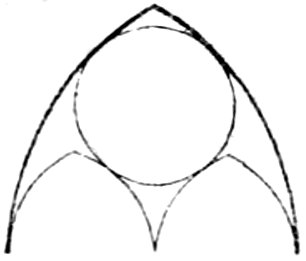
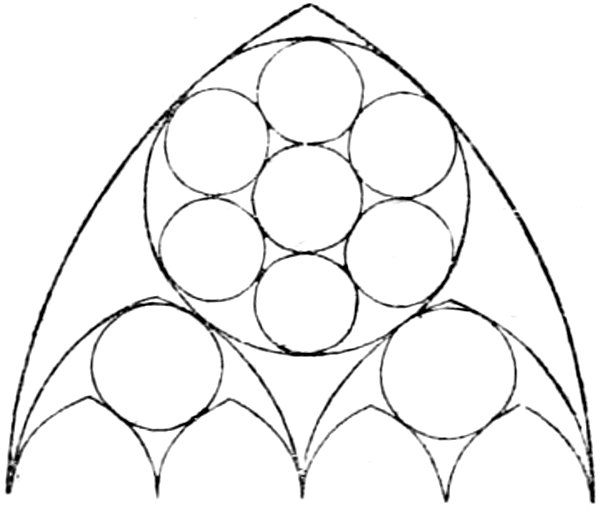
TRACERY. The system of ornamental
framework in a window, or in a compartment
of panelling or screen-work. The
first form of tracery was doubtless suggested
by the pierced circle often found
between the heads of two lancets, and connected
with them by a single hood.[18] For
some time the form thus suggested (fig. 1.)
was rigidly adhered to; even the number
of lights being, in a great majority of cases,
either two, four, or eight, the square and
cube of two, and the simple two-light
window was multiplied into itself once or
twice, as in (fig. 2.), so that the pattern
may be expressed by a geometrical series
a1, a2, a3. Windows of three or other odd
numbers of lights were less frequent and
less successful; and the reduplication was
effected by arithmetical rather than geometrical
progression, the six-light windows
being of two three-light windows, with
the addition of a centre piece (see figs. 3.
and 4.). Throughout the windows of this
early style of tracery, all is effected by
simple reduplication, no attempt being
yet made to extend a single composition
throughout the space to be filled. Circles,
when of a considerable size, were filled
with smaller circles (see fig. 2.) or with
cusping (fig. 4.) designed after the same
laws. But we must omit for the future
all consideration of cusping, (see Cusping,)
and everything but the mere pattern of
the tracery.
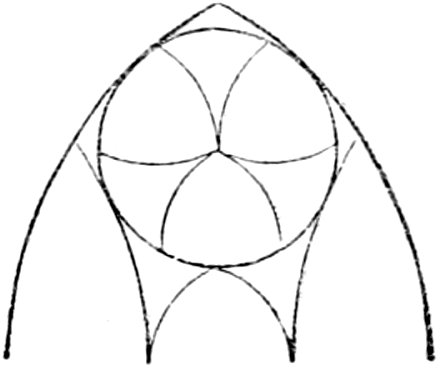
755
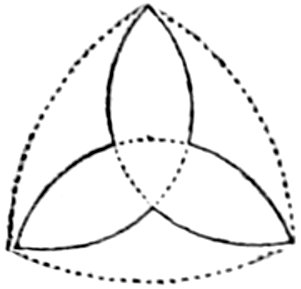
The exclusive use of circles led to great
sameness of character, and the first effort
to avoid this was by the introduction of
convex-sided triangles, sometimes alone
(fig. 5.), sometimes enclosed in or accompanying
circles (fig. 3). Later still this triangle
is resolved into a three-lobed figure,
of which, however, the triangle is still the
ruling form (fig. 6.). All these characteristics
belong to the earlier class of Geometrical
tracery, which is called concentric,
because each perfect figure is either itself
a circle, or is composed of circles or parts
of circles struck from centres within the
resultant figure, and themselves in the
circumference of a circle, whose centre is
the centre of the whole system. Thus in
fig. 2. eight circles are struck either from
the same centre, or points in the circumference
of a circle concentric with the containing
circle. In figs. 3. and 5. the triangles
are composed of parts of circles, of
which the centres are the opposite angles,
and as the triangles are equilateral, all the
centres are in the circumference of the
circle whose centre is the centre of the
triangle. This may be called the first law
of the concentric Geometrical. It has two
corollaries, 1. that each line forms a part
of one figure, only, and, 2. that each
circle, or part of a circle, touches, or cuts,
but never flows into, another. As this
law is broken, its consequences also are
reversed; and we get an excentric Geometrical,
in which there is no one ruling
centre within the figure; but, on the
contrary, the spirit of the style consists in
having curves struck from centres alternately
within and without the resulting
figure, as in the accompanying trilobate
and tricuspidate triangle (fig. 7.); but still
the lines cut or touch, and never flow into
one another. In fig. 8. we have lines
each forming parts of two figures, which
is the same as fig. 5., with the omission
of the lower side of each triangle,
and the consequent rejection of a centre
of construction, i. e. from concentric the
figure has become excentric. This makes
a very near approach to the flowing Decorated,
which indeed it becomes by the
reversal of the last remaining rule, i. e. by
suffering the curves which are struck from
circles within and without the resulting
figure, and which already form part of
two figures, to flow into another, instead of
cutting or touching. By this process, fig. 4.
is altered into the ordinary reticulated
tracery of the flowing Decorated (fig. 9.);
and fig. 10., instead of fig. 1., becomes a
normal form.

This introduction of curves of contrary
flexure is the ruling principle of flowing
tracery, and its results are far too various
to be pursued here. We must, however,
observe, that in England the resulting
forms have a great tendency to become
pear-shaped, i.e. with the lower end pointed
and the upper round and turned downward;
whereas, on the Continent, while
our Decorated was stiffening into the Perpendicular,
their Geometrical was waving
upward in their Flamboyant, which differs,
as to mere pattern of tracery, from our
flowing, in having both ends of each figure
acutely pointed, and the upper point with
an additional curve upward. Our own
Perpendicular is scarcely worthy to be
756called tracery; its normal form is represented
by mere intersections of vertical
and horizontal lines (fig. 11.).
We have at present described only the
component figures of tracery. The character
of windows is further altered by
several other means common to all the
styles, consistent with every form here
described. Thus, for instance, tracery is
grouped in these three ways: a large
and prominent centre-piece is carried by
two independent arches (fig. 2.); or it is
divided into two windows, as it were, by
two main arches, of the same curvature
with the window arch (figs. 3. and 11.); or
it fills the whole window head with no
such equal division of its parts[19] (figs. 5.,
8., 9.); or, again, it is divided into foil
and foiled tracery, the latter being the
ordinary form, the first that of tracery,
which itself, in its principal bars, follows
the direction of foils, without a circumscribing
arch (fig. 12.); or, again, according
as the surface of the tracery bar
which traces the pattern is a fillet, an
edge, or a roll, it is fillet, edge, or roll
tracery; or, again, if it is only a plate of
stone, pierced, without being moulded, it
is plate tracery. Flowing tracery is convergent,
or divergent, or reticulated. But
the greatest source of beauty next to cusping
is the due subordination of mouldings,
which is itself sufficient to remedy the
apparent sameness of pattern in the concentric
Geometrical, and which adds infinite
grace to the flowing tracery, in which,
however, it is too seldom found. The
student of ecclesiastical architecture will
do well to pursue the subject of this article
in Sharpe’s “Decorated Windows,”
and in Freeman’s “Essay on the Origin
and Development of Window Tracery.”
TRACT, in the Roman Missal, is an
anthem, generally taken from the Psalms,
following, and sometimes substituted for,
the Gradual, (i.e. the anthem after the Epistle,)
during penitential seasons, as the
third Sunday in Advent, the three Sundays
before Lent, Sundays, Mondays,
Wednesdays, and Fridays in Lent, Easter
Saturdays, and Easter Even, and certain
holidays. Cardinal Bona says it is so
called, “a trahendo: quia tractim et graviter,
et prolixo descensu cantatur,” because
it is sung in a protracted or slow
manner.—Jebb.
TRADITION. (See Fathers.) The
doctrine which has been delivered or
handed down from one age to another.
The great deference paid by the Church
of England as a branch of the Catholic
Church to tradition, is so misrepresented
by the wicked, and so misunderstood by
the weak, that we quote the following
passage from Palmer’s “Treatise on the
Church.” Speaking of those who calumniate
us for our use of this doctrine, he
says: “The various methods which these
men employ in endeavouring to prevent
any appeal to the tradition of the Church,
may be classed under the following heads:
“1. Systematic misrepresentation. We
do not appeal, in proof of Christian doctrine,
to the ancient Christian writers as
in any way infallible. Our sentiments on
this head are well known; they have been
repeatedly explained. We hold that the
doctrine of any Father, however great and
learned he may have been, e. g. that of
Augustine, Athanasius, Ambrose, or Basil,
is to be rejected in any point where it
contradicts Scripture. We consider all
these writers as uninspired men, and
therefore liable to mistakes and errors
like other theologians. Therefore it involves
a studied misrepresentation of our
meaning and principle, when we are met
by assertions or proofs that particular
Fathers have taught errors in faith or morality—that
they were credulous—that
their writings are in some points obscure—that
their criticisms or interpretations
of Scripture are sometimes mistaken—that
they invented scholastic doctrines
and were tinged with false philosophy—that
the later Fathers were better theologians
than the earlier—that there are Fathers
against Fathers, and councils against
councils, on some points. This is all calculated
merely to excite prejudice against
an appeal to the doctrine of the Church,
by misrepresenting our design and principle
757in making it. Our answer to all
these arguments is, that we do not appeal
to the Fathers as inspired and authoritative
writers, but as competent witnesses of the
faith held by Christians in their days. If
they are not to be trusted in this, they
are not to be trusted in their testimony to
the facts of Christianity, and the external
evidence of revelation is subverted.
“2. Pretended respect for religion. Under
this head may be classed that mode of
argument which rejects any appeal to the
doctrine of the Christian Church, under
pretence that the Word of God alone
ought to be the rule of our faith, in opposition
to all the doctrines of man; that
the Scripture constitutes a perfect rule of
faith, needing nothing else; that it must
necessarily be plain in all essential points,
and that it is its own interpreter. The
end of all this pretended reverence for
Scripture is, to obtain an unlimited liberty
of interpreting it according to our own
reason and judgment, even in opposition
to the belief of all Christians from the
beginning. But in asserting this liberty
to all men, it follows inevitably that no
particular interpretation of Scripture is
necessary to salvation; that Scripture has
no Divine meaning; that it is not a revelation.
In short, tradition is thrown aside,
under pretence of veneration for the Scripture,
in order that men may be enabled to
distort, or misinterpret, and to destroy that
very Scripture.
“The same may be observed of that pretended
zeal for the defence of the Reformation,
which infidels, Unitarians, and
other enemies of the doctrine and discipline
of the Church allege as a plea for rejecting
all appeal to the doctrines of the universal
Church. ‘The doctrines of the Reformation,’
they say, ‘cannot be defended if
this appeal is allowed; Popery must triumph.’
Excellent men! They will maintain
the Reformation at all hazards; all
evidence shall be pronounced worthless if
it be opposed to the interests of that
sacred cause! But what is the end sought
by all this pretended devotion? It is,
that every man may be permitted, without
any check, to interpret Scripture in such
a manner as to subvert all the doctrines of
the Reformation, whether positive or negative,
to prove the Reformation itself
needless, erroneous, bigoted, equally absurd
as the system to which it was opposed,
and more inconsistent. I charge
these men with the grossest hypocrisy.
Never was there a more daring attempt
to palm an imposture on the credulous
and unthinking, than this effort of deists
and heretics to set aside tradition under
pretence of zeal for the Reformation.
They are the opponents of the Reformation.
They are the representatives of
those whom the Reformation condemned.
They reject its doctrines, they charge it
with ignorance, bigotry, intolerance, errors
as gross as those of Popery. They have
separated from its reformed institutions,
as anti-Christians, and only exist by a
perpetual attack upon them. The Reformation
has no connexion with these men:
its defence belongs exclusively to those
who maintain its doctrines and adhere to
its institutions, and they alone are proper
judges of the mode of argument suited to
its interests.
“3. Statements directly untrue. Under
this head may be included the palmary
argument employed by all sects against
any appeal to the tradition of the Church
universal, namely, that it was the principle
of the Reformation to reject any such
appeal; and its principle was, ‘the Bible
alone is the religion of Protestants.’ Nothing
can be more untrue than this assertion;
the Reformation as a whole acknowledged
and appealed to the authority of Catholic
tradition, though it denied the infallibility
of particular Fathers and councils. With
equal veracity it is asserted that the Church
of England rejects tradition in her sixth
Article of Religion, when it is manifest that
her object is simply to maintain the necessity
of Scriptural proof for articles of
faith; while our canons, our rituals, and
the whole body of our theologians, so notoriously
uphold the authority of tradition,
that it is a subject of unmeasured complaint
on the part of those who disbelieve
the doctrines of the Church. The nature
of these various arguments testifies sufficiently
that the doctrine of the universal
Church is opposed to those who employ
them. It could be nothing but a feeling
of despair on this point, which could have
induced men to resort to perpetual misrepresentation,
to false pretences, and to
untruths. The employment of these weapons
by all sects, in order to prevent any
appeal to universal tradition, proves two
points. First, as the sole fundamental
principle on which they all agree is, the
rejection of an appeal to the doctrines of
the Church as a check on the interpretation
of Scripture, and the assertion of an
unlimited right of private interpretation;
this principle is the source of all their
divisions and contradictions, and therefore
must be radically false. Secondly, the
doctrine of the universal Church from the
beginning must condemn that of all modern
758sects, in every point in which they differ
from our Catholic and apostolic Churches;
and therefore, on every such point, they
are in error, and misinterpret Scripture,
and the Church is in the right.”
TRADITIONS OF THE CHURCH.
(See Ceremony.) “It is not necessary that
traditions and ceremonies be in all places
one, and utterly like; for at all times they
have been divers, and may be changed
according to the diversities of countries,
times, and men’s manners, so that nothing
be ordained against God’s word. Whosoever,
through his private judgment, willingly
and purposely, doth openly break the
traditions and ceremonies of the Church,
which be not repugnant to the word of
God, and be ordained and approved by
common authority, ought to be rebuked
openly, (that others may fear to do the
like,) as he that offendeth against the common
order of the Church, and hurteth the
authority of the magistrate, and woundeth
the consciences of the weak brethren.
“Every particular or national Church
hath authority to ordain, change, and
abolish, ceremonies or rites of the Church
ordained only by man’s authority, so that
all things be done to edifying.”—Article
XXXIV.
The word “tradition” is not here used
in the same sense in which it was used in
the explanation of the sixth Article. It
there signified unwritten articles of faith,
asserted to be derived from Christ and
his apostles: in this Article it means customs
or practices, relative to the external
worship of God, which had been delivered
down from former times; that is, in the
sixth Article, traditions meant traditional
doctrines, of pretended Divine authority;
and in this it means traditional practices
acknowledged to be of human institution.—Bp.
Tomline.
The word means the same as is expressed
immediately by the word “ceremonies,”
which is only explanatory; and which the
Church afterwards calls “rites,” supposing
them the same with ceremonies.—Dr.
Bennet.
TRADITORS. Persons who in times
of persecution delivered the sacred Scriptures
and other ecclesiastical records to
their persecutors, were thus called, and
were subjected to severe censures.
TRANSEPT. (See Cathedral.)
TRANSITION. About the year 1145,
the use of the pointed arch was introduced
into English architecture, and with this so
many constructive changes in the fabric,
that though Norman decorations were long
retained, and even the round arch was
used, except in the more important constructive
portions, a style equally distinct
from Norman and from Early English was
the result, and this style is called Semi-Norman,
or Transition. Before the close
of the twelfth century, the round arch had
entirely disappeared, and the Early English,
or Lancet, style was fully developed about
1190.
TRANSLATION. The removal of a
bishop from the charge of one diocese to
that of another, in which case the bishop in
his attestations writes “anno translationis
nostræ,” not “anno consecrationis nostræ.”
Also, in literature, the rendering of a
work from the original into another language.
All the scriptural portions of the
Prayer Book are not derived from the
translation in common use. For example,
the Psalter is from the great English Bible
set forth and used in the time of Henry
VIII. and Edward VI.
Translation of festivals. In the Roman
Church, when two festivals of a certain
class concur on the same day with
other festivals of the same or similar class,
the celebration of one or other of these
festivals is transferred to some future day,
according to rules which are given in the
Breviary and Missal. This is called a
translation.—Jebb.
TRANSOM. A horizontal mullion, or
cross-bar, in a window or in panelling.
The transom first occurs in late Decorated
windows, and in Perpendicular windows of
large size it is of universal occurrence.
TRANSUBSTANTIATION. The pretended
miraculous conversion or change of
the bread and wine into the very body and
blood of our Lord, which the Romanists
suppose to be wrought by the consecration
of the priest. This false doctrine is condemned
by the Church of England in her
28th Article. “The supper of the Lord is
not only a sign of the love that Christians
ought to have among themselves one to
another, but rather it is a sacrament of our
redemption by Christ’s death: insomuch
that to such as rightly, worthily, and with
faith receive the same, the bread which
we break is a partaking of the body of
Christ; and likewise the cup of blessing
is a partaking of the blood of Christ.”
Transubstantiation, (or the change of
the substance of bread and wine,) in the
supper of the Lord, cannot be proved by
holy writ: but it is repugnant to the plain
words of Scripture, overthroweth the nature
of a sacrament, and hath given occasion to
many superstitions.
“The body of Christ is given, taken,
and eaten in the supper, only after an
759heavenly and spiritual manner. And the
mean whereby the body of Christ is received
and eaten in the supper is faith.
“The sacrament of the Lord’s supper
was not by Christ’s ordinance reserved,
carried about, lifted up, or worshipped.”
Bishop Beveridge has the following remarks
on this article, from Scripture and
the Fathers:
“Scripture and Fathers holding forth so
clearly, that whosoever worthily receives
the sacrament of the Lord’s supper doth
certainly partake of the body and blood of
Christ, the devil thence took occasion to
draw men into an opinion, that the bread
which is used in that sacrament is the very
body that was crucified upon the cross;
and the wine after consecration the very
blood that gushed out of his pierced side.
The time when this opinion was first
broached was in the days of Gregory III.,
pope of Rome. The persons that were
the principal abettors of it were Damascen
in the Eastern, and afterwards Amalarius
in the Western Churches. It was no sooner
started in the East, but it was opposed by
a famous council at Constantinople, consisting
of 338 bishops, the famous opposers
of idol worship. But afterwards, in the
second Council of Nice, it was again defended,
and in particular by Epiphanius
the deacon, who confidently affirmed that,
‘after the consecration, the bread and
wine are called, are, and are believed to
be, properly the body and blood of Christ.’
In the West also, Amalarius having
broached this opinion, Paschasius Radbertus
readily swallowed it down. But Rabanus
Maurus, Ratramnus or Bertramnus, (of
whom more presently,) as also Johannes
Scotus Erigena, not only stuck at it, but
refused it, and wrote against it as a
poisonous error. And, after them, Berengarius
too, who was not only written
against by Lanfranc, archbishop of Canterbury,
but condemned for it in a council
held at Verceli, (where the book of
Johannes Scotus of the eucharist was also
condemned,) and at another council held
at Rome about the same time. And
though he did recant his opinion at a
council held at Tours, and another at
Rome, as some think, so as never to hold
it more, yet his followers would never recant
what they had learned of him. But
in the Lateran Council, held A. D. 1215,
the opinion of the real or carnal presence
of Christ was not only confirmed, but the
word transubstantiated was newly coined
to express it by; that council determining
that ‘there is one universal Church of the
faithful, without which there is none saved;
in which Jesus Christ himself is both
priest and sacrifice, whose body and blood
in the sacrament of the altar are truly
contained under the shapes of bread and
wine; the bread being transubstantiated,
or substantially changed into his body, and
the wine into his blood, by the power of
God; that for the perfecting the mystery
of our union, we might receive of him what
he had received of us.’ And ever since
this word was thus forged by this council,
the abettors of this opinion have made use
of it to declare their minds by concerning
this great mystery; still holding with the
Council of Trent, ‘that by the consecration
of the bread and wine is made a change
of the whole substance of bread into the
substance of the body of Christ our
Lord, and of the whole substance of the
wine into the substance of his blood;
which change is aptly and properly called
by the holy Catholic Church transubstantiation.’
So that, according to this
opinion, the bread and wine, which before
are properly bread and wine only, and not
the body and blood of Christ, are after
consecration as properly the body and
blood of Christ, only, and not bread and
wine; the bread being changed by the
words of consecration into the very body
of Christ that hung upon the cross; and
the wine into the very blood that ran in
his veins, and afterwards issued forth out
of his side.
“Now the doctrine delivered in the
former part of this article being so much
abused, that they should take occasion
from that great truth to fall into this
desperate error, so as to say the bread and
wine are really changed into the body and
blood of Christ, because he doth really partake
of the body and blood of Christ, that
rightly receives the bread and the wine;
that truth is no sooner delivered but this
error is presently opposed. It being no
sooner declared that the bread we break is
a partaking of the body, and the cup we
bless a partaking of the blood, of Christ,
but it is immediately subjoined, that, notwithstanding
the truth of that assertion,
yet transubstantiation, or the change of
the bread and wine into the body and
blood of Christ, is to be rejected upon
a fourfold account. First, because it cannot
be proved by the Scriptures. Secondly, it
is repugnant to them. Thirdly, it overthroweth
the nature of the sacrament.
Fourthly, it hath given occasion to many superstitions.
Of which in their order briefly.
“1. As for the first, that this doctrine of
transubstantiation cannot be proved from
the Holy Scriptures, is plain from the
760insufficiency of those places which are
usually and principally alleged to prove
it; and they are the sixth of St. John’s
Gospel, and the words of institution. In
the sixth chapter of St. John’s Gospel, we
find our Saviour saying, ‘My flesh is
meat indeed, and my blood is drink indeed.’
(John vi. 55.) And many such
like expressions hath he there concerning
our eating of his flesh, and drinking of his
blood. From whence they gather, that
the bread and wine are really turned into
the body and blood of Christ; not considering,
first, that our Saviour said these
words at the least a year before the sacrament
of the Lord’s supper was instituted.
For when Christ spake these words, it is
said, that ‘the passover was nigh,’ (ver. 4,)
whereas the institution of the sacrament
was not until the passover following; and
it is very unlikely that he should preach
concerning that sacrament before it was
instituted. To which we may also add,
that our Saviour here saith concerning
the flesh and blood here spoken of, ‘Except
ye eat the flesh of the Son of man,
and drink his blood, ye have no life in
you’ (ver. 53); whereas it is manifest that
a man may be deprived of the sacramental
bread and wine, and yet have life in him;
for otherwise all that die before they receive
the sacrament must of necessity be
damned. And, therefore, though the thing
signified, even the flesh and blood of
Christ, is here to be understood, yet the
signs themselves of the sacrament cannot.
And so this place, not intending the bread
and wine in the sacrament, cannot be a
sufficient foundation to ground the transubstantiation
of that bread and wine into the
body and blood of Christ. And, secondly,
suppose this place was to be understood of
the sacrament, when our Saviour saith,
‘My flesh is bread indeed, and my blood
is drink indeed:’ this might prove indeed
that Christ’s body and blood were turned
into bread and drink, but not at all that
[that] bread and drink are turned into his
body and blood. Thirdly, it is plain that
in these words our Saviour doth not mean
any external or bodily, but internal and
spiritual, feeding upon him. So that whosoever
thus feedeth upon him shall never
die, (ver. 50,) but live for ever (ver. 51).
Yea, ‘He that eateth my flesh, and drinketh
my blood, dwelleth in me and I in him’
(ver. 56). So that, as Origen observeth,
‘No wicked man can eat of this bread here
spoken of; whereas it is as clear as the
noonday sun, that sinners, as well as
saints, the worst as well as the best of
men, may eat the bread and drink the
wine in the sacrament.’ And as the sixth
of St. John’s Gospel doth not, so neither
do the words of institution, ‘This is my
body,’ prove the transubstantiation of the
bread into the very body of Christ. For
he that saith, because our Saviour said,
‘This is my body,’ the bread is therefore
changed into his body, may as well say
that, because Joseph said, ‘The seven good
kine are seven years, and the seven good
ears are seven years,’ (Gen. xli. 26,) therefore
the seven good kine, and the seven
good ears, were all changed into seven
years. And because Daniel said to Nebuchadnezzar,
‘Thou art this head of gold,’
(Dan. ii. 38,) therefore Nebuchadnezzar
must needs be changed into a head of
gold; whereas it is plain that in Scripture
that is often said to be a thing which is
only the sign of it: as God is pleased to
explain himself when he said of circumcision,
‘This is my covenant,’ (Gen. xvii.
10,) and in the next verse, ‘And it shall
be a sign or token of the covenant betwixt
me and you’ (ver. 11). And what
sense the Most High explains himself by
in that sacrament we may well understand
him in this. When he said, ‘This is my
covenant,’ he tells us what he meant by
that phrase, even ‘This is the sign of my
covenant:’ and so here, when Christ
said, ‘This is my body,’ according to his
own explication of himself before, it is
no more than if he should have said, ‘This
is the sign or token of my body.’ And
therefore saith Augustine, ‘For if sacraments
should not have a certain resemblance
of the things whereof they are sacraments,
they would not be sacraments at
all; but from this resemblance they often
receive the names of the things themselves.
Therefore, as after a certain manner the
sacrament of Christ’s body is the body
of Christ, and the sacrament of the blood
of Christ is the blood of Christ; so the
sacrament of faith (baptism) is faith.’ So
that the words, ‘This is my body,’ prove
no more than that the bread was the sign
or sacrament of his body; not at all that
it is really changed into his body. But
that this doctrine of transubstantiation
cannot be proved from the Scriptures, is
further evident in that it is contrary to
them.
“2. And this is the second thing here
asserted of transubstantiation, that it is
‘repugnant to the plain words of the Holy
Scriptures;’ which to prove I need go no
further than to show, that the Scripture
doth still assert them to be bread and
wine after as well as before consecration.
And this one might think was plain enough,
761in the first place, even from the words of
institution themselves; for the Scripture
saith, ‘And as they were eating Jesus
took bread and blessed it, and gave it to
the disciples, and said, Take, eat, this is
my body.’ (Matt. xxvi. 26.) So that that
which Jesus took was bread, that which
Jesus blessed was bread, that which Jesus
gave to his disciples was bread; and therefore
that of which he said, ‘This is my
body,’ must needs be bread too, as the
Fathers long ago acknowledged. And truly
in reason it cannot be denied; for there is
no other antecedent to the pronoun ‘this’
but ‘bread;’ for the ‘body’ of Christ,
that cometh after it, cannot possibly be the
antecedent to it. For, according to the
principles of our adversaries themselves
that hold this opinion, the bread is not
changed into the body of Christ before
consecrated, nor is it consecrated until the
words, ‘This is my body,’ be all pronounced;
so that when the priest saith,
‘This,’ there is no such thing as the body
of Christ present, that not coming in till
both that and the following words too are
perfectly uttered; and therefore the body
of Christ can by no means be looked upon
as the antecedent to this pronoun; but
that it is bread and bread only that it hath
reference to. So that ‘This is my body,’
is as much as to say, ‘This bread is my
body, this bread that I have taken, and
blessed, and give unto you, is my body.’
Now, as Bellarmine himself acknowledged,
this proposition, ‘This bread is my body,’
cannot possibly be taken any other ways
than significatively, so as that the sense
should be, ‘This bread signifies my body,’
is a sign or sacrament of it; it being absolutely
impossible that bread should be the
very body of Christ: for if it be bread,
and yet the very body of Christ too, then
bread and the body of Christ would be
convertible terms. So that the very words
of institution themselves are sufficient to
convince any rational man, whose reason
is not darkened by prejudice, that that of
which our Saviour said, ‘This is my body,’
was real bread, and so his body only in a
figurative or sacramental sense; and by
consequence that the bread was not turned
into his body, but his body was only represented
by the bread. But if this will
not do, we may consider, in the second
place, the institution of the other part of
the sacrament; for it is said, ‘And he took
the cup, and gave thanks, and gave it to
them, saying, Drink ye all of it; for this is
my blood of the new testament, which is
shed for many for the remission of sins.’
(Matt. xxvi. 27, 28.) Where these last
words, ‘for this is my blood,’ &c., being
the words of consecration; and our Saviour
having given them the cup before,
and bidden them to drink all of it; it
could not possibly be meant of anything
else than the wine in the cup of which he
said these words. To which we may also
observe what follows, even after the words
of consecration: ‘But I say unto you, I
will not drink henceforth of this fruit of
the vine, until that day when I drink it
new with you in my Father’s kingdom.’
(Matt. xxvi. 29.) Whence we see our
Saviour himself, even after he had consecrated
the wine, still calls it the fruit of
the vine; and in saying that he will drink
no more of the fruit of the vine, plainly
shows that it was the fruit of the vine
which he before drank. So that the very
wine of which he said, ‘this is my blood,’
was wine still, and the fruit of the vine;
which I hope none of our adversaries will
say the very blood of Christ is. But,
thirdly, this may be discovered also from
the words of the apostle: ‘The cup of
blessing which we bless, is it not the communion
of the blood of Christ? The
bread which we break, is it not the communion
of the body of Christ?’ (1 Cor.
x. 16); where we may take notice of two
things. First, that he here calleth the
sacramental elements still ‘a cup,’ or wine,
and bread, ‘the bread which we break;’
so that it is still bread: and, secondly,
that the cup of blessing is the communion
of the blood, and the bread broken the
communion of the body, of Christ. Now,
if the bread be the communion of his
body, and the cup the communion of his
blood, it cannot be that the cup should be
his real blood, and the bread his real
body; for then it would be as much as if
he should have said, ‘The blood of Christ
is the communion of the blood of Christ,
and the body of Christ the communion
of the body of Christ;’ and so the body
of Christ must be the communion of itself,
which is impossible; to which we
might also add the several places where
the apostle calls the elements still bread
and wine, or the cup; as, ‘For as oft as
ye eat this bread and drink this cup.’
(1 Cor. xi. 26.) “Whosoever shall eat
this bread and drink this cup of the Lord
unworthily,” &c. (Ver. 27.) ‘But let a
man examine himself, and so let him eat
of that bread and drink of that cup.’ (Ver.
28.) From whence it is manifest, that
that which we eat at the sacrament is
bread, and not the very body of Christ;
that which we drink, the cup or wine, and
not the very blood of Christ; and therefore,
762that to say it is not bread nor wine,
but the very body and blood of Christ,
is repugnant to the plain words of the
Scripture.
“3. The third thing is, that it ‘overthroweth
the nature of the sacrament,’ which I
need not spend many words to prove; for
in a sacrament it is required, first, that
there be some outward sign representing
spiritual grace; whereas if the bread be
really changed into the body of Christ,
there is no outward sign at all in the
sacrament, there being nothing else but
the body and blood of Christ, which are
not signs, but the thing signified. Nay,
as Augustine observes, ‘The signs themselves
are the sacraments,’ and therefore
where there is no sign there can be no
sacrament. And so, by depriving this
sacred ordinance of its outward signs, they
degrade it from being a sacrament, making
it to have nothing of the nature of a sacrament
in it. And therefore, if they will
still hold, that by the words of consecration
the bread and wine are substantially
changed into the body and blood of
Christ, let them cease to call that holy
action any longer a sacrament, but name
it ‘the body and blood of Christ;’ for,
according to their opinion, there is nothing
in it but the body and blood of Christ.
So that it is plain that, by this doctrine,
the nature of a sacrament in general must
be destroyed, or this sacrament in particular
must be expunged out of their catalogue
of sacraments.
“4. The fourth and last thing here objected
against this doctrine of transubstantiation
is, that it ‘hath given occasion to
many superstitions,’ which any one that
ever observed their customs and practices
cannot but acknowledge. For this fond
opinion possessing their brains, that the
bread is the real body of Christ hung
upon the cross, and pierced for their sins,
oh! how zealous are they in wrapping it
up neatly in their handkerchiefs, laying it
up in their treasures, carrying it about in
their processions; yea, and, at the length,
in worshipping and adoring it too!”
This learned and orthodox bishop proceeds
to show how inconsistent this tenet
is with the teaching of the Fathers. We
add a few quotations upon the subject
from other orthodox divines.
“The article next condemns the Popish
doctrine of transubstantiation, or the
change of the substance of bread and wine
into the real substance of Christ’s body
and blood, in the administration of the
Lord’s supper. The idea of Christ’s
bodily presence in the eucharist was first
started in the beginning of the eighth century,
and it owed its rise to the indiscretion
of preachers and writers of warm
imaginations, who, instead of explaining
judiciously the lofty figures of Scripture
language upon this subject, understood
and urged them in their literal sense.
Thus the true meaning of these expressions
was grossly perverted: but as this
conceit seemed to exalt the nature of
the holy sacrament, it was eagerly received
in that ignorant and superstitious age; and
was by degrees carried farther and farther,
by persons still less guarded in their application
of these metaphorical phrases.
This has always been a favourite doctrine
of the Church of Rome, as it impressed
the common people with higher notions
of the power of the clergy, and therefore
served to increase their influence. It met
however with opposition upon its original
introduction, particularly from Bertram
and John Scot; and again at the first
dawn of the Reformation, both upon the
Continent and in this country. It was objected
to by the Waldenses; and there are
strong expressions against it in some parts
of Wickliff’s works. Luther, in contradiction
to the other reformers, only changed
transubstantiation into consubstantiation,
which means that the substance of Christ’s
body and blood is present in the holy
sacrament with the substance of the bread
and wine; and his perseverance in this
opinion was a principal cause of the
division among the reformed churches.
He was opposed by Zuingle and Calvin,
but the Confession of Augsburg, which
was drawn up by Melancthon, favours
consubstantiation. There is, however, considerable
doubt concerning the real sentiments
of Melancthon upon this subject,
especially in the latter part of his life.
Some of our early English reformers were
Lutherans, and consequently they were at
first disposed to lean towards consubstantiation;
but they seem soon to have discovered
their error, for in the articles of
1552 it is expressly said, “A faithful man
ought not either to believe or openly confess
the real and bodily presence, as they
term it, of Christ’s flesh and blood in the
sacrament of the Lord’s supper.” This
part of the article was omitted in 1562,
probably with a view to give less offence
to those who maintain the corporal presence,
and to comprehend as many as
possible in the Established Church.”—Bp.
Tomline.
In arguing against this doctrine we
may first observe, that it is contradicted
by our senses, since we see and taste that
763the bread and wine after consecration, and
when we actually receive them, still continue
to be bread and wine, without any
change or alteration whatever. And
again, was it possible for Christ, when he
instituted the Lord’s supper, to take his
own body and his own blood into his own
hands, and deliver them to every one of
his apostles? or was it possible for the
apostles to understand our Saviour’s command
to drink his blood literally, when
they were forbidden, under the severest
penalties, to taste blood by the law of
Moses, of which not only they themselves,
but Christ also had been a strict observer?
They expressed not the slightest surprise
or reluctance when Christ delivered to
them the bread and wine, which could not
have been the case, had they conceived
themselves commanded to eat the real
body and drink the real blood of their
Lord and Master. The bread and wine
must have been considered by them as
symbolical, and indeed the whole transaction
was evidently figurative in all its
parts; it was instituted when the Jews, by
killing the paschal lamb, commemorated
their deliverance from Egyptian bondage
by the hand of Moses, which was typical of
the deliverance of all mankind from the
bondage of sin by the death of Christ,
“the Lamb slain from the foundation of
the world;” and as the occasion was
typical, so likewise were the words used by
our Saviour: “This is my body which is
broken,” and “this is my blood which is
shed.” But his body was not yet broken,
nor was his blood yet shed; and therefore
the breaking of the bread, and the pouring
out of the wine, were then figurative of
what was about to happen, as they are now
figurative of what has actually happened.
He also said, “This cup is the new testament
in my blood” (1 Cor. xi. 25); which
words could not be meant in a literal sense;
the cup could not be changed into a covenant,
though it might be a representation
or memorial of it. Our Saviour called
the wine, after it was consecrated, “the
fruit of the vine,” (Matt. xxvi. 29,) which
implied that no change had taken place in
its real nature. Since then the words,
“This is my body,” and “This is my blood,”
upon which the Papists pretend to support
this doctrine, were manifestly used in a
figurative sense, and must have been so
understood by the apostles, to whom they
were originally addressed, we may safely
pronounce that “transubstantiation, or the
change of the substance of bread and
wine, in the supper of the Lord, cannot
be proved by Holy Writ.” That the early
Christians understood our Saviour’s words
in a figurative sense, appears from the
writings of more than twenty Fathers,
without a single authority on the opposite
side.—Bp. Tomlins.
1. That transubstantiation is “repugnant
to the plain words of Scripture,”
appears from St. Paul’s saying, “we are all
partakers of that one bread” (1 Cor. x.
17); and, “as often as ye eat this bread”
(1 Cor. xi. 26); so that it is bread, and not
Christ’s flesh, even when we eat and
partake thereof. Parity of reason proves
the same of the wine. 2. That transubstantiation
“overthroweth the nature of a
sacrament” is evident, because it supposes
what we eat and drink to be, not the sign,
but the thing signified. 3. It has also
“given occasion to many superstitions.”
That it has given occasion to abominable
idolatry is evident from the adoration of
the host, which is grounded on it. But,
though idolatry is worse than superstition,
yet it is different from it. Wherefore, for
the proof of this branch of the proposition,
let it be considered, that, in cases of imminent
danger or great calamities, the host is
exposed by the Papists, to appease God’s
anger, and prevent or remove his judgments:
or reference may be had to the
provisions made in the Romish Church, in
the event of any accident happening to the
consecrated elements. Our reformers
were too well acquainted with these superstitions:
though, blessed be God, we
have not instances ready at hand.—Dr.
Bennet.
TRAVERSE. A seat of state with a
canopy, formerly placed at the upper end
of the choir in the royal chapels, and temporarily
in cathedrals, for the use of the
sovereign.
TREASURER. A dignitary formerly
existing in all cathedrals and collegiate
churches of old foundation in England,
and in Ireland and Scotland in such
churches as followed the English model.
The treasurer was not the bursar, but
rather the chief sacristan. He had the
care of the plate, vestments, furniture, necessaries
of Divine service; the control of
the sacristan and inferior officers, of the
bells, and the general superintendence
of the fabric. In many foreign churches
the place of treasurer was discharged by a
dignitary called a sacristan; but in others,
as at Glasgow, and the royal chapel, Stirling,
there was a treasurer and a sacristan,
both dignitaries. In cathedrals of the
new foundation, the treasurer is merely
the bursar; the canons taking this office in
annual rotation.—Jebb.
764TRENT, COUNCIL OF. (See Roman
Catholic Church, Popery, Council of Trent.)
This important council met in 1545, and
was dissolved in 1563. Its nominal period
extended over eighteen years, but its actual
sessions occupied less than five. Protestants
from the days of Luther had been urgent
for the convocation of a free synod. They
had reiterated the demand at Nuremberg,
and Ratisbon, and Spires. There were indeed
on both sides earnest and pious persons
who were anxious that the questions
at issue should be settled by competent
authority. The evil lives of the clergy,
and the general disorders of the Church,
afforded another strong reason by which
many were influenced. At the same time,
the endless extortions of the papal chancery
had raised disputes in every European state,
which there seemed no other hope of allaying.
It was the great object of the pope
and his adherents to condemn Lutheran
doctrine, and to avoid definition on points
disputed in the Roman Church. Clement
VII. had promised that a general council
should be held in Italy for raising subsidies
against the Turks, and for the suppression
of heresy, but he really used his
influence to prevent its assembling. On
his death in 1534 his successor, Paul III.,
published a bull of convocation. Various
difficulties however arose, partly on account
of the proposed place of meeting,
and partly through the war between the
emperor and the king of France, and interposed
a delay of some years. The city
of Trent in the Tyrol, on the confines of
Italy and Germany, and now in the dominions
of Austria, was at length selected,
the summons was issued, and the council
was opened December 13, 1545. The
meeting had been so long deferred, that
when a few ecclesiastics and others assembled,
it was hardly believed that the synod
was really convened; and the importance
of the movement was not perceived until
somewhat later.
The first three sessions were occupied by
preliminary matters, after which the actual
business commenced. The constitution of
the assembly, as well as the form of procedure,
was governed by arbitrary rules.
The legates presided as the representatives
of the pope; who also appointed the secretaries
and other officers. Bishops alone
were allowed to vote, but an exception was
made in the case of certain abbots and
generals of orders, for whose admission no
precedent could however be alleged, but
such as would be equally availing for all
presbyters. Proxies were generally refused,
although some were allowed by the
sole authority of the pope. All discussions
were confined to previous congregations,
and in the sessions which followed there
was no deliberation, but only the acceptance
or rejection of the proposed conclusions.
The judgments of the council were
embodied partly in decrees which profess
to contain the Catholic doctrine on the
points in question, partly in canons by
which the contrary opinions are anathematized
as heretical.
In the fourth session, which was held
April 5, 1546, somewhat less than fifty bishops
being present, it was decreed that
the canon of Scripture includes the books
commonly called apocryphal, and that
tradition is to be received as of equal authority
with the written Word; that the
Vulgate is to be taken for the standard
text, and no interpretation allowed but
such as the Church has affixed. In the
fifth session the decree on original sin was
passed; in the sixth, that on justification;
and in the seventh, that on the sacraments
in general, and baptism and confirmation
in particular. In the eighth session, the
removal to Bologna was appointed, where
the two following sessions were held; but
no decrees were passed, and in September,
1547, the council was prorogued. The
translation to an Italian city had been
made under a bull of Paul III., when the
German bishops were urgent for reformation,
and there seemed no other escape. A
disease which broke out at Trent was the
alleged excuse. In 1551 the council was
again convened by Julius III., who had
been present at a former period as legate.
The eleventh and twelfth sessions were
spent in formal business; in the thirteenth
the sacrament of the eucharist was treated;
in the fourteenth, the sacraments of penance
and extreme unction; in the fifteenth, a
safe-conduct was granted to the Protestants;
and in the sixteenth, which was held
in April, 1552, the prorogation of the council
for two years was decreed. Paul IV.
was, however, resolutely opposed to its revival,
on the ground that his authority
was higher than that of a synod, which
was therefore needless; and by the threat
of secular reformation he deterred some
princes from urging the reassembling of
the council, which did not take place till
January, 1562, when the seventeenth session
was held under Pius IV. In the
eighteenth, certain of the fathers were appointed
to prepare an index of prohibited
books, and at the same time, the safe-conduct
was removed; in the eighteenth and
nineteenth no business was transacted; in
the twenty-first, the communion under one
765kind was enjoined for all, except the celebrant;
in the twenty-second, the sacrifice
of the mass was declared to be a true and
Catholic doctrine; in the twenty-third, the
subject handled was the sacrament of order;
in the twenty-fourth, the sacrament
of matrimony; and in the twenty-fifth, decrees
were passed on purgatory, the invocation
of saints, the worship of relics and
images, indulgences, fasting, the index of
prohibited books, the catechism, the breviary,
and the missal. After which, the
decrees passed under Paul III. and Julius
III. were read, and the council was dissolved.
In reviewing the history of this remarkable
assembly, it is impossible to overlook
the want of unity both in purpose and
opinion among its members. The representatives
of the emperor of Germany, of
the kings of France and Spain, of the
duke of Bavaria, and of other secular
princes, urgently demanded the reformation
of the Church, while the partisans of
the Roman court were desirous only to
suppress Protestantism. There were none
but Italians on whom the pope could entirely
depend, for even the Spanish prelates
wished his power to be restrained,
and that of other bishops to be enlarged.
The Germans and French demanded the
restoration of the cup, and the marriage
of the clergy, while the Spaniards, who
opposed them on these points, were united
with them on some others against the Roman
faction. One great party was urgent
that the later sessions should be declared
a continuation of the earlier, while another
vehemently opposed the declaration; and
the council never ventured to rule the question
either way. There were endless conflicts
between the bishops and the monastic
orders, and of Franciscans and Dominicans,
with each other. Whether the Blessed
Virgin was conceived without sin; what is
the true nature of transubstantiation; whether
Christ offered himself in the holy
supper; whether the apostles were ordained
priests at that time or previously,—were
among the topics of vehement contention.
On the subject of the great doctrine
of justification by faith, the members
of the council were far from being agreed,
and it is beyond denial that some of them
held the Protestant view. Even the scanty
number, who ventured to decide on the
canon of Scripture, and on tradition, were
at variance among themselves. Some disputes
lasted throughout the whole period,
such as whether the council should be said
to represent the universal Church; whether
the legates should have the privilege
of proposing all matters for debate; and
whether doctrine should precede reformation.
The question of the residence of
bishops, that is, whether it is binding by
Divine ordinance, or by the law of the
Church, in which important considerations
were involved, excited long and angry conflicts.
Day after day, through weeks and
months of the most critical period, the dispute
was renewed. The legates themselves
were divided; and at one time the dissolution
of the council seemed inevitable.
There are many controverted points on
which the council gives no information,
and they are the very questions which it
was most important to decide. No one
can learn from its decrees, for instance,
what is the sound doctrine about purgatory,
nor in what due veneration for images
consists, nor which is the sacramental form
in penance, or matrimony, nor what is the
nature of original sin, nor what is the proper
definition of a sacrament. There were
some subjects debated more than sufficiently,
but left at last undecided; and
there were some positions which the council
could not renounce, because this would
have contradicted the decrees of former
popes and councils, and which they could
not affirm, because they were opposed by
powerful members of the existing Church.
In spite, however, of the imperfect and
contradictory statements of the Fathers of
Trent, they had no hesitation in pronouncing
judgment on what they esteemed
Lutheran opinions. We can indeed find
no parallel for the prodigality of their
curses, unless we go back to the days of
the Donatists. They reach not only to
those whom the Church of all ages has
called blessed, but to many also of the
doctors most esteemed in the Roman communion
itself. If any one, for example,
denies that the works of justified persons
are truly meritorious of eternal life, or
that the mass is a true and propitiatory
sacrifice, or that the custom of confessing
privately to a priest has existed from the
apostolic age, or that the Church has power
to change an institution of Christ, he
falls under the imprecation of the council.
In the decree of the last session on the
invocation of saints, and the use of images
and relics, an anathema is pronounced, not
only against those who teach, but those
who even think differently. And yet the
synod which spoke with so much boldness
had no claim, either from numbers or character,
to be taken as the representative of
the Catholic Church. In the first seven
sessions held under Paul III., when the
ground was laid for maintaining all the
766errors and corruptions of the Roman
Church, less than sixty bishops were present.
In the thirteenth, under Julius III.,
when transubstantiation and the worship
of the host were defined, only forty-five
bishops and two cardinals were assembled.
And in the ninth session there were only
thirty-five collected, who yet presumed to
take the title of an Ecumenical Council.
In the later sessions held under Pius IV.,
there was a greater number of bishops at
Trent; but the chief subjects in dispute
had been ruled in the earlier periods of
the council, and the deficiency of numbers
was not remedied by any subsequent confirmation.
Of those who were present, the
chief part were Italians; some were bishops
of inconsiderable sees, and some mere
titulars. There were among them not a
few, who subsisted on pensions granted by
the pope.
The council was in no sense the free assembly
to which Luther and others had
appealed, for it was guided throughout by
papal influence; and, as the Protestants
complained in 1546, it was not convened
in a neutral place, while the pope, who
was the great delinquent on trial, was allowed
to be the judge in his own cause.
There were external causes at work, which
prevented the freedom of debate. At the
very time when the doctrine of justification
was under review, a league was formed
between the pope and the emperor, for
putting down the Protestants; and while
the council was debating, the bishop of
Rome was sending his contingent of troops.
In the council itself, the legates assumed
unreasonable authority, and their interruptions
were the subject of continual complaint.
During the later sessions, the Inquisition
was in full force, and there were
persons present in the council who had
been sufferers. The assembly was overborne
by Italian prelates. At one time,
when very important subjects were under
discussion, there were no more than two
bishops to represent the Church of France.
On another occasion, forty bishops were
sent by the Roman court for the purpose
of carrying a particular point, by outvoting
the Spanish bishops, by whom it was opposed.
We find the ambassadors of secular
princes expressing in the strongest language
their sense of the tyranny under
which the council was held, and by which
its freedom was annihilated.
No one who considers these circumstances
can wonder that the beneficial reforms
of the Church did not result, which
had been so long expected and so anxiously
desired. They had been demanded, but
in vain, by the emperor, and other great
princes, as well as by diets and other assemblies
of the empire. Even as late as
1563, the French ambassador delivered a
list of thirty-four articles of required reformation.
After the twenty-second session
we find the Imperialists affirming that
none of the desired changes had been proposed.
And just before the close of the
council, the Spanish ambassador came to
the legates with a written complaint, that
the principal things for which it was assembled
had been omitted, and the rest
carried with precipitation. The French
envoy filled the letters which he addressed
to his court with similar testimony. Whatever
beneficial changes in the administration
of Church affairs seemed to have been
made, were neutralized by the terms in
which the rights of the see of Rome were
reserved, and which were vague enough
to admit every abuse, the pope himself
being constituted judge in each case, and
possessing also a dispensing power.
The last session was brought hastily to
a close, partly through the diplomatic skill
of the legate Morone; but chiefly on account
of the illness of the pope, because
everybody knew that if he died during
the sitting of the assembly, a schism was
inevitable.
The history of the council was written,
in 1619, by Sarpi, and forty years later by
Cardinal Pallavicini. The former was the
most learned person of the age, a statesman
and historian as well as a divine; the
latter is chiefly known as an apologist of
the court and Church of Rome. His work
has been described as more injurious to
papal interests than that of his predecessor;
because if the one has shown how
much may be said against the Council of
Trent, the other has made it equally plain
how little can be alleged in its defence.
The decrees of the council were signed
by only 255 members: four of these were
legates of the papal see; two, cardinals;
three, patriarchs; twenty-five, archbishops;
one hundred and sixty-eight, bishops;
thirty-nine, deputies of absent prelates;
seven, abbots; and seven were generals of
religious orders. The Greek Church and
the English Church were not represented.
It was subscribed on separate schedules,
by the ambassadors of the sovereigns who
still adhered to the Romish system.
The following are the anathemas of the
council.
I. The sacred œcumenical and general
synod of Trent, lawfully assembled in the
Holy Ghost, and presided over by the
three legates of the apostolic see, having
767it constantly in view that, by the removal
of errors, the gospel, which, promised aforetime
in the Holy Scriptures by the prophets,
Christ himself first published with
his own mouth, and then commanded his
apostles to preach to every creature, as the
source of all saving truth and instruction
of manners, should be preserved pure in the
Church; and clearly perceiving that this
truth and this instruction are contained
in written books and unwritten traditions,
which traditions have been received by the
apostles from the mouth of Christ himself,
or dictated by the Holy Spirit, and by
the apostles handed down even to us, receives
and reverences, conformably to the
example of the orthodox Fathers, with the
same pious regard and veneration, all the
books as well of the Old as of the New
Testament—both having God for their
author, and the traditions relating both to
faith and practice, inasmuch as these traditions
were either delivered by word of mouth,
from Christ, or dictated by the Holy
Ghost, and preserved by uninterrupted
succession in the Catholic Church. The
books received by this council are, of the
Old Testament, the five books of Moses, viz.
Genesis, &c., Joshua, Judges, Ruth, four
of Kings, two of Chronicles, first of Esdras,
second of Esdras, called Nehemias, Tobias,
Judith, Esther, Job, Psalms of David,
consisting of 150, Proverbs, Ecclesiastes,
Cantica, Wisdom, Ecclesiasticus, Isaiah,
Jeremiah, with Baruch, Ezekiel, Daniel,
twelve minor prophets, viz. Hosea, &c.,
the first and second of Maccabees. Of
the New Testament, the four Gospels, the
Acts of the Apostles, the Epistle of St.
Paul the Apostle to the Romans, two to
the Corinthians, one to the Galatians, one
to the Ephesians, one to the Philippians,
one to the Colossians, two to the Thessalonians,
two to Timothy, one to Titus,
one to Philemon, one to the Hebrews, the
Epistle catholic of St. James, the two Epistles
of St. Peter, the three Epistles of St.
John, the Epistle of St. Jude, and the
Revelations of St. John.
Whosoever shell not receive these books
entire with all their parts, (i. e. the Apocrypha
as well as the canonical books,) as
they are used to be read in the (Roman)
Catholic Church, and are contained in the
ancient Vulgate Latin edition, for sacred
and canonical, and shall knowingly and
wilfully contemn the aforesaid traditions:
let him be accursed. (See Bible, Scripture,
Apocrypha.)
II. Moreover, in order to repress the
arrogant and self-sufficient, the council
decrees, that no one, relying on his own
wisdom, shall presume to pervert and interpret
Holy Scripture to his own sense,
in matters of faith and manners, pertaining
to the edification of Christian doctrine,
contrary to the sense which hath been and
is maintained by the holy mother Church,
to whom it belongs to judge of the true
meaning and interpretation of the Holy
Scriptures, or contrary to the unanimous
consent of the Fathers, even if such interpretations
should never be made public.
(See Fathers and Tradition.)
III. Whosoever shall say, that the sacraments
of the New Law were not all instituted
by Jesus Christ our Lord, or
that they are more or less in number than
seven; that is to say, baptism, confirmation,
the Lord’s supper, penance, extreme
unction, orders, and matrimony; or that
any one of these seven is not truly and
properly a sacrament: let him be accursed.
(See Seven Sacraments.)
IV. Whosoever shall say, that by the
sacraments of the New Law, grace is not
conferred by the mere performance of the
act, but that faith alone in the Divine promise
is sufficient to obtain grace: let him
be accursed. (See Opus Operatum.)
V. Whosoever shall say, that it is not
requisite that the ministers, when celebrating
the sacraments, should have, at
least, the intention of doing that which the
Church doeth: let him be accursed. (See
Intention, Priests’.)
VI. Whosoever shall say, that the free
will of man, after the sin of Adam, was
lost and extinguished: let him be accursed.
(See Free Will.)
VII. The formal cause of justification is
the righteousness of God: not that whereby
he is himself righteous, but that whereby
he maketh us righteous; that with
which we, being by him endowed, are renewed
in the spirit of our mind, and are
not only accounted, but are truly called,
and are righteous, each of us receiving
into himself righteousness, according to
the measure whereby the Spirit divideth
to every man severally as he will, and according
to every man’s disposition and co-operation.
(See Sanctification.)
VIII. Whosoever shall say, that the ungodly
is justified by faith alone, so as to
understand that nothing else is required
to co-operate in obtaining the grace of
justification; and that it is by no means
necessary that he should be prepared and
disposed by the motion of his own will:
let him be accursed. (See Justification.)
IX. Whosoever shall say, that in the
mass there is not a true and proper sacrifice
offered up to God, and that the
768offering up is no more than the giving us
Christ to eat: let him be accursed. (See
Satisfaction, Romish.)
X. Whosoever shall say, that by these
words, “This do in remembrance of me,”
Christ did not ordain the apostles, priests,
or that he did not appoint that they and
other priests should offer up his body and
blood: let him be accursed. (See Orders.)
XI. Whosoever shall say, that the sacrifice
of the mass is one only of praise and
thanksgiving, or a bare commemoration
of the sacrifice made on the cross, but not
a propitiatory sacrifice, or that it is profitable
only to the partaker, and that it ought
not to be offered up for the quick and the
dead for sins, pains, satisfactions, and
other necessities: let him be accursed.
(See Mass, Sacrifice of.)
XII. Whosoever shall deny, that in the
most holy sacrament of the eucharist, the
body and blood, together with the soul
and Divinity, of our Lord Jesus Christ,
and, consequently, the whole of Christ,
are truly, really, and substantially contained;
but shall say that they are there
only symbolically, figuratively, or virtually:
let him be accursed. (See Real Presence
and Transubstantiation.)
XIII. Whosoever shall say, that in the
holy sacrament of the eucharist, the substance
of bread and wine remains, together
with the substance of the body and blood
of our Lord Jesus Christ, and shall deny
that wonderful and singular change of the
whole substance of the bread into the
body, and of the whole substance of the
wine into the blood, the species of bread
and wine still remaining, which change the
(Roman) Catholic Church very fitly calleth
Transubstantiation: let him be accursed.
(See Transubstantiation.)
XIV. Whosoever shall say, that Christ
exhibited in the eucharist is only spiritually
eaten, and not also sacramentally
and really: let him be accursed. (See
Eucharist.)
XV. Whosoever shall say, that in the
most holy sacrament of the eucharist,
Christ, the only-begotten Son of God, is
not to be adored with the worship called
Latria even outwardly; nor honoured by
a peculiar festival, nor solemnly carried
about in processions, according to the
praiseworthy and universal rite and usage
of the holy Church, nor exposed publicly
to the people to be worshipped, and that
its worshippers are idolaters: let him be
accursed. (See Corpus Christi.)
XVI. Whosoever shall say, that the
holy eucharist ought not to be reserved
in a sacred place, but is immediately after
consecration necessarily to be distributed
to those present, or that it ought not to be
carried in a respectful manner to the sick:
let him be accursed. (See Elevation of the
Host.)
XVII. Whosoever shall say, that it is
the commandment of God, or necessary to
salvation, that all and every faithful Christian
should receive the most holy sacrament
of the eucharist, under both kinds:
let him be accursed. (See Communion in
One Kind.)
XVIII. Whosoever shall say, that the
holy Catholic Church hath not been moved
by just cause and reason to administer the
bread only to the laity, and even to the
clergy not officiating, or that it is in error
in so doing: let him be accursed. (See
Cup.)
XIX. Whosoever shall deny, that the
whole of Christ, the source and author
of all grace, is received in the bread, because,
as some falsely affirm, according to
Christ’s own institution, he is not received
under one and each kind: let him
be accursed. (See Communion in One
Kind.)
XX. Whosoever shall say, that the
mass ought to be performed only in the
vulgar tongue: let him be accursed. (See
Liturgy.)
XXI. The Catholic Church, instructed
by the Holy Ghost, and in conformity to
the Holy Scriptures, and the ancient tradition
of the Fathers, hath taught in its
sacred councils, and, lastly, in this œcumenical
synod, that there is a purgatory,
and that the souls detained therein are
assisted by the prayers of the faithful, and
more especially by the acceptable sacrifice
of the altar. (See Purgatory.)
XXII. Whosoever shall say, that after
receiving the grace of justification, any
penitent sinner hath his offence so remitted,
and his obnoxiousness to eternal punishment
so blotted out, as to render him no
longer obnoxious to temporal punishment,
to be undergone either in this world or in
the future in purgatory, before an entrance
can be opened to the kingdom of heaven:
let him be accursed. (See Purgatory.)
XXIII. This holy synod enjoins all
bishops and others who undertake the
office of teaching, to instruct the faithful,
that the saints who reign together with
Christ offer up their prayers to God for
men, that it is good and profitable to invoke
them in a supplicating manner, and
that, in order to procure benefit from
God through his Son Jesus Christ our
Lord, who is our only Redeemer and
Saviour, we should have recourse to their
769prayers, help, and assistance; and that
those persons hold impious opinions who
deny that the saints enjoying eternal happiness
in heaven are to be invoked; or
who affirm, that the saints do not pray for
men, or that the invoking them that they
may pray ever for every one of us in particular,
is idolatry, or is repugnant to the
word of God, and contrary to the honour
of the one Mediator between God and
men, Jesus Christ, or that it is foolish
to supplicate orally or mentally those
who reign in heaven. (See Invocation of
Saints.)
XXIV. Also the bodies of the holy martyrs
and others living with Christ, having
been lively members of Christ and temples
of the Holy Ghost, and to be raised
again by him to eternal life and glory, are
to be reverenced by the faithful, as by
them many benefits are bestowed by God
on men; so that they who affirm that
reverence and honour are not due to the
reliques of saints, or that it is useless for
the faithful to honour them or other sacred
monuments, and a vain thing to celebrate
the memory of the saints, for the purpose
of obtaining their assistance, are wholly to
be condemned, as the Church hath before
condemned and now condemns them. The
images of Christ, and of the Virgin Mother
of God, and of the other saints, are to be
set up and retained, especially in churches,
and due honour and reverence to be paid
unto them. (See Image Worship, Mariolatry,
and Relics.)
XXV. Since the power of granting indulgences
hath been bestowed by Christ
upon the Church, and such power thus
Divinely imparted hath been exercised by
her even in the earliest times; this holy
synod teaches and enjoins that the use of
indulgences, as very salutary to Christian
people, and approved of by the sacred
councils, be retained in the Church, and
pronounces an anathema on such as shall
affirm them to be useless, or deny the
power of granting them to be in the
Church. (See Indulgences.)
XXVI. The holy synod exhorts and
adjures all pastors, by the coming of our
Lord and Saviour, that as good soldiers
they enjoin the faithful to observe all
things which the holy Roman Church, the
mother and mistress of all Churches, hath
enacted, as well as such things as have
been enacted by this and other œcumenical
councils. (See Church of Rome.)
XXVII. The chief pontiffs, by virtue of
the supreme authority given them in the
universal Church, have justly assumed the
power of reserving some graver criminal
causes to their own peculiar judgment.
(See Supremacy, Papal.)
XXVIII. The more weighty criminal
charges against bishops which deserve deposition
and deprivation may be judged
and determined only by the supreme Roman
pontiff. (See Pope.)
XXIX. This holy synod enjoins all patriarchs,
primates, archbishops, bishops,
and all others who, by right or custom,
ought to assist at a provincial council, that
in the first provincial synod that may be
holden after the conclusion of the present
council, they do openly receive all and each
of the things which have been defined and
enacted by this holy synod; also that they
do promise and profess true obedience to
the supreme Roman pontiff, and at the
same time publicly detest and anathematize
all heresies condemned by the sacred canons,
the general councils, and especially
by this present synod. (See Popery.)
XXX. Whosoever shall say, that the
clergy in holy orders, or regulars having
made a solemn profession of chastity, may
contract marriage, and that a marriage so
contracted is valid, notwithstanding the
ecclesiastical law or vow; and that to
maintain the contrary is nothing else than
to condemn matrimony, and that all may
contract marriage who do not feel themselves
to have the gift of continence, even
though they should have made a vow of
it: let him be accursed; since God denies
it not to such as rightly ask it, nor will he
suffer us to be tempted above what we are
able. (See Celibacy.)
XXXI. Whosoever shall say, that the
state of matrimony is to be preferred to
the state of virginity or single life, and
that it is not better or more blessed to
continue in virginity or single life: let
him be accursed. (See Matrimony.)
TRENTAL. A service of thirty masses
for the dead, usually celebrated on as
many different days.
TRICANALE. “A round ball with a
screw coin for the water of mixture,” at
the holy communion in Bishop Andrewes’s
chapel, and in Canterbury cathedral.
Canterbury’s Dom., 1646, and Neale’s Hist.
of the Puritans, vol. ii. pp. 223, 224.—Jebb.
TRIFORIUM. Any passage in the
walls of a church, but generally restricted
in its use to the passage immediately over
the arches of the great arcade, usually, in
Norman and Early English, marked by an
arcade of its own. It is so called as being
in most cases a triple aperture, opening to
the nave. In the Geometrical style, the
Triforium is sometimes treated as a mere
770decorative arcade, connected in composition
with the clerestory; and in the Decorated
it sinks still lower into a course
of panels, pierced at intervals; while in
the Perpendicular it either wholly disappears,
or is a mere lengthening of the mullions
of the clerestory windows.
TRINITY. (See Person, God, Jesus,
Christ, Messiah, Son of God, Holy Ghost.)
Of Faith in the Holy Trinity.—“There
is but one living and true God, everlasting,
without body, parts, or passions: of
infinite power, wisdom, and goodness; the
Maker and Preserver of all things, both
visible and invisible. And in unity of this
Godhead there be three persons, of one
substance, power, and eternity; the Father,
the Son, and the Holy Ghost.”—Article
I.
“Whosoever will be saved: before all
things it is necessary that he hold the
Catholic faith. Which faith, except every
one do keep whole and undefiled, without
doubt he shall perish everlastingly. And
the Catholic faith is this: That we worship
one God in Trinity, and Trinity in Unity:
neither confounding the Persons, nor dividing
the substance.”—Athanasian Creed.
Here it is said, that in the unity of the
Godhead there be three persons; that is,
though there be but one living and true
God, yet there be three persons, who are
that one living and true God. Though
the true God be but one in substance, yet
he is three in subsistence; and so three in
subsistence, as still to be but one in substance.
And these three persons, every
one of which is God, and yet all three but
one God, are really related to one another;
as they are termed in Scripture,
one is a Father, the other a Son, the
other a Holy Ghost. The first is
Father to the second, the second is Son
to the first, the third is neither Father
nor Son, but the issue or spirit of both.
The first was a Father from eternity, as
well as God; the second was God from
eternity, as well as a Son; the third was
both Holy Ghost and God from eternity,
as well as either of them. The Father
is the first person in the Deity; not begotten,
nor proceeding, but begetting; the
Son, the second, not begetting, nor proceeding,
but begotten; the Holy Ghost,
the third, not begotten, nor begetting, but
proceeding. The first is called the Father,
because he begot the second; the second
is called the Son, because he is begotten
of the Father; the third is called the
Holy Ghost, because breathed both from
the Father and the Son.
And though these be thus really amongst
themselves distinct from one another, yet
are they not distinct in the Divine nature;
they are not distinct in essence, though
they be distinct in the manner of their
subsisting in it. The Father subsists as
a Father, the Son as a Son, the Holy
Ghost as a Spirit, and so have distinct
subsistences; yet have all the same numerical
substance. We say numerical or individual
substance; for otherwise they
might have all the same Divine nature, and
yet not be the same God. As Abraham,
Isaac, and Jacob were three distinct persons,
and had all the same human nature;
yet they could not all be called one man;
because, though they had but one human
nature, yet they had it specifically, as distinguished
into several individuals; not
numerically, so as to be the same individual
man; and, therefore, though they
had but one specifical, they had several
numerical, natures, by which means Abraham
was one man, Isaac another, Jacob a
third. And upon the same account is it,
that, amongst the angels, Gabriel, Michael,
Raphael, though they have the same angelical
nature, yet they are not the same
angel. But here the Father, Son, and
Holy Ghost have not only the same
Divine nature “in specie,” but “in numero;”
and so have not only one and the
same nature, but are one and the same
God. The Father is the self-same individual
God with the Son; the Son is the
self-same individual God with the Father;
and the Holy Ghost is the self-same individual
God with them both. We say, individual
God, for the Divine nature is not
divided into several Gods, as the human
is into several men, but only distinguished
into several persons, every one
of which hath the same undivided Divine
nature, and so is the same individual God.
And thus it is, that in the unity of the
Godhead there be three persons, Father,
Son, and Holy Ghost; which great mystery,
though we be not able adequately to
conceive of it, yet the Scriptures give a
sufficient testimonial to it.—Beveridge.
The sublime mystery of the Trinity in
Unity is taught by revelation—not by
reason; although it is not in contradiction
to this, rightly exercised, nor more unintelligible
than many of the “things hard
to be understood” in Holy Scripture. A
plurality in the Godhead is indicated by
the language of the very earliest revelations;
which plurality is plainly expressed
under the Gospel dispensation—a sacred
Three being enumerated by mutual relation
in the form of baptism, and by name in the
apostolic benediction; which Three are also
771frequently mentioned together elsewhere,
though not in terms so clear.
The doctrine may perhaps be gleaned
as much from the economy of creation, as
from that of redemption; and herein may
be observed, that in the very commencement
of the sacred history, the Deity is
mentioned under a term of plural signification;
and when man, the more eminent
work, is to be made, and is afterwards
spoken of, a Divine council seems implied:
“Let us make man,” &c., “the man is become
as one of us!” This peculiar fact
seems referred to, and corroborated by,
the introduction to St. John’s Gospel;
which declares that the “Word was in
the beginning with God.” Again, each
of the sacred Three is noticed as acting
separately in the work. With respect to
the Father this is clear from innumerable
passages, in which the Lord God is mentioned
as the Creator, unless in such a
Trinity be implied, which then shortly decides
the point at issue. Of the Son it is
said, “all things were made by him;” and
expressly, “without him was not anything
made that was made.” (John i. 3; Col. i.
16.) And of the Holy Spirit, that by
him are made and created both man and
beast. (Job xxxiii. 4; Ps. civ. 30.) Thus
is that passage intelligible, “By the word
of the Lord were the heavens made: and
all the host of them by the breath of his
mouth.” (Ps. xxxiii. 6.) The mode of
operation in the work of redemption has
been before noticed. To all these may be
added, that the sacred Three are mentioned
equally as sending and instructing
the prophets and teachers, (Jer. vii. 25;
Matt. ix. 38; x. 5; Acts xxvi. 16–18;
Isa. xlviii. 16; Acts xiii. 2, 4; xx. 28,)—and
equally speaking by them. (Heb. i. 1;
2 Cor. xiii. 3; Mark xiii. 11.) Each, too,
gives life—raises the dead—and is joined
in the form of baptism, and Christian
benediction.
The word Elohim is a plural noun
(Gods); and as that was the first term
used in the Divine revelation, it seems intended
to indicate that plurality—the holy
Trinity—afterwards more plainly revealed.
And it is to be noticed, that by this
word (Elohim) was the earliest revelation
made to man. In this was the faith of the
patriarchs expressed, as particularly in
Gen. xxviii. 20–22; and by this name
God expressly declares he appeared unto
them, when by his “name Jehovah” he
was “not known.” (Ex. vi. 3.) Indeed
this latter term seems for a time to have
been used less as a name, than as a character,
of the Elohim, since it was subsequently
that it was announced as the
“name”—I AM—by which the Divine
plurality was to be known in unity. (Ex.
iii. 14; vi. 2.) Jehovah God hath not
been “seen at any time;” whereas, of the
Elohim, one, at least—the angel Jehovah
in prelude to his incarnation—condescended
frequently to appear, and talk with
man. The translation of Jehovah by
Adonai (or Lords) is also remarkable;
with the coincidence to be found in the
mode adopted by the heathen, of speaking
of their gods; as in the name of Baalim
for Baal. (Judges ii. 11; Hosea xi. 2.)
That Elohim implies plurality seems
evident, from the construction of such a
passage as Gen. xx. 13, where it is said,
“when they, Elohim, caused me to wander.”
Again, (xxxv. 7,) when “they appeared
unto him,” at Bethel. And (Josh.
xxiv. 19) “the Elohim are holy.” In Ps.
lviii. 11, the Elohim are called “judges;”
in Ps. cxlix. 2; Isa. xliv. 2, and liv. 5,
“makers” and “kings;” in Eccl. xii. 1,
“creators;” and in Jer. xxiii. 36, “the
living Gods.” Other places are mentioned
by Parkhurst; as Gen. xxxi. 53; Deut. iv.
7; v. 23, or 26; 1 Sam. iv. 8; 2 Sam. vii.
23; Isa. vi. 8; Jer. x. 10, &c.
In perfect accordance with this is the
first great commandment given from Mount
Sinai: “I am the Lord thy God,” (Jehovah
Elohim,) thou “shalt have no other
gods before me;” more plainly set forth
in the baptismal “name”—the Father,
the Son, and the Holy Ghost, a “holy,
blessed, and glorious Trinity,” in inseparable
Unity, and perfect co-equality, as may
be most safely concluded, from the various
passages in which the sacred Three are
mentioned in different order—the Father
first, in Matt. xxviii. 19,—the Son first, in
2 Cor. xiii. 14,—and the Holy Ghost
first, in 1 Cor. xii. 4–6; Eph. iv. 4–6,
and Luke i. 35.
The laws and ordinances of the Jews
were peculiarly adapted to guard the pure
worship against heathen idolatry; therefore,
when the legislator, in speaking of
God, uses a term implying plurality, which
he does, with verbs and persons singular,
above thirty times, this, too, in the Decalogue,
and in the repetition of laws, and
frequently prefaced by an address, demanding
attention,—“Hear, O Israel!”
“Thus saith the Lord!” it could not but
be that plurality in the Godhead was intended
to be announced. This is strongly
corroborated by such expressions as “holy
Gods,” “thy Creators,” being used by
Joshua and Solomon; the one an eminent
type of Christ, the other inspired with
772learning in an extraordinary degree.—See
Bishop Huntingford’s “Thoughts on the
Trinity,” xxii., xxiii. And we may be
rather confirmed in the opinion, by the
futile attempts of the Jewish Rabbins, to
make tolerable sense of the peculiar phraseology
adopted, while denying the implication
of a plurality.
The doctrine of a Trinity, and this in
Unity, is not then an arbitrary assumption,
or an attempt to be wise “above that
which is written;” but it necessarily arises
out of certain Scriptural expressions and
passages, which though apparently, or to
human sense, contradictory to each other,
must in reality be consistent: and the
Catholic, or orthodox system, framed on
the whole of these, reconciles them in a
more easy and natural manner than any
other scheme offered.
The word “Trinity,” it is confessed,
does not occur in Holy Scripture; nor does
the word “Unity,” as applied to the Deity.
But neither do the words “omnipresence”
and “omniscience;” and as the use of these
has never been objected to in speaking of
the attributes of Him who is everywhere
present, and “knoweth all things,” so may
the others be used with equal propriety to
express the distinct existence of Father,
Son, and Holy Ghost, and the simple
oneness of God! The use is admissible, to
prevent circumlocution; and irreverence
may be deprecated where language is inefficient.
The word Trinity was used by
the Greek and Latin Fathers, in the middle
of the second century, in a way that indicated
it was not then a novel expression;
and was considered by the orthodox so
unobjectionable, as to be employed without
reserve in their opposition to the Sabellian
heresy.
Indeed, the primitive Fathers appear to
have indulged an idea, that without a distinction
of hypostases in the Godhead, it
is difficult to imagine that αὐτάρκεια, or
self-sufficiency, and perfect bliss, which
seems to have arisen from a Divine society,
as in Prov. viii. 22, 23, particularly 30,
and elsewhere. Indeed, the notion of a
Trinity has prevailed immemorially, long
before the term was adopted; and is found
in the heathen worship, as well as in the
Church; both, no doubt, having it from a
common original.
TRINITY SUNDAY. The solemn
festivals, which in the foregoing parts of
our annual service have propounded to our
consideration the mysterious work of man’s
redemption, and the several steps taken to
accomplish it, naturally lead us up to, and
at last conclude with, that of the Trinity.
The incarnation and nativity, the
passion and resurrection of the blessed
Jesus, demonstrate how great things the
Son of God hath condescended to do for
us. The miraculous powers with which
the first disciples were endued, and the
sanctifying graces with which all the faithful
are assisted, do prove how great and
how necessary a part the “Holy Spirit”
bore in this work, both for publishing the
salvation of the world, and for rendering
it effectual. And all agree in representing
to us the inestimable love of the “Father,”
by whom that “Son” was sent, and that
“Spirit” so wonderfully and so plentifully
shed abroad. Most justly, therefore, after
such informations how fit a subject this
is for our wonder and adoration, does the
Church on this day call upon us to celebrate
the mystery of those “three” persons
in the unity of the Godhead; each
of whom hath so kindly, and so largely,
contributed to this united and stupendous
act of mercy, upon which the whole of all
our hopes and happiness depends.—Dean
Stanhope.
Notwithstanding on each day, and especially
Sundays, the Church celebrates the
praises of the Trinity, in her doxologies,
hymns, creeds, &c.; yet the wisdom of the
Church thought it meet, that such a mystery
as this, though part of the meditation
of each day, should be the chief subject
of one, and this to be the day. For no
sooner had our Lord ascended into heaven,
and God’s Holy Spirit descended upon
the Church; but there ensued the notice
of the glorious and incomprehensible Trinity,
which before that time was not so
clearly known. The Church therefore,
having solemnized in an excellent order
all the high feasts of our Lord, and after
that of the descent of God’s Spirit upon
the apostles, thought it a thing most seasonable
to conclude these great solemnities
with a festival of full, special, and express
service to the holy and blessed Trinity.—Bp.
Sparrow.
This mystery was not clearly delivered
to the Jews, because they, being always
surrounded by idolatrous nations, would
have easily mistaken it for a doctrine of
plurality of Gods; but yet it was not so
much hidden in those times, but that any
one with a spiritual eye might have discerned
some glimmerings of it dispersed
through the Old Testament. The first
chapter in the Bible seems to set forth
three persons in the Godhead; for, besides
the “Spirit of God” which “moved
upon the face of the waters,” (ver. 2,) we
find the great Creator (at the 26th verse)
773consulting with others about the greatest
work of his creation, the making of man,
of which we may be assured the Word or
Son of God was one, since “all things
were made by him, and without him was
not anything made that was made.” So
that those two verses fully pointing out
to us the Father, Son, and Holy Ghost,
make this a very proper lesson for the
solemnity of the day. The reason of the
choice of the other first lesson is as obvious:
it records the appearance of the
great Jehovah to Abraham, whom the
patriarch acknowledges to be the “Judge
of all the earth;” and who therefore, by
vouchsafing to appear with two others in
his company, might design to represent to
him the “Trinity of Persons.” But this
sacred mystery is nowhere so plainly manifested
as in the second lesson for the
morning, which at one and the same time
relates the baptism of the Son, the voice
of the Father, and the descent of the
Holy Ghost: which, though they are (as
appears from this chapter) three distinct
persons in number, yet the second lesson
at evening shows they are but one in essence.—Wheatly.
The Epistle and the Gospel are the
same that were anciently assigned for the
Octave of Pentecost; the Epistle being
the vision of St. John (Rev. iv.); and the
Gospel, the dialogue of our Lord with
Nicodemus; and the mention, which we
find therein, of baptism, of the Holy Spirit
and the gifts of it, though it might then
fit the day as a repetition, as it were, of
Pentecost, so is it no less fit for it as a
feast of the blessed Trinity. The mission
of the Holy Ghost brings with it, as
aforesaid, more light and clearness to the
doctrine of the Trinity: and when more
fit to think of the gifts of the Spirit, than
on a solemn day of ordination, as this is
one, when men are consecrated to spiritual
offices? But, besides this, we have in the
Gospel set before us all the three persons
of the sacred Trinity, and the same likewise
represented in the vision, which the
Epistle speaks of, with an hymn of praise,
“Holy, holy, holy, Lord God Almighty,”
&c.: which expressions, by ancient interpretation,
relate to the Holy Trinity, as is
above said.—Bp. Sparrow.
In the Roman Church the Sundays between
Whitsunday and Advent are reckoned
from Pentecost: in our Church, following
the old English custom in the
unreformed office, we count from Trinity
Sunday.
TRISAGION. (See Tersanctus.)
TRUCE OF GOD. In the French,
Treve de Dieu: in modern Latin, Trevia,
Treuvia, Treuga, or Truga Dei.
In the eleventh century, when the disorders
and licences of private wars, between
particular lords and families, were a great
disturbance to the peace of the kingdom
of France, the bishops took upon them to
publish injunctions, forbidding acts of violence,
within certain times, under canonical
pains. These prohibitions were called
Truce of God; a phrase frequently to be met
with in the councils held about that time.
The first regulation of this kind was in a
synod, held in the diocese of Elno in Rousillon,
A. D. 1027; where it was enacted,
that, throughout that country, no person
should attack his enemy, from the hour of
nones on Saturday to that of primes on
Monday, that Sunday might have its proper
celebration: that no person should, at any
time, attack a religious or priest walking
unarmed; nor any person going to, or returning
from, church: that nobody should
attack a church, or any house within
thirty paces round it: all this under penalty
of excommunication.
TRUMPETS, FEAST OF. An annual
festival of the Jews, expressly enjoined
by the law of Moses, and observed
upon the first day of the seventh month,
called Tisri, which was the beginning of
the civil year.
This festival is expressly called a sabbath,
and was a very solemn day, on which
no servile work was to be done; only provision
made for their meals, which were
usually very plentiful at this time. Among
other dishes they served up a ram’s head,
in memory of that ram which was sacrificed
in the room of Isaac; which they fancy
was done upon this day.
All the festivals of the Jews, it is true,
were introduced by the sound of trumpets:
but this was attended with more than
usual solemnity. For they began to blow
at sunrising, and continued till sunset.
He who sounded, began with the usual
prayer: “Blessed be God, who hath sanctified
us with his precepts,” &c., subjoining
these words: “Blessed be God, who hath
hitherto preserved us in life, and brought
us unto this time.” At the conclusion, the
people said with a loud voice these words
of the Psalmist: “Blessed is the people
that know the joyful sound: they shall
walk, O Lord, in the light of thy countenance.”
And whereas, in other places,
the beginning of the year was sounded
with a trumpet of ram’s or sheep’s horn,
at the temple they used two silver trumpets,
and the Levites upon that day sung
the eighty-first psalm.
774This festival is called a memorial of
blowing of trumpets: but it is not so easy
to determine what this blowing of trumpets
was a memorial of. Maimonides will have
it to be instituted to awaken the people
out of sleep, and call to repentance;
being intended to put them in mind of the
great day of expiation, which followed
nine days after. Basil imagined, that by
these soundings the people were put in
mind of that day, wherein they received
the Law from Mount Sinai with blowing
of trumpets. Others think it more probable,
that, since all nations made great
shouting, rejoicing, and feasting in the beginning
of the year, at the first new-moon,
in hopes that the rest of the year by this
means would prove more prosperous, God
was pleased to ordain this festival among
his people, in honour of himself, upon the
day of the first new-moon, to preserve
them from idolatry, and to make them
sensible that he alone gave them good
years. Others again imagine, that God
marked this month with a peculiar honour,
because it was the seventh; that, as every
seventh day was a sabbath, and every
seventh year the land rested, so every
seventh month of every year should be a
kind of sabbatical month: and upon that
account the people might be awakened by
this blowing of trumpets, to observe this
festival with the proper ceremonies. Lastly,
others explain this blowing of trumpets to
be a memorial of the creation of the world,
which was in autumn. Upon this account
it was that they anciently began their years
at this time, as the eastern people do at
this day. By this means they also confessed
the Divine goodness in blessing the
year past, and bringing them to the beginning
of a new year, which they prayed
that God would make happy and propitious
to them.
TUNICLE. An ecclesiastical garment
mentioned in the rubrics of King Edward
VI.’s First Book, to be worn by the assistant
ministers at the holy communion. It
is the same as the tunic or the dalmatic,
which was also an episcopal garment.
Originally it had no sleeves; and was
the same with the Greek colobion. The
sleeves were added in the west about the
fourth century; and then the vestment
was called a dalmatic. The tunicle in the
Roman Church is proper to subdeacons.—Palmer.
Goar.
TURRET. A small tower appended to
a tower, or the angle or other part of any
component portion of a building for support,
or to carry stairs, or for ornament.
Like the tower, it is often finished with a
high conical capping, which is then called
a spiret or pinnacle.
TYPE. An impression, image, or representation
of some model, which is
termed the antitype. In this sense we
often use the word to denote the prefiguration
of the great events of man’s redemption
by persons or things in the Old
Testament.
UBIQUITARIANS. A sect of heretics,
so called because they maintained that
the body of Jesus Christ is (ubique) everywhere,
or in every place.
Brentius, one of the earliest reformers,
is said to have first broached this error, in
Germany, about the year 1560. Melancthon
immediately declared against it, as
introducing a kind of confusion in the two
natures of Jesus Christ. On the other
hand, it was espoused by Flacius Illyricus,
Osiander, and others. The universities of
Leipsic and Wirtemburg in vain opposed
this heresy, which gained ground daily.
Six Ubiquitarians, viz. Smidelin, Selneccer,
Musculus, Chemnitius, Chytræus, and
Cornerus, had a meeting, in 1577, in the
monastery of Berg, and composed a kind
of creed, or formulary of faith, in which
the Ubiquity of Christ’s body was the
leading article. However, the Ubiquitarians
were not quite agreed among themselves;
some holding that Jesus Christ,
even during his mortal life, was everywhere,
and others dating the Ubiquity of
his body from the time of his ascension
only.
ULTRA-PROTESTANT. (See Via
Media.)
UNCTION. (See Extreme Unction.)
UNIFORMITY, ACTS OF. The Acts
of Uniformity are 1 Eliz. c. 2, and 14 Car.
II. The Irish Acts of Uniformity are also
2 Eliz. cap. 2, and 17 and 18 Car. II.
See Stephens’s Edition of both the English
and Irish Prayer Book. By stat. 1 Eliz. c.
2, s. 4–8, If any parson, vicar, or other
minister that ought to use the Common
Prayer, or to minister the sacraments, shall
refuse to do the same, or shall use any
other form, or shall speak anything in derogation
of the same book, or of anything
therein contained, he shall, on conviction
for the first offence, forfeit to the queen one
year’s profit of all his spiritual promotions,
and be imprisoned for six months; for the
second offence, shall be deprived of all his
spiritual promotions, and be imprisoned
for a year; and, for the third offence, shall
be deprived of all his spiritual promotions,
and be imprisoned during life. And if he
has no spiritual promotion, he shall, for the
775first offence, be imprisoned for a year; and,
for the second, during life.
And by the same act, if any person shall
in plays, songs, or by other open words,
speak anything in derogation of the same
book, or anything therein contained; or
shall, by open fact, cause or procure any
minister in any place to say Common
Prayer openly, or to minister any sacrament
in other form, or shall interrupt or
let any minister to say the said Common
Prayer, he shall (being indicted for the
same at the next assizes) forfeit to the
queen for the first offence 100 marks, and
for the second 400 marks, which, if not
paid in six weeks after conviction, he shall
suffer six months’ imprisonment for the
first offence, and twelve months’ for the
second, and for the third offence shall forfeit
all his goods and chattels, and be imprisoned
during life.
By stat. 13 & 14 Car. II. c. 4, Where
an incumbent resides upon his living and
keeps a curate, the incumbent himself,
(not having lawful impediment, to be allowed
by the bishop,) shall at least once a
month openly and publicly read the Common
Prayer, and (if there be occasion) administer
the sacraments and other rites of
the Church.
UNIGENITUS, THE BULL. The instrument
issued by Pope Clement XI., in
1713, against the French translation of the
New Testament, with notes, by Pasquier
Quesnel, priest of the Oratory, and a celebrated
Jansenist. The book, having occasioned
considerable disputes, had already
been condemned by the court of Rome in
1708; but this step being found ineffectual,
Clement, who had privately spoken of it
in terms of rapture, declaring it to be an
excellent book, and one which no person
resident at Rome was capable of writing,
proceeded to condemn one hundred and
one propositions of the notes; such as—grace,
the effectual principle of all good
works; faith, the first and fountain of all
the graces of a Christian; the Scriptures
should be read by all, &c. This bull, procured
by Louis and the Jesuits, occasioned
great commotion in France. Forty
Gallican bishops accepted it; but it was
opposed by many others, especially by
Noailles, archbishop of Paris. Many of
the prelates, and other persons eminent
for piety and learning, appealed, on the
subject, from the papal authority to that
of a general council, but in vain.
UNION, HYPOSTATICAL, (see Jesus,
Lord, Christ, Messiah, Mediator,) is the
union of the human nature of Christ with
the Divine, constituting two natures in one
person. Not consubstantially, as the three
persons in the Godhead; nor physically,
as soul and body united in one person; nor
mystically, as is the union between Christ
and believers; but so as that the manhood
subsist in the second person, yet without
making confusion, both making but one
person. It was miraculous. (Luke i. 34,
35.) Complete and real: Christ took a
real human body and soul, and not in appearance.
Inseparable. (Heb. vii, 25.)—See
Burton.
UNITARIANS. A title which certain
heretics, who do not worship the true God,
assume most unfairly, to convey the impression
that those who worship the one
and only God do not hold the doctrine of
the Divine Unity. Christians worship the
Trinity in Unity, and the Unity in
Trinity.
This name includes all, whether Arians
of old, or more lately Socinians, and other
Deists, who deny the Divinity of Jesus
Christ, and the separate personality of
the Holy Ghost. They are not very
numerous in England, although most of
the old English Presbyterian congregations
have fallen into Unitarianism.
These persons made little progress in
England till the opening of the eighteenth
century, when many of the old Presbyterian
ministers embraced opinions adverse
to the Trinitarian doctrine. A noticeable
controversy on the subject was begun in
1719, in the West of England, and two
Presbyterian ministers, in consequence of
their participation in these sentiments,
were removed from their pastoral charges.
Nevertheless, the Presbyterian clergy gradually
became impregnated, although for
some time they gave no particular expression
from their pulpits to their views in
this respect. In course of little time, however,
their congregations either came to
be entirely assimilated with themselves in
doctrine, or in part seceded to the Independent
body. Thus, the ancient Presbyterian
chapels and endowments have, in
great degree, become the property of Unitarians,
whose origin, as a distinct community
in England, may be dated from
the first occurrence of such virtual transfers,
viz. from about the period just subsequent
to 1730.
Persons denying the doctrine of the Trinity
were excepted from the benefits of
the Toleration Act, and remained so until
1813, when the section in that statute
which affected them was abrogated by the
53 Geo. III. c. 160, which was extended
to Ireland by 57 Geo. III. c. 70. Since
that period they have been exactly in the
776same position as all other Protestant Dissenters
with respect to their political immunities.
These persons do not object to
the form of attestation, “on the true faith
of a Christian,” though denying the principal
doctrines of Christianity as recognised
by the Catholic Church.
The form of ecclesiastical government
adopted by the Unitarians is substantially
“congregational;” each individual congregation
ruling itself without regard to
any courts or synods.
Returns have been received at the Census
Office from 229 congregations connected
with this body.
UNITED BRETHREN. (See Moravians.)
UNIVERSALISTS. Those who, contrary
to the express word of God, deny
the eternal punishment of the wicked.
UNIVERSITY. University, as Johnson
observes, originally meant a community or
corporation;—it afterwards came to be restricted
to those communities for divine and
secular learning, which were originally called
studia generalia, schools, pædagogies, (as
St. Andrew’s,) academies, &c. In all of
these, the four great branches of knowledge
were professed, divinity, law, medicine, and
the liberal arts and sciences. In the twelfth
century, degrees were conferred, (see Degrees,)
first in canon and civil law, afterwards
in theology and philosophy; though
all these branches of learning had long
been taught. The universities were gradually
endowed with important privileges.
For ages they had been regarded in England
as great and influential, with corporate
titles though not with corporate privileges.
These were formally given to them by
Queen Elizabeth; under whose auspices
the third university of Dublin, endowed
with like privileges, was founded.
It is foreign to the object of a Church
Dictionary to notice those corporations for
mere secular learning, to which in England
the title of University, though with a
novel meaning, has of late years been legally
given. The term, as formerly understood
in England, Ireland, and Scotland,
as throughout Europe for ages, comprehended
Divine learning as an essential
and crowning part of the system. The
old universities are connected with the
Church by the closest ties. Their discipline
is recognised by the canons, (the
xvi., xvii., and xxiii., for example,) and
their degrees are essential qualifications
for many Church preferments; these also
are conferred under the invocation of the
Holy Trinity; all their solemn assemblies
are accompanied with the prayers of the
Church; and the foundation within the
universities, upon which their influence
and very existence depend, has been made
with the plain and obvious understanding
that these great corporations are the
nurseries of the Church; that those who
partake of their privileges are to be educated
as her generic children.
It is beyond the object of this work to
give any detailed account of their constitution.
It may suffice to observe, that the
English system of having many colleges
within the precincts of, and subordinate to,
the greater corporation, though forming
each a minor corporation in itself, is not
peculiar to this country. Such was the
system of the most ancient universities,
Bologna, Paris, and Salamanca; and of
many more modern ones, as Louvain, &c.
Paris had anciently fifty-three colleges, (including
eight for the religious order,) and
up to the Revolution had twenty-three, (of
which fifteen were not monastic,) several
of the secular ones having been amalgamated
by Louis XIV. Besides these,
each faculty had its corporate assembly;
and over all the rector, assisted by three
deans and four proctors, presided. The
constitution at Louvain was similar, where
there were twenty colleges. The college
system is the best auxiliary to the university,
and grew up from the obvious necessity
of securing to the younger students a
proper domestic discipline, and to the
elder the means of pursuing their maturer
studies.
URIM AND THUMMIM. So the
Hebrews called a certain oracular manner
of consulting God; which was done by
the high priest, dressed in his robes, and
having on his pectoral, or breastplate.
Concerning the Urim and Thummim,
various have been the sentiments of learned
men. Josephus, and others after him,
have maintained, that Urim and Thummim
meant the precious stones set in the high
priest’s breastplate; which, by some extraordinary
lustre, made known the will
of God to those who consulted him.
Spencer, in his dissertation on these words,
believes they were two little golden
figures, shut up in the pectoral, as in a
purse, which gave responses with an articulate
voice. In short, there are as many
opinions concerning the Urim and Thummim,
as there are authors that have written
about them. The safest opinion seems to
be, that the words Urim and Thummim
signify some divine virtue and power annexed
to the breastplate of the high priest,
by which an oracular answer was obtained
from God, when he was consulted by the
777high priest; and that this was called Urim
and Thummim, to express the clearness
and perfection which these oracular answers
always carried with them; for Urim signifies
light, and Thummim, perfection. These answers
were not enigmatical and ambiguous,
like the heathen oracles, but clear and evident;
and never fell short of perfection,
either with regard to fulness in the answer,
or certainty in the event.
The use made of the Urim and Thummim
was, to consult God, in difficult and
momentous cases, relating to the whole
state of Israel. For this purpose the high
priest put on his robes, and over them the
breastplate, in which the Urim and Thummim
were; and then presented himself
before God, to ask counsel of him. But
he was not to do this for any private
person; but only for the king, for the
president of the Sanhedrim, for the general
of the army, or for some other great personage;
nor for any private affairs, but
such only as related to the public interest
of the nation, either in Church or State.
The place where he presented himself
before God, was before the ark of the
covenant; where standing with his robes
and breastplate on, and his face turned
directly towards the ark, and the mercy-seat
over it, upon which the Divine presence
rested, he proposed what he wanted
to be resolved about; and directly behind
him, at some distance without the holy
place, stood the person, upon whose account
God was consulted, and there, with
all humility and devotion, expected the
answer that should be given.
It seems plain from Scripture, that the
answer was given by an audible voice from
the mercy-seat, which was within, behind
the veil. There it was that Moses went to
ask counsel of God in all cases; and from
thence he was answered by an audible voice.
In the same way did God afterwards
communicate his will to the governors of
Israel, as often as he was consulted by
them; only with this difference, that whereas
Moses, through extraordinary indulgence,
had immediate access to the Divine
presence, and God communed with him, as
it were, face to face, no other person was
admitted thither to ask counsel of God
but through the mediation of the high
priest, who, in his stead, asked counsel for
him by Urim and Thummim. There are
many instances in Scripture of God’s being
consulted this way; and the answer, in
most of them, is introduced with, “the
Lord said.” And when the Israelites
made a peace with the Gibeonites, they are
blamed because they did not ask counsel
at the mouth of God: both which phrases
seem plainly to imply a vocal answer.
And for this reason it is that the holy of
holies, the place where the ark and the
mercy-seat stood, from whence this answer
was given, is so often in Scripture called
the oracle; because from thence the divine
oracles of God were delivered to such as
asked counsel of him.
It is variously conjectured by learned
men, when this Urim and Thummim entirely
ceased: it is certain there is no
instance of it in Scripture during the first
temple; and it was wholly wanting in the
second. And hence came that saying
among the Jews, that the Holy Spirit
spake to the Israelites during the tabernacle,
by Urim and Thummim; under the
first temple, by the prophets; and, under
the second, by Bath-Col.
URSULINES. An order of nuns,
founded originally by St. Angeli, of
Brescia, in the year 1537, and so called
from St. Ursula, to whom they are dedicated.
USE. In former times each bishop had
the power of making some improvements
in the liturgy of his church: in process of
time, different customs arose, and several
became so established, as to receive the
names of their respective churches. Thus
gradually the “Uses” or customs of York,
Sarum, Hereford, Bangor, Lincoln, Aberdeen,
&c., came to be distinguished from
each other.
The missals and other ritual books of
York and Hereford have been printed;
but we have inquired in vain for the names
of the bishops who originated the unessential
peculiarities which they contain.
Their rubrics are sometimes less definite
than those of the Sarum “USE,” and they
contain some few offices in commemoration
of departed prelates and saints, which are
not found in other missals, &c. The “Use”
or custom of Sarum derives its origin
from Osmund, bishop of that see in A. D.
1078, and chancellor of England. We
are informed by Simeon of Durham, that
about the year 1083, King William the
Conqueror appointed Thurstan, a Norman,
abbot of Glastonbury. Thurstan, despising
the ancient Gregorian chanting, which
had been used in England from the sixth
century, attempted to introduce in its
place a modern style of chanting invented
by William of Fescamp, a Norman. The
monks resisted the innovations of their
abbot, and a scene of violence and bloodshed
ensued, which was terminated by
the king’s sending back Thurstan to Normandy.
This circumstance may very probably
778have turned the attention of Osmund
to the regulation of the ritual of
his church. We are informed that he
built a new cathedral; collected together
clergy, distinguished as well for learning
as for a knowledge of chanting; and composed
a book for the regulation of ecclesiastical
offices, which was entitled the
“Custom” book. The substance of this
was probably incorporated into the missal
and other ritual books of Sarum, and ere
long, almost the whole of England, Wales,
and Ireland, adopted it. When the archbishop
of Canterbury celebrated the liturgy
in the presence of the bishops of his
province, the bishop of Salisbury (probably
in consequence of the general adoption
of the “Use” of Sarum) acted as
precentor of the college of bishops, a title
which he still retains. The churches of
Lincoln and Bangor also had peculiar
“Uses;” but we are not aware that any
of their books have been printed. A MS.
pontifical, containing the rites and ceremonies
performed by the bishop, still (we
believe) remains in the church of Bangor;
it is said to have belonged to Anianus,
who occupied that see in the thirteenth
century. The church of Aberdeen in
Scotland had its own rites; but whether
there was any peculiarity in the missal we
know not, as it has never been published.
The breviary of Aberdeen, according to
Zaccaria, was printed in A. D. 1609 (qu.
1509?). Independently of these rites of
particular churches, the monastic societies
of England had many different rituals,
which, however, all agreed substantially,
having all been derived from the sacramentary
of Gregory. The Benedictine,
Carthusian, Cistertian, and other orders,
had peculiar missals. Schultingius nearly
transcribes a very ancient sacramentary
belonging to the Benedictines of England;
Bishop Barlow, in his MS. notes on the
Roman missal, speaks of a missal belonging
to the monastery of Evesham; and Zaccaria
mentions a MS. missal of Oxford,
written in the thirteenth or fourteenth
century, which is in the library of the
canons of S. Salvator at Bologna. This
last must probably be referred to some of
the monastic societies, who had formerly
houses in Oxford; as the bishopric or
church of Oxford was not founded till the
sixteenth century.
It may be remarked in general of all
these missals and rituals, that they differed
very little; the sacramentary of Gregory
was used every where, with various small
additions. However, the rites of the
churches throughout the British empire
were not by any means uniform at the
middle of the sixteenth century, and needed
various corrections; and therefore the metropolitan
of Canterbury, and other bishops
and doctors of the holy Catholic Church,
at the request and desire of King Edward
VI., revised the ritual books; and having
examined the Oriental liturgies, and the
notices which the orthodox fathers supply,
they edited the English ritual, containing
the common prayer and administration of
all the sacraments and rites of the Church.
And although our liturgy and other offices
were corrected and improved, chiefly after
the example of the ancient Gallican,
Spanish, Alexandrian, and Oriental, yet
the greater portion of our prayers have
been continually retained and used by the
Church of England for more than 1200
years.—Palmer.
VALENTINIANS. Heretics, who sprang
up in the second century, and were so
called from their leader, Valentinus.
This sect was one of the most famous
and most numerous amongst the ancients.
Valentinus, who was the author of it, was
an Egyptian, and began there to teach
the doctrine of the Gnostics. His merit
made him aspire to the episcopacy; but
another having been preferred before him,
Valentinus, enraged at this denial and resolved
to revenge himself of the affront
given him, departed from the doctrine of
the Church, and revived old errors. He
began to preach his doctrine in Egypt,
and from thence coming to Rome, under
the pontificate of Pope Hyginus, he there
spread his errors, and continued to dogmatize
till the pontificate of Anicetus, i. e.
from the year 140 to 160.
Of all the Gnostics, none formed a more
regular system than Valentinus. His notions
were drawn from the principles of
the Platonists. The Æons were attributes
of the Deity, or Platonic ideas, which he
realized, or made persons of them, to compose
thereof a complete deity, which he
called Pleroma, or Plenitude; under which
was the Creator of the world, and the
angels, to whom he committed the government
of it. The most ancient heretics
had already established those principles,
and invented genealogies of the Æons: but
Valentinus, refining upon what they had
said, placed them in a new order, and
thereto added many fictions. His system
was this:
The first principle is Bythos, i. e. depth:
it remained for many ages unknown, having
with it Ennoia, i. e. Thought, and Sigê, i. e.
Silence. From these sprung the Nous, or
779Intelligence, which is the only son, equal
to it alone, and capable of comprehending
it; whose sister is Aletheia, i. e. Truth.
This is the first quaternity of Æons, which
is the source and original of all the rest.
For Nous and Aletheia produced the Word
and the Life; and from these two proceeded
Man and the Church. This is the
second quaternity of the eight principal
Æons. The Word and the Life, to glorify
the Father, produced five couple of Æons:
man and the Church formed six. These
thirty Æons bear the name of attributes
and compose the Pleroma, or Plenitude of
the Deity. Sophia, or Wisdom, the last
of these Æons, being desirous to arrive at
the knowledge of Bythos, gave herself a
great deal of uneasiness, which created in
her anger and fear, of which was born
matter. But the Horos, or Bounder, stopped
her, preserved her in the Pleroma, and
restored her to perfection. Then she produced
the Christ and the Holy Spirit;
which brought the Æons to their last perfection,
and made every one of them contribute
their utmost to form the Saviour.
Her Enthymese, or Thought, dwelling near
the Pleroma, perfected by the Christ,
produced everything that is in the world,
by its divers passions. The Christ sent
into it the Saviour, accompanied with
angels, who delivered it from its passions,
without annihilating it; and from thence
was formed corporeal matter, which was of
two sorts; the one bad, arising from the
passions; the other good, proceeding from
conversion, but subject to the passions.
There are also three substances, the
material, the animal, and the spiritual.
The Demiurgus, or maker of the world, by
whom the Enthymese formed this world,
is the animal substance: he formed the
terrestrial man, to whom the Enthymese
gave a spirit: the material part perished
necessarily; but that which is spiritual
can suffer no corruption; and that which
is animal stood in need of the spiritual
Saviour, to hinder its corruption. This
Saviour or Christ passed through the
womb of the Virgin, as through a canal,
and at his baptism the Saviour of the Pleroma
descended upon him in the form of
a dove. He suffered as to his animal part,
which he received from Demiurgus, but
not as to his spiritual part. There are
likewise three sorts of men, the spiritual,
material, and animal. These three substances
were united together in Adam;
but they were divided in his children.
That which was spiritual went into Seth,
the material into Cain, and the animal into
Abel. The spiritual men shall be immortal,
whatever crimes they commit; the
material, on the contrary, shall be annihilated,
whatever good they do: the animal
shall be in a place of refreshment, if
they do good; and shall be annihilated, if
they do evil. The end of the world shall
come, when the spiritual men shall have
been formed and perfected by the Nous.
Then the Enthymese shall ascend up to
the Pleroma again, and be re-united with
the Saviour. The spiritual men shall not
rise again: but shall enter with the Enthymese
into the Pleroma, and shall be
married to the angels, who are with the
Saviour. The Demiurgus shall pass into
the region where his mother was, and shall
be followed by the animal men, who have
lived well; where they shall have rest. In
fine, the material and animal men, who
have lived ill, shall be consumed by the
fire, which will annihilate all matter.
The disciples of Valentinus did not
strictly confine themselves to his system.
They took a great deal of liberty, in ranging
the Æons according to their different ideas,
without condemning one another upon that
account. But what is most abominable is,
that from these chimerical principles they
drew detestable conclusions as to morality:
for, because spiritual beings could not
perish, being good by nature, hence they
concluded that they might freely and without
scruple commit all manner of actions,
and that it was not at all necessary for
them to do good; but above all, they believed
continence to be useless. We have,
in Clemens Alexandrinus, an extract of a
letter of Valentinus, in which he maintains,
that God does not require the martyrdom
of his children, and that, whether
they deny or confess Christ before tyrants,
they shall be saved. If they believed
that good works were necessary, it
was only for animal men. Some believed
that baptism by water was superfluous;
others baptized in the name of the unknown
Father, of the truth the mother of
all, of him who descended in Jesus, of
the light, redemption, and community of
powers. Many rejected all outward ceremonies.
In fine, the errors of the Valentinians
were wholly incompatible with the Christian
doctrine. If they did not destroy the
unity of God, they made of him a monstrous
composition of different beings. They
attributed the creation to another principle:
they set up good and bad substances
by nature. Jesus Christ, according to
them, was but a man, on whom the celestial
Christ descended. The Holy Ghost
was but a simple Divine virtue. There is
780no resurrection of the body. Spiritual
men do not merit eternal life; it is due to
them by their nature; and do what they
will they can never miss of it; as material
men cannot escape annihilation, although
they live an unblameable life.
VALESIANS. Christian heretics, disciples
of Valesius, an Arabian philosopher,
who appeared about the year 250, and
maintained that concupiscence acted so
strongly upon man, that it was not in his
power to resist it, and that even the grace
of God was not sufficient to enable him to
get the better of it. Upon this principle
he taught that the only way for a man to
be saved was to make himself an eunuch.
The Origenists afterwards fell into the
same error; but it was Valesius who gave
birth to it. The bishop of Philadelphia
condemned this philosopher, and the other
Churches of the East followed his example.
The maxims of the Valesians were very
cruel. They were not satisfied to mutilate
those of their sect, but they had the barbarity
to make eunuchs of strangers who
chanced to pass by where they lived. This
heresy spread greatly in Arabia, and especially
in the territory of Philadelphia.
VAUDOIS. (See Waldenses.)
VAULT. An arched roof, so constructed
as to be supported by mutual compression.
Vaulting and Gothic architecture
are so intimately connected, that the latter
has been defined as “the truthful elaboration
of vaulted structure;” and vaulting
has been called “the final cause of Gothic
architecture, that to which all its members
subserve, for which everything else is contrived,
and without which the whole apparatus
would be aimless and unmeaning.”[20]
To enter into the science of vaulting would
be quite beyond our present purpose; we
can only very loosely assign the various
forms of vaults to the respective styles to
which they belong.
The earliest and simplest vault is that
called the waggon vault, i. e. a simple
semi-cylindrical vault, one side of which
rests throughout on each wall of the span
to be vaulted. This vault was used by
the Romans, and for a while in our Romanesque:
but it was very soon discontinued
for one in which the whole space
to be vaulted was divided into equal
squares, and a semi-cylinder being supposed
to be thrown over each square in each
direction, the one crossing and cutting the
other, the points at which they would cut
were taken as the groins, and all below
these parts being removed, an arched way
was left in either direction. This formed
a simple quadripartite vault, but as yet of
very rude construction. Some of the defects
of this were remedied by supplying
ribs at the groins, which not only strengthened
the vault, but also served in a great
degree to conceal its defects of form. By
and by the compartments were also separated
by a rib, springing transversely over
the space to be vaulted. The introduction
of bosses at the intersection of the diagonal
ribs, and the various moulding of the ribs
themselves, was as far as the Normans proceeded
with this kind of vault, except
that they had various methods of bringing
the apex of the intersecting cylinders
into the same plane, by stilting or depressing
them, where they were obliged to
apply low vaults to rectangles with unequal
sides.
In the Early English, the pointed arch was
applied to the vault, as well as to all other
arched constructions, and groining ribs
were never omitted; still the transverse rib,
or that separating two bays, is by no means
invariably found. The ribs were multiplied
as architecture advanced; and, during
the Geometrical period, we have often, in
addition to the diagonal and transverse
ribs, a rib along the apex of the vault, both
longitudinal and transverse, and sometimes
two or more additional ribs rising from the
vaulting shaft to the ridge rib. In the
later Decorated, these ribs are often tied
together by little cross ribs, at various
angles, and the vault thus formed is called
a lierne vault: this was continued into the
Perpendicular period; its complexity rather
than richness gradually increasing
with the multiplication of ribs and bosses.
It is a long process to arrive at the exact
office of each rib; but there is in each case
a constructive reason for its adoption.
The later architects of England adopted
a more gorgeous, and, in some respects, a
more scientific vault than any of those mentioned,
which, from the equal radiation of
its numerous ribs over the whole surface of
the inverted conoids, of which the whole
surface consists, is called fan vaulting; a
system really more simple and perfect than
any of the others, though to the eye so exceedingly
elaborate.
VENIAL SIN. The Church of Rome,
following the schoolmen, represents some
sins as pardonable, and others not. The
first they call venial, the second, mortal,
sins. Thomas Aquinas makes seven distinctions
in sin. (See Sin.)
VENI, CREATOR SPIRITUS. A
hymn to the Holy Ghost. The Holy
781Ghost is that person of the Blessed Trinity,
to which the distributing of the several
offices in the Church, and qualifying
the persons for them, is generally ascribed
in Scripture. (Acts xiii. 2, 4; xx. 28;
1 Cor. xii. 11.) And upon that ground it
is fit that a particular address be made to
the Spirit before the ordination, which we
do by this hymn. It is said to have been
composed by St. Ambrose, and is placed
among his works as an hymn for Pentecost;
and on that day it is annually used in the
Roman Church, and was so of old. It was
inserted into the office for consecrating a
bishop as early as the year 1100; and with
a later hand put into the ordination of a
priest about 500 (620) years ago in the
Roman Church, and so it stands there to
this day. And the Protestants have so
well approved of it, that the Lutheran
Churches begin their office with the same
hymn. And our reformers translated it
into metre in the larger way in King
Edward the Sixth’s first ordinal. Since
which time (namely, in the review of the
Common Prayer under King Charles the
Second, Dr. Nicholls) it hath been abbreviated,
and put into fewer words, but to
the same case, as it stands foremost here.—Dean
Comber.
Though the words of these hymns have
lost something from time, the prayer is too
serious, too important, ever to be forgotten.
We are not so enthusiastic as to expect
an extraordinary communication of the
Spirit to any minister of the gospel.
Neither are we so void of spiritual feeling
as to imagine that the Divine influence,
which God himself has promised, and an
innumerable host of Christians have displayed
by their conduct, cannot touch our
hearts. We do truly believe that it is the
grace of God, operating with our spirit,
which enables us to fulfil our duty in so
arduous a situation. We may “resist and
quench the Spirit” (Acts vii. 51; 1 Thess.
v. 19); and we may “grow in grace.”
(2 Pet. iii. 18.) From these expressions
we are taught, to leave our hearts open in
the one case, and in the other to aim at
greater perfection. In both our connexion
with the Spirit is made manifest; for, “if
we have not the Spirit of Christ, we are
none of his.” (Rom. viii. 9.) May the
Spirit of Divine grace “visit our minds,”
and “inspire our souls” with holy affections,
that we may improve those “manifold
gifts,” which alone give stability to
the Church of Christ, and are derived
from him, “the fountain and the spring of
all celestial joy.”—Brewster.
VENITE. The 95th Psalm. The Psalmist
here calls upon us with this arousing
exhortation, “O come, let us sing unto the
Lord!” and the apostle to the same purpose
wills us to “admonish one another
in psalms, hymns, and spiritual songs,
singing and making melody in your hearts
unto God.” (Col. iii. 16) Where he seems
to quicken our backwardness, and to stir
us up to a due sense of the Divine favour
and goodness. And this is to be done,
both outwardly with the voice, by singing
unto the Lord; and inwardly with the
heart, by heartily rejoicing in God, who is
“the strength of our salvation.” It is by
his power that our salvation is effected,
and upon his mercy alone all our hopes
of it are founded, and therefore both our
heart and tongue are to become the instruments
of his praise.—Hole.
Whenever we repeat this psalm, we
should, if we wish to improve and be edified
by it, always make some such reflections
as these that follow. The wandering
of the Israelites through the wilderness
represents our travelling through this
world; their earthly Canaan, or promised
land, being a type or figure of heaven, of
that blessed country, to which we are all
invited, and where, if it be not our own
fault, we may all one day arrive. The
same Divine providence which once guided
and protected them, now watches over and
defends us;—“they did all eat the same
spiritual meat, and did all drink the same
spiritual drink.” (1 Cor. x. 3, 4.) The
manna, with which they were miraculously
sustained, was an emblem of the true
“bread of life, which came down from
heaven,” for the support of our souls; and
the water, which they drank out of the
rock, prefigured the graces of the Holy
Spirit, which we receive from the true
fountain of life; for “that rock was
Christ,”—that is, it represented Christ.
Now if they, through their infidelity and
disobedience, notwithstanding all the signal
favours they enjoyed, fell short of the
promised rest, and perished in the wilderness,
so shall we, who are blessed with still
higher privileges, if we tread in their steps,
most assuredly fail of our eternal inheritance
in the heavenly Canaan, and be
doomed to everlasting destruction. “Take
heed,” therefore, “brethren,” as the apostle
justly infers, “lest there be in any of
you an evil heart of unbelief, in departing
from the living God. But exhort one another
daily, while it is called to-day, lest
any of you be hardened through the deceitfulness
of sin.” (Heb. iii. 12, 13.) Let
us not rest in a bare speculative belief, but
endeavour to obtain and preserve a lively
782faith and hearty trust in the promises of
God made to us in the gospel. This, and
this only, will support us in our pilgrimage
here on earth, and carry us safe to
our eternal rest in heaven.—Waldo.
According to ancient use in the Western
Church, the Venite always precedes the
Morning Psalm, except on Easter Day,
when another anthem is appointed.
VERGER. (From virgu, a rod.) He who
carries the mace before the dean or canons
in a cathedral or collegiate church. In
some cathedrals the dean has his own
verger, the canons theirs: in others the
verger goes before any member of the
church, whether capitular or not, when he
leaves his place to perform any part of the
service. An officer of a similar title precedes
the vice-chancellor in the English
universities.
VERSE. A line or short sentence,
generally applied to poetry, but also applicable
to prose, as Cicero employs it. See
Facciolati in voc. Hence it came to mean
a short sentence. It has, in an ecclesiastical
sense, these several meanings:
1. The short paragraphs, numbered for
the sake of reference, into which the Bible
is at present divided, are called verses.
These divisions were introduced into the
Old Testament by Rabbi Nathan, in the
fifteenth century. Those in the New were
introduced by Robert Stephens in 1551.
2. The short sentence of the minister,
which is followed by the response of the
choir or people, in the Latin ritual. These
are marked V. & R. It is something like
the versicles in our service, but is frequently
longer.
3. A sentence or short anthem, as in the
Introits of the Latin service.
4. Verse in the English choral service
means those passages in the hymns or
anthems which are sung by a portion only
of the choir, sometimes by a single voice,
as contradistinguished from the full parts,
or chorus. Thus we have full and verse
anthems.
VERSICLES. Short or diminutive
verses, said alternately by the minister and
people; such, for example, as the following:—
- Min.
- O Lord, show thy mercy upon us;
- Ans.
- And grant us thy salvation.
- Min.
- O God, make clean our hearts within us;
- Ans.
- And take not thy Holy Spirit from us.
The versicles, properly so called, (with
their responses,) are in most instances passages
from the Psalms, and are thus distinguished
from other suffrages, which are
neither verses from the Psalms, nor form
in each petition and response a continuous
sentence. In the Litany the two versicles
with their responses, “O Lord, deal not
with us after our sins,” and “O Lord, let
thy mercy be showed upon us,” are distinguished
from the other suffrages (in the
Litany) by having the words Priest and
Answer prefixed; and by being each a
verse from the Psalms. To which may be
added, that till the last Review, these had
been always prefaced in the English Litany,
since the Reformation, by the words “the
versicles.”
VESICA PISCIS. (See Piscis.)
VESPERS, or EVEN-SONG, is mentioned
by the most ancient Fathers, and it
is probable that the custom of holding an
assembly for public worship at this time
is of the most primitive antiquity. Certainly
in the fourth century, and perhaps
in the third, there was public evening
service in the Eastern Churches, as we
learn from the Apostolical Constitutions;
and Cassian, in the beginning of the fifth
century, appears to refer the evening and
nocturnal assemblies of the Egyptians to
the time of St. Mark the Evangelist.
VESTMENTS. (See Ornaments.) The
vestment mentioned in the rubric of King
Edward VI.’s first Prayer Book, is the
same as the Chasuble. (See Chasuble.)
VESTRY. (Anciently Revestry or
Sacristy.) A room attached to a church
for the keeping of the vestments and the
sacred vessels. The most usual place for
the vestry was at the north side of the
chancel, at the east end. There was not
infrequently an altar in the vestry; and
sometimes it was arranged with an additional
chamber, so as to form a domus
inclusa for the residence of an officiating
priest.
And from their meeting in this room,
certain assemblies of the parishioners, for
the despatch of the official business of the
parish, are called vestries or vestry meetings.
It is not, however, essential to the
validity of the meeting, that it should be
held in the vestry of the church. It may be
convened in any place in the parish, provided
the parishioners have free access to
it, even though the place fixed on be
private property. Notice of meeting must
be given three days previously, by affixing
on or near the doors of all churches or
chapels within the parish, a printed or
written notice. The incumbent is ex officio
chairman of the meeting. All persons
rated to the relief of the poor, whether
inhabitants of the parish or not, are entitled
to attend the vestry and vote thereat: and
783this right is also extended to all inhabitants
coming into the parish since the last rate
for the relief of the poor, if they consent to
be rated. But no person is entitled to
vote, who shall have neglected or refused
to pay any rate which may be due, and
shall have been demanded of him, nor is
he entitled to be present at any vestry
meeting. A motion to adjourn the vestry
for six or twelve months, or for any time,
with a view to defeat the object of the
meeting, is illegal, and therefore no such
motion should be received by the chairman.
The functions of vestries are, to take
due care for the maintenance of the edifice
of the church, and the due administration
of Divine service; to elect churchwardens,
to present for appointment fit persons as
overseers of the poor, to administer the
property of the parish, and (if so appointed
under local acts) to superintend the paving
and lighting of the parish, and to levy
rates for those purposes.
The remedy for neglect of duty by a
vestry is a mandamus from the court of
Queen’s Bench, directed to the officer
whose duty it would be to perform the
particular act, or in some cases by an
ordinary process against him, or by a
process against the churchwardens out of
the ecclesiastical courts.
In the year 1818 was passed the 58
Geo. III. c. 69, making general regulations
for the holding of vestries, and this
act was amended next year by the 59
Geo. III. c. 85. In the same year was
passed the 59 Geo. III. c. 12, commonly
called Sturges Bourne’s Act, authorizing
the formation of select vestries for the
management of the relief of paupers; but
that is superseded by the Poor Law Amendment
Act of 1834.
The 1 & 2 Wm. IV. c. 20 is an important
act relating to vestries, commonly
called Hobhouse’s Act. It authorizes,
upon the petition of a certain number of
parishioners paying rates, the formation of
a representative select vestry. To 1000
ratepayers 12 representatives are allowed;
above 1000, 24; above 2000, 36; and so
on, allowing 12 additional representatives
for every additional 1000 ratepayers, until
the number of the select vestry reaches
120, which is the limit of elected members.
There are others ex officio, including the
clergy of the district. Section 40 of this
act saves all ecclesiastical jurisdiction, and
provides that the act shall not invalidate
or avoid any ecclesiastical law or constitution
of the Church of England, save as
concerns the appointment of vestries.
A series of church-building acts, eighteen
in number, were passed between 1818 and
1848, beginning with the 58 Geo. III.,
and ending with the 11 & 12 Vict. They
contained clauses which provided for the
formation of select vestries in the new
ecclesiastical districts constituted by those
acts. In 1851 came the 14 & 15 Vict.
c. 97, which enumerates all these acts,
and by section 20 not only forbids the
formation of select vestries in new districts
to be formed, but abolishes all those which
had been formed under the acts enumerated.
By the Metropolitan Burials Acts of 1852,
(15 & 16 Vict. c. 85, amended and extended
by 16 & 17 Vict. c. 134,) new and important
duties were thrown upon vestries. It
is therein provided, that, upon the requisition
in writing of ten or more ratepayers
of any parish in the metropolis in which
the place or places of burial shall appear
to such ratepayers insufficient or dangerous
to health, (and whether any order in
council in relation to any burial ground
in such parish has or has not been made,)
the churchwardens or other persons to
whom it belongs to convene meetings of
the vestry of such parish, shall convene a
meeting of the vestry, for the special
purpose of determining whether a burial
ground shall be provided under this act
for the parish; and public notice of such
vestry meeting, and the place and hour of
holding the same, and the special purpose
thereof, shall be given in the usual manner
in which notices of the meetings of the
vestry are given, at least seven days before
holding such vestry meeting; and if it
be resolved by the vestry that a burial
ground shall be provided under this act
for the parish, a copy of such resolution,
extracted from the minutes of the vestry,
and signed by the chairman, shall be sent
to one of her Majesty’s principal secretaries
of state.
In case of such resolution as aforesaid,
the vestry shall appoint not less than
three, nor more than nine persons, being
ratepayers of the parish, to be the burial
board of such parish, of whom one third,
or as nearly as may be one third, (to be
determined among themselves,) shall go
out of office yearly, at such time as shall
be from time to time fixed by the vestry,
but shall be eligible for immediate re-appointment:
provided always, that the
incumbent of the parish shall be eligible
to be appointed and re-appointed from
time to time as one of the members of the
said board, although not a ratepayer of
the parish; provided also, that any member
of the board may at any time resign
784his office, on giving notice in writing to
the churchwardens or persons to whom it
belongs to convene meetings of the vestry.
Any vacancies in the board may be filled
up by the vestry when and as the vestry
shall think fit.
The board shall meet at least once in
every month at their office, or some other
convenient place, previously publicly notified,
and the said board may meet at such
other time as at any previous meeting
shall be determined upon; and it shall be
at all times competent for any two members
of the board, by writing under their
hands, to summon, with at least forty-eight
hours’ notice, the board for any special
purpose mentioned in such writing, and to
meet at such times as shall be appointed
therein.
At all meetings of the board, any number
not less than three members of such
board shall be a sufficient number for
transacting business, and for exercising all
the powers of the board.
The board shall appoint, and may remove
at pleasure, a clerk, and such other
officers and servants as shall be necessary
for the business of the board, and for the
purposes of their burial ground; and, with
the approval of the vestry, may appoint
reasonable salaries, wages, and allowances
for such clerk, officers, and servants, and,
when necessary, may hire and rent a sufficient
office for holding their meetings
and transacting their business.
Entries of all proceedings of the board,
with the names of the members who attend
each meeting, shall be made in books to
be provided and kept for that purpose,
under the direction of the board, and shall
be signed by the members present, or any
two of them; and all entries purporting
to be so signed shall be received as evidence,
without proof of any meeting of the
board having been duly convened or held,
or of the presence at any such meeting of
the persons named in any such entry as
being present thereat, or of such persons
being members of the board, or of the
signature of any person by whom any
such entry purports to be signed, all which
matters shall be presumed until the contrary
be proved; and the board shall provide
and keep books in which shall be
entered true and regular accounts of all
sums of money received and paid, for or
on account of the purposes of this act in
the parish, and of all liabilities incurred by
them for such purposes, and of the several
purposes for which such sums of money
are paid and such liabilities incurred.
All such books shall, at all reasonable
times, be open to the examination of every
member of such board, churchwarden,
overseer, and ratepayer, without fee or
reward, and they respectively may take
copies of, or extracts from, such books, or
any part thereof, without paying for the
same; and in case the members of such
board, or any of them, or any of the
officers or servants of such board having
the custody of the said books, being thereunto
reasonably requested, refuse to permit
or do not permit any churchwarden,
overseer, or ratepayer to examine the
same, or take any such copies or extracts,
every such member, officer, or servant so
offending shall for every such offence, upon
a summary conviction thereof before any
justice of the peace, forfeit any sum not
exceeding five pounds.
The vestry shall yearly appoint two
persons, not being members of the board,
to be auditors of the accounts of the
board, and at such time in the month of
March in every year as the vestry shall
appoint, the board shall produce to the
auditors their accounts, with sufficient
vouchers for all monies received and paid,
and the auditors shall examine such accounts
and vouchers, and report thereon to
the vestry.
The expenses incurred, or to be incurred,
by the burial board of any parish in
carrying this act into execution, shall be
chargeable upon and paid out of the rates
for the relief of the poor of such parish;
the expenses to be so incurred for or on
account of any parish in providing and
laying out a burial ground under this act,
and building the necessary chapel or
chapels thereon, not to exceed such sum
as the vestry shall authorize to be expended
for such purpose; and the overseers
or other officers authorized to make
and levy rates for the relief of the poor in
any parish shall, upon receipt of a certificate
under the hands of such number of
members of the burial board as are authorized
to exercise the powers of the board,
of the sums required from time to time
for defraying any such expenses as aforesaid,
pay such sums out of the rates for
the relief of the poor, as the board shall
direct.
Provided always, that it shall be lawful
for the board, with the sanction of the
vestry and the approval of the commissioners
of her Majesty’s treasury, to borrow
any money required for providing
and laying out any burial ground under
this act, and building a chapel or chapels
thereon, or any of such purposes, and to
charge the future poor rates of the parish
785with the payment of such money and
interest thereon; provided that there shall
be paid in every year, in addition to the
interest of the money borrowed and unpaid,
not less than one-twentieth of the
principal sum borrowed, until the whole is
discharged.
The commissioners for carrying into
execution an act of the session holden in
the 14th and 15th years of her Majesty,
c. 23, “to authorize for a further period
the advance of money out of the
consolidated fund to a limited amount
for carrying on public works and fisheries
and employment of the poor,” and any act
or acts, amending or continuing the same,
may from time to time make to the burial
board of any parish for the purposes of
this act any loan under the provisions of
the recited act, or the several acts therein
recited or referred to, upon security of the
rates for the relief of the poor of the
parish.
The money raised for defraying such
expenses, and the income arising from the
burial ground provided for the parish, except
fees payable to the incumbent, clerk,
and sexton of the parish, and the other
fees herein directed to be otherwise paid,
shall be applied by the board in or towards
defraying the expenses of such board under
this act; and whenever, after repayment
of all monies borrowed for the purposes
of this act in or for any parish, and
the interest thereof, and after satisfying all
the liabilities of the board with reference
to the execution of this act in or for the
parish, and providing such a balance as
shall be deemed by the board sufficient to
meet their probable liabilities during the
then next year, there shall be at the time
of holding the meeting of the vestry at
which the yearly report of the auditors
shall be produced, any surplus money at
the disposal of the board, they shall pay
the same to the overseers, in aid of the rate
for the relief of the poor of the parish.
The vestries of any parishes which shall
have respectively resolved to provide burial
grounds under this act, may concur in providing
one burial ground for the common
use of such parishes, in such manner, not
inconsistent with the provisions of this act,
as they shall mutually agree; and may
agree as to the proportions in which the
expenses of such burial ground shall be
borne by such parishes, and the proportion
for each of such parishes of such expenses
shall be chargeable upon and paid
out of the monies to be raised for the relief
of the poor of the same respective
parish accordingly; and, according and
subject to the terms which shall have been
so agreed on, the burial boards appointed
for such parishes respectively shall, for the
purpose of providing and managing such
one burial ground, and taking and holding
land for the same, act as one joint
burial board for all such parishes, and
may have a joint office, clerk, and officers,
and all the provisions of this act shall apply
to such joint burial board accordingly;
and the accounts and vouchers of such
board shall be examined and reported on
by the auditors of each of such parishes;
and the surplus money at the disposal as
aforesaid of such board, shall be paid to
the overseers of such parishes respectively
in the same proportions as those in which
such parishes shall be liable to such expenses.
For the more easy execution of the
purposes of this act, the burial board of
every parish appointed under this act
shall be a body corporate, by the name of
“The Burial Board for the Parish of ——, in
the County of ——,” and by
that name shall have perpetual succession
and a common seal, and shall sue and be
sued, and have power and authority (without
any licence in mortmain) to take, purchase,
and hold land for the purposes of
this act; and where the burial boards of
two or more parishes act as, and form, one
joint burial board for all such parishes for
the purposes aforesaid, such joint board
shall for such purposes only be a body corporate,
by the name of “The Burial Board
for the Parishes of —— and ——, in
the County of ——,” and by that name
shall have perpetual succession, and a common
seal, and shall sue and be sued, and
have power and authority as aforesaid to
take, purchase, and hold land for the purposes
of this act.
Every burial board shall, with all convenient
speed, proceed to provide a burial
ground for the parish or parishes for which
they are appointed to act, and to make
arrangements for facilitating interments
therein; and in providing such burial
ground, the board shall have reference to
the convenience of access thereto from the
parish or parishes for which the same is
provided; and any such burial ground
may be provided either within or without
the limits of the parish, or all or any of
the parishes, for which the same is provided;
but no ground not already used as
or appropriated for a cemetery, shall be
appropriated as a burial ground, or as an
addition to a burial ground, under this
act, nearer than 200 yards to any dwelling
house, without the consent in writing of
786the owner, lessee, and occupier of such
dwelling house.
For the providing such burial ground,
it shall be lawful for the burial board,
with the approval of the vestry or vestries
of the parish or respective parishes, to
contract for and purchase any lands for
the purpose of forming a burial ground,
or for making additions to any burial
ground to be formed or purchased under
this act, as such board may think fit, or
to purchase from any company or persons
entitled thereto any cemetery or cemeteries,
or part or parts thereof, subject to
the rights in vaults and graves, and other
subsisting rights, which may have been
previously granted therein: provided always
that it shall be lawful for such board,
in lieu of providing any such burial ground,
to contract with any such company or
persons entitled as aforesaid for the interment
in such cemetery or cemeteries, and
either in any allotted part of such cemetery
or cemeteries or otherwise, and upon such
terms as the burial board may think fit, of
the bodies of persons who would have had
rights of interment in the burial grounds of
such parish or respective parishes.
VIA MEDIA. The position occupied
in the Christian world by the Anglican
Church. There are three parties at present
dividing the kingdom—the Church, the
Romanist, the ultra-Protestant; of these
the Church occupies the middle, Romanism
and ultra-Protestantism the extreme positions.
Were the Church withdrawn or
forced from this central position, the two
extremes would soon collide in civil and
religious contention and rancour. The
Church is the peace-preserving power in
the home empire; her advantages and
resources in this respect are singularly
her own. As far as the Roman is a
Church, she agrees with Rome: educated
Romanists, however much they regret the
disunion of the sees of Rome and Canterbury,
respect her ecclesiastical and
apostolic character. As far as the renunciation
of errors dangerous to salvation
constitutes Protestantism, she is thoroughly
Protestant; learned and sober Nonconformists,
therefore, have always considered
her as the bulwark of the reformed religion.
She possesses what Rome does
not, to conciliate the Nonconformist; she
possesses what ultra-Protestantism does
not, to attract the esteem of the Roman
Catholic. She has wherewith to conciliate
to herself these two extremes, totally irreconcileable
with each other. Were all religious
parties in the realm to meet at this
moment to draw up a national form of
Christianity consistent with both Scripture
and Catholic antiquity, the vast majority,
we doubt not, would conscientiously prefer
the liturgy and articles of the Church to
any form or articles propounded by any
one sect out of the Church. Without the
Church, again, ultra-Protestantism would
prove but a rope of sand to oppose the
subtle machinations and united movement
of the papal hierarchy. With her, at peace
with both, though not in communion with
either, these hostile schemes have as yet
been prevented from committing the nation
to the horrors of intestine commotion.
The statesman who would undermine or
debilitate this passive supremacy—for to
all aggressive or domineering purposes it
is entirely passive—on the chance that
conflicting sects would extend to each
other the mild toleration which now under
the Church all impartially enjoy, must
have studied religious passions and religious
history to little profit.
The great mass of Protestant communities
sends each individual to the Bible
alone; thence to collect, as it may happen,
truth or falsehood, by his own interpretation,
or misinterpretation, and thence
to measure the most weighty and mysterious
truths by the least peculiar and appropriate
passages of sacred Scripture. The
Church of Rome sends her children neither
to the Bible alone, nor to tradition alone;
nor yet to the Bible and tradition conjointly,
but to an infallible living expositor:
which expositor sometimes limits, and
sometimes extends, and sometimes contradicts,
both the written word and the language
of Christian antiquity. The Church
of England steers a middle course. She
reveres the Scripture: she respects tradition.
She encourages investigation: but
she checks presumption. She bows to the
authority of ages: but she owns no living
master upon earth. She rejects alike
the wild extravagance of unauthorized opinion,
and the tame subjection of compulsory
belief. Where the Scripture clearly
and freely speaks, she receives the dictates
as the voice of God. When Scripture is
neither clear nor explicit, or when it may
demand expansion and illustration, she
refers her sons to an authoritative standard
of interpretation, but a standard which it
is their privilege to apply for themselves.
And when Scripture is altogether silent,
she provides a supplementary guidance:
but a guidance neither fluctuating nor arbitrary;
the same in all times, and under all
circumstances; which no private interest
can warp, and no temporary prejudice can
lead astray. Thus, her appeal is made to
787past ages, against every possible error of
the present. Thus, though the great mass
of Christendom, and even though the vast
majority of our own national Church, were
to depart from the purity of Christian faith
and practice, yet no well-taught member
of that Church needs hesitate or tremble.
His path is plain. It is not merely his
own judgment, it is not by any means the
dictatorial mandate of an ecclesiastical director,
which is to silence his scruples, and
dissolve his doubts. His resort is, that
concurrent, universal, and undeviating
sense of pious antiquity, which he has
been instructed, and should be encouraged,
to embrace, to follow, and to revere.—Bishop
Jebb.
VIATICUM. The provision made for
a journey. Hence, in the ancient Church,
both baptism and the eucharist were called
Viatica, because they were equally esteemed
men’s necessary provision and proper
armour, both to sustain and conduct them
safe on their way in their passage through
this world to eternal life. The administration
of baptism is thus spoken of by
St. Basil and Gregory Nazianzen, as the
giving to men their viaticum or provision
for their journey to another world; and
under this impression it was frequently delayed
till the hour of death, being esteemed
as a final security and safeguard to
future happiness. More strictly, however,
the term viaticum denoted the eucharist
given to persons in immediate danger of
death, and in this sense it is still occasionally
used. The 13th Canon of the Nicene
Council ordains that none “be deprived
of his perfect and most necessary viaticum,
when he departs out of this life.” Several
other canons of various councils are to the
same effect, providing also for the giving
of the viaticum under peculiar circumstances,
as to persons in extreme weakness,
delirium, or subject to canonical discipline.
VICAR. In order to the due understanding
of this office, as distinguished
from those of rector and perpetual curate,
it will be necessary to describe in this article
the three several offices in their order.
The appellation of rector is synonymous
with that of parson, which latter term,
although frequently used indiscriminately,
as applicable also to vicars and even curates,
is, according to Blackstone, the most
legal, beneficial, and honourable title that
a parish priest can enjoy. Parson, in the
legal signification, is taken for the rector
of a church parochial: he is said to be
seised in jure ecclesiæ. Such an one, and
he only, is said vicem seu personam ecclesiæ
gerere. He is called parson (persona) because
by his person the Church, which is
an invisible body, is represented; and he
is in himself a body corporate, in order
to protect and defend the rights of the
Church (which he personates) by a perpetual
succession. And, as Lord Coke
says, the law had an excellent end therein,
viz. that in his person the Church might
sue for and defend her right. A parson,
therefore, is a corporation sole, and has
during his life the freehold in himself of
the parsonage house, the glebe, the tithe,
and other dues.
But these are sometimes appropriated;
that is to say, the benefice is perpetually
annexed to some spiritual corporation,
either sole or aggregate, being the patron
of the living, which the law esteems equally
capable of providing for the service of
the Church as any single private clergyman.
This contrivance seems to have
sprung from the policy of the monastic orders.
At the first establishment of parochial
clergy, the tithes of the parish were
distributed in a fourfold division: one for
the use of the bishop, another for maintaining
the fabric of the church, a third
for the poor, and the fourth to provide for
the incumbent. When the sees of the
bishops became otherwise amply endowed,
they were prohibited from demanding
their usual share of these tithes, and the
division was into three parts only; and
hence it was inferred by the monasteries,
that a small part was sufficient for the
officiating priest, and that the remainder
might well be applied to the use of their
own fraternities, (the endowment of which
was construed to be a work of the most
exalted piety,) subject to the burden of repairing
the church, and providing for its
constant supply. And therefore they begged
and bought for masses and obits, and sometimes
even for money, all the advowsons
within their reach, and then appropriated
the benefices to the use of their own corporation.
But in order to complete such
appropriation effectually, the king’s licence
and consent of the bishop must first have
been obtained; because both the king and
the bishop may, some time or other, have
an interest, by lapse, in the presentation
to the benefice, which can never happen if
it be appropriated to the use of a corporation
which never dies, and also because
the law reposes a confidence in them that
they will not consent to anything that shall
be to the prejudice of the Church. The
consent of the patron also is necessarily
implied, because (as was before observed)
the appropriation can be originally made
788to none but to such spiritual corporation as
is also the patron of the Church; the whole
being, indeed, nothing else but an allowance
for the patrons to retain the tithes and
glebe in their own hands, without presenting
any clerk, they themselves undertaking
to provide for the service of the church.
The terms appropriation and impropriation
are now so commonly used indiscriminately,
that it has become almost
unnecessary to mention the distinction between
them; but appropriation, in contradistinction
to impropriation, means the
annexing a benefice to the proper and
perpetual use of some spiritual corporation
either sole or aggregate, being the patron
of a living, which is bound to provide for
the service of the church, and thereby
becomes perpetual incumbent, the whole
appropriation being only an allowance for
the spiritual patrons to retain the tithes
and glebe in their own hands, without
presenting any clerk, they themselves undertaking
to provide for the service of the
church; while impropriation is supposed
to be properly used when the profits of
the benefice are held in lay hands, as
being improperly so. But, in truth, the
correctness of the distinction, even originally,
seems doubtful: they are used
as synonymous in statutes in the times of
Elizabeth, of Mary, and of Charles II.;
and even prior to the Reformation, in a
petition to parliament in the time of
Henry VIII., the term used is “impropried.”
Both terms were borrowed from
the form of the grant, “in proprios usus,”
and they are peculiar or principally confined
to this country. Blackstone says,
that appropriations can be made to this
day; upon which Mr. Christian observes,
“It cannot be supposed that at this day the
inhabitants of a parish, who had been accustomed
to pay their tithes to their officiating
minister, could be compelled to
transfer them to an ecclesiastical corporation,
to which they might be perfect
strangers,” and that “there probably have
been no new appropriations since the dissolution
of monasteries.” Upon this same
proposition, Mr. Justice Coleridge observes,
alluding to the opinion of Mr. Christian,
“The truth of this position has been questioned,
and the doubt is not likely to be
solved by any judicial decision. But I am
not aware of any principle which should
prevent an impropriation from being now
legally made, supposing the spiritual corporation
already seised of the advowson of
the church, or enabled to take it by grant.
The power of the king and the bishop remain
undiminished.”
This appropriation may be severed, and
the church become disappropriate, in two
ways; as, first, if the patron or appropriator
presents a clerk, who is instituted
and inducted to the parsonage; for the
incumbent so instituted and inducted is,
to all intents and purposes, completed parson:
and the appropriation, being once
severed, can never be re-united again,
unless by a repetition of the same solemnities.
And when the clerk so presented
is distinct from the vicar, the rectory thus
vested in him becomes what is called a
sinecure, because he had no cure of souls,
having a vicar under him, to whom that
cure is committed. Also, if the corporation
which has the appropriation is dissolved,
the parsonage becomes disappropriate
at common law; because the perpetuity
of person is gone, which is necessary
to support the appropriation.
These sinecure rectories here spoken of
had their origin in the following manner:
The rector, with proper consent, had a
power to entitle a vicar in his church to
officiate under him, and this was often
done; and by this means two persons
were instituted to the same church, and
both to the cure of souls, and both did
actually officiate. So that however the
rectors of sinecures, by having been long
excused from residence, are in common
opinion discharged from the cure of souls,
(which is the reason of the name,) and
however the cure is said in the law books
to be in them habitualiter only, yet, in strictness,
and with regard to their original institution,
the cure is in them actualiter, as
much as it is in the vicar, that is to say,
where they come in by institution; but if
the rectory is a donative, the case is otherwise;
for coming in by donation, they have
not the cure of souls committed to them.
And these are most properly sinecures, according
to the genuine signification of the
word.
But no church, where there is but one
incumbent, is properly a sinecure. If
indeed the church be down, or the parish
become destitute of parishioners, without
which Divine offices cannot be performed,
the incumbent is of necessity acquitted
from all public duty; but still he is under
an obligation of doing this duty whenever
there shall be a competent number of inhabitants,
and the church shall be rebuilt.
And these benefices are more properly
depopulations than sinecures.
But sinecure rectors and rectories are
now in the course of gradual suppression,
and will soon have entirely passed away;
for it is declared by the stat. 3 & 4 Vict.
789c. 113, that all ecclesiastical rectories,
without cure of souls, in the sole patronage
of her Majesty, or of any ecclesiastical
corporation, aggregate or sole, where there
shall be a vicar endowed or a perpetual
curate, shall, as to all such rectories as
may be vacant at the passing of that act,
immediately upon its so passing, and as to
all others immediately upon the vacancies
thereof respectively, be suppressed; and
that as to any such ecclesiastical rectory
without cure of souls, the advowson whereof,
or any right of patronage wherein,
shall belong to any person or persons, or
body corporate, other than as aforesaid,
the ecclesiastical commissioners for England
shall be authorized and empowered
to purchase and accept conveyance of
such advowson or right of patronage, as
the case may be, at and for such price
or sum as may be agreed upon between
them and the owner or owners of such
advowson or right of patronage, and may
pay the purchase money, and the expenses
of and attendant upon such purchase, out
of the common fund in their hands; and
that after the completion of such purchase
of any such rectory, and upon the first
avoidance thereof, the same shall be suppressed;
and that upon the suppression of
any such rectory as aforesaid, all ecclesiastical
patronage, belonging to the rector
thereof as such rector, shall be absolutely
transferred to, and be vested in, the original
patron or patrons of such rectory.
The office of vicar, as distinct from that
of rector, would sufficiently appear from
what has been already said of the latter.
The vicar was originally little more than
a stipendiary curate of the present day,
being a minister deputed or substituted by
the spiritual corporation, who held the revenues
of the benefice, to perform the ecclesiastical
duties in their stead. Usually,
though not always, he was one of their own
body; and his stipend was entirely at their
discretion, and he was removable at their
caprice. The evil results of such a practice
are apparent; and an effectual attempt
to arrest the evil was made by a statute in
the reign of Richard II.; but this was
found to be insufficient; and accordingly
it was enacted by statute 4 Henry IV.
c. 12, that the vicar should be a secular
ecclesiastic; perpetual; not removable at
the caprice of the monastery; that he
should be canonically instituted and inducted;
that he should be sufficiently endowed
at the discretion of the ordinary to
do Divine service, to inform the people,
and to keep hospitality. It is under this
latter statute, therefore, that our vicarages
in their present form came into existence,
and the endowments of them have usually
been by a portion of the glebe or land belonging
to the parsonage; and a particular
share of the tithes which the appropriators
found it most troublesome to collect, and
which are therefore generally called privy
or small tithes, the greater or prœdial
tithes being still reserved to their own use.
But one and the same rule was not observed
in the endowment of all vicarages. Hence
some are more liberally, and some more
scantily, endowed; and hence the tithes of
many things, as wood in particular, are in
some parishes rectorial, and in some, vicarial
tithes.
The distinction, therefore, between a
rector and a vicar, at the present day, is
this, that the rector has generally the
whole right to all the ecclesiastical dues
within his parish; the vicar is entitled
only to a certain portion of those profits,
the best part of which are absorbed by the
appropriator, to whom, if appropriations
had continued as in their origin, he would
in effect be perpetual curate with a fixed
salary.
The parson, and not the patron of the
parsonage, is of common right the patron
of the vicarage. The parson, by making
the endowment, acquires the patronage of
the vicarage. For, in order to the appropriation
of a parsonage, the inheritance of
the advowson was to be transferred to the
corporation to which the church was to be
appropriated; and then the vicarage being
derived out of the parsonage, the parson,
of common right, must be patron thereof.
So that if the parson makes a lease of the
parsonage, (without making a special reservation
to himself of the right of presenting
to the vicarage,) the patronage of
the vicarage passeth as incident to it. But
it was held in the 21 James I., that the
parishioners may prescribe for the choice
of a vicar. And before that, in the 16
James I., in the case of Shirley and Underhill,
it was declared by the court, that
though the advowson of the vicarage of
common right is appendant to the rectory,
yet it may be appendant to a manor, as
having been reserved specially upon the
appropriation.
And if there be a vicar and parson appropriate,
the ordinary and parson appropriate
may, in time of vacation of the
vicarage, reunite the vicarage to the parsonage.
From what has been already observed
of the distinction between rector and vicar,
it will be easy to anticipate what remains
to be said of a perpetual curate; for a
790perpetual curate is, in many things, in the
same position as was a vicar previous to
the statute of Henry IV. before mentioned.
The fact is, that certain cases were exempted
from the operation of that statute;
for if the benefice was given ad mensam
monachorum, and so not appropriated in
the common form, but granted by way of
union pleno jure, it was allowed to be
served by a curate of their own house,
consequently not a secular ecclesiastic;
and the like exemption from the necessity
of appointing a vicar was sometimes also
granted by dispensation, or on account of
the nearness of the church.
At the dissolution of the monasteries,
when appropriations were transferred from
spiritual societies through the king to single
lay persons, to them also, for the most
part, was transferred the appointment of
the vicars in the parishes where they were
the appropriators, and in places where, by
means of exemptions, there was no regularly
endowed vicar; and as they were
appropriators of the whole ecclesiastical
dues, the charge of providing for the cure
was laid on them; for neither in fact, nor
in presumption of law, nor habitualiter,
could a lay rector as such have cure of
souls; they were consequently obliged to
nominate some particular person to the
ordinary for his licence to serve the cure;
and such curates thus licensed became perpetual,
in the same manner as vicars had
been before, not removable at the caprice
of the appropriator, but only by due revocation
of the licence of the ordinary.
A perpetual curacy was formerly adjudged
not to be an ecclesiastical benefice,
so that it was tenable with any other benefice;
but now perpetual curacies are expressly
declared to be benefices within
the meaning of that word in the Benefices
Pluralities Act, and a perpetual curate is
consequently liable to its restrictions in
the same manner as any other incumbent;
and it has been recently determined that
perpetual curates, or their representatives,
are liable to be sued in an action for dilapidations
in the same manner as other
incumbents.
In some cases it might be a matter of
considerable difficulty to determine whether
a place is a perpetual curacy or a
chapelry only; and the more so, since, for
most practical purposes, the question would
be quite immaterial, and therefore less
likely to have been judicially determined;
but as an aid in deciding certain other
questions which might arise, it might be
important: and the following are the rules
laid down by Lord Hardwicke for determining
whether it is a perpetual curacy
or not.
To determine this, he says, “consider it
first as to the rights and privileges appearing
to belong to the chapel itself; next, as
to the right of the inhabitants within the
district; thirdly, as to the rights and dues
belonging to the curate of the chapelry.
If all these rights concur to show the nature
of a perpetual curacy, that must determine
it.
“As to the first consideration, it appears
this is a chapel belonging to a country
town. It has belonging to it all sorts of
parochial rights, as clerk, warden, &c., all
rights of performing Divine service, baptism,
sepulture, &c., which is very strong
evidence of itself that this is not barely a
chapel of ease to the parish to which it
belongs, but stands on its own foundation,
capella parochialis, as it is called in Hobart;
and this differs it greatly from the
chapels in London, which are barely chapels
of ease, commencing within time of memory,
which have not baptism or sepulture;
all which sort of rights belong to the
mother-church, and the rector or vicar of
the parish, who has the cure of souls, has
the nomination, as the rector of St. James’s
or St. Martin’s has, but they have no parochial
rights, which clearly belong to this
chapel. Nor have any of the inhabitants
of this chapelry a right to bury in the
parish church of Northop, and that right
of sepulture is the most strong circumstance,
as appears from 3 Selden’s History,
Tithes, fol. column 1212, to show that it
differs not from a parish church.
“The next circumstance to determine
this question is the right of the inhabitants,
viz. to have service performed there, and
baptism and christening, and having no
right to resort to the parish church of
Northop for these purposes, nor to any
other place, if not here; nor are they or
have they been rateable to the parish
church of Northop. It was determined in
the case of Castle Birmidge, Hob. 66, that
the having a chapel of ease will not exempt
the inhabitants within that district
from contributing to repairs of the mother-church,
unless it was by prescription, which
would then be a strong foundation, that it
must be considered as a curacy or chapelry.
“Next, as to the rights and dues of the
curate. All these concur to show it to be
a perpetual curacy, and not at all at the
will and pleasure of the vicar; for the
curate has always enjoyed the small tithes
and surplice fees, nor is there any evidence
to show that the vicar has received the
small tithes.”
791A nomination to a perpetual curacy
may be by parol. “Most regularly,”
Lord Hardwicke says, “it ought to be in
writing;” but, he adds, “I do not know
that it has been determined that it is
necessary. A presentation to a church
need not be in writing, but may be by
parol; if so, I do not see why a nomination
to a perpetual curacy may not be by
parol.”
A perpetual curate has an interest for
life in his curacy, in the same manner and
as fully as a rector or vicar; that is to say,
he can only be deprived by the ordinary,
and that in proper course of law; and, as
Lord Hardwicke observes, it would be a
contradiction in terms to say that a perpetual
curate is removable at will and
pleasure.
The ministers of the new churches of
separate parishes, ecclesiastical districts,
consolidated chapelries, and district chapelries,
are perpetual curates, so that they
are severally bodies politic and corporate,
with perpetual succession, and consequently
may accept grants made to them
and their successors; and they are to be
licensed and to be removable in the same
manner as other perpetual curates. This
is also the case with those ministers who
are appointed to new districts or parishes
under the Church Endowment Act; and
as licence operates to all such ministers in
the same manner as institution would in
the case of a presentative benefice, it
would render voidable any other livings
which such ministers might hold, in the
same manner as institution.
VICARS CHORAL. The assistants or
deputies of the canons or prebendaries of
collegiate churches, in the discharge of
their duties, especially, though not exclusively,
those performed in the choir or
chancel, as distinguished from those belonging
to the altar and pulpit.
The vicars choral, as their name implies,
were originally appointed as the deputies
of the canons and prebendaries for Church
purposes; that is, to provide for the absence
or incapacity of the great body of
capitular members: the clerical vicars to
chant in rotation the prayers at matins and
evening, &c., and the whole body to form
a sufficient and permanent choir for the
performance of the daily service; a duty
which the canons were originally required
to perform in person. The presbyteral
members were usually four, being the vicars
of the four dignitaries, personæ principales
(see Persona). Sometimes they were
five; the rest were deacons, and in minor
orders, in later times chiefly laymen.
This institution was most salutary;
since, were every canon required to have
the peculiar qualifications required from
vicars, viz. a practical knowledge of ecclesiastical
music, men of more essential
and higher qualities would of necessity
be often excluded from the canonical
stalls. In fact, the appointment of deacons
and inferior ministers to this peculiar office,
which we do not find established till the
beginning of the fourth century, (i. e. the
κανονικοὶ ψαλταὶ, vide Bingham, iii. 7,) bears
a striking analogy to the regulation of the
Jewish temple; where some of the Levites,
the deacons of the elder Church, were
newly appointed by David to the musical
service.... Originally the vicars choral
were commensurate with the capitular
members, each of these having a vicar, appointed
by himself, and holding his place
only so long as his principal lived. The
numbers have now greatly diminished. At
York, they were at one time, 36; at Lincoln,
25; at Hereford, 20. At St. Patrick’s
each vicar is still denominated from
a dignitary or prebendary, twenty-six in
number; but one vicar is in many instances
the representative of two stalls;
and he is designated from both, as “the
prebendary of A and B, vicar.”
In all cathedrals of the old foundation
in England, and in Ireland, where there
were choirs, the vicars choral formed a
minor corporation, in some way under the
control of the dean or chapter, but with
separate estates, with collegiate buildings,
halls, chapels, some of which still subsist.
Those at Hereford were incorporated in
the 15th century, those at Exeter in Henry
IV.’s time. At Southwell they formerly
formed a college, till the Reformation.
These presidents were styled custos, or
warden, subdean, subchanter, provost, or
procurator. In Ireland, but twelve of the
cathedrals have had foundations for vicars
choral, as far as any record remains, and in
some of these their very sufficient endowments
had been suffered by a long course
of neglect and abuse to be diverted from
their original purpose, and were a few
years ago alienated by law.—A better spirit
has happily arisen of late years.—In
Scotland it does not appear that vicars
choral were attached to all cathedrals.
Bishop Elphinston endowed twenty vicars
choral or minor canons at Aberdeen, in
1506; at Glasgow, vicars of the choir were
founded in 1455; Elgin cathedral modelled
on that of Lincoln, in 1224, had twenty-two
vicars choral, commensurate with the
chapter.
In cathedrals of the new foundation, the
792term vicar choral was generally superseded
by that of Minor Canon for the
clergy, and Lay-clerk for the laity. (See
Minor Canon.)
The term was occasionally used in a less
strict sense, to signify a choral priest or
chaplain. Thus the church of St. Nicholas
in Galway was founded in 1501, for a
warden and eight vicars choral, (or singing
vicars, as they were sometimes called,)
who served that church. The corporation
is styled in some ancient documents, Wardianus
et Capitulum. A few vicars are
still maintained, who serve the church in
turn, but discharge no choral duty.
In all foreign cathedrals, there are inferior
choral members, though the designations
vary much; they consist of priests, deacons,
clergy of the inferior orders, and laymen.—See
Jebb on Choral Service.
VICAR GENERAL. An ecclesiastical
officer, who assists the bishop in the discharge
of his office, as in ecclesiastical
causes and visitations; much the same as
the chancellor. The archbishop of Canterbury
has his vicar general; and this is the
designation of the bishop’s principal official
in Ireland, where the diocesan title of chancellor
is unknown.
In the reign of Henry VIII., when the
rejection of papal usurpation led for a
time to a recoil of a very Erastian character,
Thomas Cromwell, afterwards Earl of
Essex, was appointed the king’s vicar
general, vicegerent, and special and principal
commissary; with powers of visitation
and correction over all the spirituality; an
anomalous office, which could not exist
but in times of confusion.—Vide Collin’s
Eccl. History, and Cromwell’s Commission
in vol. ii., Appendix, p. 21.
VICAR PENSIONARY. Certain clergymen
appointed at a fixed stipend to serve
churches, the titles of which belonged to a
collegiate foundation: as at St. Salvador’s
College, St. Andrews.—Vide Lyons’ History
of St. Andrews.
VICE-DEAN, or SUBDEAN. In cathedrals
of the new foundation, one of the
canons is annually chosen to represent the
dean in his absence; and as such he ranks
next to him in the choir and chapter.
VIDAME: Vicedominus. The vicegerent,
or official of a bishop in temporals.
A dignitary in a few foreign cathedrals is
thus called: a sort of subdean.
VIGIL. The night or evening before
certain holy-days of the Church. In former
times it was customary to have religious
services on these eves, and sometimes to
spend a great part of the night in prayer
and other devotions, to qualify the soul for
the better observance of the festival itself
on the morrow. These nights thus spent
were called vigils or watchings, and are
still professedly observed in the Church of
England.
This term originated in a custom of the
early Christians, who fasted and watched
the whole night previous to any great festival;
hence Vigiliæ, Vigils, or watchings,
from Vigilo, to watch.—As a military custom
this was most ancient. The Jews seem
originally to have divided the night into
three watches; but in the New Testament
we read of “the fourth watch of
the night,” (Mark vi. 48,) a custom, perhaps,
introduced by their conquerors, the
Romans, who divided their night into four
vigils. The primitive Christians might
have been inclined to this custom from
various references to it in the Gospel;
particularly in the close of the parable of
the ten virgins; though it is not improbable
that the secrecy with which they were
obliged to meet, “for fear of the Jews,”
(John xx. 19,) and other persecutors, went
far towards establishing it. This, like
many other innocent or necessary ceremonies,
having been at length abused,
the nocturnal vigils were abolished, about
the year 420, and turned into evening
fasts, preparatory to the principal festival.
But it appears that a vigil was observed on
All Hallows Day, by watching and ringing
of bells all night long, even till the year
1545, when Henry VIII., in his letter to
Cranmer, as to “creeping to the cross,”
&c., desired it might be abolished.
It is not every festival which has a vigil
preceding it. Those appointed by the
Church are as follows:—
Before the Nativity of our Lord.
the Purification and Annunciation of the Blessed Virgin.
Easter Day.
Ascension Day.
Pentecost.
St. Matthias.
St. John Baptist.
St. Peter.
St. James.
St. Bartholomew.
St. Matthew.
St. Simon and St. Jude.
St. Thomas.
St. Andrew.
All Saints.
It has been given as a reason why the
other holy-days have no vigils before them,
that they generally happened between
Christmas and the Purification, or between
Easter and Whitsuntide, seasons of joy
793which the Church did not think fit to
break into by fasting and humiliation.—See
fully on this subject, Wheatly on the
Common Prayer.
VIRGIN MARY. (See Mariolatry and
Mother of God.) The mother of our Blessed
Lord and Saviour, Jesus Christ. What
follows is from the celebrated Bishop Bull.
“She was of all the women, of all the virgins
in Israel, elected and chosen by God
to be the instrument of bringing into the
world the long-desired Messias. All the
virtuous daughters of Jacob, a good while
before the revelation of our Saviour, but
especially in the age when he appeared,
(the time wherein they saw the more punctual
and remarkable prophecies concerning
the coming of the Messias fulfilled,)
desired, and were not without hopes, each
of them, that they might have had this
honour done unto them. But it was granted
to none of all these holy women and
virgins, but to the Virgin Mary. And
therefore ‘all generations shall call her
blessed.’
“The Blessed Virgin Mary was the only
woman that took off the stain and dishonour
of her sex, by being the instrument
of bringing that into the world,
which should repair and make amends for
the loss and damage brought to mankind
by the transgression of the first woman,
Eve. By a woman, as the principal cause,
we were first undone; and by a woman,
as an instrument under God, a Saviour
and a Redeemer is born to us. And the
Blessed Virgin Mary is that woman. Hence
Irenæus, in his fifth book, makes a comparison
between the virgin Eve, (for such
the ancients believed her to be till after
her transgression,) and the Virgin Mary.
‘Seductionem illam solutam,’ &c., i. e. ‘That
seduction being dissolved, whereby the
virgin Eve designed for man was unhappily
seduced; the Virgin Mary, espoused
to man, by the truth, happily received the
glad tidings from an angel. For as the
former was seduced by the speech of an
angel to flee from God, having transgressed
his commandments: so the latter, by
the word also of an angel, received the
good news, ut portaret Deum, that she
should bear God within her, being obedient
to his word. And as the former was
seduced to flee from God, so the latter
was persuaded to obey God. So that the
Virgin Mary became the comforter of the
virgin Eve.’ Where the last words of the
holy martyr are grossly misinterpreted by
the Latin translator, and have given to the
Papists to conclude from them, that Eve
was saved by the intercession of the Virgin
Mary. A most absurd conceit, unworthy
of the learned and holy Father, or indeed
of any man else of common sense; for
who knows not that Eve was past all need
of intercession, before ever the Blessed
Mary could be capable of making intercession
for her? Doubtless the Greek word
used by Irenæus here was παράκλητος,
which, as it signifies ‘an advocate,’ so it
also as frequently signifies ‘a comforter,’
and so ought to have been rendered here.
But, you will say, how did Eve receive
comfort from the Blessed Virgin Mary? I
answer, in that gracious promise delivered
by God himself in the sentence passed on
the serpent, after Eve’s seduction by him,
where it is said, ‘that the seed of the
woman should bruise the serpent’s head.’
Every man now knows that the seed there
spoken of is Christ; and, consequently,
that the individual woman, whose immediate
seed he was to be, is the Blessed
Virgin Mary. The holy Virgin was the
happy instrument of the saving incarnation
of the Son of God, who hath effectually
crushed the old serpent, the devil, and destroyed
his power over all those that believe
on himself, and thereby she became
the instrument of comfort to Eve and all
other sinners. This is certainly all the
good Father intended by that expression.
“The Blessed Virgin was consecrated
to be a temple of the Divinity in a singular
manner. For the eternal Son of God,
by an ineffable conjunction, united himself
to that human nature, which was miraculously
conceived and formed in her,
even whilst it was within her; and so he
that was born of her, at the very time
that he was born of her, was Θεανθρωπος,
God and Man. O astonishing condescension
of the Son of God! O wonderful advancement
of the Blessed Virgin! and
therefore we daily sing in our Te Deum,
‘Thou art the King of Glory, O Christ;
Thou art the everlasting Son of the
Father. When thou tookest upon thee
to deliver man, thou didst not abhor the
Virgin’s womb.’ Upon which account,
the fathers of the third General Council at
Ephesus, convened against Nestorius, approved
the title of Θιοτοκος, ‘the Mother
of God,’ given to the Blessed Virgin.”
A little afterwards he says, “I will mention
some few instances of extravagant
honour which the Papists give, but which
we of the Church of England utterly refuse
to yield to the Blessed Virgin, out of a true
zeal to the honour of God.
“We will not give her lavish and excessive
attributes, beyond what the Holy
Scriptures allow her, and the holy men of
794the primitive Church afforded her. We
will call her ‘blessed,’ as the mother of
our Lord in the sense above explained.
But we dare not call her ‘queen of heaven,’
‘queen of angels, patriarchs, prophets, and
apostles,’ ‘source of the fountain of grace,’
‘refuge of sinners,’ ‘comfort of the afflicted,’
‘advocate of all Christians,’ as she is
called in that Litany of our Lady, still
used in their devotions. For we have no
instance of such attributes given to the
Blessed Virgin in the Holy Scriptures, and
they are too big for any mere creature.
“We will not ascribe those excellencies
to her that she never had nor could have;
as a fulness of habitual grace, more grace
than all the angels and archangels of God
put together ever had; that she was born
without original sin, and never committed
any the least actual sin, and consequently,
never needed a saviour. These are wild
things, which very many of the Papists,
drunk with superstition, say of her.
“We will not give her the honour of invocation,
or praying to her, as all the
Papists do, for the unanswerable reasons
above mentioned. Indeed, as long as that
one text of Scripture remains in our
Bibles, which we read, (1 Tim. ii. 5,)
‘There is one God, and one Mediator
between God and men, the Man Christ
Jesus,’ we shall never be persuaded,
by any sophistry or subtle distinctions of
our adversaries, to betake ourselves to the
mediation of the Blessed Virgin, much
less of any other saint. Much more do
we abhor the impiety of those among the
Papists, who have held it disputable,
whether the milk of the Blessed Virgin,
or the blood of her Son, be to be preferred;
and at last could pitch upon no
better resolution than this, that the milk
and blood should be mixed together, and
both compound a medicine for their souls.
“We abhor to divide the Divine kingdom
and empire, giving one-half, the
better half, the kingdom of mercy, to the
Blessed Virgin, and leaving only the kingdom
of justice to her Son. This is downright
treason against the only universal
King and Monarch of the world.
“We are astonished at the doxology
which some great and learned men of the
Church of Rome have not been ashamed
to close their printed books with, ‘Laus
Deo Deiparæque Virgini:’ ‘Praise be to
God, and the Virgin-mother.’
“We should tremble every joint of us,
to offer any such recommendation as this
to the Virgin Mary. Hear, if you can
without horror, a prayer of theirs to her.
It is this: ‘O my Lady, holy Mary, I recommend
myself into thy blessed trust and
singular custody, and into the bosom of
thy mercy, this night and evermore, and in
the hour of my death, as also my soul and
my body; and I yield unto thee all my
hope and consolation, all my distress and
misery, my life and the end thereof, that by
thy most holy intercession, and by thy
merits, all my works may be directed and
disposed, according to thine and thy Son’s
will. Amen.’ What fuller expressions
can we use to declare our absolute affiance,
trust, and dependence on the eternal
Son of God himself, than they here use in
this recommendation to the Virgin? Yea,
who observes not, that the will of the
Blessed Virgin is expressly joined with
the will of her Son, as the rule of our
actions, and that so as that her will is
set in the first place. A plain smatch
of their old blasphemous impiety, in advancing
the Mother above the Son, and
giving her a commanding power over him.
Can they have the face to say, that all this
is no more than desiring the Blessed Virgin
to pray for them, as we desire the prayers
of one another on earth? And yet this
recommendation is to be seen in a Manual
of Prayers and Litanies, printed at Antwerp
no longer ago than 1671, and that permissu
superiorum, in the Evening Prayers for
Friday. A book it is, to my knowledge,
commonly to be found in the hands of our
English Papists; for I had it from a near
relation of mine, (who had been perverted
by the emissaries of Rome, but is since
returned again to the communion of the
Church of England,) who assured me that
she used it herself, by the direction of her
confessor, in her private devotions.”
No instance of Divine honour paid to
Mary (remarks Coleman from Augusti)
is recorded of an earlier date than the fifth
century. Cyril of Alexandria, and Proklus
of Constantinople, were the first to pay
these honours to her. Festivals to her
memory began to be held about the year
431, but were not generally observed
until the sixth century. From this time
until the sixteenth century, they were general
in all the Western Churches, though
differing in number and in rank, in the
several countries of Europe. The Greek
Church observes only three great festivals
of this description.
The following is a brief enumeration of
the principal festivals in question.
1. The festival of the Purification. Candlemas,
Feb. 2, instituted in the sixth
century.
2. Of the Annunciation, popularly styled
Lady Day, March 25th, an early festival,
795styled by St. Bernhard, radix omnium
festorum.
3. Of the Visitation of Mary to Elizabeth,
instituted by Urban VI. 1389.
4. Of the Assumption of Mary into
Heaven, Aug. 15th, early instituted. Mary
was the tutelary divinity of France; and
for this reason this day was observed with
peculiar care. It was also the birthday
of Napoleon, and accordingly was observed
under his dynasty as the great festival
of the nation.
5. Of the Nativity of Mary, Sept. 8th,
instituted in the Eastern Church in the
seventh century; in the Western, in the
eleventh or twelfth.
6. Of the Naming of Mary, A. D. 1513.
7. Of Conception. This feast, according
to Bellarmine, was not necessarily dependent
upon the question so fiercely
discussed in the twelfth and thirteenth
centuries respecting the immaculate conception.
VISITATION. This is that office which
is performed by the bishop usually once in
three years, or by his archdeacon every
year, by visiting the churches throughout
the diocese. It is the duty of a commissary
to summon the churchwardens and
sidesmen to a visitation, but he has no
authority to summon any other persons;
but if he does summon those persons, and
they, refusing to appear, should be excommunicated
for this contempt, a prohibition
would be granted. (Noy, 122.) Two
things are requisite in these visitations:
1st, The charge. 2nd, The inquiry. The
charge consists of such things as the visitor
thinks proper to impart to the clergy; but
usually it is to put them in mind of their
duty, and to persuade them to perform it.
The inquiry formerly consisted of several
articles taken out of the canons; and the
bishop’s visitation being accounted an episcopal
synod, there were at that time certain
persons who attended it, and who
were called Testes Synodales, or Juratores
Synodi, and they were to present those who
were negligent in performing religious
offices, or any irregularities amongst the
clergy, both in respect to their morals and
behaviour, and likewise all dilapidations,
and generally what they found to be amiss
in the diocese. The bishop at first exercised
this jurisdiction alone; it was what
was implied in his very office; and this he
was to do in every parish throughout his
diocese once a year, there to examine the
minister and the people, which he might
do with more ease at that time, because
parish churches were not so numerous then
as afterwards. When this was disused,
then ecclesiastical persons were to be assembled
in a certain place, and inquiry was
made, upon oath, concerning the state of
the clergy, and at this place they were all
bound to appear.
Afterwards, when bishops came to be
ministers of state, and to attend the courts
of kings, which began in the Norman
reigns, then archdeacons were vested with
this jurisdiction under the bishops, and
visited in those years wherein the bishops
did not. But still the bishops were to
visit once in three years, and being then
the king’s barons and statesmen, they came
with very great equipage, insomuch that,
by the Council of Lateran, their number
was limited according to their qualities,
viz. if the visitor was an archbishop, he was
not to have above fifty horses in his retinue;
if a bishop, he was not to exceed
thirty; if a cardinal, then twenty-five; if
an archdeacon, he was to have no more
than seven, and a dean but two; and if
they respectively exceeded those numbers,
then no procuration was due for the maintenance
of the supernumeraries. But even
this was very chargeable to the parochial
clergy, for the visitor was to be maintained
at their expense a day and night in
every parish; and, therefore, it was thought
fit to turn that charge into a certain sum,
which is now called procurations, and this
is paid to archdeacons in that very year
wherein bishops visit, for it is by some
affirmed to be due to them ratione officii;
and some say it is due to them by virtue
of the statute of 33 Henry VIII. c. 5, by
which these duties are made pensions.
The first of these opinions is contrary to
several canons, which not only enjoin personal
visitations, but expressly forbid any
procurations to be paid where the archdeacon
himself did not visit in person.
But notwithstanding those canons, custom
has so far prevailed, that the archdeacons
receive these fees in the bishop’s
triennials, when they do not visit in person;
but instead of that they hold two
chapters about Easter and Michaelmas,
and there, by themselves or their officials,
they formally inquire into the state and
condition of the Church, which inquiry is
now called a visitation, and for which they
are entitled to these fees.
Visitation, as commonly understood, denotes
the act of the bishop, or other ordinary,
going his circuit through his diocese
or district, with a full power of inquiry
into such matters as relate to church government
and discipline. By the canon
law visitations were to be once a year,
but that was intended of parochial visitations,
796or a personal repairing to every
church, as appears not only from the assignment
of procurations, but also by the
indulgence, where every church cannot be
conveniently repaired to, of calling together
the clergy and laity from several
parts into one convenient place, that the
visitation of them may not be postponed.
From this indulgence and the great extent
of the dioceses grew the custom of
citing the clergy and people to attend visitations
at particular places. But as to
parochial visitation, or the inspection into
the fabrics, mansions, utensils, and ornaments
of the church, that care has long
devolved upon the archdeacons, who, at
their first institutions in the ancient church,
were only to attend the bishops at their
ordination and other public services in
the cathedral, but being afterwards occasionally
employed by them in the exercise
of jurisdiction, not only the work of
parochial visitation, but also the holding
of general synods or visitations, when the
bishop did not visit, came by degrees to
be known and established branches of the
archdiaconal office as such, which by this
means attained to the dignity of ordinary,
instead of delegated jurisdiction; and by
these degrees came on the present practice
of triennial visitations by bishops; so as
the bishop is not only not obliged by law
to visit annually, but is actually restrained
from it.
“By the 137th canon it is enjoined, that
forasmuch as a chief and principal cause
and use of visitation is, that the bishop,
archdeacon, or other assigned to visit, may
get some knowledge of the state, sufficiency,
and ability of the clergy and other
persons whom they are to visit, we think
it convenient that every parson, vicar,
curate, schoolmaster, or other person licensed
whatsoever, do at the bishop’s first
visitation, or at the next visitation after his
admission, show and exhibit unto him his
letters of orders, institution, and induction,
and all other his dispensations, licenses,
of faculties whatsoever, to be by
the said bishop either allowed or (if there
be just cause) disallowed and rejected,
and, being by him approved, to be (as the
custom is) signed by the registrar, and
that the whole fees accustomed to be paid
in the visitations in respect of the premises,
be paid only once in the whole time of
every bishop, and afterwards but half of
the said accustomed fees in every other
visitation during the said bishop’s continuance.”
Gibson says, that none but the bishop
or other person exercising ecclesiastical
authority by commission from him, has
right de jure communi to require these
exhibits of the clergy; therefore, if the
archdeacon require it, it must be on the
foot of custom, the beginning whereof, he
says, has probably been encroachment,
since it is not likely that any bishop should
give to the archdeacon and his official a
power of allowing or disallowing such instruments
as have been granted by himself
or his predecessors. The canon last mentioned
appears to be in observance now,
for it is the practice for each clergyman to
exhibit these letters of orders, &c. on his
first attendance at the bishop’s visitation,
and on the first appointment to an office,
&c. in any diocese, as well as upon several
other occasions.
By a constitution of Othobon it is ordained,
that archdeacons visit the churches
profitably and faithfully by inquiring of
the sacred vessels and vestments, and how
the service is performed, and generally of
temporals and spirituals, and what they
find to want correction that they correct
diligently. And it was further ordained
by this, as well as by other constitutions,
that they should not extort money by giving
sentence unjustly.
By a constitution of Archbishop Reynolds,
it was enjoined that archdeacons and
their officials in the visitation of churches
have a diligent regard of the fabric of the
church, and especially of the chancel, to
see if they want repair; and if they find
any defects of that kind, limit a certain
time under a penalty within which they
shall be repaired.
By a constitution of Archbishop Langton,
archdeacons in their visitation are to
see that the offices of the church are duly
administered, and shall take an account in
writing of all the ornaments and utensils
of churches, and of the vestments and
books, and shall require them to be presented
before them every year, that they
may see what has been added and what
lost.
It is said that the archdeacon, although
there be not a cause, may visit once a year;
and if there be a cause, he may visit
oftener; and that where it is said in the
canon law, he ought to visit from three
years to three years, this is to be understood
so that he shall visit from three
years to three years of necessity, but that
he may visit every year if he will.
At these archdiaconal visitations the
churchwardens are to make presentments;
and though their duty in that particular
has become in practice, to a great extent,
obsolete, yet it may be well to state the
797law of the Church upon the subject. The following
canons relate to these presentments.
Canon 113. “Because it often cometh to
pass, that churchwardens, sidemen, questmen,
and such other persons of the laity as
are to take care for the suppressing of sin
and wickedness, as much as in them lieth,
by admonition, reprehension, and denunciation
to their ordinaries, do forbear to
discharge their duties therein, either
through fear of their superiors, or through
negligence, more than were fit, the licentiousness
of these times considered, we do
ordain, that hereafter every parson and
vicar, or in the lawful absence of any parson
and vicar, then their curates and substitutes,
may join in every presentment with the
said churchwardens, sidemen, and the rest
above mentioned, at the times of visitation,
if they the said churchwardens and the
rest will present such enormities as are
apparent in the parish; or if they will not,
then every such parson and vicar, or, in
their absence as aforesaid, their curates,
may themselves present to their ordinaries
at such times, and when else they think it
meet, all such crimes as they have in
charge or otherwise, as by them (being
the persons that should have the chief
care for the suppressing of sin and impiety
in their parishes) shall be thought to require
due reformation. Provided always,
that if any man confess his secret and
hidden sins to the minister, for the unburdening
of his conscience, and to receive
spiritual consolation and ease of mind from
him, we do not any way bind the said
minister by this our constitution, but do
straitly charge and admonish him, that
he do not at any time reveal and make
known to any person whatsoever any
crime or offence so committed to his trust
and secrecy, (except they be such crimes
as by the laws of this realm his own life
may be called in question for concealing
the same,) under pain of irregularity.”
Canon 116. “It shall be lawful for any
godly-disposed person, or for any ecclesiastical
judge, upon knowledge or notice
given unto him or them, of any enormous
crime within his jurisdiction, to move the
minister, churchwardens, or sidemen, as
they tender the glory of God and reformation
of sin, to present the same, if they
shall find sufficient cause to induce them
thereunto, that it may be in due time
punished and reformed.”
Canon 119. “For the avoiding of such
inconveniences as heretofore have happened,
by the hasty making of bills and presentments
upon the days of visitation and
synods, it is ordered, that always, hereafter,
every chancellor, archdeacon, commissary,
and every other person having ecclesiastical
jurisdiction, at the ordinary time
when the churchwardens are sworn, and
the archbishop and bishops, when he or
they do summon their visitation, shall
deliver or cause to be delivered to the
churchwardens, questmen, and sidemen of
every parish, or to some of them, such
books of articles as they or any of them
shall require (for the year following) the
said churchwardens, questmen, and sidemen
to ground their presentments upon,
at such times as they are to exhibit them.
In which book shall be contained the
form of the oath which must be taken immediately
before every such presentment;
to the intent that, having beforehand time
sufficient, not only to peruse and consider
what their said oath shall be, but the
articles also whereupon they are to ground
their presentments, they may frame them
at home both advisedly and truly, to the
discharge of their own consciences, (after
they are sworn,) as becometh honest and
godly men.”
Canon 115. “Whereas, for the reformation
of criminous persons and disorders
in every parish, the churchwardens, questmen,
sidemen, and other such church officers
are sworn, and the minister charged,
to present as well the crimes and disorders
committed by the said criminous persons, as
also the common fame which is spread
abroad of them, whereby they are often
maligned, and sometimes troubled, by the
said delinquents or their friends; we do
admonish and exhort all judges, both ecclesiastical
and temporal, as they regard
and reverence the fearful judgment-seat of
the highest Judge, that they admit not in
any of their courts any complaint, plea,
suit or suits, against any such churchwardens,
questmen, sidemen, or other
church officers, for making any such presentments,
nor against any minister for
any presentments that he shall make: all
the said presentments tending to the restraint
of shameless impiety, and considering
that the rules both of charity and government
do presume that they did nothing
therein of malice, but for the discharge of
their consciences.”
Canon 116. “No churchwardens, questmen,
or sidemen of any parish shall be enforced
to exhibit their presentments to
any having ecclesiastical jurisdiction above
once in every year where it hath been no
oftener used, nor above twice in every
diocese whatsoever, except it be at the
bishop’s visitation: provided always, that,
as good occasion shall require, it shall be
798lawful for every minister, churchwardens,
and sidemen, to present offenders as oft as
they shall think meet: and for these voluntary
presentments no fee shall be taken.”
Canon 117. “No churchwardens, questmen,
or sidemen, shall be called or cited,
but only at the said time or times before
limited, to appear before any ecclesiastical
judge whatsoever, for refusing at other
times to present any faults committed in
their parishes, and punishable by ecclesiastical
laws. Neither shall they or any
of them, after their presentments exhibited
at any of those times, be any further troubled
for the same, except upon manifest
and evident proof it may appear that they
did then willingly and wittingly omit to
present some such public crime or crimes
as they knew to be committed, or could
not be ignorant that there was then a public
fame of them, or unless there be very
just cause to call them for the explanation
of their former presentments: in which
case of wilful omission, their ordinaries
shall proceed against them in such sort as
in causes of wilful perjury in a court ecclesiastical
it is already by law provided.”
Canon 118. “The office of all churchwardens
and sidemen shall be reputed to
continue until the new churchwardens that
shall succeed them be sworn, which shall
be the first week after Easter, or some
week following, according to the direction
of the ordinary; which time so appointed
shall always be one of the two times in
every year when the minister, and churchwardens,
and sidemen of every parish
shall exhibit to their several ordinaries
the presentments of such enormities as
have happened in their parishes since
their last presentments. And this duty
they shall perform before the newly
chosen churchwardens and sidemen be
sworn, and shall not be suffered to pass
over the said presentments to those that
are newly come into that office, and are
by intendment ignorant of such crimes,
under pain of those censures which are
appointed for the reformation of such
dalliers and dispensers with their own
consciences and oaths.”
Canon 116. “For the presentments of
every parish church or chapel, the registrar
of any court where they are to be exhibited
shall not receive in one year above 4d.,
under pain, for every offence therein, of
suspension from the execution of his office
for the space of a month, toties quoties.”
Canon 26. “No minister shall in any
wise admit to the receiving of the holy
communion any churchwardens or sidemen,
who, having taken their oaths to
present to their ordinaries all such public
offences as they are particularly charged
to inquire of in their several parishes, shall
(notwithstanding the said oaths, and that
their faithful discharge of them is the chief
means whereby public sins and offences
may be reformed and punished) wittingly
and willingly, desperately and irreligiously,
incur the horrible crime of perjury, either
in neglecting or in refusing to present
such of the said enormities and public
offences as they know themselves to be
committed in their said parishes, or are
notoriously offensive to the congregation
there, although they be urged by some
of their neighbours, or by their minister,
or by the ordinary himself, to discharge
their consciences by presenting of them,
and not to incur so desperately the said
horrible sin of perjury.”
Canon 121. “In places where the bishop
and archdeacon do, by prescription or composition,
visit at several times in one and
the same year, lest for one and the self-same
fault any of his Majesty’s subjects
should be challenged and molested in
divers ecclesiastical courts, we do order
and appoint, that every archdeacon or his
official, within one month after the visitation
ended that year and the presentments
received, shall certify under his hand and
seal, to the bishop or his chancellor, the
names and crimes of all such as are detected
and presented in his said visitation,
to the end the chancellor shall henceforth
forbear to convent any person for any
crime or cause so detected or presented
to the archdeacon. And the chancellor,
within the like time after the bishop’s
visitation ended and presentments received,
shall, under his hand and seal,
signify to the archdeacon or his official
the names and crimes of all such persons,
which shall be detected or presented unto
him in that visitation, to the same intent
as aforesaid. And if these officers shall
not certify each other as is here prescribed,
or after such certificate shall intermeddle
with the crimes or persons detected and
presented in each other’s visitation, then
every of them so offending shall be suspended
from all exercise of his jurisdiction
by the bishop of the diocese until he
shall repay the costs and expenses which
the parties grieved have been at by that
vexation.”
As to legal proof: in case the party
presented denies the fact to be true, the
making good the truth of the presentment,
that is, the furnishing the court with all
proper evidences of it, undoubtedly rests
upon the person presenting. And as the
799spiritual court in such case is entitled by
law to call upon churchwardens to support
their presentments, so are churchwardens
obliged, not only by law, (Dr. Gibson
says,) but also in conscience, to see the
presentment effectually supported; because,
to deny the court those evidences
which induced them to present upon oath,
is to desert their presentment, and is little
better, in point of conscience, than not to
present at all, inasmuch as, through their
default, the presentment is rendered ineffectual
as to all purposes of removing
the scandal, or reforming the offender.
And from hence he takes occasion to wish
that the parishioners would think themselves
bound (as on many accounts they
certainly are bound) to support their
churchwardens in seeing that their presentments
are rendered effectual. In any
point which concerns the repairs or ornaments
of churches, or the providing conveniences
of any kind for the service of
God, when such defects as these are presented,
the spiritual judge immediately,
and of course, enjoins the churchwarden
presenting to see the defect made good,
and supports him in repaying himself by
a legal and reasonable rate upon the parish.
But what he intends is, the supporting
the churchwardens in the prosecution
of such immoral and unchristian
livers as they find themselves obliged by
their oath to present, as fornicators, adulterers,
common swearers, drunkards, and
such like, whose example is of pernicious
consequence, and likely to bring many
evils upon the parish.
It is customary for the archdeacon at
his visitation, to call upon one of his clergy
to preach what is called a visitation sermon;
and although it appears that formerly
it was the duty of the visitor himself
to preach this sermon, it seems to be
doubtful whether the clergyman so called
upon by the archdeacon may refuse.
VISITATION OF THE SICK. In
so uncertain a world, where sickness sometimes
interrupts the very joys of marriage,
it is no wonder that the sad office should
be placed next to matrimony; for all
people in all conditions, of all ages and
sexes, are subject to diseases continually;
so that when any person falls sick, those
that are in health must “remember them,
as being themselves also in the body,”
(Heb. xiii. 3, ) and liable to the same
calamities; and all Christians are commanded
to visit their neighbours in this
estate, and are promised they shall be
rewarded by God for so doing. (Ps. xli.
1, 2; Matt. xxv. 34, 36; James i. 27;
Eccles. vii. 35.) And in the primitive
times they were famous for this piece of
charity. But it is especially the duty of
the clergy to visit the sick, a duty instituted
and enjoined by God himself: “Is
any sick among you? let him call for
the elders of the Church, and let them
pray over him, anointing him with oil
in the name of the Lord; and the prayer
of faith shall save the sick, and the Lord
shall raise him up, and if he have committed
sins, they shall be forgiven him.”
(James v. 14, 15.) In which words (being
the original and foundation of this office)
we may note, first, that the duty is enjoined
by Divine authority, and therefore
it is not barely a point of civility, but an
act of religion, and a necessary duty which
God requires from us. Secondly, the
time to perform it is, “when any are sick
among us;” for then the parties have
most need of comfort, advice, and prayers
to support them and procure help for
them, as also to prepare them for their
last and great account; and then these
religious exercises will do us most good,
because sickness embitters the world and
endears heaven to us, making us pray
devoutly, and hearken willingly to holy
advice; so that this happy opportunity
must not be lost; nor may it be deferred
till the sick persons be very weak and
nigh to death, for then they are incapable
either to join in the office, or to receive
the main benefits thereof; and the word
in St. James is, “if any be infirm” (ver.
14); to note, this should be done in the
beginning of sickness, and not put off till
the physicians give men over. Thirdly,
as to the manner of performing this duty;
the sick man (or his friends) must
“send for” the priest, who else may either
not know of his sickness, or when it may
be seasonable to visit; and if he come
unsent for, it is more than he is obliged
to do; but yet it is an act of great charity,
because God requires the elders of the
Church shall do this duty. The sick man
must pray for himself (ver. 13); and his
neighbours may pray with him and for
him (ver. 16); but neither of these sufficeth;
he must send for the minister besides,
who, now the Church is settled,
lives not far from him, and he is most
able to give counsel, and most likely to
prevail, because God requires him to perform
this office, which is described in St.
James. 1. By “praying over him,” that
is, beside him, in the house where he lies
sick. And since God enjoins prayer shall
be made, and doth not prescribe the form;
as all other Churches have made proper
800forms, so hath ours also composed this,
which is the most full and useful office
on this occasion extant in the world. 2.
In St. James’s time, and as long as the
miraculous gift of healing continued, they
“anointed the sick with oil also in the
name of Jesus,” not to convey any grace
to the soul, (as the Papists now pretend
to do by their extreme unction, lately
made a sacrament,) but to work a miraculous
cure, which was the usual effect
in those ages. But the power and gift
being now ceased, the reformed Churches
left off the oil, which was the sign, because
the thing signified was now taken away.
But yet we retain all the substantial parts
of this office. 3. Here are by St. James
set down “the benefits” which may be
obtained by it, which are annexed to the
“prayer of faith,” the part which was not
ceremonial, and which continues still as
the benefits also shall do, namely, this
shall be a means “to save the sick;” and
more particularly, 1. “The Lord shall
raise him up,” that is, if God see that
health be good for him, the devout performing
of this office shall contribute to
his recovery; or, 2. However, (because
men are mortal and must die at some
time,) it shall be a means to procure “forgiveness”
of the sins he “hath committed;”
not the priest only will absolve him
upon his penitent confession, but God
will seal his pardon, and then, whether
life or death follow, the man shall be happy.
Wherefore, as we love our friends,
or our own souls, all care must be taken
that this necessary and profitable office be
not neglected. The method of performing
which in this Church may be thus described:
The usual office contains, 1. Supplications
to avert evil, in the salutation
and short litany. 2. Prayers to procure
good things, in the Lord’s Prayer and the
two collects. 3. Exhortations prescribed
in the large form of exhortation; and directions
in the rubric, to advise the sick
man to forgive freely, to give liberally, to
do justice in settling his estate, and to confess
his sins humbly and ingenuously unto
God’s minister now with him. 4. Consolations,
in the absolution, the prayer to God
to confirm it; in the 71st Psalm, and the
concluding benedictions.
Secondly, there are added, 1. Extraordinary
prayers for a sick child, for one past
recovery, for a dying person, and for one
troubled in conscience. 2. The manner
of administering the communion to the
sick.—Dean Comber.
As to the form of prayer to be used on
this occasion, it is left to the prudence of
the Church; since God hath only in general
ordered prayers to be made, but not
prescribed any particular words, therefore
several Churches have made and used
several forms proper for the occasion.
The Greek Church hath a very large office
in their Euchologion; which seems to have
been much corrupted by the superstitious
additions of later ages, though some of
the ancient prayers may yet be discerned
there. The most ancient of the Western
Church are those which bear the names
of St. Ambrose and St. Gregory; and
that which Cardinal Bona cites with this
title, “Pro infirmis,” written about 900
(1040) years ago, and supposed to be part
of the old Gallican service. And upon
the Reformation, the several Protestant
Churches had their several forms, which
are in use amongst them at this day. But
this office of the Church of England may
be thought to excel all that are now extant
in the world; and it exactly agrees
with the method of the primitive visitation
of the sick in St. Chrysostom’s time.—Dean
Comber.
VISITATORIAL POWER. Every
corporation, whether lay or ecclesiastical, is
visitable by some superior; and every spiritual
person being a corporation sole, is
visitable by the ordinary. There is, however,
in our ecclesiastical polity, an exception
to this rule; for, by composition, the
archbishop of Canterbury never visits the
bishop of London. During a visitation,
all inferior jurisdictions are inhibited from
exercising jurisdiction: but this right, from
the inconvenience attending the exercise
of it, is usually conceded; so that the exercise
of jurisdiction in the inferior court
is continued notwithstanding.
VOLUNTARY. A piece of music played
on the organ, usually after the Psalms,
sometimes after the second lesson. This
was formerly more usual than now; and
was practised in many cathedrals, where it is
now laid aside, as at St. Paul’s, and Christ
Church in Dublin. In the latter place it
is transferred to another interval of the
service. The name is derived from its performance
not being obligatory, but optional
with those who are in authority.
Pieces of music played at other intervals
of the service are properly called symphonies.
Lord Bacon approves of voluntaries
as affording time for meditation.
VULGAR TONGUE. This expression
in the baptismal office stood formerly “in
the English tongue.” The alteration was
made in compliance, as it should seem,
with a suggestion of Bishop Cosin, that
“suppose, as it often falls out, that children
801of strangers, which never intend to
stay in England, be brought there to be
baptized,” it would be exceptionable that
“they also should be exhorted and enjoined
to learn those principles of religion
in the English tongue.”
VULGATE. The name given to what
is called the vulgar Latin translation of
the Bible. It was a name anciently applied
to any popular edition; and the Septuagint,
as Dr. Hody remarks, was sometimes so
called by St. Jerome. This is the most
ancient version of the whole Scriptures
into Latin now extant, and the only one
which the Church of Rome acknowledges
to be authentic.
The Vulgate of the Old Testament was
translated, almost word for word, from
the Greek of the Septuagint; the author
of it is not known, or so much as guessed
at. It was a long time known by the
name of the Italic version, as being of
very great antiquity in the Latin Church.
(See Italic Version.) It was commonly in
use, before St. Jerome made a new one
from the Hebrew. St. Austin preferred
this Vulgate before all the other Latin
versions, as rendering the words and sense
of the sacred text more closely and justly
than any of the rest. It was since corrected
from the emendations of St. Jerome; and
it is the mixture of the ancient Italic
version with the corrections of St. Jerome,
that is now called the Vulgate, and which
the Council of Trent has declared to be
authentic. The version of St. Jerome,
however, forms the main part of the Vulgate,
with the exception of some of the
apocryphal books, and the Psalter. The
translation of the latter from the Hebrew
was not adopted publicly by the Western
Church, though still to be found in his
works. The Psalter was twice corrected
by him from the old Italic version; the
first recension was for a long time used in
the Roman Church, the latter was first
adopted by the Churches of Gaul and
Britain, and was finally adopted by the
Western Church by an ordinance of Pius
V. The old Roman Psalter being still,
however, used at the Vatican, at St. Mark’s,
Venice, and in part of the diocese of
Britain.
A revision of the Vulgate was made by
order of Sixtus V., and published at Rome
in 1590. But this, though pronounced by
papal authority to be authentic, became
such an object of ridicule among the learned
from its gross inaccuracies, that his
successor, Gregory XIV., caused it to be
suppressed, and another authentic Vulgate
was published in 1592, by Clement VIII.—Walton’s
Prolegomena. Hodius de Bibl.
text. orig. Horne’s Introd.
The Vulgate of the New Testament is,
by the Romanists, generally preferred to
the common Greek text. The priests
read no other at the altar; the preachers
quote no other in the pulpit, nor the
divines in the schools. (See Bible.)
WAFERS. The bread which is used
in the eucharist by the Romanists, and by
Lutheran Protestants in the Lord’s supper,
is so designated. In the ancient Church,
so long as the people continued to make
oblations of bread and wine, the elements
for the use of the eucharist were usually
taken out of them; and, consequently, so
long, the bread was that common leavened
bread, which they used upon other occasions;
and the use of wafers, and unleavened
bread, was not known in the
Church till the eleventh or twelfth centuries.
This is now acknowledged by the
most learned writers of the Romish communion.
The school divines, who maintain
that the primitive Church always
consecrated in unleavened bread, argue
that we must suppose they followed the
example of our Saviour, who celebrated
his last supper with unleavened bread.
But ecclesiastical history, and the writings
of the ancient Fathers, unanimously testify
the contrary; and it is noted by Epiphanius,
as a peculiar rite of the Ebionite
heretics, that they celebrated the eucharist
with unleavened bread and water only.
How the change in this matter was
made, and the exact time when, is not
easily determined. Cardinal Bona’s conjecture
seems probable enough; that it
crept in upon the people’s leaving off to
make their oblations in common bread;
which occasioned the clergy to provide it
themselves, and they, under pretence of
decency and respect, brought it from
leaven to unleaven, and from a loaf of
common bread, that might be broken, to
a nice and delicate wafer, formed in the
figure of a Denarius, or penny, to represent
the pence, for which our Saviour
was betrayed; and then also the people,
instead of offering a loaf of bread, as formerly,
were ordered to offer a penny,
which was either to be given to the poor,
or to be expended upon something pertaining
to the sacrifice of the altar.
This alteration in the eucharistical bread
occasioned great disputes between the
Eastern and Western Churches, which
divided about it; for the Western Church
ran so far into an extreme, as almost to
lose the nature of the sacramental element,
802by introducing a thing that could
hardly be called bread, instead of that
common staff of life, which our Lord had
appointed to be the representative of his
body in the eucharist. But there wanted
not some discerning and judicious men,
who complained of this abuse, as soon as
it began to be introduced.
The first Common Prayer Book of King
Edward VI. enjoins unleavened bread to
be used throughout the whole kingdom,
for the celebration of the eucharist. It
was ordered to be round, in imitation of
the wafers, used by the Greek and Roman
Churches; but it was to be without all
manner of print, the wafers usually having
the impression either of a crucifix or the
holy lamb; and something more large and
thicker than the wafers, which were of the
size of a penny. This rubric, affording
matter for scruple, was set aside at the review
of the liturgy in the fifth of King
Edward; and another inserted in its room,
by which it was declared sufficient, that
the bread be such as is usually eaten at the
table with other meats. By the injunctions
of Queen Elizabeth, wafer bread seems to
have been again enjoined, for among other
orders this was one, “For the more reverence
to be given to these holy mysteries—the
sacramental bread, &c., made and
formed plain without any figure thereupon,
of the same fineness and fashion round,
though somewhat bigger in compass and
thickness, as the usual bread and wafers,
heretofore called singing cakes, which
served for the use of private mass.”
WAGER. (See Battle and Ordeal.)
WAKE. (See Dedication.)
WALDENSES. (See Albigenses.)
Some difficulty exists as to the origin and
history of the sect to which this name has
been attached. According to Mosheim,
the sect originated with Peter Waldo, a
merchant of Lyons, about the year 1160.
They flourished chiefly in the valleys of
Piedmont; and hence, rather than from
Peter Waldo or Valdo, it is supposed by
some that they acquired the name of Valdenses
or Vaudois. From the perusal of
the Scriptures and other writings, and
from comparing the doctrines of Scripture
with the superstitions and practices of the
age in which he lived, Waldo perceived
the corruption of the existing mediæval
Church, and, in advance of his age, became
a reformer. He shared the fate of those
who are so circumstanced. He had many
followers, and exposed both himself and
them to suspicion and persecution. It is
probable that, in attacking error, the
Waldenses themselves sometimes became
erroneous. They are accused of having
maintained the unlawfulness of oaths and
of infant baptism, and of being seditious.
These charges were easily made, but
writers of celebrity have undertaken to
confute them. The marvel is, that, when
every attempt was made to blacken their
character, the success of their accusers was
not greater than it has proved to be. It is
certain that they were austere, if not morose,
in their practice; that they prohibited
wars and law suits, penal punishments,
and all attempts to acquire wealth.
Those of them who dwelt in the valleys
of Piedmont in the seventeenth century,
were subjected by the Church of Rome to
the most barbarous and inhuman persecutions,
especially in the years 1655, 1656,
and 1696. The most horrible scenes of
violence and bloodshed were exhibited in
this theatre of papal tyranny, and the
Waldenses at last owed their existence
and support to the interference of the English
and Dutch governments.
WARBURTONIAN LECTURE. A
lecture founded by Bishop Warburton, to
prove the truth of revealed religion in
general, and the Christian in particular,
from the completion of the prophecies in
the Old and New Testament which relate
to the Christian Church, especially to the
apostasy of papal Rome. To this foundation
we owe the admirable discourses of
Hurd, Halifax, Bagot, Davison, and many
others.
WARDEN. The head of some colleges,
and the superior of some conventual
churches, in which the chapter remains, is
called a warden. The head of the collegiate
church of Galway is called warden: as
was the case at Manchester, till the erection
of the collegiate church there into a
cathedral.
WEDNESDAY. This day has been
marked in many cases by the Church with
an especial religion. Thus it was often
added to Friday as a weekly fast, and in
our own Church it is numbered among
the rogation and ember days; besides
which, throughout the year the Litany is
appointed to be sung or said on Wednesday,
as well as on Sunday and Friday
after Morning Prayer.
WESLEYANS. (See Methodists.)
WESTMINSTER ASSEMBLY. (See
Assembly of Divines.)
WESTMINSTER CONFESSION.
(See Confessions of Faith.)
WHITSUNDAY. One of the great
festivals of the Church, held in commemoration
of the descent of the Holy
Ghost on the day of Pentecost. It occurs
803ten days after Holy Thursday, or Ascension
Day. The reason of this day being called
Whitsunday, or more properly Whitesunday,
is, because on this day, being a remarkable
time for baptism, the catechumens,
who were then baptized, as well as
those who had been baptized before at
Easter, appeared in the ancient Church in
white garments. It has also been thought
that the name was symbolical of those
vast diffusions of light and knowledge
which were then shed upon the apostles,
in order to the enlightening of a
world then in the darkness of superstition
and idolatry.
This day the Holy Ghost came down
from heaven upon his Church, as the
Epistle tells, according to the promise of
the Gospel; in honour of whom and of
his gifts we keep this holy day.—Bp.
Sparrow.
As to the name, the most received opinion
is, that the word is at length “Whitesunday;”
so called from the white garments
worn by the persons baptized in
the ancient Church. For the administering
of which sacrament, Easter, and
this, and the Sundays between, were the
most solemn seasons. Particularly on this
day, the last of those Sundays, (when that
solemnity determined, and the preparation
for it had been extended to the utmost
length,) as well on that account, as
for the deserved veneration due to so great
a festival, vast numbers offered themselves
to be received to baptism. And, in token
of their being cleansed from all past sins,
as well as for an emblem of that innocence
and purity, to which they then
obliged themselves, they were clad in
white; and from the multitude of such
vestments then put on, are supposed to
have given occasion for this Lord’s day
being distinguished by that name.—Dean
Stanhope.
The reason why this time was of old appointed
for solemn baptism, was, 1. Because
this day the apostles were baptized
with the Holy Ghost and fire (Acts ii.
3). 2. Because this day 3000 were baptized
by the apostles (Acts ii. 41). In
memory of which, the Church ever after
held a solemn custom of baptizing at this
feast.—Bp. Sparrow.
Some conclude from St. Paul’s earnest
desire of being at Jerusalem at this time,
that the observation of it as a Christian
festival is as old as the apostles; but,
whatever St. Paul’s design was, we are
assured that it hath been universally observed
from the very first ages of Christianity.—Wheatly.
This day is called Pentecost, because
there are fifty days betwixt the true passover
and Whitsunday. As there were
fifty days from the Jews’ passover to the
giving of the law to Moses in Mount
Sinai, which law was written with the
finger of God (for from the fourteenth
day of the first month, the day of the
passover, to the third day of the third
month, the day of the law’s giving, Exod.
xix. 1, 16, are fifty days); so from the
true passover, which was celebrated when
Christ was offered up for us, are fifty
days to this time, when the Holy Ghost
came down upon the Church, to write the
new law of charity in their hearts. Upon
this meditation, St. Augustine breaks out
thus: “Who would not prefer the joy
and pleasure of these mysteries, before all
the empires of the world? Do you not
see, that as the two seraphim cry one to
another, Holy, holy, holy,” (Isa. vi. 3,)
“so the two Testaments, Old and New,
faithfully agreeing, evince the sacred truth
of God?” It should be noted, that we
must not count the fifty days from the
very day of the passover, but from the
Sunday following; and so God directed
the Jews, (Lev. xxiii. 15,) speaking of
their Pentecost or Feast of Weeks, “and
ye shall count from the morrow after the
sabbath; from that day seven weeks shall
be complete.”—Bp. Sparrow.
The first lesson for the morning contains
the law of the Jewish Pentecost, or
Feast of Weeks, which was a type of ours;
for as the law was at this time given to
the Jews from Mount Sinai, so also the
Christians upon this day received the new
evangelical law from heaven, by the administration
of the Holy Ghost. The
first lesson for the evening is a prophecy
of the conversion of the Gentiles to the
kingdom of Christ, through the inspiration
of the apostles by the Spirit of God;
the completion of which prophecy is recorded
in both the second lessons, but
especially in the portion of Scripture for
the Epistle, which contains a particular
description of the first wonderful descent
of the Holy Ghost upon the apostles,
who were “assembled together in one
place,” in expectation of that blessed
Spirit, according to the promise of our
Saviour mentioned in the Gospel.—Wheatly.
The same harmony of Epistle, Gospel,
and collect, and lessons, and Psalms, that
has been observed upon Christmas, and
Easter, and Ascension, may with pleasure
be mentioned upon this day.—Bp.
Sparrow. It is observed as a Scarlet day
804at the universities of Oxford and Cambridge;
and at several cathedrals on this
day, as on the two following, the service
is performed in a more solemn manner
than usual, as at Christmas and Easter.
WICLIFITES. The followers of John
Wickliff. He was of Merton college in
Oxford, where he took his doctor’s degree
with great reputation. He was once sent
ambassador by Edward III. to the pope.
He preached against the real presence,
pilgrimages, purgatory, &c., so strenuously
at Oxford, that the monks prevailed with
Simon Sudbury, Archbishop of Canterbury,
to silence him. He was rector of
Lutterworth in Leicestershire, much favoured
by the great men in his time, and
is justly reckoned the first reformer. The
fame of him reached to Rome, and occasioned
Pope Gregory XI. to write to
Richard II. to assist the bishops in suppressing
Wickliff and his followers. In
Henry IV.’s time, his books were condemned
at Oxford; and at last, when the
Council of Constance met, about 1428,
they condemned him, with this sentence:
“That John Wickliff, being a notorious
heretic, and obstinate, and dying in his
heresy, his body and bones, if they may
be discerned from the bodies of other
faithful people, should be taken up out
of the ground, and thrown away far from
the burial of the Church.” The bishop
of Lincoln executed this sentence, and
forty-one years after his burial he burnt the
remains, (which was more than the sentence
commanded,) and cast them into a neighbouring
brook called the Swift. The followers
of Wickliff were called Lollards.
Wickliff’s notions were: “The Scriptures
ought to be in the vulgar tongue, contain
all things necessary to salvation, may be
understood by every well-disposed man:
he declared against traditions, the pope’s
authority, their power over the temporalities
of kings, and pronounced the pope
to be the chiefest antichrist. He taught
that the Church of Rome may err; he
rejected merit of works, transubstantiation,
and owned but two sacraments; he
was against images, auricular confession,
pardons, indulgences, and monastic vows;
he approved the marriage of priests.”
WILL, FREE. (See Free Will.)
WISDOM, THE BOOK OF. An
apocryphal book of Scripture; so called,
on account of the wise maxims and useful
instructions contained therein.
The Book of Wisdom is commonly
ascribed to King Solomon, either because
the author imitated that king’s manner of
writing, or because he sometimes speaks
in his name. It is certain Solomon was
not the author of it; for it was not written
in Hebrew, nor was it inserted in the
Jewish canon, nor is the style like Solomon’s:
and therefore St. Jerome observes
justly, that it smells strongly of the
Grecian eloquence; that it is composed
with art and method, after the manner of
the Greek philosophers, very different
from that noble simplicity, so full of life
and energy, to be found in the Hebrew
books. It has been attributed by many
of the ancients to Philo, a Jew, but more
ancient than he whose works are now
extant. But it is commonly ascribed to
an Hellenistical Jew, who lived since
Ezra, and about the time of the Maccabees.
It may properly be divided into two
parts: the first is a description and encomium
of wisdom; the second, beginning
at the tenth chapter, is a long discourse in
the form of prayers, wherein the author
admires and extols the wisdom of God,
and of those who honour him; and discovers
the folly of the wicked, who have
been the professed enemies of the good
and virtuous in all ages of the world.
WORD, THE. (See Jesus.) The only-begotten
Son of the Father, the uncreated
Wisdom, the second person of the most
Holy Trinity, equal and consubstantial
with the Father. St. John the Evangelist,
more expressly than any other, has opened
to us the mystery of the Word of God, when
he tells us, “In the beginning was the
Word, and the Word was with God, and
the Word was God. The same was in
the beginning with God. All things were
made by him, and without him was not
anything made that was made.” The
Chaldee paraphrasts, the most ancient
Jewish writers extant, generally use the
name Memra, or Word, where Moses puts
the name Jehovah. In effect, according
to them, it was Memra who created the
world; who appeared to Abraham in the
plain of Mamre; and to Jacob at Bethel.
It was Memra to whom Jacob appealed
to witness the covenant between him and
Laban. The same Word appeared to
Moses at Sinai; gave the law to the
Israelites; spoke face to face with that
lawgiver; marched at the head of that
people; enabled them to conquer nations,
and was a consuming fire to all who
violated the law of the Lord. All these
characters, where the paraphrast uses the
word Memra, clearly denote Almighty
God. This Word therefore was God,
and the Hebrews were of this opinion at
the time that the Targum was composed.
WORKS. (See Good Works, Justification,
805and Sanctification.) The doctrine
of our Church on the subject of works is
contained in the following articles:
“XI. Of the Justification of Man.
“We are accounted righteous before
God only for the merit of our Lord Jesus
Christ, by faith, and not for our own
works or deservings; wherefore, that we
are justified by faith only is a most wholesome
doctrine, and very full of comfort,
as more largely is expressed in the Homily
of Justification.
“Albeit that good works, which are the
fruits of faith, and follow after justification,
cannot put away our sins, and
endure the severity of God’s judgment;
yet are they pleasing and acceptable to
God in Christ, and do spring out necessarily
of a true and lively faith; insomuch
that by them a lively faith may
be as evidently known as a tree discerned
by the fruit.
“XIII. Of Works before Justification.
“Works done before the grace of Christ,
and the inspiration of his Spirit, are not
pleasant to God, forasmuch as they spring
not of faith in Jesus Christ; neither do
they make men meet to receive grace, or
(as the school authors say) deserve grace
of congruity: yea rather, for that they are
not done as God hath willed and commanded
them to be done, we doubt not
but they have the nature of sin.”
WORSHIP. Besides the usual application
of this term to the supreme homage and
devotion due only to the Divine Being,
it is occasionally used in the Bible and
Prayer Book, to denote honour, respect,
and reverence given to men. Thus, in
the 84th Psalm, it is said that “the Lord
will give grace and worship (favour and
dignity) to them that live a godly life.”
In Luke xiv. 10, we read that the humble
guest “shall have worship in the presence
of those who sit at meat with him.” And
in 1 Chron. xxix. 20, it is said, that all the
congregation “bowed down their heads,
and worshipped the Lord and the king.”
In the Order of Matrimony in the English
Prayer Book, the husband promises to
worship his wife, that is, to render to her
all that respect and honour to which she is
entitled by the command of God, and the
station she holds.
For the better understanding of this
phrase we must know, that anciently there
were two sorts of wives, one whereof was
called the primary or lawful wife, the
other was called the half-wife, or concubine.
The difference betwixt these two
was only in the differing purpose of the
man, betaking himself to the one or the
other: if his purpose was only fellowship,
there grew to the woman by this means
no worship at all, but rather the contrary.
In professing that his intent was to add by
his person honour and worship unto hers,
he took her plainly and clearly to be his
wife, not his concubine. This it is, which
the civil law doth mean, when it makes a
wife differ from a concubine in dignity.
The worship that grew unto her, being
taken with declaration of this intent, was,
that her children became by this means
free and legitimate heirs to their father,
(Gen xxv. 5, 6,) and herself was made a
mother over his family. Lastly, she received
such advancement of state, as things
annexed to his person might augment her
with: yea, a right of participation was
thereby given her, both in him, and even
in all things which were his; and therefore
he says not only, “with my body I
thee worship,” but also, “with all my
worldly goods I thee endow.” The former
branch having granted the principal, the
latter granteth that which is annexed
thereto.—Hooker.
The Jews anciently used the same phrase:
“Be unto me a wife, and I, according to
the word of God, will worship, honour,
and maintain thee, according to the manner
of husbands among the Jews, who worship,
honour, and maintain their wives.” And
that no man quarrel at this harmless
phrase, let him take notice, that to worship
here signifies, to make worshipful or
honorable, as you may see, 1 Sam. ii. 30.
For where our last translation reads it,
“him that honours me, I will honour;” in
the old translation, which our Common
Prayer Book uses, it is, “him that worships
me, I will worship,” that is, I will make
worshipful; for that way only can God be
said to worship man.—Bp. Sparrow.
These words are objected to by our adversaries,
as a great crime in our Church,
for obliging the bridegroom to make an
idol of his bride, and to declare, in the
most extravagant strain of all compliments,
that he worships her. But this imputation
is owing to the want of a just consideration
of the purport of the old English word
“worship,” which signifies an honourable
regard, as is yet to be seen in our usual
expressions still retained in common discourse,
as Your Worship, Worshipful &c.
And so King James, in the conference at
Hampton Court, told Dr. Reynolds, who
806made this objection. For our Church is
not only content that the wife should be
endowed with a share of the husband’s
goods, but that the husband should oblige
himself to promote his spouse to the
dignity of the uxorial honour, for she
would not have the men joined to concubines
by this religious solemnity; and,
therefore, she ties the man to make profession,
that he is willing to have the person
he marries not only to be a partner in
his bed, but that she should have all the
dignity of a wife allowed her. And that
is the meaning of these words, “with my
body I thee worship:” I not only give
thee a right in my body, but that in the
honourable and worshipful way of a wife.
For, by the old Roman law, this was the
difference between a wife and a concubine:
that the husband before marriage promised
that he designed to promote the woman he
was married to, to the honour of materfamilias,
or mistress of the family.—Dr.
Nicholls.
The first right accruing to the wife by
marriage, is honour; and, therefore, the
man says, “with my body I thee worship;”
that is, “with my body I thee honour:”
for so the word signifies in this place; and
so Mr. Selden, and before him Martin
Bucer, who lived at the time when our
liturgy was compiled, have translated it.
The design of it is to express that the
woman, by virtue of this marriage, has a
share in all the titles and honours which
are due, or belong to, the person of her
husband. It is true the modern sense of
the word is somewhat different: for which
reason, I find, that at the review of our
liturgy, after the restoration of King
Charles II., “worship” was promised to
be changed for “honour.” How the alteration
came to be omitted I cannot discover;
but so long as the old word is
explained in the sense that I have given of
it, one would think no objection could be
urged against using it.—Wheatly.
XEROPHAGIA. (Ξηροφαγία, from
ξηρός, dry, φάγω, to eat.) Fast days in
the first ages of the Christian Church, on
which they ate nothing but bread and salt,
the word signifying so much as to eat dry
things; afterwards there were pulse, herbs,
and fruits added. This great fast was kept
the six days of the holy week for devotion,
and not by obligation; so that the
Church condemned the Montanists, who of
their own private authority, would not
only oblige all people to observe the Xerophagia
of the holy week, but also other
fasts that they had established, as well as
several Lents. The Essenes, whether they
were Jews or the first Christians of the
Church of Alexandria, observed Xerophagia
on certain days; for Philo says,
they put nothing to their bread and water
but salt and hyssop.
YEAR, ECCLESIASTICAL. (See Advent,
Calendar, and Feasts.)
YULE. An old word signifying festival,
and still in use to designate the festival
of Christmas. The yule of August
anciently signified Lammas. See Johnson
in voc.
ZEALOTS. An ancient sect of the
Jews, so called from their pretended great
zeal for God’s laws, and the honour of
religion. They were a branch of the Pharisees,
though some account them a distinct
sect. (See Pharisees.)
The Zealots were a most outrageous and
ungovernable people, and, on pretence of
asserting the honour of God’s laws, and
the strictness and purity of religion, assumed
a liberty of questioning notorious
offenders, without staying for the ordinary
formalities of law: nay, when they
thought fit, they executed capital punishments
upon them with their own hands.
Thus, when a blasphemer cursed God by
the name of any idol, the Zealots, who
next met him, immediately killed him,
without ever bringing him before the Sanhedrim.
They looked upon themselves as
the true successors of Phinehas, who, out
of a great zeal for the honour of God,
did immediate execution upon Zimri and
Cozbi; which action was so pleasing to
God, that he made with him, and his seed
after him, the covenant of an everlasting
priesthood. In imitation of Phinehas, these
men took upon them to execute judgment
in extraordinary cases; and not only by the
connivance, but with the permission both
of the rulers and the people; till, in after-times,
under this pretence, their zeal degenerated
into all manner of licentiousness
and extravagance. And they not only
became the pests of the commonwealth at
home, but opened the door for the Romans
to break in upon the Jews, to their final and
irrecoverable ruin; for they were continually
encouraging the people to throw off
the Roman yoke, and assert their native
liberty.
They made no scruple of robbing, plundering,
and killing the principal of the
nobility, under pretence of holding correspondence
with the Romans, and betraying
the liberty of their country; and, upon the
merit of this, they assumed to themselves
807the titles of benefactors and saviours of
the people. They abrogated the succession
of ancient families, thrusting ignoble and
obscure persons into the office of the high
priesthood, that by this means they might
draw over the most infamous villains to
their party. And, not contented to affront
men, they injured the majesty of heaven,
and proclaimed defiance to the Divinity
itself, by breaking into and profaning the
most holy place.
Many attempts were made, especially
by Annas the high priest, to reduce them
to order; but neither force of arms, nor
fair and gentle methods, could prevail
upon them. They persisted in these violent
proceedings, and, joining with the Idumeans,
committed all manner of outrage,
and slew many of the high priests themselves;
and even when Jerusalem was besieged
by the Roman army, they never left
off to promote tumults and distractions,
till their intestine quarrels ended, at last,
in the sacking of the city.
ZUINGLIANS. The disciples of Zuinglius,
whose opinion was that Luther’s
scheme of Reformation fell very short of
the extent to which it ought to have been
carried. Under this impression, and with
a view, as he termed it, of restoring the
Church to its original purity, Zuingle
sought to abolish many doctrines and rites
of the Roman Catholic Church, which
Luther had retained. In some points of
doctrine he also differed from Luther, and
his opinion on the real presence made a
complete separation between them. Luther
held that, together with the bread and
wine, the body and blood of Christ were
really present in the eucharist. Zuingle
held, that the bread and wine were only
signs and symbols of the absent body and
blood of Christ; so that the eucharistic
rite was merely a pious and solemn ceremony,
to bring it to the remembrance of
the faithful. The opinions of Zuingle were
adopted in Switzerland, and several neighbouring
nations. They gave rise to the
most violent animosities between their favourers
and the disciples of Luther. Frequent
advances to peace were made by
the Zuinglians; Luther uniformly rejected
them with sternness. He declared an
union to be impossible; he called them
“ministers of Satan.” When they entreated
him to consider them as brothers,
“What fraternity,” he exclaimed, “do you
ask with me, if you persist in your belief?”
On one occasion, the ingenuity of Bucer
enabled him to frame a creed, which each
party, constructing the words in his own
sense, might sign. This effected a temporary
truce; but the division soon broke
out with fresh animosity. “Happy,” exclaimed
Luther, “is the man who has not
been of the Council of the Sacramentarians;
who has not walked in the ways of
the Zuinglians.”
JOHN CHILDS AND SON, BUNGAY.
WORKS BY THE SAME AUTHOR.
DISCOURSES BEARING ON THE CONTROVERSIES OF
THE DAY. 8vo.
THE NONENTITY OF THE ROMISH SAINTS, AND THE
INANITY OF ROMAN ORDINANCES. Third Edition, 8vo, 2s. 6d.
ON THE MEANS OF RENDERING MORE EFFECTUAL
THE EDUCATION OF THE PEOPLE. Tenth Edition, 8vo, 2s. 6d.
FRIENDLY AND SEASONABLE ADVICE TO THE ROMAN
CATHOLICS OF ENGLAND. By Dean Comber. New Edition,
with a Preface and Notes, 18mo, 3s.
THE THREE REFORMATIONS; LUTHERAN,—ROMAN,—AND
ANGLICAN. Third Edition, 8vo, 3s.
THE DUTY OF ENGLISH CHURCHMEN, AND THE
PROGRESS OF THE CHURCH AT LEEDS. 8vo, 1s.
50, Albemarle Street, London.
April, 1854.
MR. MURRAY’S
GENERAL LIST OF WORKS.
ABBOTT’S (Rev. J.) Philip Musgrave; or, Memoirs of a Church of
England Missionary in the North American Colonies. Post 8vo. 2s. 6d.
ABELL’S (Mrs.) Recollections of the Emperor Napoleon during
the First Three Years of his Captivity on the Island of St. Helena.
Second Edition. Woodcuts. Post 8vo. 10s. 6d.
ABERCROMBIE’S (John, M.D.) Enquiries concerning the Intellectual
Powers and the Investigation of Truth. Fourteenth Edition.
Fcap. 8vo. 6s. 6d.
—— Philosophy of the Moral Feelings. Ninth
Edition. Fcap. 8vo. 4s.
—— Pathological and Practical Researches on the
Diseases of the Stomach, the Intestinal Canal, the Liver, and other
Viscera of the Abdomen. Third Edition. Fcap. 8vo. 6s.
ACLAND’S (Rev. Charles) Popular Account of the Manners and
Customs of India, Illustrated with Numerous Anecdotes. Post 8vo. 2s. 6d.
ADDISON’S (Joseph) WORKS. A New Edition, with a New
Life and Notes. By Rev. Whitwell Elwin. 4 Vols. 8vo. In the
Press.
ÆSCHYLUS. (The Agamemnon and Choephoræ). A New
Edition of the Text, with Notes, Critical, Explanatory, and Philological,
for the Use of Students. By Rev. W. Peile, D.D., Head Master of
Repton School. Second Edition. 2 Vols. 8vo. 9s. each.
ÆSOP’S FABLES, for Old and Young. A New Version. By
Rev. Thomas James, M.A. Illustrated with 100 Woodcuts, by John
Tenniel. Post 8vo. 2s. 6d.
AGRICULTURAL (The) Journal. Published (half-yearly) by the
Royal Agricultural Society of England. 8vo. 10s.
AMBER-WITCH (The). The most interesting Trial for Witchcraft
ever known. Edited by Dr. Meinhold. Translated from the
German by Lady Duff Gordon. Post 8vo. 2s. 6d.
ARABIAN NIGHTS. A New Translation. By E. W. Lane.
With Explanatory Notes. 600 Woodcuts. Medium 8vo. 21s.
ARAGO’S (M.) Historical Eloge on James Watt. Translated from
the French, with Notes by J. P. Muirhead. Portrait. 8vo. 8s. 6d.
ARTHUR’S (Little) History of England. By Lady Callcott.
Seventeenth Edition. Woodcuts. 18mo. 2s. 6d.
AUNT IDA’S Walks and Talks; a Story Book for Children. By
a Lady. Woodcuts. 16mo. 5s.
ADMIRALTY PUBLICATIONS (The); Issued by direction of
the Lords Commissioners of the Admiralty:—
1. A MANUAL OF SCIENTIFIC ENQUIRY, for the Use of Officers in
H.M. Navy and Travellers in General. By Various Hands. Edited
by Sir J. F. Herschel, Bart. Second Edition. Post 8vo. 1Os. 6d.
2. AIRY’S ASTRONOMICAL OBSERVATIONS made at Greenwich.
1836 to 1847. Royal 4to. 50s. each.
3. —— APPENDIX TO THE ASTRONOMICAL OBSERVATIONS.
1836, 1837, 1842, 8s. each; and 1847, 14s. Royal 4to.
1836.—Bessel’s Refraction Tables.
Tables for converting Errors of R.A. and N.P.D. into Errors of Longitude and Ecliptic P.D.
1837.—Logarithms of Sines and Cosines to every Ten Seconds of Time.
Table for converting Sidereal into Mean Solar Time.
1842.—Catalogue of 1439 Stars.
1847.—Twelve Years’ Catalogue of Stars.
4. —— MAGNETICAL AND METEOROLOGICAL OBSERVATIONS.
1840 to 1847. Royal 4to. 50s. each.
5. —— ASTRONOMICAL, MAGNETICAL, AND METEOROLOGICAL
OBSERVATIONS, 1848, 49, & 50. Royal 4to. 50s. each.
6. —— REDUCTION OF THE OBSERVATIONS OF PLANETS.
1750 to 1830. Royal 4to. 50s.
7. —— LUNAR OBSERVATIONS. 1750
to 1830. 2 Vols. Royal 4to. 50s. each.
8. BERNOULLI’S SEXCENTENARY TABLE. London, 1779. 4to. 5s.
9. BESSEL’S AUXILIARY TABLES FOR HIS METHOD OF CLEARING
LUNAR DISTANCES. 8vo.
10. —— FUNDAMENTA ASTRONOMIÆ: Regiomonti, 1818. Folio. 60s.
11. BIRD’S METHOD OF CONSTRUCTING MURAL QUADRANTS.
London, 1768. 4to. 2s. 6d.
12. —— METHOD OF DIVIDING ASTRONOMICAL INSTRUMENTS.
London, 1767. 4to. 2s. 6d.
13. COOK, KING, AND BAYLY’S ASTRONOMICAL OBSERVATIONS.
London, 1782. 4to. 21s.
14. EDWARDS ON THE COMPOSITION OF METALS FOR REFLECTING
TELESCOPES. 8vo. 2s. 6d.
15. EIFFE’S ACCOUNT OF IMPROVEMENTS IN CHRONOMETERS.
4to. 2s.
16. ENCKE’S BERLINER JAHRBUCH, for 1830. Berlin, 1828. 8vo. 9s.
17. GROOMBRIDGE’S CATALOGUE OF CIRCUMPOLAR STARS.
4to. 10s.
18. HARRISON’S PRINCIPLES OF HIS TIME-KEEPER. Plates.
1767. 4to. 5s.
19. HUTTON’S TABLES OF THE PRODUCTS AND POWERS OF
NUMBERS. 1781. Folio. 7s. 6d.
20. LAX’S TABLES FOR FINDING THE LATITUDE AND LONGITUDE.
1821. 8vo. 10s.
21. LUNAR OBSERVATIONS at GREENWICH. 1783 to 1819. Compared
with the Tables, 1821. 4to. 7s. 6d.
22. —— DISTANCES of the MOON’S CENTRE from the PLANETS.
1822, 3s.; 1823, 4s. 6d.; 1824 to 1835. 8vo. 4s. each.
23. MASKELYNE’S ACCOUNT OF THE GOING OF HARRISON’S
WATCH. 1767. 4to. 2s. 6d.
24. MAYER’S THEORIA LUNÆ JUXTA SYSTEMA NEWTONIANUM.
4to. 2s. 6d.
25. —— TABULÆ MOTUUM SOLIS ET LUNÆ. 1770. 4to. 5s.
26. —— ASTRONOMICAL OBSERVATIONS MADE AT GOTTINGEN,
from 1756 to 1761. 1826. Folio. 7s. 6d.
27. NAUTICAL ALMANACS, from 1767 to 1855. 8vo. 2s. 6d. each.
28. —— —— SELECTIONS FROM THE ADDITIONS
up to 1812. 8vo. 5s. 1834–54. 8vo. 5s.
29. —— —— SUPPLEMENTS, 1828 to 1833, 1837 and 1838.
8vo. 2s. each.
30. —— —— TABLE requisite to be used with the N.A.
1766, 8vo. 2s. 6d.
31. —— —— Second Edition, enlarged. 1781. 8vo. 5s.
32. —— —— Third Edition, corrected. 1802. 8vo. 5s.
33. POND’S ASTRONOMICAL OBSERVATIONS. 1811 to 1835. 4to. 21s.
each.
34. RAMSDEN’S ENGINE for Dividing Mathematical Instruments.
4to. 5s.
35. —— ENGINE for Dividing Straight Lines. 4to. 5s.
36. SABINE’S PENDULUM EXPERIMENTS to Determine the Figure
of the Earth. 1825. 4to. 40s.
37. SHEPHERD’S TABLES for Correcting Lunar Distances. 1772.
Royal 4to. 21s.
38. —— TABLES, GENERAL, of the MOON’S DISTANCE
from the SUN, and 10 STARS. 1787. Folio. 5s. 6d.
39. TAYLOR’S SEXAGESIMAL TABLE. 1780. 4to. 15s.
40. —— TABLES OF LOGARITHMS. 4to. 3l..
41. TIARK’S ASTRONOMICAL OBSERVATIONS for the Longitude
of Madeira. 1822. 4to. 5s.
42. —— CHRONOMETRICAL OBSERVATIONS for Differences
of Longitude between Dover, Portsmouth, and Falmouth. 1823.
4to. 5s.
43. VENUS and JUPITER: Observations of, compared with the Tables.
London, 1822. 4to. 2s.
44. WALES’ AND BAYLY’S ASTRONOMICAL OBSERVATIONS.
1777. 4to. 21s.
45. WALES’ REDUCTION OF ASTRONOMICAL OBSERVATIONS
made in the Southern Hemisphere. 1764–1771. 1788. 4to.
10s. 6d.
AUSTIN’S (Mrs.) Fragments from German Prose Writers. Translated,
with Biographical Notes. Post. 8vo. 10s.
—— Translation of Ranke’s Political and Ecclesiastical
History of the Popes of Rome. Third Edition. 2 Vols. 8vo. 24s.
BABBAGE’S (Charles) Economy of Machinery and Manufactures.
Fourth Edition. Fcap. 8vo. 6s.
—— Table of the Logarithms of the Natural Numbers
from 1 to 108000. Fourth Edition. Royal 8vo. 6s.
—— Ninth Bridgewater Treatise. Second Edition. 8vo.
9s. 6d.
—— Reflections on the Decline of Science in England,
and on some of its Causes. 4to. 15s.
—— Exposition of 1851; or, Views of the Industry, the
Science, and the Government of England. Second Edition. 8vo. 7s. 6d.
BANKES’ (Right Hon. G.) STORY OF CORFE CASTLE,
with documents relating to the Time of the Civil Wars, &c. Woodcuts.
Post 8vo. 1Os. 6d.
BASSOMPIERRE’S Memoirs of his Embassy to the Court of
England in 1626. Translated, with Notes, 8vo. 9s. 6d.
BARROW’S (The late Sir John) Autobiographical Memoir, including
Reflections, Observations, and Reminiscences at Home and
Abroad. From Early Life to Advanced Age. Portrait. 8vo. 16s.
—— Voyages of Discovery and Research within the
Arctic Regions, from 1818 to the present time, in search of a North-West
Passage: with Two Attempts to reach the North Pole. Abridged
and arranged from the Official Narratives. 8vo. 15s.
—— (John) Naval Worthies of Queen Elizabeth’s Reign,
their Gallant Deeds, Daring Adventures, and Services in the infant state
of the British Navy. 8vo. 14s.
—— Life and Voyages of Sir Francis Drake. With numerous
Original Letters. Post 8vo. 2s. 6d.
—— Tour in Austrian Lombardy, the Northern Tyrol,
and Bavaria. Woodcuts. Post 8vo. 10s. 6d.
BEES AND FLOWERS. Two Essays reprinted from the “Quarterly
Review.” Fcap. 8vo. 1s. each.
BELL’S (Sir Charles) Anatomy and Philosophy of Expression as
connected with the Fine Arts. Fourth Edition. Plates. Impl. 8vo. 21s.
—— Mechanism and Vital Endowments of the Hand as
evincing Design. The Bridgewater Treatise. Fifth Edition. Plates.
Post 8vo. 7s. 6d.
BENEDICT’S (Jules) Sketch of the Life and Works of Felix
Mendelssohn Bartholdy. Second Edition. 8vo. 2s. 6d.
BERTHA’S Journal during a Visit to her Uncle in England.
Containing a Variety of Interesting and Instructive Information. Seventh
Edition. Woodcuts. 12mo. 7s. 6d.
—— The Heiress in her Minority; or, the Progress of
Character. By Author of “Bertha’s Journal.” 2 Vols. 12mo. 18s.
BETHUNE’S (J. E. D.) Specimens of Swedish and German Poetry.
Crown 8vo. 12s.
BIRCH’S (Samuel) History of Ancient Pottery: Egyptian, Asiatic,
Greek, Roman, Etruscan, and Celtic. With Illustrations. 8vo. (Nearly
Ready.)
BIRT’S (W. R.) Hurricane Guide. Being an Attempt to connect
the Rotatory Gale, or Revolving Storm, with Atmospheric Waves.
With Circles on Cards. Post 8vo. 3s.
BIOSCOPE (The); or, the Dial of Life explained. By Granville
Penn. Second Edition. With Plate. 12mo. 12s.
BLAINE (Roberton) on the Laws of Artistic Copyright and their
Defects, for Artists, Engravers, Printsellers, &c. 8vo. 3s. 6d.
BLUNT’S (Rev. J. J.) Undesigned Coincidences in the Writings
of the Old and New Testament, an Argument of their Veracity: with
an Appendix containing Undesigned Coincidences between the Gospels,
Acts, and Josephus. Fourth Edition. 8vo. 9s.
—— Principles for the proper understanding of the Mosaic
Writings, stated and applied, together with an Incidental Argument for
the truth of the Resurrection of our Lord. Being the Hulsean Lectures
for 1832. Post 8vo. 6s. 6d.
BOOK OF COMMON PRAYER. With 1000 Illustrations of
Borders, Initials, and Woodcut Vignettes. A New Edition. Medium
8vo. 21s. cloth, 31s. 6d. calf, or 42s. morocco.
BORROWS (George) Lavengro; The Scholar—Gipsy—and Priest.
With Portrait. 3 Vols. Post 8vo, 30s.
—— Bible in Spain; or the Journeys, Adventures, and
Imprisonments of an Englishman in an Attempt to circulate the
Scriptures in the Peninsula. 3 Vols. Post 8vo. 27s., or Cheap Edition,
16mo, 5s.
—— Zincali, or the Gipsies of Spain; their Manners,
Customs, Religion, and Language. 2 Vols. Post 8vo. 18s., or Cheap
Edition, 16mo. 5s.
BOSWELL’S (James) Life of Dr. Samuel Johnson. Including the
Tour to the Hebrides, with Notes by Sir W. Scott. Edited by the Right
Hon. John Wilson Croker. A New Edition, with much additional
Matter. Portraits. One Volume Royal 8vo. 15s.
BRAY’S (Mrs.) Life of Thomas Stothard, R.A. With Personal
Reminiscences. Illustrated with Portrait and 60 Woodcuts of his
chief works. 4to. 21s.
BREWSTER’S (Sir David) Martyrs of Science, or the Lives of
Galileo, Tycho Brahe, and Kepler. Second Edition. Fcap. 8vo. 4s. 6d.
BRITISH ASSOCIATION REPORTS. York and Oxford,
1831–32, 13s. 6d. Cambridge, 1833, 12s. Edinburgh, 1834, 15s. Dublin,
1835, 13s. 6d. Bristol, 1836, 12s. Liverpool, 1837, 16s. 6d. Newcastle,
1838, 15s. Birmingham, 1839, 13s. 6d. Glasgow, 1840, 15s. Plymouth,
1841, 13s. 6d. Manchester, 1842, 10s. 6d. Cork, 1843, 12s. York. 1844,
20s. Cambridge, 1845, 12s. Southampton, 1846, 15s. Oxford, 1847, 18s.
Swansea, 1848, 9s. Birmingham, 1849, 10s. Edinburgh, 1850, 15s.
Ipswich, 1851, 16s. 6d. 8vo.
BROGDEN’S (Rev. Jas.) Illustrations of the Liturgy and Ritual
of the United Church of England and Ireland. Being Sermons and
Discourses selected from the Works of eminent Divines of the 17th
Century. 3 Vols. Post 8vo. 27s.
—— Catholic Safeguards against the Errors, Corruptions,
and Novelties of the Church of Rome. Being Sermons and Tracts selected
from the Works of eminent Divines of the 17th Century. Second Edition.
With Preface and Index. 3 Vols. 8vo. 36s.
⁂ The Second and Third Volumes may be had separately, 14s. each.
BROOKE’S (Sir James) Journals of Events in Borneo, including
the Occupation of Labuan, and a Visit to the Celebes. Together with
the Expedition of H.M.S. Iris. By Capt. Rodney Mundy, R.N.
Plates. 2 Vols. 8vo. 32s.
BUBBLES FROM THE BRUNNEN OF NASSAU. By an Old
Man. Sixth Edition. 16mo.
BUNBURY’S (C. J. F.) Journal of a Residence at the Cape of Good
Hope; with Excursions into the Interior, and Notes on the Natural
History and Native Tribes of the Country. Woodcuts. Post 8vo. 9s.
BUNYAN (John) and Oliver Cromwell. Select Biographies. By
Robert Southey. Post 8vo. 2s. 6d.
BURGHERSH’S (Lord) Memoir of the Operations of the Allied
Armies under Prince Schwarzenberg and Marshal Blucher during the
latter end of 1813–14. 8vo. 21s.
—— Early Campaigns of the Duke of Wellington in
Portugal and Spain. 8vo. 8s. 6d.
BURN’S (Lieut.-Col.) Naval and Military Technical Dictionary of
the French Language. French and English—English and French.
Crown 8vo. 15s.
BURNES’ (Sir Alexander) Journey to and Residence in the City
of Cabool. Second Edition. Plates. 8vo. 18s.
BURNS’ (Robert) Life. By John Gibson Lockhart. Fifth
Edition. Fcap. 8vo. 3s.
BURR’S (G. D.) Instructions in Practical Surveying, Topographical
Plan-drawing, and on sketching ground without Instruments.
Second Edition. Woodcuts. Post 8vo. 7s. 6d.
BUXTON’S (Sir Fowell) Memoirs. With Selections from his
Correspondence. By his Son. Fourth Edition. 16mo. 7s. 6d.
BYRON’S (Lord) Life and Letters. By Thomas Moore. Plates.
6 Vols. Fcap. 8vo. 18s.
—— Complete in One Volume.
Portraits. Royal 8vo. 12s.
—— Poetical Works. Plates. 10 Vols. Fcap. 8vo. 30s.
—— Complete in One Volume. Portrait.
Royal 8vo. 12s.
—— Poetical Works. 8 Vols. 24mo. 2s. 6d. each.
Sold separately as follows:
Childe Harold.
Dramas, 2 Vols.
Tales and Poems.
Miscellanies, 2 Vols.
Beppo and Don Juan, 2 Vols.
—— Childe Harold’s Pilgrimage. With Portrait of Ada, and
30 Vignettes. Crown 8vo. 10s. 6d.
—— (Beauties of Lord Byron’s Writings), Prose and Verse.
Selected by a Clergyman. Fcap. 8vo. 3s.
BUTTMAN’S LEXILOGUS; or, a Critical Examination of the
Meaning and Etymology of numerous Greek Words and Passages,
intended principally for Homer and Hesiod. Translated, and edited, with
Explanatory Notes and copious Indexes, by Rev. J. R. Fishlake.
Third Edition. 8vo. 14s.
—— Catalogue of Irregular Greek Verbs; With all the
Tenses extant—their Formation, Meaning, and Usage, accompanied by
an Index. Translated, with Notes, by Rev. J. R. Fishlake. Second
Edition. 8vo. 7s. 6d.
CALVIN’S (John) Life. With Extracts from his Correspondence.
By Thomas H. Dyer. Portrait. 8vo. 15s.
CALLCOTT’S (Lady) Little Arthur’s History of England. Seventeenth
Edition. Woodcuts. 18mo. 2s. 6d.
CARÈME’S FRENCH COOKERY. Translated by W. Hall.
Second Edition. Plates. 8vo. 15s.
CARMICHAEL’S (A. N.) Greek Verbs. Their Formations,
Irregularities, and Defects. Second Edition. Post 8vo. 8s. 6d.
CARNARVON’S (Lord) Portugal, Gallicia, and the Basque
Provinces. From Notes made during a Journey to those Countries.
Third Edition. Post 8vo. 5s.
CAMPBELL’S (Lord) Lives of the Lord Chancellors and Keepers
of the Great Seal of England. From the Earliest Times to the Death of
Lord Eldon in 1838. Third Edition. 7 Vols. 8vo. 102s.
The Work may also be had as follows.
1st Series. From the Earliest Times to the Revolution of 1688. 3 Vols.
8vo. 42s.
2nd Series. From the Revolution of 1688 to the Death of Lord Thurlow
in 1806. 2 Vols. 8vo. 30s.
3rd Series. From the Birth of Lord Loughborough, in 1733, to the
Death of Lord Eldon, in 1838. 2 Vols. 8vo. 30s.
——Lives of the Chief Justices of England. From the
Norman Conquest to the Death of Lord Mansfield. 2 Vols. 8vo. 30s.
——Life of Lord Chancellor Bacon. Fcap. 8vo. 2s.
——(George). Modern India. A Sketch of the System
of Civil Government. With some Account of the Natives and Native
Institutions. Second Edition. 8vo. 16s.
——India as it may be. An Outline of a proposed
Government and Policy. 8vo. 12s.
——(Thos.) Specimens of the British Poets. With Biographical
and Critical Notices, and an Essay on English Poetry. Third
Edition. Portrait. Royal 8vo. 15s.
——Short Lives of the British Poets. With an Essay
on English Poetry. Post 8vo. 5s.
CASTLEREAGH (The) DESPATCHES, from the commencement
of the official career of the late Viscount Castlereagh to the close of his
life. Edited by the Marquis of Londonderry. 12 Vols. 8vo. 14s. each.
The Work was published as follows:—
1st Series. The Irish Rebellion. 4 Vols.
2nd Series. Military and Miscellaneous. 4 Vols.
3rd Series. Military and Diplomatic. Leipsig—Paris—Waterloo, &c. 4 Vols.
CATHCART’S (Major-General) Commentaries on the War in
Russia and Germany, 1812–13. Plans. 8vo. 14s.
CHARMED ROE (The); or, The Story of the Little Brother and
Sister. By Otto Speckter. Plates. 16mo. 5s.
CLARENDON (Lord Chancellor); Lives of his Friends and
Contemporaries, illustrative of Portraits in his Gallery. By Lady
Theresa Lewis. Portraits. 3 Vols. 8vo. 42s.
CLARK (Sir James) On the Sanative Influence of Climate, with an
Account of the Best Places for Invalids in the South of Europe, &c. Fourth
Edition. Post 8vo. 10s. 6d.
CLAUSEWITZ’S (General Carl Von) Campaign of 1812, in
Russia. Translated from the German. Map. 8vo. 10s. 6d.
CLIVE’S (Lord) Life. By Rev. G. R. Gleig, M.A. Post 8vo. 5s.
COLERIDGE’S (Samuel Taylor) Specimens of Table-Talk. Fourth
Edition. Portrait. Fcap. 8vo. 6s.
—— (Henry Nelson) Introductions to the Study of
the Greek Classic Poets. Third Edition. Fcap. 8vo. 5s. 6d.
COLONIAL LIBRARY. [See Home and Colonial Library.]
COMBER’S (Dean) Friendly Advice to the Roman Catholics
of England. By Rev. Dr. Hook. Fcap. 8vo. 3s.
COOKERY (Modern Domestic). Founded on Principles of Economy
and Practical Knowledge, and adapted for Private Families. New
and Cheaper Edition. Woodcuts. Fcap. 8vo. 5s.
CRABBE’S (Rev. George) Life and Letters. By his Son. Portrait.
Fcap. 8vo. 3s.
—— and Poetical Works. Plates. 8 Vols. Fcap. 8vo. 24s.
—— Complete in One Volume.
Portrait and Vignette. Royal 8vo. 10s. 6d.
CUMMING’S (R. Gordon) Five Years of a Hunter’s Life in the Far
Interior of South Africa. Third Edition. With Woodcuts. 2 Vols.
Post 8vo. 24s.
CURZON’S (Hon. Robert) Visits to the Monasteries of the Levant.
Fourth Edition. Woodcuts. Post 8vo. 15s.
—— ARMENIA AND ERZEROUM. A Year on the
Frontiers of RUSSIA, TURKEY, and PERSIA. Map and Woodcuts.
Post 8vo. 7s. 6d.
CUNNINGHAM’S (Allan) Life of Sir David Wilkie. With his
Journals, and Critical Remarks on Works of Art. Portrait. 3 Vols.
8vo. 42s.
—— Poems and Songs. Now first collected
and arranged, with Biographical Notice. 24mo. 2s. 6d.
—— (Capt. J. D.) History of the Sikhs. From
the Origin of the Nation to the Battle of the Sutlej. Second Edition.
Maps. 8vo. 15s.
—— (Peter) London—Past and Present. A Handbook
to the Antiquities, Curiosities, Churches, Works of Art, Public
Buildings, and Places connected with interesting and historical associations.
Second Edition. Post 8vo. 16s.
—— Modern London. A complete Guide for
Visitors to the Metropolis. Map. 16mo. 5s.
—— Environs of London. Including a circle of 30
miles round St. Paul’s. With Hints for Excursions by Rail,—Road,—and
River. Post 8vo. In the Press.
—— Westminster Abbey. Its Art, Architecture,
and Associations. Woodcuts. Fcap. 8vo. 1s.
—— Works of Oliver Goldsmith. A New Library
Edition, now first printed from the last editions which passed under the
Author’s own eye. Vignettes. 4 vols. 8vo. 7s. 6d. each. (Murray’s
British Classics.)
CROKER’S (Right Hon. J. W.) Progressive Geography for Children.
Fourth Edition. 18mo. 1s. 6d.
—— Stories for Children Selected from the History of
England. Fifteenth Edition. Woodcuts. 16mo. 2s. 6d.
—— Boswell’s Life of Johnson. Including the Tour to the
Hebrides. A New Edition. Portraits. Royal 8vo. 15s.
—— Lord Hervey’s Memoirs of the Reign of George the
Second, from his accession to the death of Queen Caroline. Edited
with Notes. Portrait. 2 Vols. 8vo.
—— History of the Guillotine. Woodcuts. Fcap. 8vo. 1s.
CROMWELL (Oliver) and John Bunyan. Select Biographies.
By Robert Southey. Post 8vo. 2s. 6d.
DARWIN’S (Charles) Journal of Researches into the Natural
History and Geology of the Countries visited during a Voyage round the
World. Post 8vo. 7s. 6d.
DATES AND DISTANCES; Showing what may be done in a
Tour of Sixteen Months upon the Continent of Europe. Post 8vo. 8s. 6d.
DAVY’S (Sir Humphry) Consolations in Travel; or, Last Days
of a Philosopher. Fifth Edition. Woodcuts. Fcap. 8vo. 6s.
—— Salmonia; or, Days of Fly Fishing. With some Account
of the Habits of Fishes belonging to the genus Salmo. Fourth Edition.
Woodcuts. Fcap. 8vo. 6s.
DENNIS’ (George) Cities and Cemeteries of Etruria; or, the
extant Local Remains of Etruscan Art. Plates. 2 Vols. 8vo. 42s.
—— Summer in Andalusia. New Edition. Post 8vo. In
the Press.
DEVEREUX’S (Hon. Capt., R.N.) Lives and Letters of the Devereux
Earls of Essex, in the Reigns of Elizabeth, James I., and Charles I.,
1540–1646. Chiefly from unpublished documents. Portraits. 2 Vols.
8vo. 30s.
DE VERE’S (Aubrey) English Misrule and Irish Misdeeds.
Four Letters from Ireland, addressed to an English M.P. Second Edition.
Post 8vo. 7s. 6d.
DODGSON’S (Rev. C.) Controversy of Faith; or, Advice to Candidates
for Holy Orders. Containing an Analysis and Exposition of the
Argument by which the Catholic Interpretation of the Baptismal Services
is to be vindicated. 12mo. 8s.
DOG-BREAKING; the Most Expeditious, Certain, and Easy
Method, whether great excellence or only mediocrity be required. By
Lieut.-Col. Hutchinson. Second Edition. Woodcuts. Fcap. 8vo. 7s. 6d.
DOMESTIC MODERN COOKERY. Founded on Principles of
Economy and Practical Knowledge, and adapted for Private Families.
New and Cheaper Edition. Woodcuts. Fcap. 8vo. 5s.
DOUGLAS’S (General Sir Howard) Treatise on Improved
Gunnery: with Descriptions of the New Guns introduced since the War.
Third Edition, revised. Plates. 8vo.
—— Treatise on the Principle and Construction of Military
Bridges, and the Passage of Rivers in Military Operations. Third
Edition, with much new matter. Plates. 8vo. 21s.
DRAKE’S (Sir Francis) Life, Voyages, and Exploits, by Sea and
Land. By John Barrow. Third Edition. Post 8vo. 2s. 6d.
DRINKWATER’S (John) History of the Siege of Gibraltar.
1779–1783. With a Description and Account of that Garrison from the
Earliest Periods. Post 8vo. 2s. 6d.
DRUMMOND’S (Henry) Abstract Principles of Revealed Religion.
Post 8vo. 9s. 6d.
DRYDEN’S (John) Works. A New Edition, based upon Sir
Walter Scott’s Edition, entirely revised. 8vo. In Preparation.
DUDLEY’S (Earl of) Letters to the late Bishop of Llandaff.
Second Edition. Portrait. 8vo. 10s. 6d.
DURHAM’S (Admiral Sir Philip) Naval Life and Services. By
Capt. Alexander Murray. 8vo. 5s. 6d.
DYER’S (Thomas H.) Life and Letters of John Calvin. Compiled
from authentic Sources. Portrait. 8vo. 15s.
EASTLAKE (Sir Charles) The Schools of Painting in Italy.
From the Earliest times. From the German of Kugler. Edited, with
Notes. Second Edition. Illustrated with 100 Engravings from the Old
Masters. 2 Vols. Post 8vo. 24s.
—— Contributions to the Literature of the Fine Arts.
8vo. 12s.
EDWARDS’ (W. H.) Voyage up the River Amazon, including a
Visit to Para. Post 8vo. 2s. 6d.
EGERTON’S (Hon. Capt. Francis) Journal of a Winter’s Tour in
India; with a Visit to Nepaul. Woodcuts. 2 Vols. Post 8vo. 18s.
ELDON’S (Lord Chancellor) Public and Private Life, with Selections
from his Correspondence and Diaries. By Horace Twiss. Third
Edition. Portrait. 2 Vols. Post 8vo. 21s.
ELLESMERE’S (Lord) Two Sieges of Vienna by the Turks.
Translated from the German. Post 8vo. 2s. 6d.
—— Second Campaign of Radetzky in Piedmont.
The Defence of Temeswar and the Camp of the Ban. From the German.
Post 8vo. 6s. 6d.
—— Life and Character of the Duke of Wellington;
a Discourse. Second Edition. Fcap. 8vo. 6d.
—— Campaign of 1812 in Russia, from the German
of General Carl Von Clausewitz. Map. 8vo, 10s. 6d.
ELPHINSTONE’S (Hon. Mountstuart) History of India—the
Hindoo and Mahomedan Periods. Third Edition. Map. 8vo. 18s.
ELWIN’S (Rev. W.) Lives of Eminent British Poets. From
Chaucer to Wordsworth. 4 Vols. 8vo. In the Press.
ENGLAND (History of) From the Peace of Utrecht to the Peace
of Versailles, 1713–83. By Lord Mahon. Library Edition, 6 Vols.,
8vo, 78s.; or, Popular Edition, 6 Vols. Post 8vo, 36s.
—— From the First Invasion by the Romans,
down to the 14th year of Queen Victoria’s Reign. By Mrs. Markham.
68th Thousand. Woodcuts. 12mo. 6s.
—— As it is: Social, Political, and Industrial, in the
Middle of the 19th Century. By W. Johnston. 2 Vols. Post 8vo. 18s.
—— and France under the House of Lancaster.
With an Introductory View of the Early Reformation. 8vo. 15s.
ERSKINE’S (Capt., R.N.) Journal of a Cruise among the Islands
of the Western Pacific, including the Fejees and others inhabited by
the Polynesian Negro Races. Plates. 8vo. 16s.
ESKIMAUX (The) and English Vocabulary, for the use of Travellers
in the Arctic Regions. 16mo. 3s. 6d.
ESSAYS FROM “THE TIMES.” Being a Selection from the
Literary Papers which have appeared in that Journal. Reprinted by
Permission. 5th Thousand. First and Second Series. Fcap. 8vo. 4s. each.
ESSEX (The Earls of) Their Lives and Letters. 1540–1646.
Founded upon Documents chiefly unpublished. By the Hon. Capt.
Devereux, R.N. Portraits. 2 Vols. 8vo. 30s.
EXETER’S (Bishop of) Letters to the late Charles Butler, on the
Theological parts of his Book of the Roman Catholic Church; with
Remarks on certain Works of Dr. Milner and Dr. Lingard, and on some
parts of the Evidence of Dr. Doyle. Second Edition. 8vo. 16s.
—— Sermons. Preached during the Visitation of the Bishop
of Exeter in 1845. Published by Request. 12mo. 6s.
FAIRY RING (The), A Collection of Tales and Stories for Young
Persons. From the German. by J. E. Taylor. Illustrated by Richard
Doyle. Second Edition. Fcap. 8vo.
FALKNER’S (Fred.) Muck Manual for the Use of Farmers. A
Treatise on the Nature and Value of Manures. Second Edition, with a
Glossary of Terms and an Index. Fcap. 8vo. 5s.
FAMILY RECEIPT-BOOK. A Collection of a Thousand Valuable
and Useful Receipts. Fcap. 8vo. 5s. 6d.
FANCOURT’S (Col.) History of Yucatan, from its Discovery
to the Close of the 17th Century. With Map. 8vo. 10s. 6d.
FARINI’S (Luigi Carlo) History of the Roman State, 1815–50.
Translated from the Italian. By Right Hon. W. E. Gladstone.
Vols. 3 & 4. 8vo. 12s. each.
FEATHERSTONHAUGH’S (G. W.) Tour through the Slave States
of North America, from the River Potomac, to Texas and the Frontiers
of Mexico. Plates. 2 Vols. 8vo. 26s.
FELLOWS’ (Sir Charles) Travels and Researches in Asia Minor,
more particularly in the Province of Lycia. New Edition. Plates. Post
8vo. 9s.
FERGUSON’S (Robert, M.D.) Essays on the Diseases of Women.
Part I. Puerperal Fever. Post 8vo. 9s. 6d.
FERGUSSON’S (James) Palaces of Nineveh and Persepolis
Restored: an Essay on Ancient Assyrian and Persian Architecture.
With 45 Woodcuts. 8vo. 16s.
—— Peril of Portsmouth; or French Fleets and English
Forts. Third Edition. Plan. 8vo. 3s.
—— Handbook of Architecture. Being a
Concise and Popular Account of the Different Styles prevailing in all
Ages and Countries in the World. With a Description of the most
remarkable Buildings. With 1000 Illustrations. 8vo. In the Press.
FEUERBACH’S Remarkable German Crimes and Trials. Translated
from the German by Lady Duff Gordon. 8vo. 12s.
FISHER’S (Rev. George) Elements of Geometry, for the Use of
Schools. Third Edition. 18mo. 3s.
—— First Principles of Algebra, for the Use of Schools.
Third Edition. 18mo. 3s.
FISHLAKE’S (Rev. J. R.) Translation of Buttman’s Lexilogus; A
Critical Examination of the Meaning and Etymology of numerous Greek
Words and Passages, intended principally for Homer and Hesiod. With
Explanatory Notes and Copious Indexes. Third Edition. 8vo. 14s.
—— Translation of Buttman’s Catalogue of Irregular
Greek Verbs; with all the Tenses extant—their Formation, Meaning,
and Usage. With Explanatory Notes, and accompanied by an Index.
Second Edition. 8vo. 7s. 6d.
FLOWER GARDEN (The). An Essay reprinted from the
“Quarterly Review.” Fcap. 8vo. 1s.
FORD’S (Richard) Handbook for Spain, Andalusia, Ronda, Valencia,
Catalonia, Granada, Gallicia, Arragon, Navarre, &c. 2 Vols. Post 8vo.
—— Gatherings from Spain. Post 8vo. 6s.
FORSYTH’S (William) Hortensius, or the Advocate: an Historical
Essay on the Office and Duties of an Advocate. Post 8vo. 12s.
—— History of Napoleon at St. Helena. From the
Letters and Journals of Sir Hudson Lowe. Portrait and Maps. 3 Vols.
8vo. 45s.
FORTUNE’S (Robert) Narrative of Two Visits to China, between
the years 1843–52, with full Descriptions of the Culture of the Tea
Plant. Third Edition. Woodcuts. 2 Vols. Post 8vo. 18s.
FRANCE (History of). From the Conquest by the Gauls to the Death
of Louis Philippe. By Mrs. Markham. 30th Thousand. Woodcuts.
12mo. 6s.
FRENCH (The) in Algiers; The Soldier of the Foreign Legion—and
the Prisoners of Abd-el-Kadir. Translated by Lady Duff Gordon.
Post 8vo. 2s. 6d.
GALTON’S (Francis) Exploring Expedition in Tropical South
Africa. Plates. Post 8vo. 12s.
GEOGRAPHICAL (The) Journal. Published by the Royal Geographical
Society of London. 8vo.
GERMANY (History of). From the Invasion by Marius, to the
present time. On the plan of Mrs. Markham. 6th Thousand. Woodcuts.
12mo. 6s.
GIBBON’S (Edward) Decline and Fall of the Roman Empire.
Edited with Notes by Milman and Guizot. A New Edition. Preceded
by the Autobiography of Gibbon. Edited with additional Notes by
Dr. Wm. Smith. With Portrait and Maps. 8 Vols. 8vo. 7s. 6d. each.
(Murray’s British Classics.)
—— Life and Correspondence. By Dean Milman. Portrait.
8vo. 9s.
GIFFARD’S (Edward) Visit to the Ionian Islands, Athens, and
the Morea. Plates. Post 8vo. 12s.
—— Deeds of Naval Daring; or, Anecdotes of the British
Navy. Fcap. 8vo. 2s. 6d.
GILLY’S (Rev. Dr.) Romaunt Version of the Gospel of St. John,
originally in use among the old Waldenses. Edited from the MSS.,
with Notes. 8vo. 5s. 6d.
GISBORNE’S (Thomas) Essays on Agriculture. Post 8vo. 5s.
GLADSTONE’S (Right Hon. W. E.) Prayers arranged from the
Liturgy for Family Use. Second Edition. 12mo. 2s. 6d.
—— Farini’s History of the Roman State. From the Italian.
Vols. 3 and 4. 8vo.
GODLEY’S (John Robert) Letters from America. 2 Vols. Post
8vo. 16s.
GOLDSMITH’S (Oliver) Works. New Library Edition, now
first printed from the last editions which passed under the Author’s own
eye. Edited by Peter Cunningham. With Vignettes. 4 Vols. 8vo.
7s. 6d. each. (Murray’s British Classics).
GLEIG’S (Rev. G. R.) Campaigns of the British Army at Washington
and New Orleans. Post 8vo. 2s. 6d.
—— Story of the Battle of Waterloo. Compiled from Public
and Authentic Sources. Post 8vo. 5s.
—— Narrative of Sir Robert Sale’s Brigade in Afghanistan,
with an Account of the Seizure and Defence of Jellalabad: Post 8vo. 2s. 6d.
—— Life of Robert Lord Clive. Post 8vo. 5s.
—— Life and Letters of General Sir Thomas Munro. Post
8vo. 5s.
GOOCH (Robert, M.D.), On the most Important Diseases peculiar to
Women. Second Edition. 8vo. 12s.
GORDON’S (Sir Alex. Duff) Sketches of German Life, and Scenes
from the War of Liberation. From the German. Post 8vo. 5s.
—— (Lady Duff), Amber-Witch: the most interesting
Trial for Witchcraft ever known. From the German. Post 8vo. 2s. 6d.
—— French in Algiers. 1. The Soldier of the Foreign
Legion. 2. The Prisoners of Abd-el-Kadir. From the French.
Post 8vo. 2s. 6d.
—— Remarkable German Crimes and Trials. From the
German. 8vo. 12s.
GOSPEL STORIES FOR CHILDREN. An Attempt to render the
Chief Events of the Life of Our Saviour intelligible and profitable.
Second Edition. 18mo. 3s. 6d.
GRANT’S (Asahel), Nestorians, or the Lost Tribes; confining
Evidence of their Identity, their Manners, Customs, and Ceremonies;
with Sketches of Travel in Ancient Assyria, Armenia, and Mesopotamia;
and Illustrations of Scripture Prophecy. Third Edition. Fcap. 8vo. 6s.
GRENVILLE (The) LETTERS AND DIARIES; being the Public
and Private Correspondence of George Grenville, his Friends and Contemporaries,
during a period of 30 years.—Including his Diary Of
Political Events while First Lord of the Treasury. Edited, with
Notes, by W. J. SMITH. 4 Vols. 8vo. 16s. each.
GREEK GRAMMAR FOR SCHOOLS. Abridged from Matthiæ.
By the Bishop of London. Seventh Edition, revised by Rev. J. Edwards.
12mo. 3s.
—— Accidence for Schools. Abridged from Matthiæ.
By the Bishop of London. Fourth Edition, revised by Rev. J. Edwards.
12mo. 2s.
GROTE’S (George) History of Greece, From the Earliest Period
to the Accession of Philip of Macedon (B. C. 403–359). Maps. Vols. 1
to 10. 8vo. 16s. each. The Work may be had as follows:—
VOLS. I.–II.—Legendary Greece. Grecian History to the Reign of
Peisistratus at Athens.
VOLS. III.–IV.—History of Early Athens, and the Legislation of Solon.
Grecian Colonies. View of the Contemporary Nations surrounding
Greece. Grecian History down to the first Persian Invasion, and the
Battle of Marathon.
VOLS. V.–VI.—Persian War and Invasion of Greece by Xerxes. Period
between the Persian and the Peloponnesian Wars. Peloponnesian
War down to the Expedition of the Athenians against Syracuse.
VOLS. VII.–VIII.—The Peace of Nikias down to the Battle of Knidus
(B. C. 421 to 394). Socrates and the Sophists.
VOLS. IX.–XI.—From the Restoration of the Democracy at Athens down
to the Death of Philip of Macedon (B. C. 403–359).
GUIZOT (M.), on the Causes of the Success of the English
Revolution of 1640–1688. 8vo. 6s.; or Cheap Edition, 12mo, 1s.
—— Democracy in France. Sixth Edition. 8vo. 3s. 6d.
GURWOOD’S (Col.) Despatches of the Duke of Wellington during
his various Campaigns. Compiled from Official and Authentic Documents.
New, enlarged, and complete Edition. 8 vols. 8vo. 21s. each.
—— Selections from the Wellington Despatches
and General Orders. New Edition. 8vo. 18s.
—— Speeches in Parliament of the Duke of
Wellington. 2 Vols. 8vo. 42s.
GUSTAVUS VASA (History of), King of Sweden. With Extracts
from his Correspondence. Portrait. 8vo. 10s. 6d.
HALFORD’S (Sir Henry) Popular Essays and Orations. Third
Edition. Fcap. 8vo. 6s. 6d.
—— Nugæ Metricæ. Fcap. 8vo. 3s. 6d.
HALLAM’S (Henry) Constitutional History of England, from the
Accession of Henry the Seventh to the Death of George the Second. Sixth
Edition. 2 Vols. 8vo. 24s.
—— History of Europe during the Middle Ages. Tenth
Edition. Including the Supplemental Notes. 3 Vols. 8vo. 30s.
—— Introduction to the Literary History of Europe, during
the 16th, 17th, and 18th Centuries. Fourth Edition. 3 Vols. 8vo. 36s.
—— Literary Essays and Characters. Selected from the
larger work. Fcap. 8vo. 2s.
HAMILTON’S (Walter) Facts to Assist the Memory in various
Sciences. Second Edition. Fcap. 8vo. 6s. 6d.
—— Hindostan, Geographically, Statistically and Historically.
Map. 2 Vols. 4to. 94s. 6d.
—— (W. J.) Researches in Asia Minor, Pontus, and
Armenia; with some Account of the Antiquities and Geology of those
Countries. Plates. 2 Vols. 8vo. 38s.
HAMPDEN’S (Bishop) Essay on the Philosophical Evidence of
Christianity, or the Credibility obtained to a Scripture Revelation
from its Coincidence with the Facts of Nature. 8vo. 9s. 6d.
HARCOURT’S (Edward Vernon) Sketch of Madeira; with Map
and Plates. Post 8vo. 8s. 6d.
HART’S (Major) ARMY LIST. 8vo. (Published Quarterly and
Annually.)
HASE’S ANCIENT GREEKS; their Public and Private Life,
Manners, and Customs. Translated from the German. By Mrs. Austin.
Fcap. 8vo. 5s. 6d.
HAY’S (J. H. Drummond) Western Barbary, its wild Tribes and
savage Animals. Post 8vo. 2s. 6d.
HAND-BOOK OF TRAVEL-TALK; or, Conversations in
English, German, French, and Italian. Intended for Englishmen travelling
abroad, or Foreigners visiting Great Britain. 18mo. 3s. 6d.
—— BELGIUM AND THE RHINE. Maps. Post 8vo. 5s.
—— NORTH GERMANY AND HOLLAND—including
Belgium and the Rhine. Map. Post 8vo. 9s.
—— SOUTH GERMANY—Bavaria, Austria, Salzberg,
the Austrian and Bavarian Alps, the Tyrol, and the Danube, from Ulm
to the Black Sea. Map. Post 8vo. 9s.
—— SWITZERLAND—the Alps of Savoy, and Piedmont.
Maps. Post 8vo. 7s. 6d.
—— FRANCE—Normandy, Brittany, the French Alps,
the Rivers Loire, Seine, Rhone, and Garonne, Dauphiné, Provence, and
the Pyrenees. Maps. Post 8vo. 9s.
—— SPAIN—Andalusia, Ronda, Granada, Valencia,
Catalonia, Gallicia, Arragon, and Navarre. Maps. 2 Vols. Post 8vo.
—— PAINTING—the German, Dutch, Spanish, and
French Schools. Translated in part from the German of Kugler.
Edited, with Notes, by Sir Edmund Head. With Illustrations. 2 Vols.
Post 8vo. 24s.
—— MADEIRA AND PORTUGAL. Woodcuts. 2 Vols.
Post 8vo, 12s.
—— NORTH ITALY—Florence, Sardinia, Genoa, the
Riviera, Venice, Lombardy, and Tuscany. Map. Post 8vo. 9s.
—— CENTRAL ITALY—Part I. South Tuscany and
the Papal States.—Part II. Rome and its Environs. Maps. 2 Vols.
Post 8vo. 7s. each.
—— SOUTHERN ITALY—the Continental Portion of
the Two Sicilies, including Naples, Pompeii, Herculaneum, Vesuvius,
Bay of Naples, &c. Map. Post 8vo. 15s.
—— PAINTING—the Italian Schools. From the German
of Kugler. Edited by Sir Charles Eastlake. With Woodcuts.
2 Vols. Post 8vo. 24s.
—— GREECE—the Ionian Islands, Albania, Thessaly,
and Macedonia. Maps. Post 8vo. 15s.
—— TURKEY, ASIA MINOR, and CONSTANTINOPLE,
Armenia, Mesopotamia, &c. Maps. Post 8vo.
—— MALTA, EGYPT—Thebes, the Nile, Alexandria,
Cairo, the Pyramids, Mount Sinai, &c. Map. Post 8vo. 15s.
—— SYRIA AND THE HOLY LAND. Maps. Post
8vo. (Preparing.)
—— DENMARK, NORWAY, AND SWEDEN. Maps.
Post 8vo. 12s.
—— THE BALTIC, RUSSIA, AND FINLAND. Maps.
Post 8vo. 12s.
—— ENGLAND AND WALES.—Part I. Devon and
Cornwall. 6s.
—— LONDON, Past and Present. Being an Alphabetical
Account of all the Antiquities, Curiosities, Churches, Works
of Art, Places, and Streets connected with Interesting and Historical
Associations. Post 8vo. 16s.
HAND-BOOK—MODERN LONDON. A Guide to all objects
of interest in the Metropolis. Map. 16mo. 5s.
—— ENVIRONS OF LONDON. Including a Circle of
30 Miles round St. Paul’s. Maps. Post 8vo. (Nearly ready.)
—— BRITISH MUSEUM; Its Antiquities and Sculpture.
300 Woodcuts. Post 8vo. 7s. 6d.
—— PICTURE GALLERIES in and near London.
With Critical Notices. Post 8vo. 10s.
—— WESTMINSTER ABBEY—its Art, Architecture,
and Associations. Woodcuts. 16mo. 1s.
—— HISTORY AND CHRONOLOGY, Alphabetically
arranged. 8vo. (Nearly Ready.)
—— (OFFICIAL). Giving an Historical Account of the
Duties attached to the various Civil and Ecclesiastical Departments of
the Government. Post 8vo. 6s.
—— FAMILIAR QUOTATIONS. Chiefly from English
Authors. A New Edition with an Index. Fcap. 8vo. 5s.
—— ARCHITECTURE. Being a Concise and Popular
Account of the Different Styles prevailing in all Ages and Countries
in the World. With a Description of the most remarkable Buildings.
By James Fergusson. Illustrations. 8vo. In the Press.
—— CATHEDRALS OF ENGLAND. With Plates.
Post 8vo. In the Press.
—— MEDIÆVAL ART. Translated from the French
of M. Jules Labarthe, and Edited by Mrs. Palliser. With Illustrations.
8vo. In the Press.
HEAD’S (Sir Francis) Rough Notes of some Rapid Journeys across
the Pampas and over the Andes. Post 8vo. 2s. 6d.
—— Bubbles from the Brunnen of Nassau. By an Old Man.
Sixth Edition. 16mo. 5s.
—— Emigrant. Sixth Edition. Fcap. 8vo. 2s. 6d.
—— Stokers and Pokers, or the London and North-Western
Railway. Post 8vo. 2s. 6d.
—— Defenceless State of Great Britain. A series of Descriptive
Sketches, containing—1. Military Warfare. 2. Naval Warfare.
3. The Invasion of England. 4. The Capture of London by a French
Army. 5. The Treatment of Women in War. 6. How to Defend Great
Britain. Post 8vo. 12s.
—— Paris in 1851—a Faggot of French Sticks. Second Edition.
2 Vols. Post 8vo. 24s.
—— Fortnight in Ireland. Second Edition. Map. 8vo. 12s.
—— (Sir George) Forest Scenes and Incidents in Canada.
Second Edition. Post 8vo. 10s.
—— Home Tour through the Manufacturing Districts of
England, Scotland, and Ireland, including the Channel Islands, and the
Isle of Man. Third Edition. 2 Vols. Post 8vo. 12s.
—— (Sir Edmund) Handbook of Painting—the German,
Dutch, Spanish and French Schools. Partly from the German of
Kugler. With Illustrations. 2 Vols. Post 8vo. 24s.
HEBER’S (Bishop) Parish Sermons; on the Lessons, the Gospel,
or the Epistle, for every Sunday in the Year, and for Weekday Festivals.
Sixth Edition. 2 Vols. Post 8vo. 16s.
—— Sermons Preached in England. Second Edition. 8vo.
9s. 6d.
—— Hymns Written and adapted for the weekly Church
Service of the Year. Twelfth Edition. 16mo. 2s.
—— Poetical Works. Fifth Edition. Portrait. Fcap. 8vo.
7s. 6d.
—— Journey through the Upper Provinces of India. From
Calcutta to Bombay, with a Journey to Madras and the Southern Provinces.
2 Vols. Post 8vo. 10s.
HEIRESS (The) in Her Minority; or, The Progress of Character.
By the Author of “Bertha’s Journal.” 2 Vols. 12mo. 18s.
HERODOTUS. A New English Version. Translated from the
Text of Gaisford, and Edited with Notes, illustrating the History and
Geography of Herodotus, from the most recent sources of information.
By Rev. G. Rawlinson, Colonel Rawlinson, and Sir J. G. Wilkinson.
4 Vols. 8vo. In Preparation.
HERSCHEL’S (Sir J. W. F.) Manual of Scientific Enquiry, for the
Use of Travellers. By various Writers. Second Edition. Post 8vo. 10s. 6d.
HERVEY’S (Lord) Memoirs of the Reign of George the Second,
from his Accession to the Death of Queen Caroline. Edited, with Notes,
by Right Hon. J. W. Croker. Portrait. 2 Vols. 8vo.
HICKMAN’S (Wm.) Treatise on the Law and Practice of Naval
Courts Martial. 8vo. 10s. 6d.
HILL (General Lord) Life of. By Rev. Edwin Sidney. Second
Edition. Portrait. 8vo. 12s.
—— (Frederic) On Crime: its Amount, Causes, and Remedies.
8vo. 12s.
HILLARD’S (G. S.) Six Months in Italy. 2 Vols. Post 8vo. 16s.
HISTORY OF ENGLAND AND FRANCE under the House
of Lancaster. With an Introductory View of the Early Reformation.
8vo. 15s.
—— the late War: with Sketches of Nelson, Wellington,
and Napoleon. By J. G. Lockhart. 18mo. 2s. 6d.
HOLLAND’S (Rev. W. B.) Psalms and Hymns, selected and
adapted to the various Solemnities of the Church. 24mo. 1s. 3d.
HOLMES’ (Mrs. Dalkeith) Ride on Horseback through France
and Switzerland to Florence. 2 Vols. Post 8vo. 18s.
HOLLWAY’S (J. G.) Month in Norway during the Autumn of
1852. Fcap. 8vo. 2s.
HONEY BEE (The). An Essay Reprinted from the “Quarterly
Review.” Fcap. 8vo. 1s.
HOME AND COLONIAL LIBRARY. Complete in 76 Parts.
Post 8vo, or bound in 37 Volumes, cloth.
CONTENTS OF THE SERIES.
THE BIBLE IN SPAIN. By George Borrow.
JOURNALS IN INDIA. By Bishop Heber.
TRAVELS IN THE HOLY LAND. By Captains Irby and Mangles.
THE SIEGE OF GIBRALTAR. By John Drinkwater.
MOROCCO AND THE MOORS. By J. Drummond Hay.
LETTERS FROM THE BALTIC. By a Lady.
THE AMBER WITCH. By Lady Duff Gordon.
OLIVER CROMWELL & JOHN BUNYAN. By Robert Southey.
NEW SOUTH WALES. By Mrs. Meredith.
LIFE OF SIR FRANCIS DRAKE. By John Barrow.
FATHER RIPA’S MEMOIRS OF THE COURT OF CHINA.
A RESIDENCE IN THE WEST INDIES. By M. G. Lewis.
SKETCHES OF PERSIA. By Sir John Malcolm.
THE FRENCH IN ALGIERS. By Lady Duff Gordon.
BRACEBRIDGE HALL. By Washington Irving.
VOYAGE OF A NATURALIST. By Charles Darwin.
HISTORY OF THE FALL OF THE JESUITS.
LIFE OF LOUIS PRINCE CONDE. By Lord Mahon.
GIPSIES OF SPAIN. By George Borrow.
THE MARQUESAS. By Hermann Melville.
LIVONIAN TALES. By a Lady.
MISSIONARY LIFE IN CANADA. By Rev. J. Abbott.
SALE’S BRIGADE IN AFFGHANISTAN. By Rev. G. R. Gleig.
LETTERS FROM MADRAS. By a Lady.
HIGHLAND SPORTS. By Charles St. John.
JOURNEYS ACROSS THE PAMPAS. By Sir F. B. Head.
GATHERINGS FROM SPAIN. By Richard Ford.
SIEGES OF VIENNA BY THE TURKS. By Lord Ellesmere.
SKETCHES OF GERMAN LIFE. By Sir A. Gordon.
ADVENTURES IN THE SOUTH SEAS. By Hermann Melville.
STORY OF BATTLE OF WATERLOO. By Rev. G. R. Gleig.
A VOYAGE UP THE RIVER AMAZON. By W. H. Edwards.
THE WAYSIDE CROSS. By Capt. Milman.
MANNERS & CUSTOMS OF INDIA. By Rev. C. Acland.
CAMPAIGNS AT WASHINGTON. By Rev. G. R. Gleig.
ADVENTURES IN MEXICO. By G. F. Ruxton.
PORTUGAL AND GALLICIA. By Lord Carnarvon.
LIFE OF LORD CLIVE. By Rev. G. R. Gleig.
BUSH LIFE IN AUSTRALIA. By H. W. Haygarth.
THE AUTOBIOGRAPHY OF HENRY STEFFENS.
TALES OF A TRAVELLER. By Washington Irving.
SHORT LIVES OF THE POETS. By Thomas Campbell.
HISTORICAL ESSAYS. By Lord Mahon.
LONDON & NORTH-WESTERN RAILWAY. By Sir F. B. Head.
ADVENTURES IN THE LYBIAN DESERT. By Bayle St. John.
A RESIDENCE AT SIERRA LEONE. By a Lady.
LIFE OF GENERAL MUNRO. By Rev. G. R. Gleig.
MEMOIRS OF SIR FOWELL BUXTON. By his Son.
LIFE OF OLIVER GOLDSMITH. By Washington Irving.
HOOK’S (Rev. Dr.) Church Dictionary. Seventh Edition. 8vo. 16s.
—— Discourses on the Religious Controversies of the Day.
8vo. 9s.
—— Advice to the Roman Catholics. By Dean Comber. A
New Edition. With Notes. Fcap. 8vo. 3s.
—— (Theodore) Life. From the “Quarterly Review.” Fcap.
8vo. 1s.
HOOKER’S (J. D.) Himalayan Journals; or, Notes of an Oriental
Naturalist in Bengal, the Sikkim and Nepal Himalayas, the Khasia
Mountains, &c. Maps, Plates, and Woodcuts. 2 vols. 8vo. 36s.
HOOPER’S (Lieut.) Ten Months among the Tents of the Tuski;
with Incidents of an Arctic Boat Expedition in Search of Sir John
Franklin. By Lieut. Hooper, R.N. Plates 8vo. 14s.
HORACE (Works of). Edited by Dean Milman. New Edition.
With 300 Woodcuts. Crown 8vo. 21s.
—— (Life of). By Dean Milman. New Edition. With Woodcuts,
and coloured Borders. 8vo.
HORNER’S (Francis) Memoirs and Letters. By his Brother.
Second Edition. Portrait. 2 Vols. 8vo. 30s.
HOUSTOUN’S (Mrs.) Yacht Voyage to Texas and the Gulf of
Mexico. Plates. 2 Vols. Post 8vo. 21s.
HUMBOLDT’S (Alex.) Cosmos; or, a Physical Description of the
World. Translated by Col. and Mrs. Sabine. Seventh Edition. 3 Vols.
Post 8vo. 10s. 6d.
—— Aspects of Nature in different Lands and in
different Climates. Translated by Col. and Mrs. Sabine. 2 Vols.
Post 8vo. 5s.
HUTCHINSON (Colonel) on Dog-Breaking; the most expeditious,
certain, and easy Method, whether great Excellence or only
Mediocrity be required. Second Edition. Woodcuts. Fcap. 8vo. 7s. 6d.
INKERSLEY’S (Thos.) Gothic Architecture in France; Being an
Inquiry into the Chronological Succession of the Romanesque and
Pointed Styles; with Notices of some of the principal Buildings, and
an Index. 8vo. 12s.
IRBY AND MANGLES’ (Captains) Travels in Egypt, Nubia,
Syria, and the Holy Land, including a Journey round the Dead Sea, and
through the Country east of the Jordan. Post 8vo. 2s. 6d.
JAMES’ (Rev. Thomas) Fables of Æsop. A New Version, for Old
and Young. With 100 Original Designs, by John Tenniel. Post 8vo.
2s. 6d.
JAMESON’S (Mrs.) Handbook to the Picture Galleries in and
near London. With Historical, Biographical, and Critical Notices.
Post 8vo. Second Edition. 10s.
JAPAN AND THE JAPANESE. Described from the Accounts
of Recent Dutch Travellers. New Edition. Post 8vo. 6s.
JERVIS’S (Lieut.) Manual of Military Operations, for the Use of
Officers. Post 8vo. 9s. 6d.
JESSE’S (Edward) Visits to Spots of Interest in the Vicinity of
Windsor and Eton. Woodcuts. Post 8vo. 12s.
—— Scenes and Occupations of Country Life. With Recollections
of Natural History. Third Edition. Woodcuts. Fcap. 8vo.
—— Gleanings in Natural History. With Anecdotes of the
Sagacity and Instinct of Animals. Sixth Edition. Fcap. 8vo. 6s. 6d.
JOCELYN’S (Lord) Six Months with the Chinese Expedition; or,
Leaves from a Soldier’s Note-Book. Seventh Edition. Fcap. 8vo. 5s. 6d.
JOHNSON’S (Dr. Samuel) Life: By James Boswell. Including
the Tour to the Hebrides, with Notes by Sir W. Scott. Edited by
the Right Hon. John Wilson Choker. A New Edition, with much
additional matter. 1 Vol. Portraits. Royal 8vo. 15s.
—— Lives of the Poets. A New Edition. Edited
and annotated. By Peter Cunningham. 3 vols. 8vo. In the Press.
JOHNSTON’S (Wm.) England as it is: Social, Political, and
Industrial, in the Middle of the 19th Century. 2 Vols. Post 8vo. 18s.
JONES’S (Rev. Richard) Essay on the Distribution of Wealth,
and on the Sources of Taxation. Part 1.—RENT. Second Edition. Post
8vo. 7s. 6d.
JOURNAL OF A NATURALIST. Fourth Edition. Woodcuts.
Post 8vo. 9s. 6d.
JOWETT’S (Rev. B.) St. Paul’s Epistles to the Thessalonians,
Galatians, and Romans. With critical Notes and Dissertations. 8vo.
In the Press.
JUKES’ (J. B.) Excursions in and about Newfoundland during the
Years 1839–40. Map. 2 Vols. Post 8vo. 21s.
KING EDWARD VIth’s Latin Grammar; or, an Introduction
to the Latin Tongue, for the Use of Schools. Eighth Edition. 12mo.
8s. 6d.
—— Latin Accidence; or, Elements of the
Latin Tongue, for the Use of Junior Classes. 12mo. 2s.
KINNEAR’S (John G.) Cairo, Petra, and Damascus, described
from Notes made during a Tour in those Countries: with Remarks on
the Government of Mehemet Ali, and on the present prospects of Syria.
Post 8vo. 9s. 6d.
KNIGHT’S (Charles) Once upon a Time. 2 Vols. Fcap. 8vo. 12s.
KUGLER’S (Dr. Franz) Handbook to the History of Painting
(the Italian Schools). Translated from the German. Edited, with
Notes, by Sir Charles Eastlake. Second Edition. With Woodcuts
from the Old Masters. 2 Vols. Post 8vo. 24s.
—— (the German, Dutch, Spanish,
and French Schools). Partly Translated from the German. Edited,
with Notes, by Sir Edmund Head, Bart. With Woodcuts from the Old
Masters. 2 Vols. Post 8vo. 24s.
LABORDE’S (Leon De) Journey through Arabia Petræa, to Mount
Sinai, and the Excavated City of Petræa,—the Edom of the Prophecies.
Second Edition. With Plates. 8vo. 18s.
LAMBERT’S (Miss) Church Needlework. With Practical Remarks
on its Preparation and Arrangement. Plates. Post 8vo. 9s. 6d.
—— My Knitting Book. Woodcuts. Two parts. 16mo. 3s.
—— My Crochet Sampler. Woodcuts. Two parts. 16mo. 4s.
—— Hints on Decorative Needlework. 16mo. 1s. 6d.
LANE’S (E. W.) Arabian Nights. Translated with Explanatory
Notes. With Woodcuts. Royal 8vo. 21s.
LATIN GRAMMAR (King Edward the VIth’s.) For the Use
of Schools. Eighth Edition. 12mo. 3s. 6d.
—— Accidence (King Edward VI.); or, Elements of the
Latin Tongue, for the Use of Junior Classes. 12mo. 2s.
LAYARD’S (Austen H.) Nineveh and its Remains. Being a
Narrative of Researches and Discoveries amidst the Ruins of Assyria.
With an Account of the Chaldean Christians of Kurdistan; the Yezedis,
or Devil-worshippers; and an Enquiry into the Manners and Arts of
the Ancient Assyrians. Fifth Edition. Plates and Woodcuts. 2 Vols.
8vo. 36s.
—— Nineveh and Babylon; being the Result
of a Second Expedition to Assyria. Fourteenth Thousand. Plates and
Woodcuts. 8vo. 21s. Or Fine Paper. 2 Vols. 8vo. 30s.
—— Monuments of Nineveh. Illustrated by One Hundred
Engravings. Imperial Folio, 10l. 10s.
—— Second Series. Illustrated by
Seventy Plates. Imperial Folio. 10l. 10s.
—— Popular Account of Nineveh. 15th Edition. With
Woodcuts. Post 8vo. 5s.
LEAKE’S (Col. W. Martin) Topography of Athens, with Remarks
on its Antiquities; to which is added, the Demi of Attica. Second
Edition. Plates. 2 Vols. 8vo. 30s.
—— Travels in Northern Greece. Maps. 4 Vols. 8vo. 60s.
—— Greece at the End of Twenty-three Years Protection.
8vo. 6d.
—— Peloponnesiaca: A Supplement to Travels in the Morea.
8vo. 15s.
—— Thoughts on the Degradation of Science in England.
8vo. 3s. 6d.
LETTERS FROM THE SHORES OF THE BALTIC. By a
Lady. Post 8vo. 2s. 6d.
—— Madras; or, First Impressions of Life and
Manners in India. By a Lady. Post 8vo. 2s. 6d.
—— Sierra Leone, written to Friends at Home.
By a Lady. Edited by Mrs. Norton. Post 8vo. 5s.
LEWIS’ (G. Cornewall) Essay on the Government of Dependencies.
8vo. 12s.
—— Glossary of Provincial Words used in Herefordshire and
some of the adjoining Counties. 12mo. 4s. 6d.
—— Essay on the Origin and Formation of the Romance
Languages: Second Edition. 8vo. 12s.
—— (Lady Theresa) Friends and Contemporaries of the
Lord Chancellor Clarendon, illustrative of Portraits in his Gallery.
With an Introduction, containing a Descriptive Catalogue of the Pictures,
and an Account of the Origin of the Collection. Portraits. 3 Vols.
8vo. 42s.
—— (M. G.) Journal of a Residence among the Negroes in the
West Indies. Post 8vo. 2s. 6d.
LEXINGTON (The) PAPERS; or, Some Account of the Courts
of London and Vienna at the end of the 17th Century. Extracted from
the Official and Private Correspondence of Robert Sutton (Lord
Lexington) while Minister at Vienna, 1694–1698. Edited by Hon. H.
Manners Sutton. 8vo. 14s.
LINDSAY’S (Lord) Sketches of the History of Christian Art.
3 Vols. 8vo. 31s. 6d.
—— Lives of the Lindsays; or, a Memoir of the Houses
of Crawford and Balcarres. To which are added, Extracts from the
Official Correspondence of Alexander, sixth Earl of Balcarres, during
the Maroon War; together with Personal Narratives, by his Brothers,
the Hon. Robert, Colin, James, John, and Hugh Lindsay; and by his
Sister, Lady Anne Barnard. 3 Vols. 8vo. 42s.
—— Progression by Antagonism. A Theory, involving
Considerations touching the Present Position, Duties, and Destiny of
Great Britain. 8vo. 6s.
—— (Rev. Henry) Practical Lectures on the Historical
Books of the Old Testament. 2 Vols. 16mo. 10s.
LITTLE ARTHUR’S HISTORY OF ENGLAND. By Lady
Callcott. Seventeenth Edition. 18mo. 2s. 6d.
LIVONIAN TALES.—The Disponent.—The Wolves.—The Jewess.
By the Author of “Letters from the Baltic.” Post 8vo. 2s. 6d.
LOCH’S (Capt. G. C.) Events of the Closing Campaign in China.
Map. Post 8vo. 8s. 6d.
LOCKHART’S (J. G.) Ancient Spanish Ballads; Historical and
Romantic. Translated, with Notes. New Edition, with Illuminated
Titles, Borders, &c. 4to. Or Cheap Edition. Post 8vo. 2s. 6d.
—— Life of Robert Burns. Fifth Edition. Fcap. 8vo. 3s.
—— History of the Late War: with Sketches of Nelson,
Wellington, and Napoleon. 18mo. 2s. 6d.
LONG’S (George) Essays on the Conduct of Life, and Moral Nature
of Man. 2 Vols. Post 8vo. 6s. each.
LOUDON’S (Mrs.) Ladies’ Gardener; or, Instructions in Gardening.
With Directions for Every Month in the Year, and a Calendar of
Operations. Eighth Edition. Woodcuts. Fcap. 8vo. 5s.
—— Modern Botany for Ladies; or, a Popular Introduction
to the Natural System of Plants. Second Edition. Woodcuts. Fcap. 8vo. 6s.
LOWE’S (Sir Hudson) Letters and Journals, during the Captivity
of Napoleon at St. Helena. By William Forsyth. Portrait. 3 Vols.
8vo. 45s.
LUSHINGTON’S (Mrs.) Narrative of a Journey from Calcutta
to Europe, by way of Egypt. Second Edition. Post 8vo. 8s. 6d.
LYELL’S (Sir Charles) Principles of Geology; or, the Modern
Changes of the Earth and its Inhabitants considered as illustrative of
Geology. Ninth Edition. Woodcuts. 8vo. 18s.
—— Manual of Elementary Geology; or, the Ancient Changes
of the Earth and its Inhabitants illustrated by its Geological Monuments.
Fifth Edition. Woodcuts. 8vo. In the Press.
—— Travels in North America, 1841–2; with Observations on
the United States, Canada, and Nova Scotia. Plates. 2 Vols. Post 8vo. 21s.
—— Second Visit to the United States of North America,
1845–6. Second Edition. 2 Vols. Post 8vo. 18s.
MAHON’S (Lord) History of England, from the Peace of Utrecht
to the Peace of Versailles, 1713–83 Third Edition revised. Vols.
I. to VI. Library Edition. 8vo. 78s. Popular Edition. Post 8vo. 36s.
—— “Forty-Five;” or, a Narrative of the Rebellion in
Scotland. Post 8vo. 3s.
—— History of the War of the Succession in Spain. Second
Edition. Map. 8vo. 15s.
—— Spain under Charles the Second; or, Extracts from the
Correspondence of the Hon. Alexander Stanhope, British Minister at
Madrid from 1690 to 1700. Second Edition. Post 8vo. 6s. 6d.
—— Life of Louis Prince of Condé, surnamed the Great.
Post 8vo. 5s.
—— Life of Belisarius. Second Edition. Post 8vo. 10s. 6d.
—— Historical and Critical Essays. Post 8vo. 5s.
—— Story of Joan of Arc. Fcap. 8vo. 1s.
McCULLOCH (J. R.); Collected Edition of Ricardo’s Political
Works. With Notes and Memoir. Second Edition. 8vo. 16s.
MACFARLANE’S (Charles) Travels in Turkey during the Years
1847–8. 2 Vols. 8vo. 28s.
MALCOLM’S (Sir John) Sketches of Persia. Third Edition.
Post 8vo. 5s.
MANTELL’S (Gideon A.) Thoughts on Animalcules; or, the
Invisible World, as revealed by the Microscope. Second Edition. Plates
16mo. 6s.
MANUAL OF SCIENTIFIC ENQUIRY, Prepared for the Use of
Officers and Travellers in general. By various Writers. Edited by Sir
J. Herschel, Bart. Second Edition. Maps. Post 8vo. 10s. 6d. (Published
by order of the Lords of the Admiralty.)
MARKHAM’S (Mrs.) History of England. From the First Invasion
by the Romans, down to the fourteenth year of Queen Victoria’s
Reign. New and Cheaper Edition. Woodcuts. 12mo. 6s.
—— History of France. From the Conquest by the Gauls,
to the Death of Louis Philippe. New and Cheaper Edition. Woodcuts.
12mo. 6s.
—— History of Germany. From the Invasion by Marius,
to the present time. New and Cheaper Edition. Woodcuts. 12mo. 6s.
—— History of Greece. With Chapters on the Literature,
Art, and Domestic Manners of the Greeks. By Dr. Wm. Smith. Woodcuts.
12mo. 7s. 6d.
—— History of Rome. 12mo. In Preparation.
—— Sermons for Children. Second Edition. Fcap. 8vo. 3s.
MARKLAND’S (J.H.) Remarks on English Churches, and Sepulchral
Memorials. Fourth Edition. Woodcuts. Fcap. 8vo. 6s. 6d.
—— Reverence due to Holy Places. Third Edition.
Fcap. 8vo. 2s.
MARRYAT’S (Joseph) History of Pottery and Porcelain, in the
15th, 16th, 17th, and 18th Centuries. With a Description of the Manufacture,
a Glossary, and a List of Monograms. With Coloured Plates
and Woodcuts. 8vo. 31s. 6d.
⁂ A few copies on India Proofs, mounted on large Paper. 4to. 5l. 5s.
MATTHIÆ’S (Augustus) Greek Grammar for Schools. Abridged
from the Larger Grammar. By the Bishop of London. Seventh Edition.
revised by Rev. J. Edwards. 12mo. 8s.
—— Greek Accidence for Schools. Abridged by the
Bishop OF London. Fourth Edition, revised by Rev. J. Edwards. 12mo. 2s.
—— Index of Quotations from Greek Authors contained
in Matthiæ’s Greek Grammar. Second Edition. 8vo. 7s. 6d.
MAUREL’S (Jules) Essay on the Character, Actions, and Writings
of the Duke of Wellington. Second Edition. Fcap. 8vo. 1s. 6d.
MAWE’S (H. L.) Journal of a Passage from the Pacific to the
Atlantic, crossing the Andes in the Northern Provinces of Peru, and
descending the great River Maranon. 8vo. 12s.
MAXIMS AND HINTS for an Angler, and the Miseries of
Fishing. By Richard Penn. Second Edition. Woodcuts. 12mo. 5s.
MAYO’S (Dr.) Pathology of the Human Mind. Fcap. 8vo. 5s. 6d.
MELVILLE’S (Hermann) Typee and Omoo; or, Adventures
amongst the Marquesas and South Seas. 2 Vols. Post 8vo. 10s.
MENDELSSOHN’S (Felix Bartholdy) Life. By Jules Benedict.
8vo. 2s. 6d.
MERRIFIELD (Mrs.) on the Arts of Painting in Oil, Miniature,
Mosaic, and Glass; Gilding, Dyeing, and the Preparation of Colours
and Artificial Gems, described in several old Manuscripts. 2 Vols. 8vo.
30s.
MEREDITH’S (Mrs. Charles) Notes and Sketches of New South
Wales, during a Residence from 1839 to 1844. Post 8vo. 2s. 6d.
—— Tasmania, during a Residence of Nine Years. With
Illustrations. 2 Vols. Post 8vo. 18s.
MILFORD’S (John) Norway and her Laplanders in 1841; with a
Few Hints to the Salmon Fisher. 8vo. 10s. 6d.
MITCHELL’S (Thomas) Plays of Aristophanes. With English
Notes. 8vo.—1. CLOUDS, 10s.—2. WASPS, 10s.—3. FROGS, 15s.
MODERN DOMESTIC COOKERY. Founded on Principles of
Economy and Practical Knowledge, and adapted for Private Families.
New and Cheaper Edition. Woodcuts. Fcap. 8vo. 5s.
MILMAN’S (Dean) History of Christianity, from the Birth of
Christ to the Extinction of Paganism in the Roman Empire. 3 Vols.
8vo. 36s.
—— History of Latin Christianity; including that of the
Popes to the Pontificate of Nicholas V. Vols. I. to III. 8vo.
—— Character and Conduct of the Apostles considered as
an Evidence of Christianity. 8vo. 10s. 6d.
—— Edition of Gibbon’s Decline and Fall of the Roman
Empire. New Edition, with Additional Notes by Dr. Wm. Smith.
Portrait and Maps. 8 Vols. 8vo. 7s. 6d. each.
—— Life and Correspondence of Edward Gibbon. Portrait.
8vo. 9s.
—— Life and Works of Horace. New Edition. With 300
Woodcuts. 2 Vols. Crown 8vo. 30s.
—— Poetical Works. Second Edition. Plates. 3 Vols.
Fcap. 8vo. 18s.
—— Fall of Jerusalem. Fcap. 8vo. 1s.
—— (Capt. E. A.) Wayside Cross; or, the Raid of Gomez.
A Tale of the Carlist War. Post 8vo. 2s. 6d.
MOORE’S (Thomas) Life and Letters of Lord Byron. Plates.
6 Vols. Fcap. 8vo. 18s.
—— Complete
in One Volume. Portrait and Vignette. Royal 8vo. 12s.
MUCK MANUAL (The) for the Use of Farmers. A Practical Treatise
on the Chemical Properties, Management, and Application of Manures.
By Frederick Falkner. Second Edition. Fcap. 8vo. 6s.
MUIRHEAD (J. P.). James Watt, an Historical Eloge. By M.
Arago. Translated, with Notes. 8vo, 8s. 6d.
—— Correspondence of James Watt on his Discovery of
the Theory of the Composition of Water, with a Letter from his Son.
Portrait. 8vo. 10s. 6d.
MULLER’S DORIANS; The History and Antiquities of the Doric
Race. Translated by the Right Hon. Henry Tufnell and George
Cornewall Lewis, Esq. Second Edition. Maps. 2 Vols. 8vo. 26s.
MUNDY’S (Capt. Rodney) Events in Borneo, including the Occupation
of Labuan and Visit to the Celebes. Plates. 2 Vols. 8vo. 32s.
MUNRO’S (General Sir Thomas) Life and Letters. By the Rev.
G. R. Gleig. Post 8vo. 5s.
MURCHISON’S (Sir Roderick) Russia in Europe and the Ural
Mountains; Geologically Illustrated. With Coloured Maps, Plates,
Sections, &c. 2 Vols. Royal 4to. 8l. 8s.
—— Siluria; or, a History of the Oldest Rocks containing
Organic Remains. With Map and Plates. 8vo.
MURRAY’S (Capt. A.) Naval Life and Services of Admiral Sir
Philip Durham. 8vo. 5s. 6d.
MURRAY’S RAILWAY READING. Published occasionally;
varying in size and price, and suited for all classes of Readers.
[The following are published:]
Wellington. By Lord Ellesmere. 6d.
Nimrod on the Chase, 1s.
Essays From “The Times.” 2 Vols. 8s.
Music and Dress. 1s.
Layard’s Popular Account of Nineveh. 5s.
Milman’s Fall of Jerusalem. 1s.
Mahon’s “Forty-Five.” 3s.
Life of Theodore Hook. 1s.
Deeds of Naval Daring. 2 Vols. 5s.
The Honey Bee. 1s.
James’ Æsop’s Fables. 2s. 6d.
Nimrod on the Turf. 1s. 6d.
Oliphant’s Nepaul. 2s. 6d.
Art of Dining. 1s. 6d.
Hallam’s Literary Essays. 2s.
Mabon’s Joan of Arc. 1s.
Head’s Emigrant. 2s. 6d.
Nimrod on the Road. 1s.
Wilkinson’s Ancient Egyptians. 12s.
Croker on the Guillotine. 1s.
Hollway’s Norway. 2s.
Maurel’s Wellington. 1s. 6d.
Campbell’s Life of Bacon. 2s.
The Flower Garden. 1s.
Lockhart’s Spanish Ballads. 2s. 6d.
Lucas on History. 6d.
Beauties of Byron. 3s.
MUSIC AND DRESS. Two Essays reprinted from the “Quarterly
Review.” Fcap. 8vo. 1s.
NAUTICAL ALMANACK (The). (Published by Order of the
Lords Commissioners of the Admiralty.) Royal 8vo. 2s. 6d.
NAVY LIST (The Royal). (Published Quarterly, by Authority.)
12mo. 2s. 6d.
NEALE’S (E. V.) Feasts and Fasts: an Essay on the Rise, Progress,
and Present State of the Laws relating to Sundays and other
Holidays, &c. Fcap. 8vo. 9s. 6d.
NEVILLE’S (Hon. R. C.) Saxon Obsequies; illustrated by Ornaments
and Weapons discovered in a Cemetery near Little Wilbraham, Cambridgeshire.
With short Descriptions. Illustrated by 40 Plates. 4to. 84s.
NEWBOLD’S (Lieut.) Straits of Malacca, Penang, Malacca, and
Singapore. 2 Vols. 8vo. 26s.
NIMROD On the Chace—The Turf—and The Road. Reprinted
from the “Quarterly Review.” Woodcuts. Fcap. 8vo. 3s. 6d.
NORTON’S (Hon. Caroline) Letters from Sierra Leone. By a Lady,
written to Friends at Home. Edited by Mrs. Norton. Post 8vo. 5s.
O’BYRNE’S (W. R.) Naval Biographical Dictionary, comprising
the Life and Services of every Living Officer in H. M. Navy, from the
Rank of Admiral to that of Lieutenant. Compiled from Authentic and
Family Documents. Royal 8vo. 42s.
O’CONNOR’S (R.) Field Sports of France; or, Hunting, Shooting,
and Fishing on the Continent. Woodcuts. 12mo. 7s. 6d.
OLIPHANT’S (Laurence) Journey to Katmandu, with Visit to
the Camp of the Nepaulese Ambassador. Fcap. 8vo. 2s. 6d.
OXENHAM’S (Rev. W.) English Notes for Latin Elegiacs; designed
for early Proficients in the Art of Latin Versification, with Prefatory
Rules of Composition in Elegiac Metre. Second Edition. 12mo. 4s.
PAGET’S (John) Hungary and Transylvania. With Remarks on
their Condition, Social, Political, and Economical. Second Edition.
Woodcuts. 2 Vols. 8vo. 24s.
PALLISER’S (John) Solitary Rambles and Adventures of a Hunter
in the Prairies. Woodcuts. Post 8vo.
PARISH’S (Sir Woodbine) Buenos Ayres and the Provinces of the
Rio de la Plata. Their First Discovery and Conquest, Present State,
Trade, Debt, &.c. Second Edition. Map and Woodcuts. 8vo. 15s.
PARIS’S (T. C.) Letters from the Pyrenees during Three Months’
Pedestrian Wanderings amidst the Wildest Scenes of the French and
Spanish Pyrenees. Woodcuts. Post 8vo. 10s. 6d.
PARKYNS’ (Mansfield) Personal Narrative of Three Years’ Residence
and Adventures in Abyssinia. Woodcuts. 2 Vols. 8vo. 30s.
PEILE’S (Rev. Dr.) Agamemnon of Æschylus. A New Edition
of the Text, with Notes, Critical, Explanatory, and Philological, for
the Use of Students. Second Edition. 8vo. 9s.
—— Choephoræ of Æschylus. A New Edition of the Text,
with Notes, Critical, Explanatory, and Philological, for the Use of
Students. Second Edition. 8vo. 9s.
PELLEW’S (Dean of Norwich) Life of Lord Sidmouth, with
his Correspondence. Portraits. 3 Vols. 8vo. 42s.
PENN’S (Richard) Maxims and Hints for an Angler, and the
Miseries of Fishing. To which is added, Maxims and Hints for a
Chess-player. Second Edition. Woodcuts. Fcap. 8vo. 6s.
—— (Granville) Bioscope; or, Dial of Life Explained. To
which is added, a Translation of St. Paulinus’ Epistle to Celantia on
the Rule of Christian Life; and an Elementary View of General Chronology.
Second Edition. With Dial Plate. 12mo. 12s.
PENROSE’S (Rev. John) Lives of Vice-Admiral Sir C. V. Penrose,
and Captain James Trevenen. Portraits. 8vo. 10s. 6d.
—— Sermons for Households, or Fifty-four Sermons Written
for Sunday Reading in Families. 8vo. 10s. 6d.
—— (F. C.) Principles of Athenian Architecture, and the
Optical Refinements exhibited in the Construction of the Ancient
Buildings at Athens, from a Survey. With 40 Plates. Folio. 5l. 5s.
(Published under the direction of the Dilettanti Society.)
PENNINGTON (G. J.) On the Pronunciation of the Greek Language.
8vo. 8s. 6d.
PHILLIPS’ (John) Memoirs of William Smith, LL.D., (the Geologist).
Portrait. 8vo. 7s. 6d.
—— Geology of Yorkshire. The Yorkshire Coast, and the
Mountain-Limestone District. Plates 4to. Part I., 31s. 6d.—Part II.,
52s. 6d.
—— Rivers, Mountains, and Sea Coast of Yorkshire; with
Essays on the Climate, Scenery and Ancient Inhabitants of the County.
Plates. 8vo. 15s.
PHILOSOPHY IN SPORT MADE SCIENCE IN EARNEST;
or, the First Principles of Natural Philosophy inculcated by aid of the Toys
and Sports of Youth. Seventh Edition. Woodcuts. Fcap. 8vo. 7s. 6d.
PHILPOTT’S (Bishop) Letters to the late Charles Butler, on the
Theological parts of his “Book of the Roman Catholic Church;” with
Remarks on certain Works of Dr. Milner and Dr. Lingard, and on some
parts of the Evidence of Dr. Doyle. Second Edition. 8vo. 16s.
PHIPPS’ (Hon. Edmund) Memoir, Correspondence, Literary and
Unpublished Diaries of Robert Plumer Ward. Portrait. 2 Vols. 8vo. 28s.
POOLE’S (R. S.) Horæ Egyptiacæ: or, the Chronology of Ancient
Egypt, discovered from Astronomical and Hieroglyphic Records upon
its Monuments. Plates. 8vo. 10s. 6d.
—— (Rev. G. A.) Handbook for the Cathedrals of England.
Containing Descriptions of each. Woodcuts. Post 8vo. In the Press.
POPE’S (Alexander) WORKS. An entirely New Edition. Edited
by the Right Hon. John Wilson Croker and Peter Cunningham,
F.S.A. 6 vols. 8vo. In the Press.
PORTER’S (G. R.) Progress of the Nation, in its various Social and
Economical Relations, from the beginning of the Nineteenth Century.
Third Edition. 8vo. 24s.
—— (Mrs. G. R.) Rational Arithmetic for Schools and for
Private Instruction. 12mo. 3s. 6d.
POWELL’S (Rev. W. P.) Latin Grammar simplified. 12mo. 3s. 6d.
PRAYER-BOOK (The), Illuminated with 1000 Illustrations of Borders,
Initials, Vignettes, &c. Medium 8vo. Cloth, 21s.; Calf, 31s. 6d.
Morocco, 42s.
PROGRESS OF RUSSIA IN THE EAST. An Historical Summary,
continued to the Present Time. With Map by Arrowsmith.
Third Edition. 8vo. 6s. 6d.
PUSS IN BOOTS. Suited to the Tastes of Little and Grown
Children. By Otto Speckter. Second Edition. Plates. 16mo. 5s.
QUARTERLY REVIEW (The). 8vo. 6s.
RANKE’S (Leopold) Political and Ecclesiastical History of the
Popes of Rome, during the Sixteenth and Seventeenth Centuries. Translated
from the German by Mrs. Austin. Third Edition. 2 Vols. 8vo. 24s.
—— History of Prussia; or, Memoirs of the House of Brandenburgh.
Translated from the German by Sir Alexander Duff
Gordon Bart. 3 Vols. 8vo. 36s.
RAWLINSON’S (Rev. George) Herodotus. A New English
Version. Translated from the Text of Gaisford, and Edited with
Notes, illustrating the History and Geography of Herodotus, from the
most recent sources of information, embodying the chief Results,
Historical and Ethnographical, which have been arrived at in the progress
of Cuneiform and Hieroglyphical Discovery. Assisted by Colonel
Rawlinson, and Sir J. G. Wilkinson. 4 Vols. 8vo. In the Press.
REJECTED ADDRESSES (The). By James and Horace Smith.
With Biographies of the Authors, and additional Notes. Twenty-second
Edition. Portraits. Fcap. 8vo. 5s.
RICARDO’S (David) Political Works. With a Notice of his
Life and Writings. By J. R. McCulloch. New Edition. 8vo. 16s.
RIDE on Horseback to Florence through France and Switzerland.
Described in a Series of Letters. By a Lady. 2 Vols. Post 8vo. 18s.
RIPA’S (Father) Memoirs during Thirteen Years’ Residence at the
Court of Peking, in the Service of the Emperor of China. Translated
from the Italian. By Fortunato Prandi. Post 8vo. 2s. 6d.
ROBERTSON’S (Lord) Leaves from a Journal, and other Fragments
in Verse. Crown 8vo. 7s. 6d.
—— (Rev. J. C.) History of the Christian Church, to
the Pontificate of Gregory the Great: a Manual for general Readers as
well as for Students in Theology. 8vo. 12s.
ROMILLY’S (Sir Samuel) Memoirs and Political Diary. By his
Sons. Third Edition. Portrait. 2 Vols. Fcap. 8vo. 12s.
ROSS’S (Sir James) Voyage of Discovery and Research in the
Southern and Antarctic Regions during the years 1839–43. Plates.
2 Vols. 8vo. 36s.
ROYAL SOCIETY OF LITERATURE (The). Transactions.
Plates. Vols. I. to III. 8vo. 12s. each.
RUNDELL’S (Mrs.) Modern Domestic Cookery, founded on Principles
of Economy and Practice, and adapted for Private Families. New and
Cheaper Edition. Woodcuts. Fcap. 8vo. 5s.
RUXTON’S (George F.) Travels in Mexico; with Adventures
among the Wild Tribes and Animals of the Prairies and Rocky Mountains,
Post 8vo. 5s.
SALE’S (Lady) Journal of the Disasters in Affghanistan. Eighth
Edition. Post 8vo. 12s.
—— (Sir Robert) Brigade in Affghanistan, With an Account of
the Seizure and Defence of Jellalabad. By Rev. G. R. Gleig. Post 8vo. 2s. 6d.
SAXON (The) in Ireland. Being Notes of the Rambles of an
Englishman in the West of Ireland, in search of a Settlement. Second
Edition. Fcap. 8vo.
SCROPE’S (William) Days of Deer-Stalking in the Forest of Atholl;
with some Account of the Nature and Habits of the Red Deer. Third
Edition. Woodcuts. Crown 8vo. 20s.
—— Days and Nights of Salmon Fishing in the Tweed;
with a short Account of the Natural History and Habits of the Salmon.
Second Edition. Woodcuts. Royal 8vo.
—— (G. P.) Memoir of Lord Sydenham, and his Administration
in Canada. Second Edition. Portrait. 8vo. 9s. 6d.
SENTENCES FROM THE PROVERBS. In English, French,
Italian, and German. For the Daily Use of Young Persons. By A Lady.
16mo. 3s. 6d.
SERMONS. Preached during the Visitation of the Bishop of
Exeter in 1845. Published by Request. 12mo. 6s.
SEWELL’S (Rev. W.) Evidences of Christianity; or, Dialogues
between a Brahmin and a Christian. Fcap. 8vo. 7s. 6d.
SHAW’S (Thos. B.) Outlines of English Literature, for the Use of
Young Students. Post 8vo. 12s.
SIDMOUTH’S (Lord) Life and Correspondence. By the Hon. and
Rev. George Pellew, Dean of Norwich. Portraits. 3 Vols. 8vo. 42s.
SIDNEY’S (Rev. Edwin) Life of Lord Hill. Second Edition.
Portrait. 8vo. 12s.
SIERRA LEONE; Described in a Series of Letters to Friends at
Home. By A Lady. Edited by Mrs. Norton. Post 8vo. 5s.
SMITH’S (Wm., LL.D.) Dictionary of Greek and Roman Antiquities.
Second Edition. With 500 Woodcuts. 8vo. 42s.
—— Smaller Dictionary of Greek and Roman Antiquities,
abridged from the above Work. Second Edition. With 200 Woodcuts.
Crown 8vo. 7s. 6d.
—— Dictionary of Greek and Roman Biography and Mythology.
With 500 Woodcuts. 3 Vols. 8vo. 5l. 15s. 6d.
—— Dictionary of Greek and Roman Geography. Woodcuts.
Vol. I. 8vo. 36s. (To be completed in 2 Vols.)
—— Classical Dictionary for Schools. Compiled from the
above works. Second Edition. 8vo. 15s.
—— Smaller Classical Dictionary. Second Edition. With
200 Woodcuts. Crown 8vo. 7s. 6d.
—— New Latin-English Dictionary, founded on the best and
most recent authorities. 8vo. In Preparation.
—— Edition of Gibbon’s Decline and Fall of the Roman
Empire. With Notes by Milman and Guizot. Portrait and Map.
8 Vols. 8vo. 7s. 6d. each.
—— (Wm. Jas.) Grenville Letters and Diaries, including
Mr. Grenville’s Diary of Political Events, while First Lord of
the Treasury. Edited with Notes. 4 Vols. 8vo. 64s.
—— (James & Horace) Rejected Addresses. Twenty-second
Edition. Portrait. Fcap. 8vo. 5s.
SOMERVILLE’S (Mary) Physical Geography. Third Edition.
Portrait. 2 Vols. Fcap. 8vo. 12s.
—— Connexion of the Physical Sciences. Eighth
Edition. Plates. Fcap. 8vo. 10s. 6d.
SOUTHEY’S (Robert) Book of the Church; with Notes containing
the Authorities, and an index. Sixth Edition. 8vo. 12s.
—— Lives of John Bunyan & Oliver Cromwell. Post 8vo. 2s. 6d.
SPECKTER’S (Otto) Puss in Boots; or, the Story of the Marquis of
Carabas. Illustrated. Second Edition. 16mo. 5s.
—— Charmed Roe; or, the Story of the Little Brother and
Sister. Illustrated. 16mo. 5s.
STANLEY’S (Edward, D.D., Bp. of Norwich) Addresses and
Charges. With a Memoir of his Life. By His Son. Second Edition.
8vo. 10s. 6d.
—— (Arthur P.) St. Paul’s Epistles to the Corinthians.
Edited with Critical Notes and Dissertations, &c. 8vo. In the Press.
ST. JOHN’S (Charles) Field Notes of a Sportsman and Naturalist
in Sutherland. Woodcuts. 2 Vols. Post 8vo. 18s.
—— Wild Sports and Natural History of the Highlands.
Post 8vo. 5s.
—— (Bayle) Adventures in the Libyan Desert and the
Oasis of Jupiter Ammon. Woodcuts. Post 8vo. 2s. 6d.
STAUNTON’S (Sir George) Miscellaneous Notices relating to
China, and our Commercial Intercourse with that Country. Including a
few Translations from the Chinese Language, and some Observations
on our Intercourse with that Country. Third Edition. 8vo. 10s. 6d.
STEPHENS’ (J. L.) Incidents of a First and Second Visit to
Central America and Yucatan. New Edition. Post 8vo. In Preparation.
STEVENS’ (Wm., M.D.) Observations on the Healthy and Diseased
Properties of the Blood. 8vo. 15s.
STISTED’S (Mrs. Henry) Letters from the Bye-Ways of Italy.
Plates. 8vo. 18s.
STOTHARD’S (Thos., R. A.) Life. With Personal Reminiscences.
By Mrs. Bray. With Portrait, and 60 Woodcuts. 4to. 21s.
STRIFE FOR THE MASTERY. Two Allegories. With Illustrations.
Crown 8vo. 6s.
SUNLIGHT THROUGH THE MIST; or, Practical Lessons
drawn from the Lives of Good Men, intended as a Sunday Book for
Children. By A Lady. 16mo. 3s. 6d.
SUTTON (Hon. H. Manners). Some Account of the Courts of
London and Vienna, at the end of the Seventeenth Century, extracted
from the Official and Private Correspondence of Robert Sutton (late
Lord Lexington) while British Minister at Vienna, 1694–98. 8vo. 14s.
SUVERN’S ARISTOPHANES. The Birds and the Clouds.
Translated by W. R. Hamilton, F.R.S. 2 Vols. Post 8vo. 9s.
SWIFT’S (Jonathan) Works. New Edition, based upon Sir
Walter Scott’s Edition, entirely revised. 8vo. In the Press.
SYDENHAM’S (Lord) Memoirs. With his Administration in
Canada. By G. Poulet Scrope, M.P. Second Edition. Portrait. 8vo. 9s. 6d.
TAIT’S (Dean) Suggestions to the Theological Student under
present Difficulties. Post 8vo. 6s. 6d.
TALBOT’S (H. Fox) English Etymologies. 8vo. 12s.
TAYLOR’S (Henry) Notes from Life and Books. Third Edition.
2 Vols. Post 8vo. 15s.
—— (J. E.) Fairy Ring. A Collection of Stories for Young
Persons. From the German. With Illustrations by Richard Doyle.
Second Edition. Woodcuts. Fcap. 8vo. 7s. 6d.
—— Michael Angelo considered as a Philosophic Poet.
Second Edition. Post 8vo. 5s.
TENNENT’S (Sir J. E.) Christianity in Ceylon. Its Introduction
and Progress under the Portuguese, Dutch, British, and American Missions.
With an Historical Sketch of the Brahmanical and Buddhist
Superstitions. Woodcuts. 8vo. 14s.
THEOPHILUS’ Essay upon Various Arts; forming an Encyclopædia
of Christian Art of the 11th Century. Translated with Notes,
by Robert Hendrie. 8vo. 21s.
THORNTON’S (Wm. T.) Plea for Peasant Proprietors; with the
Outlines of a Plan for their Establishment in Ireland. Post 8vo. 7s. 6d.
THREE-LEAVED MANUAL OF FAMILY PRAYER; arranged
so as to save the trouble of turning the Pages backwards and forwards.
Royal 8vo. 2s.
THRESHOLD (The) OF LIFE. A Series of Letters addressed to
a Son on his Entrance into the World. Fcap. 8vo. In the Press.
TICKNOR’S (George) History of Spanish Literature. With Criticisms
on particular Works, and Biographical Notices of Prominent
Writers. 3 Vols. 8vo. 42s.
TREMENHEERE’S (H. S.) Political Experience of the Ancients,
in its bearing on Modern Times. Fcap. 8vo. 2s. 6d.
—— Notes on Public Subjects, made during a
Tour in the United States and Canada. Post 8vo. 10s. 6d.
—— Constitution of the United States compared
with our own. Post 8vo. 9s. 6d.
TURNBULL’S (P. E.) Narrative of Travels in Austria, with
Remarks on its Social and Political Condition. 2 Vols. 8vo. 24s.
TWISS’ (Horace) Public and Private Life of Lord Chancellor Eldon,
with Selections from his Correspondence. Portrait. Third Edition.
2 Vols. Post 8vo. 21s.
VAUGHAN’S (Rev. Dr.) Sermons on Various Occasions. 8vo. 12s. 6d.
—— Sermons preached in Harrow School. 8vo. 10s. 6d.
—— Nine New Sermons. 12mo. 5s.
VAUX’S (W. S. W.) Handbook to the Antiquities in the British
Museum; being a Description of the Remains of Greek, Assyrian.
Egyptian, and Etruscan Art preserved there. With 300 Woodcuts.
Post 8vo. 7s. 6d.
VENABLES’ (Rev. R. L.) Domestic Manners of the Russians.
Described from a Year’s Residence in that Country. Post 8vo. 9s. 6d.
VOYAGE to the Mauritius and back, touching at the Cape of Good
Hope, and St. Helena. By Author of “Paddiana.” Post 8vo. 9s. 6d.
WAAGEN’S (Dr.) Treasures of Art in Great Britain. Being an
Account of the Chief Collections of Paintings, Sculpture, Manuscripts,
Miniatures, &c. &c., in this Country. Obtained from Personal Inspection
during Visits to England. 3 Vols. 8vo.
WAKEFIELD’S (E. J.) Adventures in New Zealand, 1839–1844.
With some Account of the Beginning of the British Colonisation of the
Island. Map. 2 Vols. 8vo. 28s.
WALKS AND TALKS. A Story-book for Young Children. By
Aunt Ida. With Woodcuts. 16mo. 5s.
WARD’S (Robert Plumer) Memoir, Correspondence, Literary and
Unpublished Diaries and Remains. By the Hon. Edmund Phipps.
Portrait. 2 Vols. 8vo. 28s.
WATT (James); an Historical Eloge. By M. Arago. Translated,
with Notes, by J. P. Muirhead. 8vo. 8s. 6d.; or 4to. 21s.
—— Correspondence on his Discovery of the Theory of the
Composition of Water. Edited, with Notes, by J. P. Muirhead.
Portrait. 8vo. 10s. 6d.; or 4to. 24s.
—— The Origin and Progress of his Inventions. Illustrated
by his correspondence with his friends. Edited by J. P. Muirhead.
2 vols. 8vo. Plates, 4to. In the Press.
WELLESLEY’S (Rev. Dr.) Anthologia Polyglotta; a Selection
of Versions in various Languages chiefly from the Greek Anthology.
8vo. 15s.; or 4to. 42s.
WELLINGTON (The Duke of); his Character, his Actions, and
his Writings. By Jules Maurel. Second Edition with Additions. 1s. 6d.
—— His Despatches during his various Campaigns.
Compiled from Official and other Authentic Documents. By Col.
Gurwood, C.B. New, Enlarged Edition. 8 Vols. 8vo. 21s. each.
—— Selections from the Wellington Despatches.
8vo. 18s.
—— Speeches in Parliament. Collected and Arranged
with his sanction. 2 Vols. 42s.
WILBERFORCE’S (Archdeacon) Incarnation of our Lord Jesus
Christ in its relation to Mankind. Fourth Edition. Fcap. 8vo. 6s.
—— Doctrine of Holy Baptism, with Remarks upon
the Rev. W. Goode’s Effects of Infant Baptism. Third Edition.
8vo. 7s. 6d.
—— Sermons on the New Birth of Man’s Nature. 8vo. 8s.
—— History of Erastianism. Second Edition. Post
8vo. 3s.
WILKIE’S (Sir David) Life, Journals, Tours, and Critical Remarks
on Works of Art, with a Selection from his Correspondence. By Allan
Cunningham. Portrait. 3 Vols. 8vo. 42s.
WILKINSON’S (Sir J. G.) Popular Account of the Private Life,
Manners, and Customs of the Ancient Egyptians. With 500 Woodcuts.
2 Vols. Post 8vo. 12s.
—— Dalmatia and Montenegro; with a Journey to
Mostar in Hertzegovina, and Remarks on the Slavonic Nations. Plates
and Woodcuts. 2 Vols. 8vo. 42s.
—— Handbook for Egypt.—Thebes, the Nile, Alexandria,
Cairo, the Pyramids, Mount Sinai, &c. Map. Post 8vo. 15s.
—— (Matthew, D.D.) School Sermons, preached in the
Chapel of Marlborough College. 8vo. 9s.
—— (G. B.) Working Man’s Handbook to South Australia;
with Advice to the Farmer, and Detailed Information for the
several Classes of Labourers and Artisans. Map. 18mo. 1s. 6d.
WOOD’S (Lieut.) Voyage up the Indus to the Source of the
River Oxus, by Kabul and Badakhshan. Map. 8vo. 14s.
WORDSWORTH’S (Rev. Dr.) Athens and Attica. New Edition.
Plates. Post 8vo. In the Press.
—— Fac-Similes of Ancient Writings on the Walls
of Pompeii. Second Edition. 8vo. 2s. 6d.
—— King Edward VIth’s Latin Grammar, for the
Use of Schools. Seventh Edition, revised. 12mo. 3s. 6d.
—— Accidence, for the
Use of Junior Classes. 12mo. 2s.
WORSAAE’S (J. J. A.) Account of the Danes and Northmen in
England, Scotland, and Ireland. Woodcuts. 8vo. 10s. 6d.
YOUNG’S (Dr. Thos.) Miscellaneous Works, now first collected
and edited, with a Memoir of his Life. 4 Vols. 8vo. In the Press.
BRADBURY AND EVANS, PRINTERS, WHITEFRIARS.
| Page |
Changed from |
Changed to |
| 34 |
elect have nothing to do, in order to an interest |
elect have nothing to do, in order to have an interest |
| 171 |
or φενώλιον: the old brasses in England |
or φινώλιον: the old brasses in England |
| 299 |
adherence to the right of baptism with trine |
adherence to the rite of baptism with trine |
| 475 |
bishop, expelled the Church. After this |
bishop, expelled from the Church. After this |
| 537 |
most part of the things related in it fell out |
the most part of the things related in it fell out |
| 572 |
priest’s right between both their hands |
priest’s right hand between both their hands |
| 592 |
side the Alps began to go to Rome, to |
side of the Alps began to go to Rome, to |
| 647 |
the said churches as he or they should |
of the said churches as he or they should |
| 649 |
daily attending and dwelling in any their |
daily attending and dwelling in any of their |
- Moved “WORKS BY THE SAME AUTHOR” to the beginning of the advertising section at the
back.
- Typos fixed; non-standard spelling and dialect retained.
- Used numbers for footnotes, placing them all at the end of the last chapter.