Obvious typographical errors have been silently corrected. Variations
in hyphenation and accents have been standardised but all other
spelling and punctuation remains unchanged.
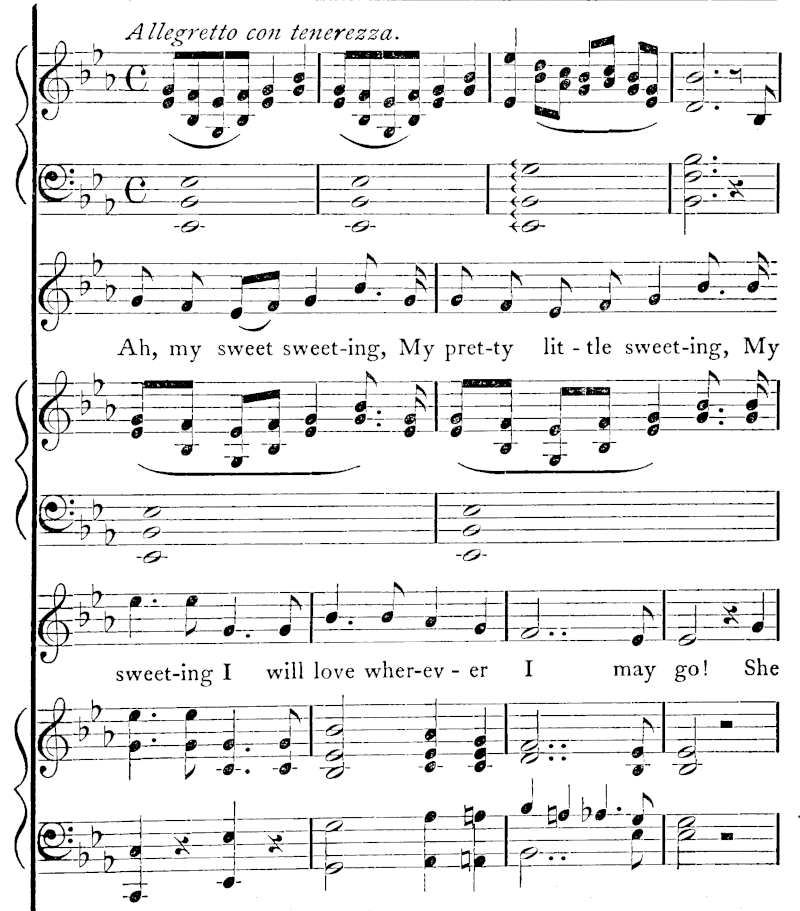
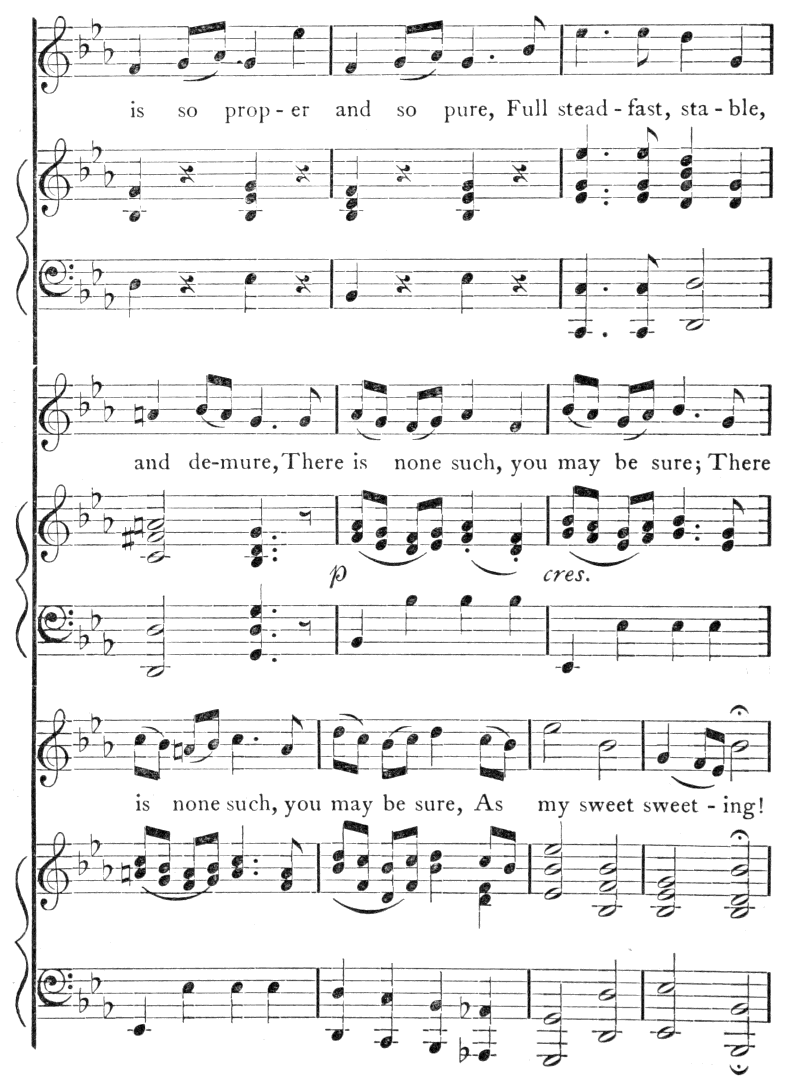
Click on the [Listen] link to hear the music and on the [MusicXML] link
to download the notation. As of the date of posting, these links to external
files will work only in the HTML version of this e-book.
A Christmas Greeting
By
MARIE CORELLI
NEW YORK
DODD, MEAD AND COMPANY
1901
Copyright, 1901 Dodd, Mead and Company All rights reserved
UNIVERSITY PRESS · JOHN WILSON
AND SON · CAMBRIDGE, U. S. A.
“A MERRY CHRISTMAS!”
“A MERRY CHRISTMAS!”
A Christmas Greeting
It is an old, very old, timeworn
greeting, this of the friendly
“Merry Christmas to you!”
and there are some folks among
us in these days who profess to
hate the very sound of it. It
came into use when England was known as
“Merrie England,” an appellation which seems
more than singular to us who have to endure
the inane dullness and melancholy stupidity of
“society” as it exists in this present gloriously-progressive
Motor-Era. Looking round on the
tired, worn, nervous, querulous faces in the crowds
that fill the streets and shops at Christmas-time,—hearing
the endless complaints, the new diseases,
the troubles, real and fancied, of each person
who can manage to detain a friend for five
minutes’ hurried and morbid conversation,—reading
the delectable details of suicide, murder,
mania and misadventure preciously garnered
up as gems of literature for the million by the
halfpenny press—one may reasonably wonder
whether England was ever in truth really “merrie,”
as recorded. Her ancient sweet songs and
ballads, her old-fashioned “Yule games” and
picturesque “country dances” would appear to
prove her so,—reports of the “open doors”
and generous hospitality of her jolly yeomen
and hunting squires in bygone days are still
extant,—and it may be reasonably asked why,
if she was so “merrie” once, she cannot be
equally “merrie” again.
“It is a farce to wish me ‘A Merry Christmas,’”
says the pessimist—“I have no cause
to be merry!”
Quite so! But then, my excellent friend, you
must remember that all the world does not wag
in your particular way! Strange, isn’t it? You
may possibly have thought now and then, as a
self-concentrated unit, that because you are not
merry (and you never will be, I fear)—therefore
no one else has any right to be so. This
is your little mistake! However, as it is Christmas-time
we will not be hard on you! You
shall enjoy yourself in your own approved fashion
of being miserable! No one shall interfere
with you, provided you do not interfere with
anyone else. Grumble away all by yourself!
Sneer at “A Merry Christmas”—only do it
alone! Curse the frost, the wind, the rain, the
robins, the Christmas cards, the puddings, the
mince-pies, the holly, the mistletoe (and the
kisses under it!), and announce to blank space
your detestation of the whole Festival! No
one shall come near you, believe me, so long as
you keep on your own ground and do not attempt
to trespass on your neighbour’s little plot
of harmless enjoyment. For there are still a
few of us remaining on the planet who are
not absolutely and incurably selfish,—who can
find their pleasure in making others happy,—who
can put aside their own private griefs for
the sake of cheering those who are still more
grieved,—who can take delight in the laughter
and merriment of children, and for whom the anniversary
of Christ’s birth is still a sacred day,
consecrated to joy and thanksgiving. True it
is that every such recurring anniversary must
have its sorrowful thought or memory associated
with those who are no longer here with
us; true it is in very saddest earnest that the
cruel grip of War has robbed many a home of
its nearest and dearest, who will be missed and
mourned when families gather round the Christmas
fire and talk of the past in low voices, with
tears in their eyes—nevertheless, it is also true,
thank God, that those who are gone are neither
“lost” nor really “parted” from us. Possibly
they are nearer to us in our lonely evenings
than we know,—possibly they hear our voices,
and see us as they saw us in life. We cannot
tell; and as our ignorance of the Divine mysteries
leaves us in doubt, let us be even as we
would if our beloved ones were here,—cheerful
among ourselves, and kind to all those with
whom we are brought in contact.
“Ye who have scorned each other
Or injured friend or brother,
In this fast-fading year;
Ye who by word or deed
Have made a kind heart bleed,
Come, gather here!
Let sinn’d against and sinning
Forget their strife’s beginning
And join in friendship now;
Be links no longer broken,
Be sweet forgiveness spoken
Under the Holly Bough!
“Ye who have nourished sadness,
Estranged from hope and gladness
In this fast-fading year;
Ye with o’er-burdened mind
Made aliens from your kind,
Come, gather here!
Let not your useless sorrow
Pursue you night and morrow,
If e’er you hoped, hope now!
Take heart!—Uncloud your faces.
And join in our embraces
Under the Holly Bough!”
There is no use in grieving:—there is no
sense in quarrelling:—there is no advantage in
grumbling. People sacrifice both good health
and good looks by constant querulousness.
Suppose it is a “cold” Christmas, or a “damp”
Christmas, or a “green” Christmas, or an “east-windy”
Christmas, or an altogether meteorologically
disagreeable Christmas. Well, what then?
All the peevishness in the world will not alter
it. Some of you who don’t like it will make for
Egypt or the Riviera. Much good may it do
you! An Arab smell, and the “fleecing” of
Cairene hotel proprietors are doubtful additions
to Christmas pleasure—and the raucous cry of
the croupier at Monte Carlo—“Faites vos jeux,
Messieurs et Mesdames!” is scarcely worth
crossing the Channel to hear. Perhaps, however,
it may be a satisfaction to some folks to spend
their surplus cash in “furrin parts” rather than
at home? If this should be the case, it will be
an equal satisfaction to me to politely intimate
that I consider such persons unworthy of their
own matchless country. The much abused
“English climate” is good enough for anybody.
Every sort of “temperature” can be
obtained in these favoured British Isles. If
warmth, and freedom from east winds be required,
it can be obtained at Penzance, Newquay,
or Tenby—or better still on the lovely
Irish coast at Parknasilla, where palms and
tropical trees grow to perfection all winter in the
open. Certainly there is no “gambling-hell”
there;—there are only warm Irish hearts waiting
for sympathy and comprehension, and I
venture to think they merit as much good cash
spent among them for their benefit as is wasted
on the French, who, given the opportunity,
abuse their English patrons more outrageously
than any wild-headed, big-hearted Irish “agitator”
that ever lived. I must confess I have
no sympathy with the restless, nervous swarms
of semi-lunatics ever “on the go” in search of
“change,” who turn their backs on Imperial
Britain at the first breath of its winter, which,
taken on the whole, is a much more healthy
winter than other countries are blessed with.
And an “old English Yule” kept in the old
English manner is not to be despised. Try it,
all you who are not going abroad—you who
are not only content, but glad and proud to
remain in this
“Earth of Majesty, this seat of Mars,
This other Eden, demi-paradise,
This fortress built by Nature for herself;
. . . This little world,
This precious stone set in the silver sea!”
Try to keep a happy and “merrie” Christmas
in England—try to make it a blessed and
unforgettable festival of pleasure for more than
yourselves. Do some little special kindness, each
one of you, unobtrusively in your own immediate
neighbourhood, and never bother about the “inconvenience,”
or the “trouble,” or the “cold.”
“Cold Christmas? No!
Our Christmas is not cold;
Although the north winds blow
And pile the drifting snow,
And the beech-trees on the freezing wold
Rock sadly to and fro.
Our Christmas bears a warm, true heart,
His face is red with glee,
And he jests and laughs
And sings and quaffs—
He was never unkind to me, my love,
May he never be cold to thee!
“Old Christmas? No!
Though states and kingdoms wear,
And change and ruin grow
From ages as they flow,
He’s as light of tread, as young and fair
As a thousand years ago.
The morning beams are always new
And scatter blessings free,
And the Christmas Day
Is as new as they,
He was never old to me, my love;
May he never grow old to thee!”
So runs a sweet old song, sung by a true
English poet in days long ago gone by, and the
clear, clean, glad and wholesome spirit of it is
surely worth cherishing. Let none of us say
we “hate” Christmas. Whatever our memories,
bitter or sweet, they do not belong to the
festival, but only to ourselves. Suppose therefore
we lose sight of ourselves—our precious
selves—just for once in our lives, and consider
others a little? If we do this, we shall find it
easy to be “merry,” easy to smile, easy to say a
kind word, easy to do a kind action, easy to
“bring home the holly,” and very easy to hang
up the mistletoe and waft a kiss from under it
to any cross old boy who declines to be as happy
as we would like to make him!
ENGLAND
1901-1902
Lift up thine eyes, Queen-Warrior of the world!
Stand, fearless-footed on Time’s shifting verge,
And watch the New Year’s doubtful Dawn emerge
From parting clouds thick-roll’d in thunderous War!
Lo, how thy broad East reddens to the West,
The while thy thousand-victoried flag, unfurl’d,
Waves to thy North and South in one royal fold
Of tent-like shelter for an Empire’s rest;
O Queen, sword-girded, helmeted in gold,
Strong Conqueror of all thy many foes,
Look from thy rocky heights and see afar
The coming Future menacing the Past,
With clamour and wild change of present things,
Kingdoms down-shaken with the fall of kings,
But fear not Thou! Thou’rt still the first and last
Imperial wearer of the deathless Rose,—
Crown’d with the sunlight, girdled with the sea,
Mother of mightiest Nations yet to be!
THE KING’S CROWN
A DREAM OF THE PRESENT AND THE
FUTURE
The late rays of the sinking sun shot rosy lines of light through
the high, painted glass casement of a quaint oriel-chamber, where, on a
cushion of crimson velvet, shone the Crown of a great King and Emperor.
It was set there in readiness for the morrow,—when, at a stately
pageant of national rejoicing, all the people would see it raised high
above them as a symbol of the Throne and the glory of the land. Deft
jewellers had been at work for days, burnishing its golden setting and
polishing its priceless jewels,—and now,—their work completed,—they had
brought it here for the night, and, to ensure perfect safety, had left
it in this special place because it was more difficult of access than
any other corner of the Royal palace. It was a small recess apart;—and
the only door leading to it was through the “strong room,” where all
the gold and silver plate was kept, and where two armed men paced up and down both day
and night, keeping close watch and guard. Flashing sparkles of light
twinkled every now and again from the precious stones in the Crown, as
the sunset hues caught their finely-cut points and touched them into
flame; and an atmosphere of silent majesty surrounded the historical
emblem of earth’s proudest empire,—lifeless in itself, yet having the
strange power of outlasting the life of all its kings! The sun sank;
its rays grew paler and dimmer, till by-and-by they faded altogether.
Long shadows came, then the twilight, then the dark, and deep silence.
Now and again a trumpet-call from the soldiers’ quarters hard by,
a bell slowly chiming the hour, or the clash of muskets outside on
the courtyard, betokening a change of sentry, broke the solemn hush
of night, but beyond this no human sound disturbed the solitude and
obscurity of the secret nook which enshrined the Imperial Crown of a
still more splendid and imperial Realm.
All suddenly, about an hour before the moon rose, a thick,
almost palpable Darkness, darker than the night itself, gathered in
the room and began to circle like a threatening storm around the
Crown. Gradually this blackness took upon itself shape and stature, and, rising full
height, displayed the gigantic form of an Angel with sable wings, and a
countenance distorted with cruelty and avarice.
“Mine is the Crown!” he said. “Mine are the People! Mine is the
Land, and mine is the King!”
And as he spoke he stretched forth a hand to snatch the Royal
diadem, when, like a flame breaking through the walls and floor of the
oriel-chamber, a great light shone on every side, and another Angel,
stately and majestic, whose snowy wings were like the early rays of the
morning sun shining through white and azure, confronted that fierce
Spirit of the Darkness.
“Not so!” said a voice clear as a silver clarion. “Mine is the
Crown! Mine are the People! Mine is the Kingdom, and mine is the
King!”
For one second of time they stood thus opposed one to the other—the
country’s Crown between them. Then came the flashing of a great Sword,
and the Angel of darkness struck with it fiercely at his god-like
rival.
“War!” he cried. “Eternal war! For all the evils of the land there
shall be vengeance!”
And like a shaft of lightning through a cloud another fiery Sword
parried the savage blow.
“Peace!” said the silver-sounding voice of the Angel of Light.
“Glory and peace! For all the evils of the land there shall be
justice!”
Then they closed and fought—those mighty, supernatural Warriors,—and
in their fearful contest the air around them both grew dense and
lurid, and the Crown, glittering with great gems on its crimson velvet
cushion, appeared to float in a pool of blood. Closer and more terrible
grew the fight,—and the evil angel, with such ferocity as only hate and
cruelty can give, twice thrust his dazzling foe to the ground;—twice
smote the heavenly-fair head with the great Sword that bore the words
“everlasting death” upon its blade. And while they yet battled on, the
moon rose, round and full, peering in upon them like a wondering white
face of sad and wistful inquiry. For a moment they paused in their
conflict,—and the jewels in the Crown suddenly ceased to sparkle. Five
aerial forms of exquisite beauty arose from its golden circlet, lifting
themselves above it like drifting wreaths of sea-mist in the radiance
of the moonlight, and their voices, small and soft, yet clear as the
notes of a sweet song, made music in the silence.
“I am the Spirit of the Pearl!” said one.
“Through centuries of history I have seen
‘Right’ forever conquer ‘Might,’ and so shall
it be again!”
“I am the Spirit of the Ruby!” said another.
“I mark both War and Victory! From the
bitter agony and labour of strong battle I have
seen the birth of Love and Peace! All things,
whether gentle or fierce, kind or cruel, have
worked together for the good and the glory of
the land;—so has it ever been, and so shall it
be again!”
“I am the Spirit of the Sapphire!” said the
third; “I know the movements of justice—I
watch the performing of God’s Will. Through
light, through darkness, through gladness and
sorrow, God holds His perfect way with kings
and kingdoms. Strife is sharp and strong, but
Truth is stronger;—so it has ever been, and so
it shall be again!”
“I am the Spirit of the Emerald!” said a
fourth. “Through all the history of the realm
I have counted the tears of the poor, the sufferings
of the weak, the griefs of the lonely, and
when I set my light on the great king’s brow I
move him to deeds of pity and loving-kindness!
I watch the world progressing in good,—I know
that there is more tenderness than wrath in
humanity,—more love than hate! The Empire’s
glory is in deeds of mercy! So it has
been before—so it shall be again!”
“I am the Spirit of the Diamond!” said the
fifth,—“And wherever I shine, there, too,
shines the Star of Freedom! No slave can
breathe when my light sparkles in the air!
Progress and Love and Wisdom spring up at
my command, and naught can lessen the Crown’s
glory while I remain its central gem! Liberty
and honour! These are the watchwords of our
mighty Empire! So they have been for ages;
so shall they ever be!”
Their voices ceased, and joining their delicate
hands they melted into a shining circle about the
Crown,—a circle of pure and penetrating light
like the early sunbeams of a clear spring morning.
But the Angel of Darkness, resting on his
sword, heard them and smiled—a smile darker
and more implacable than any frown.
“Oh, foolish, evanescent Shapes! Oh, vain
gods of perishable gems!” he cried; “How
shall ye combat Me, who hold the mystic Opal!—the
stone of sorrow and of death? What is
your strength against mine? Less than the
strength of reeds in a swift tide,—for I am the
Spirit of Mammon, and Time’s great pendulum
swings the hour to me! Lo, here shines the
Crown’s mischief!—sparkling with a thousand
fires of world’s wealth, world’s lust, world’s
treachery, world’s vanity!—hues of the rainbow,
as fleeting as they are fair! Emblem of ruin and
disaster, take Thou thy place in the Crown, and
shed My light upon the great King’s brow! Indestructible
and terrible!—Jewel of devils and
cursing, I set thee there to work My will!”
He raised on high the Opal, glittering like a
foam-bell on a treacherous sea,—and then,
bending his dark form above the Crown, strove
to set it within that golden band. But the magic
circle of fire around it grew brighter, and deeper,
and wider, till it was like a flame of glory,—springing
higher and ever higher, it surrounded
the Angel of Light with countless arrowy
beams.
“Fight on, God’s Angel of the Kingdom!”
said a distant Voice that echoed like thunder far
away. “Fight on! Unto thee shall be given
the victory!”
Then the Angel raised his sword of Light
and struck the Opal from his enemy’s hand.
It fell to the ground, shattered to atoms, and
a rushing sound as of many waters filled the
air.
“New and Old are as one!” said the Voice;
“Past and Future are as Present! Fight on,
God’s Angel of the Kingdom,—for Now is the
acceptable time!”
And once again those mighty Spirits fought,—and,
as they crossed their mystic Swords,
there came a wailing noise as of the weeping of
a great multitude. Cries of passionate grief
echoed up from some dismal unseen abyss of
suffering, and the anguish of a great People was
borne on the double rhythmic beat of a Funeral
march and a Battle song. Strange gleaming
visions came and went in the darkness:—women’s
pale faces worn with toil and sorrow;—dead
soldiers slain in their youth, and lying
unburied;—grim countenances of foul and lustful
men, who occupied their time in digging gold
out of newly-made graves, wherein the bodies
had scarcely rested long enough to crumble
into dust;—bold eyes of false women shining
wickedly through skulls that were crowned with
gems;—wide seas on which the great ships
tossed, bearing the seeds of new nations;—flashing
networks of light, on which the quick
news travelled in dancing letters of flame! And
over all—a Cloud,—and under all—the
Crown! The night hours wore away, and still
the combat raged,—and still the Angel of the
Darkness fought fiercely with the Angel of the
Light. And the visions came and went like
shadows in a magic mirror—some beautiful,
some terrible,—some that were like great storms
raging over the land,—some floating by in the
halcyon fairness of long summer days. Now
and again while that mystic flashing of Swords
made luminance in the air, there came a sound
of young voices singing in the distance, and the
words that broke through the music were like
these—
“Sheathed be the sword for ever!—let the drum
Be school-boys’ pastime,—let your battles cease;—
And be the cannon’s voice for ever dumb
Except to celebrate the joys of peace!
Are ye not brothers? God, whom we revere,
Is He not the Father of all climes and lands?
Form an alliance, holy and sincere,
And join, join hands!”
The song died away in a tremulous wave of
melody, and a pearly light began to suffuse the
atmosphere like the first suggestion of the opening
morn. Weary and pale, but still dauntless
and unconquered, the Angel of the Light dealt
stroke for stroke, blow for blow against his
Enemy, when all at once, with a sudden and
savage onslaught, the Angel of the Darkness
caught his opponent by the arm which held
the sword, and almost wrenched the dazzling
weapon from his hand. And then the Angel
of the Light gave a great cry of supplication.
“O God of Justice and of Love!” petitioned
the silver-sounding voice; “Suffer not Thy
Christian kingdom to be torn from Thy gracious
protection! Clear Thou this Cloud of evil
days, and take away the heavy weight of fear
and of sorrow from the hearts of Thy stricken and
suffering people, who do not forget Thy mercies
in the past! Give Me the Crown, O God of
Empires!—Give Me the King!”
And as the prayer was spoken, the Angel of
the Darkness fell back, weakened and dismayed,
for the heavenly Warrior, grasping his sword
with redoubled force and purpose, dealt with
it one mighty stroke which brought his foe to
the ground.
“Yield thou, mine Enemy!” cried the triumphant
Angel; “Claim no more that which
was never thine! Seek no more that which
shall never belong to thee! Mine is the Crown!—mine
is the Kingdom!—and mine, by the
grace of God, is the King!”
The widening dawn lightened the painted
windows with a silver mist, flecked through
with palest rose, and the darkness, gathering
together, rolled itself up like a curtain and fled
away. All shapes of evil and visions of terror
vanished;—and as the morning broke, the
Angel of the Light, alone and victorious, with
snowy wings widespread, and fair face bright
with God’s own eternal splendour, lifted the
King’s Crown in both radiant hands towards
Heaven, to meet the rays of the rising sun and
the full golden glory of the Day!
HYMN FOR THE CORONATION
Ruler of Empires, God of Perfect Love,
That wert, and art, and ever-more shalt be,—
Maker and Master of the worlds above,
Saviour of all who fix their hope on Thee,—
Hear us, great Lord of nations new and old,
Giver of blessings countless and untold,—
To-day before Thy Throne we pledge anew
Our England’s trust in all things high and true,
And with united hearts to Thee we bring
Him unto whom our loyal faith is due,—
God of our fathers! Guard and bless the King!
The country’s crown we set upon his brow,
With prayer, thanksgiving, and the sound of song;
Eternal King of kings, receive him now,
And fill his soul with power divine and strong;
Nerve Thou his hand unto the sceptre’s sway,
Guide Thou his steps in every noble way,
And let the grace of all things sweet and fair
Descend on Her whose spirit pure and rare
For happy years the nation’s pride hath been,
And now the nation’s crown and throne doth share;
God of our fathers! Guard and bless the Queen!
Lord of the Past and Future, let Thy light
Shine on this double crowning of our Land!
In Peace or War, O God defend the Right
And let our shield be still Thy sheltering Hand!
Hear and accept Thy grateful people’s praise
For all Thy mercies in the former days,—
For present joys, for blessings yet to be,
We humbly give the glory unto Thee,
And to Thy service we do consecrate
The Sovereigns of our Empire of the Sea!
God of our fathers! Guard and bless the State!
Long live our Emperor-King and Empress-Queen!
God save them from all evils near or far!
May golden years of happiest peace serene
Make bright the sway of their Imperial star!
Before high Heaven we swear to them our faith,
Honour and truth and loyalty till death!
Courage and chivalry are with us yet,—
God shall forget us all ere We forget!
Loud let our voices with the joy-bells ring,
To all the nations here together met;—
God be with England, and with England’s King!
THE SOUL OF QUEEN ALEXANDRA
A SPIRIT-PICTURE
Have you seen the Queen?
Thousands of eager lips
voiced this question,—thousands
of eager eyes were turned
towards the stately towers of
Westminster, rising darkly outlined
like fine bronze against the cold grey sky,
on that bleak and bitter feast-day of St. Valentine,
1901, when Edward VII., King of Great
Britain and Emperor of India, went in state to
open his first Parliament. Thousands of loving
and loyal hearts, still heavy with grief for the
loss of Victoria the Good, so long the Mother
of her people, grew warm with tenderness
and devotion as the whispered name “Alexandra!”
ran from mouth to mouth, and the
old fiery chant, so gloriously sung by the last
great Poet-Laureate of England, came back
like a wave breaking on the shore of many
memories:—
“Sea-King’s daughter from over the sea,
Alexandra!
Saxon, and Norman, and Dane are we,
But all of us Danes in our welcome of thee,
Alexandra!
Welcome her thunders of fort and of fleet,
Welcome her thundering cheer of the street!
“Oh, joy to the people, and joy to the Throne,
Come to us, love us, and make us your own!”
For had she not obeyed and fulfilled the
Poet’s invocation? Had she not, indeed, come
to us, and loved us, and made us her own?
And had we not taken her in all her youth and
hope and beauty, and made her our own in
turn?—our own Princess of Loving-Kindness,
dear to all, honoured by all as one of the purest
and noblest figures in all the history of English
Royal annals? And so on this St. Valentine’s
Day of never-to-be-forgotten memory, the people
gathered in multitudes to see her pass,—transformed
from Princess into Queen—a
change which, though always predestined,
seemed at the time singular and as much attended
by grief as by gladness. For she—like
all the people who were one with her in truth
and loyalty to the Throne—mourned the loss
of the greatest, best, and wisest Sovereign that
had ever reigned in England since the days of
Elizabeth,—one, who to the diplomacy, tact,
and foresight of Elizabeth, had added the sweetness,
gentleness, and love of a pure womanly
heart, ever in sympathy with the joys and griefs
of her people. Affection, curiosity, and compassion
struggled for the mastery in the minds of
the vast crowds that watched the progress of the
gorgeous State Coach, drawn by the dainty
cream ponies which had but lately, alas! drawn
the dead Queen through the great city to her
last rest; and people standing a-tiptoe strove to
peer through the glass on all sides, not so much
to catch a glimpse of the King’s familiar face as
to note the expression on the delicate fair
features of his Consort. It was difficult to see
her within the cumbrous painted and gilded
equipage,—the King’s brilliant uniform and
glittering orders made his figure more conspicuous
than hers; moreover, his features were so
well known to the crowds who had long loved
him as their “popular” prince, that no one was
put to any great strain to recognize him. But
the shrinking, graceful form at his side was less
distinct in outline—one saw a blur of sable robes
and long-flowing veil, the gleam of jewels, a wistful
face with soft grieved eyes, and that was all.
Inside the House of Lords, however, the impression
was different. There, amid the rustle
of black silken robes, and the sweep of mourning
veils and funereal plumes, the glisten of diamonds,
the milky sheen of pearls, and the
almost startling relief of colour afforded by the
scarlet robes of the Peers, came the very incarnation
of majesty;—of grief and beauty in one,
when the “Sea-King’s daughter” stood pale and
proud beside her Husband and King,—when
the Royal robes of ruby velvet and snowy
ermine fell around that slight regal figure clad
in solemn black, almost crushing it with a weight
of splendour, and when the sweet eyes gazed out
on the crowded gathering of the world’s most
brilliant personages of rank and influence with a
gravity not unmingled with pain. A fitting
partner for the Throne of the greatest Emperor
on earth.
“She stood beside him like a rainbow braided,
Within some storm, when scarce its shadows vast
From the blue paths of the swift sun have faded.”
There was present one who looked upon her
at that moment, and looking, saw her with other
eyes than those of mere humanity,—saw her as
earthly sight alone can never see her,—in the
clear undarkened air of psychic vision which
brings all things, all circumstances, all seeming
shapes into the true prospective of the Soul’s
distinct and unerring observation. And in that
Light she stood uplifted;—the symbols of
earth’s passing power and splendour were no
longer visible—the crowding forms around her
were as drifting shadows, dimly outlined or vanishing
altogether into darker space. High above
them all her Spirit rose transfigured;—revealed
in its true beauty,—transformed by a Thought,—and
hallowed by a Prayer! No longer robed
in sombre mourning garb, her figure shone resplendent,
clad in the dazzling whiteness of an
Angel’s wearing;—Royal robes of Heaven’s
imperishable gold enfolded her as with wings,—and
on her brow sparkled the deathless Crown
of many bravely-endured mortal sorrows turned
into jewels of immortal joy! Unconscious of
the living radiating light surrounding her she
stood; serene and prayerful,—watchful and
patient,—fearless and resigned,—loving and
true; and like the breaking of great waves upon
the shifting sand, came the murmur of a mighty
people’s praise,—the grateful blessings of brave
soldiers far away, fighting for England’s honour,—the
tenderness of children’s love—the thankfulness
of struggling souls rescued from sin and
death! Pure thoughts, pure words, pure deeds
formed a glittering triumphal arch of rainbow
hues above her, attracting with an irresistible
force the unseen powers of good, which, through
all clouds of doubt and chance, do yet flash
their star-like rays of hope upon the world,
inspiring the mind of humanity to fresh work,
ambition, and endeavour. To her—a Queen
of Fair Virtues—ascended the earnest, though
unworded petitions of all good women for guidance
and example,—to her their looks were
turned for leadership through the devious and
difficult ways of life,—for to them she seemed
“Fixt like a beacon-tower above the waves
Of tempest.”
War or peace,—loss or gain,—defeat or
victory—these earthly incidents of life passed
over her as the mere brief reflex of a darkness
on her brightness, and touched her not at all.
Plainly could it be seen that she had known sorrow;
plainly was it evident that she had shed
tears. She had clasped the Cross to her breast—she
had testified her faith in God by a grand
resignation to the Divine Will. But these
things made the stature of her Soul so much the
fairer, that such marks of pain and loss could
only be perceived in her as indications of more
perfect gladness. So did she shine;—pictured
for a fleeting moment in the clear mirror of
spiritual perception, with all the colours of unfading
Truth about her, and seen, not “as in a
glass darkly, but face to face,”—a visible Queen
indeed, of a far wider realm than Imperial Britain!
For Imperial Britain may have its day
like Imperial Rome—may run its course equally
to decay and death,—but the Empire of love
and purity, of unselfishness and goodness, of
truth and kindness, is built up on eternal foundations
and can never end! And within that
Empire the Soul of Queen Alexandra is crowned
more gloriously than with the crown of England,—from
every quarter of it she commands more
subjects than any earthly kingdom holds,—and
those who cannot penetrate into this boundless
and everlasting realm of hers, do not know her,
and cannot say they have ever looked upon
her! And when the King’s first Parliament
was opened—when all the “great” in rank and
wealth and fashion had pushed and scrambled
and hustled themselves out of Westminster,
commenting audibly and flippantly on the looks,
manners and deportment of their Majesties, how
many among them, we may wonder, had seen
the veil of earthly things withdrawn and the
appearance of that lovely Soul disclosed as God
sees it, in all the fairest portraiture of a truly
Royal Presence?
One—certainly one—out of all the brilliant
assemblage had truly “seen” the Queen;—and
that one who was so permitted to behold
her as she actually is in the watchful sight of
Heaven, remembers every line, every grace,
every touch of colour and beauty in the gracious
Spirit-picture,—and is glad—for England’s
sake!
A CHRISTMAS CAROL AT SANDRINGHAM
REFRAIN
God save your gracious Majesties,—
Let nothing you dismay,
Remember Christ our Saviour
Was born on Christmas Day.
The gates of Heaven were opened then,
And the Herald-Angels came—
Singing “Peace on earth, goodwill to men”
In blessed Jesu’s Name;
But the world is forgetting that sacred song,
Heard by the shepherds of old,
And, despite Christ’s birth, there is war on earth,
And wolves in the Master’s fold;—
And for this cause we are sent to you,—
To give you a word of cheer—
God save your gracious Majesties,
And send you a happy Year!
Three weary travellers are we,
And at your door we stand,—
We come from an Empire of the free,
A far-off Golden Land—
A Land where the dear ones you have lov’d
And lost for a parting breath,
Are as angels bright, in the perfect light
Of a life that knows no death.
In heavenly choir they sing with us,
Their voices you may hear—
“God save your gracious Majesties,
And send you a Blessèd Year!”
From your heart’s gentle excellence
A welcome we would win!
We pray you send us not from hence,
But let us enter in.
Poor are our garments,—no store we keep
Of wealth for the world to see,—
But the names we bear are forever fair—
“Faith,—Hope,—and Charity!”
Sisters belov’d of Christ, we come
To sing you a carol clear,—
“God save your gracious Majesties,
And give you a Happy Year!”
Unbar to us your household gate,—
With you we seek to dwell;—
We are your Angel guards of state,
And we will shield you well!
No foes shall harm you, no ills befall,
While we in your home remain,
And the love of the grand, sweet Empire-Land
Shall glorify your reign!
May Jesu’s love and peace protect
You and your children dear!—
God save your gracious Majesties
For many a good New Year!
REFRAIN
God save your gracious Majesties,
Let nothing you dismay,
’Tis life to know that Christ our Lord
Was born on Christmas Day!
A QUESTION OF FAITH
PROPOUNDED TO ALL WHOM IT MAY
CONCERN
Before fully entering on this
paper, I should like those who
may be inclined to read it to
understand very distinctly, once
and for all, that I am a Christian.
I am sorry that the too-hasty
misjudgment of others compels me to
assert the fact. The term “atheist” has been
applied to me by several persons who should
know better,—for it is an absolutely false, and
I may add, libellous accusation. That it has
been uttered unthinkingly and at random by
idle chatterers who have never read a line I have
written I can well believe,—nevertheless it is a
mischievous rumour, as senseless as wicked.
Poor and inadequate as my service is, and must
ever be, still I am a follower of the Christian
Faith, as expounded in Christ’s own words to His
disciples. I believe that Christian Faith to be
the grandest and purest in the world,—the
most hopeful, the most strengthening, the most
soul-supporting and ennobling religion ever
taught to humanity. To me, in hours of the
bitterest trial, it has proved not “a reed shaken
by the wind”—but a rock firmer than the
foundations of the world, against which the
waves of tribulation break in vain and disperse
to naught,—and when brought face to face
with imminent death as I have been, it has kept
me fearless and calm. I know—because I
have experienced—its priceless worth, its truth,
its grand up-lifting-power; and it is because
this simple Christian Faith is so dear to me,
and so much a part of my every-day life, that
I venture to ask a few straight questions of
those who, calling themselves Christians, seem
to have lost sight altogether of their Master
and His commands. I like people who are
consistent. Inconsistency of mind is like uncleanliness
of body; it breeds discomfort and
disease. And in this wonderful age of ours,
in which there is so little real “greatness,”—when
even the tried heroism of our leading
statesmen and generals is sullied by contemptible
jealousies and petty discussions of a quarrelsome
nature,—when the minds of men are
bent chiefly on money-making and mechanical
inventions to save labour (labour being most
unfortunately estimated as a curse instead of
the blessing it indubitably is), I find inconsistency
the chief ingredient of all modern
thought. Things are jumbled up in a heterogeneous
mass, without order, distinction or
merit. And the principal subject on which
men and women are most wildly, glaringly
inconsistent is that which is supposed to be the
guiding rule of life—religion. I should like
to try and help settle this vexed question. I
want to find out what the Christian Empire
means by its “faith.” I want to know how
our King proposes to enact his magnificent
part of “Defender of the Faith.” I venture
to lift up my voice as the voice of one alone
in the wilderness, and to send it with as clear a
pitch and true a tone as I can across the sea of
discussion,—the stormy ocean of angry and
contradictory tongues,—and I ask bluntly and
straightly, “What is it all about? Do you
believe your religion, or do you not?”
It is an honest question, and demands an
honest answer. Put it to yourselves plainly.
Do you believe with all your heart and
soul in the faith you profess to follow?
Again—put it with equal plainness—Do
you not believe one iota of it all, and are
you only following it as a matter of
custom and form?
Let us, my reader or readers, be round and
frank with each other. If you are a Christian,
your religion is to believe that Christ was a
human Incarnation or Manifestation of an Eternal
God, born miraculously of the Virgin Mary;
that He was crucified in the flesh as a criminal,
died, was buried, rose again from the dead, and
ascended to heaven as God and Man in one,
and there perpetually acts as Mediator between
mankind and Divine Justice. Remember, that
if you believe this you believe in the PURELY
SUPERNATURAL. But let anyone talk or
write of the purely supernatural as existent in
any other form save this one of the Christian
Faith, and you will probably be the first to scout
the idea of the supernatural altogether. Why?
Where is your consistency? If you believe in
one thing which is supernatural, why not in
others?
Now let us consider the other side of the
question. You who do not believe, but still
pretend to do so, for the sake of form and conventional
custom, do you realize what you are?
You consider yourself virtuous and respectable,
no doubt; but facts are facts, and you, in your
pretence at faith, are nothing but a liar. The
honest sunshiny face of day looks on you and
knows you for a hypocrite—a miserable unit
who is trying in a vague, mad fashion to cheat
the Eternal Forces. Be ashamed of lying, man
or woman, whichever you be! Stand out of
the press and say openly that you do not believe;
so at least shall you be respected. Do
not show any religious leanings either to one
side or the other “for the sake of custom”—and
then we shall see you as you are, and refrain
from branding you “liar.” I would say to all,
clergy and laity, who do not in their hearts believe
in the Christian Faith, “Go out of the
Church; stand aside and let us see who is who.
Let us have space in which to count up those
who are willing to sacrifice all their earthly well-being
for Christ’s sake (for it amounts to nothing
less than this), and those who prefer this
world to the next.” I will not presume to calculate
as to which will form the larger majority.
I only say it is absurd to keep up churches, and
an enormous staff of clergy, archbishops, bishops,
popes, cardinals, and the like, for a faith in
which we do not TRULY, ABSOLUTELY, AND ENTIRELY
BELIEVE. It is a mere pageant of inflated
falsehood, and as such must be loathsome in the
sight of God,—this always with the proper
proviso, “if there indeed be a God.” Yet,
apart from a God altogether, it is degrading to
ourselves to play the hypocrite with the serious
facts of life and death. Therefore, I ask you
again—Do you believe, or do you not believe?
My object in proposing the question at all is to
endeavour to show the spiritual and symbolic
basis upon which the Christian Faith rests, and
the paramount necessity there is for accepting it
in its pristine purity and beauty, if we would be
wise. To grasp it thoroughly, we must view
it not as it now seems to look to us through
the darkening shadows of sectarianism, BUT
AS IT WAS ORIGINALLY FOUNDED.
The time has come upon us that is spoken of in
the New Testament, when “one shall be taken
and the other left,” and the sorting of the sheep
from the goats has already commenced. It can
be said with truth that most of our Churches, as
they now exist, are diametrically opposed to the
actual teachings of their Divine Founder. It
can be proved that in our daily lives we live exactly
in the manner which Christ Himself would
have most sternly condemned. And when all
the proofs are put before you plainly, and
without disguise or hyperbole, in the simplest
and straightest language possible, I shall again
ask you, “DO YOU BELIEVE, OR DO
YOU NOT BELIEVE?” If you do believe,
declare it openly and live accordingly;
if you do not believe, in God’s name leave
off lying!
The Symbolism of the Christian Faith has
been and is still very much lost sight of, owing
to the manner in which the unimaginative and
unthinking majority of people will persist in
looking at things from a directly physical, materialistic,
and worldly point of view. But if we
take the life and character of Christ as a Symbolic
representation of that Perfect Manhood
which alone can be pleasing to God,—which
alone can be worthy to call the Divine Source
of Creation “Father!”—some of our difficulties
may possibly be removed. Christ’s Gospel
was first proclaimed in the East,—and the
Eastern peoples were accustomed to learn the
great truths of religion by a “symbolic,” or allegorical
method of instruction. Christ Himself
knew this,—for He taught them many things
by parables.
We shall do well to keep this spirit of Eastern
symbolism in mind when considering the
“miraculous” manner of Christ’s birth. Note
the extreme poverty, humility, well-nigh shame
attending it! Joseph doubted Mary, and was
“minded to put her away privily.” Mary herself
doubted the Angelic Annunciation, and said,
“How shall this be?”
Thus, even with those most closely concerned,
a cloud of complete disbelief and distrust
environed the very thought, suggestion, and
announcement of God-in-Man.
It should be remembered that the Evangelists
Mark and John, have no account of a miraculous
birth at all. John, supreme as a Symbolist,
the “disciple whom Jesus loved,” wrote, “The
WORD was made flesh and dwelt among us.”
Securing this symbolic statement for ourselves,
we find that two of the chief things which we
attach importance to in this world—namely,
birth and position—are altogether set aside in
this humanizing of the WORD, and are of no
account whatever. And that the helpless Child
lying in a manger on that first Christmas
morning of the world, was, despite poverty and
humility, foredestined to possess more power
than all the kings and emperors ever born in the
purple.
Thus, the first lessons we get from the birth
of Christ are—Faith and Humility—and these
are the whole spirit of His Divine doctrine.
Now,—How does this spirit pervade our
social community to-day, after nearly two thousand
years of constant preaching and teaching?
Look round on the proud array of the self-important,
pugnacious, quarrelsome, sectarian,
and intolerant so-called “servants of the Lord.”
The Pope of Rome, and his Cardinals and his
Monsignori! The Archbishop of Canterbury,
and his Bishops, Deacons, Deans and Chapters,
and the like! The million “sects”—and all
the cumbrous paraphernalia of the wealthy and
worldly “ordained” to preach the Gospel! Ask
them for “proofs” of faith! For signs of
“humility”! For evidences of any kind to
show that they are in very soul and life and
truth the followers of that Master who never
knew luxury, and had not where to lay His
head!
And you, among the laity, how can you pray,
or pretend to pray to a poor and despised “Man
of Sorrow,” in these days, when with every act
and word of your life you show your neighbours
that you love Money better than anything else
in earth or in heaven!—when even you who are
millionaires only give and do just as much
as will bring you notoriety or purchase you a
“handle” to your names! Why do you bend
your hypocritical heads on Sundays to the Name
of “Jesus,” who (so far as visible worldly position
admitted) was merely the son of a carpenter, and
followed the carpenter’s trade, while on week-days
you make no secret of your scorn of, or indifference
to the “working-man,” and more often
than not spurn the beggar from your gates!
Be consistent, friends!—be consistent! IF
YOU BELIEVE IN CHRISTIANITY, you
must also believe in these three things:—
1. The virtue of poverty.
2. The dignity of labour.
3. The excellence of simplicity.
Rank, wealth, and all kinds of ostentation
should be to you pitiable—not enviable.
IS IT SO? Do you prefer poverty with a
pure conscience to ill-gotten riches? Would
you rather be a faithful servant of Christ or
a slave of Mammon? Give the answer to your
own soul,—but give it honestly—if you can!
If you find, on close self-examination, that
you love yourself, your own importance, your
position, your money, your household goods
and clothes, your place in what you call
“society,” more than the steady working for and
following of Christ,—YOU ARE NOT A
CHRISTIAN. That being the case, be brave
about it! Say what you are, and do not pretend
to be what you are not!
It ought to be quite easy for you to come to
a clear understanding with yourselves. Take
down the New Testament and read it. Read it
as closely and carefully as you read your cheap
newspapers, and with as much eagerness to find
out “news.” For news there is in it, and of
grave import. Not news affecting the things of
this world, which pass like a breath of wind and
are no more,—but news which treats of Eternal
Facts, outlasting the creation and re-creation of
countless worlds. Read this book for yourselves,
I say, rather than take it in portions on Sundays
only from your clergy,—and devote your earnest
attention to the simple precepts uttered by Christ
Himself. If you are a Christian, you believe
Christ was an Incarnation of God,—then does it
not behove you to listen when God speaks?
Or is it a matter of indifference to you that the
Maker and Upholder of millions of universes
should have condescended to come and teach you
how to live? If it is, then stand forth and let
us see you! Do not attend places of worship
merely to be noticed by your neighbours. For,—apart
from such conduct being strictly forbidden
by Christ,—you insult other persons by your
presence as a liar and hypocrite. This is what
you may call a “rude” statement; plain-speaking
and truth-telling are always called “rude.”
You will find the utmost plain-speaking in the
Gospels upon which you profess to pin your
faith. If you have any “fancy Ritualism” lurking
about you, you will discover that “forms”
are not tolerated by the Saviour of mankind.
“All their works they do for to be seen of
men; they make broad their phylacteries and
enlarge the borders of their garments.”
“Shows” of religion are severely censured
and condemned by Him whose commands we
assume to try and obey,—we can scarcely find
even a peg whereon to hang an excuse for our
practice of praying in public, while “vain repetitions”
of prayer are expressly prohibited. We
shall find nothing in the New Testament to condone
the “evening dress” services of a certain
West-end clergyman, who shall be nameless;—or
to countenance “dramatic” recitations from
the steps of a Church chancel, by an actress
standing boldly there with her back to the Communion
Table. I repeat—Read the Four
Gospels; they are very much mis-read in these
days, and even in the Churches are only gabbled.
See if your private and personal lives are
in keeping with the commands there set down.
If not, cease to play Humbug with the Eternities;—they
will avenge themselves upon your
hypocrisy in a way you dream not of! “Whosoever
excuses himself accuses himself.”
The true Christian faith has no dogma,—no
form—no sect. It starts with Christ as God-in-man,
in an all-embracing love for God and His
whole Creation, with an explicit and clear understanding
(as symbolized so emphatically in the
Crucifixion and Resurrection) that each individual
soul is an immortal germ of life, in process
of eternal development, to which each new
“experience” of thought, whether on this planet
or others, adds larger powers, wider intelligence,
and intensified consciousness. There are no
“isms” in this faith—no bigotry, and no intolerance.
It leaves no ground for discussion.
“This is my commandment,—That ye love
one another as I have loved you.”
It is all there,—simple, straight, and pure—no
more, no less than this.
“Love feels no burden, thinks nothing of
trouble, attempts what is above its strength,
pleads no excuse of impossibility. It is, therefore,
able to undertake all things, and it completes
many things and warrants them to take
effect where he who does not love would faint
and lie down. Love is watchful, and, sleeping,
slumbereth not. Though weary, it is not tired;
though alarmed, it is not confounded, but, as
a lively flame and burning torch, it forces its
way upwards, and securely passes all.... Love
is born of God and cannot rest but in God,
above all created things.”
Is OUR Gospel of modern life and society to-day
one of love or hate? Do we help each other
more readily than we kick each other down?
Are we more eager to say kind things of each
other or cruel? Do we prefer to praise or to
slander our neighbours? Is it not absolutely
true that “a cruel story runs on wheels, and every
hand oils the wheels as they run?” Can we
leave anybody alone without covert or open
detraction from his or her merits? Even in the
most ordinary, every-day life do we not see people
taking a malicious, insane delight in making their
next-door neighbours as uncomfortable as possible
in every petty way they can? These persons,
by the way, are generally the class who go to
Church most regularly, and are constant Communicants.
Do they not by their profane
attempt to assimilate the malignity of their dispositions
with the gospel of Christ, deserve to be
considered as mere blasphemers of the Faith?
Yet, as a matter of fact, it is much easier to love
than to hate. Love is the natural and native
air of the immortal soul. “While we fulfil the
law of love in all our thoughts and actions, we
cannot fail to grow.” Hatred, discontent, envy,
and pessimism cramp all the higher faculties of
the mind, and very often actually breed disease
in the body. To love all creation is to draw the
responsive health and life of creation into one’s
own immortal cognizance. “Love easily loosens
all our bonds. There is no discomfort that will
not yield to its sovereign power.” But it must
not be a selfish love. It must be that Love
which is the keynote of the Christian Faith—“Love
one another as I have loved you.”
It follows very plainly that if we truly loved
one another there would be no wars, no envyings,
no racial hatreds, no over-reaching of our brethren
for either wealth, place, or power. There would
be no such hells as the Lancashire factories, for
example, where, as Allen Clarke graphically tells
us,1 “Amidst that sickening jerry-jumble of cheap
bricks and cheaper British industry, over a hundred
thousand men, women, and children toil and
exist, sweating in the vast, hot, stuffy mills and
sweltering forges—going, when young, to the
smut-surrounded schools to improve their minds,
and trying to commune with the living God in
the dreary, dead, besmirched churches and grimy
puritanical chapels; growing up stunted, breeding
thoughtlessly, dying prematurely, knowing
not, nor dreaming, except for here and there a
solitary one cursed with keen sight and sensitive
soul, of aught better and brighter than this
shrieking, steaming sphere of slime and sorrow.”
Contrast this picture with a crowded “supper
night” at the Carlton or any other fashionable
Feeding-place of London, and then maintain, if
you dare, that the men and women who are
responsible for two such differing sides of life
are “Christians.”
England is, I am told, at the present juncture
in danger of becoming “Romanized.” Priests
and nuns of various “orders,” who have been
thrust out of France and Spain for intermeddling,
are seeking refuge here, in company with the
organ-grinders and other folk who have been
found unnecessary in their own countries. From
Paris official news was cabled on September 11th
as follows:—
JESUIT EXODUS FROM FRANCE.
Paris, Wednesday, September 11th.
It is announced officially that by the 1st of next
month not a single Jesuit will be left in France. Most
of them are emigrating to England, and will make
Canterbury their headquarters.—Dalziel.
France will not have the Jesuits; may it be
asked why we are to have them? It is England’s
proud privilege to be an international workhouse
for all the decrepit of the world, and for this
cause a happy hunting ground is open to Rome
among these same decrepit. There is no creed
in the world which is better adapted for those
who are morally weak and frightened of themselves.
All the millionaires who have gotten
their goods by fraud, can, by leaving the greater
part of these goods to Rome, secure a reserved
seat in Rome’s Heaven, with a special harp and
crown. All the women with “soul-affinities”
other than lawful, can, after a considerable wallow
in social mire, enter the Church of Rome, and
after confession, be “cleansed” sufficiently to
begin again a new life approved of the saints.
All the spiritualists and faith-healers can find
support for their theories with Rome,—and the
Roman hell, full of large snakes and much brimstone,
is a satisfactory place to consign one’s
enemies to, when we have quite put aside Christ’s
command, “Love one another.” Altogether
Romanism is calculated to appeal to a very large
majority of persons through the sensuous and
emotional beauty of its ritual;—it is a kind of
heavenly narcotic which persuades the believer
to resign his own will into the hypnotic management
of the priests. The church is made gorgeous
with soft lights and colours,—glorious
music resounds through the building, and the
mind drowses gently under the influence of the
Latin chanting, which we need not follow unless
we like,—we are permitted to believe that a
large number of saints and angels are specially
looking after us, and the sweet Virgin Mary is
ever ready with outstretched hands to listen to
all our little griefs and vexations. It is a beautiful
and fascinating creed, hallowed by long antiquity,
graced by deeds of romance and chivalry,
sanctified by the memories of great martyrs and
pure saints, and even in these degenerate days,
glorified by the noble-hearted men and women
who follow it without bigotry or intolerance,
doing good everywhere, tending the sick, comforting
the sorrowful, and gathering up the little
children into their protecting arms, even as Jesus
Himself gathered them. It would need an
angel’s pen dipped in fire to record the true
history of a faithful, self-denying priest of the
Roman Church, who gives up his own advantage
for the sake of serving others—who walks fearlessly
into squalid dens reeking with fever, and
sets the pure Host between the infected lips of
the dying,—who combats with the Demon of
Drink, and drags up the almost lost reprobate
out of that horrible chasm of vice and destruction.
No one could ever give sufficient honour to such
a man for all the immense amount of good he
does, unostentatiously and without hope of reward.
But many men like himself exist equally
in the English Church as the Roman,—in the
Presbyterian Church, in the Greek Church, in
the Buddhist temples, among the Quakers,
“Plymouth Brethren,” and other sects—among
the followers of Mahomet or of Confucius. For
there are good men and good women in every
Church, faithful to the SPIRIT OF CHRIST,
and therefore, “Christians,” even if called Jews
or Hindoos.
Personally, I have no more objection or dislike
to Romanism than I have to any other
“ism” ever formulated. From a student’s
point of view I admire the Roman Catholic
priesthood, because they understand their business,
and thoroughly know the material with
which they have to deal. Wise as their
Egyptian prototypes of old, they decline to
unveil “mysteries” to the uninitiated vulgar—therefore
the laity are not expected to read the
Bible for themselves. Knowing the terrors of
a guilty conscience, they are able to intimidate
the uneducated ruffian of both sexes more successfully
than all the majesty of the law.
Thoroughly aware of the popular delight in
“shows,” they organize public processions on
feast days, just as the “Masters of the Stars”
used to do in Memphis, where, by the way (as
those who take the trouble to study ancient
Egyptian records will discover), our latest inventions,
such as the electric light, the telephone,
the phonograph, and many other
modern utilities were used by the priests for
“miraculous” effects. From the Egyptian
priesthood we derive the beginnings of scientific
discovery;—to the early Roman Catholic priesthood
we owe the preservation of much history
and learning. The one is, intellectually speaking,
a lineal descendant of the other, and both
deserve the utmost respect for their immense
capacity as Rulers of the Ignorant.
The greater majority of persons have no force
of will and no decided opinions, but only an
undersense of coward fear or vexation at the
possible unsuccessful or damaging result of their
own ill-doings. Hence the power of the Roman
Catholic dogma. It is not Christianity, it has
not the delicate subtlety of Greek mythology, it
is simply Pagan Rome engrafted on the conversion
and repentance of the Jew, Peter, who,
in the time of trial, “knew not the Man.”
Curiously enough, it is just the “Man,” the real
typical Christ, the pure, strong God-in-humanity
who is still “not known” in the Roman
Catholic ritual. There are prayers to the
“Sacred Heart” and to other physical attributes
of Jesus,—just as in old Rome there were
prayers to the physical attributes of the various
deities, but of the perfect “Man,” as seen in
Christ’s dauntless love of truth and exposure of
shams, His scourging of the thieves out of the
holy temple, His grand indifference to the
world’s malice and hatred, and his conquest
over death and the grave,—of these things we
are given no clear or helpful image. Nevertheless,
it is the “Man” we most need,—the
“Man” who came to us to teach us how to
live;—the brother, the friend, the close
sympathizer,—the great Creator of all life
mingling Himself with his human creation in a
beautiful, tender, loving, wise, and all-pitiful
Spirit, wherein is no hate, no revenge, and
no intolerance! This is the Christ;—this is
His Christianity. Romanism, on the contrary,
allows plenty of space for those who want to
hate as well as to love, and it is as helpful or as
useless as any of the thousand and one dogmas
built up around Christ which include bad passions
as well as divine aspirations. The danger
of such a creed gaining too much ground in
England, the land where our forefathers fought
against it and trampled it out with their own
blood and tears, is not because it is a particular
form of religious faith, but because it is an intolerant
system of secret government. This has
been proved over and over again throughout
history. Its leaders have not shown themselves
as gentle as pagans by any means, either now or
in the past, and intolerance in any form, from
any sect, is no part of the Constitution of a
free country.
Hence the real cause of the objection entertained
by millions of persons in the Empire to
the suggested alteration of the King’s Coronation
oath. Edward VII. is a Constitutional
monarch,—and the words “Defender of the
Faith” imply that he is equally Defender of
the Constitution. He agrees, when he is
crowned King of England, to uphold that
Constitution,—he therefore tacitly rejects all
that might tend to undermine it, all secret
methods of tampering with political, governmental,
or financial matters relating to the
State. The wording of the Coronation Oath
is and must be distinctly offensive to thousands
of excellent persons who are Roman Catholics,—nevertheless,
in the times when it was so
worded, the offending terms were made necessary
by the conduct of the Roman Catholics
themselves. Those times, we are assured, are
past. We have made progress in education,—we
are now broad-minded enough to be fair
to foes as well as to friends. We should, therefore,
in common courtesy to a rival Church,
consent to have this irritating formula altered.
Perhaps we should,—but is it too much to
ask our Roman Catholic brethren that they also,
should, if they wish for tolerance, exhibit it on
their own side? When our good and beloved
Queen Victoria died, was it not quite as offensive
on the part of Pope Leo to publicly state that
he “could not be represented at the funeral of
a Protestant Queen”—as it may be for our
King to publicly repudiate the service of the
Mass? Nothing could have been more calculated
to gratuitously wound the feelings of a
great People than that most unnecessary announcement
made from an historical religious
centre like the Vatican at a time of universal
grief for the death of a great Monarch. If the
Pope’s act was according to the rule of his
Church, the King’s oath will be taken according
to the rule of the British Constitution. No
one could accuse the Pope of any particularly
“Christian” feeling in declining to be represented
at the last obsequies of the best Queen
that ever reigned—no one can or will accuse
King Edward of “religious intolerance” if he
takes the oath as it is set down for him. Both
acts are matters of policy. When we have the
foremost peer of England, the Duke of Norfolk,
forgetting himself so far as to drag his religious
creed into the political arena and express the
hope on behalf of all English Catholics that
the Pope may soon regain temporal power
(which means, to put it quite plainly, that the
British Constitution should be disintegrated and
laid under subjection to Rome), the natural
consequence of such conduct is that an enormous
majority of perfectly sensible, broad-minded
people doubt whether it is wise to
leave an entirely loose rein on the neck of the
papal Pegasus, and whether it will not be as
well, after all, to allow the Coronation oath to
be spoken by Edward VII. as Victoria, of ever
glorious memory, spoke it? For tolerance and
equity on the one side must be met by tolerance
and equity on the other, if a fair understanding
is to be arrived at. And when the
professors of any religious Creed still persecute
heroism and intellect, as personated in the grand
and venerable figure of Tolstoy, or refuse
reverence to the last rite of a noble Queen,
whose reign was a blessing to the whole world,
one may be permitted to question their fitness
for the task of elevating and refining the minds
and morals of those whom their teachings help
to influence. And having, as a man of intellectual
and keen perception, the full consciousness
that such unuttered “questioning” was
burning the hearts and minds of thousands,
Cardinal Vaughan showed himself a master of
the art of Roman Catholic diplomacy in his
speech at Newcastle-on-Tyne on September 9th.
Speaking of the inrush of Roman Catholic
priests into England, he said:—
“A statement from a London paper has been
running through the provincial Press to the
effect that I have deliberately outraged public
feeling by inviting to England certain French
religieux, some of those confrères who have
made themselves particularly obnoxious by their
constant attacks upon this country. The fact
is that, upon the passing of the iniquitous law
against the religious congregations, I gave a
general invitation to any religieux who might
wish to come to my diocese until they could
return to France. Among those who applied
were three or four fathers, some of those confrères
who do not love England. My invitation
being general, I was not, and am not going to
make distinctions. None will come who do
not intend to obey the laws and follow my direction.
And if there be any who have not been
sufficiently enlightened to appreciate this country
while living in France, they are the very
people who had best come and make our acquaintance.
This is the surest way to change
their views. But while England boasts of her
generous hospitality to every kind of refugee, I
shall certainly offer whatever hospitality I can
to the men and women who have suffered for
Christ’s sake. I am too broad an Englishman to
know any other policy.”
“Broad Englishman” as the Cardinal may
be, he had no pity on the aged Dr. St. George
Mivart, the circumstances of whose treatment
are not yet forgotten.
Speaking of the King’s oath, the Cardinal said—“I
entirely and frankly accept the decision
of the country that the King must be a Protestant.
They believe that this is in some way
bound up with the welfare of the Empire.
Without going this length, I am convinced
that in the present condition of the English
people, HAUNTED AS THEY ARE BY FEARS AND
SUSPICIONS, it is expedient that the King should
be of the religion of the overwhelming majority.
Besides, the King being, in virtue of Royal
supremacy, head of the State Church, it is impossible
that he should be other than a Protestant.
Catholics have no difficulty in paying
most loyal allegiance to a Protestant Sovereign.
In this they seem to be of more liberal and
confiding temper than those who would refuse
allegiance to a King unless he professed their
creed. The Catholic has no difficulty, because
he gives his allegiance and his life, when needed,
primarily to the civil power ordained of God.”
(The Cardinal did not pause here to try and
explain why God has “ordained” a Protestant
sovereign instead of a Roman Catholic one. Yet
no doubt he will admit that God knows best.)
“The Sovereign REPRESENTS THIS POWER,
whatever be his religion. Was it not Catholic
Belgium that placed the Protestant King Leopold
upon the Throne, and gave to him at least
as hearty a devotion as ever has been shown to
his Catholic successor? Other Catholic States
are ruled by Protestant Sovereigns. And who
can say that the 16,000,000 of German Catholics
are a whit less loyal to their German Protestant
Emperor than the millions who are of the
Protestant or of no religion? There are people,
I believe, pursued by the conviction that we
Catholics would do anything in the world to get
a Catholic King upon the Throne; that the
Pope would give us leave to tell lies, commit
perjury, plot, scheme, and kill to any extent for
such a purpose; that there is no crime we
should stick at if the certainty, or even the probability
of accomplishing such an end were in
view. Now let me put it to our Protestant
friends in this way. If the King of England
were an absolute Monarch, the dictator of the
laws to be enacted, and his own executive, there
might be something of vital importance to our
interests and to those of religion to excite in us
an intense desire to have a Catholic King.
Though even then the end could never, even
remotely, justify the means suggested. But how
do matters really stand? We have a constitutional
Monarch who is subject to the laws and
in practice bound to follow the advice of his
Ministers. A Catholic King, under present circumstances,
would be a cause of weakness, of
perpetual difficulty, and of untold anxiety. We
are far better off as we are. Our dangers and
grievances, our hopes and our happiness, lie in
the working of the Constitution, not in the
favour or power of any Sovereign. It is the
Parliament, the House of Commons, that
we must convert, or at least strive to retain
within the influence of Christianity. For the
well-being of this country and the salvation of its
people depend, above all other human things,
upon the view that the House of Commons
can be got to take of its duty—to
respect and obey the law of Christ. What we
want is to get the House of Commons to maintain
the Christian laws of marriage as the basis
of society, and to secure to parents and their
children a true and proper liberty in the matter
of Christian education. And in this, remember
well that the House of Commons depends
not upon the King, whatever his religion,
but upon ourselves. The people of this
country must work out their own salvation.
And here let me point out to you, in passing,
that the next Session of Parliament may
settle for ever the position of Christianity
in this country. Secondary and middle-class
education will be thrown into the melting-pot.
In the process of the devolution of educational
authority upon county councils, Christianity will
run the risk of losing rights which it seems to
have almost secured under the working of the
Education Department. The adoption of a single
clause or principle will have far-reaching and
most vital results. There will be another educational
struggle. Struggles will be inevitable
until the Christian cause, which is becoming
more and more openly the cause of the majority,
has permanently triumphed.”
Here we have four distinct “moves” on the
plan of campaign.
1. “It is the Parliament, the House of
Commons, that we must convert.”
This means that wherever influence can be
brought to bear on the return of Roman Catholic
members to the House, that influence will
not be lacking.
2. “The next Session of Parliament may
settle for ever the position of Christianity
in this country.”
Not Christianity, my lord Cardinal!—for
that is above all “settling,”—save with its
Founder—but that the next Session may open
the way to a more complete Roman Catholic
domination is what you venture to hope and to
work for.
3. “The adoption of a single clause or principle
will have far-reaching and most
vital results.”
Precisely;—so far-reaching and vital that
England must be on her guard against even a
“single clause or principle” which endangers
the liberty of the subject.
4. “Struggles will be inevitable until the
Christian cause, which is becoming
more and more openly the cause of the
majority, has permanently triumphed.”
For Cardinal Vaughan there is only one
“Christian” cause—viz., the Roman Catholic,
and he who runs may read the meaning of the
above phrase without much difficulty.
Concerning the King’s Declaration Oath, said
the Cardinal:—
“It is not the King who is responsible for the
drafting or the retention of this detestable Declaration.
It is the Ministry, the Legislature, the
Constitution that are responsible for its retention,
and for forcing its acceptance upon the Sovereign.
The gravamen, therefore, lies against the State,
not against the person of the King.”
Quite true; and it is therefore against the
State that the Vatican powers must and possibly
will be directed.
“And,” went on the Cardinal, “do not devout
clergymen swear every day in good faith to teach
the Thirty-nine Articles, and find every day that
conscience and good faith compel them to break
their engagement by submitting to the Catholic
Church? When a man fully realizes that by a
promise or an oath he has pledged himself to
something that is unjust, immoral, untrue, the
engagement ceases to bind.”
Ergo, the English Church, the particular
“Faith” which our King undertakes to DEFEND,
is “unjust, immoral, and untrue.”
And, “Could Englishmen see themselves as
others see them, they would be more chary than
they are of provoking hatred by such wanton
contempt for the feelings of other nations.”
Well, Englishmen have every chance of
seeing themselves as others see them, when they
hear a “Christian” Cardinal accusing them of
“wanton contempt for the feelings of other
nations.” To whom do other nations turn in
want or distress but England? From whom
do the famine and fever-stricken in all corners
of the world obtain relief? England! Where
is there any Roman Catholic country that has
poured out such limitless charity and pity to all
in sorrow as England? And why should the
“conversion of England” be so valuable to the
Roman Church? Merely because of England’s incalculable
wealth and incalculable power! Again,
concerning the Declaration Oath, the Cardinal
continued:—“Now, should it ever happen that
the King became convinced, by God’s grace, of
the truth of the doctrines that he abjured,
of what value would be the Declaration?
Absolutely none!”
Of course not,—he would simply cease to be
King, and would enjoy the complete liberty
of the subject.
“By all means,” went on his Eminence,
warming with his theme, “let the majority, if it
please, stand by the law, which exists apart from
the Declaration, declaring that to reign over England
the Sovereign must be a Protestant. Retain
this law and enforce it; but respect our creed,
at least just so far as to ignore it, and to leave
us alone. This, surely, is not a heavy demand
to make upon the spirit of modern toleration.”
Then will you not, my lord Cardinal, “respect
the creed” established in this country,—the
religion of the State,—“just so far as to ignore
it,” and to leave those who honour it “alone.”
“This, surely, is not a heavy demand to make
upon the spirit of modern toleration.” It is not
the Church of England which has started any
discussion on the Coronation Oath,—the quarrel
has emanated entirely from the Roman Catholic
side. And the Cardinal’s speech tends to be
more aggressive than pacifying.
“But if,” he continues, “after all, there must
be a Declaration as a sop to certain fears and
passions, let there be one to the effect that the
King is a Protestant—and stop there. Should,
however, a denunciation of the Catholic religion
be added to a profession of Protestantism, the
whole world will understand it; it will understand
it as a pitiable confession of English fear and
weakness. And as to ourselves; well, we shall
take it as a complimentary acknowledgment by
our fellow-countrymen of the importance and
power of faith—that it can not only remove
mountains, but is capable of moving even the
fabric of the British Empire itself. But I should
like to conclude in another strain, and add to
these observations a resolution to this effect:—That
the Sovereign of this Empire ought to be
raised high above the strife of all political and
religious controversies, the more easily to draw
to himself and to retain the unabated loyalty of
all creeds and races within his Empire.”
With the latter part of the Cardinal’s harangue
every one of every creed and class will
agree, but “a pitiable confession of English fear
and weakness” is a phrase that should never
have been uttered by an Englishman, whether
“broad” or narrow, cardinal or layman. “English
fear and weakness” has never yet been
known in the world’s history. And as for
“moving the fabric of the British Empire,” that
is only to be done through the possible incompetence
or demoralization of its own statesmen,—by
shiftiness, treachery, and corruption in
State affairs—and even at this utmost worst,
though England might be bent, she would never
be broken.
But all this has nothing to do with the Christian
faith as Christ Himself expounded it in
His own commands. Quarrels and dissensions
are as far from the teaching of the Divine Master
as an earth’s dusthole is far from the centre
of the sun. Differences of dogma are not approved
in His eyes. Whether candles shall or
shall not be set on the altar, whether incense
shall or shall not be burnt, may be said to relegate
to the “cleansing of the outside of the cup
and platter,” and are not a vital part of His
intention—for He has nothing but condemnation
for “forms” and “ceremonies.” And, on
this very point, I venture to say that if the
rumour be correct that incense is to be used at
the Coronation of our King and Queen, it will
be a most unwise and unpopular procedure
on the part of any bishop or archbishop who
sanctions it. Incense in itself is harmless
enough, though it has a somewhat sickening
odour,—it has been burnt and swung in censers
from time immemorial at all the pagan altars
of the world,—in Babylon and Nineveh, in
Tyre and Sidon, in Pompeii and Herculaneum,—it
has smoked itself up to the gods Bel and
Osiris, it has been used at the “services of
Venus” and the shrines of Apollo and Jupiter,
Buddha, Siva, and countless deities, as well as
on the sacrificial stones consecrated to the worship
of the Israelitish Jehovah,—but it is not
a part of Christian worship. And when it is
taken into due consideration that the use of it at
the Coronation will indubitably offend and irritate
thousands of the King’s most loyal subjects, it
should most assuredly be entirely avoided. There
is something very strange and unnatural in the
provocative spirit which is at present being exercised
by professing rulers of the Church of England
against one another; and there is matter too
for regret in the attitude of favour maintained
by Lord Salisbury towards the practices of an
almost theatrical Ritualism in the form of English
Christian services. Can it be possible that
the Premier meditates “going over” to Rome?
His appointments of High Churchmen to important
bishoprics would seem to imply that his
mind is trending that way; certainly the simple
and unaffected man of pure taste and dignity in
Church ritual does not appeal to him, and that
he is preparing the way for a second Cromwell
is only too evident. It is lamentable indeed
that any discussions should arise between the
different sects as to “forms and ceremonies,”
and those men who excite fanatical hatreds by
their petty quarrels over unimportant “shows”
and observances are criminally to blame for any
evils that are likely to ensue. What Christ
commands is “Love one another;”—what He
desires is that all mankind should be friends
and brothers in His Name. And it is from
this point of view that I again ask the question
of those who may have glanced through this
paper—Do you believe, or do you not believe?
Are you a Christian? Or a Sectarian?
The one is not the other.
For my own part I would desire to see all
the Sects cease their long quarrel,—all “dogmas”
dropped—and all creeds amalgamated
into one great loving family under the name of
Christ. I should like to see an end to all bigotry,
whether of Protestantism against Romanism,
or Romanism against Protestantism,—a
conclusion to all differences—and a Universal
Church of simple Love and Thanksgiving, and
obedience to Christ’s own commands. “Temporal
power” should be held as the poor thing
which it is, compared to Spiritual power,—for
Spiritual power, according to the Founder of
the Christian Faith, is the transcendent force
of Love—love to God and love to man,—that
“perfect love which casteth out fear,” and
which, being “born of God, cannot rest but in
God above all created things.”
Thus it follows—That if we hate or envy or
slander any person, we are not Christians.
If we prefer outward forms of religious ceremonial
to the every-day practice of a life lived
as closely as possible in accordance with the
commands laid down for us in the Gospel, we
are not Christians.
If we love ourselves more than our neighbours,
we are not Christians.
If we care for money, position, and the ostentation
attending these things, more than truth,
simplicity, and plain dealing, we are not
Christians.
These ordinary tests of our daily conduct are
quite enough to enable us to decide whether we
are or are not of the faith. If we are not, we
should cease to “sham” that we are. It will be
far better for all those with whom we are brought
in contact. For, thank God, there exist
thousands of very real “Christians”—(“by their
fruits ye shall know them”)—doing unostentatious
good everywhere, rescuing the lost, aiding
the poor, comforting the sick, and helping the
world to grow happier and better. They may be
called Jews or Baptists, Papists or Buddhists,—but
I hold them all as “Christians” if they perform
those good deeds and live those good lives
which are acceptable to Christ; while many
church-going hypocrites called “Christians,”
whose social existence is a scandal, whose dissipations,
gross immoralities and pernicious example
of living are open dangers to the whole community,
do not deserve even such a complimentary
term as “pagan” applied to them. For the
pagans—aye, the earliest savages—believed in
Something higher than themselves; but these sort
of people believe in nothing but the necessity of
getting what they want at all costs, and are mere
human warts of evil, breeding infection and pestilence.
And it is particularly incumbent on the
clergy of all denominations at the present juncture
to sift Themselves as to their calling and election
while sifting others,—to ask themselves
whether they may not be in a great measure to
blame for much of the infamy which reeks from
our great cities,—for much of the apathy and
indifference to that bitter poverty, that neglected
suffering which often gives birth to Anarchy,—for
much of the open atheism which shames the
upper classes of society. Let them live such
lives as may liberate them from all fear or hesitation
in speaking out boldly to the souls they have
in charge—let them “preach the Gospel” as they
were commanded, rather than expound human
dogmas. Sympathy, tenderness, patience, love
for all living creatures, rejection of everything
that is mean and cruel, false and cowardly,—a
broad mind open to all the beautiful and gracious
influences of Nature—a spirit uplifted in thanksgiving
to the loving God of all worlds who is
brought close to us and made the friend of man
in the Divine Personality of Christ—this surely
is Christianity—a Faith which leaves no corner
anywhere for the admission of hate, dissension or
despair. Such is the Faith the Master taught,
saying:—
2“I
have not spoken of myself, but of the
Father which sent me; He gave me a commandment
what I should say, and what I should
speak.
“And I know that His commandment is
life everlasting—whatsoever I speak, therefore,
even as the Father taught me, so I speak.”
So He speaks—but do we listen? And if we
listen,—and believe,—why do we not obey?
THE VOICE IN THE CATHEDRAL
Within the old cathedral,
At the hour of evening prayer,
When the golden tubes of the organ
Poured music on the air,
I knelt alone in the shadow
Of the twilight grey and dim,
Dreamily, drowsily hearing
The sound of the choristers’ hymn—
I heard it, but scarcely listened,
For I was in misery,
Not even the glorious music
Had power to comfort me.
The mighty chorus deepened
And rolled through arches wide,
Till softer, softer growing,
With one faint chord it died;
Then, solemnly and grandly,
Clear on the sudden calm,
Came floating a Voice—one only,
Like an Angel’s singing a psalm—
A Voice so pure and tender,
So rich and loving and low,
That it touched my heart like an echo
From the land of long ago.
My slumb’ring soul was wakened
As that voice fell on my ears;
My stubborn pride was conquered
And quenched in grateful tears;
My sorrows fled as Winter
Flies from the smile of May,
And my feeble heart was strengthened
For the dangers of my way.
O Voice divine, though human!
O matchless power of Song!
I shall hear you in my spirit
And love you my whole life long!
THE GHOST IN THE SEDAN-CHAIR
It is a very old Sedan-Chair,—“genuine
old”—not the
manufactured antiquity of the
second-hand dealer. I bought
it for very little money at a
sale of the furniture and effects
of an historical manor-house, and though much
was told me about the manor-house itself,
nobody could tell me anything about the
chair. It might have always belonged to the
manor,—and again it might not. It was cumbrous,
and in these days, said the brisk auctioneer
who was entrusted with the sale, quite
useless. True. Yet somehow I took a singular
fancy to it. I did not actually want it,—and
yet I felt I must have it. My wish was very
easily gratified, for no one competed in the bidding
for such an out-of-date piece of property. It
was knocked down to me at a small figure, and
in the course of a few days took up a corner in
my drawing-room, where, owing to the sixteenth-century
style of that apartment, it looked, and
still looks, quite at home. It has taken kindly
to its surroundings, and in Spring-time, when
we set the first blossoms of the almond-tree in a
tall vase within it, so that the sprays push out
their pink flowers through the window-holes, it
presents an almost smiling appearance. It is
made of polished wood and leather, and has at
one time been somewhat ornately gilded, but the
gold is all tarnished save in one or two small
corners at the carved summit of the door, and
the leather is badly rubbed and worn. Inside it
is in somewhat better condition. It is lined with
crimson silk stuff, patterned with gold fleur-de-lys;
and the padded cushions are still comfortable.
The door has a wonderfully contrived
brass catch and handle, really worth the attention
of a connoisseur in such things, and when it is
shut some skill is required to open it again. In
fact you must “know the trick of it” as they say.
There were great ructions one afternoon when a
“smart” man, down for the day from London,
entered the chair, sat down, and banged that
door to on himself. He smiled happily for a
few minutes, and waved his hand condescendingly
through the window-holes to a group of admiring
friends,—but when he tried to get out and could
not, his smile promptly vanished. His friends
laughed,—and that irritated him; he was being
made ridiculous, and no man can endure a joke
which affects his amour-propre. I was hastily
called for to set him at liberty, and as I did the
old chair creaked, as much as to say “I told you
so! Can’t abide your modern young man!”
I was thinking of this incident the other
evening, when sitting by a sparkling fire of pine
logs, and watching the flames reflected in the
shining copper projections of the open Tudor
grate; I presently raised my eyes and looked
towards the chair.
“We must fill it with bright holly for Christmas,”
I said to myself half aloud; “and hang
just one little bunch of mistletoe tied with white
ribbon over the door, for the sake of all the
pretty women who may have been carried in it
long ago!”
The pine logs spluttered and crackled,—one
fell apart and leaped into a flame, and the gleam
and flicker of it caught at the remaining bits of
gold on the carving of the Chair, and lit up its
faded crimson lining, and as I sat quietly looking
at it in a sort of idle abstraction and reverie,
it seemed to me as though the sparkling reflection
of the fire on its cushions looked like the
bright waves of a woman’s hair. All at once I
jumped up quite startled—some one laughed!—yes,
laughed,—quite close to me,—and a
very pretty rippling laugh it was. My heart
beat quickly,—yet scarcely with alarm so much
as surprise. I listened attentively—and again
the sweet laughter echoed on the silence. Surely—surely
it came from—yes!—from the Sedan-Chair!
I looked—and rubbed my eyes violently
to make sure I was not dreaming—looked
again, and there—there, as distinctly as
the Chair itself, I saw Some-One sitting inside—a
very fascinating Some-One with a fair face,
a bewildering tangle of golden curls, blue eyes,
rosy cheeks and dancing dimples, dressed in the
most becoming little low-necked muslin frock
imaginable!
“Why!” I stammered. “Who—what—how
did you get in there?”
The Some-One smiled, and looked more
bewitching than ever.
“I am very often in here,” replied a soft
voice, “only I am not always in the humour to
make myself visible. I am the Ghost of an
Old-Fashioned Girl!”
I stared at the lovely spectre, stricken dumb,
not by fear, but by admiration. “If all ghosts
are like this one,” I thought, “we really cannot
have too many of them about, especially at
Christmas-time!” It was such a charming
ghost! so unlike the usual sort of creeping-shivery
thing which is supposed to haunt old
houses and frighten harmless children! It had
such beautiful clear eyes,—such a radiant smile!—and
such a pretty pout came on the rosy lips
when, receiving no answer, it suddenly said with
an air of graceful petulance,—
“Dear me! Now I have told you who I am,
you don’t seem a bit glad to see me? You
ought to be, you know!—for I am quite a
harmless Ghost—really I am! I wouldn’t
frighten you for the world! But you would buy
my Chair!—and of course I like to come and sit
in it now and then, and think about old times!”
I began to recover myself from the shock of
surprise the fascinating appearance had given
me, and I said in a faint voice,—
“Oh, is that it! The Sedan-Chair—”
“Is mine!” said the Ghost of the Old-Fashioned
Girl; “or rather it used to be mine
when I lived in the world and went about in it
to balls and parties, you know! I can’t help
having a little tenderness for it, because it is so
very closely associated with my happy life on
earth. Now please don’t stand looking at me
so strangely! Sit down, and let us have a little
chat in the firelight, won’t you?”
What a sweet voice this Ghost had to be
sure! What a delightfully coaxing way of
looking and speaking! I could not resist the
appealing, half playful glances of her eyes, so I
obeyed her suggestion and went back to my seat
by the fire, whereupon the Ghost of the Old-Fashioned
Girl straightway opened the door of
the Sedan-Chair and showed me her entire self,
dressed apparently for a Christmas-party. Her
white muslin frock was simply hemmed at the
bottom, and had three little tucks in it—she
wore small low shoes with elastic crossed over
fine openwork white stockings—her pretty
rounded arms were veiled, but not disguised,
by black lace mittens, and her waist was quite
carelessly tied in with a narrow strip of blue
ribbon. But all this extreme simplicity only
served to show the exquisite beauty of her
lovely neck and shoulders, which rose out of
the little muslin bodice like sculptured snow,
and one little wicked knot of violets fastened
with a quaint pearl brooch against the beautiful
bosom, was enough to make the coldest anchorite
forget his prayers and compose a love-sonnet
immediately.
“Well!” said the Ghost after a pause, “how
do you like me?”
“Very much!” I answered promptly; “I
have never seen anyone so pretty as you are in
my life!”
The Ghost of the Old-Fashioned Girl smiled,
and drawing out a small fan with delicate mother-of-pearl
sticks, unfurled it and put it coquettishly
before her face.
“That is what all the gentlemen used to say
to me when I went about in this Chair,” she
observed, “and then they would put their
declarations in the lining.”
“In the lining?” I echoed. “You mean—”
“The lining of the Chair,” she explained.
“There are some little secret pockets in it—haven’t
you found them yet? Oh, you must
look for them when I am gone—there is one
very deep pocket just behind my head under a
big golden fleur-de-lys. My first real proposal
was put in that!”
“And did you accept it?”
“Yes,” said the Ghost of the Old-Fashioned
Girl, smiling, “and he and I were married, and
lived sixty years together!”
“Dear me!” I ejaculated. “And he—”
“He is very well, thank you!” said the
Ghost of the Old-Fashioned Girl. “Quite as
young as when I first met him,—and so
am I!”
I had no words ready with which to reply to
this astonishing statement. The Ghost of the
Old-Fashioned Girl folded up her little fan and
pressed its tip meditatively against her lips.
“You see we really loved each other,” she
said with emphasis, “and so of course we have
always loved each other! And as a natural
result we shall always love each other!”
“Yes,—I understand—” I murmured
vaguely.
“No, you don’t!” said the Ghost of the
Old-Fashioned Girl quickly; “though perhaps
I shouldn’t say that, because it sounds rude,—but
I am afraid, you know, that you don’t quite
see the point! The world has lost a number
of good things since I was a girl in it,—and
one of these good things is real, true love!”
“I don’t think you should say that!” I
replied warmly; “I am sure people love each
other quite as much as they ever did.”
The Ghost of the Old-Fashioned Girl shook
her fan at me.
“Not a bit of it!” she declared. “You
know they don’t,—so don’t pretend they do!”
I was silent. I felt that it was perhaps not
advisable to enter into argument with a visitor
who knew the secrets of the next world.
“They can’t love each other as they used to,”
went on the Ghost of the Old-Fashioned Girl;
“the modern ways of the world won’t give them
either the time or the opportunity. It is all
rush, rush, hurry, and scramble;—and I’m
sorry to see that the men love themselves better
than their sweethearts. In my day it was quite
different; men loved their sweethearts better
than themselves!”
“But you had not much liberty in your day,
had you?” I asked timidly.
“Quite as much as was good for me, or for
any of us,” replied the Ghost of the Old-Fashioned
Girl. “We stayed in the dear old homes
of our childhood content to make them happy
by our presence,—till our destined lovers came
and found us and took us away to other homes,
which they had worked for, and which we tried
to make as pleasant and sweet as those we had
left. Home was always our happiest and dearest
place. But the girls of to-day don’t care for
simple home lives. What do they know about
making the best jams in the country, the finest
elder wine or cider? What do they know about
the value of lavendered linen? What do they
care about tidiness, economy, or cleanliness?
Pooh! They want change and excitement all the
time!”
“That’s true!” I said. “But then, you
see, woman’s education is much enlarged and
improved—”
“Education that makes a woman prefer
hotels and restaurants to her own home is not
education at all,” said the Ghost of the Old-Fashioned
Girl, with a decided nod of her pretty
head. “Oh dear! What a pity it is!—what
a pity! It makes me quite sad to think of all
the happiness women are losing!”
She gave her little muslin skirts a soft shake, and
settled herself more cosily in the Sedan-Chair.
“I remember,” she said, and her voice was
as sweet as that of a bird in Spring-time—“I
remember going in this very Chair to a grand
Court ball in London. I danced with the
Royal party in ‘Sir Roger,’ and I was one of
the belles of the evening. I was dressed very
much as I am now, and none of the girls there
had anything better or more showy,—but their
admirers were legion, and any of them could
have married well the very next day, not because
they were rich, for many of them were poor,
but just because they were sweet, and innocent,
and good. None of them would have thought
of spoiling their fresh faces with paint and
powder—that was left to what were called
‘women of the town!’ None of them ever
thought of drinking wines or spirits. None
of them ever spoke or laughed loudly, but
comported themselves with gentleness, unselfish
kindness, and grace of manner. And will you
tell me that things are just the same now?”
Her eyes met mine with a penetrating flash.
“No, they are not the same,” I said; “you
would not wish the world to stand still, would
you? Girls have progressed since your day!”
She nodded gravely.
“Yes? Tell me how!”
“Well, for instance—” and I sought about
desperately in my mind for examples of woman’s
progress—“for instance, they enjoy greater
freedom. They get more open-air exercise.
They play tennis and golf and hockey with
the men—”
The Ghost of the Old-Fashioned Girl gave a
slight, a very slight and not unmusical giggle.
“Yes! I have seen them at it, and very
ugly they look. But their sports do develop
muscle—very unbecomingly in the neck!—and
they do induce the growth—of horribly
large hands and feet! Oh yes! Let’s have
some more Progress!”
A trifle disconcerted, I went on.
“Then they cycle—”
Here the Ghost of the Old-Fashioned Girl
put up her fan again.
“Pray!—pray!” she remonstrated—“I
really must ask you to consider me a little,
and avoid any conversation that borders on
impropriety!”
“Impropriety!” I echoed aghast. “But all
the girls cycle—”
“That is to say,” said the Ghost with asperity,
“that all the girls have become shameless
enough to sit astride on a couple of wheels and
thus expose themselves to the gaze of the public.
A hopeful state of things, truly! Well! Give
me some more Progress!”
“Then,” I said, “there are plenty of girls
who smoke and drive motor-cars, and bet on
horse-races and gamble at ‘Bridge.’ You may
object to this sort of thing, being so much
behind the age,—but after all you must own
that it brings them into free and constant companionship
with the other sex.”
“It does!” said the Ghost of the Old-Fashioned
Girl decidedly; “and such free and
constant companionship breeds contempt on
both sides! Now let me tell you something!
Do you know what all the best men like most?”
I laughed and shook my head in the negative.
“They like what they cannot get!” said the
Ghost of the Old-Fashioned Girl emphatically.
“They like what is as unlike themselves as
possible, and what will never be like themselves!
The woman who is half a man will never be
truly loved by a whole man—remember that!”
Again she settled her pretty muslin skirts,
and nodded her fair head, “sunning over with
curls,” well out of the interior of the Sedan-Chair.
“In the old unprogressive days,” she said, “we
certainly did not have much liberty. We were
held as too precious and too dear to be allowed
to straggle about by ourselves like unvalued
tramps in the highways and byways. We stayed
very much in our own homes, and were proud
and pleased to be there. We helped to make
them beautiful. We loved our old-fashioned
gardens. We played ‘battledore and shuttlecock,’
which is exactly the same as your ‘Ping-Pong’—save
that you have a net in the middle
of the table and play with balls—and we tossed
our shuttlecocks up to the blue sky. We
walked and rode, and found in these two exercises
quite sufficient relaxation as well as development
for our bodies, which, if you will please to
remember, are not intended to be in the least
like the bodies of men, and are by no means
fitted for masculine gymnastics. We had neither
cycles nor motors, we did not smoke, drink, bet,
or gamble,—but—we were the models of
womanliness, goodness, and purity for all the
world!—and—we were loved!”
“And love was quite sufficient for you?” I
asked hesitatingly.
“Of course! Love was sufficient, and is
sufficient always for every woman when it is
love;—but you have to be quite sure about
it!”
“Ah, yes!” I said, “very sure!”
The Ghost of the Old-Fashioned Girl peered
at me with a saucy air.
“Do you know how to make sure?” she asked.
“No!”
Her lips parted in a gay little chuckle of
laughter.
“Then you must find out!”
Provoking Old-Fashioned Girl! I sprang
up and made a step towards her, but her fair
face seemed to be growing indistinct, as if about
to disappear.
“Oh, don’t go!” I cried, “don’t go away,
dear Old-Fashioned Girl! Do stay a little!”
The pretty eyes sparkled out again, and the
winsome features shone forth once more from
the interior of the Sedan-Chair.
“What is the use of my staying?” she demanded.
“You live in the age of progress.
I’m not wanted!”
“But you are wanted!” I declared. “The
world wants you! Anyhow, I want you. Come
and spend Christmas with me!”
Did ever any Ghost in any legend wear such
an enchanting smile as lighted up the dream-face
of the Old-Fashioned Girl as she heard this
impulsive invitation? Stretching out a little
hand as white as milk—and I noticed there
was a tiny blue forget-me-not ring on it—she
said,—
“Yes, I will spend Christmas with you! If
you will fasten a bunch of mistletoe on the door
of my dear old Sedan-Chair on Christmas Eve,
I will come and bring you a bundle of pleasant
thoughts and merry fancies in exchange! And
the best advice I can give you is to be ‘Old-Fashioned’—that
is, to love home more than
‘gadding,’—peace more than strife,—friendship
more than ‘society,’—simplicity more than
show,—cheerfulness more than pride,—truth
more than distinction,—and God more than all!
Good-night, my dear! Good-bye!”
“Wait, wait!” I exclaimed, loth to lose sight
of the pretty face, the sweet eyes, the happy
smile—“Just one thing I want to ask you—only
one thing!”
The Ghost paused, and turned its fair head
round in a glamour of soft radiance like melted
moonbeams.
“Well, what is it?”
“Just one thing I want, only one thing!—Oh,
dear Old-Fashioned Girl, tell me!—when
you lived in this world, so changed and so much
sadder and colder since your time—who were
you?”
The Ghost of the Old-Fashioned Girl laughed
musically.
“Why a simple nobody, my dear! Only
your great-great-grandmamma!”
The door of the Sedan-Chair shut with a
slight bang,—and almost I expected to see a
couple of spectral “bearers” take it up with its
lovely ghostly occupant, and carry it away altogether
out of my drawing-room to some unknown
region of faery. But no! The fire
burned up bright and clear, and the flames of
the pine logs danced merrily on the Chair as before,
catching at the tarnished gold and gleaming
on the faded crimson lining, but the Old-Fashioned
Girl had gone, as completely as she has
vanished from the social world of to-day. Remembering
what she had said about the mysterious
secret pocket behind one of the patterned
fleur-de-lys, I advanced cautiously, put my hand
through one of the window-holes, and felt about
to see if I could find it. Yes!—there it was!—and
while groping doubtfully in it, my fingers
came in contact with a bit of crumpled paper.
Tremblingly I drew it out,—it brought with it
a scent of old rose-leaves and lavender,—and
hurrying back to the hearth I knelt down and
examined it by the glow of the fire. Something
was written on it in faded ink, and after poring
over it for a minute or two, I was able to make
out the words:
“My own little Sweetheart, I love you for
yourself alone, believe me, and I will always
love you till—”
I looked up. I thought I heard the old
chair creak! Had my great-great-grandmamma
come back to catch me reading what was perhaps
one of her love-letters? No—she was
not there. But I fancy I know now why she
haunts the Sedan-Chair, and as she is a relative
of mine, I shall certainly expect her to stay with
me at Christmas and help me to begin the New
Year in a real “Old-Fashioned” way,—with
home-contentment, love, and peace!
“Clearest evidence shows how our Earth was once a
fluid haze of light, and how for countless æons afterwards
her globe was instinct with fiery heat.”
Richard Proctor.
On the brooding breast of the empty Dark, ere ever the world was made,
When the Gods were asleep in a realm of rest, half-buried ’twixt Light and Shade;
A Spirit arose on the vasty air.—a glorious Spirit of fire,—
A wingèd Marvel, whose eyes were bright with the flame of a new desire;
Crown’d with a thousand stars he stood in a halo of burning beams,
And lifting his passionate voice he roused the Gods from their idle dreams.
Up they started, those massive Shapes, and with swift creative hands,
They parted the darkness, let loose the light, and fashioned the seas and lands;
Great forests sprang from the teeming soil, with grasses and glory-flowers,
And minutes were made of jewel-points that glittered into Hours;
Out whirled the planets like silver ships in the sapphire depths of Heaven
And the Sun and Moon were born like babes from the marriage of Morn and Even.
Down through the skies fled the Spirit of Flame, and piercing the new earth-clods,
Drew vapours thence which slowly up-grew into forms that were like the Gods;
Vacant and empty of soul and sense, impotent creatures were they,
Till thrilled by the burning touch of Love,
they lived in the light of Day—
Lived, each one, for the breathing space of threescore years and ten,
And swore they were more than the Gods themselves,—these Shadows called women and men!
Then weary grew the Spirit of Fire, and rising on radiant wings,
He fled away from the whirling dance of his brief created things—
Earth’s black and sterile globe swung round on an edge of circling cold,
And the Sun was drowned in a spherical sea of moveless frozen gold—
The Gods departed and drowsed again by Life’s full-flowing river,
But the world they had made with a Breath of Flame had passed from their thoughts for ever!
THE DEVIL’S MOTOR
A FANTASY
In the dead midnight, at that
supreme moment when the
Hours that are past slip away
from the grasp of the Hours
yet to be, there came rushing
between Earth and Heaven the
sound of giant wheels,—the glare of great lights,—the
stench and the muffled roar of a huge
Car, tearing at full speed along the pale line
dividing the Darkness from the Dawn. And he
who stood within the Car, steering it straight
onward, was clothed in black and crowned with
fire; large bat-like wings flared out on either side
of him in woven webs of smoke and flame, and
his face was white as bleached bone. Like glowing
embers his eyes burned in their cavernous
sockets, shedding terrific glances through the
star-strewn space,—and on his thin lips there
was a frozen shadow of a smile more cruel than
hate,—more deadly than despair.
“On!” he cried—“Still on! On with an
endless rush and roar! Over the plains of the
world that is gone,—over the heights of the
world to come—on, still on! Without pause,
without pity, without love, without regret!
Follow me, all ye Forces which are destined to
work the ruin of Mankind,—follow! On, on,
over all beauty, all tenderness, all truth I ride,—I,
the Avenger, the Destroyer, the Torturer
of Souls, the Arch-Enemy of God! The Kingdom
of Hell grows wide and deep,—praise be
to the Man who makes it! I count up my
growing possessions in the ever-breeding spawn
of human lust and avarice,—I breathe and live
and rejoice in the fat poison-vapours of human
Selfishness! The men of these latter days are my
food and sustenance,—the women my choice morsels,
my dainty delicates! Brute beasts and blind,
they snatch at every lie I offer them;—rejecting
Eternal Life, they choose Eternal Death,—verily
they shall have their reward! Like a blight my
Spirit shall encompass them,—and whosoever
would scour the air and scorch the earth must
run on the straight road of his desire with Me!”
The great Car flashed along with grinding,
thunderous wheels, and as it flew, vast Phantom-forms
followed it, like rolling clouds jagged with
the lightning,—the fairness of the world grew
black; and sulphureous fumes quenched all sweetness
from the air. The forests dropped like
broken reeds,—the mountains crumbled into
pits and quarries, the seas and rivers, the lakes
and waterfalls dried up into black and muddy
waters; and all the land was bereft of beauty.
In the place of wholesome green fields and
leafy woods, there rose up gigantic cities, built
in on every side, and bristling with thousands
upon thousands of chimneys belching forth
sickening smoke into the overhanging gloom
which hid the skies, and the cities were full of a
deafening noise and crashing confusion as of ten
million million hammers beating incessantly—beating
away all peace, all solitude, all health, all
rest. On,—on, and into these countless prisons
of stone and mortar the Demon of the Car swept
vast and ever-hurrying crowds of human beings,
with the furious force of a mighty whirlwind
sweeping dead leaves into the sea.
“No room to breathe—no time to think—no
good to serve!” he cried—“Now shall
you forget that God exists! Now shall you
all have your own wild way, for Your way is
My way! Now shall you resolve yourselves
back to an embryo of worms and apes, and none
shall rescue you, no, not one! For the Seven
Angels of the Judgment Day are sounding their
trumpets of terror, and who shall silence the
voices, or stay the thunderings and lightnings,
or the great earthquake? Hail and fire!—and
the trees, and the green grass burnt up and
destroyed,—the sun and the moon, the day
and the night smitten into one blackness! We
will have no more virtues!—no more hopes of
Heaven! Honour shall be as a rag on a fool’s
back, and Gold shall be the pulse of Life!
Gold, gold, gold! Fight for it, steal it, pile it
up, hoard it, count it, hug it, eat it, sleep with
it, die with it! Lo, I give it to you in millions,
packed down and pressed together in full and
overflowing measure—I scatter it on you even
as a destroying rain!—build with it, buy with
it, gamble with it, sell your souls and bodies for
it,—there are devils enough in hell to drive all
your bargains! Sneer at truth, defeat justice,
snatch virtue’s mask to cover vice, drug conscience,
feed and fatten yourselves with the lusts
of animalism till the cancer of sin makes of you
a putrefaction and an open sore in the sight of
the sun! Come, learn from me such wisdom
as shall compass your own destruction! Unto
you shall be unlocked the under-mysteries of
Nature, and the secrets of the upper air,—you
shall bend the lightning to your service, and
the lightning shall slay!—you shall hollow out
the ground, and delve a swift road through it
for yourselves in fancied proud security and the
earth shall crumble in upon you as a grave, and
the cities you have built shall crush you in their
falling,—you shall seek to bind the winds and
sail the skies, and Death shall wait for you in
the clouds, and exult in your downfall. Come,
tie your pigmy chariots to the sun, and so be
drawn into its flaming vortex of perdition! All
Creation shall rejoice to be cleansed from the
pollution of your presence, for God hath sworn
to give unto Me all who reject Him, and the
Hour of the Gift has come!”
Still faster and more furiously flew the Car,—red
meteors flashed in its course—and
the Phantom shapes which followed its flight
crowded together in an ever-thickening, ever,
darkening multitude, while bright stars were
shaken down from heaven like snowflakes whirling
in a winter blast. And mingling with the
grinding roar of its wheels came other sounds,—sounds
of fierce laughter and loud cursing,—yells
and shrieks and groans of torture,—the
screams of the suffering, the sobs of the dying,—and
as the Fiend drove on with swiftly
quickening speed, men and women and little
children were trampled down one upon another
and killed in their thousands, and the Car was
splashed thick with human blood. And He
who was clothed in black and crowned with
fire, shouted exultingly as He dashed along
over massacred heaps of dead rations and the
broken remnants of thrones.
“Progress and Speed!” he yelled—“Rush
on, world, with me!—rush on! There is but
one end—hasten we to reach it! No halt by
the way to gather the flowers of thought,—the
fruits of feeling;—no pause for a lifting of the
eyes to the wide firmament, where millions of
spheres, more beautiful than this which men
make wretched, sail on their courses like fair
ships bound for God’s golden harbours! No
time to listen to the singing of the birds of
hope, the ripple of the sweet waters of refreshment,
the murmur of cool grasses waving in the
fields of peace;—no time, no stop,—no lull
for quiet breathing,—on!—forever on! Up
and ride with me all ye who would reach the
goal! Come, ye fools of avarice! Come, ye
blown and bursting windbags of world’s conceit
and vain pretension! Come, ye greedy maws
of gluttony—ye human pottles of drink—ye
wolves of vice! Come, ye shameless women of
lusts and lies and vanities! Come, false hearts
and treacherous tongues and painted faces!—come,
dear demons all, and ride with me!
Come, ye pretenders to holiness—ye thieves
of virtue, who give “charity” to the poor with
the right hand, and cheat your neighbour with
the left!—come, ye gamblers with a Nation’s
honour, stake your last throw! Come, all ye
morphia-fed vampires and slaves to poison!—grasp
at my wheels and cling! On—on—over
the fragments of mighty Empires,—over the
hearts of kings and queens,—over the lives
of the brave, the good, and the wise!—let
us trample them all down and crush them into
dust and ashes! What shall we do with wisdom,
we who have done with God? What
with purity?—what with courage? Naught
are these but reproach and bitterness—mere
obstacles in the broad way which leadeth to
destruction;—ride them down! On—on! to
the destined end!—on with rush and hurry
and panting eagerness to reach the only goal—the
last of winning-posts—the close of Certainties,—the
Grave!”
Like a flashing blur of fiery wheels the Car
now spun along in the blackness of the night,
and the drifting Phantoms round about it were
as great grey sails swelling with the angry blast,
and sweeping it onward through the dark.
“Pray no more—hope no more—love no
more!” cried the Fiend. “Be as the shifting
sands, or as the trembling quicksilver—inconstant,
capricious—ever in motion, never at
rest! Change—change and revolt! All ye
who weary of old things, behold I give you
new! Bodies shall be pampered and souls
killed for your pleasure—vices shall be called
foulest ‘sensations,’—each merely to be tried,
excused, and condemned in turn,—and virtues
shall have no more place at all in the scale of
feeling! The music of life shall clash into wild
discord—the love of home shall be a lost
glory,—tenderness for the young and reverence
for the old shall be the faded sentiments of the
past, only fit for a mummer’s jest! Change—Change
and Sensation! Roll out your columns
of vaporous notoriety, ye printing-presses of the
world!—spread wide the fame of the Anarchist
and the Courtesan,—mock and revile the spirits
of the wise and true,—noise abroad the name
of the Murderer, and treat the Poet with
derision—give flattery to the rich, and scorn to
the humble,—teach nothing but the art of
lying,—add venom to the tongue of scandal,—dig
up the graves of the great, and kill the
reputations of the brave and pure! Help
nothing on that is noble—nothing that is
honest,—nothing that is of God, or for God,—print
every lie, grudge every truth, and let your
trumpet-note be that of blatant Atheism and
Devilry to the end! Set trade against trade,—community
against community,—nation against
nation—till with your windy bombast and
senseless twaddle you fill your witches’ cauldron
of mischief and contention to the full!
Up and ride with me, ye Plotters against
Peace!—ye whose hands are against every
man!—there is no time to be lost—up and
away with a rush and a roar!—for the Great
Star has fallen from heaven to earth, and to
Him is given the key of the bottomless pit!
The pit is open—the gate stands wide—up,
and speed on with Me!”
Like lightning now the great Car tore through
space—its flaring lamps flashing, its wheels
grinding with the sullen noise of a bursting
volcano,—and amidst cries and shrieks indescribable,
it leaped, as it were, from peak to
peak of toppling clouds that towered above and
around it like mighty mountains. And presently
it seemed as if a thin, pale line of purple fire
glimmered afar off, and by this light was seen a
monstrous ridge of dense blackness jutting
sharply over some vast incalculable depth of
horror. On—still on—the Car rushed; and
He of the sable robes and flaming crown urged
apace its reckless speed with wild shouts of
wilder laughter.
“All the world in such haste to die!” he
cried. “All the world gone mad with the craze
of movement! Up in the air, down on the
earth—all turned to whirling, flying, tossing
atoms of dust in a storm, and lo, the End! Be
patient now, for ye shall never wander again—be
silent now, for prayer and cursing, laughter
and tears are done—let the hoarded gold drop
from your grasp—it can purchase nothing
yonder! Was it worth while, think you,—this
rush headlong, to be cast into silence?
Was it worth while to leave the sunshine for
this dark?—beauty for this decay?—sweet
sounds of love and tenderness for this still glow
of the eternal flame which is not quenched—this
gnawing of the eternal worm whose appetite
is never satisfied? Lo, ye have burnt up a
world to light Hell with its flame!—but the
world shall blossom again like a flower springing
from the dust, and ye whose soulless lives have
been a curse and an outrage on its fairness, shall
pace its pleasant paths no more! Rejoice, O
earth!—rejoice, O sea!—to be freed of the
burden of mankind! Rejoice, O birds, that the
hand of the spoiler shall no longer wound or
slay!—rejoice, O trees, that the axe of the
destroyer shall no more cast ye down!—rejoice,
O all ye living creatures of the field and forest,
that Treachery no longer stalks the world in
man’s disguise! Take back thy planet, O great
God, cleansed of a pigmy race! Create a new
Humanity!—for this is past!”
On—on,—along the black ridge jutting
darkly over silent Immensity, with a whirl of
fire and roar of thunder the Car flew,—and
then—as if for one brief breathing part of a
second it paused! Like a vast Shadow between
earth and heaven the Demon stood—his bony
hand on the steering-wheel—and every point
in his flaming crown scintillating with the sparkle
of a million stars. Round about him soared and
stooped countless terrific Phantom-shapes—some
like wrecked ships—some like torn flags
of honour—some like mounted warriors—some
like throned kings—some like fair women
veiled in a mist of tears,—and beneath his bat-like
pinions, outstretched to north and south,
there glimmered a pale crowd of white faces,
upturned wild eyes and imploring hands—all
crushed together in a writhing mass of agony!
But no sound came from those dumb mouths
agape with terror,—all were silent as Death
itself, and only the thunderous roar of the Car
echoed through space, as, after that infinitely
brief pause, it dashed furiously onward and
down!—down,—down sheer over the edge
of that mystic precipice into the fathomless
abyss of the Unseen and Unknown!
A thousand lightnings leaped after it—a
thousand crashing echoes vibrated through the
Universe with its fall,—one frightful human
cry shuddered up to Heaven—and then—silence!
Gradually, gently, and by faint degrees,
a purpling fire crimsoned the wavering
rise of dawn—a cool wind parted the air into
sweet breadths of fragrance—and in the centre
of the awful stillness a scarlet sun rose slowly in
a clear sky, fixing the red seal of God on the
closed history of a World!
GOD AND SATAN
God said—“I will create
A world in the air!”
Satan heard and answered—
“I too will be there!”
God said—“I will make of Man
A creature supreme!”—
Satan answered—“I will destroy
Thy splendid Dream!”
God said—“I will ordain
That Thou shalt no longer be!”
Satan answered—“Thou canst not, Lord,
For I am a part of Thee!”
“IMAGINARY” LOVE
“My love
Is as the very centre of the earth
Drawing all things to it.”
Troilus and Cressida.
There is perhaps no emotion
more elevating or more deceptive
than that sudden uplifting
of the heart and yearning of the
senses which may be called
“imaginary” Love. It resembles
the stirring of the sap in the roots of
flowers, thrilling the very ground with hints and
promises of spring,—it is the unspeakable out-coming
of human emotion and sympathy too
great to be contained within itself,—the
tremulous desire,—half vague and wholly
innocent,—of the human soul for its mate.
The lower grades of passion have not as yet
ruffled the quivering white wings of this divinely
sweet emotion, and the being who is happy
enough to experience it in all its intensity, is, for
the time, the most enviable on earth. Youth or
maiden, whichever it be, the world is a fairyland
for this chosen dreamer. Nothing appears base
or mean,—God’s smile is reflected in every ray
of sunshine, and Nature offers no prospect that
is not pleasing. It is the season of glamour and
grammarye,—a look over the distant hills is
sufficient to engage the mind of the dreaming
girl with brilliant fancies of gallant knights riding
from far-off countries, with their lady’s colours
pinned to their breasts “to do or die” for the
sake of love and glory,—and the young boy,
half in love with a pretty face he has seen on his
way home from school or college, begins to think
with all the poets, of eyes blue as skies, of loves
and doves, and hearts and darts, in happy
unconsciousness that his thoughts are not in the
least original. Yet with all its ethereal beauty
and gossamer-sense of pleasure, this “imaginary”
love is often the most pathetic experience we
have or ever shall have in life. It is answerable
for numberless griefs,—for bitter disillusions,—occasionally,
too, for broken hearts. It glitters
before us, a brilliant chimera, during our very
young days,—and on our entrance into society it
vanishes, leaving us to pursue it through many
phases of existence, and always in vain. The
poet is perhaps the happiest of all who join in
this persistent chase after the impossible,—for
he frequently continues to imagine “imaginary”
love with ecstasy and fervour to the very end of
his days. Next in order comes the musician,
who in the composition of a melancholy nocturne
or tender ballad, or in the still greater work of a
romantic opera, imagines “imaginary” love in
strains of perfect sound, which waken in the hearts
of his hearers all the old feverish longings, all
the dear youthful dreams, all the delicious
romances which accompanied the lovely white-winged
Sentiment in days past and dead for ever.
Strange to say, it often happens that the musician,
while thus appeasing his own insatiable
thirst for “imaginary” love, is frequently aware
that he is arousing it in others; and, could he
probe to the very fibres of his thinking soul, he
would confess to a certain keen satisfaction in
the fact of his being able to revivify the old restless
yearning of a pain which is sweeter to the
lonely soul than pleasure.
Now this expression of the “lonely soul” is
used advisedly, because, in sad truth, every
human soul is lonely. Lonely at birth,—still
more lonely at death. During its progress
through life it gathers around it what it can in
the way of crumbs of love, grains of affection,
taking them tenderly and with tears of gratefulness.
But it is always conscious of solitude,—an
awful yet Divine solitude, over which the
Infinite broods, watchful yet silent. Why it is
brought into conscious being, to live within a
material frame and there perform certain duties
and labours, and from thence depart again, it
cannot tell. All is a mystery,—a strange Necessity,
in which it cannot truly recognize its
part or place. Yet it is,—and one of the
strongest proofs of its separate identity from the
body is this “imaginary” love for which it
yearns, and which it never obtains. “Imaginary”
love is not earthly,—neither is it heavenly,—it
is something between both, a vague and
inchoate feeling, which, though incapable of being
reduced to any sort of reason or logic, is the
foundation of perhaps all the greatest art, music,
and poetry in the world. If we had to do
merely with men as they are and women as they
are, Art would perish utterly from the face of
the earth. It is because we make for ourselves
“ideal” men, “ideal” women, and endow these
fair creations with the sentiment of “imaginary”
love, that we still are able to communicate with
the gods. Not yet have we lowered ourselves
to the level of the beasts,—nor shall we do so,
though things sometimes seem tending that way.
Realism and Atheism have darkened the world,
as they darken it now, long before the present
time, and as defacements on the grandeur of the
Universe they have not been permitted to remain.
Nor will they be permitted now,—the reaction
will, and must inevitably set in. The
repulsive materialism of Zola, and others of
his school,—the loose theories of the “smart”
set, and the moral degradation of those who
have no greater God than self,—these things
are the merest ephemera, destined to leave no
more mark on human history than the trail of
a slug on one leaf of an oak. The ideal must
always be triumphant,—the soul can only hope
to make way by climbing towards it. Thus it
is with “imaginary” or ideal Love,—it must
hold fast to its ideal, or be content to perish
on the plane of sensual passion, which exhausts
itself rapidly, and once dead is dead forever
and aye.
With all its folly, sweetness, piteousness, and
pathos, “imaginary” love is the keynote of
Art,—its fool-musings take shape in exquisite
verse, in tales of romance and adventure, in
pictures that bring the nations together to stand
and marvel, in music that makes the strong man
weep. It is the most supersensual of all delicate
sensations,—as fine as a hair, as easily
destroyed as the gnat’s wing;—a rough touch
will wound it,—a coarse word will kill it,—the
sneer of the Realist shuts it in a coffin of
lead and sinks it fathoms deep in the waters of
despair. Strange and cruel as the fact may seem,
Marriage appears to put an end to it altogether.
“Think you if Laura had been Petrarch’s wife
he would have written sonnets to her all his life?”
inquires Lord Byron. He certainly would
not. The “imaginary” love of Petrarch was
the source of his poetic inspiration; if he had
ever dragged it down to the level of the commonplace
Actual, he would have killed his
Muse. In a similar way the love of Dante for
Beatrice was of the “imaginary” quality. Those
who read the “Vita Nuova” will scarcely fail
to see how the great poet hugs his love-fancies
and feeds himself with delicious extravagances
in the way of idealized and sublimated soul-passion.
He dissects every fine hair of a stray
emotion, and writes a sonnet on every passing
heart-beat. Dante’s wife never became so transfigured
in her husband’s love. Why? Alas,
who can say! No reason can be given save
that perchance “familiarity breeds contempt,”
and that the unattainable seems always more
beautiful than the attained. The delight of
possession would appear to be as brief as the
flowering of a rose. Lovers are in haste to
wed,—but when the knot is once irrevocably
tied, in nine cases out of ten they wish it could
be untied again. They no longer imagine
“imaginary” love. The glamour is gone.
Illusions are all over. The woman is no longer
the removed, the fair, the chaste, the unreachable,—the
man ceases to be the proud, the
strong,—the hero endowed with the attributes
of the gods. “Imaginary” love then resolves
itself into one of two things,—a firm, every-day
close and tender friendship, or else a sick disappointment
often ending in utter disgust. But
the divine emotion of “imaginary” love has
fled,—the Soul is no longer enamoured of its
Ideal—and the delicate psychic passion which
inspires the poet, the painter, the musician, turns
at once to fresh objects of admiration and pursuit.
For it is never exhausted,—unlike any
purely earthly sense, it knows no satiety. Deceived
in one direction, it flies in another. Dissatisfied
with worldly things, it extends its
longing heavenwards,—there at least it shall
find what it seeks,—not now, but hereafter!
Age does not blunt this fine emotion, for, as
may often be remarked with some beautiful souls
in the decline of bodily life, the resigning of
earthly enjoyments gives them no pain,—and
the sweet placidity of expectation, rather than
the dull apathy of regret, is their chief characteristic.
“Imaginary” love still beckons them
on;—what has not been found Here will be
found There!
Happy, and always to be envied, are those
who treasure this aerial sentiment of the spiritual
brain! It is the dearest possession of every
true artist. In every thought, in every creative
work or plan, “imaginary” love goes before,
pointing out wonders unseen by less enlightened
eyes,—hiding things unsightly, disclosing things
lovely, and making the world fair to the mind
in all seasons, whether of storm or calm. Intensifying
every enjoyment, adding a double
thrill to the notes of a sweet song, lending an
extra glow to the sunshine, an added radiance to
the witchery of the moonlight, a more varied
and exquisite colouring to the trees and flowers,
a charm to every book, a delight to every new
scene, “imaginary” love, a very sprite of enchantment,
helps us to believe persistently in
good, when those who love not at all, neither in
reality nor in idealization, are drowning in the
black waters of suicidal despair.
So it is well for us—those who can—to
imagine “imaginary” love. We shall never
grasp the Dream in this world—nevertheless
let us fly after it as though it were a Reality!
Its path is one of sweetness more than pain,—its
ways are devious, yet even in sadness still
entrancing. Better than rank, better than wealth
is this talisman, which with a touch brings us
into close communication with the Higher
worlds. Let us “imagine” our friends are
true; let us “imagine” we are loved for our
own sakes alone,—let us “imagine,” as we
welcome our acquaintances into our homes, that
their smiles and greetings are sincere—let us
imagine “imaginary” love as the poets do,—a
passion tender, strong, and changeless—and
pursue it always, even if the objects, which for a
moment its passing wings have brushed, crumble
into dust beneath that touch of fire! So shall
our lives retain the charm of constant Youth and
Hope,—so shall the world seem always beautiful
to us,—so shall the Unimaginable glory of the
future Real-in-Love shine nearer every day in
our faithful, fond pursuit of its flying Shadow!
A FORGIVENESS
“That curse shall be Forgiveness!”
Byron’sChilde Harold
Forgive? Yes,—but I cannot forget,
For the deathless Soul is strong,
And God himself can never efface
Its memory of a Wrong;
And though you are dead and laid in your grave
And the evil you wrought is done,
Though your lips are cold in the covering mould,
Yet your dastard Lie lives on!
Forgive? Yes,—but I cannot forget
The merciless, murderous thrust
Of your treacherous hand with its backward blow
When you killed my whole life’s trust;
Craving my pity, you broke my heart
And slandered my name and fame,—
By the Christian creed, I forgive you, coward!
Let the pardon be your shame!
Forgive? Yes,—as the Christ forgave
When the Judas kiss was given,
And Hell suck’d down the traitor’s soul
While his curse was pronounc’d in Heaven!
Nothing so low, and nothing so base
As a stab in the back of a friend,
And those who saw you handle the knife
Scarce wonder’d at your end!
Forgive? Yes,—my forgiveness shall burn
On your grave in “coals of fire,”—
It shall kindle into a flame and leap
To the height of my life’s desire,
It shall reach straight up to the gates of God,
And there like a Sword shall stay,
And, lest you come sneaking out of Hell
It shall bar your heavenward way!
It shall warn you off with the lightning flash
Of an honest faith betray’d—
It shall shut you out from the garden of God,
And hold you back afraid,—
Like a torch of terror adown your dark
Its endless flare shall shine,
And spread like a widening gulf of fire
Between your spirit and mine.
Forgive? Yes—but I shall not forget!
I shall keep your name in my prayers,
That God may remember as well as I
The infamous taint it bears!
I forgive—I forgive! But I shall not forget;—
And as long as the great worlds roll,
My forgiveness shall be as the seal of doom
Fired down upon your soul!
“CARE-TAKERS”
A WARNING TO HOUSE-OWNERS
The word “care-taker” conveys,
or would seem to convey, an
impression that is both Christian
and consolatory. To “take
care” of things or persons is
eminently proper and virtuous,—to
accept care, another way of “taking” it,—namely,
to willingly undergo a certain amount
of trouble and vexation in order to spare others,
is really almost sublime. But in these degenerate
days of ours it does not always do to give
literal significations to words in common use.
They often, with strange and unaccountable
capriciousness, mean the exact reverse of what
they seem. “Care-taker” is a notable example
of this fact,—for in the modern acceptance of
the term it really signifies an individual who, so
far as material and mundane needs go, is totally
free from care, and who, moreover, has no intention
of “taking care” of anything or anybody.
“Care-taker” means a person, sometimes masculine,
but more often feminine, who lives rent-free
and pays no taxes,—who has a small stock
of generally useful second-hand furniture which
is moved at his or her command from house to
house wherever best convenience calls, and who
is paid for eating, drinking, sleeping, and doing
nothing in “desirable mansions” whose owners
are out of town, or who, for some dark reason
connected with the funds, are wishful “To Let
Immediately.” Care-takers are not at all like
the rest of humanity; they are a race apart, with
peculiar manners and customs of their own.
Many of them have a fondness for the “cup
that cheers;” many more exhibit a decided partiality
for the glass which “inebriates.” Some
of them would even appear to use whisky as a
general and agreeable perfume, to judge from
the odours which are diffused from their hair
and clothes, when they open front doors to
belated inquirers after absent friends, or any
seekers after unfurnished houses. Whosoever
is in the latter category of sufferers and martyrs
deserves and shall have our sincerest sympathy.
We know what he is going through! We know
what the “agents” will do to him! He will be
told that there is a “Charming Residence” on
the “delightful elevation” of Campden Hill, for
instance, and he will find out that it is nothing
but a small and paltry “semi-detached” in the
depressing depths of the Holland Villas Road,
with the bath-tap broken and the water coming
through. He will wander hopefully into Mayfair,
decoyed by the prospect of living “off Park
Lane” in a “bijou” establishment—
Stop! I really must break off here to deliver
a solemn warning against this word “bijou.”
Beware of it!—all good patient folk who go
house-hunting, beware of it! Fly from that
fatal expression as you would from the plague!
“Bijou” has a delightful meaning in ordinary
French parlance; it signifies a “jewel” and,
when used as a term of endearment, a “darling.”
Charming!—oh, yes!—quite soothing to the
mind is this pretty word in French. But in
plain, downright, house-agenty English it means
“den,”—“hole,”—or “rather dark cellarage.”
It has nothing to do with jewels or
darlings. It implies a want of room and a bad
smell. It does indeed. It is like the frequently
advertised “Artistic Residence,”—which means
dark corners and small windows,—namely, very
little air and no light. Once understand these
things, and you will not be twice deceived.
And this brings me round to the subject I
started with—“care-takers,” because it was at
a “bijou” place I came into collision with the
first example of that species. The “bijou” in
question was near the Park; a small house
squeezed in between two monster ones. The
street-door looked like a narrow slit in the wall,
and the windows were black with soot that had
accumulated surely for several years,—months
could hardly have done it. I rang the cracked
bell, and waited some ten minutes,—finally
a shuffling step was heard inside (care-takers
always walk with a shuffle like a certain genus
of baboon), and a female appeared, hastily pulling
her dress over a somewhat décolletée bosom.
Her hair was wildly negligent,—her eye bloodshot
and severe,—one tooth projected over her
underlip,—the rest of the dental arrangement
was missing. She surveyed me with a malign
and discouraging aspect, apparently scorning to
open the conversation. So I began:
“This house is to let, I believe? Can I
see it?”
“Where’s yer order?” demanded the lady.
I produced it.
She sniffed at the paper suspiciously, and then
preceded me into a sort of square pantry called
by courtesy a “hall,” and flung wide open two
doors, one of the dining-room, the other of the
drawing-room, out of which apartments rushed
a fine aroma like that which arises from the
canals of Venice on a very hot day.
“Are these all the reception rooms?” I
inquired.
“Hall?” she echoed, staring at me—“hall?
Yes, hall!”
I said, “Thanks! I will not trouble you
further.”
But she made no movement, either to let me
pass or to show me out.
“I’ve bin ’ere,” she stated,—“these two
years, and my darter’s baby was born in the
kitching.”
“Indeed!” I murmured, politely endeavouring
to edge my way to the door. But she stuck
her stout arms akimbo and proceeded:
“They wants a premium for this place, and
I sez to them, sez I, ‘You’ll never get it.’ I
sez that. No more they won’t. There’s a
view of the Park from the back.”
This last observation was thrown in, as it
were, casually.
“I am aware of that,” I said—“But I am
not particular about the Park. Good-morning!”
“Well, that’s what I sez,” she went on morosely—“I
sez ‘there’s those that doesn’t care
for the Park and there’s those that does. But
a premium you’ll not get.’ Why, when my
darter’s baby was born in that kitching, we was
afraid he would be eat up by the rats, there’s
such a many of them. And beetles. There’s
a many of them too. Lord bless yer, half them
premiums goes into the hagents’ pockets! The
old lady as was here last drunk herself to death—and
there won’t be a penny spent on repairs!”
By this time I had found out how to open the
street-door for myself,—and I made my exit
thankfully, the Venetian-canal odour being somewhat
overpowering. En passant I may mention
that for this house, dirty, undecorated, and in
the worst possible repair, a rent was asked of
£250 per annum, and Four Thousand Pounds
premium!
My next experience in the way of “care-takers”
was of an excitable lady who was too
far gone in her cups to be aware of her duties.
She was placed in charge of a rather handsome
house,—handsome as far as its exterior went.
Of the interior I am unable to speak, as the
convival “care-taker” had not the vaguest idea
of admitting me. She opened the door about
the width of half a yard, and peered at me with
her rolling, restless eyes, her blotched and inflamed
face producing quite a heating effect on
the immediate atmosphere.
“It’s a good ’ouse,”—she observed, lurching
to and fro like a landsman at sea in a heavy
storm—“A good ’ouse! Yes, I say it—a
good ’ouse,—and we wants to let it—hic—hic!—to
good tenants! Yaah—yaah!”
This wild ejaculation was addressed to a poor
thin cat who came feebly trying to make its way
in at the door.
“Git out, you beast! Nasty, dirty brute!
Gives me more trouble than the whitewashers,
it do! It’s a good house!” and here she nearly
fell forward—“for good tenants,—I’ve lived
here myself for a twelvemonth!”
With that she banged the door full in my
face, and I straightway fled, wondering whether
the owner of the “good ’ouse” had any notion
as to the way in which his property was “taken
care” of. I suppose not,—for day after day
I see it still “To Let,” and I fancy it will not
easily find a tenant so long as its present “care-taker”
finds her lodgment comfortable.
One morning I came upon an odd “care-taker”
in a pretty house near Kensington
Gardens. It was a “he” this time,—a placid,
cunning, bent little old man with the air of the
respectable retired butler about him. He was of
a curious disposition,—garrulous, yet reticent;—he
would begin to talk about the former owner
of the house, and then would pull himself up
short as though afraid of betraying confidence.
The rooms were very handsomely decorated,—but
it seemed that the owner had given it up
abruptly after only three years’ tenancy.
“It looked beautiful,” said the grey-haired
cicerone with a smothered sigh—“when it was
all furnished. There was the Venus of Mydeses
(Medicis) in the boudoir, and there was statues
and busts all about, and oak-framed pictures in
the dining-room,—yes! it was really quite bee-autiful
when he had it all done up—”
Here he broke off and dusted the banisters.
“Why did he leave it after spending so much
money upon it?” I asked.
The respectable old gentleman looked at me
shrewdly.
“Ah!” he responded with a curious expression
in his filmy eyes—“Why indeed!”
This was baffling, and he seemed to think it so,
for by way of relenting, he confided to me the information
(a well-worn ruse) that there had already
been several people after the house, and that I had
better see about it at once if I wished to secure it.
I took the information very unconcernedly.
“Oh, I am not at all keen about it,” I said—“I
have seen a house in Gladys Gardens I like
rather better.”
He started as if I had given him a shock.
“Gladys Gardens!” he exclaimed—“Lord
love you! Why, Gladys Gardens is going down
every year! It’s gone down since my time—I
used to live there—I was there when the
murder was committed!”
This was rather an unpleasant light to throw
on Gladys Gardens, and its desirability seemed
at once on the wane.
“What murder?” I asked.
“Oh, well, it was some time ago,” he said, now
appearing benevolently anxious not to cause me
unnecessary alarm—“But it was a shocking murder!—and
Gladys Gardens has gone down ever
since. You’d much better live here than there!”
With which parting recommendation he bowed
me out urbanely, having done his utmost best,
at all risks, for his employer’s advantage.
Of the number of babies born in “desirable
mansions” and “Noble Residences” it would
be hopeless to attempt any calculation. The
comfortable quarters enjoyed by “care-takers,”
coupled with good pay, make them, as a rule,
unwilling to move when once installed, and
reluctant to praise the qualities of the house
they inhabit, lest they should be forced to vacate
for an actual paying tenant. So that if
they are very cosy, and have made a family
home and birthplace of some warm and roomy
basement in De Vere Gardens or Kensington
Gate or other fashionable neighbourhoods, and
you want to take the house that serves them so
well as lodging, you may be sure you will hear
something doubtful about the drainage, the
water, or the waste-pipes, or the “closeness” or
the “darkness,”—something to scare you off,
in fact, and enable them to stay where they are
in peace, and leave you out in the cold. This
plan of action is so obviously natural, that it
is very strange lessees of houses do not perceive
it. Many houses in London have been occupied
by “care-takers” for three or four years,
never seeming to have any chance of letting—and
considering what a loss of money this means
to the actual owners, surely the question of
“care-taking” deserves some consideration. Of
course, the fabulous rents asked for mere boxes
and barns of accommodation in good centres is
one great reason for the non-letting of houses, as
also the prevailing preference for “flats,”—but
the “care-takers” have their share in the obstruction,
and so have the house-agents. So,
also, has the system of demanding “premiums”—a
system which is positively nefarious. Recently
a friend of mine was asked two thousand
guineas premium for a house whose rental was
£180 per annum. He was a big, broad-shouldered
American, and took matters coolly.
“What do you want a premium for?” he
demanded.
“For the improvements—the position,—the
last owner spent a great deal on the place.”
“He did, did he? Well, where’s he gone to
now?”
“He has bought a place in the country.”
“Oh! Well, you just ask him if he was
thinking about me when he fixed up those ‘improvements’?
If he was, I’ll give him a hundred
dollars! But if he was planning out all
those things for himself and his own comfort,
and now wants me to pay for what he got the
newest and best of, he’s just as mean a cuss as
ever hung between this world and the next!”
This was a sort of logic not accepted by
house-agents,—and the consequence of his refusal
to pay the premium demanded lost him
the “desirable residence” he had been inclined
to take. But it is still unlet, and seems likely to
remain so. It may here be remarked that house-agents
themselves generally suggest the asking of
premiums. And why? Because they get their
own percentage out of it. In the business of
house-letting, as in other trades and professions,
things would go on much better without the
“middle-man.” If owners of houses could and
would come into direct communication with
intending tenants, they would find matters much
more satisfactory in every respect, but no doubt
it will take some time, and a good deal of bitter
experience as well, to persuade them of the fact.
And meantime, excellent houses remain empty
for years, given over to dirt and neglect and
“care-takers” who do not pay for the roof that
shelters them, and who take no sort of interest
in their employer’s loss or gain.
One of the strangest “care-takers” I ever
came across was a small old boy with a wizened
pale face,—and spectacles. Out of sheer curiosity
I asked him how old he was—he said fourteen,
and I was bound to believe him. But he
looked more like seventy, and badly worn at
that. He had the most precocious knowledge
of domestic arrangements,—he knew all about
gas-stoves and “kitcheners,”—and, what was
rather remarkable, he had an æsthetic taste in
colours. He showed me over a newly-decorated
house, not far off Cadogan Square, and observed
that it would probably have to be re-done for
“any person of taste who was still young enough
to care!”
“The colouring in the drawing-room,” said the
small old boy, with an inimitable air of fastidious
repugnance, “is quite trying to the nerves.”
I looked in, and found it really was so—garish
and gaudy to an extreme—and I asked
him playfully how he managed to stand it.
“I am accustomed to it,” said the small old
boy wearily, taking off his spectacles, wiping
them, and putting them on again—“that is, in
a way, you know. One never does get out-and-out
hardened to it. This—” and he threw
open a door—“is the dining-room. It should
have had an oak dado!”
“Of course!” I said, delighted with the small
old boy’s feeling for art. He seemed cheered
by my encouragement and proceeded:
“An oak dado and overmantel to match.
The tint of the ceiling would then have to be
modified. As it is at present no person of taste
would stand it—not as a permanency.”
“How long have you been here?” I inquired.
“I shall have occupied this position some
three months to-morrow,” said the small old boy
with a certain stateliness of manner—“But I
think of resigning it shortly to my mother. I’m
rather tired of it myself, though it has served me
well for reading purposes.”
“For reading purposes!” I looked at him
wonderingly,—he was so meagre and wan and
worn and ancient of aspect.
“You see,” he went on placidly—“you want
quiet when you are studying for anything. And
it’s very quiet here. As they say in Hamlet,
‘not a mouse stirring.’”
“Ah! you read Shakespeare then?”
“I learn the various parts in the principal
plays,” he replied with dignity—“I am going
to be an actor.”
“Indeed!” I did my best not to laugh,—the
small old boy was so earnest and solemn.
“I have calculated,” he said, “that in from
eight to ten years Henry Irving will be, as they
say, on his last legs. I shall be twenty-four,
and shall have played any small parts I can get
in the provinces till then. I shall save all the
money I can, and live as the Greek philosophers
lived, on simple food,—and when I am about
thirty-two I shall take the Lyceum or Her
Majesty’s. That is my plan.”
“A very ambitious one!” I observed—“Plans
are not always realized, you know!”
The small old boy smiled a superior smile.
“Not unless one is determined to realize them,”
he said with singular emphasis—“Then things
arrange themselves somehow. I am quite certain
of my game!”
And he escorted me to the door.
“You think you’ll take this house?” he
asked.
“N-n-no! I fancy not.”
“You are right!” said the small old boy approvingly—“It’s
only a patched-up concern—just
made to look new for the present. In six
months all the gloss will be off, and it will appear
as just what it is—a badly-built barrack.
Good-morning!”
“Good-morning!”
The door closed. I waited a minute, then
peered curiously in through the window, and
dimly perceived the small old boy seated in solitary
state on a kitchen chair in the bleak empty
dining-room, patiently studying a book that
rested on his knee. I moved away reluctantly
at last and with a veritable sensation of awe,
feeling that, whatever annoyances I had been
subjected to in the way of “care-takers,” I had
been repaid at last by my interview with this
particular example of the species! For if ambition,
perseverance, study, self-reliance and determination
count for anything in this world—(and
they do go a long way in the furtherance
of one’s desires) then I had seen a future “star”
of the histrionic firmament. We all know how
fond actors are of telling us in after-dinner
speeches how they arrived in London ready to
take the world by storm with only sixpence in
their pockets,—in fact this dramatic sixpence
has become quite proverbial, and many a deep-mouthed
ranter has alluded to the possession of
that humble coin as the grand foundation of all
his after career.
“Ladies and gentlemen,”—he will remark
in his mellow-throated way—“When I first
started in life with only sixpence in my pocket—”
and so on. This is the generally accepted and
acceptable opening of a truly “telling” mummer’s
speech, after a watch or a piece of plate
has been presented to him by his admirers.
Now, if I should live another ten years, and at
the end of that time, a celebrated actor dear to the
fashionable public should make his after-dinner
observations thus: “Ladies and gentlemen,—When
I first started in life as a ‘care-taker’—”
I shall know it is the small old boy, and that I,
by happy chance, was privileged to behold in
that menial, though rent-and-tax-free position,
the successor to the fame of Henry Irving!
JOE’S ORCHID
It took a little time to grow,
Joe!
The sprouting of its leaves was slow,
We know;
But now its shining buds unfold,
Bright as the glittering Transvaal gold;—
’Tis worthy of a special “show,”
Joe!
’Twas pestered by an insect foe,
Joe!
The horrid creature wouldn’t go
Below;—
The native, gnawing, noxious Boer
Clung to its very root and core,
And tried your little temper so!
Joe!
But now admiring thanks we owe
Joe!
To you who forced the flower to blow,
Although
The trail of human blood and pain
Has left upon its leaves a stain;—
But that you cannot help, we know,
Joe!
Gorgeous the golden blossoms glow,
Joe!
Can England such a plant forego?
Why, no!
Your skill in Orchid cultivation
Has given us a conquered nation;—
But,—make you Premier? Oh, go slow,
Joe!
SAVAGE LONDON
There are more than one
hundred and eighty religious
Sects in England;—and all
of them have Representatives
in London. There are innumerable
Charity Organization
Societies,—Missions without end,—Relief
Funds with Centre Offices and Branch Offices
in London. There is much preaching, much
lecturing, much writing;—yet, when all is said,
done, and written, the grim result is the same,—namely
that the squalor, filth, vice, ignorance,
recklessness, wretchedness, and brutality of the
great Majority of the Poor in our wealthy English
metropolis is a crying scandal, and “a rank
offence that smells to heaven.” The religious
sects meet often and discuss much,—beginning
their discussions generally with a bombastical flow
of oratory, and ending in a violent wrangle over
some knotty point of doctrine, while the miserable
creatures who cry to them for relief, cry in
vain to ears that are deafened by selfishness
and plugged up with conceit. A great deal too
much of the money subscribed to charitable
Societies goes to pay secretaries and underlings,
and many and many a starving wretch has been
turned ruthlessly away unaided from the doors
of a stately building, flagrantly announcing itself
as a “Refuge for the Destitute.” Yet nowhere
are there such large sums subscribed to Foreign
Missions as in London;—the Kaffir, the Zulu,
the “Heathen Chinee,”—all these may appeal
to London and be sure of a favourable answer.
Dukes and Earls who love to see their names
blazoned on lists of charitable donations would
appear, from what is said about them in print,
to take a deep interest in the whole world, except
that particular portion of the globe from
which they derive their own magnificent revenues,—and
thousands of pounds are spent
annually in reforming and civilizing the savage
tribes of the desert and forest. Yet in the face
of all this philanthropy, the horrible, almost
incredible miseries of the London poor daily increase,
and we know for a fact that, while money
is constantly subscribed for the conversion of
the foreign heathen to holy Christianity, an
enormous population of native heathen, far more
degraded than the most uncultured desert barbarians,
swarm at the very doors of the wealthy
would-be benefactors of humanity, and demand
redress for their bitter and long-standing wrongs.
It is a sorrow and scandal to us that it should
be so; but so it is.
The neglect of years, and the rapid turn of the
wheel of modern progress, has produced the
London Savage,—a being more wild, more
reckless and terrible than the most bloodthirsty
Zulu that ever revelled in human gore. He
may be met anywhere;—he lurks in dens behind
some of the stateliest mansions of Kensington
and Belgravia. Rolling in filthy straw, in
company with several other savages like himself,
who, with their wives and children, all lie together
in one damp, dark, foul-smelling room, he lays
his plans of robbery and murder with the same
equanimity and self-applause as a fashionable
preacher pens his sermon for the coming Sunday.
He knows no difference between virtue and vice,—morality
or the reverse. His reasoning is
simple,—in fact, quite primitive;—if someone
else happens to have what he wants and does not
possess, such as a gold watch, for instance, or a
purse of money, he considers himself justified in
taking it, if not by persuasion, then by force. If
he commits murder, he is perhaps caught and sentenced
to be hung. Does he care? Has he any
remorse? Any dread of death? Not he! He
goes to the gallows with entire fortitude and dies
like an ill-used martyr. His children remember
him as such, and follow his example in due time,
so that the hangman is still a necessary official.
One of the cruellest answers given to the pamphlet
known as “The Bitter Cry of Outcast
London,” was that “London must wait.”—On
the very top of this a letter was published in The
Times from a Missionary, who begged for contributions
towards providing suitable homes for
English working-men in Paris. It is most
probable that the Dukes and Earls and Marquises
of this land came readily forward in response to
the appeal, leaving the London Savage in his old
quarters, the centres of typhoid, cholera and
small-pox, without more than a reiteration of
what had already been said—“London must
wait.” And still Savage London does wait—in
a peculiar way of its own. It is as much as one’s
life is worth to walk on the Thames Embankment
after dark,—people are knocked down or
mysteriously made away with on Hampstead
Heath, Wandsworth Common, and other lonely,
outlying places, and the very policemen, whose
anxious vigilance and active surveillance cannot
be too highly estimated, are in such danger of
their lives that they often need fire-arms in order
to protect themselves during the exercise of their
duty. Moreover, the London Savage has recently
been making himself familiar with dynamite.
Naturally, he approves of it, and chuckles
over the admirable rapidity of its action in
destroying life. He tries it in order to be quite
certain of its effect. He has been known to
place some on a railway line, just as a train is
about to pass, just by way of experiment. The
female London Savage has also found out a
suitable pastime for herself in vitriol throwing,—a
pastime the idea of which she has borrowed
from her sister the Paris “Pétroleuse.” How
delightful to scarify, blister, and burn into utter
hideousness the face of some man or woman
who has become repulsive to her! It is a task
which entirely satisfies her feminine instincts.
Some grave clergyman will perhaps take her
very seriously to task for having smothered her
baby under a mattress. She will not see the
force of his reasoning in the least. She will
state rough facts in the face of his fancy arguments.
She will tell him there was no room for
the baby in a den measuring seven feet by ten,
where fifteen people huddle together,—she will
also prove that there was no food for the baby,
and no clothes either. It would have died anyhow.
So she goes cheerfully to prison for having
smothered her child, and as she goes, she
administers a few consolatory oaths to her brute
companions, who congratulate her on her good
fortune. Good fortune? Certainly. She goes
to prison, and prison means shelter and wholesome
food at regular hours every day. For the
English Government takes the tenderest care of
its criminals. They are visited by the ministers
of the Church, who bless them solemnly and
commend their fragments of black souls to
the care of Heaven; and lady missionaries
sit with them for an hour at a time, and give
them good books and pretty little tracts to read.
But for the miserable beings, who, in the midst
of their misery, still feebly try to cling to
honesty, there is no help—no hope. And so
the evil grows and widens, like the ever moving
ball of snow which gradually becomes an avalanche.
The blood yet runs cold to read of
the horrors of the French Revolution of 1789,—of
the unbridled ferocity of the Paris mob,
to whom the crushing of human life was no
more than the killing of mosquitoes. The
graphic picture of the whole frightful scene
drawn by Thomas Carlyle is not so much a
history as a warning. The English temperament
is much colder, more stolid and patient
than that of the French,—but at the same
time it is more deliberately cruel and brutal
when once awakened to a sense of injustice,
and smarting under inexplicable wrong. The
London Savages, once let loose, would be more
dangerous to deal with than even those Savages
of Paris were. And who can tell how long
London will wait? How long will its ferocious
patience, the patience of a tiger waiting for its
prey, continue to hold out? One thing might
certainly be done in the meantime, and that is, to
draw in all the money that is pouring out of the
great English capital to the relief of foreigners,
and let it flow into the proper channels. Charity
begins at home. It is a mockery of wealth to
use it for the benefit of strange nations who, as
soon as not, will turn and rend us, while neglecting
our own people. The immense river of
golden coin which rushes abundantly out of
England on the least appeal to its generosity,
should be turned in the right direction,—homeward.
Let it flow down the city slums,—let
it reach to the wretched hovels that lie within
a stone’s throw of the King’s Palace of Windsor,—let
it sweep away some of the accumulated
mountains of misery in the homes of the poor,—and
Savage London, melted to the heart,
may yet learn to believe in a beneficent Creator,
for whom at present it has less honour and less
faith than the most abandoned heathen worshipper
of wooden idols. Recognize the fact,
good people!—Christian London is more than
half heathen, and the sooner this terrible truth
is taken to heart, the more hope there is of
those who are sincerely religious and charitable
hastening to the immediate rescue of their
perishing kindred, the limit of whose stupefied
endurance has been nearly reached, and when
reached must culminate in some appalling disaster.
It is a matter which at Christmas-time
calls for some consideration among the numerous
other claims which are set forward as
worthy of remembrance by the influential and
wealthy. Persons who give Two Thousand
Guineas for a horse might ponder it,—and
those who are rushing abroad to spend their
money on the gambling tables of Monte Carlo
might also take it to heart. The “Hooligan”
is made of human material like ourselves; he
is not a special sort of manufacture. He is
the unfortunate result of long years of neglect
inflicted on his class by his brothers; yet he
is our blood and kin, and perhaps if we knew
all about him, we should find that his faults
of breeding and education are not so much
his as the faults of those who leave him neglected
in his lair. The King, whose earnest
exertions on behalf of the “Housing of the
Poor” have scarcely been done full justice to,
has, perhaps, nothing more at heart than the
desire to remedy the evils of overcrowding,
and to alleviate the misery resulting from
want of proper breathing-room and light,—and
Queen Alexandra’s gentle and noble efforts in
the same direction have added an extra grace to
the many which adorn her life and character.
But both the King and the Queen naturally
expect response and assistance from the wealthier
of their subjects in so great and necessary a
work. Missionaries in India who spend time
and money in endeavouring to “convert” Hindoos,
who are often more truly religious than
some of their would-be teachers, would do well
to turn their efforts towards “Hooliganism,”
and Jesuit priests who go about collecting funds
to build more Roman Catholic Churches than
are needed or wished for in a Protestant country,
would build a truer and far more convincing
Spiritual fabric if they would use some of their
surplus cash for the rescue of such London
heathens who have never heard of either Protestantism
or Romanism, or indeed of any
religious faith at all. To such blighted and
disastrous lives in the purlieus of the great city,
Christ would assuredly go first of all, if He ever
came again with the Divine Christmas message
of “Good-Will.”
ONE ROSE!
One—dropped from her breast
As she passed along,
Like a fluttering bird from a nest,
Or the final note of a song—
One—as fragile and fair
As the woman herself, I swear!
With the light of a thousand sunbeams caught in the waves of her golden hair!
One—white as the snow—
It fell at her feet,
When her laughter, clear and low,
Replied to the fervid heat
Of my love-words wild and vain,
And my heart grew numb with pain
As her mirthful mockery crushed my heart, and maddened my foolish brain.
Farewell to my dream!
I should have known
That however fair she may seem,
Her heart is as cold as stone,
A mirror of social vice,
A sparkling nugget of ice,
Valued at “so much” or more, and ready for sale at its market price!
A “society star?”
Yes, that is true:
She is proud; such women are;
Yet perhaps she will smile on rule!
Your turn will come, maybe:
Who knows? perchance you will see
The lying glances, the treacherous smiles she lately lavished on me.
If so, you can say
You met me to-night:
Tell her I went my way
Despising her trumpery slight:
Man, after all, is king—
He can laugh at the little sting
Of a woman’s scorn, when the woman herself is so poor and low a thing.
One rose!—it will fade
Ere an hour be past—
Such hothouse blossoms are only made,
Like women—to wither fast—
Its leaves will upcurl and die
In an odorous silent sigh,
And only its little ghost will speak of my transient love gone by.
One rose—it is mine
To keep for a while—
I fancy it will not greatly pine
For the loss of her ladyship’s smile—
By a cluster of diamonds prest,
’Twas slain on her chilly breast;
Together we’ll go, the rose and I—we both have need of rest!
THE LAURELS OF THE BRAVE
She was a thin, tall, “willowy”
woman, long-necked, auburn-haired
(“Titian Gloire,” her
coiffeur called it on the bottle),
and dark-eyed, with a carefully
got-up complexion and an expensive
way of wearing her clothes. She never
paid less than six guineas for a pair of corsets,
thirty guineas for a “plain” morning gown,
and ten guineas for a “simple” hat. The
prices of the various other articles of her attire
may thus, by these little items, be dimly guessed
at. Whenever she moved, shook her silk skirts,
or played with her handkerchief, a faint odour was
exhaled from her person,—an odour supposed
to be “violets,” but more like the last trail of a
musk-rat. She passed for being very romantic
and spirituelle, owing to a trick she had of clasping
her hands and looking up at the sky or the
ceiling in a sudden ecstasy. She would do this,
often without warning, in the middle of an
ordinary commonplace conversation, greatly
disconcerting everyone else who happened to be
present. Good-natured people said it was her
“soul-forces” that got too strong for her on these
occasions,—others shook their heads darkly and
hinted that she had “too much brain.” As a
matter of fact, however, neither soul-forces nor
brain-power were concerned in her composition,
and the rapt “pose” which she found so effective
was the chief stock-in-trade of the “leading
lady” at one of the theatres, from whom she had
carefully copied it. Few women studied “histrionic”
attitudes as arduously as she did, and the
chief object with which she ever attended a play
at all was that she might take mental note of the
languishing movements, the roll of the painted
eyes, and the airs and graces generally of the
newest fashionable heroine of the footlights,—not
because the said heroine was an Actress, for
that she never is by any chance nowadays,—but
simply that she might copy her “poses” and
her gowns. Yet with all the trouble she took,
and all the nervous excitement she suffered lest
any “other” woman of her particular style and
contour should turn up and compete with her on
her own lines of conquest, she was not so much
in the “social swim” as she craved to be. No.
There was some fatality about it. She—“the
beautiful Mrs. Arteroyd,” as she was occasionally
called in society paragraphs (she having paid the
modest sum of Five Pounds for this distinction
to the enterprising lady journalist who “arranged”
for such special items of interest)—was not yet
where she fain would be. She had made a poor
marriage,—or so she considered it. Her husband
was only a Colonel in the British army—just
a man with a V.C. Other women, older
and plainer, had “caught” or bought real live
Russian princes. They—the said princes—had
not any V.C., but then their wives were princesses
and went everywhere, and everybody said,
“There is the Princess Rumstuffski!” or,
“How charming the Princess Numskullskoff is
looking!” Why was she not a Princess Rumstuffski?
Why had an unkind fate elected her
to be the wife of a mere British officer with a
V.C. won in the prime of his manhood? And
with absolutely no fortune! Though, when she
first fell in love with him—(what a stupid thing
to fall in love!)—she had considered him very
well off, and herself very lucky. He was the
only son of a saving father who had left him an
income of about three thousand a year, the
result of capital soundly and safely invested.
But what was three thousand a year to a
spirituelle creature of super-sensitive intelligence
who wore six-guinea corsets? Nothing!—absolutely
nothing! Especially at such a time as the
present, when excessive ostentation, vulgar,
brazen wealth is the only pass-key into what is
called “society.” Poor Mrs. Arteroyd! She
had tried all sorts of ways to obtain a firm footing
on that slippery ladder which, like the magic
Bean-Stalk of the fairy-tale, is supposed to lead
aspiring Jacks and Jills to that mysterious region
variously entitled “The Upper Ten” and “the
top of the tree,”—but what success she had won
was too perilously like failure to be altogether
gratifying. Sitting in her cosy boudoir, she
thought it all over, the while she read the morning
papers sulkily,—they were full of war-news,—nothing
but war—war—war! How sick she
was of the war!—how tired of all the deaths and
wounds, and blunders and casualties and botherments
generally! She skimmed quickly through
the list of “killed and wounded,” just to see
whether her husband was among them,—not
that her heart beat one pulse more anxiously
during the search,—she was only interested in so
far as that if he were killed she would have to go
into mourning.
“And I look my worst in black,” she commented,
as she glanced from name to name of
all those included in the terrible “Death Roll
of Honour.” But no—Colonel John Arteroyd,
V.C., was not mentioned as either slain
or wounded or sick of fever—there was no
allusion to him anywhere as being in or out of
action, and when she had made herself quite
sure of this, she breathed more freely. There
was no occasion for her to “look her worst”
just yet.
“Poor old Jack!” she said—“I’m glad
he’s all right so far! I don’t know why I look
for his name in the papers at all, I’m sure,—for
of course I should hear direct from the War
Office if—if anything had happened. But I
dare say he’s really as happy as the day is long.
He was mad to go to the Transvaal, and now
he’s there I hope he likes it. He was made for
active service—but at home—Oh dear!—what
a bore he is!”
Her hard brown eyes flashed coldly up and
down the columns of news again, like sharp bits
of steel getting ready to cut through the insensible
paper,—what a number of extraordinary
things were being associated with the war, she
thought,—and what an exceptionally “good
time” some of the “leaders” of society were
making for themselves out of “Tommy Atkins”!
“Fancy!” she suddenly exclaimed, as she
caught sight of a paragraph placed prominently
among other items of “court and society” gossip—“There’s
that horrible little fat woman,
the Marquise Dégagée, pushing herself everywhere,
all because she’s getting up a Babies’
Fund! What an idea! ‘To provide feeding-bottles
and perambulators for all infants under
twelve months, whose fathers are at the front.’
And she’s actually going to have a ‘Royal
Fancye Faire’ for that!”
In her excitement she jumped up and went
to the window to read the objectionable announcement
over again.
“Not a mention of Me anywhere!” she said,
with a pettish stamp of her foot—“it’s too bad!
And I’m sure the woman who writes these things
actually lives on me. Drops in to lunch,—makes
me ask her to dinner,—takes me to
dressmakers who of course pay her for bringing
me,—and yet with all my good-nature she isn’t
a bit grateful—she does nothing for me. The
fact is, I must do something for myself. But
what shall it be?”
She sat down—or rather she “dropped”
languidly into a chair, with that particular scented
rustle of herself which she had long practised
and loved,—and meditated. Taking up one
of the fashionable “weeklies” which cater especially
for the feminine world, her brows puckered
vexedly, as on its first page she saw the “idealized”
picture of a lady with a turned-up nose,
and a tiara, labelled “The Marquise Dégagée,”
and read the following interesting article.
“TOMMY’S BABY.
“The Marquise Dégagée, who is such a well-known
favourite in aristocratic circles” (“What a
lie!” ejaculated Mrs. Arteroyd—“She was
never heard of till last season, when Lady Pawpurse
started ‘running her’!”) “is organizing a
charming ‘Fancye Faire’ which will take place
in the rooms of the Hotel Beaumonde early next
month. The object of the festival is to raise an
‘Infants’ Fund’ which will provide feeding-bottles,
bone-rings, teething-pads and other necessaries,
including perambulators, for all infants
under twelve months, whose fathers are at the
front. Royalty, always ready whenever a kind
action is concerned, has extended its gracious
patronage to the function, and Herr Bunkumopf,
violinist of His Serene Highness Prince Dummer-Esel,
will give his valuable services to the entertainment
gratuitously. Some of the prettiest
ladies of the corps de ballet of the Imperial Smoke-House
will preside over tea and coffee stalls and
will distribute the programmes, and His Serene
Highness Prince Dummer-Esel has signified his
intention of being present at the opening ceremony.
In order not to delay the useful progress
of this deserving charity, all mothers in
need of feeding-bottles, ‘prams,’ and other
baby-comforts are requested to send in their
names, together with a copy of their marriage
certificates, and the number of their husbands’
regiments to the Hon. Secretary, Miss Jane
Muddleup, at the residence of the Marquise
Dégagée, Belgrave Square. The Marquise
Dégagée is, as everybody knows, a true daughter
of the old French nobility, and this generous
interest of hers in ‘Tommy’s Baby’ will do
much to improve the somewhat strained relations
existing just now between France and
England. The Marquise has written a touching
poem for the occasion, and one of the special
features of the ‘Fancye Faire’ will be her own
recitation of it, in that pretty broken English
which, as hosts of her social friends are aware,
makes her conversation so peculiarly charming.
We are permitted to produce one verse of this
dainty and delicately humorous lyric:—
“TOMMY’S BEBE!”
“Hélas!—Le pauvre bébé!
What will its muzzer do?
It is sans la bouteille
Which it suck all ze day through!
Hélas!—Le pauvre bébé!
It can do nozing but cry!
For its fazer, ze ‘Tommy’ has gone!
Saying ‘adieu!’ bye-bye!”
“We must not forget to mention that Messrs.
Shrewd and Sly, makers of perambulators to the
Royal Family, have kindly given one of their
‘Empire Model Prams’ to be raffled for, for
the benefit of the Fund. Anyone sending a
postal order for One Shilling will receive an
elegantly mounted photograph of ‘Tommy’s
Pram,’ together with a beautiful copy, printed
in mezzotint, with a specially designed “Art”
cover, of the Marquise Dégagée’s appealing
verses. We recommend the public to lose no
time in sending their shillings to Miss Jane
Muddleup, who will, as far as possible, attend
to each applicant in turn. No loyal mother and
mistress of an English home should be without
the picture of ‘Tommy’s Pram’ and the inspiring
lyric of ‘Tommy’s Bébé.’”
Mrs. Arteroyd gave a short contemptuous
laugh.
“Inspiring lyric! Stuff and rubbish!
Absolute gibberish!”
She read the “appealing” stanza again.
“Hélas!—Le pauvre bébé!
What will its muzzer do?
It is sans la bouteille
Which it suck all the ze day through!
Hélas!—Le pauvre bébé!
It can do nozing but cry!
For its fazer, ze ‘Tommy’ has gone!
Saying ‘adieu!’ bye-bye!”
She threw down the journal in a rage—a
real rage this time.
“Detestable little cat!” she said—“I can
see her at it! Dressed by Worth, of course,
and with all her diamonds on, reciting her trash
before that ridiculous old Dummer-Esel, who
doesn’t know the difference between verse and
prose,—smirking and smirking and giving herself
all the airs of a Paris stage soubrette! And
Royalty is going to take her up, is it? Not if I
know it! It shall take me up first!”
Her eyes flashed, and for once her cheeks
were a fine crimson without the aid of rouge.
She looked at herself in the glass,—ran her
white fingers through her “Titian Gloire” hair,
and pulled it over on either side of her ears till
it looked wild and wonderful,—opened her
eyelids wide,—blinked them to note the effect
of her long eyelashes,—then smiled languishingly
at her own reflection and said,—
“I will do a poem!”
In this observation she strictly preserved her
honesty. She did not say even to herself that
she would “think” a poem, or “write” a poem.
She said she would “do” a poem. And she
did. She shut herself up in her room all day
and went to work. She happened to have an
unusually large collection of music-hall ditties
and “soldiers’ songs,” which had been sung in
happier times by her absent husband. She
turned these over, perused them carefully, and
eliminated “bits” therefrom. It was hard work,
but she persevered, and like a child piecing a
puzzle together, she fitted in lines and halves of
lines until, by dint of close consideration and
painstaking study of the music-hall “models,”
she hit out something like a feeble imitation.
And finally, after making herself quite feverish
and thirsty with worry and fatigue and the confusion
of brain resulting from “variety” ballad-mixtures,
she succeeded in “arranging” the
following colloquial and effective stanzas, much
to her own satisfaction.
“Hullo, Tommy! Wheer’ye off to?”
“I’m a leavin’ old England’s shore,—
I’m ordered on active service,
An’ mebbe I’ll come back no more—
I’m bound to polish off Kruger—
’Twill be a tough job, old pal!—
I don’t want to give no trouble—
But—just look after my gal!
REFRAIN
“Just look after my gal, will ye?
While I’m frontin’ the fire an’ the foe—
Like a good old pal, look after my gal—
An’ Gawd bless ye wheerever I go!”
“That will do as a beginning!” said Mrs.
Arteroyd, nibbling anxiously at the pencil with
which she had “produced” these lines. “It
suggests love and a spice of immorality. His
‘gal’—one of the silly creatures who walk out
with him, not ‘on the strength,’ of course. It’s
a change, and it’s sure to go down! Not his
wife,—and not his baby—ugh! you little
wretch! (this was a side apostrophe to the absent
and unconscious Marquise Dégagée)—but his
‘gal’! Old Dummer-Esel will appreciate that!”
She bit her pencil again and thought,—then
glanced over a few more music-hall songs, and went
on—
“She’s a weak an’ a lovin’ creetur!
Not ‘on the strength,’ you bet!
An’ ’tis ’ard to be leavin’ her lonely,
Though I hopes we’ll be married yet,—
But there’s death lurkin’ down in they kopjes,
And graves in the golden Transvaal—
Never mind!—it’s for king and country—
But—just look after my gal!
REFRAIN
“Just look after my gal, will ye?
While I’m frontin’ the fire an’ the foe—
Like a good old pal, look after my gal—
An’ Gawd bless ye wheerever I go!”
Having got thus far, Mrs. Arteroyd paused
and considered. She looked at the clock and
saw that its hands pointed to five, nearly the
time for afternoon tea. And she had been
“making verses” ever since mid-day with only
a brief interval for lunch! Her face was hot
and feverish, her lips dry,—her brain—her
brain?—yes, her brain was actually getting
“fagged.” She knew now what literary geniuses
suffered when they overtaxed their nervous
forces.
“Positively I look quite tired!” she said,
gazing at herself in the convenient mirror to
which she always turned in moments of harassment.
“I have worked hard! I don’t think
I’ll do any more Tommy-poetry now,—I can
finish it to-morrow. I’d better go and see Mrs.
Long-Adder at once. She’s ‘off work,’ and as
sick as she can be of not showing herself. I’m
sure she’ll be glad of a chance to come forward
with ‘Tommy’s Gal.’ ‘Tommy’s Gal!’—that
must be the title of the thing, of course! That,
and no other!” She wrote it down and
smiled at it admiringly. “Isn’t it splendid!
‘Tommy’s Gal!’ Won’t it just ‘draw’! All
the horrid men who have their own ‘gals’ on
the sly will cough with emotion over it,—and
all the idiotic women who have managed to get
‘left’ by Tommies, civil and military, will cry,—that
is, if Mrs. Long-Adder can be persuaded
to recite it. Oh, she must do it! With that
long peaky face of hers, and monstrous Chinese
eyes, and thick wedges of all-coloured hair
coming over her ears, and her wibbly-wobbly
way of swinging her hips about, she will be a
succès d’enthousiasme! And so shall I!”
Her smile widened into an open dazzle of
white teeth which irritable and unimpressionable
persons might have called a triumphant grin,—and
enveloping herself in a mysterious and
wonderful cloak, all frills, old lace, sable-tails
and musk-rat odour, she drove off in a quick
hansom to a certain dubious little “flat” somewhere
about Victoria Street, which for the
moment was the residence of the heart-enslaving,
eye-fascinating, purse-emptying, cheque-demanding
“caprice” of the stage, Mrs. Long-Adder.
Much of the charm of this lady consisted in the
delicious vagueness and mystery of her surroundings.
She came “from America.” What part
of America she came from did not transpire.
She had a husband,—somewhere,—but who
he was, and how he “fixed up” things for himself,
also did not transpire. Suffice it to say of
him that he was never seen with his wife.
Much may be comprehended in that brief
statement. Mrs. Long-Adder was by way of
being an actress,—that is to say she could not
act. She wore gowns and glided about on the
stage in them. London went mad over her.
The Spread Eagle Conqueror, a society journal
published in New York, called her “our matchless
American beauty,” like a new sort of
cigarette. And she who was “not received” in
the intelligent circles of American culture, had a
distinctly “good time” of it in England. Mrs.
Arteroyd found her reclining in a long sofa-chair
or chair-sofa, whatever the piece of “Art”
furniture may be called, arrayed in a serpentine
tea-gown of “diamanté” lace over satin “rayonnant,”—and
if Mrs. Arteroyd smelt like
one musk-rat, Mrs. Long-Adder smelt like two.
The celebrated stage-siren rose as her visitor
entered, and extended a white hand, admirably
manicured, and loaded with sparkling rings, the
offerings of “homage” from various adorers.
And then both perfumed ladies embraced,—that
sisterly embrace of social feeling, in which
the one woman looks gracefully over the
shoulder of the other and breathes a gentle
“Cat!” to the neutral air.
“How sweet of you to come!” murmured
Mrs. Long-Adder cooingly,—“I have been
so dull! Alone all day! Such an unusual
thing for me!”
And her sinuous form vibrated with a tremor
of triumphant coquetry.
Mrs. Arteroyd smiled discreetly, but said
nothing. Sitting down by the chair-sofa she
critically studied the woman, who was reported
in club parlance to “have old Dummer-Esel
under her thumb.”
“Not a bit good-looking really,” she commented
inwardly—“It’s all her get-up. Put
her hair quite plain and dress her like an ordinary
respectable matron and she’ll be downright
ugly. Two of her front teeth are false, I see—and
her skin is simply covered,—covered with
that new Paris mixture which “defies detection.”
Her hair is certainly quite wonderful—she must
have tried all the new tints on it in turn. I suppose
it’s the Chinese eyes that “take”—horrid
Mongolian things! They work long-wise into
slits,—and that corner-look always fetches the
men. Anyway, she’s the only person possible
for my business.”
And, forthwith, putting on all her own airs
and graces, and talking in softly confidential
tones, she “plucked out the heart of her mystery”
at once, and asked Mrs. Long-Adder to
recite publicly the “poem” she had written on
“Tommy’s Gal.”
Mrs. Long-Adder looked at her in a sort
of innocent childlike wonder.
“You have written a poem?” she said, with
just the faintest unkind emphasis on the pronoun
“you.”
Mrs. Arteroyd flushed and bit her lip. Then
she laughed sweetly.
“Yes! It’s so easy, you know, to write
about Tommy! Everybody can do it!”
Mrs. Long-Adder laughed too. Not because
she was particularly moved to laughter, but
because she wanted to show how much more
artistic and melodious her laugh was in comparison
to Mrs. Arteroyd’s.
“That is quite true!” she said, half-closing
her “Mongolian” eyes in an apparent voluptuous
dream. “And ‘Tommy’s Gal’ is a good
title. I like it!”
She gently rolled herself to and fro on her
sofa-chair or chair-sofa. She was one of those
women who glory in going without corsets, and
she had a marvellous way of writhing and twisting
her figure under a tea-gown, suggestive of
the first stirrings of a snake in long grass. She
had paralyzed and stricken His Highness of
Dummer-Esel into a fatuous condition of senile
rapture by that special twist of herself, and had
caused his little swine-like eyes to almost tumble
out on his fat cheeks with the intensity of
his admiring leer. She did that twist just now,
and Mrs. Arteroyd instantly wondered whether
she could imitate it.
“Have you the poem with you?” she asked
in rich drowsy accents, broken by a half
sigh.
“Only two verses,” answered Mrs. Arteroyd.
“I thought it better to see if you liked them
before doing any more. But I can easily turn
out half a dozen—”
“Oh no! Please, no! Four will be quite
sufficient,” said Mrs. Long-Adder—“The public,—especially
the cultured public—will never
stand more than four verses of anything. Let
me hear the first two!”
Thus adjured, Mrs. Arteroyd began, as
stagily as she could—
“Hullo, wheer’ye off to, Tommy?”
And Mrs. Long-Adder lay back among her
silken cushions and listened, blinking sleepily
through her long black lashes, the while a faint
half-satiric, half-pleased expression came and
went on the face which certain of her admirers
called “so weirdly beautifully!” Before the
second verse was ended, she rose up to her full
height in a dramatic attitude of inspired resolution,
while the “satin rayonnant” and the
“diamanté lace” fell around her in sweeping,
glorious, glittering folds. She saw her game
and was prepared to play it.
“That will do!” she said. “Yes!—it has
every chance of a draw. I think I can manage
it!”
She moved to and fro, softly and swishingly.
“Yes! Finish it!” And through the tangles
of her hair she smiled a bewildering smile.
“There’s a Bazaar going to be held at the
Gilded Rooms for the benefit of Tommy next
week—I’ll offer to recite it there—dressed in
khaki!”
“You will!” cried Mrs. Arteroyd, rapidly
considering how that “weird” lady would look
“in khaki,” and as rapidly deciding that she
must have her own way anyhow—“You really
will! And do you think that your friend, the
German prince—”
“Dummer-Esel? Of course! He will do
anything to please me!” said Mrs. Long-Adder—“You
may be quite sure he will come
and hear me. But you know you must give
me a hundred guineas for the job.”
“Must I?” And Mrs. Arteroyd’s face fell
a little.
“Why of course you must! You must pay
me, and I shall give the money to the Fund.
That’s how these things are done.”
“Oh, very well!” said Mrs. Arteroyd hurriedly—“I
don’t mind—”
“I should think you didn’t!” And again
the temporary favorite of Prince Dummer-Esel
smiled—“It will be a splendid advertisement
for you—I mean for your pretty poem! Now
do please go home and finish it as charmingly as
you have begun,—get it type-written and send
it to me at once, with your cheque. I’ll manage
all the rest for you! It will be an immense
success—simply immense!”
“Do you really think so?” asked Mrs. Arteroyd
eagerly, as she rose to go.
“I am sure of it! By the way, your husband
is at the front, isn’t he?”
“Yes. Jack is somewhere near Ladysmith,
I believe.”
“Ah! That makes it all the more interesting!
Now do go home and finish ‘Tommy’s
Gal.’ My recitation of it will quite take the
colour of the Marquise Dégagée’s ‘Fancye
Faire’!”
“Ah—h—h—h!” and Mrs. Arteroyd
drew a sharp breath.
Mrs. Long-Adder’s Chinese eyes glittered—she
laughed.
“I hate that Marquise! Don’t you?”
For the moment Mrs. Arteroyd felt that she
loved Mrs. Long-Adder. But she was discreet.
“She is very—er—very—er—well!—pushing!”
she said cautiously.
“Pushing! Oh, that’s nothing! I admire
push. You must push nowadays if you want to
be anywhere. But she is so—so vulgar! So
very theatrical in private life! Yes!—your
poem is lovely! Good-bye, dear! What an
exquisite cloak!”
Moved by their mutual detestation of the
Marquise Dégagée, these dear women kissed
each other again—this time without looking
over each other’s shoulders, and Mrs. Arteroyd
departed in high satisfaction, leaving Mrs. Long-Adder
to roll gently and voluptuously on her
sofa-chair and to laugh to herself as she thought
of the “effect” she would make on the mind of
Prince Dummer-Esel, when dressed “in khaki”!
In a few days everything was arranged as
triumphantly as the most ambitious advertisement-seeker
could desire. Mrs. Arteroyd finished
her “poem” effectively thus:—
“I ain’t much given to blubberin’,
But a somethin’ blinded my eye
When that there gal came to the station
Last night to wish me good-bye!
And now ’ere I am at Southampton,
Under orders from bloomin’ Pall-Mall,
An’ we sails in a hour for Capetown—
So—just look after my gal!
REFRAIN
“Just look after my gal, will ye?
While I’m frontin’ the fire an’ the foe—
Like a good old pal, look after my gal—
An’ Gawd bless ye wheerever I go!
“If I fall, of course I’ll fall fightin’
For the honour an’ name of the Flag—
An’ I’ll only be one of ten thousand,
Who’ll die for that rummy old rag!
But we’re off—Good-bye, England!—I’ll trust ye—
The great British Nation’s my pal!
Pass the hat round!—and say when I’m done for,
‘We’ll all look after his gal!’
REFRAIN
“Yes, England, look after my gal, will ye?
While I’m frontin’ the fire an’ the foe,
Be a faithful pal, and look after my gal—
An’ Gawd bless ye wheerever I go!”
When Mrs. Long-Adder heard the final verse,
her delight knew no bounds. She at once saw
what capital could be made out of calling the
“great British Nation” the “pal” of Tommy
Atkins, and of giving his “gal” in trust to
England. What a point for patriotic pathos!
She practised the inflexions of her voice before
a mirror.
“Pass the hat round!” This, with demanding
fervour, accompanied by the instant action
of lifting the hat from the head, and holding it
out to the audience. “And say when I’m done
for.” Tears in the voice here, with a quickly
effective droop of the head and a faint gasp.
Then with a burst of enthusiasm and tenderness—“We’ll
all look after his gal!”
“It will go like wildfire!” said Mrs. Long-Adder
to herself, as she got into her tights, and
tried her “khaki” uniform—“Simply like
wildfire! That woman Arteroyd is too stupid
for anything. She thinks she has worked out
a good trick for herself, and so she has, in a
way, but she doesn’t seem to see one bit what
a first-rate business she is starting me on! Won’t
I fool old Dummer-Esel! He’ll have to look
after his ‘gal,’ you bet, or my name isn’t Myrtle
Long-Adder!”
And acting on this resolve, she very soon set
the ball rolling. London, like a big child
waiting to be amused, rose to the occasion, and
the forthcoming bazaar at the Gilded Rooms,
when “the beautiful Mrs. Long-Adder” would
recite “an exquisite poem by the gifted Mrs.
Arteroyd, whose gallant husband, Colonel John
Arteroyd, V.C., was now fighting for England’s
glory in South Africa,” became the talk of the
town. The Marquise Dégagée heard of it and
nearly fainted. The Bazaar would actually take
place before her “Fancye Faire,”—before she
could have the chance of reciting “Tommy’s
Bébé!” in the presence of Prince Dummer-Esel!
This was an unlooked-for catastrophe. And the
“strained relations between France and England”
were not improved by the contretemps.
However, there was no help for it,—and the
deeply disappointed authoress of “Tommy’s
Bébé!” had to conceal her chagrin under an
appearance of indifference to the world of fashion,
which poured into her rooms in the kindly way
the world of fashion has, to tell her of her existing
rival,—of the splendour of the preparations
at the Gilded Rooms,—how “poor old Dummer-Esel”
was really quite off his head with
excitement,—what interest he was taking in
the affair! How Her Highness of Gottenken
was going!—how the Countess of Tiddlywinks
would be there!—how the Duchess of Gloriosa
would have a stall!—how that delightful dancer
(not proper, my dear, but so clever!), that delightful
dancer who must be nameless, because
so very very bad, would assist in the selling of
cigarettes—and Mrs. Long-Adder!—oh yes!—Mrs.
Long-Adder’s recitation would be “the
thing of the day!”
“And Mrs. Arteroyd,” said the breathless
gossips, “is simply wonderful! She wrote the
poem that Mrs. Long-Adder is to recite!—fancy
that! And that poor man of hers at the
front! And she’s got a gown from Paris that’s
perfectly gorgeous;—and I know the man who
does her hair, and he told me the other day
that he was sure she was going to be a social
favourite, as she had just bought three new tails
of hair! Think of that!—three new tails!
And such a gown! My dear, it makes one’s
mouth water! And where she gets the money
heaven knows! For that poor man at the front
has only got three thousand a year!”
“He may be dead by this time!” said the
Marquise with a pretty little shudder. “Poor
ting! He may be dead!”
For a moment there was silence. The crowd
of fashionable chatterers felt distinctly uncomfortable.
The Marquise smiled,—she had made an
effect and she was pleased.
“Yes, he may be dead!” she repeated.
“And if ze news come while ze bazaar go on—hélas!
Come and have some tea!”
The noisy voices and laughter broke out again—the
sudden spell of horror was dispersed.
And a week later on the society throng “rushed”
to the bazaar at the Gilded Rooms,—to see
and to be seen—to watch Prince Dummer-Esel
with slavish zeal,—to criticise the lovely Mrs.
Long-Adder—and to congratulate Mrs. Arteroyd
on “Tommy’s Gal!” And truly Mrs.
Arteroyd was in her glory. She was quite clever
enough to perceive that Mrs. Long-Adder meant
to make capital for herself out of the business,
and she had previously determined that, having
paid a hundred guineas to be “talked about,”
talked about she would be. And she spared no
pains to win her object. Her dress was a “creation”
of some wonderful clinging stuff of delicate
amber shades softly interwoven, and impressing
the eye with the suggestion of early primroses,—it
fitted like a glove, and displayed the contour
of the six-guinea corsets to perfection.
Men said—poor, dear, deluded men!—“a
fine figure of a woman!”—and women eyed her
with that casual contempt which is the greatest
compliment ill-dressed dames can pay to a well-dressed
one. When presented to Prince Dummer-Esel,
she curtsied with a fine carelessness,
and gave him an upward smile of childlike questioning
innocence,—whereat His Highness
chuckled and scented fresh game.
“We are going to give you a wreath of laurels,
Mrs. Arteroyd,” he graciously observed—“He—he—he—ha—ha!
We are going to present
you with the symbol of fame!—ha—ha!
Pretty idea, isn’t it—he—he!—Mrs. Long-Adder
suggested it—ha—ha!—woman of
ideas, Mrs. Long-Adder—a woman of ideas!
Hum—ha! We shall have a collection for
‘Tommy’s Gal’ in Mrs. Long-Adder’s hat, after
your poem has been recited—in her hat—ha—ha!—the
regular South African hat, you
know, that goes with the khaki uniform—he—he!
I shall put a Tenner into the hat—yes!—ha—ha!
Mrs. Long-Adder’s hat!—he—he—he—he!
And instead of a bouquet
we shall give you a laurel wreath! You can
keep it, you see—he—ha! hang it up in the
drawing-room at home, till your husband comes
back—ha—ha! He’ll have some laurels too,
then, I dare say! Got a V.C., has he? Good—good!
Yes, very good! ha—ha!”
And with these intelligent and distinguished
remarks, he took his seat in front of the audience,
and Mrs. Arteroyd had the satisfaction of
being invited to sit beside him. Then there was
a flourish of trumpets—a bit of “Soldiers of the
King,” played by the band—and then—and
then—amid a burst of frantic applause, Mrs.
Long-Adder stepped upon a platform, gorgeous
with palms and exotics, and showed herself unblushingly,
arrayed in “khaki” uniform as
“Tommy” bound for the front! The plaudits
were deafening. Mrs. “Tommy” Long-Adder
“saluted.” Prince Dummer-Esel grew apoplectically
crimson with enthusiasm, and she turned
one of her “Mongolian” eyes sideways upon
him with a killing brilliancy. Then she began
the doggerel lines, “Hullo, Tommy, wheer’ye
off to!” reciting them with all the vulgar
emphasis of that cheap, forced, sham sentiment
which is the only emotional quality that succeeds
nowadays in winning the attention of that still
more vulgar, cheap, forced sham institution
known as “smart society.”
Away in South Africa, far removed from all
social hypocrisies, out on the bare brown veldt,
and under the sickening scorch of a pitilessly hot
sun, two men, friends and comrades-in-arms,
were exploring the ground together and anxiously
surveying the Boer position. They had made
their way cautiously along as extemporized scouts
from the British camp to one particular spot
which seemed a sheltered coign of vantage, to
see if they could form any idea as to the extent
of the enemy’s defences. One of them, dark
and broad-shouldered, lay flat, chest downwards
on the grass, rifle in hand, looking up at his
companion, who, tall and fair, and of an imposing
figure, stood erect, gazing out far ahead with
something of a dreamy expression softening the
light of his keen grey eyes.
“I say, Arteroyd, hadn’t you better lie low?”
said the recumbent man. “You need not make
yourself a target for any marksman who may
be inclined to try his aim.”
“They have ceased firing for the present,”
and Colonel John Arteroyd, V.C., calmly took
out his field glasses and prepared to adjust
them. “That ridge opposite is deserted.” As
he spoke he glanced down at his friend and
smiled. “Dandy Ferrers knows how to make
himself comfortable, I think, even under possible
fire! I shall have to report you at home as
a funk! Lie low, indeed! However, you’re
no safer than I am, if a shell comes our way.”
Captain James Ferrers, called “Dandy” by
all his friends at home, on account of his somewhat
curious and capricious taste in neckties,
laid down his rifle and took out his cigar-case.
“I suppose,” he said slowly as he lit a precious
“Havana,” one of the last he had or would
have, till he returned to England (if ever he
returned)—“I suppose you really wouldn’t care
much? You’ve got the V.C.”
“Yes, I’ve got the V.C.” And Colonel
Arteroyd unscrewed and polished his field
glasses with scrupulous attention. “It’s the
best thing a soldier can have. But it isn’t
everything.”
Dandy Ferrers reddened with a quick sense
of compunction.
“No—of course!—I forgot—there’s your
wife—”
Arteroyd looked at him steadfastly.
“Yes,—there’s my wife. And she is the
very reason why—as you say—I shouldn’t
care much.”
“Isn’t she good to you, old chap?” queried
Dandy sympathetically.
Colonel Arteroyd smiled a trifle sadly.
“Good to me? Oh yes, I suppose so! But—you
see—when I married her—I—I loved
her. That is what she didn’t understand.
When a man loves a woman—really loves her,
you know—”
Dandy nodded gravely.
“Well—then, he likes to think of her as
something altogether sacred—something removed
and different to himself. We don’t
want women to be angels—no,—but something
very near it. I wanted my wife to love
me as I loved her—I wanted to feel that she
was proud of me, and that if I could do a good
thing at any time, she would be glad. A sort
of giving her my laurels, you know, if I got
any. Well—I soon found out she never would
be glad that way. She wanted everything I
couldn’t get. She went in for society,—I hate
society. I can’t smile when I’m told to. I
can’t tell lies thirteen to the dozen. And unless
you can do that sort of thing, society doesn’t
want you. Then our little child—a boy—died
when he was two. He was a jolly little
chap,—he got very fond of me—used to play
with my moustache and kiss me with all his
little might—” Here Arteroyd paused and
put his field glasses up to his eyes. Dandy
Ferrers puffed a big blue ring of cigar smoke
up into the burning sky and thought it likely
that the Colonel was not taking a particularly
clear sight for the moment.
“Yes—that ridge is deserted,” resumed
Arteroyd coolly—“I thought I saw a moving
speck—but I was mistaken. I believe they’ve
got no more ammunition up there.”
“Go on with your story,” said Ferrers softly.
“Oh, my story! It isn’t much of a story,
old chap! The little kiddie died, as I said.
That rather knocked me up,—left me a bit
lonely. Then my wife—well, she was all the
time anxious to be a great figure in society. I
wanted a home,—she didn’t care about it.
She said that housekeeping was a bore, and that
she liked hotels better. And I—well!—I felt
myself rather in her way. So I was glad to be
ordered out on active service. You see, I want
her to be happy,—for me, nothing matters.”
Ferrers was silent.
“I have often thought,” went on Arteroyd
musingly, “especially since I’ve been out here
on these great bare stretches of burnt-up land,
without a tree in sight, that death isn’t the worst
part of life. There’s a God somewhere, Dandy!”
“Of course there is!” answered Dandy
promptly. “It’s only the parsons that make
us doubt it.”
“When all the colour and gladness have
gone out of the world for a man,” said Arteroyd,
talking to himself more than to his friend—“when
he does not see any hope or beauty
anywhere,—and when the one thing—the best
thing of all—love—has failed him—and with
it all he’s done a bit of service to his country
and lived as straight as he can—then I think
death is often sent to him just in the nick of
time—to save him from growing hard and
mean and bitter—and to take his soul to his
Maker while it’s fairly clean and sweet—”
Ps—st! A sharp report—a sudden hiss
through the air—a small but vivid flash of
flame—a smothered cry—
“Look out, Dandy!—Take care of yourself!
Good-bye!”
And Arteroyd’s tall figure, erect a moment
before, rolled over and over on the ground, and
then lay motionless.
Reckless of all danger for himself, Ferrers
rushed to his side.
“Jack!”
Silence! A peaceful smile rested on the lips
of his fallen comrade, but no sound came from
them,—no sound would ever come from them
again. Shot straight through the heart, death
had been instantaneous, and Ferrers, dropping
on his knees by the slain man, broke out sobbing,
and was not ashamed of his tears. He
cared nothing if the same Boer marksman who
had “picked out” one of the King’s bravest
officers with such deadly aim should make for
him as well. Almost he hoped for the same
fate, and once or twice looked longingly towards
the ridge from whence the fatal bullet had sped.
But there was not a creature in sight,—whoever
it was that had hit his mark so well had retired,
apparently satisfied,—and the unkind sun blazed
fierce and furnace-like through clear and smokeless
ether. With the salt drops of sorrow blistering
his cheeks, poor “Dandy” reverently
composed the limbs of the dead, and, crossing
the yet warm hands upon the breast, unsheathed
the sword that had so often flashed aloft in fight,
as a signal of courage and of victory, and laid it,
hilt heart-wards, between the stiffening fingers.
Then planting his own rifle upright in the
ground to mark and guard the spot till he could
return with help to bear the body into camp, he
paused.
“Good-bye, Jack!” he said hoarsely—and
with a simple boyish tenderness he kissed the
dead man’s forehead—“Good-bye! You said
you didn’t care much—and—considering
everything—I don’t suppose you did. But
you got your V.C.! And God knows you
deserved it!”
The same evening that saw the Colonel’s
body wrapped in a soldier’s blanket and committed
to a South African grave, “the beautiful
Mrs. Arteroyd,” as she was now admittedly and
eagerly entitled, owing to the proud fact of
having been seen seated next to His Highness of
Dummer-Esel, scored a great “social” success.
Her verses, “Tommy’s Gal,” were received
with hysterical enthusiasm, and the collection
made in Mrs. Long-Adder’s hat after the
recitation amounted to two or three hundred
pounds. An enterprising newspaper proprietor
offered to buy the manuscript and “run it up
to auction” for one of the Tommy-Funds,
which offer Mrs. Arteroyd condescendingly accepted.
And then, a classic wreath of laurels,
tied with the English colours, was presented
to her by Prince Dummer-Esel himself with
his own hands, accompanied by the gracious
words—
“You must keep your laurels for your husband,
Mrs. Arteroyd! Add them to his V.C.!—ha—ha—!
Add them to his V.C.!”
It was a proud moment! Expanding with
her inward sense of elation, she received the
garland with a studied affectation of graceful
humility, and curtsied beneath the sunshine
of the princely smile. Then, swinging the
wreath picturesquely on one arm, she raised
her head, flashed her eyes, and glanced round
with an air of amused indifference on all the
unsuccessful and discomfited women present,
and in honey-sweet tones accepted an invitation
to a private little supper-party at which His
Highness of Dummer-Esel—with Mrs. Long-Adder—would
be present, on a certain evening
in the coming week. But—
Unfortunately there is always a “but.” And
it most often comes in when it is least wanted.
Solomon’s lament on the vanity of human
wishes is the universal daily moan. And the
disappointments which sometimes (though not
half often enough) fall to the lot of society-schemers
and notoriety-hunters, almost call for
a new Solomon to bewail them. Only two
days after her triumph, when “the beautiful
Mrs. Arteroyd” was just pleasantly engaged
in reading a glowing description of herself and
her gown in a favourite pictorial “weekly,” a
telegram, not of the appearance of every-day
telegrams, was handed to her. Its envelope was
red. Her heart gave a sudden leap of fear as
she tore it open. Its contents were brief, and
were dated from the War Office.
“Deeply regret—Colonel John Arteroyd,
V.C. Killed. Ladysmith.”
And Colonel John Arteroyd’s widow stood
rigid and tearless. Her “society” laurels were
withered. She would have to “look her worst
in black” after all!
TO “THE QUARTERLY”
With THE COMPLIMENTS OF THE SEASON
Greeting, old friend! a merry Christmas time
To you, who nothing merry ever see;—
Great Murderer of poets in their prime,—
Why have you struck at me?
With vengeful hooks of sharpened critic-steel
You tortured giants in the days gone by,—
And now upon your creaking, rusty wheel,
You’d break a Butterfly!
Alas! you’re far too cumbrous for such things!
Your heavy, clanking axle drags i’ the chase;—
The happy Insect has the use of wings,
And keeps its Sunshine-place!
THE PRAYER OF THE SMALL COUNTRY M.P.
WHICH HE PRAYETH DAILY
O thou Especial Little God of
Parliaments and Electors, with
whom the greater God of the
Universe has nothing whatever
to do!—I beseech Thee to
look upon me, Thy chosen servant,
with a tolerant and favourable Eye! Consider
with Leniency the singular and capricious
Chance which has enabled me to become a
Member of the Government, and grant me Thy
protection, so that my utter Incapacity for the
Post may never be discovered! Enable me, I
implore Thee, to altogether dispense with the
assistance of a certain Journalist and Press-Reporter
in the composition of my Speeches!
His Terms are high, and I am not sure of his
Discretion! Impart unto me by spiritual telegraphy
such Knowledge of the general Situation
of Affairs that I may be able to furnish forth an
occasional Intelligent Remark to the farmers of
this Constituency, whose Loyalty to the Government
is as firm as their Trust in the Power of
Beer! Give me the grace of such shallow Profundity
and Pretension as shall convince Rustic
minds of my complete Superiority to them in
matters concerning their Interest and Welfare,
and teach me to use their Simplicity for the convenient
furtherance of my own Cunning! Fill
me with such necessary and becoming Arrogance
as shall make me overbearingly insolent to Persons
of Intellect, while yet retaining that sleek
Affability which shall cause me to appear a
Fawning Flunkey to Persons of Rank! Enable
me to so condescendingly patronize the Electors
who gave me their majority that it shall seem I
was returned through merit only, and not through
Bribes and Beer! And mercifully defend me, O
Beneficent little Deity, from all possibility of
ever being called upon to address the House!
I am no speaker,—and even if I were, I have
no Ideas whereon to hang a fustian sentence!
Thou Knowest, All-Knowing-One, that I have
not so much as an Opinion, save that it is good
for me, in respect of Social Advantage, to write
M.P. after my name! And surely Thou dost
also know that I have paid Two Thousand
Pounds for the purchase of this small portion of
the Alphabet, making One Thousand Pounds
per letter, which may humbly be submitted to
Thee, O Calculating Ruler of Parliamentary
Elections, as somewhat dear! But I have accepted
these Conditions and paid the sum without
murmuring; therefore of Thy goodness, be
pleased to spare me from the utterance of even
one word in the presence of my peers, concerning
any Matter for the Advancement of Which
I have been elected! For lo,—if I said as
much as “Yea,” it might be ill-advised; and yet
again, if I said “Nay,” it might be ill-timed!
Inasmuch as I am compelled to rely on the Journalist
and Press-Reporter before mentioned for
whatsoever knowledge of matters political I possess,
and it is just possible that he might,—through
an extra dose of whisky-soda,—mislead
me by erroneous information! O Lord of
Press-Agencies and Grub-Street Eating-Houses,
if it be possible unto Thee, relieve me of this
Man! He charges more, so I am credibly informed,
per Hundred Words than any other
Inventor of Original Eloquence in the pay of
the Unlettered and Inarticulate of the House!
And it is much to be feared that he does not
always keep his own Counsel! Wherefore,
gracious Deity, I would be Released with all
convenient Speed from the Exercise of his
Power! Rather than be constantly compelled
to rely upon this Journalistic Wretch for Advice
and Instruction, it will more conduce to my
Comfort,—though possibly to my Fatigue,—to
commit to Memory such portions of long-forgotten
speeches spoken by Defunct Members
of the House in the Past, as may be found
suitable to the present needs of the Rural Population.
The Corn-growing and Cattle-breeding
Electors will not know from what Sources I derive
my Inspiration, and the Editor of the
Local Newspaper has not yet taken a degree in
Scholarship. Moreover, the Dead are happily
unable to send in any Claim for Damages
against the Theft of their Ideas, which are as
free to Independent Pilferers as the Original
Plots of New and Successful Romances are free
to the Dramatizing Robbers in the Stage-Purlieus,
thanks to the Admirable Attitude of
Dignified Indolence assumed by that Government
to which I, one Fool out of Many, have
the honour to belong! Finally, O Beneficent
Lilliputian Deity which governeth matters Parliamentary,—grant
me such a sufficient amount
of highly-respectable Mendacity as shall enable
me to pass successfully for what I am not, at
least, so far as Society in the Country is concerned!
Fully aware am I, O Lord, that a
Simulation of Ability will not always meet with
approval in Town, though it has been occasionally
known to do so! Therefore I am well content
to sit in the House as one MUM, thus
representing through myself an inaudible
County! But in the County itself it shall seem
to the Uninitiated that my thoughts are too deep
for speech, while I retain in my own mind the
knowledge of the Fact that my Humbug is too
great for Expression!
To Thee, gentle yet capricious Deity, I commend
all my Desires, praying Thee to keep the
people whom I represent as Dumb and Inert as
myself in matters concerning their own Welfare,
for if they should chance to consider the
Situation by the light of Common Sense, and
me by the shrewd Appreciation of a Native
Wit, it might occur to them to prefer a Man
rather than a Wooden-headed Nonentity to Proclaim
their Existence to the King’s faithful
Commons! Wherefore, at the next General
Election I should lose my Seat,—which would
be Disagreeable to me personally, as well as a
Cause of Rage in my Wife, to whom my present
Condition of a Parliamentary Microbe is much
more important and advantageous than it is to
the Country! And Thou knowest, O Lord,
that when my Wife is moved by the Impetuous
Persuasion of a difficult Temper, it is necessary
for me, by reason of her Superior Height, Size,
and Aggressiveness, to retire from the domestic
Fighting-ground, considerably worsted in the
unequal Combat. Protect me, merciful Deity,
from her Tongue!—which is as a Sword to
slay all thoughts of Peace! And, concerning the
accursèd ubiquitous Journalist-Reporter-Paragraphist-Correspondent-Attached-to-all-Newspapers
Man, who, for my sins, wrote my “speech
to the Electors” at a high charge, and agreed,—and
therefore expects, to write all my other
public utterances on the same terms, I beseech
Thee, when he next waits upon me with his
Bill, ready to Counsel or to Command, grant
me the Strength and Courage to tell a more
barefaced Lie than is habitual to me, and to
boldly say that I can do Without him!
Amen.
THE CHILDREN’S PAGES
KING BUTTERCUP’S WEDDING
HOW JACK BUILT HIS HOUSE
THE SWIMMING SHOES
CHILDREN’S EVENING HYMN
KING BUTTERCUP’S WEDDING
AN EXTRAVAGANZA
It is a long time ago since King
Buttercup was married, so long
that the most venerable Yew
in the forest cannot remember
anything about it, though it
was a very grand Wedding and
made a great sensation in the Flower-World. It
took place in the beautiful meadows that surround
the town of Stratford-on-Avon, where the
greatest poet of all the world, Shakespeare, was
born,—but it was long ages before either he
saw the light or Stratford-on-Avon looked as it
does now. Only the West Wind, who was
really present at the ceremony, can give any
exact account of it, and he told me all about it,
just as I shall tell you. If you doubt the truth
of the story, you must blame him, not me.
This is how it happened. On a beautiful
May morning, just as all the early Spring flowers
were awaking from their night’s slumber, a big
Bee, splendidly dressed in a costume of brown
and yellow velvet, bounced suddenly on a spray
of syringa. He was one of the Town Criers in
the employ of the Government, whose business it
is to fly every morning from blossom to blossom,
and relate every event that takes place in Flowerland,
where as yet they have no newspapers.
With a long, loud buzz, the Bee proclaimed:—
“Important! Special!! Startling news!!!
His Gracious Majesty, King Buttercup, Monarch
of Meadowland, is about to marry!!!!
Marriage of the Monarch of Meadowland!!!!!”
At this, several lazy Forget-me-nots who had
before felt inclined to take five minutes’ more
nap, became broad awake in a second, and
opened their sleepy blue eyes wide in astonishment,
while a group of highly cultivated Lilies
of the Valley, instead of nodding drowsily on
their green stems, drew themselves up with an
air of offended dignity,—“The Monarch of
Meadowland,” said they; “What is he to us?
A common wild flower—a weed—a nobody—called
a king merely by courtesy. True, he
rules over a small part of our country, but pooh!
we would not be seen at his court!”—and
they rustled their long leaves haughtily. The
Bee rubbed his forelegs together thoughtfully
for a second, and then observed—
“You spoke of a small part of our country,—why
Meadowland is the largest kingdom in it!”
“Nonsense!” sharply exclaimed the stately
Hyacinth. “It is an unexplored wilderness,—its
king and people are nothing better than
savages! Do not presume to argue with us,
Sir Bee! We are the aristocracy!”
The Bee bowed humbly and was silent.
“Pray,” inquired a dandy Tulip, languidly
uncurling his leaves to the sun, “who is the lady
destined to be the future Queen of Meadowland?”
“The fair Daisy,” replied the Bee, “and report
says she is as good as she is lovely.”
A cluster of brilliantly-attired Crocuses here
set up a shrill little laugh of contempt and derision.
“What, Daisy!” they exclaimed,—“that
little fright! A dwarf! A model of ugliness!
Well, the King’s taste is not very refined!”
The Lilies, Hyacinths, and Tulips, together
with some newly-awakened Jonquils, all joined
in mockery of King Buttercup’s chosen bride,
and the poor Town Crier was losing patience
with them, when he heard a sweet voice near him
say—
“Good-morning, Sir Bee! Your news
delights me. I am always happy when I hear
of the good fortune of others. Daisy has long
been a dear friend of mine, and I heartily wish
her joy. Come and tell me all about it.”
Thus invited, the Bee gladly flew down to a
bank of dewy moss, where dwelt the flower who
spoke to him, the fair and gentle Violet. The
other flowers were silent; they knew that though
the Violet was really a native of Meadowland,
yet there was no one more honoured at the brilliant
court of their Queen, the Rose, than she was,
and they dared not speak against Daisy, whom
she thus publicly acknowledged as a dear friend.
Meanwhile, the Violet, after hospitably giving
the Bee some fresh honey for breakfast, listened
with great interest to his account of the approaching
festivities.
“Two thousand blue butterflies are commissioned
by his Majesty,” said he, “to be
the bearers of the royal invitations to the marriage.
You will no doubt receive yours in the
course of the day. One million spiders are
employed in weaving a canopy under which the
bridal pair will receive their friends. The Daisy
is to be attended by one hundred of the whitest
Anemones as bridesmaids, and the King will be
escorted by the same number of selected Celandines.
The Wedding will take place to-morrow
at sunrise, in the centre of the green field that
slopes down to the river yonder, and after the
ceremony there will be a grand Banquet. In the
evening a State Ball will be held in the King’s
Palace, to which many of the highest aristocracy
will come, though the season for them is not yet
begun. But many have consented to travel
thither to do honour to the King—one Lily in
particular is on her way from the Nile, travelling
night and day in order to be present.”
Here the Bee paused a moment, and rubbed
his forelegs in great excitement. Not only
Violet, but all the flowers near him were bending
eagerly forward to listen to his account of the
morrow’s programme, and he went on—
“I am to be there with all the Worshipful
Company of Town Criers,—we are to stand on
each side of the path down which the King and
his newly-made Queen will pass—and at a
signal from our Chief, we shall all buzz together,
which will have a grand effect. The Thrush has
been asked to sing an anthem, but his voice has
been so much admired, that he has become fanciful
and conceited, and always has a cold when
he is wanted to sing. He says he has heard that
if singers can manage to have a cold whenever
it suits their caprice, they become more popular.
But I must not stay any longer gossiping, or I
shall never get through my business. I shall
see you among the guests to-morrow. Good-bye!”
and away flew the Bee buzzing as loudly
as he could, for he felt very fussy, as most people
do who have important news to tell. The Violet,
left to herself, thought very much of her
friend Daisy’s good fortune, and looked forward
with eagerness to the forthcoming festivities.
“Are you going to this absurd ceremony,
Lady Violet?” inquired the same dandy, Tulip,
who had before spoken to the Bee.
“Certainly, if the King invites me,” she replied.
“Oh, we are all sure to be invited!” he exclaimed.
“The vulgar little monarch will
honour himself by pretending to know us and
sending us his invitations; but I, for one, shall
not trouble myself to go.”
“Nor we,” said the Lilies.
“Nor we,” chorused the Crocuses.
“Well,” gently said the Violet, “we need not
decide what to do till the invitations come.”
The sun was now high in the heavens, and all
the fields and gardens were bright with life and
activity. The birds warbled gaily on the budding
green boughs, and hosts of gay insects with
rainbow-tinted wings fluttered and danced in the
fresh breeze. Many butterflies passed to and
fro, some pure white, others pale yellow, others
crimson, and some beautifully variegated; but
as the messengers of King Buttercup were to be
recognized by their blue costume, the other
members of the tribe did not attract as much
attention from the Flowers as usual. The hours
passed on, and yet not a single blue butterfly
appeared. Now, though Lilies, Crocuses, and
Hyacinths had all derided King Buttercup and
his bride, they were in secret very anxious to be
invited to the wedding, which they knew well
enough would be a grand affair, and they kept
sharp watch for the first glimpse of the Royal
ambassadors. At last, a faint flicker of pale blue
wings appeared in the distance, and then the
long expected procession of butterflies came
floating swiftly through the air. Very brilliant
and lovely they looked in the broad blaze of
sunshine, and a linnet, perched up in a hawthorn
tree, was so charmed with the sight that he composed
a song about it and sang it then and there
with all his heart in it. The beautiful butterflies
did not stop in their graceful flight for the
Lilies, or the Crocuses, or any other aristocratic
flower; they descended to the Forget-me-nots,
rose again lightly and went on to the Violet,
where three of them rested an instant, then on
again, now and then fluttering down to give invitations
to some modest field flowers almost
hidden in the grass—sometimes poising on the
white blossoms of the blackthorn, sometimes disappearing
in the scented cups of early bluebells—away
they flew bearing King Buttercup’s
message to his chosen guests, and in a few
seconds they had left far behind them the brilliant
cluster of cultivated flowers that had sneered
so unkindly at the Monarch of Meadowland.
The Hyacinths trembled with anger, and the
complexions of the Crocuses grew even yellower
in the extremity of their disappointment. But
they said nothing, they knew well enough they
had deserved the slight they had received.
The day passed, and the young May moon
smiled radiantly down on sleeping Flowerland.
The Violet, who had been greatly excited by
receiving a royal invitation, and the Forget-me-nots
also, could scarcely close their eyes all
night, and therefore they saw a party of the
Fungus Elves practising their dances for the
next evening. A pretty sight it was to see
them all troop out from under the cover of
the funguses which are their houses, and then
to watch them gracefully skipping about in the
moonshine. They were all dressed in brown
and silver, and wore crowns of dewdrops, and
nothing could exceed the activity and ease of
their motions. Ten glow-worms lit up the
grass on which they danced, and altogether it
was a charming sight. Violet looked on at their
fantastic capers till she fell unconsciously into a
sound slumber from which she did not awake
till the first streak of morning appeared in the
east. A great noise of booming and buzzing
then aroused her, and opening her dark blue
eyes she saw that the Town Criers were all
passing her dwelling on their way to the wedding.
Looking around her, she observed the
coquettish Forget-me-nots busily engaged in
dressing themselves for the occasion, and what
a fuss they made to be sure! They washed all
their leaves, and were most particular to arrange
a dewdrop in the centre of each one of their
blossoms. They certainly would have been the
latest arrivals at the King’s Palace had they not
been reminded how time was going by a cross
old grasshopper with a squeaky voice, who
was hurrying off to the wedding as fast as
he could go.
“There you are!” he grumbled, “dressing
yourselves and muddling about, just as women
always do. When are you going to start, pray?
I suppose you’ll arrive just as the ceremony is
ended!”—And on he hopped faster than ever.
The Forget-me-nots now hurried the finishing
of their toilette, and the Violet hastily arose from
her mossy couch. Putting on her richest purple
robe, she summoned a fly (you can hire flies in
Flowerland as you can in our world, only you
do not pay them so much), and seating herself
on his back, away she went to the marriage festival,
and succeeded in reaching the meadow just
as the King entered. What a scene it was to
be sure! Such a vast concourse of flowers had
never been seen assembled in one field before.
They were all packed together as closely as they
could stand, and all pressed eagerly towards one
spot, where the spider-woven canopy was erected.
And a wonderful canopy it was, finer than silk,
and studded thickly with dewdrops of all sizes
that glittered like the rarest diamonds. Under
it, King Buttercup sat on his throne waiting the
approach of his bride. He was the cynosure
of all eyes, and in truth he was a handsome little
fellow. He wore a robe of cloth of gold, and
on his head was placed a golden crown, and
his bright face shone with happiness. Beside
him stood his attendant groomsmen, the Celandines,
together with several other distinguished
Flower-people, many of whom bore titles of
distinction. There was Count Dandelion, one
of the handsomest soldiers in Meadowland, who
had travelled in many countries, and, it was
said, had saved many lives at the risk of losing
his own. He looked very gorgeous in his showy
uniform of pale green and gold, and he was engaged
in what seemed to be a very interesting
conversation with the beautiful Lady Pimpernel,
who was one of the greatest belles and coquettes
of the court. Then there was the Grand Duke
of Borage who was flirting desperately with the
young Duchess Eye-bright, and the gallant nobleman
Lord Fox-Glove was busy paying most
devoted attention to the graceful and fascinating
Marchioness Meadowsweet. There were knights
and nobles in abundance, and in short all the
rank, wealth and beauty of Meadowland had
gathered to King Buttercup’s wedding. Many
were curious to see the bride, as few persons
present knew what she was like, and all they
had heard was that she was very small and shy
and timid. But now there was heard a great
clash of armour, and a brilliant regiment of
Rose Beetles splendidly attired in green coats
of mail appeared on the field and formed in two
lines, one on each side of the King. Then came
the Bees or Town Criers, and took their places;—after
which a strain of sweet melody was heard,
and lo! a skylark rose into the air, fluttering
his pretty wings and singing as only skylarks
can sing, with a clear joyous voice that made
the very heavens ring with music. And perhaps
it is because he sang so beautifully on this
occasion, that ever since that time the skylarks
that live in the fields and woodlands round about
Shakespeare’s Town are famous for their lovely
clear voices, which break forth in a chorus of
the most joyous melody in the world every year
when Spring colours the trees green, and fills
the meadows with flowers. They are, as they
certainly must be, the descendants of that special
bird which carolled so merrily on the morning
King Buttercup was married. He warbled the
“Wedding Anthem” instead of the conceited
thrush, and as he sang, all the blossoms rustled
their leaves expectantly, for it was time for the
bride to appear. A few seconds more of suspense
and anxiety, and then a deepening murmur
of applause and admiration ran through
the dense crowd of Flowers as the fair Daisy
entered. What a lovely little creature she was!—So
simple, so pure and innocent;—so shy and
sweet she looked in her snow-white robes, with
her little golden bodice and crown! She was
followed by her fair bridesmaids, the Anemones,
but beautiful though they were, simple little
Daisy outshone them all. King Buttercup rose
from his throne and advanced to meet her—all
the Bees buzzed, the Rose Beetles clashed their
swords, and the Skylark sang louder and louder,
hovering, like a living jewel in the sunshine, just
above the Royal Canopy. Now as the little
Daisy approached her kingly bridegroom, her
great happiness and honour seemed more than
she could bear, and a faint beautiful rose-blush
tinged her tiny white petals. That is the reason
why so many daisies are pink-tipped to this very
hour. The King bowed low and led her to
his throne,—then, turning to his courtiers and
friends, said in a small voice as clear as a bell,—
“Loving subjects!—It has seemed good to
us that in order to maintain the honour and
position of our Kingdom and State, we should
take upon ourselves the solemn duty of matrimony.
In choosing a partner for our Throne,
we have not considered rank and wealth so
much as virtue and goodness, and in all our
search we have been unable to find a fairer or
more modest maiden flower than the Daisy,
whom we now have the honour to present to
you as your future Queen. We feel confident
that the many beauties of her mind and the
sweetness and constancy of her character will
enhance the value of our Throne and increase
the happiness and prosperity of our Kingdom.
Moreover, it has been made known to us that
in days to come, that portion of Flowerland
whereon we now grow and flourish will be made
valuable and beloved to all the rest of the world
by the presence of a far greater King than ourselves,—one
who will lead the thoughts of men
even as we lead the first golden blossoming-out
of Spring. Therefore it shall be our duty to
make this centre of our realm beautiful with all
the fairest thoughts of love and grace and innocence
which can charm a Poet’s fancy, and we
here decree that these fields by the river shall
be the beginning of all lovely fields in all lovely
lands. None shall be more peaceful and pure,—none
shall be more full of gold and silver
bloom,—none shall be more delicately fragrant,
or more sweetly surrounded by the singing of
birds. Subjects, behold your Queen! Before
you all, I proudly declare my love for her;—and
from henceforth shall Buttercup and Daisy
dwell together in loving hope to make the world
brighter and happier for their blossoming!”
Loud cheers responded to the King’s speech,
and then the marriage ceremony commenced.
The venerable Archbishop Ivy, glorious in his
glossy green sleeves and quaintly twisted brown
mitre, read the service and pronounced the
Blessing, and then, as King Buttercup kissed
Queen Daisy, there began a general “March
past” of all the representatives of Meadowland.
What a wonderful sight that was! The West
Wind, who kept on blowing the news as hard
as he could to all the four quarters of the globe,
found it almost impossible to telegraph his
description of the scene fast enough, though
he was generally admitted to be an excellent reporter.
The procession was almost interminable,
and lasted nearly all day. Then there
was the wedding Breakfast which took place
under a beautiful tent of gossamer-web, round
which a thousand tall Cowslips, officers of the
Royal guard, stood “at attention.” Innumerable
Ladybirds, in black and scarlet livery, ran
about, waiting upon the King and Queen and
their distinguished guests, and some specially
selected Moths, in brown coats and white
stockings, brought various kinds of honey-dew
and sweet nectar to fill the Royal cups. Then
came a grand dance, and the King, leading his
fair Consort out, opened the Ball with her. All
the flower-eyes were turned upon the Royal
pair as they glided together over the green
meadow in the light of the setting sun at the
close of the long bright festival-day,—and on
the very edge of the grass, as an uninvited
spectator, stood the dandy Tulip who had
sneered at the whole business of the marriage
in the morning when he had first heard of it.
Yes, there he was, twirling his petals just as
some gentlemen twirl their moustaches.
“Upon my word!” he exclaimed—“The
new Queen is not bad-looking!”
Jealous Lady Hyacinth, who had followed
him, heard what he said and was very angry.
“Not bad-looking!” she cried in a little
shrill voice—“How dare you, Sir Tulip!
Do you not remember that you admired Me
yesterday?”
“Ah, but that was yesterday!” drawled the
Tulip—“You are all very well in your way, but
you are heavy, my dear Lady Hyacinth!—large
and heavy!—You do not wear well!”
“Dear me!” said a tall stately-looking flower-personage,
attired in purest white and carrying a
golden wand like a sceptre—“How you ‘cultivated’
persons quarrel! I have never seen
worse manners even among the frogs in Egypt!
Really, Lady Hyacinth, your relatives the
Bluebells are much better behaved!”
Sir Tulip waved his leaves carelessly with a
rakish air, and Lady Hyacinth trembled with
rage,—for it was the Lily who had come all the
way from the Nile who thus reproached them,
and she was a great authority on deportment.
Meanwhile the Buttercup and Daisy danced
on, and all the other field and woodland flowers
danced too, till the sun sank and the moon rose,
and the meadows shone with the silvery reflections
of a million fantastic and graceful forms
that swayed to and fro in the wind like pretty
gleams of pale sunshine on dark green water.
The river murmured and plashed among the
reeds—tall osiers nodded their heads in drowsy
time to the flying feet of the flower-dancers, and
little moor-hens paddled to and fro from one
bank of moss to the other, gossiping and making
their comments on the beauty and brilliancy
of King Buttercup’s State Ball. Higher and
higher the moon climbed into the dark blue
heaven,—the stars came out—and then the
Laureate singer and Chief Minstrel of Meadowland,
the Nightingale, began to sing. As soon
as he tuned up his first rich liquid note, the
dancing ceased,—and all the flowers stood
stock still just where they were in the field and
bent their heads to listen, while tears of dew
filled their eyes. And King Buttercup and
Queen Daisy, seeing all their subjects thus entranced,
stole softly away together like the fond
little lovers they were, and lay down to rest on
a Royal couch of budding wild thyme and
velvet moss. And the nightingale sang on
and on,—and the glow-worms came out and
twinkled, and all the flowers fell asleep together,
and their spirits wandered away to the beautiful
Land of Dreams. And what they saw there,
who shall tell? Queen Daisy rested her little
head on the golden heart of her King, and they
too folded themselves up closely and slept and
dreamed, while the nightingale warbled a serenade
and lullaby in one all the night long. It
was a magical night, and a magical wedding; and
the wonder of it all is that ever since then the
fields have been full of buttercups and daisies,
and we have grown to know them so well and
love them so much that if they were taken away
from us we should not know what to do, or how
to replace them. And if you want to know the
exact spot where King Buttercup’s marriage took
place,—well!—there is a corner by the river
Avon, just between two beautiful bending willows,
where you will find.... But, no!—I
will not tell you what you will find in that
enchanted little nook. For if you know anything
about Fairyland, you do not need telling!
HOW JACK BUILT HIS HOUSE
Jack told a lie.
That was the beginning of
the foundation of his House.
There was no necessity for
him to tell the lie. There
never is really any necessity for
telling a Lie, and no good ever comes of it.
Yet Jack told it. He lied to those who loved
him best,—to those who had given him all he
had in the world,—to those who had done
everything for him, and who had set their hearts
on his turning out a true-hearted lad, and an
honest man. Well,—he didn’t think about
those folks at all;—he simply thought about
Himself. He wished to protect Himself from
the consequences of an act of folly. And he
thought the best way to do that was to tell a
good, thumping Lie, and put it up as a sort of
brazen shield between Himself and a disagreeable
half-hour. So he told it, quite cheerfully,
and with a delightfully candid air of truth,
chuckling secretly to himself when he saw that
the people who loved him were foolish enough
to believe him and trust to his honour.
He had, however, missed one awkward point
in the matter. He did not know that the telling
of one Lie would necessitate the telling of
another to keep the first one up. But it was so.
The first Lie was terribly unsafe at certain
moments, and he was afraid that the foundation
of his House would give in. However, the
second Lie was easily invented, and the two
false bricks in the human building were successfully
set together with a little mortar of hypocrisy,
and so steadied each other.
After that, things progressed quickly, and the
House grew up so rapidly, and to such a size,
that it seemed as if a whole army of little demon
bricklayers and plasterers from the lower regions
of the wicked had come of their own accord to
assist Jack in carrying out his design. One on
top of the other the Lies were set in order, till
Jack became so delighted with the showy appearance
of his building that he altogether forgot
there was such a thing as Truth in the world.
Lies became so much a part of his existence that
he told them on every occasion.
From a Boy he grew, with his House, into a
Man, and went on lying. With an air of the
most ingenuous candour he looked his neighbours
smilingly in the face and lied to them all
day long. He lied in business, he lied at home.
He lied to friends, he lied to foes. Nobody
knew where to have him, his lies were so cunningly
and cleverly adjusted. When through
dint of cheating, corruption, and fraud, he had
managed to amass a large fortune through the
ruin of others, he lied to Himself and said he
was a good man. Thus you see he had nearly
reached the top of the House he was building.
Still entirely satisfied with his palatial Residence,
he kept on adding a brick or two here, an archway
there, an additional column or extra ornamental
pinnacle in various directions, till at last,
when he was getting on in life, and was beginning
to be rather fat and pursy, he decided to
put the Roof on. He went down to a great
Money-market to do that, and floated a large
company on a big Lie.
And so the Roof, all sparkling with gold and
silver, was put on the splendid House that Jack
built, and Jack went home to eat a gorgeous
dinner within its walls, and take his ease for the
remainder of his days.
But just as he arrived at the door of his
grand Establishment, he saw a little beggar-lad,
about as young as he had been himself when he
first began to build. And this little beggar-lad,
ragged and dirty and foot-sore, was actually
presuming to stand in Jack’s great entrance-hall
as if he had every right to be there!—in
fact, as if the house belonged to him! Jack
was furious.
“What are you doing here, you rascal?” he
spluttered. “How dare you come here? Who
the devil are you?”
The little beggar-lad looked him full in the
face, and did not budge an inch.
“My name is Truth,” he said; “and I am
here to knock down your House of Lies!”
Whereupon he raised his little child’s hand—and
lo! without any sound at all, but as rapidly
as a heap of snow melting away in hot sunshine,
the house that Jack built with so much care and
concern crumbled to atoms and disappeared,
leaving no trace of itself but a faint bad smell
like the passing of an open dust-cart.
Now some people passing by looked at the
blank space where it had once stood, and said:
“Dear me! There used to be a House of
Lies here, and everybody thought it would last
for ever!”
“Not everybody,” said the little beggar-lad,
as he stepped out among them: “only the Jack
that built it!”
And with that he also disappeared.
And where was Jack? What had become of
him? Well, he had fallen with the ruin of his
House—and he must have died in a very
strange and awful fashion; for just near the
dust of the two first Lies he had set together in
boyhood as a foundation for the after-building
of his life there was seen a crawling Worm,
writhing itself in and out through the wet
mould. And the Worm was the coward Soul
of a false lad who never became a true Man!
THE SWIMMING SHOES
A FAIRY STORY
On a beautiful clear lake swam
a large family of Ducks. At
the head of them all was
the Mother-Duck, quacking
proudly, and all the ducklings
tried to imitate her voice,
which they considered superior to that of the
nightingale.
“Quack! Quack!” said she—“We have
had enough of the water to-day. Let us swim
to shore and see what kind of dinner we can
pick up.”
Thereupon she turned briskly towards the
land, and all her children dutifully followed her
example, except the two youngest, who were
very wilful and obstinate.
“What greedy creatures you are!” they
cackled,—“Never can five minutes pass in
peace without your wanting something to eat!
We do not intend to come on shore; no! we
shall remain here on the water and swim about
by ourselves.”
“Naughty children!” screamed old Mother-Duck—“Come
to me directly! The first
lesson of life is obedience to your parents, so
just come on shore at once!”
“Oh, bother you!” replied the two rude
young ducklings—“You are an old Silly!
Yes—we repeat it,—an old Silly! You know
nothing. What! Are we going to obey you?
No, indeed! We are much too clever for that,—much
wiser than you are, and that’s the
sober truth. So leave off scolding, if you please,
for we mean to stay where we are.”
Now under the waters of the lake lived a
little sprite, a good fairy, who hated naughty,
disobedient children, as all good fairies do.
And when he heard the ducklings, how they
talked so rudely to their mother, he determined
to punish them for their ill-manners.
“Tiresome little things!” he thought—“They
want a lesson; and a lesson, and a sharp
one too they shall have!”
With this, in the twinkling of an eye, he
turned them into a pair of wooden shoes, and
threw them on the shore in a heap of sand and
mud. There they lay, quite dumb and unable
to move. The old Duck and the rest of her
family, seeing them disappear so suddenly,
thought they had dived under the water to hide
themselves. So without more ado, they waddled
away with a great noise, cackling and
lamenting over the wicked disobedience that
had been shown by these two youngest ducklings
to their Mother, who had been so kind to
them. Meanwhile, they themselves lay in the
mud quite still, no longer beautiful and shiny
ducks, but only wooden shoes, and very ugly
ones too.
The worst of it all was, that, shoes as they
were, they suffered dreadfully from a desire to
swim, and thus suffering they said to themselves,—
“Oh! if we could only get into the water! If
some one would put us in—just for an instant!”
But they wished and sighed in vain, for an
old peasant who was passing by at this moment
caught sight of them and exclaimed,—
“Hullo! hullo! here are shoes! Yes, shoes,
as I am a living man! Now this is what I call
a lucky find!”
With these words he put them on, and walked
away in the greatest state of excitement. But
the shoes were much too small for him,—they
pinched his gouty toes and made him altogether
very uncomfortable, so on reaching home he
told his wife he had bought her a nice pair of
wooden shoes.
“I hope they will fit you,” he said—“I
have often noticed, my dear, how the old shoes
you wear let in the damp—now these will keep
you warm and comfortable!”
The old wife tried them on. She was delighted
with them. They fitted her to a T, as
the saying is, and with hearty words and big
tears of gratitude in her eyes, she thanked her
tender husband again and again. He received
these thanks in a very sly manner, for he knew in
his heart that he did not altogether deserve them.
“I have,” he said inwardly, “given her something
which cost me nothing,—absolutely nothing!”
But he kept this to himself and smiled
very good-humouredly, and thought—“Yes,
yes! She ought to be grateful—of course she
ought. And she is grateful. Ha! ha! That
is the best of it!”
The next morning the old woman went down
to the river to fetch a pitcher of water, and on her
way she observed that her shoes were very muddy.
“I will wash them in the river,” she thought,
“and then my husband will see what care I take
of them—”
No sooner said than done. The shoes were
put in the water,—but what was her astonishment,
and her fright too, when she saw them
swimming away as fast as they could go! The
fact is that the transformed ducks no sooner
found themselves in the water than they felt
compelled to swim—to swim, as it were, for
life and death. And on they went, and on and
on, quite heedless of the poor old woman who
sat down on the shore and cried bitterly. Her
shoes had now gone away so far that they looked
to her no bigger than bits of floating cork; and
while she was lamenting and crying, her husband
came suddenly upon her. When he was informed
of what happened he gave her a good
beating for letting the shoes go so easily, and
then he starved her all day to make up (as he
said) for the price of them. Ah! what a kind
man he was!
Meanwhile the shoes went sailing away, and
never once stopped to inquire where they were
going, till suddenly they struck against some
obstacle in the water. It was the blade of an
oar, and they immediately saw that they were
close to a small rowing-boat, in which sat two
children,—a girl of about ten or eleven years
of age, and her brother, a sturdy lad some five
or six years older. The little girl leaned over
the side of the boat to see what had happened
to the oar, and exclaimed,—
“Oh, look! A pair of shoes! A pair of
wooden shoes! What a funny thing to find a
pair of shoes in the sea!”
Laughing merrily, she reached out her hand,
and caught the shoes, one after the other, and
lifted them into the boat.
“They are actually quite new,” said her
brother, examining them with curiosity. “And
I do believe they will just fit you. Try them
on—” And he put one on his sister’s little
foot. It fitted beautifully, so she put on the
other, and then both children laughed aloud,—clear
ringing laughter, like the tinkling of silver
bells in a sledge.
“This is a good day’s fishing!” exclaimed
the little girl. “Wooden shoes are not exactly
pretty, but they are strong and useful, and these
will save mother buying me a new pair. They
come at the right time, too, for mine are worn
into holes!”
As soon as the children landed, they ran
home to tell their adventure. Their home was
a hut on the sea-shore, and a very poor hut it
was, for their father was only a fisherman, and
they, with their mother, helped him to earn a
living by making and mending the nets. The
good mother smiled when she saw her little
daughter return—she looked so bright and
happy, and so proud of her wooden shoes.
“It is a lucky fishing,” she said—“and I
will say nothing to spoil your pleasure, my little
one; though your father told me to give you
and Denis a scolding—”
Denis flushed angrily.
“Why, mother?” he inquired—“Why
should we be scolded?”
“Nay, Denis,” said the mother gravely;
“you should not ask, for you know the reason
well enough. Your father has forbidden you to
go out in the boat after dark, and yet you will
do it, and what is worse, you take your little sister
into the same danger as yourself,—and, as
for you, Nanette,” she added, turning to the
child, who stood silent and ashamed, “I wonder
how you can be so naughty! I have told you
never to go out at night with your brother.
He does not know enough about the coast and
the hidden rocks, on which many a brave ship
has struck and foundered. But you are both
so wild and wilful because you know I have too
much to do to be always on the watch for your
foolish pranks. You care nothing for your
mother. Now that you are so pleased with the
wooden shoes, I foresee what will happen. You
will be always on the water, trying to find something
else,—and some day you will both be
drowned. Come, Nanette, be a good child, and
promise me, at any rate, that you will not go
out in the boat after sunset. Denis will not
care to go alone, and so you will both be obedient.
Come, come, promise me!”
“I promise you, mother,” said Nanette in a
low voice.
Denis said nothing, and both children looked
sad and sullen. As for the wooden shoes, the
excitement about them soon subsided, though
Nanette continued to wear them all day,—but
they themselves noticed how reluctantly the
little feet of their wearer seemed to run on the
various domestic errands required,—and in
what a petulant humour the golden-haired little
Nanette seemed to be.
Night came at last, and the lovely moon rode
high in the heavens, looking as round and bright
as a silver shield. Every tiny wavelet on the
sea was tipped with light, and here and there
a deeper line of radiance showed plainly where
the phosphorescent fish were gambolling and
darting to and fro under the water. On the
shore stood Denis, the fisherman’s son. He
was stealthily at work, unfastening the moorings
of his father’s skiff, and every now and then he
glanced towards the hut in fear lest his parents
should be on the watch. But the little home was
shut for the night, and all was dark and silent.
Carefully and almost noiselessly, young Denis
pushed the boat towards the edge of the water,
and then he ran swiftly to one of the windows of
the hut and tapped softly. In another moment
Nanette appeared, and with her brother’s help,
she climbed through the window, and soon stood
beside him. She wore her wooden shoes—and
oh, how unhappy they felt! How they wished
they could say, “Nanette! dear little Nanette!
don’t disobey your mother!”
But they could only creak a faint disapproval
as she ran along the shore in eager and feverish
haste to be out with her brother on that sparkling
and beautiful ocean. Quite forgetful of
her promise to her mother, she laughed in sheer
enjoyment of her own naughtiness and wilfulness,
and as Denis pushed out the boat and
rowed quickly and steadily away from land,
she clapped her hands in excitement and exclaimed,—
“Oh, what a lovely night! What a shame
it would be to stay in bed while the moon is
shining so brightly!”
“Yes,” replied Denis, as he bent to the oars
and rowed as swiftly as he could—“Father is
very unkind to wish to prevent us enjoying ourselves.
We do no harm.”
“Besides,” added Nanette, “even if the sea
did get rough, you know how to manage a boat
in a storm, don’t you?”
“Of course,” said Denis confidently—“But
there’s no fear of a storm to-night. We are
safe enough.”
As he spoke there came a sudden crash and
crack—they had gone straight on a sharp rock!—a
treacherous rock, hidden in the waves and
unknown to any but experienced sailors. Their
boat was splitting! The water rushed in—Denis
looked about him in despair. They were
three or four miles from the shore—poor
Nanette screamed loudly.
“Be quiet!” cried her brother; “I will save
you, dear! I can swim!” And, flinging off all
the clothes that might impede his movements,
he threw one strong arm round his sister, who
was now speechless with terror, and plunging
boldly into the waves with her, made gallant
efforts to reach the land. As they left it, their
boat parted asunder and broke in pieces. Oh,
what fearful moments were those in which the
unhappy children struggled for life and death,
battling with the cruel sea!
Thoughts of their mother,—the disobedience
they had shown towards her,—the picture of
her despair and sorrow when she should hear of
their dreadful end,—all the little touching memories
of home swarmed thickly in upon them,—and
Nanette gasped for breath.
“Are we going to die?” she muttered feebly.
“Yes, dear,” said poor Denis, “I am afraid
so. My strength is going. I can’t swim any
more.”
Then came a terrible moment, when all around
them seemed of a blood-red colour—then it
changed to a vivid green. The moon itself, the
sky, the stars, all became green as the green
water,—then gradually the arms of Denis relaxed,
and the poor children sank together, down, down
to their deaths. The moon shone, and the stars
sparkled as brilliantly as ever, and only the floating
pieces of the little boat remained on the
rippling sea. Only the wreck?—No—there
was something else,—the wooden shoes! They
had been loosened by the movement of the waves
from the feet of the poor little Nanette, and there
they were, on their travels as before. They felt
dreadfully miserable, and were very much shocked
and frightened at the sudden and tragic end of
their late owner.
“She disobeyed her mother,” thought they,—and
they quivered and creaked as the water carried
them along, for they remembered their own
disobedience when they were ducklings; but
they had not much time to think seriously, for
they were now in the open sea, and they were
obliged to go at a very rapid rate. After several
days and nights of journeying without any fresh
adventures, they arrived at a part of the ocean
where a dreadful storm was raging. The sky
was black as ink, and the thunder rolled and
crashed among the clouds in a frightful manner.
Suddenly a blaze of red fire sprang up into
the sky—then another and another, and the
shoes saw they were signal rockets from a ship
in distress. Swimming on and on, they at
last perceived an enormous vessel rocking to
and fro on the mountainous waves, and they
heard her tall masts fall, splintered by the lightning.
Suddenly there came a great crash,—a
gurgling noise,—and then all was over. Now
and then the shoes saw some unhappy creature
struggling with the great waves for a few seconds
and then sucked down in an abyss to certain destruction.
They were very much terrified at this
dreadful scene, and they were trying to swim out
of it as fast as possible, when they found themselves
clutched by a man’s hand, probably in mistake
for a plank or spar. The man was in the
last agonies of drowning, and as he released his
grasp of the wooden shoes, a flash of lightning
illumined for a moment his ghastly and contorted
features. Struggling to lift himself above the
riotous and lofty billows, he cried, “Mother!
mother! forgive my long disobedience!”
And with this last supreme effort of strength,
the unfortunate sailor sank and was lost for
ever.
The wooden shoes were now completely
horrified at the awful sights it had been their
lot to see.
“What an experience!” they said to themselves—“Oh,
how much better to be ducks
than shoes! Surely no happy duck in a pond
ever witnessed such scenes! The life of a duck
in a pond is so peaceful—so placid!”
“Oh, if they had never disobeyed their good,
kind Mother-Duck,” they thought!—but, in
spite of their recollections, they were compelled
to go swimming on as they were, and so they
got carried by a cross current out of the ocean
down a great river, and out of the great river
into a smaller one, and out of that into a lake,—a
beautiful clear lake which they seemed to
remember. As they floated along pleasant
memories came into them, and they felt as if
something strange was about to happen.
Suddenly they saw a beautiful duck with
shining feathers coming towards them, and they
nearly jumped out of the water in their excitement,
for they moaned creakily to themselves,—
“We were ducks once! we were ducks
once!”
“Yes,” said a soft voice near—“Poor little
Nanette was alive once, but she disobeyed her
mother, and now where is she?”
The shoes trembled in the water, and then
said to themselves,—
“If we could be ducks again, we would never
disobey our mother!”
Scarcely had they thought this than they felt
a most curious change coming over them, and
ere they had time to consider what it was, lo and
behold!—they saw themselves mirrored in the
water, two beautiful plump ducks, with rainbow-tinted
plumes and sleek shining heads,
swimming gracefully along!
“Quack! quack!” they said—“Now we
know where we are! This is the same lake
where we were born, and where we used to float,—and
there is our dear home, over there by
the shore! Let us find our mother, and we
will never disobey her again!”
And neither they did. They were heartily
welcomed home; and their strange adventures
served to amuse the whole farm-yard for several
months, though a cross old Turkey-cock was
one day heard to gobble out,—
“I don’t believe they were ever shoes at all!
When they disobeyed their mother, they lost
themselves and got frightened;—then they hid
away for a time, and came back with an absurd
story they just invented to make themselves
look important!”
But whoever pays attention to the gobblings
of a Turkey-cock?