The Madonna di San Sisto.
Raffaelle's world-famous picture of the Mother and her Divine Child in
the Gallery at Dresden is in a measure known to almost all from prints
and photographs. As to the colour of the picture, the significant
beauty of which none who have not seen the original can conceive, it
should be remembered that the parted curtains are green (the
earth-colour), and the Virgin Mother comes forth, as it were, from the
white bosom of a stooping heaven, whose far distances, dimly seen, fade
into a blue firmament peopled with angelic faces.
Many have felt this picture—at once so serene and so impassioned—to be
a revelation. As we yield ourselves to its fascination and search
further and further into its depths, we feel that Faber's words justify
themselves: 'Christian Art, rightly considered, is at once a theology
and a worship; a theology which has its own method of teaching, its own
ways of representation, its own devout discoveries, its own varying
opinions, all of which are beautiful so long as they are in
subordination to the mind of the Church.... Art is a revelation from
heaven, and a mighty power for God. It is a merciful disclosure to men
of His more hidden beauty. It brings out things in God which lie too
deep for words.' (Bethlehem, p. 240.)
It was a satisfaction to find my reading of this incomparable picture
powerfully endorsed by one who, more perhaps than any living writer, has
made good his claim to be regarded with the reverence that belongs to a
scribe instructed in the things of the spiritual kingdom, bringing forth
from his treasure things new and old. I quote the following passage from
Canon Westcott's weighty contribution to the discussion of a subject
second to none in interest and importance—'The Relation of Christianity
to Art:' 'In the Madonna di San Sisto Raffaelle has rendered the idea
of Divine motherhood and Divine Sonship in intelligible forms. No one
can rest in the individual figures. The tremulous fulness of emotion in
the face of the Mother, the intense, far-reaching gaze of the Child,
constrain the beholder to look beyond. For him too the curtain is drawn
aside; he feels that there is a fellowship of earth with heaven and of
heaven with earth, and understands the meaning of the attendant Saints
who express the different aspects of this double communion.' (Epistles
of S. John, p. 358.)
I will only add some beautiful words of Mrs. Jameson, which also I had
not seen when my verses were written: 'I have seen my own ideal once,
and only once, attained: there, where Raffaelle—inspired if ever
painter was inspired—projected on the space before him that wonderful
creation which we style the Madonna di San Sisto; for there she
stands—the transfigured woman—at once completely human and completely
divine, an abstraction of power, purity, and love, poised on the
empurpled air, and requiring no other support; looking out with her
melancholy, loving mouth, her slightly dilated, sibylline eyes, quite
through the universe, to the end and consummation of all things; sad, as
if she beheld afar off the visionary sword that was to reach her heart
through Him, now resting as enthroned on that heart; yet already exalted
through the homage of the redeemed generations who were to salute her as
Blessed.' (Legends of the Madonna: Introduction, p. 44.)
Bethlehem Gate.
I extract the following from some unpublished notes on the pictures by
Rossetti exhibited at Burlington House two years ago: '"Bethlehem Gate"
is the name of a lovely little pictured parable. On the left we see the
massacre of innocents, representing the world, in whose cruel
habitations the same outrage is ever being enacted, since all sin is in
truth the sin of blood-guiltiness, bringing life into jeopardy. On the
right the Heavenly Dove is seen leading forth God's elect children, the
Holy Family, the infant Church, to the land of righteousness. The
Maiden-Mother, with the Divine Innocent enthroned on her bosom, attended
and protected by a backward-looking and a forward-looking angel, and
escorted by S. Joseph, passes the gate of the City of David. Egypt
beneath her feet becomes the holy land.[9] Thus with all fitting
ceremonial is the Church's pilgrimage through the world, through the
ages, inaugurated.'
The Daysman.
'The Word became Flesh and tabernacled among us'—that is the supreme
and august Verity which dominates all the thoughts of the children of
the Kingdom. Their eyes are fixed on the Life that the Scripture-record
contains rather than on the record itself.
To them the oracles of God are indeed living, because they discern
therein not certain words about Christ, but Christ the Word Himself;
reading them by the light of the great Tradition which lives and grows
with the life and growth of the Spirit-bearing Church—the consciousness
of the real Presence of Christ in her and in her Scriptures alike. It is
in truth no unwritten Tradition, for it is inscribed in spiritual
characters upon the fleshy tables of the heart by the Holy Ghost
Himself, the Finger of God. To His pupils all things are Divine words
variously embodied, and the Word made Flesh is the one all-comprehending
Mystery, the eternal, all-revealing, and all-sufficing Sacrament. That
Word is a Divine Person, Whose Manhood is a living, abiding,
ever-energising Mediatorial Agency. That Word, eternally uttered by the
Mouth of God, was in the Incarnation uttered (so to speak) in another
language, and made audible and intelligible to man. By this language,
common to God and man, the thought of God became man's thought, and the
thought of man God's thought. In Him, the Mediating Word, they are at
one; He is the Atonement. And being the Word, He is the Prayer both
of God and man, whose expression is the enduring evidence of that
Atonement, the ceaseless occupation and satisfaction of those who in Him
are atoned and united. 'A mediator is not a mediator of one, but God is
one,' is S. Paul's statement of the mystery; and of this characteristic
doctrine of Christianity the Psalmist had already caught a glimpse
when, in the exercise of a prophetical gift, he speaks of Christ as
Prayer.[10]
It is needless to add that the sanctuary of the Eucharist is the school
in which this truth is most eloquently taught and effectually learnt.
Three Sisters.
The following interpretation, which accompanied the poem on its first
appearance, is retained for the sake of those who then welcomed it:—
Those who sing songs to children no less than they who tell them stories
must be prepared for many questions, some of them difficult to answer.
The two questions which recur most frequently are (1) 'Is it true?' and
(2) 'What does it mean?'
Questioned as to my little poem, I reply to the first question without
hesitation,—'Yes, it is all true.' But the second question is more
difficult to deal with. If, however, an answer is insisted on, something
like this is what I must say:—
God's story has no end; it is more wonderful than anything wonderland
can show; lovelier than the loveliest thing said or sung of fairyland.
The Gospel and the Creed are a part of that story; and with this our
little poem is concerned. It speaks of God's garden—paradise
regained—a renewed earth, wherein a trinity in unity, observable in all
things, testifies of Him, a shadow cast from above.
Shall we take the verses in order?
Verse 1. Three fountains (which issue forth from beneath one
altar-throne) feed one river (which, strange to say, seen from below, is
four-fold), and by this river the whole earth, God's garden, is
encircled and fertilised. That garden contains the tree of life, wherein
three doves have one nest.
Verse 2. But the fuller revelation comes out of human nature itself,
when taken into fellowship with God. The elect lady, representative of
humanity, is from one point of view, looking at fundamental relations,
daughter, spouse, mother; from another, looking at essential
characteristics, faith, hope, and love. The place of meeting, that is
dawning consciousness, is the fairyland of phenomenal existence.
Verse 3. Out of this fairyland humanity is led forward and upward by the
path of sacrifice, until the summit of the cross-crowned mountain of
life is gained; and all heads are aureoled by a light which, like that
of the Transfiguration, dawns and deepens from within. This cannot be
till we have ceased to be self-centred, and have become Christ-centred.
Verse 4. All growth is very secret and mysterious, part of the mystery
of life. The development of humanity follows the order indicated in the
narrative of creation; light must come before vegetation, sunshine
before flowers. In the garden of the Incarnation all is recovered; the
wilderness blossoms as a rose, and the poor bush of the desert becomes a
garden-tree, a plant of renown, unconsumed because permanently enkindled
with the fire of a divine life.
Verse 5. Every flower is a little sun, and shines forth, owing its
beauty to an effort after conformity to the likeness of its cherisher,
not without the succour of gracious dews. Its sunshine ministers to
hope. And by faith the old-world homage rendered to wisdom (with which
it is really one) is justified and transfigured. And love, being one
with purity, looks at us out of the sweet white face of the lily.
Verse 6. All men, like these sister-graces, must join hands and hearts.
Thus shall be woven a threefold cord, divinely strong and unbreakable;
and the testimony, reiterated by the still small voice of a Divine
Whisperer, shall be accepted by all, because realised in all: 'Love
makes a unity of three;' and 'God is love.'
'Is that what the poem means?' I think I hear my questioner ask. 'Yes,
that is a little of what it means—only a little.'
Four Epiphanies.
Nothing perhaps more clearly demonstrates the Divine instinct that
resides in the Church than the construction of her Calendar and the
arrangement of her year. Like the Creed, whose truths it teaches and
enforces, it grew up gradually as the outcome and embodiment of her
devotional life. The Epiphany, or Feast of Manifestation, was one of the
first observed of her days of solemn commemoration; and the day came to
be prolonged into a season embracing six Sundays. She would have her
children understand that in all that He did and said our Lord was
manifesting forth His glory, and justifying His great announcement—'I
am the Light of the world.'
The Four Epiphanies to which the poem refers belong to the Scriptures
appointed for the Day itself and the two following Sundays. The first
was made to the Wise Men of the East, representing the inspired wisdom
of the Gentile world; the second to the Doctors of the Temple,
representing the Bible-taught wisdom of the Jews; the third to the
Forerunner, the last and greatest of the Prophet-heralds of the
Incarnation; the fourth to the Bridegroom and Bride and the wedding
guests at Cana of Galilee, representing Humanity, of which the family is
the appointed and abiding type.
The Catholic Church by her methods, no less than by her Sacraments, her
Scriptures, and her Creeds, is ever maintaining her protest against the
limitations by which all merely human systems are disfigured. She is
ever bearing her impassioned witness to Him Who is 'the Light that
lighteth every man that cometh into the world.' This is the real
significance of the solemnities that accompany her Epiphany observance.
The Gospel Songs.
The Tree of Life is the real Christmas Tree. Its underwoven roots
support the cradle; its branches, overarching with many a blossom and
many a cluster, form the canopy of the Heavenly Babe, the Darling of God
and of man. 'The fruit thereof is for meat, the leaf thereof for
medicine;' mindful of which the holy Evangelists speak of the crib as a
'manger,' that is the feeding place. 'Lo! we heard of the same at
(Bethlehem) Ephrata, and found it in the Wood.'
The Gospel songs express the joy with which by the humble and simple and
pure-hearted this Plant of Renown is discovered; this House of Bread
visited. They come from the lips of a maiden who is a mother, of an
ancient who is a child, of a priest who is a prophet. When such
fountains of song are unsealed, the music belongs rather to heaven than
to earth.
LONDON: PRINTED BY
SPOTTISWOODE AND CO., NEW-STREET SQUARE
AND PARLIAMENT STREET
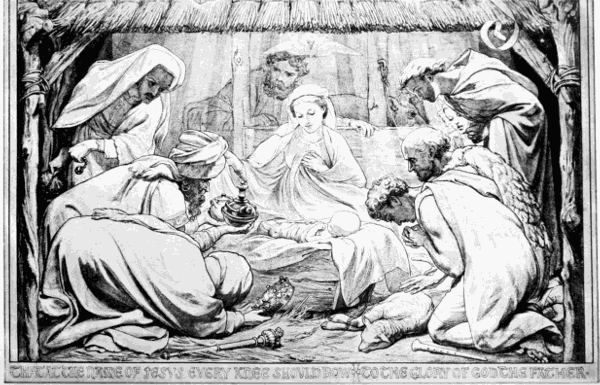 THAT AT THE NAME OF JESUS EVERY KNEE SHOULD BOW