waggon drove to the
great pit dug in the clay—not
common clay, but
such as china vessels are
made of. A man with an iron spade
jumped from the waggon; he entered
the pit and began to dig the clay.
After the first stroke of the spade a
little lump fell out of the native
ground, and with a bitter, plaintive
murmur rolled down. Nobody heard
the murmur; it seemed to the workman
that the Lump in rolling down
made a slight noise, whereas it was
groaning: it was hard to be torn away
from mother earth. 'All is over,' it
whispered; 'oh, how hard it is to live
in the world!'
The workman took it up on his
spade with the other clay, and threw
it into the waggon. 'Oh!' groaned
the bit of clay from pain, as it fell on
the bottom of the waggon; 'not only
was I torn away from my mother, but
thrown far away from her. Alas! is
there any one more unhappy in this
world than I? I should like to die!'
But the Lump did not die. The
workman had soon filled up his waggon,
jumped in himself, and drove
away, carrying it to the china factory.
It was pretty well while they were
going along an even place, but when
they went down a steep mountain-side,
the horse ran fast, and our Lump was
jolted, thrown from side to side, and
knocked against the waggon. Nor did
all its torments end then. As soon as
it was brought to the china factory, it
was thrown with other clay into a large
tub with water in it, and it felt with
horror how it began gradually to get
soft, and to be transformed into a sort
of soft mud. It had no time to
recover, as it was taken out with a
great ladle and poured somewhere—it
was into the funnel of the great
millstones. The driver shouted, the
horses went on, pulled one end of a
bar, which was fastened by the other
end to a big axle standing erect in the
middle of the great millstones; the
bar again turned the axle to which the
upper millstone was fastened, and the
millstones began to grind the water-softened
clay, crushing its smallest
particles. Our Lump no longer existed,
but all its little particles which
before formed it were now like clay-jelly,
and kept close together.
Ah, how they suffered! The awful
millstone pressed upon them with
its whole weight—squeezed, flattened,
ground them. They shrivelled, groaned,
cried from pain and said: 'Oh-o-o!
what a torture! it is all over with us!'
But that was not all. After the
grinding the clay-jelly was poured by
means of gutters into the empty wooden
tub to settle. There the hard particles,
heavier than water, sank.... On the
bottom was the sand, next the reddish
clay, mixed with iron-rust, then the
coarser parts of the white clay, and
finally its lightest particles, quite free
from all other mixture. All the particles
of our Lump happened to be of
the same weight and to be nicely
ground; they sank together and
formed again the same Lump, only
soft, delicate, and free from all unnecessary
admixture. It was very
nice, of course, but the little Lump was
so tired from all it suffered, so exhausted,
that it did not wish to live
in the world. 'I would rather death
would come!' it said.
Death, however, did not come. A
workman came instead, poured off the
water which was on the surface of the
clay, cut the clay to the bottom, separated
it into layers, and assorted them,
so that the upper, more delicate layer
was for the best china vessels, and the
lower for the coarser plates. As our
Lump was in the upper layer, it was
taken to a workman who made the
finest vessels.
The workman took our Lump, put
it into the middle of a round table
which turned on its centre, made this
table spin round with his feet, and at
the same time pressed the clay here
and there till he had made a coarse
cup without a handle. The workman
then, with an instrument like a knife,
began to turn the cup, till it became a
fine, fine one. He then handed it to
his neighbour, who put a nice little
handle to it. 'Well,' thought the
Lump, transformed now into a cup,
'it is not so bad. I suffered indeed,
but what a beauty I am now!' ...
and the Cup looked self-contentedly
around. She did not rejoice long.
She was soon put with others into one
of the pots of particular form called
'muffles,' and the muffles were put
into a furnace, which began to heat
the Cup by scorching degrees to make
it red hot. 'Oh, how hot it is!'
stammered the poor Cup, perspiring,
crying, and groaning at once. 'Oh,
what a torture! Oh, how hard it is to
live in the world! I should like to
die!'
Still, she did not die. She was
taken from the furnace, watered with
a certain mixture, burnt once more. A
charming bouquet and garland were
then painted on her, and the Cup did
not recognise herself. 'Ah, how happy
I am!' said she to herself; 'it was
worth while to suffer all that I suffered.
I am the most beautiful here, and
there is and will be no one happier.'
Very soon the Cup went from the
factory to the shop. She was delighted
to see the fine hall with large
windows and nice glass cases. She
enjoyed the society of china cups,
teapots, plates, and all sorts of most
beautiful things.
'Here,' thought she, 'they can
appreciate my beauty!' and she immediately
addressed her neighbour, a
big, round teapot: 'Please, sir, have
you been long here?'
'Yes,' answered the teapot gruffly,
knocking with his coarse lid.
'And do you think there was ever
before a cup with such fine ornament
and delicate painting as I have?'
'Ho-ho-ho-ha-ha!' ... laughed the
big teapot. 'Just listen!' shouted he
to his companions, as big and coarse
as himself; 'this damsel is asking
whether there is in the world a
beauty like her?... O-ho-ho-ho!'
'Ha-ha-ha-ha-ha!' burst all the big
teapots in laughter, holding their sides
with their handles.
Our Cup was offended, and ashamed
to tears.
'What are you laughing at?' whispered
she in confusion.
'And how can we help laughing?'
exclaimed her neighbour; 'you think
too much of yourself; and what are
you good for? To spend all your life
on some nice shelf; you need cheapness
and solidity to be of some use.
And as for your ornament, look to
your right, on the third shelf; there
are more elegant ones there than you!'
The Cup looked to the right, and
would have grown green from envy if
she could have changed colour. There
were standing fine cups on small feet;
such delicate, fine cups, like white, pale,
and pink rose petals! ... the beautiful
bouquets, the prettiest heads, the
finest gold lace, with black and green
ornamentation, were painted upon
them. These cups were also proud of
their beauty, and as they were more
beautiful than their new companion,
they looked at her with contempt and
haughtiness.
In the china factory the Cup thought
herself the most beautiful in the world,
and was quite happy; and now she
was forced not only to acknowledge
that there were more beautiful ones,
but to listen to the mocking words
and endure the most offensive looks.
Envy, vexation, shame, tormented her,
and she would fain run away somewhere,
yet she could not move from
the spot. This helplessness added
still to her pain and anger. She would
like to have sunk into the earth.
'Ah,' thought she, 'why did I not
die before! Why does death not
come now!'
Death did not come, however. The
shop door opened, a fine lady, with a
richly-dressed young girl of about ten
years of age, came in.
'We want a nice cup, not too expensive,'
said the lady to the shopman
at the counter.
The shopman took our Cup and
some others from the shelf and put
them on the counter. Oh, what our
Cup felt at that moment! She was
displayed with half a dozen of her
companions, every one of whom
thought herself more beautiful than the
others, and was proud of it. Suppose
these elegant purchasers should give
the preference not to her, but to one of
her conceited companions? She felt
as if on burning coals. The little girl
stretched her hand to one of our Cup's
neighbours, and the Cup trembled
with anxiety. But the little purchaser
only touched the rival of our Cup and
finally took the latter. 'This one,
mamma,' said the child, and the
mother bought her. Oh, with what a
pride shone now this plaything, and
how haughtily she looked at her companions!
Her beauty is now openly
acknowledged; she is preferred to
others! She was bright with happiness,
and slightly trembled when the
shopman took her from the counter to
wrap her in paper.
'Ah, how happy I am!' said the
Cup in the evening, when fragrant tea
was poured in, and all who were sitting
at the tea-table admired her; 'of
course there is and will be nobody
happier than I.'
Just at this moment the pretty little
girl who had chosen her at the shop
came running in from the garden.
She was very thirsty. She seized the
Cup and took a sip at once, notwithstanding
that they cried to her that
the tea was too hot. The Cup certainly
was not to blame that the girl
from her own carelessness had scalded
her mouth, and the girl treated her
unjustly. 'Oh, you nasty Cup!' cried
she, and threw her to the floor.
Crash! ... and the pieces of the poor
innocent Cup tinkled plaintively, and
drops of tea, like big tears, trickled on
to the floor from her. The footman
came, gathered the pieces of the
broken Cup and threw them away
into the backyard on the rubbish heap.
There she was with the bits of old
leather, broken glass, rusty pieces of
tin, and a pair of decaying cucumbers.
She shivered from contact with the
dirt, which she had never experienced
since she was a nice cup, and she felt
sick from the unpleasant odour. 'Oh,
how unhappy I am!' said the broken
Cup. 'All is over. I have nothing
to expect from life. I have only to
die!'
The Cup did not lie long in the
rubbish heap. Early, early the next
morning, when all were yet asleep in
the house, there came into the backyard
a poor, wrinkled, dirty, ragged,
old woman. She had on her back a
bag, and a big stick with a hook on
its end in her hand. She was a rag-gatherer.
She dug into the heaps
with her hook, picked out of them the
bones, rags, paper, nails, pieces of glass,
and such things thrown away as
seemed to the poor woman of some
use. After having filled up the bag,
the rag-gatherer went home, sorted its
contents, and then took the bones to
the shoeblacking maker, rags and
paper to the pasteboard maker, the
iron to the dealer in old iron, and the
glass to the glass factory. All these
places were far from each other and
from her lodging, and the poor woman
was exceedingly tired in going from
one place to another. She gained
thus a few copecks,[1] without which
neither she nor her sick granddaughter
would have had anything to eat. On
the following morning the old woman
went again to dig among the heaps.
Coming near the rubbish heap where
the broken Cup was lying, the woman
began to work with her hook, seeking
with her old, tearful, short-sighted eyes
something worth having. She had
already dug up all that she wanted,
when her hook struck against something
hard; the old woman knew by
this sound that there was something like
glass in the heap. She stooped down
and took up a fragment of the Cup with
a nice nosegay on it.
'What fine flowers!' whispered she;
'I will take it home for Mary—a nice
plaything for her—I must take it.'
The good old woman smiled, as she
thought of her beloved granddaughter,
called Mary. She began to search
again among the rubbish, and found
that there were many fine pieces, and
those not too small. 'Oh, the pieces
are all here,' said she; 'it is possible
perhaps to cement them together.'
And taking all the bits she put them
by themselves into the pocket of her
worn-out petticoat.
It was as dark as in a cellar in
the pocket of the old woman, and as
oppressively warm as in an uncared-for
hospital-room in summer; there
were besides an old onion and the
crumbs of spoiled, ill-smelling cheese.
The broken Cup felt still more sick at
heart than before; she shivered; her
broken pieces tinkled plaintively at
every step the woman took, and she
thought, 'Oh, what suffering! I should
like to die!'
She did not die. It was light when
the old woman came to a large brick
house six stories high, near a market-place,
in a narrow, dirty lane. She
entered through a dirty passage the
courtyard, surrounded on all sides
with buildings, passed through a
gloomy basement door down to the
ground-floor, where her lodging was.
It was a dark, cheerless room, with
small windows high above the brick
floor. In every corner of the room
there was a whole family of beggars.
The old woman approached a heap
of rags, groaning, removed from her
shoulder the bag with her day's gains
in it, and sat down on an old pine
candle-box, turned upside down, near
the rags; she then took from her
pocket all the pieces of the Cup, and
put them on another box which stood
there for a table. The first thing our
Cup now heard was a harsh, noisy
scolding from the farthest corner of
the room; everybody in this beggars'
haunt was so accustomed to it that
nobody paid any attention. 'Oh,'
thought the Cup, 'this is too much!
In what company am I! What rough
people there are! Oh, there is surely
nobody in the world more unhappy
than I! I would like to die as soon
as possible!'
The rags in the corner now moved;
under them was lying the sick, sallow,
emaciated darling of the old woman.
She looked at her grandmother with
her wearied eyes, and nothing interested
her.
'Here is a piece of pryáneek, Mary,
which I brought for you,' said the
old woman, taking out a piece of
pryáneek, which she had bought for a
copeck.
This was a cake of white, stone-like
consistency, supposed to represent a
horse, though it may be doubted
whether four stumps instead of feet,
a gilded head and a crimson tail, would
give a really good idea of one. There
was indeed enough flour in it, but
little sweetness; still it was a thing
as much to delight the heart of a
Russian child as a gingerbread cat
to rejoice the heart of an English
one.
The girl looked at it, but shook her
head, and did not eat it; she did not
even touch it.
'Why don't you take it, Mary?
Do take it, dear, such a nice piece
of pryáneek; look!'
And the grandmother held up the
present, turning it round to show all its
beauty. The girl looked up once more
at the cake, and then at her grandmother,
without moving her head.
'I am so sore!' she whispered
feebly.
'What ails you?' asked the old
woman.
'Everything ails me,' said the sick
girl softly, and two big tears rolled
slowly down her cheeks.
The broken Cup looked at all this,
and was very sorry, and her pieces
tinkled plaintively together, and then
she felt ashamed that she had thought
herself so unhappy while there was in
the world plenty of sorrow far greater
than her own. The girl heard the
tinkling, and silently looked up to see
what it was that was tinkling so on
the box. She noticed the beautiful
flowers on the broken pieces of the
Cup; her eyes brightened by degrees,
and she whispered softly:
'Give it to me, grandmamma.'
'Take it, take it, darling! I brought
it home for you.'
Mary took the pieces in her hands,
trembling from weakness, and began
to turn them over and over, admiring
them. She had never any playthings,
and therefore the pretty pieces seemed
to her so much the finer. The more
she looked at them the more her eyes
brightened, and at last she smiled.
The old woman had not for a long
time seen such an expression of
pleasure on the worn-out face of her
poor granddaughter, and the feeble
smile of the sick child rejoiced her
to tears.
'Oh,' thought the Cup, 'I never
expected to give to any one so much
pleasure after having been broken to
pieces! And I am happier, indeed,
than I was in the rich house where
everybody at the tea-table admired
me!'
'Mary, you know, we shall cement
the cup; indeed we shall do it! It
will be a pretty cup,' whispered the
old woman.
Mary became more cheerful, and
the Cup thought: 'Ah, it is possible I
am really good for something! It
seems to me I was in too great a
hurry to die; it is worth while living
in the world.'
On the next day the old woman
came home after her day's work with a
little toóyes, a sort of cylindrical vessel
of birch bark, in which there was a
handful of curd and an egg. These
she had received from some kind-hearted
cook.
'You see, Mary, we are going to
cement the Cup!' said she, sitting
down on her box.
Mary had been groaning and fretting
all the day and night, but now
she smiled again. The old woman
broke the egg, poured it into an old
wooden basin, placed on the box some
curd, mixed lime with it, and, kneading
all together with the white of egg, she
made a thick cement. Smearing the
edges of the pieces of our Cup with the
mixture, the old woman pressed them
together, and placed the Cup carefully
in a hot oven, that the cement might
harden and become proof against water
or anything else. It was hot in the
oven for the Cup—dreadfully hot! but
she was ready to suffer anything to be
the same complete beautiful cup as
before. 'Oh, how happy I am!' thought
she, awaiting with inward trembling the
end of her trials in the oven. 'All is
going on well; I will live again!'
Mary in the meantime grew worse:
she fretted, groaned, and complained
with bitter tears.
'Oh, grandmamma, how I ache!
how I ache!'
'Oh, my poor darling!' said the
old woman, sobbing, while hot tears
rolled down her wrinkled, unwashed
face; 'I cannot tell what to do for
you, my dear pet.'
In the same room with the old
woman, in another corner, there lived
a beggar, an old discharged soldier of
the time of the Russian Emperor
Nicholas, when the discipline was so
inhumanly severe and the term of service
lasted a whole quarter of a century!
He had been in the wars,
fought bravely, and now he was quite
alone in the wide world. The bullets
were still in his body, old age prevented
him from working, and he was obliged
to get by begging here and there a few
copecks. He became accustomed to
sorrow; but now it grieved him to see
the misery of the old woman and the
sufferings of the little girl.
'You are foolish,' said he to the
old woman; 'why do you cry, as if
the child was dying? You must not
do it! Go rather for the physician.'
'Will the physician come?' exclaimed
the old woman. 'You are
indeed like an innocent child, Nikítich.[2]
Will the physician come to such a
dirty place?'
'And why should he not come?
One will not come, another will not
come, but some one perhaps will come
at last. There, I know a physician,
Kótov, a nice gentleman! He always
gives me a glass of tea and five
copecks. He will not let me go without
giving me something. "How do
you do, Nikítich?" says he always to
me. I tell you, go to him. Ask him;
you needn't care.'
'Yes, at his home he will receive
me perhaps, but he will not come here.
No, we have nothing to do with physicians.
I cannot afford to buy medicine,
and very likely they will not even let
me into the house. No, I dare not.'
'Well, if you dare not, I will go
myself.'
At these words the old wounded
soldier took his stick and hobbled
away to the physician's.
The physician did come. He was
a very good man, only he had the
habit of speaking in an angry tone
and even shouting, so that some were
afraid of him. He examined the girl
a long time, put his ear to her back
and chest, tapped both with his fingers,
spat in disgust, and complained angrily
of the dirt and unwholesome air of the
room. He ordered that nothing but
broth be given to the girl, wrote a prescription
on a bit of paper, and said
that the medicine would be given
gratuitously at the apothecary's.
In the evening the old woman
brought the bottle with the medicine,
poured some into a wooden spoon and
presented it to her granddaughter.
The girl shook her head feebly and
turned away. She was afraid of the
medicine; she thought it was something
so disagreeable, and for nothing
in the world would she take it.
'Ah me!' said her grandmother,
sighing, 'why won't you take it? It's
too bad! What will the physician say?
He ordered it and you will not take it.
Wait, you will see what will happen to
disobedient children!'
The girl was frightened; she began
to sob, and when her grandmother
offered her the spoon, she covered her
mouth with her hand and hid her face
in her pillow.
In the morning the old woman took
our Cup out of the oven. Oh, how
glad was our Cup when the old woman,
looking all over her, said to herself,
'Oh, I see it is as good as new now!'
Just at this moment Mary called for
her grandmother and asked for a drink.
The old woman went with the newly-cemented
Cup for some water, and as
she held her hand over the tub, the
Cup saw herself in the water as in a
mirror. Alas! what did she see there?
In many places were ugly cracks; the
cement, applied by an unskilful hand,
formed spots and patches. 'Oh,'
groaned the Cup—'oh, how ugly I
am! It would have been better for
me to perish in the rubbish heap.
Ah, now I would like to die as soon
as possible!'
She did not die, however. The old
woman was obliged to put her in haste
on the window-sill, for just then the
physician entered the room.
'How many spoonfuls of medicine
did she take?' asked he angrily.
'She did not take any at all, sir.
What shall I do with her? Such an
obstinate, silly girl; she is not willing
to take any; what shall I do?'
answered the old woman.
'What? How does she dare?
What does she mean? Give me the
spoon!' cried the doctor.
At these words Mary screamed, her
eyes opened wide from fear, and she
covered her head with the bedclothes.
The doctor turned once more to the
old woman.
'And did she take the broth?' he
asked.
'But, my good sir, where should we
get money for the broth?' said the
rag-gatherer, with tears in her eyes.
'Well, why did you ask me to come
if you did not intend to do what I
ordered?' He then took at once a
crushed three-rouble bank note from
his pocket, threw it angrily on the
box which served as a table, and
turned away. When he reached the
door he turned his head, and, flushed
with excitement, said:
'All the medicine must be taken by
to-morrow, and the broth must be
ready, and that's the end of it!'
When the old woman saw the three
roubles in her hand she could hardly
realise her good fortune and believe
in her happiness. Just think, three
roubles! For three years or so she
had never had more than thirty copecks
at one time, and now she had three
roubles!
'God grant you every happiness,
our benefactor!' repeated the poor
woman over and over again.
As for Mary, she grew worse and
worse. She groaned, her dilated eyes
shone with the fire of fever, her lips
became parched and black.
'Oh, you little dove, do take the
medicine, and you will feel better,'
entreated the old woman; but Mary
obstinately refused to take any. Seeing
the sufferings of the poor girl, the
rag-gatherer suddenly clasped her gray
head with her hands.
'Oh my God! what am I to do with
her? what am I to do with her?'
wept she in despair. 'She will die, I
am sure, through her own foolishness.
How hard it is to see her suffering
just because she will not take a little
medicine.'
The Cup saw and heard all this,
and once more she felt ashamed of
having thought herself unhappy for
not being as beautiful as formerly.
'Is this misery?' thought she now
of her own appearance; 'there is
misery indeed!' and the little Cup was
herself ready to cry for pity. In the
meantime the poor woman dried her
tears and approached her sick grandchild.
'Do you know that I have mended
the little Cup?' she said.
The face of the little girl brightened,
and a faint smile played upon it.
'Let me see it,' lisped she.
The grandmother showed her the
little Cup, and Mary's face expressed
as much rapture as if she saw some
masterpiece of beauty. The poor
child had seen during her life so few
beautiful things, that the mended Cup
with the pretty nosegay on her transported
her with delight.
'And wouldn't you take the medicine
out of the Cup?' asked the old
woman, in an uncertain, coaxing tone
of voice.
The girl made no reply, but smiled
again.
'Well, will you take it out of the
pretty little Cup?'
'I will,' answered Mary, in an
almost inaudible voice.
The little Cup was standing at that
moment on the window-sill, and was
trembling with joy; hitherto no one
had loved her so deeply as Mary did.
Was it not for her sake alone that
Mary consented to take the medicine?
Perhaps the little girl will recover;
perhaps she, the Cup, will have saved
a human life. 'Oh, what a beautiful
thing it is to live,' said the Cup to
herself; 'never before was I so
happy!'
It was a glorious summer day when
Mary went the first time after her
dangerous illness to take breath in
the open air. She was still thin and
pale, but her large eyes were bright,
and she looked happy. She was sitting
in the nearest square, under a big
green tree, with her Cup in both her
hands. The little girl was evidently
eager to have the Cup always with
her; she would not part with her
treasure. The Cup felt herself also
happy—nay, happier than ever—although
she was now broken and
spotted with ugly cement patches.
She was happy and proud to be the
best friend of the little Mary whom
she had helped to restore to life and
health.
HOW SCARLET-COMB THE COCK DEFENDED THE RIGHT
LL this happened long, long
ago, in the days when
birds and beasts could talk
in human speech, and the
Polish magnates went about in long
'kountoushi'[3]—coats embroidered with
gold and silver, with sleeves slung on
behind—and possessed serfs. Perhaps
you do not know what a 'serf' was in
the old times? Well, a serf was a
person just like the rest of us, only he
was bound to the land by law; he
had not the right to go and live in
any other place, and if the land was
sold, he was sold with it; he tilled
the land, though not for his own profit,
but for the profit of the landowner.
It was not only in Poland that there
used to be these serfs and landlords
who owned them, but in all countries—in
ours as well as every other; and
everywhere the serfs had a hard time
of it. Those landlords who had any
conscience and commonsense, and who
were not in any great need of money,
made their serfs work for them a certain
part of their time, and bring them
eggs, flax, etc.; the rest of their time
and goods the serfs could dispose of
as they thought fit. Others regarded
their peasants as beasts of burden,
belonging to them body and soul; they
forced the peasants to work for them
as much as was possible, and thought
they had a right to all the peasants'
property. But whether the serf-owner
was personally good or bad, it was a
loathsome thing in itself that one
human being should own another.
One day a Polish 'Pan' (nobleman)
of this kind was riding through
a village on his land. The green
sleeves of his bright-coloured koúntoush
streamed back from his shoulders,
fluttering in the breeze; his fine dappled
horse stepped impatiently under its
rider, tossing flakes of white foam
from its mouth; and Pan Podliásski
himself glanced haughtily to the right
and left. The wretched, bare look
of the peasants' huts and ruinous
farmyards did not distress him at all;
in Pan Podliásski's opinion a serf was
a serf for nothing else but to be
always ragged, dirty, and miserable.
Suddenly, as he passed one of the huts,
the landlord raised his eyebrows in
angry surprise; in the bare and filthy
yard stood a first-rate grindstone.
'Where did a rascally serf get such
a capital grindstone?' he thought; and
turning to his steward, who was riding
behind with two or three noble retainers,
he asked: 'Whose yard is this?'
'Stanislas Kogoútek's, most illustrious
Pan,' respectfully answered the
steward.
'Why is the grindstone here?'
'It does not belong to the manor;
we have not such a good grindstone,'
replied the steward, understanding the
mistake of the magnate, who supposed
the grindstone to be his, and to have
come into the peasant's yard by chance.
'Here! Khlop!' (serf!), cried Pan
Podliásski.
A middle-aged peasant, bareheaded,
barefooted, and wearing nothing but
a shirt and trousers of coarse sacking,
ran out of the hut at this summons.
He approached his master, bowing
humbly, fell on his knees before
him, bowed to the ground, and, rising,
kissed his stirrup, after which he
bowed again.
'Whose is the grindstone?' asked
the landlord, frowning.
Kogoútek's terror increased, and
his eyes glanced round in agitation;
he realised how foolish he had been
not to hide the grindstone from his
master's eyes.
'Whose is the grindstone, psia
krew?'[4] cried the magnate angrily.
'Mine, most illustrious Pan,' answered
Kogoútek, trembling with fear.
'How dare you, you rascal, when I
myself haven't such a grindstone, the
steward says?'
'I earned it, please your honour,'
stammered Kogoútek faintly.
'Earned it.... What next!' exclaimed
Pan Podliásski, amazed at
the peasant's insolence, and reddening
with anger. 'How dare you say that,
when you yourself are my property,
not only all your work; do you hear,
you dog? Take it up to the manor,
and give this scoundrel a good lesson,'
he added, turning to the steward.
The unfortunate peasant knew what
a 'good lesson' meant, and flung himself,
with a piteous cry, at the feet of
his master's horse. But the magnate
shook the reins and galloped off with
his followers.
The next morning the grindstone
was transferred to the manor yard, and
the wretched Kogoútek was flogged in
the manor stables.
Humiliated, crushed under the sense
of injustice and lacerated with the whip,
the unhappy peasant crept home and
sank down on a bench with a groan.
'What is the matter with our master?'
asked the young cock, Scarlet-Comb, of
his mother, as they strolled about the
yard with the white hen Top-knot and
the old cock.
'Why, didn't you see that they took
away the grindstone that he had worked
so hard for, and then thrashed him for
nothing besides?'
Scarlet-Comb was still a very young
cock; his grand tail-feathers had not
yet grown, so he did not know how
cruel and unjust people can be. His
mother's words showed him this for the
first time. He spread his wings and
craned his little neck as if he would
shout out what he had just heard to
all the world; but a spasm in the
throat prevented him from uttering a
sound. When, however, his first burst
of grief and indignation had somewhat
abated, he again appealed to his mother.
'Well, and what will happen now,
mother?'
'What? Why, nothing. Pan Podliásski
will have the grindstone, and
our poor master will have his bruises—that's
all.'
'What! And no one will stand up
for the right?'
'Oh, my child, how recklessly you
talk!' hurriedly whispered the old
hen. 'Supposing any one should
overhear you, what then? Why, they
would think you a rebel!... What
is the use of talking about "right"
and "standing up" when Pan Podliásski
is a great lord, with fifty horses in his
stables, and hundreds of servants at his
bidding, while our master is a poor
peasant, wearing himself out with
work!'
'Well, then, I will take our master's
part! I will get justice done!' cried
Scarlet-Comb.
'Hush, you silly child!' answered
his mother more anxiously than ever,
and gently seizing his comb with her
bill. 'What else do you imagine you
can do? You would like to set the
whole world to rights, no doubt!'
'The thing is impossible!' cried
Scarlet-Comb, and turning to the old
cock, he added: 'Am I not right,
father?'
The old cock majestically raised his
head, stood on tiptoe, flapped his
wings, and shouted at the top of his
voice: 'Cock-a-doodle-doo-oo!...'
then stooped down, and betook himself,
with a hurried business walk,
to the other end of the yard, where
he stopped beside a squashed worm.
Every one could interpret his expression
of opinion according to their personal
taste: the mother was convinced
that he was setting their son an example
of thrift and good sense; the
son, that the patriarch's martial air and
cry were intended to spur him on to
prowess. Without any further question
Scarlet-Comb flew across the fence,
and made straight for the castle of
Pan Podliásski.
Pan Podliásski was not alone. As
he had to send to several very distinguished
neighbours invitations for
the next day's banquet, and as, like
most of his peers in those days, he
could not read or write, and considered
it humiliating to do anything for himself,
he had sent for his chaplain, and
commissioned him to write the invitations.
The chaplain had finished
writing the letters, and it only remained
to stamp upon them, instead of a signature,
the crest of the house of
Podliásski. The magnate took off his
signet-ring, which he wore hung round
his neck by a gold chain, and handed
it to the chaplain to be pressed upon
the wax. At that moment there
appeared in the open window, from
which the magnate and his chaplain
were divided by a large table, an ugly
little cock.
'Pan, give back the grindstone!' he
cried.
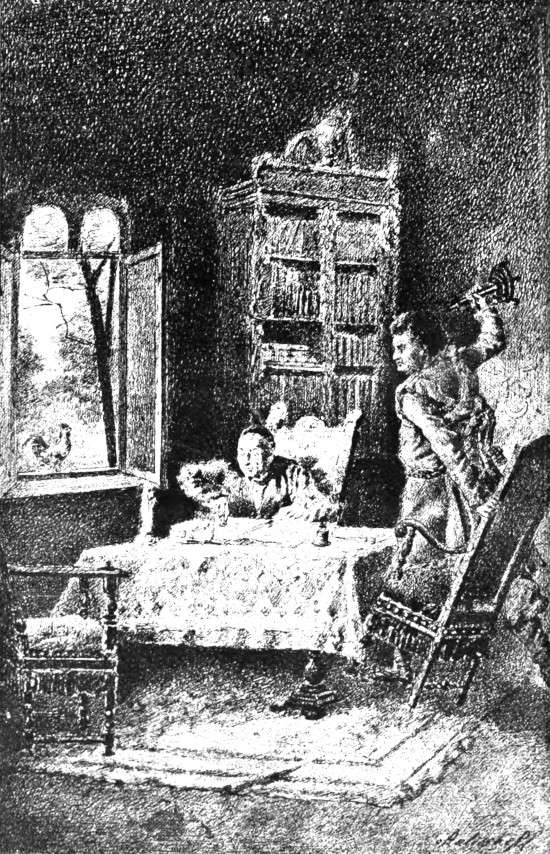
Reddening with anger, the magnate
raised his eyes to the insolent fowl,
and seizing a heavy silver candlestick,
flung it violently at him. All happened
so quickly, that before Scarlet-Comb
had time to understand anything,
his wings had carried him from
the window and his quick little legs
from the garden.
When he came to his senses, Scarlet-Comb
was quite ashamed. 'Can it
be that I was frightened?... it is
impossible!' he thought. But the
fact was plain; he had lost his head
and run away from the landlord.
'Well, and what of that?' said the
cock, consoling himself; 'the important
thing is not to stand like a log
while things are thrown at you that
may smash your head, but to get
justice done!'
And Scarlet-Comb once more made
his way to the castle.
Pan Podliásski was standing on the
front terrace among his retainers and
domestics, giving orders for to-morrow's
banquet, when he suddenly heard the
already familiar words:
'Pan, give back the grindstone!'
Scarlet-Comb was standing perched
upon the nearest post, to which several
horses were tied.
The magnate became positively frantic,
clenched his fists, and shouted
to his servants to set all the hounds
upon the insolent bird. The cock,
terrified, rushed with all his might out
of the garden. On he ran, helping
himself along with his wings, and hearing
how one dog was gaining on him....
Now it was quite near ... snap!
and tore the very best feathers out of
the cock's tail. In his desperation
Scarlet-Comb made one last effort,
flew up as high as he could, and
perched on a tree by the wayside.
The dog stood underneath, barking
and whining, but, fortunately, the
hunting-horn blew, calling back the
scattered dogs, and his persecutor was
obliged to go to kennel.
Meanwhile a discussion was going
on in the yard between the servants
and noble retainers.
'What a plucky little cock!' said
some; 'wasn't afraid to tell the Pan
himself the truth to his beard!'
'If I had him, I'd show him what
truth is—with white sauce,' said the
under-cook, laughing.
'Just think,' remarked another; 'if
a silly little chicken like that can see
that a Pan shouldn't take away a poor
man's things, it must be a bad business
after all.'
'Yes, it's a mean trick,' muttered
one of the nobles, frowning.
Early next morning Pan Podliásski's
guests began to arrive. Dear me,
how gorgeous they all were! Satin,
velvet, brocade, in the most brilliant
colours, simply dazzled your eyes on
their kountoushi, zhoupány (doublets),
and trunk hose. Their elegant caps
were bordered with valuable furs; both
lords and ladies were adorned with
ostrich feathers, pearls, gold, silver,
and precious stones. Magnificent
horses of all colours pranced under
their graceful riders, who surrounded
the clumsy but richly-decorated coaches
in which the fair ladies sat. Often,
on the way, the gallants would bend
towards them and exchange merry
jests. The innumerable apartments
of the castle were thrown open for
the crowd of guests.
For dinner all the visitors put on
other still more gorgeous dresses. A
gallant was placed at the right hand of
each lady. At the head of the table
sat the host, beaming with pleasure
and satisfaction.
The long dinner was almost ended.
The guests had feasted upon a wild
boar, which Pan Podliásski had killed
in the chase, and which the cook had
roasted whole and cunningly arranged
standing erect upon a silver dish.
The dessert was already finished; the
noble retainers in their gala dress had
carried round to the guests old mead
of the finest quality, and German and
Hungarian wines. The company was
lively and merry. A handsome young
nobleman stood up at the foot of the
table. He had lately returned from
France, where, at the king's court, he
had grown accustomed to refined
manners and courtly ways. Raising a
golden goblet of wine in his right
hand, and glancing round, he addressed
the company:
'It is not the gratitude of a guest
which persuades me to lift this goblet,
nor even the courtesy of a Pole. No;
I lift it in honour of our well-beloved
host, because by his virtues Pan Joseph
Podliásski is an ornament to the ranks
of the Polish nobility. Courageous
in war, generous and hospitable in
time of peace, he is incapable of any
action unworthy of his noble standing.'
Every one listened to the orator
with evident pleasure. Pausing a
moment for breath he would have
continued, when suddenly an ugly
little cock appeared at one of the open
windows of the banqueting-hall, and
cried aloud:
'Pan, give back the peasant's grindstone!'
The guests, startled and confused,
sat whispering to one another. The
young orator hesitated whether to continue
his speech or not. The host
grew first white, then red, and turned
to his servants.
'Why do you stand staring?' he
cried. 'Do you suppose that is what
I maintain you for, that village fowls or
cattle should disturb the pleasure of
my guests?'
Then, turning back, Pan Podliásski
tried to put on an airy manner.
'Excuse us, dear guests,' he said;
'the country is the country after all.
We are not in Cracow, where fowls
appear at noble banquets only on silver
dishes or in the soup. Still, one can
be as merry in the country as in
Cracow, and I hope we shall prove it
to be so.'
For all that, the magnate did not
really feel at all so merry as he tried
to appear; the guests, too, were no
longer quite at ease.
'What's that about a grindstone?'
many of them asked their neighbours;
and those who had already heard from
their servants about the persistent fowl
related the history of the grindstone in
a few words. A contemptuous expression
appeared on many of the faces;
and those magnates who disliked Podliásski
went so far as to remark that it
was unworthy of a great lord to soil
his hands for a miserable grindstone.
All this did not escape the eyes of
Pan Podliásski, and his blood boiled.
Seizing a favourable moment, he
beckoned to his most trustworthy servant,
and, in a whisper, ordered him
to find the cock, alive or dead. For
that matter the servants had already
been hunting the whole court and
garden, but nothing came of it; the
cock had long ago made his escape;
and, hiding in the foliage of the highest
tree in the neighbouring forest, waited
till the danger was over.
The guests left earlier than they
had intended. Pan Podliásski, standing
on the great terrace to take leave
of them, tried to conceal his annoyance
under an affable manner. As
soon, however, as the last rider disappeared
from sight, his face grew dark,
and he turned to the crowd of servants.
'Where is Doubinétzki?' he asked.
'Here I am, most illustrious Pan,'
replied a warrior with gray moustaches,
stepping forward.
'Look here, my faithful Ignatius;
you have served me long and well;
do me one more good service. Shoot
that tiresome cock that gives me no
peace.'
The honest face of the old nobleman,
seamed with the scars of war,
lighted up with an ironical smile, and
his daring eyes flashed.
'Probably the Pan Voevoda has
had too much to drink at dinner
that he gives me such commands,'
said he. 'How am I, Ignatius Doubinétzki,
who have fought in fifty battles
against Tartars, Turks, and Swedes;
who last year, without assistance, drove
away a whole marauding band of Tartars,
and who in honourable combat
have cut off the head of Akhmet Khan
himself,—how I am now to go to war
against barn-door fowls? No; I am
a poor nobleman, and the Pan is a
great magnate; but our honour is the
same. Indeed, since it has come to
speaking truth, perhaps I have more
in the way of honour than the Pan;
with all my poverty I would have been
ashamed to covet a peasant's grindstone.
And if you want a word of
honest advice from old Doubinétzki,
here it is: Leave that sort of thing
alone, Pan Voevoda; it's not an
honourable business.'
For some minutes Pan Podliásski
could not believe his ears. But at
the close of the old man's speech he
turned white with rage, drew his sword
from its sheath, and made a dash forward
at Doubinétzki.
'Seize him! bind him! cut the
rebel down!' he shrieked in frenzy.
But it had all happened so suddenly
that for a moment no one obeyed the
magnate, or could decide what to do;
all the more so as every one loved old
Doubinétzki, and knew what a glorious
fire-eater he was.
Old Ignatius, meanwhile, in his turn
unsheathed his sword, sprang on to
his horse, which stood ready saddled
beside the gate, and galloped away
unharmed. He was a free gentleman
and a first-rate warrior, and any magnate
would be glad to take him into
his service.
Utterly beside himself with fury, Pan
Podliásski went into the castle, and
shut himself up in his bedchamber.
He paced up and down with long
strides, brooding over all that had
passed. The thought that a good-for-nothing
little fowl could embitter
his life made him frantic. He was
ready to instantly call up all his
retainers, and give them strict commands
to secure the cock, alive or
dead. But then he remembered the
whispering of his guests at dinner, the
furtive glances of his servants, and the
open rebellion of Doubinétzki. What
was the use of commanding? Would
he not be exposing himself to new
failures, to new humiliations? And
all this was the work of that cock!
Pan Podliásski felt as if he were
stifled in the room, and went out into the
garden. The barrels of pitch which
had illuminated it during the banquet
were almost burnt out; the pathways and
arbours were deserted. Pan Joseph
walked along several avenues, and then
lay down upon a bench.
'Pan, give back the grindstone!'
suddenly resounded over his head the
hated voice of Scarlet-Comb.
Pan Podliásski started up as if he
had been stung, drew the pistol from
his belt, and fired upwards at random
in the direction of the voice. Directly
afterwards he heard a piteous shriek
from the cock, and a warm drop of
blood fell on to his hand.
'Ah! ah!' cried the magnate in
angry delight; 'now you will leave off
embittering my life, you loathsome
little brute!'
Satisfied and triumphant, he peered
about in the dark to find the cock;
but seeing nothing, lay down again
upon the bench, and soon fell asleep.
Before half an hour had passed, however,
the magnate sprang to his feet
with a fearful cry, clasping his hands
over his left eye. He was conscious
of an intolerable pain, and something
wet and warm and sticky was trickling
down his face and hands. Dazed and
blind, the Voevoda rushed headlong
to the castle. Suddenly behind him
there rang out the well-known cry:
'Pan, give back the grindstone!
give back the peasant's grindstone!'
'Holy Virgin! The creature has
pecked out my eye,' thought the landowner
in horror, and it was only then
he vaguely understood that he had
not killed, but merely wounded, his
persecutor.
Pan Podliásski did not confide to
any one the manner in which he had
lost his eye. He said that he had struck
against a branch in the dark. He
further declared that during his illness
every noise disturbed him, and on this
pretext he commanded all the windows
in the castle to be tightly fastened, and
placed sentinels at all the outer doors,
with orders not only to admit no one,
but even to let no one and nothing
approach, neither dog, cat, nor bird.
In reality the magnate was terribly
afraid that Scarlet-Comb would peck
out his right eye too.
The autumn set in. The stone
castle was damp, cold, empty, and
dreary. Its master, with a bandage
over his left eye, sat in the huge
dining hall, with its richly-carved oak
walls, and warmed himself at the great
open hearth where the embers lay
smouldering and the fire still flickered
in the remains of two logs. Suddenly,
from somewhere in the distance, he
heard a muffled but familiar cry:
'Pan, give back the grindstone!'
In an instant the Voevoda started
up as though he had been scalded,
and shrieked frantically for his servants.
'Search the castle and everywhere
round it instantly,' he ordered. 'There's
a cock somewhere that sets my teeth
on edge with his crowing.'
Fifty Cossack retainers of the magnate,
led by three nobles and about
forty servants under the leadership
of the steward, rushed to fulfil the
Pan's commands. But though they
ransacked all the rooms, corridors,
and doorways,—though they carefully
searched the garden and the courtyard,
they came back and reported to
their illustrious master that not the
slightest sign of any bird at all was
anywhere to be found. This was not
surprising; it did not occur to anybody
to climb up on to the roof; and
there, beside the chimney, sat Scarlet-Comb.
'It must have been my fancy,'
thought Pan Podliásski, and sat down
again before the fire. But just at the
moment when he was half falling
asleep, there suddenly tumbled down
the chimney into the fireplace something
small and black, which instantly
hopped out on to the floor with singed
feathers, and cried:
'Pan, give back the grindstone!'
The Voevoda shrank away from the
fowl in horror. Scarlet-Comb, taking
advantage of his stupefaction, ran
through the rooms, and succeeded in
slipping past the sentinels and making
his way right to the village.
The magnate stood breathless.
'One's not safe from him anywhere,'
he thought; and a sense of dread fell
upon him. He clapped his trembling
hands, and ordered the servant who
came in to fetch the steward instantly.
'Give the peasant Kogoútek his
grindstone back again at once,' said
Pan Podliásski, avoiding the steward's
eyes; 'and give him ten ducats for
compensation.'
The steward would have replied,
but the Voevoda looked at him with
such an expression that the words died
on his lips.
That very day the grindstone was
returned to Stanislas Kogoútek's yard.
Thereupon the little cock, Scarlet-Comb,
although badly scorched, with
blisters on both claws, with his tail-feathers
gone and his wing shot
through, jumped up on to the gate
and, proudly raising his little head,
shouted to all the world:
'Cock-a-doodle-doo! the Pan has
given back the peasant's grindstone!'
THE TINY SCREW
N the watchmaker's bench,
which was covered with
white paper, so that all the
little things needed for his
trade should be easy to see, were
spread out various small pincers,
gimlets, screwdrivers, tiny hammers,
watchkeys, files, and other delicate
instruments. Under a glass case lay
watches and clocks taken to pieces.
There were some open boxes filled
with cog-wheels, and some watch-glasses,
in which lay some wee screws.
Among these was a very pretty one, of
blue, finely-tempered steel, but so tiny
that he could not be seen properly
without a magnifying-glass. He looked
round the workroom quite frightened
at all his new surroundings. Until
now he had lain in a dark, closed box
and hardly had ever seen the light;
now the watchmaker, Karl Ivánovich,
had taken him out of the box and laid
him in a watch-glass, evidently intending
to use him. And now the little
blue mite peered round, wondering
and frightened.
Indeed, what wonder! Round the
walls, in shallow cupboards with glass
doors, in flat cases with sloping glass
lids, on the large table, on the benches—everywhere,
hung or lay or stood
watches and clocks of all kinds and
sizes, and most of them were moving
and ticking like live things. The
cheap clocks with tin or china faces,
decorated with rather clumsily-painted
roses, wagged their pendulums hastily
backwards and forwards, as though
hurrying to work or to business. The
huge clocks in wooden and glass cases,
on the contrary, swung their pendulums
with a hardly perceptible motion,
as though they feared to compromise
their dignity by any haste. All sorts
of wonderful things were on the table.
There was a clock in the shape of a
great fallen tree-trunk, across which a
log was thrown, with boys sitting on
the ends of it, swinging in time to the
ticking of the clock. Another represented
a gray hare squatting on his
haunches, holding the dial between his
forefeet and moving his ears in time as
the clock ticked. But our tiny Screw
was most impressed by a large clock,
standing at one corner of the shop in
a huge glass case. The clock itself
represented an Indian temple with a
dome, all carved in black wood.
Inside the temple was the dial, also
black, with gold letters; the hands
were gold snakes. Under the dial,
a little in front, sat a gray-haired
magician in a long robe and high cap,
holding in his right hand a silver
hammer. The old man, with his
grave expression of face, was so well
carved that he looked quite alive.
But the most wonderful thing of all
was that he never stopped slowly turning
his eyes from side to side, keeping
time with the solemn, hardly audible
ticking of the clock; he seemed as if
watching to see that all was in order
in his kingdom of time. At his right
hand stood a shining silver bell on a
tall and slender pedestal; and at his
left a black cat was sitting on a cushion;
it had real fur, and its green eyes
glittered as if alive.
Our little Screw gazed intently at
the magician in his Indian temple, at
his cat and bell—he gazed upon them
with involuntary reverence and awe—and
finally decided that the enigmatic
old man must be the ruler of time,
and that all the clocks in the place
must be in his service. He was still
meditating upon this, when suddenly
the black clock began to hiss, the
magician raised his left hand with the
forefinger extended, as if commanding
attention, and began slowly striking
the silver bell with his hammer. He
struck it ten times, and every time the
cat opened its mouth and mewed at
each stroke of the hammer.
The moment the magician had finished,
an indescribable confusion arose
in the shop: in three clocks, which
represented houses, windows opened;
from each window a cuckoo jumped
out and called 'cuckoo' ten times.
The other clocks, with the tin, china,
and copper dials, all began striking in
emulation of each other. Some struck
rapidly and with a thin sound, others
slowly and heavily; the first jarred
on the ear with their harsh notes,
while the others had a mellow ring;
but all struck at once, as though trying
to catch one another up. The brass
alarum, which stood on the table,
rattled long and mercilessly, as if it
were determined to silence all the
others with its deafening noise; then,
when the other clocks had finished
striking, it too struck ten. After that
all the clocks continued busily ticking,
just as if nothing had happened.
All this ringing, banging, and noise
made our Screw quite dizzy; the poor
little fellow lay in his watch-glass
trembling all over. But when he
recovered from his agitation, he was
overwhelmed with silent ecstasy. He
understood for what purpose clocks
exist. He knew that they show to
man the divisions of time, thus helping
him in both his intellectual work and
his ordinary life. Two men, however
far apart from one another, can, if
only they have good watches, come
at the same moment to a particular
spot, or do whatever they may have
agreed upon—even the height of
mountains is determined by means of
watches. The little Screw understood
all this, and his wee frame thrilled all
over with enthusiasm. 'How useful
they all are!' he thought. This set
him involuntarily thinking of himself,
and he grew sad—sad even to tears.
How tiny he was! how insignificant
and pitiable compared with all these
clocks! If you were to hang up even
the worst of them in a house where
there was before no clock at all, there
would at once be in that house more
order, more reason and utility. But
he! wherever you were to put him, it
would make no difference.
Our Screw was very unhappy; he
tried so long to be of use to some one,
and he felt that he was fit for nothing!
Once more he looked attentively
round the bench. There were a great
number of little axles, wires, pendulums,
pinions, and springs. He did
not understand for what they could be
used, but he saw one thing—that
every one of these little objects was
larger than himself. 'Oh dear!' he
thought, 'even if all these little things
are useless in themselves, still, something
useful can be made out of them.
But what can be made of such a non-entity
as I am—I, who cannot even
be seen with the naked eye? Nothing,
absolutely nothing!...' And all the
tiny person of the Screw quivered with
grief.
At that moment there ran into the
workshop a little boy and girl, the
children of Karl Ivánovich. Their
father had gone to fetch his pipe; his
assistant, Yegór,[5] had also left the
shop, and the children had a chance
to enjoy a peep at the wonders of
the workshop, into which Karl Ivánovich
generally would not let them
come. The boy ran up to his father's
bench and began quickly examining
the things lying upon it.
'Look, look at the little Screw!' he
said to his sister in a loud whisper,
turning to take the blue steel Screw
from the watch-glass.
'Don't touch! Don't touch; you'll
drop it!' whispered the little girl, half
frightened, but also looking inquisitively
at our Screw.
'What next! Drop it!' repeated
the boy, mimicking her. 'We're not
all such butter-fingers as you!' and in
a fit of obstinacy he picked up the
Screw. But the Screw was so small
that the boy could scarcely hold him
with the tips of his fingers.
'Indeed, you'll drop it!... Papa
will be cross!...' continued the little
girl in the utmost anxiety.
Suddenly they heard the creaking
of Karl Ivánovich's boots in the next
room, and he blew his nose as loud as
if it were a trumpet. The boy started,
and dropped the Screw from his fingers
on to the floor.
'Aha! aha! There, you see! I
told you so!' whispered the girl again.
'Hush!' answered her brother, also
in a whisper, stooping down to look
for the Screw. But it was too late;
Karl Ivánovich came into the workshop,
and in his presence the boy was
afraid to show what he had done.
Our Screw, meanwhile, lay on the
floor, and did not grieve over what
had happened.
'It is all the same,' he thought,—'to
be crushed under somebody's foot, or
to go through a whole life such a
feeble and useless creature as I am!'
Just at that moment Karl Ivánovich
came into the workshop, puffing at his
pipe. He was a thorough German,
with a flat, red face, and an embroidered
cap with a tassel. Although
he had lived in Russia for about thirty
years, and owed his good fortune to
Russian people, yet he had not learnt
Russian properly, and thought even
that it was a merit not to know it.
He was of the opinion that the
Russians were mere cattle; and when
he contrived to gain 50 per cent in
selling some watch to a Russian, this
was in his eyes one proof more how
right he was to think contemptuously
of the nation. He therefore
always spoke German in his domestic
life.
'Kinder, fort! fort!' said Karl
Ivánovich sternly. But observing at
once from the frightened faces of the
children that something must be amiss,
he frowned still more severely, and
going up to the bench, began inspecting
it closely.
'What mischief have you been up
to here, eh?' asked the watchmaker.
The children hung their heads in
silence.
Karl Ivánovich once more carefully
examined his bench, and suddenly his
attention was caught by the watch-glass
in which he had laid the wee blue
steel Screw.
'Where's the Screw? Who has
taken the Screw?' shouted Karl Ivánovich
at the top of his voice.
The little girl got frightened for her
brother and began to cry bitterly; the
boy remained silent.
'Well, are you going to speak or
not?' cried the watchmaker, still
louder.
'It's on the floor,' whispered the
girl.
'That was you dropped it, I'll be
bound!' said the watchmaker, shaking
his finger before his little son's face.
The boy still held his tongue, and
only hung his head lower and lower.
'Oh, welch ein wilder Bube!' cried
Karl Ivánovich in a fury. 'Do you
understand what you've done? It was
the only screw of that kind that I had
left, and the new order has got delayed
on the journey here. How am I to
mend the chronometer from the telegraph
station now, eh?'
'Papa, it was so tiny,' said the little
girl through her tears; she wanted to
say something in her brother's defence
and did not know what plea to put
forward.
'Oh, du dummes Ding!' cried the
angry watchmaker. 'Do you suppose
because the Screw is small it's of no
consequence? Why, can't you see
the value of it is just that it's so
small; nothing else will go into the
hole. Without it I can't screw the
pieces together in the chronometer,
and how long do you think it will go
without being screwed? Can't you
understand that, you little goose?'
Ah! with what joy our little Screw
listened to this speech as he lay on
the floor beside the bench. He was
not ill-natured, and felt very sorry for
the children when Karl Ivánovich
scolded them so; but how could the
little creature help rejoicing when his
dearest wish was thus suddenly fulfilled?
He had been grieving because
he was so small, had been ashamed of
his weakness, and had believed himself
utterly useless. He had so longed to
be useful—even as useful as any lump
of metal that has not been made into
anything; but he had thought himself
incapable even of that.... And now it
appeared that he, small as he was,
could be as useful as a first-rate chronometer!
Yes, for without him, the
tiny Screw, the chronometer itself
would not keep time properly.
The Screw was wild with joy; he
positively choked with delight!
Soon, however, his rapture was
changed into terrible anxiety. Karl
Ivánovich made the children look for
the lost Screw, called his assistant to
look too, and finally, straddling his
short legs apart, and leaning his red
hands on his knees, stooped down
himself with a magnifying-glass at his
eye, and began carefully inspecting the
floor. But all their searching was in
vain: the whole four of them looked,
crawled over the floor, felt about with
their hands quite close to the Screw,
and could not find him.
'Oh dear!' thought the poor little
fellow, 'what if they don't find me
after all? That would be terrible!'
It would indeed be terrible; after
passing through such bitter moments,
to be at the very point of reaching the
utmost possible happiness, and then
after all to miss it and be crushed
under a dirty boot! He would have
cried out, 'Here I am! here!' but
did not know how to do that in
human speech.
In his extremity the little Screw
looked up at the mighty magician who
ruled over all the clocks. As before,
the magician was gravely turning his
eyes from side to side, watching over
his kingdom.
'Oh great, good magician! king of
time! benefactor of men! surely thou
wilt not let me perish here for no
cause, when I too might be of use?
Help me, oh help me, to be found!'
entreated our wee friend.
The magician glanced benevolently
down on the poor little Screw, and
instantly raising his left hand to command
attention, began striking on his
bell with the hammer he held in his
right; the cat at once began to
mew.
A ray of sunshine fell through the
window straight upon the magician.
When he raised and dropped his
hammer, the ray flashed on its smooth
surface and was reflected from it right
on to the Screw. The Screw glittered
like a spark of fire, and Karl Ivánovich's
little girl cried out joyfully,
'I've found it!'
Karl Ivánovich instantly picked up
his recovered treasure with a pair of
small pincers and laid him again in
the watch-glass. Then he sat down at
his bench and set to work at the telegraph
chronometer. Presently came
the turn of our Screw; the watchmaker
picked him up again with the
pincers, placed him in a hole in one
part of the chronometer, and screwed
him tight with a delicate little screwdriver.
On finishing his work Karl Ivánovich
wound up the watch, held it to his
ear and listened. It was ticking away
merrily, and our Screw sat firmly in
his place and held the pieces together
as a conscientious screw should. Then
the watchmaker hung up the chronometer
in a glass case to be tested.
One morning, about a fortnight afterwards,
the outer door of Karl Ivánovich's
shop opened, and the director
of the telegraph station came in.
'Good morning, Karl Ivánovich,'
he said; 'what about my watch?'
'It's ready—quite ready.'
'And goes well?'
'Goes perfectly. There was just
one screw wanting, and I've put it in.
That was the whole matter.'
The telegraph director opened the
inner lid of the watch and looked at
our Screw; then he shut the lid again
and put the chronometer into his waistcoat
pocket. It ticked bravely, and
the little blue steel Screw sat in
his hole, saying to himself joyfully:
'And I, too, am of use!'
THE DREAM
HERE once lived a little boy
called Basil. He had a
good mamma, who worked
hard to educate her child.
They lived alone: they had no relatives,
no servants. His mamma tried
never to leave Basil alone in the
evening; when she had some work to
carry to her employer she always tried
to do it in the daytime.
A friend once presented Basil's
mamma with a ticket for the theatre.
This took place in her absence. When
she returned home Basil met her with
great joy. 'Mamma dearest, Petr
Petróvich (Mr. Peter) has been here
and left a ticket for you. You shall
go to hear the opera to-night. You
like the opera, don't you?'
'But, my dear boy, what shall I do
with the ticket? I cannot go.'
'And why, mamma?'
'Why, I can't leave you all alone
at home; if we had two tickets we
could both go; but without you I
can't go.'
'No, no, you must go, mamma,'
insisted Basil.
'No, my darling, I can't leave you,'
said his mother, sighing; 'you would
be afraid, and something might happen
to you.'
'You might ask Mrs. Lookina to
stay with me.'
Mrs. Lookina was their neighbour,
living on the same landing in the same
large house.
'It is hard to be under an obligation
to any one, my dear; the last
time when I had to take home some
hurried work I asked Mrs. Lookina to
stay some time with you. I cannot do so
too often; she has work of her own.'
'Then I shall stay alone, and will
not be afraid,' answered Basil; 'and
if anything happens, I shall call Mrs.
Lookina; and if nothing happens, I
shall not call her.'
Basil's mother saw very well that
the boy wished her to go to the
theatre. She was much pleased; she
kissed him tenderly, but did not say
what she intended to do. But by the
glance she cast at the ticket, the way
she put it aside, the sigh which followed,
Basil understood all very well;
his mamma would very much like to
go to the opera, and it was hard for
her to deprive herself of so rare a
pleasure, which she could now have
for nothing; but yet she could not
decide to go. Basil was so disappointed
that tears were ready to fall.
'Oh mamma! you often said that
we must help one another, and not
find it difficult. You made a collar
for Mrs. Lookina.... And if you do
not go to the theatre I shall cry,' he
added, quite unexpectedly beginning
to weep.
'Don't, dearest, don't cry,' said his
mother, taking her boy on her lap and
kissing him; but the child wept, repeating
continually:
'Poor mamma, you never can go
to the theatre—you would so much
like to go; I know it.'
'Well, well, I will go; only don't cry.'
Then his mamma went to Mrs.
Lookina and asked her to give Basil
some tea, put him to bed, and stay
with him until her return. When she
was dressed she kissed her boy and
set off.
Soon it was tea-time. Mrs. Lookina
never before had had to give Basil his
tea, and did not know that he took
very weak tea. She poured him out
some strong tea, and as the boy liked
it very much, he took more of it than
usual. Basil well remembered what
his mamma said, and did not wish to
tire Mrs. Lookina, so he told her he
would undress himself and go to bed,
and she might lock the door from the
outside and go home.
'I shall not be afraid,' concluded
he; 'and if anything happens, I shall
knock like this.'
'But why, my boy? I can stay
with you,' answered the neighbour.
'No, no, you have some work at
home,' said Basil, and wrapping himself
up in his quilt with decision, he
closed his eyes and said: 'There, I
am asleep already.'
'Very well, my boy,' said Mrs.
Lookina, smiling; 'but you must promise
me to knock as soon as you need
anything.'
'Yes, yes; I shall knock this way,'
and kneeling up on his bed, Basil
showed how he would knock.
Mrs. Lookina left him. Basil heard
her leaving their lodging, taking the
candle with her; heard her locking
the door. And now Basil was alone.
All was quiet around. He opened his
eyes; all was dark. Basil felt uneasy,
to tell the truth, but he tried not to
think about it; he again closed his
eyes, and turned his back to the wall.
A long time he lay thus, and the
strong tea he had taken kept him
awake. He began to rock himself
slightly in his bed and sing—
'Sleep, sleep, come to me.
Sleep, sleep, take me now.
Sleep, lull me into sleep.'
Basil repeated these words several times,
and all at once it seemed to him as if
the room were not as dark as before.
He opened his eyes wide, and was
lost in astonishment. The room was
full of pale light—something like
moonlight—and not far from his bed
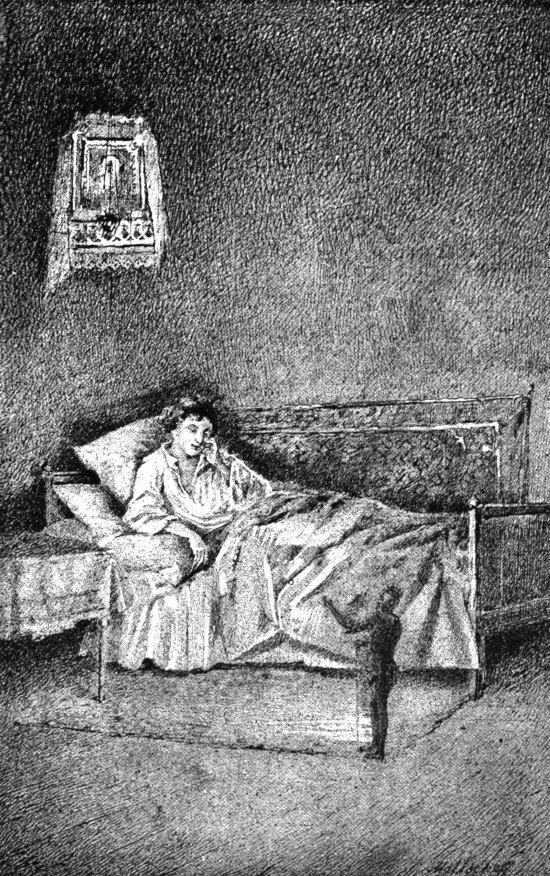
Basil noticed a queer little being. It
was a tiny little old man, not more
than six inches high. He wore a
short jacket made of red corn-poppy
petals; his trousers were of the same
material; his arms and legs were very
thin, like poppy stems, and he wore
green stockings; his shoes and gloves
were composed of green poppy leaves.
But the Old Man's head was the most
interesting part of his little person.
It was a little round head, perfectly
bald and brown, just like the dried
fruit of a poppy. On his head there
was a crown such as you see in the
poppy. His face was brown also; it
was calm and kind. He smiled fondly
as he looked on Basil. Above the
Little Man's head trembled a bluish
flame, from which spread an agreeable
light about the room. This flame did
not touch the Old Man's head, but it
followed him. When the Little Man
stooped, the flame stooped also; when
he rose, it rose with him.
"Not far from his bed Basil noticed a queer little being."
'You called me?' asked he of
Basil. His voice was so agreeable,
and sounded so like that of an old
acquaintance.
'I—I—don't know,' stammered the
child.
'But you could not fall asleep, and
you kept repeating—
' "Sleep, sleep, come to me.
Sleep, sleep, take me now.
Sleep, lull me into sleep." '
'Yes, Mr. Old Man, I have been
repeating all this, but I did not mean
to disturb you; it is hard to be under
an obligation to any one. I am not
afraid to be alone, Mr. Old Man.'
'Oh!' said the Old Man, smiling,
'where did you learn such words; of
all things, as to be under an obligation?
He! he! he!'
'No, no, Mr. Old Man; you see,
I told Mrs. Lookina to go home.
Why should I disturb you? You have
your own business.'
'Ho! ho! ho!' laughed the Old
Man. 'What a sensible young man
you are! But don't trouble yourself
about this. My duty consists in being
where people want to sleep, so you
only help me to do what I ought to
do. You want to sleep, don't you?'
'Yes, Mr. Old Man.'
'And so I will put you to sleep if
you like, soundly.' Then the Little
Old Man began to blink with evident
enjoyment, and to yawn slowly and
loudly. Somebody immediately yawned
in answer, and Basil, who had also a
great desire to yawn, looked around.
He saw to his great astonishment that
at the foot of his bed sat a new old
man. It was he who had yawned in
answer to the first Old Man.
This Old Man much resembled the
other, only he was a little smaller.
His jacket and trousers were made of
lilac poppy petals instead of red ones,
and he had no light on his head.
'Listen, Basil,' said the little lilac-coloured
creature, and with a gentle
voice, like a mother telling fairy tales
to her child, he began to speak:
'A gnat was born on the moors.
It stood on its thin little legs, it spread
its wings, and thought to itself: "It is
time to fly after some booty! If I
meet a man or a bull, I will eat him
up."
'The gnat flew away, spread its
little legs in the wind, and vanished.
Hardly anybody would notice it—so
small, and thin, and weak it was.
Nevertheless, as it flew, it blew its own
trumpets—
'"Fi-fo-fum!
Here I come!
I will slay
Man and beast!
I will feast
All the day!"
'Whether the gnat flew for a long or
a short time no one knows. Anyhow
it came to a reddish mound. This was
a heap of bricks. Some time ago a
hut stood here, but the hut had been
burnt down; its brick stove had fallen
to pieces, and now stood in view—a
heap of fragments. The gnat looked
at the mound and thought: "This is
a fine portion; it will just suit my
appetite." It flew with all its might,
settled on a brick, then flew on to
another, and tried to drive its proboscis
into it. The gnat held the brick fast,
and fought with its proboscis the best
it could; but it found it hard. Brick
was brick, you know; it was not soft
stuff. The gnat raced from place to
place. It tried the brick in every way,
but without avail.
'"No," thought the gnat, "this does
not please me; it is not worth while
troubling about." It moved on again,
and flew away. It flew on and blew
its own trumpets—
' "Fi-fo-fum!
Here I come!
I will slay
Man and beast!
I will feast
All the day!"
'Presently the gnat came across
something large and high, surmounted
by a sharp-pointed deep-green dunce's
cap. It was a fir-tree with resin oozing out.
'The gnat thought: "This is more in
my line; this will suit my appetite; I
will begin at this yellow spot."
'It flew towards the resin, and,
settling down, drove its proboscis into
it. Oh, wonder! It was bitter and
sticky. The gnat after a great effort
dragged its proboscis out, and then
tried to free its legs. It tugged and
tugged, and managed to free five, but
could not succeed with the sixth.
'The gnat got angry. "Let go," he
called to the fir-tree; "I know a trick
worth two of that." But the fir-tree
held the leg tight. The gnat got still
angrier; dashed about until its leg
came off, and then flew away with only
five legs; the sixth had remained in the
resin. It flew on, and again blew its
own trumpets—
' "Fi-fo-fum!
Here I come!
I will slay
Man and beast!
I will feast
All the day!"
'A tale is quicker told than actions
can be done.
'Our gnat flew over hill and vale,
furrowed fields, green meadows, quick
flowing rivers, and whispering woods.
It flew along roads, past cornfields.
Nowhere did it find anything profitable.
In the meantime some fine
raindrops began to fall. The gnat
was not dejected; it hurried on. Suddenly
it met a whole herd of cattle;
the young calves went on in front and
the large oxen behind. The gnat's
eyes glistened. It wished to settle on
the first calf and fix its proboscis into
it, but it bethought itself: "I see you
are small, little calf; it is better to
eat a big ox." He began to examine
the oxen. The herd went on and the
gnat still looked around. This one
seemed too thin—that one, though stout,
yet not big enough; then came one
that looked worse than the preceding
ones. Thus all passed by, and the
gnat had not made a choice.
'It suddenly flew after the herd, for
the purpose of settling down on the
first it could reach. But now it met
with a new misfortune. The rain
soaked its wings and made them
heavy; it could not fly any farther,
and got angry and began to scold the
rain: "So you intend to wet my
wings? you cannot find another place
to drop on? Beware! do you think
to take me in with your tricks?" The
gnat had hardly spoken thus, when a
large drop of rain fell on its back and
maimed it; it was choked by its last
word, and fell head over heels on to
the grass.
'Nobody knows how long the gnat
remained there. Anyhow, when the
bright sun peeped out from the clouds
and shone upon the earth, the gnat
contrived to creep out of the grassy
thicket and to dry itself. Then it flew
on farther, and again, flying, it blew its
trumpets—
' "Fi-fo-fum!
Here I come!
I will slay
Man and beast!
I will feast
All the day!"
Suddenly it perceived before it, at
some distance, a mare harnessed to a
cart, moving on slowly. A peasant
was sitting in the cart.
'The gnat rejoiced: "Now I can eat
my fill; when I shall have dined off
the man I'll taste the horse." So it
flew straight on to the man's forehead,
and stung with all its force.
'The peasant passed the palm of his
hand over his forehead, crushed the
gnat, and threw it behind the cart, and
all was over with it.'
The Lilac Old Man had finished his
tale.
'Basil, are you not asleep?' asked
the first Old Man.
'Not yet, Mr. Old Man,' answered
Basil.
'Do you wish to sleep?'
'I do.'
'Aaa!' yawned the Red Old Man.
'Aaa!' yawned after him the Lilac
Old Man.
'Aaa!' yawned after them Basil.
'Aaa!' yawned yet another near
them. When Basil looked round he
saw that a third old man sat on his
pillow, looking exactly like the two
others; the only difference was that his
coat and trousers were of white poppy
petals. The White Old Man smiled
caressingly, laid his hand on Basil's
head, and Basil could not refrain from
closing his eyes and smiling back at
him. Meanwhile the new old man gently
rocked himself. Basil heard him sing a
little song in a very soft and lulling voice:
'Gentle dreams with pinions light
By the window did alight,
Whisp'ring through their tresses bright:
'Has sweet sleep been here to-night?"
Wearied out a sick man lies
Tossing on a fever bed,
Gazing with wide, hopeless eyes
Through the darkness thick and dread.
Fairy dreams come trooping, shining,
Hand in hand with quiet sleep,
And their tresses, intertwining,
Softly o'er his pillow sweep,
Till his eyelids sink and close
While their song around him flows:
"Sleep, oh sleep!
Night and rest
From thee keep
Sprites unblest!
When to-morrow
Sunbeams peep,
Be thy sorrow
Laid asleep!"
'Gentle dreams with pinions light
By the window did alight,
Whisp'ring through their tresses bright:
'Has sweet sleep been here to-night?"
'See! A haggard seamstress, bending,
Bloodless cheek and aching head,
O'er the toil that, never ending,
Hardly gives her children bread.
Cometh sleep, and from her fingers
Steals away the half-turned seam,
And with noiseless footstep lingers,
Weaving many a joyous dream,
Till her eyelids sink and close,
While their song around her flows:
"Work is over!
And we hover
Round thee lightly,
Bringing nightly
Short relief,
Till thy grief
Again is born
With each new morn!"
'Gentle dreams with pinions light
By the window did alight,
Whisp'ring through their tresses bright:
'Has sweet sleep been here to-night?"
'No! I hear a baby crying,
Though the curly little head
Long ago should have been lying
Cradled in a cosy bed.
Fairy dreams come round him flocking,
And on many a snowy arm
Lift and bear him, softly rocking,
Covering with kisses warm,
Till his eyelids sink and close,
While their song around him flows:
"Hush, my sweetest!
Shut thine eyes
Till thou greetest
Fair sunrise,
Till dawn's hour
Laughs again;
Like a flower
After rain!"'
The White Old Man had long
finished singing, but Basil was still
listening, longing for more; it pleased
him so much.
'Basil, are you asleep?' suddenly
asked the Red Old Man, in a low
voice.
'Not yet, Mr. Old Man,' answered
Basil.
'Do you wish to sleep?'
'I do.'
Here the Red Old Man yawned
again very loudly; then the Lilac one
yawned; and the White one did the
same. Basil also yawned. But then
it seemed as if he heard another yawn
still louder than the others very near
to him, somewhere above. Basil
looked round and saw on the side
rail of his bedstead, above his head,
a fourth old man, who was dangling
his legs. He much resembled the
Lilac and White Men, but he was
dressed in many colours.
The old man smiled, and strewed,
as if in fun, many, many poppy petals
on Basil.
Basil felt so very sleepy that he
hardly could keep his eyes open; yet
he wished very much to look at the
new old man.
'Shut your eyes, and I will show
you my pictures,' whispered the Many-Coloured
Old Man, and poured a
whole handful of poppies on Basil.
The boy closed his eyelids gladly,
and at once saw a beautiful street in
which mamma never allowed Basil to
walk alone.
Now Basil went along with both his
hands in his pockets. One pocket
was full of apples, the other full of
pears. Basil took them out by turns,
first one and then the other, and ate
to his great content. When he got
tired of the fruit he felt nuts in his
pockets instead of apples, and dates
and dried figs instead of pears. After
a while he could not help thinking of
sweets. And as soon as he did so the
nuts turned into chocolate, and the
dates and figs into sugar-candy.
Besides this, at every curbstone
stood a prettily-dressed girl, very like
those who served Basil at the confectioner's
when Petr Petróvich took
him there and offered him some choice
morsel.
One regaled him with grapes,
another with ice cream, a third with
pineapple, a fourth with strawberries,
and a fifth with apricots; and so on.
Basil walked on gaily, looking
around on all sides, and taking a
good piece from each plate. What
was the most wonderful was that he
never suffered after it.
Basil walked on and on in the
happiest frame of mind. Nevertheless
he could not help noticing that
the street was somewhat long. He
had hardly thought this when he perceived
that the street had vanished,
and he stood in the middle of a toy-shop.
Goodness me! what beautiful
things he saw there! Drums, swords,
guns, mechanical dogs, balls, furniture,
rocking-horses, loto, pictures—a regular
furnished house.... But no! let us
stop enumerating. It would be impossible
to remember all the splendid
things displayed in the shop. Basil's
eyes were simply dazzled at the cupboards
and shelves. After a good
while, when he had surveyed all these
treasures, his attention became attracted
by a crossbow with a steel
spring, a capital bowstring, and the
butt end well polished. Next to the
crossbow was a quiver attached to a
strap with all sorts of arrows. For a
long time Basil had longed for such a
bow. With this bow you might hit
any mark, and you might even, if on
the watch, shoot the raven that was in
the habit of stealing small chickens
from the yard. Basil had seen just
such a bow at a little friend's house.
How easy it was to shoot with it!
Basil had asked his mamma to buy
him such a bow, but his mamma said
she could not afford it; it cost five
roubles.[6] And now Basil saw his pet
bow in the shop. Suddenly the door
creaked, and Basil's mamma entered.
She paid down the money, took the
bow and the quiver, and walked out.
Basil was so overjoyed that he nearly
jumped out of his bed; but at the
same moment the shop vanished from
his sight, and in its place stood a shoemaker's
workshop, where his mamma
used to order her boots. How happy
he was walking with her and holding
his bow in his hands. He looked
around on all sides, and thought all
other people were happy to see him
with his beautiful bow. Suddenly he
perceived how greatly he was mistaken,
for he saw the master of the
workshop, a rather short, square-built
man, standing before his apprentice,
scolding him, and preparing by his
gestures to thrash him. The unhappy
boy cried hard, trembled with fear,
and begged for mercy, but the master
was angry, and did not listen to him.
Seeing some visitors, the master in a
moment put on an amiable expression,
turned to them, and threw away the
strap. The trembling apprentice drew
back towards the door. Basil pitied
the boy dreadfully. He went up to
the poor fellow and asked in a whisper,
'What does he want to beat you for?'
The boy did not answer, and drew
back towards the door with downcast
eyes. Basil went after him and asked
again: 'Did you do anything?'
'I've done nothing, and I'm not
guilty,' answered the apprentice, after
a long silence.
'What does he want to beat you for
then?'
'Peter informed about me.'
'Which Peter?'
'The son of my master.'
'Tell me all.'
'My master bought Peter a bow—a
beautiful bow like yours—and told him
to take care of it; and he broke it,
and he pretended I had broken it;
and I swear I didn't.' (Here the boy
made the sign of the cross in token of
his innocence.) 'The master is going
to beat me,' he added in a whisper,
and the tears flowed from his eyes.
'Now, don't cry,' said Basil, taking
the apprentice by the hand. He pitied
the boy dreadfully, but he did not know
how to console him.
'It's all very well for you to say,
Don't cry. If you felt his strap you
wouldn't talk like that; my master has
a heart of stone.'
Basil looked at his own bow; the
bow was beautiful, and Basil had not
even had time to shoot with it. He
sighed and turned away; it would be
too hard for him to part with his bow.
But when the unhappy boy began to
cry again Basil could not bear it. He
took him by the hand, and said:
'Here you are; if you wish I'll give
you my bow; you can give it to your
master, so that he won't beat you.'
'How?' asked the apprentice, hardly
believing that Basil would give up his
toy, and after looking at him attentively,
added: 'Won't you be sorry to
give it up? It is such a beautiful
bow. I know what to do: let him
beat me—I'm not afraid. Better keep
it and allow me to shoot with it.
Peter never allowed me to shoot, but
you will. I'm not afraid.'
Basil pitied the boy still more, and
called out: 'No, no, I don't want it;
take it;' and Basil put the bow in the
apprentice's hands. Immediately after
the boy and the bow and the workshop
vanished. The Many-Coloured Old
Man left off showing pictures, and at
the same time the Red Man asked in
a well-known voice: 'Basil, are you
asleep?'
'No, Mr. Old Man,' answered Basil,
with great difficulty.
'With what Old Man are you talking?'
asked the same voice, laughing.
Basil opened his eyes; it was already
morning. The sun shone brightly
through the red cotton curtains at the
window, and his mamma stood at his
bedside.
'Mamma?' asked Basil, with wonder.
'Then it was all dream?'
'What?'
'The Little Old Man?'
'Why, certainly it was;' and the
mother tenderly kissed her boy.
BROWNY (A POPULAR OUKRAÏNÏEN TALE)
certain peasant had a
dog called Browny. So
long as the dog was young
and strong his master fed
him; but when he grew old, and the
master saw that he was no longer fit
for a watchdog, he began to grudge
him his food, and turned him out of
doors. Browny went out into the
fields and wandered on, not caring
where—on and on he went, weeping
bitterly.
A wolf came up to him and asked:
'Why do you cry so?'
'I have something to cry for,'
answered the dog. 'So long as I was
strong, and could feed myself, I served
my master truly and faithfully, and
now, when I have grown old in his
service, he says: "Be off with you!"
Where am I to go now? I have not
even the strength to catch a hare.'
'Ah, that's too bad!' said the Wolf.
'Now, look here: we wolves are supposed
to be downright robbers, because
we have to procure our food in some
way or other. Yet I wouldn't do such
a meanness as your master did. Well,
if he does not remember your faithful
service, there is another way of making
him give you the food that you
have honestly deserved from him.'
'Oh! if you could manage that,
some day I would repay you for it!'
exclaimed poor Browny, licking his
lips at the very thought of a good
dinner.
'We'll manage it,' said the Wolf.
'When your master comes out into the
field with his family to reap the corn, his
wife will lay down the baby under a
rick; you keep close by, so that I may
know which is their field. I will seize
the child and run off; you rush after me
and make believe to snatch the child
away from me, and I will let it go as
if I were afraid of you. Then everything
will go as you wish.'
No sooner said than done. At
harvest-time the man came out into
the field with his family to reap. His
wife laid down the baby under a rick,
took a sickle, and went with her husband
to reap. Suddenly the Wolf
rushed up, snatched the baby, and
ran off. Browny sprang out of the
corn and after him. The baby's
father and mother were dreadfully
frightened: the father tore along,
shouting, 'Catch him, Browny—bite
him! bite him!...' And Browny
did his best: he caught up the Wolf,
took the child from him, and brought
it to his master.
'Good dog, Browny!' said the
master. 'Oh you good dog! I thought
he wasn't fit for anything now, and see
what a plucky fellow he is!' and he
took half a loaf and a piece of lard out
of his bag and gave them to Browny.
In the evening the peasants went
home, and Browny with them. When
they got in, the man said to his wife:
'Light the fire and make us some
buck-wheat dough-dumplings, with
plenty of lard.'
Browny's mistress made the dumplings—capital
dumplings—so nice that
they would make your mouth water
to look at them! The master gave
Browny a seat at the table as if the
dog were his best friend, and sat down
beside him. Browny, on his part,
made an agreeable face, and expressed
by his whole appearance that he would
know how to behave himself, even if he
were the starosta (elder) of the village.
'Now, wife,' said the man, 'turn the
dumplings out into the bowl, and let us
have supper!'
The wife filled the bowl, and the
husband put a helping for Browny into
a smaller bowl, and blew it a long
time, so that Browny should not burn
his muzzle. He had become such an
important person all of a sudden!
Browny lived in peace and plenty,
but he did not forget his benefactor,
the Wolf. He used to think: 'Perhaps
the Wolf is wandering about the
steppes now, starving!' Then he would
grow quite melancholy, and shake his
head, sighing.
Meanwhile, Carnival came round,
and the peasant began making wedding
preparations—his daughter was
to be married. Then Browny shook
off all his melancholy. He went far
away from the village, and called the
Wolf. When the Wolf came up, they
hardly recognised one another: Browny
had grown fat and glossy, while as for
the unhappy Wolf, he was thin, worn-out—nothing
but skin and bones; his
fur hung in ragged tufts, and his teeth
chattered from hunger. When Browny
looked at his friend his heart ached
for pity.
'Come on Sunday evening, brother,
to my master's garden-plot,' said the
Dog to the Wolf; 'I'll give you such
a feast as you have not had in all
your life!'
Now a good dinner was a rare
thing to the poor Wolf; his eyes
shone with delight, and he felt quite
sick with hunger.
On Sunday evening the Wolf came
to the place agreed upon. That very
evening was the wedding feast in the
house of Browny's master. Browny
came out to his friend, and, seizing
a moment when there was no one in
the cottage, led him in and hid him
under the table. The feast began.
When the food was put on the table,
Browny instantly snatched a big hunch
of bread and the best slice of roast
meat and carried it under the table.
The guests shouted at him; some
wanted to strike him; but the master
of the house stopped them, saying:
'Don't touch him; that dog is allowed
to do anything he likes; he saved my
child, and I will keep him till he
dies!' That was just what Browny
wanted: he pulled all the best things
off the table, and gave them to his
friend—pies, everything, even a bottle
of horílka[7]. The horílka made the
Wolf tipsy, and he said to Browny:
'I want to sing a song!'
'Heaven forbid!' answered Browny;
'there'll be the devil to pay here!
I'll bring you a bottle of nalívka[8], only
hold your tongue!'
But after drinking the nalívka, the
Wolf grew merrier than ever.
'You can do as you like,' said he;
'but now I am going to sing.' He
lifted up his muzzle, and such a howl
as he set up under the table!
Every one was terrified. Some ran
right out of the cottage, some caught
up sticks and spades and wanted to
kill the Wolf there and then. Browny,
seeing that it was a bad job, flew at
his friend as if to strangle him. Then
the host called out to his guests:
'Don't hit the Wolf, or you will kill
my Browny. Let them alone; Browny
will settle the Wolf by himself.'
The dog, meanwhile, struggling and
pretending to bite, managed to get his
friend first out of the cottage, then
out of the garden and right across the
fields. Then he stopped.
'There, brother,' said he to the
Wolf; 'you did me a good turn, and
I've done you one. Good-bye!'
'Thank you!' said the Wolf. 'Good
luck to you!'
And so they parted.
THE OLD SWORD'S MISTAKE
NCE upon a time there was
a steel sword, whose blade
was forged and tempered
in a most excellent manner.
The handle was of precious
wood, with beautiful inlaid work
of mother-of-pearl and gold. From
his very birth the Sword was in the
service of a gallant knight; and a
sturdy, faithful sword he was. He
fought for the sake of truth and of
every fair lady, and against all oppressors
of the weak. All who, even by
word or glance, injured a lady dreaded
the steel weapon: there was no man,
no arms in the world, whom the steel
warrior feared. But the valiant knight
was killed in a hard fight, and the
Sword remained lying on the battle-field.
There the wind blew sand upon
him, and leaves, fallen during the
autumn from the neighbouring bushes,
covered him. And many long years
he lay there buried and unseen, until
a peasant proposed to clear the
ground, and his plough ran by chance
against the Sword. The first thing
that the ploughman did was to utter
an oath, for his coulter, in striking
against the stout weapon, received a
notch. Then the Sword was dug out,
taken to town, and sold to an old
curiosity shop. The shopman hung
the Sword on a nail.
From his lofty resting-place the old
warrior, in glancing about the shop,
saw in the corner of the hall a white
lady of astonishing beauty. She was
clad only in a loose-fitting garment
about her fair form. Her neck, arms,
and feet were bare; her hair was all
combed back, then caught up by a
diadem, from which it hung down in a
shower of curls. She stood erect, and
did not move. On her fair lips played
an enigmatic smile, while her beautiful
arms hung loose beside her, and her
whole form seemed to breathe with
free, powerful peace. One thing alone
appeared to the steel warrior somewhat
strange: the fair one was all
white; her cheeks, eyes, hair; her
hands and feet; her garments and diadem,—all
were like fresh snow. But
this seemed only to give a new charm
to her beauty. The longer the old
Sword gazed at the white unknown
woman, the brighter grew his blade,
the more merrily danced all the rainbow
tints in his mother-of-pearl inlaid
work, and the stronger grew his wish
to fight as of old for truth's and a
lady's sake—nay, for this very lady.
The steel warrior longed to speak
to the white beauty, but he did not
venture. 'I am so old,' he thought;
'so notched; even somewhat rusty ...
while she is so fair!... No, no, it
would not do. Methinks she would
not even mind me or look at me.'...
Now the old Sword glanced at the
lady in the corner, and she gazed at
him, smiling enigmatically....
'Oh,' thought the sturdy warrior, 'if
only I could do something for her!'
But there seemed no chance of being
of use to the fair creature. The Sword
could no longer bear such suspense.
He summoned up all his courage,
and uttered in a faltering clang:
'Queen of my soul! tell me what
you desire. Only tell me, and I will
do it; at least I will attempt anything
for you!' But the White
Beauty remained speechless, and only
smiled enigmatically as before.
'Why does she keep silence?' This
was the question that tormented the
old Sword, and he looked at the fair
lady with anguish. Oh how much
she might say if she would but speak!
What power breathes through her
apparent calm! And her smile! what
a rich soul it hides! Nay, if this
heavenly creature does not speak it is
certainly only in consequence of some
spell laid upon her! And the old
fighter looked around, pondering over
the question, Who could be the malicious
sorcerer? It could not be the
gigantic snake, stuffed with tow, that
stood in an opposite corner, for its
eyes were but glass, and though they
say snakes fascinate birds and little
animals, they need living eyes for the
purpose. Nor could it be yonder
ivory-headed cane near the shelf; it
had the shape of an old man's head in
a nightcap, with saucy, black goggle
eyes. The insolent creature smiled,
it is true, very mockingly, and was
capable, as it seemed, of any rude
trick; but he was so placed as not to
be able even to see the White Lady.
Somewhat higher than the Sword,
hung on the same wall a red-nosed
man, with a mass of tangled hair upon
his head. He had a wine-glass in his
hand, and he looked straight at the
beauty with winking, roguish eyes.
But that fellow could not have bewitched
the lady either; he was too
commonplace and good-natured for
such a thing. The old Sword had
seen scores of such fellows in old
times, when his knight was banqueting
in some wayside inn, or carousing in
some friar's cellar, after the conquest
of a town. Revellers of those days
were clad differently, but they were
evidently birds of the same feather.
The Sword even felt some special
interest in the old toper—he seemed
to be a clever fellow.
'Look here, old boy,' said the old
warrior in a whisper to his neighbour,
'who do you think has bewitched the
lady in the corner?'
'And why do you imagine the girl
to be bewitched?' retorted the red-nosed
one, in a hoarse, loud bass
voice, making no scruples about the
matter, though his companion evidently
wished to speak in an undertone.
'H'm, h'm ... well, well!' said
the old Sword; 'hold your peace!
indeed you speak too loud.... One
must be more discreet in delicate
matters.... As to the spell, it is
evident: have you not noticed the
lady to be absolutely silent?'
'Well, what can she say if she has
nothing to say? Ha! ha! ha!'
'What!' roared the Sword, and was
about to teach the reveller politeness
in his own way, but the latter checked
his ardour with these words—
'Listen to what I am going to tell
you, old fellow: if you do not intend
to hear me quietly, why then do you
ask my opinion?'
This remark seemed to the Sword
to be reasonable, therefore he restrained
himself and resumed his
speech, though not without anger.
'You have drowned your reason
in wine, that's all. How can it be
that such a woman as this has nothing
to say? Just look at her smile!'
'But perhaps she does not know
anything but how to smile enigmatically.'
But such things the old warrior
could no longer endure. Indeed, he
would have made a cut at the toper's
red nose had he not been taken down
at that moment by the owner of the
shop to show to some customer.
'Very good indeed,' said the latter;
'but it is not to my taste. I like this
far better.' And the customer pointed
to the White Beauty.
'Ha! ha! ha!... I should think
you do,' laughed the shopman merrily.
'It is my luck she cannot speak, else
she would have been married long ago,
and I should have lost instead of
gained by her.'
'Ah!' thought the old Sword, 'here
is the sorcerer; I might have guessed
it long ago. The owner of the shop
is the mightiest here; he may do with
us what he will. And that hideous
man intends to sell that heavenly
woman! But he shall smart for it.'
The old Sword broke loose from the
nail, and, flashing dreadfully with his
blade, struck the shopkeeper's shoulder.
No doubt the man would have been
wounded had the blade been sharp.
'Dear me,' cried the shopman, rubbing
the injured spot, 'such a heavy
old fool! How did those knights in
old times fight with such cudgels?'
All of a sudden there arose a stir in
the house. Along the passages and
staircases people were heard running
to and fro, shouting 'Fire! fire!' The
owner of the old curiosity shop and
his customer were rushing up and
down about the hall, not knowing
what to do. At last one of them
seized a pot of withered geranium, and
the other his rubbers, and both hurried
out. The White Lady stood near one
of the windows with her usual quiet
smile, whilst on the window-sill there
sat a pretty little naked bronze boy.
For many long years he had carried
on his back a basket, into which a
candlestick was to be put. Though
the boy, as I have said, was only a
child, he knew very well what 'fire'
meant: he knew it from the time
when the bronze of which he was
formed was melted in a blast furnace.
A deadly fear overspread his lovely
face, and in a tender, tinkling voice he
addressed his pretty neighbour: 'Pray
... oh pray ... throw me down
into the street.... The fall can do me
no harm, I know ... but the fire will
melt me.... Do, I beseech you; you
have only to raise your arm.'
But the White Beauty remained silent
and motionless. She continued to smile
in a most winning and most promising
manner, but made no gesture, uttered
no sound.
The old Sword also knew what
'fire' meant. How many times
had he witnessed in old times the
conflagration of whole cities taken by
assault! He saw how unhappy citizens
and desperate artisans fled from their
homes; how women sobbed and
lamented when they saw the ruins,
and when their little ones were
slaughtered or burnt. All this the
old Sword now remembered, and his
steel blade ached at the thought:
'What will happen to the White
Lady?'
The old curiosity shop was situated
on the third floor, and the window,
near which stood the beautiful woman
who charmed the Sword, was only a
few feet distant from the neighbouring
roof. The old Sword collected all his
strength, swung on his nail, and flung
himself through the window, placing
his handle on the sill and his point on
the cornice of the neighbouring house.
'Queen of my soul, hasten! Pass
along, treading upon me, and you will
be safe,' so he rang out in a trembling
voice. The beauty smiled in her
enigmatic, winning manner, but did
not utter a word or make a motion.
'Make haste, I beseech you!' rang
once more the anxious Sword. 'As
soon as the fire reaches our hall my
handle will be burnt, I shall fall
down, and your escape will be impossible.'
But these words made on the lady
as little impression as his previous
ones: she remained motionless and
dumb, but smiling in a bewitching
manner. Suddenly several firemen
hurried in and began to seize everything
that their eyes fell upon, and to
fling it through the windows without
any distinction. First went the sardonic,
goggle-eyed old man on the
cane, and, without injury, tumbled
headlong down. Then came the red-nosed
old toper, smiling as usual, his
wine-glass still in his hand; he dashed
against a broken stool, and the canvas
on which he was painted was torn to
pieces. Scores of solid and fragile
things followed.... One of the firemen
seized the Sword and threw him into
the courtyard below. The jagged
fighter made several somersaults in
the air, and plunging into the earth
stood upright. A few moments he
shivered and made a dull sound. But
one thought overpowered him now:
'What would be the fate of his lady?'
All of a sudden he noticed something
white falling from the window, and ...
recognised his goddess: it was she!
The old Sword uttered a groan.
'Oh, why did she not speak? Why
did she not avail herself of his devotion?
Why did she answer all his
entreaties only by an enigmatic smile?
O Heavens, why?' At this very
moment the White Lady fell down
upon the pavement and broke in two,
just where men have a heart....
Many a time the old Sword had
pierced men's hearts, and then their
hot blood flowed along his blade. He
therefore cast a shuddering and anxious
look upon the fracture, expecting to
see it bleed. He saw, however, nothing
but stone; the whole beauty consisted
of marble.... The marble was
white as snow; it was irreproachably
fair, but yet it was only marble, and
nothing more.
'MY OWN' (A Siberian Fairy Tale)
HE banks of the Vagaï are
beautiful—very beautiful[9]—in
some places at least.
Steep, almost overhanging,
and high as the walls of a fortress
bastion, they rise frowning above the
river sternly; yet they are fair with
the rich verdure of the forest that
crowns their heights. This forest is
of many kinds. The century-old
fir-trees, with trunks that three men
could not gird with outstretched arms,
rise in straight, dark-red columns, so
high that to look up at even the
lowest branches you must throw your
head back till your hat falls off; beside
them the gray-barked aspens quiver in
every leaf, as if frightened at the
twisted, snaky black trunks of the
bird-cherry—the tree that smells so
sweet in early spring when the white
blossoms cover it like a sheet of snow.
The gentle rowan is not noticeable for
its height; its feathery leaves are the
only thing that could attract your
attention. But wait till autumn
comes; then it is hung all over with
clusters of scarlet berries, and brightens
up the forest. The mighty cedar, with
its long, grand sweeps of feathery
needles, towers up higher even than
its comrade the fir; here and there
beneath the trees is scattered about an
undergrowth of young pines, almost
branchless, like bristles or long sticks
standing up out of the earth. But
the commonest trees in this forest are
certainly silver birches. The trunks
of these birches stand out sometimes
straight and slender, with delicate
heads of foliage, looking like cadets
in their white shirts; sometimes
gnarled, branchy, knotted, with the
air of a burly peasant, rugged with
labour.
Underneath, at the base of all these
tree-trunks, so different in thickness,
height, and colour, all the ground is
covered with masses of bright flowers,
and a carpet of grass that buries you
waist-deep when you walk. And the
longer you look upon this forest scene
the more varied, the more exquisite, it
appears to you. There are so many
beautiful shades of green—pale and
delicate on the birch-trees, dark on
the cedars, almost black on the pikhta.
Here the trees cluster together on the
river-bank, pressing one against the
other, forming an impassable barrier,—there
they draw back, as if wearied of
following the course of the river, and
leave a wide, open space, where you
can see the edge of the nearest bank,
and the barren precipice of the opposite
one, also crowned with glorious
green forest; and if you advance to
the edge you can see, far below, the
torrent itself, swift and mighty.
Ah yes, the Vagaï is beautiful!
And not only is it beautiful, but it is
a merry life there—in any case it is a
merry life for the birds who live there.
So many joys are theirs! The woodpeckers
can find in the bark of the
trees (especially the old stumps of
fallen trees) fat caterpillars and beetles;
for the snipe and woodcocks there are
endless strawberries, bilberries, cranberries,
thick clumps of wild oats and
other edible grasses. The great cones,
with their juicy nuts, cluster on the
branches of the pines and giant cedars,
like candles on a Christmas-tree, then
late in autumn they fall to the ground.
The clear, fresh water of the Vagaï
seems to call you to bathe and drink.
And then the bright sunshine, the
transparent, fragrant air, the green
carpet of the forest, the joyous company
of comrades, with whom one
can sing, chirp, hop, dart about, and
fly like an arrow on light wings.
What more can heart desire? Living
such a life, should one not rejoice in
this bright world, fling away all envy
and malice, and share together with
one's fellow-creatures all the delights
which our common mother, Nature,
gives?
So thought all the birds of the
forest tract we are speaking of, and
so they lived. Early, very early, in
the morning, when the first scarlet
flush shone in the sky to herald the
golden sunbeams, one little bird would
wake up and open its eyes, and there
beside it another would have begun
fluttering its wings, drinking the bright
dewdrops from the leaves, pecking
seeds from the grasses. Then the
first bird would look at its friend,
thinking, 'There's plenty for all;'
and it, too, would begin chirruping,
delighted to have a companion with
whom to share both its labour and its
rest. And both together would dart
off and fly to the Vagaï to bathe.
So the little birds lived happily,
neither quarrelling nor disagreeing,
helping one another in their work
and dangers, and sharing together all
that the bright world gave them.
But this way of living and thinking
did not suit a certain broad-beaked,
ponderous cedar-crow[10], who had taken
up her abode in a huge cedar.
This cedar stood apart in a glade,
and the Cedar-crow liked it just on
account of its separate position.
'I will settle here; this shall be my
estate. I don't want any one else's
property, and no one shall touch mine!
It's comfortable and private and nice!'
The clumsy bird flew all round the
cedar, and, being satisfied with it,
settled there.
The Cedar-crow stopped there a
day, two days ... the other birds
darted past, chirping, flying races, playing
with one another, rejoicing together
in the good gifts of their
mother-earth, the bright sun, and the
Vagaï, and the delights of companionship;
but the thick-billed Cedar-crow
dared not leave her tree; there
she sat watching that no other bird
should touch her private nuts. When
a woodcock did but pass, she flew to
him in anxiety, crying out: 'Go away!—go
away! There's nothing here for
you; go back where you came from!
I don't touch your things; you let
mine alone.'
'But do you suppose the rest of the
forest is only ours?' said the Woodcock.
'You can have them too; of
course any one may take as much as
they want. There's enough for every
one.'
'Yes, I dare say. You can do as
you like. But I feel safer when I
have something of my own.'
'Why, you foolish one!' exclaimed
a thrush, which had flown up to them,
'we always live in whole companies—thousands
together—and never cut up
things into "mine" and "thine"; and
yet no harm happens to us.'
'Yes; so long as there is plenty for
all, but afterwards there's no saying
what will happen,' thought the Cedar-crow,
though she did not say so aloud.
'If the land is divided between all of
us, how much will each one have?
Now I've got the whole of this huge
cedar to myself; it will last my time,
and I can leave it to my children and
grandchildren; there will be more for
them than for your fledglings....'
'You're just gone silly with greediness,'
said the other birds, and flew
away, chirruping and darting after one
another in the air. But the Cedar-crow,
the forest landowner, seeing that
she was alone, pulled a cone from her
cedar, and began picking out the nuts.
She ate as much as she could, and
then returned to the work of guarding
her estate. She sat and looked about
her, and occasionally flew round the
tree, constantly afraid that some one
was touching her property.
The time for nest-building came.
All the birds paired and got to work:
one carried a feather, another a straw;
each one wove in its contribution
properly; then they would hop about,
chirp to one another, and fly off together
to fetch more material.
The Cedar-crow became more anxious
than ever. 'There!' she thought;
'they will lay eggs and hatch new
fledglings, and they, too, will all want
to eat and drink; they will simply
ravage my cedar. I shall have nothing
left!'
She even left off going down to the
Vagaï to drink. Yet she was tormented
with thirst: her tongue hung out; her
eyes distended; she could hardly
breathe; and still she dared not leave
her tree. She endured it till nightfall.
At night all the birds settled down to
rest sweetly after their day's work;
only here and there an owl with great
round eyes would flit past. But the
Cedar-crow could not go to sleep; she
had to fly to the river and drink; and
this misery was not only once—at dawn
to-morrow it would begin again!
At last the envious bird could bear
it no longer. Clearly she could not
manage alone. She began thinking
how to get out of the difficulty. It occurred
to her that it might be better to
take another cedar-crow into partnership
with her, and build a nest; certainly
it would be another mouth to
feed, but then the two of them together
could guard their property, and
not lose a single cone. And even if
they had fledglings, it would still be
better than now: in the first place, she
would feel safer; in the second place,
with so many to keep watch, not a
single nut would be lost, let alone a
cone. And the cedar was very big;
it would be enough for five, even ten
families.
The Cedar-crow polished her beak,
pecked off a cone, glancing about her
as she did so, flew round the cedar,
and settled herself to look out for a
mate. There, just opposite her, on a
neighbouring fir-tree, sat another cedar-crow,
large and heavy, with a great
strong beak. It sat looking at the
cedar; evidently it wanted some nuts.
The forest landowner flew across to
it, and began to explain: 'This is my
estate; no one has a right to touch
it; but, if you like, I will take you
into companionship, if you will help
me to guard our cedar from intruders.'
The male looked at the cedar-tree,
and saw that it was a fine one. 'You
won't get such a cedar every day.'
'All right,' said he; 'if one lets every
one in to share in God's blessings
one will just starve. I've seen enough
of these fools that do nothing and lay
by nothing: just fly in coveys, peck
everything bare, and there's not a
thing left. I myself was just looking
for a good cedar, to take possession of
it, and let no one come near.'
They paired, and set to work to
build their nest; one would bring the
materials, or go down to drink, while
the other guarded the estate.
Well, some time passed, and behold
their little fledglings peeped out
of the nest. The old Cedar-crows
were more anxious than ever about
their property; formerly they had only
watched over the cones, now they let no
one so much as fly past the cedar-tree.
But how were they to prevent the birds
from ever flying past, when forests and
meadows and water alike swarm with
them? The greedy birds drove away
their comrades day after day and the
whole day long; by the evening they
could hardly move their wings for
weariness. At last they got worn out.
What were they to do? They thought
and thought, and at last an idea struck
them.
The male Cedar-crow flew to the
Plover. 'Call a meeting of all the
birds,' said he; 'on business.'
'What business?' asked the Plover.
'Well, that doesn't matter. Important
business.'
'But still, I must know why to call
the birds to a meeting; may be you
want to disturb them for some trifle?'
'Not for a trifle at all; we want to
give up our claim to the forest.'
'How do you mean "Give up your
claim"?'
'Why, simply to give it up! We
are worried out of our lives. And all
because every one considers that we
are their comrades, and that they can
poke their beaks into our place as if
it were their own.'
The Plover saw that there was something
very strange, and not only strange,
but dismal. The more he thought of
it, the worse it seemed to him. However,
there was nothing for it but to
call a council. 'All right,' he said;
'come again at this time to-morrow.'
The next day the Plover flew over
fields, pastures, and forests, wailing
more mournfully than ever: 'Pity!
Pity! Pity!...'
The birds, wondering at the melancholy
cry, flew down in countless
numbers to the Vagaï; on all sides
resounded chirruping and twittering.
Here the mellow call of the cuckoo
predominated; there the elaborate
whistle of the goldhammer. The
Cedar-crow, the forest landowner, was
there waiting. She came forward and
made her speech—
'It is a custom among you, respected
birds, to live together and hold everything
in common. That is your own
affair; but we cannot live so. We
have children, and are bound to think
of them and have something to leave
them. Among you every one snatches
the food from his neighbour's beak, and
robs his neighbour without any question;
and we find that all this ends
in nothing but anxiety. We don't
want things that belong to others, and
we feel it hard when others give us no
peace. So we have resolved to announce
to you that we want no part
in your communal forest, and will not
touch it; we will not take from it a
single seed or stalk; but you, on your
side, agree together that no one shall
peck our nuts, or perch on our cedar,
or fly across our glade. This is our
request to you, respected birds.'
When the Cedar-crow left off speaking
there was silence: the birds sat
with their bills wide open, and could
not utter a word for amazement.
The first to recover himself was a
starling. 'Why—you—idiot!' he cried.
'Think yourself what a fool you are!
All the wide world is here before you,
and you want to give it up for one
little glade!'
'Oh, the world! The world is not
mine—it's every one's—not much of it
will fall to my share; it's all very well
to be so sure! but the cedar, if it is
small, at least it's mine!' That is
what the Cedar-crow thought; but
aloud she only said: 'Well, if you
think it better to possess the whole
world in common than one little glade
separately, what is there to argue
about? The world remains to you,
so it must be a good bargain for you;
and there's nothing more to be said.
Then give us our glade, leave us in
peace, and that is all we ask.'
'You foolish creature!' exclaimed
the other birds; 'he spoke for your
advantage; of course, your glade will
be no loss to us; but it's piteous to
see a creature so blind! He only
wanted to bring you to your senses.'
'You must have a lot of good
advice to spare if you can give away
so much of it without being asked,'
replied the Cedar-crow, polishing her
broad beak.
Seeing that the Cedar-crow was
hopelessly wrong-headed, the birds
talked the matter over, and decided
that she and her mate should be left
in undisturbed possession of their cedar
glade, and that no one should approach
within twenty fathoms of it.
The Cedar-crows were delighted.
Now, they thought, at last we shall
be at peace! And so they were.
No one ever came near; they had no
longer any need to guard their cedar,
or to do anything but eat, drink, and
sleep. The rest of their time they
spent in gazing at one another, and
comparing who had the longest beak.
Once it chanced that a nightingale,
coming from a far country to seek her
lost mate (he had been trapped by
bird-catchers), flew to the cedar. She
did not know of the agreement among
the birds of the Vagaï concerning the
cedar glade, and she flew into it. The
Cedar-crows were so bored that they
were almost glad to see her! They
flew out, however, and entered into a
polite explanation.
'You probably do not know of the
agreement concerning this glade. No
one has the right to fly within twenty
fathoms of it, because it is ours. We
have renounced our claim to all the
rest of the forest, and do not take
a single seed or stalk from it; but this
glade belongs to us.'
'Whatever is that for?' asked the
Nightingale, in amazement. 'Why,
supposing there's a bad harvest on
your cedar, what will become of you
then?'
It was the first time that such a
question had been put to the Cedar-crows,
and they did not know what to
answer.
'A bad harvest!' Indeed it was
possible. It often happens that in
one place the harvest fails, and close
by, or very near, such a quantity
ripens that it goes to waste. But the
young birds reassured their parents: on
that cedar they had been hatched, and
had grown up; they had always lived
upon its fruits; they had always seen it
the same—mighty and burdened with
cones—could they imagine it different?
'A bad harvest! What do you
mean?' they cried in chorus. 'The
harvest cannot fail on our cedar!'
'Of course it can't!' echoed the
parent birds in delight.
The Nightingale shook her little gray
head, but made no further comment.
'Then it is forbidden to fly here?'
she said. 'I beg your pardon, I did
not know.'
'Oh, we are not angry; indeed, as
you are on a journey, we shall be glad
to offer you some refreshment,' replied
the female Cedar-crow, glancing at her
mate; and she laid before the Nightingale
a single nut.
'Thank you,' said the Nightingale,
and flew away without touching the nut.
The Cedar-crows settled down again
to their ordinary life, and there is no
saying how long they would have gone
on in the same way if a runaway tramp
had not happened to make a bonfire
in the taïgá[11]. It was a long time
since he had enjoyed a hot drink, and
he was thirsty. He made some tea,
drank it, and was just going to start on
again, when he heard bells, then a
rustling sound and footsteps. The
poor fellow was terrified: 'The
Ispravnik!'[12] he thought. 'I shall be
caught!' He rushed into the thicket,
not stopping even to scatter the burning
brands or stamp out the embers.
In the meantime a light wind rose, the
embers glowed, the dry pine-needles
caught fire, and soon the flames were
creeping on from one fallen trunk to
another—farther and farther, wider
and wider, licking the trees, curling
round whole thickets—and the taïgá
was on fire. That is a common thing
in Siberia.
For some time the Cedar-crows had
noticed that the air was of a milky
colour. For some time the sun had
been dull-red by day, and by night
they could see a far-off crimson glare
in the sky. Now the smell of burning
was in the air, and still the Cedar-crows
could not believe that their
estate was in danger of fire. It disturbed
them far more that innumerable
birds began flying past their glade to
the Vagaï; the beasts, too, hurrying
to the river, ran straight by the cedar....
Soon it grew difficult to breathe,
yet still the Cedar-crows could not
bear to part from their estate; they
still dreaded lest some other birds or
beasts might take possession of their
glade. At last, though, they could
bear it no longer; they were forced to
go. But when, after all, they made up
their minds to leave the cedar, it was
too late. The fire attacked their glade
from all sides at once, and when they
attempted to fly upwards they dropped,
stifled with smoke, on to the ground.
The cool, green grass refreshed them,
and, in desperation, they struggled
again to reach the river. But all
around them rose terrible fiery pillars,
and the unhappy birds, scorched and
half dead, sank again to the ground,
and rose no more.
Presently rain began to pour in
torrents, and put out the fire within a
few yards of the glade. That glade
was now a dismal scene of ruin: the
tall grass was burnt brown, the mighty
cedar was a charred and naked corpse.
All around stood the trees—aspens,
birches, limes, and bird-cherries—burnt
to skeletons, or with dead and
shrivelled leaves hanging from them
here and there. Mournfully they
raised their barren branches towards
the heavens, as though praying for
mercy; and thus, with lifted hands,
they perished.
But beyond that bare skeleton
thicket stood in the distance the fresh
and untouched forest. The female
Cedar-crow, lying helpless on the
ground, gazed upon it despairingly.
Beside her lay her fledgling—the only
one left alive. He was feebly fluttering
his scorched wings and uttering
piteous cries.
'Oh, if only some of the birds
would come to us!' thought the unhappy
mother; 'surely they would
have pity on my child, and would
carry him down to the waterside and
feed him. He would recover there;
he would not die of hunger and
thirst!...'
But no one came near the glade.
All the birds remembered the general
agreement: not to disturb the Cedar-crows
in their seclusion, and not to
approach within twenty fathoms of
their estate. And not one of the
birds knew what had happened to the
Cedar-crow family.
When the bright sun rose next
morning no one of that family saw it—they
were all dead....
Meanwhile the other birds, leaving
the fire-ravaged places for other parts
of the forest that were still fresh and
green, rejoiced as formerly in the fair
world, sharing everything together;
and far along the clear Vagaï the air
was filled with their joyous and friendly
twittering.
THE TALE ABOUT HOW ALL THESE TALES CAME TO LIGHT
N our times, but not in this
country, there lived a little
girl, with a pair of brown
eyes that shone like two
big radiant stars. Every time that she
looked with those eyes on her father
or her mother, and a sweet smile
beamed on her countenance, the
father's and mother's souls brightened,
and it seemed to them as if music,
which nobody heard except themselves,
resounded in their hearts.
Very often on such occasions the
father took his beloved girl on his lap,
kissed her tenderly, and asked what
she would like.
'I should like you to tell me a fairy
tale,' invariably answered the little girl,
pressing her rosy face to her father's
breast.
'That is in our hands. We can
afford that,' answered her father.
Then he tried to recall what he had
ever read or heard from his grandmother
or other old folk, and related
some story, while the little girl listened
attentively. Her big eyes became still
larger; they beamed like a pair of
evening stars, and she now and then
slightly and slowly nodded, taking to
heart everything that happened in the
story. If her father told of some evil,
unjust person, she exclaimed: 'I do
not like him!' But if the story ran
about some one kind-hearted and
good, she was very glad of it, and
said: 'That is good!'
And again it was as if beautiful
music resounded in her father's soul.
He saw that his little one was grieved
with other people's grievances and
rejoiced in other people's happiness.
He saw how she pondered over what
he said, and he thought of the time
when they, the father and mother, will
grow old, while their little one will
become a grown-up girl. They will
live together, as to-day, in mutual love
and thorough friendship. Yet then
it will be she, their sweet daughter,
that will take care of them and feed
them, as they now take care of her and
feed her. And the father again pressed
his lips on his beloved pet's head.
As for the mother, she was never
weary of caressing her child and doing
everything for her. But as she had to
take care also of the father and of our
girl's baby-sister, who had a pair of
eyes like two little suns, she very often
was quite exhausted towards the close
of the day. Therefore when the little
girl with starlike eyes went to bed,
and, clasping her mother by the neck
with both her hands, asked her to tell
some fairy tale, her mother could not
recall any.... Still the little girl repeated
her request again and again....
Then the father said to the mother
she should go and rest, while he sat
down at the child's bedside and tried
to narrate something.
At last there came a day when all
the stories he ever knew were at an
end, while the little girl still entreated
for one. The father looked in his
girl's big, starlike eyes and saw that
she could not sleep. He looked also
at the mother, who was worried out of
her senses by daily work; and now sat
mending the baby's socks. It was
evident some story ought to be told.
But what story? What about?
The father looked around. A china
cup was standing on the table. It
was half-broken, and he could not help
thinking that it had had a trying life.
It had surely had its story. Well,
what kind of a story was it?
And after having pondered a little,
the father told to his girl the story of
the cup, as he imagined it, and as you
have found it in this very little book.
When he finished the little girl rose
in her bed, with her starlike eyes
shining more than usual, and asked:
'Where did you get that story,
father? Did you read it somewhere?'
'No; I just told it out of my
head.'
Then the little girl clasped her little
hands around her father's neck, kissed
him most enthusiastically, and seemed
to be very happy.
Since that time father heard only
too often the little girl ask him:
'Father, do tell me some tale of
your own.'
And so he did. But as he repeated
his stories again and again he now
and then altered them, as he could
not remember everything as he told it
the first time. And if the alterations
were happy, the little girl was pleased,
but if he omitted anything, she said:
'You told it differently the other day,'
and would not be happy until he recalled
all the exact words and details
of his best narrative.
Then it became clear that the father
should write his stories down. After
having written some new story he now
read it to the girl with a pair of stars
instead of eyes, and sometimes she
most emphatically objected to some
turn of the story.
'You wrote it wrongly,' she said on
such occasions; 'you must alter it
thus and thus.'
And indeed the father altered until
she said it was all right.
One morning a little boy came to
visit our little girl, his great friend.
They ran about and played together
all the forenoon; but in the afternoon,
when her father lay down on a couch
to take a moment's rest, he was struck
by the general stillness which was
reigning in the house. To tell you
the truth, the boy was a real mischievous
monkey, and there was little
hope to have any peace in the house
as long as he was in it. Still, the fact
was that everything was quiet, and
only in the neighbouring room the
star-eyed girl's voice sounded in an
even, moderate tone.
The father got up, and went on tiptoe
to the next room to look what all
this meant. He saw his little girl sitting
on a footstool; her visitor was beside
her on a box, and was all attention.
... 'A-a-a! yawned the Little Old
Man, ...' related the little hostess,
showing to the boy how the old man
did yawn....
At this moment she perceived her
father on the threshold.
'I am telling him your fairy tale
about the little old men, you know,'
she said to her father, and then there
was a pause, with a lingering smile on
her face.
'Well, go on,' said the boy, pulling
her by the sleeve.
The father returned to his couch,
and there was a smile on his face too.
He saw clearly that there was something
in his stories which made little
folk breathe with indignation, compassion,
or joy, when they heard
them. He well knew what it was.
He put a good deal of his soul into
his tales, and this soul, coming into
contact with those little souls of his
readers, made them bound with delight,
or long for redress of some injustice.
Was it not a joy for him too? And
if the little girl with a pair of stars
instead of eyes, and the boy, her
friend, found pleasure in his fairy
tales, should not the other children
have an opportunity to try the same
pleasure? Why should he not print
his stories?
Thus he decided to print them.
He sent them into a printing-office,
and before long a little volume came
out of the press in many copies. The
little girl with starlike eyes read and
re-read the book. Her little friends,
with blue, black, brown, or gray eyes,
read and re-read it. And when, after
all that reading and all the chatter about
it, bright sparks of delight and animation
appeared in those eyes, these
sparks found their way into his heart
and warmed it up, and he too felt
happy.
Now, I did not tell you that all this
happened in Russia, a far-away country,
and that when the man who wrote the
stories came afterwards to England,
together with his daughter, he was
sorry to find that he had left all those
children's sparkling eyes, shining with
emotion when reading his tales, behind.
But then he was struck by the
thought that in England there were
as many little souls and hearts as in
Russia, nay, he has had already some
friends among these little souls both
in England and in America; and
thus, perhaps, if he put his stories
into English, he might see as many
smiling faces and radiant eyes after
the book was read as he did in his
native country? He decided to try
at once, and now here is the volume
before you. We will see whether the
man was right. He would like to
hear something about it from you.
THE END
Printed byR. & R. Clark, Edinburgh
FOOTNOTES:
[1] A copeck (in Russian kopéika) is a Russian
copper; 100 copecks form one rouble. A rouble
is worth 2s. 0-2/5d. in English money.
[2] Pronounce 'Neekeéteech.' The reader
should rather be told here that the Russian
fashion of calling a person, when addressing
him or her, is not by his or her surname, but
by the Christian name, with the addition of
his or her father's name, somewhat altered in
a way to express 'son of' or 'daughter of'
such-a-one; for example—Iván Nikítich (John,
son of Nikíta). Among common people and
among friends they address only in one's
Christian name without the addition of the
father's name ('ót-chest-vo'); but if, in addressing
a common person, you wish to express
some deference, you use only the 'ótchestvo,'
without the person's Christian name; for example,
'Nikítich' instead of 'Iván Nikítich.'
Such is the case in our tale.