This page is not for you, boys and girls.
It is for that old man or woman—twenty,
thirty, or forty years old, who may peek
into this book; and is what they would
call the
PREFACE
To give the child some idea of what has gone
on in the world before he arrived;
To take him out of his little self-centered, shut-in
life, which looms so large because it is so close
to his eyes;
To extend his horizon, broaden his view, and
open up the vista down the ages past;
To acquaint him with some of the big events
and great names and fix these in time and space
as a basis for detailed study in the future;
To give him a chronological file with main
guides, into which he can fit in its proper place all
his further historical study—
Is the purpose of this first Survey of the
World’s History.
This part is not for you, either. It is for
your father, mother, or teacher, and is
what they would call the
INTRODUCTION
In common with all children of my age, I was
brought up on American History and given no
other history but American, year in and year out,
year after year for eight or more years.
So far as I knew 1492 was the beginning of
the world. Any events or characters before that
time, reference to which I encountered by any
chance, were put down in my mind in the same
category with fairy-tales. Christ and His
times, of which I heard only in Sunday-school,
were to me mere fiction without reality. They
were not mentioned in any history that I knew
and therefore, so I thought, must belong not to a
realm in time and space, but to a spiritual realm.
To give an American child only American
History is as provincial as to teach a Texas child
only Texas History. Patriotism is usually given
as the reason for such history teaching. It only
promotes a narrow-mindedness and an absurd
conceit, based on utter ignorance of any other
peoples and any other times—an intolerant
egotism without foundation in fact. Since the
World War it has become increasingly more and
more important that American children should
have a knowledge of other countries and other
peoples in order that their attitude may be intelligent
and unprejudiced.
As young as nine years of age, a child is
eagerly inquisitive as to what has taken place in
the ages past and readily grasps a concept of
World History. Therefore, for many years Calvert
School nine-year-old pupils have been
taught World History in spite of academic and
parental skepticism and antagonism. But I have
watched the gradual drift toward adoption of
this plan of history teaching, and with it an ever-increasing
demand for a text-book of general history
for young children. I have found, however,
that all existing text-books have to be largely
abridged and also supplemented by a running
explanation and comment, to make them intelligible
to the young child.
The recent momentous studies into the native
intelligence of children show us what the average
child at different ages can understand and what
he cannot understand—what dates, figures of
speech, vocabulary, generalities, and abstractions
he can comprehend and what he cannot comprehend—and
in the future all text-books will have
to be written with constant regard for these intelligence
norms. Otherwise, such texts are very
likely to be “over the child’s head.” They will
be trying to teach him some things at least that,
in the nature of the case, are beyond him.
In spite of the fact that the writer has been
in constant contact with the child mind for a
great many years, he has found that whatever
was written in his study had to be revised and
rewritten each time after the lesson had been
tried out in the class-room. Even though the
first writing was in what he considered the simplest
language, he has found that each and every
word and expression has had to be subjected
again and again to this class-room test to determine
what meaning is conveyed. The slightest
inverted phraseology or possibility of double
meaning has oftentimes been misconstrued or
found confusing. For instance, the statement
that “Rome was on the Tiber River” has quite
commonly been taken to mean that the city was
literally built on top of the river, and the child
has had some sort of fantastic vision of houses
built on piles in the river. A child of nine is still
very young—he may still believe in Santa Claus—younger
in ideas, in vocabulary and in understanding
than most adults appreciate—even
though they be parents or teachers—and new information
can hardly be put too simply.
So the topics selected have not always been
the most important—but the most important
that can be understood and appreciated by a
child. Most political, sociological, economic, or
religious generalities are beyond a child’s comprehension,
no matter how simply told. After
all, this History is only a preliminary story.
Excellent biographies and stories from general
history have been written. But biographies from
history do not give an historic outline. They do
not give any outline at all for future filling in;
and, indeed, unless they themselves are fitted
into such a general historical scheme, they are
nothing more than so many disconnected tales
floating about in the child’s mind with no associations
of time or space.
The treatment of the subject in this book is,
therefore, chronological—telling the story of
what has happened century by century and epoch
by epoch, not by nations. The story of one
nation is interrupted to take up that of another
as different plots in a novel are brought forward
simultaneously. This is in line with the
purpose, which is to give the pupil a continuous
view or panorama of the ages, rather than Greek
History from start to finish, then, retracing the
steps of time, Roman History, and so on. The
object is to sketch the whole picture in outline,
leaving the details to be gradually filled in by
later study, as the artist sketches the general
scheme of his picture before filling in the details.
Such a scheme is as necessary to orderly classification
of historical knowledge as is a filing system
in any office that can function properly or
even at all.
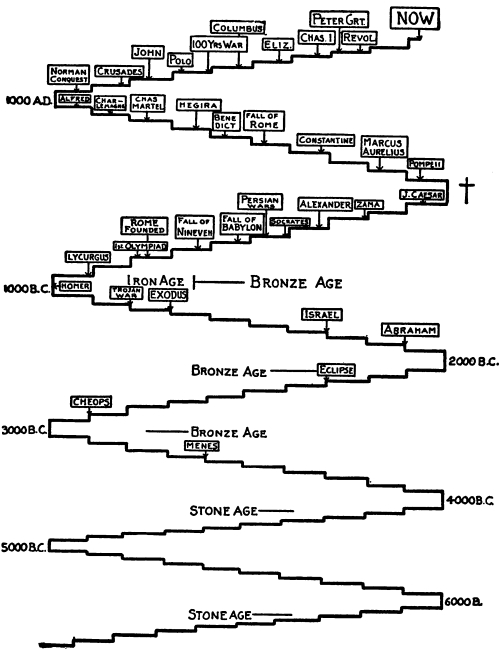
The Staircase of Time is to give a visual idea
of the extent of time and the progressive steps
in the History of the World. Each “flight”
represents a thousand years, and each “step” a
hundred—a century. If you have a spare wall,
either in the play-room, attic, or barn such a
Staircase of Time on a large scale may be drawn
upon it from floor to reaching height and made a
feature if elaborated with pictures or drawings
of people and events. If the wall faces the
child’s bed so much the better, for when lying
awake in the morning or at any other time, instead
of imagining fantastic designs on the wall-paper,
he may picture the crowded events on the
Staircase of Time. At any rate, the child should
constantly refer either to such a Staircase of
Time or to the Time Table as each event is
studied, until he has a mental image of the Ages
past.
At first a child does not appreciate time values
represented by numbers or the relative position
of dates on a time line and will wildly say twenty-five
hundred B. C. or twenty-five thousand B. C.
or twenty-five million B. C. indiscriminately.
Only by constantly referring dates to position
on the Staircase of Time or the Time Table can
a child come to visualize dates. You may be
amused, but do not be amazed, if a child gives
776 thousand years A.D. as the date for the First
Olympiad, or says that Italy is located in Athens,
or that Abraham was a hero of the Trojan War.
If you have ever been introduced to a roomful
of strangers at one time, you know how futile it is
to attempt even to remember their names to say
nothing of connecting names and faces. It is
necessary to hear something interesting about
each one before you can begin to recall names
and faces. Likewise an introduction to World
History, the characters and places in which are
utterly unknown strangers to the child, must be
something more than a mere name introduction,
and there must be very few introductions given
at a time or both names and faces will be instantly
forgotten. It is also necessary to repeat new
names constantly in order that the pupil may
gradually become familiarized with them, for
so many strange people and places are bewildering.
In order to serve the purpose of a basal outline,
which in the future is to be filled in, it is
necessary that the Time Table be made a permanent
possession of the pupil. This Time
Table, therefore, should be studied like the multiplication
tables until it is known one hundred
per cent and for “keeps,” and until the topic connected
with each date can be elaborated as much
as desired. The aim should be to have the pupil
able to start with Primitive Man and give a
summary of World History to the present time,
with dates and chief events without prompting,
questioning, hesitation, or mistake. Does this
seem too much to expect? It is not as difficult
as it may sound, if suggestions given in the text
for connecting the various events into a sequence
and for passing names and events in a condensed
review are followed. Hundreds of Calvert
children each year are successfully required
to do this very thing.
The attitude, however, usually assumed by
teachers, that “even if the pupil forgets it all,
there will be left a valuable impression,” is too
often an apology for superficial teaching and
superficial learning. History may be made just
as much a “mental discipline” as some other
studies, but only if difficulties of dates and other
abstractions are squarely met and overcome by
hard study and learned to be remembered, not
merely to be forgotten after the recitation. The
story part the child will easily remember, but it
is the “who and when and where and why” that
are important, and this part is the serious study.
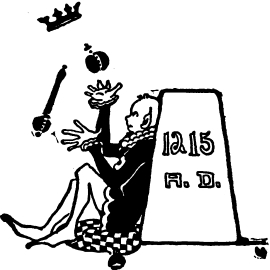
Instead of, “A man, once upon a time,” he
should say, “King John in 1215 at Runnymede
because—”
This book, therefore, is not a supplementary
reader but a basal history study. Just enough
narrative is told to give the skeleton flesh and
blood and make it living. The idea is not how
much but how little can be told; to cut down one
thousand pages to less than half of that number
without leaving only dry bones.
No matter how the subject is presented it is
necessary that the child do his part and put his
own brain to work; and for this purpose he
should be required to retell each story after he
has read it and should be repeatedly questioned
on names and dates as well as stories, to make
sure he is retaining and assimilating what he
hears.
I recall how once upon a time a young chap,
just out of college, taught his first class in history.
With all the enthusiasm of a full-back who has
just kicked a goal from field, he talked, he sang;
he drew maps on the blackboard, on the floor, on
the field; he drew pictures, he vaulted desks, and
even stood on his head to illustrate points. His
pupils attended spellbound, with their eyes wide
open, their ears wide open, and their mouths
wide open. They missed nothing. They drank
in his flow of words with thirst unquenched; but,
like Baron Munchausen, he had failed to look at
the other end of the drinking horse that had been
cut in half. At the end of a month his kindly
principal suggested a test, and he gave it with
perfect confidence.
There were only three questions:
(1) Tell all you can about Columbus.
(2) “ “ “ “ “ Jamestown.
(3) “ “ “ “ “ Plymouth.
And here are the three answers of one of the
most interested pupils:
(1) He was a grate man.
(2) “ “ “ “ “
(3) “ “ “ “ “to.
Here is the
STAIRCASE OF TIME
It starts far, far, below the bottom of the
pages and rises up, Up, UP to where we
are NOW—each step a hundred years,
each flight of steps a thousand. It will
keep on up until it reaches high heaven.
From where we are NOW let us look
down the flights below us and listen to
the Story of what has happened in the
long years gone by.
TIME TABLE
with
DATES AND OTHER FOOD
FOR THOUGHT
Don’t devour these dates all at once, or they’ll
make you sick, and you’ll never want to see one
again.
Take them piecemeal, only one or two at a time
after each story, and be sure to digest them
thoroughly.
He had to stay in bed in the morning until
seven o’clock until his father and mother were
ready to get up;
So did I.
As he was always awake long before this time,
he used to lie there and think about all sorts of
curious things;
So did I.
One thing he used to wonder was this:
What would the world be like if there were—
No fathers and mothers,
No uncles and aunts,
No cousins or other children to play with,
No people at all, except himself in the whole
world!
Perhaps you have wondered the same thing;
So did I.
At last he used to get so lonely, just from
thinking how dreadful such a world would be,
that he could stand it no longer and would run
to his mother’s room and jump into bed by her
side just to get this terrible thought out of his
mind;
So did I—for I was the boy.
Well, there was a time long, long, long ago
when there were no men or women or children,
NO PEOPLE of any kind in the whole world.
Of course there were no houses, for there was no
one to build them or to live in them, no towns or
cities—nothing that people make. There were
just wild animals—bears and wolves, birds and
butterflies, frogs and snakes, turtles and fish.
Can you think of such a world as that?
Then,
long, long, long
before that, there was a time when there were
NO PEOPLE and NO ANIMALS of any
sort in the whole world; there were just growing
plants, trees and bushes, grass and flowers. Can
you think of such a world as that?
Then,
long, long, long,
long, long, long
before that, there was a time when there were
NO PEOPLE, NO ANIMALS, NO
PLANTS, in the whole world; there was just
bare rock and water everywhere. Can you think
of such a world as that?
Then,
long, long, long
long, long, long—you might keep on saying—
“long, long, long,” all day, and to-morrow, and all next week, and next month, and next year, and it would not be long enough—
before this, there was a time when there was
NO WORLD AT ALL!
There were only the Stars
Nothing else!
Now, real Stars are not things with points
like those in the corner of a flag or the gold ones
you put on a Christmas tree. The real stars in
the sky have no points. They are huge burning
coals of fire—coals of fire. Each star, however,
is so huge that there is nothing in the world now
anywhere nearly as big. One little bit, one little
scrap of a star is bigger than our whole world—than
our whole world.
One of these stars is our Sun—yes, our Sun.
The other stars would look the same as the Sun
if we could get as close to them. But at that
time, so long, long ago, our Sun was not just a
big, round, white, hot ball as we see it in the sky
to-day. It was then more like the fireworks you
may have seen on the Fourth of July. It was
whirling and sputtering and throwing off sparks.
The sun sputtering and throwing off sparks.
One of these sparks which the Sun threw far
off got cool just as a spark from the crackling log
in the fireplace gets cool, and this cooled-off spark
was—
What do you suppose?
See if you can guess—
It was our World!—yes, the World
on which we now live.
At first, however, our World or Earth was
nothing but a ball of rock. This ball of rock was
wrapped around with steam, like a heavy fog.
Then the steam turned to rain and it rained
on the World,
a a a
n n n
d d d
i i i
t t t
r r r
a a a
i i i
n n n
e e e
d d d
until it had filled up the hollows and made enormously
big puddles. These puddles were the
oceans. The dry places were bare rock.
Then, after this, came the first living things—tiny plants
that you could only have seen under
a microscope. At first they grew only in the
water, then along the water’s edge, then out on
the rock.
Then dirt or soil, as people call it, formed all
over the rock and made the rock into land, and
the plants grew larger and spread farther over
the land.
Then, after this, came the first tiny animals in the
water. They were wee Mites like drops of
jelly.
Then, after this, came things like Insects,
some that live in the water, some on the water,
some on the land, and some in the air.
Then, after this, came Fish, that live only in
the water.
Then, after this, came Frogs, that live in the
water and on the land, too.
Then, after this, came Snakes and huge lizards
bigger than alligators, more like dragons; and
they grew so big that at last they could not move
and died because they could not get enough food
to eat.
Then, after this, came Birds that lay eggs and
those Animals like foxes and elephants and cows
that nurse their babies when they are born.
Then, after this, came Monkeys.
Then, last of all, came—what do you
suppose? Yes—People—men, women, and
children.
Here are the steps; see if you can take them:
Star,
Sun;
Sun,
Spark;
Spark,
World;
World,
Steam;
Steam,
Rain;
Rain,
Oceans.
Oceans,
Plants;
Plants,
Mites;
Mites,
Insects;
Insects,
Fish;
Fish,
Frogs;
Frogs,
Snakes.
Snakes,
Birds;
Birds,
Animals;
Animals,
Monkeys;
Monkeys,
People;
And here we are!
What do you suppose will be next?
2
Umfa-Umfa and Itchy-Scratchy
How do you suppose I know about all these
things that took place so long ago?
I don’t.
I’m only guessing about them.
But there are different kinds of guesses. If
I hold out my two closed hands and ask you to
guess which one has the penny in it, that is one
kind of a guess. Your guess might be right or
it might be wrong. It would be just luck.
But there is another kind of a guess. When
there is snow on the ground and I see tracks of a
boot in the snow, I guess that a man must have
passed by, for boots don’t usually walk without
some one in them. That kind of a guess is not
just luck but common sense.
And so we can guess about a great many things
that have taken place long ago, even though there
was no one there at the time to see them or tell
about them.
Men have dug down deep under the ground in
different parts of the world and have found there—what
do you suppose?
I don’t believe you would ever guess.
They have found the heads of arrows and
spears and hatchets.
The peculiar thing about these arrows and
spears and hatchets is that they are not made
of iron or steel, as you might expect, but of stone.
Now, we are sure that only men could have
made and used such things, for birds and fish
or other animals do not use hatchets or spears.
We are also sure that these men must have lived
long, long years ago before iron and steel were
known, because it must have taken long, long
years for these things to have become covered up
so deep by dust and dirt. We have also found
the bones of the people themselves, who must
have died thousands upon thousands of years
ago, long before any one began to write down
history. So we know that the people who were
living on the earth then were working and playing,
eating and fighting—doing many of the same
things we are to-day—especially the fighting.
This time in the pre-history of the world, when
people used such things made of stone, is therefore
called The Stone Age.
These First Stone Age People we call Primitive,
which simply means First as a Primer means
First Reader. Primitive People were wild animals.
Unlike other wild animals, however, they
walked on their hind legs.
These First People had hair growing, not just
on their heads, but all over their bodies, like some
shaggy dogs. They had no houses of any sort in
which to live. They simply lay down on the
ground when night came. Later, when the earth
became cold, they found caves in the rocks or in
the hillsides where they could get away from
the cold and storms and other wild animals. So
men, women, and children of this time were
called Cave People.
They spent their days hunting some animals
and running and hiding from others. They
caught animals by trapping them in a pit covered
over with bushes, or they killed them with a club
or a rock if they had a chance, or with stone-headed
arrows or hatchets. They even drew
pictures of these animals on the walls of their
caves, scratching the picture with a pointed stone,
and some of these pictures we can still see to-day.
They lived on berries and nuts and grass-seeds.
They robbed the nests of birds for the eggs, which
they ate raw, for they had no fire to cook with.
They were blood-thirsty; they liked to drink the
warm blood of animals they killed, as you would
a glass of milk.
They talked to each other by some sort of
grunts—
“Umfa, umfa, glug, glug.”
They made clothes of skins of animals they
killed, for there was no such thing as cloth. And
yet, although they were real men, they lived so
much like wild animals that we call such people
savages.
Primitive Men were not pleasant people. They
were fearful and cruel creatures, who beat and
killed and robbed whenever they had a chance.
A cave man got his wife by stealing a girl
away from her own cave home, knocking her
senseless, and dragging her off by her hair, if
necessary. The men were fighters but not brave.
They would kill other animals and other men if
the others were weaker or if they could sneak
upon them and catch them off their guard,
but if others were stronger they would run and
hide.
Their only rule of life was hurt and kill what
you can, and run from what you can’t. This is
what we call the first law of nature—every man
for himself. They knew if they didn’t kill they
would be killed, for there were no laws nor police
to protect them.
These primitive cave people are our ancestors,
and we get from them many of their wild ways.
In spite of our religion and manners and education,
there are many men still living who act in
the same way when they get a chance.
Jails are made for such men.
Suppose you had been a boy or a girl in the
Stone Age, with a name like Itchy-Scratchy. I
wonder how you would have liked the life.
When you woke up in the morning, you would
not have bathed or even washed your hands and
face or brushed your teeth or combed your hair.
You ate with your fingers, for there were no
knives or forks or spoons or cups or saucers, only
one bowl—which your mother had made out of
mud and dried in the sun to hold water to drink—no
dishes to wash and put away, no chairs, no
tables, no table manners.
There were no books, no paper, no pencils.
There was no Saturday or Sunday, January or
July. Except that one day was warm and sunny
or another cold and rainy, they were all alike.
There was no school to go to. Every day was a
holiday.
There was nothing to do all day long but make
mud pies or pick berries or play tag with your
brothers and sisters.
I wonder how you would like that kind of life!
“Fine!” do you think?—“a great life—just
like camping out?”
But I have only told you part of the story.
The cave would have been cold and damp and
dark, with only the bare ground or a pile of
leaves for a bed. There would probably have
been bats and big spiders sharing the cave with
you.
You might have had on the skin of some
animal your father had killed but as this only
covered part of your body and as there was no
fire, you would have felt cold in winter, and when
it got very cold you might have frozen to death.
For breakfast you might have had some dried
berries or grass-seed or a piece of raw meat, for
dinner the same thing, for supper still the same
thing.
You would never have had any bread or milk
or griddle-cakes with syrup, or oatmeal with
sugar on it, or apple pie or ice-cream.
There was nothing to do all day long but
watch out for wild animals—bears and tigers;
for there was no door with lock and key, and a
tiger, if he found you out, could go wherever you
went and “get you” even in your cave.
And then some day your father, who had left
the cave in the morning to go hunting, would not
return, and you would know he had been torn to
pieces by some wild beast, and you would wonder
how long before your turn would come next.
Do you think you would like to have lived
then?
3
Fire! Fire!! Fire!!!
The first things are usually the most interesting—the
first baby, the first tooth, the first
step, the first word, the first spanking. This
book will be chiefly the story of first things;
those that came second or third or fourth or fifth
you can read about and study later.
Primitive People did not at first know what
fire was. They had no matches nor any way of
making a light or a fire. They had no light at
night. They had no fire to warm themselves by.
They had no fire with which to cook their food.
Somewhere and sometime, we do not know exactly
when or how, they found out how to make
and use fire.
If you rub your hands together rapidly, they
become warm. Try it. If you rub them together
still more rapidly, they become hot. If
you rub two sticks together rapidly, they become
warm. If you rub two sticks together very, very,
very rapidly, they become hot and at last, if you
keep it up long enough and fast enough, are set
on fire. The Indians and boy scouts do this and
make a fire by twisting one stick against another.
This was one of the first inventions, and this
invention was as remarkable for them at that time
as the invention of electric light in our own times.
People of the Stone Age had hair and beards
that were never cut, because they had nothing to
cut them with, even had they wanted them short,
which they probably didn’t.
Their finger-nails grew like claws until they
broke off.
They had no clothes made of cloth, for they
had no cloth and nothing with which to cut and
sew cloth if they had.
They had no saws to cut boards, no hammer
or nails to fasten them together to make houses
or furniture.
They had no forks nor spoons; no pots nor
pans; no buckets nor shovels; no needles nor
pins.
The People of the Stone Age had never seen
or heard of such a thing as iron or steel or tin
or brass or anything made of these metals. For
thousands and thousands of years Primitive
People got along without any of the things that
are made of metal.
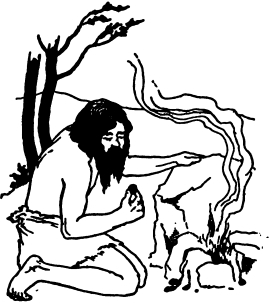
Then one day a Stone Age Man found out
something by accident; a “discovery” we call it.
He was making a fire; and a fire, which is to
us such a common, every-day thing, was still to
him very wonderful. Round his fire he placed
some rock to make a sort of camp-fire stove.
Now, it happened that this particular rock was
not ordinary rock but what we now call “ore,”
for it had copper in it. The heat of the fire melted
some of the copper out of the rock, and it ran
out on the ground.
A cave man discovering copper.
What were those
bright, shining
drops?
He examined
them.
How pretty
they were!
He heated some
more of the same
rock and got some
more copper.
Thus was the
first metal discovered.
At first people used the copper for beads and
ornaments, it was so bright and shiny. But they
soon found out that copper could be pounded
into sharp blades and points, which were much
better than the stone knives and arrow-heads
they had used before.
But notice that it was not iron they discovered
first, it was copper.
We think people next discovered tin in somewhat
the same way. Then, after that, they found
out that tin when mixed with copper made a still
harder and better metal than either alone. This
metal, made of tin and copper together, we now
call bronze; and for two or three thousand years
people made their tools and weapons out of
bronze. And so we call the time when men used
bronze tools, and bronze weapons for hunting
and fighting, the Bronze Age.
At last some man discovered iron, and he soon
saw that iron was better for most useful things
than either copper or bronze. The Iron Age
started with the discovery of iron, and we are still
in the Iron Age.
As people who lived in the Bronze and Iron
Ages were able, after the discovery of metal, to
do many things they could not possibly have
done before with only stone, and as they lived
much more as we do now, we call people of the
Bronze and Iron Ages “civilized.”
You may have heard in your mythology or
fairy tales of a Golden Age also, but by this is
meant something quite different. The Golden
Age means a time when everything was beautiful
and lovely and everybody wise and good. There
have been times in the World’s History which
have been called the Golden Age for this reason.
But I am afraid there never has been really a
golden age—only in fairy-tales.
4
From an Airplane
People of the Bronze and Iron Ages thought
the world was flat, and they knew only a little
bit of the world, the small part where they lived;
and they thought that if you went too far the
world came to an end where you would
TU M B L E
O F F
The far-away land which nobody knew they
called the Ultima Thule. This is a nice name to
say—Ultima Thule, Ultima Thule—far-away
Ultima Thule.
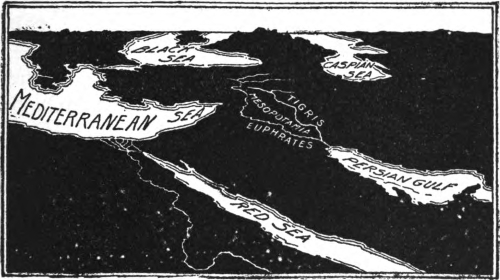
If we should go up in an airplane and look
down on the world at the place where the first
civilized people once lived, we should see two
rivers, a sea and a gulf, and from so high up in
the air they would look something like this:
Map of Mesopotamia and Mediterranean.
Now, you probably have never even heard
of these rivers and seas, and yet they have been
known longer than any other places in the world.
One of these lines is the Tigris River, and the
other is the Euphrates. They run along getting
closer and closer together until at last they join
each other and flow into what is called the Persian
Gulf.
You might make these two rivers in the
ground of your yard or garden or draw them on
the floor if your mother will let you. Just for
fun you might name your drinking-cup “Tigris”
and your glass “Euphrates.” Then you might
call your mouth, into which they both empty,
the “Persian Gulf,” for you will hear a great
many new names by and by, and as grown-up
people give names to their houses and boats, to
their horses and dogs, why shouldn’t you give
names to things that belong to you? For instance,
you might call your chair, your bed, your
table, your comb and brush, even your hat and
shoes, after these strange names.
Then, if we flew in our airplane to the west, we
should see a country called Egypt, another river,
the Nile, and a sea now named the Mediterranean.
Mediterranean simply means “between
the land,” for this sea is surrounded by land. It
is, indeed, almost like a big lake. It is supposed
that long, long ago in the Stone Age, there was
no water at all where this sea now is, only a dry
valley, and that people once lived there.
Along the Nile in Egypt and the Tigris and
Euphrates were the only civilized nations living
in the Bronze Age. The rest of the World
people knew nothing about. There may have
been Cave Men living in other parts of the
World, but it is only of the people in these two
places that we have any written history until
after the Iron Age began.
All of the people who lived in the country of
the Tigris and Euphrates were white. We don’t
know how nor when nor where colored people
first lived, though it is interesting to guess. There
were, we think, just three different white families
and from these three families all the white
people in the world are descended. Yes, your
family came from here, ’way, ’way, ’way, ’way,
back. So you will want to know the names of
these three families and which one was your own.
They were:
The Indo-Europeans, often called Aryans,
The Semites, and
The Hamites.
Most of us belong to the Aryan family, some
are Semites, but very few in this part of the
World are Hamites.
If your name is Henry or Charles or William,
you are probably an Aryan.
If it is Moses or Solomon, you are probably
a Semite.
If it is Shufu or Rameses, you are probably
a Hamite.
The Aryans came from higher up on the map
than the other two families, we think. They
were the first people to tame wild horses and to
use them for riding and drawing carts. They
also had tamed cows which they used for milk,
and sheep for their wool.
5
Real History Begins or ’Way ’Way Back
to the Time of the Gipsies
You can remember the big things that have
happened in your own lifetime.
And you have of course heard your father
tell about things that happened in his own life—how
he fought the Germans in the Great War,
perhaps.
And if your grandfather is still living, he can
tell you still other stories of things that took
place when he was a boy before even your father
was born.
Perhaps your great, great, grandfather
may have been living when Washington was
President, and his
great, great, great, great, grandfather
may have been living when there were only wild
Indians in this country.
Although these ancestors, as they are called,
are dead long since, the story of what did happen
in all their lifetimes ’way, ’way back has been
written down in books and this story is history—“his
story” one boy named it.
Christ was living in the Year 1—no, not the
first year of the world, of course.
Do you know how many years ago that was?
You can tell if you know what year this is
now.
If Christ were living to-day, how old would
He be?
Nineteen hundred and more years may seem
a long time. But perhaps you have seen or heard
of a man or a woman who was a hundred years
old. Have you?
Well, in nineteen hundred years only nineteen
men each a hundred years old might have lived
one after the other—nineteen men one after the
other since the time of Christ—and that doesn’t
seem so long after all!
Everything that happened before Christ was
born is called B.C., which you can guess are the
initials of Before Christ, so B.C. stands for Before
Christ. So much is easy.
Everything that has happened in the world
since the time of Christ is called A.D. This is
not so easy for though A. might stand for After,
we know D. is not the initial of Christ. As
a matter of fact, A. D. are the initials of two Latin
words, “Anno Domini.” Anno means “in the
year,” Domini “of the Lord”; so that Anno
Domini is “in the year, of the Lord,” which in
ordinary, every-day language means of course
“since the time of Christ.”
The things I have told you that I have had to
guess at we call Before-History, or Pre-History—which
means the same thing. But the things
that have happened in the lifetime of people,
who have written them down—the stories I don’t
have to guess at—we call History.
The first history that we feel fairly sure is
really true begins with the Hamite family. The
Hamites, you remember, were one of the three
families of the white race I have already told you
about who lived by the Tigris and Euphrates.
We think that they moved away from the Tigris
and Euphrates Rivers and went down to Egypt
long before history began.
Of course they didn’t pack all their furniture
on a big wagon and move to Egypt,
as you might move from the house where
you now live to another. They lived in
tents then and not in houses at all, and they only
moved along a day’s journey at a time as campers
or Gipsies might do. In fact, Gipsy is short
for Egyptian. When they got tired of one place
or had eaten up everything there was near-by,
they rolled up their tents, packed them on camels,
and moved a little farther along to a new place.
And so camping here for a while, then gradually
moving farther along to the next good place and
camping there, they at last got as far off as the
land we now call Egypt. When they finally
reached Egypt they found it such a fine country
in which to live that there they stayed for good
and were called Egyptians.
Why do you suppose they found Egypt such
a fine country in which to live? It was chiefly
on account of a habit of the river Nile—a bad
habit you might at first think it—a habit of flooding
the country once every year.
It rains so hard in the spring that the water
fills up the river Nile, overflows its banks, and
spreads far out over the land, but not very deep.
It is as if you had left a water-spigot turned on
and the water running, or had begun to water
your garden with a hose, and then you had gone
off and forgotten it.
But the people know when the overflow is
coming and they are glad for it to come, so they
put banks around some of it so that it is stored
up for watering the land during the rest of the
year when there is no rain. After most of the
water has dried up, it has left a layer of rich,
dark, moist earth over the whole country. In
this earth it is easy to grow dates, wheat, and
other things which are good for food.
Menes, 3400 B. C.
If it were not for this yearly overflow of the
Nile, the country of Egypt would be a sandy
desert in which no plant or living thing would
grow—for all plants as well as animals must have
water and will die without it. Egypt, without
water, would be like the great Sahara Desert,
which is not far away. It is the Nile, therefore,
that makes the land so rich and Egypt such an
easy and cheap country to live in, for food grows
with little or no labor and costs almost nothing.
Besides this, the climate is so warm that people
need little clothing and do not have to buy coal
or make fires to heat their houses. So it was to
this country that the Hamites at last came, finally
settled down, and were thereafter called
Egyptians.
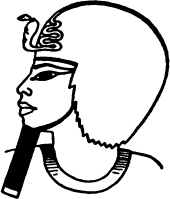
The first Egyptian king
whose name we know was
Menes, but we do not know
much about him. We believe
he built some kind of waterworks
so that the people might
better use the water of the
Nile, and he probably lived
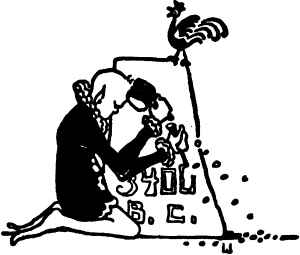
about 3400 B. C. He may have lived either earlier
or later, but as this is an easy date to remember,
we shall take it for a starting-point. You might
remember it by supposing it is a telephone number
of a person you wanted to call up:
Menes, First Egyptian king . . 3400 B.C.
6
The Puzzle-Writers
People of the Stone Age had learned how to
talk to each other, but they could not write, for
there was no such thing as an alphabet or written
words, and so they could not send notes or
messages to one another or write stories. The
Egyptians were the first people to think of a way
to write what they wanted to say.
The Egyptians did not write with letters like
ours, however, but with signs that looked like
little pictures, a lion, a spear, a bird, a whip.
This picture-writing was called hieroglyphics—see
if you can say “Hi-e-ro-glyph-ics.” Perhaps
you have seen, in the puzzle sections of a newspaper,
stories written in pictures for you to guess
the meaning. Well, hieroglyphics were something
like that.
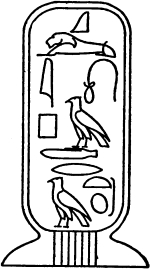
Here is the name of an Egyptian queen, whom
you will hear about later—written in hieroglyphics;
her name you would never guess from
this funny writing. It is “Cleopatra.”
Cleopatra in hieroglyphic
writing.
A king’s or queen’s name always had a line
drawn around it, like the one you see around the
above name in order to mark it more prominently
and give it more importance. It was something
like the square or circle your
mother may put around her
initials or monogram on her
letter-paper.
But there was no paper in
those days and so the Egyptians
wrote on the leaves of a
plant called papyrus that
grew in the water. It is from
this name “papyrus” that we
get the name “paper.” Can
you see that “paper” and “papyrus”
look and sound something
alike? The Egyptians’
books were written by hand, of course, but they
had no pencils nor pens nor ink to write with.
For a pen they used a reed, split at the end, and
for ink a mixture of water and soot.
Their books were not made of separate pages
like our books, but from a long sheet of papyrus-leaves
pasted together. This was rolled up to
form what was called a scroll, something like a
roll of wall-paper, and was read as it was unrolled.
Stories of their kings and battles and great
events in their history they used to write on the
walls of their buildings and monuments. This
writing they carved into the stone, so that it
would last much longer than that on the papyrus-leaves.
All the old Egyptians, who wrote in hieroglyphics
and knew how to read this writing, had
died long since, and for a great many years no
one knew what such writing meant. But a little
over a hundred years ago a man found out by
accident how to read and understand hieroglyphics
once again. This is the way he happened
to do so.
The Nile separates into different streams before
it flows into the Mediterranean Sea. These
separate streams are called mouths and one
of these mouths has been given the name “Rosetta.”
One day a man was digging nearby this
Rosetta Mouth when he dug up a stone something
like a tombstone with several kinds of writing
on it. The top writing was in pictures which
we now call hieroglyphics, and no one understood
what it meant. Below this was written what
was supposed to be the same story in the Greek
language, and a great many people do understand
Greek. All one had to do, therefore, to
find out the meaning of the hieroglyphics, was to
compare the two writings. It was like reading
secret writing when we know what the letters
stand for. You may have tried to solve a puzzle
in the back of your magazine, and this was just
such an interesting puzzle, only there was no
one to tell the answer in the next number.
The puzzle was not so easy as it sounds, however,
for it took a man almost twenty years to
solve it. That is a long time for any one to spend
in trying to solve a puzzle, isn’t it? But after
this “key” to the puzzle was found, men were
able to read all of the hieroglyphics in Egypt and
so to find out what happened in that country long
before Christ was born.
This stone is called the Rosetta Stone, from
the Rosetta Mouth of the Nile where it was
found. It is now in the great British Museum
in London and is very famous, because from it
we were able to learn so much history which we
otherwise would not have known.
Egypt was ruled over by a king who was called
a Pharaoh. When he died his son became the
Pharaoh and so on. All the other people were
divided into classes, and the children in each
class usually became just what their fathers had
been. It was very unusual for an Egyptian to
start at the bottom and work up to the top, as
a poor boy in this country may do, though once
in a great while this happened even in Egypt, as
we shall see by and by.
The highest class of people were called priests.
They were not like priests or ministers of the
church nowadays, however, for there was no
church at that time. The priests made the religion
and rules, which every one had to obey as
everybody does the laws of our land.
But the priests were not only priests; they
were doctors and lawyers and engineers, as well.
They were the best-educated class, and they
were the only people who knew how to read and
write, for it was very difficult, as you might suppose,
to learn how to read and write hieroglyphics.
The next highest class to the priests were
the soldiers, and below these were the lower
classes—farmers, shepherds, shopkeepers, merchants,
mechanics, and last of all the swineherds.
The Egyptians did not worship one God as
we do. They believed in hundreds of gods and
goddesses, and they had a special god for every
sort of thing, who ruled over and had charge of
that thing—a god of the farm, a god of the home,
and so on. Some of their gods were good and
some were bad, but the Egyptians prayed to
them all.
Osiris was the chief god, and Isis was his wife.
Osiris was the god of farming and judge of the
dead. Their son Horus had the head of a hawk.
Many of their gods had bodies of men with
heads of animals. Animals they thought sacred.
The dog and the cat were sacred animals. The
ibis, which was a bird like a stork, was another.
Then there was the beetle, which was called a
scarab. If any one killed a sacred animal he was
put to death, for the Egyptians thought it much
worse to kill a sacred and holy creature than to
kill even a human being.
7
The Tomb-Builders
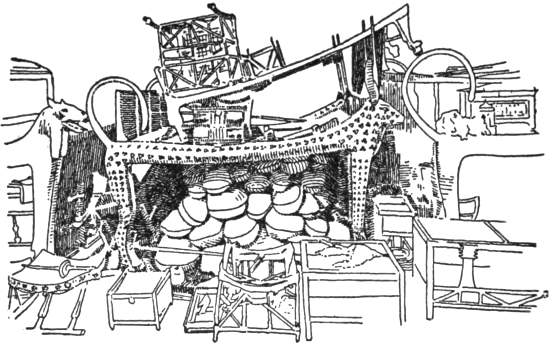
Tu-tank-amen’s tomb showing foods preserved.
The Egyptians believed that when they died,
their souls stayed near by their bodies. So
when a person died they put in the tomb with
him all sorts of things that he had used in daily
life—things to eat and drink, furniture and
dishes, toys and games. They thought the soul
would return to its own body at the day of judgment.
They wanted their bodies to be kept
from decaying until judgment day, in order that
the soul might then have a body to return to.
So they pickled the bodies of the dead by soaking
them in a kind of melted tar and wrapping
them round and round and round with a cloth
like a bandage. A dead body pickled in this way
is called a mummy, and after thousands of years
the mummies of the Egyptian kings may still be
seen. Most of them are not, however, in the
tombs where they were at first placed. They
have been moved away and put in museums, and
we may see them there now. Although they
are yellow and dried up, they still look like
“Little old men
All skin and bones.”
At first only kings or important people of the
highest classes were made mummies, but after
a while all the classes, except perhaps the lowest,
were treated in the same way. Sacred animals
from beetles to cows were also made into
mummies.
When an Egyptian died his friends heaped
up a few stones over his body just to cover it up
decently and keep it from being stolen or destroyed
by those wild animals that fed on dead
bodies. But a king or a rich man wanted a
bigger pile of stones over his body than just
ordinary people had. So to make sure that his
pile would be big enough, a king built it for
himself before he died. Each king tried to make
his pile larger than any one else’s until at last
the pile of stones became so big it was a hill of
rocks and called a pyramid. The pyramids
therefore were tombs of the kings who built
them while they were alive to be monuments to
themselves when they were dead. In fact a king
was much more interested in building a home
for his dead body than he was in a home for
his live body. So, instead of palaces, kings built
pyramids. There are many of these pyramids
built along the bank of the Nile, and most of
them were built, we think, just after 3000 B.C.
When a building is being put up nowadays,
men use derricks and cranes and engines to haul
and raise heavy stones and beams. But the
Egyptians had no such machinery, and though
they used huge stones to build the pyramids,
they had to drag these stones for many miles
and raise them into place simply by pushing and
pulling them. The three biggest of all the pyramids
are near the city of Cairo. The largest one
of them, which is called the Great Pyramid,
was built by a king named Cheops. To remember
when he lived, simply think of this as another
telephone number:
Cheops ..............2900 B.C.
It is said that one hundred thousand men worked
twenty years to build his pyramid. It is one of
the largest buildings in the world, and some of
the blocks of stone themselves are as big as a
small house. I have been to the top of it, and
it is like climbing a steep mountain with rocky
sides. I have also been far inside to the cave-like
room in the center where Cheop’s mummy
was placed. There is nothing in there now,
however, except bats that fly about in the darkness,
for the mummy has disappeared—been
stolen, perhaps.
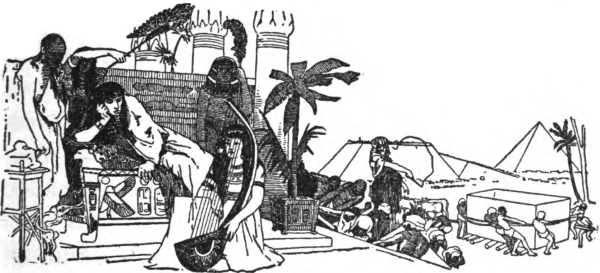
Cheops building his pyramid.
Near the Pyramid of Cheops is the Sphinx.
It is a huge statue of a lion with a man’s head.
It is as big as a church, and though it is so big, it
has been carved out of one single rock. The
rock, however, was already there and so did not
have to be carried. The Sphinx is a statue of
the god of the morning, and the head is that of
one of the Egyptian Pharaohs who built a pyramid
near that of Cheops. The desert sand has
covered the paws and most of the body. Though
the sand has been dug away from time to time,
the wind quickly covers the body with sand
again.
The Egyptians carved other large statues of
men and women out of rock. These figures are
usually many times bigger than life-size, and sit
or stand stiffly erect with both feet flat on the
ground and hands close to the body in the position
some children take when they “sit” for their
photograph.
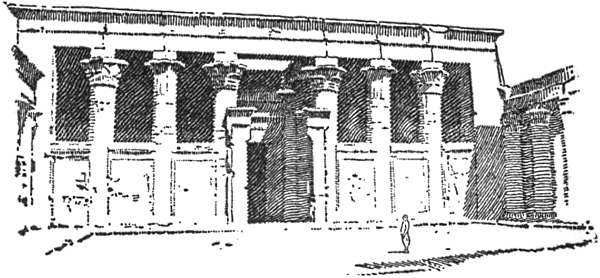
They built huge houses for their gods. These
were called temples and took the place of our
churches. These temples had gigantic—that’s
the way it is spelled, though it means “giant-ic”—columns
and pillars. Ordinary people standing
beside them look like dwarfs. Here is one of
these temples, and you can see how different it
is from our churches:
Egyptian temple.
They decorated their temples and pyramids,
and the cases in which the mummies were put,
with drawings and paintings. The pictures
they made, however, looked something like those
a young child might draw. For example, when
they wanted to make a picture of water, they
simply made a zigzag line to represent waves;
when they tried to draw a row of men back of
a row in front, they put those in the back on top
of those in front. To show that a man was a
king, they made him several times larger than
the other men in the picture. When they
painted a picture they used any color they
thought was pretty, usually blue or yellow or
brown. Whether the person or thing was really
that color or not made no difference.
8
A Rich Land Where There Was No
Money
You have read in fairy-tales of a land where
cakes and candy and sugar-plums grow on trees,
where everything you want to eat or to play with
can be had just by picking it. Well, long, long
ago people used to think there had been really
such a country, and where do you suppose they
said it was? Somewhere near the Tigris and
Euphrates Rivers—those rivers with the strange
names I asked you to learn—and they called
this spot the Garden of Eden. We do not know
exactly where it was, for there is no such place
now quite as wonderful as the Garden of Eden
was supposed to be.
Egypt was a land of one river, the Nile. The
land of the Two Rivers had several names.
Let us suppose we are flying over the country
in an airplane and looking down at the land between
these two rivers. It is called Mesopotamia,
which is two Greek words simply meaning
“Between the Rivers.”
See the land over there by the upper Tigris.
It is called Assyria.
See the land near where the rivers join each
other. That is called Babylonia.
See the land near where they empty. That
is called Chaldea.
And see over there is Mount Ararat, where it
is supposed Noah’s Ark rested after the flood.
Here are a lot of new names. A young
friend of mine had a train of toy cars. He had
noticed that the Pullman cars on which he had
ridden had names, and so he gave his toy cars
names also. He called them:
Babylonia was a very rich country, for the
two rivers brought down and dropped great
quantities of earth just as the Nile did in
Egypt, and this made very rich soil. Wheat,
from which we make bread, is called the staff of
life. It is the most valuable of all foods which
grow. It is supposed that wheat first grew in
Babylonia. Dates in that part of the world are
almost as important a food as wheat. Dates,
too, grow there very plentifully. Now, you may
think dates are something to be eaten almost like
candy but in Babylonia dates took the place of
oatmeal. In the rivers there were quantities of
good fish, and as fishing was just fun, you see
that the people who lived in Babylonia—the
Babylonians, as they were called—had plenty of
good food without having to do much work for
it. No one had any money in those days; people
had cows and sheep and goats, and a man was
rich who had much of these “goods.” But if a
man wanted to buy or sell, he had to buy or sell
by trading something he had for something he
wanted.
Somewhere in Babylonia the people built a
great tower called the Tower of Babel, which
you have probably heard about. It was more
like a mountain than a tower. They built other
towers, too. Some say the Tower of Babel and
towers like it were built so that the people
might have a high place to which they could
climb in case of another flood. But others give
a different reason. They say that the people
who built these towers came to Babylonia from
farther north where there were mountains. In
this northern land they had always placed their
altars on the top of a mountain, to be close to
heaven. So when they moved to a flat country
like Mesopotamia and Babylonia, where there
were no mountains, they built mountains in
order to have a high place for the altar on top.
To reach the top of these mountains or towers,
they made, instead of a staircase on the inside, a
slanting roadway that wound around the outside
in somewhat the way a road winds around
a mountain.
There was hardly any stone either in or near
Babylonia as there was in Egypt, and so the
Babylonians built their buildings of bricks, which
were made of mud formed into blocks and dried
in the sun. In the course of time, bricks of this
sort crumble and turn back into dust again just
as mud pies that you might make would do.
This is the reason why all that is left of the
Tower of Babel and the other buildings that
were put up so long ago are now simply hills of
clay into which the brick has turned.
The Egyptians wrote on papyrus or carved
their history in stone, but the Babylonians had
neither papyrus nor stone. All they had were
bricks. So they wrote on bricks before they
were dried, while they were still soft clay. This
writing was made by punching marks into the
clay with the end of a stick. It was called
cuneiform, which means wedge-shaped, for it
looked like little groups of wedge-shaped marks,
like chicken-tracks, made in the mud. I have
seen boys’ writing that looked more like cuneiform
than it did like English.
The Babylonians as they watched their flocks
by night and by day watched also the sun and
the moon and the stars moving across the sky.
So they came to know a great deal about these
heavenly bodies.
Did you ever see the moon in the daytime?
Oh, yes, you can.
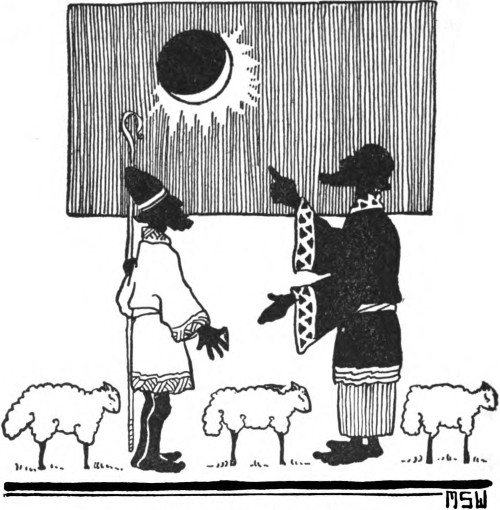
Babylonians watching eclipse.
Well, every once in a great while the moon as
it moves across the sky gets in front of the sun
and shuts out its light—just as, if you should put
a white plate in front of an electric light, the
electric light would be darkened. It may be ten
o’clock in the morning and broad daylight when
suddenly the sun is covered up by the moon as by
a white plate and it becomes night and the stars
shine out and chickens, thinking it is night, go
to roost. But in a few moments the moon passes
by and the sun shines out once again. This is
called an eclipse of the sun.
Now you probably have never seen an eclipse
of the sun, but some day you may. At that time,
and even to-day when ignorant people see an
eclipse of the sun, they think that something
dreadful is going to happen—the end of the
world, perhaps, just because they have never
seen such a strange sight before and do not know
that it is a thing that happens regularly and that
no harm comes from it.
Well, nearly twenty-three hundred years
before Christ, 2300 B. C., the Babylonians told
beforehand just when there was going to be an
eclipse of the sun. They had watched the moon
moving across the sky and they had figured out
how long it would be before it would catch up
with the sun and cross directly over it. So you
see how much the old Babylonians knew about
such things. Men who study the stars and other
heavenly bodies are called astronomers, and
the Babylonians, therefore, were famous astronomers.
The Egyptians worshiped animals; but it
was quite natural that the Babylonians should
worship these wonderful heavenly bodies, the
sun, moon, and stars, and they did.
The first king of Babylonia whom we know
much about—and that much is very little—was
Sargon I, who may have lived about the same
time that the pyramids were built in Egypt.
About 2100 B. C. Babylonia had a king known
far and wide for the laws he made. His name
was Hammurabi, and we still have the laws he
made though we no longer obey them; for
they were carved into a stone in cuneiform,
and we have the stone. Sargon and Hammurabi
are strange names like no one’s name
you ever heard before, yet they are real names
of real kings who ruled over real people.
9
The Wandering Jews
“You are” spells “Ur.” It is one of the
shortest names I know. It is the name of a
little place in that part of Babylonia called
Chaldea. In this place—about nineteen hundred
years B.C.—there lived a man named Abraham.
Abraham had a very large family and though
he had no money he was rich. He had large
herds of sheep and goats, and these were the
chief riches in those days. Now, Abraham believed
in one God, as we do, while his neighbors,
the Babylonians, worshiped idols and the
heavenly bodies, such as the sun, moon, and
stars, as I have just said. Abraham did not like
his neighbors for this reason; and his neighbors
didn’t like him, either, for they thought his
ideas were peculiar or even crazy. So, about
nineteen hundred years before Christ, Abraham
took his large family, his flocks, and his herds
and moved to a land called Canaan, far away
on the edge of the Mediterranean Sea.
Abraham lived to be a very old man, and he
had a large family. One of his grandsons named
Jacob, who was also known by the name of
Israel, had a son Joseph. You probably remember
the Bible story of Jacob’s favorite son
Joseph with the coat of many colors. Joseph’s
brothers were jealous of him, as boys and even
dogs are apt to be jealous of any one who is
liked better than they are. So they put Joseph
into a well and then sold him as a slave to
some Egyptians who were passing by. Then
they told their father Jacob that Joseph had
been killed by wild animals. The Egyptians
took Joseph to far-off Egypt—far away from
Canaan.
Abraham leaving Ur. 1900 B.C.
But although Joseph was a slave in Egypt,
and although, as I told you, it was very difficult
for any one to work his way up out of his class
to a higher class, he was so bright that at last
he became one of the rulers in Egypt.
Now, at that time when he was ruler there
came a famine in Canaan and there was no food.
In Egypt, however, there was plenty of food
stored up. So Joseph’s wicked brothers went
down to Egypt to beg the rulers for bread. They
probably thought by that time their brother was
dead. They did not know that he had become
such a great man and that he was now the ruler
of whom they were begging food. You can
imagine how surprised they were and how
ashamed they must have felt when they found
out that the great ruler was their own brother,
whom they had planned to kill and then had sold
as a slave.
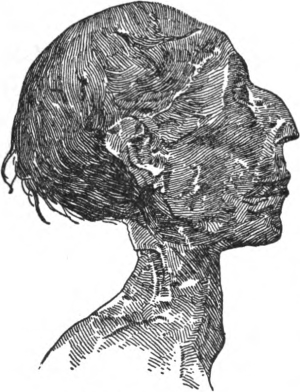
Rameses’ mummy.
Joseph might have let his brothers starve to
death or put them in prison, or sent them back
to Canaan without anything, if he had wanted
to revenge himself on them. But instead of doing
any of these things, he gave them not only
all the food they wanted and more to take back
home, but made them rich presents besides.
Then he told them to go back and get the rest
of his family and return with them to Egypt,
and he promised to give them a piece of land
called Goshen where there would be no famines
and they might live happily. So they did as they
were told, and Israel and his sons and all their
families came down and settled in Goshen about
1700 B.C. They were called Israelites, which
means of course the children of Israel, and they
believed they were God’s chosen people. These
are the people we now call the Jews.
After Joseph, who was of course an Israelite
himself, died, the kings or Pharaohs of Egypt
did not like these foreign people who belonged
to the Semite family, and treated them very
badly, as other peoples have always treated the
Jews badly ever since. Though the Jews and
their sons and sons’
sons lived in
Egypt for about
four hundred
years, they were
always hated by
the Egyptians.
Now about four
hundred years
from the time the
Jews first came into
Egypt—400 from
1700 is 1300 B.C.—there
was a ruler
of Egypt called
Rameses the Great.
Rameses the Great.
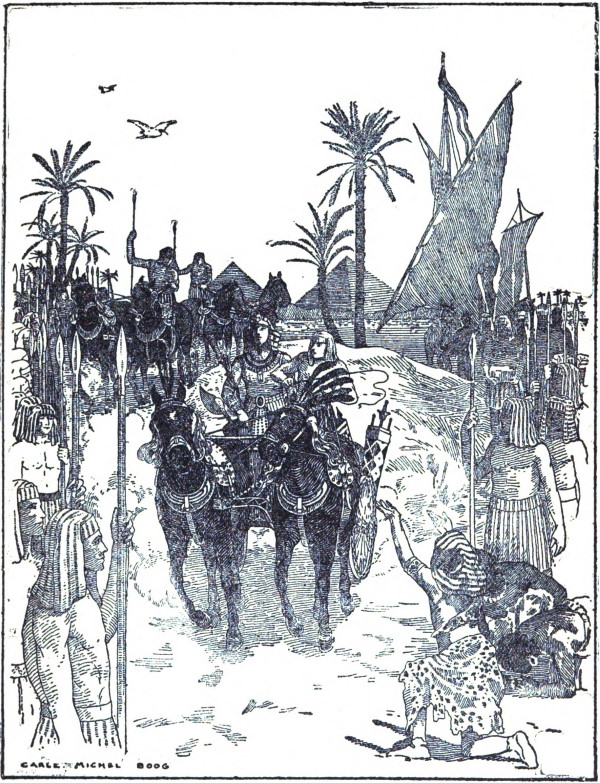
Rameses so hated the Jews that finally he gave
orders to have every Jewish boy baby killed. In
this way he thought to get rid of these people.
One little Jewish boy named Moses, however,
was saved, and when he grew up he became the
greatest leader of his people. Moses wanted to
get the Jews out of this unfriendly country
where the people worshiped false gods. And
so at last he led all his people out of Egypt across
the Red Sea. This was called the Exodus, and
it took place about 1300 B.C.
After the Jews had left Egypt they first
stopped at the foot of a mountain called Mount
Sinai, while Moses went up to the top where he
could be by himself and learn what God wanted
him and the Jews to do. Moses spent forty days
praying on top of the mountain. When he came
down from the mountain-top, he brought with
him the Ten Commandments, the same Ten
Commandments you may have learned in Sunday-school.
But Moses had been gone so long
that when he came back again to his people he
found them worshiping a golden calf as the
Egyptians had done. They had lived in Egypt
until they had come to think it was all right to
worship idols.
Moses was very angry. It was high time, he
thought, that they should get rid of the bad influence
of their old Egyptian neighbors. And
at last he succeeded in making them worship
God again and gave them the Ten Commandments
for their rule of life. So Moses is called
a lawgiver and the founder of the Jewish religion.
Then Moses died, and the Jews wandered
from place to place for a great many
years before they finally settled in Canaan.
The Jews had no kings. They were ruled by
men called judges, but the judges lived very
simply, just like every one else and not like
kings in palaces with servants and fine robes and
rich jewels. But the Jews wanted a real king as
their enemies had and other nations who were
their neighbors. Strange they wanted a king
which so many countries have tried to get rid
of—we should think they would have preferred
a President as we have.
So at last a judge who was named Samuel
said they should have a king, and Saul was
chosen. Then Samuel poured olive-oil over
Saul’s head. This may seem a queer thing to do,
but it took the place of putting a crown on his
head and was a sign that he was to be king.
Samuel, therefore, was the last one of their
judges, and Saul was their first king.
All other nations at that time believed as the
Egyptians and Chaldeans did, in fairy-tale gods
or idols. But the Jews alone believed in one
God. They had a Holy Book which had been
written by their prophets. This book is the Old
Testament part of the Christian Bible.
So this is the story of the Wandering Jews
who gave us the Old Testament and the Ten
Commandments, and here is the way they wandered:
From Ur to Canaan—1900 B.C.
From Canaan to Egypt—1700 B.C.
From Egypt back to Canaan—1300 B.C.
10
Fairy-Tale Gods
There was once a man named Hellen—strange-sounding
name for a man, isn’t it? He
was not a Semite and not a Hamite. He was
an Aryan. He had a great many children and
children’s children, and they called themselves
Hellenes. They lived in a little scrap of a
country that juts out into the Mediterranean
Sea, and they called their land Hellas. I once
upset a bottle of ink on my desk, and the ink ran
out into a wriggly spot that looked exactly as
Hellas does on the map. Though Hellas is
hardly any bigger than one of our States, its
history is more famous than that of any other
country of its size in the world. We call Hellas
“Greece” and the people who lived there
“Greeks.”
About the same time the Jews were leaving
Egypt, about the time when people were beginning
to use iron instead of bronze, that is,
about 1300 B.C., we first begin to hear of Hellas
and the Hellenes, of Greece and the Greeks.
The Greeks believed in many gods, not in one
God as we do and as the Jews did, and their
gods were more like people in fairy-tales than
like divine beings. Many beautiful statues have
been made of their different gods, and poems
and stories have been written about them.
There were twelve—just a dozen—chief gods.
They were supposed to live on Mount Olympus,
which was the highest mountain in Greece.
These gods were not always good, but often
quarreled and cheated and did even worse
things. The gods lived on a kind of food that
was much more delicious than what we eat. It
was called nectar and ambrosia, and the Greeks
thought it made those who ate it immortal; that
is, so that they would never die.
Let me introduce you to the family of the
gods. I know you will be pleased to meet them.
Most of them have two names.
Jupiter or Zeus is the father of the gods and the
the king who rules over all human beings.
He sits on a throne and holds a zigzag
flash of lightning called a thunderbolt in
his hand. An eagle, the king of birds, is
usually by his side.
Juno or Hera is his wife and therefore queen.
She carries a scepter, and her pet bird,
the peacock, is often with her.
Neptune or Poseidon is one of the brothers of
Jupiter. He rules over the sea. He
rides in a chariot drawn by sea-horses
and carries in his hand a trident, which
looks like a pitchfork with three points.
He can make a storm at sea or quiet the
waves simply by striking them with his
trident.
Vulcan or Hephæstus is the god of fire. He
is a lame blacksmith and works at a
forge. His forge is said to be in the
cave of a mountain, and as smoke and
fire come forth from some mountains they
are called volcanoes after the god Vulcan
inside.
Apollo is the most beautiful of all the gods. He
is the god of the sun and of song and
music. Every morning—so the Greeks
said—he drives his sun-chariot across the
sky from the east to the west, and this
makes the sun-lighted day.
Diana or Artemis is the twin sister of Apollo.
She is the goddess of the moon and of
hunting.
Mars or Ares is the terrible god of war, who is
only happy when a war is going on—so
that he is happy most of the time.
Mercury or Hermes is the messenger of the
gods. He has wings on his cap and on
his sandals, and he carries in his hand a
wonderful winged stick or wand, which,
if placed between two people who are
quarreling, will immediately make them
friends. One day Mercury saw two
snakes fighting and he put his wand between
them, whereupon they twined
around it as if in a loving hug, and ever
since the snakes have remained entwined
around it. This wand is called a caduceus.
Birth of Minerva or Athene.
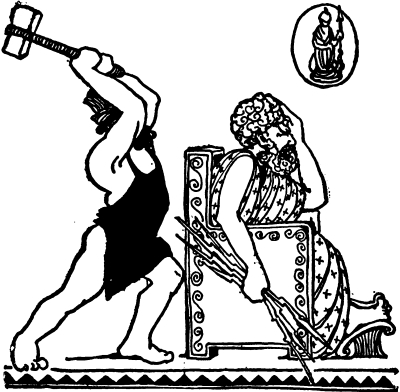
Minerva or Athene is the goddess of wisdom.
She was born in a very strange way. One
day Jupiter had a terrible headache—what
we call a “splitting” headache. It
got worse and worse, until at last he
could stand it no longer, but he took a
very strange way to cure it. He called
Vulcan, the lame blacksmith, and told
him to hit him on the head with his hammer.
Though Vulcan must have thought
this a funny request, of course he had to
obey the father god. So he struck
Jupiter a terrible blow on the head,
whereupon there sprang forth Minerva
in all her armor, and the headache, of
which she had been the cause, had gone.
So she was born from his brain, that is
why she is the goddess of wisdom. Minerva’s
Greek name is Athene, and she
founded a great city in Greece and named
it after herself, Athens. She is supposed
to look out for this city as a
mother does for her child.
Venus or Aphrodite is the goddess of love and
beauty. She is the most beautiful of the
goddesses as Apollo is the most beautiful
of the gods. She is said to have been
born from the sea-foam. Cupid, her son,
is a little chubby boy with a quiver of
arrows on his back. He goes about
shooting his invisible arrows into the
hearts of human beings, but instead of
dying when they are hit they at once fall
in love with some one. That is why we
put hearts with arrows through them on
valentines.
Vesta is the goddess of the home and fireside,
who looks out for the family.
Ceres or Demeter is the goddess of the farmer.
These are the twelve gods of the Olympian
family.
Pluto is a brother of Jupiter. He rules the
world underground and lives down there.
There are many other less important gods
and goddesses as well as some gods that are half
human, such as the three Fates and three Graces
and the nine Muses.
Some of the planets in the sky which look
like stars are still called by the names of these
Greek gods. Jupiter is the name of the largest
planet. Mars is the name of one that is reddish—the
color of blood. Venus is the name of
one that is very beautiful. There is also a Mercury
and a Neptune.
It is hard for us to understand how the
Greeks could have prayed to such gods as these,
but they did. Their prayers, however, were not
like ours. Instead of kneeling and closing their
eyes as we do, they stood up and stretched their
arms straight out before them. They did not
pray to be forgiven for their sins and to be
made better. They prayed for victory over
their enemies or to be protected from harm.
When they prayed they often made the god
an offering of animals, fruit, honey, or wine in
order to please him so that he would grant their
prayer. The wine they poured out on the
ground, thinking the god would like to have
them do this. The animals they killed and then
burned by building a fire under them on an altar.
This was called a sacrifice. Their idea seemed to
be that even though the gods could not eat the
meat of the animals nor drink the wine themselves,
they liked to have something given up
for them. And so even to-day we say a person
makes a sacrifice when he gives up something
for another.
When the Greeks were sacrificing they usually
looked for some sign from the god to see whether
he was pleased or not with the sacrifice and
whether he would answer their prayer and do
what they asked him or not. A flock of birds
flying overhead, a flash of lightning, or any unusual
happening they thought was a sign which
meant something. Such signs were called
“omens.” Some omens were good and showed
that the god would do what he was asked, and
some omens were bad and showed he would not.
Omens were very much like some of the signs
that people believe in even to-day when they
say it is a good sign or good luck if you see the
new moon over the right shoulder or a bad sign
or bad luck if you spill the salt.
Not so very far from Athens is a mountain
called Mount Parnassus. On the side of Mount
Parnassus was a town called Delphi. In the
town of Delphi there was a crack in the ground,
from which gas came forth, somewhat as it does
from cracks in a volcano. This gas was supposed
to be the breath of the god Apollo, and
there was a woman priest called a priestess who
sat on a three-legged stool or tripod over the
crack so as to breathe the gas. She would become
delirious, as some people do when they are
sick with fever and we say they are “out of their
heads,” and when people asked her questions
she would mutter strange things and a priest
would tell what she meant. This place was
called the Delphic Oracle, and people would go
long distances to ask the oracle questions, for
they thought Apollo was answering them.
The Greeks went to the oracle whenever they
wanted to know what to do or what was going
to happen, and they firmly believed in what the
oracle told them. Usually, however, the answers
of the oracle were like a riddle, so that
they could be understood in more than one way.
For instance, a king who was about to go to
war with another king asked the oracle who
would win. The oracle replied, “A great kingdom
will fall.” What do you suppose the
oracle meant? Such an answer, which you can
understand in two or three ways, is still called
“oracular.”
11
A Fairy-Tale War
The history of countries usually begins—and
also ends—with war. The first great happening
in the history of Greece was a war. It was
called the Trojan War and was supposed to
have taken place about twelve hundred years
before Christ, or not long after the beginning of
the Iron Age. But we are not only not sure of
the date; we are not even sure that there ever
was such a war, for a great deal of it, we know,
is simply fairy-tale. This is the way the tale
goes.
Once there was a wedding feast of the gods
and goddesses on Mount Olympus, when suddenly
a goddess who had not been invited threw
a golden apple on the table. On the apple was
written these words:
To the Fairest.
The goddess who had thrown the apple was
the goddess of quarreling; and true to her name
she did start a quarrel, for each of the goddesses,
like vain human beings, thought she was the
fairest and should have the apple. At last they
called in a shepherd boy named Paris to decide
which was the fairest.
Each goddess offered Paris a present if he
would choose her. Juno, the queen of the gods,
offered to make him a king; Minerva, the goddess
of wisdom, offered to make him wise; but
Venus, the goddess of beauty, offered to give
him the most beautiful girl in the world for his
wife.
Now, Paris was not really a shepherd boy but
the son of Priam, the king of Troy, which was
a city on the sea-shore opposite Greece. Paris
when a baby had been left on a mountain to die,
but had been found by a shepherd and brought
up by him as his own child.
Paris didn’t care about being wise; he didn’t
care about being king; what he did want was to
have the most beautiful girl in the world for his
wife, and so he gave the apple to Venus.
Now the most beautiful girl in the world was
named Helen, and she was already married to
Menelaus, the king of Sparta. But in spite of
that fact Venus told Paris to go to Sparta in
Greece, where he would find Helen, and then
run away with her. So Paris went to Sparta to
visit King Menelaus and was royally entertained
by him. And then Paris, although he had been
treated so kindly and been trusted, one night
stole Helen away and carried her off across the
sea to Troy. Though this was in the Iron Age,
it was the way a Cave Man of the Stone Age
might have acted.
Menelaus and the Greeks were naturally very
angry and immediately prepared for war and
sailed off for Troy to get Helen back. Now, in
ancient times all cities had walls built around
them to protect them from the enemy. As there
were no cannons nor guns nor deadly weapons
such as are used in war nowadays, it was very
hard to get into a walled city or capture it.
Troy was protected in this way with walls; and
though the Greeks tried for ten years to capture
it, at the end of the ten years Troy was still unconquered.
So at last the Greeks decided to try a trick to
get into the city. They built a huge horse of
wood, and inside this wooden horse they put
soldiers. They placed the horse in front of the
city walls and then sailed away as if at last they
were giving up the war. The Trojans were told
by a spy that the horse was a gift of the gods
and that they ought to take it into the city. A
Trojan priest named La-oc-o-on, however, told
his people not to have anything to do with the
horse, for he suspected a trick. But people seldom
take advice when told not to do what they
want to do.
Just then some huge snakes came out of the
sea and attacked Laocoon and his two sons and,
twining round them, strangled them to death.
The Trojans thought this was a sign from the
gods, or an omen as they would have said, that
they should not believe Laocoon; so they determined
to take the horse into the city against his
advice. The horse was so big, however, that it
would not go through the gates, and in order to
get it inside of the walls they had to tear down
part of the wall itself. When night fell, the
Greek soldiers came out of the horse and opened
the gates of the city. The other Greeks, who
had been waiting just out of sight, returned and
entered through the gates and the hole the Trojans
had made in the wall. Troy was easily conquered
then, and the city was burned to the
ground, and Helen’s husband carried her back
to Greece. For reason of this horse trick, we
still have a saying, “Beware of the Greeks bearing
gifts,” which is as much as to say, “Look
out for an enemy who makes you a present.”
The story of the Trojan War was told in two
long poems. Some people think they are the
finest poems that were ever written. One of
these poems is called the “Iliad,” from the name
of the city of Troy, which was also known as
Ilium. The “Iliad” describes the Trojan War
itself. The other poem is called the “Odyssey”
and describes the adventures of one of the Greek
heroes on his way home after the war was over.
This Greek hero’s name was Odysseus, which
gives the name Odyssey to the book, but he was
also called Ulysses. These poems, the “Iliad”
and the “Odyssey,” were composed by a blind
Greek poet named Homer, who is supposed to
have lived about two hundred years after the war;
that is about 1000 B.C.
Homer was a bard; that is, a singing poet who
went about from place to place and sang his
poems to the people. Usually a bard played on
the lyre as he sang, and the people gave him
something to eat or a place to sleep to pay him
for his songs. Nowadays, instead of a Homer
singing the “Iliad” and “Odyssey,” we have the
organ-grinder and street piano playing their
tunes in front of our houses.
Homer never wrote down his poems, for he
was blind; but the people were very fond of
hearing his songs, and they learned them by
heart, and mothers taught them to their children
after Homer had died. At last, many years
later, another man wrote the poems down in
Greek, and you may some day read them in
Greek, if you study that language, or at least
in an English translation.
Although the Greeks thought so much of
Homer, he could hardly make a living, and he
almost had to beg his daily bread. After his
death however, the people of nine different cities
each proudly said that Homer was born in their
city. And so some one has made this rime:
Nine cities claimed blind Homer dead,
Through which, alive, he’d begged his bread.
Some people now doubt that there ever was
a poet named Homer. Others think that instead
of only one man there must have been several
men, perhaps nine, who composed these poems,
and this might explain how he could be born in
nine different cities.
12
The Kings of the Jews
While the blind beggar Homer was singing
his wonderful songs through the streets of
Greece, a great king of the Jews was singing
other wonderful songs in Canaan. This king
was named David, and he wasn’t born a king.
He was only a shepherd boy in King Saul’s
army. This is the way he happened to become
king.
At first, as you remember, the Jews had no
kings; but they had asked for kings, and at last
they were given one by the name of Saul.
David had killed the giant Goliath. We all
love this Bible story because we are always glad
when the skilful little chap beats the great, big,
bragging bully.
Well, King Saul had a daughter, and she fell
in love with this brave and athletic young David
the Giant-Killer, and at last they were married.
So after Saul died David became king, and
he was the greatest king the Jews ever had.
Although Saul had been king he had lived in a
tent, not in a palace, and he didn’t even have a
capital city.
So David conquered a city in Canaan called
Jerusalem and made this city the capital of the
Jews.
But David was not only a brave warrior and
a great king; he wrote beautiful songs as well.
The blind beggar Homer sang of his fairy-tale
gods. The great King David sang of his
one God.
These songs are the Psalms, which you hear
read and sung in church.
Nowadays even a popular song is popular for
only a few months, but the songs which David
wrote almost three thousand years ago are still
popular to-day! The Twenty-third Psalm,
which starts, “The Lord is my shepherd,” is one
of the most beautiful and a good one to learn
by heart. David likens himself to a sheep and
his Lord to a good shepherd who tenderly looks
out for the comfort and safety of his sheep.
David’s son was named Solomon, and when
David died Solomon became king.
If a good fairy had asked you what you would
rather have than anything in the world, I wonder
what you would have chosen. When
Solomon became king, God is said to have appeared
to him in a dream and asked him what
he would rather have than anything else in the
world. Instead of saying he wanted to be made
rich or powerful, Solomon asked to be made wise,
and God said He would make him the wisest
man that ever lived. Here is a story that shows
how wise he was.
Once upon a time two women came to Solomon
with a baby, and each woman said the baby was
her own child. Solomon called for a sword and
said, “Cut the baby in two, and give each a half.”
One of the women cried out to give the baby to
the other rather than do this, and Solomon then
knew who was the real mother and ordered the
baby to be given to her.
Solomon built a magnificent temple made of
cedar-wood from the famous forest of Lebanon,
and of marble and gold and studded with jewels.
Then he built himself a wonderful palace, which
was so gorgeous and splendid that people came
from all over the world to see it. The Bible tells
us just how large this temple and palace were,
not in feet but in cubits. A cubit was the distance
from a man’s elbow to the end of his middle finger,
which is about one foot and a half.
The queen of Sheba, among others, came a
long distance across Arabia to hear the wise sayings
of Solomon and see his palace and the temple
he had built.
Although the palace and temple were considered
extraordinarily magnificent at that time,
you must remember that this was a thousand
years before Christ.
Solomon’s temple and palace have disappeared
long since, and there is left of them neither stick
nor stone. But his wise sayings are preserved in
every language and read by every people in every
part of the world. There are thousands of buildings
now in the world that would make his palace,
if still standing, look like a child’s toy-house.
But no one has ever been able to say any better
the things he said. Do you think you could?
Suppose you try. Here are some of them. They
are called proverbs.
A soft answer turneth away wrath; but grievous words
stir up anger.
What’s that mean?
A good name is rather to be chosen than great riches
and loving favor rather than silver and gold.
What’s that mean?
Let another man praise thee and not thine own mouth.
What’s that mean?
Solomon was the last great king the Jews ever
had. After he died the Jewish nation gradually
broke up and went to pieces, and the great Jewish
people are to-day without a king, without a capital,
and without a country of their own, but are
found in every other country of the world.
13
The People Who Made Our A B C’s
Long before people knew how to write, there
lived a carpenter named Cadmus. One day he
was at work on a house when he wanted a tool
that he had left at home. Picking up a chip of
wood, he wrote something on it and, handing it
to his slave, told him to go to his home and give
the chip to his wife, saying that it would tell her
what he wanted. The slave, wondering, did as
he was told. Cadmus’s wife looked at the chip,
and without a word handed the tool to the amazed
slave, who thought the chip in some mysterious
way had spoken the message. When he returned
to Cadmus with the tool, he begged for the remarkable
chip, and when it was given him, hung
it around his neck for a charm.
Cadmus’ slave and the chip.
This is the story the Greeks told of the man
they say invented the alphabet. We believe,
however, that Cadmus was a mythical person, for
the Greeks liked to make up such stories, and
we think no one man made the alphabet. But
Cadmus was a Phenician and we do know that
the Phenician people invented the alphabet.
You probably call it your A B C’s, but the
Greeks had much harder names for the letters.
They called A “alpha,” B “beta,” and so on.
So the Greek boy spoke of learning his “alpha
beta,” and that is why we call it the “alphabet.”
You may never have
heard of Phenicia or
the Phenician people.
Yet, if there had been
no such country as
Phenicia, you might
now be learning at
school to read and write
in hieroglyphics or in
cuneiform.
Up to this time, you
know, people had very
clumsy ways of writing.
The Egyptians had to draw pictures, and
the Babylonians made writing like chicken-tracks.
The alphabet that the Phenicians invented had
twenty-two letters, and from it we get the alphabet
we use to-day.
Of course, we do not use just the same alphabet
now that the Phenicians did, but some of the letters
are almost, if not quite, like those we now have
after three thousand years. For instance the
Phenician A
was
written
on its side
—𐤀
E
"
"
backward
—Ǝ
Z
"
"
just the same
Z
O
"
"
" " "
O
The Phenicians lived next door to the Jews;
in fact they belonged to the same family—the
Semites. Their country was just north of the
kingdom of the Jews; that is, above it on the
map and lying along the shore of the Mediterranean
Sea.
The Phenicians had a great king named Hiram
who lived at the same time as Solomon. In fact,
Hiram was a friend of Solomon and sent him
some of his best workmen to help build a temple
at Jerusalem. And yet Hiram himself and
the Phenicians did not believe in the Jewish
God.
The Phenicians worshiped idols, terrible monsters
named Baal and Moloch, which they called
gods of the sun. They also believed in a goddess
of the moon named Astarte and made sacrifices
of live children to her idol, Fe-Fi-Fo-Fum;
this is a real story and not a fairy-tale.
Just suppose you had been a child then!
The Jews, as we have learned, were very religious,
but their neighbors, the Phenicians,
though Semites and therefore relatives, were
business people and thought of nothing but
money, money, money—all the time. And they
were not particular how they earned it, whether
honestly or not. Nowadays, dealers know that
they must be honest if they are to be very successful,
but the Phenicians were usually tricky in
their trading with people. They always drove
a good bargain and sometimes even cheated when
they had a chance.
The Phenicians made many things to sell, and
then they went far and near to sell them.
They knew how to make beautiful cloth and
glassware and objects in gold and silver and
ivory.
They knew the secret of making a wonderful
purple dye from the body of a little shell-fish
that lived in the water near the city of Tyre.
This dye was known as Tyrian purple from the
name of that city, and it was so beautiful that
kings’ robes were colored with it.
Tyre and Sidon were the two chief cities of
Phenicia, and once upon a time they were two
of the busiest cities in the world.
In order to find people to sell to, the Phenicians
traveled in boats all over the Mediterranean
Sea and even went outside this sea into the Great
Ocean. This opening is now called the Strait
of Gibraltar but was then known as the Pillars
of Hercules. They went as far as the British
Isles. Other people in those days had not dared
to go so far in boats; they thought they would
come to the edge of the ocean and tumble off.
But the Phenicians had no such fear, and so they
were the greatest sailors as well as the greatest
traders of their times. Their ships were built
from the cedar-trees that grew on the slopes of
their hills, which were called Lebanon.
Wherever the Phenicians found good harbors
for their boats, they started little towns where
they traded with the natives, who at that time
were almost savage. With ignorant savages they
found they could drive a good bargain. For a
few glass beads or a piece of purple dyed cloth
worth very little they could get in return gold
and silver and other things worth a great deal.
On the African coast, one of these towns they
started was called Carthage. Of Carthage we
shall hear more by and by, for it grew to be so
wealthy and important that—but wait until I
come to that story.
14
Hard as Nails
Our story goes back again to Greece, the land
of Homer and the fairy-tale gods and to Sparta,
where Helen once lived.
About nine hundred years before Christ was
born, there lived in Sparta a man named
Lycurgus. That is a hard name, and when you
hear about this man you may think he was hard,
too. Lycurgus wanted his city to be the greatest
in the world.
But first he had to find out what it was that
made a city and a people great.
So he started off and traveled for years and
years visiting all the chief countries of the world
to see if he could learn what it was that made
them great. And this is what he learned.
Wherever the people thought chiefly of fun
and pleasure, of amusing themselves and having
a good time—he found they were not much good,
not much account—not great.
Wherever the people thought chiefly of hard
work and did what they ought, whether it was
pleasant or not, he found they were usually good
for something—some account—great.
So Lycurgus came back to his home Sparta
and set to work to make a set of rules which he
thought would make his people greater than all
other people in the world. These rules were
called a Code of Laws, and I think you’ll agree
they were very hard, and they made the Spartans
hard, too—as “hard as nails.” We shall see
whether they made the Spartans really great,
also.
To begin with, babies, as soon as they were
born, were examined to see that they were strong
and perfect. Whenever one was found that did
not seem to be so, he was put out on the mountain-side
and left to die. Lycurgus wanted no
weaklings in Sparta.
When boys were seven years old, they were
taken from their mothers and put in a school,
which was more like a soldiers’ camp than a
school, and they never lived anywhere else until
they were sixty years old.
In this school they were not taught the things
you are, but only the things that trained them
to be good soldiers.
There were no such things as school-books then.
There were no spelling-books.
There were no arithmetics.
There were no geographies. No one knew
enough about the world to write a geography.
There were no histories. No one knew much
about things that had happened in the world
before that time, and of course none of the history
since then that you now study had taken
place.
At certain times, the Spartan boy was whipped,
not because he had done anything wrong, but
just to teach him to suffer pain without whimpering.
He would have been disgraced forever
if he had cried, no matter how badly he was
hurt.
He was exercised and drilled and worked
until he was ready to drop. But still he was
obliged to keep on, no matter how tired or hungry
or sleepy or aching he might be, and he must
never show by any sign how he felt.
He was made to eat the worst kind of food,
to go hungry and thirsty for long periods of
time, to go out in the bitter cold with little or
no clothing, just to get used to such hardships
and able to bear all sorts of discomforts. This
kind of training, this kind of hardening, is therefore
called “Spartan discipline.” How do you
think you would have liked it?
The Spartans’ food, clothing, and lodging
were all furnished them, though it was very poor
food and poor clothing and poor lodging. They
were not allowed good things to eat, soft beds
to lie on, or fine clothing to wear. Such things
were called luxuries, and luxuries, Lycurgus
thought, would make people soft and weak, and
he wanted his people hard and strong.
The Spartans were even taught to speak in a
short and blunt manner; they were taught not
to waste words; they must say what they had to
say in as few words as possible. This manner
of speaking we call “Laconic” from the name
Laconia, the state in which Sparta was located.
Once a king wrote to the Spartans a threatening
letter, saying that they had better do what
he told them to, for if he came and took their
country, he would destroy their city and make
them slaves.
The Spartans sent a messenger back with their
answer, and when the letter was opened, it contained
only one word:
“IF!”
Even to-day, we call such an answer, short but
to the point, a Laconic answer.
Did all this hard training and hard work make
the Spartans the greatest people in the world?
Lycurgus did make the Spartans the strongest
and best fighters in the world—but—
The Spartans conquered all the peoples
around about them, though there were ten times
as many—but—
They made these people their slaves, who did
all their farming and other work—but—
We shall see later whether Lycurgus’s idea
was right.
North of Sparta was another great city of
Greece called Athens. There were, of course,
many other towns in Greece, but Sparta and
Athens were the most important. In Athens
the people lived and thought quite differently
from those in Sparta.
The Athenians were just as fond of everything
beautiful as the Spartans were of discipline and
of everything military.
The Athenians loved athletic games of all
sorts just as the Spartans did, but they also
loved music and poetry and beautiful statues,
paintings, vases, buildings, and such things that
are known as the “arts.”
The Athenians believed in training the mind
as well as the body. The Spartans believed the
training of the body was the all-important thing.
Which do you like better, the Athenians’ idea or
the Spartans’ idea?
Once at a big game a very old man was looking
for a seat on the Athenians’ side. There was
no seat empty, and no Athenian offered to give
him one. Whereupon the Spartans called to the
old man and gave him the best seat on their
side. The Athenians cheered the Spartans to
show how fine they thought this act. At this
the Spartans said:
“The Athenians know what is right but they
don’t do it.”
15
The Crown of Leaves
Greek boys and young men and even girls
loved all sorts of outdoor sports.
They didn’t play football or baseball or
basketball, but they ran and jumped and wrestled
and boxed and threw the discus—a thing like a
big, heavy dinner-plate of iron.
From time to time matches were held in different
parts of Greece to see who was the best in
these sports.
The Big Meet, however, took place only once
every four years at a place called Olympia in
southern Greece; and these Olympic games, as
they were called, were the most important affairs
held in Greece, for all the winners from different
parts of the country were here matched
against each other to see who should be the
champion of all Greece.
The time when the games were held was a
great national holiday, for the games were in
honor of the head god Jupiter, or Zeus as the
Greeks called him. People came from all over
the known world to see the games much as they
do now when a World’s Fair is held or a big
football game.
Only Greeks could enter this contest, and only
those who had never committed a crime or broken
any laws—as a boy nowadays must have a clean
record in order to be allowed to play on his
college or school team.
If there happened to be a war going on at the
time, and there usually was, so important was
this holiday that a truce was declared, and everybody
went off to the games. Nothing could be
allowed to interfere with the games, and even
war was not as important. “Business before
pleasure!” When the games were finished, they
started fighting again!
The Greek boys and young men would train
for four years getting ready for this big event,
and then nine months before the great day they
would go to Olympia to get in training at an
open-air gymnasium near the field.
The games lasted five days and began and
ended with a parade and prayers and sacrifices to
the Greek gods, beautiful statues to whom were
placed all about the field, for this was not only
sport, but a religious service in honor of Jupiter
and the other gods.
There were all sorts of matches—in running,
jumping, wrestling, boxing, chariot-racing, and
throwing the discus.
Any one who cheated would have been put out
and never again allowed to take part. The Greek
believed in what we call being a good sport. He
didn’t brag if he won. He didn’t make excuses
if he lost; he didn’t cry out that the decision was
unfair.
The athlete who won one or more of these
games was the hero of all Greece, and in particular
of the town from which he came. The
winner received no money prize but was crowned
with a wreath made of laurel leaves. This he
valued much more than an athlete nowadays does
the silver cup or gold medal he may win. Besides
receiving the laurel wreath, the winner had songs
written to him by poets, and often statues were
made of him by sculptors.
There were not only athletic matches but contests
between poets and musicians to see who
could write the best poetry or compose and play
the sweetest music on a kind of small harp called
the lyre. The winners of these contests did not
receive a laurel wreath, but they were carried in
triumph on the shoulders of the throng, as you
may have seen the captain of a winning team
picked up and raised aloft by his fellow-players
after he has won.
Greek runner.
Now, in Greek History the first event which
we can be absolutely sure is true is the record
of the winner of a foot-race in these Olympic
Games 776 years before Christ was born. And
from this event the Greeks began to count their
history dates, as we do now from the birth of
Christ. It was their Year 1.
The four years’ time between the Olympic
Games was called an Olympiad. Up to this time,
they had no calendar that gave the year or date,
so 776 is the date of
the first Olympiad.
Greek History before
that time may have
been partly true, but
we know much of it
was mythical. Beginning
with 776, however,
Greek history is
pretty much all true.
After a long while
they stopped having
the games, but a few
years ago it was
thought it would be a
good thing to start
them again. So, for the first time since before
Christ, new Olympic Games were again held in
1896 A.D., not in Olympia, however, but in
Athens. The games used to be held only in
Greece. Now they are held each time in a different
country. Only Greeks used to be allowed
to take part. Now, however, athletes from almost
all the countries of the world are invited
to compete. War used to be stopped when the
time for the games arrived. Now the games are
stopped when war is on.
From what we have learned of the Spartans’
training, we might guess that they used to win
most of the athletic prizes, and they did.
Do the Spartans still continue to win most of
the prizes in the New Olympic Games?
No. Not even the Greeks now carry off the
chief prizes.
16
A Bad Beginning
Have you ever heard of the Seven-League
Boots, the boots in which one could take many
miles at a single step?
Well, there is a still bigger boot; it is over five
hundred miles long, and it is in the Mediterranean
Sea.
No, it’s not a real boot, but it would look like
one if you were miles high in an airplane and
looking down upon it.
It is called Italy.
Something very important happened in Italy,
not long after the First Olympiad in Greece.
It was so important that it was called the Year 1,
and for a thousand years people counted from
it as the Greeks did from the First Olympiad,
and as we do now from the birth of Christ. This
thing that happened was not the birth of a man,
however. It was the birth of a city, and this city
was called Rome.
The history of Rome starts with stories that
we know are fairy-tales or myths in the same
way that the history of Greece does. Homer told
about the wanderings of the Greek, Odysseus.
A great many years later a poet named Vergil
told about the wanderings of a Trojan named
Æneas.
Æneas fled from Troy when that city was
burning down and started off to find a new home.
Finally after several years he came to Italy and
the mouth of a river called the Tiber. There
Æneas met the daughter of the man who was
ruling over that country, a girl by the name of
Lavinia, and married her, and they lived happily
ever after. So the children of Æneas and
Lavinia ruled over the land, and they had children,
and their children had children, and their
children had children, until at last boy twins were
born. These twins were named Romulus and
Remus. Here endeth the first part of the story
and the trouble begins, for they did not live
happily ever after.
At the time the twins were born, a man had
stolen the kingdom, and he feared that these two
boys might grow up and take his stolen kingdom
away from him. So he put the twins in a basket
and set them afloat on the river Tiber, hoping
that they might be carried out to sea or upset and
be drowned. This, he thought, was nearly all
right, so long as he didn’t kill them with his own
hands. But the basket drifted ashore instead of
going out to sea or upsetting, and a mother wolf
found the twins and nursed them as if they were
her own babies. And a woodpecker also helped
and fed them berries. At last a shepherd found
them and brought them up as if they were his
own sons until they grew up and became men.
This sounds a good deal like the story of Paris
who was left out to die and was found and
brought up by a shepherd also.
Romulus and Remus with the wolf.
Each of the twins then wished to build a city.
But they could not agree which one was to do
it, and in quarreling over the matter, Romulus
killed his own twin brother Remus. Romulus
then built the city by the Tiber River, on the
spot where he and his brother had been saved
and nursed by the mother wolf. Here there were
seven hills. This was in 753 B.C., and he named
the city Roma after his own name, and the people
who lived there were called Romans. So that
is why, ever afterward, the Roman kings always
said they were descended from the Trojan hero,
Æneas, the great-great-great-grandfather of
Romulus.
Don’t you believe this story? Neither do I.
But it is such an old, old story every one is supposed
to have heard it even though it is only a
legend.
In order to get people for the city which he
had started, it is said that Romulus invited all
the thieves and bad men who had escaped from
jail to come and live in Rome, promising them
that they would be safe there.
Then as none of the men had wives, and there
were no women in his new city, Romulus thought
up a scheme to get the men wives. He invited
some people called Sabines, who lived near-by,
both men and women, to come to Rome to a
big party.
They accepted, and a great feast was spread.
In the middle of the feast, when every one was
eating and drinking, a signal was given, and each
of the Romans seized a Sabine woman for his
wife and ran off with her.
The Sabine husbands immediately prepared
themselves for war against the Romans, who had
stolen their wives. When the battle had begun
between the two armies, the Sabine women ran
out in the midst of the fighting between their
new and old husbands and begged them both to
stop. They said they had come to love their
new husbands and would not return to their old
homes.
What do you think of that?
It sounds like a pretty bad beginning for a
new city, doesn’t it? and you may well wonder
how Rome turned out—a city that started with
Romulus killing his brother and that was settled
by escaped prisoners who stole the wives of their
neighbors. We must remember, however, that
then they were nearer the time when Primitive
Men lived whose only rule of life was: kill or be
killed, steal or be stolen; and whose usual way
of getting wives was to knock them in the head
and drag them off to their caves while they were
senseless. Besides, they believed in the same
gods as the Greeks, and we have heard how their
gods did all sorts of wicked things themselves.
This, too, was long before Christ was born, and
at that time they did not know anything about the
Christian religion or what we call right and
wrong.
You see I have tried to think of some good
excuses for the actions of these first Romans.
17
Kings with Corkscrew Curls
After Rome’s bad start she had one king
after another, and some of these kings were
pretty good and some were pretty bad.
But the most important city in the world at
this time was far away from Rome on the Tigris
River. This city was called Nineveh, and here
lived the kings of the country called Assyria,
which I told you about some time ago.
As usual, the chief thing we hear about Assyria
and the Assyrians is that they were fighting with
their neighbors. This, however, was not the fault
of their neighbors.
The Assyrian kings who lived in Nineveh
wanted more land and power, and so they fought
their neighbors in order to take their land away
from them. These kings had long corkscrew
curls, and you may think that only girls wear
long curls and that a man with curls would be
“girl-like.” But these kings were not at all that
kind. They were such terrible fighters that they
were feared far and near. They treated their
prisoners terribly; they skinned them alive, cut
off their ears, pulled out their tongues, bored
sticks into their eyes, then bragged about it.
They made the people whom they conquered pay
them huge sums of money and promise to fight
with them whenever they went to war.
And so Assyria became so strong and powerful
that she at last owned everything of importance
in the world, the land between the rivers
called Mesopotamia, and the land to the east,
north, and south, and Phenicia, and Egypt, and
pretty nearly everything except Greece and
Italy.
This big, big country of Assyria was ruled by
the kings at Nineveh, who lived in great magnificence.
They built wonderful palaces for
themselves, and on each side of the way that led
to the palace they placed rows of huge statues
of bulls and lions with wings and men’s heads
as a rich man nowadays might plant a row of
trees along the driveway that leads up to his
home. These winged animals are what are called
cherubs in the Bible.
Perhaps you have heard a particularly sweet
and pretty little baby called a cherub. Isn’t it
strange that these hideous Assyrian monsters
should be called cherubs also?
When the Assyrian kings were not fighting
men they were fighting wild animals, for they
were very fond of hunting with bow and arrow,
and they had pictures and statues made of themselves
on horseback or in chariots fighting lions.
Often they would capture the animals they
hunted alive and put them in cages so that the
people could come and see them. This was something
like a “zoo” such as we have nowadays.
An Assyrian cherub.
The rulers of Assyria had very strange names.
Sennacherib was one of the most famous. Sennacherib
lived about 700 B.C. Once upon a time
Sennacherib was fighting Jerusalem. His whole
army was camped one night when as they lay
asleep something happened, for when the morning
came, none woke up; all were dead, both men
and horses. An English poet named Byron has
written a poem called “The Destruction of Sennacherib”
describing this event. Perhaps they
were poisoned; what do you think?
Assur-bani-pal was another king who ruled
later—about 650 B.C. He was a great fighter
too, but he was also very fond of books and reading;
so Assur-bani-pal started the first public
library. The books in that first public library
were, however, very peculiar. Of course they
were not printed books, and they were not even
made of paper. They were made of mud with
the words pressed into the clay before it dried.
This writing was cuneiform, which I have already
told you about. The books were not arranged
in bookcases, either, but were placed in piles on
the floor. They were, however, kept in careful
order and numbered so that a person who wanted
to see a book in the library could call for it by its
number.
Assyria reached the height of her power during
the reign of Sennacherib and Assur-bani-pal, and
everything in Nineveh was so lovely for the Ninevites
that the time when Assur-bani-pal reigned
was called the Golden Age.
But although everything in Nineveh was so
lovely for the Ninevites, everywhere else the
Assyrians were hated and feared, for their armies
brought death and destruction wherever they
went.
So it came to pass that not long after Assur-bani-pal
died, two of the neighbors of Nineveh
could stand it no longer. These two neighbors
were the king of Babylon, who lived south, and
a people called the Medes, who lived to the east
and belonged to the Aryan family. So the king
of Babylon and the Medes got together and attacked
Nineveh, and together they wiped that
city off the face of the earth. This was in 612
B.C.—Six-One-Two—and the power of Nineveh
and Assyria was killed dead. This, therefore is
called the Fall of Nineveh, the end of Nineveh.
We might put up a tombstone:
18
A City of Wonders and Wickedness
The king of Babylon had beaten Nineveh.
But he didn’t stop with that. He wanted his
Babylon to be as great as Nineveh had been. So
he went on conquering other lands to the left
and right until Babylon, in its turn, became the
leader and ruler of other countries. Was Babylon,
also, in its turn, to fall, as Nineveh had
fallen?
When at last the king of Babylon died, he left
his vast empire to his son. Now, the king’s son
was not called John or James or Charles or anything
simple like that. It was—Nebuchadnezzar,
and I wonder if his father called him by all that
long name or shortened it to a nickname like
“Neb,” for instance, or “Chad,” or perhaps
“Nezzar.” This is the way Nebuchadnezzar
wrote his name, for he used cuneiform writing.
How would you like to write your name in such
a queer way?
Name of Nebuchadnezzar in cuneiform writing.
Nebuchadnezzar set to work and made the city
of Babylon the largest, the most magnificent and
the most wonderful city of that time and perhaps
of any time. The city was in the shape of a
square and covered more ground than the two
largest cities in the world to-day—New York
and London—put together. He surrounded it
with a wall fifty times as high as a man—fifty
times—whew!—and so broad that a chariot could
be driven along on the top, and in this wall he
made one hundred huge brass gates. The Euphrates
River flowed under the wall, across the
city, and out under the wall on the other side.
Nebuchadnezzar could not find any one in
Babylon who was beautiful enough to be his
queen. The Babylonian girls must have felt
pretty bad—or mad—about that. So he went to
Media, the country that had helped his father
conquer Nineveh. There he found a lovely princess,
and so he married her and brought her home
to Babylon.
Now, Media was a land of hills and mountains,
whilst Babylon was on level ground and without
even a hill in sight. Nebuchadnezzar’s queen
found Babylonia so flat and uninteresting that
she became homesick, and she longed for her own
country with its wild mountain scenery. So,
just to please her and keep her contented Nebuchadnezzar
set to work and built a hill for her,
but the queer thing was he built it on top of the
roof of his palace! On the sides of this hill he
made beautiful gardens, and these gardens he
planted not only with flowers but also with trees,
so that his queen might sit in the shade and enjoy
herself. These were called Hanging Gardens.
The Hanging Gardens and the tremendous walls
were known far and wide as one of the Seven
Wonders of the world.
Would you like to know what the other Wonders
were?
Well, the pyramids in Egypt were one; the
magnificent statue of Jupiter at Olympia, where
the Olympic Games were held, was another—so
those with the Hanging Gardens make three.
Nebuchadnezzar believed in idols like those
terrible monsters the Phenicians worshiped. The
Jews away off in Jerusalem believed in one God.
Nebuchadnezzar wanted the Jews to worship his
gods, but they would not. He also wanted them
to pay him taxes, and they would not. So he
sent his armies to Jerusalem, destroyed that city,
burnt the beautiful Temple that Solomon had
built, and brought the Jews and all their belongings
to Babylon. There in Babylon Nebuchadnezzar
kept the Jews prisoners, and there in
Babylon the Jews remained prisoners for fifty
years.
Babylon had become not only the most magnificent
city in the world; it had become also the
most wicked. The people of Babylon gave themselves
up to the wildest pleasures. Their only
thought seemed to be, “Let’s eat, drink, and be
merry”; they thought nothing of the morrow;
the more wicked the pleasure the more they liked
it.
But although Nebuchadnezzar seemed able to
do and able to have everything in the world he
wanted, he finally went crazy. He thought he
was a bull, and he used to get down on his hands
and knees and eat grass, imagining he was a
beast of the field.
And Babylon, in spite of its tremendous walls
and brass gates, was doomed. Babylon was to
be conquered. It didn’t seem possible. How
could it be conquered, and who was to do the
conquering? You would probably never guess.
19
A Surprise Party
When I was a boy I was always told, and you
have probably been told the same thing:
“You can have no dessert until you have eaten
your dinner.”
No matter whether I was hungry or not, “No
dinner, no dessert.” This was a rule which my
father said was “like the laws of the Medes and
Persians.”
I didn’t know then who the Medes and Persians
were, but I know now that they were two
Aryan families living next to Babylon—you
remember Nebuchadnezzar had married a
Median girl—and that they were governed by
laws which were fixed so hard and fast and were
so unchangeable that we still speak of any such
thing that does not change as like “the laws of
the Medes and Persians.”
The Medes and the Persians had a religion
which was neither like that of the Jews nor like
the idol worship of the Babylonians. It had been
started by a Persian named Zoroaster, who was
a wise man like Solomon. He may even have
lived about the same time as Solomon, but probably
a good deal later.
Zoroaster went about among the people, teaching
them wise sayings and hymns. These wise
sayings have been gathered into a book, which is
now the Persian Bible.
Zoroaster taught that there were two great
spirits in the world, the Good Spirit and the Bad
Spirit.
The Good Spirit, he said, was Light, and the
Bad Spirit, Darkness. The Good or Light he
called Mazda; where have you heard that word,
I wonder. So the Persians kept a fire, in which
they thought was the Good Spirit, constantly
burning on their altars, and they had men watch
over this flame to see that it never went out.
These men who watched the flame were called
Magi, and they were supposed to be able to do
all sorts of wonderful things, so that we call such
wonderful things “magic,” and the people who
are able to do them we call “magicians.”
At the time of this story which I’m telling you,
the ruler of the Medes and the Persians was a
great king named Cyrus.
But before I go on with this story I must tell
you about a little country not far from Troy.
This little country was called Lydia. Perhaps
you may know a girl named Lydia. I do. Lydia
was ruled over by a king named Crœsus who was
the richest man in the world. When we want to
describe a man as very wealthy, we still say he
is “as rich as Crœsus.”
Crœsus owned nearly all the gold-mines, of
which there were a great many in that country,
and besides this he collected money in the form
of taxes from all the cities near him.
Before the time of Crœsus people did not have
money such as we have now. When they wished
to buy anything, they simply traded something
they had for something they wanted—so many
eggs for a pound of meat or so much wine for
a pair of sandals. To buy anything expensive,
such as a horse, they paid with a lump of gold or
silver, which was weighed in the scales to see just
how heavy it was. It is hard for us to think how
people could get along without cents and nickels,
dimes, quarters and dollars—with no money at
all—and yet they did.
Crœsus, in order to make things simpler, cut
up his gold into small bits. Now, it was not
easy for every one to weigh each piece each time
it was traded, for he might not have any scales
handy. So Crœsus had each piece weighed and
stamped with its weight and with his name or
initials to show that he guaranteed the weight.
These pieces of gold and silver were only lumps
with Crœsus’ seal pressed into them, but they
were the first real money even though they were
not round and beautifully engraved like our
coins.
Now, Cyrus, the great Persian king, thought
he would like to own this rich country of Lydia
with all its gold-mines, so he set out to conquer it.
When Cyrus was on the way Crœsus sent in a
hurry to the oracle in Greece to ask what was
going to happen and who was going to win. You
will remember what I said about the oracle at
Delphi and how people used to ask the oracle
questions—to have their fortunes told, as nowadays
some people ask the ouija board.
The oracle replied to Crœsus’ question:
“A great kingdom shall fall.”
Crœsus was delighted, for he thought the
oracle meant that Cyrus’ kingdom would fall.
The oracle was right, but not in the way Crœsus
had thought.
A great kingdom did fall, but it was his own
kingdom of Lydia and not Cyrus’ that fell.
But Cyrus was still not satisfied with the capture
of Lydia, and so at last he attacked Babylon.
Now, the people in Babylon who thought of
nothing but pleasure were busy feasting and
drinking and having a good time. Why
should they worry about Cyrus? Their city had
walls that were so high and thick and was protected
by such strong gates of brass that it
seemed as if no one could possibly have captured
it.
Delphic Oracle.
But you remember that the Euphrates River
ran beneath the walls and crossed right through
the city. Well, one night when the young prince
of Babylon named Belshazzar was having a gay
party and enjoying himself, feeling quite certain
that no one could enter the city, Cyrus made a
dam and turned the waters of the river to one
side. Then Cyrus’ army marched into the city
through the dry river-bed and captured the surprised
Babylonians without even a fight. It is
supposed that some of the Babylonian priests
helped him to do this and even opened the gates,
for Babylon had become so wicked that they
thought it time for it to be destroyed.
Old Lycurgus would have said: “I told you
so. People who think of nothing but pleasure
never come to a good end.”
This surprise party was in 538—5 and 3 are 8.
Two years later Cyrus let the Jews, who had
been carried away fifty years before from Jerusalem,
return to the home of their fathers, thus
ending the Babylonian Captivity.
To-day the only thing left of this great city of
Babylon, which was once bigger than New York
and London together—Babylon the Wicked,
Babylon the Magnificent, Babylon with all its
great walls and brass gates and Hanging Gardens—is
only a mound of earth. A few miles
away is a ruined tower. This tower, we think,
may once have been the Tower of Babel.
20
The Other Side of the World
There used to be a “missionary box” in my
Sunday-school, and into this box we dropped
our pennies to send a missionary to the heathen.
The heathen, we were told, were people who
lived on the other side of the world and worshiped
idols.
There was the heathen “Chinee,” the heathen
“Japanee,” and the heathen Indian.
These heathen Indians were not our American
Indians. They lived in a country called India
on the other side of the world. India looks on the
map like the little thing that hangs down in the
back of your mouth when the doctor says: “Stick
out your tongue. Say ’Ah.’” Our Indians are
red, but the Indians from India are white. The
white Indians belong to the Aryan family, the
same family that Cyrus belonged to.
Two thousand years before the time of Cyrus,
an Aryan family had moved away from the other
Aryan families in Persia until they had come to
this country we now call India.
In the course of time there came to be four
chief classes of people in India, four chief classes
of society—high society, low society, and two
classes of society in between. These classes were
called castes, and no one in one caste would have
anything to do with one in another caste. A boy
or girl in one caste would never play with a boy
or girl in another caste. A man from one caste
would never marry a woman in another. No one
from one caste would eat with one in another
caste, even though he were starving. Men in
different castes were even afraid of touching each
other in passing on the street. It was almost as if
they were afraid of catching some horrible
disease.
The highest caste of all were the Fighters and
Rulers. The Rulers were the Fighters, and the
Fighters were the Rulers, for they had to be
fighters in order to keep their rule.
In the next caste were the Priests; and, as
in the case of the Egyptian priests, these men
were not what we think of as priests nowadays.
They were what we should call professional men—doctors,
lawyers, engineers, etc.
Next came the farmers and tradespeople—the
butcher, the baker, and candlestick maker.
Fourth and last were the common laborers.
These were the men who knew nothing and could
do nothing but dig or chop wood or carry water.
Below these four castes were still other people
so low and mean that they were called outcastes
or Pariahs. We now call any person who has
done something so disgraceful that no one, not
even the lowest, will have anything to do with
him a “pariah.”
The people in India believed in a god whom
they called Brahma, and so we call their religion
Brahmanism. The Brahmanists believed that
when a person died his soul was born again in the
body of another person or perhaps of an animal.
If he had been good while alive they thought his
soul went into the body of a higher caste man
when he died—as if he were promoted from one
grade to the next. If, however, he had led a bad
life they thought his soul went into the body of
a lower caste man or even of an animal.
When a man died, his body was not buried, it
was burned. If he were a married man, his wife
was obliged to throw herself alive upon the burning
flames. She was not allowed to live after
her husband was dead. If the wife died, that
was another matter; the man simply got another
wife. In the Brahman temples were hideous
idols, which the people worshiped as gods. These
idols had several heads apiece or many arms, or
many legs, or they had tusks sticking out of their
mouths—or they had horns coming out of their
heads.
About the year 500 B.C. there was born a prince
in India by the name of Gautama. Gautama
saw so much suffering and trouble in the world
that he felt it was not right that he himself, just
because he by chance had been born rich, should
be happy while others were miserable and unhappy.
So he gave up the life to which he had
been born and brought up, a life of ease and
luxury with all its good things, and spent his
entire time trying to make things better for his
people.
Gautama taught the people to be good; he
taught them to be honest; and he taught them
to help the poor and unfortunate. After a while
people began to call him Buddha, and he was so
holy and pure that at last they thought he must be
god himself, and so they worshiped him as god.
These people who believed in Buddha were
called Buddhists, and many, many Brahmanists
left their hideous idols and became Buddhists.
You see there was no such thing as a Christian
religion as yet, for this was still five hundred
years before Christ was born, and Buddhism
seemed so much better than Brahmanism that
we do not wonder that great numbers of people
became Buddhists.
Buddhists thought their religion was so good
that they wanted everyone to become Buddhists;
so they sent missionaries across country and sea
to the island of Japan just as we send Christian
missionaries now, and this new religion spread far
and wide.
Perhaps you have never met nor seen nor even
heard of a Buddhist, and yet to-day there are
many more Buddhists on the other side of the
world than there are Christians!
About the same time that Gautama was starting
Buddhism in India, a man in China, a teacher
by the name of Confucius, was teaching the
people of China what they ought to do and what
they ought not to do. His teachings filled several
books and formed what came to be a religion
for the Chinese.
Confucius taught his people to obey their parents
and teachers and to honor their ancestors.
This sounds something like one of the Ten Commandments:
“Honor thy father and thy mother.”
Confucius also taught the golden rule, the same
golden rule you are taught to-day, only instead
of saying, “Do unto others as you would be done
by,” he said, “Do not do to others what you
would not want others to do to you.”
In China there are still as many people who
follow the teachings of Confucius as there are
Christians in all the rest of the world. So here
are two religions each as large or larger than the
Christian religion.
China was highly civilized, even at this time,
500 B.C., and many inventions were known and
used in that country long before the rest of the
world ever heard of them. Yet we know little of
China’s history until a great deal later.
21
Rich Man, Poor Man
Whenever I pass a group of street boys
playing ball, I almost always hear some one
shout, “That’s no fair!”
There always seem to be some players who
think the others are not playing fair. Sides are
always quarreling.
They need an umpire.
When Athens was young there were two sides
among the people—the rich and the poor, the
aristocrats and the common people—and they
were always quarreling. Each side was trying
to get more power, and each side said the other
wasn’t playing fair.
They needed an umpire.
Athens had had kings, but the kings took the
side of the rich, and so at last the Athenians
had kicked out the last king, and after that they
would have no more kings.
About the year 600 B.C. things became so very
bad that a man named Draco was chosen to make
a set of rules for the Athenians to obey. These
rules he made were called the Code of Draco.
Draco’s Code made terrible punishments for
any one who broke the rules. If a man stole
anything, even as small a thing as a loaf of bread,
he was not just fined or sent to jail; he was put
to death! And no matter how small the wrong
a man had done, he was put to death for it. Draco
explained the reason for such a severe law by
saying that a thief deserved to be put to death
and should be. A man who killed another deserved
more than to be put to death, but unfortunately
there was no worse punishment to give
him.
You can understand how much trouble the laws
of Draco caused. They were so hard that a
little later another man was called upon to make
a new set of laws. This man was named Solon,
and his laws were very just and good. We now
call senators and other people who make our
laws “Solons” after this man Solon who lived so
long ago, even though their laws are not always
just and good.
Still the people were not satisfied with Solon’s
laws. The upper classes thought the laws gave
too much to the lower classes, and the lower
classes thought they gave too much to the upper.
Both classes, however, obeyed the laws for a
while, although both classes complained against
them.
But about 560 B.C. a man named Pisistratus
stepped in and took charge of things himself. He
was not elected nor chosen by the people. He
simply made himself ruler, and he was so powerful
that no one could stop him. It was as if a
boy made himself captain or umpire without
being chosen by those on the teams.
There were others from time to time in Greece
who did the same thing, and they were called
tyrants. So Pisistratus was a tyrant. Nowadays
only a ruler who is cruel and unjust is
called a tyrant. Pisistratus, however, settled the
difficulties of both sides, and, though a tyrant in
the Greek sense, he was neither cruel nor unjust.
In fact, Pisistratus ruled according to the laws
of Solon, and he did a great deal to improve
Athens and the life of the people. Among other
things he did, he had Homer’s poems written
down, so that people could read them, for before
this time people knew them only from hearing
them recited. So the people put up with Pisistratus
and also with his son for a while. But
finally the Athenians got tired of the son’s rule
and drove all the Pisistratus family out of Athens
in 510 B.C.
The next man to try and settle the quarrels of
the two sides was named Clisthenes. It is hard,
sometimes, to learn the name of a stranger to
whom we have just been introduced unless we
hear his name repeated several times. So I will
say over his name so that you can get used to
hearing it:
Clisthenes; Clisthenes; Clisthenes.
Your father may be poor or he may be rich.
If he is poor he has one vote when there is
an election.
If he is rich he has
one vote but only one
vote and no more.
If he breaks the
laws, whether he is
rich or whether he is
poor, he must go to
jail.
It was not always
so; it is not always so
even now. But long
ago it was much worse.
Ostracism.
Clisthenes gave every one a vote—rich and
poor alike—and ruled wisely and well.
Clisthenes started something called ostracism.
If for any reason the people wanted to get rid
of a man, all they had to do was to scratch his
name on any piece of a broken pot or jar they
might find and drop it in a voting-box on a certain
day. If there were enough such votes, the
man would have to leave the city and stay away
for ten years. This was called ostracism, and
a man so treated was said to be ostracized, from
the Greek name for such a broken piece of pottery,
on which the name was written. Even to-day
we use this same word to speak of a person
whom no one will have anything to do with,
whom no one wants around, saying he has been
ostracized.
Have you ever been sent away from the table
to the kitchen or to your room for being naughty?
Then you, too, have been ostracized.
22
Rome Kicks Out Her Kings
In 509 B.C. something happened in Rome.
There were two classes of people in Rome,
just as there were in Athens; the wealthy people
who were called patricians and the poor people
who were called plebeians. We use the same
words now and call people who are rich and
aristocratic “patricians,” and the people who are
poor and uneducated “plebeians.” The patricians
were allowed to vote, but the plebeians
were not allowed to vote.
At last, however, the plebeians had been given
the right to vote. But in 509 Rome had a king
named Tarquin. He didn’t think the plebeians
should be allowed to vote, and so he said they
should not. The plebeians would not stand this,
and so they got together and drove Tarquin out
of the city, as the Athenians had driven out their
king. This was in 509, and Tarquin was the
last king Rome ever had.
After King Tarquin had been driven out,
the Romans started what is called a republic,
something like our own country, but they were
afraid to have only one man as president for fear
he might make himself king, and they had had
enough of kings.
Lictor carrying fasces.
So the Romans elected
two men each year to be
rulers over them, and these
two men they called consuls.
Each consul had a
body-guard of twelve men—just
a dozen. These men
were given the name “lictors,”
and each lictor carried
an ax tied up in a
bundle of sticks. This
bundle of sticks with the
ax-head sticking out in the
middle or at the end was
known as “fasces” and signified
that the consuls had
power to punish by whipping
with the sticks or by
chopping off one’s head
with the ax.
Perhaps you have seen
fasces used as ornaments
or as a decoration around
monuments or on buildings like a court-house, city
hall, or capitol. Why do you suppose they are
used in this way?
One of the first two consuls was named Brutus
the Elder, and he had two sons. The king,
Tarquin, who had been driven out of the city,
plotted to get back to Rome and become king
once more. He was able to persuade some
Romans to help him. Among those whom he
persuaded were, strange to say, the two sons of
Brutus—the new consul of Rome.
Brutus found out this plot and learned that
his own children had helped Tarquin. So Brutus
had his sons tried. They were found guilty,
and in spite of the fact that they were his own
children, he had the lictors put both of them to
death as well as the other traitors to Rome.
Tarquin did not succeed in getting back the
rule of Rome in this way, and so the next year he
tried again. This time he got together an army
of his neighbors, the Etruscans, and with this
army he attacked Rome.
Now, there was a wooden bridge across the
Tiber River, which separated the Etruscans from
the city of Rome. In order to keep the Etruscans
from crossing into the city, a Roman
named Horatius, who had already lost one eye
in fighting for Rome, gave orders to have this
bridge broken down.
While the bridge was being chopped down,
Horatius with two of his friends stood on the far
side of the bridge and fought back the whole
Etruscan army. When the bridge was cracking
under the blows of the Roman soldiers, Horatius
ordered his two friends to run quickly to the
other side before the bridge fell.
Then Horatius, all by himself, kept the enemy
back until at last the bridge crashed into the river.
Horatius then jumped into the water with all
his armor on and swam toward the Roman shore.
Though arrows the Etruscans shot were falling
all around him, and though his armor weighed
him down, he reached the other side safely. Even
the Etruscans were thrilled at his bravery, and,
enemies though they were, they cheered him
loudly.
There is a very famous poem called “Horatius
at the Bridge,” which describes this brave deed,
and most boys like to learn at least a part of it.
A few years after Horatius, there lived another
Roman named Cincinnatus. He was only
a simple farmer with a little farm on the bank
of the Tiber, but he was very wise and good, and
the people of Rome honored and trusted him.
One day when an enemy was about to attack
the city—for in those days there always seemed
to be enemies everywhere ready to attack Rome
on any excuse—the people had to have a leader
and a general. They thought of Cincinnatus
and went and asked him to be dictator.
Now, a dictator was the name they gave to
a man who in case of sudden danger was called
upon to command the army and in fact all the
people for the time being while there was danger.
Cincinnatus left his plow, went with the people to
the city, got together an army, went out and
defeated the enemy, and returned to Rome, all
in twenty-four hours!
The people were so much pleased with the
quick and decided way in which Cincinnatus had
saved Rome that they wanted him to keep right
on being their general in time of peace. Even
though they hated kings so much, they would
have made him king if he would have accepted.
But Cincinnatus did not want any such thing.
His duty done, he wanted to return to his wife
and humble home and his little farm. So in
spite of what many would have thought a wonderful
chance, he did go back to his plow, choosing
to be just a simple farmer instead of being
king.
The city of Cincinnati in Ohio is named after
a society which was founded in honor of this old
Roman, who lived nearly five hundred years
before Christ.
23
Greece vs. Persia
Do you know what those two little letters “vs.”
mean between Greece and Persia in the name of
this story?
Perhaps you have seen them used on football
tickets when there was to be a match between two
teams, as, for example, Harvard vs. Yale.
They stand for “versus,” which means
“against.”
Well, there was to be a great match between
Greece and Persia, but it wasn’t a game; it was
a fight for life and death, a fight between little
Greece and great big Persia.
Cyrus, the great Persian king, had conquered
Babylon and other countries, as well, and he had
kept on conquering until Persia ruled most of
the world, all except Greece and Italy.
About the Year 500 B.C. the new ruler of this
vast Persian Empire was a man named Darius.
Darius looked at the map, as you might do, and
saw that he owned and ruled over a large part
of it. What a pity, thought he, that there should
be a little country like Greece that did not belong
to him!
So Darius said to himself, “I must have this
piece of land called Greece to complete my
empire.” Besides, the Greeks had given him
some trouble. They had helped some of his
subjects to rebel against him. Darius said,
“I must punish these Greeks for what they
have done and then just add their country to
mine.”
So he called his son-in-law and told him to go
over to Greece and conquer it.
His son-in-law did as he was told and started
out with a fleet and an army to do the punishing.
But before his fleet could reach Greece it was
destroyed by a storm, and he had to go back
home without having done anything.
Darius was very angry at this, mad with his
son-in-law and mad with the gods who he thought
had wrecked his ships, and he made up his mind
that he himself would go and do the punishing
and conquering the next time.
First, however, he sent his messengers to all the
Greek cities and ordered each of them to send
him some earth and some water as a sign that
they would give him their land and become his
subjects peaceably without a fight.
Many Greek cities were so frightened by the
threat of Darius and by his mighty power that
they gave in at once and sent earth and water
as they were told to do.
But little Athens and little Sparta both hotly
refused to do so, in spite of the fact that they
were only two small cities against the vast empire
of Darius.
Athens took Darius’ messenger and threw
him into a well, saying, “There is earth and
water for you; help yourself”; and Sparta did
likewise. Then these two cities joined their
forces and called on all their neighbors to join
with them to fight for their native land against
Darius and Persia.
So Darius made ready to conquer Athens and
then Sparta.
A Trireme.
In order to reach
Athens his army had to
be carried across the sea
in boats. Of course, in
those days there were no
steamboats. Steamboats
were invented thousands
of years later. The only
way to make a boat go
was with sails or with
oars. To make a large boat move with oars, it
was necessary to have a great many rowers—three
rows one above the other on each side of
the boat.
Such a boat was called a trireme, which means
three rows of oars. It took about 600 of these
boats to carry Darius’ army over to Greece.
Each of these 600 boats carried, besides the
rowers or crew, about 200 soldiers. So you can
see for yourself how many soldiers Darius had
in this army, if there were 600 ship-loads of them
and 200 soldiers on each ship. Yes, that is an
example in multiplication—120,000 soldiers—that’s
right.
So the Persians sailed across the sea; and this
time there was no storm, and they reached the
shore of Greece safely. They landed on a spot
called the plain of Marathon, which was only
about twenty-six miles away from Athens. You
will see presently why I have told you just the
number of miles—twenty-six.
When the Athenians heard that the Persians
were coming, they wanted to get Sparta in a
hurry to help, as she had promised to do.
Now, there were no telegraphs or telephones
or railroads, of course, in those days. There was
no way in which they could send a message to
Sparta except to have it carried by hand.
So they called on a famous runner named
Pheidippides to carry the message. Pheidippides
started out and ran the whole way from
Athens to Sparta, about one hundred and fifty
miles, to carry the message. He ran night and
day, hardly stopping at all to rest or to eat, and
on the second day he was in Sparta.
The Spartans, however, sent back word that
they couldn’t start just then; the moon wasn’t
full, and it was bad luck to start when the moon
wasn’t full, as nowadays some superstitious
people think it bad luck to start on a trip on Friday.
They said they would come after a while,
when the moon was full.
But the Athenians couldn’t wait for the moon.
They knew the Persians would be in Athens before
then, and they didn’t want them to get as
far as that.
So all the fighting men in Athens left their
city and went forth to meet the Persians on the
plain of Marathon—twenty-six miles away.
The Athenians were led by a man named
Miltiades, and there were only ten thousand soldiers
of them. Besides these, there were one
thousand more from a little near-by town, which
was friendly with Athens and wished to stand by
her—eleven thousand in all. If you figure it out,
you will see that there were perhaps ten times as
many Persians as there were Greeks, ten Persian
soldiers to one Greek soldier.
The Greeks, however, were trained athletes,
as we know, and their whole manner of life made
them physically fit. The Persians were no match
for them. And so, in spite of the small number
of Greeks, the large number of Persians were
beaten, and beaten badly. Of course the Greeks
were far better soldiers than the Persians, for all
their training made them so, but more than all
this, they were fighting for themselves to save
their homes and their families.
Perhaps you have heard the fable of the hound
who was chasing a hare. The hare escaped. The
hound was made fun of for not catching the little
hare. To which the hound replied, “I was
only running for my supper; the hare was running
for his life.”
The Persian soldiers were not fighting for their
homes or families, which were away back across
the sea; and it made little difference to them who
won, anyway, for they were merely hirelings on
slaves; they were fighting for a king because he
ordered them to.
Naturally the Greeks were overjoyed at this
victory.
Pheidippides, the famous runner, who was now
at Marathon, started off at once to carry the joyful
news back to Athens, twenty-six miles away.
The whole distance he ran without stopping for
breath. But he had not had time to rest up from
his long run to Sparta, which he had taken only
a few days before, and so fast did he run this
long distance that as soon as he had reached
Athens and gasped the news to the Athenians in
the market-place he dropped down dead!
In honor of this famous run, they have nowadays,
in the new Olympic Games, what is called
a Marathon race, in which the athletes run this
same distance.
“The First Marathon Race.”
This battle of Marathon took place in 490
B. C. and is one of the most famous battles in all
history, for the great Persian army was beaten
by one little city and its neighbor, and the
Persians had to go back to their homes in
disgrace.
A little handful of people, who governed themselves,
had defeated a great king with a large
army of only hired soldiers or slaves.
But this was not the last the Greeks were to see
of the Persians.
24
Fighting Mad
Darius was now angrier than ever, and still
more determined to whip those stubborn Greeks,
who dared to defy him and his enormous power;
and he began to get ready for one more attempt.
This time, however, he made up his mind that
he would get together such an army and navy
that there would be no chance in the world against
it, and he made a solemn oath to destroy the
Greeks. So for several years he gathered troops
and supplies, but something happened, and in
spite of his oath he did not carry out his plan.
Why? You guessed it. He died.
But Darius had a son named Xerxes—pronounced
as if it began with a Z.
When I was a boy, there was an alphabet rime
that began, “A is for Apple,” and went on down
to, “X is for Xerxes, a great Persian king.” I
learned the rime, though I did not know at that
time anything either about Xerxes or Persia.
Xerxes was just as determined as his father
had been that the Greeks must be beaten, so he
went on getting ready.
But the Greeks also were just as determined
that they must not be beaten, so they, too, went
on getting ready, for they knew the Persians
would sooner or later come back and try again.
At this time there were two chief men in
Athens, and each was trying to be leader. One
was named Themistocles—pronounced The-mis-to-klees—and
the other Aristides—pronounced
Air-is-tie-dees. Notice how many Greek names
seem to end in “es.”
Themistocles urged the Athenians to get ready
for what he knew was coming, the next war with
Persia. Especially did he urge the Athenians to
build a fleet of boats, for they had no boats and
the Persians had a great many.
Aristides, on the other hand, didn’t believe in
Themistocles’ scheme to build boats. He thought
it a foolish expense and talked against it.
Aristides had always been so wise and fair that
people called him Aristides the Just. Some of
the people wanted to get rid of him, because they
thought he was wrong and Themistocles was
right. So they waited till the time came to vote
to ostracize any one they wanted to get rid of.
Do you remember who started this custom?
Clisthenes—about 500 B.C.
When the day for voting came, a man who
could not write and did not know Aristides by
sight happened to ask his help in voting. Aristides
inquired what name he should write, and
the man replied, “Aristides.”
Aristides did not tell who he was, but merely
said:
“Why do you want to get rid of this man?
Has he done anything wrong?”
“Oh, no,” the voter replied. “He hasn’t done
anything wrong”; but with a long sigh he said,
“I’m so tired of hearing him always called ’The
Just.’”
Aristides must have been surprised by this unreasonable
answer, but nevertheless he wrote his
own name for the voter, and when the votes
were counted there were so many that he was
ostracized.
Though it did not seem quite fair that Aristides
should be ostracized, it was fortunate, as it turned
out, that Themistocles had his way, and it was
fortunate the Athenians went on preparing for
war.
They built a fleet of triremes. Then they got
all the cities and towns in Greece to agree to join
forces in case of war. Sparta, on account of its
fame as a city of soldiers, was made the leader
of all the others in case war should come.
And then, just ten years after the battle of
Marathon, in 480 B. C., the great Persian army
was again ready to attack Greece. It had been,
brought together from all parts of the vast Persian
Empire and was far bigger than the former
army with its 120,000 men, although that was a
large army for those days.
This time the army is supposed to have consisted
of over two million soldiers—two million;
just think of that! The question then was how
to get so many soldiers over to Greece. Such a
multitude could not be carried across to Greece
in boats, for even the largest triremes only held
a few hundred men, and it would have taken—well,
can you tell how many boats, to carry over
two million? Probably many more triremes than
there were in the whole world at that time. So
Xerxes decided to have his army march to Greece,
the long way but the only way round. So they
started.
Now, there is a strip of water called a strait,
something like a wide river, right across the path
the Persian army had to take. This strait was
then called the Hellespont. It is, of course, still
there, but if you look on the map now you will
find it is now called the Dardanelles. But there
was no bridge across the Hellespont, for it was
almost a mile wide, and they didn’t have bridges
as long as that in those days. So Xerxes fastened
boats together in a line that stretched from one
shore to the other shore, and over these boats he
built a floor to form a bridge so that his army
could cross upon it.
Hardly had he finished building the bridge,
however, when a storm arose and destroyed it.
Xerxes, in anger at the waves, ordered that the
water of the Hellespont be whipped as if it were
a slave he were punishing. Then he built another
bridge, and this time the water behaved
itself, and his soldiers were able to cross over
safely.
So vast was Xerxes’ army that it is said to
have taken it seven days and seven nights marching
continuously all the time in two long unbroken
lines to get over to the opposite shore.
Xerxes’ fleet followed the army as closely as they
could along the shore, and at last they reached
the top of Greece. Down through the north of
Greece the army came, overrunning everything
before it, and it seemed as though nothing on
earth could stop such numbers of men.
25
One Against a Thousand
There is a little narrow passageway with the
mountains on one side and the water on the other
through which the Persians had to go to reach
Athens. This pass is called Thermopylæ, and
you might guess what Thermopylæ means if you
notice that the first part is like Thermos bottle,
which means “hot” bottle. As a matter of fact,
Thermopylæ meant Hot Gateway, and was so
named because this natural gateway to Greece
had hot springs near-by.
The Greeks decided that it was best to stop
the Persians at this gate—to go to meet them
there first before they reached Athens. In such
a place a few Greek soldiers could fight better
against a much larger number.
It also seemed wise to send picked Greek
troops to meet the Persians, the very best soldiers
in Greece with the very bravest general to lead
them.
So the Spartan king, who was named Leonidas—which
in Greek means “like a lion”—was
chosen to go to Thermopylæ, and with him seven
thousand soldiers—seven thousand soldiers to
block the way of two million Persians! Three
hundred of these were Spartans, and a Spartan
was taught that he must never surrender, never
give up. A Spartan mother used to say to her
son:
“Come back with your shield or on it.”
When Xerxes found his way blocked by this
ridiculously small band of soldiers, he sent his
messengers ordering them to surrender, to give
themselves up.
And what do you suppose Leonidas replied?
It was what we should expect a Spartan to
answer, brief and to the point; that is, “Laconic.”
He said simply:
“Come and take us.”
As there was nothing left for Xerxes to do but
fight, he started his army forward.
For two days the Persians fought the Greeks,
but Leonidas still held the pass, and the Persians
were unable to get through.
Then a Greek traitor and coward, who thought
he might save his own life and be given a rich
prize by Xerxes, told that king of a secret path
over the mountains by which he and his army
might slip through and get around Leonidas and
his soldiers who blocked the way.
The next morning Leonidas learned that the
Persians had found out this path and were
already on the way to pen him in from behind.
There was still a chance, however, for his men
to escape, and Leonidas told all those who wanted
to do so to leave. Those that remained knew
that the fight was absolutely hopeless and that
it meant certain death for all them. In spite of
this, however, one thousand men, including all
the three hundred Spartans stood by their leader,
for, said they:
“We have been ordered to hold the pass, and
a Spartan obeys orders, and never surrenders, no
matter what happens.”
So there Leonidas and his thousand men
fought to the bitter end until all except one of
their number was killed.
The gateway to the city of Athens was now
open, and things looked very black for the
Greeks, for there was nothing to prevent the
Persians from marching over the dead bodies of
Leonidas and his men straight on to Athens.
The Athenians, wondering what was to happen
to them, hurriedly went to the oracle at Delphi
and asked what they should do.
The oracle replied that the city of Athens itself
was doomed, that it would be destroyed, there
was no hope for it, but that the Athenians themselves
would be saved by wooden walls.
This answer, as was usually the case in whatever
the oracle said, was a riddle, the meaning of
which seemed hard to solve. Themistocles, however,
said that he knew the answer. You remember
that it was he who had been working so hard
to have a fleet of ships built. Themistocles said
that the oracle meant these ships when it spoke
of the wooden walls.
So the Athenians, following the supposed advice
of the oracle, left their city as Themistocles
told them and went on board the ships, which
were not far away, in a bay called Salamis.
The Persian army reached Athens and found
it deserted. So they burned and destroyed the
city as the oracle said. Then they marched on
to the Bay of Salamis, where the Athenians were
on board the ships. There, on a hill overlooking
the bay, Xerxes had a throne built for himself
so that he could sit, as if in a box at the theater
looking at a play, and watch his own large fleet
destroy the much smaller one of the Greeks with
all the Athenians on board.
The Greek fleet was commanded, of course, by
Themistocles. His ships were in this narrow bay
or strait of water, somewhat in the same way that
the soldiers of Leonidas had been in the narrow
valley at Thermopylæ.
Xerxes on his throne watching battle of Salamis.
Themistocles, seeing that the Bay of Salamis
looked somewhat like the Pass of Thermopylæ,
had an idea. He made believe he was a traitor
like the traitor at Thermopylæ and sent word to
Xerxes that if the Persian fleet divided and one
half stayed at one end of the strait and the other
half closed off the other end of the strait, the
Greeks would be penned in between and caught
as in a trap.
Xerxes thought this a good idea, so he gave
orders to have his ships do as Themistocles had
suggested. But Xerxes, sitting smiling on his
throne, had the surprise of his life. The result
was just the opposite of what he had expected.
With the Persian fleet separated in two parts,
the Greeks in between could fight both halves of
the divided fleet at the same time, and the space
was so narrow that the Persians’ ships got in
the way of each other and rammed and sank their
own boats.
And so the Persian fleet was completely beaten,
and the proud and boastful Xerxes, with most of
his army and all the navy that was left, made a
hasty retreat back to Persia the way they had
come.
And this was the last time the Persians ever
tried to conquer little Greece.
If Themistocles had not had his way and built
such a strong fleet, what do you think would have
become of Athens and Greece!
26
The Golden Age
When we were talking about the Stone Age
and the Bronze Age, I told you that later we
should also hear of a Golden Age.
Well, we have come to the Golden Age now.
This doesn’t mean that people at this time used
things made of gold, nor that they had a great
deal of gold money. It means—well, let us see
what sort of a time it was, and then you can tell
what it means.
After the wars with Persia, Athens seemed to
have been cheered up by her victory to do wonderful
things, and the next fifty years after the
Persians were driven out of Greece—that is, 480
to 430 B. C.—were the most wonderful years in
the history of Greece and perhaps the most wonderful
years in the history of the world.
Athens had been burned down by Xerxes.
At the time it happened this seemed like a terrible
misfortune. But it wasn’t. The people
set to work and built a much finer and much
more beautiful city than the old one had been.
Now, the chief person in Athens at this time
was a man named Pericles. He was not a king
nor a ruler, but he was so very wise and such a
wonderful speaker and such a popular leader
that he was able to make the Athenians do as he
thought best. He was like the popular captain of
a football team, who is a fine player himself and
can make fine players of all the others on his
team. Athens was his team, and he trained it so
well that any one of the team would have been
able to fill any position no matter how important
it was. Some men became great artists. Some
men became great writers. Some men became
great philosophers. Do you know what philosophers
are? They are wise men who know a great
deal and love knowledge.
The artists built many beautiful buildings,
theaters, and temples. They made wonderful
statues of the Greek gods and goddesses and
placed them on the buildings and about the city.
The philosophers taught the people how to be
wise and good.
The writers composed fine poems and plays.
The plays were not like those we have nowadays
but were all about the doings of the gods and
goddesses.
The theaters were not like those we have nowadays,
either. They were always out of doors,
usually on the side of a hill, where a “grand
stand” could be built facing the stage. There
was little or no scenery, and instead of an
orchestra of musicians there was a chorus of
singers to accompany the actors. The actors
wore false faces or masks to show what their feelings
were, a “comic” mask with a grinning face
when they wanted to be funny and a “tragic”
mask with a sorrowful face when they wanted
to seem sad.
Perhaps you have seen pictures of these masks,
for in the decorations of our own theaters these
same comic and tragic masks are sometimes used.
Tragic and comic masks.
Athens had been
named after the
goddess Athene,
who was supposed
to watch out for
and look after the
city. So the
Athenians thought she should have a special
temple. Accordingly, they built one to her on
the top of a hill called the Acropolis. This
temple they called in her honor the Parthenon,
meaning the “maiden,” one of the names by
which she was known.
The Parthenon is considered the most beautiful
building in the world, though as you see by
the picture, as it is to-day, it is now in ruins. In
the center of this temple was a huge statue of
Athene made of gold and ivory by a sculptor
named Phidias. We are told that it was the most
beautiful statue in the world as the Parthenon
was the most beautiful building, but it has completely
disappeared, and no one knows what became
of it. One might guess, however, that the
gold and ivory tempted thieves, who may have
stolen it piece by piece.
The Parthenon.
Phidias made many other statues on the outside
of the Parthenon, but most of these have
been carried away and put in museums or have
been lost or destroyed.
This statue of Athene and the other sculptures
on the Parthenon made Phidias so famous that
he was asked to make a statue of Jupiter to be
placed at Olympia, where the Olympic Games
were held. The statue of Jupiter was finer even
than the one he had made of Athene and was so
splendid that it was called one of the Seven
Wonders of the World. You remember the
pyramids of Egypt and the Hanging Gardens
of Babylon were two others of the Seven
Wonders.
Phidias is probably the greatest sculptor that
ever lived, but he did a thing which the Greeks
considered a crime and would not forgive. We
do not see anything so terribly wrong in what he
did, but the Greeks’ idea of right and wrong was
different from ours. This is what he did. On
the shield of the statue of Athene that he had
made, Phidias carved a picture of himself and
also one of his friend Pericles. It was merely
a part of the decoration of the shield, and hardly
any one would have noticed it. But according to
the Greek notion it was sacrilege to make a picture
of a human being on a statue of a goddess.
So when the Athenians found out what Phidias
had done they threw him into prison, and there
he died.
The Greeks used different kinds of columns
on their buildings, and these columns are used
in many public and in some private buildings
to-day. I’ll tell you what each kind is like;
then see how many you can find.
The Parthenon
was built in a style
called Doric.
The top of the
column is called the
capital, and the capital
of the Doric
column is shaped like
a saucer with a
square cover on top
of it. There was no
base or block at the
bottom of the
column. It rested
directly on the floor. As the Doric column is
so plain and strong-looking it is called the man’s
style.
The second style is called Ionic.
The capital of the Ionic column has a base, and
the capital has ornaments like curls underneath
the square top, and the column has a base.
As this column is more slender and more ornamental
than the Doric, it is called the woman’s
style.
The third style is called Corinthian.
1. Doric. 2. Ionic. 3. Corinthian.
The capital of the Corinthian column is higher
than either of the other two and still more ornamental.
It is said that the architect who first
made this column got his idea for its capital
from seeing a basketful of toys that had been
placed on a child’s grave as was the custom instead
of flowers. The basket had been covered
with a slab, and leaves of the thistle called the
acanthus had grown up around the basket. It
looked so pretty that the architect thought it
would make a beautiful capital for a column,
and so he copied it.
I asked some boys which one could find the
most columns. The next day one boy said he had
seen two Ionic columns, one on each side of the
door of his house. The second had seen ten Doric
columns on the savings-bank. But the third said
he had seen 138 Corinthian columns.
“Where on earth did you see so many?” I
asked.
“I counted the lamp-posts from my house to
the school,” he said. “They were kind of
Corinthian columns.”
One of the friends of Pericles was a man named
Herodotus. He wrote in Greek the first history
of the world. For this reason Herodotus is
called the Father of History, and some day if
you study Greek you may read what he wrote
in his own language. Of course, at that time
there was very little history to write. What has
happened since hadn’t happened then, and before
his time little was known of what had taken place.
So Herodotus’s history was chiefly a story of the
wars with Persia, which I have just told you
about. After that he had to stop; there was
nothing more to write about.
In those days every once in a while a terrible
contagious disease, called a plague, would
break out, and people would be taken sick and
die by the thousands, for the doctors knew very
little about the plague or how to cure it. Such
a plague came upon Athens, and the Athenians
died like poisoned flies. Pericles himself nursed
the sick and did all he could for them, but finally
he, too, was taken sick with the plague and died.
So ended the Golden Age, which has been called
in honor of its greatest man the Age of Pericles.
27
When Greek Meets Greek
The Golden Age, when Athens was so wonderful,
lasted for only fifty years.
Why, do you suppose, did it stop at all?
It stopped chiefly because of a fight.
This time, however, the fight was not between
Greece and some one outside, as in the Persian
Wars. The fight was between two cities that
had before this been more or less friendly—mostly
less—between Sparta and Athens. It
was a family quarrel between Greeks. And the
fight was all because one of these cities—Sparta—was
jealous of the other—Athens.
The Spartans, as you know, were fine soldiers.
The Athenians were fine soldiers, too. But ever
since Themistocles with the ships he had built
had beaten the Persians at Salamis, Athens had
also a fine fleet, and Sparta had no fleet.
Furthermore, Athens had become the most
beautiful and most cultured city in the whole
world.
Sparta did not care much about Athens’s
beautiful buildings and her education and culture
and that sort of thing; that did not interest
her. What did make her jealous was Athens’s
fleet. Sparta was inland, not on nor near the
sea-shore as Athens was; so she could not have
a fleet at all. Sparta did not intend, however,
to let Athens get ahead of her, and so on one
excuse or another Sparta with all of her neighbors
started a war against Athens with all of her
neighbors.
Sparta was in a part of Greece which was
called by the hard name, the Peloponnesus.
But in those days the boys did not think this a
hard name, for they were as familiar with it as
you are with such a name as Massachusetts, for
instance, which would seem just as hard to a
Greek as Peloponnesus does to you. This war
between Athens and Sparta was therefore
called the Peloponnesian War from the fact
that it was not only Sparta but all of the Peloponnesus
that fought against Athens.
We think a war lasts entirely too long if it
lasts four or five years, but the Peloponnesian
War lasted twenty-seven years! There is a saying,
“When Greek meets Greek then comes a
tug of war!” which means to say, “When two
equal fighters such as Athens and Sparta, both
Greek, meet each other in battle, who knows
how it will end?”
I am not going to tell you about all the battles
that took place during these twenty-seven years,
but at the end of this long and bloody war both
cities were tired and worn out, and the glory of
Athens was gone. Although Sparta was ahead,
neither city ever amounted to much afterward.
The Peloponnesian War ruined them both.
That’s the way war does!
All during the Peloponnesian War there
was a man at Athens by the name of Socrates
who, many think, was one of the wisest and best
men who ever lived. He was called a philosopher
and went about the city teaching the
people what was right and what they ought to
do. But instead of actually telling the people
what he thought was right, he asked them questions
which made them see what was right. In
this way, chiefly by asking questions, he led
people to find out for themselves what he wanted
them to know. This kind of teaching, simply by
asking questions, has ever since been called
Socratic.
Socrates had a snub nose and was bald and
quite ugly, and yet he was very popular with
the Athenians, which may seem strange, for the
Athenians loved beautiful faces and beautiful
figures and beautiful things, and Socrates was
anything but beautiful. It must have been the
beauty of Socrates’s character that made them
forget his ugliness, as I know some boys and girls
who think their teacher is perfectly beautiful just
because she is so good and kind that they love
her, although she is really not pretty at all.
Socrates had a wife named Xantippe. She
had a bad temper and was the worst kind of a
crosspatch. She thought Socrates was wasting
his time, that he was a loafer, as he did no work
that brought in any money. One day she
scolded him so loudly that he left the house,
whereupon she threw a bucket of water on him.
Socrates, who never answered back, merely remarked
to himself:
“After thunder, rain may be expected.”
Socrates didn’t believe in all the Greek gods,
Jupiter, Venus, and the rest, but he was careful
not to say so himself, for the Greeks were very
particular that no one should say or do anything
against their gods. Phidias, you remember, was
thrown into prison for merely putting his picture
on the shield of the goddess Athene, and
one would have been put to death for teaching
young men not to believe in the gods.
At last, however, Socrates, as he had feared
he would be, was charged with not believing in
the Greek gods and with teaching others not to
believe in them. And so for this he was condemned
to death. He was not hanged or put to
death as prisoners are now, however. He was
ordered to drink a cup of hemlock, which was a
deadly poison. Socrates’s pupils, or disciples, as
they were then called, tried to have him refuse
to drink the cup, but he would not disobey the
order; and so, when he was nearly seventy years
old, he drank the cup of hemlock and died with
all his disciples around him.
Although this was four hundred years before
Christ was born, and before, therefore, there
were any such things as Christians or a Christian
religion, yet Socrates believed and taught
two things that are just what Christians also
believe.
One of these things he believed was that each
of us has inside a conscience, which tells us what
is right and what is wrong; we don’t have to
read from a book or be told by another what is
right or what is wrong.
Another thing he taught was that there is a
life after death and that when we die our souls
live on.
No wonder he was not afraid himself to die!
28
Wise Men and Otherwise
Have you ever been playing in your yard
when a strange boy who had been watching from
the other side of the fence asked to be let into
the game, saying he would show you how to
play? You didn’t want him around, and you
didn’t want him in, but somehow or other he
got in and was soon bossing everybody else.
Well, there was a man named Philip who
lived north of Greece, and he had been watching
Sparta and Athens—not playing but fighting—and
he wanted “to get into the game.”
Philip was king of a little country called Macedonia,
but he thought he would like to be king
of Greece, also, and it seemed to him a good
time, when Sparta and Athens were “down and
out” after the Peloponnesian War, to step in
and make himself king of that country. Philip
was a great fighter, but he didn’t want to fight
Greece unless he had to. He wanted to be made
king peaceably, and he wanted Greece to do it
willingly. So he thought up a scheme to bring
this about, and this was his scheme.
He knew, as you do, how the Greeks hated
the Persians whom they had driven out of their
country over a hundred years before. Although
the Persian Wars had taken place so long ago,
the Greeks had never forgotten the bravery of
their forefathers and the tales of their victories
over the Persians. These stories had been told
them over and over by their fathers and grandfathers,
and they loved to read and reread them
in Herodotus’s history of the world.
So Philip said to the Greeks:
“Your ancestors drove the Persians out of
Greece, to be sure, but the Persians went back
to their country, and you didn’t go after them
and punish them as you should have done. You
didn’t try ’to get even’ with them. Why don’t
you go over to Persia and conquer it now, and
make the Persians pay for what they did to
you?” Then he slyly added:
“Let me help you. I’ll lead you against
them.”
No one seemed to see through Philip’s
scheme—nobody except one man. This man
was an Athenian named Demosthenes.
Demosthenes, when he was a boy, had decided
that he would some day be a great speaker
or orator, just as you might say you are going
to be a doctor, or an aviator, or a lawyer when
you grow up.
But Demosthenes had picked the one profession
which by nature he was worst fitted for. In
the first place, he had such a very soft, weak
voice that one could hardly hear him. Besides
this, he st-st-stammered very b-b-badly and
could not re-cite even a sh-sh-short p-p-poem
without hesit-t-tating and st-st-stumbling so that
people laughed at him. It seemed absurd, therefore,
that he should aim to be a great speaker.
But Demosthenes practised and practised and
practised by himself. He went down on the
sea-shore and put pebbles in his mouth to make
it more difficult to speak clearly. Then he
spoke to the roaring waves, making believe that
he was addressing an angry crowd, who were
trying to drown the sound of his voice, so that
he would have to speak very loud indeed.
So at last, by keeping constantly at it,
Demosthenes did become the greatest speaker
that ever lived. He spoke so wonderfully that
he could make his audience laugh or make them
cry whenever he wanted to, and he could persuade
them to do almost anything he wished.
Now, Demosthenes was the man who saw
through Philip’s scheme for conquering Persia.
He knew that Philip’s real aim was to become
king of Greece. So he made twelve speeches
against him. These speeches were known as
Philippics, as they were against Philip. So
famous were they that even to-day we call a
speech that bitterly attacks any one a Philippic.
The Greeks who heard Demosthenes were
red-hot against Philip while they listened to
him. But as soon as they got away from the
sound of Demosthenes’s words the same Greeks
became lukewarm and did nothing to stop
Philip.
So at last, in spite of everything that Demosthenes
had said, Philip had his way and became
king over all Greece.
Before, however, he could start out, as he had
promised, to conquer Persia, he was killed by
one of his own men, so that he was unable to
carry out his plan.
But Philip had a son named Alexander.
Alexander was only twenty years old, not old
enough even to vote if he had lived in our country,
but when his father died he became king of
Macedonia and also of Greece.
When Alexander was a mere child, he saw
some men trying without success to tame a
young and very wild horse that shied and reared
in the air so that no one was able to ride it.
Alexander asked to be allowed to try to ride
the animal. Alexander’s father made fun of
his son for wanting to attempt what those older
than he had been unable to do, but at last gave
his consent.
Now, Alexander had noticed what the others,
although much older, had not noticed. The
horse seemed to be afraid of its own shadow,
for young colts are easily frightened by anything
black and moving, as some children are
afraid of the dark.
So Alexander turned the horse around facing
the sun, so that its shadow would be behind, out
of sight. He then mounted the animal and, to
the amazement of all, rode off without any further
trouble.
His father was delighted at his son’s cleverness
and gave him the horse as a reward. Alexander
named the horse Bucephalus and became
so fond of him that when the horse died Alexander
built a monument to him and named several
cities after him.
Now, Alexander was a wonderful boy, but
he had such a wonderful teacher named Aristotle
that some people think part, at least, of
his greatness was due to the teacher.
Aristotle was probably the greatest teacher
that ever lived. If there were more great
teachers like Aristotle, it seems likely there
would have been more great pupils like
Alexander.
Aristotle wrote books about all sorts of
things—books about the stars called astronomy,
books about animals called zoölogy, and books
on other subjects that you probably have never
even heard of, such as psychology and politics.
For thousands of years these books that
Aristotle wrote were the school-books that boys
and girls studied, and for a thousand years they
were the only school-books. Nowadays, a school-book
is usually old-fashioned a few years after
it is written and is then no longer used. So you
see how remarkable it was that Aristotle’s school-books
should have been used for so long a time.
Aristotle had been taught by a man named
Plato, who was also a great teacher and philosopher.
Plato had been a pupil of Socrates, so
that Aristotle was a kind of “grand-pupil” of
Socrates. You have heard of the Wise Men of
the East. These were the three Wise Men of
Greece.
Socrates, Plato, Aristotle.
Some day you may read what they wrote or
said over two thousand years ago.
29
A Boy King
When you are twenty years old, what do
you think you will be doing?
Will you be playing football on your college
team?
Will you be working in a bank, or what?
When Alexander was twenty he was king of
both Macedonia and Greece. But Macedonia
and Greece were entirely too small for this
wonderful young man. He wanted to own a
much bigger country; in fact, he thought he
would like to own the whole world; that was
all—nothing more.
So Alexander went right ahead with his
father’s plan to conquer Persia. The time had
come to pay back Persia for that last invasion
one hundred and fifty years before.
He got together an army and crossed the
Hellespont into Asia and won battle after
battle against the first Persian armies sent out
to stop him.
He kept moving on, for Persia was a vast
empire.
Soon he came to a town where in a temple
there was kept a rope tied into a very far-famed
and puzzling knot. It was called the Gordian
Knot, and it was very famous because the oracle
had said that whoever should undo this knot
would conquer Persia. But no one had ever
been able to untie it.
When Alexander heard the story, he went to
the temple and took a look at the knot. He
saw at once that it would be impossible to untie
it, so, instead of even trying, as others had done,
he drew his sword and with one stroke cut the
knot in two.
So now when a person settles something difficult,
not by fussing with it as one untangles a
snarl, but at a single stroke, cutting through all
difficulties, we say he “cuts the Gordian Knot.”
From that time on, Alexander conquered one
city after another and never lost any battle of
importance until he had conquered the whole of
Persia.
A scroll, pens and ink.
Then he went into Egypt, which belonged to
Persia, and conquered that country, too. To
celebrate this victory, he founded a town near
the mouth of the Nile and named it after himself,
Alexandria. Then he started there a great
library which later grew to be so big that there
were said to be five hundred thousand books in
it—that is, half a million—and was the largest
library of ancient times. The books were not
like those in the library of Assur-bani-pal nor
the kind we have
now, of course,
because printing
had not been invented.
They
were every one of
them written by
hand, and not on
pages, but on long sheets which were rolled up
on sticks to form a scroll.
In the harbor of Alexandria was a little island
called Pharos, and on this island some years
later was built a remarkable lighthouse named
from the island, the Pharos, and its light could
be seen for many miles. It was really a building
more like a modern sky-scraper with a tower.
It was over thirty stories high, which seemed
most remarkable at that time when most buildings
were only one or two stories high, and its
light could be seen for many miles. So the
Pharos of Alexandria was called one of the
Seven Wonders of the World. You have
already heard of three others, so this makes
the fourth.
Alexandria grew in the course of time to be
the largest and most important seaport of the
ancient world. Now, however, the Pharos and
the library and all the old buildings have long
since disappeared.
But Alexander did not stay very long in any
one place. He was restless. He wanted to
keep on the move. He wanted to see new
places and to conquer new people. He almost
forgot his own little country of Macedonia and
Greece. Instead of being homesick, however, as
most any one would have been, he kept going
farther and farther away from home all the
time. We should call such a man an adventurer
or an explorer, as well as a great general. And
so he kept on conquering and didn’t stop conquering
until he had reached far-off India.
There in India his army, which had stayed on
with him all the way, became homesick and
wanted to go back. They had been away from
home for more than ten years and were so far
off that they were afraid they would never
get back.
Alexander was now only thirty years old, but
he was called Alexander the Great, for he was
ruler of the whole world—at least, all of it that
was then known and inhabited by civilized
people, except Italy, which was still only a collection
of little, unimportant towns at that time.
When Alexander found there were no more
countries left for him to conquer, he was so disappointed
that he wept!
And so at last, when there was nothing more
to conquer, he agreed to do what his army
begged him and started slowly back toward
Greece.
He got as far as Babylon, the city once so
large and so magnificent. There he celebrated
with a feast, but while feasting and drinking he
suddenly died. So he never reached Greece.
This was in 323 B.C. when he was but 33
years old. You can remember these figures
easily, for they are all 3’s except the middle figure
in the date, which is one less than 3.
Alexander the Great had conquered the
largest country that has ever been under the rule
of one man, and yet this was not the only reason
we call him the “Great.”
He was not only a great ruler and a great
general, but—this may surprise you—he was
also a great teacher. Aristotle had taught him
to be that.
Alexander taught the Greek language to the
people whom he conquered so that they could
read Greek books. He taught them about
Greek sculpture and painting. He taught
them the wise sayings of the Greek philosophers,
Socrates and Plato and his own teacher,
Aristotle. He trained the people in athletics
as the Greeks did for their Olympic Games.
And so we can say that he taught far more
people than any other teacher who has ever
lived.
Alexander had married a beautiful Persian
girl named Roxana, but their only child was a
baby, not born until after his father’s death; so
when the great king died there was no one to rule
after him. He had told his generals before he
died that the strongest one of them should be
the next ruler; to fight it out among themselves,
as we sometimes say, “May the best man win.”
So his generals did fight to see who should
win, and finally four of them, who were victorious,
decided to divide up this great empire
and each have a share.
One of his generals was named Ptolemy I,
and he took Egypt as his share and ruled well;
but the others did not amount to much, and
after a while their shares became unimportant
and went to pieces. Like a red toy balloon
which stretches and stretches as you blow it up,
Alexander’s empire grew bigger and bigger until—all
of a sudden—“pop”—nothing was left but
the pieces.
30
Picking a Fight
“Every dog has his day.”
A tennis or golf champion wins over the one
who was champion before him and then has a
few years during which he is unbeaten. Sooner
or later, however, some younger and better man
beats him and in turn takes the championship.
It seems almost the same way with countries
as with people. One country wins the championship
from another, holds it for a few years,
and then, when older, finally loses it to some
new-comer.
We have seen that
Nineveh was champion for a while; then Babylon had her turn; then Persia, had her turn; then Greece; and, lastly, Macedonia.
You may wonder who was to be the next
champion after Alexander’s empire went to
pieces—who was to have the next turn.
When Alexander was conquering the world
he went east toward the rising sun, and south.
He paid little attention to the country to the
west toward the setting sun. Rome, which we
have not heard of for some time, was then only
a small town with narrow streets and frame
houses. It was not nearly important enough
for Alexander to think much about. Rome herself
was not thinking of anything then except
keeping the neighboring towns from beating her.
Map of Mediterranean showing Carthage, Spain, etc.
It is usual to speak of a city as “her” or “she”
as if a city were a girl, but Rome was more like
a small boy whom all the other boys were
“picking” on. In the course of time, however,
Rome began to grow up and was not only able
to take care of herself but could put up a very
stiff fight. She was then no longer satisfied
with just defending herself. So she fought and
won battles with most of the other towns in
Italy, until at last she found herself champion
of the whole of the “boot.” Then she began to
look around to see what other countries there
were outside of Italy that she might conquer.
Perhaps you have noticed that Italy, the
“boot,” seems about to kick a little island as if
it were a football. This island is Sicily, and just
opposite Sicily was a city called Carthage.
Carthage had been founded by the Phenicians
many years before and had become a very rich
and powerful city. As she was by the sea, she
had built many ships and traded with all the
other seaports along the Mediterranean, just as
the old Phenician cities of Tyre and Sidon
had done.
Carthage did not like to see Rome getting so
strong and growing so big and becoming so
powerful. In other words, Carthage was jealous
of Rome.
Rome, on her side, was jealous of the wealth
and trade of Carthage. So Rome anxiously
looked around for some excuse to get into a fight
with her.
Now, you know how easy it is to pick a quarrel
and start a fight when you are “looking for
trouble.” One boy sticks out his tongue, the
other gives him a kick, and the fight is on.
Well, two countries are at times just like
little boys; they start a fight with just as little
excuse, and though they call the fight “war” it
is nothing but a “scrap.” Only there are no
fathers to come along and give them both a
spanking and send them to bed without any
supper.
So it didn’t take long for Rome and Carthage
to find an excuse, and a war was started between
them. The Romans called this fight a
Punic War, for “Punic” was their name for
Phenician, and the Carthaginians were Phenicians.
As Carthage was across the water, the
Romans could not get to her except in boats.
But Rome had no boats. She was not on the
sea-shore, and she knew nothing about making
boats, nor about sailing them, if she had
had them.
The Carthaginians, on the other hand, had
many, many boats, and, like all the Phenicians,
were old and experienced sailors.
But Rome happened to find the wreck of a
Carthaginian ship that had been cast ashore,
and she at once set to work to make a copy of
it. In a remarkably short time she had built
one ship, then another and another, until she
had a great many ships. Then, though she was
new at the game, she attacked the Carthaginian
fleet.
It would seem that the Carthaginians could
easily have won, for the Romans knew so little
about boats. But in sea battles, before this, the
fighting had been done by running into the
enemy and ramming and sinking their ships.
The Romans knew they were no match for
the Carthaginians in this sort of fighting. So
they thought up a way in which they could
fight them as on land.
To do this they invented a kind of big hook
which they called a “crow.” The idea was for
a ship to run close alongside a Carthaginian
ship and, instead of trying to sink her, to throw
out this big hook or “crow,” catch hold of the
other ship, and pull both boats dose together.
The Roman soldiers would then scramble over
the sides into the enemy’s boat and fight them
the same way they would on land.
The scheme worked.
This new kind of fighting took the Carthaginians
by surprise, and they were no match for
the Romans at first.
But Rome did not have things all her own
way by any means. The Carthaginians soon
learned how to fight in this fashion, too. So
Rome lost, as well as won, battles both on land
and on sea. But at last she did win, and the
Carthaginians were beaten. Thus ended the
first Punic War.
31
The Boot Kicks and Stamps
But the Carthaginians were not beaten for
good. They were only waiting for another
chance to get even. As, however, they had been
unsuccessful in attacking Italy from in front
as they had been doing, they made up their
minds to attack her from the back. Their
scheme was to go the long way round through
Spain and down into Italy from the north.
In order to do this, they had first of all to
conquer Spain so that they could get through.
They did this, however, rather easily, for the
Carthaginians had a very great general named
Hannibal. But then came the great difficulty,
to get into Italy by this back way.
Across the top of the “boot,” at the north of
Italy, there are the great mountains called the
Alps. They are miles high and covered even
in summer with ice and snow. There are crags
and steep cliffs along which any one passing
who made a single misstep would be dashed to
death thousands of feet below.
It was the Alps, therefore, that formed a
bigger and better wall than any city or country
could possibly build. Of course the Romans
thought it impossible for any army to climb
over such a terribly high and dangerous wall.
Time and again there have been things that
people call impossible to do, and then some one
has come along and done them.
People said it was impossible to fly.
Then some one did it.
People said it was impossible to cross the
Alps with an army.
Then Hannibal came along, and before the
Romans knew what had happened he had done
it. He had crossed the Alps with his army and
was in at the back door!
The Romans were unable to keep him from
marching on toward their city, winning battle
after battle as he came along. They were unable
to prevent him marching up and down
Italy, conquering other towns in Italy and doing
pretty much as he pleased. It seemed as
if Rome were beaten and she were to lose all
of Italy.
Now, in some games, if you can’t defend
your own goal, it may be a good plan to try
attacking your opponent’s goal.
Rome thought she would try this plan. While
Hannibal was attacking her, she herself would
attack Carthage while its general was away and
there was no strong goal-keeper to defend that
city.
So the Romans sent a young man named
Scipio with an army to do this.
First, however, Scipio went to Spain to cut
Hannibal off from the way he had come, and
this country Scipio reconquered.
Then he went over to Africa to attack Carthage
itself.
The Carthaginians, frightened at being attacked
with their general and his army far off
in Italy, sent as fast as they could for Hannibal
to come home. When at last he arrived, it was
too late. Scipio fought a famous battle at
Zama near Carthage, and the Carthaginians
were beaten, beaten a second time by the
Romans. Thus ended the second Punic War
in 202 B.C. This is another easy name and
easy date—just like a telephone number:
Zama—two-O-two.
The Romans had won two wars against
Carthage; you would think that they would now
have been satisfied. But they weren’t. They
thought they had not beaten Carthage badly
enough. They were afraid she was not quite
dead or that she might come to life. They
thought there might be a little spark left that
might start a fire if it weren’t trampled out.
Now, it is bad sport to pummel your opponent
after he is beaten, and Carthage was
beaten—beaten, black and blue—there was no
hope of her “coming back.” And yet a few
years later the Romans attacked her again for
the third and last time.
Carthage was unable to defend herself, and
the Romans viciously burned the city to the
ground. It is said they even plowed over the
land so that no trace of the city should remain,
and sowed it with salt which prevented anything
growing there. After that Carthage was
never rebuilt, and now it is hard to tell even
where the old city once was.
32
The New Champion of the World
You can well imagine how proud all the
Romans now were that they were Romans, for
Rome was the champion fighter of the world.
If a man could toss his head and say, “I am a
Roman citizen,” people were always ready to
do something for him, afraid to do him any
harm, afraid what might happen to them if they
did. Rome was ruler not only of Italy but of
Spain and Africa. Like other nations before
her, once she had started conquering, she kept
on conquering, until by 100 B.C. she in her turn
was ruler of almost all the countries bordering
the Mediterranean Sea—all except Egypt.
The New Champion of the World, who was
to be champion for a great many years, was
very businesslike and practical.
The Greeks loved beautiful things, beautiful
buildings, beautiful sculpture, beautiful poems.
The Romans copied the Greeks and learned
from them how to make many beautiful things,
but the Romans were most interested in practical
and useful things.
For example, now that Rome ruled the
world, she had to be able to send messengers
and armies easily and quickly in every direction
to the end of her empire and back again. So
it was necessary for her to have roads, for of
course there were no railroads then. Now, an
ordinary road made by simply clearing away
the ground gets full of deep ruts and in rainy
weather becomes so muddy that it can hardly
be used at all.
So Rome set to work and built roads. These
roads were like paved streets. Large rocks were
placed at the bottom for a foundation, smaller
stones placed on top, and large, flat paving-stones
laid over all. Thousands of miles of such
roads she built to all parts of her empire. One
could go from almost anywhere all the way to
Rome on paved roads. We still have an expression,
“All roads lead to Rome.” So well were
these roads made that many of them still exist
to-day, two thousand years after they were built.
The Romans also showed their practical
minds by making two very important city improvements.
If you live in a city, you turn on
a spigot and you get plenty of pure water
whenever you want it. The people in cities at
that time, however, usually had to get their
water both for drinking and for washing from
wells or springs near-by. These springs and
wells often became dirty and made the people
very sick. And so every once in a while because
of such dirty water there were those terrible
plagues, those terribly contagious diseases like
the one I told you about in Athens when people
died faster than they could be buried.
Roman Aqueduct.
The Romans wanted pure water, and so
they set to work to find lakes from which they
could get pure water. As oftentimes these
lakes were many miles away from the city, they
then built big pipes to carry the water all the
way to the city. Such a pipe was not made of
iron or terra-cotta as nowadays, but of stone
and concrete, and was called an “aqueduct,”
which in Latin means “water-carrier.” If this
aqueduct had to cross a river or a valley, they
built a bridge to hold it up. Many of these
Roman aqueducts are still standing and in use
to-day.
Now, up to this time waste water, after it
had been used, and also every other kind of dirt
and refuse, was simply dumped into the street.
This naturally made the city or town filthy and
unhealthy and was another cause of plagues.
But the Romans built great underground sewers
to carry off this dirt and waste water and
empty it into the river or into some other place
where it would do no harm and cause no sickness.
Nowadays, every large city has aqueducts
and sewers as a matter of course, but the
Romans were the first to build them on a large
scale.
One of the most important things that Rome
did was to make rules that every one had to
obey; laws, we call them. Many of these laws
were so fair and just that some of our own laws
to-day are copied from them.
All the cities and towns of the Roman Empire
had to pay money or taxes to Rome. So Rome
became the richest city in the world. Millions
of this money, which was brought to her, was
spent in putting up beautiful buildings in the
city, temples to the gods, splendid palaces for
the rulers, public baths and huge open-air
places called amphitheaters where the people
could be amused.
The amphitheaters were something like our
football and baseball fields or stadiums. They
did not have football or baseball, however. They
had chariot-races, and deadly fights between
men, or between men and animals. Chariots
were small carts with large wheels drawn by
two or by four horses and driven by a man
standing up. Perhaps you have seen chariot-races
in the circus.
But the sport that the Romans enjoyed most
of all was a Fight of Gladiators. Gladiators
were very strong and powerful men who had
been captured in battle by the Romans. They
were made to fight with one another or with
wild animals for the amusement of the crowd.
These gladiatorial fights were very cruel, but
the Romans enjoyed seeing blood shed. They
liked to see one man kill another or a wild
animal. It was so amusing. The movies would
not have interested them half so much. Usually
the gladiators fought until one or the other was
killed, for the people were not, as a rule, satisfied
until this was done.
Sometimes, however, if a gladiator, who had
been knocked out, had shown himself particularly
brave and a good fighter or a good sport,
the people seated all around the amphitheater
would turn their thumbs up as a sign that his
life was to be spared by the other gladiator. So
the winning gladiator, before killing his opponent
whom he had down, would wait to see what
the people wished. If they turned their thumbs
down, it meant he was to finish the fight by killing
his man.
But although Rome had become such a fine
and beautiful and healthy city in which to live,
the rich people were getting most of the money
that came there from all over the empire. They
were getting richer and richer all the time, while
the poor people, who got nothing, were getting
poorer and poorer all the time. The Romans
brought the people whom they conquered in
battle to Rome and made them work for them
without pay. These were slaves and they did
all the work. It is said that there were more
than twice as many slaves as Romans—two
slaves for every Roman citizen.
Now, Scipio, who had conquered Hannibal
in the Punic War, had a daughter named Cornelia
Graccha, and she had two sons. They
were very fine boys, and Cornelia was naturally
very proud of them.
One day a very rich Roman woman was visiting
Cornelia and showing off all her rings and
necklaces and other ornaments, of which she
had a great many and was very proud.
When she had shown off all she had, she
asked to see Cornelia’s jewels.
Cornelia called to her two boys, who were
playing outside, and when they came in to
their mother she put her arms around them and
said:
“These are my jewels.”
But boys who are jewels when they are young
do not always turn out to be jewels when they
grow up. So you may wonder how Cornelia’s
jewels tinned out.
When they grew up, the Gracchi, as they
were called, saw such great extravagance among
the rich and such great misery among the poor
that they wanted to do something about it.
They saw that the poor had hardly anything to
eat and no place to live. This did not seem fair.
So they tried to lower the price of food, so that
the poor might be able to buy enough to eat.
Then they tried to find some way to give the
poor at least a small piece of land where they
might raise a few vegetables. They were partly
successful in bringing this about. But the rich
people didn’t like giving up anything to the
poor, and they killed one of the Gracchus
brothers, and later they killed the other one,
also. These were Cornelia’s jewels.
33
The Noblest Roman of Them All
Here’s a puzzle for you:
A man once found a very old piece of money
that had on it the date “100 B. C.”
That couldn’t be so. Why not? See if you
can tell without looking at the answer at the
bottom of the page.[1]
[1] People living 100 years before Christ was born could not have
known when he was to be born and so could not put such a date
on the coins they made.
In the year 100 B. C. was born in Rome a boy
who was named Julius Cæsar.
If you had asked him when he was born, he
would have said in the Year 653.
Why do you suppose?
Because Roman boys counted time from the
founding of Rome in 753 B. C., and Cæsar was
born 653 years after the city was founded. That
makes it 100 years before Christ, doesn’t it?
Pirates seemed to be everywhere in the
Mediterranean Sea at that time—Pirates. Now
that Rome was ruler of the world, there were
many ships carrying gold from different parts
of the empire to Rome. So the pirates sailed up
and down, lying in wait to capture and rob these
ships laden with gold.
When Cæsar grew to be a young man, he was
sent off to sea to fight these pirates, and he was
captured by them. The pirates kept Cæsar a
prisoner and sent to Rome saying they would not
let him go unless Rome sent them a great deal
of money. Cæsar knew that he would be killed
if the money was not sent. He knew, too, that
he might be killed, anyway. But he was not only
not afraid but he told the pirates that if he lived
to get back home he would return with a fleet and
punish every one of them. When at last the
money came they let him go, nevertheless. They
thought Cæsar would not dare to do what he said.
They thought he was just “talking big.” At any
rate, they did not believe he would be able to
catch them. Cæsar, however, kept his word, came
back after them as he said he would do, and took
them prisoners. Then he had them all put to
death on the cross, which was the Roman way of
punishing thieves.
The far-off places of the Roman Empire were
always fighting against Rome trying to get rid
of her rule, and had to be kept in order by a
general with an army. As Cæsar had shown such
bravery in fighting the pirates he was given an
army and sent to fight two of these far-off places—Spain
and a country north of Spain then
known as Gaul, which is now France.
Cæsar conquered these countries, and then he
wrote a history of his battles in Latin, which
of course was his own language. Nowadays this
book, called “Cæsar’s Commentaries,” is
usually the first book which those who study
Latin read.
In 55 B. C. Cæsar crossed over in ships to the
island of Britain, which is now England, conquered
it, and went back again next year in
54 B. C.
Cæsar was becoming famous for the way he
conquered and ruled over the western part of the
Roman Empire. Besides this, he was very
popular with his soldiers.
Now there was in Rome at this time another
general named Pompey. Pompey had been successfully
fighting in the eastern part of the
Roman Empire while Cæsar had been fighting in
the west. Pompey had been a great friend of
Cæsar, but when he saw how much land Cæsar
had conquered and how popular he was with his
soldiers, he became very jealous of him. Notice
how many quarrels and wars are caused simply
by jealousy. You have heard of at least two
already.
So while Cæsar was away with his army
Pompey went to the Roman Senate and persuaded
the senators to order Cæsar to give up the
command of his army and return to Rome.
When Cæsar received the order from the
Senate to give up his command and return to
Rome, he thought over the matter for some time.
Then at last he made up his mind that he would
return to Rome, but he would not give up his
command. Instead, he decided that he and his
army would take command of Rome itself.
Now, there was a little stream called the
Rubicon which separated the part of the country
over which Cæsar was given charge from that of
Rome. The Roman law forbade any general to
cross this stream with an army ready to fight—this
was the line beyond which he must not pass,
for the Romans were afraid that if a general with
an army got too close to Rome he might make
himself king.
When Cæsar decided not to obey the Senate,
he crossed this stream—the Rubicon—with his
army and marched on to Rome.
People now speak of any dividing line from
danger as “the Rubicon” and say that a person
“crosses the Rubicon” when he takes a step from
which there is no turning back, when he starts
something difficult or dangerous which he must
finish.
When Pompey heard that Cæsar was coming
he took to his heels and fled to Greece. In a few
days Cæsar had made himself head not only of
Rome but of all Italy. Cæsar then went after
Pompey in Greece and in a battle with his army
beat him badly.
Now that Pompey was out of the way, Cæsar
was the chief ruler of the whole of the Roman
Empire.
Egypt did not yet belong to Rome. So Cæsar
next went there and conquered that country.
Now, in Egypt there was ruling a beautiful queen
named Cleopatra. Cleopatra was so charming
that she seemed able to make every one fall in
love with her. Cleopatra flirted with Cæsar and
so fascinated him that he almost forgot everything
else except making love to her. So although
he had won Egypt he made Cleopatra
queen over that country.
Just at this time some people in the far eastern
part of the empire started a war to get rid of the
rule of Rome. Cæsar left Egypt, traveled
rapidly to the place where the enemy were, made
quick work of conquering them, then sent back
the news of his victory to Rome in the most
laconic (do you remember what that means?)
description ever given of a battle. There were
only three words in the message. Although the
messenger could have carried three thousand as
easily as three words, Cæsar sent a message that
would have been short even for a telegram. He
wrote, “Veni, vidi, vici,” which means, “I came,
I saw, I conquered.”
When Cæsar at last got back to Rome, the
people wanted to make him king, or said they
did. Cæsar was already more than king, for he
was head of the whole Roman Empire. But he
wasn’t called king, for there had been no kings
since 509 B. C., when Tarquin was driven out.
The Romans had been afraid of kings and hated
them, or were supposed to hate them.
A few of the people thought that Cæsar was
getting too much power and believed it would
be a terrible thing to make him a king. They,
therefore, decided on a plot to prevent such a
thing happening. One of these plotters was a
man named Brutus who had been Cæsar’s very
best friend.
One day when Cæsar was expected to visit the
Roman Senate they lay in wait for him until he
should appear—in the same way I have seen boys
hide around the corner for some schoolmate,
against whom they had a grudge, until he should
come out of school.
Cæsar came along, and just as he was about
to enter the Senate the plotters crowded around
him, and one after another they stabbed him.
Cæsar, taken by surprise, tried to defend himself;
but all he had was his stylus, which was a
kind of pen he used for writing, and he could
not do much with that, in spite of a famous saying,
“The pen is mightier than the sword.”
When at last Cæsar saw Brutus—his best
friend—strike at him, his heart seemed broken
and he gave up. Then, exclaiming in Latin,
“Et tu, Brute!” which means, “And thou, O
Brutus!” he fell down dead. This was in 44 B.C.
Antony, one of Cæsar’s true friends, made a
speech over Cæsar’s dead body, and his words so
stirred the crowd of people that gathered round
that they would have torn the murderers to pieces
if they could have caught them.
Shakspere has written a play called “Julius
Cæsar,” and the month of July is named after
him.
Now whom do you suppose Antony called
“The Noblest Roman of Them All”?
“Julius Cæsar”?
No, you’re wrong. Brutus, the friend who
stabbed Cæsar, was called, “The Noblest Roman
of Them All.”
Why, do you suppose?
You’ll have to read Antony’s speech at the
end of the play to find out.
Cæsar was pronounced in Latin “Kaiser”; and
in later years the rulers of Germany were called
this, and those of another country by the
shortened form, “Czar.”
34
An Emperor Who Was Made a God
A man is famous who has a town or a street
named after him.
Will you ever do anything great enough to
have even an alley named after you?
But just suppose a month, one of the twelve
months of the year, was given your name!
Millions upon millions of people would then
write and speak your name forever!
But I’m going to tell you about a man who
not only had a month named after him but who
was made a god!
After Cæsar had been killed, three men ruled
the Roman Empire. One of these three men
was Antony, the friend of Cæsar, who made the
famous speech over his dead body. The second
was Cæsar’s adopted son, who was named
Octavius. The name of the third you don’t need
to know now, for Antony and Octavius soon got
rid of him. Then no sooner had they forced
him out than each of these two began to plot to
get the share of the other.
Antony’s share, over which he ruled, was the
eastern part of the empire. The capital of this
part was Alexandria in Egypt, and so Antony
went there to live.
In Egypt Antony fell in love with Cleopatra,
as Cæsar before him had done, and he finally
married her.
Octavius, in the west, which was his share, then
made war on Antony and Cleopatra together,
and in the end beat them both. Antony felt so
bad at being beaten by Octavius that he committed
suicide.
His widow, Cleopatra, thereupon, flirted with
Octavius as she had with Julius Cæsar and
Antony, hoping to make him also fall in love
with her and so win him in that way.
But it was no use. Octavius was a different
kind of man from both Julius Cæsar and Antony.
He was cold-blooded and businesslike. He had
no heart for love-making. He would not let a
woman charm him or turn him aside from his
plan, which was to be the greatest man in the
world!
Cleopatra saw that it was no use trying her
tricks on him. Then she heard that she was going
to be taken back to Rome and paraded through
the streets, as was done with any other prisoners
taken in battle. She could not stand such a shame
as that, and so she made up her mind she would
not be taken back to Rome.
Now, in Egypt there is a kind of snake called
an asp, which is deadly poisonous. Taking one
of these asps in her hand, she uncovered her breast
and let it bite her, and so she died.
Octavius was now ruler over all the countries
that belonged to Rome, and when he returned
home to that city, the people hailed him “Emperor.”
He then gave up the name Octavius and
had himself called “Augustus Cæsar,” which is
like saying, “His Majesty, Cæsar.” This was
in 27 B.C. Rome had got rid of her kings in
509. From now on she had emperors, who were
more than kings, for they ruled over many
countries.
Octavius, now with his name changed to
Augustus Cæsar, was only thirty-six years old
when he became sole master of the Roman world.
Rome was the great capital of this vast empire.
The city of Rome had probably as many people
as New York City proper now has, and the
Roman Empire had perhaps as many people as
the United States has at present.
Augustus set to work to make Rome a beautiful
city. He tore down a great many of the old
buildings made of brick and put up in their place
a remarkable number of new and handsome buildings
of marble. And so Augustus always
bragged that he found Rome brick and left it
marble.
One of the finest buildings in Rome, the
Pantheon, was built. Pantheon means the temple
of all the gods. Do not mix this with the
Parthenon in Athens, for the two buildings are
quite different, and though the names look something
alike and sound something alike, they mean
quite different things; Parthenon is from the
goddess Athene Parthenos; Pantheon is from the
two words “Pan theon,” which means “all gods.”
The Pantheon has a dome built of concrete.
This dome is shaped like a bowl turned upside
down, and in the top of the dome is a round
opening called an eye. Though this eye is uncovered,
the height is so great above the floor that
it is said that rain coming through the eye does
not wet the floor beneath but evaporates before
reaching it.
So magnificent did the city become with all
these wonderful buildings, and so permanently
did it seem to be built, that it was known as The
Eternal City and is still so spoken of.
There was a public square in Rome called the
Forum. Here markets were held and the people
came together for all sorts of things. Around
the Forum were erected temples to the gods,
court-houses, and other public buildings. These
court-houses were something like the temples that
the Greeks built, only the columns were put on
the inside of the building instead of on the outside.
Roman forum.
Triumphal arches also were erected to celebrate
great victories. When a conquering hero returned
from the war, he and his army passed
through this arch in a triumphal parade.
There had been in Rome a great amphitheater
that is supposed to have held more people than
any structure that has ever been built—two
hundred thousand, it is said, or more than all the
people who live in some good-sized cities. This
was called the Circus Maximus. It was at last
torn down to make room for other buildings.
Another amphitheater was the Colosseum, but
this was not built until some time after Augustus
had died. It held about the same number as the
largest stadium in this country does to-day.
Here were held those fights between men, called
gladiators, and wild animals that I have already
told you about. It is still standing, and, though
it is in ruins, you can sit in the same seats where
the old Roman emperors did, see the dens where
the wild animals were kept, the doors where they
were let into the arena, and even bloody marks
that are said to be the stains made by the slain
men and beasts.
So many famous writers lived at the time of
Augustus that this has been called the Augustan
Age. Two of the best known Latin poets, whom
every school-boy now reads after he has finished
“Cæsar’s Commentaries,” lived at this time.
These poets were Vergil and Horace. Vergil
wrote the “Æneid,” which told of the wanderings
of Æneas, the Trojan, who settled in Italy,
and was the great-great-great-grandfather of
Romulus and Remus. Horace wrote many short
poems called Odes. They were love-songs of
shepherds and shepherdesses and songs of the
farm and country life. People liked his songs,
and many still name their sons after him.
When Augustus Cæsar died, he was made a
god, because he had done so much for Rome;
temples were built in which he was worshiped,
and the month of August was named after him.
35
“Thine is the Kingdom, the Power, and
the Glory”
Augustus Cæsar had been Ruler of the
World.
He had found Rome brick and left it marble.
He had had a month named after him, and
He had been made a god!
Surely no one could ever be greater than he!
Yet a greater than he was living at the very same
time—a greater ruler of a greater kingdom with
greater power and greater glory, although
Augustus himself knew nothing about Him and
lived and died without ever having heard of Him.
This Man was born in the eastern part of Augustus’s
empire in a tiny little village called
Bethlehem, and His name was Jesus Christ.
For many, many years after Christ was born
no one except His family and friends knew or
cared anything about His birth or paid the slightest
attention to it.
Christ was a Jew, the son of a carpenter. As
a boy and young man He led a very simple and
quiet life working in His father’s shop. He did
not begin to preach until He was more than thirty
years old. Then He went about teaching the
people what we learn to-day as the Christian
religion.
He taught that there was one God over all.
He taught brotherly love, that one should love
one’s neighbor as oneself.
He taught the golden rule; that is, “do unto
others as you would be done by.”
He taught that there was a life after death
for which this short life on earth was only a
preparation; that therefore you should “lay up
your treasures in heaven” by doing good works
here.
The poorer Jews listened to Christ and believed
what He taught them. But they thought
He was going to set them free from the rule of
the Romans, which they hated. The Jewish
priests, however, were afraid of what Christ
taught. He was teaching some things that were
just the opposite of what they themselves taught.
So they plotted to have Him put to death.
Now, the Jews could not put Christ to death
without the permission of the Roman ruler of
that part of the empire where Christ lived. This
ruler was named Pilate. So they went to Pilate
and told him that Christ was trying to make
himself king. Christ of course meant and always
said that He was a heavenly ruler and not an
earthly king. The Jews knew that Pilate would
not care at all what religion Christ taught.
There were all sorts of religions in the Roman
Empire—those that believed in mythological
gods and those that believed in idols and those
that believed in the sun, moon, and so on—one
more new religion made little difference to the
Romans, and Christ would not be put to death
simply for teaching another. But the Jews knew
if they could make Pilate believe that Christ was
trying to make himself a king, that was a thing
He could be crucified for. Pilate did not believe
much in what the Jews said against Christ. It
was a small matter to him, one way or the other,
however. But he wanted to please the Jews, so
he told them to go ahead and put Christ to death
if they wanted to. So He was crucified.
Christ had chosen twelve men to teach what
He told them. These twelve men were called
apostles. After Christ was crucified these
apostles went through the land teaching the
people what Christ had taught them. Those who
believed in and followed His teachings were
called disciples of Christ or Christians. The
apostles were teachers; the disciples were pupils.
The Romans thought these disciples of Christ
were trying to start a new world empire, and
that they were against Rome and the emperor and
should be arrested and put in prison. So the
Christians usually held their meetings in secret
places, sometimes even underground, so that they
would not be found and arrested.
But after a while the leaders of the Christians
became bolder. They came out of their secret
places and taught and preached openly, although
they knew they would sooner or later be thrown
into prison and perhaps killed. Indeed, so
strongly did they believe in the teachings of
Christ that they seemed even glad to die for His
sake, as He had died on the cross for them.
In the first hundred years after Christ, there
were a great many Christians put to death because
they were thought traitors. Christians who
died for Christ’s sake were called martyrs.
The first martyr was named Stephen. He was
stoned to death about 33 A.D.
One of the men who helped in putting Stephen
to death was a man named Saul. Saul was a
Roman citizen and, like other Roman citizens,
was proud of that fact. He thought the Christians
were enemies of his country, and he did
everything he could to have the Christians
punished. Then, all of a sudden, Saul had a
change of heart and came to believe in the religion
of the very people whom he had been fighting.
Whatever Saul did or whatever he believed he
did or believed with his whole soul. Though he
had never seen Christ, he became one of the chief
Christians and then was made an apostle and was
called by his Roman name, Paul.
Paul preached the new religion far and wide
just as earnestly as he had fought against it at
first. Then he, too, was condemned to death.
Paul, however, was, as I have said, a Roman
citizen, and a Roman citizen could not be put to
death by the ordinary judges who were not
Roman citizens nor in the ordinary way by crucifying.
So Paul appealed to the emperor.
Nevertheless, he was put in prison in Rome and
afterward beheaded. And so he is called St.
Paul.
Peter was another of the chief apostles. Christ
had said to him, “I will give unto thee the keys
of the kingdom of heaven.”[2] Peter, too, was
thrown into prison, and was sentenced to be
crucified. But he asked to be crucified with his
head downward. He thought it too great an
honor to die in just the same way as his Lord.
On this spot in Rome where Peter was put to
death was built long afterward the largest church
in the world, the Cathedral of St. Peter.
As everything before Christ’s birth is called
B.C. and everything since His birth is called A.D.,
you would naturally suppose that 0 would be the
date of His birth.
But it was not until some five hundred years
later that people began to date from Christ’s
birth. And then, when they did begin to date
from this event, they made a mistake. It was
found out that Christ was really born four years
before He was supposed to have been born—that
is, in 4 B.C.—but when the mistake was found
out, it was then too late to change.
36
Blood and Thunder
I once had a big Newfoundland dog, and he
was one of the best friends a boy ever had. I
don’t know who it was that named him; he was
named before I got him; but whoever it was must
either have been ignorant of history or a bad
chooser of names. He was called Nero, and even
a dog would have hated such a name, had he
known whose it once was.
Every good story usually has a villain to make
it interesting. Nero is the prize villain of history.
He was a Roman emperor who lived not long
after Christ, and he is considered the most
terribly cruel and wicked ruler that ever lived.
He killed his mother.
He killed his wife.
He killed his teacher, who was named Seneca.
He was not a bad teacher, either.
We think that Nero ordered both St. Peter and
St. Paul put to death, for they were executed at
this same time.
Nero seemed to take great pleasure in making
others suffer. He loved to see men torn to pieces
by wild beasts; it amused him greatly. I have
seen boys who liked to throw stones at dogs just
to hear them yelp, or tear the wings off of butterflies.
Such boys must have some Nero in them;
don’t you think?
If a man was a Christian, that gave Nero
an excuse to torture him horribly. Nero had
some of the Christians wrapped in tar and
pitch, then placed around the garden of his
palace and set fire to, as if they were torches. It
is even said that Nero set Rome on fire just for
the fun of seeing the city burn. Then he sat
in a tower and, while he watched the blaze spreading,
played on a harp. The saying is that “Nero
fiddled while Rome burned”; but there were no
fiddles at that time, and so we know it must have
been a harp. The fire burned day and night for
a whole week and destroyed more than half of
the city. Then Nero laid the blame on the Christians,
who, he said, started the fire. Did you ever
blame another for something you had done?
Some think Nero really was crazy, and we
hope he was, for it is hard to think any human
being who was not crazy could act as he did.
Nero built himself an immense palace and
overlaid it extravagantly with gold and mother-of-pearl.
It was known as Nero’s House of
Gold. At its front door he put up a colossal
statue of himself in bronze fifty feet high. Both
the House of Gold and the statue were later
destroyed, but the Colosseum, which was built a
few years afterward, was named Colosseum from
this “coloss-al” statue of Nero that was once
there.
Nero was very conceited. He thought he could
write poetry and sing beautifully. Although he
did both very badly, he liked to show off, and no
one dared to laugh at him. Had any one been
so bold as to make fun of him or even to smile,
he would have had that person put to death
instantly.
Even the Roman people who were not Christians
feared and hated Nero. So they voted to
have him put out of the way. But before they
had a chance to do anything, Nero heard what
they were planning, and in order to save himself
the disgrace of being put to death by his own
people he decided to kill himself. He was such
a coward, however, that he couldn’t quite bring
himself to plunge the sword into his heart. But as
he hesitated, holding the sword to his breast and
whimpering, his slave, impatient to finish the job,
shoved the blade in. Thus was Rome rid of its
worst ruler.
So much for the first part of this “blood and
thunder” story. Here is the second part:
The Jews in Jerusalem didn’t like to have
Rome rule over them. They never had. But
they were afraid to do much about it. But in
the Year 70 A.D. they rebelled; that is, they said
they would no longer obey Rome or pay her
money. The emperor sent his son, who was
named Titus, with an army to put an end to the
rebellion, to punish them as if they were disobedient
children.
The Jews crowded into their city of Jerusalem
to make a last stand against the Romans. But
Titus destroyed that city completely and the
Jews in it, a million of them, it is supposed. Then
he robbed the great temple of all its valuable
ornaments and brought them back to Rome.
To celebrate this victory over Jerusalem an
arch was built in the Forum at Rome, and
through this arch Titus and his army marched in
triumph. On this arch was carved a procession,
showing Titus leaving the city of Jerusalem with
these ornaments. Chief among these ornaments
was a golden seven-branched candlestick he had
taken from the temple. To-day we see many
copies in brass of this famous seven-branched
candlestick. Perhaps you may have one in your
home on the mantelpiece.
The city was rebuilt later, but most of the Jews
who were left have ever since been living in all
the other countries of the earth.
Titus became emperor, but in spite of the way
in which he had massacred so many Jews, he was
not such a bad emperor as you might suppose.
He thought he was doing right in killing these
men because they had rebelled against Rome.
But Titus had a rule of life, much like that the
Boy Scouts now have. This rule was, “Do at
least one good turn a day.”
The third part of this story is the “thunder.”
In Italy there is a volcano named Vesuvius.
You remember that “volcano” came from the
name “Vulcan,” the blacksmith god, and people
imagined that his forge in the heart of a volcano
made the smoke and flame and ashes. From time
to time this volcano, Vesuvius, thunders and
quakes and spouts forth fire and throws up stones
and gas and boils over with red-hot melted rock
called lava. It is the hot inside of the earth exploding.
Yet people build houses and towns
near-by and live even on the sides of the volcano.
Every once in a while their homes are destroyed
when the volcano quakes or pours forth fire. Yet
the same people go right back and build again
in the same place!
Vesuvius erupting, Pompeii in foreground.
There was at the time of Titus a little town
named Pompeii near the base of Vesuvius.
Wealthy Romans used to go there to spend the
summer. Suddenly, one day in the year 79 A.D.,
just after Titus had become emperor, Vesuvius
began to spout forth fire. The people living in
Pompeii rushed for their lives, but they hadn’t
time to get away. They were smothered with the
gases from the volcano before they hardly had
time to move and, falling down dead, were buried
deep in a boiling rain of fire and ashes, just where
they happened to be when the eruption, as it was
called, took place.
The people and their houses lay buried beneath
the ashes for nearly two thousand years, and in
the course of time every one had forgotten there
ever had been such a place. People came back
as they had before and built houses over the spot
where every one had forgotten there once was
a city. Then one day a man was digging a well
over the spot where Pompeii had once been. He
dug up a man’s hand—no, not a real hand, but
the hand of a statue. He told others, and they
set to work and dug and dug to see what else
they could find until the whole town was dug out.
And now one can go to Pompeii and see it very
much as it was in 79 A.D., before it had ever been
destroyed.
There are houses of the Romans who went
there to spend their vacations. There are shops
and temples and palaces and public baths and the
theater and the market place or forum. The
streets were paved with blocks of lava, once
melted stone. They still show ruts which were
worn into them by the wheels of the chariots that
the Romans used to drive. Stepping-stones were
placed at some crossings, so that in case of heavy
rains, when the streets were full of water, one
could cross on them from curb to curb. These
stepping-stones are still there. The floors of the
houses were made of bits of colored stone to form
pictures. They are still there. In the vestibule
of one house, there is in the floor a mosaic picture
of a dog. Under it are the Latin words, “Cave
canem.” What does that mean? Can you guess?
It means, “Look out for the dog!” That was a
Roman’s idea of a joke two thousand years ago!
The bones of the people who were caught and
buried alive in the ashes were also found. There
were also found bronze ornaments worn by the
women, vases that decorated the home, lamps
which they used to light the houses, pots and pans
and dishes. Beds and chairs were found just as
they had been buried. Still more remarkable,
cakes were found on the table, a loaf of bread
half eaten, meat ready to be cooked, a kettle on
the fire with the ashes still underneath it—beans
and peas and one egg unbroken—probably the
oldest egg in the world!
37
A Good Emperor and a Bad Son
Have you ever said, “I don’t care,” when you
really did care?
I have. Every one has.
Perhaps you have been naughty and have been
told you could have no dessert or must go to bed
early, and you tossed your head and said, “I
don’t care.”
Well, once upon a time there was a society or
club formed of grown-up people who said they
weren’t ever going to care what happened to
them; whether it was good or whether it was bad
would make no difference. I should call them
the “Don’t Care Club,” but they called themselves
“Stoics,” and they thought the way to be
good was “not to care.”
If a Stoic’s house burned down, he would say
to himself and try to make himself believe, “I
don’t care; it doesn’t matter.”
If some one gave him a million dollars, he
would say, “I don’t care; it doesn’t matter.”
If he was told by the doctor he was going to
die next week, he would say, “I don’t care; it
doesn’t matter.”
This Society of Stoics was started by a Greek
philosopher named Zeno.
Zeno lived in Athens later than those philosophers,
Socrates and Plato, whom you have already
heard about. Zeno said that the only way
to be good and the only way to be happy was
not to care for pleasure and not to mind pain or
suffering but calmly to put up with everything,
no matter how unpleasant or disagreeable it was,
and the Stoics believed him. Even to-day people
who bear troubles and pain and hardships without
a murmur are called stoics.
One of the chief members of the society was a
Roman emperor.
Rome’s worst emperor, Nero, had been dead
a hundred years when there came to the throne
this new emperor, who was just as good as Nero
was bad. This emperor was named Marcus
Aurelius. Although he was so very good and
pious, he was not a Christian. Indeed, Marcus
Aurelius treated the Christians terribly, as they
had been treated terribly by the previous emperors,
for he thought them traitors to the empire.
At this time most of the Romans had very little
religion of any sort. They were not Christians,
but neither did they put much faith in their own
gods, Jupiter and Juno and the rest. They
honored them because they were brought up to
honor them and because they thought if they
didn’t honor them they might have bad luck, so
they took no chances. But instead of believing
in such gods, people usually believed in the teachings
of some wise man or philosopher and obeyed
more or less the rules he made. Zeno was one of
these philosophers, and the Stoics were the members
of this society.
Although Marcus Aurelius was an emperor, he
would rather have been a Stoic philosopher or a
priest. Although he had to be a soldier and a
general, he would rather have been a writer.
When he was off, fighting with his army, he
carried his writing-materials with him, and he
would go to his tent at night and write out his
thoughts. These thoughts he called his “Meditations.”
Here is one of the things he wrote:
When you find you do not want to get up early in the
morning, make this short speech to yourself. I am getting
up now to do the business of a man. Was I made to do
nothing but doze and keep warm under the covers?
That was written long years ago, yet your
father might have told you the same thing this
morning.
People read this book of Marcus Aurelius to-day,
either in the Greek in which it was written
or translated into English.
A great many of Marcus Aurelius’ sayings
seem almost as if they might have been in the
Bible. Indeed, some people keep his book by
their bedside as if it were a Bible.
One of his rules was, “Forgive your enemies,”
and he seemed almost glad to have enemies so
that he might have a chance to forgive them. Indeed,
he took such a special delight in forgiving
his enemies that he even went out of his way to
do so. Though Marcus Aurelius was not a Christian,
nevertheless he was more Christian in the
way he acted than some of the later emperors
who were supposed to be Christians.
But like many people who are very good
themselves, Marcus Aurelius was unable to
bring up his son to be so. His son was named
Commodus, and Commodus was just as bad as
his father was good. He may have been bored
when a child by too many of his father’s instructions,
for when he grew up and was able to
choose for himself and do as he pleased, instead
of following Zeno and joining the Stoics, he
joined the society of another philosopher called
Epicurus.
Epicurus had lived about the same time as
Zeno. But he had taught what at first seems
almost the opposite of what Zeno taught. Epicurus
said that the chief end and aim of man
and the only good in the world was pleasure;
but, said he, the pleasure must be of the right
kind. Nowadays people who are very fond of
eating nice things, whose whole thought in life
is the pleasure of eating, are called “epicures.”
Commodus’s one thought was pleasure, and
the worst kind of pleasure at that. A friend of
mine thought Marcus Aurelius was such a fine
man that he named his son after him, “Marcus
Aurelius Jones,” but when the son grew up he
was not at all like his namesake. The name
“Commodus” would have suited him much better,
for instead of being good and pious, he thought
of nothing but pleasure and he was so bad that
he ended in jail.
Commodus thought nothing of giving his
people a good government; he only thought of
giving himself a good time. He was an athlete
and had beautiful muscles and a handsome figure,
of which he was so proud that he had a
statue made of himself. The statue showed him
as the strong and muscular god Hercules.
Commodus made the people worship him as if
he were this god. Just to show off his muscles
and his muscular ability, he himself took part in
prize-fights—quite bad taste for an emperor.
He poisoned or killed any one who found fault
with or criticized him. He led a wild and dissipated
life, but at last he met the end he deserved.
He was strangled to death by a
wrestler.
Lycurgus would have said again:
“I told you so.”
38
I — H — — S — — — — V — — — — —
The name of this story I’m going to put at
the end, for you wouldn’t know what it means,
anyway, until you have heard the story, and so
it’s no use looking ahead.
All through the years since Christ was crucified,
those who said they believed in Christ had
been terribly treated—“persecuted,” we call it—because
they were Christians. They had been
flogged; they had been stoned; they had been
torn with iron hooks; they had been roasted and
burned to death. Yet, strange as it may seem,
in spite of this terrible treatment, more and more
people were becoming Christians every day.
They believed so strongly in life after death, and
they believed that they would be so much happier
after death if they died for Christ’s sake, that
they seemed even glad to suffer and to be killed.
But at last the emperor himself put a stop to all
these persecutions. This is how it happened.
About the year 300 A.D. Rome had an emperor
by the name of Constantine. Constantine was
not a Christian. His gods were the old Roman
gods. He probably did not put much faith in
them, however.
Well, once upon a time Constantine was
fighting with an enemy when he dreamed one
night that he saw in the sky a flaming cross.
Beneath this cross were written the Latin
words, “In hoc signo vinces.” In English this
is, “In this sign thou shalt conquer.” Constantine
thought this meant that if he carried the
Christian cross into battle he would conquer.
He thought it would at least be worth while to
give the Christian God a trial. So he had his
soldiers carry the cross, and he did win the battle.
Then immediately he became a Christian himself
and asked every one in the Roman Empire to
become a Christian also. From that time on, all
the Roman emperors who came after Constantine,
all except one, were Christians.
To celebrate Constantine’s victory the Roman
Senate built a triumphal arch in the Forum of
Rome and called it the Arch of Constantine. If
has three openings; the Arch of Titus has
only one.
Constantine’s mother was named Helena.
She was one of the very first to become a Christian
and be baptized. Then she gave up her
life to Christian works and built churches at
Bethlehem and on the Mount of Olives. It is
said that she went to Palestine and found the
actual cross on which Christ had been crucified
three hundred years before and sent part of it
to Rome. When she died she was made a saint,
and so she is now called St. Helena.
Constantine built a church over the spot
where St. Peter was supposed to have been crucified.
Many years later, this church was torn
down so that a much larger and grander church
to St. Peter might be built there.
But Constantine did not care for Rome. He
preferred to live in another city in the Eastern
part of the Roman Empire. This city was
called Byzantium. So he moved from Rome to
Byzantium and made that city his capital.
Byzantium was called New Rome, and then the
name was changed to Constantine’s city. In
Greek, the word for “city” is “polis.” We see
the word used in Annapolis and Indianapolis.
So Constantine’s City became Constantinepolis,
and then shortened to Constantinople.
Hardly had the Roman Empire become
Christian before a quarrel arose between those
Christians who believed one thing and those who
believed another. The chief thing they quarreled
about was whether Christ was equal to God the
Father or not equal to Him. Constantine called
the two disagreeing sides together at a place
called Nicæa to settle the question. There the
leaders of each side argued the matter hotly.
Finally, it was decided that the Christian Church
should believe that God the Son and God the
Father were equal. Then they agreed to put
what they believed in words. This was called a
creed, which means “believe,” and because it
was made at Nicæa it was known as the Nicene
Creed, which many Christians still say every
Sunday.
Before the time of Constantine, there were
no weekly holidays. Sunday was no different
from any other day. People worked or did just
the same things on Sunday as they did on other
days. Constantine thought Christians should
have one day a week for the worship of God—a
“holy day,” or holiday, as we call it—so he
made Sunday the Christian day of rest, a “holy
day” such as Saturday was for the Jews.
But although Constantine was head of the
Roman Empire, there was another man whom
all Christians throughout the world looked to as
their spiritual head. This man was the Bishop
of Rome. In Latin he was called “papa,”
which means the same thing in Latin that it does
in English, “father.” So the bishop of Rome
was called “papa,” and this became “pope.” St
Peter was supposed to have been the first
Bishop of Rome. For many centuries the pope
was the spiritual ruler of all Christians everywhere,
no matter in what country they lived.
As now you know what the name of this story
means I’m putting it here:
In Hoc Signo Vinces
39
Our Tough Ancestors
But Rome with the Roman Empire had had
her day. She had risen as high as she could.
It was her turn to fall. She had become as
large as she ever was to be. It was her turn to
be conquered. But you cannot guess what
people were to do the conquering and to be next
in power.
When I was a boy there was a gang of toughs
who lived down by the gas-house and railroad
tracks. They were ragged, unwashed, unschooled,
but terrible fighters. Their leader
was known to us as Mug Mike, and the very
mention of him and his gang struck terror to
our souls. Every now and then they paid our
neighborhood a visit. Once we had offered
fight, but with such terrible results that ever
after at word of their approach the alarm would
be sounded and we would hide indoors.
For ages there had been such a gang of half-civilized
toughs living on the northern borders
of the Roman Empire. Every now and then
they tried to cross over the border into the
Roman lands, and the Romans had to be constantly
fighting them to keep them back where
they belonged. Julius Cæsar had fought with
them. So had Marcus Aurelius and so had Constantine.
These wild and warlike people were
called Teutons and—you may be shocked to
hear it, but—they are the ancestors of most of us!
They had light hair and blue eyes; that is,
they were what we call blonds. The Greeks
and Romans and other people who lived around
the Mediterranean Sea had black hair and dark
eyes. They were what we call brunettes. If
you have light or brown hair, you are probably
a Teuton. If you have black hair, you are probably
not.
The Teutons were white people, and they
were Aryans, but they were uneducated toughs
and could neither read nor write.
They wore skins of animals instead of clothes
made of cloth. They lived in huts made of
wood, sometimes of branches woven together—like
a large basket. The women raised vegetables
and took care of the cows and horses.
The men did the hunting and fighting and
blacksmithing. Blacksmithing was very important,
for the blacksmith made the swords and
spears with which they fought and the tools with
which they worked. That is why the name
“Smith” was so honored among them.
When the men went to battle they wore the
heads of animals they had killed, an ox’s head,
horns and all, or the head
of a wolf or bear or fox.
This was to make themselves
look fierce and to
frighten the enemy.
Teuton warrior.
Bravery was the chief
thing the Teuton thought
good. A man might lie,
he might steal, he might
even commit murder, but
if he was a brave warrior,
he was called a “good”
man.
The Teutons did not
have a king. They elected
their chiefs, and of course
they always chose the man
who was the bravest and
strongest. But he could
not make his son ruler
after him. So he was
more like a president
than a king.
The Teutons had an
entirely different set
of gods from those of Greece and Rome. Their
chief god, as you might guess, was the god of
war, and they called him Woden. Woden was
also the god of the sky. He was like the two
Greek gods, Jupiter and Mars, put together.
Woden was supposed to live in a wonderful
palace in the sky called Valhalla, and many
tales are told of the wonderful things he
did and of the adventures he had. Wednesday,
which was once Wodensday, is named after
him. That is why there is a letter “d” in this
word, although we don’t pronounce it.
After Woden, Thor was the next most important
god. He was the god of thunder and
lightning. He carried a hammer with which
he fought great giants who lived in the far-off
cold lands and were called “ice-giants.” Thursday,
which was once Thorsday, is named after
him.
Another god was named Tiu, and from his
name we get Tuesday, and another Freya, from
whom we get Friday, so that four out of seven
of our days are named after Teuton gods, in
spite of the fact that we are—most of us—Christians
and no longer believe in these gods.
Of the other three days of the week, Sunday
and Monday of course are named after the sun
and moon, and Saturday is named after a Greek
god, Saturn.
From these wild people all fair-haired people
to-day are said to be descended—the English,
French, German, and such of us whose forefathers
are English or French or German.
About the Year 400 A.D. these Teuton toughs
were becoming particularly troublesome to the
Romans. They began to push their way down
into the northern part of the Roman Empire,
and after a few years the Romans could hold
them back no longer. Two of these Teuton
gangs, or tribes, as they were called, went over
into Britain, and the Romans who were living
there found it wisest to get out, go back to Rome,
and leave the country to the Teutons.
These tribes who settled in Britain were
known as Angles and Saxons. So the country
came to be called the land of the Angles, or,
for short, “Angle-land.” After the words
“Angle-land” were said over for many years,
they became “England,” which is what we call
the country to-day. The people of England
are still known by the full name “Anglo-Saxons,”
and this is the name by which we call
everything descended from these old Teuton
tribes of Angles and Saxons who settled in
Britain about 400 A.D.
Another gang or tribe called the Vandals
went into Gaul. Gaul is where France is now.
Then they kept on down into Spain, stealing,
smashing, and burning like Mug Mike’s gang
of toughs on Hallowe’en. They crossed over
by boats into Africa. They injured or destroyed
everything they came upon. So to-day
when any one damages or destroys property
wickedly, we call him a vandal. If you cut up
your desk, tear your books, or scratch names
on walls or fences, you, too, are a vandal.
A tribe called the Franks followed the Vandals
into Gaul, and there they stayed, giving
the name “France” to that country.
The Teutons north of Italy were the Goths.
They had a leader by the name of Alaric. He
was the “Mug Mike” of the gang of Goths.
Alaric and his Goths crossed over the mountains
into Italy and robbed or destroyed everything
of value they could lay their hands on. They
then entered Rome and carried away whatever
they wanted, and the Romans could not stop
them. But the worst was yet to come.
40
White Toughs and Yellow Toughs Meet
the Champions of the World
The Teutons were wild toughs but they were
white.
Farther north of the Teutons and to the east
was a tribe of people who were still more savage
and fierce. They were called Huns. They
lived far off in the forests and wilds way beyond
the Teutons, in a part of the country that no
one then knew much about.
The Huns were, we think, not white as the
Teutons were, but yellow. Even the Teutons
themselves, fierce fighters though they were,
feared the Huns, and it was chiefly because
they were afraid of them and wanted to get
away from them as far as they could that the
Teutons went over the borders into the Roman
Empire. It was much easier to fight the
Romans than it was to fight the Huns.
The Huns seemed more like wild beasts than
human beings. Their leader was a dreadful
creature named Attila. He boasted that nothing
ever grew again where his horse had trod.
He and his Huns had conquered and laid waste
the country all the way from the East almost
to Paris. At last the Teutons made a stand
against them and fought a great battle at a
place not so very far from Paris, a place called
Châlons.
The Teutons fought desperately; they fought
madly. It was white toughs against yellow
toughs, and the Huns were beaten. It was
lucky they were beaten, for if they had won,
these dreadful wild, yellow people might have
conquered and ruled the world. The white
toughs were bad enough, but the yellow would
have been worse. So the battle of Châlons, 451
A.D., is written in history in capital letters and
large figures—CHÂLONS 451.
After Attila and his Huns had been beaten
at Châlons they left the Teutons alone, but
they then went after the Romans. Turning
back they went down into Italy, where there
was no one able to stop them. They destroyed
everything as they moved on. The people of
the country didn’t even attempt to fight. They
thought the Huns were monsters and simply
fled before them. So on to Rome the Huns
went.
Now, there was at Rome at this time a Pope
named Leo I, which means Lion. Leo, of
course, was neither a soldier nor a fighting man,
but he and his cardinals and bishops went out
from Rome to meet Attila. They were not clad
in armor, and none of them carried any weapons
with which to fight. The pope and those with
him were dressed in gorgeous robes and richly
colored garments. It seemed as if they must
be slaughtered by Attila and his Huns like
lambs before wolves.
But something strange happened when Attila
and the pope met; exactly what no one
knows. Perhaps Attila was awed by the pomp
and splendor of those Christians. Perhaps he
feared what Heaven might do to him if he destroyed
those holy beings who had come out to
meet him as if from heaven. At any rate, he
did not destroy them, nor did he enter Rome,
but turned about and left Italy, left it for good
and all, and he and his Huns returned to the
unknown land to the north from which they had
come.
Now that the dreaded Attila was out of the
way, the Vandals in Africa saw their chance to
attack Rome. Attila had barely left Italy before
the Vandals crossed over from Africa and
sailed up the Tiber to Rome. They captured
the city without any difficulty, helped themselves
to everything they wanted, and carried
away all Rome’s treasures.
Poor old Rome! She was at last beaten,
beaten for good! She had been the Champion
for a great many years. But now all her
strength was gone. She was old and weak and
no longer able to defend herself against these
gangs of toughs. Rome’s last emperor had the
high-sounding name “Romulus Augustulus,”
the same name as the first king, Romulus, with
the addition of Augustulus, which means the
little Augustus. But in spite of his high-sounding
name, Romulus Augustulus could do nothing.
He was like the little boy living in the
marble house on the avenue, the little boy with
curls and a velvet suit, whom Mug Mike caught
out one day and—you can guess the rest.
“Great Cæsar’s ghost!” How Cæsar’s ghost
must have felt!
It was the Year 476 that Rome was beaten.
The western half of the empire, of which Rome
had been the capital, broke up into pieces, and
the pieces were ruled over by Teutons. Like
Humpty Dumpty, Rome had had a great fall,
and all the king’s horses and all the king’s men
couldn’t put it together again. Only the eastern
part, of which Constantinople was the capital,
still went on. This eastern half was not
conquered by the barbarians, and it still kept
going for nearly a thousand years longer until—but
wait till we come to that time in history.
People speak of this date, 476, as the end of
Ancient History. After Ancient History,
there was a time over five hundred years long
which was known as the Dark Ages—the Night-time
of History. The Dark Ages lasted from
476 to about 1000 A.D. These centuries are
called the Dark Ages, because during that long
time the Teutons, those uneducated toughs who
were unable even to read and write, were the
chief people in Europe, and they ruled over
those who had once been the educated and cultured
people.
The Teutons, though such rough toughs, barbarians
as they were called, were, strange to
say, quick to learn many things from the
Romans whom they had conquered. Even before
they had conquered Rome, most of the
Teutons had already become Christians.
Of course they had to learn the Latin language
in order to talk to their subjects. But
they changed the Latin a good deal and mixed
it with their own language. This mixture of
their own language with the Latin at last became
Italian. The Teutons who went to Spain
in a like way mixed their language with the
Latin, and this mixture was Spanish. In
France the mixture of the two languages became
French.
In Britain, however, the Anglo-Saxons would
have nothing to do with the Romans and would
not use the Roman language but kept their own
language. After a while this language of the
Anglo-Saxons was called English. The Anglo-Saxons
also kept their own religion, and they
worshiped Thor and Woden and their other
gods until about one hundred years later, or
about 600 A.D.
At that time some English slaves were being
sold in the slave-market at Rome. They were
very handsome. The pope saw them and asked
who they were.
“They are Angles,” he was told.
“Angles!” exclaimed he; “they are handsome
enough to be ’angels,’ and they should certainly
be Christians.”
So he sent some missionaries to England to
convert the English; to change Angles to
Angels. So at last the English, too, became
Christians.
41
Nightfall
It was 500 o’clock by History Time.
Night was coming on.
The Dark Ages had begun.
At least, that is what people call it now. But
people didn’t call it so then.
Crazy people don’t think they are crazy.
Ignorant people don’t think they are ignorant.
So the Dark Ages didn’t think they were
dark.
The ignorant Teutons were ruling over the
pieces of the Western Empire.
They couldn’t read; they couldn’t write.
They didn’t know much except to fight.
They didn’t know ’twas dark as night.
At Constantinople, however, a Roman was
still ruling over the Eastern Empire. This
Roman was named Justinian. Now, up to this
time there had been a great many rules or laws
by which the people were governed. But there
were so many of these rules and they were so
mixed up that one law would tell you you could
do one thing and another would tell you you
couldn’t. It was as if your mother said you
could stay up till nine o’clock to-night and your
father said you must go to bed at eight. It was
hard for people to tell, therefore, what one must
do and what one must not do.
In order to untangle this snarl, Justinian had
a set of laws made for the government of his
people, and many of these were so good and so
just that they are still the law to-day. If you
notice that Justinian begins with “Just,” this
will help you to remember that he was the one
who made just laws.
Another thing Justinian did that has lasted
to the present time. He built in Constantinople
a very beautiful church called Santa Sophia.
Though it is no longer a church, it is still standing
after all these years and is a beautiful sight
to see. Still another thing he did which you
could never guess. It had nothing to do with
war or law or buildings.
Travelers from the Far East, where China
now is, had brought back tales of a wonderful
caterpillar that wound itself up with a fine, thin
thread over a mile long, and they told stories of
how the Chinese unwound this thread and wove
it into cloth of the finest and smoothest kind.
This thread, as you might guess, was called silk,
and the caterpillar that made it was called the
silkworm. People in Europe had seen this
beautiful silk cloth, but how it was made had
been a mystery—a secret. They thought it so
wonderfully beautiful that it was supposed to
have been made by fairies or elves or even sent
down from heaven. Justinian found out about
these caterpillars and had men bring these silkworms
into Europe so that his people also might
make silk cloth and have silk ribbons and fine
silk garments, and therefore we give him the
honor of starting the manufacture of silk in
Europe.
Outside of Justinian’s empire the ignorant
Teutons were living. It took them nearly a
thousand years to learn as much as any school-boy
now knows, and the first thing they learned
was not reading, nor writing, but the Christian
religion.
About the same time that Justinian lived
there was a king in France named Clovis.
Clovis, of course, was a Teuton and belonged
to the tribe called the Franks, which gave the
name “France” to that country. Clovis believed
in Thor and Woden as all of his people
did. Clovis had a wife named Clotilda, whom
he loved very dearly. Clotilda, though a
Teuton, thought all the fighting and cruelty
which her people seemed to like was wrong.
She had heard about the religion of Christ,
which did not believe in quarreling and fighting,
and she thought she would like to be a
Christian. So she was baptized. Then she
tried to persuade her husband, Clovis, to become
a Christian, also.
Clovis was just then going to war—the very
thing the Christians preached against. But,
just to please his wife, he promised her, if he
won the battle, he would become a Christian.
He did win, and he kept his word and was baptized
and had his soldiers baptized, also. Clovis
made Paris his capital, and Paris is still the capital
of France.
It was about this same time, also, that a king
named Arthur was ruling in England. Many
stories and poems have been written about him,
which, however, we know are fairy-tales and not
history. But although we know these stories
are not true, they are, nevertheless, interesting—like
those tales that are told about the heroes of
the Trojan War.
It was said that there was a sword called
Excalibur stuck so fast in a stone that no one
could draw it out except the man who should
be king of England. All the nobles had tried
without success to draw the sword, when one
day a young boy named Arthur pulled it out
with the greatest ease, and he was accordingly
proclaimed king.
King Arthur chose a company of the nobles
to rule with him, and as they sat with him at a
Round Table, they were known as the Knights
of the Round Table. Tennyson, the great
English poet, has written in verse an account of
all the doings of King Arthur and his knights
in a long poem called “The Idylls of the King,”
which you will have to read yourself, for we
must go on to the next story.
42
“Being Good”
What do you mean by “being good”?
The Teutons thought “being good” meant
being brave.
The Athenians thought whatever was beautiful
was “good.”
The Stoics thought “not caring” was “being
good.”
The Epicureans thought having a good time
was “being good.”
The martyrs thought “being good” meant suffering
and dying for Christ’s sake.
Ever since the time of the martyrs, Christians
who wanted to be very, very good indeed,
went off into the wilderness and lived by themselves.
They wished to be far away from other
people, so that they could spend all their time
praying and thinking holy thoughts. This, they
believed was “being good.”
One of the strangest of these men who
wanted to get away from others was named St.
Simeon Stylites. He built for himself a pillar
or column fifty feet high, and on the top of it
he lived with room only to sit but not to lie down.
There on the top he lived for many years, day
and night, winter and summer, while the sun
shone on him and the rain rained on him, and he
never came down at all. He could be reached
only by a ladder, which his friends used to bring
him food. High up out of the world, he thought
he could best lead a holy life. That was his idea
of “being good” although we should think such
a person simply crazy.
In the course of time, however, men who
wanted to lead holy lives, instead of living alone
as they had done at first, gathered in groups
and built themselves homes. These men were
called monks, and the house where they lived
was known as a monastery or abbey. The head
monk of such an abbey was called an abbot, and
he ruled over the other monks like a father over
his children, giving them orders and punishing
them when he thought they needed it.
In the five hundreds there lived an Italian
monk named Benedict. He believed very
strongly that one must work if he was to be
holy, that work was a necessary part of being
holy. He thought, also, that monks should
have no money of their own, for Christ had said
in the Bible, “If thou wilt be perfect, go and
sell that thou hast, and give to the poor.” So
Benedict started a club or order of monks for
those people who would agree to three things:
The first thing they were to agree to was to
have no money.
The second thing was to obey.
The third thing was not to marry.
Monks who joined this club were called
Benedictines.
Now, you might think there would have been
hardly any one who would promise for life three
such things as to have no money, to obey the
abbot—no matter what he told them to do—and
never to marry. Nevertheless, there were
a great many men in every country of Europe
who did become Benedictines.
Usually the monks lived in little bare rooms
like prison cells, and ate their very simple meals
together at a single table in a room called the
refectory. They prayed at sunrise and sunset,
and many times during the day besides, and
they even woke up at midnight to say their
prayers. But praying was not all they had to
do. Work of every kind they were obliged to
do, and they did it joyfully, whether the work
was scrubbing floors or digging in the garden.
Oftentimes the monastery was situated in a
barren or swampy spot on land that had been
given the monks because it was no good, or even
worse than no good, dangerously unhealthy.
But the monks set to work and drained off the
water, tilled the soil, and made the waste places
bloom like the rose. Then they raised vegetables
for their table, fodder for their horses
and cattle and sheep. Everything they ate or
used or needed, they raised or made.
But they did not only the rougher hand-work;
they did fine hand-work, too. Printing
had not been invented at
this time; all books had to
be written by hand, and the
monks were the ones who
did this. They copied the
old books in Latin and
Greek. Sometimes one
monk would slowly read
the book to be copied, and
several other monks at one
time would copy what he
dictated. In this way a
number of copies would be made.
Monk writing a manuscript.
The pages of the books were not made of
paper but of calfskin or sheepskin, called vellum,
and this vellum was much stronger and
lasted much longer than paper.
These old books which the monks wrote were
called “manuscripts,” which means “hand-written.”
Many of these may now be seen in museums
and libraries. Some of these manuscripts
have been beautifully hand-printed with loving
care and the initial letters and borders ornamented
with designs of flowers and vines and
birds and pictures in red and gold and other
colors. If the monks hadn’t done this copying,
many of the old books would have been lost and
unknown to us.
The monks also kept diaries, writing down
from day to day and year to year an account of
the important things that happened. These old
diaries, or chronicles, as they were called, tell us
the history of the times. As there were then no
newspapers, if these chronicles had not been written
we should not know what went on at that
time.
The monks were the best educated people of
those days, and they taught others—both young
and old—the things they themselves knew. The
monasteries were also inns for travelers, for
any one who came and asked for lodging was
received and given food and a place to sleep,
whether he had any money to pay or not.
The monks helped the poor and needy. The
sick, too, came to the monastery to be treated
and taken care of, so that a monastery was often
something like a hospital, too. Many people
who had received such help or attention made
rich gifts to the monasteries, so they became
very wealthy, although the monks could own
not so much as a spoon for themselves.
So you see the monks were not merely holy
men; they were most useful citizens. They
were in many ways more nearly everything
that Christ would have wished than perhaps any
one large group of men has ever been since. They
were really “Good for Something.”
43
A Camel-Driver
Every hundred years is called a century, but
a thing that seems a little strange is this—the
hundred years from 500 to 600 is called the sixth
century, not the fifth; the hundred years from
600 to 700 is called the seventh century, not the
sixth; and so on. Thus 615, 625, 650, and so on
are all seventh century.
Well, we have now reached the seventh century—the
six hundreds, and we are to hear of a
man who was to make a change in the whole
world. He was neither a Roman nor a Greek
nor a Frank nor a Goth nor a Briton. He was
neither a king nor a general, but only a—
What do you suppose?
A Camel-Driver!
and he lived in a little town called Mecca in
far-off Arabia. His name was Mohammed.
Mohammed went on an errand for a wealthy
Arabian lady, and the lady fell in love with
him. Although he was a poor camel-driver and
only a servant and she was rich, they were married.
They lived happily together, and nothing
remarkable happened until Mohammed was
forty years old.
Map of Saracenic empire showing Mecca, Medina, Constantinople, Tours, Cordova, Bagdad, Jerusalem, also
Europe.
Mohammed had been in the habit of going
out to a cave in the desert to study and think.
One day when he visited this cave he had a
dream, or a vision, as it is called when such
things happen in the daytime when one is awake.
In this vision, so Mohammed said, the angel
Gabriel had appeared and told him that God,
whom the Arabs called Allah, said he must go
forth and teach the people a new religion.
So Mohammed went home to his wife and
told her what had happened, and she believed
his story and became his first follower. Mohammed
then went forth as he had been directed
and taught his relatives and friends what he said
Allah had told him, and they, too, believed what
he said and became his followers.
But when he set out to teach others, who were
not his friends nor relatives, they simply
thought him crazy and perhaps dangerous. So
they got together and planned to get rid of
him—even kill him if necessary. But he heard
what they were planning, and so he packed up
all his belongings and, with his wife and those
who believed in him, left the city of Mecca and
fled to the town of Medina, a little way off.
This was in 622—Six-Two-Two—and was
called the Hegira, which in the Arabic language
means “flight.”
I have told you this exact date, for later as
you will see this religion, which Mohammed
started, grew bigger and bigger, and now at
this very day there are one third as many people
who believe in Mohammed and the religion he
started as there are who believe in Christ and
the religion He started; that is, there are now
one third as many Mohammedans in the world
as there are Christians. The Mohammedans began
to count from the Hegira, 622, calling it the
Year 1 as the Christians did from the Birth of
Christ, as the Greeks did from the First Olympiad,
as the Romans did from the Founding of
Rome. So the Greeks, the Romans, the Mohammedans,
and the Christians each had a different
Year 1.
This new religion was called Islam. From
time to time Mohammed received messages
which he said came from God. Mohammed
himself could neither read nor write, and so he
had some one else write down these messages
on palm-leaves. There were so many of these
messages that when they were finally gathered
together they made a big book. This book is
called the “Koran,” and it is the Mohammedan
Bible and tells what Mohammedans must do
and what they must not do.
Muezzin on minaret
calling to prayer.
As Mohammed was born in Mecca, Mecca is
the sacred city of the Mohammedans. To
Mecca each good Mohammedan tries to go at
least once in his lifetime, no matter
how far off from it he may
live; and toward Mecca he always
faces when he prays. There
are always pilgrims, as such
travelers are called, wending
their way to Mecca. The Mohammedans
worship in a temple
called a mosque, but they also
pray five times each day wherever
they may be. A man
called a muezzin cries out this
time for prayer. He goes out
on a little balcony on the minaret
of the mosque and calls aloud:
“Come to prayer; come to prayer. There is but
one god and he is Allah.” Then, no matter who
the Mohammedan is, no matter where he may be
or what he may be doing, even though he is in
the street or market-place, whether he is working
or playing, he faces toward Mecca, falls on
his knees, bows
his head and
hands to the
ground and
prays. Sometimes
he carries
a small rug
called a prayer-rug
with him so that he may have something holy
to kneel on when he prays.
Many people liked this new religion. Those
who believed in Islam were known as Moslems,
and before long, as I have told you, there were
as many Moslems or Mohammedans as there
were Christians. At first the Moslems tried to
persuade others to join simply by talking to them
and telling them how fine their religion was, and
how much better than what they had already had.
But very soon they began to force others to become
Moslems whether they wanted to or not.
Like the highway robber who says, “Money or
your life,” they gave every one a choice. “Money
or your life, or be a Moslem!” This may seem a
strange way for people to make others believe
their religion, but the Moslems said that Allah
wanted all people to be Mohammedans, and
didn’t want any one who was not.
Mohammedan praying.
Mohammed only lived for ten years after the
Hegira; that is, until 632. But those who came
after Mohammed went on with the new religion
and kept on conquering and making people
Mohammedans with the sword.
The new leaders and rulers of the Mohammedans
were called caliphs. The second caliph
was named Omar. Omar went on to Jerusalem
and built a Mohammedan mosque in the place
where the temple of Solomon had stood. This
mosque which Omar built still stands to-day in
the same place in Jerusalem.
The Arabs, or Saracens, as they are also
called, kept on northward toward Europe and
conquered and converted every one to Islam as
they went along. Those they could not convert
they put to death. At last they reached the
City of Constantine, Constantinople, where the
people were Christians. This was the gateway
from Asia to Europe, and the Arabs tried to
get by. But the Christians poured down red-hot
tar and burning oil from the walls of the
city, and the Moslems had to stop. They could
get no farther. Again and again the Moslems
tried to capture the city, but without success.
Finally, they had to give up trying to get into
Europe by this way.
Then they tried the opposite direction from
Mecca, the long, long, way round to Europe.
Across Egypt they went with little difficulty,
converting every one to Islam. Further on still
they kept going, along the coast of Africa, conquering
everything before them until they
reached the ocean. Then they turned north,
took boats, and crossed over the Strait of Gibraltar
and marched on up into Spain. Farther
and farther on they went up into France. It
seemed as if they would soon conquer all of
Europe and make the whole civilized world
Mohammedan. But finally, near the town of
Tours in France, they met their match. The
king of France had a right-hand man named
Charles who had been nicknamed Charles the
Hammer because he could strike such terrific
blows. Charles was called Mayor of the Palace,
which merely meant that he was the chief servant
of the king, but he was much more able
than the king himself. In fact, the king was
of very little account.
Charles the Hammer, with his French soldiers,
went forth to meet the Moslems, and near
Tours he beat them so badly that they never attempted
to go farther. So Europe at last was
saved from Islam and the Saracens. This battle
of Tours was in 732, just 110 years from the
time of the Hegira. The Mohammedan religion
had only been started 110 years before; yet
in this short time the Mohammedans had conquered
and converted the whole of the country
bordering the Mediterranean from Constantinople
all the way round the southern edge and
as far up into France as Tours. The people
south and east of the Mediterranean are still
Mohammedans to-day.
44
Perhaps you have read the “Arabian Nights.”
This is the story of
Arabian Days
The Moslems had tried to get into Europe
by the front gate and failed.
They had then tried the back gate and failed.
Burning tar and oil had stopped them at
Constantinople.
Charles the Hammer had stopped them at
Tours.
So Europe was saved from the Moslems and
from the Moslem religion of Islam. Yet we
may wonder what Europe would have been like
if the Moslem Arabs had conquered, for the
Arabs were in many ways a great people, and
we have learned many things from them. Here
are some of the things.
The Phenicians invented our alphabet, but
the Arabs invented the figures which we use to-day
in arithmetic. 1, 2, 3, 4, and so on are
called Arabic figures. The Romans used letters
instead of figures, V stood for 5, X for 10, C
for 100, M for 1000, and so on. Think how
difficult it must have been for a Roman boy to
add such numbers as
IV
XII
+
MC
CXII
VII
——
They could not be added up in columns as we
do. And when you think of multiplying and
dividing with Roman numbers, it seems almost
impossible, for example:
MCMCXVII
× XIX
Occasionally you may see Roman figures still
used—on clock-faces, for instance—but all the
figures that you use every day in your arithmetic
and that your father uses at the bank or
store or office are Arabic figures.
Another thing:
The Arabs built many beautiful buildings;
but these buildings look quite different from
those that the Greeks and Romans and Christians
built. The doors and window-openings,
instead of being square or round, were usually
horseshoe-shaped. On the top of their mosques
they liked to put domes shaped something like
an onion, and at the corners they put tall spires
or minarets from which the muezzin could call
aloud the hour for prayer. They covered the
walls of their buildings with beautiful mosaics
and designs. The Mohammedans, however,
were very careful that these designs were not
copies of anything in nature, for they had a
commandment in the “Koran” something like
the Christian commandment, “Thou shalt not
make ... any likeness of anything that is in
heaven above, or that is in the earth beneath, or
that is in the water under the earth.” Because
of this commandment they never made drawings
or pictures of any living thing, neither of
plants nor flowers nor animals. They thought
they would be breaking the commandment if
they did. So they made designs out of lines
and curves without copying anything from nature.
These designs were called Arabesques,
and although they were not like anything in
nature, they were often very beautiful.
Still another thing:
In Arabia there grew a little bush on which
were small berries with seeds inside. The sheep
seemed to like these berries and, when they ate
them, became very lively. The Arabs themselves
tried eating the seeds of these berries with
the same effect. Then they made a drink out
of these seeds by roasting and grinding them
and boiling them in water. This was coffee—which
the Arabs had discovered and which is
now drunk all over the world.
Still another thing:
The Arabs found out that when the juice of
grapes or other fruits or grains spoiled, or fermented,
as we call it, a peculiar change took
place. Any one who drank this changed juice
became greatly excited and even crazy. They
called the new thing to which these juices
changed, “alcohol,” and they were so much
afraid of it and what it did to those who drank
it that they forbade every Mohammedan to
drink anything containing alcohol, such as wine,
beer, or whisky. So the Moslems not only discovered
alcohol, but, believing it to be poison,
they prohibited its use. They have been prohibitionists,
therefore, for more than a thousand
years, while all the rest of the world has been
using wine and beer and other drinks containing
alcohol until the United States only recently
forbade their use in this country.
Still another thing:
Woolen cloth which people used for clothes
was made from the hair of sheep or goats. As
it took the hair of a great many such animals to
make a very little cloth, woolen cloth was expensive.
The Arabs found out a way of making
cloth from a plant, the cotton plant, which
of course was much cheaper. Then in order to
decorate the cloth and make it pretty and attractive,
they stamped the plain cloth with
wooden blocks shaped in different forms and
dipped in color. This printed cloth that the
Arabs had invented was called calico.
Still another thing:
The Arabs made swords and knives of such
wonderful steel that the blades could be bent
double without breaking. The blades were said
to be so keen they could cut through the finest
hair if floated on water, a thing that only the
sharpest razor will do, and yet at the same time
so strong that they could cut through a bar of
steel. Such swords were made in the East at
a place called Damascus, which is in Arabia,
and in the West at a place called Toledo, which
is in Spain; and these swords and knives were
known as Damascus or Toledo blades. Unfortunately,
no one now knows the Arab’s secret
for making such marvelous blades. It is what
is called a lost art.
Near where Babylon once was the Arabs
built a city named Bagdad. You have heard
of it if you have ever read any of the “Arabian
Nights,” for most of these stories were told
about Bagdad. It was the eastern capital of
the Moslems. There at Bagdad the Arabs built
a great school that was famous for many, many
years. At Cordova in Spain was the western
capital of the Moslems, and there they built another
great school.
Mohammedan veiled woman standing by Saracenic ornamented
arch.
I might tell you many other things these
people did—how they invented the game of
chess, of all games the one that needs the most
thought; how they made clocks with pendulums
to keep time—people had no real clocks before;
how they started wonderful libraries of books;
and so on—but this is enough for the present to
show you what intelligent people they were.
The Arabs were not Aryans. They belonged
to the Semite family, the same family to which
the Phenicians and Jews belong. The Arabs
were as clever as their cousins the Phenicians,
who, you remember, were very clever, but they
were also as religious as their other cousins the
Jews, who, you remember, were very religious.
But the Moslems had peculiar ideas about
women. They thought it was immodest for a
woman to show her face to men, and so every
woman had to wear a thick veil which hid her
face all except her eyes whenever she went out
where there were men. With such a veil she
could see but not be seen.
But here are their two most peculiar ideas:
they believed women were only fit to be slaves to
the men, and they thought that a man might have
as many wives as he wished all at one time!
So we may wonder, then, what Europe would
really have been like if the Moslems had conquered
all the rest of the world at that time—if
they had left no country Christian—if we were
all of us Moslems to-day instead of Christians!
45
A Light in the Dark Ages
Europe had been “dark” for three hundred
years. You know what I mean.
There were not enough “bright” people to
make it light. Ignorant Teutons had been ruling
over the pieces of the old Roman Empire.
The Arabs were bright, but they were not in
Europe.
But in 800 there was a very “bright light”—a
man—a king—who by his might and power
was able to join the pieces of Europe together
once again to form a new Roman Empire. He
was not a Roman, however, but a Teuton, as you
can tell from his name, which was Charles. He
was a grandson of that Charles the Hammer
who had stopped the Moslems at Tours, and he
was called by the French name Charlemagne,
which means Charles the Great.
Charlemagne at first was king of France alone,
but he was not satisfied to be king of that country
only, and so he soon conquered the countries on
each side of him, parts of Spain and Germany.
Then he moved the capital of his empire from
Paris to a place in Germany called Aix-la-Chapelle,
which was more convenient than Paris
to this larger empire, and besides at Aix-la-Chapelle
there were warm springs which made
fine baths, and Charlemagne was very fond of
bathing and was a fine swimmer.
Italy was then ruled over by the pope. But
the pope was having a good deal of trouble with
some tribes in the north of Italy, and he asked
Charlemagne if he wouldn’t come down and
conquer them. Charlemagne was quite ready
and willing to help the pope, so he went over into
Italy and easily settled those troublesome tribes.
The pope was grateful to Charlemagne for this
and wished to reward him.
Now, Christians everywhere used to make trips
to Rome in order to pray at the great Church
of St. Peter, which had been built over the spot
where St. Peter had been crucified. Well, at
Christmas-time in the Year 800 Charlemagne
paid such a visit to Rome. On Christmas day
he went to the Church of St. Peter and was praying
at the altar when suddenly the pope came
forward and put a crown on his head. The pope
then hailed him “Emperor,” and as the pope
at that time could make kings and emperors,
Charlemagne became emperor of Italy added to
the other countries over which he already ruled.
These countries together were really about the
same as the western part of the old Roman Empire.
So Charlemagne’s empire was now like a
new Roman Empire, but with this big difference:
it was ruled over not by a Roman, but by a Teuton.
Charlemagne started out an ignorant uneducated
Teuton, but he was not like most other
Teutons who didn’t know they were ignorant
and didn’t care whether they were ignorant or
not. He was anxious to know everything there
was to be known. He wanted to be able to do
everything any one could do.
In those days when the Teutons were ruling,
few people had any education, and hardly any
one could read or write. Charlemagne wanted
an education, but there was no one in his own
country who knew enough or was able to teach
him. In England, however, there was a very
learned monk named Alcuin. He knew more
than any one of that time, and so Charlemagne
invited Alcuin to come over from England and
teach him and his people. Alcuin taught Charles
about the sciences; he taught him Latin and
Greek poetry; he taught him the wisdom of the
Greek philosophers.
Charlemagne learned all these things very
easily, but when it came to the simple matter of
learning to read and write he found this too hard.
He did learn to read a little, but he seemed unable
to learn to write. It is said that he slept
with his writing-pad under his pillow and practised
whenever he awoke. And yet he never
learned to write anything more than his name.
He did not begin to study until he was a grown
man, but he kept on studying all the rest of his
life. Except for reading and writing, he became,
next to his teacher, Alcuin, the best-educated
man in Europe.
In spite of the fact that Charlemagne’s daughters
were princesses, he had them taught how to
weave and sew and make clothes and cook just
as if they had to earn their own living.
Although Charlemagne was such a rich and
powerful monarch and could have everything he
wanted, he preferred to eat plain food and dress
in plain clothes. He did not like all the finery
that those about him loved. One day, just to
make his nobles see how ridiculously dressed they
were in silks and satins, he took them out hunting
in the woods while a storm was going on, so that
he could laugh at them. That was his idea of
a good joke. You can imagine how their silk
and satin robes looked after being soaked with
rain, covered with mud, and torn by briers.
Charlemagne thought it was very funny.
But although his tastes were simple in matters
of dress, he made his home a magnificent palace.
He furnished it with gold and silver tables and
chairs and other gorgeous furniture. He built
in it swimming-pools and a wonderful library and
a theater and surrounded it with beautiful gardens.
At this time and all through the Dark Ages
people had a strange way of finding out whether
a person had stolen or committed a murder or
any other crime. The person suspected was not
taken into court and tried before a judge and a
jury to see whether he was telling the truth and
had done the thing or not. Instead he was made
to carry a red-hot iron for ten steps, or to dip
his arm into boiling water, or to walk over red-hot
coals. If he was not guilty it was thought
no harm would come to him, or if he were burned
it was thought that the burn would heal right
away. This was called trial by ordeal. It probably
started from the story told in the Bible of
Shadrach, Meshech, and Abednego, who, you remember,
in the time of Nebuchadnezzar, had
walked through the fiery furnace unharmed because
they had done no wrong. Strange to say,
though Charlemagne was so intelligent, he believed
in the trial by ordeal. To-day we have
no such cruel and unfair way of finding out
whether one is guilty or not. Yet we say of a
person who has a lot of trouble that seems to
be a test of his character, “He is going through
an ordeal.”
While Charlemagne was living, there was a
caliph in far-off Bagdad named Haroun, which is
the Moslem spelling of Aaron. You may have
heard of him if you have read any of the “Arabian
Nights,” for the “Arabian Night” stories
were written at this time, and Haroun is described
in them. Although Haroun was a Mohammedan,
not a Christian, and though he was ruler
of an empire that hated the Christians, nevertheless
he admired Charlemagne very much. To
show how much he thought of him, he sent him
valuable presents; among other things, a clock
which struck the hours, which you remember, was
an invention of the Arabs. This was a great
curiosity, for there were then no clocks in Europe.
People had to tell time by the shadow the
sun cast on a sun-dial, or else by the amount of
water or sand that dripped or ran out from one
jar to another.
Haroun was a very wise and good ruler over
the Moslems, and so he came to be called “al
Rashid,” which means “the Just.” Do you remember
what Greek was also called “the Just”?[3]
Haroun used to disguise himself as a workman
and go about among his people. He would
talk with those he met along the street and in the
market-place, trying to find out how they felt
about his government and about things in general.
He found they would talk freely to him
when dressed in old clothes, for then they did not
know who he was but thought him a fellow-workman.
In this way, Haroun learned a great
deal about his people’s troubles and what they
liked or didn’t like about his rule. Then he
would go back to his palace and give orders to
have rules and laws made to correct anything
that seemed wrong or unjust.
After Charlemagne died there was no one
great enough or strong enough to hold the new
Roman Empire together, and once again it broke
up into small pieces, and “all the king’s horses
and all the king’s men could not put it together
again.”
46
Getting a Start
I once knew a boy who had a red birthmark
on his arm. It was just the shape of England
on the map, and he used to call it “My England.”
England is just a little island.
It was quite an unimportant little island in
900 A.D.
England is still just a little island.
But it is now the most important island in the
world!
About one hundred years after Charles the
Great—that is, 900—there was a king of England
named Alfred. When Alfred was a boy
he had a hard time learning to read, for he did
not like to study. In those days many of the
hand-written books made by the monks had
pretty drawings and letters made in bright colors
and even in gold. One day Alfred’s mother
showed such a book to her children and promised
to give it to the one who could read it first. That
was a game. Alfred wanted to win the book,
and so, for the first time in his life, he really
tried. He studied so hard that in a very short
time he had learned to read before his brothers
and so he won the book.
When Alfred grew up, England was being
troubled by pirates. These pirates were cousins
of the English—a tribe of Teutons called Danes.
The English had long ago become Christians and
civilized, but their cousins, the Danes, were still
rough and wild. They came over from their own
country across the water, landed on the coast of
England, robbed the towns and villages, and then
sailed back to their homes, carrying off everything
valuable they could lay their hands on—like
bad boys who climb a farmer’s fence and
steal apples from his orchard. At last the Danes
became so bold that they didn’t even run away
after robbing the country; they were like the
bad boys who stick out their tongues and throw
stones at the farmer who comes after them.
The king’s armies went out to punish these
pirates, but, instead of beating, they were beaten.
It began to look as if these Danes, who were
able to do pretty much as they pleased, might
conquer England and rule over the English.
Once when things looked pretty black for
England, King Alfred was without an army.
Alone, ragged, tired out, and hungry, he came
to the hut of a shepherd and asked for something
to eat. The shepherd’s wife was baking some
cakes by the fire, and she told Alfred he should
have one if he watched them while she went out
to milk the cow. Alfred sat down by the fire,
but in thinking about what he could do to beat
the Danes he forgot all about the cakes, and
when the shepherd’s wife returned they were all
burned. Thereupon she scolded him roundly
and drove him off, not knowing that it was her
king that she was treating in this way, for he
never told her who he was.
Alfred decided that the best way to fight the
Danes was not on land but on the water, and
so he set to work to build boats bigger and better
than those the Danes had. After a while he
had something of a fleet, and the boats he built
were bigger than those of the Danes, but they
were so big that they could not go into shallow
water without running aground. The Danes’
boats, on account of their small size, could go
safely close in to shore. In deep water, however,
Alfred’s fleet was very strong and powerful.
This was the first navy that England ever had.
England’s navy is now the largest in the world,
and Alfred the Great was the one who started it
more than a thousand years ago.
After fighting with the Danes for many years,
Alfred finally thought it best to make an agreement
with them and give them a part of England
to live in if they would promise to stop
stealing and live peaceably. So the Danes did
agree to this, and they settled down peaceably on
the land that Alfred gave them—and then became
Christians. After that there was no further
trouble.
Alfred made very strict laws and severely
punished those who did wrong. Indeed, it is
said that the people of England were so careful
to obey the law in his reign that one might leave
gold by the roadside, and no one would steal it.
Alfred also brought over learned men from
Europe to show his people how to make things
and to teach the boys and girls and the older people
how to read and write. He is also said to
have started a school that is now one of the
greatest places of learning in the world, a university
called Oxford that is now more than a
thousand years old.
But Alfred not only built a navy and made
wise laws and started schools and colleges which
the English had not had before; he did many
other useful things, besides.
He invented, for instance, a way of telling time
by a burning candle. You have heard how wonderful
the clock, that which Haroun-al-Rashid
sent to Charlemagne one hundred years before
was thought to be. Although striking clocks
are, of course, very common nowadays, it was
an extraordinary thing then when there were no
clocks nor watches at all in England. Alfred
found out how fast candles burned down and
marked lines around them at different heights—just
the distance apart that they burned in one
hour. These were called time-candles.
Candles were also used for lighting, but when
they were carried outdoors they were very likely
to be blown out by the wind. So Alfred put the
candle inside of a little box, and in order that the
light might shine through the box, he made sides
of very thin pieces of cow’s-horn, for glass then
was very scarce. This box with horn sides was
called a horn lamp or “lamphorn,” and after a
while this word when said rapidly became “lanthorn,”
and finally “lantern,” which we still call
such a thing to-day, although horn is, of course,
no longer used, but glass. This is one explanation
of the word as the old spelling was
“lanthorn,” but it seems more likely that lantern
came from the Latin word “lanterna.”
Such inventions may seem very small and unimportant,
and they are when you think of the
marvelous inventions and wonderful machines
that are made by the thousands nowadays. These
inventions of Alfred were no more than the
household ideas for which some magazines now
offer only a dollar apiece. But I have told you
about them just to show you how ignorant and
almost barbarian the English, as well as other
Teuton tribes of Europe, were in those days.
How much superior were the Arab thinkers with
their striking clocks. The English were just
“getting a start.”
47
The End of the World
What would you do if you knew the world
was coming to an end next week, or even next
year?
The people who lived in the tenth century
thought the Bible said[4] something that meant
that the world was coming to an end in the Year
1000—which was called the millennium from the
Latin word meaning a thousand years.
Some people were glad that the world was
coming to an end. They were so poor and
miserable and unhappy here that they were
anxious to go to heaven, where everything would
be fine and lovely—if they had been good here.
So they were particularly good and did everything
they could to earn a place for themselves in
heaven when this old world should end.
Others were not so anxious to have the world
come to an end. But, they thought, if it were
coming to an end so soon, they might as well
hurry up and enjoy themselves here while they
still had a chance.
Well, the Year 1000 came, and nothing happened.
At first people simply thought that a
mistake had been made in counting the years—that
there had not really been one thousand years
since Christ’s birth. The years went by, and
still people waited for the end. They re-read
their Bibles and thought perhaps it meant a
thousand years after Christ’s death, instead of his
birth. As time went on, without any change,
they began to think the end was delayed for some
reason they could not explain. But it was not
for many years after the millennium that people
came at last to realize that the world was not
going to stop after all.
Every once in a while some one who thinks he
knows more than others says the end of the world
is not far off, but we may be quite sure that the
world will keep on going and that it will keep on
going long after we have all grown up and died
and our children have done the same.
At this time, when people were looking for
the end of the world there was in the north of
Europe a tribe of Teutons who were not Christians
and knew and cared nothing about what
the Bible said as to the end of the world. They
belonged to the same family as the Danes who
had come to England in the time of King Alfred.
They were called Norsemen or Vikings. They
were bold seafaring men, even more hardy and
unafraid than the Phenician sailors of old. Their
boats were painted black and had prows carved
with figures of sea-monsters or dragons. They
sailed the northern seas and went farther westward
toward the setting sun than any sailors
had ever gone. They had discovered Iceland
and Greenland, and at last under their chief
who was named Leif Ericson they reached the
shores of America. So about the same year that
the Christians in Europe were expecting the end
of the world—the Year 1000—the Vikings had
gone to what they thought was “the end of the
world.”
They called the new country Vineland or
Wineland, because they found grapes, from
which wine is made, growing there. They did
not go far on shore, however, and they thought
this new land was only another small island.
They had no idea it was a new world. But it
was too far away from their own country, and
they found wild savages there who made it so
uncomfortable for them that they sailed back
home leaving the country for good. The Vikings
did nothing more about their discovery, and
people forgot all about this new country until
nearly five hundred years later.
48
Real Castles
You may think that castles belong only in
fairy-tales of princes and princesses.
But about the Year 1000 there were castles
almost everywhere over Europe, and they were
not fairy-castles but real ones with real people
in them.
After the downfall of Rome in 476, the Roman
Empire was broken to pieces like a cut-up puzzle-map,
and people built castles on the pieces, and
they kept on building castles up to the fourteen
hundreds. And this is why and how people built
them and why they at last stopped building
them.
Whenever any ruler, whether he was a king
or only a prince, conquered another ruler, he
gave to his generals, who had fought with him
and helped him to win, pieces of the conquered
land as a reward instead of paying them in
money. The generals in turn gave pieces of their
land to the chief men who had been under them
and helped them in battle. These men who were
given land were called lords or nobles, and each
lord was called a vassal of him who gave the
land. Each vassal had to promise to fight with
his lord whenever he was needed. He could not
make this promise lightly in an offhand way,
however. He had to do it formally so that it
would seem more binding. So the vassal had to
kneel in front of
his lord, place
his folded hands
between the
folded hands of
his lord, and
make the solemn
promise to fight
when called upon.
This was
called “doing
homage.” Then
once a year, at
least, thereafter,
he had to make
the same promise
over again. This method of giving away land
was known as the Feudal System.
Castle, drawbridge, moat and knights.
Each of these lords or nobles then built himself
a castle on the land that was given him, and
there he lived like a little king with all his work-people
about him. The castle was not only his
home, but it had to be a fort as well to protect
him from other lords who might try to take his
castle away from him. So he usually placed it
on the top of a hill or a cliff, so that the enemy
could not reach it easily, if at all. It had great
stone walls often ten feet or more thick. Surrounding
the walls there was usually a ditch
called a moat filled with water to make it more
difficult for an enemy to get into the castle.
In times of peace when there was no fighting
the men farmed the land outside of the castle;
but when there was war between lords, all the
people went inside the castle walls, carrying all
the food and cattle and everything else they had,
so that they could live there for months or even
years while the fighting was going on. A castle,
therefore, had to be very large to hold so many
people and animals for so long a time, and often
it was really like a walled town.
Inside the walls of the castle were many
smaller buildings to house the people and animals
and for cooking and storing the food. There
might even be a church or chapel. The chief
building was, of course, the house of the lord himself
and this was called the keep.
The main room of the keep was the hall, which
was like a very large living-room and dining-room
combined. Here meals were served at
tables which were simply long and wide boards
placed on something to hold them up. These
boards were taken down and put away after the
meal was over. That is where we get the names
“boarding” and “boarding-house.” There were
no forks nor spoons nor plates nor saucers nor
napkins. Every one ate with his fingers and
licked them or wiped them on his clothes. Table
manners were more like stable manners. The
bones and scraps they threw on the floor or to
the dogs, who were allowed in the room. Itchy-scratchy!
At the end of the meal a large bowl
of water and towels were brought in so that those
who wished might wash their hands.
After dinner the household was entertained
during the long evenings with songs and stories
by men called minstrels, who played and sang
and amused the company.
Shut up within the castle walls, it seemed as
if the lord and his people would be absolutely
safe against any attacks of his enemies. In the
first place, any enemy would have had to cross
the moat or ditch which surrounded the castle.
Across this moat there was a drawbridge to the
entrance or gate of the castle. In the entrance
itself was an iron gate called a portcullis, which
was usually raised like a window to allow people
to pass. In time of war the drawbridge was
raised. But in case an enemy was seen approaching
and there was no time to raise the drawbridge,
this portcullis could be dropped at a moment’s
notice. When the drawbridge was raised there
was no way of getting into the castle except
by crossing the moat filled with water. Any one
trying to do this would have had stones or melted
tar thrown down on him. Instead of windows
in the wall of the castle there were only long
slits through which the fighters could shoot arrows
at the enemy. At the same time, it was
very difficult for any one on the outside to hit
the small crack-like opening with an arrow.
And yet attacks were made on castles. Sometimes
the enemy built a tall wooden tower on
wheels. This they would roll up as closely as
they could get to the walls, and from its top shoot
directly over into the castle.
Sometimes they built tunnels from the outside
right under the ground, under the moat, and
under the castle walls into the castle itself.
Sometimes they built huge machines called
battering-rams, and with these they battered
down the walls.
Sometimes they used machines like great slingshots
to throw stones over the walls. Of course
there were no cannons nor cannon-balls nor guns
nor gunpowder then.
The lord and his family were the society people;
all the others were little better than slaves.
In times of peace most of the common people
lived outside the castle walls on the land called
the manor. The lord gave them just as little as
he could and took from them just as much as he
could. He had to feed and take some care of
them so that they could fight for him and serve
him, just as he had to feed and take care of his
horses that carried him to battle, and the cattle
that provided him with milk and meat. But he
didn’t treat them as well as he did his domestic
animals. The common people had to give their
time and labor and a large part of the crops they
raised to the lord. They themselves lived in
miserable huts more like cow-sheds, with only
one room, and that had a dirt floor. Above this
was perhaps a loft reached by a ladder where
they went to bed. But bed was usually only a
bundle of straw, and they slept in the clothes they
wore during the day.
These work-people were called serfs. Sometimes
a serf could stand this kind of life no
longer, and he would run away. If he was not
caught within a year and a day, he was a free
man. But if he was caught before the year and
a day were up, the lord might whip him, brand
him with hot irons, or even cut off his hands.
Indeed, a lord could do almost anything he
wished with his serfs—except kill them, or sell
them.
So what do you think of the Feudal System?
49
Knights and Days of Chivalry
Thoseyears in history which I have been
telling you about are known as the days of
chivalry—which means the times of ladies and
gentlemen. The lord and his family were the
gentlemen and the ladies. All the other people,
by far the greater number, were just common
people.
There were no schools for these common people.
Little was done for them. They were
taught to work and nothing else. The sons of
a lord of a castle, however, were very carefully
taught. But even they were taught only two
things, how to be gentlemen and how to fight.
Reading and writing were thought of no importance;
in fact, it was usually considered a waste
of time to learn such things.
And this is the way the son of a lord was
brought up. He stayed with his mother until he
was seven years old. When he reached the age
of seven he was called a page; and for the next
seven years—that is, until he was fourteen, he
remained a page. During the time he was a page
his chief business was to wait on the ladies of the
castle. He ran their errands, carried their messages,
waited on table, etc. He also learned to
ride a horse and to be brave and courteous.
When he was fourteen years old he became a
squire and remained a squire for the next seven
years; that is, until he was twenty-one. During
the time he was a squire he waited on the men, as
he had waited on the ladies when he was a page.
He attended to the men’s horses, went to battle
with them, led an extra horse, and carried another
spear or lance, in case these should be needed.
When he was twenty-one years old, if he had
been a good squire and had learned the lessons
that he was taught, he then became a knight. Becoming
a knight was an important ceremony like
graduating exercises, for the grown boy was now
to take up the business of a man.
To get ready for this ceremony, first, he
bathed. This may not seem worth mentioning,
but in those days one very rarely took a bath,
sometimes not for years. He was then dressed
in new clothes. Thus washed and dressed, he
prayed all night long in the church. When day
came he appeared before all the people and
solemnly swore always to do and to be certain
things:
To be brave and good;
To fight for the Christian religion;
To protect the weak;
To honor women.
These were his vows. A white leather belt
was then put on him and gold spurs fastened on
his boots. After this had been done he knelt,
and his lord struck him over the shoulders with
the flat side of a sword, saying as he did so, “I
dub thee knight.”
A knight went into battle covered with a suit
of armor made of iron rings or steel plates like
fish-scales, and with a helmet or hood of iron.
This suit protected him from the arrows and
lances of the enemy. Of course if they had had
any shot or shell, armor would have been no
use at all, but they had no such things then.
Knights were so completely covered by their
armor that when sides became mixed up in fighting,
they could not tell one another apart. It
was impossible to know which were friends and
which were enemies.
So the knights wore, on the outside of the coat
that went over their armor, a design of an animal,
such as a lion, or of a plant or a rose or a cross
or some ornament, and this design was known as
a coat of arms. Perhaps your father may use
a coat of arms on his letter-paper to-day, and
if so he has inherited it from some great-great-grandparent
who was a knight.
A knight, as I told you, was first of all taught
to be a gentleman, and so we still speak of one
who has good manners and is courteous, especially
to ladies, as knightly or chivalrous. When a
knight came into the presence of a lady he took
off his helmet. It meant, “You are my friend,
and so I do not need my helmet.” That is why
gentlemen raise their hats nowadays when they
meet ladies.
But the most important thing the knights had
to learn was to fight. Even their games were
play fights.
Each country and each age has had its own
games or sports in which it has taken special
delight. The Greeks had their Olympic Games.
The Romans had their chariot-races and gladiatorial
contests. We have football and baseball.
But the chief sport of the knights was a kind of
sham battle called the tournament.
Lady with falcon.
The tournament was held in a field known as
the lists. Large crowds with banners flying and
trumpets blowing would gather around the lists
to watch the sham fight, as crowds nowadays
flock to a big football game waving pennants
and tooting horns. The knights on horseback
took their places at opposite ends of the lists.
They carried lances, the points of which were
covered so that they would not make a wound.
At a given signal, they rushed toward the center
of the field and tried with their lances to throw
each other off their horses. The winner who
succeeded in throwing the other knights was
presented with a ribbon or a keepsake by one of
the ladies, and
a knight thought
as much of this
trophy of victory
as the winner
of a cup in
a tennis tournament
nowadays.
Knights were
very fond of
hunting with
dogs. But they
also hunted with
a trained bird
called a falcon,
and both lords
and ladies delighted
in this
sport. The falcon
was trained
like a hunting-dog to catch other birds, such as
wild ducks and pigeons and also small animals.
The falcon was chained to the wrist of the lord
or lady, and its head was covered with a hood
as it was carried out to hunt. When a bird was
seen the hood was removed, and the falcon, which
was very swift, would swoop upon its prey and
capture it. Thereupon the hunter would come
up, take the captured animal, and put the hood
on the falcon again. The men, however, usually
preferred hunting the wild boar, which was a
kind of pig with sharp tusks, for this was more
dangerous and therefore supposed to be more of
a man’s sport.
50
A Pirate’s Great Grandson
When Alfred was king the Danes had raided
England.
At the same time their cousins the Norsemen
had raided the coast of France.
King Alfred at last had to give the Danes a
part of the English coast, and they then settled
down and became Christians.
The French king likewise did the same thing.
In order to save himself from further raids, he
gave the Norsemen a part of the French coast.
Then the Norsemen, as the Danes had done, settled
down and became Christians.
These Norsemen who raided France were led
by a very bold and brave pirate named Rollo.
In return for this gift of land Rollo was supposed
to do homage by kissing the king’s foot. But
Rollo thought it beneath him to kneel and kiss
the king’s foot, so he told one of his men to do it
for him. His man did as he was told, but he
didn’t like to do it, either, and so as he kissed the
king’s foot he raised it so high that he tipped his
Majesty over backward.
That part of France which was given the
Norsemen came to be called Normandy, and it is
so called to-day, and the people were known
thereafter as Normans.
In 1066 there was a very powerful duke ruling
over Normandy. His name was William, and
he was descended from Rollo the pirate. Perhaps
your name may be William. Perhaps you
may even be descended from this William.
William was strong in body, strong in will, and
strong in rule over his people. He could shoot
an arrow farther, straighter, and with more
deadly effect than any of his knights. No one
else was strong enough even to bend the bow he
used.
William and his people had become Christians,
but according to their idea the Christian
God was more like their old god Woden under
a new name. William believed that “might made
right,” for he was descended from a pirate, and
he still thought and acted like a pirate. So whatever
he wanted he went after and took, even
though he was supposed to be a Christian.
Now, William was only a duke, not a king,
and he wanted to be a king. In fact, he thought
he would like to be king of England, which was
just across the channel from his own dukedom.
It so happened that a young English prince
named Harold was shipwrecked on the coast
of Normandy and was found and brought before
William. Now, it seemed likely that some day
Harold would be king of England, and William
thought this a good chance to get England for
himself. So before he would let Harold leave,
he made the young man promise that when his
turn came to be king he would give him England
just as if that country were a horse or a suit of
armor that could be given away. Then, in order
that this promise should be solemnly binding,
William made Harold place his hand on the altar
and swear, just as people place a hand on the
Bible nowadays, when they take an oath. After
Harold had sworn on the altar, William had the
top lifted and showed Harold that below it were
the bones of some of the Christian saints. Swearing
on the bones of a saint was the most solemn
kind of an oath one could possibly take. It was
thought one would not dare to break such an
oath for fear of the wrath of God.
Then Harold returned to England. But when
the time came that he should be king the people
naturally would not let him give England to
William. Besides that, Harold said that such
an oath, which he had taken against his will, an
oath which had been forced on him by a trick,
was not binding. So Harold became king.
When William heard that Harold had been
made king, he was very angry. He said that he
had been cheated and that Harold had broken
his oath. So at once he got ready an army and
sailed over to take the country away from Harold.
As William landed from his boat he stumbled
and fell headlong on the shore. All his
soldiers were shocked and greatly worried by this,
for they thought it very bad luck—a bad omen,
the Greeks would have called it. But William
was quick-witted, and as he fell he grabbed up
some of the earth in both hands. Then, rising,
he made believe he had fallen on purpose and,
lifting his hands in the air, exclaimed that he had
taken up the ground as a sign that he was going
to have all the land of England. This changed
the bad omen into good luck.
The battle started, and the English fought
furiously to defend themselves against these foreigners
who were trying to take their country
away from them. Indeed, they had almost won
the battle when William gave an order to his men
to pretend they were running away. The English
then followed, wildly rejoicing, and running pell-mell
after the Normans. Just as soon, however,
as the English were scattered and in disorder,
William gave another signal, and his men faced
about quickly. The English were taken by surprise,
and before they could get into fighting
order again, they were defeated, and Harold,
their king, was shot through the eye and killed.
This was the battle of Hastings, one of the most
famous battles in English History.
Harold had put up a brave fight. But luck
was against him. Only a few days before this,
he had had to fight a battle with his own brother,
who in a traitorous way had got together an
army against him. We are sorry for Harold,
and yet it was probably better for England that
things turned out as they did—yet who can tell?
William marched on to London and had himself
crowned king on Christmas day, 1066. Ever
since then he has been known as William the
Conqueror, and the event is called the Norman
Conquest. After this England had a new line
of kings—a Norman family and a pirate family—to
rule over her.
William divided England up among his nobles
as if it were a pie, and gave each a share in the
feudal way. They had to do homage to him
as his vassals and promise to fight for him and to
do as he said. Each of William’s nobles built a
castle on the property he was given. William
himself built a castle in London by the Thames
River. On the same spot Julius Cæsar had built
a fort, but it had disappeared; and Alfred the
Great had built a castle there, but it, too, had
disappeared. But the castle William built is
still standing to-day. It is known as the Tower
of London.
William was a splendid boss and very businesslike.
He set to work and had a list made of all
the land in England, a list of all the people and
of all the property they had. This record was
called the Domesday Book and was something
like the census now taken in this country every
ten years. This list gave the name of every one
in England and everything each owned, even
down to the last cow and pig. If your ancestors
were living in England then you can look in the
Domesday Book and find their names, how much
land they owned, and how many cows and pigs
they had.
In order that no mischief might take place at
night, William started what was called the curfew.
Every evening at a certain hour a bell was
rung. Then all lights had to be put out, and
every one had to go indoors—supposedly to bed.
One thing, however, that William did made
the English very angry. He was extremely fond
of hunting, but there was no good place where
he could hunt near London. So in order to have
a place for hunting, he destroyed a large number
of village houses and farms and turned that part
of the country into a forest. This was called the
New Forest, and though it is now nearly nine
hundred years old it is still called New to this
day.
But on the whole, William, although descended
from a pirate, gave England a good government
and made it a much safer and better place in
which to live than it ever had been under its
former rulers. So 1066 was almost like the
Year 1 for the English.
We think it is remarkable when children of
low-bred immigrants become society leaders,
when, as we say, they rise from overalls to dress-suits,
but here we have the son’s son of a pirate
rising to be king of England, and those living
now who find they are descended from him brag
of it!
51
A Great Adventure
Have you ever played the game called “Going
to Jerusalem” in which every one scrambles to
get a seat when the music stops playing?
Well, all during the Dark Ages “Going to
Jerusalem” was not a game but a real journey
which Christians everywhere in Europe wanted
to take and did take if they could. They wanted
to see the actual spot where Christ had been
crucified, to pray at the Holy Sepulcher, and
to bring back a palm-leaf as a souvenir, which
they could show their friends, hang on the wall,
and talk about all the rest of their lives.
So there were always some good Christians—and
also some bad ones—“going to Jerusalem.”
Sometimes they went all by themselves, but more
often they went with others. As of course there
were no such things as trains in those days, poor
people had to walk nearly the whole way from
France and from England, from Spain and from
Germany, and so it took them many months and
sometimes years to reach Jerusalem. These
travelers were called pilgrims, and their trip was
called a pilgrimage.
Jerusalem at that time belonged to the Turks,
who were Mohammedans. The Turks did not
like these Christian pilgrims who came to see
Christ’s tomb, and they didn’t treat them very
well. Indeed, some of the pilgrims on their return
told frightful stories of the way they had
been treated by the Turks and the way the holy
places in Jerusalem were also treated.
Just before the Year 1100 there was a pope at
Rome named Urban. He was the head of all the
Christians in the world. Urban heard these tales
that the pilgrims told, and he was shocked. He
thought it was a terrible thing, anyway, for the
Holy City, as Jerusalem was called, and the
Holy Land, where Jerusalem was located, to be
ruled over by Mohammedans instead of by
Christians. So Urban made a speech and urged
all good Christians everywhere to get together
and go on a pilgrimage to the Holy Land, with
the idea of fighting the Turks and taking the
city of Jerusalem away from them.
Now, there lived at that same time a monk
whom people called Peter the Hermit. A hermit
is a man who goes off and lives entirely by
himself, usually in a cave or hut where no one
can find him or go to see him, where he can spend
all day in prayer. Peter the Hermit thought
such a life was good for his soul, that it made
him a better man to be hungry and cold and uncomfortable.
Peter the Hermit had made a pilgrimage to
Jerusalem and was very angry at what he saw
there. So he, too, began to tell people everywhere
he went how disgraceful it was for them
to allow Christ’s tomb to belong to the Mohammedans
and called on every one to start on a
pilgrimage with him to save Jerusalem. He
talked to people in the churches, on the street-corners,
in the market-places, on the roadside.
He was such a wonderful orator that those who
heard him wept at his descriptions and begged
to go with him.
Before long, thousands upon thousands of
people, old and young, men and women, and even
some children had pledged themselves to join a
band to go to Jerusalem and take it away from
the Mohammedans. As Christ had died on the
cross, they cut pieces of red cloth in the form of a
cross and sewed them on the fronts of their coats
as a sign that they were soldiers of the cross.
So these pilgrims were called Crusaders, which
is the Latin word for a cross-bearer. As they
knew they would be gone a long time and perhaps
never return, they sold all they had and left their
homes. Not only poor people but lords and
nobles and even princes joined the army of the
Crusaders, and there were, besides the crowds on
foot, large companies of those who rode on horseback.
The plan was to start in the summer of 1096,
four years before 1100, but a great many were so
anxious to get started that they didn’t wait for
the time that had been set. With Peter the Hermit
and another pious man named Walter the
Penniless as their leaders, they started off before
things were really ready.
They had no idea how very far off Jerusalem
was. They hadn’t studied geography nor maps.
They had no idea how long it would take, no
idea how they would get food to eat on their
journey, no idea where they would sleep. They
simply trusted in Peter the Hermit and believed
that the Lord would provide everything and show
them the way.
Onward they marched, “Onward, Christian
Soldiers,” thousands upon thousands, toward the
east and far-off Jerusalem. Thousands upon
thousands of them died from disease and from
hunger on the way. Every time they came within
sight of another city, they would ask, “Is this
Jerusalem?” so little did they know of the long
distance that still lay between them and that
city.
When the Mohammedan army in Jerusalem
heard that the Crusaders were coming they went
forth to meet the Christians and killed almost
all of those who had started out with Peter ahead
of the rest. But those Crusaders that had started
out later, as had been planned at the beginning,
marched on.
Finally, after nearly four years, only a small
band of that vast throng that had set out so long
before reached the walls of the Holy City. When
at last they saw Jerusalem before them, they
were wild with joy. They fell on their knees and
wept and prayed and sang hymns and thanked
God that he had brought them to the end of
their journey. Then they furiously attacked the
city. The Christians fought so terribly that at
last they beat the Mohammedans and captured
Jerusalem. Then they entered the gates and
killed thousands, so that it is said the streets of
the Holy City ran with blood. This seems
strange behavior for the followers of Christ, who
preached against fighting and commanded, “Put
up thy sword, for he that taketh the sword shall
perish by the sword.”
The Crusaders then made one of their leaders
named Godfrey ruler of the city. Most of the
other Crusaders that were left then went back
home. So ended what is known as the First
Crusade.
52
Tit-Tat-To; Three Kings in a Row
Here are three kings:
Richard of England,
Philip of France, and
Frederick Barbarossa of Germany.
If you say their names over several times, they
keep ringing through your mind and you cannot
seem to stop thinking them whether you want to
or not.
Jerusalem was captured. But it did not stay
captured very long.
The Mohammedans attacked and won it back
again.
So the Christians started a Second Crusade.
Then about once in a lifetime during the next
two hundred years there was one Crusade after
another—eight or nine in all. Sometimes these
later Crusades won back Jerusalem for a while,
but for a while only. Sometimes they did not
succeed at all.
The Third Crusade took place about a hundred
years after the First; that is, nearly 1200 A. D.
These three kings—Richard of England, Philip
of France, and Frederick Barbarossa—started
on the Third Crusade. But they didn’t all finish.
I will tell you about them in three-two-one order.
Richard of England, Philip of France, and Frederick Barbarossa
Frederick’s name, Barbarossa, meant Red
Beard, for in those days it was the custom to give
kings nicknames that described them. Frederick’s
capital was in Aix-la-Chapelle, as Charlemagne’s
had been, but Frederick was king only
of Germany. When a young man he had tried to
make his country as large and powerful as the
new Roman Empire that Charlemagne had
made. But he was not a great enough man, and
so was unable to do what Charlemagne had done.
Frederick was quite old when he started out on
the Third Crusade with the other two kings. But
he never reached Jerusalem, for in crossing a
stream on the way he was drowned. So much for
Frederick, the third king.
The second king, Philip of France, was jealous
of the first king, Richard, because Richard
was so very popular and well liked by the Crusaders.
So Philip finally gave up the Crusade
and went back to France.
Richard of England was then the only king
left on the Crusade. It would have been better
if he, too, had gone back to his country instead
of gallivanting off on a Crusade. But he thought
going on a Crusade was much better sport than
staying at home and working over the difficult
business of governing his people.
But although he had his faults, Richard was
the kind of a man that all men like and all women
love. He was kind and gentle, yet strong and
brave. Richard the Lion-Hearted they called
him. He was hard on wrongdoers but fair and
square. So people loved him, but they feared
him, too, for he punished the wicked and those
who misbehaved. Even long, long after he had
died, mothers would try to quiet a naughty and
crying child by saying: “Hush! If you don’t be
good, King Richard will get you!”
SOHNOFFGOBBELLUM!
Even Richard’s enemies admired him. The
Mohammedan king of Jerusalem at the time of
this Third Crusade was named Saladin. Saladin,
though being attacked by Richard, admired him
very much and even became his friend. And so
Saladin, instead of fighting Richard, finally made
a friendly agreement with him to treat the Holy
Sepulcher and the pilgrims properly. As this arrangement
was satisfactory to every one, Richard
left Jerusalem to Saladin and started back home.
On his way home Richard was captured by one
of his enemies and put in prison and held for
a large ransom from England. Richard’s
friends did not know where he was and did not
know how to find him.
Now, it so happened that Richard had a favorite
minstrel named Blondel. Blondel had
composed a song of which Richard was very fond.
So when Richard was taken prisoner, Blondel
wandered over the country singing everywhere
this favorite song in the hope that Richard might
hear it and reveal where he was. One day he happened
to sing beneath the very tower where Richard
was imprisoned. Richard heard him and answered
by singing the refrain of the song. His
friends then knew where he was, the ransom was
paid, and Richard was allowed to go free.
When, at last, Richard did reach England, he
still had adventures. This was the time when
Robin Hood was robbing travelers. Richard
planned to have himself taken prisoner by
Robin Hood, so that he might capture him and
bring him to justice. So Richard disguised
himself as a monk and was captured as he had
planned. But he found Robin Hood such a
good fellow after all that he forgave him and
his men.
Richard’s coat of arms was a design of three
lions, one above the other; and this same design
of three lions now forms part of the shield of
England.
After Richard’s Crusade there was a Fourth
Crusade, and then in the year 1212—which is an
easy date to remember, because it is simply the
number 12 repeated—one, two, one, two—there
was a crusade of children only. This was known
therefore as the Children’s Crusade. It was led
by a French boy about twelve years old named
Stephen, who was named after the first Christian
martyr.
Children from all over France left their homes
and their mothers and fathers—it seems strange
to us that their mothers and fathers let them start
off on such a trip—and marched south to the
Mediterranean Sea. Here they expected the
waters of the sea would part and allow them to
march on dry land to Jerusalem, as they had read
in the Bible the waters of the Red Sea had done
to allow the Israelites to leave Egypt. But the
waters did not part.
Some sailors, however, offered to take the children
to Jerusalem in their ships. They said they
would do it for nothing, just for the love of the
Lord. But it turned out that these sailors were
really pirates, and as soon as they got the children
on board their ships they steered them straight
across the Mediterranean to Africa into the very
land of their enemies, the Mohammedans. Here,
it is said, the pirates sold the children as slaves.
This is not a Grimm’s Fairy-Tale, and the pirates
were not trapped by the children, so I cannot
make a happy ending, for it was not.
The last or Eighth Crusade was led by a king
of France called Louis. He was so pious and so
devoted to the Lord that he was made a saint
and ever after has been called St. Louis. Yet
this Crusade failed, and ever since Jerusalem has
been ruled by the Mohammedans until just recently,
when, in 1918, it was captured by the
English, and this, then, was really the Last
Crusade.
Not all the Crusaders were good Christians.
Like some people nowadays, a great many were
Christian only in name. In fact, though strange
to say, quite a number of the Crusaders were
nothing but scalawags, looking for excitement
and adventure, and they went on a Crusade
merely as an excuse to rob and plunder.
The Crusades did not succeed in their object,
which was to keep Jerusalem for the Christians.
Yet in spite of that, they did a great deal of good.
When the Crusades first started, the Crusaders
were not nearly as civilized as the people they
went to conquer. But travel sometimes teaches
people more than books, and it taught the Crusaders.
They learned the customs of the other
lands through which they went. They learned
languages and literature. They learned history
and art.
There were then no public schools. Only a
very, very few people had any education at all.
So the Crusades did what schools might have
done. They taught the people of Europe and
put an end to the Dark Ages of ignorance.
53
Bibles Made of Stone and Glass
How often do you go to church?
Probably not more than once a week—on
Sundays.
But in the Middle Ages people usually went to
church every day and often several times a day.
They did not go only when there was a church
service. They went to say their prayers by themselves;
they went to tell their troubles to the
priest, to get advice from him, to burn a candle
to the Virgin Mary, or simply to chat with their
friends.
All during the Crusades, and immediately after
the Crusades, the chief thing that people thought
about was their church.
There was only one church in a neighborhood,
and every one went to the same church for there
were no Baptists, nor Episcopalians, nor Methodists;
all were just Christians.
The church was every one’s meeting-house,
and so people naturally gave as much money and
time and labor as they could to make their church
the best that could be built. That is why there
were built in France and other parts of Europe
at this time many of the finest churches and cathedrals
in the world. These churches and cathedrals
are still standing, and, because they are so
beautiful, people go long distances to see them.
Do you know what a cathedral is? A cathedral
is not just a large church. It is the church of a
bishop. In the chancel of this church there is a
special chair for the bishop. This bishop’s chair
is called in Latin a “cathedra,” and so his church
is named a cathedral after this chair.
These churches and cathedrals were nothing
like the old Greek and Roman temples; they were
not like anything that had ever been built before.
If you have ever built a house out of blocks,
you probably did it this way: first you stood two
blocks upright, and then you laid another block
across the top of these for a roof. This is the
way the Greeks and Romans built.
But the Christians throughout Europe at that
time did not build in this way at all.
When you were building toy-houses, instead of
laying a single block across the two standing ones,
you may perhaps have tried leaning two blocks
together like the sides of a letter A for a roof?
If you did, you know what happened: the two
leaning blocks pushed over the sides, and crash!
everything tumbled. Well, these churches were
built somewhat in this way, with stones arched
across the standing stone columns. But to keep
the stone arches from pushing over the standing
stone columns the builders put up props or
braces. These props or braces were made of
stone, too, and these props of stone were called
flying buttresses.
Flying buttresses—Apse of Notre Dame.
The people in Italy thought this a crazy way
of building. They thought such buildings must
be shaky and might easily topple over—like a
house of cards. The Goths who had conquered
Italy in 476 were wild and ignorant and after
that people called anything wild and ignorant
“Gothic.” So people called all buildings such as
I have just described “Gothic,” although the
Goths had nothing to do with the buildings, for
they had all died long years before.
Indeed, from my description you, too, may
think such buildings propped up by flying buttresses
must have been tottering and ugly, but
they were neither. They were not rickety, for
though occasionally one that was not carefully
built did collapse, the largest and best are still
standing to-day. And although there were old-fashioned
people who thought no building was
beautiful that was not built in the Roman or
Greek style, we have come to admire the great
beauty of these so called Gothic buildings.
But there were other ways in which the Gothic
churches were different from the Greek and
Roman temples. Before a Gothic church was
started, a very large cross was first drawn on the
ground with its head towards the east, because
that is the direction of Jerusalem. On this cross-shaped
plan, the church was built so that if you
looked down from above on the finished building,
it was shaped like a cross with the altar always
toward the east.
Gothic churches had beautiful spires or arrows,
which have been likened to fingers pointing toheaven. The doorways and windows were not
square or round at the top, but pointed, like
hands placed together in prayer.
Nearly the whole side of a Gothic church was
made of glass. These large windows were not,
however, plain white glass, but beautiful pictures
made of colored glass. Small pieces of different
colors were joined together at their edges with
lead to make what looked like wonderful paintings.
But these pictures were much finer than
ordinary paintings, for the light shone through
the stained glass and made the colors brilliant as
jewels—blue like the clear sky, yellow like sunlight,
red like a ruby. These pictures in glass
told stories from the Bible. They were like colored
illustrations in a book. So the people who
could not read, and very few could read, were
able to know the Bible stories just by looking
at these beautiful illustrations.
Statues of saints and angels and characters in
the Bible were carved in the stonework of the
church. So the churches were like Bibles of stone
and glass.
Besides these holy beings, strange, grotesque
beasts were also made in stone—monsters like no
animal that has ever been seen in nature. These
creatures were usually put on the outside edge
or corner of the roof or they were used for waterspouts
and called gargoyles. They were supposed
to scare away evil spirits from the holy
place.
Gargoyle.
No one now knows who were the architects or
the builders of these Gothic churches or who were
the sculptors or artists. Almost
every one did some work on the
church, for it was his church.
Instead of giving money he gave
his time and labor. If he had
any skill, he carved stone or
made stained glass. If he had
no skill he did the work of a common
laborer.
Some of these Gothic churches took hundreds
of years to build, so that the workmen who started
them never lived to see them finished. Some of
the most famous cathedrals are Canterbury
Cathedral in England, the Cathedral of Notre
Dame in Paris, and Cologne Cathedral in Germany.
Cologne Cathedral took the longest of all to
build, as it was not entirely finished until about
seven hundred years after it was begun! The
beautiful Cathedral of Rheims in France was
almost destroyed by the gun-fire of the Germans
in the Great War only a few years ago.
Gothic churches were built, with loving care,
of stone and jeweled glass. Nothing but the best
was thought good enough. To-day almost all
churches are still built with spires, pointed doors
and some stained glass windows, and often the
altar is toward the east. But although they imitate
the Gothic style in these things, they seldom
have stone ceilings, as Gothic churches had, nor
flying buttresses, nor walls of stained glass. The
ceilings are usually of wood, the spire often of
wood, also, and even the whole building of wood
or some cheap material. Real Gothic was enormously
expensive and difficult, and nowadays
people haven’t the time, the money, nor the
interest to build in such a way.
And that is the story of Gothic churches that
the Goths had nothing to do with.
54
John, Whom Nobody Loved
Richard, the Lion-Hearted, whom everybody
loved, had a brother named John, whom nobody
loved.
This brother John became king, but he turned
out to be a very wicked king.
He is another one of the villains in history,
whom we do not like, but like to hear about, and
like to clap when he gets what he deserves.
John was afraid that his young nephew named
Arthur might be made king in his place, and so
he had him murdered. Some say he hired others
to do the killing; some say he murdered him with
his own hands. This was a very bad beginning
for his reign, but things got worse and worse as
time went on.
John got into a quarrel with the pope in Rome.
The pope at that time was head of all Christians
in the world and said what should be done
and what should not be done in all churches everywhere.
The pope ordered John to make a certain
man bishop in England, and John said he
wouldn’t do it. He wanted another man, a
friend of his, to be bishop. The pope then said
he would close up all the churches in England if
John didn’t do as he was told. John said he
didn’t care. Let the pope go ahead and
close up all the churches if he wanted to. So
the pope ordered all churches in England to be
closed until John should give in. Nowadays
this might not have made much difference, but
then, as I have told you, the church was
the one most important thing in every one’s
life; in fact, nothing else mattered so much. The
closing of the churches meant that no services
could be held in any church. It meant that children
could not be baptized, and so, if they died,
it was believed they could not go to heaven. It
meant that couples could not be married. It
meant that the dead could not be given a Christian
burial.
The people of England were shocked. It was
as if Heaven had put a curse on them. They
were afraid that terrible things would happen to
them. Of course the people blamed John, for he
was the cause of the churches’ being closed. They
were so angry at him that he became scared—afraid
what his people might do to him. When at
last the pope threatened to make another man
king of England in his place—yes, the pope had
as much power as that—John in fear and trembling
gave in and agreed to do everything that
at first he had said he would not do and more besides.
But John was pig-headed. He was always
doing the wrong thing and sticking to it.
John had an idea that the world was made for
the king and that people were put upon the earth
simply so that the king might have servants to
work for him, to earn money for him, to do what
he wished them to do. Many of the kings of
olden days felt the same way, though they did not
go as far as John did. John would order people
who were rich to give him whatever money he
wanted. If they refused to give him all he asked,
he would put them in prison, have their hands
squeezed in an iron press until the bones cracked
and the blood ran, or he would even put them
to death.
John got worse and worse until at last his
barons could not stand his actions any longer.
So they made him prisoner and took him to a
little island in the Thames River called Runnymede.
Here they forced John to agree to certain
things which they had written down in Latin.
This was in the Year 1215; and 1215 was a bad
date for John, but a good date for the English
people. This list of things which the barons
made John agree to was called by the Latin name
for a great agreement, which is Magna Carta,
or Charta.
John did not agree to Magna Carta willingly,
however. He was as angry and furious as a
spoiled child, who kicks and screams when forced
to do something he does not want to do. But he
had to agree, nevertheless.
John was unable to write his name, and so he
could not sign the agreement as people sign contracts
nowadays. But he wore a seal-ring which
was used by people who could not sign their
names, and this seal he pressed into a piece of
hot wax which was dropped on the agreement
where one would have signed.
John agreed in Magna Carta to give the barons
some of the rights that we think every human
being should have anyway, without an agreement.
For instance, a person certainly has the right
to keep the money that he earns, and he has the
right not to have it taken away from him unlawfully.
A person also has the right not to be put
in prison or be punished by the king or any one
else unless he has done something wrong and unless
he has had a fair trial. These are two of the
rights that John agreed to in Magna Carta.
There were quite a number of others.
John didn’t keep his agreement, however. He
broke it the very first time he had a good chance,
as a person usually does when he is forced to
agree to something against his will. But John
died pretty soon; and so, as far as he was concerned,
Magna Carta didn’t matter much. But
kings who came after him were made to agree
to the same things. So ever after 1215 the king
in England was supposed to be the servant of the
people, and not the people servants of the king
as they had been before that time.
55
A Great Story-Teller
Far away from England,
Far off in the direction of the rising sun,
’Way beyond Italy and Jerusalem and the
Tigris and Euphrates and Persia and all the
other places we have so far heard about, was a
country called Cathay—C-A-T-H-A-Y.
If you looked down at your feet, and the world
were glass, you would see it on the other side.
Cathay is the same place we now call China.
The people in Cathay belonged to the yellow
race, the same race to which the Chinese belong.
There had been people living in Cathay, of
course, all through the centuries that had passed,
but little was known of this land or of its people.
But in the thirteenth century or twelve hundreds,
one of these tribes of yellow people called
Mongols or Tartars, arose out of the East, like
a black and terrifying thunderstorm, and it
seemed for a while as if they might destroy all
the other countries whose histories we have been
hearing about. The ruler of these people was a
terrible fighter named Genghis Khan. Genghis
Khan had an army of Tartar horsemen who were
terrific fighters. Genghis and his Tartars were
a good deal like Attila and his Huns—only
worse. Indeed, some people think Attila and his
Huns were Tartars also.
Genghis usually found some excuse for making
war on others, but if he couldn’t find a good excuse
he made up one, for he was bent on conquering.
He and his Tartars thought no more of
killing than would tigers or lions let loose.
So Genghis and his horsemen swept over the
land from Cathay toward Europe. They burned
and destroyed thousands upon thousands of
towns and cities and everything in their way.
They slew men, women, and children by the million.
No one was able to stop them. It seemed
as if they were going to wipe off of the face of
the earth all white people and everything that
white people had built.
Genghis Khan had conquered the whole land
from the Pacific Ocean to the eastern part of Europe.
But at last he stopped. With this kingdom
he seemed to be satisfied. And he might well
have been satisfied, for it was larger than the
Roman Empire or that of even Alexander the
Great.
Even when Genghis died, things were no better,
for his son was just as frightful as his father
and conquered still more country.
But the grandson of Genghis Khan was much
less ferocious than his grandfather had been. He
was named Kublai Khan, and he was quite different
from his father and grandfather. He
made his capital at a place in China now called
Peking and ruled over this vast empire that he
had inherited from his father. Kublai’s chief
interest was in building magnificent palaces and
surrounding himself with beautiful gardens, and
he made such a wonderful capital for himself that
Solomon in all his glory did not live in such splendor
as did Kublai Khan.
Now, far, far off from Peking and the palace
of Kublai Khan, in the north of Italy was a city
built on the water. Its streets were of water,
and boats were used instead of carriages. This
city was called Venice. About the Year 1300
there were living in Venice two men named Polo.
The Polos got an idea in their heads that they
would like to see something of the world. So
these two Venetians, and the son of one of them
named Marco Polo, started off toward the rising
sun looking for adventure, just like boys in story-books
who go off to seek their fortunes. After
several years of travel, always toward the east,
they at last came to the gardens and to the magnificent
palace of Kublai Khan.
When Kublai Khan heard that strange white
men from a far-off place and an unknown country
were outside the palace, he wanted to see
them. So they were brought into his presence.
They told Kublai Khan all about their own land.
They were good story-tellers, and they made it
interesting. They told him also about the Christian
religion and many other things that he had
never heard of.
The emperor was so much interested in the
Polos and in the stories they told about their
country that he wanted to hear more. So he persuaded
them to stay with him and tell him more.
He gave them rich presents. Then he made them
his advisers and assistants in ruling his empire.
So the Polos stayed on for years and years and
years and learned the language and came to be
very important people in Cathay.
At last after they had spent about twenty years
in Cathay the Polos thought it was about time to
go home and see their own people again. So they
begged leave to return. Kublai Khan did not
want them to go. They were so useful to him and
helped him so much in ruling that he didn’t want
to lose them. But in the end he did let them go,
and they started back to what once had been
their home.
When they at last arrived in Venice, they had
been away so long and had been traveling so far
that no one knew them. They had almost forgotten
how to speak their own language, and they
talked like foreigners. Their clothes had become
worn out and ragged by their long trip. They
looked like tramps, and not even their old friends
recognized them. No one would believe that
these ragged, dirty strangers were the same fine
Venetian gentlemen who had disappeared almost
twenty years before.
The Polos told their townspeople all about
their adventures and the wonderfully rich lands
and cities that they had visited. But the townspeople
only laughed at them, for they thought
them story-tellers.
Then the Polos ripped open their ragged garments,
and out fell piles of magnificent and costly
jewels, diamonds and rubies and sapphires and
pearls—enough to buy a kingdom. The people
looked in wonder and amazement and began to
believe.
Marco Polo told his stories to a man who wrote
them down and made a book of them called “The
Travels of Marco Polo.” This is an interesting
book for you to read even to-day, although we
cannot believe all the tales he told. We know
that he exaggerated a great many things, for he
liked to amaze people.
Marco Polo described the magnificence of
Kublai Khan’s palace. He told of its enormous
dining-hall, where thousands of guests could sit
down at the table at one time. He told of a bird
so huge that it could fly away with an elephant.
He said that Noah’s Ark was still on Mount
Ararat, only the mountain was so high and so
dangerous to climb on account of the ice and
snow with which it was covered that no one could
go to see if the ark really were there.
56
“Thing-a-ma-jigger” and “What-cher-may-call-it”
or a Magic Needle and a
Magic Powder
About this same time that Marco Polo returned
from his travels, people in Europe began
to hear and talk about a magic needle and a magic
powder that did remarkable things, and some
say that Marco brought them back from Cathay,
but this we doubt. The little magic needle when
floated on a straw or held up only at its middle
would always turn towards the north no matter
how much you twisted it. Such a needle put in
a case was called a compass.
Now, you may not see why such a little thing
was so remarkable. But strange as it may seem,
this little thing really made it possible to discover
a new world.
Perhaps you have played the game in which a
child is blindfolded, twisted around several times
in the center of the room, and then told to go toward
the door or the window or some other point
in the room. You know how impossible it is for
one who has been so turned round to tell which
way to go, and you know how absurd one looks
who goes in quite the opposite direction when he
thinks he is going straight.
Well, the sailor at sea was something like such
a blindfolded child. Of course, if the weather
were fine he could tell by the sun or the stars
which way he should go. But when the weather
was cloudy and bad there was nothing for him to
go by. He was then like the blindfolded child.
He might easily become confused and sail in just
the opposite direction from the way he wanted
to go without knowing the difference.
This was perhaps one of the chief reasons why
sailors, before the compass was used, had not
gone far out of sight of land. They were afraid
they might not be able to find their way back.
So only that part of the world was known which
could be reached by land or without going far out
of sight of land.
But, with the compass, sailors could sail on and
on through storm and cloudy weather and keep
always in the direction they wanted to go. They
simply had to follow the little magnetic needle
suspended in its box. No matter how much the
boat turned or twisted or tossed, the little needle
always pointed to the north. Of course sailors
did not always want to go north, but it was very
easy to tell any other direction if they knew which
was north. South was exactly opposite, east was
to the right, and west was to the left. So all they
had to do was to steer the boat on the course in
whatever direction they wished.
It was a long while, however, before sailors
would use a compass. They thought it was bewitched
by some magic, and they were afraid to
have anything to do with such a thing. Sailors
are likely to be superstitious, and they were
afraid that if they took the compass on board it
might bewitch their ship and bring them bad luck.
The other magic thing was gunpowder.
Never before 1300 had there been such things
in Europe as guns or cannons or pistols. All
fighting had been done with bows and arrows or
swords or spears or with some such weapons. A
sword can only be used on a man a few feet away,
but with guns an enemy may be killed and walls
battered down miles away. But after gunpowder
was invented the armor which the old knights
wore was of course no longer of any use, for it
could not protect them from shot and shell. So
gunpowder has changed fighting completely and
made war the terrible thing it has become.
Although Marco Polo was supposed to have
told about gunpowder and its use in cannons as
he had seen it in the East, most people think that
an English monk named Roger Bacon knew
about gunpowder and also about the compass and
perhaps invented them. The monk Bacon knew
about so many things which people at that time
thought were magic that he was supposed to be
in league with the devil, and so he was put in
prison. Bacon was the wisest man of his time,
but he was ahead of his time. If he were living
now he would be honored as a great scientist and
inventor. But people thought he knew too much—that
any one who knew as much as he did was
wicked—that he was prying into God’s secrets,
which God did not want any one to know.
Others, however, give the credit or the blame
for the invention of gunpowder to a German
chemist named Schwarz. They say that one day
Schwarz was mixing some chemicals in an iron
bowl with an iron mixer called a pestle, such as
druggists use, when, all of a sudden, the mixture
exploded and shot the iron pestle right up
through the ceiling. Schwarz was much surprised;
he had had a narrow escape from being
killed; but this gave him an idea. Immediately
he set to work to think out a way to use the same
mixture in battle to shoot iron pestles at the
enemy. Some people think it would have been
far better if the pestle had struck and killed Mr.
Schwarz at the time, and if his secret had been
destroyed with him. We might then never have
had the terrible wars and the killing of millions
of human beings which have resulted from this
discovery. It was quite a while, however, before
gunpowder was made strong enough to do
much damage. In fact, it was over a hundred
years before fighting with guns entirely took the
place of fighting with bows and arrows.
57
Thelon Gest Wart Hate Verwas
Is this another Latin heading?
No, it’s English.
Don’t you understand English?
It was 1338, and Edward III was king of
England. Edward III wanted to rule France
as well as England. He said he was related to
the former king of France and had a better right
to the country than the one who was ruling. So
he started a war to take France, and the war he
started lasted more than a hundred years. So
this is known as the Hundred Years’ War and
it is:
The Longest War that Ever Was!
The English army sailed over from England
and landed in France. The first great battle was
fought at a little place called Crécy. The English
army was on foot and was made up chiefly
of the common people. The French army were
mostly knights clad in armor on horseback—the
society people.
The French knights on horseback thought
themselves much finer than the common English
soldiers who were on foot, as a man in a motor-car
is likely to look down on the man who is
walking.
The English soldiers, however, used a weapon
called the longbow, which shot arrows with terrific
force, and they completely whipped the
French knights in spite of the fact that the
knights were nobles, were trained to be fighters,
rode on horses, and were protected by armor.
Cannon were used by the English in this battle
for the first time. The cannon, however, did not
amount to much nor do very much harm. They
were so weak that they simply tossed the cannon-balls
at the enemy as one might throw a basketball
or football. They scared the horses of the
French but did little other damage. But this was
the beginning of what was before long to be the
end of knights and armor and feudalism.
The battle of Crécy was only the beginning of
the Hundred Years’ War. The next year after
the battle of Crécy a horribly contagious disease
called the Black Death attacked the people of
Europe. It was like the plague in Athens in the
Age of Pericles, but the Black Death did not attack
just one city or country. It was supposed to
have started in Cathay, but it spread westward
until it reached Europe. There was no running
away from it. It spread far and wide over the
whole land and killed more human beings than
any war that has ever been. It was called Black
Death because black spots came out all over the
body of any one who caught it, and he was certain
to die within a few hours or a day or two. There
was no hope. No medicine had any effect. Many
people committed suicide just as soon as they
found they had the disease. Many died just
from fright, actually “scared to death.”
It lasted two years, and millions upon millions
caught the disease. Half of the people of Europe
died of it. Whole towns were wiped out,
and in many places no one was left to bury the
dead. Dead bodies lay where they had fallen—on
the street, in the doorway, in the market-place.
The crops in the fields went to waste, for there
was no one to gather them. Horses and cows
roamed over the country at will, for there was no
one to care for them. The plague attacked even
sailors at sea, and ships were found drifting about
on the water with not a soul alive left on board,
with not even one left to steer the ship.
What if it had killed every last man, woman,
and child in the world! What then would have
been the future history of the world?
But, as if there were not enough people dead
already, the Hundred Years’ War still went on
year after year. The soldiers who had fought at
Crécy had been dead for years. Their children
had grown up, fought, and died; their grandchildren
had grown up, fought and died, and
their great-grandchildren had done the same;
and the English army was still fighting in
France. The French prince at that time was
very young and weak, and the French were almost
in despair—hopeless—because they had no
strong leader to help them drive out the English
after all these many years.
Now, in a little French village there was living
a poor peasant girl, a shepherdess, called Joan
of Arc. As she watched her flocks of sheep, she
had wonderful visions. She heard voices calling
to her, telling her she was the one who must lead
the French armies and save France from England.
She went to the prince’s nobles and told
them her visions. But they did not put any faith
in her or her visions, and they did not believe she
was able to do the things she thought she could.
To test her, however, they dressed up another
man as the prince and put him on the throne
while the prince stood at one side with the nobles.
Then they let Joan into the room. When Joan
entered the royal hall, she gave one look at the
man who was seated on the throne and dressed up
as prince. Then without hesitating she walked
directly past him and went straight to the real
prince. Before him she knelt and said, “I have
come to lead your armies to victory.” The prince
at once gave her his flag and a suit of armor, and
she rode out at the head of all the army and had
him crowned king.
Joan of Arc at the stake.
The French soldiers took heart again. It
seemed as if the Lord had sent an angel to lead
them, and they fought so hard and so bravely that
they won many battles.
The English soldiers, however, thought that it
was not the Lord but the devil who had sent Joan
and that she was not an angel but a witch, and
they were very much afraid of her. At last, the
English made her prisoner. The French king,
whom she had saved, in spite of all she had done
for him, didn’t even try to save her. Now that
things were going his way, he didn’t like to have
a woman running things, and the soldiers didn’t
like to have a woman ordering them around, and
they were glad to be rid of her.
The English tried her for a witch, judged her
guilty of being a witch, and then they burned her
alive at the stake.
But Joan seemed to have brought the French
good luck, to have put new life into their armies,
for from that time on, France increased in
strength, and after more than a hundred years of
fighting at last drove the English out of the
country. In one hundred years of fighting hundreds
of thousands of people had been wounded
and crippled and blinded and killed, and after it
all England was no better off, just the same as
when she started—all the fighting all for nothing.
58
Print and Powder
or
Off with the Old
On with the New
Up to this time there was not a printed book in
the whole world. There was not a newspaper.
There was not a magazine. All books had to be
written by hand. This, of course, was extremely
slow and expensive, so there were very few of
even these handwritten books in all the world.
Only kings and very wealthy people had any
books at all. Such a book as the Bible, for instance,
cost almost as much as a house, and so no
poor people could own such a thing. Even when
there was a Bible in a church, it was so valuable
that it had to be chained to keep it from being
stolen. Think of stealing a Bible!
But about 1440 a man thought of a new way to
make books. First he put together wooden letters
called type, and then smeared them with
ink. Then he pressed paper against this inky
type and made a copy. After the type was once
set up, thousands of copies could be made quickly
and easily. This, as you of course know, was
printing. It all seems so simple, the wonder is
that no one had thought of printing thousands of
years before.
Gutenberg at his press.
Comparing a printed sheet with a manuscript.
It is generally believed that a German named
Gutenberg made the first printed books about
1440, so he is called the inventor of printing.
And what do you suppose was the first book ever
printed? Why, the book that people thought
the most important book in the world—the Bible.
This Bible was
not printed in
English, however,
nor in German,
but in
Latin!
The first book
printed in English
was made in
England by an
English man
named Caxton,
and you would
never guess what the English book was. It was
a description of the game of chess, the game that
the Arabs had invented.
Before this time few people, even though they
were kings and princes, knew how to read, because
there were no books to teach them how to
read and few books for them to read if they had
learned, and so what was the use of learning.
You can see how difficult it must have been
for people throughout the Middle Ages, without
books or newspapers or anything printed, to learn
what was going on in the world, or to learn about
anything that one wanted to know.
But, now that printing had been invented, all
that was changed. Story-books and school-books
and other books could be made in large numbers
and very cheaply. People who never before were
able to have any books could now own them.
Every one could now read all the famous stories
of the world and learn about geography, about
history, about anything he wanted to know. So
the invention of printing was soon to change
everything.
The Hundred Years’ War had at last come to
an end soon after the invention of printing.
At the same time something else that was a
thousand years old came to an end.
The Mohammedans whom we haven’t heard
of for a long time, had tried to capture Constantinople
in the seventh century, but had been
stopped, as I told you, by tar and pitch that the
Christians poured down on them.
But in 1458 the Mohammedans once again attacked
Constantinople. This time, however, the
Mohammedans were Turks, and they didn’t try
to batter down the walls of the city with arrows.
They used gunpowder and cannon. Cannon had
been used at Crécy more than a hundred years
before, but they had done little damage. Since
that time, however, they had become greatly improved.
Against the power of this new invention
the walls of Constantinople could not stand, and
finally the city fell. So Constantinople became
Turkish, and the magnificent Church of Santa
Sophia, which Justinian had built a thousand
years before, was turned into a Mohammedan
mosque. This was the end of all that was left of
the old Roman Empire—the other half of which
had fallen in 476.
Ever after the downfall of Constantinople in
1453, wars were fought with gunpowder. No
longer were castles of any use. No longer were
knights in armor of any use. No longer were
bows and arrows of any use—against this new
kind of fighting. There was a new sound in the
world, the sound of cannon-firing: “Boom!
boom! boom!” Before this, battles had not been
very noisy except for shouts of the victors and
the moans of the dying. So 1453 is called the
end of the Middle Ages, and the beginning of the
New Ages that were to follow.
Gunpowder had put an end to the Middle
Ages. The invention of printing and that little
magic needle, the compass, did a great deal to
start the New Ages.
59
A Sailor Who Found a New World
What book do you like best?
“Alice in Wonderland”?
“Gulliver’s Travels”?
One of the first books to be printed and one
that boys at that time liked best was
“The Travels of Marco Polo”
One of the boys who loved to read these stories
of those far-away countries of the East with their
gold and precious jewels was an Italian named
Christopher Columbus. Christopher Columbus
was born in the city of Genoa, which is in the top
of the “boot.” Like a great many other boys
who were born in seaport towns, he had heard the
sailors on the wharves tell yarns of their travels,
and his greatest ambition in life was to go off to
sea and visit all the wonderful lands of which he
had read and been told. At last the chance came,
and, though only fourteen years old, he made his
first voyage. After that, Columbus made many
other voyages and grew to be a middle-aged
man, but he never got to these countries he had
read about in “The Travels of Marco Polo.”
Many sea-captains of that time were trying
to find a shorter way to India than the long and
tiresome one that Marco Polo had taken. They
felt sure there was a shorter way by sea and now
that they had the compass to guide them they
dared to go far off searching for such a waterway.
By this time many books had already been
printed. Some of these books on travel were
written by the old Greeks and Romans and declared
what was thought to be a crazy notion
that the world was not flat but round. Columbus
had read these books and he said to himself that
if the world is really round, one should be able
to reach India by sailing toward the west. It
should be much easier and shorter that way than
if one took a boat to the end of the Mediterranean
Sea and then went over land for thousands
of miles the way Marco Polo had gone.
The more Columbus thought of the idea, the
surer he was that this could be done and the more
eager he was to get a ship to try out his idea.
But every one laughed at him and his notion
as foolish. Of course, being only a sailor, he
had no money to buy or hire a ship in which to
make the trial and he could find no one to help
him.
So first Columbus went to the little country
called Portugal. Portugal was right on the
ocean’s edge. It was to be expected then that the
people of Portugal would be famous sailors, and
they were—as famous as the Phenicians had been
of old. So Columbus thought they might be interested
and help. Besides, the king of Portugal
was extremely interested in discovering new
lands.
But the king of Portugal thought, as the others
did, that Columbus was foolish and would have
nothing to do with him. The king wanted to
make quite sure, however, that there was nothing
in Columbus’s idea. Furthermore, if there were
any new land, he wanted to be the first to discover
it himself. So he secretly sent some of his sea-captains
off to explore. After a while they one
and all returned and stated that they had been as
far as it was safe to go and that positively there
was nothing at all to the west but water, water,
water.
So Columbus in disgust then went to the next
country—Spain—which at that time was ruled
by King Ferdinand and his queen Isabella. King
Ferdinand and Queen Isabella were just then too
busy to listen to Columbus. They were fighting
with the Mohammedans, who had been in their
country ever since 732, when, you remember, they
got as far north as France. But at last Ferdinand
and Isabella succeeded in driving the Mohammedans
out of their country, and then Queen
Isabella became very much interested in Columbus’s
ideas and plans and finally promised to help
him. She even said she would sell her jewels, if
necessary, to give him the money to buy ships.
But she didn’t have to do this. So Columbus
with her help was able to buy three little ships
named the Niña, Pinta, and Santa María. So
small were these three boats that nowadays we
would have been afraid to go even out of sight
of shore in them.
At last everything was ready, and Columbus
set sail from the Spanish seaport of Palos with
about a hundred sailors. Many of the sailors
were criminals, who had been given a choice between
prison and this dangerous voyage. They
chose to risk their lives rather than to stay in
prison. Directly toward the setting sun into the
broad Atlantic, Columbus steered. Past the
Canary Islands he sailed, on and on, day and
night, always in the same direction.
See if you can get this idea—the idea that
every one had at that time—that all there was of
the world was what we have so far been studying
about. Try to forget that you ever heard of
North and South America. They, of course,
knew of no such lands. Try to think of Columbus
on deck scanning the waves in the daytime or
peering off in the darkness at night, hoping
sooner or later to sight, not a new land—he
wasn’t looking for a new land—but for China or
India.
Columbus arguing with his crew.
Columbus had been out for over a month, and
his sailors began to get worried. It seemed impossible
that any sea could be so vast, so endless,
with nothing in sight before, behind, or on either
side. They began to think about returning.
They began to be afraid they would never reach
home. They begged Columbus to turn back.
They said it was crazy to go any farther; there
was nothing but water ahead of them, and they
could go on forever and ever, and there would
never be anything else.
Columbus argued with them, but it was no use.
Finally he promised to turn back if they did not
reach something very soon. As the days went
on still with nothing new, the sailors plotted to
throw Columbus overboard at night and so get
rid of him. They would then sail home and tell
those back in Spain that Columbus had fallen
overboard by accident.
At last, when all had given up hope except
Columbus, a sailor saw a branch with berries on
it floating in the water. Where could it have
come from? Then birds were seen flying—birds
that never get very far away from shore. Then
one dark night, more than two months after they
had set sail, they saw far off ahead a twinkling
light. Probably no little light ever gave so much
joy in the world. A light meant only one thing—human
beings—and land, land—land at last!
And then on the morning of October 12, 1492,
the three boats ran ashore. Columbus leaped
out, and falling on his knees, offered up a prayer
of thanks to God. He then raised the Spanish
flag, took possession of the land in the name of
Spain, and called it “San Salvador,” which means
in Spanish, “Holy Saviour.”
Now, Columbus thought this land was India
that he had at last reached, though of course we
know now that a great continent, North and
South America, blocked his way to India. In
fact, it was only a little island off the coast of
America where he had landed.
Strange men were the human beings he saw
there. Their bodies and faces were painted, and
they had feathers in their hair. As Columbus
thought they must be people of India, he called
them Indians, the name they still bear.
Columbus went on to other islands near-by; but
he did not find any gold nor precious stones such
as he had expected, or the wonders that Marco
Polo had described; and as he had been away so
long, he started back again to Spain the way he
had come. With him he took several Indians to
show the people at home, and also some tobacco,
which he found them smoking and which no one
had even seen or heard of before.
When he at last reached home safely again,
people were overjoyed at seeing him and hearing
of his discoveries. Everyone was wildly excited—but
only for a while. People soon began to
say it was nothing for Columbus to have sailed
westward until land was found, that anyone could
do that.
One day when Columbus was dining with the
king’s nobles, who were trying to belittle what
he had done, he took an egg and, passing it
around the table, asked each one if he could stand
it on end. No one could. When it came back
to Columbus, he set it down just hard enough to
crack the end slightly and flatten it. Of course,
then it stood up. “You see,” said Columbus,
“it’s very easy if you only know how. So it’s
easy enough to sail west until you find land after
I have done it once and shown you how.”
Columbus made three other voyages to America,
four in all, but he never knew he had discovered
a new world. Once he landed in South
America, but he never reached North America
itself.
As Columbus did not bring back any of the
precious jewels or wonderful things that those in
Spain expected him to, people lost interest in
him. Some were so spiteful and jealous of his
success that they even charged him with wrongdoing,
and King Ferdinand sent out a man to
take his place. Columbus was put in chains and
shipped home. Although he was promptly set
free, Columbus kept the chains as a reminder of
men’s ingratitude and asked to have them buried
with him. After this, Columbus made one other
voyage, but when at last he died in Spain he was
alone and almost forgotten even by his friends.
What an end for the man who had given a new
continent to the world and changed all history!
Of all the men of whom we have heard, whether
kings or queens, princes or emperors, none can
compare with Columbus. Alexander the Great,
Julius Cæsar, Charlemagne, were all killers.
They took away. But Columbus gave. He gave
us a new world. Without money or friends or
luck, he stuck to his ideas through long years of
discouragement. Although made fun of and
called a crank and even treated as a criminal he
never
gave up, gave out, nor gave in!
60
Fortune-Hunters
The New World had no name.
It was simply called the “New World,” as one
might speak of the “new baby.”
It had to have a name, but what should it be?
Of course if we could have chosen the name,
we should have called it “Columbia” after Columbus.
But another name was selected, and this
is how it happened.
An Italian named Americus made a voyage to
the southern part of the New World. Then he
wrote a book about his travels. People read his
book and began to speak of the new land that
Americus described as Americus’s country. And
so the New World came to be called America
after Americus, although in all fairness it should
have been named after Columbus; don’t you
think so? Children sometimes have names given
them which they would like to change when they
grow up. But then it is too late. So we often
speak and sing of our country as Columbia, although
that is not the name on the map. And
that is why we call a great many cities and towns
and districts and streets Columbus or Columbia.
After Columbus had shown that there was no
danger of falling off the world and that there
really was land off to the west, almost every one
who had been hunting for India now rushed off
in the direction Columbus had taken. “Copy
cats!” A genius starts something; then thousands
follow—imitate. Every sea-captain who
could do so now hurried off to the west to look
for new countries, and so many discoveries were
made that this time is known as the Age of Discovery.
Most of these men were trying to get
to India. They were after gold and jewels and
spices, which they thought they would find in
India in great quantities.
Now we can understand why people might go
long distances in search of gold and precious
stones, but they also went after spices—such as
cloves and pepper—and you may wonder why
they were so eager to get spices? You yourself
may not like pepper very much, and you may dislike
cloves. But in those days they didn’t have
refrigerators filled with ice, and meats and other
foods were often spoiled. We would have
thought such food unfit to eat. But they covered
it with spices to kill the bad flavor, and then
food could be eaten that otherwise one could not
have swallowed. Spices didn’t grow in Europe—only
in the far east. So people paid big prices
to get them, and that is why men made long journeys
after them.
A Portuguese sailor named Vasco da Gama
was one of those who were trying to get to India
all the way by water. He did not, however,
sail west as Columbus had done, but south down
around Africa. Others had tried before to get
to India by going south and around Africa,
but none had gone more than part way. Many
frightful stories were told by those who had
tried but had at last turned back. These stories
were like the tales of “Sindbad the Sailor.”
They said that the sea became boiling hot; they
said that there was a magnetic mountain which
would pull out the iron bolts in the ship, and the
ship would then fall to pieces; they said that there
was a whirlpool into which a ship would be irresistibly
drawn—down, down, down to the bottom;
they said there were sea-serpents, monsters
so large that they could swallow a ship at one
gulp. The southern point of Africa was called
the Cape of Storms, and the very name seemed
to be bad luck, so that it was changed to Cape of
Good Hope.
In spite of all such scary stories, Vasco da
Gama kept on his way south. Finally, after
many hardships and many adventures, he passed
round the Cape of Good Hope. Then he sailed
on to India, got the spices that then were so
highly prized, and returned safely home. This
was in 1497, five years after Columbus’s first
voyage, and Vasco da Gama was the first one to
go to India by water. Spain had the honor of
discovering a new land. Portugal had the honor
of first reaching India by water.
15ᵗͪ Century Map of Africa
England also was to have the honor of making
discoveries. In the same year that Vasco da
Gama reached India, a man named Cabot set sail
from England on a voyage of discovery. His
first trip was a failure, but he tried again and
finally came to Canada and sailed along the coast
of what is now the United States. These countries
he claimed for England, but he returned
home, and England did nothing more about his
discoveries until about a hundred years later.
Another Spaniard named Balboa explored
the central part of America. He was on the little
strip of land that joined North and South America
which we now call the Isthmus of Panama.
Suddenly he came to another great ocean. This
strange new ocean he named the South Sea, for
although the Isthmus of Panama connects North
and South America, it bends so that one looks
south over the ocean.
Then came the longest trip of all. A Portuguese
named Magellan wanted to find a way to
India through the New World, for he thought
there must be some opening through which he
might pass this new land that blocked the way.
He tried to get his own country to help him.
But again Portugal made the same mistake she
had made in the case of Columbus. She would
not listen to Magellan. So Magellan went to
Spain, and Spain gave him five ships.
With these five ships Magellan sailed off across
the sea. When he reached South America he
sailed south along the shore trying to find a passage
through the land. One place after another
seemed to be the passage for which he was looking,
but each one turned out to be nothing but
a river’s mouth. Then one of his ships was
wrecked, and only four were left.
With these four ships he still kept on down the
coast until he finally reached what is now Cape
Horn. Through the dangerous opening there,
since called after him the Straits of Magellan,
he worked his way. One ship deserted and went
back home the way it had come. Only three were
then left.
With these three ships he at last came into the
great ocean on the other side, the same ocean that
Balboa had called the South Sea. This Magellan
named the “Pacific,” which means “calm,” because
after all the storms they had had it seemed
so calm and quiet. But food and water became
scarce and finally gave out. Magellan’s men suffered
terribly from thirst and hunger and even
ate the rats that are always to be found on shipboard.
Many of his men were taken sick and
died. Still he kept on, though he had lost most of
the crew with which he had set out. At last he
reached what are now the Philippine Islands,
where the people were savages. Here he and his
men got into a battle with the natives, and Magellan
was killed. There were now not enough
men left to sail three ships, and so one of these
was burned, and only two were then left.
Magellan’s Victoria. (From an old print.)
Two of the ships,
however, out of the five
with which Magellan
had started out, still
kept on. Then one of
these was lost, disappeared,
and was never
heard of again, and
only a single ship
named the Victoria, remained. It seemed as if
not one ship, not one man, would be left to tell
the tale.
Around Africa the Victoria struggled. Magellan’s
men, worn out with hunger and cold and
hardships, still battled against wind and storm.
At last a leaky and broken ship with only eighteen
men sailed into the harbor from which it had
set out more than three years before. And so the
Victoria—Victory!—Magellan’s ship, but without
the heroic Magellan—was the first ship to sail
completely round the world. This voyage settled
forever the argument that had been going
on for ages, whether the earth was round or flat,
for a ship had actually sailed around the world!
And yet in spite of this proof for many more
years thereafter there were people who still
would not believe the world was round, and even
to-day there are people who say the world is flat,
but now we call them cranks.
61
The Land of Enchantment or the Search
for Gold and Adventure
All sorts of marvelous tales were told about
the wealth and wonders of the New World.
It was said that somewhere in the New World
there was a fountain of youth, and that if you
bathed in it or drank of its water, you would
become young again.
It was said that somewhere in the New World
there was a city called El Dorado built of solid
gold.
So every one who liked adventure and could
get enough money together went off in search of
these things that might make him famous or
healthy, wealthy or wise, or forever young.
One of these men was Ponce de León. Ponce
de León was looking for the fountain of youth.
While searching for this life-giving water, he discovered
Florida. But instead of finding the
fountain of youth, he lost his life in fighting with
the Indians.
Another one of these men was de Soto. He
was searching for El Dorado, the city of gold.
While doing so he discovered the longest river
in the world—the Mississippi. But instead of
finding El Dorado, de Soto was taken sick with
fever and died. Now, the Spaniards, to make the
Indians fear them, had said that de Soto was a
god and could not die. So in order to cover up
the fact that de Soto had actually died his men
buried him at night in the river he had discovered.
They then told the Indians that he had
gone on a trip to heaven and would presently
return.
The central part of America was called Mexico.
Here lived at that time a tribe of Indians
known as Aztecs. These Aztecs were more civilized
than the other Indians that the explorers
had come across. They did not live in tents but
in houses. They built fine temples and palaces.
They made roads and aqueducts, something like
those of the Romans. They had enormous treasures
of silver and gold. And yet the Aztecs worshiped
idols and sacrificed human beings to them.
Their king was a famous chief named Montezuma.
A Spaniard named Cortés was sent to conquer
these Aztecs. He landed on the shore of Mexico
and burned his ships so that his sailors and soldiers
could not turn back. The Aztecs thought
these white-faced people were gods who had come
down from heaven and that their ships with their
white sails were white-winged birds that had
borne them. They had never seen horses, some
of which the Spaniards had brought over across
the water, and they were astonished at what
seemed to them terrible beasts that the white
men rode. When the Spaniards fired their cannons,
the Aztecs were terrified. They thought
it was thunder and lightning that the Spaniards
had let loose.
Cortés moved on toward the Aztec capital,
the City of Mexico, which was built on an island
in the middle of a lake. The natives he met on
the way fought desperately, but as they had only
such weapons as men used in the Stone and
Bronze Ages, they were no match against the
guns and cannons of the Spaniards.
Montezuma, their chief, wishing to make
friends with these white gods, sent Cortés rich
gifts, cart-loads of gold, and when Cortés reached
the capital city Montezuma treated him as a
guest instead of an enemy and entertained him
and could not do enough for him. Cortés told
Montezuma all about the Christian religion and
tried to make him a Christian also, but Montezuma
thought his own gods just as good as the
Christian God, and he would not change. Then
suddenly Cortés took Montezuma prisoner, and
terrible fighting began. At last Montezuma was
killed, and Cortés of course succeeded in conquering
Mexico, for though the Aztecs fought
desperately and bravely, shot and shell were too
much for them.
In Peru in South America was still another
tribe of civilized Indians even more wealthy than
the Aztecs. They were called Incas, and it was
said that their cities were paved with gold.
Another Spaniard named Pizarro went to
Peru to conquer it as Cortés had conquered Mexico.
Pizarro told the ruler, who was called the
Inca, that the pope had given the country to
Spain. The Inca had never heard of the pope
and must have wondered what the pope had to do
with Peru and how he could give it away. So
naturally the Inca would not give up his country
to Spain. Then Pizarro took it away. He had
but a few hundred men, but he had cannon, and
of course the Incas could not stand out against
cannon.
France and other countries of Europe also
sent out explorers to conquer parts of America,
and then missionaries to teach the Indians the
Christian religion, but these you will hear more
about when you study American History.
Many of the explorers were really pirates,
even worse pirates than the Norsemen who raided
England and France, because they murdered
people who were without equal weapons to fight
back. The excuse they often gave for doing so
was that they wanted to make the natives Christians.
No wonder that the natives did not think
much of the Christian religion if it taught murder
of people who could not defend themselves.
The Mohammedans made converts with the
sword, but the Christians made converts with
shot and shell.
62
Born Again
Here is a long word for you: it is Renaissance.
It means: born again.
Of course, nothing can be born again. But
people call this time we have now reached the
Renaissance, the born-again time. This is the
reason why they call it that.
You remember the Age of Pericles, don’t you?
when such beautiful sculptures and buildings
were made in Athens. Well, in the fifteen hundreds
not every one was rushing off to the New
World in search of adventure. While the discoveries
that I have told you about were taking
place, there were living and working in Italy
some of the greatest artists the world has ever
known.
Architects built beautiful buildings something
like the old Greek and Roman temples. Sculptors
made statues that were almost as beautiful
as those of Phidias. People began to take an
interest once more in the old Greek writers,
whose books were now printed for every one to
read. It seemed almost as if Athens in the Age
of Pericles had been born again. So that is
why people speak of this time as the Renaissance.
One of the greatest of these artists of the Renaissance
was a man named Michelangelo.
But Michelangelo was not just a painter; he
was a sculptor, an architect, and a poet as well.
Michelangelo thought nothing of spending years
working on any statue or painting that he was
doing. But when he had finished he had done
something that people now go from all over the
world to see.
Nowadays, sculptors first model a statue in
clay and then copy it in stone or cast it in bronze,
but Michelangelo did not do this. He cut his
figures directly out of the stone, without making
a model first. It was as if he saw the figure imprisoned
in the stone and then cut away the part
that closed the figure in.
A large block of marble had been spoiled by
another sculptor. Michelangelo saw a figure of
David in it, and, setting to work, he cut this
young athlete out.
He made also a statue of Moses sitting down.
It is now in a church in Rome, and when you
walk up to it it is so lifelike that it seems as if
you were in the presence of the prophet Moses
himself. The guide tells you that when Michelangelo
had finished this statue of Moses he was
so thrilled by the figure he had created that, feeling
it must come to life, he struck it on the knee
with his hammer and commanded as he did so,
“Stand Up”! And then the guide shows you a
crack in the marble to prove that the story is
true!
Michelangelo at work.
The pope wanted Michelangelo to paint the
ceiling of his own private chapel in Rome. This
was called the Sistine Chapel. At first Michelangelo
didn’t want to do the painting. He told
the pope he was a sculptor and not a painter.
But the pope insisted, and Michelangelo at last
gave in. Once having agreed to do the work,
however, Michelangelo gave himself heart and
soul to it.
For four years he lived in this room—the
Sistine Chapel—and hardly ever left it day
or night. Beneath the ceiling, he built himself
a platform, and, lying on this scaffold, he
would read poetry and the Bible and work
“as the spirit moved him.” Locking himself in,
he would let no one enter, not even the pope himself.
He wanted to be alone and to be left alone.
The pope, however, felt that he was a privileged
character, and one day, when he found
the door left open, he came into the chapel to see
how things were getting along. Michelangelo,
thereupon, accidentally dropped some of his
tools, and they just barely missed hitting the
pope on the head. The pope was very angry,
but he never returned uninvited again.
People now go from all over the world to see
this ceiling, which only can be viewed comfortably
by lying on the floor or by looking at it in
a mirror.
Michelangelo lived to be nearly ninety years
old, yet he had very little to do with people. He
could not stand being bored by them. So he lived
apart in the company of the gods and angels that
he painted.
Raphael was another famous Italian artist.
He lived at the same time as Michelangelo. Raphael,
however, was just the opposite of Michelangelo
in most ways. Michelangelo liked to be
by himself. Raphael loved company. He was
very popular and constantly surrounded by his
friends and admirers, for everybody loved him
on account of his genius and kindly nature.
Young men swarmed about him, drinking in his
words and humbly copying everything he did.
He had fifty or more pupils studying and painting
under him, and they went along with him
whenever he went out even for a walk. They
almost worshiped the ground he walked on.
Raphael painted many beautiful pictures of
the Virgin Mary with the infant Jesus. These
were called Madonnas. Madonnas were almost
the only kind of pictures that artists
painted at that time. Raphael painted one
especially beautiful picture of Mary and the
Christ-child called the “Sistine Madonna.” This
is considered one of the twelve greatest pictures
in the world. It was painted for a little church,
but it is now in a great picture-gallery, where
it has a whole room to itself. No other pictures
are thought worthy to have a place close by.
Raphael died when he was still a young man,
but he worked so hard and so continuously that
he has left a large number of pictures. He
painted only the very important parts of his
pictures himself—perhaps only the faces. The
body and hands and clothing he usually left to
be painted by his pupils. They were glad to
be allowed to do even a finger of a painting on
which their master had worked.
Michelangelo’s paintings were strong and
forcible as a man is supposed to be. Raphael’s
paintings were sweet and lovely and graceful,
as a woman is supposed to be.
Leonardo da Vinci is another great artist who
lived at this time. He was left-handed, yet he
could do any number of things exceptionally
well. He would be called a jack of all trades,
but unlike most jacks of all trades, he was good
at all. He was an artist, an engineer, a poet,
and a scientist. It is said that he drew the first
map of the New World that had the name of
America on it. He made, however, very few
paintings, because he did so many things beside,
but these few pictures are extremely beautiful.
One of these is “The Last Supper.” It
is considered, as is the “Sistine Madonna,” one
of the twelve greatest paintings in the world.
Unfortunately, it was painted directly on a
plastered wall, and in the course of time much
of the plaster with the paint has peeled off, so
that there is little now left of the original
painting.
Leonardo usually painted his women smiling.
One of his most famous paintings is the picture
of a woman called “Mona Lisa.” She has a
smile that is called “quizzical.” You can hardly
tell whether she is smiling at you or with you.
63
Christians Quarrel
Some people say young boys and girls can’t
understand this chapter. They say it is too difficult.
But I want to see if it is.
Up to this time, as I have told you before,
there had been only one Christian religion—the
Catholic. There was no Episcopalian, nor Methodist,
nor Baptist, nor Presbyterian, nor any
other denomination. All were just Christians.
But in the sixteenth century some people began
to think that changes should be made in
the Catholic religion.
Others thought changes should not be made.
Some said it was all right as it was.
Others said it wasn’t all right as it was. So
a quarrel started.
This is the way the trouble began: The pope
was building a great church called St. Peter’s in
Rome. It took the place of the old church that
Constantine had built on the spot where St.
Peter was supposed to have been crucified head
down. The pope wanted it to be the largest
and finest church in the world, for Christ had
said, “Thou art Peter, and upon this rock
[Peter means rock in Latin] I will build my
church....” So the Church of St. Peter’s was
to be the Capitol of the Christian religion. Both
Michelangelo and Raphael had worked on the
plans for the new church. In order to get
marble and stone and other materials for this
Church of St. Peter, the pope did as others
before him had done; he tore down other buildings
in Rome and used their stone for the new
church.
But besides all this the pope needed an enormous
amount of money to build such a magnificent
church as he had planned. So he started
to collect from the people. Now, there was a
man in Germany named Martin Luther who
was a monk and a teacher of religion in a college.
Martin Luther thought that not only this
but also other things in the Catholic Church
were not right. So he made a list of ninety-five
things that he thought were not right and nailed
them up on the church door in the town where
he lived, and he preached against doing these
things. The pope sent Luther an order, but
Luther made a bonfire and burned it publicly.
Many took sides with Luther, and before long
there was a great body of people who had left
the Catholic Church and no longer obeyed the
pope.
The pope called on the king of Spain to help
in this quarrel with Luther. The reason he
called on him was this: The king of Spain was
Charles V, the grandson of the Ferdinand and
Isabella who had helped Columbus. He was
not only a good Catholic but the most powerful
ruler in Europe. The Spanish explorers had
discovered different parts of America, and so
Charles was owner of a large part of the New
World. But he was emperor not only of these
Spanish settlements in America but of Austria
and of Germany as well. So it was quite natural
that the pope should go to Charles for help.
Charles commanded Luther to come to a city
named Worms to be tried. He promised
Luther that no harm would be done him, and so
Luther went. When Luther arrived at Worms,
Charles ordered him to take back all he had said.
Luther refused to do so. Some of Charles’s
nobles said Luther should be burned at the stake.
But Charles, as he had promised, let him go
and did not punish him for his belief. Luther’s
friends were afraid, though, that other Catholics
might do him harm. They knew Luther
would take no care of himself, and so they themselves
took him prisoner and kept him shut up
for over a year, so that no one could harm him.
While Luther was in prison he translated the
Bible into German; it was the first time that the
Bible had been written in that language.
The people who protested against what the
pope did were called Protest-ants, and those
Christians who are not Roman Catholics are
still called Protestants to-day. The time when
these changes were made in the Catholic form
of worship was called the Re-form-ation, as the
old religion was re-formed.
Now, you may be a Catholic and your best
friend may not be a Catholic, but that makes
no difference in your friendship. But at that
time those who were Catholics were deadly
enemies of those who were not. Each side was
sure it alone was right and the other side was
wrong. Each side fought for the things it
thought were right, fought the other side as
furiously and madly and bitterly as if the other
side were scoundrels and devils. Friends and
relatives murdered each other because they
thought differently about religion, and yet all
were supposed to be Christians.
Charles was greatly worried and troubled by
the religious quarrels and other difficulties in
his vast empire. He became sick and tired of
being emperor and of having to settle all the
many problems he had to solve. He wanted to
be free to do other things that he was more interested
in. Being king did not mean being
able to do whatever you wanted, as some people
think. So Charles did what few rulers have
ever done voluntarily: he resigned—“abdicated,”
as it is called—and gave up his throne
to his son, who was named Philip II.
Then Charles, glad to be rid of all the cares
of state, went to live in a monastery. There he
spent his time doing what he liked—what do
you suppose?—making mechanical toys and
watches—until he died!
Now, the king of England at this time, when
Charles was king of Spain, was Henry VIII.
His last name was Tudor. So many kings had
first names which were alike that such names
were numbered to tell which Charles or Henry
was meant and how many of the same name
there had been before. Henry VIII was at
first also a strong Catholic, and the pope had
called him Defender of the Faith. But Henry
had a wife whom he wanted to get rid of because
she had no son. In order to get rid of
her so that he might marry again, he had to have
what was called a divorce, and the pope was
the only one who could give Henry a divorce.
Now, the pope at Rome was head of the Christian
Church of the whole world and said what
Christians could do or could not do, no matter
whether they were in Italy or Spain or England.
So Henry asked the pope to grant him
this divorce. The pope, however, told him he
would not give him a divorce.
Now, Henry thought it was neither right nor
proper that a man in another country, even if he
were pope, should say what could be done in
England. He himself was ruler, and he didn’t
intend to let any foreigner meddle in his affairs
or give him orders.
Henry VIII and his second wife Anne Boleyn.
So then Henry said that he himself would be
head of all the Christians in England; then he
could do as he wished without the pope’s permission.
So he made himself head, and then he
divorced his wife. All the churches in England
were now told by the king what they should do;
the pope no longer had anything to say in the
matter; the English churches obeyed the king,
not the pope. This made the second big break
in the Catholic Church.
After this Henry VIII had five other wives,
six in all; not of course all at one time, for
Christians could only have one wife at a time.
His first wife he divorced, the second he beheaded,
the third died. The same thing happened
to his last three wives: the first he
divorced, the second he beheaded, and the third
died—but Henry died before she did.
Is this too difficult for you to understand?
64
King Elizabeth
King Henry VIII had two daughters.
One was named Mary, and one was named
Elizabeth.
Their last name was of course Tudor, the
same as their father’s, although we do not
usually think of kings and queens as having
last names.
King Henry had a son, also, and he was first
to become king after his father died, for though
he was younger than his sisters, a boy was supposed
to be more fit to rule than a girl. But
he didn’t live long, and then Mary was the first
of the two sisters to become queen.
“Mary, Mary, quite contrary” did not approve
what her father had done when he turned
against the pope and the Catholic Church.
Mary herself was a strong Catholic and ready
to fight for the pope and the Catholic Church.
In fact, she wanted to have all who were not
Catholics, all those who were Protestants, put
to death. She thought that all those who did
not believe as she did were wicked and should
be killed. Like the queen in “Alice in Wonderland,”
she was always saying, “Off with his
head!” This seems to us very unchristian, but
in those days their ideas about such things were
peculiar. Mary had the heads of so many people
cut off that she was called Bloody Mary.
Mary married a man who was just as strong
a Catholic as she and even “bloodier.” He was
not an Englishman, but a Spaniard, Philip II of
Spain, son of Charles V, who had abdicated.
Philip II was much sterner than his father
had been. Philip tried to make those who were
Protestants, or who were supposed to be Protestants,
confess and give up Protestantism. If
they did not do so, they were tortured as the old
Christian martyrs had been tortured. This was
called the Inquisition. Those suspected of being
Protestants were tormented in all sorts of
horrible ways. Some were tied up in the air by
their hands, like a picture hung on the wall, until
they fainted from the pain or else confessed
what they were told to confess. Some were
stretched on a rack, their heads pulled one way
and their legs the opposite way, until their
bodies were nearly torn apart. Those who were
found guilty of being Protestants were killed
outright, burned to death, or put slowly to
death, so that they would suffer longer.
The people whom Philip chiefly persecuted
were the Dutch people in Holland. Holland
then belonged to his empire, and a great
many of the Dutch people had become Protestants.
Now, there was a Dutchman called William
the Silent, because he talked little but did a
great deal. William was furious at the way
his people were treated. So he fought against
Philip and at last succeeded in making his
country free and setting up the Dutch Republic.
But William the Silent was murdered by
order of Philip.
And that’s the kind of man Bloody Mary
had for a husband.
After Mary Tudor died, her sister, Elizabeth
Tudor, became queen, though she ruled like a
king. Elizabeth had red hair and was very vain
and loved to be flattered. She had many lovers
but she never married, and as a woman who
never marries is called a virgin she was known
as the Virgin Queen.
Elizabeth was a Protestant and was just as
bitter against the Catholics as her sister and
her sister’s husband had been against the Protestants.
A relative of Elizabeth was queen of Scotland.
Scotland was a country north of England,
but at that time it was not a part of
England, and its queen was named Mary Stuart.
Mary Stuart, Queen of Scots, was young, beautiful,
and fascinating; but she was a Catholic,
and so Elizabeth and she were enemies.
Elizabeth heard that Mary Stuart was trying
to become queen of England as well as Scotland,
so she had her, although a relative, put in prison.
In prison Mary Stuart stayed for nearly twenty
years and was then at last put to death by Elizabeth’s
orders. It is hard for us to understand
how any one could have his own relatives killed
in this cold-blooded way, especially any one who
pretended to be a Christian, but in those times
it was a very common custom, as we see when
we hear of so many murders committed by the
rulers of the people. Philip II, the great champion
of the Catholics, made up his mind to punish
Elizabeth, his sister-in-law, for killing such
a good Catholic as Mary Stuart.
So he got together a large navy of very fine
ships called the Spanish Armada. All Spain
was very proud of this fleet. It was boastfully
called the Invincible Armada; “invincible”
means “unconquerable.”
This Invincible Armada set forth in 1588 to
conquer the English navy. Lined up in the
shape of a half-moon, the ships sailed grandly
toward England.
The English fleet was composed only of little
boats. But instead of going out to meet the
Armada in regular sea-battle as the Spaniards
expected, the English ships sailed out and attacked
the Spanish ships from behind and fought
one ship at a time. The English were better
fighters, and their small boats were quicker and
more easily managed. They could strike a blow
and get away before a Spanish ship could turn
around into position to fire. So gradually they
sank or destroyed the big Spanish boats one by
one.
Then the English set some old boats afire
and started them drifting toward the Spanish
fleet. As all boats at that time were of course
made of wood, the Spaniards became frightened
at these burning piles drifting down upon them,
and part of the fleet sailed away. The rest tried
to get back to Spain by sailing the long way
round, north of Scotland. But a terrible storm
struck them, and almost all the boats were shipwrecked,
and thousands of dead bodies were
washed up on shore. So the great Spanish
Armada was destroyed, and with it ended the
power of Spain at sea. She was no longer the
great nation she had been.
At the beginning of Elizabeth’s reign, the
largest and most powerful country in the world
was Spain; at the end of her reign it was England
that was the most powerful. Ever
since then her fleet, which King Alfred started
far back, has been the largest, and the saying is,
“Britannia rules the waves.”
People at that time thought it impossible for
a woman to rule as well as a man, but under
Elizabeth’s rule England in turn became the
leading country of Europe. Then people said
Elizabeth ruled like a man, that she had a man’s
brain, a man’s will. In fact they said she was
more man than woman—that she was a tomboy
grown up—that’s why I call her “King Elizabeth.”
65
The Age of Elizabeth
This story is about the Age of Elizabeth.
My father always told me that it was impolite
to talk about a lady’s age.
But I’m not going to tell you how old Elizabeth
was, though she did live and reign a great
many years.
I’m going to tell you some of the things that
happened during her long life, for the time
when she lived is what is called the Age of
Elizabeth.
There was a young man named Raleigh living
when Elizabeth became queen. One day
when it was raining and the streets were muddy,
Elizabeth was about to cross the street. Raleigh
saw her and, to keep her from soiling her shoes,
ran forward, took off his beautiful velvet cape,
and threw it in the puddle where she was about
to step, so that she might cross upon it as upon
a carpet. The queen was greatly pleased with
this thoughtful and gentlemanly act, and she
made him a knight, so that he was then called
Sir Walter Raleigh, and ever after that he was
one of her special friends.
Sir Walter Raleigh was much interested in
the new country of America. Cabot had claimed
a great part of it for England almost a hundred
years before, but England had done nothing
about it. Raleigh thought something should be
done about it; he thought English people should
settle there, so that other countries like Spain,
which had made so many settlements in America,
would not get ahead of England. So
Raleigh got together several companies of
English people and sent them over to an island
called Roanoke, which was just off the coast of
the present State of North Carolina. At that
time, however, almost the whole coast of the
United States as far north as Canada was called
Virginia. It had been named Virginia in honor
of the Virgin Queen Elizabeth.
Some of these Roanoke colonists became discouraged
with the hardships they had to suffer
and so gave up and sailed back home again.
Those who remained all disappeared. Where?
No one knows. We think they must either
have been killed by the Indians or have died of
starvation. At any rate, not one was left to tell
the tale. Among these Roanoke colonists was
the first English child born in America—a girl,
who had been named Virginia Dare, for the
queen was very popular and a great many girls
were named Virginia after her.
Some tobacco was brought back from Virginia,
and Sir Walter Raleigh learned to
smoke. This was such a strange and unknown
thing at that time that one day while he was
smoking a pipe a servant who saw smoke coming
out of his mouth thought he was on fire and,
running for a bucket of water, emptied it over
his head.
Virginia is still famous for its tobacco. At
first tobacco was supposed to be very healthful,
for the Indians seemed to have very good health
and they smoked a great deal. Afterward, however,
in the next reign, King James so hated tobacco
that he wrote a book against it and forbade
it to be used.
After Queen Elizabeth had died, Raleigh
was put in prison, for it was said he was plotting
against the new king James, who came
after Elizabeth. The prison where he was
placed was the Tower of London, the old castle
that William the Conqueror had built. Here
Raleigh was kept for thirteen long years, and
to pass the time away he wrote a “History of the
World.” But at last he was put to death as
many other great men were also.
During the reign of Queen Elizabeth, there
lived the great writer of plays, the greatest
writer the world has ever known. This man was
William Shakspere.
Shakspere’s father could not write his name.
Shakspere himself spent only six years at
school. As a boy he was rather wild, and he was
arrested for hunting deer in the forest of Sir
Thomas Lucy at Stratford.
Shakspere reading to Elizabeth.
When still a boy Shakspere married a girl
older than himself named Anne Hathaway.
After he had been married a few years he left
her and their three children, left the little town
of Stratford, and went up to the great city of
London to seek his fortune. There Shakspere
got a job working around a theater, holding the
horses of those who came to see the plays. Then
he got a chance to act in the theater, and he became
an actor, but he did not become a very
good one.
In those days the theaters had no scenery. A
sign was put up to tell what the scene was supposed
to be. For instance, instead of forest
scenery, they would put up a sign saying, “This
is a forest,” or instead of a room scene a sign
saying “This is a room in an inn.” There were
no actresses. Men and boys took the parts of
both men and women.
Shakspere was asked to change some of the
plays that had already been written, so that they
could be better acted. He did this very well;
then he started in to write plays himself. Usually
he took old stories and made them into plays,
but he did it so wonderfully well that they are
better than any plays that have ever been written
before or since.
Though Shakspere left school when only
thirteen years old, he seems to have had a remarkable
knowledge of almost everything under
the sun. He shows in his plays that he knew
about history and law and medicine, and he
knew and used more words than almost any
writer who has ever lived. Indeed, some people
say that with the little education he had, he
could not possibly have written the plays himself,
and so they have tried to prove that some
one else must have written them. Some of the
greatest of Shakspere’s plays are “Hamlet,”
“The Merchant of Venice,” “Romeo and Juliet,”
and “Julius Cæsar.”
Shakspere made a good deal of money for
those times—almost a fortune. Then he left
London and went back to live in the little town
of Stratford where he was born. Here at last
he died and was buried in the village church.
People wanted to move his body to a greater and
handsomer place, to a famous church in London.
But some one, perhaps Shakspere himself, had
written a verse which was carved on his tombstone.
The last line of this verse said, “And
curst be he who moves my bones”; so they never
were moved, for no one dared to move them.
66
James the Servant
or
What’s In a Name?
What does your name mean?
If it is Baker or Miller or Taylor or Carpenter or Fisher or Cook,
it means that at some time one of your ancestors
was a
baker, or miller, or tailor, or carpenter, or fisher, or cook.
If your name is Stuart or Steuart or Stewart
or Steward, it means that at some time one of
your ancestors was a steward for in olden days
people knew very little about spelling, and they
spelled the same name in different ways. A
steward was a chief servant.
There was a family named Stuart in Scotland,
and from chief servants or stewards they
had become rulers of the Scots. Mary Stuart,
whom Elizabeth had beheaded, was one of them.
As Queen Elizabeth never married, she had
no children to rule after her. She was the last
of the Tudor family. So the English had to
look around for a new king, and they looked to
Scotland.
Now, Scotland, as I have told you, was then
a separate country and not a part of England
as now. The son of Mary Stuart was then king
of Scotland. His name was James Stuart. As
he was related to the Tudors, the English invited
him to come and rule over them. He accepted
the invitation and was called James I. So we
speak of his reign and that of his children as the
reign of the Stuarts.
The Stuart family reigned for about a hundred
years, that is, from 1600 to 1700, all except
about eleven years when England had no
king at all.
Many times the English must have been very
sorry that they had ever invited James to be
their king, for he and the whole Stuart family
lorded it over the English people. They acted
as if they were “lords of creation,” and the English
people had to fight for their rights.
A body of men called Parliament were supposed
to make the laws for the English people.
But James said that Parliament could do nothing
that he didn’t like, and if they weren’t very
careful he wouldn’t let them do any governing
at all. James said that whatever the king did
was right, that the king could do no wrong, that
God gave kings the right to do as they pleased
with their subjects. This was called the Divine
Right of Kings. Naturally the English people
would not put up with this sort of thing. Ever
since the time of King John they had insisted on
their own rights. The Tudors had often done
things that the people didn’t like, but the
Tudors were English. The Stuarts, however,
were Scotch, and the people looked on them as
foreigners; what they permitted in one of their
own family they wouldn’t stand in these
strangers whom they had invited into their family.
So, of course, a quarrel was bound to start.
But the real fight came with the next king and
not with James.
James was very fond of beefsteak, and one
particular cut from the loin of beef he liked
especially well. It was so delicious he thought it
should be honored in some way, and so he made
it a knight as if it were a brave and gallant
gentleman and dubbed it “Sir Loin,” which we
still call it to-day—although people have forgotten
all about how it got such a name, and
some even say this is only a story and that he
never did such a foolish thing, anyway.
During King James’s reign the Bible was
translated into English. This is probably the
same Bible you read and that is called the King
James Bible.
Nothing much happened in England during
James’s reign, but in some other countries a
great deal did happen, although the king had
little to do with it. English people made settlements
in India, that far away country of the
Brahmanists, which Columbus had tried to reach
by going west; and these settlements there grew
until India at last belonged to England. The
English made settlements also in America, and
these grew until at last part of America, too,
belonged to England.
One of these settlements in America was
made in the South, and one was made in the
North. Raleigh’s settlement at Roanoke had
disappeared, as I told you; but in 1607 a boatload
of English gentlemen sailed over to America
looking for adventure and hoping to make
their fortunes by finding gold. They landed in
Virginia and named the place where they settled
Jamestown after their king, James. But they
found no gold, and as they were not used to
work, they didn’t want to do any. But their
leader, Captain John Smith, took matters in
hand and said that those that didn’t work
shouldn’t eat. So then the colonists had to go
to work.
Back in England people had learned to
smoke, and so the colonists began to raise
tobacco for the English people. The tobacco
brought the colonists so much money that it
proved to be a gold-mine—of a different kind—after
all. But the colonial gentlemen wanted
some one to do the rough work for them. So a
few years later some negroes were brought over
from Africa and sold to the colonists as slaves
to do the rough work. This was the beginning
of slavery in America, which grew and grew
until in the South almost all the work was done
by colored slaves.
A little later another company of people left
England for America. These people were not
looking for fortunes, however, as the Jamestown
settlers had been. They were looking for a
place where they might worship God as they
pleased, for in England they were interfered
with, and they wanted to find a place where no
one would interfere with them. So this company
of people left England in 1620 in a ship
called the Mayflower sailed across the ocean
and landed in a place called Plymouth, in
Massachusetts, and there they settled. More
than half of them died the first winter from
hardship and exposure in the bitter weather
that they have in the North, but, nevertheless,
none of those who were left would go back to
England. This settlement was the beginning of
that part of the United States called New England.
You will hear more about both settlements
later when you study American History.
But at present we must see what was going on
in England, for there were great “goings on”
there.
67
A King Who Lost His Head
Have you ever sung, “King William was
King James’ son”?
Well, that must have been some other King
James, for King Charles was this King James’
son, and he was Charles I.
Charles was “a chip of the old block.” Like
his father he believed in the Divine Right of
Kings, that he alone had the right to say what
should be done or what should not be done, and
he treated the English people as King John
had; that is, as if they were made simply to
serve his pleasure and to do as he said.
But this time the people didn’t carry him off,
as they had King John, to agree to a paper.
They started to fight. The king made ready to
fight for what he thought his rights. So he
got together an army of lords and nobles and
those who agreed with him. Those who took
his side even dressed differently from those who
were against him. They grew their hair in long
curls and wore a broad-brimmed hat with a
large feather and lace collars and cuffs of lace
even on their breeches.
Parliament also got together an army of the
people who wanted their rights. They had their
hair cut short and wore a hat with a tall crown
and very simple clothes. A country gentleman
named Oliver Cromwell trained a regiment of
soldiers to be such good fighters that they were
called Ironsides.
King Charles and Oliver Cromwell.
The king’s army was made up of men who
prepared for battle by drinking and feasting.
The parliamentary army prayed before going
into battle and sang hymns and psalms as they
marched.
At last after many battles the king’s army
was beaten and King Charles was taken prisoner.
A small part of Parliament then took
things in their own hands, and though they had
no right to do so they tried King Charles and
condemned him to death. They found him guilty
of being a traitor and a murderer and other terrible
things. Then he was taken out in front
of his palace in London in the year 1649 and his
head was cut off. People now feel that this was
a shameful thing for the parliamentary army to
do to the king, and even at that time only a
part of the English people were in favor of it.
He might have been sent away instead of being
killed, or he might have had his office of king
taken away from him.
Oliver Cromwell, the commander of the parliamentary
army then ruled over England for a
few years. He was a coarse-looking person
with very rough manners, but honest and religious,
and he ruled England as a stern and
strict father might rule his family. He would
stand no nonsense. Once when he was having
his picture painted—for there were no photographs
then—the artist left out a big wart he
had on his face. Cromwell angrily told him,
“Paint me as I am, wart and all.” Cromwell
was really a king although he called himself Protector,
but he did a great deal that was good for
England.
When Cromwell died his son became ruler
after him, just as if he were the son of a king,
but the son was unable to fill his father’s shoes.
He meant well, but he hadn’t the brains or the
ability that his father had, and so in a few
months he resigned. Oliver Cromwell had been
so strict that the English people had forgotten
about their troubles under the Stuarts. So in
1660 when the English found themselves without
a ruler they invited back the son of Charles I,
whom they had beheaded, and once more a
Stuart became king. This was Charles II.
Charles was called the Merry Monarch because
all he seemed to think about was eating
and drinking, amusing himself, and having a
good time. He made fun of things that were
holy and sacred. To revenge himself on those
who had put his father to death he had those of
them who were still living killed in the most
horrible way one could think of. Those that
were dead already, Oliver Cromwell among
them, were taken from their tombs; then their
dead bodies were hung and afterward beheaded.
In his reign that old and terrible disease, the
plague, broke loose again in London. Some
people thought that God had caused it, that He
was shocked by the behavior of the king and his
people especially toward holy things, that He
was punishing them. The next year, 1666, a
great fire started and burned up thousands of
houses, and hundreds of churches were destroyed.
But the Great Fire, as it was called,
cleaned up the disease and dirt and was therefore
really a blessing. London had been a city
of wooden houses. It was rebuilt of brick and
stone.
Only one more Stuart ruler shall I tell you
about—or rather a royal pair, William and
Mary—because in their reign the fight between
the people and their kings was once for all
finally settled. In 1688 Parliament drew up an
agreement called the Declaration of Right,
which William and Mary signed. This agreement
made Parliament ruler over the nation,
and ever since, Parliament and not the king has
been the real ruler of England. So I think we
have heard enough of the Stuarts for a while.
68
Red Cap and Red Heels
The last Louis I told you about was a saint—the
Louis who went on the last Crusade.
The two Louis I’m going to tell you about
now were not saints—not by any means.
They were Louis XIII and Louis XIV and
they ruled France while the Stuarts were reigning
in the seventeenth century in England.
Louis XIII was king in name only. Another
man told him what to do, and he did it. Strange
to say, this other man was a great ruler of the
church called a cardinal, who wore a red cap and
a red gown. The cardinal’s name was Richelieu.
Now, you are probably sick and tired of hearing
about wars, but during the reign of Louis
XIII another long war started, and I must tell
you something about it for it lasted thirty years.
It was therefore called the Thirty Years’ War.
It was different from most wars. It was not a
war of one country against another. It was a
war between the Protestants and Catholics.
Cardinal Richelieu was of course a Catholic
and the real ruler of France, which was a Catholic
country. Nevertheless, he took sides with
the Protestants, for they were fighting a Catholic
country called Austria, and he wanted to
beat Austria. Most of the countries in Europe
took part in this war, but Germany was the
battle-ground where most of the fighting was
done. Even Sweden, a northern country of
Europe which we have not heard of before, took
part. The king of Sweden at this time was
named Gustavus Adolphus, and he was called
the Snow King because he was king of such a
cold country, and also the Lion of the North,
for he was such a brave fighter. I am mentioning
him particularly because of all kings and
rulers in Europe at this time he was the finest
character. Indeed, most of the other rulers
thought only of themselves, and they would lie
and cheat and steal and even murder to get
what they wanted, but Gustavus Adolphus was
fighting for what he thought was right. Gustavus
Adolphus was a Protestant, and so he
came down into Germany and fought on the
side of the Protestants. He was a great general,
and his army won. But unfortunately he
himself was at last killed in battle. The Protestants
came out ahead in the Thirty Years’
War, and at last a famous treaty of peace was
made called the Treaty of Westphalia. By this
treaty it was agreed that each country should
have whatever religion its ruler had; it could be
Protestant or Catholic as the ruler wished.
During the Thirty Years’ War the plague,
that old deadly contagious disease we have
heard of before, broke out in Germany. A little
town named Oberammergau prayed that it
might be spared. The townspeople vowed that
if they were spared they would give a play of
Christ’s life once every ten years. They were
spared, and so every ten years, ever since then,
with only a few exceptions, they have been giving
what is called the Passion Play. As it is
the only place in the world where it is ever given,
tens of thousands of Christians from all over
the globe travel to this little out-of-the-way
village to see these peasants act the stories
of Christ’s life. The play is given on Sundays
during the summer of the tenth year and lasts
all day long. There are about seven hundred
people who take part, half of all the people in the
town. It is a great honor to be chosen to play
the part of a saint; it is the highest earthly honor
to be selected to play the part of Christ; and it
is a disgrace to be left out entirely.
The next French king to rule after Louis
XIII and Richelieu was Louis XIV.
The people in England had at last succeeded
in getting the power to rule themselves through
their Parliament. But in France Louis would
let no one rule but himself. He said, “I am the
state,” and he would let no one have a say in
the government. This was the same as the
Stuarts’ Divine Right of Kings, which the
English people had put an end to. Louis ruled
for more than seventy years. This is the longest
time that any one in history has ever ruled.
Louis XIV.
Louis XIV was called the Grand Monarch,
and everything he did was to show off. He was
always parading and strutting about as if he
were the leading character in a play and not
just an ordinary human being. He wore corsets
and a huge powdered wig and shoes with
very high red heels, to make himself appear
taller. That, I suppose, is why some ladies to-day
wear high heels called French heels. He
carried a long cane, stuck out his elbows, turned
out his toes, and strutted up and down, for he
thought these things made him seem grand, important,
imposing.
All this may sound as if Louis were a silly person
with no sense, but you must not get that idea.
In spite of his absurd manners he made France
the chief power in Europe. He was almost constantly
fighting other countries, trying to increase
the size of France and to add to his kingdom,
but I have already told you so much about
so many fights, that I’m not going to tell you
any more about his just now, for you would
probably not read it if I did. So France had
her turn as leader of all the other countries as
Spain and England had had.
Louis built a magnificent palace at Versailles
in which were marble halls, beautiful paintings,
and many huge mirrors in which he could see
himself as he strutted along. The palace was
surrounded by a park with wonderful fountains.
The water for the fountains had to be brought
a long distance, and it cost thousands of dollars
to have the fountains play just for a few minutes.
Even to-day sight-seers visit Versailles
to see the magnificent palace rooms and to
watch the fountains play.
But Louis surrounded himself not only with
beautiful things. He also surrounded himself
with all the most interesting men and women of
his time. All those who could do anything exceptionally
well, all those who could paint well
or write well or talk well or play well or look
well, he brought together to live with him or near
by him. This was called his court. Those in his
Court were “in society.” They were the chosen
few who looked down on all the others who were
not in society.
Louis XIV getting ready for bed.
This was all very fine for the people who
were lucky enough to be “in society”—in
Louis’s court. But the poor people of France,
those not in his court, were the ones who had to
pay Louis’s expenses and those of his court.
They were the ones who had to pay for his parties
and balls and feasts and for all sorts of presents
which he gave his friends. So we shall see presently
what happened. The poor people would
not stand that sort of thing forever. “The worm
will turn,” we say.
69
A Self-Made Man
Who was the Father of His Country?
I know what you will say:
“George Washington.”
But there was another man called “The
Father of His Country” before Washington was
born, and he was not an American.
In the east of Europe there is a great country
as large as our own, and its name is Russia.
Very little had been heard of Russia before the
Year 1700, for although it was the largest country
in Europe, its people were only about half
civilized. The Russians were a branch of the
great Aryan family called Slavs, but although
they were white people, they were living so close
to the yellow people in China that they had become
much like them in many of their ways.
Then, too, the terrible Genghis Khan and his
yellow Mongols had conquered Russia in the
thirteenth century and ruled over the land. So
although the Russians were Christians, they were
in every other way more like the people of the
East than like Europeans. The men had long
beards and wore long coats. The women wore
veils like those the Turkish women wore. The
people counted with balls strung on wires as the
Chinese did.
Well, just before 1700 there was born a Russian
prince named Peter. When a small boy,
Peter was very much afraid of the water. But
he felt so ashamed that he, a prince, should fear
anything that he forced himself to get used to
the water. He would go to it and play in it
and sail boats on it, although all the time he was
almost scared to death. And so at last he not
only got over this great fear but he came to
like the water and boats more than any other
playthings.
When Peter grew up the thing he wanted
more than anything else in the world was to
make his country important in Europe, for before
this time it had not been. It was big but
not great. And his people had to be civilized.
But before he could teach his own people, who
were most of them very poor and ignorant, he
had to learn himself. As there was no one in
Russia who could teach him what he wanted to
know, he disguised himself as a common laborer
and went to the little country of Holland. Here
he got a job in a shipbuilding yard and
worked for several months, cooking his own food
and mending his own clothes. While he was doing
this, however, he learned all about building
ships and studied many other things besides, such
as blacksmithing, cobbling shoes, and even pulling
teeth.
Then he went to England, and everywhere
he went he learned all he could. At last he returned
to his own country with the knowledge
he had gained and set to work to make Russia
over. First of all, Peter wanted Russia to have
a fleet of ships as other nations had. But in
order to have a fleet he had to have water for
his ships, and Russia had almost no land bordering
on the water. So Peter planned to take
a sea-shore away from the neighboring country
of Sweden.
Now the king of Sweden at this time was
Charles. He was the twelfth king named
Charles that Sweden had had. Charles XII was
hardly more than a boy, and Peter thought it
would be an easy matter to beat this boy and
help himself to whatever land he wanted on the
water. But Charles was not an ordinary boy.
He was an extra-ordinary boy, extra-ordinarily
bright and gifted, and he had been unusually
well educated besides. He knew several languages;
he had learned to ride a horse when he
was four years old and how to hunt and to fight.
Besides all this, he feared neither hardship nor
danger. Indeed, he was such a daredevil that
people called him the Madman of the North. So
at first Peter’s army was beaten by Charles.
But Peter took his beating calmly, simply remarking
that Charles would soon teach the Russian
army how to win. Indeed, so successful
was Charles at first in fighting Peter and all
others who threatened him that the countries of
Europe began to think of him as Alexander the
Great come to life again, and they feared he
might conquer them all. But at last the Russians
did win against Charles, and Peter got his
sea-shore. Then Peter built the fleet for which
he had been working and planning for so many
years.
The capital of Russia was Moscow. It was
a beautiful city but near the center of that country
and far from the water. This didn’t suit
Peter at all. Peter wanted a fine city for his
capital, but he wanted it right on the water’s
edge, so that he could have his beloved ships
close to him. So he picked out a spot not only
on the water but mostly water, for it was chiefly
a marsh. Then he put a third of a million people
to work filling in the marsh, and on this he built
a beautiful city. This city he called St. Petersburg
in honor of his patron saint, the apostle
Peter, after whom he himself had been named.
The name of St. Petersburg was later changed
to Petrograd and recently to Leningrad. Then
Peter improved the laws, started schools, and
built factories and hospitals and taught his
people arithmetic, so that they could count without
having to use balls strung on strings. He
made his people dress like other Europeans. He
made the men cut off their long beards, which he
thought looked countrified. The men thought
it indecent to have no beards so some saved them
to be placed in their coffins in order that at the
day of resurrection they could appear before
God unashamed. He introduced all sorts of
things that he found in Europe but which were
unknown in his own country, and he really made
Russia over into a great European nation, so
that is why he is called Peter the Great, the
Father of his Country.
Peter fell in love with a poor peasant girl,
an orphan named Catherine, and married her.
She had no education, but she was very sweet
and lovely and bright and quick-witted, so the
marriage turned out happily. The Russians
were shocked at the idea of having a queen who
was not a princess and was so low-born. But
Peter had her crowned, and after he died she
ruled over Russia.
70
A Prince Who Ran Away
If you put a P in front of Russia it makes—Prussia.
This is the name of a little country in
Europe, which is now a part of Germany.
Russia was big, and Peter made it great.
Prussia was small, but another king made it also
great. This king was named Frederick. He,
too, lived in the eighteenth century, but a little
later than Peter, and he, too, was called “the
Great”—Frederick the Great.
Frederick’s father, who was the second king of
Prussia, had a hobby for collecting giants—as
you might collect postage-stamps. Wherever
he heard of a very tall man, no matter in what
country and no matter what it cost to get him,
he bought or hired him. This collection of giants
he made into a remarkable company of soldiers
which was his special pride.
He was a very cranky, cross, and bad-tempered
old king. He treated his children terribly,
especially his son Frederick, whom he
called Fritz. Fritz had curls and liked music
and poetry and fancy clothes. And his father
thought he was growing up to be a girl-boy.
This disgusted his father, for he wanted a son
who would be a soldier and fighter. His father
when angry used to throw dishes at him, lock
him up for days at a time, and feed him on bread
and water and whip him with a cane. Finally
Fritz could stand it no longer, and he ran away.
He was caught and brought back. His father
was so angry with his son for disobeying and acting
as he had done that he was actually going to
have him killed—yes, put to death—but at the
last minute was persuaded not to do it.
But here is a funny thing: When Fritz grew
up to be Frederick, he turned out just what his
father wanted him to be—a great soldier and
fighter. He still loved poetry and even tried to
write poems himself, and he was very fond of
music and he played the flute very well, indeed.
But Frederick wanted above everything else to
make his country important in Europe; for before
his time it was of little account, and no one
paid much attention to it.
Now, the neighboring country to Prussia was
Austria. Austria was ruled over by a woman.
This woman was named Maria Theresa. Maria
Theresa had become ruler of Austria at the same
time that Frederick had become king of Prussia.
Some people thought a woman was not a fit person
to rule over a country. Frederick’s father
had promised to let Maria Theresa alone—he
had promised not to fight a woman—but when
Frederick became king he wanted to add a part
of Austria to his own country, and so he simply
helped himself to the piece of Maria Theresa’s
country that he wanted. He didn’t care if she
was a woman or whether it was fair or not. Of
course this started a war. Before long almost
every country in Europe was fighting either
with Frederick or against him. But Frederick
not only succeeded in getting what he was after;
he succeeded in holding on to it.
Maria Theresa, however, would not give up.
She wanted to get back what had been wrongfully
taken away from her. So she began
quietly and secretly to get ready for another
war against Frederick. Quietly and secretly
she got other countries to promise to help her.
But Frederick heard of what she was doing, and
suddenly he attacked her again, and for seven
long years this next war went on. So this was
called the Seven Years’ War. Frederick kept
on fighting until he had beaten Austria for good
and until he had gained his purpose, which was
to make his little country of Prussia the most
powerful country in Europe. He still held on
to the part of Austria that he had at first taken
away. Maria Theresa was a great queen, and
she would have won against Frederick had he
been an ordinary king. But she had too strong
a ruler against her. Frederick was one of the
world’s smartest generals and too much for her.
The Seven Years’ War, strange to say, was
fought out not only in Europe but in far-off
America, also. England had taken Frederick’s
side. France and other countries had taken
sides against him. So the English settlers in
America, who were on Frederick’s side, fought
the French settlers, who were against him.
When, therefore, Frederick won in Europe, the
English in America also won against the French
in America. I am telling you all this because
that is why we in America speak English instead
of French to-day. If Frederick had lost,
France would have won, and we here in America
would probably now speak French instead of
English.
Frederick, like some other kings we have
heard of before, thought nothing of lying or
cheating or stealing if he had to in order to get
the better of other countries. Fair means or
foul means made no difference to him. But his
own people he treated as if they were his children
and did everything he could for them. Like
a lioness with her cubs, he fought for his family,
even with the world against him.
There was a mill close by Frederick’s palace
that belonged to a poor miller. As it was not
a pretty thing to be so near, the king wanted to
buy it in order to tear it down and get rid of it.
But the miller would not sell. Although Frederick
the Great offered the miller a large sum
of money, he refused. A great many kings
would simply have taken the mill and perhaps
put the miller in jail or put him to death, but
Frederick did neither, for he thought his lowliest
subject had his rights and that if he didn’t
want to sell he shouldn’t be made to. So he
left the miller undisturbed, and the mill stands
to-day as it did then, close to the palace.
Though Frederick was a German, strange to
say, he hated the German language. He
thought it the language of the uneducated. He
himself spoke French and wrote in French and
only spoke German when he had to talk to his
servants or those who did not understand
French.
71
America Gets Rid of Her King
Did you know that we once had a king?
His name was George.
No, George Washington wasn’t a king.
This was another George.
You remember the Stuarts in England—James,
Charles, and the rest of the family who
ruled England for a hundred years from 1600
to 1700. Well about 1700 England ran out of
Stuarts—there were no more Stuart children.
As England had to have another king, they
asked a distant relative of the royal family over
from one of the German states to rule England.
Yes, from Germany to rule England. His
name was George, and the English called him
George I. George couldn’t even speak English.
He was German and loved his own country
much better than England, but he had
agreed to come and rule over England, and he
did so. You can imagine what sort of a king he
was. His son, George II ruled after him, although
he, too, was more German than English.
But when the grandson, George III, came to
the throne he was a born and bred Englishman.
It was in this grandson’s reign, in the reign of
George III, that our own country, the United
States, was born.
When a wheel turns over we call it a revolution,
which is a big name for a little thing.
When a country turns over we also call it a
revolution, which is a big name for a big thing.
Our country had started with the two little
settlements, or colonies, as they were called, of
Jamestown and Plymouth. But it had grown
and grown until there were now a number of
settlements along the coast of the Atlantic
Ocean. Most of the people who had settled here
were English, and the king of England ruled
over them. The king asked all these people to
send him money, which was called taxes. Now,
the money collected from taxes was not, of
course, for the king to put in his pocketbook to
use as he liked. It was supposed to be spent on
the people who were taxed, to be used for roads,
schools, police, and such things that are for the
good of all.
So these people along the coast who were paying
money or taxes to the king far off across the
water thought they ought to have a vote to say
how this money should be spent and on what it
should be spent. But they did not have a vote,
and so they thought they ought not to have to
pay taxes to the king away off in England.
One of the leading citizens of America at this
time was a man named Benjamin Franklin. He
was the son of a candlemaker, but from a poor
boy who had once walked the streets of Philadelphia
with a loaf of bread under each arm he
had risen to a very honored position in the country.
He had learned to be a printer and
had started one of the first and best newspapers
in the United States. He was a great thinker
and had invented a stove and a lamp and had
succeeded in getting electricity from the lightning
in the clouds by flying a kite with a wire
during a storm. He was one of the Wise Men
of the West.
Franklin was sent over to England to try to
get the king to change his mind about taxing
the colonies or to bring about some sort of agreement
with him. But King George was hardheaded,
and Franklin was unable to stop the
king from doing what he had made up his mind
to do.
So the people in America, finding that talking
did no good, started in to fight. They raised
an army. Then they tried to find a good man to
command the army. Such a leader must be
honest and brave; he must have a good mind;
he must love his country; and he must be a good
fighter. So they looked around for a man who
had all these qualities, and they found one. The
man they picked was honest and brave, for when
he was a boy, he had cut down a favorite tree
of his father’s just to try a new hatchet he had
been given. In those days to cut down a cherry-tree
was a crime for which by law a man could
be put to death. When this boy was asked by
his angry father if he had done it he said, “I cannot
tell a lie; I did.” Of course, now you know
who it was—George Washington.
George Washington surveying Lord Fairfax’s farm.
George learned to be a surveyor—that is, a
man who measures land—and when only sixteen
years old he was employed to survey the
large farm of Lord Fairfax in Virginia; that
showed he had a good mind. He then had been
a soldier and had fought the Indians bravely
and well; that showed that he loved his country
and was a good fighter. So George Washington
was chosen to lead the American army
against the English.
The Americans did not at first think of starting
a new country. They simply wanted the
same rights that Englishmen in England had.
But they soon found out that there was only one
way to get those rights, and that was to start a
new country independent of England. So a
man named Thomas Jefferson wrote a paper
which was called a Declaration of Independence—can
you say it?—because it declared
that the colonies were going to be independent
of England. There were fifty-six Americans
chosen by the people to sign it. Each one of the
signers would have been put to death as a traitor
to England if the United States had not won,
and each signer knew it, yet he signed it nevertheless.
But just signing this paper didn’t
make England give up the colonies. Oh, no!
King George’s armies tried to stop the colonies
from getting away from the rule of England.
Washington had a very small army with
which to fight the English army, and very little
money with which to pay the soldiers or to supply
them with food or clothes or powder and
shot. One winter the soldiers nearly froze and
starved to death, for they had little clothing and
hardly any food but carrots, and it seemed as if
the war could not go on unless they got help.
Yet Washington kept up their spirits.
Benjamin Franklin was sent across the ocean,
not to England this time of course, but to France
to see if he couldn’t get some help from that
country. France hated England because she had
lost part of America, Canada, in the Seven
Years’ War, but at first France would not help.
She took little interest in the fight for Washington’s
army had lost a number of battles
against the English, and people don’t like to
back a loser. But the year after the Declaration
of Independence the American army beat
the English badly at a place called Saratoga in
New York State. Then the king of France became
more interested, and then he sent help to
the colonies to carry on the war. A young
French nobleman named Lafayette hurried
over from France and fought under General
Washington and did so well that he has made
a great name for himself.
England, seeing that things were going
against her, now wanted to make peace with the
Americans and give them the same rights that
English citizens had, but it was then too late. At
the beginning of the war the Americans would
have agreed to this and been glad to agree, but
now they would agree to nothing less than entire
independence of England; and so the War went
on, for England would not let the colonies go.
The English had been beaten by the Yankees,
as they called them in the North, at a place called
Saratoga. So then they sent their general, Lord
Cornwallis, to the south of our country to see if
he could beat the people there. General Greene
was put in command of the Southern American
soldiers. Lord Cornwallis tried to fight Greene,
but Greene led Cornwallis a merry chase round
the country until he was all tired out and finally
went into a little place called Yorktown in
Virginia. Here Cornwallis and his army were
caught fast so that they could not get out. On
one side was the American army, and on the
water side were the French war-ships that had
been sent over to help. So Cornwallis had to
surrender.
King George then said, “Let us have peace”;
and in 1783 the war was ended by a treaty of
peace, eight years after it had started, and the
colonies were independent of England. This was
called the Revolutionary War, and after it was
over our country was called the United States.
There were just thirteen of these original
colonies that joined as partners in this Union.
That is why there are just thirteen stripes in
our flag. Some people think thirteen is an unlucky
number; but our flag with its thirteen
stripes still waves over the land, and it has
brought us good luck; don’t you think so?
Washington was made the first President, and
so he is called the Father of His Country; the
First in War, the First in Peace, and the First
in the Hearts of his Countrymen.
72
Measles and Mumps are very catching.
So are Revolutions.
Just a little later than the Revolution of the
thirteen colonies, the people in France had a
Revolution, too. They saw how successful the
Americans had been in their fight against the
king of England, and so they rebelled against
their own king and queen in France. This was
called the French Revolution.
The reason the French people rebelled against
their king was because they had very little, and
the king and his royal family and nobles seemed
to have everything. Both the Americans and the
French rebelled against paying taxes. With
the Americans, however, it was a matter of principle
more than anything else. Their taxes were
not very large, but they thought them unjust.
The French taxes, however, not only were unjust
but they took almost everything away from the
people.
I have already told you how bad things were
under Louis XIV, and they got worse until the
people could stand it no longer.
At this time the king of France was Louis
XVI, and his queen was named Marie Antoinette.
Although the people were so poor they
had hardly anything to eat except a very coarse
and bad-tasting kind of bread called black bread;
they were compelled to pay the king and the
nobles money so that they could live in fine
style and have “parties”; and they had to do all
sorts of work for them for nothing or next to
nothing. If any one complained he was put in a
great prison in Paris called the Bastille and left
there to die. In spite of the fact that all the
people were so terribly poor, the king and the
queen and their friends lived in luxury and extravagance
with everything in the world they
wanted, all paid for by the poor people.
Neither the king nor his wife was really
wicked. They were simply young and thoughtless.
They meant well, but like a great many
well-meaning people they lacked common sense
and did not know how others lived. They didn’t
seem to understand that people could be poor,
for they had so much themselves. Marie Antoinette
was told that her subjects had no bread
to eat. “Then why don’t they eat cake?” she is
said to have asked.
To right the wrongs of the people, a body of
many of the best men from all France gathered
together and, calling themselves the National
Assembly, tried to work out some plan to do
away with all the injustice the people had been
suffering. They wanted to make every one free
and equal and give everybody a “say” in the government.
But the poor had become so furiously mad at
the way they had been treated by the rich that
they would stand things no longer and a wild
and angry mob of them attacked the old prison
of the Bastille. They battered down the walls
and freed the prisoners and killed the guards of
the Bastille simply because they were servants
of the king. Then they cut off the heads of the
guards and stuck them on poles and, carrying
them aloft, paraded through the streets of Paris.
There were only about half a dozen prisoners in
the old jail, so that freeing them didn’t matter
much, but this attack was to show that the people
would no longer allow the king to imprison them.
The Bastille was stormed on July 14, 1789.
This is the beginning of what is called the French
Revolution, and this day is celebrated in France
in almost the same way that our Fourth of July
is, for it is the French Declaration of Independence
against kings.
Lafayette, who was now back in France, the
same Lafayette who had helped the Americans
fight their king, sent the key of the Bastille over
to George Washington as a souvenir that his own
country had now overthrown its king and declared
its independence.
The king and queen were living in the beautiful
palace at Versailles, the palace that Louis
XIV had built. All the king’s nobles, when
they heard what was taking place in Paris, became
frightened and, deserting their king and
queen, took to their heels and left the country.
They knew pretty well what was going to happen,
and they didn’t wait to see.
Meanwhile the National Assembly drew up
what was called a Declaration of the Rights of
Man, which was something like our Declaration
of Independence. It said that all men were born
free and equal, that the people should make the
laws and the laws should be the same for all.
Soon after the Declaration of Rights had been
made, the mad mob from Paris, ragged and wild-looking,
carrying sticks and stones, and crying,
“Bread, bread!” marched out the ten miles to
Versailles, where Louis and Marie Antoinette
were still living. Up the beautiful grand staircase
of the palace they rushed. The few guards
remaining round the king were unable to hold
them back. They captured the king and queen
and took them prisoners to Paris. There they
kept Louis and Marie Antoinette prisoners for
several years. Once the king and queen tried
to escape in disguise but were caught before
they could get out of the country and brought
back.
Then it was that the National Assembly drew
up a Constitution—a set of rules by which the
country should be justly governed. This the
king agreed to and signed.
French revolution crowd and guillotine.
But that still wasn’t enough. The people
wanted no king at all to rule over them. So
about a year later they started a real republic
like our own, and the king was sentenced to
death. A Frenchman had invented a kind of
machine with a big knife for chopping off heads.
This was called the guillotine, and it was used
instead of an ax, for it was quicker and surer.
So the king was taken to the guillotine, and his
head was cut off.
But the people did not settle down quiet and
contented when they had got rid of their king.
They were afraid that those who were in favor of
kings might start another kingdom. The people
chose red, white, and blue as their colors and the
“Marseillaise” as their national song; and everywhere
they marched they carried the tricolor, as
they called the three-colored flag, and as they
marched they sang the “Marseillaise.”
Then began what is called the Reign of Terror,
and this is a tale of blood. A man named Robespierre
and two of his friends were leaders in this
Reign of Terror. Any one whom the people
suspected of being in favor of kings they caught
and beheaded. The queen was one of the first to
have her head cut off. If any one even whispered,
“there’s a man, or there’s a woman, or there’s a
child who is in favor of kings,” that man, woman,
or child would be rushed to the guillotine. If
any one simply hated another and wished to get
rid of him, all he had to do was to point him
out as in favor of kings, and off he would be
taken to the guillotine. No one was sure of his
life for a day. He never knew what moment
some personal enemy might accuse him. Hundreds,
then thousands, of suspected people were
beheaded, and a special sewer had to be built to
carry off the blood. But the guillotine, fast as
it was, was too slow for the Terrorists. It could
cut off but one head at a time, and so prisoners
were lined up and shot down with cannons.
People seemed to have gone wild, crazy, mad!
They insulted Christ and the Christian religion.
They put a pretty woman called the Goddess of
Reason on the altar of the beautiful Church of
Notre Dame and worshiped her instead of the
Lord. They pulled down statues and pictures
of Christ and the Virgin Mary. In their places
they put statues and pictures of their own leaders.
The guillotine was put up in place of the
cross. They did away with Sundays. They
made a week ten days long, and every tenth day
they made a holiday instead of Sunday. They
stopped counting time from Christ’s birth, because
they didn’t want anything that had to do
with Christ, and they began to call the year when
the republic was started in 1792 the year 1.
But Robespierre wished to rule alone, and he
plotted against his two friends. One of these he
had beheaded, and the other was killed in his
bath-tub by a girl named Charlotte Corday, who
was in a rage at what he had done. So Robespierre
was left alone. At last the people, in fear
of this man who was such a monstrous and inhuman
tyrant, rose up against him. When he
found that he too, was to be put to death, he tried
to commit suicide, but, before he could do so he
was caught and taken to the guillotine, where he
went to the same death to which he had sent
countless others, and the Reign of Terror was
ended. It was a pity that he hadn’t a thousand
lives with which to pay for the thousands of lives
he had taken away.
73
A Little Giant
At last the Revolution was stopped.
It was stopped by a young soldier only about
twenty years old and sixty inches tall.
The Government was holding a meeting in
the palace while a mad mob in the streets outside
were trying to attack the palace. A young soldier
had been given a few men and told to keep
the mob away. The young soldier pointed cannons
down each street that led to the palace, and
no one dared to show himself. This young soldier
was named Napoleon Bonaparte. He made
such a fine record that people wanted to know
who he was and where he came from.
Napoleon had been born on a little island
called Corsica in the Mediterranean Sea. He
was born just in time to be a Frenchman,
for the island of Corsica had belonged to
Italy and had only just been given to France
a few weeks before he was born. As soon
as he was old enough, he was sent off to a military
school in France. There his French schoolmates
looked upon him as a foreigner and didn’t have
much to do with him. But Napoleon made high
marks in arithmetic, and he loved hard problems.
Once he shut himself up in his room to
work over a hard problem, and there he stayed
for three days and nights until he had found the
answer.
Napoleon showed by the way he put an end to
the French Revolution that he was going to be
a fine soldier, and so when he was only twenty-six
years old he was made a general.
Now, at this time all the other countries of
Europe had kings. France had caught the fever
of revolution from the Americans all the way
across the ocean and had got rid of her kings.
The kings of these other countries were afraid
their people might catch the fever of revolution,
too. So all of these other countries became enemies
of France because France had put an end
to her kings.
Napoleon was sent off to fight Italy. He had
to cross the Alps, which Hannibal in the Punic
Wars had crossed long before. But Hannibal
had no heavy cannons when he crossed; it seemed
impossible for Napoleon’s army to cross with
cannons. Napoleon asked his engineers, the men
who were supposed to know about such things, if
it could be done. They said they thought it was
impossible.
“Impossible,” Napoleon angrily replied, “is
a word found only in the dictionary of fools.”
Then he shouted:
“There shall be no Alps!” and went ahead and
crossed them. His army won in Italy, and when
he returned to France he was greeted by the
people as a conquering hero. But the men who
were then governing France were afraid of him.
They feared he might try to make himself king
because he was so popular with the people. Napoleon,
however, asked to be sent to conquer
Egypt because he had an idea he could get the
better of the English there. He thought he
might then cut England off from India, the new
country that they had won in the reign of
James I. England had lost America, but she
didn’t want to lose India.
The French Government was very glad to get
rid of Napoleon, and so they sent him off to
Egypt as he asked. He quickly conquered
Egypt as Julius Cæsar had done, but there was
no Cleopatra to upset his plans. While he was
conquering Egypt, his fleet, which was waiting
for him at the mouth of the Nile, was caught and
destroyed by the English fleet under a great
admiral, if not the greatest that ever lived. His
name was Lord Nelson.
Napoleon had no way to take his army back to
France. So he left his army in Egypt under
command of another. He himself, however,
managed to find a ship to take him back home.
When he reached France he found that the men
who were supposed to be governing were quarreling
among themselves, and, seeing his chance,
he had himself made one of three men chosen to
rule France. He was called first consul; and
there were supposed to be two assistant consuls,
but the assistants were little more than clerks
to do Napoleon’s bidding. It was only a very
short time before he was next made first consul
for life. Then, not long after that, he became
emperor of France and also king of Italy.
The other countries of Europe began to fear
that Napoleon would conquer them, too, and
make them also a part of France. So all the
other countries joined together to beat him. Napoleon
planned to conquer England first, and
he got ready a fleet to cross over to England.
But his fleet was caught off Spain near a point
called Trafalgar by the same English admiral,
Lord Nelson, who had beaten him in Egypt.
Before this battle, Nelson said to his sailors,
“England expects that every man will do his
duty,” and they did it. Napoleon’s fleet was
utterly destroyed, though Nelson himself was
killed.
Napoleon then gave up the idea of conquering
England, and he turned his attention in the opposite
direction. He had beaten Spain and Prussia
and Austria. Almost all Europe either
belonged to him or had to do what he said. Then
he attacked Russia. It was a great mistake he
made, for Russia was far off, and it was wintertime
and very cold. Still, he managed to reach
Moscow way off in the center of Russia with his
army. But the Russians burned the city and
destroyed all the food, so that Napoleon had
nothing with which to feed his army. It was
terribly cold; there were deep snows; and, in
retreating, his army suffered enormous losses.
Napoleon himself soon made a bee-line to Paris
leaving his army to get back the best way they
could. Men and horses died of cold and hunger
by the thousands. Napoleon reached Paris, but
his fortune had turned. All of Europe was getting
ready to put an end to the tyrant, and it
was not long after this that he was hemmed in
and beaten by his enemies.
When Napoleon saw that he was beaten, he
signed a paper saying that he would give up and
leave France. And so he did, sailing away to a
little island called Elba, just off the coast of
Italy, not far from the island where he was born.
Napoleon at St. Helena.
But Napoleon on the island of Elba got an
idea that all was not lost and that he might return
to France and get back his power again. So all
of a sudden, to the surprise of France and the
rest of the world, he landed on the coast of
France. The French Government at Paris sent
an army of his old soldiers against him with
orders to meet him and bring him to Paris in an
iron cage. But when his old soldiers met their
old general they went over to his side, and so
with them he marched on to Paris. The English
and German armies were north of France and
preparing to fight. Napoleon quickly got together
an army and went forth to meet them.
At a little town called Waterloo, Napoleon
fought his last battle, for there he was utterly
beaten by an English general named Wellington.
This was the Year 1815. We still speak
and probably always will speak of any great defeat
as “Waterloo.”
There is a peculiar sentence which reads backward
the same as forward. It is what Napoleon
might have said after all was over. It is:
ABLE WAS I ERE I SAW ELBA
After Napoleon was beaten at Waterloo, the
English took him away and put him on a little
island far off in the ocean where he could not
possibly escape. It was a lonely spot named
St. Helena after the mother of Constantine.
Here he lived for six years before he died.
Napoleon was probably the greatest general
that ever lived, but that does not mean that he
was the greatest man. Some say he was the
worst, for just to make himself great, he killed
hundreds of thousands of people and brought
destruction and ruin to the whole of Europe
wherever he fought his battles.
This brings us up into the nineteenth century,
for Napoleon died in 1821. How long ago is
that?
But only birds and people sing.
All other animals simply make noises.
But people can do what birds cannot.
They can also make music out of things.
Have you ever made a cigar-box fiddle or a
pin piano or musical glasses?
In the long-ago story-book times Apollo took
a pair of cow-horns and fastened between them
seven strings made from the cow’s skin. This
was called a lyre. These strings he picked with
his fingers or with a quill, making a little tinkling
sound that could hardly have been very beautiful.
Yet Apollo’s son Orpheus is said to have
learned from his father to play so beautifully on
the lyre that the birds and wild beasts and even
trees and rocks gathered round to hear him.
Pan, the god of the woods, who had goat’s
horns and ears and legs and feet, tied together
several whistles of different lengths and played
on these as you might on a mouth-organ. This
instrument was called Pan’s pipes.
The lyre and Pan’s pipes were the two earliest
musical instruments. The first was a stringed
instrument; the second a wind instrument. The
long strings and long pipes made low notes; the
short strings and short pipes made high tones.
From Apollo’s lyre we get the piano with its
many, many strings. Did you ever look at the
inside of a piano and see the many strings of
different lengths? They are, however, not picked
as the strings of a lyre or harp are picked, but
hammered by little felt-covered blocks as you
touch the keys.
From Pan’s pipes we get the great church
organ with its pipes like giant whistles. You
don’t, of course, blow the pipes with your mouth
as you do a whistle. The pipes are so big you
must blow them with a machine like a tire-pump,
and you do this as you touch the keys.
We know what the instruments in olden times
were like, but we don’t know what the music that
people made was really like; there were no phonographs
to bottle up the sounds and, when uncorked
a thousand years later, to pour forth the
old notes once again. The music went off into
thin air and was lost.
It was not until about the Year 1000 A.D. that
music could even be written down. Before then
all music was played “by ear,” for there was no
written music. A Benedictine monk named Guy,
or, in Italian, Guido, thought of a way to write
down musical notes, and he named the notes do,
re, mi, fa, and so on. These were the first letters
of the words of a hymn to St. John which the
monks sang like the scale.
Another Italian is sometimes called the “father
of modern music.” His name is Palestrina, and
he died about 1600. He set the church service
to music, and the pope ordered all churches to
follow it, but the people didn’t like his music
very much; that is, it was not what we call “popular.”
It was not until a hundred years later—that
is, about 1700—that the first great musician lived
who wrote music that was really popular, that
the people loved, and that we still love to-day.
He was a German named Handel. His father
was a barber, a dentist, and doctor, and he wanted
his boy to become a great lawyer. But the only
thing the boy liked was music.
In those days there were no pianos. There was
a little instrument with strings which was played
by touching keys. This was called a clavichord.
Sometimes it had legs like a table. Sometimes
it had no legs and was just laid on a table.
Handel is found in the attic.
Handel, though only six years old, got hold of
one of these instruments, and, without any one
finding out about it, he had it put up in his room
in the attic of his house. After every one had
gone to bed at night he would practise on this
clavichord until late, when he was supposed to
be in bed. One night his family heard sounds
up under the roof. Wondering what it could
be, they took a lantern, and, quietly climbing the
attic stairs, they suddenly opened the door, and
there sat little Handel in his night-clothes on a
chair with his feet reaching only half-way to the
floor, playing on the clavichord.
After that Handel’s father saw it was no use
trying to make his son a lawyer. So he got
teachers for him, and before long the boy amazed
the world with his playing. He went to England,
lived there, became an Englishman, and
when he died the English people buried him in
Westminster Abbey, a church in which famous
Englishmen were buried.
Handel “set the Bible to music.” These songs
with the Bible words to be sung by a chorus of
voices were called oratorios, and one of these
oratorios named “The Messiah” is sung almost
everywhere at Christmas-time.
Living at the same time with Handel was another
German musician named Bach. Bach
played divinely on the organ as Handel did on
the clavichord and wrote some of the finest music
for the organ that ever has been written. Strange
that both Handel and Bach went blind in their
old age, but to them it was sound, not sight, that
counted most. Here is another good subject for
an argument: would you rather be deaf or blind?
Almost all musical geniuses have been musical
wonders when they were still babies. They have
been great musicians even before learning to read
and write.
One such genius was born just before Handel
died. He was an Austrian named Mozart.
Mozart when only four years old played the
piano wonderfully. He also wrote music—composing,
it is called—for others to play.
Mozart’s father and sister played very well,
so the three went on a concert tour. Mozart,
the boy wonder, played before the empress, and
everywhere he went he was treated like a prince,
petted and praised and given parties and presents.
Then he grew up and married, and ever after
he had the hardest kind of a time trying to make
a living. He composed all sorts of things, plays
with music called operas, and symphonies, which
are written for whole orchestras to play; but he
made so little money that when he died he had to
be buried where they put people who were too
poor to have a grave for themselves alone. People
afterward thought it a shame that such a
great composer should have no monument over
his grave, but then it was too late to find where
he was buried. A monument was put up, but to
this day no one knows where Mozart’s body lies.
A German named Beethoven had read the
stories of the boy wonder, Mozart, and he thought
he, too, would like to have a boy wonder to play
before kings and queens. So when his son Louis
was only five years old he kept the boy practising
long hours at the piano until he became so tired
that the tears ran down his cheeks. But Louis
Beethoven, or Ludwig, as he was called in German,
finally came to be one of the greatest musicians
that have ever lived. He could sit at the
piano and make up the most beautiful music as
he went along—improvise, as it is called—but he
was never satisfied with it when written down.
Time and time again he would scratch out and
rewrite his music until it had been rewritten often
a dozen times.
But Beethoven’s hearing began to grow dull.
He was worried that he might lose it entirely—a
terrible thing to happen to any one, but to one
whose hearing was his fortune nothing could be
worse. And at last he did become deaf. This
loss of his hearing made Beethoven hopelessly
sad and bad-tempered, cross with everything and
everybody. Nevertheless, he didn’t give up;
he kept on composing just the same, even after
he could no longer hear what he had written.
Another great and unusual German musician
named Wagner lived until 1883. Though he
practised all his life, he never could play very
well. But he composed the most wonderful
operas that have ever been written, and he wrote
not only the music but the words, too. He took
old myths and fairy-tales and made them into
plays to be sung to music. At first some people
made fun of his music, for it seemed to them so
noisy and “slam-bangy” and without tune. But
people now make fun of those “some people” who
don’t like it!
I have told you in other places of painters and
poets, of architects and wise men, of kings and
heroes, of wars and troubles. I have put this
story of music of all ages in one chapter which
I have tucked in here between the acts, to give
you a rest for a moment from wars and rumors of
wars.
When I was a boy I never heard any great
musicians play. Now you and I can turn on the
phonograph any time and hear the music of
Palestrina or Mozart, of Beethoven or Wagner,
of dozens of other masters, played or sung to us
whenever we wish; the greatest musicians become
our slaves. No caliph in the “Arabian Nights”
could command such service to his pleasure!
75
The Daily Papers of 1854-1865
If you could go up into your grandfather’s
attic or the attic of somebody else’s grandfather,
or would dig down into some old trunk, you
might find some of the newspapers that were
printed during the years from 1854 to 1865.
Then you might actually read in these daily
papers the happenings that I am now going to
tell you about. Many people still alive have
taken part in some of these events themselves or
know those who have. Under the heading, “Foreign
News,” you would probably find some of the
following things told about:
English News. At this time the queen of
England was named Victoria. She was much
beloved by her people because she had such a
kindly nature and Christian spirit. She was
more like a mother to her people than like a
queen. She ruled for more than half a century,
and the time when she ruled is called the Victorian
Age.
The English news of 1854 would tell about a
war that the English were then fighting with
Russia. Russia was a long way off, and so the
English had to send their soldiers in boats
through the Mediterranean Sea to the end, then
past Constantinople in to the Black Sea. There
in a little spot of land that jutted out from Russia
into the Black Sea most of the fighting was
done. This little spot of land was called the
Crimea, and the war therefore was called the
Crimean War. In this war in that far-off land
thousands of English soldiers died from wounds
and disease.
Now, there was living in England at the time
of this war a lady named Florence Nightingale.
She was very tender-hearted and always looking
out for and taking care of those that were
sick. Even as a little girl she had played that
her dolls were sick with headache or a broken leg,
and she would bandage the aching head or broken
leg and pretend to take care of her sick patient.
When her dog was ill she nursed him as carefully
as if he were a human being.
Florence Nightingale heard that English soldiers
were dying by the thousands in that distant
land far away from home and that there were no
nurses to take care of the wounded. So she got
together a number of ladies, and they went out
to the Crimea. Before she arrived almost half
the soldiers who were wounded died—fifty soldiers
out of a hundred; after she and her nurses
came, only two in a hundred died. She went
about through the camps and over the battlefields
at night carrying a lamp looking for the
wounded. The soldiers called her the Lady of
the Lamp, and they all loved her.
When at last the war was over and she returned
to England, the Government voted to give her
a large sum of money for what she had done.
She, however, refused the money for herself but
took it to found a home for training nurses.
Nowadays trained nurses are thought almost as
necessary as doctors, and any one who is sick can
call in a trained nurse to take care of him, but
at that time there were no trained nurses and no
one had ever heard of such a thing. Florence
Nightingale was the first to start trained nursing,
and so she is looked upon almost as a saint
by trained nurses.
In one battle in the Crimea a company of
soldiers mounted on horseback were given by
mistake an order to attack the enemy. Though
they knew it meant certain death, they never hesitated
but charged, and two-thirds of them were
killed or wounded in less than half an hour.
Lord Tennyson, the English poet, has told this
story in verse which you may know. It is called
“The Charge of the Light Brigade.”
Japanese News. Japan is a group of islands
near China. Although I have not told you about
it before, it was an old country, settled in its ways
even before Rome was founded. In Europe
there have been constant changes of kings and
rulers and people and countries. But in Japan
they have had the same line of kings since before
Christ.
Japan wanted no white people in her country,
and, with a very few exceptions, she had always
kept them out. But in 1854, the same year that
England began the Crimean War, an American
naval officer named Commodore Perry went to
Japan and made an agreement, or treaty, as it is
called, by which Japan allowed white people to
come in and do business with her people. The
Japanese seemed hungry for knowledge, to learn
how to do things in the white man’s way. When
Perry first went to Japan the Japanese lived the
same way they had a thousand years before.
They knew nothing of the white man’s inventions
or ways of living. But in fifty years’ time they
have jumped a thousand years in civilization!
These are some of the things you might read
about in those old newspapers. Such news would
probably have taken up little space; perhaps they
would have been found down at the bottom of
a column if the newspaper were American. But
if the paper was printed between 1861 and 1864,
the greater part of it would be about a war that
was going on in our own country at that time.
This was a war between our own people, a family
quarrel, which we call the Civil War.
Two parts of our country, the North and the
South, did not agree on several matters, chief of
which was the question whether the South could
own slaves. So they went to war with each other.
Each side fought for what it believed was right,
and thousands upon thousands gave their lives
for what they believed. The war lasted for four
years, from 1861 to 1865, before it was decided
that no one could ever again own slaves in the
United States.
Some of you who read these pages had grandfathers
or great-grandfathers who fought in this
war. Some of these fought for the South; some
fought for the North. Some of them may have
died for the South; some of them may have died
for the North.
The President of the United States at this
time was a man named Abraham Lincoln. Lincoln
was a very poor boy who had been born in
a log cabin. He had taught himself to read by
the light of a blazing knot of wood at night after
his day’s work was done. As he was very poor,
he had only a few books, and these he read over
and over again. One of these books was the same
“Æsop’s Fables” that you read. When Lincoln
was a young man, he became a storekeeper. One
day he found that he had given a poor woman a
smaller package of tea than she had paid for,
and so he closed the store and walked many miles
to her house in order to return the change. People
began to call him Honest Abe after that, for
he was always very honest and kind-hearted.
Lincoln visiting camp and shaking hands with the soldiers.
He studied hard and became a lawyer and at
last was elected President of the United States.
One day while he was in a theater watching a play
he was shot and killed by one of the actors who
thought Lincoln had not done right in freeing
the slaves.
Lincoln was one of our greatest Presidents.
Washington started our country; Lincoln prevented
its splitting into two parts, and kept it
together as one big united land to grow into the
great country it now is.
76
Three New Postage-Stamps
We are getting pretty close to the present
time, to “Now.”
Let us look backward a minute to see what had
been going on in Europe since the time of Napoleon.
After Napoleon had been sent to Elba, the
French had to have another ruler. They wanted
their old kings back again. The family name of
their old kings was Bourbon. So the French
thought they ought to have a Bourbon ruler over
them. Accordingly they tried out three Bourbons
one after the other, all relatives of their last
king, whom they had beheaded.
But all of them proved no good, the French
people had given the Bourbon family a good tryout,
and so at last they stopped worrying with
kings and started another republic.
Now, a republic has a president instead of a
king, so that the people had to choose a president;
and whom do you suppose they picked out?
Why, the nephew of Napoleon. The nephew of
Napoleon was named Louis Napoleon. He had
planned and plotted again and again to make
himself king of France, but again and again he
had failed. And now he was elected president!
But Louis Napoleon didn’t want to be only
president. He wanted to be like his uncle the
great Napoleon. He dreamed of being emperor
and conquering Europe, and so it was not long
after this before he had himself made emperor,
and he called himself Napoleon III.[5]
[5] Napoleon I had a young son who might have been Napoleon II
if he had lived. The story is, that when Napoleon III was made
emperor his name was printed simply with three exclamation
marks after it—“Napoleon!!!” and this was by mistake read
Napoleon III.
Napoleon III was jealous of the neighboring
country of Prussia. She was getting to be too
strong, he thought. Prussia had a king at this
time named William who was very able himself,
and he had an able assistant or prime minister
named Bismarck, who was looking for an excuse
to fight France. So presently a war was started
between the two countries in 1870. Napoleon
soon found he had made a bad mistake in picking
the war with Prussia. Prussia was not getting
too strong; she was already too strong.
Napoleon III was completely beaten by Prussia,
and he with a large army had to surrender.
Then in disgrace he went to live in England.
The Prussians marched into Paris and made
the French agree to pay them a billion dollars.
When some of the French towns said they
couldn’t pay, Bismarck lined up the leading
citizens of the place and told them they would be
shot if they didn’t raise the money that was demanded.
So France paid, and to the wonder
and amazement of everybody she paid this immense
sum in two years’ time. But the French
and the French children have never forgotten the
way they were made to pay and the way they
were treated by the Prussians, and so ever since
then there has been deadly enmity between these
two countries. This war was called the Franco-Prussian
War, as it was between France and
Prussia.
There were a number of little countries near
Prussia. They were called German states. But
though their people were related, the countries
or states were separate. As a result of this war,
Prussia was able to join all these German states
together and to make for the first time one big,
strong, powerful nation called Germany, feared
by other countries on account of her great army
of fighting men. William was made emperor
of all Germany and called kaiser. He was
crowned in the French palace at Versailles that
Louis XIV had built.
The French thought the Germans had been
able to win this war because they had public
schools in which all their children were trained,
and because of the way their soldiers were drilled.
So France set to work and started public schools
everywhere in France and imitated the German
way of drilling their army so that they would be
ready for them in the next war.
Ever since then France has been a republic
with a president and an Assembly chosen by the
people.
At that time Italy was not a single country as
now but like Germany a collection of small states.
Some of these were independent, some were
owned by France, some were owned by Austria.
The king of one of these Italian states was Victor
Emmanuel. He wanted all the Italian states to
unite and become one single country like our
United States. He was helped by his prime minister,
a very able man named Cavour, and by a
rough but romantic popular hero named Garibaldi,
who was called the hero of the Red Shirt.
Garibaldi, who had been a candle-maker in
New York City, was always poor and seemed
not to care for money. He was so popular that
whenever he called for soldiers to fight with him
for his beloved Italy, they at once flocked around
him ready to fight to the death.
And so at last these three, Victor Emmanuel,
Cavour, and Garibaldi, succeeded in making their
country one big nation. The Italians erected
monuments to them and named streets after
them. To Victor Emmanuel they built a magnificent
building on a hill in Rome overlooking
the city, a building that was intended to be more
beautiful than anything built in Athens during
the time of Pericles or in Italy during the
Renaissance.
If you collect postage-stamps it would be interesting
for you to get, if you can, stamps of
these countries at that time, the New French Republic,
United Germany, and United Italy.
77
The Age of Miracles
You may think the Age of Miracles was when
Christ lived.
But if a man who lived at that time should
come back to earth now he would think this the
Age of Miracles.
If he heard you talk over a wire to a person a
thousand miles away, he would think you a magician.
If you showed him people moving and acting
on a movie screen, he would think you a witch.
If he heard you start a band playing by turning
on a phonograph, he would think you a devil.
If he saw you fly through the air in an airplane,
he would think you a god.
We are so used to the telephone, telegraph, and
phonograph; to steamboats, steam railroads, and
trolley-cars; to electric lights, motor-cars, moving
pictures, radio, and airplanes, that it is hard
to imagine a world in which there were none of
these things—absolutely none of these things.
Yet in the Year 1800 not a single one of these inventions
was known.
Neither George Washington nor Napoleon
ever saw a steam-engine, a steam-car, nor a
steamboat. They had never used a telephone nor
a telegraph nor a bicycle. My own grandfather
never saw a trolley-car nor an electric light.
Even my father never saw a phonograph, a moving
picture, an automobile, nor a flying-machine.
More wonders have been made in the last hundred
years than in all the previous centuries of
the world put together.
A Scotchman named James Watt was one of
the first of these magicians whom we call inventors.
Watt had watched a boiling kettle on the
stove and noticed that the steam lifted the lid.
This gave him an idea that steam might lift other
things as well as the lid of a tea-kettle. So he
made a machine in which steam lifted a lid called
a piston in such a way as to turn a wheel. This
was the first steam-engine.
Watt’s steam-engine moved wheels and other
things, but it didn’t move itself. An Englishman
named Stephenson put Watt’s engine on
wheels and made the engine move its own wheels.
This was the first locomotive. Soon funny-looking
carriages drawn by funny-looking engines
were made to run on tracks in America. At first
these trains ran only a few miles out from such
cities as Baltimore and Philadelphia.
Then a young fellow named Robert Fulton
thought he could make a boat go by putting
Watt’s engine on board and making it turn paddle-wheels.
People laughed at him and called
the boat he was building “Fulton’s Folly,” which
means “foolishness.” But the boat worked, and
Fulton had the laugh on those who had laughed
at him. He called his boat the Clermont, and it
made regular trips up and down the river.
No one had ever before been able to talk to another
far off until the telegraph was invented.
The telegraph makes a clicking sound. Electricity
flows through a wire from one place to another
place which may be a long distance off. If
you press a button at one end of the wire you stop
the electricity flowing through the wire, and the
instrument at the other end makes a click. A
short click is called a dot, and a long click is called
a dash. These dots and dashes stand for letters
of the alphabet, so you can spell out a message
by dots and dashes.
A is
· —
dot-dash
B is
— ···
dash-dot-dot-dot
E is
·
dot
H is
····
dot-dot-dot-dot
T is
—
dash
An American painter named Morse invented this
wonderful little instrument. He built the first
telegraph line in America between Baltimore and
Washington, and this was the first message he
clicked across it: “What hath God wrought!”
A school-teacher named Bell was trying to
find some way of making deaf children hear, and
in doing so he invented the telephone. The telephone
carries words as the telegraph carries
clicks. You do not have to know a special alphabet
or spell out words by dots and dashes as you
do on the telegraph. With the telephone any
one can talk from one side of America to the
other.
Many inventions now in every-day use have
been partly invented by several people, so that
it is hard to say just which one thought of the
invention first. Several people thought of a way
to run a machine by feeding it electricity. This
was the electric motor. Then others thought of a
way to run a machine by exploding gas. This
was the motor used in automobiles.
Electric lights, such as we use indoors, were
invented by Thomas Alva Edison. Edison is
called a wizard, because in the Middle Ages
wizards were supposed to be able to do and to
make all sorts of wonderful and impossible
things, to turn lead into gold, to make people invisible,
and that sort of thing. But Edison has
done things that no wizard of a fairy-tale had
ever even thought of. Edison was a poor boy
who sold newspapers and magazines on a train.
He was interested in all sorts of experiments and
fitted up a place in the baggage-car where he
could make experiments. But he made so much
of a mess in the car that at last the baggage-man
kicked Edison’s whole outfit off the train. Edison
invented many things connected with the
phonograph and the movies, and he has probably
made more useful and important inventions than
any other man who has ever lived, so that he is
much greater than those mere kings who have
done nothing but quarrel and destroy—without
whom the world would have been much better off
if they had never lived!
Thousands of people who have lived in the past
ages have tried to fly and failed. Millions of
people have said it was impossible to fly and
foolish to try. Some have even said it was wicked
to try, that God meant that only birds and angels
should fly. At last, after long years of work
and thousands of trials, two American brothers
named Wright did the impossible. They invented
the airplane and flew.
An Italian named Marconi invented the radio,
and others every day are still making wonderful
inventions, but you will have to read about these
yourself, for we are near the end of our history.
Here is a good subject for an argument or debate:
Are we any happier with all these inventions
than people were a thousand years ago
without them?
Life is faster and more exciting; but it is more
difficult and more dangerous. Instead of enjoying
a book curled up in the corner of a sofa by a
crackling fire, we leave a steam radiator and go
out to the movies. Instead of singing or playing
the violin, we turn on the graphophone or the
player-piano and miss the chief joy in music, the
joy of making it ourselves. Instead of the jogging
drive in an old buggy behind a horse that
goes along through the country-side almost by
himself, we speed on in dangerous autos, to which
we must pay constant, undivided attention or be
wrecked.
78
GERMANY FIGHTS THE WORLD
The last chapter was one of the few without
a fight in it. But now, to make up for that, I
must tell you about the greatest and the worst
fight in history.
There is a little country in Europe called
Serbia. It is next door to Austria. A young
man who lived in Serbia shot an Austrian prince.
Little Serbia apologized to Austria for what
one of her people had done. But Austria insisted
that the Serbian nation was to blame for
what had been done; she refused to accept the
apology and started in to punish Serbia.
I once saw a little dog snap at a big boy. The
owner of the little dog apologized to the big boy
for what his dog had done. But the big boy did
not accept the apology, and he started in to
thrash the little boy for what his dog had done.
Presently a crowd gathered round, the friends
of each boy took sides, and there was a general
free-for-all “scrap.”
So it was in this case. One of Austria’s big
friends, Germany, took sides against Serbia, and
Russia took the side of Serbia. Ever since the
time of the Franco-Prussian War and Bismarck
and William, Germany had been in training for
a fight, and so had her neighbors. Nearly all the
countries of Europe had for years been getting
together into two groups, made up of the friends
and the enemies of Germany; and the two were
ready to jump at each other as soon as Austria,
or Germany, or anybody else, struck at any one.
But Germany didn’t strike at Serbia; Austria
didn’t really need her help against Serbia. Germany
was sure that France, who was her enemy
and Russia’s friend, would take sides against
her; and so she rushed at France to destroy her
before Russia could hit hard from the other side.
Now, to get at France Germany had to get
through the little country of Belgium. She and
France had agreed that neither would march
armies through Belgium, but when the war
began her armies marched in anyway and pushed
aside the Belgians, who tried to stop them. And
so her armies rushed on toward the capital of
France, Paris. She got as far as a little stream
called the Marne, only twenty miles from Paris.
But here the French under General Foch stopped
her army. This battle of the Marne is probably
the most famous of all the battles you have heard
about in history, for though the war was not
ended for four years after this battle, if the Germans
had won at the Marne, the war would have
been over, with Germany victor, and the rest of
the world would have had to do what Germany
said.
Germany was the first to use poison gas, trying
to smother her enemy; she fought with
submarines from under the sea; she attacked
passenger ships that could not fight back. The
English navy was the strongest, and it was only
with submarines that Germany could fight at
sea. This war was the first one in history in
which battles were fought not only on land but
up in the air and down under the water.
England took sides with France and Russia—and
these were called Allies—to fight against
Germany and Austria, and at first the war was
between these countries only. Before the war
ended, however, almost all the countries of the
world had taken sides against Germany, for they
knew that if she won she would be able to tell
the rest of the world what to do. Then all of a
sudden Russia had a revolution. The Russian
people killed their ruler, the czar, and his family,
and refused to fight any longer. Things began
to look pretty bad for the Allies.
The United States did not start into the war
until 1917, almost three years after it had begun;
then she did so because German submarines were
sinking American passenger ships and killing
Americans.
Surrender of Germans.
America was so far off—three thousand miles
away—and across an ocean that it seemed impossible
that she could do much in the war. But
in a very short time she had sent two million
soldiers across in ships. Under General Pershing
they fought great battles. At last Germany was
utterly beaten, and on Armistice day, November
11, 1918, Germany signed a paper agreeing to
do everything the Allies asked; and so the greatest
war in history ended. The kaiser went to live
in Holland, and Germany became a republic.
79
Yesterday, To-day, and To-morrow
There is a candy shop near where I live. On
its sign it says, “Made Fresh Every Hour.”
History is being made every day. It is being
made fresh almost every hour. The newsboy
even now is calling outside of my window, “Extra!
Extra!” Is it a new war? Is it a new discovery?
If you had clipped head-lines from the
papers since the World War, here are some of
the things you might have pasted in your scrapbook.
TREATY OF PEACE
SIGNED AT VERSAILLES
Nations Agree on Terms of Peace
The Mohammedan Turks in the East Are
Again Threatening the Christian
Nations of the West
THE IRISH FREE
STATE ESTABLISHED
After Centuries of Struggle to Become
Independent of England, Ireland at
Last, with England’s Permission, Has
Set Up a Government of Her Own
COLUMBUS OF THE AIR
Read, an American, Crosses Atlantic
Ocean for First Time in an Airplane;
Lands at the Azores and Then in
Portugal; Several Others Soon Follow,
and the Ocean Is Crossed a Number of
Times
WOMEN CAN VOTE AT LAST
All Through the Ages Women Have Had
Little or No “Say” in the Government;
Now, for the First Time, They Can
Vote in Our Country and in Most
Other Civilized Countries
STRONG DRINK PROHIBITED
The Use of Wine and Strong Drink,
Which Has Caused So Much Crime,
Disease, Death and Unhappiness, Has
Been Forbidden in the United States
and Limited in Many Other Countries;
in the Generations to Come, Men Will
Probably Marvel That There Was Once
a Time When People Drank Poison for
Pleasure
From now on you will have to read your history
in the daily papers.
Up to this time, history has been marked by
the story of one war after another, some big,
some small, some short, some long. Almost always
a fight has been going on somewhere. It
has been War, War, War; Fight, Fight, Fight.
Children scratch, kick, and bite. But the older
we get, the less do we use our fists and feet to
settle quarrels. So fighting seems to be a sign
of childhood—that we are “kids”—and our fights,
that we call wars, a sign of how young the world
really is and we really are; a sign that the world
is still but a minute or two old.
Now, we admire and praise as heroes Horatius,
Leonidas, Joan of Arc, and General Foch
and those others who have defended their countries
against the attacks of the enemy, as we
would admire a man who shoots a burglar or a
murderer that attacks his family in the night.
But those, whether kings, generals, or princes,
who do the attacking and take life with no other
excuse than to add to their power or wealth or
glory, are no better than burglars who go forth
with a gun and a blackjack to waylay, rob, and
murder for the same purpose. War kills, war
destroys, war costs millions of lives and billions
of dollars—money that could be used to make
us happy, instead of causing bitterness, suffering,
misery, and unhappiness; blind men and
cripples, widows and orphans. No one is better
off, not even the winner. It is a terrible game,
in which even the winner loses. And yet in the
long run who knows? It may be the only way
the world can grow!
But this is certain: if wars do not end, they
will be fought with something more deadly, more
terrible than shot and shell. Sooner or later,
some man of science will invent a disease more
catching than the terrible plague, more deadly
than the Black Death with which to attack the
enemy. But if such a disease is let loose, once
started it will spread from one being to the next
till every one has caught it and died and no one
will escape. Or he will invent a poison to poison
the air we breathe that will spread like the wind
or like wildfire in dry grass, and there will be
no stopping it. The air that wraps the globe will
be a sea of poison gas. Every thing that breathes
will take only one breath, and every man, woman,
and child, every beast of the field, every bird and
flying thing will drop dead. Or he will invent
something a million times more powerful than
gunpowder or dynamite—something so explosive
that when discovered by some Mr. Swartz it will
blow him, his house, his town, his country, and
the whole world to kingdom come—and that will
be the end of this little spark off the sun.
Perhaps you have looked through a microscope
at what seem to be wars between germs. As
germs might look up at the eye of the microscope
through which we watch their life-and-death
struggles, and wonder what is up above on the
other side looking down at them, so we may
look up at the blue eye of heaven above us and
wonder what all-seeing, all-knowing, all-powerful
being up there is watching our own life-and-death
struggles here below.
Our little world, which seems so immense to
us, is really only a tiny speck, only one of countless
other specks floating in space; it is like one
of the tiny motes which you may see any time in
a sunbeam that shines in at the window. Who
has an eye so keen that he can count the moving
motes in such a beam of light? Who would miss
one such grain of dust if it should disappear? So
this grain of dust we call the World and all
of us who live upon it could vanish without ever
being noticed!
This story ends here, but only for the present,
for history is a continued story and will never
end.
If you were living in the Year 10,000 A.D., as
some boy will be, your history would only be just
begun when you had reached where we are now.
Even the World War would then seem as long
ago as the fights of the Stone Age men seem to
us. You might think of us and all the inventions
we consider so wonderful as we think of the discovery
of copper and bronze.
Will the history that is written in the Year 10,000
have any wars to tell about? If the wars
on Earth cease, will there be wars with other
worlds?
And if there are no more wars, what will history
tell about? Will it be new inventions?
What kinds? Will it be new discoveries? We
know every corner of the world now. Will it be
the inside of this world or other new worlds or a
spiritual world?
Perhaps then people will no longer use trains,
steamboats, automobiles, or even flying-machines,
but go from place to place as on some magic carpet,
simply by wishing. Perhaps then they will
no longer use letters, telephones, or telegraphs,
or even radio, but read each other’s thoughts at
any distance.
And so on—World without end—Amen!
PRONOUNCING INDEX
This list of the most important names in the book tells you on
what page you may find each name and how to sound those you
may not know.