IN our previous talk about color we have laid great stress on the
relation of one color to another. We have not thought of red, for
example, as beautiful by itself, but as one of a family of colors, whose
beauty consists in their relation to one another. And this related
beauty we have spoken of as color harmony.
“Behold how good and joyful a thing it is, brethren, to dwell together
in unity.” So said the Psalmist, and his words might be applied to the
unity of colors. He did not mean that everybody shall be of a like mind;
there will always be differences of character among relations and the
best of friends; but they will agree to differ; and their very
differences make their unity or harmony the more real and good. Such is
the harmony among colors; a union of differences or contrasts, as well
as of similarities; of variety of values of color related into a
harmonious unity.
On the other hand, though the beauty of colors is chiefly to be found in
their relations to one another, there are separate possibilities of
beauty to each color. And if each displays its own share of these the
general beauty of the harmony will be increased. Some of the
possibilities are texture, quality, and tone.
Texture first. It is derived from the Latin word, textum,—something
woven. Texture, in its original meaning, represents what has been
produced by weaving. A lady, when she is shopping, presses the linen or
silk, or cotton goods between her fingers in order to judge of their
texture; whether it is closely or loosely woven, whether it is hard or
smooth to the touch. Secondly, the word is used of a thing made by any
other means than weaving. We speak, for example, of the texture of
paper; and judge of its texture by the feel of it. Thirdly, it has come
to be used of any material, whether made by man or nature. Thus we say
that oak has a very close texture; glass is of firm but brittle texture;
butter is greasy in texture, and so on. Finally, the word is used in a
very general way to describe the character of any substance, especially
the kind of surface that it has. So we say of the flesh of a healthy
baby, that its texture is firm and silky; and we speak of the glossy
texture of a polished table; the downy texture of a young chicken’s
breast, or the velvety texture of a peach. In one word, texture is the
quality of a thing that we discover by touching it.
Texture appeals to our sense of touch. It excites in us a variety of
feelings, pleasant or unpleasant. I need not tell you how disagreeable
the texture of sharp rocks may be to your bare feet, when you are
bathing; what a relief it is to them to feel the texture of sand. Some
of you, I am sure, are conscious of the pleasure you derive from
handling things. You have discovered for yourselves what a lot of
feeling you have in the tips of your fingers. You would enjoy handling
the red box in Whistler’s picture: and your touch would be very careful
and delicate. Not alone because the box is valuable, but because it is
only with a delicate touch that you can appreciate the exquisite
smoothness of the lacquer.
The latter is a varnish composed of the gum of a certain tree. The
Japanese workman lays it over the box very thinly, and, when it is
thoroughly dried, rubs the surface until it is perfectly smooth. Then he
applies another coating of lacquer and again rubs, continuing the
process several times, until at last, the surface shows not a single
flaw or inequality, and is smooth and silky beyond the description of
any words. It is only by the look of it, and still more, by the feel of
it, that you can appreciate the exquisite finish of the surface; and
your delight in it is mingled with almost a reverence for the patience
and love of the craftsman, who could work so long and so faithfully to
make this little work of art perfect in its beauty and beautiful in its
perfection. Compared with this lacquer box, the texture of an ordinary
polished table or piano seems coarse and commonplace.
I might go on to speak of the different kinds of sensation that you
would enjoy if you touched the waxy petals of the camelia. But it is not
necessary. For if you have a joy in the sense of touch I need not try
to tell you about it. I will only ask you to wait a few minutes, until
we see how the enjoyment derived from texture enters into the
appreciation of a picture.
Meanwhile, if any of you have not as yet been conscious of getting this
sort of pleasure through your fingers, let me say that this does not
prove that you have no feeling for textures. I think that you have had
it unconsciously; for I suspect that the pleasure that you take in
flowers is not only because of their shape and color. As you have
examined the beauty of roses, the texture of their petals has not
escaped you. In one case, how silky; in another, how softly crumpled; in
another, how delicately waxen! You may never have put these ideas into
words, or even been conscious of them; but do you not see, now I mention
these textures, that they have had a good deal to do with your pleasure
in the roses? It may be, after all, the difference in the texture that
makes you prefer one rose to another.
However, whether this be so or not, the fact remains that a great number
of people derive pleasure from the textures of objects. So let us now
see how the artist, who, as I have said before, has instincts and
feelings like our own, takes advantage of this feeling for texture to
add to the beauty of his picture.
We shall often see a picture in which the textures are not represented.
Even modern pictures sometimes fail in this respect; and it is a very
common fault with early American pictures, painted by artists who had
not the advantage of training that the modern student enjoys. I will
quote the case of John Singleton Copley, a very famous painter of the
Colonial Period, who lived in Boston and made portraits of the
well-to-do men and women of the time, just preceding the Revolution.
Before the latter broke out, he went to England, where he spent the rest
of his life and was highly thought of. His portraits are handsome as
pictures for they represent men and women, mostly of elegant manners in
handsome clothes. They also give the impression of being good
likenesses. Yet his pictures lack animation. The figures and the
costumes are stiff and hard. This is partly due to there being no
suggestion of atmosphere surrounding them. The picture is not filled
with air and light, as we found Vermeer’s was. But there is another
reason. Copley was unskilful in the presentation of textures.
The flesh and hair, the materials of the costumes, the furniture and
ornaments, present no differences of texture. All seem to have a
uniformly hard surface, as if they were made of wood or tin. The result
is that the whole picture seems hard and stiff—lacking in animation. If
you ask me why this lack of animation is caused by the artist’s neglect
of textures, I think the answer is that Copley has not given to
everything in his picture its own separate, particular character. For
when you come to think of it,—and the dictionary meaning of the word
textures, bears me out—the character of everything depends so much upon
its texture; whether it is hard or soft, smooth or rough, glossy or
dull, and so on. Now, if there were a number of girls and boys in the
room, all sitting round with the same dull expression on their faces, we
should say that the whole group lacked animation. What makes a party
animated and lively, is the fact that it is composed of a number of
persons, each having a separate character to which he or she gives free
play. The more easily and naturally each exhibits his or her character,
the more animated and lively will be the fun of the party.
Now, do you not see how this applies to a picture? The artist invites a
number of different textures to his party or composition. Surely the
party will be lacking in animation if he does not bring out the special
character of each. The lady’s face and hands will not contribute their
full share to the animation of the whole composition, unless the
character of their texture is expressed. It will not be enough to
represent only the coloring of the flesh, for its beauty depends also
upon its firmness and softness. Her satin dress will lose half its
charm, if we are only made to see its shine and gloss. We know satin to
be also soft and thin, ready to arrange itself in all sorts of delicate
folds. This is a chief charm in the character of satin; and if this
particular satin does not exhibit these qualities of texture, the dress
will not do its proper share in helping the animation of the figure.
Well! if you agree with me about the satin dress, I think that you will
see that the same thing holds good of the table on which her arm is
resting, and the glass vase with carnations in it that stands near her
hand. Do you not think that the character of the hand will be better
expressed, if the separate characters also of the polished wood, the
hard shiny cut glass, and the soft velvety flowers are playing their
part? They may not be so important as the woman and her dress, but in a
composition as in a party, everybody must do their share, if the affair
is to be a complete success.
The first great masters in the rendering of textures were the old
Flemish artists of the Fifteenth Century—the brothers Hubert and Jan
van Eyck, for example, and Hans Memling. Their country,—what we now
call Belgium—had long been famous for its textiles. Silks, linens,
cloths and velvets—its gold and silver and other metal work, its
manufacture and decorating of glass. The Flemish were a nation of
craftsmen, skilled in the production of the most beautiful articles of
domestic use and church worship. And this love for objects of beautiful
workmanship was shared by her painters. They represented them in their
pictures. They painted not only the character of the men and women of
the time, but the character of the life in which they lived, and did
this by surrounding them with the furniture and objects that gave
distinction to their lives. So the very rug on the floor, the glass in
the windows, the mirror on the wall in its highly wrought frame, as well
as the clothes worn by these quiet, serious men and women, have a
choiceness of feeling. The room is not simply furnished, much less is it
cluttered up with all kinds of tasteless Department Store “objets
d’art.” Every thing in it has its own distinction of beauty, suggesting
the taste and refinement of its owners, and so by its own character
contributing to our appreciation of the character of the men and women
in the picture.
Another great master of texture was the German artist of the Sixteenth
Century, Hans Holbein the younger. He too loved things of delicate and
exquisite craftsmanship and often made designs of such things for the
workmen of his native city, Augsburg. So he was fond of introducing such
articles into his pictures. It was a joy to him to paint them, each one
with its own individual character of texture. Still, notwithstanding his
love of them, he only puts them into his pictures when their character
will help the character of his main subject. So, when he paints the
portrait of a rich merchant of taste, like Georg Gyze in his office, he
surrounds him with many objects related to his work—inkpot, seal,
scissors, ledger, and can for holding string, letters, and a scale for
weighing money. There is a profusion of beautifully fashioned objects,
but they all by their separate characters help us to understand more
fully the character of the merchant himself. On the other hand, since
characterization was Holbein’s main purpose, he treats the portrait of
the great scholar Erasmus, differently. Here he introduces only a small
writing desk, a sheet of paper on it, and a pen in the scholar’s hand.
These remind us that Erasmus was a writer; while the handsome rings on
his fingers and a piece of finely woven material on the wall, tell us of
another side of his character—that beside his love of learning, he had
a taste for the beautiful things of life.
Looking back then over what we have been saying, we find that when the
artist suggests to us the different kinds of sensation we may receive
from touching things, he greatly increases the expressiveness of his
pictures. By rendering or representing the textures, as well as the form
and color of objects, he accomplishes at least four results. Firstly, he
makes the objects more life-like; we feel as if we might really handle
them and receive the sensation that such objects, if they were real,
would give us. Secondly, he gives us a more keen enjoyment of their
beauty; consciously or unconsciously we receive a sensation of the
pleasure of handling them. Thirdly, the increased life-likeness and
beauty increases the general animation of the whole picture. Fourthly,
this rendering of the separate character of each object contributes to
our understanding and appreciation of the character of the whole
subject. To sum up, the rendering of textures suggests reality, beauty,
animation, and character.
. . . . . .
Atmosphere we have already alluded to in previous chapters. We saw how
Vermeer filled the scene of his picture with lighted air; and, in
discussing color, we talked of it first as light, and then went on to
study how the light which is in the air affects the light which is
reflected from all objects that are visible. We found that colors differ
from one another in the quantity of light they contain: in what artists
call their values; the value of red, for example, being different from
the value of blue or green. Also we found that each single color may
have variations of value, according to the quantity and direction of the
light which falls upon it.
All this, you may say, has more to do with light than atmosphere. But
the two are really united. What we call atmosphere, as you know, is the
volume of gases which surrounds the earth. The particles from these
gases are lit up by the light. We cannot see the particles, only the
reflections of light thrown off by them. But though we cannot see the
particles themselves, they can interfere with our seeing of other
things. It is the layers or veils of atmosphere that lie between us and
a distant hill, that prevent our seeing the bright green grass on the
latter and the dark green fir trees. Seen through the atmosphere, the
colors of the hill appear subdued, the very form and bulk of the ground
flattened and, perhaps, indistinct.
This effect of atmosphere is one of the things that we are now going to
discuss. The other is that atmosphere penetrates everywhere. Suppose we
begin with the second point. The atmosphere is in one respect like
water; it is a fluid. It flows in and out and around about and fills the
whole space that is not occupied by some other body. But have you
thought what this means to an artist? Or at least to some artists; for
we said that Copley’s pictures contained little or no suggestion of
atmosphere. And the same may be said of a great many pictures by modern
artists. They represent the form and color of things, but do not suggest
that they are surrounded, or, as is often said, enveloped in atmosphere.
Why is this? Well! in the first place, as you remember, there are many
artists who do not profess to represent nature. When they use nature as
a model, it is for the purpose only of getting the forms of nature, and
these they improve upon, as they will tell you, so as to make the forms
in their picture “ideally perfect.” These “Academic” or “classic”
painters[11] as I have already said, think of art as separate from
nature. On the other hand, even among those who think of art as a means
of interpreting nature, there are many artists who never put atmosphere
into their pictures. Or, if they do, it is not nature’s atmosphere.
Then what sort of atmosphere is it? I call it a studio atmosphere,
because it is manufactured in the studio. The artist, feeling the need
of softening the hard outlines of his figures and of subduing any
harshness of color, spreads over the picture thin layers of transparent,
slightly colored varnish. Through these glazes, as they are called, the
forms and colors are seen, somewhat as if you were looking at them
through a piece of colored glass, and the effect is to merge or bathe
them in a glow of atmosphere.
This was a usual practice with the great colorists of the Italian
Renaissance. Correggio’s pictures, for example, are prized for their
golden glow. It is one of the reasons of their beauty. But then, his
idea was not to interpret nature. His subjects were drawn from the
Bible, or the Christian religion, or Greek Mythology, and he treated
them as his imagination suggested. He saw them through the glow of his
own imagination, and surrounded them with a glow that seems to place
them far away from actual things in a beautiful world of their own.
Similarly, modern colorists, when they create pictures out of their own
imagination, will suffuse them with an artificial atmosphere that helps
to express the spirit of the scene. In fact, these atmospheric effects,
produced by glazing, are beautiful and proper in their place. But their
place is not in pictures that profess to be studies of nature. In these
it is as wrong to suggest an unnatural atmosphere, as it is to leave out
all suggestion of atmosphere whatsoever, which is, perhaps, the more
usual fault.
Since the true rendering of atmosphere is a part of the true
representation of light and color, you will not be surprised to learn
that it appeared in the pictures of Velasquez and of the Dutchmen of the
Seventeenth Century. We have already spoken of it in the case of
Vermeer. It was from these artists that modern colorists, beginning
about 1860, have learned to study the effects of atmosphere and light.
They have carried the study even further than the older men. Indeed, the
rendering of light and atmosphere has been the most distinct triumph of
modern painting. There are two reasons for this.
One is, that with the advance of scientific studies and mechanical
inventions, people have become more than ever interested in the every
day facts of life; and the writers, painters, and sculptors, following
with the stream, have studied more and more how to represent life and
its surroundings, not as we may dream they should be, but as they are
known to our actual experience. They have become ardent “realists” or
“naturalists.” “Realists,” because they are occupied with what we are in
the habit of calling the realities of life.[12] “Naturalists,” because
they love nature and try to represent her actual appearances, as they
are enveloped in and affected by light and atmosphere.
The second cause of the modern advance in rendering these qualities is
again due to scientific discoveries. Scientific men have made a close
study of light and color and the painters have profited by the results.
Painting, in a measure, has joined hands with science.
However, now that we have seen why some artists do not put atmosphere
into their pictures, and

The Mystic Marriage of St. Catharine. Correggio.
that among those who do some manufacture an atmosphere of their own,
while others try to render nature’s atmosphere, let us study for
ourselves the effect of atmosphere in nature. It will help us, if I
begin by telling what we expect to find. First then, that the outlines
of objects are softened; secondly, that the bulk of things seems
flattened; and thirdly, that as objects recede or stand further off from
our eyes, their forms becomes more and more indistinct and their colors
change.
As to the first. Suppose you are standing on a street or country road,
and a wagon passes you. While it is close in front of you, the body of
the wagon and the wheels and the man driving, all are clearly outlined;
you can distinguish distinctly the parts of the wagon and the character
of the man’s figure, whether it is fat or thin, strong or weak-looking,
and so on. But, as the wagon passes along the road, its appearance
changes. At first, it is the smaller details that disappear; they have
become merged in the general mass; then the outlines of this mass grow
less and less distinct; you could not be sure now, unless you had seen
the wagon close, exactly what its build is; nor does one part seem
nearer to you than another, its bulk has become flattened, and gradually
the whole affair looks to be only a patch of color against the color of
the road.
Do you remember, it was as patches we saw the cows which we met early in
our talk? The reason then given for their appearance was that our eyes
were not strong enough to distinguish their details at such a distance.
And this reason also holds good in the case of the wagon. But it is not
only the distance that reduces our power of seeing, but also the layers,
or veils of atmosphere that hang between us and the object. We are sure
of this on a foggy day, when the mist lies low over the country or city,
and trees and tall buildings loom up like blurs, and everything beyond
the distance of a few hundred paces is blotted from sight. But the fog
or mist is only the atmosphere more moist than usual and with its
moisture condensed by cooling.
When you breathe on a mirror, the damp of your breath is condensed by
the coolness of the glass. A film of mist forms over the mirror. Of an
evening you may see the mist lying over the river or meadows; for the
sun is gone down and the earth and air are cooling. But the upper air
cools more quickly than the lower part, since the latter is still warmed
by the heat stored in the earth. So, as the cooler air from above drops
down, it acts like a mirror to the breath of the earth or the air that
lies close over it; and this air is condensed into mist. All through the
night both air and earth are cooling, but the earth more slowly, so that
there is still a meeting of cooler and warmer air and consequent
condensations, and the mist is hovering over the meadows when the next
morning’s sun rises. As the sun mounts up, it begins to spread its
warmth and the upper air is the first to feel it. Growing warm, it
rises, drawing up after it the cooler air below. And as the cooler air
is sucked up, the warmer air closes in behind it; until, as this
circulation of cool and warm continues, the warmth at last reaches down
to the mists above the earth. And then commences that beautiful sight
that you may see on some summer mornings. The mists, that a while ago
lay like a blanket over the sleeping earth, begin to stir, as if they
themselves were awakening from sleep. They tremble a little, then slowly
stretch themselves, and begin to rise to meet the warmth of day. And as
they rise, little wisps of mist become detached from the main body and
float up and disappear, until gradually the whole rising mass is rent
asunder by the currents of warm air into shreds and wreaths, which curl
and float and soar and at last lose themselves in the warmth that now
wraps the earth.
Later in the day, if the weather is very hot the air, close above the
ground, becomes so heated that it rises very quickly, and we see a
shimmer of light upon its shifting patches. I mention this, because I
wish you to think of atmosphere, not only as veils of gauze hung between
us and objects we are looking at, but also as a moving, palpitating,
vibrating fluid. We will talk a little more about this presently.
Meanwhile, let us note some of the effects of atmosphere upon form and
color.
We have mentioned that it softens the outlines of objects. This is only
another way of saying that the objects appear less distinct; that even a
chimney, though it cuts against the sky in strong contrast, has not
really hard sharp outlines. At first sight you will think, perhaps,
that it has; just as the cornices of the roofs may seem to you to have
hard lines, and the windows and doorways to be sharply outlined. But
they do not appear so to an artist’s eye, and will not to yours in time,
if you are observant. Suppose an artist with pen and ink should draw one
of these houses, using a straight edge to make the outline hard and
sharp. This is how an architect draws the design of a house, because his
object is to make an exact drawing for the builder to work by. But, if
you have seen one of these architectural drawings, you will recognise, I
think, that it does not look natural; that somehow or other it is too
precise and tight and hard to suggest the appearance of an actual house.
If this were his object, the architect himself would draw the house
differently. He would make what is called a free-hand drawing. He would
no longer represent the edges of cornices and chimneys and so on, with
continuous lines; he would “break them up”; lifting his pen for a moment
and leaving a tiny space of white before he continues the line; making
the line thicker or thinner as he went along, and occasionally pressing
on his pen to produce a dot. In these ways he will break up all the
edges and outlines that they may not be too hard, but may have the less
distinct appearance that the lines of the actual house present to his
eye. For the same reason when he draws any bits of carving, such as the
capitals of the columns of the front door, he will not represent every
detail exactly, as if he were making a working drawing for the carver.
He will leave out some and break up others, so that, although he plainly
indicates the style and character of the ornament, it will not seem hard
and sharp, but softened, and a trifle indistinct, as the capital appears
to his eye. He will, in fact, make allowances for the softening effects
of atmosphere.
Up to this point we have imagined the penmanship to be concerned only
with the lines. Now let us see how a great pen-artist, like Joseph
Pennell, or Edwin A. Abbey, would carry his drawing further. He would
see the house, not as a skeleton of lines, but as a mass, part of which
is silhouetted against the sky, while the rest is seen in relation to
the other buildings or objects that stand near it. Each according to his
own individual technique, that is to say, his own particular way of
using the pen, will make his building a mass distinct from the masses of
the other buildings, of the ground, and of the sky. And on the masses of
buildings he will make the windows appear as they do in the actual
building—namely, as patches, darker in color than the walls. All this
he will do, because to his eye the different objects, under the
influence of the atmosphere, appear as masses of various colors in
relation to one another. More than this, when you have grown to
appreciate fully the work of Pennell and Abbey, you will find that,
though it is done in black and white, it seems to suggest color.
Elsewhere I have spoken of the fact that many artists, especially modern
ones, see nature as an arrangement of colored spaces or masses in
relation to one another. This implies that they are very little
conscious of the edges or outlines of the masses. If they think of them
at all, it is to try and prevent your noticing them in their pictures.
They paint, for example, the head, and shoulders, and cheek of a man, a
bust portrait—with a dark background. If you examine the picture
closely, you will not find a sharp line, separating the head from the
background. In fact the color of the hair and cheek seems to extend a
little way into the dark of the background. The artist has dragged his
brush round the head, so that it is impossible to say just where the
background begins. The reason for this you understand, as soon as you
step back and look at the picture from a short distance off. The head
appears very solid; we can believe there is really a hard skull beneath
the full flesh of the cheeks and the tight skin of the forehead. Yet the
head does not seem to be stuck against the background, like a postage
stamp on an envelope. Indeed, if the picture is well painted, the dark
part is not really a background. That is to say, it is not merely
something behind the head; it seems to have depth and to go back, but it
also comes forward and surrounds the head. The latter does not stick out
of the picture, it keeps its place back within the frame, enveloped in
atmosphere that, though it is very dark, is penetrable. You feel, that
is to say, that your hand could be pushed through it without coming up
against some wall, as it were, that would stop it.
Now I particularly wished you to notice that the head suggested to us
that hardness of the skull and the varying firmness and tightness of the
flesh. For it proves that the softening of the outline will not
interfere with the feeling of hardness and strength, or firmness in the
mass. The effect, indeed, is to increase it, since out attention is
concentrated on the head and not distracted to the outline. On the other
hand, do not suppose that the softening of outlines is always intended
to increase the suggestion of solidity. It may be part of an entirely
opposite intention; namely, to lose sight of the idea of solidity of
mass. For example, the French landscape artist, Corot, often represented
the masses of the trees as soft, dark blurs against the soft light of
the sky. For he loved especially the early dawn and late evening, when
the light is very faint and in the hush the trees loom up like quiet
spirits. He wished you to feel their presence, but not to be conscious
of their solidity and bulk. He, you see, used the softened outline for a
different purpose; which shows that in art, as in other matters, a
single principle may be applied variously in different cases.
These tree-presences of Corot are painted very flatly. The roundness of
their bulk disappears into a flat mass. It was one of the ways in which
he avoided the suggestion of solidity. But here again comes in the fact
that a principle may have other applications; for flatness does not
necessarily make the object appear unsubstantial. A house does not look
so, yet its front may be flat. And Corot, as other artists, and as you
may, if you use your eyes, had discovered that in the open air all
objects appear flatter than they do indoors. The reason is that in the
case of a room lighted by windows, the light is always stronger near the
windows than it is in parts of the room further removed. The light is
unequally distributed, so that there are more shadows to throw up the
bulk of objects. But out of doors the light is more diffused; more
equally distributed. Moreover, we view things from a greater distance,
so that more atmosphere intervenes. The effect of both these facts is to
make the masses of objects seem flatter. The lawn from a little distance
may look very smooth; but, when you walk over it, you find the grass
needs to be cut and the bumps to be rolled before you can play croquet.
That maple, too, is a sturdy, solid fellow, but as you see its mass of
pale green against the darker mass of hemlock, both seem flatter than
they do when you are climbing among their branches.
In speaking of the softening of outline and flattening of bulk due to
atmosphere we have frequently alluded to the effect of distance on the
appearance of objects. The further off the latter are, the more
atmosphere will intervene, the less distinct will they appear. In the
case of distant hills, the ups and downs of the ground, the bulk of the
trees, even the stability and massiveness of “the everlasting hills,”
may be softened and flattened into what seems to be only a faint mass of
color.
Perhaps we have walked over these hills and know them to be carpeted
with grass; the greens also of the maples, oaks, cypress, each with its
separate hue, attracted our attention. But to-day, from a distance, all
these greens are lost in a vaporous hue of blue. It is this effect of
atmosphere on color that we will now talk about. It is easy to notice in
the case of the hills because of the great quantity of atmosphere that
intervenes between us and them. But, if there were a row of maples
extending from the hills to us, so placed that we could look along their
entire length, we should find the appearance of their color gradually
changing, as they recede from our eyes. In a word, to the sensitive eye
of the artist the colors of even nearby objects are affected by
atmosphere.
Now, those hills appear to be blue; another day, they will incline more
to grey; yet another day to violet or purple, or pinkish. In winter
time, around New York, they would very likely take on a dry, whitish
color. In fact, the color will vary according to the condition of the
atmosphere and the quality of the light; depending upon how moist or
dry, how warm or chill, the atmosphere may be, and whether the light is
yellow or golden, grey or white, full or feeble, and so on. It is these
constant variations of lighted atmosphere that give continually fresh
interest to the beauty of nature. Nature never wearies us by being
always the same. It is like a human face, whose expression is
continually changing.
Sometimes we see a beautiful human face, with almost perfect features.
But behind that beautiful mask may be a very dull, uninteresting mind.
If so, the expression of the face will be passive, the opposite, that is
to say, to active. It will not leap from grave to gay; kindle, sparkle,
grow tender, or angry and joyful by turns. It will be—“faultily
faultless, icily regular, splendidly null”—no expression. And we may
even tire of its beauty; while a face, less perfect in features, may win
us more and more and hold our interest by the charm of its continually
varying expression. The more we think of it, the more do we realise that
beauty depends upon expression. It is the same with nature as with the
human face. Its beauty is affected by expression and this is produced by
the varieties in the lighted atmosphere.
A moment’s thought will satisfy you of this. Nature’s features vary with
the seasons, but change little from day to day. Every morning, during
the summer vacation, the same objects greet your eye, but how
differently you feel towards them, according to what we call the
weather, which after all is the condition of the atmosphere. One day the
familiar features of the landscape will take on an expression of
gladness, some other day of dullness; and the more we study the
features, the more variable will their expression appear from hour to
hour, day to day, and season to season.
I spoke just now of the movement of the atmosphere. It is a fluid, that
one day may be as still as a forest pool, another day may be stirred
like the
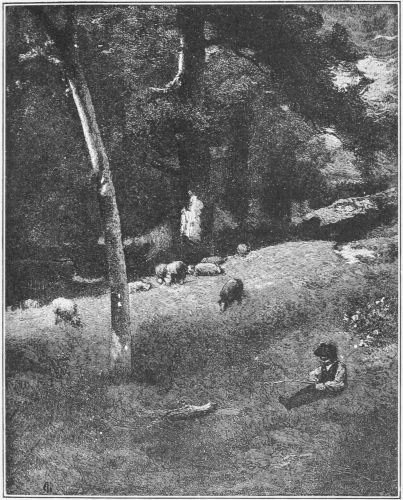
Light and Shade. George Inness.
ocean. We cannot see its particles, but we do see the light reflected
from them; and, I suppose, it is the differences in the appearances of
the lighted reflections that make us conscious of the stillness or
movement of the atmosphere on days when there is no wind. We need not be
very sensitive to nature to notice these differences of the atmosphere
at different seasons of the year; how, on certain winter days, the air
seems absolutely motionless; while on other days it seems alert and
sprightly; how in early spring it seems astir with gentle life, while in
summer or autumn it may be alive with animation or heavy with drowsy
languor.
The motionless air of winter has been rendered with marvellous truth by
John H. Twachtman; the stir of spring by Dwight W. Tryon; the active air
of summer by Childe Hassam, and its languorous drowsiness by George
Inness. All these are American artists, whom I mention only as examples.
For much of the beauty of modern art, both American and foreign, is due
to the sensitive rendering of the variations in the atmosphere. For, the
best artists now-a-days are not satisfied to paint the features of
nature only; they aim to depict the varying expressions on her face. And
the chief cause, as I have said, of these variations is the constant
change in the conditions of the lighted atmosphere.