Down in a rocky pasture, on the
edge of a wood, ran a little brook,
tinkle, tinkle, over the bright pebbles
of its bed. Close to the water’s
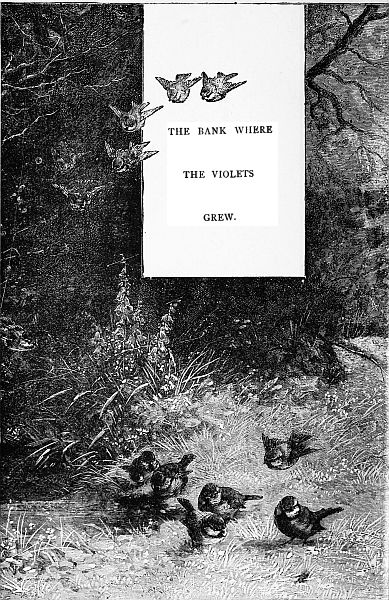
edge grew delicate ferns, and higher
up the mossy bank nestled violets,
blue and white and yellow.
Later in the fall the rocky pasture
would glow with golden-rod and
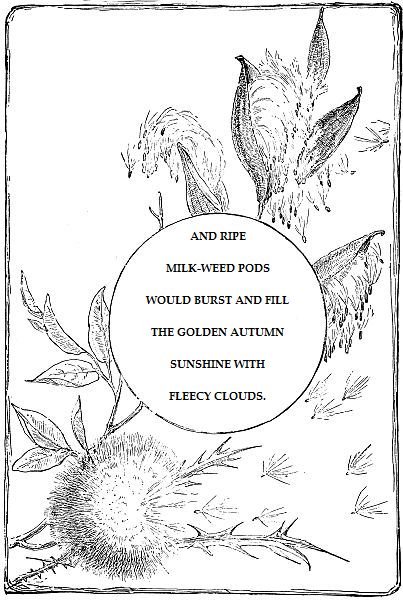
brilliant sumach, and ripe milk-weed
pods would burst and fill the golden
autumn sunshine with fleecy clouds.
But now the nodding buttercups and
smiling daisies held sway, with here
and there a tall mullein standing
sentinel.
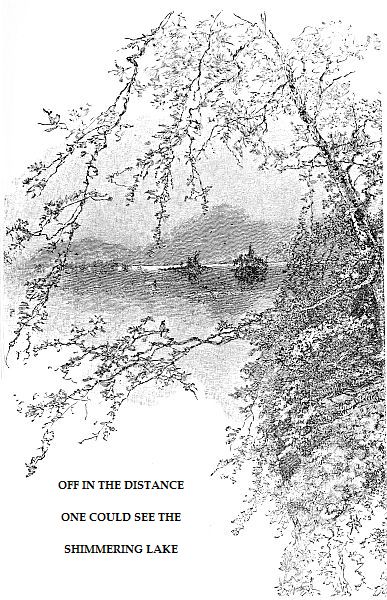
It was a lovely place: off in the
distance one could see the shimmering
lake, to whose loving embrace
the brook was forever hastening,
framed by beautiful wooded hills,
with a hazy purple mountain back
of all.
But the day was not lovely.
The clouds came down to the earth
as near as they dared, scowling ominously.
It was clear they had been
drinking deeply. A sticky, misty
rain filled the air, and the earth
looked sad, very sad.
The violets had put on their gossamers
and drawn the hoods up over
their heads, the ferns looked sadly
drabbled, and the buttercups and
daisies on the opposite bank, didn’t
even lean across to speak to their
neighbors, but drew their yellow
caps and white bonnets further over
their faces, drooped their heads and
wished for the rain to be over.
The wild roses that grew on a bush
near the bank hid under their leaves.
The ferns went to sleep; even the
trees leaned disconsolately over the
brook and wished for the long,
rainy afternoon to be over, while
little tired wet birds in their branches
never stirred, nor even spoke to each
other, but stood hour after hour
on one foot, with their shoulders
hunched up, and one eye shut.
At last a little white violet broke
the damp stillness.
“O dear!” she sighed, “this is so
tiresome, I wish we could do something
nice. Won’t some one please
talk a little?”
No one spoke, and some of the
older ferns even scowled at her, but
little violet was not to be put down.
She turned her hooded face on a
tall pink bachelor button growing
by her side.
This same pink button was a
new-comer among them. He had
been brought, a little brown seed, by
a fat robin, early in the spring, and
dropped down close by this sweet
violet.
“Mr. Button,” she said, “you have
been a great traveller. Won’t you
tell us some of your experiences?”
“Yes, yes; tell, tell, tell,” babbled
the brook.
The warm wind clapped him on
the shoulder, and shook him gently,
crying,—“Tell them, old fellow, and
I’ll fan them a bit while you do it.”
“Tell, tell,” chirped the birds overhead.
“O yes!”
chorused
the buttercups
and daisies.
The little
birds opened
one eye and
perked their
heads in a listening
attitude, and all the violets put
their gossamer hoods behind their
ears so that they might hear better.
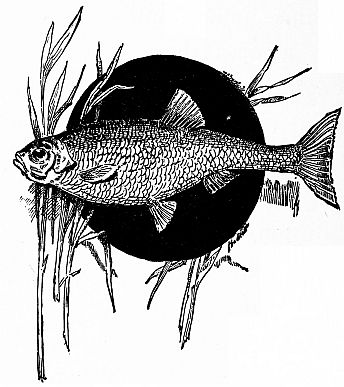
“AND WHAT IS CHAUTAUQUA?”
“Well, I might tell you about
Chautauqua,” said pink bachelor
thoughtfully.
“And what is Chautauqua?” questioned
a saucy little fish who had
stopped on his way to the lake to
listen.
“Chautauqua is a place, my young
friend, a beautiful place, where I
spent last summer with my family,”
said the bachelor in a very patronizing
tone.
“Oh! you don’t say so,” said the
naughty little fish with a grimace,
and sped on his way to the lake,
to laugh with all the other fishes
at the queer new word.
“Go on, go on, go on,” sang the
brook.
“We lived in a garden by a house
just outside the gates,” began Bachelor.
“What gates?” interrupted the
eager daisies.
“Why, the gates of the grounds.”
“What grounds?”
“Why, the grounds of Chautauqua.”
“But who is Chautauqua?” asked
the puzzled violets.
“Don’t you know? Chautauqua is
a beautiful place in the woods, shut
in from the world by a high fence
all around it, with locked gates. It
is on the shore of a lovely lake.
Many people come there every year,
and they have meetings, and they
sing beautiful songs about birds and
flowers and sky and water and God
and angels and dear little babies
and stars. Men come there from
all over this world, and stand up
and talk high, grand thoughts, and
the people listen and wave their
handkerchiefs till it looks like an
orchard full of cherry trees in
blossom.
“They have lovely singers—ladies
who sing alone as sweet as birds,
and they have great grand choruses
of song besides, by hundreds of
voices. And they have instruments
to play on,—organs and pianos, and
violins and harps.”
“How beautiful,” murmured the
flowers.
“Tell us more,” said the brook; “tell
us more, more, more,—tell, tell, tell!”
“More, more,” said the wind.
“It lasts all summer, so the people
who can’t come at one time will come
at another, though my cousin said she
thought that one day all the people
in the world came at once. There
must have been something very grand
to bring so many that day. There
were not enough rooms for visitors
to sleep in, and Chautauqua is a
large place, the largest I was ever
in. Yes,” reflectively, “I think all the
world must have been there.”
The little white violet looked up.
“There was one day last summer
when no one came through the pasture,
and no one went by on the
road, and all day long we saw not
one person. It must have been that
day, and they were all gone to Chautauqua,”
she said softly.
“I shouldn’t wonder at all,” said
Bachelor.
Then they all looked sober and
still. They were thinking. The idea
that all the people in the world had
come together for a day was very
great to them.
At last one spoke:
“How nice it would be if all the
flowers in the world could come together
for a day,” said the little violet.
“And all the birds,” chirped a sparrow.
“And all the brooks and lakes and
ocean,” laughed the brook.
“And all the trees,” sighed the tall
elm.
“Oh! and all the winds. We could
make as beautiful music as ever any
organ or piano made.”
“But what is it all for?” asked a
bright-eyed daisy.
“To teach the people all about the
things that the great God has made,
and show them how to live to please
Him, and how to please Him in the
best way,” promptly answered Bachelor.
“There is a great good man at the
head of it, and I heard a lady say
that God Himself sent him there to
take care of Chautauqua for Him, for
it is all made to praise God. They
have schools,—everybody studies, but
it is all about God that they learn,—about
the things He made, or how
to praise Him better, and all the talking,—they
call it lecturing,—is to
help men to praise and love God
more. They have three beautiful
mottoes:
“‘We study the word and works
of God.’ ‘Let us keep our Heavenly
Father in our midst,’ and, ‘Never be
discouraged.’”
“Wonderful, wonderful, wonderful,”
said the old forest tree.
“It is just what we need,” piped
one of the birds. “We don’t praise
God half enough. Here we’ve been
sitting and sulking all the afternoon
because it is raining, and never one
thankful chirp have we given for all
the yesterdays and yesterdays when
it hasn’t rained. We need a Chautauqua.
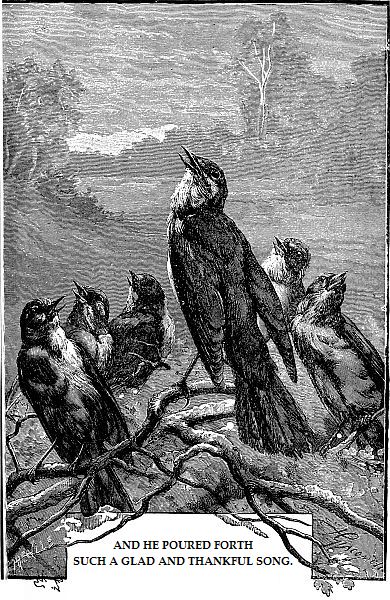
I declare, I’m ashamed!” And
he poured forth such a glad, thankful
song of praise as thrilled the old forest
trees through and through and
most effectually waked the napping
ferns.
“Yes,” said the listening daisies,
when the song was done and the bird
had stopped to rest his throat, “we
do need a Chautauqua.”
“Let’s have a Chautauqua!” cried
the brook.
“But how could we,” said the wise-eyed
violet, “when we know so little
about it?”
“I will tell you all I know,” said
Bachelor graciously. “You see we
lived just outside the gates, and people
used often to come and buy my
brothers and sisters. Once a young
man came and bought a very large
bunch of them and took them to a
young lady in a white dress, and she
wore them everywhere for three or
four days—you know our family is
a very long-lived one, and we are
something like the camel, in that we
can go a long time without a drink
of water—well, she kept them carefully
and took them everywhere she
went, and they saw and heard a great
many new things. One evening this
young lady sat in a big place full of
people, and an old lady sitting behind
her said to another lady, ‘Just see
those pink bachelor buttons! My
mother used to have some just like
them growing in her garden, years
and years ago, and I haven’t seen
any since.’ The young lady heard
her, turned around and gave her a
whole handful of my brothers and
sisters. After the meeting was out,
the old lady carried them away with
her, but one slipped out of her hand
and fell on the walk, and some one
came along in the darkness and
crushed her. Quite early the next
morning our neighbor, Mr. Robin,
going to the market for a worm for
breakfast, saw her lying in this sad
state, and with great difficulty brought
her home to us. She lived only a
day or two longer, but long enough
to tell us many of her experiences.
“After she had faded and gone, our
friend Robin went every day to hear
and see what was going on inside
the great gates, and every night when
the bells were ringing”—
“What bells?” interrupted an impolite
buttercup.
“The night bells for the people to
go to sleep by. They rang beautiful
music on bells by the water to put
the people to sleep, and in the morning
to wake them, and they had bells
to call them to the big place to
praise God, and hear the lectures and
singing.”
“Beautiful, beautiful,” murmured
the brook.
“And every night,” proceeded the
bachelor, “when the bells were ringing
we would wake up and Robin
would tell us all about the day inside
the gates. Of course I can’t remember
all, but I will tell you all I
know.”
“Perhaps I can help you a little,”
spoke out an old fish who had come
up the stream unobserved some time
before. “I lived in Lake Chautauqua
myself for some years until my
daughter sent for me to come and live
with her in yonder lake.”
They all looked at the old fish
with great veneration, and thanked
him kindly.
“Well, how shall we begin?” said
an impatient daisy.
“I should think the first thing to
be done is to make a motion that we
have a Chautauqua,” Bachelor said.
Then rose up a tall old fern. “I
make a motion to that effect.”
“I second it,” chirped a sparrow.
“All in favor of the motion say
‘aye,’” said Bachelor, in a deep, important
voice.
And then arose such a chorus of
“aye’s” as never was heard before
in that grove. The wind blew it, the
brook gurgled it, the great forest trees
waved it, all the little flowers filled
the air with their perfumed voices,
the far-off lake murmured its assent,
the purple mountain nodded its weary
old head, the sun shot triumphantly
through the dark clouds, and all God’s
works seemed joining in the “aye
aye, aye,” that echoed from hillside
to wood.
“A unanimous vote, I think,” said
Bachelor, after the excitement had
somewhat subsided.
“The next question is, When shall
we have it?”
“Oh! right away, of course,” nodded
a buttercup. “See! the sun has come
out to help us.”
“But,” objected white Violet, “we
can’t. We must invite all the flowers
and birds and brooks and trees
all over the world, and they will have
to get ready. It will take the flowers
the rest of this summer and all
of next winter to get their dresses
made and packed in their brown
travelling seed trunks. I’m sure it
would me if I were to go away from
here for the summer, and it is late
in the season already. We couldn’t
get word to them all in time.”
“Yes,” said the fish, “and there are
the travelling expenses to be arranged
for such a large company. We
should have to secure reduced rates.
They always do on Chautauqua Lake.”
“Oh! as to that,” said the wind,
“I and the birds would do the transportation
free of charge, and the brook
would do all it could, I’m sure.”
“Of course, of course,” babbled the
brook.
“That is very kind of you indeed,”
said Bachelor. “But I should think
that the earliest possible beginning
that we could hope to have would
be next spring.”
After much impatient arguing on
the part of the buttercups and daisies,
it was finally agreed that the
first meeting of their Chautauqua
should be held the following spring.
“It must last all summer,” they
said, “because some of us can come
early and some late. There is the
golden-rod now, it never can come till
late in the fall.”
“Of course, of course; certainly,
certainly,” chattered the brook.
“What comes next?” softly asked
the wild rose.
“The next thing to do is to appoint
a committee to make out the
programme,” remarked the fish.
“Committee! Who is that?” cried
a butterfly.
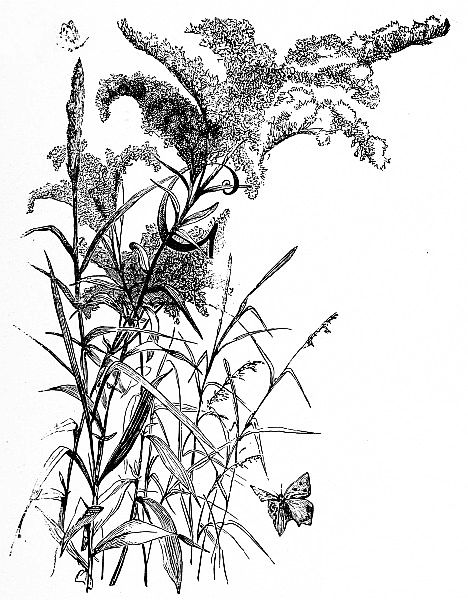
“THERE IS THE GOLDEN-ROD NOW.”
“Programme! what’s programme?”
chirped a sparrow.
“O dear! we need a dictionary,”
sighed the roses.
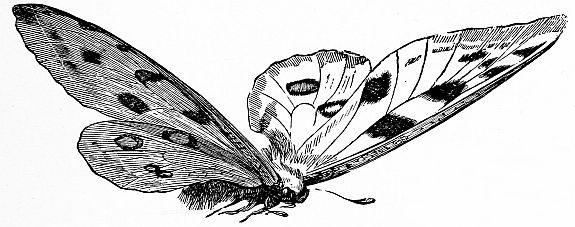
“COMMITTEE! WHO’S THAT?”
“What’s a dictionary?” asked a
little upstart of a fern.
“Silence!” sternly commanded
Bachelor. “Will Miss Rose kindly
explain the meaning of dictionary,
after which Mr. Fish will proceed to
tell us about programme and committee.”
Little Rose blushed all over her
pretty face, and after thinking a moment,
replied,—
“A dictionary is a book that tells
what all words mean.”
“Oh!” sighed the wind, “we must
have a dictionary.”
Mr. Fish having made a dash up
stream after a fly, now resumed his
sedate manner and spoke:
“My friends, a programme says
what we will have every day, and
a committee are the ones who make it.”
“Then let’s all be committee,” said
the buttercup.
“That’s a very good plan,” said
Bachelor. “Now, what shall we have?
They always have a prayer meeting
first at Chautauqua.”
“We can all pray,” said the elm.
“Let us have a prayer meeting first
every morning to thank the dear God
for the new day, and let the rising
sun be the leader.”
“That is good,” said the flowers,
and bright rays of light, the sun’s
little children, kissed them tenderly.
“What is next?”
“They have a large choir, and every
morning after the prayer meeting they
meet and practise with the great
organ and piano and band.”
“We will be the singers,” chorused
the birds.
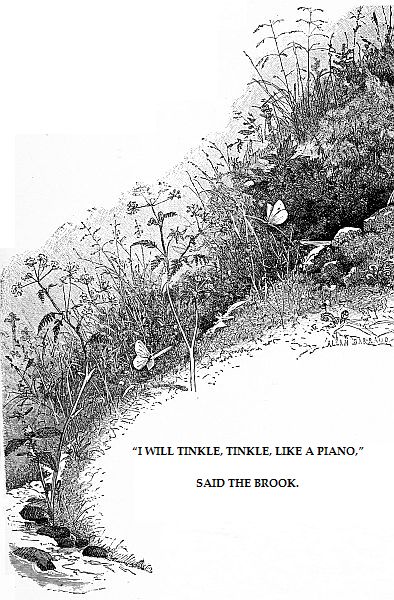
“I will tinkle, tinkle, like a piano,”
sang the brook, “tinkle, tinkle, tinkle,—”
“I will play the band, for I have
very many instruments at my command,
and my friend the thunder will
play the organ, while you, dear old
trees, shall be my violins and harps,
and every morning we will practise,”
said the wind.
“What do they have next at Chautauqua?”
asked a pert blackbird.
“Lectures,” said the fish.
“What are lectures?”
“Talks about things.”
“What things?”
“Oh! evolution and literature and
theology and philosophy and art and
poetry and science, and a great many
other things.”
The high-sounding words rolled out
from that fish’s mouth as if he actually
thought he understood them.
Silence reigned for a few minutes,
deep and intense, at last broken by
the white violet:
“We never could have all those, for
we don’t know anything about them.
And who could talk about such things?
None of us.”
Silence again. They were all thinking
earnestly.
“I don t believe it. Not one word,”
chattered a saucy squirrel. “That’s a
fish story. As if you could get on
dry land and go to lectures.”
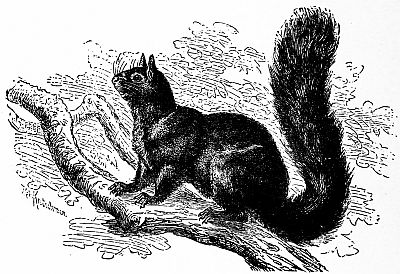
“I DON’T BELIEVE IT,” CHATTERED A SAUCY SQUIRREL.
“Oh! very well, you needn’t believe
it if you don’t want to,” answered the
fish in a hurt tone, “but I heard a
man on board the steamer read the
programme, and those are the very
words he read.”
“If we only had a dictionary,”
again sighed the rose.
“Dictionary, dictionary, dic, dic, dictionary,”
murmured the brook, thoughtfully.
“A dictionary is absolutely necessary
before we can proceed any
further,” said the south wind. “And
as I am obliged to travel to New
York this evening, I will search everywhere,
and if possible bring one back
with me. Anything can be had in
New York. It is getting late, and I
think we had better adjourn to meet
again to-morrow. I hope to be able
to return by two o’clock. In the
meantime, let us all think deeply of
what we have heard, and if any one
can see a way out of our difficulty,
let him tell us then.”
The sunbeams kissed the flowers
good-night, the forest trees waved farewell
to the good wind, the brook
called, “Good-night! sweet dreams till
to-morrow, to-morrow, to-morrow,” and
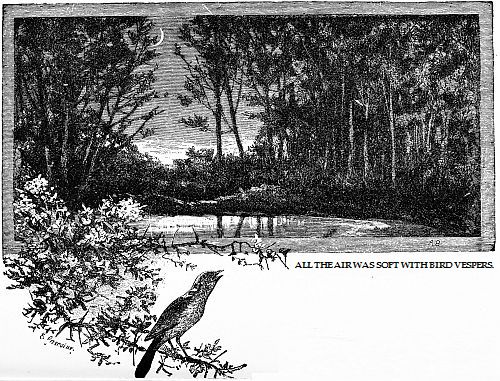
all the air was soft with bird vespers.
Into the bright sunshine of the
next afternoon came the winds and
the eager birds to the place on the
bank where the violets grew.
The daisies leaned far over the
bank to listen.
The south wind came bringing two
or three torn sheets of an old dictionary.
“It is all I could find, and I’ve had
hard work to get this,” said he. “I
went in at a window where lay an
open dictionary.—I had no idea that
a dictionary was such a very large
book.—It was an old one, so I had
no trouble in tearing out these few
leaves, as the paper was so tender.
I took them out of the window and hid
them in a safe place and went back
for more, but just as I was turning
the leaves over to find evolution, some
one came up and shut the window,
and I had to crawl out through the
cracks. Well, I have all the ‘P’s’
and some of the ‘T’s’; we can find
theology and poetry.”
“Philosophy, too,” said wise Violet.
“My dear, that is spelled with an ‘f,’”
said the kind old wind patronizingly.
“O, no! I am sure you are mistaken.
It is ‘p-h-i-l’; look and see if I
am not right.”
The wind slowly turned over the
leaves of his meagre dictionary, and,
sure enough, there it was,—“p-h-i-l-o-s-o-p-h-y.”
“Is it there? What does it say?”
questioned the eager flowers.
“Philosophy, the love of, or search
after, wisdom,” slowly read the wind.
“Oh!” said the flowers, “is that
all it is? Why, we know philosophy.”
“I think the forest trees could lecture
on philosophy,” said the wind.
“Yes, yes, yes,” they all cried.
“The forest trees, for they are very
old and have had longer to search for
wisdom than we.”
“Very well; three lectures a week
on philosophy, by the old forest trees;
write it down, please,” cried Bachelor.
The secretary, a scarlet-headed
woodpecker, carefully carved it on the
trunk of an old tree, and I think you
can still find the minutes of that day
written in lines of beauty all over the
tree.
“Theology is the next word,” announced
the wind, and again turned
over the leaves of their precious dictionary.
“The science of God,” he read.
“Science, what is science?” If we
only had the “s’s!”
“I know what it is,” chirped a bird.
“I hopped into the schoolhouse this
morning, and a book was open on the
desk, and no one was there, so I
hopped up and took a look to see if
there was anything in it to help us.
The first words my eye fell on were
these,—‘science is knowledge.’ And
I didn’t wait for any more, but flew
away to sit in a tree and say it over
so that I wouldn’t forget it. Going
back a little later to see if I could
get any more words, I found the
schoolhouse full of dreadful boys. As
I flew away again, this little piece of
paper blew out of the window, and I
brought it, thinking it might be helpful.”
As he finished speaking, he deposited
a small fragment of a definition
spelling-book at the foot of the elm
tree, and flew up into the branches
again, for he was a bashful bird, and
this was a very long speech for him
to make before so many.
“Good, good, good,” cried all the
committee.
“To go back to theology,” said the
wind. “It is the science of God.
Science is knowledge, therefore theology
is knowledge of God. That is
a very great thing. Who is able to
lecture on the knowledge of God?”
Silence all. No one dared to volunteer.
None felt worthy to do so
great a thing.
Out spoke a shy little wren. “Last
night I slept in a notch close over
a church window, and the window
was open and there was a meeting
of the people there and the minister
read out of the Bible these words:
‘The heavens declare the glory of
God, and the firmament sheweth his
handiwork.’”
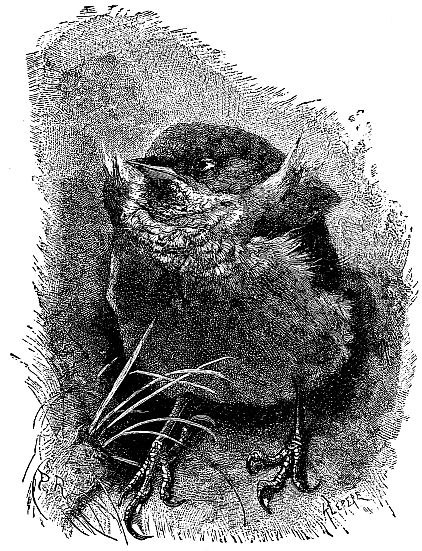
FOR HE WAS A BASHFUL BIRD.
She paused a moment to gather
courage, and then said, “Why couldn’t
the heavens teach theology?”
“THE HEAVENS SHALL TEACH THEOLOGY.”
“Bless your heart, little wren, that
is the very thing,” cried the blustering
north wind. And all the flowers
cried,—“The heavens shall teach
theology!”
The sky bowed its assent and said,
“I will do my best to perform the
wonderful work entrusted to me.”
And the happy brook murmured,
“Glory, glory, glory! the glory of
God.”
“Now we will see what this bit
of paper has for us,” said the wind
as he picked up the paper at the foot
of the elm.
“Ah! What have we here? Evolution!
Just what we want: ‘evolution,
the act of unfolding or unrolling.’”
He stopped with a thoughtful look.
“Yes, I see. As the young leaves
and flowers unfold. The
plants must take full
charge of this department,
I think. I remember once
turning over the leaves of
a fat, dark-gray book, with
gilt letters on its back.
It lay on a minister’s
window-seat, and it looked
interesting, so I read a
few minutes while the
minister was out and not
using it, and among other things that
I read was this, and it stayed with
me ever since: ‘A lily grows mysteriously.
Shaped into beauty by secret
and invisible fingers, the flower
develops, we know not how. Every
day the thing is done: it is God.’
You see, my dear,” addressing himself
to a pure white lily that had
only that morning unfolded its delicate
petals to the sun, “you see a
great many don’t understand how it
is done. You need to tell how God
has made you able to unfold.”
|
“Yes, we will, we can,” they all cried.
“The flowers will speak on Evolution,”
wrote down Woodpecker.
“There are three more words spoken
by our friend Fish, still unexplained,—literature,—”
“I know what literature means,
Mr. Wind, it is books,” announced a
bright butterfly who had just arrived
on the scene.
“Are you sure?” questioned the
fish doubtfully.
“Yes; of course I am. I went with
a big pinch-bug one day into a great
room full of books, and he said, when
he saw the shelves and shelves full
of them, ‘My! what a lot of literature!’”
The committee looked convinced,
but now came the question of books,—Where
should they get them? How
could they lecture on books, when they
knew nothing about them?
“We must just send word around
to all the flowers and birds and trees
and everything, to see who can lecture
on books, and we must all keep our
eyes and ears open,” said a buttercup
bud.
“We shall have to lay that on the
table for the present,” said the wind.
“But we haven’t any table,” chattered
a squirrel.
“A well brought-up squirrel should
know better than to interrupt. We
shall have to put this aside, then,
until we can learn more about it. In
the meantime, let us proceed with the
next word on the list, poetry.”
“I know,” said the brook. “A bit
of paper lay upon my bank, miles and
miles away from here, too high up
for me to reach, but I could read it.
It said, ‘For poetry is the blossom
and the fragrance of all human knowledge.’
And I have said it over and
over all the way here.”
“Ah! the flowers shall give us
poetry,” said the good old wind.
Bachelor bowed his head and said,
“We will try.”
“Try, try, try,” chattered the brook.
“Art is next, I believe,” said Bachelor.
“Yes, art,” said a squirrel.
“Art is making pictures,” said the
moss.
“Then the sunset must paint them,
for there are no pictures made like
those of the sunset,” said the wind.
The sun hastened to mix his paint,
and in answer to the request that he
would be professor of art, painted one
of the most glorious sunset scenes
that mortal eye has ever looked upon.
Rapidly he dashed on the color, delicate
greens and blues blending with
the sea-shell pink, and glowing with
deep crimson and gold, till the assembled
committee fairly held their
breaths with delight. The crimson
and gold and purple in the west were
beginning to fade and mix with soft
greys and tender yellows, before the
committee thought of returning to
their work.
“What a lot of time we have
wasted,” said the oldest squirrel; “to-morrow
is Sunday, and of course we
can’t work then, and now it is time
to go home.”
“Not wasted, dear squirrel,” said
White Violet, “not wasted when we
were looking at God’s beautiful sunset.”
Bachelor looked down at her in all
her sweetness and purity, and some
of the flowers say that later when he
went to bid her good-night—under
the shadow of a fern—he kissed
her.
“To-morrow being Sunday reminds
me that we have not made any arrangements
for our Sunday sermons.
They always have great sermons at
Chautauqua, and I have often heard
the passengers on the steamer scolding
because the boats did not run on
Sunday, for they said the great men
always kept their best thoughts for
sermons.” This from the fish.
They all paused. “We can’t any
of us preach sermons, what shall we
do?” questioned a fern.
“I’m sure I don’t know; we might
each of us go to church and listen to
a sermon and preach it over again,”
said a thoughtful bird.
“But we couldn’t remember it all,
and by next summer we would have
forgotten it entirely,” said one more
cautious.
“Well, we must go,” said the wind.
“Monday we will consider these subjects.
To-morrow is God’s day, and
we must go immediately, for it is
getting dark.”
And so they all rested on the Sabbath
day, and praised the great God,
and never a wee violet, nor even
a chattering chipmunk, allowed his
thoughts to wander off to the great
programme for the next summer, but
gave their thoughts to holy things.
The busy Monday’s work was all
done up, and the committee gathered
again, waiting for the work to go
on, when there came flying in great
haste, a little bluebird, and, breathless,
stopped on a branch to rest a moment
ere he tried to speak.
“What is the matter?” they all
cried.
“Were you afraid you would be
late? You ought not to risk your
health; it is not good to get so out
of breath,” said a motherly old robin.
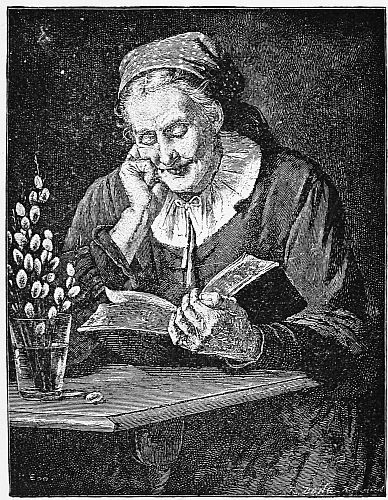
“CLOSE TO A WINDOW WHERE SAT AN OLD LADY.”
“Oh! I have such good news to
tell you,” cried the little bird as soon
as he could speak. “I sat on a
bough this morning, close to a window
where sat an old lady, who was
reading aloud to a sick man, so I
stopped to listen. These are the
words she read,—‘Sermons in stones,
books in running brooks.’ I didn’t
hear any more, but came right away
to study that. I was so glad I had
found something to help us. Two
things in one.”
They all looked very much amazed.
“Why, we didn’t think we could
do anything!” cried the stones, “and
here we can do one of the best
things there is to be done. Thank
the dear God for that. We will preach
sermons full of God and his works,
for we have seen a great many ages,
and their story is locked up in us.”
“And the brook shall tell us of
books,” said the old wind. “There
is good in everything, and we shall
try not to feel discouraged the next
time we are in a difficulty.”
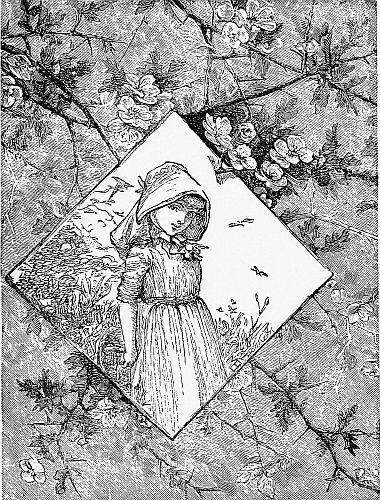
“A SMALL GIRL JUST UNDER MY NEST IN THE ORCHARD.”
“Books in running brooks,” said
the brook. “Books, books, books.
And I too can praise Him.”
“This morning,” said a sober-looking
bird, “a small girl just under my
nest in the orchard, was saying something
over and over to herself, and I
listened; and these were the words
that she said:
The ocean looketh up to heaven as ’twere a living thing,
The homage of its waves is given in ceaseless worshipping.
They kneel upon the sloping sand, as bends the human knee,
A beautiful and tireless band, the priesthood of the sea,
They pour the glittering treasures out which in the deep have birth,
And chant their awful hymns about the watching-hills of earth.
“If the ocean is so good and grand
as that he ought to do something at
our Chautauqua. Couldn’t he? God
must love him very much, he worships
him so much.”
“Yes,” said the elm tree. “I have
heard that a great man once said,
‘God, God, God walks on thy watery
rim.’”
“Wonderful, glorious,” murmured
the flowers.
“They tell stories at Chautauqua—pretty
stories about things and people;
and I have heard that Ocean has
a wonderful story. We might send
word to ask if he will tell it,” suggested
Bachelor.
“I fear he cannot leave home,”
said the wind, “but we might try
him.”
So it was agreed that the woodpecker
should write a beautiful letter,
earnestly inviting him to take part
in the grand new movement for the
coming summer. The brook agreed
to carry the daintily-carved missive
to the lake, and the lake to the river,
and the river would carry it to the
sea.
Bachelor spoke next: “They have
a School of Languages at Chautauqua,
could we have one?”
“I have thought of that,” said the
fish, “but who could teach it?”
“That is the trouble,” said Bachelor,
slowly shaking his head.
“I know,” said a little bird. “I
went to church last night and heard
the Bible read, and it said, ‘Day unto
day uttereth speech, and night unto
night sheweth knowledge. There is
no speech nor language where their
voice is not heard.’ I think the day
and the night could teach the School
of Languages.”
“The day and the night, the day
and the night,” said the brook.
“Yes,” said the oldest tree of all,
“the day and the night know all languages.”
“We must have a Missionary Day
and a Temperance Day,” said the
wise old fish.
“What is a Temperance Day?”
asked a young squirrel, who was not
yet very well acquainted with the
questions of the day.
“My dear,” said his mother, “there
are some bad people in the world
who make vile stuff and give it to
people to drink, and it makes them sick
and cross; then they do not please God,
and there are some good people who
are trying to keep the bad people from
making it, and the others from drinking
it; they are called Temperance.”
“Oh!” said the squirrel, “but why
do the folks drink it? I should think
they’d know better.”
“So should I, but they don’t. Why,
my dear, I must tell you of something
that happened to me once. I
lived in a tree at a summer resort,
that year, and just under my bough
was a window; a young man roomed
there for a few days, and every morning
he would come to the window
with a black bottle in his hand, and
pour out some dark stuff and mix
sugar and water with it, and drink it
as if he thought it was very good.
I watched him for several mornings,
and one morning the bell rang while
he was drinking, and he left the glass
on the window-sill, and went to
breakfast. I hopped down to see
what it was, and it smelled good, so
I tasted it. I liked the taste pretty
well, so I drank all there was left.
Then I started home, but, will you
believe it? I could not walk straight,
and very soon I could hardly stand
up. I tried to climb up a tree, but
fell off the first bough, and there I lay
for a long, long time. When I awoke
I had such a terrible pain in my
head! All that day I suffered, and
didn’t get over my bad feelings for
several days. I tell this as a warning
to you, that you may never be
tempted to touch anything to drink
but water, my dear.”
“You must tell that story, Mrs.
Squirrel,” said Bachelor. “And we
will call it a story of intemperance,
by one of its victims.”
“I will, with all my heart, if it
will do any one any good,” she responded.
“Yes, we must have a Temperance
Day and all make a speech on drinking
cold water,” said the fish.
“And dew,” said the violet.
“I have always drank water, and
never anything else, and I think one
could scarcely find an older or a
healthier tree than I am,” said the
elm.
“That is true,” said the fish.
“Cold water, cold water, cold water,”
babbled the brook.
“Yes, we can all speak on Temperance
Day; we will have a great
platform meeting. That is what they
call it at Chautauqua when a great
many speak about one thing. I heard
a man telling his little girl about it
on the boat,” said the fish.
And the woodpecker wrote it
down.
“What was that other you said?”
asked a sharp little chipmunk.
“Missionary Day,” said the fish.
“And what is that?”
“Why, there are home missions
and foreign missions,” said the fish.
“And they talk about them both. I
think they have a day for each, or
maybe two or three. Missions are
doing good to some one, but I don’t
exactly see the difference between
home and foreign missions.”
“Why, that is plain to me,” said
Bachelor. “Home missions is when
some one does something kind to you,
and foreign missions is when you do
something kind to some one else.”
“Of course; why didn’t I think of
that before?” said the fish.
“One day last year I was very
hungry,” said a robin, “very hungry
and cold. I had come on too early
in the season. There came a cold
snap, and the ground was frozen. I
could find nothing at all to eat. I
was almost frozen myself, and had
begun to fear that my friends would
come on to find me starved to death
instead of getting ready for them as
they expected. But a little girl saw
me and threw some crumbs out of
the window. I went and ate them,
and every day as long as the cold
weather lasted she threw me crumbs—such
good ones too—some of them
cake; and she gave me silk ravelings
to make my nest of. I think that
was a home mission, don’t you?”
“Yes, my dear, it was,” said Bachelor.
“You might tell that as one thing,”
said the wind.
“I will,” said Birdie.
Said a daisy, “When I was very
thirsty, one day, and the clouds sent
down no good rain, the dear brook
jumped up high here, and splashed
on me so I could drink, and I think
that was a home mission.”
“Yes, yes,” said the elm, “it
was.”
“I know a story I could tell,” said
the ferns.
“And I,” said the elm; “one of
many years ago, when I was but a
little twig.”
“I know a home mission story
too,” said White Violet.
“And I,” said the brook. “Once I
was almost all dried up and could
hardly reach the lake, and a dear
lovely spring burst up and helped
me along until the dry season was
over.”
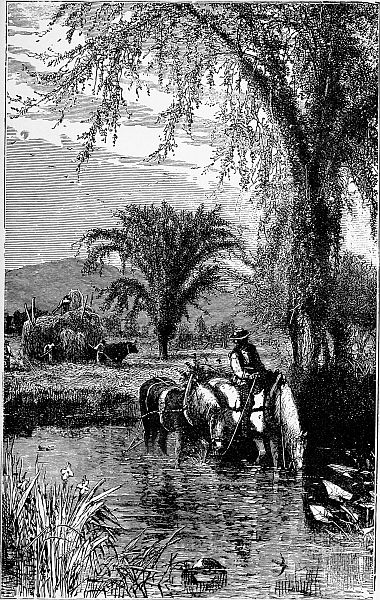
“YES, YES,” SAID THE ELM, “IT WAS.”
“And I, and I,” chorused a thousand
voices.
“But what about foreign missions?”
said the fish.
“I sang a beautiful song to a sad
old lady in a window, this morning,”
said a mocking-bird.
“That’s foreign missions,” said the
chipmunk.
“Some naughty boys hid another
boy’s hat yesterday, and I found it
for him and blew it to his feet,” said
the wind.
“I sent a bunch of buds to a sick
girl, this morning,” said the rose-bush
with a blush.
“I think we shall have no lack of
foreign missions,” remarked Bachelor.
“But what can we do?” asked an
old gray squirrel. “We can’t preach,
nor teach. We can run errands and
carry messages, but that isn’t much.”
“You might be on the commissary
department,” said the wind.
“What’s that?” they all asked.
“Things to eat. We shall need
a great many, and you could all lay
in a stock of nuts, enough to last
all summer, for a great many.”
“Why, surely!” they cried, and all
that fall such a hurrying and scurrying
from bough to bough there
was as never was seen before. They
worked very hard, storing up nuts,
and the people came near not getting
any at all.
It must have been about a week
from the time they sent their letter
to Old Ocean, that one afternoon as
they were assembled, waiting for the
decision of a certain little committee,
which had been sent over behind
a stone to decide who should
be the leader of the choir, that up
the stream came a weary little fish.
He was unlike any fish that had
ever been seen in that brook, and
caused a great deal of remark among
the flowers before he was within
hearing distance.
He came wearily, as though he had
travelled a long distance, but as he
drew nearer, the old fish exclaimed,
“There comes a salt-water fish! perhaps
he has a message from the
ocean.”
Then the little company were all
attention.
Nearer and nearer he came, and
stopped before the old fish with a
low bow, inquiring whether this was
the Chautauqua Committee.
“AND THE PEOPLE CAME NEAR NOT GETTING ANY AT ALL.”
On being told that it was, he laid
a bit of delicate sea-weed, a pearly
shell, and a beautiful stem of coral
upon the bank, and said: “I have a
message from Old Ocean for you.
He sends you greetings and many
good wishes for the success of your
plan, and regrets deeply that he cannot
be with you next summer; but
he is old, very old, and he has so
much to do that he cannot leave
even for a day or two. If he should,
the world would be upside down.
There would be no rain in the brooks,
the lakes would dry up, and the crops
and the people all would die.”
“O dear! and we should die too,”
said the flowers.
“Yes, you would die, too,” said the
salt-water fish.
“He has a great many other things
besides to take care of; there are
the great ships to carry from shore
to shore, and there is the telegraph,—”
“What is telegraph?” interrupted
that saucy little squirrel who had no
regard even for a stranger’s presence.
“Telegraph is a big rope that people
send letters to their friends on.
It is under the water in the ocean,
and the letters travel so fast that we
have never yet been able to see them,
though we have watched night and
day.”
“Wonderful, strange,” they all murmured.
“Old Ocean says,” proceeded the
messenger, “that he cannot give you
all of his story, as it would be too
long, but that he sends some of it
written on this shell, and in this
coral and in this bit of sea-weed.
In the shell is a drop of pure salt
water that if carefully examined will
tell you many more wonderful things.”
They all thanked the fish kindly
for coming so far to bring them these
treasures, and begged him to stay and
rest, but he declined, saying he had
a family at home and must hasten,
so he turned to go.
“Stay!” cried Bachelor. “Wouldn’t
you be willing to come next summer
and give us a lecture on the telegraph?”
The fish laughed.
“Bless you!” said he, “I couldn’t
do that. I don’t know enough about
it myself. Ask the lightning. He is
the head manager, and will give you
all the lectures you want. Good-by!
the sun is getting low, and I must be
off.” And he sped away, leaving the
woodpecker writing down “telegraph”
and “lightning” on one corner of his
memoranda.
And now the committee returned,
having decided, by unanimous vote,
that the mocking-bird should be the
leader of the choir, as he could sing
any part, and so help along the weak
ones whenever he could see the need
of it.
There was a pause after the committee
had been told all that had happened
during their absence, broken at
last by Bachelor.
“I’ve been thinking,” said he, “that
it might be as well for us to have a
reply to Ingersoll.”
“What is that?” they asked, for
they were getting used to strange
things, and did not seem so surprised
at the new word.
“Ingersoll is a man that says there
is no God, and he has written a great
many things to prove it,” said Bachelor
gravely.
The other poor little flowers were
too much shocked to say anything,
and they all looked at one another
dumbly.
“Is he blind?” asked a bird.
“He must know better,” asserted
a fern. “No one could possibly believe
such a thing.”
“I don’t know whether he is blind,
but I think not,” said Bachelor.
“They say he has made a great
many other people believe as he does
because he talks so beautifully.”
“How dreadful!” said the flowers,
in a sad voice.
“They had a man at Chautauqua
who answered all he said and proved
that it was untrue, but every one did
not hear him. I think we ought to
have a day to answer Ingersoll,”
again said Bachelor.
“Yes, we must,” said the north
wind; “and we will all prove there
is a God. No one could have made
me but God.” And he blew and
blew until the flowers crouched down
almost afraid at his fierceness.
When all was quiet again, out
hopped a dignified-looking bird. “My
friends,” said he, “my wife and I went
to church last night, and they sang a
beautiful hymn that has long been one
of my favorites. I told my wife to
listen hard, and
this morning, with
my help, she was
able to sing it. I
think it would help
on this subject if
we were to sing it
for you now.”
“Sing, sing,
sing,” said the
brook.
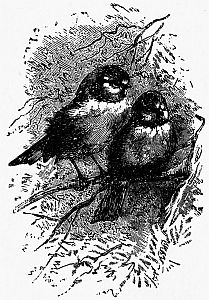
“I THINK IT WOULD HELP
ON THIS SUBJECT.”
The meek little wife at her husband’s
word stepped out, and together
they sang this wonderful hymn:
The spacious firmament on high,
With all the blue ethereal sky,
The spangled heavens, a shining frame,
Their great original proclaim;
The unwearied sun, from day to day,
Does his Creator’s power display,
And publishes to every land
The work of an Almighty hand.
Soon as the evening shades prevail,
The moon takes up the wondrous tale,
And nightly to the listening earth
Repeats the story of her birth:
While all the stars that round her burn,
And all the planets in their turn,
Confirm the tidings as they roll,
And spread the truth from pole to pole.
What though, in solemn silence, all
Move round the dark, terrestrial ball?
What though no real voice or sound
Amid their radiant orbs be found?
In reason’s ear they all rejoice,
And utter forth a glorious voice,
Forever singing as they shine,
The hand that made us is divine.
When they had finished, the whole
congregation bowed their heads.
“Yes,” they said, “every day we will
show forth the greatness of God who
made us, and that bad man will see
and hear and believe, and the people
will not be led away from God any
more.”
“We will make that our great aim,
to show forth the glory of God,” they
all cried together.
So the little workers planned, and
sent their messengers far and wide,
over land and sea, and made out their
programme; and the lecturers spent
days and days preparing their manuscript,—for
aught I know they are at
it yet.
The flowers all have received their
invitations to come, and some were so
eager to be off that they packed their
brown seed trunks and coaxed the
wind to carry them immediately, that
they might be early on the spot.
Next spring when the snow is gone
and the trees are putting forth their
leaves, and all looks tender and beautiful,
you will see the birds flying back
and forth, very busy, carrying travellers
and messages; the squirrels will
go chattering to their store-houses to
see that all is right, and to air the
rooms a little;
the birds
will build
many nests,
more than
they need,
and you will wonder why, and will
never know that they are summer
nests for rent, else you might like to
rent one yourself.
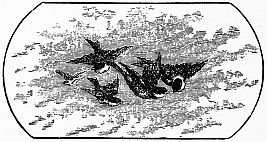
“YOU WILL SEE THE BIRDS FLYING
BACK AND FORTH.”
The wind, too, will be busy, so busy
that he will hardly have time to dry
your clothes that hang out among the
apple blossoms.
You don’t know what it all means?
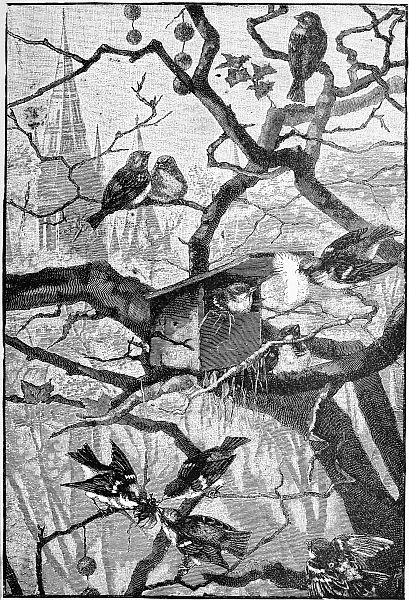
THE BIRDS WILL BUILD MANY NESTS.
Wake up quite early
every morning and listen.
Be patient, and
one morning, just as
the first pink glow of
the rising sun tinges
the east, you will hear
a watching tree call
out,—
|
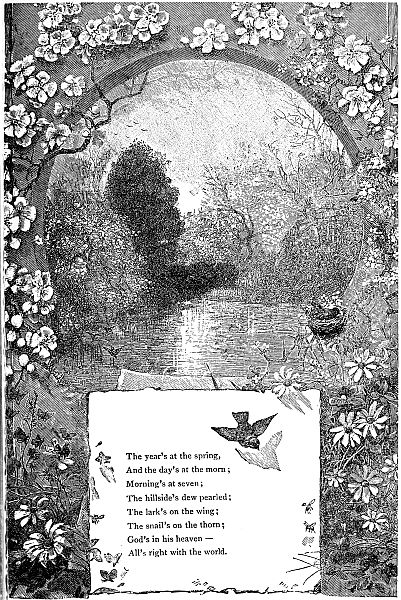
The year’s at the spring,
And the day’s at the morn;
Morning’s at seven;
The hillside’s dew pearled;
The lark’s on the wing;
The snail’s on the thorn;
God’s in his heaven—
All’s right with the world.
And then all the lily-bells will chime
out the call to prayer, the great red
sun will come up and lead, and the
little Chautauqua will open.
You will hear the sweet notes of
praise from the bird choir, and prayers
will rise from the flowers like sweet
incense; you will see and hear it all,
but will you remember that it is all to
show forth the glory of God?