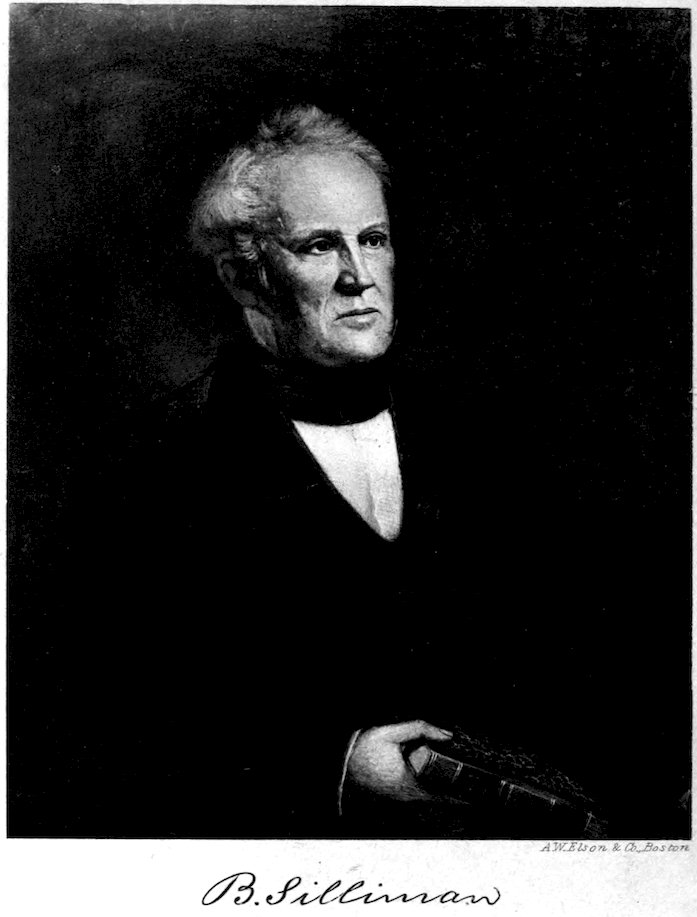
| Benjamin Silliman |
Frontispiece |
| From a painting by G. S. Hubbard, Esq., in possession of Miss Henrietta W. Hubbard |
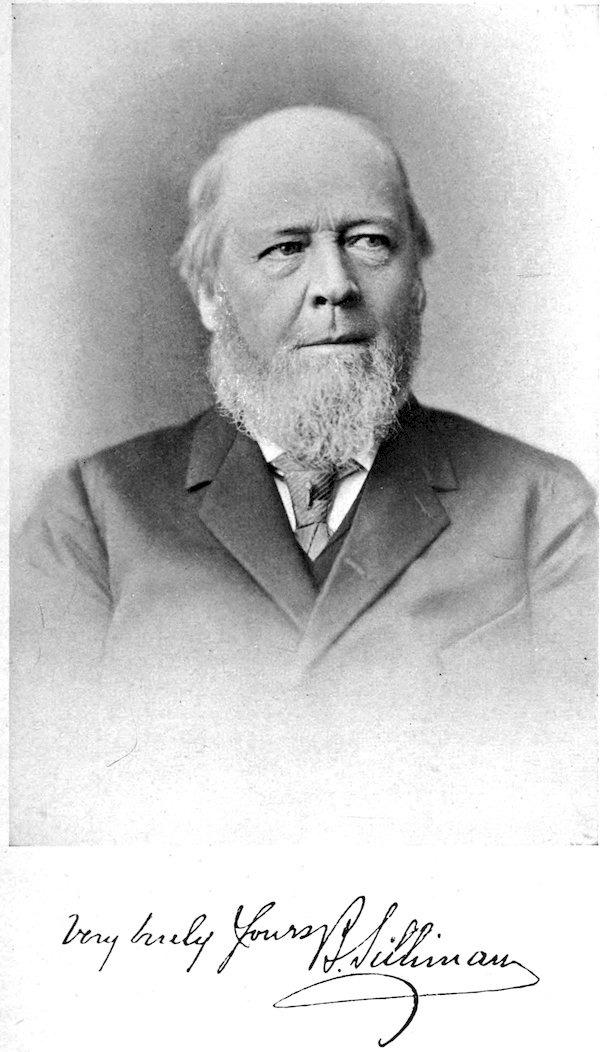
| Benjamin Silliman, Jr. |
opposite page |
28 |
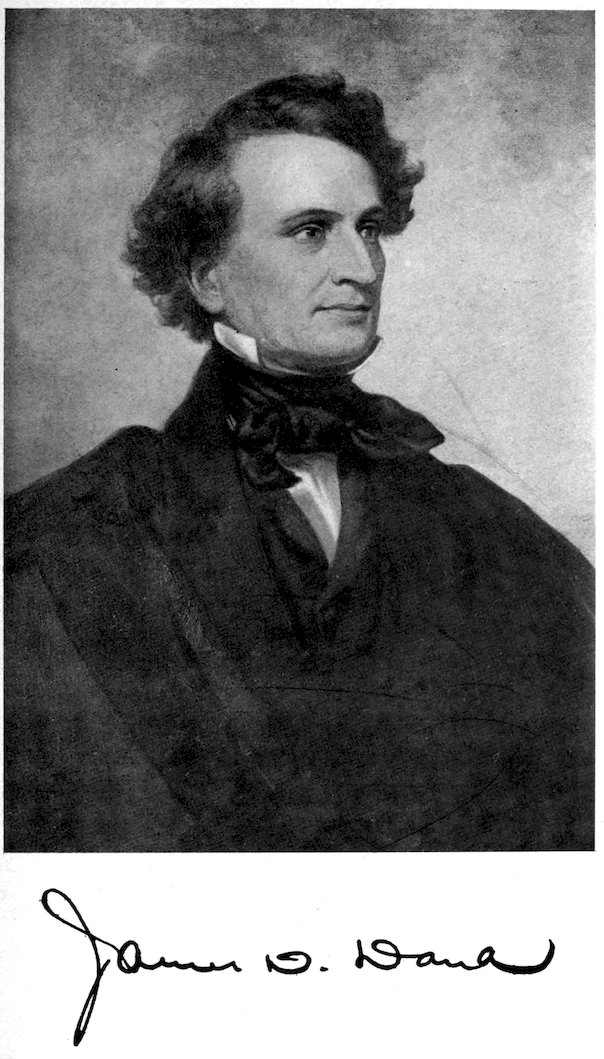
| James D. Dana |
„ „ |
36 |
| Edward S. Dana |
„ „ |
48 |
| Wolcott Gibbs |
„ „ |
52 |
| James Hall |
„ „ |
84 |
| G. K. Gilbert |
„ „ |
140 |
| Edward Hitchcock |
„ „ |
156 |
| O. C. Marsh |
„ „ |
232 |
| F. V. Hayden |
„ „ |
196 |
| J. W. Powell |
„ „ |
204 |
| Clarence King |
„ „ |
208 |
| George J. Brush |
„ „ |
276 |
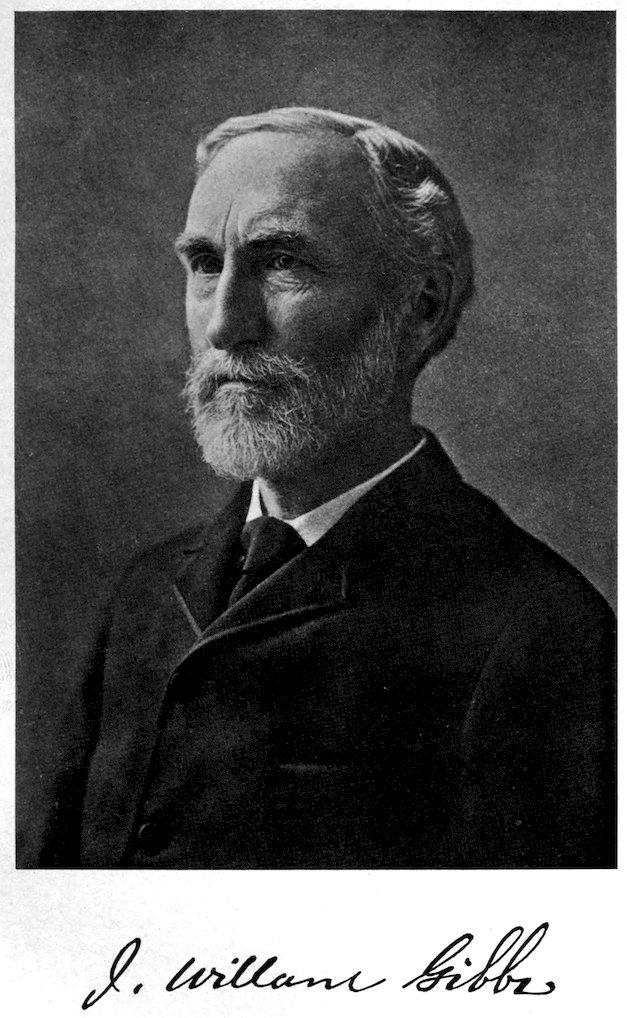
| J. Willard Gibbs |
„ „ |
324 |
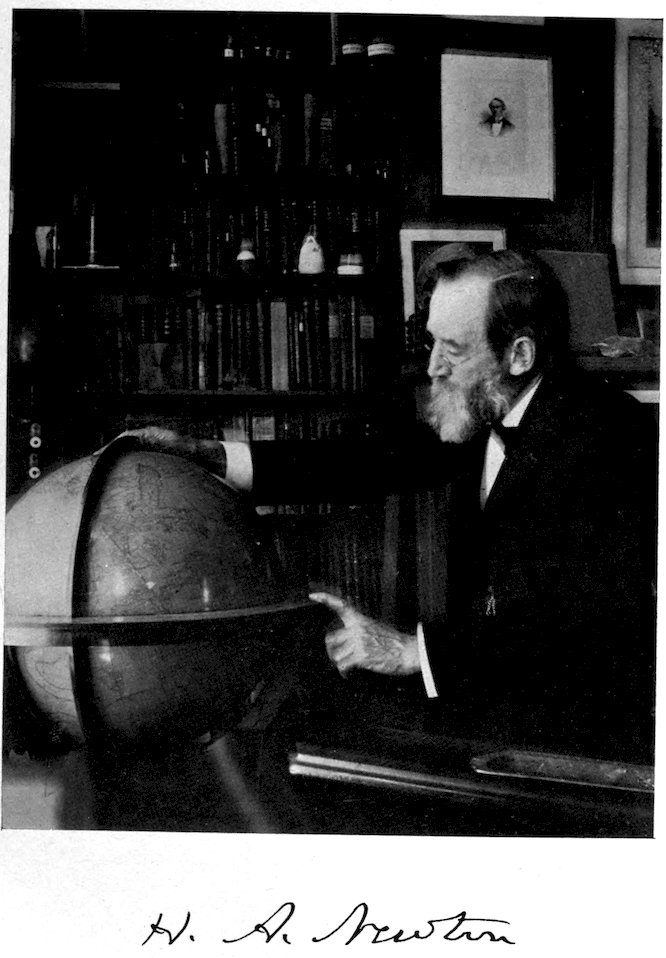
| H. A. Newton |
„ „ |
336 |
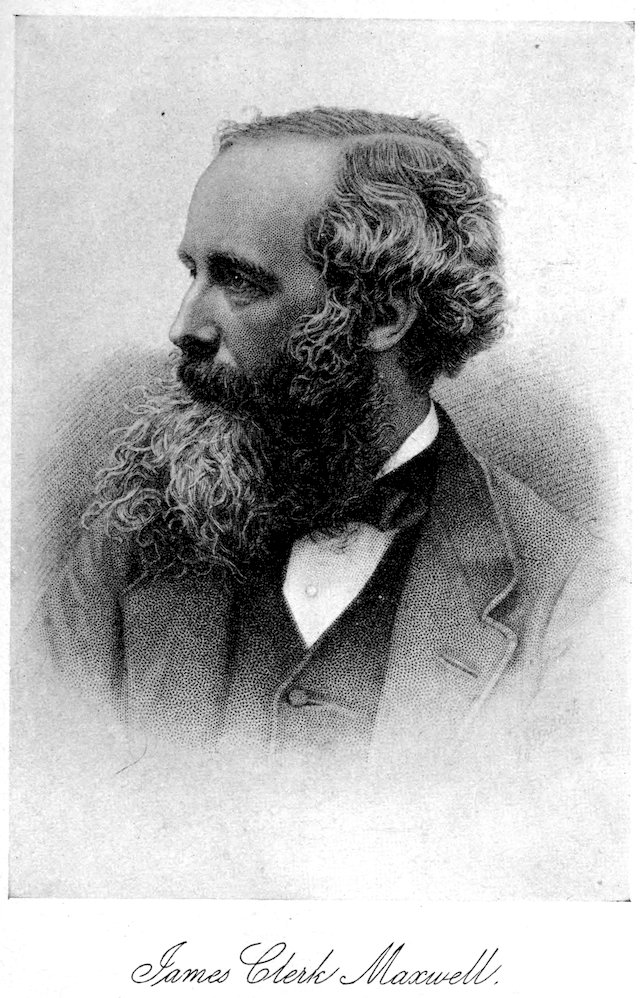
| James Clerk Maxwell |
„ „ |
348 |
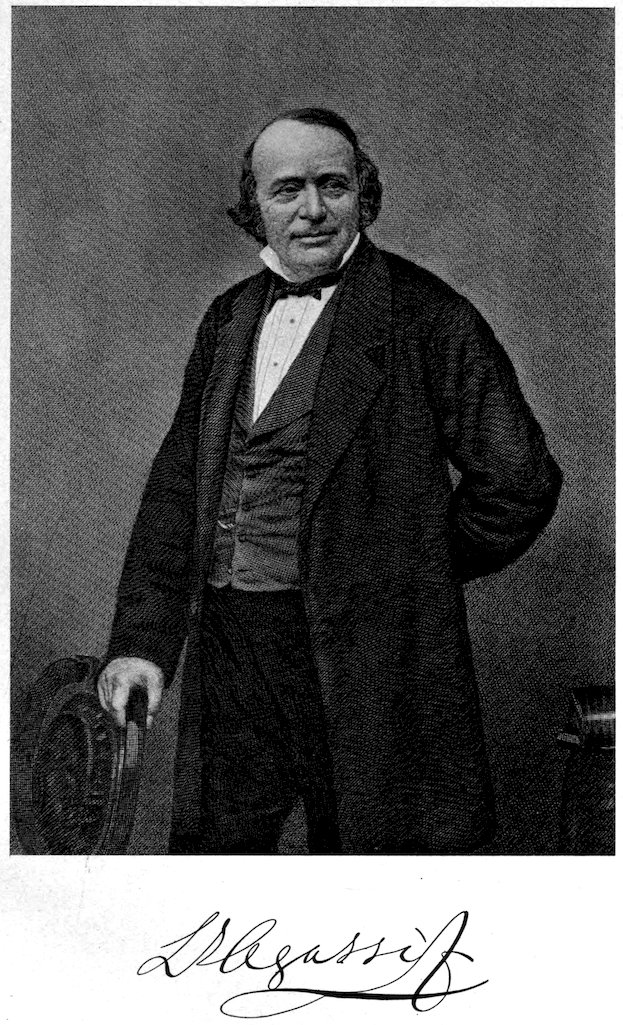
| Louis Agassiz |
„ „ |
404 |
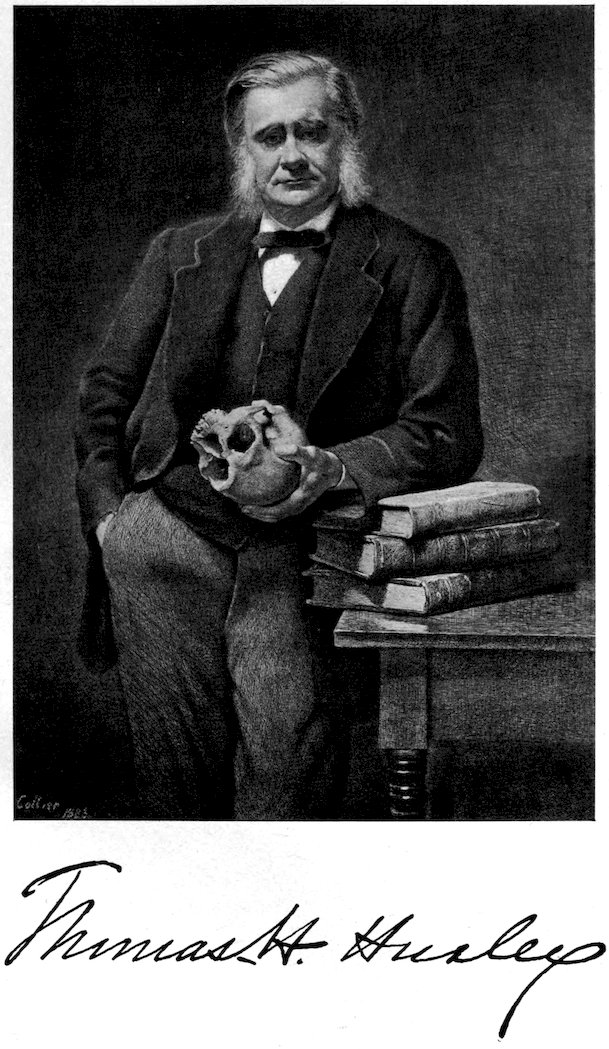
| Thomas H. Huxley |
„ „ |
410 |
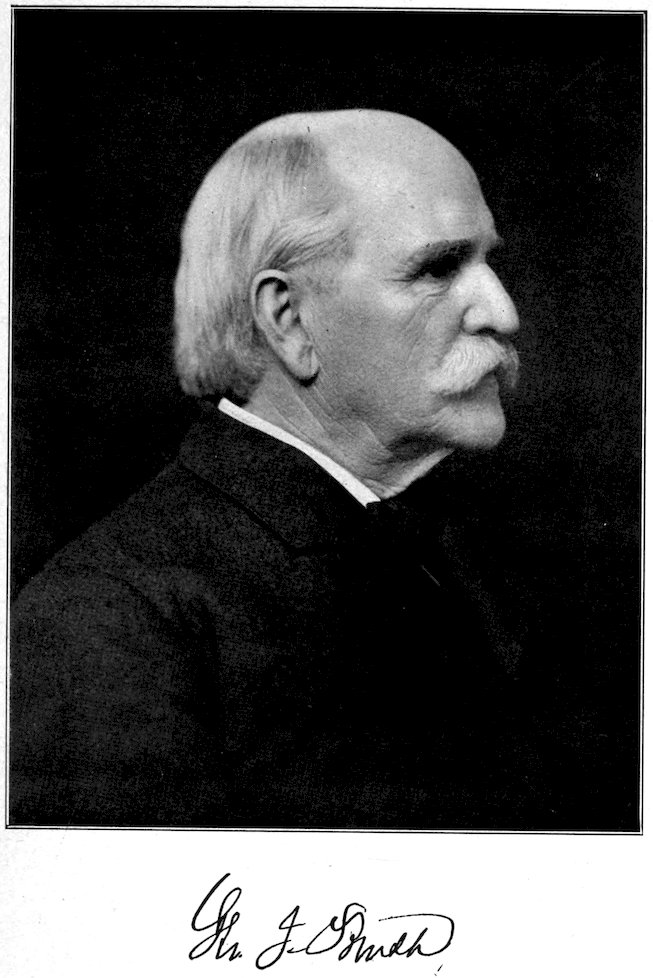
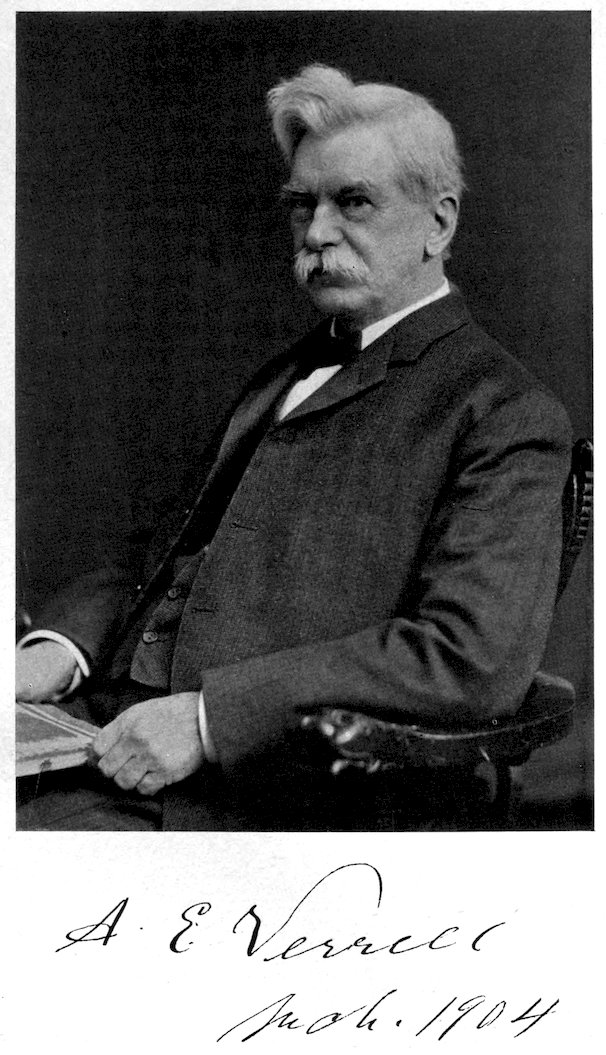
| A. E. Verrill |
„ „ |
412 |
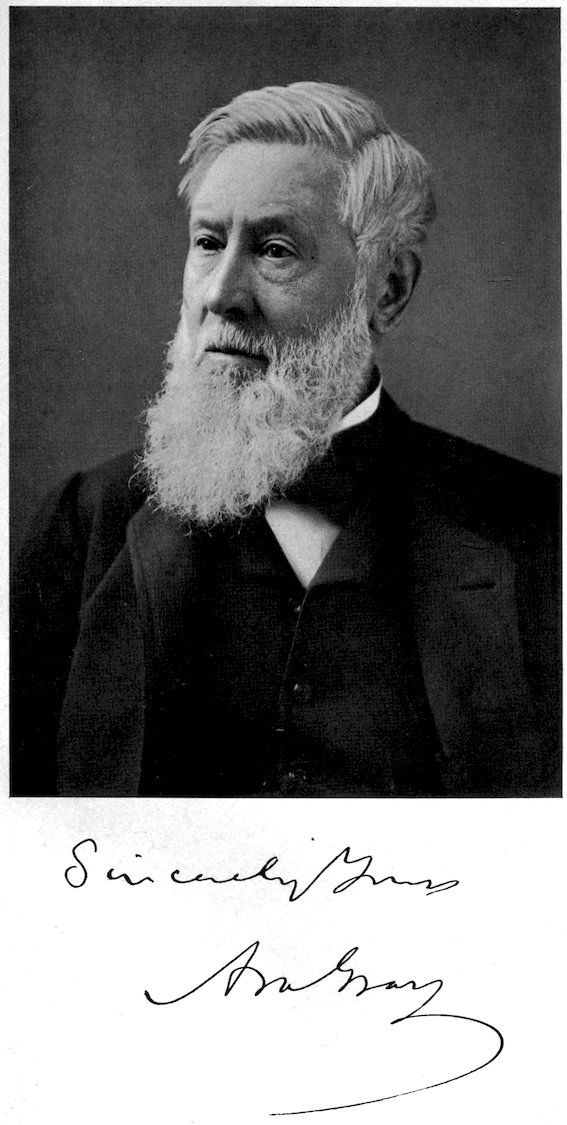
| Asa Gray |
„ „ |
444 |
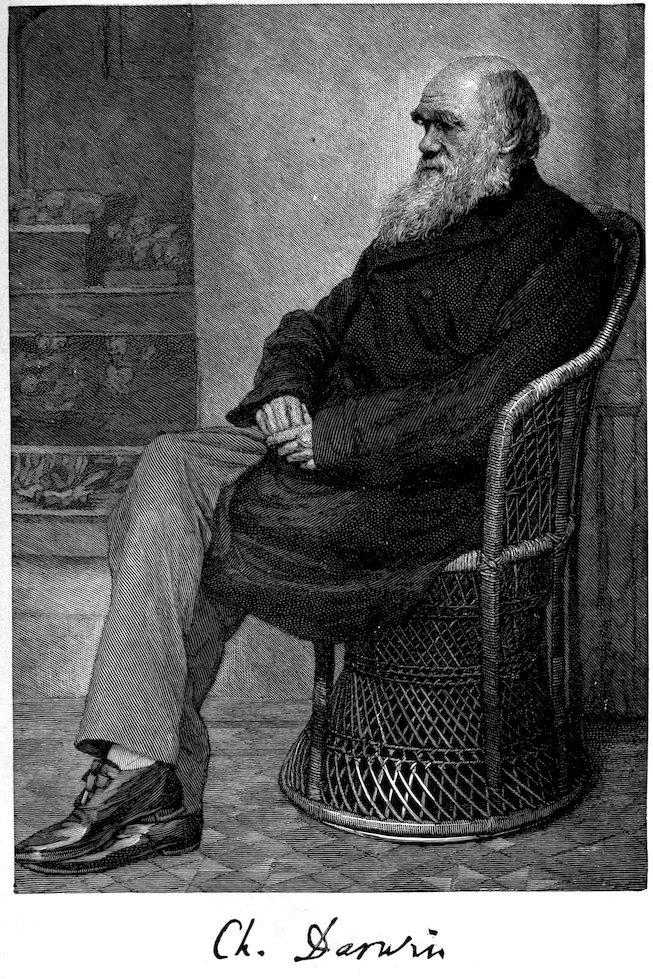
| Charles Darwin |
„ „ |
452 |
A CENTURY OF SCIENCE
IN AMERICA
13
In July, 1818, one hundred years ago, the first number
of the American Journal of Science and Arts was
given to the public. This is the only scientific
periodical in this country to maintain an uninterrupted
existence since that early date, and this honor is shared
with hardly more than half a dozen other independent
scientific periodicals in the world at large. Similar publications
of learned societies for the same period are also
very few in number.
It is interesting, on the occasion of this centenary, to
glance back at the position of science and scientific literature
in the world’s intellectual life in the early part of
the nineteenth century, and to consider briefly the marvelous
record of combined scientific and industrial progress
of the hundred years following—subjects to be
handled in detail in the succeeding chapters. It is fitting
also that we should recall the man who founded the
Journal, the conditions under which he worked, and the
difficulties he encountered. Finally, we must review, but
more briefly, the subsequent history of what has so often
been called after its founder, “Silliman’s Journal.”
The nineteenth century, and particularly the hundred
years in which we are now interested, must always stand
out in the history of the world as the period which has
14combined the greatest development in all departments of
science with the most extraordinary industrial progress.
It was not until this century that scientific investigation
used to their full extent the twin methods of observation
and experiment. In cases too numerous to mention they
have given us first, a tentative hypothesis; then, through
the testing and correcting of the hypothesis by newly
acquired data, an accepted theory has been arrived at;
finally, by the same means carried further has been
established one of nature’s laws.
Early Science.—Looking far back into the past, it
seems surprising that science should have had so late a
growth, but the wonderful record of man’s genius in the
monuments he erected and in architectural remains
shows that the working of the human mind found expression
first in art and further man also turned to literature.
So far as man’s thought was constructive, the
early results were systems of philosophy, and explanations
of the order of things as seen from within, not as
shown by nature herself. We date the real beginning of
science with the Greeks, but it was the century that preceded
Aristotle that saw the building of the Parthenon
and the sculptures of Phidias. Even the great Aristotle
himself (384–322 B. C.) though he is sometimes called the
“founder of natural history,” was justly accused by
Lord Bacon many centuries later of having formed his
theories first and then to have forced the facts to agree
with them.
The bringing together of facts through observation
alone began, to be sure, very early, for it was the motion
of the sun, moon, and stars and the relation of the earth
to them that first excited interest, and, especially in the
countries of the East, led to the accumulation of data as
to the motion of the planets, of comets and the occurrence
of eclipses. But there was no coördination of
these facts and they were so involved in man’s superstition
as to be of little value. In passing, however, it is
worthy of mention that the Chinese astronomical data
accumulated more than two thousand years before the
Christian era have in trained hands yielded results of no
small significance.
Doubtless were full knowledge available as to the
15science existing in the early civilizations, we should rate
it higher than we can at present, but it would probably
prove even then to have been developed from within, like
the philosophies of the Greeks, and with but minor
influence from nature herself. It is indeed remarkable
that down to the time with which we are immediately concerned,
it was the branches of mathematics, as arithmetic
and geometry and later their applications, that were first
and most fully developed: in other words those lines of
science least closely connected with nature.
Of the importance to science of the Greek school at
Alexandria in the second and third centuries B. C., there
can be no question. The geometry of Euclid (about 300
B. C.) was marvelous in its completeness as in clearness
of logical method. Hipparchus (about 160–125 B. C.)
gave the world the elements of trigonometry and developed
astronomy so that Ptolemy 260 years later was able
to construct a system that was well developed, though in
error in the fundamental idea as to the relative position
of the earth. It is interesting to note that the Almagest
of Ptolemy was thought worthy of republication by the
Carnegie Institution only a year or two since. This
great astronomical work, by the way, had no successor
till that of the Arab Ulugh Bey in the fifteenth century,
which within a few months has also been made available
by the same Institution.
To the Alexandrian school also belongs Archimedes
(287–212 B. C.), who, as every school boy knows, was the
founder of mechanics and in fact almost a modern physical
experimenter. He invented the water screw for raising
water; he discovered the principle of the lever,
which appealed so keenly to his imagination that he
called for a ποῦ στῶ, or fulcrum, on which to place it so as
to move the earth itself. He was still nearer to modern
physics in his reputed plan of burning up a hostile fleet
by converging the sun’s rays by a system of great
mirrors.
To the Romans, science owes little beyond what is
implied in their vast architectural monuments, buildings
and aqueducts which were erected at home and in the
countries of their conquests. The elder Pliny (23–79
A. D.) most nearly deserved to be called a man of science,
16but his work on natural history, comprised in thirty-seven
volumes, is hardly more than a compilation of
fable, fact, and fancy, and is sometimes termed a collection
of anecdotes. He lost his life in the “grandest
geological event of antiquity,” the eruption of Vesuvius,
which is vividly described by his nephew, the younger
Pliny, in “one of the most remarkable literary productions
in the domain of geology” (Zittel).
With the fall of Rome and the decline of Roman civilization
came a period of intellectual darkness, from
which the world did not emerge until the revival of learning
in the fifteenth and sixteenth centuries. Then the
extension of geographical knowledge went hand in hand
with the development of art, literature, and the birth of a
new science. Copernicus (1473–1543) gave the world at
last a sun-controlled solar system; Kepler (1571–1630)
formulated the laws governing the motion of the planets;
Galileo (1564–1642) with his telescope opened up new
vistas of astronomical knowledge and laid the foundations
of mechanics; while Leonardo da Vinci (1452–1519),
painter, sculptor, architect, engineer, musician and true
scientist, studied the laws of falling bodies and solved
the riddle of the fossils in the rocks. Still later Newton
(1642–1727) established the law of gravitation, developed
the calculus, put mechanics upon a solid basis and also
worked out the properties of lenses and prisms so that
his Optics (1704) will always have a prominent place in
the history of science.
From the time of the Renaissance on science grew
steadily, but it was not till the latter half of the eighteenth
century that the foundations in most of the lines
recognized to-day were fully laid. Much of what was
accomplished then is, at least, outlined in the chapters
following.
Our standpoint in the early years of the nineteenth
century, just before the American Journal had its beginning,
may be briefly summarized as follows: A desire
for knowledge was almost universal and, therefore, also
a general interest in the development of science. Mathematics
was firmly established and the mathematical side
of astronomy and natural philosophy—as physics was
then called—was well developed. Many of the phenomena
17of heat and their applications, as in the steam engine
of Watt, were known and even the true nature of heat had
been almost established by our countryman, Count Rumford;
but of electricity there were only a few sparks of
knowledge. Chemistry had had its foundation firmly
laid by Priestley, Lavoisier, and Dalton, while Berzelius
was pushing rapidly forward. Geology had also its
roots down, chiefly through the work of Hutton and
William Smith, though the earth was as yet essentially
an unexplored field. Systematic zoology and botany had
been firmly grounded by Buffon, Lamarck and Cuvier, on
the one hand, and Linnæus on the other; but of all that is
embraced under the biology of the latter half of the
nineteenth century the world knew nothing. The statements
of Silliman in his Introductory Remarks in the
first number, quoted in part on a following page, put
the matter still more fully, but they are influenced by the
enthusiasm of the time and he could have had little comprehension
of what was to be the record of the next one
hundred years.
Now, leaving this hasty and incomplete retrospect and
coming down to 1918, we find the contrast between to-day
and 1818 perhaps most strikingly brought out, on the
material side, if we consider the ability of man, in the
early part of the nineteenth century, to meet the demands
upon him in the matter of transportation of himself and
his property. In 1800, he had hardly advanced beyond
his ancestor of the earliest civilization; on the contrary,
he was still dependent for transportation on land upon
the muscular efforts of himself and domesticated animals,
while at sea he had only the use of sails in addition.
The first application of the steam engine with commercial
success was made by Fulton when, in 1807, the steamboat
“Clermont” made its famous trip on the Hudson River.
Since then, step by step, transportation has been made
more and more rapid, economical and convenient, both on
land and water. This has come first through the perfection
of the steam engine; later through the agency of
electricity, and still further and more universally by the
use of gasolene motors. Finally, in these early years of
the twentieth century, what seemed once a wild dream of
18the imagination has been realized, and man has gained
the conquest of the air; while the perfection of the submarine
is as wonderful as its work can be deadly.
Hardly less marvelous is the practical annihilation of
space and time in the electric transmission of human
thought and speech by wire and by ether waves. While,
still further, the same electrical current now gives man
his artificial illumination and serves him in a thousand
ways besides.
But the limitations of space have also been conquered,
during the same period, by the spectroscope which brings
a knowledge of the material nature of the sun and the
fixed stars and of their motion in the line of sight; while
spectrum analysis has revealed the existence of many
new elements and opened up vistas as to the nature of
matter.
The chemist and the physicist, often working together
in the investigation of the problems lying between their
two departments, have accumulated a staggering array
of new facts from which the principles of their sciences
have been deduced. Many new elements have been discovered,
in fact nearly all called for by the periodic law;
the so-called fixed gases have been liquefied, and now air
in liquid form is almost a plaything; the absolute zero
has been nearly reached in the boiling point of helium;
physical measurements in great precision have been carried
out in both directions for temperatures far beyond
any scale that was early conceived possible; the atom,
once supposed to be indivisible, has been shown to be made
up of the much smaller electrons, while its disintegration
in radium and its derivatives has been traced out and
with consequences only as yet partly understood but certainly
having far-reaching consequences; at one point
we seem to be brought near to the transmutation of the
elements which was so long the dream of the alchemist.
Still again photography has been discovered and perfected
and with the use of X-rays it gives a picture of the
structure of bodies totally opaque to the eye; the same
X-rays seem likely to locate and determine the atoms in
the crystal.
Here and at many other points we are reaching out to
a knowledge of the ultimate nature of matter.
19In geology, vast progress has been made in the
knowledge of the earth, not only as to its features now
exhibited at or near the surface, but also as to its history
in past ages, of the development of its structure, the
minute history of its life, the phenomena of its earthquakes,
volcanoes, etc. Geological surveys in all civilized
countries have been carried to a high degree of perfection.
In biology, itself a word which though used by
Lamarck did not come into use till taken up by Huxley,
and then by Herbert Spencer in the middle of the century,
the progress is no less remarkable as is well developed
in a later chapter of this volume.
Although not falling within our sphere, it would be
wrong, too, not to recognize also the growth of medicine,
especially through the knowledge of bacteria and their
functions, and of disease germs and the methods of combating
them. The world can never forget the debt it
owes to Pasteur and Lister and many later investigators
in this field.
To follow out this subject further would be to encroach
upon the field of the chapters following, but, more
important and fundamental still than all the facts discovered
and the phenomena investigated has been the
establishment of certain broad scientific principles which
have revolutionized modern thought and shown the relation
between sciences seemingly independent. The law
of conservation of energy in the physical world and the
principle of material and organic evolution may well be
said to be the greatest generalizations of the human
mind. Although suggestions in regard to them, particularly
the latter, are to be found in the writings of early
authors, the establishment and general acceptance of
these principles belong properly to the middle of the
nineteenth century. They stand as the crowning achievement
of the scientific thought of the period in which we
are interested.
Any mere enumeration of the vast fund of knowledge
accumulated by the efforts of man through observation
and experiment in the period in which we are interested
would be a dry summary, and yet would give some measure
of what this marvelous period has accomplished. As
20in geography, man’s energy has in recent years removed
the reproach of a “Dark Continent,” of “unexplored”
central Asia and the once “inaccessible polar regions,”
so in the different departments of science, he has opened
up many unknown fields and accumulated vast stores of
knowledge. It might even seem as if the limit of the
unknown were being approached. There remains, however,
this difference in the analogy, that in science the
fundamental relations—as, for example, the nature of
gravitation, of matter, of energy, of electricity; the
actual nature and source of life—the solution of these
and other similar problems still lies in the future. What
the result of continued research may be no one can predict,
but even with these possibilities before us, it is
hardly rash to say that so great a combined progress of
pure and applied science as that of the past hundred
years is not likely to be again realized.
The contrast in scientific activity between 1818 and
1918 is nowhere more strikingly shown than in the
amount of scientific periodical literature of the two
periods. Of the thousands of scientific journals and regular
publications by scientific societies and academies
to-day, but a very small number have carried on a continuous
and practically unbroken existence since 1818.
This small amount of periodical scientific literature in
the early part of the last century is significant as giving
a fair indication of the very limited extent to which
scientific investigation appealed to the intellectual life of
the time. Some definite facts in regard to the scientific
publications of those early days seem to be called for.
Learned societies and academies, devoted to literature
and science, were formed very early but at first for occasional
meetings only and regular publications were in
most cases not begun till a very much later date. Some
of the earliest—not to go back of the Renaissance—are
the following:
1560. Naples, Academia Secretorum Naturæ.
1603. Rome, Accademia dei Lincei.
1651. Leipzig, Academia Naturæ Curiosum.
211657. Florence, Accademia del Cimento.
1662. London, Royal Society.
1666. Paris, Académie des Sciences.
1690. Bologna, Accademia delle Scienze.
1700. Berlin, Societas Regia Scientiarum. This was the forerunner of the K. preuss. Akad. d. Wissenschaften.
The Royal Society of London, whose existence dates
from 1645, though not definitely chartered until 1662,
began the publication of its “Philosophical Transactions”
in 1665 and has continued it practically unbroken
to the present time; this is a unique record. Following
this, other early—but in most cases not continuous—publications
were those of Paris (1699); Berlin (1710);
Upsala (1720); Petrograd, 1728; Stockholm (1739);
and Copenhagen (1743).
For the latter half of the eighteenth century, when the
foundations of our modern science were being rapidly
laid, a considerable list might be given of early publications
of similar scientific bodies. Some of the prominent
ones are: Göttingen (1750), Munich (1759), Brussels
(1769), Prague (1775), Turin (1784), Dublin (1788), etc.
The early years of the nineteenth century saw the beginnings
of many others, particularly in northern Italy. It
is to be noted that, as stated, only rarely were the publications
of these learned societies even approximately
continuous. In the majority of cases the issue of transactions
or proceedings was highly irregular and often
interrupted.
In this country the earliest scientific bodies are the
following:
Philadelphia. American Philosophical Society, founded in
1743. Transactions were published 1771–1809; then interrupted
until 1818 et seq.
Boston. American Academy of Arts and Sciences, founded
in 1780. Memoirs, 1785–1821; and then 1833 et seq.
New Haven. Connecticut Academy of Arts and Sciences,
begun in 1799. Memoirs, vol. 1, 1810–16; Transactions, 1866
et seq.
Philadelphia. Academy of Natural Sciences, begun in 1812.
Journal, 1817–1842; and from 1847 et seq.
New York. Lyceum of Natural History, 1817; later (1876)
became the New York Academy of Sciences. Annals from 1823;
Proceedings from 1870.
22The situation is somewhat similar as to independent
scientific journals. A list of the names of those started
only to find an early death would be a very long one, but
interesting only historically and as showing a spasmodic
but unsustained striving after scientific growth.
It seems worth while, however, to give here the names
of the periodicals embracing one or more of the subjects
of the American Journal, which began at a very
early date and most of which have maintained an uninterrupted
existence down to 1915. It should be added
that certain medical journals, not listed here, have also
had a long and continued existence.[1]
1771–1823. Journal de Physique, Paris; title changed several
times.
1787–. Botanical Magazine. (For a time known as Curtis’s
Journal).
1789–1816. Annales de Chimie, Paris. Continued from 1817
on as the Annales de Chimie et de Physique.
1790. Journal der Physik, Halle (by Gren); from 1799 on
became the Annalen der Physik (und Chemie), Halle, Leipzig.
The title has been somewhat changed from time to time though
publication has been continuous. Often referred to by the name
of the editor-in-chief, as Gren, Gilbert, Poggendorff, Wiedemann,
etc.
1795–1815. Journal des Mines, Paris, continued from 1816
as the Annales des Mines.
1796–1815. Bibliothèque Britannique, Geneva. From 1816–1840,
Bibliothèque Universelle, etc. 1846–1857, Archives des
Sci. phys. nat. Since 1858 generally known as the Bibliothèque
Universelle.
1797. Journal of Natural Philosophy, Chemistry and the
Arts (Nicholson’s Journal) London; united in 1814 with the
Philosophical Magazine (Tilloch’s Journal).
1798–. The Philosophical Magazine (originally by Tilloch).
This absorbed Nicholson’s Journal (above) in 1814; also the
Annals of Philosophy (Thomson, Phillips) in 1827 and Brewsters’
Edinburgh Journal of Science in 1832.
1798–1803. Allgemeines Journal der Chemie (Scherer’s
Journal). 1803–1806; continued as Neues Allg. J. etc. (Gehlen’s
Journal). Later title repeatedly changed and finally
(1834 et seq.) Journal für praktische Chemie.
1816–18. Journal of Science and the Arts, London. 181930,
23Quarterly J. etc. 1830–31, Journal of the Royal Institution
of Great Britain.
1818. American Journal of Science and Arts until 1880,
when “the Arts” was dropped, New Haven, Conn. First
Series, 1–50, 1818–1845; Second Series, 1–50, 1846–1870; Third
Series, 1–50, 1871–1895; Fourth Series, 1–45, 1896–June, 1918.
1818. Flora, or Allgemeine botanische Zeitung. Regensburg,
Munich.
1820–1867. London Journal of Arts and Sciences (after
1855, Newton’s Journal).
1824–. Annales des sciences naturelles. Paris.
1826–. Linnæa, Berlin, Halle; from 1882 united with Jahrb.
d. K. botan. Gartens.
1828–1840. Magazine of Natural History, London; united
1838 with the Annals of Natural History, and known since 1841
as the Annals and Magazine of Natural History.
1828–. Journal of the Franklin Institute, Philadelphia, from
1826; earlier (1825) the American Mechanics Magazine.
1832–. Annalen der Chemie (und Pharmacie) often known
as Liebig’s Annalen. Leipzig, Lemgo.
The establishment of a scientific journal in this country
in 1818 was a pioneer undertaking, requiring of its
founder a rare degree of energy, courage, and confidence
in the future. It was necessary, not only to obtain the
material to fill its pages and the money to carry on the
enterprise, but, before the latter end could be accomplished,
an audience must be found among those who had
hitherto felt little or no interest in the sciences. This
great work was accomplished by Benjamin Silliman,
“the guardian of American Science,” whose influence
was second to none in the early development of science in
this country. Before speaking in some detail of the
early years of this Journal and of its subsequent history,
it is proper that some words should be given to its
founder.
Benjamin Silliman, son of a general prominent in the
Revolutionary War, was born in Trumbull, Connecticut,
on August 8, 1779. He was a graduate of Yale College
of the class of 1796. Though at first a student of law and
accepted for the bar in Connecticut, he was called in 1802
by President Timothy Dwight—a man of rare breadth of
24mind—to occupy the newly made chair of chemistry, mineralogy
(and later geology) in Yale College at New
Haven. To fit himself for the work before him he
carried on extensive studies at home and in Philadelphia
and spent the year 1805 in travels and study at London
and Edinburgh, and also on the Continent. His active
duties began in 1806 and from this time on he was in the
service of Yale College until his resignation in 1853.
From the first, Silliman met with remarkable success as a
teacher and public lecturer in arousing an interest in
science. His breadth of knowledge, his enthusiasm for
his chosen subjects and power of clear presentation, combined
with his fine presence and attractive personality,
made him a great leader in the science of the country and
gave him a unique position in the history of its development.
Much might be said of the man and his work, but, the
best tribute is that of James Dwight Dana, given in his
inaugural address upon the occasion of his beginning his
duties as Silliman professor of geology in Yale College.
This was delivered on February 18, 1856, in what was
then known as the “Cabinet Building.” Dana says
in part:
“In entering upon the duties of this place, my thoughts turn
rather to the past than to the subject of the present hour. I
feel that it is an honored place, honored by the labors of one
who has been the guardian of American Science from its childhood;
who here first opened to the country the wonderful
records of geology; whose words of eloquence and earnest truth
were but the overflow of a soul full of noble sentiments and
warm sympathies, the whole throwing a peculiar charm over
his learning, and rendering his name beloved as well as illustrious.
Just fifty years since, Professor Silliman took his station
at the head of chemical and geological science in this college.
Geology was then hardly known by name in the land, out of
these walls. Two years before, previous to his tour in Europe,
the whole cabinet of Yale was a half-bushel of unlabelled stones.
On visiting England he found even in London no school public
or private, for geological instruction, and the science was not
named in the English universities. To the mines, quarries, and
cliffs of England, the crags of Scotland, and the meadows of
Holland he looked for knowledge, and from these and the teachings
of Murray, Jameson, Hall, Hope, and Playfair, at Edinburgh,
Professor Silliman returned, equipped for duty,—albeit
25a great duty,—that of laying the foundation, and creating
almost out of nothing a department not before recognized in any
institution in America.
He began his work in 1806. The science was without books—and,
too, without system, except such as its few cultivators had
each for himself in his conceptions. It was the age of the first
beginnings of geology, when Wernerians and Huttonians were
arrayed in a contest.... Professor Silliman when at Edinburgh
witnessed the strife, and while, as he says, his earliest
predilections were for the more peaceful mode of rock-making,
these soon yielded to the accumulating evidence, and both views
became combined in his mind in one harmonious whole. The
science, thus evolved, grew with him and by him; for his own
labors contributed to its extension. Every year was a year of
expansion and onward development, and the grandeur of the
opening views found in him a ready and appreciative response....
And while the sciences and truth have thus made progress
here, through these labors of fifty years, the means of study in
the institution have no less increased. Instead of that half-bushel
of stones, which once went to Philadelphia for names, in
a candle-box, you see above the largest mineral cabinet in the
country, which but for Professor Silliman, his attractions and
his personal exertions together, would never have been one of
the glories of old Yale....
Moreover, the American Journal of Science,—now in its
thirty-seventh year and seventieth volume [1856],—projected
and long-sustained solely by Professor Silliman, while ever distributing
truth, has also been ever gathering honors, and is one
of the laurels of Yale.
We rejoice that in laying aside his studies, after so many
years of labor, there is still no abated vigor.... He retires
as one whose right it is to throw the burden on others. Long
may he be with us, to enjoy the good he has done, and cheer us
by his noble and benign presence.”
In addition to these words of Dana, much of vital
interest in regard to Silliman and his work will be
gathered from what is given in the pages immediately
following, quoted from his personal statements in the
early volumes of the Journal.
In no direction did Silliman’s enthusiastic activities in
science produce a more enduring result than in the founding
and carrying on of the Journal. The first suggestion
in regard to the enterprise was made to Silliman by
his friend, Colonel George Gibbs, from whom the famous
Gibbs collection of minerals was bought by Yale College
in 1825. Silliman says (25, 215, 1834):
26
27“Col. Gibbs was the person who first suggested to the Editor
the project of this Journal, and he urged the topic with so much
zeal and with such cogent arguments, as prevailed to induce the
effort in a case then viewed as of very dubious success. The
subject was thus started in November, 1817; proposals for the
Journal were issued in January, 1818, and the first number
appeared in July of that year.”
He adds further (50, p. iii, 1847) that the conversation
here recorded took place “on an accidental meeting on
board the steamboat Fulton in Long Island Sound.”
This was some ten years after Robert Fulton’s steamboat,
the Clermont, made its pioneer trip on the Hudson
river, already alluded to. The incident is not without
significance in this connection. The deck of the “Fulton”
was not an inappropriate place for the inauguration
of an enterprise also great in its results for the country.
In the preface to the concluding volume of the First
Series (loc. cit.) Silliman adds the following remarks
which show his natural modesty at the thought of undertaking
so serious a work. He says:
Although a different selection of an editor would have been
much preferred, and many reasons, public and personal, concurred
to produce diffidence of success, the arguments of Col.
Gibbs, whose views on subjects of science were entitled to the
most respectful consideration, and had justly great weight,
being pressed with zeal and ability, induced a reluctant assent;
and accordingly, after due consultation with many competent
judges, the proposals were issued early in 1818, embracing the
whole range of physical science and its applications. The
Editor in entering on the duty, regarded it as an affair for life,
and the thirty years of experience which he has now had, have
proved that his views of the exigencies of the service were not
erroneous.
The plan with which the editor began his work and the
lines laid down by him at the outset can only be made
clear by quoting entire the “Plan of the Work” which
28opens the first number. It seems desirable also to give
this in its original form as to paragraphs and typography.
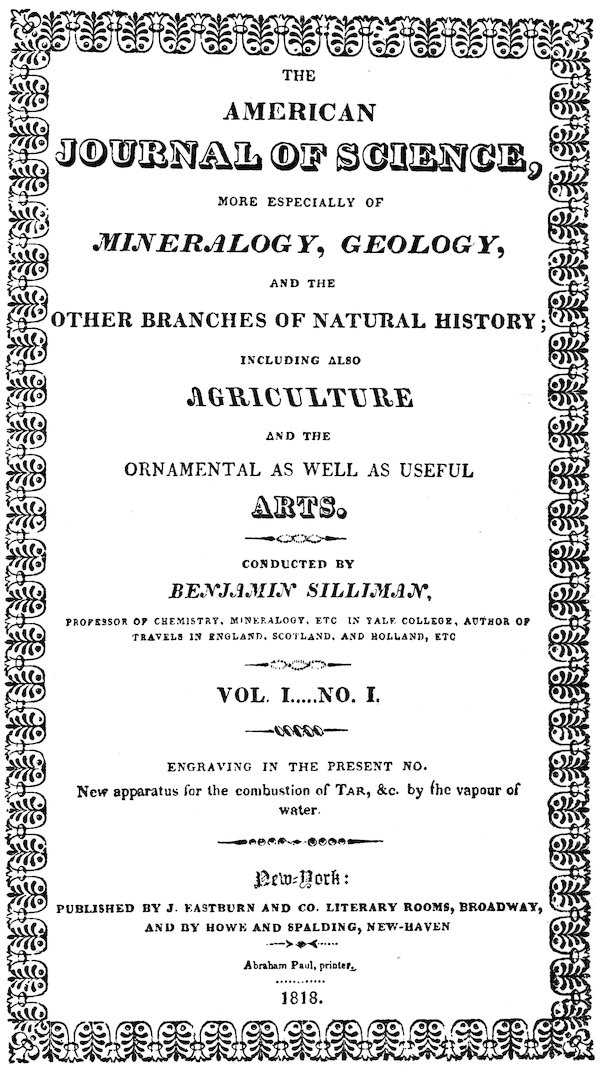
The first page of the cover of the opening number
has also been reproduced here. It will be seen that
the plan of the young editor was as wide as the entire
range of science and its applications and extended out to
music and the fine arts. This seems strange to-day, but
it must be remembered how few were the organs of publication
open to contributors at the time. If the plan
was unreasonably extended, that fact is to be taken not
only as an expression of the enthusiasm of the editor, as
yet inexperienced in his work, but also of the time when
the sciences were still in their infancy.
He says (1, pp. v, vi):
This Journal is intended to embrace the circle of The Physical
Sciences, with their application to The Arts, and to every
useful purpose.
It is designed as a deposit for original American communications;
but will contain also occasional selections from Foreign
Journals, and notices of the progress of science in other countries.
Within its plan are embraced
Natural History, in its three great departments of Mineralogy,
Botany, and Zoology;
Chemistry and Natural Philosophy, in their various
branches: and Mathematics, pure and mixed.
It will be a leading object to illustrate American Natural
History, and especially our Mineralogy and Geology.
The Applications of these sciences are obviously as numerous
as physical arts, and physical wants; for no one of these
arts or wants can be named which is not connected with them.
While Science will be cherished for its own sake, and with a
due respect for its own inherent dignity; it will also be
employed as the handmaid to the Arts. Its numerous applications
to Agriculture, the earliest and most important of them;
to our Manufactures, both mechanical and chemical; and
to our Domestic Economy, will be carefully sought out, and
faithfully made.
It is also within the design of this Journal to receive communications
on Music, Sculpture, Engraving, Painting, and generally
on the fine and liberal, as well as useful arts;
On Military and Civil Engineering, and the art of Navigation.
29Notices, Reviews, and Analyses of new scientific works, and
of new Inventions, and Specifications of Patents;
Biographical and Obituary Notices of scientific men; essays
on Comparative Anatomy and Physiology, and generally on
such other branches of medicine as depend on scientific principles;
Meteorological Registers, and Reports of Agricultural Experiments:
and we would leave room also for interesting miscellaneous
things, not perhaps exactly included under either of the
above heads.
Communications are respectfully solicited from men of
science, and from men versed in the practical arts.
Learned Societies are invited to make this Journal, occasionally,
the vehicle of their communications to the Public.
The editor will not hold himself responsible for the sentiments
and opinions advanced by his correspondents; but he will consider
it as an allowed liberty to make slight verbal alterations,
where errors may be presumed to have arisen from inadvertency.”
In the “Advertisement” which precedes the above
statement in the first number, the editor remarks somewhat
naïvely that he “does not pledge himself that all the
subjects shall be touched upon in every number. This is
plainly impossible unless every article should be very
short and imperfect....”
The whole subject is discussed in all its relations in
the “Introductory Remarks” which open the first volume.
No apology is needed for quoting at considerable
length, for only in this way can the situation be made
clear, as seen by the editor in 1818. Further we gain
here a picture of the intellectual life of the times and, not
less interesting, of the mind and personality of the writer.
With a frank kindliness, eminently characteristic of the
man, as will be seen, he takes the public fully into his
confidence. In the remarks made in subsequent volumes,—also
extensively quoted—the vicissitudes in the
conduct of the enterprise are brought out and when success
was no longer doubtful, there is a tone of quiet
satisfaction which was also characteristic and which the
circumstances fully justified.
The Introductory Remarks begin as follows:
The age in which we live is not less distinguished by a vigorous
and successful cultivation of physical science, than by its numerous
30and important applications to the practical arts, and to the
common purposes of life.
In every enlightened country, men illustrious for talent, worth
and knowledge, are ardently engaged in enlarging the boundaries
of natural science; and the history of their labors and
discoveries is communicated to the world chiefly through the
medium of scientific journals. The utility of such journals has
thus become generally evident; they are the heralds of science;
they proclaim its toils and its achievements; they demonstrate
its intimate connection as well with the comfort, as with the
intellectual and moral improvement of our species; and they
often procure for it enviable honors and substantial rewards.
Mention is then made of the journals existing in
England and France in 1818 “which have long enjoyed a
high and deserved reputation.” He then continues:
From these sources our country reaps and will long continue
to reap, an abundant harvest of information: and if the light
of science, as well as of day, springs from the East, we will welcome
the rays of both; nor should national pride induce us to
reject so rich an offering.
But can we do nothing in return?
In a general diffusion of useful information through the various
classes of society, in activity of intellect and fertility of
resource and invention, producing a highly intelligent population,
we have no reason to shrink from a comparison with any
country. But the devoted cultivators of science in the United
States are comparatively few: they are, however, rapidly
increasing in number. Among them are persons distinguished
for their capacity and attainments, and, notwithstanding the
local feelings nourished by our state sovereignties, and the rival
claims of several of our larger cities, there is evidently a predisposition
towards a concentration of effort, from which we may
hope for the happiest results, with regard to the advancement
of both the science and reputation of our country.
Is it not, therefore, desirable to furnish some rallying point,
some object sufficiently interesting to be nurtured by common
efforts, and thus to become the basis of an enduring, common
interest? To produce these efforts, and to excite this interest,
nothing, perhaps, bids fairer than a Scientific Journal.
The valuable work already accomplished by various
medical journals is then spoken of and particularly that
of the first scientific periodical in the United States,
Bruce’s Mineralogical Journal. This, as Silliman says
31(1, p. 3, 1818), although “both in this country and in
Europe received in a very flattering manner,” did not
survive the death of its founder, and only a single volume
of 270 pages appeared (1810–1813).
Silliman continues:
No one, it is presumed, will doubt that a journal devoted to
science, and embracing a sphere sufficiently extensive to allure
to its support the principal scientific men of our country, is
greatly needed; if cordially supported, it will be successful,
and if successful, it will be a great public benefit.
Even a failure, in so good a cause, (unless it should arise from
incapacity or unfaithfulness,) cannot be regarded as dishonourable.
It may prove only that the attempt was premature, and
that our country is not yet ripe for such an undertaking; for
without the efficient support of talent, knowledge, and money,
it cannot long proceed. No editor can hope to carry forward
such a work without the active aid of scientific and practical
men; but, at the same time, the public have a right to expect
that he will not be sparing of his own labour, and that his work
shall be generally marked by the impress of his own hand. To
this extent the editor cheerfully acknowledges his obligations
to the public; and it will be his endeavour faithfully to redeem
his pledge.
Most of the periodical works of our country have been short-lived.
This, also, may perish in its infancy; and if any degree
of confidence is cherished that it will attain a maturer age, it is
derived from the obvious and intrinsic importance of the undertaking;
from its being built upon permanent and momentous
national interests; from the evidence of a decided approbation
of the design, on the part of gentlemen of the first eminence,
obtained in the progress of an extensive correspondence; from
assurance of support, in the way of contributions, from men of
ability in many sections of the union; and from the existence
of such a crisis in the affairs of this country and of the world,
as appears peculiarly auspicious to the success of every wise and
good undertaking.
An interesting discussion follows (pp. 5–8) as to the
claims of the different branches of science, and the extent
to which they and their applications had been already
developed, also the spheres still open to discovery.
The Introductory Remarks close, as follows:
In a word, the whole circle of physical science is directly
applicable to human wants and constantly holds out a light to
32the practical arts; it thus polishes and benefits society and
everywhere demonstrates both supreme intelligence and harmony
and beneficence of design in the Creator.
The science of mathematics, both pure and mixed, can never
cease to be interesting and important to man, as long as the
relations of quantity shall exist, as long as ships shall traverse
the ocean, as long as man shall measure the surface or heights
of the earth on which he lives, or calculate the distances and
examine the relations of the planets and stars; and as long as
the iron reign of war shall demand the discharge of projectiles,
or the construction of complicated defences.
The closing part of the paragraph shows the influence
exerted upon the mind of the editor by the serious wars
of the years preceding 1818, a subject alluded to again at
the close of this chapter.
In February, 1822, with the completion of the fourth
volume, the editor reviews the situation which, though
encouraging is by no means fully assuring. He says
(preface to vol. 4, dated Feb. 15, 1822):
Two years and a half have elapsed, since the publication of
the first volume of this Journal, and one year and ten months
since the Editor assumed the pecuniary responsibility....
The work has not, even yet, reimbursed its expenses, (we
speak not of editorial or of business compensation,) we intend,
that it has not paid for the paper, printing and engraving; the
proprietors of the first volume being in advance, on those
accounts, and the Editor on the same score, with respect to the
aggregate expense of the three last volumes. This deficit is,
however, no longer increasing, as the receipts, at present, just
about cover the expense of the physical materials, and of the
manual labour. A reiterated disclosure of this kind is not
grateful, and would scarcely be manly, were it not that the
public, who alone have the power to remove the difficulty, have
a right to a frank exposition of the state of the case. As the
patronage is, however, growing gradually more extensive, it is
believed that the work will be eventually sustained, although
it may be long before it will command any thing but gratuitous
intellectual labour....
These facts, with the obvious one,—that its pages are supplied
with contributions from all parts of the Union, and occasionally
from Europe, evince that the work is received as a national and
not as a local undertaking, and that the community consider it
as having no sectional character. Encouraged by this view of
33the subject, and by the favour of many distinguished men, both
at home and abroad, and supported by able contributors, to
whom the Editor again tenders his grateful acknowledgments,
he will still persevere, in the hope of contributing something
to the advancement of our science and arts, and towards the
elevation of our national character.
In the autumn of the same year, the editor closes the
fifth volume with a more confident tone (Sept. 25, 1822):
A trial of four years has decided the point, that the American
Public will support this Journal. Its pecuniary patronage is
now such, that although not a lucrative, it is no longer a hazardous
enterprise. It is now also decided, that the intellectual
resources of the country are sufficient to afford an unfailing
supply of valuable original communications and that nothing
but perseverance and effort are necessary to give perpetuity to
the undertaking.
The decided and uniform expression of public favour which
the Journal has received both at home and abroad, affords the
Editor such encouragement, that he cannot hesitate to persevere—and
he now renews the expression of his thanks to the
friends and correspondents of the work, both in Europe and the
United States, requesting at the same time a continuance of their
friendly influence and efforts.
Still again in the preface to the sixth volume (1823) he
takes the reader more fully into his confidence and shows
that he regards the enterprise as no longer of doubtful
success. He says:
The conclusion of a new volume of a work, involving so much
care, labour and responsibility, as are necessarily attached, at
the present day, to a Journal of Science and the Arts, naturally
produces in the mind, a state of not ungrateful calmness,
and a disposition, partaking of social feeling, to say something
to those who honour such a production, by giving to it a small
share of their money, and of their time. The Editor’s first
impression was, that the sixth volume should be sent into the
world without an introductory note, but he yields to the impulse
already expressed, and to the established usages of respectful
courtesy to the public, which a short preface seems to imply.
He has now persevered almost five years, in an undertaking,
regarded by many of the friends whom he originally consulted,
as hazardous, and to which not a few of them prophetically
alloted only an ephemeral existence. It has been his fortune to
34prosecute this work without, (till a very recent period,) returns,
adequate to its indispensable responsibilities;—under a heavy
pressure of professional and private duty; with trying fluctuations
of health, and amidst severe and reiterated domestic
afflictions. The world are usually indulgent to allusions of this
nature, when they have any relation to the discharge of public
duty; and in this view, it is with satisfaction, that the Editor
adds, that he has now to look on formidable difficulties, only in
retrospect, and with something of the feeling of him, who sees
a powerful and vanquished foe, slowly retiring, and leaving a
field no longer contested.
This Journal which, from the first, was fully supplied with
original communications, is now sustained by actual payment,
to such an extent, that it may fairly be considered as an established
work; its patronage is regularly increasing, and we trust
it will no longer justify such remarks as some of the following,
from the pen of one of the most eminent scientific men in
Europe. “Nothing surprises me more, than the little encouragement
which your Journal,” (“which I always read with very
great interest, and of which I make great use,”) “experiences
in America—this must surely arise from the present depressed
condition of trade, and cannot long continue.”
Six years more of uninterrupted editorial work passed
by, the sixteenth volume was completed, and the editor
was now in a position to review the whole situation up to
1829. This preface (dated July 1, 1829), which is quoted
nearly in full, cannot fail to be found particularly interesting
and from several standpoints, not the least for the
insight it gives into the writer’s mind. It is also noteworthy
that at this early date it was found possible to
pay for original contributions, a privilege far beyond
the means of the editor of to-day.
When this Journal was first projected, very few believed that
it would succeed.
Among others, Dr. Dorsey wrote to the editor; “I predict a
short life for you, although I wish, as the Spaniards say, that
you may live a thousand years.” The work has not lived a
thousand years, but as it has survived more than the hundredth
part of that period, no reason is apparent why it may not continue
to exist. To the contributors, disinterested and arduous
as have been their exertions, the editor’s warmest thanks are
due; and they are equally rendered to numerous personal
friends for their unwavering support: nor ought those subscribers
35to be forgotten who, occupied in the common pursuits
of life, have aided, by their money, in sustaining the hazardous
novelty of an American Journal of Science. A general approbation,
sufficiently decided to encourage effort, where there was
no other reward, has supported the editor; but he has not been
inattentive to the voice of criticism, whether it has reached him
in the tones of candor and kindness, or in those of severity.
We must not look to our friends for the full picture of our
faults. He is unwise who neglects the maxim—
—fas est ab hoste doceri,
and we may be sure, that those are quite in earnest, whose
pleasure it is, to place faults in a strong light and bold relief;
and to throw excellencies into the shadow of total eclipse.
Minds at once enlightened and amiable, viewing both in their
proper proportions, will however render the equitable verdict;
Non ego paucis offendar maculis,—
It is not pretended that this Journal has been faultless; there
may be communications in it which had been better omitted, and
it is not doubted that the power to command intellectual effort,
by suitable pecuniary reward, would add to its purity, as a
record of science, and to its richness, as a repository of discoveries
in the arts.
But the editor, even now, offers payment, at the rate adopted
by the literary Journals, for able original communications, containing
especially important facts, investigations and discoveries
in science, and practical inventions in the useful and ornamental
Arts.
As however his means are insufficient to pay for all the copy,
it is earnestly requested, that those gentlemen, who, from other
motives, are still willing to write for this Journal, should continue
to favor it with their communications. That the period
when satisfactory compensation can be made to all writers whose
pieces are inserted, and to whom payment will be acceptable, is
not distant, may perhaps be hoped, from the spontaneous expression
of the following opinion, by the distinguished editor of one
of our principal literary journals, whose letter is now before
me. “The character of the American Journal is strictly
national, and it is the only vehicle of communication in which
an inquirer may be sure to find what is most interesting in the
wide range of topics, which its design embraces. It has become
in short, not more identified with the science than the literature
of the country.” It is believed that a strict examination of
its contents will prove that its character has been decidedly
scientific; and the opinion is often expressed to the editor, that
36in common with the journals of our Academies, it is a work of
reference, indispensable to him who would examine the progress
of American science during the period which it covers. That it
might not be too repulsive to the general reader, some miscellaneous
pieces have occasionally occupied its pages; but in
smaller proportion, than is common with several of the most
distinguished British Journals of Science.
Still, the editor has been frequently solicited, both in public
and private, to make it more miscellaneous, that it might be
more acceptable to the intelligent and well educated man, who
does not cultivate science; but he has never lost sight of his
great object, which was to produce and concentrate original
American effort in science, and thus he has foregone pecuniary
returns, which by pursuing the other course, might have been
rendered important. Others would not have him admit any
thing that is not strictly and technically scientific; and would
make this journal for mere professors and amateurs; especially
in regard to those numerous details in natural history, which
although important to be registered, (and which, when presented,
have always been recorded in the American Journal,)
can never exclusively occupy the pages of any such work without
repelling the majority of readers.
If this is true even in Great Britain it is still more so in this
country; and our savants, unless they would be, not only the
exclusive admirers, but the sole purchasers of their own works,
must permit a little of the graceful drapery of general literature
to flow around the cold statues of science. The editor of this
Journal, strongly inclined, both from opinion and habit, to
gratify the cultivators of science, will still do everything in his
power to promote its high interests, and as he hopes in a better
manner than heretofore; but these respectable gentlemen will
have the courtesy, to yield something to the reading literary, as
well as scientific public, and will not, we trust, be disgusted,
if now and then an Oasis relieves the eye, and a living stream
refreshes the traveller. Not being inclined to renew the abortive
experiment, to please every body, which has been so long
renowned in fable; the editor will endeavor to pursue, the
even tenor of his way; altogther inclined to be courteous and
useful to his fellow travellers, and hoping for their kindness
and services in return.
The “First Series,” as it was henceforth to be known,
closed with the fiftieth volume (1847, pp. xx + 347).
This final volume is devoted to an exhaustive index to the
forty-nine volumes preceding. In the preface (dated
April 19, 1847) the elder Silliman, now the senior editor,
reviews the work that had been accomplished with a
frank expression of his feeling of satisfaction in the victory
won against great obstacles; with this every reader
must sympathize. He quotes here at length (but in
slightly altered form) the matter from the first volume
(1818), which has been already reproduced almost
entire, and then goes on as follows (pp. xi et seq.):
37Such was the pledge which, on entering upon our editorial
labors in 1818, we gave to the public, and such were the views
which we then entertained, regarding science and the arts as
connected with the interests and honor of our country and of
mankind. In the retrospect, we realize a sober but grateful
feeling of satisfaction, in having, to the extent of our power,
discharged these self-imposed obligations; this feeling is chastened
also by a deep sense of gratitude, first to God for life and
power continued for so high a purpose; and next, to our noble
band of contributors, whose labors are recorded in half a century
of volumes, and in more than a quarter of a century of years.
We need not conceal our conviction, that the views expressed
in these “Introductory Remarks,” have been fully sustained
by our fellow laborers.
Should we appear to take higher ground than becomes us,
we find our vindication in the fact, that we have heralded
chiefly the doings and the fame of others. The work has indeed
borne throughout “the impress” of editorial unity of design,
and much that has flowed from one pen, and not a little from
the pens of others, has been without a name. The materials
for the pile, have however been selected and brought in, chiefly
by other hands, and if the monument which has been reared
should prove to be “aere perennius,” the honor is not the sole
property of the architect; those who have quarried, hewn and
polished the granite and the marble, are fully entitled to the
enduring record of their names already deeply cut into the
massy blocks, which themselves have furnished.
If a retrospective survey of the labors of thirty years on this
occasion has rekindled a degree of enthusiasm, it is a natural
result of an examination of all our volumes from the contents
of which we have endeavored to make out a summary both of
the laborers and their works....
The series of volumes must ever form a work of permanent
interest on account of its exhibiting the progress of American
science during the long period which it covers. Comparing
381817 with 1847, we mark on this subject a very gratifying change.
The cultivators of science in the United States were then few—now
they are numerous. Societies and associations of various
names, for the cultivation of natural history, have been instituted
in very many of our cities and towns, and several of them
have been active and efficient in making original observations
and forming collections.
A summary follows presenting some facts as to the
growth of scientific societies and scientific collections in
this country during the period involved: Then the
striking contrast between 1818 and 1847 in the matter of
organized effort toward scientific exploration is discussed,
as follows (pp. xvi et seq.):
When we began our Journal, not one of the States had been
surveyed in relation to its geology and natural history; now
those that have not been explored are few in number. State
collections and a United States Museum hold forth many allurements
to the young naturalist, as well as to the archaeologist and
the student of his own race. The late Exploring Expedition
[Wilkes] with the National Institute, has enriched the capital
with treasures rarely equalled in any country, and the Smithsonian
Institution recently organized at Washington, is about
to begin its labors for the increase and diffusion of knowledge
among men.
It must not be forgotten that the American Association of
Geologists and Naturalists—composed of individuals assembled
from widely separate portions of the Union—by the seven sessions
which it has held, and by its rich volume of reports, has
produced a concentration and harmony of effort which promise
happy results, especially as, like the British Association, it
visits different towns and cities in its annual progress.
Astronomy now lifts its exploring tubes from the observatories
of many of our institutions. Even the Ohio, which within the
memory of the oldest living men, rolled along its dark waters
through interminable forests, or received the stains of blood
from deadly Indian warfare, now beholds on one of its most
beautiful hills, and near its splendid city, a permanent observatory
with a noble telescope sweeping the heavens, by the hand
of a zealous and gifted observer. At Washington also, under
the powerful patronage of the general government, an excellent
observatory has been established, and is furnished with superior
instruments, under the direction of a vigilant and well instructed
astronomer—seconded by able and zealous assistants.
Here also (in Yale College) successful observations have been
39made with good instruments, although no permanent building
has been erected for an Observatory.
We only give single examples by way of illustration, for the
history of the progress of science in the United States, and of
institutions for its promotion, during the present generation,
would demand a volume. It is enough for our purpose that
science is understood and valued, and the right methods of
prosecuting it are known, and the time is at hand when its moral
and intellectual use will be as obvious as its physical applications.
Nor is it to be forgotten that we have awakened an
European interest in our researches: general science has been
illustrated by treasures of facts drawn from this country, and
our discoveries are eagerly sought for and published abroad.
While with our co-workers in many parts of our broad land,
we rejoice in this auspicious change, we are far from arrogating
it to ourselves. Multiplied labors of many hands have produced
the great results. In the place which we have occupied, we
have persevered despite of all discouragements, and may, with
our numerous coadjutors, claim some share in the honors of the
day. We do not say that our work might not have been better
done—but we may declare with truth that we have done all in
our power, and it is something to have excited many others to
effort and to have chronicled their deeds in our annals. Let
those that follow us labor with like zeal and perseverance, and
the good cause will continue to advance and prosper. It is the
cause of truth—science is only embodied and sympathized truth
and in the beautiful conception of our noble Agassiz—“it tells
the thought of God.”
The preface closes with some personal remarks:
In tracing back the associations of many gone-by years, a
host of thoughts rush in, and pensive remembrance of the dead
who have labored with us casts deep shadows into the vista
through which we view the past.
Anticipation of the hour of discharge, when our summons
shall arrive, gives sobriety to thought and checks the confidence
which health and continued power to act might naturally inspire,
were we not reproved, almost every day, by the death of some
co-eval, co-worker, companion, friend or patron. This very hour
is saddened by such an event,—but we will continue to labor
on, and strive to be found at our post of duty, until there is
nothing more for us to do; trusting our hopes for a future life
in the hands of Him who placed us in the midst of the splendid
garniture of this lower world, and who has made not less ample
provision for another and a better.
40Editorial and financial.—The editorial labors on the
Journal were carried by the elder Silliman alone for
twenty years from 1818 to 1838. As has been clearly
shown in his statements, already quoted, he was, after the
first beginning, personally responsible also for the financial
side of the enterprise. With volume 34 (1838) the
name of Benjamin Silliman, Jr., is added as co-editor on
the title page. He was graduated from Yale College the
year preceding and at this date was only twenty-one
years old. His aid was unquestionably of much service
from the beginning and increased rapidly with years and
experience. The elder Silliman introduces him in the
preface to vol. 34 (1838) and comes back to the subject
again in the preface to vol. 50 (1847). The whole editorial
situation is here presented as follows:
“During twenty years from the inception of this Journal, the
editor labored alone, although overtures for editorial cooperation
had been made to him by gentlemen commanding his confidence
and esteem, and who would personally have been very
acceptable. It was, however, his opinion that the unity of
purpose and action so essential to the success of such a work
were best secured by individuality; but he made every effort,
and not without success, to conciliate the good will and to secure
the assistance of gentlemen eminent in particular departments
of knowledge. On the title page of No. 1, vol. 34, published in
July, 1838, a new name is introduced: the individual to whom
it belongs having been for several years more or less concerned
in the management of the Journal, and from his education,
position, pursuits and taste, as well as from affinity, being almost
identified with the editor, he seemed to be quite a natural ally,
and his adoption into the editorship was scarcely a violation of
individual unity. His assistance has proved to be very important:—his
near relation to the senior editor prevents him from
saying more, while justice does not permit him to say less.”
As is distinctly intimated in the preceding paragraph
the elder Silliman was fortunate in obtaining the assistance
in his editorial labors of numerous gentlemen interested
in the enterprise. Their cooperation provided
many of the scientific notices, book reviews and the like
contained in the Miscellany with which each number
closed. It is impossible, at this date, to render the credit
due to Silliman’s helpers or even to mention them by
41name. Very early Asa Gray was one of these as occasional
notes are signed by his initials. Dr. Levi Ives of
New Haven was another. Prof. J. Griscom of Paris also
sent numerous contributions even as early as 1825 (see
9, 154, 1825; 22, 192, 1832; 24, 342, 1833, and others).
Some statements have already been quoted from the
early volumes as to the business part of Silliman’s enterprise.
The subject is taken up more fully in the preface
to volume 50 (1847). No one can fail to marvel at the
energy and optimism required to push the Journal forward
when conditions must have been so difficult and
encouragement so scanty. He says (pp. iii, iv):
This Journal first appeared in July, 1818, and in June, 1819,
the first volume of four numbers and 448 pages was completed.
This scale of publication, originally deemed sufficient, was found
inadequate to receive all the communications, and as the receipts
proved insufficient to sustain the expenses, the work, having but
three hundred and fifty subscribers, was, at the end of the year,
abandoned by the publishers.
An unprofitable enterprise not being attractive to the trade,
ten months elapsed before another arrangement could be carried
into effect, and, therefore, No. 1 of vol. 2 was not published until
April, 1820. The new arrangement was one of mutual responsibility
for the expenses, but the Editor was constrained nevertheless
to pledge his own personal credit to obtain from a bank the
funds necessary to begin again, and from this responsibility he
was, for a series of years, seldom released. The single volume
per annum being found insufficient for the communications,
two volumes a year were afterward published, commencing with
the second volume.
The publishers whose names appear on the title page
of the four numbers of the first volume are “J. Eastburn
& Co., Literary Rooms, Broadway, New York” and “Howe
& Spalding, New Haven.” For the second volume and
those immediately following the corresponding statement
“printed and published by S. Converse [New
Haven] for the Editor.”
Silliman adds (p. iv):
At the conclusion of vol. 10, in February, 1826, the work was
again left upon the hands of its Editor; all its receipts had been
absorbed by the expenses, and it became necessary now to pay
a heavy sum to the retiring publisher, as an equivalent for his
42copies of previous volumes, as it was deemed necessary either
to control the work entirely or to abandon it. The Editor was
not willing to think of the latter, especially as he was encouraged
by public approbation, and was cheered onward in his labors by
eminent men both at home and abroad, and he saw distinctly
that the Journal was rendering service not only to science and
the arts, but to the reputation of his country. He reflected,
moreover, that in almost every valuable enterprise perseverance
in effort is necessary to success. He being now sole proprietor,
a new arrangement was made for a single year, the publishers
being at liberty, at the end of that time, to retire, and the Editor
to resume the Journal should he prefer that course.
The latter alternative he adopted, taking upon himself the
entire concern, including both the business and the editorial
duties, and of course, all the correspondence and accounts.
From that time the work has proceeded without interruption,
two volumes per annum having been published for the last
twenty years; and its pecuniary claims ceased to be onerous,
although its means have never been large....
Later in the same preface he adds (p. xiv):
It may be interesting to our readers to know something of the
patronage of the Journal. It has never reached one thousand
paying subscribers, and has rarely exceeded seven or eight
hundred—for many years it fluctuated between six and seven
hundred.
It has been far from paying a reasonable editorial compensation;
often it has paid nothing, and at present it does little
more than pay its bills. The number of engravings and the
extra labor in printer’s composition, cause it to be an expensive
work, while its patronage is limited.
It is difficult at this date to give any adequate statement
of the amount of encouragement and active assistance
given to Silliman by his scientific colleagues in New
Haven and elsewhere—a subject earlier alluded to. It
is fortunately possible, however, to acknowledge the generous
aid received by the Journal in the early days from
a source near at hand. It has already been noted in
another place that the dawning activity of science at New
Haven was recognized by the founding of the “Connecticut
Academy of Arts and Sciences,” formally established
at New Haven in 1799 and the third scientific body
to be organized in this country. From the beginning of
43the Journal in 1818, the Connecticut Academy freely
gave its support both in papers for publication and at
least on one occasion later it gave important financial aid.
Upon the occasion of the celebration of the centennial
anniversary of the Academy on October 11, 1899, Professor,
later Governor, Baldwin, the president of the
Academy, discusses this subject in some detail. He says
in part:
To support his [Silliman’s] undertaking, a vote had been
passed in February [1818], “that the Committee of Publication
may allow such of the Academy’s papers as they think proper,
to be published in Mr. Silliman’s Scientific Journal.”
Free use was made of this authority, and a large part of the
contents of the Journal was for many years drawn from this
source. In some cases this fact was noted in publication;[2] but
in most it was not....
In 1826, when the Journal was in great need of financial support,
the Academy further voted to pay for a year the cost of
printing such of its papers as might be published in it. In
Baldwin’s Annals of Yale College, published in 1831, it is
described as a publication “honorable to the science of our
common country,” and having “an additional value as being
adopted as the acknowledged organ of the Connecticut Academy
of Arts and Sciences.”
Many active campaigns were carried on over the
country through paid agents to obtain new subscribers
for the Journal and it was doubtless due to these efforts
that the nominal subscription list was, at times, as
already noted, relatively large as compared with that of a
later date. The new subscribers in many cases, however,
did not remain permanently interested, often failed to
pay their bills, and the uncertain and varying demand
upon the supply of printed copies was doubtless one
reason why many single numbers became early out of
print.
An interesting sidelight is thrown upon the efforts of
Silliman to interest the public in his work, at its beginning,
by a letter to the editor from Thomas Jefferson,
then seventy-five years of age. The writer is indebted to
Mr. Robert B. Adam of Buffalo for a copy of this letter
and its interest justifies its being reproduced here entire.
The letter is as follows:
44Monticello, Apr. 11. ’18.
The unlucky displacement of your letter of Mar 3 has been
the cause of delay in my answer. altho’ I have very generally
withdrawn from subscribing to or reading periodical publications
from the love of rest which age produces, yet I willingly
subscribe to the journal you propose from a confidence that the
talent with which it will be edited will entitle it to attention
among the things of select reading for which alone I have time
now left. be so good as to send it by mail, and the receipt of
the 1st number will be considered as announcing that the work
is commenced and the subscription money for a year shall be
forwarded. Accept the assurance of my great esteem and
respect.
Contributors.—An interesting summary is also given
by Silliman of the contributors to the Journal and the
extent of their work (vol. 50, pp. xii, xiii); he says:
We find that there have been about 600 contributors of original
matter to the Journal, and we have the unexpected satisfaction
of believing that probably five-sixths of them are still
living; for we are not certain that more than fifty are among
the dead; of perhaps fifty more we are without information,
and if that additional number is to be enrolled among the “stelligeri,”
we have still 500 remaining. Among them are not a
few of the veterans with whom we began our career, and several
of these are still active contributors. Shall we then conclude
that the peaceful pursuits of knowledge are favorable to long
life? This we think is, cœteris paribus, certainly true: but in
the present instance, another reason can be assigned for the
large amount of survivorship. As the Journal has advanced
and death has removed its scientific contributors, younger men
and men still younger, have recruited the ranks, and volunteers
have enlisted in numbers constantly increasing, so that the
flower of the host are now in the morning and meridian of life.
We have been constantly advancing, like a traveller from the
equinoctial towards the colder zones,—as we have increased our
latitude, stars have set and new stars have risen, while a few
planetary orbs visible in every zone, have continued to cheer us
on our course.
The number of articles, almost exclusively original, contained
in the Journal is about 1800, and the Index will show how many
45have been contributed by each individual; we have doubtless
included in this number some few articles republished from
foreign Journals—but we think they are even more than counterbalanced
by original communications without a name and by
editorial articles, both of which have been generally omitted in
the enumeration.
Of smaller articles and notices in the Miscellany, we have not
made any enumeration, but they evidently are more numerous
than the regular articles, and we presume that they may amount
to at least 2500.
Of party, either in politics or religion, there is no trace in
our work; of personalities there are none, except those that
relate to priority of claims or other rights of individuals. Of
these vindications the number is not great, and we could heartily
have wished that there had been no occasion for any.
General Scope of Articles.—Many references will be
found in the chapters following which throw light upon
the character and scope of the papers published in the
Journal, particularly in its early years; a few additional
statements here may, however, prove of interest.
One feature that is especially noticeable is the frequent
publication of articles planned to place before the readers
of the Journal in full detail subjects to which they
might not otherwise have access. These are sometimes
translations; sometimes republications of articles that
had already appeared in English periodicals; again,
they are exhaustive and critical reviews of important
memoirs or books. The value of this feature in the early
history of the Journal, when the distribution of scientific
literature had nothing of the thoroughness characteristic
of recent years, is sufficiently obvious.
It is also interesting to note the long articles of geological
description and others giving lists of mineral or
botanical localities. Noteworthy, too, is the attempt to
keep abreast of occurring phenomena as in the many
notes on tornadoes and storms by Redfield, Loomis, etc.;
on auroras at different localities; on shooting stars by
Herrick, Olmstead and others.
The wide range of topics treated of is quite in accordance
with the plan of the editor as given on an earlier
page. Some notes, taken more or less at random, may
serve to illustrate this point. An extended and quite
46technical discussion of “Musical Temperament” opens
the first number (1, pp. 9–35) and is concluded in the same
volume (pp. 176–199). An article on “Mystery” is given
by Mark Hopkins, A.M., “late a tutor of Williams College”
(13, 217, 1828). There is an essay on “Gypsies”
by J. Griscom (from the Revue Encyclopédique) in volume
24 (pp. 342–345, 1833), while some notes on American
gypsies are added in vol. 26 (p. 189, 1834). The “divining
rod” is described at length in vol. 11 (pp. 201–212,
1826), but without giving any comfort to the credulous;
on the contrary the last paragraph states that “the pretensions
of diviners are worthless, etc.” A long article
by J. Finch on the forts of Boston harbour appeared
in 1824 (8, 338–348); the concluding paragraph seems
worthy of quotation:
“Many centuries hence, if despotism without, or anarchy
within, should cause the republican institutions of America to
fade, then these fortresses ought to be destroyed, because they
would be a constant reproach to the people; but until that
period, they should be preserved as the noblest monuments of
liberty.”
The promise to include the fine arts is kept by the publication
of various papers, as of the Trumbull paintings
(16, 163, 1829); also by a series of articles on “architecture
in the United States” (17, 99, 1830; 18, 218, 220,
1830) and others. Quite in another line is the paper by
J. W. Gibbs (33, 324, 1838) on “Arabic words in
English.” A number of related linguistic papers by the
same author are to be found in other volumes. Papers
in pure mathematics are also not infrequent, though
now not considered as falling within the field of the
Journal.
Applied science takes a prominent place through all the
volume of the First Series. An interesting paper is that
on Eli Whitney, containing an account of the cotton gin;
this is accompanied by an excellent portrait (21, 201–264,
1832). The steam engine and its application are repeatedly
discussed and in the early volumes brief accounts
are given of the early steamboats in use; for example,
between Stockholm and St. Petersburg (2, 347, 1820);
Trieste and Venice (4, 377, 1822); on the Swiss Lakes
47(6, 385, 1823). The voyage of the first Atlantic steamboat,
the “Savannah,” which crossed from Savannah
to Liverpool in 1819, is described (38, 155, 1840); mention
is also made of the “first iron boat” (3, 371, 1821;
5, 396, 1822). A number of interesting letters on
“Steam Navigation” are given in vol. 35, 160, 162, 332,
333, 336; some of the suggestions seem very quaint,
viewed in the light of the experience of to-day.
A very early form of explosive engine is described at
length by Samuel Morey (11, 104, 1826); this is an article
that deserves mention in these days of gasolene motors.
Even more interesting is the description by Charles Griswold
(2, 94, 1820) of the first submarine invented by
David Bushnell and used in the Revolutionary War in
August, 1776. An account is also given of a dirigible
balloon that may be fairly regarded as the original ancestor
of the Zeppelin (see 11, 346, 1826). The whole subject
of aërial navigation is treated at length by H. Strait
(25, pp. 25, 26, 1834) and the expression of his hopes for
the future deserve quotation:
“Conveyance by air can be easily rendered as safe as by
water or land, and more cheap and speedy, while the universal
and uniform diffusion of the air over every portion of the
earth, will render aërial navigation preferable to any other. To
carry it into effect, there needs only an immediate appeal on a
sufficiently large scale, to experiment; reason has done her part,
when experiment does hers, nature will not refuse to sanction the
whole. Aërial navigation will present the works of nature in
all their charms; to commerce and the diffusion of knowledge,
it will bring the most efficient aid, and it can thus be rendered
serviceable to the whole human family.”
A subject of quite another character is the first discussion
of the properties of chloroform (chloric ether) and
its use as an anæsthetic (Guthrie, 21, 64, 405, 1832;
22, 105, 1832; Levi Ives, 21, 406). Further interesting
communications are given of the first analyses of the gastric
juice and the part played by it in the process of
digestion. Dr. William Beaumont of St. Louis took
advantage of a patient who through a gun-shot wound
was left with a permanent opening into his stomach
through which the gastric juice could be drawn off. The
48results of Dr. Beaumont and of Professor Robley Dunglison,
to whom samples were submitted, are given in full
in the life of Beaumont by Jesse S. Myer (St. Louis,
1912). The interest of the matter, so far as the Journal
is concerned, is chiefly because Dr. Beaumont selected
Professor Silliman as a chemist to whom samples for
examination were also submitted. An account of Silliman’s
results is given in the Beaumont volume referred
to (see also 26, 193, 1834). Desiring the support of a
chemist of wider experience in organic analysis, he also
sent a sample through the Swedish consul to Berzelius in
Stockholm. After some months the sample was received
and it is interesting to note in a perfectly fresh condition;
it is to be regretted, however, that the Swedish
chemist failed to add anything to the results already
obtained in this country (27, 40b, 1835).
The above list, which might be greatly extended, seems
to leave little ground for the implied criticism replied to
by Silliman as follows (16, p. v, 1829):
A celebrated scholar, while himself an editor, advised me, in
a letter, to introduce into this Journal as much “readable”
matter as possible: and there was, pretty early, an earnest but
respectful recommendation in a Philadelphia paper, that Literature,
in imitation of the London Quarterly Journal of Science,
&c. should be in form, inscribed among the titles of the work.
The Second Series of the Journal, as already stated,
began with January, 1846. Up to this time the publication
had been a quarterly or two volumes annually of two
numbers each. From 1846 until the completion of an
additional fifty volumes in 1871, the Journal was made a
bimonthly, each of the two yearly volumes having three
numbers each. Furthermore, a general index was given
for each period of five years, that is for every ten
volumes.
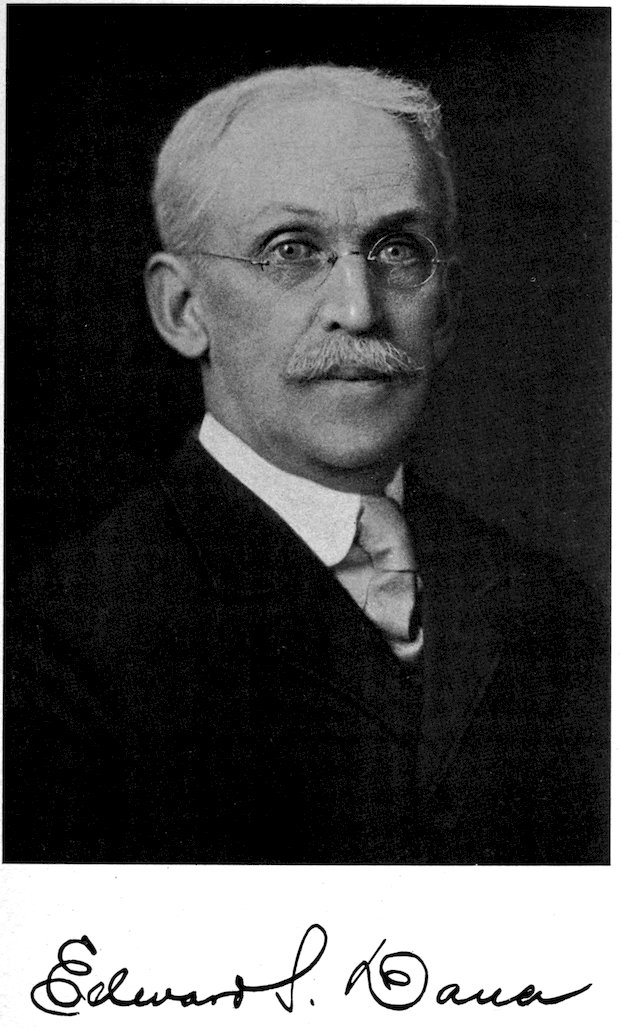
49Much more important than this change was the addition
to the editorial staff of James Dwight Dana, Silliman’s
son-in-law. Dana returned from the four-years
cruise of the Wilkes Exploring Expedition in 1842; he
settled in New Haven, was married in 1844, and in 1850
was appointed Silliman professor of Geology in Yale
College. He was at this time actively engaged in writing
his three quarto reports for the Expedition and
hence did not begin his active professional duties in Yale
College until 1856. Part of his inaugural address was
quoted on an earlier page.
Dana had already performed the severe labor of preparing
the complete index to the First Series, a volume
of about 350 pages, finally issued in 1847. From the
beginning of the Second Series he was closely associated
with his brother-in-law, the younger Silliman. Later the
editorial labor devolved more and more upon him and the
larger part of this he carried until about 1890. His work,
was, however, somewhat interrupted during periods of ill
health. This was conspicuously true during a year’s
absence in Europe in 1859–60, made necessary in the
search for health; during these periods the editorial
responsibility rested entirely upon the younger Silliman.
Of Dana’s contributions to science in general this is not
the place to speak, nor is the present writer the one to
dwell in detail upon his work for the Journal. This subject
is to such an extent involved in the history of geology
and zoology, the subjects of several succeeding chapters,
that it is adequately presented in them.
It may, however, be worth stating that in the bibliography
accompanying the obituary notice of Dana (49,
329–356, 1895) some 250 titles of articles in the Journal
are enumerated; these aggregate approximately 2800
pages. The number of critical notes, abstracts, book
reviews, etc., could be also given, were it worth while, but
what is much more significant in this connection, than
their number or aggregate length, is the fact that these
notices are in a large number of cases—like those of Gray
in botany—minutely critical and original in matter.
They thus give the writer’s own opinion on a multitude
of different subjects. It was a great benefit to Dana, as
it was to science also, that he had this prompt means at
hand of putting before the public the results of his active
brain, which continued to work unceasingly even in times
of health prostration.
This may be the most convenient place to add that as
Dana became gradually less able to carry the burden of
50the details involved in editing the Journal in addition to
his more important scientific labors, particularly from
1890 on, this work devolved more and more upon his son,
the present editor, whose name was added to the editorial
staff in 1875, with volume 9, of the Third Series. The
latter has served continuously until the present time,
with the exception of absences, due to ill health, in 1893–94
and in 1903; during the first of these Professor Henry S.
Williams and during the second Professor H. E. Gregory
occupied the editorial chair.
The Third Series began in 1871, after the completion
of the one-hundredth volume from the beginning in 1818.
At this date the Journal was made a monthly and as such
it remains to-day. Fifty volumes again completed this
series, which closed in 1895.
The Fourth Series began with January, 1896, and the
present number for July, 1918, is the opening one of the
forty-sixth volume or, in other words,—the one hundred
and ninety-sixth volume of the entire issue since 1818.
The Fourth Series, according to the precedent established,
will end with 1920.
Associate Editors.—In 1851 the new policy was introduced
of adding “Associate Editors” to the staff. The
first of these was Dr. Wolcott Gibbs of Cambridge. He
began his duties with the eleventh volume of the Second
Series in 1851 and continued them with unceasing care
and thoroughness for more than twenty years. In a note
dated Jan. 1, 1851 (11, 105), he says:
It is my intention in future to prepare for the columns of this
Journal abstracts of the more important physical and chemical
memoirs contained in foreign scientific journals, accompanied
by references, and by such critical observations as the occasion
may demand. Contributions of a similar character from others
will of course not be excluded by this arrangement, but I shall
hold myself responsible only for those notices which appear
over my initials.
The departments covered by Dr. Gibbs, in his excellent
monthly contributions, embraced chemistry and physics,
and these subjects were carried together until 1873 when
they were separated and the physical notes were furnished,
51first by Alfred M. Mayer and later successively
by E. C. Pickering (from 1874), J. P. Cooke (from 1877),
and John Trowbridge (from 1880). The first instalment
of the long series of notes in chemistry and chemical
physics by George F. Barker was printed in volume 50,
1870. He came in at first to occasionally relieve Dr.
Gibbs, but soon took the entire responsibility. His name
was placed among the associate editors on the cover in
1877 and two years later Dr. Gibbs formally retired. It
may be added that from the beginning in 1851 to the
present time, the notes in “Chemistry and Physics” have
been continued almost without interruption.
The other departments of science have been also fully
represented in the notes, abstracts of papers published,
book notices, etc., of the successive numbers, but
as with the chemistry and physics the subject of botany
was long treated in a similar formal manner. For the
notes in this department, the Journal was for many years
indebted to Dr. Asa Gray, who became associate editor in
1853, two years after Gibbs, although he had been a
not infrequent contributor for many years previously.
Gray’s contributions were furnished with great regularity
and were always critical and original in matter.
They formed indeed one of the most valuable features
of the Journal for many years; as botanists well appreciate,
and, as Professor Goodale has emphasized in his
chapter on botany, Gray’s notes are of vital importance
in the history of the development of his subject. With
Gray’s retirement from active duty, his colleague,
George W. Goodale, took up the work in 1888 and in 1895
William G. Farlow, also of Cambridge, was added as an
associate editor in cryptogamic botany. At this time,
however, and indeed earlier, the sphere of the Journal
had unavoidably contracted and botany perforce ceased
to occupy the prominent place it had long done in the
Journal pages.
This is not the place to present an appreciation of the
truly magnificent work of Asa Gray. It may not be out
of place, however, to call attention to the notice of Gray
written for the Journal by his life-long friend, James D.
Dana (35, 181, 1888). The opening paragraph is as
follows:
52“Our friend and associate, Asa Gray, the eminent botanist
of America, the broad-minded student of nature, ended his life
of unceasing and fruitful work on the 30th of January last.
For thirty-five years he has been one of the editors of this Journal,
and for more than fifty years one of its contributors; and
through all his communications there is seen the profound and
always delighted student, the accomplished writer, the just and
genial critic, and as Darwin has well said, ‘The lovable man.’”
The third associate editor, following Gray, was Louis
Agassiz, whose work for science, particularly in his
adopted home in this country, calls for no praise here.
His term of service extended from 1853 to 1866 and, particularly
in the earlier years, his contributions were numerous
and important. The next gentleman in the list
was Waldo I. Burnett, of Boston, who served one year
only, and then followed four of Dana’s colleagues in New
Haven, of whose generosity and able assistance it would
be impossible to say too much. These gentlemen were
Brush in mineralogy; Johnson in chemistry, particularly
on the agricultural side; Newton in mathematics and
astronomy, whose contributions will be spoken of elsewhere;
and Verrill—a student of Agassiz—in zoology.
All of these gentlemen, besides their frequent and
important original articles, were ever ready not only to
give needed advice, but also, to furnish brief communications,
abstracts of papers and book reviews, and otherwise
to aid in the work. Verrill particularly furnished
the Journal a long list of original and important papers,
chiefly in systematic zoology, extending from 1865
almost down to the present year. His abstracts and
book notices also were numerous and trenchant and it is
not too much to say that without him the Journal never
could have filled the place in zoology which it so long
held. Much later the list of New Haven men was
increased by the addition of Henry S. Williams (1894),
and O. C. Marsh (1895).
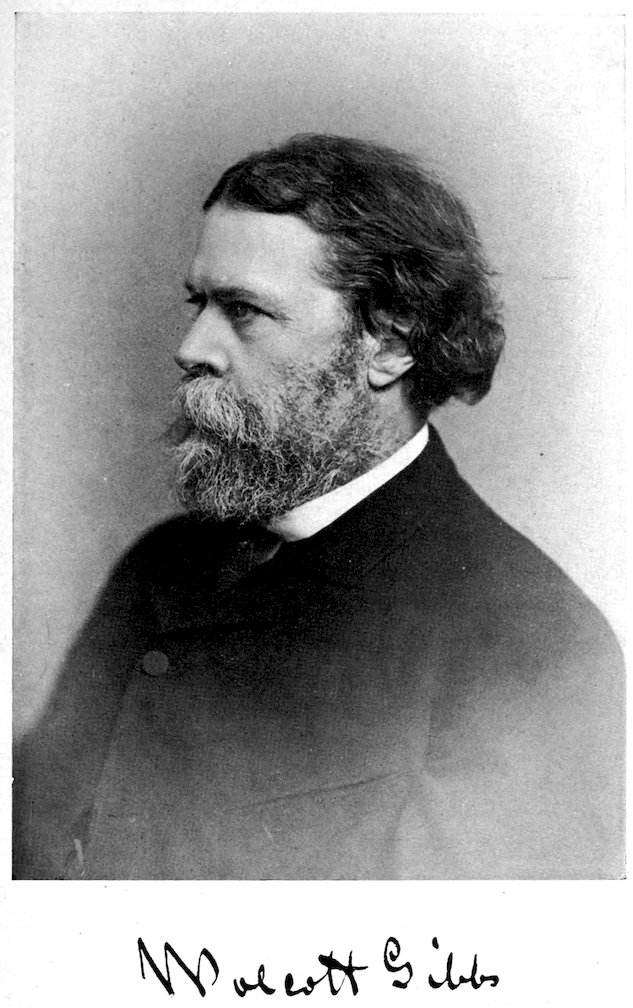
53Of the valuable work of those more or less closely associated
in the conduct of the Journal at the present time,
it would not be appropriate to speak in detail. It must
suffice to say that the services rendered freely by them
have been invaluable, and to their aid is due a large part
of the success of the Journal, especially since the Fourth
Series began in 1896. But even this statement is inadequate,
for the editor-in-chief has had the generous assistance
of other gentlemen, whose names have not been
placed on the title page, and who have also played an
important part in the conduct of the Journal. This
policy, indeed, is not a matter of recent date. Very
early in the First Series, Professor Griscom of Paris, as
already noted, furnished notes of interesting scientific
discoveries abroad. Other gentlemen have from time to
time acted in the same capacity. The most prominent of
them was Professor Jerome Nicklès of Nancy, France,
who regularly furnished a series of valuable notes on
varied subjects, chiefly from foreign sources, extending
from 1852 to 1869. On the latter date he met an untimely
death in his laboratory in connection with experiments
upon hydrofluoric acid (47, 434, 1869).
It may be added, further, that one of the striking
features about the Journal, especially in the earlier half
century of its existence, is the personal nature of many
of its contributions, which were very frequently in the
form of letters written to Benjamin Silliman or J. D.
Dana. This is perhaps but another reflection of the
extent to which the growth of the magazine centered
around these two men, whose wide acquaintance and
broad scientific repute made of the Journal a natural
place to record the new and interesting things that were
being discovered in science.
The following list gives the names and dates of service,
as recorded on the Journal title pages, of the gentlemen
formally made Associate Editors:
| Wolcott Gibbs |
(2) |
11, 1851 |
to |
(3) |
18, 1879 |
| Asa Gray |
„ |
15, 1853 |
„ |
„ |
34, 1887 |
| Louis Agassiz |
„ |
16, 1853 |
„ |
(2) |
41, 1866 |
| Waldo I. Burnett |
„ |
16, 1853 |
„ |
„ |
17, 1853 |
| George J. Brush |
„ |
35, 1863 |
„ |
(3) |
18, 1879 |
| Samuel W. Johnson |
„ |
35, 1863 |
„ |
„ |
18, 1879 |
| Hubert A. Newton |
(2) |
38, 1864 |
to |
(4) |
1, 1896 |
| Addison E. Verrill |
„ |
47, 1869 |
|
|
|
| Alfred M. Mayer |
(3) |
5, 1873 |
to |
(3) |
6, 1873 |
| Edward C. Pickering |
„ |
7, 1874 |
„ |
„ |
13, 1877 |
| George F. Barker |
„ |
14, 1877 |
„ |
(4) |
29, 1910 |
| Josiah P. Cooke |
„ |
14, 1877 |
„ |
(3) |
47, 1894 |
| 54John Trowbridge |
(3) |
19, 1880 |
|
|
|
| George W. Goodale |
„ |
35, 1888 |
|
|
|
| Henry S. Williams |
„ |
47, 1894 |
|
|
|
| Henry P. Bowditch |
„ |
49, 1895 |
to |
(4) |
8, 1899 |
| William G. Farlow |
„ |
49, 1895 |
|
|
|
| Othniel C. Marsh |
„ |
49, 1895 |
to |
(4) |
6, 1899 |
| Henry A. Rowland |
(4) |
1, 1896 |
„ |
„ |
10, 1900 |
| Joseph S. Diller |
„ |
1, 1896 |
|
|
|
| Louis V. Pirsson |
„ |
7, 1899 |
|
|
|
| William M. Davis |
„ |
9, 1900 |
|
|
|
| Joseph S. Ames |
„ |
12, 1901 |
|
|
|
| Horace L. Wells |
„ |
18, 1904 |
|
|
|
| Herbert E. Gregory |
„ |
18, 1904 |
|
|
|
| Horace S. Uhler |
„ |
33, 1912 |
|
|
|
The field to be occupied by the “American Journal of
Science and Arts,” as seen by its founder in 1818 and
presented by him in the first number, as quoted entire on
an earlier page, was as broad as the entire sphere of
science itself. It thus included all the departments of
both pure and applied science and extended even to music
and fine arts also. As the years went by, however, and
the practical applications of science greatly increased,
technical journals started up, and the necessity of cultivating
this constantly expanding field diminished. It
was not, however, until January, 1880, that “the Arts”
ceased to be a part of the name by which the Journal
was known.
About the same date also—or better a little earlier—began
an increasing development of scientific research,
particularly as fostered by the graduate schools of our
prominent universities. The full presentation of this
subject would require much space and is indeed unnecessary
as the main facts must be distinct in the mind of the
reader. It is only right, however, that the large part
played in this movement by the Johns Hopkins University
(founded in 1876) should be mentioned here.
As a result of this movement, which has been of great
benefit in stimulating the growth of science in the
country, many new journals of specialized character have
come into existence from time to time. Further localization
and specialization of scientific publication have
55resulted from the increased activity of scientific societies
and academies at numerous centers and the springing
into existence thereby of new organs of publication
through them, as also through certain of the Government
Departments, the Carnegie Institution, and certain universities
and museums.
As bearing upon this subject, the following list of the
more prominent scientific periodicals started in this
country since 1867 is not without interest:
- 1867– .
- American Naturalist.
- 1875– .
- Botanical Bulletin; later Botanical Gazette.
- 1879–1913.
- American Chemical Journal.
- 1880–1915.
- School of Mines Quarterly.
- 1883– .
- Science.
- 1885– .
- Journal of Heredity.
- 1887– .
- Journal of Morphology.
- 1887–1908.
- Technology Quarterly.
- 1888–1905.
- American Geologist.
- 1891– .
- Journal of Comparative Neurology.
- 1893– .
- Journal of Geology.
- 1893– .
- Physical Review.
- 1895– .
- Astrophysical Journal.
- 1896– .
- Journal of Physical Chemistry.
- 1896– .
- Terrestrial Magnetism.
- 1897–1899.
- Zoological Bulletin; followed by
- 1900– .
- Biological Bulletin.
- 1901– .
- American Journal of Anatomy.
- 1904– .
- Journal of Experimental Zoology.
- 1905– .
- Economic Geology.
- 1906– .
- Anatomical Record.
- 1907– .
- Journal of Economic Entomology.
- 1911– .
- Journal of Animal Behavior.
- 1914– .
- American Journal of Botany.
- 1916– .
- Genetics.
- 1918– .
- American Journal of Physical Anthropology.
The result of the whole movement has been of necessity
to narrow, little by little, the sphere of a general
scientific periodical such as the Journal has been from
the beginning. The exact change might be studied in
detail by tabulating as to subjects the contents of successive
volumes, decade by decade, from 1870 down. It is
sufficient, here, however, to recognize the general fact
that while the number of original papers published in the
56periodicals of this country, in 1910, for example, was very
many times what it was in 1825, a large part of these
have naturally found their home in periodicals devoted
to the special subject dealt with in each case. That this
movement will continue, though in lessened degree now
that the immediate demand is measurably satisfied, is to
be expected. At the same time it has not seemed wise, at
any time in the past, to formally restrict the pages of the
Journal to any single group of subjects. The future is
before us and its problems will be met as they arise. At
the moment, however, there seems to be still a place for a
scientific monthly sufficiently broad to include original
papers of important general bearing even if special in
immediate subject. In this way it would seem that
“Silliman’s Journal” can best continue to meet the
ideals of its honored founder, modified as they must be to
meet the change of conditions which a century of scientific
investigation and growth have wrought. Incidentally
it is not out of place to add that a self-supporting,
non-subsidized scientific periodical may hope to find a
larger number of subscribers from among the workers in
science and the libraries if it is not too restricted in scope.
The last subject touched upon introduces the essential
matter of financial support without which no monthly
publication can survive. With respect to the periodicals
of recent birth, listed above, it is safe to say that some
form of substantial support or subsidy—often very generous—is
the rule, perhaps the universal one. This has
never been the case with the American Journal. The
liberality and broad-minded attitude of Yale College in
the early days, and of the Yale University that has developed
from it, have never been questioned. At the same
time the special conditions have been such as to make it
desirable that the responsibility of meeting the financial
requirements should be carried by the editors-in-chief.
At present the Yale Library gives adequate payment for
certain publications received by the Journal in exchange,
though for many years they were given to it as a matter
of course, free of charge. Beyond this there is nothing
approaching a subsidy.
The difficulties on the financial side met with by the elder
Silliman have been suggested, although not adequately
57presented, in the various statements quoted from early
volumes. The same problems in varying degree have
continued for the past sixty years. Since 1914 they have
been seriously aggravated for reasons that need not be
enlarged upon. Prior to that date the subscription list
had, for reasons chiefly involved in the development of
special journals, been much smaller than the number
estimated by Silliman, for example, in volume 50 (p. xiv),
although there has been this partial compensation that
the considerable number of well-established libraries on
the subscription list has meant a greater degree of stability
and a smaller proportion of bad accounts. The
past four years, however, the Journal, with all similar
undertakings here and elsewhere, has been compelled
to bear its share of the burden of the world war in diminished
receipts and greatly increased expenses. It is
gratifying to be able to acknowledge here the generosity
of the authors, or of the laboratories with which they
have been connected, in their willingness not infrequently
to give assistance, for example, in the payment of more
or less of the cost of engravings, or in a few special cases
a large portion of the total cost of publication. In this
way the problem of ways and means, constantly before
the editor who bears the sole responsibility, has been
simplified.
It should also be stated that as those immediately
interested have looked forward to the present anniversary,
it has been with the hope that this occasion might be
an appropriate one for the establishment of a “Silliman
Fund” to commemorate the life and work of Benjamin
Silliman. The income of such a fund would lift from
the University the burden that must unavoidably fall
upon it when the responsibility for the conduct of the
Journal can no longer be carried by members of the family
including the editor and—as in years long past—a
silent partner whose aid on the business side has been
essential to the efficiency and economy of the enterprise.
Present conditions are not favorable for such a movement,
although something has been already accomplished
in the desired direction. At the present time every
patriotic citizen must feel it his first duty to give his savings
as well as his spare income to the support of the
58National Government in the world struggle for freedom
in which it is taking part. But, whatever the exact condition
of the future may be, it cannot be questioned that
the Journal founded by Benjamin Silliman in 1818 will
survive and will continue to play a vital part in the support
and further development of science.
The present year of 1918 finds the world at large, and
with it the world of science, painfully crushed beneath the
overwhelming weight of a world war of unprecedented
severity. The four terrible years now nearly finished
have seen a fearful destruction of life and property which
must have a sad influence on the progress of science for
many years to come. Only in certain restricted lines has
there been a partial compensation in the stimulating
influence due to the immediate necessities connected with
the great conflict. One hundred years ago “the reign of
war” was keenly in the mind of the editor in beginning
his work, but for him, happily, the long period of the
Napoleonic wars was already in the past, as also the brief
conflict of 1812, in which this country was engaged and in
which Silliman himself played a minor part. We, too,
must believe, no matter how serious the outlook of the
present moment, that a fundamental change will come in
the not distant future; the nations of the world must
sooner or later turn once more to peaceful pursuits and
the scientific men of different races must become again
not enemies but brothers engaged in the common cause
of uplifting human life. The peace that we look forward
to to-day is not for this country alone, but a peace which
shall be a permanent blessing to the entire world for
ages to come.
Note.—The portrait which forms the frontispiece of
this volume has been reproduced from the plate in
volume 50 (1847). The original painting was made by
H. Willard in 1835, when Silliman was in Boston
engaged in delivering the Lowell lectures; he was then
nearly fifty-six years of age. The engraving, as he
states elsewhere, was made from this painting for the
Yale Literary Magazine, and was published in the number
for December, 1839.
59It is interesting to quote the remarks with which the
editor introduces the portrait (50, xviii, 1847). He says:
The portrait prefixed to this volume was engraved for a very
different purpose and for others than the patrons of this Journal.
It has been suggested by friends, whose judgment we are
accustomed to respect, that it ought to find a place here, since it
is regarded as an authentic, although, perhaps, a rather austere
resemblance. In yielding to this suggestion, it may be sufficient
to quote the sentiment of Cowper on a similar occasion, who
remarked—“that after a man has, for many years, turned his
mind inside out before the world, it is only affectation to attempt
to hide his face.”
II A CENTURY OF GEOLOGY.—THE PROGRESS OF HISTORICAL GEOLOGY IN NORTH AMERICA — Introduction. — The Rise of Geology in Europe. — The Rise of Geology in North America. — Wernerian Geology in North America. — Unearthing of the Cenozoic and Mesozoic in North America. — Unearthing of the Paleozoic in North America. — The Taconic System Resurrected. — The Silurian Controversy. — Paleogeography. — Paleometeorology. — Evolution. — The Growth of Invertebrate Paleontology. — Notes.
60
The American Journal of Science, “one of the
greatest influences in American geology,” founded
in 1818, has published a little more than 92,000
pages of scientific matter. Of geology, including mineralogy,
there appear to be upward of 20,000 pages.
What a vast treasure house of geologic knowledge is
stored in these 194 volumes, and how well the editors
have lived up to their proposed “plan of work” as
stated in the opening volume, where Silliman says: “It
is designed as a deposit for original American communications”
in “the physical sciences ... and especially
our mineralogy and geology” (1, v, 1818)! Not only is
it the oldest continuously published scientific journal of
this country, but it has proved itself to be “perhaps the
most important geological periodical in America” (Merrill).
It is impossible to adequately present in this
memorial volume of the Journal the contents of the
articles on the geological sciences.
Editor Silliman was not only the founder of the Journal,
but the generating center for the making of
geologists and promoting geology during the rise of this
science in America. For nearly three decades, the workers
came to him for counsel and help, and he had a kind
paternal word for them all. This influence is also shown
in the many letters which were addressed to him, and
which he published in the Journal. A similar influence,
paternal care, and constructive criticism were continued
61by James D. Dana, and especially in his earlier career
as editor.
Not including mineralogy, there are in the Journal
upward of 1500 distinct articles on geology. Of these,
over 400 are on vertebrate paleontology, about 325 on
invertebrate paleontology, and 90 on paleobotany. Of
articles bearing on historical geology there are about 160,
and on stratigraphic geology more than 360. In addition
to all this, there are more than 2000 pages of geologic
matter relating to books and of letters communicated to
the editors Silliman and Dana. We may summarize with
Doctor Merrill’s statement in his well-known Contributions
to the History of American Geology:
“From its earliest inception geological notes and papers
occupied a prominent place in its pages, and a perusal of the
numbers from the date of issue down to the present time will,
alone, afford a fair idea of the gradual progress of American
geology.”
Before presenting a synopsis of the more important
steps in the progress of historical geology in America, it
will be well to introduce a rapid survey of the rise of
geology in Europe, for, after all, American geology grew
out of that of England, France and Germany. This
dependence was conspicuously true during the first
four decades of the previous century. With the rise of
the first New York State Survey (1836–1843) and that
of Pennsylvania (1836–1844, 1858), American geology
became more or less independent of Europe. Finally,
this article will conclude with a survey of the rise of
paleometeorology, paleogeography, evolution, and invertebrate
paleontology.
Mineral Geology.—The geological sciences had their
rise in the study of minerals as carried on by the German
chemist and physician George Bauer (1494–1555), better
known as Agricola. Bauer originated the critical study
of minerals, but did not distinguish his “fossilia,” the
remains of organisms, from the inorganic crystal forms.
Mineral geology endured until the close of the eighteenth
century.
62Cosmogonists.—Then came the expounders of the
earth’s origin, the cosmogonists of the sixteenth to the
end of the eighteenth centuries. The fashion of this
time was to write histories of the earth derived out of
the imagination.
Earliest Historical Geology.—Even though Giovanni
Arduino (1713–1795) of Padua was not the first to
classify the rocks into three series according to their
age, he did this more clearly than any one else before his
time. The rocks about Verona he grouped in 1759 into
Primary, Secondary, Tertiary, and Volcanic. This
three-fold classification came into general use, though
modified with time.
Early in the nineteenth century it had become plain
that formations of very varying ages were included in
each one of the three series. Through the study of the
fossils and the recognition of the fact that mountain
ranges have been raised at various times, causing
younger fossiliferous strata to take on the characters of
the Primary, it was seen that these terms of Arduino had
lost their original significance.
The first one to describe in detail a local stratigraphic
sequence was Johann Gottlob Lehmann (died 1767).
In 1756 he published “one of the classics of geological
literature,” distinguishing clearly thirty successive sedimentary
deposits, some of which he said had fossils, but
he did not use them to distinguish the strata.
What Lehmann did for the Permian system, George
Christian Füchsel (1722–1773) did even better for the
Triassic of Thuringia, in 1762 and 1773. He pointed out
not only the sequence, but also how the gently inclined
strata rest upon the older upturned masses of the mountains;
also that some formations have only marine fossils,
while others have only terrestrial forms and thus
indicate the proximity of land. The deformed strata he
thought had fallen into the hollows within the earth,
great caverns that had also consumed much of the
oceanic waters and had in so doing greatly lowered
the sea-level. It was Füchsel who first introduced the
theory of universal formations, and who defined the term
formation, using it as we now do, system or period.
Even though Lehmann and Füchsel showed that there
63was a definite order and process in the formation of the
earth’s crust, their example was barren of followers until
the beginning of the eighteenth century.
Wernerian Geology or Geognosy.—We come now to
the time of Abraham Gottlob Werner (1749–1817), who
from 1775 to 1817 was professor of mining and mineralogy
in the Freiberg Academy of Mines. Geikie, in his
most interesting Founders of Geology, says that Werner
“bulks far more largely in the history of geology than
any of those with whom up to the present we have been
concerned—a man who wielded an enormous authority
over the mineralogy and geology of his day.”
“Although he did great service by the precision of his
lithological characters and by his insistence on the doctrine
of geological succession, yet as regards geological
theory, whether directly by his own teaching, or indirectly
by the labors of his pupils and followers, much of
his influence was disastrous to the higher interests of
geology.”
Werner arranged the crust of the earth into a series of
formations, as had been done previously by Lehmann
and Füchsel, and one of his fundamental postulates was
that all rocks were chemically precipitated in the ocean
as “universal formations.” For this reason Werner’s
school were called the Neptunists. Nowhere, however,
did he explain how and where the deep and primitive
ocean had disappeared.
According to Werner, the first formed or oldest rocks
were the chemically deposited Primitive strata, including
granite and other igneous and metamorphic rocks. On
these followed the Transition rocks, the earliest sediments
of mechanical origin, and above them the Floetz
rocks, a term for the horizontal stratified rocks. These
last he said were partly of chemical but chiefly of mechanical
origin. Last of all came the Alluvial series.
The existence of volcanoes had been pointed out long
before Werner’s time by the Italian school of geologists,
but as for “the universality and potency of what is now
termed igneous action,” all was “brushed aside by the
oracle of Freiberg.” Reactions between the interior
and exterior of our earth “were utterly antagonistic to
Werner’s conception of the structure and history of the
64earth.” To him, volcanoes were “burning mountains”
that arose from the combustion of subterranean beds of
coal, spontaneously ignited.
The breaking down of the Wernerian doctrines began
with two of Werner’s most distinguished pupils, D’Aubuisson
de Voisins (1769–1819) and Von Buch. The
former in 1803 had accepted Werner’s aqueous origin of
basalt, but after studying the celebrated and quite recent
volcanic area of Auvergne he recanted in 1804. Here he
saw the basaltic rocks lying upon and cutting through
granite, and in places more than 1200 feet thick. “If
these basaltic rocks were lavas,” says Geikie, “they
must, according to the Wernerian doctrine, have resulted
from the combustion of beds of coal. But how could coal
be supposed to exist under granite, which was the first
chemical precipitate of a primeval ocean?”
Leopold von Buch (1774–1853), “the most illustrious
geologist that Germany has produced,” after two years
spent in Norway was satisfied “that the rocks in the
Christiania district could not be arranged according to
the Wernerian plan, which there completely broke down.
Von Buch found a mass of granite lying among
fossiliferous limestones which were manifestly metamorphosed,
and were pierced by veins of granite, porphyry,
and syenite.” Even so, he was not ready to
abandon the teachings of his master. After a study
of the mountain systems of Germany, however, “he
declared that the more elevated mountains had never
been covered by the sea, as Werner had taught, but were
produced by successive ruptures and uplifts of the terrestrial
crust” (Geikie).
Rise of Geology and Conformism.—Modern geology
has its rise in James Hutton (1726–1797) of Edinburgh,
Scotland. In 1785 and 1795, Hutton published his
Theory of the Earth, with Proofs and Illustrations. His
“immortal theory” is his only work on geology. “Fortunately
for Hutton’s fame and for the onward march of
geology, the philosopher numbered among his friends the
illustrious mathematician and natural philosopher, John
Playfair (1748–1819), who had been closely associated
with him in his later years, and was intimately conversant
with his geological opinions.” In 1802, Playfair
65published his Illustrations of the Huttonian Theory
of the Earth, of which Geikie says, “Of this great classic
it is impossible to speak too highly,” as it is at the basis
of all modern geology.
One of Hutton’s fundamental doctrines is that the
earth is internally hot and that in the past large masses
of molten material, the granites, have been intruded into
the crust. It was these igneous views that led to his
followers being called the Plutonists. Another of his
great doctrines was that “the ruins of an earlier world
lie beneath the secondary strata,” and that they are separated
by what is now known as unconformity. He
clearly recognized a lost interval in the broken relation
of the structures, and that the ruins, the detrital materials,
of one world after another are superposed in the
structure of the earth.
Hutton also held that the deformation of once horizontally
deposited strata was probably brought about at different
periods by great convulsions that shook the very
foundations of the earth. After a convulsion, there was
a long time of erosion, represented by the unconformity.
Geikie says, “The whole of the modern doctrine of
earth sculpture is to be found in the Huttonian theory.”
The Lyellian doctrine of metamorphism had its origin
in Hutton, for he showed that invading igneous granite
had altered, through its heat and expanding power, the
originally waterlaid sediments, and that the schists of
the Alps had been born of the sea like other stratified
rocks.
Hutton is the father of the Uniformitarian principle,
for he “started with the grand conception that the past
history of our globe must be explained by what can be
seen to be happening now, or to have happened only
recently. The dominant idea in his philosophy is that
the present is the key to the past.” This principle has
been impressed on all later geologists by Sir Charles
Lyell, and is the chief cornerstone of modern geology.
The principle of uniformitarianism has underlain
geologic interpretation since the days of Hutton, Playfair,
and Lyell. However, it is often applied too rigidly
in interpretations based upon the present conditions,
because in the past there were long times when the topographic
66features of the earth were very different from
those of to-day. Throughout the Paleozoic, and, less
markedly, the Mesozoic, the oceans flooded the lands
widely (at times over 60 per cent of the total area), highlands
were inconspicuous, sediments far scarcer, and
climates warm and equable throughout the world. Highland
conditions, and especially the broadly emergent continents
of the present, were only periodically present in
the Paleozoic and then for comparatively short intervals
between the periods. Therefore rates of denudation,
solution, sedimentation, and evolution have varied
greatly throughout the geological ages. These differences,
however, relate to degrees of operation, and not to
kinds of processes; but the differences in degree of
operation react mightily on our views as to the age of
the earth.
Geologic time had, for Hutton, no “vestige of a beginning,
no prospect of an end.” In other words, geologic
time is infinite. He did not, however, discover a method
by which the chronology of the earth could be determined.
First Important Text-books.—In 1822 appeared the
ablest text-book so far published, and the pattern for
most of the later ones, Outlines of the Geology of England
and Wales, by W. D. Conybeare (1787–1857) and W.
Phillips (1775–1828). “In this excellent volume all that
was then known regarding the rocks of the country, from
the youngest formations down to the Old Red Sandstone,
was summarized in so clear and methodical a manner as
to give a powerful impulse to the cultivation of geology
in England” (Geikie). This book is reviewed at great
length by Edward Hitchcock in the Journal (7, 203, 1824).
To indicate how far historical geology had progressed
up to 1822 in England, a digest of the geological column
as presented in this text-book is given in the following
table, along with other information.
A text-book writer of yet greater influence was Charles
Lyell (1797–1875), whose Principles of Geology appeared
in three volumes between 1830 and 1833. This and his
other books were kept up to date through many editions,
and his Elements of Geology is, as Geikie says, “the hand
book of every English geologist” working with the fossiliferous
formations.
67
The Generating Centers.—In America, geology had its
rise independently in three places: in the two scientific
societies of Boston and Philadelphia, and dominantly in
Benjamin Silliman of Yale College. Stated in another
way, we may say that geology in America had its origin
in the following pioneers and founders: first, in William
Maclure at Philadelphia, and next in Benjamin Silliman
at New Haven. Through the influence of the latter,
Amos Eaton, the botanist, became a geologist and taught
geology at Williams College and later at the Rensselaer
School in Troy, New York. Through the same influence
Rev. Edward Hitchcock also became a geologist and
taught the subject after 1825 at Amherst College.
Silliman was the first to take up actively the teaching
of mineralogy and geology based on collections of
specimens. He spread the knowledge in popular lectures
throughout the Eastern States, graduated many a student
in the sciences, making of some of them professional
teachers and geologists, provided all with a journal
wherein they could publish their research, organized the
first geological society and through his students the first
official geological surveys, and by kind words and acts
stimulated, fostered, and held together American scientific
men for fifty years. Of him it has been truly said
that he was “the guardian of American science from its
childhood.”
The American Academy in Boston.—The second oldest
scientific society, but the first one to publish on geological
subjects, was the American Academy of Arts and
Sciences of Boston, instituted and publishing since 1780.
Up to the time of the founding of this Journal, there had
appeared in the publications of the American Academy
about a dozen papers of a geologic character, none of
which need to be mentioned here excepting one by S. L.
and J. F. Dana, entitled “Outlines of the Mineralogy and
Geology of Boston,” published in 1818. This is an early
and important step in the elucidation of one of the most
intricate geologic areas, and is further noteworthy for its
geologic map, the third one to appear, the older ones
being by Maclure and Hitchcock (Merrill).
68
| The Geological Column in 1822 |
|---|
| Present American classification |
Conybeare and Phillips 1822 |
C. & P. orders |
Wernerian orders |
Other writers |
| Psychozoic or Recent |
Alluvial |
Superior Order |
Newest Floetz Class |
Tertiary Class |
| Cenozoic |
Pleistocene |
Diluvial |
| Pliocene |
Neogene |
Upper Marine formation (Crag, Bagshot sand, and Isle of Wight) |
| Miocene |
| |
Fresh-water formations |
| Oligocene |
Paleogene |
London Clay |
| Eocene |
Plastic Clay |
| Mesozoic |
Cretaceous |
Chalk |
Supermedial Order |
Primitive Transition and Floetz Classes |
Primitive Intermediate and Secondary classes |
| Comanchian 1887 |
Beds between Chalk and Oolite Series (Chalk Marle, Green Sand, Weald Clay, Iron Sand) |
| Jurassic 1829 |
Upper Oolitic division (Purbeck beds, Portland Oolite, Kimmeridge Clay) |
| Middle Oolitic division (Coral Rag, Oxford Clay) |
| Lower Oolitic division (Cornbrash Stonesfield Slate, Forest Marble, Great Oolite, Fullers’ Earth, Inferior Oolite, Sand and Marlestone) |
| Lias |
| Triassic 1834 |
New Red Sandstone |
| Paleozoic |
Permian 1841 |
Magnesian Limestone |
| |
Coal Measures |
Medial or Carboniferous Order |
| Pennsylvanian 1891 |
|
| Mississippian 1869 |
Millstone Grit and Shale |
| |
Old Red Sandstone |
| Devonian 1839 |
|
| Silurian 1835 |
Unresolved Submedial and Inferior Orders |
|
| Ordovician 1879 |
|
| (=Lower Silurian 1835) |
|
| Cambrian 1833 |
|
| Proterozoic |
Keweenawan |
Huronian 1852 |
|
| Animikian |
|
| Huronian |
|
| Sudburian |
|
| Archeozoic |
Keewatin |
Laurentian 1853 |
|
| Coutchiching |
|
69Early Geology in Philadelphia.—The oldest scientific
society is the American Philosophical Society of Philadelphia,
started by the many-sided Benjamin Franklin in
1769, and which has published since 1771. Up to the time
of the founding of the Journal in 1818, there had
appeared in the publications of this society thirteen
papers of a geologic nature, nearly all small building
stones in the rising geologic story of North America.
The only fundamental ones were Maclure’s Observations
of 1809 and 1817. Later, in this same city, there was
organized another scientific society that came to be for
a long time the most active one in America. This was
the Academy of Natural Sciences, started in 1812 with
seven members, but it was not until 1817 and the election
of William Maclure as its first president that the work
of the Academy was of a far-reaching character. Here
was built up not only a society for the advancement of the
natural sciences and publications for the dissemination
of such knowledge, but, what is equally important, the
first large library and general museum.
William Maclure (1763–1840), correctly named by Silliman
the “father of American geology,” was born and
educated in Scotland, and died near Mexico City. A
merchant of London until 1796, when he had already
amassed “a considerable fortune,” he made a first short
visit to New York City in 1782. In 1796 he again came
to America, this time to become a citizen of this country
and a liberal patron of science.
About 1803, single-handed and unsustained by government
patronage, Maclure interested himself most
zealously and efficiently in American geology. In 1809
he published his Observations on the Geology of the
United States, Explanatory of a Geological Map. This
work he revised “on a yet more extended scale,” issuing
it in 1817 with 130 pages of text, accompanied by a large
colored geological map.
Silliman, the Pioneer Promoter of Geology.—In 1806
when Benjamin Silliman (1779–1864) began actively to
teach chemistry and mineralogy, all the sciences in America
were in a very backward state, and the earth sciences
were not recognized as such in the curricula of any of our
colleges. Silliman gave his first lecture in chemistry on
70April 4, 1804. In the summer of that year, Yale College
asked him to go to England to purchase material for the
College, and great possibilities for broadening his
knowledge now loomed before him. As Silliman himself
(43, 225, 1842) has told the interesting story of his
sojourn in England and Scotland, it is worth while to
restate a part of it here.
“Passing over to England in the spring of 1805, and fixing
my residence for six months in London, I found there no school,
public or private, for geological instruction, and no association
for the cultivation of the science, which was not even named in
the English universities.” In geology “Edinburgh was then
far in advance of London.... Prof. Jameson having recently
returned from the school of Werner, fully instructed in the doctrines
of his illustrious teacher, was ardently engaged to maintain
them, and his eloquent and acute friend, the late Dr. John Murray,
was a powerful auxiliary in the same cause; both of these
philosophers strenuously maintaining the ascendancy of the
aqueous over the igneous agencies, in the geological phenomena
of our planet.
On the other hand, the disciples and friends of Dr. Hutton
were not less active. He died in 1797, and his mantle fell upon
Sir James Hall, who, with Prof. Playfair and Prof. Thomas
Hope, maintained with signal ability, the igneous theory of
Hutton. It did not become one who was still a youth and a
novice, to enter the arena of the geological tournament where
such powerful champions waged war; but it was very interesting
to view the combat, well sustained as it was on both sides,
and protracted, without a decisive issue, into a drawn battle....
The conflicts of the rival schools of Edinburgh—the Neptunists
and the Vulcanists, the Wernerians and the Huttonians,
were sustained with great zeal, energy, talent, and science; they
were indeed marked too decidedly by a partisan spirit, but this
very spirit excited untiring activity in discovering, arranging,
and criticising the facts of geology. It was a transition period
between the epoch of geological hypotheses and dreams, which
had passed by, and the era of strict philosophical induction, in
which the geologists of the present day are trained....
I was a diligent and delighted listener to the discussions of
both schools. Still the igneous philosophers appeared to me to
assume more than had been proved regarding internal heat.
In imagination we were plunged into a fiery Phlegethon, and I
was glad to find relief in the cold bath of the Wernerian ocean,
where my predilections inclined me to linger.”
71Silliman’s Students and Their Publications.—Silliman’s
first student to take up geology as a profession was
Denison Olmstead (1791–1859), educator, chemist, and
geologist, who was graduated from Yale in 1813. Four
years later he was under special preparation with Silliman
in mineralogy and geology, and in that year was
appointed professor of chemistry in the University of
North Carolina. In 1824–1825 Olmstead issued a Report
on the Geology of North Carolina, which is the first official
geological report issued by any state in America,
“a conspicuous and solitary instance,” according to
Hitchcock’s review of it (14, 230, 1828), “in which any
of our state governments have undertaken thoroughly to
develop their mineral resources.”
Amos Eaton (1776–1842), lawyer, botanist, surveyor,
and one of the founders of American geology, was a
graduate of Williams College in the class of 1799. He
studied with Silliman in 1815, attending his lectures on
chemistry, geology, and mineralogy. He also enjoyed
access to the libraries of Silliman and of the botanist,
Levi Ives, in which works on botany and materia
medica were prominent, and was a diligent student of the
College cabinet of minerals. He settled as a lawyer and
land agent in Catskill, New York, and here in 1810 he
gave a popular course of lectures on botany, believed to
have been the first attempted in the United States.
In 1818 appeared Eaton’s first noteworthy geological
publication, the Index to the Geology of the Northern
States, a text-book for the classes in geology at Williamstown.
The controlling principle of this book was Wernerism,
a false doctrine from which Eaton was never
able to free himself. This book was “written over
anew” and published in 1820.
While at Albany in 1818, Governor De Witt Clinton
asked Eaton to deliver a course of lectures on chemistry
and geology before the members of the legislature of
New York. It is believed that Eaton is the only American
having this distinction, and because of it he became
acquainted with many leading men of the state, interesting
them in geology and its application to agriculture
by means of surveys. In this way was sown the idea
72which eventually was to fructify in that great official
work: The Natural History of New York. (See 43, 215,
1842; and Youmans’ sketch of Eaton’s life, Pop. Sci.
Monthly, Nov. 1890.)
Edward Hitchcock (1793–1864), reverend, state geologist,
college president, and another of the founders of
American geology, was largely self-taught. Previous to
1825, when he entered the theological department of Yale
College, he had met Amos Eaton, who interested him
in botany and mineralogy, and between 1815 and 1819
he had made lists of the plants and minerals found about
his native town, Deerfield, Massachusetts. Therefore,
while studying theology at Yale it was natural for him
also to take up mineralogy and geology with Silliman,
whose acquaintance he had made at least as early as 1818.
Hitchcock, who was destined to be one of the most
prominent figures of his time, was appointed in 1825 to
the chair of chemistry and natural history at Amherst
College. His first geologic paper, one of five pages,
appeared in 1815. Three years later appeared his more
important paper on the Geology and Mineralogy of a
Section of Massachusetts, New Hampshire, and Vermont
(1, 105, 436, 1818). This is also noteworthy for its
geological map, the next one to be published after those
of Maclure of 1809 and 1817. In 1823 came a still
greater work, A Sketch of the Geology, Mineralogy, and
Scenery of the Regions contiguous to the River Connecticut
(6, 1, 200, 1823; 7, 1, 1824). Here the map above
referred to was greatly improved, and the survey was
one of the most important of the older publications.
Youmans in his account of Hitchcock (Pop. Sci.
Monthly, Sept. 1895) says:
“The State of Massachusetts commissioned him to make a
geological survey of her territory in 1830. Three years were
spent in the explorations, and the work was of such a high character
that other States were induced to follow the example of
Massachusetts.... The State of New York sought his advice
in the organization of a survey, and followed his suggestions,
particularly in the division of the territory into four parts, and
appointed him as the geologist of the first district. He entered
upon the work, but after a few days of labor he found that he
must necessarily be separated from his family, much to his disinclination.
73He also conceived the idea of urging a more thorough
survey of his own State; hence he resigned his commission
and returned home. The effort for a resurvey of Massachusetts
was successful, and he was recommissioned to do the work. The
results appeared in 1841 and 1844.”
Oliver P. Hubbard was assistant to Silliman in 1831–1836,
and then up to 1866 taught chemistry, mineralogy,
and geology at Dartmouth College. James G. Percival
was graduated at Yale in 1815, and in 1835 he and C. U.
Shepard of Amherst College were appointed state geologists
of Connecticut. Their report was issued in 1842.
James Dwight Dana (1813–1895) was undoubtedly the
ablest of all of Silliman’s students. Graduated at Yale
in 1833, he spent fifteen months in the United States
Navy as instructor in mathematics, cruising off France,
Italy, Greece, and Turkey. In 1836 he was assistant to
Silliman, and in 1837, at the age of twenty-four years,
he published his widely used System of Mineralogy.
Two years later Dana joined the Wilkes Exploring Expedition
as mineralogist, returning to America in 1842; his
geological results of this expedition were published in
1849. In 1863, during the Rebellion, he published his
Manual of Geology, and through four editions it
remained for forty years the standard text-book for
American geologists.
First American Geological Society.—The founding in
1807 of the Geological Society of London, the parent of
geological societies, undoubtedly had its stimulating
effect on Silliman, and with his marked organizing ability
he began to think of forming an American society of the
same kind. This he brought about the year following
the appearance of the Journal, that is, in 1819. The
American Geological Society, begun in 1819 (1, 442,
1819), was terminated in 1830 (17, 202, 1830). The first
meeting (September 6, 1819) and all the subsequent ones
were held in the cabinet of Yale College. The brief
records of the doings of this society are printed in volumes
1, 10, 15, and 18 of the Journal. Silliman was the
attraction at the meetings, surrounded by his mineral
cabinet, and he gave “the true scientific dress to all the
naked mineralogical subjects” discussed.
74
The Father of American Geology.—Historical Geology
begins in America with William Maclure’s Observations
on the Geology of the United States, issued in 1809.
This was the first important original work on North
American geology, and its colored geological map was the
first one of the area east of the Mississippi River. The
classification was essentially the Wernerian system. All
of the strata of the Coastal Plain, now known to range
from the Lower Cretaceous to Recent, were referred to
the Alluvial. To the west, over the area of the Piedmont,
were his Primitive rocks, while the older Paleozoic
formations of the Appalachian ranges were referred to
the Transition. West of the folded area, all was Floetz
or Secondary, or what we now know as Paleozoic sedimentaries.
The Triassic of the Piedmont area and that
of Connecticut he called the Old Red Sandstone, and the
coal formations of the interior region he said rested upon
the Secondary. The second edition of the work in 1817
was much improved, along with the map, which was also
printed on a more correct geographic base. (For greater
detail, see Merrill, Contributions to the History of
American Geology, 1906.)
Even though Maclure’s geologic maps are much generalized,
and the scheme of classification adopted a very
broad one, they are in the main correct, even if they do
emphasize unduly the rather simple geologic structure
of North America. This fact is patent all through
Maclure’s description. Cleaveland also refers to it in
his treatise of 1816, and Silliman in the opening volume
of the Journal (1, 7, 1818) says: “The outlines of American
geology appear to be particularly grand, simple, and
instructive.” Then, all the kinds of rocks were comprehended
under four classes, Primitive, Transition, Alluvial,
and Volcanic. It is also interesting to note here
that in 1822 Maclure had lost faith in the aqueous origin
of the igneous rocks and writes of the Wernerian system
as “fast going out of fashion” (5, 197, 1822), while
Hitchcock said about the same thing in 1825 (9, 146).
The Work of Eaton.—Amos Eaton, after traveling
10,000 miles and completing his Erie Canal Report in
751824, “reviewed the whole line several times,” and published
in 1828 in the Journal (14, 145) a paper on Geological
Nomenclature, Classes of Rocks, etc. The broader
classification is the Wernerian one of Primitive, Transition,
and Secondary classes. Under the first two he has
fossiliferous early Paleozoic formations, but does not
know it, because he pays no attention anywhere to the
detail of the entombed fossils, and all of his Secondary
is what we now call Paleozoic. The correlations of the
latter are faulty throughout.
Then came his paper of 1830, Geological Prodromus
(17, 63), in which he says: “I intend to demonstrate ... that all geological strata are arranged in five analogous
series; and that each series consists of three formations;
viz., the Carboniferous [meaning mud-stones],
Quartzose, and Calcareous.” We seem to see here
expressed for the first time the idea of “cycles of sedimentation,”
but Eaton does not emphasize this idea, and
the localities given for each “formation” of “analogous
series” demonstrate beyond a doubt that he did not have
a sedimentary sequence. The whole is simply a jumble
of unrelated formations that happen to agree more or
less in their physical characters.
“I intend to demonstrate,” he says further, “that
the detritus of New Jersey, embracing the marle, which
contains those remarkable fossil relics, is antediluvial, or
the genuine Tertiary formation.” This correlation had
been clearly shown by Finch in 1824 (7, 31) and yet both
are in error in that they do not distinguish the included
Cretaceous marls and greensands as something apart
from the Tertiary.
One gets impatient with the later writings of Eaton,
because he does not become liberalized with the progressive
ideas in stratigraphic geology developing first in
Europe and then in America, especially among the geologists
of Philadelphia. Therefore it is not profitable to
follow his work further.
Early American Text-books of Geology.—The first
American text-book of geology bears the date of Boston
1816 and is entitled An Elementary Treatise on Mineralogy
and Geology, its author being Parker Cleaveland of
Bowdoin College. The second edition appeared in 1822.
76It also had a geologic map of the United States, practically
a copy of Maclure’s. To mineralogy were devoted
585 pages, and to geology 55, of which 37 describe rocks
and 5 the geology of the United States. The chronology
is Wernerian. Of “geological systems” there are two,
“primitive and secondary rocks.”
In 1818 appeared Amos Eaton’s Index to the Geology
of the Northern States, having 54 pages, and in 1820
came the second edition, “wholly written over anew,”
with 286 pages. The theory of the later edition is still
that of Werner, with “improvements of Cuvier and
Bakewell,” and yet one sees now-a-days but little in it of
the far better English text-book. Eaton did very little
to advance philosophic geology in America. What
is of most value here are his personal observations in
regard to the local geology of western Massachusetts,
Connecticut, southwestern Vermont, and eastern New
York (1, 69, 1819; also Merrill, p. 234).
We come now to the most comprehensive and advanced
of the early text-books used in America. This is the
third English edition of Robert Bakewell’s Introduction
to Geology (400 pages, 1829), and the first American edition
“with an Appendix Containing an Outline of his
Course of Lectures on Geology at Yale College, by Benjamin
Silliman” (128 pages). Bakewell’s good book is
in keeping with the time, and while not so advanced as
Conybeare and Phillips’s Outlines of 1822, yet is far
more so than Silliman’s appendix. The latter is general
and not specific as to details; it is still decidedly Wernerian,
though in a modified form. Silliman says he is
“neither Wernerian nor Huttonian,” and yet his summary
on pages 120 to 126 shows clearly that he was not
only a Wernerian but a pietist as well.
The Discerning of the Tertiary.—The New England
States, with their essentially igneous and metamorphic
formations, could not furnish the proper geologic environment
for the development of stratigraphers and
paleontologists. So in America we see the rise of such
geologists first in Philadelphia, where they had easy
77access to the horizontal and highly fossiliferous strata of
the coastal plain. The first one to attract attention was
Thomas Say, after him came John Finch, followed by
Lardner Vanuxem, Isaac Lea, Samuel G. Morton, and
T. A. Conrad. These men not only worked out the
succession of the Cenozoic and the upper part of the
Mesozoic, but blazed the way among the Paleozoic strata
as well.
Thomas Say (1787–1834), in 1819, was the first American
to point out the chronogenetic value of fossils in his
article, Observations on some Species of Zoophytes,
Shells, etc., principally Fossil (1, 381). He correctly
states that the progress of geology “must be in part
founded on a knowledge of the different genera and
species of reliquiæ, which the various accessible strata of
the earth present.” Say fully realizes the difficulties in
the study of fossils, because of their fragmental character
and changed nature, and that their correct interpretation
requires a knowledge of similar living organisms.
The application of what Say pointed out came first in
John Finch’s Geological Essay on the Tertiary Formations
in America (7, 31, 1824). Even though the paper
is still laboring under the mineral system and does not
discern the presence of Cretaceous strata among his Tertiary
formations, yet Finch also sees that “fossils constitute
the medals of the ancient world, by which to ascertain
the various periods.”
Finch now objects to the wide misuse in America of
the term alluvial and holds that it is applied to what is
elsewhere known as Tertiary. He says:
“Geology will achieve a triumph in America, when the term
alluvial shall be banished from her Geological Essays, or confined
to its legitimate domain, and then her tertiary formations
will be seen to coincide with those of Europe, and the formations
of London, Paris, and the Isle of Wight, will find kindred associations
in Virginia, the Carolinas, Georgias, the Floridas, and
Louisiana.”
The formations as he has them from the bottom
upwards are: (1) Ferruginous sand, (2) Plastic clay,
(3) Calcaire Silicieuse of the Paris Basin, (4) London
Clay, (5) Calcaire Ostrée, (6) Upper marine formation,
(7) Diluvial.
78The grandest of these early stratigraphic papers,
however, is that by Lardner Vanuxem (1792–1848), of
only three pages, entitled “Remarks on the Characters
and Classification of Certain American Rock Formations”
(16, 254, 1829). Vanuxem, a cautious man and a
profound thinker, had been educated at the Paris School
of Mines. James Hall told the writer in a conversation
that while the first New York State Survey was in operation,
all of its members looked to Vanuxem for advice.
In the paper above referred to, Vanuxem points out in
a very concise manner that:
“The alluvial of Mr. Maclure ... contains not only well
characterized alluvion, but products of the tertiary and secondary
classes. Littoral shells, similar to those of the English and
Paris basins, and pelagic shells, similar to those of the chalk
deposition or latest secondary, abound in it. These two kinds
of shells are not mixed with each other; they occur in different
earthy matter, and, in the southern states particularly, are at
different levels. The incoherency or earthiness of the mass, and
our former ignorance of the true position of the shells, have been
the sources of our erroneous views.”
The second error of the older geologists, according to
Vanuxem, was the extension of the secondary rocks over
“the western country, and the back and upper parts of
New York.” They are now called Paleozoic. Some had
even tried to show the presence of Jurassic here because
of the existence of oölite strata. “It was taken for
granted, that all horizontal rocks are secondary, and as
the rocks of these parts of the United States are horizontal
in their position, so they were supposed to be secondary.”
He then shows on the basis of similar Ordovician
fossils that the rocks of Trenton Falls, New York, recur
at Frankfort in Kentucky, and at Nashville in Tennessee.
“It is also certain that an uplifting or downfalling
force, or both, have existed, but it is not certain that
either or both these forces have acted in a uniform manner....
Innumerable are the facts, which have fallen
under my observation, which show the fallacy of adopting
inclination for the character of a class,” such as the
Transition class of strata. He then goes on to say that
in the interior of our country the so-called secondary
rocks are horizontal and in the mountains to the east the
79same strata are highly inclined. “The analogy, or identity
of rocks, I determine by their fossils in the first
instance, and their position and mineralogical characters
in the second or last instance.”
It appears that Isaac Lea (1792–1886) in his Contributions
to Geology, 1833, was the first to transplant to
America Lyell’s terms, Pliocene, Miocene, and Eocene,
proposed the previous year. The celebrated Claiborne
locality was made known to Lea in 1829, and in the work
here cited he describes from it 250 species, of which 200
are new. The horizon is correlated with the London
Clay and with the Calcaire Grossier of France, both of
Eocene time (25, 413, 1834).
Timothy A. Conrad began to write about the American
Tertiary in 1830, and his more important publications
were issued at Philadelphia. His papers in the
Journal begin with 1833 and the last one on the Tertiary
is in 1846.
The Tertiary faunas and stratigraphy have been
modernized by William H. Dall in his monumental work
of 1650 pages and 60 plates entitled “Contributions to
the Tertiary Fauna of Florida” (1885–1903). Here more
than 3160 forms of the Atlantic and Gulf deposits are
described, but in order to understand their relations to
the fossil faunas elsewhere and to the living world, the
author studied over 10,000 species. Since then, many
other workers have interested themselves in the Tertiary
problems. Much good work is also being done in
the Pacific States where the sequence is being rapidly
developed.
The Discerning of the Eastern Cretaceous.—The Cretaceous
sequence was first determined by that “active
and acute geologist,” Samuel G. Morton (1799–1851), but
that these rocks might be present along the Atlantic
border had been surmised as early as 1824 by Edward
Hitchcock (7, 216). Vanuxem, as above pointed out,
indicated the presence of the Cretaceous in 1829. In
this same year Morton proved its presence before the
Philadelphia Academy of Natural Sciences.
Between 1830 and 1835 Morton published a series of
papers in the Journal under the title “Synopsis of the
Organic Remains of the Ferruginous Sand Formation of
80the United States, with Geological Remarks” (17, 274, et
seq.). In these he describes the Cretaceous fossils and
demonstrates that the “Diluvial” and Tertiary strata of
the Atlantic border also have a long sequence of Cretaceous
formations. In the opening paper he writes: “I
consider the marl of New Jersey as referable to the great
ferruginous sand series, which in Prof. Buckland’s
arrangement is designated by the name of green sand....
On the continent this series is called the ancient
chalk ... lower chalk,” etc. Again, the marls of New
Jersey are “geologically equivalent to those beds which
in Europe are interposed between the white chalk and
the Oölites.” This correlation is with the European
Lower Cretaceous, but we now know the marls to be of
Upper Cretaceous age. Although Eaton objected strenuously
to Morton’s correlation, we find M. Dufresnoy of
France saying, “Your limestone above green sand
reminds me very much of the Mæstricht beds,” a correlation
which stands to this day (22, 94, 1832). In 1833 Morton
announces that the Cretaceous is known all along the
Atlantic and Gulf border, and in the Mississippi valley.
“The same species of fossils are found throughout,” and
none of them are known in the Tertiary. He now
arranges the strata of the former “Alluvial” as follows:
| Modern |
Alluvial. |
| Diluvial. |
| Tertiary |
Upper Tertiary (Upper Marine). |
| Middle Tertiary (London Clay). |
| Lower Tertiary (Plastic Clay). |
| Secondary |
Calcareous Strata |
Cretaceous group, or Ferruginous Sand series (24, 128). |
| Ferruginous Sand |
Western Cretaceous.—In 1841 and 1843 J. N. Nicollet
announced the discovery of Cretaceous in the Rocky
Mountain area. Of 20 species of fossils collected by
him, 4 were said to occur on the Atlantic border, and of
the 200 forms of the Atlantic slope only 1 was found in
Europe. Here we see pointed out a specific dissimilarity
between the continents, and a similarity between the
American areas of Cretaceous deposits (41, 181; 45, 153).
The Cretaceous of the Rocky Mountains was clearly
81developed by F. V. Hayden in 1855–1888 and by F. B.
Meek (1857–1876). Other workers in this field were
Charles A. White (1869–1891), and R. P. Whitfield (1877–1889).
Since 1891 T. W. Stanton has been actively interpreting
its stratigraphy and faunas.
Cretaceous and Comanche of Texas.—The broader
outlines of the Cretaceous of Texas had been described
by Ferdinand Roemer in 1852 in his good work, Kreidebildungen
von Texas, but it was not until 1887 that
Robert T. Hill showed in the Journal (33, 291) that it
included two great series, the Gulf series, or what we now
call Upper Cretaceous, and a new one, the Comanche
series. This was a very important step in the right
direction. Since then the Comanche series has been
regarded by some stratigraphers as of period value,
while others call it Lower Cretaceous; the rest of the
Texas Cretaceous is divided by Hill into Middle and
Upper Cretaceous. On the other hand, Lower Cretaceous
strata had been proved even earlier in the state of
California, for here in 1869 W. M. Gabb (1839–1878) and
J. D. Whitney (1819–1896) had defined their Shasta
group, which was wholly distinct faunally from the
Comanche of Texas and the southern part of the Great
Plains country.
Jurassic and Triassic of the West.—In 1864, the Geological
Survey of California proved the presence of
marine Upper Triassic in that State, and since then it
has been shown that not only is all of the Triassic present
in Idaho (where it has been known since 1877), Oregon,
Nevada, and California, but that the Upper Triassic is
of very wide distribution throughout western North
America. Jurassic strata, on the other hand, were not
shown to be present in California until 1885, while in the
Rocky Mountain area of the United States there was
long known an unresolved series of “Red Beds” situated
between the Carboniferous and Cretaceous. This
gave rise to the “Red Bed problem,” the history of
which is given by C. A. White in the Journal (17, 214,
1879). In 1869, F. V. Hayden announced the discovery
of marine Jurassic fossils in this series, and since then
they have come to be known as the Sundance fauna,
extending from southern Utah and Colorado into Alaska.
82Above lie the dinosaur-bearing fresh-water deposits,
since 1894 known as the Morrison beds. In 1896, O. C.
Marsh (1831–1899) announced the presence of Jurassic
fresh-water strata along the Atlantic coast (2, 433), but
to-day only a small part of them are regarded as of the
age of the Morrison, while the far greater part are
referred to the Comanche or Lower Cretaceous. The
red beds below the Jurassic of the Rocky Mountain area
have during the past twenty years been shown to be in
part of Upper Triassic age and of fresh-water origin,
while the greater lower part is connected with the Carboniferous
series and is made up of brackish— and fresh-water
deposits of probable Permian time.
Triassic of Atlantic States.—The fresh-water Triassic
of the Atlantic border states was first mentioned by
Maclure (1817), who regarded it as the equivalent of the
Old Red Sandstone of Europe. In this he was followed
by Hitchcock in 1823 (6, 39), the latter saying that above
it lies “the coal formation,” which is true for Europe,
but in America the coal strata are older than these red
beds, now known to be of Triassic age.
The first one to question this correlation was Alexandre
Brongniart, who had received from Hitchcock rock
specimens and a fossil fish which he erroneously identified
with a Permian species, and accordingly referred
the strata to the Permian (3, 220, 1821; 6, 76, pl. 9, figs. 1,
2, 1823). The discerning Professor Finch in 1826
remarked that the red beds of Connecticut appear to
belong “to the new or variegated sandstone,” because of
eight different criteria that he mentions. Of these, but
two are of value in correlation, their “geological position”
and the presence of bones other than fishes. In
the Connecticut area, however, the geological position
cannot be determined even to-day, and in Finch’s time
the bones of dinosaurs were unknown. Finch then goes
on to point out the occurrences of Old Red Sandstone in
Pennsylvania, but all of the places he refers to are either
younger or older in time. Here we again see the fatality
of trying to make positive correlations on the basis of
lithology and color (10, 209, 1826). In 1835, however,
Hitchcock showed that the bones that had been found in
1820 were those of a saurian, and accordingly referred
83the strata of the Connecticut valley to the New Red
Sandstone, a term that then covered both the Permian
and the Triassic. In 1842, W. B. Rogers referred the
beds to the Jurassic, on the basis of plants from Virginia.
In 1856, W. C. Redfield (1789–1857), because of the fishes,
advocated a Lias, or Jurassic age, and proposed the
name Newark group for all the Triassic deposits of
the Atlantic border. More recently, on the basis of the
plants studied by Newberry, Fontaine, Sturr, and Ward,
and the vertebrates described by Marsh and Lull, the
age has been definitely fixed as Upper Triassic (see
Dana’s Manual of Geology, 740, 1895).
Permian of the United States.—In Europe, previous to
1841, the formations now classed as Permian were
included in the New Red Sandstone, and with the Carboniferous
were referred to the Secondary. In that
year Murchison proposed the period term Permian. In
1845 came the classic Geology of Russia in Europe and
the Ural Mountains, by Murchison, Keyserling, and De
Verneuil. In this great work the authors separated out
of the New Red the Magnesian Limestone of Great Britain
and the Rothliegende marls, Kupferschiefer, and
Zechstein of Germany, and with other formations of the
Urals in Russia, referred them to the Permian system.
This step, one of the most discerning in historical geology,
was all the more important because they closed the
Paleozoic era with the Permian, beginning the Secondary,
or Mesozoic, with the New Red Sandstone or the
Triassic period. There is a good review of this work by
D. D. Owen (1807–1860) in the Journal for 1847 (3, 153).
Owen, though accepting the Permian system, is not
satisfied with its reference to the Paleozoic, and he sets
the matter forth in the Journal (3, 365, 1847). He
doubts “the propriety of a classification which throws
the Permian and Carboniferous systems into the Paleozoic
period.” This is mainly because there is no “evidence
of disturbance or unconformability” between the
Permian and Triassic systems. Rather “there is so
complete a blending of adjacent strata” that it is only
84in Russia that the Permian has been distinguished from
the Triassic. This view of Owen’s was not only correct
for Russia but even more so for the Alps and for India,
and it has taken a great deal of work and discussion to
fix upon the disconformable contact that distinguishes
the Paleozoic from the Mesozoic in these areas. In
other words, there was here at this time no mountain
making. Then Owen goes on to state that because the
Permian of Europe has reptiles, he sees in them decisive
Mesozoic evidence. “These are certainly strong arguments
in favor of placing, not only the Permian, but also
the Carboniferous group in the Mesozoic period, and terminating
the Paleozoic division with the commencement
of the coal measures.” To this harking backward the
geologists of the world have not agreed, but have followed
the better views of Murchison and his associates.
In 1855 G. G. Shumard discovered, and in 1860 his
brother B. F. Shumard (1820–1869) announced, the
presence of Permian strata in the Guadalupe Mountains
of Texas, and in 1902 George H. Girty (14, 363) confirmed
this. Girty regards the faunas as younger than
any other late Paleozoic ones of America, and says:
“For this reason I propose to give them a regional name,
which shall be employed in a force similar to Mississippian
and Pennsylvanian.... The term Guadalupian is
suggested.”
G. C. Swallow (1817–1899) in 1858 was the first to
announce the presence of Permian fossils in Kansas, and
this led to a controversy between himself and F. B. Meek,
both claiming the discovery. It is only in more recent
years that it has been generally admitted that there is
Permian in that state, in Oklahoma, and in Texas. This
admission came the more readily through the discovery
of many reptiles in the red beds of Texas, and through
the work of C. A. White, published in 1891, The Texan
Permian and its Mesozoic Types of Fossils (Bull. U. S.
Geological Survey, No. 77).
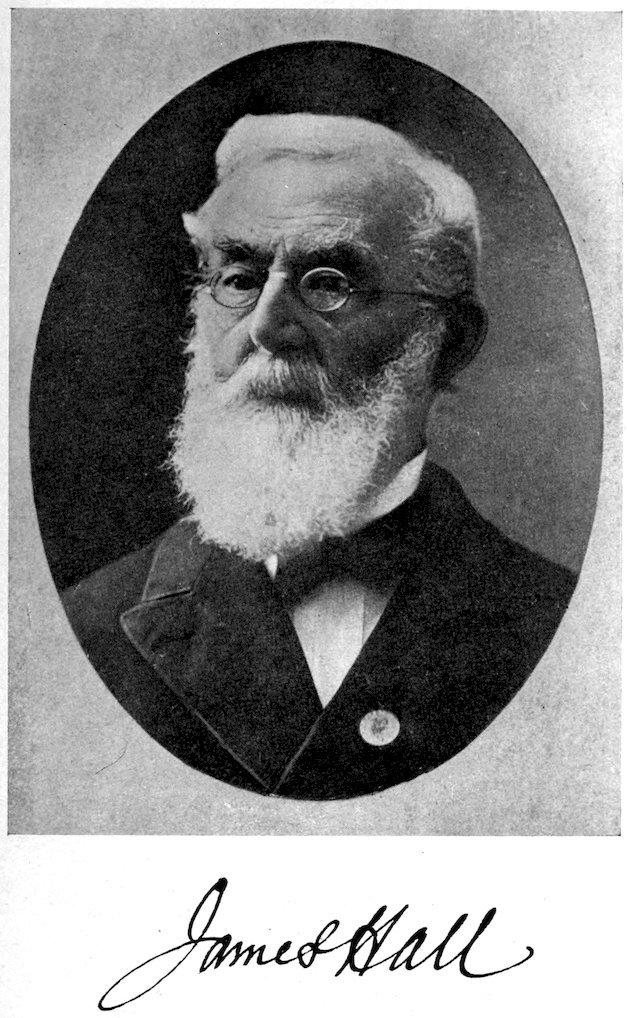
85Carboniferous Formations.—The coal formations are
noted in a general way throughout the earliest volumes
of the Journal. The first accounts of the presence of
coal, in Ohio, are by Caleb Atwater (1, 227, 239, 1819),
and S. P. Hildreth (13, 38, 40, 1828). The first coal
plants to be described and illustrated were also from
Ohio, in an article by Ebenezer Granger in 1821 (3, 5–7).
The anthracite field was first described in 1822 by Zachariah
Cist (4, 1) and then by Benjamin Silliman (10,
331–351, 1826); that of western Pennsylvania was
described by William Meade in 1828 (13, 32).
The Lower Carboniferous was first recognized by W.
W. Mather in 1838 (34, 356). Later, through the work
of Alexander Winchell (1824–1891), beginning in 1862
(33, 352) and continuing until 1871, and through the
surveys of Iowa (1855–1858), Illinois (essentially the
work of A. H. Worthen, 1858–1888), Ohio (1838, Mather,
etc.), and Indiana (Owen, etc., 1838), there was eventually
worked out the following succession:
Permian period.
Upper Barren series.
Dunkard group.
Washington group.
Pennsylvanian period.
Upper Productive Coal series. Monongahela series.
Lower Barren Coal Measures. Conemaugh series.
Lower Productive Coal Measures. Allegheny series.
Pottsville series.
The New York System.—We now come to the epochal
survey of the State of New York, one that established
the principles of, and put order into, American stratigraphy
from the Upper Cambrian to the top of the
Devonian. No better area could have been selected for
the establishing of this sequence. This survey also
developed a stratigraphic nomenclature based on New
York localities and rock exposures, and made full use of
the entombed fossils in correlation. Incidentally it developed
and brought into prominence James Hall, who continued
the stratigraphic work so well begun and who
also laid the foundation for paleontology in America,
becoming its leading invertebrate worker.
This work is reviewed at great length in the Journal
in the volumes for 1844–1847 by D. D. Owen. Evidently
it followed too new a plan to receive fulsome praise from
conservative Owen, as it should have. He remarks that
the volumes “are not a little prolix, are voluminous and
86expensive, and do not give as clear and connected a view
of the geological features of the state as could be wished....
We are of the opinion that before this work can
become generally useful and extensively circulated, it
must be condensed and arranged into one compendious
volume” (46, 144, 1844). This was never done and yet
the work was everywhere accepted at once, and to this
end undoubtedly Owen’s detailed review helped much.
The Natural History Survey of New York was organized
in 1836 and completed in 1843. The state was
divided into four districts, and to these were finally
assigned the following experienced geologists. The
southeastern part was named the First District, with W.
W. Mather (1804–1859) as geologist; the northeastern
quarter was the Second District, with Ebenezer Emmons
(1799–1863) in charge; the central portion was the Third
District, under Lardner Vanuxem (1792–1848); while
the western part was James Hall’s (1811–1898) Fourth
District. Paleontology for a time was in charge of T. A.
Conrad (1830–1877); the mineralogical and chemical work
was in the hands of Lewis C. Beck; the botanist was
John Torrey; and the zoologist James DeKay.
The New York State Survey published six annual
reports of 1675 pages octavo, and four final geological
reports with 2079 pages quarto. Finally in 1846
Emmons added another volume on the soils and rocks
of the state, in which he also discussed the Taconic and
New York systems; it has 371 pages. With the completion
of the first survey, Hall took up his life work
under the auspices of the state—his monumental work,
Paleontology of New York, in fifteen quarto volumes of
4539 pages and 1081 plates of fossils. In addition to all
this, there are his annual and other reports to the
Regents of the State, so that it is safe to say that he
published not less than 10,000 pages of printed matter
on the geology and paleontology of North America.
In regard to this great series of works, all that can be
presented here is a table of formations as developed by
the New York State Survey. Practically all of its
results and formation names have come into general use,
with the exception of the Taconic system of Emmons and
the division terms of the New York system. (See p. 88.)
87The New York State Survey, begun in 1836, was continued
by James Hall from 1843 to 1898. During this
time he was also state geologist of Iowa (1855–1858) and
Michigan (1862). Since 1898, John M. Clarke has ably
continued the Geological Survey of New York, the state
which continues to be, in science and more especially in
geology and paleontology, the foremost in America.
Western Extension of the New York system.—Before
Hall finished his final report, we find him in 1841 on “a
tour of exploration through the states of Ohio, Indiana,
Illinois, a part of Michigan, Kentucky, and Missouri, and
the territories of Iowa and Wisconsin.” This tour is
described in the Journal (42, 51, 1842) under the caption
“Notes upon the Geology of the Western States.” His
object was to ascertain how far the New York system as
the standard of reference “was applicable in the western
extension of the series.” In a general way he was very
successful in extending the system to the Mississippi
River, and he clearly saw “a great diminution, first of
sandy matter, and next of shale, as we go westward, and
in the whole, a great increase of calcareous matter in the
same direction.” He also clearly noted the warped
nature of the strata, the “anticlinal axis,” since known
as the Cincinnati and Wabash uplifts and the Ozark
dome.
Hall, however, fell into a number of flagrant errors
because of a too great reliance on lithologic correlation
and supposedly similar sequence. For instance, the
Coal Measures of Pennsylvania were said to directly
overlap the Chemung group of southern New York, and
now he finds the same condition in Ohio, Indiana, and
Illinois, failing to see that in most places between the
top of the New York system and the Coal Measures lay
the extensive Mississippian series, one that he generally
confounded with the Chemung, or included in the “Carboniferous
group.” He states that the Portage of New
York is the same as the Waverly of Ohio, and at Louisville
the Middle Devonian waterlime is correlated with
the similar rock of the New York Silurian. Hall was
especially desirous of fixing the horizon of the Middle
Ordovician lead-bearing rocks of Illinois, Wisconsin, and
Iowa, but unfortunately correlated them with the Niagaran,
while the Middle Devonian about Columbus, Ohio,
and Louisville, Kentucky, he referred to the same
horizon. The Galena-Niagaran error was corrected in
1855, but the Devonian and Mississippian ones remained
unadjusted for a long time, and in Iowa until toward the
close of the nineteenth century.
| 88 |
| The Geological Column of the New York Geologists of 1842–1843, according to W. W. Mather 1842. |
|---|
| |
| Quaternary system |
Alluvial division. |
| Quaternary division. |
| Drift division. |
| Tertiary system |
These strata are included in the next lower division. |
|
| Upper Secondary system |
Long Island division. Equals the Tertiary and Cretaceous marls, sands, and clays of the coastal plain of New Jersey. |
New Red system of Emmons and Hall. |
| Trappean division. The Palisades |
| Red Sandstone division. |
Coal system of Mather, and Carboniferous system of Hall.
Old Red system of Catskill Mountains of Emmons; Catskill
division of Mather and Hall; and Catskill group of Vanuxem.
| According to Hall 1843, and essentially Vanuxem 1842. |
|---|
| |
| Erie division [Devonian] |
Chemung, Portage or Nunda (divided into Cashaqua, Gardeau, Portage), Genesee, Tully, Hamilton (divided into Ludlowville; Encrinal, Moscow), and Marcellus. |
| Helderberg series [Devonian-Silurian] |
Corniferous, Onondaga, Schoharie, Cauda-alli, Oriskany, Upper Pentamerus, Encrinal, Delthyris, Pentamerus, Waterlime, Onondaga salt group. |
| Ontario division [Silurian] |
Niagara, Clinton, and Medina. |
| Champlain division [Silurian-Ordovician-Upper Cambrian] |
Oneida or Shawangunk, Grey sandstone, Hudson River group, Utica, Trenton, Black River including Birdseye and Chazy, Calciferous sandrock, and Potsdam. |
| According to Emmons 1842, Mather 1843, Vanuxem 1842, Hall 1843. |
|---|
| |
| Taconic System [Ordovician and Lower Cambrian] |
Granular quartz, Stockbridge limestone, Magnesian slate, and Taconic slate. |
| Primary or Hypogene system |
Metamorphic and Primary rocks. |
89Correlations with Europe.—The first effort toward
correlating the New York system with those of Europe
was made by Conrad in his Notes on American Geology
in 1839 (35, 243). Here he compares it on faunal
grounds with the Silurian system. A more sustained
effort was that of Hall in 1843 (45, 157), when he said
that the Silurian of Murchison was equal to the New
York system and embraced the Cambrian, Silurian, and
Devonian, which he considered as forming but one system.
Hall in 1844 and Conrad earlier were erroneously
regarding the Middle Devonian of New York (Hamilton)
as “an equivalent of the Ludlow rocks of Mr. Murchison”
(47, 118, 1844).
In 1846 E. P. De Verneuil spent the summer in America
with a view to correlating the formations of the New
York system with those of Europe. At this time he had
had a wide field experience in France, Germany, and
Russia, was president of the Geological Society of
France, and “virtually the representative of European
geology” (2, 153, 1846). Hall says, “No other person
could have presented so clear and perfect a coup d’oeil.”
De Verneuil’s results were translated by Hall and with
his own comments were published in the Journal in 1848
and 1849 under the title “On the Parallelism of the
Paleozoic Deposits of North America with those of
Europe.” De Verneuil was especially struck with the
complete development of American Paleozoic deposits
and said it was the best anywhere. On the other hand,
he did not agree with the detailed arrangement of the
formations in the various divisions of the New York
system, and Hall admitted altogether too readily that the
terms were proposed “as a matter of concession, and it is
to be regretted that such an artificial classification was
adopted.” De Verneuil’s correlations are as follows:
The Lower Silurian system begins with the Potsdam,
the analogue of the Obolus sandstone of Russia and
90Sweden. The Black River and Trenton hold the position
of the Orthoceras limestones of Sweden and Russia,
while the Utica and Lorraine are represented by the
Graptolite beds of the same countries. Both correlations
are in partial error. He unites the Chazy, Birdseye, and
Black River in one series, and in another the Trenton,
Utica, and Lorraine. Of species common to Europe and
America he makes out seventeen.
In the Upper Silurian system, the Oneida and
Shawangunk are taken out of the Champlain division,
and, with the Medina, are referred to the Silurian, along
with all of the Ontario division plus the Lower Helderberg.
The Clinton is regarded as highest Caradoc or as
holding a stage between that and the Wenlock. The
Niagara group is held to be the exact equivalent of the
Wenlock, “while the five inferior groups of the Helderberg
division represent the rocks of Ludlow.” We now
know that these Helderberg formations are Lower Devonian
in age. De Verneuil unites in one series the
Waterlime, Pentamerus, Delthyris, Encrinal, and Upper
Pentamerus. Of identical species there are forty common
to Europe and America.
The Devonian system De Verneuil begins, “after
much hesitation,” with the Oriskany and certainly with
the five upper members of Hall’s Helderberg division, all
of the Erie and the Old Red Sandstone. He also adjusts
Hall’s error by placing in the Devonian the Upper Cliff
limestone of Ohio and Indiana, regarded by the former
as Silurian. The Oriskany is correlated with the grauwackes
of the Rhine, and the Onondaga or Corniferous
with the lower Eifelian. Cauda-galli, Schoharie, and
Onondaga are united in one series; Marcellus, Hamilton,
Tully, and Genesee in another; and Portage and
Chemung in a third. Of species common to Europe and
America there are thirty-nine.
The Waverly of Ohio and that near Louisville, Kentucky,
which Hall had called Chemung, De Verneuil correctly
refers to the Carboniferous, but to this Hall does
not consent. De Verneuil points out that there are
thirty-one species in common between Europe and America.
“And as to plants, the immense quantity of terrestrial
species identical on the two sides of the Atlantic,
91proves that the coal was formed in the neighborhood of
lands already emerged, and placed in similar physical
conditions.”
An analysis of the Paleozoic fossils of Europe and
America leads De Verneuil to “the conviction that identical
species have lived at the same epoch in America and
in Europe, that they have had nearly the same duration,
and that they succeeded each other in the same order.”
This he states is independent of the depth of the seas,
and of “the upheavings which have affected the surface
of the globe.” The species of a period begin and drop
out at different levels, and toward the top of a system
the whole takes on the character of the next one. “If it
happens that in the two countries a certain number of
systems, characterized by the same fossils, are superimposed
in the same order, whatever may be, otherwise,
their thickness and the number of physical groups of
which they are composed, it is philosophical to consider
these systems as parallel and synchronous.”
Because of the dominance of the sandstones and shales
in eastern New York, De Verneuil holds that a land lay
to the east. The many fucoids and ripple-marks from
the Potsdam to the Portage indicated to him shallow
water and nearness to a shore.
The Oldest Geologic Eras.—We have seen in previous
pages how the Primitive rocks of Arduino and of Werner
had been resolved, at least in part, into the systems of
the Paleozoic, but there still remained many areas of
ancient rocks that could not be adjusted into the accepted
scheme. One of the most extensive of these is in Canada,
where the really Primitive formations, of granites,
gneisses, schists, and even undetermined sediments,
abound and are developed on a grander scale than elsewhere,
covering more than two million square miles and
overlain unconformably by the Paleozoic and later rocks.
The first to call attention to them was J. I. Bigsby, a
medical staff officer of the British Army, in 1821 (3,
254). It was, however, William E. Logan (1798–1875),
the “father of Canadian geology,” who first unravelled
their historical sequence. At first he also called them
Primary, but after much work he perceived in them parallel
structures and metamorphosed sediments, underlain
92by and associated with pink granites. For the
oldest masses, essentially the granites, he proposed the
term Laurentian system (1853, 1863) and for the altered
and deformed strata, the name Huronian series (1857,
1863). Overlying these unconformably was a third
series, the copper-bearing rocks. Since his day a great
host of Canadian and American geologists have labored
over this, the most intricate of all geology, and now we
have the following tentative chronology (Schuchert and
Barrell, 38, 1, 1914):
Late Proterozoic era.
Keweenawan, Animikian and Huronian periods.
Early Proterozoic era.
Sudburian period or older Huronian.
Archeozoic era.
Grenville series, etc.
Cosmic history.
The Taconic system was first announced by Ebenezer
Emmons in 1841, and clearly defined in 1842. It started
the most bitter and most protracted discussion in the
annals of American geology. After Emmons’s subsequent
publications had put the Taconic system through
three phases, Barrande of Bohemia in 1860–1863 shed a
great deal of new and correct light upon it, affirming in a
series of letters to Billings that the Taconic fossils are
like those of his Primordial system, or what we now call
the Middle Cambrian (31, 210, 1861, et seq.).
In a series of articles published by S. W. Ford in the
Journal between 1871 and 1886, there was developed the
further new fact that in Rensselaer and Columbia counties,
New York, the so-called Hudson River group
abounds in “Primordial” fossils wholly unlike those of
the Potsdam, and which Ford later on spoke of as
belonging to “Lower Potsdam” time.
James D. Dana entered the field of the Taconic area in
1871 and demonstrated that the system also abounds in
Ordovician fossiliferous formations. Then came the
far-reaching work of Charles D. Walcott, beginning in
1886, which showed that all through eastern New York
and into northern Vermont the Hudson River group and
93the Taconic system abound not only in Ordovician but
also in Cambrian fossils. Finally in 1888 Dana presented
a Brief History of Taconic Ideas, and laid away
the system with these words (36, 27):
“It is almost fifty years since the Taconic system made its
abrupt entrance into geological science. Notwithstanding some
good points, it has been through its greater errors, long a hindrance
to progress here and abroad ... But, whether the evil
or the good has predominated, we may now hope, while heartily
honoring Professor Emmons for his earnest geological labors and
his discoveries, that Taconic ideas may be allowed to be and
remain part of the past.”
As an epitaph Dana placed over the remains of the
Taconic system the black-faced numerals 1841–1888.
That the remains of the system, however, and the term
Taconic are still alive and demanding a rehearing is
apparent to all interested stratigraphers. This is not
the place to set the matter right, and all that can be done
at the present time is to point out what are the things
that still keep alive Emmons’s system.
In the typical area of the Taconic system, i. e., in Rensselaer
County, Emmons in 1844–1846 produced the fossils
Atops trilineatus and Elliptocephala asaphoides. S. W.
Ford, as stated above, later produced from the same general
area many other fossils that he demonstrated to be
older than the Potsdam sandstone. To this time he gave
the name of Lower Potsdam, thus proving on paleontological
grounds that at least some part of the Taconic
system is older than the New York system, and therefore
older than the Hudson River group of Ordovician age.
In 1888 Walcott presented his conclusions in regard to
the sequence of the strata in the typical Taconic area and
to the north and south of it. He collected Lower Cambrian
fossils at more than one hundred localities
“within the typical Taconic area,” and said that the
thickness of his “terrane No. 5” or “Cambrian (Georgia),”
now referable to the Lower Cambrian, is “14,000
feet or more.” He demonstrated that the Lower Cambrian
is infolded with the Lower and Middle Ordovician,
and confirmed Emmons’s statement that the former rests
upon his Primary or Pre-Cambrian masses. Elsewhere,
he writes: “To the west of the Taconic range the section
94passes down through the limestone (3) [of Lower
and Middle Ordovician age] to the hydromica schists (2)
[whose age may also be of early Ordovician], and thence
to the great development of slates and shales with their
interbedded sparry limestones, calciferous and arenaceous
strata, all of which contain more or less of the Olenellus ... fauna.” He then knew thirty-five species in Washington
County, New York (35, 401, 1888).
Finally in 1915 Walcott said that in the Cordilleran
area of America there was a movement that brought
about changes “in the sedimentation and succession of
the faunas which serve to draw a boundary line between
the Lower and Middle Cambrian series.... The
length of this period of interruption must have been considerable ... and when connection with the Pacific was
resumed a new fauna that had been developing in the
Pacific was then introduced into the Cordilleran sea and
constituted the Middle Cambrian fauna. The change
in the species from the Lower to the Middle Cambrian
fauna is very great.” He then goes on to show that in
the Appalachian geosyncline there was another movement
that shut out the Middle Cambrian Paradoxides
fauna of the Atlantic realm from this trough, and all
deposition as well.
Conclusions.—Accordingly it appears that everywhere
in America the Lower Cambrian formations are separated
by a land interval of long duration from those of
Middle Cambrian time. These formations therefore
unite into a natural system of rocks or a period of time.
Between Middle and Upper Cambrian time, however,
there appears to be a complete transition in the Cordilleran
trough, binding these two series of deposits into
one natural or diastrophic system. Hence the writer
proposes that the Lower Cambrian of America be known
as the Taconic system. The Middle and Upper Cambrian
series can be continued for the present under the
term Cambrian system, a term, however, that is by no
means in good standing for these formations, as will be
demonstrated under the discussion of the Silurian controversy.
95
Just as in America the base of the Paleozoic was
involved in a protracted controversy, so in England the
Cambrian-Silurian succession was a subject of long
debate between Sedgwick and Murchison, and among the
succeeding geologists of Europe. The history of the
solution is so well and justly stated in the Journal by
James D. Dana under the title “Sedgwick and Murchison:
Cambrian and Silurian” (39, 167, 1890), and by Sir
Archibald Geikie in his Text-book of Geology, 1903, that
all that is here required is to briefly restate it and to
bring the solution up to date.
Adam Sedgwick (1785–1873) and R. I. Murchison
(1792–1871) each began to work in the areas of Cambria
(Wales) and Siluria (England) in 1831, but the
terms Cambrian and Silurian were not published until
1835. Murchison was the first to satisfactorily work out
the sequence of the Silurian system because of the
simpler structural and more fossiliferous condition of
his area. Sedgwick, on the other hand, had his academic
duties to perform at Cambridge University, and being an
older and more conservative man, delayed publishing his
final results, because of the further fact that his area
was far more deformed and less fossiliferous. In 1834
they were working in concert in the Silurian area, and
Sedgwick said: “I was so struck by the clearness of the
natural sections and the perfection of his workmanship
that I received, I might say, with implicit faith everything
which he then taught me.... The whole ‘Silurian
system’ was by its author placed above the great undulating
slate-rocks of South Wales.” At that time Murchison
told Sedgwick that the Bala group of the latter,
now known to be in the middle of the Lower Silurian,
could not be brought within the limits of the Silurian
system, and added, “I believe it to plunge under the true
Llandeilo-flags,” now placed next below the Bala and
above the Arenig, which at the present is regarded as at
the base of the Ordovician.
The Silurian system was defined in print by Murchison
in July, 1835, the Upper Silurian embracing the Ludlow
and Wenlock, while the Lower Silurian was based on the
96Caradoc and Llandeilo. Murchison’s monumental work,
The Silurian System, of 100 pages and many plates of
fossils, appeared in 1838.
The Cambrian system was described for the first time
by Sedgwick in August, 1835, but the completed work—a
classic in geology—Synopsis of the Classification of the
British Palæozoic Rocks, along with M’Coy’s Descriptions
of British Palæozoic Fossils, did not appear until 1852–1855.
Sedgwick’s original Upper Cambrian included the
greater part of the chain of the Berwyns, where he said
it was connected with the Llandeilo flags of the Silurian.
The Middle Cambrian comprised the higher mountains of
Cærnarvonshire and Merionethshire, and the Lower
Cambrian was said to occupy the southwest coast of
Cærnarvonshire, and to consist of chlorite and mica
schists, and some serpentine and granular limestone. In
1853 it was seen that the fossiliferous Upper Cambrian
included the Arenig, Llandeilo, Bala, Caradoc, Coniston,
Hirnant, and Lower Llandovery. On the other hand, it
was not until long after Murchison and Sedgwick passed
away that the Middle and Lower Cambrian were shown
to have fossils, but few of those that characterize what
is now called Lower, Middle, and Upper Cambrian time.
Not until long after the original announcement of the
Cambrian system did Sedgwick become aware “of the
unfortunate mischief-involving fact” that the most fossiliferous
portion of the Cambrian—the Upper Cambrian—and
at that time the only part yielding determinable
fossils, when compared with the Lower Silurian was
seen to be an equivalent formation but with very different
lithologic conditions. He began to see in 1842
that his Cambrian was in conflict with the Silurian system,
and four years later there were serious divergencies
of views between himself and Murchison. The climax
of the controversy was attained in 1852, when Sedgwick
was extending his Cambrian system upwards to include
the Bala, Llandeilo, and Caradoc, a proceeding not unlike
that of Murchison, who earlier had been extending his
Silurian downward through all of the fossiliferous Cambrian
to the base of the Lingula flags.
Dana in his review of the Silurian-Cambrian controversy
states: “The claim of a worker to affix a name to a
97series of rocks first studied and defined by him cannot be
disputed.” We have seen that Murchison had priority
of publication in his term Silurian over Sedgwick’s Cambrian,
but that in a complete presentation, both stratigraphically
and faunally, the former had years of prior
definition. What has even more weight is that geologists
nearly everywhere had accepted Murchison’s Silurian
system as founded upon the Lower and Upper Silurian
formations. A nomenclature once widely accepted is
almost impossible to dislodge. However, in regard to
the controversy it should not be forgotten that it was
only Murchison’s Lower Silurian that was in conflict
with Sedgwick’s Upper Cambrian. As for the rest of
the Cambrian, that was not involved in the controversy.
Dana goes on to state that science may accept a name,
or not, according as it is, or is not, needed. In the progress
of geology, he thought that the time had finally been
reached when the name Cambrian was a necessity, and
he included both Cambrian and Silurian in the geological
record. The “Silurian,” however, included the Lower
and Upper Silurian—not one system of rocks, but two.
It is now twenty-seven years since Dana came to this
conclusion, at a time when it was believed that there was
more or less continuous deposition not only between the
formations of a system but between the systems themselves
as well. To-day many geologists hold that in the
course of time the oceans pulsate back and forth over
the continents, and accordingly that the sequence of
marine sedimentation in most places must be much
broken, and to-day we know that the breaks or land intervals
in the marine record are most marked between the
eras, and shorter between all or at least most of the
periods. Furthermore, in North America, we have
learned that the breaks between the systems are most
marked in the interior of the continent and less so on or
toward its margins.
Hardly any one now questions the fact of a long land
interval between the Lower Silurian and Upper Silurian
in England, and it is to Sedgwick’s credit that he was the
first to point out this fact and also the presence of an
unconformity. It therefore follows that we cannot continue
to use Silurian system in the sense proposed by
98Murchison, since it includes two distinct systems or
periods. Dana, in the last edition of his Manual of
Geology (1895), also recognizes two systems, but
curiously he saw nothing incongruous in calling them
“Lower Silurian era” and “Upper Silurian era.” It
certainly is not conducive to clear thinking, however, to
refer to two systems by the one name of Silurian and to
speak of them individually as Lower and Upper Silurian,
thus giving the impression that the two systems are but
parts of one—the Silurian. Each one of the parts has its
independent faunal and physical characters.
We must digress a little here and note the work of
Joachim Barrande (1799–1883) in Bohemia. In 1846 he
published a short account of the “Silurian system” of
Bohemia, dividing it into étages lettered C to H.
Between 1852 and 1883 he issued his “Système Silurien
du Centre de la Bohème,” in eighteen quarto volumes
with 5568 pages of text and 798 plates of fossils—a monumental
work unrivalled in paleontology. In the first
volume the geology of Bohemia is set forth, and here we
see that étages A and B are Azoic or pre-Cambrian, and
C to H make up his Silurian system. Etage C has his
“Primordial fauna,” now known to be of Paradoxides or
Middle Cambrian time, while D is Lower Silurian, E is
Upper Silurian, F is Lower Devonian, and G and H are
Middle Devonian. From this it appears that Barrande’s
Silurian system is far more extensive than that of Murchison,
embracing twice as many periods as that of England
and Wales.
About 1879 there was in England a nearly general
agreement that Cambrian should embrace Barrande’s
Primordial or Paradoxides faunas, and in the North
Wales area be continued up to the top of the Tremadoc
slates. To-day we would include Middle and Upper
Cambrian. Lower Cambrian in the sense of containing
the Olenellus faunas was then unknown in Great Britain.
Lapworth, recognizing the distinctness of the Lower
Silurian as a system, proposed in 1879 to recognize it as
such, and named it Ordovician, restricting Silurian to
Murchison’s Upper Silurian. This term has not been
widely used either in Great Britain or on the Continent,
but in the last twenty years has been accepted more and
99more widely in America. Even here, however, it is in
direct conflict with the term Champlain, proposed by the
New York State Geologist in 1842.
In 1897 the International Geological Congress published
E. Renevier’s Chronographie Géologique, wherein
we find the following:
| Silurian Period. |
Upper or Silurian (Murchison, restricted, 1835). |
Ludlowian (Murchison 1839). |
| Wenlockian (Murchison 1839). |
| Landoverian (Murchison). |
| Middle or Ordovician (Lapworth 1879). |
Caradocian (Murchison 1839). |
| Landeilian (Murchison 1839). |
| Arenigian (Sedgwick 1847). |
| Lower or Cambrian (Sedgwick, restricted, 1835). |
Potsdamian (Emmons 1838). |
| Menevian (Salter and Hicks 1865). |
| Georgian (Hitchcock 1861). |
Regarding this period, which, by the way, is not very
unlike that of Barrande, Renevier remarks that it is “as
important as the Cretaceous or the Jurassic. Lapworth
even gives it a value of the first order equal to the Protozoic
era.”
In the above there is an obvious objection in the double
usage of the term Silurian, and this difficulty was met
later on in Lapparent’s Traité by the proposal to substitute
Gothlandian for Silurian. Of this change Geikie
remarks: “Such an arrangement ... might be adopted
if it did not involve so serious an alteration of the nomenclature
in general use.” On the other hand, if diastrophism
and breaks in the stratigraphic and faunal
sequence are to be the basis for geologic time divisions,
we cannot accept the above scheme, for it recognizes
but one period where there are at least four in nature.
Conclusions.—We have arrived at a time when our
knowledge of the stratigraphic and faunal sequence, plus
the orogenic record as recognized in the principle of
diastrophism, should be reflected in the terminology of
the geologic time-table. It would be easy to offer a satisfactory
nomenclature if we were not bound by the law of
priority in publication, and if no one had the geologic
chronology of his own time ingrained in his memory.
In addition, the endless literature, with its accepted
nomenclature, bars our way. Therefore with a view of
100creating the least change in geologic nomenclature, and
of doing the greatest justice to our predecessors that the
present conditions of our knowledge will allow, the following
scheme is offered:
Silurian period. Llandovery to top of Ludlow in Europe.
Alexandrian-Cataract-Medina to top of Manlius in America.
Champlain (1842) or Ordovician (1879) period. Arenig to top
of Caradoc in Europe. Beekmantown to top of Richmondian
in America.
Cambrian period. In the Atlantic realm, begins with the
Paradoxides, and in the Pacific, with the Bathyuriscus and
Ogygopsis faunas. The close is involved in Ulrich’s provisionally
defined Ozarkian system. When the latter is established,
the Ozarkian period will hold the time between the
Ordovician and the Cambrian.
Taconic period. For the world-wide Olenellus or Mesonacidæ
faunas.
When geologists began to perceive the vast significance
of Hutton’s doctrine that “the ruins of an earlier world
lie beneath the secondary strata,” and that great masses
of bedded rocks are separated from one another by
periods of mountain making and by erosion intervals, it
was natural for them to look for the lands that had furnished
the debris of the accumulated sediments. In this
way paleogeography had its origin, but it was at first of
a descriptive and not of a cartographic nature.
The word paleogeography was proposed by T. Sterry
Hunt in 1872 in a paper entitled “The Paleogeography
of the North American Continent,” and published in the
Journal of the American Geographical Society for that
year. It has to do, he says, with the “geographical history
of these ancient geological periods.” It was again
prominently used by Robert Etheridge in his presidential
address before the Geological Society of London in 1881.
Since Canu’s use of the term in 1896, it has been frequently
seen in print, and now is generally adopted to
signify the geography of geologic time.
The French were the first to make paleogeographic
maps, and Jules Marcou relates in 1866 that Elie de
Beaumont, as early as March, 1831, in his course in the
College of France and at the Paris School of Mines, used
101to outline the relation of the lands and the seas in the
center of Europe at the different great geologic periods.
His first printed paleogeographic map appeared in 1833,
and was of early Tertiary time. Other maps by Beaumont
were published by Beudant in 1841–1842. The
Sicilian geologist Gemmellaro published six maps of his
country in 1834, and the Englishman De La Beche had
one in the same year. In America the first to show such
maps was Arnold Guyot in his Lowell lectures of 1848.
James D. Dana published three in the 1863 edition of his
Manual of Geology. Of world paleogeographic maps,
Jules Marcou produced the first of Jurassic time, publishing
it in France in 1866, but the most celebrated of
these early attempts was the one by Neumayr published
in 1883 in connection with his Ueber klimatische Zonen
während der Jura- und Kreidezeit.
The first geologist to produce a series of maps showing
the progressive geologic geography of a given area was
Jukes-Brown, who in the volume entitled “The Building
of the British Isles,” 1888, included fifteen such maps.
Karpinsky published fourteen maps of Russia, and in
1896 Canu in his Essai de paléogéographie has fifty-seven
of France and Belgium. Lapparent’s Traité of 1906 is
famous for paleogeographic maps, for he has twenty-three
of the world, thirty-four of Europe, twenty-five of
France, and ten taken from other authors. Schuchert in
1910 published fifty-two to illustrate the paleogeography
of North America, and also gave an extended list of such
published maps. Another article on the subject is by Th.
Arldt, “Zur Geschichte der Paläogeographischen Rekonstructionen,”
published in 1914. Edgar Dacqué in 1913
also produced a list in his Paläogeographischen Karten,
and two years later appeared his book of 500 pages,
Grundlagen und Methoden der Paläogeographie, where
the entire subject is taken up in detail.
Conclusions.—Since 1833 there have been published
not less than 500 different paleogeographic maps, and of
this number about 210 relate to North America. Nevertheless
paleogeography is still in its infancy, and most
maps embrace too much geologic time, all of them tens
of thousands, and some of them millions of years. The
geographic maps of the present show the conditions of
102the strand-lines of to-day, and those made fifty years ago
have to be revised again and again if they are to be of
value to the mariner and merchant. Therefore in our
future paleogeographic maps the tendency must ever be
toward smaller amounts of geologic time, if we are to
show the actual relation of water to land and the movements
of the periodic floodings. Moreover, the ancient
shore lines are all more or less hypothetic and are drawn
in straight or sweeping curves, unlike modern strands
with their bays, deltas, and headlands, and the ancient
lands are featureless plains. We must also pay more
attention to the distribution of brackish- and fresh-water
deposits. The periodically rising mountains will be the
first topographic features to be shown upon the ancient
lands, and then more and more of the drainage and the
general climatic conditions must be portrayed. In the
seas, depth, temperature, and currents are yet to be
deciphered. Finally, other base maps than those of the
geography of to-day will have to be made, allowing for
the compression of the mountainous areas, if we are to
show the true geographic configurations of the lands and
seas of any given geologic time.
In accordance with the Laplacian theory, announced at
the beginning of the nineteenth century, all of the older
geologists held that the earth began as a hot star, and
that in the course of time it slowly cooled and finally
attained its present zonal cold to tropical climatic conditions.
That the earth had very recently passed through
a much colder climate, a glacial one, came into general
acceptance only during the latter half of the previous
century.
Rise.—Our knowledge of glacial climates had its origin
in the Alps, that wonderland of mountains and glaciers.
The rise of this knowledge in the Alps is told in a charming
and detailed manner by that erratic French-American
geologist, Jules Marcou (1824–1898), in his
Life, Letters, and Works of Louis Agassiz, 1896. He
relates that the Alpine chamois hunter Perraudin in 1815
directed the attention of the engineer De Charpentier to
the fact “that the large boulders perched on the sides of
103the Alpine valleys were carried and left there by glaciers.”
For a long time the latter thought the conclusion
extravagant, and in the meantime Perraudin told the
same thing to another engineer, Venetz. He, in 1829,
convinced of the correctness of the chamois hunter’s
views, presented the matter before the Swiss naturalists
then meeting at St. Bernard’s. Venetz “told the Society
that his observations led him to believe that the whole
Valais has been formerly covered by an immense glacier
and that it even extended outside of the canton, covering
all the Canton de Vaud, as far as the Jura Mountains,
carrying the boulders and erratic materials, which are
now scattered all over the large Swiss valley.” Eight
years earlier, in 1821, similar views had been presented
by the same modest naturalist before the Helvetic
Society, but it was not until 1833 that De Charpentier
found the manuscript and had it published. Venetz’s
conclusions were that all of the glaciers of the Bagnes
valley “have very recognizable moraines, which are
about a league from the present ice.” “The moraines ... date
from an epoch which is lost in the night of
time.” Then in 1834 De Charpentier read a paper
before the same society, meeting at Lucerne. “Seldom,
if ever, has such a small memoir so deeply excited the
scientific world. It was received at first with incredulity
and even scorn and mockery, Agassiz being among its
opponents.” The paper was published in 1835, first at
Paris, then at Geneva, and finally in Germany. It
“attracted much attention, and the smile of incredulity
with which it was received when read at Lucerne soon
changed into a desire to know more about it.”
Louis Agassiz (1807–1873), who had long been acquainted
with his countryman, De Charpentier, spent
several months with him in 1836, and together they
studied the glaciers of the Alps. Agassiz was at first
“adverse to the hypothesis, and did not believe in the
great extension of glaciers and their transportation of
boulders, but on the contrary, was a partisan of Lyell’s
theory of transport by icebergs and ice-cakes ... but
from being an adversary of the glacial theory, he
returned to Neuchâtel an enthusiastic convert to the
views of Venetz and De Charpentier.... With his
104power of quick perception, his unmatched memory, his
perspicacity and acuteness, his way of classifying, judging
and marshalling facts, Agassiz promptly learned the
whole mass of irresistible arguments collected patiently
during seven years by De Charpentier and Venetz, and
with his insatiable appetite and that faculty of assimilation
which he possessed in such a wonderful degree, he
digested the whole doctrine of the glaciers in a few
weeks.”
In July, 1837, Agassiz presented as his presidential
address before the Helvetic Society his memorable “Discours
de Neuchâtel,” which was “the starting point of
all that has been written on the Ice-age,”—a term coined
at the time by his friend Schimper, a botanist. The first
part of this address is reprinted in French in Marcou’s
book on Agassiz. The address was received with astonishment,
much incredulity, and indifference. Among the
listeners was the great German geologist Von Buch, who
“was horrified, and with his hands raised towards the
sky, and his head bowed to the distant Bernese Alps,
exclaimed: ‘O Sancte de Saussure, ora pro nobis!’”
Even De Charpentier “was not gratified to see his glacial
theory mixed with rather uncalled for biological problems,
the connection of which with the glacial age was
more than problematic.” Agassiz was then a Cuvierian
catastrophist and creationist, and advanced the idea of
a series of glacial ages to explain the destruction of the
geologic succession of faunas! Curiously, this theory
was at once accepted by the American paleontologist
T. A. Conrad (35, 239, 1839).
The classics in glacial geology are Agassiz’s Etudes
sur les Glaciers, 1840, and De Charpentier’s Essai sur les
Glaciers, 1841. Of the latter book, Marcou states that
it has been said: “It is impossible to be truly a geologist
without having read and studied it.” In the English
language there is Tyndall’s Glaciers of the Alps, 1860.
The progress of the ideas in regard to Pleistocene
glaciation is presented in the following chapter by H. E.
Gregory.
Older Glacial Climates.—Hardly had the Pleistocene
glacial climate been proved, when geologists began to
point out the possibility of even earlier ones. An enthusiastic
105Scotch writer, Sir Andrew Ramsay, in 1855
described certain late Paleozoic conglomerates of middle
England, which he said were of glacial origin, but his
evidence, though never completely gainsaid, has not been
generally accepted. In the following year, an Englishman,
Doctor W. T. Blanford, said that the Talchir conglomerates
of central and southern India were of glacial
origin, and since then the evidence for a Permian glacial
climate has been steadily accumulating. Africa is the
land of tillites, and here in 1870 Sutherland pointed out
that the conglomerates of the Karroo formation were of
glacial origin. Australia also has Permian glacial
deposits, and they are known widely in eastern Brazil,
the Falkland Islands, the vicinity of Boston, and elsewhere.
So convincing is this testimony that all geologists
are now ready to accept the conclusion that a
glacial climate was as wide-spread in early Permian time
as was that of the Pleistocene.[3]
In South Africa, beneath the marine Lower Devonian,
occurs the Table Mountain series, 5000 feet thick. The
series is essentially one of quartzites, with zones of shales
or slates and with striated pebbles up to 15 inches long.
The latter occur in pockets and seem to be of glacial origin.
There are here no typical tillites, and no striated undergrounds
have so far been found. While the evidence of
the deposits appears to favor the conclusion that the
Table Mountain strata were laid down in cold waters with
floating ice derived from glaciers, it is as yet impossible
to assign these sediments a definite geologic age. They
are certainly not younger than the Lower Devonian, but
it has not yet been established to what period of the
early Paleozoic they belong.
In southeastern Australia occur tillites of wide distribution
that lie conformably beneath, but sharply separated
from the fossiliferous marine Lower Cambrian
strata. David (1907), Howchin (1908), and other Australian
geologists think they are of Cambrian time, but
to the writer they seem more probably late Proterozoic
in age. In arctic Norway Reusch discovered unmistakable
tillites in 1891, and this occurrence was confirmed by
Strahan in 1897. It is not yet certainly known what
their age is, but it appears to be late Proterozoic rather
106than early Paleozoic. Other undated Proterozoic tillites
occur in China (Willis and Blackwelder 1907), Africa
(Schwarz 1906), India (Vredenburg 1907), Canada
(Coleman 1908), and possibly in Scotland.
The oldest known tillites are described by Coleman in
1907, and occur at the base of the Lower Huronian or in
early Proterozoic time. They extend across northern
Ontario for 1000 miles, and from the north shore of Lake
Huron northward for 750 miles.
Fossils as Climatic Indexes.—Paleontologists have
long been aware that variations in the climates of the
past are indicated by the fossils, and Neumayr in 1883
brought the evidence together in his study of climatic
zones mentioned elsewhere. Plants, and corals, cephalopods,
and foraminifers among marine animals, have
long been recognized as particularly good “life thermometers.”
In fact, all fossils are climatic indicators
to some extent, and a good deal of evidence concerning
paleometeorology has been discerned in them. This evidence
is briefly stated in the paper by Schuchert already
alluded to, and in W. D. Matthew’s Climate and Evolution,
1915.
Sediments as Climatic Indexes.—Johannes Walther in
the third part of his Einleitung—Lithogenesis der
Gegenwart, 1894—is the first one to decidedly direct
attention to the fact that the sediments also have within
themselves a climatic record. In America Joseph Barrell
has since 1907 written much on the same subject.
On the other hand, the periodic floodings of the continents
by the oceans, and the making of mountains,
due to the periodic shrinkage of the earth, as expressed
in T. C. Chamberlin’s principle of diastrophism and in
his publications since 1897, are other criteria for estimating
the climates of the past.
Conclusions.—In summation of this subject Schuchert
says:
“The marine ‘life thermometer’ indicates vast stretches of
time of mild to warm and equable temperatures, with but slight
zonal differences between the equator and the poles. The great
bulk of marine fossils are those of the shallow seas, and the evolutionary
changes recorded in these ‘medals of creation’ are
slight throughout vast lengths of time that are punctuated by
107short but decisive periods of cooled waters and great mortality,
followed by quick evolution, and the rise of new stocks. The
times of less warmth are the miotherm and those of greater
heat the pliotherm periods of Ramsay.
On the land the story of the climatic changes is different, but
in general the equability of the temperature simulates that of
the oceanic areas. In other words, the lands also had long-enduring
times of mild to warm climates. Into the problem
of land climates, however, enter other factors that are absent
in the oceanic regions, and these have great influence upon the
climates of the continents. Most important of these is the periodic
warm-water inundation of the continents by the oceans,
causing insular climates that are milder and moister. With the
vanishing of the floods somewhat cooler and certainly drier
climates are produced. The effects of these periodic floods must
not be underestimated, for the North American continent was
variably submerged at least seventeen times, and over an area
of from 154,000 to 4,000,000 square miles.
When to these factors is added the effect upon the climate
caused by the periodic rising of mountain chains, it is at once
apparent that the lands must have had constantly varying
climates. In general the temperature fluctuations seem to have
been slight, but geographically the climates varied between mild
to warm pluvial, and mild to cool arid. The arid factor has
been of the greatest import to the organic world of the lands.
Further, when to all of these causes is added the fact that during
emergent periods the formerly isolated lands were connected
by land bridges, permitting intermigration of the land floras
and faunas, with the introduction of their parasites and parasitic
diseases, we learn that while the climatic environment is of fundamental
importance it is not the only cause for the more rapid
evolution of terrestrial life....
Briefly, then, we may conclude that the markedly varying
climates of the past seem to be due primarily to periodic changes
in the topographic form of the earth’s surface, plus variations
in the amount of heat stored by the oceans. The causation for
the warmer interglacial climates is the most difficult of all to
explain, and it is here that factors other than those mentioned
may enter.
Granting all this, there still seems to lie back of all these
theories a greater question connected with the major changes in
paleometeorology. This is: What is it that forces the earth’s
topography to change with varying intensity at irregularly
rhythmic intervals?... Are we not forced to conclude that
the earth’s shape changes periodically in response to gravitative
forces that alter the body-form?”
108
Modern evolution, or the theory of life continuously
descending from life with change, may be said to have
had its first marked development in Comte de Buffon
(1707–1788), a man of wealth and station, yet an industrious
compiler, a brilliant writer, and a popularizer of
science. He was not, however, a true scientific investigator,
and his monument to fame is his Histoire Naturelle,
in forty-four volumes, 1749–1804. A. S. Packard
in his book on Lamarck, his Life and Work, 1901, concludes
in regard to Buffon as follows:
“The impression left on the mind, after reading Buffon, is
that even if he threw out these suggestions and then retracted
them, from fear of annoyance or even persecution from the
bigots of his time, he did not himself always take them seriously,
but rather jotted them down as passing thoughts.... They
appeared thirty-four years before Lamarck’s theory, and though
not epoch-making, they are such as will render the name of
Buffon memorable for all time.”
Chevalier de Lamarck (1744–1829) may justly be
regarded as the founder of the doctrine of modern evolution.
Previous to 1794 he was a believer in the fixity
of species, but by 1800 he stood definitely in favor of
evolution. Locy in his Biology and its Makers, 1908,
states his theories in the following simplified form:
“Variations of organs, according to Lamarck, arise in animals
mainly through use and disuse, and new organs have their origin
in a physiological need. A new need felt by the animal [due
to new conditions in its life, or the environment] expresses
itself on the organism, stimulating growth and adaptations in a
particular direction.”
To Lamarck, “inheritance was a simple, direct transmission
of those superficial changes that arise in organs
within the lifetime of an individual owing to use and
disuse.” This part of his theory has come to be known
as “the inheritance of acquired characters.”
Georges Cuvier (1769–1832), a peer of France, was a
decided believer in the fixity of species and in their creation
through divine acts. In 1796 he began to see that
among the fossils so plentiful about Paris many were of
109extinct forms, and later on that there was a succession
of wholly extinct faunas. This at first puzzling phenomenon
he finally came to explain by assuming that the
earth had gone through a series of catastrophes, of which
the Deluge was the most recent but possibly not the last.
With each catastrophe all life was blotted out, and a new
though improved set of organisms was created by divine
acts. The Cuvierian theory of catastrophism was widely
accepted during the first half of the nineteenth century,
and in America Louis Agassiz was long its greatest
exponent. It was this theory and the dominance of the
brilliant Cuvier, not only in science but socially as well,
that blotted out the far more correct views of the more
philosophical Lamarck, who held that life throughout the
ages had been continuous and that through individual
effort and the inheritance of acquired characters had
evolved the wonderful diversity of the present living
world.
In 1830 there was a public debate at Paris between
Cuvier and Geoffroy Saint-Hilaire, the one holding to the
views of the fixity of species and creation, the other that
life is continuous and evolves into better adapted forms.
Cuvier, a gifted speaker and the greatest debater zoology
ever had, with an extraordinary memory that never
failed him, defeated Saint-Hilaire in each day’s debate,
although the latter was in the right.
A book that did a great deal to prepare the English-speaking
people for the coming of evolution was “Vestiges
of Creation,” published in 1844 by an unknown
author. In Darwin’s opinion, “the work, from its powerful
and brilliant style ... has done excellent service ... in thus preparing the ground for the reception of
analogous views.” This book was recommended to the
readers of the Journal (48, 395, 1845) with the editorial
remark that “we cannot subscribe to all of the author’s
views.”
We can probably best illustrate the opinions of Americans
on the question of evolution just before the appearance
of Darwin’s great work by directing attention to
James D. Dana’s Thoughts on Species (24, 305, 1857).
After reading this article and others of a similar nature
by Agassiz, one comes to the opinion that unconsciously
110both men are proving evolution, but consciously they
are firm creationists. It is astonishing that with their
extended and minute knowledge of living organisms and
their philosophic type of mind neither could see the true
significance of the imperceptible transitions between
some species, which if they do not actually pass into, at
least shade towards, one another.
Dana speaks of “the endless diversities in individuals”
that compose a species, and then states that a living
species, like an inorganic one, “is based on a specific
amount or condition of concentered force defined in the
act or law of creation.” Species, he says, are permanent,
and hybrids “cannot seriously trifle with the true
units of nature, and at the best, can only make temporary
variations.” “We have therefore reason to believe
from man’s fertile intermixture, that he is one in species:
and that all organic species are divine appointments
which cannot be obliterated, unless by annihilating the
individuals representing the species.”
Through the activities of the French the world was
prepared for the reception of evolution, and now it was
already in the minds of many advanced thinkers. In
1860 Asa Gray sent to the editor of the Journal (29, 1)
an article by the English botanist, Joseph D. Hooker,
entitled “On the Origination and Distribution of
Species,” with these significant remarks:
“The essay cannot fail to attract the immediate and profound
attention of scientific men.... It has for some time been
manifest that a re-statement of the Lamarckian hypothesis is
at hand. We have this, in an improved and truly scientific
form, in the theories which, recently propounded by Mr. Darwin,
followed by Mr. Wallace, are here so ably and altogether
independently maintained. When these views are fully laid
before them, the naturalists of this country will be able to
take part in the interesting discussion which they will not fail
to call forth.”
Hooker took up a study of the flora of Tasmania, of
which the above cited article is but a chapter, with a
view to trying out Darwin’s theory, and he now accepts
it. He says, “Species are derivative and mutable.”
“The limits of the majority of species are so undefinable
that few naturalists are agreed upon them.”
111Asa Gray had received from Darwin an advance copy
of the book that was to revolutionize the thought of the
world, and at once wrote for the Journal a Review of
Darwin’s Theory on the Origin of Species by means of
Natural Selection (29, 153, 1860). This is a splendid,
critical but just, scientific review of Darwin’s epoch-making
book. Evidently views similar to those, of the
English scientist had long been in the mind of Gray, for
he easily and quickly mastered the work. He is easy on
Dana’s Thoughts on Species, which were idealistic and
not in harmony with the naturalistic views of Darwin.
On the other hand, he contrasts Darwin’s views at length
with those of the creationists as exemplified by Louis
Agassiz, and says “The widest divergence appears.”
Gray says in part:
“The gist of Mr. Darwin’s work is to show that such varieties
are gradually diverged into species and genera through natural
selection; that natural selection is the inevitable result of the
struggle for existence which all living things are engaged in;
and that this struggle is an unavoidable consequence of several
natural causes, but mainly of the high rate at which all organic
beings tend to increase.
Darwin is confident that intermediate forms must have
existed; that in the olden times when the genera, the families
and the orders diverged from their parent stocks, gradations
existed as fine as those which now connect closely related species
with varieties. But they have passed and left no sign. The
geological record, even if all displayed to view, is a book from
which not only many pages, but even whole alternate chapters
have been lost out, or rather which were never printed from the
autographs of nature. The record was actually made in fossil
lithography only at certain times and under certain conditions
(i.e., at periods of slow subsidence and places of abundant sediment);
and of these records all but the last volume is out of
print; and of its pages only local glimpses have been obtained.
Geologists, except Lyell, will object to this,—some of them
moderately, others with vehemence. Mr. Darwin himself admits,
with a candor rarely displayed on such occasions, that he should
have expected more geological evidence of transition than he
finds, and that all the most eminent paleontologists maintain the
immutability of species.
The general fact, however, that the fossil fauna of each period
as a whole is nearly intermediate in character between the
preceding and the succeeding faunas, is much relied on. We
112are brought one step nearer to the desired inference by the similar
‘fact,’ insisted on by all paleontologists, that fossils from two
consecutive formations are far more closely related to each other,
than are the fossils of two remote formations.
It is well said that all organic beings have been formed on two
great laws; Unity of type, and Adaptation to the conditions of
existence.... Mr. Darwin harmonizes and explains them
naturally. Adaptation to the conditions of existence is the
result of Natural Selection; Unity of type, of unity of descent.”
Gray’s article was soon followed by another one from
Agassiz on Individuality and Specific Differences among
Acalephs, but the running title is “Prof. Agassiz on the
Origin of Species” (30, 142, 1860). Agassiz stoutly
maintains his well known views, and concludes as
follows:
“Were the transmutation theory true, the geological record
should exhibit an uninterrupted succession of types blending
gradually into one another. The fact is that throughout all
geological times each period is characterized by definite specific
types, belonging to definite genera, and these to definite families,
referable to definite orders, constituting definite classes and
definite branches, built upon definite plans. Until the facts of
Nature are shown to have been mistaken by those who have collected
them, and that they have a different meaning from that
now generally assigned to them, I shall therefore consider the
transmutation theory as a scientific mistake, untrue in its facts,
unscientific in its method, and mischievous in its tendency.”
Dana, in reviewing Huxley’s well known book, Man’s
Place in Nature (35, 451, 1863), holds that man is apart
from brute nature because man exhibits “extreme cephalization”
in that he has arms that no longer are used
in locomotion but go rather with the head, and because
he has a far higher mentality and speech. As for the
Darwinian theory, the evidence, he says, “comes from
lower departments of life, and is acknowledged by its
advocates to be exceedingly scanty and imperfect.”
The growth of evolution is set forth in the Journal in
Asa Gray’s article on Charles Darwin (24, 453, 1882),
which speaks of the latter as “the most celebrated man of
science of the nineteenth century,” and, in addition, as
“one of the most kindly and charming, unaffected, simple-hearted,
and lovable of men.” In regard to the rise
113of evolution in America, more can be had from Dana’s
paper on Asa Gray (35, 181, 1888). Here we read, as a
sequel to his Thoughts on Species, that the “paper may
be taken, perhaps, as a culmination of the past, just as
the new future was to make its appearance.” Finally,
in this connection there should be mentioned O. C.
Marsh’s paper on Thomas Henry Huxley (50, 177, 1895),
wherein is recorded the latter’s share in the upbuilding
of the evolutionary theory.
We have seen that originally Dana was a creationist,
but in the course of his long and fruitful life he gradually
became an evolutionist, and rather a Neo-Lamarckian
than a Darwinian. This change may be traced in the
various editions of his Manual of Geology, and in the last
edition of 1895 he says his “speculative conclusions” of
1852 in regard to the origin of species are not in “accord
with the author’s present judgment.” “The evidence in
favor of evolution by variation is now regarded as essentially
complete.” On the other hand, while man is
“unquestionably” closely related in structure to the
man-apes, yet he is not linked to them but stands apart,
through “the intervention of a Power above Nature....
Believing that Nature exists through the will and
ever-acting power of the Divine Being, and ... that the
whole Universe is not merely dependent on, but actually
is, the Will of one Supreme Intelligence, Nature, with
Man as its culminant species, is no longer a mystery.”
In America most of the paleontologists are Neo-Lamarckian,
a school that was developed independently
by E. D. Cope (1840–1897) through the vertebrate evidence,
and by Alpheus Hyatt (1838–1902) mainly on the
evidence of the ammonites. They hold that variations
and acquired characters arise through the effects of the
environment, the mechanics of the organism resulting
from the use and disuse of organs, etc. One of the leading
exponents of this school is A. S. Packard, whose book
on Lamarck, His Life and Work, 1901, fully explains the
doctrines of the Neo-Lamarckians.
How and by whom paleontology has been developed
has been fully stated in the Journal in a very clear manner
114by Professor Marsh in his memorable presidential
address of 1879, History and Methods of Palæontological
Discovery (18, 323, 1879), and by Karl von Zittel in his
most interesting book, History of Geology and Palæontology,
1901. In this discussion we shall largely follow
Marsh.
The science of paleontology has passed through four
periods, the first of them the long Mystic period extending
up to the beginning of the seventeenth century, when
the idea that fossils were once living things was only
rarely perceived. The second period was the Diluvial
period of the eighteenth century, when nearly everyone
regarded the fossils as remains of the Noachian deluge.
With the beginnings of the nineteenth century there
arose in western Europe the knowledge that fossils are
the “medals of creation” and that they have a chronogenetic
significance; also that life had been periodically
destroyed through world-wide convulsions in nature.
From about 1800 to 1860 was the time of the creationists
and catastrophists, which may be known as the Catastrophic
period. The fourth period began in 1860 with
Darwin’s Origin of Species. Since that time the theory
of evolution has pervaded all work in paleontology, and
accordingly this time may be known as the Evolutionary
period.
Mystic Period.—The Mystic period in paleontology
begins with the Greeks, five centuries before the present
era, and continues down to the beginning of the seventeenth
century of our time. Some correctly saw that the
fossils were once living marine animals, and that the sea
had been where they now occur. Others interpreted fossil
mammal bones as those of human giants, the Titans,
but the Aristotelian view that they were of spontaneous
generation through the hidden forces of the earth dominated
all thought for about twenty centuries.
In the sixteenth century canals were being dug in
Northern Italy, and the many fossils so revealed led to a
fierce discussion as to their actual nature. Leonardo da
Vinci (1452–1519) opposed the commonly accepted view
of their spontaneous generation and said that they were
the remains of once living animals and that the sea had
been where they occur. “You tell me,” he said, “that
115Nature and the influence of the stars have formed these
shells in the mountains; then show me a place in the
mountains where the stars at the present day make shelly
forms of different ages, and of different species in the
same place.” However, nothing came of his teachings
and those of his countryman Fracastorio (1483–1553),
who further ridiculed the idea that they were the
remains of the deluge. The first mineralogist, Agricola,
described them as minerals—fossilia—and said that they
arose in the ground from fatty matter set in fermentation
by heat. Others said that they were freaks of
nature. Martin Lister (1638–1711) figured fossils side
by side with living shells to show that they were extinct
forms of life. In the seventeenth century, and especially
in Italy and Germany, many books were published on
fossils, some with illustrations so accurate that the
species can be recognized to-day. Finally, toward
the close of this century the influence of Aristotle and the
scholastic tendency to disputation came more or less to
an end. Fossils were already to many naturalists once
living plants and animals. Marsh states: “The many
collections of fossils that had been brought together, and
the illustrated works that had been published about them,
were a foundation for greater progress, and, with the
eighteenth century, the second period in the history of
paleontology began.”
Diluvial Period.—During the eighteenth century many
more books on fossils were published in western Europe,
and now the prevalent explanation was that they were
the remains of the Noachian deluge. For nearly a century
theologians and laymen alike took this view, and
some of the books have become famous on this account,
but the diluvial views sensibly declined with the close
of the eighteenth century.
The true nature of fossils had now been clearly determined.
They were the remains of plants and animals,
deposited long before the deluge, part in fresh water and
part in the sea. “Some indicated a mild climate, and some
the tropics. That any of these were extinct species, was
as yet only suspected.” Yet before the close of the century
there were men in England and France who pointed
out that different formations had different fossils and
116that some of them were extinct. These views then led to
many fantastic theories as to how the earth was formed—dreams,
most of them have been called. Marsh says:
“The dominant idea of the first sixteen centuries of the
present era was, that the universe was made for Man. This was
the great obstacle to the correct determination of the position
of the earth in the universe, and, later, of the age of the earth....
In a superstitious age, when every natural event is
referred to a supernatural cause, science cannot live....
Scarcely less fatal to the growth of science is the age of Authority,
as the past proves too well. With freedom of thought, came
definite knowledge, and certain progress;—but two thousand
years was long to wait.”
One of the most significant publications of this period
was Linnæus’s Systema Naturæ, which appeared in 1735.
In this work was introduced binomial nomenclature, or
the system of giving each plant and animal species a
generic and specific name, as Felis leo for the lion. The
system was, however, not established until the tenth
edition of the work in 1758, which became the starting
point of zoological nomenclature. Since then there has
been added another canon, the law of priority, which
holds that the first name applied to a given form shall
stand against all later names given to the same organism.
Catastrophic Period.—With the beginning of the nineteenth
century there started a new era in paleontology,
and this was the time when the foundations of the science
were laid. The period continued for six decades, or until
the time of the Origin of Species. Marsh says that now
“method replaced disorder, and systematic study superseded
casual observation.” Fossils were accurately
determined, comparisons were made with living forms,
and the species named according to the binomial system.
However, every species, recent and extinct, was regarded
as a separate creation, and because of the usually sharp
separation of the superposed fossil faunas and floras,
these were held to have been destroyed through a series
of periodic catastrophes of which the Noachian deluge
was the last.
Lamarck between 1802 and 1806 described the Tertiary
shells of the Paris basin. Comparing them with the living
117forms, he saw that most of the fossils were of extinct
species, and in this way he came to be the founder of
modern invertebrate paleontology. He also maintained
after 1801 that life has been continuous since its origin
and that nature has been uniform in the course of its
development. Marsh adds:
“His researches on the invertebrate fossils of the Paris Basin,
although less striking, were not less important than those of
Cuvier on the vertebrates; while the conclusions he derived from
them form the basis of modern biology.”
“Lamarck was the prophetic genius, half a century in advance
of his time.”
Cuvier established comparative anatomy and vertebrate
paleontology, and was one of the first to point out
that fossil animals are nearly all extinct forms. He
came to the latter conclusion in 1796 through a study of
fossil elephants found in Europe. “Cuvier enriched
the animal kingdom by the introduction of fossil forms
among the living, bringing all together into one comprehensive
system.” This opened to him entirely new
views respecting the theory of the earth, and he devoted
more than twenty-five years to developing the theories
of special creation and catastrophism, described in his
Discourse on the Revolutions of the Surface of the Globe.
“With all his knowledge of the earth, he could not free
himself from tradition, and believed in the universality
and power of the Mosaic deluge. Again, he refused to
admit the evidence brought forward by his distinguished
colleagues against the permanence of species, and used
all his great influence to crush out the doctrine of evolution,
then first proposed” (Marsh).
In England it was William Smith (1769–1839) who
independently discovered the chronogenetic significance
of fossils, and in their stratigraphic superposition indicated
the way for the study of historical geology. He
first published on this matter in 1799, but his completed
statements came in works entitled “Strata identified by
Organized Fossils,” 1816–1820, and “Stratigraphical
System of Organized Fossils,” 1817.
Invertebrate paleontology in America during the
Catastrophic period had its beginning in Lesueur, who
118in 1818 described the Ordovician gastropod Maclurites
magna. All of the paleontologists of this time were satisfied
to describe species and genera and to ascertain in a
broad way the stratigraphic significance of the fossil
faunas and floras. James Hall in 1854 (17, 312) knew of
1588 species, described and undescribed, in the New York
system, while in England Morris listed in that year 8300
Paleozoic forms. In 1856 Dana recites the known fossil
species as follows (22, 333): The whole number of
known American species of animals of the Permian to
Recent is about 2000; while in Britain and Europe, there
were over 20,000 species. In the Permian we have none,
while Europe has over 200 species. In the Triassic we
have none, Europe 1000 species; Jurassic 60, Europe
over 4000; Cretaceous 350 to 400, Europe about 6000;
Tertiary hardly 1500, Europe about 8000. Since that
time nearly all of the larger American Paleozoic faunas
have been developed, but there are thousands of species
yet to be described. Who the more prominent American
paleontologists of this period were has been told in the
section on the development of the geological column.
The grander paleontologic results of the Catastrophic
period have been so well stated by Marsh that it is worth
our while to repeat them here:
“It had now been proved beyond question that portions at
least of the earth’s surface had been covered many times by the
sea, with alternations of fresh water and of land; that the strata
thus deposited were formed in succession, the lowest of the series
being the oldest; that a distinct succession of animals and
plants had inhabited the earth during the different geological
periods; and that the order of succession found in one part of
the earth was essentially the same in all. More than 30,000 new
species of extinct animals and plants had now been described.
It had been found, too, that from the oldest formations to the
most recent, there had been an advance in the grade of life, both
animal and vegetable, the oldest forms being among the simplest,
and the higher forms successively making their appearance.
It had now become clearly evident, moreover, that the fossils
from the older formations were all extinct species, and that only
in the most recent deposits were there remains of forms still
living.... Another important conclusion reached, mainly
through the labors of Lyell, was, that the earth had not been
subjected in the past to sudden and violent revolutions; but the
119great changes wrought had been gradual, differing in no essential
respect from those still in progress. Strangely enough, the
corollary to this proposition, that life, too, had been continuous
on the earth, formed at that date no part of the common stock
of knowledge. In the physical world, the great law of ‘correlation
of forces’ had been announced, and widely accepted;
but in the organic world, the dogma of the miraculous creation
of each separate species still held sway.”
Evolutionary Period.—This period begins with 1860
and the publication of Darwin’s Origin of Species (late
in 1859). It is the period of modern paleontology, and is
dominated by the belief that universal laws pervade not
only inorganic matter, but all life as well. Louis Agassiz
had been in America fourteen years when Darwin’s
book appeared, and his wonderful influence in bringing
the zoology of our country to a high stand and the
further influence he exerted through his students was
bound to react beneficially on invertebrate paleontology.
Shortly after the beginning of this period, or in 1867,
Alpheus Hyatt, one of Agassiz’s students, began to apply
the study of embryology to fossil cephalopods, showing
clearly that these shells retain a great deal of their
growth stages or ontogeny. This method of study was
then followed by R. T. Jackson, C. E. Beecher, and J.
P. Smith, and has been productive of natural classifications
of the Cephalopoda, Brachiopoda, Trilobita, and
Echinoidea.
The dominant invertebrate paleontologist of this
period was of course James Hall, who described about
5000 species of American Paleozoic fossils. He also
built up the New York State Museum, while around his
private collections of fossils have been developed the
American Museum of Natural History in New York City
and the Walker Museum at the University of Chicago.
In his most important laboratory of paleontology at
Albany, there have been trained either wholly or in
part the following paleontologists: F. B. Meek, C. A.
White, R. P. Whitfield, C. D. Walcott, C. E. Beecher,
John M. Clarke, and Charles Schuchert.
In Canada, through the work of the Geological Survey
of the Dominion, came the paleontologists Elkanah
Billings and, later on, J. F. Whiteaves. The “father of
120Canadian paleontology,” Sir William Dawson, who
developed independently, was active in all branches of
the science and did much to unravel the geology of
eastern Canada. No organism has been more discussed
and more often rejected and accepted as a fossil than his
“dawn animal of Canada,” Eozoon canadense, first
described in 1865. His son, George M. Dawson, was one
of the directors of the Geological Survey of Canada.
Finally the extensive paleontology of the Cambrian of
Canada was worked out by another self-made paleontologist,
G. F. Matthew.
Paleobotany.—American paleobotany was developed
during this, the fourth period, through the state and
national surveys, first in Leo Lesquereux, a Swiss student
induced by Agassiz to come to America, and in J. S.
Newberry. The second generation of paleobotanists is
represented by Lester F. Ward and W. N. Fontaine,
and the third generation, the present workers, includes
F. H. Knowlton, David White, Arthur Hollick, and E. W.
Berry. A new line of paleobotanical work, the histology
of woody but pseudomorphous remains, has been developed
by G. R. Wieland.
The grander results of the study of paleontology during
the evolutionary period may be summed up with the
conclusions of Marsh:
“One of the main characteristics of this epoch is the belief
that all life, living and extinct, has been evolved from simple
forms. Another prominent feature is the accepted fact of the
great antiquity of the human race. These are quite sufficient
to distinguish this period sharply from those that preceded it.”
Charles Darwin’s work at once aroused attention, and brought
about in scientific thought a revolution which “has influenced
paleontology as extensively as any other department of science....
In the [previous period] species were represented independently
by parallel lines; in the present period, they are
indicated by dependent, branching lines. The former was the
analytic, the latter is the synthetic period.”
Synthetic Period.—What is to be the next trend in
paleontology? Clearly it is to be the Synthetic period,
one that Marsh in 1879 indicated in these words: “But
if we are permitted to continue in imagination the rapidly
converging lines of research pursued to-day, they
121seem to meet at the point where organic and inorganic
nature become one. That this point will yet be reached,
I cannot doubt.”
This Synthetic period, foreshadowed also in Herbert
Spencer’s Synthetic Philosophy, has not yet arrived, but
before long another great leader will appear. We have
the prophecy of his coming in such books as The Fitness
of the Environment, by Lawrence J. Henderson, 1913;
The Origin and Nature of Life, by Benjamin Moore,
1913; The Organism as a Whole, by Jacques Loeb, 1916;
and The Origin and Evolution of Life, by Henry F.
Osborn, 1917.
In all nature, inorganic and organic, there is continuity
and consistency, beauty and design. We are beginning
to see that there are eternal laws, ever interacting and
resulting in progressive and regressive evolutions. The
realization of these scientific revelations kindles in us a
desire for more knowledge, and the grandest revelations
are yet before us in the synthesis of the sciences.
III A CENTURY OF GEOLOGY.—STEPS OF PROGRESS IN THE INTERPRETATION OF LAND FORMS — The Interpretation of Valleys. — The Pioneers. — Steps Backward. — Valleys Formed by Rivers. — Denudation by Rivers. — Features Resulting from Glaciation. — The Problem Stated. — The Deluge. — Glaciers vs. Icebergs. — Extent of Glacial Drift. — Epochs of Glaciation. — The Loess as a Glacial Deposit. — Glacial Sculpture. — Conclusion. — Bibliography.
122
The essence of physiography is the belief that land
forms represent merely a stage in the orderly development
of the earth’s surface features; that the
various dynamic agents perform their characteristic work
throughout all geologic time. The formulation of principle
and processes of earth sculpture was, therefore,
impossible on the hypothesis of a ready-made earth
whose features were substantially unchangeable, except
when modified by catastrophic processes. In 1821, J. W.
Wilson wrote in the Journal: “Is it not the best theory
of the earth, that the Creator, in the beginning, at least
at the general deluge, formed it with all its present grand
characteristic features?”[4] If so, a search for causes is
futile, and the study of the work performed by streams
and glaciers and wind is unprofitable. The belief in the
Deluge as the one great geological event in the history of
the earth has brought it about that the speculations of
Aristotle, Herodotus, Strabo, and Ovid, and the illustrious
Arab, Avicenna (980–1037), unchecked by appeal
to facts but also unopposed by priesthood or popular
prejudice, are nearer to the truth than the intolerant controversial
writings of the intellectual leaders whose
touchstone was orthodoxy. A few thinkers of the sixteenth
century revolted against the interminable repetition
of error, and Peter Severinus (1571) advised his
students: “Burn up your books ... buy yourselves
stout shoes, get away to the mountains, search the valleys,
the deserts, the shores of the seas.... In this way and no
123other will you arrive at a knowledge of things.” But
the thoroughgoing “diluvialist” who believed that a
million species of animals could occupy a 450–foot
Ark, but not that pebbles weathered from rock or that
rivers erode, had no use for his powers of observation.
Sporadic germs of a science of land forms scattered
through the literature of the seventeenth and eighteenth
centuries found an unfavorable environment and produced
inconspicuous growths. Even their sponsors did
little to cultivate them. Steno (1631–1687) mildly suggested
that surface sculpturing, particularly on a small
scale, is largely the work of running water, and Guettard
(1715–1786), a truly great mind, grasped the fundamental
principles of denudation and successfully entombed his
views as well as his reputation in scores of books and volumes
of cumbrous diffuse writing.
At the beginning of the nineteenth century a sufficient
body of principles had been established to justify the
recognition of an earth science, geology, and the 195 volumes
of the Journal thus far published carry a large part
of the material which has won approval for the new
science and given prominence to American thought.
From the pages in the Journal, the progress of geology
may be illustrated by tracing the fluctuation in the development
of fact and theory as relates to valleys and glacial
features, the subjects to which this chapter is devoted.
Desmarest (1725–1815) might be styled the father of
physiography. By concrete examples and sound induction
he established (1774) the doctrine that the valleys of
central France are formed by the streams which occupy
them. He also made the first attempt to trace the history
of a landscape through its successive stages on the
basis of known causes. His methods and reasoning are
practically identical with those of Dutton working in the
ancient lavas of New Mexico; and Whitney’s description
of the Table Mountains of California might well have
appeared in Desmarest’s memoirs.[5] The teachings of
Desmarest were strengthened and expanded by DeSaussure
124(1740–1799), the sponsor for the term, “Geology,”
(1779) who saw in the intimate relation of Alpine
streams and valleys the evidence of erosion by running
water (1786).
The work of these acknowledged leaders of geological
thought attracted singularly little attention on the Continent,
and Lamarck’s volume on denudation (Hydrogéologie),
which appeared in 1802, although an important
contribution, sank out of sight. But the seed of the French
school found fertile ground in Edinburgh, the center of
the geological world during the first quarter of the nineteenth
century. Hutton’s “Theory of the Earth, with
Proofs and Illustrations,” in which the guidance of
DeSaussure and Desmarest is gratefully acknowledged,
appeared in 1795. The original publication aroused only
local interest, but when placed in attractive form by Playfair’s
“Illustrations of the Huttonian Theory” (1802),
the problem of the origin and development of land forms
assumed a commanding position in geological thought.
Hutton was peculiarly fortunate in his environment. He
had the support and assistance of a group of able scientific
colleagues as well as the bitter opposition of Jameson
and of the defenders of orthodoxy. His views were
discussed in scientific publications and found their way to
literary and theological journals. Hutton’s conception
of the processes of land sculpture—slow upheaving and
slow degradation of mountains, differential weathering,
and the carving of valleys by streams—has a very
modern aspect. Playfair’s book would scarcely be out of
place in a twentieth century class room. The following
paragraphs are quoted from it:[6]
“... A river, of which the course is both serpentine and
deeply excavated in the rock, is among the phenomena, by
which the slow waste of the land, and also the cause of that
waste, are most directly pointed out.
The structure of the vallies among mountains, shews clearly to
what cause their existence is to be ascribed. Here we have first
a large valley, communicating directly with the plain, and winding
between high ridges of mountains, while the river in the
bottom of it descends over a surface, remarkable, in such a
scene, for its uniform declivity. Into this, open a multitude of
transverse or secondary vallies, intersecting the ridges on either
125side of the former, each bringing a contribution to the main
stream, proportioned to its magnitude; and, except where a
cataract now and then intervenes, all having that nice adjustment
in their levels, which is the more wonderful, the greater
the irregularity of the surface. These secondary vallies have
others of a smaller size opening into them; and, among mountains
of the first order, where all is laid out on the greatest scale,
these ramifications are continued to a fourth, and even a fifth,
each diminishing in size as it increases in elevation, and as its
supply of water is less. Through them all, this law is in general
observed, that where a higher valley joins a lower one, of
the two angles which it makes with the latter, that which is
obtuse is always on the descending side; ... what else but the
water itself, working its way through obstacles of unequal
resistance, could have opened or kept up a communication
between the inequalities of an irregular and alpine surface....
... The probability of such a constitution [arrangement of
valleys] having arisen from another cause, is, to the probability
of its having arisen from the running of water, in such a proportion
as unity bears to a number infinitely great.
... With Dr. Hutton, we shall be disposed to consider those
great chains of mountains, which traverse the surface of the
globe, as cut out of masses vastly greater, and more lofty than
any thing that now remains.
From this gradual change of lakes into rivers, it follows, that
a lake is but a temporary and accidental condition of a river,
which is every day approaching to its termination; and the
truth of this is attested, not only by the lakes that have existed,
but also by those that continue to exist.”
Even Hutton’s clear reasoning, firmly buttressed by
concrete examples, was insufficient to overcome the belief
in ready-made or violently formed valleys and original
corrugations and irregularities of mountain surface.
The pages of the Journal show that the principles laid
down by Playfair were too far in advance of the times to
secure general acceptance. In the first volume of the
Journal, the gorge of the French Broad River is assigned
by Kain to “some dreadful commotion in nature which
probably shook these mountains to their bases,”[7] and
the gorge of the lower Connecticut is considered by
Hitchcock (1824)[8] as a breach which drained a series of
lakes “not many centuries before the settlement of this
126country.” The prevailing American and English view for
the first quarter of the nineteenth century is expressed
in the reviews in this Journal, where the well-known
conclusions of Conybeare and Phillips that streams are
incompetent to excavate valleys are quoted with approval
and admiration is expressed for Buckland’s famous
“Reliquiæ Diluvianæ,” a 300–page quarto volume devoted
to proof of a deluge. The professor at Yale, Silliman,
and the professor at Oxford, Buckland, saw that an
acceptance of Hutton’s views involved a repudiation of
the Biblical flood, and much space is devoted to combating
these “erroneous” and “unscientific” views. For example,
Buckland says:[9]
“... The general belief is, that existing streams, avalanches
and lakes, bursting their barriers, are sufficient to account for
all their phenomena, and not a few geologists, especially those
of the Huttonian school, at whose head is Professor Playfair,
have till recently been of this opinion.... But it is now very
clear to almost every man, who impartially examines the facts
in regard to existing vallies, that the causes now in action, mentioned
above, are altogether inadequate to their production;
nay, that such a supposition would involve a physical impossibility.
We do not believe that one-thousandth part of our
present vallies were excavated by the power of existing streams....
In very many cases of large rivers, it is found, that so far
from having formed their own beds, they are actually in a gradual
manner filling them up.
Again; how happens it that the source of a river is frequently
below the head of a valley, if the river excavated that valley?
The most powerful argument, however, in our opinion,
against the supposition we are combating, is the phenomena of
transverse and longitudinal valleys; both of which could not
possibly have been formed by existing streams.”
Phillips writes in 1829:[10] “The excavation of valleys
can be ascribed to no other cause than a great flood of
water which overtopped the hills, whose summits those
vallies descend.”
Faith in Noah’s flood as the dominant agent of erosion
rapidly lost ground through the teaching of Lyell after
1830, but the theory of systematic development of landscapes
by rivers gained little. In fact, Scrope in 1830,[11]
in showing that the entrenched meanders of the Moselle
127prove gradual progressive stream work, was in advance
of his English contemporary. Judged by contributions
to the Journal, Lyell’s teaching served to standardize
American opinion of earth sculpture somewhat as follows:
The ocean is the great valley maker, but rivers
also make them; the position of valleys is determined by
original or renewed surface inequalities or by faulting;
exceptional occurrences—earthquakes, bursting of lakes,
upheavals and depressions—have played an important
part. Hayes (1839)[12] thought that the surface of New
York was essentially an upraised sea-bottom modified by
erosion of waves and ocean currents. Sedgwick (1838)[13]
considered high-lying lake basins proof of valleys which
were shaped under the sea. Many of the valleys in the
Chilian Cordillera were thought by Darwin (1844) to
have been the work of waves and tides, and water gaps
are ascribed to currents “bursting through the range at
those points where the strata have been least inclined
and the height consequently is less.” Speaking of the
magnificent stream-cut canyons of the Blue Mountains
of New South Wales, gorges which lead to narrow exits
through monoclines, Darwin says: “To attribute these
hollows to alluvial action would be preposterous.”[14]
The influence of structure in the formation of valleys
is emphasized by many contributors to the Journal.
Hildreth in 1836, in a valuable paper,[15] which is perhaps
the first detailed topographic description of drainage in
folded strata, expresses the opinion that the West Virginia
ridges and valleys antedated the streams and that
water gaps though cut by rivers involve pre-existing
lakes. Geddes (1826)[16] denied that Niagara River cut its
channel and speaks of valleys which “were valleys e’er
moving spirit bade the waters flow.” Conrad (1839)[17]
discussed the structural control of the Mohawk, the
Ohio, and the Mississippi, and Lieutenant Warren
(1859)[18] concluded that the Niobrara must have originated
in a fissure. According to Lesley (1862)[19]
the course of the New River across the Great Valley
and into the Appalachians “striking the escarpment
in the face” is determined by the junction of
anticlinal structures on the north with faulted monoclines
toward the south; a conclusion in harmony
128with the views of Edward Hitchcock (1841)[17] that major
valleys and mountain passes are structural in origin and
that even subordinate folds and faults may determine
minor features. “Is not this a beautiful example of
prospective benevolence on the part of the Deity, thus,
by means of a violent fracture of primary mountains,
to provide for easy intercommunication through
alpine regions, countless ages afterwards!” The extent
of the wandering from the guidance of DeSaussure and
Playfair after the lapse of 50 years is shown by students
of Switzerland. Alpine valleys to Murchison (1851)
were bays of an ancient sea; Schlaginweit (1852) found
regional and local complicated crustal movements a satisfactory
cause, and Forbes (1863) saw only glaciers.
One strong voice before 1860 appears to have called
Americans back to truths expounded by Desmarest and
Hutton. Dana in 1850[20] amply demonstrated that valleys
on the Pacific Islands owe neither their origin,
position or form to the sea or to structural factors.
They are the work of existing streams which have eaten
their way headwards. Even the valleys of Australia
cited by Darwin as type examples of ocean work are
shown to be products of normal stream work. Dana
went further and gave a permanent place to the Huttonian
idea that many bays, inlets, and fiords are but the
drowned mouths of stream-made valleys. In the same
volume in which these conclusions appeared, Hubbard
(1850)[21] announced that in New Hampshire the “deepest
valleys are but valleys of erosion.” The theory that
valleys are excavated by streams which occupy them
was all but universally accepted after F. V. Hayden’s
description[22] of Rocky Mountain gorges (1862) and Newberry’s
interpretation of the canyons of Arizona (1862);
but the scientific world was poorly prepared for Newberry’s
statement:[23]
“Like the great canons of the Colorado, the broad valleys
bounded by high and perpendicular walls belong to a vast system
of erosion, and are wholly due to the action of water.... The
first and most plausible explanation of the striking surface features
of this region will be to refer them to that embodiment of
129resistless power—the sword that cuts so many geological knots—volcanic
force. The Great Canon of the Colorado would be
considered a vast fissure or rent in the earth’s crust, and the
abrupt termination of the steps of the table lands as marking
lines of displacement. This theory though so plausible, and so
entirely adequate to explain all the striking phenomena, lacks
a single requisite to acceptance, and that is truth.”
With such stupendous examples in mind, the dictum
of Hutton seemed reasonable: “there is no spot on which
rivers may not formerly have run.”
The general recognition of the competency of streams
to form valleys was a necessary prelude to the broader
view expressed by Jukes (1862)[24]
“The surfaces of our present lands are as much carved and
sculptured surfaces as the medallion carved from the slab, or the
statue sculptured from the block. They have been gradually
reached by the removal of the rock that once covered them, and
are themselves but of transient duration, always slowly wasting
from decay.”
Contributions to the Journal between 1850 and 1870
reveal a tendency to accept greater degrees of erosion
by rivers, but the necessary end-product of subaërial
erosion—a plain—is first clearly defined by Powell in
1875.[25] In formulating his ideas Powell introduced the
term “base-level,” which may be called the germ word
out of which has grown the “cycle of erosion,” the
master key of modern physiographers. The original
definition of base-level follows:
“We may consider the level of the sea to be a grand base-level,
below which the dry lands cannot be eroded; but we may
also have, for local and temporary purposes, other base-levels of
erosion, which are the levels of the beds of the principal streams
which carry away the products of erosion. (I take some liberty
in using the term ‘level’ in this connection, as the action of a
running stream in wearing its channel ceases, for all practical
purposes, before its bed has quite reached the level of the lower
end of the stream. What I have called the base-level would, in
fact, be an imaginary surface, inclining slightly in all its parts
toward the lower end of the principal stream draining the area
130through which the level is supposed to extend, or having the
inclination of its parts varied in direction as determined by
tributary streams.)”
Analysis of Powell’s view has given definiteness to the
distinction between “base-level,” an imaginary plane,
and “a nearly featureless plain,” the actual land surface
produced in the last stage of subaërial erosion.
Following their discovery in the Colorado Plateau
Province, denudation surfaces were recognized on the
Atlantic slope and discussed by McGee (1888),[26] in a paper
notable for the demonstration of the use of physiographic
methods and criteria in the solution of stratigraphic
problems. Davis (1889)[27] described the upland of
southern New England developed during Cretaceous
time, introducing the term “peneplain,” “a nearly featureless
plain.” The short-lived opposition to the
theory of peneplanation indicates that in America at least
the idea needed only formulation to insure acceptance.
It is interesting to note that surfaces now classed as
peneplains were fully described by Percival (1842),[28]
who assigned them to structure, and by Kerr (1880),[29]
who considered glaciers the agent. In Europe “plains
of denudation” have been clearly recognized by Ramsay
(1846), Jukes (1862), A. Geikie (1865), Foster and Topley
(1865), Maw (1866), Wynne (1867), Whitaker (1867),
Macintosh (1869), Green (1882), Richthofen (1882), but
all of them were looked upon as products of marine work,
and writers of more recent date in England seem reluctant
to give a subordinate place to the erosive power of
waves. Americans, on the other hand, have been thinking
in terms of rivers, and the great contribution of the
American school is not that peneplains exist, but that
they are the result of normal subaërial erosion. More
precise field methods during the past decade have
revealed the fact that no one agent is responsible for the
land forms classed as peneplains; that not only rivers
and ocean, but ice, wind, structure, and topographic
position must be taken into account.
The recognition of rivers as valley-makers and of the
final result of stream work necessarily preceded an
analysis of the process of subaërial erosion. The first
131and last terms were known, the intermediate terms and
the sequence remained to be established. A significant
contribution to this problem was made by Jukes (1862).[34]
“... I believe that the lateral valleys are those which were
first formed by the drainage running directly from the crests of
the chains, the longitudinal ones being subsequently elaborated
along the strike of the softer or more erodable beds exposed on
the flanks of those chains.”
Powell’s discussion of antecedent and consequent
drainage (1875) and Gilbert’s chapter on land sculpture
in the Henry Mountain report (1880) are classics, and
McGee’s contribution[30] contains significant suggestions,
but the master papers are by Davis,[31] who introduces an
analysis of land forms based on structure and age by the
statement:
“Being fully persuaded of the gradual and systematic evolution
of topographical forms it is now desired ... to seek the
causes of the location of streams in their present courses; to go
back if possible to the early date when central Pennsylvania was
first raised from the sea, and trace the development of the several
river systems then implanted upon it from their ancient beginning
to the present time.”
That such a task could have been undertaken a quarter
of a century ago and to-day considered a part of everyday
field work shows how completely the lost ground of a
half century has been regained and how rapid the
advance in the knowledge of land sculpture since the
canyons of the Colorado Plateau were interpreted.
Early in the nineteenth century when speculation
regarding the interior of the earth gave place in part to
observations of the surface of the earth, geologists were
confronted with perhaps the most difficult problem in the
history of the science. As stated by the editor of the
Journal in 1821:[32]
“The almost universal existence of rolled pebbles, and boulders
of rock, not only on the margin of the oceans, seas, lakes, and
rivers; but their existence, often in enormous quantities, in
132situations quite removed from large waters; inland,—in high
banks, embedded in strata, or scattered, occasionally, in profusion,
on the face of almost every region, and sometimes on the
tops and declivities of mountains, as well as in the vallies
between them; their entire difference, in many cases, from the
rocks in the country where they lie—rounded masses and pebbles
of primitive rocks being deposited in secondary and alluvial
regions, and vice versa; these and a multitude of similar facts
have ever struck us as being among the most interesting of
geological occurrences, and as being very inadequately accounted
for by existing theories.”
The phenomena demanding explanation—jumbled
masses of “diluvium,” polished and striated rock,
bowlders distributed with apparent disregard of topography—were
indeed startling. Even Lyell, the great
exponent of uniformitarianism, appears to have lost faith
in his theories when confronted with facts for which
known causes seemed inadequate. The interest aroused
is attested by 31 titles in the Journal during its first two
decades, articles which include speculations unsupported
by logic or fact, field observation unaccompanied by
explanation, field observation with fantastic explanation,
ex-cathedra pronouncements by prominent men, sound
reasoning from insufficient data, and unclouded recognition
of cause and effect by both obscure and prominent
men. With little knowledge of glaciers, areal geology,
or of structure and composition of drift, all known forces
were called in: normal weathering, catastrophic floods,
ocean currents, waves, icebergs, glaciers, wind, and even
depositions from a primordial atmosphere (Chabier,
1823). Human agencies were not discarded. Speaking
of a granite bowlder at North Salem, New York,
described by Cornelius (1820)[33] as resting on limestone,
Finch (1824)[34] says: “it is a magnificent cromlech and
the most ancient and venerable monument which America
possesses.” In the absence of a known cause, catastrophic
agencies seem reasonable.
In the seventh volume of the Journal (1824)[35] we read:
“After the production of these regular strata of sand, clay,
limestone, &c. came a terrible irruption of water from the north,
133or northwest, which in many places covered the preceding
formations with diluvial gravel, and carried along with it those
immense masses of granite, and the older rocks, which attest to
the present day the destruction and ruin of a former world.”
Another author remarks:
“We find a mantle as it were of sand and gravel indifferently
covering all the solid strata, and evidently derived from some
convulsion which has lacerated and partly broken up those
strata....”
The catastrophe favored by most geologists was floods
of water violently released—“we believe,” says the
editor, “that all geologists agree in imputing ... the
diluvium to the agency of a deluge at one period or
another.”[36] Such conclusions rested in no small way
upon Hayden’s well-known treatise on surficial deposits
(1821),[37] a volume which deserves a prominent place in
American geological literature. Hayden clearly distinguished
the topographic and structural features of the
drift but found an adequate cause in general wide-spread
currents which “flowed impetuously across the whole
continent ... from north east to south west.” In reviewing
Hayden’s book Silliman remarks:
“The general cause of these currents Mr. Hayden concludes to
be the deluge of Noah. While no one will object to the propriety
of ascribing very many, probably most of our alluvial features,
to that catastrophe, we conceive that neither Mr. Hayden, nor
any other man, is bound to prove the immediate physical cause
of that vindictive infliction.
We would beg leave to suggest the following as a cause which
may have aided in deluging the earth, and which, were there
occasion, might do it again.
The existence of enormous caverns in the bowels of the earth,
(so often imagined by authors,) appears to be no very extravagant
assumption. It is true it cannot be proved, but in a sphere
of eight thousand miles in diameter, it would appear in no way
extraordinary, that many cavities might exist, which collectively,
or even singly, might well contain much more than all our
oceans, seas, and other superficial waters, none of which are
probably more than a few miles in depth. If these cavities communicate
in any manner with the oceans, and are (as if they
exist at all, they probably are,) filled with water, there exist, we
134conceive, agents very competent to expel the water of these cavities,
and thus to deluge, at any time, the dry land.”
The teachings of Hayden were favorably received by
Hitchcock, Struder, and Hubbard, and many Europeans.
They found a champion in Jackson, who states (1839):[38]
“From the observations made upon Mount Ktaadn, it is
proved, that the current did rush over the summit of that lofty
mountain, and consequently the diluvial waters rose to the height
of more than 5,000 feet. Hence we are enabled to prove, that the
ancient ocean, which rushed over the surface of the State, was at
least a mile in depth, and its transporting power must have
been greatly increased by its enormous pressure.”
Gibson, a student of western geology, reaches the same
conclusion (1836):[39]
“That a wide-spread current, although not, as imagined, fed
from an inland sea, once swept over the entire region between
the Alleghany and the Rocky Mountains is established by
plenary proof.”
Professor Sedgwick (1831) thought the sudden upheaval
of mountains sufficient to have caused floods
again and again. The strength of the belief in the Biblical
flood, during the first quarter of the 19th century,
may be represented by the following remarks of Phillips
(1832):[40]
“Of many important facts which come under the consideration
of geologists, the ‘Deluge’ is, perhaps, the most remarkable; and
it is established by such clear and positive arguments, that if any
one point of natural history may be considered as proved, the
deluge must be admitted to have happened, because it has left
full evidence in plain and characteristic effects upon the surface
of the earth.”
However, the theory of deluges, whether of ocean or
land streams, did not hold the field unopposed. In 1823,
Granger,[41] an observer whose contributions to science
total only six pages, speaks of the striæ on the shore of
Lake Erie as
“having been formed by the powerful and continued attrition of
some hard body.... To me, it does not seem possible that water
under any circumstances, could have effected it. The flutings in
135width, depth, and direction, are as regular as if they had been
cut out by a grooving plane. This, running water could not
effect, nor could its operation have produced that glassy smoothness,
which, in many parts, it still retains.”
Hayes and also Conrad expressed similar views in the
Journal 16 years later.
The idea that ice was in some way concerned with the
transportation of drift has had a curious history. The
first unequivocal statement, based on reading and keen
observation, was made in the Journal by Dobson in
1826:[42]
“I have had occasion to dig up a great number of bowlders, of
red sandstone, and of the conglomerate kind, in erecting a cotton
manufactory; and it was not uncommon to find them worn
smooth on the under side, as if done by their having been
dragged over rocks and gravelly earth, in one steady position.
On examination, they exhibit scratches and furrows on the
abraded part; and if among the minerals composing the rock,
there happened to be pebbles of feldspar, or quartz, (which was
not uncommon,) they usually appeared not to be worn so much
as the rest of the stone, preserving their more tender parts in a
ridge, extending some inches. When several of these pebbles
happen to be in one block, the preserved ridges were on the same
side of the pebbles, so that it is easy to determine which part of
the stone moved forward, in the act of wearing.
These bowlders are found, not only on the surface, but I have
discovered them a number of feet deep, in the earth, in the hard
compound of clay, sand, and gravel....
I think we cannot account for these appearances, unless we
call in the aid of ice along with water, and that they have been
worn by being suspended and carried in ice, over rocks and
earth, under water.”
In Dobson’s day the hypothesis of “gigantic floods,”
“debacles,” “resistless world-wide currents,” was so
firmly entrenched that the voice of the observant layman
found no hearers, and a letter from Dobson to Hitchcock
written in 1837 and containing additional evidence and
argument remained unpublished until Murchison, in
1842,[43] paid his respects to the remarkable work of a
remarkable man.[44]
136“I take leave of the glacial theory in congratulating American
science in having possessed the original author of the best
glacial theory, though his name had escaped notice; and in
recommending to you the terse argument of Peter Dobson, a
previous acquaintance with which might have saved volumes of
disputation on both sides of the Atlantic.”
The glacial theory makes its way into geological literature
with the development of Agassiz (1837) of the
views of Venetz (1833) and Charpentier (1834), that the
glaciers of the Alps once had greater extent. The bold
assumption was made that the surface of Europe as far
south as the shores of the Mediterranean and Caspian
seas was covered by ice during a period immediately
preceding the present. The kernel of the present glacial
theory is readily recognizable in these early works,
but it is wrapped in a strange husk: it was assumed that
the Alps were raised by a great convulsion under the
ice and that the erratics slid to their places over the
newly made declivities. The publication of the famous
“Etudes sur les Glaciers” (1840), remarkable alike for
its clarity, its sound inductions, and wealth of illustrations,
brought the ideas of Agassiz more into prominence
and inaugurated a 30–years’ war with the proponents of
currents and icebergs. The outstanding objections to the
theory were the requirement of a frigid climate and the
demand for glaciers of continental dimensions; very
strong objections, indeed, for the time when fossil evidence
was not available, the great polar ice sheets were
unexplored, and the distinction between till and waterlaid
drift had not been established.
The glacial theory was cordially adopted by Buckland
(1841)[45] and in part by Lyell in England but
viewed with suspicion by Sedgwick, Whewell, and Mantell.
In America the response to the new idea was
immediate. Hitchcock (1841)[46] concludes an able discussion
with the statement: “So remarkably does it
solve most of the phenomena of diluvial action, that I am
constrained to believe its fundamental principles to be
founded in truth.”
The theory formed the chief topic of discussion at the
137third and fourth meetings of the Association of American
Geologists and Naturalists (1842, 1843) under the lead
of a committee on drift consisting of Emmons, W. B.
Rogers, Vanuxem, Nicollet, Jackson, and J. L. Hayes.
The result of these discussions was a curious reaction.
Hitchcock complained that he “had been supposed to be
an advocate for the unmodified glacial theory, but he had
never been a believer in it,” and Jackson spoke for a
number of men when he stated:[47]
“This country exhibits no proofs of the glacial theory as taught
by Agassiz but on the contrary the general bearing of the facts
is against that theory.... Many eminent men incautiously
embraced the new theory, which within two or three years from
its promulgation, had been found utterly inadequate, and is now
abandoned by many of its former supporters.”
Out of this symposium came also the strange contribution
of H. D. Rogers (1844),[48] who cast aside the teachings
of deduction and observation and returned to the
views of the Medievalists.
“If we will conceive, then, a wide expanse of waters, less perhaps
than one thousand feet in depth, dislodged from some high
northern or circumpolar basin, by a general lifting of that region
of perhaps a few hundred feet, and an equal subsidence of the
country south, and imagine this whole mass converted by earthquake
pulsations of the breadth which such undulations have,
into a series of stupendous and rapid-moving waves of translation,
helped on by the still more rapid flexures of the floor over
which they move, and then advert to the shattering and loosening
power of the tremendous jar of the earthquake, we shall have
an agent adequate in every way to produce the results we see, to
float the northern ice from its moorings, to rip off, assisted with
its aid, the outcrops of the hardest strata, to grind up and strew
wide their fragments, to scour down the whole rocky floor, and,
gathering energy with resistance, to sweep up the slopes and over
the highest mountains.”
Because of the prominence of their author, Rogers’s
views exerted some influence and seemingly received
support from England through the elaborate mathematic
discussions of Whewell (1848), who considered the drift
as “irresistible proof of paroxysmal action,” and Hopkins
(1852), who contended for “currents produced by
repeated elevatory movements.”
138After his arrival in America (1846), Agassiz’s influence
was felt, and his paper on the erratic phenomena
about Lake Superior (1850),[49] in which he called upon
the advocates of water-borne ice to point out the barrier
which caused the current to subside, produced a salutary
effect; yet Desor (1852)[50] states that in the region
described by Agassiz “the assumption [of a general ice
cap] is no longer admissible,” and that the bowlders on
Long Island “were transported on ice rafts along the sea
shore and stranded on the ridges and eminences which
were then shoals along the coast.” Twenty years of
discussion were insufficient to establish the glacial theory
either in Europe or America. The consensus of opinion
among the more advanced thinkers in 1860 is expressed
by Dana:[51]
“In view of the whole subject, it appears reasonable to conclude
that the Glacier theory affords the best and fullest
explanation of the phenomena over the general surface of the
continents, and encounters the fewest difficulties. But icebergs
have aided beyond doubt in producing the results along the
borders of the continents, across ocean-channels like the German
Ocean and the Baltic, and possibly over great lakes like those of
North America. Long Island Sound is so narrow that a glacier
may have stretched across it.”
Papers in the Journal of 1860–70 show a prevailing
belief in icebergs, but the evidence for land ice was
accumulating as the deposits became better known, and
in 1871 field workers speak in unmistakable tones:[52]
“It is still a mooted question in American geology whether the
events of the Glacial era were due to glaciers or icebergs....
American geologists are still divided in opinion, and some of the
most eminent have pronounced in favor of icebergs.
Since, then, icebergs cannot pick up masses tons in weight
from the bottom of a sea, or give a general movement southward
to the loose material of the surface; neither can produce the
abrasion observed over the rocks under its various conditions;
and inasmuch as all direct evidence of the submergence of the
land required for an iceberg sea over New England fails, the
conclusion appears inevitable that icebergs had nothing to do
with the drift of the New Haven region, in the Connecticut
valley; and, therefore, that the Glacial era in central New England
was a Glacier era.”
139Matthew (1871)[53] reached the same conclusion for the
Lower Provinces of Canada. In spite of the increasing
clarity of the evidence, the battle for the glacial theory
was not yet won. The remaining opponents though few
in number were distinguished in attainments. Dawson
clung to the outworn doctrine until his death in 1899.
An interesting feature of the history of glacial theories
is the calculation by Maclaren (1842)[54] that the amount
of water abstracted from the seas to form the hypothetical
ice sheet would lower the ocean level 350 feet—an
early form of the glacial control hypothesis (see
Daly[55]).
By the middle of the nineteenth century, it was recognized
that the “drift,” whatever its origin, was not of
world-wide extent. In America its characteristic features
were found best developed north of latitude 40 degrees;
in Europe, the Alps, the Scottish Highlands, and Scandinavia
were recognized as type areas. The limits were
unassigned, partly because the field had not been surveyed,
but largely because criteria for the recognition of
drift had not been established. The well-known hillocks
and ridges of “diluvium” and “alluvium” and “drift”
of New Jersey and Ohio, and the mounds of the Missouri
Cotou elaborately described by Catlin (1840)[56] bore
little resemblance to the walls of unsorted rock which
stand as moraines bordering Alpine glaciers. The
Orange sand of Mississippi was included in the drift by
Hilgard (1866),[57] and the gravels at Philadelphia by
Hall (1876).[58] Stevens (1873)[59] described trains of glacial
erratics at Richmond, Virginia, and William B.
Rogers (1876)[60] accounts for certain deposits in the Potomac,
James, and Roanoke rivers by the presence of
Pleistocene ice tongues or swollen glacial rivers, and
remarks: “It is highly probable that glacial action had
much to do with the original accumulation of the rocky
debris on the flanks of the Blue Ridge, and in the Appalachian
valleys beyond.” Kerr (1881)[61] referred the
ancient erosion surface of the Piedmont belt in North
Carolina to glacial denudation, De la Beche compared
140the drift of Jamaica with that of New England, and
Agassiz interpreted soils of Brazil as glacial.
The first detailed description and unequivocal interpretation
of either terminal or recessional moraines is
from the pen of Gilbert (1871),[62] geologist of the Ohio
Survey. In discussing the former outlet of Lake Erie
through the Fort Wayne channel, Gilbert writes:
“The page of history recorded in these phenomena is by no
means ambiguous. The ridges, or, more properly, the ridge
which determines the courses of the St. Joseph and St. Marys
rivers is a buried terminal moraine of the glacier that moved
southwestward through the Maumee valley. The overlying Erie
Clay covers it from sight, but it is shadowed forth on the surface
of that deposit, as the ground is pictured through a deep and
even canopy of snow. Its irregularly curved outline accords
intimately with the configuration of the valley, and with the
direction of the ice markings; its concavity is turned toward
the source of motion; its greatest convexity is along the line of
least resistance.
South of the St. Marys river are other and numerous moraines
accompanied by glacial striæ. Their character and courses
have not yet been studied; but their presence carries the mind
back to an epoch of the cold period, when the margin of the icefield
was farther south, and the glacier of the Maumee valley was
merged in the general mass. As the mantle of ice grew shorter—and,
in fact, at every stage of its existence—its margin must have
been variously notched and lobed in conformity with the contour
of the country, the higher lands being first laid bare by the
encroaching secular summer. Early in the history of this
encroachment the glacier of the Maumee valley constituted one of
these lobes, and has recorded its form in the two moraines that
I have described.”
Three years after the recognition of moraines in the
Maumee valley, Chamberlin (1874)[63] showed that the
seemingly disorganized mounds and basins and ridges
known as the Kettle range of Wisconsin is the terminal
moraine of the Green Bay glacier. At an earlier date
(1864) Whittlesey interpreted the kettles of the Wisconsin
moraine as evidence of ice blocks from a melting
glacier and presented a map showing the “southern
limit of boulders and coarse drift.” In 1876 attention
was called to the terminal moraine of New England by G.
Frederick Wright, who assigns the honor of discovery to
Clarence King.
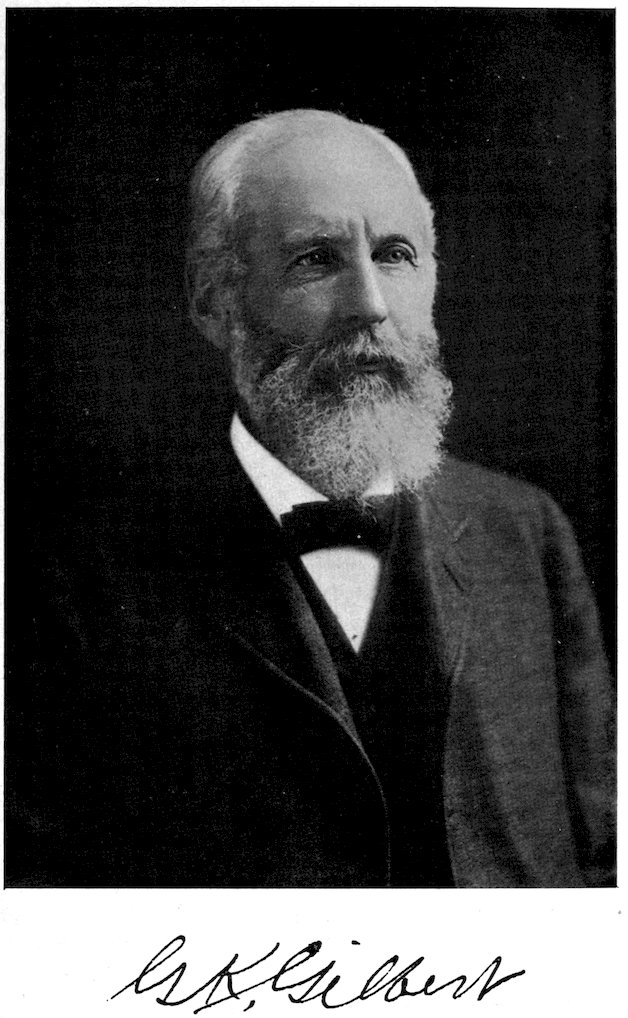
141With the observations of Gilbert, Chamberlin, and
King in mind, the terminal moraine was traced by
various workers across the United States and into
Canada and the extent of glacial cover revealed. Following
1875 the pages of the Journal contain many contributions
dealing with the origin and structure of
moraines, eskers, kames, and drumlins. Before 1890
twenty-eight papers on the glacial phenomena of the Erie
and Ohio basin alone had appeared. By 1900 substantial
agreement had been reached regarding the significant
features of the drift, the outline history of the Great
Lakes had been written, and the way had been paved for
stratigraphic studies of the Pleistocene, which bulk large
in the pages of the Journal for the last two decades.
For a decade following the general acceptance of the
glacial origin of “diluvium,” the deposits were embraced
as “drift” and treated as the products of one long period
of glacial activity, and throughout the controversy of
iceberg and glacier the unity of the glacial period was
unquestioned. Beds of peat and fossiliferous lacustrine
deposits in Switzerland, England, and in America and
the recognition of an “upper” and a “lower” diluvium
by Scandinavian geologists suggested two epochs, and as
the examples of such deposits increased in number and
it became evident that the plant fossils represented forms
demanding a genial climate and that the phenomena
were seen in many countries, the belief grew that minor
fluctuations or gradual recession of an ice sheet were
inadequate to account for the phenomena observed.
It is natural that this problem should have found its
solution in America, where the Pleistocene is admirably
displayed, and where the State and Federal surveys were
actively engaged in areal mapping. In 1883 Chamberlin[64]
presented his views under the bold title, “Preliminary
Paper on the Terminal Moraine of the Second
Glacial Epoch,” and the existence of deposits of two or
more ice sheets and the features of interglacial periods
142were substantially established by the interesting debate
in the Journal led by Chamberlin, Wright, Upham and
Dana.[65] Contributions since 1895 have been concerned
with the degree rather than the fact of complexity, and
continued study has resulted in the general recognition
of five glacial stages in North America and four in
Europe.
A curious side-product of the study of glaciation in
North America is the controversy over the origin of loess.
The interest aroused is indicated by scores of papers in
American periodicals and State reports of the last quarter
of the 19th century—papers which bear the names of
prominent geologists.
The “loess” in the valley of the Rhine had long been
known, but the subject assumed prominence by the publication
in 1866 of Pumpelly’s Travels in China.[66] Wide-spread
deposits 200 to 1,000 feet thick were described as
very fine-grained yellowish earth of distinctive structure
without stratification but penetrated by innumerable
tubes and containing land or fresh-water shells. Pumpelly
considered these deposits lacustrine, a view which
found general acceptance though combated by Kingsmill
(1871),[67] who argued for marine deposition. Baron Von
Richthofen’s classic on China, which appeared in 1877,
amplifies the observations of Pumpelly and marshals the
evidence to support the hypothesis that the loess is wind-laid
both on dry land and within ancient salt lakes. The
conclusions of Von Richthofen were adopted by Pumpelly
whose knowledge of the Chinese deposits, supplemented
by studies in Missouri, of which State he was director of
the Geological Survey in 1872–73, placed him in position
to form a correct judgment. He says:[68]
“Recognizing from personal observation the full identity of
character of the loess of northern China, Europe and the Missouri
Valley, I am obliged to reject my own explanation of the
origin of the Chinese deposits, and to believe with Richthofen
that the true loess, wherever it occurs, is a sub-aerial deposit,
formed in a dry central region, and that it owes its structure to
the formative influence of a steppe vegetation.
The one weak point of Richthofen’s theory is in the evident
143inadequacy of the current disintegration as a source of material.
When we consider the immense area covered by loess to depths
varying from 50 to 2,000 feet, and the fact that this is only the
very finest portion of the product of rock-destruction, and again
that the accumulation represents only a very short period of
time, geologically speaking, surely we must seek a more fertile
source of supply than is furnished by the current decomposition
of rock surface.
It seems to me that there are two important sources: I. The
silt brought by rivers, many of them fed by the products of
glacial attrition flowing from the mountains into the central
region. Where the streams sink away, or where the lakes which
receive them have dried up, the finer products of the erosion
of a large territory are left to be removed in dust storms.
II. The second ... source is the residuary products of a
secular disintegration.”
The evidence presented by Pumpelly for the eolian
origin of loess—structure, texture, composition, fossil
content and topographic position—is complete, and to him
belongs the credit for the correct interpretation of the
Mississippi valley deposits. Unfortunately his contribution
came at a time when the geologists of the central
States were intent on tracing the paths and explaining
the work of Pleistocene glaciers, and the belief was
strong that loess was some phase of glacial work. Its
position at the border of the Iowan drift so obviously
suggests a genetic relation that the fossil evidence of
steppe climate suggested by Binney in 1848[69] was minimized.
Students of Pleistocene geology in Minnesota,
Iowa, Nebraska, Missouri, although less vigorous in
expression, were substantially in agreement with Hilgard
(1879).[70] “The sum total of anomalous conditions
required to sustain the eolian hypothesis partakes
strongly of the marvellous.” The last edition of Dana’s
Manual, 1894, and of LeConte’s Geology, 1896, the two
most widely used text-books of their time, oppose the
eolian theory, and Chamberlin, in 1897,[71] states: “the
aqueous hypothesis seems best supported so far as concerns
the deposits of the Mississippi Valley and western
Europe” (p. 795). Shimek, in papers published since
1896 has shown that aquatic and glacial conditions can
not account for the loess fossils, and the return to the
views of Pumpelly that the loess was deposited on land
144by the agency of wind in a region of steppe vegetation is
now all but universal.
Within the present generation sculpture by glaciers has
received much attention and has involved a reconsideration
of the ability of ice to erode which in turn involves
a crystallization of views of the mechanics of moving ice.
The evidence for glacier erosion has remained largely
physiographic and rests on a study of land forms. In
fact, the inadequacy of structural features or of river
corrasion to account for flat-floored, steep-walled gorges,
hanging valleys, and many lake basins, rather than a
knowledge of the mechanics of ice has led to the present
fairly general belief that glaciers are powerful agents of
rock sculpture. The details of the process are not yet
understood.
Erosion by glaciers enters the arena of active discussion
in 1862–63. The possibility had been suggested by
Esmark (1827) and by Dana (1849) in the description of
fiords and by Hind (1855) with reference to the origin
of the Great Lakes. It appears full-fledged in Ramsay’s
classic, which was published simultaneously in England
and in America.[72] The argument runs as follows:
There is a close association of ancient glaciers and lakes
especially in mountains; glaciers are amply able to
erode; evidences of faulting, special subsidence, river
erosion, and marine erosion are absent from the lake
basins of Switzerland and Great Britain. To quote
Ramsay:
“It required a solid body grinding steadily and powerfully in
direct and heavy contact with and across the rocks to scoop out
deep hollows, the situations of which might either be determined
by unequal hardness of the rocks, by extra weight of ice in
special places, or by accidental circumstances, the clue to which
is lost from our inability perfectly to reconstruct the original
forms of the glaciers.”
“I believe with the Italian geologists, that all that the glaciers
as a whole effected was only slightly to deepen these valleys and
materially to modify their general outlines, and, further (a theory
I am alone responsible for), to deepen them in parts more
considerably when, from various causes, the grinding power of
145the ice was unusually powerful, especially where, as in the lowlands
of Switzerland, the Miocene strata are comparatively soft.”
Whittlesey (1864)[73] considered that the rock-bound
lakes and narrow bays near Lake Superior were partly
excavated by ice. LeConte (1875)[74] records some significant
observations in a pioneer paper on glacier
erosion which has not received adequate recognition.
He says:
“... I am convinced that a glacier, by its enormous pressure
and resistless onward movement, is constantly breaking off large
blocks from its bed and bounding walls. Its erosion is not only a
grinding and scoring, but also a crushing and breaking. It
makes by its erosion not only rock-meal, but also large rock-chips....
Its erosion is a constant process of alternate rough
hewing and planing.
If Yosemite were unique, we might suppose that it was
formed by violent cataclysms; but Yosemite is not unique in
form and therefore probably not in origin. There are many
Yosemites. It is more philosophical to account for them by the
regular operation of known causes. I must believe that all these
deep perpendicular slots have been sawn out by the action of glaciers;
the peculiar verticality of the walls having been determined
by the perpendicular cleavage structure.”... A lake in Bloody
Canyon “is a pure rock basin scooped out by the glacier at this
place.... These ridges [separating Hope, Faith, and Charity
valleys] are in fact the lips of consecutive lake basins scooped
out by ice.
... Water tends to form deep V-shaped canons, while ice produces
broad valleys with lakes and meadows.... I know not
how general these distinctions may be, but certainly the Coast
range of this State is characterized by rounded summits and
ridges, and deep V-shaped canons, while the high Sierras are
characterized on the contrary by sharp, spire-like, comb-like
summits, and broad valleys; and this difference I am convinced
is due in part at least to the action of water on the one hand,
and of ice on the other.”
King (1878)[75] assigned to glacial erosion a commanding
position in mountain sculpture. In regard to the
Uintas, he says:
“Glacial erosion has cut almost vertically down through the
beds carving immense amphitheatres with basin bottoms containing
numerous Alpine lakes.... Post-glacial erosion has done
146an absolutely trivial work. There is not a particle of direct
evidence, so far as I can see, to warrant the belief that these
U-shaped canons were given their peculiar form by other means
than the actual ploughing erosion of glaciers....”
These contributions from the Cordilleras corroborating
the conclusions of Ramsay (1862), Tyndall (1862),
Jukes (1862), Hector (1863), Logan (1863), Close (1870),
and James Geikie (1875), made little impression. The
views of Lyell (1833), Ball (1863), J. W. Dawson (1864),
Falconer (1864), Studer (1864), Murchison (1864, 1870),
Ruskin (1865), Rutimeyer (1869), Whymper (1871),
Bonney (1873), Pfaff (1874), Gurlt (1874), Judd (1876),
prevailed, and the conclusions of Davis in 1882[76] fairly
expressed the prevailing belief in Europe and in
America:
“The amount of glacial erosion in the central districts has
been very considerable, but not greatly in excess of pre-glacial
soils and old talus and alluvial deposits. Most of the solid rock
that was carried away came from ledges rather than from valleys;
and glaciers had in general a smoothing rather than a
roughening effect. In the outer areas on which the ice advanced
it only rubbed down the projecting points; here it acted more
frequently as a depositing than as an eroding agent.”
During the past quarter-century the cleavage in the
ranks of geologists, brought about by Ramsay’s classic
paper, has remained. Fairchild and others in America,
Heim, Bonney, and Garwood in Europe argue for insignificant
erosion by glaciers; and Gannet, Davis, Gilbert,
Tarr in America followed by Austrian workers present
evidence for erosion on a gigantic scale. A perusal of
the voluminous literature in the Journal and elsewhere
shows that the difference of opinion is in part one of
terms, the amount of erosion rather than the fact of
erosion; it also arises from failure to differentiate the
work of mountain glaciers and continental ice sheets, of
Pleistocene glaciers and their present diminished representatives.
The irrelevant contribution of physicists has
also made for confusion.
It is interesting to note that the criteria for erosion
of valleys by glaciers has long been established and
by workers in different countries. Ramsay (1862) in
147England outlined the problem and presented generalized
evidence. Hector (1863) in New Zealand pointed out
the significance of discordant drainage, the “hanging
valleys” of Gilbert. The U-form, the broad lake-dotted
floor, and the presence of cirques and the process of
plucking were probably first described by LeConte
(1873) in America. The truncation of valley spurs by
glaciers pointed out by Studer in the Kerguelen Islands
(1878) was used by Chamberlin (1883) as evidence of
glacial scouring.
During the past century many principles of land
sculpture have emerged from the fog of intellectual
speculation and unorganized observation and taken their
place among generally accepted truths. Many of them
are no longer subjects of controversy. Erosion has
found its place as a major geologic agent and has given
a new conception of natural scenery. Lofty mountains
are no longer “ancient as the sun,” they are youthful
features in process of dissection; valleys and canyons
are the work of streams and glaciers; fiords are erosion
forms; waterfalls and lakes are features in process of
elimination; many plains and plateaus owe their form
and position to long-continued denudation. Modern
landscapes are no longer viewed as original features or
the product of a single agent acting at a particular time,
but as ephemeral forms which owe their present appearance
to their age and the particular forces at work upon
them as well as to their original structure.
It is interesting to note the halting steps leading to the
present viewpoint, to find that decades elapsed between
the formulation of a theory or the recording of significant
facts and their final acceptance or rejection, and to
realize that the organization of principles and observations
into a science of physiography has been the work
of the present generation. Progress has been conditioned
by a number of factors besides the intellectual
ability of individual workers.
The influence of locality is plainly seen. Convincing
evidence of river erosion was obtained in central France,
the Pacific Islands, and the Colorado Plateau—regions
148in which other causes were easily eliminated. Sculpture
by glaciers passed beyond the theoretical stage when the
simple forms of the Sierras and New Zealand Alps were
described. The origin of loess was first discerned in a
region where glacial phenomena did not obscure the
vision. The complexity of the Glacial period asserted by
geologists of the Middle West was denied by eastern
students. The work of waves on the English coast
impressed British geologists to such an extent that plains
of denudation and inland valleys were ascribed to
ocean work.
In the establishment of principles, the friendly interchange
of ideas has yielded large returns. Many of the
fundamental conceptions of earth sculpture have come
from groups of men so situated as to facilitate criticism.
It is impossible, even if desirable, to award individual
credit to Venetz, Charpentier, and Agassiz in the formulation
of the glacial theory; and the close association of
Agassiz and Dana in New England and of Chamberlin
and Irving in Wisconsin was undoubtedly helpful in
establishing the theory of continental glaciation. From
the intimate companionship in field and laboratory of
Hutton, Playfair and Hope, arose the profound influence
of the Edinburgh school, and the sympathetic cooperation
of Powell, Gilbert, and Dutton has given to the world its
classics in the genetic study of land forms.
The influence of ideas has been closely associated with
clarity, conciseness, and attractiveness of presentation.
Hutton is known through Playfair, Agassiz’s contributions
to glacial geology are known to every student, while
Venetz, Charpentier, and Hugi are only names. Cuvier’s
discourses on dynamical geology were reprinted and
translated into English and German, but Lamarck’s
“Hydrogéologie” is known only to book collectors. The
verbose works of Guettard, although carrying the same
message as Playfair’s “Illustrations” and Desmarest’s
“Memoirs,” are practically unknown, as is also Horace
H. Hayden’s treatise (1821) on the drift of eastern
North America. It has been well said that the world-wide
influence of American physiographic teaching is due
in no small part to the masterly presentations of Gilbert
and Davis.
149It is surprising to note the delays, the backward steps,
and the duplication of effort resulting from lack of
familiarity with the work of the pioneers. Sabine says
in 1864:[77]
“It often happens, not unnaturally, that those who are most
occupied with the questions of the day in an advancing science
retain but an imperfect recollection of the obligations due
to those who laid the first foundations of our subsequent
knowledge.”
The product of intellectual effort appears to be conditioned
by time of planting and character of soil as well
as by quantity of seed. For example: Erosion by
rivers was as clearly shown by Desmarest as by Dana and
Newberry 50 years later. Criteria for the recognition of
ancient fluviatile deposits were established by James
Deane in 1847 in a study of the Connecticut Valley
Triassic. Agassiz’s proof that ice is an essential factor
in the formation of till is substantially a duplication of
Dobson’s observations (1826).
The volumes of the Journal with their very large number
of articles and reviews dealing with geology show
that the interpretation of land forms as products of
subaërial erosion began in France and French Switzerland
during the later part of the eighteenth century as a
phase of the intellectual emancipation following the Revolution.
Scotland and England assumed the leadership
for the first half of the nineteenth century, and the first
100 volumes of the Journal show the profound influence
of English and French teaching. In America, independent
thinking, early exercised by the few, became general
with the establishment of the Federal survey, the increase
in university departments, geological societies and periodicals,
and has given to Americans the responsibilities
of teachers.
(In the following list “this Journal” refers to the American Journal
of Science.)
IV A CENTURY OF GEOLOGY.—THE GROWTH OF KNOWLEDGE OF EARTH STRUCTURE — Introduction The Intellectual Viewpoint in 1818. — The Prolonged Influence of Outgrown Ideas. — Structures and Relationships of Igneous Rocks. — Opposed Interpretations of Plutonists and Neptunists. — Contributions on Volcanic and Intrusive Rocks. — Origin of Greenstone. — Views on the Structural Relations of Granite. — Rise and Decline of the Metamorphic Theory of Granite. — Orogenic Structures. — Views of Plutonists and Neptunists. — Recognition of Appalachian Structures. — Nature of Forces Producing Folding. — The Theory of Geosynclines and Geanticlines. — “ Kinds and Structure of Mountains. ” — “ The Condition of the Earth’s Interior. ” — The Ultimate Cause of Crustal Compression. — The New Era in the Interpretation of Mountain Structures. — Crust Movements as Revealed by Physiography. — Relations of Crust Movements to Density and Equilibrium. — Conclusion on Contributions of America to Theories of Orogeny. — Notes.
153
In 1818, the year of the founding of the Journal, the
natural sciences were still in their infancy in Europe.
Geology was still subordinate to mineralogy, was
hardly recognized as a distinct science, and consisted in
little more than a description of the character and distribution
of minerals and rocks. America was remote from
the Old World centers of learning. The energy of the
young nation was absorbed in its own expansion, and but
a few of those who by aptitude were fitted to increase
scientific knowledge were even conscious of the existence
of such a field of endeavor. Under these circumstances
the educative field open to a journal of science in the
United States was an almost virgin soil. Original contributions
could most readily be based upon the natural
history of the New World, and the founder of the Journal
showed insight appreciative of the situation in stating in
the “Plan of the Work” in the introduction to the first
volume that “It will be a leading object to illustrate
American Natural History, and especially our Mineralogy
and Geology.”
At this time educated people were still satisfied that
the whole knowledge of the origin and development of
the earth so far as man could or should know it was
embraced in the Book of Genesis. They were inclined to
look with misgiving at attempts to directly interrogate the
earth as to its history. Philosophers such as Descartes
154and Liebnitz, the cosmogonists de Maillet and Buffon
had been less instrumental in developing science than in
fitting a few facts and many speculations to their systems
of philosophy. By the opening of the nineteenth century,
however, men of learning were coming to appreciate
that the way to advance science was to experiment
and observe, to collect facts and discourage unfounded
speculation. Silliman’s insight into the needs of geologic
science is shown in the following quotation (1, pp. 6,
7, 1818):
“Our geology, also, presents a most interesting field of inquiry.
A grand outline has recently been drawn by Mr. Maclure, with
a masterly hand, and with a vast extent of personal observation
and labour: but to fill up the detail, both observation and labour
still more extensive are demanded; nor can the object be
effected, till more good geologists are formed, and distributed
over our extensive territory.
To account for the formation and changes of our globe, by
excursions of the imagination, often splendid and imposing, but
usually visionary, and almost always baseless, was, till within
half a century, the business of geological speculations; but this
research has now assumed a more sober character; the science
of geology has been reared upon numerous and accurate observations
of facts; and standing thus upon the basis of induction,
it is entitled to a rank among those sciences which Lord
Bacon’s Philosophy has contributed to create. Geological
researches are now prosecuted by actually exploring the structure
and arrangement of districts, countries, and continents.
The obliquity of the strata of most rocks, causing their edges
to project in many places above the surface; their exposure, in
other instances on the sides or tops of hills and mountains;
or, in consequence of the intersection of their strata, by roads,
canals, and river-courses, or by the wearing of the ocean; or
their direct perforation, by the shafts of mines; all these causes,
and others, afford extensive means of reading the interior
structure of the globe.
The outlines of American geology appear to be particularly
grand, simple, and instructive; and a knowledge of the important
facts, and general principles of this science, is of vast practical
use, as regards the interests of agriculture, and the research
for useful minerals. Geological and mineralogical descriptions,
and maps of particular states and districts, are very much
needed in the United States; and to excite a spirit to furnish
them will form one leading object of this Journal.”
155
Those interested in any branch of science should, as a
matter of education, read the history of that special subject.
A knowledge of the stages by which the present
development has been attained is essential to give a
proper perspective to the literature of each period.
Much of the existing terminology is an inheritance from
the first attempts at nomenclature, or may rest upon
theories long discarded. Popular notions at variance
with advanced teaching are often the forgotten inheritance
of a past generation.
Gneiss, trap, and Old Red Sandstone are names which
we owe to Werner. The “Tertiary period” and “drift”
are relics of an early terminology. The geology of
tourist circulars still speaks of canyons as made by “convulsions
of nature.” Popular writers still attribute to
geologists a belief in a molten earth covered by a thin
crust. Within the present century the eighteenth century
speculations of Werner and his predecessors, postulating
a supposed capacity of water to seep through the
crust into the interior of the earth, resulting in a hypothetical
progressive desiccation of the surface, views long
abandoned by most modern geologists, have been revived
by an astronomer into a theory of “planetology.”
A review of the literature of a century brings to light
certain tendencies in the growth of science. Each decade
has witnessed a larger accumulation of observed facts
and a fuller classification of these fundamental data, but
the pendulum of interpretative theory swings away from
the path of progress, now to one side, now to the other,
testing out the proper direction. For decades the understanding
of certain classes of facts may be actually retrogressive.
A retrospect shows that certain minds, keen
and unfettered by a prevailing theory, have in some
directions been in advance of their generation. But the
judgment of the times had not sufficient basis in knowledge
for the separation and acceptance of their truer
views from the contemporaneous tangle of false interpretations.
An interesting illustration of these statements regarding
156the slow settling of opinion may be cited in regard to
the significance of the dip of the Triassic formations of
the eastern United States. The strata of the Massachusetts-Connecticut
basin possess a monoclinal easterly dip
which averages about 20 degrees to the east. Those of
the New Jersey-Pennsylvania-Virginia basin possess a
similar dip to the northwest. Both basins are cut by
great faults and the dip is now accepted by practically
all geologists as due to rotation of the crust blocks
away from a geanticlinal axis between the two basins.
Edward Hitchcock, whose work from the first shows an
interpretative quality in advance of his time, states in
1823 (6,74) regarding the dip of the Connecticut valley
rocks:
“There is reason to believe that Mount Toby, the strata of
which are almost horizontal, exhibits the original dip of these
rocks, and that those cases in which they are more highly inclined
are the result of some Plutonian convulsion. Such irregularity
in the dip of coal fields is no uncommon occurrence.”
In Hitchcock’s Geology of Massachusetts, published in
1833, ten years later, geological structure sections of the
Connecticut Valley rocks are given, the facts are discussed
in detail and the dip ascribed to the elevatory
forces. He says (l. c., pp. 213, 223):
“If it were possible to doubt that the new red sandstone
formation was deposited from water, the surface of some of the
layers of this shale would settle the question demonstrably.
For it exhibits precisely those gentle undulations, which the
loamy bottom of every river with a moderate current, presents.
(No. 198.) But such a surface could never have been formed
while the layers had that high inclination to the horizon, which
many of them now present: so that we have here, also, decisive
evidence that they have been elevated subsequently to their
deposition....
The objection of a writer in the American Journal of Science,
that such a height of waters as would deposit Mount Toby, must
have produced a lake nearly to the upper part of New Hampshire,
in the Connecticut Valley, and thus have caused the same
sandstone to be produced higher up that valley than Northfield,
loses its force, when it is recollected that this formation was
deposited before its strata were elevated. For the elevating
force undoubtedly changed the relative level of different parts
of the country. In this case, the disturbing force must have
acted beneath the primary rocks. And besides, we have good
evidence which will be shown by and by, that our new red
sandstone was formed beneath the ocean. We cannot then
reason on this subject from present levels.”
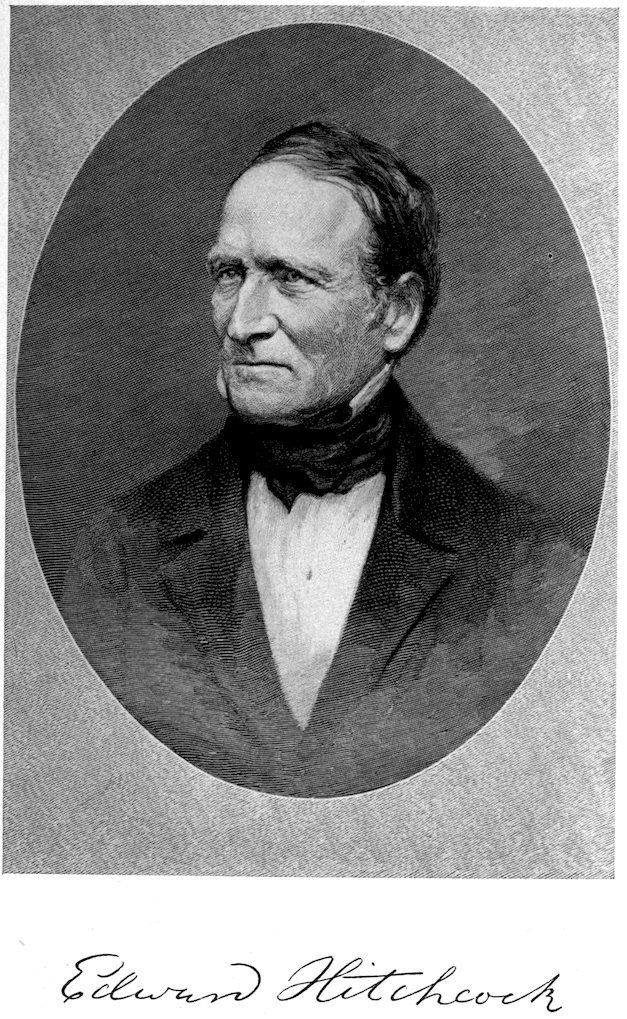
Courtesy of Popular Science Monthly.
157In 1840, H. D. Rogers, a geologist who has acquired a
more widely known name than Hitchcock, but who in
reality showed an inferior ability in interpretation, made
the following statements in explanation of the regional
monoclinal dip of the New Jersey Triassic rocks averaging
15 to 20 degrees to the northwest:[78]
“Their materials give evidence of having been swept into this
estuary, or great ancient river, from the south and southeast,
by a current producing an almost universal dip of the beds
towards the northwest, a feature clearly not caused by any
uplifting agency, but assumed originally at the time of their
deposition, in consequence of the setting of the current from the
opposite or southeastern shore.”
In 1842, at the third annual meeting of the Association
of American Geologists both H. D. and W. B. Rogers
argued (43, 170, 1842) against Sir Charles Lyell and E.
Hitchcock that the present dip of the Triassic was the
original slope of deposition, stating among other reasons
that the footprints impressed upon the sediments often
showed a slipping and a pushing of the soft clay in the
direction of the downhill slope. In 1858 H. D. Rogers
still held to the same views of original dip,[79] notwithstanding
that a moderate amount of observation on the mud-cracked
and rain-pitted layers would have supplied the
proof that such must have dried as horizontal surfaces.
The idea of inclined deposition is not yet wholly dead as
it has been suggested more than once within the present
generation as a means of escaping from the necessity of
accepting the very great thicknesses of this and similar
formations. Thus, as Brögger has remarked in another
connection,—the ghosts of the old time stand ever ready
to reappear.
In the present essay on the rise of structural geology
as reflected through a century of publication in the
Journal, attention will be given especially to two fields,
that of structures connected with igneous rocks and that
158of structures connected with mountain making, and
emphasis will be placed upon the growth of understanding
rather than upon the accumulating knowledge of
details. The growth in both of these divisions of structural
geology is well illustrated in the volumes of the
Journal.
During the first quarter of the nineteenth century the
geologic controversy between the Plutonists and Neptunists
was at its height; the Plutonists, following the
Scotchman, Hutton, holding to the igneous origin of
basalt and granite, the Neptunists, after their German
master, Werner of Freiberg, maintaining that these
rocks had been precipitated from a primitive universal
ocean. The Plutonists, although time has shown them to
have been correct in all essential particulars, were for a
generation submerged under the propaganda carried forward
by the disciples of Werner. The “Illustrations of
the Huttonian Theory of the Earth,” a remarkable classic,
worthy of being studied to-day as well as a century
ago, was published in 1802 by John Playfair, professor of
mathematics in the University of Edinburgh and a friend
of Hutton, who had died five years previously. This
volume was opposed by Robert Jameson, professor of natural
philosophy in the same university, who had absorbed
the ideas of the German school while at Freiberg
and published in 1808 a volume on the “Elements of
Geognosy,” in which the philosophy of Werner is followed
throughout and even obsidian and pumice are
argued to be aqueous precipitates. The authority of the
Wernerian autocracy caused its nomenclature to be
adopted in the new world, but strong evidence against
its interpretations was to be found in the actual structural
relations displayed by the igneous rocks.
The accumulation and study of facts constituted the
best cure for an erroneous theory. The publications of
the Journal contributed toward this end by articles along
159several lines. The most original contributions were those
which dealt with the areal and structural geology of
eastern North America, but equally valuable at that
time for the broadening of scientific interest were
the studies on the volcanic activities of the Hawaiian
Islands, published through many years. Perhaps most
valuable from the educative standpoint were the extensive
republications in the Journal of the more important
European researches, making them accessible to American
readers. In volume 13 (1828), for example, a digest
of Scrope’s work on volcanoes is given, covering forty
pages; and of Daubeny on active and extinct volcanoes,
running over seventy-five pages and extending into vol.
14. Through these comprehensive studies the nature of
volcanic action became generally understood during the
first half of the nineteenth century and the original publications
in the Journal were valuable in giving a knowledge
of the activities of the Hawaiian volcanoes.
Early in the nineteenth century the whole of America
still remained to be explored by the geologist. The
regions adjacent to the centers of learning were among
the first to receive attention and the Triassic basin of
Connecticut and Massachusetts yielded information in
regard to the nature of igneous intrusion. This basin,
of unmetamorphic shales and sandstones, is occupied by
the Connecticut River except at its southern end. The
Formation contains within it sills, dikes, and outflows of
basaltic rocks which because of their superior resistance
to erosion constitute prominent hills, in places bounded
by cliffs.
Silliman in 1806[80] described East Rock, New Haven,
Connecticut, as a whinstone, trap, or basalt, and
accounted for its presence on the supposition that it had
“actually been melted in the bowels of the earth and ejected
among the superior strata by the force of subterraneous fire,
but never erupted like lava, cooling under the pressure of the
superincumbent strata and therefore compact or nonvesicular,
its present form being due to erosion.”
In these conclusions Silliman was correct. With but a
limited amount of experience he was able to discriminate
between the intrusive and effusive rocks and saw that the
160prominence of this hill was due to the erosion of the sediments
which once surrounded it.
An extensive paper on the geology of this region was
published by Edward Hitchcock in 1823,[81] then just thirty
years of age. This paper shows the evidence of extensive
field observations, and his comments in regard to
the trap and granite are of interest. Hitchcock gives
five pages to the subject of “Greenstone Dykes in Old
Red Sandstone” (6, 56–60, 1823) and makes the following
statements:
“Professor Silliman conducted me to an interesting locality
of these in East-Haven. They occur on the main road from
New-Haven to East-Haven, less than half a mile from Tomlinson’s
bridge ... (p. 56).
They are an interesting feature in our geology, and deserve
more attention; and it is peculiarly fortunate that they should
be situated so near a geological school and the first mineral
cabinet in our country ... (p. 58).
Does the greenstone of the Connecticut afford evidence in
favour of the Wernerian or of the Huttonian theory of its
origin? Averse as I feel to taking a side in this controversy, I
cannot but say, that the man who maintains, in its length and
breadth, the original hypothesis of Werner in regard to the
aqueous deposition of trap, will find it for his interest, if he
wishes to keep clear of doubts, not to follow the example of
D’Aubuisson, by going forth to examine the greenstone of this
region, lest, like that geologist, he should be compelled, not only
to abandon his theory, but to write a book against it. Indeed,
when surveying particular portions of this rock, I have sometimes
thought Bakewell did not much exaggerate when he said
in regard to Werner’s hypothesis, that, ‘it is hardly possible
for the human mind to invent a system more repugnant to
existing facts.’
On the other hand, the Huttonian would doubtless have his
heart gladdened, and his faith strengthened by a survey of the
greater part of this rock. As he looked at the dikes of the old
red sandstone, he would almost see the melted rock forcing its
way through the fissures; and when he came to the amygdaloidal,
especially to that variety which resembles lava, he might
even be tempted to apply his thermometer to it, in the suspicion
that it was not yet quite cool ... (p. 59).
By treating the subject in this manner I mean no disrespect
to any of the distinguished men who have adopted either side of
161this question. To President Cooper especially, who regards the
greenstone of the Connecticut as volcanic, I feel much indebted
for the great mass of facts he has collected on the subject. And
were I to adopt any hypothesis in regard to the origin of our
greenstone, it would be one not much different from his” (p. 60).
By 1833 and more clearly in 1841 Hitchcock had come
to recognize the distinction between intrusive and extrusive
basaltic sheets in the Connecticut valley. Dawson
also came to regard the Acadian sheets as extrusive, and
Emerson in 1882 recalled again the evidence for Massachusetts
(24, 195, 1882). Davis, however, went a step
further and by applying distinctive criteria not only separated
intrusive and extrusive sheets throughout the
whole Triassic area, but by using basalt flows as stratigraphic
horizons unraveled for the first time the system
of faults which cut the Triassic system. His preliminary
paper (24, 345, 1882) was followed by many others.
From 1880 onward begins the period of precise structural
field work. The older geologists mostly conceived
their work after reconnaissance methods. From 1870 to
1880 a group of younger men entered geology who paid
close attention to the solid geometry and mechanics of
earth structures. In their hands physical and dynamical
geology began to assume the standing of a precise and
quantitative science. In the field of intrusive rocks the
opening classic was by Gilbert, who in his volume on the
geology of the Henry Mountains, published in 1880, made
laccoliths known to the world. With the beginning of
this new period we may well leave the subject of intrusive
rocks and turn to the progress of knowledge in
regard to those deeper and vaster bodies now known as
batholiths. These, since erosion does not expose their
bottoms, Daly separates from intrusives and classifies as
subjacent. The batholiths consist typically of granite
and granodiorite, and introduce us to the problem of
granite.
Conscientious field observations were sufficient to
establish the true nature of the intrusive and extrusive
rocks. The case was very different, however, with the
162nature and relations of the great bodies of granite,
which may be taken in the structural sense as including
all the visibly crystalline acidic and intermediate rocks,
known more specifically as granite, syenite, and diorite.
The large bodies of granite, structurally classified as
stocks, or batholiths, commonly show wedges, tongues, or
dike networks cutting into the surrounding rocks. The
relations, however, are not all so simple as this. Granites
may cover vast areas, they are usually the older
rocks, they are generally associated with regional
metamorphism of the intruded formations, which metamorphism
is now understood to be due chiefly to the heat
and mineralizers given off from the granite magma, associated
with mashing and shearing of the surrounding
rocks. The granite was often injected in successive
stages which alternated with the stages of regional mashing.
A parallel or gneissic structure is thus developed
which is in part due to mashing, in part to igneous injection.
Where the ascent of heat into the cover is excessive,
or where blocks are detached and involved in the
magma, the latter may dissolve some of the older cover
rocks, even where these were of sedimentary origin.
Thus between mashing, injection, and assimilation the
genetic relationships of a batholith to its surroundings
are in many instances obscure. Nevertheless, attention
to the larger relations shows that the molten magma originated
at great depths in the earth’s crust, far below the
bottoms of geosynclines, and consists of primary igneous
material, not of fused sediments. From those depths it
has ascended by various processes into the outer crust,
where it crystallized into granite masses, to be later
exposed by erosion. The amount of material which can
be dissolved and assimilated must be small in comparison
with the whole body of the magma. The original
composition of the magma was probably basic, nearer
that of a basalt than that of a granite. Differentiation
of the molten mass is thought to cause the upper and
lower parts of the chamber to become unlike, the lighter
and more acidic portion giving rise to the great bodies of
granite. With the exception of certain border zones the
whole, however, is regarded as igneous rock risen from
the depths.
163The complex border relations, but more particularly
certain academic hypotheses, led to a period of misunderstanding
and retrogression in regard to the nature of
granites. It constitutes an interesting illustration of
the possibility of a wrong theory leading interpretation
astray, chiefly through the magnification of minor into
major factors. This history illustrates the dangers of
qualitative science as compared to quantitative, of a
single hypothesis as matched against the method of multiple
working hypothesis. This flux of opinion in regard
to the nature of granites may be traced through the volumes
of the Journal.
E. Hitchcock in 1824 (6, 12) noted that in places granite
appeared bedded, but in other places existed in veins
which cut obliquely across the strata. Silliman, although
careful not to deny the aqueous origin of some basalts,
yet held that the field evidence of New England indicates
for that region the igneous or Huttonian origin of trap
and granite (7, 238, 1824).
In 1832 the following article by Hitchcock appeared in
the Journal (22, 1, 70):
Report on the Geology of Massachusetts; examined under the
direction of the Government of that State, during the years
1830 and 1831; by Edward Hitchcock, Prof. of Chemistry and
Natural History in Amherst College.
A footnote adds that this is “published in this Journal by
consent of the Government of Massachusetts, and intended to
appear also in a separate form, and to be distributed among the
members of the Legislature of the same State, about the time
of its appearance in this work. It is, we believe, the first example
in this country, of the geological survey of an entire State.”
This article includes a geological map of the state and
covers the subject of economic geology. The report
brought forth the following remarks from a French
reviewer in the Revue Encyclopédique, Aug. 1832, quoted
in the Journal (23, 389, 1833):
“A single glance at this report, is sufficient to convince any
one of the utility of such a work, to the state which has undertaken
it; and to regret that there is so very small a part of the
French territory, whose geological constitution is as well known
to the public, as is now the state of Massachusetts. France has
the greater cause to regret her being distanced in this race by
164America, from her having a corps of mining engineers, who
if they had the means, would, in a very short time furnish a
work of the same kind, still more complete, of each of the
departments.”
The complete report published in 1833 is a work of 700
pages. Pages 465 to 517 are devoted to the subject of
granite. Numerous detailed sketches are given showing
contact relations. Nine pages are given to theoretical
considerations and many lines of proof are given that
granite is an igneous rock, molten from the internal heat
of the earth, and intruded into the sedimentary strata.
His statement is the clearest published in the world, so
far as the writer is aware, up to that date, and marks
Edward Hitchcock as one of the leading geologists of his
generation in Europe as well as America. Unfortunately
his views were largely lost to sight during the following
generation.
In 1840 the first American edition of Mantell’s Wonders
of Geology gave currency to the idea that granite is
proved to be of all geological ages up to the Tertiary
(39, 6, 1840). In 1843 J. D. Dana pointed out (45, 104)
that schistosity was no evidence of sedimentary origin.
He regarded most granites as igneous as shown by their
structural relations, but considers that some may have
had a sedimentary origin.
Up to 1860 granite was regarded on the basis
of the facts of the field as essentially an intrusive
rock, but gneiss as a metamorphic product mostly of sedimentary
origin. It seemed as though sound methods of
research and interpretation were securely established.
Nevertheless, a new era of speculation and a modified
Wernerism arose at that time with a paper by T. Sterry
Hunt, marking a retrogression in the theory of granite
which lasted until his death in 1892.
In November, 1859, Hunt read before the Geological
Society of London a paper on “Some Points in Chemical
Geology” in which he announced that igneous rocks are
in all cases simply fused and displaced sediments, the
fusion taking place by the rise of the earth’s internal
165heat into deeply buried and water-soaked masses of sediments
(see 30, 133, 1860). The germ of this idea of
aqueo-igneous fusion was far older, due to Babbage and
John Herschel, neither of them geologists, but such
sweeping extensions of it had never before been published.
Hunt had the advantage of a wide acquaintanceship
with geological literature and chemistry. He wrote
plausibly on chemical and theoretical geology, but his
views were not controlled by careful field observations.
In fact he wrote confidently on regions which apparently
he had never seen and where a limited amount of field
work would have shown him to have been fundamentally
in error. A man of egotistical temperament, he sought
to establish priority for himself in many subjects and in
order to cover the field made many poorly founded assertions.
Building on to another Wernerian idea, he held
that many metamorphic minerals had a chronologic value
comparable to fossils—staurolite for example indicating
a pre-Silurian age—and on this basis divided the crystalline
rocks into five series. Although there is much of
value buried in Hunt’s work it is difficult to disentangle
it, with the result that his writings were a disservice to
the science of geology. Although carrying much weight
in his lifetime, they have passed with his death nearly
into oblivion.
Marcou, with a limited knowledge of American geology,
and but little respect for the opinions of others, had
published a geologic map of the United States containing
gross errors. In support of his views he read in November,
1861, a paper on the Taconic and Lower Silurian
Rocks of Vermont and Canada. In the following year
he was severely reviewed by “T,” who states positively
in controverting Marcou (33, 282, 283, 1862) that “the
granites (of the Green Mountains) are evidently strata
altered in place.”
“Mr. Marcou should further be informed that the granites
of the Alpine summits, instead of being, as was once supposed,
eruptive rocks, are now known to be altered strata of newer
Secondary and Tertiary age. A simple structure holds good in
the British Islands, where as Sir Roderick Murchison has shown
in his recent Geological map of Scotland, Ben Nevis and Ben
Lawers are found to be composed of higher strata, lying in
166synclinals. This great law of mountain structure would alone
lead us to suppose that the gneiss of the Green mountains,
instead of being at the base, is really at the summit of the
series....
We cannot here stop to discuss Mr. Marcou’s remark about
‘the unstratified and oldest crystalline rocks of the White
mountains’ which he places beneath the lower Taconic series.
Mr. Lesley has shown that these granites are stratified, and with
Mr. Hunt, regards them as of Devonian Age. (This Journal,
vol. 31, p. 403.) Mr. Marcou has come among us with notions
of mountains upheaved by intrusive granites, and similar antiquated
traditions, now, happily for science, well nigh forgotten.”
It is seen that Marcou, notwithstanding the general
character of his work, happened to be nearer right in
some matters than were his critics, and that “T” had
adopted to the limit the views of Hunt.
The recovery of geology from this period of confusion
was partly owing to the slow accumulation of opposed
facts; especially to a recognition of the fact that the
overplaced relation of the granite gneisses in western
Scotland was due to great overthrusts; also to the evidence
of the clearly intrusive nature of many of the
Cordilleran granites. The recovery of a sounder theory
was hastened, however, by the application of criticisms
by J. D. Dana in the Journal. In 1866 (42, 252) Dana
pointed out that sedimentary rocks in Pennsylvania, in
Nova Scotia, and other regions which had been buried to
a depth of at least 16,000 feet are not metamorphic.
Mere depth of burial of sediments was not sufficient
therefore to produce metamorphism and aqueo-igneous
fusion. The baseless and speculative character of the
use of minerals as an index of age and of Hunt’s interpretation
of New England geology in general was shown
by Dana in 1872 (3, 91). The following year Dana
pointed out clearly that igneous eruptions in general
have been derived from a deep-seated source and did not
come from the aqueo-igneous fusion of sediments. As to
gradations between true igneous rocks and fused and
displaced sediments he makes the following statements
(6, 114, 1873):
“Again, the plastic rock-material that may be derived from
the fusion or semifusion of the supercrust, (that is, of rocks
167originally of sedimentary origin,) gives rise to “igneous” rocks
often not distinguishable from other igneous rocks, when it is
ejected through fissures far from its place of origin; while crystalline
rocks are simply metamorphic if they remain in their
original relations to the associated rocks, or nearly so.
Between these latter igneous rocks and the metamorphic there
may be indefinite gradations, as claimed by Hunt. But if our
reasonings are right, the great part of igneous rocks can be
proved to have had no such supercrust origin. The argument
from the presence of moisture or of hydrous minerals in such
rocks in favor of their origin from the fusion of sediments has
been shown to be invalid.”
The injected marginal rocks and the post-intrusive
metamorphism of most of the New England granites has,
however, obscured more or less their real igneous nature
so that the gradation from metamorphic sediments
through igneous gneisses to granites could be read in
either direction. These features misled Dana who
accepted the prevailing idea of the general metamorphic
origin of granite. Dana makes the following statement
(6, 164, 1873):
“But Hunt is right in holding that in general granite and
syenite (the quartz-bearing syenite) are undoubtedly metamorphic
rocks where not vein-formations, as I know from the
study of many examples of them in New England; and the
veins are results of infiltration through heated moisture from
the rocks adjoining some part of the opened fissures they fill.”
Granite, although regarded at this time as the extreme
of the metamorphic series and originating from sediments,
was looked upon as typically Archean in age,
though in some cases younger. Such a doctrine permitted
such extreme misinterpretations as that of
Clarence King and S. F. Emmons on the nature of the
intrusive granite of the Little Cottonwood canyon in the
Wahsatch Range. This body cuts across 30,000 feet of
Paleozoic rocks and to the careful observer, as later
admitted by Emmons, shows clear evidence of its transgressive
nature. But at that time it was generally considered
that granite mountains were capable of resisting
the erosion of all geological time. Consequently it
did not seem incredible to King and his associates that
here a great granite range of Archean origin had stood
168up through Paleozoic time until gradual subsidence had
permitted it to be buried beneath 30,000 feet of sediments.[82]
It may seem to the present day reader that such a misinterpretation,
doing violence to fundamental geologic
knowledge as now recognized, was inexcusable; but in
the light of the history of geology as here detailed it is
seen to have been the interpretation natural to that time.
It is true that a careful examination of the facts of that
very field would have proved the post-Paleozoic and intrusive
nature of that great granite body now known
as the Little Cottonwood batholith, but Emmons has
explained the rapid and partial nature of the observations
which they were compelled to make in order to keep
up to their schedule of progress (16, 139, 1903).
Whitney had found some years earlier that the granites
of the Sierra Nevada were igneous rocks intrusive
into the Triassic and Jurassic strata. The Lake Superior
geologists began to show in the eighties that granite
was there an intrusive igneous rock. R. D. Irving and
Wadsworth noted these relations. Lawson in 1887
pointed out emphatically (33, 473) that the granites of
the Rainy Lake region, although basal, were younger
than the schists which lay above them. The granite gneisses
he held were of clearly the same igneous origin
as the granites and neither gave any field evidence of
being fused and displaced sediments. From this time
forward the truly igneous nature of granite became
increasingly accepted until now the notion of its being
made of sedimentary rocks softened and recrystallized by
the rise of the isogeotherms through deep burial is as
obsolete as the still older doctrine of the Neptunists that
granite was laid down as a crystalline precipitate on the
floor of the primitive ocean.
The recognition of the truly igneous nature of granites
has been followed in the present generation by a series
of studies on their structural relations and mode of
genesis. A number of important initial articles on various
aspects of structure and contact relations have
appeared in the Journal, but this sketch of the history of
the subject may well stop with the introduction to this
modern period.
169
Orogenic structures are, as the name implies, those
connected with the birth of mountains. Nearly synonymous
terms are deformative or secondary structures.
On a small scale this division embraces the phenomena
exposed in the rock ledge or quarry face, or in the dips
and dislocations varying from one exposure to another.
These structures include faults, folds, and foliation. On
a larger scale are included the relations of the different
ranges of a mountain system to each other, relations
to previous geologic history, relations to the earth as a
whole, and to the forces which have generated the structures.
In order to see the stage of development of this subject
in 1818 and its progress as reflected through the publications
of a century, more particularly in the Journal, it
is desirable to turn again to those two treatises emanating
from Edinburgh at the beginning of the nineteenth
century and representing two opposite schools of
thought, the Plutonists and Neptunists.
Playfair, in 1802, devotes nineteen pages to the subject
of the inflection and elevation of strata.[83] He places
emphasis on the characteristic parallelism of the strike
of the folds throughout a region, as shown through the
intersection of the folds by a horizontal plane of erosion.
He contrasts this with the arches shown in a transverse
section and enlarges on our ability to study the deeply
buried strata through the denudation of the folded structure.
He argues from these relations that the structures
can not be explained by the vague appeal of the
Neptunists to forces of crystallization, to slopes of original
deposition, or to sinking in of the roofs of caverns.
The causes he argues were heat combined with pressure.
As to the directions in which the pressure acted he is not
altogether clear, but apparently regards the pressure as
acting in upward thrusts against the sedimentary planes,
the latter yielding as warped surfaces. His method of
presentation is that of inductive reasoning from facts,
but he stopped short of the conception of horizontal compression
through terrestrial contraction.
170Jameson, professor of natural history in the same university,
in 1808 contemptuously ignores the work of Hutton
and Playfair in what he calls the “monstrosities
known under the name of Theories of the Earth.” In a
couple of pages he confuses and dismisses the whole subject
of deformation. He states:[84]
“It is therefore a fact, that all inclined strata, with a very
few exceptions, have been formed so originally, and do not owe
their inclination to a subsequent change.
When we examine the structure of a mountain, we must be
careful that our observations be not too micrological, otherwise
we shall undoubtedly fail in acquiring a distinct conception of
it. This will appear evident when we reflect that the geognostic
features of Nature are almost all on the great scale. In no case
is this rule to be more strictly followed than in the examination
of the stratified structure.
By not attending to this mode of examination, geognosts
have fallen into numberless errors, and have frequently given
to extensive tracts of country a most irregular and confused
structure. Speculators building on these errors have represented
the whole crust of the globe as an irregular and unseemly
mass. It is indeed surprising, that men possessed of any knowledge
of the beautiful harmony that prevails in the structure of
organic beings could for a moment believe it possible, that the
great fabric of the globe itself,—that magnificent display of
Omnipotence,—should be destitute of all regularity in its structure,
and be nothing more than a heap of ruins.”
This was the attitude of a leader of British opinion
toward the subject of deformational geology from which
the infant science had to recover before progress could be
made. The early maps were essentially mineralogical
and lithological. The order of superposition and the
consequent sequence of age was regarded as settled by
Werner in Germany and not requiring investigation in
America. The early examples of structure were sections
drawn with exaggerated vertical scales and those of
Maclure do not show detail.
Following the founding of the Journal in 1818 there is
observable a growth in the quality and detail of geological
mapping. Dr. Aiken, professor of natural philosophy
171and chemistry in Mt. St. Mary’s College, published in the
Journal in 1834 (26, 219) a vertical section extending
between Baltimore and Wheeling, a distance of nearly
250 miles, on a scale of about 7 miles per inch. The succession
of rocks is carefully shown and the direction of
dip, but no attempt is made to show the underground
relations, the stratigraphic sequence, and the folded
structures which are so clear in that Appalachian section.
The text also shows that the author had not recognized
the folded structure. Furthermore, where the folds
cease at the Alleghany mountain front, the flat strata are
shown as resting unconformably on the folded rocks to
the east.
R. C. Taylor, geologist, civil and mining engineer, was
from 1830 to 1835 the leading student of Pennsylvanian
geology as shown by the publication in 1835 of four
papers aggregating over 80 pages in the Transactions of
the Geological Society of Pennsylvania. His work is
noticeable for accuracy in detail and no doubt was influential
in setting a high standard for the state geological
survey which immediately followed.
H. D. and W. B. Rogers have been given credit in this
country, and in Europe also, as being the leading
expounders of Appalachian structure. Merrill speaks of
H. D. Rogers as unquestionably the leading structural
geologist of his time.[85] To the writer, this attributed
position appears to be due to his opportunities rather
than to scientific acumen. The magnificent but readily
decipherable folded structure of Pennsylvania, the relationships
of coal and iron to this structure, the considerable
sums of money appropriated, and the work of a
corps of able assistants were factors which made it comparatively
easy to reach important results. In ability to
weigh facts and interpret them Edward Hitchcock
showed much more insight than H. D. Rogers, while in
the philosophic and comprehensive aspects of the subject
J. D. Dana far outranks him.
H. D. Rogers in his first report on the geological survey
of New Jersey, 1836, recognizes that the Cambro-Silurian
limestones (lower Secondary limestones) were
deposited as nearly horizontal beds and the ridges of
pre-Cambrian gneiss (Primary) had been pushed up as
172anticlinal axes (p. 128). He also clearly recognized the
distinction between slaty cleavage and true dip as shown
in the Ordovician slates (p. 97). Between 1836 and 1840
he had learned a great deal on the nature of folds as is
shown in his Pennsylvania report for 1839 and the structure
sections in his New Jersey report for 1840.
R. C. Taylor, who had now become president of the
board of directors of the Dauphin and Susquehanna Coal
Company, published in the Journal in 1841 (41, 80) an
important paper entitled “Notice of a Model of the
Western portion of the Schuylkill or Southern Coal
Field of Pennsylvania, in illustration of an Address to
the Association of American Geologists, on the most
appropriate modes for representing Geological Phenomena.”
In this paper he calls attention to the value
of modeling as a means of showing true relations in three
dimensions. He condemns the custom prevalent among
geologists of showing structure sections with an exaggerated
vertical scale with its resultant topographic and
structural distortions. Taylor was widely acquainted
with the structure of Pennsylvania, Maryland, and Virginia.
In 1825 Dr. J. H. Steele sent to Professor Silliman two
detailed drawings and description of an overturned fold
at Saratoga Lake, New York. As to the significance of
this feature Steele makes the following statement (9, 3,
1825):
“It is impossible to examine this locality without being
strongly impressed with the belief that the position which the
strata here assume could not have been effected in any other
way than by a power operating from beneath upwards and at
the same time possessing a progressive force; something analogous
to what takes place in the breaking up of the ice of large
rivers. The continued swelling of the stream first overcomes
the resistance of its frozen surface and having elevated it to a
certain extent, it is forced into a vertical position, or thrown
over upon the unbroken stratum behind, by the progressive
power of the current.”
So far as the present writer is aware this is the first
recognition in geological literature of the evidence of a
173horizontally compressive and overturning force as a
cause of folding.
To E. Hitchcock belongs the credit of being the first to
describe overturning and inversion of strata on a large
scale, but without clearly recognizing it as such. In
western Massachusetts metamorphism is extreme in the
lower Paleozoic rocks in the vicinity of the overthrust
mass of Archean granite-gneiss which constitutes the
Hoosic range. The Paleozoic rocks of the valley to the
west are overturned and appear to dip beneath the older
rocks. Farther west the metamorphism fades out and
the series assumes a normal position. Such an inverted
relation, up to that time unknown, is described in 1833 as
follows by Hitchcock in his Geology of Massachusetts
(pp. 297, 298):
“But a singular anomaly in the superposition of the series of
rocks above described, presents a great difficulty in this case.
The strata of these rocks almost uniformly dip to the east: that
is, the newer rocks seem to crop out beneath the older ones; so
that the saccharine limestone, associated with gneiss in the eastern
part of the range, seems to occupy the uppermost place in
the series. Now as superposition is of more value in determining
the relative ages of rocks than their mineral characters, must
we not conclude that the rocks, as we go westerly from Hoosac
mountain, do in fact belong to older groups? The petrifactions
which some of them contain, and their decidedly fragmentary
character, will not allow such a supposition to be indulged for
a moment. It is impossible for a geologist to mistake the evidence,
which he sees at almost every step, that he is passing
from older to newer formations, just as soon as he begins to
cross the valley of Berkshire towards the west. We are driven
then to the alternative of supposing, either that there must be
a deception in the apparent outcrop of the newer rocks from
beneath the older, or that the whole series of strata has been
actually thrown over, so as to bring the newest rocks at the bottom.
The latter supposition is so improbable that I cannot at
present admit it.”
Hitchcock tried to reconcile the evidence by a series of
unconformities and inclined deposition, but finds the solution
unsatisfactory.
In this same year, 1833, Elie de Beaumont, a distinguished
French geologist, published his theory of the
origin of mountains. He advanced the idea that since
174the globe was cooling it was condensing, and the crust,
already cool, must suffer compression in adjusting itself
to the shrinking molten interior. He concluded from the
evidence shown in Europe that the collapse of the crust
occurred violently and rapidly at widely spaced intervals
of time. This hypothesis introduced the idea of mountain
folding by horizontal compressive forces. The theoretical
paper of de Beaumont, together with further
observations by Hitchcock and others, led the latter in
1841 to a final belief in the inversion of strata on a large
scale by horizontal compression. His conclusions are
expressed in an important paper published in the Journal
(41, 268, 1841) and given on April 8, 1841, as the First
Anniversary Presidential Address before the Association
of American Geologists. This comprehensive summary
of American geology occupies 43 pages. Three
pages are given to the inverted structure of the Appalachians
from which the following paragraphs may be
quoted:
“We have all read of the enormous dislocations and inversions
of the strata of the Alps; and similar phenomena are said
to exist in the Andes. Will it be believed, that we have an
example in the United States on a still more magnificent scale
than any yet described?...
Let us suppose the strata between Hudson and Connecticut
rivers, while yet in the plastic state, (and the supposition may
be extended to any other section across this belt of country from
Canada to Alabama,) and while only slightly elevated, were
acted upon by a force at the two rivers, exerted in opposite
directions. If powerful enough, it might cause them to fold
up into several ridges; and if more powerful along the western
than the eastern side, they might fall over so as to take an
inverted dip, without producing any remarkable dislocations,
while subsequent denudation would give to the surface its
present outline....
Fourthly, we should readily admit that such a plication and
inversion of the strata might take place on a small scale. If for
instance, we were to press against the extremities of a series of
plastic layers two feet long, they could easily be made to assume
the position into which the rocks under consideration are thrown.
Why then should we not be equally ready to admit that this
might as easily be done, over a breadth of fifty miles, and a
length of twelve hundred, provided we can find in nature, forces
175sufficiently powerful? Finally, such forces do exist in nature,
and have often been in operation.”
The advanced nature of these conceptions may be
appreciated by contrasting them with those put forth by
H. D. and W. B. Rogers on April 29, 1842, before the third
annual meeting of the same body (43, 177, 1842) and
repeated by them before the British Association at Manchester
two months later. In their own words, the
Rogers brothers from their studies on the folds shown in
Pennsylvania and Virginia, conceived mountain folds in
general to be produced by much elastic vapor escaping
through many parallel fissures formed in succession, producing
violent propulsive wave oscillations on the surface
of the fluid earth beneath a thin crust. Thus actual
billows are assumed to have rolled along through the
crust. They did not think tangential pressure alone
could produce folds. Such pressures were regarded as
secondary, produced by the propagation of the waves and
the only expression of tangential forces which they
admitted was to fix the folds and hold them in position
after the violent oscillation had subsided (44, 360, 1843).
The leading British geologists De la Beche and Sedgwick
criticized adversely this remarkable theory, stating
that they could see no such analogy in mountain folds to
violent earthquake waves and that in their opinion the
slow application of tangential force was sufficient to
account for the phenomena (44, 362–365, 1843).
H. D. Rogers in the prosecution of the geological survey
of Pennsylvania displayed notable organizing ability
and persistence in accomplishment, even to advancing personally
considerable sums of money, trusting to the state
legislature to later reimburse him. Finally, after many
delays by the state, the publication was placed directly
in his charge and he produced in 1858 a magnificent
quarto work of over 1,600 pages, handsomely illustrated,
and accompanied by an atlas. It is excellent from the
descriptive standpoint, standing in the first class. Measured
as a contribution to the theory of dynamical geology,
the explanatory portions were, however, thirty years
behind the times. The same hypotheses are put forth
in 1858 as in 1842. There is no acceptance of the views
176of Lyell concerning the uniformitarian principles expounded
by this British leader in 1830, or of the nature
of orogenic forces as published by Elie de Beaumont in
1833. Rogers rejects the view that cleavage is due to
compression and suggests “that both cleavage and foliation
are due to the parallel transmission of planes or
waves of heat, awakening the molecular forces, and
determining their direction.”[86] Thus a mere maze of
words takes the place of inductive demonstrations
already published.
In following the play of these opposing currents of
geologic thought we reach now the point where a period
of brilliant progress in the knowledge of mountains and
of continental structures begins in the work of J. D.
Dana. In 1842 Dana returned from the Wilkes Exploring
Expedition and the following year began the publication
of the series of papers which for the next half
century marked him as the leader in geologic theory in
America. His work is of course to be judged against
the background of his times. His papers mark distinct
advances in many lines and are characterized throughout
by breadth of conception and especially by clear and logical
thinking. His work was published very largely in
the Journal, of which after a few years he became chief
editor. His first contribution on the subject of mountain
structures, entitled “Geological results of the earth’s
contraction in consequence of cooling,” was published in
1847 (3, 176). The evidence of horizontal pressure was
first perceived in France as shown by the features of the
Alps. Elie de Beaumont connected it, by means of the
theory of a cooling and contracting globe, with the other
large fact of the increase of temperature with descent in
the crust. Dana credits the Rogers brothers with first
making known the folded structures of the Appalachians,
but objects to their interpretation of origin. He showed
by means of diagrams that the folds are to be explained
by lateral pressure, the direction of overturning indicating
the direction from which the driving force proceeded.
The Rogers brothers and especially James Hall, in
working out the Appalachian stratigraphy, had noted
that the formations, although accumulating to a maximum
thickness of between 30,000 and 40,000 feet, showed
177evidences that the successive formations were deposited
in shallow water. It suggested to them that the weight of
the accumulating sediments was the cause of subsidence,
each foot of sediment causing a foot of down sinking.
This idea has continued to run through various text
books in geology for half a century, yet Dana early
saw the fallacy and in 1863 in the first edition of
his Manual of Geology (p. 717) states “whether this
is an actual cause or not in geological dynamics is
questionable.” In 1866 in an important article on
“Observations on the origins of some of the earth’s
features,” Dana deals more fully and finally with
this subject (42, 205, 252, 1866). He shows that such an
effect of accumulating sediment postulates a delicate
balance, a very thin crust and no resistance below. If
such a weakness were granted it would be impossible for
the earth to hold up mountains. Furthermore such subsidence
was not regular during its progress and finally
in the long course of geologic time gave place to a reverse
movement of elevation.
Hall had pointed out the fact that the sediments were
thickest on the east in the region of mountain folding and
thinned out to a fraction of this thickness in the broad
Mississippi basin. Hall argued that the mere subsidence
of the trough would produce the observed folding and
that the folding was unrelated to mountain making or
crustal shortening. In supposed proof he cited the fact
that the Catskills consist of unfolded rock, are higher
than the folded region to the south, and nearly as high as
the highest metamorphic mountains to the east.[87] Hall
and all his contemporaries were handicapped in their
geological theories by a complete inappreciation of the
importance of subaërial denudation. For subscribing to
these errors of their time even the ablest men should not
be held responsible. Hall was the most forcible personality
in geology in his generation. His contributions to
paleontology were superb. His perception of the relation
existing between troughs of thick sediments and
folded structures was a contribution of the first importance;
yet in the structural field his argument as to the
production of the Appalachian folds by mere subsidence
during deposition indicates a remarkable inability to
178apply the logical consequences of his hypothesis to the
nature of the folds as already made known by the Rogers.
Dana pointed out in reply to Hall that the folding did not
correspond to the requirements of Hall’s hypothesis,
especially as the folding took place not during, but after
the close of the vast Paleozoic deposition. Dana states
in conclusion on Hall’s hypothesis (42, 209, 1866) that
“It is a theory of the origin of mountains with the origin
of mountains left out.”
The fact that systems of folded strata lie along axes of
especially thick sediments and that this implied subsidence
during deposition was Hall’s contribution to geologic
theory, but curiously enough he failed, as shown, to
connect it with the subsequent nature of mountain folding.
He did not see why such troughs should be weak to
resist horizontal compression. The clear recognition of
this relationship was the contribution of Le Conte, who
in a paper on “A theory of the formation of the great
features of the earth’s surface” (4, 345, 460, 1872),
reached the conclusion that “mountain chains are
formed by the mashing together and the up-swelling of
sea bottoms where immense thicknesses of sediment have
accumulated.”
As to the cause why mashing should take place along
troughs of thick sediments Le Conte adopts the hypothesis
of aqueo-igneous fusion proposed independently long
before by Babbage and Herschel and elaborated into a
theory of igneous rocks by Hunt. Under this view, as the
older sediments became deeply buried, the heat of the
earth’s interior ascended into them, and since they
included the water of sedimentation a softening and metamorphism
resulted. Dana had shown, however, six
years previously (42, 252, 1866), as the following quotation
will indicate, that metamorphism of sediments
required more than deep burial and that no such weakening
as was postulated by Herschel had occurred:
“The correctness of Herschel’s principle cannot be doubted.
But the question of its actual agency in ordinary metamorphism
must be decided by an appeal to facts; and on this point I would
here present a few facts for consideration.
179The numbers and boldness of the flexures in the rocks of most
metamorphic regions have always seemed to me to bear against
the view that the heat causing the change had ascended by the
very quiet method recognized in this theory....
But there are other facts indicating a limited sufficiency to
this means of metamorphism. These are afforded by the great
faults and sections of strata open to examination. In the Appalachian
region, both of Virginia and Pennsylvania, faults occur,
as described by the Professors Rogers, and by Mr. J. P. Lesley,
which afford us important data for conclusions. Mr. Lesley, an
excellent geologist and geological observer, who has explored
personally the regions referred to, states that at the great fault
of Juniata and Blair Cos., Pennsylvania, the rocks of the Trenton
period are brought up to a level with those of the Chemung,
making a dislocation of at least 16,000, and probably of 20,000,
feet. And yet the Trenton limestone and Hudson River shales
are not metamorphic. Some local cases of alteration occur there,
including patches of roofing slate; but the greater part of the
shales are no harder than the ordinary shales of the Pennsylvania
Coal formation.
At a depth of 16,000 feet the temperature of the earth’s crust,
allowing an increase of 1° F. for 60 feet of descent, would be
about 330° F.; or with 1° F. for 50 feet, about 380° F.—either
of which temperatures is far above the boiling point of water;
and with the thinner crust of Paleozoic time the temperature
at this depth should have been still higher. But, notwithstanding
this heat, and also the compression from so great an overlying
mass, the limestones and shales are not crystalline. The
change of parts of the shale to roofing slate is no evidence in
favor of the efficiency of the alleged cause; for such a cause
should act uniformly over great areas.”
The next contribution to the theory of orogeny was a
series of papers published in 1873 by Dana, entitled “On
some results of the earth’s contraction from cooling,
including a discussion on the origin of mountains and
the nature of the earth’s interior.”[88] This contribution,
viewed as a whole, ranks among the first half dozen
papers on the science of mountains. The following
quoted paragraphs give a view of the scope of this
article:
“While mountains and mountain chains all over the world,
and low lands, also, have undergone uplifts, in the course of
their long history, that are not explained on the idea that all
180mountain elevating is simply what may come from plication
or crushing, the component parts of mountain chains, or those
simple mountains or mountain ranges that are the product of
one process of making—may have received, at the time of their
original making, no elevation beyond that resulting from
plication.
This leads us to a grand distinction in orography, hitherto
neglected, which is fundamental and of the highest interest in
dynamical geology; a distinction between—
1. A simple or individual mountain mass or range, which is
the result of one process of making, like an individual in any
process of evolution, and which may be distinguished as a monogenetic
range, being one in genesis; and
2. A composite or polygenetic range or chain, made up of
two or more monogenetic ranges combined.
The Appalachian chain—the mountain region along the
Atlantic border of North America—is a polygenetic chain; it
consists, like the Rocky and other mountain chains, of several
monogenetic ranges, the more important of which are: 1. The
Highland range (including the Blue Ridge or parts of it, and
the Adirondacks also, if these belong to the same process of
making) pre-Silurian in formation; 2. The Green Mountain
range, in western New England and eastern New York, completed
essentially after the Lower Silurian era or during its
closing period; 3. The Alleghany range, extending from southern
New York southwestward to Alabama, and completed
immediately after the Carboniferous age.
The making of the Alleghany range was carried forward at
first through a long-continued subsidence—a geosynclinal (not
a true synclinal, since the rocks of the bending crust may have
had in them many true or simple synclinals as well as anticlinals),
and a consequent accumulation of sediments, which
occupied the whole of Paleozoic time; and it was completed,
finally, in great breakings, faultings and foldings or plications
of the strata, along with other results of disturbance.
These examples exhibit the characteristics of a large class
of mountain masses or ranges. A geosynclinal accompanied by
sedimentary depositions, and ending in a catastrophe of plications
and solidification, are the essential steps, while metamorphism
and igneous ejections are incidental results. The process
is one that produces final stability in the mass and its annexation
generally to the more stable part of the continent, though not
stable against future oscillations of level of wider range, nor
against denudation.
It is apparent that in such a process of formation elevation
by direct uplift of the underlying crust has no necessary place.
The attending plications may make elevations on a vast scale
181and so also may the shoves upward along the lines of fracture,
and crushing may sometimes add to the effect; but elevation
from an upward movement of the downward bent crust is only
an incidental concomitant, if it occur at all.
We perceive thus where the truth lies in Professor Le Conte’s
important principle. It should have in view alone monogenetic
mountains and these only at the time of their making. It will
then read, plication and shovings along fractures being made
more prominent than crushing:
Plication, shoving along fractures and crushing are the true
sources of the elevation that takes place during the making of
geosynclinal monogenetic mountains.
And the statement of Professor Hall may be made right if
we recognize the same distinction, and, also, reverse the order
and causal relation of the two events, accumulation and subsidence;
and so make it read:
Regions of monogenetic mountains were, previous, and preparatory,
to the making of the mountains, areas each of a slowly
progressing geosynclinal, and, consequently, of thick accumulations
of sediments.
The prominence and importance in orography of the mountain
individualities described above as originating through a
geosynclinal make it desirable that they should have a distinctive
name; and I therefore propose to call a mountain range
of this kind a synclinorium, from synclinal and the Greek ὄρος,
mountain.
This brings us to another important distinction in orographic
geology—that of a second kind of monogenetic mountain. The
synclinoria were made through a progressing geosynclinal.
Those of the second kind, here referred to, were produced by a
progressing geanticlinal. They are simply the upward bendings
in the oscillations of the earth’s crust—the geanticlinal waves,
and hardly require a special name. Yet, if one is desired, the
term anticlinorium, the correlate of synclinorium, would be
appropriate. Many of them have disappeared in the course of
the oscillations; and yet, some may have been for a time—perhaps
millions of years—respectable mountains.
The geosynclinal ranges or synclinoria have experienced in
almost all cases, since their completion, true elevation through
great geanticlinal movements, but movements that embraced a
wider range of crust than that concerned in the preceding geosynclinal
movements, indeed a range of crust that comes strictly
under the designation of a polygenetic mass.”
“The condition of the earth’s interior is not among the geological
results of contraction from cooling. But these results
182offer an argument of great weight respecting the earth’s interior
condition, and make it desirable that the subject should be discussed
in this connection. Moreover, the facts throw additional
light on the preceding topic—the origin of mountains.
It seems now to be demonstrated by astronomical and physical
arguments—arguments that are independent, it should be noted,
of direct geological observation—that the interior of our globe
is essentially solid. But the great oscillations of the earth’s
surface, which have seemed to demand for explanation a liquid
interior, still remain facts, and present apparently a greater
difficulty than ever to the geologist. Professor Le Conte’s views,
in volume iv, were offered by him as a method of meeting this
difficulty; yet, as he admits in his concluding remarks, the
oscillations over the interior of a continent, and the fact of the
greater movements on the borders of the larger ocean, were
left by him unexplained. Yet these oscillations are not more
real than the changes of level or greater oscillations which
occurred along the sea border, where mountains were the final
result; and this being a demonstrated truth, no less than the
general solidity of the earth’s interior, the question comes up,
how are the two truths compatible?
The geological argument on the subject (the only one within
our present purpose) has often been presented. But it derives
new force and gives clearer revelations when the facts are viewed
in the light of the principles that have been explained in the
preceding part of this memoir.
The Appalachian subsidence in the Alleghany region of 35,000
to 40,000 feet, going on through all the Paleozoic era, was due,
as has been shown, to an actual sinking of the earth’s crust
through lateral pressure, and not to local contraction in the
strata themselves or the terranes underneath. But such a subsidence
is not possible, unless seven miles—that is, seven miles
in maximum depth and over a hundred in total breadth—unless
seven miles of something were removed, in its progress, from
the region beneath.
If the matter beneath was not aërial, then liquid or viscous
rock was pushed aside. This being a fact, it would follow that
there existed, underneath a crust of unascertained thickness, a
sea or lake of mobile (viscous or plastic) rock, as large as the
sinking region; and also that this great viscous sea continued
in existence through the whole period of subsidence, or, in the
case of the Alleghany region, through all Paleozoic time—an era
estimated on a previous page to cover at least thirty-five millions
of years, if time since the Silurian age began embraced fifty
millions of years.
The facts thus sustain the statement that lateral pressure
183produced not only the subsidence of the Appalachian region
through the Paleozoic, but also, cotemporaneously, and as its
essential prerequisite, the rising of a sea-border elevation, or
geanticlinal, parallel with it; and that both movements demanded
the existence beneath of a great sea of mobile rock.”
The recognition of regional warping as a major factor
in the larger structure of mountain systems, and the
expression of that factor in the terms geosyncline and
geanticline forms a notable advance in geologic thought.
Subsequent folding on a regional scale results in the
development of synclinoria and anticlinoria. Van Hise
has given these latter terms wide currency, but apparently
inadvertently has used synclinorium in a different
sense than that in which Dana defined it. Dana gave the
word to a mountain range made by the mashing and uplift
of a geosyncline, Van Hise defines it as a downfold of
a large order of magnitude, embracing anticlines and
synclines within it; anticlinorium he uses for a corresponding
up fold.[89] Rice has called attention to this
change of definition,[90] but Van Hise’s usage is likely to
prevail, since they are needed terms for the larger mountain
structure and do not require a determination of the
previous limits of upwarp and downwarp,—of original
denudation and deposition. Furthermore, a geosyncline
in mountain folding may have one side uplifted, the other
side depressed and there are reasons for regarding the
folds of Pennsylvania, Dana’s type synclinorium, as
representing but the western and downfolded side of the
Paleozoic geosyncline. Under that view the folded
Appalachians of Pennsylvania constitute a synclinorium
in both the sense of Dana and Van Hise.
The next important advance in the theory of mountains
was made by C. E. Dutton who in 1874 published in
the Journal (8, 113–123) an article entitled “A criticism
upon the contractional hypothesis.” Dutton gives reasons
for holding that the amount of folding and shortening
exhibited in mountain ranges, especially those of
Tertiary date, is very much greater in magnitude and is
different in nature and distribution from that which
184would be given by the surficial cooling of the globe. The
following quotations cover the principal points in the
argument:
“The argument for the contractional hypothesis presupposes
that the earth-mass may be considered as consisting of two portions,
a cooled exterior of undetermined (though probably comparatively
small) depth, inclosing a hot nucleus.... The
secular loss of heat, it is assumed, would be greater from the
hot nucleus than from the exterior, and the greater consequent
contraction of the nucleus would therefore gradually withdraw
the support of the exterior, which would collapse. The resulting
strains upon the exterior would be mainly tangential.
Owing to considerable inequalities in the ability of different portions
to resist the strains thus developed, the yielding would take
place at the lines, or regions of least resistance, and the effects
of the yielding would be manifested chiefly, or wholly, at those
places, in the form of mountain chains, or belts of table lands,
and in the disturbances of stratification. The primary division
of the surface into areas of land and water are attributed to the
assumed smaller conductivity of materials underlying the land,
which have been left behind in the general convergence of the
surface toward the center. Regarding these as the main and
underlying premises of the contractional argument, it is considered
unnecessary to state the various subsidiary propositions
which have been advanced to explain the determination of this
action to particular phenomena, since the main proposition upon
which they are based is considered untenable.
There can be no reasonable doubt that the earth-mass consists
of a cooled exterior inclosing a hot nucleus, and a necessary
corollary to this must be secular cooling, probably accompanied
by contraction of the cooling portions. But when we apply the
known laws of thermal physics to ascertain the rate of this
cooling, and its distribution through the mass, the objectionable
character of the contractional hypothesis becomes obvious.
That Fourier’s theorem, under the general conditions given,
expresses the normal law of cooling, is admitted by all mathematicians
who have examined it. The only ground of controversy
must be upon the values to be assigned to the constants.
But there seem to be no values consistent with probability which
can be of help to the contractional hypothesis. The application
of the theorem shows that below 200 or 300 miles the cooling
has, up to the present time, been extremely little....
At present, however, the unavoidable deduction from this
theorem is that the greatest possible contraction due to secular
cooling is insufficient in amount to account for the phenomena
attributed to it by the contractional hypothesis.
185The determination of plications to particular localities presents
difficulties in the way of the contractional hypothesis which
have been underrated. It has been assumed that if a contraction
of the interior were to occur, the yielding of the outer crust
would take place at localities of least resistance. But this could
be true only on the assumption that the crust could have a horizontal
movement in which the nucleus does not necessarily share.
A vertical section through the Appalachian region and westward
to the 100th meridian shows a surface highly disturbed
for about two hundred and fifty miles, and comparatively undisturbed
for more than a thousand. No one would seriously argue
that the contraction of the nucleus had been confined to portions
underlying the disturbed regions: yet if the contraction was
general, there must have been a large amount of slip of some
portion of the undisturbed segment over the nucleus. Such a
proposition would be very difficult to defend, even if the premises
were granted. It seems as if the friction and adhesion of
the crust upon the nucleus had been overlooked. Nor could this
be small, even though the crust rested upon liquid lava. The
attempts which some eminent geologists have recently made to
explain surface corrugation by this method clearly show a neglect
on their part to analyze carefully the system of forces which
a contraction of the nucleus would generate in the crust. Their
discussions have been argumentative and not analytical. The
latter method of examination would have shown them certain
difficulties irreconcilable with their knowledge of facts. Adopting
the argumentative mode, and in conformity with their view
regarding the exterior as a shell of insufficient coherence to
sustain itself when its support is sensibly diminished, the tendency
of corrugation to occur mainly along certain belts, with
series of parallel folds, is not explained by assuming that these
localities are regions of weakness. For a shrinkage of the
nucleus would throw each elementary portion of the crust into
a state of strain by the action of forces in all directions within
its own tangent plane. A relief by a horizontal yielding in one
direction would by no means be a general relief.”
Dutton’s criticisms robbed the current hypothesis of
mountain-making of its conventional basis without providing
a new foundation. It was a quarter of a century
in advance of its time, has been seldom cited, and
seems to have had but little direct influence in shaping
subsequent thought. It, however, gave direction to Dutton’s
views, and his later papers were far-reaching in
their influence.
If contraction from external cooling is not the cause
186of the compressive forces it is necessary to seek another
cause. Two years later, in 1876, Dutton attempted to
provide an answer to this open question.[91] A review of
this paper, evidently by J. D. Dana, is given in the Journal.
The following explanations of Dutton’s theory and
of Dana’s comments upon it are contained in a few paragraphs
from this review (12, 142, 1876).
“Captain Dutton presents in this paper the views brought out
in his article in volume viii of this Journal, with fuller illustrations,
and adds explanations of his theory of the origin of mountains.
The discussion should be read by all desiring to reach
right conclusions, it presenting many arguments from physical
considerations against the contraction-theory, or that of the
uplifting and folding of strata through lateral pressure. There
is much to be learned before any theory of mountain-making
shall have a sufficient foundation in observed facts to demand
full confidence, and Captain Dutton merits the thanks of geologists
for the aid he has given them toward reaching right conclusions.
His discussions are not free from misunderstandings
of geological facts, and if they fail to be finally received it will
be for this reason.
We here give in a brief form, and nearly in his own words,
the principal points in his theory of mountain-making as
explained in the later part of his memoir.
Accepting the proposition that there is a plastic condition of
rock beneath the earth’s crust and that metamorphism is a
‘hydrothermal process,’ and believing that ‘the penetration of
water to profound depths [in the earth’s crust] is a well sustained
theory,’ he says that great pressure and a temperature
approaching redness are essential conditions of metamorphism....
‘The heaviest portion would sink into the lighter colloid
mass underneath, protruding it laterally beneath the lighter
portions where, by its lighter density, it tends to accumulate.’
He adds: ‘The resulting movements would be determined, first,
by the amount of difference in the densities of the upper and
lower masses, and, second, by inequalities in the thickness of
the strata: the forces now become adequate to the building of
mountains and the plication of strata, and their modes of operation
agree with the classes of facts already set forth as the
concomitants of those features.’
The views are next applied to a system of plications. ‘It has
been indicated that plications occur where strata have rapidly
accumulated in great volume and in elongated narrow belts;
that the axes of plications are parallel to the axes of maximum
deposit; and that the movements immediately followed the
187deposition’—the case of the Appalachians being an example in
which the accumulations averaged 40,000 feet. He observes:
‘Wherever the load of sediments becomes heaviest, there they
sink deepest, protruding the colloid magma beneath them to the
adjoining areas, which are less heavily weighted, forming at
once both synclinals and anticlinals.’
With regard to this new theory, we might reasonably question
the existence of the colloid magma—a condition fundamental to
the theory—and his evidence that water penetrates to profound
depths in the earth’s crust sufficient to make hydrous rocks.
We might ask for evidence that the rocks beneath the Cretaceous
and Tertiary, and other underlying strata of the Uintahs, were
in such a colloid state, and this so near the surface, that the
‘beds subsided by their gross weight as rapidly as they grew.’
Again, he says that the movements of mountain-making
‘immediately followed the deposition.’ ‘Immediately’ sounds
quick to one who appreciates the slowness of geological changes.
The Carboniferous age was very long; and somewhere in that
part of geological time, either before the age had fully ended,
or some time after its close, the epoch of catastrophe began.”
We see foreshadowed in this paper the theory of
isostasy, or condition of vertical equilibrium in the crust
which Dutton published in 1889. This theory has borne
remarkable fruit, but Dutton attempted to link to it the
horizontally compressive forces which have produced
folding and overthrusting. Willis in 1907[92] and Hayford
in 1911, overlooking Dana’s objections, have attempted
to make a lateral isostatic undertow the cause of all horizontal
movements in the crust, adopting the mechanism
of Dutton. The present writer, although accepting the
principle of isostasy as an explanation of broad vertical
movements, has published papers which go to show the
inadequacy of this hypothesis of lateral pressure; inadequate
in time relation, in amount, and in expression.[93]
In 1903 it was determined by several physicists that
the materials of the earth’s crust were radioactive and
must generate throughout geologic time a quantity of
heat which perhaps equalled that lost by radiation into
space. By 1907 this had become demonstrated. The
remarkable conclusion had been reached that the earth,
although losing heat, is not a cooling globe. Dutton’s
contentions against mountain growth through
external cooling and contraction were thus unexpectedly,
188through a wholly new branch of knowledge, demonstrated
to be true.
Nevertheless, all students of orogeny are agreed that
profound compressive forces have been the chief agents
in developing mountain structures. Chamberlin was
the first to arrive at the idea that the shrinkage may
originate in the deeper portions of the earth under the
urgency of the enormous pressures, apparently by giving
rise to slow recombinations of matter into denser
forms.[94]
In the meantime, between 1874 and 1904, another
advance in the knowledge of mountain structures was
taking place in Europe. Suess studied the distribution
of mountain arcs over the earth and dwelt upon the
prevalence of overthrust structures; the backland being
thrust toward and over the foreland, the rise of the
mountain arc or geanticline depressing the foredeep or
geosyncline. Bertrand and Lugeon from 1884 to 1900
were reinterpreting the Alpine structures on this basis.
They showed that the whole mountain system had been
overturned and overthrust from the south to an almost
incredible degree. Enormous denudation had later dissevered
the northern outlying portions and given rise to
“mountains without roots,”—isolated outliers, consisting
of overturned masses of strata which had accumulated
as sediments far to the southward in another portion
of the ancient geosyncline.
On a smaller scale similar phenomena are exhibited in
the Appalachians. Willis showed that the deep subsidence
of the center of the geosyncline gave an initial dip
which determined the position of yielding under compression.
Laboratory experiments brought out the weakness
of the stratigraphic structure to resist horizontal compression.
The nature of the stratigraphic series was
shown to determine whether the yielding would be by
mashing, competent folding, or breakage and overthrust.
The problem of mountain structures was thus brought
into the realm of mechanics. These results were published
in three sources in 1893,—the Transactions of the
189American Institute of Mining Engineers, the thirteenth
annual report of the United States Geological Survey,
and the Journal (46, 257, 1893).
Finally should be noted the contributions of the Lake
Superior school of geology, in which the work of Van
Hise stands preeminent. Under the economic stimulus
given by the discovery and development of enormously
rich bodies of iron ore, hidden under Pleistocene drift
and involved in the complex structures of vanished mountain
systems of ancient date, structural geology and metamorphism
have become exact sciences to be drawn upon
in the search for mineral wealth and yielding also rich
returns in a fuller knowledge of early periods of earth
history.
During the last quarter of the nineteenth century
another division of geology, dominantly American, was
taking form and growth,—the science of land forms,—physiography.
The history of that development is
treated by Gregory in the preceding chapter but some of
its bearings upon theory, in so far as they affect the subject
of mountain origin, are necessarily given here.
Powell, Dutton, and Gilbert in their explorations of the
West saw the stupendous work of denudation which had
been carried to completion again and again during the
progress of geologic time. The mountain relief consequently
may be much younger than the folding of the
rocks, and may be largely or even wholly due to recurrent
plateau movement, a doctrine to which Dana had previously
arrived. But the introduction of the idea of the
peneplain opened up a new field for exploration in the
nature and date of crust movements. Davis by this means
began to study the later chapters of Appalachian history,
the most important early paper being published in 1891.[95]
Since then Davis, Willis, and many others have found
that, girdling the world, a large part of the mountainous
relief is due to vertical elevatory forces acting over
regions of previous folding and overthrust. In addition,
great plateau areas of unfolded rocks have been bodily
lifted one to two miles, or more, above their earlier levels.
190They may be broad geanticlinal arches or bounded by the
walls of profound fractures.
The linear mountain systems made from deep troughs
of sediments have come then to be recognized as but one
of several classes of mountains. This class, from its
clear development in the Appalachians, and the fact that
many of the laws of mountain structure pertaining to it
were first worked out there, has been called by Powell the
Appalachian type (12, 414, 1876). A classification of
mountain systems was proposed by him in which mountains
are classified into two major divisions, those composed
of sedimentary strata altered or unaltered, and
those composed in whole or in part of extravasated material.
The first class he subdivides into six sub-classes
of which the folded Appalachians illustrate one. It
appears to the writer that Powell’s classification gives
disproportionate importance to certain types which he
described; but nevertheless, the fact that such a classification
was made, indicates the growth of a more comprehensive
knowledge of mountains,—their origin, structure,
and history.
A recent important development in the fields of geophysics
and major crust movements consists in the incorporation
into geology of the doctrine of isostasy. The
evidence was developed in the middle of the nineteenth
century by the geodetic survey of India which indicated
that the Himalayas did not exert the gravitative influence
that their volume called for. It was clear that the crust
beneath that mountain system was less dense than
beneath the plains of India and still less dense than the
crust beneath the Indian Ocean. This relation between
density and elevation indicated some approach to flotational
equilibrium in the crust, comparable in its nature
though not in delicacy of adjustment to the elevation of
the surface of an iceberg above the ocean level owing to
its depth and its density, less than that of the surrounding
medium. This important geological conception was
kept within the confines of astronomy and geodesy, however,
until Dutton in 1876, but especially in 1889, brought
191it into the geologic field. A test of isostasy was made for
the United States by Putnam and Gilbert in 1895 and
much more elaborate investigations have since been made
by Hayford and Bowie. These investigations demonstrate
the importance and reality of broad warping
forces acting vertically and related to the regional variations
of density in the crust.
There are consequently two major and unrelated
classes of forces involved in the making of mountain
structures,—the irresistible horizontal compressive
forces, arising apparently from condensation deep within
the earth, and vertical forces originating in the outer
envelopes and tending toward a hydrostatic equilibrium.
In this latter field of investigation, America, since the
initial paper by Dutton, has taken the lead.
The sciences arose in Europe, but those which treated
of the earth were still in their infancy when transplanted
to America. The first comprehensive ideas on the nature
of mountain structures arose in Great Britain and
France. These ideas served as a guide and stimulus to
observation in the recognition of deformations in the
strata of the Appalachian system. Since 1840, however,
America has ceased to be a pupil in this field of research
but has joined as an equal with the two older countries.
New ideas have been contributed, new and striking illustrations
cited, first by the scientists of one nation, next by
those of another. The composite mass of knowledge has
grown as a common possession. Nevertheless, a review
of the progress since 1840 as measured by the contribution
of new ideas shows on the whole America at least
equal to its intellectual rivals, and at certain times
actually the leader. This is true of the science of geology
as a whole and also of the subdivision of orogeny.
Thus far no mention has been made of German geologists,
with the exception of Suess, an Austrian. German
geology is voluminous and the names of many well-known
geologists could be cited. But this article has sought
to trace the origin and growth of fundamental ideas.
192The Germans have been assiduous observers of detail;
preeminent as systematizers and classifiers, seldom originators.
Even petrology, which might be regarded as
their especial field, was transplanted from Great Britain.
In the science of mountains they have followed in their
fundamental ideas especially the French.
Turning to the mediums of publication through which
this progress of knowledge in earth structures has been
recorded, the American Journal of Science stands foremost
as the only continuous record for the whole century
in American literature, fulfilling for this country what the
Quarterly Journal of the Geological Society has done for
Great Britain since 1845, and the Bulletin de la Société
Géologique for France since 1830.
V A CENTURY OF GOVERNMENT GEOLOGICAL SURVEYS — Notes.
193
Director of the United States Geological Survey
Even a Federal Bureau must be considered a
product of evolution: the past of the United States
Geological Survey far antedates March 3, 1879.
The scope of endeavor, the refinement of method, and
especially the personnel of the newly created service of
that day were largely inherited from pioneer organizations.
Therefore a review of the country’s record of
surveys under Government auspices becomes more than
a grateful acknowledgment by the present generation of
geologists of the credit due to those who blazed the way;
it shows the sequence and progress in the contributions
made by geologic science to industry.
The earlier stages in industrial evolution mentioned by
Hess[96]—exploitation, development, and maturity—determine
a somewhat similar progressive development in
geologic investigation, so that geographic exploration
and geologic reconnaissance of the broadest type are the
normal contribution of exact science whenever and
wherever a nation is in the state of exploitation and
initial development of its mineral and agricultural
resources. The refinements of detailed surveys and
quantitative examinations belong rather to the next stage
of intensive utilization, or, indeed, they are the essentials
preliminary to full use. Thus regrets that the results of
present-day work were not available fifty years ago are
largely vain: the fathers may not have been without the
vision; they simply did the work as their day and generation
needed it done.
194Twenty years ago S. F. Emmons, in a presidential
address before the Geological Society of Washington,
divided the history of Governmental surveys in this
country into two periods, separated in a general way by
the Civil War. The first of these was the period of geographic
exploration, the second that of geologic exploration.
Mr. Emmons of course regarded this subdivision
as not hard and fast, yet his dividing line seems logical,
for not only did the military activities in the East necessarily
suspend exploration in the West, but after the war
national, political, and economic considerations led naturally
to the demand for a more exact knowledge of the
vast national domain in the West. Geography and geology
are so closely related that Mr. Emmons’s distinction
of the two periods is useful only with the limitations
inferentially set by himself—namely, that while geologic
investigation entered into most of the explorations of the
earlier period, the geologist was regarded as only an
accessory in these exploring expeditions; on the other
hand, in the later surveys the topographic work was
developed because it was essential to the geologic
investigations.
The year 1818 was a notable one in American geology,
first of all in the appearance of the American Journal of
Science, itself so perfect a vehicle for geological thought
that, as is so well stated by Dr. G. P. Merrill, “a perusal
of the numbers from the date of issue down to the present
time will alone afford a fair idea of the gradual progress
of American geology.” The beginning of publications
on New England geology appeared that year in Edward
Hitchcock’s first paper on the Connecticut Valley (1, 105,
1818) and the Danas’ (S. L. and J. F.) detailed geologic
and mineralogic description of Boston and vicinity; and
the “Index” of Amos Eaton (noticed in this Journal, 1,
69) was the first of that long list of notable contributions
to American stratigraphy that are to be credited to the
New York geologists.
In the present discussion, too, the year 1918 can be
regarded as in a way the centennial of Government geologic
surveys, for it was in 1818 that Henry R. Schoolcraft
began his trip to the Mississippi Valley—perhaps
the first geologic reconnaissance into the West—and it
195was his work in the lead region which served to make him
a member of the Cass expedition sent out by the Secretary
of War in 1820 to examine the metallic wealth of the
Lake Superior region. The earlier Government explorations
of Lewis and Clark, in 1803–7, and of Pike, in 1805–7,
were so exclusively geographic that geologic work under
Federal auspices must be regarded as beginning with
Schoolcraft and with Edwin James, the geologist of the
expedition of Major Long in 1819–20 to the Rocky Mountains.
Both these observers published reports that are
valuable as contributions to the knowledge of littleknown
regions.
Any description of geologic work under the Federal
Government that included no reference to the State
surveys would be inadequate, for in both date of
execution and stage of development the work of the State
geologists must be given precedence. In Merrill’s Contributions
to the History of American Geology,[97] whose
modest title fails even to suggest that this work not only
furnishes the most useful chronologic record of the
progress of the science on the American continent but is
in fact a very thesaurus of incidents touching the personal
side of geology, the author by his division of his
subject shows that four decades of the era of State surveys
elapsed before the era of national surveys began.
Thus the geologic surveys of some of the Eastern
States antedate by several decades any Federal organization
of comparable geologic scope, and in investigations
directed to local utilitarian problems these pioneer
geologists working in the older settled States of the
East were in fact already conducting work as detailed in
type as much of that attempted by the Federal geologists
of the later period. Even to-day it is true in a general
way that the State geologist can and should attack many
of his local problems with intensive methods and with
detail of results that are neither practicable nor desirable
for the larger interstate investigations or for examinations
in newer territory. All this relation of State and
Federal work must be looked upon as normal evolutionary
development of geologic science in America.
One who reads the names of the Federal geologists of
the early days, beginning with Jackson and Owen and
196following with such leaders in Federal work as Gilbert,
Chamberlin, King, R. D. Irving, Pumpelly, Van Hise,
and Walcott, may note that these were all connected in
their earlier work with State surveys. Nor has the relation
been one-sided, for among the State geologists
Whitney, Blake, Mather, Newberry, J. G. Norwood, Purdue,
Bain, Gregory, Ashley, Kirk, W. H. Emmons,
DeWolf, Mathews, Brown, Landes, Moore, and Crider
received their field training in part or wholly as members
of a Federal Survey. Moreover, under the present plan
of effective cooperation of several of the State surveys
with the United States Geological Survey, it is often difficult
to differentiate between the two in either personnel
or results, for it even happens that the publishing organization
may not have been the major contributor. The
full record of American geology, past and present, can
not be set forth in terms of Federal auspices alone.
The three decades preceding the Civil War, then, constitute
the era of State surveys, well described by Merrill
as at first characterized by a contagious enthusiasm
for beginning geologic work, later by a more normal
condition in which every available geologist seems to
have been quietly at work, and finally by renewed activity
in creating new organizations. The net result was that
Louisiana and Oregon seem to have been the only States
not having at least one geological survey.
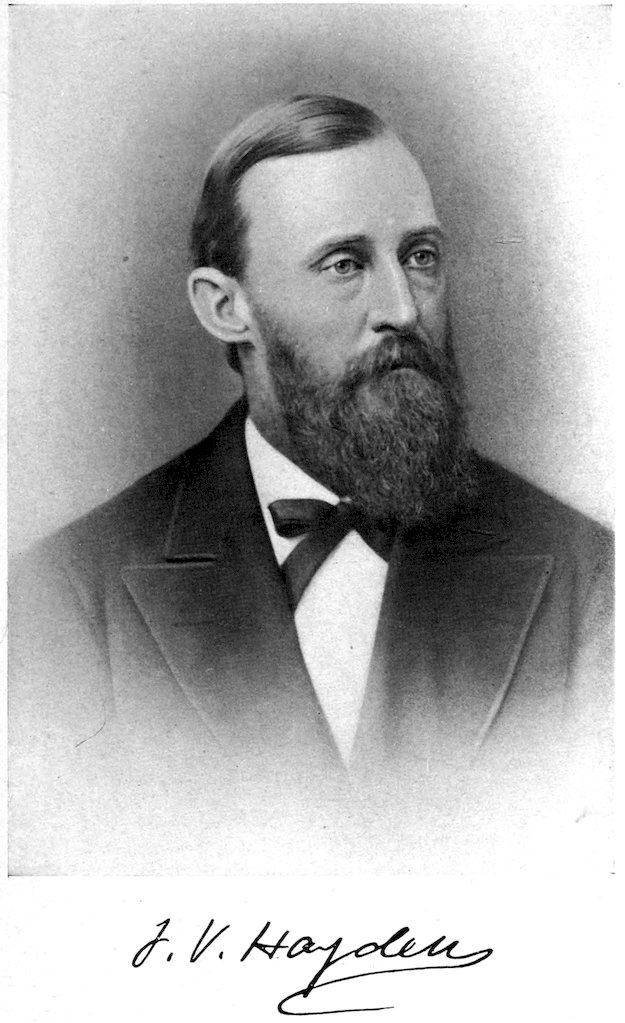
From “Contributions to the History of American Geology”
by George P. Merrills.
197The first specific appropriation by the Federal Government
for geologic investigation appears to have been
made in 1834, when a supplemental appropriation for
surveys of roads and canals under the War Department,
authorized in 1824, contained the item “of which sum
five thousand dollars shall be appropriated and applied
to geological and mineralogical survey and researches.”
In July, 1834, Mr. G. W. Featherstonhaugh was appointed
United States geologist and employed under Colonel
Abert, U. S. Topographical Engineers, to “personally
inspect the mineral and geological character” of the public
lands of the Ozark Mountain region. Overlooking
the incidental fact that this Englishman—a man of
scientific attainment and large interest in public affairs—was
never naturalized,[98] it must be placed to the credit of
this first of United States geologists that within seven
months he completed his field work and returned to
Washington, and on February 17, 1835, his report was
transmitted to Congress. Two years earlier Featherstonhaugh
had memorialized Congress for aid in the
preparation of a geologic map of the whole territory of
the United States, and in connection with this project he
suggested that geology as an aid to military engineering
should have a place in the curriculum at West Point.
This first United States geologist also appears to have
combined an appreciation of the practical worth of “the
mineral riches of our country, their quality, quantity,
and the facility of procuring them,” with an interest in
the more scientific side of geology, though his hypotheses
regarding both economic geology and stratigraphic and
structural geology have not won the endorsement of all
later workers in the same regions. In all these respects,
however, Featherstonhaugh may stand as a fairly good
prototype. His contributions to international affairs
subsequent to his scientific service to the United States
are of interest; he served as one of Her Majesty’s commissioners
in the settlement of the Canadian-United
States boundary question in 1839–40 and made an examination
of the disputed area, and after the settlement of
this controversy he was appointed British Consul for the
Department of the Seine, France, where in 1848 he personally
engineered the escape of Louis Philippe from
Havre.
The Federal geologic work thus started was soon continued
in surveys of wider scope and more thorough
accomplishment. The position of the Government as the
proprietor of mineral lands in the Upper Mississippi
Valley led to their examination. These Government
lands containing lead had been reserved from sale for
lease since 1807, although no leases were issued until 1822.
The amount of illegal entry and consequent refusal of
smelters and miners to pay royalty after 1834 forced the
issue upon the attention of Congress, and in 1839 President
Van Buren was requested to present to Congress a
plan for the sale of the public mineral lands. In carrying
out this policy Dr. David Dale Owen was selected to
make the necessary survey.
Owen had served as an assistant on the State Survey
198of Tennessee and as the first State geologist of Indiana,
and he organized the new work promptly and effectively.
Although suffering from the handicap unfortunately
known by geologists of the present day—the receipt late
in the season (August 17, 1839) of authority to begin
work—within exactly a month he had his force of 139
assistants organized into 24 field parties, instructed in
“such elementary principles of geology as were necessary
to their performance of the duties required of
them.” His plan of campaign provided for a northward
drive at a predetermined rate of traverse for each party,
with periodic reports to himself at appointed stations,
“to receive which reports and to examine the country in
person” he crossed the area under survey eleven times.
The result of such masterful leadership was the completion
of the exploration of all the lands comprehended in
his orders in two months and six days, and his report on
this great area—about 11,000 square miles—bears date
of April 2, 1840.
Eight years later Doctor Owen made a survey of an
even larger area, continuing his examination northward
to Lake Superior. Again his report was published
promptly, and he continued for several years his examination
of the Northwest Territory, submitting his final
report in 1851. It is interesting to note that in his
earlier report Doctor Owen subscribed himself as “Principal
Agent to explore the Mineral Lands of the United
States,” but that in the later report he was “U. S. Geologist
for Wisconsin.” The two surveys together covered
57,000 square miles.
During the same period similar surveys were being
made in northern Michigan by Dr. Charles T. Jackson,
1847–48, and Foster and Whitney, 1849–51. These surveys
also had been hastened by the “copper fever” of
1844–46, with wholesale issue of permits and leases, Congress
in 1847 authorizing the sale of the mineral lands
and a geological survey of the Lake Superior district.
The execution of these surveys under Jackson and under
Foster and Whitney and the prompt publication in 1851
of the maps of the whole region materially helped to
establish copper mining on a more conservative basis.
199and the development of the Lake Superior region
was rapid.[99]
These land-classification surveys, with their definite
purpose, represent the best geologic work of the time.
The plan necessitated thoroughgoing field work with considerable
detail and prompt publication of systematic
reports, and in the working up of the results specialists
like James Hall and Joseph Leidy contributed, while
F. B. Meek was an assistant of Owen. It is worthy of
note that had not Doctor Houghton, the State geologist of
Michigan, met an untimely death in 1847, effective cooperation
of the State Survey with the Federal officials
would have combined geologic investigation with the
execution of the linear surveys.[100]
Belonging to the same period of geologic exploration
was the service of J. D. Dana, as United States Geologist
on the Wilkes Exploring Expedition, the disaster to
which compelled his return from the Pacific Coast overland
and resulted in his geologic observations on Oregon
and northern California.
The military expeditions during the decade 1850–60
and the earlier expeditions of Fremont added to the
geographic knowledge of the Western country and also
contributed to geologic science, largely through collections
of rocks and fossils, usually reported on by the
specialists of the day. Thus the names of Hall, Conrad,
Hitchcock, and Meek appear in the published
reports on these explorations, while Marcou, Blake,
Newberry, Gibbs, Evans, Hayden, Parry, Shumard,
Schiel, Antisell, and Engelmann were geologists attached
to the field expeditions. In 1852 geologic investigation
was seemingly so popular as to necessitate the statutory
prohibition “there shall be no further geological survey
by the Government unless hereafter authorized by law.”
Certain of these explorations had a specific purpose:
several of them sought a practical route for
a transcontinental railroad; another a new wagon
road across Utah and Nevada; and one under
Colonel Pope, with G. G. Shumard as geologist, was
sent out “for boring Artesian Wells along the line
of the 32d Parallel” in New Mexico. The published
200reports varied greatly in scientific value and in
carefulness of preparation, while the publication of at
least two reports was delayed until long after the war,
and the manuscript of another was lost. The report of
the expedition of Major Emory contained a colored
geologic map of the western half of the country, a pioneer
publication, for the map prepared by Marcou extended
only to the 106th meridian.
Thus in the first period of Government surveys, covering
about forty years, the great West, with its wealth of
public lands, was well traversed by exploratory surveys,
which furnished, however, only general outlines for a
comprehension of the stratigraphy and structure of
mountain and valley, plain and plateau. To an even less
degree was there any realization of the economic possibilities
of the vast territory west of the Mississippi.
President Jefferson, in planning the Lewis and Clark
expedition, had stated his special interest in the mineral
resources of the region to be traversed. Nearly forty
years later Doctor Owen was strongly impressed with
the commercial promise of the region he surveyed. His
reports contain analyses of ores and statistics of production;
he compared the lead output of Wisconsin, Iowa,
and Illinois with that of Europe and foretold the value
of the iron, copper, and zinc deposits of the area; he
outlined the extent of the Illinois coal field; and he laid
equal emphasis upon the agricultural possibilities of the
region. Indeed, so optimistic were Owen’s general conclusions
that he referred to his separate township plats,
with their detailed descriptions, as the basis for his sanguine
opinions, realizing that “the explorer is apt to
become the special pleader.” With equal breadth of
view and thoroughness of execution the surveys of Foster
and Whitney laid the foundation for the development
of the copper and iron resources of the Lake Superior
region, and although these areas were largely wilderness
and not adapted to rapid traverse or easy observation
the reports on their explorations nevertheless compare
most favorably with the contributions of geologists working
in the more hospitable regions in the older States.
The period following the Civil War naturally became
one of national expansion, the faces of many were turned
201westward, and exploration of the national domain for its
industrial possibilities took on fresh interest. Home-seekers
and miners largely made up this army of peaceful
invasion, and the winning of the West began on a
scale quite different from that of the days of the military
path-finding expeditions of Fremont and other Army
officers. Thus the nation was aroused to the task of
investigating its public lands and Congress gave the support
needed to make geologic exploration possible on a
large scale.
Geologic surveys of a high order were continued
in the older States, as shown by the contributions
during this period of J. P. Lesley and G. H. Cook in
the East, W. C. Kerr, E. W. Hilgard, and E. A.
Smith in the South, and J. S. Newberry, C. A.
White, Raphael Pumpelly, T. C. Chamberlin, Alexander
Winchell, and T. B. Brooks in the Central States.
To the north the Canadian Survey, organized in 1841
under Logan, had continued under the same sturdy
leadership until 1869, when the experienced and talented
Doctor Selwyn became Director. As contrasted with the
short careers of most of the State Surveys and with the
temporary character of all of the Federal undertakings
in geologic investigation, the continuance of the Canadian
Geological Survey for more than half a century
under two directors gave opportunity for continuity of
effort in making known to the people of the Dominion its
resources and at the same time contributing to the world
much pure science.
Passing with simple mention the two Government expeditions
into the Black Hills, which afforded opportunity
for geologic exploration by N. H. Winchell in 1874 and by
Jenney and Newton in 1875, the record of geologic work
under Government auspices in the period immediately
following the Civil War groups itself around the names
of four leaders—Hayden, King, Powell, and Wheeler.
The four organizations, distinguished commonly by the
names of these four masterful organizers, occupied the
Western field more or less continuously from 1867 to 1878,
and the sum total of their contributions to geography
and geology was large indeed. In the words of Clarence
King,[101] “Eighteen hundred and sixty-seven, therefore,
202marks, in the history of national geological work, a turning
point, when the science ceased to be dragged in the
dust of rapid exploration and took a commanding position
in the professional work of the country.” Together
these four expeditions covered half a million square
miles, or more than a third of the area of the United
States west of the one-hundredth meridian, and the cost
of all this work was approximately two million dollars,
which was a small fraction of its value to the nation
counting only the impetus given to settlement and utilization.
As viewed from a distance of nearly half a century,
these four surveys differed much in plan of organization,
scope of purpose, and success of execution, so that comparison
would have little value except as possibly bearing
upon the work of the larger organization which
followed them and became the heir not only to much that
had been attained by these pioneer surveys but also to
the great task uncompleted by them. So, if in the
earliest days of the present United States Geological
Survey there may have been a certain partisanship in
tracing derived characters in the new organization, it is
even now worth while to recognize the real origin of
much that is credited to present-day development.
Dr. F. V. Hayden was the first of these Survey leaders
to engage in geological exploration. He visited the Badlands
as early as 1853, and his connection with subsequent
expeditions was interrupted only by his service as
a surgeon in the Federal Army during the war. In 1867,
however, Hayden resumed his geologic work as United
States Geologist in Nebraska, operating under direction
of the Commissioner of the General Land Office. In the
following eleven years the activities of the Hayden Survey—the
“Geological and Geographical Survey of the
Territories”—extended into Wyoming, Colorado, New
Mexico, Montana, and Idaho, covering with areal surveys
107,000 square miles. This Survey, as might be
expected from the long experience of its leader, made
large contributions to stratigraphy, which involved
notable paleontologic work by Cope, Meek, and Lesquereux.
Next in importance was the structural work of
A. C. Peale, W. H. Holmes, Capt. C. E. Dutton, and Dr.
203Hayden himself, and the influence of these expeditions in
popularizing geology should not be overlooked. The
expedition of 1871 into the geyser region on the upper
Yellowstone resulted in the creation of the first of the
national parks. W. H. Holmes began his artistic contributions
to geology in 1872 with this Survey. Topographic
mapping was added to the geologic exploration,
James T. Gardner and A. D. Wilson joining the Hayden
Survey after earlier service on the King Survey and
Henry Gannett being a member of parties, first as astronomer
and later as topographer in charge. The accomplishment
of the Hayden Survey itself and the later work
of many of its members show that this organization possessed
a corps of strong men.
The King Survey was a smaller organization, with
Congressional authorization of definite scope and a systematic
plan of operation. The beginning of construction
of the Union Pacific terminated the period of the
railroad surveys under the War Department and
afforded opportunity for geologic work that would be
more than exploratory: the opening up of the new
country made investigation of its resources logical.
This fact was recognized by Clarence King, who had
traversed the same route as a member of an emigrant
train with his friend James T. Gardner. His plan to
make a geological cross section of the Cordilleras, with a
study of the resources along the route of the Pacific railroads,
won the support of Congress, and the “Geological
Exploration of the Fortieth Parallel” was authorized in
1867, with Clarence King as geologist in charge, under
the Chief of Engineers of the Army. Field work was
begun in the summer of that year, and it is interesting to
note that Mr. King and his small force of geological
assistants—the two Hagues and S. F. Emmons—began
at the western end of this cross section, and in this
and subsequent years extended the survey from the east
front of the Sierra Nevada to Cheyenne, covering a belt
of territory about 100 miles in width. This comprehensive
plan was carried out in the field operations, and the
scientific and economic results were systematically
worked up in the reports, which appeared in 1870–80.
The only departure from this plan was a study of the
204volcanic mountains Shasta, Rainier, and Hood, in 1870,
occasioned by an unexpected and unsolicited appropriation
for field work, and that summer’s work resulted in
the discovery of active glaciers, the first known within
the United States.
The Fortieth Parallel Survey is to be credited with
contributions to the knowledge of the stratigraphy of the
West, the region traversed being remarkably representative
of the stratigraphic column, to which was added the
paleontologic work of Marsh, Meek, Hall, and Whitfield,
while the attempt was made to interpret the sedimentary
record in terms of Paleozoic, Mesozoic, and Tertiary
geography. King’s plan of survey included large use of
topographic mapping with astronomic base and triangulation
control and contours based upon barometric elevations.
The results were pronounced by an unfriendly
critic[102] as “very valuable, especially from a geological
point of view,” but unfortunate in being the forerunner
of work in which Government geologists “have presumed
to arrogate the control of the fundamental operations of
a topographic survey.” To the King Survey must be
credited the introduction of systematic contour mapping
and the use of contour maps for purposes of geology.
In two other respects the King Survey contributed
largely to future Government work: microscopical
petrography in the United States may be said to have
begun with the visit of Professor Zirkel to this country as
a member of this Survey in 1875, and the report of J. D.
Hague on “Mining Industry” was the fitting expression
of the emphasis then put on the study of the mineral
resources of this newly opened territory, a subject of
investigation that was in large part the true basis of
King’s project rather than simply “the immediate
excuse for the Survey.” An earlier influence in the scientific
study of ore deposits had come from Von Richthofen’s
investigation of the Comstock Lode in 1865 and
his subsequent work with Whitney in California. The
incident of King’s relation to the diamond fraud in Arizona
in 1872 furnished a precedent for public servants of
a later day; he investigated the reported find from scientific
interest but exposed it with all the zeal of a publicist
and truth lover. In a word, the Fortieth Parallel Survey
commands our admiration for its brilliant plan,
thoroughgoing work in field and office, and high quality
of personnel.
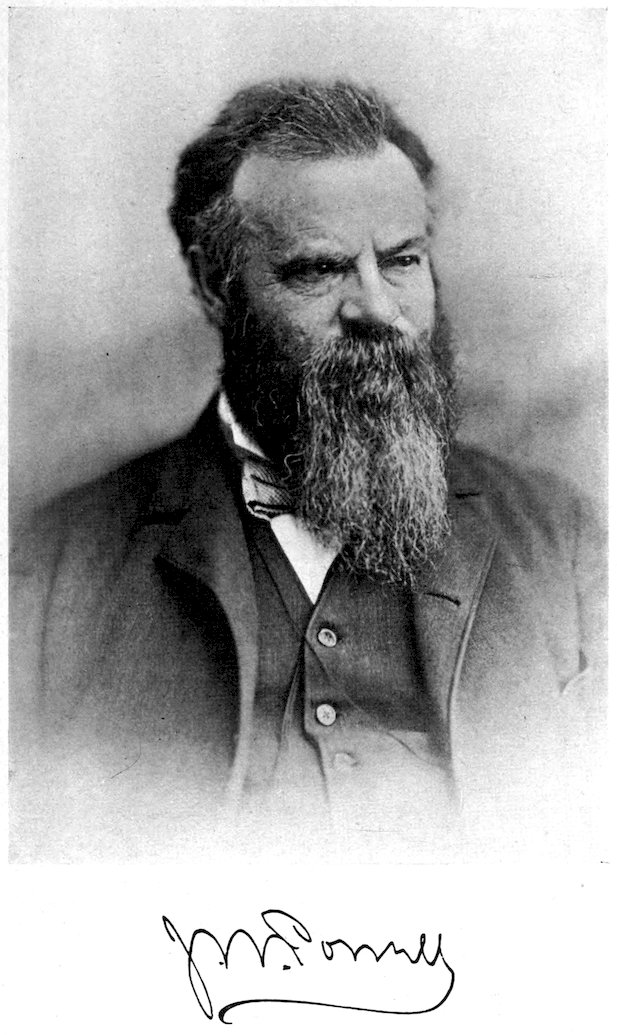
205Major J. W. Powell began his large contribution to
Government surveys with his exploration of the Grand
Canyon in 1869, the Congressional recognition of his
expedition being limited to an authorization for the issue
of rations by the War Department. Small appropriations
were made in the following years, and in 1874 full
authorization was given for the continuance of his survey
in Utah under the Secretary of the Interior and was
followed by the adoption of the name “United States
Geographical and Geological Survey of the Rocky Mountain
Region.” This organization was the least pretentious
of the four operating during this period—it covered
less area, expended less public money, and published much
less—but its contribution to American geology is not to be
measured by miles or pages but by ideas. Its physical
environment favored this survey, and in the work of
Powell, Dutton, and Gilbert can be seen the beginnings of
physiography on the heroic scale exemplified in the
Grand Canyon and the High Plateaus. The first use of
terms like “base-level of erosion,” “consequent and
antecedent drainage,” and “laccolith” marked the introduction
of new ideas in the interpretation of land sculpture
and geologic structure. The daring boat trip of
Powell was no less brilliant than his simple explanation
of the Grand Canyon itself.
“The United States Geographical Surveys West of the
100th Meridian” was the title given to the explorations
made under Lieut. G. M. Wheeler, of the Engineer
Corps, which began with topographic reconnaissances in
Nevada, Utah, and Arizona, specifically authorized by
Congress in 1872. From the standpoint of American
geology this could be better known as the Gilbert Survey,
Mr. G. K. Gilbert serving for the three years 1871–73, the
later part of the time with the title of chief geological
assistant. Gilbert’s contributions included his description
of Basin Range structure, his first account of old
Lake Bonneville, and his discussion of the erosion phenomena
of the desert country. J. J. Stevenson also
served later as a geologist of this Survey, and A. R. Marvine,
206E. E. Howell, E. D. Cope, Jules Marcou, and I. C.
Russell were connected with the field parties. Captain
Wheeler’s own claim for the work of his Survey emphasized
its geographic side, for he regarded the results as
the partial completion of a systematic topographic survey
of the country.
By 1878, when the Fortieth Parallel Survey had completed
the work planned by its chief, three of these independent
surveys still contended for Federal support and
for scientific occupation of the most attractive portions
of the Western country. Unrestrained competition of
this kind, even in the public service, proves as wasteful as
unregulated competition in private business,[103] and Congress
appealed to the National Academy of Sciences for a
plan for Government surveys to “secure the best results
at the least possible cost.” Under instructions by Congress
the National Academy considered all the work
relating to scientific surveys and reported to Congress
a plan prepared by a special committee, whose membership
included the illustrious names of Marsh, Dana,
Rogers, Newberry, Trowbridge, Newcomb, and Agassiz.
This report, which was adopted by the Academy with
only one dissenting vote, grouped all surveys—geodetic,
topographic, land parceling, and economic—under two
distinct heads, surveys of mensuration and surveys of
geology. At that time five independent organizations in
three different departments were carrying on surveys of
mensuration, and the Academy recommended that all
such work be combined under the Coast and Geodetic
Survey with the new name Coast and Interior Survey.
For the investigation of the natural resources of the public
domain and the classification of the public lands a
new organization was proposed, the United States Geological
Survey. The functions of these two surveys and
of a third coordinate bureau in the Interior Department,
the Land Office, were carefully defined and their interrelations
fully recognized and provided for in the plan
presented to Congress. Viewed in the light of 39 years
of experience the National Academy plan would be
indorsed by most of us as eminently practical, and the
report stands as a splendid example of public service rendered
by America’s leading scientists. The legislation
207which embodied the entire plan, however, failed of passage
in Congress.
The natural activity behind the scenes of the conflicting
interests represented by those connected with the several
surveys may be seen in the legislative history of the
moves leading up to the creation of the United States
Geological Survey. In the last session of the 45th Congress
the special legislation embodying the recommendations
of the National Academy was included in the
Legislative, Executive, and Judicial Appropriation bill
as it passed the House of Representatives, while the Sundry
Civil Appropriation bill carried an item simply making
effective the longer section in the other appropriation
bill. The item in the Legislative appropriation bill
created the office of the Director of the Geological Survey,
provided his salary, and defined his duties, as well
as specifically terminating the operations of the three
older organizations. The item in the Sundry Civil bill as
it passed the House appropriated $100,000 for the new
Geological Survey, but when this appropriation bill was
reported to the Senate a committee amendment added
the words “of the Territories,” and further amendments
offered on the floor changed the item so as to provide
specifically and exclusively for the continuation of the
Hayden Survey. Other amendments provided small
appropriations for the completion of the reports of the
Powell and Wheeler surveys, and the bill passed the Senate
in this form. The Legislative Appropriation bill was
similarly pruned, while in the Senate, of all reference to
the proposed new organization. This bill, however, died
in conference, but in the last hours of the session the
conferees on the Sundry Civil bill took unto themselves
legislative powers and transferred from the dead bill to
the pending measure all the language which constitutes
the “organic act” of the United States Geological Survey.
This action was denounced in the Senate as “a
wide departure from the authority that is possessed by
a conference committee,” and it was further stated in
debate that the inserted provision which created a new
office and discontinued the existing surveys was one
“which neither the Committee of the Senate nor the Senate
itself ever saw.” This assertion was perhaps parliamentarily
208sound in that the language was new to the
Sundry Civil bill, yet actually the Senate had only two
days before stricken the same proposed legislation from
the pending Legislative Appropriation bill. However,
the House conferees—Representatives Atkins of Tennessee,
Hewett of New York, and Hale of Maine—had realized
their tactical advantage, and the Senate, after a
brief debate, voted on March 3 to concur in the report of
the committee of conference, thus reversing all their
earlier action, in which the friends of the Hayden and
Wheeler organizations apparently had commanded more
votes than the advocates of the National Academy plan.
Clarence King was appointed first Director of the
United States Geological Survey on April 3, 1879, and
began the work of organization. With his proven genius
for administration, King promptly resolved the doubt as
to the meaning of the term “national domain” in the
language defining the duties of the Director by taking the
conservative side and limiting the work of the new organization
to the region west of the 102d meridian. This
region was divided into four geological divisions, and for
economy of time and money field headquarters were
established for these divisions. The Division of the
Rocky Mountains was placed under Mr. Emmons as
geologist in charge, the Division of the Colorado under
Captain Dutton, the Division of the Great Basin under
Mr. Gilbert, and the Division of the Pacific under Arnold
Hague. The Division of the Colorado was intended as
merely temporary for the purpose of bringing to completion
the scientific work of the Powell Survey. Similarly
Dr. Hayden was given the opportunity to prepare a systematic
digest of his scientific results. This organization
of the work and the selection of geologists
in charge showed the relation of the new and the
old, and a glance at the personnel of the new Survey
indicates the extent to which the geologic investigation
of the Western country was to continue without interruption.
Of the twenty-four geologists and topographers
listed in the first administrative report, four had been
connected with the Powell Survey, two with the Hayden,
three with the Wheeler, and five with the King Survey.
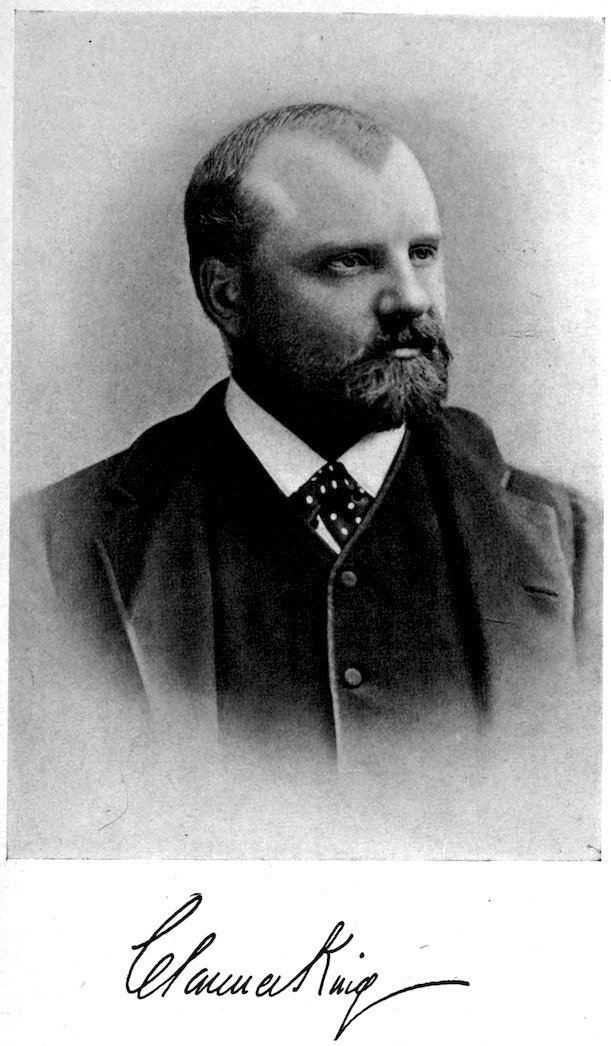
209In planning the initial work of the United States
Geological Survey, the Director speaks of the “most
important geological subjects” and “mining industries,”
of “instructive geological structure” and “great bullion
yield” in the same sentences, so that the intent was plain
to make the geologic investigations both theoretical and
practical.
It was expected that the field of operations of this
Federal Survey would be at once extended by Congress
over the whole United States, but the measure making
this extension, which would simply carry out the intent
of the framers of the legislation creating the new bureau,
passed the House alone, and it was only by subsequent
modification of the wording of appropriation items that
the United States Geological Survey became national in
scope as well as in name. The critical question of the
effective coördination of State and Federal geologic surveys
was met by Director King, who corrected an erroneous
impression “industriously circulated” by stating
his policy to be to urge the inauguration and continuance
of State surveys.[104] This was the initial step in the
cooperation between State and Federal surveys which
became effective on a large scale in subsequent years.
Though the Geological Survey has extended its operations
over the whole United States, its largest activities
have always been directed toward the exploration and
development of the newer territory in the public-land
States. All four of its directors had their field training
in the West: the name of Major Powell, who succeeded
King in 1880, is inseparably connected with scientific
exploration; Charles D. Walcott, who was Director from
1894 to 1907, the period of the Survey’s greatest expansion,
made the largest contribution to the Paleozoic stratigraphy
and paleontology of the West; and the present
Director spent seven field seasons in the Northern Cascades
and one in a mining district in Utah. The scope of
the activities both East and West as developed during
the 39 years since the establishment of the new bureau
can be best described, perhaps, in terms of its present
functions as expressed in the organization of to-day.
The growth of the Survey is measured in the increase
of annual appropriation from $106,000 in 1879–80 to the
amount available for the current year—$1,925,520, not
210including half a million dollars from War Department
appropriations being spent in the topographic work of
the Survey. The corresponding increase in personnel
has been from 39, listed in the first report, to 911 holding
regular appointments at the present time, divided among
the different branches as follows: A scientific force of
173 in the Geologic Branch, 169 in the Water Resources
Branch, 71 in the Topographic Branch, and 15 in the
Land Classification Board, with a clerical force of 168
divided among the same branches, and the remainder
the technical and clerical employees of the publication
and administrative branches. These personnel statistics
are not expressive of normal conditions, since a large
number of the topographic engineers are commissioned
officers and thus are not included on the civilian roll,
while, on the other hand, the classification of the stock-raising
homestead lands makes the technical force of the
Water Resources Branch unusually large this year.
The primary aim of the Geological Survey is geologic,
whether directed by authority of law toward
the “examination of the geological structure, mineral
resources, and products of the national domain,” toward
the preparation of the authorized “reports upon general
and economic geology and paleontology,” of the
“geologic map of the United States,” or of the “report
on the mineral resources of the United States,” or
toward the “continuation of the investigation of the
mineral resources of Alaska” or “chemical and physical
researches relating to the geology of the United
States.” The spirit and the purpose of the Survey’s
work in all these fields are not believed to have
materially changed from those of the founders of the
science in America. From time to time too much emphasis
may have appeared to be laid upon applied geology as
contrasted with pure science, yet the report of the
National Academy to Congress in terms placed the stress
upon economic resources and referred to paleontology as
“necessarily connected” with general and economic
geology. The practical purpose of geologic research
under Government auspices must be recognized by the
administrator, whether he be the paleontologist like Walcott,
211the philosopher like Powell, or the mining geologist
like King. That the task of steering the true course is
no new problem can be seen from the statement of Owen[105]
written 70 years ago, and these words describe conditions
of Government geological work even to-day:
Scientific researches, which to some may seem purely speculative
and curious, are essential as preliminaries to these
practical results. Further than such necessity dictates, they
have not been pushed, except as subordinate and incidental,
and chiefly at such periods as, under the ordinary requirements
of public service, might be regarded as leisure moments; so that
the contributions to science thus incidentally afforded, and which
a liberal policy forbade to neglect, may be considered, in a
measure, a voluntary offering, tendered at little or no additional
expense to the department.
The increased attention given to mineral resources has
been a matter of gradual growth. Mr. King early
organized a Division of Mining Geology with Messrs.
Pumpelly, Emmons, and Becker as geologists in charge,
to whom were assigned the collection of mineral statistics
for the Tenth Census. These Survey geologists and
Director King himself held appointments as special
agents of the Census Bureau, and on the staff selected for
this work appear the names of T. B. Brooks, Edward
Orton, T. C. Chamberlin, Eugene A. Smith, George
Little, J. R. Proctor, R. D. Irving, N. S. Shaler,
John Hays Hammond, Bailey Willis, and G. H. Eldridge,
indicating the extent to which the supervision of these
inquiries was placed in the hands of economic geologists.
This procedure was reverted to by Director Walcott and
in the last ten years has become a well-established policy,
the statistics of annual production of all the important
mineral products being under the charge of geologists, as
best qualified to comprehend the resources of the country.
Another of these special assistants in 1880 was
Albert Williams, Jr., who became the first chief of the
Division of Mineral Resources, in 1882. The study of
ore deposits, which may be said to have begun with the
King Survey, was inspired by King’s own appreciation
of the broad geologic relations of the distribution of
mineral wealth and by the detailed studies of individual
212mining districts by his associates, “based upon facts
accurately determined in the light of modern geology.”
Geological surveys have been prosecuted in Alaska
since 1895, and in the last few years the annual appropriation
for the work has been the same as that made for
the expenses of the whole Survey in the first year of its
history. The Division of Alaskan Mineral Resources is in
fact a geological survey in itself, except that it shares in
the administrative machinery of the larger organization
and has the advantage of the cooperation of the scientific
specialists of the Survey as they may be needed to supplement
its own force. All the investigations in this distant
part of the country represent the Geological Survey
at its best, for here the organization’s long experience in
the Western States can be applied to most effective and
helpful work on the frontier, where the geologist and
topographer in their exploration do not always follow
the prospector but often precede him. Undoubtedly no
greater factor has contributed to the development of
Alaskan resources than this pioneer work of the Federal
Survey, yet the work has also contributed notable additions
to the sciences of geology and geography.
The first duty laid upon the Director of the Geological
Survey in the law of 1879 was “the classification of the
public lands,” and this phrase undoubtedly expressed the
idea of the committee of the National Academy. The
same legislation, however, contained provision for the
further consideration by a commission of the classification
and valuation of the public lands, as also recommended
by the National Academy. Thus the decision of
Director King that the classification intended by Congress
was scientific and was intended for general information
and not to aid the Land Office in the disposition of
land by sale or otherwise was really based upon the
deliberate opinion of the Public Lands Commission, of
which he was a member, that classification would seriously
impede rapid settlement of the unoccupied lands.
Nearly forty years later those who are intrusted with the
land-classification work of the Geological Survey recognize
this familiar argument, which undoubtedly had much
more force in that earlier stage of the utilization of the
213Nation’s resources of land.[106] The conception of land
classification as a business policy on the part of the Government
as a landed proprietor belongs rather to this
day of more intensive development. At present current
public-land legislation calls for highest use, and hence
official investigation of natural values and possibilities
must precede disposition. This type of mineral and
hydrographic classification of public lands has been in
progress in increasing amount since 1906, so that now
the Geological Survey is the kind of scientific adviser to
the Secretary of the Interior and Commissioner of the
General Land Office that may have been contemplated by
the National Academy of Sciences in 1878. It is plain,
however, to everyone at all conversant with Western conditions
that the recent land-classification surveys in
Wyoming, for instance—detailed geologic surveys which
form the basis for the valuation of public coal lands in
40–acre units—would have possessed no utility in 1871,
when the coal-land law was passed but when the demand
for railroad fuel had just begun.
The land-classification idea is of course the basis of
the National forest and irrigation movements. The laws
of 1888 and 1896, which mark the beginning of active
endorsement by Congress of these conservation movements,
placed upon the Survey the duties of examining
reservoir sites and forest reserves respectively. The
earlier of these laws began the investigation of the water
resources of the country, which is still an important phase
of the Survey’s activity, and led to the creation of an independent
organization—the Reclamation Service. It is
easy to trace the beginnings of Federal reclamation of
arid lands in the pioneer work of Powell, whose report
in 1878 on the arid region of the United States was the
first adequate statement of the problem of largest use of
these lands in terms broader than those of individualistic
endeavor. For years, however, Powell’s appeal for
Congressional consideration of this National task was
like the “voice of one crying in the wilderness.”
In a somewhat similar way the forestry surveys under
the Geological Survey helped in the organization of a
separate bureau—now the Forest Service. The other
214important Federal bureau tracing direct relationship to
the Survey is the Bureau of Mines, established in 1910,
which continued the investigations in mining technology
specifically provided for by Congress for six years under
the Geological Survey but in some degree begun in the
early days of the Survey under Directors King and
Powell.
Another equally important organization of a public
nature, though not a Federal bureau, traces its beginnings
to the Geological Survey: the Geophysical Laboratory
of the Carnegie Institution, which now exercises so
potent an influence over geologic investigation, had its
origin in the official work of the Geological Survey’s
Division of Chemical and Physical Research, and its personnel
was at first largely recruited from the Survey.
The highly original experimental work of this laboratory
has extended far beyond the scope of the Survey’s work—at
least far beyond the scope possible with the Federal
funds available—yet most of the results of these investigations
may eventually come under even a strict
construction of the language used in the Survey’s appropriation
“for chemical and physical researches relating
to the geology of the United States.”
The topographic work of the present Survey continues
with constant refinement of standards and economy of
methods the work of the earlier organizations. The
primary purpose of these topographic surveys is to provide
the bases for geologic maps, yet these topographic
maps, which cover 40 per cent of the area of the United
States, are used in every type of civil engineering as well
as by the public generally. The annual distribution by
sale of half a million of these maps is an index of their
value to the people.
The hot discussion that was waged for years on the
question of military versus scientific administration of
topographic surveys is in striking contrast with the
present concentration of all the topographic mapping
under the Geological Survey in those areas where it may
best serve the needs of the Army. In 1916 Congress
specifically recognized the possibility of greater cooperation
of this kind, both in the appropriation made to
215the Geological Survey and in a special appropriation
made to the War Department. For a number of years
indeed special military information had been contributed
to the Army by the Survey topographers, but since
March 26, 1917, every Geological Survey topographer
has worked exclusively on the program of military surveys
laid down by the General Staff of the Army, and the
places of some of the 44 Survey topographers now in
France as engineer officers are filled by 34 other reserve
engineer officers detailed by order of the Secretary of
War to the Director of the Geological Survey to assist
in this military mapping and to receive instruction fitting
them in turn for topographic service in France.
The contribution of this civilian service to the military
operations in the present emergency forms a fitting conclusion
to this review of a century of Government surveys.
At present 215 members of the Geological Survey
are in uniform, 107 as engineer officers, two of whom are
on the staff of the American Commanding General in
France. In the war work carried on in the United
States the Survey’s contribution is by no means limited
to military mapping: the geologists are also mobilized for
meeting war needs, assisting in developing new sources
of the essential war minerals, in speeding up production
of mineral products, in collecting information for the
purchasing officers both of our own and of the Allied governments,
in coöperating with the constructing quarter-masters
in the location of gravel and sand for structural
use and in both general and special examinations of
underground water supply and of drainage possibilities
at cantonment sites, and in supplying the Navy Department
with similar technical data. A special contribution
has been the application to aërial surveys of photogrammetric
methods developed in the Alaskan topographic
work and the perfection of a camera specially adapted to
airplane use. The utilization of the Survey’s map
engraving and printing plant for confidential and urgent
work for both the Army and Navy has necessitated postponement
of current work for the Geological Survey
itself. Throughout the organization the records, the
methods, and the personnel which represent the product
216of many years of scientific activity are all being utilized;
thus is the experience of the past translated into special
service in the present crisis.
VI ON THE DEVELOPMENT OF VERTEBRATE PALEONTOLOGY — Introduction. — Rise of Vertebrate Paleontology in Europe. — Vertebrate Paleontology in America. — Joseph Leidy (1823–1891). — Othniel Charles Marsh (1831–1899). — Edward Drinker Cope (1840–1897). — 1870–1880. — 1880–1900. — Summary. — Influence of the American Journal of Science.
217
Unlike its sister science of Invertebrate Paleontology,
which has been approached so largely from
the viewpoint of stratigraphic geology, that of the
vertebrates is essentially a biologic science, having its
inception in the masterly work of Cuvier, who is also to
be regarded as the founder of comparative anatomy.
For long decades, vertebrate paleontology was simply a
branch of comparative anatomy or morphology in that it
dealt almost exclusively with the form and other peculiarities
of fossil bones and teeth, often in a more or less
fragmentary condition, very little or no attention being
paid to any other system of the creature’s anatomy.
Distribution both in space and in time was recorded, but
the value of vertebrates in stratigraphy was still to be
appreciated and has hardly yet come into its own. It is
readily seen, therefore, that the two departments of
paleontology did not enlist the same workers or even the
same type of investigators, for while the two sciences have
much in common and should have more, the vertebratist
must, above all else, be a morphologist, with a keen
appreciation of form, and a mind capable of retaining
endless structural details and of visualizing as a whole
what may be known only in part. The initial work of the
brilliant Cuvier set so high a standard of preparedness
and mental equipment that as a consequence, the number
of those engaged in vertebrate research has never been
large as compared with the workers in some other
branches of science, but the results achieved by the few
218who have consecrated their research to the fossil vertebrates
has been in the main of a high order.
At first, as has been emphasized, this work was largely
morphological, dealing both with the individual skeletal
elements and later with the bony framework as a whole.
Then came the endeavor to clothe the bones with sinews
and with flesh—to imagine, in other words, the life-appearance
of the ages-departed form—with such of its
habits as could be deduced from structure of body, tooth,
and limb. Next came the working out of systematic
series of vertebrates and their marshalling into species,
genera, and larger groups, and much time was thus spent,
especially when rapid discovery brought a continual
stream of new forms before the systematist, and hence
some appreciation of the countless hosts of bygone creatures
which peopled the world in the geologic past. This
systematic work, however, was based upon the most
painstaking morphologic comparisons and so the science
was still within the scope of comparative anatomy.
In connection with taxonomic research came increasingly
tangible evidence in favor of the law of evolution;
investigators turned to the working out of phyletic series
showing the actual record of the successive evolutionary
changes that the various races had undergone. Coupled
with this evolutionary evidence came an increased attention
to the sequential occurrence in successive geologic
strata, and the stratigraphic distribution of vertebrates
became known with greater and greater detail. Then
followed the assemblage of faunas, which brought the
study of the fossil forms within the realm of historical
geology, rather than being the mere phylogeny of a single
race, and the value of vertebrate fossils as horizon
markers became more and more appreciated by the stratigrapher.
They serve to supplement the knowledge
gained from the invertebrates, and in this connection are
especially valuable in that they often give data concerning
continental formations about which invertebrate
paleontology is largely silent.
To those who had been nurtured in the belief in a relatively
recent creation covering in its entirety a period of
219but six days, and occurring but four millenniums before
the time of Christ, the appearance of the remains of
creatures in the rocks, the like of which no man ever saw
alive, must have given scope to the wildest imaginings
concerning their origin and significance; for many
believed that not only had no new forms been added to
the world’s fauna since the creation, except possibly by
hybridizing, but that none had become extinct save a very
few through the agency of human interference. The
supposition was, therefore, that such creatures as were
thus discovered were still extant in some more remote
fastnesses of the world. Thus, our second president,
Thomas Jefferson, who wrote one of the first papers on
American fossil vertebrates, published in 1798, discussed
therein the remains of a huge ground-sloth which has
since borne the name Megalonyx jeffersoni. Jefferson,
however, described the great claws as pertaining to a
huge leonine animal which he firmly believed was yet
living among the mountains of Virginia.
Cuvier (1769–1832) has been spoken of as the founder
of our science. His opportunity lay in the profusion of
bones buried in the gypsum deposits of Montmartre
within the environs of the city of Paris. Cuvier’s
studies of these remains, done in the light of his very
broad anatomical knowledge, enabled him to prepare the
first reconstructions of fossil vertebrates ever attempted
and to bring before the eyes of his contemporaries a
world peopled with forms which were utterly extinct.
That these creatures were no longer living, none was a
better judge than Cuvier, for his prominence was such
that material was sent him from all parts of the world, to
which must be added that which he saw in his visits to
the various museums of Europe. He felt it safe, therefore,
to affirm the unlikelihood of any further discovery
of unknown forms among the great mammals of the present
fauna of our globe, and few indeed have been the
additions since his day. To Cuvier is due not alone the
masterly contribution to the sister sciences of comparative
anatomy and vertebrate paleontology—the Ossements
Fossiles (1812)—but he also announced the
presence in continental strata of a series of faunas which
showed a gradual organic improvement from the earliest
220such assemblage to the most modern, an idea of the most
fundamental importance and one with which he is rarely
credited. He believed in the sudden and complete
extinction of faunas, and the facts then known were in
accord with this idea, as no common genera nor transitional
forms connected the creatures of the Paris gypsum
with the mastodons, elephants, and hippopotami which
the later strata disclosed. It is not remarkable, therefore,
that Cuvier advanced his theory of catastrophism to
account for these extinctions. He should not, however,
according to Depéret, be credited with the idea of successive
re-creations, such as that held by D’Orbigny and
others, but of repopulation by immigration from some
area which the catastrophe, be it flood or other destructive
agency, failed to reach.
Cuvier was followed in Europe by a number of illustrious
men, none of whom, however, with the exception of
Sir Richard Owen, possessed his breadth of knowledge
of comparative anatomy upon which to base their
researches among the prehistoric. The more notable of
them may be enumerated before going on to a discussion
of the American contributions to the science.
They were, first, Louis Agassiz, a pupil of Cuvier and
later a resident of America, whose researches on the fossil
fishes of Europe are a monumental work, the result of
ten years of investigation in all of the larger museums of
that continent, and which appeared in 1833–43, while he
was yet a young man. The fishes were practically the
only fossil vertebrates to come within the scope of his
investigations, for his later time was consumed in the
study of glaciers and of recent marine zoology. Another
student of these most primitive vertebrates who left
an enduring monument was Johannes Mϋller. Huxley,
Traquair, and Jaekel also did masterly work upon this
group, while Smith Woodward of the British Museum is
considered the highest living authority upon fossil fishes.
Of the Amphibia, the most famous foreign students
were Brongniart, Jaeger, Burmeister, Von Meyer, and
Owen, although Owen’s claim to eminence lies rather in
the investigations of fossil reptiles which he began in
1839 and continued over a period of fifty years of
remarkable achievement. Not only did he describe the
221dinosaurs of Great Britain in a series of splendidly illustrated
monographs, but extended his researches to the
curious reptilian forms from the Karroo formation of
South Africa. It was to him, moreover, that the establishment
of the true position of the famous Archœopteryx
as the earliest known bird and not a reptile is due. Von
Meyer also enriched the literature of fossil reptiles,
discussing exhaustively those occurring in Germany,
while Huxley’s classic work on the crocodiles as well as
on dinosaurs, and the labors of Buckland, Fraas, Koken,
Von Huene, Gaudry, Hulke, Seeley, and Lydekker have
added immensely to our knowledge of the group.
Of the birds, which at best are rare as fossils, our
knowledge, especially of the huge flightless moas, is due
largely again to Owen, and his realization of the systematic
position of Archœopteryx has already been mentioned.
The mammals were, perhaps, the most prolific source
of paleontological research during the nineteenth century,
for, as Zittel has said, Cuvier’s famous investigations
on the fossil bones, mentioned above, not only
contain the principles of comparative osteology, but also
show in a manner which has never been surpassed how
fossil vertebrates ought to be studied, and what are the
broad inductions which may be drawn from a series of
methodical observations. Such was Cuvier’s influence
that until Darwin began to interest himself in mammalian
paleontology the study of these forms was conducted
entirely along the lines indicated by the French savant.
This was seen in a large work, Osteology of Recent and
Fossil Mammalia, by De Blainville, which, although not
up to the standard set by the master, is nevertheless a
notable contribution, as was also the Osteology prepared
by Pander and D’Alton. A summary of the knowledge of
the fossil Mammalia up to the year 1847 is contained in
Giebel’s Fauna der Vorwelt, and Lydekker has done for
the mammals in the British Museum what Smith Woodward
did for the fishes, producing vastly more than the
mere catalogue which the title implies.
The first work wherein the fossil mammals were
treated genealogically was Gaudry’s Enchaînements du
Monde Animal, written in 1878. Other work on the
222fossil Mammalia was done by Kaup, who described those
from the Mainz basin and from Epplesheim near Worms
whence came one of the most famous of prehistoric
horses, the Hipparion; this horse, together with the
remarkable proboscidean Dinotherium, was described by
Von Meyer. One of the most remarkable discoveries,
ranking in importance, perhaps, next to Montmartre, was
that of the Pliocene fauna of Pikermi near Athens,
Greece, first made known through the publications of A.
Wagner of Munich and later, and much more extensively,
through that of Gaudry (1862–1867). H. von Meyer was
Germany’s best authority on fossil Mammalia. After
his death the work was carried on by Quenstedt, Oscar
Fraas, Schlosser, Koken, and Pohlig, among others.
In France, rich deposits of fossil mammals were discovered
in the Department of Puy-de-Dôme, the Rhone
basin, Sansan, Quercy, and near Rheims. These were
described by a number of writers, notably Croizet and
Jobert, Pomel, Lartet, Filhol, and Lemoine.
Rütimeyer of Bâle was one of the most famous European
writers on mammalian paleontology, and his
researches were both comprehensive and clothed in such
form as to give them a high place in paleontological literature.
He studied comparatively the teeth of ungulates,
discussed the genealogy of mammals, and the
relationships of those of the Old and New Worlds. He
was an exponent of the law of evolution as set forth by
Darwin, and his “genealogical trees of the Mammalia
show a complete knowledge of all the data concerning the
different members in the succession, and are amongst the
finest results hitherto obtained by means of strict scientific
methods of investigation” (Zittel, History of Geology
and Palæontology, 1901). The mammals of the
Swiss Eocene have been studied in much detail by
Stehlin.
For Great Britain, the most notable contributors were
Buckland in his Reliquiæ Diluvianæ; Falconer, co-author
with Cautley on the Tertiary mammals of India; Charles
Murchison, who wrote on rhinoceroses and proboscideans;
and more recently Bush, Flower, Lydekker, Boyd
Dawkins, L. Adams, and C. W. Andrews. But by far the
most commanding figure of all was Sir Richard Owen,
223who for half a century stood without a peer as the
greatest of authorities on fossil mammals. It was the
Natural History of the British Fossil Mammals and
Birds, published in 1846, that established Sir Richard’s
reputation.
Russia has produced much mammalian material,
especially from the Tertiary of Odessa and Bessarabia,
and from the Quaternary of northern Russia and Siberia.
These have been described mainly by J. F. Brandt, A.
von Nordmann, but especially by Mme. M. Pavlow of
Moscow.
Forsyth-Major discovered in 1887 a fauna contemporaneous
with that of Pikermi in the Island of Samos
in the Mediterranean.
One of the most remarkable recent discoveries of fossil
localities was that announced in 1901 by Mr. Hugh J. L.
Beadnell of the Geological Survey of Egypt and Doctor
C. W. Andrews of the British Museum of London, of
numerous land and sea mammals of Upper Eocene and
Lower Oligocene age in northern Egypt. The exposures
lay about 80 miles southwest of Cairo in the Fayûm district
and are the sediments of an ancient Tertiary lake, a
relic of which, Birket-el-Qurun, yet remains. These beds
contained ancient Hyracoidea, Sirenia, and Zeuglodontia,
but above all, ancestral Proboscidea which, together with
those known elsewhere, enabled Andrews to demonstrate
the origin and evolutionary features of this most remarkable
group of beasts. This discovery in the Fayûm lends
color to the belief that Africa may have been the ancestral
home of at least five of the mammalian orders, those mentioned
above, together with the Embrithopoda, a group
unknown elsewhere. This theory had been advanced
independently by Tullberg, Stehlin, and Osborn, before
the discovery in Egypt.
Another European worker of pre-eminence who wrote
more broadly than the faunal studies mentioned above
was W. Kowalewsky. He discussed especially the evolutionary
changes of feet and teeth in ungulates, a line of
research afterward developed in greater detail by the
Americans, Cope and Osborn.
South America has yielded series of rich faunas which
have been exploited by the great Argentinian, Florentino
224Ameghino, and by the Europeans, Owen, Gervais, Huxley,
Von Meyer, and more recently by Burmeister and
Lydekker. Later exploration and research by Hatcher
and Scott of North America will be discussed further on
in this paper.
Early Writers.—Having thus summarized paleontological
progress in the Old World, we can turn to a consideration
of the work done in the New, especially in the
United States, because while the Old World investigation
has been invaluable, a science of vertebrate paleontology,
very complete both as to its zoological and geological
scope and in the extent and value of published results,
could be built exclusively upon the discoveries and
researches made by Americans. The science of vertebrate
paleontology may be said to have had its beginnings
in North America with the activities of Thomas Jefferson,
who, like Franklin, felt so strong an interest in
scientific pursuits that even the graver duties of the highest
office in the gift of the American people could not
deter him from them. When in 1797 Jefferson came to
be inaugurated as vice-president of the United States, he
brought with him to Philadelphia not only his manuscript
but the actual fossil bones upon which it was based.
Again in 1801 he was greatly interested in the Shawangunk
mastodon, despite heavy cares of state, and in 1808
made part of the executive mansion in Washington serve
as a paleontological laboratory, displaying therein for
study the bones of proboscideans and their contemporaries
which the Big Bone Lick of Kentucky had produced.
Jefferson’s work would not, perhaps, have been epoch-making
were it not for its unique chronological position
in the annals of the science.
Jefferson was followed by another man—this time one
whose diverging lines of interest led him not into the
realm of political service, but of art, for Rembrandt
Peale possessed an enviable reputation among the early
painters of America. Peale published in 1802 an account
of the skeleton of the “mammoth,” really the mastodon,
M. americanus, speaking of it as a nondescript carnivorous
225animal of immense size found in America. It was
because of the form of the molar teeth that Peale said of
it: “If this animal was indeed carnivorous, which I
believe cannot be doubted, though we may as philosophers
regret it, as men we cannot but thank Heaven that
its whole generation is probably extinct.”
With the work of these men as a beginning, it is not
strange that the more conspicuous Pleistocene fossils of
the East should have attracted the attention of many
subsequent writers in the first part of the nineteenth century,
nor that the early papers to appear in the Journal
should pertain to proboscideans or to the huge edentate
ground-sloths and the aberrant zeuglodons whose bones
frequently came to light. Therefore a number of men
such as Koch, both Sillimans, J. C. Warren, and others
made these forms their chief concern.
Fossil Footprints.—Among the early writers who concerned
themselves with these greater fossils was Edward
Hitchcock, sometime president of Amherst College, and
a geologist of high repute among his contemporaries.
Hitchcock is, however, better and more widely known as
the pioneer worker on a series of phenomena displayed
as in no other place in the region in which he made his
home. These are fossil footprints impressed upon the
Triassic rocks of the Connecticut valley. It was in the
Journal for the year 1836 (29, 307–340) that Hitchcock
first called attention to the footmarks, although they had
been known and discussed popularly for a number of
years previous. James Deane, of Greenfield, was perhaps
the first to appreciate the scientific interest of these
phenomena, but deeming his own qualifications insufficient
properly to describe them, he brought them to the
attention of Hitchcock, and the interest of the latter
never waned until his death in 1864. Hitchcock wrote
paper after paper, publishing many of them in the Journal,
again in his Final Report on the Geology of Massachusetts
(1841), and later in quarto works, one in the
Memoirs of the American Academy of Arts and Sciences
and the two others under the authority of the Commonwealth,
the Ichnology in 1858, and the Supplement in
1865, the last being a posthumous work edited by his son,
Charles H. Hitchcock.
226Hitchcock’s conception of the track-makers was more
or less imperfect because of the fact that for a long time
but a few fragmentary osseous remains were known,
either directly or indirectly associated with the tracks,
while on the other hand the bird-like character of many
of the latter and the discovery of huge flightless birds
elsewhere on the globe suggested a very close analogy if
not a direct relationship. Hence “bird tracks” they
were straightway called, a designation which it has been
difficult to remove, even though in 1843 Owen called attention
to the need of caution in assuming the existence of
so highly organized birds at so early a period, especially
when large reptiles were known which might readily
form very similar tracks. The footprints are now
believed to be very largely of dinosaurian origin, and
dinosaurs whose feet corresponded in every detail with
the footprints have actually come to light within the same
geologic and geographic limitations. This of course
refers to the bipedal, functionally three-toed tracks. Of
the makers of certain of the obscurer of the quadrupedal
trails we are as much in the dark to-day as were the
first discoverers of a century ago, so far as demonstrable
proof is concerned. We assume, however, that they were
the tracks of amphibia and reptiles, beyond which we may
not go with certainty.
Agassiz, writing in 1865 (Geological Sketches), says:
“To sum up my opinion respecting these footmarks, I believe
that they were made by animals of a prophetic type, belonging
to the class of reptiles, and exhibiting many synthetic characters.
The more closely we study past creations, the more
impressive and significant do the synthetic types, presenting
features of the higher classes under the guise of the lower ones,
become. They hold the promise of the future. As the opening
overture of an opera contains all the musical elements to be
therein developed, so this living prelude of the creative work
comprises all the organic elements to be successively developed
in the course of time.”
Of those whose work was contemporaneous with that
of Hitchcock, but one, W. C. Redfield, wrote on Triassic
phenomena, and he concerned himself mainly with the
fossil fishes of that time, his first paper on this subject
227appearing in 1837 in the Journal (34, 201), and the last
twenty years later.
Paleozoic Vertebrates.—Later the vertebrates of the
Paleozoic began to attract attention, footprints from
Pennsylvania being described by Isaac Lea, beginning in
1849, a notice of his first paper appearing in the Journal
for that year (9, 124). Several papers followed on the
reptile Clepsysaurus. Alfred King also wrote on the
Carboniferous ichnites, his work slightly antedating that
of Lea, but being less authoritative.
But by far the most illuminating of the mid-century
writers on Paleozoic vertebrates was Sir William Dawson,
a very large proportion of whose numerous papers
relate to the Coal Measures of Nova Scotia and their
contained plant and animal remains. In 1853 appeared
Dawson’s first announcement, written in collaboration
with Sir Charles Lyell, of the finding of the bones of
vertebrates within the base of an upright fossil tree trunk
at South Joggins. These bones were identified by Owen
and Wyman as pertaining to a reptilian or amphibian to
which the name Dendrerpeton acadianum was given.
Following this were several papers published in the
Quarterly Journal of the Geological Society, London,
describing more vertebrates and associated terrestrial
molluscs. In 1863 Dawson summarized his discoveries
in the Journal (36, 430–432) under the title of “Air-breathers
of the Coal Period,” a paper which was
expanded and published under the same title in the Canadian
Naturalist and Geologist for the same year. Dawson
also printed in the same volume the first account of
reptilian(?) footprints from the coal. Thus from time
to time there emanated from his prolific pen the account
of further discoveries, both in bones and footprints, his
final synopsis of the air-breathing animals of the Paleozoic
of Canada appearing in 1895. The only other group
of vertebrates which claimed his attention were certain
whales, on which he occasionally wrote.
Fishes.—The fossil fishes from the Devonian of Ohio
found their first exponent in J. S. Newberry, appointed
chief geologist of the second geological survey of Ohio,
which was established in 1869. These fishes from the
Devonian shales belonged for the greater part to the
228curious group of armored placoderms, the remains of
which consist very largely of armor plates with little or
no traces of internal skeleton. There was also found in
association a shark, Cladoselache, of such marvelous
preservation that from some of the Newberry specimens
now in the American Museum of Natural History, New
York, Bashford Dean has demonstrated the histology of
muscle and visceral organs, in addition to the very complete
skeletal remains.
Newberry’s work on these forms, begun in 1868, has
been carried to further completion by Bashford Dean and
his pupil L. Hussakof, as well as by C. R. Eastman.
Newberry’s other paleontological work was with the Carboniferous
fishes of Ohio, the Carboniferous and Triassic
fishes of the region from Sante Fé to the Grand and
Green rivers, Colorado, and on the fishes and plants of
the Newark system of the Connecticut valley and New
Jersey. He also discussed certain mastodon and mammoth
remains, and those of the peccary of Ohio,
Dicotyles.
We now come to a consideration of the work of Joseph
Leidy, one of the three great pioneers in American vertebrate
paleontology, for if we disregard the work of Hitchcock
and others on the fossil footprints, few of the results
thus far obtained were based upon the fruits of organized
research. Leidy began his publication in 1847 and continued
to issue papers and books from time to time until
the year 1892, having published no fewer than 219 paleontological
titles, and 553 all told. His earlier paleontological
researches were exclusively on the Mammalia, which
were then coming in from the newly discovered fossil
localities of the West. The discovery of these forms,
one of the most notable events in the history of our
science, will bear re-telling.
The first announcement was made in 1847, when Hiram
A. Prout of St. Louis published in the Journal (3, 248–250)
the description of the maxillary bone of “Palæotherium”
(= Titanotherium proutii)from near White
River, Nebraska. This at once drew the attention of
geologists and paleontologists to the Bad Lands, or
229Mauvaises Terres, which were to prove so highly productive
of fossil forms. About the same time S. D. Culbertson
of Chambersburg, Pennsylvania, submitted to the
Academy of Natural Sciences at Philadelphia some fossils
sent to him from Nebraska by Alexander Culbertson.
These were afterward described by Leidy in the Proceedings
of the Academy, together with the paleotheroid
jaw, in addition to which three other collections which
had been made were also placed at his disposal for study.
This aroused the interest of Doctor Spencer F. Baird
of the Smithsonian Institution, who sent T. A. Culbertson
to the Bad Lands to make further collections. The
latter was successful in securing a valuable series of
mammalian and chelonian remains. These, together
with other specimens from the same locality, were sent
to Leidy, for, as Baird remarked, Leidy, although only
thirty years of age, was the only anatomist in the United
States qualified to determine their nature. The outcome
of Leidy’s study of this material was “The Ancient
Fauna of Nebraska,” published in 1853, and constituting
the most brilliant work which up to that time American
paleontology had produced. Leidy’s determinations,
which are in the main correct, are the more remarkable
when it is realized that he had little recent osteological
material for comparative study. The forms thus
described by him were new to science, of a more generalized
character than those now living, and yet their
distinguished describer recognized, either at that time or
a little later, their true relationship to the modern types.
The extent of Leidy’s anatomical knowledge was almost
Cuvierian, and Cuvier-like he established the fact of the
presence of the rhinoceroses, then unheard of in the
American fauna, from a few small fragments of molar
teeth, an opinion shortly to be fully sustained through the
finding of complete molars and the entire skull of the
same individual animal.
Leidy next turned his attention to the huge edentates,
which he studied exhaustively, publishing his results in
the form of a memoir in 1855, two years after the appearance
of the “Ancient Fauna.”
Extinct fishes of the Devonian of Illinois and Missouri
and the Devonian and Carboniferous of Pennsylvania
230were made the subjects of his next researches, after
which he described the peccaries of Ohio, and later, in a
much larger and most important work, the Cretaceous
reptiles of the United States (1865). Most of the fossils
discussed in this last work are from the New Jersey Cretaceous
marls and of them the most notable was the
herbivorous dinosaur Hadrosaurus, the structure and
habits of which, together with its affinities with the Old
World iguanodons, Leidy described in detail. From
Leidy’s descriptions and with his aid, Waterhouse Hawkins
was enabled to restore a replica of the skeleton in a
remarkably efficient way. This restoration for a long
time graced the museum of the Philadelphia Academy of
Natural Sciences and there was a plaster replica of it in
the United States National Museum. These, together
with plaster replicas of Iguanodon from the Royal College
of Surgeons in London, gave to Americans their first
real conceptions of members of this most remarkable
group. The associated fossils from the New Jersey
marls were chiefly crocodiles and turtles.
From 1853 to 1866 F. V. Hayden was carrying on a
series of most energetic explorations in the West,
especially in Nebraska and Dakota as then delimited,
returning from each trip laden with fossils which were
given to Leidy for determination. The results appeared
in 1869 in Leidy’s Extinct Mammalian Fauna of Dakota
and Nebraska, published as volume 7 of the Journal of
the Philadelphia Academy. In this large volume no fewer
than seventy genera and numerous species of forms,
many of them new to science, were described, representing
many of the principal mammalian orders; horses
were, however, especially conspicuous. This last group
led Leidy to the conclusion, afterward emphasized by
Huxley, that North America was the home of the horse in
geologic time, there being here a greater representation
of different species than in any recent fauna of the
world. Leidy’s interest in the horses, for the forwarding
of which he made a large collection of recent material,
extended over many years, as his first paper on the
subject bears the date of 1847, the last that of 1890.
Next came the discovery of Eocene material from the
vicinity of Fort Bridger, Wyoming, geologically older
231than the Nebraska and Dakota formations. This,
together with specimens from the Green River and
Sweetwater River deposits of Wyoming and the John
Day River (Oligocene) of Oregon, was also referred to
Leidy, and added yet more to the list of newly discovered
species with which he had already become familiar
in his earlier researches. The results of this study were
published by the Hayden Survey in 1873, under the title
“Contributions to the Extinct Vertebrate Fauna of the
Western Territories.” This was the last of Leidy’s
major works, but he continued up to the time of his death
to report to the Academy concerning the various fossil
forms that were submitted to him for identification. Of
such reports the most important was one on the fossils
of the phosphate beds of South Carolina, published in
the Journal of the Academy in 1887.
As a paleontologist, Leidy ranks with Cope and
Marsh high among those who enriched the American literature
of the subject, but it must be remembered that
this was but a single aspect of his many-sided scientific
career, for he made many contributions of high order to
botany, zoology, and general and comparative anatomy
as well, nor did his knowledge and usefulness as an
instructor of his fellow men keep within the limitations of
these subjects.
The sixth decade of the nineteenth century saw the
beginning of the labors of several paleontologists who,
like Leidy, were destined to raise the science of fossil
vertebrates in America to the level of attainment of the
Old World. They were, among others, Othniel Charles
Marsh and Edward Drinker Cope. Of these the names
of Marsh and Cope are linked together by the brilliance
of their attainments, their contemporaneity, and the
rivalry which the similarity of their pursuits unfortunately
engendered. Marsh produced his first paleontological
paper in 1862 (33, 278), Cope in 1864, but the
latter died first, so that his life of research was shorter.
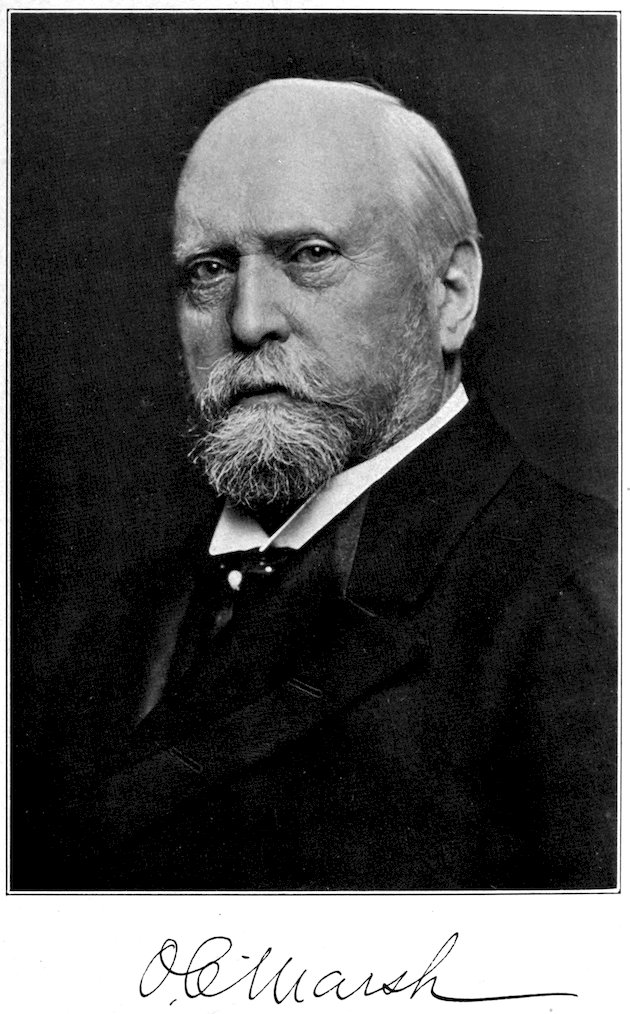
232To Professor Marsh should be given credit for the
first organized expedition designed exclusively for the
collection of vertebrate remains, the results of which contain
so much material that it has not yet entirely seen
the light of scientific exposition. Marsh’s first trip to
the West was in 1868, the first formal expedition being
organized two years later. These expeditions, of which
there were four, were privately financed except for the
material and military escort furnished by the United
States Government, and consisted of a personnel drawn
entirely from the graduate or undergraduate body
of Yale University. These parties explored Kansas,
Nebraska, Wyoming, Utah, and Oregon, and returned
laden with material from the Cretaceous and Tertiary
formations of the West. Some of this is of necessity
somewhat fragmentary, but type after type was secured
which, with his exhaustive knowledge of comparative
anatomy, enabled Marsh to announce discovery after discovery
of species, genera, families, and even orders of
mammals, birds, and reptiles which were unknown to
science. The year 1873 saw the last of the student expeditions,
and thereafter until the close of his life the work
of collecting was done under Marsh’s supervision, but by
paid explorers, many of whom had been his scouts and
guides in the formal expeditions or had been especially
trained by him in the East. In 1882, after fourteen years
of the experience thus gained, Marsh was appointed vertebrate
paleontologist to the United States Geological Survey,
which relieved him in part of the personal expense
connected with the collecting, although up to within
a short time of his death his own fortune was very
largely spent in enlarging his collections. After his connection
with the Survey was established, Marsh had two
main purposes in view in making the collections: (1) to
determine the geological horizon of each locality where
a large series of vertebrate fossils was found, and (2) to
secure from these localities large collections of the more
important forms sufficiently extensive to reveal, if possible,
the life histories of each. Marsh believed that the
material thus secured would serve as key or diagnostic
fossils to all horizons of our western geology above the
Paleozoic, a belief in which he was in advance of his time,
for few of his contemporaries appreciated the value of
vertebrates as horizon markers. The result of the fulfilment
of his second purpose saw the accumulation of
huge collections from all horizons above the Triassic and
some Paleozoic and Triassic as well. These contained
some very remarkable series, each of which Marsh hoped
to make the basis of an elaborate monograph to be published
under the auspices of the Survey. One can visualize
the scope of his ambitions by the fact that no fewer
than twenty-seven projected quarto volumes, to contain
at least 850 lithographic plates, were listed by him in
1877. These covered, among other groups, the toothed
birds (Odontornithes), Dinocerata, horses, brontotheres,
pterodactyls, mosasaurs and plesiosaurs, monkeys, carnivores,
perissodactyls and artiodactyls, crocodiles,
lizards, dinosaurs, various birds, proboscideans, edentates
and marsupials, brain evolution, and the Connecticut
Valley footprints. Much was done towards the preparation
of these memoirs, as evidenced by the long list
of preliminary papers, admirably illustrated by woodcuts
which were to form the text figures of the memoirs,
which appeared with great regularity in the pages of the
Journal for a period of thirty years. Of the actual
memoirs, however, but two had been published at the
time of Marsh’s death in 1899—the Odontornithes in
1880 and the Dinocerata in 1884. One must not overlook,
however, the epoch-making Dinosaurs of North America,
which was published by the Survey in 1896, although it
was not in the form nor had it the scope of the proposed
monographs. This was not due to lack of application,
for Professor Marsh was an indefatigable worker, but
rather to the fact that the program was of such magnitude
as to necessitate a patriarchal life span for its consummation.
As it is, Professor Marsh’s fame rests first
upon his ability and intrepidity as a collector, ready himself
to brave the very certain hardships and dangers
which beset the field paleontologist in the pioneer days,
and also by his judgment and command of men to secure
the very adequate services of others and so to direct
their endeavors that the results were of the highest value.
The material witness to Marsh’s skill as a collector lies
in the collections of the Peabody Museum at Yale and in
the Marsh collection at the United States National
Museum, the latter secured through the funds of the
United States Geological Survey. Together they constitute
233what is possibly the greatest collection of fossil
vertebrates in America, if not in the world; individually,
they are second only to that of the American Museum in
New York City, the result of the combined labors of
Osborn and Cope and their very able corps of assistants.
As a scientist Marsh possessed in large measure that
wide knowledge of comparative anatomy so necessary to
the vertebrate paleontologist, and as a consequence was
not only able to recognize affinities and classify unerringly,
but also to recognize the salient diagnostic features
of the form before him and in few words so to
describe them as to render the recognition of the species
by another worker relatively easy. The publication of
hundreds of these specific diagnoses in the Journal constitutes
a very large and valuable part of that periodical’s
contribution to the advancement of our science.
Marsh’s method of indicating forms by so brief a statement
leaves much to be done, however, in the way of
further description of his types, which in many instances
were but partially prepared.
Yet another important service which Marsh rendered
to science was the restoration of the creatures as a whole,
made with the most painstaking care and precision
through assembling the drawings of the individual bones.
These restorations have become classic, embracing as they
did a score or more of forms, of beast, bird, and reptile.
They also were published first in the Journal, although
they have subsequently been reproduced in text-books
and other works the world over. Part of Marsh’s popular
reputation, at least, which was second to that of no
other American in his line, was due to his skill in
attaining publicity, for his papers, of whatever extent,
were carefully and methodically sent to correspondents
in the uttermost parts of the earth, and thus the Marsh
collection has reflected the fame of its maker.
The third great name in American vertebrate paleontology,
that of Edward Drinker Cope, stands out in sharp
contrast with the other two, although in the range of his
interests he was probably more nearly comparable with
234Leidy than with Marsh. The beginning of Cope’s scientific
labors dates from 1859, the year made famous in the
annals of science by the appearance of Darwin’s Origin
of Species. It is not surprising, therefore, that matters
evolutional should have interested him to the very end of
his career. Cope was not merely a paleontologist, but was
interested in recent forms, especially the three lower
classes of vertebrates, to such an extent that his work
therewith is highly authoritative and in some respects
epoch-making. Thirty-eight years of almost continual
toil were his, and the mere mass of his literary productions
is prodigious, especially when one realizes that, unlike
those of a writer of fiction, they were based on painstaking
research and philosophical thought. The greater part of
Cope’s life was spent in or near Philadelphia except for
his western explorations, and he is best known as professor
of geology and paleontology in the University of
Pennsylvania, although he served other institutions as
well.
Cope’s early work was among the amphibia and reptiles,
his first paleontological paper, the description of
Amphibamus grandiceps, appearing in 1865. This year
he also began his studies of the mammals, especially the
Cetacea, both living and extinct, from the Atlantic seaboard.
The next year saw the beginning of his work on
the material from the Cretaceous marls of New Jersey,
describing therefrom one of the first carnivorous dinosaurs,
Lælaps, to be discovered in America. In 1868
Cope began to describe the vertebrates from the Kansas
chalk and three years later made his first exploration of
these beds. This led to his connection with the United
States Geological Survey of the Territories under Hayden,
and to continued exploration of Wyoming and Colorado
in 1872 and 1873. The material thus gained,
consisting of fishes, mosasaurs, dinosaurs, and other
reptiles, was described in the Transactions of the
American Philosophical Society as well as in the Survey
Bulletins. In 1875 these results were summarized in a
large quarto volume entitled “Vertebrata of the Cretaceous
formations of the West.” Subsequent summers
were spent in further exploration of the Bridger, Washakie,
and Wasatch formations of Wyoming, the Puerco
235and Torrejon of New Mexico, and the Judith River of
Montana. The material gathered in New Mexico proved
particularly valuable, and led to the publication in 1877
of another notable volume entitled “Report upon the
Extinct Vertebrata obtained in New Mexico by Parties
of the Expedition of 1874.”
Material was now accumulating so fast as to necessitate
the concentration of Cope’s own time on research,
so that, while he continued to make brief journeys to the
West, the real work of exploration was delegated to
Charles H. Sternberg and J. L. Wortman, both of whom
became subsequently very well known, the former as a
collector whose active service has not yet ceased, the
latter as an explorer and later an investigator of
extremely high promise.
As early as 1865, Cope began no fewer than five separate
lines of research which he pursued concurrently
for the remainder of his career. On the fishes, he became
a high authority in the larger classification, owing to his
researches into their phylogeny, for which a knowledge
of extinct forms is imperative. On amphibia, he wrote
more voluminously than any other naturalist, discussing
not only the morphology but the paleontology and taxonomy
as well. In this connection must be mentioned
not only Cope’s exploration and collections in the Permian
of Ohio and Illinois, but especially the remains
from the Texas Permian, first received in 1877, upon
which some of his most brilliant results were based;
these of course included reptilian as well as amphibian
material. His third line of research, the Reptilia, is in
part included in the foregoing, but also embraced the
reptiles of the Bridger and other Tertiary deposits, those
of the Kansas Cretaceous, and the Cretaceous dinosaurs.
Up to 1868 Leidy alone was engaged in research in the
West, but that year saw the simultaneous entrance of
Marsh and Cope into this new field of research, and their
exploration and descriptions of similar regions and forms
soon led to a rivalry which in turn developed into a most
unfortunate series of controversies, mainly over the subject
of priority. This resulted in a permanent rupture
of friendship and the division of American workers into
two opposing camps to the detriment of the progress of
236our science. This breach has now been happily healed,
and for a number of years the degree of mutual good will
and aid on the part of our workers has been of the highest
sort.
The extent of the western fossil area, and particularly
the explorations of three of Cope’s aids, Wortman in the
Big Horn and Wasatch basins, Baldwin in the Puerco of
New Mexico, and Cummins in the Permian of Texas, gave
him so fruitful a field of endeavor that the occasion for
jealous rivalry was largely removed. The most manifest
result of Cope’s western work was the publication in
1883 of his Vertebrata of the Tertiary Formations of the
West, which formed volume 3 of the quarto publications
of the Hayden Survey. This huge book contains more
than 1000 pages and 80 plates and has been facetiously
called “Cope’s Bible.”
Cope’s philosophical contributions, which covered the
domains of evolution, psychology, ethics, and metaphysics,
began in 1868 with his paper on The Origin of
Genera. In evolution he was a follower of Lamarck, and
as such, with Hyatt, Ryder, and Packard, was one of the
founders of the so-called Neo-Lamarckian School in
America. Cope’s principal contribution, set forth in his
Factors of Organic Evolution, is the idea of kinetogenesis
or mechanical genesis, the principle that all structures
are the direct outcome of the stresses and strains to
which the organism is subjected. Weismann’s forcible
attack on the transmission theory did not shake Cope’s
faith in these doctrines, for he claimed that the paleontological
evidence for the inheritance of such characters
as are apparently the result of individual modification
was too strong to be refuted. Cope was more like
Lamarck than any other naturalist in his mental make-up
as well as his ideas. He was also, like Haeckel, given
to working out the phylogeny of whatever type lay before
him, and in many instances arrived marvellously near the
truth as we now see it.
Associated for a while with A. S. Packard, Cope soon
became chief editor and proprietor of the American Naturalist,
which was for many years his main means of publication
and thus served our science in a way comparable
to the Journal. As Osborn says by way of summation:
237“Cope is not to be thought of merely as a specialist in Paleontology.
After Huxley he was the last representative of the old
broad-gauge school of anatomists and is only to be compared
with members of that school. His life work bears marks of great
genius, of solid and accurate observation, and at times of inaccuracy
due to bad logic or haste and overpressure of work....
As a comparative anatomist he ranks both in the range
and effectiveness of his knowledge and his ideas with Cuvier and
Owen.... As a natural philosopher, while far less logical
than Huxley, he was more creative and constructive, his metaphysics
ending in theism rather than agnosticism.”
The seventh decade was productive of comparatively
few great names in the history of our science, but two,
J. A. Ryder and Samuel W. Williston, being notable contributors.
The former produced but few papers and
those between 1877 and 1892, yet they were of note and
such was their influence that he is named with Hyatt,
Packard, and Cope as one of the founders of the Neo-Lamarckian
School of evolutionists in America. Ryder
was a particular friend and a colleague of Cope, as they
were both concerned with the back-boned animals, while
the other two were invertebratists. Ryder wrote on
mechanical genesis of tooth forms and on scales of fishes,
also on the morphology and evolution of the tails of
fishes, cetaceans, and sirenians, and of the other fins of
aquatic types. He did, on the other hand, practically no
systematic or descriptive work.
Williston, on the contrary, has had a long and varied
career as an investigator and as an educator. Trained
at Yale, he prepared for medicine, and much of his teaching
has been of human anatomy, both at Yale and at the
University of Kansas where he served for a number of
years as dean of the Medical School. He is also a student
of flies, and as such not only the foremost but indeed
almost the only dipterologist in the United States. But
it is with his work as a vertebrate paleontologist that we
are chiefly concerned, and here again he stands among
the foremost. His initial work and training in this
department of science were with Marsh, for whom he
spent many months in field work, collecting largely in the
Niobrara Cretaceous of Kansas. He did, however, no
238research while with Marsh, owing to the latter’s disinclination
to foster such work on the part of his associates.
Williston began his publications in 1878 and has continued
them until the present, working mainly with Cretaceous
mosasaurs, plesiosaurs, and pterodactyls. Of
late, since his transference to the University of Chicago,
where as professor of paleontology and director of the
Walker Museum he has served since 1902, his interest has
lain mainly among the Paleozoic reptiles and amphibia.
Williston’s more notable works are American Permian
Vertebrates and Water Reptiles of the Past and Present,
wherein he sets forth his views of the phylogenesis and
taxonomy of the reptilian class. He is at present at
work on the evolution of the reptiles, a volume which is
eagerly awaited by his colleagues. It is in morphology
that Williston’s greatest strength lies and some of
his most effective work on the mosasaurs has appeared
in the Journal.
The next decade, that of 1880–1890, saw a number of
notable additions to the workers in vertebrate paleontology:
Henry F. Osborn, W. B. Scott, R. W. Shufeldt, J. L.
Wortman, George Baur, F. A. Lucas, and F. W. True.
Shufeldt is our highest authority on the osteology of
birds, both recent and extinct, having recently described
all of the extinct forms contained in the Marsh collection;
True wrote of Cetacea; Lucas of marine and Pleistocene
mammals and birds, and has also written popular
books on prehistoric life. Lucas’s greatest service, however,
lies in the museums, where he has manifested a
genius second to none in the installation of mute evidences
of living and past organisms. Wortman was for
a time associated with Cope, later with Osborn in the
American Museum, again at the Carnegie Museum at
Pittsburgh, and finally at Yale in research on the Bridger
Eocene portion of the Marsh collection. His work has
been chiefly the perfection of field methods in vertebrate
paleontology, and as a special investigator of Tertiary
Mammalia, treating the latter largely from the morphologic
and taxonomic standpoints. Wortman’s Yale
results on the carnivores and primates of the Eocene,
239as yet unfinished, were published in the Journal in
1901–1904.
William B. Scott is a graduate of Princeton, and has
spent thirty-four years in her service as Blair Professor
of Geology and Paleontology. His first publication, in
1878, issued in conjunction with Osborn and Speir,
described material collected by them in the Eocene formations
of the West, and since that time Scott’s research
has been entirely with the mammals, on which he is one of
our highest authorities. His most notable works have
been a History of Land Mammals of the Western Hemisphere,
1913, and the results of the Patagonian expeditions
by Hatcher, which are published in a quarto series
in conjunction with W. J. Sinclair, although they are the
authors of separate volumes, Scott’s work being mainly
on the carnivores and edentates of the Santa Cruz formation.
It is as a systematist in research and as an educator
that Scott has attained his highest usefulness.
The man who, next to the three pioneers, has attained
the highest reputation in vertebrate paleontologic
research, is Henry Fairfield Osborn. Graduate of
Princeton in the same class that produced Scott, Osborn
served for a time as professor of comparative anatomy
in that institution, and in 1891 was called to New York to
organize the department of zoology in Columbia University
and that of vertebrate paleontology in the American
Museum of Natural History. He had, early in his
career, gone west in company with Professor Scott, and
had collected material from the Eocene formation of
Wyoming, upon which they based their first joint paper
in 1878, Osborn’s first independent production, a memoir
on two genera of Dinocerata, appearing in 1881. A number
of papers followed, on the Mesozoic Mammalia, on
Cope’s tritubercular theory, and on certain apparent evidences
for the transmission of acquired characters. It
was, however, with his acceptance of the New York
responsibilities, especially at the American Museum,
that Osborn’s most significant work began. Aided first
by Wortman and Earle, later by W. D. Matthew and
others, he has built up the greatest and most complete
collection of fossil vertebrates extant; its value, however,
was largely enhanced through the purchase of the
240private collection of Professor Cope, which of course
included a large number of types. The American
Museum collection thus contains not only a vast series
of representative specimens from every class and order
of vertebrates, secured by purchase or expedition from
nearly all the great localities of the world, but an exhibition
series of skulls and partial and entire skeletons
and restorations which no other institution can hope to
equal. Based upon this wonderful material is a large
amount of research, filling many volumes, published for
the greater part in the bulletin and memoirs of the
Museum. This research is not only the product of the
staff, including Walter Granger, Barnum Brown, W. D.
Matthew, and W. K. Gregory, but also of a number of
other American and some foreign paleontologists as well.
Professor Osborn’s own work has been voluminous, his
bibliography from 1877 to 1916 containing no fewer than
441 titles, ranging over the fields of paleontology,—which
of course includes the greater number—geology, correlation
and paleogeography, evolutionary principles exemplified
in the Mammalia, man, neurology and embryology,
biographies, and the theory of education.
In paleontology, Osborn’s researches have been largely
with the Reptilia and Mammalia, partly morphological,
but also taxonomic and evolutional. Faunistic studies
have also been made of the mammals. Of his published
volumes the most important are, first, the Age of Mammals
(1910), in which he treats not of evolutionary series
of phylogenies, but of faunas and their origin, migrations,
and extinctions, and of the correlation of Old and
New World Tertiary deposits and their contents. Men
of the Old Stone Age (1916) is an exhaustive treatise and
is the first full and authoritative American presentation
of what has been discovered up to the present time
throughout the world in regard to human prehistory. In
his latest volume, The Origin and Evolution of Life
(1917), Osborn presents a new energy conception of evolution
and heredity as against the prevailing matter and
form conceptions. In this volume there is summed up
the whole story of the origin and evolution of life on
earth up to the appearance of man. This last book is
novel in its conceptions, but it is too early as yet to judge
241of the acceptance of Osborn’s theses by his fellow workers
in science.
Since the death of Professor Marsh, Osborn has served
as vertebrate paleontologist to the United States Geological
Survey, and has in charge the carrying through to
completion of the many monographs proposed by his distinguished
predecessor. One of these, that on the horned
dinosaurs, has been completed by Hatcher and Lull
(1907), another on the stegosaurian dinosaurs has been
carried forward by C. W. Gilmore of the United States
National Museum, while under Osborn’s own hand are
the memoirs on the titanotheres (aided by W. K. Gregory),
the horses, and the sauropod dinosaurs. Of these,
the first, when it shall have been completed, promises to
be the most monumental and exhaustive study of a group
of fossil organisms ever undertaken.
As a leader in science, a teacher and administrator,
Professor Osborn’s rank is high among the leading vertebratists.
He is remarkably successful in his choice of
assistants and in stimulating them in their productiveness
so that their combined results form a very considerable
share of the later literature in America.
The ninth decade ushered in the work of a valuable
group of students, of whom John Bell Hatcher should be
mentioned in particular, as his work is done. Graduate
of Yale in 1884, he spent a number of years assisting
his teacher, Professor Marsh, mainly in the field, collecting
during that time, either for Yale or for the United
States Geological Survey, an enormous amount of very
fine material, especially from the West, although he also
collected in the older Tertiary and Potomac beds near
Washington. In the West he secured no fewer than
105 titanothere skulls, explored the Tertiary, Judith
River, and Lance formations, collected and in fact virtually
discovered the remains of the Cretaceous mammals
and of the horned dinosaurs which he was later privileged
to describe. He then (1893) went to Princeton, which he
served for seven years, his principal work being explorations
in Patagonia for the E. and M. Museum, one direct
result of which was the publication of a large quarto on
the narrative of the expedition and the geography and
ethnography of the region. Going to the Carnegie
242Museum in Pittsburgh in 1900, Hatcher carried forward
the work of exploration and collecting begun for that
institution by Wortman, and as a partial result prepared
many papers, the principal ones being memoirs on the
dinosaurs Haplocanthosaurus and Diplodocus. In 1903,
with T. W. Stanton of the United States Geological Survey,
Hatcher explored the Judith River beds and together
they settled the vexatious problem of their age, the
published results appearing in 1905, after Hatcher’s
death. His last piece of research, begun in 1902 and
continued until his death in 1904, was an elaborate monograph
on the Ceratopsia, one of the many projected by
Marsh. Of this memoir Hatcher had completed some
150 printed quarto pages, giving a rare insight into the
anatomy of these strange forms. The final chapters,
however, which were based very largely upon Hatcher’s
own opinions, had to be prepared by another hand.
Despite his early death, therefore, Hatcher rendered
a very signal service to American paleontology—in
exploration, stratigraphy, morphology, and systematic
revision—and his activity in planning new fields of
research, such, for instance, as the exploration of the
Antarctic continent, gave promise of further high attainment,
when his hand was arrested by death.
It is not surprising that American vertebrate paleontology
has arisen to so high a plane, when one considers the
material at its disposal. Having a vast and virgin field
for exploration, a sufficient number of collectors, some of
whom have devoted much of their lives to the work, and
a refinement of technique that permitted the preservation
of the fragmental and ill conserved as well as the finer
specimens, the results could hardly have been otherwise.
Thus it has been possible to secure material almost
unique throughout the world for extent, for completeness,
and for variety. To this must be added a certain
American daring in the matter of the restoration of missing
portions, both of the individual bones and of the
skeleton as a whole, such as European conservatism will
not as a rule permit. This work has for the most part
been done after the most painstaking comparison and
243research and is highly justified in the accuracy of the
results, which render the fabric of the skeleton much
more intelligible, both to the scientist and to the layman.
Material once secured and prepared is then mounted,
and here again American ingenuity has accomplished
some remarkable results. Some of the specimens thus
mounted are so small and delicate as to require holding
devices comparable to those for the display of jewels;
yet others—huge dinosaurs the bones of which are enormously
heavy, but so brittle that they will not bear even
the weight of a process unsupported—require a carefully
designed and skilfully worked out series of supports
of steel or iron which must be perfectly secure and at the
same time as inconspicuous as possible. And of late the
lifelike pose of the individual skeleton has been augmented
by the preparation of groups of several animals
which collectively exhibit sex, size, or other individual
variations and the full mechanics of the skeleton under
the varying poses assumed by the creature during life.
The work of further restoration has been rendered possible
through comparative anatomical study, enabling us
to essay restorations in entirety by means of models and
drawings, clothing the bones with sinews and with flesh
and the flesh with skin and hair, if such the creature
bore; while the laws of faunal coloration have permitted
the coloring of the restoration in a way which if not the
actual hue of life is a very reasonable possibility.
Thus the American paleontologists have blazed a trail
which has been followed to good effect by certain of their
Old World colleagues.
With such means and methods and such material available,
it is again not surprising that American paleontology
has furnished more and more of the evidences of evolution,
and disclosed to the eyes of scientists animal relationships
which were undreamed of by the systematist
whose research dealt only with the existing. It has also
explained some vexatious problems of animal distribution
and of extinction, and has connected up cause and effect
in the great evolutionary movements which are recorded.
The results of systematic research have added hosts of
new genera and species and of families, but of orders
there are relatively few. Nevertheless a number,
244especially among reptiles and mammals, have come to
light as the fruits of American discovery. But aside
from the dry cataloguing of such groups, the American
systematists have worked out some very remarkable phylogenies
and have thus clarified our vision of animal
relationships in a way which the recent zoologist could
never have done. In this connection, the Permian vertebrates,
which have been collected and studied with
amazing success, principally by Williston and Case,
should be mentioned, although the work is yet incomplete.
Some of these forms are amphibian, others reptilian,
yet others of such character as to link the two
classes as transitional forms. Of the Mesozoic reptiles,
a very remarkable assemblage has come to light, in a
degree of perfection unknown elsewhere. These are dinosaurs,
of which several phyla are now known; carnivores
both great and small, some of the latter being actually
toothless; Sauropoda, whose perfection and dimensions
are incomparable except for those found in East Africa;
and predentates, armored, unarmored, and horned, the
last exclusively American. The unarmored trachodonts
are now known in their entirety, for not only has our
West produced articulated skeletons but mummified carcasses
whose skin and other portions of their soft
anatomy are represented, and which are thus far without
a parallel elsewhere in the world. Other reptilian
groups are well known, notably the Triassic ichthyosaurs,
and the mosasaurs and plesiosaurs of the Kansas chalk.
The last formation has also produced toothed birds,
Hesperornis and Ichthyornis, which again are absolutely
unique.
But it is in the mammalian class that the phylogenies
become so highly complete and of such great importance
as evolutionary evidences, for nowhere else than in our
own West have such series been found as the Dinocerata
and creodonts among archaic forms, the primitive
primates from the Eocene, the carnivores such as the
dogs and cats and mustellids, but especially the hoofed
orders such as the horses. Of these hoofed orders, the
classic American series of horses is complete, that of
the camels probably no less so, while much is known of
the deer and oreodonts, the last showing several parallel
245phyla, and of the proboscideans, which while having their
pristine home in the Old World nevertheless soon sought
the new where their remains are found from the Miocene
until their final and apparently very recent extinction.
These creatures show increase of bulk, perfection of feet
and teeth, development of various weapons, horns and
antlers, which may be studied in their relationship with
the other organs to make the evolving whole, or their
evolution may be traced as individual structures which
have their rise, culmination, and sometimes their senile
atrophy in a way comparable to that of the representatives
of the order as a whole. Thus, for example,
Osborn has traced the evolution of the molar teeth, and
Cope of the feet, while Marsh has shown that brain development
runs a similar course and that its degree of perfection
within a group is a potent factor for survival.
As a student of evolution, the paleontologist sees
things in a very different light from the zoologist. The
latter is concerned largely with matters of detail—with
the inheritance of color or of the minor and more superficial
characteristics of animals—and the period of
observation of such phenomena is of necessity brief
because of the mortality of the observer. Whereas the
paleontologist has a perspective which the other lacks,
since for him time means little in the terms of his own
life, and he can look into the past and see the great and
fundamental changes which evolution has wrought, the
rise of phyla, of classes, of orders, and he alone can see
the orderliness of the process and sense the majesty of
the laws which govern it.
The influence of the American Journal of Science as a
medium for the dissemination of the results of vertebrate
research has been in evidence throughout this discussion,
but it were well, perhaps, to emphasize that service more
fully. The Journal was, as we have seen, the chief outlet
for Professor Marsh’s research, for there were published
in it during his lifetime no fewer than 175 papers descriptive
of the forms which he studied, as well as a great part
of the material in the published monographs. As Marsh
246left very few manuscript notes, the importance of these
frequent publications in thus setting forth much that he
thought and learned concerning the material is very
great indeed. The combined titles of all other authors in
the Journal in this line of research for the century of its
life fall far short of the number produced by Marsh
alone, as they include 136 all told, but the range of subjects
is highly representative of the entire field of vertebrate
research. It should be borne in mind, moreover,
that Leidy, Cope, and Osborn each had another medium
of publication, which of course is true of other workers
in the great museums such as the American, National,
and Carnegie, all of which issue bulletins and quarto
publications for the purpose of disseminating the work
of their staff. Many of the earlier announcements of the
discovery of vertebrate relics appeared in the Journal, as
did practically all the literature of the science of fossil
footprints (ichnology), except of course the larger
quartos of Hitchcock and Deane. Of the footprint
papers by Hitchcock, Deane, and others, there were no
fewer than thirty-two, with a number of additional communications
on attendant phenomena bones and plants.
Up to 1847, except for a few foreign announcements,
the Journal published almost exclusively on eastern American
paleontology, the only exception being a notice of
bones from Oregon by Perkins in 1842. In 1847 came the
announcement of a western “Palæothere” by Prout,
which marked the beginning of the researches of Leidy
and others in the Bad Lands of the great Nebraska
plains. The Journal thenceforth published paper after
paper on forms from all over North America, and on all
aspects of our science: discovery, systematic description,
faunal relationships, evolutionary evidences—thus
showing that breadth and catholicity which has made it
so great a power in the advancement of science.