NOTES — PREFACE TO THE FIRST EDITION.
P. 1. Rejected Addresses. First published anonymously in the
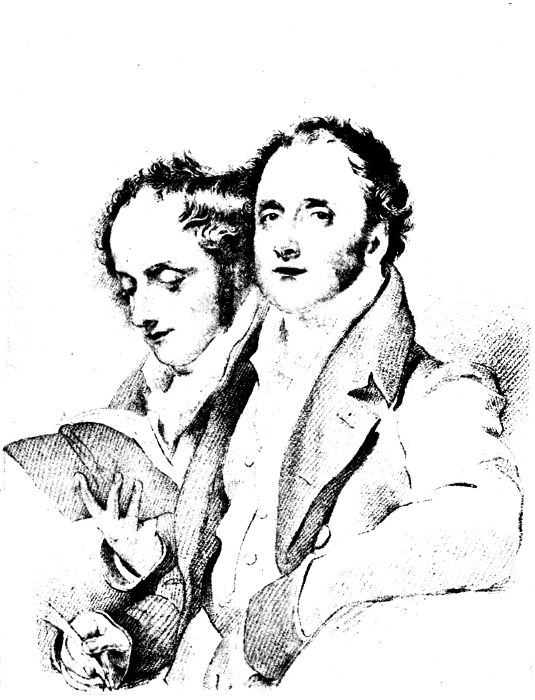
autumn of 1812. The authors, James Smith (1775-1839) and Horace
Smith (1779-1849) were brothers, the former a solicitor, the latter
a stockbroker. James wrote a number of 'entertainments' for Charles
Mathews, who described him as 'the only man in London who can
write good nonsense.' Horace wrote more than a score of novels and
collections of stories, of which, perhaps, Brambletye House is the
best remembered. It was of him that Shelley wrote, in the Letter to
Maria Gisborne:
Wit and sense,
Virtue and human knowledge; all that might
Make this dull world a business of delight,
Are all combined in Horace Smith.
How the Rejected Addresses came to be written is told in the authors'
prefaces:
On the 14th of August, 1812, the following advertisement appeared in
most of the daily papers:—
'Rebuilding of Drury Lane Theatre.
'The Committee are desirous of promoting a free and fair
competition for an Address to be spoken upon the opening of
the Theatre, which will take place on the 10th of October
next. They have, therefore, thought fit to announce to
the public, that they will be glad to receive any such
compositions, addressed to their Secretary, at the Treasury
Office, in Drury Lane, on or before the 10th of September,
sealed up; with a distinguishing word, number, or motto, on
the cover, corresponding with the inscription on a separate
sealed paper, containing the name of the author, which will
not be opened unless containing the name of the successful
candidate.'
Upon the propriety of this plan, men's minds were, as they
usually are upon matters of moment, much divided. Some thought
it a fair promise of the future intention of the Committee to
abolish that phalanx of authors who usurp the stage, to the
exclusion of a large assortment of dramatic talent blushing
unseen in the background; while others contended, that the
scheme would prevent men of real eminence from descending into
an amphitheatre in which all Grub Street (that is to say, all
London and Westminster) would be arrayed against them. The
event has proved both parties to be in a degree right, and in
a degree wrong. One hundred and twelve 'Addresses' have been
sent in, each sealed and signed, and mottoed, 'as per order,'
some written by men of great, some by men of little, and some
by men of no, talent.
Many of the public prints have censured the taste of the
Committee, in thus contracting for 'Addresses,' as they would
for nails—by the gross; but it is surprising that none should
have censured their temerity. One hundred and eleven of the
'Addresses' must, of course, be unsuccessful: to each of the
authors, thus infallibly classed with the genus irritabile,
it would be very hard to deny six staunch friends, who
consider his the best of all possible 'Addresses,' and
whose tongues will be as ready to laud him, as to hiss his
adversary. These, with the potent aid of the Bard himself,
make seven foes per Address; and thus will be created seven
hundred and seventy-seven implacable auditors, prepared to
condemn the strains of Apollo himself—a band of adversaries
which no prudent manager would think of exasperating.
But, leaving the Committee to encounter the responsibility
they have incurred, the public have at least to thank them
for ascertaining and establishing one point, which might
otherwise have admitted of controversy. When it is considered
that many amateur writers have been discouraged from becoming
competitors, and that few, if any, of the professional authors
can afford to write for nothing, and, of course, have not
been candidates for the honorary prize at Drury Lane, we may
confidently pronounce that, as far as regards NUMBER,
the present is undoubtedly the Augustan age of English
poetry. Whether or not this distinction will be extended to
the QUALITY of its productions, must be decided at
the tribunal of posterity; though the natural anxiety of our
authors on this score ought to be considerably diminished when
they reflect how few will, in all probability, be had up for
judgement.
It is not necessary for the Editor to mention the manner
in which he became possessed of this 'fair sample of the
present state of poetry in Great Britain.' It was his first
intention to publish the whole; but a little reflection
convinced him that, by so doing, he might depress the good,
without elevating the bad. He has therefore culled what had
the appearance of flowers, from what possessed the reality
of weeds, and is extremely sorry that, in so doing, he has
diminished his collection to twenty-one. Those which he has
rejected may possibly make their appearance in a separate
volume, or they may be admitted as volunteers in the files
of some of the Newspapers; or, at all events, they are sure
of being received among the awkward squad of the Magazines.
In general, they bear a close resemblance to each other;
thirty of them contain extravagant compliments to the immortal
Wellington and the indefatigable Whitbread; and, as the
last-mentioned gentleman is said to dislike praise in the
exact proportion in which he deserves it, these laudatory
writers may have been only building a wall against which they
might run their own heads.
The Editor here begs leave to advance a few words in behalf
of that useful and much abused bird the Phœnix; and in
so doing he is biased by no partiality, as he assures the
reader he not only never saw one, but (mirabile dictu!)
never caged one in a simile in the whole course of his life.
Not less than sixty-nine of the competitors have invoked the
aid of this native of Arabia; but as, from their manner of
using him after they had caught him, he does not by any means
appear to have been a native of Arabia Felix, the Editor has
left the proprietors to treat with Mr. Polito, and refused
to receive this rara avis, or black swan, into the present
collection. One exception occurs, in which the admirable
treatment of this feathered incombustible, entitles the author
to great praise; that address has been preserved, and was
thought worthy of taking the lead.
Perhaps the reason why several of the subjoined productions
of the Musæ Londinenses have failed of selection,
may be discovered in their being penned in a metre unusual
upon occasions of this sort, and in their not being written
with that attention to stage effect, the want of which, like
want of manners in the concerns of life, is more prejudicial
than a deficiency of talent. There is an art of writing for
the Theatre, technically called touch and go, which is
indispensable when we consider the small quantum of patience
which so motley an assemblage as a London audience can be
expected to afford. All the contributors have been very exact
in sending their initials and mottoes. Those belonging to the
present collection have been carefully preserved, and each
has been affixed to its respective poem. The letters that
accompanied the Addresses having been honourably destroyed
unopened, it is impossible to state the real authors with
any certainty; but the ingenious reader, after comparing the
initials with the motto, and both with the poem will form his
own conclusions.
We do not anticipate any disapprobation from thus giving
publicity to a small portion of the Rejected Addresses; for
unless we are widely mistaken in assigning the respective
authors, the fame of each Individual is established on much
too firm a basis to be shaken by so trifling and evanescent a
publication as the present:
——neque ego illi detrahere ausim
Hærentem capiti multa cum laude coronam.
Of the numerous pieces already sent to the Committee for
performance, we have only availed ourselves of three vocal
Travesties, which we have selected, not for their merit,
but simply for their brevity. Above one hundred spectacles,
melodramas, operas, and pantomimes have been transmitted,
besides the two first acts of one legitimate comedy. Some
of these evince considerable smartness of manual dialogue,
and several brilliant repartees of chairs, tables, and other
inanimate wits; but the authors seem to have forgotten that in
the new Drury Lane the audience can hear as well as see. Of
late our theatres have been so constructed, that John Bull has
been compelled to have very long ears, or none at all; to keep
them dangling about his skull like discarded servants, while
his eyes were gazing at piebalds and elephants, or else to
stretch them out to an asinine length to catch the congenial
sound of braying trumpets. An auricular revolution is, we
trust, about to take place; and as many people have been much
puzzled to define the meaning of the new era, of which we
have heard so much, we venture to pronounce, that as far as
regards Drury Lane Theatre, the new era means the reign of
ears. If the past affords any pledge for the future, we may
confidently expect from the Committee of that House everything
that can be accomplished by the union of taste and assiduity.
The text of the Rejected Addresses here given is that of the
eighteenth edition with Horace Smith's annotations. The footnotes from
the Edinburgh Review were taken from an article by Lord Jeffrey in
the number for November, 1812. It may be mentioned that the actual
addresses sent in to the Drury Lane Committee are preserved with
their covering letters in the Manuscript Department of the British
Museum, and that on the immediate success of the Smiths' parodies an
enterprising publisher issued a volume of Genuine Rejected Addresses
from the forty-three competitors who responded to his appeal for such.
The following is from the Preface to the eighteenth edition:
Our first difficulty, that of selection, was by no means a
light one. Some of our most eminent poets, such, for instance,
as Rogers and Campbell, presented so much beauty, harmony, and
proportion in their writings, both as to style and sentiment,
that if we had attempted to caricature them, nobody would
have recognized the likeness; and if we had endeavoured to
give a servile copy of their manner, it would only have
amounted, at best, to a tame and unamusing portrait, which
it was not our object to present. Although fully aware that
their names would, in the theatrical phrase, have conferred
great strength upon our bill, we were reluctantly compelled
to forgo them, and to confine ourselves to writers whose
style and habit of thought, being more marked and peculiar,
was more capable of exaggeration and distortion. To avoid
politics and personality, to imitate the turn of mind, as
well as the phraseology of our originals, and, at all events,
to raise a harmless laugh, were our main objects: in the
attainment of which united aims, we were sometimes hurried
into extravagance, by attaching much more importance to the
last than to the two first. In no instance were we thus
betrayed into a greater injustice than in the case of Mr.
Wordsworth—the touching sentiment, profound wisdom, and
copious harmony of whose loftier writings we left unnoticed,
in the desire of burlesquing them; while we pounced upon
his popular ballads, and exerted ourselves to push their
simplicity into puerility and silliness. With pride and
pleasure do we now claim to be ranked among the most ardent
admirers of this true poet; and if he himself could see the
state of his works, which are ever at our right hand, he
would, perhaps, receive the manifest evidences they exhibit of
constant reference, and delighted re-perusal, as some sort of
amende honorable for the unfairness of which we were guilty,
when we were less conversant with the higher inspirations of
his muse. To Mr. Coleridge, and others of our originals, we
must also do a tardy act of justice, by declaring that our
burlesque of their peculiarities, has never blinded us to
those beauties and talents which are beyond the reach of all
ridicule.
One of us had written a genuine Address for the occasion,
which was sent to the Committee, and shared the fate it
merited, in being rejected. To swell the bulk, or rather to
diminish the tenuity of our little work, we added it to the
Imitations; and prefixing the initials of S. T. P. for the
purpose of puzzling the critics, were not a little amused, in
the sequel, by the many guesses and conjectures into which
we had ensnared some of our readers. We could even enjoy the
mysticism, qualified as it was by the poor compliment, that
our carefully written Address exhibited no 'very prominent
trait of absurdity,' when we saw it thus noticed in the
Edinburgh Review for November, 1812. 'An Address by S. T.
P. we can make nothing of; and professing our ignorance of
the author designated by these letters, we can only add, that
the Address, though a little affected, and not very full of
meaning, has no very prominent trait of absurdity, that we
can detect; and might have been adopted and spoken, so far
as we can perceive, without any hazard of ridicule. In our
simplicity we consider it as a very decent, mellifluous,
occasional prologue; and do not understand how it has found
its way into its present company.'
Urged forward by hurry, and trusting to chance, two very bad
coadjutors in any enterprise, we at length congratulated
ourselves on having completed our task in time to have
it printed and published by the opening of the theatre.
But, alas! our difficulties, so far from being surmounted,
seemed only to be beginning. Strangers to the arcana of
the bookseller's trade, and unacquainted with their almost
invincible objection to single volumes of low price,
especially when tendered by writers who have acquired no
previous name, we little anticipated that they would refuse
to publish our Rejected Addresses, even although we asked
nothing for the copyright. Such however, proved to be the
case. Our manuscript was perused and returned to us by several
of the most eminent publishers. Well do we remember betaking
ourselves to one of the craft in Bond Street, whom we found in
a back parlour, with his gouty leg propped upon a cushion, in
spite of which warning he diluted his luncheon with frequent
glasses of Madeira. 'What have you already written?' was
his first question, an interrogatory to which we had been
subjected in almost every instance. 'Nothing by which we can
be known.' 'Then I am afraid to undertake the publication.'
We presumed timidly to suggest that every writer must have
a beginning, and that to refuse to publish for him until he
had acquired a name, was to imitate the sapient mother who
cautioned her son against going into the water until he could
swim. 'An old joke—a regular Joe!' exclaimed our companion,
tossing off another bumper. 'Still older than Joe Miller,'
was our reply; 'for, if we mistake not, it is the very first
anecdote in the facetiæ of Hierocles.' 'Ha, sirs!' resumed
the bibliopolist, 'you are learned, are you? So, soh!—Well,
leave your manuscript with me; I will look it over to-night,
and give you an answer to-morrow.' Punctual as the clock we
presented ourselves at his door on the following morning, when
our papers were returned to us with the observation—'These
trifles are really not deficient in smartness; they are well,
vastly well for beginners; but they will never do—never. They
would not pay for advertising, and without it I should not
sell fifty copies.'
This was discouraging enough. If the most experienced
publishers feared to be out of pocket by the work, it was
manifest, a fortiori, that its writers ran a risk of being
still more heavy losers, should they undertake the publication
on their own account. We had no objection to raise a laugh
at the expense of others; but to do it at our own cost,
uncertain as we were to what extent we might be involved, had
never entered into our contemplation. In this dilemma, our
Addresses, now in every sense rejected, might probably have
never seen the light, had not some good angel whispered us to
betake ourselves to Mr. John Miller, a dramatic publisher,
then residing in Bow Street, Covent Garden. No sooner had this
gentleman looked over our manuscript, than he immediately
offered to take upon himself all the risk of publication,
and to give us half the profits, should there be any; a
liberal proposition, with which we gladly closed. So rapid and
decided was its success, at which none were more unfeignedly
astonished than its authors, that Mr. Miller advised us to
collect some Imitations of Horace, which had appeared
anonymously in the Monthly Mirror, offering to publish
them upon the same terms. We did so accordingly; and as new
editions of the Rejected Addresses were called for in quick
succession, we were shortly enabled to sell our half copyright
in the two works to Mr. Miller, for one thousand pounds!! We
have entered into this unimportant detail, not to gratify any
vanity of our own, but to encourage such literary beginners as
may be placed in similar circumstances; as well as to impress
upon publishers the propriety of giving more consideration to
the possible merit of the works submitted to them, than to the
mere magic of a name.
To the credit of the genus irritabile be it recorded, that
not one of those whom we had parodied or burlesqued ever
betrayed the least soreness on the occasion, or refused to
join in the laugh that we had occasioned. With most of them
we subsequently formed acquaintanceship; while some honoured
us with an intimacy which still continues, where it has not
been severed by the rude hand of Death. Alas! it is painful
to reflect, that of the twelve writers whom we presumed to
imitate, five are now no more; the list of the deceased
being unhappily swelled by the most illustrious of all, the
clarum et venerabile nomen of Sir Walter Scott! From that
distinguished writer, whose transcendent talents were only to
be equalled by his virtues and his amiability, we received
favours and notice, both public and private, which it will
be difficult to forget, because we had not the smallest
claim upon his kindness. 'I certainly must have written this
myself!' said that fine-tempered man to one of the authors,
pointing to the description of the Fire, 'although I forget
upon what occasion.' Lydia White, a literary lady, who was
prone to feed the lions of the day, invited one of us to
dinner; but, recollecting afterwards that William Spencer
formed one of the party, wrote to the latter to put him off;
telling him that a man was to be at her table whom he 'would
not like to meet.' 'Pray who is this whom I should not like
to meet?' inquired the poet. 'Oh!' answered the lady, 'one
of those men who have made that shameful attack upon you!'
'The very man upon earth I should like to know!' rejoined the
lively and careless bard. The two individuals accordingly met,
and have continued fast friends, ever since. Lord Byron, too,
wrote thus to Mr. Murray from Italy—'Tell him we forgive him,
were he twenty times our satirist.'
It may not be amiss to notice, in this place, one criticism of
a Leicestershire clergyman, which may be pronounced unique: 'I
do not see why they should have been rejected,' observed the
matter-of-fact annotator; 'I think some of them very good!'
P. 1. Loyal Effusion. By Horace Smith. Fitzgerald (1759?-1829) was a
ready versifier who was self-appointed laureate of public events for a
number of years. He was especially notable for his persistent recital
of patriotic lines at the annual dinners of the Royal Literary Fund.
The piece of his which Smith possibly had more particularly in mind was
the 'Address to every Loyal Briton on the Threatened Invasion of his
Country.'
P. 2. By Wyatt's trowel. James Wyatt (1746-1813) was the architect of
the rebuilt Drury Lane Theatre.
Let hoarse Fitzgerald bawl. Byron (English Bards and Scotch
Reviewers, line 1) wrote 'shall,' not 'let.'
P. 4. The Baby's Debut. By James Smith.
P. 6. the Young Betty mania. William Henry West Betty (1791-1874)
first appeared on the stage in his twelfth year, and retired with a
fortune in his seventeenth. Though he occasionally reappeared on the
boards in manhood, he never repeated his early success.
P. 7. An Address without a Phœnix. This was the genuine address
which Horace Smith had sent in for competition (see p. 397).
P. 9. Cui Bono. The opening stanza by James, the rest by Horace Smith.
P. 13. The Tradesman duns. Originally, 'The plaintiff calls.'
P. 15. To the Secretary and a Hampshire Farmer. By James Smith.
William Cobbett (1762-1835) became Member of Parliament for Oldham in
1832.
P. 16. Mr. Whitbread. Samuel Whitbread (1758-1815), brewer and
politician, Member of Parliament for Bedford, was Chairman of the
Committee for the rebuilding of Drury Lane Theatre.
P. 19. The Living Lustres. By Horace Smith.
The following three stanzas were originally included:—between the
third and fourth:
Each pillar that opens our stage to the circle is
Verdant antique, like Ninon de l'Enclos;
I'd ramble from them to the pillars of Hercules,
Give me but Rosa wherever I go.
Between the fourth and fifth:
Attun'd to the scene when the pale yellow moon is on
Tower and tree they'd look sober and sage.
And when they all winked their dear peepers in unison,
Night, pitchy night would envelop the stage.
Ah! could I some girl from yon box for her youth pick,
I'd love her as long as she blossomed in youth;
Oh! white is the ivory case of her toothpick,
But when beauty smiles how much whiter the tooth!
P. 21. The Rebuilding. By James Smith.
P. 29. Laura Matilda. Horace Smith, the author of Drury's Dirge,
wrote that 'the authors, as in gallantly bound, wish this lady to
continue anonymous,' and as a consequence there have been several
attempts to pierce the veil of anonymity. One annotator boldly 'assumes
the lady to have been' Letitia Elizabeth Landon (1802-1836), who was
ten years of age when the Rejected Addresses were published. The
motto from The Baviad which stands at the head of the parody is
sufficient indication that the original was to be found among the
'Della Cruscans,' whose 'namby-pamby' verses, after appearing in the
World, were published in two volumes as The British Album in 1790
(see the note on p. 405). The chief lady among those sentimentals was
'Anna Matilda,' otherwise Hannah Cowley (1743-1809), a dramatist of
considerable, and a poet of but little, ability. As Mrs. Cowley had
died three years before the Addresses were sent in, it is probable
either that the parodists did not know of her death or that they merely
meant to make fun of the school of which she was a leader. The passage
from Gifford's Baviad given by way of motto is taken from that part
of the satire in which the writers of The British Album are more
particularly castigated.
P. 32. A Tale of Drury Lane. By Horace Smith.
P. 38. Johnson's Ghost. By Horace Smith.
P. 42. The Beautiful Incendiary. By Horace Smith. Spencer's
best-remembered work is the tragic ballad of Beth Gelert.
P. 46. Fire and Ale. By Horace Smith.
P. 49. Playhouse Musings. By James Smith.
P. 52. Drury Lane Hustings. By James Smith. The 'Pic-Nic Poet,' in
parodying the popular songs of the day, seems a very good imitation
of the improvisings for which Theodore Hook came to be famous. The
description suggests, however, that no particular writer was aimed at
in the parody. Both James and Horace Smith had ten years before been
contributors to a short-lived magazine entitled the Pic-Nic.
P. 54. Architectural Atoms. By Horace Smith. Thomas Busby
(1755-1838), organist, musical composer, and man of letters. By way of
supplement to the authors' note it may be said that the Address printed
in the newspapers at the time as that sent in by Dr. Busby, and
parodied by Lord Byron (see p. 174), was not the Address actually sent
in, for that (preserved in the British Museum) begins:
Ye social Energies! that link mankind
In golden bonds—as potent as refined!
Byron used quotation effectively in Don Juan, Canto I, ccxxii.:
'Go, little book, from this my solitude!
I cast thee on the waters—go thy ways!
And if, as I believe, thy vein be good,
The world will find thee after many days.'
When Southey's read, and Wordsworth understood,
I can't help putting in my claim to praise—
The four first rhymes are Southey's, every line:
For God's sake, reader! take them not for mine!
Byron: Don Juan, Canto I., ccxxii.
P. 62. Theatrical Alarm Bell. By James Smith.
committee of O.P.'s, etc. Referring to the tumultuous scenes at
Covent Garden Theatre in 1809, when for sixty-seven successive nights
there was uproar due to the attempt of the management to raise the
prices of admission. Both James and Horace Smith appear to have written
verse contributions to the newspaper warfare which accompanied, and
served to stimulate, the disturbance in the theatre in favour of Old
Prices.
P. 64. The Theatre. By James Smith. Spencer, referred to in the
footnote, is the writer of society verse parodied in The Beautiful
Incendiary (p. 42).
P. 69. To the Managing Committee, etc. By James Smith.
The Hamlet Travestie. By John Poole. Was published in 1810, and acted
at Drury Lane in 1813.
The Stranger, translated by Benjamin Thompson from Menschenhass und
Reue, by August von Kotzebue (1761-1819)—one line is remembered:
'There is another and a better world'—and George Barnwell, by George
Lillo (1693-1739), based on the ballad in Percy's Reliques, were
sensational plays that enjoyed considerable popularity in the early
part of the nineteenth century.
P. 72. Mrs. Haller. One of the principal characters in The Stranger.
P. 76. Punch's Apotheosis. By Horace Smith. Theodore Hook wrote a
number of light plays and farces before he was out of his teens, and
was long notable for the way in which he could improvise such false
gallop of verses as is parodied in Punch's Apotheosis.
P. 82. Can Bartolozzi's... Could Grignion's. The work of the
engravers, Francesco Bartolozzi (1725-1815) and Charles Grignion
(1717-1810), was much in use for sumptuously illustrated books.
The epic rage of Blackmore. Sir Richard Blackmore (d. 1729), a
physician-poet, who wrote Prince Arthur, an Heroick Poem; Eliza, an
Epic Poem; Alfred, an Epic Poem; and various other works which the
world has willingly let die.
P. 83. With Griffiths, Langhorne, Kenrick, etc. Ralph Griffiths
(1720-1803) was founder, proprietor, publisher, and sometime editor
of The Monthly Review, the contributors to which included John
Langhorne (1735-1779), the translator of Plutarch, and William Kenrick
(1725?-1779).
P. 86. The first lines are an imitation of Pope's Dunciad:
The mighty Mother, and her son, who brings
The Smithfield Muses to the ears of Kings, etc.
Lo! the poor toper is imitated from Pope's Essay on Man:
Lo, the poor Indian! whose untutor'd mind
Sees God in clouds, and hears Him in the wind, etc.
P. 87. Catherine Fanshawe. The parody on Gray was sent by Miss
Fanshawe to her friend, Miss Berry (one of Walpole's Misses Berry),
with a letter purporting to be a letter of thanks to her for permission
to read the verses, which, it was pretended, had been sent by Miss
Berry, their author, to Miss Fanshawe for approval. The reference to
Sydney Smith is to his lectures on 'Moral Philosophy' delivered at the
Royal Institution, 1804-1806. Payne was a fashionable milliner of the
period.
P. 92. A Fable. Dryden's The Hind and the Panther:
A milk-white Hind, immortal and unchanged,
Fed on the lawns and in the forest ranged.
The Course of Time. Robert Pollok's poem, despite this parody, was so
popular that from its first publication in 1827 to 1868 it attained a
sale of 78,000 copies.
P. 93. Canning and Frere. The Poetry of the Anti-Jacobin, 1852 and
1854, has been followed in attributing the authorship of the various
parodies to Canning and others. The authority consists of Canning's own
copy of the Anti-Jacobin, that of Lord Burghersh, that of Wright the
publisher, and information given by Upcott.
Inscription. Southey's poem was an 'inscription for the apartment in
Chepstow Castle where Henry Marten, the regicide, was imprisoned for
thirty years.'
For thirty years secluded from mankind,
Here Marten linger'd.
It was written in 1795, but Southey excluded it from later editions
of his works issued when he was no longer in sympathy with the French
Revolution. Mrs. Brownrigg, the wife of a house-painter, was hanged at
Tyburn for murder.
P. 94. The Soldier's Wife. Southey's The Soldier's Wife:
Weary way-wanderer, languid and sick at heart,
Travelling painfully over the rugged road;
Wild-visaged wanderer! Ah, for thy heavy chance.
Coleridge wrote the third stanza, indicated by asterisks in the second
imitation. Southey finally suppressed this poem also.
Dilworth and Dyche. A reference to Thomas Dilworth's Guide to the
English Tongue (1761) and Thomas Dyche's Guide to the English Tongue
(1709).
P. 95. Sapphics. Southey's The Widow:
Cold was the night wind, drifting fast the snow fell;
Wide were the downs and shelterless and naked,
When a poor wanderer struggled on her journey,
Weary and way-sore.
George Tierney was the 'Friend of Humanity.' The original shared the
fate of the other two poems in being finally suppressed.
P. 97. The Loves of the Triangles. Darwin's Loves of the Plants.
Frere wrote the first lines to 'And liveried lizards wait upon her
call' (p. 99); Ellis from that point to 'Twine round his struggling
heart, and bind with endless chain' (p. 101); Canning, Ellis, and Frere
were the joint-authors of the portion from 'Thus, happy France' to
'And folds the parent-monarch to her breast' (p. 102), Canning alone
being responsible for the following twelve lines; and the trio finished
the parody together. As a rule only portions of this masterpiece sui
generis have hitherto been reprinted.
P. 104. Lodi's blood-stained Bridge. Napoleon beat the Austrians at
Lodi on May 10, 1796.
P. 105. Muir, Ashley, etc. Thomas Muir (1765-1798) was a
Parliamentary reformer; Thomas Paine (1737-1809), author of the Rights
of Man; Archibald Hamilton Rowan (1751-1834), a prominent United
Irishman; Ashley and Barlow evade identification.
P. 107. Song by Rogero. The Rovers, or the Double Arrangement, was
a travesty of German drama, in particular of Schiller's Robbers,
Kotzebue's The Stranger, and Goethe's Stella, and it was performed
at the Haymarket Theatre in 1811. It is the work of Canning, Ellis,
and Frere, but only the first two wrote this 'song' (according to some
authorities Pitt is credited with the last verse), having in mind
Pitt's friend, Sir Robert Adair, who was educated at Göttingen. The
editors of the Anti-Jacobin say: 'The song of Rogero with which the
first act concludes is admitted on almost all hands to be in the very
first taste, and if no German original is to be found for it, so much
the worse for the credit of German literature.' This parody has itself
often been parodied—by, among others, R. H. Barham, whose topic was
the newly established London University.
P. 109. James Hogg. The Ettrick Shepherd's Poetic Mirror, or the
Living Bards of Great Britain, was published anonymously in 1816,
and it is generally admitted that his parodies of style are among the
finest in the language. They are, however, overlong, and we have been
obliged to be content with the 'song' alone from the parody of Scott,
which, complete, would occupy more than seventy pages.
P. 115. The light-heel'd author of the Isle of Palms. John Wilson
('Christopher North') who published The Isle of Palms and other Poems
in 1812.
P. 124. Joan I chose. Southey's Joan of Arc was published in 1796.
The next, a son, I bred a Mussulman. Thalaba the Destroyer, 1801.
A tiny thing... from the north... with vengeful spite was probably
meant for the Edinburgh Review.
P. 125. My third, a Christian and a warrior true. Madoc, 1805.
And next, his brother, a supreme Hindu. The Curse of Kehama, 1810.
P. 128. The Curse. The closing lines are a faithful imitation of 'the
Curse' in The Curse of Kehama, which ends:
Thou shalt live in thy pain
While Kehama shall reign,
With a fire in thy heart,
And a fire in thy brain;
And Sleep shall obey me,
And visit thee never
And the Curse shall be on thee
For ever and ever.
P. 128. And C—t—e shun thee. Possibly Cottle, the publisher and
friend of Southey.
P. 129. The Gude Greye Katt. A parody of Hogg's own narrative, The
Witch of Fyfe.
P. 142. Sonnets Attempted, etc. These appeared originally in the
second number of the Monthly Magazine in November, 1797, with the
signature of 'Nehemiah Higginbottom.' Coleridge described them as
written—
'in ridicule of my own Poems, and Charles Lloyd's and Lamb's,
etc., etc., exposing that affectation of unaffectedness, of
jumping and misplaced accent in commonplace epithets, flat
lines forced into poetry by italics (signifying how well and
mouthishly the author would read them), puny pathos, etc.,
etc. The instances were almost all taken from myself and Lloyd
and Lamb.'
The first sonnet, Coleridge said,
had for its object to excite a good-natured laugh at the spirit of
doleful egotism and at the recurrence of favourite phrases, with the
double object of being at once trite and licentious. The second was on
low creeping language and thoughts under the pretence of simplicity.
[Lamb had written some months earlier, 'Cultivate simplicity,
Coleridge.'] The third, the phrases of which were borrowed entirely
from my own poems, on the indiscriminate use of elaborate and swelling
language and imagery.... So general at that time and so decided was
the opinion concerning the characteristic vices of my style that a
celebrated physician (now, alas! no more) speaking of me in other
respects with his usual kindness to a gentleman who was about to meet
me at a dinner-party could not, however, resist giving him a hint not
to mention The House that Jack Built in my presence, for that I was
as sore as a boil about that sonnet, he not knowing that I was myself
the author of it. (See the Oxford Coleridge.)
P. 144. Amatory Poems. It is curious that Southey, who had taken
offence at Coleridge's sonnet To Simplicity, signed 'Nehemiah
Higginbottom,' believing it directed against himself, should
himself have turned parodist and adopted the similar name of 'Abel
Shufflebottom' a couple of years later. Coleridge wrote, so he
declared, that he might do the young poets good; Southey, it may
be believed, merely to make fun of that band of vain and foolish
versifiers who came to be known as 'the Della Cruscans.' Haunters
of the book-stalls may yet occasionally light upon two small volumes
entitled The British Album, containing the Poems of Della Crusca, Anna
Matilda, Arley, Benedict, the Bard, etc., etc. Which were originally
published under the Title of the Poetry of the World, revised and
corrected by the Respective Authors. The second edition was dated
1790, and the work was still current when the brothers Smith gave their
Laura Matilda parody in the Rejected Addresses (see p. 29). A few
stanzas of one of 'Della Crusca's' poems addressed to 'Anna Matilda'
will suffice to indicate the stuff which Southey was satirising:
While the dear Songstress had melodious stole
O'er ev'ry sense, and charm'd each nerve to rest,
Thy Bard in silent ecstasy of soul,
Had strain'd the dearer Woman to his breast.
Or had she said, that War's the worthiest grave,
He would have felt his proud heart burn the while,
Have dar'd, perhaps, to rush among the brave,
Have gain'd, perhaps, the glory—of a smile.
And 'tis most true, while Time's relentless hand,
With sickly grasp drags others to the tomb,
The Soldier scorns to wait the dull command,
But springs impatient to a nobler doom.
Tho' on the plain he lies, outstretch'd, and pale,
Without one friend his steadfast eyes to close,
Yet on his honour'd corse shall many a gale,
Waft the moist fragrance of the weeping rose.
O'er that dread spot, the melancholy Moon
Shall pause a while, a sadder beam to shed,
And starry Night, amidst her awful noon,
Sprinkle light dews upon his hallow'd head.
There too the solitary Bird shall swell
With long-drawn melody her plaintive throat,
While distant echo from responsive cell,
Shall oft with fading force return the note.
Such recompense be Valour's due alone!
To me, no proffer'd meed must e'er belong.
To me, who trod the vale of life unknown,
Whose proudest boast was but an idle song.
'Della Crusca,' the chief of the band, was Robert Merry (1755-1798).
The 'Della Cruscans' may be said to have been killed by ridicule by
Gifford's Baviad and Maeviad.
P. 151. Epicedium. This appeared originally under the title 'Gone or
Going' in Hone's Table Book (1827), and was reprinted by Lamb in his
Album Verses. It is an echo rather than a close parody of Michael
Drayton's Ballad of Agincourt, of which the fifth stanza runs:
And for myself (quoth he)
This my full rest shall be,
England ne'er mourn for me,
Nor more esteem me.
Victor I will remain,
Or on this earth lie slain,
Never shall she sustain
Loss to redeem me.
P. 153. Hypochondriacus. This formed part of some imitations (mostly
prose) which Lamb described as Curious Fragments extracted from a
Commonplace Book which belonged to Robert Burton, the famous Author of
the Anatomy of Melancholy (1801). Though it is parody of matter more
than of manner, it has echoes of Burton's Abstract of Melancholy,
which prefaces the Anatomy.
P. 154. Nonsense Verses. Here Lamb parodies the sentiment which had
inspired his own poem, Angel Help, written on a picture showing a
girl who had been spinning so long for the support of a bed-ridden
mother that she had fallen asleep, while angels were shown finishing
her work and watering a lily.
P. 155. The Numbering of the Clergy. Sir Charles Hanbury Williams's—
Come, Chloe, and give me sweet kisses,
For sweeter sure never girl gave;
But why, in the midst of my blisses,
Do you ask me how many I'd have?
P. 156. Peacock. All these parodies but the last (the Byron) are from
Peacock's Paper Money Lyrics published in 1837, but written ten or
twelve years earlier 'during the prevalence of an influenza to which
the beautiful fabric of paper-credit is periodically subject.'
P. 160. Prœmium of an Epic. Southey's Thalaba the Destroyer:
'How beautiful is night!'
P. 165. Song by Mr. Cypress. The quintessence of Byron as distilled
by Peacock into what Swinburne calls 'the two consummate stanzas which
utter or exhale the lyric agony of Mr. Cypress.' The lines occur in
Nightmare Abbey.
P. 166. The Patriot's Progress. Shakespeare, As You Like It, Act
II., Scene 7.
P. 167. Our Parodies are Ended. The Tempest, Act. IV., Sc. 1.
P. 167. Fashion. Milton's L'Allegro.
P. 171. Verses. The 'Editor' was Leigh Hunt, editor of the
Examiner, imprisoned for two years (1814-15) in Surrey Gaol for
libelling the Prince Regent. The authorship of this parody is often
wrongfully attributed.
Never hear Mr. Br——m make a speech. Henry, afterwards Lord,
Brougham.
Law. Edward Law Baron Ellenborough, Lord Chief Justice.
P. 172. But Cobbett has got his discharge. William Cobbett had been
imprisoned for two years (1810-12) for his strictures on the Government
of the day.
To Mr. Murray. John Murray was 'Bookseller to the Admiralty and the
Board of Longitude.' He had possessed, and parted with, a share in
Blackwood's Magazine.
Strahan, Tonson, Lintot, the publishers and booksellers of the
eighteenth century.
P. 174. Busby. Dr. Busby had been one of the unsuccessful writers
of an Address for the opening of Drury Lane (see p. 54 and note). The
lines and words in inverted commas were from the Address which Busby
printed as having been sent in, not from the one that he did send in,
which is preserved in the British Museum.
As if Sir Fretful. Sir Fretful Plagiary, of course, from Sheridan's
The Critic.
P. 176. Margate. Two stanzas, complete in themselves, from Mr.
Peters's story, 'The Bagman's Dog,' in the Ingoldsby Legends. Byron's
Childe Harold, Canto IV.
P. 177. Not a sous had he got. Barham notes that during the
controversy in 1824 as to the authorship of 'The Burial of Sir John
Moore,' a—
claimant started up in the person of a soi-disant 'Dr.
Marshall,' who turned out to be a Durham blacksmith and
his pretensions a hoax. It was then that a certain 'Doctor
Peppercorn' put forth his pretensions, to what he averred
was the 'true and original' version—the somewhat vulgar
parody reprinted from The Ingoldsby Legends.
Hos ego versiculos feci, tulit alter honores.—Virgil.
I wrote these lines—... owned them—he told stories!
Thomas Ingoldsby.
P. 178. The Demolished Farce. Bayly's own popular song:
Oh no, we never mention her,
Her name is never heard.
See also Andrew Lang's parody, p. 353.
P. 179. Peter Bell the Third. Mrs. Shelley felt constrained to note
that—
nothing personal to the author of Peter Bell is intended
in this poem. No man ever admired Wordsworth's poetry
more;—he read it perpetually, and taught others to
appreciate its beauties.... His idea was that a man gifted,
even as transcendently as the author of Peter Bell, with
the highest qualities of genius, must, if he fostered such
errors, be infected with dullness. This poem was written as a
warning—not as a narration of reality. He was unacquainted
personally with Wordsworth, or with Coleridge (to whom he
alludes in the fifth part of the poem), and therefore, I
repeat, his poem is purely ideal;—it contains something
of criticism on the compositions of those great poets, but
nothing injurious to the men themselves.
P. 186. * * * Mr. H. Buxton Forman says: 'All seems to me to point to
Eldon as the name left out here.'
(See note to p. 219.)
Byron was less respectful:
There's something in a stupid ass,
And something in a heavy dunce,
But never since I went to school
I heard or saw so damned a fool
As William Wordsworth is for once.
And now I've seen so great a fool
As William Wordsworth is for once,
I really wish that Peter Bell
And he who wrote it, were in hell,
For writing nonsense for the nonce.
P. 201. A long poem in blank verse. This reference in the note is to
Wordsworth's Excursion, the lines indicated being:
And, verily, the silent creatures made
A splendid sight, together thus exposed;
Dead—but not sullied or deformed by death,
That seemed to pity what he could not spare.
Book VIII., lines 568-571.
P. 202. As the Prince Regent did with Sherry—i.e., Richard
Brinsley Sheridan.
'Twould make George Colman melancholy. George Colman was author of
Broad Grins and other humorous work.
P. 203. May Carnage and slaughter. The reference here is to lines in
Wordsworth's Thanksgiving Ode on the Battle of Waterloo (later Ode,
1815), as originally published:
But Thy most dreaded instrument
In working out a pure intent,
Is Man—arrayed for mutual slaughter.
—Yea, Carnage is thy daughter!
P. 205. The immortal Described by Swift. Presumably a
reference to the undying Struldbrugs of Gulliver's Travels,
'despised and hated by all sorts of people.'
P. 206. 'Twould have made Guatimozin doze. Guatimozin or
Cuauhtemoc was the last of the Aztec emperors, executed with
circumstances of great cruelty by Cortes.
P. 206. Like those famed Seven who slept three ages—i.e., the
Seven Sleepers of Ephesus who, according to a Syrian legend,
hid themselves in a cave during the Decian persecution (A.D. 250),
fell asleep and awakened miraculously nearly two hundred years
later.
P. 215. '&c.' This ending is in accord with the original text.
P. 218. He lived amidst th' untrodden ways. Mr. Walter
Hamilton, whose large collection of parodies is well known,
attributes this parody to Hartley Coleridge, but efforts to trace
it have failed.
P. 219. Peter Bell: a Lyrical Ballad. When Wordsworth's
Peter Bell was announced in 1819, John Hamilton Reynolds
wrote—it is said in a single day—this Lyrical Ballad and hurried
it out before Wordsworth's poem was issued. The fact that
Reynolds used Wordsworth's measure suggests that he had seen
a copy of the original. It was a criticism by Leigh Hunt of
Wordsworth's Peter Bell and Reynolds' parody that moved
Shelley to the writing of Peter Bell the Third. To his Peter Bell
Reynolds attached a Preface and a short Supplementary Essay,
also purporting to be written by W. W.
'It is now (the Preface began) a period of one-and-twenty years
since I first wrote some of the most perfect compositions (except
certain pieces I have written in my later days) that ever dropped
from poetical pen.... It has been my aim and my achievement
to deduce moral thunder from buttercups, daisies, celandines, and
(as a poet scarcely inferior to myself, hath it) "such small deer."
Out of sparrows' eggs I have hatched great truths, and with sextons'
barrows have I wheeled into human hearts piles of the weightiest
philosophy.... Of Peter Bell I have only thus much to say: It
completes the simple system of natural narrative, which I began so
early as 1798. It is written in that pure unlaboured style, which
can only be met with among labourers.... I commit my Ballad
confidently to posterity. I love to read my own poetry: it does
my heart good.'
In the Supplementary Essay 'W. W.' was made to declare
that he proposed 'in the course of a few years to write laborious
lives of all the old people who enjoy sinecures in the text or are
pensioned off in the notes of my Poetry.'
P. 221. As clustering a relationship. See The Critic, Act II.,
Scene 2:
And thou, my Whiskerandos, shouldst be father
And mother, brother, cousin, uncle, aunt,
And friend to me!
P. 228. Blue Bonnets over the Border. Scott's 'ditty to the ancient
air of "Blue Bonnets over the Border,"' The Monastery, chap. xxv:
March, march, Ettrick and Teviotdale,
Why the deil dinna ye march forward in order?
P. 231. As Spencer had ere he composed his Tales. This probably
refers to the Hon. W. R. Spencer, author of Beth Gelert, as well as
to the one-time fashionable tailless coat known as a 'spencer.'
P. 232. This shall a Carder... Whiteboy... Rock's murderous
commands. The reference is to the secret associations which were
responsible for much agrarian crime in Ireland during the early part of
the nineteenth century.
P. 235. If English corn should grow abroad.. Thus in fourth edition
of Whims and Oddities (1829), but 'go' in some reprints. The bull is
probably intentional.
P. 237. Huggins and Duggins. Hood appears to have had Pope's first
Pastoral, Spring, especially in mind. In it Strephon and Daphnis
alternately sing the praises of Delia and Sylvia:
In Spring the fields, in Autumn hills I love,
At morn the plains, at noon the shady grove,
But Delia always; absent from her sight,
Nor plains at morn, nor grove at noon delight.
P. 237. All things by turns, and nothing long. 'Was everything by
starts, and nothing long.'—Dryden: Absalom and Achitophel.
P. 240. We met. T. H. Bayly's—
We met—'twas in a crowd,
And I thought he would shun me,
He came—I could not breathe,
For his eyes were upon me.
P. 241. Those Evening Bells. Moore's song begins:
Those evening bells! those evening bells!
How many a tale their music tells
Of youth, and home, and that sweet time
When last I heard their soothing chime.
P. 241. The Water Peri's Song. Moore's Lalla Rookh;
Farewell—farewell to thee, Araby's daughter!
(Thus warbled a Peri beneath the dark sea,)
No pearl ever lay, under Oman's green water,
More pure in its shell than thy Spirit in thee.
P. 242. Cabbages. The first verse of Violets, by L. E. L., runs:
Violets! deep blue violets!
April's loveliest coronets:
There are no flowers grow in the vale,
Kissed by the sun, wooed by the gale,
None with the dew of the twilight wet,
So sweet as the deep blue violet.
P. 243. Larry O'Toole. Charles Lever: 'Did ye hear of the Widow
Malone?'
P. 243. The Willow Tree. In this Thackeray was parodying his own
earlier treatment of the same theme, as Charles Lamb had parodied
himself in the Nonsense Verses (see p. 154). Thackeray's serious
version begins:
Know ye the willow-tree,
Whose grey leaves quiver,
Whispering gloomily
To yon pale river?
P. 245. Dear Jack. In O'Keeffe's opera, The Poor Soldier, is the
often-parodied song imitated from the Latin:
Dear Tom, this brown jug that foams with mild ale,
Out of which I now drink to sweet Nan of the Vale,
Was once Toby Filpot, etc.
The Rev. Francis Fawkes, famous in his day as a translator of the
classics, is the reputed author of the song.
P. 248. The Almack's Adieu and The Knightly Guerdon. These are
varied parodies of a one-time popular song:
Your Molly has never been false, she declares,
Since the last time we parted at Wapping Old Stairs;
When I vowed I would ever continue the same,
And gave you the 'Bacco Box marked with my name.
When I passed a whole fortnight between decks with you,
Did I e'er give a kiss, Tom, to one of the crew?
To be useful and kind with my Thomas I stayed,—
For his trousers I washed, and his grog, too, I made.
P. 250. W. E. Aytoun. The contributions of Aytoun to the Book of
Ballads, edited by 'Bon Gaultier,' that are here given are those
which, on the authority of Sir Theodore Martin, were solely his own
composition. Several of the Ballads had appeared in periodicals
before they were collected and published in book form in 1845.
P. 252. A Midnight Meditation. Six poets are parodied in the 'Bon
Gaultier' Ballads under the general heading, 'The Laureates'
Tourney'—Wordsworth, the Hon. T— B— M'A—, the Hon. G— S— S—,
T— M—RE, Esq., A— T—, and Sir E— B— L—, the last of which, by
Aytoun only, is here given. The parodists, remembering Rejected
Addresses, profess that the poems were sent to the Home Secretary when
the Laureateship became vacant on the death of Southey.
P. 252. These mute inglorious Miltons. Hood had already used this pun
connecting the poet and the oysters in his ballad of the blind Tim
Turpin:
A surgeon oped his Milton eyes.
Like oysters, with a knife.
P. 254. The Husband's Petition. In this Aytoun was using to a
ludicrous end the measure he had employed in The Execution of
Montrose:
Come hither, Evan Cameron!
Come, stand beside my knee—
I hear the river roaring down
Towards the wintry sea.
P. 256. Sonnet CCCI. Martin Farquhar Tupper published a volume
of Three Hundred Sonnets in 1860. Punch professed to have made
an arrangement with him to continue the series, and boldly put the
initials M. F. T. to this parody in the number for May 26, 1860.
P. 257. You see yon prater called a Beales. Edmond Beales (1803-1881)
was President of the Reform League at the time of the Hyde Park riots.
He thus figures in Punch in lines written apropos of tears shed by
Walpole, Home Secretary, when he learnt of the riots:
Tears at the thought of that Hyde Park affair
Rise in the eye and trickle down the nose,
In looking on the haughty Edmond Beales,
And thinking of the shrubs that are no more.
P. 258. The Lay of the Lovelorn. This is one of the 'Bon Gaultier'
Ballads, and is included by permission of Messrs. William Blackwood
and Sons. Aytoun had no part in this parody. It was solely Sir Theodore
Martin's, and in its author's opinion is the best he contributed to
the collection. In the Book of Ballads Sir Theodore was at pains to
explain that—
it was precisely the poets whom we most admired that we
imitated the most frequently. This was certainly not from
any want of reverence, but rather out of the fullness of
our admiration, just as the excess of a lover's fondness
often runs over into raillery of the very qualities that are
dearest to his heart. 'Let no one,' says Heine, 'ridicule
mankind unless he loves them.' With no less truth may it be
said, Let no one parody a poet unless he loves him. He must
first be penetrated by his spirit, and have steeped his ear in
the music of his verse, before he can reflect these under a
humorous aspect with success.
Some excellent parodists have succeeded very well in dissembling their
love.
P. 266. The Laureates Bust at Trinity. Parody of part of Guinevere
in the Idylls of the King:
So the stately Queen abode
For many a week, unknown, among the nuns....
'Late, late, so late! and dark the night and chill!
Late, late, so late! but we can enter still.
Too late, too late! ye cannot enter now.'
The parody is from Punch, November 12, 1859.
P. 268. Unfortunate Miss Bailey. Tennyson's The Lord of Burleigh.
In her ear he whispers gaily,
'If my heart by signs can tell,
Maiden, I have watched thee daily,
And I think thou lov'st me well.'
P. 270. Cary. Phoebe Cary wrote many parodies. One entitled The
Wife is sometimes said to be a burlesque of Wordsworth:
Her washing ended with the day,
Yet lived she at its close,
And passed the long, long night away
In darning ragged hose.
But when the sun in all his state
Illumed the eastern skies,
She passed about the kitchen grate
And went to making pies.
As a matter of fact this only differs by the use of a few turns from
Her suffering ended with the day,
by James Aldrich (1810-1856).
P. 271. That very time I saw, etc. See Midsummer Night's Dream, Act
II., Sc. 1.
P. 272. On a Toasted Muffin, Sir E. L. B. L. B. L. B. Little was
Edward Lytton Bulwer Lytton, afterwards Lord Lytton, who had written an
anonymous satire, The New Timon.
P. 273. In Immemoriam. In connexion with these quatrains it may be
noted that Whewell (1794-1866), in one of his treatises, published
before In Memoriam, dropped into the following sentence: 'No power
on earth, however great, can stretch a cord, however fine, into a
horizontal line that shall be absolutely straight.'
P. 274. Bayard Taylor. The Diversions of the Echo Club first
appeared in the Atlantic Monthly, 1872, and in book form in 1876. The
poems here reprinted are given by permission of the Houghton, Mifflin
Company.
Taylor, writing to T. B. Aldrich, March 29, 1873, says:
Story told me that Browning sent him the Echo Club last
summer, with a note saying it was the best thing of the kind
he had ever seen, and that if he had found the imitations of
himself in a volume of his poems he would have believed that
he actually wrote them.
Life and Letters of Bayard Taylor.
P. 281. All or Nothing. While parodying Emerson's poetry generally
Bayard Taylor had probably chiefly in mind The Sphinx:
The Sphinx is drowsy,
Her wings are furled:
Her ear is heavy,
She broods on the world.
Most of Bayard Taylor's parodies are obviously rather of the poets'
general styles than of particular poems.
P. 286. If life were never bitter. Parody of Swinburne's A Match:
If love were what the rose is
And I were like the leaf.
P. 286. Salad. From The British Birds (1872):
Enter three Poets, all handsome. One hath redundant hair, a second
redundant beard, a third redundant brow. They present a letter of
introduction from an eminent London publisher, stating that they
are candidates for the important post of Poet Laureate to the New
Municipality which the Birds are about to create.
P. 289. I'm a Shrimp.
I'm afloat! I'm afloat! On the fierce rolling tide—
The ocean's my home and my bark is my bride.
Up, up, with my flag, let it wave o'er the sea,—
I'm afloat! I'm afloat! and the Rover is free.
P. 290. Dante Rossetti. These poems are taken, by permission, from
The Works of Dante Gabriel Rossetti—the single-volume edition of
1911. 'MacCracken' is a close parody of one of Tennyson's early poems,
'The Kraken':
Below the thunders of the upper deep;
Far, far beneath in the abysmal sea,
His ancient, dreamless, uninvaded sleep
The Kraken sleepeth.
Mr. Francis MacCracken, of Belfast, was the purchaser of early works by
the pre-Raphaelite artists.
P. 290. The Brothers. Another poem by Tennyson, 'The Sisters,'
tells of the tragic love of twin girls for one man, and this duality
suggested the verses to Rossetti when he found that the 'Thomas
Maitland' who had attacked his work in the Contemporary Review ('The
Fleshly School of Poetry') was really Robert Buchanan.
P. 292. Ode to Tobacco. This is in the Draytonian metre, 'Fair
stood the wind for France,' but Calverley evidently had Longfellow in
mind. Compare the second stanza of his Ode with the third stanza of
Longfellow's Skeleton in Armour:
I was a Viking old!
My deeds, though manifold,
No Skald in song has told,
No Saga taught thee!
P. 294. The real beverage for feasting gods on. The allusion in the
seventh stanza is to Jupiter and the Indian Ale:
'Bring it!' quoth the Cloud-Compeller,
And the wine-god brought the beer—
'Port and Claret are like water
To the noble stuff that's here.'
Calverley also parodied Byron in Arcades Ambo.
P. 297. Wanderers. Tennyson's 'The Brook,' with the song of the brook:
I come from haunts of coot and hern,
I make a sudden sally,
but ending in a parody of Tennysonian blank verse. In his Collections
and Recollections, Mr. G. W. E. Russell has quoted the last six lines,
'which even appreciative critics generally overlook.... Will any one
stake his literary reputation on the assertion that these lines are not
really Tennyson's?' (The poem is from Fly-Leaves, 1872, by permission
of Messrs. George Bell and Sons.)
P. 298. Proverbial Philosophy. Here are some typical lines by Martin
Tupper:
A man too careful of danger liveth in continual torment,
But a cheerful expecter of the best hath a fountain of joy within him:
Yea, though the breath of disappointment should chill the sanguine heart,
Speedily gloweth it again, warmed by the live embers of hope;
Though the black and heavy surge close above the head for a moment,
Yet the happy buoyancy of Confidence riseth superior to Despair.
P. 300. Read incessantly thy Burke—i.e., Burke's Peerage. The
Prince of Modern Romance—i.e., Lord Lytton.
P. 301. The Cock and the Bull. As Mr. Seaman truly remarks, this is a
recognized masterpiece of the higher stage of parody, when an author's
literary methods—in this case Browning's The Ring and the Book—are
imitated. (From Fly-Leaves.)
P. 304. Lovers, and a Reflection. Calverley may have had in mind
William Morris's 'Two Red Roses across the Moon,' which begins 'There
was a lady lived in a hall,' but undoubtedly the source of his
inspiration was Jean Ingelow's 'The Apple-Woman's Song,' from Mopsa
the Fairy, the second line of which recurs: 'Feathers and moss, and a
wisp of hay.' (From Fly-Leaves.)
P. 306. Ballad. Another burlesque of the same poet. Miss Ingelow
attempted to retaliate in Fated to be Free, with feeble lines
intended to pour scorn on 'Gifford Crayshaw'—i.e., Calverley. (From
Fly-Leaves.)
P. 309. You are old, Father William. An example of a parody known to
everybody, although the original is known to few. The poem imitated is
Southey's 'The Old Man's Comforts, and how he gained them,' beginning:
You are old, Father William, the young man cried,
and ending:
In the days of my youth I remember'd my God!
And He hath not forgotten my age.
P. 314. The Three Voices. Tennyson's The Two Voices:
A still small voice spake unto me.
P. 322. Beautiful Soup. The authorship of 'Beautiful Snow,' which was
immensely popular in this country as well as in its native America,
cannot be verified. It has been attributed to an unhappy woman, to
Major W. A. Sigourney, who was said to have written the verses in 1852,
and who died in 1871, and to a James W. Watson.
P. 323. Ravings. Parodying Poe's Ulalume:
The skies they were ashen and sober;
The leaves they were crisped and sere—
The leaves they were withering and sere;
It was night in the lonesome October
Of my most immemorial year;
It was hard by the dim lake of Auber,
In the misty mid region of Weir—
It was down by the dank tarn of Auber,
In the ghoul-haunted woodland of Weir.
P. 324. The Wedding. The name, 'Owing Merrythief' (i.e., Owen
Meredith), invented by Hood the Younger, sufficiently explains the
Tennysonian fragrance of these lines.
P. 327. A Clerk ther was. The seventy-fifth birthday of that
distinguished scholar and oarsman, the late Dr. F. J. Furnivall, was
celebrated by the publication by the Oxford University Press of a
Festschrift, An English Miscellany. Professor Skeat's contribution
was received too late for inclusion among the other tributes in this
volume, and it was first published in The Periodical, the organ of
the Oxford Press.
P. 330. A Reminiscence of 'David Garrick,' etc. T. W. Robertson's
David Garrick was produced in 1864.
P. 330. Lord Dundreary. A farcical stage character in Tom Taylor's
play, Our American Cousin, in which Edward A. Sothern created
something of a furore in 1861-62.
P. 330. Mr. Buckstone's playhouse—i.e., The Haymarket Theatre.
P. 331. But at last a lady entered. Nelly Moore (d. 1869), an actress
whose chief success was gained at the Haymarket with Sothern.
Pp. 336-41. From Specimens of Modern Poets | The Heptalogia | or
| The Seven against Sense.| a Cap with Seven Bells: by permission
of Mr. Theodore Watts-Dunton and Messrs. Chatto and Windus. The poets
parodied are Tennyson, Robert and Mrs. Browning, Coventry Patmore,
'Owen Meredith,' D. G. Rossetti, and Swinburne himself. The Specimens
were published anonymously in 1880. The 'Owen Meredith' is particularly
severe, and strikes the same note as that of Hood the Younger (p. 324).
Swinburne's parody of himself is one of the rare successes of its kind.
'The Kid' Idyll is the third part of a parody of The Angel in the
House.
The Poet and the Woodlouse is presumably suggested by Lady
Geraldine's Courtship.
P. 342. Bret Harte. The Bret Harte poems are taken from his Complete
Works by permission of Messrs. Chatto and Windus and the Houghton,
Mifflin Company.
P. 342. A Geological Madrigal. Shenstone's verses beginning
I have found out a gift for my fair;
I have found where the wood-pigeons breed,
are in Hope, the second part of his Pastoral Ballad in Four Parts.
The inspiration of Bret Harte's verses is sometimes ridiculously
attributed to Herrick.
P. 347. Vers de Société. This might have been classed as a parody of
Praed, but was printed originally as by 'Fritteric Lacquer.' It is here
reprinted, with the two following parodies, from Traill's Recaptured
Rhymes, by permission of Messrs. Blackwood.
P. 348. The Puss and the Boots. This may be compared with Calverley's
'The Cock and the Bull' (see p. 301).
P. 350. After Dilettante Concetti. See Rossetti's Sister Helen,
which commences:
'Why did you melt your waxen man,
Sister Helen?
To-day is the third since you began.'
'The time was long, yet the time ran,
Little Brother!'
(O Mother, Mary Mother,
Three days to-day, between Hell and Heaven!)
The sonnet with which Traill closes is a parody of Sonnet XCVII. of
The House of Life, beginning:
'Look in my face; my name is Might-have-been;
I am also called No-More, Too-Late, Farewell.'
Pp. 353-7. Andrew Lang. The parodies on the Rossetti and Morris
styles are taken from Andrew Lang's essay on Thomas Haynes Bayly in
Essays in Little. 'Bayly,' Mr. Lang wrote, in discussing 'Oh, no, we
never mention her,' 'had now struck the note, the sweet sentimental
note, of the early, innocent, Victorian age.... We should do the trick
quite differently now, more like this.' Here follows 'Love spake to
me,' of which its author says at the end:
I declare I nearly weep over these lines; for, though they
are only Bayly's sentiment hastily recast in a modern manner,
there is something so very affecting, mouldy, and unwholesome
about them that they sound as if they had been 'written up to'
a sketch by a disciple of Mr. Rossetti's.
So, of—
Gaily the Troubadour
Touched his guitar,
Mr. Lang says, 'Any one of us could get in more local colour
for the money, and give the crusader a cithern or citole
instead of a guitar,' and in proof gives the 'romantic,
esoteric, old French poem, "Sir Ralph."'
The two Swinburne parodies are from Rhymes à la Mode, 1895.
An earlier Ballade, of which that on p. 35 'is an improved
version, was printed in the St. James's Gazette in 1881. The
original of this is Swinburne's 'A Ballad of Burdens'; of 'The
Palace of Bric-a-brac,' 'The Garden of Proserpine':
Here, where the world is quiet,
Here, where all trouble seems
Dead winds' and spent waves' riot
In doubtful dreams of dreams.
P. 355. Brahma. Emerson's 'If the red slayer think he slays.' This
parody is said to have been an impromptu. It is taken from New
Collected Rhymes. All the Lang parodies here are given by permission
of Messrs. Longman.
Pp. 358-64. A. C. Hilton. The parodies by Hilton appeared in the two
numbers of The Light Green. They are reprinted here by permission of
Messrs. Metcalfe, Cambridge.
The original of 'Octopus' was clearly 'Dolores,' which appeared in
Poems and Ballads, First Series, 1866. The fourth stanza of this,
with which may be compared the fifth stanza of 'Octopus,' runs:
O lips full of lust and of laughter,
Curled snakes that are fed from my breast,
Bite hard lest remembrance come after
And press with new lips where you pressed.
For my heart, too, springs up at the pressure,
Mine eyelids, too, moisten and burn;
Ah, feed me and fill me with pleasure,
Ere pain come in turn.
P. 365. Home, Sweet Home. This Fantasia is taken from Airs from
Arcady, 1885, by permission of Messrs. Charles Scribner's Sons.
P. 374. Ode on a Retrospect. This Ode was put into the mouth of an
Eton master named Joynes. Being a Liberal with Nationalist sympathies,
he visited a disturbed district in the North of Ireland (presumably
in the summer of 1882), and contrived to get himself arrested, and
imprisoned for a short time. He then wrote a book or pamphlet on the
subject, with the result indicated in the verses, which seem to point
to his having withdrawn his work rather than resign his appointment.
Mr. Joynes still held his mastership when the Retrospect was
published in November, 1882, and the popularity of the piece at Eton
was prodigious, especially the admirable line, 'They snatched a fearful
Joynes.'
P. 378. To A. T. M. 'The K.' was the 'A. T. M.' to whom the piece
is addressed—A. T. Myers (Arthur, a physician of some eminence), the
youngest brother of the poet parodied. Sir Herbert Stephen (by whose
permission his brother's parodies, from Lapsus Calami, are given)
states that in the early days of the Society for Psychical Research,
founded by F. W. H. Myers, and of the study of the newly-named
'telepathy,' such experiments were frequently tried by the members, and
he thinks it highly probable that the incident of Arthur Myers taking
peppermint in order to test the ability of an alleged telepathist
'in quite another room' to say what it was, took place in fact as
described. 'The K.' was a nickname by which A. T. M. was very generally
known among his friends and relations: the reason is obscure.
P. 379. Wake! for the Ruddy Ball. This imitation by Francis Thompson
of the Rubaiyat was first printed in Mr. E. V. Lucas's One Day with
Another. It is here given by permission of Mr. Wilfrid Meynell and of
Messrs. Burns and Oates.
P. 382. Robert Fuller Murray. 'The Poet's Hat' and 'Andrew M'Crie'
are taken, by permission of Messrs. MacLehose and Sons, from The
Scarlet Gown, 1891, the parodies in which, according to Andrew Lang,
are not inferior to Calverley. 'Andrew M'Crie' is an improved edition
of the verses originally contributed to the University News-Sheet
(St. Andrews) in 1886, entitled 'Albert McGee.'
P. 384. A 'semi' is an undergraduate of the second, a 'tertian' of the
third, year.
P. 387. Fish have their times to bite. This parody of Mrs. Hemans, by
an unknown author, is taken from College Rhymes, 1861. The original
begins:
Leaves have their time to fall,
And flowers to wither at the north-wind's breath,
And stars to set—but all,
Thou hast all seasons for thine own, O Death.
P. 390. A Girtonian Funeral. This parody of 'A Grammarian's Funeral'
first appeared in the Journal of Education, May 1, 1886, from which
it is here reprinted by the permission of the editor. The authorship is
unknown.