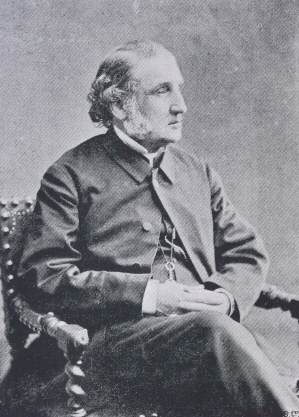
The succession of Dr. Stoughton to the
ministry of the Church brings us exactly to the middle of our
century of history. In October, 1843, the recognition
service was held. Dr. Stoughton, in his letter accepting
the invitation, had feelingly referred to the difficulty of
following Dr. Vaughan, “one whose eminence in the Christian
world might well provoke, in connection with myself, humiliating
comparisons.” But, indeed, the Church had been guided
to one of the very few men who might fittingly continue the
work of Dr. Vaughan. As a historian of those periods of
English history in which Nonconformists are especially
interested, Dr. Stoughton stands unsurpassed among Englishmen;
and such is the fairness and moderation of his writings that
Church of England lecturers have repeatedly made appeal to them
as models of impartial and accurate statement. Indeed, Dr.
Stoughton’s literary industry has been immense. The
Religious Tract Society has largely benefited by admirably
written accounts of the great Reformers and religious heroes of
Christendom, while Dr. Stoughton’s editorship of the
Evangelical Magazine was conspicuously successful in
making that organ a power among the Churches. But it was in
no partial or half-hearted way that he threw himself into his
ministerial work at Kensington. Our readers must turn to his own
inimitable narrative in “Congregationalism in the Court
Suburb” for the delightful reminiscences he gives of his
own ministry, and the people associated with it. Our
concern is with the growth of the Church life; and to this end we
must pursue our examination of the records, which are henceforth
admirably kept.
That Dr. Stoughton immediately acquired the full confidence
and loyal support of the Church officers and members is evident
from a very remarkable fact. For many years past the Church
had been, in all essential procedure, a Congregational Church;
but, although it was so in fact, it was not so actually in
form. The members had apparently not been led to see the
importance of constituting themselves according to the New
Testament practice. We all know that it is not easy to
carry out important changes without arousing considerable
criticism, and, not unusually, opposition. And for the
truer fashioning of the Church upon more Apostolic lines there
was needed a strong and wise leadership. This leadership
was supplied by the new minister, and the delicate work of
reorganisation was most successfully and harmoniously carried
through. The existing “managers” became
deacons, and new deacons were appointed; and the Church assumed
the form which it has ever since maintained. It was of
excellent augury for the success of his ministry that Dr.
Stoughton perceived so early that the recognition of the
spiritual order of the Church in form, as well as in fact, was a
vital principle. However much of the subsequent development
of our Church we may attribute to Dr. Stoughton’s able and
devoted ministry, we are bound to attribute even more to this bold and
timely assertion of the true idea of the Church.
The time soon came when the Hornton Street Chapel proved too
small for the number of hearers. Kensington was, even now,
rapidly developing, and every month added to the congregations
that assembled to worship in what was never a large
building. What enlargement could easily be made was carried
out in 1845, but it afforded only temporary relief. There
had evidently come to the Church one of those testing times of
faith and sacrifice which prove the genuineness of the spirit and
the life. The district of Notting Hill was becoming an
influential and populous one, and the conviction was laying hold
of the minds and hearts of many, that it was a clear duty to
Christ that a certain number of the members should consent to
break with the old associations of Hornton Street, and form a new Church in
the district just mentioned. Such a proposal, of course,
meant even more than the severance of very sacred ties that bound
them to the old society, and to their loved minister. It
meant a generous offering of their money for the new
building. But to all these demands the Church was
equal. At a meeting held in the vestry at Hornton Street,
£1700 was at once subscribed, and, in a very tender and
beautiful document, that betrays in every line the sorrow that
they felt at thus going forth from a place and a community so
dear to them, thirty-seven members ask to be commissioned by the
Hornton Street Church to form a new society at Horbury, Notting
Hill. An exodus of this kind, where the spirit is entirely
of love and faith, is a memorable and impressive event.
Something like one hundred seat-holders left Hornton Street for
Horbury; but the two congregations remained one in heart, as they
were one in tradition. Under the long and able ministry of
the Rev. William Roberts, the Horbury Church has been a great
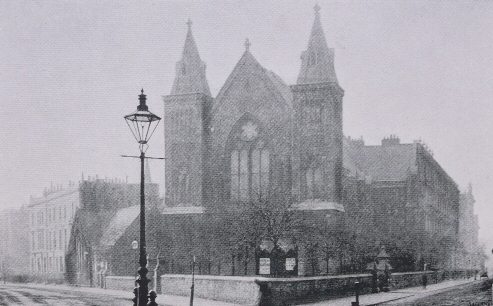
power for good in that neighbourhood. We reproduce a
photograph of the chapel, which stands on an admirable site, and
presents a very good appearance.
On purely economical principles the mother Church should now
be seriously weakened by the voluntary surrender of so many
members, and so much earnest Christian capacity. But the
great law of the economy of the Kingdom of Heaven is that we live
by sacrifice. And it was so now. The Church at
Hornton Street flourished as never before. The income was
not impaired: the sittings refilled; the organisations abounded
with life. In influence, reputation, and spiritual power, the
Church grew day by day. Not five years afterwards, the old
problem of enlarging the accommodation presented itself once more
for solution. The time was hardly ripe, nor was any special
neighbourhood obvious, for planting a new settlement.
Consequently the alternative solution remained. There must
be a new and larger edifice built. The spirit of the
people, so far from being daunted by the prospect of a large
expenditure, and all the infinite cares of chapel building, rose
to meet the opportunity. The site at Allen Street was
secured, and in June, 1854, Dr. Stoughton laid the first stone of
Kensington Chapel. In May, 1855, the building was opened,
and in January, 1860, it was paid for, the total cost of land and
building being £8748 9s. 6d. The plain
and severe character of the interior probably represented, even then, the
average Nonconformist taste in regard to chapel
architecture. Æsthetically considered, it is no doubt
indefensible. The windows are undeniably ugly; the
pulpit—designed as a firm remonstrance against locomotion
on the part of its occupant—is painfully stiff and square;
and the general aspect of the building is somewhat dull and
prosaic. But, as a suitable and convenient place for
Nonconformist worship, there is very much to be said for this
form of building. Every one can see the preacher, and he
can see every one. The acoustic properties are
perfect. Nothing interferes with the enjoyment of speaking
and hearing: no handsome but troublesome pillars interrupt the
sight; and, let us add, when it is well filled, many of its most
obvious defects entirely disappear.
There is no need to trace in anything like detail the
steady progress of the Church in its new habitation. In
1856 the Lecture Hall was built, and has been an indispensable
adjunct to the Church buildings since that time. In 1868
the Church took into consideration the need for larger buildings
to contain the British Schools, and shortly afterwards the
friends of the Schools began the building that now stands next to
Kensington Chapel, and is the meeting-place of our Sunday
Schools. Thus the years were full of work and growth in
many directions, and the utmost harmony prevailed among the
members, while the relationship of pastor and people grew closer
and more affectionate as the time rolled by. In course of
time the Church provided an assistant minister to relieve Dr.
Stoughton of some part of the labour. The arrangement
worked harmoniously and fairly successfully. But Dr. Stoughton had
come to feel that this was not a permanent settlement of the
question that was arising, how best to provide for the pastoral
supervision of the people, as well as for the superintendence of
the numerous important organisations connected with the
Church. Through thirty years of faithful ministerial
labour, assisted by the harmonious co-operation of a devoted
people, Dr. Stoughton had led the Church forward, step by step,
into a position of exceptional strength and influence. It
was not unnatural that, having borne the burden and heat of the
day so faithfully and so long, he should desire to be released
from the full responsibilities of the pastorate. But it was
two years later before his deeply attached people could consent
to the severance of a tie that had become so sacred. The
retirement of Dr. Stoughton from the pastorate of the Church
evoked demonstrations of respect and affection that we do not
hesitate to term unique. At the public meeting in the
chapel, on April 8th, 1875, to say farewell, there was a most
remarkable assemblage of honoured men. Mr. Samuel Morley
occupied the chair, and Sir Thomas Chambers, Mr. Henry Richard,
Sir Charles Reed, Dean Stanley, Canon Fremantle, Dr. Morley
Punshon, Dr. Angus, Dr. Henry Allon, and the Rev. Baldwin Brown
were among those who took part in the meeting. An address,
expressive of admiration and regard for Dr. Stoughton, and
gratitude for his devoted ministry, was presented to him,
accompanied by a purse containing £3000. Thus closed
a most memorable ministry. But it is one of the special
joys of our centenary services that Dr. Stoughton should still be able to
come among us, to celebrate the fiftieth year of his association
with Kensington. He retired full of honours. His
great qualities, alike of literary ability and personal
character, won for him the unique distinction of being elected by
those most eminent in the various branches of our national
life—Politics, Art, Science, and Literature—to
membership of the Athenæum Club. We believe that he
alone of all Nonconformist ministers has been welcomed to this
honour. But we are certainly right in saying that, even
more than such a mark of recognition by men distinguished in so
many walks of life, he has valued the simple love and loyalty of
that Christian Church to which he gave himself with such
unqualified devotion, and which owes so much of its present
character and influence to the spiritual leadership of Dr.
Stoughton.


