The building which is commonly known as the Temple
of Theseus, or Theseion, stands about a quarter of a mile
to the north-west of the Acropolis of Athens.
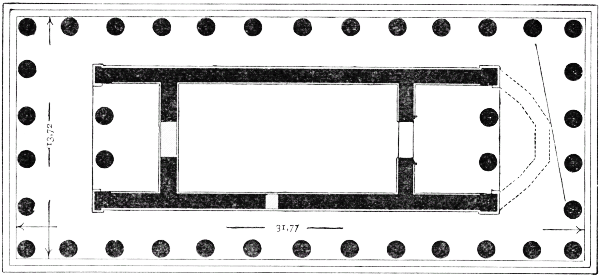
Fig. 15.—Plan of the Theseion. (From Baumeister.)
The temple is of the kind called peripteral hexastyle.
Round the cella, or central chamber, is a single row of
columns, thirty-four in number, of which there are six at
each end. The order is Doric, with a frieze peculiarly
arranged. On the eastern front are ten sculptured metopes,
and there are four on each of the adjacent sides,
making a total of eighteen sculptured metopes. The
remaining metopes of the temple, fifty in number, are
plain slabs, which may possibly have had painted on them
figures or ornaments. Of the pedimental groups, which
appear to have once existed at each end of the temple,
nothing now remains except the marks of the attachment
of sculptures. Within the colonnade the two ends of the
cella are adorned with a frieze of Parian marble, which
is still in position. At the west, the length of the frieze
is only equal to the width of the cella; at the east, the
frieze is continued as far as the epistyle, or beams surmounting
the colonnade.
The west frieze is about 25 feet long; casts of 16 feet
4 inches are in the British Museum. The east frieze is
about 37 feet long, and casts of 32 feet are in the Museum.
From the Middle Ages till recent times this building
has been called the Temple of Theseus, and was supposed
to have been dedicated to Theseus by the Athenians in the
time of Kimon. That statesman had transferred the
bones of Theseus to Athens from the island of Skyros in
469 b.c. The chief arguments for this attribution are:—(1)
That labours of Theseus are represented on the
metopes, and perhaps on the friezes; (2) that the building
is not far from the place where, according to Leake and
others, it might be expected from the description of Pausanias
(i. 17, 2); (3) that the temple was dedicated as a
Christian church to St. George, who corresponds in many
ways to Theseus.
Ross, however (Das Theseion), tried to prove that this
was not the Theseion. He argued that no connection
could be traced between the external sculptures and the
function of the building. He also argued that the real
Theseion cannot have been a complete temple, and that
it cannot have stood in the position of the temple now in
question. He proposed to call the building a temple of
Ares. It has since been suggested that Ares and Theseus
may have been joint occupants of the temple, as Athenè
and Erechtheus held the Erechtheion in common (Murray,
i. p. 236). Curtius (Sieben Carten, text, p. 53) suggested
that the temple may have been that of Heracles in Melitè.
In this view he has been followed by Wachsmuth
(Stadt Athen, i. p. 364). Other patron deities have also
been proposed, as Apollo Patroös, or Heracles and Theseus
together, or Hephaestos. Doerpfeld, followed by Miss
Harrison (Mythology and Monuments of Anc. Athens, p. 112),
is strongly in favour of the last-mentioned attribution,
identifying the building with the temple of Hephaestos
mentioned by Pausanias (i., 14, 6).
It is clear, from a comparison of other temples, that no
conclusive argument can be drawn from the subjects of
the sculptures, especially of the metopes, which may have
little connection with the special purpose of the temple.
At the same time we know that the Theseion was decorated
with paintings relating to the story of Theseus,
and, so far as any weight can be attached to the subjects
of the sculptures, they favour the attribution of the
building to Theseus. It has been suggested that the
temple may have belonged to Heracles and Theseus in
common—not on the ground that we hear of such a
temple, but because the ten metopes on the east front
relate to Heracles. But this fact is inconclusive. The
Athenians would be content to point out the parallelism
of Heracles and Theseus, even if Theseus was made to
occupy a subordinate position. The newly-discovered Ἀθηναίων
Πολιτεία of Aristotle furnishes some new evidence.
The disarming of the Athenians by Peisistratos is said to
have been effected in the following manner. He caused
the citizens to put down their arms in the Theseion, presumably
in the temenos of Theseus, that he might address
them, and then drew them off to the Propylaea on the
pretext that they would be better able to hear him.
Meanwhile his agents shut up the arms in "the adjacent
buildings of the Theseion" (ἐξοπλισίαν
ἐν τῷ
Θησείῳ
[sic MS.] ποιησάμενος ...
ἐκέλευσεν
αὐτοὺς
προσαναβῆναι
πρὸς τὸ
Πρόπυλον
τῆς
ἀκροπόλεως ...
ἀνελόντες
οἱ
ἐπὶ
τούτων
τεταγμένοι
τὰ ὅπλα
αὐτῶν
καὶ
συγκληίσαντες
εἰς
τὰ
πλησίον
οἰκήματα
τοῦ
Θησείου κ.τ.λ.
Aristot. Ἀθ. Πολ. ed. Kenyon, 15). From
this it may be inferred that the Theseion was at no great
distance from the Propylaea, though sufficiently removed
for the success of the stratagem. Polyaenus (Strat. i.,
21) tells the story, but states that the disarming took
place in the Anakeion, and that the arms were shut up in
the sanctuary of Aglauros. These are known sites below
the north and north-west sides of the Acropolis. The
account of Aristotle thus shows that there was a temenos
and shrine of Theseus in existence long before the time of
Kimon.
The date of the temple is necessarily uncertain. It
cannot be older than the Persian invasion (480 b.c.), but
most writers are of opinion that each part is rather older
than the corresponding part of the Parthenon, both in the
architecture (Julius, Annali dell' Inst. 1878, p. 205) and
in the sculpture. There are many parallels between
the metopes of the Parthenon and the sculptures, both
metopes and friezes, of the Theseion. There is also a
close analogy between the east friezes of the Parthenon
and the Theseion in point of composition; moreover certain
figures occur in both works (Murray, i. p. 244). But
there is no trace in the Theseion of the low relief of the
Parthenon frieze. The whole of the Theseion sculptures
are metope-like in the treatment of the high relief. Overbeck
states the order in point of time as follows:—Metopes
of Theseion; metopes of Parthenon; west frieze
of Theseion; east frieze of Theseion; frieze of Parthenon
(Gr. Plast. 3rd ed. I., p. 349). Doerpfeld, however, followed
by Miss Harrison, holds the temple to be later than the
Parthenon.
It has been held by Brunn, Julius (Annali dell' Inst.
1878, p. 202), and Murray (i. p. 251), that the differences
between the sculptures of the two temples are due to the
fact that the sculptures of the Theseion were produced by
the school of Myron.
Stuart, Antiqs. of Athens, vol. III., chap. i.; Mus. Marbles, IX.,
pls. 12-21; Müller, Denkmaeler, pl. 21; Kunstarch. Werke, IV.,
p. 1; Ross, Das Theseion (1st ed. 1838; 2nd ed., 1852); Ulrichs,
Annali dell' Inst., 1841, p. 74; Leake, Topography of Athens
(2nd ed.), p. 498; Gurlitt, Das Alter der Bildwerke des sog.
Theseion; Brunn, Sitzungsber. der k. bayer. Akad. Phil.-hist. Cl.
1874, II., p. 51; Wachsmuth, Die Stadt Athen, I., p. 357;
Julius, in Annali dell' Inst., 1877, p. 92; 1878, p. 193; and
Mon. dell' Inst., X., pls. 43, 44, 58, 59; Overbeck, Gr. Plast., 3rd
ed., I., p. 343; Murray, I., p. 235; Wolters, No. 526; Baumeister,
s. v. Theseion; Elgin Room Guide, II., B., 1-16. The British
Museum possesses an excellent series of drawings of the Theseion
by Lord Elgin's artists.
The ten metopes on the eastern front contain nine
labours of Heracles, one labour being represented in two
groups. The eight metopes at the east ends of the
South and North sides represent the following exploits of
Theseus:—On the South side—(1) The victory over the
Minotaur. (2) The capture of the bull of Marathon.
(3) The punishment of Sinis Pityocamptes. (4) The
punishment of Procrustes (?). On the North side are—(1)
The victory of Theseus over the robber Periphetes,
also called Corynetes. (2) His contest with the Arcadian
wrestler, Kerkyon. (3) The punishment of Skiron.
(4) The capture of the sow of Crommyon.
Of these eighteen metopes the Museum possesses casts
of only three, Nos. 1, 2, and 4 on the North side.
400.
Theseus and the robber, Periphetes. Theseus stands
over his adversary, who has been thrown down on the
ground, and aims a blow at him. Both arms of Periphetes
are stretched out as if to avert a spear-thrust, and it
seems probable that the weapon of Theseus was a spear,
which he directed with both hands. The left hand of
Theseus still remains in front of his breast.
Height, 3 feet 9½ inches. Mus. Marbles, IX., pl. 20.
401.
Theseus and Kerkyon, an Arcadian wrestler, who
challenged all travellers to wrestle, and slew the vanquished.
Theseus has lifted his adversary from the
ground, and, clasping his hands together, grips him
tightly round the body. Kerkyon is nearly helpless.
His right arm passes behind the shoulder of Theseus,
but with his left hand he seizes Theseus' right heel.
Kerkyon is bearded, but the hair is hardly indicated in
detail.
Height, 2 feet 9½ inches. Mus. Marbles, IX., pl. 21.
402.
Theseus and the Sow of Crommyon. The sow stands
on her hindlegs, resting her forefeet on the thigh and
the drapery of Theseus. Theseus advances to the attack.
The action of the right hand cannot be ascertained, but
the right arm must have been raised above the head, and
perhaps brandished a club. The left arm is concealed in
the chlamys, which Theseus wears in this metope.
Height, 2 feet 9½ inches. Mus. Marbles, IX., pl. 21.
The subject of the West frieze of the Theseion admits
of no doubt. Here we have represented the Battle of the
Centaurs and Lapiths at the marriage feast of Peirithoös.
It has been pointed out that this frieze appears to consist
of metope-like groups, with a few figures added to give
continuity between the different groups, such as is appropriate
to a frieze. Thus, compare No. 403, 1 with the
Parthenon Metope, No. 307. In the parts of the frieze,
not represented by casts, compare the group engraved
Overbeck, Gr. Plast. 3rd ed. i., p. 348, No. 2, with
Michaelis, pl. 3, xxiv.; Overbeck, No. 6, with Parthenon
metope, No. 311; Overbeck No. 8 with Michaelis, pl. 3, xi.
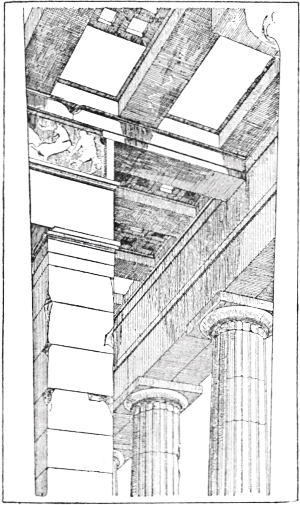
Fig. 16.—The disposition of the West Frieze of the Theseion.
(From Baumeister).
403. 1.
Combat of Centaur and Lapith. The Lapith is defeated
and has fallen to the ground. He supports his body with
the right arm, of which the hand alone remains. The
left hand, which is wrapped in the chlamys, is raised
imploringly to the Centaur, to whom also the head is
turned. The victorious Centaur rears up above the
Lapith, and is about to hurl a great stone, or perhaps a
hydria, with both hands.
Height of this and the following slabs, 2 feet 9½ inches;
length, 2 feet 10 inches. Mus. Marbles, IX., pl. 18.
Between Nos. 1 and 2 is a group, of which the Museum
does not possess a cast, representing two Lapiths and a
fallen Centaur.
2.
On the left is a group of a Lapith and a Centaur.
The combatants have for the moment drawn a little
apart. The Lapith has recoiled for a blow; the attention
of the Centaur seems more directed to the group on his
left. The symmetry of the grouping, which is apparent
in the frieze as a whole, requires us to regard these two
figures as connected, though they may appear somewhat
separated. The Centaur brandishes a branch of a tree, to
which his hands are still attached, though the arms are
lost. The Lapith had both arms raised, and perhaps held
a battle-axe. His dress is a chlamys.
We next have a group of two Centaurs, rearing up, and
heaving together a rock wherewith to crush the invulnerable
Lapith, Kaineus, who is half buried in the ground
between them, and who endeavours to defend himself
with his shield uplifted on his left arm. His head is
turned towards the Centaur on the right. His right arm,
now wanting, may have rested on the ground. But it is
possible, to judge from indications on the ground of the
relief, that it was bent at the elbow, and pierced with a
sword the abdomen of the Centaur. The Lapith wears a
helmet.
On the right of this group is a Lapith hastening to give
succour to Kaineus. His right arm, which was bent back
at the elbow, had been raised to strike. His left arm has
been muffled in a chlamys. He also wore a petasos, part
of which is seen behind the shoulders. On the right of
this figure is a group of a Lapith attacking a Centaur.
The Lapith wears a crested helmet; on his left arm is a
shield, within which his chlamys hangs from his arm. He
also wears sandals. He places his left foot on a rock.
The Centaur opposed to him is rearing, with his back
turned to the spectator; his right arm, drawn back, has
held some weapon, probably the branch of a tree; on his
left arm and shoulder is the skin of a lion or panther
which hangs down his back.
Length, 10 feet 9 inches. Mus. Marbles, IX., pls. 18, 19.
The next group on the frieze, which is not represented
by a cast, contains a Centaur struggling with a Lapith
who has fallen on his knees.
3.
On the left is a Lapith, armed with shield and helmet,
and wearing a chiton and sandals. He seems about to
attack a Centaur, who rears to the right over the body of
a Lapith, who has sunk down in a sitting position.
Length, 2 feet 9 inches. Mus. Marbles, IX., pl. 20.
Most of the figure of the seated Lapith, and the whole
of the succeeding group of a Lapith and Centaur are not
represented by casts in the Museum.
On the east frieze is represented a battle in the presence
of six seated deities arranged in two groups. In
one part of the frieze the combatants are hurling vast
rocks. Colonel Leake (Topography of Athens, 2nd ed.
p. 504), supposed that Heracles and some of the gods are
engaged in a battle with giants, while other deities,
among them some who usually take a leading part in the
fray, merely sit and watch. This, however, is a scheme
of Gigantomachia to which no parallel can be adduced.
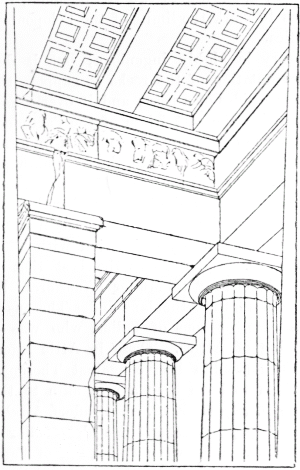
Fig. 17.—The disposition of the East Frieze. (From Baumeister.)
Brunn (Sitzungsber. der k. bayer. Akad. Phil.-hist. Cl.,
1874, ii., p. 51), supposes the battle here represented to
be that fought by the Athenians under Theseus against
Eurystheus in defence of the Heracleidae. The scene on
the left would thus represent the first rout of the troops
of Eurystheus; then would come the storming of the
Skironian pass by Theseus, where we might expect masses
of rocks to be hurled on the assailants. The kneeling
figure on the left of the central group (404, 4), who is
being bound would, according to Brunn, be Eurystheus,
who was taken prisoner and put to death. The figure on
the extreme right (404, 8), who is stooping forward, Brunn
supposes to be one of the victors erecting the boundary
stone, which, according to the Attic legend, was set up
by Theseus to mark the limits of the Peloponnese on the
side of Attica.
The theory is highly ingenious; but it demands a
forced interpretation of the rocks to suppose them to be
lining the two sides of a pass; and it overlooks the close
parallelism with the east frieze of the Parthenon, where
the two groups of gods must be supposed to form a single
background to the scene. Also, the Skironian pass was a
road between rocks and the sea. Moreover, the vast size
of the rocks indicates a giant race, rather than a group of
warriors who are reduced to using stones in an extremity.
If the subject has any connection with Theseus, the
theory of K. O. Müller seems the best that has been
proposed. According to Müller (Kunstarch. Werke, iv.
p. 1) it represents the Athenians under Theseus attacking
the Pallantidae, or sons of Pallas, who was a son of
Pandion, king of Attica. These in Attic legend (Plut.
Theseus, 13) formed a league against Theseus. Müller
supposes them to have been a race akin to the giants.
Compare Soph. Ægeus, fr. 19, ed. Dindorf,
ὁ σκληρὸς
οὗτος
καὶ
γίγαντας
ἐκτρέφων
Πάλλας. See also Müller (p. 8) on
the close connection between Pallas, son of Pandion, and
the Attic Pallenè, with Pallas the giant and the Thracian
Pallenè, the field of the great war of the gods and giants.
404. 1.
On the left of the slab, two armed warriors carrying
large shields on the left arm, and wearing, one a chlamys
and one a chiton over the left shoulder only (heteromaschalos),
advance to the right. Before them is a conquered
adversary, who has been forced down on his knees by the
victor, who appears to tread down his buttock, while his
hands are engaged binding the hands of the prisoner.
The victor wears a chlamys, but the prisoner is nude.
The head of the prisoner was probably turned towards the
victor. On the extreme right of the slab there remains
the right foot of a figure. The original is extant (cf.
Stuart, vol. iii. ch. i. pl. 15), and is a nude armed figure,
moving to the right. The head is lost.
Height of this and the following slabs, 2 feet 9½ inches;
length, 4 feet 6 inches. Mus. Marbles, IX., pl. 12.
2.
On the next slab is a group of three deities seated
on rocks, of whom the figure on the right is male and the
other two female. The two female deities wear long
chitons, in the one case with a diploïdion, and in the
other case with sleeves. The figure on the left has the
right hand, which is still preserved, by her side. It
evidently held a spear. In Stuart's engraving this figure
wears a helmet, but the drawing published by Le Roy
(Les Ruines des plus beaux Monuments de la Grèce, 1758),
though in most respects worthless, seems to show conclusively
that the heads are conjecturally restored in Stuart,
vol. iii. ch. i. pls. 15, 16, while in pls. 17 to 20 no restoration
is attempted. The remains of the figure make it
probable that the goddess here represented is Athenè.
The central figure turns towards Athenè, to whom her
right arm was probably extended. Passing over the
back of her head is a large mantle, which is also wrapped
about the legs, and falls over the left arm. The male
figure in the group probably looked to the right at the
pair of combatants which follows next in order. He has
a mantle twisted round his lower limbs and passing
behind his back. His left hand rested on a sceptre held
vertically, which has now been broken away. All these
three figures wear sandals.
The second Goddess may well be Hera, and in that case
her male companion would probably be Zeus.
Length, 4 feet 6 inches. Mus. Marbles, IX., pl. 13.
3.
Combat of two warriors. The nude warrior on the
left, armed with shield and helmet, presses forward to the
attack; he probably held a sword in the right hand. His
adversary, whose back is turned towards us, appears to
be in retreat, but to be stopping to deliver a thrust,
probably with a spear held in the right hand. His left
arm must have held out a shield, of the rim of which
a fragment remains, attached to the left thigh. His
dress is a chiton heteromaschalos. On the right of the
slab is seen the right foot of a warrior, belonging to the
succeeding group, of which the British Museum possesses
no cast. The warrior stretches out his shield to protect
a wounded figure lying on the ground.
Length, 2 feet 10 inches. Mus. Marbles, IX., pl. 14. For the
missing group, see Stuart, III., ch. I., pl. 17; Overbeck, Gr.
Plast., 3rd. ed., I., p. 348.
4.
Part of the legs of the wounded warrior just referred to
remains on the ground, on the left. Next on the right are
two warriors moving to the right. Both these figures are
nude, but very seriously mutilated. It is doubtful whether
the figure on the left was armed with a shield, like his
companion. His right foot is advanced and he is hurrying
forward.
Length, 2 feet 8 inches. Mus. Marbles, IX., pl. 14.
5.
A battle scene, in which the combatants, four in
number, are hurling rocks; a fifth, overcome in the fray,
lies prostrate on the ground. In this combat one warrior
appears to be fighting against three. On the left an heroic
figure, which may well be Theseus, is seen advancing. In
the confusion his mantle has fallen off, and only hangs over
the left arm. With outstretched left hand he repels a
huge stone hurled against him by his adversary; the right
hand appears to have been stretched out behind the body,
and may have held a sword. There appear to be no means
of warding off the stone which the adversary throws with
his left hand. Confronting the hero, supposed to be
Theseus, is first the warrior just mentioned, who hurls
a stone with each hand. Behind him is a second figure,
who appears to be looking in the same direction. His right
hand was probably holding a stone behind his head, while
the left hand is stretched back to pick up another stone
from the ground. The third warrior hurls a great stone
with his right hand, while with his left hand he propels
the large stone seen behind the shoulders of the central
figure. The fallen figure lies on rocky ground in the
middle of the group of combatants, his head is much
below the level of his body; his right arm, now wanting,
has been resting on a lower level, his left arm is folded
helplessly across his body.
Length, 5 feet 10 inches. Mus. Marbles, IX., pl. 16.
6.
Group of two warriors advancing rapidly to the right,
each with a shield on the left arm. One is nude, the
other wears a chiton heteromaschalos. Next on the right
is a group of one female and two male deities seated on
rocks, and observing the combat. The Goddess occupies
the centre of the group, her head slightly inclined forward,
and looking to the left. She wears a long chiton,
sandals, and a mantle wrapped about her lower limbs.
Both male figures have similar mantles. It may be conjectured
that the three figures in order from the left are
Poseidon, Demeter, and Dionysos; but it is impossible to
attribute names to them with any confidence.
Length, 6 feet 6 inches. Mus. Marbles, IX., pl. 15.
7.
Torso of a warrior armed with a large shield, who
moves to the left front. The head, now wanting, was
probably turned to the group next on the right, which
consists of two male figures. The one on the left is
evidently a victor holding a prisoner, who has his hands
tied behind his back. The victor wears a chiton heteromaschalos,
while the prisoner wears a chlamys.
Between this group and the next figure is a space,
in which should be a male figure standing, turned a little
to the right, and wearing a chlamys. He appears to be
giving an order to the figure on the right.
Length, 3 feet 8 inches. Mus. Marbles, IX., pl. 17. For missing
figure, see Stuart, III., ch. I., pl. 20; Overbeck, Gr. Plast.,
3rd ed. I., p. 348.
8.
Male figure turned to the left, and bending forward.
Both arms have been extended in front of the body.
The figure wears a helmet and a chiton girt at the waist.
The left foot, which is advanced, rested on a higher level
than the right foot. There is some uncertainty as to the
motive of this figure. Stuart restores it as engaged in
the erection of a trophy, and this is accepted by Schultz,
De Theseo, p. 26; cf. Overbeck, Gr. Plast., 3rd ed., I., p. 353.
For this however there is very little room. Leake suggested
that the figure was engaged adjusting his greave
(Topogr. of Athens, 2nd ed., p. 511).
Length, 1 foot 6 inches. Mus. Marbles, IX., pl. 17.
405.
Part of the ceiling, lacunaria, of the Theseion with six
squares for soffits cut through the marble. See fig. 17.—Elgin Coll.
Length, 3 feet 11½ inches; breadth, 3 feet 4½ inches. Stuart, III.,
ch. I., pl. 8, fig. 2.
406. 1.
Cover from panel of lacunar of the Theseion.—Elgin
Coll.
Height, 10⅛ inches; breadth, 10⅛ inches. Synopsis, No. 365
(243); Stuart, III., ch. I., pl. 8, fig. 2.
Height, 10⅛ inches; breadth, 9⅞ inches. Synopsis, No. 367
(254); Stuart, III., ch. I., pl. 8, fig. 2.
The Erechtheion is an Ionic temple of a peculiar form,
which stands near the north side of the Acropolis of
Athens. It embodies in a structure of the end of the
fifth century the shrines about which the Athenian religion
had centred from time immemorial, and to this fact
the anomalous character of the plan must be ascribed.
The building consisted of a central cella divided into
three portions, and having a portico of six columns at the
east end; a porch of six columns at the north-west
corner; and a porch of Caryatids at the south-west. It
was built of Pentelic marble, with the exception of the
frieze, which had a ground of dark Eleusinian marble.
The temple is known to have been incomplete in
409 b.c. At this time a minute survey of the building
was made, by order of the Assembly, and the result was
recorded in an inscription which is now in the British
Museum. (C. I. G. 160; Newton & Hicks, Greek Inscriptions
in Brit. Mus., xxxv.).
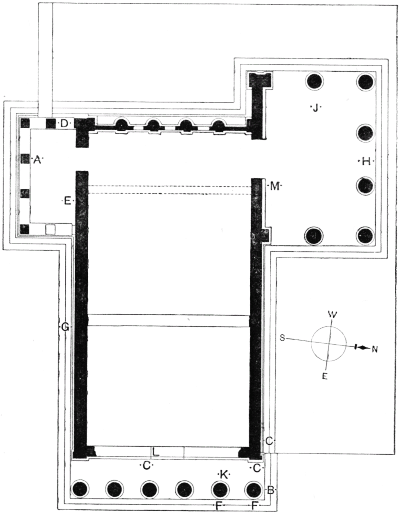
Fig. 18.—Ground Plan of the Erechtheion.
The east half of the building was devoted to Athenè
Polias, whose archaic statue was placed in it.
The remainder of the building was associated with the
cults of Poseidon, Erechtheus, Pandrosos, and others.
The arrangement has been a subject of much controversy.
The passage at the west of the cella probably contained
altars of Poseidon (with Erechtheus), of Boutes, and of
Hephaestos; the tokens of Poseidon, namely the salt
spring, and the marks of the trident, were either in the
west central chamber or below the north portico. The
south porch served as an additional entrance, but it also
contained the tomb of Cecrops. The Pandroseion, which
contained the sacred olive-tree of Athenè, and a small
shrine of Pandrosos, was annexed to the outside of the
west end of the building.
The Elgin Collection contains several specimens of the
architectural decorations of the Erechtheion. In the above
plan (fig. 18), those parts of the building are indicated by
letters from which fragments have been obtained. In
some instances the exact position is uncertain.
For a discussion of the Erechtheion, see Harrison, Mythology and
Monuments of Anc. Athens, p. 481.
407.
So-called Caryatid, or Canephoros,
κανηφόρος (fig. 19).
One of the six female figures which served as columns in
the southern portico of the Erechtheion. In the survey of
the building these figures are called Korae, "maidens."
They have been called Canephori (see p. 149) by Visconti
(Memoirs on the Sculptures of the Earl of Elgin, p. 122), and
others. It is true that the maidens here represented are
such as those represented on the Parthenon frieze. But
there is nothing that specially connects them with the
Canephori, or persons who bore the sacred vessels on their
heads. By some writers they have been called Caryatids,
on account of a statement of Vitruvius (i., chap. 1) that
women of Carya, a town of Arcadia, were represented as
architectural supports—a punishment which they incurred
for betraying the Greeks to the Persians.
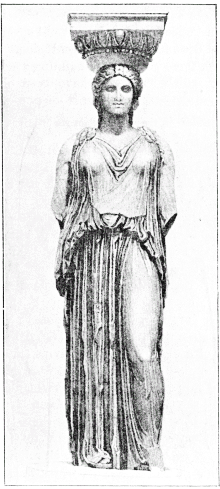
Fig. 19.—Caryatid of the Erechtheion.
The figure here described wears a long chiton, which
is drawn up under the girdle, falling in rich folds, and
is fastened on each shoulder by a circular brooch. Attached
to this is the diploïdion, which falls down before
and behind. In front it falls to the waist; behind it
would trail on the ground, if a part were not looped up to
the shoulders, so as to make a deep fold, falling as low as
the hips. The hair from the back of the head falls in a
thick mass between the shoulders, tied together with a
band. The hair gathered from the forehead is woven into
tresses. Two fall on each shoulder; the others are twisted
round the head in the form of the krobylos (cf. p. 87).
The arms are wanting from above the elbows. The right
hand probably hung by the side, where the surface of the
drapery is seen to have been protected from corrosion.
The left hand has drawn from behind one corner of the
diploïdion.
The head supports a capital, consisting first of a pad or
cushion τύλη, such as was, and still is, used to support
weights. (Compare the east frieze of the Parthenon,
Nos. 30, 31.) From this the transition to the square
abacus is effected by an egg and tongue and a bead and
reel moulding.
This statue is admirably designed, both in composition
and drapery, to fulfil its office as a part of an architectural
design. While the massiveness of the draped figure
suggests the idea that the support for the superimposed
architecture is not structurally inadequate, the lightness
and grace of the pose suggest that the maiden bears her
burden with ease.
The original position of the figure is marked A on the
plan. Four figures and part of a fifth still remain on the
Acropolis. They are uniform in their general design, but
differ slightly in pose and arrangement of drapery.
Pentelic marble; height, 7 feet 7 inches. Stuart, II., ch. II., pl. 19.
Mus. Marbles, IX., pl. 6. Rayet, Monuments, No. 40; Mitchell,
Selections, pl. 7; Murray, II., pl. 17; Wolters, No. 810;
Stereoscopic, No. 115.
408.
Ionic column from the north end of the eastern portico
of the Erechtheion (B on plan). This being a column
from an angle of the building, the volutes occur on two
adjacent sides, so as to present themselves both to the
east and north view.
Height, 21 feet 7½ inches. Synopsis, Nos. 125-7, 110; Stuart, II,
ch. II., pls. 4, 5, 6.
409.
Capital of one of the pilasters (antae) and part of
necking or wall-band from the east wall of the Erechtheion
(C, C, C on plan). It is to be observed that the
frieze on the pilaster, though analogous to that on the
walls, differs from it in details which heighten the richness
of the effect, and which assimilate the pilaster to the
columns of the east portico, while the walls resemble the
capitals of the north portico. Moreover, on the pilaster
the carving of the frieze is raised above the surface of the
courses, while on the wall it is set back from the wall face.
The slab on the right must be from the north-east angle
of the Erechtheion. The three slabs next to it might
belong to the east, north, or south sides, as regards the
form and design. But the excellent preservation of the
surface, as compared with that of the unprotected north-east
angle, seems to show that these slabs are derived from
the east wall, where they were protected by the portico.
It is interesting to note the numerous repairs in the
series of slabs. They probably date from the time of the
construction of the building, and were meant to make good
what was broken by accident in the course of construction.
On the north side of the pilaster, seven inches of the bead
and reel moulding immediately surmounting the anthemia
have been skilfully inserted in a groove and fastened with
lead. On the east side of the pilaster one of the beads of
the lower bead and reel moulding was attached by a plug,
of which the hole remains. On the next slab on the left
one bead of the upper bead and reel moulding was similarly
added. On the second slab from the left, one tongue of
the egg and tongue moulding, one piece of spiral connecting
the anthemia and one bead were let into the marble.
Traces of red colour remain in the upper part of the frieze
on this slab.—Elgin Coll.
Height, 1 foot 7½ inches. The slab containing the capital of the
pilaster is 6 feet in length. Of the other slabs, two are each
4 feet 3 inches in length. The fourth is broken on the right-hand
joint, and measures 4 feet 1½ inches. Synopsis Nos. 252-255
(127-130). Greek Inscriptions in Brit. Mus., I., p. 89, e,
pl. 3, fig. 8. Stuart, II., ch. II., pl. 5. Inwood, Erechtheion,
p. 110.
410.
Fragment of frieze similar to last. Joint on left. Found
on the north side of the Erechtheion.—Inwood Coll.
Height, 6 inches; breadth, 6 inches. Synopsis, No. 116. Inwood,
Erechtheion, p. 138.
411.
Fragment of leaf, bead and reel, and egg mouldings
from the capital of a pilaster at the west side of the south
portico of the Erechtheion (D on plan).—Inwood Coll.
Length, 1 foot 2¼ inches; height, 5½ inches. Synopsis, No. 118.
412.
Cymatium moulding from inner architrave of the
south portico of the Erechtheion (E on plan).
Height, 2½ inches; length, 7¼ inches. Synopsis No. 403. Inwood,
Erechtheion, pl. 20. See also Stuart, II., ch. II., pl. 13.
413.
Piece of architrave, probably part of the beam from the
north angle of the east portico of the Erechtheion (F, F
on plan). There is a joint on the left of this slab.—Elgin
Coll.
Height, 2 feet 1 inch; length, 8 feet 2½ inches. Synopsis, No. 220
(85). Wilkins, Prolusiones, p. 29.
414.
Piece of the architrave from the south wall of the
Erechtheion, broken at each end (G on plan). It is
connected with the preceding by a piece of moulding
cast in plaster.—Elgin Coll.
Height, 2 feet 1 inch; length, 8 feet 5½ inches. Synopsis, No. 219
(291). Wilkins, Prolusiones, p. 29; Greek Inscriptions in Brit.
Mus. I., pl. 3, fig. 9.
415.
Piece of corona of cornice, from the north portico of the
Erechtheion (H on plan). Although not derived from
the same part of the temple, this fragment has been
placed in connection with the slabs of the architrave,
Nos. 413, 414, in order to show the original effect. The
space of two feet between the corona and the architrave
was occupied by the sculptured frieze. This consisted of
marble figures in relief attached by metal clamps on a
ground of black Eleusinian marble. A few fragments are
extant at Athens.
Length, 4 feet 7 inches; height, 10½ inches; breadth, 1 foot 1½ inches.
Synopsis, No. 289 (165). Stuart, II., ch. II., pls. 4, 5. For the
frieze, see Brunn, Denkmaeler, Nos. 31-33; Overbeck, Gr. Plast.,
3rd ed., I., p. 361.
416.
Coffer from the lacunaria of the north portico of the
Erechtheion (J on plan).—Elgin Coll.
Height, 3 feet 2 inches; breadth, 3 feet 5½ inches. Synopsis, No. 108
(299). See Stuart, 2nd ed., II., p. 73, note.
417.
Part of coffer of east portico of the Erechtheion. Found
near the eastern portico (K on plan).—Inwood Coll.
Height, 1 foot 4 inches; breadth, 1 foot 1¼ inches. Synopsis,
No. 117. Inwood, Erechtheion, pl. 20.
418.
Part of door jamb, perhaps from the eastern doorway of
the Erechtheion (L on plan).—Inwood Coll.
Height, 1 foot 2¾ inches; breadth, 6½ inches. Synopsis, No. 115.
Inwood, Erechtheion, pl. 20.
419.
Cast of console, parotis, from the doorway in the north
portico of the Erechtheion (M on plan).
Height, 2 feet 3 inches. Greek inscriptions in Brit. Mus., I., p. 98,
§ 14, b. Wilkins, Prolusiones, pls. 13, 14. Journ. of Hellen.
Studies, XII., pl. 1.
420.
Necking of Ionic column, copied from the columns of
the east portico of the Erechtheion.—Elgin Coll.
Height, 11¼ inches; diameter, 2 feet 2½ inches. Synopsis, No. 120
(306*); Elgin Room Guide, II., No. A. 2.
The temple of Nikè Apteros (Victory without wings), or
more correctly of Athenè Nikè, stood on the projecting
eminence to the south of the approach to the Propylaea at
Athens (Paus., i. 22, 4).
The building had remained uninjured till the close of
the seventeenth century, and was seen in 1676 by the
travellers Spon and Wheler. But not long after, probably
about the year 1685, the temple was demolished by the
Turks, and the materials were used to build a bastion on
the spot where the temple had stood.
In 1835 Ludwig Ross, and the architects Schaubert and
Hansen took down the bastion and reconstructed the
temple as it now stands. A sufficient amount of the
lower part had remained undisturbed to enable them to
proceed with certainty.
The temple consists only of a single cella, opening to
the east, but has four columns at each end (tetrastyle
amphiprostyle). It stood on a podium of three steps.
The exterior was surrounded by a small frieze, 1 ft.
5½ in. high, and measuring 26 ft. on its long sides, and
17 ft. 2 in. at the ends. The annexed cut (fig. 20) shows
the plan of the temple. The arrangement of the slabs of
the frieze has been most fully discussed by Ross, but is
still uncertain in parts. The west frieze, according to
Ross, consisted of the two slabs, Nos. 421, 422, in the
Elgin Collection, and the return faces of two slabs of the
north and south sides. Each return measures 1 ft. 7 in.
The slabs, Nos. 421, 422, measure respectively 6 ft. 8½ in.,
and 6 ft. 7¾ in. The total length, 16 ft. 6¼ in., is thus
nearly equal to the estimated length of the side. The
distribution of the slabs belonging to the long sides is
doubtful. No. 425, cast from a corner stone, certainly
belongs to the south side. Ross assigns No. 423 to the
south side, No. 424 to the north side, on the hypothesis
that the mounted horsemen on the same side proceed
in the same direction. Kekulé (Die Balustrade, ed. 1869,
p. 17) places them both on the south side, in an order
more probable than that suggested by Hawkins (Mus.
Marbles, ix., p. 29). The east side consisted of two
slabs and two returns arranged similarly to those of the
west.
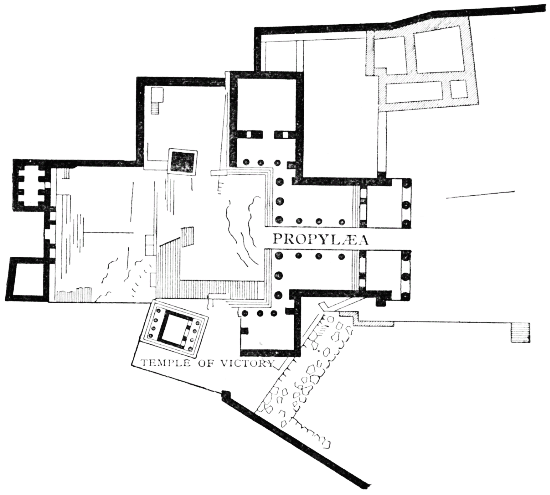
Fig. 20.—Plan of the Propylaea and Temple of Wingless Victory.
The subject of the east side appears to be a council of
Gods. The long sides each contained a battle between
Greeks and a series of warriors, mounted and on foot,
wearing Asiatic costumes and probably intended to
represent Persians. The west side is generally taken to
represent a battle of Greeks with Greeks. Several attempts
have been made to show that historical battles are
represented on the frieze. Overbeck suggests that the
three sides on which there are combatants belong to one
battle, and he conjectures the battle of Platæa (479 b.c.),
when Greeks defeated the Persians and their Greek
adherents. Other writers, perhaps with more probability,
deny that any definite battle is intended, and hold that
we see merely a generalised representation of Athenians,
victorious alike over Greeks and Barbarians.
It has been shown by Bohn (Die Propyläen, p. 31)
and Doerpfeld on technical architectural grounds that
the Temple of Victory was not contemplated in the
first plans for the Propylaea, but that the form of the
Propylaea was modified during the course of construction
on account of it. The earliest date thus obtained for the
beginning of the present building is about 432 b.c. There
is nothing to show what time the temple took to build.
In point of style there is a great resemblance between
the sculptures of the frieze, and those of the frieze of
the Erechtheion, of which a part was being worked, as
we know from the inscription, in 409 b.c. The frieze of
Nikè Apteros may perhaps be placed between 430 and
420 b.c.
Spon, Voyage (ed. 1679), II., p. 105; Wheler, Journey into Greece,
p. 358; Stuart, II., ch. V., pls. 12, 13 (from drawings by Pars,
now in the British Museum); Ross, Schaubert and Hansen, Die
Akropolis von Athen; Abth. I. Der Tempel der Nike Apteros, 1839;
Mus. Marbles, IX., pls. 7-10; Overbeck, Gr. Plast., 3rd ed., I.,
p. 363; Bohn, Die Propyläen der Akropolis zu Athen, 1882;
Murray, II., p. 179; Kekulé (and Bohn) Die Reliefs an der
Balustrade der Athena Nike; Wolters, Nos. 747-760. For
Doerpfeld's views, see Harrison, Mythology and Monuments of
Anc. Athens, p. 356. For further references see Wolters, p. 284.
A photographic view of the temple is given by Baumeister, fig.
1234; and of Nos. 421 to 424 in Stereoscopic, No. 121.
421.
The return of a slab of the north side, now at Athens,
formed the left end of the frieze, and contains two figures
advancing to the right to join the fray (Ross, pl. 11. h.).
This is followed by slab No. 421, containing a battle of
Greeks. In the first group on the left two warriors
are engaged in vehement combat. The warrior on
the left supports with his right knee the shoulder of a
wounded comrade who has fallen at his feet and leans on
his right arm. In the next group are two antagonists
fighting over the body of a dead combatant, then a warrior
who has overthrown his adversary and treads him down
with his left foot. He raises his right hand to inflict the
mortal wound, and may perhaps have grasped the victim's
right wrist with his left hand. In the background is a
trophy which appears to consist of a trunk of a tree, to
which a helmet, shield, and cuirass have been attached.
On the right of the slab is a warrior pursuing a foe flying
to the right.—Elgin Coll.
Pentelic marble; height, 1 feet 5½ inches; length, 6 feet 8½ inches.
Synopsis, No. 160 (259); Ross, pl. 11, i.; Mus. Marbles, IX.,
pl. 9; Baumeister, fig. 1240; Brunn, Denkmaeler, No. 118.
422.
The first figure on the left of the slab appears to be
hastening to the assistance of the flying warrior on the
right of the slab just described. Next is a complicated
group of five warriors fighting for the body of a wounded
man. The latter has sunk helplessly on the ground. He
is half raised and clasped under the arms by a friend who
attempts to draw him away; a foe tries to seize an ankle,
and covers himself meanwhile with his outstretched shield.
More in the background two adversaries are engaged in
hot combat. The warrior on the left probably had a
sword, and that on the right a spear. A friend of the
fallen man hastens up from the left. The right thigh of
this figure, which is now wanting, is preserved in a
drawing by Pars.
On the right are two pairs of combatants. In one of
these groups a warrior, who has fallen on his right knee,
tries to defend himself with his shield, while with the
right hand he seizes a stone. The antagonist has his
right arm raised to strike, perhaps with a battleaxe, and
seizes with his left hand the shield of the kneeling figure.
On the right of the slab one of the warriors flies before
the assault of his antagonist, whose arms are both raised
to strike him.—Elgin Coll.
Pentelic marble; height, 1 foot 5½ inches; length, 6 feet 7¾ inches.
Synopsis, No. 161 (260); Ross, pl. 11, k.; Mus. Marbles, IX.,
pl. 10; Overbeck, Gr. Plast., 3rd. ed., I., fig. 81, p. q.; Baumeister,
fig. 1239; Brunn, Denkmaeler, No. 118.
On the right of the slab described was the return of
the corner slab of the south side, with a combat of two
warriors.
Ross, pl. 11, 1.; Overbeck, Gr. Plast., 3rd ed., I., fig. 81, r.
There is a considerable variety of costumes on the west
side of the frieze. Some of the figures are nude; others
wear the chlamys only, the chiton only, or the two
garments together. The chiton is sometimes worn on
both shoulders, and some times only on one shoulder. The
warriors are for the most part armed with helmets and
large bucklers. In two instances a cap of a flexible
material is worn instead of a helmet. None, however, of
the costumes are non-Hellenic; and further the attempt
made by Overbeck (i. p. 365), to show that the helmet of
the figure on the extreme right of the frieze is distinctively
Bœotian, is untenable (Wolters, p. 284).
423.
Slab containing a part of the battle between Greeks
and Persians. In the first group on the left, a Persian
has fallen on his right knee, raising his right arm to
defend his head. The antagonist presses his left foot on
the right thigh of the Persian, raising his right arm for
a spear thrust, and probably seizing the hair of the
Persian with his left hand. Next is a group of two
Persians and a Greek. One of the Persians lies dead on
the ground; his mounted comrade urges his horse against
the Greek, who draws back, and raises his arm to strike
with a battle-axe.
The next group is composed of two Persians on foot
and a Greek. In the centre is a wounded Persian, who
has been forced down on his left knee and extends his
arms forward in entreaty to the Greek, who drags him
along, grasping the head of the Persian with his left
hand. The right hand of the Greek must have held
either a spear or a sword. On the right the other Persian
turns back to defend his fallen comrade against the Greek.
Both arms are raised to strike, and probably wielded a
battle-axe. At his left side hangs a quiver. On the
extreme right is a Greek moving to the right in pursuit
of a flying Persian of whom only the leg and part of the
drapery round the loins remain. The ground on which
this scene takes place is rocky.—Elgin Coll.
Pentelic marble; height, 1 foot 5½ inches; length, 5 feet 10 inches.
Synopsis, No. 158 (258); Ross, pl. 12, o; Mus. Marbles, IX.,
pl. 7; Overbeck, Gr. Plast., 3rd ed., I., fig. 81, i-l; Baumeister,
fig. 1237; Brunn, Denkmaeler, No. 117.
424.
The first pair of combatants on the left are a Persian,
who has fallen on his right knee, and who holds up a
shield in the form of a crescent, on his left arm to defend
himself, and his antagonist, who advances from the right.
Next is a combat between a Greek on foot and a
mounted Persian. The latter draws back his right hand,
which must have been armed with a spear aimed at the
Greek advancing from the left. The horse of the Persian
rears as if to strike down with his forefeet the left arm of
the Greek, which is thrust forward, protected by his shield.
A dead Persian lies on the ground.
Behind the mounted Persian is a comrade, hastening to
the left, and pursued by a Greek of whom nothing remains
except part of his shield and of the drapery round his
loins. This closes the scene on the right.—Elgin Coll.
Pentelic marble; height, 1 foot 5½ inches; length, 6 feet 1¼ inches.
Synopsis, No. 159 (257); Ross, pl. 12, fig. g; Mus. Marbles, IX.,
pl. 8; Overbeck, Gr. Plast., 3rd ed., I., fig. 81, m, n; Baumeister,
fig. 1238; Brunn, Denkmaeler, No. 117. On the position of these
slabs, cf. p. 240.
425.
A plaster cast from one of the slabs now in position on
the temple. On the left is a mutilated group representing
a Greek warrior turning to assist a comrade who
has fallen on his right knee. Next is a Greek moving
forward to pursue a mounted Persian who is flying to the
right. On the extreme right a Persian on foot flies in the
same direction. A slain Persian lies in the foreground.
The position of this slab on the temple at the south-east
angle is fixed by the relief on its return face which is part
of the composition of the eastern front. This return is
not given in the cast here described.
Height, 1 foot 5½ inches; length, 3 feet 11¼ inches. Ross, pl. 12,
fig. a; Overbeck, Gr. Plast., 3rd ed., I., fig. 81, g, h; Murray,
II., pl. 16, fig. 1.
The dress of the Persians in this frieze is the usual
chiton with long sleeves, girt at the waist, and close-fitting
trousers, anaxyrides. One of them, the kneeling figure in
No. 424, wears a quiver and bow case, gorytos, from which
appears the end of his bow, and two others wear quivers. The
only Persian whose face is preserved is bearded, and wears
the Persian headdress, the kidaris. The heads and weapons
of both sets of combatants have been nearly all destroyed.
Some of the Greeks are armed with the Argolic buckler.
Others have a chlamys wound round the left arm or
hanging loose from the body.
The temple of Nikè Apteros stood on a lofty projecting
bastion, as may be seen from the model of the Acropolis.
This bastion was surrounded for safety with a breast-high
parapet, consisting of a frieze of sculpture in
relief, facing outwards, surmounted by a bronze screen.
Several fragments of the frieze or balustrade were discovered
on the site, in 1835. (Ross, pl. 13.) Additional
fragments were found by Beulé in 1852, and in more recent
excavations to the east of the temple of Nikè, and on the
south slope of the Acropolis. They are preserved in the
Acropolis Museum at Athens.
The sculptures are too mutilated to be arranged in one
composition. It is evident, however, that the frieze consisted
of figures of Victories, variously engaged. Some
lead bulls to sacrifice, while others are erecting or decking
trophies in the presence of Athenè.
There is some uncertainty as to the date of the frieze.
It cannot be older than the temple, and therefore not
earlier than 432 b.c. Kekulé (Balustrade, p. 22), and
Wolters (p. 289) hold that the frieze was produced immediately
after that date. But a more admissible view is
that which puts the balustrade at the very close of the
fifth century. If the different fragments of the balustrade
are examined, they seem to reveal a combination of
various schools and methods. No. 426, severely draped in
chiton and diploïdion, seems to have the somewhat stiff
dignity best seen in sculptures of the Temple of Zeus at
Olympia, but occasionally suggested by the Parthenon
sculptures. The figures of Athenè (Kekulé, Balustrade,
pl. ii.), have the spirit of the Parthenon frieze. In No. 427
and No. 428, the artist dwells on and emphasises the nude
form, displaying it through transparent drapery in a
manner that may well be supposed to have been that of
the transition from Pheidias to Praxiteles. Finally, in the
figure leading the bull (No. 429), there is a florid wealth of
drapery, which, among early works, only finds a partial
analogy in the frieze of Phigaleia, and which appears
more akin to the Nikè of Samothrace than to Attic work
of the fifth century. This want of uniformity in style
suggests a time of transition in which the traditions of
the school of Pheidias were still to some extent operative,
while newer tendencies were beginning to make themselves
felt. Perhaps also they indicate that the work was
spread over a space of several years, such as might be
expected in the troubled close of the fifth century b.c.
Height of Balustrade, 3 feet 2 inches. Ross, p. 17, pl. 13 (cf. ante,
p. 241); Michaelis, Arch. Zeit., 1862, p. 249. All the materials
are collected by Kekulé, Die Reliefs an der Balustrade der Athena
Nike (1881), which superseded Kekulé, Die Balustr. d. Tempels d.
Athena Nike (1869). See also Overbeck, Gr. Plast., 3rd ed., I.,
p. 369; Murray, II., p. 186; Wolters, Nos. 761-804. Stereoscopic,
Nos. 158-160.
426.
Victory standing, half turned to the left. She holds a
greave in her left hand, with which she was probably
decking a trophy. She wears a leather helmet.
Kekulé, Balustrade, pl. 5, fig. R; Overbeck, Gr. Plast., 3rd ed., I.,
fig. 82.
427.
Winged Victory turned to the left stoops forward,
raising her right foot in order to adjust or unfasten her
sandal. A somewhat similar incident is seen on the
Parthenon frieze, (west side, No. 29). There, however,
the figure has his foot resting on a rock, while here the
Victory balances herself on the left foot with the right
leg high in the air, in a position of effort such as does
not occur on the frieze of the Parthenon.
Ross, pl. 13, figs. B, Bb; Kekulé, Balustrade, pl. 4, fig. O; Overbeck,
Gr. Plast., 3rd ed., I., fig. 82; Murray, II., pl. 16, fig. 4; Brunn,
Denkmaeler, No. 35. The meaning of the subject is not known.
In the ritual inscription of Andania the initiated are ordered to
have bare feet, and possibly the Victory is supposed to be
removing her sandals before entering a shrine. Dittenberger,
Syll., 388, 15, cf. ibidem, 357, 25.
428
Winged Victory standing turned to the left, the right
arm advanced. The right hand and all the left arm being
broken away, the motive of this figure has not been
ascertained, but probably the Victory was decking a
trophy.
Kekulé, Balustrade, pl. 4, fig. M; Arch. Zeit., 1862, pl. 162;
Overbeck, Gr. Plast., 3rd ed., I., fig. 82; Brunn, Denkmaeler,
No. 35.
429.
Two winged Victories about to sacrifice a bull, which
one of them is holding back as it springs forward. The
other Victory leads the way, moving to the right.
Ross, pl. 13, fig. A; Kekulé, Balustrade, pl. 1, fig. A; Overbeck,
Gr. Plast., 3rd ed., I., fig. 82; Murray, II., pl. 16, fig. 3;
Brunn, Denkmaeler, No. 34.
The Choragic Monument of Lysicrates is a small edifice
which presents one of the earliest examples of the use of
the Corinthian order in Greek architecture. It may be
thus described. On a square basement is a cylindrical
structure resting on six Corinthian columns. Between
them are six equal panels of white marble closely joined;
at each vertical joint a Corinthian column has been fitted,
so as to project more than half its diameter. Between
the capitals were figures of tripods in relief, of which
only one now survives. Above the colonnade is the
entablature and a cupola or tholos; this is in the form of
a tiling of laurel-leaves richly decorated round the circumference
with a double row of projecting ornaments.
From the apex of the roof rises a mass of foliage arranged
in a triple form, on the three most projecting leaves of
which was placed a bronze tripod, dedicated by a choragos,
who had provided a victorious chorus. An inscription
on the architrave immediately below the figure of Dionysos
furnishes the name and date of the dedicator. It
runs,* "Lysicrates of Kikynna, son of Lysitheides, was
Choragos. The youths of the tribe Acamantis were victors,
Theon was the flute player, Lysiades an Athenian was the
instructor of the Chorus, Euainetos was Archon." The
mention of this magistrate fixes the date of the monument
to b.c. 335-4.
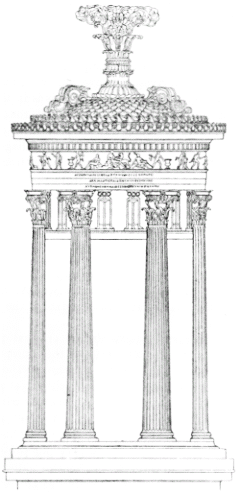
Fig. 21.—The Choragic Monument of Lysicrates. (After Stuart.)
The building still stands in its original position at
Athens, below the eastern side of the Acropolis and a
little to the north-east of the theatre of Dionysos. In
antiquity it stood in a street called "the street of tripods"
(Paus. i. 20, 1), because of the number of tripods which
were there dedicated to Dionysos. At least as early as
the 15th century the building was popularly known as the
Lantern of Demosthenes. In the 17th and 18th centuries
it was built into the wall of the French Capuchin monastery,
and the interior served as the library of the Superior.
The monastery was burnt in 1821, and the only trace of
it is in a few tombstones of French citizens lying near.
The monument now stands in an open square. Lord
Elgin's casts are the best record of the frieze, as the
sculptures, which are of Pentelic marble, have suffered
considerably in the last ninety years.
The subject of the frieze here described is the victory of
Dionysos over the Tyrrhenian pirates who had kidnapped
him from Chios with the intention of selling him as a
slave. The God revenged himself by transforming the
pirates into dolphins, a myth which is to be found in the
Homeric Hymn to Dionysos (No. vi.) and elsewhere (Ovid,
Met. iii. 650; Nonnus, Dionys. xlv. 102; Philostr. Im. i.
19, &c. Cf. Gaz. Arch. 1875, p. 7). In the frieze the
moment is represented when this transformation took
place. According to Homer and most other writers, the
event happened on board the ship, and the pirates were
first terrified by a miraculous appearance of vines and
wild beasts. The sculptor has preferred to represent the
scene as passing on the rocky shore on which the pirates
found Dionysos (Hom. Hymn, vi. l. 2) and has made Satyrs
help in the vengeance. The subject is thus made to
adapt itself to the requirements of sculpture. For a vase
with a representation of the literary form of the legend,
see Gerhard, Auserlesene Vasenbilder, i., pl. 49; Harrison,
Mythology and Monuments of Anc. Athens, p. 251. An
intaglio, with a pirate half transformed, as on the frieze,
is engraved in the Gaz. Arch. 1875, p. 13.
It is convenient to take the architectural remains of
Athens consecutively, and the monument of Lysicrates
has therefore been inserted in this place. But the
accurately ascertained date (335 b.c.) is a century later
than the Parthenon, and it is easy to discern the change
that has taken place. The form of Dionysos is becoming
softer and more effeminate. The Satyrs on tip-toe
belong to a scheme not introduced in the 5th century
sculpture; more free play of humour is admitted. At
the same time Attic schemes of composition present
themselves, which had already come into use in the time
of Pheidias.
This frieze is a remarkable example of the Greek power
of combining variety and symmetry. On the right and
left of Dionysos the groups correspond with great
accuracy, but the correspondent groups always differ one
from another. On each side of the God we have an
attendant Satyr; a Satyr with a crater; a Satyr watching
the conflict; a Satyr hastening to join it; a Satyr
kneeling on a pirate; a Satyr about to strike a pirate
thrown to the ground; a Satyr breaking off a branch
from a tree; a pirate, half transformed, leaping into the
sea. The remainder of the frieze is less exactly symmetrical.
Wheler, Journey, p. 397; Spon, Voyage (ed. 1679), II., p. 132. A
view of the monument from the monastery garden is shown in
Stuart, I., chap. IV., pl. 1. The view from the street is in
Le Roy, Ruines, pl. 13. A view of the interior used as a library,
Dodwell, Tour, I., pl. facing p. 289. A view subsequent to the
destruction of the monastery is given, Exp. de Morée, III.,
pl. 96. For the present state of the monument see Harrison,
Mythology and Monuments of Anc. Athens, p. 245. The original
frieze is of Pentelic marble; height, 10½ inches. Stuart, I., ch. IV.,
pls. 1-26. Stuart's drawings which are freely restored are
the basis of the inaccurate plate in Stuart, 2nd ed., Vol. I.,
ch. IV., pl. 30. The illustrations in most of the text-books are
derived from the latter plate; e.g., Müller, Denkmäler, pl. 37;
Overbeck, Gr. Plast., 3rd ed., II., p. 91. These works all repeat
an erroneous order of the two groups of No. 8, which spoils the
symmetry of the frieze; cf. Murray, II., p. 333. An independent
and more accurate publication is that in Mus. Marbles, IX.,
pls. 22-26, taken from the Elgin casts. See also Ellis, Elgin
Marbles, II., pp. 79-87. The British Museum also possesses a
careful series of drawings from the sculptures, by Lord Elgin's
artist, Lusieri. Report of the Elgin Committee, appendix, p. xli.;
Wolters, No. 1328.
430. 1.
In the centre of the composition is Dionysos turned to
the left, reclining on a rock over which drapery is thrown.
He leans on his left elbow; with his right hand he
caresses a panther which fawns on his knees. In the left
hand Dionysos appears to have held a cup and a thyrsos, of
which traces appear behind his left shoulder. This figure
is now entirely destroyed on the original. There is a
considerable resemblance in the pose of Dionysos to that
of the so-called Theseus of the east pediment of the
Parthenon. On either side of Dionysos is a Satyr, seated
on lower rocks. The Satyr on the right clasps his left knee
with both hands. (Compare the figure on the east frieze
of the Parthenon No. 26). His head was probably turned
towards Dionysos. The Satyr on the left of the God rests
his left hand on the rock behind him; his right knee is bent
and the right leg drawn up under it; in his right hand he
holds a thyrsos; his body and head are turned to the right.
Mus. Marbles, IX., pl. 24.
2.
Next on the left is a Satyr advancing over rocky ground
towards a large crater; in his right hand he holds an
oinochoè, with which he is about to take wine from the
crater; in his left hand has been a phialè; a fawn skin,
nebris, hangs from his left shoulder. His head appears to
have been turned towards Dionysos. On the opposite
side of the vase stands a Satyr turned to the left, resting
his elbows on the stump of a tree, over which is thrown a
panther's skin; the top of a thyrsos appears above his right
shoulder. He appears to have been bearded.
This figure looks on at the destruction of the pirates
which is represented in a series of groups on the left, and
which we must suppose to have taken place on a rocky
shore overlooked by the higher ground on which Dionysos
reclines.
Mus. Marbles, IX., pl. 24.
3.
A Satyr advances to the left with a burning torch,
with which he is about to assail the fallen pirate of the
next group. This Satyr is nude and bearded. His head
is bound with a diadem. The head and left leg are
now lost on the original. The next group on the left
represents a pirate thrown on his hands and knees upon
the rocks. On his back kneels a Satyr whose right arm
is upraised to strike his prostrate foe with some weapon
which is not clearly shown in the relief, but which was
probably a pedum, or perhaps a branch. The Satyr has a
panther's skin floating in the air, at his back. Between
the legs is a lump of plaster, which is due to a fault in the
moulding.
Mus. Marbles, IX., pl. 23.
4.
Next on the left is a bearded Satyr, who draws back to
the right, to collect his force for a blow, with his thyrsos.
Meanwhile he looks back at a pirate on his left, who
kneels with his hands tied behind him, and looks round
towards the Satyr in helpless terror. A panther's skin,
hanging from the left shoulder of the Satyr, floats in the
air at his back.
Mus. Marbles, IX., pl. 23.
5.
The next figure on the left is a bearded Satyr who
turns to the right kneeling on his left knee, set in the
fork of a tree close to the edge of the sea; with both
hands he is breaking off a branch. His panther's skin
floats in the air behind his back. His right foot stands in
shoal water, which is indicated by curling waves. Behind
him on the left is a pirate, whose body to the waist is
transformed into a dolphin, and who leaps head foremost
into the sea.
Mus. Marbles, IX., pl. 23.
Between No. 5 and No. 6 is about a yard of frieze,
wanting in the cast. This is given, freely restored, by
Stuart. An accurate drawing by Lusieri is preserved in
the Museum (Plate ix.). A bearded Satyr holds out a
torch and pursues a pirate who runs away at full speed.
A hole has been cut between them for the insertion of a
beam. A rock and tree separate this group from the
following, No. 6.
6.
This group is rather better preserved in the drawing of
Lusieri than in the cast. A young pirate is seated on the
ground leaning on his left arm. The right hand is
extended in supplication to the bearded Satyr, who is
dragging him seawards by the foot. A hole has been cut
through the figure for a beam. The Satyr stands in the
waves. Behind him a pirate, half transformed, is in the
act of leaping into the sea. This figure is now almost
destroyed in the original. As it is leaping to the right,
it belongs strictly to that part of the circular frieze which
represents the scene on the right of Dionysos.
Mus. Marbles, IX., pl. 22.
7.
On the right of the central group (No. 1) is a bearded
Satyr moving to the right towards a large crater. In his
right hand he holds up an oinochoè or wine jug. His left
is extended over the crater and holds a phialè. This
figure appears to be bearded, though it is drawn as beardless
by Lusieri; the head is now wanting. Next on the
right are two Satyrs, each wearing a panther skin. The
Satyr on the left turns to the right and extends his right
hand towards the second Satyr, as if giving him an order.
The latter looks round to the left, as if to receive the
order, while he is hastening to the right with both hands
raised, as if pointing.
Mus. Marbles, IX., pl. 25.
8.
Next on the right is a prostrate pirate, on whose
buttock a bearded Satyr is kneeling with his left knee,
while he holds the pirate's hands, as if to tie them behind
his back. The pirate kneels on the rock, with his head
pressed upon the ground and turned towards the
spectator.
The next group on the right is composed of a Satyr,
who has thrown a pirate backward on the rock, and is
about to strike him with a pedum or club. The pirate
has his left knee bent under him, and leans back on his
right elbow: he advances his right foot and left arm to
defend himself. He is drawn by Lusieri with a negro face
and pointed ear. The ear seems pointed, but it is manifest
that the features are wrongly drawn. The head is now
wanting on the original. The Satyr has his body facing
to the front and inclined to the left with the right leg
advanced: his right hand is raised to the level of his
head. The action shows that he is about to swing his
body round to give effect to the blow which he is aiming
at the pirate. On his left arm is the panther's skin, worn
as a shield.
Mus. Marbles, IX., pl. 25.
9.
In the next group are a Satyr and a transformed
pirate, separated by a tree which marks the edge of the
rocky shore, as at the opposite side of the frieze. The
Satyr stoops forward, breaking off with both hands a
branch of the tree, which he is about to use as a weapon.
He is bearded. The right leg is now wanting on the
original. The pirate darts head foremost into the water,
pressing his feet against the trunk of the tree.
Mus. Marbles, IX., pl. 26.
10.
On the right of the transformed pirate is a group
representing a Satyr about to strike with a branch of a
tree a pirate seated on the ground, whose head he draws
back with his left hand, brandishing in his right hand
the branch held behind his neck; from the left arm of the
Satyr hangs his panther's skin. He is bearded. In the
drawing of Lusieri he has an ivy wreath and pointed
ears. On the original this group is mutilated almost
beyond recognition. The last group on the right is
composed of a Satyr darting forward with a lighted torch,
which he is about to apply to a pirate seated on a rock
with his hands tied behind his back. A large serpent
behind the pirate has fastened its fangs on his right
shoulder, and has one coil between his right arm and his
back. The pirate looks round in agony towards his assailants.
The serpent suggests the form of the legend
usually current, in which Dionysos is assisted by strange
monsters. According to Nonnus, Dionys., xlv., 1. 134, the
ropes of the rigging of the ship turned to serpents.
431.
Cast from the capital of a column of the Choragic
Monument of Lysicrates.
Height, 2 feet ¾ inches. Synopsis, No. 360*. See Stuart, I.,
ch. IV. pl. 6, fig. 1.
432.
The statue of Dionysos, here described, originally decorated
a choragic monument, of which some scanty remains
may still be seen below the southern wall of the Acropolis
of Athens, and immediately above the Dionysiac theatre.
The monument was in the form of a portico, the architrave
of which rested on three pilasters which masked the
entrance to a cavern in the rock. Until removed by Lord
Elgin the statue stood above the façade. Since the removal
of the statue the portico itself has been destroyed,
and at present only the base and lower portions of the
pilasters stand in position, while fragments of the inscription
lie close at hand. We learn from the inscription on
the centre of the face of the monument that it was dedicated
by Thrasyllos to commemorate the victory gained
by his tribe in the dramatic contest in which he was himself
choragos, in the archonship of Neaichmos (320 b.c.);
C. I. G., 224; C. I. A., ii., 1247. On the right and left were
inscriptions recording the dedication of tripods by Thrasycles,
son of Thrasyllos, who was agonothetes in the
archonship of Pytharatos (271 b.c.); C. I. G., 225, 226;
C. I. A., ii., 1292, 1293. At some date intermediate
between these two, probably about 310 b.c., the state
had assumed the burden of providing the chorus, and
the agonothetes or director of the contest took the
place of the choragos, or provider of the chorus. (Hermann,
Lehrb. d. Griech. Antiq., Müller's ed., iii., pt. ii.,
p. 339.)
It has commonly been supposed that the statue belongs
to the dedication of Thrasyllos. Stuart made the infelicitous
conjecture that it held the votive tripod on its
lap. The most recent writer on the subject, Reisch (in
the Athenische Mittheilungen, xiii., p. 383), conjectures that
the monument of Thrasyllos was originally surmounted
by a pediment on which was a tripod; and that the pediment
was removed by Thrasycles, who placed the statue
in the centre, and bases for his tripods at the sides.
It is left unexplained what became of the tripod of
Thrasyllos. From the style of the statue we cannot
decide between the two dates. Reisch well points out that
in composition and spirit there is an attempt, only
partially successful, to preserve the manner of Pheidias as
seen in the Parthenon pediments. The figure is majestic,
but the drapery is rather heavy. The influence of the
younger Attic school hardly makes itself felt.
The statue is that of a colossal seated figure, the
head, arms, and right foot to the instep wanting. The
body is clad in a talaric chiton, over which is a panther's
skin, passing like a scarf from the left shoulder to the
right side, and bound round the waist by a broad girdle,
under which is seen the panther's face and teeth; an
ample mantle passes from the back of the figure over
the lower limbs, falling in rich folds across the lap.
The head and left arm of this statue were of separate
pieces of marble, and were originally morticed to the
body. The head was wanting as early as the visit of
Spon and Wheler to Athens in 1676. On the left thigh
is a sinking about 6 inches deep, 5 long, and 1½ wide,
in which some object may have been inserted, but
which may have been used when the statue was being
placed in position. On the drapery of the left shoulder
there is a hole for a rivet. It seems probable that the
God was represented with a lyre, the base of which rested
on his left thigh. This instrument was the attribute of
Dionysos Melpomenos (see Gerhard, Ant. Bildwerke, text,
p. 240), and the costume of the figure seems assimilated
to that of a citharist.—Elgin Coll.
Pentelic marble; height, 6 feet 3 inches. The stone is roughly
hewn out at the back to lighten the figure. Wheler, Journey,
p. 368; Le Roy, Ruines, pl. 8; Stuart, II., ch. IV., pls. 3, 6;
Mus. Marbles, IX., pl. 1; Ellis, Elgin Marbles, II., p. 90; Overbeck,
Gr. Plast., 3rd ed., II., p. 94; Reisch, Athenische Mittheilungen,
XIII. (1888) pl. 8, p. 383; Stereoscopic, No. 114; Brunn,
Denkmaeler, No. 119.
The Propylaea, or gateways to the Acropolis, were
constructed by Mnesicles under the administration of
Pericles, in the five years 436-431 b.c.
The main portion of the building consisted of two Doric
portions, facing respectively inwards to the Acropolis and
outwards. These were connected by a series of Ionic
columns. The entrance was flanked on each side by
wings (see the plan, fig. 20). The Elgin Collection contains
a few architectural remains from the building. A
portion of the cedar dowels which connected the drums
of the columns of the Propylaea may be seen in the Bronze
Room.—Presented by A. W. Franks, Esq. Cf. Dodwell, Tour,
I., p. 313.
433.
Capital of Doric column from the Propylaea. It is
impossible to tell from the dimensions whether this capital
is derived from the internal or external portico.—Elgin
Coll.
Pentelic marble; width of abacus, 5 feet 5½ inches. Synopsis,
No. 130 (206). Stuart, II., ch. V., pl. 7, fig. 1. Penrose,
Athen. Architecture, ch. X., pl. 31; Bohn, Die Propyläen,
pls. 11, 13, fig. 2.
434.
Piece of drum of Ionic column from the inner order of
the Propylaea.—Elgin Coll.
Pentelic marble; height, 1 foot 4½ inches; diameter, 3 feet ⅛ inch.
Synopsis, No. 129. Penrose, Athen. Architecture, ch. X., pl. 32.
435.
Part of band for supporting the beams of the ceiling
in the central hall of the Propylaea. There are considerable
remains of the painted mouldings.—Elgin Coll.
Pentelic marble; height, 1 foot 7¼ inches; length, 3 feet 10½ inches.
Synopsis, No. 131 (308). Stuart, II., ch. V., pl. 8, fig. 1; Bohn,
Die Propyläen, pl. 12, fig. 6.
436.
Capital of one of the antae from the small Ionic temple
near the Ilissos seen by Stuart, but destroyed since his
time in 1780.—Elgin Coll.
Height, 1 foot ⅛ inch; breadth, 2 feet ½ inch. Synopsis, No. 170 (174).
Stuart, I., ch. II., pl. 8, fig. 1. See also Leake, Topography of
Athens, 2nd ed., p. 250.
437.
Moulding with anthemion, plait, maeander, and leaf,
bead and reel patterns. Found near the south-east anta
of the Erechtheion.—Inwood Coll.
Height, 8¼ inches; breadth, 6¾ inches. Synopsis, No. 407. Inwood,
Erechtheion, pl. 26, p. 138.
438.
Antefixal ornament or acroterion from the temple of
Demeter at Eleusis. For a similar ornament see Kinnard
in Stuart's Antiquities of Athens, 2nd ed., iii., pl. 1, p. 53.—Elgin
Coll.
Pentelic marble; height, 3 feet 7½ inches. Synopsis, No. 169 (173);
Laborde, Le Parthénon, pl. 27.
439.
Ornament of roof-tile, kalypter anthemotos. Purchased
by Inwood at Athens.—Inwood Coll.
Pentelic marble; height, 8¾ inches. Synopsis, No. 417. Inwood,
Erechtheion, pl. 28, fig. 3, p. 144.
440.
Ornament of roof-tile. Probably purchased by Inwood
at Athens.—Inwood Coll.
Pentelic marble; height, 10¾ inches. Synopsis, No. 412. Inwood,
Erechtheion, pl. 28, fig. 2, p. 144.
441.
Ornament of roof-tile, found "on the gable of a small
Greek church, that appears to have been on the site of
a temple" "in the gardens at Athens, beyond Mount
Anchesmus."—Inwood Coll.
Pentelic marble; height, 8½ inches. Synopsis, No. 411. Inwood,
Erechtheion, pl. 23, p. 131.
442.
Ornament of roof-tile found built into a modern house
near the Choragic Monument of Lysicrates.—Inwood Coll.
Pentelic marble; height, 11 inches. Synopsis, No. 413. Inwood,
Erechtheion, pl. 28, fig. 5, p. 144.
443.
Capital of Ionic column discovered by Inwood built
into the wall of a small Greek chapel called Agia Marina
on the left bank of the Ilissos at Athens. This is probably
the site of the temple of Artemis Eucleia mentioned
by Pausanias (i., 14, 5, and compare ix., 17, 1). Roses are
sculptured in the eyes of the volutes. Inwood remarks
(p. 136) that the central enrichment over the cymatium
between the volutes is unusual. From the absence of mortices
by which the capital could be secured to the architrave
or to the shaft, he infers (p. 133) that this capital
may have belonged to some sepulchral stelè or other work,
where great strength of construction was not required.
Bötticher, who engraves this or a similar capital, is of the
same opinion. The opposite face of the capital is nearly
all broken away.—Inwood Coll.
Pentelic marble; width from centre of volute to centre of volute,
12¾ inches. Synopsis, No. 398. Inwood, Erechtheion, p. 132, pls.
24-25. Bötticher, Tektonik, pl. 30, fig. 7, text, p. 299.
444.
Volute of Ionic capital. Inwood (p. 128) states that it
was found near the site of the temple of Nikè Apteros,
and that from its scale it probably belongs to that temple.
This, however, is not the case, as may be seen by comparing
this fragment with the capital of the temple of
Nikè Apteros in Ross, Akropolis von Athen, pls. vii., viii.
The pulvinus of this capital is ornamented with leaves, as
in the example from Athens in Bötticher's Tektonik,
pl. 31, fig. 5, text, p. 299.—Inwood Coll.
Pentelic marble; height, 1 foot; breadth, 9½ inches. Synopsis,
No. 404, where it is incorrectly described as a capital from the
temple of Nikè Apteros. Inwood, Erechtheion, pl. 21.
445.
Volute of Ionic capital, which, according to Inwood
(p. 127) was found in a wall below the north side of the
Acropolis at Athens. In the eye of this volute a rose is
sculptured in relief. In the capitals of the Erechtheion
there was a similar rose of bronze gilt, for which a recess
is carved in the marble.—Inwood Coll.
Pentelic marble; height, 7¾ inches; breadth, 9 inches. Synopsis,
No. 410. Inwood, Erechtheion, pl. 20; Bötticher, Tektonik,
text, p. 299.
446.
Fragment of the shaft of a column which was fluted
with twenty-four flutes, the diameter being about two feet
two inches. The dimensions differ from those of the
columns of the Erechtheion.—Greece. Presented by W. R.
Hamilton, Esq.
Marble; height, 1 foot 7 inches; width, 1 foot 6 inches.
447.
Capital of Corinthian column, from one of the porches
of the building at Athens, commonly known as the Tower
of the Winds, or more correctly as the Horologium of
Andronicus Cyrrhestes (built probably in the 2nd century
b.c.).—Formerly in the Elgin Collection.
Marble; height, 1 foot 4½ inches. Stuart, I., chap. III., pl. 7.
448.
Unfinished Ionic base.—Formerly in the Elgin Collection.
Marble; height, 9 inches; diameter, 1 foot 10¾ inches.
460.
Fragment of colossal head, showing the right cheek,
right eyelid and right side of the head as far as the ear.
The hair is waved. On the crown of the head eleven
holes are pierced in the marble, evidently for the attachment
of a wreath or other ornament. The left side and
back of the head have been cut or broken away. So far
as can be inferred from the little original surface remaining,
this head was in a fine style of the fifth century b.c.
The style and material of this work, and the place of
its discovery, give good grounds for thinking that it is a
fragment of the famous statue of Nemesis by Agoracritos of
Paros. The exact date of Agoracritos is not recorded, but
he is said to have been a favourite pupil of Pheidias. The
statue of Nemesis is described as a colossal figure of the
type of Aphroditè, holding in her hands an apple branch
and a phialè, on which were figures of Aethiopians. She
had no wings, and stood on a base, sculptured with
subjects relating to the birth of Helen and the Trojan war.
The figure wore a diadem, adorned with deer and figures
of Victory of no great size. Compare the diadem of Pandora,
described by Hesiod, Theogony, 581; the diadem of
Hera of Polycleitos (Paus., ii., 17, 4); the Cypriote terracottas,
in the Terracotta Room, wall cases 1 and 27; and the
Cypriote sculptures in the Cyprus Room. The numerous
holes mentioned above must have served for the attachment
of an ornament of some weight, and so confirm the
proposed identification.
According to tradition the statue was made of a block
of Parian marble, which was brought by the Persians,
before the battle of Marathon, to be erected as a trophy
for the capture of Athens. (Paus., i., 33. 2; Anthol.
Pal. App. Plan., iv., 221, 222, 263). Found on the site
of the Temple of Nemesis at Rhamnus.—Presented by J. P.
Gandy Deering, Esq., 1820.
Parian marble; height, 1 foot 4½ inches. Uned. Antiquities of Attica,
p. 43; Leake, Athens and Demi of Attica, II., p. 108; Synopsis,
No. 325 (273); Elgin Room Guide, II., No. E. 4; Six, Num.
Chron. 3rd. Ser., II., p. 94; cf. coin of Cyprus, ibidem, pl. 5;
Gardner, Journ. of Hellen. Studies, VIII., p. 47; Rossbach,
Athenische Mittheilungen, XV., p. 64; Overbeck, Schriftquellen,
834-843.
Polycleitos of Argos was, as has already been observed
(p. 90), one of the great pupils of Ageladas of Argos, who
was also the master of Myron and perhaps of Pheidias.
Nothing is recorded as to the life of Polycleitos; his
age, as compared with that of Pheidias, is not accurately
known. It is probable that he was rather younger than
Pheidias, as he was working at a later date. Pliny gives
the 90th Olympiad, or 420 b.c., as the date of Polycleitos.
This may be the date of his great statue of Hera at Argos,
the older temple of Hera having been burnt in 422 b.c.,
and it was probably near the end of the sculptor's life.
No original works by the hand of Polycleitos survive,
but several sculptures are known which can be shown
with probability to have been copied more or less directly
from originals, of which the character is thus ascertained.
Polycleitos was famous in antiquity as the author of a
methodical system of proportions for the human form.
One in particular of his figures, the Doryphoros, was
known as the Canon, and was adopted as the ideal type of
a youthful male figure by later sculptors. This figure,
and its companion the Diadumenos (see below, Nos. 500,
501), are known to us from copies. They are of vigorous
make and square build, but somewhat heavy when compared
with the graceful youths of the Parthenon frieze.
But the words of Quintilian, who says (Inst. Orat., xii.,
10, 7) that some critics objected to the works of Polycleitos
as being wanting in weight and unduly elegant, suggest
that the extant copies do not convey an accurate impression
of the bronze originals, and in fact some of the
numerous Doryphoros heads which have been found in
Italy present a profile which strikingly recalls the profiles
of the youths on the Parthenon frieze. Polycleitos was also
noted for his technical skill and perfect workmanship.
The works that have been associated with Polycleitos,
in the British Museum, are here described (Nos. 500-503).
A fragment, however, of a group of two boys playing
with knuckle-bones (Mus. Marbles, ii., pl. 31), which was
ascribed by Winckelmann to Polycleitos (Hist. de l'Art,
Bk. vi., chap. 2; Pliny, H. N., xxxiv., 10), is no doubt of
a later period, and is therefore omitted.
500.
Graeco-Roman copy of the Diadumenos of Polycleitos.
Statue of a nude youth, tying a band (taenia) about his
head. He stands principally on the right leg, resting
lightly on the left leg, and has both hands raised. The
left hand is lost. The band was made of bronze, and
holes remain for its attachment. The left side of the
face has been very much rubbed down. By the side of
the figure is a tree-stump.
That this figure is the Diadumenos of Polycleitos is
indicated by its close resemblance in style to the figure at
Naples, believed to be a copy of the Doryphoros (see
No. 502). It would be a remarkable coincidence if we had
two companion statues representing respectively a Diadumenos
and a Doryphoros, known from the number of
replicas to be copies of important works, and agreeing in
style with what would be expected of the art of Polycleitos,
but yet derived from independent sources.
The head was found at a distance of two-thirds of a
mile from the torso. The torso was found in 1862 in the
Roman Theatre, at Vaison (Vaucluse).
Marble; height, 6 feet 1 inch. Restorations:—Nose, fingers of
right hand, parts of left thigh and of left shin and heel; also
the upper part of the stump. The figure should perhaps be set
with the ancient surface of the base horizontal, and so lean less
forwards. Mon. dell' Inst., X., pl. 49, figs. 1-3; Annali dell'
Inst., 1878, p. 11 (Michaelis); Rayet, Monuments, I., No. 30 and
text; Overbeck, Gr. Plast., 3rd ed., I., p. 388; Murray, I.,
pl. 10, p. 274; Wolters, No. 508.
Other examples more or less nearly reproducing this type are:—(a) A
bronze from the De Janzé Collection in the French Bibliothèque
Nationale. Annali dell' Inst., 1878, pl. B, p. 11 (Michaelis); Rayet,
Monuments, I., No. 31; Babelon, Le Cabinet des Ant. à la Bibl.
Nationale, pl. 13. (b) A terracotta statuette in an English
private collection. Journ. of Hellen. Studies, VI., p. 243, pl. 61.
(c) A sepulchral relief from Praeneste, in the Vatican, commemorating
one Tiberius Octavius Diadumenus, and having a
relief of a Diadumenos, in allusion to the name. Pistolesi, Vaticano,
IV. 84. (d) A gem. Journ. of Hellen. Studies, II. p. 352.
See also No. 501.
501.
Graeco-Roman statue of a Diadumenos. Statue of a
nude youth standing, tying a band (taenia) about his
head. Both arms were raised, but the left is lost. This
figure, like the Diadumenos of Vaison (No. 500), stands
principally on the right leg, but the left leg is differently
placed, and the whole pose is thereby altered. By the
side of the figure is a stump of a palm.
The hair falls in curls, and the figure is more youthful
than the Diadumenos of Vaison. Except in the similarity
of subject these statues have little in common, and
if the Vaison figure represents the statue of Polycleitos,
this figure would appear to be either an independent
rendering of the same subject, or only remotely derived
from Polycleitos. It was, however, for a long time regarded
as a copy of the work of Polycleitos, and this view
has been held by several writers, after the discovery of
the Vaison Diadumenos.—Farnese Coll. 1864.
Pentelic marble; height, 4 feet 10¼ inches. Restorations:—Nose,
parts of band. The right leg appears to be ancient, but worked
over. In the earliest publications (Cavalieri, &c.) the left arm
is drawn as if restored. The statue is first known in the Villa
Madama, near Rome (Cavalieri, Ant. Stat. Urb. Romae Liber,
1569, pl. 97). It was afterwards in the Farnese Gardens, in the
Farnese Palace, and at Naples. Guattani, Mem. Encicl., V., pl.
facing p. 83; Gerhard, Ant. Bildwerke, pl. 69, p. 311; Müller-Wieseler,
Denkmaeler, I., pl. 31, fig. 136; Clarac, V., pl. 858 c,
2189 a; Annali dell' Inst., 1878, pl. a, p. 20 (Michaelis); Murray,
I., pl. 9, p. 273; Rayet, Monuments, text to No. 30; Mitchell,
p. 388; Wolters, No. 509; Mansell, No. 726.
The Polycleitan origin of the Farnese statue is supported by Winckelmann
(Hist. de l'Art, Bk. VI., chap. 2), Guattani (loc. cit.),
Newton (Rayet, loc. cit.), Brunn (Annali dell' Inst., 1879,
p. 218), Murray (loc. cit.).
502.
Statuette copied from the Doryphoros of Polycleitos (?).
Figure of youth having the arms broken off from the
shoulders, and the legs from above the knees. The head
is slightly bent forwards, and turned to the left of
the figure. The left leg was advanced in front of the
right leg.
The figure, like a bronze statuette at Athens (Mon. dell'
Inst., viii., pl. 53), which it nearly resembles, may perhaps
be a modified rendering of the Doryphoros of Polycleitos.
The Doryphoros (spear-bearer) was a figure of a nameless
athlete, which carried a spear, and which was the Canon
or typical model of later sculptors (see above). The type
was first recognized by Friederichs in a statue from Pompeii,
now in the Museum at Naples, and other copies have
since been identified.—Athens.
Marble; height, 9 inches. Unpublished. The principal examples of
the type are:—(a) Figure at Naples (Friederichs, Doryphoros des
Polyclet; Rayet, Monuments, I., No. 29; Overbeck, Gr. Plast.,
3rd ed., I., fig. 84). (b) Relief from Argos (Athenische Mittheilungen,
III., pl. 13; Mitchell, p. 386). (c) Bronze bust from
Herculaneum, at Naples, found with a companion bust of an
Amazon (Comparetti, La Villa Ercolanese, pl. 8, fig. 3). (d) Gem
at Berlin (Overbeck, Gr. Plast., loc. cit.). For other copies, see
Michaelis, Annali dell' Inst., 1878, p. 6; Wolters, Nos. 506, 507.
503.
Head of Amazon, slightly inclined to the left and
looking down, with an expression of pain on the face.
The hair is parted in the middle, and drawn back over
the ears to the back of the head, where it is gathered
in a bunch. The sharp parallel lines in which it is
worked suggest that the head is copied from a bronze
original.
Pliny relates (H. N., xxxiv., 53) that four artists, Polycleitos,
Pheidias, Cresilas and Phradmon, made statues
of Amazons which were placed in the temple of Artemis
at Ephesus. Polycleitos was accounted to have won the
competition, as he obtained the second vote of each of his
rivals. This account of the contest has the appearance of
a late invention. There are, however, many statues and
busts of wounded Amazons which appear to be copies,
more or less exact, of three types, different one from
another, but yet so far alike that they may have been
produced by artists working on one plan.
The present head belongs to the type which various
archaeologists (Klügmann, Rhein. Mus. 1866, p. 327;
Michaelis, Jahrb. des Arch. Inst., i., p. 40) have assigned to
Polycleitos. The complete figure is that of a wounded
Amazon, leaning with the left arm on a pillar, and having
the right hand resting on the top of the head.
Brought to England by Lyde Brown. Purchased by
Townley, 1774.—Townley Coll.
Greek marble; height of ancient portion, 10¼ inches. Restorations:—Tip
of nose, throat and bust. Mus. Marbles, X., pl. 5; Guide to
Græco-Roman Sculptures, I., No. 150; Murray, I., p. 280;
Jahrbuch des Arch. Inst., I., 1886, pl. 3, No. 2; p. 16, K, (Michaelis).
There is a drawing by Cipriani in the British Museum (Add.
MSS. 21,118, No. 12).
The best examples of the type are:—(a) A statue at Lansdowne
House, London. Specimens of Ant. Sculpture, II., pl. 10. Cat.
of Lansdowne Marbles, No. 83. (b) A bronze head from Herculaneum,
now in the Museum at Naples. Comparetti, La
Villa Ercolanese, pl. 8, fig. 1. (c) Compare the Amazon on the
Phigaleian frieze (No. 522). For further literature and
examples, see Michaelis, loc. cit.
504.
Head of Hera (?). Ideal female head wearing a lofty
diadem. The hair was brought to the back of the head,
where it was tied in a knot, now lost.
It is thought possible that this head may be derived
from the Argive statue of Hera by Polycleitos, for which
the coins of Argos may be compared (Journ. of Hellen.
Studies, vi., pl. 54, Nos. 12-15).—Girgenti.
Marble; height, 1 foot 4 inches. The lower part of the back of the
head on the right side, which had been broken, has been in modern
times roughly carved on the fractured surface to represent hair,
and the end of the diadem. The surface of the face has also
suffered from being worked over. The genuineness of the
sculpture has been questioned, without reason. Mon. dell'
Inst., IX., pl. 1; Helbig, Annali dell' Inst., 1869, p. 144;
Overbeck, Gr. Kunstmyth., pl. 9, figs. 4, 5; II., p. 81, 3;
Murray, I., p. 268; Wolters, No. 501; Furtwaengler, Arch. Zeit.,
1885, p. 275, fig. A; Murray, Römische Mittheilungen, I., p. 123.
The Temple of Apollo Epicurios, at Phigaleia, in Arcadia,
stands in a slight depression on the bare and wind-swept
side of Mount Cotylion, above the valley of the
river Neda. It was discovered towards the end of the
eighteenth century, but on account of its remote position it
was seldom visited before 1811. In that year the party of
explorers, who had previously discovered the pedimental
sculptures of Aegina, began excavations which were completed
in 1812. The party included Cockerell and Haller
in the first season, and Haller, Stackelberg and Bröndstedt
in the second season. The sculptures found were
removed to Zante, and were purchased by the British
Government in 1814.
The temple was visited by Pausanias, who describes it
as being situated at the village of Bassae on Mount Cotylion,
about five miles from Phigaleia. Pausanias states
that the temple and its roof were alike built of stone,
and that it might be counted among the temples of the
Peloponnesus, second only to that of Tegea, for beauty of
material and fineness of proportion. He adds that the
temple was dedicated to Apollo Epicurios (the Helper),
because the god had stayed a plague at Phigaleia in
the time of the Peloponnesian war. The architect was
Ictinos, the builder of the Parthenon (Paus. viii., 41, 5).
The date of the temple is therefore about 430 b.c.,
although it is doubtful whether the plague in Arcadia
was connected with the more celebrated pestilence at
Athens.
The temple is built of the light grey limestone of the
surrounding mountains. The sculptures, tiles, lacunaria,
and capitals of the interior architecture were all of marble,
which was probably obtained in the neighbourhood. The
form of the building is that known as amphiprostyle
peripteral hexastyle. The temple consisted of a central
cella with a pronaos and opisthodomos, and was surrounded
by a Doric colonnade, having six columns at the
ends and fifteen columns at the sides. The pronaos and
opisthodomos were each bounded by two Doric columns
between antae, surmounted by metopes. The cella contained
ten Ionic columns engaged in buttresses which
connected them with the side walls. Towards the south
end of the cella was a single Corinthian column, of
remarkable form, which is now lost. Beyond it was the
temple image, which by a peculiar arrangement is thought
to have looked to the east, towards a side door, the orientation
of the temple being nearly north and south. It
has been thought that this arrangement may show that
an ancient shrine was embodied in the later temple.
(Curtius, Pelop., i., p. 329; Michaelis, Arch. Zeit., 1876,
p. 161). The frieze was internal, and passed round the
cella, with the exception of that portion which is south
of the Corinthian column. (Compare the ground plan,
fig. 22, and the view, plate xi.)
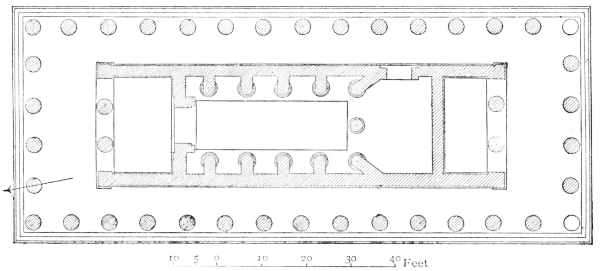
Fig. 22.—Plan of the Temple of Apollo at Phigaleia.
The temple was discovered by a French architect, Bocher, in
November, 1765 (Chandler, Travels in Greece, 1776, p. 295).
For descriptions of the architecture and sculpture, see Stackelberg,
Der Apollotempel zu Bassae, in Arcadien, 1826; Donaldson,
in Stuart, 2nd ed., vol. IV.; Blouet, Expédition scientifique de
Morée, II; Museum Marbles, IV.; Leake, Travels in the Morea,
II., chap. xii., p. 1; Ellis, Elgin and Phigaleian Marbles, II.,
p. 175; Cockerell, The Temple of Jupiter Panhellenius at Aegina,
and of Apollo Epicurius at Bassae, near Phigaleia, in Arcadia,
1860; Overbeck, Gr. Plast., 3rd ed., I., p. 449; Murray, II.,
p. 169; Wolters, Nos. 880-912. For literature specially relating
to the frieze, see below, p. 279. Views and plans of the temple
are exhibited in a table case.
505.
Two fragments of the cymatium cornice, with a pattern
of palmettes alternating with palmettes of a plainer form,
springing from acanthus leaves as on the cornice of the
Erechtheion. The member to which these fragments
belong surmounted the pediments.
Marble; height, 1 foot ⅛ inch; width, 4 feet 2¾ inches. The left-hand
fragment is engraved in Mus. Marbles, IV., vignette.
Synopsis, Nos. 26, 27; Cockerell, Phigaleia, pl. 6; Ellis, Elgin
and Phigaleian Marbles, II., p. 212.
506.
Fragment of a Doric capital, from a column of the
external colonnade.
Limestone; height of fragment, 1 foot 5 inches; width. 1 foot 9 inches.
Mus. Marbles, IV., pl. 25, fig. 4; Synopsis, No. 24; cf. Cockerell,
Phigaleia, pl. 6.
507.
Fragment of the capital of one of the Doric columns of
the pronaos or opisthodomos, including the lower part of
the echinus, and the upper part of the flutings.
Limestone; height, 5½ inches; width, 1 foot 6½ inches.
508.
Fragment of the capital of one of the Ionic columns of
the interior of the cella, with a part of the fluting. These
capitals are of peculiar form, each column being connected
at the back by a cross wall with the wall of the cella
(see plan). The three exposed faces of the capital had
each a pair of Ionic volutes. In the centre of the volute
is a stud of marble separately made. The hole for it was
prepared by a series of drill holes placed so as to form a
ring-like depression, the centre of which was afterwards
worked out. The profile of the side pairs of volutes was
somewhat different to that of the front pair, whence it
can be ascertained that the fragment in the British
Museum contains a part of the front and right side of
the cap.
Marble; height, 1 foot 6 inches. Mus. Marbles, IV., pl. 25, fig. 3;
Synopsis, No. 25; Cockerell, Phigaleia, pl. 14.
509. 1.
Roof tile, with antefixal end, with a palmette in relief
above two volutes springing from an acanthus.
Marble; height, 1 foot 3¼ inches; length, 1 foot 8½ inches. Mus.
Marbles, IV., pl. 25, fig. 1; Synopsis, No. 39; Exp. de Morée,
II., pl. 19, fig. 1; Cockerell, Phigaleia, pl. 7.
2.
Part of roof tile from the ridge of the roof of the
temple. The central portion is not worked with palmettes,
as shown by Cockerell.
Marble; height of fragment, 1 foot 4 inches; length, 1 foot 6 inches.
The complete length was about 2 feet 3 inches. Mus. Marbles,
IV., pl. 25, fig. 2; Synopsis, No. 40; Cockerell, Phigaleia, pl. 7,
figs. 5, 6.
The following fragments belong to a series of metopes
in high relief, which were placed over the entrance to the
cella of the temple, in a position similar to that occupied
by the metopes of the Temple of Zeus at Olympia. In
the Parthenon the frieze takes the place of the internal
metopes, of which however a trace remains in the guttae
which occur at regular intervals below the frieze, and
which imply triglyphs.—Cockerell, Phigaleia, pl. 5.
The fragmentary state of the metopes makes the subjects
uncertain, in most instances.
For a general view of the metopes, see Stereoscopic, No. 122.
510.
Figure wearing a helmet with a projecting tail-piece
(compare Parthenon frieze, south side, No. 4), a sleeveless
chiton girt at the waist, and a small cloak. The figure
wears a Gorgoneion on the breast; and with the left
hand seems to be playing on a lyre, which is partly
expressed in relief, and must have been further indicated
in colour. The Gorgoneion suggests Athenè, but it is
more likely that it is merely worn as an amulet, and the
figure may be that of a Thracian citharist (cf. Wolters,
p. 301). The dress is nearly the same as that of Orpheus
on the well-known relief in the Villa Albani—(Zoega,
Bassirel. Ant. i., pl. 42).
Marble; height, 1 foot 6 inches; width. 1 foot 4½ inches. Mus.
Marbles, IV., pl. 24, fig. 1; Stackelberg, pl. 30, fig. 2; Exp. de
Morée, II., pl. 23, fig. 2; Synopsis, No. 28; Cockerell, Phigaleia,
pl. 8; Ellis; Elgin and Phigaleian Marbles, II, p. 213.
511.
A mutilated male head, inserted in the same metope
as last. It appears to have been bearded, but this is
doubtful.
Marble; height, 5½ inches; width, 9 inches. Synopsis, No. 33.
512.
Torso from the breasts to the knees of a female figure,
wearing a fine clinging chiton and a mantle. The right
hand holds two objects, perhaps crotala or possibly flutes,
and the left hand was extended.
Marble; height, 1 foot 3 inches; width, 1 foot 5½ inches. Mus.
Marbles, IV., pl. 24, fig. 2; Stackelberg, pl. 30, fig. 1; Exp. de
Morée, II., pl. 23, fig. 1; Ellis, Elgin and Phigaleian Marbles,
II., p. 213.
513.
Lower part of a nude male figure from the waist to the
ankle of the left leg, standing. The right leg is wanting.
The figure stands to the left with drapery wrapped about
the left arm.
Marble; height, 1 foot 10 inches; width, 9¼ inches.
514.
Right knee of a draped female figure standing to the
right.
Marble; height, 10 inches, width, 11 inches. Synopsis, No. 37.
515.
Fragment with the upper moulding of a metope, and
with a circular object in relief, which has a round depression
in the centre. This object has been interpreted as a
cymbal held up by a dancing figure. Perhaps, however,
it may be a ring from the top of a tripod of Apollo, such
as is frequently seen. Cf. Furtwaengler, Bronzen von
Olympia, pl. 34.
Marble; height, 4 inches; width, 6 inches. Synopsis, No. 31.
516.
Figure of Apollo Kitharoedos? A male figure, wearing
the dress of a citharist, with a long tunic falling to
the feet, confined by a belt and by bands crossing the
breast. The figure also wears a flowing mantle, and has
long hair falling on the shoulders. The figure is half
turned to the right, and looks back to the left. If the
preceding fragment is, as suggested, a part of a tripod,
Apollo may be supposed to have been standing beside the
Delphic tripod.
Marble; height, 2 feet 7½ inches; width, 1 foot 3 inches. The two
main portions of the figure of Apollo, which have only recently
been joined, give the height of the metopes. Synopsis,
Nos. 36, 38.
517.
This metope, though in a fragmentary state, appears to
represent the rape of a woman by a nude male figure.
A woman wearing a sleeveless chiton and a mantle,
1.raises her right hand wrapped in the mantle to her
head. Of the ravisher we only see the fingers of the
right hand grasping the neck of the woman, and a part
of his arm below the woman's right elbow, and behind
her drapery.
2.
On the second fragment, which may be assumed to
belong to the same metope, we see a part of the feet
of the woman, the toes of the man's right foot, and
doubtful traces of his left foot. He was probably represented
as seizing the woman by the neck and the knees.
Cockerell suggests that the subject is Apollo pursuing
Daphnè, who was a daughter of the neighbouring river
Ladon, but he is mistaken in thinking that the man's
fingers are stretched out straight, and have no grasp of
the woman's neck.
Marble. Fragment 1: height, 1 foot 4½ inches; width, 1 foot
3 inches. Synopsis, No. 30; Exp. de Morée, II. pl. 23, fig. 3;
Stackelberg, pl. 30, fig. 3; Mus. Marbles, IV., pl. 24, fig. 3;
Ellis, Elgin and Phigaleian Marbles, II., p. 213. Fragment 2:
height, 8¾ inches; width, 1 foot 4 inches. Synopsis, No. 35.
518.
Upper part of body of draped female figure standing
to the front.
Marble; height, 8 inches; width, 10 inches. Synopsis, No. 32.
519.
Torso of an obese bearded figure, from the neck to the
waist. The figure appears to have been seated, leaning
back, and having a staff and drapery under the left
arm. Cockerell restores it as a figure standing and
leaning on a staff.
Marble; height, 1 foot ¾ inch; width, 8½ inches. Synopsis, No. 34;
Cockerell, Phigaleia, pl. 5, Stackelberg, pl. 30, fig. 4; Exp. de
Morée, II., pl. 23, fig. 4.
The frieze of the Temple of Apollo Epicurios consists of
23 slabs of marble, somewhat resembling Pentelic. The
slabs are each 2 feet 1¼ inches high, and they have a
combined length of 101 feet ¾ inch. The frieze formed
an internal decoration, above the colonnade within the
cella, and had two long sides measuring 35 feet 9 inches,
and two short sides measuring 14 feet 2⅛ inches. The
excess in the measured length of the slabs is explained by
the fact that they overlapped at the angles. The slabs
are about 3½ inches thick, and rested on the edge of the
architrave, being fastened with bolts to the ground
behind.
The subjects represented are: (1) Battle of Lapiths
and Centaurs; (2) Battle of Greeks and Amazons. The
former subject has 11 slabs of a combined length of
45 feet 6¾ inches, while the latter has 12 slabs measuring
55 feet 6 inches. The Centauromachia, therefore, occupied
two sides, less the length of one slab, which contained a
part of the Amazonomachia.
Several attempts have been made to fix the probable
order of the slabs, but except in certain cases we have no
evidence. It is probable that the slabs, No. 541 with
Heracles or Theseus, and No. 530 with Centaurs and
Kaineus, were in the centres of two short sides. They
are longer than any other slabs, and are well fitted to
form the central groups in the compositions. Slab No.
540 was certainly a corner slab, as is proved by the
rebate. Slab No. 532 was probably a corner slab. Slabs
Nos. 527 and 528 evidently were next to each other, and
No. 528 was probably at a corner. Beyond these fixed
points, the order can only be determined by considerations
of composition. In the description that follows, the slabs
are taken in the present order of arrangement in the
British Museum, which is that proposed by Mr. Murray
(Greek Sculpt. ii. pl. 14) except as regards the position of
the slabs of the north side.
The style of the reliefs is somewhat peculiar. Many
of the types of combat are familiar in Attic sculpture.
Compare the group of Kaineus with the same subject
on the frieze of the Theseion, and the Centaur groups
with the metopes of the Parthenon. At the same time
the style of the work, with its high relief, somewhat
florid and coarsely executed, is un-Attic, and it seems
probable that the actual production of the reliefs was in
the hands of local workmen. There is less certainty as
to the designer. Among the artists suggested are Alcamenes
(Stackelberg, p. 84), Cresilas (Sauer, Berliner
Philol. Wochenschr., 1889, p. 583); an artist influenced by
the paintings of Polygnotos (Murray, ii., p. 176); an
Attic artist (Jahn, Pop. Aufsätze, p. 157), or an Arcadian
artist under Attic influences (Overbeck, Gr. Plast., 3rd
ed., i., p. 457.)
Literature relating to the Frieze. Wagner, Bassorelievi Antichi della
Grecia. See also works quoted above, and on p. 272. For the
proposed arrangements of the slabs of the frieze, see Cockerell,
p. 56; Ivanoff, Annali dell' Inst., 1865, p. 29; Lange, Ber. der.
K. sächs Ges. d. Wissenschaften, 1880, p. 56, pl. 3; Wolters,
Nos. 883-905; Stereoscopic, Nos. 119, 120, 122.
520.
A Centaur carries away a Lapith woman, who stretches
out her arm in appeal for help. The woman's headdress
is somewhat peculiar, consisting of a cap (sphendonè) and
a narrow taenia, from under which the hair falls in small
curls on the forehead. On the right of the slab an
unarmed Lapith struggles with a Centaur, whose equine
body is wholly unexpressed except for one leg which
hardly seems to belong to him.
Length, 2 feet 5¾ inches. Synopsis, No. 7; Mus. Marbles, IV., pl. 7;
Stackelberg, pl. 25.
521.
On the left of this slab, a Centaur, whose head and
lower parts are lost, flings a stone with each hand. The
figure is shown to be a Centaur by the lion's skin over the
left arm. On the right, a Centaur, who also wears a lion's
skin knotted about his neck, treads down an armed
Lapith, and grasps his right hand to prevent him striking
with his sword. Between the two Centaurs is a Lapith
woman, who hastens to her right and holds her mantle
about her. The Centaur here and on certain other slabs
has a horse's mane, which does not occur on the Centaurs
of the Parthenon or of the Theseion.
Length, 4 feet 2½ inches. Synopsis, No. 6; Mus. Marbles, IV., pl. 6;
Stackelberg, pl. 28.
522.
On the left a Centaur draws towards himself a Lapith
woman who tries to escape. She has a child on her left
arm. The face of this figure has a strong resemblance to
that of the supposed Amazon of Polycleitos, and the
drapery of the breast is treated in the same way as
that of some of the statues of Amazons. (Compare the
fragment at Wörlitz, engraved Jahrbuch des Inst. i., pl. 4.)
On the right, a Centaur, who has a shield and lion's
skin, tramples down a Lapith, whose hands are stretched
out as if to keep the Centaur away. The Lapith is fully
armed, having a cuirass above a chiton, a chlamys, and
boots. He has no shield, but perhaps that of the Centaur
may be supposed to have been captured from him, as no
other Centaur is thus armed on the Phigaleian frieze, the
Theseion, or the Parthenon.
Length, 4 feet 1½ inches. Synopsis, No. 3; Mus. Marbles, IV., pl. 3;
Stackelberg, pl. 23.
523.
Apollo and Artemis coming to the aid of the Lapiths.
Artemis drives a chariot drawn by two stags; she wears
the chiton, and large diploïdion crossed by bands, which
is the dress of charioteers on the Parthenon sculptures.
Her right foot is on the ground and she appears to be
checking the chariot, while Apollo stands at its side and
draws his bow. The bow, arrow, and reins were added in
bronze. The chariot is represented three-quarters to the
front.
Length, 3 feet 9½ inches. Synopsis, No. 11; Mus. Marbles, IV.,
pl. 11; Stackelberg, pl. 19.
524.
Two Lapith women have taken refuge at the statue of
a goddess, probably Artemis, as she is coming to their aid.
One of the women stretches out her arms with a gesture
of despairing entreaty. The other embraces the statue,
which is a stiff archaic image wearing a polos; with her
left hand she clings to her mantle which has been seized
by the Centaur. The Centaur is attacked from behind
by a Lapith who kneels on his back, has his left arm
round the Centaur's neck, and is about to strike with
the sword originally held in the right hand. On the
right is a tree, with a lion's skin hanging from a bough.
The appearance of a deity near his own image is not
infrequent. (Cf. Journ. of Hellen. Studies, ix., pl. 1;
Müller, Denkmaeler, pl. 44, fig. 206; Arch. Zeit., 1869,
pl. 14.)
The group of the Lapith and Centaur is composed like
the Parthenon metope, No. 305.
Length, 4 feet 6 inches. Synopsis, No. 10; Mus. Marbles, IV., pl. 10;
Stackelberg, pl. 29.
525.
A Lapith and a Centaur in combat. The Lapith draws
away to the left, and is about to throw a stone, while he
stretches out his shield on his left arm. The Centaur
rears up, and seems to be throwing a stone held in both
hands. The Lapith has only a helmet and small chlamys.
He also wore a metal sword belt. On the right of the
slab, a woman holding a boy on her right arm, moves
quickly to the left. With her left hand she holds a
floating piece of her veil.
Length, 4 feet 5 inches. Synopsis, No. 8; Mus. Marbles, IV., pl. 8;
Stackelberg, pl. 20.
526.
A Centaur is about to thrust with his sword at a
Lapith, who seizes the Centaur's left foreleg and left
hand. The Centaur has a lion's skin; the Lapith is
unarmed. On the right of this slab another unarmed
Lapith has forced the Centaur down on his knees. He
kneels on the Centaur's back, and holds his hair with the
right hand, and his wrists with the left hand.
Length, 4 feet 2½ inches. Synopsis, No. 5; Mus. Marbles, IV., pl. 5;
Stackelberg, pl. 27.
527.
The Centaur of this slab bites a Lapith in the neck.
The Lapith is about to fall with relaxed limbs, but
plunges his sword in the Centaur's body. At the same
time the Centaur kicks out with his hind legs at a Lapith
on the left, who holds out his shield as a defence. A dead
Centaur lies on the ground. Both Centaurs have lions'
skins. The Lapiths wore metal sword belts.
Length, 4 feet 1 inch. Synopsis, No. 2; Mus. Marbles, IV., pl. 2
Stackelberg, pl. 21; Brunn, Denkmaeler, No. 91.
528.
A Centaur has been thrown down by two Lapiths.
The one drags forward the Centaur by his hair, while the
other kneels on his back, and has his hand and sword
raised to strike. A Centaur, however, has come from
behind and arrests the Lapith's blow, and tries to draw
away his shield. The fallen Centaur feebly puts out his
right hand behind his back to meet the stroke.
Length, 4 feet 1 inch. Synopsis, No. 1; Mus. Marbles, IV., pl. 1;
Stackelberg, pl. 22.
529.
On the left a Lapith and Centaur are wrestling. The
Lapith holds the Centaur's head under his left arm, and
the Centaur seizes the thigh of the Lapith, and tries to
overthrow him, putting his right foreleg round the leg of
the Lapith. The Centaur wears a lion's skin. On the
right the Lapith has seized the Centaur by the hair, and
is about to strike. The Centaur is helpless and can only
stretch out his hands behind his back as a defence.
Length, 4 feet 4½ inches. Synopsis, No. 9; Mus. Marbles, IV., pl. 9;
Stackelberg, pl. 24.
530.
Two Centaurs heave a mighty stone to crush the
invulnerable Kaineus. Kaineus is half-buried and holds
his shield above his head. He probably held a sword in
the right hand. Both Centaurs wear lions' skins. The
same subject occurs on the frieze of the Theseion. Next
on the right is a Lapith armed with shield and helmet,
who seems to be dragging the Centaur by the hair. A
woman moves to the right, holding her floating mantle
with her right hand.
Length, 5 feet 3½ inches. Synopsis, No. 4; Mus. Marbles, IV., pl. 4;
Stackelberg, pl. 26; Brunn, Denkmaeler, No. 90.
531.
The remaining slab on this side contains a part of the
battle of Greeks and Amazons. As the Amazon slabs are
longer than the slabs of Centaurs by about 10 feet, it is
clear that they must have filled two sides and a part of a
third. (See above, p. 278.)
On the left a Greek and an Amazon are engaged in
combat. The Greek has a helmet, boots, and a chiton
which leaves the right shoulder bare. He advances his
left arm with the mantle hanging from it, in the manner of
Harmodios in the group of the Athenian Tyrannicides
(compare the Panathenaic vase in the Fourth Vase Room,
which has this group on the shield of Athenè). The
Amazon wears a similar chiton, and rushes forward
against the Greek, in the attitude of the Aristogeiton in
the group mentioned above. On the right a wounded
Amazon has sunk to the ground, and is supported by
a companion who wears the chiton split at the side
(schistos), like that of the Iris of the east pediment of the
Parthenon.
Length, 4 feet 6½ inches; Synopsis, No. 20; Mus. Marbles, IV., pl. 20;
Stackelberg, pl. 17.
532.
On the left of the slab a Greek tries to drag an Amazon
along by the hair. She is now unarmed, and tries to
resist with both hands and with the weight of her body.
Her shield is seen in the background. On the right an
Amazon who has sunk to the ground, but appears not to
be badly wounded, is defended by a companion who stands
beside her, and stretches out a large shield.
Length, 4 feet 6¾ inches. Synopsis, No. 12; Mus. Marbles, IV.,
pl. 12; Stackelberg, pl. 7.
533.
On the left a Greek makes a fierce attack on an enemy
represented in the adjoining slab, which was probably the
one just described. He has his sword arm raised above
his head for a strong blow.
In the centre is a vigorous combat between a Greek and
Amazon. The Greek covers himself with his shield and
draws back for a spear thrust. The action of the Amazon
appears to be that of thrusting a spear. The shield on
her left arm is not expressed. In the tightly stretched
skirt of the chiton the sculptor has sacrificed grace for
truth to nature and vivid movement. On the right, an
Amazon who has just received a mortal wound, is seen
falling to the ground, with all her limbs relaxed.
Length, 4 feet 5¾ inches. Synopsis, No. 13; Mus. Marbles, IV.,
pl. 13; Stackelberg, pl. 8; Brunn, Denkmaeler, No. 88.
534.
On the left a Greek drags down an Amazon from her
horse, grasping her hair with the left hand. He probably
held a sword in the right hand. The Amazon tries
feebly to loosen his grasp. She wears the split chiton,
like the Amazon of slab No. 531. On the right is an
Amazon, who draws back a little, extending her shield,
and at the same time raising her right hand to strike.
Here, as in No. 533, the drapery is tightly stretched.
The upper part of the figure of the Greek had been
lost when the marbles were being transported from the
temple. It was afterwards found in a house near Bassae,
and was presented by J. Spencer Stanhope, Esq., 1816. (Cf.
Stackelberg, p. 23.)
Length, 4 feet 4¾ inches. Synopsis, No. 17; Mus. Marbles, IV.,
pl. 17; Stackelberg, pl. 13; Brunn, Denkmaeler, No. 87.
535.
An unarmed Amazon has taken refuge at an altar; a
Greek has seized her by the hair, and tries to drag her
away. The Amazon resists using her weight, and both
arms. The Greek had a sword in his right hand.
On the right a Greek and Amazon are engaged in hand
to hand combat, extending their shields and engaged in
fence with their swords. The drapery of the Amazon is
treated as on the two last slabs.
Length, 4 feet 6¾ inches. Synopsis, No. 22; Mus. Marbles, IV.,
pl. 22; Stackelberg, pl. 16; Brunn, Denkmaeler, No. 86.
536.
A large part of the group on the left is wanting. The
Greek appears to be dragging the fallen Amazon by the
hair, and at the same time to be treading her down with
his right foot. With both hands she tries to free herself
from the grasp of the Greek. On the right, a Greek has
fallen on his knees and holds up his shield as a defence
against the victorious Amazon, whose right hand and
sword are raised to strike.
Length, 4 feet 6¾ inches. Synopsis, No. 15; Mus. Marbles, IV.,
pl. 15; Stackelberg, pl. 12.
537.
An Amazon is disarmed, and has fallen to the ground.
She stretches out her right hand, as if in entreaty to a
Greek who treads with his left foot on her knee, and is
about to thrust with his sword. A second Greek approaches
from the left. On the right an Amazon strides
quickly forward to help her companion, and is about to
strike the Greek.
Length, 4 feet 4¾ inches. Synopsis, No. 21; Mus. Marbles, IV.,
pl. 21; Stackelberg, pl. 11.
538.
On the left, a Greek who is bearded and heavily armed,
has thrown down an Amazon, whom he drags by the hair,
while she tries to keep him at arm's length. On the
right the Greek has fallen on his knees, and holds up his
shield against the attack of the Amazon.
Length, 4 feet 5¾ inches. Synopsis, No. 19; Mus. Marbles, IV.,
pl. 19; Stackelberg, pl. 15.
539.
A Greek who has been killed in the battle, and perhaps
stripped, is being borne off the field on a companion's back.
Another Greek who has been badly wounded in the right
leg, leaves the field, leaning with his right hand on a
spear, now wanting. He puts his left arm round the neck
of a companion, who supports him round the body. In
the centre of the slab an Amazon draws away a shield
which belonged to one of the Greeks.
Length, 4 feet 9¼ inches. Synopsis, No. 14; Mus. Marbles, IV., pl. 14;
Stackelberg, pl. 18.
540.
This slab has a rebate on the left side, proving that it
belongs to the left end of a frieze. On the left, a wounded
Greek lying on the ground, is partly raised by a companion,
who eagerly watches the fight, but for the
moment only holds his sword in the left hand, while he
uses his right hand to support the wounded man. A
similar group occurs on the frieze of the Temple of Nikè
(No. 421).
On the right a Greek and Amazon are fighting hotly.
The Greek presses forward, and the Amazon at the same
time draws back, collecting her strength for a blow. The
Amazon wears the split chiton.
Length, 4 feet 8¾ inches. Synopsis, No. 16; Mus. Marbles, IV.,
pl. 16; Stackelberg, pl. 10.
541.
The middle of the central slab is occupied by a single
combat between Heracles and an Amazon. They are
represented drawing back for a blow. The Amazon seems
to be making a spear thrust while Heracles raises his
club. The Amazon extends her shield; Heracles carries
the lion skin on his left arm. The pose of these two
combatants who have the most important position in the
whole frieze, is very similar to that of the Poseidon and
Athenè of the west pediment of the Parthenon. In both
cases also the central group is bounded by figures of
horses. The figure here called Heracles has also been
interpreted as Theseus. On the left, a mounted Amazon
is victorious, and thrusts with a spear at a wounded and
fallen Greek. On the right, the Greek is the victor; he
seizes the Amazon by arm and foot and throws her off her
horse, which has fallen on its knees.
Length, 5 feet 10 inches. Synopsis, No. 18; Mus. Marbles, IV.,
pl. 18; Stackelberg, pl. 14; Brunn, Denkmaeler, No. 89.
542.
A young Greek, wounded and fallen to the ground,
raises his right hand, as if in defence against the blow
about to be struck by the Amazon standing over him.
Another Amazon hastily approaches from the left, and
stretches out her hands, as if in defence of the Greek.
On the right of the slab, an Amazon supports a wounded
comrade, who is sinking to the ground with her head
drooping and all her muscles relaxed.
Length, 4 feet 2¼ inches. Synopsis, No. 23; Mus. Marbles, IV.,
pl. 23; Stackelberg, pl. 9.
A few small fragments of a colossal male statue were
discovered during the excavations. As the fragments
found belong to the extremities of the figure, and since
they are proved to have been separate pieces attached,
by the dowel holes, it is inferred that the statue was
acrolithic, i.e., that the extremities only were of marble,
while the rest of the figure was made of wood or other
inferior material.
The original statue of Apollo Epicurios had been moved
to Megalopolis from Bassae, before the time of Pausanias
(Paus. viii., 30, 3). The foundation of Megalopolis took
place in 368 b.c., and if the acrolithic statue was made
to take the place of that which was removed it must
be later than this date.
The two fragments here described are all that are in
the British Museum, but four other small pieces were also
discovered, and are engraved Stackelberg, pl. 31; reproduced
Exp. de Morée, ii., pl. 23, fig. 5; Cockerell, pl. 16.
543.
Fragment of the forepart of a right male foot, wearing
a sandal.
White marble; length, 6½ inches. Stackelberg, pl. 31; Cockerell,
pl. 16.
544.
Fragment with the palm and base of the thumb of a
right hand.
White marble; length, 6¼ inches. Stackelberg, pl. 31; Cockerell,
pl. 16.
549.
Bust of Pericles, wearing a helmet. Inscribed Περικλῆς
(fig. 23). Wolters assigns the original from which this
fine bust is copied to the end of the fifth century, and
suggests that it may have been the work of Cresilas, with
reference to which Pliny (H. N. xxxiv., 74) states that he
made an Olympian Pericles, worthy of the title, and ennobled
a noble subject. Plutarch explains the presence
of the helmet as caused by the ugly shape of the head
of Pericles (Plutarch, Pericles, 3). It is, however, more
probable that the helmet merely denotes military rank.
Found in the Villa of Cassius, at Tivoli, 1781.—Townley Coll.
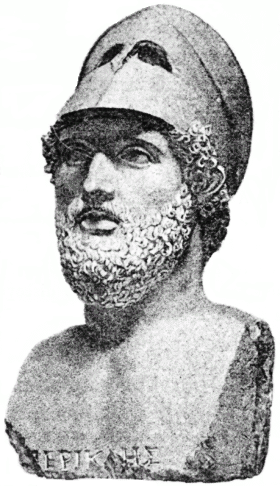
Fig. 23.—Bust of Pericles, No. 549.
Marble; height, 1 foot 11 inches. Restorations:—Nose, and small
parts of helmet. Stuart, II., p. 42; Mus. Marbles, II., pl. 32;
Ellis, Townley Gallery, II., p. 3; Arch. Zeit., 1868, pl. 2, fig. 1;
Wolters, No. 481; Furtwaengler, Berl. Philol. Wochenschr.,
1891, p. 286. Another copy, found at the same time as the present
bust, is in the Vatican (Visconti, Iconogr. Grecque, pl. 15).
550.
Head of Asclepios? Colossal ideal bearded head. The
hair falls in heavy masses over the forehead, and on each
side of the head. A heavy metal wreath was fastened by
numerous rivets, which still remain. The head was
formed of three principal pieces of marble, the heaviest
piece being so shaped that it kept its position by its own
weight. The piece at the back of the head is lost. A
small piece, which is now missing, was also attached
behind the right ear.
This head would serve as well for Zeus as for Asclepios,
and it is possible that this may have been the original
intention of the artist. It was, however, discovered in
1828, in a Shrine of Asclepios, in Melos. Blacas Coll.
Parian marble; height, 1 foot 11 inches. Exp. de Morée, III.
pl. 29, fig. 1; Müller-Wieseler, Denkmaeler, II., pl. 60, fig. 763;
Overbeck, Gr. Kunstmyth. pl. 2, figs. 11, 12; II., p. 88; Murray,
Greek Sculpture, II., pl. 11, p. 130; Mitchell, Selections, pl. 13;
Rayet, Monuments, II., No. 42; Stereoscopic, No. 113; Wolters,
No. 1283; Paris, La Sculpt. Ant., p. 221. Two votive inscriptions
to Asclepios and Hygieia were discovered with the head.
One of these, with a votive relief of a leg, is now in the British
Museum (No. 809).
551.
Asclepios? A male draped torso broken off at the knees;
the right arm is wanting from below the shoulder, where
it has been fitted with a joint. The left arm, which is
entirely concealed in the mantle, is placed akimbo. The
back is unfinished. The composition is suitable to a figure
of Asclepios, an attribution which was probably originally
suggested by the fact that this torso was obtained by
Lord Elgin from the neighbourhood of Epidauros. Two
small fragments of the right leg were brought away with
the torso.
Parian marble; height, 3 feet 1¼ inches. Mus. Marbles, IX., pl. 5;
Ellis, Elgin Marbles, II., p. 121; Synopsis, No. 327; Elgin Room
Guide, II., No. E. 1.
552.
Female torso from the neck down to the waist. The
dress is a chiton with diploïdion; part of the tresses of
hair which fall down on the back still remains.—Elgin Coll.
Pentelic marble; height, 1 foot 3 inches. Synopsis, No. 281 (146);
Elgin Room Guide, II., No. F. 15.
553.
Left breast and part of left side of female figure wearing
a chiton girt at the waist.—Elgin Coll.
Pentelic marble; height, 1 foot 3¼ inches. Synopsis, No. 277 (147).
Elgin Room Guide, II., No. F. 16.
554.
Upper part of the torso of a female figure moving
quickly to the left, with the arms raised. She wears a
sleeveless chiton which appears to have been unsewn
(schistos) down the right side. The shoulders are broken,
but there are remains of large dowel holes as if for the insertion
of wings, and the figure is not unlike the Victories
on the balustrade of the temple of Nikè.—Elgin Coll.
Pentelic marble; height, 1 foot. Synopsis, No. 321 (79).
555.
Heads of Pelops and Hippodamia? Heroic heads of
colossal male and female figures, turned to the right. The
female head is in low relief, and wears a diadem, and a
veil falling over the back of the head. Compare the
heads in a terracotta relief in the British Museum
(Ancient Terracottas in B. M., pl. 19, No. 34). The male
head is almost worked in the round and wears a close-fitting
helmet. Some drapery passes over the left
shoulder. These two heads have long been called Pelops
and Hippodamia, and it is very likely that the figures
belonged to a chariot group. But they may well be the
somewhat idea
consort. Found in the sea near Girgenti (Agrigentum).—Townley
Coll.
Greek marble, perhaps Parian; height, 1 foot 5¼ inches; width,
1 foot 4 inches. Mus. Marbles, X., pl. 32; Ellis, Townley
Gallery, II., p. 153.
556.
Head of Odysseus? Male head, with curling hair and
short beard, wearing a peaked cap (pileus). The surface
is much decayed, and most of the chin and mouth is
broken away. This head may be from a sepulchral
monument.—Elgin Coll.
Pentelic marble; height, 1 foot ½ inch. Mus. Marbles, IX., pl. 40,
fig. 3; Ellis, Elgin Marbles, II., p. 119.
557.
Fragment from the back of a head. The hair is drawn
to a knot at the back of the head, and is confined by two
bands, crossing one another.
Pentelic marble; height, 10½ inches.
558.
Head of a maiden, wearing a closely-fitting cap. The
style is characteristic of the fifth century.—Athens?
Elgin Coll.
Pentelic marble; height, 9 inches. Synopsis, No. 239 (122).
559.
Heroic head of a youth, inclined slightly to his left.
The hair is very slightly indicated, and the back of the
head is worked away, as if for a bronze helmet.—Obtained
in Greece by the fourth Earl of Aberdeen in 1803, and presented
by the fifth Earl of Aberdeen in 1861.
Coarse-grained marble; height, 11 inches. The head was found
wearing a bronze helmet, which, however, did not fit, and has
been removed.
560.
Cast of marble owl. L. Ross (Annali dell' Inst., 1841,
pl. C., p. 25), supposes that this owl was a votive offering
which once surmounted a column found near it, on
which is inscribed the name of Timotheos of the deme
Anaphlystos. The lower part of the body, which is broken
away, has lately been found. The feathers of the wings
are set in formal rows, and the treatment throughout
is characterised by an archaic severity, as has been
remarked by Ross. The feathers have probably been
painted.—Found on the Athenian Acropolis between the
Propylaea and the Parthenon.
The original, of Pentelic marble, is in the Acropolis Museum, at
Athens; height, 2 feet 2 inches. Ross, Arch. Aufsätze, I.,
pl. 14, fig. 3, p. 205; Elgin Room Guide, II., No. G. 7; Wolters,
No. 111; Le Bas, Mon. Fig., pl. 62, fig. 3.
Most of the single Greek reliefs in the British Museum
are described in the present section of the catalogue
(Nos. 599-817.) Those reliefs which are known to have
belonged to particular buildings, and to have served an
architectural function, are catalogued separately. A few
reliefs also, principally of the later Attic School, are
reserved for a subsequent part.
We deal, in this place, with a number of works of minor
importance, and of various degrees of artistic merit. At
the same time they are of interest both for their subjects
and also as showing the instinctive grace and skill of
subordinate Greek craftsmen, even in hastily executed
and unimportant work.
The following classification has been adopted, but the
classes are not perfectly distinct, as the sepulchral reliefs
sometimes partake of a votive character.
Sepulchral Reliefs.—599-618, Decorative Stelae.
619-680, Scenes from Daily Life and Animals.
681-686, Plain Vases. 687-710, Vases and reliefs
with figures clasping hands. 711-746, Sepulchral
Banquets, &c. 750-757, Rider and Horse, heroified.
760-766, Reliefs from Lycia.
Votive Reliefs.—770-794, Figures of the God or
his attributes. 795-812, Figures of the Dedicator,
or of the object dedicated. 813-817, Agonistic
reliefs.
The Greek sepulchral reliefs are of several distinct
types, each type having an independent origin and history,
though occasionally the different types are blended
one with another.
The early Attic examples which are assigned to a period
before the Persian wars, have recently been collected by
Conze (Die Attischen Grabreliefs, Part 1), and we are thus
enabled to trace the rise of the different types in Attica,
so far as the materials discovered allow. The earliest and
simplest form of monument is the plain stone
(στήλη), set
up on a mound
(τύμβος)
to mark the place of the grave, and
such a tomb is well known to Homer (Il. xi., 371, etc.)
Such a stone would naturally bear the name of the
deceased, together with the name of his father, or of the
persons who erected the monument. The earliest Attic
examples are also surmounted by a simple ornament,
especially the palmette between volutes, partly in relief,
and partly in colour. The treatment of the palmette
closely resembles that of the antefixal ornament of the
Parthenon (No. 352). At an uncertain period in the fifth
century the use of the acanthus-leaf ornament was introduced,
and the decoration of the stelae became elaborate
and beautiful. It has been thought that the acanthus
was developed by the Greeks of Ionia, before the middle
of the fifth century, and only made its way slowly
in Athens (Furtwaengler, Coll. Sabouroff, i., p. 8), but it
cannot be proved to have become common before it had
been made familiar by the architecture of the Erechtheion,
towards the close of the fifth century. The early
Corinthian capital of the single column of the Temple
at Phigaleia appears to be copied from a stelè with
volutes and an acanthus.
The smooth surface of the stone below the crowning
ornament was used, from an early time, to receive a
representation of the deceased person, which was either
painted or in relief, the relief being itself painted. Such
portraits, in the case of men—and only men's portraits
are certainly known to be preserved of the archaic period—take
the form either of a simple standing figure, or of a
figure engaged in some occupation taken from life. See
the figures of the Discobolos and of the spear-thrower
(Conze, pls. 5, 7), and as an example of the painted portrait
see the stelè of Lyseas (Conze, pl. 1). The male
portrait is often accompanied by a small figure of a youth
riding or leading a horse. On a class of monuments described
below (Nos. 750-757) it is not impossible that the
figure of the horse may have some special reference to death,
but in the early Attic reliefs it seems more likely that the
horse indicates the favourite pursuits or the knightly rank
of the dead person. Compare Roscher, Lexicon, p. 2584,
and Aristotle, Constitution of Athens, chap. 7, ed. Kenyon,
where the horse standing beside an archaic figure of
Anthemion, son of Diphilos (Class. Rev. 1891, p. 108), is
said to prove his knighthood
(ἱππάς).
(Cf. Journ. of Hellen.
Studies, v. p. 114; Conze, p. 4; Nos. 1, 14, 15, 16, 17, 19.)
The female figures, of which only uncertain specimens
survive, were simple portraits, usually seated, and sometimes
accompanied by other members of the family, usually
represented on a diminutive scale. (Cf. Conze, No. 20.)
In one early Attic example there is an actual representation
of mourners as on Etruscan or Lycian tombs. But
in general, allusions to death and mourning are but
slightly indicated. (Cf. Conze, No. 19, pl. 11.)
Finally, there is a type of monument, which contains
the representation of some animal more or less associated
with the grave, such as the cock (Conze, No. 22, pl. 13)
or the Sphinx (Conze, No. 16, pl. 10, fig. 1b).
The foregoing are the main types of the early Attic
reliefs. The British Museum does not contain any specimens
of the early period, but the study of the early
reliefs enables us to classify the later works, and to distinguish
the indigenous Attic types from those that are
imported, or of later development.
Decorative Stelae.—The stelae crowned with the
palmette and acanthus acroteria are described below,
Nos. 599-618. They are principally derived from Athens,
but several specimens (Nos. 611-618) roughly worked in
coarse limestone are a part of the collection of sculptures
from Kertch. One of the best examples of Attic work of
this class in the British Museum, will be found in the
Department of Egyptian and Assyrian antiquities, namely
the stelè of Artemidoros with a bilingual Greek and
Phoenician inscription. (Dodwell, Tour i., p. 411; Greek
Inscriptions in Brit. Mus., cix.)
Scenes from Daily Life and figures of Animals.—The
monuments with portraits and scenes from daily life are
catalogued below, Nos. 619-679. The incidents chosen
are taken from all parts of life, and in late times are apt
to be of a genre character with scenes from children's
games, &c.
Reliefs with figures of horsemen, where the scene appears
only to be an incident from daily life, and not connected
with the heroification of the deceased, have also been
placed here (Nos. 638, 661-666).
Examples of the figure of an animal placed on the tomb,
of a symbolic or decorative character, are best seen among
the archaic sculptures (compare those from Xanthos),
but the bull, No. 680, is a specimen of a figure from an
Attic stelè.
The types which have been described so far, are simple
records of the deceased person. We turn now to various
classes, which are not represented among the Attic remains
of the archaic period, and which are more or less of
religious or ritualist significance.
Vases.—The Sepulchral Vases, which are represented
either in relief or in the round, are a common form of
monument at Athens, and are connected with the observances
paid to the dead. These vases which are sometimes
lekythi, and sometimes amphorae or hydriae, may be
decorated with patterns, or with subjects in relief, such
as appear on other sepulchral stelae. They probably are
to be traced from the vessels of pottery in which offerings
were brought, to be poured out as libations on the tomb.
Compare below the account of the "Sepulchral Banquet."
There is ancient authority for the view that the vase
indicates an unmarried person. Eustath. on Il. XXIII.,
141, p. 1293:
καὶ
τοῖς
πρὸ
γάμου
δὲ
τελευτῶσιν
ἡ
λουτροφόρος,
φασίν,
ἐπετίθετο
κάλπις
εἰς
ἔνδειξιν τοῦ
ὅτι
ἄλουτος
τὰ
νυμφικὰ
καὶ
ἄγονος
ἄπεισι.
Demosthenes (in Leochar. pp. 1086 and 1089, ed. Reiske) speaks also of
ἡ λουτροφόρος
(sc. ὑδρία
or κάλπις), being placed on the tomb of an unmarried
person. (Kumanudis, p. 18; Greek Inscriptions in Brit.
Mus., No. lxxx.)
On the other hand, the tombs of a father, Philoxenos,
and of his sons Parthenios and Dion, in the Cerameicos at
Athens were all surmounted by stone vases (C. I. A., ii.,
3191-3193; Conze, p. 16). Perhaps a distinction must
be made between the lekythi which represent libations at
the tomb, and the hydriae, which have the special meaning
mentioned above. An early instance of the Attic sepulchral
vase, with painting and relief, is placed by Köhler
on epigraphic grounds between 450 and 430 b.c. (Athenische
Mittheilungen, x., pl. 13, p. 362.)
Figures clasping Hands.—In Attic reliefs, chiefly of the
fourth and subsequent centuries, the two principal persons
are often represented clasping right hands together, and
such scenes are commonly known as Scenes of Parting. A
more correct interpretation may be gathered from a fragment
of an archaic sepulchral relief from Aegina (Athenische
Mittheilungen, viii., pl. 17), in which a female figure,
enthroned and holding a pomegranate (compare the
Spartan reliefs mentioned below), clasps the hand of a
standing figure, which is shown by the scale to be that
of another deceased person. In this case the scene is
laid in Hades, and the clasping of the hands is significant
of affection, not of separation. Hence it has been
thought that all subjects with the clasped hands represent
the meeting and union in Hades after death (Furtwaengler,
Coll. Sabouroff, i., p. 46). There is, however, no proof that
the artist was always consciously placing the scene in
Hades, and in No. 710 Hermes seems about to conduct the
deceased person to the nether world. The presence of
figures in attitudes of grief, of children and servants,
seems to show that these reliefs are symbolic of family
affection, though the artist had no very clear and logical
conception of the moment depicted.
An early example of the clasping of hands on an Attic
monument is supplied by the sepulchral vase above mentioned,
of 450-430 B.C. (Athenische Mittheilungen, x., pl. 13.)
Such subjects as the foregoing are often placed within
an architectural structure, usually consisting of two
pilasters and an entablature, sometimes surmounted by a
pediment. Various theories have been proposed on the
subject. It has been suggested that the architectural
ornament indicates the votive character of the relief
(Journ. of Hellen. Studies, v., p. 111), or the home of the
dead person (Pervanoglu, Grabsteine der alten Griechen,
p. 14), but there is no evidence of any such special significance
attaching to the form. (Compare Furtwaengler,
Coll. Sabouroff, i., p. 52.)
The Sepulchral Banquet.—From the fourth century onwards,
a type of relief commonly known as the Sepulchral
Banquet becomes very common in Attica and elsewhere.
In a normal example of the fully developed type, the chief
figure is that of a man recumbent on a couch, holding a
cup. Before him is a table with food. A woman, according
to Greek custom, is seated upright at the foot of the
couch. Boys or attendants are seen drawing wine. The
head of a horse is often seen at the back of the relief. A
snake is frequently introduced, and often drinks wine from
a cup held by one of the figures. Further, a group of
adorant figures, usually on a small scale, may be represented
about to sacrifice at an altar, near the foot of the
couch.
The meaning of this type has been a subject of long
controversy, but it is best understood if the later reliefs
are studied in connection with the oldest known specimens
of the same subject. A series of archaic reliefs from the
neighbourhood of Sparta (Athenische Mittheilungen, ii.,
pls. 20-25; Furtwaengler, Coll. Sabouroff, pl. 1; Journ.
of Hellen. Studies, v., p. 123), contains subjects somewhat
of the following character: A male and female figure,
represented on a heroic or divine scale, are seated enthroned,
holding as attributes a large two-handled cup,
or a pomegranate. Figures of worshippers approach,
carrying a pomegranate or a cock, and a snake is
sometimes present. The sculptures of the Harpy Tomb
(No. 94), have been sometimes classed with the works
here described, but this has not yet been established.
The transition from the Spartan type to the Sepulchral
Banquet type is still obscure, but a connecting link is
furnished by a relief from Tegea (Athenische Mittheilungen,
iv., pl. 7), in which the woman is enthroned, while the
man reclines on a couch with a table before him. (Compare
also the relief from Mytilene No. 727.) It seems
probable that we have in these reliefs symbolic representations
of offerings made by living relations or descendants
for the pleasure and sustenance of the dead. Such offerings
of food and drink made by the living at the tomb are
common to all primitive peoples. The Egyptians, in
particular, made regular offerings of actual food, and at
the same time surrounded the mummy with sculptural
representations of offerings, which, it was thought, served
to satisfy the incorporeal double of the dead person. The
early notion that the deceased was within the tomb, and
enjoyed the food and drink offered to him in a material
manner, became less distinct in later times. The periodical
offerings assumed a more ritualistic and symbolic character,
and were celebrated by the Greeks under the name of
νεκύσια.
The older archaeologists thought for the most part that
the Banquet reliefs were representations commemorative
of life on earth, or descriptive of the pleasures enjoyed by
the dead in Hades. Dumont (Rev. Arch., N.S. xx. p. 247)
and Hollaender (De Operibus Anaglyphis), interpret them
as referring to the periodical offerings made at the tomb.
It will be seen that this view is not very different from
that which has been adopted above, and which is the
view of Gardner (Journ. of Hellenic Studies, v., p. 130), and
Furtwaengler (Coll. Sabouroff, i., p. 28). The reliefs, however,
have more force than mere pictorial groups, if we
accept the Egyptian analogy, and allow that the sculpture
represents, by substitution, the offerings of material food.
The snake is naturally associated with the grave, from its
rapid mysterious movements, and from living in caves and
holes. Compare the story of the snakes that were seen by
Polyeidos in the tomb of Glaukos. (Apollodor. 3, 3, 1;
Roscher, Lexicon, p. 1687). The votive character of the
Banquet reliefs is proved in some instances by inscriptions,
(Journ. of Hellen. Studies, v., p. 116; Roscher, Lexicon,
p. 2553). It is doubtful, however, whether the artist
was always conscious of the meaning of his work, and in
some instances, as in the tomb at Cadyanda in Lycia
(No. 766), the banquet appears to be merely a scene from
daily life, and as such it closely resembles some of the vase
paintings. In No. 737 and other late examples, the relief,
though of the type of the banquet, is commemorative
rather than votive.
In Athens the type of the Sepulchral Banquet was also
applied to another purpose, namely, for votive reliefs to
Asclepios. The two classes of monuments are completely
assimilated in those examples in which worshippers come
to sacrifice at the end of the couch. Numerous specimens
of reliefs have been found in the temenos of Asclepios at
Athens, and it is possible that the sculptures from the
Elgin Collection, Nos. 714, 715, belong to this series. In
the newly-discovered papyrus fragments of Herodas, the
sons of Praxiteles are mentioned as authors of a relief
dedicated to Asclepios. A figure of Asclepios, composed
like the principal figure of the sepulchral reliefs, has also
been found on a vase from the Temple of the Cabeiri at
Thebes (Ἐφημερίς,
1890, pl. 7). For other examples of
the same type on vases of different meanings, see Athenische
Mittheilungen, xiii., pl. 9; Arch. Anzeiger, 1890, p. 89. For
the most recent discussion of the whole question, see
Roscher, Lexicon, p. 2565.
Hero and Horse.—There is another type of sepulchral
relief, somewhat akin to that above described, in which,
however, the horse of the hero takes a more prominent
position. The hero is seen either riding on his horse or
standing near it, and receiving a libation poured out by a
female figure, sometimes a Victory. Here also the snake
is frequently introduced to mark the sepulchral character
of the relief. In the earliest examples the connection
between this type and the foregoing is made clearer by the
presence of diminutive figures of supplicants bringing
offerings, or making gestures of adoration. Compare a
Theban relief (Athenische Mittheilungen, iv., pl. 16), and a
relief in the Sabouroff Collection,
inscribed Καλλιτέλης
Ἀλεξιμάχῳ
ἀνέθηκεν
(Coll. Sabouroff, i., pl. 29), and a relief
from Cumae (Roscher, Lexicon, p. 2555). For a list of
reliefs with figures of horsemen, see Furtwaengler, Coll.
Sabouroff, i., p. 40; Roscher, Lexicon, p. 2556. It has
been thought that the horse is shown in these subjects on
account of its association with Hades, but in some instances,
if not in all, it relates to the pursuits and status of the
deceased, and is introduced for the use of its master, and
not for any Chthonian significance.
Reliefs from Lycia.—See below, p. 350.
A votive offering is, in its essence, a present made to a
god or to a superior being, in order to secure some favour
in the future, or to avert anger for a past offence, or to express
gratitude for a favour received. The last purpose includes
offerings made in fulfilment of a vow, the vow being
a kind of contract between the individual and the god.
Sometimes also objects were offered, nominally as gifts to
the god, but in reality in order that they might be secure.
Votive offerings cover the whole field of life including
persons, lands, buildings, and, in particular, objects
appropriate (a) to the god or his worship, or (b) to the
dedicator and the cause of his dedication.
a. Objects appropriate to the god include temples
(compare the inscription of Alexander from Prienè, in the
Hall of Inscriptions); parts of a temple (compare the
columns dedicated by Croesus, No. 29); images of the
god represented in an appropriate attitude (compare
the reliefs, Nos. 770-794); objects connected with the
worship of the god and temple furniture (compare the
stool in the Hall of Inscriptions, dedicated by Philis to
Demeter, and the vases from Naucratis in the First Vase
Room); or lastly, attributes of the god, such as the owl
of Athenè (No. 560), and the pigs found in the shrine of
Demeter at Knidos, now in the Mausoleum Room.
b. Objects appropriate to the dedicator or the cause
of his dedication include portraits of the dedicator,
such as the statue of Chares (No. 14), or of the priestess
Nicoclea, found in the temenos of Demeter of Knidos,
or the statuette of the hunter of Naucratis (No. 118);
spoils won in battle, as the helmet dedicated by Hiero, in
the Etruscan Room; figures of victorious horses (No. 814);
symbolic offerings such as the dedication of the hair or
the down of the beard to Poseidon (cf. No. 798), or to a
river god (Paus. viii., 41, 3); offerings connected with
remarkable cures (compare Nos. 799-810, and, perhaps,
the relief of Xanthippos, No. 628).
Where the object itself is perishable or otherwise unsuitable
as an offering, the sculptured representation takes
its place, by a natural process. Thus we have a representation
of the hair, in place of the actual hair (No. 798),
and the reliefs with limbs, mentioned above (Nos. 799-810).
It has been already suggested that in the Sepulchral
Banquet reliefs, which might be classed as votive reliefs,
the banquet is represented in sculpture as a substitute for
the actual offerings of food.
A special class of votive reliefs consists of those which
are found at the head of decrees, treaties, and similar
political documents. An Athenian treaty, for example,
is headed by a representation of Athenè, and of the patron
deity of the other state, which may appear in the attitude
of a suppliant or adorant. (Compare Schöne, Griech.
Reliefs, Nos. 48-53.) Similarly at the head of a decree of
citizenship or proxenia, the newly admitted citizen appears
as worshipping the goddess (cf. Schöne, No. 93, and p. 20,
and below, Nos. 771-773).
For an account of these stelae, see above, p. 296.
599.
Stelè with two rosettes. Above, an acroterion, formed
of acanthus leaves and palmette combined (fig. 24).
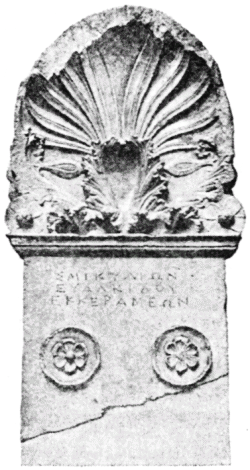
Fig. 24.—Sepulchral stelè of Smikylion, No. 599.
Inscribed Σμικυλίων
Εὐαλκίδου
ἐκ Κεραμέων—Smikylion,
son of Eualkides, of the deme of the Cerameicos.—Athens.
Presented by A. Robinson, Esq., R.N.
Pentelic marble; height, 2 feet 9½ inches; width, 1 foot 5½ inches.
Synopsis No. 441. Greek Inscriptions in Brit. Mus., LXXXVI.;
C.I.A., II., 2139.
600.
Plain stelè of Hippocrates and Baukis; surmounted by
an acroterion in low relief, of palmette form.
Inscribed Ἱπποκράτης,
Βαυκίς. Below the surface of the
stelè is flat, and probably was painted.—Athens. Elgin
Coll.
Pentelic marble; height, 4 feet 1 inch; width, 1 foot 3 inches. Mus.
Marbles, IX., pl. 29, fig. 4. Synopsis, No. 351 (175); Ellis, Elgin
Marbles, II., p. 152; C.I.G., 958; C.I.A., II., 3810. Greek
Inscriptions in Brit. Mus., CXX.
601.
Fragment of a plain stelè, surmounted by an acroterion,
in the form of a palmette in low relief, springing from
acanthus leaves.
Inscribed Ἀσσκληπιόδωρος
Θράσωνος
Ὀλύνθιος,
Ἐπικύδης
Ἀσκληπιοδώρου
Ὀλύνθιος—Asclepiodoros, son of Thrason, of
Olynthos; Epikydes, son of Asclepiodoros, of Olynthos.—Probably
from Athens. Elgin Coll.
Pentelic marble; height, 1 foot 5 inches; width, 1 foot ¾ inch. Mus.
Marbles, IX., pl. 29, fig. 2; Synopsis, No. 258 (169); Ellis,
Elgin Marbles, II., p. 152; C.I.G., 879; C.I.A., II., 3243; Greek
Inscriptions in Brit. Mus., CVI.
602.
Acroterion in form of palmette from a stelè.—Athens.
Inwood Coll.
Pentelic marble; height, 1 foot 9 inches; width, 1 foot 10 inches.
Synopsis, No. 418.
603.
Acroterion, from a stelè, of palmette form, springing
from acanthus leaves.—Inwood Coll.
Pentelic marble; height, 10 inches. Synopsis, No. 414; Inwood,
Erechtheion, pl. 31, p. 147.
604.
Fragment of an acroterion of a stelè in form of a palmette
springing from acanthus leaves.—Athens? Elgin Coll.
Pentelic marble; height, 1 foot 8½ inches; width, 11 inches. Synopsis,
No. 191 (95). Mus. Marbles, IX., pl. 29, fig. 3.
605.
Stelè, surmounted by acroterion. One central palmette,
and two half palmettes at the sides spring from acanthus
leaves.
Inscribed Εὔμαχος
Εὐθυμάχου
[Ἀ]λωπέ[κ]ηθε[ν]—Eumachos,
son of Euthymachos, of the deme of Alopekè.
Athens.—Obtained by Chandler in his Expedition for the
Society of Dilettanti in 1765, and presented by the Society.
Pentelic marble; height, 1 foot 8 inches; width, 1 foot 5¼ inches.
Synopsis, No. 283 (292*); C.I.G., 579; C.I.A., II., 1812. Greek
Inscriptions in Brit. Mus., LXXIX.; Stereoscopic, No. 121;
Wolters, No. 1104.
606.
Top of stelè, with central palmette and two half
palmettes, springing from acanthus leaves. Found in the
side of a mound, near Maritza, Rhodes.
Marble; height, 2 feet 3 inches; width, 2 feet 3¼ inches.
607.
Upper part of stelè, surmounted by a central palmette
and two half palmettes, springing from acanthus leaves.
Similar to last, but in lower relief.
Probably from Athens. Formerly in the collection of Lord
Elgin.
Pentelic marble; height, 1 foot 7 inches; width, 1 foot 1¾ inches.
Journ. of Hellen. Studies, VI., p. 42, No. 2.
608.
Upper part of stelè, surmounted by a central palmette,
and two palmettes at the sides, broken.
Inscribed Χαβρίας
Σαλυπριανός.
Chabrias of Selymbria.—Athens?
Elgin Coll.
Pentelic marble; height, 1 foot 7 inches; width, 1 foot 5½ inches.
Synopsis, No. 290 (226); Mus. Marbles, IX., pl. 30, fig. 1;
C.I.G., 888; C.I.A., II., 3296; Ellis, Elgin Marbles, II., p. 152;
Greek Inscriptions in Brit. Mus., CVII.
609.
Top of stelè, in form of a capital of a pilaster with a
palmette between two volutes springing from acanthus
leaves, and an egg and dart moulding. Late work.
Probably from Athens. Formerly in the collection of Lord
Elgin.
Pentelic marble; height, 9¾ inches; width, 11 inches. Journ. of
Hellen. Studies, VI., p. 43, No. 6.
610.
Top of stelè, in the form of the capital of a pilaster;
treated in a similar way to the capitals of the Tower of
the Winds. (Compare No. 447.) Late work.
Probably from Athens. Formerly in the collection of Lord
Elgin.
Pentelic marble; height, 1 foot 2 inches; width, 1 foot 6 inches.
611.
Upper part of stelè, with three rosettes; surmounted
by a large acroterion.—Kertch.
Limestone; height, 3 feet 8 inches; width, 1 foot 11½ inches. The
collection of sculptures from Kertch was obtained by Colonel
Westmacott during the occupation of the town by the British
and French troops in 1856.
612.
Stelè, surmounted by acroterion.—Kertch.
Limestone; height, 3 feet; width, 1 foot 11 inches.
613.
Stelè, with two rosettes in front and one at each side;
surmounted by acroterion.—Kertch.
Limestone; height, 2 feet 10 inches; width, 1 foot 10 inches.
614.
Top of stelè with rosettes. Originally surmounted by
a large acroterion of which only the acanthus leaves at
the base remain.—Kertch.
Limestone; height, 2 feet 6 inches; width, 2 feet 4 inches.
615.
Upper part of stelè. Two rosettes in front and one on
each side; above an acroterion, of which the top is
wanting.—Kertch.
Limestone; height, 2 feet 11 inches; width, 1 foot 11 inches.
616.
Fragment of palmette from the acroterion of a stelè.—Kertch.
Marble; height, 1 foot 7 inches; width, 1 foot 11 inches.
617.
Palmette from top of stelè.—Kertch.
Limestone; height, 2 feet 6 inches; width, 1 foot 7½ inches.
618.
Top of stelè, with acanthus leaves forming the base of
the acroterion. The leaves are only sketched in outline
on the front, but have been finished on the right and
left.—Kertch.
Limestone; height, 2 feet 3 inches; width, 2 feet 3 inches.
619.
Cast of the sepulchral relief of Hegeso. A lady, Hegeso,
is seated on a chair, with a foot-stool. She appears to be
taking a necklace from a box which is held by a servant
standing before her. Hegeso is richly dressed in a chiton
with short sleeves, himation and sandals. Her hair is
confined by a sphendonè, or band, broadest in front. The
servant has a close-fitting cap, and a plain chiton with
long sleeves. The relief is bounded by two pilasters
surmounted by a pediment, with acroteria.
Inscribed Ἡγησὼ
Προξένο(υ)—Hegeso daughter of
Proxenos.
This relief, which is unequalled for its grace and
delicacy, appears to belong to the close of the fifth century
b.c. The original, of Pentelic marble, is near the Dipylon
at Athens, where it was discovered in 1870.
Height, 4 feet 9¾ inches; width, 3 feet 1 inch. Arch. Zeit., 1871,
pl. 43, p. 19; C.I.A., II., 3753; Mitchell, p. 502; Waldstein,
Essays, p. 309; Wolters, No. 1030; Conze, Attische Grabreliefs,
No. 68, pl. 30; Stereoscopic, No. 123.
620.
Cast of the sepulchral monument of Ameinocleia. A
lady is engaged with a girl who is adjusting a sandal on
her left foot. She chiefly supports herself on the right
foot, and helps her balance by touching with her hand
the head of the maid kneeling before her. As in the
monument of Hegeso (No. 619), there is a marked contrast
between the mistress, richly draped in a chiton and
himation, and the girl before her, who has a plain long-sleeved
chiton and a cap. On the left is a female figure,
perhaps a sister of Ameinocleia. She seems to be reading
a tablet. The composition is framed by two pilasters,
surmounted by a pediment.
Inscribed Ἀμεινόκλεια
Ἀνδρομένο(υ)ς
θυγάτηρ Λ . . . Ameinocleia,
daughter of Andromenes.... This relief appears to
belong to the close of the 5th century B.C. The original,
of Pentelic marble, which is now at Athens, was discovered
in 1836 at the Piraeus.
Height, 4 feet 4¾ inches; width, 2 feet 3½ inches. Le Bas, Mon. Fig.,
pl. 65. C.I.A., II., 2687; Mitchell, p. 500; Wolters, No. 1032;
Stereoscopic, No. 123.
621.
Fragment of relief. A female figure, richly draped, is
seated on a stool, to the left. The head, right arm, and
knees are wanting.—Athens. Elgin Coll.
Pentelic marble; height, 2 feet 5 inches; width, 1 foot 5 inches.
Mus. Marbles, IX., pl. 39, fig. 3. Synopsis, No. 280 (279).
622.
Fragment of relief. The upper part of a female figure,
richly draped, and seated, with her left hand raised, the
left elbow supported by the right hand. Very high
relief.—Athens. Elgin Coll.
Pentelic marble; height, 1 foot 7 inches; width, 1 foot 11½ inches.
Synopsis, No. 419.
623.
Fragment of relief. Draped male figure seated, three-quarters
turned to the right, on a chair with a footstool.
The head is wanting. Behind is part of a draped female
figure standing. Her right arm is bent at the elbow, and
crosses her breast.
Marble; height, 4 feet 11 inches; width, 2 feet 10½ inches.
624.
Fragment of a relief. Torso of a male figure, wearing a
mantle about his legs and over the left shoulder. Head,
right leg, and left foot are wanting.—Athens. Strangford
Coll.
Pentelic marble; height, 2 feet 6½ inches; width, 1 foot 3 inches.
625.
A nude youth stands, half turned to the left, and takes
some object, perhaps a lekythos, from a boy standing
before him. The boy is nude except for a chlamys
thrown over his left shoulder, which is probably that of
the older youth. Compare the Parthenon frieze, north side,
figure No. 110. The relief is bounded by two pilasters
surmounted by a pediment. On the side of one of the
pilasters is the inscription ΗΔΔ.—Delos. Presented by
A. E. Impey, Esq., 1825.
Marble; height, 6 feet 5 inches; width, 3 feet 8½ inches. Mus.
Marbles, XI., pl. 50; Ellis, Townley Gallery, II., p. 205.
626.
A nude male figure, Tryphon, stands, half turned to the
left, having a chlamys above the left arm, and a strigil in
the right hand. The attitude is similar to that of the
Hermes of Andros. Compare the copy from the Farnese
Collection in the British Museum.
Inscribed Τρύφων
Εὐτύχου—Tryphon, son of Eutychos.—Athens.
Collection of Rev. F. V. J. Arundell.
Pentelic marble; height, 5 feet 11 inches; width, 3 feet. Restored:
right hand upper corner. Mus. Marbles, XI., pl. 49; C.I.A.,
III., 3391; Greek Inscriptions in Brit. Mus., CXXIX.
627.
Figure of a youth, standing, holding a bird, within a
distyle portico, of which the left side is wanting. (Pl. xi.,
fig. 3.)—Athens. Strangford Coll.
Pentelic marble; height, 3 feet 1 inch; width, 11½ inches. Arch.
Anzeiger, 1864, p. 164,* No. 2.
628.
Sepulchral monument of Xanthippos. An elderly
bearded figure is seated on a chair. He holds a foot in
his extended right hand. Diminutive figures of a woman
and a girl stand beside him. The girl is gazing at the
foot, and raises her hands towards it, while the woman
looks towards Xanthippos. She holds a bird in her right
hand. It has been supposed that the foot is a votive
offering, to commemorate a remarkable cure. Wolters,
however, explains the object as a shoemaker's last
(καλάπους,
cf. Monumenti dell' Inst., xi. pl. 29), and interprets it as an
allusion to the trade of Xanthippos. This theory hardly
accounts for the gestures of the attendant figures.
Above the relief is a pediment,
inscribed Ξάνθιππος.
(Pl. xi., fig. 2.)
Brought from the monastery of Asomato or Petraki at Athens
by Dr. Anthony Askew about 1747. Townley Coll.
Pentelic marble; height, 2 feet 9 inches; width, 1 foot 8 inches.
Burney MSS., No. 402; Mus. Marbles, X., pl. 33; Ellis, Townley
Gallery, II., p. 106; C.I.G., 980; C.I.A., II., 4040; Greek
Inscriptions in Brit. Mus., CXXIII.; Wolters, No. 1019;
Brueckner, Von den griech. Grabreliefs, p. 26.
629.
Sepulchral monument of Jason. A physician, Jason,
an elderly bearded man, is seated on a stool. Before him
stands a boy, undergoing examination, and clearly shown
to be suffering, by his swollen belly and wasted limbs.
On the right is a vessel of peculiar form, resembling a
cupping glass, but on a scale out of all proportion to that
of the group, and not to be considered as a part of it.
The inscription runs: Ἰάσων
ὁ καὶ Δέκμος
Ἀχαρνεὺς
ἰατρός,
κ.τ.λ., and contains the names of 'Jason, called also
Decimus, of the Acharnian deme, a physician,' and of other
members of his family. The relief is surmounted by a
row of roughly indicated antefixal tiles.
Obtained by Fauvel in Athens; afterwards in the Choiseul-Gouffier
and Pourtalès Collections.
Pentelic marble; height, 2 feet 7 inches; width, 1 foot 10½ inches.
C.I.G., 606; C.I.A., III., 1445; Panofka, Antiques du Cabinet
Pourtalès, p. 78, pl. 26; Greek Inscriptions in Brit. Mus.,
LXXXI.; Wolters, No. 1804. On the cupping vessel see the
two references last cited.
630.
Sepulchral monument of Agathemeris and Sempronios
Niketes. Draped male and female figures stand to the
front. The woman wears the dress of a priestess of Isis,
with a sistrum in her right hand and a vase in her left
hand.
Inscribed Ἀγαθημερὶς
Σ Η Ἀφροδεισίου
ἐκ Κολ(λ)υτέων.
Σενπρώνιος
Νικήτης
Κολλυτεύς.
The letters Σ Η have not
been explained.
Discovered, in 1826, between Athens and the Piraeus.—Presented
by Gen. Malcolm.
Pentelic marble; height, 5 feet 6½ inches; width, 3 feet. C.I.G.,
662b; C.I.A., III., 1760.
631.
Figure of a youth, a son of one Diodoros, standing,
with a chlamys wrapped about his left arm. He holds
a cup (?) in the right hand and a strigil in the left hand.
Beside him, a diminutive figure of a nude boy holding a
strigil. A tree on the left.
Inscribed
. . . Διοδώρου,
χρῆστε, [χαῖρε.—Rhenea. From
the Earl of Belmore's Coll.
Parian marble; height, 4 feet; width, 1 foot 8 inches. C.I.G., 2313.
632.
Upper part of a sepulchral relief. A draped male
figure is seated on a chair. Before him stands a figure
also draped. In the background, a bearded man and a
woman stand one on each side of the seated person.
The inscription runs Ἀρι]στονίκη
Διοκλείο[υς
Ξυ]π[ε(ταίων)
|
Κ]ηφισογένης
Κηφισοφῶντος
Ξυ(πεταίων)
|
Ἀριστ[ο]νίκη
Κηφισοφῶντος
Ξυπ(εταίων)
|
Κηφισοφῶν
Κηφισοδώρου
Ξυπε(ταίων).
It contains the names of Aristonikè, daughter
of Diocles, of Xypetè; of Kephisogenes and Aristonikè,
probably the children of Kephisophon; and of Kephisophon,
son of Kephisodoros of Xypetè.—Obtained in Greece by the
fourth Earl of Aberdeen, and presented by the fifth Earl of
Aberdeen.
Pentelic marble; height, 1 foot; width, 1 foot 2¼ inches. Greek
Inscriptions in Brit. Mus., XC.; C.I.A., II., 2365.
633.
Male figure stands to the left, with right arm extended.
Before him is a table, on which is a large hydria.—Obtained
in Greece by the fourth Earl of Aberdeen, and presented
by the fifth Earl of Aberdeen.
Pentelic marble; height, 1 foot 7½ inches; width, 1 foot ¾ inch.
634.
Beardless male figure stands, wearing a himation.
He has a short staff or scroll in the left hand. The relief
was originally surmounted by a pediment.
Inscribed Ἑρμόδωος
Ἀριστομένου(ς)—Hermodoros, son
of Aristomenes.
Bluish Greek marble; height, 3 feet 10 inches; width, 1 foot 6½ inches.
635.
Bearded figure stands, draped in a himation. The
stelè is surmounted by a bulbous ornament not worked
in relief. Inscribed Ἐ]ράσιππος,
[Κα]λλενίκου
[Κρ]ιωεύς.—Erasippos,
son of Callenicos of Crioa.—Athens? Elgin Coll.
Pentelic marble; height, 2 feet 1 inch; width, 9 inches. Mus.
Marbles, IX., pl. 30, fig. 3; C.I.G., 665; C.I.A., II., 2223;
Greek Inscriptions in Brit. Mus., LXXXVIII.
636.
Stelè fitting into a base. Figures of an athlete
anointing himself, and of an attendant holding spear
and drapery.
Marble; height, 1 foot 11 inches; width, 1 foot 3½ inches.
637.
Fragment of sepulchral relief, containing the upper
parts of a bearded man and a woman conversing. On
the left a younger female figure.
Inscribed: Ἀριστοδίκη,
Ἀρίσταρχος,
Ἀθηναΐς,
Σήστιοι—Aristodikè,
Aristarchos, and Athenais, of Sestos.—Athens.
Found by Chandler, fixed in the wall of a church, on the road
to Cephisia. Presented by the Society of Dilettanti.
Pentelic marble; height, 7¾ inches; width, 1 foot 2½ inches. Chandler,
Inscriptions Ant., Part II., No. 95; Synopsis, No. 336 (236*);
C.I.G., 892; C.I.A., II., 3313; Greek Inscriptions in Brit. Mus.,
CVIII.
638.
A bearded figure, Aristocles, rides a prancing horse
and places his right hand on its head. A youth in a
short chiton runs behind the horse. Inscribed:
Πολλὰ
μεθ' ἡλικίας
ὁμοήλικος
ἡδέα παίσας
ἑκ γαίας
βλαστὼν
γαῖα πάλιν
γέγονα.
Εἰμὶ
δὲ
Ἀριστοκλῆς
Πειραιεὺς,
παῖς δὲ
Μένωνος.
'After many pleasant sports with my comrades, I who
sprang from dust, am dust once more. I am Aristocles, of
the Piraeus, son of Menon.'—Athens. Elgin Coll.
Pentelic marble; height, 2 feet 8 inches; width, 1 foot 6 inches.
Stuart, III., p. 56; Chandler, Inscriptions Ant., Part II., No. 78
("fixed in a wall at the door of the Greek School"); Mus.
Marbles, IX., pl. 34, fig. 3; Synopsis, No. 384 (213); C.I.G., 749;
C.I.A., II., 2442; Greek Inscriptions in Brit. Mus., XCII.;
Kaibel, 75.
639.
A priestess stands, with chiton, and a knotted himation
bordered with a fringe; she holds a key in her right hand,
and a basket in her left hand. On the right is a tree.
Above, a pediment with acroteria and a rosette; also an
honorary wreath.
Inscribed: Ὁ δῆμος
Ἰσιάδα
Μητροδώρου
Λαοδικίδα.—Decreed
by the people, in honour of Isias of Laodicea,
daughter of Metrodoros.—Smyrna. Presented by M. Duane
and T. Tyrwhitt, Esqs., 1772.
Bluish Greek marble; height, 4 feet 2¼ inches; width, 1 foot 11
inches. Montfaucon, Ant. Expl. Suppl., V., p. 25; Archaeologia,
III., pl. 11, fig. 1; Ellis, Townley Gallery, II., p. 161; C.I.G.,
3234.
640.
A draped female figure, seated on a chair, holds out a
corner of her veil with her right hand. Another female
figure stands before her, closely wrapped in her mantle.
A diminutive female figure is in the right-hand corner of
the relief. The relief is bounded by pilasters, a circular
arch, and a pediment.
Parian marble? height, 3 feet; width, 2 feet 4 inches.
641.
Fragment of sepulchral stelè, with the lower part of a
female figure moving to the right.—From Mycenae.
Inwood Coll.
Red marble; height, 10 inches; width, 10¾ inches. Synopsis, No. 427.
642.
Late sepulchral relief. A female figure, seated on a
stool, holds her mantle, which passes over her head,
with the left hand, and a scroll (?) in her right hand.
The relief is surmounted by an arch and rosettes, above
which is a pediment with acroteria, unfinished, and a
rosette.
Inscribed: Μοῦσις
Ἀργαῖου
Μιλησία. Mousis, daughter
of Argaios of Miletus.—Athens. Found by Chandler. Presented
by the Society of Dilettanti.
Pentelic marble; height, 2 feet 2¾ inches; width, 1 foot 2¼ inches.
Chandler, Inscriptiones Ant., Part II., No. 91; Synopsis, 1st ed.,
Room VI., No. 27 (where Thomas Hollis is incorrectly said to be
the donor); Ellis, Townley Gallery, II., p. 171; C.I.G., 726;
Greek Inscriptions in Brit. Mus., CIII.
643.
A female figure, draped, and seated on a stool, raises
her right hand to draw her peplos over her head. A
draped male figure stands before her, and a boy at the
left corner; above is a pediment.
Inscribed with a name now illegible, and χαῖρε.—Found
in a store at Portsmouth. Probably from Smyrna.
Marble; height, 2 feet; width, 1 foot 2½ inches.
644.
Sepulchral relief, mutilated on the left. A female figure
draped and seated on a chair, draws her peplos over her
shoulder with her left hand. Above, a pediment.
Inscribed with a name now illegible, terminating in ω,
and χαίρετε
ἅπαντες.—Obtained by the fourth Earl of Aberdeen
in Greece, and presented by the fifth Earl of Aberdeen.
Marble; height, 1 foot 9½ inches; width, 1 foot ½ inch. Greek Inscriptions
in Brit. Mus., CXXXIII.; Conze, Attische Grabreliefs,
No. 46; pl. 23, fig. 1.
645.
Lower part of sepulchral relief, much mutilated. A
female figure is seated to the front on a lofty throne.
She holds a fruit in her left hand. On the left is a
youth with a box; and on the right a female figure,
whose right hand was raised to her chin. The arms of
the throne are supported by Sphinxes.—Kertch.
Limestone; height, 1 foot 8 inches; width, 2 feet 2 inches.
646.
A female figure, Demetria, seated on a chair, extends
her right hand to a box, held by a girl standing before
her; behind is another standing female figure.
Inscribed: [Δ]ημητρία.—Probably from Athens.
Obtained by the fourth Earl of Aberdeen, and presented by the fifth Earl of Aberdeen.
Pentelic marble; height, 2 feet ½ inch; width, 1 foot 1 inch. Greek
Inscriptions in Brit. Mus., CXIII.; C.I.A., III., 3072.
647.
Lower part of a sepulchral relief. A fully draped
female figure, wanting above the breast, is seated on a
stool. The left hand was probably raised to the chin or
to the veil. Before her, a female figure of which nothing
remains except a portion of drapery, from the knees downwards.
A small boy stands at the knee of the seated
woman, and raises his right hand.—Athens? Elgin Coll.
Pentelic marble; height, 1 foot 6 inches; width, 1 foot 3 inches.
Mus. Marbles, IX., pl. 39, fig. 2; Synopsis, No. 196 (162).
648.
Boy seated on a rock fishing with a rod and line for a
large fish, a basket in his left hand. Above a pediment.
Inscribed in rude late characters, Ἀγαθήμε<τ>ρος
Ἀσιαχῷ
συντρόφῶ
μνημῆς
χάριν.—Placed by Agathemeros in
memory of his foster brother Asiachos.—Athens. Purchased
from the Besborough Coll. 1801.
Pentelic marble; height, 1 foot 2 inches; width, 10½ inches. C.I.G., 6892.
649.
A girl, seated on a stool, holds an open scroll on her lap.
Before her is a column, on which is another scroll (?);
on the left is a dog raising a paw. The relief is bounded
by pilasters and a pediment, slightly sketched out.
Inscribed: Ἀβείτα
ζήσασα
ἔτη ῑ
μῆνας δύο ·
χαίρετε—Avita,
who lived ten years and two months. Hail.—Townley
Coll.
Parian marble; height, 1 foot 1 inch; width, 11 inches. Ellis,
Townley Gallery, II., p. 165. C.I.G., 6866; Wolters, No. 1811.
650.
Youthful female figure, standing, holding an ivy-leaf
fan in the right hand, and a part of the mantle with the
left hand.
Inscribed: Σύνφορο[ν]
ᾙρακλείδ[ου]
Καρυστία. Synphoron,
of Carystos, daughter of Heracleides.—Athens?
Pentelic marble; height, 1 foot 7 inches; width, 11½ inches. C.I.G.,
857; C.I.A., III., 2510; Greek Inscriptions in Brit. Mus., CI.
651.
Nude figure of boy, standing, with chlamys thrown
over his left shoulder. He holds a partridge in his left
hand, and holds its beak with his right hand.
Inscribed: Μενεκράτης
Μένωνος—Menecrates, son of
Menon.—Athens. Strangford Coll.
Pentelic marble; height, 1 foot 9 inches; width, 11 inches. Greek
Inscriptions in Brit. Mus., CXXI.; C.I.A., III., 3276; Arch.
Anzeiger, 1864, p. 164*.
652.
Fragment of sepulchral relief. A draped female figure
is seated on a couch, with right hand raised to her veil;
before her, two girls, of whom one holds a ball and the
other a fan.—Found in a store at Portsmouth. Probably
from Smyrna.
Marble; height, 10 inches; width, 1 foot 1½ inch.
653.
A boy throws a ball for a dog which springs up towards
him.—Strangford Coll.
Pentelic marble; height, 1 foot 8 inches; width, 10½ inches. Arch.
Anzeiger, 1864, p. 165*.
654.
Draped male figure standing, with a boy at his side;
above an arch, springing from pilasters, and surmounted
by a pediment with rosette and acroteria.—Kertch.
Limestone; height, 2 feet 3¾ inches; width, 1 foot 9½ inches.
655.
Sepulchral relief, rude and late. Standing, draped
female figure raises her right hand to her cheek. The
first inscription has been obliterated, and in place of it is
the inscription, ΣΩΤ ... ΝΙΚΕ
χαῖρε.
Greek marble; height, 2 feet 2½ inches; width, 1 foot.
656.
Sepulchral monument of Artipous. An old woman is
seated wrapped in her mantle, with a pomegranate in her
left hand. A girl stands at her left side holding a box
and a purse (?). The relief is bounded by pilasters,
surmounted by a pediment with acroteria.
Inscribed: Ἀρτίπους
Ἀλκίμα
and ∟π.
∟ is a symbol
chiefly used in Ptolemaic inscriptions to precede a numeral
denoting a year. The inscription therefore appears to
mean '80 years old,' if π is given its usual value.—Kertch.
Limestone; height, 4 feet ½ inch; width, 2 feet 5¾ inches. Greek
Inscriptions in Brit. Mus., CCII.; Latyschev, II., 133.
657.
A draped figure, Theodotè, seated on a throne, raises her
left hand to her veil. Before her a figure of a girl, standing.
The arms of the throne are supported by Sphinxes.
Above the relief are an arch, springing from pilasters,
a pediment with acroteria, and rosettes.
Inscribed: [Θεοδ]ότη
γυνὴ
[Μυρίνου,
χαῖρε].—Kertch.
Limestone; height, 2 feet 5 inches; width, 1 foot 8½ inches. Greek
Inscriptions in Brit. Mus., CCI.; Latyschev, II., 231. The
restoration is taken from a copy, given by Latyschev, which
was made before the inscription was broken.
658.
A draped female figure, seated on a throne, raises her
left hand to her veil, and holds a mirror in her right
hand. A female figure stands before her. On each side
of the standing figure is a diminutive figure of a girl;
one holds a bird, and the other a vase. Above is a pediment
with acroteria and rosettes.
Inscribed: Θεοφίλη
θυγά[τηρ] . . . Theophilè, daughter
of ....—Kertch.
Limestone; height, 2 feet 5 inches; width, 2 feet. Greek Inscriptions
in Brit. Mus., CC.; Latyschev, II., 235b.
659.
A female figure, seated on a throne, raises her left
hand to her veil. On right and left are diminutive
figures of girls. The arms of the throne are supported
by Sphinxes. Above is an arch, springing from pilasters,
a pediment with rosettes and acroteria.
Inscribed: Ἑλλὰς
γυνὴ
Μηνοδώρου,
χαῖρε—Hellas,
wife of Menodoros, farewell.—Kertch.
Limestone; height, 5 feet 1½ inches; width, 1 foot 11½ inches. Greek
Inscriptions in Brit. Mus., CXCVII.; Latyschev, II., 228.
660.
A draped female figure, seated on a chair to the front.
The head is wanting. On the left is an attendant figure
of a girl holding a box (pyxis). On the right is a
horseman wearing chlamys, bow-case and bow, and sword.
There is also a small part of a second horseman.—Kertch.
Limestone; height, 1 foot 6 inches; width, 2 feet 4 inches.
661.
Two horsemen standing to right. The foremost has a
sword, bow, bow-case; the hinder one wears a conical cap.
Above, rosettes and a pediment, surmounted by acroteria.—Kertch.
Limestone; height, 3 feet 3 inches; width, 1 foot 11½ inches.
662.
Sepulchral relief, with two panels. The upper panel
contains a mounted horseman in a chlamys, galloping to
the right. Of the lower panel only the upper part with
one head remains. Above the relief is a pediment.—Kertch.
Limestone; height, 2 feet 3 inches; width, 1 foot 5 inches.
663.
Horseman to the right, with tunic, chlamys, and bow-case
with bow. Behind him, an attendant male figure.
Below the horse is a dog running.
Inscribed: Δαΐσκε
Ἀριαράμνου,
χαῖρε—Daïscos, son of
Ariaramnos, farewell.—Kertch.
Limestone; height, 2 feet 6 inches; width, 1 foot 10 inches. Greek
Inscriptions in Brit. Mus., CLXXXVII.; Latyschev, II., 141.
664.
Sepulchral relief in two panels. The upper part is
broken away. The feet and tail of a horse, and a figure
of a dog standing to right remain. Before the horse are
the legs of a small attendant figure. In the lower panel
is a horseman riding to the right, with bow, bow-case,
sword and long spear. A colt stands beside the horse.
Inscribed: Ἀρτεμίδωρε
Διογᾶ
ἐπὶ τῆς
πινακεῖδος,
χαῖρε.
Wolters translates, "Hail, Artemidoros, son of Diogas,
officer in charge of the list."—Kertch.
Limestone; height, 2 feet 3 inches; width, 2 feet 1¾ inches. Greek
Inscriptions in Brit. Mus., CLXXXIII.; Wolters, No. 1809
Latyschev, II., 131.
665.
Fragment of relief, with figures of two horsemen standing
confronted. The head of one and the head and body
of the other are lost. They have short tunic, cloak, bow
and arrows in bow-case, and a saddle cloth.—Kertch.
Limestone; height, 1 foot 5 inches; width, 1 foot 8 inches.
666.
Fragment from the right-hand lower corner of a relief,
which is perhaps sepulchral, with the lower parts of two
mounted horsemen, wearing short tunics, cloaks and
swords, moving rapidly to the left.—Athens. Strangford
Coll.
Pentelic marble; height, 1 foot 7 inches; width, 1 foot 10 inches.
667.
Sepulchral relief. A woman stands to the front wearing
a chiton, and having a mantle wrapped closely about
her. The relief is bounded by pilasters and a high-pitched
pediment, in the tympanum of which is a vase in
low relief. Inscribed Ἐπιγόνα
Μοσχίωνος
Μιλησία, Epigona,
wife of Moschio, of Miletus.—Athens. Presented by J. Johnstone,
Esq., 1890.
Pentelic marble? Height, 3 feet 9 inches; width, 1 foot 7 inches.
This relief, which was seen at Athens, "in the court of Giorgaki
Livaditi," by Spon in 1676 and by Fourmont in 1720, was dug
up many years ago below a house in New Bond Street. Spon,
Voyage (ed. 1679), II., p. 445; C.I.G., 706; C.I.A., III., 2660.
668.
Fragment of relief, with the body and legs of a boy
walking to the right. The arms appear to have been
raised. A small piece of drapery is seen behind the back
of the boy.—Elgin Coll.
Pentelic marble; height, 1 foot 6 inches. Synopsis, No. 198 (109).
669.
Female head to the front in a somewhat severe style.
Apparently broken from a relief. The features are those
of a young girl. The hair is waved on each side, from a
central parting.—Athens, 1848. Lenormant Coll.
Pentelic marble; height, 6¾ inches.
670.
Helmeted head in profile to the right; broken from a
relief. Above the helmet is what appears to be part of
a horse's tail.—Inwood Coll.
Pentelic marble; height, 7 inches.
671.
Head of a maiden, probably from a sepulchral relief.
She wears a closely-fitting cap, with a small flap hanging
down before the ear. There are remains of the tips
of two fingers and a thumb resting on the top of the
head, which make it probable that the complete figure
was that of an attendant kneeling before her mistress, like
the attendant who fastens the sandal of Ameinocleia
(No. 620).—Athens? Elgin Coll.
Pentelic marble; height, 8 inches. Synopsis, No. 250 (114); Ellis,
Elgin Marbles, II., p. 119.
672.
Head of a youth, three-quarters turned to the right,
from the side of a sepulchral relief. He wears a taenia,
and there are traces of drapery which passed over the
shoulder. There is a part of a pilaster on the left
(Pl. xii., fig. 2.)—Athens.
Pentelic marble; height, 8 inches.
673.
Head of a youth, half turned to the right, together
with the neck and part of the breast. From a sepulchral
relief. The waving locks of hair are freely treated.
(Pl. xii., fig. 1.)—Athens.
Pentelic marble; height, 10 inches. The tip of the nose is restored.
674.
Fragment of a sepulchral relief. A male head in high
relief, wearing a taenia, is slightly bent forwards to the
right. There are remains of drapery which passed over
the shoulder. On the left is part of a pilaster which
bounds the relief.
Marble; height, 6½ inches.
675.
Female head, probably from a sepulchral relief. The
neck is much bent. A portion of the right hand remains
clasping the top of the head.
Marble; height, 6 inches.
676.
Fragment of the head of a youth, perhaps from a sepulchral
relief. A band passes across the forehead immediately
below the hair.—Excavated by J. T. Wood, at
Ephesus.
Marble; height, 5 inches.
677.
Portrait head of a bearded man. This head appears to
be derived from a sepulchral monument in very high
relief, and to have been turned to the left, as the left side
is carefully finished, while the right side is rough and
inaccurate.—Athens? Elgin Coll.
Pentelic marble; height, 10½ inches. Synopsis, No. 242 (120).
678.
Fragment of the right side of a relief which was probably
sepulchral. A female figure, wearing a sleeved
chiton and mantle, is seated on a chair. She extends her
hands, probably towards a figure now wanting. On the
right is the head of a figure looking to the right, and part
of a pilaster which bounds the scene. On the left is part
of the drapery of a third figure.—Ephesus. Strangford
Coll.
Pentelic marble? Height, 1 foot 4 inches; width, 11 inches.
679.
Fragment of a relief, perhaps sepulchral, containing the
lower part of the body and the right leg of a warrior, who
stands on rocky ground drawing himself rather to the
left. He wears a short chiton, a cuirass with a triple row
of flaps (pteryges), and a mantle. Behind are the legs
from the knees of a recumbent figure. The warrior appears
to have had a shield on the left arm, and the right
arm raised for a spear thrust at a fallen enemy.—Found at
the foot of the Inscribed Monument, Xanthos.
Hard limestone; height, 3 feet 4 inches; width, 1 foot 11 inches.
Synopsis, Lycian Room, No. 141b. Joints at both sides show that
the complete work was of considerable size. Compare the scenes
of combat in the entrance of the rock tomb at Kiöbaschi.
Benndorf, Reisen in Lykien, I., p. 135; and at Tyssa, loc. cit.,
II., p. 64.
680.
Figure of bull lying down to the right, on rough
ground. The head is worked in a very natural manner.
The forms of the body are treated in the flat manner of a
bas-relief. The back has been left unfinished. Probably
the bull originally surmounted a tomb, at Athens. (Compare
Curtius and Kaupert, Atlas von Athen, pl. 4.)—Brought
from Greece by C. R. Cockerell. Presented by Lord
Hillingdon.
Pentelic marble; height, 3 feet 2¾ inches; length, 5 feet. Journ. of
Hellen. Studies, VI., pl. C., p. 32.
For the supposed significance of Vases as Sepulchral
Monuments, see above, p. 297.
681.
Plain sepulchral lekythos, in low relief.—Elgin Coll.
Pentelic marble; height, 2 feet 11 inches. Synopsis, No. 164 (276);
Mus. Marbles, IX., pl. 34, fig. 1; Ellis, Elgin Marbles, II.,
p. 161.
682.
Sepulchral lekythos, with relief. An old man, Pytharatos,
stands, clasping the hand of a seated man, Herophilos,
who is also old.
Inscribed: Πυθάρατος,
Ἡρόφιλος.—Sloane Coll.
Pentelic marble; height, 2 feet 9 inches; diameter, 10¼ inches, Ellis,
Townley Gallery, II., p. 221; Greek Inscriptions in Brit. Mus.,
CXXVI.
683.
Plain sepulchral amphora of Phaidimos of Naucratis.
Inscribed: Φαίδιμος
Ναυκρατίτης.—Athens? Elgin Coll.
Pentelic marble; height, 3 feet 4½ inches; diameter, 11 inches.
Synopsis, No. 124 (A. 51); Mus. Marbles, IX., pl. 33, fig. 4; Ellis,
Elgin Marbles, II., p. 164; Greek Inscriptions in Brit. Mus., CV.;
C.I.A., II., 3239.
684.
Body of sepulchral amphora of Timophon, of Anagyrus,
with ornate flutings, and a horizontal band of interwoven
fillets. Rosettes at the base of the handles.
Inscribed: Τιμοφῶν
Τιμοστράτου
Ἀναγυράσιος.—Athens?
Elgin Coll.
Pentelic marble; height, 1 foot 11 inches; diameter, 1 foot 2 inches.
For the form, cf. vase held by the wind Skiron on the Tower of
the Winds (Stuart, I., chap. III., pl. 19), and the relief from Icaria
(American Journ. of Archaeology, V., p. 178, fig. 30). Published
Dodwell, Tour, 1., p. 451; Synopsis No. 263 (163); Mus. Marbles,
IX., pl. 32, fig. 4; Greek Inscriptions in Brit. Mus., LXXX.; C.I.G.,
585. Kumanudis (Ἀττ. Ἐπιγ. No. 236, and p. 18) and Köhler
(C.I.A. II., 1850) consider the inscription more recent than the
vase.
685.
Fragment from the top of a sepulchral amphora in
relief, with patterns of foliage.—Formerly in Lord Elgin's
Collection.
Pentelic marble; height, 11 inches. Journ. of Hellen. Studies, VI.,
p. 43, No. 4.
686.
Sepulchral cippus of Anaxicrates with an amphora
carved in low relief.
Inscribed: Ἀναξικράτης
Δεξιόχου
Ἀθηναῖος.—Athens?
Elgin Coll.
Pentelic marble; height, 2 feet ½ inch. Synopsis, No. 123 (240);
Mus. Marbles, IX., pl. 34, fig. 2; Greek Inscriptions in Brit.
Mus., XCVI.; C.I.G., 801.
For the various interpretations that have been proposed
for these scenes, commonly known as "Scenes of
Parting," see above, p. 297.
687.
Sepulchral lekythos with relief. A bearded figure
stands before a woman seated on a stool, and clasps her
hand.
Inscribed: Πάμφιλος
Μειξιάδου
Αἰγιλιεύς ·
Ἀρχίππη
Μειξιάδου—Pamphilos, son of Meixiades, of Aigilia;
Archippè, daughter of Meixiades. The figures represented
are therefore brother and sister.—Found beside
the portico of Hadrian, Athens. Elgin Coll.
Pentelic marble; height, 2 feet 4¾ inches; diameter, 1 foot 5 inches.
Stuart I., pp. 44, 52; Dodwell, Tour, I., p. 454; Mus. Marbles,
IX. pl. 33, fig. 2; Synopsis No. 192 (237); Ellis, Elgin Marbles,
II., p. 164; C.I.G., 560; C.I.A., II., 1737; Greek Inscriptions in
Brit. Mus., LXXV.
688.
Sepulchral lekythos with relief. Two female figures,
Philia and Metrodora, stand clasping hands. Two bearded
figures, Mys and Meles, stand, one on the left and one on
the right, each turning towards the central group.
Inscribed: Μύς, Φιλία,
Μητροδώρα,
Μέλης.—Athens?
Elgin Coll.
Pentelic marble; height, 1 foot 9½ inches; diameter, 1 foot 1¼ inches,
Mus. Marbles, IX., pl. 32, fig. 3; Synopsis No. 199 (148); C.I.G.,
974; C.I.A., II., 3998; Greek Inscriptions in Brit. Mus., CXXII.
Brueckner, Von den griech. Grabreliefs, p. 12, fig. K. A companion
lekythos has been discovered at Chasani, in Attica, and is now
at Athens. In this relief, Mys and Meles clasp hands, while
Metrodora and Philia stand on the right and left. Brueckner, l.c.
689.
Part of a sepulchral lekythos with relief. Two women,
Callistratè (?) and Demostratè, stand with right hands
joined. Behind the latter a girl stands in an attitude of
grief with her head resting on her right hand. Behind
the former is a youth supporting his chin on his right
hand.
Inscribed: Δημοστράτη,
Καλλιστρ[άτη].—Athens? Elgin
Coll.
Pentelic marble; height, 1 foot 7 inches; diameter, 1 foot 5 inches.
Mus. Marbles, IX., pl. 31, figs. 1, 2; Synopsis No. 275 (104);
Ellis, Elgin Marbles, II., p. 165; C.I.G., 936; C.I.A., II., 3611;
Greek Inscriptions in Brit. Mus., CXIV.
690.
Sepulchral vase, with relief. A young warrior, wearing
chiton, shield and helmet, clasps the hand of an old man.
Behind the man stands a woman, who makes a gesture
with her right hand.
Inscribed with an elegiac inscription of four lines of
which only the terminations remain.—Athens? Elgin Coll.
Pentelic marble; height, 2 feet 4¼ inches; diameter, 1 foot 3½ inches.
Mus. Marbles, IX., pl. 32, fig. 1; Synopsis No. 122 (167); Ellis,
Elgin Marbles, II., p. 161; C.I.G., 1041; C.I.A., II., 4312;
Greek Inscriptions in Brit. Mus., CXXXII.
691.
Sepulchral lekythos with relief. A young warrior,
wearing a cuirass over a short tunic, a chlamys and a
helmet, clasps the hand of a seated woman. He appears
to hold a scroll in his left hand. Behind him is an
attendant, holding a large shield.—Athens? Elgin Coll.
Pentelic marble; height, 2 feet 6 inches; diameter, 1 foot 6 inches.
Mus. Marbles, IX., pl. 33, fig. 3; Synopsis No. 195 (228); Ellis,
Elgin Marbles, II., p. 161.
692.
Sepulchral lekythos with relief. An armed warrior,
Sosippos, who wears a tunic, cuirass, and chlamys, clasps
the hand of a seated woman, who, with her left hand
clasps the right hand of a small girl standing at her
knee. Behind the warrior is a boy carrying a large
shield; behind the seated figure is a woman standing
with her right hand raised to her chin.
Inscribed: Σώσιππος.—Athens? Elgin Coll.
Pentelic marble; height, 2 feet; diameter, 11 inches. Dodwell,
Tour, I., p. 455; Mus. Marbles, IX., pl. 31, fig. 3; Synopsis
No. 230 (239); Ellis, Elgin Marbles, II., p. 165; C.I.G., 1008;
C.I.A., II., 4156; Greek Inscriptions in Brit. Mus., CXXVII.
693.
Stelè, with a sepulchral lekythos in relief, supported
by a winged Sphinx. On the vase is a relief representing
two warriors, fully armed, standing with hands
clasped. (Pl. xi., fig. 1.)
Inscribed: Ἀρχιάδης
Ἁγν(ο)ύσιος,
Πολεμόνικος
Ἀθμονεύς—Archiades
of Hagnus; Polemonicos of Athmonon.—Formerly
in the Guilford Collection. Presented by G. Plucknett,
Esq., 1886.
Pentelic marble; height, 2 feet 11½ inches width, 1 foot 1 inch.
C.I.G., 552; C.I.A., II., 1700.
694.
Stelè, with sepulchral relief. A seated woman, Xeno,
clasps the hand of a girl, Cleo, who stands before her.
Behind her, a bearded man, Hermodoros, leans on his
staff and looks downwards. The stelè is surmounted by
a rounded top as if for a palmette, which may have been
painted.
Inscribed: Ξενώ,
Ἑρμόδωρος,
Κλεώ.—Athens?—Elgin Coll.
Pentelic marble; height, 2 feet 1 inch; width, 1 foot 2½ inches.
Mus. Marbles, IX., pl. 30, fig. 4; Synopsis No. 373 (229);
C.I.G., 981; C.I.A., II., 4042; Greek Inscriptions in Brit.
Mus., CXXIV.
695.
Sepulchral lekythos with relief. A youth, Polystratos,
clasps the hand of a woman, Archagora, who is seated on
a chair. A woman, Pithyllis, is seen in the background
between these two figures. She stands in an attitude of
grief, with her head bowed and her right hand raised to
her veil.
Inscribed: Ἀρχαγόρα,
Πιθυλλίς,
Πολύστρατος.—Athens?
Elgin Coll.
Pentelic marble; height, 1 foot 8 inches; diameter, 11 inches.
Dodwell, Tour, I., p. 455; Mus. Marbles, IX., pl. 31, fig. 4;
Synopsis, No. 182 (274); Ellis, Elgin Marbles, II., p. 165; C.I.G.,
996; C.I.A., II., 3524; Greek Inscriptions in Brit. Mus., CXII.
696.
Sepulchral lekythos with relief. A bearded man stands
before a woman seated on a chair and clasps her hand.
There is no trace of an inscription.—Athens? Elgin Coll.
Pentelic marble; height, 2 feet 11½ inches; diameter, 11 inches.
Mus. Marbles, IX., pl. 33, fig. 1; Synopsis No. 132 (A. 50); Ellis,
Elgin Marbles, II., p. 164.
697.
Sepulchral lekythos with relief. A bearded man stands
before a woman seated on a chair.
Inscribed above the head of the woman: Ἄδα. The
name of the man may have been inscribed originally,
but it is now obliterated.—Athens? Elgin Coll.
Pentelic marble; height, 1 foot 10½ inches; diameter, 1 foot. Mus.
Marbles, IX., pl. 32, fig. 2; Synopsis No. 188 (110); Greek
Inscriptions in Brit. Mus. CXI.; C.I.A., II., 3438.
698.
Sepulchral lekythos with relief. A man, Alkimachos,
stands before a seated woman, Hedylè, and clasps her
hand. A girl stands behind Hedylè, and another girl of
a smaller size stands behind Alkimachos.
Inscribed: Ἡδύλη,
Ἀλκίμαχος.—Probably from Athens.
From the Earl of Belmore's Collection, 1842.
Pentelic marble; height, 1 foot 5 inches; diameter, 1 foot 1 inch.
Greek Inscriptions in Brit. Mus., CXVIII.; C.I.A., II., 3761.
699.
Sepulchral lekythos with relief, much defaced. A
woman seated on a chair clasps the hand of a woman
standing before her. Behind the chair is a girl holding a
box in her left hand.—From a store at Portsmouth. Perhaps
from Smyrna.
Marble; height, 1 foot 7 inches; diameter, 1 foot.
700.
Fragment of sepulchral relief. A youth standing clasps
the hand of a bearded man, seated on a chair. Only the
upper parts are preserved of both figures, together with
the right side of the relief.—Athens? Elgin Coll.
Pentelic marble; height, 6 inches; width, 10½ inches. Synopsis,
No. 423.
701.
Fragment of sepulchral relief. A woman, seated on a
chair, clasps the hand of a woman standing before her.
Her left hand appears to have been raised to her veil.
The upper parts of both figures are wanting, and also the
left side of the relief. A nude boy with an uncertain
object in his hands stands in the right corner.
Pentelic marble? Height, 1 foot; width, 11 inches.
702.
A woman seated to the right, on a stool, holds her veil
with the left hand, and clasps the arm of a boy standing
before her. Behind the boy, and partly embracing him,
stands a woman, who holds her veil with her right hand.
On the left, behind the seated figure is a woman standing
with the left hand raised to her cheek, and with the right
hand supporting the left elbow. At the foot of the seat
are two small female figures, one standing and one sitting.
These six figures are in high relief. In the background
are two men confronted in low relief; one is bearded.
Two other heads also appear to have been inserted, and to
have been afterwards obliterated. The relief is bounded
by two pilasters and an architrave, with roof tiles above.
Inscribed: Σωπάτρα
Παυσανίου.
Ἀντίμαχος
Παυσανίου.
Φιλοπάτρα
Μι[ρ]ύλου.
Παυσανίας
Ἀνδρίσκου. Sopatra and
Antimachos are the children of Pausanias and Philopatra.—Pella.
Fine-grained white marble; height, 4 feet; width, 2 feet 6 inches.
Greek Inscriptions in Brit. Mus., CLXXII.
703.
An elderly bearded man, seated, to the left, clasps the
hand of an old man standing before him. Both figures
appear to be portraits. Small figures of boys stand at the
right and left. The boy on the left holds an uncertain
object. Above are a pediment with acroteria, and two olive wreaths, and the
inscriptions Ὁ δῆμος
Δημοκλῆν
Ἀμφιλόχου,
Ὁ δῆμος
Δημοκλῆν
Δημοκλήους, recording honorary decrees
to Democles, son of Amphilochos, and Democles, son of
Democles. Below is a metrical epitaph, in eight lines:
Τὸν
πινυτὸν
κατὰ
πάντα
καὶ ἔξοχον
ἐν
πολιήταις
ἀνέρα
γηραλ(έ)ου
τέρματ'
ἔχοντα
βίου
Αἴδεω
νυχίοιο
μέλας
ὑπεδέξατο
κόλπος
εὐσεβέων
θ'
ὁσίην
εὔνασεν
ἐς
κλισίην.
μνῆμα δ'
ἀποφθιμένοιο
παρὰ
τρηχῆαν
ἀταρπὸν
τοῦτο
πάïς κεδνῇ
τεῦξε
σὺν
εὐνετίδι.
ξεῖνε
σὺ δ'
ἀείσας
Δημοκλέος
υἱέα
χαίρειν
Δημοκλέα
στείχοις
ἀβλαβὲς
ἴχνος
ἔχων.
—Smyrna. Presented by M. Duane and T. Tyrwhitt, Esqs.,
1772.
Bluish Greek marble; height, 4 feet 5 inches; width, 1 foot 8½
inches. Montfaucon, Ant. Expl. Suppl., V., p. 25; Archaeologia,
III., pl. 11, fig. 2; C.I.G., 3256; Kaibel, 237.
704.
A man, Exakestes, seated, clasps the hand of his wife,
Metreis, standing before him. She holds a spindle in her
left hand. In the right and left corners of the relief are
small figures of a boy and girl. The girl holds a casket.
In the background of the relief are a stelè surmounted by
two cornucopiae, and a candelabrum. Above, two wreaths and the honorary
inscription, Ὁ δῆμος
Ἐξακέστην
Ἀνδροβούλου.
Ὁ δῆμος
Μητρεῖν
Ἑρμίππου,
Ἐξακέστου
δὲ γυναῖκα.
The relief is surmounted by a pediment with acroteria
and a rosette.—Perhaps from Smyrna. Townley Coll.
Greek marble; height, 2 feet 5½ inches; width, 1 foot 4½ inches.
Mus. Marbles, X., pl. 43; C.I.G., 3232; Ellis, Townley Gallery,
II., p. 165; Wolters, No. 1806. This relief was once in the possession
of Dr. Richard Mead (Mus. Meadianum, Pars alt., 1759,
p. 239).
705.
A woman seated clasps the hand of a young man who
stands before her, placing his left hand on her shoulder.
An older man stands on the left. The stelè is surmounted
by a pediment.
Greek marble; height, 2 feet 2¼ inches; width, 1 foot 2 inches.
706.
A woman, Laodikè (?), seated, clasps the hand of a
youth standing before her. The relief is crowned by a
pediment. A nearly illegible inscription appears to read: Λαοδίκη
Ἡρ[οφίλου?]
... χαῖρε.
Pentelic marble; height, 2 feet 3¼ inches; width, 1 foot 2 inches.
707.
A woman clasps the hand of a warrior, with short
tunic, cloak and shield. On the left a second warrior,
somewhat smaller, but similarly attired. Above is a
pediment with acroteria and rosettes.—Kertch.
Limestone; height, 2 feet 4 inches; width, 1 foot 7 inches.
708.
Two men, one bearded and the other a youth, stand
clasping hands. They are father and son, each being
named Bakchios. Above is a pediment with acroteria and
rosettes.
Inscribed: Βάκχιε
Βάγεος
καὶ υἱὲ
Βάκχιε
χαίρετε.
Limestone; height, 2 feet 11¾ inches; width, 1 foot 8¾ inches.
Greek Inscriptions in Brit. Mus., CLXXXIV.; Latyschev, II., 78.
709.
A man and woman stand, clasping hands. A boy on the
right. Above is a pediment with acroteria and rosettes.
Inscribed: Γάïος
Γαΐου
καὶ μητὴρ
Βασιλι[νδ]ῖνα
χαίρετε.—Kertch.
Limestone; height, 2 feet 6½ inches; width, 1 foot 7¼ inches. Greek
Inscriptions in Brit. Mus., CLXXXVI.; Latyschev, II., 93.
710.
Circular pedestal or altar on a square plinth, on one
side of which is a sepulchral relief. A man stands on the
right, clasping the right hand of a seated woman, probably
his wife. She holds her veil with her left hand.
Behind the woman stands Hermes Psychopompos, about
to conduct her shade to Hades. He has petasos, talaria,
chlamys and caduceus. On the right is another male
figure standing, with folded hands, and beyond is what
appears to be an altar. The altar is rectangular, and is
surmounted by a conical object, round which a serpent is
twined. By the side of the altar is the mutilated figure
of a boy. On the extreme left behind Hermes is a sundial,
to which his hand is pointing. At the side of the
chair stands a draped female attendant of diminutive
stature. This figure is much defaced, and the lower part
is broken away. The head of this figure has been broken
off, and the faces and general surface of all the figures are
much eaten away by exposure to weather. This relief
occupies about a third of the circle of the pedestal, the
remainder being ornamented by festoons of ivy suspended
between three bulls' heads. In the centre of the top of
the pedestal is a round hole, as if to receive a dowel, and
the surface of the marble seems prepared for a joint. The
whole may have served as a pedestal for a statue.—Obtained
from Greece by the fourth Earl of Aberdeen, and
presented by the fifth Earl of Aberdeen, 1861.
Greek marble; height, 3 feet 7 inches; diameter, 2 feet 9 inches.
Guide to Graeco-Roman Sculptures, Part II., No. 75.
For a discussion of the interpretation of this class of
reliefs, see above, p. 298.
711.
Cast of a sepulchral relief, sometimes known as the
"Death of Socrates." A man, bearded, reclines on a
couch, with a bowl in his right hand, held out as if to
pour a libation. A woman seated on a stool by the
foot of the couch, extends her hands. On the right is
a man, draped and bearded, and on the left a nude
youth who stands with a jug by a large crater. Below
the couch is a dog gnawing a bone. The original, of
white marble, was found at the Piraeus in 1838, and is
now in the National Museum at Athens.
Height, 1 foot 7½ inches; width, 2 feet 1 inch. Ἐφημερίς, 1839,
No. 269; Le Bas, Mon. Fig., pl. 52; Pervanoglu, Familienmahl,
p. 24, No. 60; Mitchell, p. 504; Wolters, No. 1052; Roscher,
Lexicon, p. 2574.
712.
Relief with banquet. Two male figures recline together
on a couch. One is a bearded man, the other is a
youth. The man holds a bowl in his left hand and places
his right hand on the shoulder of the youth who turns
his head towards him. Before the couch is a table with
provisions. On the right is a nude youth with a jug and
bowl. On the left is a youth, wearing tunic and chlamys,
who leads a horse. The relief is bounded by pilasters
and an architrave.
On the lower margin is the modern inscription Aesculapio
Tarentino Salenius Arcas, added by some person who
supposed that the relief was a votive tablet to Aesculapius.
The inscription, however, makes it probable that the relief
was obtained at Tarentum. The type of the horse also
agrees well with that on the coins of Tarentum, of about
the close of the fourth century, B.C. The relief is perhaps
erected to a father and two sons. It is also possible that
the two figures of the youth represent the same person,
and that only two persons in all are here commemorated.—Presented
by W. R. Hamilton, Esq., 1845.
Marble, probably Pentelic; height, 1 foot 10½ inches; width, 2 feet
9 inches. The upper right-hand corner is restored. P. Gardner,
Journ. of Hellen. Studies, V., p. 105, and plate; Wolters,
No. 1054; Roscher, Lexicon, p. 2575.
713.
Relief with banquet, serpent, and sacrifice. Two men
recline on a couch. Both have cups in their left hands.
One holds up a rhyton terminating in a ram's head; the
other stretches out his right hand to a long table which
stands before the couch. A woman, seated on the end of
the couch, holds a cup in her left hand and stretches out
her right hand to the table. Below the table is a coiled
serpent. On the left of the woman is a nude youth holding
up a rhyton. Beyond is a square altar, to which a
boy, who is now almost obliterated, leads a pig. He holds
a bowl in his left hand. On the left are four adult
persons and two infants, and above, the head of a horse in
a frame. The relief is bounded by two pilasters surmounted
by an entablature, above which roof-tiles are
slightly indicated.—Townley Coll.
Pentelic marble; height, 1 foot 2 inches; width, 2 feet 2 inches.
714.
Fragment of relief with banquet and sacrifice. On the
right is part of the figure of a woman, who is seated at
the foot of a couch, most of which is now lost. Before
her is part of a table. At the foot of the couch is an
altar which is approached by a procession of three adult
persons and four children, one of whom leads a ram.
Above, a horse's head is seen at a window. The relief is
bounded by pilasters and an entablature, above which
roof-tiles are shown.—Athens? Elgin Coll.
Pentelic marble; height, 1 foot 3 inches; width, 1 foot ½ inch.
Mus. Marbles, IX., pl. 35, fig. 1; Synopsis, No. 279 (94);
Welcker, Alte Denkmaeler, II., p. 273; cf. Welcker, loc. cit.,
II., pl. 13, No. 24; Pervanoglu, Familienmahl, p. 44, No. 174.
715.
Fragment of relief, which may be supposed to have
been similar to the preceding. Sacrificial procession,
including a man, of whom but little remains, a woman,
two children, and one draped figure, whose sex cannot be
distinguished, carrying a large vessel on the head.—Athens?
Elgin Coll.
Pentelic marble; height, 1 foot 4¾ inches; width, 9½ inches. Mus.
Marbles, IX., pl. 36, fig. 3; Synopsis, No. 189 (284); Guide to
Elgin Room, Part II., No. F. 6.
716.
Relief with banquet and sacrifice. A male figure, who
is half draped, reclines on a couch with a bowl in his right
hand. He wears a polos and in type resembles a divinity.
Before him is a table with food. A woman is seated on
the foot of the couch and has a cup in her left hand. On
the right a youth draws wine from a crater. On the left
a man, woman, and boy approach as worshippers. The
relief is bounded by two pilasters, surmounted by an
entablature, above which are roof-tiles.—Townley Coll.
Pentelic marble; height, 9½ inches; width, 1 foot 1¾ inches. Ellis,
Townley Gallery, II., p. 167; Welcker, Alte Denkmaeler, II.
p. 278.
717.
Relief with banquet and sacrifice. A male figure, half
draped and wearing a polos as in the last relief, reclines
on a couch. He has a cup in the left hand and a rhyton
in the right hand. Before him is a table with food. A
woman is seated at the foot of the couch, with a cup in
her left hand. On the left a boy stands beside a jar of
wine, which is raised on a pedestal. At the left a woman,
and two smaller figures approach as worshippers. Above,
the head of a horse is seen looking through an opening.
The relief is bounded by two pilasters, surmounted by an
entablature, above which are roof-tiles.—Halicarnassos.
Presented by H.M. Sultan Abdul Medjid to Viscount Stratford
de Redcliffe, and by him presented to the British Museum.
Marble; height, 10 inches; width, 1 foot 1 inch.
718.
Fragment of relief. A nude male figure who seems to
be wearing a Phrygian cap, and holds some object in his
right hand, stands with his left hand over an altar. On
the right side of the altar was a male figure making a
libation. Only the right hand with the saucer, and the
right foot remain. On the left a bearded man stands,
with his right hand raised.—Athens? Elgin Coll.
Pentelic marble; height, 1 foot 6 inches; width, 1 foot 3 inches.
Synopsis, No. 380 (101); Mus. Marbles, IX., pl. 37, fig. 1.
719.
Group of persons about to sacrifice; from the left side of
a sepulchral relief. On the right of the fragment is a man
with a large amphora, turned to the right. Behind him
are two men and two women, all standing as worshippers.—Mytilene.
Marble; height, 10 inches; width, 11 inches. Conze, Lesbos, p. 10,
Note 3, No. 1.
720.
Fragment of relief with banquet and serpent. A man
reclines on a couch and pours a libation from a bowl.
Before the couch is a table with food. A serpent is coiled
beneath the table and stretches its head towards the bowl.
On the left is the hand holding a casket (pyxis) of a
woman, who had been seated at the foot of the couch.
The relief is bounded by pilasters, an entablature and a
roof.
Marble; height, 1 foot 1 inch; width, 9 inches.
721.
Relief with a female figure of the type of the banquet
reliefs. A woman seated, wearing a lofty head-dress
(polos), holds an ivy-leaf fan in her left hand, and with
the right hand appears to be offering a cup to a serpent.—Athens?
Elgin Coll.
Pentelic marble; height, 2 feet 3½ inches; width, 1 foot 5¾ inches.
Mus. Marbles, IX., pl. 38, fig. 3; Synopsis, No. 278 (238); Ellis,
Elgin Marbles, II., p. 127, No. 278.
722.
Relief with banquet. A man reclines on a couch with
a cup in his left hand. Before him is a table with
food. A woman is seated near the foot of the couch
with her left hand raised to her veil. On the right is a
boy in a short tunic, perhaps holding a kyathos. On the
left is a girl who is standing, and seems to be holding a
vase. The relief is surmounted by a pediment.
Inscribed: Ἑρμίας
Ἀθανίωνος.
Hermias, son of Athenion.—Athens.
Strangford Coll.
Pentelic marble; height, 1 foot 5 inches; width, 10 inches. Greek
Inscriptions in Brit. Mus., CXVI.; Arch. Anzeiger, 1864, p. 164*;
Pervanoglu, Familienmahl, p. 15, No. 5.
723.
Relief with banquet. A man reclines on a couch, with
a bowl in his left hand; with the right hand he holds a
wreath on his head. Before him is a table with food.
The legs of the table terminate above in the form of swans'
heads. Above is an olive wreath, containing the words Ὁ
δῆμος; also a pediment, having acroteria, and containing
a rosette.
Inscribed:
Ὁ δῆμος·
Λήναιον
Ἀρτεμιδώρου·
καὶ τὸ
πρὶν ἐν
πολέμοις
τηρῶν
πύργον,
παροδῖτα,
καὶ νῦν
τηρήσω,
ὡς δύναμαι,
νέκυς ὤν.
The 'tower' which Lenaios undertakes to defend in death
has been conjectured to be the Dipylon gate at Athens,
whence the relief was probably obtained.
Bluish Greek marble; height, 3 feet 11½ inches; width, 1 foot
7 inches. Rhein. Mus. N.F. 1848, p. 82; Kaibel, 111.
724.
Sculptured pedestal. On the front is a relief of a
banquet. A man reclines on a couch, with a table of
food before him. He holds a bowl in his left hand, and
clasps with his right hand the hand of a woman who is
seated at the foot of the couch. A boy stands on the left.
A wreath is carved on the pilaster to the right of the
relief, which probably contained the inscription: Ὁ δῆμος.
Inscribed: Ἑλλανίων
Ταρσεύς, Hellanion of Tarsus. On
the right and left ends the pedestal is adorned with
pediments. Above, it is roughly worked to fit the
plinth of a statue.—Xanthos? Presented by J. Scott
Tucker, Esq., R.N.
Bluish-grey marble; height, 2 feet ¼ inch; width, 2 feet 7 inches.
Arch. Anzeiger, 1851, p. 128; Pervanoglu, Familienmahl, p. 34,
No. 113.
725.
Fragment of relief, with banquet. The upper half is
wanting. A man reclines on a couch, and holds a bowl
and a rhyton (?), which were perhaps of bronze attached,
in the left and right hands respectively. A woman sits
on the end of the couch. On the right is a diminutive
male figure with the hands clasped. On the left is a girl,
who stands leaning against the foot of the couch, and
holds an ivy-leaf fan in her left hand.—Halicarnassos.
Marble; height, 1 foot 2 inches; width, 2 feet.
726.
Relief with banquet and serpent. A man fully draped,
reclines on a couch, with a bowl in his left hand. Before
the couch is a table with provisions. A woman is seated
on a stool by the foot of the couch. In her left hand she
extends a bowl from which a serpent is drinking. The
serpent is coiled about the trunk of a tree. On the right
is a diminutive male figure standing by a crater; on the
left is a female figure holding a box.—Found in a store at
Portsmouth. Probably from Smyrna.
Bluish marble; height, 1 foot 10½ inches; width, 1 foot 6 inches.
727.
Fragment of a relief with banquet and serpent. A
man reclines on a couch holding a bowl in his left hand.
A woman is seated on a chair by the head of the couch.
A snake issues from under the chair and approaches the
woman. One arm of the chair is supported by a figure of
a Sphinx. The heads of both figures are wanting of
Mytilene.
Marble; height, 11 inches; width, 10½ inches. Conze, Lesbos, p. 10,
Note 3, No. 3.
728.
Relief with banquet and serpent. A figure, apparently
that of a man, reclines on a couch. He has long hair, and
a closely-fitting chiton, and holds a cup in his left hand.
Before him is a table with food, towards which he extends
his right hand. A woman is seated on the foot of the
couch, and gives drink from a bowl to a serpent. On the
right a boy has drawn wine from a crater with a jug, and
is offering a bowl to the reclining figure. Behind is a stair-like
series of shelves, on which stand several vessels. On
the left a woman raises her right hand with a gesture as
of adoration. Above, a horse's head is seen looking through
an opening. The relief is bounded by two Ionic columns
surmounted by a flat arch.—Naucratis. Presented by the
Egypt Exploration Fund, 1886.
Limestone, with traces of red paint; height, 1 foot 3 inches; width
1 foot 8½ inches. Gardner, Naukratis, II., p. 22.
729.
Fragment of relief, with banquet and serpent. The
fragment contains the upper part of a male figure, wearing
a polos, reclining on a couch, holding a cup in the
left hand, and having a table before him. A snake is
coiled about one leg of the table.—Mytilene.
Marble; height, 1 foot ¾ inch; width, 7 inches. Conze, Lesbos,
p. 10, Note 3, No. 2.
730.
Fragment of relief, with banquet. A male figure reclines
on a couch. Before him is a table with food. He has a
rhyton in his right hand and a cup in his left hand.
Marble; height, 11 inches; width, 10 inches.
731.
Fragment of relief with banquet. A male figure reclines
on a couch between two columns, with a bowl in his right
hand. A table with cups stands before the couch.—Thasos.
Strangford Coll.
Marble; height, 9 inches; width, 1 foot 2 inches.
732.
Fragment of relief with banquet. A male figure, whose
legs alone are preserved, reclines on a couch. Before him
is a table with food. A woman, whose lower limbs
are alone preserved, is seated on a chair at the foot of the
couch. A small draped figure of a youth is on the right,
and there are remains of the figure of a girl on the left.
Marble; height, 1 foot 7 inches; width, 2 feet 6 inches.
733.
Relief with banquet. A man, bearded, reclines on a
couch, and holds up a rhyton in his right hand. Before
him is a table with food. A woman is seated on the
couch, and raises with the left hand a fold of her peplos.
On the left a boy draws wine from a large crater. The
head of a horse is seen at an opening. A round shield
hangs on the wall. The relief is bounded by two pilasters
and an entablature.—Excavated by Mr. Wood at Ephesus.
Ephesian marble; height, 1 foot 7½ inches; width, 2 feet 2½ inches.
734.
Relief with banquet. A portrait figure of an old man,
whose head is bound with a taenia, reclines on a couch
with a two-handled cup in his left hand. Before him is
a table with pomegranate fruits and other food. A
portrait figure of a woman is seated near the foot of
the couch, with her left hand raised to her veil. A boy
in a short tunic stands on the right, and holds a kyathos
for drawing wine; a rhyton and a vase are seen above his
head. A girl kneels on the left below the seat of the
woman; a dog lies between the legs of the table.—Townley
Coll.
Greek marble; high relief. The upper part is wanting. Height
1 foot 8½ inches; width, 1 foot 6 inches. Mus. Marbles, X.,
pl. 49, fig. 2.
735.
Relief with banquet. A male figure reclines on a couch,
before which is a table with provisions. A woman is
seated on a stool at the foot of the couch with her hand
raised to her chin.
Inscribed: . . .νου
χαῖρε.—Cyzicus. Presented by A. van
Branteghem, Esq., 1890.
Marble; height, 10½ inches; width, 9½ inches. Rev. Arch., 1891,
p. 12, No. 4.
736.
Relief with banquet. Three elderly male figures recline
on a long couch, wearing diadems and holding large bowls
in their left hands. Before them is a table with two large
pomegranates and a basket of fruit. At each end of the
couch is a seated woman. The head is lost of the woman
on the left. At the left angle in low relief is a diminutive
figure of a girl, with a basket (calathos); at the right
angle is a diminutive figure of a boy, with a crater. The
relief is bounded by pilasters and an entablature. Below
is the hull of a vessel in low relief, and the metrical
epitaph of Dionysodoros, son of Pytheas.
Διονυσοδώρου
τοῦ
Πυθέου.
α. Διονυσόδωρε,
χαῖρε·
β. καὶ σύ
γε, ὦ φίλε,
τὸ νῦν
ἔχ[ον
γ]είνωσκέ
με ὧδε
κείμενον,
καλὸν καὶ
ἀγαθὸν
καὶ καλῶς
ἐζωκότα,
Λ]ιμναγενῆ
γεγονότα,
πᾶσι
προσφιλ[ῆ].
—Brought from Cyzicus, in 1830, by H.M.S. Blonde. Found
in 1880 in a store at Portsmouth.
Bluish Greek marble; height, 2 feet 5½ inches; width, 2 feet 8 inches.
C.I.G., 3684; Kaibel, 245; Wolters, Rhein. Mus. N.F., 1886,
p. 346.
737.
Late relief with banquet. A man and woman recline
on a couch. Before them is a table with food. The man
puts his right arm round the neck of the woman, who
appears to be holding a cup, or a wreath. On the left a
woman is seated on a stool; beneath the couch are a child
and a girl (the upper part alone seen), who holds a dish.
The relief is bounded by two Doric columns and a pediment.
The monument was erected by one Alexander
for his mother, his wife Philippa, and himself. Penalties
are prescribed for persons violating the tomb.
Inscribed: Ἀλέξανδρος
Ἀλεξάνδρου
Βειθυνιεὺ[ς]
καὶ
Νεικομηδεὺς
ζῶν
ἑαυτῷ
κατεσκεύασ[α]
τὸ
μνημεῖον
καὶ τῇ
μητρί μου
καὶ τῇ
συμβίῳ
Φιλίππᾳ
Ποντιανοῦ.
καὶ
βούλομε
μετὰ τὸ
τεθῆναι
ἡμᾶς
εἰς τὴν
καμάραν
μηδένα
ἕτερον
ἀνοῖξε·
εἰ δὲ
παρὰ
ταῦτα
ποιήσει
δώσει ἰς
τὸν φίσκον δην.
β͵φ̄ καὶ ἰς
τὴν πόλιν
δην. β͵φ̄. χαίρετε.—Smyrna. Presented by M. Duane and T.
Tyrwhitt, Esqs., 1772.
Marble; height, 2 feet 9 inches; width, 1 foot 8 inches. Archaeologia,
III., pl. 11, fig. 3; C.I.G., 3265; Pervanoglu, Familienmahl,
p. 45, No. 180.
738.
Sepulchral relief. Two men recline on a couch; a
woman is seated on a stool at the head of the couch. The
inscribed metrical epitaph, in which one Cassiodoros relates
his death at the age of twenty-four, has no appropriateness
to the relief.
Νυμφιδίου
θαλάμοιο
λιπὼν
δυσπενθέα
κόσμον
καὶ γονέων
οἰκ[τ]ρῶν
δακρυόεντα
δόμον
κεῖμαι ἐς
[αὐ]χμηροὺς
καὶ
ἀλαμπέας
Ἀΐδος
εὐνὰς
εἴκοσ[ι
τ]έσσαρ'
ἔχων
Κασσιόδωρος
ἔτη·
ἀπ[ροι]δὴς
νοῦσ[ό]ς
με συνήρπασε·
μουνοέτι[ν
δὲ
ν]ηπ[ί]αχον
κούρην
λίπω ὑπ'
ἠέλιον.—Antioch?
Marble; height, 1 foot 8 inches; width, 1 foot 3 inches. Drummond's
Travels (1754), pl. facing p. 229, fig. 15 (very rudely
drawn), and p. 237; C.I.G., 4466; Kaibel, 431. In Drummond's
time the stone was "in the Library of the right worshipful the
Levant Company" at Aleppo.
739.
Stelè with reliefs in two panels. In the upper panel is
a figure on a couch holding a bunch of grapes. The upper
part of the figure is wanting. Before the couch are a
table with food and three attendant male figures.
In the lower panel is a woman seated with a boy standing
beside her. Most of these two figures is wanting. In
front are two warriors standing, with shields and spears.—Kertch.
Limestone; height, 3 feet; width, 1 foot 9 inches. For the collection
of sculptures from Kertch, see above, p. 8.
740.
Relief with banquet. A draped figure, now for the
most part lost, reclines on a very lofty couch, holding a
two-handled cup in the left hand. On the left are the
knees and legs of a woman seated on a lofty throne, with
an arm supported by a series of arches. Before the couch
is a table with vessels of wine. A boy stands on a stool,
and holds a jug in his hands. On the right is an attendant.
On the left is a female figure holding a vase, and a
smaller figure.
Inscribed: . . . δε υἱὲ
Ἀνδρονε[ίκ]ου
χαῖρε. Hail! ... son
of Andronicos.—Kertch.
Limestone; height, 2 feet 7 inches; width, 2 feet 7 inches. Greek
Inscriptions in Brit. Mus., CLXXXII.; Latyschev, II., 212.
741.
Lower part of relief with banquet, of very rude style.
A male figure reclines to the right on a couch, holding a
two-handled cup in the right hand. Before him is a
table, with vessels of wine. At the end of the couch a
woman is seated, enthroned, holding a veil with her left
hand. A boy with an oinochoè stands on the right by
the table. A girl with a pyxis stands on the left behind
the throne. There are remains of pilasters.
Inscribed: Ἰσιγόνη γυνὴ
Ἡρακλίδου
χαῖρε.
Ἡρακλείδη
γ(υνὴ)
β̄ χαῖρε.—Kertch.
Limestone; height, 2 feet 8 inches; width, 2 feet 4½ inches. Greek
Inscriptions in Brit. Mus., CXCI.; Latyschev, II., 96.
742.
Sepulchral monument with a banquet relief of very rude
style, contained in a lunette above the inscribed panel. A
male figure reclines on a couch, with a cup in his right hand,
with an uncertain object near the cup, which may perhaps
be intended to represent the snake. A table stands before
the couch with food. A woman sits on a stool at the foot
of the couch, and holds her veil with her left hand. A
small figure of a boy is at the head of the couch. On each
side of the inscribed panel is a vine branch with grapes;
above are a pine cone and two lions' heads to the front in
high relief. Below are the remains of a relief with a
mounted horseman. On the right and left edges of the
relief are snakes. The inscription states that the monument
is erected by Timocrates for his wife, his son, and
himself.—Tomis.
Limestone; height, 6 feet 11 inches; width, 2 feet 8½ inches. Greek
Inscriptions in Brit. Mus., CLXXVII.
743.
Sepulchral monument with a banquet relief of the
rudest style. Two male figures, one being bearded,
recline on a couch, holding cups in their left hands.
Before them is a table with food; beside it a boy with
a cup and oinochoè (?), and a girl with a phialè. A
woman is seated on a chair by the head of the couch,
with the right hand raised to her chin. A vine branch
with grapes runs round the relief and the inscribed
panel. A Latin inscription states that the monument
was erected in memory of a girl, Ulpia Aurelia Valeria.—Kertch.
Limestone; height, 7 feet 1 inch; width, 3 feet.
744.
Late sepulchral relief. A man reclines on a couch. A
woman stands at the foot of the couch. The relief is
contained in an arch-shaped field below a pediment.
Inscribed, ΛΥΤΕ ...—Obtained by the Euphrates Expedition
(1835-1837) and presented by Sir J. C. Hobhouse, President
of the Board of Control.
Marble; height, 2 feet; width, 1 foot 3 inches.
745.
Sepulchral relief, with a man seated, and a man standing
holding a scroll in his left hand. The two figures
probably joined their right hands. In the right and
left angles are diminutive figures. On the right is a
horse's head. A tree with a snake is seen above a wall
in the background. The relief is surmounted by an entablature.
Inscribed with the metrical epitaph:
Οὔπω]
νυμφιδίων
κραδίῃ
πεπληθότα
λέκτρων
Δίφι]λον
αἰακτῷ
τῷδ'
ὑπένασσε
τάφῳ
γνωτόν] τε
γνωτή τε
παναιδοίη<ι>
Στρατονίκη
ᾧ κ]αὶ
Ἀλέξανδρον
κοῦρον
ὁμηγενέα,
ἀστ]οῖς
καὶ
ξείνοισι
προσηνέας,
ἐσθλὰ
μὲν
εἰπεῖν
ἐσθ]λὰ
δὲ καὶ
ῥέξαι
πάντας
ἐπισταμένους·
Μαιο]γενές,
σὺ δὲ
παῖδας ἐν
ἡρῴεσσι
φυλάσσοις
εὐσεβέ]ων
αἰεὶ
χῶρον
ἐπερχόμενος
This sculpture, and the following, No. 746, have been
placed here, though they do not include the banquet,
because they have some details, such as the serpent and
the horse's head, similar to those on the banquet reliefs.—Ephesus.
Excavated by Mr. Wood, between the Magnesian
Gate and the Temple of Artemis.
Ephesian marble; height, 3 feet; width, 1 foot 7½ inches. Wood,
Ephesus, p. 123; Greek Inscriptions in Brit. Mus., DCXXVa.
746.
A boy, Serapion, stands between two figures, probably
those of his father and mother. All three are closely
wrapped in himatia. Behind is a tree, about which is a
serpent; a bird sits on a branch. The relief is bounded
by pilasters, a circular arch with rosettes in the spandrels,
and a pediment.
Inscribed: Σεραπίων,
χρῆστε καὶ
ἄλυπε
χαῖρε.
Greek marble; height, 3 feet 2 inches; width, 1 foot 8¼ inches. This
stone was formerly at Venice, and afterwards in London, "apud
Dodd chemicum." Boeckh, C.I.G., 6990.
In the following reliefs the deceased person is heroified,
and represented as receiving libations or worship. The
sepulchral serpent is frequently introduced. For a
discussion of the type, see above, p. 301.
750.
Sepulchral relief of a warrior. In the centre of the
relief is a bearded male figure, heavily armed. He wears
a helmet, cuirass, and greaves, and has a spear in his left
hand. He stands near a trophy which consists of a
helmet, cuirass, and greaves attached to the trunk of a
tree. On the left side of the trophy stands a female
figure, pouring a libation from a jug into a cup. A
serpent, coiled about the trophy, drinks from the cup. On
the right of the relief is the forepart of the warrior's
horse and the head of a groom. The relief is bounded by
two pilasters and an architrave.
The inscription on the upper and lower edges contains
a list of names of men in the dative case, with their
cities added. The persons commemorated belonged to
various parts of the Peloponnesus, Northern Greece,
Thrace and Macedonia. From the position of the inscription,
it is plain that it is independent of the relief, and
probably it is earlier.—Brought from Greece by Mr. Topham, 1725;
Presented by Sir Joseph Banks and the Hon. A. C.
Fraser, 1780.
Greek marble; height, 2 feet 1⅞ inch; width, 3 feet 8½ inches. Mus.
Marbles, II., pl. 41; Ellis, Townley Gallery, II., p. 157; Jahn,
De Ant. Minervae Simulacris, p. 23, pl. 3, fig. 1; C.I.G., 1936;
Wolters, 437.
751.
Mutilated relief. A horseman is mounted, to the right.
He has an elaborate skin saddle-cloth, terminating with
an animal's head before the horse. Behind on the left is
an attendant with a tunic worn over one shoulder (heteromaschalos),
and with a shield. On the right are an altar
and a tree, about which a serpent is entwined. An
uncertain object is seen in the upper left corner of the
relief. The relief is very high. The horse originally
had reins of bronze.
Marble; height, 3 feet; width, 3 feet.
752.
Fragment of sepulchral relief? A figure was represented
leading a horse to the right. Only one hand and
foot, and parts of the horse remain. Before it stand three
male figures on a smaller scale, each figure raising the
right hand, making a gesture as of adoration. The relief
was bounded by pilasters and an entablature.—Blayds
Coll.
White marble; height, 1 foot 1 inch; width, 1 foot 1 inch.
753.
Sepulchral relief. A youth rides on a horse, to the
right, wearing a short tunic and cloak. He approaches a
female figure, of a larger scale, who wears a long chiton
and himation. She has an oinochoè in the right hand and
a phialè in the left hand. Behind her is a bearded figure
on a smaller scale with the right hand raised as in adoration.—Aphanda,
Rhodes.
Marble; height, 1 foot 5 inches; width, 2 feet. Arch. Anzeiger,
1854, p. 485, No. 8; Athenische Mittheilungen, VIII., p. 370.
754.
Fragment of a sepulchral relief, of a late period. A
mounted horseman advances to a flaming altar. On the
right of the altar is a pine tree, about which a snake is
coiled. Only the head and forelegs of the horse, and the
left hand of the horseman is preserved. The hand holds
a double-headed axe. A dog stands below the horse.—Ephesus.
J. T. Wood.
Ephesian marble; height, 1 foot 4½ inches; width, 8 inches. The
figure with the double-headed axe resembles that of the so-called θεὸς
σώζων on late reliefs from Asia Minor (Journ. of Hellen.
Studies, VIII., p. 235; Roscher, Lexicon, p. 2564).
755.
Fragment of a sepulchral relief of a late period. A
mounted horseman with a chiton and a cloak flying
behind him stands on the left of an altar, at which a
draped youth makes a libation. On the right is a tree
about which a snake is coiled. The left side of the relief
is wanting.—Ephesus. J. T. Wood.
Ephesian marble; height, 1 foot 2 inches; width, 1 foot 5 inches.
756.
Fragment of a sepulchral relief, with a figure of a
mounted horseman wearing a chiton and cloak. The
head of the rider, and the head and hind-part of the horse
are wanting.—Ephesus. J. T. Wood.
Ephesian marble; height, 10 inches; width, 6½ inches.
757.
Mounted horseman to the right. Before him stands a
figure making a gesture of adoration. Above is a pediment,
with rosettes. The relief is in very late rude style.
Inscribed: Ἠζοῦς
Ἀπολλ[ωνί]δου
τοῖς παράγ[ου]σιν
χαίρειν.—From
Phanagoria.
Limestone; height, 2 feet 4½ inches; width, 1 foot 2 inches. C.I.G.,
2129; Greek Inscriptions in Brit. Mus., CCVI.; Latyschev,
II., 378.
The following casts are derived from Lycian rock-cut
tombs, discovered by Sir C. Fellows. Tombs of the
normal type have a facade with architecture imitating
wooden construction. Behind the facade is a vestibule,
or portico, often adorned with reliefs on each side. At
the back is the door of the actual sepulchral chamber.
Nos. 760-764 are derived from tombs of this type.
760.
Cast of relief from the east or left side of the portico
of a rock-cut tomb. Bellerophon mounted on Pegasos
appears to be thrusting as with a spear at the Chimaera
which is roughly indicated in the right-hand lower corner
of the relief. Pegasos has the mane tied in a topknot
between the ears, as in the relief from Xanthos, No. 86.
The cast is painted in imitation of the original.—Tlos.
Height, 3 feet 6½ inches; width, 3 feet 7¾ inches. Fellows, Lycia,
p. 136 and plate. For general view of the tomb, see Benndorf,
Reisen in Lykien, I., p. 139, and pl. 42 (on the right).
761-4.
Casts of reliefs from the sides of the portico of a rock-cut
tomb at Pinara. The outside of the tomb has an
elaborate facade with sculptured pediment, frieze, and
other ornaments. (For general view, see Fellows, Lycia,
pl. facing p. 141, and Benndorf, Reisen in Lykien, I.,
pl. 19.) Within the portico, on each side, projecting beam
ends divide the sculpture into two panels. Each of the
four reliefs represents a view of a Lycian city, but there
is no proof that they are four different views of the city of
Pinara, as Fellows thought (Lycia, p. 141).
761.
Cast of the upper relief on the left or west side of
the portico. View of part of a city on a hill, with
castellated walls. Within are towers, with windows
and connected by a wall, on which is a relief of three
male figures.
Height, 3 feet ½ inch; width, 4 feet 2¼ inches.
762.
Cast of the lower relief on the left or west side of the
portico. View of part of a city on a hill with castellated
walls and turrets, a large pylon (?) and several tombs of
forms well known in Lycia. In the lower wall is a relief,
with a draped and bearded man leaning on a staff and
addressing a smaller figure. For the triangular arch
openings in the wall, compare Dodwell, Pelasgic Remains,
pl. 27, view of walls of a city near Mesolonghi.
Height, 2 feet 10 inches; width, 4 feet 2½ inches.
763.
Cast of the upper relief on the right or east side of the
portico. View of part of a city on a hill with castellated
walls and turrets. A figure, apparently intended to represent
a living man, and not a sculpture, as on the other
reliefs, lifts his hand near one of the towers.
Height, 3 feet 2 inches; width, 4 feet ½ inch.
764.
Cast of the lower relief on the right or east side of the
portico. View of part of a city with castellated walls
and turrets, built on natural rocks. On the right is a
large structure resembling a tomb. On the left is a staircase,
leading up to a door in a turret.
Height, 2 feet 10 inches; width, 4 feet ½ inch. The four reliefs are
engraved, Fellows, Lycia, pl. facing p. 142; Benndorf, Reisen
in Lykien, I., p. 54; Synopsis, Lycian Room, Nos. 148, 149.
765, 766.
The following casts are from a portion of the sculptures
decorating a tomb, discovered by Sir C. Fellows, at
Cadyanda. The tomb is cut out of a large piece of
detached rock, and in type somewhat resembles the large
Lycian tombs in the British Museum, or the tomb of
Xanthos, shown in the background of pl. iii., the principal
difference being in the treatment of the roof. At the end
of the tomb are two doors. One door is filled with an immovable
panel, with a figure of a draped bearded man holding
an oinochoè, and inscribed Σάλας, and in Lycian zzala.
The second door is believed to have been fitted with a panel,
having the wife of Salas in relief. (Fellows, Lycia,
p. 117.) The reliefs, of which casts are preserved in the
British Museum, formed a frieze immediately below the
cornice on each side of the tomb. Below this frieze on
each side was a combat of warriors on a larger scale.
Fellows, Lycia, p. 116; Petersen, Reisen in Lykien, II., p. 193.
Views and plans of the tomb are included in the Scharf portfolio
of drawings in the British Museum.
765.
Cast of a portion of the relief on the south side of the
tomb at Cadyanda.
At the left end of the relief a girl draped in plain
long chiton with sleeves, and a cap with tassel, stands to
the right holding an aryballos and alabastron. On the
left of the principal relief is a group of four figures playing
with knuckle-bones. In front are a girl seated and a
girl kneeling, both closely draped and having long hair.
Behind are a youth standing, wrapped in a mantle, and a
woman who holds an aryballos in her left hand and wears
her mantle over her head. All the figures make animated
gestures. Near the head of the youth is the inscription Μέσος.
Next on the right is a woman seated, holding a
boy in her hands, and wearing her mantle over her head.
Behind her is a female figure, much mutilated, standing
to the left with her right hand under her chin. The remainder
of the relief, which is not represented by a cast,
appears to have contained either a sacrificial group (Scharf),
or warriors (Petersen, Reisen in Lykien, ii., p. 193).
Height, 2 feet ¾ inch; length, 4 feet 2 inches. Fellows, Lycia,
frontispiece, and pl. facing p. 116; Synopsis, Lycian Room,
No. 151; Petersen, Reisen in Lykien, II., p. 194, fig. 84.
766.
Cast of the relief on the north side of the tomb at
Cadyanda. This relief which is much mutilated, appears
to contain a banquet scene, with four couches, each having
two persons reclining and several attendant figures. Two
attendants stand near the first couch on the left. One
has a wreath in the right hand. Near him is the inscription . . . Α. . . . Α.
A smaller figure plays on the flute. On
the first couch are remains of a figure seated, nearly erect,
and of a figure lying with his head resting on his left
hand and having a bowl in his right hand. A portion of
the original sculpture is here inserted in the cast. Above
is the inscription . . . εασοβ (?), and below is the bilingual
inscription edazzala Εἰδασσάλας.
The next group is obscure, but appears to consist of a figure seated, with the
right hand stretched out, so as to be seen above the head
of the figure last described, and a figure holding a child
which stretches out its arms to a figure on the right.
Below the first of these two figures is the bilingual inscription mezo Μέσος.
On the left of the second of the two figures is the bilingual
inscription zzala Σάλας, the
Lycian being also repeated below, zzal(a). We must,
therefore, suppose this figure to be Salas, the owner of the
tomb. The child is named horlar (?) On the next couch
is a draped figure reclining on the left elbow, and holding
out his right hand to the child. Near this figure is the
inscription ΣΙΡΟ (?), and below it, remains of an illegible
inscription. Next on the right is a small draped female
figure, seated on a chair, with the hands stretched out.
Behind her is a larger figure standing, with the bilingual
inscription ...katamna Ἑκατόμνας.
On the third couch are two men reclining.
Above the first is the inscription
Κπάραμ[ος], and below [k]pparama. Below the second is
the bilingual inscription mola Μόλος (?).
Below the couch is a dog. On the fourth couch are also two men reclining.
Above the first is the inscription Σέσκως,
and below remains
of the corresponding Lycian inscription ze...wwa.
Below the second is a bilingual inscription, in which only
the Greek name, Κενδύομις, is legible. A dog stands
below the couch.
At the right end of the relief, corresponding to the
figure at the left end of the north side, is a nude male
figure dancing, with the bilingual inscription äkatam[n]a Ἑκατόμνας.
Height, 2 feet 1 inch; length, 8 feet 8 inches. Fellows, Lycia, pl.
facing p. 116 (very inaccurate); C.I.G., 4225; Synopsis, Lycian
Room, No. 152; Petersen, Reisen in Lykien, II., p. 193.
For an account of Greek votive reliefs, of the occasions
on which they were dedicated and of the objects represented,
see above, p. 302.
770.
Fragment of relief. Zeus, wearing a mantle, is seated on
a stool (diphros). His left arm is raised, as if resting on
a sceptre. The right hand is extended. Near him is
Hera, standing, with her right arm across her breast and
her left hand raised to her veil. The relief which is only
complete at the right side, was bounded by pilasters and
an architrave. The missing part may have contained the
figures of suppliants.—Athens (?). Elgin Coll.
Pentelic marble; height, 1 foot 7 inches; width, 1 foot 2 inches.
Synopsis, No. 376 (227); Mus. Marbles, IX., pl. 37, fig. 2;
cf. Schöne, Griechische Reliefs, pl. 25, figs. 104, 105.
771.
Relief from the upper part of an inscribed stelè.
Athenè, standing on the right of the scene, places with
her right hand a wreath on the head of a male figure less
in stature. On the left is a draped female figure holding
out in her right hand a wreath or a cup. The left hand
of this figure is raised to the level of the top of her head,
as if resting on a staff. She wears a long chiton, over
which is a diploïdion reaching nearly to the knees. A
short mantle hangs on her left arm. Athenè is clad in a
long chiton with diploïdion; her left hand rests on the
edge of her shield at her side.
From a comparison of this relief, with other similar compositions
from Athens, it is probable that it is the heading
broken off from an honorary decree of the Athenian people
by which a crown was conferred on some city or individual
for services. (Compare above, p. 303; Schöne, Griech.
Reliefs, pl. 16, fig. 75, p. 41; and the fragment, No. 772.)
The figure of Athenè here as on many other reliefs is
in its general outlines copied from the Athenè Parthenos
of Pheidias. (Compare Michaelis, pl. 15, figs. 6-17.)—Athens (?).
Elgin Coll.
Pentelic marble; height, 11 inches; width, 1 foot 4½ inches. Mus.
Marbles, IX., pl. 35, fig. 4; Synopsis, No. 375 (82); Elgin Room
Guide, Part II., No. F. 4.
772.
Fragment of relief from the upper part of an inscribed
stelè. Athenè stands on the right; with her right hand
she places a crown on the head of a youth, who stands
facing her on the left. He is clad in a mantle. Athenè
wears a crested helmet and a long chiton, over which is a
diploïdion; on her breast is the aegis; her left hand holds
her shield which rests on the ground on its edge. The
relief was bounded by pilasters and a pediment. It is
probable that originally a third figure balanced the
figure of Athenè, as in the preceding relief, No. 771.
This figure of Athenè, like the preceding, is in its
general outlines copied from the Athenè Parthenos of
Pheidias.—Athens (?). Elgin Coll.
Pentelic marble; height, 1 foot 4 inches; width, 9½ inches. Mus.
Marbles, IX., pl. 36, fig. 1; Synopsis, No. 371 (89); Elgin Room
Guide, Part II., No. F. 5. For similar subjects, see Schöne,
Griech. Reliefs, pl. 22, No. 96; Wolters, Nos. 1157-1181.
773.
Part of a relief, from the upper part of an inscribed
stelè. Athenè stands on the left, and with her right
hand she crowns a draped male figure, apparently a
bearded man, who raises his right arm as if in adoration.
Athenè wears a helmet and chiton with diploïdion, and
places her left hand on her shield, of which the inner
side is shown. The spear of Athenè rests against her
left shoulder, with its end on the ground inside the
shield. The relief is bounded by pilasters, with entablature
and roof-tiles. The figure of Athenè (like Nos. 771,
772) is roughly copied from the Athenè Parthenos of
Pheidias.
Pentelic marble; height, 1 foot 6 inches; width, 9¾ inches.
774.
Relief: Apollo receiving a libation from Victory.
Apollo wears the dress of a Kitharoedos, namely, a long
chiton with sleeves, over which is a diploïdion girt at the
waist; a mantle hangs from his left shoulder; his long
hair is looped up in a broad plait behind, under a diadem;
a single long plait falls over each ear; he holds out a
bowl with his right hand, while his left strikes his lyre,
which is supported by a broad band passing over the left
wrist; from the lyre hang two ends of ribbons; he wears
armlets and sandals. The Victory is clad in a long chiton,
over which is a diploïdion girt at the waist; she wears
bracelets and armlets. Both figures stand with the heels
raised from the ground: at the side of the Victory is a
circular altar, on which is sculptured in relief a winged
female figure between two festoons. This subject occurs
on several other reliefs in marble, for one of which
see below, No. 775, and also on a terracotta relief in
the British Museum. (For a list, see Welcker, Alte
Denkmaeler, ii., p. 37.) All these sculptures exhibit
the same peculiar style of affected archaism, known as
archaistic. On a comparison of the reliefs in which
this subject occurs, it will be seen that the one here
described is part of a larger composition in which Leto
and Artemis follow behind Apollo, and a temple is
introduced in the background; a tripod, a statue on a
pedestal, the omphalos, a plane tree, and the Horae on the
altar also occur as accessories. It seems probable that
these reliefs are votive, and that in selecting as their
subject the victory of Apollo in a musical contest, the
dedicator indirectly commemorated his own triumph in a
similar exercise of skill.—Hamilton Coll., 1772.
Marble; height, 2 feet 1 inch; width, 2 feet 1 inch. Restored:
the greater part of the body of Apollo, lower part of body of
Victory, column on left, and lower part of column on right.
The parts restored have been copied from more perfect marbles
in the Villa Albani. Mus. Marbles, II., pl. 13; Ellis, Townley
Gallery, II., p. 113; Guide to Graeco-Roman Sculptures, I., No.
169; Wolters, No. 427; Welcker, Alte Denkmaeler, II., p. 41.
775.
Fragment of a relief which probably commemorates a
musical or dramatic victory. Two draped female figures
move to the right: the foremost of these (Artemis) holds
out in both hands a lighted torch; she also has a quiver
with a bow projecting from it, behind her shoulder. The
second figure, who is probably Leto, holds in her left hand
a sceptre, the head of which is formed by a pomegranate
flower. The drapery of both figures is arranged in the
archaistic style. Both figures wear a long chiton with
sleeves, over which is a long full garment reaching nearly
to the feet; over this again is a diploïdion girt at the
waist. A mantle falls from the left shoulder of Artemis,
floating to below her knees; her companion with her
right hand draws forward over her right shoulder the
edge of a mantle, the other end of which falls over her
left arm. The heads of both figures are encircled by a
diadem, from beneath which two long plaits of hair fall
on each shoulder.
These figures are moving beside a plain wall, beyond
which is shown a Corinthian temple; the tiles of the
roof with the ornamental fronts of the covering tiles are
represented, but in incorrect perspective: on the extreme
left of the scene is a tripod standing on a polygonal
pedestal which forms the termination of the wall.
In order to understand the subject of this fragment, it
must be compared with similar reliefs in which the remainder
of the original composition has been preserved.
(See above, No. 775.) We may assume that the fragment
here described, when complete, had on the right a
figure of Apollo Kitharoedos leading the procession, and
holding out a bowl to receive a libation from a Victory.
The temple represented in these reliefs may be that of
Apollo at Delphi.—Elgin Coll.
Pentelic marble; height, 2 feet 4 inches; width, 1 foot 9 inches.
Mus. Marbles, IX., pl. 36, fig. 2; Guide to Elgin Room, Part II.,
No. F. 2; Welcker, Alte Denkmaeler, II., p. 40.
776.
Votive relief representing an offering to Apollo. On the
right, the god is seated on the omphalos, holding up his
right hand. The object held up in this hand has been
broken away. A mantle is wrapped round his body, and
he wears sandals. On the left are three mortals, clad in
Roman military armour, who appear to be approaching as
if to consult the Oracle of Apollo, and who, from the
difference of stature, are probably a father and two sons.
Between them and the god are two female figures, of
colossal proportions, who stand to the front, their heads
turned towards Apollo. Each wears a diadem, and the
figure on the left holds a box containing incense in her
left hand. These two figures are thought to be Leto
and Artemis, whose worship was associated with that of
Apollo. The relief is bounded by two pilasters surmounted
by an entablature. On the base are the remains
of a dedication to Apollo, in elegiac verse, which has been
restored as follows, by Koehler:
Σ[οὶ]
Χάρ[μος,
βα]σιλεῦ
Παιὰν,
ἑκατηβόλ'
Ἄπολ[λον],
Ἱππο[κράτους
δῶρον]
π[αῖ]ς
ἀνέθηκε
τόδε.—Townley Coll.
Pentelic marble; height, 1 foot 7¾ inches; width, 2 feet 8 inches.
Presented by the Duke of Bedford to Mr. Townley, in 1805.
Mus. Marbles, II., pl. 5; Ellis, Townley Gallery, II., p. 135;
Guide to Graeco-Roman Sculptures, I., No. 200; Wolters, No. 1849;
C.I.G., 1946; C.I.A., II., 1527b; Kaibel, 799; Rhein. Mus. N.F.,
1886, p. 346; Cavaceppi, Raccolta d'Antiche Statue, III., pl. 1.
777.
Fragment of votive relief dedicated by Asclepiodotos
to Apollo Tadokomeites. The upper part is missing. On
the right is the figure on a colossal scale of Apollo
Kitharoedos, preserved only from the knees downwards.
On the left a draped male figure kneels by an altar, holding
a ram, and having a knife in the right hand. Behind
the altar is a tree. On the left of the relief, a male
figure, whose head is wanting, stands holding a conical
object in his right hand.
Inscribed:
Ἀσκληπιόδοτος
Διφίλου
Ἀπόλλωνι
Ταδοκωμείτῃ
εὐχήν.—Cyzicus.
Presented by A. van Branteghem, Esq., 1890.
Marble; height, 1 foot 1 inch; width, 11½ inches. Rev. Arch., 1891,
p. 12, No. 3.
778.
Fragment of votive relief. Artemis stands with the
right arm on her right thigh, and leaning on what
appears to be a torch. She wears a huntress dress, with
short chiton, and has a hound standing beside her. On
the right is an altar at which a male worshipper appears
to be making an offering. On the extreme right is the
hand and drapery of a female figure making a gesture of
adoration.—Ephesus. J. T. Wood.
Ephesian marble; height, 1 foot 1 inch; width, 9 inches.
779.
Fragment of relief, including the upper part of a standing
figure of Artemis, from the middle of the thighs. At
her left side was a stag, of which the head alone remains.
In the centre is a female figure with the right arm extended.
On the right is a female worshipper of smaller
stature, who has the right hand raised, making a gesture
of adoration. Around the relief is a rudely cut rocky
background.
Greek marble; height, 1 foot 1½ inches; width, 1 foot.
780.
Votive relief (?). Two youths on horseback, probably
the Dioscuri, though the conical cap, pileus, by which they
are distinguished is wanting. Each wears a chiton and
chlamys. They are beardless; their hair is short and
bound with a diadem; the bridles have been painted in
red, which is still faintly visible on the marble. The
horses are small and compact, like those on the frieze of
Parthenon, and have hogged manes.—Purchased from
Sir W. Hamilton, 1772.
Marble; height, 1 foot 5½ inches; length, 1 foot 9¼ inches. Mus.
Marbles, II., pl. 11; Ellis, Townley Gallery, II., p. 111; Guide
to Graeco-Roman Sculptures, Part I., No. 153.
781.
Votive relief. Two youthful male figures, perhaps the
Dioscuri, stand to the front, having an altar between them.
One is nude, and the other only has drapery on the left
arm. They have spears in their left hands. One appears
to be holding an oinochoè in his right hand, and the other
a phialè. They stand between two Ionic columns, surmounted
by an entablature, with antefixal tiles, and
festoons of rosettes above.
Marble; height, 1 foot 6½ inches; width, 1 foot 2¾ inches.
782.
Votive tablet with relief representing Kybelè seated.
She wears a polos, and has a tympanum in the left hand,
and has a lion by her left side. With the right hand she
holds a phialè over an altar; on the left of the altar is a
male worshipper standing.—Cyzicus. Presented by A. van
Branteghem, Esq.
Marble; height, 7 inches; width, 4 inches. Rev. Arch., 1891, p. 12
No. 6.
783.
Votive relief. Kybelè seated within a distyle temple.
On her head is a calathos; a long tress of hair falls on
each shoulder; she wears a long chiton with sleeves and
girt at the waist, and a mantle. In her right hand she
holds a bowl; at her right side is a lion; her left hand
is advanced as if it had held a sceptre, probably of metal,
which is now wanting. On each side of the base of the
calathos is a hole, probably for the attachment of a metal
wreath.—Elgin Coll.
Greek marble; height, 1 foot 3 inches; width, 9 inches. Mus.
Marbles, IX., pl. 35, fig. 2; Synopsis, No. 293 (97); Guide to
Elgin Room, Part II., No. F. 7.
784.
Votive relief. Kybelè seated, with a recumbent lion
in her lap, its head to the left. In her right hand she
has a bowl; in her left she holds some object, the form of
which cannot be made out. She wears a long chiton, girt
at the waist, and a mantle. Her head is broken off; on
each side of her neck a long tress falls on her shoulder.
Sculpture late and rough.—Presented by J. P. Gandy
Deering, Esq., 1820.
Greek marble; height, 11 inches; width, 10½ inches. Synopsis,
No. 300 (103*).
785.
Fragment of a relief, probably votive, containing
Hermes, who wears a short chiton, chlamys, and petasos,
and holds out a phialè in the right hand. On his left is a
female figure, also holding a phialè. On the right, the
right arm alone remains of a third figure with a phialè.—Knidos.
Marble; height, 1 foot 3 inches; width, 1 foot ½ inch.
786.
Relief with three figures. On the left is Athenè,
having long chiton, peplos, helmet, aegis, spear. Beside
her is a seated animal, perhaps a lion. In the centre
is Aphroditè (?), wearing long chiton, peplos, and polos.
She has a spear in her left hand, and a much mutilated
Eros (?) standing by her side. On the right is a
figure of the deified Heracles (?), half-draped in mantle
and lion's skin, with the club in his left hand and a
sceptre or thyrsus in his right hand. He appears to wear
the Egyptian crown.—Presented by H. Gally Knight, Esq.,
1839.
Parian marble (?); height, 1 foot 1½ inches; width, 1 foot 1¼ inches.
Wolters, No. 1845.
787.
Fragment of a relief, with a male figure, heavily draped,
wearing long chiton and himation, and having long hair
falling on the shoulders. The left hand is raised, and
there are marks of the attachment of a metal object,
perhaps a sceptre or thyrsos. The figure also wore a
metal wreath. The relief, which is only complete on the
right side, was bounded by pilasters and an entablature.—Athens (?).
Elgin Coll.
Pentelic marble; height, 2 feet 5 inches; width, 1 foot 7 inches.
Mus. Marbles, IX., pl. 38, fig. 1; Synopsis, No. 176 (107).
788.
Fragment of a relief, with a group of gods, viz.:
Hermes, with caduceus and petasos; Zeus, with a sceptre;
and Kybelè, having a polos and sceptre. Each of the
three holds out a bowl in the right hand. On the left, in
low relief, is a diminutive figure seated on rocks by a
ship; on the right are two warriors, seated, having shields
and swords.
Marble; height, 1 foot 4 inches; width, 1 foot 10 inches.
789.
Relief, representing offerings to Eileithyia (?). A draped
female figure is seated on a chair with foot-stool, turned
to the right. With the left hand she holds a part of her
mantle which passes over her head. On the right is a
draped woman who approaches, holding a closely-swathed
baby on her left arm, and making a gesture with the
right hand. A similar figure stands on the right, with a
baby on her left arm, and having the right hand raised to
her head in a manner expressive of sorrow. Behind the
chair is a woman advancing, holding a baby in both
arms, and on the left is a woman who carries a dish (?)
on her left hand and has a casket hanging from her right
hand.
The separate figures would be well suited to a sepulchral
relief, on which the seated figure and a figure with
a baby might well be represented. The whole composition,
however, seems more suitable for a representation
of mothers making offerings to some goddess, perhaps
Eileithyia.—From Sigeum in the Troad. Elgin Coll.
Bluish marble; height, 1 foot 4 inches; length, 5 feet 9 inches; width,
2 feet. The marble was probably the sculptured base of a statue or
group. Afterwards it was roughly converted into a water-basin,
and in modern times it served as a seat at the right side of the
door of a church at Sigeum. The Sigean inscription formed a
corresponding seat at the left side of the door. Lady M.
Wortley Montagu, Letter XLIV. (of July 31, 1718); Chandler,
Travels in Asia Minor (1775), p. 36; Antiquities of Ionia, I.,
p. i. (The original drawing by Pars is in the Brit. Mus.)
Choiseul-Gouffier, Voyage Pittoresque, II., pl. 19; Synopsis,
No. 324 (99); Mus. Marbles, IX., pl. 11.
790.
Relief: Cyrenè crowned by Libya. This relief represents
the nymph Cyrenè in the act of strangling a lion,
while, to commemorate this triumph, a crown is held over
her head by Libya.
Inscribed:
Κυρήνην
πολίων
μητρόπτολιν
ἣν στέφει
αὐτὴ
ἠπείρων
Λιβύη
τρίσσον
ἔχουσα
κλέος,
ἐνθάδ᾽
ὑπὲρ
μελάθροιο
λεοντοφόνον
θέτο
Κάρπος,
εὐξάμενος,
μεγάλης
σῆμα
φιλοξενίης.
The inscription may be thus translated: "Here over
the architrave, Karpos, making this dedication, placed
Cyrenè, mother of cities, slayer of lions, in token of great
hospitality. Libya, who has the glory of being a third
continent, herself crowns her."
Cyrenè stands on the left, in attire very like that of
Artemis as a huntress. She wears a chiton reaching to
the knees, over which is a chlamys, and buskins; her
hair is drawn back from her face. Both her arms are
locked round the lion's neck. Libya wears a long
chiton girt at the waist, and a mantle fastened between
the breasts and falling down behind; her hair, bound
with a diadem, is arranged over her forehead in long,
regular curls, and falls down her neck; at her side is
an animal couchant, of which the head is broken off,
and which is perhaps a gazelle. The scene takes place
on rocky ground. Two vines arch their branches over
the group.
According to the legend told by Pindar (Pyth. ix. 26)
Cyrenè was the daughter of Hypseus, king of the Lapiths
in Thessaly, whose flocks she guarded against wild beasts.
Apollo, seeing her slaying a lion in the valleys of Pelion,
became enamoured of her, and carried her off to the
part of Libya which afterwards bore her name. According
to another legend (Scholiast on Apoll. Rhod. Argon.,
ii., 498, &c.), Eurypylos, king of Libya, had promised a
portion of his kingdom to the person who would slay a
lion then dreaded for his ravages. Cyrenè performed this
exploit, and received in reward the promised district.
It is probably in connection with this later legend that
Libya is introduced crowning Cyrenè in the relief.
Aristaeus, a mythic founder of Cyrenè, was the son of
Apollo and Cyrenè. The form of the relief suggests that
it may have been a metope, and the words ὑπὲρ
μελάθροιο
in the inscription have therefore been translated "above
the architrave."—Found outside the Temple of Aphroditè,
Cyrenè.
Marble; height, 3 feet 4 inches; width, 2 feet 3 inches. Smith and
Porcher, pl. 76, p. 98; pl. 83, No. 19. R. C. Puckett, De
marmoribus tribus Cyrenaicis; Bonn, 1868, p. 16, and Plate;
Guide to Graeco-Roman Sculptures, Part II., No. 129; Overbeck,
Griech. Kunstmythologie, III., p. 496; Atlas, pl. 26, fig. 16;
Wolters, No. 1916; Studniczka, Kyrene, p. 31. The inscription
is given by Kaibel, add. 842a (in some points incorrectly). For
the legends of Cyrenè, see Studniczka, p. 39.
791.
Fragment from the right side of a votive relief. Heracles
stands, nude, with the lion-skin and club on his left
arm. The head and extended right hand are wanting.
On the left is a fragment of a draped figure. The relief
was contained in pilasters, surmounted by an entablature.
Pentelic marble; height, 2 feet ½ inch; width, 10 inches.
792.
Fragment of a votive relief. A beardless male figure
stands to the front, with a chlamys on the raised left arm,
and with a cup held out in his right hand. On the right
is the right arm, and a portion of the skirt of another
figure, perhaps female, of equal scale. On the left is the
figure, much defaced, of a bearded worshipper.—Elgin
Coll.
Pentelic marble; height, 1 foot ¼ inch; width, 10 inches. Synopsis,
No. 361 (84); Mus. Marbles, IX., pl. 35, fig. 3.
793.
Votive relief to Demeter and Persephonè (?). Two
female figures, each wearing a chiton and himation,
stand to the front. Between them is the stump of a
tree, on which the figure on the right (Persephonè (?))
leans her right elbow.—Castellani Coll.
Limestone; height, 1 foot; width, 10¾ inches. Restorations:—Upper
part of ground and frame of relief with top of tree and
right forearm of Persephonè.
794.
Fragment of relief, with the lower part of a draped
female figure, standing on a nude prostrate figure of a boy.
On the right is a Gryphon and on the left a large serpent.—From
Amphitheatre, Gortyna.
White marble; height, 1 foot; width, 11¼ inches. The Gryphon and
serpent are attributes of Sarapis on a relief at Andriakè in
Lycia. Petersen, Reisen in Lykien, II., p. 42, fig. 31.
795.
Left side of votive tablet, on which is sculptured a
female figure standing to the front, holding a bowl in her
right hand: her head and left arm from above the elbow
are broken away. Some vertical object, perhaps a censer,
similar to that held by figure No. 56 in the eastern frieze of
the Parthenon, or perhaps a fold of her mantle, is sculptured
on the right.—Athens. Inwood Coll.
Pentelic marble; height, 7¾ inches; width, 6 inches. Elgin Room
Guide, Part II., No. F. 12.
796.
Fragment of relief, containing a part of a half-draped
bearded man, standing as if leaning on a staff, to the
right, holding what appears to be a flower in his right
hand; and also part of the figure of a woman holding what
appears to be a pomegranate. The figures may be those
of suppliants with offerings on a votive relief.—Cyrenè.
White marble; height, 6½ inches; width, 11 inches. Smith and
Porcher, p. 107, No. 138.
797.
Fragment of relief containing a half-draped elderly
male figure, and a female figure wearing a long chiton.
Perhaps a fragment of a votive relief.—Temple of Aphroditè,
Cyrenè.
White marble; height, 1 foot; width, 10 inches. Smith and Porcher,
p. 104, No. 88.
798.
Votive relief, with two plaits of formally twisted hair,
dedicated to Poseidon by Philombrotos and Aphthonetos.
The relief is bounded by two pilasters and an entablature.
Inscribed: Φιλόμβροτος,
Ἀφθόνητος
Δεινομάχου,
Ποσειδῶνι.—From
Phthiotic Thebes, in Thessaly. Presented by Col.
Leake, 1839.
Marble; height, 1 foot 1½ inches; width, 1 foot 2½ inches; Millingen,
Ancient Unedited Monuments, Part II., pl. 16, fig. 2; Leake,
Travels in Northern Greece, IV., p. 361; Greek Inscriptions in
Brit. Mus., CLXIII.; Daremberg and Saglio, Dict. des Antiqs.,
s.vv. Coma and Donarium. On the custom of dedicating hair by
youths reaching manhood, see Daremberg and Saglio, loc. cit., and
Bull. de Corr. Hellénique, 1888, p. 479. See also Mus. Worsleyanum,
pl. 9.
The following votive tablets (Nos. 799-808), with representations
of portions of the human body and with votive
inscriptions to Highest Zeus (Ζεὺς
ὕψιστος), were discovered
by the fourth Earl of Aberdeen, in 1803. Excavations
were made at the foot of the rock-wall near the
rock-cut structure commonly known as the Bema of the
Pnyx, and the tablets which were then found, are presumed
to have fallen from niches cut to receive them in
the rock above (Dodwell, Tour, i., p. 402). It has been
argued that the spot where the reliefs were found was
not the Pnyx, but the altar of Highest Zeus (Welcker,
Der Fels-Altar des Höchsten Zeus, &c., 1852). The inscriptions,
however, which are here described, are of
Roman times, and are of little value for the decision
of the question. (Cf. Hicks, Greek Inscriptions in Brit.
Mus. lx.)
799.
Tablet with votive relief representing a female breast
dedicated by Eutychis.
Inscribed: Εὐτυχὶς
ὑψίστῳ
εὐχή(ν).—Pnyx, Athens. Elgin
Coll.
Pentelic marble; height, 5¾ inches; width, 5½ inches. Dodwell,
Tour, I., p. 403; Synopsis, No. 210 (245); Mus. Marbles, IX.,
pl. 41, fig. 3; C.I.G., 504; Ellis, Elgin Marbles, II., p. 105,
No. 210; Greek inscriptions in Brit. Mus., LXVI.
800.
Tablet with votive relief representing a female breast,
dedicated by Isias.
Inscribed: Εἰσιὰς
ὑψ[ίστῳ]
εὐ[χήν].—Pnyx, Athens. Elgin
Coll.
Pentelic marble; height, 8 inches; width, 6½ inches. Dodwell,
Tour, I., p. 403; Synopsis, No. 209 (247); Mus. Marbles, IX.,
pl. 41, fig. 2; C.I.G., 505; Ellis, Elgin Marbles, II., p. 105,
No. 209; Greek Inscriptions in Brit. Mus., LXVII.
801.
Tablet with votive relief, representing a pair of eyes,
dedicated by Philemation.
Inscribed: Φιλημάτιν
[ε]ὐχὴν
ἀνέ[θ]ηκεν.—Pnyx, Athens.
Elgin Coll.
Pentelic marble; height, 3½ inches; width, 5½ inches. Dodwell,
Tour, I., p. 403, with woodcut; Synopsis, No. 214 (251); Mus.
Marbles, IX., pl. 41, fig. 5; C.I.G., 506; Ellis, Elgin Marbles,
II., p. 105, No. 212; Greek Inscriptions in Brit. Mus., LXVIII.
802.
Fragment of a votive relief, which originally represented
a pair of eyes in relief, but now has little remaining
except the left eye and part of the inscription: ὑψ]ίστ[ῳ.—Pnyx,
Athens. Found by the fourth Earl of Aberdeen in
1803, and presented by the fifth Earl of Aberdeen in 1861.
Pentelic marble; height, 3¾ inches; width, 5 inches. Greek Inscriptions
in Brit. Mus., LXIX. This relief is perhaps identical
with C.I.G., 499.
803.
Fragment of votive relief, with toes and the forepart of
the right foot.—Pnyx, Athens. Elgin Coll.
Pentelic marble; height, 6½ inches; width, 5½ inches. Synopsis,
No. 217 (253); Mus. Marbles, IX., pl. 41, fig. 4; Ellis, Elgin
Marbles, II., p. 105, No. 217.
804.
Tablet with votive relief of vulva, dedicated by Olympias.
Inscribed: Ὀλυμπιὰς
ὑψίστῳ
εὐχήν.—Pnyx, Athens. Elgin
Coll.
Pentelic marble; height, 5½ inches; width, 7½ inches. Dodwell,
Tour, I., p. 403; Synopsis, No. 216 (246); C.I.G., 500; Greek
Inscriptions in Brit. Mus., LXII.
805.
Tablet with votive relief, representing a human face
from the bridge of the nose downwards, dedicated by
Tertia.
Inscribed: Τερτία
ὑψίστῳ
εὐχήν.—Pnyx, Athens. Elgin
Coll.
Pentelic marble; height, 8½ inches; width, 7¾ inches. Dodwell,
Tour, I., p. 404, with woodcut; Synopsis, No. 218 (250);
Mus. Marbles, IX., pl. 41, fig. 7; C.I.G., 501; Ellis, Elgin Marbles,
II., p. 105, No. 218; Greek Inscriptions in Brit. Mus., LXIII.
806.
Tablet with votive relief, representing a pair of arms,
within a panel, dedicated by Claudia Prepusa. The hands
are wanting.
Inscribed: Κλαυδία
Πρέπουσα
εὐχαριστῶ
ὑψίστῳ.—Pnyx,
Athens. Elgin Coll.
Pentelic marble; height, 6 inches; width, 7¼ inches. Dodwell,
Tour, I., p. 402, with woodcut; Synopsis, No. 215 (248); Mus.
Marbles, IX., pl. 41, fig. 6; C.I.G., 502; Ellis, Elgin Marbles,
II., p. 105, No. 215; Greek Inscriptions in Brit. Mus., LXIV.
807.
Tablet with votive relief, representing a female breast
somewhat broken, dedicated by Onesimè.
Inscribed: Ὀνησίμη
εὐχὴν
Διῒ
ὑψίστῳ.—Pnyx, Athens.
Elgin Coll.
Pentelic marble; height, 4⅞ inches; width, 6 inches. Dodwell,
Tour, I., p. 403; Synopsis, No. 211 (249); Mus. Marbles, IX.,
pl. 41, fig. 1; C.I.G., 503; Ellis, Elgin Marbles, II., p. 105,
No. 211; Greek Inscriptions in Brit. Mus., LXV.
808.
Fragment of a votive relief, with part of a thigh, or
perhaps part of the shoulder.
Inscribed: . . . . α θεῷ
ὑψί[στῳ
ε]ὐχήν.—Pnyx, Athens.
Found by the fourth Earl of Aberdeen in 1803, and presented
by the fifth Earl of Aberdeen in 1861.
Pentelic marble; height, 4¼ inches; width, 4½ inches. Greek Inscriptions
in Brit. Mus., LXX.
809.
Tablet with votive relief representing a left leg from
above the knee in relief, dedicated to Asclepios and
Hygieia.
Inscribed: Ἀσκληπίῳ
καὶ
Ὑγ(ι)είᾳ
εὐχαριστήριον.—Found
in 1828, in a Shrine of Asclepios in Melos. Blacas Coll.
Parian marble; height, 1 foot 1½ inches; width, 7½ inches. Annali
dell' Inst., 1829, p. 341; Exp. de Morée, III., pl. 29, fig. 2;
C.I.G., 2429; Greek Inscriptions in Brit. Mus., CCCLXV. This
relief was found together with the fine head of Asclepios
(No. 550) and with a votive inscription (C.I.G., 2428).
810.
Tablet with votive relief, representing a right ear. The
right side of the tablet is lost.—Cyrenè.
Marble; height, 6¾ inches; width, 10 inches. Smith and Porcher,
p. 108, No. 148.
811.
Square votive tablet, dedicated by Anthusa, the daughter
of Damainetos. On the tablet, within a raised wreath,
the following objects are sculptured in relief:—In the
centre is a bowl (phialè) inscribed with the dedication.
Round this bowl are ranged a mirror, a torch, a spindle, a
comb, a small phial, a small box with a lid containing
three little circular boxes, which probably held paints; a
pair of shoes; a small mortar, containing a pestle, shaped
like a bent thumb; a knife, a strigil, a bottle, two
bodkins, a small oval box with a lid, which probably held
a sponge; a pair of shoes, and a conical object like a cap.
The raised wreath which encircles these objects is composed
of pomegranates, ears of corn, and ivy-berries,
round which a sash is wound. Outside the wreath, on
the upper right-hand corner of the tablet, a situla is
sculptured in low relief, and a small footstool (?) on the
lower corner on the same side. The corresponding angles
on the left side of the tablet have been broken away, but
the upper angle appears to have contained a situla. The
relief is inscribed Ἀνθούση
Δαμαινέτου
ὑποστάτρια.
Ὑποστάτρια
probably denotes some minister of inferior rank in the
temple of the goddess to whom the tablet was dedicated.
The explanation of the word στάτρια given by Hesychius (ἐμπλεκτρία),
makes it probable that the function of the
ὑποστάτρια here mentioned was to dress the image of the
goddess. This and the tablet No. 812 were found by the
Earl of Aberdeen built into a ruined Byzantine church at
Slavochori in Laconia, a place which is believed to be the
site of the ancient Amyclae. The combination of pomegranates
and ears of corn, the symbols of Persephonè and
Demeter, with ivy-berries and fir-cones, the symbols of
Dionysos, makes it probable that in the temple in which
these tablets were dedicated, these deities had a joint
worship.
Pausanias (iii., 20, 4) mentions a town near Amyclae
called Bryseae, where was a temple of Dionysos which none
but women were permitted to enter, and where women
only performed the sacrifices. It is not improbable, as
Lord Aberdeen conjectured, that these votive tablets were
originally dedicated in this temple, and thence brought to
Slavochori. It was a common custom among the Greeks to
dedicate articles of female attire and toilet in the temples
of goddesses. (See Greek Inscriptions in Brit. Mus., No.
xxxiv.)—Brought from Greece by George, fourth Earl of
Aberdeen; presented by George, fifth Earl of Aberdeen,
1861.
Marble; height, 3 feet; width, 2 feet 9½ inches. This sculpture,
with the following, was first published, in a strangely perverted
form, by Caylus (Recueil d'Antiq., II., pl. 51), from drawings by
Fourmont. Lord Aberdeen published them, with an engraving
in Walpole's Memoirs relating to Turkey, London, 1817, I., p. 446.
See also C.I.G., 1467; Leake, Travels in the Morea, I., p. 188,
and Peloponnesiaca, pp. 163-165; Greek Inscriptions in Brit. Mus.,
CXLI.; Wolters, No. 1852; Guide to Graeco-Roman Sculptures,
Part II., No. 11; Mansell, No. 728.
812.
Votive tablet, dedicated by a priestess called Claudia
Ageta, on which are sculptured in relief various articles
of the toilet. In the centre is a bowl inscribed with the
name of the priestess, Κλαυ(δία)
Ἀγήτα
Ἀντιπάτρου,
ἱέρεια;
round it are the following objects:—On the left of the
bowl, a shell to hold unguents, two mirrors (one much
smaller than the other), a small comb, a hair-pin, a small
bottle for unguents, a small oval tray with a lid, containing
a sponge, a larger bottle, a cylindrical object, and a
circular object like a stud; above the bowl is a small
elliptical box, a bottle, and an object which appears to be
a net for the hair; below are a comb, two bodkins, and a
strigil. On the right of the bowl are two pairs of shoes,
two studs linked together, a small mortar (in which is a
pestle like a bent thumb), a spoon, and a small oblong box
with a lid, into which are fitted six little circular boxes
or bottles. Round these sculptured objects runs a raised
frame richly ornamented with fir-cones, ivy, ears of corn,
and pomegranates, and with a coiled snake in its lower
side.—From Slavochori in Laconia (cf. No. 811). Presented
by the fifth Earl of Aberdeen, 1861.
Marble; height, 2 feet 3½ inches; width, 3 feet 6 inches. Walpole's
Memoirs relating to Turkey, 1817, I., p. 446; C.I.G., 1466; Greek
Inscriptions in Brit. Mus., CXLII.; Guide to Graeco-Roman
Sculptures, Part II., No. 12; Wolters, No. 1851.
813.
Fragment of a votive relief dedicated by a victor in a
torch race. On the right a youth, with a whisk for
sprinkling, and a man stand at an altar. The head of
the man is lost. Three nude athletes, of whom two are
bearded, stand on the left conversing. Above is an entablature
with the dedicatory inscription: Ὁ δεῖνα
λ]αμπάδι
νικήσας,
γυμνασιαρχῶν
[ἀνέθηκεν].—Athens.
Strangford Coll.
Pentelic marble; height, 1 foot 5½ inches; width, 1 foot ½ inch.
C.I.G., 257; Greek Inscriptions in Brit. Mus., XLI.; C.I.A., II.,
1221.
814.
Votive tablet in commemoration of a victory in the
chariot race. A draped charioteer drives a chariot, drawn
by four horses, which move to the left in spirited action.
Over them floats in the air a winged Victory extending a
wreath, now wanting, towards the charioteer. The left
side of the relief and the lower edge have been broken
away. The missing portion on the left probably contained
a figure running in front of the chariot, as the end of a
staff and traces of the hand which grasped it, appear at
the edge of the slab. The charioteer wears a tunic girt at
the waist; a scarf passing round the back of the head
bellies out with the wind, while the ends, drawn back
under the arms, float behind.
This figure appears to be female, and in that case would
doubtless be a personification, possibly of the city to which
the victorious charioteer belonged. A similar votive
tablet mounted on a pilaster is shown outside a house
or temple in the composition representing the visit of
Dionysos to Icarios, in the third Graeco-Roman Gallery
(Guide to Graeco-Roman Sculptures, Pt. I., No. 176), and
such commemorative tablets were often dedicated by
Agonistic Victors. Compare a fragmentary relief at
Athens, on which a horse is crowned by Victory. (Schöne,
Griechische Reliefs, pl. 18, fig. 80.)—From Consul Logothetis'
house at Athens. Elgin Coll.
Pentelic marble; present height, 2 feet 3½ inches; width, 2 feet 8
inches. Mus. Marbles, IX., pl. 38, fig. 2; Ellis, Elgin Marbles,
II., p. 126; Synopsis, No. 197 (236).
815.
Fragment of a relief, perhaps a votive tablet in commemoration
of a chariot race. Four heads of horses in
rapid movement to the right; the head of the foremost
horse has been held by a figure, of which the right hand
only remains.
Marble; height, 11½ inches; width, 1 foot 1 inch. Guide to Graeco-Roman
Sculptures, Part II., No. 47.
816.
Votive relief. Hecatè stands, turned to the left, with
a large torch in her left hand. With the right hand she
places a wreath on the head of a mare standing before her.
She wears a chiton, confined by bands crossing on the
breast, such as are common on figures of charioteers,
Furies, and others. Behind her is a large dog. The
relief is surmounted by a large pediment. This relief
appears to have been dedicated by the owner of a successful
horse.—Crannon in Thessaly. Presented by Col. Leake,
1839.
White marble, with remains of blue paint on the ground; height,
1 foot 3½ inches; width, 1 foot 11 inches. Millingen, Anc.
Uned. Monuments, II., pl. 16, fig. 1. Compare a relief at Athens,
Schöne, Griechische Reliefs, pl. 26, fig. 108.
817.
Votive relief with three figures standing to the front.
On the right is Apollo wearing the dress of a minstrel,
having a long chiton girt at the waist, and a himation.
He holds out a phialè in his right hand. On the right is
an omphalos, about which a snake is coiled. The central
figure, who is bearded, wears the dress of Dionysos with
short tunic, high boots, and a himation closely confined.
He has a torch in the left hand and holds out a phialè in
the right hand. On the left is a figure of Zeus, with a
phialè held out in the right hand, and a sceptre in the
left hand. The relief is bounded by two pilasters surmounted
by an entablature and pediment.
Below is a group of six male figures reclining, who are
sketched out in low relief. Before them are four figures:
(a) on the left a comic figure seated, playing on double
flutes, and beating time with a kroupezion or scabellum;
(b) a nude female figure dancing; (c) a comic figure running,
wearing a Phrygian cap, and having a pair of double
flutes in each hand; (d) on the right, a figure with an
oinochoè in each hand drawing wine from a large vessel.
Inscribed: Διῒ
ὑψίστῳ
κ(αὶ)
τῷ
χ(ό)ρῳ
Θάλλος
ἐπώνυμος
τὸν
τελαμῶνα
ἀπέδωκα.
The relief (τελαμών) appears to have
been dedicated by a successful dramatic poet, Thallos, who
gave his name to the fête.—Cyzicus. Presented by A. van
Branteghem, Esq.
Marble; height, 3 feet 1½ inches; width, 1 foot 10 inches. Rev.
Arch., 1891, p. 10, No. 1. Compare a relief now at Athens, from
Nicaea, in Conze, Reise auf der Insel Lesbos, pl. 19; Lüders,
Dionys. Künstler, pl. 2.
london: printed by william clowes and sons, limited, stamford street and
charing cross.
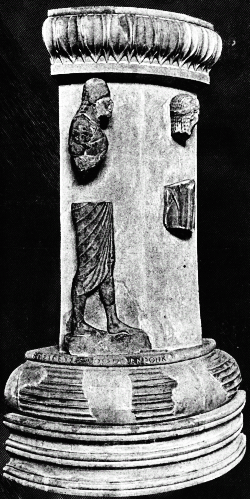
Sculptured Column From the Archaic Temple at Ephesus. No. 29
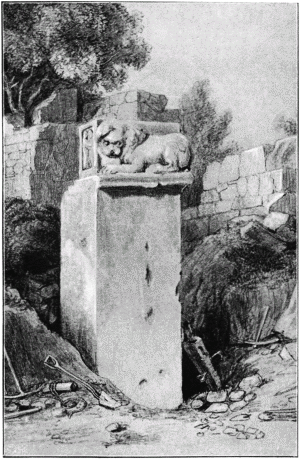
View of the Lion Tomb at Xanthos. No. 80.
(From a drawing by George Scharf.)
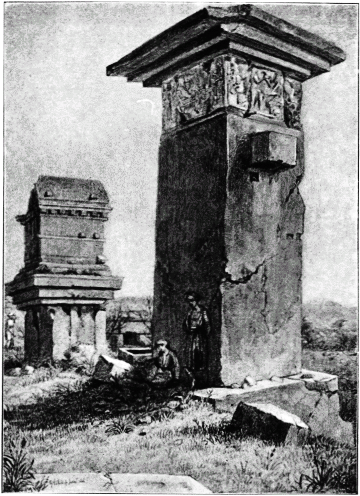
View of the Harpy Tomb at Xanthos. No. 94.
(From a drawing by George Scharf.)
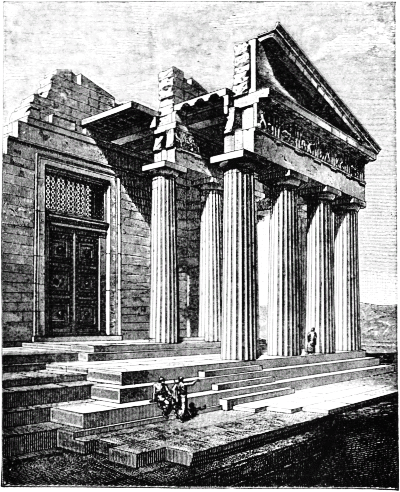
Sectional View of the East End of the Parthenon.,
(G. Niemann.)

Fig. 1. Carrey's Drawing of the East Pediment of the
Parthenon.
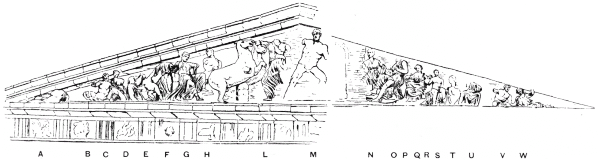
Fig. 2. Carrey's Drawing of the West Pediment of the
Parthenon.
|
|
Fig. 1. Iris and Hera. East Frieze of Parthenon.
Nos. 27, 28. |
Fig. 2. Arm. No. 330. |
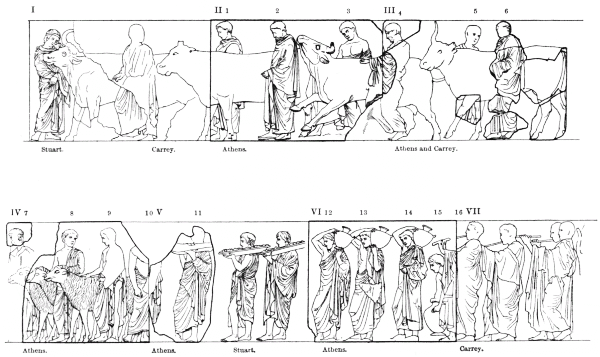
The North Frieze of the Parthenon (Slabs I.-VII.)
Restored.
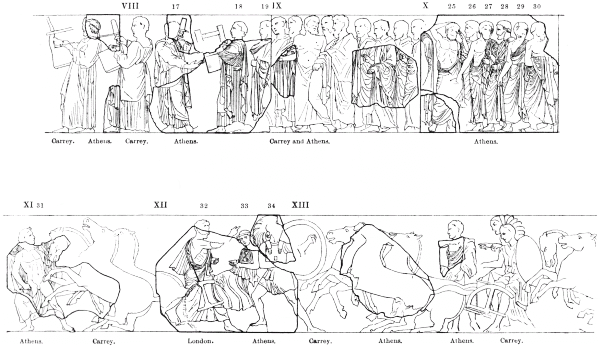
The North Frieze of the Parthenon (Slabs VII.-XIII.)
Restored.
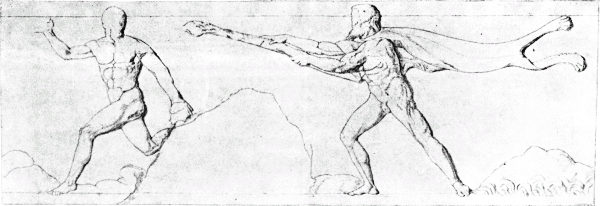
Lusieri's Drawing of the Missing Group From the Monument of
Lysicrates. No. 430, 5.
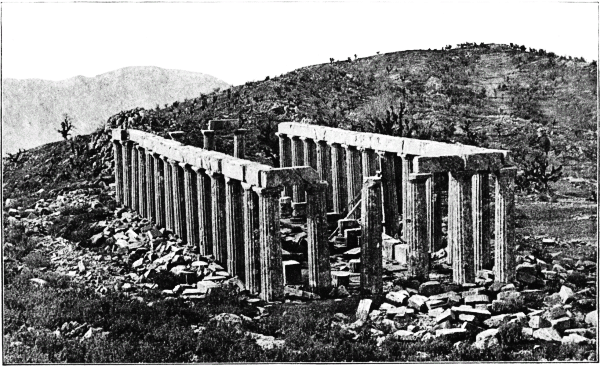
View of the Temple of Apollo at Phigaleia. (From a Photograph.)
|
|
|
Fig. 1. Sepulchral Relief.
No. 693. |
Fig. 2. Monument of Xanthippos.
No. 628. |
Fig. 3. Sepulchral Relief.
No. 627. |
|
|
Fig. 1. Fragment of a Sepulchral Relief.
No. 673. |
Fig. 2. Fragment of a Sepulchral Relief.
No. 672. |
|
A List of Illustrations has been added to the Book.
Some illustrations have been moved to the ends of their descriptive paragraphs to allow for freer flow of the text.
This may result in a changed page number in the List of Illustrations. (e.g., page 135 changed to page 136)
There are some inconsistencies in the spelling of (foreign) proper names throughout the book.
In each case, both forms have been retained.
There were a few instances of the high dot, ·, or Greek colon, in the Greek text, which have been retained.
Some parts of the Greek inscriptions are enclosed in brackets. This would appear to indicate restoration of indistinct
or missing text.
Journal numbers (X...; and x...; etc.) occur in both upper and lower case throughout book. Both forms have been retained.
Pages 108 and 136: Fig. 9 was used twice in the original book, and both instances have been retained.
The abbreviations 'C. I. A. (Corpus Inscriptionum Atticarum.) and C. I. G. (Corpus Inscriptionum Graecarum.) are spaced until page 297,
and unspaced (C.I.A and C.I.G.) from page 304 until the end of the book. Both forms have been retained.
Page 10: 'donotion' corrected to 'donation' - " ... have been acquired by donation or bequest,"
Page 11, Footnote 42: '214' corrected to '211'.
Numbers '212', '213' and '214' do not exist. Thus, '211' is the number
before '215'; and '211' fits the category of the other numbers in this
footnote. "See Nos. 211, 643, 652, 667, 680, 693, 699, 726, 736."
Page 46: 'Beechino' corrected to 'Beecheno' - "See also Solly, Memoirs of
W. J. Müller, 1875; Beecheno,"
Page 64: 'real' corrected to 'reel' - "... but include bead and reel mouldings,"
Return to Top
|




