Oh, what a Fall!
Second Day
There was a little more stir in the place the next morning, but it was
because it was filled with tramps, who were wisely taking advantage of the
early coolness and hurrying on their way. But when we turned off the High
Street the town was as still in the glare of day as it had been in the
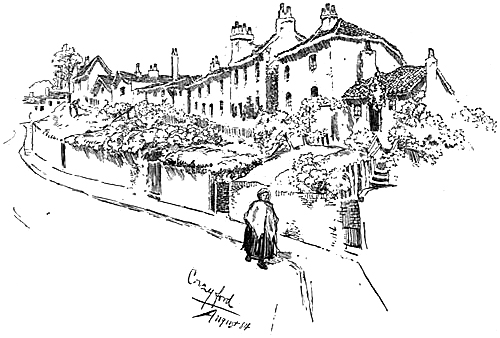
late twilight. The high brick walls of the private gardens might have
enclosed dwelling-places of the dead rather than of the living, for not a
sound came over them. The little pointed houses might have been sepulchres
for all the signs of life they gave. The whole town, instead of one little
street, should be called Tranquil Place. It seemed very characteristic
that the Cathedral should be closed, and this at the season when the
tourist is abroad in the land. It was being cleaned, an old man told us.
We looked through the iron railing of the door into the nave, and at the
marble floor, and the tall, white, rounded arches. ‘It’s like looking down
the throat of Old Time!’ Mr. Grewgious thought when he stood there. At
the farther end by the chancel steps a charwoman was at work on bended
knees. By her side was one small bucket. Here, truly, was a Liliputian set
to do the work of Brobdignag. At that rate it is probable visitors were
shut out for many months.
After we had looked at the ‘Bull,’ which still reminds the public by a
sign of the good beds enjoyed by Mr. Pickwick and his friends, at the Town
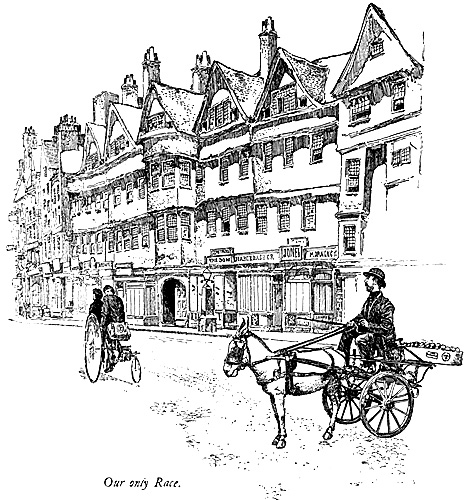
Hall where Pip was apprenticed, at the many-gabled, lattice-windowed house
in which Rosa Bud bloomed into young ladyhood, and were standing in front
of the ‘Six Poor Travellers’’ lodging-place, reading the inscription over
the door, and wondering who were the proctors classed with rogues who
could not rest within, a benevolent Englishman passing that way fell upon
us. He was a worthy fellow-citizen of Richard Watts. Seeing we were
strangers, he, without waiting to be asked, bestowed upon us the charity
of information.
‘Do you know what a Proctor is, Sir?’ he asked, addressing himself to J.,
who meekly, as befits one receiving alms, said that he did not. ‘No! Well,
then, I will tell you. It is a proc-u-ra-tor,—one who collects Peter’s
pence for the Pope, Sir. Richard Watts lived in the sixteenth century,
when Protestantism made people feel bitterly, Sir, and he would have no
friends of the Pope beneath his roof. Proc-u-ra-tor! That’s what a Proctor
is, Sir.’
He had disappeared around the curve of the street before we had finished
thanking him. As the information was new to us, I, with the common belief
that others must be as ignorant as myself, now imitate his benevolence,
and here bestow it in alms upon whoever may be in need of it.
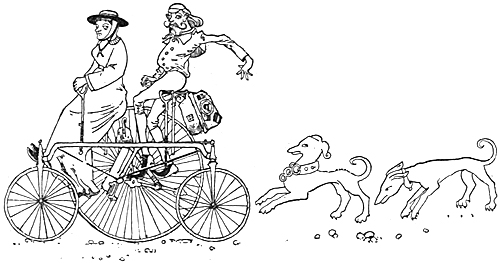
It was one o’clock when we mounted our tricycle and set out once more for
Canterbury. The sky was still unclouded and the day warm, but a good
breeze was blowing, and we were fresh for our ride. The streets of Chatham
were as busy as those of Rochester were idle, and blocked with waggons, so
that we had to fall in line and go at snail’s pace. Once, with a sudden
halt, we were brought so near a horse just in front, that my foot knocked
against his leg; but he bore the blow stoically, as if he were used to
Chatham streets. An American circus was about to start out on its grand
street parade, and children hung about corners and out of windows. At the
foot of the hill outside the town, and marked ‘Dangerous’ by the National
Cyclists’ Union, for the benefit of cyclers, two very small boys offered
to ‘Push it up, Sir!’ but as it looked as if it would push them down, we
declined. At the top we met a cycler on his way from Canterbury, and he
gave us evil tidings of the road. It became worse with every mile, he
said, and it was heavy and hilly, and the dust was enough to stifle one.
To this last statement his appearance bore good testimony.
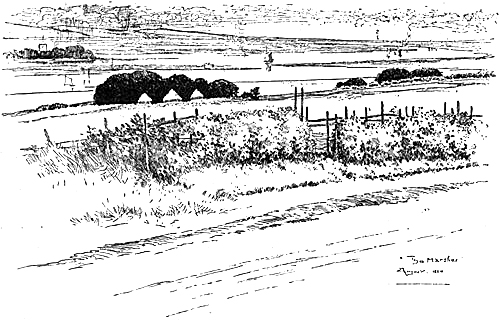
The Marshes.
But at first we found it fair enough. From Chatham to Sittingbourne our
journey was one of unmixed pleasure. The wheels went easily, and the wind
blew on our backs. Now we passed on our right a vast treeless expanse,
divided into squares of green, and golden, and brown, all shining softly
in the sunlight, with here and there a windmill; but to the left we could
see far below us the white line of the river winding between the flat
grey marshes, where in Pip’s day the escaped convicts prowled. Again we
wheeled through small, sleepy villages, with church and tower half hidden
in clumps of trees, and with red oasts, whose crooked cowls loomed up over
the chimney-pots of the low cottages: for we had come to the hop country,
and at every step the land of Kent grew fairer. Beyond Rainham the road
lay between hop-gardens, as they are appropriately called, and
cherry-orchards. In places the vines formed tall, shady hedges; in others
the gardens were shut in by bare poles hung with coarse brown cloth, to
defy the wind and the depredations of small boys, and other destructive
animals: but the prettiest fields were those which were in no way hedged
about, so that we could look down the long, narrow, green aisles, which
seemed to lead to fields of light beyond. The vines twisted lovingly up
the poles, which in many places bent beneath masses of green fruit, or
else the topmost shoots crossed and intertwined from one pole to another,
and the whole field was woven into a large arbour. Where the sunlight fell
upon the green clusters it turned them to pure gold, and the leaves,
blowing gently to and fro, seemed to rejoice in their great beauty. The
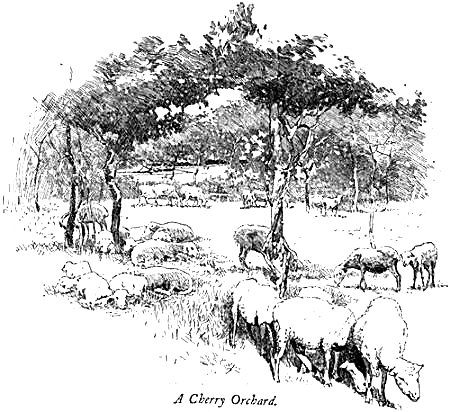
cherry-orchards were so pretty and trim that I wondered if, like the
hop-fields, they were not sometimes called gardens. The trees had been
long stripped of their fruit, but their branches were well covered with
cool green leaves, and their shadows met on the grass beneath. There was
one in particular, before which we rested. Sheep were browsing placidly on
the downy turf, and when we looked low down between the trees we could see
the shining white river far in the distance. I half expected to hear a
new Daphnis and Menalcas singing their pastorals in gentle rivalry.
We met few people. The tramps who come down to Kent for the hop-picking
turn off from Rochester to go to Maidstone, where the largest hop-fields
are, and where there is more chance for them to be hired; but a comparatively small number go on to
Canterbury.
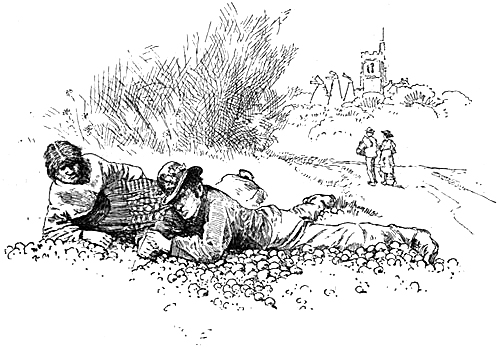
Larger Image
A Kentish Pastoral.
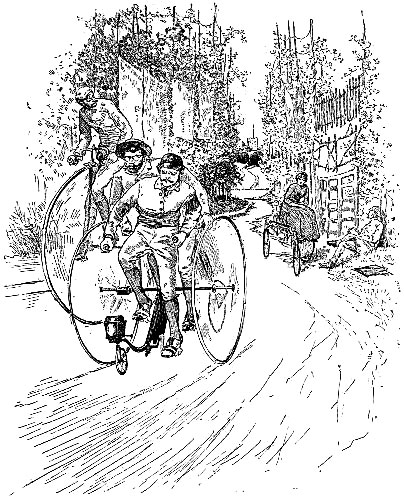
Some cyclers were making the most of the fine day. As we sat idly between the hop-gardens three
passed us. Two rode a tandem; the third, a bicycle; but they were of the
time-making species, for whom the only beauty of a ride is that of speed.
Looking at them, and then at the sheep in a field beyond, I thought the
latter were having the best of it. A little further on we met a party of
three Frenchmen. One rode ahead on a bicycle, the two others followed on a
tandem like ours. One of the latter, when he saw us, called out to the
bicycler, ‘C’est bon d’aller comme ça!’ I suppose he thought we should
not understand him, and if we did—well, ought not a Frenchman always to
be gallant?
We rode on with light hearts. An eternity of wheeling through such perfect
country and in such soft sunshine would, we thought, be the true earthly
paradise. We were at peace with ourselves and with all mankind, and J.
even went so far as to tell me I had never ridden so well!
It was, then, in a happy frame of mind, that we reached the inn at
Sittingbourne. It was an unassuming place, but quiet and clean; the bar
was on one side of the hall, the coffee-room on the other. The latter was
empty, and the landlady, after laying the cloth for our bread and cheese
and shandy-gaff—of all drinks the most refreshing to the cycler—left us
alone to study this printed notice, which hung in a frame over the door:—
‘Call frequently,
Drink moderately,
Pay honourably,
Be good company,
Part friendly,
Go home quietly.’
We soon had the opportunity of putting into practice one clause of this
advice, for the door was suddenly burst open, and a short man with a bald
head, who wore the Cyclists’ Touring Club uniform, rushed in.
‘Are you the lady and gentleman that came on the tandem?’ he asked, before
he was quite in the room.
We said we were.
‘I don’t like tandems, do you?’ he continued, fiercely, as if he were
daring us to differ from him. He seemed to think we had come there that he
might tell us his grievances; which he did, with much elaboration, while
we ate our lunch. He and his wife had been down to Margate from London,
and were now on their way back, he said. They had made the trip on a
tandem; it was the first time he had ridden one, and it would be the last,
for he didn’t like tandems—they were horrid things! Did we like tandems?
To avoid repetition, I may here mention that this expression of dislike,
together with the query as to our opinion, was the refrain to everything
he said. It was always given with the same interest and emphasis as if it
were an entirely original remark. The only variation he made was by
sometimes beginning with the statement, and at others with the question.
He explained the reasons for his dislike. The principal was, that the
people one met on the roads always insulted riders on a tandem. Why, he
had been off his machine a dozen times that morning, fighting men who had
been chaffing him! I thought, with a shudder, of the crowd of hucksters
J. would have had to fight by London Bridge, had he been of the same mind.
Then, the next objection was, that he had to sit behind his wife—she had
to steer, and he would not be surprised if he were seriously injured, or
even killed, before he got back to London. Women were heedless things, and
easily frightened. His wife, who had joined us a few minutes before, here
grew angry, and a slight skirmish of words followed between them: she
reminded him of the dangers they had escaped through her nerve and skill;
he recalled the dangers into which they had run owing to her
thoughtlessness and timidity. But, just at this point of the discussion J.
took out his watch. At sight of it the little man forgot his anger to
pounce upon it, with never as much as ‘An it please you!’ Then, looking up
in triumph, he exclaimed, ‘I knew it! it’s an American watch! They know
how to make watches over there, but they’re ruining our trade.’ Then he
explained that he was a London watchmaker, and he pulled out of his pocket
a large substantial specimen of his workmanship.
The talk now turning upon America, we told him, in answer to his
inquiries, that we were Americans.
‘From Canada?’ his wife asked.
‘Oh, no!’ I answered; ‘from Philadelphia.’
‘Dear me!’ the watchmaker
said; ‘then you’re real Americans! But you speak English very well!’
‘Yes,’ J. admitted, modestly. ‘But then, you know, English is sometimes
spoken in our part of the world!’
All this made the fierce little cycler very friendly, and he next wanted
to know where we were going.
‘To Canterbury,’ we said.
‘To Canterbury!’ he cried; and then, to give greater force to his words,
he came and stood directly in front of us on the other side of the table.
‘To Canterbury! Well, then, my advice to you is, if you have no other
object than pleasure, don’t go! No, don’t you go! I’ve been there, and I
know what I say. It’s a rotten place. There’s nothing in it but an old
cathedral and a lot of old houses and churches, and they charged me
sixpence for keeping my tandem one night. I don’t like tandems-horrid
things! Do you like tandems? Yes, it’s a rotten place, and if I had my way
I’d raze it to the ground!’
I now understand why it is that Mr. Matthew Arnold thinks the average
Briton so very terrible.
By this time we had finished our lunch, and were ready to start. The
watchmaker and his wife had engaged in another battle. She did not agree
with him in his opinion of Canterbury. Indeed I believe they did not
agree upon any one subject, and the tandem had tried their tempers. They
had both said they wanted to see us off, and to compare machines; but we,
being modest people, thought we would as lieve escape without their
comments and farewells. This seemed a favourable opportunity. In the heat
of the argument we left the room and paid our bill, without their noticing
our retreat; but just as we had mounted our tricycle, and were wheeling
softly away, we heard a voice calling, ‘Oh, I say now! do come back a
minute: I want to show you my machine!’ It would have been more than
uncivil to have refused, so we sat patiently while the much-abused tandem
was brought out. The owner, in his pride, rode out on it, pedalled by us,
and then wheeled round and faced us with an abruptness that fairly took
away our breath. It was the shortest turn I have ever seen, and I waited
for the end with the same uncertainty with which one watches a trapeze
performance. Then there was some little talk about bells and brakes, and
tyres and saddles. In the meantime the landlady, with two or three of her
friends, had come out, and was staring at us with a curiosity for which I
could not account. But presently she said, ‘Are you going back soon?’ And
then I knew she had heard we were Americans, and had come to have a look
at these strange people who had sailed across the sea, apparently for no
other reason than to test the cycling properties of the roads of Kent.
After this exhibition was over we said good-bye very pleasantly, and rode
off, followed by their wishes for our good luck, while the watchmaker
called out encouragingly, ‘You Americans ride pretty well; but I don’t
like tandems. Horrid things! Do you like tandems?’
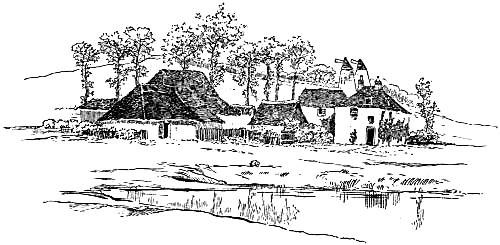
A Farmhouse near Rochester.
But their wishes were the only good luck we met with. We had not gone far
from Sittingbourne, when we admitted that the pilgrim we had met just
outside of Chatham was no false prophet after all; for the road now began
to be heavy with sand and rough with flints. And oh, the hills! They were
not very steep, but I was a novice in cycling. No sooner were we on
up-grades than I exhausted myself by my vigorous back-pedalling. I have
heard the uninitiated say that tricycling must be so easy, just like
working the velocipedes of our childhood.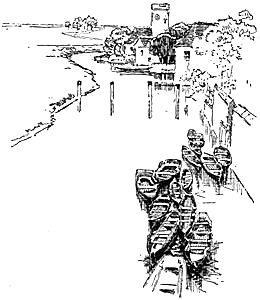
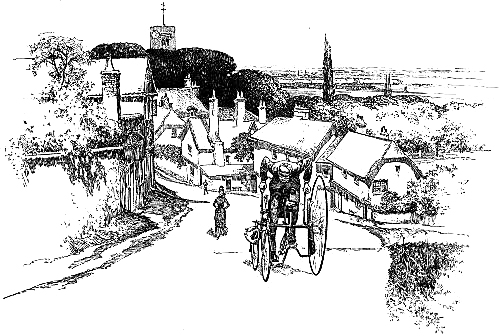
Larger Image
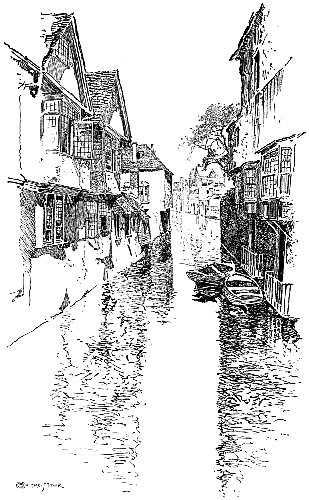
A Little River. But let them try! The country
had lost none of its beauty. Fields were as green and golden, orchards as
shady, and sheep as peaceful, as those we had seen before lunch. There
were little churches on hilltops and pretty dingles by the wayside;
handsome country-houses with well-kept lawns, and fields where cricketers
were playing, and young girls in gay-coloured dresses were applauding;
and there were old-fashioned farm-houses and quaint inn-yards. We passed
through villages by which little quiet rivers ran, some with boats lying
by the shore, and others, as at Ospringe, where horses and waggons were
calmly driven through the water. But the heaviness had spread from the
road to my heart, and all joyousness had gone from me.
The worst of it was, that as the road here wound little, we could see it
miles ahead—a white perpendicular line on the purple hill which bounded
the horizon.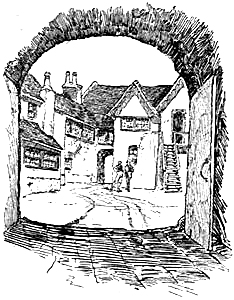
Larger Image We
knew this must be Boughton Hill, the fame of whose steepness has gone abroad in the cycling world. With the knowledge of what
was to come ever before me, I began to pedal so badly that J. told me so
very plainly, and said, moreover, that I was more of a hindrance than a
help to him. For some time we rode on very silently. Earlier in the
afternoon we had been passed by a man driving an empty carriage, of whom
we had asked one or two questions. He had stopped to watch the
cricket-match, but he now overtook us, and, to add to my misery, asked me
if I would not like him to drive me into Canterbury. All this was hard to
bear.
Finally, we came to Boughton, a small village with ivy-grown houses and a
squirrel and a dolphin staring at each other amicably from rival inns. It
is right at the foot of Boughton Hill. Now that we were near it, the white
line we had seen for so long widened into a broad road, but it looked no
less perpendicular. It was here that Chaucer’s pilgrims
‘gan atake
A man that clothed was in clothes blake,
And undernethe he wered a white surplis.’
There is no record that mine host and the Chanones Yeman dismounted and
walked to rest their horses. But all the many waggons and carriages and
cycles we saw above us on the modern road were being led, not driven.
Halfway up was an old lumbering stage, with boxes piled on the top, and
big baskets and bundles swinging underneath. The driver was walking; but a
tramp, who had made believe to push when on level ground, now sat
comfortably on the backseat, taking his ease. A little lower was the
friendly driver with his empty carriage, for he had rested at the
‘Squirrel,’ and so we had caught up to him again. At the top we looked
back to see that the West was a broad sea of shining light. A yellow mist
hung over the plain, softening and blending its many colours. Far off to
the north the river glittered and sparkled, and a warm glow spread over
the green of the near hillsides. The way in front of us was grey and
colourless by comparison. It was almost all down-hill after this. Did I
want to be driven into Canterbury, indeed? My benevolent friend might now
have asked us to pull him in. The stage made a show of racing us, but we
gave it only a minute’s chance. An officer in braided coat driving a drag
passed us triumphantly while we were on our up-grade; but when we came
again to a level we left him far behind.
‘Wete ye not wher stondeth a litel toun,
Which that ycleped is Bob up-and-doun,
Under the blee in Canterbury way?’
It is better known now as Harbledown. A little of our trouble here came
back, for the road leading to that part of it ‘ycleped Bob-up,’ was steep
and heavy, and we had to walk. To our right were the old red-brick
almshouses and the little church of St. Michael, one of the many oldest
churches in Kent, and of which all we could see was the ivy-covered tower.
It was here that Henry, when on his way to the holy shrine, dismounted,
that, as became his humble calling of pilgrim, he might walk into
Canterbury. And it was here, too, that the Person began his long-winded
discourse. But we, less reverent than King Henry, now mounted again; and,
less phlegmatic than the Person, we held our peace. For as we rode further
up we heard far-away chimes, just as Erasmus did when he went from
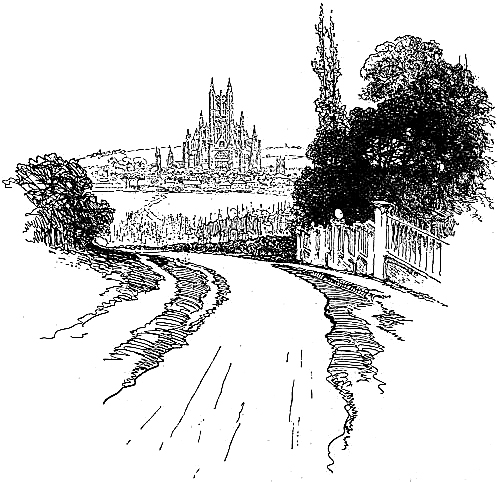
Harbledown; and there gradually rose before us a tall, grey tower, then
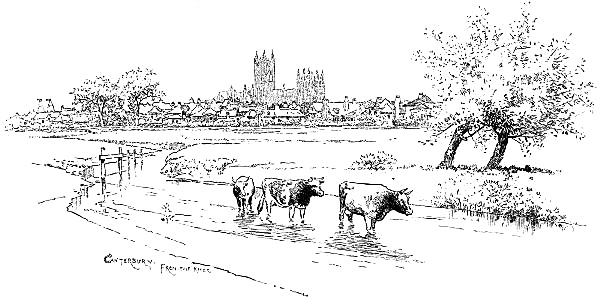
two more, and at last, as we reached the top of the hill, we saw in the
plain below the great Cathedral itself, standing up far above the low red
roofs of Canterbury. We were almost at our goal.
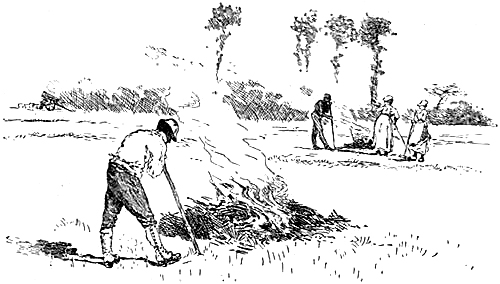
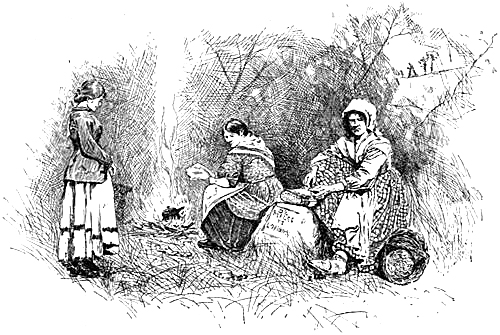
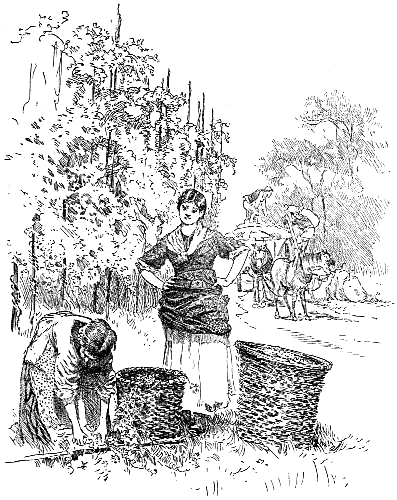
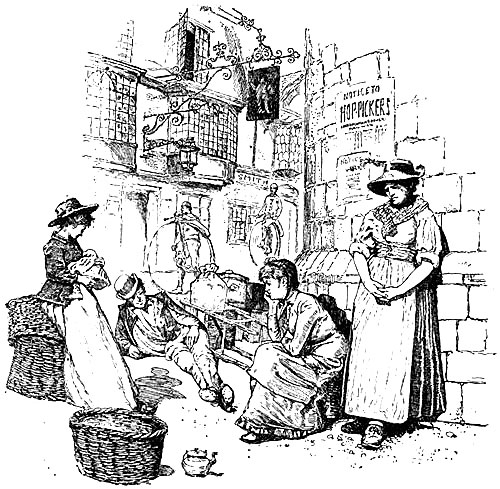
A little further on we passed a hop-field, where the picking had already
begun. In one part the poles were stripped of their vines, so that it
looked as if the farmer had reaped for his sowing a crop of dead
sticks. In the other the poles were still green, but the day’s work was
just over. Women were packing up kettles and pans, jugs and bottles, and
stowing babies and bundles into perambulators, while two or three men were
going the rounds with bag and basket, measuring the day’s picking, and
marking off the account of each picker by notching short, flat pieces of
wood held up for the purpose. In the road beyond a large cart, packed with
well-filled bags, was being drawn homewards by three horses, while a young
man rode up and down the green aisles. ‘I beg your pardon, Sir,’ a farm
hand said to J., who had been sketching, ‘but you’ve been takin’ some of
our people, and now you hought to take our Guvnor on his ’oss;’ and he
pointed to the young man. All the way into the town we passed groups of
pickers: women with large families of children, small boys with jugs and
coats hung over their shoulders, and young girls with garlands of hops
twisted about their hats, and all were as merry as if they had been on a
picnic. We saw them still before us, even after we had turned into Saint
Dunstan’s Street, from which the gold of the afterglow was fast fading,
and were riding between the quaint, gabled houses, through whose
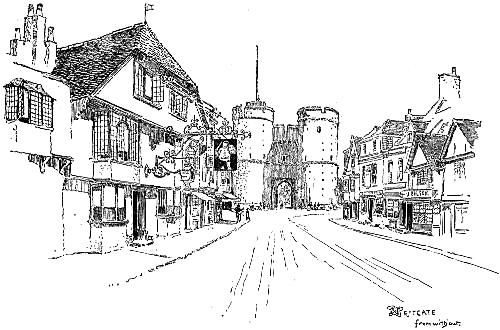
diamond-paned windows lights were beginning to appear. Before us was the
old, grey-towered city gate, through which royal and ecclesiastical
processions and knights and nobles once passed, but where we now saw only
the tramps who had arrived at the eleventh hour sitting at its foot with
their bags and baggage.
We ‘toke’ our inn at the sign of the ‘Falstaff,’ without the gate. Honest
Jack, in buff doublet and red hose, hanging between the projecting windows
and far out over the pavement by a wonderful piece of wrought-iron work,
gave us welcome, and within we found rest and good cheer for weary
pilgrims. Then we ‘ordeyned’ our dinner wisely, but it was too late to go
to the Cathedral that same evening, as we should have liked to have done,
and we were forced to wait for the morrow. After we had come downstairs
from our dimity-curtained bed-chamber, had dined, and were sitting over
our tea in a little, low-ceilinged room, from whose window we looked into
a pretty garden of roses and grapevines, a stranger sent us greeting, and
asked if he might come and sit with us. He was a priest, also making
pilgrimage, who had ridden from Rochester on a machine like ours; so that
we became friendly forthwith, and, like the pilgrims who rested at the
‘Chequers of the Hope,’ every man of our party
‘in his wyse made hertly chere,
Telling his felowe of sportys and of chere,
And of other mirthis that fellen by the way,
As custom is of pilgrims and hath been many a day.’
And just before we parted for the night we held counsel together and
agreed that, in the morning, we would in company visit the holy shrine.