On the way to Plum Beach, on the little branch line that carried the
girls from Bay City to Green Cove, Eleanor was very thoughtful, and
Bessie and Dolly were kept busy in telling the other girls of their
experiences. They wanted to hear from Zara, too, just how she had
escaped.
“I don’t see how you kept your face straight,” said Dolly. “I know I
would have burst right out laughing, Zara.”
“You wouldn’t think so if you knew Farmer Weeks,” said Zara, making a
wry face. “I can tell you I didn’t want to laugh, Dolly. Why, he was
within a few feet of me, and looking straight at me! I was sure he’d
guess that it was I.”
“He always looks at everyone that way—just as if they owed him money,”
said Bessie. “Nasty old man! I don’t blame you for being nervous,
Zara.”
“Oh, neither do I,” said Dolly. “But it was funny to think of his being
so near you and having no idea of it. That’s what would have made me
laugh.”
“It seems funny enough, now,” admitted Zara, with a smile. “But, you
see, I was perfectly certain that he did have a very good idea of where
I was. I was expecting him to take hold of me any moment, and tell the
constable to take me off the train.”
“I wonder how long this sort of thing is going to keep up,” said Margery
Burton, angrily. “Until you two girls are twenty-one?”
“I hope not,” laughed Bessie, and then she went on, more seriously, “I
really do think that if Jake Hoover sticks to what he said, and takes
our side, Mr. Jamieson is likely to find out something that will give
him a chance to settle matters. You see, we’ve been fighting in the dark
so far.”
“I don’t see that we’ve been fighting at all, yet,” said Margery. “They
keep on trying to do something, and we manage to keep them from doing
it. That’s not my idea of a fight. I wish we could do some of the
hitting ourselves.”
“So do I, Margery. And that’s just what I think we may be able to do
now, if we have Jake on our side. He must know something about what
they’ve been doing. They couldn’t keep him from finding out, it seems to
me.”
“But will he tell? That seems to be the question.”
“Yes, that’s it, exactly. Well, if he does, then we’ll know why they’re
doing all this. You see, Mr. Jamieson can’t figure on what they’re going
to do next, or how to beat them at their own game, simply because he
doesn’t know what their game is. They know just what they want to do,
while we haven’t any idea, except that they’re anxious to have Zara and
myself back where Farmer Weeks can do as he likes with us.”
“Well, it would be fine to be able to beat them, Bessie, but right now
I’m more worried about what they will try to do next. This is a pretty
lonely place we’re going to, and they’re so bold that there’s no telling
what they may try next.”
“That’s so—and they know we’re coming here, too. Jake told them that.”
“They would probably have found it out anyhow,” said Dolly. “And there’s
one thing—he didn’t try to warn them that you knew about what they
meant to do at Canton, Bessie.”
“No, he didn’t. And he could have done it very easily, too. Oh, I think
we can count on Jake now, all right. He’s pretty badly frightened, and
he’s worried about himself. He’ll stick to the side that seems the most
likely to help him. All I hope is that he will go to see Mr. Jamieson.”
“Do you think he will?”
“Why not? Even if they get hold of him again, I think there will be time
enough for him to see Mr. Jamieson first. And I’ve got an idea that Mr.
Jamieson will be able to scare him pretty badly.”
“All out for Green Cove,” called the conductor just then, appearing in
the doorway, and there was a rush for the end of the car.
“Well, here we are,” said Eleanor. “This isn’t much of a city, is it?”
It was not. Two or three bungalows and seashore cottages were in sight,
but most of the traffic for the Green Cove station came from scattered
settlements along the coast. It was a region where people liked to live
alone, and they were willing to be some distance from the railroad to
secure the isolation that appealed to them. A little pier poked its nose
out into the waters of the cove, and beside this pier was a gasoline
launch, battered and worn, but amply able, as was soon proved, to carry
all the girls and their belongings at a single load.
“Thought you wasn’t coming,” said the old sailor who owned the launch,
as he helped them to get settled aboard.
“We missed the first connecting train and had to wait, Mr. Salters,”
said Eleanor. “I hope you didn’t sell the fish and clams you promised
us to someone else?”
“No, indeed,” said old Salters. “They’re waitin’ for you at the camp,
ma’am, and I fixed up the place, too, all shipshape. The tents is all
ready, though why anyone should sleep in such contraptions when they can
have a comfortable house is more’n I can guess.”
“Each to his taste, you know,” laughed Eleanor. “I suppose we’ll be able
to get you to take us out in the launch sometimes while we’re here?”
“Right, ma’am! As often as you like,” he answered. “My old boat here
ain’t fashionable enough for some of the folk, but she’s seaworthy, and
she won’t get stuck a mile an’ a half from nowhere, the way Harry Semmes
and that new fangled boat of his done the other day when he had a load
of young ladies aboard.”
He chuckled at the recollection. But while he had been talking he had
not been idle, and the Sally S., as his launch was called, had been
making slow but steady progress until she was outside the cove and
headed north. Soon, too, he ran her inside the protecting spot of land
of which Dolly had spoken to Bessie, and they were in such smooth water
that, even had any of them had any tendency toward seasickness, there
would have been no excuse for it.
In half an hour he stopped the engine, and cast his anchor overboard. He
wore no shoes and stockings, and now, rolling up his trousers, he jumped
overboard.
“Hand me the dunnage first,” he said. “I’ll get that ashore, and then
I’ll take the rest of you, one at a time.”
“Indeed you won’t,” laughed Eleanor. “We’re not afraid of getting our
feet wet. Come on, girls, it’s only two feet deep! Roll up your skirts
and take off your shoes and stockings, and we’ll wade ashore.”
She set the example, and in a very short time they were all safely
ashore, with much laughter at the splashing that was involved.
“Mr. Salters could run the Sally S. ashore, but it would be a lot of
trouble to get her afloat again, and this is the way we always do here.
It’s lots of fun really,” Eleanor explained.
Soon they were all ashore, and inspecting the camp which had been laid
out in preparation for them.
“Real army tents, with regular floors and cots, these are,” said
Eleanor. “Sleeping on the ground wouldn’t be very wise here. And there’s
no use taking chances. I’m responsible to the mothers and fathers of all
you girls, after all, and I’m bound to see that you go home better than
when you started, instead of worse.”
“I think they’re fine,” said Margery. “Oh, I do love the seashore! How
long shall we stay, Miss Eleanor?”
“I don’t know,” said the Guardian, a shade of doubt darkening her eyes.
“You know, Margery” —she spoke in a low tone—” that seems to depend
partly on things we can’t really control. There seems to me to be
something really quite desperate about the way Mr. Holmes and his
friends are going for Bessie and Zara.
“Maybe they will make trouble for us here. It is rather isolated, you
know, and I can’t help remembering that we’re on the coast, and that a
few miles away the coast is that of Bessie’s state—the state she
mustn’t be in.”
“That’s so,” said Margery, gravely. “You mean that if they managed to
get hold of Bessie or Zara, and took them out to sea and then landed
them in that state they’d be able to hold them there?”
“It worries me, Margery. The trouble is, you see, that once they’re in
that state, it doesn’t matter how they were taken there, but they can be
held. If Zara’s father gets free, why, he would be able to get her back,
I suppose. Mr. Jamieson says so. But there’s no one with a better right
to Bessie, so far as we know. I’m really more worried about her than
about Zara.”
“We’ll all be careful,” promised Margery, with fire in her eye. “And I
guess they’ll have to be pretty smart to find any way of getting her
away from us. I’ll talk to the girls, and I’ll try to be watching myself
all the time.”
“I’m hungry,” announced Dolly. “Just as hungry as a bear! Can’t we have
supper pretty soon, Miss Eleanor?”
“Supper?” scoffed Miss Eleanor. “Why, we haven’t had our dinner yet! But
we’ll have that just as soon as it’s cooked. I’ve just been waiting for
someone to say they were hungry. Dolly, you’re elected cook. Since
you’re the hungry one, you can cook the dinner.”
“I certainly will! I’ll get it all the sooner that way. May I pick out
who’s to help me, Miss Eleanor?”
“That’s the rule. You certainly can.”
“Then I pick out all the girls,” announced Dolly. “Every one of you—and
no shirking, mind!”
She laughed merrily, and in a moment she had set every girl to some
task. Even Margery obeyed her orders cheerfully, for the rule was
there, and, even though Dolly had twisted it a bit, it was recognized
as a good joke. Moreover, everyone was hungry and wanted the meal to be
ready as soon as possible.
“There’s good water at the top of that path,” said Eleanor, pointing to
a path that led up a bluff that backed against the tents. “I think maybe
we’ll build a wooden pipe-line to bring the water right down here, but
for to-day we’ll have to carry it from the spring there.”
“Is there driftwood here for a camp fire, do you suppose, the way there
was last year, Miss Eleanor?” asked one of the other girls. “I’ll never
forget the lovely fires we had then!”
“There’s lots of it, I’m afraid,” said Eleanor, gravely.
“Why are you ‘afraid’?” asked Bessie, wonderingly.
“Because all the driftwood, or most of it, comes from wrecked ships,
Bessie. This beach looks calm and peaceful now, but in the winter, when
the great northeast storms blow, this is a terrible coast, and lots and
lots of ships are wrecked. Men are drowned very often, too.”
“Oh, I never thought of that!”
“Still, some of the wood is just lost from lumber schooners that are
loaded too heavily,” said Eleanor. “And it certainly does make a
beautiful fire, all red and green and blue, and oh, all sorts of colors
and shades you never even dreamed of! We’ll have a ceremonial camp fire
while we’re here, and it is certainly true that there is no fire half so
beautiful as that we get when we use the wood that the sea casts up.”
“Don’t they often find lots of other things beside wood along the coast
after a great storm, Miss Eleanor?”
“Yes, indeed! There are people who make their living that way. Wreckers,
they call them, you know. Of course, it isn’t as common to find really
valuable things now as it was in the old days.”
“Why not? I thought more things were carried at sea than ever,” said
Dolly.
“There aren’t so many wrecks, Dolly, for one thing. And then, in the
old days, before steam, and the great big ships they have now, even the
most valuable cargoes were carried in wooden ships that were at the
mercy of these great storms.”
“Oh, and now they send those things in the big ships that are safer, I
suppose?”
“Yes. You very seldom hear of an Atlantic liner being wrecked, you know.
It does happen once in a great while, of course, but they are much more
likely to reach the port they sail for than the old wooden ships. In the
old days many and many a ship sailed that was never heard of, but you
could count the ships that have done that in the last few years on the
fingers of one hand.”
“But there was a frightful wreck not so very long ago, wasn’t there? The
Titanic?”
“Yes. That was the most terrible disaster since men have gone to sea at
all. You see, she was so much bigger, and could carry so many more
people than the old ships, that, when she did go down, it was naturally
much worse. But the wreckers never made any profit out of her. She went
down in the middle of the ocean, and no one will ever see her again.”
“Couldn’t divers go down after her?”
“No. She was too deep for that. Divers can only go down a certain
distance, because, below that, the pressure is too great, and they
wouldn’t live.”
“Stop talking and attend to your dinner, Dolly,” said Margery, suddenly.
“You pretended you were hungry, and now you’re so busy talking that
you’re forgetting about the rest of us. We’re hungry, too. Just remember
that!”
“I can talk and work at the same time,” said Dolly. “Is everything
ready? Because, if it is, so is dinner. Come on, girls! The clams first.
I’ve cooked it—I’m not going to put it on the table, too.”
“No, we ought to be glad to get any work out of her at all,” laughed
Margery, as she carried the steaming, savory clams to the table. “I
suppose every time we want her to do some work the rest of the time
we’re here, she’ll tell us about this dinner.”
“I won’t have to,” boasted Dolly. “You’ll all remember it. All I’m
afraid of is that you won’t be satisfied with the way anyone else cooks
after this. I’ve let myself out this time!”
It was a good dinner—a better dinner than anyone had thought Dolly
could cook. But, despite her jesting ways, Dolly was a close observer,
and she had not watched Margery, a real genius in the art of cooking, in
vain. Everyone enjoyed it, and, when they had eaten all they could,
Dolly lay back in the sand with Bessie.
“Well, wasn’t I right? Don’t you love this place?” she asked.
“I certainly think I do,” said Bessie. “It’s so peaceful and quiet. I
didn’t believe any place could be as calm as the mountains, but I really
think this is.”
“I love to hear the surf outside, too,” said Dolly. “It’s as if it were
singing a lullaby. I think the surf, and the sighing of the wind in the
trees is the best music there is.”
“Those noises were the real beginning of music, Dolly,” said Eleanor.
“Did you know that? The very first music that was ever written was an
attempt to imitate those songs of nature.”
After the dishes were washed and put away, everyone sat on the beach,
watching the sky darken. First one star and then another came out, and
the scene was one of idyllic beauty. And then, as if to complete it, a
yacht appeared, small, but beautiful and graceful, steaming toward them.
Its sides were lighted, and from its deck came the music of a violin,
beautifully played.
“Oh, how lovely that is!” said Eleanor. “Why, look! I do believe it is
going to anchor!”
And, sure enough, the noise of the anchor chains came over the water.

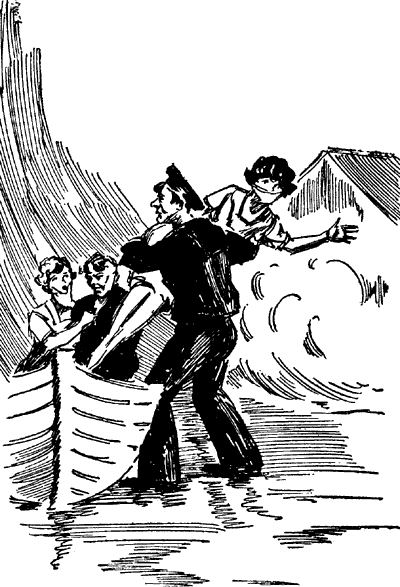 “Keep still, and you won’t be hurt,” commanded