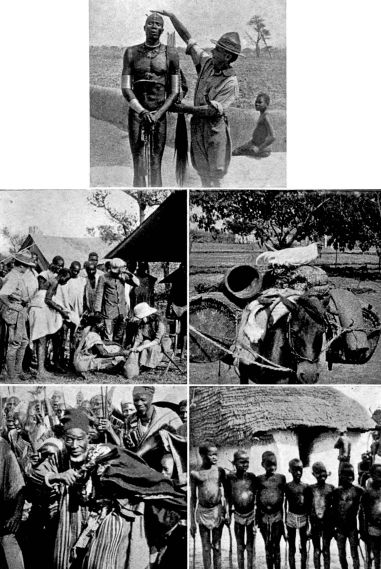
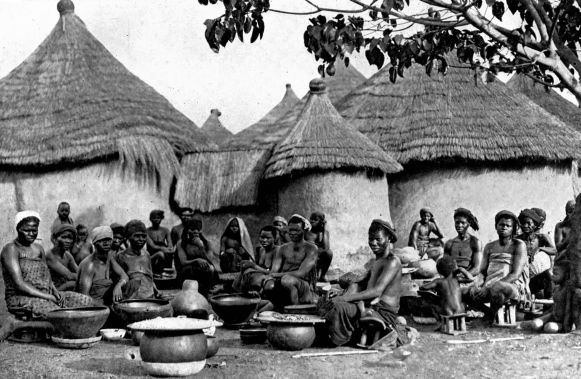
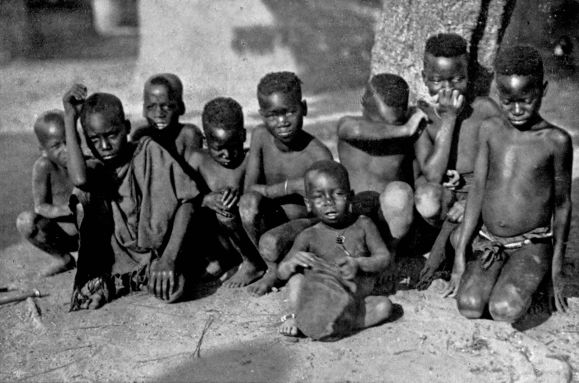
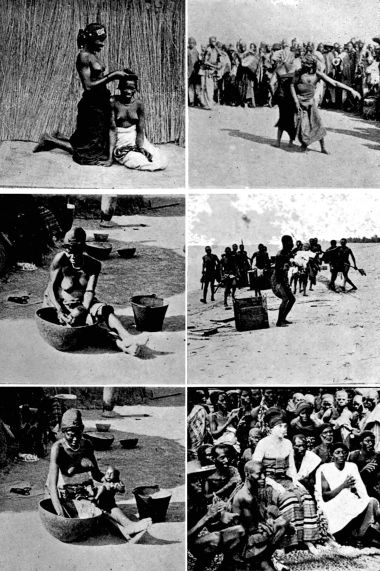
From Nambiri as far as Kugnau, our next
stage, there is no road, nor practically any
trail; only an immense variety of native
tracks, leading anywhere and everywhere. The
country is so thickly populated, that to pick out
the right route is very difficult, and well-nigh
impossible without a guide. I went on ahead,
with the guide, from Tschopowa; and Schomburgk,
who was to follow on later, instructed him to
"close the road." This means that whenever the
guide came to a cross trail, or a fork in the road,
he was to place a piece of stick across the wrong
one, thereby "closing" it to the next traveller
who came along, assuming him to be bound in our
direction. This, however, the guide neglected to
do in several instances, and as a result Schomburgk
wandered off the right track and got lost.
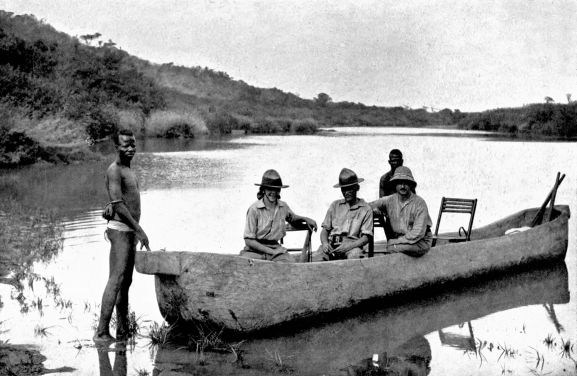
We crossed the Oti twice during this stage.
The first crossing was a somewhat difficult one.
Not only were the banks covered in dense jungle,
but the path dipped down a very steep angle for
about fifty feet in sheer depth. I had to slide
down assisted by my hammock boys, and we had
to exercise considerable care in order to get the
horses down, and safely across. I had a magnificent
view of the river, which is here about three
hundred yards wide from bank to bank, but it
being now towards the end of the dry season, the
actual stream was greatly shrunken, revealing the
presence of many islands, both up and down.
These islands were covered with thick tropical
vegetation, the haunt of innumerable birds. In the
rainy season, all but a few of the higher and larger
islands will have disappeared beneath the risen
waters, which then fill the whole channel from
bank to bank, and bank high.
The second crossing of the Oti was even more
picturesque than the first. It is here much broader,
the banks are lower, and there are many villages
scattered about, from all of which came detachments
of natives to swell the welcome given to the
first white woman. In the end there must have
been fully a thousand of them round my hammock,
in front and behind, shouting, dancing, and singing.
The din was terrific, the heat and dust awful. I
felt I would have given almost anything if they
would only go away, and leave me in peace; and
yet it was, of course, impossible to get angry with
them, or even be anything but polite to them,
their good intentions were so obvious. Some time
after our arrival Schomburgk turned up, hot, tired,
and cross, and rated the guide soundly for not
having closed the road. He had, it appeared, gone
completely astray, and had been wandering about
all over the place.
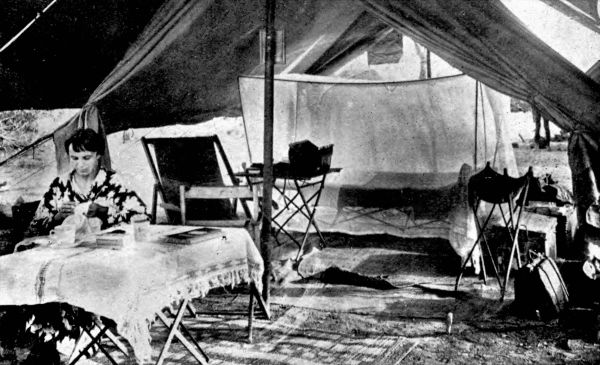
There is no rest-house at Kugnau, so we had
to use our tents. But there was no shade, the
trees just about here being merely dwarf ones,
and the daytime heat rendered sleep out of the
question. Then at night came hordes of ferocious
mosquitoes, some of which got under my mosquito-net,
and well I knew it. It was the duty of Asmani,
Schomburgk's personal boy, to attend to my bed.
He was quite a youngster, a long lanky slab of a
boy, with arms on him like a chimpanzee's; but
he was so willing and good-tempered, that he was
a great favourite with all of us. He could not be
made to understand, however, the importance of
tucking my mosquito-curtain in all round under
the mattress, so as to prevent the ingress of the
bloodthirsty little pests. I got so tired of talking
to him about it, and so weary of sleepless nights,
that at last I used to send him regularly to report
himself to Schomburgk whenever I was bitten by
mosquitoes. It was very comical to see him go
up to make this report in the morning, his usually
jolly, round face, long and woebegone. "Master,"
he would say, "two" (or three or four, &c., as the
case might be) "mosquitoes in the 'little mother's'
bed last night." "Ah!" Schomburgk would remark,
with becoming gravity. "Then you must
be punished." And he would give him two, three,
or four light slaps on the face, one for each mosquito.
They were just such smacks as one gives
in play to a child, and of course did not hurt him
physically in the least, but they hurt his dignity,
for Asmani, in virtue of being Schomburgk's personal
servant, was "head boy" of the caravan,
and the other boys, whom he regarded as being
more or less under him, used to take a solid
delight in crowding round and sniggering their
approval whenever he rolled up for his "mosquito
slaps."
I have said that Asmani was a willing boy.
In fact, he was too willing. When one gave him
an order, his eagerness to obey led him to rush
off at top speed before he half understood what
was required of him. The results, very often, were
ludicrous in the extreme; and occasionally not a
little annoying. Asmani got to be known, very
early in the trip, as the "cockroach," on account
of his erratic, rapid movements; and towards the
end of our journey, whenever he was making ready
to bolt eagerly off before he had properly comprehended
our meaning, it only became necessary
to cry out to him, while lifting a warning forefinger,
"Whoa, Asmani; don't cockroach!" in order to
arrest him. He was one of that type of servant—now,
I am afraid, rare in effete Europe—who
regards his employer's interests as his own. Consequently,
he was not a great favourite with the
other boys; who held, for the most part, views
widely divergent from these. To Messa, our cook,
more especially, he was the very reverse of a persona
grata, for when Messa would come to tell me,
say, that the tea was all gone, or that he required
more sugar from store, Asmani, if he happened to
be anywhere near, would be sure to give vent to
an incredulous, long-drawn "Oh-h-h!" Whereupon
Messa would glare at him, and presently
there would ensue a rare hullabaloo from behind
the cook-house; Asmani and Messa "having it
out."
It was while we were resting here that an
incident occurred which showed how easily an
inexperienced European may be led astray in his
dealings with the natives, and so cause trouble
without being at all aware of it. It had reference
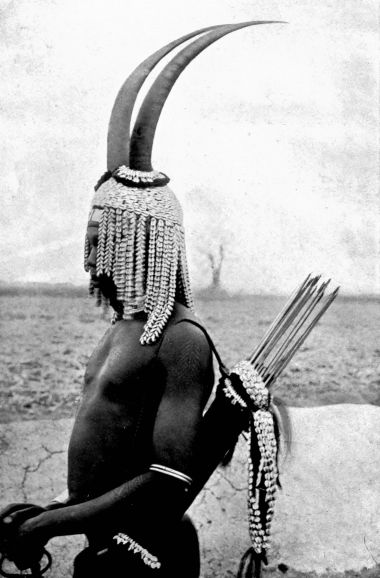
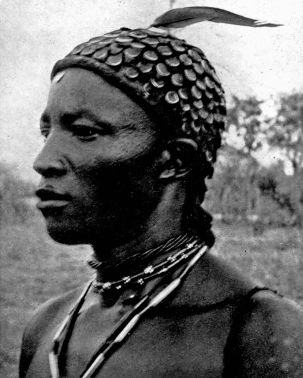
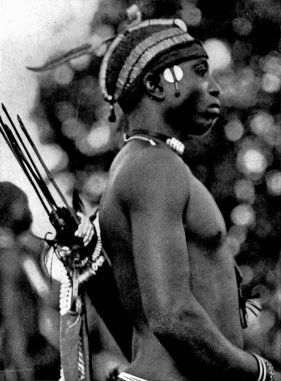
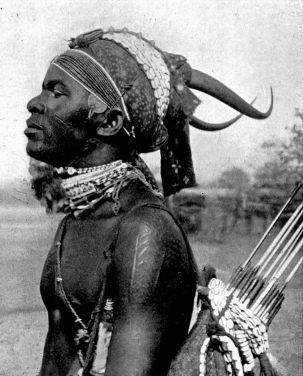
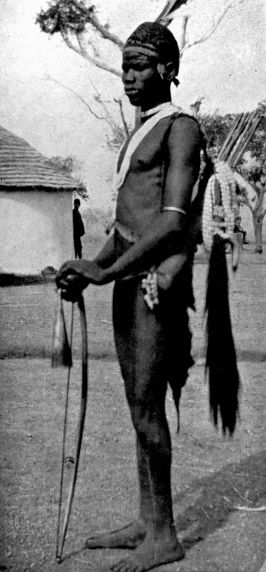
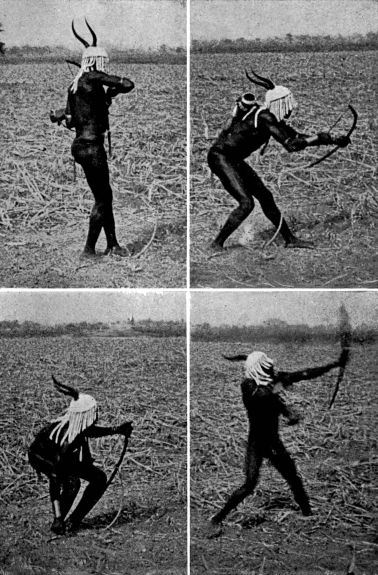
to the Konkombwa cowrie-shell helmets, of which
mention has already been made. These beautiful
and unique objects always attract the immediate
attention and admiration of European travellers,
who naturally try to acquire one or more to take
away with them. But the Konkombwa value
them highly, and are usually, and for the most
part, very unwilling to sell them, even though
tempted by what is, for them, a very good price,
either in coined money, or in brass or copper rods,
which they greatly prefer.
I have heard it hinted that, in the old days,
Europeans were not too careful of the rights of the
natives in regard to their acquisition of these curios.
Now, however, strict orders have been issued by
the Duke of Mecklenburg that the Konkombwa
are not to be unduly pressed to part with their
helmets or other trappings. They may be bought.
But the sale must be a genuine one, a fair price
must be paid, and above all, Europeans are warned
to make certain, before purchasing, that the Konkombwa
are willing to sell, and that no secret
intimidation has been used to compel them to do
so by the interpreters, soldiers, &c., attached to
the caravan.
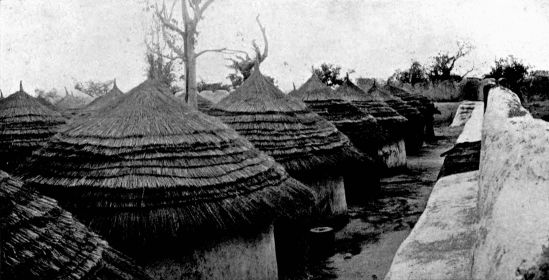
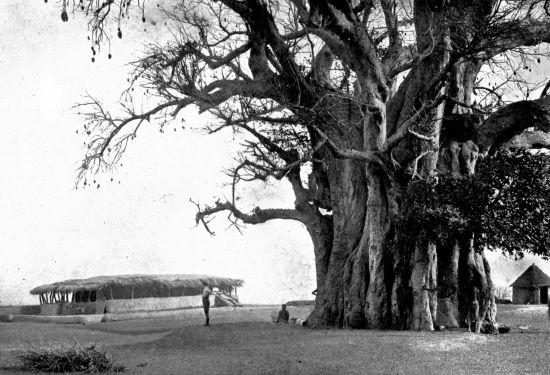
By permission of
Maj. H. Schomburgk, F.R.G.S.
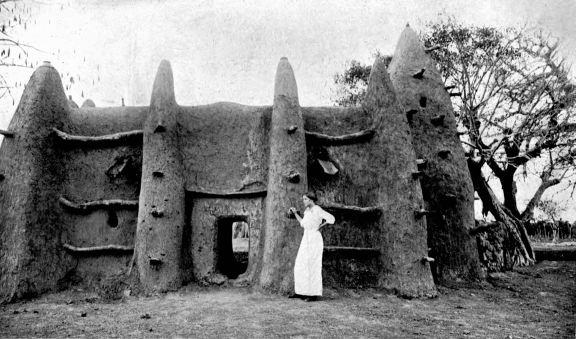
The "Roman Fort" at Ibubu
This building, spite of its ancient-sounding name, is of quite modern construction. It was originally erected with a view to overawing
the Konkombwa savages. Its interior is occupied by a multitude of neatly-built huts belonging to the garrison.
Now Schomburgk had already secured one of
the helmets at Gerin-Kuka, but he was open to
purchase others, and sent one of the soldiers of
our escort into the village to say so. The man
was strictly enjoined, however, to use no compulsion.
If the Konkombwa wished to do business,
well and good, but not otherwise. His part,
in short, was simply to act as a go-between, to
introduce a willing seller to a willing buyer. Well,
the soldier went off on his errand, to return presently
with several natives marching at his heels,
carrying helmets, quivers, &c., about a dozen in
all. "Are these for sale?" asked Schomburgk.
"Yes, all the lot," replied the soldier. Schomburgk
thought this suspicious, knowing how loath
the Konkombwa are to part with these things,
so he sent the soldier away, out of sight and hearing,
while he cross-examined the natives. As a
result it turned out that only one man wanted to
sell a helmet, and two others bows and quivers,
and a horse-hair switch. The others had been
told that they had got to bring the things up to
our camp for sale, and that if they did not do so
they would be punished. Of course the unwilling
ones were at once sent back to their village with
their helmets, &c., while the soldier was given a
severe lecture. In this connection Schomburgk
told me of the following amusing incident. During
his last trip in the Konkombwa country, he was
travelling with the Duke of Mecklenburg. One
man of the party, a newcomer in the district,
bought two helmets, and showed them, with evident
pride, to some members of the party. Said the
Duke, using his usual formula in such circumstances:
"I suppose I may take it for granted
that there was no intimidation." "Oh dear no,"
was the reply, "I just sent a soldier to the village
to tell the Konkombwa I wanted a couple of their
helmets, and he brought 'em to me." A roar of
laughter greeted this naive admission, and even
his Highness was unable to repress a smile.
At 5.30 A.M. the following morning (February 8th)
we resumed our journey, and soon afterwards we
crossed the Oti once more, and for the last time.
Schomburgk seized the opportunity to go off with
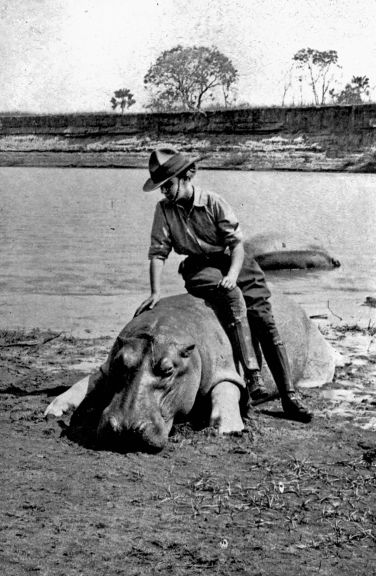
Hodgson and the camera to try and get some hippo
pictures, but only two of the creatures were visible,
so he did not trouble. Afterwards he caught up
to me, just as my hammock broke down, letting
me to the ground with a bump. While it was
being repaired, we consumed an alfresco breakfast
by the side of the road; very enjoyable. An hour
or so later we arrived at Ibubu; the end of the
stage.
There is a spacious old rest-house here, but to
our surprise we found it very much dilapidated;
almost in ruins, in fact. This is a very unusual
thing as regards the Togo rest-houses, the only
explanation I can think of being that this particular
route is very infrequently used by white people.
Ibubu is the site of an old fort, called by Europeans
in Togo the "Roman Fort." I had heard it mentioned
so often, that I expected to see a quite
imposing-looking building, and was greatly disappointed
at beholding nothing more startling or
romantic than a big mud wall, surrounding a huge
conglomeration of native huts, set closer together
than any I had ever observed previously. No
doubt, however, it was once a place of considerable
strength. It was built, I was told, by Dr. Kersting,
to overawe the Konkombwa in the old days,
when these savages, not having then sufficiently
measured their strength with that of the white
men, were inclined to be aggressive and troublesome.
It is noticeable that the Konkombwa on
this side of the Oti are much wilder and more
truculent than are those on the other side, and still
give the Government trouble from time to time,
although there has been no actual fighting for the
last few years.
We are now in the Sokode district, and the
supplies of food are ridiculously small by comparison
with what they were in the Mangu district.
We put up the flap of our tent under a big tree,
the upper branches of which were full of what I
at first took to be some kind of fruit, but which
turned out afterwards to be a large species of bat,
a kind of flying-fox. We bought another ostrich
here. He was a most comical sight, having been
plucked before being offered to us for sale. I
laughed till I cried, at the sight of him. He looked
exactly like a gigantic replica of one of those wooden
egg-shaped toy birds that are sold in the shops,
with two sticks for legs. However, he turned out
to be a very fine, and unusually big, bird. So,
too, did the other one, that we bought in Mangu.
Both ostriches are now in the Hamburg "Zoo,"
to which they were presented by Major Schomburgk,
and the director wrote, after our arrival in London,
that everybody was amazed at their enormous size,
and that it was quite conceivable—although this
is not yet scientifically proved—that they are a
new species of giant ostrich. "In any case," he
wrote, "they are quite out of the common."
The Ibubu people are very sullen; not a bit
like those on the other side of the Oti. The women,
as well as the men, eyed us askance; and the
children edged away from us, and remained silent,
when spoken to. This I took to be a bad sign,
for these people are not "savages," in the sense
that the far northern tribes are, and that they
declined to make friends was, therefore, clearly
due to the influence of their elders. Both Schomburgk
and I—I flatter myself that I am getting
quite experienced in the ways of natives by now—had
a sort of feeling, a presentiment if you like,
that all was not well; and so it turned out.
In the morning only twelve carriers turned up,
whereas we wanted at least fifty, and the interpreter
reported that the chief either could not, or
would not, supply any more. Here was a pretty
go. It is difficult for an outsider to realise how
completely a caravan in the African hinterland is
dependent on man transport. If we could not
secure a sufficiency of carriers, it meant either
one of two things, abandoning the bulk of our
belongings—an unthinkable alternative—or doing
"relay work" backwards and forwards between
Ibubu and Banjeli, the next stage, the latter as
heartbreaking and tedious an operation as can well
be conceived. Then, too, there was this further
cause for anxiety; an official who was acting for
the Commissioner at Sokode—who happened to be
on leave at the time—had had bother with the
natives at this very village, and serious trouble
was only narrowly averted.
Schomburgk acted at once, and in a manner
which—I hope he will pardon me for saying so—struck
me at the time as being somewhat high-handed,
although I have no doubt now, from what
subsequently transpired, that it was the only way.
He sent a peremptory demand for the chief to attend
before him at once. Soon he appeared, escorted
by our two soldiers. He was very cheeky, not to
say overbearing. In effect he said that the twelve
carriers he had sent were all that were at present
available, and he "couldn't make carriers out of
mealie cobs, could he?" However, after talking
to him for five minutes or so in terms the reverse
of polite, Schomburgk got a promise from him to
let us have ten more.
The chief was a tall, big man, and Schomburgk
is of quite medium size; consequently he had to
bend his neck backwards at an angle, and look up
at the huge Konkombwa towering above him like
a rock, in order to address him. This, I think,
made him even angrier than he otherwise would
have been. A short man carrying on an altercation
with a tall man is always at a disadvantage,
be the taller black or white. Schomburgk called
him everything but a gentleman, "long slab of
misery," being among the mildest term of abuse
he applied to him, and when the interpreter interpreted
the chief at first looked puzzled, then bowed
and seemed quite pleased. Schomburgk couldn't
make this out. He thought the chief was, speaking
vulgarly, "trying to take a rise out of him," and
it made him wilder than ever. Not until long
afterwards did it transpire that the interpreter,
fearing for his own skin, had interpreted all his
abusive terms into eulogistic ones, "long slab of
misery" becoming "tall and strong chief," and
so on.
Well, the promised ten carriers turned up,
making twenty-two in all, and Schomburgk sent
me on with these, and one of the soldiers, he
remaining behind with the interpreter and another
soldier. After leaving Kugnau, the scenery changes.
We are now quitting the Togoland Sudan, and going
back to the more thickly-wooded part of the country.
The scenery is magnificent. In the blue haze of
the early morning one can see the purple mountains
outstanding round Banjeli, whither we are now
bound, and beyond, as far as Bassari, ridge upon
ridge. Presently Hodgson passed me on his bicycle,
and I was surprised at seeing him, as I supposed
him to be staying behind helping Schomburgk.
The latter told me afterwards that Hodgson had
gone off, leaving him to deal with the bother alone,
and he was very angry with him about it. In fact,
he hardly spoke to him again all that day.
Presently we begin to go uphill by a tortuous
rocky path, and after a while we came in sight of
the village of Banjeli, beautifully situated on the
crest of a long rise, and backed by an imposing
array of lofty, wooded mountains. I had heard a
lot about this place, partly because it was the
farthest point north that Schomburgk had got on
his previous trip, and also on account of its being
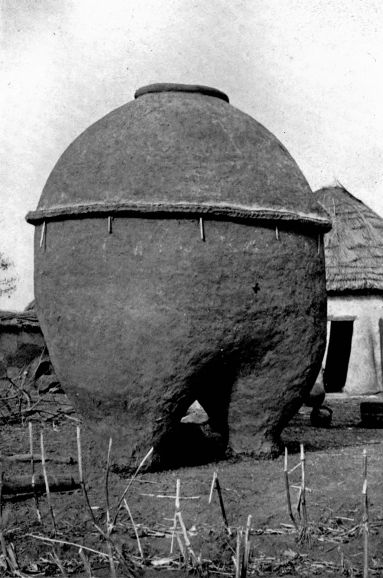
the principal seat of the famous iron industry,
which affords occupation to large numbers of
natives throughout this district. Already, on our
way up, we had passed several of the curiously
shaped furnaces, concerning which I shall have
more to say later on. The rest-house here is in the
form of a square of pretty round huts, from the
windows of which one has at this season of the
year a lovely view of the mountains, their slopes
lightly shrouded in the haze of the harmattan,
which, however, lies thick as a woollen blanket in
the valleys between.
Hardly had I got settled in the rest-house,
when Schomburgk turned up with a few carriers
and some more loads, but not all. He told me that
he had had a lot of bother with the Kugnau people.
First he had gone to the village and collected a
few women, telling the chief that as his men would
not carry, the women must. They did not seem
to mind greatly, and he promised them good pay,
and put each woman by a load, arranging everything
beautifully, as he thought. Then he turned
for a moment to speak to the interpreter, and
when he looked again, about half of them had
vanished. "I could not believe my eyes," he
said, "and had to rub them to make sure I was
not dreaming. I never saw any manœuvre executed
so swiftly and silently in my life. One
moment they were there, the next they were not.
Talk about the disappearing trick! Why those
women could give points to Maskelyne and
Devant."
At last, it transpired, he succeeded in collecting
a few more carriers, but still not enough for the
loads. He had come on with these, leaving the
interpreter and the soldier behind to get other
carriers as best they could, and bring along the
rest of the baggage. He also placed the chief under
arrest, and told the soldier to bring him along with
him, intending to hand him over to the authorities
at Bassari, which station has jurisdiction over all
this part of the Konkombwa country.
The last batch of carriers, with the rest of the
loads, shepherded by the interpreter, turned up
sooner than we had ventured to expect. With
them was the soldier, in charge of the chief. The
latter looked very crestfallen. All his cheeky,
overbearing manner had gone, and he seemed to
wish he had behaved himself properly in the beginning.
Amongst the last arrived lot of carriers
we found, to our surprise, ten women. This seemed
to show that the chief really could not prevail
upon the men of the village to carry, and made
Schomburgk even more determined than ever to
take him on to Bassari and have the whole matter
threshed out there, since a chief who cannot impose
his authority on his people, when called upon
to do so, is worse than useless from the Government's
point of view. Schomburgk also announced that
only those carriers who had come voluntarily in
the morning would be paid for their work, the
others would get nothing. He expected them to
be disappointed and crestfallen on hearing this
decision, but greatly to his disgust they did not
seem to care in the least, laughing and joking
amongst themselves about it, women as well as
men, as though being docked of their wages was
the greatest fun imaginable. Whether they really
did not care, or whether they acted as they did in
order to show their independence, I am unable to
say. It is practically impossible to fathom the
workings of the native mind in regard to a case
like this.
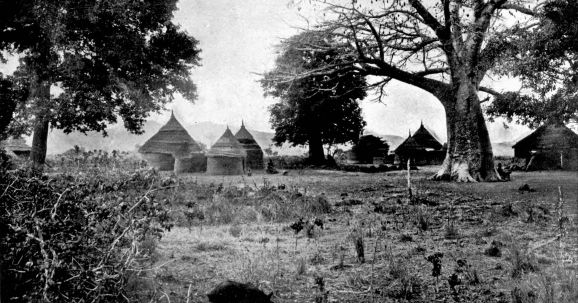
By permission of
Maj. H. Schomburgk, F.R.G.S.
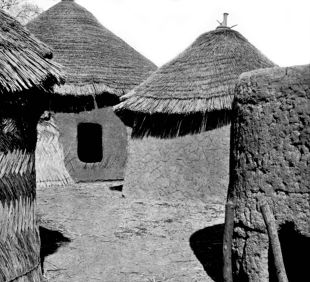
Banjeli, the Centre of the Native Iron Industry
The smelting of iron by these primitive peoples is entirely of native origin, and is, therefore, of considerable interest. The work is done under
conditions approximating fairly closely to those prevalent in civilized countries, but the furnaces, etc., are, of course, of much ruder construction.
After we had been here a short while, a little
native boy came into our camp bringing me as a
present a very pretty little green and gold beetle.
We gave him a pfenning (eight pfennings go to the
penny) for it, and seeing I was pleased with it,
Schomburgk said he would purchase at the same
rate as many other similar beetles as he or the other
children cared to bring in. It proved to be a rash
promise. The wonderful news must have spread
like wildfire amongst the village urchins, who
must, moreover, have immediately set to work with
feverish energy to secure a goodly store of beetles,
for soon the camp was alive with grubby little boys
and girls, some carrying no more than a single
beetle, or two or three, others with both dirty
little paws filled with the pretty delicate insects.
It was one of the most comical sights I ever saw.
There was Schomburgk dishing out pfennings in
exchange for beetles, and the more pfennings he
distributed the more children came rolling up with
their beetles. They pressed and clamoured round
him like English children round a street hawker
of toy paper windmills, so that eventually he had
to take refuge on a chair in order to escape being
mobbed by them, while I set to work to marshal
them into a queue, which, as regards both its extent
and the happy eagerness of its component parts,
reminded me of that which assembles outside the
Gaiety on the first night of the production of a
new musical comedy.
Whilst we were resting that afternoon, our mail
arrived from Bassari. It had come by post-runner
to Bassari, whence it had been forwarded by
special messenger to Banjeli. At once everybody
was on the alert to secure his or her letters, and
once secured we retired to a quiet corner to read
them. We got two mails together—a month's
letters and papers—on this occasion, so that we
had plenty of reading matter to occupy ourselves
with. Afterwards we came together again to
compare notes, and tell each other tit-bits of
personal news, talking and chatting until dinner-time,
and afterwards far into the night. Amongst
a bundle of papers sent out by my sister was
a copy of the Elegante Welt, Germany's leading
fashion paper, and, womanlike, I was immensely
interested in seeing, out here in the
wilds, what was being worn at home by the
"smart set" in Berlin, London, and the other
European capitals.
So utterly sick and tired of fowls had a lengthy
sojourn in the African wilds made me, that at
Banjeli I decided to have for once a dinner of
roast pork, and sent Messa into the village with
strict injunctions to bring back a pig, no matter
what the cost. He succeeded almost too well, returning
in about half an hour at the head of a
procession of natives, leading, driving, and carrying
pigs of all sorts and sizes. In only one respect
were they alike. They were the ugliest-looking
lot of porkers I ever set eyes on; all black as to
colour, and with long bristly hair, not at all like
the rosy-snouted little piglets one sees in the
German villages. However, I reflected that I was
not buying a pig to look at, but to eat, so I
picked out one I considered to be the best and
fattest of the lot, paying for him what seemed
to me the ridiculously small sum of four shillings.
Then, spurred on by my success in the
pig-killing line at Mangu, I superintended the
similar necessary operations here, only to find,
however, when my porcine purchase came to be
cut up and dressed, that he was about as
scraggy, scrawny, lean, and generally unprofitable
a specimen of his species as one could possibly
conceive of. What he had been fed on, Heaven
only knows. Sawdust and wood shavings, I should
imagine, from the taste of him. And this, I
hasten to add, was not the fault of the cooking,
for from almost the beginning of the trip I have
made the kitchen and its conduct my own special
care.
Taught in the first instance by that old Togoland
campaigner, Captain von Hirschfeld, I have,
too, succeeded in perfecting a very excellent system
of keeping our drinks cool, and our cheese and
butter from running to oil. It is worked this way.
In Togoland we have what is called a "Hausa
load." This is not a "load," as might be imagined,
but a long, narrow basket made of split bamboos
laid closely together lengthways, and bound together
crossways with strips of bark. Into this long
wicker trough I used to put the things I wanted
kept cool, wrapped up and covered with sacks
kept constantly wet. It was marvellous how
beautifully they were preserved by this simple
expedient. Even on the march, by detailing a boy
to constantly sprinkle the sacks, I was able to keep
the butter quite solid, the bottles of liquid comfortably
cooled, and even perishable provisions,
such as cooked meat for instance, fresh and sweet.
It was Anton, our pet monkey, by the way, who
was the alleged cause—as a matter of fact he was
quite innocent in the matter—of a grave dereliction
of duty on the part of seven of our boys. The
affair happened on the road to Ibubu, where the
whole lot of them turned up very late; a long
way, in fact, in rear of the carriers, who, of course,
made ordinarily considerably slower progress with
their heavy loads than did our personal servants,
who carry no loads. They had, it transpired, met
some friends on the road, who treated them to
palm wine and native beer; but their excuse was
that Anton had scampered off into the bush, and
refused to be caught for some time, thereby delaying
them. Now this was an excuse that might
easily have held water, for we knew, and our boys
knew that we knew, that Anton was addicted to
such tricks. But on this occasion their somewhat
unsteady gait and the strong smell of alcohol that
hung about them convicted them, and one by one
they broke down under cross-examination, and
confessed to the truth. Then came the question of
their punishment.
Very early in our trip Schomburgk had told
me that the best way to punish a lazy carrier
was not by personal chastisement—for which they
care little unless it be carried to such an extent
as to be inhuman, which, of course, is not to be
thought of—nor by fining them; but that if a
carrier was really lazy, coming in a long while
after the others, the best thing to do was to give
him a load, and stand him with it on his head
in the middle of the camp, making him stay there
for as long a time as he had been behind his fellow-carriers.
"Then," said Schomburgk, "the others
will all make game of him, and he will have learnt
a lesson he is not likely to forget."
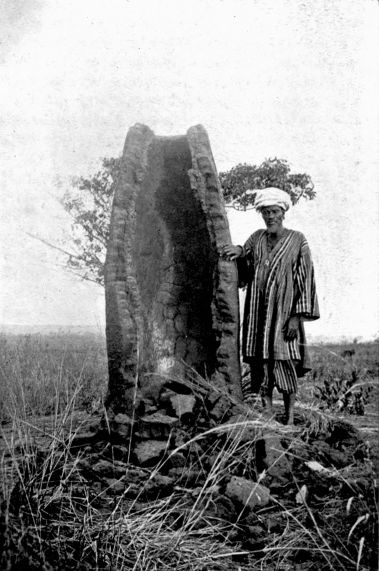
By permission of
Maj. H. Schomburgk, F.R.G.S.
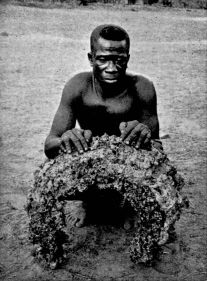
Section of Old Native Iron Furnace
The portrait is that of the Chief of Banjeli, the seat of the native iron industry of Togo. In
these furnaces the iron ore, after being laboriously dug out of the mountain side by native slave
women, is smelted, and afterwards made into axes, knives, spear and arrow-heads, hoes, and
so forth.
Well, this plan had been carried out on several
occasions with our carriers, and we found that it
worked excellently. So Schomburgk decided to
try its effect upon our boys, and that afternoon the
seven "beauties" were lined up in the middle
of the camp, each with a 60lb. load on his head.
Also, as they had laid the blame on the poor innocent
monkey, he was fastened by a chain to the
right leg of our "washerwoman"—he of the ginger-beer-bottle
fists—who had been the last one to hold
out in the lie about him. At first the culprits
treated the whole affair as a huge joke, laughing
and chattering amongst themselves. But little by
little, as the afternoon wore away, their faces grew
longer and longer; the laughter and chatter grew
less, and finally died away altogether; they started
shifting their loads from the head, first to one
shoulder, then to the other, until, eventually, after
Schomburgk had gone out with the camera, a
benighted appeal for mercy reached my ears. I
was seated inside my tent at the time, and for a
little while I pretended to take no notice. But the
cries of "Little mother! Little mother! Have
pity on your poor tired children!" redoubled in
intensity, so as Schomburgk had told me, before
quitting camp, to let them go when I thought fit,
I gave them their "ticket of leave."
Prior to our arrival at Banjeli, Schomburgk had
made arrangements with the chief there to film
the iron industry, of which I wrote earlier in this
chapter. He was a nice old man, and, having met
Schomburgk on his previous visit, he had now
promised in advance to have everything ready for
us. This promise he faithfully kept, and to the
letter, an attribute very rare in a native. Next
morning we took the pictures. First of all we
started off at 6 A.M. to the mountain where the
iron ore is mined. We rode the first stage of the
journey, accompanied by our two ostriches, who
seemed to imagine that we were going on trek again,
and intended giving them the slip. It was very
comical to watch them, especially after we dismounted,
and started to climb the last part of the
journey to the top of the hill where the mine is
situated, about 1600 feet up. Eventually, however,
we had to send them back, for fear they
might injure themselves.
The ore is mined by women, strong, but dirty-looking,
with more of the masculine element about
them than the feminine. It was pitiful to see some
of them, with babes at their breasts, digging out
the ore with a curious kind of hoe-shaped tool.
Besides being a hard occupation, it is also a dangerous
one. Only a day or so before our visit one
of the miners had been killed, owing to a shaft
falling in. On inquiry, I learnt that the women
were slaves. I was assured that it was only a mild
form of slavery, a system of indentured labour,
and that even if liberated they would not go away.
Still, I didn't like the idea, and the sight impressed
me the least favourably of anything that I had
seen in Togoland.
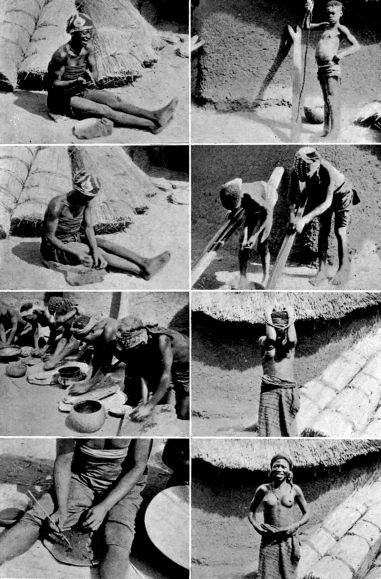
The other operations that centred round the
iron industry, however, interested me greatly.
Here is a handicraft that is usually associated with
a more or less advanced degree of civilisation—the
bronze age everywhere preceded the iron age
amongst primitive man—being carried on by nude,
or nearly nude, savages, in a fashion which, although
it has many points in common with our
own methods of mining, smelting, and so on, bears,
nevertheless, unmistakable signs of being of purely
indigenous origin.
Taking it altogether, I am inclined to think that
this film, which was one of the last we took, was
also one of the best, if not the very best, of the lot,
and when I came to see it screened later on in
London, I was amazed at its fidelity to life. First
the women miners are seen getting the ore out of
the mines, as narrated above. The next scene we
filmed shows a long string of them carrying it in
baskets on their heads down the mountain-side to
the primitive native furnace, which the men load
with wood, charcoal, and ore. We showed, too,
the method of regulating the ventilation of the
furnaces by means of holes round the bottoms,
these being stopped by clay stoppers, very ingeniously
constructed, and which can be inserted
and withdrawn at pleasure by means of a wooden
stick, embedded in the centre of the clay stopper
when it is first made. These furnaces, after being
lighted, burn for three days, when the pig-iron is
taken out and carried to the market at Bassari,
where it is bought by the native blacksmiths.
These craftsmen, working with a round boulder for
a sledge-hammer, and curious hand-worked bellows,
somewhat resembling bag-pipes in appearance,
forge the iron into axes, knives, spear and arrow
heads, hoes, and so forth, not forgetting the curious
iron rattles mentioned in a previous chapter, and
which form a valued part and parcel of every
Konkombwa warrior's equipment. Speaking in
regard to these industrial films in general, a certain
eminent scientist who presided at a recent meeting
of the Royal Geographical Society, remarked that
he did not think that at the present time any
very great good was accomplished by getting to the
north or south pole, because both these very interesting
spots would be there five thousand years
hence; but the men who went out into the wild
places of the earth in order to try and obtain records
of the out-dying customs of native tribes in
these remote regions, deserved the greatest praise.
Even an ordinary written record (he continued)
is of acknowledged value. What, then, must be the
value of living pictures, such as these, showing
every stage in processes of primitive native industries
which, from the nature of things, must, in the
not far distant future, become superseded, and so
lost to us forever. Similar views, I may add, were
expressed in letters written to Major Schomburgk
after having viewed the films, by Mr. Atho Joyce,
of the British Museum, and by Sir Harry Johnston,
the famous explorer.