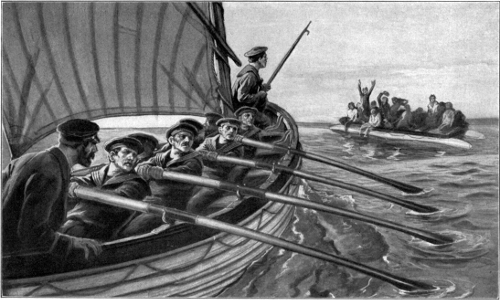
A weary week passed, without tidings of the castaways of the
Restless. Arthur Cochran's mother lost heart, and refused to be
comforted. She seemed to be letting go her hold on life, and her
husband, as if seeking to atone for the years in which he had allowed
his worldly interests to absorb his time and thought, was seldom away
from her. His devotion was tender and whole-hearted. The visit of the
Bracewell household had been postponed. Mrs. Cochran was too ill to
leave her room, and even David had to be denied the pleasure of seeing
her again, much as she longed to talk to him about her beloved son.
The week of shore leave ended and David said good-by to his "dearest
folks" in the tiny flat and posted off to Philadelphia to report on
board the Roanoke. He was glad, too, beyond measure, to learn that
Captain Thrasher had been cleared of all blame for the collision, and
would stay in his command.
"It was vat you call a tight squeak," explained David's faithful
shipmate, the bos'n. "They tells me the Board asks the old man why
don't he get out and push the iceberg to one side, or some such
foolishness. But he proves he was usin' all proper care, and they can't
give him the sack, eh? Mr. Cochran, the moneybags vat we picked up, he
vas very mad mit our old man at first, but he cool down by and by and
see vat a idiot he vas. And he gets some gratitude under his belt, and
puts in a word for the old man, I t'ink. Stanley P. Cochran is very
strong mit the company. He owns much stock."
So Mr. Cochran had gone out of his way to befriend the captain of the
Roanoke, reflected David. It showed that the great man had a sense
of fair play and square dealing if his eyes were once opened. If there
was only some way to enlist this powerful interest in Captain John's
behalf, without making it seem like asking charity. If Arthur should
be saved from the sea, the way might be found. The master of the
Pilgrim was growing old before his time, while he ate out his heart
in vain hopes. He was proud and independent to a fault, and David knew
he would starve sooner than crowd another man out of his berth. While
in New York David had taken pains to learn that none of the sailing
ships in Mr. Cochran's sugar-carrying trade were without masters, and
for the present he could see no help in that quarter.
One week followed another, and David found no chance to go to New York
again. One of his letters from Margaret told him:
"Mrs. Cochran sent for me to go and see her yesterday. Grandfather
took me up and was going to sit on the front steps and wait, but the
servants took him in tow and he was invited up-stairs with me. Mr.
Cochran must have said some nice things about poor little me. She was
very sweet and lovely, but so sad looking. And she wanted to know if
I would show her how to make an apple pie. There are at least twenty
servants in their crew, Davy, and imagine me making apple pies in that
house. What makes such very rich people seem so dreadfully lonesome?
She explained that Arthur's boy friends were all out of town, and that
he didn't have many anyhow.
"They have sense enough to know that you are a wonderful Big Brother,
which is why I like them. Grandfather told her all sorts of cheerful
yarns about people who were not heard of at sea for weeks and weeks,
and then came into port all safe and smiling. She seemed to have faith
in that simple, quiet way of his, when he leans forward and looks you
straight in the eyes as he talks. She asked him had he given up going
to sea, and he told her yes. And I spoke right up as bold as anything:
"'It isn't because he wants to, but because sailing ships are so
scarce. He never would have anything to do with steam.'
"She did not quite understand, but he shut me up before I could tell
her that he was one of the finest ship-masters that ever cracked on
sail in a gale of wind. Won't we see you again before we sail, Davy?
I am sending a box of apple pies by express. I made them with my
own fair hands, and one of them is specially for the bos'n, with his
initials on the crust. Mr. Becket says I ought to have put on, 'FOR A
DUTCH HUMBUG.'"
Davy duly delivered the pie and Mr. Becket's message, and was thanked
for the one and cuffed over the head for the other.
The Roanoke was almost ready for sea a few days later, when a
telegram came aboard for David. He opened the envelope with stumbling
fingers, fearing something might have happened to his "dearest folks."
The message was from Mr. Cochran, however, and said no more than:
"There may be good news for us. Cannot tell yet. Try to come at
once."
David showed the message to the chief officer, who advised him to take
it to Captain Thrasher. That august personage said at once:
"Jump right along with you. Give Mr. Cochran my best regards, and tell
him to send you back as soon as he can."
On the train bound for New York David tried to fathom the meaning of
the uncertain tidings. Either Arthur had been saved or he had not, but
apparently the father was waiting for more information. When David
jumped from the car in the Jersey City station, he was surprised to see
Mr. Cochran waiting for him, with every sign of impatient haste.
"Come along, youngster," he called at the top of his voice. "I have a
tug with steam up right here by the ferry dock."
He grasped David's arm and they charged pell-mell through the crowd.
Mr. Cochran had no breath to spare until they had scrambled from the
string-piece of the pier to the deck of a sea-going tug, whose escape
valve was roaring in a cloud of steam. Orders were shouted, a bell
clanged, another jingled, and the tug was racing down the North River
toward the Bay.
"Mrs. Cochran was not strong enough to come," panted her husband as he
mopped his face. "And we may be disappointed after all. I can't stand
much more of a strain myself. But we shall know in three or four hours,
I hope."
"What—why—how do you know?" stammered David, whose head felt dazed.
"Only that a tramp steamer arriving this morning reported being
signalled by a sailing ship, the Sea Witch, that she had on board
part of the crew of a yacht. It was blowing hard when the vessels
sighted each other, and the captain of the tramp could not read the
flags distinctly."
"But where was the Sea Witch when sighted, and whither bound?"
"Liverpool to New York—a hundred and fifty miles out, twenty-four
hours ago. The wind has shifted to fair for her since midnight, and she
will be in sight of Sandy Hook before dark."
"Of course Arthur is aboard," cried David, with buoyant faith.
The father said nothing. Perhaps he was thinking of the sufferings
which had killed so many strong men adrift in open boats. And this
boy of his was a weakling, used to the constant care and luxury
which wealth had lavished on him. David tried to rouse him from his
reflections by saying:
"The Sea Witch is the finest and smartest ship of her class afloat,
sir. She is the largest four-masted sailing ship that flies the
American flag. I'd give a lot to see her."
"I believe I control some kind of a fleet of barks and ships in
my sugar business," replied Mr. Cochran, "but I haven't paid much
attention to them. Don't believe I ever laid eyes on one of them. But I
don't recall hearing of the Sea Witch."
"Almost four thousand tons, and sailing mostly to the Orient with case
oil," added David. "I know a man that was in her."
The tug churned her way through the Narrows and lifted her bow to the
swell of the Bay. Mr. Cochran had become lost in his own thoughts as he
stared from a wheel-house window, while David swapped briny yarns with
the mate.
"The Sea Witch was spoken three hundred miles out, a week ago," said
the mate. "Then she was blown to sea, and now she's piling in again
with the wind where she wants it."
The green sea opened ahead, and the tug plunged her guard rail under
as her skipper crowded a good thirteen knots out of her. The Navesink
Highlands became vague and misty over her stern, and still her course
was held toward the east-south-east.
"The Sea Witch ought to be showing us her royals before long," said
the skipper.
He had no more than spoken when the mate shouted: "There she is, right
to the minute. A point off the port bow."
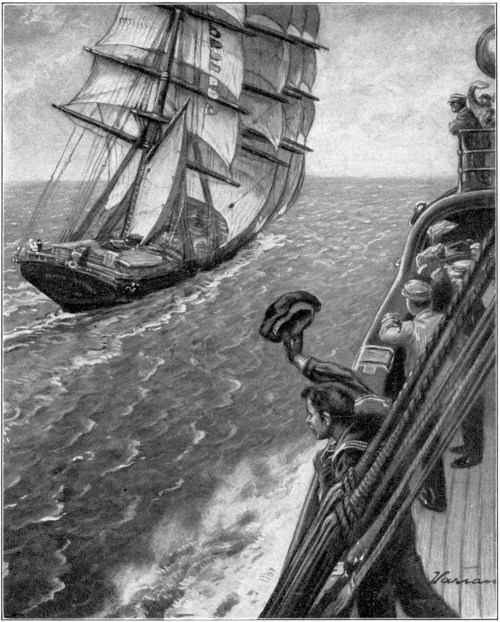
Swiftly the white patch crept above the horizon; sail by sail the
gleaming canvas of the Sea Witch lifted fair and graceful, until her
black hull was visible as a mere dot beneath the immense sweep of her
snowy wings. Every stitch of cloth she could spread was pulling her
homeward. David had been at sea for more than a year without glimpsing
such a noble picture as this. When they had run close enough to make
out the stars and stripes whipping from the mizzen of the Sea Witch
like a tongue of flame, he drew a long breath and felt little chills
run up and down his back. Now he began to understand what the sea and
its ships meant to Captain John Bracewell, ship-master of the old
school.
Mr. Cochran had no eyes for the rare beauty of the Sea Witch under
full sail. He was leaning far out of his window, imploring the captain
of the tug to make more speed. When the two vessels were a half mile
apart, a string of signal bunting soared to the tug's mast-head,
announcing: "Wish to speak to you, most important."
After a little interval, the Sea Witch signalled back:
"Can't stop. What is your business?"
"Oh, quit that foolishness," groaned Mr. Cochran, wringing his hands.
"Run alongside and speak her as soon as you can."
The tug swept round in a foaming arc, and came up on the lee side of
the four-master, which was surging home like a race-horse. A long line
of heads bobbed above the bulwark in the waist of the Sea Witch, and
presently a slim young figure danced up the poop ladder and climbed on
top of the cabin.
"That looks like him," cried Mr. Cochran, "but he was never as frisky
as that in all his life."
The excited David thumped the magnate between the shoulders, and
yelled:
"Of course it's Arthur. I can make him out as plain as daylight."
The tug sheered closer and closer at top speed, but she was rapidly
dropping astern of the flying ship. The agile figure on the cabin roof
caught up a speaking-trumpet and piped shrilly:
"Daddy, ahoy! It's me! How's mother?"
The father scrambled on deck and bawled with arms outstretched:
"All well, you little rascal! Are all hands with you?"
"There they are in the waist. All the men in our boat. Count 'em for
yourself. All present and accounted for, down to the cook's pet monkey.
Anybody lost of your company? And has the other boat been picked up?"
"We were all saved, thank God. No, the second boat has not been heard
from yet. Here's a youngster who can tell you all about our end of it."
Arthur failed to recognize at long range the Roanoke cadet whom he
had last seen in bed with a bandaged head. David shouted a welcome,
but it was lost in the stentorian roar of the captain of the Sea
Witch:
"I'll lay my main-yard aback and put your lad aboard, Mr. Cochran. I
wouldn't do it for anybody else but his daddy."
The tug dropped farther astern, and the towering square rigger began to
slacken her rushing speed as her mighty yards were swung round. Then as
she lay at rest, a rope ladder was dropped overside, and young Arthur
Cochran swarmed down it as if he had been the pet monkey saved from the
yacht. A boat from the tug was waiting, and Mr. Cochran, rising in the
stern-sheets, fairly grabbed the boy in his arms and hugged him like a
bear. Arthur struggled to get his breath and sputtered:
"Tell the Restless men you're glad to see them, father. They were
mighty good to me."
"I am an unfeeling brute, but I couldn't think of anything else than
getting my hands on you. Sea Witch, ahoy! A glad welcome home to the
Restless captain and his men. Report at my office on landing, and you
won't be sorry that you sailed with me! I feel sure that the rest of
the crew have been saved and will be reported soon."
As soon as they were aboard the tug, Mr. Cochran began to take stock of
his son and heir. Instead of the wasted invalid he had dreaded to find,
this survivor was tanned, clear-eyed, and vigorous.
"What kind of a miracle has happened to you?" he asked. "Your mother
won't know you."
"Plain grub and hard work, I guess," grinned Arthur. "We were adrift
four days, and I got a razor edge on my appetite. Three weeks aboard
the Sea Witch did the rest. The captain said I'd been coddled to
death as soon as he found out who I was, and you bet he kept me busy.
Why, I helped reef the fore-topgallant sail last night."
Mr. Cochran glanced up at the dizzy yards of the Sea Witch and
shuddered. Then Arthur found time to stare hard at David, who was
tactfully keeping in the background.
"Well, I'll be jiggered! It's you, is it?" shouted Arthur. "This is
better luck than I counted on. So you two have made it up? Fine!
Father was horrid mean to you. I suppose you picked him up at sea.
Rescuing folks seems to be one of your steady habits."
"You have guessed right," laughed David. "There was more than one sunny
side to the loss of the Restless. It's an ill wind that blows nobody
good."
While the tug sped toward Sandy Hook, Mr. Cochran and his boy sat in
the skipper's little room abaft the wheel-house and talked to their
heart's content. David was wise enough to leave them alone, and with
peace in his heart he gazed at the Sea Witch, which, scorning a
tow-boat, was driving astern of them. The signal station at Sandy Hook
was told to telegraph the good news ahead, and long before they landed
newsboys were crying "Evening Extras," with the return of Stanley P.
Cochran's son emblazoned in head-lines of blue and red.
David said good-by at the wharf, but Arthur stoutly refused to let him
go.
"I haven't had a chance to see you more than a minute," exclaimed the
jubilant castaway. "Hang your old ship! Let her wait. Father will
wire the captain for you. Now is the glad time to work Mr. Stanley P.
Cochran for most any old thing."
"You don't know Captain Stephen Thrasher," said his father. "I tried
to buy him and his ship once. He has asked me to send David back to
the Roanoke as soon as possible, and he meant exactly what he said.
I have learned to let seafaring people have their own way. They are a
terribly obstinate lot," and he winked comically at David.
No longer afraid of Mr. Cochran's wrath, David told him:
"I must catch the next train to Philadelphia. Give my love to Mrs.
Cochran, please, and the Bracewells, if you happen to see them."
"Why, bless me," declared Mr. Cochran, "have you come to New York
without a chance to see your folks? That's absurd. It was very selfish
of me to kidnap you, I'm sure, but there was no one else I wanted to
take out to meet the Sea Witch."
"Never mind. I can write them before I sail," and with this David
set off for the ferry at a smart trot. When he reported aboard the
Roanoke in the evening, Captain Thrasher was just going ashore.
"What news?" he halted to ask. "Young Cochran safe in port? Well, well,
I am very thankful to hear it. What ship found them? The Sea Witch?
Why I know her master well. Dried-up little man with a white goatee?"
This described the man who had shouted orders from the quarter-deck of
the Sea Witch, and David meekly answered, "Yes, sir."
"Seventy, if he is a day, and tough as a pine knot," concluded Captain
Thrasher. "He was master of a ship when I went to sea as a boy."
Before David turned in he wrote to Margaret, and wound up with:
"You never saw such a beautiful ship in your life as the Sea Witch.
Be sure to take Captain John down to see her when she docks. If there
were only really and truly fairies, or if I had a magic wand, I would
wave it around Mr. Cochran's head and ask him to buy the Sea Witch
and put Captain John in her, instead of the frosted old pippin that is
master of her. She almost makes me wish I had not gone into steam. Oh,
if you could have seen her under full sail—but what is the use of my
raving about the Sea Witch? Good-night, and God bless you all."
The Roanoke was almost ready to proceed straight to Southampton for
a thorough overhauling after the patch-work repairs made to enable her
to cross the Atlantic in safety. There was no excitement about this
kind of a departure, and on the morning of sailing her empty decks made
David feel a little homesick. He was sent ashore with a bundle of the
captain's farewell letters, and on his way back dodged a cab which was
rattling down to the wharf in runaway fashion. A volley of "Whoas" and
"Hullos" came from inside, and wheeling about, David saw the head of
Arthur Cochran poked out of the window.
"Ahoy, there," he shouted, pushing open the door, and alighting fairly
on top of David before the driver could pull up his sweating steed.
"Father came over on business, and I coaxed him into letting me come
along, on the chance of seeing you."
"Come aboard," said David, joyfully. "We're ready to cast off, but
there will be a few minutes to spare, I guess. You don't look a
shipwrecked sailor, not a little bit."
"I have met those pals of yours," confided Arthur as they hurried up
the gangway. "And they are just bully, aren't they? They are the real
thing. Mother dotes on the dear little sister, and she is a dear, and
Captain Bracewell is a copper-fastened A1 old-time Yankee sailor, that
you read about in books. Say, but he is a brick, a whole ton of 'em.
And, oh, you will be tickled to death to hear that the other Restless
boat was found by a steamer which carried the men to Liverpool."
"Good enough," cried David. "That is the bulliest kind of news."
Elated as he was to learn that all the yacht's crew had been accounted
for, the praise of Margaret made David wince a trifle in spite of
himself. Jealousy had never invaded his feelings toward the "little
sister." He wanted Arthur to like his "dearest folks," but it was not
easy to think of sharing their affection. Beating down this ungenerous
emotion with a very manly spirit, David cordially agreed:
"They are the salt of the earth, Arthur, and I am mighty glad you like
them. They worried themselves almost sick about you. What about Mr.
Becket? Have you met him?"
"He looked me up yesterday, and was so full of mystery that I couldn't
make head or tail of him. He got almost to the point of telling me
something, and then he sheered off on another tack, rubbed his red
head, sighed, looked out of the window, and muttered something about
guessing he'd have to see you first."
"Was it anything about Captain Bracewell?"
"He never got that far. He seemed to be in the last stages of
buck-fever or acute rattles. But he doesn't look like a timid man."
David was called forward, and while Arthur kicked his heels on a bench
by the gangway, Captain Thrasher happened along, on his way to the
bridge.
"My father, Mr. Cochran, sends you his warmest regards," said Arthur,
"and wishes you a luckier voyage than the last."
"So you are the young nine-days' wonder, are you? You look as if sea
life agreed with you."
"That's what everybody says, Captain, and I am trying to persuade
mother to let me go for a long voyage. My, but I should like to go out
in the Sea Witch to Japan."
"No finer sailing vessel afloat," said Captain Thrasher. "How is that
old barnacle that commands her? Bad-tempered as ever?"
"He is pretty violent," smiled Arthur. "But he is done with the sea.
This was his last voyage. He told me he was going home to Maine as
quick as the Lord would let him, and raise potatoes and cabbages, 'gosh
whang it.' He has been at sea fifty-seven years."
"Who will take her out?"
"The mate expects to get her, sir. But he is a pie-faced, wooden-headed
Norwegian, with a thirst for rum. I didn't take to him at all."
"Too bad to see a Norwegian in command of the finest Yankee ship
afloat," was Captain Thrasher's comment as he went on his way.
Fifteen minutes passed and David had not returned. It was like hunting
a needle in a hay-stack to look for him, and Arthur fidgeted where he
was until the deck officer warned him that it was time to go ashore.
Then David came running aft, just as the Roanoke blew a long blast
to let all hands know she was ready to cast off.
"I had to tally a lot of stores that just came aboard for the paint
room," panted David. "It is a shame that I can't hear all about what
happened to you at sea. But I'll be back in a few weeks."
Arthur shouted his farewells, as he ran to the wharf, while David said
to himself, with sorrowful countenance:
"And I never got in a word for Captain John."
He would have been more regretful could he have overheard the news
about the command of the Sea Witch as Arthur had told it to Captain Thrasher.