Citizenship is the birthright of every man, but it is not
every man who is worthy of the name of citizen. What
makes the honourable distinction all the more valuable
is when “a citizen of no mean city,” and the true representative
of “a nation of shopkeepers,” so truly values his rights
and privileges as to be ever ready to come forward when
occasion requires to protect it from the ignorance and contamination
of those whose only design must be to overthrow
its virtues for the sake of personal gains. It was Lord
Chancellor Selborne who some years ago publicly declared
that his ancestors for four generations had been connected
with one of the City Guilds, and he had never been ashamed
of anything either of those ancestors had done, and never
regretted his own connection with the City or its Companies.
And another eminent man of earlier days most emphatically
declared, “I would rather be born of the basest and meanest
of mankind, and rise to fame and distinction by my own
exertions, than that, being born of noble ancestry and high
degree, I should bring disgrace on an exalted name, and
cross with a bar sinister the proud escutcheon of my father’s
house.”
To the humble traders of old London their richer brethren
left their trusts, their charities, and their blessings. Their
estates had been obtained by hard work and hard-earned
money in a great many instances, and having been associated
with the zealous and careful men of their own Guilds they
left to them the carrying out of the designs expressed in
their wills. No one would have left to a Government
department such a trust then, and no one will do so now.
The Government inspector, in his evidence before the
Companies Commission, declared that he considered William
Thwaytes’ bequest of 20,000l. “to make the Society comfortable”—and
that Society was the Clothworkers’ Company, to
which he belonged some half a century ago—really meant
“to make the traders comfortable”! Or that every clothworker
in the kingdom—shall we say the world?—ought to
participate. On the same principle, if a workman in a shop
left “to the workmen in the shop” 5l., every shop in that
trade should have its share. Pray what would be the value
of the bequest?
The City Companies, as we have shown in the history of
the Ironmongers, had a terribly uphill battle to fight with
early monarchy. Whenever there was a chance to rob the
citizens, down pounced the Government or Royalty.
Henry VIII. commenced by dissolving the religious houses,
and the good King Edward VI. seized the properties left to
the Companies by the wills of benefactors on the plea that
they were for superstitious uses. Having taken possession
he was glad enough to sell the property back to them, so
that he made a very profitable business of the transaction.
The result of this “clever” and “sharp” practice was that
the Ironmongers had to sell their private property to buy
back the trust estate. Having done this, is it not creditable
to a City Company to be still administering that trust of which
the King himself had originally deprived them?
Coming down to more modern times, Thomas Betton,
Hoxton Square, Shoreditch, left the Ironmongers’ Company,
in 1723, the residue of his estate for the purpose of redeeming
slaves in Barbary. Other notable citizens had done a
similar good deed before then, for so long previous as 1641
Roger Abdy, merchant, had left 120l. “for or towards the
ransoming and redeeming of sixe poore English Protestant
captives out of the bondage and slavery of the Turks.”
Thomas Betton’s bequest was a noble one, for just about the
date of it all the world was suffering from the terrors of
slavery. Between 1734 and 1825 the Company appears to
have paid away in redemption money something like 21,000l.,
or as much as the whole estate had been originally worth,
but the Ironmongers, having been good trustees, had “improved”
the estate, and the result was that after Lord
Exmouth’s great victory, no more slaves being likely to be
redeemable, and there being a large balance at the bank, the
Company desired to utilise the surplus for the benefit of charity,
reserving a certain sum per annum for future redemptions
and contingencies. This was serious, so down came the
Government and popped the whole into Chancery. The
Company believed they were right, and did not want the interference;
but they had to fight against the Crown, and from
1829 to 1845 did the battle last. Several thousands of
pounds did Government law cost the charity, but that
the Company was right is evident, because the highest
tribunal, the House of Lords, decided that what the Company
had proposed so many years before should now be carried out—bequests
to the poor of the company and to every national
school in the kingdom.
The Ironmongers’ charities are not so extensive as many of
the other City Guilds’, but they represent a variety of really
good and seasonable benefactions. Among these are two
almshouse foundations (Geffery and Lewen), scholarships to
schools and exhibitions to universities, a small free school in
Cornwall, the poor of the City wards, loans to poor young
freemen to help them on in life, bequests to hospitals, to
poor maids upon their marriage, to poor prisoners in debt, to
the poor freemen and their widows, to poor ministers and
clergy, to the national schools of the kingdom, &c. The
charity trusts amount to about 12,000l. a year, half of which,
being from rents, have of late years fluctuated. The Company
does not possess any ecclesiastical patronage, except
the appointment of a chaplain, who is also the minister to
the almshouse poor. There was a priest of the company 400
years ago, but the present chaplain, the Rev. H. M. Baker, is
the fourteenth since 1715, when the first appointment to the
almshouses in the Kingsland Road was made.
Through the changes of the times and the “compulsory”
sales by Act of Parliament for modern improvements, some
of the old property has changed hands and new property has
been purchased. This has been specially the case under the
Geffery and Betton trusts, and round about East and West
Ham and the Isle of Dogs. The Company now possesses
houses and premises in Old Street, St. Luke’s (Mitchell),
Basinghall Street, Philpot Lane, and Fleet Street. It also
possesses the site of the famous New Park Street Chapel,
Southwark, where the Rev. C. H. Spurgeon first preached
when he came to London; also, farms in the counties of
Bucks, Essex, and Surrey. When in the good old times—so
says a newspaper in July, 1769—the Company went on
tour to view their Essex estate, they “held their annual feast
at the Devil’s House” (now Duval’s House), near East Ham,
a house of entertainment at that date. The sign of the
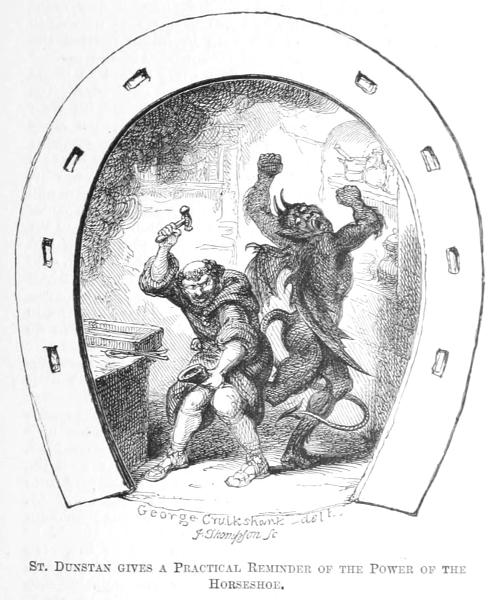
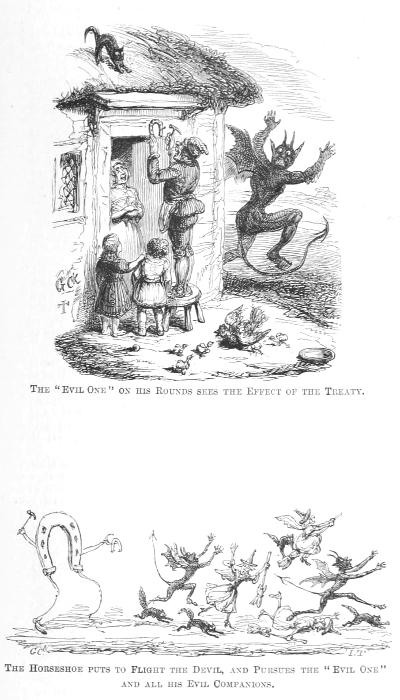
house is suggestive to the disciples of St. Dunstan. In recent
years two great districts have grown up in and around East and
West Ham—Beckton, which takes its name from the worthy
clerk of the Company (S. Adams Beck), who died in 1883,
and Silvertown, from a recent Master of the Ironmongers’
Company (S. W. Silver), who has proved most energetic in
promoting the Company’s welfare. One word more about
the old estates. The great fire of London of 1666 burnt
down nearly all the City property of the Companies, and the
loss to the Ironmongers was serious. Fortunately, the Hall
was saved.
Charitable Ironmongers, whether we view them as donors
of land, of houses, of plate, or other things, or for the time
they have given towards promoting the welfare of the Company,
have been in many ways worthy benefactors to the City
and the citizens. We have been curious in one inquiry—to
what extent the donations of some classes of plate have been
made, and we find that in the 400 years ending 1865
“brother” Ironmongers have given twenty-nine silver gilt
cups and covers, many very large and valuable, seventeen
basins and ewers, and seven salts; besides many other
descriptions of plate, such as silver spoons, ornaments,
candlesticks, and the like. Of course, the Company does not
possess all the valuables now. Our former Monarchy, who
had the citizens’ welfare so much at heart, took good care (as
we have already shown) not to allow these valuables to
remain too long in the hands of “the City Fathers,” and so
to-day the Ironmongers have but a small collection of plate.
When the charitable Ironmongers left these cups for their
brethren “to make themselves comfortable,” whether at a
dinner or other feast, they never thought that their radically-inclined
descendants would object to the good old English
greeting: “The Master and Wardens drink to you in a loving
cup, and bid you all a hearty welcome.”
Eminent Ironmongers, by their portraits, still adorn the
Ironmongers’ Hall. Thirteen are in the banqueting-room,
and eight in the court-room. Armorial shields round the
Hall give us the names of our worthy Masters from the
earliest times, while there are two statues of great interest,
Edward IV., the founder, and Lord Mayor Beckford—this
latter being in a niche on the grand staircase.
Abstracts of most of the Ironmongers’ wills are in our
collection, and the series is most curious. We cannot do
justice to the subject now, but some time we hope to give
some interesting details. One, however, is worth quoting,
and that is of Alderman Richard Chamberlin, 1567. He was
a good benefactor, he remembered the poor, he gave the
Company 50l. “to helpe them oute of debte,” he left 10l. for
“a dynner at oure halle,” desiring the members’ wives should
be present, and he then put down on paper, “I praye God
make us merye in Heaven!”
We will now, in alphabetical arrangement, give a few of
the names of those Ironmongers worth remembering. We
do not profess to give a complete list, for such would form a
volume by itself, so numerous are they, and so many notes do
we possess about them.
Bate, John, 1500, and Felys his wife, gave to the Company
a cup and other things, “ther with to do God and us worship,
and not to be solde while they will last.”
Beckford, William, Alderman, and Lord Mayor 1762 and
1770, when he died; was made free of the Company 1752,
was born in Jamaica, his father being Peter Beckford,
Speaker in the Assembly. The Lord Mayor made himself
famous by his celebrated speech to George III., as engraved
on the monument in Guildhall. Another statue, formerly at
Fonthill, was presented to the company by his son William
in 1833. See pedigrees and other details in Britton and
Rutter’s two descriptions of Fonthill, Wilts. Richard,
brother of the Lord Mayor, was also Alderman and M.P., but
he was a member of the Clothworkers’ Company.
Betton, Thomas, a Turkey merchant, admitted to the
freedom by redemption 1696, lived in Hoxton Square; will
dated 1723. He died 1724; buried in the Ironmongers’
Almshouse Grounds, Kingsland Road. Portrait presented
to the Company in 1728. Gave the residue of his estate for
the redemption of slaves in Barbary (as already noted).
Blundell, Peter, although not an Ironmonger, but from
a poor errand boy had grown to be a rich clothier, and one
of “the worthies of Devon” (Prince), and “a man very Godly
and Christianly disposed all his life time” (Stow), left
charities to the extent of about 40,000l., including 150l. to
each of the twelve great Livery Companies of London. He
died 1601, aged eighty-one.
Bicknell, Elhanan, of Herne Hill, Dulwich, a citizen
and Ironmonger, and great patron of the arts. He died
1861. His will was proved at 350,000l. His pictures sold at
Christie’s for 56,499l.; the sculpture, 2,145l.; drawings,
15,947l.; prints, 444l.; his houses and lands, 18,000l. He
had no fewer than ten Turners in his collection. He left
several charitable bequests.
Cambell.—Several of this family have proved to be
eminent Ironmongers. Sir Thomas, Lord Mayor 1610,
Master 1604 and 1613; Sir James, Lord Mayor 1629, and
three times Master; Robert, a merchant, and Master 1631.
Sir James was the principal benefactor, leaving nearly
50,000l., as may be seen in Strype’s “Stow.” He died 1641,
and his portrait is in the Hall.
Canning.—Of this family William was Master 1617 and
1627, when he died. George (who died 1646) was for many
years the Company’s agent in Ireland, and was the ancestor
of the Prime Minister George Canning.
Carre, John, 1571, his son in 1573, and Mrs. Carre in 1583,
left many bequests to the Company.
Chamberlin.—This family was well represented on the
Company. There were Richard, George, and Robert.
Alderman Richard, Master 1560 and 1565, died November 19,
1566, and was buried in St. Olave, Old Jewry. His epitaph
stated:—
To the poore he was liberall and gave for God’s sake,
But now his fame is plentifull and he a Heavenly make;
He was like one of vs, according to our mould,
But now he unlike vs in Heaven where he would;
His time was short in sicknesse rare as to all is knowne,
But now his time shall long endure and never be cast downe.
Clitherow.—Alderman and Lord Mayor Sir Christopher;
Master 1618-1624; died 1642. He was son of Henry, three
times Master, who died 1607. See pedigree in the “History
of Hertfordshire.” A worthy benefactor.
Dane, William, Alderman and Sheriff 1569, Master 1570-1573;
died November, 1579. Margaret, his widow, 1579,
was “a good woman.” She left many charities, including
the 12,000 faggots to the poor for firewood, which has been
made by the ignorant the more serious gift to burn them
with. Her portrait hangs in the Hall.
Denham, Sir William, descended from the Dinhams of
Normandy. Sheriff 1534, Master 1531 to 1548. Died
August 4, 1548. By a curious error in the codicil to the will
the Company were compelled to purchase the properties
previously bequeathed to them, including that known as the
Old Jewry Chambers. His portrait hangs in the Hall.
Curiously enough, a branch of the Denham family were
copyholders of Hackney in the reign of James I., and
removed to Plumstead. Of later years another branch
resided in Hackney, and the wife of the present writer is a
descendant of that branch, descended from the Alderman
Denham, and from the Thomas Denham, a City Corporator
early this century, and a member of the Court of the Ironmongers’
Company.
Downe, Robert, in 1556, gave premises in St. Sepulchre;
also for dinners, obits and plate. The site “Ironmongers’
Buildings” is now covered by the Holborn Valley Viaduct.
Draper, Sir Christopher, Lord Mayor, 1566. Eight times
Master, the last time in 1581. A window formerly existing
at the Hall, with his portrait on it, was removed in 1845.
East, Robert, 1606, gave tapestry to the Hall, and 10l. for
“a drinckinge” at his burial.
French, George Russell, son of John French, Master 1823.
The son was chosen surveyor to the Company May, 1849.
He was a Shakespearean antiquary, and wrote many
interesting works, especially the compilation “Catalogue of
Antiquities” we have so often alluded to. He compiled a
very curious list of the Ironmongers’ Company, applying to
each a Shakespearean quotation. He died in October, 1881.
Geffery, Sir Robert, Lord Mayor 1686, Master 1667
and 1685. He died 1703, and was buried in St. Dionis,
Fenchurch Street, and when that church was pulled down
his remains were removed, July, 1878, to the Ironmongers’
burial-ground, Kingsland Road. By will, after many charitable
bequests, he left the residue of his estate for the
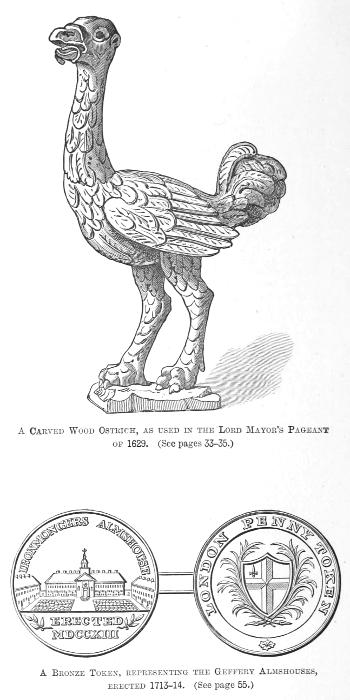
purchase of land, and the erection (in 1714) of the present
chapel and fourteen almshouses. The old twenty-nine rules
for the government will be found in Strype’s “Stow.” At the
date of their erection the almshouses were in “the suburbs.”
Grinsell, Thomas, “Citizen and Ironmonger,” a well-known
parishioner of St. Dunstan’s-in-the-West, Fleet Street,
and famous for having been the Master of “the gentle angler,”
Izaak Walton, who became a member of the Company in
1618. The Grinsell family subsequently resided in Westminster.
About Thomas, see “Memorials of Temple Bar
and Fleet Street,” 1869, p. 80.
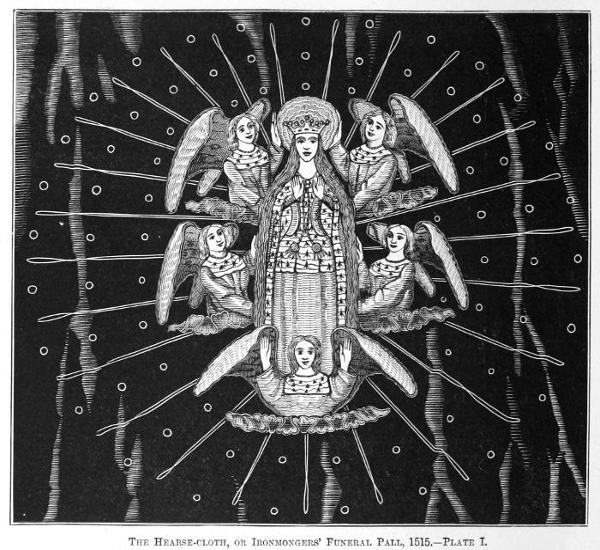
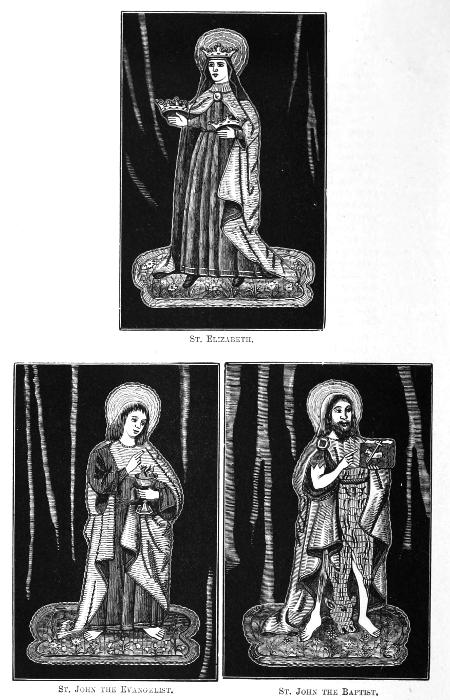
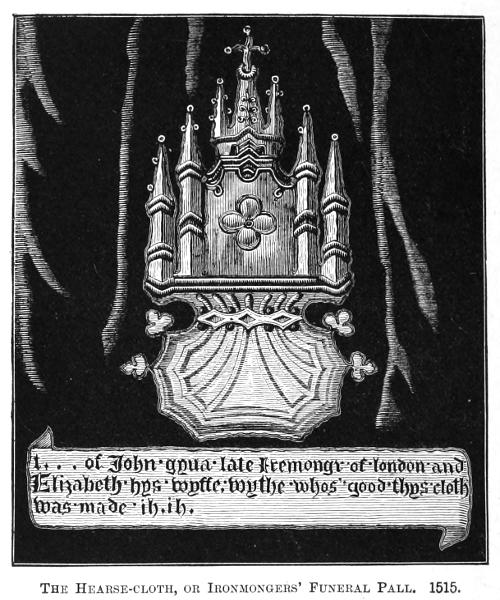
Gyva, John, about 1515 gave to the Company the hearse-cloth
or funeral-pall. It is of crimson velvet and cloth-of-gold
tissue, ornamented with fruit and flowers for centre-piece.
In the centre of each sides the Blessed Virgin Mary
in glory crowned as Queen of Heaven, with figures of Saint
Elizabeth of Hungary, St. John Baptist, and St. John
Evangelist. Beyond the figures on each side the Company’s
arms, and at each end in cloth of gold a monstrance, representing
a silver-gilt shrine, jewelled, inscribed with the name
and date of John Gyva and Elizabeth, his wife. This pall
was long used for funerals. In 1532 it was only to be used
by members and their wives, but this exception was relaxed,
for in 1678 40s. was to be the fee for its use by strangers
generally. Elizabeth Gyva in 1534 gave the Company a
tenement, directing them to “remember” her in their
prayers for 100 years.
Hallwood, Thomas, 1622, gave plate, exhibitions to
universities, &c. His portrait hangs in the Hall.
Hanbey, Thomas, 1782, provided for the education of two
children in Christ’s Hospital, and Mary, his wife, 1796, left
the interest of 300l. to provide for the repairs of the tomb of
her husband in St. Luke’s Churchyard, Old Street, and
residue of the interest among the poor.
Handson, Ralph, clerk to the Company, was a good
benefactor and kindly disposed, leaving in 1653 to the poor
members, to hospitals, and to the yeomanry for their half-yearly
repast, as already mentioned. His portrait hangs in
the Hall. He was cousin to Nicholas Leat.
Heylin, Rowland, Sheriff 1624, Master 1614 and 1625,
died 1629. He gave 300l., out of which a dinner and a
sermon were to be annually provided to commemorate the
Powder Plot deliverance, and loans made to poor young
freemen. His portrait is in the Hall.
Harvey, Sir James, Alderman; Lord Mayor 1582; four
times Master. His son, Sir Sebastian, was Lord Mayor 1618,
Master 1600; wrote his name “Harvye.” Lady Harvey,
1620, gave 21l. for a dinner at the funeral of Sir Sebastian.
Hood, Samuel, first Viscount, was presented with the
freedom 1783 in honour of his great victory. He died 1816.
His portrait by Gainsborough (presented by Lord Hood)
hangs in the Hall. We possess a characteristic letter written
by Lord Hood in 1811 with his left hand.
Humfreys, Sir William, Bart., Lord Mayor 1714, Master
1705, and gave a silver cup and cover. He acted as chief
butler at the coronation of George I. Died 1735, buried at
St. Mildred’s, Poultry, and when that church was pulled
down (1875) the Company desired to give him a “proper”
reinterment at Ilford, but, although the character of the
coffin showed that the body inside was possibly his, all the
silver plates and handles and ornaments had been stolen
long before, and so Sir William could not be identified, and
the remains were taken with the others.
Lane, Ralph, Turkey merchant, gave to the Company, in
1712, a silver-gilt cup, upon which is engraved a coat of
arms, with thirty-two quarterings. It is interesting to note
that John Lane, the elder, in 1457, was one of the Company
who advanced 10l. towards purchasing the Hall property.
His son John gave 40s.
Lawrence.—A well-known and respected name in the
City. Several have been members of the Company. John
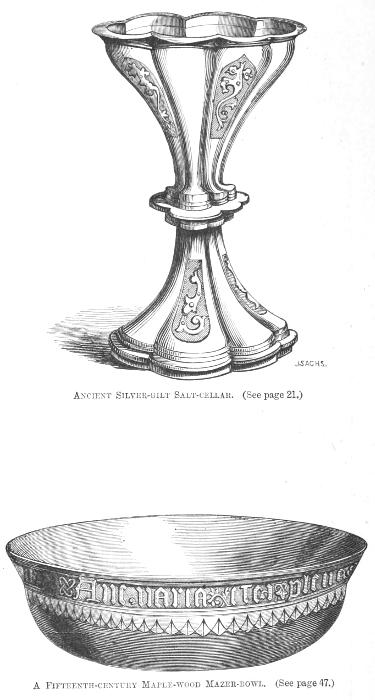
Lawrans, about 1500, gave “a grete maser which hath sent
Lawrans in the bottom.” It weighed over 60 oz. Another
John Lawrence, in 1731, gave a tankard. We may here
mention that
St. Lawrence is the patron saint of the company. The
old barge “head” represented the saint with the gridiron in
his hand. In the early churchwarden’s accounts of the parish
of St. Lawrence, Reading, are numerous curious entries
between 1520 and 1530, such as:—“For gildyng of Seynt
Lawrence gredyron, viijd.”; “to the peynters Wyff, dew for
gilding of Seynt Lawren, vjs. viijd.,” &c.
Leat, Nicholas, Alderman, three times Master, died 1631,
captain of the trained bands. He was an authority in agriculture
(see Gerard’s “Herbal,” 1597, p. 246). The sons presented
his portrait now in the court-room.
Lewen, Thomas, Alderman and Sheriff, Master 1535, died
1557, founded the almshouses in Bread Street, now in
St. Luke’s. A good benefactor. His portrait is in the Hall.
Mitchell, Thomas, died 1527, gave “a croft of garden
enclosed by ditches and wall” outside Cripplegate (now
St. Luke’s) of about 10 acres, which, with about an acre purchased
in 1595, comprises now 11½ acres, covered with some
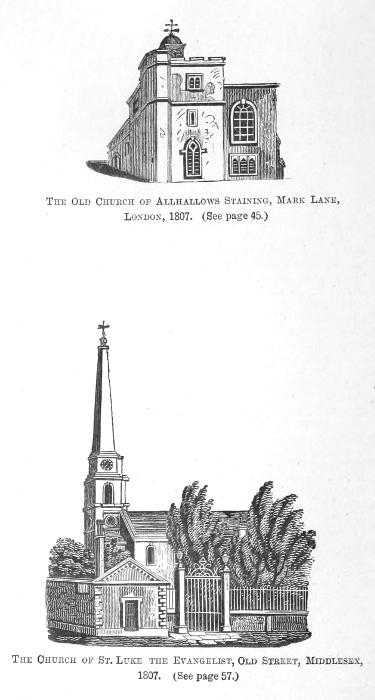
360 houses. St. Luke’s Church was built and churchyard
formed on part of the ground. Portrait in Hall.
Morris, Richard, was Master in the Armada year, 1588.
Many members of the family have been in the Company
between 1568 and 1718. He died 1592. His daughter
married first Sir William Cockayne (Lord Mayor, 1619), and,
secondly, Henry Carey, Earl of Dover. From both husbands
peerages descend. Samuel Morris, in 1680, gave an iron box,
with keys, to hold the Company’s seal.
Milne, Sir David, K.C.B., admitted to the Freedom of
the Company with his superior officer, Lord Exmouth,
in 1817.
Newell, Mrs. Ann, in 1544, gave a table and napkins—a
seasonable gift in those days. Her namesake, William
J. Newall, who died a liveryman of the Company in 1888, and
worth 257,000l., seems to have forgotten in his will his poor
“brother-ironmongers”!
Nicholl.—This is an old family name on the company.
John Nicholl, of Canonbury, Master 1859, was a good friend
to the Company (and to the writer). He compiled a magnificent
account of the history of the Ironmongers, 1851
and 1866, and the original MS. “Records,” in six volumes,
are in the Company’s library. He died February 7, 1871,
aged eighty-one, and his portrait appropriately hangs in the
court-room next to that of Mr. Beck. His son, Edward
Hadham Nicholl, Esq., is the senior warden of the Company
this year.
Pellatt.—Many representatives of this Sussex family
have been in the Company, including Apsley Pellatt, M.P.,
died 1863 (who gave a silver-mounted snuff-box), and
Thomas Pellatt, Clerk of the Company, died 1829. Apsley
Pellatt, of Lewes, grandfather of the M.P., was Master 1789.
Pellew, Edward, created Viscount Exmouth, 1816. The
hero of Algiers and the terminator of slavery there. Presented
with the freedom of the Company, January 31, 1817,
and with a sword by the City. The original grant of the
Company’s freedom, signed by T. Pellatt, the clerk, is in the
possession of a member of the Company. Portrait by Sir
William Beechey hangs in the Hall.
Price.—This family has had many representatives in the
Company. John Price was buried at Clapham 1739; his
wife 1760. Sir Charles Price, Bart., Lord Mayor 1803, was
Master 1798. In his mayoralty he gave the magnificent cut-glass
chandelier now hanging in the Hall. His portrait also
hangs there. Among other papers the writer has the original
Privy Seal for the grant of the baronetcy. Sir Charles died
1818. His son was Master 1819 and died 1847. He was
succeeded by Sir Charles Rugge Price, who had a splendid
collection of engravings, including a choice copy of Rembrandt’s
“Hundred Guilder Piece”—Christ Healing the Sick—which
at the sale in 1867 sold for 1,180l., the highest sum
ever paid for a single engraving.
Shakespeare, John, Alderman and Sheriff 1768, translated
to the Ironmongers’ from the Broderers’ 1767,
Master 1769. A large ropemaker at Shadwell. Buried at
Stepney, 1775. Gave silver candlesticks to the Company.
He was supposed to be descended from a branch of the
dramatist’s family.
Slade, Felix, son of Robert, of Doctors’ Commons, and
Walcot Place, Lambeth; Master 1803. The son was a collector
of choice articles and a great benefactor to the
British Museum and the nation. He died March 29, 1868.
He founded the Slade Professorship.
Thompson, William, Alderman, M.P. Lord Mayor 1828
A wealthy ironfounder. Master 1829 and 1841; died 1854
His only daughter married the Earl of Bective, now
Marquis of Headfort. Among his gifts were two large silver
candlesticks.
Thorold.—Several members have been on the Company
and served offices of Master, &c.; also benefactors to the
poor. The family were of Harmeston Hall, county Lincoln,
which was sold in 1884 for 115,000l.
Walker, Henry, made free in 1634, having served
apprentice to Robert Holland, was so extraordinary an individual
that John Taylor wrote and printed his “Life and
Progress of Henry Walker the Ironmonger,” 1642, and it is
now a very rare tract. Captain William Walker, Master
1684, gave in 1694 a large set of knives and forks, with
silver handles, for the Company’s future use.
Walton, Izaak, “the gentle angler,” apprentice to Thomas
Grinsell, was, on November 18, 1618, “admitted and sworne
a free brother of this companie and payd for his admittance
xiijd. and for default of presentment and enrollment xs.”.
His portrait hangs in the Hall. He was warden of the
Yeomanry 1627, died December 15, 1683, and buried at
Winchester. A full account of him and his family will be
found in the “Memorials of Temple Bar and Fleet Street,”
1869, p. 82, and Pink’s and Wood’s “Clerkenwell,” p. 107.
The writer possesses a large amount of curious and original
matter relating to “good Izaak,” which he intends one day
to publish.
Westwood.—Several have been members. While Robert
was Master, 1828, among the eighty-five liverymen were
Lord Exmouth, Sir David Milne, two baronets, and two
aldermen. Robert, Master in 1861, gave a silver-gilt cup
and cover. William Henry, in 1878 and 1882, proved himself
very kindly disposed to the Company’s poor.
Woodward, Mistress Katherine, in the seventeenth
century, left 200l. for poor scholars, prisoners, hospitals, and
poor maids’ marriages.
Young, Richard, 1675, gave a silver salt, a caudle cup and
cover, and was excused serving office of Master. John, in
1695, gave the Company six pictures.
Such, then, are a few of the names of Ironmongers worthy
to be remembered. We have not exhausted, by a very long
way, our list, but we think the selection will prove that the
Ironmongers have had many good and true citizens in their
roll. Our wish is this: May they increase as years roll on,
and, as the toast is periodically given by the Master of the
Company, so do we echo it three times three—“The
Worshipful Company of Ironmongers, Root and Branch, and
may it Flourish for Ever!”
The writer having so far completed the task he has set
himself, and briefly chronicled some of the most interesting
facts connected with his ancient Company, thinks it but
right to say that what he has now printed is only a small
portion of a larger history, which some time hence he
intends to produce for the benefit of the public at large, if
his life is spared to undertake the work. Having been
honoured by his brother freemen, as already stated in the
last chapter, he determined to prove he was not unmindful
of his duty, or the rights and privileges of his brethren,
whatever some persons may think to the contrary. He has,
therefore, ventured to print as succinct an account of their
history as it is possible to give in a small compass, and
Herbert’s “History,” and the “Some Account” of his old
friend John Nicholl being either out of print or too expensive,
probably the present will do as a temporary substitute
for the members until another is ready for publication.
T. C. Noble,
Warden of the Yeomanry, 1888-1889.
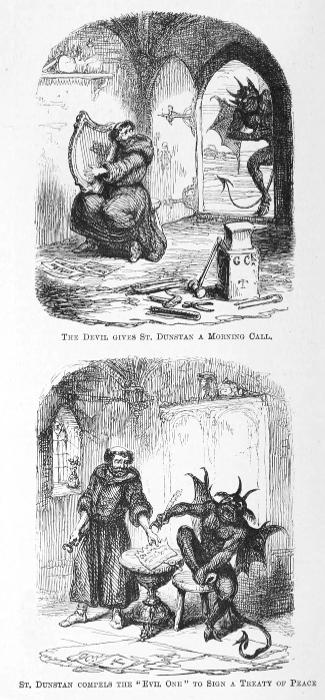
The Devil gives St. Dunstan a Morning Call.
St. Dunstan compels the “Evil One” to Sign a Treaty of Peace.