For some time after the encounter with the Indians, which happily ended
so peacefully, the train moved on without meeting with any adventures.
George and Gus thought the days passed very drearily, and longed for
some excitement, but Guy was altogether too busy to feel dull. Mrs.
Harwood's baby was quite sick, and as Mrs. Loring's time was fully
taken up in attending to him, Guy had double work to do.
You would be surprised if I should tell you half that he did. Of all
the fires he built; the oxen he fed; the water he carried, and even the
breakfasts and suppers he helped to cook. And he did it all in the best
manner of which he was capable too. Although the first biscuits he
made were heavy, the next were light as down, for he inquired into the
cause of his failure and rectified it, and by doing that in every case
he soon learned to do perfectly all that he undertook.
Most children would have thought the life of constant toil which
Guy led very wretched indeed; but he did not, for he had daily the
gratification of perceiving that the great object of their journey
across the plains was being gradually accomplished; his mother's health
was slowly becoming strengthened, by every step they took toward the
snowy mountains, beyond which lay the fruitful valleys in which they
hoped to find a home.
But, as the days passed by, they greatly feared that one of their
number would never reach there; the baby boy grew worse. The cooling
breezes that brought health to his weakly sister, seemed fraught with
death for the lately blooming boy. Guy was greatly saddened by the
sufferings of the child, and by the grief of its parents, and shuddered
when he saw the bones of animals which lay by thousands bleaching upon
the desert, and once was filled with horror on coming across a human
skull, which the prairie wolves had dragged from some shallow grave,
and separated far from its kindred bones. The idea that the body of the
poor little baby should meet such a fate, filled him with sorrow, and
although it had always seemed to him a natural and peaceful thing that
the temple of clay should rest under its native dust, after the flight
of the soul, he thought that the Indian mode of sepulture, of which
they saw examples every day, by far the best.
Very often they saw a curious object in the distance, and two of the
party, riding forward to examine it, would report an Indian place of
burial. Guy had himself gone forward once and found, to his surprise,
two forked poles, some six or eight feet high, supporting something
wrapped in a blanket. This something was a dead Indian, who in this
strange position, with his weapons in his hands, was waiting his
summons to the "happy hunting grounds."
On his return to the train, Guy hastened to find Aggie, to tell her of
what he had seen. She was listening very attentively, when George ran
up, exclaiming: "Look at the rats! there are thousands of rats on the
plains!"
Aggie looked in the direction indicated by her brother, and crying:
"Oh, the dreadful rats," was about to run away, when Guy stopped her,
telling her, laughingly, that they were the wonderful little prairie
dogs, of which they had heard so much.
Truly enough when she gained courage to look at the little animals,
she saw that although they at first sight resembled rats, on closer
inspection they appeared even more like squirrels. The children were
greatly entertained by watching their quick, active movements, as
they darted about through the low grass. A very busy community they
appeared to be, and with plenty to gossip about. To Aggie's delight
Guy pretended to translate their quick, chirruping barks into our own
language. Some he said were telling how a monster rattlesnake had come
to visit them without any invitation, and that the only food he would
eat, was the youngest and fattest of their families; and that their
constant intruders, the owls, had the same carnivorous tastes, besides
which they rendered themselves particularly disagreeable, by standing
in the doors and staring at every dog that went by, and even preventing
the entrance of visitors, to the great distress of all the belles and
beaux in town.
All this may have been very true, for the excited little creatures
talked so continuously that I am sure they must have had some
grievance, and the children thought it must be the owls that stood
solemnly at the entrance of many of the burrows. They did not see
the rattlesnakes, so even Aggie somewhat doubted the tales of their
ferocity, which Guy said the little prairie dogs related.
But although these little creatures were such chatterers, they appeared
very industrious, for many hillocks of sand indicated where their homes
were burrowed. Each little hole was occupied by a pair of dogs, one of
which was often seen perched on the apex like a sentinel. But like
many other sentinels, they appeared on the watch for danger, not to
combat, but to avoid it, for they darted like a flash into their holes
whenever a lean, prowling wolf stalked near them, or even a prairie hen
flew by.
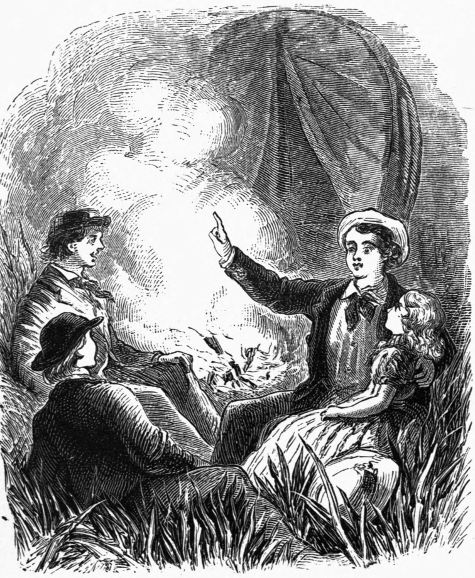
"I wish you would tell us a story about prairie dogs," said Aggie to
Guy, that evening when they were gathered around the camp-fire.
"I am afraid it is impossible for me to do that," he replied, "for very
little seems to be known about them. Naturalists have never paid much
attention to them, curious as they are."
"But the Indians must know something about them," said Gus.
"Yes, I suppose so," returned Guy, "for before the white man came to
annoy them, they had nothing to do but to watch animals and learn their
habits, that they might know which were fit for food, and which was
the easiest way of killing them. Ah, yes, now that I have been thinking
about it, I do remember a story that the Indians tell about the prairie
dogs!"
"Oh tell it!" cried Aggie, eagerly; Gus seconded the request, and even
George drew nearer, for Guy had a great reputation as story teller in
the camp.
"It is rather a long tale," said he, "but the Indians say, a true
one. It happened years and years ago when each animal understood the
language of all others, and men conversed with them as readily as with
themselves.
"In those days each tribe had its sorcerers, or wise men, who pretended
to cure not only all diseases but to control the destinies of men. They
were accordingly held in great veneration by their simple-minded dupes,
as are their few descendants, which even at this day practice in a
lesser degree the arts of their forefathers.
"Well, it happened that when these men were more powerful among the
tribes than the chiefs themselves, that they combined together to wrest
from the hands of these the commands that they held, in order that they
might hold the people both in bodily and mental subjection. There had
for a long time existed a tradition among them, that when a daughter of
a chief—an only child,—should love a brave of an unfriendly tribe,
they would have power to change her into a flower or animal, and unless
the brave should find the means within ten moons, or months, to break
the enchantment, she would die, and with her every chieftain and his
family. Accordingly these wicked sorcerers found constant pretexts for
involving the tribes in war, especially if they supposed that the only
daughter of a chieftain loved a brave of another tribe; but for many
years all their arts were in vain, for the Indians were so passionate
and revengeful that immediately an affront was given or received,
violent hatred vanquished love, and the chiefs and their families were
saved.
"The sorcerers were almost in despair of ever obtaining the entire
authority they craved, when it came to pass that two rival tribes met
upon the plains, and as was usual in such cases, a battle was fought.
The Ohoolee tribe were victorious, and killed many of the Gheelees
and also took many of them prisoners. Among the latter, was the only
daughter of the chief Sartahnah, the beautiful Mahdrusa.
"Great was the consternation of her tribe, for this maiden was held
more precious by them than a hundred braves. She was more graceful than
the fairest flower that grew upon the prairie; her hair was longer
than the grass by the riverside and blacker than the night; her eyes
were like those of the young fawn, and her voice was sweeter than a
breeze laden with the song of birds. There was not a chieftain or brave
of the Gheelee's but would have laid down his life for her, and great
was the grief and shame that befell them when she was taken captive by
the Ohoolees.
"From that day there was continual war waged between the two tribes.
The Ohoolees acted on the defensive, the Gheelees on the offensive.
Never a week passed but that a party of braves went forth to attempt
the rescue of the beautiful Mahdrusa from the lodges of the enemy.
The chief, her father, to increase if possible the zeal of the braves
promised her hand to him who should deliver her. There was great
rejoicing when this was made known, for all loved Mahdrusa, though she
cared for none. Her rescue was attempted with a thousand times more
eagerness than before, and one day Anoctah, the bravest of all the
Gheelees, led her in triumph to her father's wigwam and demanded his
reward.
"Mahdrusa heard him with dismay, and clasping her father's knees, sank
down before him, and entreated him to give Anoctah some other treasure.
"The old chief told her that was impossible, and Mahdrusa wept so
loudly that the whole tribe gathered about the lodge and asked what
had befallen the beautiful daughter of Sartahnah. But she would say
nothing, yet wept continually, so that the sorcerers said the spirit of
the rivers was within her, and that they alone, could deliver her from
it.
"Now these men had reasoned together over her strange malady, and
said, 'She mourns so much over her betrothal to Anoctah because she
loves a brave of an unfriendly tribe. Let us then take her from her
father, and place her in the great medicine lodge where we can work our
enchantments upon her, and make ourselves rulers of all the tribes.'
"So in the night they took her from her father's wigwam into the great
medicine lodge, which was hung about with the herbs they used in their
incantations, and had in the centre a great heap of stones, within
which was a fire burning.
"Beside these stones, which were kept constantly hot, they made
Mahdrusa sit down, and while she still wept, her tears fell upon the
stones, and a great vapor arose, which the sorcerers condensed upon
clay vessels into drops of water as pure as crystal, and with them and
the herbs that hung around, made a decoction so powerful that when
they had forced Mahdrusa to drink it, she lost all power and reason,
and her spirit lay passive in the hands of her tormentors.
"'We will take it from her body,' said they, 'and place it where no
brave will ever discover it.
"'Let it fly to the centre of the wild rose,' said one. But the others
demurred, saying her lover would certainly seek it there.
"'Better hide it under the thick skin of the buffalo,' said another.
"'No!' they answered, 'the brave that Mahdrusa loves must be a fearless
hunter, therefore his arrow would bring her forth.'
"In short, they talked of every flower and beast on the prairie, but
found in all some fault, until the most cunning of all mentioned the
prairie dogs. 'No one would look for her in their miserable holes,'
said he, 'and they are such chatterers that the magpies, themselves,
would not have patience to listen to them.'
"So it was agreed that her spirit should dwell as a prairie dog, and
before long out sprang one from a reeking cauldron of herbs, and they
took it to the holes of the prairie dogs and left it there, placing
beside it a terrible serpent, that all others might be afraid to
approach it, and an owl at the door, as a sentinel that would stand
looking patiently for an enemy both night and day, and never breathe
to the gossips around her the tale of the princess that was prisoned
within.
"And that was how the rattlesnake and owl became sharers in the homes
of the prairie dogs, and it was with these awful companions that the
spirit of Mahdrusa spent many weary days. Meanwhile her body lay in
the medicine lodge of her people, and the sorcerers said that her soul
had ascended to the stars, where, in ten moons, she would be purified
from her sin and return to her body, or that it would die, and moulder
away.
"This news soon spread over the prairies, but the brave that Mahdrusa
loved would not believe it. He knew the wicked desires of the
sorcerers, and believed that she was a flower on the prairie, and that
he was appointed to rescue her.
"So he went forth and cut down every flower that he found, and he
toiled so ceaselessly that before two moons had passed not a blossom
remained, and still he found not his beautiful Mahdrusa. Then he made
a strong bow, and arrows that could not miss the mark, and he slew the
beasts of the prairie by hundreds, yet he could not find his love.
And so nine moons passed by, and Mahdrusa was still in her horrible
captivity, and the brave that sought her was bowed down as if by
years, with the weight of his sorrow, and his body was so steeped in
the blood of the animals he had slain that he was redder than clay,
and his descendants continue so to this very time. All the beasts of
the prairie had he slain in his terrible anger, and all the people had
fled to the mountains for food, thither he thought he would follow
them, and he sat down upon a ridge of sand, to strengthen his bow, and
sharpen his arrows, when, lo! quite unmindful of him, a thousand little
creatures he had fancied too insignificant to notice, sprang forth from
their holes, and gathered in groups for their daily gossip.
"They angered him so greatly by their chatter that he placed an arrow
on his bow to fire amongst them, when his hand was stayed by hearing a
curious tale that a gay young dog was telling.
"'She lives next to my mother's lodge,' said he, 'and the poor thing
never appears either to eat or drink. I took her a delicate slice of
cactus myself, but I dropped it in a terrible fright, for a great
serpent darted towards me, and an owl sprang forward and devoured my
youngest brother before he had time to utter a squeak.'
"The brave rejoiced when he heard these words, and springing up, went
in search of the captive prairie dog. Many weary days he sought in
vain. He asked of her whereabouts from every insect he met, but none
could give him any information, and the prairie dogs, under the spell
of the sorcerers, were silent—on that topic, at least.
"There was but a day left in which he could act. Almost in despair, he
wandered about the prairie dog town, vainly looking for his love.
"At last he remembered that a queer old woman whom he had met, while
hunting one day, had told him that she was his guardian fairy, and had
given him two little pieces of stone which he was to strike together if
ever he was in great trouble, and she would appear and help him.
"He had taken but little notice of the old woman at the time, supposing
her to be a conjurer or evil worker, and he had dropped the little
stones into his pouch, where they had long lain forgotten. Without
daring to hope that they would be of any use, he took them out, and
struck them together. A tiny spark of fire fell from them upon some dry
grass at his feet, a flame sprang up, and lo! out of it stepped the old
woman he sought.
"'So you have called me at last!' said she, 'what is it that I shall
do?'
"'Lead me, kind fairy, to the hiding place of the beautiful Mahdrusa,'
he replied
"So she went before him to a part of the prairie that, in all his
wanderings, he had not visited. But, strangely enough, before his feet
the grass turned into briars, through which he only with the greatest
difficulty could force his way. Every timid hare became a wolf,
each gentle fawn a raging buffalo, but the brave went on undaunted,
brandishing his war-club, and keeping his formidable foes at bay. Never
for a moment did he allow fear to gain possession of him for he knew
if he did he should be lost. It was only faith and courage that could
carry him safely through that enchanted ground.
"'Stop!' cried the fairy, when he had passed unscathed through a
thousand dangers. 'Mahdrusa is before you!'
"But before he could look for her, the owl flew like a fierce hawk
in his face, and pecked at his eyes, and the rattlesnake sprang upon
him burying its deadly fangs into his arm. The brave almost lost his
courage then, but he heard Mahdrusa, though in the voice of a prairie
dog, entreating him to save her. He caught the serpent in his hands,
and seizing its jaws, tore it asunder, and wrapped its writhing body
around his wound, while at the same moment the fairy called up a
terrible wind that blew the owl far away, and to the arms of the young
warrior, the little prairie dog that held the soul of Mahdrusa.
"So was half the task of the lover accomplished; yet all his toil would
be in vain if he could not before the moon set that night place her
soul in the body it had before tenanted. But he was many leagues from
the lodge in which it lay, and he knew that by his own power he could
not hope to reach it in time, so he called upon the good fairy again,
and she turned a rabbit into a fleet courser that bore the lover and
the enchanted maiden, over the prairie with the swiftness of wind.
"The moon was but a few inches, it appeared, above the horizon, when
they reached the lodge. By command of the sorcerers all the people had
returned from the mountains to see whether the spirit of Mahdrusa would
come from the stars, or her body, which all this time had lain as if in
a deep sleep, take upon itself the signs of death. All were gathered in
the great lodge. The cauldron of herbs from which the enchanted prairie
dog had emerged was boiling over the fire, and around it the sorcerers
were standing. Before them lay the body of the beautiful Mahdrusa, and
beside it stood her father and Anoctah.
"Into the lodge, into the midst of all the people, the young brave
sprang! The warriors of the Gheelees raised their war clubs when they
saw one of the hated Ohoolees, but the young brave cried, 'strike me
not, for I bear the soul of Mahdrusa!"
"Then they all fell back and Anoctah said, 'Restore it to her body, and
she shall be thine, if she loves thee better than me.'
"But the sorcerers sprang upon him, and tried to tear the little
prairie dog from his bosom, but the fairy cried:—
"'Hold her with thy right hand into the cauldron and she shall be
saved!'
"So he broke away from the sorcerers and plunged the enchanted one into
the boiling cauldron, unheeding the agony he suffered or the cries of
the little animal he held, and in a moment the moon plunged beneath the
horizon; Mahdrusa arose from her long sleep; the sorcerers fell into
the boiling cauldron and were consumed; and all the people shouted for
joy, and with one accord cried that the Ohoolees should from henceforth
be their brothers, and the young brave who had rescued Mahdrusa, their
chieftain, when her father was called to the happy hunting grounds.
"The next day the marriage of the young brave and Mahdrusa was
celebrated with great splendor. And, behold, after the ceremony was
over, a beautiful young maiden stood in the place where the old woman
had been.
"'I too was enchanted by those wicked sorcerers, and condemned to
wear the form of an old woman until I should make two young hearts
perfectly happy. I have completed my task to-day.'
"Then Anoctah who had been very sorrowful, looked up, and seeing the
beautiful maiden, forgot his love for Mahdrusa, and entreated the
stranger to be his wife.
"She loved him well and consented, and thus made a third heart joyful
as those of the young Ohoolee brave and his beautiful Mahdrusa."
"And they lived happily together all their lives," quoted Aggie, from
the fairy tales she had heard, "Why, Guy, that was a long story,"
she added yawning, "and it has made me so sleepy I shall go to bed.
Good-night!"
"Good-night," returned Guy, not very well pleased that she should be so
sleepy, and fearing that his story must have been very stupid as well
as long. Perhaps it was because of this, that he sat down by the fire
again when she was gone instead of going to bed as he usually did, and
it was from sitting there that he got into trouble on the following
day, and to tell you what his trouble was shall be the duty of the next chapter.