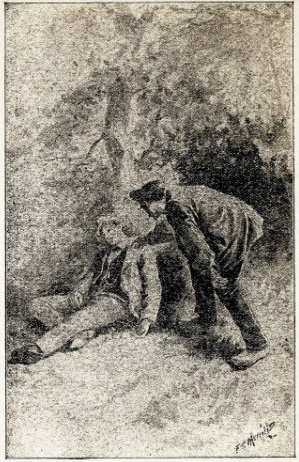
The speaker was a policeman, the scene was City Hall Park, and the
person addressed was a boy of perhaps sixteen, who was reclining on
one of the park benches, with a bundle at his side.
The officer accompanied his admonition with a shaking which served
to arouse the young sleeper.
"Is it morning?" asked the boy, drowsily, not yet realizing his
situation.
"No, it isn't. Don't you know where you are?"
"I know now," said the boy, looking about him.
"Come, get up, Johnny! This is no place for you," said the
officer, not unkindly, for he was a family man, and had a boy of his
own not far from the age of the young wayfarer.
The boy got up, and looked about him undecidedly. Clearly he did
not know where to go.
"Are you a stranger in the city?" asked the policeman.
"Yes, sir. I only got here this afternoon."
"Then you have no place to sleep?"
"No."
"Haven't you got money enough to go to a hotel? There is Leggett's
Hotel, just down Park Row," pointing eastward.
"I have a little money, but I can't afford to go to a hotel."
"You can go to the Newsboys' Lodging House for six cents."
"Where is it?"
The officer told him.
"I feel hungry. I suppose there isn't any place where I can get
supper so late as this?"
"Oh, yes! There's one close by. Do you see a light over there?"
The officer pointed to a basement opposite the post-office, at the
corner of Beekman street and Park Row.
"Yes, I see it," answered the boy. "Is it a good place?"
"I should say so. Why, that's Oll Hitchcock's. You can't get a
better cup of coffee or sandwich anywhere in New York. I often get
lunch there myself, when I don't have time to go home."
"Thank you for telling me. I'll go over."
Ben Baker, for that is the name of our young hero, walked across
the street, and descended the steps into the well-known restaurant
or lunch-room of Oliver Hitchcock. Open by night as well as by
day, there is hardly an hour of the twenty-four in which it is not
fairly well patronized, while at times it is thronged. It is a
favorite resort for men of all classes—printers, journalists,
newsmen—who drop in in the early morning on their way to or
from the offices of the great morning papers for their
regular supplies—politicians and business men of all kinds.
More than once in Oliver Hitchcock's old saloon, farther up the
same street, Horace Greeley, the elder Bennett, and Raymond, of the
Times, could be found at the plain tables, unprovided with
cloths, but bearing appetizing dishes.
When Ben entered the restaurant at half-past eleven he was
surprised to find most of the tables occupied.
Coming from the country, where ten o'clock found nearly every one
in bed, he was much surprised to find so many persons up and engaged
in supping.
"People in New York seem to sit up all night," he thought.
He took a vacant seat, and the waiter soon coming up to him, stood
in silent expectation of an order.
"Give me a cup of coffee and a sandwich," said Ben.
"What kind?"
"Ham."
The waiter sped on his errand, and soon set
before our hero a cup of fragrant coffee, steaming hot, and a
sandwich made of tender meat and fresh bread, which tasted delicious
to the hungry boy—so delicious that he resolved to forego the
intended piece of pie and ordered another.
While he was eating the second sandwich, he observed that a young
man, sitting just opposite, was eyeing him attentively.
He was tall, dark-complexioned, slender, and had a kindly face.
"You seem to relish your supper, Johnny," he said.
"Yes, I do, but my name isn't Johnny."
The young man smiled.
"Excuse me," he said, "but in New York we call boys by that name,
if we don't know their real names. I suppose you have not been here
long?"
"No; I only arrived this afternoon."
"Come to make your fortune, eh?"
"Well, I don't know. I should like to, but if I can make a living
it is all I expect. Besides, I have another object," added the boy,
slowly.
"Were you ever here before?"
"No, sir."
"You are up rather late. You don't sit up so late in the country,
do you?"
"Oh, no, I am in bed by nine o'clock generally."
"We don't go to bed early here. I myself haven't been in bed
before midnight for three years."
"Do you like to sit up so late?" asked Ben.
"I didn't at first. Now I am used to it. My business keeps me up
late."
Seeing that Ben looked curious, he added:
"I am a reporter on a morning paper."
"Do you like it?" asked Ben, doubtfully.
"Oh, yes. It isn't a bad business."
"What paper do you write for?" asked Ben, with considerable
respect for a man who wrote for the papers.
"I used to work on the Sun. Now I'm on the
Herald. It suits me very well while I am a young man, but I
should like a different position when I am older."
"Is it hard work?"
"Sometimes. I am liable to be sent off at
five minutes' notice to any part of the city. Then I am expected
to keep my eyes open, and make note of anything that comes in my
way. There was a big fire last night about one o'clock, up town. I
heard of it as I was going up in the horse-cars, so I hurried to the
spot, and instead of going to bed I got all the information I could,
hurried back to the office and wrote it up. I got extra pay for it.
Besides, it shows interest, and may help me to promotion."
"Have you got through for to-night?" asked Ben.
"Yes; I feel tired, being up so late last night. When I leave here
I shall go home and to bed. By the way, where are you staying?"
"Nowhere," answered Ben, in some embarrassment.
"You are not going to sit up all night, are you?"
"No. I suppose I must go somewhere."
"There is a hotel close by—Leggett's."
"So a policeman told me, but I haven't much money, and I had
better not go to a
hotel. He said there was a Newsboys' Lodging House, where I could get
lodging for six cents."
"I am afraid you couldn't get in at this late hour."
Ben looked perplexed. He felt sleepy, and needed rest.
"Then I suppose I shall have to go to the hotel," he answered. "Do
you know how much they charge?"
"Not exactly. It depends on the room. I can direct you to a
cheaper lodging even than you could get at the Newsboys' Lodging
House."
"I wish you would," said Ben, looking up hopefully.
"Then come home with me. My room-mate is away for a few days, and
I have room for you."
"Thank you, sir, if it won't inconvenience you."
"Not at all."
Ben had read of adventurers that lie in wait for unsuspecting
travellers and "rope them in," but he entertained no suspicion of the
young man who had so kindly offered him a bed. The mere fact that he
was a newspaper man seemed to Ben a guarantee of respectability.
As Hugh Manton (the reporter) and he went up to the counter to
pay the amount of their checks, a stout, handsomely-dressed man, of
portly form and medium stature, entered the restaurant. As his eye
fell upon Ben he started and muttered to himself:
"That boy in New York! What does he want here?"
CHAPTER II.
A Lodging in St. Mark's
Place.
Hugh Manton, whose calling had trained him to quick observation,
did not fail to notice that the stout gentleman was in some way moved
by the sight of his young companion. This surprised him not a little,
for in the portly gentleman he recognized a wealthy retail merchant
whose store was located on the upper part of Broadway.
"Can there be any connection between this country boy and the rich
Mr. Walton?" he asked himself, curiously.
He resolved to take an early opportunity to question Ben.
When their bills were paid they went out of the restaurant. It was
twelve o'clock by the clock on the City Hall when they emerged from
the lunch-room. A Third Avenue horse-car was just passing.
"Follow me!" said the reporter, as he jumped aboard.
Ben did so.
"My room is on St. Mark's place," he said. "I suppose you don't
know where that is?"
"No; I have never been in New York before."
"It must be nearly two miles from the City Hall Park. It is the
eastern part of Eighth street."
"Fare!" said the conductor.
Ben put his hand into his pocket.
"No," said his companion, "I have the change."
"Thank you!" said Ben, "but you ought not to pay for me."
"Oh, you shall take your turn some time."
They sat down in the car, and, both being tired, sat silent.
After riding fifteen to twenty minutes they came in sight of a
large brown-colored building, set between Third and Fourth avenues,
just beyond the termination of the Bowery.
"We will get out here," said Hugh Manton. "That building is the
Cooper Institute. Of course you have heard of it? We turn to the
right, and will soon reach my den."
Time was when St. Mark's place had some pretension to gentility,
but now it is given up to lodging and boarding-houses. In front
of a brick house, between Second and First avenues, the reporter
paused.
"This is where I live," he said.
He opened the door with a latch-key, and they entered a dark hall,
for at eleven o'clock the light was extinguished.
"Follow me," he said to Ben. "Take hold of the banister, and feel
your way. I am generally the last in," he said, "unless some one
of my fellow-lodgers is out having a good time. One more flight of
stairs. So, here we are."
The rear room on the third floor was his. Opening a door, he
quickly lighted a gas-jet on one side of the room.
"There, my young friend," said the reporter, "you can undress as
soon as you please, and jump into that bed nearest the window. It
isn't luxurious, but will serve your turn."
"Thank you," said Ben. "I feel very tired. I shan't lie awake long
to consider
what kind of a bed I am in. Do you get up early?"
"Sometimes I get up as early as nine o'clock."
Ben laughed.
"Do you call that early?" he said. "Six o'clock isn't extra early
in the country."
"My young friend—by the way, what's your name?"
"Ben Baker."
"Well, Ben, let me tell you that nine o'clock is a very early
hour for a reporter. We'll rise at nine, and go out to breakfast
together."
"I think I can sleep till then," said Ben, "for I am as tired as I
ever was after a hard day's work on the farm."
"Wake up, Ben."
It was the next morning and the words were spoken by Hugh Manton,
as he gave a gentle shake to the still sleeping boy.
Ben opened his eyes and looked about him in a confused way.
Finally recollection came to him.
"I thought I was in that park down town," he said, with a
smile.
"Do you know where you are now?"
"Yes."
"Have you slept well, youngster?"
"I have had a bully sleep."
"And you feel ready for breakfast?"
"I think I can eat some."
The two new acquaintances dressed and went down stairs. Ben was
about to take his bundle, but the reporter stopped him.
"Leave it here," he said, "for the present. Blodgett won't be back
for three or four days, and you can stay here till he returns. You
won't want to be lugging that bundle all over town."
"You are very kind," said Ben, gratefully.
"Why shouldn't I be? I came to the city myself a poor country
youth, and I had a hard struggle as first till I reached my present
pinnacle of wealth," he concluded, with a smile.
"Are reporters well paid?" asked Ben, innocently.
"That depends! Whatever they earn, it is seldom that one gets
fifty dollars ahead.
That is because, as a rule, they are improvident, and sometimes
dissipated. I am not as well paid as some, but I make a little
writing sketches for the weekly story papers. I pick up two or three
hundred a year that way. Then I take better care of my money than
some. I laid up five hundred dollars last year, and nearly as much
the year before."
"You will soon be rich," said Ben, to whom five hundred dollars
seemed a large sum of money.
The reporter smiled.
"It takes considerable money to make a man rich in New York," he
said. "However, I know it makes me feel very comfortable to think I
have a thousand dollars in the bank."
"I should think it would," said Ben, seriously.
"Here we are!" said the reporter, pausing in front of a restaurant
on Ninth street, facing the side of the great retail store
established by the late A. T. Stewart. "We can get a comfortable
breakfast inside for a low price."
They entered, and sat down at one of the small tables. Hugh Manton
ordered a beefsteak
and a cup of coffee. This, with bread and butter, cost twenty cents.
Ben duplicated the order. The meat was not of the best quality, but
it was as good as could be afforded at the price, and Ben ate with
the zest of a healthy boy of his age.
"By the way, Ben," said the reporter, with apparent carelessness,
though he scanned the face of his young companion attentively as he
spoke, "are you acquainted with a clothing merchant of this city
named Nicholas Walton?"
Ben started in irrepressible astonishment.
"What makes you ask?" he said. "Did you know he was my uncle?"
It was Hugh Manton's turn to be astonished.
"Your uncle!" he exclaimed. "You don't mean to say Nicholas Walton
is your uncle?"
"Yes, I do. My mother is his sister."
"Is it possible? He has the reputation of being very rich, while
you——"
"While I am very poor. Yes, that is true."
"Are you going to call upon him?"
"Yes. I thought, being my uncle, he might give me a place in his
store."
"Did you write him that you were coming?"
"No—that is, not lately. I wrote three months ago, and he
wrote back that I had better stay where I was."
"What were you doing?"
"I was working on a farm. I was paid three dollars a week."
"Did you live on the farm?"
"No; I lived with my mother."
"She is living, then?"
"Yes," said Ben, and his face lighted up with love for his absent
mother.
"I should think Mr. Walton would do something for his own
sister."
"So he does. He sends her twenty-five dollars a month. She lives
in a small house belonging to my grandfather. My uncle is part owner,
but he lets mother live in it."
"I suppose you don't like the country, or you wouldn't have come
to the city."
"I have a taste for business, and no taste for farming. My uncle
came to New York a poor boy, and he has succeeded. I don't see why I
can't."
"It doesn't always follow," said the reporter,
thoughtfully. "Still I think you have it in you to succeed. You look
bold, persevering and resolute."
"I mean to succeed!" said Ben, firmly. "I am not afraid of
work."
"Shall you call on your uncle this morning?"
"Yes; I want to find out as soon as I can what I am to depend
upon."
"Very well! Just make my room your home. I shall not be back
myself till midnight, or later, but here is a latch-key which will
admit you to my room whenever you like. I have Blodgett's with me,
which I can use myself."
CHAPTER III.
The Merchant's Secret.
Five years before Ben's arrival in the city Nicholas Walton kept a
moderate sized store on Grand street. He was doing a good business,
but he was not satisfied. He wished to take a store on Broadway, and
make his name prominent among business men. In this wish his wife
entirely sympathized with him. She boasted aristocratic lineage, but
when Mr. Walton married her she was living in genteel poverty, while
her mother was forced, very much against her will, to take lodgers.
It was a great piece of good luck for Theodosia Granville to marry
a prosperous young merchant like Nicholas Walton, but she chose to
consider that all the indebtedness was on the other side, and was
fond of talking about the sacrifice she made in marrying a man of no
family.
They had two children, Emiline and Clarence
Plantagenet Walton, the latter about three months older than his
cousin Ben. Both were haughty and arrogant in temper and disposition,
and as a matter of course neither was a favorite with their young
associates, though each had flatterers whose interest was served by
subserviency.
At that time Ben's father was living and practicing as a
physician in the little town of Sunderland, fifty miles distant in
the country. There was comparatively little intercourse between the
families, though there was not yet that difference in their worldly
circumstances that afterward arose.
One day, just as the clerks were getting ready to close up,
Nicholas Walton was surprised by the sudden appearance of his
brother-in-law, Dr. Baker.
"What brings you to town, James?" he asked.
"Business of great importance," answered Baker.
"Indeed!" said Walton, curiously.
"I will tell you all about it, but not here."
"Do you go back to Sunderland to-night?"
"No; I think of trespassing upon your hospitality."
"Certainly. I shall be glad to have you stay with me. My wife
and children are out of town—visiting a sister of hers in
Hartford—but the servants will see that we are comfortable."
"All the better. Of course I should have been glad to see Mrs.
Walton and the children, but now you can give me more attention."
"I wonder whether he wants to borrow money," thought the merchant,
with some uneasiness. "If he does, I shall refuse as civilly as I
can. I don't propose to be a prey to impecunious relatives. I need
all the money I can command to further my own schemes. In three or
four years, if things go well, I shall be able to move to Broadway,
and then our family can take a higher social position. My wife would
like to have me move at once, but I don't choose to do anything
rashly. The time has not yet come for so important a step."
"We will go now," said Mr. Walton. "The clerks will close up. If
you will walk as far
as the Bowery, we will board a Fourth avenue car."
"Do you still live on Twelfth street, Nicholas?"
"Yes. Mrs. Walton urges me to take a house on Madison avenue, but
I must not go too fast."
"You are prospering, I take it, Nicholas?"
"He is feeling his way toward a loan, I am afraid," thought the
merchant.
"Yes, I am making headway," he admitted, warily, "but I have to be
very cautious. Oftentimes I am short of money, I assure you. In fact,
I am hampered by my small capital."
"My neighbors in Sunderland would be surprised to hear that,"
said Dr. Baker, smiling. "They look upon you as one of the merchant
princes of New York."
"Do they?" said Walton, looking gratified. "Some day I hope to be
what they think I am now."
"You will be, if you are not too much in haste."
"So I hope. And you, I hope you are prospering?" said the
merchant, guardedly.
"I have no cause for complaint," said his brother-in-law,
"especially now."
"What does he mean by 'especially now?'" thought the merchant.
"I am glad to hear it," he said, aloud.
Arrived at the house in Twelfth street—it was a plain brick
house of three stories—dinner was found to be awaiting, and
as they sat down at once, there was no opportunity for a private
conversation. When the cloth was removed, and they were left to
themselves, Walton invited his brother-in-law's confidence by saying,
suggestively:
"So business of importance brought you to New York, doctor?"
"Yes, business of great importance!"
"I suppose it seems great to him," thought Walton. "Well,"
he said aloud, "you have aroused my
curiosity. It is only fair to gratify it."
"That is what I propose to do. Let me say, then, that this day has
made a great change in me."
"I don't see any change," said Walton, puzzled.
"Yet it has; I awoke this morning a poor man. To-night I am
rich."
"You—haven't been speculating?" said Walton, curiously.
"No; I had no money to speculate with. But to-day a fortune has
come to me."
"A fortune! How much?"
"One hundred thousand dollars!" answered the physician.
"A hundred thousand dollars!" ejaculated Nicholas Walton, staring
at his brother-in-law in amazement.
"Yes."
"Explain yourself—that is, if you are not joking."
"Fortunately it is not a joke. As to the explanation, here it is:
Some years ago I was called, when a young practitioner in New York
(I began here, you know), to attend a wealthy West Indian planter,
boarding at the New York Hotel. He was critically sick, and required
constant attention. I had little to do, and devoted myself to him.
He was convinced that he owed his life to me. He paid me handsomely
then, and requested me to
keep him apprised of my whereabouts. I have done so. Yesterday I
received a letter, requesting me to come to New York, and call
at a certain room in the Fifth Avenue Hotel. I did so. I found a
Cuban gentleman, who, first apprising me that my former patient was
dead, added, to my amazement, that he had left me in his will one
hundred thousand dollars. Furthermore, he had the amount with him in
negotiable securities, and transferred them at once to my hands."
"And you have them with you?"
"Yes."
"It was strangely informal."
"True, but this gentleman was about to sail for Europe, to be
absent five years—he sailed this afternoon—and he wished
to be rid of his commission."
"It is like a romance," said the merchant, slowly.
"Yes, it's like a romance. I don't mind telling you," added the
doctor, in a lower tone, "that it relieves me very much. Conscious,
as I am, that my life hangs on a thread, it makes me easy about the
future of my wife and child."
"Your life hangs on a thread? What do you mean?"
"I mean," said the physician, seriously, "that our family is
subject to heart disease. My grandfather died at a minute's notice;
so did my father; so, in all probability, shall I. No insurance
company, knowing this, would insure me, and, till this windfall came,
I was subject at times to great anxiety."
"Does your wife—my sister—know that you have received
this money?" asked Walton, slowly.
"No; she merely knows that I received a letter from New York."
"And you are really liable to die suddenly?"
"Yes; I shall probably drop dead some day. My father died at my
present age. Any sudden excitement——"
"Good heavens! what is the matter with you?" exclaimed Walton,
springing to his feet, excitedly.
"What do you mean?" asked the physician, startled.
"Your face is livid; you look like a corpse. Great heavens! has
your time come?"
Doctor Baker rose to his feet in terrible agitation; his face
changed; he put his hand on his heart, swayed himself for a moment,
and then fell lifeless.
Walton had supplied the sudden excitement, and brought upon him
the family doom.
Nicholas Walton, half-terrified, half-triumphant, gazed at his
victim. He knelt down, and tearing open the vest of his visitor,
placed his hand upon his heart.
It had ceased to beat.
"Now for the securities!" he murmured hoarsely.
They were found. A brief examination showed that they were
negotiable by bearer. He carefully locked them up in his desk, and
then, ringing the bell hastily, summoned a physician. One came, but
could afford no help.
"Now," he said to himself, with inward exultation, "this fortune
is mine, and I can realize the dream of my life! No one will ever be
the wiser."
CHAPTER IV.
The Mock
Philanthropist.
Nicholas Walton, much sooner than he had anticipated, was able to
realize the dream of his life. He engaged a larger store on Broadway,
within three months of the death of his brother-in-law. The latter
was supposed to have died a poor man. In settling up his estate it
was found that he left only the modest cottage in which he had lived.
Mrs. Baker's anxiety, however, was alleviated by the following letter
from her brother Nicholas:
"My Dear Sister:—I sympathize
with you sincerely in your sad and sudden loss. I am afraid my
poor brother-in-law has not been able to leave you comfortably
provided for. I cannot do as much as I would like, but I will
send you a monthly sum of twenty-five dollars, which, as you
have no rent to pay, will perhaps keep you comfortable. If I can
at any time feel justified in so doing, I will increase this
allowance."
"Nicholas is very kind," said Mrs. Baker, to her friends. "He has
done this without any appeal from me."
She really felt grateful for his kindness, as she termed it,
having no suspicion of the terrible secret that haunted her brother
day and night, making him an unhappy man in spite of his outward
prosperity. But he had no intention of making restitution; his
remorse did not go so far as this.
"As to taking a hundred thousand dollars from my business," he
said, in answer to conscience, "it would cripple me seriously.
Besides, my sister doesn't want it; it would do her no good. She and
her children can live comfortably on what I send her."
He tried to persuade himself that he was liberal in his provision
for his sister; but even his effrontery could not go so far as
this.
In reality, Mrs. Baker would have found great difficulty in
keeping her expenses within three hundred dollars a year if Ben had
not managed to pick up a dollar or two a week by working at odd jobs,
running errands, or assisting some of the neighboring farmers. But
the small town of Sunderland did not satisfy the ambitious boy. There
was no kind of business which he could learn at home that offered him
a satisfactory career.
"Mother," he said, about three months before my story begins,
"don't you think my uncle would give me a place in his store?"
"You don't want to leave home, Ben, do you?"
"I don't want to leave you, mother; but you know how it is. There
is nothing to do in Sunderland."
"I am sure you pick up considerable money in the course of a year,
Ben."
"But what does it all amount to, mother?"
"It is a great help to me," said Mrs. Baker.
"I don't mean that. It isn't getting me ahead. I can't do any more
now than I could a year ago. If I learned my uncle's business I might
get ahead, as he has."
"You may be right, Ben; but how could I spare you? I should feel
so lonely."
"You have Alice, mother. She is ten years old, and is a good deal
of company to you."
So the discussion continued. Finally, as
might have been expected, Ben obtained from his mother a reluctant
consent to his writing to his uncle. He did not have to wait long for
the answer; but when it came, it was cold and unsatisfactory. It read
thus:
"Nephew Benjamin:—Your letter has
come to hand, asking me to give you a place in my store. I think you
are much better off in the country. Besides that, I do not think you
ought to leave your mother. You say there is no chance for you in
Sunderland; but you are mistaken. You can work for some farmer, and
gradually acquire a knowledge of the business, and in time I may help
you buy a farm, or at any rate hire one, if I am satisfied with your
conduct. As to the city, you had better keep away from it. I am sure
your mother will agree with me.
"Your uncle,
"Nicholas Walton."
"Your uncle seems to me to write very sensibly," said Mrs. Baker.
"The city is full of temptations."
"If I go to the city I shall work too hard to be troubled in that
way, mother."
"Your uncle makes a very kind offer, I think."
"It doesn't bind him to much," said Ben.
"He says he may help me to buy or hire a farm, if I learn
farming."
"That would be a gift worth having, Ben," said his mother, who
thought chiefly of keeping Ben at home.
"I shall never make a farmer, mother; I don't like it well enough.
It is a very useful and honorable business, I know, but I have a
taste for business; and if Uncle Nicholas won't help me to a start, I
must see what I can do for myself after a time."
Nicholas Walton congratulated himself when his letter to Ben
remained unanswered.
"That will settle the matter," he said to himself. "I would rather
keep the boy in the country. I couldn't have him in my establishment.
I should never see him without thinking of his father's sudden death
before my eyes," and the rich merchant shuddered in spite of himself.
"Besides," and a shade of apprehension swept over his face, "I am in
constant fear lest he should hear of the large sum of money which
came into his father's hands just before his death. While he stays in
Sunderland, there is little chance of any
such knowledge coming to him; if he is in the city, there is a
greater chance of it. Who knows; the man who paid Doctor Baker the
money may turn up. It was his intention to go to Europe for five
years. That period has nearly passed already. If this discovery
should ever be made, I am ruined. I might even be accused of
murdering him, though, happily, that could not be proved. But there
would be a blot on my name, and my reputation would suffer."
For three months Ben made no sign, and his uncle concluded
that he had given up his plan of coming to New York in search of
employment.
But one evening—it was the one on which our story
commenced—on his way back from a call upon some friends in
Brooklyn, Nicholas Walton stepped into Hitchcock's lunch-room,
knowing it well by reputation, and was startled by seeing the nephew
whose appearance he so much dreaded.
It was his first impulse to speak to him, and harshly demand his
reason for disobeying the positive command to remain at home; but
this might be followed by an appeal for help (it was clear that Mr.
Walton did not understand his nephew) and that might be awkward.
"No," thought the merchant; "I won't speak to him till he comes to
the store, as no doubt he intends to. Then I will give him a piece of
my mind."
We now come back to Ben and his new found friend, the reporter.
"If you don't object, I will walk down town with you, Mr. Manton,"
said Ben, as they left the restaurant where they had breakfasted.
"I shall be glad of your company, Ben," said Manton, cordially. "I
will point out to you the chief landmarks, and places of interest, as
we go along."
"I wish you would," said Ben. "I know very little of the city."
"That is a defect you will soon remedy," said his friend.
"By the way," said Ben, with a sudden thought, "how was it that
you asked me if I knew Mr. Walton?"
"Because I saw that Mr. Walton knew you."
"You saw that he knew me?" repeated Ben, puzzled.
"Yes. Do you remember a stout gentleman who came into Hitchcock's
just as we were going out?"
"No; I did not observe him."
"It was Nicholas Walton. When his glance first rested upon you he
started and looked disturbed."
"He did not approve of my coming to New York," explained Ben.
"Then you think he recognized me?"
"I am sure of it."
"I wonder he did not speak to me!" said Ben, thoughtfully.
"Probably for the reason you have assigned—because he did
not approve of your coming. Do you expect to call upon him?"
"Yes; I am going to ask if he won't give me a place in his store.
He employs a large number, I suppose?"
"Yes; not less than a hundred, I should think, in various ways
inside the store, besides
scores of seamstresses outside. He has a very large establishment,
and is accounted a very rich man."
"So I have always heard," said Ben. "He wanted me to stay in
Sunderland and become a farmer."
"And you don't fancy the advice?"
"No. I should never make a farmer. If I had any taste for it, I
might have followed my uncle's advice."
"Have you ever seen Mr. Walton's store?" asked the reporter,
presently.
"No."
"Here it is," and he pointed to a spacious store, with great
plate-glass windows, in which was displayed suits of clothes in
profusion.
"Then, Mr. Manton, I believe I will leave you and go in. I want
to find out as soon as possible whether my uncle will help me, or
whether I must depend upon myself."
"Good luck to you, Ben, then! I will expect to see you
to-night."
And Hugh Manton kept on his way down town, to see what work had
been laid out for him at the office.
CHAPTER V.
A Young Dude.
Ben entered the great store, gazing not without admiration at the
long counters loaded with piles of clothing.
"My uncle must be a very rich man," he said to himself. "Surely he
can find a place for me in so large a store."
"Do you wish to buy a suit?" asked a spruce young man, coming
forward to meet our hero.
"No; I would like to see Mr. Walton," answered Ben.
The young man surveyed Ben's country garb with a smile of
depreciation. He was apt to judge others by their clothes,
being conscious, perhaps, that they were his own chief claim to
consideration.
"I don't think Mr. Walton will see you, youngster," he said.
"Why not?" demanded Ben, looking him calmly in the eye.
"His time is of too much value to waste on country kids."
"Mr. Walton is my uncle," said Ben, quietly.
"Your uncle!" repeated the clerk, in considerable surprise. "Oh,
well, that alters the case. Just go through the store and you will
find Mr. Walton in his office."
Ben followed directions, and found the office without further
inquiry.
Through the open door he saw a short man, of fifty or thereabouts,
sitting at a desk. There was another person in the office—a
boy, somewhere near his own age—dressed in the fashion, with a
gold watch-chain across his vest, a showy pin in his scarf, and the
air of a young coxcomb.
This was Clarence Plantagenet Walton, the only son of the
merchant, and of course Ben's cousin. The two, however, had not met
since both were very young boys, and neither would have recognized
the other.
Ben overheard a fragment of the conversation between his uncle and
cousin.
"You spend too much money, Plantagenet. It is less than a week
since I gave you ten dollars."
"The fellows I go with are all rich, and spend plenty of money.
You wouldn't want them to look upon me as mean, pa?"
"The boys of the present day are altogether too extravagant," said
his father, frowning. "Why, when I was a boy, I didn't spend ten
dollars in three months."
"You were not in fashionable society like me, pa," said Clarence
Plantagenet, consequentially.
"Much good it does you!" muttered Mr. Walton. "What do you want
money for particularly to-day?"
"I am going with Percy Van Dyke to a base-ball match this
afternoon. Percy lives in a splendid house on Fifth avenue, and his
family is one of the first. I suppose we shall get home late, and I
want to give him a little supper at Delmonico's."
"The Van Dykes stand very high," said Mr. Walton, complacently. "I
am very glad to have you associate with such a high-toned
family. I suppose I must let you have the money."
He drew out a ten-dollar bill and tendered it to Clarence.
"Five dollars more, if you please, pa," said the elegant youth.
"Suppers at Delmonico's are expensive, and I don't want to economize
with such a fellow as Percy."
"Very well; here are five dollars more, but don't be foolishly
extravagant."
Clarence was about to leave the office, well satisfied, when he
espied Ben.
"Who do you want to see, boy?" he demanded, curtly.
"I should like to speak with my uncle," answered Ben.
"Then don't hang around my father's office. If your uncle is
employed in this establishment, you can ask one of the floor-walkers
to point him out."
Ben eyed the arrogant boy in some amusement, and answered,
demurely:
"My uncle is Mr. Nicholas Walton, and you, I suppose, are my
cousin Clarence."
Clarence Plantagenet recoiled in disgust.
"I don't understand you," he said. "You must be crazy."
Ben was not obliged to vindicate his sanity, for his uncle, who
had hitherto remained silent, now spoke.
"You can come in, if you are Benjamin Baker, of Sunderland."
"Thank you, Uncle Nicholas," said Ben.
"Is he my cousin?" asked Plantagenet of his father, in evident
discomposure.
"Yes, I presume so. His mother is my sister."
"Did you send for him, pa?"
"No."
"Then why is he here?"
"I expect him to explain that to me," said Mr. Walton, coldly.
"Benjamin, what brings you to New York?"
"I want to get a position here, so that I may learn business. I
thought you might find me a place in your store, Uncle Nicholas."
"Did I not write you to stay in Sunderland?" asked Mr. Walton,
coldly.
"Yes."
"Then why have you disobeyed me?" continued the merchant, with a
frown.
"Because I have no taste for farming, and there is no other
employment there."
"A boy like you is not qualified to judge what is best for him,"
said Mr. Walton, harshly. "Did I not promise, if you learned farming,
that when you got older I would set you up on a farm of your own?"
"I never should succeed as a farmer, for I don't like it,"
answered Ben.
"What fault have you to find with it?" demanded the merchant,
testily.
"None whatever, uncle, except that I am not suited for it."
"You don't look to me suited for anything else," said Clarence
Plantagenet, insolently.
"I don't think you know me well enough to judge what I am fit
for," answered Ben, calmly.
"You might make a good blacksmith, perhaps," continued Clarence,
in the same offensive tone. "Isn't there any opening in that line in
the country?"
"There might be. The business is not to my taste, though it may be
to yours."
"To my taste!" ejaculated the horrified Plantagenet. "What have I
to do with such a dirty business as that?"
"Stop this foolish discussion, Plantagenet," said his father.
"You had better go to meet your friend, Van Dyke, and I will settle
matters with your cousin here."
"Pack him back to the country, pa!" said Clarence. "That is the
best place for him."
So saying, the young "dude" sauntered out of the office and left the store,
several of the clerks who wished to stand well with their employer
bowing deferentially to him. Plantagenet barely acknowledged their
bows by a supercilious nod. He did not look upon them as his social
equals.
"I am inclined to agree with my son," said the merchant, after
Plantagenet had left the office. "I think the country is the best
place for you."
"Then, Uncle Nicholas, you won't give me a place in your store?"
asked Ben, his face showing his disappointment.
"I will do nothing to encourage you in a
step which I consider so ill-advised as coming to the city."
"Then I must bid you good-morning," said Ben, soberly.
"Stay!" said his uncle. "I am willing to make up to you the
expense of your trip to the city, on condition that you go back
to-day."
He put his hand into his pocket as he spoke.
"Thank you, Uncle Nicholas," said Ben. "I thank you for your
offer, but I won't accept it; I shall not go back to Sunderland."
"You won't go back!" gasped the merchant. "What will you do,
then?"
"Look elsewhere for a place," said Ben.
"You are a foolish, headstrong boy. I wash my hands of you. You
need not expect any help from me. You must make your own way."
"I mean to," answered Ben, quietly, as he bowed and walked out of
the office.
"This is very annoying," said Mr. Walton to himself. "He is an
obstinate boy. However, his eyes will soon be opened to his folly,
and he will have to go back, after all. Perhaps it is as well for him
to try, and fail. He will be more manageable afterward."
CHAPTER VI.
Ben Gets Into Trouble.
Ben went out of his uncle's store in a serious frame of mind. He
knew that his uncle was opposed to his leaving his country home and
coming to New York, but he had hoped that he would nevertheless be
willing to extend to him a helping hand, especially as it would cost
him so little.
He found himself now in a critical position. He had in his pocket
a dollar and twenty-seven cents, and this constituted his entire
worldly capital. It was enough to carry him back to Sunderland,
but, if he had been willing to do that, it would have been for his
interest to accept his uncle's offer to refund to him what his trip
would cost.
But Ben was not easily discouraged. His motto was:
"If at first you don't succeed,
Try, try again!"
"I won't go back to Sunderland unless I am obliged to," he said
to himself. "There are other stores besides my uncle's in this large
city, and more ways of making a living than one. I won't give up
till I have tried my best."
So he walked along Broadway in a leisurely way, keeping his eyes
wide open, and interested, in spite of his critical circumstances,
in the crowds and bustle of that brilliant thoroughfare.
Presently he came to a shop window on which was posted the
notice—
"Boy Wanted."
"Here's a chance for me," he thought, hopefully. "I'll apply for
the place. I can't be any more than refused."
He entered. It was a store appropriated to "Gentlemen's
Furnishing Goods."
A tall young man, with his auburn hair parted in the middle,
glanced at him languidly.
"I see you want a boy," said Ben, plunging at once into
business.
"Humph! Are you the boy?"
"I am a boy, and would like a place," answered Ben.
The clerk picked his teeth languidly with a wooden toothpick
which he had brought from the cheap restaurant where he had taken
his breakfast.
"Are you from the country?"
"Yes, sir."
"How long have you been in the city?"
"I arrived yesterday."
"Then you don't know your way round New York?"
"No; but I would soon learn."
"That wouldn't suit us. Besides, you don't live with your
parents."
"My father is dead; my mother lives in the country."
"You won't suit us, then. However, you can go back and speak to
Mr. Talbot. There he is, in the rear of the store."
Ben had at first supposed that the young man with whom he was
speaking was the proprietor. He did not dream that he was a clerk,
working for nine dollars a week. He made application to Mr. Talbot,
a middle-aged
gentleman, not half so consequential as his clerk, but was asked
essentially the same questions as before.
"I am afraid I must refuse you," said Mr. Talbot, kindly. "We
require a boy who is used to the city streets, and we prefer
that he should live with his parents. I am sorry for your
disappointment."
"Thank you, sir," said Ben; but it was in rather a subdued
tone. His prospects did not seem quite so good as a little while
before.
Coming out into the street, Ben saw quite a crowd of boys and
young men, who were following a tall lady, just in advance, and
showing signs of amusement. It only took a glance to discover the
cause of their mirth.
The lady wore a sack, evidently just purchased, on which was a
card, bearing in large, distinct characters, the words:
"Cheap for Cash."
This it was that had excited the amusement of the crowd.
Ben was also amused, but he sympathized
with the lady; and, stepping forward promptly, touched her on the
arm.
She looked back in surprise, and then for the first time became
aware of the crowd that was following her. She was a lady probably
nearing forty, and had a shrewd, kindly look.
"What does it all mean?" she asked.
"There is something on your sack, madam. Allow me to remove
it."
And Ben plucked off the ticket, which he handed to the lady.
"I am not surprised at the amusement of the boys," said the
lady, smiling. "The ticket should have been removed. I am very much
obliged to you, my young friend."
"You are quite welcome," said Ben, bowing and falling back.
The lady smiled, and passed on. She would have remained had
she known that by his act of kindness her young acquaintance had
involved himself in trouble.
No sooner had the lady disappeared than the disappointed young
ruffians who had been making sport of her turned angrily upon our
hero.
"Ain't you smart?" sneered one.
"You're a little too fresh, country!" said another.
Ben turned from one to another in surprise. He didn't understand
in what way he had offended.
"What is the matter?" he asked. "What have I done?"
"What made you tell the lady what she had on her back?" demanded
a third.
"I thought she ought to know," answered Ben.
"Oh, you did!" sneered the first. "What you wanted was a reward.
I'm glad she didn't give you a cent."
"You judge me by yourself," said Ben, provoked. "I can be polite
without being paid for it."
"Say that again!" said Mike Rafferty, a freckle-faced young
rowdy, squaring off in a scientific manner.
"All right; I do say it again!" returned Ben, angrily.
"Take that, then!" said the fellow, as he struck at Ben.
Our hero dodged, and returned the compliment.
At that moment a policeman came round the corner, just in time to
see Ben's demonstration.
"So you're fightin' agin, you young rascal!" exclaimed the
valiant officer. "I've got ye this time!" and he seized Ben by the
shoulder.
Ben turned, and, it must be confessed, was startled to find
himself, for the first time in his life, in the hands of the law.
"That boy attacked me, sir," he said.
"It's a lie!" exclaimed Mike Rafferty. "Isn't it b'yes?"
"Yes, it's a lie!" chimed in his companions, whose sympathies, of
course, were with Mike.
"Jist what I thought meself," said the astute officer.
"Say, cop, ye didn't see me hit him?" said Mike.
"Don't ye call me cop!" said the policeman, with insulted
dignity.
"I mean captain," amended Mike, craftily.
"What's all the fuss about?" interrogated the officer.
"I axed him was he from the country, and he got mad and hit me,"
said Mike. "Say, b'yes, ain't it so?"
"Yes, that's so," answered the boys, in chorus.
"Then you must come with me, you young rascal!" said the
officer.
"Where?" asked Ben, with sinking heart.
"To the station-house. I'll tache ye to fight in the streets. You
must go along, too, and make complaint," he added, addressing Mike
Rafferty.
"All right, captain. Come along, b'yes," said Mike, with a wink
of enjoyment at his companions.
Ben felt not a little humiliated at walking along Broadway in the
clutch of a policeman. He felt bewildered, too, it had come upon
him so quickly. It really seemed as if misfortunes were crowding
upon him. First, his uncle had practically disowned him, he had been
rebuffed in his attempt to obtain
employment, and now he was arrested, and on his way to
the station-house, charged with fighting and disorderly conduct in
the streets.
To make matters worse and heighten his humiliation, as he was
walking along, shrinking from observation, he met his cousin,
Clarence Plantagenet, in company with another boy, somewhat older,
dressed also in the height of the fashion.
Clarence regarded Ben in amazement, and turned away his head in a
disgust which he did not attempt to conceal.
"He will tell Uncle Nicholas," thought our unfortunate hero, "and
he will think I have been doing something disgraceful."
"Come along, ye young rapscallion!" said the policeman, roughly,
"I'll soon attind to your case."
CHAPTER VII.
A Strange Adventure.
Under different circumstances Ben might have been interested in
his first view of a police station. But, standing before the bar in
the custody of a policeman, he felt too much troubled in mind to
notice his surroundings. As another prisoner was under examination,
fifteen minutes elapsed before Ben's turn came.
"What is the charge against this boy?" asked the sergeant.
"I caught him fightin' in the streets," said the officer. "He was
hittin' that b'ye yonder," indicating Mike Rafferty.
Mike, who looked emphatically like a hard case, tried to appear
like a respectable, well-behaved boy, who had been set upon by a
young ruffian.
"What's your name?" asked the sergeant,
addressing Mike.
"Mike Rafferty, yer honor," answered Mike,
thinking it best to be as respectable as possible.
"Did this boy strike you?"
"Yes, and he did, your honor, and if you
don't believe me just ax any of them b'yes,"
indicating his companions. "Tommy Burke,
didn't you see him hit me?"
"That will do. What did he hit you for?"
"Faith, and I don't know," said Mike,
shrugging his shoulders.
"Did you hit him first?"
"No, I didn't do nothing to him," answered
Mike, virtuously.
"I think you have been here before," said
the sergeant, whose memory was good.
"I don't remember it," said Mike, cautiously,
not thinking it politic to contradict the sergeant.
"Officer, do you know anything of the boy
you have brought in?"
"Oh, yes, I've known him a long time.
He's wan of the gang," answered the policeman,
glibly.
Just then a gentleman came forward, whom,
much to Ben's delight, he remembered as the
keeper of a dry-goods store in Sunderland.
Bowing to the sergeant, he said, respectfully:
"I know this boy, and I know that the policeman
is under a great mistake. Will you
allow me to say what I know about him?"
"Go on, sir."
"So far from his being a member of any
city gang, he lives in the country, and it is
extremely doubtful if the policeman ever saw
him before. He only came to the city yesterday."
"He's wan of the gang," persisted the officer,
sullenly. "I've seen him ivery day for the
last three months."
"Mr. Sergeant," said the former speaker,
"this officer is guilty of willful falsehood. I
know the boy as well as I know my own son,
and I know that he has passed the last three
months in the country."
"The boy is discharged," said the officer.
He added, sharply: "Officer Flynn, I expect
the truth from you in future. The boy
you have arrested is much more respectable in
appearance than his accuser, and, under the
circumstances, I cannot attach any credit to
your charge against him. Be more careful in
future."
With sullen reluctance, the officer, who is a
type of a considerable number on the force,
but not of all, released Ben.
Our hero walked up to the gentleman whose
testimony had been of so much value to him,
and warmly thanked him.
"I was in a bad scrape," he said, "and I
don't know how I would have come out of it
if you had not spoken for me."
"I chanced to see you in charge, and followed
as soon as I could," said Mr. Woodbury.
"What luck are you meeting with in
New York, Ben?"
"Not much, yet; but don't say anything
to mother about your meeting me here, or she
may be worried. I shall make every effort to
get something to do here. If I can't, I may
be obliged to go home."
"Well, Ben, I wish you good luck. I must
now leave you, as I have several business
calls to make."
Ben emerged from the station-house feeling
that he had made a lucky escape. The
boys who had followed him (Mike and his
friends) had vanished, on finding that things
did not turn out as they expected, fearing that
they might get into trouble themselves.
"I see," said Ben to himself, "that I must
keep my eyes wide open in New York. I
used to think that an innocent person need
not fear the police, but I don't find it exactly
so."
He strolled back to Broadway, and mingled
once more with the busy crowds. The same
thought came to him, as to so many in his
position, "Everybody seems to have something
to do except me. Why am I alone
idle?"
When Ben reached the Metropolitan Hotel
he paused for a moment at the entrance. As
he stood there a gentleman passed out hurriedly.
As his eyes fell upon Ben his face
lighted up, and a sudden plan presented itself
to his mind.
"Boy," he said, "do you live in New
York?"
"I expect to, if I can find anything to do."
"Where do you come from?"
"Sunderland."
"Where is that?"
"In Connecticut."
"How far away is it?"
"About forty miles."
"What relatives have you living?"
"A mother and sister in the country."
As the gentleman did not inquire whether
he had relatives in New York, Ben did not
see fit to volunteer information, particularly
as he did not care to claim relationship with
an uncle and cousin who were evidently
ashamed of him.
"You are in search of a position, are you?"
asked the gentleman.
"Yes, sir."
"And you are not particular what you do?"
"No, sir, as long as it is honest."
"Yes, I think he will do," soliloquized the
gentleman, regarding Ben intently. "He is
the same size and shape, and has a similar expression.
It will be easy to mistake him for
Philip."
Ben only caught part of this soliloquy, and
of course he did not understand it.
"Of course, of course," said the gentleman,
hastily, answering Ben's words after a while.
"Well, I think I can give you something to
do. Do you write a fair hand?"
"Yes, sir, pretty fair."
"Come up stairs with me," said the gentleman,
abruptly. "I am staying at this hotel."
"Is it safe?" thought Ben; but the thought
that he was a poor boy, and was little likely
to attract the attention of adventurers, reassured
him, and without hesitation he followed
his new, and, as it appeared, rather eccentric
acquaintance.
They took the elevator and got out at the
fourth landing.
His new friend nodded, and Ben followed
him along the hall.
The gentleman drew a key from his pocket
and opened the door of a room near at hand.
"Come in," he said.
The room was a double one, consisting of a
parlor and bedchamber. There were two
trunks in the bedroom.
"Sit down," said the gentleman.
Ben seated himself.
"What is your name?"
"Benjamin Baker."
"I engage you as my private secretary."
"Do you think I will suit?" asked Ben,
considerably amazed.
"You won't have much to do," was the answer.
"You are also to pass for my nephew."
"I wonder whether I am awake or dreaming,"
he asked himself.
"I shall call you Philip Grafton," continued
the stranger.
"Why can't I keep my own name?" asked
Ben, uneasily.
"It is unnecessary to state. My secretary
must be Philip Grafton," said the gentleman,
firmly. "Don't you like the name?"
"Yes, sir; it is a good name. Many would
prefer it to mine, but I don't like to sail under
false colors."
"It is a whim of mine," said the gentleman,
"but I don't think you will be sorry for acceding
to it. Now, as to compensation, I
propose to pay you fifty dollars a month and
board—that is, of course, you will live with
me."
"Fifty dollars a month!" repeated Ben,
opening his eyes in amazement.
"Yes; isn't it satisfactory?"
"I don't see how I can possibly earn fifty
dollars a month."
"That is my lookout. As long as I am satisfied,
you needn't worry about that."
"I am afraid you will be disappointed in
me, sir."
"I hope not. Do as I tell you, and I shall
be satisfied."
"When am I to go to work?" asked Ben.
"You will enter upon your duties at once.
I suppose you have no objection?"
"Am I to live at the hotel with you, sir?"
"Yes."
"Then I will go and get my clothes."
"Ah, yes; I didn't think of that. You
won't need to get them."
"Won't need to get my clothes?" repeated
Ben in amazement.
He began to think his employer was out of
his head.
"I have clothes for you here—in that trunk.
This key fits it. Open it."
Wondering much, Ben took the key, and,
fitting it in the lock of the smaller trunk, lifted
the lid. He found it full of shirts, under-garments,
handkerchiefs, etc., of fine texture.
"You will find underneath two suits of
clothes," said his employer. "Take them out."
Ben followed directions.
"Now take off your own clothes—all of them—and
dress yourself from the contents of the
trunk."
Ben hesitated. He could not at all understand
what was happening to him.
"Of course," said the gentleman, "your
present clothing won't do for my private secretary.
The contents of this trunk are yours,
if the clothes fit you."
Ben proceeded to remove his clothing, and
in a few minutes he was newly rigged from
top to toe. Every article fitted admirably.
"Now look at yourself in the mirror," said
the gentleman, evidently pleased with the
transformation.
Ben looked in the mirror, and was delighted
with the change in his appearance. His outer
suit was of fine French cloth, all his under-garments
were of costly fabric, and he found
himself transformed from a country boy in
badly-cut garments of coarse cloth to a finely-dressed
young gentleman.
"How do you like it?" asked the gentleman,
smiling.
"Very much," said Ben, sincerely.
"So do I," answered the gentleman.
"Where shall I put my old clothes?" asked
Ben.
"Make a bundle of them and give them to
some poor boy. You won't need them."
Ben resolved, instead, to send them home
by express. They might come in use some
time.
"Now," said the gentleman, "there is one
thing more. Have you a pocket-book?"
"Yes, sir."
"Here is a little money in advance. You
will need to carry some about with you."
He took from his own pocket-book fifteen
dollars in bills and handed them to Ben.
"I wonder if I am dreaming," thought our
hero. "This may be like the fairy gold I
have read of."
As a matter of fact, however, they were bank-notes
on the Park Bank of New York, and Ben
soon had occasion to test their genuineness.
"We will go down to lunch now," said
Richard Grafton, for that was the name of
the gentleman, as Ben discovered.
Ben entered the large dining-room and took
a seat next his employer. Though new to hotel
life he copied what he saw other guests do, and
no one suspected that the handsomely-dressed
boy had not all his life been used to luxury.
When the meal was over, Mr. Grafton said:
"You can go where you please this afternoon,
but be on hand at six o'clock. We
shall go to some theatre this evening."
Mr. Grafton left the hotel. Ben took an
opportunity to examine the hotel register soon
after. He discovered that Mr. Grafton had
arrived the day before.
This was the entry:
"Richard Grafton, London, England."
Underneath, to his amazement, he read another
name:
"Master Philip Grafton, London, England."
"I suppose that means me," he said to himself.
"What does it all mean? How did
Mr. Grafton know that I would be here? He
had never seen me. And how did he find
clothes to fit me so exactly?"
There was certainly a mystery, but it was
fraught with so much to the advantage of our
hero that he resolved to cease asking questions
and accept the gifts of fortune.
CHAPTER VIII.
An Unexpected Meeting at the Grand
Opera House.
When Clarence Plantagenet saw his
poor country cousin marching up
Broadway escorted by a policeman he was
very much surprised, but on the whole he was
not displeased.
"Do you know that boy?" asked his companion.
"No, certainly not," answered Clarence,
coloring.
"I thought you looked as if you did."
"He looks like a boy I met in the country
last summer," was the evasive answer.
"Poor devil! I wonder what he has been
doing."
"Stealing, very likely," said Clarence,
shrugging his shoulders.
"He doesn't look like a thief."
"Appearances are deceitful," said Clarence,
oracularly.
At the supper-table, where Clarence met his
father for the first time since he had called at
his office, he said:
"Oh, papa, what do you think? That
country boy I saw in your office has got into
trouble."
"Do you mean your cousin Benjamin?"
"I suppose he is my cousin," said Clarence,
reluctantly, "but I don't care about
knowing him for a relation. I saw him on
Broadway in charge of a policeman."
"Are you sure of this?" said Mr. Walton,
much surprised.
"Yes; I knew him well enough by his
clothes."
Clarence then gave an account of his meeting
Ben.
"Did you speak to him?" asked his father.
"Mercy, no! Percy Van Dyke was with
me. I wouldn't for a hundred dollars have
him know that I had a cousin arrested, and
such a countryfied-looking cousin, too."
"I think Benjamin would be a good-looking
boy if he were well dressed," said Mr.
Walton.
"I don't," said Clarence, decidedly.
"I am sorry to hear he has got into trouble,"
said Mr. Walton, who was not so mean as his
son. "I think I ought to do something to
help him."
"Better leave him to his fate, pa. No
doubt he is a bad boy."
"I can't understand why he should be.
My sister is poor but an excellent woman,
and his father was an exemplary man."
"I don't think we have any call to trouble
ourselves about this boy," said Clarence.
"He has disgraced us, and we couldn't do
anything without having it all come out."
"By the way, Clarence, I have two tickets
to the Grand Opera House this evening;
would you like to go?"
"Just the thing, pa; I was wondering what
we should do to pass the time."
"Edwin Booth is to appear as Cardinal
Richelieu. It is one of his best characters.
It will be a rare treat."
"Percy Van Dyke is to be there with his
sister," said Clarence. "That is the reason
why he wouldn't take supper with me at Delmonico's
this evening."
"You will have a chance to see your
friends between the acts," said Mr. Walton.
"I am perfectly willing you should become
intimate with the Van Dykes. By the way,
bring your friend around and introduce him
to me."
"Yes, pa."
Mr. Walton had been the architect of his
own fortune, while the Van Dykes were descended
from an old Dutch family, and had
held for over a century a high social position.
Now that the merchant had money, he thirsted
for social recognition—something money will
not always buy.
Eight o'clock found father and son in choice
orchestra seats in the Grand Opera House,
and they began to look about them.
Suddenly Mr. Walton said, sharply:
"What was all that rubbish you were telling
me about your cousin being arrested?"
"It was perfectly true, pa," answered Clarence,
looking at his father in surprise.
"What do you say to that, then?"
Following the direction of his father's finger,
Clarence's eyes rested upon his despised
country cousin, elegantly dressed, sitting two
rows to the front, and a little to the right,
with his eyes fixed upon the curtain, which
was then rising.
"That looks very much as if your cousin had
been arrested!" said his father, with a sneer.
"I can't understand it," ejaculated Clarence.
"It can't be my cousin. It must be
some other boy that looks like him."
Just then Ben chanced to turn round.
Observing his uncle's eyes fixed upon him,
he bowed politely and turned once more to
the stage.
CHAPTER IX.
Clarence Is Puzzled.
Clarence Plantagenet was so
puzzled by the appearance of his cousin
at a fashionable theatre at a time when he
supposed him to be enjoying the hospitality
of the police authorities that he paid little attention
to the stage performance. He had a
large share of curiosity, and resolved to gratify
it, even if it were necessary to speak to
Ben himself.
At the end of the second act, Ben, feeling
thirsty, and having noticed that ice-water
could be obtained in the lobby, left his seat
and walked up the aisle.
Clarence, observing this, rose also, and followed
him.
He came to the water-fount just as Ben
had quenched his thirst. He was surprised
anew when he observed how elegantly his
cousin was dressed. He was fastidious as to
his own dress, but was obliged to confess that
Ben surpassed him in this respect.
Ben was conscious of the same thing, and,
under the circumstances, it gratified him.
Another thing also was evident to Clarence,
though he admitted it with reluctance,
that Ben was a strikingly handsome boy. He
had appeared somewhat to disadvantage in his
country-made suit, but all signs of rusticity
had now disappeared.
"Good evening," said Clarence, with a good
deal more politeness than he had displayed at
the office.
"Good evening," said Ben, politely.
"I am surprised to see you here," continued
Clarence.
"Yes," answered Ben. "I didn't expect
to see you here."
"Oh, I come here often. I thought you
would spend the evening in an entirely different
place," said Clarence, significantly.
"You are kind to think of me at all," said
Ben, smiling.
Clarence was puzzled. He began to think
that he must have been mistaken in the person
when he supposed he saw Ben in the custody
of an officer. Now he came to think of
it, the boy under arrest had shown no signs
of recognition. We know that it was because
Ben was far from wishing to attract the attention
of any one who knew him.
"Have you passed the day pleasantly?"
inquired Clarence, thinking he might lead up
to the subject on which he desired light.
"Quite pleasantly," answered Ben. "New
York is a beautiful city."
"I was afraid you had got into a scrape,"
said Clarence. "As I was walking along
Broadway, soon after you left father's office, I
saw a boy just like you in charge of a policeman."
"Poor fellow! I hope he got off. Did
you stop and speak to him?"
"No; I was so surprised that I stood still
and stared till it was too late."
"I am not at all anxious to make the acquaintance
of the police," said Ben, not sorry
to have put his cousin off the scent.
"You have changed your dress," said
Clarence, wishing to satisfy his curiosity in
another direction.
"Yes," answered Ben, with studied indifference.
"You have a good seat to-night."
"Yes; I have an excellent view of the
play."
"The orchestra seats are high-priced. I
thought you were short of money."
"I was, but I am earning a good income
now, and——"
"You haven't got a place, have you?"
ejaculated his cousin, in surprise.
"Yes, I have."
"Is it in a store?"
"No; I am private secretary to a gentleman
living at the Metropolitan Hotel."
"Private secretary!" exclaimed Clarence,
in continued surprise. "You can't be fit for
such a position. How did you get it?"
"I am not sure whether I shall suit," said
Ben, "but the gentleman applied to me, and
I accepted."
"I never heard of anything so strange.
How much pay do you get?"
"Fifty dollars a month and board."
"It can't be possible!"
"That is what I say to myself," responded
Ben, good-naturedly. "I am afraid that my
employer will find out that he is paying me
too much money."
"Are you staying at the Metropolitan,
too?"
"Yes, for the present."
"I will call on you before long."
"Thank you."
"My aristocratic cousin seems disposed to
be very polite to me now," thought Ben. "I
am glad I put him off the track about the arrest."
"Excuse me," he said. "I believe the curtain
is rising."
"Who is that fine-looking boy you were
just speaking to?" asked Percy Van Dyke,
who came up at this moment.
"It is a cousin of mine," answered Clarence,
not unwillingly.
"I should like to know what tailor he employs.
He is finely dressed, and a handsome
fellow, besides."
"Of course, being a cousin of mine," said
Clarence, with a smirk.
"How does it happen I have never met
your cousin before?"
"He has only recently come to the city.
He is staying at the Metropolitan just at
present."
Wonders will never cease. Here was Clarence
Plantagenet Walton, the son of a wealthy
merchant, actually acknowledging with complacency
his relationship to a country cousin
whom earlier in the day he had snubbed.
He did not have another chance to speak to
Ben that evening, as his cousin remained in
his seat till the close of the performance, and
in the throng at the close he lost sight of him.
As he and his father were walking home,
Clarence said:
"I saw Ben in the lobby, between the
acts."
"What did he say?" asked the merchant,
who was himself not without curiosity.
"I must have been mistaken about his being
in charge of a policeman," said Clarence.
"I thought you were."
"But the boy I saw looked precisely like
Ben."
"What did your cousin say?"
"He has had a stroke of good luck. He
has been engaged as private secretary to a
gentleman staying at the Metropolitan Hotel."
"Is this true, Clarence?"
"So Ben says; and he says, also, that he is
to receive fifty dollars a month."
"He can't be fitted for any such position
with his country education."
"So I told him."
"And what did he say?"
"He agreed with me. He said he was
afraid his employer would find out that he
was paying him too much."
"The boy is candid. If all this is true, he
is strangely lucky."
"Did you notice how stylishly he was
dressed, pa?"
"I observed that he was dressed a good deal
better than when he called at my office to-day."
"Even Percy Van Dyke noticed it, and
asked me who he was."
"Did you tell him?"
"Yes, I said he was a cousin of mine, who
was staying at the Metropolitan. He wanted
to find out who was Ben's tailor."
"Your cousin seems a very smart boy.
Perhaps he was right in thinking that he
would be better off in the city."
"I never saw such a change in a boy in my
life. I told him I would call on him at the
hotel."
"Do so, Clarence. I confess I have a curiosity
to learn how he has managed to get such
a position."
Certainly this had been a day of strange vicissitudes
to Ben. He had been in the depths
of humiliation and at the summit of joy.
He had come to the city in the morning, a
poor country boy. In the evening he had
attended a performance at a fashionable theatre
as elegantly dressed as any of his own age
in the audience.
Mr. Grafton's room contained two beds, a
large and a small one. The latter was appropriated
to Ben.
Our hero was very tired, and Mr. Grafton
was obliged to call him the next morning.
"Wake up, my boy," he said; "it is half-past
eight."
"Half-past eight! Why, I got up at half-past
six in the country."
"Dress yourself and we will go down to
breakfast. Afterward I have to make a business
call, and you must go with me."
CHAPTER X.
At the Office of Mr. Codicil.
In one of the large business buildings appropriated
chiefly to offices, within a
stone's throw of Printing-House Square, were
the commodious offices of Nathan Codicil, a
prominent lawyer, whose business related
chiefly to the estates of wealthy clients.
Mr. Codicil himself was a dignified-looking
gentleman, of grave aspect, whose whitening
locks seemed to indicate that he had
reached the age of threescore. He was a
cautious, careful, trustworthy man, whose
reputation was deservedly high.
Mr. Grafton and Ben, stepping out of the
elevator, paused before the door of Mr. Codicil's
office for a moment, when the former
opened the door and entered.
"You may sit down here, Philip, while I
go in and speak to Mr. Codicil," said Mr.
Grafton, indicating a chair near the door.
"I wish he wouldn't call me Philip,"
thought Ben. "I like my own name much
better."
He did not complain aloud, however, for he
felt that his salary was liberal enough to compensate
him for some slight sacrifice of feeling.
"Good morning, Mr. Grafton," said the
lawyer, advancing to meet his visitor.
"Good morning, Mr. Codicil; I am glad to
find you in, for I've made quite an effort to
reach your office at an early hour. You observe
I have brought the boy with me."
The sharp eyes of the lawyer had not
failed to note the presence of Ben.
"You observe that he is in excellent
health, despite all reports to the contrary."
"So it appears," said the lawyer. "He
seems to have lost all resemblance to the
family."
"Do you think so?" said Grafton, carelessly.
"Opinions differ about that. For my
own part, I can see the resemblance plainly."
"How old is he now?"
"Sixteen."
"I have not seen him since he was four
years of age."
"Twelve years effect many changes."
"Very true."
"And now, Mr. Codicil, as I have another
engagement very soon, if you can conveniently
attend to our little business at once—"
"Certainly, sir."
Mr. Codicil prepared a receipt which he requested
Mr. Grafton to sign. He then opened
a check-book and filled a check for a large
amount, which he handed to his visitor. The
latter pocketed it with evident satisfaction.
"I hope, Mr. Codicil, you are not disappointed
to know that the boy is still alive?"
he said.
"Heaven knows that I wish no harm to
the lad!" said the lawyer, warmly. "Yet,
when I consider how his poor cousins are
compelled to struggle for a living, I cannot
help regretting the injustice of old John
Portland's will, which maintains one grandchild
in luxury, while three others, having
equal natural claims, should be thrown on the
cold mercies of the world."
"Yes, to be sure!" said Richard Grafton,
carelessly. "Still a man's last will and testament
must be respected. A man can do as
he likes with his own."
"True, in the eyes of the law. Morally,
there would be no harm in your young ward
doing something for his poor cousins. They
would like to meet him and make his acquaintance."
"I am afraid it won't be possible. We remain
in the city but a short time," said Mr.
Grafton, hastily.
"Where do you go?"
"I have not quite decided whether to take
a trip to the Pacific coast or to return to Europe.
Of course I shall apprise you promptly
when I have made my decision."
"Your ward is an American. Is it right to
rear him in Europe, leaving him without any
adequate knowledge of his own country?"
"He will have advantages abroad which
he would not have in his own country. However,
I will consider what you have said, and
I may arrange to spend a part of each year
in America."
"I would like to speak to Philip," said
Mr. Codicil.
Richard Grafton hesitated, but only for a
moment. He was playing a bold game for a
large stake. It would not do to be timid.
"Come here, Philip," he said, "Mr. Codicil
wishes to speak to you."
Ben rose and advanced to meet the lawyer.
"I am glad to make your acquaintance,
sir," he said.
"And I am pleased to meet you, my boy.
You look well!"
"Yes, sir; I always enjoy good health."
Mr. Codicil looked a little surprised, but
he regarded with approval the boy's bright
face and manly figure.
"He is certainly a very attractive boy,"
thought the lawyer. "I haven't much confidence
in his guardian, but the boy doesn't
appear to be spoiled."
"Come, Philip. I am afraid I must hurry
you away," said Mr. Grafton, "as I have another
visit to pay."
Ben shook hands with the lawyer and
went out of his office.
"I cannot help distrusting that man," said
Mr. Codicil, as the door closed. "I believe
him to be a trickster. I wish the boy were
under better influences."
Ben had been at such a distance from the
inner office that he had not heard or understood
the conversation between his employer
and Mr. Codicil, yet it seemed to him singular
that he should have received so much attention
from the lawyer.
"I suppose Mr. Grafton was speaking to
him about me," said he to himself.
When they reached the street Mr. Grafton
said:
"Philip, I shall not require your company
any longer this morning. If you have any
plans of your own you are quite at liberty
to follow them. Have you all the money you
need?"
"Yes, sir; you gave me fifteen dollars yesterday."
"I remember. Very well; you can go
where you please. We will meet at the hotel
at one o'clock."
"Would you object, Mr. Grafton, to my
sending five dollars to my mother? I shall
have enough left for myself."
"Do as you like. You may send ten dollars
if you like. When you are out of money
you have only to apply to me."
"You are very kind, sir," said Ben, gratefully.
"It is on account of your first month's
wages, you know."
Then he paused a moment, regarding Ben
with some apparent solicitude.
"By the way," he said, "I must guard you
against saying too much about me or your
relation with me. I have a great dislike to
have myself or my affairs talked about."
"I will remember, sir."
"You need not mention that I have desired
you to bear a different name from your
own."
"I will not mention it, sir, if you object."
"With me it is a matter of sentiment,"
said Mr. Grafton in a low voice. "I had a
dear son named Philip. He died, and left
me alone in the world. You resemble him.
It is pleasant to me to call some one by his
name, yet I cannot bear to excite the curiosity
of a cold, unsympathizing world, and be forced
to make to them an explanation which will
harrow up my feelings and recall to me my
bitter loss."
"I quite understand you, Mr. Grafton,"
said Ben, with quiet sympathy. "Though I
would prefer to be called by my own name,
I am glad if I can help make up to you for
your loss."
"Enough, my boy! I felt that I had
judged you aright. Now go where you
please. Only try to be back at the hotel at
one o'clock."
As Ben walked away Richard Grafton said
to himself, in a tone of self-congratulation:
"I might have sought far and wide without
finding a boy that would suit my purpose as
well as this one. Codicil, as shrewd as he
thinks himself, was quite taken in. I confess
I looked forward to the interview with dread.
Had I allowed the boy to be closely questioned
all would have come out, and I would
have lost the handsome income which I receive
as his guardian. While the real Philip
Grafton sleeps in his foreign grave, his substitute
will answer my purpose, and insure
me ease and comfort. But it won't do to remain
in New York. There are too many
chances of discovery. I must put the sea
between me and the lynx-eyed sharpness of
old Codicil."
Mr. Grafton's urgent business engagement
was at the Park Bank, where he got his check
cashed. He next proceeded to the office of
the Cunard Steamship Company, and engaged
passage for the next Saturday for Richard
Grafton and Master Philip Grafton.
CHAPTER XI.
The Home of Poverty.
The time has come to introduce some new
characters, who will play a part in my
story.
Five minutes' walk from Bleecker street, in
a tall, shabby tenement house, divided, as the
custom is, into suites of three rooms, or rather
two, one being a common room, and the other
being subdivided into two small, narrow
chambers, lived Rose and Adeline Beaufort,
respectively nineteen and seventeen years of
age, and their young brother Harry, a boy of
thirteen.
It is five o'clock in the afternoon when we
look in upon them.
"Rose," said her sister, "you look very
tired. Can't you leave off for an hour and
rest?"
Rose was bending over a vest which she
was making. Her drooping figure and the
lines on her face bespoke fatigue, yet her fingers
swiftly plied the needle, and she seemed
anxiously intent upon her task.
She shook her head in answer to her sister's
words.
"No, Addie," she said; "it won't do for
me to stop. You know how little I earn at
the most. I can't make more than one vest
in a day, and I get but thirty-five cents
apiece."
"I know it, Rose," replied Adeline, with a
sigh; "it is a great deal of work to do for
that paltry sum. If I were able to help you
we might get along better, even at such
wages. I feel that I am very useless, and a
burden on you and Harry."
"You mustn't think anything of the kind,
Addie," said Rose, quickly, looking affectionately
at her sister. "You know you are not
strong enough to work."
"And so you have to work the harder,
Rose."
"Never mind, Addie; I am strong, and I
enjoy working for you."
"But still I am so useless."
"You chase us up, and we can work all the
better."
"I earn nothing. I wonder if I shall always
be so weak and useless?"
"No. Don't you remember the doctor said
you would in all probability outgrow your
weakness and be as strong as I am? All
that is needed is patience."
"Ah, it is not so easy to be always patient—when
I think, too, of how differently we
should have been situated if grandfather had
treated us justly."
A shadow came over the face of Rose.
"Yes; I don't like to think of that. Why
should he have left all his property to our
cousin Philip and none to us?"
"But if Philip should die it would all be
ours, so Mr. Codicil says."
"I don't want anything to happen to the
poor boy."
"Nor I, Rose. But don't you think he
might do something for us?"
"So he would, very probably, if he were
left to himself; but you know he is under the
guardianship of that uncle of his, Richard
Grafton, who is said to be intensely selfish
and wholly unprincipled. He means to live
as handsomely as he can at Philip's expense."
"Did grandfather appoint him guardian?"
"I believe so. Richard Grafton is very
artful, and he led grandfather to believe him
fitted to be an excellent guardian for the boy."
"I suppose he is in Europe?"
"No; I heard from Mr. Codicil, yesterday,
that he was in New York."
"Is Philip with him?"
"Yes. He was to take the boy to Mr.
Codicil's office to-day. There was a report
some time since—I did not mention it to you
for fear of exciting you—that Philip was
dead. Mr. Codicil wrote to Mr. Grafton to
make inquiry. In answer, he has come to
New York, bringing Philip with him. While
the boy lives, he receives an annual income of
six thousand dollars for the boy's expenses,
and to compensate him for his guardianship.
You see, therefore, that Philip's death would
make a great difference to him."
"And to us," sighed Adeline.
"Addie," said Rose, gravely, "don't allow
yourself to wish for the death of our young
cousin. It would be wicked."
"I know it, Rose; but when I consider
how hard you work, and how confined Harry
is as a cash-boy, I am strongly tempted."
"Then put away the temptation, and trust
to a good Providence to take good care of us.
God will not fail us."
"I wish I had your faith, Rose," said her
younger sister.
"So you would, Addie, if you had my
strength," said Rose, in an affectionate tone.
"It is harder for you to be idle than for me
to work."
"You are right there, Rose. I only wish
I could work. Do you know where Philip
and his guardian are staying?"
"Yes; Mr. Codicil told me they were staying
at the Metropolitan Hotel."
"Did you ever see Philip?"
"Not since he was a little boy. I would
not know him."
"Do you suppose he knows anything about
us?"
"Probably Mr. Grafton never mentions
us. Yet he must know that he has cousins
living, but he may not know how hard we
have to struggle for a livelihood."
"I wish we could get a chance to speak to
him. He might feel disposed to help us."
"Probably his power is not great. He is
only sixteen, and I presume has little command
of money."
"How do you think it would do for Harry
to carry him a letter, asking him to call upon
us?"
"His guardian would intercept it."
"It might be delivered to him privately."
"There is something in what you say," returned
Rose, thoughtfully. "He is our cousin,
and we are his only living relatives. It would
only be proper for him to call upon us."
"The sooner we communicate with him the
better, then," said Adeline, whose temperament
was quick and impulsive. "Suppose I
write a letter and get Harry to carry it to the
hotel when he comes home."
"As you please, Addie. I would write it,
but I want to finish this vest to-night."
"I will write it. I want to be of some little
use."
She rose, and with languid step drew near
the table. Procuring writing materials, she
penned a brief note, which she handed to
Rose, when completed, with the inquiry,
"How will that do?"
Rose cast her eyes rapidly over the brief
note, which read as follows:
"Dear Cousin Philip:—No doubt you are aware
that you have three cousins in this city—my sister
Rose, my brother Harry, who will hand you this
note, and myself. We have not seen you for many
years. Will it be too much to ask you to call on
us? We are in humble quarters, but shall be glad
to welcome you to our poor home.
"Your cousin,
"Adeline Beaufort."
In a line below, the address was given.
"That will do very nicely, Addie," said
Rose. "I am glad you did not hint at our
need of assistance."
"If he comes to see us, he can see that for
himself. I hope something may come of it,"
continued the younger sister.
"Don't count too much on it, or your disappointment
will be the more keen."
"Harry can carry it around after supper."
"Philip may be at supper."
"Then he can wait. I wish he would come
home."
As if in answer to her wish the door was
hastily opened, and a bright, ruddy-faced boy
entered.
"Welcome back, Harry," said Rose, with a
smile. "How have you passed the day?"
"Running round as usual, Rose. It's no
joke to be a cash-boy."
"I wish I could run round, Harry," sighed
Addie.
"So do I. That would be jolly. How are
you feeling to-day, Addie?"
"About the same. Are you very tired?"
"Oh, no; only about the same as usual."
"Because I would like to have you do an
errand for me."
"Of course I will," said Harry, cheerfully.
"What is it?"
"I want you to take this note to the Metropolitan
Hotel."
"Who do you know there?" asked Harry,
in surprise.
An explanation was given.
"I want you to be very particular to give
the note to Philip without his guardian's
knowledge. Can you manage it?"
"I'll try. I'll go the first thing after
supper."
CHAPTER XII.
A Surprising Announcement.
Harry Beaufort entered the Metropolitan
Hotel with the confidence of a
city boy who knew that hotels are places of
general resort, and that his entrance would
not attract attention. He walked slowly
through to the rear, looking about him guardedly
to see if he could discover anybody who
answered to his idea of Philip Grafton. Had
he seen Ben, he would doubtless have supposed
that he was the cousin of whom he was
in search; but Ben had come in about five
o'clock and had gone out again with his
friend, the reporter, who had called for him.
Thus Harry looked in vain, and was disposed
to think that he would have to leave
the hotel with his errand unaccomplished.
This he didn't like to do. He concluded,
therefore, to go up to the desk and inquire of
the clerk.
"Is there a boy staying here named Philip
Grafton?" asked Harry.
"Yes, my boy. Do you want to see him?"
returned the clerk.
"Yes, sir, if you please."
"He went out half an hour since," said a
bell-boy, who chanced to be near.
"You can leave any message," said the
clerk.
"I have a note for him," said Harry, in a
doubtful tone.
"I will give it to him when he comes in."
Harry hesitated. He had been told to put
the note into Philip's own hand. But there
was no knowing when Philip would come in.
"I guess it'll do to leave it," he thought.
"Please give it into his own hands," he said;
and the clerk carelessly assented.
Harry left the hotel, and five minutes later
Richard Grafton, or Major Richard Grafton,
as he called himself, entered and walked up
to the clerk's desk.
"Any letters or cards for me?" he asked.
"There's a note for your nephew," said the
clerk, producing the one just left.
"Ha!" said the major, pricking up his ears
suspiciously. "Very well, I will take it and
give it to him."
Of course the clerk presumed that this was
all right, and passed it over.
Major Grafton took the note carelessly and
sauntered into the reading-room, where he deliberately
opened it.
"I must see who is writing to Philip," he
said to himself. "It may be necessary to
suppress the note."
As he read the note, the contents of which
are already familiar to the reader, his brow
darkened with anger and anxiety.
"It is fortunate that this came into my
hands," he reflected. "It would have puzzled
the boy, and had he gone to see these
people the murder would have been out and
probably my plans would have ended in disaster.
There is something about the boy that
leads me to doubt whether he would second
my plans if he suspected what they were. I
must devise some means for throwing these
people off the scent and keeping the boy in
the dark. What shall I do?"
After a little reflection, Major Grafton decided
to remove at once to a different hotel.
He resolved to do it that very night, lest there
should be another attempt made to communicate
with his young secretary. He must wait,
however, till Ben returned.
Half an hour later Ben entered, and found
the major walking impatiently up and down
the office.
"I thought you would never come back,"
he said, impatiently.
"I am sorry if I inconvenienced you, sir,"
Ben said. "I didn't know you wished me
back early."
"Come up stairs with me and pack. We
are going to leave the hotel."
"Where are we going?" asked Ben in surprise.
"You will know very soon," answered the
major.
Major Grafton notified the clerk that he
wished a hack in fifteen minutes, as he was
about to leave the hotel.
"Very well, major. Are you going to
leave the city?"
"Not at once. I may spend a few days at
the house of a friend," answered Grafton,
evasively.
"Shall we forward any letters?"
"No; I will call here for them."
In fifteen minutes a porter called at the
door of Major Grafton's room and took down
the two trunks. A hack was in waiting.
"Where to, sir?" asked the driver.
"You may drive to the Windsor Hotel,"
was the answer.
The Windsor Hotel, on Fifth avenue, is
over two miles farther up town than the Metropolitan.
Leaning back in his comfortable
seat, Ben enjoyed the ride, and was pleased
with the quiet, aristocratic appearance of the
Windsor. A good suite of rooms was secured,
and he found himself even more luxuriously
accommodated than at the Metropolitan.
"I wonder why we have changed our
hotel," he thought.
As if aware what was passing through his
mind, Major Grafton said:
"This hotel is much more conveniently
located for my business than the other."
"It seems a very nice hotel," said Ben.
"There is none better in New York."
"I wonder what his business is," passed
through Ben's mind, but he was afraid of offending
by the inquiry.
Another thing puzzled him. He was ostensibly
Major Grafton's private secretary,
and as such was paid a liberal salary, but thus
far he had not been called upon to render any
service. There was nothing in this to complain
of, to be sure. If Major Grafton chose
to pay him for doing nothing, that was his
lookout. Meanwhile he would be able to save
up at least half of his salary, and transmit it
to his mother.
When they were fairly installed in their
new home Major Grafton said:
"I have a call to make, and shall be absent
till late. I suppose you can take care of yourself?"
"Oh, yes, sir. If there is anything you
wish me to do——"
"Not this evening. I have not got my affairs
settled yet. That is all the better for you,
as you can spend your time as you choose."
About an hour later, as Ben was in the
billiard-room, looking with interest at a game,
his cousin, Clarence Plantagenet, and Percy
Van Dyke entered.
"How are you?" said Clarence, graciously.
"Percy, this is my cousin, Ben Baker."
"Glad to see you, I'm sure," said Percy.
"Won't you join us in a little game?"
"No, thank you," answered Ben. "I don't
play billiards."
"Then you ought to learn."
"I thought you said you were staying at
the Metropolitan," said Plantagenet.
"So I was, but we have moved to the
Windsor."
"Have you a good room?"
"Tip-top!"
"Does that mean on the top floor?" asked
Percy, laughing.
"Not exactly. We are on the third floor."
"Come, Percy, here's a table. Let us have
a game."
They began to play, and Ben sat down in a
comfortable arm-chair and looked on. Though
neither of the boys was an expert, they played
a fair game, and Ben was interested in watching
it.
"It's wonderful how he's improved,"
thought Clarence. "When I saw him in pa's
office I thought he was awkward and gawky;
now he looks just like one of us. He's had
great luck in falling in with this Major Grafton.
Really, I think we can afford to recognize
him as a relation."
When the boys had played a couple of
games, they prepared to go.
"By the way, Ben," said Clarence, "the
governor told me to invite you to dinner on
Sunday. Have you any other engagement?"
"Not that I know of. I will come if I
can."
"That's right. Ta-ta, old fellow."
"He treats me a good deal better than he
did when we first met," thought Ben.
"There's a great deal of virtue in good clothes,
I expect."
Ben was asleep before Major Grafton came
home.
In the morning, when he awoke, he found
that the major was already dressing.
"By the way, Philip," said his employer,
quietly, "we sail for Europe this afternoon
at three."
"Sail for Europe!" ejaculated Ben, overwhelmed
with surprise.
"Yes. See that your trunk is packed by
eleven."
CHAPTER XIII.
A Farewell Call.
Ben was startled by Major Grafton's
abrupt proposal. To go to Europe
would be delightful, he admitted to himself,
but to start at a few hours' notice was naturally
exciting. What would his mother and
sister say?
"I suppose there isn't time for me to go
home and see my mother before sailing?" he
ventured to say, interrogatively.
"As we are to sail at three o'clock this
afternoon, you can judge for yourself about
that," said the major, coolly. "Don't you
want to go?"
"Oh, yes, sir. There is nothing I should
like better. I should like to have said good-by
to my mother, but——"
"Unfortunately, you can't. I am glad you
take so sensible a view of the matter. I will
depend on you to be ready."
"How long shall we probably be gone?"
asked Ben.
"I can tell you better some weeks hence,
Philip. By the way," he added, after a
moment's thought, "if any letters should come
here addressed to you, don't open them till I
come back."
Ben looked at the major in surprise. Why
should he not open any letters that came for
him? He was not likely, he thought, to receive
any except from Sunderland.
"I will explain," continued the major.
"There are some people in the city that are
continually writing begging letters to me.
They use every method to annoy me, and
might go so far as to write to you and ask your
intercession."
"I understand," said Ben, unsuspiciously.
"I thought you would," returned the
major, evidently relieved. "Of course if you
get any letter from home you will open
that."
"Thank you, sir."
After breakfast Major Grafton left the hotel
without saying where he was going, and Ben
addressed himself first to packing his trunk,
and then going down to the reading-room.
There he sat down and wrote a letter to his
mother, which ran thus:
"Dear Mother:—I can imagine how much you
will be surprised when I tell you that when this letter
reaches you I shall be on my way to Europe.
Major Grafton, my employer, only told me an hour
since, and we sail this afternoon at three. I should
be glad to come home and bid you and my little
sister good-by, but there is no time. I know you
will miss me, but it is a splendid chance for me to
go, and I shall be receiving a liberal salary, out of
which I can send you money from time to time. I
know I shall enjoy myself, for I have always had
a longing to go to Europe, though I did not dream
that I should have the chance so soon. I will write
to you as soon as we get on the other side.
"Your loving son,Ben.
"P. S.—We sail on the Parthia."
It may be readily understood that this letter
made a great sensation in Sunderland.
Mrs. Baker hardly knew whether to be glad
or sorry. It was hard to part from Ben for
an uncertain period. On the other hand, all
her friends congratulated her on Ben's great
success in securing so good a position and
salary. It was certainly a remarkable stroke
of good fortune.
Ben was about to write another letter to
Clarence, explaining why he could not accept
the invitation for dinner on Sunday, but a
glance at the clock showed him that he would
have a chance to go to his uncle's store, and
that seemed, on the whole, more polite.
He jumped on board a Broadway car at
Twenty-third street, and half an hour later
got out in front of his uncle's large business
establishment. He entered with quite a different
feeling from that attending his first
visit, when, in his country attire, poor and
without prospects, he came to make an appeal
to his rich uncle.
Handsome clothes are apt to secure outward
respect, and one of the salesmen came forward,
obsequiously, and asked:
"What can I show you, young gentleman?"
"Nothing, thank you," answered Ben, politely.
"Is my uncle in?"
"Your uncle?"
"Mr. Walton."
"Oh, yes; you will find him in his office."
"Thank you."
Nicholas Walton looked up as Ben entered
his presence, and did not immediately recognize
the handsomely-dressed boy who stood
before him. He concluded that it was one of
Clarence's high-toned acquaintances.
"Did you wish to see Clarence?" he asked
affably. "I am sorry to say that he has not
been in this morning."
"I should like to see him, Uncle Nicholas;
but I also wished to see you."
"Oh, it's Ben!" said Mr. Walton, in a
slightly changed tone.
"Yes, uncle; I met my cousin at the
Windsor last evening."
"He told me so. You are staying there,
he says."
"For a very short time. My cousin was kind
enough to invite me to dinner on Sunday."
"Yes; we shall be glad to have you dine
with us."
"I am sorry I cannot come. I am to sail
for Europe this afternoon."
"You sail for Europe!" repeated his uncle,
in amazement.
"Yes, uncle. I knew nothing of it till
this morning."
"It is indeed surprising. To what part do
you go?"
"I believe we sail for Liverpool in the
Parthia. More than that I know nothing."
"You are certainly strangely fortunate,"
said the merchant, musingly. "Does this
Major Grafton appear to be wealthy?"
"I judge that he is."
"Does he pay you well?"
"He gives me fifty dollars per month."
"And what do you do?"
"I am his private secretary, but thus far I
have not been called upon to do much. I
suppose I shall have more to do when I get
to Europe."
"He seems to be eccentric as well as rich.
Perhaps he will want to adopt you. I advise
you to try to please him."
"I shall certainly do that, though I don't
think he will adopt me."
"Clarence will be sorry not to have seen
you. He has taken a trip to Long Branch
this morning with Percy Van Dyke."
"I saw Percy last evening."
"This country nephew of mine gets
into fashionable society remarkably quick,"
thought the merchant. "There must be
something in the boy, or he would not make
his way so readily."
"We are all going to Long Branch next
week," said Mr. Walton, aloud. "We are to
stay at the West End. If you had remained
here you could have tried to persuade Major
Grafton to spend part of the season at the
Branch."
"I shall be satisfied with Europe," said
Ben, smiling.
"You have reason to be satisfied. Clarence
will envy you when he hears that you
are going."
"It didn't look as if he were likely to envy
me for anything when I met him here the
other day," thought Ben.
"Please remember me to my cousin," said
Ben, and shaking his uncle's extended hand
he left the store.
He was passing through the store when he
felt a touch on his shoulder.
Turning, he recognized the tall lady he had
met just after his last visit.
"Are you not the boy who told me I had a
ticket on my shawl?" she inquired.
"Yes, madam," replied Ben, smiling.
"I recognize your face, but otherwise you
look very different."
"You mean I am better dressed."
"Yes; I thought you a country boy when
I met you."
"So I am, but I am trying to be mistaken
for a city boy."
"I am relieved to meet you, for some one
told me you had got into some trouble with
the unmannerly boys who were following
me."
"I am much obliged to you for your solicitude
in my behalf," said Ben, not caring to
acknowledge the fact of the arrest.
"I had hoped to be of service to you, but I
see you don't appear to need it. I am here
buying a suit of clothes for a poor boy in
whom I am interested. Let me give you my
card, and if you ever need a friend, come and
see me."
The card bore the name of "Jane Wilmot,
300 Madison avenue."
Ben thanked Miss Wilmot and left his
uncle's store.
CHAPTER XIV.
What Ben's Friends Thought.
"Did you see Philip?" asked Adeline,
eagerly, when her young brother returned
from his visit to the Metropolitan
Hotel.
"No," answered Harry. "He was out."
"And you brought back the note, then?"
said his sister, disappointed.
"No; the clerk said he would give it to
him; so I left it with him."
Adeline looked anxious.
"I am afraid his guardian will get hold of
it," she said, turning to Rose.
"Even if he does, there is nothing in it
that you need regret writing."
"It would never reach Philip."
"Probably you are right. In that case we
must make another effort when there seems a
good chance."
It was decided that Harry should call the
next day, at his dinner hour, and ascertain
whether the note had been delivered. He did
so, but only to learn that the note had been
given to Major Grafton, and that both he and
Philip had left the hotel.
"Do you know where they went," asked
Harry, eagerly.
"No; the major did not say. He will
probably send here for letters, and then I can
mention that you called."
Harry assented, not being able to explain
that this would not answer his purpose.
When he reported his information at home,
Adeline said, quickly:
"He left because he does not want us to
communicate with Philip."
"Probably," said Rose. "This shows,"
she added, "that he is afraid Philip would be
inclined to do something for us. I am glad
to have my faith strengthened in the boy, at
all events. If he were willing to live in luxury
while he knew we were struggling with
poverty I could not regard him as a cousin."
The next morning Mr. Codicil read in the
morning papers, among the passengers who
had sailed for Europe the day before, the
names of Major Grafton and Philip.
"The fellow has lost no time," he said to
himself. "The boy is bright and attractive,
but he stands a chance of being spoiled under
such a guardian. I wish I had questioned
him, and tried to learn something of him. I
might have given him some idea of the injustice
which has been practiced toward his poor
cousins. I do not care so much that he profits
by it as that that worthless uncle of his should
live in luxury at their expense. I am afraid
they are having a hard time."
How hard a time the sisters were having—how
stern and exacting was the toil which her
sister's helplessness imposed upon Rose—Mr.
Codicil really had little idea. If he had, he
would certainly have done something to assist
them, for he was a kind-hearted man; but
whenever Rose called upon him she was
neatly dressed, and did not bear outward
marks of the poverty with which she had to
contend.
So far as Nicholas Walton was concerned,
he was glad, upon the whole, to learn that his
nephew had gone to Europe. He could not
see Ben without his conscience reproaching
him with the wrong he had done him, and
was still doing him and his mother, by retaining
possession of a sum of money which
would have given them opulence in exchange
for the poverty which was not removed by the
small allowance he sent them.
"Perhaps Major Grafton will adopt the
boy," he said to himself, "and then he won't
need his father's money."
As if this would gloss over or excuse the
base fraud of which he had been guilty. He
had knowingly and intentionally been the occasion
of his brother-in-law's sudden death,
and was as much his murderer as if he had
plunged a knife into his breast, though his
crime was less brutal and revolting.
While these thoughts were passing through
his mind, Clarence entered the office.
"Clarence, your cousin has been here to see
you," said Mr. Walton.
"What did he have to say, pa?"
"He came to bid you good-by."
"To bid me good-by? What for? Where
is he going?"
"He is to sail for Europe this afternoon."
"To sail for Europe!" repeated Clarence,
in amazement. "He didn't say anything
about it last evening."
"Because he did not know it. He was only
told this morning."
"He's a lucky beggar!" said Clarence,
enviously. "I've been longing to go to Europe
this ever so long. Percy Van Dyke
spent last summer in Switzerland. It annoys
me to hear him talk of the splendid times he
had. Here is my country cousin going, while
I have to stay at home."
"Don't worry, Clarence," said his father,
encouragingly. "You shall go in time. If
your friend Percy should be going again, and
will accept you as a companion, I will let you
go."
This somewhat cheered up Clarence, though
with the natural impatience of youth he
wanted to go at once.
"I think I never knew a boy as lucky as
Ben," said he.
"He certainly has been strangely fortunate,"
said Mr. Walton.
"He would have been glad to take a place
in a store at five dollars a week, and now he's
got something ever so much better. I believe
he has more money than I to spend, and I am
sure he dresses better."
"He seems to have made an impression upon
this Major Grafton. I shouldn't be surprised
if Grafton adopted him. He has no family
of his own, and is, I imagine, very rich."
We know that on this last point Mr. Walton
was misinformed. The suggestion, however,
was enough to excite the envy and jealousy
of Clarence.
"Do you think he will be richer than I?"
he asked.
"You will be well provided for, Clarence.
You won't have occasion for envying your
cousin, even if he should be adopted by Major
Grafton."
We have now to change the scene to the
little town of Sunderland, from which our
hero had come to New York to seek the good
fortune which he so strangely found.
We direct our steps to a plain cottage, containing
but four rooms and an attic, which
stood a little out of the centre of the village.
Small and plain as it was, it had an air of refinement
and good taste, with its climbing
honeysuckles, tiny bed of flowers, its trimly-kept
lawn and neat surroundings, which are
vainly sought about many more pretentious
residences.
Here dwelt Mrs. Baker and Ben's little sister,
Alice, but ten years old. She bore a
strong family resemblance to Ben, and was
equally good-looking.
"It seems an age since Ben left home," said
Mrs. Baker, with a little sigh.
"I miss him dreadfully, mother," said
Alice. "Why need he go away?"
"I can't blame him, Alice, though I am
very sorry to have him go," said Mrs. Baker.
"He is ambitious——"
"What does that mean?" asked Alice,
puzzled.
"It means that he is anxious to get on in
the world—to make money. It is a natural
feeling for a boy."
"He used to earn money here at home,"
said Alice.
"Only a little. No doubt he can do better
in New York, if he can get a chance. If his
uncle will only help him——"
"I should think he might, mother. Ben is
a good boy."
"There is none better," assented his mother,
fondly; "but strangers may not know that."
Just then a neighbor, driving by, paused
in the road and called out to the widow,
whom he saw at the open window:
"Widder Baker, there's a letter for you at
the post-office. 'Spect it's from Ben."
"Go right over and get it, Alice," said her
mother, excitedly.
Alice wasn't long in performing her errand.
She came back well rewarded, bringing with
her two letters, one of which had arrived the
day before. The first letter contained an account
of his cold reception by his uncle, and
on the other hand his good luck in encountering
Major Grafton. As an earnest of his good
fortune he enclosed three five-dollar bills.
"God has been very good to us!" said the
widow, with beaming face. "I can hardly
believe in Ben's good fortune."
"Open the other letter, mother," said Alice.
Mrs. Baker did so, and, glancing over it
rapidly, uttered a quiet exclamation of surprise
and dismay.
"Alice," she said, "Ben has sailed for
Europe!"
"Gone to Europe, and without bidding us
good-by!"
"He did not have any chance," and Mrs.
Baker read Ben's letter.
When she came to think it over, she felt
that Ben was, on the whole, fortunate to have
so good an opportunity of seeing the world;
and as to dangers and risks, God would take
care of him abroad as well as at home. She
would have liked to have known the man who
had her boy in charge. Doubtless he must
have taken a fancy to Ben, or he would not
have given him such a chance.
CHAPTER XV.
Filippo Novarro.
Nicholas Walton was well pleased
with the good fortune of his nephew.
Though a selfish man, he was not wholly
without a conscience and a heart. He had
always regretted the manner in which he had
possessed himself of the large sum of money
which, by enabling him to take a store on
Broadway, and largely extend his business,
had allowed him to take a place among the
foremost merchants of New York. He would
have preferred to compass his own fortune
without bringing ill-fortune to his brother-in-law,
but if the thing had to be done again,
under the same circumstances, he would probably
have yielded to the same temptation.
"Ben appears to be a smart, attractive
boy," said Walton to himself. "He is likely
to make his own way in the world, especially
in his present position. I dare say it is better
for him to have lived plainly, and nourished
self-reliance, than to have been reared
in luxury. Then, as to the fortune, Doctor
Baker was a man of very little business
shrewdness. He would have wasted the money
in bad investments, and, ten to one, not a dollar
of it would have remained at the present
time."
All this Nicholas Walton said to quiet his
conscience, but without success. Many a time,
especially in the silent watches of the night,
memory revived for him that scene, which he
would so gladly have forgotten, when his ill-fated
brother-in-law died in a fit of agitation
brought on by Walton intentionally. He could
see himself once more rifling the pockets of the
dead man, and converting to his own use the
money which would have made the physician
and his family prosperous and happy.
These disquieting thoughts he tried to get
rid of. He tried to persuade himself that he
was wholly disinterested in his good wishes
for his nephew. By way of keeping up the
illusion he snatched five minutes from his
business, and wrote the following letter of
congratulation to his sister:
"My Dear Sister:—Benjamin has no doubt apprised
you of his success in obtaining a profitable
engagement, and of his departure for Europe. He
has also, perhaps, told you that I was opposed to his
remaining in the city. I admit that I thought it
would have been better for him to remain in Sunderland
and obtain a practical acquaintance with farming,
in which case I would, at the proper time, have
set him up on a farm of his own, for I hold that the
farmer is the only truly independent man. A merchant
may be rich to-day and a bankrupt to-morrow,
and that in spite of the utmost care and prudence.
However, I won't dwell on this subject. I am
willing to admit that I did not give my nephew
credit for the energy and ability he has shown.
Though I refused to help him, further than to pay
the expenses of his trip to the city, on condition of
his returning home at once, he remained and succeeded
in commending himself to the favor of a rich
man who has given him an excellent position, and
will probably—for he seems to be eccentric—finally
conclude to adopt the boy.
"It is needless to say that I could not have anticipated
such extraordinary luck for Benjamin, and
that I am glad he followed his own counsel and remained
in the city. Doubtless a better fortune
awaits him than the life of a farmer, which, though
independent, is laborious. I only write now to congratulate
you upon his success, and to express my
interest in him. Though you will no doubt miss
him, I think you will be able to see that he has done
the best thing for himself and for you in the engagement
which he has made with Major Grafton. He
would have dined at my house to-morrow, but for
his sudden departure.
"I inclose my next month's allowance a little in
advance.
"Your affectionate brother,
"Nicholas Walton."
Mrs. Baker was surprised and gratified on
receiving this unusually long letter from her
brother Nicholas. She had been wounded at
the cool reception which he had accorded to
Ben, as detailed in the letter of the latter, but
this letter put a new face on the matter.
"After all, Nicholas feels an interest in
Ben," she said to herself, "and no doubt he
acted for what he thought the best in the advice
he gave him to remain in Sunderland
and become a farmer. He acknowledges his
mistake very handsomely."
So upon the spur of the moment she wrote
her brother a letter, acknowledging gratefully
his kindness to her boy, and asking for a continuance
of it.
This letter was received by Mr. Walton
with satisfaction. It made it easier for him
to feel that he had not, after all, wronged his
sister and her family as much as his conscience
sometimes reproached him with.
"Would that I could lose all the memories
of that dreadful hour!" he said to himself,
with a shudder.
But he did not find that so very easy. It
was destined to be recalled to him in a startling
manner within a week.
As he sat in his office the following Thursday,
a clerk entered.
"Mr. Walton," he said, "there is a foreign
gentleman in the store who wishes to see
you."
"Is it a stranger?"
"Yes, sir."
"He wishes to see me on business, doubtless.
You may bring him in."
The visitor entered—a man of medium size
and swarthy complexion—who would be taken
at first sight for a Spaniard or a Portuguese.
Nicholas Walton regarded him with a look
of inquiry.
"Do I speak to Mr. Walton?" asked the
stranger, in good English, but with a foreign
accent.
"I am Mr. Walton," answered the merchant.
"You are brother-in-law to Mr.—I beg
pardon, Doctor Baker?"
"Ye-es," answered the merchant, with a
startled look.
"Can you tell me if the good doctor is
well?"
"He is—dead!" replied Walton, slowly.
"Did you know him?"
"I much regret to hear of his death. I did
not know him, but I met him once."
"This must be the man who gave him the
bonds," thought Walton, trying to conceal
his perturbation. "The moment and the man
I have so long dreaded have arrived. Now,
Nicholas Walton, you require all your coolness
and nerve."
"May I ask when that was?" he asked,
with apparent unconcern.
"Five years ago. I was the agent for conveying
to him a large sum in securities bequeathed
him by my uncle, to whom he had
rendered a great service."
"Indeed! I am most glad to see you, sir.
I wish my brother-in-law were alive to give
you personal welcome."
"When—did he die?"
"But a short time after you met him. He
died instantly—of heart disease."
"He left a wife and child, did he not?"
"He left a wife and two children."
"And they live?"
"Yes."
"I wish I could see them."
Nicholas Walton was perplexed and
alarmed. If the stranger should see Mrs.
Baker, his elaborate scheme would fall to the
ground and he would be called upon for an
explanation.
"Do you remain long in the city?" he
asked.
"I go to Havana in three days. Business
of importance, not to mention the sickness of
my brother, calls me there."
"Ah!" said the merchant, relieved. "You
will have to defer seeing Mrs. Baker, then."
"I thought she might live near by," said Filippo
Novarro, for such was the name he gave.
"Two years ago she removed to Minnesota,"
said the merchant, with fluent falsehood. "Her
son, however, is travelling in Europe."
"That, at least, will look as if she retained
her fortune," he said to himself.
"Then I must not hope to meet her," said
Novarro. "When you write, will you give
her my profound respects?"
"With pleasure, Señor Novarro," said
Walton, briskly. "Can I be of any service
to you personally?"
"Thank you, sir, no. I shall be very busy
till I leave the city."
"Then let me express my pleasure in meeting
you," said Walton, offering his hand.
"The pleasure is mutual, Mr. Walton, I
assure you," said the stranger, bowing low.
"Thank Heaven, I have got rid of you,"
said Walton to himself, wiping the perspiration
from his brow. "But shall I always be
as lucky?"
CHAPTER XVI.
On Board The Parthia.
"Am I really on the Atlantic, bound for
Europe?" said Ben to himself, as he
paced the deck of the Parthia, then several
hours out.
He found it hard to realize, for only a week
before he had been in his quiet country home,
wholly unconscious of the great change that
fate had in store for him.
He was not unfavorably affected by the
new sea-life. Instead of making him sick, it
only gave him a pleasant sense of exhilaration.
With Major Grafton it was different.
He was a very poor sailor. He was scarcely
out of port before he began to feel dizzy, and
was obliged to retire to his state-room. He felt
almost irritated when he saw how much better
Ben bore the voyage than he.
"One would think you were an old sailor,
instead of me," he said. "I have crossed the
Atlantic a dozen times, and yet the first whiff
of sea air lays me on my back, while you
seem to enjoy it."
"So I do at present," answered Ben; "but
perhaps my time will come to be sick. Can't
I do something to make you comfortable?"
"You may tell the steward to bring some
ginger ale," said the major.
Ben promptly complied with the major's
request. He felt glad to do something to earn
the liberal salary which he was receiving. It
was not exactly acting as a private secretary;
but, at any rate, he was able to be of service,
and this pleased him. He had no complaint
to make of Major Grafton. The latter saw
that he wanted for nothing, and had he been
the major's son he would have fared no better.
Yet he did not form any attachment for his
employer, as might have been thought natural.
He blamed himself for this, when he
considered the advantages of his position; but
it was not so strange or culpable as Ben supposed.
The boy saw clearly that, whatever
might have been Major Grafton's motives in
taking him into his service, it was not any
special interest or attachment. The reader
understands that Grafton had a purpose to
serve, and that a selfish one. For Ben he
cared nothing, but his own interest required
that he should have a boy with him as a substitute
for the one whose death he wished to
conceal, and our hero filled the bill as well as
any he could secure.
One day, while Major Grafton was in his
state-room, enduring as well as he could the
pangs of sea-sickness, a gentleman on deck
accosted Ben:
"You seem to enjoy the voyage, young
man," he said.
"Yes, sir; very much."
"You are not alone?"
"No; I am travelling with Major Grafton."
"Indeed!" said the gentleman, in surprise.
"I didn't know the major was on board.
Where does he keep himself?"
"He seldom leaves his state-room. He has
been sick ever since he started."
"I remember meeting the major last summer
in Switzerland. You were sick at the
time, but from your present appearance I
judge that you got bravely over it."
"I think you are mistaken, sir. I was not
with Major Grafton at that time."
"You were not! That is strange. Surely
there was a boy with him; I remember he
called him Philip."
"He calls me so, but that is not my name."
"Do you mean to say that you were not
with the major at that time?"
"I did not know there was such a man at
that time."
"Humph! I don't understand it," said
James Bolton (this was the traveller's name).
"I do remember, however, hearing that the
boy, then called Philip, died at Florence."
"I think that settles it," said Ben. "Whoever
the poor fellow may have been that died,
I am sure that it was not I."
"Are you Major Grafton's adopted son, or
ward?"
"No, sir; I am his private secretary. That
is, I was hired in that capacity, though as yet
I have not had much writing to do."
"You are lucky. Take care you don't die,
like the other boy."
"I will try to live, I assure you, sir."
"By the way, just mention my name to the
major—James Bolton, of London. I dare
say he will remember me. Just say that I
occupied the room opposite his in the Hotel
des Bergues, in Geneva, and that we went to
Chamounix together. I should be glad to renew
my acquaintance with him, whenever he
feels well enough to come on deck."
"I will mention you to him, Mr. Bolton,"
said Ben, politely.
Our young hero took an early opportunity
of keeping his promise.
On his next visit to the state-room he said:
"Major Grafton, I met a gentleman on
deck this morning who wishes to be remembered
to you."
"Who is it?" asked the major, quickly,
raising his head from the pillow of his berth.
"He says his name is Bolton—James Bolton,
of London."
"Don't know him!" said the major, shortly.
"He says that he was with you at the Hotel
des Bergues, in Geneva, Switzerland, last
summer; also that he went with you to
Chamounix."
"What else did he say?" asked the major,
who seemed unpleasantly affected by the mention
of Bolton's name.
"He thought I was with you at the time."
"Ha! What did you say?"
"I told him he was mistaken."
"Don't tell these fellows too much; they
are simply impertinent," said the major, with
a frown. "What more did he say?"
"He said you had a boy with you whom
you called Philip, and that this boy, as he
afterward heard, died at Florence."
Ben looked inquiringly at the major, as
if to obtain confirmation or denial of this
story.
Major Grafton hesitated, as if not decided
what to say.
"It is true," he said, after a pause. "Poor
Philip died; but it is a painful subject. I
don't like to speak of it. You resemble him
very closely, and that was my chief object in
taking you as a companion. I don't really
need a private secretary, as you have probably
found out."
"I wish you did, sir. I would like to do
something to earn my wages."
"Don't trouble yourself on that score. It
suits me to have a companion; I hate being
alone. As long as you conform to my wishes,
I will provide for you."
"Thank you, sir."
"But hark you, Philip! I don't care to
have you talk too much to strangers about me
or my affairs. Now, as to this man Bolton, I
prefer that you should keep him at a distance.
He is not a fit companion for you."
"Is he a bad man?" asked Ben, in some
surprise, for Bolton had seemed to him a very
respectable sort of man.
"He is a thoroughly unprincipled man,"
answered the major, emphatically. "He is a
confirmed gambler, and is cultivating your
society because he thinks you may have
money. He is trying to lead you into a
snare."
"Then I was deceived in him," said Ben,
indignantly, for it didn't occur to him to
doubt the positive statement of Major Grafton.
"Quite natural, Philip," said Grafton,
pleased with having aroused the boy's suspicions
of a man who might impart dangerous
information. "Of course, I needn't suggest
to you to keep the man at a distance. I do
not care to have you come under his influence."
"I shall bear in mind what you say, sir,"
said Ben.
"I think I have checkmated this meddling
Bolton," said the major to himself, in a tone
of satisfaction.
When, a few hours later, Bolton approached
Ben and asked: "Have you spoken
to Major Grafton about me?" Ben coldly answered,
"Yes, sir."
"Did he remember me?" questioned Bolton.
"Yes, sir."
"I thought he would. Are we likely to
see him on deck soon?"
"No, sir, I think not."
Ben spoke so coldly that Bolton regarded
him with a puzzled look. He could not help
seeing that the boy did not care to continue
the conversation, and, with a bow of farewell,
joined another passenger in a promenade.
"I should like to have asked him a little
more about the boy I am succeeding," thought
Ben; but he respected the major's wishes, and
kept aloof from Bolton for the remainder of
the voyage.
CHAPTER XVII.
The Beauforts in Trouble.
There was an anxious look on Rose Beaufort's
pleasant face. She and her young
brother were the only bread-winners in the
family, and work as hard as they might it was
very difficult to make both ends meet. But
for one item they could have managed with
strict economy, but that item—the rent—was
a formidable one. They hired their humble
apartment of a Mrs. Flanagan, who leased the
whole floor, and agreed to pay two dollars a
week. This woman was a coarse, selfish person,
whose heart was as hard and unfeeling as
her face and manners were unprepossessing.
One Monday morning, about two months
after Ben's departure for Europe, the landlady
knocked at the door of the two sisters.
"It's Mrs. Flanagan," said Rose, with a
troubled look, recognizing her knock. "She
has come for her rent, and I have but fifty
cents toward it."
"Perhaps she will wait," suggested Adeline;
but her voice was not hopeful.
"Come in!" said Rose.
"You were mighty long tellin' me to come
in," grumbled the landlady, as she entered
the humble room, with a hostile look.
"I am sorry if I kept you waiting," said
Rose, gently.
"I thought maybe you didn't want to see
me," said Mrs. Flanagan. "I won't stay long
to trouble ye."
"Stay as long as you like," said Rose in a
conciliatory manner.
"I didn't come for any palaver—I haven't
the time. I suppose you know what I came
for. You haven't forgot it's Monday mornin'?"
said the landlady, in an aggressive tone.
"I didn't forget it, Mrs. Flanagan, but I
am afraid I shall have to disappoint you this
morning."
"Do you mane to say you haven't got my
rint ready?" demanded Mrs. Flanagan, her red
face becoming still more inflamed with anger.
"Indeed, Mrs. Flanagan, it isn't my fault,"
pleaded Rose. "I've got fifty cents toward it,
and if—"
"Fifty cints! What's fifty cints?" exclaimed
the landlady, angrily. "Can I pay
my rint wid fifty cints? It's a shame—that
it is—for you to chate a poor hard-workin'
woman, and a widder besides."
"My sister never cheats anybody," said
Adeline, indignantly.
"Hoity-toity! So it's you that are spakin',
is it?" said Mrs. Flanagan, with her arms
akimbo. "You can talk, anyway, if you
can't work. All you do is to sit here all day
long, while your sister is wearin' out her fingers
wid the needle."
It was a cruel blow to the poor girl, who
needed no reminder of what she often thought
about with bitter regret and mortification.
She did not retort angrily, but, turning sadly
to her sister, said:
"I am afraid it's true, Rose; I am only a
burden and an expense to you. I do nothing
to help you."
Now it was Rose's turn to be angry.
"Are you not ashamed, Mrs. Flanagan, to
twit my poor sister with what is her misfortune,
not her fault?" she exclaimed, with
flushed face and sparkling eyes. "She would
gladly work, if she could."
"It's ashamed I'm to be, am I?" retorted
Mrs. Flanagan, viciously. "I pay my bills,
anyhow, and it's ashamed I'd be if I didn't.
I don't want no more talk from the like of
you. It's money I want."
"Here are fifty cents, and I will try to get
you the rest to-day," said Rose, sadly.
"Them that wear gold rings can pay their
rint, if they want to," was Mrs. Flanagan's
parting shot, as she slammed the door behind
her.
Rose looked at the plain gold ring on
her finger. It had been her mother's ring,
and for that she valued it above its intrinsic
value.
"I can't part with this," she murmured,
with moistened eyes. "Yet, is it right to
keep it when we owe money?"
"Don't part with mother's ring, whatever
you do, Rose," said her sister, hastily.
"But have we a right to keep it?" asked
Rose, doubtfully.
"Yes, a thousand times, yes! That woman
can wait for her money. We cannot part
with this legacy of our dying mother."
"But she may put us out into the street,"
said Rose, shuddering.
"Is there nothing else by which we can raise
money?" said Adeline, realizing their situation.
"Money is due me for two vests. As a general
thing, Walton & Co. don't pay me till I
hand in half a dozen, but perhaps they
would make an exception in this case."
"That would be but seventy cents. It would
not make up what we owe Mrs. Flanagan."
"It might induce her to wait for the rest,"
said Rose. "If you don't mind staying alone
a little while, Addie, I will wrap them up and
carry them to the store."
"Go, if you like, Rose. I always miss you,
but I cannot expect to keep you here with me
all the time."
Rose wrapped up the two completed vests,
and putting on her hat, kissed her sister and
went down stairs.
It was not far to the great store, which we
have already entered with Ben.
Entering, Rose walked to the back part of
the store and took the elevator to the second
floor, where she found the superintendent of
the work-room.
She made known her request.
"Quite out of the question, miss," said the
superintendent, sharply.
He was a hard-featured man, who was a
good man of business, but was not open to
sentimental consideration.
"Didn't you know our rules?" he asked.
"Yes, sir; but this was a case of necessity."
"I beg your pardon, miss, it is a matter of
business. When you have finished the batch
we will pay you, and not till then."
"But, sir, I need the money very much."
"That is your affair, not ours. Probably
you have friends and can borrow money, if
you need it sooner than we are ready to pay
it to you."
"I don't know where to find them,"
thought Rose, but she did not say this.
The superintendent had already turned
away, as if to intimate that he had no more
time to give her. Rose walked to the elevator
slowly and sadly, and descended to the
main store.
"What shall I do?" she thought. "Mrs.
Flanagan will turn us out, and then poor
Addie will suffer."
As she stepped out into the street the
thought of the ring came back to her. It
was dear to her as a cherished legacy from a
mother early lost and deeply mourned, yet it
had a money value which would relieve their
pressing necessities for a week at least.
"I don't think mother would wish me to
keep it under the circumstances," she thought.
"Addie will scold me, but it appears to be the
only thing that remains for me to do. Heaven
knows that I don't wish to part with it."
The proper place to go would have been to
a pawnbroker's shop, but Rose did not know
of one. She had never had dealings with
any. As she passed a jewelry store it occurred
to her that perhaps they would buy it inside,
and she entered.
"In what way can I serve you, miss?"
asked a young man behind the counter.
"I—I wish to dispose of a ring," said Rose,
hurriedly. "Can you tell me the value of
it?" and she slipped the ring from her finger
and offered it to the salesman.
"We don't buy second-hand jewelry," said
the clerk, rudely. "We sell rings here; don't
buy them."
"Then would you be kind enough to lend
me two dollars on it till—till next week?" entreated
Rose. "It must be worth much more
than that."
"It doesn't matter how much it is worth,"
said the clerk. "We ain't in that line of
business. You don't suppose we keep a
pawnbroker's shop, do you?" and he laughed
contemptuously, glancing at a tall lady who
stood beside Rose and had listened attentively
to the conversation, as if inviting her
to enjoy the joke with him.
"Then perhaps you will direct me to a
pawnbroker's," said Rose, ill at ease.
"Oh, you can go find one on the Bowery,"
said the clerk, carelessly. "Now, madam,"
turning to the tall lady, "what can I show
you?"
His tone was much more respectful than
the one he employed in speaking to Rose, for
the lady, though far from beautiful, and no
longer young, was handsomely-dressed, and
had the appearance of being wealthy.
"You can't show me anything to-day,
young man," said Miss Jane Wilmot, for it
was she. "I wish to speak to this young
lady. My dear, come out of the store with
me. I wish to ask you a few questions."
The clerk arched his brows in surprise and
disappointment as his hoped-for customer
walked away without purchasing anything,
followed by Rose.
CHAPTER XVIII.
Mrs. Flanagan Is Driven from the Field.
Miss Jane Wilmot had never been
pretty, even when, twenty years before,
she could lay claim to being a young lady;
and her manners were decided; but a kind
smile lighted up her face as she said to Rose:
"My child, you seem to be in trouble."
"Yes, indeed, madam," said Rose, "I am
in great trouble."
"Don't think me inquisitive," said Miss
Wilmot, "if I inquire into your trouble. I
infer that you are in need of money."
"Yes, madam, I am very much in need of
money, or I would not think of selling my
mother's ring."
"Your mother—is she living?"
"No; she has been dead for five years."
"You are not alone in the world?"
"No, thank Heaven! I don't know how I
could bear to feel myself alone. I have a sick
sister and a little brother."
"And does the whole burden of their support
fall on you?" asked Miss Wilmot, in a
tone of sympathy.
"Not quite. My little brother Harry earns
two dollars a week as a cash-boy."
"That is not much help."
"It is nearly as much as I earn myself.
There is not much to be earned at making
vests at thirty-five cents each."
"Thirty-five!" repeated Miss Wilmot, indignantly.
"Who pays you such a wretched
price?"
"Walton & Co."
"No wonder they prosper, if they pay so little
for having their work done. How many vests
can you make in a week?"
"One vest a day is about as much as I can
make, but I have made seven in a week."
"And you consider that a good week's
work?" asked Miss Wilmot.
"Yes, but I cannot average that."
"That makes—let me see—two dollars and
forty-five cents. You don't mean to say, child,
that your united incomes amount to only four
dollars and forty-five cents?"
"It generally amounts to less, for I cannot
average seven vests a week."
"Well, well, what are we coming to?" ejaculated
Miss Wilmot, pityingly. "You don't
look, child, as if you had always been so miserably
poor."
"I have not. My grandfather was rich, but
he took offense at mother's marriage to father
and he left all his property to my cousin."
"The old wretch! Excuse me, child, I forgot
that he was your grandfather. So you
were wholly left out of the will?"
"If my cousin should die, the whole property
would come to us."
"He should have left the property between
you. But I fancy you think I am a curious
old woman, with my questions."
"I don't think you an old woman at all,
madam."
Miss Wilmot smiled. Though she was a
spinster of over forty she was not wholly without
appreciation of a compliment, and the reply
of Rose pleased her.
"At any rate, I am old enough to be your
mother, my dear," she said. "But that is
neither here nor there. How much did you
expect to get for that ring?"
"I hoped that I might get three dollars,"
said Rose, hesitatingly. "I owe Mrs. Flanagan—she
is my landlady—a dollar and a half,
and I could pay that and have a little fund
left to fall back upon."
"A little fund—a dollar and a half!" said
Miss Wilmot, pityingly.
"I suppose I would not get so much at a
pawnbroker's?" continued Rose.
"My child, I am not a pawnbroker, but I
think it will be better for me to lend you
something on the ring."
"If you only would, madam! I feel timid
about going to a pawnshop."
"Where they would offer some ridiculous
trifle for it, no doubt. Here, child, give me
the ring."
Rose drew it from her finger and handed
it to Miss Wilmot.
The latter drew a purse from her pocket
and slipped the ring into it.
"It is too small for me to wear," she said.
"It will be safe in my purse."
She drew out two five-dollar bills and
handed them to Rose.
"Ten dollars!" exclaimed Rose, in surprise.
"I don't do business on the regular terms,"
said Miss Wilmot, smiling. "I am sure the
ring is worth more than ten dollars to you.
Some day you may be able to redeem it."
"I am afraid not, madam; but this money
seems like a small fortune to me."
"You don't know what future luck is in
store for you. I will keep the ring for you.
You should know who has it. I am Miss
Jane Wilmot, of 300 Madison avenue. I am
called a strong-minded woman; I hope that
won't prejudice you against me."
"It would be hard for me to become prejudiced
against you after your liberality, Miss
Wilmot. I wish there were more strong-minded
woman like you."
"Now for your name, my child."
"I am Rose Beaufort; my sister's name is
Adeline, and my little brother, twelve years
old, is Harry."
"I have a great mind to go home with you,
if you won't consider it an intrusion," said
Miss Wilmot.
"Far from it, Miss Wilmot—that is, if you
won't mind our humble quarters."
"If you can endure them week after week,
I can get along for half an hour," said the
spinster. "Lead the way, my dear. Is it
far? If so, we will take a horse-car."
"It is less than half a mile, I should think,"
said Rose.
"Then we will walk."
They soon reached the poor tenement-house.
"You see it is a poor place," said Rose,
apologetically.
"Poor enough!" said Miss Wilmot, plainly.
"You may not care to come up."
"There is nothing delicate about me, my
child. Go on, I will follow."
Rose entered the poor room in advance of
her visitor.
"Home again, Rose?" said Adeline, whose
head was turned away from the door, and who
therefore did not see Miss Wilmot.
"Yes, Addie."
"Did you get any money? Did they pay
you for the vests?"
"No; but I met a good friend, who has
come home with me. Miss Wilmot, this is
my sister, Addie."
"I am glad to make your acquaintance, my
dear," said the spinster, and her face, plain as
it was, looked positively attractive from very
kindness.
"You look good!" said Addie, whose instincts
were rapid. "I am sure you are a
friend."
"I will be," said Miss Wilmot, emphatically.
The weakness of the younger sister appealed
to her even more strongly than the
beauty of the elder.
Just then a knock was heard at the door.
Mrs. Flanagan had heard the step of Rose
upon the stairs, and had come up to see if
she had brought money for the rent.
"It is my landlady, Mrs. Flanagan," said
Rose.
"I want to see what sort of a woman she is.
Ask for delay, and let me go into this inner
room," said Miss Wilmot, rapidly.
When Mrs. Flanagan entered the room
there was no sign of a visitor.
"Well," said the landlady, entering upon
her business at once, "have you got my
money for me?"
But for Miss Wilmot's admonition, Rose
would have produced the money without delay,
but she thought it necessary to follow the
directions of her new friend.
"They would not pay me for the two vests
I had made," she said. "I must wait till all
are finished."
"Just what I expected," said the landlady,
placing her arms akimbo. "I saw how it
would turn out. You needn't think I am going
to be put off like this. Pay me my rent,
or out you go, bag and baggage!"
"Would you turn my poor sister into the
street, Mrs. Flanagan?"
"I am not going to keep you here for
nothing, you may rely upon that."
"Won't you wait till next week?"
"When another week's rent will be due?
No, I won't, and I hope that you understand
it."
"Then you ought to be ashamed of yourself,
woman!" said a strong, decided voice,
and Miss Wilmot strode out of the bedroom.
Mrs. Flanagan stared at her with mingled
surprise and indignation.
"I am no more a woman than you are," she
retorted.
"That's true enough," rejoined Miss Wilmot,
"nor half as much. There's nothing
womanly about you."
"Do you think I can let my rooms for
nothing?" said the landlady, sullenly. She
saw that Miss Wilmot was richly dressed, and
she had a respect for such evidence of wealth.
"How much do the young ladies owe you?"
"A dollar and a half."
"What is the rent of these rooms?"
"Two dollars a week."
"Then, three dollars and a half will pay
to the end of the present week?"
"Yes, ma'am."
"Here is the money. They will move out
at the end of the week."
"I shall be glad to have them stay," said
the landlady, now anxious to retain them.
"I shall find them a better home. Good-morning."
Mrs. Flanagan went down stairs feeling
that she was worsted in the contest. She was
a bold woman, but she was rather afraid of
Miss Wilmot.
"Now, my dears," said the spinster, "let
us talk business."
CHAPTER XIX.
Brighter Prospects.
"You must know, my dear," said Miss
Wilmot, "that I am a rich woman, and
own considerable more than my share of
worldly goods. Among other items of property,
I own a French flat house on West
Twenty-fifth street. It isn't one of the costly
flats, but is intended for people with moderate
incomes. I learned yesterday that one of the
flats was just vacated. The family occupying
it is about to move to the West, and desired
me, as a matter of convenience to them, to purchase
their furniture, and let it furnished. I
intended to decline, but now I shall accept,
having found a tenant that suits me."
"Who is it?" asked Rose, not quite understanding
her own connection with the matter.
"Her name is Rose Beaufort," said Miss
Wilmot, smiling.
"But, Miss Wilmot, I am afraid it will be
beyond my means. What rent shall you
ask?"
"I don't think thirty dollars a month will
be too much, considering that there are five
well-furnished rooms. There is even a piano."
"Thirty dollars a month!" exclaimed Rose,
in dismay. "Why, that will be more than
all of us together can earn. Mrs. Flanagan
only asks us two dollars a week, and that
we've hardly been able to meet."
"I think that can be made easy for you," said
the spinster. "I shall let you pay in work."
"But I couldn't do enough to pay the rent
alone."
"Not at making vests at thirty-five cents
apiece, I admit. My work will be better paid
for. I shall want some writing done, account-books
straightened, and—by the way, do you
play on the piano?"
"Oh, yes, madam."
"Well?"
"I believe I have a taste for it."
"Do you consider yourself competent to
teach the piano?"
"Yes, I think so."
"Why, then, did you not seek pupils,
instead of trying to make a living by sewing?"
"So I did, but I had no one to recommend
me, and I could not afford to advertise."
"Do you also play, my dear?" asked Miss
Wilmot, turning to Adeline.
"But very little," answered the young girl,
humbly.
"Addie draws and paints," said Rose. "I
have no talent for either."
"Why, that is well. I may be able to obtain
pupils for her, too. However, we can
wait and see."
"Miss Wilmot," said Rose, gratefully,
"you came to us like a good angel. I was
almost despairing when I met you. Now, I
am full of courage."
"Never despair!" said Miss Wilmot, kindly.
"The sun is often behind the clouds. But I
must be going. You will hear from me in a
day or two."
The good spinster rose as she spoke, and
going out of the humble room, descended the
dirty staircase, leaving behind her joy where
she had found sorrow.
"It seems almost too good to be true, Rose,"
said Addie.
"So it does, Addie."
"A nice furnished flat and a piano! I
shall not believe it until I see it."
"We can rely upon whatever Miss Wilmot
promises. Has she not paid our rent, and
given us ten dollars besides?"
"How glad Harry will be when he hears
it!"
"Yes, poor boy. It hasn't been a very
pleasant home for him. Do you know, Addie,
I feel inclined to be extravagant?"
"In what way, Rose?"
"I am going to order a nice dinner from a
restaurant—roast turkey and vegetables; and
I will make some coffee, and we will have
everything ready by the time Harry arrives."
"But it will cost a great deal, Rose," said
Adeline, in alarm.
"Never mind, for once. This ought to be
a Thanksgiving Day for us. Let us celebrate
it as such. Besides," added Rose, the
frugal instinct coming in, "if I order two
plates it will be enough for three of us. I
know of a restaurant where we can get all I
want for, say, seventy-five cents. We won't
mind about money to-night."
"It will seem good to have a nice dinner
once more," said Adeline, thoughtfully. "It
is a long time since we had anything but the
plainest food."
Rose postponed her feast until six o'clock,
the hour when Harry usually got home.
There was a restaurant near by, where she
gave the order, directing it to be sent in at
ten minutes to six.
Mrs. Flanagan was considerably surprised
when a colored waiter made his appearance at
her door with a large covered dish.
"Who is this for? Haven't you made a
mistake?" she asked.
"No, ma'am. It's for a young lady—Miss
Beaufort. Doesn't she live here?"
"Yes. What have you got there?" asked
the landlady, curiously.
"Roast turkey."
"Bless my soul!" thought Mrs. Flanagan.
"She must have come into a fortune. It's all
right!" and she directed the waiter to the
room of the Beauforts.
When Harry arrived the little table was set
out with its usual neatness, and on it there
was a display such as made him start back
with surprise.
"Where did all this come from?" he asked,
bewildered.
"Explanations postponed till after supper,"
said Rose. "Sit down and we will begin."
"All right; I've no objection," said Harry.
"Yes, Rose, you may give me some of the
dressing. I say, ain't it good, though? I
wish we could live like this every day."
A great fuss to make over a very ordinary
dinner, some of my young readers may think;
but let them put themselves in the place of
this family, and judge whether they would
not hail with joy such a meal after a long
course of the most frugal fare.
They were in the midst of their enjoyment
when a knock was heard at the door—a subdued
knock, not like the authoritative knock
of their landlady. So there was general surprise
when Mrs. Flanagan opened the door.
The fact was she could not repress the impulse
to gratify her curiosity, which had been excited
by the remarkably lavish dinner of her
tenants.
"So I've caught you at dinner," she remarked,
apologetically. "You must excuse
me; it didn't occur to me that I might be intruding."
"It's of no consequence, Mrs. Flanagan,"
said Rose, not sorry, perhaps, that her old enemy
should witness such an indication of
prosperity. "I would invite you to dinner,
but I am afraid there is no more of the turkey
left."
"Roast turkey, upon my word! Well,
here's luxury!" said Mrs. Flanagan. "I've
had my supper, so I could not accept if you
did invite me."
"We don't have turkey every day, Mrs.
Flanagan," said Adeline. "We thought we
would have it to-day by way of variety."
"They must have come into some money,"
thought Mrs. Flanagan. "Perhaps that old
lady was their aunt."
"I'm sure I'm glad you're doin' so well,"
she said. "I hope you'll stay with me, in
spite of all that's past and gone. You see I
am that worried sometimes to get money to
pay my rent that I may speak kind of cross
like, but I don't mean anything—as is well
known to you."
"Didn't you mean anything this morning
when you were going to put us out of the
house because I could not pay the whole of
the rent?" asked Rose.
"I didn't mean it. They were only hasty
words," said the landlady, stoutly. "I hope
you'll stay with me, for it wouldn't look
natural to see anybody else goin' in and comin'
out of these rooms."
"I cannot tell yet what we may do," said
Rose. "I am glad you didn't mean what you
said this morning," she added, quietly, "for
it made us feel very sober. I thought you
meant to put us into the street."
"I'm sure I'm very sorry. I was cross,
and I didn't know what I said. Well, I must
be goin' down and gettin' Mike's supper, for
he always comes home late."
"It's the way of the world, Rose," said
Adeline, as the landlady disappeared.
"What does it all mean?" asked Harry,
puzzled. "What has made that old cat so
good-natured all at once?"
"Roast turkey," answered Rose, dryly.
"She thinks we are prospering, and will be
good tenants."
"You are going to stay, ain't you?"
Then the new prospects of the family were
explained to Harry, who was much exhilarated
by the account.
"Can't I give lessons in something?" he
asked.
"You might give lessons in whistling,"
said Addie, who didn't enjoy her brother's
performance in that line; "but I hope you
won't receive pupils at home."
CHAPTER XX.
The New Home.
Two days later Rose Beaufort received
another call from Miss Jane Wilmot.
"My dear," said the spinster, "your new
rooms are ready for you, and you can move
in at once."
"Our rent is paid here till Saturday," suggested
Rose.
"Give your landlady the benefit of the
balance of the week. Is this furniture all
yours?"
"Such as it is."
"You won't want it. Any articles that you
do not value you had better send to an auction
store to sell. The flat is already well furnished."
"A tenant on the floor below has offered to
buy the furniture," said Rose.
"Does he make you a fair offer?"
"He offers thirty-five dollars."
"A low price, but it will save you trouble
to accept it. When that matter is arranged
I will send my carriage, and take you and
your sister right over to your new home."
Without dwelling upon details, it is sufficient
to say that before sunset the two sisters
found themselves installed in a pretty and
cosey home in a much better part of the city.
There was a parlor, fronting on the street, a
kitchen, and there were three sleeping-rooms,
so that each of the little family could have
one. The parlor contained a piano, a bookcase,
well filled—this had not belonged to the
recent tenants, but was supplied, without the
knowledge of Rose, by Miss Wilmot.
Adeline uttered a cry of delight as she
went from room to room.
"It is delightful!" she said.
"Here is an easy-chair for you," said Miss
Wilmot. "It will be more comfortable than
a rocking-chair, even."
This, too, had been added by the thoughtful
spinster.
"Now open the piano and let me hear you
play," said Miss Wilmot.
While Rose was playing, her benevolent
friend nodded approvingly more than once.
"You'll do," she said. "I confess I had
some doubts about your qualifications as a
teacher, but I can see that you are a brilliant
performer."
"If I can obtain pupils, I hope to suit,"
said Rose, modestly.
"I have some in view. An acquaintance
of mine, Mrs. Tilton, of West Forty-second
street, is in want of a music-teacher for her
two girls. I will send you there, with a note,
to-morrow. But first I must give you a hint.
How much were you intending to charge for a
lesson?"
"I had not thought," said Rose, hesitating.
"How would fifty cents do?"
"Fifty cents!" repeated Miss Wilmot, with
a rising inflection. "If you undervalue yourself
to that extent, no one will think you
know how to teach. You must charge two
dollars per lesson."
"But will anybody pay me so much?"
asked Rose, amazed. "To one who has only
been earning thirty-five cents a day at vest-making,
fifty cents an hour seems very large
pay."
"My dear child, be guided by me. I know
the world, and the world will set very much
the same value upon you that you set on yourself.
Ask Mrs. Tilton two dollars an hour."
"But if she objects to pay it?"
"Say that you are sorry that you cannot
make any arrangements."
"I am afraid I can't keep a straight face
when I ask such a price, Miss Wilmot."
"Oh, yes, you will! Don't feel nervous.
If you lose the pupils, I will see that you
don't suffer by it. By the way, put on your
best dress, for it is desirable that you make a
favorable first impression."
"I will follow your advice, Miss Wilmot,"
said Rose.
"You can't do better."
The next day Rose rang the bell at the
door of a fine brown-stone house on West
Forty-second street.
"Is Mrs. Tilton at home?" she asked.
"Yes, miss. Who shall I say wishes to
see her?"
"The music-teacher."
Rose was shown into the drawing-room,
and presently Mrs. Tilton entered. She was
a tall, blonde lady of fashionable appearance,
thoroughly worldly, and influenced by externals
to a large extent.
"I believe Miss Wilmot has written you in
reference to the subject of my call," said
Rose.
"Yes, Miss Beaufort. You are a music-teacher?"
Rose bowed.
"My two little girls have made a beginning,
but have only taken two quarters each.
I wish them to have every advantage."
Rose bowed again.
"Of course, any one recommended by Miss
Wilmot can hardly fail to be competent. May
I ask, Miss Beaufort, where you live?"
"At the Wilmot Flats, in West Twenty-fifth
street."
"Then you are a tenant of Miss Wilmot?"
"Yes, madam. My brother and sister and
myself live together."
"Of course you have a piano at home?"
"Yes, madam," answered Rose, glad to answer
the question in the affirmative.
"I asked because it might at times be more
convenient—when we were preparing for company,
for instance—to send your pupils to
you."
"Just as may suit you, madam."
"Now, as to your terms, Miss Beaufort?"
"I charge two dollars per lesson," answered
Rose, as boldly as she could.
"Isn't that high?" asked Mrs. Tilton.
"Most lady teachers do not charge as much."
"I am quite aware of that," said Rose.
"I think some charge only a dollar per
lesson."
"I presume you are right," said Rose; but,
obedient to Miss Wilmot's suggestions, she
didn't offer to reduce her own price. "I hope
to make my services worth the amount I ask."
"Then you won't accept a less price?"
"I should prefer not to do so."
Mrs. Tilton was not a generous woman.
She was disposed to haggle about prices, and
had Rose applied to her for work as a seamstress
she would have driven a hard bargain
with her, but, as the friend and protégé of
Miss Jane Wilmot, a lady of the highest social
consideration, she did not venture to follow
her own economical inclinations. In fact,
Mrs. Tilton was not of an old family. Her
husband had recently become rich, and though
she aspired to be fashionable, there were circles
to which she could not obtain admission.
She plumed herself on her acquaintance with
Miss Wilmot, and would not, on any account,
have had Rose report to that lady that she
had been unwilling to pay her price. Two
dollars an hour seemed high, but she knew
very well that she must buy social recognition,
and that she valued above money.
"Very well," she said, after a pause; "I
will pay your price. Can you give me Tuesday
and Friday afternoons from three to
five?"
"Yes, madam."
"Then we will commence next Tuesday, if
you please. By the way, my neighbor, Mrs.
Green, also desires to secure instruction for
her daughter, and I promised to ask you to
call."
"I will do so now if the lady is likely to be
in," said Rose, gladly.
"I think you will find her in, now. You
may hand her my card."
Mrs. Green lived but three doors away.
She was at home, and engaged her, without
any demur as to price, to give her daughter
two hours a week, Monday and Thursday
afternoons being selected.
As Rose walked home she could hardly
credit her good fortune. Six lessons a week
at two dollars apiece would amount to twelve
dollars, and leave her plenty of time to herself.
Twelve dollars! and till now her weekly
income, laboring all day, had been less than
three dollars.
"Addie," she said, after recounting her
success to her sister, "do you know I feel
quite like a young lady of fortune? I am
almost afraid that it is all a dream, and that I
shall wake up some day and find myself back
again at Mrs. Flanagan's."
"Let us enjoy it as long as it lasts, Rose,"
said Adeline. "I wish I could help. I don't
like to have the whole family leaning on you."
Adeline had her wish. Three days later
Miss Wilmot came in with two little girls.
"They want to take lessons in drawing,"
she said. "They have a taste, but their
father is a mechanic, and they have been unable
to gratify it. Now, I have been thinking
that I will let you pay the rent by instructing
them, and leave your sister her
whole time to teach music."
"I should like nothing better," said Adeline,
brightening up.
"Then they will begin at once."
Adeline was fond of children, and found instruction
in her favorite accomplishment no
task, but a positive pleasure.
"I shall not be a burden upon you, Rose,
any longer," she said, cheerfully.
"I should think not. If you pay the rent,
it will be no light help. I shall insist on contributing
my share, and will pay you fifteen
dollars a month to make matters even."
Adeline protested, but Rose was firm.
Her invalid sister's spirits were raised, and
life was no longer monotonous, now that she
felt herself of some use in the world.
"Do you know, Rose," she said, "I don't
think I should be happier if our share of
grandfather's money had come to us, as we
once anticipated."
CHAPTER XXI.
The Collapse of an Elderly Dude.
The remarkable change that had taken
place in the fortunes of Rose Beaufort
interfered seriously with the plans of a person
who has thus far only been incidentally
mentioned—the superintendent of the work
department of Nicholas Walton's large clothing
store.
Hugh Parkinson was a man no longer
young. If not forty, he looked that age.
Moreover, his natural attractions, which were
very scanty, had not been increased by the
passage of time. His hair, which was of a
reddish tinge, was carefully combed up from
the side to cover the rather extensive vacancy
for which time and irregular hours were responsible;
but to look young was a problem
which he had not been able to compass. He
did what he could, in the way of dress, to
make up for the ravages of time. He always
got his clothes made by a fashionable Broadway
tailor, and in the street he looked like
an elderly "dude," and thus far more ridiculous
than the younger specimens of this class.
Perhaps it is well for our self-conceit that
we do not see ourselves as others see us.
Hugh Parkinson, when he surveyed himself
in the mirror, decided that he was handsome
and stylish-looking. He felt that it was time
he married. His salary was a liberal one—fifty
dollars per week—and he had a snug
sum in various savings banks, representing
the savings of the last ten years.
"I'm a good catch!" he said to himself,
complacently; "I've a right to expect considerable
in a wife. Egad! I must be getting
married while I am still a young man."
He had been a young man for a good many
years, and so entitled to call himself such.
Hugh Parkinson was fastidious, however,
and he had never met the one he wanted to
marry till he saw Rose Beaufort. Rose was
about half his age, and her fresh beauty
touched the heart—such as he had—of the old
young man.
"She has no fortune, but what does that
matter?" he said to himself, magnanimously.
"I have enough for both. When she goes
with me to the theatre she will excite the admiration
of all, and all the young men in society
will envy me. Egad! I must marry
her."
Rose, however, had as yet shown no signs
of admiring Mr. Parkinson. Indeed, the
superintendent had good reason to doubt
whether she even esteemed him. He saw,
however, that she was poor. Marriage with
him would bring her comfort, and even a moderate
degree of luxury; upon this he depended
for a favorable issue to his suit. As to her
being poor, that was evident enough. To be
sure, she was well dressed, but no one who is
in good circumstances takes vests to make at
thirty-five cents apiece. Besides, he knew
where she lived, for the vest-makers were
obliged to leave their addresses with their
names; and he had passed through Bleecker
street, and seen for himself the shabby tenement-house
in which Rose lived.
"I wish she might become poorer still,"
said Mr. Parkinson to himself; "then I would
have a chance to step in as her good angel
and relieve her from suffering. She couldn't
help being drawn to me."
When Rose called and desired pay for the
two vests which she had completed, Mr. Parkinson
was pleased; it showed that she was becoming
harder pressed by poverty.
"Daniells," he said to the examining clerk,
"when Miss Beaufort calls with her package
of vests I want you to object to the quality of
her work."
"But, Mr. Parkinson, her work is always
well done," objected Daniells.
"Oh, well, you can always find faults.
Just say that she must see me before you feel
authorized to pay her."
"What's your game, Mr. Parkinson?"
asked Daniells.
Mr. Parkinson winked significantly.
"The fact is, Daniells," he said, "I want
an opportunity to ingratiate myself with the
fair Rose. I will take her part, pay her the
money as a favor, and—you comprehend?"
"Yes, I see. The fact is, Rose is pretty,
and if I were not a married man I would try
to obtain a smile from her myself."
"Just do as I tell you, there's a good fellow,
and you won't lose by it."
When Rose had obtained by good fortune
the powerful friendship of the rich Miss Wilmot,
she, of course, decided to give up vest-making.
She had some time left, but she felt
that it would be necessary for her to keep up
her practice at home, if she aspired to become a
successful piano-teacher. However, she would
finish the vests she had in hand, and let those
be the last.
When the vests were finished she took them
round to Mr. Walton's establishment.
The vigilant Daniells did not fail to note
her appearance, and prepared to serve the interests
of his superior in the way which had
been arranged between them.
"So you've finished the vests?" he said,
carelessly. "Let me look at them."
Rose regarded this as a mere formality,
knowing that they had been well made, and
never before having had her work objected to.
What was her surprise, therefore, when
Daniells went over them one by one, frowning
and shaking his head, disapprovingly.
"Really," he said, "these vests are hardly
satisfactory."
"What is amiss with them?" asked Rose,
in genuine surprise.
"I can't go into particulars," said Daniells,
who would have found it hard to do so, by the
way; "I can only say that they are not as well
made as we expect."
"They are as well made as usual," said
Rose, flushing indignantly. "I cannot understand
why you object to them, when all
the work I've done before has passed without
objection."
"All I can say, Miss Beaufort, is that I do
not feel authorized to pay you for them. Mr.
Parkinson, however, is my superior. You
can refer the matter to him."
"I should like to do so, sir," said Rose,
with cold dignity.
"I will accompany you."
The two passed on to the superintendent's
desk, and Daniells explained the matter to his
superior.
"I will look over the work myself," said
Parkinson. "You may go back, Mr. Daniells.
I will settle the matter."
Rose stood quiet, while the superintendent
examined the vests.
"Really, Miss Beaufort," said Hugh, with
his fascinating smile, "I think Mr. Daniells
has done you injustice. To my eye, the vests
are very neatly made."
"Thank you, sir," said Rose, gratefully.
"I am sure they are as well made as any I
have brought here."
"The fact is," said Parkinson, confidentially,
"Daniells is rather fussy—I might say
cranky—I have had more than once to reverse
his decision. You shall certainly be paid
promptly, as usual."
"Thank you, sir."
Rose had never admired the superintendent,
but he seemed to her now a just and
agreeable man. The money was not now of
so much importance to her, but she strongly
objected to being unjustly treated, and being
deprived of the money which she had fairly
earned.
Mr. Parkinson himself paid over to Rose
the money due for the six vests.
"Miss Beaufort," he said, "I hope you
won't think we men of business are all hard
and disposed to take advantage of the poor.
Now, in your case, I assure you that I feel
very kindly toward you."
"Thank you, sir," said Rose, considerably
surprised.
Mr. Parkinson's vanity led him to think
that she was regarding him with a look of
interest, but he misinterpreted her. She
looked upon him as old enough to be her
father, and not a suspicion had ever entered
her mind that he thought of her as a possible
wife.
"If you will permit me," said the superintendent,
"I am about to go out to lunch, and
will communicate to you a plan I have for
your advantage. It will be better not to take
any new work now."
"I did not intend to," said Rose.
Mr. Parkinson looked a little surprised.
They passed through the store together, and
out into Broadway. Rose waited for Mr.
Parkinson to say what he appeared to have
in his mind.
"I think, Miss Beaufort," he said, as they
emerged into the street, "you could do better
than make vests at thirty-five cents each."
"I think so, too," answered Rose. "I
wonder what he means?" she thought.
"Such a beautiful girl as you are——"
"Sir!" exclaimed Rose, haughtily.
"No offense, my dear. Quite the contrary,
I assure you. I have had my eye upon you
for some time, and I admire you exceedingly.
You are poor, but I shall overlook that. My
dear girl, I am very well off, as you may suppose,
and I offer to make you Mrs. Parkinson."
"Good-evening, sir," said Rose, coldly. "I
don't wish to continue the conversation."
"Don't be foolish, my dear girl. It is a
fine chance for a poor vest-maker to marry a
man in my position."
Rose did not deign to answer, but tried to
escape. He attempted to seize her by the
arm, when his hat was violently knocked over
his eyes, and he came near measuring his
length on the sidewalk.
CHAPTER XXII.
The Romance of a Rose.
Mr. Parkinson adjusted his hat, and
darted a glance of indignation at a
fine-looking young man who had come to the
rescue of Rose Beaufort.
"This is an outrage, sir," he said, angrily.
Clinton Randall paid no attention to the
discomfited Parkinson, but asked Rose:
"Has this man annoyed you?"
"He forced his attentions upon me," answered
Rose.
"If he has insulted you, I will take care
that he is punished."
"Don't meddle with what is none of your
business," said Parkinson, furiously. "I have
a good mind to horsewhip you."
"Make the attempt whenever you please,
sir," said Randall, significantly. "If ever I
find you annoying this young lady again, I
shall probably give you a taste of the same
medicine."
"Annoying?" sneered Parkinson. "I offered
to make her my wife, if you call that
annoyance. Let me tell you that when a
gentleman in my position offers to marry a
vest-maker she has reason to feel complimented."
"She evidently does not," said Randall, not
without sarcasm. "Whether she is a vest-maker
or not, she is evidently a young lady
and is entitled to be treated as such."
"She will be sorry for having made such a
fuss," said Parkinson, spitefully. "Miss
Beaufort," he continued, turning to Rose,
"you need not trouble yourself to come to the
store again for work, as I shall decline to give
you any. You may regret having treated me
with such scant courtesy."
"I had no intention of asking for more
work," said Rose, coldly.
"Perhaps you have come into a fortune,"
sneered Parkinson.
"Enough of this!" said Randall, sternly.
"This young lady has no favors to ask of
you. You had better go back to your master
and conduct yourself hereafter in a more becoming
manner, or you may repent it."
Here was a fresh outrage for poor Parkinson.
In his own eyes he was a man of very
great importance, and to be told by this young
man, before a common vest-maker, to go back
to his master, was very humiliating. He was
trying to think of some scathing retort, when
Randall, with a bow, offered his arm to Rose,
and they walked away together.
"I wonder whether she really doesn't care
for any more work," thought Parkinson, "or
is it only pretense? I dare say she will, after
a while, be coming round again for vests to
make. If she does, I shall have her in my
power."
And the superintendent walked slowly back
to the store, chafing inwardly at his ill-success.
"I hope you won't allow yourself to think
of this disagreeable occurrence," said Clinton
Randall, "or of this unmannerly cur."
"No, sir, thanks to your kindness, I shall
have no occasion."
"He seemed spiteful. I hope it is not in his
power to annoy you."
He said this, thinking that Rose might be
dependent upon Parkinson for work.
"Last week he might have done so," answered
Rose. "I was engaged in making
vests for the store in which he is employed,
and he might have refused me work. Now,
fortunately, thanks to a kind lady, I have no
further occasion to apply to him."
"I am heartily glad to hear it. Any connection
with such a cur must be disagreeable.
Has he ever annoyed you before?"
"Never; and I was much surprised to-day
when he followed me from the store and
pressed his attentions upon me."
"He is old enough to be your father—the
old fool!" said Randall, resentfully.
It seemed to him profanation that such a
man should have thought of appropriating the
fresh beauty of the charming girl at his side.
"He thought I ought to regard myself
honored by his proposal," said Rose, smiling,
as she thought of the unromantic figure of her
elderly lover.
"He has found out by this time that you
hold a different opinion. If he should ever
persecute you again, I hope I may be at hand
to rescue you once more."
"I am not likely to meet him, and have no
further occasion to make vests for a living.
If you will kindly stop the next up-town car,
I will not longer detain you."
"Certainly," answered Randall; and as a
car was just at hand, he complied with her
request.
He stood on the sidewalk, following, with
his glances, the Broadway car into which he
had helped Rose.
"I wish I dare follow her, and find out who
she is," said Randall to himself; "but she
might misinterpret my motive and class me
with that elderly reprobate with whom I was
compelled to interfere. What a charming
girl she is! I never saw a sweeter expression,
or a more beautiful complexion."
He was in a day-dream, from which he was
presently roused.
"What are you staring at, Randall?" asked
a young man of about his own age, slapping
him on the shoulder. "You seem star-gazing."
"So I am."
"Star-gazing at midday?"
"It is a human star, Tudor. In short, it is a
beautiful girl, whom I have just helped into
a car."
"Who is she?"
"I don't know, I'm sure."
"An unknown divinity, eh? Tell me about
it, for there is evidently a story under all
this."
"A very short one. I found an elderly
scamp annoying her, and knocked his hat
over his eyes."
"And, after having gallantly rescued her,
you helped her into a car?"
"Exactly."
"And that is the whole of it?"
"I am afraid so."
"You don't mean to say you are struck at
last, Randall—you who have so long been the
despair of manœuvering mammas? Come,
that would be news, indeed!"
"I am not at all sure but I am. Tudor, I
will say one thing, that I never saw a sweeter
face in all my wanderings."
"That's saying a good deal, for you have
been all over the world. And you don't
know the young lady's name?"
"Haven't the slightest clew to it."
"Is she rich or poor, a stylish city lady or
a rustic beauty?"
"I fancy she is not rich," said Randall,
who, for some reason, did not care to mention
that she had been a vest-maker. To him
it mattered little, but his friend Tudor might
be more fastidious, and he was not willing to
give him any chance to look down upon
Rose.
"Couldn't you manage to ask her name?"
Randall shook his head.
"I tried to think of a pretext, but could
not," he answered.
"You may meet her again."
"I hope to do so."
"And if you do?"
Randall smiled.
"Considering that it is not over ten minutes
since I first set eyes upon her, it is, perhaps, a
little premature to consider that question. I
shall certainly try to meet her again."
The two young men sauntered up-town,
and the conversation fell upon other themes,
but Clinton Randall seemed unusually thoughtful.
Do what he might, he could not help recurring
again and again to the fair face which
he had seen for the first time that morning.
When Rose was at home again the matter
seemed no longer serious to her. Whenever
she thought of Mr. Parkinson and his suit
she felt inclined to laugh.
"Addie," she said, "I have had a proposal
this morning."
"A proposal!" repeated her sister, in surprise.
"Yes, an offer of marriage."
"You are not in earnest?"
"Indeed I am! I am not sure but I shall
give you a brother-in-law."
"I wasn't aware that you knew any eligible
young man."
"He isn't a young man. Let me describe
him to you. His name is Parkinson; he is
somewhere between forty and fifty; he is partially
bald, and—I am not quite sure that he
is not bow-legged."
"And you love him?" queried Adeline,
mischievously. "If so, I give my consent,
for though I had hoped for a better-looking
brother-in-law, I am not willing that your
young affections should be blighted."
"Nonsense, Addie," returned Rose, half-vexed.
"Tell me all about it."
Rose did so, and her sister listened with
fixed interest.
"And this young man who rescued you,
and knocked your adorer's hat over his eyes.
I suppose he was a commonplace young man,
red-haired and freckled, perhaps?"
"Indeed he was not," said Rose, indignantly.
"Then he was handsome?"
"Yes, I think that he would be considered
so."
"Take care you don't dream of him. It
would be very romantic—wouldn't it?—if
you should marry him, as generally happens
in romances."
"Don't be a goose, Addie!" said Rose; but
she did not seem annoyed. Secretly, she
thought Clinton Randall the most attractive
young man she had ever met, and wondered
if fate would ever throw them together again.
CHAPTER XXIII.
On the Borders of the Lake of Geneva.
It is time to look after our hero in his European
wanderings.
He had been travelling hither and thither
with his guardian, who appeared to have no
definite aim except to enjoy himself. Whether
he succeeded in doing this was by no means
certain. On the whole, he and Ben got along
very well together. He did not undertake to
control his young secretary, but left him very
much to his own devices. There were times
when he seemed irritable, but it generally
happened when he had been losing money at
the gaming-table, for he was fond of play, not
so much because he was fascinated by it as
because it served as a distraction in lieu of
more serious pursuits. On the whole, he did
not lose much, for he was cool and self-possessed.
One thing was unsatisfactory to Ben—he
had little or nothing to do. He was private
secretary in name, but what use Major Grafton
had for a private secretary Ben could not
divine.
Why Ben need have concerned himself, as
long as he received his salary, may excite the
wonder of some of my readers, but I think
most people like to feel that they are doing
something useful.
Ben, however, found a use for part of his
time. In his travels through France, Switzerland,
and Italy, he had oftentimes found
himself, when alone, at a loss on account of a
want of knowledge of the French language.
"Why should I not learn it?" he asked
himself.
He procured some elementary French
books, including a grammar, dictionary, and
tourist's guide, and set himself to the task
with his usual energy. Having little else to
do, he made remarkable progress, and found
his studies a source of great interest.
"What are you doing there, Philip?" asked
Major Grafton, one afternoon.
"I am trying to obtain some knowledge of
French. I suppose you have no objection?"
"Not the least in the world. Do you want
a teacher?"
"No, sir; I think I can get along by myself."
Major Grafton was rather glad that Ben
had found some way of passing his time. He
did not want the boy to become homesick, for
his presence was important to him for reasons
that we are acquainted with.
Ben supplemented his lessons by going into
shops, pricing articles, and attempting to hold
a conversation with the clerks. This was a
practical way of learning the language, which
he found of great use.
Again they found themselves in Geneva,
which Ben thought, on the whole, a pleasant
place of residence. Here, too, he could make
abundant use of his new acquisition, and did
not fail to avail himself of his opportunity.
So he enjoyed his stay in the charming Swiss
city until one day he made an astounding discovery.
The most interesting walk in Geneva is
along the borders of the lake. Near it are
placed seats on which the visitor may sit and
survey the unequalled view.
Ben had seated himself one day, with a
French book in his hand, which he was studying,
when he observed a couple of ladies seat
themselves near him. He would have given
them no further thought if by chance the
name of Major Grafton, spoken by one of
them, had not reached his ears.
"I see that Major Grafton is here," said
one. "You know we met him at Florence."
"Yes, the one who had the sick boy with
him."
"The same."
"It was his son, was it not?"
"I thought so at the time, but I have since
learned that I was mistaken. He was the
boy's guardian."
"The boy died, did he not?"
"Yes, and it must have been a serious
calamity to him."
"You mean that he was very much attached
to the boy?"
"No, I don't mean that. On the contrary,
he appeared to care very little for him. It
was the pecuniary loss I was thinking of."
"Explain yourself."
"You must know, then, that the boy was
heir to a large fortune, the income of which,
during his minority, was payable to Major
Grafton for his benefit. No doubt the guardian
made a good thing out of it. He probably
made it pay both the boy's expenses and his
own."
"Then, on the boy's death, he would lose
this income?"
"Precisely."
"It is strange," said the younger lady;
"but he still has a boy with him."
"He has?" inquired the other, in surprise.
"The name he calls him is Philip."
"That was the name of the boy who died."
"Are you sure that he died? Are you
sure that this is not the same boy?"
"Positive."
"It is very singular. A strange idea has
occurred to me."
"What is it?"
"What if he is passing off this boy for the
first, in order to retain the liberal income
which he received as guardian?"
"But that would be fraudulent."
"That is true; but I think Major Grafton
would be capable of it. I hear from my
brother that he gambles, and a gambler is not
apt to be overburdened with principle."
"If this is so, he ought to be exposed. To
whom would the boy's fortune go, if it were
known that he was dead?"
"To three cousins, who, I understand, are
living in poverty in New York. There are
two young girls and a brother, named Beaufort.
They were cut off by the grandfather,
from whom the fortune was inherited. For
what reason I am not aware. However, the
will stipulated that if the boy should die, the
fortune should go to these children."
"Then they ought to be enjoying it now?"
"Exactly. If all is true that I suspect,
they are being kept out of it by a conspiracy."
"Who is the boy that Major Grafton has
with him now?"
"I don't know. Possibly it is a relative of
his own. He calls him Philip to deceive the
public, if all is as I suspect."
"Don't you think we ought to do something
in the matter, Clara?"
"I never meddle with matters that don't
concern me."
"Not even to right such a wrong as this?"
"No; I suppose matters will come right
after awhile. The deception will be discovered,
you may depend upon it."
"If I knew the boy I would speak to him
about it."
"You would have your labor for your
pains. The boy is probably in the conspiracy.
I think he is a nephew of Major
Grafton. If anything were said to him, he
would no doubt put the major on his guard,
and that would be the end of it. My dear,
we shall do much better not to interfere in the
matter at all."
The younger lady looked dissatisfied, but
did not reply.
The feelings with which Ben heard this
revelation may be imagined. He never for a
moment doubted the truth of the story. It
made clear to him what had seemed singular
hitherto. He had never been able to understand
why Major Grafton should pick him up,
and without any inquiry into his capacity
offer him an engagement as private secretary.
He had found that the office was merely
nominal, and that there were no duties to
speak of connected with it. Major Grafton
had shown no particular interest in him,
and evidently cared nothing for him, save
as he served his purpose. But if his presence
enabled Grafton to remain in possession
of a large income, there was no need
to inquire further. Ben saw that he was
made an important agent in a wicked conspiracy
to divert a large fortune from its lawful
owners.
What ought he to do?
CHAPTER XXIV.
The Maison De Fous.
This question of what he ought to do
disturbed Ben not a little. As an honorable
boy he did not wish to benefit any
longer than was absolutely necessary by a
deception which involved injustice and fraud.
He was living very comfortably, it is true,
and his allowance was a handsome one. He
sent half of it to his mother, and this was
sufficient to provide all that was needed for
her and his sister's comfort. He had done
this innocently, hitherto, but now that his
eyes were opened, his knowledge would make
him an accomplice in the conspiracy.
In his uncertainty he decided upon what
was not, perhaps, the most judicious course, to
ask Major Grafton directly in regard to the
matter.
An opportunity soon came.
"Major Grafton," Ben began, "how long
since did Philip die?"
The major regarded him suspiciously. The
question put him on his guard.
"A few months ago," he answered indifferently.
"Were you—his guardian?"
"You seem curious this morning, Philip,"
answered the major, coldly.
If Ben had been older and more experienced
he would have been able to get at the
truth indirectly, but it was his nature to be
straightforward.
"I heard something yesterday that disturbed
me," he said.
Major Grafton threw himself back in an
easy-chair and fixed his eyes searchingly on
the boy.
"Tell me what you heard," he said, shortly,
"and from whom."
"I was sitting on a bench near the lake
when two ladies began speaking about you—and
me."
"Tell me what they said," broke in Grafton,
impatiently.
"The truth must be told," thought Ben,
"even if Major Grafton gets offended."
"They said that Philip had a large fortune,
and you were his guardian. When he died
the money was to go to some cousins in New
York. They said that you had concealed his
death, and so continued to draw the income
of the property, and were palming off me
for him. They seemed to think I was your
nephew, and was in the plot."
Major Grafton was a good deal disturbed
by what Ben had told him. Of course there
was a strong chance that the truth would come
out some time, but he had hoped to keep it
concealed for some years, perhaps.
"These ladies seem to have a large share of
imagination," he said, with a forced laugh.
"From one fabrication you may judge all.
You know whether you are my nephew or
not, and whether you are engaged in any
plot?"
"No, sir, of course not."
"The whole thing is ridiculous; I don't
think you need trouble yourself any more
about it."
But Ben was not satisfied, and Major Grafton
could see this from his look.
"That was my reason for asking whether
Philip had any property," he continued, with
an inquiring look.
"I must satisfy him in some way," thought
the major, "or he will compromise me."
"I wouldn't like to think I was keeping
any property away from the rightful owners,"
proceeded Ben.
"You can put yourself at ease," said the
major, carelessly. "Those ladies, whoever
they are, know almost nothing about the matter.
Philip did have a little property, yielding
scarcely enough for his own expenses.
At his death it fell to me. His grandfather
was an intimate friend of mine, and made the
arrangement in gratitude for my care of the
boy."
"Then there were no cousins in New
York?" asked Ben, doubtfully.
"Not that I am aware of. That is a lie out
of whole cloth. There is no one more unscrupulous
than a female gossip. Did you
speak to either of the ladies?"
"No, sir."
"That was right. You might have made
mischief and seriously offended me. Do you
often write home?"
"Every week, sir."
"I have no objection to that, but I must
caution you against repeating this nonsensical
and absurd story. I have taken a great deal
of interest in you on account of your resemblance
to poor Philip, to whom I was tenderly
attached. It is on that account I engaged
you to accompany me. You would not be
likely to do as well in New York?"
"No, sir; no one would think of paying
me as liberally as you do."
"I am glad you appreciate the advantages
of your position. I hope you won't lose it by
any foolishness," added Grafton, significantly.
Ben felt that there was no more to say, but
he was far from satisfied. He was thoroughly
persuaded within himself that the story was
true, and that Major Grafton was acting a
fraudulent part. How could he find out?
He had not forgotten his visit to the office
of Mr. Codicil, just before they left New
York. He had seen enough, then, to be
aware that between Major Grafton and the
lawyer there were business relations, and he
suspected that they referred to the boy whose
place he had taken. This would seem to bear
out and confirm the story told by the two
ladies. Now, if he should write a letter to
Mr. Codicil he might ascertain all he needed
to know, and if all was as he suspected he
could refuse having any further part in the
conspiracy. He did not remember the exact
location of Mr. Codicil's office, but he did remember
his first name, and he judged rightly
that a letter simply directed to the lawyer, and
addressed New York, would be likely to reach
him.
Major Grafton, after the interview between
Ben and himself, watched our hero with ever-increasing
suspicion. He felt that he was in
the boy's power. An indiscreet revelation
would overthrow the fabric of fraud which in
his self-interest he had erected, and reduce
him to earning a precarious living at the gaming-table.
In the case of an average boy he
would have been secure, from the boy's regard
for his own interest; but he saw that Ben
was a conscientious boy, of honorable impulses,
and this disgusted him.
"The boy is dangerous," he decided. "I
must place him where he can do no mischief."
When a man is thoroughly unprincipled
he can always find ways and means for the
carrying out of his iniquitous plans. Major
Grafton experienced no difficulty in devising
a method for staving off the threatened danger.
One day after a leisurely breakfast, during
which Major Grafton had been unusually
chatty and affable, he said:
"Philip, I have a pleasure in store for
you."
"What is it, sir?"
"We are going to take a long drive into
the country."
"Thank you, sir. I shall enjoy it."
Fifteen minutes afterward an open carriage
drove into the court-yard of the hotel.
"Is this the carriage I ordered?" asked
Major Grafton.
"It is for M. de Grafton," said the driver.
"But you are not the man I spoke to."
"No, it was my brother. He is obliged to
stay at home; his wife is taken suddenly
sick."
"Very well; you will no doubt answer the
purpose equally well. Philip, take a seat inside."
Ben did so.
"Where shall I drive, monsieur?"
Major Grafton indicated the direction.
They drove over a broad, smooth road on
the eastern shore of the lake. It was a charming
drive, not alone on account of the smooth
waters of the lake which were in constant
view, but also on account of the distant
mountains and the picturesque Swiss habitations
which regaled their eyes.
They kept on uninterruptedly for nearly
two hours, until Ben began to marvel at the
length of the drive.
Finally they came in sight of a large, picturesquely
situated house, surrounded by
trees.
"We will descend here, Philip," said Major
Grafton. "I want you to see this chateau."
"Is there anything interesting connected
with it?" asked Ben.
"Yes, I believe Voltaire once lived here,"
answered Grafton.
"I always thought he lived at the Chateau
de Ferney."
"He also lived here for a few months,"
said Major Grafton, shortly. "I think Calvin
also lived here once."
Ben entered without suspicion. A suave,
black-whiskered man welcomed them. He
seemed to recognize Major Grafton, and was
voluble in his protestations of joy at meeting
them.
"Is this the boy you spoke of?" he asked.
"Yes," answered Grafton. "Philip," he
said, "remain in this room a few minutes
while I speak with M. Bourdon."
"Certainly, sir."
He waited fifteen, twenty, thirty minutes,
and no one came back. Finally the door
opened and the black-whiskered man made
his appearance—alone.
"Where is Major Grafton?" asked Ben.
The other smiled craftily.
"He is gone, M. Philippe."
"Gone! and without me?"
"You are to live with me, my son."
"I don't understand you. What sort of a
place is this?"
"It is a maison de fous."
Ben was horror-struck. He knew now that
he was in a lunatic asylum. He could guess
why he was placed there.
CHAPTER XXV.
In a Trap.
For a sane person to find himself suddenly
incarcerated in a lunatic asylum is
enough to excite a thrill of horror in the most
stolid. Ben shuddered and started back, pale
and sick with apprehension. He was a brave
boy, but it required more courage than he
possessed to preserve his coolness under such
circumstances.
"What does it mean?" he ejaculated.
"It means, my friend," answered M. Bourdon,
with a sardonic smile, "that you are not
quite right here," and he tapped his forehead
significantly.
He spoke English correctly, but with an
accent, having, when a young man, passed
several years in England.
"It is a lie!" exclaimed Ben, indignantly,
his terror giving place to anger. "My mind
is not in the least affected."
M. Bourdon shrugged his shoulders, with
another aggravating smile.
"They all say so," he answered.
"I am as sane as you are!" continued Ben,
hotly.
"Well, well, I may be a little touched myself—who
knows?" said M. Bourdon, or the
doctor, as we may call him, in a tone of
banter.
It was hard for Ben to restrain himself, so
impressed was he by the outrage of which he
was the victim. It would have been a relief
to attack the doctor, and seek deliverance by
forcible means, but a glance at the well-knit
frame of M. Bourdon, and the certainty of
his being able to summon assistance, deterred
him and led him to control his rash impulse.
One thing he could do, and that was to ascertain,
if possible, Major Grafton's motive in
subjecting him to imprisonment.
"What proof have you that I am insane?"
he asked, more calmly.
"Your appearance."
"You have not had time to examine me."
"The doctors are able to judge from
very slight examination," said M. Bourdon,
smiling.
"Did Major Grafton tell you I was insane?"
asked Ben.
"You mean the gentleman who came here
with you?"
"Yes."
"He has assured me of it."
"What did he say? How did he tell you
I had shown signs of insanity?"
"He said you had tried to drown yourself
in the lake, and, being foiled in that, had
made an attempt to poison him. Surely this
is enough to warrant his sending you to
me."
"Did he utter these infamous falsehoods?"
demanded Ben, startled.
"Of course you pronounce them falsehoods,
my young friend, and doubtless you
believe what you say. I am quite sure you
have no recollection of what you did. This
is one of your sane periods. At this moment
you are as sane as I am."
"You admit that?" said Ben, in surprise.
"Certainly, for it is true. Your insanity
is fitful—paroxysmal. Half an hour hence
you may stand in need of a strait-jacket.
If you were always as clear in mind as at
present there would be no need of detaining
you. I would open my door and say, 'Go,
my young friend. You do not need my
care.' Unfortunately, we do not know how
long this mood may last."
The doctor spoke smoothly and plausibly,
and it was hard for Ben to tell whether he
was really in earnest or not. He regarded
M. Bourdon intently, and thought he detected
a slight mocking smile, which excited his
doubt and distrust anew. To appeal to such
a man seemed well-nigh hopeless, but there
was nothing else to do.
"Are you the doctor?" he asked.
"Yes; I am Dr. Bourdon," was the reply.
"And you are at the head of this establishment?"
continued Ben.
"I have that honor, my young friend," answered
Bourdon.
"Then I wish to tell you that Major Grafton
has deceived you. He has an object to
serve in having me locked up here."
"Doubtless," answered the doctor, with an
amused smile, taking a pinch of snuff.
"He is afraid I would reveal a secret which
would strip him of his income," continued
Ben.
"And that secret is——?" said the doctor,
not without curiosity.
Ben answered this question as briefly and
clearly as he could.
The doctor listened with real interest, and
it might have been satisfactory to Ben had
he known that his story was believed. M.
Bourdon was a shrewd man of the world, and
it struck him that this knowledge might
enable him to demand more extortionate
terms of Major Grafton.
"Don't you believe me?" asked Ben,
watching the face of his listener.
"I hear a great many strange stories," said
the doctor. "I have to be cautious about
what I believe."
"But surely you will believe me, knowing
that I am perfectly sane?"
"That is the question to be determined,"
said M. Bourdon, smiling.
"Won't you investigate it?" pleaded Ben.
"It is a crime to keep me here, when I am of
sound mind."
"Whenever I am convinced of that I will
let you go. Meanwhile you must be quiet,
and submit to the rules of my establishment."
"How long do you expect to keep me
here?" asked Ben.
"As long as you require it and your board
is paid."
Ben looked despondent, for this assurance
held out very little hope of release. Still he
was young, and youth is generally hopeful.
Something might turn up. Ben was determined
that something should turn up. He
was not going to remain shut up in a mad-house
any longer than he could help. He
remained silent, and M. Bourdon touched a
little bell upon a small table beside the door.
The summons was answered by a stout man
with rough, black locks, who looked like a
hotel porter.
"Francois," said the doctor, in the French
language, "conduct this young man to No.
19."
"At once, Monsieur le Docteur," answered
the attendant. "Come with me, young
man."
He signed to Ben to follow him, and our
hero, realizing the utter futility of resistance,
did so.
"Go ahead, monsieur," said Francois, when
they came to a staircase.
Ben understood him very well, though he
spoke in French, thanks to his assiduous
study of the last four weeks.
They walked along a narrow corridor, and
Francois, taking from his pocket a bunch of
keys, carefully selected one and opened the
door.
"Entrez monsieur."
Ben found himself in an apartment about
the size of a hall bedroom, with one window,
and a narrow bedstead, covered with an exceedingly
thin mattress. There was no carpet
on the floor, and the furniture was very
scanty. It consisted of but one chair, a cheap
bureau, and a washstand. And this was to
be Ben's home—for how long?
"I must get acquainted with this man,"
thought Ben. "I must try to win his goodwill,
and perhaps he may be able to help me
to escape."
"Is your name Francois?" he asked, as the
man lingered at the door.
"Oui, monsieur."
"And how long have you been here—in
this asylum?"
"How long, monsieur? Five years, nearly."
"There is some mistake about my being
here, Francois. I don't look crazy, do I?"
"No, monsieur; but——"
"But what?"
"That proves nothing."
"There is a plot against me, and I am put
here by an enemy. I want you to be my
friend. Here, take this."
Ben produced from his pocket a silver franc
piece and offered it to Francois, who took it
eagerly, for the man's besetting sin was
avarice.
"Thanks, monsieur—much thanks!" he
said, his stolid face lighting up. "I will be
a friend."
"Francois!"
At the call from below Francois hastily thrust
the coin into his pocket, nodded significantly
to Ben, and, retiring, locked the door
behind him.
CHAPTER XXVI.
Introduces Two Celebrities.
What a change a short half-hour may
make in the position and feelings of
any person! Little did Ben imagine, when
he set out on a drive in the morning with
Major Grafton, that he was on his way to one
of the most hopeless of prisons.
It was hard even now for him to realize his
position. He looked from the window, and
with a glance of envy saw in a field, not far
away, some Swiss peasants at work. They
were humble people, living a quiet, uneventful,
laborious life; yet Ben felt that they were
infinitely better off than he, provided he were
doomed to pass the remainder of his life in
this refuge. But of this he would not entertain
the idea. He was young, not yet seventeen,
and life was full of pleasant possibilities.
"I am a Yankee," he thought, "and I
don't believe they will succeed in keeping me
here long. I will keep a bright lookout for a
chance to escape."
Half an hour later Ben heard the key grate
in the lock, and, fixing his eyes on the entrance,
he saw Francois enter.
"Monsieur, dinner is ready," he said.
Ben, notwithstanding his disagreeable situation,
felt that he, too, was ready for the dinner.
He was glad to find that it was not to
be served to him in his own room. He would
have a chance of seeing the other inmates of
the house.
"Where is it?" he asked.
"Follow me," answered Francois, of course
in French.
He led the way, and Ben followed him into
a lower room, long and narrow, which was
used as the dining-room. There were no side-windows,
and it would have been quite dark
but for a narrow strip of window near the
ceiling.
Around a plain table sat a curious collection
of persons. It was easy to see that something
was the matter with them, for I do not
wish to have it understood that all the inmates
of the house were, like our hero, perfectly
sane. M. Bourdon was not wholly a
quack, but he was fond of money, and, looking
through the eyes of self-interest, he was
willing to consider Ben insane, although he
knew very well that he was as rational as
himself.
"Sit here, monsieur," said Francois.
Ben took the seat indicated, and naturally
turned to survey his immediate neighbors.
The one on the right-hand was a tall, venerable-looking
man, with white hair and a
flowing beard, whose manner showed the most
perfect decorum. The other was a thin, dark-complexioned
man, of bilious aspect, and
shifty, evasive eyes. Neither noticed Ben at
first, as the dinner appeared to engross their
first attention. This consisted of a thin broth
and a section of a loaf of coarse bread as the
first course. Ben had been accustomed to
more luxurious fare, and he was rather surprised
to see with what enjoyment his neighbors
partook of it. Next came a plate of
meat, and this was followed by a small portion
of grapes. There was nothing more. It
was clear that M. Bourdon did not consider
rich fare good for his patients.
"I think I would rather dine at the hotel,"
thought Ben; but the diet was not by any
means the worst thing of which he complained.
"If I were free I would not mind how poor
and plain my fare was," he thought.
His companions finished dinner before him,
and had leisure to bestow some attention upon
him.
"My little gentleman, do you come from
Rome?" asked the venerable old gentleman
on his right.
"No, sir," answered Ben.
"I am sorry. I wished to ask you a question."
"Indeed, sir. Perhaps I might answer it
even now. I have been in Florence."
"No; that will not do; and yet, perhaps you
may have met persons coming from Rome?"
"I did, monsieur."
"Then perhaps they told you how things
were going on."
"Very well, I believe, monsieur."
"No, that could not be," said the old gentleman,
shaking his head. "I am sure nothing
would go well without me."
"Do you, then, live in Rome?" asked Ben,
curiously.
"Surely!" exclaimed the old man. "Did
you not know that the Pope lived in Rome?"
"But what has that to do with you, sir?"
"A great deal. Know, my little gentleman,
that I—to whom you are speaking—am
the Pope."
This was said with an air of importance.
"There's no doubt about his being insane,"
thought Ben.
"How, then, do you happen to be here?"
asked our hero, interested to see what his
companion would say.
"I was abducted," said the old gentleman,
lowering his voice, "by an emissary of the
King of America. M. Bourdon is a cousin of
the king, and he is in the plot. But they
won't keep me here long."
"I hope not," said Ben, politely.
"The King of Spain has promised to send
an army to deliver me. I only received his
letter last week. You will not tell M. Bourdon,
will you?"
"Certainly not," answered Ben.
"It is well; I thought I could rely upon
your honor."
"My friend," said another voice, that of
his left-hand neighbor, "you are losing your
time in talking with that old fool. The fact
is, he isn't right here," and he touched his
head.
The Pope appeared deeply absorbed in
thought, and did not hear this complimentary
remark.
"He thinks he is the Pope. He is no more
the Pope than I am."
Ben nodded non-committally.
"He ought to be here. But I—I am the
victim of an infamous horde of enemies, who
have placed me here."
"Why should they do that, sir?"
"To keep me out of my rights. It is the
English Government that has done it. Of
course, you know who I am."
"No, sir, I don't think I do."
"Look well at me!" and the dark man
threw himself back in his chair for inspection.
"I am afraid I don't recognize you, monsieur,"
said Ben.
"Bah! where are your eyes?" said the other,
contemptuously. "I am Napoleon Bonaparte!"
"But I thought you died at St. Helena,"
said Ben.
"Quite a mistake, I assure you. The English
Government so asserted, but it was a deception.
They wished my memory to die out
among my faithful French. They buried my
effigy, but smuggled me off in a vessel late at
night. They placed me here, and here they
mean to keep me—if they can. But some
day I shall escape; I shall re-enter France; I
shall summon all to my banner, and at the
head of a great army I shall enter Paris. Do
you know what I will do then?"
"What will you do, sir?" asked Ben, with
some curiosity.
"I shall descend upon England with an
army of five millions of men," said the dark
man, his eyes flashing, "and burn all her
cities and towns."
"That will be rather severe, won't it?"
asked Ben.
"She deserves it; but I may do worse."
"How can that be?"
"Do you see that man over on the other
side of the table—the short, red-haired man?"
"Yes, I see him."
"He is a chemist and has invented a compound
a thousand times more powerful than
dynamite. I am negotiating for it, and, if I
succeed, I mean to blow the whole island out
of the water. What do you think of that,
eh?" he continued, triumphantly.
"I think in that case I shall keep away
from England," answered Ben, keeping as
straight a face as he could.
"Ah, you will do well."
When dinner was over, the boarders passed
out of the room, Ben among them. He was
destined not to go out quietly.
Suddenly a wild-looking woman darted toward
him and threw her arms around his
neck, exclaiming:
"At last I have found you, my son, my
son!"
Ben struggled to release himself, assisted
by Francois, who did not scruple to use considerable
force.
"None of your tricks, madam!" he cried,
angrily.
"Will you take from me my boy?" she exclaimed,
piteously.
"There is some mistake. I am not your
son," said Ben.
The woman shook her head sadly.
"He disowns his poor mother," she said,
mournfully.
On the whole, Ben was rather glad to return
to his chamber.
"I don't like my fellow-boarders," he
thought. "I sha'n't stay in the maison de
fous any longer than I am obliged to."
CHAPTER XXVII.
A Midnight Escape.
For three days Ben passed a dull, uniform
existence, being most of the time confined
to his chamber. To a boy of active
temperament it was most irksome. If he
only had something to read, the hours would
pass more swiftly. Fortunately, on the second
day, he bethought himself of Francois, who
seemed friendly.
"Francois," he said, "can't you get me
something to read?"
"I don't know," said the attendant, doubtfully.
"What would monsieur like?"
"Anything you can find. I would prefer
a story."
"I will try, monsieur."
The next time Francois made his appearance
he held in his hand a tattered edition of
a popular novel.
"Will that do?" he asked.
Ben had never heard of the book, but on
opening its pages it looked attractive, and he
answered:
"Yes, Francois, I am much obliged to you."
He thought it politic, remembering that he
might need other favors, to put a franc piece
into the hand of the friendly attendant.
Francois brightened up. His wages were
so small that these little gratuities were very
welcome.
"Would monsieur like something else?"
he inquired.
"There is one thing I would like very
much, Francois," answered Ben.
"What is that, monsieur?"
"To get out of this place."
"But monsieur is insane."
"I am no more insane than you are. Do I
look insane?"
"No; but one cannot always tell."
"I would give a hundred francs to any one
who would get me out of this," said Ben,
not, however, expecting to produce much
impression on the mind of his auditor.
"A hundred francs!" repeated Francois,
his eyes sparkling.
But in a moment he looked sober.
"It would not do. I should be discharged,"
he said.
"Think it over, Francois," said Ben.
The attendant did not answer, but the suggestion
had borne fruit.
It may be asked how Ben had so much
money. It may be explained that he was
about to send a remittance home, having received
a payment from Major Grafton, but
his unexpected arrival at the refuge had prevented him.
He had with him two hundred
francs, or about forty dollars in gold.
Something happened on the third day
which worked favorably for Ben's hopes of
securing the active assistance of Francois.
About dusk a boy appeared at the gate of the
asylum, and asked to see Francois.
When the two were brought together, he
said:
"I came from your wife. She wishes you
to come home. The child—little Marie—is
very sick."
Poor Francois was much disturbed. In a
little cottage five miles away lived his wife
and his only child, Marie. The poor fellow
was deeply attached to his child, for it must
be remembered that the poor and simple-minded
are quite as apt to have as strong affections
as the richer and more favored.
"Is she very bad, Jean?" he asked, quite
pale.
"Yes," answered Jean. "I think she is
out of her head. She keeps moaning. Her
poor mother is very much frightened."
"I will ask if I can come," said Francois,
and he straightway sought out the doctor.
"I would like to speak to you, M. Bourdon,"
he said.
"Speak quick, then, for I am busy," said
the doctor, gruffly, for something had happened
to disturb him.
"Jean Gault has just told me that my little
Marie is very sick, and my wife wants me to
come home. If I could go now, I would come
back in the morning."
"Well, you can't go," said the doctor,
harshly.
"But, Monsieur le Docteur, do you understand
that my child—my little Marie—is very
sick? She moans, and is out of her head,
and I may never see her again, if I don't go."
"Plague take your little Marie!" said M.
Bourdon, brutally. "What have I to do
with her? I want you to stay here. You
know very well that you can't be spared."
"But," protested Francois, indignantly,
"do you think because I am poor that I have
no feeling? You are very much mistaken.
I cannot stay away and let poor Marie die
without seeing her."
"You can't go, at all events," said M.
Bourdon, roughly.
"I cannot go?"
"No; or, if you do, you will lose your
place. I cannot have my men going away on
every silly pretext. I don't believe your
child is sick at all."
"But Jean Gault is below. He has brought
word from my wife."
"I dare say it is all planned between you."
"Then you will not let me go?"
"No, I won't. If you go, you lose your
place. I shall not take you back. Do you
understand?"
"Yes, I understand," said Francois, slowly.
"Then you can go. We have had words
enough about this."
If the doctor had not been irritated he
would have been careful how he dealt with
Francois, who was the most valuable man in
his employ. But when we are irritated we
lose sight of what is politic, and are apt to
make grievous mistakes, as M. Bourdon certainly
did on this occasion.
Francois sought out little Jean.
"Jean," he said, "go home and tell my wife
that I will come some time to-night. The doctor
has forbidden me to go, but I shall go, all
the same. Be sure you tell no one else."
"Very well, Francois," answered the boy.
"Tell my wife I may be late, but I will
surely come."
The boy went away, and Francois went up
to Ben's room.
"Monsieur, I have something to say to
you," he commenced.
"What is it, Francois?"
"You said you would give a hundred francs
to any one who would get you out of this?"
"Yes, Francois," answered Ben, quickly.
"Have you so much money with you,
then?" asked Francois, doubtfully.
"See here!" and Ben took out five napoleons,
which he displayed in his open palm.
The attendant's eyes sparkled.
"And you will give them to me, if perchance
I set you free?"
"Yes."
"Listen, then. I would not do it, but my
little Marie is very sick, and my wife wants
me to come home. Perhaps she may die;"
and the poor fellow suppressed a sob. "But
M. Bordon—that is the doctor—he says I
shall not go. He said 'Plague take your
child!'" continued Francois, wrathfully.
"Poor Francois," said Ben compassionately.
"Ah! you feel for me, little monsieur,"
said Francois, gratefully. "The doctor has a
heart like a stone. He says if I go I shall
not come back; but I do not care, I cannot
stay away. I will go, and you shall go with
me. Can you walk five miles?"
"I can walk ten—fifteen, if necessary,"
said Ben, promptly.
"Then be ready at midnight. We will go
together. It will not do to go earlier. Then
the doctor will be asleep. Every one else will
be asleep, and we can go away unobserved.
M. Bourdon will be sorry that he did not let
me go. I promised to come back." And
Francois's eyes sparkled with honest indignation.
Ben's heart beat high with hope.
"You will come to my room at midnight?"
he said.
"Yes, monsieur."
"I will be ready."
"One thing, monsieur. Do not have your
shoes on. You can carry them in your hand.
We must not make any noise when we are
going down stairs, or we may be caught."
"That is well thought of, Francois. Depend
upon me. I will be ready."
It will easily be supposed that Ben did not
go to bed. He sat waiting patiently hour
after hour till, as midnight struck, his door
was softly opened, and Francois appeared.
"Now," said the attendant, "follow me,
and make no noise."
Ben, in his stocking feet, followed the attendant
down stairs. Producing a large key,
Francois opened the outside door, then closed
it softly, and they stood outside under a star-lit
sky.
CHAPTER XXVIII.
Ben's Flight.
As good luck would have it, Ben and
Francois departed without being observed.
On emerging from the asylum they
at first ran, after putting on their shoes, but
when a quarter of a mile had been traversed
they dropped into a walk.
"Well, we got away safely," said Ben.
"Yes; the doctor was asleep. We shall
not be missed till morning."
"And then it shall be my fault if I am
caught. Where is your home, Francois?"
"Five miles away."
"Yes, but is it on my way?"
"Where would monsieur go?"
"To Paris."
"To Paris!" ejaculated Francois, with
wonderment. "That is a great way off, is it
not?"
"Yes, I think it must be a thousand miles
away."
"But monsieur is a boy; he cannot walk
so far."
"No," answered Ben, laughing. "I don't
propose to. Is there any railroad station near
your house?"
"Yes, monsieur; only five minutes off."
"That will do very well."
"And has monsieur money enough?"
"Not to go all the way to Paris, but half-way
there, perhaps."
"And is not monsieur afraid he will starve—without
money?"
"I think I can get along," said Ben, slowly,
for it dawned upon him that it would not be a
very pleasant thing to be penniless in a
foreign country.
"I will give back half the money monsieur
has given me," said Francois, in a friendly
tone.
"No, Francois; you will need it all. I
am not afraid."
After a walk of an hour and a half the two
pedestrians reached a small village set among
the hills. Francois began to walk faster, and
to look more eager.
"Does monsieur see that cottage?" he said.
Ben's eyes rested on an humble cottage just
out of the village.
"Yes."
"It is mine. Will monsieur come with
me?"
"Yes, I will go to see if your little girl is
alive."
Soon they were at the door. There was a
light burning in the main room. A plain,
neat woman opened the door.
"Thank Heaven!" she exclaimed, "it is
Francois."
"Is—is Marie alive?"
"Yes, my husband. She has had a change
for the better."
"Heaven be praised!"
"And who is this young gentleman?"
"A friend," answered Francois, after some
hesitation.
"Then I'm glad to see him. Welcome,
monsieur."
"Come in, monsieur," said Francois.
"I think I had better go to the station."
"The cars will not start till seven o'clock.
Monsieur will need repose."
"But I don't wish to incommode you."
"My wife will give you a blanket, and
you can lie here."
Ben accepted the invitation, and stretched
himself out on a settee.
"I will wake you in time," said Francois.
"Be tranquil."
CHAPTER XXIX.
Ben Is Missed.
Meanwhile M. Bourdon slept the
sleep of the just—or the unjust—not
dreaming of the loss his establishment had
sustained. He did not open his eyes till five
o'clock.
Usually at that hour Francois was stirring,
as he had morning duties to perform. But
M. Bourdon did not hear him bustling around
as usual. At first this did not strike him, but
after awhile he began to wonder why.
"The lazy dog!" he said to himself. "He
is indulging himself this morning, and his
work will suffer."
He went to the door of his chamber and
called "Francois!"
Francois slept in an upper room, but still
the asylum was not a lofty building, and he
should have heard.
"He must be fast asleep, as usual," grumbled
M. Bourdon. "I must go up and rouse
him. It would be well if I had a horsewhip."
Slipping on a part of his clothing, the
doctor crept up stairs.
He knocked at the door of his dilatory
servant.
"Francois! Francois, I say. Are you
dead?"
There was no answer.
"I suppose he has locked his door," muttered
the doctor, as he tried the latch.
But no! the door opened, and, to his dismay,
the room was empty. The bed had
not been disturbed.
The doctor's face was dark with anger.
"The ingrate has left me, after all. He has
gone to his child, who is not sick at all, I dare
say. Well, he will repent it. I will not take
him back."
Here the doctor paused. It would be exceedingly
inconvenient to lose Francois, who,
besides being a capable man, accepted very
small pay.
"At any rate I will lower his wages!" he
said. "He shall regret the way he has served
me."
It was a temporary inconvenience. Still
there was an outside man whom he could impress
into the service as a substitute, and in a
day or two Francois would be glad to return.
It was not, perhaps, so serious a matter, after all.
But M. Bourdon changed his mind when
he found the front door unlocked.
"Who had escaped, if any?"
This was the question he asked himself.
In great haste he went from one room to
another, but all seemed to be occupied. It
was only when he opened Ben's room that he
ascertained that the one whom he would most
regret to lose had decamped. Ben's bed, too,
was but little disturbed. He had slept on the
outside, if he had slept at all, but not within
the bed, as was but too evident.
"Has any one seen the boy?" demanded
M. Bourdon of an outdoor servant who slept
outside, but was already on duty.
"Not I, Monsieur le Docteur."
"Then he must have escaped with Francois!
Put my horse in the carriage at once."
Ten minutes later M. Bourdon was on his
way to the cottage of Francois.
Fifteen minutes before he arrived Francois
had aroused our young hero.
"It is time to get up, little monsieur," he
said. "In half an hour the cars will start."
Refreshed by his sound sleep, Ben sprang
up at once—he did not need to dress—and
was ready for the adventures of the day.
"Where is the station, Francois?" he said.
"I will go with monsieur."
"No; if the doctor should come, delay him
so that he cannot overtake me."
"Perhaps it is best."
Ben followed the directions of his humble
friend, and soon brought up at the station.
He purchased a third-class ticket for a place
fifty miles away, and waited till it was time
for the train to start.
Meanwhile M. Bourdon had driven up to
the cottage of Francois.
The door was opened to him by Francois
himself.
"Where is that boy? Did he come away
with you?" he asked, abruptly.
"What boy?" asked Francois, vacantly.
"The one who came a few days since. You
know who I mean."
Francois shrugged his shoulders.
"Is he gone?" he asked.
"Of course he is, fool."
Just then the wife of Francois came to the
door. Unfortunately her husband had not
warned her, nor did she know that Ben had
been an inmate of the asylum.
"Where is the boy who came here last
night with your husband?" asked M. Bourdon,
abruptly.
"Gone to the station," answered the woman,
unsuspiciously.
The doctor jumped into his carriage, and
drove with speed to the station.
CHAPTER XXX.
M. Bourdon's Little Scheme.
Meanwhile Ben had entered a third-class
carriage—it behooved him to be
economical now—and sat down. He was congratulating
himself on his fortunate escape,
when M. Bourdon dashed up to the station.
He entered the building, and was about
passing to the platform, when he was stopped.
"Your ticket, monsieur."
Just then came the signal for the train to
start.
"Never mind the ticket!" shouted the
doctor. "Don't stop me. One of my patients
is running away."
"I can't help it," said the guard, imperturbably.
"Monsieur cannot pass without a
ticket."
"But I don't want to go anywhere," roared
M. Bourdon. "I want to see the passengers."
To the railway attendant this seemed a very
curious request. He began to think the doctor,
with his excitable manner, was insane.
At any rate, he was obliged to obey the rules.
"Go back and buy a ticket, monsieur," he
said, unmoved.
"But I don't want to go anywhere," protested
M. Bourdon.
"Then go back!" And the official, placing
his hand on the doctor's sacred person, thrust
him forcibly aside.
"Fool! Dolt!" screamed M. Bourdon,
who could hear the train starting.
"You must be crazy!" said the guard,
shrugging his shoulders.
It was too late now. The train had actually
gone, and M. Bourdon turned back, foiled,
humiliated and wrathful. He regretted bitterly
now that he had not let Francois off the
evening before, as in that case Ben would not
have had a chance to escape. Now he must
lose the generous sum which Major Grafton
had agreed to pay for his ward. It was more
than he received for any other of his patients,
for M. Bourdon, recognizing Ben's sanity,
shrewdly surmised that the guardian had
some special design in having his ward locked
up, and took advantage of it to increase the
weekly sum which he charged.
And now all this was lost.
But no! A happy thought struck the
worthy doctor. Ben had escaped, it is true,
but why could not he go on charging for him
just as before? His escape was not known
to Major Grafton, and probably would not be
discovered for a long time at least. The major
was not very likely to visit the asylum, as an
interview between him and his young victim
would be rather embarrassing to him.
Yes, that was the course he would pursue.
He would from time to time send in a report
of his patient, and regularly collect his
board, while he would be at no expense whatever
for him. It was necessary, however,
to take Francois into his confidence, and
he drove back to the cottage of the humble
attendant.
Francois was watching outside. He was
afraid the doctor would succeed in capturing
the boy, in whom he had begun to feel a
strong interest. When he saw M. Bourdon
drive up alone he smiled to himself, though
his features remained outwardly grave.
"Did you find him, sir?" he asked, respectfully.
"No," answered M. Bourdon, roughly.
"The train had just started."
"And was he a passenger?"
"Doubtless."
"What will you do, Monsieur le Docteur?"
Francois asked, curiously.
"Francois," said M. Bourdon, suddenly,
"I am sorry for you."
"Why?" asked Francois, considerably surprised.
"Is it because my little Marie is
sick?"
"Plague take your little Marie! It is because
you have helped the boy to escape."
"How could I help him, sir?"
"Some one must have unlocked the door
of his room. Otherwise, he could not have
got out."
"I don't know, monsieur," said Francois,
assuming ignorance.
"When did you first see him?"
"I had walked about a quarter of a mile,"
said Francois, mendaciously, "when he ran
up and overtook me. I told him to go back,
but he would not. He followed me, and came
here."
"This story is by no means ingenious,"
said the doctor, shaking his head. "When
you stand up in a court of justice you will see
how the lawyers will make you eat your
words. And very likely they will send you
to prison."
"Oh, no! Don't say that!" said poor
Francois, much frightened. "What would
become of my poor wife and child?"
"You should have thought of them before
this."
"Oh, Monsieur le Docteur, you will save me
from prison!" exclaimed poor, simple-minded
Francois.
"On one condition."
"Name it, monsieur."
"Let no one know that the boy has escaped."
"I will not, if you desire it."
"You see, it will be bad for me as well as
for you. It was very important to keep him—very
important, indeed—and his friends
will call me to account. But they need not
know it, if you remain silent."
"No one shall hear me say a word, Monsieur
le Docteur," said Francois, promptly.
"That is well. In that case I will overlook
your disobedience, and allow you to return
to your place."
"Oh, monsieur is too good!" said Francois,
who did not by any means anticipate such
magnanimous forgiveness.
"When can you come back?"
"When monsieur will."
"Come, then, this evening. It will be in
time. I will allow you to spend the day with
your family, since your child is sick."
The doctor turned his horse's head, and
drove back to the asylum.
Three days after he wrote to Major Grafton:
"My Dear Sir: Your ward is rather sullen, but
quiet. He was at first disposed to make trouble, but
the firm and effective discipline of the institution
has had the usual result. I allow him to amuse
himself with reading, as this seems to be the best
way of keeping him quiet and contented. His insanity
is of a mild kind, but it is often precisely such
cases that are most difficult to cure. You may rely,
Monsieur Grafton, upon my taking the best care of
the young gentleman, and, as you desired, I will
especially guard against his obtaining writing materials,
lest, by a misrepresentation of his condition,
he might excite his friends.
"I thank you for your promptness in forwarding
my weekly payments. Write me at any time when
you desire a detailed account of your ward's condition."
M. Bourdon signed this letter, after reading
it over to himself, with a complacent
smile. He reflected that it did great credit to
his ingenuity.
"Some men would have revealed the truth,"
he said to himself, "and lost a fine income. I
am wiser."
In due time this letter reached Major Grafton.
"That is well," he said to himself. "I
am rather sorry for the boy, but he has
brought it on himself. Why must he be a
fool, and threaten to blab? He was living in
luxury, such as he has never been accustomed
to before, and he might rest content with that.
In me surely he had an indulgent master. I
rarely gave him anything to do. He could
live on the fat of the land, see the world at
no expense to himself, and have all the advantages
of a rich man's son. Well, he has
made his own bed, and now he must lie in it.
On some accounts it is more agreeable to me
to travel alone, and have no one to bother
me."
To avert suspicion, Major Grafton left the
Hotel des Bergues and took up his quarters
at another hotel. At the end of two weeks he
left for Italy, having arranged matters satisfactorily
by sending M. Bourdon a month's
payment in advance, an arrangement that
suited the worthy doctor remarkably well.
CHAPTER XXXI.
A Wanderer in France.
A boy toiled painfully over a country road
but a few miles from the city of Lyons.
His clothes bore the marks of the dusty road
over which he was travelling. It was clear by
his appearance that he was not a French boy.
There is no need of keeping up a mystery
which my young readers will easily penetrate.
This boy was our hero, Ben Baker. He was
now more than half way to Paris, and might
have reached that gay city days since but for
his limited supply of money. When he gave
Francois a hundred francs he nearly exhausted
his limited capital, but there was no
help for it.
He had travelled a hundred miles on the
railway, far enough to be beyond the danger
of pursuit and the risk of a return to the
asylum, which he could not think of without
a shudder. Now he would walk, and so
economize. He had walked another hundred
miles, and had reached this point in his journey.
But his scanty funds were now reduced
to a piece of two sous, and he was between
three and four thousand miles from home.
This very day he had walked fifteen miles,
and all he had eaten was a roll, which he had
purchased in a baker's shop in a country village
through which he had passed in the
early morning.
Hopeful as Ben was by temperament, he
looked sober enough as he contemplated his
position. How was he ever to return home,
and what prospect was there for him in Europe?
If he had been in any part of America
he would have managed to find something to
do, but here he felt quite helpless.
He had walked fifteen miles on an almost
empty stomach, and the result was that he was
not only tired but sleepy. He sat down by
the way-side, with his back against the trunk
of a tree, and before he was conscious of it he
had fallen asleep.
How long he had been asleep he did not
know, but he was roused suddenly by a touch.
Opening his eyes, he saw a man fumbling at
his watch-chain. The man, who was a stout
and unprepossessing-looking man of about
thirty-five, wearing a blouse, jumped back
with a hasty, confused exclamation.
"What are you doing?" demanded Ben,
suspiciously.
He spoke first in English, but, remembering
himself, repeated the question in French.
"Pardon, monsieur," said the man, looking
uncomfortable.
Ben's glance fell on his chain and the
watch, which had slipped from his pocket,
and he understood that the man had been trying
to steal his watch. In spite of his poverty
and need of money he had not yet parted
with the watch, though he suspected the time
would soon come when he should be compelled
to do so.
"You were trying to steal my watch," said
Ben, severely.
"No, monsieur, you are wrong," answered
the tramp, for that was what he would be
called in America.
"How came my watch out of the pocket,
and why were you leaning over me?" continued
Ben.
"I wanted to see what time it was," answered
the man, after a minute's hesitation.
"I think it is fortunate I awoke when I
did," said Ben.
His new acquaintance did not choose to
notice the significance of the words.
"Monsieur," he said, "I am a poor man.
Will you help me with a few sous?"
Ben could not help laughing. It seemed
too ridiculous that any one should ask money
of him. He took the two-sous piece from his
pocket.
"Do you see that?" he asked.
"Yes, monsieur."
"It is all the money I have."
The man looked incredulous.
"And yet monsieur is well dressed, and has
a gold watch."
"Still I am as poor as you, for I am more
than three thousand miles from home, and
have not money enough to get there, even if I
sell my watch."
"Where does monsieur live?" asked the
tramp, looking interested.
"In America."
"Will monsieur take my advice?"
"If it is good."
"There is a rich American gentleman at
the Hotel de la Couronne, in Lyons. He
would, perhaps, help monsieur."
The idea struck Ben favorably. This gentleman
could, at any rate, give him advice,
and he felt that he needed it.
"How far is Lyons away?"
"Scarcely a league."
"Straight ahead?"
"Yes, monsieur."
"Then I will go there."
"And I, too. I will guide monsieur."
"Thank you. I will reward you, if I have
the means."
CHAPTER XXXII.
A Strange Meeting.
The Hotel de la Couronne is situated in
one of the finest parts of Lyons. As Ben
stood before it, he began to doubt whether he
had not better go away with his errand undone.
After all, this American gentleman,
if there were one in the hotel, would be likely
to feel very little interest in a destitute boy
claiming to be a fellow-countryman. He
might even look upon him as a designing
rogue, with a fictitious story of misfortune,
practising upon his credulity. Ben's cheek
flushed at the mere thought that he might be
so regarded.
So he was on the point of going away; but
he was nerved by his very desperation to
carry out his original plan.
He entered the hotel, and went up to the
office.
"Will monsieur look at some apartments?"
asked the landlord's son, a man of thirty.
"No, monsieur—that is, not at present. Is
there an American gentleman at present staying
in the hotel?"
"Yes. Is monsieur an American?"
Ben replied in the affirmative, and asked
for the name of his countryman.
"It is Monsieur Novarro," was the reply.
"Novarro!" repeated Ben to himself. "That
sounds more like a Spanish or an Italian
name."
"Is that the gentleman monsieur desires to
see?"
"From what part of America does Mr.
Novarro come?"
The register was applied to, and the answer
given was "Havana."
"Havana!" said Ben, disappointed. "Then
he will take no interest in me," he thought.
"There is very little kindred between a
Cuban and an American."
"Would monsieur like to see M. Novarro?"
"I may as well see him," thought Ben, and
he answered in the affirmative.
"There is M. Novarro, now," said the landlord's
son; and Ben, turning, saw a tall, very
dark-complexioned man, who had just entered.
"M. Novarro, here is a young gentleman
who wishes to see you—a countryman of
yours."
The Cuban regarded Ben attentively, and
not without surprise.
"Have we met before?" he asked, courteously.
"No, sir," answered Ben, relieved to find
that the Cuban spoke English; "and I am
afraid I am taking a liberty in asking for
you."
"By no means! If I can be of any service
to you, my friend, you may command me."
"It is rather a long story, Mr. Novarro,"
Ben commenced.
"Then we will adjourn to my room, where
we shall be more at our ease."
Ben followed his new acquaintance to a
handsome private parlor on the second floor
and seated himself in a comfortable arm-chair,
indicated by the Cuban.
"I will first mention my name," said Ben.
"It is Benjamin Baker."
"Baker!" exclaimed the Cuban, in evident
excitement. "Who was your father?"
"My father was Dr. John Baker, and lived
in Sunderland, Connecticut."
"Is is possible!" ejaculated the Cuban;
"you are his son?"
"Did you know my father?" asked Ben, in
amazement.
"I never saw him, but I knew of him. I
am prepared to be a friend to his son. Now
tell me your story."
CHAPTER XXXIII.
An Astounding Discovery.
Ben told his story so far as it concerned
his engagement by Major Grafton and
his visit to Europe. Of his mother and her
circumstances and of his uncle he had scarcely
occasion to speak, considering that his
auditor would hardly feel interested in his
own personal history. The Cuban, who had
a grave, kindly aspect, listened with close attention
to his narrative. When Ben ceased
speaking he said:
"My young friend, there is one thing that
puzzles me in this story of yours."
"What is it, sir?" asked Ben, anxiously.
He feared that the stranger did not believe
him.
"Why should you need to travel with
Major Grafton, or any other gentleman, as
private secretary, unless, indeed, your mother
did not wish you to come to Europe alone?"
Ben stared at his interlocutor in amazement.
"How could I come to Europe alone?" he
asked. "Where should I find the money to
pay my expenses?"
"Your mother might pay the expenses of
your trip."
"My mother is very poor, Mr. Novarro."
"Very poor! Has she, then, lost the money
that your father left her?"
"I think you must be under a great mistake,
Mr. Novarro. My uncle allows my
mother a small income, and I help her all I
can."
"There is certainly a great mistake somewhere,"
said the Cuban. "To my certain
knowledge your father possessed a hundred
thousand dollars in first-class securities.
Didn't you know anything of this?" continued
Mr. Novarro, observing Ben's look of
extreme amazement.
"I know nothing of it, Mr. Novarro."
"Then he must have been robbed of the
securities which I myself gave him on the
18th day of May, in the year 18—"
"That was the day of my father's death,"
said Ben.
"He died on that very day?" said the
Cuban in excitement. "Tell me the particulars
of your father's death. Did he die a
natural death?"
"Yes, sir; he died of heart disease."
"And where?"
"In the house of my Uncle Nicholas."
"Before he had time to go home? Before
he had acquainted your mother with his good
fortune?"
"Neither my mother nor myself knew but
that he died a poor man."
"But he had the securities with him. Did
your uncle say nothing of them?"
"Not a word."
A look of suspicion appeared on the face of
Filippo Novarro.
"Tell me," he said, quickly—"did your
uncle, shortly after your father's death, enlarge
his business?"
"Yes, sir; he moved from a small store in
Grand street to a larger store on Broadway—the
one which he now occupies."
With the Cuban, suspicion was now changed
to certainty.
He brought down his fist heavily upon the
table at his side.
"I know all now," he said. "Your uncle
deliberately robbed your dead father of the
securities which I had placed in his hands,
and coolly appropriating them to his own use,
used the proceeds to build up and extend his
business, leaving your mother to live in poverty."
"I feel bewildered," said Ben. "I can
hardly believe my uncle would treat us so
shamefully."
"By the way, when did your mother move
to Minnesota?" asked the Cuban.
"To Minnesota?"
"Yes. When I was in New York, not
long since, I called upon your uncle and signified
my intention to call upon your mother.
He told me she had moved to Minnesota, and,
of course, I was compelled to give up my
plan."
"My mother has never moved to Minnesota;
she still lives in Sunderland."
"Then your uncle intended to prevent our
meeting. He feared, doubtless, that if we
met, his rascality would be discovered. Providence
has defeated his cunningly-devised
scheme, and the truth will soon be brought to
light, to his confusion."
"I am afraid, sir, it will be difficult for my
mother and myself to prove that my father
left money. We have no money, with which
to hire legal assistance."
"I propose to take the matter into my own
hands. I am personally interested as the
agent whom my dead friend commissioned to
pay a debt of gratitude to the man who saved
his life. Have you anything to detain you in
Europe?"
"No, sir, except an empty purse."
"Permit me to act as your banker."
Mr. Novarro drew from his pocket two
hundred and fifty francs in gold and paper
and handed them to Ben.
To our hero it seemed like a fairy-tale, in
which he was playing the leading part. He
half-feared that the gold would turn into brass
and the bank-notes into withered leaves; but,
strange though it was, he saw good reason to
think that his good fortune was real.
"How can I thank you, sir, for your liberality?"
he said, gratefully.
"You forget that this is your own money;
I am only advancing it to you, and shall be
repaid speedily. Will you accept me as your
guardian to protect your interests and compel
your uncle to disgorge his ill-gotten
gains?"
"Thankfully, sir, if you are willing to take
the trouble."
"Then you will sail with me for New York
by the next steamer. Have you your luggage
with you?"
"I have nothing, sir, except what I have on
my back. I had to leave the asylum without
a change, and I have not been able to change
my clothes for a week or more."
"I had forgotten. This must be looked to
at once. We will take lunch, and then go
out and purchase a new supply of under-clothing."
Once more Ben had fallen on his feet. At
what appeared to be the darkest moment light
had suddenly fallen across his path, and he
had stumbled upon the one man who was able
to bring him into the sunshine. Before night
his wardrobe had been quite replenished, and
he breathed a deep sigh of relief as he found
himself in fresh and clean attire.
He sought out the tramp who had escorted
him to the hotel, and liberally rewarded
him.
"I shall telegraph for passage in the Havre
line of steamships," said Mr. Novarro. "A
steamer is to sail on Saturday, so that we shall
not have long to wait."
"I fear, Mr. Novarro, you are interrupting
your own plans in order to befriend me," said
Ben to his new patron.
"I have no plans. I am—perhaps unfortunately
for myself—a rich man, under no
necessity of labor. Indeed, my chief aim has
been to pass my time as pleasantly as possible.
Now I find something to do, and I find myself
happier for having some object in life. I
am rejoiced that we have met. It has brought
to my life a new interest; and even after I
have redeemed your wrongs I shall hope to
keep up my acquaintance with you, and to
make the acquaintance of your mother."
"You may be sure, sir, that my mother will
be only too glad to know so true a friend."
The Cuban regarded Ben with a look of
interest and affection. He was beginning to
be attracted to him for his own sake. He was
a man of energetic temperament, though a
large inheritance had hitherto prevented any
display of energy. At length the occasion
had arisen, and he looked forward with eagerness
to the struggle with the New York merchant
to secure the rights of his new friend.
On the next day Ben and his guardian left
Lyons for Paris. They had two days in this
lovely city, and late on Friday evening they
reached Havre, the point where they were to
embark for America.
"The first act is over, Ben," said the Cuban.
"Our ocean trip is a long wait between the
first and second acts. When the curtain next
rises it will be in New York, and there will
be other actors to take an unwilling part in
our drama, which is devoted to the detection
and punishment of guilt."
CHAPTER XXXIV.
Rose Makes an Enemy.
Leaving Ben and his new guardian on
their passage across the Atlantic, we will
precede them to New York, and inquire after
the welfare of some of our other characters.
The Beauforts seemed to have entered on
a new and prosperous career. Rose continued
to give lessons in music, and to receive liberal
compensation. She was really an accomplished
musician, and had the happy knack
of making herself agreeable to her young
pupils. Besides, she was backed by the influence
of Miss Wilmot, and that helped her not
a little. Her sister Adeline, too, gave lessons
in art, and thus contributed to the family
purse.
My readers will not have forgotten the
young man who rescued Rose from the disagreeable
attentions of her elderly lover, Mr.
Parkinson. More than once Rose had thought
of Clinton Randall, and, though she scarcely
admitted it to herself, cherished the hope that
they would some day meet again. The young
man's frank, chivalrous manners, and handsome
face and figure, had impressed her most
favorably, and she suffered herself to think
of him more than she would have liked to
admit. Had she known that Clinton Randall
had been equally attracted by her, and had
made strenuous efforts to find her ever since
their first meeting, she would have been much
gratified.
Some weeks passed, however, before she
saw him again. One afternoon, as she was
walking through Madison Square on her way
home from Mrs. Tilton's, where she had given
her customary lessons, she met the young man
in the walk.
His face glowed with unmistakable joy as
he hurried forward, with hand extended.
"I am very glad to meet you again, Miss
Beaufort," he said, eagerly. "Where have
you been? Not out of the city?"
"Oh, no!" answered Rose, successfully concealing
her own pleasure at the meeting.
"You can't expect a poor music-teacher to
break away from her work at this season?"
"But I did not know you were a music-teacher."
"No, I suppose not," answered Rose,
smiling.
"Do you give lessons on the piano?"
"Yes, it is my only instrument."
"I have for a long time thought of taking
lessons on the piano," said Randall, who had
never thought of it before, "if I could only
find a teacher who would not be too strict.
Do you—take gentlemen?"
"I am afraid I could not venture upon a
pupil of your age, Mr. Randall," said Rose,
amused. "Suppose you proved refractory?"
"But I never would."
"I am afraid my time is fully occupied. I
will promise, however, to take you, if I agree
to take any gentlemen."
"Thank you. I shall not forget your
promise."
Clinton Randall, though he had been
walking in a different direction, turned and
accompanied Rose, both chatting easily and
familiarly. It never occurred to Rose that
she might meet any one who would comment
upon her and her escort. But at the corner
of Eighteenth street and Broadway she met
a tall young lady, who made her the slightest
possible nod, while she fixed eyes of scorn and
displeasure upon the two. Clinton Randall
raised his hat, and they parted.
"You know Miss Jayne, then, Miss Beaufort,"
said Randall.
"Yes, slightly, and you?"
"I have met her in society."
"She is a niece of Mrs. Tilton, to whose
daughters I am giving music-lessons."
"Indeed! I know Mrs. Tilton—I am to
attend her party next week. Shall you be
there?"
"I believe so—not as a guest, however. She
has invited me to play on the piano for the
entertainment of the guests. You will probably
dance to my music."
"I would rather dance with you to the
music of another player, Miss Beaufort."
"You forget, Mr. Randall, that I am a poor
music-teacher."
"I don't think of it at all. It makes no
difference in your claims to consideration."
"The world does not agree with you, Mr.
Randall."
"Then it ought. By the way, Miss Beaufort,
has your elderly admirer renewed his
proposals?"
"Mr. Parkinson? No, I have not met him
since."
"You are sure you won't relent, and make
him a happy man?"
"I don't think it at all likely," said Rose,
laughing.
Meanwhile Rose had made an enemy without
being aware of it.
Miss Arethusa Jayne had long looked upon
Clinton Randall with eyes of partiality, not
alone on account of his good looks, but because
he was wealthy, socially distinguished,
and in all respects a desirable parti. In her
vanity she had thought that he was not indifferent
to her attractions. When, therefore,
she saw him walking with her aunt's music-teacher,
she was not only angry but jealous.
She reluctantly admitted that Rose was pretty,
though she considered herself still more so.
After this meeting she changed her plans, and
went straight to her aunt.
"Aunt," she said, "whom do you think I
met on Broadway just now?"
"I am sure I can't tell, Arethusa. I suppose
all the world and his wife are out this
fine day."
"Your music-teacher, Miss Beaufort, and
Clinton Randall."
"You don't say so!" ejaculated Mrs. Tilton.
"How should she know him?"
"I have no idea they were ever introduced,"
said Arethusa, sneering. "Probably she isn't
particular how she makes acquaintance with
gentlemen. I always thought her forward."
"I can't say I ever did, Arethusa."
"Oh, she covers it up with you; but I ask
you, Aunt Lucy, how could she otherwise get
acquainted with a gentleman of Mr. Randall's
position?"
"I don't know. Was she actually walking
with him?"
"Certainly, and laughing and talking in a
boisterous, unladylike way."
Of course this was untrue, but a jealous
woman is not likely to consider her words.
"I thought you ought to know it, aunt, so
I came and told you."
"Do you think I ought to do anything,
Arethusa?"
"I would not allow such a girl to teach my
children."
"But she is an excellent teacher, and is
recommended by Miss Wilmot."
"Probably Miss Wilmot does not know how
she conducts herself. No doubt she carefully
conceals her forwardness from that lady."
"But I can't discharge her without giving
reasons."
"True, aunt. By the way, Mr. Randall
comes to your party, does he not?"
"He has sent an acceptance."
"And you mean to have Miss Beaufort
there to play dancing-tunes?"
"Yes; she comes a good deal cheaper than
a professional," said Mrs. Tilton, who, even
in her pleasures, was thrifty.
"That is well. Then you will have an opportunity
to see how the two go on together,
and can quietly signify to Miss Beaufort, the
next day, your opinion of her conduct."
"But, Arethusa," said Mrs. Tilton, who
was not jealous, like her niece, "I can't think
there is anything out of the way. Miss Beaufort
has always seemed to me a model of propriety."
"Oh, you dear, unsuspicious aunt! How
easily you are deceived! Do you want to
know my opinion of Miss Propriety—the
opinion I formed when I first saw her?"
"Well, Arethusa?"
"I saw at once that she was bold and sly,
and I really think it is taking a great risk to
permit your children to be under the instruction
of such a girl."
"Well, Arethusa, I will take your advice
and watch them both at the party."
"That is all I ask, Aunt Lucy."
"I will get aunt to discharge her yet," said
Miss Jayne to herself, with satisfied malice.
CHAPTER XXXV.
A Woman's Jealousy.
Mrs. Tilton's house was ablaze with
light, for it was the evening of the
great party. Ambitious of social distinction,
she took care to do things on a handsome
scale, though she was not averse to saving
money where it would not attract attention.
Among the young ladies present were two
with whom we are especially concerned. One
of them was Arethusa Jayne, who was dressed
with more splendor than taste. She made a
profuse display of jewelry, some of which, we
may confidentially inform the reader, was
borrowed from a well-known jeweler, who was
handsomely paid for the favor. Of course no
one suspected this, and the society young men
were misled into thinking that the owner of
so many diamonds must be very rich. This
was precisely what Arethusa desired, for she
was in the market, and had been for more
years than she liked to remember.
Another young lady, still better known to
us, was Rose Beaufort. She was the most
plainly dressed young lady in the handsome
parlors, yet she attracted an unusual share of
attention.
"Who is that pretty young lady?" asked a
middle-aged lady of Arethusa.
"That?" answered Miss Jayne, with a sneer.
"Oh, that is Miss Beaufort, the music-teacher."
"She is very sweet-looking."
"Do you think so? I don't at all agree with
you. To me she looks very artful, and I have
reason to think that beneath her innocent
exterior there is something quite different."
"That is a pity."
"It is not surprising. Still water runs
deep, you know."
Rose kept in the background. She had
no wish to make herself conspicuous at Mrs.
Tilton's gay party. She would rather not
have been there, but did not wish to disappoint
her employer.
"Ah, here you are, Miss Beaufort," said a
glad voice.
Rose looked up, and her face flushed with
pleasure as she recognized Clinton Randall.
"I did not think you would find me," she
said.
"I was sure to do it. I have been looking
for you everywhere. Can't you spare a seat
for me?"
Rose moved, and Clinton sat down beside
her on the sofa. He had scarcely been there
two minutes, however, when Arethusa discovered
them. She went straightway to her
aunt.
"Aunt Lucy," she said, in a low voice,
"look at the sofa opposite."
"Well?" said Mrs. Tilton, who was rather
short-sighted.
"There is your precious music-teacher monopolizing
Clinton Randall. Didn't I tell
you?"
"I am really shocked at her brazen ways.
You were right, Arethusa."
"For goodness' sake, separate them before
the whole room notices them."
"How can I do it?"
"Send her to the piano."
"Miss Beaufort," said Mrs. Tilton, coldly,
"oblige me by sitting down to the piano.
You may play a waltz."
"Certainly, Mrs. Tilton," said Rose.
"That woman speaks as if she owned Miss
Beaufort," thought young Randall.
He was about to follow her to the piano
when Arethusa came up, and with an insinuating
smile, said:
"Don't look so mournful, Mr. Randall.
Let me fill Miss Beaufort's place."
"Certainly," answered the young man,
moving, but not with alacrity.
"I wasn't aware that you knew Miss Beaufort,"
said the young lady.
"I believe you saw me walking with her
the other day."
"Yes, to be sure; it had escaped my mind."
Rose began to play. Her touch was fine,
and her performance could hardly fail to attract
attention.
"Miss Beaufort plays remarkably well,"
said Clinton Randall.
"Oh, it's her business," answered Arethusa,
with careless hauteur. "She gives lessons to
my aunt's children, you know."
"Your aunt is fortunate to secure such an
accomplished pianist."
"Oh, she is very well," said Arethusa, carelessly.
"Do you feel like dancing?"
"I beg your pardon. I should have suggested
it."
The two moved out upon the floor and took
their places among the dancers. Arethusa
danced passably, her partner remarkably well.
At length he led her to her seat, and, with a
bow, left her, much to her chagrin.
Later in the evening some one relieved
Rose at the piano. Clinton took the earliest
opportunity to seek her out and ask her for a
dance.
Rose hesitated.
"I have not danced for a long time," she
said. "Circumstances have kept me out of
society. I am afraid you won't find me a
satisfactory partner."
"I will take the risk, Miss Beaufort. You
won't refuse?"
She rose and took her place on the floor.
Arethusa Jayne, who was dancing with one
of the walking gentlemen of society, a young
man who was merely invited to swell the
number of guests, was not long in discovering
Miss Beaufort's good luck, and her face
showed her displeasure. It would have
pleased her had Rose been awkward, but she
was unusually graceful, in spite of her want of
practice. Miss Jayne was hot with jealousy.
"You shall repent this," she said to herself,
and looked so stern that her partner
asked, with alarm:
"Are you not well, Miss Jayne?"
"Certainly"—you fool! she would liked to
have added. "Why do you ask?"
"I thought you looked disturbed," he
stammered.
"I was only a little thoughtful," she said,
with a constrained smile. "But I am fatigued.
Suppose we sit down."
He led her to her seat, nothing loth, and
she had the satisfaction of following with her
glance Clinton Randall and her rival five
minutes more.
"Did you have a good time, Rose?" asked
her sister Adeline, next morning, at the breakfast-table.
"Better than I dared to hope," answered
Rose, with a smile.
"Did you dance?"
"Two or three times."
She had danced with two partners besides
Clinton Randall, and with him a second time.
"It seemed quite like the old times," she
said, after a pause, "when we were in society.
Though I only appeared in the character of a
governess, I enjoyed it."
"Don't you feel tired?"
"A little; but I don't go out to give lessons
till afternoon."
At two o'clock Rose went to Mrs. Tilton's
to give her regular lessons.
"Mrs. Tilton would like to see you," said
the servant.
A little surprised, Rose remained in the
parlor till that lady appeared.
"I wish to speak to you, Miss Beaufort,"
said Mrs. Tilton, coldly, "about your conduct
last evening."
"My conduct last evening!" repeated Rose,
in utter surprise. "To what do you refer?"
"To your indelicate conduct with Mr. Clinton
Randall and other gentlemen."
"What do you mean? I demand an explanation!"
exclaimed Rose, indignantly.
"You seem to forget your position, Miss
Beaufort. As the instructress of my children,
I feel I must be exacting. I do not approve
of your bold flirtation with gentlemen
above yourself in social position, and I beg to
say that I must provide myself with another
music-teacher for my girls."
"After your insulting remarks," said Rose,
hotly, "nothing would induce me to remain
in charge of them. Nothing in my conduct
has called for such cruel charges."
"Doubtless you think so. I disagree with
you," said Mrs. Tilton, coldly.
"Good-afternoon, madam!" said Rose, rising
abruptly.
"Good-afternoon, Miss Beaufort."
It was like a thunderbolt to Rose, and
mystified as well as made her indignant. She
could recall nothing that had passed which
would justify Mrs. Tilton in her strange treatment.
It was the first blow, but not the last. Arethusa
Jayne, with unappeased malice, went
the rounds of the families in which Rose was
employed, and within a week she received
notes from all the parents, expressing regret
that they could no longer avail themselves of
her services.
It began to look serious for poor Rose.
CHAPTER XXXVI.
Rose Comes Into a Fortune.
Ben and his friend had a fair passage from
Liverpool, and were equally pleased to
set foot on American soil. By this time they
had become excellent friends. The Cuban,
having no near relatives, was surprised to find
how much interest he felt in his young ward.
"Well, Ben," he said, "shall we first attend
to your business, or that of the young ladies
whom your late employer has cheated out of
their rightful inheritance?"
"My business can wait, Mr. Novarro. Let
us attend to the last."
"Do you remember the office of Mr. Codicil—that
was the name of the trustee, was it
not?"
"Yes, sir. I can guide you there without
delay."
"Then, after we are fairly established in
our hotel, we will go to see him."
Meanwhile there was great despondency in
the modest home of the Beauforts. To be
deprived of her pupils without just cause was
indeed a grievous misfortune, and, gentle as
she was, Rose could not think of it without
exasperation. Though she could not at first
understand from whom the blow came, reflection
satisfied her that Miss Arethusa Jayne
was her enemy and had wrought this mischief.
Her motive Rose could not penetrate,
not being in the secret of Miss Jayne's admiration
for Mr. Randall. To make matters
worse, her constant friend, Miss Wilmot, was
absent from the city, at some springs in Virginia,
and was not expected home for some
weeks to come. She applied for a position in
answer to an advertisement, but when called
upon for references her heart sank within
her, as she reflected that the ladies who had
recently employed her would hardly speak
in her favor.
"What shall we do, Addie?" she asked,
despondently. "I can't get new pupils, and
I must do something. I don't like to go back
to the old business of making vests."
"Don't do that, at any rate, Rose; I am
sure you can do better than that."
"I wish I knew what."
"Suppose you go and see Mr. Codicil."
"He might think I wished him to give me
money."
"No; ask him to use his influence to obtain
you music-pupils."
Rose brightened at the suggestion.
"I believe I will follow your advice, Addie.
It seems to me good."
"And if that doesn't do any good, write to
Miss Wilmot, and ask her advice. You can
always refer to her."
"Why, Addie, I never gave you credit for
such wise counsel. Your words have inspired
me with new cheerfulness. I will go
to Mr. Codicil to-morrow morning."
Half an hour before the arrival of Rose
Beaufort at the lawyer's office, Ben and Mr.
Novarro entered.
"Can I see Mr. Codicil?" asked Ben.
The clerk said, doubtfully, noting Ben's
youthful appearance, and judging that his
business could not be of great importance:
"I will see. What name shall I mention?"
"You may say that I come from Major
Grafton."
This message brought an immediate invitation
to enter the lawyer's sanctum.
The old man regarded him with considerable
surprise as he entered.
"I thought you were in Europe, Philip,"
he said. "Is your guardian with you?"
"I have just come from Europe, Mr. Codicil,"
answered Ben. "Major Grafton is not
with me."
"How does it happen that you have left
him? You have not run away, have you?"
"Yes, sir; I felt obliged to run away."
"May I ask why?" demanded the lawyer,
searchingly.
"Because I was not willing to aid Major
Grafton in a scheme of fraud."
Mr. Codicil pricked up his ears.
"Proceed, young man," he said. "This is
becoming interesting."
"You called me Philip Grafton, and this
is the name Major Grafton wished me to assume,
but it is not my real name."
"Go on, go on!"
"My real name is Ben Baker. Major
Grafton met me in this city, and engaged me
to travel with him as his private secretary.
He gave me the name of Philip Grafton, because,
he said, I looked like his only son, bearing
that name, who died abroad."
"The old rascal!"
"I supposed this was true, and saw no objection
to the plan."
"Can you tell me what became of the boy
whose name you assumed?" asked Mr. Codicil,
eagerly.
"Yes, sir; he is dead."
"Poor fellow! Where did he die?"
"In Italy, last year."
"And his rascally guardian, concealing this
from me, has drawn the income of his property
regularly for his own use. Now tell me
how you came to learn all this."
Ben gave the explanation clearly, and recited
the steps taken by Major Grafton to
keep him from divulging the secret.
"It was a bold game," said the lawyer;
"but, thanks to your information, it has failed.
I shall at once telegraph to Major Grafton that
his guardianship has ceased, and I will send
over an agent to obtain the necessary proof
of the boy's death."
At this moment a clerk entered.
"There is a young lady who desires to see
you, Mr. Codicil."
"Did she give her name?"
"Miss Beaufort."
"Send her in at once. She could not have
come at a more fitting time. My young
friend, go into the little room adjoining, and
wait till I summon you."
Rose Beaufort entered the lawyer's presence
with a grave expression on her face.
"I hope, Mr. Codicil, you will excuse my
troubling you with a visit."
"So far from troubling me, I am very glad
to see you. What can I do for you?"
"I am in trouble, and wish your advice."
"Proceed."
Rose unfolded her story, and concluded by
asking Mr. Codicil if he would exert his influence
toward obtaining her some pupils in
music.
The lawyer's eyes twinkled behind his
spectacles.
"I hardly know what to say to that request,"
he answered.
"I did not suppose you would be prejudiced
against me by Mrs. Tilton's false and
groundless accusations," said Rose, with a
troubled air.
"I am not. That is not the point. I am
only questioning the expediency of your
teaching at all."
"But I know of no better way of earning a
livelihood."
"Still, it is not customary for wealthy
young ladies to take pupils."
"I don't understand you, Mr. Codicil," said
Rose, bewildered.
"Then I will no longer keep you in suspense.
Your poor cousin, Philip, is dead,
and you inherit your grandfather's fortune—that
is, you, your sister, and brother."
"When did poor Philip die?" asked Rose,
unaffectedly shocked. "It must have been
very sudden."
"On the contrary, he died last year."
"Last year! How happens it, then, that
we did not know of it before?"
"Because there has been a wicked scheme
to defraud you of the inheritance. Ben, come
here."
Ben entered, and the story was soon told.
Of course it need not be repeated.
"Now, Miss Beaufort, if you insist on taking
pupils, I will do what I can to procure
you some," said the lawyer.
"If I take them it will be without compensation,"
answered Rose, smiling. "Can
you tell me how soon we may expect to come
into our property? I ask, because we are
near the end of our money."
"It will take perhaps two months to obtain
legal proof of Philip's death, but that
will not inconvenience you. I will advance
you whatever money you require in the meantime."
"You are very kind. If you could let me
have twenty dollars——"
"You are very modest," said the lawyer,
smiling. "Suppose we say two hundred?"
"Two hundred!" ejaculated Rose.
"I think you will be able to find a use for
it," said the lawyer. "Remember, though I
don't want to encourage you in extravagance,
that is less than two weeks' income."
There was great joy in the Beaufort household
when Rose carried home the great news,
though it was mingled with sorrow for the
untimely fate of poor Philip.
CHAPTER XXXVII.
Ben Meets His Cousin.
Ben supposed that his new guardian would
be in favor of making an immediate
call upon his uncle, but the Cuban counselled
delay.
"First," he said, "I wish to find, if I can,
the broker through whom your uncle sold the
securities of which he robbed your father.
We can make out a case without it, but with
this our case will be complete."
"Won't it be difficult to find out, Mr. Novarro?"
asked Ben.
"Difficult, but not impossible. To begin
with, I know the date of probable transfer.
Next, I know the securities. By visiting the
offices of different brokers I may obtain some
information. At any rate, I have mapped out
my plan of procedure, and hope within a week
to obtain a clew."
Ben asked no questions, feeling that he could
safely leave the whole matter in the hands of
so experienced a business man as his new
guardian.
They did not go to a hotel, but to a boarding-house
kept by a Cuban lady, a friend of
his guardian, which they found quite as comfortable
and more homelike than the Metropolitan
or the Windsor.
Meanwhile Ben thought it best not to make
a call at the office of his uncle. Indeed, remembering
the cruel way in which he had
wronged his mother, he would have found it
disagreeable to meet him.
But one day, on Broadway, he met his
cousin, Clarence Plantagenet. He would
have avoided the encounter, but it was too
late, for Clarence had seen him.
"What! Ben!" he exclaimed. "I had no
idea you were back in New York. When did
you arrive?"
"Three days since," answered Ben.
"Where are you staying?"
"At a boarding-house in Forty-second
street."
"How is Major Grafton?"
"I don't know; I am no longer with him."
"What!" exclaimed Clarence, pricking up
his ears. "You are no longer in his employ?"
"No."
"Where is he?"
"I left him in Europe."
"What did he discharge you for?" asked
Clarence, cheerfully.
"He didn't discharge me. He was opposed
to my leaving him, but we couldn't agree."
"I think you are a fool!" said Clarence,
bluntly. "With him you could live like a
gentleman. You haven't got another place,
have you?"
"No."
"And you won't get one very soon, I can
tell you that, except as a boy at three or four
dollars a week."
Ben smiled.
"I can look round, at any rate," he answered.
"That's all the good it'll do. You mustn't
expect my father to help you."
"I don't. If I had, I should have called
before this."
"After throwing up a good place, if you
were not discharged, you don't deserve help."
"I am not sure that I shall look for another
place," said Ben.
"You are not?" asked Clarence, mystified.
"No; I may go to school a little longer. I
haven't as good an education as I should like."
"But how are you going to live while you
are doing all this?"
"Don't you think your father would give
me a home in his family and let me attend
school in the city?"
"Well, Ben Baker, you have got cheek, I
declare! If that is what you are counting
on, you may as well give it up."
"It's as well to know the worst," said Ben,
tranquilly.
"I shall have to be going along," said
Clarence, coldly.
He told his father at dinner about his meeting
with Ben.
"I'll tell you what, father," he said. "I
couldn't account at first for Ben's seeming so
cool and independent. I think I understand
it now."
"Well, suppose you explain, then."
"I think he's robbed Major Grafton of a
sum of money and taken French leave. He
said he was not 'bounced' and that the major
did not want him to leave."
"I hope you are wrong, my son. I haven't
the highest opinion of your cousin, but I
earnestly hope he is honest. To have him
guilty of such a crime would be a disgrace to
our family. Always be honest, Clarence!
Depend upon it, honesty is the best policy,
and a boy or man makes a great mistake who
appropriates what is not his own."
"Of course, pa, I know all that. Do you
think I would steal? As to Ben Baker, that's a
different matter. He's always been poor, and I
suppose the temptation was too strong for him."
"Let us hope not. Dishonesty I could not
overlook, even in a relation."
Who would imagine that this man, so strict
in his ideas of honesty, had deliberately
stolen a hundred thousand dollars from his
widowed sister and her son!
CHAPTER XXXVIII.
M. Bourdon Has a Bad Quarter of an Hour.
Major Grafton was quite easy in
mind after consigning Ben to the safe
custody of an insane asylum.
"Serves the boy right!" he said. "What
business had he to interfere with my plans?
M. Bourdon will see that he does not annoy
me any further."
His confidence in the wisdom of his plan
was maintained by the frequent letters he received
from the director of the asylum, in all
of which he spoke encouragingly of the effect
of discipline upon Ben. Major Grafton regularly
transmitted the compensation agreed on
between them.
This continued until one day Major Grafton,
who had now returned to Geneva, was
dumbfounded by receiving the following telegram
from Mr. Codicil:
"Your scheme is revealed, and your guardianship
at an end. No further drafts of yours will be honored.
"N. Codicil."
"Confusion! What does this mean?" ejaculated
Major Grafton. "That wretched boy
must have found means of writing to America.
If this is so, I will haul M. Bourdon over the
coals. It must have been through his criminal
negligence."
He lost no time in setting out for the asylum,
which he reached in due season.
"I wish to see M. Bourdon," he said,
sternly, to the attendant who had admitted
him.
The doctor, who would rather have seen
any one else, could hardly conceal his dismay
when he set eyes on the major.
"Can he have found out?" he asked.
"Dr. Bourdon, how is my ward?" he demanded.
"Tranquil and contented," answered the
doctor, smoothly.
"I have reason to think you have been
negligent, and allowed him to write letters to
America."
"Impossible, my dear sir—quite impossible,
I assure you."
"I believe there is some trickery here," said
the major, sternly. "I wish to see the boy."
Perspiration gathered on the brow of M.
Bourdon, though it was a cool day. How
could he stave off this visit? His wits came
to the rescue.
"I greatly regret to tell you," he said, "that
your ward is sick of a contagious disease. To
see him would imperil your life."
Major Grafton was not a nervous man, and
he was too much in earnest to be turned from
his design.
"I am not afraid," he said; "I will see
him."
"I will go and prepare him for your visit,"
said the doctor, sorely perplexed.
Five minutes had not elapsed when he returned
in apparent consternation.
"My good sir," he said, "I have serious
news. Your ward is not in his room. He
must have escaped in the night."
"You scoundrel!" exclaimed the major,
livid with passion. "Just now you told me
he was sick with a dangerous malady; now
you say he has escaped. I have a great mind
to strangle you!" and he clutched the doctor
by the collar.
"Mercy, mercy!" shrieked the doctor, terribly
alarmed. "Are you mad?"
"When did the boy escape? Tell me instantly,
if you value your life."
"Over a month since. I didn't wish to
alarm you, and so concealed the intelligence."
"While you continued to draw for his
board, you thief!"
"I—I am prepared to refund the money,
monsieur. I only drew because it was necessary
to keep up the deception."
M. Bourdon refunded five weeks' board, told
the story of Ben's escape, and Major Grafton
was compelled to be content with this.
"I am afraid the game is up!" he muttered,
as he rode rapidly away. "That cursed boy
has spoiled all. I wish I had him in my
clutches!"
It was well for Ben that he was not within
reach of the irate major.
CHAPTER XXXIX.
Ben and His Uncle.
"Ben," said the Cuban, a few days later,
"I have excellent news."
"What is it, sir?"
"I have found the broker who sold the
stolen securities for your uncle."
"Is it possible, sir?" said Ben in excitement.
"Yes; it is a piece of great good luck.
And now I think we are ready to call upon
your uncle. First, however, I have a little
scheme in which I shall require your co-operation."
"Very well, sir."
"I wish to test your uncle's disposition toward
you. We are in a position to dictate
terms to him. If he shows proper feeling toward
his nephew we shall feel disposed to be
considerate toward him."
"What do you wish me to do?" asked Ben.
"Call on your uncle and ask him if he can
give you a place in his store, or help you to
one outside. Of course you wouldn't accept
one, but we shall see what reception he gives
you."
Into this scheme Ben readily entered. He
was no longer a friendless and penniless boy,
dependent upon his uncle for the means of
living, but rich and his own master.
Nicholas Walton was sitting in his counting-room
when Ben entered. It so happened
that Clarence Plantagenet was just leaving
the store as Ben entered.
"What do you want?" he asked, coldly.
"I should like to see your father."
"I don't think he will see you. He is busy."
"I am quite anxious to see him," persisted
Ben.
"Are you going to ask him to help you?"
said his cousin.
"Yes; to help me to a place."
"I am sure he won't do it."
"I would rather take the refusal from his
lips," said Ben.
"Oh, well, I suppose you can go and see
him if you want to, but you will find that I
am right."
"I think I will see him, then."
Clarence had been intending to go out at
once, but it struck him that he would enjoy
seeing his poor cousin rebuffed, and he accompanied
Ben to the back of the store.
"Father," he said, as he entered the office,
followed by Ben, "here is Ben Baker, who
wants to see you. I told him it would be of
no use to ask you for help, but he doesn't believe
me."
Mr. Walton frowned ominously.
"Well, boy," he said, frigidly, "so you
have lost your place with Major Grafton?"
"Yes, sir."
"I am convinced that it was on account of
misconduct on your part."
"Is it quite right to condemn me before
you have heard anything of the circumstances
attending my leaving him?" said Ben, mildly.
"Oh, I dare say you have some plausible
story," sneered Mr. Walton; "but it won't
produce any effect on me."
"Still, sir, I will venture to say that I did
not leave him on account of any misconduct
on my own part."
"Perhaps it was on account of misconduct
on his part," said Mr. Walton, with a scornful
laugh.
"Yes, sir, it was."
"Really, this is very amusing. Now let
me know what you want of me."
"Can you give me a place in your store, sir?"
"No, I can't, or rather I will not," answered
his uncle, curtly.
"Will you use your influence to obtain me
a position elsewhere?"
"No, I won't, and I consider you very impudent
to prefer the request."
"You seem to forget, sir, that I am your
nephew."
"I chose to forget it, considering the disreputable
manner in which you have behaved."
"Then, you won't do anything for me, sir?"
"No, decidedly no!"
"I told you so," said Clarence, triumphantly.
"You may as well go to selling
papers."
"He can do better than that," said a strange
voice. "He can live on the interest of his
money."
Clarence and his father started in surprise,
as the speaker, Filippo Novarro, entered the
office. The merchant, recognizing him, turned
pale.
CHAPTER XL. — Transcriber's Note:
Conclusion.
"I see you know me, Mr. Walton," said
the Cuban, quietly. "I have a few
words to say to you. Do you wish your son
to listen?"
"Clarence, you may leave the office," said
the merchant, in a husky voice.
Clarence, whose curiosity was aroused, was
very unwilling to go.
"Sha'n't Ben go, too?" he asked.
"Yes."
"I beg pardon, but I wish him to remain,"
said the Cuban. "He is deeply concerned in
what I have to say."
Clarence was still more curious. He left
the office, but he lingered within ear-shot.
"Mr. Walton," said Novarro, "I am a man
of few words, and will come to the point. As
the guardian of this boy, and the friend of his
father's friend, I have come to demand from
you the fortune of which you deprived him."
"I don't know what you are talking about,"
said the merchant, trying to speak firmly.
"I beg your pardon, but you do. I call for
the money you obtained for the securities
which you took from the dead body of Dr.
Baker, who died in your house of heart disease—a
sum which you appropriated to your
own use, leaving your sister and your sister's
son poor and dependent."
"You must be crazy, sir. Where is the
proof of your strange and unfounded charge?"
"I can produce the broker who sold these
securities for you in the year 18—."
"It is easy to say this. May I know the
name of this broker?" asked the merchant,
making a feeble attempt to deny the charge.
"His name is John Goldsmith, and his office
is No. —— Wall street," answered Novarro,
promptly.
Nicholas Walton leaned back in his chair
and seemed ready to faint, but uttered no
word.
"No, sir; we will promise not to expose
you, but it will be only upon condition that
you pay principal and interest. The only
favor we will extend is, that we will not demand
compound interest."
"But it will ruin me! I cannot take so
large a sum from my business."
"That I can understand. On behalf of my
young ward and his mother, I will agree to
accept half cash, and half in notes maturing
at different dates, secured by your stock in
trade. Do you consent, or shall we bring
suit?"
"Can't you throw off the interest? That
boy and his mother will be amply provided
for by the principal."
"If you had received your nephew differently
when he applied for help just now, we
might have consented. Now it is out of the
question."
Nicholas Walton was forced to make an unconditional
surrender, and the terms were
agreed to upon the spot.
"Ben," said Mr. Novarro, as they left the
office, "I congratulate you. You are now
rich."
"Thanks to you kind management, Mr.
Novarro."
It is said that listeners never hear any good
of themselves. Clarence was in a terrible
panic when he heard the conference between
his father and the Cuban. That his despised
cousin Ben should become suddenly rich was
a bitter pill to swallow. He sneaked out of
the store, perturbed in mind.
"Now, Ben, I suppose you will want to
carry the news to your mother," said the
Cuban.
"That is what I was about to ask, Mr.
Novarro."
"We will take the next train for Sunderland,
preparing your mother by a telegram."
I do not propose to describe Ben's happy
meeting with his mother. Mrs. Baker was
grieved to hear of her brother's treachery,
but it was a relief to her to think that he had
nothing to do with her husband's death. As
we know, he was directly responsible for it,
but the knowledge of this was confined to his
own breast. Even the Cuban never suspected
what had brought on the attack that terminated
the poor doctor's life.
"Now, Ben, what career do you select?"
asked his guardian.
Ben took a week to consider. He then decided
not to go into business, but to obtain a
liberal education, and study law. He and
his mother removed to Cambridge, where he
completed his preparatory studies, and entered
Harvard College. He is now a young
lawyer, and has commenced the practice of
his profession under flattering auspices.
Clarence Plantagenet, on the other hand,
is a young man about town, and his father
cannot induce him to enter upon any business.
He has professed his willingness to become a
broker, if his father will purchase him a
seat at the Stock Board, but Mr. Walton
wisely thinks it will be cheaper to give him a
liberal income than give him the chance of
squandering a fortune in stocks.
We must not forget the Beauforts. They
removed to a fashionable locality, and purchasing
a house, furnished it with elegance
and taste. It is surprising how many people
found them out in their days of prosperity
who had ignored them before. Even Mrs.
Tilton essayed to apologize for her outrageous
treatment, and tried to ingratiate herself with
Rose, but the latter treated her with such distant
civility that she gave up the attempt.
In less than a year Rose Beaufort became
Mrs. Clinton Randall, and her star rose still
higher.
There is one person who never will forgive
her for her good fortune, and that is Miss
Arethusa Jayne, who had strongly hoped to
secure the hand of Clinton Randall for herself.
No one would have been more amazed
than Randall himself, for he was happily
unconscious of Miss Jayne's admiration for
him.
Ben has not forgotten his early friends.
Hugh Manton, the reporter, by his help has
secured an interest in a flourishing daily
paper in an inland city, and is earning a liberal
income.
Major Grafton is earning a precarious living
at European spas and gambling resorts, and is
beginning to show the marks of age. Filippo
Novarro has established himself as a permanent
resident of the United States, and spends
much of his time with Ben and his mother.
And now, with all our characters satisfactorily
disposed of, the good rewarded, and the
bad punished, we bid the reader farewell and
ring down the curtain.
HORATIO ALGER, JR.
The enormous sales of the books of Horatio Alger,
Jr., show the greatness of his popularity among the boys, and prove
that he is one of their most favored writers. I am told that more
than half a million copies altogether have been sold, and that all
the large circulating libraries in the country have several complete
sets, of which only two or three volumes are ever on the shelves
at one time. If this is true, what thousands and thousands of boys
have read and are reading Mr. Alger's books! His peculiar style of
stories, often imitated but never equaled, have taken a hold upon
the young people, and, despite their similarity, are eagerly read as
soon as they appear.
Mr. Alger became famous with the publication of that
undying book, "Ragged Dick, or Street Life in New York." It was his
first book for young people, and its success was so great that he
immediately devoted himself to that kind of writing. It was a new
and fertile field for a writer then, and Mr. Alger's treatment of it
at once caught the fancy of the boys. "Ragged Dick" first appeared
in 1868, and ever since then it has been selling steadily, until now
it is estimated that about 200,000 copies of the series have been
sold.
—"Pleasant Hours for Boys and Girls."
A writer for boys should have an abundant sympathy
with them. He should be able to enter into their
plans, hopes, and aspirations. He should learn to look
upon life as they do. Boys object to be written down to.
A boy's heart opens to the man or writer who understands
him.
—From "Writing Stories for Boys," by Horatio Alger, Jr.
RAGGED DICK SERIES.
6 vols. By Horatio Alger, Jr. $6.00
Ragged Dick.
Fame and Fortune.
Mark the Match Boy.
Rough and Ready.
Ben the Luggage Boy.
Rufus and Rose.
TATTERED TOM SERIES—First Series.
4 vols. By Horatio Alger, Jr. $4.00
Tattered Tom.
Paul the Peddler.
Phil the Fiddler.
Slow and Sure.
TATTERED TOM SERIES—Second Series.
4 vols. $4.00
Julius.
The Young Outlaw.
Sam's Chance.
The Telegraph Boy.
CAMPAIGN SERIES.
3 vols. By Horatio Alger, Jr. $3.00
Frank's Campaign.
Charlie Codman's Cruise.
Paul Prescott's Charge.
LUCK AND PLUCK SERIES—First Series.
4 vols. By Horatio Alger, Jr. $4.00
Luck and Pluck.
Sink or Swim.
Strong and Steady.
Strive and Succeed.
LUCK AND PLUCK SERIES—Second Series.
4 vols. $4.00
Try and Trust.
Risen from the Ranks.
Bound to Rise.
Herbert Carter's Legacy.
BRAVE AND BOLD SERIES.
4 vols. By Horatio Alger, Jr. $4.00
Brave and Bold.
Jack's Ward.
Shifting for Himself.
Wait and Hope.
VICTORY SERIES.
3 vols. By Horatio Alger, Jr. $3.00
Only an Irish Boy.
Adrift in the City.
Victor Vane, or the Young Secretary.
FRANK AND FEARLESS SERIES.
3 vols. By Horatio Alger, Jr. $3.00
Frank Hunter's Peril.
Frank and Fearless.
The Young Salesman.
GOOD FORTUNE LIBRARY.
3 vols. By Horatio Alger, Jr. $3.00
Walter Sherwood's Probation.
A Boy's Fortune.
The Young Bank Messenger.
HOW TO RISE LIBRARY.
3 vols. By Horatio Alger, Jr. $3.00
Jed, the Poorhouse Boy.
Rupert's Ambition.
Lester's Luck.
COMPLETE CATALOG OF BEST BOOKS FOR BOYS AND GIRLS
MAILED ON APPLICATION TO THE PUBLISHERS
THE JOHN C. WINSTON CO.PHILADELPHIA, PA.
A GOOD GIRL'S BOOK IS HARD TO FIND!
One often hears the above quoted. These books have
stood the tests of time and careful mothers, and will be
of the greatest interest to girls of all ages. Free from
any unhealthy sensationalism, yet full of incident and
romance, they are the cream of the best girls' books published.
These volumes, each one well illustrated, carefully
printed on excellent paper, substantially bound in cloth,
12mo.
WAYS AND MEANS LIBRARY. By Margaret Vandegrift.
4 vols.
$3.00
Queen's Body Guard.
Rose Raymond's Wards.
Doris and Theodora.
Ways and Means.
STORIES FOR GIRLS. 3 vols.
$2.25
Dr. Gilbert's Daughters.
Marion Berkley.
Hartwell Farm.
HONEST ENDEAVOR LIBRARY. By Lucy C.
Lillie. 3 vols.
$2 25
The Family Dilemma.
Allison's Adventures.
Ruth Endicott's Way.
MILBROOK LIBRARY. By Lucy C. Lillie.
4 vols.
$3 00
Helen Glenn.
The Squire's Daughter.
Esther's Fortune.
For Honor's Sake.
RECENT SUCCESSES
The following, though of recent date, have at once
reached such a height of popularity that they can already
be classified as standards. 75 cents each.
Lady Green Satin. By Baroness Deschesney.
Marion Berkley. By Elizabeth B. Comins.
Lenny, the Orphan. By Margaret Hosmer.
Family Dilemma. By Lucy C. Lillie.
Question of Honor. By Lynde Palmer.
Girl's Ordeal. A. By Lucy C. Lillie.
Elinor Belden; or The Step Brothers. By Lucy C. Lillie.
Where Honor Leads. By Lynde Palmer.
Under the Holly. By Margaret Hosmer.
Two Bequests, The; or, Heavenward Led. By Jane R. Sommers.
The Thistles of Mount Cedar. By Ursula Tannenforst.
$1.25
Catalogue sent on application to the Publisher
A Veritable "Arabian Nights" of Entertainment
HURLBUT'S STORY OF THE BIBLE
told for YOUNG AND OLD
by Rev. Jesse Lyman Hurlbut, D.D.
THE BIBLE MADE FASCINATING TO CHILDREN.—The heroes and the
noble men and women of the Bible are made to appear as
living, acting people. The book is an original work, and
in no sense an imitation. It has been in preparation for
a number of years.
THE DISTINGUISHED AUTHOR.—Dr. Hurlbut has long been associated
with, and director of, the Sunday School work of
one of the largest denominations, and he has been more
closely associated with the detail work of the Chautauqua
movement than has any other man. He is also well-known
as a writer.
REMARKABLE FOR THE BEAUTY AND NUMBER OF ITS ILLUSTRATIONS.—There
are sixteen pictures in color prepared for this work
by the distinguished artist, W. H. Margetson, and reproduced
with the beauty and attractiveness of the artist's
original work. There are also nearly 300 half-tone engravings
in this remarkable book, which is as original in
the selection of its illustrations as it is in its stories.
WHAT OTHERS THINK OF IT
"It is a needed and original work. Not an imitation."—Christian Advocate,
New York.
"Written in such a style as to fascinate and hold the interest of
child or man."—Rev. F. E. Clark, Pres. Society of Christian Endeavor.
"It is a beautiful book. I hope every family in the land will secure
'Hurlbut's Story of the Bible.'"—General O. O. Howard.
"The best book of its kind, and that kind the most important."—Rev.
James A. Worden, Presbyterian B'd. of Pub. and S. S. Work.
"I like very much the vocabulary you have used, and I can see how
careful you have been in choosing understandable words."—Mr. Philip
E. Howard, Sunday-School Times, Philadelphia.
"It is the completest and best thing of the kind I have seen. The
book is splendidly illustrated."—Marian Lawrance, General Secretary,
International Sunday-School Association.
"Many will be drawn to the Bible who otherwise might look upon it as
only adapted for older people."—Hon. David J. Brewer, Justice of
the Supreme Court of the United States.
8vo, cloth. 750 pages. 16 color plates. 262 half-tone engravings. Net $1.50
The JOHN C. WINSTON CO.
THE RENOWNED STANDARD JUVENILES
BY EDWARD S. ELLIS
Edward S. Ellis is regarded as the later day Cooper.
His books will always be read for the accurate pen pictures
of pioneer life they portray.
LIST OF TITLES
DEERFOOT SERIES
Hunters of the Ozark.
The Last War Trail.
Camp in the Mountains.
LOG CABIN SERIES
Lost Trail.
Footprints in the Forest.
Camp Fire and Wigwam.
BOY PIONEER SERIES
Ned in the Block-House.
Ned on the River.
Ned in the Woods.
THE NORTHWEST SERIES
Two Boys in Wyoming.
Cowmen and Rustlers.
A Strange Craft and Its Wonderful Voyage.
BOONE AND KENTON SERIES
Shod with Silence.
In the Days of the Pioneers.
Phantom of the River.
WAR CHIEF SERIES
Red Eagle.
Blazing Arrow.
Iron Heart, War Chief of the Iroquois.
THE NEW DEERFOOT SERIES
Deerfoot in the Forest.
Deerfoot on the Prairie.
Deerfoot in the Mountains.
TRUE GRIT SERIES
Jim and Joe.
Dorsey, the Young Inventor.
Secret of Coffin Island.
GREAT AMERICAN SERIES
Teddy and Towser; or, Early Days in California.
Up the Forked River.
COLONIAL SERIES
An American King.
The Cromwell of Virginia.
The Last Emperor of the Old Dominion.
FOREIGN ADVENTURE SERIES
Lost in the Forbidden Land.
River and Jungle.
The Hunt of the White Elephant.
PADDLE YOUR OWN CANOE SERIES
The Forest Messengers.
The Mountain Star.
Queen of the Clouds.
ARIZONA SERIES
Off the Reservation; or, Caught in an Apache Raid.
Trailing Geronimo; or, Campaigning with Crook.
The Round-Up; or, Geronimo's Last Raid.
OTHER TITLES IN PREPARATION
PRICE $1.00 PER VOLUME Sold separately and in set
Complete Catalogue of Famous Alger Books, Celebrated
Castlemon Books and Renowned Ellis Books
mailed on application.
THE JOHN C. WINSTON CO.PHILADELPHIA, PA.
A number of words in this book have both hyphenated and
non-hyphenated variants. All have been retained. This book also
contains dialect and vernacular comversation.
Obvious punctuation errors were fixed.
Other printing errors, which were not detected during the revision of the printing process of the original
book, have been corrected.
These corrections are indicated by dotted lines under the corrections.
The following provides the detail of those corrections:
The expression by curiosity was changed to my curiosity.
In the expression sauntered out out out was removed once from the text.