After having filled up some hundred vacancies caused
by our Dutch expedition, we again received orders
to prepare for foreign service; and in January 1810 the
28th Regiment for the fourth time in four successive
years marched from Colchester to go out and meet the
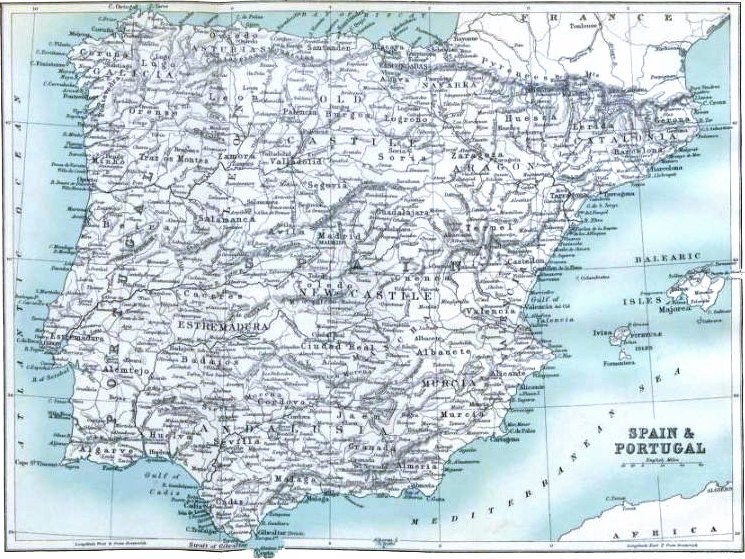
foe in foreign lands. On this occasion we proceeded
to Portsmouth, and with the 2nd Battalion of the 4th
or King’s Own Regiment embarked for Gibraltar, where
we arrived towards the latter end of the ensuing month.
In the April following, Major Browne of the regiment, with
the light companies of the 9th, 30th, and 41st Regiments,
a battalion company of the 28th which I accompanied,
two guns and thirty gunners, the whole amounting to three
hundred and sixty men and officers, marched to Tarifa,
a small town at the entrance of the gut of Gibraltar,
afterwards rendered celebrated by its noble defence under
Colonel Skerrett against Marshal Victor.
CHASED BY FRENCH HORSEMEN.
Soon after our arrival I was sent by Major Browne
with despatches to General Campbell, then Lieutenant-Governor
of Gibraltar. Returning next day with the
general’s instructions, when I had got about half way,
my attention was suddenly called by the peasantry, who
pastured their flocks on the neighbouring hills, frequently
crying out, “Beware of the French!” Neither the dragoon
who accompanied me nor I myself could discover the
slightest appearance of an enemy, and I knew that the
French occupied no part within twenty miles of the place.
Under this conviction I proceeded forwards, yet cautiously,
for the shepherds, who seemed much excited, were running
in all directions collecting their flocks. On our advancing
a short way, we heard the shouts, “Beware of the French!”
repeated with redoubled vehemence. I now stopped short,
when suddenly a French cavalry piquet, consisting of about
twenty men and an officer, darted from out the thickets,
which were so high and the patrol so well concealed
that, although within a hundred and fifty yards of us,
neither the dragoon nor I had discovered any appearance
of either man or horse. They were in their saddles in
an instant, and saluted us with their carbines and pistols
literally before we had time to turn our horses round.
My dragoon darted like lightning off the road towards the
coast, calling upon me to follow, and in an instant was
lost to sight. I felt much disinclination to trust my safety
to concealment in a country with one yard of which
off the road I was not acquainted. I therefore resolved
to rely on the abilities of my horse to make good my
retreat along the road; I could depend upon him for
speed. The patrol gave me chase for upwards of four
miles. We always preserved nearly the same distance, from
a hundred to a hundred and fifty yards apart, losing sight
of each other only when a turn in the road or some high
brambles intervened. Our uniformly preserving nearly
the same distance did not depend on the equal speed
of our animals, but on the nature of the road which was
perhaps the worst mountain road in Europe; and so deep
and so little apart were the ruts by which it was completely
traversed that to push a spirited horse would
be to break his neck to a certainty and most probably
that of the rider also. On approaching the cork wood
not far from Algesiras, the ground being comparatively
level, I very soon left the dragoons far behind.
On my arrival at Algesiras, learning that two Spanish
regiments of cavalry had just arrived there, I immediately
waited on the senior officer, and informed him of what had
occurred, using every remonstrance which I could suggest
to induce him to march to the aid of Tarifa, which, even
before I entered the town, he knew from the peasantry
to be attacked. But all my prayers that he would aid
Tarifa, or at least cut off the retreat of the enemy, were
ineffectual, the Spanish commandant alleging that without
orders he could not move. Upon this I wrote to Lieutenant
Belcher, assistant military secretary to General Campbell,
stating all that had taken place, at the same time
remarking that from the fact, which I learned also from
the peasantry who from far and near drove their flocks
into Algesiras, that no sortie had been made by Major
Browne, I felt convinced that he was attacked by a force
much superior to his own. This letter I immediately sent
off by a boat to Gibraltar.
As soon as it became dusk I again mounted my horse,
if possible to get to Tarifa, attended by the same dragoon
who accompanied me in the morning. This man, who
was no coward, found his way into Algesiras about the
same time that I arrived there. He assured me that
he could conduct me by a coast road to within a hundred
yards of Tarifa without being discovered by any, as it was
a road or rather goat-track but little known. As a proof
of the confidence which he felt, he insisted on taking the
lead, for two horses could not move abreast, and like
a true Spaniard drew his sabre even before he left the
town. The only thing I obtained from the Spanish commandant
was his gratuitous adieu, strongly recommending
that I should not attempt to return to Tarifa until it
should be thoroughly ascertained that the enemy had
retired, to which advice, to avoid the enemy, I paid as
much attention as he did to my recommendation to seek
the enemy. I felt much anxiety to be at Tarifa, the more
as I wished to tell Browne of what I had done, and that
consequently he might expect a reinforcement.
We arrived before daybreak near the town, where
meeting a friar we heard that we might advance with
safety, for the French had retired. It appears that as
soon as Marshal Victor, whose corps were lying before
Cadiz, had learned that Tarifa was occupied by English
troops, he sent out a strong patrol of infantry and cavalry
to ascertain our strength. He felt very jealous of the post,
as it threatened his foraging parties, who frequently came
to the neighbouring fertile plains to procure nourishment
for his army, and principally to collect forage for his
cavalry. For this reason it was that he sent the party
mentioned, who appeared before the walls of Tarifa on
the morning of April 20th before daybreak, seven days
after the place had been in our possession. The surmise
stated in my letter to Lieutenant Belcher proved true.
Major Browne, in consequence of the strong force brought
against him, did not move out of the garrison until the
evening, when the enemy drew off a part of their troops;
then, as they still occupied a large convent and some
uninhabited houses close to the town, a sortie was made,
headed by Captain Stovin, when they were soon dislodged
and pursued for a considerable distance. This demonstration
against Tarifa was attended with but few results or
casualties, one man only, a gunner, being killed and a
few more wounded. Lieutenant Mitchell, a gallant officer,
commanded the artillery.
TARIFA REINFORCED.
On my arrival at Tarifa I acquainted Major Browne with
all that had occurred to me during my absence, my useless
endeavours to induce the Spanish regiments or any part
of the garrison of Algesiras to intercept the enemy’s return
from Tarifa, and finally with my having written to Gibraltar.
The major fully approved of all the steps I had taken;
and, my letter being laid before General Campbell, he
ordered four companies of the 47th Regiment, under the
command of Captain O’Donoghue of that corps, instantly
to embark for Tarifa, but the wind becoming contrary, they
were obliged to disembark at Algesiras and proceed overland.
They arrived at Tarifa the night after my return
there; and here they continued until the month of
September. Then the 28th Regiment, whose colonel,
Belson, had gone to England in consequence of ill-health,
were ordered to Tarifa; and Captain O’Donoghue’s
detachment, together with the light companies which
originally had accompanied Major Browne, were then
recalled to Gibraltar.
Shortly after this attack on Tarifa, an English merchant
vessel was captured by a French privateer in the neighbourhood
of Vejer, not far from Tarifa. A midshipman, who
commanded a gunboat detached from the guardship at
Gibraltar, reported the circumstance to Major Browne, and
applied to him for a detachment of soldiers to embark on
board his boat, stating that so strengthened he might retake
the vessel. Browne, in whose estimation the honour of His
Majesty’s arms in whatever branch of the service was paramount
to any other sentiment, hesitated not a moment, and
ordered me, with as many men of the light company (28th)
as the gunboat could stow, to embark immediately.
A NAVAL BATTLE.
Leaving Tarifa in the evening and pulling all night, we
found ourselves next morning at dawn in the celebrated
bay of Trafalgar; and as soon as light enabled us to see
we discovered the vessel alluded to about two miles distant.
We immediately swept towards her. Soon after a boat
put off from the shore, now in possession of the French,
with intention, as we afterwards discovered, to set the ship
on fire. While some of the sailors and soldiers in turn
used every exertion to row, or rather sweep, we kept up
as quick a fire as possible with a long twelve-pounder and
a twenty-four-pounder at the boat coming from shore.
One shot having struck not far beyond her, whilst a
shower of grape fell but little short, she thought proper
to retire. Being thus freed from the enemy’s boat, we
made a wide offing to keep the vessel between us and shore,
within musket-shot of which she was run aground. On
boarding her, we placed bales of wool or cotton, which
formed the principal part of her cargo, along her side next
the shore to cover us from the fire of musketry; for by
this time a strong detachment of French infantry came
down close to the water’s edge, ranging themselves in
loose order, so as not to offer any dense body to the fire
of the gunboat, which, after putting the soldiers on board
the merchantman, retired beyond musket range of the
shore and kept up a fire of round shot and grape. The
enemy on shore had a similar covering to our own, having
the night before disembarked several bales of the cotton.
Whenever any of these was struck by a round shot, its
bounding from the beach presented a most fantastic appearance
and caused shouts of laughter among the men, which
tended to lighten their fatigue.
After working indefatigably for several hours, we at
length succeeded in getting the vessel afloat. Our labour
was much heightened by our being obliged to work her
off by the windlass, since her capstan was unshipped and
carried away by the French, who had everything in preparation
on board to set fire to her as soon as unloaded,
or if there were an attempt at rescue.
Having succeeded in carrying her off, we returned next
day to Tarifa, where we landed in triumph from our prize,
as she was termed. Next day she was sent to Gibraltar,
and condemned, I think, to salvage or some such term;
but never having on entering the army contemplated
becoming a prize-fighter, I may be mistaken as to terms.
On a distribution of this said salvage money being made,
I was put down to receive a portion such as is allotted
to a sailor, probably an able-bodied one. But on some
person in Gibraltar suggesting that probably it would not
be correct to class me, who was the only commissioned
officer present at the recapture or within sight of it, with
a common sailor, I was on reflection ranked with the
petty officers, cooks, etc., thereby gaining promotion from
the forecastle to the caboose, and obtaining the rank if not
the title of cook. I employed no agent, considering my
claim safe in the hands of the sister profession. Captain
Vivian, who commanded the guardship, the San Juan, at
Gibraltar, I was told, superintended the arrangement; and,
together with the whole of his officers and crew, shared
in the spoil, each officer having a much larger portion than
that dealt out to me, although neither he nor they aided
or assisted, or were or could be in sight, when the capture
took place. The midshipman who commanded the gunboat
was equally unfortunate as to the share to which he was
entitled as the only acting naval officer present at the
capture; but I heard at the time that to quiet him he
was otherwise rewarded. If true, I feel happy at it; and
we both should feel content, he at being promoted to
the rank of a commissioned officer, and I at receiving
a diploma as a master of gastronomic science, although to
this day I am ignorant how to compose even a basin of
peasoup. Shortly afterwards I met Mr. William Sweetland,
who was employed as agent on the occasion. On
questioning him as to the extraordinary distribution, he
with professional coolness replied that he was employed
on the other side, that no person appeared on my behalf,
and that if anybody had, of course there could be no question
as to the sentence which must have been passed. I was
strongly advised to appeal to the Admiralty, as I might
thereby gain a sum of money that would tend to my
advancement; but I foolishly disregarded the counsel.
So I took my cook’s wages, and therewith drank to the
health of my Sovereign, the honour and glory of my old
profession, and success for ever to the Royal Navy. I
was afterwards informed that thanks were given to me
in public orders by Sir Richard Keats. I never saw the
order, and therefore cannot answer for its existence; yet
the fact could easily be ascertained by any feeling interest
in the subject. For my own part, I felt so dissatisfied
at the mercenary or jobbing part of the transaction that
I never took any step to ascertain whether the thanks
were or were not published. Colonel Browne having
visited Gibraltar shortly after the transaction had taken
place, fully explained his and my sentiments to Captain
Vivian on the quarter-deck of the San Juan, among
other assertions upholding that he himself and the whole
garrison of Tarifa, from which Lieutenant Blakeney was
detached, had as strong a claim to participation in the
salvage as Captain Vivian and the crew of the guardship;
and here he was perfectly right, for the garrison of Tarifa
was five-and-twenty miles nearer to the scene of action
than the San Juan stationed at Gibraltar.
A DANGEROUS FORD.
During our long stay at Tarifa few days passed on
which I was not employed either in opposing the French
foraging parties or in carrying despatches to and from
Gibraltar. On one of these latter occasions, when returning
to Tarifa after an absence of three days, detained by heavy
rains, I was not a little surprised at finding a stream
through the cork wood of Algesiras much changed in its
aspect. But three days previously I crossed it when the
horse’s hoofs were scarcely wetted; now it had become
a roaring and rapid torrent. The passage of this torrent
was very dangerous; its bed, with which I was well
acquainted having crossed it fifty times, was formed of
large smooth flags much inclined, making it somewhat
perilous at any time to ride over it. Within fifteen or
twenty yards of this, the only part passable, the water-course
suddenly wound round the base of an abrupt
mountain, against which the torrent rushed with violence,
and continuing its new direction soon disgorged itself into
the ocean. To make a false step in crossing was certain
destruction. The current passed rapidly downwards
between the mountains, its foaming surf interrupted in
its course by huge and prominent rocks, with which the
mountain sides were studded down to the very bed of
the torrent, which, now passing underneath, now boiling
over the rugged and unseemly heads of those frightful
masses of stone, gave them apparent animation; like
monstrous spirits of the flood, they seemed to threaten
destruction to all who came within their reach. With
such a picture before me and considering it a stupid
way of losing one’s life, I hesitated for some moments,
when the Spanish dragoon, who always accompanied me
on such excursions, boldly took the lead and entered the
hissing foam. His horse made some few slips, and more
than once I expected to see both dashed to pieces, which
must have taken place had the animal made a really
false step. Fortunately they got safe across; but this
did not induce me to follow. Few perils I would not
have encountered rather than ride through that frightful
torrent, knowing as I did the nature of its bed. Yet
to return to Algesiras I considered degrading, especially
when the dragoon had so boldly passed across. At length,
and contrary to his advice, I determined to wade on foot,
and flogged forward my horse into the water, which he
unwillingly took, and like the other narrowly escaped.
The last trial was my own. I recollected that, close
above where the horses passed, a rock about two feet
high stood in the centre of the stream, and to lean against
that in case of necessity, I entered the water a little higher.
Fortunately I thought of this precaution, for by the time
I had with the greatest exertion got to where this rock
was situated, I felt so spent and incapable of resisting
the torrent that I could neither proceed nor retire. Placing
both legs firmly against the rock, and feeling quite giddy
from the glare and the rapidity with which the waters
passed, I felt compelled to close my eyes for some
moments.
ESCAPE FROM DROWNING.
My situation was now neither wholesome nor pleasant.
Boughs and trunks of trees rapidly passed at intervals
down the stream, any one of which coming upon me
must have either smashed me on the spot or dashed
me headlong against the rocks below. But luckily I
was preserved by another rock, which stood in the centre
of the channel not far above me, rearing its ample head
over the water; this dividing the torrent, sent the floating
batteries on either side. The poor Spaniard appeared
desperate, violently striking his head, but he did not attempt
the water a second time, nor could I blame him. I wore
a very long sash with its still longer cords, such as light
infantry bucks then used. Untying it and holding one
end, I flung the other towards the Spaniard, who anxiously
prepared to catch it; but it proved too short. He
now took off his sash, which was also long as all
Spanish sashes are, and rolling up a stone within it
flung it towards me with such precision that I caught
it with both hands. I now tied the two sashes together,
and fastened the stone within one end of the dragoon’s
sash, which I flung back to him. He caught it and gave
a cheer. The only thing I now dreaded was that the
Spaniard in his anxiety would give a sudden pull, which,
with the heavy load of water I carried, might cause the
silken bridge to snap or pull me off my legs, either of
which things must be fatal. I therefore cautioned him
to hold firm, but on no account to pull unless I should
fall. He fully obeyed the directions, and I warped myself
safely across. The faithful Spaniard hugged me to his
breast, and having raped my cheeks of a kiss each, burst
into a flood of tears, declaring that had anything happened
to me he would instantly have deserted to the French;
he said that, had I been drowned and of course carried
into the ocean, no assertion of his could have prevented
any one from considering him the cause, and that consequently
he would have been torn to pieces by the English
soldiers at Tarifa.
It was now about dusk, and the Spaniard having assisted
me to mount, we started forward as fast as the badness
of the road would permit, for we had several miles still
to traverse. The expression of the inexpressible part
of my dress at every stride of the horse resembled the
sound made by steaks being fried in an adjoining room
while the door is continually shutting and opening. This
simile will now no doubt be considered excessively vulgar;
but at the period alluded to most officers were familiar
with a frying-pan, and even a guardsman in those days
could rough it on a beefsteak and a bottle of old port.
We arrived at Tarifa long after the officers had dined.
Colonel Browne well recollects the circumstance, as it
was on this occasion that I brought him a letter written
by Lord Bathurst appointing him Lieutenant-Governor of
Tarifa, with a pecuniary advantage attached which was
not the least acceptable part of the communication.
In this expedition I lost the use of a gold repeater,
which was so gorged by the mountain torrent that I never
afterwards could keep it in order.
A REVOLT OF WOMEN.
Soon after this I was again sent to Gibraltar with
despatches, relative to which some notable occurrences
took place. I should have previously mentioned that
shortly after our occupation of Tarifa a corps or civic
guard, composed of young men, inhabitants of the town,
was formed. The command of this body, called the
Tarifa Volunteers, amounting to from forty to fifty individuals,
was confided to Captain Meacham, 28th Regiment,
not only because he was a gallant and experienced officer,
but also on account of his knowledge of the Spanish
language, acquired at an earlier period when the regiment
was stationed in Minorca. This corps in its infancy imperfectly
drilled, without any established uniform and
not very imposing in appearance owing to their diversity
of dress, could not be relied on as an efficient force. For
these reasons perhaps it was that they got the name of
“Meacham’s Blind Nuts,” so baptised, if I mistake not,
by Captain Allen of the 10th Regiment. However, to
ascertain what might be expected from them in case
of an emergency which was daily expected, Major Browne
determined to put their alertness at least to trial, confiding
his plan to the Spanish lieutenant-governor. After a
jovial dinner-party he, about an hour before daybreak,
ordered the drums and bugles to sound to arms and troops
to line the walls immediately, stating that the French
were rapidly advancing against the town. The first to be
seen, sabre in hand, was the Spanish governor, previously
warned; then came forth the British garrison with firm
and equal step; and last and not too willingly appeared
the rather tardy volunteers. They were to be seen in
small groups scattered through the town, no kind of
formation having taken place preparatory to their going
to the walls; and so they slowly moved along the streets.
To hurry them up a gun was fired, when an extraordinary
scene was presented. Suddenly all the doors in the town
flew open, and out rushed a fiercer and more warlike
body by far. The streets were instantly crowded with
women, one seizing a husband, another a son, a third
a brother; some clinging to their dearly beloved, all
endeavouring to snatch them by force from out their
warlike ranks, loudly and bitterly exclaiming against the
British, who, they cried or rather screamed, being fond
of bloodshed themselves, would force others into fight
whether willing or otherwise. At length, urged by some
British officers and breaking away from their wives,
mothers, sisters and lovers, in whose hands remained many
cloaks, coats, hats and even torn locks of hair, the poor
Nuts arrived half shelled upon the ramparts. Dawn soon
after breaking, all the guns were fired off, but surpassed
by the louder screaming inside the town. The rough music
of the artillery was immediately succeeded by the more
harmonious sounds of the band playing “God save the
King.” All was soon restored to tranquillity, save for a
few contentious Blind Nuts, each claiming to be the first
who mounted the walls and offered himself to be cracked
in defence of his country.
Scarcely had this scene terminated when Colonel Browne
received important intelligence of the enemy, and I was
immediately sent with despatches to Gibraltar by water,
the wind being rather favourable though strong, but the
weather rainy. On my arrival at Gibraltar, to my utter
astonishment I found the landing-place crowded with
inhabitants, officers and soldiers, all greedy to know the
nature of my despatches, especially as I had come away
in such boisterous weather and in an open boat. All were
in the greatest anxiety; for an English man-of-war,
happening to pass by Tarifa at the moment the guns were
firing from the ramparts, reported the circumstance at
Gibraltar, but as it was blowing hard at the time and
there was no port, she had not been able to stop to ascertain
the cause of the firing. This, since a second attack on
Tarifa by a larger force was threatened by the enemy,
caused the greatest excitement at Gibraltar.
The first person who addressed me on landing was
Lieutenant Taylor, 9th Regiment (afterwards shot through
the body at Barossa), demanding, without any prelude
whatever, if Captain Godwin of his regiment was wounded.
I dryly answered, “Yes.” “Where?” “In the shoulder.”
“Are they beaten off?” “They are not there now.”
This was sufficient to extricate me from the surrounding
crowd, which otherwise would have impeded my progress
to the convent for at least an hour. As soon as Taylor
got his information, he, followed by the crowd, whom I
refused to answer, ran off to communicate his intelligence
to his commanding officer, Colonel Mole, and Mole instantly
galloped off with the news to General Bowes.
NEWS OF BATTLE.
In the meantime I delivered my despatches to General
Campbell at the convent. Proceeding thence to Captain
Power, who temporarily commanded the 28th Regiment,
I was there met by Captain Loftus, aide-de-camp to
General Bowes, with a message from the general that I
should immediately, and in writing, state my reasons for
having propagated unfounded reports of an attack and
battle fought at Tarifa. I instantly answered that I had
propagated no reports; that the words battle or Tarifa
never escaped my lips; that to get rid of an idle and
troublesome multitude who surrounded me on landing, I
muttered something in a low tone of voice to Lieutenant
Taylor, telling him loud enough to be heard by many not
to divulge anything until the contents of the despatches
which I carried should be made known through the
proper channel; that Taylor promised secrecy; and that my
stratagem succeeded, for on his departure at a quick pace
the crowd followed. I further added that, had I the
slightest conception that anything thus communicated could
be believed by a general officer, I should certainly have
remained silent, however incommoded by the mob; and
that to free myself from them was my only object. This
explanation seemed to have been sufficient. I had no
further communication from the general; but the circumstance
having been privately communicated to General
Campbell, he sent for Bowes and said, “So, general, I
understand that you have had a flying despatch relative
to a great battle being fought at Tarifa. I should think,
general, that if such had been the case, this would have
been the proper place for you to seek information,
instead of sending in pursuit of the officer who carried
despatches to me to know his reasons for any heedless
conversation that might have taken place between him
and any idlers by whom he was surrounded at the Mole.
I understand also, general, that so pressing were you for
his written explanation, that time was not allowed him to
change his wet clothes, for which purpose it was I allowed
him to go away, since he had been drenched with rain for
several hours in an open boat.” I met General Bowes the
same day at the general’s table. With a smile upon his
countenance he very politely invited me to drink wine
with him; and the governor requested that, whenever I
brought despatches, I should make the best of my way
through the idlers, but should communicate with no one
until I saw him. Thus the affair terminated as far as
the generals were concerned.
But all my troubles were not as yet ended; I had to
encounter others on my return. During my absence
Godwin had been told that I reported his having been
wounded in the back of his shoulder; but although he
taxed me with the report in a laughing way, still he
appeared not well pleased. His usual good-humour returned
when I assured him that I never made use of such an
expression; and certainly Godwin was one of the last
to whom I should attribute a wound in the back. The
fact was that he had been hurt in the shoulder a short
time previously by his horse running with him against
a tree.
A BOY OF NERVE.
I frankly confess that while the affair was in agitation
between the generals at Gibraltar I felt somewhat nervous,
owing to a circumstance which took place five years
previously. It may be recollected that in 1805 the regiment
were encamped at the Curragh of Kildare. During the
early part of this encampment, when I was on duty on
the quarter-guard, it so happened that General Campbell
was general officer of the lines; and unfortunately it
so fell out that the adjutant neglected to send me the
parole and countersign until a very late hour. In the
meantime came the grand rounds, who were rather hesitatingly
challenged for the password, of which we ourselves
were in total ignorance. The general, noticing the not
very correct manner in which he was received and disregarding
the challenge, rode up at once to the quarter-guard,
and, reprimanding me for the slovenly manner in which
the advanced files were sent forward, demanded the
countersign, adding that he believed I did not know it.
At the moment, as the general turned his head away,
the sergeant of the guard, having that instant received
the parole and countersign, stepped forward and whispering
the words in my ear put the paper containing them
in my hand; but the general perceiving some movement
rowed the sergeant for being unsteady under arms, and
called me forward rather briskly, repeating his belief that
I had not the countersign. I told him I had.
“And what is the countersign?” quickly demanded
the general.
I now coolly replied, “I am placed here to receive, not
to give the countersign.”
The general was evidently amazed at the reply, and
saying, “Very well, sir, we shall see about this in the
morning,” turned his horse round to ride off.
This was the first quarter-guard I had ever mounted,
and from the novelty of the scene and my not having
the countersign when the grand rounds arrived, I felt
excessively nervous; but although my knees at the first
onset beat the devil’s tattoo against each other, yet, having
now gained full confidence, rather augmented by a titter
amongst the general’s staff one of whom was his son,
afterwards Sir Guy Campbell, I told the general that my
orders were to allow no person to pass without his first
giving the countersign. Here the titter increased.
“What,” said he—“not let me pass?”
I made no reply; but retiring the two paces which
the general had called me forward, I remained on the
right of my guard, looking most respectfully at the
general. After a moment’s thought he gave me the
countersign, and having received the parole in exchange
rode away. I was in hopes that the unpleasant
affair had ended here; but immediately after I was
relieved from guard I was sent for by Colonel Johnson,
who, although not my immediate commanding officer,
commanded both battalions as senior lieutenant-colonel.
To him therefore the general complained, and to him
he seemed to attach most blame for allowing so young
an officer, and so totally ignorant of his duty, to take
charge of a quarter-guard. All the field officers of the
two battalions were summoned on the occasion to Colonel
Johnson’s tent, and in their presence the general recounted
the whole transaction. I remained perfectly silent. On
his coming towards a conclusion, when he mentioned my
having refused to let him pass, which he repeated with
emphasis, I saw a suppressed smile on the faces of both
Colonel Johnson and Colonel Belson. But Major Browne,
impatient of restraint, broke into a laugh exclaiming,
“Well, he is only one year in the Service; I am many,
yet I wish I knew my duty as well; and,” continued he
with increased laughter, “it is the first time I ever heard of
a boy ensign taking his own general prisoner.” Browne was
wrong as to my rank, for I had been five days a lieutenant.
COALS OF FIRE.
However, the general did not seem to enjoy the joke as
much as Browne did, and ordered Colonel Johnson to
reprimand me. Johnson, who was brother-in-law to the
general and one of the most gentlemanlike persons possible,
bowed assent, but in some way gave the general to understand
that he was at a loss to understand what particular
part of my conduct it was for which I was to be censured.
The general having retired, Johnson’s rebuke to me was
very slight indeed, particularly when I mentioned, as I
refrained from doing while the general was there, that the
countersign and parole, with which I should have been
furnished before sunset, were not sent to me until midnight,
just as the grand rounds advanced. But if the lieutenant-governor
recollected this anecdote when at Gibraltar, it
certainly caused no difference in his courtesy or hospitality
towards me; for he insisted that whenever I visited
Gibralter I should always make the convent my headquarters.