Situation—Climate—Stillness of the air—Castle—Abd-el-Kader—Thackeray
on his imprisonment—View of the Pyrenees—Henry II
of Navarre—His escape from Pavia—Marguerite des Marguerites—What
Henry II did for Béarn—Refugee Huguenot preachers—Solon
and his many wives—Clement Marot—His Psalms—The Queen an odd
mixture—Story of Mlle. de la Roche—Jeanne d’Albret—Marries the
Duke of Cleves—Then Antoine de Bourbon—His murder planned—Birth
of Henry IV—Cradle—Bilhère—Reared at Coarraze—Death of
Antoine—Intolerance of Jeanne—Meeting with Charles IX—Gondin’s
unfortunate pleasantry—Marguerite de France’s visit to Pau—The
Count of Moret—A mysterious hermit—Henry IV tolerant—The
Baron d’Arros—Demand for the columns of Bielle—La Poule au Pot—Lescar—Mosaics—A
Roman villa—Gassion—Bernadotte—Morlaas—Pont-long—Legend—Coarraze—Betharam—A
flying Virgin—Jurançon
wine.
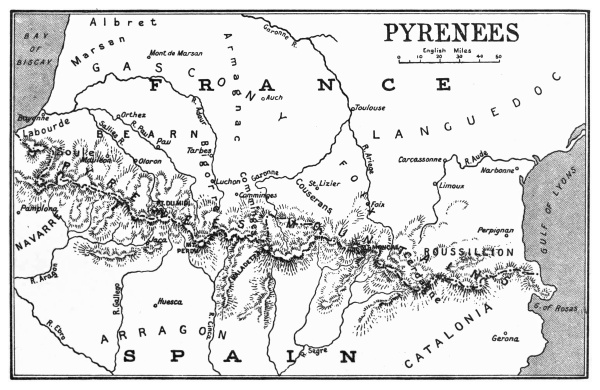
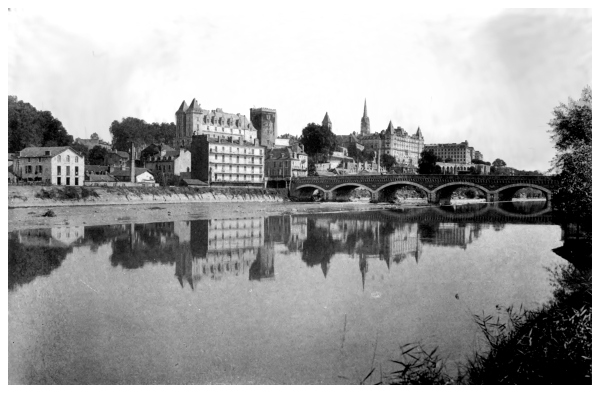
The situation of Pau is singularly favoured, and one can
appreciate the judgment of Henry II of Navarre in
transferring thither the court residence from Orthez. Pau
occupies the back of a rubble ridge stretching east and west,
facing the south, and drinking in the sunlight and warmth.
It does not suffer from cold winds. The land rises behind it
to the north, and one may see the clouds fly overhead without
feeling the air stir at Pau. The calmness of the atmosphere
often persists for weeks together.
PAU
In this it has an advantage over some of the towns of the
French Riviera, where the mistral cuts like a knife that has
been frozen in an ice-pail. The bitter winds that sweep down
on the Riviera are produced by the snows of the Maritime
Alps. But there are no snows at the back of Pau. When
there is no breeding ground for icy winds, no icy winds are
hatched.
But, on the other hand, a good deal of rain is brought up
and discharged over Pau, coming from the Atlantic; and a
whole month may elapse without the promenaders on the
terrace being able to catch a glimpse of the Pic du Midi
d’Ossau. The Girondin climate is notoriously rainy, especially
in spring; but nothing can surpass the splendour of the days
in summer and autumn.
Mrs. Ellis, who wrote her Summer and Winter in the Pyrenees
in 1841, says:—
“At the foot of the woody range of high ground forming the
promenade runs the broad, shallow river Gave, with a perpetual
low murmur that lulls the senses to repose. It is, in
fact, the only sound we hear, for there is so little wind in this
climate that not a leaf is seen to move, and we therefore distinguish
at a greater distance the toll of the matin and vesper
bell in the neighbouring villages, and the tinkling sounds
which tell when the flocks are led to and from the fields. There
appears at first a sort of mystery in this universal stillness.
It seems like a pause in the breath of Nature, a suspension of
the general throb of life, and we almost feel as if it must be
followed by that shout of joy which the language of poetry has
so often described as the grateful response of Nature for the
blessings of light and life. And never, surely, could this response
be offered more appropriately than from such a scene
as this rich and fertile land presents.”
It was due to this climatic condition that in the first half
of last century patients in the early stages of consumption
were dispatched to Pau. Now that the treatment of phthisis
is revolutionized, it is no longer a resort for such as suffer
from pulmonary complaints, but serves as a refuge from the
stormy English winters for those who desire pleasant resting
places where there are races, fox-hunting, and good company.
The climate, however, does not agree with all constitutions.
It is enervating, a land of lotus-eaters—
“In which it seemed always afternoon.”
Pau, the old Pau, is attached on the north to the dreary
lande of the Pont-long that has belonged from time immemorial
to the inhabitants of the Val d’Ossau, and which is
strewn with tumuli. But from this plateau it is in part cut
off by the stream Hédas, that has cleft for itself a valley
dividing the town into two parts. New Pau has spread and
is spreading to north and east, so that its extremities have to
be reached by electric trams. Happily, to the west it cannot
encroach on the rubble ridge occupied by the park. Between
this park and the castle which occupies the extreme west of
the town the ridge has been sawn through by the stream,
but the gap has been widened artificially, and is now
spanned by a bridge.
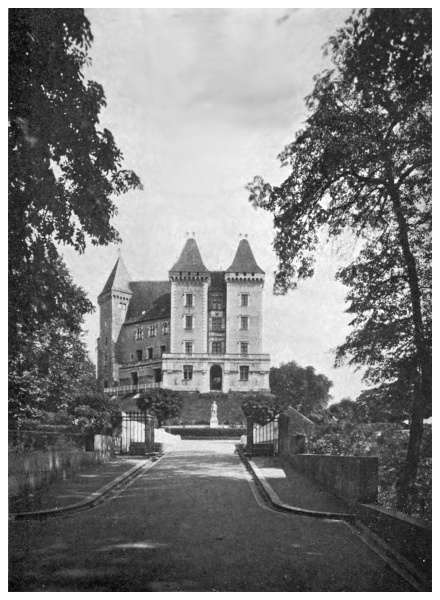
The Castle of Pau was built at various dates. The four
towers and the curtain uniting them, except the south and
east faces, are the oldest part, and were erected by Gaston
Phœbus in or about 1363. The donjon to the east is of brick,
and is furnished with slots. The work begun by Gaston
Phœbus was continued by his successor, but the magnificent
south façade, the state buildings, and the enrichment of the
court within, in the style of the Renaissance, are due to
Henry II of Navarre; and the sixth tower was set up by
Louis Philippe.
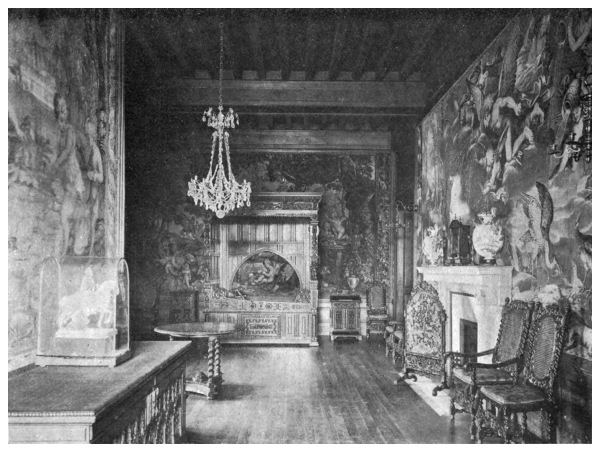
The whole castle, especially the interior, has gone through
a complete restoration, for it had been plundered and gutted
by the Revolutionists. The tapestries that now cover the
walls were collected from various places. The furniture, to
a large extent modern, is a clumsy imitation of old work;
there are, however, some fine ancient cabinets. In this
castle was confined for a while Abd-el-Kader. In 1848 I
visited him there several times. He had with him a suite
and his wives, all insensible to the stateliness of the castle
and the glorious panorama from the windows. They lounged
about the rooms silent and smoking, sulky, without occupation
and without interests. Their habits were so dirty
that the tapestries and rich furniture had all to be removed.
Abd-el-Kader had maintained a long and gallant resistance
against the French, and when he surrendered to the Duc
d’Aumale and General Lamorcière, it was on the stipulation
that he should be allowed to retire in freedom to Egypt or
into Syria. The terms were accepted and broken. He was
removed a prisoner to Toulon, then to Pau, and in November,
1848, he was transferred to Amboise. Napoleon III released
him in 1852, and he finally settled in Damascus. In the
terrible massacre of the Christians at Damascus in the summer
of 1860, by Turks and Druses, Abd-el-Kader acted with
such energy to protect the Christians that the Emperor of
the French sent him the gold cross of the Legion of Honour.
Possibly enough he may have been moved to this intervention
on behalf of the Christians by recollecting the kindness
that was shown him in his captivity by both English
and French residents at Pau, sending him fruit and flowers
for the ladies of his harem.
It was during his imprisonment at Toulon that Thackeray
wrote his stirring lines:—
“No more, thou lithe and long-winged hawk, of desert life for thee;
No more across the sultry sands shalt thou go swooping free;
Blunt idle talons, idle beak, with spurning of thy chain,
Shatter against the cage the wing thou ne’er mayst spread again.
* * * * *
“They gave him what he asked; from king to king he spake
As one that plighted word and seal not knoweth how to break;
‘Let me pass from out my deserts, be’t mine own choice where to go,
I brook no fettered life to live, a captive and a show.’
“And they promised and he trusted them, and proud and calm he came,
Upon his black mare riding, girt with his sword of flame:
Good steed, good sword, he rendered unto the Frankish throng;
He knew them false and fickle—but a Prince’s word is strong.
“How have they kept their promise? Turned they the vessel’s prow
Upon Acre, Alexandria, as they have sworn e’en now?
Not so: from Oran northwards the white sails gleam and glance,
And the wild hawk of the desert is borne away to France.
“They have need of thee to gaze on, they have need of thee to grace
The triumph of the Prince, to gild the pinch-beck of their race.
Words are but wind, conditions must be construed by Guizot:
Dash out thy heart, thou desert hawk, ere thou art made a show.”
With the exception of the castle there is nothing of architectural
interest in Pau. The churches are modern, and the
predominant feature of the place is hotels, monster hotels
that even dwarf the castle.
But the great glory of Pau is the view of the chain of the
Pyrenees from the terrace and the park. That from the
Schänzle above Berne of the giants of the Oberland is beautiful,
but not comparable with the prospect from Pau. All
the middle distance in the view from Berne is filled up with
rolling hills, and it is over them that one catches glimpses of
the snowy heads of the Alps. But from Pau one has in
front the broad trough of the Gave, beyond which are the
coteaux, not too high, and not obscuring the lower parts of
the mountains. It is true that an obnoxious swell to the
south-west cuts off the prospect of the range to the Bay of
Biscay, but the mountain range can be traced eastward till
it fades into vapour, and the mountains on that side are by
far the boldest and loftiest. Moreover, one can look from
Pau right up the gap of the Val d’Ossau to the roots of the
Pic du Midi, an exquisitely beautiful mountain, only surpassed
by the Matterhorn; and it has this advantage over
its rival, that it can be seen from a great distance, which
the other cannot.
Below the terrace of the castle rises the insignificant tower
of la Monaye, where the specie for circulation in Béarn and
the annexed counties was coined.
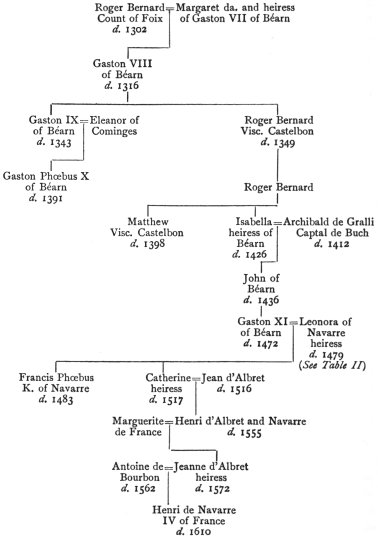
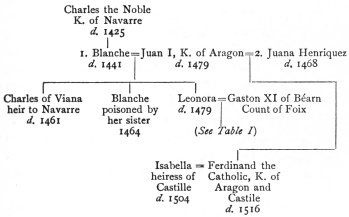
In the second chapter I told the story of the House of
Foix and Béarn down to the death of Catherine, who ate out
her heart with rage because she could not acquire the kingdom
of Upper Navarre, to which she laid claim. Her son and
successor was Henry II of Navarre.
He obtained the name of Henry in a somewhat singular
fashion. At his birth a pilgrim was passing through Pau,
of obscure origin, named Henry, on his way to S. James
of Compostella. Jean d’Albret, moved by a sudden freak,
summoned this man to be godfather to his boy, the heir to
the crown of Navarre, instead of inviting a prince to stand
sponsor. This occasioned much ridicule among the haughty
Spaniards, who said it presaged that the young Henry would
be a stranger to his kingdom.
He was brought up with Francis I of France, and the two
were warmly attached to each other. He accompanied
Francis in his disastrous expedition to the Milanese, and
shared captivity with the King at Pavia. His ransom was
fixed at a hundred thousand crowns. Henry did not care to
burden his little territory with such a charge, and he devised
means to escape. A lady in Pavia managed to convey to
his prison a rope ladder, and one night in December, 1525,
when the moon shone, he slipped out of the window of his
cell and descended the ladder. It was too short, and he fell
into the moat. Happily this was more full of mud than of
water, and without loss of time he scrambled out, plastered
with slime, mounted a horse, held in readiness by his accomplices,
galloped away, and managed to reach Lyons. On
the morning after his evasion the commandant of the Castle
of Pavia entered the cell and bade his royal prisoner get up.
A voice from the bed replied, “For pity’s sake, let me sleep
a little longer.” He who spoke was a page of the King of
Navarre, who had taken his place, so as to deceive the guards
and give his master time to escape.
The affection and esteem which Francis I had for Henry
were shown in that he gave him as wife his dearly-loved sister
Margaret, the “Marguerite des Marguerites, sa mignonne,”
as Francis called her. The marriage took place on 24 January,
1527. The Court of Paris was inconsolable at the loss of
the lively and charming princess. The Parisian doctors
remonstrated with her at going to so inclement a place as
Pau where, said they, “le gros air du pays lui serait
mortel.” However, go she would, with her beloved
Henry, and on reaching Pau she at once set to work to
make herself happy, and to be beloved by the people.
She began by studying the patois and worked at it so
diligently that she was herself astounded at the progress
she made.
“The newly-married pair,” says an old historian, “deliberated
how to put Béarn in a better condition from that
in which they found it. This land, good and fertile by nature,
was in a poor state, uncultivated and sterile through the negligence
of the inhabitants. It soon changed its appearance.”
Henry devoted himself especially to agriculture; he invited
farmers and labourers from Brittany, Berry, and the
Saintonge to settle in the land and teach the natives improved
methods of cultivation; and the introduction of
maize into Béarn was due to him. He set up a linen factory
at Nay, and a printing press at Pau. He collected, revised,
and edited the fors of Béarn, and had them printed at his
press in 1551.
THE CASTLE, PAU
One of the most important pages in the life of the Queen
of Navarre in the Château of Pau was the part she played in
receiving refugee Huguenot preachers. But she never herself
became a convert to Calvinism; she entertained great pity
for the innovators who were driven from place to place, and
subjected to cruel persecution. She offered them an asylum,
and listened to their harangues without the impatience
shown by her husband, who, when they began to preach,
retired to his bottle and his cards.
“The Queen of Navarre,” says Florimond de Rémond,
“gave ear to them, received their books at first by the hand of
her ladies, has had the Latin prayers of the church translated
into French ... out of kindness of heart she throws open
her house to the proscribed and banished, and bids them regard
it as a retreat and refuge. She exercises marvellous care
in protecting those who are in danger on account of their
religion, and in succouring the refugees from Strassburg and
Geneva.
“Roussel was received by this good princess into Béarn and
given a state lodging in her house. She takes pleasure in
listening to him as he discourses on religion. He persuaded
her to read the Bible, then very uncouthly translated into
French; and this so pleased her that she composed a tragi-comic
translation of nearly the whole of the New Testament,
and had it acted in the great hall before the King, her husband.
For the purpose she secured the best comedians that could be
procured from Italy; and as these buffoons are born only to
afford amusement, and, monkey-like, to mimic what may
meet the humours of their masters, so these people, recognizing
the inclination of the Queen, interlarded the text of these plays
with roundelays and virolais on the theme of the clergy.
Always some poor monk or religieuse was made the butt in one
of these comedies or farces.”
Florimond de Rémond goes on to say that some of the
preachers harboured by Marguerite were not of high character.
Among them was Solon, a runaway Carmelite, a “brave et
courageux moine,” who embraced the doctrines of Calvin,
and to make up for wasted opportunities in the past married
and buried five wives in succession.
Some of the sacred pieces enacted before the King and Queen
were the Nativity, the Adoration of the Magi, the Flight into
Egypt; and into these plays scurrilous and indecent songs
were introduced, without a word of protest from the preachers.
Marguerite took as her valet Clement Marot, who had not
the best of characters, and scandal said that she liked him a
little too well.
Unsuspectingly Marot did a great work for Calvinism in
France.
He had translated the Psalms of David into popular
rhythm. His metrical version became the rallying songs of
the Huguenots, and formed the basis of their liturgy. They
were set to popular folk-airs.
The French ladies, as he said himself, placed
leurs doigts sur les espinettes
pour dire saintes chansonettes.
So little heretical was his version regarded that in 1540,
before it was printed, Francis I made a present of it to
Charles V. Florimond de Rémond says:—
“Each of the princes and courtiers adopted one or other of
the psalms for himself. King Henry chose as his own Psalm
XLII., Ainsi qu’on oyt le cerf bruire, which he sang when hunting.
Mme. de Valentinois (Diana of Poitiers), his mistress, took as
hers Ps. CXXX., Du fond de ma pensée, which she sang when
galloping. The Queen had selected V.; Ne veuillez pas, O Sire,
set to a buffoon melody. The King of Navarre, Antoine de
Bourbon, chose XLIII., Revenge moy, prens la querelle, which he
sang to a branle (a dance tune) of Poitou; and so with the
rest.”
But little by little these metrical psalms assumed an
aggressive tone; passed among the people, and these took
them to heart more seriously than did the courtiers.
Bordier, in his Chansonnier huguenot, says:—
“It was soon seen with what energy the Huguenots assimilated
this poetry, which responded so well to their burning
faith. They knew the psalter by heart. It became one of the
tokens by which they recognized one another at long distances,
before coming in sight, when certain familiar melodies were
borne to their ears. From the windows of the Louvre Henry II
more than once saw a crowd flushed with enthusiasm fill the
Pré aux Clercs, promenading in the evening with gravity,
trolling out these psalms.”
The Queen of Navarre was certainly a strange mixture;
she wrote treatises of piety, composed a Mirror of the Sinful
Soul, wrote songs, and in her old age was the authoress of
that book of indecent tales, the Heptameron, which is still
read, whereas the Mirror of the Sinful Soul is forgotten.
She took as her device the marigold turning to the sun,
and as her motto, “Non inferiora sequor,” hardly appropriate
to the compiler of the Heptameron.
A pretty story is told of her by Brantôme. She had as
one of her ladies-in-waiting Mlle. de la Roche, who had been
the mistress of Captain Bourdeille, but whom he had cast
aside and forgotten. Mlle. de la Roche died in the Queen’s
service at Pau, and was buried in the church of S. Martin.
Three months later Bourdeille came to Pau, and was received
by the Queen, who invited him to attend her to the church.
When there, standing in a certain place, Marguerite said to
him, “Do you feel the ground heave under your feet?”
“Not in the least,” he replied. “Surely you do?” “Madame,
I assure you that I do not.” “That is strange,” said
the Queen, “for beneath your feet lies your poor, deserted
Mademoiselle de la Roche, sighing because that above her
stands the man who deceived her. I leave you now alone
to your reflections.”
Marguerite entertained a horror of death, but on hearing
that her dearly-loved brother Francis was no more, her joy
of life, her spirits left her, her health failed, and she died at
Odos in Bigorre in 1549.
Her daughter, Jeanne d’Albret, was left heiress of Navarre,
Béarn, Bigorre, Foix, and Armagnac, which had been part of
her mother’s dower. Jeanne was born in the Castle of Pau in
1528. At an early age she was removed to the Court of the
King of France, and was betrothed at the age of twelve, and
married in 1546, when eighteen years old, to the Duke of
Cleves, who was twelve years her senior. She was so burdened
with pearls and embroidery over brocade and gold lace
at her wedding that she was unable to walk, and had to be
carried into the church from the carriage in the arms of the
Constable of France. But she did not relish the union, and
it was annulled. In 1548 Jeanne married Antoine de Bourbon,
a feeble, voluptuous, irresolute creature, “to one thing
constant never.” He was first a Catholic, then a Huguenot,
under the influence of the commanding intellect of his wife,
and then a Catholic again; it mattered not to him, for he had
no fixed principles. But Jeanne never forgave his rejoining
the Church, for she was a bigoted Calvinist.
Jeanne was nearly deprived of her husband. Antoine de
Bourbon, who was suspected of taking part with his brother,
the great Condé, in the conspiracy of Amboise, 1550, was
marked out for destruction. The two brothers were arrested
by Francis II. Olhagary, a Protestant writer, gives what
follows. He had it from the recital of Queen Jeanne herself;
but how far coloured by her prejudices we are unable to say.
“The Prince of Condé was sentenced to have his head cut
off before the King’s residence, on 10 December. Antoine de
Bourbon was to be stabbed by the King himself. For this he
was ordered to attend in the chamber of the King, who pretended
to be ill. Francis was to stab him with his own hand,
aided by the Guises who were hid behind the arras.”
Antoine was on the point of entering the presence chamber
when the Duchess de Montpensier caught him by the arm
and revealed to him the plot. He then withdrew. But again
a messenger arrived from the King ordering him to appear.
Then he summoned to him Reuti, the captain of his guards,
and said—
“I am going to where my death is planned, but never shall
skin be sold so dearly as I will sell mine. I beseech you to
render me this last service. If I die, take my shirt soaked in
my blood, and carry it to my wife and son, and charge her—for
my son is too young to be able to avenge me—to send the
pierced and bloody shirt to all the foreign princes, and call on
them to avenge my death.”
Antoine then entered the room where was the King, but
his behaviour, the frankness with which he met the charges
laid against him, caused the heart of Francis to relent,
and he dismissed the King of Navarre unhurt. It was
then that the Cardinal of Lorraine exclaimed, referring
to the weakness of the King—“There is the heart of a
poltroon!”
Jeanne had been the mother of two sons; the elder died of
over-coddling, the second of an accident. When she was
again expecting her confinement, her father, Henry II, roughly
told her that she did not know how to manage her children,
and insisted on her coming to the castle at Pau for confinement,
under his eye. She obeyed, and arrived on 4 December,
1553. Then the old King showed her a casket of gold,
attached to a chain long enough to go thrice round her neck.
“Do you see this?” said he; “I will give it you along with
my will, that is in this box, if you will sing a Béarnais song
whilst in your pangs, so that the child may not be a
squaller.” She promised, and on 14 December, feeling her
hour approach, sent for her father, and began to sing a
Béarnais hymn to Our Lady at Bridgend; for there was
a chapel to the Blessed Virgin on the ancient bridge over
the Gave. Her song was:—
“Nousté Dame deii cap d’eii poun
Adjudat me à d’aqueste ore,” etc.
But as many of my readers do not understand the patois,
I will give it in English:—
“Our Lady at the head of the bridge, assist me in this hour.
Pray to God in Heaven, that He may deliver me, that the fruit
of my body may see the light.... Our Lady at the head of the
bridge, assist me in this hour.”
She gave birth—some say on 13 December, some on
14 December—still singing, to a boy. Henry II took it from
her, gave her the casket, saying, “This is for you,” and as
to the boy, “this is for me.” Then he rubbed the child’s
lips with garlic, and poured into its mouth some drops of
Jurançon wine, and said: “Va, tu serras un vrai Béarnais.”
When Marguerite had given birth to Jeanne the Spaniards
had remarked, “The cow has littered a lamb!” in reference
to the cow in the Béarnais arms. Now Henry d’Albret,
taking the child in his arms, showed it to his nobles and
exclaimed: “See, the lamb has littered a lion!”
In the castle is shown the cradle in which the future king
of France, Henri Quatre, was rocked. It is a large tortoise-shell,
inverted, and suspended by silken cords. When the
Sansculottes burst into and sacked the château in 1793, they
purposed to destroy this relic of royalty. But the commandant
of the castle had foreseen this, and had substituted for
the original another tortoise-shell, obtained from the cabinet
of a naturalist in the town. This latter was destroyed, but
the original was preserved in the attics of the castle.
At Bilhère, a little way out of Pau, on the road to Orthez,
is the cottage in which Henry was nursed by a peasantess.
That cottage remains much in the same condition as it was
then, and is pointed out to visitors with pride.
When only five years old his mother took him to Paris to
present him to Henry II, King of France. The King took
the little prince in his arms and asked him, “Veux-tu être
mon fils?” The child, unable to speak other than Béarnais
patois, pointed to his father and answered, “Aquet es lou
seignou pay” (This is monsieur, my father). “You are
right,” said the King, “but as you will not be my son, will
you be my son-in-law?” To which the boy promptly replied,
“Obé.” Marguerite de Valois was then eighteen months
older than Henri.
After a while in Paris he was taken back to Pau and committed
to the care of Suzanne de Bourbon Busset, Baroness
Miossens, who was sent with him to the Castle of Coarraze,
near Nay, with instructions that he should be reared among
the children of the mountains on simple, wholesome diet.
Accordingly he was treated like the peasant children—was
clothed in the same garb, and partook of the same athletic
sports. His food was often dry bread. Frequently he trod
the mountain paths with bare feet, or clattered about in
sabots. For many years he knew no other tongue than the
patois, and in after life a bon mot, or a lively sally in his
maternal language, served as one of the most powerful means
by which to influence the young Gascons whom he led to
battle.
Antoine de Bourbon fell at the siege of Rouen in 1562,
fighting against the Huguenots, and Jeanne was then left
free to force Calvinism on her subjects. Thenceforth she was
able to rule despotically in her own dominions, till interfered
with by the French king. Beza, with approval, records her
declaration: “Sooner than ever again attend Mass, or suffer
any of my subjects or my children to do so, I would, if possible,
cast them into the depths of the sea.” And to Henry, when
young, she said passionately that should he at any time
attend Catholic worship, she would repudiate and disinherit
him.
She began by confiscating Church property and appropriating
to herself monastic lands. Commissioners were
appointed to go through the country, wreck the churches,
and sweep into her mint all the gold and silver chalices,
candlesticks, and crucifixes, to be coined into money. She
expelled the priests and put ministers in their place. At Pau
she hung two of the canons of S. Martin’s, and sent a Huguenot
preacher into the pulpit. The town council remonstrated.
The Queen’s reply was that she would with her troopers
drive the councillors to be present at his predications. She
made it punishable with death as high treason not only for
a priest to say Mass, but for man, woman, or child to attend
at one.
Charles IX of France went to Nerac, in Gascony, to visit
Jeanne.
“In some respects,” says Mr. White, “the province of Gascony
through which the Court was now travelling, had suffered
more than any part of France from the effects of the war.
The Protestants had succeeded in putting down Romanism,
and at every step he took Charles was reminded of the outrages
offered to his religion; he restored the old form of worship,
but the scenes he then witnessed appear never to have been
forgotten. As he rode along by the side of the Queen of
Navarre he pointed to the ruined monasteries, the broken
crosses, the polluted churches; he showed her the mutilated
images of the Virgin and the saints, the desecrated graveyards,
the relics scattered to the winds of heaven.”F
Jeanne looked with sparkling eyes and with a heart that
swelled with exultation at this wreckage, but she noticed
the pain it caused to the young king, and thenceforth regarded
him with distrust.
ROOM OF JEANNE D’ALBRET, CASTLE OF PAU
A Béarnais named Gondin ventured to remonstrate with
Jeanne at her high-handed dealings. “The King of France,”
said she, “choses to have but one religion in his realm. I am
a queen, and I choose to have but one.” “The King of
France!” echoed Gondin; “that is another matter. I
could cross your majesty’s kingdom in a hop, skip, and jump.”
“Then I will trouble you, sir, to hop, skip, and jump out of
my realm, and that smartly,” was her prompt reply.
At the same time that Jeanne issued her order for the
change of religion, she forbade the dances of the peasantry
and wailing at funerals.
Of Jeanne d’Albret it might be said in the words of Quintus
Curtius: “Nihil præter vultum fœmineum gerens.” Marguerite
de France, sister of Francis II, Charles IX, and
Henry III was married in 1572 to Henry of Navarre. The
union was not happy, neither cared for the other; and
when Marguerite came to Pau she was affronted at her
treatment.
“We came to Pau,” she wrote, “where no exercise of the
Catholic religion is tolerated. However, I was allowed as a
favour to hear Mass in a little chapel three or four paces in
length, and so narrow that seven or eight persons filled it. At
the hour of Mass, the drawbridge was raised to prevent the
Catholics of the place from attending; for they were most
desirous to do so, having been debarred from it for several
years. But, it being Whit-Sunday, some of the citizens
succeeded in slipping in before the drawbridge was raised.
They were not detected till the end of the service, when some
Huguenots who were spying perceived them. They instantly
informed the king’s secretary, and in my presence were dragged
out, whipped, and cast into prison, and were not released for
long, and then not till they had paid a heavy fine.”
When Henry IV came to the throne of France the care of
his hereditary dominions in Gascony was confided to his
sister Catherine. In the Castle of Pau at that time was
brought up Antoine de Bourbon, Count of Moret, Henry’s
son by Jacqueline de Bueil. There he studied, but proved
a sorry scholar. In later days he ventured on criticizing
the works of Gombaud, whereupon this latter retaliated
with an epigram.
“Vous chocquez la nature et l’art,
Vous qui n’êtes né que d’un crime;
Mais pensez vous que d’un bastard
Le jugement soit légitime?”
Antoine fell in the battle of Castelnaudary, in 1631. Half
a century later, there appeared in Anjou an old hermit, who
called himself John Baptist, and whose face resembled Henri
Quatre markedly. Moreover, he admitted having been
in the battle of Castelnaudary, and showed himself to be
intimately acquainted with Pau and with every part of the
castle; but he would never say who he was. Louis XIV,
having heard of him, sent to demand whether he was the
Antoine de Bourbon, son of Henry IV, who had been reported
dead. He refused to answer, and on his death-bed, when
again questioned on this point, returned an evasive answer.
In matters of religion Henry IV was tolerant. He wrote
in 1594:—
“I have in my kingdom of Béarn two parishes separated only
by a river. In one of these there has never during my reign
been any (Calvinist) preacher; in the other, never a Mass said,
yet the inhabitants of these parishes have not wronged one
another to the value of a sou. You will see, that I will bring
about such concord in my kingdom that there will be no further
squabbles.”
But before this, when in Paris, under the surveillance of
Catherine de Medici, he was obliged to send the Count de
Grammont and a commission into Béarn to restore Catholic
worship. D’Aubigné relates an incident relative to this
attempt that is characteristic of the temper of the times.
When the Baron d’Arros, who had been appointed after
Montgomery, by Jeanne d’Albret, to enforce the sole
exercise of Calvinistic worship in her states, heard of the
coming of De Grammont, he happened to encounter his
father, aged eighty, and blind, coming out of the Huguenot
meeting-house. The old man led his son home, placed in
his hands a drawn sword, and bade him slay and spare not
the Lord’s enemies. Arros and thirty-seven followers went
to Hagetmau, where Grammont and the commissioners were,
and entered the castle unperceived. Then they fell upon
and slaughtered officers, soldiers, and servants, indiscriminately.
De Grammont alone was spared. His wife—Corisande
d’Andouins, one of the loveliest women of the time—threw
herself between her husband and Arros, and with
tears implored the latter to spare Grammont.
When the Baron d’Arros returned to his father to receive
a blessing after this exploit, the old man bitterly reproached
him for having spared even one. “My son,” said he, “how,
as a valiant Maccabee, have you allowed this Nicanor to live?
The crow you have spared will pluck out your eyes.”
Calvinism, after having had complete mastery for over
half a century, seems not to have taken firm root. At the
present day, out of a population in Béarn of 426,350, there
are but 5000 Protestants.
In one of his bear-hunting expeditions, when a lad, Henry
of Navarre had visited the church of Bielle in the Val d’Ossau,
and had noticed the columns of Italian marble in the church,
the spoils of a Gallo-Roman villa. When he was king he
sent to Bielle to have these pillars forwarded to him in Paris.
The reply of the villagers was: “Sire, our hearts and our
properties are yours, dispose of them as you will; but as to
these columns, they belong to God. Entendez vous-en avec
lui.”
As king, Henry said that his ambition was that every one
of his subjects, every peasant in Béarn, should be able every
Sunday in the year to put la poule au pot! A couple of
centuries later an epigram was written thereon.
“Enfin, la poule au pot sera donc bientôt mise;
On doit du moins le présumer;
Car, depuis deux cent ans qu’on nous l’avait promise,
On n’a cessé de la plumer.”
He did not forget the good things he had eaten in his native
land when far away in Paris, and he wrote to Pau to have
sent to him “some good melons, muscat grapes, figs, and
peaches”; and again, “a dozen geese of Béarn, the fattest
that can be found, such as will do honour to my country.”
The old cathedral church of Lescar occupies a very ancient
site—a Roman town, Beneharnum, on the great Roman road
that ran from Narbonne to Dax. The church deserves a
visit. Although not large it is fine, dating from the twelfth
century. It was erected apparently on the site of some
Roman building, for the mosaic that surrounds the high altar,
and marks where stood the original apse of the first church,
is Roman work, and represents a tiger hunt. It was formerly
covered by the floor of the stalls; but these have been
removed, and the mosaic, that was much injured, has been
restored carefully.
The whole of the low country, and the bottoms of the
mountain valleys, were occupied by Romans. Gallic nobles had
their villas that studded the land. At Bielle, already mentioned,
is a mosaic pavement, and an evidence of the luxury
of the period is seen in this villa having had pillars of marble
brought from Italy. Other mosaic pavements have been
found at Biellan, near Lescar, and at Taron-Sadirac, in the
garden of the presbytère and in an adjoining field. The high
altar of the church there is entirely formed of slabs taken
thence. In 1847, when I was a boy, I heard peasants romance
about a “Palais des Fées,” that lay underground in a field
by the Lyss, in the commune of Jurançon. I visited the
spot and found numerous cubes of mosaic of diverse colours
in a ditch. I then saw the peasant proprietor and asked him
whether he had discovered anything when ploughing. “Mais
oui!” he said; “five years ago I uncovered a picture that
represented men sitting about a table drinking and playing
cards.” I knew how to make allowance for a Gascon’s
imagination, so I bargained with the man to allow me to
institute a search. We cut a trench parallel to the stream
and crossed walls and mosaic pavements through a length
of 150 feet. I then came to terms with the owner of the
field. He was to allow me to dig, and he was to charge two
sous at the gate for admission.
In a fortnight we had cleared out several rooms, and then,
as my pocket-money was exhausted, the English of Pau
raised a subscription to pay for the prosecution of the work.
In the end we uncovered eleven chambers with well-preserved
mosaic floors, and two more of which the floors had broken
in upon the heating apparatus underneath, but which had
been very richly patterned. The villa consisted of a suite
of winter rooms and another for summer residence. In the
former all the floors and walls were warmed by a hypocaust.
The villa was, moreover, well furnished with baths.
In the middle, between the winter and the summer quarters,
was the atrium, a court with a tank, in the midst, of pure water,
conducted into it by a lead pipe from a well in the hill above.
The bottom of the tank was paved with mosaic, representing
marine animals, fish, crabs, etc., and the two containing walls
were cased in slabs of coloured marbles. Opening out of the
atrium was the tablinum, the reception room of the house;
the walls skirted with alabaster, above which they were
painted. The most remarkable of the representations on
the floors was in the hall next the entrance porch; it showed
a cross in mosaic, with a monstrous bust of Neptune at the
intersection of the arms, surrounded by fish and lobsters.
When the villa was almost wholly excavated, the municipality
of Pau purchased the field, and built a shed over the
foundations, but, penny wise and pound foolish, neglected
to cut a drain around the remains. The consequence was
that each room became full of water in the winter, and, frost
ensuing, split up the mosaics. When I revisited Pau two
years later most of the pavements were ruined. Now, shed
and every trace of the villa are gone; the whole is ploughed
over, and the only token that there was anything of interest
in the field is a notice-board set up to forbid trespassers
invading it. On the farther side of the stream is another
villa, which I began to dig out, but found the pavements
nearer the surface and not so well preserved. Moreover,
the proprietor got it into his head that I had discovered
and appropriated a pot of gold coins, and he peremptorily
forbade further research.
The bridge over the river, some quarter of a mile down, is
called le Pont d’Auly (pons aulæ), and on the height of
Guindalos above are the earthworks of a Roman camp.
Pau has produced several eminent men. Hardly had
Henri Quatre closed his eyes before the town gave birth to
Gassion, born in 1609. His father purposed making of him
a lawyer; but, as a lad of sixteen, rather than be chained to
a desk, he started barefoot from Pau, with his shoes slung
to a stick over his back, and with twenty sous in his pocket.
He entered the army, and his life was spent in warfare, beyond
the Alps, on the Elbe, on the shores of the Baltic. He was
wounded seventeen times, and fell on the field of battle at
the age of thirty-six, a marshal of France and the greatest
captain of his age.
More fortunate than he was Bernadotte, also a soldier
risen from the ranks, who became King of Sweden and Norway.
He was born in the little house, No. 6 Rue de Trau, and was
the son of a needy scrivener. His name in full was John
Baptist Julius Bernadotte, and he was born on 26 January,
1764. He became a drummer-boy in the marines at the age
of seventeen.
He came to the front at an opportune time. The Revolution
had turned France topsy-turvy. The officers had fled
the country to escape the guillotine, and the corporals and
serjeants stepped into their places. The regiments elected
their captains, and the history of the Republican wars shows
that the soldiers exercised their electoral rights with discretion.
In 1792 Bernadotte was a colonel.
The Directory appointed him ambassador at Vienna.
The choice was not happy; he had not the breeding of a
gentleman, and behaved with insolence in the most punctilious
of courts. On the day upon which the volunteers
were enrolled for the defence of their country, Bernadotte
ostentatiously hoisted the tricolour, which the mob tore down.
The ambassador in vain demanded satisfaction. He quitted
Vienna, but the Directory disavowed him. Soon after his
return to France he married Eugènie, the daughter of the
soap-boiler, Clary, of Marseilles, and sister of the wife of
Joseph Bonaparte. He lived for a while in retirement, but
was summoned by the Government to Paris and was given
the command of the army of observation in Germany.
After the revolution of the 30th Prairial, in the year VII
(18 June, 1799), Bernadotte was appointed Minister of War;
but the astute Siéyès was meditating a coup d’état, and mistrusting
Bernadotte, deprived him of his portfolio. He
accepted the title of Councillor of State from the First Consul,
and the command of the army of the West.
In 1804 Napoleon raised him to the dignity of Marshal of
the Empire, and gave him the command of the army in Hanover.
In June, 1806, he created him Prince of Pontecorvo,
and employed him in the war that broke out with Prussia.
It is unnecessary here to follow his career in the wars of
Napoleon. The Emperor never liked him, and even thought
of depriving him of the title he had conferred upon him.
He dispatched him in disgrace to Rome; but before he
reached it a deputation from Sweden arrived (September,
1810) with the tidings that King Charles XII had named him
Crown Prince, and that the Estates of Sweden had unanimously
ratified the appointment, with the condition that he
should resign his French citizenship and adopt the Lutheran
religion. To this he consented, and landed at Helsingborg
on 20 October, 1810, and on 5 November was recognized as
Crown Prince, and adopted the name of Charles John. By
arrangement with Russia Norway was detached from Denmark
and annexed to Sweden, much to the dislike of the
Norwegians.
In 1813 Sweden declared war against France, and Bernadotte
led 20,000 Swedes to join the allies; but his dilatoriness
caused him to be too late to take part in the Battle of the
Nations at Liepzig. He was naturally reluctant to cross
swords with his old master.
In 1814 he marched in the same leisurely manner into
France, and arrived in Paris after it had been occupied by
the allies. On 5 February, 1818, he succeeded his adoptive
father, and was crowned King of Sweden and Norway at both
Stockholm and Drontheim. He was succeeded by his only
son, Oscar, in 1844.
It is a curious fact that both the two kings born at Pau
abjured their religions to obtain a crown. Henry IV abandoned
Calvinism to become a Catholic and receive the crown
of France; John Baptist Julius Bernadotte threw overboard
such Catholicism as he had—a light cargo—and
accepted Protestantism to obtain the crown of Sweden and
Norway.
Morlaas, six miles to the north-east of Pau, reached by a
light railway, was the ancient capital of Béarn. It has
dwindled to a poor village, but retains portions of its old
fortifications and an interesting church, founded in 1089,
that has a Romanesque crypt and west front. The church
had fallen into decay and the portal was much mutilated,
but it has been restored. A side chapel contains one of the
very few specimens of church furniture spared by the
Huguenots, because overlooked—an altar-piece of the sixteenth
century.
The Pont-long I have already mentioned, an elevated moor
to the north of Pau, beyond the racecourse, that belongs to
the peasantry of the Val d’Ossau. On it may be seen the
shepherds pasturing their flocks in winter, when the mountain
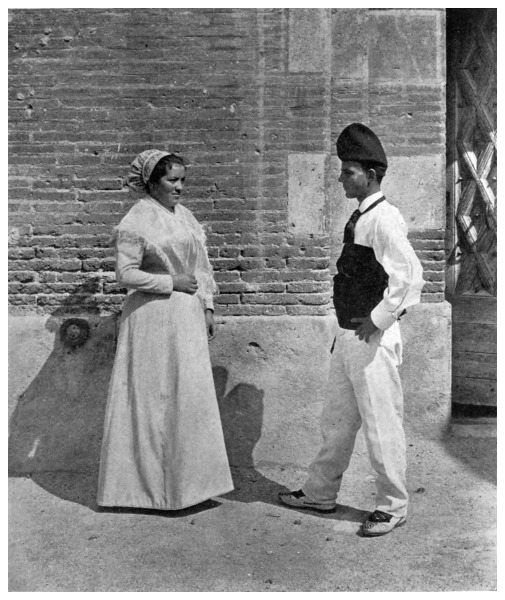
herbage is buried under snow. These men formerly wore
their characteristic costume—a dark blue or brown beret,
like a tam-o’-shanter cap, a jacket of brown or scarlet, a
waistcoat of white wool, brown knee-breeches, and a bright-coloured
sash about the waist. They wore their hair long in
curls flowing over their shoulders. Now compulsory military
service has deprived them of their flowing locks, and the
blouse is gradually displacing the handsome traditional
costume.
These men spend their time in knitting stockings whilst
watching their flocks. The sheep are horned, and have
pronounced Roman noses. A curious usage is for the dog to
precede the sheep instead of driving them.
There are numerous tumuli on the Pont-long. I opened
two in 1847, and found that they pertained to the Iron Age,
and were undoubtedly Gaulish. The floor was formed of
rolled stones, and on this were placed urns, some of great
size, containing burnt bones; they were red outside, black
within, and the clay was coarse; but with them was one
beautifully moulded little black vessel of the finest paste.
Beside two of the cinerary urns were hones of grit, rounded
on one side and flat on the other, with a groove running down
the middle.
The peasants had a legend anent the larger of the two that
I opened. Three men resolved on digging into it, and chose
for the purpose a stormy day when no one was likely to be
abroad and observe them.
They had not dug far before Pierre observed, “But we shall
surely find plenty of sous.”
“Des écus,” said Jacques.
“Des napoléons,” suggested Baptiste.
After some hours’ work they came on a flat slab, on raising
which a treasure of gold pieces was revealed. The men
plunged their arms in and could not reach the bottom of the
store. Gold, gold, ever more gold.
It was decided that a cart must be procured to remove the
treasure, and lots were cast as to who was to remain on the
tumulus, whilst the other two returned to Pau for a cart.
The lot fell on Pierre, and the others departed.
Evening had settled down when they returned with a
vehicle drawn by two oxen. Jacques and Baptiste discerned
a dark figure on the mound, which they assumed to be that of
their companion left to guard the treasure.
Then, mounting the tumulus, they asked whether any one
had been there during their absence. The dark figure said,
“Look up!” The men turned, the figure threw back his
cloak, and they knew it was the devil, horns and hoof complete.
Before they could recover from their astonishment
and terror, with a switch of his tail he had whisked them into
the cart. He mounted himself, and instantly the oxen—their
own oxen—rose in the air with the vehicle, wheeled
thrice about the mound, and then suddenly descended,
carrying cart, men, and Satan into the pit. The earth closed
over them and they were seen no more. Only Pierre lived to
tell the tale. At the first appearance of the Evil One he had
crossed himself. He was flung from the tumulus, and lay
sprawling and blessing himself till after his comrades had
vanished.
Nay may easily be visited, as it is on the main road to
Tarbes. It has a church of the fifteenth century, and the
frontage of a Renaissance house in which Jeanne d’Albret
delighted to reside.
Farther on is Coarraze, where are the remains of the
château in which Henri Quatre spent his early boyhood.
Only the tower and the portal are of the sixteenth century,
the rest is a structure raised in the eighteenth century. Over
the doorway may be read the Spanish inscription: “Lo que
ha de ser no puede fallar.”
The church is early and fortified. The terrace in front of
the castle commands a beautiful and extensive prospect of
the Pyrenees in their ever-changing tints and lights and shades.
At the extreme limits of the department is Betharam.
The name has been supposed to be derived from the Arabic Beit-Haram,
the Holy House, and the place to have been a sacred
spot during the Saracen occupation of the land. If so, then
they bequeathed their veneration for the locality to the
Christians, who drove them from it, for Betharam has been
esteemed a holy house for centuries, owing to the possession
by it of a miraculous statue of the Virgin, about which one
of the usual childish tales is told that have such a family
likeness, and show such lack of variety. A shepherd saw
a blaze of light at the foot of a rock, and discovered that it
proceeded from an image. When the figure was removed
to the farther side of the Gave, with a leap into the air like
a field cricket it recrossed the river and returned to its station
under the rock. Then it was transferred to the high altar
of the parish church of Lestelle and locked in. But bolts
and bars could not restrain it; out it came through the key-hole
and made for its rock shelter again.
A church and convent were erected under the rock. In
1569, by order of Jeanne d’Albret, both were burnt; but
were rebuilt in 1614. The church is a barbaric structure,
immediately below a hill, surmounted by a Calvary. Here
formerly dwelt a hermit, who maintained himself by selling
tooth-combs of boxwood that he had made. But he is gone,
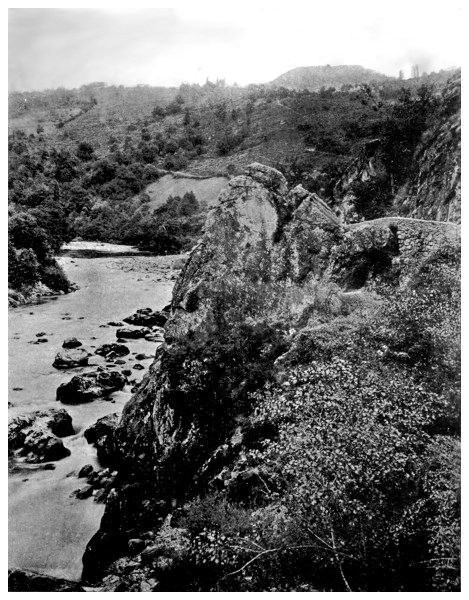
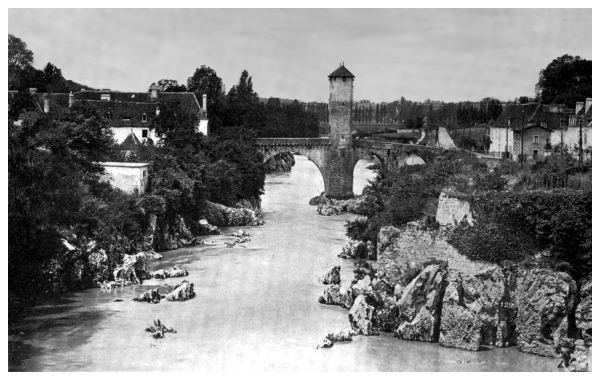
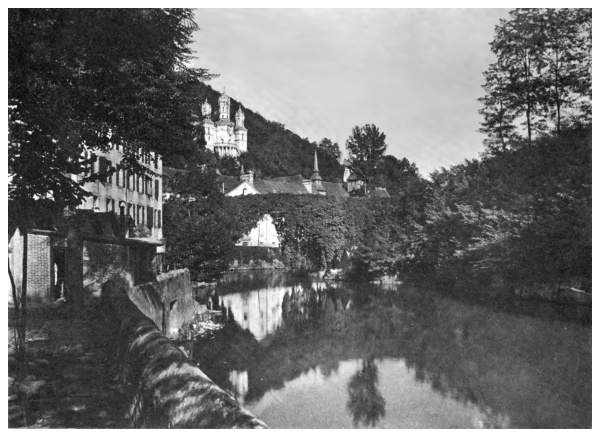
and has left no successor. The bridge at Betharam is greatly
admired, wreathed as it is with ivy, which falls in long tresses
and almost touches the Gave.
I have spoken of the view from the park at Pau. Finer
views may be had from the heights on the farther side of
the Gave, from Guindalos and Gelos; and in early spring,
when strolling among these hills, one may gather handfulls
of cyclamen, anemones, violets, and the white spires of the
asphodel.
BETHARAM
On market-days at Pau may be purchased clumps of the
beautiful little scarlet anemone that formerly grew wild in
the vineyards, but has been so much in request that it has
disappeared, except under garden cultivation. And finally,
we must taste the wine of Jurençon and S. Faust, not in the
hotels at Pau, but in the village cabarets. It is much in
request, and is largely bought up by the Bordeaux wine
merchants, who mix it with thinner wines to give them richness
and body. It is of an amber colour, is strong, heady,
and delicious.