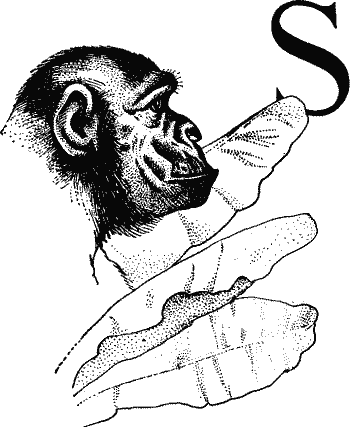
Head of Gorilla.
Sound knowledge respecting the habits and mode of life of the man-like
Apes has been even more difficult of attainment than correct
information regarding their structure.
Once in a generation, a Wallace may be found physically, mentally, and
morally qualified to wander unscathed through the tropical wilds of
America and of Asia, to form magnificent collections as he wanders,
and withal to think out sagaciously the conclusions suggested by his
collections; but, to the ordinary explorer or collector, the dense
forests of equatorial Asia and Africa, which constitute the favorite
habitation of the Orang, the Chimpanzee, and the Gorilla, present
difficulties of no ordinary magnitude; and the man who risks his life
by even a short visit to the malarious shores of those regions may
well be excused if he shrinks from facing the dangers of the interior;
if he contents himself with stimulating the industry of the
better-seasoned natives, and collecting and collating the more or less
mythical reports and traditions with which they are too ready to
supply him.
In such a manner most of the earlier accounts of the habits of the
man-like Apes originated; and even now a good deal of what passes
current must be admitted to have no very safe foundation. The best
information we possess is that based almost wholly on direct European
testimony respecting the Gibbons; the next best evidence relates to
the Orangs; while our knowledge of the habits of the Chimpanzee and
the Gorilla stands much in need of support and enlargement by
additional testimony from instructed European eye-witnesses.
It will therefore be convenient in endeavoring to form a notion of
what we are justified in believing about these animals, to commence
with the best known man-like Apes, the Gibbons, and Orangs; and to
make use of the perfectly reliable information respecting them as a
sort of criterion of the probable truth or falsehood of assertions
respecting the others.
Of the Gibbons, half a dozen species are found scattered over the
Asiatic Islands, Java, Sumatra, Borneo, and through Malacca, Siam,
Arracan, and an uncertain extent of Hindostan on the mainland of Asia.
The largest attain a few inches above three feet in height, from the
crown to the heel, so that they are shorter than the other man-like
Apes, while the slenderness of their bodies renders their mass far
smaller in proportion even to this diminished height.
Dr. Salomon Müller, an accomplished Dutch naturalist, who lived for
many years in the Eastern Archipelago, and to the result of whose
personal experience I shall frequently have occasion to refer, states
that the Gibbons are true mountaineers, loving the slopes and edges of
the hills, though they rarely ascend beyond the limit of the
fig-trees. All day long they haunt the tops of the tall trees, and
though toward evening, they descend in small troops to the open
ground, no sooner do they spy a man than they dart up the hillsides
and disappear in the darker valleys.
All observers testify to the prodigious volume of voice possessed by
these animals. According to the writer whom I have just cited, in one
of them, the Siamang, “the voice is grave and penetrating, resembling
the sounds gōek, gōek, gōek, gōek, goek ha ha ha ha haaāāā, and may be
easily heard at a distance of half a league.” While the cry is being
uttered, the great membranous bag under the throat which communicates
with the organ of voice, the so-called “laryngeal sac,” becomes
greatly distended, diminishing again when the creature relapses into
silence.
M. Duvaucel, likewise, affirms that the cry of the Siamang may be
heard for miles—making the woods ring again. So Mr. Martin describes
the cry of the agile Gibbon as “overpowering and deafening” in a room,
and “from its strength, well calculated for resounding through the
vast forests.” Mr. Waterhouse, an accomplished musician as well as
zoölogist, says, “The Gibbon’s voice is certainly much more powerful
than that of any singer I ever heard.” And yet it is to be recollected
that this animal is not half the height of, and far less bulky in
proportion than, a man.
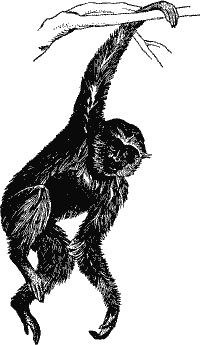
A Gibbon.
There is good testimony that various species of Gibbon readily take to
the erect posture. Mr. George Bennett, a very excellent observer, in
describing the habits of a male Hylobates syndactylus which remained
for some time in his possession, says: “He invariably walks in the
erect posture when on a level surface; and then the arms either hang
down, enabling him to assist himself with his knuckles; or, what is
more usual, he keeps his arms uplifted in nearly an erect position,
with the hands pendent ready to seize a rope, and climb up on the
approach of danger or on the obtrusion of strangers. He walks rather
quick in the erect posture, but with a waddling gait, and is soon run
down if, while pursued, he has no opportunity of escaping by
climbing.... When he walks in the erect posture, he turns the leg and
foot outward, which occasions him to have a waddling gait and to seem
bow-legged.”
Dr. Burrough states of another Gibbon, the Horlack or Hooluk:
“They walk erect; and when placed on the floor, or in an open field,
balance themselves very prettily by raising their hands over their
head and slightly bending the arm at the wrist and elbow, and then run
tolerably fast, rocking from side to side; and, if urged to greater
speed, they let fall their hands to the ground, and assist themselves
forward, rather jumping than running, still keeping the body, however,
nearly erect.”
Somewhat different evidence, however, is given by Dr. Winslow Lewis:
“Their only manner of walking was on their posterior or inferior
extremities, the others being raised upward to preserve their
equilibrium, as rope-dancers are assisted by long poles at fairs.
Their progression was not by placing one foot before the other, but by
simultaneously using both, as in jumping.” Dr. Salomon Müller also
states that the Gibbons progress upon the ground by short series of
tottering jumps, effected only by the hind limbs, the body being held
altogether upright.
But Mr. Martin, who also speaks from direct observation, says of the
Gibbons generally:
“Pre-eminently qualified for arboreal habits, and displaying among the
branches amazing activity, the Gibbons are not so awkward or
embarrassed on a level surface as might be imagined. They walk erect
with a waddling or unsteady gait, but at a quick pace, the equilibrium
of the body requiring to be kept up, either by touching the ground
with the knuckles, first on one side then on the other, or by
uplifting the arms so as to poise it. As with the Chimpanzee, the
whole of the narrow, long sole of the foot is placed upon the ground
at once, and raised at once, without any elasticity of step.”
After this mass of concurrent and independent testimony, it cannot
reasonably be doubted that the Gibbons commonly and habitually assume
the erect attitude.
But level ground is not the place where these animals can display
their very remarkable and peculiar locomotive powers, and that
prodigious activity which almost tempts one to rank them among flying,
rather than among ordinary climbing mammals.
Mr. Martin has given so excellent and graphic an account of the
movements of a Hylobates agilis, living in the Zoölogical Gardens,
in 1840, that I will quote it in full:
“It is almost impossible to convey in words an idea of the quickness
and graceful address of her movements: they may indeed be termed
aërial, as she seems merely to touch in her progress the branches
among which she exhibits her evolutions. In these feats her hands and
arms are the sole organs of locomotion, her body, hanging as if
suspended by a rope, sustained by one hand (the right, for example),
she launches herself, by an energetic movement, to a distant branch,
which she catches with the left hand; but her hold is less than
momentary; the impulse for the next launch is acquired; the branch
then aimed at is attained by the right hand again, and quitted
instantaneously, and so on, in alternate succession. In this manner
spaces of twelve and eighteen feet are cleared, with the greatest ease
and uninterruptedly, for hours together, without the slightest
appearance of fatigue being manifested; and it is evident that, if
more space could be allowed, distances very greatly exceeding eighteen
feet would be as easily cleared; so that Duvaucel’s assertion that he
has seen these animals launch themselves from one branch to another,
forty feet asunder, startling as it is, may be well credited.
Sometimes, on seizing a branch in her progress, she will throw
herself, by the power of one arm only, completely round it, making a
revolution with such rapidity as almost to deceive the eye, and
continue her progress with undiminished velocity. It is singular to
observe how suddenly this Gibbon can stop, when the impetus giving by
the rapidity and distance of her swinging leaps would seem to require
a gradual abatement of her movements. In the very midst of her flight
a branch is seized, the body raised, and she is seen, as if by magic,
quietly seated on it, grasping it with her feet. As suddenly she again
throws herself into action.
“The following facts will convey some notion of her dexterity and
quickness. A live bird was let loose in her apartment; she marked its
flight, made a long swing to a distant branch, caught the bird with
one hand in her passage, and attained the branch with her other hand,
her aim, both at the bird and at the branch, being as successful as if
one object only had engaged her attention. It may be added that she
instantly bit off the head of the bird, picked its feathers, and then
threw it down without attempting to eat it.
“On another occasion this animal swung herself from a perch, across a
passage at least twelve feet wide, against a window which it was
thought would be immediately broken: but not so; to the surprise of
all, she caught the narrow framework between the panes with her hand,
in an instant attained the proper impetus, and sprang back again to
the cage she had left—a feat requiring not only great strength, but
the nicest precision.”
The Gibbons appear to be naturally very gentle, but there is very good
evidence that they will bite severely when irritated, a female
Hylobates agilis having so severely lacerated one man with her long
canines that he died; while she had injured others so much that, by
way of precaution, these formidable teeth had been filed down; but if
threatened she would still turn on her keeper. The Gibbons eat
insects, but appear generally to avoid animal food. A Siamang,
however, was seen by Mr. Bennett to seize and devour greedily a live
lizard. They commonly drink by dipping their fingers in the liquid and
then licking them. It is asserted that they sleep in a sitting
posture.
Duvaucel affirms that he has seen the females carry their young to the
water-side and there wash their faces, in spite of resistance and
cries. They are gentle and affectionate in captivity—full of tricks
and pettishness, like spoiled children, and yet not devoid of a
certain conscience, as an anecdote, told by Mr. Bennett will show. It
would appear that his Gibbon had a peculiar inclination for
disarranging things in the cabin. Among these articles a piece of soap
would especially attract his notice, and for the removal of this he
had been once or twice scolded. “One morning,” says Mr. Bennett, “I
was writing, the Ape being present in the cabin, when, casting my eyes
toward him, I saw the little fellow taking the soap. I watched him
without him perceiving that I did so: and he occasionally would cast a
furtive glance toward the place where I sat. I pretended to write; he
seeing me busily occupied, took the soap, and moved away with it in
his paw. When he had walked half the length of the cabin, I spoke
quietly, without frightening him. The instant he found I saw him he
walked back again and deposited the soap nearly in the same place from
whence he had taken it. There was certainly something more than
instinct in that action: he evidently betrayed a consciousness of
having done wrong both by his first and last actions—and what is
reason if that is not an exercise of it?”
The most elaborate account of the natural history of the Orang-Utan
extant is that given in the “Verhandelingen over de Natuurlijke
Geschiedenis der Nederlandsche overzeeche Bezittingen (1839–45),” by
Dr. Salomon Müller and Dr. Schlegel, and I shall base what I have to
say upon this subject almost entirely on their statements, adding here
and there particulars of interest from the writings of Brooke,
Wallace, and others.
The Orang-Utan would rarely seem to exceed four feet in height, but
the body is very bulky, measuring two thirds of the height in
circumference.
The Orang-Utan is found only in Sumatra and Borneo, and is common in
either of these islands—in both of which it occurs always in low,
flat plains, never in the mountains. It loves the densest and most
sombre of the forests, which extend from the seashore inland, and thus
is found only in the eastern half of Sumatra, where alone such forests
occur, though, occasionally, it strays over to the western side.
On the other hand it is generally distributed through Borneo, except
in the mountains, or where the population is dense. In favorable
places the hunter may, by good fortune, see three or four in a day.
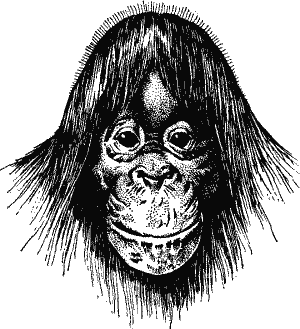
Head of Orang-Utan.
Except in the pairing time, the old males usually live by themselves.
The old females and the immature males, on the other hand, are often
met with in twos and threes; and the former occasionally have young
with them, though the pregnant females usually separate themselves,
and sometimes remain apart after they have given birth to their
offspring. The young Orangs seem to remain unusually long under their
mother’s protection, probably in consequence of their slow growth.
While climbing the mother always carries her young against her bosom,
the young holding on by the mother’s hair. At what time of life the
Orang-Utan becomes capable of propagation, and how long the females go
with young is unknown, but it is probable that they are not adult
until they arrive at ten or fifteen years of age. A female which lived
for five years at Batavia had not attained one-third the height of the
wild females. It is probable that, after reaching adult years, they go
on growing, though slowly, and that they live to forty or fifty years.
The Dyaks tell of old Orangs which have not only lost all their
teeth, but which find it so troublesome to climb that they maintain
themselves on windfalls and juicy herbage.
The Orang is sluggish, exhibiting none of that marvellous activity
characteristic of the Gibbons. Hunger alone seems to stir him to
exertion, and when it is stilled he relapses into repose. When the
animal sits, it curves its back and bows its head, so as to look
straight down on the ground; sometimes it holds on with its hands by a
higher branch, sometimes lets them hang phlegmatically down by its
side; and in these positions the Orang will remain for hours together,
in the same spot, almost without stirring, and only now and then
giving utterance to its deep, growling voice. By day he usually climbs
from one tree-top to another, and only at night descends to the
ground: and if then threatened with danger he seeks refuge among the
underwood. When not hunted, he remains a long time in the same
locality, and sometimes stops for many days on the same tree, a firm
place among its branches serving him for a bed. It is rare for the
Orang to pass the night in the summit of a large tree, probably
because it is too windy and cold there for him; but as soon as night
draws on he descends from the height and seeks out a fit bed in the
lower and darker part, or in the leafy top of a small tree, among
which he prefers Nibong palms, Pandani, or one of those parasitic
orchids which gave the primeval forests of Borneo so characteristic
and striking an appearance. But whenever he determines to sleep, there
he prepares himself a sort of nest; little boughs and leaves are drawn
together round the selected spot, and bent crosswise over one
another; while to make the bed soft, great leaves of ferns, of
orchids, of Pandanus fascicularis, Nipa fruticans, etc., are
laid over them. Those which Müller saw, many of them being very fresh,
were situated at a height of ten to twenty-five feet above the ground,
and had a circumference, on the average, of two or three feet. Some
were packed many inches thick with pandanus leaves; others were
remarkable only for the cracked twigs, which, united in a common
centre, formed a regular platform. “The rude hut,” says Sir James
Brooke, “which they are stated to build in the trees, would be more
properly called a seat or nest, for it has no roof or cover of any
sort. The facility with which they form this nest is curious, and I
had an opportunity of seeing a wounded female weave the branches
together and seat herself within a minute.”
According to the Dyaks the Orang rarely leaves his bed before the sun
is well above the horizon and has dissipated the mists. He gets up
about nine, and goes to bed again about five; but sometimes not till
late in the twilight. He lies sometimes on his back, or, by way of
change, turns on one side or the other, drawing his limbs up to his
body, and resting his head on his hand. When the night is cold, windy,
or rainy, he usually covers his body with a heap of pandanus nipa,
or fern leaves, like those of which his bed is made, and he is
especially careful to wrap up his head in them. It is this habit of
covering himself up which has probably led to the fable that the Orang
builds huts in the trees.
Although the Orang resides mostly amid the boughs of great trees
during the daytime, he is very rarely seen squatting on a thick branch
as other apes, and particularly the Gibbons, do. The Orang, on the
contrary, confines himself to the slender leafy branches, so that he
is seen right at the top of the trees, a mode of life which is closely
related to the constitution of his hinder limbs, and especially to
that of his seat. For this is provided with no callosites such as
are possessed by many of the lower apes, and even by the Gibbons; and
those bones of the pelvis, which are termed the ischia, and which form
the solid framework of the surface on which the body rests in the
sitting posture, are not expanded like those of the apes which possess
callosities, but are more like those of man.
An Orang climbs so slowly and cautiously as, in this act, to resemble
a man more than an ape, taking great care of his feet, so that injury
of them seems to affect him far more than it does other apes. Unlike
the Gibbons, whose forearms do the greater part of the work as they
swing from branch to branch, the Orang never makes even the smallest
jump. In climbing, he moves alternately one hand and one foot, or,
after having laid fast hold with the hands, he draws up both feet
together. In passing from one tree to another he always seeks out a
place where the twigs of both come close together, or interlace. Even
when closely pursued, his circumspection is amazing; he shakes the
branches to see if they will bear him, and then bending an overhanging
bough down by throwing his weight gradually along it, he makes a
bridge from the tree he wishes to quit to the next.
On the ground the Orang always goes laboriously and shakily on all
fours. At starting he will run faster than a man, though he may soon
be overtaken. The very long arms which, when he runs, are but little
bent, raise the body of the Orang remarkably, so that he assumes much
the posture of a very old man bent down by age, and making his way
along by the help of a stick. In walking, the body is usually directed
straight forward, unlike the other apes, which run more or less
obliquely, except the Gibbons, who in these, as in so many other
respects, depart remarkably from their fellows.
The Orang cannot put its feet flat on the ground, but is supported
upon their outer edges, the heel resting more on the ground, while the
curved toes partly rest upon the ground by the upper side of their
first joint, the two outermost toes of each foot completely resting on
this surface. The hands are held in the opposite manner, their inner
edges serving as the chief support. The fingers are then bent out in
such a manner that their foremost joints, especially those of the two
inner-most fingers, rest upon the ground by their upper sides, while
the point of the free and straight thumb serves as an additional
fulcrum.
The Orang never stands on its hind legs, and all the pictures
representing it as so doing are as false as the assertion that it
defends itself with sticks and the like.
The long arms are of especial use, not only in climbing, but in the
gathering of food from boughs to which the animal could not trust his
weight. Figs, blossoms, and young leaves of various kinds, constitute
the chief nutriment of the Orang; but strips of bamboo two or three
feet long were found in the stomach of a male. They are not known to
eat living animals.
Although, when taken young, the Orang-Utan soon becomes domesticated,
and indeed seems to court human society; it is naturally a very wild
and shy animal, though apparently sluggish and melancholy. The Dyaks
affirm that when the old males are wounded with arrows only they will
occasionally leave the trees and rush raging upon their enemies, whose
sole safety lies in instant flight, as they are sure to be killed if
caught.
But, though possessed of immense strength, it is rare for the Orang to
attempt to defend itself, especially when attacked with firearms. On
such occasions he endeavors to hide himself, or to escape along the
top-most branches of the trees, breaking off and throwing down the
boughs as he goes. When wounded he betakes himself to the highest
attainable point of the tree, and emits a singular cry, consisting at
first of high notes, which at length deepen into a low roar, not
unlike that of a panther. While giving out the high notes the Orang
thrusts out his lips into a funnel-shape; but in uttering the low
notes he holds his mouth wide open, and at the same time the great
throat bag, or laryngeal sac, becomes distended.
According to the Dyaks, the only animal the Orang measures his
strength with is the crocodile, who occasionally seizes him on his
visits to the water-side. But they say that the Orang is more than a
match for his enemy, and beats him to death, or rips up his throat by
pulling the jaws asunder!
Much of what has been here stated was probably derived by Dr. Müller
from the reports of his Dyak hunters; but a large male, four feet
high, lived in captivity under his observation for a month, and
receives a very bad character.
“He was a very wild beast,” says Müller, “of prodigious strength, and
false and wicked to the last degree. If any one approached he rose up
slowly with a low growl, fixed his eyes in the direction in which he
meant to make his attack, slowly passed his hand between the bars of
his cage, and then, extending his long arm, gave a sudden
grip—usually at the face.” He never tried to bite (though Orangs will
bite one another), his great weapons of offence and defence being his
hands.
His intelligence was very great; and Müller remarks that, though the
faculties of the Orang have been estimated too highly, yet Cuvier, had
he seen this specimen, would not have considered its intelligence to
be only a little higher than that of a dog.
His hearing was very acute, but the sense of vision seemed to be less
perfect. The under lip was the great organ of touch, and played a very
important part in drinking, being thrust out like a trough, so as
either to catch the falling rain or to receive the contents of the
half cocoanut shell full of water with which the Orang was supplied,
and which, in drinking, he poured into the trough thus formed.
In Borneo, the Orang-Utan of the Malays goes by the name of “Mias”
among the Dyaks, who distinguish several kinds as Mias Pappan, or
Zimo, Mias Kassu, and Mias Rambi. Whether these are distinct
species, however, or whether they are mere races, and how far any of
them are identical with the Sumatran Orang, as Mr. Wallace thinks the
Mias Pappan to be, are problems which are at present undecided; and
the variability of these great apes is so extensive that the
settlement of the question is a matter of great difficulty. Of the
form called “Mias Pappan,” Mr. Wallace observes: “It is known by its
large size, and by the lateral expansion of the face into fatty
protuberances, or ridges, over the temporal muscles, which have been
mistermed callosites, as they are perfectly soft, smooth, and
flexible. Five of this form, measured by me, varied only from 4 feet
1 inch to 4 feet 2 inches in height, from the heel to the crown of the
head, the girth of the body from 3 feet to 3 feet 7½ inches, and the
extent of the outstretched arms from 7 feet 2 inches to 7 feet
6 inches; the width of the face from 10 to 13¼ inches. The color and
length of the hair varied in different individuals, and in different
parts of the same individual; some possessed a rudimentary nail on the
great toe, others none at all; but they otherwise present no external
differences on which to establish even varieties of a species.
“Yet, when we examine the crania of these individuals, we find
remarkable differences of form, proportion, and dimension, no two
being exactly alike. The slope of the profile, and the projection of
the muzzle, together with the size of the cranium, offer differences
as decided as those existing between the most strongly marked forms of
the Caucasian and African crania in the human species. The orbits vary
in width and height, the cranial ridge is either single or double,
either much or little developed, and the zygomatic aperture varies
considerably in size. This variation in the proportions of the crania
enables us satisfactorily to explain the marked difference presented
by the single-crested and double-crested skulls, which have been
thought to prove the existence of two large species of Orang. The
external surface of the skull varies considerably in size, as do also
the zygomatic aperture and the temporal muscle: but they bear no
necessary relation to each other, a small muscle often existing with a
large cranial surface, and vice versa. Now those skulls which have the
largest and strongest jaws, and the widest zygomatic aperture, have
the muscles so large that they meet on the crown of the skull, and
deposit the bony ridge which separates them, and which is the highest
in that which has the smallest cranial surface. In those which combine
a large surface with comparatively weak jaws, and small zygomatic
aperture, the muscles, on each side, do not extend to the crown, a
space of from 1 to 2 inches remaining between them, and along their
margins small ridges are formed. Intermediate forms are found, in
which the ridges meet only in the hinder part of the skull. The form
and size of the ridges are therefore independent of age, being
sometimes more strongly developed in the less aged animal. Professor
Temminck states that the series of skulls in the Leyden Museum shows
the same result.”
Mr. Wallace observed two male adult Orangs (Mias Kassu of the Dyaks),
however, so very different from any of these that he concludes them to
be specially distinct; they were respectively 3 feet 8½ inches and
3 feet 9½ inches high, and possessed no sign of the cheek excrescences,
but otherwise resembled the larger kinds. The skull has no crest, but
two bony ridges, 1¾ to 2 inches apart, as in the Simia morio of
Professor Owen. The teeth, however, are immense, equalling or
surpassing those of the other species. The females of both these
kinds, according to Mr. Wallace, are devoid of excrescences, and
resemble the smaller males, but are shorter by 1½ to 3 inches, and
their canine teeth are comparatively small, subtruncated and dilated
at the base, as in the so-called Simia morio, which is, in all
probability, the skull of a female of the same species as the smaller
males. Both males and females of this smaller species are
distinguishable, according to Mr. Wallace, by the comparatively large
size of the middle incisors of the upper jaw.
So far as I am aware, no one has attempted to dispute the accuracy of
the statements which I have just quoted regarding the habits of the
two Asiatic man-like Apes; and if true, they must be admitted as
evidence that such an ape—
1stly, May readily move along the ground in the erect, or semi-erect,
position, and without direct support from its arms.
2dly, That it may possess an extremely loud voice—so loud as to be
readily heard one or two miles.
3dly, That it may be capable of great viciousness and violence when
irritated; and this is especially true of adult males.
4thly, That it may build a nest to sleep in.
Such being well-established facts respecting the Asiatic anthropoids,
analogy alone might justify us in expecting the African species to
offer similar peculiarities, separately or combined; or, at any rate,
would destroy the force of any attempted à priori argument against
such direct testimony as might be adduced in favor of their existence.
And if the organization of any of the African apes could be
demonstrated to fit it better than either of its Asiatic allies for
the erect position and for efficient attack, there would be still less
reason for doubting its occasional adoption of the upright attitude,
or of aggressive proceedings.
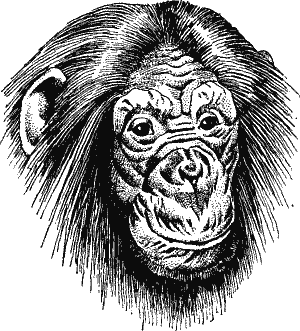
Head of Chimpanzee.
From the time of Tyson and Tulpius downward the habits of the young
Chimpanzee in a state of captivity have been abundantly reported and
commented upon. But trustworthy evidence as to the manners and customs
of adult anthropoids of this species, in their native woods, was
almost wanting up to the time of the publication of the paper by Dr.
Savage, to which I have already referred, containing notes of the
observations which he made, and of the information which he collected
from sources which he considered trustworthy, while resident at Cape
Palmas, at the north-western limit of the Bight of Benin.
The adult Chimpanzees, measured by Dr. Savage, never exceeded, though
the males may almost attain, five feet in height.
“When at rest, the sitting posture is that generally assumed. They are
sometimes seen standing and walking, but when thus detected, they
immediately take to all fours and flee from the presence of the
observer. Such is their organization that they cannot stand erect, but
lean forward. Hence they are seen, when standing, with the hands
clasped over the occiput, or the lumbar region, which would seem
necessary to balance or ease of posture.
“The toes of the adult are strongly flexed and turned inward, and
cannot be perfectly straightened. In the attempt the skin gathers into
thick folds on the back, showing that the full expansion of the foot,
as is necessary in walking, is unnatural. The natural position is on
all fours, the body anteriorly resting upon the knuckles. These are
greatly enlarged, with the skin protuberant and thickened like the
sole of the foot.
“They are expert climbers, as one would suppose from their
organization. In their gambols they swing from limb to limb at a great
distance, and leap with astonishing agility. It is not unusual to see
the ‘old folks’ (in the language of an observer) sitting under a tree
regaling themselves with fruit and friendly chat, while their
‘children’ are leaping around them, and swinging from tree to tree
with boisterous merriment.
“As seen here, they cannot be called gregarious, seldom more than
five, or ten at most, being found together. It has been said, on good
authority, that they occasionally assemble in large numbers, in
gambols. My informant asserts that he saw once not less than fifty so
engaged, hooting, screaming, and drumming with sticks upon old logs,
which is done in the latter case with equal facility by the four
extremities. They do not appear ever to act on the offensive, and,
seldom, if ever, really on the defensive. When about to be captured,
they resist by throwing their arms about their opponent, and
attempting to draw him into contact with their teeth.”
With respect to this last point Dr. Savage is very explicit in another
place:
“Biting is their principal art of defence. I have seen one man who
had been thus severely wounded in the feet.
“The strong development of the canine teeth in the adult would seem to
indicate a carnivorous propensity; but in no state save that of
domestication do they manifest it. At first they reject flesh, but
easily acquire a fondness for it. The canines are early developed, and
evidently designed to act the important part of weapons of defence.
When in contact with man almost the first effort of the animal is—to
bite.
“They avoid the abodes of men, and build their habitations in trees.
Their construction is more that of nests than huts, as they have
been erroneously termed by some naturalists. They generally build not
far above the ground. Branches or twigs are bent, or partly broken,
and crossed, and the whole supported by the body of a limb or a
crotch. Sometimes a nest will be found near the end of a strong
leafy branch twenty or thirty feet from the ground. One I have lately
seen that could not be less than forty feet, and more probably it was
fifty. But this is an unusual height.
“Their dwelling-place is not permanent, but changed in pursuit of food
and solitude, according to the force of circumstances. We most often
see them in elevated places; but this arises from the fact that the
low grounds, being more favorable for the natives’ rice-farms, are the
oftener cleared, and hence are almost always wanting in suitable trees
for their nests.... It is seldom that more than one or two nests are
seen upon the same tree, or in the same neighborhood: five have been
found, but it was an unusual circumstance.” ...
“They are very filthy in their habits. It is a tradition with the
natives generally here that they were once members of their own tribe;
that for their depraved habits they were expelled from all human
society, and that, through an obstinate indulgence of their vile
propensities, they have degenerated into their present state of
organization. They are, however, eaten by them, and when cooked with
the oil and pulp of the palm-nut considered a highly palatable morsel.
“They exhibit a remarkable degree of intelligence in their habits,
and, on the part of the mother, much affection for their young. The
second female described was upon a tree when first discovered, with
her mate and two young ones (a male and a female). Her first impulse
was to descend with great rapidity and make off into the thicket with
her mate and female offspring. The young male remaining behind, she
soon returned to the rescue. She ascended and took him in her arms, at
which moment she was shot, the ball passing through the forearm of the
young one, on the way to the heart of the mother....
“In a recent case the mother, when discovered, remained upon the tree
with her offspring, watching intently the movements of the hunter. As
he took aim, she motioned with her hand, precisely in the manner of a
human being, to have him desist and go away. When the wound has not
proved instantly fatal, they have been known to stop the flow of blood
by pressing with the hand upon the part, and when they did not
succeed, to apply leaves and grass.... When shot, they give a sudden
screech, not unlike that of a human, being in sudden and acute
distress.
“The ordinary voice of the Chimpanzee, however, is affirmed to be
hoarse, guttural, and not very loud, somewhat like ‘whoo-whoo.’”
The analogy of the Chimpanzee to the Orang, in its nest-building habit
and in the mode of forming its nest, is exceedingly interesting,
while, on the other hand, the activity of this ape, and its tendency
to bite, are particulars in which it rather resembles the Gibbons. In
extent of geographical range, again, the Chimpanzees—which are found
from Sierra Leone to Congo—remind one of the Gibbons rather than of
either of the other man-like Apes; and it seems not unlikely that, as
is the case with the Gibbons, there may be several species spread over
the geographical area of the genus.
The same excellent observer, from whom I have borrowed the preceding
account of the habits of the adult Chimpanzee, published an account of
the Gorilla, which has, in its most essential points, been confirmed
by subsequent observers, and to which so very little has really been
added, that, in justice to Dr. Savage, I give it almost in full:
“It should be borne in mind that my account is based upon the
statements of the aborigines of that region (the Gaboon). In this
connection it may also be proper for me to remark that, having been a
missionary resident for several years, studying, from habitual
intercourse, the African mind and character, I felt myself prepared to
discriminate and decide upon the probability of their statements.
Besides, being familiar with the history and habits of its interesting
congener (Trogniger, Geoff.), I was able to separate their accounts
of the two animals, which, having the same locality and a similarity
of habit, are confounded in the minds of the mass, especially as but
few—such as traders to the interior, and huntsmen—have ever seen the
animal in question.
“The tribe from which our knowledge of the animal is derived, and
whose territory forms its habitat, is the Mpongwe, occupying both
banks of the River Gaboon, from its mouth to some fifty or sixty miles
upward....
“If the word ‘Pongo’ be of African origin, it is probably a corruption
of the word Mpongwe, the name of the tribe on the banks of the
Gaboon, and hence applied to the region they inhabit. Their local name
for the Chimpanzee is Enché-eko, as near as it can be Anglicized,
from which the common term ‘Jocko’ probably conies. The Mpongwe
apellation for its new congener is Engé-ena, prolonging the sound of
the first vowel, and slightly sounding the second.
“The habitat of the Engé-ena is the interior of Lower Guinea, while
that of the Enché-eko is nearer the seaboard.
“Its height is about five feet; it is disproportionately broad across
the shoulders, thickly covered with coarse black hair, which is said
to be similar in its arrangement to that of the Enché-eko; with age
it becomes gray, which fact has given rise to the report that both
animals are seen of different colors.
“Head.—The prominent features of the head are the great width and
elongation of the face, the depth of the molar region, the branches of
the lower jaw being very deep and extending far backward, and the
comparative smallness of the cranial portion; the eyes are very large,
and said to be like those of the Enché-eko, a bright hazel; nose
broad and flat, slightly elevated toward the root; the muzzle broad,
and prominent lips and chin, with scattered gray hairs; the under lip
highly mobile, and capable of great elongation when the animal is
enraged, then hanging over the chin; skin of the face and ears naked
and of a dark-brown, approaching to black.
“The most remarkable feature of the head is a high ridge, or crest of
hair, in the course of the sagittal suture, which meets posteriorly
with a transverse ridge of the same, but less prominent, running round
from the back of one ear to the other. The animal has the power of
moving the scalp freely forward and back, and when enraged is said to
contract it strongly over the brow, thus bringing down the hairy ridge
and pointing the hair forward, so as to present an indescribably
ferocious aspect.
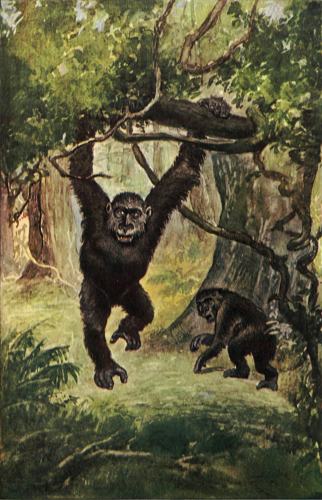
The Gorilla.
“Neck short, thick, and hairy; chest and shoulders very broad, and
said to be fully double the size of the Enché-ekos; arms very long,
reaching some way below the knee—the forearm much the shortest; hands
very large, the thumbs much larger than the fingers....
“The gait is shuffling; the motion of the body, which is never upright
as in man, but bent forward, is somewhat rolling, or from side to
side. The arms being longer than the Chimpanzee, it does not stoop as
much in walking; like that animal, it makes progression by thrusting
its arms forward, resting the hands on the ground, and then giving the
body a half-jumping, half-swinging motion between them. In this act it
is said not to flex the fingers, as does the Chimpanzee, resting on
its knuckles, but to extend them, making a fulcrum of the hand. When
it assumes the walking posture, to which it is said to be much
inclined, it balances its huge body by flexing its arms upward.
“They live in bands, but are not so numerous as the Chimpanzees; the
females generally exceed the other sex in number. My informants all
agree in the assertion that but one adult male is seen in a band; that
where the young males grow up a contest takes place for mastery, and
the strongest, by killing and driving out the others, establishes
himself as the head of the community.”
Dr. Savage repudiates the stories about the Gorillas carrying off
women and vanquishing elephants, and then adds:
“Their dwellings, if they may be so called, are similar to those of
the Chimpanzee, consisting simply of a few sticks and leafy branches,
supported by the crotches and limbs of trees; they afford no shelter,
and are occupied only at night.
“They are exceedingly ferocious, and always offensive in their
habits, never running from man, as does the Chimpanzee. They are
objects of terror to the natives, and are never encountered by them
except on the defensive. The few that have been captured were killed
by elephant-hunters and native traders, as they came suddenly upon
them while passing through the forests.
“It is said that when the male is first seen he gives a terrific yell,
that resounds far and wide through the forest, something like kh—ah!
kh—ah! prolonged and shrill. His enormous jaws are widely opened at
each expiration, his under-lip hangs over the chin, and the hairy
ridge and scalp are contracted upon the brow, presenting an aspect of
indescribable ferocity.
“The females and young, at the first cry, quickly disappear. He then
approaches the enemy in great fury, pouring out his horrid cries in
quick succession. The hunter awaits his approach with his gun
extended; if his aim is not sure he permits the animal to grasp the
barrel, and as he carries it to his mouth (which is his habit) he
fires. Should the gun fail to go off, the barrel (that of the ordinary
musket, which is thin), is crashed between his teeth and the encounter
soon proves fatal to the hunter.
“In the wild state their habits are in general like those of the
Troglodytes niger, building their nests loosely in trees, living
on similar fruits, and changing their place of resort from force of
circumstances.”
Dr. Savage’s observations were confirmed and supplemented by those of
Mr. Ford, who communicated an interesting paper on the Gorilla to the
Philadelphian Academy of Sciences, in 1852. With respect to the
geographical distribution of this greatest of all the man-like Apes,
Mr. Ford remarks:
“This animal inhabits the range of mountains that traverse the
interior of Guinea from the Cameroon in the north to Angola in the
south, and about one hundred miles inland, and called by the
geographers Crystal Mountains. The limit to which this animal extends,
either north or south, I am unable to define. But that limit is
doubtless some distance north of this river [Gaboon]. I was able to
certify myself of this fact in a late excursion to the head-waters of
the Mooney (Danger) River, which comes into the sea some sixty miles
from this place. I was informed (credibly, I think), that they were
numerous among the mountains in which that river rises, and far north
of that.
“In the south, this species extends to the Congo River, as I am told
by native traders who have visited the coast, between the Gaboon and
that river. Beyond that, I am not informed. This animal is only found
at a distance from the coast in most cases, and, according to my best
information, approaches it nowhere so nearly as on the south side of
this river, where they have been found within ten miles of the sea.
This, however, is only of late occurrence. I am informed by some of
the oldest Mpongwe men that formerly he was only found on the sources
of the river, but that at present he may be found within half a day’s
walk of its mouth. Formerly he inhabited the mountainous ridge where
Bushmen alone inhabited, but now he boldly approaches the Mpongwe
plantations. This is doubtless the reason of the scarcity of
information in years past, as the opportunities for receiving a
knowledge of the animal have not been wanting; traders having for one
hundred years frequented this river, and specimens, such as have been
brought here within a year, could not have been exhibited without
having attracted the attention of the most stupid.”
One specimen Mr. Ford examined weighed one hundred and seventy pounds,
without the thoracic or pelvic viscera, and measured four feet four
inches round the chest. This writer describes so minutely and
graphically the onslaught of the Gorilla—though he does not for a
moment pretend to have witnessed the scene—that I am tempted to give
this part of his paper in full, for comparison with other narratives.
“He always rises to his feet when making an attack, though he
approaches his antagonist in a stooping posture.
“Though he never lies in wait, yet, when he hears, sees, or scents a
man, he immediately utters his characteristic cry, prepares for an
attack, and always acts on the offensive. The cry he utters resembles
a grunt more than a growl, and is similar to the cry of the Chimpanzee
when irritated, but vastly louder. It is said to be audible at a great
distance. His preparation consists in attending the females and young
ones, by whom he is usually accompanied, to a little distance. He,
however, soon returns with his crest erect and projecting forward, his
nostrils dilated, and his under-lip thrown down; at the same time
uttering his characteristic yell, designed, it would seem, to terrify
his antagonist. Instantly, unless he is disabled by a well-directed
shot, he makes an onset, and, striking his antagonist with the palm of
his hands, or seizing him with a grasp from which there is no escape,
he dashes him upon the ground, and lacerates him with his tusks.
“He is said to seize a musket, and instantly crush the barrel between
his teeth.... This animal’s savage nature is very well shown by the
implacable desperation of a young one that was brought here. It was
taken very young, and kept four months, and many means were used to
tame it; but it was incorrigible, so that it bit me an hour before it
died.”
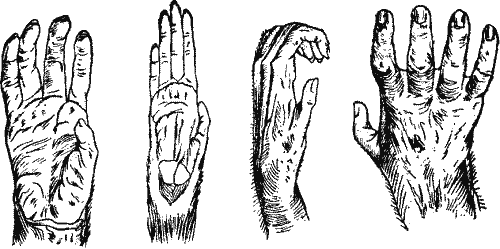
Hand of Gorilla, Orang, Gibbon, and
Chimpanzee.


