Though it be hard at times to see of what usefulness were those
troublesome monsters of the world's younger days,—there is no such
difficulty with the thronging giants of the age of chivalry. For
some seven centuries (that is from the institution of this order by
Charlemagne till it was shot to death by firearms and gunpowder), the
giant's reason for existence was to furnish a large enough measure of
the knight's prowess.
"The bigger they are, the harder they fall," says the modern
"bruiser"; the old romancers would have added—"and the more resounding
los to him who fells them."
Little did their vast size and muscles avail them against these
hot thirsters after fame. The magic net of Caligorant, Ferragus's
prophetic brazen head, Galafer's magic armor rendering the sinless
wearer invulnerable, Mugillo's prodigious mace with its whirling
balls—weapons, strength, craft and magic were alike impotent before
a Roland, an Arthur, an Amadis, or a Guy of Warwick. Of a list of two
hundred giants collected by a curious biographer, well-nigh half came
to an untimely end through the sword of some knight-errant. Small
wonder that after several hundred years of such eager reaping, these
heroes should have left not one live specimen for us of later times to
gape at.
Read but the following few tales of such adventures as comprised
almost the regular "day's work" of knighthood; and, however much you
may bewail the loss, you must speedily comprehend why these Tall Ones,
once so plentiful, are today extinct.
Charlemagne held his state in the city of Pampeluna. This city of the
Moors he had invested for six months; and being unable to take it,
he prayed to St. James,—whereat the walls fell down as did those of
Jericho before the blast of the priests' trumpets.
Great was the Emperor's fame after his prodigious conquests in Saxony,
France, Germany, Lorraine, Burgundy, Italy, and now in Spain; and his
person befitted his renown.
"He was of a ruddy complexion," says Turpin's Chronicle, "with brown
hair; of a well-made handsome form, but stern visage. His height was
about eight of his own feet which were very long. He was of a strong,
robust make; his legs and thighs very stout, and his sinews firm.
His face was thirteen inches long; his beard a palm; his nose half a
palm; his forehead a foot over. His lion-like eyes flashed fire like
carbuncles; his eye-brows were half a palm over. When he was angry it
was a terror to look upon him. He required eight span for his girdle
besides what hung loose. He ate sparingly of bread, but a whole quarter
of lamb, two fowls, a goose, or a large portion of pork; a peacock,
crane or a whole hare. He drank moderately of wine and water. He was so
strong, that he could at a single blow cleave asunder an armed soldier
on horseback, from the head to the waist, and the horse likewise. He
easily vaulted over four horses harnessed together; and could raise an
armed man from the ground to his head, as he stood erect upon his hand.
"He was liberal, just in his decrees, and fluent of speech. Four days
in the year, especially during his residence in Spain, he held a solemn
assembly at court, adorning himself with his royal crown and sceptre:
namely on Christmas-day, at Easter, Whitsuntide, and on the festival of
St. James. A naked sword, after the imperial fashion, was then borne
before him. A hundred and twenty devout knights watched nightly around
his couch, in three courses of forty each. A drawn sword was laid at
his right hand, and a lighted candle at his left."
Yet the chief glory of this regal court was the band of Paladins,
(Palace knights), sworn to the Emperor and to each other—Roland of
Brittany, Oliver of Genoa, Ogier the Dane, Richard of Normandy, Guy of
Burgundy, Rinaldo of the White Thorn, Terry of Ardennes, old Neymes of
Bavaria, and the rest. Save perhaps at that Round Table of King Arthur,
never was there gathered together such a company of heroes as these
Douzepeers. All the world of christendom and paynimry resounded with
their fame.
Amid one of these high festivals there arrived messengers spurring
hotly from Nager. White-faced, they told of the coming of a Moorish
giant hight Ferragus. He sent defiance to Charles and all his knights.
Men said no weapon might harm him, while he himself was possessed of
twenty men's strength.
Also he was surrounded by a reputation of magic art; for as Valentine
and Orson later discovered, his home was on an island far to the south.
Here glittered a strong castle of shining metal; and in a chamber
therein stood on a pillar a marvellous brazen head, "composed a long
time ago by the necromancy of a magician, which Head was of such
an excellent composition, that it gave Answer to anything that was
demanded." In addition he had for servitor one Pacolet, a dwarf, a
very cunning wizard, who had made a wooden horse that would carry him
through the air whithersoever he would. Natheless, be what he might,
the Saracen challenger must be met, for the honor of knighthood. The
Emperor therefore marched to Nager and pitched his camp there.
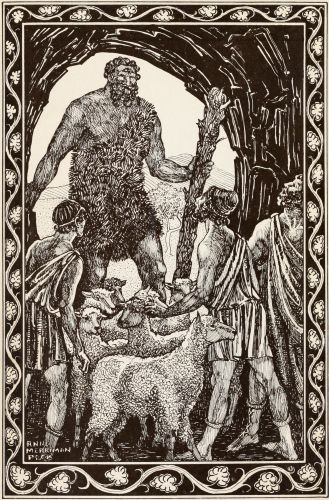
When the giant appeared from the city next morning, all were aghast at
the sight. He was twelve cubits high, and the fingers which gripped
his huge brand were three palms in length. From his loathly dark face
his eyebrows stuck out like stiff pig's bristles. A hideous and fell
creature he looked, and when the French knights beheld his monstrous
thews they had little desire to seek "los" in that encounter.
Bold Ogier the Dane, however, demanded the honor of the fight.
Carefully he armed himself, chose the heaviest lance he could find, and
mounted his stoutest charger. Then he sped forth over the plain before
the watching army. When he approached the giant, he set spurs to his
horse and thundered down upon him with a speed and force that seemed
irresistible.
With utter indifference the monster received the spear point on his
shield, and the tough wood flew to pieces. Ferragus was not even
staggered by the onset. He stepped forward, thrust a great arm about
Ogier, lifted him bodily from his horse, and, despite all the struggles
of this renowned warrior, carried him off beneath his arm to the
castle, no more disturbed than a falcon is by the fluttering of the
prey in his talons.
Next there came against him Rinaldo of the White Thorn, but he fared no
better, being seized and borne away in the same manner.
Scornfully the giant taunted the French king:
"Ah, it was you who won Spain! And this is the best you have? By the
Prophet, ten such at a time were no match for Ferragus alone."
Chafing under this disgrace, Charlemagne despatched two knights
together, Sir Constantine of Rome, and Earl Howel of Nantes—only to
suffer the humiliation of seeing the huge Saracen tuck one under each
arm and walk away with them as if they were children.
Abandoning all thought of equal combat, he bade ten knights sally out
and destroy this prodigy, whose boasting grew ever more difficult to
endure. To his amazement, the issue was the same: Ferragus was not so
much as wounded, while these doughty knights were borne off in triumph
to the castle dungeon.
Ruin instead of renown seemed to lie at the end of this road, and the
Emperor refused to risk any more of his knights in conflict with this
unearthly being.
Roland's proud heart could not brook this. He came before Charles and
demanded the combat. Dreading a similar fate for this best-loved of his
douzepeers, the Emperor urged him to forego the adventure; yet when the
Duke insisted that he must undertake it, for his own honor and that of
France, Charles could no longer withhold his assent.
Armed cap-à-pie, the undefeated Paladin rode forth. So confident and
haughty was his mien that Ferragus perceived this was no adversary
to be despised. As the knight drew near, the giant's great hand shot
out and gripped him inexorably by the sword arm. That vise-like grasp
paralyzed the victim's muscles, as the crushing jaws of the lion
are said to destroy effort and feeling. Then he put forth all his
superhuman power, and lifted the knight from the saddle. Swinging him
in front of himself, he urged his huge charger towards the castle, well
assured of adding him too to the growing band of captives.
But as he was bearing him to the city (says the chronicler of nearly
a thousand years ago), Roland recovered his strength, and trusting in
the Almighty, seized the giant by the beard, and tumbled him from his
horse, so that both came to the ground together. Roland then thinking
to slay the infidel, drew his sword Durandal and struck at him, but the
blow fell upon his steed and shore through it.
The giant, being thus on foot, drew his enormous sword; but Roland, who
had remounted his own charger, dealt him a sudden stroke on the sword
arm. Though Durandal was tempered so that the knight could cut through
a block of marble with it, yet could the blade make no impression upon
this creature's skin. Still, the sheer force of the blow struck the
brand from the giant's grasp.
Greatly enraged at this mischance, Ferragus aimed a blow at Roland
with his fist, but, missing him, hit his horse on the forehead and
laid it dead on the spot. Avoiding the monster's grasp Roland laid on
him lustily with Durandal, but the unfailing weapon could find no spot
where the giant's hide might be pierced.
For the rest of that day they battled with fists and stones. The giant
then demanded a truce till next day, agreeing to meet Roland without
horse or spear. Each warrior then retired to his post.
Next morning they accordingly met once more. Ferragus brought his
sword, but Roland armed himself only with a sturdy club to ward off the
blows of the giant, who wearied himself to no purpose.
They now began again to batter each other with stones that lay
scattered about the field, till at last the giant begged a second
truce. This being granted, he presently fell fast asleep upon the
ground. Roland, taking a stone for a pillow, quietly laid himself
down also. For such was the law of honor between the Christians and
the Saracens at that time, that no one on any pretence dared to take
advantage of his adversary before the truce was expired, as in that
case his own party would have slain him.
When Ferragus awoke, he found Roland awake also, marvelling at the
prodigious snoring which came from his huge adversary. He discovered,
too, that the knight had placed a block of stone beneath his head for a
pillow, and this courtesy caused him to inquire the Frenchman's name.
Roland told him, and inquired in his turn of that matter which most
bewildered him: how it was that no wounds had resulted from all his
swordplay with his trusted Durandal.
"Because," said Ferragus proudly, "I am invulnerable except in one
point."
"And where is that?"
"In the navel."
Ferragus spoke in the Spanish language, which Roland understanding
tolerably well, a conversation now followed between them.
"Of what race are you?" asked the giant.
"Of the race of the Franks."
"What law do you follow?"
"The law of Christ, so far as his grace permits me."
"Who is this Christ in whom you profess to believe?"
"The Son of God, born of a Virgin, who took upon him our nature, was
crucified for us, rose again from the dead, and ascended into heaven,
where he sitteth on the right hand of the Father."
"We believe," said Ferragus, "that the Creator of heaven and earth is
one God, and that, as he was not made himself, so cannot another God
spring from him. There is, therefore, only one God and not three, as I
understand you Christians profess."
"You say well; there is but one God; but your faith is imperfect; for
as the Father is God, so likewise is the Son, and so is the Holy Ghost.
Three persons, but one God."
"Nay, if each of these three persons be God, there must be three Gods."
"By no means," replied Roland. "He is both three and one. Abraham saw
three but worshipped one. Let us recur to natural things. When the harp
sounds, there is the art, the strings and the hand, yet but one harp.
In the almond there is the shell, the coat and the kernel. In the sun,
the body, the beams and the heat. In the wheel, the hub, the spokes,
and the nave. In you likewise, there is the body, the members and the
soul. In like manner may Trinity in Unity be ascribed to God."
They discoursed at length upon these mysteries, the giant listening
with great interest to the knight's explanation of the resurrection
from the dead. To Roland's surprise, however, Ferragus presently
remarked:
"Well, to end our arguments, I will fight you on these terms: if the
faith you profess be the true faith, you shall conquer; otherwise
the victory shall be mine. And let the issue be eternal honor to the
conqueror, but dishonor to the vanquished."
"Be it so!" said Roland.
Whereupon they immediately fell to blows. The very first which the
giant aimed at him would have certainly been fatal, if Roland had not
nimbly leaped aside, and caught it on his club, which was, however,
cut in twain. Ferragus, seeing his advantage, rushed in upon him, and
both came to the ground together.
Then Roland, finding it impossible to escape, implored the divine
assistance; and, feeling himself invigorated, he sprung upon his feet,
seized the giant's sword and thrust it into his navel.
Finding himself mortally wounded, Ferragus called aloud with a mighty
voice upon Mahomet; which the Saracens hearing, sallied from the city,
and bore him off in their arms.
Roland returned safe to the camp, to the great joy of Charlemagne and
his fellows. Then the French boldly attacked the city, and carried it
by storm. The giant and his people were slain, his castle taken, and
all the Christian warriors liberated.
Many are the tales of King Arthur's valiant Round Table of
knights—whose deeds have been sung almost more than those of the King
himself. But from the day when as a "damoiseau of some fifteen years,"
(men say in the sixth century after Christ), Arthur was crowned as
successor to Uther Pendragon, he was an example of chivalry to his
whole court.
"He was a very virtuous knight, right worthy of praise, whose fame was
much in the mouths of men. To the haughty he was proud; but tender and
pitiful to the simple. He was a stout knight and a bold: a passing
crafty captain, as indeed was but just, for skill and courage were his
servants at need: and large of his giving. He was one of Love's lovers;
a lover also of glory; and his famous deeds are right fit to be kept
in remembrance. He ordained the courtesies of courts, and observed
high state in very splendid fashion. So long as he lived and reigned
he stood head and shoulders above all princes of the earth, both for
courtesy and prowess, as for valor and liberality."
Having settled his own realm in peace and restored the kingdom to its
ancient borders, he conquered Ireland, Norway, Denmark and Flanders;
and, after a nine-years' war, added France to his dominions.
To him, thus flushed with victory, came ambassadors from the Emperor of
Rome, bidding him to appear at that city and make restitution for his
wrongful attacks on the empire's provinces, or to expect to be haled
thither in bonds for judgment by the senate.
The king's answer was to summon a vast army, commit the realm to the
care of his nephew Mordred, (who afterward wrought such bale to that
noble company) and set out over sea for Rome—"not to carry tribute,
but to seek it."
A puissant and well-armed host it was that set forth; and the
warrior-monarch who led them was arrayed in harness that surpassed
all his followers. His thigh-pieces were of steel, wrought strong and
fairly by some cunning smith. His hauberk was stout and richly chased,
even such a vesture as became so puissant a king. Upon him was girt his
sword, Excalibur. Mighty was the glaive, and long in the blade. It was
forged in the Isle of Avalon, and he who brandished it naked in his
hand deemed himself a happy man.
His helmet gleamed upon his head. The nasal was of gold; circlets of
gold adorned the head-piece, with many a clear stone; and a dragon was
fashioned for its crest. This helm had once been worn by Uther his
sire. The king was mounted upon a destrier (charger), passing fair,
strong, and speedy, loving well the battle. About his neck was set his
shield, all clean of elephant's bone (ivory), on which was painted in
several colors the image of Our Lady of St. Mary. The lance he carried
was named Ron: it was a strong shaft, tough and great, sharp at the
head, and very welcome at need in the press of battle. It had been
made in Caermarthen by a smith that hight Griffin, and King Uther had
carried it before time.
Setting out from Southampton with his great host, the king sailed for
France; and though the mariners, steering by the stars, "were very
fearful of the dark," the ships came safely to haven very early in the
morning at Barfleur in Normandy.
They had been but a little while in the land when tidings were brought
to the king that a marvellously strong giant, newly come to that land,
had carried off Helen the niece of his kinsman, Hoel.
This doleful lady the giant, named Dinabuc, had taken to a high place
known as St. Michael's Mount, though in that day there was neither
church nor monastery on the cliff, but all was shut close by the waves
of the sea.
The adventure which followed was told many times in the old days, by
Wace, Layamon and others. Let us listen to the unknown romancer of the
14th Century who left us Morte Arthure:
When they had reached the shore and raised their tents, a templar
came and informed the king: "Here, too, is a tyrant that torments thy
people, a great giant of Genoa engendered by fiends; he hath devoured
more than five hundred people and also many infants and free-born
children. This hath been his sustenance now for seven winters and
yet is the glutton not sated so well it pleaseth him. In the country
of Cotentin no people has he left outside the strong castle enclosed
within walls—for he has completely destroyed all the children of the
commons and carried them to his crag and devoured them there. The
Duchess of Brittany he has taken to-day near Reynes as she rode with
her fair knights, and led her to the mountain where he abideth. We
followed afar off, more than five hundred barons and citizens and noble
bachelors, but he reached the crag: she shrieked so loud: the horror of
that creature I shall never forget. She was the flower of France or of
five realms, and one of the fairest that was ever formed, the gentlest
jewel accounted by lords from Genoa to Geron, by Jesus of Heaven! She
was thy wife's cousin, as thou mayest know, and sprung from the noblest
race that reign in this earth. As thou art a righteous king, take pity
on the people and endeavor to avenge them that are thus affronted."
"Alas," said the king, "so long as I have lived had I known of this it
had been well: it has not happened fairly but fallen foul that this
fiend hath destroyed the fair lady. I had leifer than all France this
fifteen winters that I had been before that fellow a furlong away when
he laid hold of that lady and led her to the mountains; I had left
behind my life ere she had suffered harm. But can you tell me the crag
where lives that man? I will go to that place and speak with him, to
deal with that tyrant for treason to his lord, and make a truce for a
time till it may happen better."
"Sire, see ye yon foreland with yonder two fires? there lurks that
fiend—ask when thou mayest, upon the crest of the crag by a cold well
that encloses the cliff within its clear stream: there wilt thou find
dead folk without number, more florins i' faith than in all the rest of
France, and more treasure hath that traitor unlawfully got than there
was in Troy, I trow, what time it was conquered."
Then the noble king sighed for pity of those people, went right to a
tent and rested no longer, he welters and wrestleth with himself and
wringeth his hands—there was no wight in the world that knew what he
wanted. He called Sir Cayous that served with the cup and Sir Bedivere
the bold that bore his great brand.
"Look to it that after evensong ye be armed full well and mounted
on horses by yonder thicket—by yon blithe stream, for I will pass
privately in pilgrimage that way at supper-time when the lords are
served to seek a saint by yon salt streams on St. Michael's Mount where
miracles are seen."
After evensong King Arthur himself went to his wardrobe and took out
his clothes—he armed him in a jerkin with a rich golden fringe, and
above that laid a jeryn of Acre right over, and above that a coat
of gentle mail—a tunic of Jerodyn with edges frayed. He drew on a
bacenett of burnished silver—the best that was in Basill with rich
borders: the crest and the crown enclosed so fair with clasps of bright
gold adorned with stones—the visor and the aventail equipped so fair
without a flaw, with eyelets of silver; his gauntlets gaily gilded and
engraven at the borders with grains and balls of most glorious hue; he
bore a broad shield and calls for his sword, he jumped on a brown steed
and waits on the heath. He rises in his stirrups and stands aloft, he
strains himself stoutly and looks forth, then he spurs the bay steed
and rides to the thicket and there his knights await him gallantly
arrayed.
They rode by that river that runneth so swift where the trees
overstretch with fair boughs, the roe and the reindeer run recklessly
there in thickets and rose-gardens to feast themselves. The thickets
were in blossom with may-flowers, with falcons and pheasants of fair
hues—all the birds lived there which fly with wings, for there sang
the cuckoo full loud on the bushes, with all birds of merriment they
gladden themselves: the voice of the nightingale's notes was sweet,
they strove with the throstles three hundred at once, that this murmur
of water and singing of birds might cure him of ill who never was whole.
Then move these folk quickly and alighted on foot and fastened their
fair steeds afar off; then the king sternly told his knights to abide
with their horses and come no further, "For I will seek this saint by
myself and speak with this master man that guards this mountain, and
then shall ye partake of the Sacrament one after the other honourably
at St. Michael's full mighty with Christ!"
The king climbs the crag with cliffs full high, to the top of the
crag he climbs aloft; lifts up his umbrer and looks about him keenly,
receiving the cold wind on his face to comfort him; two fires he finds
flaming full high—for a quarter of a furlong he thus walks between
them: along the way by the well he wanders on to get to know of the
warlock and where he abides.
He moves to the port fire and even there he finds a very woeful widow
wringing her hands and weeping with painful tears on a grave newly
marked in the soil since midday it seemed. He saluted her sorrowfully
with becoming words and straightway asked after the fiend. Then this
woeful widow joylessly greets him, rose up on her knees and clasped her
hands, saying: "Unhappy man, thou speakest too loudly; if yon warlock
heareth he will devour us both. Cursed be the wight that directed thee
hither, that made thee to travel here in these wild parts. I warn
thee for thy honour thou seekest sorrow. Whither hastenest thou, man?
thou seem'st unhappy, goest thou to slay him with thy bright sword?
Wert thou wightier than Wade or Gawayn thou shouldest win no honour.
I warn thee beforehand: thou crossedst thyself unsafely to seek these
mountains; six such as thou were not sufficient to cope with him alone.
For an thou seest him alone, thy heart will fail thee to cross thyself
safely, so huge he seemeth.
"Thou art noble and fair and in the flower of thy manhood, but thou
art doomed already, by my fay, and that I foretell thee. Were there
fifty such as thee in the field or on the fair earth—the monster
with his fist would fell you all. Lo! here the dear duchess—to-day
was she taken—deep buried in the ground—he murdered this mild lady
e'er midday was rung—without any mercy I wot not why, he slew her
churlishly, and here have I embalmed her and buried her afterwards. For
the grief of this incurable woe I shall never be happy again. Of all
the friends she had, none followed after her but I, her foster-mother
of fifteen winters: to move from this foreland I shall never attempt,
but shall be found in this field till I am left dead."
Then answere Sir Arthur to that old wife: "I am come from the conqueror
courteous and noble, as one of the most noble of Arthur's knights, a
messenger to this vile wretch for the benefit of the people, to speak
with this master man that guards this mountain: to treat with this
tyrant for the treasure of lands and to make truce foretime till it may
turn out better."
"Fie, thy words are but wasted," quoth that wife then, "for he sets
but little by both lands and people. Nor of rents of red gold he
troubles, but he will break the law when he chooses himself, without
the permission of any, as lord of his own.
"But he hath a mantle which he keeps for himself that was spun in Spain
by special women and afterwards adorned in Greece full fairly: it is
covered all over with hair and embroidered with the beards of valiant
kings, woven and combed that knights may know each king by his colour,
in his home there he abides. Here he seizes the revenues of fifteen
kingdoms each Easter evening, however it so happens that they send it
themselves for the safety of the people—at that season with certain
knights, and he has asked Arthur all these seven winters. Therefore
he herds here to outrage his people until the King of Britain has
fed his lips and sent his beard to that bold monster with his best
knights; unless thou hast brought that beard go thou no further, for
it is bootless that thou shouldst stay for aught else: for he has more
treasure to take when he likes than ever had Arthur or any of his
forefathers. If thou hast brought the beard, he will be more pleased
than if thou gavest him Burgundy or Britain: but take care for love's
sake that thou keep thy lips silent so that no word escape from them
whatever betides; see that thy present be ready and trouble him but
little, for he is at his supper and will be easily angered. And now
take my advice and remove thy clothes and kneel in thy mantle and call
him thy lord. He sups all this season on seven children of the commons,
chopped up on a charger of pure white silver with pickles and finely
ground spices and wines of Portugal mixed with honey. Three luckless
damsels turn his spits."
"Ha! I have brought the beard," quoth he, "for thus it pleaseth me,
forth then will I go and bear it myself. But, pray, if thou wilt tell
me where this monster abideth, I shall commend thee an I live, so help
me our Lord!"
"Go straight to the fire," quoth she, "that flames so high: there lurks
that fiend as thou wilt discover: but thou must go somewhat to the
south, sidling a little, for his power of smelling extends over six
miles."
The source of the smoke he sought speedily, crossed himself safely
with certain words, and going to the side he caught sight of the fiend
as she said, unseemly supping alone. He lay at full length reposing
foully, the thigh of a man's limb he lifted up by the haunch, his back
and the lower parts and his broad loins he baked at the dreadful fire,
and he was breechless: there were roasting full rudely dreadful meats
of men and cattle bound together, a large pot crammed with anointed
children, some spitted like birds, and women turned them.
And then this comely king's heart was sorely grieved because of his
people at the place where he stood. Then he girded on his shield and
hesitates no longer, he brandishes his bright sword by its bright hilt,
goes forth to the fiend with a rough determination, and loudly hails
that giant with fierce words:
"Now may Almighty God that ruleth us all give thee sorrow and trouble,
thou glutton, that liest there for the foulest monster that was ever
formed—foully thou feedest thyself—the devil take thy soul! Here is
unclean quarry, fellow, by my troth—refuse of all creatures—thou
cursed wretch, because thou hast killed anointed children thou hast
made martyrs and taken away the lives of those who are broached here
on spits in this place and slaughtered by thy hand. I shall work thee
thy punishment as thou greatly deservest, by the might of St. Michael
who guardeth this mountain: and for this fair lady that thou hast left
dead; gird thyself, thou son of a dog, the devil take thy soul, for
thou shalt die to-day through the force of my arm."
Then was the glutton dismayed and glared unseemly; he grinned like a
greyhound with grisly teeth; he gaped and groaned aloud with grievous
gestures for wrath with the good king who spake to him in anger. His
hair and his forelock were matted together and hung before his face
for about half a foot. His brow and forehead were all like the skin of
a frog and seemed freckled, hooknosed like a hawk and a fierce bird,
and hairy round his hollow eyes with overhanging brows: rough as a
dog-fish—hardly could he be seen, so was he hid in that mass of hair:
ears he had full huge and ugly to see, with horrible eyes and burning
withal: flat-mouthed like a flounder with grinning lips, and the flesh
in his front teeth as foul as a bear. His beard was rough and black and
reached to his breast, fat like a porpoise with a huge carcass, and
flesh still hung in shreds from his foul lips. Bull necked was that
giant and broad of shoulders, with a streaked breast like a boar with
long bristles. Rough arms like oak-branches with gnarled sides—limbs
and loins right hateful to see, believe ye in truth; shovel-footed was
that man and he seemed to straddle, with unshapely shanks shuffling
together: thick thighs like a giant and thicker in the haunch—fat as a
hog, full terrible he looked. Whoever might reckon faithfully the full
length of this man, from the face to the foot, he was five fathoms long.
Then he started up sturdily on two stiff shanks and soon caught up
a club of bright iron. He would have killed the king with his keen
weapon, but through the wisdom of Christ, the carle failed. The crest
and the coronal and the silver clasps cleanly with his club he crashed
down to the earth.
The king raises his shield and covers himself completely, and with his
fierce weapon reaches him a blow, right full in the face he struck
him so that the burnished blade reached to his brains—he wiped his
face with his foul hands and strikes fast at Arthur's face fiercely
thereafter. The king changes his foot and withdraws a little; had he
not escaped that blow he had fared evil; he follows up fiercely and
strikes a blow high up on the haunch with his hard weapon, that half a
foot of the weapon is hidden in the flesh: the monster's hot blood runs
down the hilt; even to the entrails he strikes the giant.
Then he groaned and he roared and roughly strikes full eagerly at
Arthur, and on the earth strikes a sword's length within the sward, he
smites at once so that the king nearly swooned from the force of his
blow. But yet the king nimbly and swiftly strives, he smites with the
sword so that it gashed the giant's loins; and the blood gushes out so
that it makes all the ground slimy on which he stands.
Then he cast down his club and seizes the king—on the top of the
crag he caught him in his arms and enfolds him securely to crush his
ribs: so tightly holds he him that his heart is near to bursting. Then
the doleful damsels fall down on the earth, kneeling and crying and
wringing their hands, "Christ deliver yonder knight and keep him from
grief, and never let that fiend take his life."
Yet the warlock is so mighty that he crushes him under; fiercely they
wrung and wrestled together, they weltered and wallowed on those
rushes, they tumble and turn about and tear their clothes—roughly
from the top they tumble down together, Arthur sometimes on top and
sometimes beneath—from the crest of the hill right down to the hard
rock—they cease not until they reach the brink of the sea. But Arthur
with his dagger smites the giant until it sinks right up to the hilt in
him. The thief in his death-struggle grasped him so fiercely that three
ribs in the king's side were thrust asunder.
Then Sir Cayous the Keen, moved in sorrow for the king, said, "Alas,
we are undone, my lord is overthrown—fallen down with a fiend—it is
all over! We must be forfeit and banished for ever." They lift up his
hauberk and feel beneath—his stern and his haunches, too, right up to
his shoulders, his flanks and his loins and his fair sides, both his
back and his breast and his bright arms. They were glad when they found
no flesh wounds, and for that they were joyed, these gentle knights.
"Now certes," says Sir Bedivere, "it seemeth by my Lord! He seeketh
saints but seldom, wherefore he grips the tighter that thus seizes this
saint's body out of these high cliffs, to carry forth such a man to
clothe him in silver. By Michael, of such a fellow I have great wonder
than ever our Sovereign Lord should suffer him in Heaven: if all saints
be such who serve our Lord, I shall no saint be ever, by my father's
soul!"
Then laughs the bold king at Bedivere's words—"This saint have I
sought, so help me our Lord! Wherefore draw out thy sword and pierce
him to the heart; make certain of this fellow, he hath angered me
sorely. I have not fought with such a wight these fifteen winters, but
in the mountains in Wales I met such another. He was the strongest by
far that I ever met, and had not my fortune been favourable, dead would
I be now."
The other whom the king had in mind was Ryence (or Riton) a Welsh giant
who in his day made war on divers kings. Of these some were slain in
battle, and others remained captive in his hand. Alive or dead, Ryence
used them despitefully; for it was his wont to shave the beards of
these kings, and purfle therewith a cloak of furs that he wore, very
rich. Vainglorious beyond measure was Ryence of his embroidered cloak.
Now by reason of folly and lightness, Ryence sent messages to Arthur,
bidding him shave his beard, and send it forthwith to the giant, in all
good will. Since Arthur was a mightier lord and a more virtuous prince
than his fellows, Ryence made covenant to prefer his beard before
theirs, and hold it in honour as the most silken fringe of his mantle.
Should Arthur refuse to grant Ryence the trophy, then nought was there
to do, but that body to body they must fight out their quarrel, in
single combat, alone. He who might slay his adversary, or force him to
own himself vanquished, should have the beard for his guerdon, together
with the mantle of furs, fringes and garniture and all. An old ballad
describes the scene at Camelot when this impudent message arrived:
As it fell out on a Pentecost day,
King Arthur at Camelot kept his court royall,
With his faire queene Dame Guenever the gay;
And many bold barons sitting in hall;
With ladies attired in purple and pall;
And heraults in hewkes, hooting on high,
Cryed, Largesse, Largesse, Chevaliers tres-hardie.
A doughty dwarfe to the uppermost deas
Right pertlye gan pricke, kneeling on knee;
With Steven fulle stoute amids all the preas,
Sayd, Nowe sir King Arthur, God save thee and see!
Sir Ryence of North-Gales greeteth well thee,
And bids thee thy beard anon to him send,
Or else from thy jaws he will it off rend.
For his robe of state is a rich scarlet mantle,
With eleven kings beards bordered about,
And there is room lefte yet in a kantle,
For thine to stande, to make the twelfth out:
This must be done, be thou never so stout;
This must be done, I tell thee no fable,
Maugre the teethe of all thy round table.
When this mortal message from his mouthe past,
Great was the noyse bothe in hall and in bower:
The king fum'd; the queene screecht; ladies were aghast;
Princes puffd; barons blustred; lords began lower;
Knights stormed: squires startled, like steed in a stower;
Pages and yeomen yell'd out in the hall,
Then in came Sir Kay, the king's seneschal.
Silence, my soveraignes, quoth this courteous knight,
And in that stound the stowre began still:
Then the dwarfe's dinner full deerely was dight;
Of wine and wassel he had his wille:
And, when he had eaten and drunken his fill,
An hundred pieces of fine coyned gold
Were given this dwarf for his message bold.
But say to Sir Ryence, thou dwarf, quoth the king,
That for his bold message I do him defye;
And shortlye with basins and pans will him ring
Out of North-Gales; where he and I
With swords, and not razors, quickly shall trye,
Whether he, or King Arthur will prove the best barbor;
And therewith he shook his good sword Escalabor.
King Arthur met this upstart in battle on a high mountain, and there
the king slew Ryence with the sword, spoiling him of that rich garment
of furs, with its border of dead men's beards.
And now as he looked down at the loathly Dinabuc he realized that he
had this time conquered a monster more loathly and misshapen, a giant
more horrible, bigger and mightier than was Ryence, even in the prime
of his youth and strength.
When he had thought upon these things the king said to his comrades:
"Anon strike off his head and put it on a stake, give it to thy squire,
for he is well mounted: bear it to Sir Howel, that is in sore straits,
and bid him take heart, for his enemy is destroyed: then bear it to
Barfleur and fasten it on iron and set it on the barbican for men to
see: my sword and my broad shield lie upon the moor on the crest of
the crag where first we fought, and the club thereby all of bright
iron, that hath killed many a Christian in the land of Cotentin: go
to the foreland and fetch me that weapon, and let us go back to our
fleet where it lays in the water. If thou wilt have any treasure take
whatever thou likest: I will have the mantle and the club, I covet
naught else."
Now they go to the crag, these comely knights, and brought him the
broad shield and his bright weapon, the club and the cloak too. Sir
Cayous himself goes with the conqueror to show the kings whom the king
had with him in secret, while bright day climbed up above through the
clouds.
By that time a great noise was there at the court, and in front of the
comely king they kneeled all together, "Welcome, our liege lord, too
long hast thou fought, our governor under God, ablest and most noble,
to whom grace is granted and given at his will. Now thy happy arrival
hath comforted us all, thou hast in thy royalty revenged they people.
Through help of thy hand thine enemy is destroyed that overcame thy
people and reft them of their children: never was there kingdom so
readily relieved of its troubles."
Then the conqueror speaks Christianlike to his people, "Thank ye God,"
quoth he, "for his grace and no man, for man's deed it never was but
His own might, or a miracle of His Mother's, who is so mild to all." He
called then the boatmen sharply at once to hasten with the shoremen to
shift the goods.
"All that great treasure which the traitor won, see it be given to the
commons, clergy, and others of the country; see it be dealt out to my
dear people so that none may complain, under penalty of your lives." He
ordered his cousin with knightly words to build a church on the rock
where the body lay, and a convent therein for service to Christ, in
memory of that martyr who rests in the mountain.
And that beautiful pinnacled church, thrusting up from the island's
rocky cliffs toward the sky, you may see at this very day.
There is a mound in Penrith churchyard, in the Cumberland county
of England, which is still called "The Giant's Grave." A pair of
twelve-foot, round stone pillars stand for head and foot stone, fifteen
feet apart—a prodigious suggestion as to the size of him who lies
there.
Legend has it that there was buried here a fell giant named Tarquin,
who ravaged the country far and wide, in defiance of King Arthur, until
on a day he met with Sir Launcelot du Lake. Which takes us back at one
leap some fifteen hundred years.
In all tournaments and jousts Sir Launcelot was never overcome, but it
were by treason or enchantment. On a time, having long diverted him at
the court he rode forth with his brother Sir Lionel to seek adventures.
So they mounted upon their horses armed at all points, and rode into
a deep forest; and after they came into a great plain, and then the
weather was hot about noon, and Sir Launcelot had great list to sleep.
Then Sir Lionel espied a great apple tree that stood by an hedge, and
said: "Brother, yonder is a fair shadow, there may we rest us and our
horses."
"It is well said, fair brother," said Sir Launcelot; "for of all this
seven year I was not so sleepy as now."
And as they there alighted and tied their horses under sundry trees,
and so Sir Launcelot laid him down under the apple tree, and his helm
he laid under his head. And Sir Lionel waked while he slept. So Sir
Launcelot was asleep passing fast. And in the meanwhile there came
three knights riding, fleeing as fast as ever they might ride. And
there followed them three but one knight.
When Sir Lionel saw him, him thought he saw never so great a knight nor
so well faring a man, neither so well apparelled unto all rights. (For
he was truly a giant in size.) So within a while this strong knight had
overtaken one of these knights, and then he smote him to the cold earth
that he lay still. Then he rode unto the second knight and smote him as
that man and horse fell down. And then straight to the third knight he
rode, and he smote him behind his horse's tail a spear's length. And he
alighted down, and reined his horse on the bridle, and bound all the
three knights fast with the reins of their own bridles.
When Sir Lionel saw him do this, he thought to assay him, and made him
ready, and stilly and privily he took his horse, and thought not for to
awake Sir Launcelot. And when he was mounted on his horse he overtook
this strong knight and bade him turn: and the other smote Sir Lionel
so hard that horse and man he bare to the earth, and so he alighted
and bound him fast, and threw him overthwart his own horse, and so he
served them all four, and rode with them away to his own castle. And
when he came there he made unarm them, and beat them with thorns all
naked, and after put them in a deep prison where there were many more
knights that made great dolor.
When Sir Ector de Maris wist that Sir Launcelot was past out of the
court to seek adventures he was wroth with himself, and made him ready
to seek Sir Launcelot, and as he had ridden long in a great forest, he
met with a man that was like a forester. "Fair fellow," said Sir Ector,
"knowest thou in this country any adventures that be here nigh hand?"
"Sir," said the forester, "this country know I well, and hereby within
this mile is a strong manor, and well diked, and by that manor, on the
left hand, there is a fair ford for horses to drink of, and over that
ford there groweth a fair tree, and thereon hangeth many fair shields
that wielded sometime good knights: and at the bole of the tree hangeth
a basin of copper and brass. Strike upon that basin with the butt of
thy spear thrice, and soon after thou shall hear new tidings, and else
hast thou the fairest grace that many a year had ever knight that
passed through this forest."
"Gramercy," said Sir Ector, and departed and came to the tree, and
saw many fair shields, and among them he saw his brother's shield,
Sir Lionel, and many more that he knew that were his fellows of the
Round Table, the which grieved his heart, and he promised to revenge
his brother. Then anon Sir Ector beat upon the basin as he were wood,
and then he gave his horse drink at the ford: and there came a very
tall knight behind him and bade him come out of the water and make him
ready; and Sir Ector anon turned him shortly and in rest placed his
spear, and smote the knight a great buffet that his horse turned twice
about.
"This was well done," said the huge knight, "and knightly thou hast
stricken me."
Therewith he rushed his horse on Sir Ector and caught him under his
right arm, and bare him clean out of the saddle, and rode with him away
into his own hall, and threw him down in the midst of the floor. The
name of this strong knight was Sir Tarquin.
Then he said to Sir Ector: "For thou hast done this day more unto me
than any knight did these twelve years, now I will grant thee thy life,
so thou wilt be sworn to be my prisoner all thy life days."
"Nay," said Sir Ector, "that will I never promise thee, but that I will
do mine advantage."
"That me repenteth," said Sir Tarquin.
And then he made to unarm him, and beat him with thorns all naked, and
after put him down in that same deep dungeon, where he knew many of his
fellows. But when Sir Ector saw Sir Lionel, then made he great sorrow.
"Alas, brother," said Sir Ector, "where is my brother Sir Launcelot?"
"Fair brother, I left him on sleep when that I from him went, under an
apple tree; and what is become of him I cannot tell you."
"Alas," said the knights, "but Sir Launcelot help us we may never be
delivered, for we know now no knight that is able to match our master
Tarquin."
While these knights were thus prisoners Sir Launcelot du Lake lay under
the apple tree sleeping.
Even about the noon, there came by him four queens of great estate;
and, for the heat of the sun should not annoy them, there rode four
knights about them and bare a cloth of green silk on four spears,
betwixt them and the sun, and the queens rode on four white mules.
Thus as they rode they heard by them a great horse grimly neigh, and
then they were ware of a sleeping knight that lay all armed under an
apple tree; anon as these queens looked on his face they knew that it
was Sir Launcelot. Then they began to strive for that knight; every one
said she would have him to her love.
"We shall not strive," said Morgan le Fay that was King Arthur's
sister; "I shall put an enchantment upon him that he shall not awake in
six hours, and then I will lead him away unto my castle, and when he is
surely within my hold I shall take the enchantment from him, and then
let him choose which of us he will have for his love."
So this enchantment was cast upon Sir Launcelot, and then they laid
him upon his shield, and bare him so on horseback betwixt two knights,
and brought him unto the castle Chariot, and there they laid him in a
chamber cold, and at night they sent unto him a fair damsel with his
supper ready dight. By that the enchantment was past, and when she came
she saluted him, and asked him what cheer?
"I cannot say, fair damsel," said Sir Launcelot, "for I wot not how I
came into this castle but it be by an enchantment."
"Sir," said she, "ye must make good cheer, and if ye be such a knight
as it is said ye be. I shall tell you more tomorn by prime of the day."
"Gramercy, fair damsel," said Sir Launcelot, "of your good will I
requite you."
And so she departed. And there he lay all that night without comfort of
anybody.
And on the morn early came these four queens, passingly well beseen,
all they bidding him good morn, and he them again.
"Sir knight," the four queens said, "thou must understand thou art here
our prisoner; and we here know thee well, that thou art Sir Launcelot
du Lake, King Ban's son. And truly we understand your worthiness that
thou art the noblest knight living; and therefore thee behoveth now
to choose one of us four. I am the queen Morgan le Fay, queen of the
land of Gore, and here is the queen of Northgalis, and the queen of
Eastland, and the queen of the Out Isles; now choose ye one of us which
thou wilt have to thy love, for thou mayst not but choose or else in
this prison to die."
"This is an hard case," said Sir Launcelot, "that either I must die
or else choose one of you, yet had I liever to die in this prison
with worship, than to have one of you to my love maugre my head. And
therefore ye be answered, for I will have none of you, for ye be false
enchantresses."
"Well," said the queens, "is this your answer, that you will refuse us?"
"Yea, upon my life," said Sir Launcelot, "refused ye be of me."
So they departed and left him there alone that made great sorrow!
Right so at noon came the damsel to him, and brought him his dinner,
and asked him what cheer.
"Truly, fair damsel," said Sir Launcelot, "in all my life-days never so
ill."
"Sir," said she, "that me repenteth; but an ye will be ruled by me, I
shall keep you out of this distress, and ye shall have no shame nor
villainy, so that ye hold me a promise."
"Fair damsel, that I will grant you, and sore I am afeared of these
queen's witches, for they have destroyed many a good knight."
"Sir," said she, "that is sooth, and for the renoun and bounty they
hear of you they would have your love, and, sir, they say that your
name is Sir Launcelot du Lake, the flower of all the knights that been
living, and they been passing wroth with you that ye have refused them;
but, sir, an ye would promise me for to help my father on Tuesday
next coming, that hath made a tournament between him and the king of
Northgalis; for the Tuesday last past my father lost the field through
three knights of King Arthur's court, and if ye will be there upon
Tuesday next coming and help my father, tomorrow or prime, by the grace
of God, I shall deliver you clean."
"Fair maiden," said Sir Launcelot, "tell me what is your father's name,
and then I shall give you an answer."
"Sir Knight," said the damsel, "my father is King Bagdemagus, that was
foully rebuked at the last tournament."
"I know your father well," said Sir Launcelot, "for a noble king and a
good knight, and by the faith of my body, ye shall have my body ready
to do your father and you service that day."
"Sir," said the damsel, "gramercy; tomorrow await that ye be ready
betimes, and I shall deliver you; and take you your armor and your
horse, shield and spear; and hereby within these ten miles is an abbey
of white monks, and there I pray you to abide, and thither shall I
bring my father unto you."
"All this shall be done," said Launcelot, "as I am a true knight."
And so she departed, and came on the morrow early and found him ready.
Then she brought him out of twelve locks, and brought him unto his
armor. And when he was all armed and arrayed, she brought him unto his
own horse, and lightly he saddled him, and took a great spear in his
hand, and so rode forth, and said, "Fair damsel, I shall not fail you,
by the grace of God."
So the knight rode forth and performed that adventure, according as
he had promised; and Sir Launcelot overthrew the three knights of King
Arthur's court, one after the other; and with one great spear he bare
down sixteen knights of the king of Northgalis' party, and with another
spear he smote down twelve knights. Then the knights of Northgalis
would joust no more, and the prize was given unto King Bagdemagus.
And so Sir Launcelot departed, and by adventures he came into the same
forest where he was taken sleeping. And in the midst of an highway he
met a damsel riding on a white palfrey, and there either saluted other.
"Fair damsel," said Launcelot, "know ye in this country any adventures?"
"Sir knight," said the damsel, "here are adventures near hand, an thou
durst prove them."
"Why should I not prove adventures?" said Sir Launcelot; "for that
cause came I hither."
"Well," said she, "thou seemest well to be a good knight, and if thou
dare meet with a good knight, I shall bring thee where is the best
knight and the mightiest that ever thou foundest, so thou wilt tell me
what is thy name, and what knight thou art."
"Damsel, as for to tell thee my name, I take no great force: truly my
name is Sir Launcelot du Lake."
"Sir, thou beseemest well, here he adventures by that fall for thee,
for hereby dwelleth a knight that will not be overmatched for no man
that I know, unless ye overmatch him, and his name is Sir Tarquin. And,
as I understand, he hath in his prison of Arthur's court good knights
three-score and four that he hath won with his own hands. But when ye
have done that day's work ye shall promise me as ye are a true knight
for to go with me, and to help me and other damsels that are distressed
daily with a false knight."
"All your intent, damsel, and desire I will fulfill, so ye will bring
me unto this knight."
"Now, fair knight, come on your way."
And so she brought him unto the ford, and unto the tree where hung the
basin. So Sir Launcelot let his horse drink, and then he beat on the
basin with the butt of his spear so hard with all his might till the
bottom fell out, and long he did so, but he saw nothing.
Then he rode along the gates of that manor nigh half an hour. And then
he was ware of a great knight that drove on horse before him, and
overthwart the horse there lay an armed knight bound. And ever as they
came near and near, Sir Launcelot thought he should know him; then he
was ware that it was Sir Gaheris, Gawain's brother, a knight of the
Table Round.
"Now, fair damsel," said Sir Launcelot, "I see yonder cometh a knight
fast bound that is a fellow of mine. And at the first beginning I
promise you, by the leave of God, to rescue that knight; and unless his
master sit better in the saddle I shall deliver all the prisoners that
he hath out of danger, for I am sure that he hath two brethren of mine
prisoners with him."
By that time that either had seen other they gripped their spears unto
them.
"Now, fair knight," said Sir Launcelot, "put that wounded knight off
the horse, and let him rest awhile, and let us two prove our strengths.
For as it is informed me, thou doest and hast done great despite and
shame unto knights of the Round Table, and therefore now defend thee."
"And thou be of the Table Round," said Tarquin, "I defy thee and all
thy fellowship."
"That is overmuch said," said Sir Launcelot.
Then they put their spears in the rests, and came together with their
horses as fast as they might run, and either smote other in the midst
of their shields, that both their horses' backs brast under them; and
the knights were both astonied, and as soon as they might avoid their
horses they took their shields afore them, and drew out their swords
and came together eagerly, and either gave other many strong strokes,
for there might neither shields nor harness hold their strokes. And so
they had both grimly wounds, and bled passing grievously.
Thus they fared two hours or more, trasing and rasing each other where
they might hit any bare place. Then at the last they were breathless
both, and stood leaning on their swords.
"Now, fellow," said Sir Tarquin, "hold thy hand awhile, and tell me
what I shall ask thee."
"Say on."
Then Tarquin said: "Thou art the stoutest man that ever I met withal,
and the best breathed, and like one knight that I hate above all other
knights; so be it that thou be not he I will lightly accord with thee,
and for thy love I will deliver all the prisoners that I have, that
is three-score and four, so thou wilt tell me thy name. And thou and I
will be fellows together, and never to fail the while that I live."
"It is well said," said Sir Launcelot; "but since it is so that I may
have thy friendship, what knight is he that thou so hatest above all
other?"
"Truly," said Sir Tarquin, "his name is Launcelot du Lake, for he slew
my brother Sir Carados at the Dolorous Tower, which was one of the best
knights then living; and therefore him I except of all knights, for an
I may once meet with him, that one of us shall make an end of another,
and to that I make a vow. And for Sir Launcelot's sake I have slain an
hundred good knights, and as many I have utterly maimed, that never
after they might help themselves, and many have died in my prison; and
yet I have three-score and four, and all shall be delivered so thou
wilt tell me thy name, and so it be that thou be not Sir Launcelot."
"Now see I well," said Sir Launcelot, "that such a man I might be I
might have peace, and such a man I might be there should be between
us two mortal war; and now, sir knight, at thy request, I will that
thou wit and know that I am Sir Launcelot du Lake, King Ban's son of
Berwick, and knight of the Round Table. And now I defy thee do thy
best."
"Ah!" said Sir Tarquin. "Launcelot, thou art unto me most welcome, as
ever was any knight, for we shall never depart till the one of us be
dead."
Then hurtled they together as two wild bulls, rashing and lashing with
their shields and swords, that sometime they fell both on their faces.
Thus they fought still two hours and more, and never would rest, and
Sir Tarquin gave Sir Launcelot many wounds that all the ground there as
they fought was all besprinkled with blood.
Then at last Sir Tarquin waxed very faint, and gave somewhat back, and
bare his shield full low for weariness.
That soon espied Sir Launcelot, and then leaped upon him fiercely as a
lion, and got him by the banner of his helmet, and as he plucked him
down on his knees, and anon he raised his helm, and then he smote his
neck asunder.
Sir Launcelot freed all the prisoners from that loathsome prison; and
despite his grievous wounds on the third day after he rode forth in
quest of further adventures.
As he rode over a long bridge, there started upon him suddenly a
passing foul churl, and he smote his horse on the nose that he turned
about, and asked him why he rode over that bridge without his license.
"Why should I not ride this way?" said Sir Launcelot. "I may not ride
beside."
"Thou shalt not choose," said the churl, and lashed at him with a great
club shod with iron. Then Sir Launcelot drew a sword, and put the
stroke aback, and clave his head unto the breast.
At the end of the bridge was a fair village, and all the people, men
and women, cried on Sir Launcelot, and said: "A worse deed didst thou
never for thyself, for thou hast slain the chief porter of our castle."
Sir Launcelot let them say what they would, and straight he went into
the castle; and when he came into the castle he alighted, and tied his
horse to a ring on the wall; and there he saw a fair green court, and
thither he dressed himself, for there him thought was a fair place to
fight in.
So he looked about, and saw much people in doors and windows, that
said, "Fair knight, thou art unhappy."
Anon withal came there upon him two great giants, well armed all save
the heads, with two horrible clubs in their hands.
Sir Launcelot put his shield afore him, and put the stroke away of
the one giant, and with his sword he clave his head asunder. When his
fellow saw that he ran away as he were wood, for fear of the horrible
strokes; and Sir Launcelot after him with all his might, and smote him
on the shoulder, and clave him to the middle.
Then Sir Launcelot went into the hall, and there came before him
threescore ladies and damsels, and all kneeled unto him, and thanked
God and him of their deliverance.
"For, sir," said they, "the most part of us have been here this seven
year their prisoners, and we have worked all manner of silk works for
our meat, and we are all great gentlewomen born; for thou hast done
the most worship that ever knight did in the world, that will we bear
record, and we all pray you to tell us your name, that we may tell our
friends who delivered us out of prison."
"Fair damsels," he said, "my name is Sir Launcelot du Lake."
"Ah, sir," said they all, "well mayst thou be he, for else save
yourself, as we deemed, there might never knight have the better of
these two giants, for many fair knights have assayed it, and here have
ended; and many times have we wished after you, and these two giants
dread never knight but you."
"Now may you say," said Sir Launcelot, "unto your friends how and who
hath delivered you, and greet them all for me; and if that I come in
any of your marches show me such cheer as ye have cause; and what
treasure that there is in this castle I give it you for a reward for
your grievances. And the lord that is the owner of this castle I would
that he received it as is right."
"Fair sir," said they, "the name of this castle is Tintagil, and a duke
owned it that some time wedded fair Igraine, and after wedded her Uther
Pendragon."
"Well," said Sir Launcelot, "I understand to whom this castle
belongeth."
And so he departed and betaught them unto God. And then he mounted upon
his horse and rode into many strange and wild countries and through
many waters and valleys.
Yvain was one of King Arthur's knights, and strange were his
adventures. After defeating a mysterious knight in the forest and
chasing his dying adversary into his town, he found himself in sad
enough case—through the fact that no sooner had he looked on the face
of the lady of the slain man than he found himself smitten with a
mortal wound of love.
Through the aid of the lady's damsel, he won the hand of this beautiful
creature. Then, persuaded by Gawain and his old comrades, he left his
wife and town for more deeds of knight-errantry, promising to return on
a certain day.
But success showered her favors so thick upon him that he forgot his
promise and over-stayed the allotted time; and his bride sent to him
a scornful message, returning his ring, and bidding him send back her
own. Whereupon the triumphant Yvain, utterly cast down, wandered forth
he knew not where.
Senseless and deprived of speech, Yvain is unable to reply. And the
damsel steps forth and takes the ring from his finger, commending to
God the King and all the others except him, whom she leaves in deep
distress. And his sorrow grows on him: he feels oppressed by what he
hears, and is tormented by what he sees. He would rather be banished
alone in some wild land, where no man or woman would know of his
whereabouts any more than if he were in some deep abyss. He hates
nothing so much as he hates himself, nor does he know to whom to go for
comfort in the death he has brought upon himself. But he would rather
go insane than not take vengeance upon himself, deprived, as he is, of
joy through his own fault.
He rises from his place among the knights, fearing he will lose his
mind if he stays longer in their midst. On their part, they pay no
heed to him, but let him take his departure alone. They know well
enough that he cares nothing for their talk or their society. And he
goes away until he is far from the tents and pavilions. Then such a
storm broke loose in his brain that he loses his senses; he tears his
flesh and, stripping off his clothes, he flees across the meadows and
fields, leaving his men quite at a loss, and wondering what has become
of him. They go in search of him through all the country around—in the
lodgings of the knights, by the hedge-rows, and in the gardens—but
they seek him where he is not to be found.
Still fleeing, he rapidly pursued his way until he met close by a park
a lad who had in his hand a bow and five barbed arrows, which were very
sharp and broad. He had sense enough to go and take the bow and arrows
which he held. However, he had no recollection of anything that he had
done.
He lies in wait for the beasts in the woods, killing them, and then
eating the venison raw. Thus he dwelt in the forest like a madman or
a savage, until he came upon a little, low-lying house belonging to a
hermit, who was at work clearing his ground. When he saw him coming
with nothing on, he could easily perceive that he was not in his right
mind; and such was the case, as the hermit very well knew. So, in fear,
he shut himself up in his little house, and taking some bread and fresh
water, he charitably set it outside the house on a narrow window-ledge.
And thither the other comes, hungry for the bread—which he takes and
eats. I do not believe that he ever before had tasted such hard and
bitter bread. The measure of barley kneaded with the straw, of which
the bread, sourer than yeast, was made, had not cost more than five
sous; and the bread was musty and as dry as bark. But hunger torments
and whets his appetite, so that the bread tasted to him like sauce. For
hunger is itself a well mixed and concocted sauce for any food.
My lord Yvain soon ate the hermit's bread, which tasted good to him,
and drank the cool water from the jar. When he had eaten, he betook
himself again to the woods in search of stags and does. And when he
sees him going away, the good man beneath his roof prays God to defend
him and guard him lest he ever pass that way again. But there is no
creature, with howsoever little sense, that will not gladly return to
a place where he is kindly treated. So, not a day passed while he was
in this mad fit that he did not bring to his door some wild game. Such
was the life he led; and the good man took it upon himself to remove
the skin and set a good quantity of the venison to cook; and the bread
and the water in the jug was always standing on the window-ledge for
the madman to make a meal. Thus he had something to eat and drink:
venison without salt or pepper, and good cool water from the spring.
And the good man exerted himself to sell the hide and buy bread made
of barley, or oats, or of some other grain; so, after that, Yvain had
a plentiful supply of bread and venison, which sufficed him for a long
time, until one day he was found asleep in the forest by two damsels
and their mistress, in whose service they were.
When they saw the naked man, one of the three ran and dismounted and
examined him closely, before she saw anything about him which would
serve to identify him. If he had only been richly attired, as he had
been many a time, and if she could have seen him then, she would have
known him quickly enough. But she was slow to recognize him, and
continued to look at him until at last she noticed a scar which he had
on his face, and she recollected that my lord Yvain's face was scarred
in this same way; she was sure of it, for she had often seen it.
Because of the scar she saw that it was he beyond any doubt; but she
marvelled greatly how it came about that she found him thus poor and
stripped.
Often she crosses herself in amazement, but she does not touch him or
wake him up; rather does she mount her horse again, and going back to
the others, tells them tearfully of her adventure. I do not know if I
ought to delay to tell you of the grief she showed; but thus she spoke
weeping to her mistress: "My lady, I have found Yvain, who has proved
himself to be the best knight in the world, and the most virtuous. I
cannot imagine what sin has reduced the gentleman to such a plight. I
think he must have had some misfortune, which causes him thus to demean
himself, for one may lose his wits through grief. And any one can see
that he is not in his right mind, for it would surely never be like him
to conduct himself thus indecently unless he had lost his mind. Would
that God had restored to him the best sense he ever had, and would that
he might then consent to render assistance to your cause! For Count
Alier, who is at war with you, has made upon you a fierce attack. I
should see the strife between you two quickly settled in your favor if
God favored your fortunes so that Yvain should return to his senses and
undertake to aid you in this stress."
To this the lady made reply: "Take care now! For surely, if he does
not escape, with God's help I think we can clear his head of all the
madness and insanity. But we must be on our way at once! For I recall a
certain ointment with which Morgan the Wise presented me, saying there
was no delirium of the head which it would not cure."
Thereupon, they go off at once toward the town, which was hard by, for
it was not any more than half a league of the kind they have in that
country; and, as compared with ours, two of their leagues make one and
four make two. And he remains sleeping all alone, while the lady goes
to fetch the ointment.
The lady opens a case of hers, and, taking out a box, gives to the
damsel, and charges her not to be too prodigal in its use: she
should rub only his temples with it, for there is no use of applying
it elsewhere; she should anoint only his temples with it, and the
remainder she should carefully keep, for there is nothing the matter
with him except in his brain. She sends him also a robe of spotted fur,
a coat, and a mantle of scarlet silk.
The damsel takes them, and leads in her right hand an excellent
palfrey. And she added to these, of her own store, a shirt, some soft
hose, and some new drawers of proper cut. With all these things she
quickly set out, and found him still asleep where she had left him.
After putting her horse in an enclosure where she tied him fast, she
came with the clothes and the ointment to the place where he was
asleep. Then she made so bold as to approach the madman, so that she
could touch and handle him; taking the ointment she rubbed him with it
until none remained in the box, being so solicitous for his recovery
that she proceeded to anoint him all over with it; and she used it so
freely that she heeded not the warning of her mistress, nor indeed did
she remember it. She put more on than was needed, but in her opinion it
was well employed. She rubbed his temples and forehead, and his whole
body down to the ankles. She rubbed his temples and his whole body so
much there in the hot sunshine that the madness and the depressing
gloom passes completely out of his brain. But she was foolish to anoint
his body, for of that there was no need. If she had had five measures
of it she would doubtless have done the same thing.
She carries off the box, and takes hidden refuge by her horse. But she
leaves the robe behind, wishing that, if God calls him back to life,
he may see it all laid out, and may take it and put it on. She posts
herself behind an oak-tree until he had slept enough, and was cured and
quite restored, having regained his wits and memory.
Then he sees that he is as naked as ivory, and feels much ashamed; but
he would have been yet more ashamed had he known what had happened.
As it is, he knows nothing but that he is naked. He sees the new robe
lying before him, and marvels greatly how and by what adventure it had
come there. But he is ashamed and concerned because of his nakedness,
and says that he is dead and utterly undone if any one has come upon
him there and recognized him.
Meanwhile, he clothes himself and looks out into the forest to see
if any one is approaching. He tries to stand up and support himself,
but cannot summon the strength to walk away, for his sickness has so
affected him that he can scarcely stand upon his feet.
Thereupon, the damsel resolves to wait no longer, but, mounting, she
passed close by him, as if unaware of his presence. Quite indifferent
as to whence might come the help, which he needed so much to lead him
away to some lodging-place, where he might recruit his strength, he
calls out to her with all his might.
And the damsel, for her part, looks about her as if not knowing what
the trouble is. Confused, she goes hither and thither, not wishing to
go straight up to him.
Then he begins to call again: "Damsel, come this way, here!" And the
damsel guided toward him her soft-stepping palfrey. By this ruse she
made him think that she knew nothing of him and had never seen him
before; in so doing she was wise and courteous.
When she had come before him, she said: "Sir knight, what so you desire
that you call me so insistently?"
"Ah," said he, "prudent damsel, I have found myself in this wood by
some mishap—I know not what. For God's sake and your belief in Him,
I pray you to lend me, taking my word as a pledge, or else to give me
outright, that palfrey you are leading in your hand."
"Gladly, sire; but you must accompany me whither I am going."
"Which way?" says he.
"To a town that stands near by, beyond the forest."
"Tell me, damsel, if you stand in need of me."
"Yes," she says, "I do; but I think you are not very well. For the next
two weeks at least you ought to rest. Take this horse, which I hold in
my right hand, and we shall go to our lodging-place."
And he, who had no other desire, takes it and mounts, and they proceed
until they come to a bridge over a swift and turbulent stream. And the
damsel throws into the water the empty box she is carrying thinking
to excuse herself to her mistress for her ointment by saying that she
was so unlucky as to let the box fall into the water; for, when her
palfrey stumbled under her, the box slipped from her grasp, and she
came near falling in too, which would have been still worse luck. It is
her intention to invent this story when she comes into her mistress's
presence.
Together they held their way until they came to the town, where the
lady detained my lord Yvain and asked the damsel in private for her
box and ointment; and the damsel repeated to her the lie as she had
invented it, not daring to tell her the truth.
Then the lady was greatly enraged, and said: "This is certainly a very
serious loss, and I am sure and certain that the box will never be
found again. But since it has happened so, there is nothing more to be
done about it. One often desires a blessing which turns out to be a
curse; thus I, who looked for a blessing and joy from this knight, have
lost the dearest and most precious of my possessions. However, I beg
you to serve him in all respects."
"Ah, lady, how wisely now you speak! For it would be too bad to convert
one misfortune into two."
Then they say no more about the box, but minister in every way they
can to the comfort of my lord Yvain, bathing him and washing his hair,
having him shaved and clipped, for one could have taken up a fist full
of hair upon his face. His every want is satisfied: if he asks for
arms, they are furnished him; if he wants a horse, they provide him
with one that is large and handsome, strong and spirited.
He stayed there until, upon a Tuesday, Count Alier came to the town
with his men and knights, who started fires and took plunder. Those
in the town at once rose up and equipped themselves with arms. Some
armed and some unarmed, they issued forth to meet the plunderers, who
did not deign to retreat before them, but awaited them in a narrow
pass. My lord Yvain struck at the crowd; he had had so long a rest
that his strength was quite restored, and he struck a knight upon his
shield with such force that he sent down in a heap, I think, the knight
together with his horse. The knight never rose again, for his backbone
was broken and his heart burst within his breast. My lord Yvain drew
back a little to recover, then protecting himself completely with
his shield, he spurred forward to clear the pass. One could not have
counted up to four before one would have seen him cast down speedily
four knights. Whereupon, those who were with him waxed more brave, for
many a man of poor and timid heart, at the sight of some brave man
who attacks a dangerous task before his eyes, will be overwhelmed by
confusion and shame, which will drive out the poor heart in his body
and give him another like to a hero's for courage. So these men grew
brave and each stood his ground in the fight and attack.
And the lady was up in the tower, whence she saw the fighting and
the rush to win and gain possession of the pass, and she saw lying
upon the ground many who were wounded and many killed, both of her own
party and of the enemy, but more of the enemy than of her own. For my
courteous, bold, and excellent lord Yvain made them yield just as the
falcon does the teal. And the men and women who had remained within the
town declared as they watched the strife: "Ah, what a valiant knight!
How he makes his enemies yield, and how fierce is his attack! He slays
about him as a lion among the fallow deer, when he is impelled by need
and hunger. Then, too, all our other knights are more brave and daring
because of him, for, were it not for him alone, not a lance would have
been splintered nor a sword drawn to strike. When such an excellent man
is found he ought to be loved and dearly prized. See now how he proves
himself, see how he maintains his place, see how he stains with blood
his lance and bare sword, see how he presses the enemy and follows
them up, how he comes boldly to attack then, then gives away and turns
about; but he spends little time in giving away, and soon returns to
the attack. See him in the fray again, how lightly he esteems his
shield, which he allows to be cut in pieces mercilessly. Just see how
keen he is to avenge the blows which are dealt at him. For, if some one
should use all the forest of Argonne to make lances for him, I guess
he would have none left by night. For he breaks all the lances that
they place in his socket, and calls for more. And see how he wields the
sword when he draws it! Roland never wrought such havoc with Durandal
against the Turks at Ronceval or in Spain! If he had in his company
some good companions like himself, the traitor, whose attack we are
suffering, would retreat to-day discomfited, or would stand his ground
only to find defeat."
Then they say that the woman would be blessed who should be loved
by one who is so powerful in arms, and who above all others may be
recognized as a taper among candles, as a moon among the stars, and as
the sun above the moon. He so won the hearts of all that the prowess
which they see in him made them wish that he had taken their lady to
wife, and that he were master of the land.
Thus man and woman alike praised him, and in doing so they but told the
truth. For his attack on his adversaries was such that they vie with
one another in flight. But he presses hard upon their heels, and all
his companions follow him, for by his side they feel as safe as if they
were enclosed in a high and thick stone wall. The pursuit continues
until those who flee become exhausted, and the pursuers slash at them
and disembowel their steeds. The living roll over upon the dead as they
wound and kill each other. They work dreadful destruction upon each
other; and meanwhile the Count flees with my lord Yvain after him,
until he comes up with him at the foot of a steep ascent, near the
entrance of a strong place which belonged to the Count.
There the Count was stopped, with no one near to lend him aid; and
without any excessive parley my lord Yvain received his surrender. For
as soon as he held him in his hands, and they were left just man to
man, there was no further possibility of escape, or of yielding, or of
self-defence; so the Count pledged his word to go to surrender to the
lady of Noroison as her prisoner, and to make such peace as she might
dictate. And when he had accepted his word he made him disarm his head
and remove the shield from about his neck, and the Count surrendered to
him his sword. Thus he won the honor of leading off the Count as his
prisoner, and of giving him over to his enemies, who make no secret of
their joy.
But the news was carried to the town before they themselves arrived.
While all come forth to meet him, the lady herself leads the way. My
lord Yvain holds his prisoner by the hand, and presents him to her.
The Count gladly acceded to her wishes and demands, and secured her
by his word, oath, and pledges. Giving her pledges, he swears to her
that he will always live on peaceful terms with her, and will make good
to her all the loss which she can prove, and will build up again the
houses which he had destroyed. When these things were agreed upon in
accordance with the lady's wish, my lord Yvain asked leave to depart.
But she would not have granted him this permission had he been willing
to take her as his mistress, or to marry her. But he would not allow
himself to be followed or escorted a single step, but rather departed
hastily: in this case entreaty was of no avail.
So he started out to retrace his path, leaving the lady much chagrined,
whose joy he had caused a while before. When he will not tarry
longer she is the more distressed and ill at ease in proportion to
the happiness he had brought to her, for she would have wished to
honor him, and would have made him, with his consent, lord of all her
possessions, or else she would have paid him for his services whatever
sum he might have named. But he would not heed any word of man or
woman. Despite their grief he left the knights and the lady who vainly
tried to detain him longer.
Pensively my lord Yvain proceeded through a deep wood until he heard
among the trees a very loud and dismal cry, and he turned in the
direction whence it seemed to come. And when he had arrived upon the
spot he saw in a cleared space a lion, and a serpent which held him by
the tail, burning his hind-quarters with flames of fire.
My lord Yvain did not gape at this strange spectacle, but took counsel
with himself as to which of the two he should aid. Then he says that he
will succour the lion, for a treacherous and venomous creature deserves
to be harmed. Now the serpent is poisonous, and fire bursts forth from
its mouth—so full of wickedness is the creature. So my lord Yvain
decides that he will kill the serpent first.
Drawing his sword he steps forward, holding the shield before his face
in order not to be harmed by the flame emerging from the creature's
throat, which was larger than a pot. If the lion attacks him next,
he too shall have all the fight he wishes; but whatever may happen
afterwards he makes up his mind to help him now. For pity urges him
and makes request that he should bear succour and aid to the gentle and
noble beast.
With his sword, which cuts so clean, he attacks the wicked serpent,
first cleaving him through to the earth and cutting him in two, then
continuing his blows until he reduces him to tiny bits. But he had to
cut off a piece of the lion's tail to get at the serpent's head, which
held the lion by the tail. He cut off only so much as was necessary and
unavoidable.
When he had set the lion free, he supposed that he would have to fight
with him, and the lion would come at him; but the lion was not minded
so.
Just hear now what the lion did! He acted nobly and as one well-bred;
for he began to make it evident that he yielded himself to him, by
standing upon his two hind-feet and bowing his face to the earth, with
his fore-feet joined and stretched out toward him. Then he fell on
his knees again, and all his face was wet with the tears of humility.
My lord Yvain knows for a truth that the lion is thanking him and
doing him homage because of the serpent which he had killed, thereby
delivering him from death. He was greatly pleased by this episode.
He cleaned his sword of the serpent's poison and filth; then he
replaced it in its scabbard, and resumed his way. And the lion walks
close by his side, unwilling henceforth to part from him; he will
always in future accompany him, eager to serve and protect him. He
goes ahead until he scents in the wind upon his way some wild beasts
feeding; then hunger and his nature prompt him to seek his prey and to
secure his sustenance. It is his nature so to do. He started ahead a
little on the trail, thus showing his master that he had come upon and
detected the odor and scent of some wild game. Then he looks at him and
halts, wishing to serve every wish, and unwilling to proceed against
his will. Yvain understands by his attitude that he is showing that he
awaits his pleasure. He perceives this and understands that if he holds
back he will hold back too, and that if he follows him he will seize
the game which he has scented.
Then he incites and cries to him, as he would do to hunting-dogs. At
once the lion directed his nose to the scent which he had detected,
and by which he was not deceived, for he had not gone a bow-shot when
he saw in a valley a deer grazing all alone. This deer he will seize,
if he has his way. And so he did, at the first spring, and then drank
its blood still warm. When he had killed it he laid it upon his back
and carried it back to his master, who thereupon conceived a greater
affection for him, and chose him as a companion for all his life,
because of the great devotion he found in him.
It was near night-fall now, and it seemed good to him to spend the
night there, and strip from the deer as much as he cared to eat.
Beginning to carve it he splits the skin along the rib, and taking
a steak from the loin he strikes from a flint a spark, which he
catches in some dry brush-wood; then he quickly puts his steak upon a
roasting-spit to cook before the fire, and roasts it until it is quite
cooked through. But there was no pleasure in the meal, for there was
no bread, or wine, or salt, or knife, or anything else.
While he was eating, the lion lay at his feet; not a movement did he
make, but watched him steadily until he had eaten all that he could eat
of the steak. What remained of the deer the lion devoured, even to the
bones. And while all night his master laid his head upon his shield to
gain such rest as that afforded, the lion showed such intelligence that
he kept awake, and was careful to guard the horse as it fed upon the
grass, which yielded some slight nourishment.
In the morning they go off together, and the same sort of existence,
it seems, as they had led that night, they two continued to lead all
the ensuing week, until chance brought them to the spring beneath the
pine-tree. There my lord Yvain almost lost his wits a second time, as
he approached the spring, with its stone and the chapel that stood
close by.
So great was his distress that a thousand times he sighed "alas!" and
grieving fell in a swoon; and the point of his sharp sword, falling
from its scabbard, pierced the meshes of his hauberk right in the neck
beside the cheek. There is not a mesh that does not spread, and the
sword cuts the flesh of his neck beneath the shining mail, so that it
causes the blood to start.
Then the lion thinks that he sees his master and companion dead. You
never heard greater grief narrated or told about anything than he now
began to show. He casts himself about, and scratches and cries, and
has the wish to kill himself with the sword with which he thinks his
master has killed himself. Taking the sword from his master with his
teeth he lays it on a fallen tree, and steadies it on a trunk behind,
so that it will not slip or give way, when he hurls his breast against
it. His intention was nearly accomplished when his master recovered
from his swoon and the lion restrained himself as he was blindly
rushing upon death, like a wild boar heedless of where he wounds
himself.
Thus my lord Yvain lies in a swoon beside the stone, but, on
recovering, he violently reproached himself for the year during which
he had overstayed his leave, and for which he had incurred his lady's
hate, and he said: "Why does this wretch not kill himself who has thus
deprived himself of joy? Alas! why do I not take my life? How can I
stay here and look upon what belongs to my lady? Why does the soul
still tarry in my body? What is the soul doing in so miserable a frame?
If it had already escaped away it would not be in such torment. It is
fitting to hate and blame and despise myself, even as in fact I do.
Whoever loses his bliss and contentment through fault or error of his
own ought to hate himself mortally. He ought to hate and kill himself.
And now, when no one is looking on, why do I thus spare myself? Why
do I not take my life? Have I not seen this lion a prey to such
grief on my behalf that he was on the point just now of thrusting my
sword through his breast? And ought I to fear death who have changed
happiness into grief? Joy is now a stranger to me. Joy? What joy is
that? I shall say no more of that, for no one could speak of such
a thing; and I have asked a foolish question. That was the greatest
joy of all which was assured as my possession, but it endured for but
a little while. Whoever loses such joy through his own misdeed is
undeserving of happiness."
Then my lord Yvain departs, and the lion, as usual, after him. They
journeyed until they came to a baron's fortified place, which was
completely surrounded by a massive, strong, and high wall. The castle,
being extraordinarily well protected, feared no assault of catapult or
storming machine; but outside the walls the ground was so completely
cleared that not a single hut or dwelling remained standing. You will
learn the cause of this a little later, when the time comes.
My lord Yvain made his way directly toward the fortified place, and
seven varlets came out who lowered the bridge and advanced to meet him.
But they were terrified at the sight of the lion, which they saw with
him, and asked him kindly to leave the lion at the gate lest he should
wound or kill them.
And he replies: "Say no more of that! For I shall not enter without
him. Either we shall both find shelter here or else I shall stay
outside; he is as dear to me as I am myself. Yet you need have no fear
of him! For I shall keep him so well in hand that you may be quite
confident."
They made answer: "Very well!"
Then they entered the town, and passed on until they met knights and
ladies and charming damsels coming down the street, who salute him and
wait to remove his armor as they say: "Welcome to our midst, fair sire!
And may God grant that you tarry here until you may leave with great
honor and satisfaction!"
High and low alike extend to him a glad welcome, and do all they can
for him, as they joyfully escort him into the town. But after they had
expressed their gladness they are overwhelmed by grief, which makes
them quickly forget their joy, as they begin to lament and weep and
beat themselves. Thus, for a long space of time, they cease not to
rejoice or make lament: it is to honor their guest that they rejoice,
but their heart is not in what they do, for they are greatly worried
over an event which they expect to take place on the following day, and
they feel very sure and certain that it will come to pass before midday.
My lord Yvain was so surprised that they so often changed their mood,
and mingled grief with their happiness, that he addressed the lord of
the place on the subject. "For God's sake," he said, "fair gentle sir,
will you kindly inform me why you have thus honored me, and shown at
once such joy and such heaviness?"
"Yes, if you desire to know, but it would be better for you to desire
ignorance and silence. I will never tell you willingly anything to
cause you grief. Allow us to continue to lament, and do you pay no
attention to what we do!"
"It would be quite impossible for me to see you sad and not take it
upon my heart, so I desire to know the truth, whatever chagrin may
result to me."
"Well, then," he said, "I will tell you all. I have suffered much from
a giant, who has insisted that I should give him my daughter, who
surpasses in beauty all the maidens in the world. This evil giant,
whom may God confound, is named Harpin of the Mountain. Not a day
passes without his taking all of my possessions upon which he can lay
his hands. No one has a better right than I to complain, and to be
sorrowful, and to make lament. I might well lose my senses from very
grief, for I had six sons who were knights, fairer than any I knew in
the world, and the giant has taken all six of them. Before my eyes he
killed two of them, and to-morrow he will kill the other four, unless
I find someone who will dare to fight him for the deliverance of my
sons, or unless I consent to surrender my daughter to him. That is the
disaster which awaits me to-morrow, unless the Lord God grant me His
aid. So it is no wonder, fair sir, if we are all in tears. But for your
sake we strive for the moment to assume as cheerful a countenance as we
can. For he is a fool who attracts a gentleman to his presence and then
does not honor him; and you seem to be a very perfect gentleman. Now I
have told you the entire story of our great distress. Neither in town
nor in fortress has the giant left us anything, except what we have
here. If you had noticed, you must have seen this evening that he has
not left us so much as an egg, except these walls which are new; for he
has razed the entire town. When he had plundered all he wished, he set
fire to what remained. In this way he has done me many an evil turn."
My lord Yvain listened to all that his host told him, and when he
had heard it all he was pleased to answer him: "Sire, I am sorry and
distressed about this trouble of yours; but I marvel greatly that you
have not asked assistance at good King Arthur's court. There is no man
so mighty that he could not find at his court some who would be glad to
try their strength with his."
Then the wealthy man reveals and explains to him that he would have had
efficient help if he had known where to find my lord Gawain. "He would
not have failed me upon this occasion, for my wife is his own sister;
but a knight from a strange land, who went to court to seek the King's
wife, has led her away. However, he could not have gotten possession
of her by any means of his own invention, had it not been for Kay, who
so befooled the King that he gave the Queen into his charge and placed
her under his protection. He was a fool, and she imprudent to entrust
herself to his escort. And I am the one who suffers and loses in all
this! for it is certain that my excellent lord Gawain would have made
haste to come here, had he known the facts, for the sake of his nephews
and his niece. But he knows nothing of it, wherefore I am so distressed
that my heart is almost breaking, for he is gone in pursuit of him, to
whom may God bring shame and woe for having led the Queen away."
While listening to this recital my lord Yvain does not cease to sigh.
Inspired by the pity which he feels, he makes this reply: "Fair gentle
sire, I would gladly undertake this perilous adventure, if the giant
and your sons should arrive to-morrow in time to cause me no delay,
for to-morrow at noon I shall be somewhere else, in accordance with a
promise I have made."
"Once for all, fair sire," the good man said, "I thank you a hundred
thousand times for your willingness." And all the people of the house
likewise expressed their gratitude.
Just then the damsel came out of a room, with her graceful body and her
face so fair and pleasing to look upon. She was very simple and sad
and quiet as she came, for there was no end to the grief she felt: she
walked with her head bowed to the ground. And her mother, too, came in
from an adjoining room, for the gentleman had sent for them to meet his
guest.
They entered with their mantles wrapped about them to conceal their
tears, and he bid them throw back their mantles, and hold up their
heads, saying: "You ought not to hesitate to obey my behests, for God
and good fortune have given here a very well-born gentleman who assures
me that he will fight against the giant. Delay no longer now to throw
yourselves at his feet!"
"May God never let me see that!" my lord Yvain hastens to exclaim;
"surely it would not be proper under any circumstances for the sister
and the niece of my lord Gawain to prostrate themselves at my feet.
May God defend me from ever giving place to such pride as to let
them fall at my feet! Indeed, I should never forget the shame which I
should feel; but I should be very glad if they would take comfort until
to-morrow, when they may see whether God will consent to aid them. I
have no other request to make, except that the giant may come in such
good time that I be not compelled to break my engagement elsewhere;
for I would not fail for anything to be present to-morrow noon at the
greatest business I could ever undertake."
Thus he is unwilling to reassure them completely, for he fears that
the giant may not come early enough to allow him to reach in time the
damsel who is imprisoned in the chapel. Nevertheless, he promises them
enough to arouse good hope in them. They all alike join in thanking
him, for they place great confidence in his prowess, and they think
he must be a very good man, when they see the lion by his side as
confident as a lamb would be. They take comfort and rejoice because of
the hope they stake on him, and they indulge their grief no more.
When the time came they led him off to bed in a brightly lighted room;
both the damsel and her mother escorted him, for they prized him
dearly, and would have done so a hundred thousand times more had they
been informed of his prowess and courtesy.
He and the lion together lay down there and took their rest. The others
dared not sleep in the room; but they closed the door so tight that
they could not come out until the next day at dawn.
When the room was thrown open, he got up and heard Mass, and then,
because of the promise he had made, he waited until the hour of prime.
Then in the hearing of all he summoned the lord of the town and said:
"My lord, I have no more time to wait, but must ask your permission
to leave at once; I cannot tarry longer here. But believe truly that
I would gladly and willingly stay here yet awhile for the sake of the
nephews and the niece of my beloved lord Gawain, if I did not have a
great business on hand, and if it were not so far away."
At this the damsel's blood quivered and boiled with fear, as well as
the lady's and the lord's. They were so afraid he would go away that
they were on the point of humbling themselves and casting themselves at
his feet, when they recalled that he would not approve or permit their
action.
Then the lord makes him an offer of all he will take of his lands or
wealth, if only he will wait a little longer.
And he replied: "God forbid that ever I should take anything of yours!"
Then the damsel, who is in dismay, begins to weep aloud, and beseeches
him to stay. Like one distracted and a prey to dread, she begs him
by the glorious queen of heaven and of the angels, and by the Lord,
not to go, but to wait a little while; and then too, for her uncle's
sake, whom he says he knows, and loves, and esteems. Then his heart
is touched with deep pity when he hears her adjuring him in the name
of him whom he loves the most, and by the mistress of heaven, and by
the Lord, who is the very honey and sweet savour of pity. Filled with
anguish he heaved a sigh, for were the kingdom of Tarsus at stake he
would not see her burned to whom he had pledged his aid. If he could
not reach her in time, he would be unable to endure his life, or would
live on without his wits; on the other hand, the kindness of his
friend, my lord Gawain, only increased his distress: his heart almost
bursts in half at the thought that he cannot delay.
Nevertheless, he does not stir, but delays and waits so long that the
giant came suddenly, bringing with him the knights; and hanging from
his neck he carried a big square stake with a pointed end, and with
this he frequently spurred them on. For their part they had no clothing
on that was worth a straw, except some soiled and filthy shirts; and
their feet and hands were bound with cords, as they came riding upon
four limping jades, which were weak and thin, and miserable. As they
came riding along beside a wood, a dwarf, who was puffed up like a
toad, had tied the horses' tails together, and walked beside them,
beating them remorselessly with a four-knotted scourge until they bled,
thinking thereby to be doing something wonderful.
Thus they were brought along in shame by the giant and the dwarf.
Stopping in the plain in front of the city gate, the giant shouts out
to the noble lord that he will kill his sons unless he delivers to him
his daughter.
The worthy man is well-nigh beside himself. His agony is like that of
one who would rather be dead than alive. Again and again he bemoans
his fate, and weeps aloud and sighs.
Then my frank and gentle lord Yvain thus began to speak to him: "Sire,
very vile and impudent is that giant who vaunts himself out there. But
may God never grant that he should have your daughter in his power! He
despises her and insults her openly. Give me now my arms and horse!
Have the drawbridge lowered, and let me pass. One or the other must be
cast down, either I or he, I know not which. If I could only humiliate
the cruel wretch who is thus oppressing you, so that he would release
your sons and should come and make amends for the insulting words he
has spoken to you, then I would commend you to God and go about my
business."
Then they go to get his horse, and hand over to him his arms, striving
so expeditiously that they soon have him quite equipped. They delayed
as little as they could in arming him. When his equipment was complete,
there remained nothing but to lower the bridge and let him go. They
lowered it for him, and he went out. But the lion would by no means
stay behind.
All those who were left behind commended the knight to the Saviour, for
they fear exceedingly lest their devilish enemy, who already had slain
so many good men on the same field before their eyes, would do the same
with him. So they pray God to defend him from death, and return him to
them safe and sound, and that He may give him strength to slay the
giant. Each one softly prays to God in accordance with his wish.
And the giant fiercely came at him, and with threatening words thus
spake to him: "By my eyes, the man who sent thee here surely had no
love for thee! No better way could he have taken to avenge himself on
thee. He has chosen well his vengeance for whatever wrong thou hast
done to him."
But the other, fearing naught, replies: "Thou treatest of what matters
not. Now do thy best and I'll do mine. Idle parley wearies me."
Thereupon my lord Yvain, who was anxious to depart, rides at him. He
goes to strike him on the breast, which was protected by a bear's skin,
and the giant runs at him with his stake raised in air.
My lord Yvain deals him such a blow upon the chest that he thrusts
through the skin and wets the tip of his lance in his body's blood by
way of sauce. And the giant belabors him with the stake, and makes him
bend beneath the blows. My lord Yvain then draws the sword with which
he knew how to deal fierce blows. He found the giant unprotected, for
he trusted in his strength so much that he disdained to arm himself.
And he who had drawn his blade gave him such a slash with the cutting
edge and not with the flat side, that he cut from his cheek a slice fit
to roast. Then the other in turn gave him such a blow with the stake
that it made him sink in a heap upon his horse's neck.
Thereupon the lion bristles up, ready to lend his master aid, and leaps
up in his anger and strength, and strikes and tears like so much bark
the heavy bearskin the giant wore, and he tore away beneath the skin a
large piece of his thigh, together with the nerves and flesh. The giant
escaped his clutches, roaring and bellowing like a bull, for the lion
had badly wounded him. Then raising his stake in both hands, he thought
to strike him, but missed his aim, when the lion leaped backward so he
missed his blow, and fell exhausted beside my lord Yvain, but without
either of them touching the other. Then my lord Yvain took aim and
landed two blows on him. Before he could recover himself he had severed
with the edge of his sword the giant's shoulder from his body.
With the next blow he ran the whole blade of his sword through his
liver beneath his chest: the giant falls in death's embrace. And if a
great oak tree should fall, I think it would make no greater noise than
the giant made when he tumbled down. All those who were on the wall
would fain have witnessed such a blow.
Then it became evident who was the most fleet of foot, for all ran to
see the game, just like hounds which have followed the beast until
they finally come up with him. So men and women in rivalry ran forward
without delay to where the giant lay face downward. The daughter comes
running, and her mother, too. And the four brothers rejoice after the
woes they have endured.
As for my lord Yvain they are very sure that they could not detain him
for any reason they might allege; but they beseech him to return and
stay to enjoy himself as soon as he shall have completed the business
which calls him away. And he replies that he cannot promise them
anything, for as yet he cannot guess whether it will fare well or ill
with him. But thus much did he say to his host: that he wished that
his four sons and his daughter should take the dwarf and go to my lord
Gawain when they hear of his return, and should tell and relate to him
how he has conducted himself. For kind actions are of no use if you are
not willing that they be known.
A terrible brood of giants once lived on the Isle of Man—as anyone
in western England could have told you a hundred years ago, or five
hundred for that matter. To-day this island of Mona in the Irish Sea
produces nothing stranger than Manx tail-less cats and a hard-headed
race of people who cling most obstinately to their old Norse and
Celtic customs, with "deemsters" to judge them and a Legislature and
Lieutenant-governor of their own for their 20,000 inhabitants.
But away back in the days of great King Arthur it was common knowledge
that a horde of giants had driven out the first fairy population of the
island, and, after ruling many generations in the usual discourteous
fashion of giants, had been themselves overpowered by the mighty
enchanter Merlin, and lay spell-bound forever in vast subterranean
chambers beneath their ancient palace.
And if you have any doubts about this, and find it difficult to
verify the tale by consulting a Manxman (or better still an aged
Manxwoman)—why you need only turn to "The History and Description of
the Isle of Man," wherein Mr. Waldron only seventy years ago related
all the facts as to "Curious and Authentick Relations of Apparitions
of Giants that have lived under the castle from time immemorial.
Likewise many comical and entertaining stories of the pranks played by
fairies, &c."
He himself saw beneath Douglas Fort the "very strong and secret
apartment underground, having no passage to it but a hole, which is
covered with a large stone, and is called to this day 'The great
man's chamber.'" Also many wise ones told him how several venturesome
spirits who ventured down to the subterranean chambers at Castleton,
and not one of them ever returned to give an account of what he had
undoubtedly seen—except one foolhardy individual, full of "Dutch
courage," who risked the attempt in spite of the grisly fate of his
predecessors. This lucky person related upon his return that, after
traversing interminable black passages, he at last reached a light and
a magnificent dwelling, in which lay a monster fourteen feet long and
ten or eleven feet around—whereat, like a wise and prudent man, he
retraced his steps without further investigation.
And there is more vivid testimony than this. Probably five or six
centuries back an unknown minstrel made a ballad telling all about this
giant brood and what befell the valiant Sir Gawain upon his adventure
into that dread island.
A few portions of this ballad are lost (they were used to light the
fires by the maids in Humphrey Pitt's house in Shropshire, where
Bishop Percy, about 1760, found the old 17th century manuscript book
containing it!) But the course of the tale is plain, and the romance
stands here essentially as it was written down about 1650, having been
passed on orally for hundreds of years before that.
Listen, lords great and small, what adventures did befall in England,
where hath been the knights that held the Round Table, doughty warriors
and keen.
All England both east and west, lords and ladies of the best, they
busked them and made them bowne, and as King Arthur sate in his
seat,—lords served him at his meat,—there came a man into the hall.
He was not tall, but he was broad, made like a turke (a dwarf) in his
legs and thighs. Said he:
"Is there any will, as a brother, give me a buffet and take another—if
any be so hardy?"
Then spoke that crabbed knight, Sir Kay:
"Man, thou seemest not so strong in wit if thou be not adread, for
there are knights within this hall will fell thee to the ground with
one buffet. Be thou never so stalwart of hand, I dare safely sweare I
shall bring thee to the ground."
Then spake that worthy knight Sir Gawain:
"Cousin Kay, thou speakest unworthily, and rude is thy answer. If this
man wants wit, small honor to thee if thou shouldst kill him."
The dwarf answered threateningly: "Come on, the better of you two,
though ye be fierce as any wild boar."
With that Gawain rose and smote him, but not with his full strength,
lest he slay him outright. But to his surprise the dwarf did not go
down before his blow but withstood it. Then the dwarf looked upon him
menacingly and said:
"Be sure that when the time comes this buffet thou hast given me
shall be well quitted. But before that thou must go with me on an
adventure—and I shall make thee thrice as afraid as ever man was on
this middle earth ere thou see this court again."
"I plight my troth," said Gawain. "I dare go with thee and never fly.
Never will I flee from an adventure, be it jousting or any other
tournament."
The dwarf took leave of the crowned King, and Sir Gawain made ready
his armor and steed. They rode northwards two days and more. By then
Sir Gawain was sore hungered and had great need of meat and drink. The
dwarf knew he needed food and spoke rough words to him, holding his
head high:
"Gawain, where is all thy plenty? The other day thou wast served
with dainties and gave no part to me, but bruised me with a buffet:
therefore thou shalt have mickle care and shalt see adventures. I only
would I had here King Arthur and many of thy fellows in brotherhood
that are wont to strive for mastery."
He led Sir Gawain to a high hill. Suddenly the earth opened and closed
again, and Gawain began to dread; the murk came down and the light
disappeared; and a storm of snow and rain, with thunder and lightning,
broke upon them.
Sir Gawain sighed heavily. "Such weather," said he, "saw I never
before, in no place that I have ever been."
The dwarf paid no attention and led him on for a long journey, till at
last they came in sight of a noble castle standing close beside the
sea. "We shall go in," said the guide, "but take heed that if thou
seest anyone within, thou speak not to man nor woman. Yea, even if they
address thee, on thy peril see thou makest them no answer but only unto
me."
So they rode up to the castle and Sir Gawain lighted off his horse.
The dwarf, being on foot already, led him through the gates. Here they
found chamber, bower and hall, with rich railings and most seemly to
look upon. In the hall a board was spread with all manner of meat and
drink for any grooms that might win thither. Sir Gawain would have
fallen to that fare, but the dwarf bade him leave it alone on his peril
so that he waxed anxious.
Said Gawain: "Man, I marvel that thou mayst spare none of these
victuals when there is such great plenty here. Yet do I marvel more, by
my fay, that I see neither man nor man, woman nor child. I had liever
now be free to eat my fill of this fair meat than to have all the gold
in Christendom."
At that the dwarf went forth and immediately returned, bringing meat
and drink of the finest.
"Eat, Gawain," said he, "and refresh thy spirit. In faith thou shalt
labor and sweat ere thou get more food."
When the knight had drunk ale and wine, he said: "I will, without boast
or threat, be ready at thy bidding. Yet I would pray thee rather to
give me my buffet and let me go my way for I would not longer be in
this place."
The dwarf reminded him of his plighted word, presently, and led him
without again. There lay a boat by the shore; and, obeying his guide,
Sir Gawain turned loose his charger. Indeed there was naught else he
could do.
"I plight my troth to thee," said the dwarf, "he shall be here when
thou comest again."
They sailed across the water for the space of an hour, when there
appeared before them an island whereon stood a fair castle whose like
the knight had ne'er beheld.
Said the dwarf: "Gawain, we have come thus far without scathe; but
now cometh the performance of thine oath. In yonder castle dwells the
King of Man. He is a soldan of heathenesse, and he hath with him such
a hideous rout of giants as one might not match did he seek far and
near as wide as the world. Many adventures are before you; and doubt
not that we shall be assailed before we win hence again. But an ye take
good heed to me I shall help ye in need; and I trow there is none so
strong in stoure that he shall gainsay us."
They landed and came into the great hall, where sat the King of Man,
grim and terrible.
"Ah, Sir Gawain, stiff and stoure," said he, "how fareth thine uncle
King Arthur? And that bishop, Sir Bodwine, that will not let my goods
alone but spiteth them every day? He preaches much of a crown of
thorns; but an ever I catch him he shall think such a crown but play.
Sit down at my board, sir knight."
"Nay, that may not be," said Sir Gawain. "I trow a venturous knight
shall sit down in no king's hall ere he have assayed adventures."
"Fair may it fall ye then, Gawain," said the King. "Go, fetch me forth
my tennis ball," quoth he to those who stood near, "for I will see this
knight play."
So they brought in a huge ball, all of brass; and behind it came a
hideous company of giants. They were seventeen in number, and the least
of them was half as tall again as the knight.
Gawain looked on these monstrous creatures who laughed and showed their
foul teeth in pleasure at the prospect of dashing out his brains in
the course of this strange game. Then he looked at the ball of brass,
and knew there was no man in all England able to so much as carry it,
much less play at hand-ball with it as was proposed. And in his heart
he began to feel great fear that he was here presently to be shamed and
slain. Just then the dwarf spoke privily in his ear.
To the grim King the knight said: "This is too easy a play for a proven
knight. This boy of mine will play for you."
Then one of the giants struck the great heavy ball; and the dwarf
struck it back so mightily that it flew clean out of the hall door and
out of sight.
"Of a truth, that is a strong boy you have," said the King. "Now let us
try at casting the axletree."
So they brought forth a monstrous axletree such as only one of the
giants could so much as lift. The tallest of the giants made a cast
from the other end of the hall, so that the tremendous mass crashed
down before the feet of the knight and his companion. Gawain made a
sign; whereat the dwarf picked up the huge axletree and hurled it so
shrewdly that it thrust through one of the giants, and he fell down
with grisly groaning.
"Take away the axletree," said the King. "Such a boy saw I never
before; yet, as I may thrive, he shall be better assayed ere he go.
This third adventure is the last before me at this time."
All turned toward a monstrous brazier which stood in the hall, within
whose great iron bars there blazed coals and wood.
"Gawain," said a giant, "do you begin the play. A great giant lifted
up this brazier and set it down fairly with one hand. When you have
essayed it, one of us shall answer you."
Sir Gawain was never so disturbed since he was a man on middle earth.
Then he bethought him and turned to the dwarf.
"Lift this brazier, boy," said he, "that is so worthily wrought."
At that the dwarf sprang forward, and seized the huge knobs of the iron
brazier which rose far above his head. Then he lifted it clear and
swung it thrice about his head, that the coals and red brands flew out
over the hall floor, and they had much ado to put out the fire.
The King waxed wroth and he bade them lay hands on the knight; and
before he could draw his sword they had disarmed him and bound him
fast. The King had him taken aside and spoke to him privily.
"Ah, Gawain," said the King, "evil was the day for thee that thou
camest hither. Full many a knight, mickle of might and strong in
battle, hath come before thee, and all of them I have slain through my
mastery. Never went there away one to tell the tale. Nor shalt thou go,
fell though thou beest, nor none that belongeth to King Arthur."
The dwarf had drawn on a cloak of invisible gray and followed them,
himself unseen in this weed. He heard all this, and followed still when
the King led Gawain into a fast dungeon where stood a great caldron
of boiling lead. The molten lead bubbled and spattered; and before it
stood a loathly giant with an iron pronged fork in his hand. The giant
looked eagerly upon the captive knight.
The King said to his monster: "Here are none but we two: do what is
best."
But at that instant the dwarf discovered himself in his weed of
invisible gray; and at the sight the giant cried out in fear.
The dwarf leaped upon him, gripped him mightily about the waist, and
cast him all as he was into the caldron of molten lead, holding him
down with the prings till he was scalded to death.
Sir Gawain turned to the King: "But thou agreest to be baptized, thine
hour is come."
The King in anger spat upon him; and the dwarf seized him and hurled
him into the fire to perish. Then he said to Sir Gawain:
"Master, the peril is past. Yet let us not tarry to complete this
adventure."
So they went through the castle and slew all that foul company except
such as were willing to become Christian men. And they found there vast
treasure of gold and silver. Then the dwarf brought a golden basin, fit
for an emperor, and a well-tempered sword, and fell on his knees before
Gawain, and said:
"If ever I did aught for thee, take this keen sword and strike off my
head."
"Now God forfend!" exclaimed Gawain. "Not for all the red gold would I
have thee slain."
"Have done, my master. I have no dread. In this basin let me bleed and
thou shalt see a new play."
Sorrowfully, Gawain took the brand, and with one blow he smote off his
head. And when the blood fell into the golden basin, the dwarf stood up
in his own guise of a stalwart knight. Sir Gromer he was hight.
"Blessed be thou, Sir Gawain. Well hast thou quitted me for my aid."
Then they went throughout the castle and released many a captive knight
and lady who had been held there in dolour. And after they had feasted
they crossed the ocean water and returned to King Arthur's court, where
there was great joy of the seventeen bright ladies thus restored.
Sir Gromer, the former dwarf, went down upon his knee before Arthur:
"Sir King, an it please you, crown Gawain King of Man."
But Gawain kneeled beside him and said: "Nay, lord, not I; give it to
him, for he won it."
Then said Arthur: "Take thou the kingdom, Sir Gromer; for I see that
Gawain will never consent."
And it was so.
King Lisuarte of Great Britain was at table; the cloths were removed,
and Galaor, Florestan and Agrayes were about him. These were among his
foremost knights, but they grieved for the absence of their brother and
kinsman, the incomparable Amadis of Gaul; he, for love and worship of
the peerless Oriana, the King's daughter, had long wandered about in
disguise, performing such exploits as made the whole world ring with
his renown. Sometime he was known as the Child of the Sea, later as
the Knight of the Green Sword, and at this time he went by the name
of Beltenebros, or the Fair Mystery. And among his deeds had been the
slaying of King Abies of Ireland, whose limbs were as those of a giant,
and who numbered among his allies many astonishing fierce giants.
Then there came a strange knight into the palace, all armed except his
head and his hands, and with him two squires, and he carried in his
hand a letter sealed with five seals, which on his knees he presented
to the king, saying:
"Let this be read, and then I will say for what I am come."
Lisuarte perceived that it was a letter of credence and bade him speak
his errand.
Then said the knight: "King, I defy thee on the part of Famongomadan,
the Giant of the Boiling Lake; Cartadaque, his nephew, giant of the
Defended Mountain; Madanfabul, his marriage-brother, the giant of
the Vermillion Tower; and for Quadragante, brother of King Abies of
Ireland, and Arcalaus the Enchanter:
"They tell thee that thy death, and the death of all who call
themselves thine is in their hands, for they are coming against thee on
King Cildadan's side. Howbeit, if thou wilt give thy daughter Oriana
to Madasima, the fair daughter of Famongomadan, to be her damsel and
servant, they will not injure thee, nor be thine enemies, but will give
her in marriage when it is time, to Basogante, Madasima's brother, who
doth well deserve to be lord of her and thy land.
"Therefore, King, look to thy choice! Such peace or such war."
Lisuarte smiled when he began to reply, as one who set at naught
the defiance. "Knight," said he, "better is a dangerous war than
a dishonorable peace: a bad account should I render to Him who
hath placed me in this high rank, if for lack of heart I should so
shamefully debase it. Tell them I would rather choose war with them all
the days of my life, and death in that war at last, than consent to the
peace they offer. Tell me where I may send a knight to carry them this
answer."
"They may be found," replied the embassador, "in the Boiling Lake,
which is in the Isle of Mongaza."
So it was done, and a knight of King Lisuarte's carried them his reply
defying them to the utmost.
Now Amadis was at a nunnery, being but barely recovered of severe
wounds. He sent Enil, his squire for the time, to the next town to get
arms made for him, a green shield with as many golden lions as it could
hold, and to buy him a horse, and a sword and breastplate, the best he
could find. For he purposed to ride to Millaflores to see Oriana, the
lady of all his thoughts.
In twenty days all was ready, as he had ordered it; and at the end of
that time arrived Durin, who brought word from her who was called the
one without a peer. Then he walked apart with Durin, and heard the
message of Oriana, and also how his brethren were to be in the battle
against Cildadan and the giants, and of the defiance that Famongomadan
had sent, and how he demanded Oriana to be serving-damsel to his
daughter, till he should give her in marriage to his son. When he heard
this, his flesh shook with exceeding anger, and he resolved in himself,
so soon as he had seen his lady, to undertake no adventure till he had
found Famongomadan, and fought with him a combat to the utterance for
what he had dared propose.
That night Amadis, still going by the name of Beltenebros even to his
companion, took leave of the nuns, and early the next day, armed in his
green armor, he set forth, and Enil with him carrying his shield and
helmet and lance. The day was clear, and he feeling himself in his
strength and once more in arms, began to manage his horse so skilfully
that Enil said to him:
"I know not, sir, what the strength of your heart may be, but I never
saw a knight appear so well in arms."
"The worth," quoth Amadis, "lies in a good heart, not in a good
appearance. Happy dole hath he whom God has gifted with both. You have
judged the one, judge the other as you shall see it deserves when put
to proof."
Seven days they travelled without adventure, and Amadis, as he drew
nearer, wore his helmet that he might not be known. On the eighth, as
they were passing the foot of a mountain, they met a knight upon a
large bay horse, so huge in stature that he appeared to be a giant, and
two squires carrying his arms.
He cried out with a loud voice to Amadis: "Stop, sir knight, till you
have told me what I want to know."
Amadis looked at the stranger's shield, and seeing there golden flowers
in a field azure, he knew it was Don Quadragante, brother to King Abies
of Ireland and his own deadly foe. Yet, remembering Famongomadan, he
would willingly now have avoided battle; as also, because he was on his
way to Oriana, and feared lest the great prowess of this knight should
cause him some delay. Howbeit he stopt, and bade Enil give him his
arms, if they were wanted.
"God protect you!" quoth Enil. "He looks to me more like a devil than a
knight."
"He is no devil," said Amadis, "but a right good knight, of whom I have
heard heretofore."
By this time Quadragante was come up, and said to him: "Knight, you
must tell me if you belong to the household of King Lisuarte."
"Why ask you?"
"Because I have defied him and all his household, and kill all of them
whom I meet."
Amadis felt his anger rising, and replied: "You are one of those who
hath challenged him?"
"I am; and I am he who will do to him and his all the evil in my power."
"And who are you?"
"My name is Don Quadragante; and I am brother to that King Abies who
was foully slain by an unknown knight of Lisuarte's."
"Certes, Don Quadragante, notwithstanding your high lineage and your
great prowess in arms, this is great folly in you to defy the best king
in the world. They who undertake more than they can effect are rather
rash than hardy. I am not this king's vassal, nor am I of his land,
but for his goodness my heart is disposed to serve him, so that I may
account myself among those whom you have defied; if you chuse battle
with me, you may have it; if not, go your way."
"I believe, knight," said Quadragante, "you speak thus boldly because
you know me so little; pray you, tell me your name."
"They call me Beltenebros: you will know me by it no better than
before, for it is a name of no renown; but, though I am of a far land,
I have heard that you are seeking Amadis of Gaul, and, by what I hear
of him, it is no loss to you that you cannot find him."
"What!" quoth Quadragante. "Do you prize him, whom I hate so much,
above me? Know that your death-hour is arrived. Take thy arms and
defend thyself if thou canst."
"I might do it with some doubt against others, but can have none in
opposing thee, who art so full of pride and threats."
Then they ran their course; both felt the shock: the horse of Amadis
reeled, and he himself was wounded at the nipple of the breast.
Quadragante was unhorsed and hurt in the ribs. He rose and ran at
Amadis, who did not see him, for he was adjusting his helmet, and
mortally stabbed his horse. Amadis leaped off and went against him
sword in hand in great anger.
"There was no courage in this," he cried. "Your own horse was strong
enough to have finished the battle without this villainy."
The blows fell as thick and loud as though ten knights had been in
combat, for both put forth all their strength and skill, and the fight
lasted from the hour of tierce till vespers; but then Quadragante,
overcome with fatigue and with a blow that Amadis gave him on the
helmet, fell down senseless.
Amadis took off his helmet to see if he were dead; the air revived him;
he placed the sword-point at his face, saying:
"Remember thy soul, for thou art a dead man."
"Ah, Beltenebros," cried he, "for God's sake let me live, for my soul's
sake."
"Yield thyself vanquished then, and promise to fulfill what I command."
"I will fulfill your will to save my life," said Quadragante, "but
there is no reason wherefore I should confess myself vanquished: he is
not vanquished who in his defence hath shown no fear, doing his utmost
till strength and breath fail him and he falls; but he who does not do
what he could have done, for lack of heart."
"You say well," said Amadis, "and I like much what I have heard from
you; give me your hand and your promise then." And he called the squire
to witness it:
"You shall go forthwith to the court of King Lisuarte, and remain there
till Amadis arrives, and then you shall pardon him for the death of
your brother, King Abies; for they by their own will fought in lists
together, and such revenge, even among those of meaner degree, ought
not to be pursued. However, you shall make null the defiance against
King Lisuarte, and not take arms against those in his service."
All this did Quadragante promise against his will and in the fear of
death. He then ordered his squires to make a litter and remove him; and
Amadis, mounting the bay horse of his antagonist, gave his arms to Enil
and departed.
Four damsels, who were hawking with a merlin, had seen the battle, and
they now came up and requested the unknown would go to their castle,
where he should be honorably welcomed, for the good will which he had
manifested to King Lisuarte. He thankfully accepted their hospitality,
being sore wearied with the struggle, and accompanied them. They found
no other wound than that upon his breast, which bled much; howbeit in
three days he departed.
On the second day at noon, from a hill top he beheld the city of
London, and, to the right thereof, the castle of Miraflores, where his
lady Oriana then abode. Here he stood awhile, gazing and devising how
he might despatch Enil.
Presently he was taunted by a company of knights to joust with them,
and at last he rode against them and overthrew all ten, one after
another.
Then came he, being athirst, to the Fountain of the Three Channels, and
tarried there awhile, discoursing with some damsels who were on their
way to the court, and determining to fix upon this as a meeting place
with Enil after he had been to his lady.
While they were talking, there came along the road a waggon drawn by
twelve palfreys, and on it were two dwarfs who drove. There were many
knights in chains in the waggon, and their shields were hanging at
the side, and many damsels and girls among them weeping and lamenting
loudly.
Before it went a giant, so great that he was fearful to behold; he rode
a huge black horse, and he was armed with plates of steel, and his
helmet shone bright, and in his hand he had a boar spear, whose point
was a full arm's-length long. Behind the waggon was another giant, who
appeared more huge and terrible than the first.
The damsels with Amadis seeing them were greatly terrified, and hid
themselves among the trees. Presently the giant who rode foremost
turned to the dwarfs and cried:
"I will cut you into a thousand pieces if you suffer these girls to
shed their own blood, for I mean to do sacrifice with it to my God,
whom I adore."
When Amadis heard this he knew it was Famongomadan, for he had a custom
to sacrifice damsels to an idol in the Boiling Lake, by whose advice
and words he was guided in everything. At this time Amadis did not wish
to encounter him, because he hoped shortly to be with Oriana, and also
because his joust with the ten knights had wearied him; but he knew the
knights in the waggon, and saw that Princess Leonoreta and her damsels
were there, for Famongomadan, who always took his waggon with him to
carry away all he could find, had seized them in their tents.
Immediately he mounted, and called to Enil for his arms. But Enil said:
"Let those devils pass by first."
"Give me!" quoth Amadis. "I shall try God's mercy before they pass, to
see if I can redress this villainy."
"O, sir," cried the squire, "why have you so little compassion on your
youth? If the best twenty knights of King Lisuarte's court were here,
they would not venture to attack them."
"Care thou not for that," replied his master. "If I let them pass
without doing my best I should be unworthy to appear among gallant men:
you shall behold my fortune."
Enil gave him his arms, weeping, and Amadis then descended the sloping
ground to meet them. He looked toward Miraflores as he went, and said:
"O Oriana, my lady, never did I attempt adventure confiding in my own
courage, but in you: my gentle lady, assist me now, in this great need."
He felt his full strength now, and all fear was gone, and he cried out
to the dwarfs to stop.
When the foremost giant, Famongomadan, heard him, he came towards him
with such rage that smoke came through the vizor of his helmet, and he
shook his boar spear so forcefully that its ends almost met.
"Unhappy wretch!" cried he. "Who gave thee boldness enough to dare
appear before me?"
"That Lord," quoth Amadis, "whom thou hast offended, who will give me
strength today to break thy pride."
"Come on! Come on!" cried the giant. "And see if his power can protect
thee from mine."
Amadis fitted the lance under his arm, and ran against him full speed:
he smote him below the waist with such exceeding force that the spear
burst through the plates of steel, and ran through him, even so as to
strike the saddle behind, that the girths broke and he fell with the
saddle, the broken lance remaining in him. His boar spear had taken
effect upon the horse of Amadis and mortally wounded him. The knight
leaped off and drew his sword.
Famongomadan rose up so enraged that fire came from him, and he plucked
the lance from his wound, and threw it at Amadis so violently that if
the shield had not protected his helmet, it would have driven him to
the ground; but his own bowels came out with the weapon, and he fell,
crying:
"Help, Basagante! I am slain."
At this the other giant came up as fast as his horse could carry him:
he had a steel axe in his hand, and with this he thought to have cut
his enemy in two; but Amadis avoided the blow, and at the same time
struck the giant's horse; the stroke fell short, but the tip of his
sword cut through the stirrup-leather, and cut the leg also half
through.
The giant in his fury did not feel the wound, though he missed the
stirrup: he turned and raised his axe again. Amadis had taken the
shield from his neck, and was holding it by the throngs: the axe fell
on it and sank in and drove it from his hands to the ground. He had
made another stroke; the sword wounded Basagante's arm, and, glancing
below upon the plates of fine steel, broke, so that only the handle
remained in his hand.
Not for this was he a whit dismayed; he saw the giant could not pluck
his axe from the shield, and he ran and caught it by the handle also.
Both struggled for the weapon; it was on that side where the stirrup
had been cut away, so that Basagante lost his balance: the horse
started and he fell; and Amadis got the battle-axe.
The giant drew his sword in vast fury, and would have run at the
knight, but the nerves of his leg were cut through; he fell upon one
knee, and Amadis smote him on the helmet, that the laces burst and it
fell off. He, seeing his enemy so near, thought with his sword, which
was very long, to smite off his head; the blow was aimed too high, it
cut off the whole crown of the helmet, and cut away the hair with it.
Amadis drew back; the helmet fell over his head upon his shoulders,
and Leonoreta and the damsels, who were on their knees in the waggon
praying to God to deliver them, tore their hair and began to shriek and
call upon the Virgin, thinking he was surely slain. He himself put up
his hand to feel if he were wounded to death, but feeling no harm made
again at the giant, whose sword falling upon a stone in the last blow
had broken.
Basagante's heart failed him now; he made one stroke more and cut the
knight slightly in the leg with the broken sword; but Amadis let drive
the battle-axe at his head: it cut away the ear and the cheek and the
jaw, and Basagante fell, writhing in the agony of death.
At this time Famongomadan had taken off his helmet, and was holding
his hands upon his wound to check the blood. When he saw his son slain
he began to blaspheme God and His mother Holy Mary, saying that he
did not so much grieve to die as that he could not now destroy their
monasteries and churches, because they had suffered him and his son to
be conquered by one knight.
Amadis was then upon his knees returning thanks to God when he heard
the blasphemer, and he exclaimed:
"Accursed of God and of His blessed mother! Now shalt thou suffer for
thy cruelties. Pray to thine idol that, as thou hast shed so much blood
before him, he may stop this blood of thine from flowing out with thy
life."
The giant continued to curse God and his saints. Then Amadis plucked
the boar spear from the horse's body, and thrust it into the mouth of
Famongomadan, and nailed him backward to the earth.
He then put on Basagante's helmet that he might not be known, and
mounting the other's horse rode up to the waggon and broke the chains
of all who were prisoners therein. And he besought them to take the
bodies of the giants to King Lisuarte, and say they were sent him by a
strange knight called Beltenebros; and he begged the princess to permit
him to take the black horse of Famongomadan, because it was a strong
and handsome horse, and he would ride him in the battle against King
Cildadan.
The bodies of the giants were so huge that they were obliged to bend
their knees to lay them in the waggon.
Leonoreta and her damsels made garlands for their heads, and being
right joyful for their deliverance, entered London singing in triumph.
Much was King Lisuarte astonished at their adventure, and the more for
Quadragante had already presented himself on the part of Beltenebros,
of whom nothing else was known.
"I would he were among us," said the King. "I would not lose him for
anything that he could ask and I could grant."
As for the further exploits of Amadis; and how, by the side of his
brethren and the king, he conquered all those island giants in pitched
battle; and how he slew the unspeakable monstrous offspring of the
giant of Devil's Island that was called the Endriago; and how he and
the peerless Oriana, in whom all beauty was centered, proved in the
Firm Island those final adventures of the Arch of True Lovers and of
the Forbidden Chamber;—are not these and many things beside written in
the Portuguese chronicler's tale of Amadis of Gaul? And was this not
one of the only three romances spared by the good Curate when he purged
Don Quixote's library with fire—for that forsooth it was the best of
all the romances?
After the Trojan War, Æneas, fleeing from the desolation of the city,
came with Ascanius by ship unto Italy. There, for that Æneas was
worshipfully received by King Latinus, Turnus, King of the Rutulians,
did wax envious and made war against him. When they met in battle,
Æneas had the upper hand, and after that Turnus was slain, obtained
the kingdom of Italy and Lavinia the daughter of Latinus. Later, when
his own last day had come, Ascanius, now king in his stead, founded
Alba on Tiber, and begat a son whose name was Silvius. Silvius, unknown
to his father, had fallen in love with and privily taken to wife a
certain niece of Lavinia, who was about to become a mother. When this
came to the knowledge of his father Ascanius, he commanded his wizards
to discover whether the damsel should be brought to bed of a boy or a
girl. When they had made sure of the matter by art magic, they told
him that the child would be a boy that should slay his father and his
mother, and after much travel in many lands, should, albeit an exile,
be exalted unto the highest honors. Nor were the wizards out in their
forecast, for when the day came that she should be delivered of a
child, the mother bare a son, but herself died in his birth.
Howbeit, the child was given in charge unto a nurse, and was named
Brute.
At last, after thrice five years had gone by, the lad, bearing his
father company out a-hunting, slew him by striking him unwittingly
with an arrow. For when the verderers drave the deer in front of them,
Brute thinking to take aim at them, smote his own father under the
breast. Upon the death of his father he was driven out of Italy, his
kinsfolk being wroth with him for having wrought a deed so dreadful.
He went therefore as an exile into Greece, and there he met with the
descendants of Helenus, son of Priam, then held in bondage by the
Greeks. Freeing these countrymen by a sudden attack on the Greek
stronghold, and capturing Pandrasus himself, the valiant adventurer
presently sailed away with the king's daughter for a wife, and a ransom
of over three hundred ships laden with treasure and provisions.
They ran on together for two days and a night with a fair current of
wind, and drew to land at a certain island called Leogecia, which had
been uninhabited ever since it was laid waste by pirates in the days of
old. Howbeit, Brute sent three hundred men inland to discover by whom
it might be inhabited. Who, finding not a soul, slew such venison of
divers kinds as they found in the glades and the forests.
They came, moreover, to a certain deserted city, wherein they found a
temple of Diana. Now in this temple was an image of the goddess, that
gave responses, if haply it were asked of any votary that there did
worship.
At last they returned to their ships, laden with the venison they
had found, and report to their comrades the lie of the land and the
situation of the city, bearing the Duke on land that he make repair
unto the temple, and after making offerings of propitiation, inquire
of the deity of the place what land she would grant them as a fixed
abiding place. By the common consent of all, therefore, Brute took with
him Gerion the augur, and twelve of the elders, and sought out the
temple, bringing with them everything necessary for making sacrifice.
When they arrived, they surrounded their brows with garlands, and set
up three altars according to immemorial wont, before the holy place,
to the three Gods, Jove, to wit, and Mercury, as well as to Diana, and
made unto each his own special libation. Brute himself, holding in his
right hand a vessel full of sacrificial wine and the blood of a white
hind before the altar of the goddess, with face upturned towards her
image, broke silence in these words:—
Goddess and forest Queen, the wild boar's terror,
Thou who the maze of heaven or nether mansions
Walkest at will, vouchsafe they rede to earthward!
Tell me what lands thy will it is we dwell in?
What sure abode? Lo, there to Thee for ever
Temples I vow, and chant of holy maidens!
After he had nine times repeated this, he walked four times round the
altar, poured forth the wine he held upon the hearth of offering, laid
him down upon the fell of a hind that he had stretched in front of the
altar, and after invoking slumber fell on sleep. For as at that time it
was the third hour of the night, wherein are mortals visited by the
sweetest sleep. Then it seemed him the goddess stood there before him,
and spake unto him on this wise:—
Brute,—past the realms of Gaul, beneath the sunset
Lieth an Island, girt about by ocean,
Guarded by ocean—erst the haunt of giants,
Desert of late, and meet for this thy people.
Seek it! For there is thine abode for ever.
There by thy sons again shall Troy be builded;
There of thy blood shall Kings be born, hereafter
Sovran in every land the wide world over.
On awakening from such a vision, the Duke remained in doubt whether it
were a dream that he had seen, or whether it were the living goddess
herself who had thus foretold the land whereunto he should go. At last
he called his companions and related unto them from first to last all
that had befallen him in his sleep. They thereupon were filled with
exceeding great joy, and advise that they should at once turn back to
their ships, and while the wind is still blowing fair, should get under
way as quickly as possible full sail for the West in search of that
land which the goddess had promised.
Nor did they tarry. They rejoin their comrades and launch out into the
deep, and after ploughing the waves for a run of thirty days, made the
coast of Africa, still not knowing in which direction to steer their
ships. Then came they to the Altars of the Phileni, and the place of
the Salt-pans, steering from thence betwixt Ruscicada and the mountains
Azarae, where they encountered sore peril from an attack by pirates.
Natheless, they won the victory, and went on their way enriched by the
spoil and plunder they had taken.
From thence, passing the mouth of the river Malva, they arrived in
Mauritania, where lack of food and drink compelled them to disembark,
and dividing themselves into companies, they harried the whole region
from end to end. When they had revictualled their ships, they made
sail for the Columns of Hercules, where they saw many of the monsters
of the deep called Sirens, which surrounded the ships and well-nigh
overwhelmed them. Howbeit, they made shift to escape, and came to the
Tyrrhene sea, where they found nigh the shore four generations born
of the exiles from Troy, who had borne Antenor company in his flight.
Their Duke was called Corineus, a sober-minded man and excellent in
counsel, mighty in body, valiance, and hardiness, insomuch as that
if it were he had to deal with a giant in single combat he would
straightway overthrow him as though he were wrestling with a lad.
Accordingly, when they knew the ancient stock whereof he was born,
they took him into their company, as well as the people whereof he was
chieftain, that in after-days were called Cornishmen after the name of
their Duke. He it was that in all encounters was more help to Brute
than were any of the others.
Then came they to Aquitaine, and entering into the mouth of the Loire,
cast anchor there. Here they abode seven days and explored the lie of
the land. Goffarius Pictus then ruled in Aquitaine, and was King of
the country, who, hearing the rumour of a foreign folk that had come
with a great fleet and had landed within the frontier of his dominions,
sent envoys to make inquiry whether they demanded peace or war?
While the legates were on their way to the fleet, they met Corineus who
had just landed with two hundred men to hunt for venison in the forest.
Thereupon they accost him, and ask him by whose leave he hath thus
trespassed into the King's forest to slay his deer? And when Corineus
made them answer, that in such a matter no leave nor license whatever
could be held as needful, one of their number, Imbert by name, rushed
forward, and drawing his bow, aimed an arrow at him. Corineus avoided
the arrow, and ran in upon Imbert as fast as he might, and with the bow
that he carried all-to-brake his head in pieces. Thereupon the rest
fled, just making shift to escape his hands, and reported the death of
their fellow to Goffarius.
The Duke of the Poitevins, taking the matter sorely to heart, forthwith
assembled a mighty host to take vengeance upon them for the death of
his messenger. Brute, hearing tidings of his coming, set guards over
his ships, bidding the women and children remain on board while he
himself along with the whole flower of his army marcheth forth to meet
the enemy.
When the engagement at last began, the fighting is fierce on both
sides, and after they had spent a great part of the day in battling,
Corineus thought it shame that the Aquitanians should hold their
ground so stoutly, and the Trojans not be able to press forward to
the victory. So taking heart afresh, he called his own men apart to
the right of the battle, and forming them in rank made a rapid charge
upon the enemy; and when, with his men in close order, he had broken
the front ranks, he never stinted striking down the enemy till he had
cut his way right through the battalion, and forced them all to flee.
Good luck had supplied the place of a sword he lost with a battle-axe,
wherewith he cleft in twain any that came next him from the crown of
the head right down to the girdle-stead.
Brute marvels; his comrades and even the enemy marvel at the hardihood
and valour of the man, who, brandishing his battle-axe among the flying
host, added not a little terror by shouting, "Whither fly ye, cowards?
Whither fly ye, cravens? Turn back, I tell ye, turn, and do battle with
Corineus! Shame upon ye! So many thousands as are ye, do ye flee before
my single arm? Flee then! and take with ye at least this comfort in
your flight, that it is I who am after ye, I who ere now have so oft
been wont to drive the Tyrrhene giants in flight before me, and to hurl
them to hell by threes and fours at a time!"
At these words of his a certain earl named Subardus with three hundred
men turned back and charged down upon him. But Corineus, in raising
his shield to ward the blow, forgot not the battle-axe he held in
his hand. Lifting it overhead, he smote him a buffet upon the top of
his helmet that cleft him right through into two halves. After this,
he straightway rusheth in amongst the rest, whirling his axe, and
a passing furious slaughter he maketh. Hurrying hither and thither,
he avoideth receiving a single stroke, but never resteth a moment
from smiting down his enemies. Of one he loppeth off hand and arm, of
another he cleaveth the shoulders from the body, of another he striketh
off the head at a single blow, of another he severeth the legs from the
thigh. All dash headlong upon him only; he dasheth headlong in upon
them all.
Brute, who beholdeth all this, glowing with love of the man, hurrieth
forward with a company to succour him. Then ariseth a mighty shouting
betwixt the two peoples—the strokes are redoubled, and passing bloody
is the slaughter on the one side and the other.
But it endureth not long. The Trojans win the day, and drive King
Goffarius and his Poitevins in flight before them. Goffarius, escaping
by the skin of his teeth, betook him into the parts of Gaul to have
succour of his kinsfolk and acquaintance. At that time twelve kings
there were in Gaul, each of equal rank, under whose dominion the whole
country was ruled. They all received him kindly, and with one accord
did pledge them to drive out from the frontiers of Aquitaine this
foreign folk that had arrived there.
Brute, overjoyed at the said victory, enricheth his comrades with the
spoils of the slain, and after again forming the ranks in companies, he
leadeth his host inland with the intention of sacking the whole country
and loading his ships with the countless treasure. Accordingly, he
burneth the cities in all directions, fire after fire, and ransacketh
their hidden hoards; even the fields were laid waste, and citizen and
countryman alike and subjected to a piteous slaughter, his aim being
to exterminate the unhappy race to the last man. But after that he had
thus visited with bloodshed well-nigh the whole of Aquitaine, he came
into the place where now standeth the city of Tours, which, as Homer
beareth witness, he afterwards himself builded. Finding, after diligent
survey that the place was convenient as a refuge, he there decided to
pitch his camp, so that if need were he could betake him thereinto. For
sore misgiving had he by reason of the arrival of Goffarius, who had
marched into the neighborhood along with the Kings and Princes of Gaul
and a mighty host of armed warriors to do battle against him. When his
camp was fully finished, he awaited Goffarius for two days therein,
confident alike in his own prudence and in the hardihood of the young
men whereof he was the chieftain.
Now, when Goffarius heard of the Trojans being there, he advanced by
forced marches day and night until he came well within sight of Brute's
camp. Gazing grimly thereon, yet somewhat smiling withal, he burst
forth into these words:
"Alas! what grievous destiny is here? Have these ignoble exiles pitched
their camp within dominions of mine? To arms, ye warriors, to arms! and
charge through their serried ranks! Right soon may we take captive this
herd of half-men like sheep and hold them in bondage throughout our
realm."
Forthwith, all they that he had brought with him leapt to arms, and
marched upon their enemies ranked in twelve battalions. But not
after any woman wise did Brute range his men and march to meet them.
Prudently instructing his troops as to what they were to do, how to
advance and in what order to hold their ground, he gives the word to
charge.
At the first onset, the Trojans for a time had the upper hand, and
fearful was the slaughter they made of the enemy, for nigh two thousand
of them fell, and the rest were so daunted at the sight that they all
but turned to flee. But where the numbers of men are the greater, there
the more often doth victory abide. In this case, therefore, the Gauls,
albeit that at first they were beaten back, yet being thrice so many as
their enemies, made shift to form themselves again in rank and charged
in again on every side against the Trojans, whom they compelled after
much bloodshed to take refuge in the camp.
Having thus obtained the victory, they beleaguered them within the
camp, never thinking but that before they departed thence the besieged
would either offer their necks to the fetters, or suffer a cruel and
lingering death from the pangs of hunger.
In the meanwhile, on the night following, Corineus entered into counsel
with Brute, and agreed with him that he would issue forth of the
camp that same night by certain byways, and would lie hidden in the
neighboring forest until daybreak. And when Brute, issuing forth just
before dawn, should be engaged in battle with the enemy, he himself
with his company should attack them in the rear, and charging in upon
them put them to the sword. Brute applauded this device of Corineus,
who, cautiously issuing forth as he had proposed with three thousand
men, betook him to the depths of the forest.
Accordingly, when the morrow morning began to break, Brute ordained
his men in companies, and opening the gates of the camp, marched forth
to battle. The Gauls straightway set themselves to oppose him, and
disposing their troops in battle array came to close quarters with him.
Many thousands of men are at once cut down on both sides, and many are
the wounds given and received, for not a man spareth his adversary.
It chanced that a certain Trojan was there present named Turonus, a
nephew of Brute's, than whom there was none more valiant and hardy
save only Corineus himself. He with his single sword slew no less than
six hundred men. Unhappily he was slain before his time by a sudden
onslaught of the Gauls; and the foresaid city of Tours acquired the
name thereof by reason of his being there buried.
And while the troops on both sides were in the very thickest of the
battle, Corineus came upon them of a sudden and charged the enemy at
the double in the rear. Straightway the others, pressing forward from
the front, renew the attack more hotly and strain them to the utmost
to complete the slaughter. The Gauls were aghast with dismay even at
the very shout of the Cornishmen as they charged in on the rear, and
thinking that they were more in number than they were, fled, hot foot,
from the field. The Trojans are on their heels hewing them down in
pursuit, nor cease they to follow them up until the victory is their
own.
Brute, nevertheless, albeit he were right glad at heart to have
achieved so signal a triumph, was sore grieved by anxiety on one
account, for he saw that, whilst his own numbers were minished daily,
those of the Gauls were daily multiplied. Wherefore, seeing it was
doubtful whether he could any longer hold out against them, he chose
rather to retire to his ships while the greater part of his army was
still whole and the glory of the victory still fresh, and to set sail
in quest of the island which the divine monition had prophesied should
be his own. Nor was there any tarriance. With the assent of his men,
he returned to his fleet, and after loading his ships with all the
treasures and luxuries he had acquired, he re-embarked, and with a
prosperous wind sought out the promised island, where he landed at last
in safety at Totnes.
At that time the name of the island was Albion, and of none was it
inhabited save only of a few giants. Natheless the pleasant aspect of
the land, with the abundance of fish in the rivers and deer in the
choice forests thereof did fill Brute and his companions with no small
desire that they should dwell therein. Wherefore, after exploring
certain districts of the land, they drove the giants they found to take
refuge in the caverns of the mountains, and divided the country among
them according as the Duke made grant thereof.
They began to till the fields, and to build them houses in such sort
that after a brief space ye might have thought it had been inhabited
from time immemorial. Then, at last, Brute calleth the island Britain,
and his companions Britons, after his own name, for he was minded that
his memory should be perpetuated in the derivation of the name. Whence
afterward the country speech, which was aforetime called Trojan or
crooked Greek, was called British.
But Corineus called that share of the kingdom which had fallen unto
him by lot Cornwall, after the manner of his own name, and the people
Cornishmen, therein following the Duke's example. For albeit that he
might have had the choice of a province before all the others that had
come thither, yet was he minded rather to have that share of the land
which is now called Cornwall, whether from being, as it is, the cornu
or horn of Britain, or from a corruption of the said name Corineus.
For naught gave him greater pleasure than to wrestle with the giants,
of whom was greater plenty there than in any of the provinces that had
been shared amongst his comrades. Among others was a certain hateful
one by name Gogmagog,[228:1] twelve cubits in height, who was of such
lustihood that when he had once uprooted it, he would wield an oak tree
as lightly as it were a wand of hazel.
[228:1] The ancient books of Arabia and Persia are full of
marvelous tales of Gog and Magog—Jajiouge and Majiouge, as they are
called. These giants they locate in Tartary, and the Caucasian Wall
from the Caspian to the Black Sea was supposed to have been built by
them of all sorts of metals. In Genesis Magog is the tenth son of
Japheth; Gog and Magog are spoken of by Ezekiel; and later Gog and
Magog were names of nations.
Brute, having thus got footing in Britain, was preparing to improve the
same, when Albion, who had named this island after his own name,—by
which it is sometimes called at this day,—having intelligence
thereof, raised his whole power, being men of gigantic stature, and
vast strength, and bearing for their arms huge clubs of knotty oak,
battle-axes, whirlbats of iron, and globes full of spikes, fastened to
a long pole by a chain; and with these, he fell upon the invaders on a
certain day when Brute was holding high festival to the gods.
A bloody battle was fought, wherein the Trojans were worsted and many
of them slain, and their whole army was forced to retire.
Brute, hereupon considering the disadvantage between his men and the
giants, devised a stratagem to overthrow them, by digging in the night
a very long and deep trench, at the bottom impaling it with sharp
stakes, and covering it with boughs and rotten hurdles, on which he
caused to be laid dried leaves and earth, only leaving some passages,
well known to his men by particular marks.
This being done, he dared the giants to a second battle, which Albion
readily accepted; and the fight being begun, after some dispute, Brute
seemed to retire; whereupon the giants pressed on him with great fury;
and the Trojans retiring nimbly beyond their trench made a stand, and
ply'd them with a shower of darts and arrows, which manner of fight
they were unacquainted with, whereby many of them were slain. However,
Albion encouraging his men to come to handy strokes with their enemies,
they rushed forward, and the vanguard immediately perished in the
trenches; and the Trojans continuing to shoot their arrows very thick,
the giants were put to flight, and pursued into Cornwall; where, in
another bloody fight, Albion was slain by Brute, fighting hand to hand.
But his huge brother, Gogmagog, Brute had commanded to be taken alive
as he was minded to see a wrestling bout betwixt him and Corineus, who
was beyond measure keen to match himself against such monsters.
So Corineus, overjoyed at the prospect, girt himself for the encounter,
and flinging away his arms, challenged him to a bout at wrestling.
At the start, on the one side stands Corineus, on the other the giant,
each hugging the other tight in the shackles of their arms, both making
the very air quake with their breathless gasping. It was not long
before Gogmagog, grasping Corineus with all his force, brake him three
of his ribs, two on the right side and one on the left.
Roused thereby to fury, Corineus gathered up all his strength, heaved
him up on his shoulders and ran with his burden as fast as he could for
the weight to the seashore nighest at hand. Mounting up to the top of
a high cliff, and disengaging himself, he hurled the deadly monster he
had carried on his shoulder into the sea, where, falling on the sharp
rocks, he was mangled all to pieces and dyed the waves with his blood,
so that ever thereafter that place from the flinging down of the giant
hath been known as Lamgoemagot, to wit, "Gogmagog's Leap," and is
called by that name unto this present day.
Corineus tells of his own exploit in the old tragedy of "Locrine":
When first I followed thee and thine brave King,
I hazarded my life and dearest blood,
To purchase favor at your princely hands,
And for the same in dangerous attempts,
In sundry conflicts, and in divers broils,
I shew'd the courage of my manly mind:
For this I combatted with Gathelus,
The brother to Goffarius of Gaul;
For this I fought with furious Gogmagog,
A savage captain of a savage crew;
And for these deeds brave, Cornwall I received,
A grateful gift given by a grateful King;
And for this gift, this life and dearest blood
Will Corineus spend for Brutus' sake.
He does not, however, relate the most wonderful part of the affair,
which comes to us through Fulke Fitz-Warine, an outlawed baron of the
13th Century. Fulke tells how after Gogmagog was slain, a spirit of the
devil entered into his body, and came into these parts, and long held
possession of the country that never Briton dared to inhabit it. And
how afterwards, King Bran, the son of Doneval, caused the ancient city
of the giants to be rebuilt, repaired the walls, and strengthened the
great fosses, and he became Burgh and Great March. And the devil came
by night and took away everything that was therein, since which time
nobody has ever inhabited there.
But Payn Peverel, a proud and courageous knight, heard this story,
and determined to brave the demon. The latter appeared, in a fearful
tempest, under the semblance of Gogmagog; he carried in his hand a
great club, and from his mouth cast fire and smoke, with which the
whole town was illuminated. However, devoutly making the sign of the
Cross, the knight attacked him so fiercely with his trusty sword that
ere long the demon cried for mercy,—and disclosed the secret treasures
of the town, promising Payn that he should be lord of all that soil.
Another account says that there were two brothers, Gog and Magog,
who were taken prisoners by Brute and led in triumph to the place
where London now stands; and when a palace was erected by the side
of the river Thames, on the present site of Guildhall, these two
giants were chained to the palace gates as porters. In memory of which
their effigies, after their deaths, were set up as they now appear in
Guildhall.
Certain it is that these two colossal figures, the older carrying a
"morning star" (the spiked globe fastened to a long pole by a chain
with which horsemen used to demolish their enemies in a mêlée)
have kept "watch and ward" over London gates for centuries—and were
believed by thousands of children to descend from their pedestals and
go to dinner when St. Paul's clock struck twelve.
In 1415 victorious Henry V was welcomed into London by a male and
female giant standing at the entrance to the Bridge, the man holding
an axe and a bunch of keys; a few years later Henry VI was similarly
greeted; in 1554, upon the public entry of Phillip and Mary, two great
images of giants stood at the bridge, one named Gogmagog the Albion,
one Corineus; and all through the 16th and 17th centuries these mighty
reminders of the old tale figured in public pageants.
These figures were made only of wicker-work and pasteboard, put
together with great art and ingenuity; and these two terrible original
giants had the honor yearly to grace my Lord Mayor's show, being
carried in great triumph in the time of the pageants; and when that
eminent service was over, remounted their old stations in Guildhall,
till by reason of their very great age, old time, with the help of a
number of city rats and mice, had eaten up all their entrails. The
dissolution of the two old, weak, and feeble giants, gave birth to the
two present substantial and majestic giants; who, by order, and at the
City charge, were formed and fashioned. Captain Richard Saunders, an
eminent carver in King Street, Cheapside, was their father; who, after
he had completely finished, clothed, and armed these, his two sons,
they were immediately advanced to their lofty stations in Guildhall,
which they have peacefully enjoyed ever since the year 1708.
For over two hundred years now these fourteen-foot hollow wooden
figures have stood in the Guildhall, one holding his spiked ball, the
other a halberd. Many a parade have they figured in; many a child has
been frightened by them; many a visitor has wondered at them; but
few enough have ever read the tale of Corineus's encounter with the
terrible original.
The city of Bayeux still has its festival parade with a huge effigy,
commemorating the slaying of the terrible Brun the Dane by Robert of
Argouges; in Douai, huge Gayant with his wife and children parades the
streets for three days during the July kermess; Metz, Lille, Dunkirk
and many Spanish cities, too, have had as an annual feature some such
civic commemoration of giants connected with the city's history; and
huge Antigonus has a permanent place in the coat-of-arms of Antwerp.
The giants lingered longer in the Far North than elsewhere. About
two hundred years after the death of Charlemagne there was living
in Iceland a saga hero named Grettir the Strong. He was the most
powerful man ever known in the north country. More than once he had
overcome dreaded Berserks in their battle fury; on a narrow path on
a cliff face he conquered a huge bear with his naked hands, holding
off the infuriated beast by the ears till he could topple it over the
precipice; but his strength and high spirit brought him great reverses
and caused him to be an outlaw for much of his troubled life.
During his wanderings through the wild unknown regions as a forest man,
he spent one winter under the Geitland glacier where the hot springs
made a fair grassy valley; and here he was intimate with a giant named
Thorir, whose daughters were glad to see him because not many people
came there.
Finding it dull, he resumed his travels, and came into Bardadal. Here
at Sandhaugar dwelt then Steinvor, a widow with young children. The
place had an evil name from a strange happening.
Two winters before Steinvor had gone as usual to celebrate Yule at
the neighboring town of Eyjardalsa, while her husband, Thorsteinn the
White, stayed at home. Men lay down to sleep in the evening, and
in the night they heard a great noise in the room near the bondi's
(farmer's) bed. No one dared to get up to see what was the matter,
because there were so few of them. The mistress of the house returned
home the next morning, but her husband had disappeared and no one knew
what had become of him. So the next season passed. The following winter
the mistress wanted to go to mass, and told her servant to stay at
home; he was very unwilling but said she should be obeyed. It happened
just as before; this time the servant disappeared. People thought it
very strange and found some drops of blood upon the outer door, so they
supposed that some evil spirit, or troll, must have carried off both
the men.
This story had spread all through the district. It came to the ears of
Grettir, who being well accustomed to deal with ghosts and spectres
turned his steps thither and arrived on Yule-eve at Sandhaugar. He was
disguised as was now his custom, because his enemy Thorir had set a
price on his head, and called himself Gest.
The lady of the house saw that he was enormously tall, and the servants
were terribly afraid of him. He asked for hospitality; the mistress
told him that food was ready for him but that he must see after
himself. He said he would, and added:
"I will stay in the house while you go to mass if you would like it."
She said: "You must be a brave man to venture to stay in this house."
"I do not care for a dull life," he said.
Then she said: "I do not want to remain at home, but I cannot get
across the river."
"I will come with you," said the pretended Gest. So she made ready to
go to mass with her little daughter. It was thawing outside; the river
was flooded and was covered with ice.
"It is impossible for man or horse to cross," said Steinvor.
"There must be fords," said Gest. "Do not be afraid."
"First carry the maiden over; she is lighter."
"I don't want to make two journeys of it," said he; "I will carry you
in my arms."
She crossed herself and said: "That is impossible; what will you do
with the girl?"
"I will find a way," said Gest.
Taking them both up, he set the girl on her mother's knee, while he
bore them both on his left arm, keeping his right arm free.
So he carried them across. They were too frightened to cry out. The
river came up to his breast, and a great piece of ice came against him,
which he pushed off with the hand that was free. Then the stream became
so deep that it broke over his shoulder, but he waded on vigorously
till he reached the other bank and put them on shore.
The mistress reached Eyjardalsa for mass and everyone wondered how she
had crossed the river. She said she did not know whether it was a man
or a troll who had carried her over. The priest said it was certainly
a man, though unlike other men. "Let us keep silent over it; may be
that he means to help you in your difficulties."
She stayed there that night.
Meanwhile Grettir had waded back. It was nearly dark by the time he
got home to Sandhaugar and called for some food. When he had eaten
something he told the servants to go to the other end of the hall. Then
he got some boards and loose logs and laid them across the hall to make
a great barricade so that none of the servants could get across. No one
dared to oppose him or to object to anything. The entrance was in the
side wall of the hall under the back gable, and near it was a cross
bench upon which Grettir laid himself, keeping on his clothes, with a
light burning in the room. So he lay till into the night.
Towards midnight he heard a loud noise outside, and very soon there
walked a huge troll-wife into the room. She carried a trough in one
hand and a rather large cutlass in the other. She looked around the
room as she entered, and on seeing Grettir lying there she rushed at
him; he started up and attacked her furiously.
They fought long together; she was the stronger but he evaded her
skilfully. Everything near them and the panelling of the back wall were
broken to pieces. She dragged him through the hall door out to the
porch, where he resisted vigorously. The troll-wife wanted to drag him
out of the house, but before that was done they had broken up all the
fittings of the outer door and borne them away on their shoulders.
Then she strove to get to the river and among the rocks. Grettir was
terribly fatigued, but there was no choice but either to brace himself
or be dragged down to the rocks.
All night long they struggled together, and he thought he had never met
with such a monster for strength. She gripped him so tightly to herself
that he could do nothing with either hand but cling to her waist.
When at last they reached a rock by the river he swung the monster
around and got his right hand loose. Then he quickly seized the
short sword he was wearing, drew it, and struck at the troll's right
shoulder, cutting off her right arm and releasing himself. She sprang
among the rocks and disappeared in the waterfall. Grettir, very stiff
and tired, lay long by the rock.
At daylight he went back to the hall and lay down on his bed, blue and
swollen all over.
When Steinvor came home she found the place all in disorder. She went
to the stranger and asked him what had happened, and why everything
was broken to pieces. He told her the whole adventure, just as it had
happened. She thought it a matter of great moment and asked him who
he was. He told her the truth, said that he wished to see a priest,
and asked her to send for one. She did so; Steinn the priest came to
Sandhaugar and soon learnt that it was Grettir, the son of Asmund, who
had come there under the name of Gest.
The priest asked him what he thought had become of Steinvor's husband
and servant who had disappeared; Grettir said they must have been taken
among the rocks. The priest said he could not believe that unless he
gave some evidence of it. Grettir declared that later it would become
known, and the priest went home. Grettir lay many days in his bed, and
the lady did all she could for him.
He himself always declared that the troll woman sprang among the rocks
in the waterfall when she was wounded, but the men of Bardadal have a
tale that day dawned upon her while they were wrestling, so that when
he cut off her arm she lost her powers and is still standing there on
the mountain in the likeness of a hideous woman. However that may be,
the dwellers in the valley kept Grettir's secret so that he was safe
from his enemies and the blood-feud while he lay helpless.
One day that winter, after Yule, Grettir went to Eyjardalsa and met
Steinn, to whom he said:
"I see, priest, that you have little belief in what I say. Now I wish
you to come with me to the river and see for yourself what probability
there is in it."
The priest did so. When they reached the falls they saw a cave up under
the rocks. The cliff was there so steep that no one could climb it, and
it was nearly ten fathoms down to the water. They had a rope with them.
"It is quite impossible for any one to get down there," said the priest.
Grettir answered: "It is certainly possible; and men of high mettle are
those who would feel themselves happiest there. I want to see what
there is back of the fall. Do you mind the rope."
The priest said he could do so if he chose. He drove a stake into the
ground and laid stones against it.
Grettir now fastened a stone in a loop at the end of the rope, and
lowered it from above into the water.
"How do you mean to go?" asked Steinn.
"I don't mean to be bound when I come into the fall," Grettir said. "So
my mind tells me."
Then he prepared to go; he had few clothes on, and only a short sword;
no other arms. He jumped from a rock and got down to the fall. The
priest saw the soles of his feet, but after that did not know what had
become of him.
Grettir dived beneath the fall. It was very difficult swimming because
of the currents, and he had to dive to the bottom to get behind the
pouring wall of water. There was a rock where he came up, and a great
cave behind the fall in front of which the water streamed down.
He went into the cave, where there was a large fire burning, and a
horrible great giant, most fearful to behold, sitting before it.
As Grettir entered the giant sprang up, seized a halberd and struck at
him, for he could both strike and thrust with it. It had a wooden shaft
and was of the kind called "heptis-ax." Grettir struck back with his
sword and cut through the shaft.
Then the giant tried to reach up backwards to a sword which was hanging
in the cave, and at that moment Grettir struck at him and cut open his
lower breast and stomach so that all his entrails fell out into the
river and floated down the stream.
The priest, who was sitting by the rope, saw the water all thickened
and bloody and lost his head, making sure that Grettir was killed.
He left the rope and ran off home, where he arrived in the evening
and told them for certain Grettir was dead, and said it was a great
misfortune to have lost such a man.
Grettir struck few more blows at the giant before he was dead. He then
entered the cave, kindled a light and explored. It is not told how much
treasure he found there, but there is said to have been some. He stayed
there till late into the night, and found the bones of two men which he
carried away in a skin.
Then he came out of the cave, swam to the rope and shook it, thinking
the priest was there; finding him gone he had to climb up the rope hand
over hand, and so reached the top.
He returned to Eyjardalsa and carried the skin with the bones in it
into the vestibule of the church, together with a rune-staff, upon
which were most beautifully carved the following lines:
Into the fall of the torrent I went;
Dank its maw towards me gaped.
The floods before the ogress' den
Mighty against my shoulder played.
And then:
Hideous the friend of Mella came,
Hard were the blows I dealt upon her.
The shaft of Heptisax was severed,
My sword has pierced the monster's breast.
There too it was told how Grettir had brought the bones from the cave.
When the priest came to the church on the next morning, he found the
staff and all that was with it and read the runes. Grettir had returned
to Sandhaugar.
When Steinn met Grettir again he asked him exactly what had happened,
and Grettir told him. He declared the priest had held the rope very
faithlessly, and Steinn admitted that it was true.
Men felt no doubt that these monsters were responsible for the
disappearance of Thorsteinn and his servant, nor was there any haunting
or ghost-walking there afterwards; Grettir had evidently cleared the
land of them.
The bones were buried by the priest in the churchyard. Grettir stayed
that winter in Bardadal, though unknown to those who sought his blood.
Hearken to the tale in the Golden Legend of the giant Syrian, fair
of face and spirit, who brought to the faith countless thousands of
unbelievers before he fell a martyr in the persecution of the Byzantine
emperor in the third century after Christ's birth. Never before or
since did such a flower as this patron saint of all ferrymen spring
from "the seed of the giant" that produced Og, King of Bashan, and
Goliath of Gath.
Christopher tofore his baptism was named Reprobus, but afterwards he
was named Christopher, which is as much to say as bearing Christ, of
that that he bare Christ in four manners. He bare him on his shoulders
by conveying and leading, in his body by making it lean, in mind by
devotion, and in his mouth by confession and prediction.
Christopher was of the lineage of the Canaanites, and he was of a right
great stature, and had a terrible and fearful cheer and countenance.
And he was twelve cubits of length, and as it is read in some histories
that, when he served and dwelled with the king of Canaan, it came in
his mind that he would seek the greatest prince that was in the world;
and him would he serve and obey.
And so far he went that he came to a right great king, of whom the
renome generally was that he was the greatest of the world. When the
king saw him, he received him into his service, and made him to dwell
in his court.
Upon a time a minstrel sang tofore him a song in which he named oft the
devil, and the king, which was a Christian man, when he heard him name
the devil, made anon the sign of the cross in his visage.
When Christopher saw that, he had great marvel what sign it was, and
wherefore the king made it, and he demanded of him. And because the
king would not say, he said:
"If thou tell me not, I shall no longer dwell with thee."
Then the king told to him, saying: "Alway when I hear the devil named,
I fear that he should have power over me, and I garnish me with this
sign that he grieve not ne annoy me."
Then Christopher said to him: "Doubtest thou the devil that he hurt
thee not? Then is the devil more mighty and greater than thou art. I am
then deceived of my hope and purpose, for I had supposed I had found
the most mighty and the most greatest Lord of the world, but I commend
thee to God, for I will seek him for to be my Lord, and I his servant."
And then departed from this king, and hasted him for to seek the devil.
As he went by a great desert, he saw a great company of knights, of
which a knight, cruel and horrible, came to him and demanded whither he
went.
Christopher answered to him and said: "I am he that thou seekest." And
then Christopher was glad, and bound him to be his servant perpetual,
and took him for his master and Lord.
As they went together by a common way, they found there a cross, erect
and standing. Anon as the devil saw the cross he was afeared and fled,
and left the right way, and brought Christopher about by a sharp
desert. And after, when they were past the cross, he brought him to the
highway that they had left. When Christopher saw that, he marvelled,
and demanded whereof he doubted, and had left the high and fair way,
and had gone so far about by so aspre a desert. And the devil would not
tell him in no wise.
Then Christopher said to him: "If thou wilt not tell me, I shall anon
depart from thee, and shall serve thee no more."
Wherefor the devil was constrained to tell him, and said: "There was
a man called Christ which was hanged on the cross, and when I see his
sign I am sore afraid, and flee from it wheresoever I see it."
To whom Christopher said: "Then he is greater, and more mightier than
thou, when thou art afraid of his sign; and I see well that I have
labored in vain, when I have not founden the greatest Lord of the
world. And I will serve thee no longer. Go thy way then, for I will
seek Christ."
And when he had long sought and demanded where he should find Christ,
at last he came into a great desert, to an hermit that dwelt there, and
this hermit preached to him Jesus Christ and informed him in the faith
diligently, and said to him: "This king whom thou desirest to serve,
requireth the service that thou must oft fast."
Christopher said to him: "Require of me some other thing, and I shall
do it, for that which thou requirest I may not do."
The hermit said: "Thou must then wake and make many prayers." And
Christopher said to him: "I wot not what it is; I may do no such
thing." And then the hermit said to him: "Knowest thou such a river, in
which many be perished and lost?" To whom Christopher said: "I know it
well."
Then said the hermit: "Because thou art noble and high of stature and
strong in thy members, thou shalt be resident by that river, and thou
shalt bear over all them that shall pass there, which shall be a thing
right convenable to our Lord Jesu Christ whom thou desirest to serve,
and I hope he shall show himself to thee."
Said Christopher: "Certes, this service may I well do, and I promise to
him for to do it."
Then went Christopher to this river, and made there his habitacle for
him, and bare a great pole in his hand instead of a staff, by which he
sustained him in the water, and bare over all manner of people without
ceasing. And there he abode, thus doing, many days.
And in a time, as he slept in his lodge, he heard the voice of a child
which called him and said: "Christopher, come out and bear me over."
Then he awoke and went out, but he found no man. And when he was again
in his house, he heard the same voice and he ran out and found nobody.
The third time he was called and came thither, and found a child beside
the rivage of the river, which prayed him goodly to bear him over the
water.
Christopher lift up the child on his shoulders, and took his staff, and
entered into the river for to pass. And the water of the river arose
and swelled more and more: and the child was heavy as lead, and alway
as he went farther, the water increased and grew more, and the child
more and more waxed heavy, insomuch that Christopher had great anguish
and was afeared to be drowned.
When he was escaped with great pain, and passed the water, and set the
child aground, he said to the child: "Child, thou hast put me in great
peril; thou weighest almost as I had all the world upon me. I might
bear no greater burden."
And the child answered: "Christopher, marvel thee nothing, for thou
hast not only borne all the world upon thee, but thou hast borne him
that created and made all the world, upon thy shoulders. I am Jesu
Christ the king, to whom thou servest in this work. And because that
thou know that I say to be the truth, set thy staff in the earth by
thy house, and thou shalt see to morn that it shall bear flowers and
fruit." And anon he vanished from his eyes.
Then Christopher set his staff in the earth, and when he arose on the
morn, he found his staff like a palmier bearing flowers, leaves and
dates.
Christopher went into the city of Lysia, and understood not their
language. Then he prayed our Lord that he might understand them, and so
he did. And as he was in this prayer, the judges supposed that he had
been a fool, and left him there. And then when Christopher understood
the language, he covered his visage and went to the place where they
martyred Christian men, and comforted them in our Lord. And the judges
smote him in the face, and Christopher said to them: "If I were not
Christian, I would avenge mine injury."
Then Christopher pitched his rod in the earth, and prayed to our Lord
that for to convert the people, it might bear flowers and fruit, and
anon it did so. Here he converted eight thousand men.
The king sent two knights for to fetch him to the king, and they found
him praying, and durst not tell him so. And anon after, the king sent
as many more, and they anon set them down for to pray with him.
When Christopher arose, he said to them: "What seek ye?" And when they
saw him in the visage, they said to him: "The king hath sent us, that
we should lead thee bound unto him."
Christopher said to them: "If I would, ye should not lead me to him,
bound ne unbound." And they said to him: "If thou wilt go thy way, go
quit, where thou wilt. And we shall say to the king that we have not
found thee."
"It shall not be so," said he, "but I shall go with you."
Then he converted them in the faith, and commanded them that they
should bind his hands behind his back, and lead him so bound to the
king. When the king saw him he was afeared and fell down off the seat,
and his servants lifted him up and relieved him again.
The king inquired his name and his country; and Christopher said to
him: "Tofore I was baptized I was named Reprobus, and after, I am
Christopher; tofore baptism, a Canaanite, now a Christian man." To whom
the king said: "Thou hast a foolish name, that is to wit of Christ
crucified, which could not help himself. How, therefore, thou cursed
Canaanite, why wilt thou not do sacrifice to our gods?"
Christopher said: "Thou art rightfully called Dagnus, for thou art the
death of the world, and fellow of the devil, and thy gods be made with
the hands of men."
And the king said to him: "Thou wert nourished among wild beasts, and
therefore thou mayest not say but wild language, and words unknown to
men. And if thou wilt now do sacrifice to the gods I shall give to thee
great gifts and great honors, and if not, I shall destroy thee and
consume thee by great pains and torments." But, for all this, he would
in no wise do sacrifice, wherefore he was sent into prison, and the
king did behead the other knights that he had sent for him, whom he had
converted.
After this he sent into the prison to Saint Christopher two fair women,
of whom that one was named Nicæa and that other Aquilina, and promised
to them many great gifts if they could draw Christopher to sin with
them. And when Christopher saw that, he set him down in prayer, and
when he was constrained by them that embraced him to move, he arose and
said: "What seek ye? For what cause be ye come hither?" And they, which
were afraid of his cheer and clearness of his visage, said: "Holy saint
of God, have pity on us so that we may believe in that God that thou
preachest."
When the king heard that, he commanded that they should be let out and
brought before him. To whom he said: "Ye be deceived, but I swear to
you by my gods that, if ye do no sacrifice to my gods, ye shall anon
perish by evil death."
They said to him: "If thou wilt that we shall do sacrifice command that
the places may be made clean, and that all the people may assemble at
the temple."
When this was done they entered into the temple, and took their
girdles, and put them about the necks of their gods, and drew them to
the earth, and brake them all in pieces, and said to them that were
there: "Go and call physicians and leeches for to heal your gods." And
then by the commandment of the king, Aquilina was hanged, and a right
great and heavy stone was hanged at her feet, so that her members were
much despitously broken. And when she was dead, and passed to our Lord,
her sister Nicæa was cast into a great fire, but she issued out without
harm all whole, and then he made to smite off her head, and so she
suffered death.
After this Christopher was brought tofore the king, and the king
commanded that he should be beaten with rods of iron, and that there
should be set upon his head a cross of iron red hot and burning; and
then after he did make a stool of iron, and made Christopher to be
bounden thereon, and after, to set fire under it, and cast therein
pitch. But the settle melted like wax, and Christopher issued out
without any harm.
When the king saw that, he commanded that he should be bound to a
strong stake, and that he should be through-shotten with arrows with
forty knights archers. But none of the knights might attain him, for
the arrows hung in the air about, nigh him, without touching.
Then the king weened that he had been through-shotten with the arrows
of the knights, and addressed him for to go to him. And one of the
arrows returned suddenly from the air and smote him in the eye, and
blinded him. To whom Christopher said: "Tyrant, I shall die to-morn.
Make a little clay, with my blood tempered, and anoint therewith thine
eye, and thou shalt receive health."
Then by the commandment of the king he was led forth to be beheaded,
and then, there made he his orison, and his head was smitten off, and
so suffered martyrdom.
The king then took a little of his blood and laid it on his eye, and
said: "In the name of God and of St. Christopher!" and was anon healed.
Then the king believed in God and gave commandment that if any person
blamed God or St. Christopher, he should anon be slain with the sword.
Then let us pray to good St. Christopher that he pray for us.