Peas are held in high esteem by mankind. From remote ages man
has endeavored, by careful culture, to produce larger, tenderer,
and sweeter varieties. Of an adaptable character, under careful
treatment the plant has evolved in a docile fashion, and has ended
by giving us what the ambition of the gardener desired. To-day we
have gone far beyond the yield of the Varrons and Columelles, and
further still beyond the original pea; from the wild seeds confided
to the soil by the first man who thought to scratch up the surface
of the earth, perhaps with the half-jaw of a cave-bear, whose
powerful canine tooth would serve him as a ploughshare!
Where is it, this original pea, in the world of spontaneous
vegetation? Our own country has nothing resembling it. Is it to be
found elsewhere? On this point botany is silent, or replies only
with vague probabilities.
We find the same ignorance elsewhere on the subject of the
majority of our alimentary vegetables. Whence comes wheat, the
blessed grain which gives us bread? No one knows. You will not find
it here, except in the care of man; nor will you find it abroad. In
the East, the birthplace of agriculture, no botanist has ever
encountered the sacred ear growing of itself on unbroken soil.
Barley, oats, and rye, the turnip and the beet, the beetroot,
the carrot, the pumpkin, and so many other vegetable products,
leave us in the same perplexity; their point of departure is
unknown to us, or at most suspected behind the impenetrable cloud
of the centuries. Nature delivered them to us in the full vigor of
the thing untamed, when their value as food was indifferent, as
to-day she offers us the sloe, the bullace, the blackberry, the
crab; she gave them to us in the state of imperfect sketches, for
us to fill out and complete; it was for our skill and our labor
patiently to induce the nourishing pulp which was the earliest form
of capital, whose interest is always increasing in the primordial
bank of the tiller of the soil.
As storehouses of food the cereal and the vegetable are, for the
greater part, the work of man. The fundamental species, a poor
resource in their original state, we borrowed as they were from the
natural treasury of the vegetable world; the perfected race, rich
in alimentary materials, is the result of our art.
If wheat, peas, and all the rest are indispensable to us, our
care, by a just return, is absolutely necessary to them. Such as
our needs have made them, incapable of resistance in the bitter
struggle for survival, these vegetables, left to themselves without
culture, would rapidly disappear, despite the numerical abundance
of their seeds, as the foolish sheep would disappear were there no
more sheep-folds.
They are our work, but not always our exclusive property.
Wherever food is amassed, the consumers collect from the four
corners of the sky; they invite themselves to the feast of
abundance, and the richer the food the greater their numbers. Man,
who alone is capable of inducing agrarian abundance, is by that
very fact the giver of an immense banquet at which legions of
feasters take their place. By creating more juicy and more generous
fruits, he calls to his enclosures, despite himself, thousands and
thousands of hungry creatures, against whose appetites his
prohibitions are helpless. The more he produces, the larger is the
tribute demanded of him. Wholesale agriculture and vegetable
abundance favor our rival, the insect.
This is the immanent law. Nature, with an equal zeal, offers her
mighty breast to all her nurslings alike; to those who live by the
goods of others no less than to the producers. For us, who plough,
sow, and reap, and weary ourselves with labor, she ripens the
wheat; she ripens it also for the little Calender-beetle, which,
although exempted from the labor of the fields, enters our
granaries none the less, and there, with its pointed beak, nibbles
our wheat, grain by grain, to the husk.
For us, who dig, weed, and water, bent with fatigue and burned
by the sun, she swells the pods of the pea; she swells them also
for the weevil, which does no gardener's work, yet takes its share
of the harvest at its own hour, when the earth is joyful with the
new life of spring.
Let us follow the manoeuvres of this insect which takes its
tithe of the green pea. I, a benevolent rate-payer, will allow it
to take its dues; it is precisely to benefit it that I have sown a
few rows of the beloved plant in a corner of my garden. Without
other invitation on my part than this modest expenditure of
seed-peas, it arrives punctually during the month of May. It has
learned that this stony soil, rebellious at the culture of the
kitchen-gardener, is bearing peas for the first time. In all haste
therefore it has hurried, an agent of the entomological revenue
system, to demand its dues.
Whence does it come? It is impossible to say precisely. It has
come from some shelter, somewhere, in which it has passed the
winter in a state of torpor. The plane-tree, which sheds its rind
during the heats of the summer, furnishes an excellent refuge for
homeless insects under its partly detached sheets of bark.
I have often found our weevil in such a winter refuge. Sheltered
under the dead covering of the plane, or otherwise protected while
the winter lasts, it awakens from its torpor at the first touch of
a kindly sun. The almanac of the instincts has aroused it; it knows
as well as the gardener when the pea-vines are in flower, and seeks
its favorite plant, journeying thither from every side, running
with quick, short steps, or nimbly flying.
A small head, a fine snout, a costume of ashen grey sprinkled
with brown, flattened wing-covers, a dumpy, compact body, with two
large black dots on the rear segment—such is the summary
portrait of my visitor. The middle of May approaches, and with it
the van of the invasion.
They settle on the flowers, which are not unlike white-winged
butterflies. I see them at the base of the blossom or inside the
cavity of the "keel" of the flower, but the majority explore the
petals and take possession of them. The time for laying the eggs
has not yet arrived. The morning is mild; the sun is warm without
being oppressive. It is the moment of nuptial flights; the time of
rejoicing in the splendor of the sunshine. Everywhere are creatures
rejoicing to be alive. Couples come together, part, and re-form.
When towards noon the heat becomes too great, the weevils retire
into the shadow, taking refuge singly in the folds of the flowers
whose secret corners they know so well. To-morrow will be another
day of festival, and the next day also, until the pods, emerging
from the shelter of the "keel" of the flower, are plainly visible,
enlarging from day to day.
A few gravid females, more pressed for time than the others,
confide their eggs to the growing pod, flat and meager as it issues
from its floral sheath. These hastily laid batches of eggs,
expelled perhaps by the exigencies of an ovary incapable of further
delay, seem to me in serious danger; for the seed in which the grub
must establish itself is as yet no more than a tender speck of
green, without firmness and without any farinaceous tissue. No
larva could possibly find sufficient nourishment there, unless it
waited for the pea to mature.
But is the grub capable of fasting for any length of time when
once hatched? It is doubtful. The little I have seen tells me that
the newborn grub must establish itself in the midst of its food as
quickly as possible, and that it perishes unless it can do so. I am
therefore of opinion that such eggs as are deposited in immature
pods are lost. However, the race will hardly suffer by such a loss,
so fertile is the little beetle. We shall see directly how prodigal
the female is of her eggs, the majority of which are destined to
perish.
The important part of the maternal task is completed by the end
of May, when the shells are swollen by the expanding peas, which
have reached their final growth, or are but little short of it. I
was anxious to see the female Bruchus at work in her quality of
Curculionid, as our classification declares her.[4] The other weevils are
Rhyncophora, beaked insects, armed with a drill with which to
prepare the hole in which the egg is laid. The Bruchus possesses
only a short snout or muzzle, excellently adapted for eating soft
tissues, but valueless as a drill.
The method of installing the family is consequently absolutely
different. There are no industrious preparations as with the
Balinidae, the Larinidae, and the Rhynchitides. Not being equipped
with a long oviscapt, the mother sows her eggs in the open, with no
protection against the heat of the sun and the variations of
temperature. Nothing could be simpler, and nothing more perilous to
the eggs, in the absence of special characteristics which, would
enable them to resist the alternate trials of heat and cold,
moisture and drought.
In the caressing sunlight of ten o'clock in the morning, the
mother runs up and down the chosen pod, first on one side, then on
the other, with a jerky, capricious, unmethodical gait. She
repeatedly extrudes a short oviduct, which oscillates right and
left as though to graze the skin of the pod. An egg follows, which
is abandoned as soon as laid.
A hasty touch of the oviduct, first here, then there, on the
green skin of the pea-pod, and that is all. The egg is left there,
unprotected, in the full sunlight. No choice of position is made
such as might assist the grub when it seeks to penetrate its
larder. Some eggs are laid on the swellings created by the peas
beneath; others in the barren valleys which separate them. The
first are close to the peas, the second at some distance from them.
In short, the eggs of the Bruchus are laid at random, as though on
the wing.
We observe a still more serious vice: the number of eggs is out
of all proportion to the number of peas in the pod. Let us note at
the outset that each grub requires one pea; it is the necessary
ration, and is largely sufficient for one larva, but is not enough
for several, nor even for two. One pea to each grub, neither more
nor less, is the unchangeable rule.
We should expect to find signs of a procreative economy which
would impel the female to take into account the number of peas
contained in the pod which she has just explored; we might expect
her to set a numerical limit on her eggs in conformity with that of
the peas available. But no such limit is observed. The rule of one
pea to one grub is always contradicted by the multiplicity of
consumers.
My observations are unanimous on this point. The number of eggs
deposited on one pod always exceeds the number of peas available,
and often to a scandalous degree. However meager the contents of
the pod, there is a superabundance of consumers. Dividing the sum
of the eggs upon such or such a pod by that of the peas contained
therein, I find there are five to eight claimants for each pea; I
have found ten, and there is no reason why this prodigality should
not go still further. Many are called, but few are chosen! What is
to become of all these supernumeraries, perforce excluded from the
banquet for want of space?
The eggs are of a fairly bright amber yellow, cylindrical in
form, smooth, and rounded at the ends. Their length is at most a
twenty-fifth of an inch. Each is affixed to the pod by means of a
slight network of threads of coagulated albumen. Neither wind nor
rain can loosen their hold.
The mother not infrequently emits them two at a time, one above
the other; not infrequently, also, the uppermost of the two eggs
hatches before the other, while the latter fades and perishes. What
was lacking to this egg, that it should fail to produce a grub?
Perhaps a bath of sunlight; the incubating heat of which the outer
egg has robbed it. Whether on account of the fact that it is
shadowed by the other egg, or for other reasons, the elder of the
eggs in a group of two rarely follows the normal course, but
perishes on the pod, dead without having lived.
There are exceptions to this premature end; sometimes the two
eggs develop equally well; but such cases are exceptional, so that
the Bruchid family would be reduced to about half its dimensions if
the binary system were the rule. To the detriment of our peas and
to the advantage of the beetle, the eggs are commonly laid one by
one and in isolation.
A recent emergence is shown by a little sinuous ribbon-like
mark, pale or whitish, where the skin of the pod is raised and
withered, which starts from the egg and is the work of the newborn
larva; a sub-epidermic tunnel along which the grub works its way,
while seeking a point from which it can escape into a pea. This
point once attained, the larva, which is scarcely a twenty-fifth of
an inch in length, and is white with a black head, perforates the
envelope and plunges into the capacious hollow of the pod.
It has reached the peas and crawls upon the nearest. I have
observed it with the magnifier. Having explored the green globe,
its new world, it begins to sink a well perpendicularly into the
sphere. I have often seen it halfway in, wriggling its tail in the
effort to work the quicker. In a short time the grub disappears and
is at home. The point of entry, minute, but always easily
recognizable by its brown coloration on the pale green background
of the pea, has no fixed location; it may be at almost any point on
the surface of the pea, but an exception is usually made of the
lower half; that is, the hemisphere whose pole is formed by the
supporting stem.
It is precisely in this portion that the germ is found, which
will not be eaten by the larva, and will remain capable of
developing into a plant, in spite of the large aperture made by the
emergence of the adult insect. Why is this particular portion left
untouched? What are the motives that safeguard the germ?
It goes without saying that the Bruchus is not considering the
gardener. The pea is meant for it and for no one else. In refusing
the few bites that would lead to the death of the seed, it has no
intention of limiting its destruction. It abstains from other
motives.
Let us remark that the peas touch laterally, and are pressed one
against the other, so that the grub, when searching for a point of
attack, cannot circulate at will. Let us also note that the lower
pole expands into the umbilical excrescence, which is less easy of
perforation than those parts protected by the skin alone. It is
even possible that the umbilicum, whose organization differs from
that of the rest of the pea, contains a peculiar sap that is
distasteful to the little grub.
Such, doubtless, is the reason why the peas exploited by the
Bruchus are still able to germinate. They are damaged, but not
dead, because the invasion was conducted from the free hemisphere,
a portion less vulnerable and more easy of access. Moreover, as the
pea in its entirety is too large for a single grub to consume, the
consumption is limited to the portion preferred by the consumer,
and this portion is not the essential portion of the pea.
With other conditions, with very much smaller or very much
larger seeds, we shall observe very different results. If too
small, the germ will perish, gnawed like the rest by the
insufficiently provisioned inmate; if too large, the abundance of
food will permit of several inmates. Exploited in the absence of
the pea, the cultivated vetch and the broad bean afford us an
excellent example; the smaller seed, of which all but the skin is
devoured, is left incapable of germination; but the large bean,
even though it may have held a number of grubs, is still capable of
sprouting.
Knowing that the pod always exhibits a number of eggs greatly in
excess of the enclosed peas, and that each pea is the exclusive
property of one grub, we naturally ask what becomes of the
superfluous grubs. Do they perish outside when the more precocious
have one by one taken their places in their vegetable larder? or do
they succumb to the intolerant teeth of the first occupants?
Neither explanation is correct. Let us relate the facts.
On all old peas—they are at this stage dry—from
which the adult Bruchus has emerged, leaving a large round hole of
exit, the magnifying-glass will show a variable number of fine
reddish punctuations, perforated in the centre. What are these
spots, of which I count five, six, and even more on a single pea?
It is impossible to be mistaken: they are the points of entry of as
many grubs. Several grubs have entered the pea, but of the whole
group only one has survived, fattened, and attained the adult age.
And the others? We shall see.
At the end of May, and in June, the period of egg-laying, let us
inspect the still green and tender peas. Nearly all the peas
invaded show us the multiple perforations already observed on the
dry peas abandoned by the weevils. Does this actually mean that
there are several grubs in the pea? Yes. Skin the peas in question,
separate the cotyledons, and break them up as may be necessary. We
shall discover several grubs, extremely youthful, curled up
comma-wise, fat and lively, each in a little round niche in the
body of the pea.
Peace and welfare seem to reign in the little community. There
is no quarrelling, no jealousy between neighbors. The feast has
commenced; food is abundant, and the feasters are separated one
from another by the walls of uneaten substance. With this isolation
in separate cells no conflicts need be feared; no sudden bite of
the mandibles, whether intentional or accidental. All the occupants
enjoy the same rights of property, the same appetite, and the same
strength. How does this communal feast terminate?
Having first opened them, I place a number of peas which are
found to be well peopled in a glass test-tube. I open others daily.
In this way I keep myself informed as to the progress of the
various larvae. At first nothing noteworthy is to be seen. Isolated
in its narrow chamber, each grub nibbles the substance around it,
peacefully and parsimoniously. It is still very small; a mere speck
of food is a feast; but the contents of one pea will not suffice
the whole number to the end. Famine is ahead, and all but one must
perish.
Soon, indeed, the aspect of things is entirely changed. One of
the grubs—that which occupies the central position in the
pea—begins to grow more quickly than the others. Scarcely has
it surpassed the others in size when the latter cease to eat, and
no longer attempt to burrow forwards. They lie motionless and
resigned; they die that gentle death which comes to unconscious
lives. Henceforth the entire pea belongs to the sole survivor. Now
what has happened that these lives around the privileged one should
be thus annihilated? In default of a satisfactory reply, I will
propose a suggestion.
In the centre of the pea, less ripened than the rest of the seed
by the chemistry of the sun, may there not be a softer pulp, of a
quality better adapted to the infantile digestion of the grub?
There, perhaps, being nourished by tenderer, sweeter, and perhaps,
more tasty tissues, the stomach becomes more vigorous, until it is
fit to undertake less easily digested food. A nursling is fed on
milk before proceeding to bread and broth. May not the central
portion of the pea be the feeding-bottle of the Bruchid?
With equal rights, fired by an equal ambition, all the occupants
of the pea bore their way towards the delicious morsel. The journey
is laborious, and the grubs must rest frequently in their
provisional niches. They rest; while resting they frugally gnaw the
riper tissues surrounding them; they gnaw rather to open a way than
to fill their stomachs.
Finally one of the excavators, favored by the direction taken,
attains the central portion. It establishes itself there, and all
is over; the others have only to die. How are they warned that the
place is taken? Do they hear their brother gnawing at the walls of
his lodging? can they feel the vibration set up by his nibbling
mandibles? Something of the kind must happen, for from that moment
they make no attempt to burrow further. Without struggling against
the fortunate winner, without seeking to dislodge him, those which
are beaten in the race give themselves up to death. I admire this
candid resignation on the part of the departed.
Another condition—that of space—is also present as a
factor. The pea weevil is the largest of our Bruchidae. When it
attains the adult stage, it requires a certain amplitude of
lodging, which the other weevils do not require in the same degree.
A pea provides it with a sufficiently spacious cell; nevertheless,
the cohabitation of two in one pea would be impossible; there would
be no room, even were the two to put up with a certain discomfort.
Hence the necessity of an inevitable decimation, which will
suppress all the competitors save one.
Now the superior volume of the broad bean, which is almost as
much beloved by the weevil as the pea, can lodge a considerable
community, and the solitary can live as a cenobite. Without
encroaching on the domain of their neighbors, five or six or more
can find room in the one bean.
Moreover, each grub can find its infant diet; that is, that
layer which, remote from the surface, hardens only gradually and
remains full of sap until a comparatively late period. This inner
layer represents the crumb of a loaf, the rest of the bean being
the crust.
In a pea, a sphere of much less capacity, it occupies the
central portion; a limited point at which the grub develops, and
lacking which it perishes; but in the bean it lines the wide
adjoining faces of the two flattened cotyledons. No matter where
the point of attack is made, the grub has only to bore straight
down when it quickly reaches the softer tissues. What is the
result? I have counted the eggs adhering to a bean-pod and the
beans included in the pod, and comparing the two figures I find
that there is plenty of room for the whole family at the rate of
five or six dwellers in each bean. No superfluous larvae perish of
hunger when barely issued from the egg; all have their share of the
ample provision; all live and prosper. The abundance of food
balances the prodigal fertility of the mother.
If the Bruchus were always to adopt the broad bean for the
establishment of her family, I could well understand the exuberant
allowance of eggs to one pod; a rich foodstuff easily obtained
evokes a large batch of eggs. But the case of the pea perplexes me.
By what aberration does the mother abandon her children to
starvation on this totally insufficient vegetable? Why so many
grubs to each pea when one pea is sufficient only for one grub?
Matters are not so arranged in the general balance-sheet of
life. A certain foresight seems to rule over the ovary so that the
number of mouths is in proportion to the abundance or scarcity of
the food consumed. The Scarabaeus, the Sphex, the Necrophorus, and
other insects which prepare and preserve alimentary provision for
their families, are all of a narrowly limited fertility, because
the balls of dung, the dead or paralyzed insects, or the buried
corpses of animals on which their offspring are nourished are
provided only at the cost of laborious efforts.
The ordinary bluebottle, on the contrary, which lays her eggs
upon butcher's meat or carrion, lays them in enormous batches.
Trusting in the inexhaustible riches represented by the corpse, she
is prodigal of offspring, and takes no account of numbers. In other
cases the provision is acquired by audacious brigandage, which
exposes the newly born offspring to a thousand mortal accidents. In
such cases the mother balances the chances of destruction by an
exaggerated flux of eggs. Such is the case with the Meloides,
which, stealing the goods of others under conditions of the
greatest peril, are accordingly endowed with a prodigious
fertility.
The Bruchus knows neither the fatigues of the laborious, obliged
to limit the size of her family, nor the misfortunes of the
parasite, obliged to produce an exaggerated number of offspring.
Without painful search, entirely at her ease, merely moving in the
sunshine over her favorite plant, she can insure a sufficient
provision for each of her offspring; she can do so, yet is foolish
enough to over-populate the pod of the pea; a nursery
insufficiently provided, in which the great majority will perish of
starvation. This ineptitude is a thing I cannot understand; it
clashes too completely with the habitual foresight of the maternal
instinct.
I am inclined to believe that the pea is not the original food
plant of the Bruchus. The original plant must rather have been the
bean, one seed of which is capable of supporting a dozen or more
larvae. With the larger cotyledon the crying disproportion between
the number of eggs and the available provision disappears.
Moreover, it is indubitable that the bean is of earlier date
than the pea. Its exceptional size and its agreeable flavor would
certainly have attracted the attention of man from the remotest
periods. The bean is a ready-made mouthful, and would be of the
greatest value to the hungry tribe. Primitive man would at an early
date have sown it beside his wattled hut. Coming from Central Asia
by long stages, their wagons drawn by shaggy oxen and rolling on
the circular discs cut from the trunks of trees, the early
immigrants would have brought to our virgin land, first the bean,
then the pea, and finally the cereal, that best of safeguards
against famine. They taught us the care of herds, and the use of
bronze, the material of the first metal implement. Thus the dawn of
civilization arose over France. With the bean did those ancient
teachers also involuntarily bring us the insect which to-day
disputes it with us? It is doubtful; the Bruchidae seem to be
indigenous. At all events, I find them levying tribute from various
indigenous plants, wild vegetables which have never tempted the
appetite of man. They abound in particular upon the great forest
vetch (Lathyrus latifolius), with its magnificent heads of
flowers and long handsome pods. The seeds are not large, being
indeed smaller than the garden pea; but, eaten to the very skin, as
they invariably are, each is sufficient to the needs of its
grub.
We must not fail to note their number. I have counted more than
twenty in a single pod, a number unknown in the case of the pea,
even in the most prolific varieties. Consequently this superb vetch
is in general able to nourish without much loss the family confided
to its pod.
Where the forest vetch is lacking, the Bruchus, none the less,
bestows its habitual prodigality of eggs upon another vegetable of
similar flavor, but incapable of nourishing all the grubs: for
example, the travelling vetch (Vicia peregrina) or the
cultivated vetch (Vicia saliva). The number of eggs remains
high even upon insufficient pods, because the original food-plant
offered a copious provision, both in the multiplicity and the size
of the seeds. If the Bruchus is really a stranger, let us regard
the bean as the original food-plant; if indigenous, the large
vetch.
Sometime in the remote past we received the pea, growing it at
first in the prehistoric vegetable garden which already supplied
the bean. It was found a better article of diet than the broad
bean, which to-day, after such good service, is comparatively
neglected. The weevil was of the same opinion as man, and without
entirely forgetting the bean and the vetch it established the
greater part of its tribe upon the pea, which from century to
century was more widely cultivated. To-day we have to share our
peas; the Bruchidae take what they need, and bestow their leavings
on us.
This prosperity of the insect which is the offspring of the
abundance and equality of our garden products is from another point
of view equivalent to decadence. For the weevil, as for ourselves,
progress in matters of food and drink is not always beneficial. The
race would profit better if it remained frugal. On the bean and the
vetch the Bruchus founded colonies in which the infant mortality
was low. There was room for all. On the pea-vine, delicious though
its fruits may be, the greater part of its offspring die of
starvation. The rations are few, and the hungry mouths are
multitudinous.
We will linger over this problem no longer. Let us observe the
grub which has now become the sole tenant of the pea by the death
of its brothers. It has had no part in their death; chance has
favored it, that is all. In the centre of the pea, a wealthy
solitude, it performs the duty of a grub, the sole duty of eating.
It nibbles the walls enclosing it, enlarging its lodgment, which is
always entirely filled by its corpulent body. It is well shaped,
fat, and shining with health. If I disturb it, it turns gently in
its niche and sways its head. This is its manner of complaining of
my importunities. Let us leave it in peace.
It profits so greatly and so swiftly by its position that by the
time the dog-days have come it is already preparing for its
approaching liberation. The adult is not sufficiently well equipped
to open for itself a way out through the pea, which is now
completely hardened. The larva knows of this future helplessness,
and with consummate art provides for its release. With its powerful
mandibles it bores a channel of exit, exactly round, with extremely
clean-cut sides. The most skilful ivory-carver could do no
better.
To prepare the door of exit in advance is not enough; the grub
must also provide for the tranquillity essential to the delicate
processes of nymphosis. An intruder might enter by the open door
and injure the helpless nymph. This passage must therefore remain
closed. But how?
As the grub bores the passage of exit, it consumes the
farinaceous matter without leaving a crumb. Having come to the skin
of the pea, it stops short. This membrane, semi-translucid, is the
door to the chamber of metamorphosis, its protection against the
evil intentions of external creatures.
It is also the only obstacle which the adult will encounter at
the moment of exit. To lessen the difficulty of opening it, the
grub takes the precaution of gnawing at the inner side of the skin,
all round the circumference, so as to make a line of least
resistance. The perfect insect will only have to heave with its
shoulder and strike a few blows with its head in order to raise the
circular door and knock it off like the lid of a box. The passage
of exit shows through the diaphanous skin of the pea as a large
circular spot, which is darkened by the obscurity of the interior.
What passes behind it is invisible, hidden as, it is behind a sort
of ground-glass window.
A pretty invention, this little closed porthole, this barricade
against the invader, this trap-door raised by a push when the time
has come for the hermit to enter the world. Shall we credit it to
the Bruchus? Did the ingenious insect conceive the undertaking? Did
it think out a plan and work out a scheme of its own devising? This
would be no small triumph for the brain of a weevil. Before coming
to a conclusion, let us try an experiment.
I deprive certain occupied peas of their skin, and I dry them
with abnormal rapidity, placing them in glass test-tubes. The grubs
prosper as well as in the intact peas. At the proper time the
preparations for emergence are made.
If the grub acts on its own inspiration, if it ceases to prolong
its boring directly it recognizes that the outer coating,
auscultated from time to time, is sufficiently thin, what will it
do under the conditions of the present test? Feeling itself at the
requisite distance from the surface, it will stop boring; it will
respect the outer layer of the bare pea, and will thus obtain the
indispensable protecting screen.
Nothing of the kind occurs. In every case the passage is
completely excavated; the entrance gapes wide open, as large and as
carefully executed as though the skin of the pea were in its place.
Reasons of security have failed to modify the usual method of work.
This open lodging has no defence against the enemy; but the grub
exhibits no anxiety on this score.
Neither is it thinking of the outer enemy when it bores down to
the skin when the pea is intact, and then stops short. It suddenly
stops because the innutritious skin is not to its taste. We
ourselves remove the parchment-like skins from a mess of
pease-pudding, as from a culinary point of view they are so much
waste matter. The larva of the Bruchus, like ourselves, dislikes
the skin of the pea. It stops short at the horny covering, simply
because it is checked by an uneatable substance. From this aversion
a little miracle arises; but the insect has no sense of logic; it
is passively obedient to the superior logic of facts. It obeys its
instinct, as unconscious of its act as is a crystal when it
assembles, in exquisite order, its battalions of atoms.
Sooner or later during the month of August we see a shadowy
circle form on each inhabited pea; but only one on each seed. These
circles of shadow mark the doors of exit. Most of them open in
September. The lid, as though cut out with a punch, detaches itself
cleanly and falls to the ground, leaving the orifice free. The
Bruchus emerges, freshly clad, in its final form.
The weather is delightful. Flowers are abundant, awakened by the
summer showers; and the weevils visit them in the lovely autumn
weather. Then, when the cold sets in, they take up their winter
quarters in any suitable retreat. Others, still numerous, are less
hasty in quitting the native seed. They remain within during the
whole winter, sheltered behind the trap-door, which they take care
not to touch. The door of the cell will not open on its hinges, or,
to be exact, will not yield along the line of least resistance,
until the warm days return. Then the late arrivals will leave their
shelter and rejoin the more impatient, and both will be ready for
work when the pea-vines are in flower.
To take a general view of the instincts in their inexhaustible
variety is, for the observer, the great attraction of the
entomological world, for nowhere do we gain a clearer sight of the
wonderful way in which the processes of life are ordered. Thus
regarded, entomology is not, I know, to the taste of everybody; the
simple creature absorbed in the doings and habits of insects is
held in low esteem. To the terrible utilitarian, a bushel of peas
preserved from the weevil is of more importance than a volume of
observations which bring no immediate profit.
Yet who has told you, O man of little faith, that what is
useless to-day will not be useful to-morrow? If we learn the
customs of insects or animals, we shall understand better how to
protect our goods. Do not despise disinterested knowledge, or you
may rue the day. It is by the accumulation of ideas, whether
immediately applicable or otherwise, that humanity has done, and
will continue to do, better to-day than yesterday, and better
to-morrow than to-day. If we live on peas and beans, which we
dispute with the weevil, we also live by knowledge, that mighty
kneading-trough in which the bread of progress is mixed and
leavened. Knowledge is well worth a few beans.
Among other things, knowledge tells us: "The seedsman need not
go to the expense of waging war upon the weevil. When the peas
arrive in the granary, the harm is already done; it is irreparable,
but not transmissible. The untouched peas have nothing to fear from
the neighborhood of those which have been attacked, however long
the mixture is left. From the latter the weevils will issue when
their time has come; they will fly away from the storehouse if
escape is possible; if not, they will perish without in any way
attacking the sound peas. No eggs, no new generation will ever be
seen upon or within the dried peas in the storehouse; there the
adult weevil can work no further mischief."
The Bruchus is not a sedentary inhabitant of granaries: it
requires the open air, the sun, the liberty of the fields. Frugal
in everything, it absolutely disdains the hard tissues of the
vegetable; its tiny mouth is content with a few honeyed mouthfuls,
enjoyed upon the flowers. The larvae, on the other hand, require
the tender tissues of the green pea growing in the pod. For these
reasons the granary knows no final multiplication on the part of
the despoiler.
The origin of the evil is in the kitchen-garden. It is there
that we ought to keep a watch on the misdeeds of the Bruchus, were
it not for the fact that we are nearly always weaponless when it
comes to fighting an insect. Indestructible by reason of its
numbers, its small size, and its cunning, the little creature
laughs at the anger of man. The gardener curses it, but the weevil
is not disturbed; it imperturbably continues its trade of levying
tribute. Happily we have assistants more patient and more
clear-sighted than ourselves.
During the first week of August, when the mature Bruchus begins
to emerge, I notice a little Chalcidian, the protector of our peas.
In my rearing-cages it issues under my eyes in abundance from the
peas infested by the grub of the weevil. The female has a reddish
head and thorax; the abdomen is black, with a long augur-like
oviscapt. The male, a little smaller, is black. Both sexes have
reddish claws and thread-like antennae.
In order to escape from the pea, the slayer of the weevil makes
an opening in the centre of the circular trap-door which the grub
of the weevil prepared in view of its future deliverance. The slain
has prepared the way for the slayer. After this detail the rest may
be divined.
When the preliminaries to the metamorphosis are completed, when
the passage of escape is bored and furnished with its lid of
superficial membrane, the female Chalcidian arrives in a busy mood.
She inspects the peas, still on the vine, and enclosed in their
pods; she auscultates them with her antennae; she discovers, hidden
under the general envelope, the weak points in the epidermic
covering of the peas. Then, applying her oviscapt, she thrusts it
through the side of the pod and perforates the circular trap-door.
However far withdrawn into the centre of the pea, the Bruchus,
whether larvae or nymph, is reached by the long oviduct. It
receives an egg in its tender flesh, and the thing is done. Without
possibility of defence, since it is by now a somnolent grub or a
helpless pupa, the embryo weevil is eaten until nothing but skin
remains. What a pity that we cannot at will assist the
multiplication of this eager exterminator! Alas! our assistants
have got us in a vicious circle, for if we wished to obtain the
help of any great number of Chalcidians we should be obliged in the
first place to breed a multiplicity of Bruchidae.
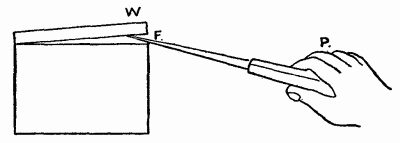 Fig. 1.—Showing a chisel 10 inches long used
as a lever of the first order.
Fig. 1.—Showing a chisel 10 inches long used
as a lever of the first order.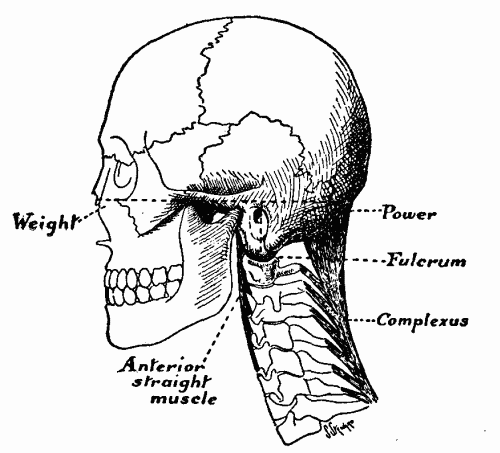 Fig. 2.—The skull as a lever of the first
order.
Fig. 2.—The skull as a lever of the first
order.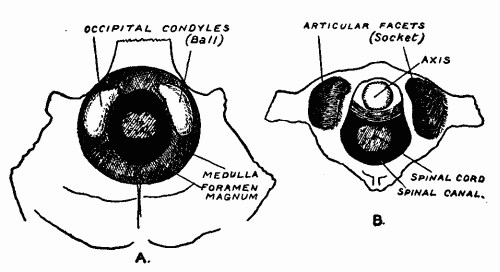 Fig. 3.—A, The opening in the base of the
skull, by which the brain stem passes to the spinal canal. The two
occipital condyles represent part of the ball which fits into the
cup formed by the atlas. B, The parts of the socket on the ring of
the atlas.
Fig. 3.—A, The opening in the base of the
skull, by which the brain stem passes to the spinal canal. The two
occipital condyles represent part of the ball which fits into the
cup formed by the atlas. B, The parts of the socket on the ring of
the atlas.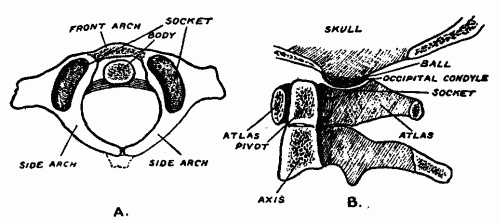 Fig. 4.—A, The original parts of the first or
atlas vertebra. B, Showing the "body" of the first vertebra fixed
to the second, thus forming the pivot on which the head
turns.
Fig. 4.—A, The original parts of the first or
atlas vertebra. B, Showing the "body" of the first vertebra fixed
to the second, thus forming the pivot on which the head
turns.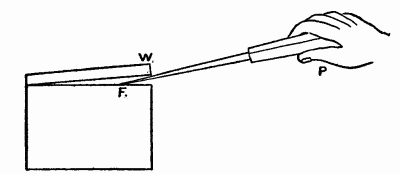 Fig. 5.—Showing a chisel used as a lever of
the second order.
Fig. 5.—Showing a chisel used as a lever of
the second order.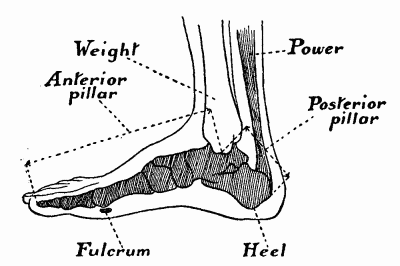 Fig. 6.—The bones forming the arch of the
foot, seen from the inner side.
Fig. 6.—The bones forming the arch of the
foot, seen from the inner side.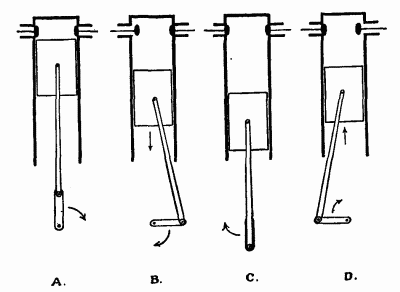 Fig. 7.—Showing the crank-pin of an engine at:
A, First dead centre. B, First maximum leverage. C, Second dead
centre. D, Second maximum leverage.
Fig. 7.—Showing the crank-pin of an engine at:
A, First dead centre. B, First maximum leverage. C, Second dead
centre. D, Second maximum leverage.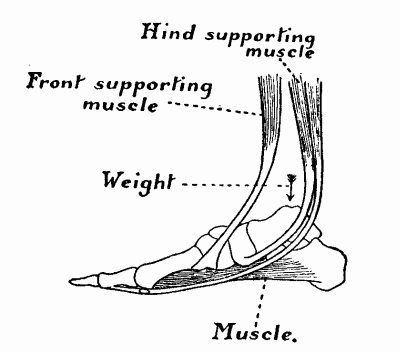 Fig. 8.—The arch of the foot from the inner
side, showing some of the muscles which maintain it.
Fig. 8.—The arch of the foot from the inner
side, showing some of the muscles which maintain it.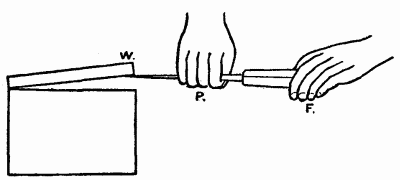 Fig. 9A.—A chisel used as a lever of the third
order. W, weight; P, power; F, fulcrum.
Fig. 9A.—A chisel used as a lever of the third
order. W, weight; P, power; F, fulcrum.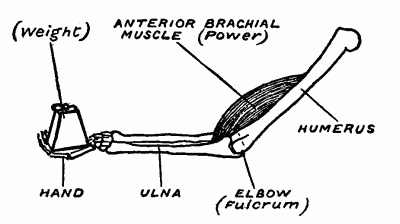 Fig. 9B.—The forearm and hand as a lever of
the third order.
Fig. 9B.—The forearm and hand as a lever of
the third order.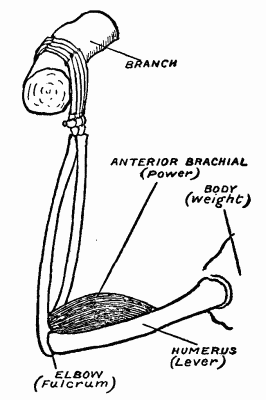 Fig. 10.—Showing the action of the brachialis
anticus in the arm of an anthropoid ape.
Fig. 10.—Showing the action of the brachialis
anticus in the arm of an anthropoid ape. Fig. 1.
 Fig. 2.
 Fig. 3.
 Fig. 4.
 Fig. 5.
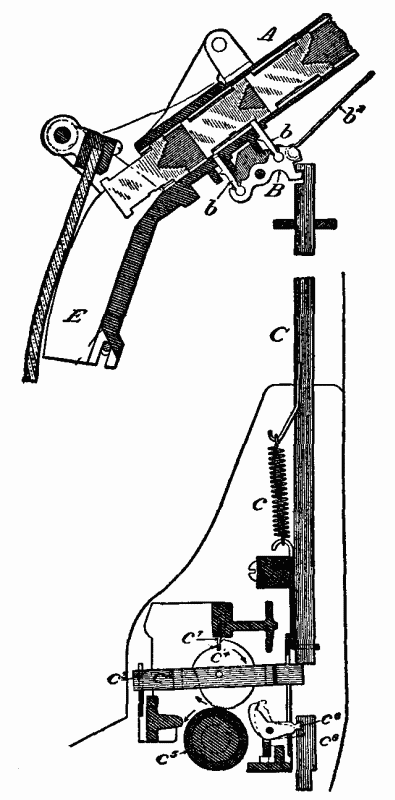 Fig. 6.
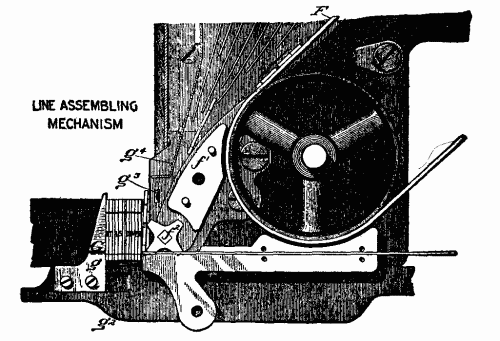 Fig. 7.
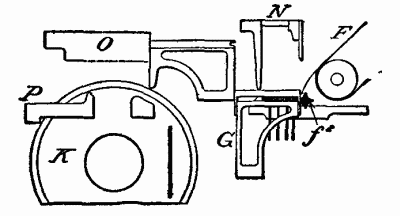 Fig. 8.
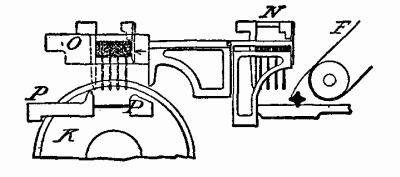 Fig.
9.
Fig.
9. Fig. 10.
 Fig. 11.
 Fig. 12.
 Fig. 13.
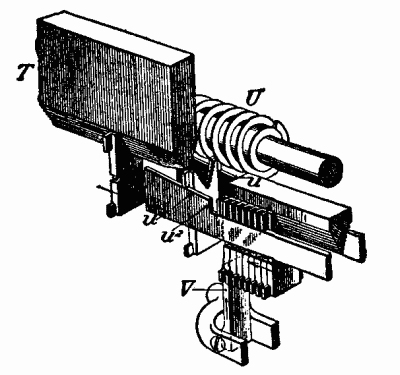 Fig. 14.
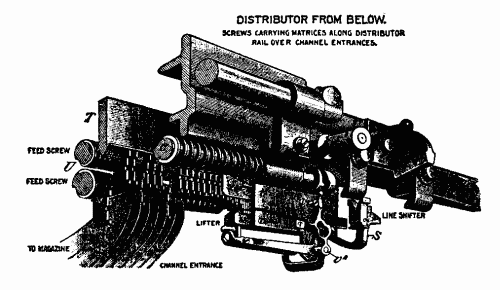 Fig. 15.
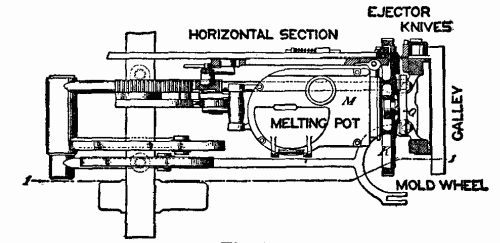 Fig. 16.