Chris Curnow (1937-2023)
the Project Manager at Distributed Proofreaders
who selected this book,
and more than 2200 others,
to be preserved as free digital transcriptions
by Project Gutenberg.
A BOOK OF BRIDGES
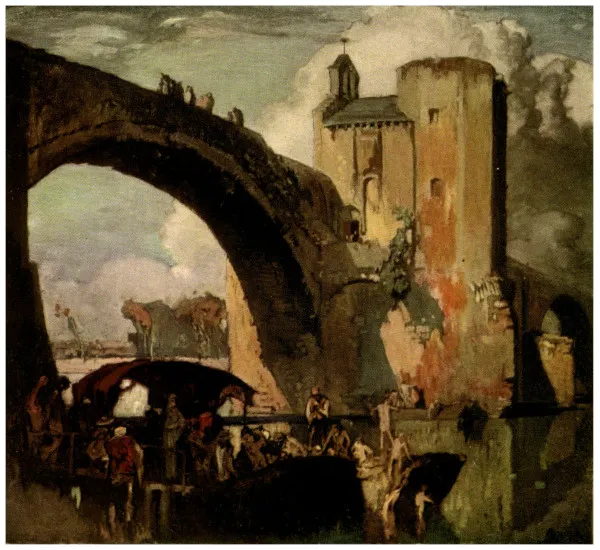
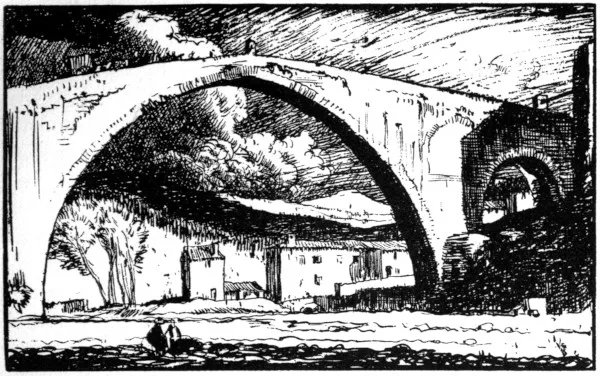
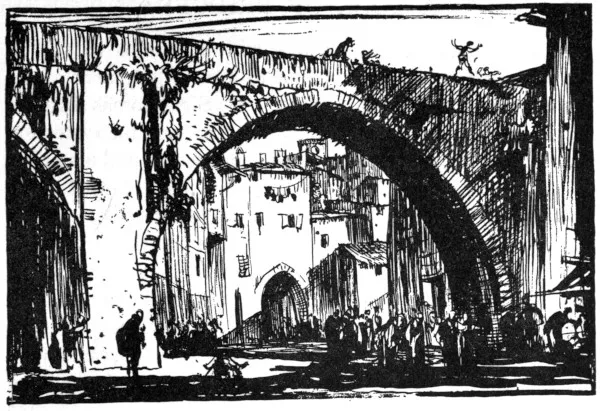
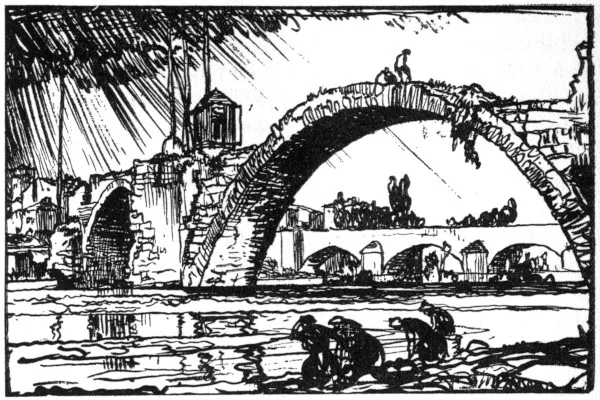
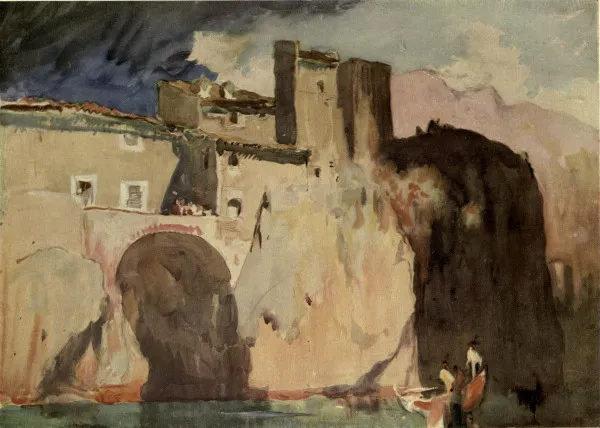
PONT ST. BÉNÉZET OVER THE RHÔNE AT AVIGNON,
BUILT BETWEEN THE YEARS 1177 AND 1185
A BOOK OF BRIDGES
BY FRANK BRANGWYN, A.R.A.
AND WALTER SHAW SPARROW
LONDON: JOHN LANE THE BODLEY HEAD
NEW YORK: JOHN LANE COMPANY MCMXV
WILLIAM BRENDON AND SON, LTD., PRINTERS, PLYMOUTH, ENGLAND
PREFATORY NOTE
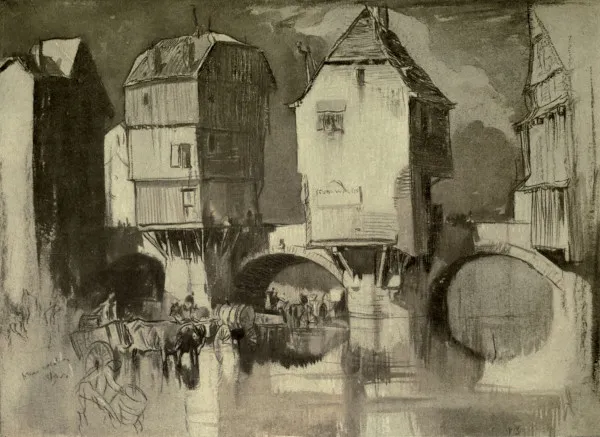
HISTORIC VITRY-LE-FRANÇOIS, ON THE MARNE
Literary projects may be put in two classes. Some
are like steamers that go in a regulated course
direct to their destinations, while others tack here
and there like sailing ships, governed by a zigzag progress.
The subject of bridges belongs to this latter class.
For five-and-twenty years I have tried to order it into
a methodised hobby. As well try to teach a hive of
honey-bees never to visit certain flowers in a garden, and
never to fly beyond certain pathways and hedges. Yet
a writer cannot help rebelling when his chosen theme
declines to play in the game of authorship, and deviates
from many careful plans which are made for its benefit.
Every chapter in this book has been rewritten eight or
ten times, yet my sailing ship has not become an Atlantic
liner.
My wish for a long time was to show the evolution
of bridges in about seven hundred photographic illustrations,
with eight lines of text under each print; and in
preparation for this work I collected materials, and received
invaluable help from other pontists, particularly from
Mr. Frank Brangwyn, Mr. H. T. Crofton, Mr. C. S. Sargisson,
Mr. Edgar Wigram, the Rev. O. M. Jackson, and
the Church Missionary Society. Pontist after pontist sent
me notes, photographs, sketches; and then Frank Brangwyn
suggested that we should work in collaboration. Here
was luck indeed! His pictures and drawings would be
the book of art; and the rambling subject, if it passed
over mere technique into the human drama, ought to interest
the general reader who does generally read. For bridges
have represented types of society, every change in their
development having been brought about by changes in
social needs.
One thing more than any other is attractive to a pontist:
it is the varied strife that bridges and roads have circulated,
not only in military campaigns, but in the thronged
struggle for existence—the one incessant war in the affairs
of men. A routine of idle sentiment prattles about an
illusion named Peace, yet strife everywhere remains the
historian of life, every effort to do and to live claiming a
battle-toll of killed and wounded and maimed. Even sleep,
the nearest kinswoman of peace, is united to the law of
battle by dreams that torture. A pontist, then, when
studying the strife that roads and bridges have distributed,
must clear from his mind the fanciful ideas that pacifism
has invented; he is an adventurer in history, not an idler
in a world of visions. To-day, above all, he is called
upon to see the truth, because Europe, driven by the rival
motive-powers of hostile ideals, has passed from industrial
strikes and contests into other phases of necessary warfare.
Once more differing civilizations will have their worth
tested to the full on stricken fields; and once more roads
and bridges will dominate the military tactics and
strategy.
This great War broke out when my last chapter was
nearly finished, and its early events illustrate and confirm
the main arguments which I have tried to make as clear as
possible, so that no person may think of bridges apart from
their historic service to mankind. During many centuries,
for example, all strategical bridges were fortified; then a
gradual decline began, and it culminated in the defenceless
modern bridge that sappers blow up in a few minutes.
Bridge-builders everywhere have much good sense to
regain from the science of national defence, a very difficult
science to-day, for many of its methods are being rendered
obsolete by airships and aeroplanes. So a book on historic
bridges could not be published at a time more opportune
than the present moment.
Several collectors have lent pictures, and their kind aid
is acknowledged in the table of illustrations.
Section I.General Views, from p. 3 to p. 13. Section II.Strife and
Historic Bridges, from p. 14 to p. 52. Section III.Custom and Convention,
from p. 53 to p. 84. Section IV.Controversies, from p. 85 to p. 106.
Section I.Preliminary Considerations, from p. 109 to p. 112. Section II.Among the Heralds of Man, from p. 113 to p. 124. Section III.The
Slab-Bridge with Stone Piers, from p. 125 to p. 128. Section IV.Tree-Bridges
with Stone Piers, from p. 129 to p. 132. Section V.Tree-Bridges
with Timber Piles, from p. 133 to p. 135. Section VI.Some
Typical Timber Bridges, from p. 136 to p. 143. Section VII.Primitive
Suspension Bridges, from p. 144 to p. 149. Section VIII.Natural
Arches—their Significance and their Influence, from p. 150 to p. 164.
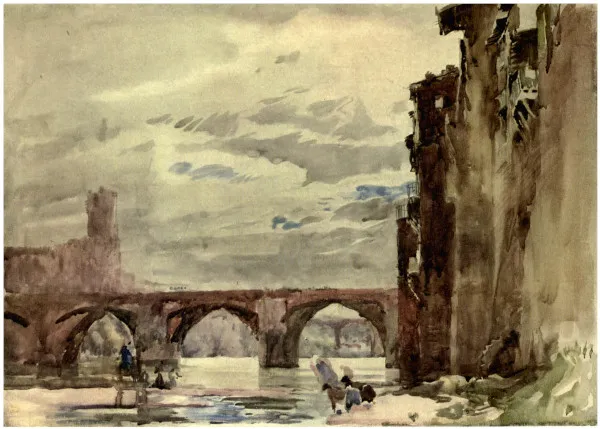
At Albi on the Tarn in France. Showing on our right the
Old Houses, and beyond the Bridge, on our left, the great Old
Church, famous for its fortifications
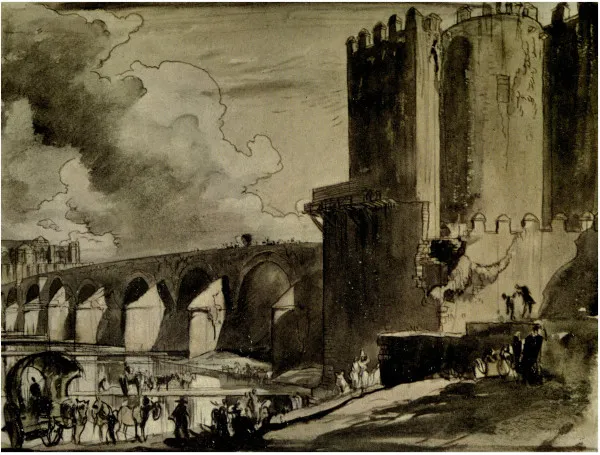
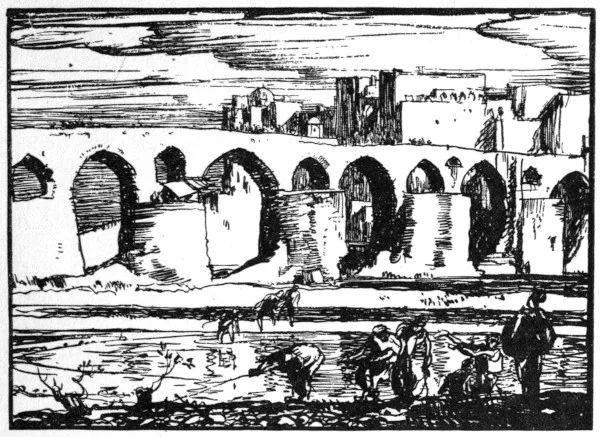
Huge Defensive Bridge at Córdova in Spain. Originally
Roman, but remodelled by the Moors in the Ninth Century.
Recently so much repaired that it looks almost new
New London Bridge. Designed by George Rennie, and carried
out by his brother, Sir John Rennie. Opened to the public in
1831. Collection of Charles Holme, Esq.
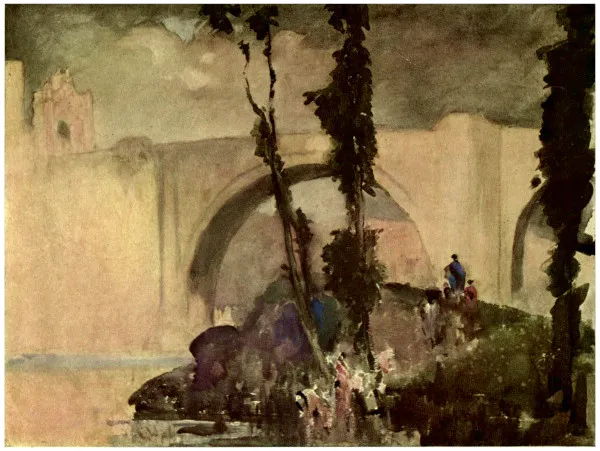
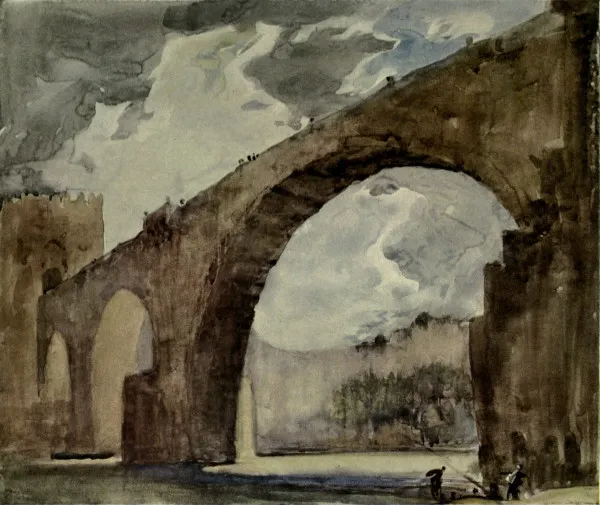
Spanish War-Bridge—the Bridge of St. Martin at Toledo.
Its history seems to date from 1212, but in the fourteenth century
it was rebuilt by Archbishop Tenorio
CHAPTER THE FIRST — ON THE STUDY OF BRIDGES AND ROADS
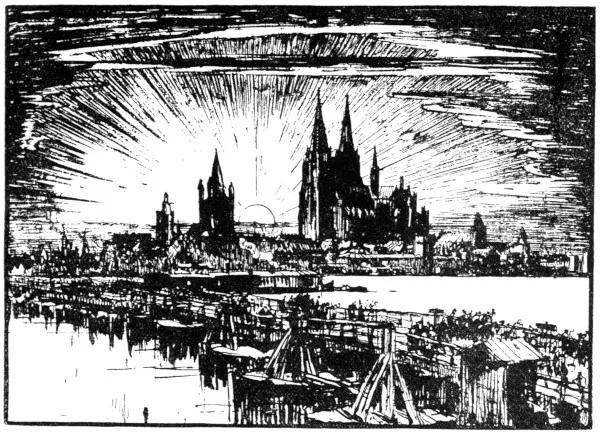
BRIDGE OF BOATS AT COLOGNE
I
GENERAL VIEWS
A pontist, or devotee of bridges, ought to be
envied and pitied; his work is marvellously attractive,
but he cannot hope to learn even a twentieth
part of the discoverable history which has circulated
along highways. Indeed, the history goes back to a time
that preceded the descent of man; a primal time when
every bridge was made by Nature, and when footpaths and
tracks were the runs and spoor of wild animals, many of
which were huge enough to plough their way through deep
jungles and to trample wide paths through the undergrowth
of virgin forests. There were eight or nine sorts of natural
bridge (p. 113), and they were all useful to the many quadrupeds
that travelled far in their search for prey and forage.
To meditate on this fact is to visualise many probable
happenings; vivid pictures live before the mind’s eye, and
in one I see how a full-grown Iguanodon, after gorging all
day in a ravaged weald, was overcome by the sleep of
glutted hunger as he tried to cross a big fallen tree that
bridged a chasm near by his lair under a rock-shelter; and
a flock of little bright birds came and settled on the seventy
feet of body and tail, just to pick up vermin. Why not?
Life everywhere has fed on lives; something has died, and
suffered a resurrection of vitality, whenever appeased
hunger has renewed the health of an organism; and this
picture of an edacious Iguanodon and his bird friends
attracts me for two reasons: it reminds me that bridges
throughout their history have circulated strife, and it represents
the perpetual law of battle that rules creatively over
all living creatures, like foul manure over gardens and
harvest fields.
A pontist, then, must try to see clearly, under a form of
visual conception, what part his subject played in the
earliest war of organic life, when natural bridges aided the
first animals not only to hunt over great territories, but to
migrate from their first homes into lands very far away.
In the second chapter we shall try to feel the inspiring
pressure of events which must have acted during the
descent of man on a brain remarkable for its imitative
faculties. Perhaps we can get into imaginative touch with
our earliest ancestors; perhaps we can find in ourselves a
vestige of their aboriginal nature; and then we shall know,
by a sympathy which we shall not question, how each
natural bridge helped them in their wanderings, and became
a model to be copied, and adapted, and improved.
Such is the beginning of our enviable studies, but their
end is never reached. Not even the long days and years
of Hilpa and Shalum, in Addison, where antediluvian
seconds endure about as long as our trivial minutes, would
be enough for a complete study of bridges and roads,
viewed as inestimable servants to the commonweal of mankind.
A complete study would follow their evolution
through eight world-wide subjects: architecture, civil
engineering, antiquarian research, the development of trade
and commerce from primitive barter, social wayfaring, war
and its red tragedies, the longevity of barbaric customs,
usages, traditions, and the ups and downs of fortune in
the slow fever called progress, whose clinical thermometer
has been tribal and national enterprise, and whose gradual
effects on the temperature of bodies civil have produced
many withering crises fatal to civilizations.
These eight subjects are vastly intricate as well as world-wide.
In scope they are infinite, if we compare their
magnitude with the brief seasons of our perishable days.
Let us then ask ourselves a question: How much may we
expect to learn about bridges and roads, the distributive
agents of all human aims and ambitions? Suppose we live
to be threescore years and ten, and suppose we work
gladly for eight hours a day from the age of fifteen to that
of seventy; encouraged by perfect health, and so delighted
with our work that we rescue Sunday from a sabbatarian
inertia, and lose no time at all by being drudges to the
holiday mania. For a pontist never need be idle; not only
has he a thousand problems to reconsider, but in all his walks
and rides he is a wayfarer with his hobby. When he feels
cocksure he can visit a detestable railway bridge and drink
the wormwood of pessimism; and when for a whole week
he has tried in vain to follow a devious fact through all its
golf-ball antics from bunker to bunker, let him go to a
classic bridge such as the Puente Trajan over the Tagus at
Alcántara; or let him be as a delighted pupil to Turner’s
Walton Bridges or to Brangwyn’s magnificent vision of the
Pont St. Bénezét at Avignon.
From time to time, also, after paying his rates and taxes,
a pontist should recall to memory the rare great “finds”
which his long research has unburied. To enjoy a “find”
properly is to feel sure that one has made a gallant entry into
El Dorado. Never shall I forget the elation that came to
me when at the same moment I came upon two wondrous
facts: first, that Nature had created lofty arched bridges,
like the Rock Bridge in Virginia and the Pont d’Arc over
the Ardèche[1] in France; next, that the earliest archways
in handicraft were copied from Nature’s models, and copied
with a plodding mimicry, for they were built not with converging
archstones, but with courses of stone laid horizontally,
just as Nature in stratified rocks had put one flat layer
upon another (p. 155). To discover facts of this kind is a
joy that keeps the heart youthful. Study is not a friend to
the Income Tax, but it puts trouble out of mind, a true
Nepenthe. Even aged scientists at the Pasteur Institute
grow young and merry when they isolate a virulent
microbe which for a long time has baffled their curiosity.
Yes, research ought to be very popular; in its companionship
any person of sense may learn gladly as an “old boy”
from his fifteenth year to the seventieth, working daily for
eight thorough hours.
How many hours in all would be given to study and
thought? In fifty-five years there are twenty thousand and
seventy-five days; these we multiply by eight and behold!
we have been sedulously youthful for 160,600 hours. Here
is a record of industry; it may be unexampled until centenarians
become as frequent as M. Metchnikoff wants them
to be; and yet, after all, is it a great record? Great it may
be in its relation to human weakness, but it means only a
trivial apprenticeship to any vocation that lures the mind
with illimitable open fields. Our happy toil is nothing
more than a gleaner, but it should keep us from being
prigs—little students overfed on a little knowledge and
too foolish to feel ignorant. What Sir Clifford Allbutt
has told the public about the immaturity of modern science
is true also of the study of bridges and roads; here, too,
knowledge is often hollow while ignorance has a solid
weight, even among men who are not content with current
formulas. “In every direction we seem to travel but a
very short way before we are brought to a stop; our eyes
are opened to see that our path is beset with doubts, and
that even our best-made knowledge comes but too soon to
an end. In every chapter arises problem after problem to
beckon us on to farther investigation; yet this way and
that we are so baffled by darkness and ignorance that to
choose one of these problems for attack, one which is likely
to repay his labour, is often beyond the scope of a junior
candidate.”[2]
Not that a young man should be very humble in his
choice of a problem, for it is with students as with empire
makers, who would do very little if a bold indiscretion were
unfruitful. Let us have faith in the sunburnt cockiness of
extreme youth. When it hunts the far horizon as if mirages
of self-deception were the butterflies of ambition, easy to
catch and easy to preserve, it is guided by the genius of
research; and certainly it has done far more for the world
than will ever be done by a reasoning caution that looks too
far ahead.
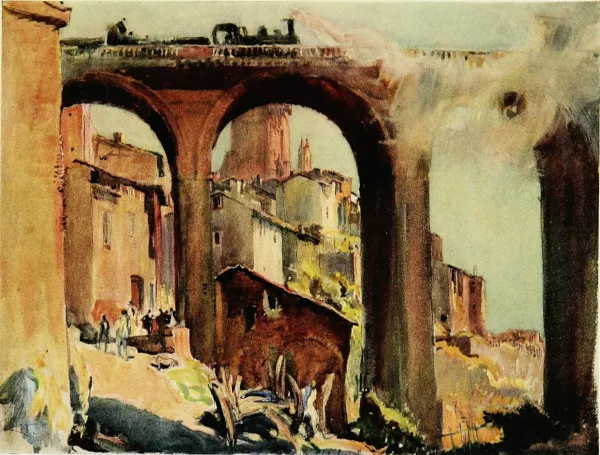
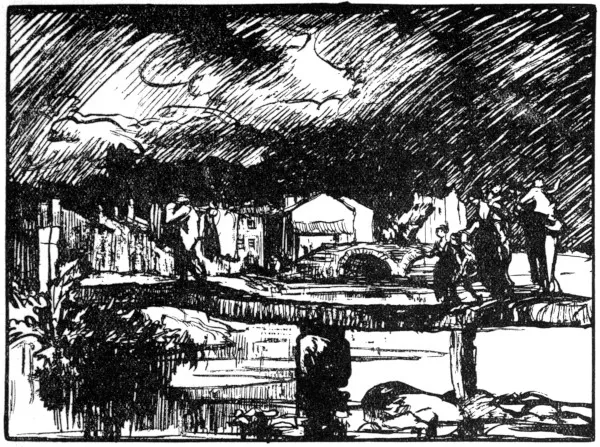
RAILWAY BRIDGE AT ALBI IN FRANCE
About five-and-twenty years ago, when I began in my
leisure time to be a pontist, a good old slippered antiquary
gave me some hints on what he called “a discreet fervour
in the study of bridges.” I was to choose an English
county, perhaps Derbyshire, and for eight or nine years I
was to live all day long with the bridges, getting them
photographed from many points of view, and recovering
bits of their stories from dusty old records and forgotten
muniment chests. Then a clay-cold book in two volumes
was to be written, with a frigid zeal for the accuracy of
minute data, and with enough glacial footnotes on every
page to strike terror into that general reader who does
generally read. No thought at all was to be given to the
public, whose vulgar mind had neglected the many antiquaries
who had told the historic truth unflinchingly, with
a desperate effort to be impartial, unemotional, and yet
effective also, like icebergs. I told my adviser that his
ideals were those of a studious millionaire. He could
afford to write without heart and to be pleased with a bad
circulation; could afford also to forget that old English
bridges, though at times as charmingly rustic as the Robin
Hood Ballads, were not great masterpieces of art, like a
good many old bridges on the Continent. If I invited
readers to dine with me on Brazil nuts, unaided by nutcrackers,
how in the world could I expect to receive company?
But argument was useless. The antiquary had
two homes—himself and the past, and in both he lived as
a rapt dreamer. I see him still, a lean and dusty figure,
unkempt, unwashed, for he “hated immersion” like Dr.
Johnson. His favourite aim—and he never realised it—was
to put a spade tenderly against a human skull buried
in Pliocene deposits. “I would sooner do that,” he declared
one evening, “than be married to all the prettiest
women in England—girls, not widows, of course.” Courage
was not his forte—except in one pugnacious habit which
he shared with most antiquaries: not only did he love facts
with a zeal that was always ready to defend them, but he
regarded every fact as a big truth.
The old man would say to me, for instance, “Hunt in
the Middle Ages for common but shining truths about
roads and bridges. Ah yes! There’s the fact that many
bridges were property owners; their landed estates were
sometimes inconsiderable, to be sure, like the noble parks
of Lilliput; but each estate, whether large or small, was a
great truth in the history of bridges. And I like to remember
the good folk who in their wills bequeathed money
to their favourite bridges, like Count Neville, who in 1440
left twenty pounds to ‘Ulshawe Bridge,’ near Middleham.
Now and then the testator was a skinflint, like John
Danby, who in 1444 left in his will a beggarly six and
eightpence to ‘Warleby Bridge.’ Yes, and he was rash
enough to die unrepentant. Another man, a notable merchant
in his day, Roger Thornton, of Newcastle, was
clever enough to save himself from oblivion, a merchant’s
destiny, by leaving a hundred marks to the Tyne Bridge in
his native town—a bridge, by the way, that needed much
renovation. But Thornton in his charity struck a hard
bargain: the hundred marks would not be paid unless the
‘mair and ye comyns’ released the testator from certain
actions at law! Thornton died in 1429; and to show you
that the beautiful truth which I am illustrating was not
then historically juvenile, I will mention an earlier fact
from the life of a Newcastle citizen, John Cooke by name,
who in 1379 bequeathed twenty marks to the fortified
bridge at Warkworth.”
The old man gossiped quaintly about his “truths,” but
when he wrote about them he was legal in profuse entanglements.
Then it seemed to him that truth could not be protected
by too many fortifications. Had he looked upon
facts as facts, mere things which had happened and which
had no future, his antiquarian knowledge would have been
less arid. But he belonged to a school of pedants—the
same school which either kills antiquarian magazines or
enables them to live obscurely on unpaid contributions.
That a man’s lifework should be futile to the public, a mere
cemetery where facts lie buried like fossils in a rock, is
pitiful; yet antiquaries are very proud of their barren labour.
Scarcely one of them understands that a fact, however
entertaining, has no value to thought unless it is a useful
item in a mass of corroborative evidence; and even then it
can be nothing more than a fact, a thing to illustrate the
perpetual action of an absolute truth, or the increasing
worth of a given hypothesis, or the general belief in a
given theory. Two or three facts that confirm each other
justify a guess, a random “shot,” or a vague suspicion; an
important collection of such facts, if it continues to grow,
gives validity to a hypothesis; and when from many sources
as various as they are many new facts are added year after
year to the collection, until at last the cumulative evidence
holds the field with the best judges, then we know that the
hypothesis has been developed into a theory, the highest
form of mobile knowledge in the realms of Thought. But
a theory is not absolute truth, of course; it is a harbour
where Knowledge rests while Thought is on the high seas,
a Columbus, searching for new worlds.
From a guess to a theory; this, then, is the architecture
of constructive growth that research and revision build
with facts; and if we as pontists wish to think clearly and
humanely, we must use facts as a means to a worthy end,
as architects employ their materials. One by one facts are
to us what a few slates and tiles are to a builder, but
Thought collects them, and then with care and inspiration
she builds with them as she builds with stones and bricks
and timber. In her work, moreover, there is nothing little
when she does little things admirably; but when her devotees
go away from her and parade guesswork as theory and fact
as truth, we should ask them whether brick-kilns are
houses and stone quarries cathedrals. To-day, unhappily,
most people exalt facts into truths, and very often the great
word “theory” is a journalistic term for any supposition
that is loose or wayward or foolish. Thus, “Mrs. Jones
has a mere theory that her husband is hard at work when
he remains in town after office hours.”
From the life of bridges we may draw a great many
conjectures, suppositions, speculations, suggestions, fancies,
ideas; and here and there we find some attractive hypotheses,
notably those that concern the introduction of
pointed arches into French bridges, and of ribbed arches
into English bridges. Are there any truths, any useful
and necessary things that repeat and confirm themselves
age after age? Yes. There are some technical truths that
belong for all time to the mechanics of bridge building;
the world can employ them for ever, and always with
the same good results, if engineers and architects work
competently. There is also a great social truth in the life
of bridges and roads; namely, that types of society are as
old as their systems of circulation, just as women and men
are as old as their arteries. So the condition of a body
social can be judged accurately if we examine with care its
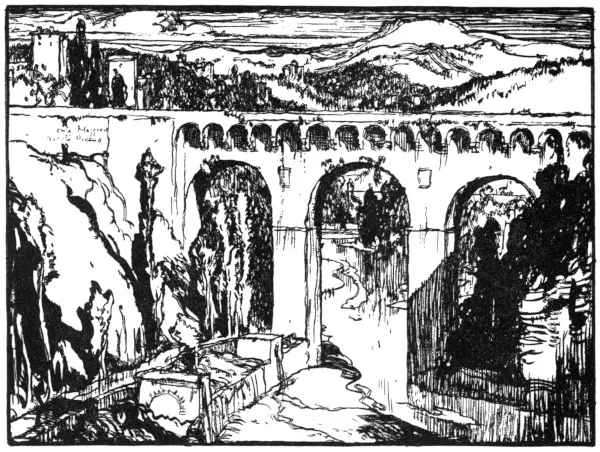
landways and waterways. In Spain, for example, where
the genius of modernity is inactive, and where fine bridges
represent many dead social states, Roman, Moorish,
Mediæval, and Renaissance, the past reigns over the
highways, sometimes as an inspiration, as in the great
and vast bridge at Ronda, but usually as a mournful
historian. Even in those parts of Spain where trade
endeavours to be modern, workmen have time enough to be
honest craftsmen; their metal bridges are not uncouth, and
their stone bridges are charmed with hints taken from
classic models. They do not “progress,” for they keep far
off from that spirit of trade which regards the lies of advertising
as proofs of a pushful honour. From a modern
standpoint, then, Spain does not live except as a dim reflexion
of her long ago.
A pontist has few theories to consider, only two, indeed,
and these are sisters. Let me introduce you to them.
II
A BROKEN WAR-BRIDGE OF THE XIII CENTURY, AT NARNI IN ITALY; REPAIRED
WITH WOOD
STRIFE AND HISTORIC BRIDGES
The first theory sets thought astir on the necessity
of having landways and waterways which in all
respects are fitted to distribute the many functional
activities of military and civil life. It is not enough
that a complex type of society should have many intricate
systems of circulation for its multiform traffic. The weakest
points in each system ought to be regarded as danger
zones in the strategy of national defence, so it is a duty to
protect them from attack, and the protection should be as
complete as the military arts can make it, age after age.
Now the most vulnerable points in a system of landways
are the long bridges by which roads and railways are conducted
across wide chasms, and deep valleys, and perilous
waterways. Yet in England, and in other countries also,
neither roads nor railways are defended; indeed, modern
bridges are not only unfortified, but as sensitive to bombs
as elephants are to large bullets. Why has the world
forgotten that a powerful nation whose bridges were cut
would be like a giant whose arteries were severed? As the
suffragettes burnt down Yarmouth pier, so a conspiracy of
civil disorder, acting in accordance with a well-formed plan,
could in a night, with a few sappers, cripple a vast railway,
by blowing up the main strategic bridges. I am giving
a chapter to this urgent subject, most engineers having
evaded with equal zest the charm of beauty and the security
of our food supplies. At a time when the nations overarm
themselves for war, tradesmen and engineers have erected
ugly bridges for an imagined peace; but now that the art
of flying threatens civilization from overhead and from all
around, like a new Satan, the public attitude to highways
cannot remain lethargic. Willingly or unwillingly, we
must recall and renew those principles of defensive war
with the help of which bridges were safeguarded by the
Romans and also in the Middle Ages. Frank Brangwyn has
painted many aged fortified bridges, making a most varied
selection; and in each of these historic pictures he illustrates
the attitude of old times to the theory of pontine defence.
The apathy of the public has been unintelligent, but not
unintelligible, because bridges and roads are so ordinary, so
very trite, that we who use them every day do not think of
their supreme influence on the nation’s health and safety.
They belong to that realm of custom where truths fall
asleep in truisms and facts in platitudes. To understand a
thing that seems obvious, or “inevitable,” is among the
problems that genius alone can solve in a complete way.
Dr. Johnson believed that men and women could marry
ugliness without being in the least intrepid, because custom
would soon teach them not to know the difference between
good looks and bad. As custom dulls our minds even in
family life, where affection is most watchful, we cannot
be surprised that common roads and bridges are too evident
to be seen intelligently.
Very few persons love a bridge until it is gone, or until
it has been put out of action by Napoleon’s “whiff of gunpowder.”
Then a victorious army may be brought to a
standstill, like Wellington’s, in Spain, when the retreating
French blew up an arch of the colossal Roman bridge at
Alcántara, so that for some long days the unfordable Tagus
might protect their rearguard. It was no easy task to repair
the bridge with a netting of ropes that carried planks; and
when the British army crossed the gap on this makeshift
footway, Wellington knew that the Devil was not the only
archfiend in human affairs.
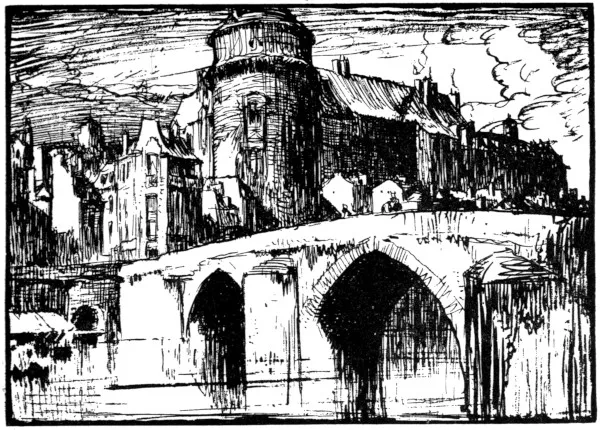
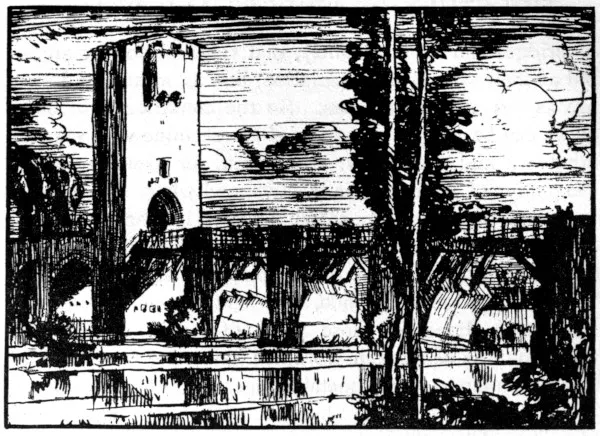
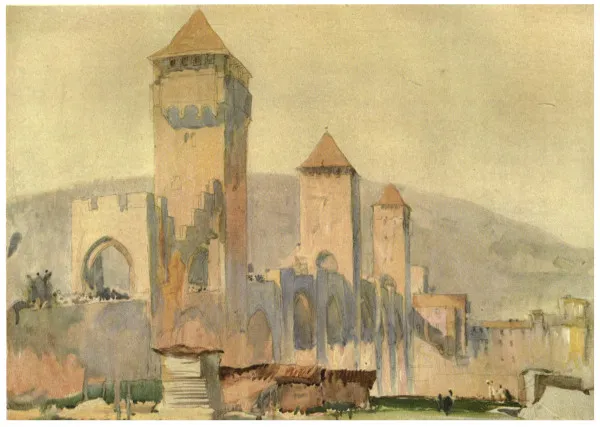
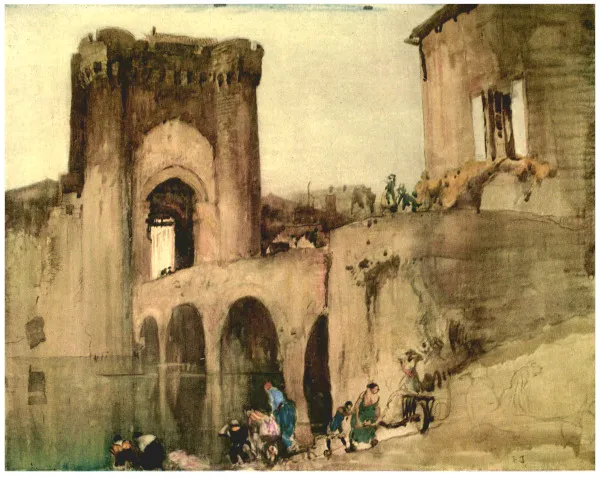
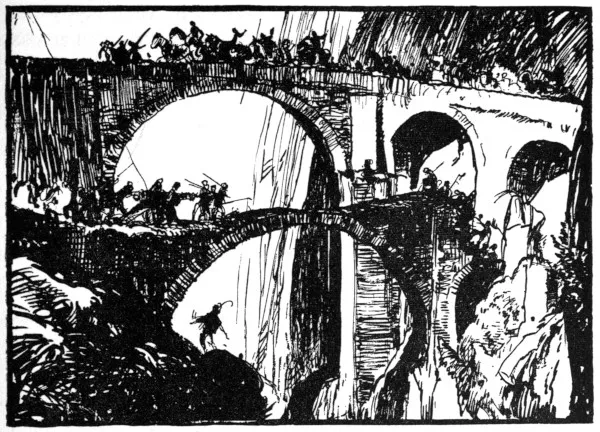
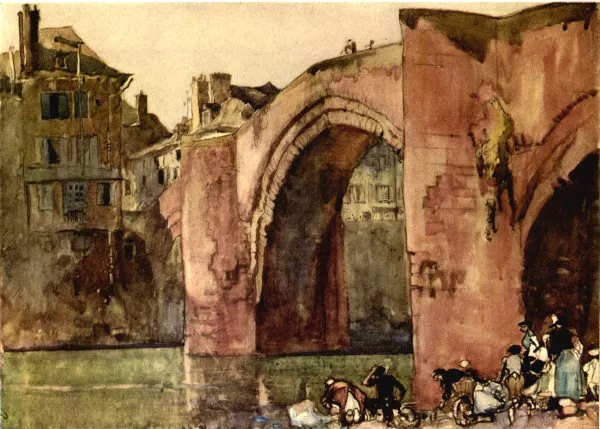
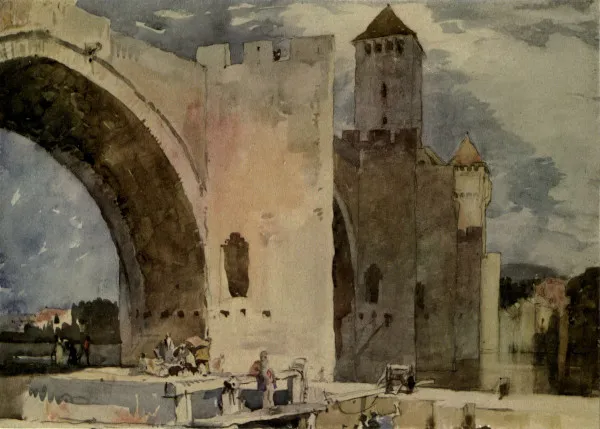
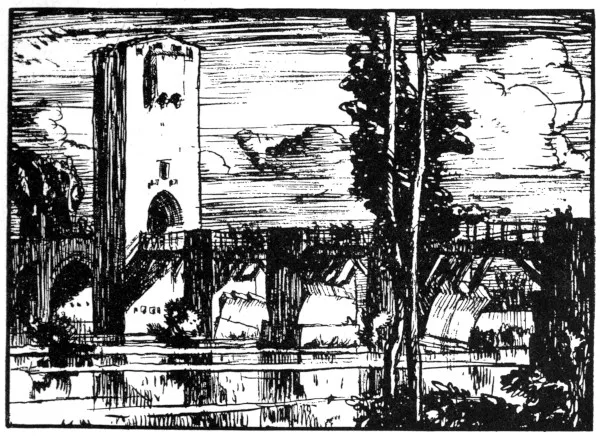
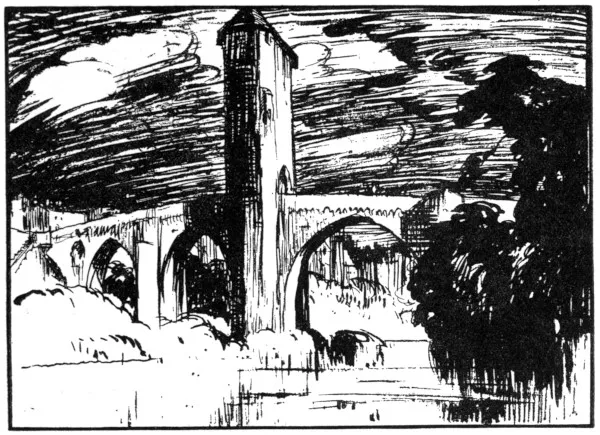
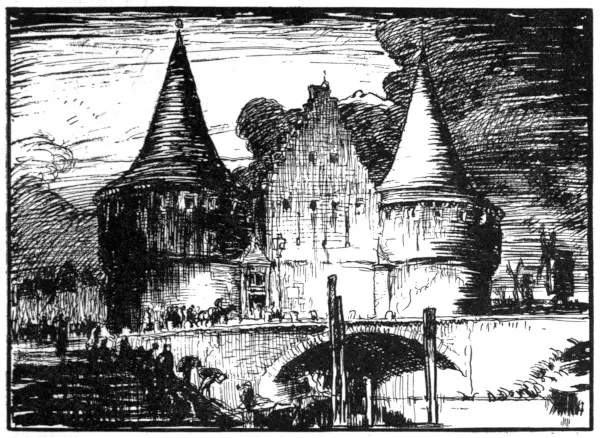
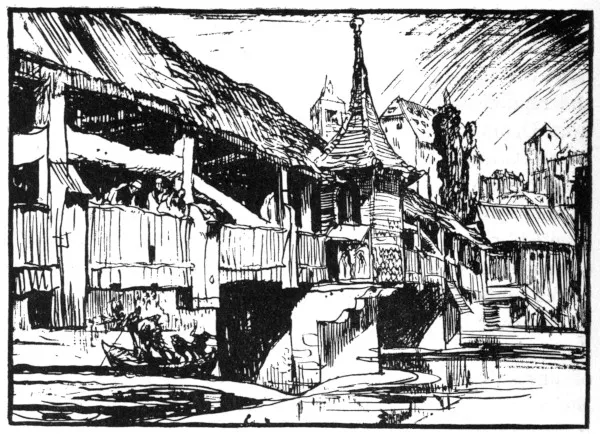
PONT VALENTRÉ AT CAHORS IN FRANCE: THE FORTIFIED
GATES AND TOWERS. SEE ALSO THE SECOND PICTURE
Yes, believe me, it is worth while to think of the highways
and byways. Try to imagine, for instance, what it has
cost in suffering and in death to make fit for use all the
traffic arteries and veins that nourish and sustain life in the
bodies civil of the world. How long would it take to
explore the myriads of rambling footpaths? Could this
work be done in two hundred years by a thousand Stanleys?
How many lives have been lost in making roads through
forests and fens and over mountains? in the construction of
railways? in the building of bridges? in the slow cutting
of canals? The Suez Canal was a long campaign of
stricken fields in the war of trade enterprise;[3] and the
Panama Canal has reaped lives as quickly as minor battles
reap them. If we could see in a form of visual conception
all the sacrifice of life that civilizations have offered to
progress on the historic landways and waterways, how terrified
we should be! Even the hospitals and sick-beds of
humanity have not had a more scaring pathos than that
which has accompanied the more peaceable enterprises of
mankind.
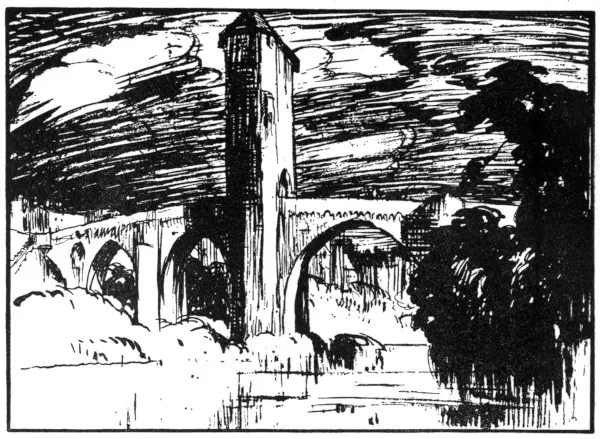
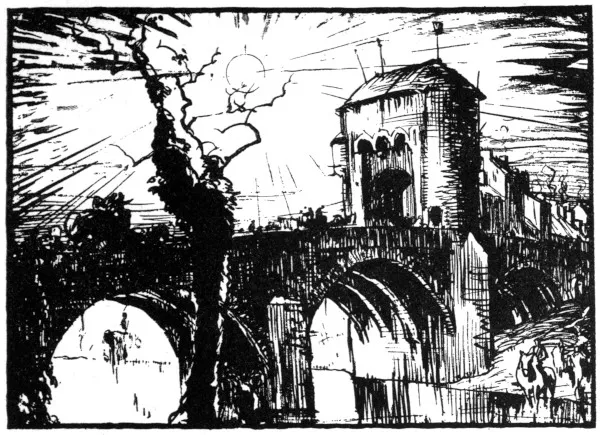
A WAR-BRIDGE OF THE XIV CENTURY AT ORTHEZ IN FRANCE
This reflexion brings us to the second theory that has a
home in the life of bridges and roads. Other homes it has
also, a vast number of them, for this theory belongs to the
law of battle, the universal law of strife. In so far as the
lower organisms are concerned, this law seems to be as
permanent as the sun; we have no reason to suppose that
its rule will ever be relaxed among birds, beasts, fishes,
insects, or among other forms of life, such as competitive
trees in a wood; but mankind is an eternal mystery, and
none can say into what civilization of symphonic harmony
the human race may be evolved by gradual improvements
in the crowded struggle for existence. A hundred thousand
years hence the competitions of human life may be like
harmonious rivalries between notes in music, or like the
wondrous orchestration that unites into a symphony of
benign health all the communities of cells in a sound body.
“All for Each, Each for All” is the social rule that Nature
administers in her cellular civilizations; and she punishes
with disease and death the bodies that rebel against her
rule by developing harmful egotisms. Yet mankind has
stereotyped a very different social rule, “Each for All, yet
Each for Himself”; and what right have we to believe that
this egotism, so long inherited, and continuously active, can
change its nature gradually, till at last it will be as philharmonic
as the cellular commonwealths forming a strong
human body? At present this appears to be very improbable,
but impossible we dare not call it, since every type of
society is free to improve its own lot. So the law of strife
in human affairs appeals to us not as a truth destined to last
till doomsday, like the strife of carnivorous hunger, but as
a theory which human life has not yet contradicted, but
which in course of time may be tempered into a social art—a
competitive harmony favourable to everybody. Yet even
then, no doubt, inequalities of mind will be active in accordance
with Nature’s law of infinite variation.
Meanwhile, however, we have to accept history as mankind
has made it. Strife has reigned everywhere; even the
test of efficiency has been—not the survival of the finest
natures, but—the survival of the least unfitted for a long
battle against bad environments. Very often the delicate
have the best characters and the most alert brains; and in
times past the delicate died from hardships by myriads.
Consider also the innumerable wars; slaughter and success
have tried to go hand-in-hand together as boon companions.
Every road through history is a changing procession of
armies; every ancient bridge has a long story of battles.
Indeed, bridges and roads have circulated all the many
phases of strife that men have employed in civil rivalries,
in mercantile competitions, in generative migrations, in
roadside adventures with footpads and cut-throats, in fateful
invasions, and in those missionary conquests which have
given to religions their rival empires.
No one knows how many invasions were broken up by
the forests and fens of England before the Romans came
with their colonising methods, and linked their scattered
camps together by means of paved highways, great roads
destined to be used for many centuries, and by many raids
and armies. The earliest prehistoric tribes came along a
bridge of land by which England was united to France;
they found in their course some of the nature-made bridges
(p. 114), and the spoor and tracks of formidable animals,
such as the mastodon and the mammoth. Much later
invasions, also prehistoric, must have come over the sea in
boats, for the bridge of land had the history of most
bridges, the water swallowed it up; but every boat may be
regarded as a floating bridge which is moved from place to
place, so that a pontist when he studies the sea-borne invasions
keeps in touch with his favourite subject. On their
arrival in England the later prehistoric colonists found that
most of the nature-made bridges had been copied, and that
a great many footpaths and tracks rambled from settlements
to watering-places and through the forests where huntsmen
risked their lives in a sport of habit.
The men of the Bronze Period were supplanted in
Europe by a race more powerful, whose clenched fists
needed larger sword-handles; it was a race of manly and
swaggering nomads, strong and fierce; and yet, as Darwin
believed, their success in the war of life may have been
aided still more by their superiority in the arts. Can we
fix a date for the introduction of bronze into the British
Isles? Here is a matter of opinion; but, according to Sir
John Evans, the most likely date is separated from the
Christian era by about 1400 years, perhaps 200 years less.
Iron belongs to a much later time. Probably, in the fourth
century B.C., it was known as a metal in South Britain;
and about a century later it began to supersede bronze in
the manufacture of cutting implements.[4]
Then, as now, England waited for great discoveries to
be imported. Many British tribes were hermits of convention,
willing drudges to a routine of fixed habits and customs.
For example, the highest form of prehistoric bridge-building,
the lake-village, came to England not earlier than
the Bronze Age, and we shall see (p. 137) that a lake-village,
with its late Celtic handicrafts, existed at Glastonbury when
in its neighbourhood the Romans were at work. But I do
not wish to imply that no British tribe had any alertness.
As Cæsar found out to his cost, there were Britons with
an enterprising conservatism, whose war-chariots were
managed with a skilful bravery. This wheeled traffic
postulates a good road here and there, with bridges over
some deep rivers; and to this supposition two facts must
be added: the war-chariots were small, and their wheels
were primitive, so in a wet climate they would have been
useless on unmended tracks. Let us infer, then, that the
Roman conquest of England was aided by some British
landways which were genuine roads, valued for their service
and kept in repair. Is not this implied also by the circulation
of Druidism from its venerated heart in Anglesey?
There is no evidence better than that of a just inference
from known events, for events cannot lie, whereas the eye-witness
can, and very often he does.
Again, to think of the aggression which has travelled
along roads and over bridges, is to think also of the five
phases through which civilization has evolved many times.
During the first phase a new home is won by invasion;
and during the second phase the new home is extended by
invasions, and efforts are made to co-ordinate the separated
parts by improving their intercommunications. Then civil
and economic competitions not only multiply, but become
too active in the body social; wealth breeds wealth, and
poverty, poverty. So the classes grow discordant, and put
too much strain on each other, just as diseased lungs poison
the strongest heart, or as virile hearts rupture weak arteries.
Here is the fourth phase; it means a gradual disintegration
brought about partly by the economic war, partly by a relaxing
faith in stern duties and in patriotism. Amusement
becomes a passion, even a mania, and discontent seethes
under the fool-fury of the merry-making. Then comes the
gradual break-up or downfall, which may be hastened by
invasions from a younger and more militant country. Each
phase may be a long development, sometimes delayed by
events, and sometimes hurried; and the final phase may be
postponed for a long time when the strife of poverty is relieved
by constant emigration. Human gunpowder does
not explode if it is shipped to a happier country where a
day’s work brings comfort enough for three days. But the
main point is this: that civilizations have travelled always
in the same direction and ended always in a break-up, just
as great rivers have flowed always toward their destiny in
the sea, though all have changed their beds many times and
widened their valleys.
When we meditate on the part played by bridges and
roads in the rise and fall of ambitious nations, we should
choose a fit environment, such as a Roman bridge crippled
by three forms of war: floods, winds, and human strife.
France has three or four Roman bridges of this kind, but
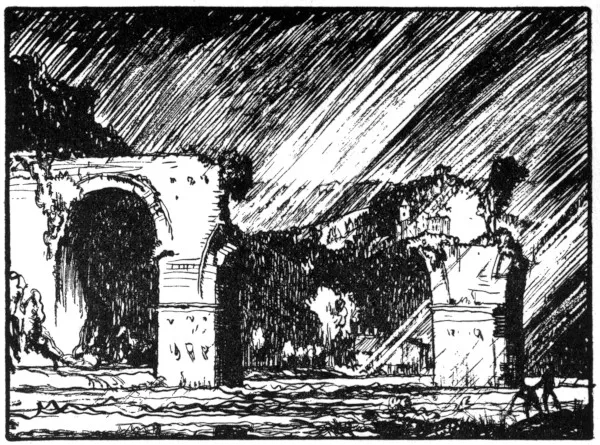
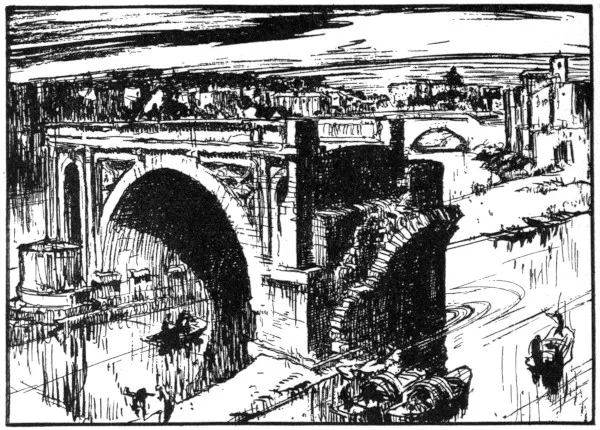
let us take an Italian example. Brangwyn has chosen the
Ponte Rotto, at Rome, and the great ruins of the bridge at
Narni. It was Augustus Cæsar who erected Narni Bridge,
in order to join two hills together across the valley of the
Nera, on the Flaminian Way, in the Sabine country.
There were four arches of white marble, and the finest one
had a span of 142 feet. The others varied much in breadth.[5]
The Romans plumbed the river and chose the best natural
foundations for their piers; stability was more to them
than a sequence of uniform arches. At the present time
only one arch remains; but under its great vault, as you
stand on the left bank, you will feel alone with the pity and
terror that history brings to those who see past events as
clearly as painters behold their concepts.
RUINS OF THE GREAT ROMAN BRIDGE OVER THE NERA AT NARNI, ITALY
Under this arch at Narni many types of society have
passed, with their customs, religions, fears, hopes, ambitions,
predatory trades and pillaging armies; have passed
one after the other, and vanished. Tempus edax devoured
them; and now they are studied in relics of their arts and
crafts, their mute historians. What permanent social good
did they do? Ought we to be as forgetful of them as they
were of their buried generations? Do they merit any praise
at all? They were proud, of course, and looked upon
change as abiding progress, yet the more they altered the
more their egotism was the same thing, either intensified
and developed, or slackened and degraded; for the ruling
motive powers of their life were but variations of the
aboriginal war between the enfeebled and the strengthened.
The social rule tried to prove that “Each for All, yet Each
for Himself,” was the only sane doctrine for men to be
guided by in their civil competitions. Everybody had to
do much for the commonweal, but yet he was taught to
believe that astuteness, even more than upright ability,
would enable him to gain control over a number of slaves,
or serfs, or servants, whose lot would be what he thought
fit to make it. This habitual struggle for Dominion over
others was a friend to the fortunate classes only: it bred
microbes in the body social and produced fever and disruption.
Is it surprising that civilizations withered away?
Their autopsies have a horrible sameness; but from their
mute historians—their books, pictures, sculpture, potteries,
bridges, roads, and other relics of a lasting communism—we
learn to have faith in useful work done thoroughly. In
all that endures there is some altruism. Who would care a
fig for ancient Greece if all her mute historians had perished
with her incompetent social order?
The Middle Ages exist for us, not in records of their
freebooting social aims, but in the work done by a few men
of genius and their pupils and assistants. More than one
mediæval century is represented by a few churches, a few
castles, a few bridges, a few books, a damaged house here
and there, and some weapons, tools, and furniture. All
else in the story of its life is tragic and sinister, a wild
pilgrimage whose shrines are battlefields and whose ranks
are visited periodically by the plague.
Again, what are we as pontists to say about the fallen
master of many Christian periods, the Roman genius, whose
architecture and road-making were copied? The Roman
baths were not copied, of course, for a clean body was not
regarded as sacred in a Christian way; but the Roman
bridges, roads, aqueducts, were favourite models for imitation.
Many a ruler, from Charlemagne to the Moorish
zealots in Spain, not only valued their service, but restored
them carefully. Mediæval architects invented very little in
bridge-building; their first work tried to recover the lost
Roman art; and then, little by little, they added some ideas to
their acquired knowledge. Here and there they equalled the
Romans, as in the great bridges at Montauban and Cahors,
which Brangwyn has painted with a vigorous enjoyment;
but in most of their efforts the design was either too rustic
or too lubberly, so ponderous was the technical inspiration.
Far too often their ideal of strength was a mere man-at-arms,
brave but underbred. Rivers were obstructed by
immense piers, for instance, by which spates were turned
into dangerous inundations; and footways along bridges
were so narrow that safety recesses for pedestrians had to
be built out from the parapets into the piers. Even in
exceptions to this rule of ungainliness, as in much Spanish
workmanship, architects were overapt to make the use of
bridges a tiring penance that wayfarers could not avoid.
Thus the bridge over the Sella at Cángas de Onis has a
lofty footway shaped like a gable; to-day it is little used,
for the climbing exercise that it offers to everybody is put
out of vogue by a modern bridge, its neighbour and rival.
In brief, many gabled bridges in Spain[6] were made narrow
enough to be useless to wheeled traffic and friendly to pack
mules; friendly in a mediæval manner, for a seasoning of
peril was added to their inconvenience. Most of them are
without parapets; and when their rivers flood into roaring
spates, and across their giddy pathways a gale sweeps
eagerly, an Alpinist can enjoy a mad crossing, after dark,
between dinner and bedtime.
Frank Brangwyn has drawn for us, with as much
fidelity as vigour, one of the finest gable bridges, the Puente
de San Juan de las Abadesas at Gerona. This bridge has a
great historic interest. The Moors left in Spain a peculiar
grace of style which native architects often united to their own
qualities—a haughty distinction and a lofty ambition. Consider
the immense nave in Gerona Cathedral, a glorious
pointed arch not less than seventy-three feet from side to
side, almost double the width of Westminster nave. It
belongs to the fifteenth century, yet in the magic of its
youthful hope it proves that its architect, Guillermo Boffiy,
was a child of the thirteenth. And the great central arch
of the Gerona bridge has in it some of the soaring courage
that transcends all expectation in the cathedral nave[7].
Yet this gabled bridge, though very spacious and attractive,
has less charm than its rival at Orense, in Gallicia, a
noble monument 1319 feet long, built in 1230 by Bishop
Lorenzo, and repaired in 1449 by Bishop Pedro de Silva.
The six arches differ in size, yet their combination is symmetrical;
four are gracefully pointed, and the finest one
rises above the Miño to a height of a hundred and thirty-five
feet, and its brave span, a hundred and fifty-six feet
from pier to pier, is the widest of any in Spain.[8]
PUENTE DE SAN JUAN DE LAS ABADESAS AT GERONA, SPAIN
It is commonly supposed that gable bridges were
invented by the genius of Gothic architecture. Yet Marco
Polo found them in China, [9] and the Roman bridge of two
arches at Alcantarilla is hog-backed. Usually the Romans
liked a flat road over a river, though it was easier and less
expensive to build a steep bridge from low embankments.
But the bridge at Alcantarilla, about twenty miles below
Seville, is quite steep enough to be the forerunner of all
the gable bridges erected in Spain.[10]
There is little in stone bridge building that the Romans
did not discover. To this day their aqueducts and bridges
are models of thoroughness, and apologise nobly for a civilization
that rambled through wonderful achievements into
a gradual suicide. While arenas for barbaric sports were
being built at a great expense, and while most of the
Roman roads circulated war, did many persons guess that
their imperial genius in handicraft would outlive their
statesmanship by hundreds of years? Who knows why
Rome very often squandered her energy on the least fruitful
phases of strife, neglecting those benign phases out of
which intellectual vigour ought to have come, age after age,
in a continuous zeal for research, and revision, and improvement?
She neglected science, for instance, and her bad
example was followed by the mediæval Church. Not a
mind had any inkling of the fact that the brightest hopes
for mankind would emerge from science, like medicinal
plants from dry seeds. Innumerable millions died from
ignorance because Pasteur and Lister were not evolved
until the races of man were perhaps a million years old.
In the creeping progress of humanity the dead have been
mocked by every good discovery; there has been nothing
so cruel as a healing success, for it has ever been too late by
thousands of years.
To visualise this truth in the strife of man is a great
trial to any mind; but yet it is the one thing that a pontist
cannot evade without being disloyal to his honour as a
student, since he knows that strife has ruled over the
tremendous drama which has had for its theatres the highways
and byways, and for its actors the races of man,
continuously at odds with one another. If this truth had
to be deleted from the drama, then I, for one, would not be
a student of roads and bridges. As well read the Greek
tragedians after deleting all the passions that make for
contests and crises.
So let us try to get nearer and nearer to strife, the most
active genius in the life of our subject. Why has it set
tribe against tribe, nation against nation, class against
class, tradesman against tradesman, intellect against intellect?
Must we clear from our minds all the shibboleths
of modern idealism? and feel pity for the supergood when
they chatter to us about their isles of dreams, their unsubstantial
fairy places, where “cosmic conscience” reigns with
“the universal brotherhood of man,” and where “everlasting
peace” promises never to be effete and sterile? When
a Wellington of Finance erects a Peace Palace, at The
Hague or elsewhere, are we to be glad that the pomp of
irony did not leave the world when Gibbon died? Should
we gain anything at all if we were bold enough to condemn
the whole past life of the human race? Ought we
to pass with Carlyle from democratic hopes into hero
worship, and thence into a hot-brained conviction that
faith in mankind is impossible? Are we to suppose that
man has transformed into instincts the worst habits he has
acquired, so that his ultimate destiny upon earth will be
determined by his attitude to these instincts? Will he
obey them or will he try to conquer them?
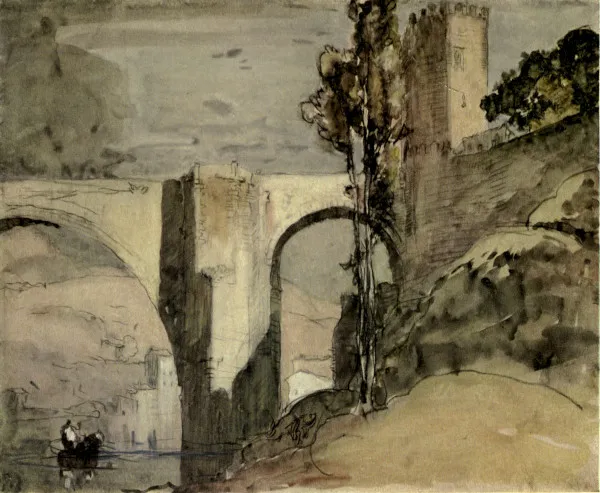
A GREAT SPANISH BRIDGE, THE ALCÁNTARA AT TOLEDO. MAINLY THE
WORK OF ARCHBISHOP TENORIO, A.D. 1380; FORTIFIED BY ANDRES MANRIQUE,
A.D. 1484. ON THIS SITE A ROMAN BRIDGE WAS DESTROYED IN A.D. 871
Again, is there a glint of hope in the hysterical words
that came to Charles Dickens when he wrote as follows,
after a visit to Chillon?—“Good God, the greatest mystery
in all the earth, to me, is how or why the world was
tolerated by its Creator through the good old times, and
wasn’t dashed to fragments.” You see, Dickens understood
the terror of strife, but he made no effort to be calm with
Darwin, who knew that the evolution of man could not
have happened if nascent humanity had been unfit to
endure the sufferings of its daily contests both against
Nature’s violence and against a terrible fauna. Thus a
pitiless character was thrust upon primitive man by the
environment in which unlimited strife worked his development;
and what the ages have evolved only a long future
can amend in another evolution. What Dickens called
unpardonable cruelty was to the distant past what strikes
are to our own time, a weapon, a phase of war, approved by
public opinion; and let us remember also that the cruelties
which a hard life has bred, and turned into customs, have
not shown an egotism fiercer than that primal necessity
which has compelled life among the species to feed on lives.
Dickens himself, while writing his condemnation of the
past, was nourished by the death of many living things;
was in himself a mysterious alembic that transmuted food,
slain life, into benign health and action. Had he been
logical in his feelings toward strife he would have had mercy
on those forms of life that feed mankind; in other words,
he would have died of hunger rather than be cruel; but,
naturally, the manifestations of strife hateful to him were
those that happened to be far off from his needs and sympathies.
Yet he ought to have seen in the national efforts
of his time that strife, though easy to rebel against, is woefully
difficult to improve, since even kindness of heart when
shown in promiscuous charities may unseat from their
thrones in the public mind many good racial qualities,
doing as much harm as ever was done by mediæval
brutality.
“Let me think” should be everybody’s motto; nothing
less than arduous thinking can save us from the cant and
the sentimentalism which at the present time enfeebles
England.[11] Let me give you an example. Yesterday I was
talking to a friend about the mediæval battle-bridge. Putting
before him Frank Brangwyn’s excellent sketch in water-colour
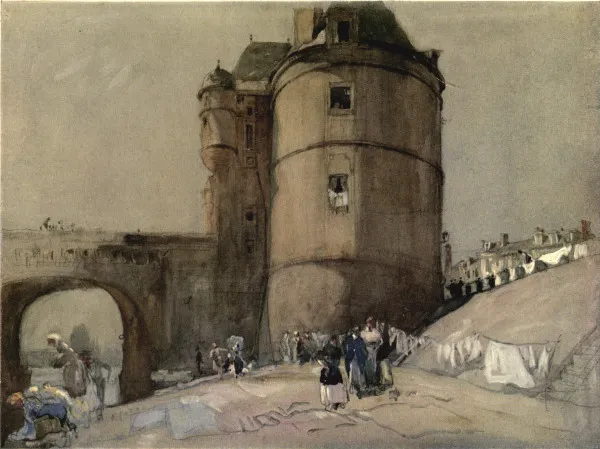
of Parthenay Bridge, I said: “This fortified gateway
belongs to the thirteenth century, and through its machicolations
red-hot stones and boiling oil were poured down
many times upon the head and shoulders of an attack. The
gateway was built between 1202 and 1226, not without
help from English money, for the Josselin-Larchêveques of
Parthenay were allies of the Anjou Plantagenets, who gave
us English kings; but a few years later our English troops
were driven from Parthenay by Louis IX, called St. Louis.
Can’t you imagine the assault? Would you care to rush
that gateway in a thirteenth-century manner?”
My friend, a Quaker, was scandalised. “Rush the
gateway?” he cried. “Red-hot stones and boiling oil!
What imbecile savagery! Thank goodness, we are not
savages now; life has improved wonderfully. To-day most
men of sense fear war, and those who don’t fear it scorn it
for moral reasons.”
“Are you sure?” I asked. “Do you really believe that
the history of this old war-bridge is more strifeful than the
industrialism of to-day? Is it an act of peace when a trust
‘corners’ some article of food, or when a limited liability
concern kills all competition from little neighbours, whose
wives and families can’t get rid of hunger because business
has failed? Those who attacked the bridge at Parthenay
were armour-clad, while those who suffer in trade wars from
the greed of co-operative egotisms have usually no self-defence,
as their capital is small. Don’t you see, then, that
from machicolated towers to millionaire tradesmen is but an
evolution in social strife? Chivalry did try to put some
generous feeling into mediæval warfare; and how much
feeling of chivalry do you expect to find in the battles of
industry? Are the strategic victories of finance more
humane than were the politics of the Black Prince? Do
they harm the defeated less, or more? And can you explain,
old chap, why it is that Quakers, Jews, Hindus,
though they fight for money with an astuteness that
never flinches, prattle about peace after office hours?
Their ideal of peace includes all warfare except that which
employs battleships and big battalions. Myself, I would
sooner lead an attack against the Porte St. Jacques on
Parthenay Bridge than be opposed in trade by a wealthy
firm of shrewd Quakers, whose great skill in the combats
of trade would soon ruin me. I shouldn’t have a chance of
doing credit to myself in a dangerous adventure.”
A WAR-BRIDGE OF THE MIDDLE
AGES AT PARTHENAY IN FRANCE
There is nothing more odious than the modern cant
about peace. But a pontist soon learns that strife of every
sort is a phase of war. Indeed, whether roads and bridges
aid a pilgrimage of the sick, or an army of Crusaders, or a
primitive migration, or the ramblings of charity, or the
enterprise of monasteries; whether they help a mediæval
pope at Avignon to thwart the land-hunger of a French
king, or enable modern life to turn industrialism into a
world-wide Armageddon whose scouts are lying advertisements;
whatever they do or have done their history brings
us in touch with the same human motive, a desire to win
victories. James Martineau went so far as to picture the
strife as absolutely barbaric. He said: “The battle for
existence rages through all time and in every field; and its
rule is to give no quarter—to despatch the maimed, to overtake
the halt, to trip up the blind, and drive the fugitive
host over the precipice into the sea.” Tennyson also went
too far when he wrote about strife; too far, because he did
no more than skim along the surface of a primordial truth,
by which man’s history has been made a part of Nature’s.
From Tennyson we gain no help at all; he tells us merely
“that hope of answer or redress” must come from “behind
the veil.” In his opinion Nature cares for nothing, so
careless is she of the single life, and so ready to let a thousand
types go. Yet her realms teem with miracles of contentious
life, and I cannot think of any great extinct species
that I should care very much to meet in a country walk.
I do not wish to hob-nob with the Iguanodon, for instance.
When John Stuart Mill complains that “nearly all the
things which men are hanged or imprisoned for doing to one
another are Nature’s everyday performances,” he forgets the
far-reaching harm that men can do within the tolerance of
“Old Father Antic, the Law”; and, besides this, he forgets
to explain how a world of organisms ruled by hunger and
thirst and passion, and dependent on innumerably various
climates, could be other than Providence has decreed.
To talk as Mill did is to imply that Nature sins against
us, and against herself, when she allows any species to grow
completely unfit for the gift of life. Yet her aim is to protect
life from the suicidal fertility of lives, so that the whole
economy of Nature demands death in the highest interests
of the future. When we die we do an act of charity to
our children and grandchildren; for if each of us lived to
be active at ninety, the world would need a much smaller
population of young people. It is our frail tenure of life
that renders a high birthrate necessary; and progress gains
more from the enterprise of vigorous youth than from the
too cautious knowledge of old age. So I do not understand
the pother raised by Mill and others over the benign
discipline of death that Nature wields as a servant of the
Eternal.
Believe me, a pontist can never solve even one problem
in the law of battle if he lets himself be scared into a revolt
against natural forces; scared by the incessant tragedy
that each day’s little trip along the highways of history
brings in a challenging manner before his mind’s eye. He
must try to protect himself with humour and irony and
scorn, as Thackeray tried to save himself from a feminine
heart. The main point is that he should learn to live outside
himself; then self-pity will not be his troublesome
guide through the labyrinths of strife.
Cardinal Newman asks us to believe that human life has
been terrible—“a vision to dizzy and appal”—because mankind
has been punished by God for some aboriginal sin
too abominable for mercy and forgiveness. This doctrine
is completely dark and horrible. If it were illumined on
one side only, like the moon, it would invite the companionship
of thought, but it gives no light whatever. Indeed,
it implies that no civilization has been free to improve its
own lot and to get progressive reason from the large brain
of man. To blame God for our own follies—to say that
our social acts are wild and foolish because we are being
punished by Heaven for a sin of ignorance committed by
man in the babyhood of the human race—what is this but
a charge of illimitable cruelty against the Creator? Besides,
we learn from the much nobler doctrine of evolution
that human nature, despite all her wilful fondness for wrong
actions, has crept up and up from a very low beginning,
in an ascent continually wonderful, though infinitely slow
and tragical. The accumulated progress excites in me as
much awe as I should feel in the presence of a resurrection
from the dead. Indeed, what is evolution but a vast drama
of resurrections, by means of which base forms of life have
become gradually better? Can anyone suppose that Milton,
had he been a contemporary of Darwin, would have turned
from the endless hopes that evolution ought to inspire, just
to dally with fallen angels and with an errant couple in the
Garden of Disobedience? And can we suppose that Newman
would have written his famous page on the doctrine of
original sin, had he not turned his back on modern thought
and knowledge?
Amid the doubts and difficulties that trouble this meditation
on strife, just a few things are bright and clear-eyed,
like illumined windows which on dark nights cause jaded
tramps to feel less their lone wayfaring; and these things I
have watched for years in the life of bridges, where their
activity never ceases. It is clear enough, for instance, that
custom and convention have acted as narcotics on the mind,
sending reason to sleep. This explains why human strife
has never turned to the best use the great opportunities
that each generation has inherited. To custom and convention,
mankind has owed the social rule which has sown
the seed of death in every civilization; the rule of illogic
and discord, “Each for All, yet Each for Himself.” Let
us see this rule in operation on the highways, taking care
to note how it has inflamed egotism and deadened both the
sense of honour and the spirit of citizenship.
The just and beautiful principle that every man lives by
his mother the State, and that he must do good for the
benefit of the commonweal, was enforced upon mediæval landowners
by the trinoda necessitas, or triple obligation, which
among other duties made the upkeep of roads and bridges a
general charge on all owners of the English soil. Not
even the religious houses were exempted, though the State
favoured them in other ways. But the second principle of
the social rule—“Each for Himself”—interfered constantly
with the first principle, bringing trouble after trouble into
the administration of the highways, as into all other useful
and necessary things. Landowners transferred their duties
to their tenants, and very often the tenants made negligence
a habit, until at last the Law and the Church became
equally active for the people’s benefit. Again and again
bishops offered “forty days’ indulgence to all who would
draw from the treasure that God had given them valuable
and charitable aid towards the building and repair” of a
poor bridge ruined by neglect, or of some quagmire which
had been a decent road.[12] It happened in the year 1318 that
the Law pottered into action because a timber bridge at Old
Shoreham, in Sussex, had been scandalously ill-used by
those who were responsible for its upkeep. Half of it had
fallen into the river. Year after year an evident crime
against the State had gone on publicly, yet no one had
taken steps to make the dangerous condition of the bridge
a subject for legal enquiry and punishment. The village
grumbled, of course, but grumblers have never had any
initiative of their own; unless a man of action has come
to be their conscience and their leader, they have done
nothing. Their energy has evaporated in talk, like steam
from a boiling pan. It was not until the bridge had fallen
that the village hummed intelligently like a hive of bees,
and set itself to work. What could be done then? Who
was the landowner? No less a person than the Archbishop
of Canterbury. Are we then to believe that in 1318
a Primate of England scamped his public duty? Was his
attitude to a timber bridge inferior to that of the high
priests of ancient Rome, who called themselves pontifices
because they built and repaired the Pons Sublicius, a bridge
of stakes at the foot of Mount Aventine?[13] The sheriff and
his officers had a different question to consider; they would
wish to know whether the Archbishop had been an astute
man of the world, whether he had made his tenants responsible
to the trinoda necessitas. If not, then he and
the Law were in a fix, and peasants over their ale would
guffaw with malice. But enquiries proved that his Grace
was a canny landlord; the tenants alone ought to have
mended the bridge; and so the Law was free to act with a
vigour that common folk knew too well.
Its agent was the bailiff, good Simon Porter, and
Porter set out at once to collect money from the tenants.
If any tenant either declined to pay his share or was unable
to pay it, then the bailiff put his hand on some marketable
property, perhaps a few sheep, or a cow, or “a gaggle of
geese.” The necessary thing was to take enough; never an
easy thing to do in the country, as no one cared to pay a
fair price for escheated live stock. The peasant has ever
been at heart a pawnbroker. But Simon Porter had no
reason to look upon his troublesome work as a high office
of trust important enough to keep his name alive for six
hundred years. It was when he met Hamo de Morston, a
truculent fellow, that Simon entered into history. Hamo
de Morston was a logical egoist, he fought for his own
hand only, trying to use the State at a trivial cost to himself;
but now this amusement, after prospering for years,
brought him suddenly face to face with legal pains and
penalties—a thing most irritating to a bad temper. So
Hamo refused to pay; and his fury was terrific when
Porter confiscated a horse. Even then he was not defeated,
for he set lawyer against lawyer, and one day a
petition was sent by him to King Edward II. The rascal
was a good fighter, but his appeal to the supreme authority
failed; the bailiff’s action was approved, and Hamo had
costs to pay.
As for the bridge, it was repaired, and repaired very
well. Twenty years ago it was in use, a shaggy and venerable
structure, not yet crippled by old age. Then certain highwaymen,
popularly known as road officials, visited Old
Shoreham, and there they tried to prove that a bridge
admired by landscape painters was unfit for a commercial
time. The poor bridge! At this moment it has no charm
at all; not only is it dull, it is neat in a shabby way—a
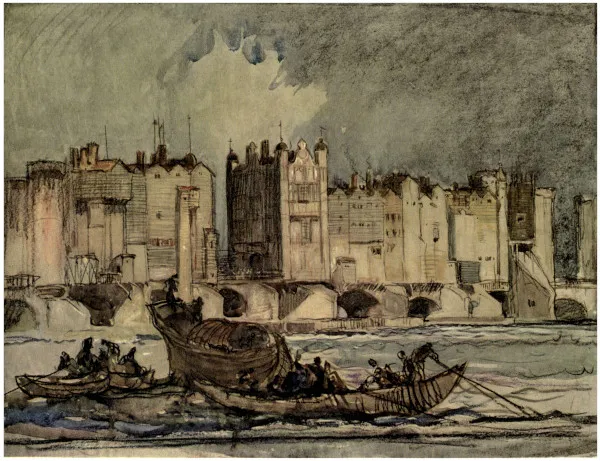
discord in good surroundings, like bankruptcy at a wedding
breakfast. So we pass from Hamo de Morston to our own
roadway officials, and find ourselves in the presence of a
public bridge injured by public servants. To Hamo we
can give a little sympathy, he fought for his creed of self
and paid costs, whereas highway boards have never been
fined for spoiling old bridges. Perhaps they do not hate
venerable architecture, but they belong to a system of
public service that is ill-equipped for its work, receiving
neither criticism from the newspaper press nor supervision
from county committees of independent architects.
That the State has been wronged by these public servants
is known to all artists and antiquarians; also the
fact is advertised by the great many hideous railway bridges
that demean towns and blemish the country. In this
matter, as in others, the State must defend her own just
rights, so as to get by compulsion what a free egotism has
declined to give—efficiency and good taste. It is possible
that England has not suffered a great deal more than the
Continent; for even in France, despite the excellent administration
of the Ponts et Chaussées, crimes against
noble bridges have been committed, as when the second
ancient bridge at Cahors was lost in a storm of local party
politics. But England happens to be poor in great old
bridges, whereas the Continent is rich; we cannot afford to
lose even the modest little ballads of arched stone which
have resisted floods for many generations, while working
as necessary drudges in the making of England. Trivial
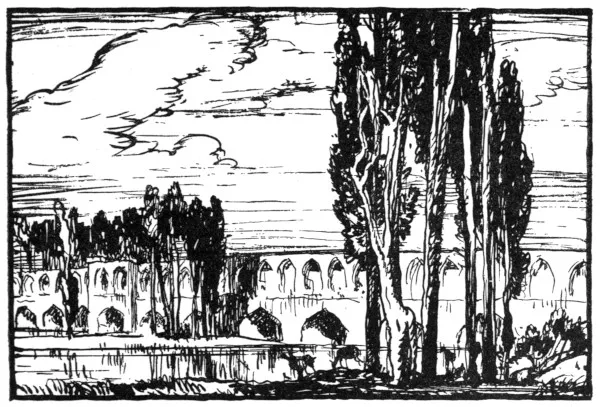
they are when compared with the bridges of Isfahan or
with many of those in France and Spain, but yet they are
hallowed by time, and they mimic the gentle rusticity of
English landscapes. It is a crime to spoil them, because
modern bridges for heavy traffic can be built at a lesser
cost near by the little mute historians.
To the Scotch, on the other hand, many a fine old brig
is a Burns of the highways; and this sentiment for history
and for sylvan poetry has kept from the cruel hands of
industrialism some very attractive single-arched bridges,
and some long bridges also, notably the rhythmical Brig of
Stirling, which Brangwyn has chosen as an example of quiet
good taste in mediæval civic architecture. The Brig of
Stirling is a Scotch citizen of the dour old school, but warmed
with an undercurrent of that kindly emotion which even
the canniest Scot is glad to show off when he is away from
business. I am inclined to think that not even a militant
suffragette would have folly enough to attack the Scotch
brigs; she would be fascinated by their names, and this
would keep her out of mischief. Such a name as the Brig
o’ Doon is music combined with a racial vigour. No weak
people would have invented it, and no dull people could
have retained such a poetic name.
THE OLD WAR-BRIDGE OF STIRLING
The Irish also are fond of bridges, like the true unspoiled
Welsh. As late as a century ago Irish peasants
were pious in their attitude to any bridge that crossed a
dangerous river; they saluted it reverently because of its
friendliness to poor wayfarers, and because good thoughts
come from simple hearts. As for the Welsh, thanks partly
to their Celtic blood and partly to the waywardness of their
rivers, they have been known as pontists for a very long
time. In the romantic hills their bridges seem to belong
to Nature herself, so lovingly have they been united
to the spirit of ancestral landscapes; whereas the industrial
parts of Wales make the bridges of trade into vile objects,
as if beauty has no right to a home where money is earned
out of coal mines, and ironworks, and the debilitating
factory system. Far too often the industrial bridge everywhere
is like an ill-used highway uniting the purgatory of a
seared district to some hell or other invented by poets or by
priests. There are many such bridges in the Staffordshire
Black Country, and in the scarred Potteries, where an ebon
meanness lives with jerry-builders, and where puny drab
children take from the present generation the youth that
endures. What would a Dante think in the stricken fields of
industrialism? And why is it that only a person here and
there, after compelling himself to leave the atmosphere of
custom, sees our industrial war clearly, and views it in its
relation to the body social?
The truth is that our creed of self has become instinctive;
we cannot without an effort live for an hour outside
our personal interests; and thus the beautiful principle
“Each for All” has to be kept alive by a host of active
laws that encircle us with compulsion. Where there is no
compulsion we are governed by our preferences. If we
like bridges, for instance, we try to protect them from ill-usage;
but if they are indifferent to us we care not a straw
when engineers add half a dozen uncouth viaducts to the
many other misdeeds which they have thrust upon the
State. Instead of regarding all bad public work as a sin
against the commonweal, we let ourselves be ruled by the
creed of self even in our best efforts to serve the State
properly.
Is our egotism better or worse than that of the Middle
Ages? This seems to be a matter of opinion. Thorold
Rogers believed that mediævalism in a good many respects
was kinder than our industrialism; and the late Russel
Wallace regarded “our social environment as a whole, in
relation to our possibilities and our claims,” as “the worst
that the world has ever seen.” On the other hand, a great
scientist from his laboratory has told us that “the sun rises
on a better world every morning.” Gracious! If the sun
could speak to us about his complete knowledge of mankind,
if he did not obey the law of silence that rules over
the greatest motive-powers and creative agents, our conjectures
would be less wayward, for sunrays would whisper
into our ears the story of the most evil civilization in the
whole strife of mankind. In this matter the sun would be
authoritative; but how can we poor mortals expect to see the
whole past truly when we are half blind to the significance
of our own social life? Besides, it is enough for us to see
how one civilization has differed from another, and how in
many respects all human life has been like the sky, always
the same elementally, but never quite the same in colour
and form, and in the effects of strife.
A pontist, as he journeys through present-day England,
sees very clearly the difference between our commercial
time and the past; for industrialism is plainly out of joint
with that which is normal in organic growth, and its workmen
are conscious of the unstable energy bred and frittered
away by hurry and speed-worship. Consider those dread
“hives of industry” where trade bridges are makeshifts,
and where the jerry-built villa or cottage is repeated thousands
of times, and always in mean streets. Do they not
bear witness to the feeling of insecurity from which our
age suffers? I shall be told that many things are very well
made, as in the case of battleships, motor-cars, engines,
steamships, guns, rifles, artillery, surgical instruments, expensive
clothes, implements for games, and gigantic metal
bridges; but in this good craftsmanship, tradesmen are
thorough because they dare not be slipshod; they fear to
turn out work that would endanger human life, and business
would fail if they angered the specialists of luxury
and of sport. Where they are free from restraint, as in
work for ordinary households, tradesmen manufacture
trash and prosper. In fact, the quicksands of cheapness
are to most people in England what cheese in a trap is to
mice, or what seasonable bait is to fish. So widespread is
the feeling of insecurity that the poorer classes do not think
it worth while to buy enduring goods and chattels. Instead
of practising a thrift that would hand on furniture to their
grandchildren, they say, “Never mind; perhaps these things
may last our time.” And this dull pessimism in the creed
of self is the most wretched phase of strife that a pontist
has to connect with the circulation of trade enterprise.
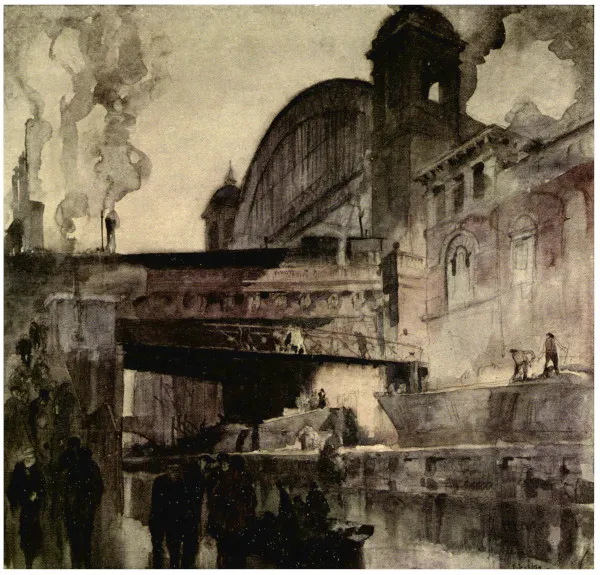
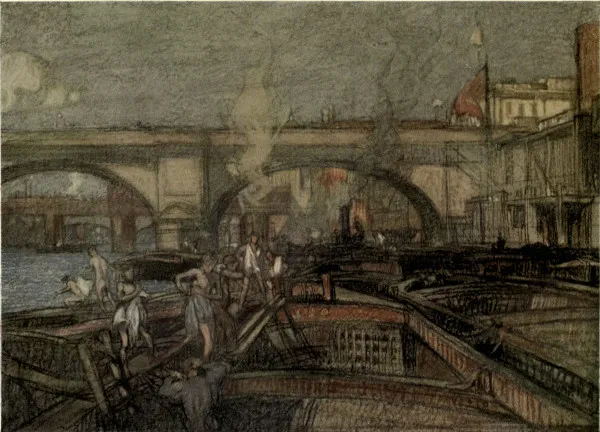
CANNON STREET RAILWAY BRIDGE, LONDON
Even the prehistoric tribes wanted to be remembered
by their posterity, so they built enduring barrows or set
up cromlechs to their ancestor-worship, this being their
spiritual bond between past and present and future. In the
Middle Ages also, though disease and filth and bloodshed
made life as uncertain as a game of chance, the social
egotism that built and purchased for itself had faith in the
future, and claimed and got full value for its money. In
fact, from nearly all specimens of mediæval handicraft we
may learn why the peoples of Europe survived terrible
crises and bred men of genius to represent them for ever.
In each race, and particularly in ours, there was a wonderful
endurance, certainly based on the creed of self, but admirable
all the same, like the tough elasticity of yew timber.
The ruling egotism was honest in nearly all its private
work, but when it was expected to be equally thorough as
a public servant, then a habit of dishonesty appeared in
handicrafts, sometimes to be followed by new laws or by
threatening proclamations. Again and again the conscription
of the archery laws was imperilled by bowyers and
fletchers and merchants, who formed “rings” and flooded
the markets with nefarious work to be sold at high prices.
Certain bridges, also, and notably the one at Berwick-on-Tweed,
fell so often that the supervision of town authorities
must have been exceedingly lax. On this point, M. Jusserand
says:—“London Bridge itself, so rich, so useful, so
admired, had frequent need of reparation, and this was
never done until danger was imminent, or even till catastrophe
had happened. Henry III granted the farm of the
bridge revenues to his ‘beloved wife,’ who neglected to
maintain the bridge, appropriating to herself without
scruple the rents of the building; none the less did the
king renew his patent at the expiration of the term, that
the queen might benefit ‘from a richer favour.’ The outcome
of these favours was not long to wait; soon it was
found that the bridge was in ruins, and to restore it the
ordinary resources were not enough; it was necessary to
send collectors throughout the country to gather offerings
from those willing to give. Edward I begged his people
to hasten (January, 1281), the bridge would give way if
they did not send prompt assistance; and he ordered the
archbishops, bishops, all the clergy, to let his collectors
address the people with ‘pious exhortations’ that the subsidies
should be given without delay. But the money thus
urgently needed arrived too late; the catastrophe had
already happened, a ‘sudden ruin’ befell the bridge, and to
repair this misfortune the king established a special tax
upon the passengers, merchandise and boats (February 4,
1282), which tax was enacted again and a new tariff put into
force on May 7, 1306....”
What were the citizens doing while Henry III and his
dear wife ruined the bridge by confiscating her revenues?
Did they believe that everybody’s affair was nobody’s
business, and that they would be asked to mend the bridge
if they drew attention to her condition? As to Edward I,
he kept his hand away from his own pocket, and personated
charity that for ever begs. “Each for Himself” was a policy
that suited Edward; and his orders to the clergy proved
that he knew it to be a policy which his loyal subjects
followed as a habit. Hence the “pious exhortations,” with
indulgences also, we may rest assured. The whole story is
pitifully ironic. London had no other bridge over the
Thames, yet the people looked on while a king and his wife
played the part of bridge wreckers. Some protest there
must have been, for London Bridge—a great street of
timber houses—was more populous than many a village;
and the tenants, like other Englishmen of those days, had
no wish to be plunged into cold water. According to
Stow’s “Annals,” five arches fell, so many houses also were
lost, perhaps with their inmates.
M. Jusserand believes that during the Middle Ages our
English highways fared no better than London Bridge.
His verdict runs thus: “Though there were roads, though
property was burdened with obligatory services for their
upkeep, though laws every now and again recalled their
obligations to the possessors of the soil, though from time
to time the private interest of lords and of monks, in addition
to the public interest, suggested and directed repairs, yet the
fate of a traveller in a fall of snow or in a thaw was very
precarious. The Church might well have pity on the wayfarer;
and him she specified, together with the sick and the
captive, among those unfortunates whom she recommended
to the daily prayers of pious souls.”
There is a great deal of evidence to justify this verdict,
but evidence in history depends on its choice; and in
Thorold Rogers there are other facts that leave England
with some efficient mediæval roads, along which horsemen
could travel rapidly. Perhaps Rogers may have set too
much store by his data; but when we study all the evidence,
when we balance it carefully, and visualise all its pictures of
well-tested negligence and crime, one thing is beyond all
doubt: that the social rule, “Each for All, yet Each for
Himself,” was a national catastrophe. Its first principle had
a very precarious life, though incessant compulsion tried to
drive it home to the people’s fear of revengeful laws;
whereas the second principle—“Each for Himself”—was so
popular as a creed that even the divine mysteries beyond
death were assailed by egoists, who thought they could
buy a place in heaven by giving lands and goods to the
Church, no matter what harm they had done in a brief life
upon earth. Study Erasmus in his wayfaring letters, and
you will breathe the atmosphere of the Middle Ages.
OLD LONDON BRIDGE, BEGUN BY PETER COLECHURCH IN 1176, AND
FINISHED BY A FRENCHMAN, CALLED ISEMBERT, IN THE YEAR 1209
III
PONT SIDI RACHED AT CONSTANTINE, ALGERIA. BUILT IN 1908-1912
The span of the great arch is 70 metres. The work illustrates the longevity of custom and convention,
being inspired partly by Roman aqueducts and partly by the two famous bridges over the Tech
at Céret, in France, one of which dates from the year 1321. The span of its great arch is 45m. 45cm.
CUSTOM AND CONVENTION
Yet a pontist must be exceedingly careful when
his tramps through any period bring him in
touch with ethical problems. He should try to
live on the highways of history, not in order to pass judgments
on vice and on crime, but because he wants to see
clearly, under the form of visual conception, why social
concord and equity have never fared well, even the best
forms of civilization being only half-educated barbarisms
that allow their strife to be drilled by a vast number of
active laws. These phases of compulsion go on increasing,
yet they fail to resolve into harmony those rapacious
egotisms that compete against each other in the body social
like microbes in living tissues. As soon as a pontist understands
his wayfaring through history, as soon as he feels at
home in the general atmosphere of the human drama, he is
glad to be a realist; then nothing that societies do or have
done seems unexampled and inexplicable. To him, for
example, the infanticide practised age after age by savage
tribesmen is not more terrible than the death of babies in
the slums of civilized towns, or than the degradation brought
before his mind by the alert philanthropy that saves little
English children from cruelties. To him, again, the
slaughter on a great battlefield is not more woeful than
the annual sacrifice of lives in street accidents, and railway
smashes, and mine disasters, and sea tragedies; as well as
in games and sports, in nursing the sick, and in all trades
and professions. He is not scared by the fact that the sum
of human life is war, but he is scared by the primordial
customs and conventions that make the incessant war infinitely
less humane than it could be and ought to be. So a
pontist in his attitude to history is a sociologist, and not an
abstract moralist. Each body social and its systems of
circulation are to him what patients are to medical students
in a hospital; he has to learn to be attentive to all disease
and to make his diagnoses thoughtfully. Even then
frequent mistakes will occur. One thing he must regard as
his clinical thermometer: it is the truth that civilizations in
their intercourse with right and wrong have been governed
by habits and customs and conventions, which have caused
most men to be other men; so that most human actions,
whether studied in old history or in the current routine of
living, are mere quotations from other human actions, instead
of being like original ideas in a well-ordered composition.
In other words, the ordinary human brain has tried
to be automatic, as if to be in harmony with the rest of the
vital organs.
Now the architecture of bridges, like that of huts and
houses and cottages, never fails to keep before our minds
the awful slowness of each reluctant advance from custom
to custom, and from convention to convention. I have no
words to describe the terror that comes to me when I find
in daily use a type or species of bridge so aboriginal in its
poor workmanship that a forerunner not only similar to it,
but as rudely effective, may well have been employed by
the earliest Flint Men, whose delight in imitation was
stimulated by all the bridges which Nature had created.
Even more, at this moment in England, and even in busy
Lancashire, where to-day’s machinery abounds, there are
primitive bridges which are not even primitively structural;
bridges which need in their making not more thought than
is given to a difficult sneeze when we are troubled by a cold
(p. 60). When I look at them and think of the myriads of
generations which in different parts of the world have used
bridges akin to these, I am so awed with fear that I feel
like a baby Gulliver in a new Brobdingnag where everlasting
conventions are impersonated by brainless giants whose
bodies are too vast for my eyes to focus. Often, too, I say
to myself: “In the presence of this dreadful conservatism,
this inept mimicry that endures unruffled by a thought for
many thousands of years, you are as futile as a single
microbe would be on a field of battle. Or imagine that the
microbe is in Westminster Abbey, and that it has a blurred
sense that makes it dimly conscious of all the many
historic things there gathered together; then you have a
figure of yourself in your relation to the mingled good and
bad in history. For the Abbey shows in its architecture
that convention, though a bane to ordinary minds, is the
grammar of progress to the rare men of genius who from
time to time shake the world free from its bondage to fixed
customs and routines, and compel it to move on to other
routines and customs, where it will dawdle until other
geniuses come out of the dark and find in new mother-ideas
a compulsive force that works a new liberation.”
OLD BRIDGE OVER THE CLAIN, NEAR POITIERS
This, indeed, is the only encouragement that I am able
to perceive when I watch in history the periodical strife
between inveterate conventions and the mother-ideas of
genius. In the case of bridges, for example, the first
mother-ideas were those that enabled a primitive craftsman
here and there to copy with success the least difficult
of Nature’s models. What this man achieved was repeated
by his tools, the ordinary men of his tribe; then other
tribes got wind of the discovery and began to make similar
bridges, until at last several conventions were formed, and
they became widespread and stereotyped. When a convention
was very simple and also effective for a given purpose,
no one wished to see it developed, so it entered that
domain of infertile mimicry where stone tools and weapons
remained unpolished for years to be reckoned by scores of
thousands. If experience had shown that chipped flint in
a rough state would neither cut wood nor break human
skulls, then at an early date polishing would have been
found out by a savage of genius who yearned to prove
that his invention could be made useful; but rough-hewn
stones were rudely efficient, so mankind settled itself in a
routine and plodded on and on automatically. And thus
it was also in the case of many primitive bridges which
became so firmly fixed in conventions that now they seem
to be contemporary with nearly all the ages of human strife.
Not in any other way can we explain their present use by
many Europeans, as well as by the natives of Asia, and
Africa, and America (p. 145). On the other hand, when a
primeval bridge did not serve its purpose efficiently, when
it was useless in tribal wars and dangerous in rainy
seasons, then a mother-idea paid it a visit from time to
time, as we shall see in the next chapter.
Whence the idea came we do not know. It entered a
mind that was ready to receive it, coming unbidden from a
place unknown like an abiding quest from a spirit world.
The mind that welcomed the idea was neither masculine
nor feminine, it was both, a thing androgynous, for genius
has ever been a single creative agent with a double sex.
The tools with which genius has worked—the selected
traditions and conventions, the acquired knowledge, the
original observation, and the handicrafts of social life—have
ever been plain enough, of course; but to see and
admire tools is not to understand the advent of those
imperishable ideas which not only transform history, but
turn all ordinary men into their mimics and mechanics.
For instance, whenever we light a candle or a fire we obey
the genius of a Palæolithic savage, who, with sparks beaten
from flint into some inflammable grass or moss or fluff from
cocoons, brought into the world the earliest missionaries,
artificial light and heat. Similarly, whenever we walk
across a timber bridge, whether old or new, we are servants
to the earliest savage who with a stone axe cut down a tree,
causing it to fall from bank to bank of a river or chasm.
Delete from history even two mother-ideas—the invention
of wheels, for example, and the evolution of arched bridges
from Nature’s models—and how many civilizations would
you cancel? Omit from the annals of our “modern democracy”
not more than three mother-ideas: the discovery
of steam as a motive-power, the discovery of microbes,
and the use of metal in bridge building. In a twinkling
we go back to the middle of the eighteenth century, when
hospitals were cesspools, [14] when surgery and medicine were
wild empirics, when travellers in stage-coaches longed for
the general Turnpike Act (a boon delayed till 1773), and
when England was unspoiled by jerry-builders and a factory
system. A pontist, then, if he understands his subject,
looks upon genius as the solar system of human societies,
hence he cannot be a willing servant to any mob-rule or
mob-worship.
On the contrary, he would gladly see in every town
a fine church dedicated to the men and women of genius
who with great mother-ideas have tried to better the strife
of human adventure. For two reasons I used the phrase
“have tried to better.” In the first place, the constituents
of new knowledge, when mingled with the old customs and
conventions, lose much of their good invariably; and, next,
the amalgam thus formed may become explosive. At this
moment we see in our new art, the art of flying, how precarious
is the charity that mother-ideas bring into the battlefields
of competition. What aeroplanes can do in war is
already the only consideration that the mother-idea of
mechanical flight receives from the most alert minds; and
very soon military engineers will be called upon to invent
bomb-proof covers for every strategic bridge which cannot
be displaced by a tunnel. So we compel airmanship to
torment us with visions of wrecked cities, when she
ought to delight us with bird’s-eye views of happier
countries.
In brief, the more we study mother-ideas the more
clearly we perceive that they in themselves are phases of
strife, for they have power to do harm as well as good.
Providence for ever tries to quicken the inept human mind,
since no blessing is granted to us without its attendant
bane. Electricity has dangers of its own, so has fire;
Pasteurism has dangers of its own, so has food; radium
is curative and very perilous, like the sea or the sun; and
all other good things ask us to pick our way with care
between danger and utility.
The most tragic element of all in human indiscretion is
the mindless routine which has deadened the brain of
ordinary men. There is in Lancashire, for example, a
charming valley where six or seven old bridges make a few
minutes’ walk a very long pilgrimage through the history
of primitive conventions. Wycollar the valley is called, and
antiquaries and pontists ought to go there at once, but not
in motor-cars that devour topography as well as miles.
One bridge is exceedingly low in the scale of thought and
skill; indeed, no prehistoric tool or weapon stands below it.
Even the Adam of Evolution, if he ever lived in rock-strewn
places, had common sense enough probably to choose
a flat stone and to lay it across a deep rivulet, so as to save
his children from danger. Such is the most primeval of
the Wycollar bridges: three schoolboys could make a
smaller one between two April showers. For the stone is
not a huge slab ten feet long by four wide, such as we find
not far from Fernworthy Bridge, Dartmoor; nor is it like the
single slab over the Walla Brook on Dartmoor. It is a
long lintel-stone, and in eight or nine strides a little girl
would cross it easily.[15] If the stone were new, and also
alone in the valley, no one would think more of it than of a
plank used as a temporary bridge; but the stone is very
old, and lintel-bridges are ancient customs in the valley of
Wycollar. If Nature once in a century allowed bridges to
tell their tales, I should expect two of the Wycollar historians
to trace their lineage through a great many ancestors until
at last they came to a time when the first nomads hacked
their way with flint axes through the undergrowth of
Lancashire forests, and cursed in primitive words or
sounds at the virile brambles whose thorns were sharper
than pointed flints.
The second bridge of lintel-stones at Wycollar is a
simple adaptation from one of Nature’s bridges, the bridge
of stepping-stones littered over the beds of rivers by earthquakes
and floods. When the stepping-stones are long
you turn them on end and use them as piers; when they
are short and squat you pile them up into piers; then lintel-stones
are put from pier to pier, and from pier to each bankside.
Here is the A B C of primitive bridge-making with
slabs, boulders, and fragments of rock. It needs very much
less mother-wit than that which enabled primitive men to
survive innumerable hardships, and to breed and rear those
true artists who in Palæolithic times, about 50,000 years
ago, [16] turned a good many European caves into the first
public art galleries, famous for their rock-paintings and for
their sculpture and engravings. Thus the Altamira Cavern,
near Santander, in Northern Spain, and the La Madeleine
cave in the Dordogne (about eighty miles east of Bordeaux),
are among the prehistoric museums, or art galleries, which
have given us work very far in advance of the Wycollar
lintel-bridges; so far, indeed, that trees and shrubs in the
valley ought to blush with shame by keeping autumn tints
in their leaves all the year round. This hint from Dame
Nature might awaken some little self-reproach in the Lancashire
weavers and peasants whose heavy clogs clatter day
after day over the lintel-stones, wearing them into troughs
where rainwater collects pretty pictures from the sky.
IN THE VALLEY OF WYCOLLAR, LANCASHIRE: THE WEAVERS’ BRIDGE
Not long ago a busy official mind in the neighbourhood
was troubled by one of the bridges at Wycollar, named the
Weavers’ Bridge, a dull-witted primitivity made with three
lintel-stones and two rough piers in the water. Though
the busy official mind was troubled it did not suggest that
the bridge should be put under glass and kept with as much
care as the perfect skeleton of a mastodon would receive;
nor did it wish to build a successor in the cheapest style of
industrial metal-work. No; what the official mind advertised
as a fortunate inspiration was a foolish little act of
commonplace vandalism. It set a mason to chisel out of
existence the trough worn in the lintel-stones by generations
of clog-wearers! I have two photographs, now historic, in
which the trough can be seen distinctly; but the poor
weavers have no such consolation. Their ancestors’ work
has to be done all over again, and they know that their
great-grandchildren will find in the lintel-stones not a
trough but a vague hollow scarcely deep enough to hold
a few raindrops. Mr. Sargisson wrote to tell me this
pathetic story of a crisis in antiquarianism. But it is fair
to add that the busy official mind was content with one
foolish act; it spared the rude pillar on the left bank,
though this rough stone looks like a small menhir and
completes the primeval bridge.
And now let us look at the survival of convention under
a form that is even more distressing. Is it true that in
many times and lands human beings have been sacrificed
not to bridges, but to the spirits of floods and storms which
have been feared as destroyers of bridges? One good reference
to this question will be found in Francis M. Crawford’s
“Ave Roma Immortalis.” The most venerated bridge in
ancient Rome was the Pons Sublicius, whose history dated
from the time of Ancus Marcius, who reigned twenty-four
years—B.C. 640-616. In much later times, long after the
good fight that made Horatius Cocles famous for ever, strange
ceremonies and superstitions lingered around the Pons
Sublicius. On the Ides of May, which were celebrated on
the fifteenth of the month, Pontiffs and Vestals came in
solemn state to the bridge, accompanied by men who carried
thirty effigies representing human bodies. The effigies
were made of bulrushes, and one by one they were thrown
into the Tiber, while the Vestals sang hymns or the priests
chanted prayers. What did this rite signify? A tradition
popular in Rome taught children to believe that the effigies
took the place of human beings, once sacrificed to the river
in May. This tradition is attacked by Ovid, “but the
industrious Baracconi quotes Sextus Pompeius Festus to
prove that in very early times human victims were thrown
into the Tiber for one reason or another, and that human
beings were otherwise sacrificed until the year of the City 657,
when, Cnæus Cornelius Lentulus and Publius Licinius
Crassus being consuls, the Senate made a law that no man
should be sacrificed thereafter.”
It is possible, if not, indeed, probable, that the effigies
were made at first in order to placate the common people
who were indignant over the loss of a festival. We can
imagine what would be said to-day if Cup-finals were
stopped by Act of Parliament; and the Romans, in their
fool-fury over “sport” at second-hand, were always glad to
appease their curiosity with shows of bloodshed. Further,
in the folk-lore of later times bridges and rivers are connected
with the primitive rite of killing women and men as
a sacrifice to evil spirits. This dread tradition is related
now in the Asiatic provinces of Turkey, as I learn from
Sir Mark Sykes, whose “Dar-Ul-Islam” is a book for
pontists to read. It was at Zakho that Sir Mark heard
the following legend:—
“Many years ago workmen under their master were set
to build the bridge; three times the bridge fell, and the
workmen said, ‘The bridge needs a life.’ And the master
saw a beautiful girl, accompanied by a bitch and her
puppies, and he said, ‘We will give the first [life] that
comes by.’ But the dog and her little ones hung back,
so the girl was built alive into the bridge, and only her
hand with a gold bracelet upon it was left outside.
“At the foot of this bridge I found the local Agha,
Yussuf Pasha, superintending the collection of the sheep-tax,
in which as a large landowner he has an interest.”
Try to visualise in all their details these pictures, passing
from to-day’s tax-gatherer, a Pasha Lloyd George, into
the drama of a very terrible superstition. The workmen
can be fitted with fairly good primitive characters, for they
do not suggest the sacrifice of a life until the bridge has
fallen thrice. As to their master, he is a fiend, since he acts
upon their suggestion at once, unmoved by the girl’s beauty
and the frisking springtime that accompanies her. A little
dead hand—and a gleaming bracelet—and the masons
chanting at their work, as bridge-builders chant now in
Persia: so the drama ends, or so it would end if we could
not unite it with a similar legend known almost everywhere
in Europe.
Why in the Turkish story the workmen say, “The
bridge needs a life,” I do not know. Their superstition
goes away from the river and its evil spirits, and from those
other demons, which in olden times made winds so variable.
Are we then to suppose that men have defiled the charity of
bridges with bad spirits other than those that live in wilted
conventions and in modern engineers? I prefer to believe
that a bridge that fell three times would muddle the superstition
of any workman. In fact, there are many bridges
which superstition—not modesty in men—has given to the
Devil, and as a rule they have been connected with the
same legend, or bogie tale. Mr. Baring-Gould takes a
great interest in the bridges ascribed to the Devil, and
writes about them as follows in his “Book of South
Wales”:—
PONT DU DIABLE, ST. GOTTHARD PASS
“The Devil’s Bridge is twelve miles from Aberystwyth;
it is over the Afon Mynach just before its junction with the
Rheidol[17].... The original bridge was constructed by the
monks of Strata Florida, at what time is unknown, but
legend says it was built by the Devil.
Old Megan Llandunach, of Pont-y-Mynach,
Had lost her only cow;
Across the ravine the cow was seen,
But to get it she could not tell how.
“In this dilemma the Evil One appeared to her cowled
as a monk, and with a rosary at his belt, and offered to cast
a bridge across the chasm if she would promise him the
first living being that should pass over it when complete.
To this she gladly consented. The bridge was thrown across
the ravine, and the Evil One stood bowing and beckoning
to the old woman to come over and try it. But she was too
clever to do that. She had noticed his left leg as he was
engaged on the construction, and saw that the knee was
behind in place of in front, and for a foot he had a hoof.
In her pocket she fumbled, a crust out tumbled,
She called her little black cur;
The crust over she threw, the dog after it flew,
Says she, ‘The dog’s yours, crafty sir!’
“Precisely the same story is told of S. Cadoc’s Causeway
in Brittany; of the bridge over the Maine at Frankfort,
and of many and many another.
“How comes it that we have an almost identical tale in
so many parts of Europe? The reason is that in all such
structures a sacrifice was offered to the Spirits of Evil who
haunted the place. When a storm came down on the sea,
Jonah had to be flung overboard to allay it. When, in the
old English ballad, a ship remained stationary, though all
sails were spread, and she could make no headway, the crew
‘cast the black bullets,’ and the lot falls to the captain’s wife,
and she is thereupon thrown overboard. Vortigern sought
to lay the foundations of his castle in the blood of an
orphan boy. A dam broke in Holland in the seventeenth
century; the peasants could hardly be restrained from burying
a living child under it, when reconstructed, to ensure
its stability.[18]
“When the [Cistercian] monks of Strata Florida threw
the daring arch over the chasm, they so far yielded to the
popular superstition as to bury a dog beneath the base of
the arch, or to fling one over the parapet.”
There! We have followed a superstition—a vile convention
in ignorance and cowardice—from the Pons Sublicius
in Ancient Rome to the Pont-y-Mynach in South Wales;
and the best we can say of it is that in Pagan Rome it went
from human victims to effigies of men and women, while in
Christian times it passed from human victims to dogs.[19]
Mr. Baring-Gould has told us that in bridges, and “in all
such structures, a sacrifice was offered to the Spirits of Evil
who haunted the place.” Yet it was not in a structure—a
finished building—that Vortigern wished to offer his sacrifice;
he “sought to lay the foundations of his castle in the
blood of an orphan boy,” so his aim was to placate the
Spirits of Evil before his castle was built. As to his conception
of the spiritual agencies to be appeased, it would
mingle his own passions with the fears bred by his primitive
fanaticism. For, as Darwin says, “savages would
naturally attribute to spirits the same passions, the same
love of vengeance or simplest form of justice, and the same
affections which they themselves felt.”
Now in the case of bridges we have to identify primitive
men with the terror inspired by storms and floods; a
terror difficult for us to understand in our sheltered lives.
Have you read Matthew Paris, who lived in the reign of
Henry III? If not, go to him and study the tempests that
he described, and see how villages were desolated by winds
and inundations. Amid these disasters the ignorant would
cling to ancient superstitions; fear would be pagan out of
doors whatever faith might say in church; and I have no
doubt at all that the many so-called Devil’s Bridges were as
supernatural to the mediæval peasant as were witches. The
Dutch of the Middle Ages were more advanced in domestic
civilization than our own ancestors; and yet at heart they
were cruel pagans, even as late as the seventeenth century,
as Mr. Baring-Gould has shown. How very humble
human nature ought to be!
Let us pass on, then, to a convention that does not reek
like a stricken field. One of the best historians in architecture,
Viollet-le-Duc, found in the hills of Savoy a primeval
bridge whose structure had been changed very little, if at
all, since the days when its ancestors were described by
Cæsar and used by the Gauls. It is a timber bridge,
known in France as un empilage, a thing piled together
rudely, and not constructed with art. Indeed, it needs no
carpentry, so it is far behind the social genius of prehistoric
lake-dwellers. To make a simple Gaulish bridge,
as to-day in Savoy, we must choose a deep-lying river with
rugged banks; then with water-worn boulders we make on
each bank a rough foundation about fifteen feet square, or
more. Upon this we raise a criss-cross of tree trunks,
taking care that the horizontal trees jut out farther and
farther across the water, narrowing the gap to be bridged
by four or five pines. Each criss-cross must be “stiffened”
or filled in with pebbles and bits of rock; and across the
unfinished road of pines thick boards are nailed firmly.
Viollet-le-Duc says:—
“Cette construction primitive ... rappelle singulièrement
ces ouvrages Gaulois dont parle César, et qui se composaient
de troncs d’arbres posés à l’angle droit par rangées,
entre lesquelles on bloquait des quartiers de roches. Ce
procédé, qui nest qu’un empilage, doit remonter à la plus
haute antiquité; nous le signalons ici pour faire connaître
comment certaines traditions se perpétuent à travers les
siècles, malgré les perfectionnements apportés par la civilisation,
et combien elles doivent toujours fixer l’attention de
l’archéologue.”
Does anyone suppose that Savoy would have been loyal
to a prehistoric bridge if all primitiveness had vanished
from her social life?
Not that Savoy is the only place where criss-cross
bridges are still in vogue. Much finer specimens are to
be found in Kashmír, thrown across the river Jhelum,
the Hydaspes of Greek historians. At Srínagar, the capital
city, founded in the sixth century A.D., there is a quite
wonderful example, for it has many spans, and corbelled
out from the footway is a quaint little street of frail shops,
rickety cabins with gabled roofs, and so unequal in size that
they are charmed with an amusing inequality. I have
several photographs of this bridge, and in them I see
always with a renewed pleasure its ancestry, its descent
from the prehistoric lake-villages, those heralds of Venice
and of Old London Bridge (p. 216). All the piers are made
with deodar logs piled up in the criss-cross manner; those
that stretch across the river are cut in varying lengths, and
each succeeding row is longer than the one beneath it, so
the logs in a brace of piers project towards each other
farther and farther over the water, till at last they form
an arched shape; not an arch perfect in outline, of course,
since the head of it is flattened by the long bearing beams
of the roadway. Still, the arched shape is very noticeable.
A pontist should study these rude arches with care, and
connect them with similar arches in the Gaulish bridges of
Savoy, and also with the historic fact that the first arches
built with voussoirs (i.e. arch-stones) were evolved from
vaults roughly constructed with parallel courses of stone
and layers of timber (p. 155). It is probable that the
parallel layers of timber or rows of logs came before the
parallel courses of stone, as the evolution of architecture
passed from wood to stone. Forests much more than rocks
and quarries have been an inspiration to primitive builders,
as if the handling of wood has quickened in human nature
an arboreal instinct dating from the family trees in the descent
of man.
AT ALBI ON THE TARN, IN FRANCE, SHOWING ON OUR RIGHT
THE OLD HOUSES, AND ON OUR LEFT, BEYOND THE BRIDGE,
THE GREAT OLD CHURCH, FAMOUS FOR ITS FORTIFICATIONS
However, another criss-cross bridge in Kashmír ought
to be studied in photographs; it is carried on six piers over
the Jhelum at Baramula—quite close to the Himalayas; the
piers rise from boat-shaped platforms that meet the oncoming
water as boats do, with their blunt stems looking brave
as rearguards. The parapet is a simple latticework, and
the abutments are masonry. Here we have a type of bridge
perhaps quite similar to the one from which the Gauls got
their rude methods, long after the craft of the lake-dwellers
had left its sheltered moorings and adventured across wide
rivers.
Is there any concrete evidence to suggest that the bridge
with criss-cross piers has gone through many phases of
change, of growth or of decadence? Yes. At Archangel,
in North Russia, the criss-cross piers are more primitive;
instead of being arched they are upright and stiff; but as
the bridge is nearly a quarter of a mile long, and as it is
taken down every spring (before the ice breaks up noisily,
and the Dwina thunders into a raging torrent), crude workmanship
in a hurried routine is excusable. The main point
is that a bridge akin to the Gaulish type and to the variation
in Kashmir exists in North Russia.
And another variation is met with at Bhutan, in India.
Brangwyn has drawn it, and we shall study it later in a
page on gateway-towers (p. 272). In the highlands of
Eastern Kurdistan, the borderland of Asiatic Turkey and
Persia, travellers find a bridge akin to the Bhutan variety.
An excellent book on these highlands has been published, [20]
and its authors, very generously, have written for me some
valuable notes on the bridges. Before I quote them in full,
let me ask you to remember that in Eastern Kurdistan
timber is uncommon; hence the criss-cross bridge has been
evolved into another sort of primitive structure—a third
cousin, several times removed. A Kurdistan bridge is
built as follows: “A site is selected, if one can be found,
where two immovable and flat-topped masses of rock face
one another across the stream to be bridged: an abutment
of unhewn stones is built on these, solid, until a height has
been reached sufficient to be safe from any flood.
“Then a bracket of four or more rows of poplar trunks
is constructed on each abutment; short stout trunks form
the bottom row, and those of each succeeding one are
naturally longer than the preceding. Unless the bridge
is unusually wide in the footway four poplars are enough
to form a row, and the butts of the trees, which are kept
shore-wards, are weighted down with big stones as counter-weights
to hold them in place.
“The top of each row of trunks projects perhaps five
feet beyond the preceding one, so that when a bracket of
four rows is completed, it may project perhaps twenty feet
over the stream.
“When the corresponding bracket has been completed,
two long poplar trunks are slung by withies from bracket
end to bracket end, a footway of withy hurdles, resting on
faggots, is laid down over all, and the bridge is complete.
The length of this centre span is of course limited by the
height of the poplars available. I should think fifty feet
the extreme possible.
“If the width of the river makes it necessary, one or
more piers of stone,—I have seen as many as three,—are
erected in midstream, preferably on rock foundations. Each
of these carries a bracket on each side, but this double
bracket is usually made of ‘whole trunks’ and these naturally
need no counter-weighting.
“As a rule the footway is about four feet wide, and the
whole structure is very elastic, so that, as it is guiltless of
handrails, it requires a steady head in the passenger.
Further, the central span often acquires a pronounced ‘sag,’
and not seldom an equally pronounced tilt to one side or other.
Ancient rule says that the passenger ought not to look down
in crossing such a place, lest the sight of water whirling
below should unnerve him. In Kurdistan, however, look
down he must, and make the best of the hurdles that form
the footway; they abound in holes and other traps for
the unwary, and a stumble may mean disaster. These
bridges, then, though admirably planned (for they are true
cantilevers), are not built in the most convenient manner.
It is characteristically Oriental, this union of real fineness of
design with great casualness in construction and in upkeep.
The piers are invariably of stone, never of wood. Good
timber is almost unknown in Kurdistan. The poplar grows
well, but it is at best only a good pole. Stone, on the other
hand, is embarrassingly abundant.
“Dry-stone arches are thrown over smaller streams, but
their builders, though acquainted with the principle of the
vault, do not venture on a span of more than thirty
feet!”[21]
How do you like the antiquity of conventions? Does it
not make you feel that the greatest part of mankind has
never shown a particle of desire that its civil institutions
should be improved? Note, too, that convention among
men is inferior to the instinct of animals, for animals invariably
repeat themselves with a passionate interest, whereas we
in our formulas grow more and more unfeeling and automatic.
Even rabbits when they dig their burrows seem to
be guided by inspiration, as if routine work with them is an
appetite, like love and hunger; so very different are they
from the conservative peasants of Savoy, whose dull routine
has delivered down through the centuries a primeval bridge
which an hour’s thought could have improved.
One day, let us hope, most men will realise that it is
woefully commonplace to be as other men; then conventions
will go out of vogue. Courts and clubs will invent new
and good etiquettes every year; no game will be stereotyped;
and laws will command that such and such things be altered
and improved by given dates. For example, if an Act of
Parliament decreed that during the next ten years all the
railway bridges in England must be made less uncomely
and less at odds with the needs of military defence, I have
no doubt that compulsion, the scout of civil progress, would
discover among engineers more than enough invention.
Railway bridges have been built in obedience to a brace
of conventional arguments. It has been argued, first, that
because traffic and trade are the main considerations, therefore
art is not a matter to be considered; next, that because
boards of directors have to please their shareholders, therefore
a most strenuous economy must be advertised in a very
evident manner, even although its results blot fine landscapes
with the shame of uninspired craftsmanship.
Thirty-four years have passed since the late E. M.
Barry, R.A., in a thoughtful book, asked the public to understand
that modern engineering was not architecture at all,
but mere building; and he chose as an example of horrible
work the Britannia Bridge over the Menai Straits. “Here
we have the adoption of the trabeated principle of large
iron beams laid upon supports of masonry, which rise from
the valley beneath, and tower up above the beams to a
height far exceeding that which is necessary for their
support. I well remember the animated discussions in
scientific circles as to the form and design of these beams,
which were ultimately decided upon as rectangular tubes.
In the many discussions of the merits and defects of
circular, elliptical and square sections, I do not recollect
that a word was said about architectural effect [or about
military convenience and strategy]. Had anyone ventured
to suggest that this, too, was an important matter, and that
an unsightly structure would be an eyesore for all time, he
would have been promptly told that the forms to be
employed were an affair of science alone, and that utility
pure and simple would dictate their arrangement. In the
result a lovely valley was defaced....”
The same convention in mean tradecraft is shown in the
tale about Tennyson and the jerry-builder. “Why do you
cut down these trees?” the poet asked reprovingly.
“Trees are beautiful things.” “Ah!” answered the jerry-builder,
“trees are luxuries; what we need is utility.”
And what this utility has done for us may be seen in a
thousand railway bridges as bad as those that disgrace
even the Harrow Road, near by Paddington Station.
It is not my argument that every railway bridge in
England is underbred and crapulous; here and there an
engineer has made an effort to be architectural, but the usual
level of taste is exceedingly vulgar, and not in railway
bridges only. Even the Tower Bridge, London, a vast feat
in engineering, is so conventional with a meretricious
mediævalism that it needs the screening dust and mist that
veil the Thames. This is among the modern bridges that
Brangwyn has drawn and painted, raising them into art as
a record of current history. Nothing moves him more than
the huge mechanisms that seize upon to-day’s life and turn
it into their obedient slave. Men dwindle ever more and
more in scale as machines become fatal in their enormous
bulk, like Super-Dreadnoughts and the “Titanic”; not to
forget such vulnerable monsters as the bridges of New
York, which airships sent forth by Mr. H. G. Wells have
already attacked with prophetic success. Is man really
doomed to be the tool of machines? Is this to be his
final convention?
In one great picture by Brangwyn the High Level
Bridge at Newcastle represents our time. Historically the
High Level Bridge has much interest; it displaced the
Britannia Bridge as an object of scientific veneration, and
from the first it has ranked high in the conventional
ugliness that the British public has accepted from engineers.
When the Britannia Bridge was proved to be a bad railway
line (trains were the decisive critics), and when men of science
after weighing their after-thoughts began to find fault with
the distribution of metal in the section of its tubes, then
engineers said, “And now—now we must have a good
railway bridge, completely scientific in all respects.” It
was to be built with two roadways, the one for common
traffic passing under a railway, so that business folk
might be comforted by the noise overhead, which would be
as music to any believer in a pushful industrialism. Six
arches of metal would be united to five piers and the abutments;
their spans would have precisely the same width,
i.e. 138 ft. 10 in., for minds long used to office hours and
ledgers would enjoy a dead uniformity. Indeed, everybody
was pleased with these plans; and in 1849, when Queen
Victoria opened the High Level Bridge, artists alone were
unexcited with joy. All the rest of the English world
imagined that science, at the cost of only £243,000, had
achieved a metal masterpiece. New London Bridge had
cost six times as much (i.e. £1,458,311), and her materials
were stones, not metals, so once more the north of England
had scored heavily over the south. “Besides,” remarked
the engineers, “we have put into the superstructure 321
tons of wrought-iron, and into the arched ribs 4,728 tons of
cast-iron. Economy.... Scientific economy.... And we have
now in use a perfect example of the true bowstring arch in
which no cross-bracing is needed.” All this, when discussed
at dinners, enriched the flavour of champagne; and
opinion became so “heady” that even the “Encyclopædia
Britannica” in its eighth edition received the High Level
Bridge as an inspired work, and gave to its engineering as
much space as the thrifty Romans would have given to all
their Spanish bridges and aqueducts.
At last, and all of a sudden, a reaction came; enthusiasm
not only caught a chill, it passed in a hurry from its
tropical summer into a bad winter of discontent. Scientists
went so far as to declare that the High Level Bridge was a
youthful indiscretion, advertised publicly in a material
which might endure for centuries; and this change of opinion
had a great effect on the “Encyclopædia Britannica,” whose
ninth edition gave only eighteen lines to its former
favourite. Even the bowstring arch was praised no longer,
“being essentially more expensive and heavier than a true
girder.”
THE TOWER BRIDGE, LONDON
Such are the comedies invented by our new playwright,
the genius of civil engineers. Still, the High Level Bridge
at Newcastle looks well on a misty day; by moonlight
it is more impressive than a Whistler nocturne; and in
Brangwyn’s art it represents our industrial age with a
vigour that is manly and impressive.
For the rest, from the pictures in this book you will be
able to choose for yourself many a convention in the craft
of bridge-building. Study, for example, the arches and
their shapes, noting those which have a character of their
own. These mark a new departure, and are famous. Thus
the bridge at Avignon is admired by technicians because
its architect, the great Saint Bénézet, gave to the arches
what Professor Fleeming Jenkin has described as “an elliptical
outline with the radius of curvature smaller at the
crown than at the haunch, a form which accords more truly
with the linear equilibrated arch than the modern flat ellipse
with the largest radius at the crown.” Good Bénézet!
Seven hundred and thirty years have gone by since he
turned from the Roman tradition of semicircular arches,
and designed an excellent arch of his own, a beautiful thing,
with a look of triumph in its quiet dignity. Many writers
think that L’arc de Saint Bénézet is original also in construction,
its vault being composed of four separate bands
put side by side in stones of about equal bulk. Sometimes
this method of building is condemned as weak, though four
of Bénézet’s arches have outlived seven centuries of war;
and what engineer would feel disgraced if he were baffled by
the terrific floods to which the Rhône is subject?
Moreover, Bénézet was not an originator in this matter;
he borrowed from the Romans. In his time there was a
bridge that carried the Via Domitiana over the Vidourle at
Pont Ambroise; the vaults of its five arches were built in
precisely the same manner, in four parallel arcs or bands that
touched each other; and the bridge was notable for other
reasons, and thus attractive to all bridge-builders. In the first
place, a Bull of Pope Adrian IV, dated 1156, now treasured
at Nîmes in the Church of Nôtre Dame, has proved that in
the twelfth century a chapel was built either on or from the
middle of the bridge; it was dedicated to St. Mary, and it
belonged to the chapter of Nîmes Cathedral. A Roman
bridge sanctified by a Christian chapel recalls to one’s mind
the devotion of the Flavian family that placed the monogram
of Christ among the ensigns of ancient Rome. Unless
the chapel stood out on corbels from the side of the bridge,
it must have been a tiny place of prayer, for the bridge was
only three metres wide, while the Via Domitiana had an
average width of six metres. Further, the roadway across
the bridge was peculiar; it followed in gentle curves the
contour of the arches, instead of being either flat (as in most
Roman bridges) or with a slight incline at the abutment
ends (as in the bridge of Augustus at Rimini).[22] We cannot
suppose that this bridge, so noteworthy in several ways,
was unknown to Bénézet, head of the Pontist Friars. Anyhow,
the immense Pont du Gard, near Nîmes, a Roman
masterpiece, must have been known to him; and the arches
of its second tier have in the belly of each vault three parallel
bands of equal-sized stones. If this method of construction
be unsound, how are we to explain the heroic stability of
the Pont du Gard, the finest of all the Roman aqueducts?
Myself, I do not believe that Bénézet was inexpert as a
borrower. We shall meet him again (p. 236), but let us
note here that his work is rhythmical and charming; so it
does not belong to the underbred heaviness that bridge-builders
often copied from the art of mediæval fortification.
This art was an unthrifty engineer; it employed far and
away too much blind masonry. Castle walls were ten
feet thick, and brave soldiers at home feared the light of
day, merely to show respect for arrows and machine-worked
catapults. They were not discreet; they made caution too
timid and too uncomfortable. Did gallant married knights
forget to sleep in their suits of mail? Was a honeymoon
in armour a trifle more tiresome than were twelfth-century
castles with their arrow slits for windows? For many a
year home life was an ill-smelling twilight, particularly to
persons of rank; and from this we may infer that the
custom of war during the Middle Ages went hand-in-hand
with a superstitious dread of death. Bénézet needed courage
as well as genius when he slighted in a graceful manner the
ponderous conventions of safety that ruled in his day over
castles (1177-1185). It was his arch that saved the vigour
of his design from being dull and clumsy.
Some other arches in French bridges have provoked
paper wars. This is true of those in the bridges at Albi and
Espalion, chosen by Brangwyn partly because of their controversial
interest, and partly because they illustrate a mood
of handicraft which may be called the uncouth picturesque.
IV — FOOTNOTES:
AN OLD TOWN BRIDGE IN PERUGIA, ITALY, TO ILLUSTRATE A POINTED ARCH WHICH HAS
IN ITS CURVE A SORT OF LINGERING SENTIMENT FOR THE ROUND ARCH OF THE ROMANS
CONTROVERSIES
Students are tested and judged by their attitude
to controversies. Common sense should keep them
from partisanship; and when they feel tempted to
look on as mere spectators, they should remember that
crowds at boxing matches are very apt to form wrong
opinions. It is better by far to laugh at both sides by
caricaturing the weak points of a discussion. In a few
days a student will learn which side is the more difficult to
caricature, and this knowledge will help him to sift all
rubbish from a controversy and to form a judgment of his
own on facts and on inferences. As Sir Thomas Browne
said, a man should be something that all men are not,
and individual in somewhat beside his person and his name.
The bridges at Albi and Espalion have caused some
men to break old friendships over a simple question, namely:
“When were pointed arches used for the first time in French
bridges? At what date were they brought from the East?”
As the pointed arch was copied by Europeans, not invented
by them, the precise date of the mimicry ought not to excite
a pontist; it is a thing for antiquaries to be flurried about.
If the question ran in another form: “Was the pointed
arch in French bridges an independent discovery?” then
a battle and some exploded reputations would be worth
while. But no such hypothesis has been put forward by
either side in a warm dispute. One party declares that as
early as the time of Charlemagne, towards the end of the
eighth century, or the beginning of the ninth (768-814), a
French builder seems to have played the part of the sedulous
ape to Eastern architecture, cribbing the pointed arch,
and using it without much skill in the bridge of Espalion,
whose construction (as documents prove incontestably) was
ordered by Charlemagne himself. In this bald statement
there is no challenge, no provocation; it is nothing more
than a conjecture supported by a documented fact.
If Charlemagne had been a weak ruler, like Louis the
Indolent, it would be fair to suppose that his commands
were neglected more often than obeyed; then we could not
accept his character as a fact of greater value in a controversy
than a command of his mentioned in authentic
documents. Let us say that the Black Prince or his father
ordered a bridge to be built at a given place; we have
documents to prove this, and at the place named in the
documents a very old bridge is extant. Should we not
read these documents by the light of the reputation won by
the Black Prince or by his father? Myself, I should say at
once, “His orders were obeyed.” And so, too, in the case
of Charlemagne. I accept his character as a guarantee that
he was obeyed at Espalion; and in this I am supported by
Charlemagne’s general attitude to roads and bridges. It
was he who made many an effort to keep the highways in
repair, trying to rescue them from the great disorder into
which their administration had been thrown by the decline
and fall of the Romans. He created the right to exact tolls,
and sanctioned on the roads the use of statute labour and of
fatigue duty done by soldiers. During his reign of forty-six
years he restored much Roman work and set in movement
a system that did not overtax the poor finances of his
Empire; but after his death the Empire was divided and
continual wars put an end to civil advancement.
As Charlemagne needed a bridge at Espalion we may
believe that a bridge was built there between the years 768
and 814. Does the bridge still exist, or was it rebuilt in
the twelfth century, or later? There is no evidence on
these points; hence the controversy. Those who think it
possible, if not probable, that the bridge as it is now, apart
from periodical repairs, belongs to Charlemagne’s reign,
draw arguments from the uncouth workmanship; and even
their opponents admit that the bridge is “une œuvre
barbare n’offrant absolument aucun intérêt: a barbaric
work without any interest at all”[23] (as architecture). Why,
then, should any Frenchman wish to assign this barbaric
bridge to a much later century than the eighth? Ah! Here
we touch once again the influence of conventions. A belief
current among antiquaries has connected the pointed arch
with the first Crusade, and so with the last decade of the
eleventh century (1095) and the first years of the twelfth.
Godfrey of Bouillon, on July 15, 1099, was made King of
Jerusalem, and before this date many Crusaders had
returned home. M. Degrand says: “At this time, about
the year 1100, Crusaders returned to France after their stay
in the East, notably at Antioch, where monuments of
Persian origin must have been numerous; and without
doubt they brought home with them sufficient knowledge
to introduce the pointed vault into the national architecture.
Thus it is easy to understand why the twelfth century has
been chosen as the date for the earliest work done in
France with the pointed style. We conjecture, then, that
the bridges at Espalion and Albi, in their present state,
have not the antiquity which supposition has given to
them; and that they must have been rebuilt (ils ont dû
être reconstruits) after the periods from which their first
construction dates.”
FAMOUS BRIDGE AT ESPALION IN FRANCE
SAID TO DATE FROM THE EIGHTH CENTURY
This argument has a tongue and no legs. Even Nature
in the Pont d’Arc at Ardèche had given a pointed arch to
France;[24] and how can we dare to suppose that no traveller
from the East in the time of Charlemagne could have
brought with him to Espalion any knowledge of pointed
arches? Was this knowledge guarded so carefully that
nothing less than a Crusade could bring it to France?
Intelligent soldiers would certainly note the details of
Eastern architecture, and when they returned home their
talk and their tales would be listened to with eagerness by
French craftsmen. More than this we have no right to
believe. It is mere hollow claptrap to argue that no French
architect or builder could have received earlier news of the
pointed arches. But claptrap—is it not the drum of controversy?
It makes a great noise, and gives men heart
to fight for poor beliefs.
So irrational has this controversy become that even
M. Degrand, a most thoughtful pontist as a rule, includes
the bridge at Albi in his defective argument, though it
cannot be older than the year 1035, because at this date
its construction was arranged at a great public meeting
held by the Seigneur of Albi and the clergy. Not even
then was it possible for a Frenchman to know that pointed
arches were common in the East! M. Degrand accepts the
date 1035, and thinks it probable that the building was
“begun” then or a few years later; “but,” he adds, “we
have no proof that the bridge existed before 1178, in which
year, according to a contemporary document, a body of
troops used it to cross the Tarn.” If M. Degrand were able
to prove that Albi Bridge was new in the year 1178, then
we should forget his conventional belief in the first Crusade;
a fact would be very welcome after his parade of idle suppositions.
Further, the meeting of 1035 must guide us until
we know that its decision was not carried into action. It is a
policy of evasion to argue as follows: “In the Middle Ages
building projects were often delayed, as in the case of the
noble brick bridge at Montauban;[25] so we cannot attach
any importance to the meeting of 1035 at Albi. Though
the desire to have a bridge was approved then by the
Seigneur, by the clergy and by the people, yet a hundred
and one things may have intervened between the project
and its realisation. In 1178 a bridge at Albi was strong
enough to be used without risk by troops, but why connect
it with the meeting of 1035? To do so would be rash indeed,
since our aim is to add a pointed arch to the cross worn by
the Crusaders.”
So we turn to the evidence of workmanship; and here
again we can shoot at M. Degrand with his own bullets.
To show that Albi Bridge is a clumsy structure without art
is to prove it unworthy of the year 1178, when the Pontist
Friars were active in France, and when at Avignon the
genius of Saint Bénézet was planning a wonderful achievement.
The more just fault we can find with Albi Bridge as
a piece of building, the more fit we make it for the year
1035. Yet M. Degrand, passing from wayward controversy
into art-criticism, gives himself away in an excess of fault-finding.
He forgets that the bridge, a bad model as architecture,
is uncommonly picturesque, and he writes as follows:
“There are seven pointed arches, and their spans vary—without
order or regulation—from 9 m. 75 c. to 16 m.; the
piers in bulk are variable also, some of them being 6 m. 50 c.
thick, that is to say, two-thirds of the adjacent voids; they
are badly aligned and the spandrils belong almost all to
different planes. The breakwaters jut out too far, and meet
the current with angles of even less than forty-five degrees;
while the buttresses behind, on the down-stream side, are
rectangular and almost without projection. Last of all,
there is no ornament to dress the nude spandrils and to set
them apart from the parapets. C’est là, en fait, une œuvre
barbare....”
Let us conjecture, then, that this barbaric bridge at Albi,
with its seven pointed arches, may belong, not to the time
of Saint Bénézet, but to the year 1035, or thereabouts.
Nearly a century ago, in 1822, it was considerably enlarged,
but the arches were not rebuilt. The bridge must have
been restored many times, but there is no proof that it was
reconstructed in the thirteenth century or in the twelfth.
Besides, sportsmen in a controversy should be fair. Yet a
good many books of reference say: “The Pont du Tarn at
Albi, whose first construction goes back to the year 1035 or
1040, is thirteenth-century work”—a calumny on a very
beautiful period in the evolution of Gothic architecture. We
should have far too much admiration for the Valentré Bridge
at Cahors to give the Pont du Tarn to the thirteenth
century; and several other bridges in France do ample
justice to the successors of Saint Bénézet. For example,
there is the Pont St. Esprit, a masterpiece of the Pontist
Friars, and a work so vast in length that Brangwyn is never
tired of recalling his first impressions of its magnitude.[26] If,
again, we wish to study work that comes to us from the
twelfth century, then we turn to the famous bridges at
Béziers and Carcassonne.
PONT DU TARN AT ALBI IN FRANCE. SAID
TO DATE FROM ABOUT THE YEARS 1035-40
As to the bridge at Espalion, it has four unequal arches,
and three of them are pointed, more or less. Their form is
experimental, and seems to mark a first experiment in
pointed Gothic. One arch, indeed, when looked at from
underneath, might be an ill-planned Roman arch, so poor is
its “ogival” or pointed shape; but yet the bridge, as the
Brangwyn sketch bears witness, shows how an effort was
made to free craftsmen from the convention of semicircular
vaults. If we connect it with the age of Charlemagne we
may argue thus: “Perhaps the masons were among those
who at times restored a neglected Roman bridge; and
perhaps the bridgemaster had gained some knowledge of
Eastern arches, either at first-hand or from travellers or
from drawings. East and West were united then as they
were in much earlier times, so that information from each
must have been conveyed to the other.” On the other hand,
if we guess that the first bridge at Espalion was rebuilt in
the twelfth century or in the thirteenth, then we must say
also that the town of Espalion was too lazy even to seek
advice from the Pontist Friars. Larousse has set forth the
position very well: “The most ancient of the extant bridges,
constructed in mediæval France, appears to be the one at
Espalion (A.D. 780); its date is contested because we find it
associated with the pointed arch; but this arch already had
been used for two centuries in the East.”[27]
So we may conclude, in a conjecture perhaps strong
enough to be called a hypothesis, that the pointed style in
architecture may have been brought to France on three
occasions: in the reign of Charlemagne, then in the first
half of the eleventh century, and then after the first Crusade.
There is no need to set much store by the second presumed
inspiration, since the idea for Albi Bridge may have been
taken from the Pont du Tarn at Espalion.
England as well as France has a controversy over
arches; and I mention the fact because of Brangwyn’s
masterly pen-drawing of the Monnow Bridge at Monmouth—a
fortified work of the Middle Ages. In this bridge the
arches are ribbed, like those in the bridges at Kirkby Lonsdale,
and Warkworth, and Rotherham, at Baslow and
Bakewell, in Eamont Bridge at Penrith, at Ross in Herefordshire
(Elizabethan), and elsewhere. When was the
ribbed arch first used in bridges?
The use of ribbed vaulting in English churches dates
from the twelfth century; it came to England from France.
Yet Scotland, the historic friend of France, used it very
rarely in bridges; perhaps only once, in the famous Old
Bridge of Dee near Aberdeen, which dates from the beginning
of the sixteenth century. Mr. G. M. Fraser, a Scotch
pontist, tells me that he has looked in vain throughout
Scotland for another example. Old Stirling Bridge, and
the Brig o’ Doon, and the Auld Brig o’ Ayr, and Devorgilla’s
Bridge at Dumfries, all finely historic and various,
have plain arches. On the other hand, ribbed arches are
fairly common in North English bridges. One of the best
examples architecturally is the graceful single arch that Sir
Walter Scott loved in Twizel Bridge, that enabled Lord
Surrey to outflank the Scotch before the battle of Flodden
Field.[28] Why the frugal Scotch were unattracted by a new
and thrifty way of building I cannot explain, unless by
supposing that they loved convention even more than a hard
economy. Viollet-le-Duc estimates that in arcs-doubleaux,
or ribbed arches, builders use a third less of tooled and
clavated masonry; hence a great saving not of cost only,
but of dead weight also.
And there were other economies. An arc-doubleau is
the simplest form of ribbed vaulting: at given intervals in
the building of a vault a concentric arch is supposited, or
the vault itself at intervals is made much thicker than
at others. In Poitou, where ribbed bridges were studied
by Viollet-le-Duc, the intervals between the ribs are filled
in with flagging under the roadway; and with this material—or
with ashlar—the spandrils above the ribs are packed.
When flagstones are used, and rain-water filters down from
the roadway, no harm is done; the wet trickles away through
the joints of the flagstones, without causing the haunches of
an arch to throw out saltpetre: a mishap that occurs often
when arches are unribbed. I am writing here with the
mind of Viollet-le-Duc, who makes two other valuable
statements: first, that ribbed bridges are notable in Poitou;
next, that they seem to belong to the beginning of the
thirteenth century, or perhaps even to the end of the
twelfth.
Now it was in 1214 that King John invaded Poitou
without success; fifteen years later Henry III misconducted
an expedition to the same province; and again in 1242 he
landed in Poitou to be thrashed at Taillebourg. His aim,
like that of John, was to win back the Empire of Henry II.
May we then suppose that ribbed bridges came to us from
Poitou? Certainly the mind of England during the first
half of the thirteenth century was drawn towards the seaward
provinces of France.
Still, it was the Cistercians of the twelfth century who
introduced ribbed vaulting into English churches, [29] and
why not into bridges as a development therefrom? At a
time when bridges were united to the Church in many ways,
new methods in sacred architecture would be passed on to
bridge-building. Not only were bridges protected by the
Church (p. 40), many were built by the lay clergy and by the
monastic orders; and when a bridge had neither a chapel
nor a little place for prayer, it was sanctified by a shrine, or—and
this was usual—by a cross or crucifix raised up from
the parapet above the middle arch. It marked the centre
of the bridge, and I dare say peasants believed that it
prevented evil spirits from passing above running water.
Altogether, it is very probable that the first ribbed bridges
were built in the twelfth century, though I have no quite
conclusive evidence to offer from extant examples.
LE PONT DE VERNAY, AIRVAULT, DEUX-SÈVRES. A FAMOUS
BRIDGE WITH RIBBED ARCHES, FRENCH ROMANESQUE PERIOD, XII CENTURY
The six pointed arches in New Bridge on Thames, near
Kingston, are very well ribbed, but they are Early English,
not Norman; they belong to the early part of the thirteenth
century. At Fountains Abbey, Yorkshire, are two small
bridges, one Norman, the other Early English; both were
built by Cistercian monks, yet neither has ribbed arches, so
that I supply you with a fact that runs counter to my
hypothesis. At Durham there are two bridges reputed to
be of Norman origin, and one of them has two ribbed arches
with a span of ninety feet. It is the Framwellgate Bridge
at the north end of the city. According to the eleventh
edition of the “Encyclopædia Britannica,” Framwellgate
Bridge was “built in the thirteenth century and rebuilt in
the fifteenth,” but no authorities are given, and counter
evidence may be accepted as more probable. For example,
William Hutchinson[30] says without hesitation, giving references,
that Framwellgate Bridge was built by Bishop Flambard
who died in 1128, after holding the See of Durham
for 29 years 3 months and 7 days. Flambard “fortified
the castle with a moat, and strengthened the banks of
the river, over which he built an arched bridge of stone, at
the foot of the castle, now called Framwellgate Bridge.”
In the fifteenth century the bridge was restored by the
famous Bishop Fox, who began his reign at Durham in
1494, and died in 1502. There is no evidence to show that
the restoration was a rebuilding, and the character of the
arches does not belong to the time of Bishop Fox. Even
Parker, in his “Glossary of Architecture,” 1850, is not surprised
that the Framwellgate Bridge should be given to the
Norman period, for he mentions this attribution and describes
the ribbed arches as perfect. The parapet is scorned
as “modern.” For many years—I know not how long—a
large gateway-tower stood at one end of this bridge, but in
1760 it was taken down.
One of the most famous Norman bridges in Old
England was the one that crossed the Lea at Stratford-at-Bow.
It was founded and endowed by Queen Mathilda,
wife of Henry I. In 1831, eight years before its demolition,
a print was issued of Bow Bridge, and ribs can be seen under
two of the three arches. The central arch is represented in
a direct front view, so the vaulting cannot be studied; but
Lewis, who in 1831 published his “Topographical Dictionary
of England,” found ribs in the three arches. So a very
important question arises here: Was Bow Bridge ever
rebuilt? M. J. J. Jusserand shall answer this question; he
has read all the evidence, he makes no reference to ribbed
arches, he is unbiassed, and his pictures are lively:—
“Whether Queen Mathilda (twelfth century) got wetted
or not, as is supposed, on passing the ford of the river at
Stratford-atte-Bow—that same village where afterwards the
French was spoken which amused Chaucer—it is certain
that she thought she did a meritorious work in constructing
two bridges there. Several times repaired, Bow Bridge was
still standing in 1839. The Queen endowed her foundation,
granting land and a water-mill to the Abbess of Barking
with a perpetual charge thereon for the maintenance of the
bridge and the neighbouring roadway. When the Queen
died, an abbey for men was founded at the same Stratford
close to the bridges, and the Abbess hastened to transfer to
the new monastery the property in the mill and the charge
of the reparations. The Abbot did them at first, then he
wearied of it, and ended by delegating the looking after
them to one Godfrey Pratt. He had built this man a house
on the causeway beside the bridge, and made him a yearly
grant. For a long time Pratt carried out the contract,
‘getting assistance,’ says an inquiry of Edward I (1272-1307),
‘from some passers-by, but without often having recourse
to their aid.’ Also he received the charity of travellers,
and his affairs prospered. They prospered so well that the
Abbot thought he might withdraw the pension; Pratt
indemnified himself in the best way he could. He set up
iron bars across the bridge and made all pay who passed
over, [31] except the rich, for he made prudent exception ‘for
the nobility; he feared them and let them pass without
molesting them.’ The dispute terminated only in the
time of Edward II, when the Abbot recognised his fault,
took back the charge of the bridge, and put down the iron
bars, the toll, and Godfrey Pratt himself.
“This bridge, over which no doubt Chaucer himself
passed, was of stone, the arches were narrow and the piers
thick; strong angular buttresses supported them and broke
the force of the current; these formed at the upper part
a triangle or siding which served as a refuge for foot-passengers,
for the roadway was so narrow that a carriage
sufficed to fill the way. When it was pulled down in 1839,
it was found that the method of construction had been very
simple. To ground the piers in the bed of the river the
masons had simply thrown down stones and mortar till the
level of the water had been reached. It was remarked also
that the ill-will of Pratt or the Abbot or of their successors
must have rendered the bridge almost as dangerous at
certain moments as the primitive ford had been. The
wheels of vehicles had hollowed such deep ruts in the stone
and the horses’ shoes had so worn the pavement that an
arch had been at one time pierced through.”[32]
This perforated arch proves pretty conclusively that Bow
Bridge was never rebuilt; but I look upon doubt as an
excellent thing in one’s attitude to matters of this kind,
partly because fresh evidence may be discovered, and partly
because facts are woefully elusive even when they are tackled
by judges, and barristers, and juries.
There is one more controversy to be considered: it
centres around the famous bridges on Dartmoor, and I will
try to put all the main points both clearly and fairly. In
this dispute architects contend against antiquaries, and their
arguments hold the field. Let me sum them up:—
The “clapper” bridges over Dartmoor rivers are not
difficult to study; their construction resembles that of
cromlechs and Stonehenges. Their piers were evolved
from menhirs, and their table slabs from the mass of rock
forming the horizontal member of a cromlech. Nor
is it difficult to suggest the evolution through which the
clapper bridges have passed, for on Dartmoor itself the
evolution is plainly suggested by the rude bridge at Okery
and by the single slab at Walla Brook. Any primitive
farmer of the Bronze Age had sense enough not merely to
put a ledge of granite across the Walla Brook, but to span
wider rivers by using menhirs to support large blocks of
granite. Timber would not be used, since trees were very
scarce on Dartmoor, while granite was so abundant that it
must have been very troublesome to farmers.
Now the pastoral life of the Bronze Age was very active
in the Dartmoor settlements; all antiquaries make much
ado over this fact, yet they fail to see that the circulation
of this farm life, the movement here and there of flocks and
herds, required bridges, for the rivers then were not less
wayward than they are now. Without bridges the farms
would have stagnated. And another thing also needed the
help of bridges: many domestic fires burnt a great deal of
peat and wood, and wood had to be imported from neighbouring
districts, probably in exchange for live stock. So,
to visualise the farm life is to make it dependent on a ceaseless
movement to and fro over very freakish rivers, which
after rains and thaws were exceedingly turbulent and perilous.
Deep gorges have been worn in the rocks through which
the rivers flow; this alone is enough to prove that such wild
rivers could not be forded by the tiny sheep and the small
cattle of the Bronze Age. Even in mediæval times, as
Thorold Rogers has proved, sheep were about as big as
Mary’s little lamb; they were bred because their wool was
the wealth—the Golden Fleece—that made England prosperous;
and yet their cultivation failed to add to their
national value by increasing their size. Sheep of the Bronze
Age were probably smaller still; and how were they to cross
the Dartmoor rivers unless bridges were built? Could
sheep in those days swim like ducks, or did they float as
naturally as logs? And since bridges must have been made
here and there in order to keep the farming life from ruin,
are we to suppose that the abundant granite blocks would
not be used for piers and table stones? Are we to forget
the instinctive delight in rude stonework shown everywhere
by the dusky, short-statured race which for convenience we
call Iberian?
The research of antiquaries may be good or bad. What
has it done for the life of these clapper bridges? Has it
proved that the present ones are probably younger than the
Middle Ages, but that they had many predecessors going
back to pre-Roman times? On the other hand, have
antiquaries proved that in the Middle Ages a primitive
phase of building was revived in Dartmoor, partly because
it was good enough for the traffic, partly because it was
inexpensive? The absence of lime on Dartmoor would
influence the mediæval settlers and govern their building
work. But in this discussion it matters not whether the
present bridges be old or young; in either case they
represent primeval methods. Between the Bronze Period
and the Middle Ages all the earliest slab bridges may have
disappeared; if so, then settlers on Dartmoor brought with
them knowledge enough of cromlechs to recall the Iberian
stonecraft, just as in modern times architects have revived
phases of Gothic and phases of Classic. Every possibility
is entertaining, but why is it that antiquaries in their remarks
on the clapper bridges try to be elusive as well as dogmatic?
For example, Mr. William Crossing is of opinion
that the larger clapper bridges have had their age overestimated
probably because their rough and massive appearance
makes them very striking. Why “probably”? He adds
that they are mostly in the line of pack-horse tracks, and
were probably built by farm settlers. “Probably” again!
Yet he gives no evidence. Even Mr. Baring-Gould is
equally dogmatic in devious assertions that have no value
to any architect. Like Mr. Crossing, he attributes the
“clappers” to the period of pack-horses, and sees nothing in
them to indicate a great antiquity. What next? Is primitive
stonework insufficiently antique whatever its age may
be? And who is to estimate the age of rude granite
blocks?
I have summed up with fairness the views of architects,
and they ought to hold the field in the judgment of all
pontists. The antiquarian talk about pack-horse tracks has
no cogency, for the prehistoric tracks over Dartmoor are the
first pathways along which the controversy must ramble.
A pontist, then, when visiting Dartmoor, has to do four
things.
1. To visualise the farm life of the Bronze Age;
2. To reconnect it with the rivers and with the necessary
trade in wood for household fires and for
tool handles;
3. Then he will realise that bridges were essential, and
that they would be made with the granite blocks
which Nature had provided.
4. Then, too, he will see that the larger clapper bridges
are merely flat cromlechs built over water, and
that it matters not when the present ones were
put up, since their main interest is their descent
from those rude monuments of stone in which
the Iberian people commemorated their cult of
ancestors, their reverence for the sacred dead.
Near Postbridge, over the East Dart, there is a very
bold clapper with three heavy table slabs, each of which
is about 15 ft. long and 6 ft. wide. Two piers rise out
of the water; each is a pile of granite menhirs that lie flat
in the river with their ends looking up-stream and downstream.
The abutments also are layers of granite, and in
one abutment the stones are long enough to support on land
a very large cromlech. Samuel Smiles believed that this
bridge had “withstood the fury of the Dart for full twenty
centuries,” but there was no need to challenge antiquaries
by making a rash statement. For the rest, we must bracket
these Dartmoor structures with two other kinds of slab-bridges—those
in the valley of Wycollar (p. 60), and those
in Spain, at Fuentes de Oñoro. My friend Mr. Edgar
Wigram writes to me as follows about the Spanish
variety:—
THE OLD BRIDGE OVER THE AUDE AT CARCASSONNE IN FRANCE
“I include this very rough sketch because it does give
some idea of one of the ‘Clapper’ slab-bridges at Fuentes
de Oñoro. The bigger stone would be about 8 ft. long. As
to the more important slab-bridge over the Dos Casas
rivulet, it stands in a glen where large slabs lie handy. I
can speak of it from recollection only, but think it has four
spans, about 3 ft. 6 ins. high, or perhaps 4 ft.; the lintel-stones
perhaps 7 ft. or 8 ft. long, centre to centre of piers,
and the piers of single stones planted in the river bed, with
the longer axes up- and down-stream. A causeway led up
to the bridge at each end. Even at the time the solidity of
the structure aroused in me a suspicion that it might be
very old. On the other hand, it may be a recent work of
convenience, not of necessity, for the stream in summer
is often dry, and in winter it would not be unfordable
(except for children) till it had submerged the bridge.”
Still, a primitive piece of work, whether done yesterday
or 500,000 years ago, comes from a dark mind and a hand
without skill; and the younger it is the more tragic is the
meaning of it in sociology. Europeans of the twentieth
century A.D. ought to be as far removed from rough slab-bridges
as they are from ancestor-worship. Education and
personal pride should make them ashamed to use anything
that does not represent in its own way the very best that
to-day’s genius can achieve. For a survival of primitive
conventions in a civilized country is a proof that in certain
districts the people have feeble minds incapable of prolonged
attention, and therefore glad to find in mimicry a
refuge from the pain of thinking. To me, then, primitive
bridges are always sinister things; even when they belong
to savages they degrade mankind by showing how mother-wit
in men often ceases to be fertile. Between a low degree
of intelligence and a fondness for unchanging custom there
is at least some relation, for “persons who are slightly
imbecile tend to act in everything by routine or habit; and
they are rendered much happier if this is encouraged.”[33]
In the next chapter we shall try to follow from the
earliest times the slow history of those gifts of the spirit
whose growth very often has been arrested; and we shall
see once more that weak minds have employed imitation as
their scout and custom and convention as their fortified
places.
[1]
The Pont d’Arc at Ardèche, over the river Ardèche, has a total height of sixty-six
metres. From water-level to the crown of the arch is a flight of thirty-four metres;
and in a span of fifty-nine metres this great natural bridge puts a huge vault over the
river. As to the shape of the arch, it is pointed in a rather waved outline, and quite
possibly it suggested the pointed arch to French bridge-builders long before the
introduction of “ogivale” arches from the East (p. 88).
[2]
“Notes on the Composition of Scientific Papers,” T. Clifford Allbutt,
London, 1904, p. 3.
[3]
The earliest canal in history is the one that Necho II began in 610 B.C., to
connect the Arabian Gulf with the Mediterranean Sea; and Herodotus relates that the
work went on for a year and was then abandoned, after costing the lives of 120,000
men. Necho was uninspired by the spirit of industrialism which would have finished
the work, while praising the beauty of peace.
[4]
“Archaeology and False Antiquities,” by Robert Munro, M.A., M.D., LL.D.,
F.R.S.E., F.S.A.SCOT., page 12.
[5]
Some authors give various measurements. Legrand says that the biggest arch
had a span of thirty-four metres, and that its greatest height, when intact, was thirty-two
metres. I cannot do better than refer you to Choisy’s “Art de bâtir chez les
Romains,” Paris, 1874. Several ancient writers—Claudian, Procopius, and Martial—guide
Sir William Smith in his remarks on Narni Bridge, but he makes a mistake
when he speaks of “three” arches.
[6]
See “Northern Spain,” by Edgar Wigram, an excellent book. The gable-shaped
bridges are mostly of mediæval date. Some fine examples: at Martorell
(partly Roman), at Puente la Reina, and across the Gallego river between Jaca
and Huesca. To-day these are seldom used because of their steep pitch and
of their narrowness. The great one at Orense, over the Miño, is still in daily
use.
[7]
Gable bridges are uncommon in Great Britain, but a fine example crosses the
river Taff not far from Cardiff. It is called the Pont-y-Prydd. Between its abutments the
great arch measures 140 feet, and the footway is so very steep that laths of wood used
to be fastened across it to keep horses from falling. Before industrialism murdered a
beautiful countryside the Pont-y-Prydd was a rainbow of stone that shone all the
year round. We owe this bridge to a self-educated country mason, William Edwards
by name, who in 1750 brought his work to completion, after suffering defeat in two
previous efforts. My photograph of the Pont-y-Prydd is disgraced by a very hideous
commercial bridge that progress has put quite close to the Welsh masterpiece, but,
happily, there are many old engravings and pictures that do full justice to William
Edwards. Richard Wilson painted the Pont-y-Prydd—an excellent recommendation
to a fine piece of handicraft.
[8]
Mr. Wigram, in his finely illustrated book on Northern Spain, reminds us that
the Puente Mayor at Orense played a various part in the Peninsula War. It was the
pivot of the French operations when Soult led his troops from Coruña to renew the
subjugation of Portugal. At first all went well, but “within two months his army was
reeling back from Oporto, without hospital, baggage, or artillery, in a worse plight
even than Moore’s. He had wrestled his first fall with the great antagonist who was
destined to beat him from the Douro to Toulouse.”
[10]
See Appendix II for a description of this Roman bridge.
[11]
This was written several months before the outbreak of the Great War, which
England had invited by allowing her peace-fanatics to bill and coo in her foreign
politics. Instead of reading the arrogant books on blood-lust that nourished the well-advertised
aims of Germany, England played the fool with epicene triflers of all sorts
and conditions, and turned her back on Lord Roberts, her truthful statesman. She
babbled about peace until she received from the Prussian junkerdom proposals so
abominable that they brought her to the fighting point of honour; and then she cried
out for a million new soldiers. Yet British statesmen, even then, paid many compliments
to their bad old habit of ingenuous pacifism. No political dove wanted the
world to believe that there had been anything of the eagle in his attitude to German
war-culture. As if this truism could be a consolation to heroic little Belgium, the
Jeanne d’Arc of nations, whose safety England had guaranteed, and whose experiences
in the hell of Teutonic savagery had left her scorched, mutilated, yet unconquered.
Can anyone explain why the word “peace” has been hypnotic to Anglo-Celtic minds?
Every phase of human enterprise must be a phase of war, because it claims a battle-toll
of killed and wounded and maimed. Poverty alone is such a terrible phase of
permanent war that pacifists ought to devote all their energy to its gradual betterment.
Even the accidents of civilization—street and railway accidents, colliery explosions,
sea tragedies, and so forth—equal in a century the casualties on stricken fields. If
only our sentimentalists would try to think! Then they would learn that the occasional
strife between armies never destroys in a century as many lives as the multiform
continuous strife called peace. And we may be certain that all the human war of the
future will not belong to “peace” alone. The birth of many a new era will be aided
by the fierce midwifery of military and naval warfare. To-day is the 26th of September,
1914, and England in two months has nearly outgrown the routine claptrap of her
effete idealism. To-day she is eager to bear any amount of self-sacrifice; two months
ago her peace-mania was a crime against the Empire and against her treaty obligations
to Belgium. She had no faith in National Service till Germany had passed from
arrogant warnings to barbaric aggressions. Agadir was not enough to put common
sense into her dreamful solicitude about international “peace.” “Peace” in her home
affairs she never tried to get; she wanted peace to conquer the nations, not to cure
industrial conflicts and the Irish Question. What a comic tragedy! And let us
remember that our peace-fanatics, though silent to-day, are not dead. Their influence
will become active again after the overthrow of Germany. New mischief will flow
from their sentimentalism. To lose the flower of British youth, while keeping our
peace-fanatics: here indeed is a sinister fact.
[12]
See “English Wayfaring Life in the Middle Ages.” J. J. Jusserand. The
chapter on roads and bridges.
[13]
There has been much controversy over the position of the Pons Sublicius.
(See p. 140.)
[14]
See the most valuable book on Domestic Medicine by Lister’s little-known
forerunner, Dr. William Buchan, of Edinburgh. The eighteenth edition was published
in 1803, and its pictures of social life are most helpful to a pontist.
[15]
I have two photographs of it, both taken by my friend Mr. C. S. Sargisson, a
Lancashire pontist. At one end the lintel rests on a rocky bank and is broken across
by long use; at the other end it rests on a slab projecting from the bank, just below
a stile of unmortared flags set in a picturesque wall of loose stones. The footway is
much worn; and in frosty weather even a temperance reformer might slide from it with
his reputation.
[16]
I am quoting this approximate date from Sir Ray Lankester.
[17]
“The Mynach cataract consists of four leaps, making a total descent of 210
feet. The bridge has been thrown across a chasm 114 feet above the first fall and
324 feet above the bottom of the cataract.”
[18]
What does this phrasing mean? I wonder. Is the living child to be reconstructed?
in order that its body when buried under the new dam may be strong enough
as a foundation?
[19]
To-day, in some parts of China, a living pig is thrown into a river when a
bridge is endangered by a flood. (See p. 248.)
[20]
“The Cradle of Mankind.” By the Rev. W. A. Wigram, D.D., and Edgar
T. A. Wigram. London, 1914.
[22]
To-day only a ruin can be studied at Pont Ambroise: two isolated arches and
the lower part of an abutment; but recent French writers draw attention to the
technical structure of the arches. In the under surface of each vault four arcs or
bands are placed side by side. See Vol. III, Part II, p. 294, “Géographie générale
du Département de l’Hérault.” Published by La Société Languedocienne, Montpellier,
1905.
[23]
See a very helpful book, “Ponts en Maçonnerie,” by E. Degrand, Inspecteur
Général des Ponts et Chaussées, and Jean Résal, Ingénieur des Ponts et Chaussées—Two
vols., illustrated; Béranger, Paris; price 40 francs.
[27]
Much more: we shall see (pp. 156, 160) that a pointed vault was built in ancient
Egypt. The Babylonians also built pointed arches and vaults.
[28]
Twizel Bridge, over the Till, has a very beautiful arch which is slightly pointed;
it has a span of 90 ft. 7 ins., and a distance of 46 ft. separates the parapet from water-level.
Tradit
ion says that a lady of the Selby family built this bridge, one of the most
famous in England.
[29]
Read the delightful monograph on Kirkstall Abbey by Sir W. H. St. John
Hope and Mr. Bilson of Hull.
[30]
“The History and Antiquities of Durham.” Newcastle, MDCCLXXXV.
[31]
It is said that he charged eightpence for the passage of a dead Jew! A large
sum in those days. A Jewish cemetery was just beyond the bridge.—W.S.S.
[32]
“English Wayfaring Life in the Middle Ages,” pp. 45 and 47. See also
“Archæologia,” Vols. XXVII, p. 77; XXIX, p. 380. Also the histories of Essex.
[33]
See Darwin’s “Descent of Man,” Part I, chapter III.
CHAPTER THE SECOND — MAN AS THE MIMIC OF NATURE
AT ZUTPHEN IN HOLLAND
I
PRELIMINARY CONSIDERATIONS
We have taken a glance at the bridges made by
Nature (pp. 3-4), and now we have to consider
their influence on the genesis and development
of handicraft. This difficult study has been neglected by
men of science; not even Darwin said a word about natural
bridges, though they were models to be copied by the
sedulous ape in primitive men; and so we must try to be
as thorough as possible, within the limits set by a brief
chapter.
Where and how is a beginning to be made? The useful
and necessary thing is to visualise the fact that varied hints
on bridge-building accompanied the descent of man, so the
influence of their utility was active through all the linked
growth in that organic chain by which the earliest men and
their nearest allies were united. Sooner or later the mere
use of natural bridges would generate in some minds a
desire to copy them; and although we are quite ignorant as
to when this desire came for the first time out of the darkness,
yet we may suppose, without any great extravagance,
that it belonged to the same period of handicraft as the
earliest manufactured tools and weapons, which were a
development from stone clubs and spears fashioned into
shape by earthquakes and volcanoes, the first armourers of
the Stone Age. As soon as a tribe, guided by a savage
of genius, began to copy three or four object-lessons in
Nature’s perennial school for mimics, the imitation of
several others would be suggested by the same trend of
thought, sooner or later. It is reasonable to believe that
hand-made weapons preceded hand-made bridges, as hunting
and fighting were the strongest motive-powers behind
human needs and actions. To slay was the herald of to
build, so the first bridges of handicraft ought to be placed
in a likely inference among the later doings of Palæolithic
hunters and warriors.
A horrible slowness marked each advance from a bad
copy of a natural bridge to a slightly better one. In fact,
only a few brilliant creative minds—not more than two or
three thousand—separate our own social order from the
strife of Palæolithic savages. Into the coarse dough of
humanity an infrequent genius has put some enchanted
yeast. And we must needs believe that the dead routine of
imitation, to which human nature has ever been enslaved,
held primeval man even more relentlessly than it holds
ourselves. One misfortune more than any other delayed
a creeping progress: it was the fact that mankind had no
cause to fear the most intelligent creatures among the lesser
organisms. If snakes and beasts of prey had been as clever
as were bees and ants and beavers, men could have saved
themselves from extermination by one means only—by a
rapid advance from frequent good ideas into great achievements.
Day after day the large human brain would have
been called upon to produce large protective thoughts, and,
had it failed to produce them day after day, the human race
would have been food for enterprising rivals. We have no
guess why Providence withheld from mankind this high
discipline, this fateful choice between death and a swift
intelligence; but we do know that the most dangerous
of the lesser organisms have been the least quick-witted,
and that men in their intercourse with natural things have
shown a lethargic mimicry. Their cave-dwellings were
stolen from cave-lions and cave-bears; their pit-dwellings
were copied from the holes and tunnels burrowed by many
animals; and in their lake-dwellings they collected hints
from five sources: natural bridges, the platforms built by
anthropomorphous apes, [34] the habits of waterfowl, the
beavers dam and “lodge,” and the nests of birds. In the
round hut, which was made with branches and wattle-and-daub,
stick nests were united to the plasterwork of rock-martins.
Yes, a good workman in the construction of mud
walls does no more than rock-martins have done in all the
ages of their nest-building. When these birds make their
nests they use wet loam stiffened with bits of straw, and
each layer is allowed to harden before another is put on in a
thickness of about half an inch for a day’s work.[35]
Even more remarkable is the fact that men may have
borrowed from several birds the idea which enabled them
to pass from round huts into oblong cabins. In Australia,
for instance, there are three birds—genera of the same
family—that build arched bowers with long sides; and
Darwin tells us to regard them as “co-descendants of
some ancient species which first acquired the strange
instinct of constructing bowers for performing their
love-antics.” One species of Australian bower-birds, the
fawn-breasted variety, erects a platform of sticks as a
foundation for its gabled hall of courtship, that measures
nearly four feet in length and eighteen inches in height.
This structure is charmingly decorated, and if we could
magnify it to the size of Westminster Hall we should
be amazed by its beautiful architecture. Unmagnified, it
is a model to all primitive men, for it shows far more
invention than a wigwam or than a charcoal-burner’s hut.
As soon as a student begins to understand what mankind
has copied in Nature’s wonderful school for mimics,
he cannot fail to take delight in natural bridges and their
influence on handicraft. At first he is humbled painfully
by the small amount of creative wit that a million years
or so have gleaned from the big human brain; but soon
the novelty of feeling humble is more attractive to him
than the vile habit of flattering human nature.[36]
II
AMONG THE HERALDS OF MAN
It was during the Upper Miocene age that two or
three big apes migrated into Europe, probably from
Africa, and passed from explorers into colonists.
One of them was the Dryopithecus, a creature almost as
tall as a man, and closely allied to Hylobates. He illustrated
that organic art of caricature in which young Dame
Nature excelled, many of her experimental efforts having
Gargantuan humour in their shapes and proportions.
When food was scarce the Dryopithecus became a
nomad, a sort of four-handed Odysseus who was very
well able to fight his own battles, whether he wielded a
heavy stick, or hugged his foe, or from the shelter of a
tree dropped missiles that cracked heads and made backbones
exceedingly painful. Hugging seems to have been
his forte, after clawing and fierce blows had prepared the
way for a close embrace; and by his expert ferocity in
defence and in attack he earned for himself the right to be
a forerunner of several entertaining creatures, notably the
gorilla and the chimpanzee and primitive man. He was
inquisitive enough to use every natural bridge put in his
path by good fortune.
At first I see him on four sorts of natural bridge, and
no fault can be found with his activity. He crawls along
fallen trees over some torrents and chasms; across a flooded
river here and there he leaps in a shambling, lopsided
fashion, when stepping-stones and boulders rise above
water-level; he roams into hilly districts where many a
ledge of rock spans a dangerous gap; but he enjoys himself
most of all when a suspension bridge of branches enables
him to amble from tree to tree across a deep-lying river pent
up between high cliffs.
In these four bridges, each of them generic, Nature has
arrived at utility in her usual manner, by alternating growth
and violence. The fallen tree, for instance, from which all
timber bridges have been evolved by handicraft in a
sequence of gradual improvements, belongs to the utility of
Nature’s violent moods; and this applies also to the bridge
of stepping-stones. Earthquakes and floods distributed
boulders over the beds of rivers, and from these boulders
handicraft has developed piers and abutments. On the
other hand, a bridge of long boughs—and I have used
many a one myself—is a symbol not merely of growth but
of abundance, and also of endurance. But it is not to be
looked upon as the only suspension bridge along which our
arboreal ancestry capered, and from which primitive mankind
took, and take, hints in bridge-building. Let us remember
also the pendent bridge of lianes, and of other tough creeping
plants, which in many warm countries grew, and grow,
from tree to tree, forming strong cables. On such a high-swung
bridge I can see the Dryopithecus, suspended by his
hands, and learning tricks as a gymnast, while his mate
squats between the fork of a branch and collects fleas from
her baby.
When photographs of natural bridges lie around me on
a table, there is another vision that comes before my mind
in a succession of vivid pictures. I behold a shaggy little
animal, partly an ape, partly a man, who stands upright on
a fallen tree; below his feet a river in flood foams among
rocks; and over there, beyond the peaked hills, a blood-red
sunset makes a wondrous tragedy of colour. Somehow
the little animal is awed by the flaming sky, and stares at
it fascinated, his protruded mouth wide open, and his teeth
gleaming. His arms are thin, sinewy, capable, hairy, and
very long; they hang at full length, and their prehensile
fingers grasp two sticks, one long and pointed, another
short and knobbed. His breastbone looks weak as his
shoulders droop forward, and horizontal lines of wrinkled
skin run from each armpit across the narrow chest. His
legs are short and somewhat arched; and their feet grip
wood as a habit. The eyes, overhung by a ledge of bone,
shimmer with a peculiar suspicion, an instinctive cunning,
very vigilant and fierce, that protects even tired sleep with
the alertness of a sentinel. The body is daubed with
yellow ochre and iron ore, as if to rival the coloured life
seen everywhere in Nature; but through this decoration
much uneven hair is noticeable, and a coarse beard surrounds
the face with a ruff rather similar to that which
now gives pride to the Cebus capucinus. The head is
becoming human, a real Pandora box, whence many banes
and a few blessings will escape continually, and spread far
and wide over the earth. At present this creature is a
wild beast in the terrible nursery stage between apehood
and savage manhood. Already he has lost the athletic ease
and grace of his tree-top cousins. Not only is he out of
joint with them, but his own lot is very perilous, a never-ending
war against hardships and dangers. Beasts of
prey know how weak he is; most animals outrun him;
birds in their swift flight escape from his weapons, and
he feels rage and jealousy when monkeys at play leap
long distances from bough to bough. Out of his nature
comes a pitiless hatred for all living creatures. Do you not
see this earthling, this Adam of Evolution, part ape and part
man, standing alone on a windfall bridge, with a river in
flood below his feet, and the sun a radiant crescent, blood-red,
dipping below that far horizon of peaked hills?
And yet this biped has been moved by the sunset, and
also by an idea of his own, whose history can be read in
deep lines of ploughed earth that run from the bridge to a
wood over there, a hundred yards away. At this distance
from the river a tall tree was blown down, and a tribe of
ape-like men, guided by their leader, dragged it to the
bank-side and put it across the waterway, taking long days
over the wonderful task. Nature at last has discovered a
mind that can think in imitation. Her tree-bridge has a
rival.
At this moment the picture changes. A female creature
appears, accompanied by several children. She is uglier
than the male, because she suffers much more; her family
grows too fast, and for a long time its members are unfit to
defend themselves. Never for an hour can she put aside
her motherhood. Other animals are occasional parents,
because their young are soon able to do their own business;
while she, our Eve of Evolution, for ever anxious about her
helpless little ones, is an incessant mother through the few
brief years of her fertility. Perils encompass her and them,
and in a short time she is worn into old age. But she
loses her youth creatively; there is not a privation nor a
pain that her constant motherhood fails to make into a
spiritualising of the heart, into a Vita Nuova, into the
starting-point for a fresh development. So she is humanised
by suffering and love-humanised in spirit, that is to
say—long ages before her body has matured into womanhood.
It is she who endows children with quickened
minds and with social inclinations; and it is she who
encounters with a yielding but tenacious courage the wild
beast that male passions breed and perpetuate. Also—and
this is very important—she is by temperament a practical
worker, whereas the male is not; he thinks all the time
of adventure, and his moods are incalculable. Even his
paternity is coarse-handed, and subject to furious greeds
and lusts. His brain is active enough to be awed by the
strife of Nature and weak enough to be crippled by a
little reason. His character threatens to check his evolution.
Where the climate is hot, and food grows abundantly, he
makes no progress; bad times alone compel him to work,
and to pass very slowly, with a dogged reluctance, from
handicraft to handicraft. His higher education begins when
he chips a stone into a pointed weapon and feels the
rhythmical enjoyment that accompanies invention and
manipulation. In fact, handicraft is the earliest public
school, the first university; it helps motherhood to transform
the brute male into a being somewhat better, [37] a
primeval savage. Yet naturalists have confirmed themselves
in three bad habits: they say too little about
handicraft, they admire man far too much, and they
patronise woman. When they do not bury Woman in the
term Man, they glance at her with a condescending half-pity,
as bibliophiles glance at second or third editions; and
so it is worth while to do some justice to our primitive
foremother, the Eve of Evolution.
With her incalculable partner, the irrational male, she
and her family wander from district to district. At times
they settle under a rock-shelter or in a cave, and make
footpaths from it to watering-places and hunting-grounds.
Here and there a river is crossed by stepping-stones, and
more than one ravine is spanned by branches and by a
fallen tree. What is their attitude to these things? The
windfall tree-bridge, like every other gift from Nature, is a
bane to them as well as a boon, for it is a road open to
dangerous animals; as such it is a thing to be guarded, and
many a fight in its defence occurs, creating traditions of
bravery which are long remembered.
Further, as time goes on, and the progenitors of man
become more human, the pressure of competitive life draws
ever more and more attention to the incompleteness of
natural bridges. For example, stepping-stones may be
useless when they are needed most of all, in wet seasons
and after storms; and the tree-bridge is so narrow that
warriors cross it only one by one, so their slow attack gives
a terrible advantage to a brave defence. These hindrances,
so obvious and so unpleasant, make appeal to the inventive
faculty that a few men possess. Not much is required.
From four or five seedling ideas a great many improvements
will grow; and now is the moment for us to choose
a vague tentative date for the beginning of this gradual
development.
Most people are bored by prehistoric archæology, because
its earlier periods are as undated as is the oblivion of coma.
So a date in obscure history, however tentative it may be,
is very helpful; the mind rests on it, somehow, anyhow, and
feels that the lost legions of the dead years left some oases
in the Saharas of ancient time. And this point is not the
only one that concerns the general reader who does generally
read. In recent years the antiquity of handicraft has been
extended very much by a “find” of eagle-beaked flint
implements, with other tools, below the Pliocene deposits
on the East Anglian Coast. The eagle-beaked flints are
undoubtedly of human manufacture, and they carry back
the ancient stone period of man to the Tertiary times. Sir
Ray Lankester writes on this important subject, and his
knowledge helps us a great deal, though we have to recover
it from entangled sentences. For example[38]:—
“Evidence has been for twenty years or more in our
possession (in the form of stone implements) of the
existence of man in Europe in the warm period which
preceded the Pleistocene, with its glacial clays and drifts
and its gravels deposited on the sides of existing river
valleys, sometimes 800 feet above the level of the bed to
which the stream has now worn down its excavation, many
miles wide. The discovery within the last four years of
beautifully worked flint implements of the shape of an
eagle’s beak (called ‘rostro-carinate’) and of other serviceable
forms below the marine Pliocene shelly sands—known
as the ‘Red Crag’ in Suffolk—separates the migrations
and mixtures of human tribes and groups, of which we
have any knowledge, by a huge chasm of geologic time
from the date of the earliest European population. The
best geologists have come to the conclusion that half a
million years (and it may well be twice as many) separate
us from the days before the Crag Sea laid down its shelly
deposits on the East Anglian Coast. Yet there were skilful
men—not mere ape-like creatures using sticks and roughly-broken
stones, but men capable of making and admiring
symmetrical, well-finished flint tools, and of using them
to clean skins and to plane wood—living a human, creative,
dominating life here in Western Europe in those immensely
remote days. Probably enough, as great a period as
separates those skilful men from us separated them from
the earliest unskilful ‘commencing’ men of the tropical
zone.”
GOTHIC BRIDGE AT VILLENEUVE-SUR-LOT, FRANCE
Yes, probably enough, but yet we must not suppose
that handicraft in Western Europe has ever had a standard
of uniform merit. As our own work is very often inferior
both to that of the Romans and to that of the Middle
Ages, so the eagle-beaked tools may denote nothing more
than a local industry which a man of genius had originated.
No other implements have been dug up from Pliocene
deposits in other European localities, hence students of
art and architecture cannot accept the generalisation advocated
by Sir Ray Lankester. As well suppose that
the whole of Western Europe produced in the same age
many painters equal to the Van Eycks, or many bridge-builders
of a piece with Caius Julius Lacer, or the good
Saint Bénézet. It is enough to believe that at a date to
be known vaguely as 500,000 B.C., a craftsman of genius
lived and laboured in a district of Western Europe, now
called the East Anglian Coast. How far his influence
extended, or how long it lasted, we have no inkling yet;
but it may have been the influence, not of a rare genius,
but of a school tradition which migrating tribes had spread
through many parts of Europe. Anyhow, the eagle-beaks
are historic facts and their manipulative skill gives us the
right to make reasonable inferences.
For example, we may infer that if the craftsman who
made an eagle-beaked tool showed intelligence in some
other useful ways, he did no more than common justice
to his humanity. Suppose he cut down a tree with his
flint axe, choosing one that grew aslant over a chasm or
across a river; or suppose he piled stepping-stones together
in the middle of a waterway, and then used this pier as a
support for two tree-trunks whose far ends rested on the
banksides. Neither of these ideas has more mother-wit
than that which has enabled ants to bore tunnels under
running water, and to make active bridges by clinging to
each other in a suspension chain of their wee brave bodies.
Not many human minds in any period of history have been
as diligently rational as ants; but let us risk the conjecture
that the first advance in bridge-making began among the
rostro-carinate workmen probably more than half a million
years ago.
To cut down a tree, in order to get a bridge at a chosen
place, was a good idea in primitive enterprise, but it was not
enough; it gave but little additional help in tribal wars,
since it repeated the narrow footway, the main drawback of
windfall tree-bridges. Two or three trees laid side by side
were necessary, and at least two piles of stepping-stones to
carry enough trees over a fairly wide river. Such were the
first improvements that war and social life demanded from
the wit of primitive mankind, and often they were demanded
in vain for many long ages. Even at the present
time there are tribesmen who feel well pleased with themselves
when they make single and double tree-bridges.
I am told, for instance, by Mr. T. Beddoes, a traveller and
trader in Equatorial Africa, that often in his wanderings he
has made and used a tree-bridge to cross a narrow creek,
following a native method for the sake of its ready convenience.
“The natives,” he writes, “cut down the tallest
trees on a bank of the waterway that they intend to bridge,
then they make a handrail with bush-rope fastened to short
upright sticks which are placed about three feet apart.
Bush-rope is made from creepers or from long cane vines.
Sometimes an attempt is made to flatten the upper surface
of the tree; but this work is uncommon, as African natives
are lazy; they detest manual labour. There are trees that
grow to an enormous height; one of them measured a
hundred feet odd, so fairly wide creeks and streams can be
bridged. But canoes are the favourite means of crossing
rivers; they carry light loads well enough, and they need
less labour than bridge-building.”
This peep into the aboriginal mind reveals a dire
stagnation. But although no other thing in Nature is
less uncommon than human initiative, yet the men of the
eagle-beaked tools may have made tree-bridges, and also
such stone bridges as the lintel-slabs at Wycollar (p. 60).
For this work required nothing more than imitation, while
the eagle-beaks added some invention to a deft handicraft.
Many an earthquake had made a slab-bridge, and other
models were formed by the lava from volcanoes which
hardened into a thick crust over many gaps in the land.
From these bridges—a tree cut down with a flint axe,
and a single boulder or slab laid from bank to bank of a
stream—came three lines of descent in very slow, yet fertile
handicraft; and to the history of each a long book could be
given. Let me name them one by one:—
1. The Slab-bridge with stone piers.
2. The Tree-bridge with stone piers.
3. The Tree-bridge with timber piles.
III
THE SLAB-BRIDGE WITH STONE PIERS
In this we follow an evolution from unhewn fragments
of rock upheld by stepping-stones to Cyclopean slabs
of hewn granite and marble supported by well-made
stone piers. The halting development of this bold stonecraft
was loved and fostered by that original people which
for convenience we call Iberian, and which at some unknown
period migrated from Asia, “and swept round Europe,
whilst a second branch colonised the Nile basin and
Northern Africa, and a third streamed east and occupied
China and Japan. The master idea in the religion of this
people was the cult of ancestors, and the rude stone monuments,
menhirs, cromlechs, and kistvaens they have left
everywhere, where they have been, all refer to commemoration
of the sacred dead. The obelisk in Egypt is the highly
refined menhir, and the elaborate, ornamented tombs of the
Nile valley are an expression of the same veneration for the
dead, and belief in the after life connected with the tomb,
that are revealed in the construction of the dolmen and
kistvaen.”[39]
What could have been simpler than the building methods
of the Iberians? We see them at Stonehenge, which dates
from about the year 1680 B.C., according to the astronomical
calculations of Sir Norman Lockyer and the late Mr. F. C.
Penrose.[40] Here we have the primitive circle of large stones,
and the rugged trilithon (two rude uprights, or menhirs,
connected by a long table slab or lintel). There is a feeling
for massive construction, but it is barbaric. The clapper
bridges over Dartmoor rivers belong to this elementary craftsmanship.
Each is a cromlech repeated in several spans
over water, no matter when it was built (p. 100). Among the
ancient Egyptians there were kindred bridges; and the
Chinese have managed to preserve in a formidable handicraft
an Iberian fondness for the trilithon. Mr. O. M.
Jackson tells me that many slab-bridges in Sichuan have
lintels about twenty feet in length; they are decorated by
sculptors with a dragon’s head and tail at the junction of
two lintels and a stone pier. Every dragon’s head looks
upstream, and the tail curls out on the downstream side;
so the slabs appear to rest for security on the back of a
guardian dragon.
There is a Chinese bridge of lintel-slabs, concerning
which very different descriptions have been written, but
even the most moderate account makes it more than four
and a half times longer than the Pont Saint-Esprit (p. 293).
Gauthey writes about it as follows:—
“At Loyang, in the Province of Fo-Kien, on an arm of
the sea, there is a bridge with three hundred spans; its construction
went on for eighteen years and employed twenty-five
thousand workmen. Technically it belongs to the
same class as the bridges of ancient Babylon, which are
said to have been made with long and flat stones laid from
pier to pier. If Loyang Bridge be 8800 metres in length,
as some writers affirm, then its piers will be 4 metres 87 in
thickness, and its spans in width will measure 24.36 metres.
The footway is 22.74 metres. The long slabs are 5 metres
thick and 3 metres wide. As for the piers, they are 23 metres
in height, and bear marble lions carved from blocks 7 metres
long.”
Gauthey gives a drawing of this bridge, and his measurements
are taken from the Atlas of Martimmart. They have
an air of great exaggeration. As Gauthey remarks, “It is
difficult to believe that the tabular stones are as large as
they are presumed to be: their bulk is more than threefold
greater than that of the obelisk at Rome in the Place de
Saint-Pierre. Besides, M. Pingeron speaks of them as
being fourteen metres long by a metre and a half in thickness
and in width, so he diminishes by a full half the
length of Loyang Bridge. Even with this reduction it
is a wonderful achievement, more than four and a half
times longer than the Pont du Saint-Esprit.”[41]
The dimensions given by M. Pingeron may be accurate;
they represent a hugely magnified clapper bridge decorated
with sculpture and carried on tall piers for a distance of
4400 metres, in a series of three hundred spans. The
marble lions, I suppose, ornament the parapets above the
piers, like those on the bridge of Pulisangan (p. 310). Marco
Polo visited the province of Fo-Kien, where Loyang Bridge
is said to be, and stayed at the city of Kue-lin-fu, known
to-day as Kien-ning-fu. Here he was greatly struck by
“three very handsome bridges, upwards of a hundred paces
in length, and eight paces in width.”[42] Not a vivid description,
yet enough to prove that notable bridges in Fo-Kien
have had a long history.
IV
TREE-BRIDGES WITH STONE PIERS
The most famous bridge in this kind is the one
built by Trajan over the Danube, just below the
rapids of the Iron Gate. Trajan required it for
his wars against Dacia, which in A.D. 106 he brought to a
successful end, the Dacian leader Decebalus being slain and
his people subdued. The bridge had played its part, yet
Hadrian, the next Emperor, who began his reign ten years
afterwards, looked upon it as a dangerous highway, open to
incursions from Dacian revolts, and for this reason he
destroyed some piers and the footway. Perhaps Hadrian
was jealous of Trajan’s work, for two fortified gates and a
handful of Roman troops could have defended the bridge
against barbarians.
There has been much controversy over this great
structure. Its architect was Apollodorus of Damascus, who
designed also the Trajan column placed in the centre of the
Forum Trajanum. A bas-relief on this column represents
the bridge, but in a manner at odds with the written
description given by Dion Cassius, who held important
offices under Commodus, Caracalla, and Alexander Severus,
A.D. 180-229. Dion Cassius wrote a history of Rome, in
eighty books, and a small portion of this work has come
down to us entire. His evidence then is worth having,
and it states that the bridge had twenty piers of hewn
stone, 150 feet high and 60 feet wide, with openings
between them of 170 feet, spanned by arches. Doubt has
been thrown on the accuracy of this description, because the
bridge on the Trajan column is unsuited to a span of 170
feet; “nevertheless thirteen piers are still visible out of the
twenty, according to Murray’s ‘Handbook.’ The writer
has not been able to find any accurate measurement of the
width between these piers, but as the ‘Handbook’ speaks
of the length of the bridge as perhaps 3900 feet, and as
the Conte Marsigli, writing from personal observation,
in a letter to Montfaucon, gives the total length as probably
3010 feet, there can be no doubt that the spans
were very considerable and that the representation of the
design in the bas-belief is almost wholly conventional.
The one point as to which it gives clear information,
not supplied elsewhere, is that the superstructure was of
wood.”[43]
In other words, this colossal work was a descendant
of the earliest tree-bridges, in so far as the footway was
concerned. Whether arched timbering was carried from
pier to pier to uphold the roadway, as in the bas-relief,
is a question of no great moment; the horizontal bearing
beams would need support, no doubt, since they had to
span openings far wider than the longest trees; and it
is useless for us to guess in what way this support was
carried to them from the lofty piers, which were built
with enormous blocks of stone. The main point is that
one phase of bridge-building, whose first models were
fallen trees lying astride rivers and chasms, seems to
have culminated in the masterpiece of Apollodorus of
Damascus. Much inferior work of the same kind, very
varied and entertaining, has been common everywhere;
some of it belongs to Kurdistan, for example (p. 73); and
in the Lledr Valley there is a good Welsh specimen called
the Pont-y-Pant, whose wooden footway is primitively rustic,
and whose piers are fragments of rock gathered from the
river-bed and piled together. I have found at Thirlmere
a quaint thing which is partly a dam and partly a bridge.
The dam, an undulating wall of unmortared stones, has at
equal intervals a few angular openings over which wooden
hand-bridges are thrown. It would be easy in a shallow
river to make a fish-pool by heaping boulders into a dam
of this rude sort, and the completed work would rank
no higher than the beavers contests against running
water. So I tell myself that many a tribe in the great
period of prehistoric art, about 50,000 years B.C., ought
to have built for itself a bridge as elementary as the Pont-y-Pant
and a perforated dam as uncouth as the one at
Thirlmere.
From this untutored handicraft we look back again
at the great art of Apollodorus, whose vast bridge over
the Danube was near the ancient town of Nicopolis.
What a long travail in the gestation and birth of infrequent
ideas! Even half a million years ago a man
of the eagle-beaked tools may have put a boulder under
a tree-bridge because the tree was thin and swayed too
much on a windy day; half a million years ago, and
yet we do not feel ashamed of the Pont-y-Pant!
V
TREE-BRIDGES WITH TIMBER PILES
Let me restate the first periods in their history:—
1. A windfall tree lying astride a gap in the
land.
2. A windfall tree dragged from a wood and put astride
a gap in the land, perhaps by a tribe of semi-human creatures
directed by a superior mind.
3. A savage of genius, perhaps as early as the Tertiary
period, cut down a tree in order that it might span a dangerous
creek or an abyss in the mountains. Intelligently,
with the aid of a flint axe, he copied the work done by many
a gale of wind; and in this act of simple mimicry he discovered
the first principles of secure bridge-making. The
footway was strong, and branches from the tree-trunk gave
support to clutching hands. Any bough that blocked up
the footway was topped off. Even to-day we find in
country woods a good many rustic bridges hewn from tree-trunks,
and guarded at the sides by hand rails of dressed
branches. Their footways are no wider than the planed
surface of a well-grown tree.
4. Another savage of genius, thousands of years later,
maybe, took a hint from a troublesome inconvenience which
from the first had been present in tree-bridges. The footway
being too narrow, he put two or three trees side by
side, so that two or three warriors might cross it abreast,
instead of weakening their attack by an advance in single
file.
But this improvement suggested other changes of much
greater value both to war and to social life. However
carefully the trees were laid side by side, their rounded
surfaces left a valley between them; and gaps were formed
by curved trunks and by gnarled excrescences. So the
widened footway had drawbacks of its own. Often, on a
rainy day, naked feet would slip, for the trees were polished
by long use; and many a slip would either break or strain
an ankle. Yet the wit of mankind would bear these
troubles with a grumbling patience; thousands of years
may have passed by unprofitably; but sooner or later a man
of genius would perceive that every defect in a bridge suggested
an improvement. The valley between the tree-trunks
could be filled in with soil and pebbles and turf; a round
foothold polished by long use and slippery after rain, could
be flattened and roughened; and where the trees diverged
from each other, making traps for the unwary, invention
could be busy for a long time. Why put the trees close
together? If they were separated by half a stride, then
covered transversely with brushwood and turf, a much
better bridge would be made without much effort. Again,
suppose the long beams were thin saplings that shook too
much underfoot, particularly when a tribe of shouting
warriors ran across them in a hot attack. To steady such a
bridge with props would be a great convenience, and timber
props would serve as conveniently as boulders and piled
stones. A criss-cross of logs made an excellent pier, [44] for
example, and forked boughs, which entered into several
phases of primitive handicraft, made good piles.[45] We know
not when these quite simple improvements gave some
dignity to manual work, but their inception needed only a
little mother-wit. Some Quarternary men ripened a great
deal more in their arts, as painters and sculptors and
engravers.
In this monograph several descendants from the aboriginal
tree-bridge are studied briefly, and I refer you
to the Index. Some varied English specimens are given
in Francis Stone’s “Norfolk Bridges”; and from Don
Antonio de Ulloa (1716-1795) we can learn how wooden
bridges have long been made in the mountainous parts
of South America. They “consist of only four long beams
laid close together over a precipice,” and they “form a path
about a yard and a half in breadth, being just wide enough
for a man to pass over on horseback.” Here the beams
have a flat surface, and lie together like boards on a floor.
It is primitive handicraft of a low sort, for the beams would
carry a much wider footway.
VI
SOME TYPICAL TIMBER BRIDGES
As there is no room here for a pedigree of timber
bridges, let us choose a few examples which are
particularly famous in history. It will be enough
if we take three: (1) a prehistoric lake-village, (2) the Pons
Sublicius of the Romans, and (3) the wonderful work done
in the eighteenth century by two Swiss carpenters, the
brothers Grubenmann.
Lake and marsh villages were the highest form of prehistoric
bridge-building; their thronged platforms, dotted
with round huts, not only put a defence of water between
home life and prowling foes, but heralded all the housed
bridges that the world has seen during its periods of written
history. Whether we study Old London Bridge, or the
criss-cross bridges with frail shops in Kashmír (p. 71), or the
booth-bridges of China (p. 210 note), or the roofed timber
bridges of Switzerland (p. 291), we are concerned with a
pedigree that starts out from the first Neolithic lake-dwellings.
But the later stone period, known as Neolithic, is
not very old. Between it and ourselves there is a span of
about nine thousand years, or a few thousand years more.[46]
But British lake-dwellings are attributed to a time still
later, the Bronze Age, whose date in the British Isles may
be fixed tentatively at from 1200 to 1400 B.C.[47] Further, as
pit-dwellings lasted to the days of Tacitus among some
Germanic tribes, [48] so a British lake-village here and there
defied progress till the coming of the Romans. There was
one at Glastonbury, and its “Late Celtic” routine of life
has been studied carefully from its remains.
Standing on an artificial island formed by a series of
timber bridges, it occupied nearly three and a half acres,
and its round huts, about sixty in number, were intermingled
with a few square cabins that marked the most
recent enterprise. Low walls were erected with upright
posts driven into the artificial island at a distance of about
a foot from each other; then this framework was wattled
and plastered with clay. A few rough slabs of lias stone
made a doorstep, a piece of timber lay across the threshold,
a wood fire crackled on a central hearth, and every household
wanted to feel entirely safe, for a tall and tight palisade
enclosed the little colony. In this primitive defence a great
many poles were set up side by side; they ranged in height
from five to ten feet. Wolves and war were feared very
much, evidently; and yet the villagers were devoted to that
self-decoration with which men and women for many a long
period had tried to rival the patterned colours given by
Nature to birds, and beasts, and insects, and fish, and
snakes, and flowers, and stones. They loved rings, cut
from amber and jet and glass; wore bracelets, some of
bronze, others of Kimmeridge shale; glass beads had their
vogue, and clothes were fastened together with bronze
safety-pins, or with split-ring brooches of bronze. Perhaps
the women were truly feminine, and wore a monstrous headgear,
outraging their good looks in fashionable efforts to
renew their beauty.
Drawing closer to this village perched up on primitive
bridges, we find in it some weavers and spinners, a few
wood-carvers who were true artists, some carpenters who
had lathes, and some clever smiths who made iron knives,
awls, spades, bill-hooks, gouges; and a few ambitious
potters decorated their work and gave it a careful finish.
Harvests were grown somewhere, as women used querns to
grind the corn. Good little people! They wanted to be
pacific and artistic; fighting did not set their genius; and
so they vanished. How could they hope to protect the
gift of life when British war-chariots and Roman soldiers
began to fight in the neighbourhood, obeying the dread
mysterious law of fruitful carnage? They slunk away from
the fierce midwifery of war, fearing the long self-sacrifices
of a painful renaissance.
Their gentle enterprise lasted from about the second or
third century B.C. to the Roman occupation. Among the
remains of their village several skulls have been found,
mild-looking skulls of a long shape, like those which have
been taken from the long barrows. It was an Iberic tribe
that trifled with peace and art, showing an epicene fervour
akin to that of our cooing sentimentalists. Perhaps the
Romans allowed the village to fade out of being, or perhaps
they cleared it away as a futility, for neither Roman coins
nor Roman wares have been found on the site, though
remnants of Roman villas and potteries have been unburied
in the vicinity.[49]
It is certain that most of the Roman bridges were built
with timber. Thousands of trees were cut down when a
paved road was constructed, so that cheap material for
bridge-building was always at hand when the road was
carried over ravines and rivers.[50] Besides, if a great many
stone bridges had been built by the Romans, in Britain and
elsewhere, many remains of the piers would have been found
in all big rivers. We know, too, that the Romans were
tolerant in their attitude to native bridgemen, since the
criss-cross piers of the Gauls outlived the Roman Empire
by many centuries.
We know not, neither can we learn, how the Romans
themselves made timber bridges. Even their Pons Sublicius,
a sacred monument, hallowed by historical traditions
and by its connection with religious ceremonies, was
described imperfectly. To this day experts quarrel over
its technique and over its position on the Tiber. Colonel
Emy has tried to reconstruct it, but his attempt differs from
that of Canina, and we cannot choose between them. The
utmost we can say is this—that the Pons Sublicius was
a tree-bridge resting on piles, and dating from the times of
Ancus Marcius, who reigned from B.C. 640-616. If the
chief priests did not build it, they certainly kept it in repair,
always using wood with a pious regard for a venerated past;
and with their help it existed as late as the reign of Constantine
(A.D. 306-337), when it was mentioned in the
“Notitia,” and when a bridge was named after it at Constantinople.
But the Pons Sublicius became obsolete as a
highway for traffic, and then a good understudy bridge of
stone—the Pons Lapideus—was built close at hand, and
was known sometimes as Pons Sublicius, a title of honour.
Sir William Smith believed that these bridges were outside
the city, beyond the Porta Trigemina, and that the wooden
one was built by Ancus Marcius in order to connect the town
side of the Tiber with a new fortress erected on the Janiculus.
We pass on now to the brothers Grubenmann, whose
best work was destroyed during the war of 1799. Ulric
and Jean Grubenmann were village carpenters, born at
Teufen, in the canton of Appenzell. Ulric seems to have
been the abler of the two; certainly he was a man of true
genius who spanned great distances by his unrivalled use
of corbelled and trussed timber bearings. It was in 1755
that he began his suspension bridge at Schaffhausen, and in
1758 this work was complete. There were two spans in a
distance of 364 feet, and they formed an elbow that pointed
upstream. The abutment near Schaffhausen was 171 feet
from the angle, and from the angle to the opposite shore
was 193 feet. Ulric had decided that the bridge should
cross the Rhine in one magnificent flight from abutment to
abutment, but the town authorities interposed and told him
to find use for a stone pier belonging to a bridge which a
flood had ruined in 1754. Being a Swiss by birth and by
training, Ulric Grubenmann followed an ancient tradition in
Swiss carpentry, covering his bridge with a solid roof; and
so perfect was the bridge, so admirably scarfed, trussed,
strutted, braced, bolted up, and suspended, that only two
faults could be found with it: the roof was too heavy, and
the parts were too dependent on each other. An injury to
one portion of the structure might have been disastrous
to the whole bridge—a vital consideration in a warfaring
time.
Grubenmann’s methods were simple. “The braces proceeding
from each abutment,” said Telford, “are continued
to the beam which passes along the top of the uprights, and
the lowest of these general braces are actually united under
that beam, thereby forming a continued arch between the
abutments, the chord line of which is three hundred and
sixty-four feet, and the versed sine about thirty feet. These
braces are kept in a straight direction by the uprights,
which are placed seventeen feet and five inches apart. If
this bridge had been formed in a straight line between the
abutments I can see no reason why this form of construction
should not have supported a roadway of about eighteen feet
in breadth, as well as a slight roof; because, in that case,
all the weight arising from the braces which proceed from
the middle pier would have been saved, and the roof might
have been made much simpler and lighter.”
While Ulric Grubenmann was working at Schaffhausen,
his brother Jean built a similar bridge at Reichenau, two
hundred and forty feet in a single span; and some years
later the two brothers constructed their Wittingen Bridge
over the Limmat, near Baden, giving to it a span of three
hundred and ninety feet. They were famous now, and
their influence travelled from Europe to America, where it
found in Bludget an able interpreter, Bludget’s bridge over
the Portsmouth River being similar in technique to the
bridge at Schaffhausen. Since that time the evolution
of timber bridges has remained in the United States of
America, where it has ranged from the criss-cross of logs
for bearing piles to the most intricate combinations of
lattices and trusses. Very often there is far too much
intricacy, and no thought at all is given to military considerations
(p. 352). “Many wooden American bridges
are trusses which almost defy analysis, the designs being,
however, obviously suggested by an attempt to combine
at least two of the three main types of bridges. No advantage
whatever is gained by a combination of this kind;
on the contrary, great disadvantage is almost sure to follow
its adoption, namely, that it will be impossible that each
part of the structure should, under all circumstances, carry
that portion of the load which the designer entrusted to it.
For suppose a bridge constructed partly as a girder and
partly as a suspension bridge, the girder being very stiff
and deep, the chain perfectly flexible with considerable dip.
Let the chain and girder be each fit to carry half the passing
load. It is perfectly conceivable that the deflections of
the two should be so different that the girder would, under
the actual load, break before the chain was sensibly strained,
or the difference in the relative dip of the chain and depth
of the girder might be such as to cause the former to give
way first.”[51]
VII
PRIMITIVE SUSPENSION BRIDGES
We have seen (p. 114) that the first suspension
bridges were of two sorts: (a) long branches
which had grown across rivulets and chasms;
(b) thick and tough creeping plants by which many forest
trees were festooned to one another. It is a vast evolution
from these natural things to the art of Ulric Grubenmann,
the forerunner of metal suspension bridges.[52] Unfortunately
it is also an evolution which we cannot follow through
many consecutive phases, artists and historians having
failed to record its growth. We cannot suppose that the
ancients neglected suspension bridges; from the spider
alone they must have learnt that pendent ropes made a
good bridge; but we know not what they achieved in
this airy handicraft. Many people of to-day show in
primitive hammock-bridges that their ancestors were influenced
by the work of spiders. In countries so far apart
as China and Central Africa and Northern India, for
example, there are hammock-bridges of cane and osier,
netted elaborately at the sides and swung by bamboo
cables, as in China, or by ropes made from the silky
fibres of the Nilgiri nettle, as in the Bermulda Hills.
Whatever sort of primitive rope is employed, its first
model was the gnarled and twisted stem of a vine-like
creeping plant.
Perhaps the most ancient suspension bridge in China is
the one known as Liu Soh or Lew saw, literally a slip rope.
A bamboo cable is fixed from side to side of a ravine, not
in a level line, but a little aslant, so as to form a mild sort
of switchback. A traveller carries a wooden saddle with a
deep groove in it; the groove fits the bamboo cable, and
straps fasten the saddle and give confidence to the jockey,
who travels at a rapid speed when he is fat. On his return
journey he is pulled up the bridge by ropes. In the mountains
of Sichuan there are hundreds of these single cable-bridges.[53]
What are they but lianes and vine stems plus
a little human primitiveness?
Don Antonio de Ulloa, the Spanish Admiral, describes
a Peruvian bridge closely allied to the Chinese Liu Soh, and
called the tarabita. Ulloa noticed it on several rivers, but
particularly on the rapid Alchipichi. The tarabita is only a
single rope made of bujuco, or ox-hide thongs twisted into
a cable from six to eight inches in thickness. It is extended
from one side of the river to the other, and anchored firmly.
On one bankside it is controlled by a wheel, or winch, that
makes it either taut or slack. A leather cradle is hung from
the tarabita by two clasps that have rounded heads; two
ropes are stretched across the river and bound to the travelling
clasps; a wayfarer sits in the cradle and is pulled across
by the guide-ropes. Even mules are slung from two tarabitas,
according to Antonio de Ulloa, whose book on South
America was published in 1748, at Madrid. An English
translation appeared in 1758, and ran into five editions.
Let me give a quotation from the fourth, issued in 1806.
It concerns a venerable suspension bridge akin to the
bamboo variety made in the mountains of Sichuan in
China:—
“Over the river Desaguadero is still remaining the
bridge of rushes invented by Capac Yupanqui, the fifth
Ynca, for transporting his army to the other side, in order
to conquer the provinces of Collasuyo. The Desaguadero
is here between eighty and a hundred yards in breadth,
flowing with a very impetuous current under a smooth, and,
as it were, a sleeping surface. The Ynca, to overcome this
difficulty, ordered four very large cables to be made of a kind
of grass which covers the lofty heaths and mountains of that
country, and called Ichu by the Indians; and these cables
were the foundation of the whole structure. Two of them
being laid across the water, fascines of dry juncia and totora,
species of rushes, were fastened together, and laid across
them. On these the two other cables were laid, and covered
with the other fascines securely fixed, but smaller than the
first, and arranged in such a manner as to form a level surface;
and by this means he procured a safe passage for his
army. This bridge, which is about five yards in breadth,
and one and a half above the surface of the water, is carefully
repaired or rebuilt every six months, by the neighbouring
provinces, in pursuance of a law made by the Ynca (Capac
Yupanqui), and often since confirmed by the kings of
Spain.”[54]
In the first volume of his book, chap. VII., Antonio de
Ulloa visits the Andes, and finds there some tree-bridges,
some stone bridges, and some complex bujuco bridges. The
stone variety he does not describe, but he writes interestingly
about the bujucos. When six cables have been made by
twisting together strips of ox-hide they are suspended across
a river, not in a single row, but in two tiers, the lower one
with four cables, the upper with two. Over the lower tier
branches and canes are laid transversely; and when this
floor is braced to the upper cables, there is a sort of cage
within which travellers can walk in safety while the bridge
swings.
“On some rivers of Peru,” says Ulloa, “there are bujuco
bridges so large that droves of loaded mules pass over
them; particularly over the river Apurimac, which is the
thoroughfare of all the commerce carried on between Lima,
Cusco, La Plata, and other parts to the southward.”
Humboldt passed over one of these pendulous bridges, and
Miers crossed another which was strong enough to bear the
traffic of pack-mules, though it was two hundred and
twenty-five feet in span.
And now we must pass on to a half-suspension bridge
which is very common among the N’Komis, a tribe that
inhabits the Fernan Vaz district in Equatorial Central
Africa. It is a bridge built with Y-shaped sticks. Two
parallel rows of these pronged branches are driven into the
bed of a stream, and into the banksides; then long runners
are put between the forks to bear a footway of sticks laid
across them transversely.
Mr. Thomas Beddoes, an African trader, and traveller,
draws my attention to this bridge of forked branches; and
tells me also that in the Agowe district, but far inland from
the banks of this river, he came upon a primitive suspension
bridge partly made with very thick vines—vines as
thick as a man’s leg—which were joined together into a
couple of natural ropes long enough to be suspended from
trees over a creek about two hundred feet wide. Perhaps a
yard separated them, and they were parallel to each other.
When anchored to the trees at a height of four or five feet
above the bank, they form the upper part or parapet of the
bridge. As for the footway, its bearers were saplings—young
trees from ten to twelve feet long and three or four
inches in diameter; they were lashed together into a
continuous runner, and two such runners were laid from
the banksides over the creek, to carry a hurdle pathway of
canes or sticks. Then the upper part of the bridge was
braced to the saplings with thin vines, which were tied to
their supports at intervals of about a foot, and which served
the purpose of suspension rods, for they counteracted the
strain on the saplings when a native crossed the narrow
footway.
It would be easy to write much more about primitive
swing bridges, but enough has been said to stimulate
thought and discussion. Not one of them has a brighter
intelligence than that which we find in many prehistoric
handicrafts.
VIII — FOOTNOTES:
NATURAL ARCHES—THEIR SIGNIFICANCE AND THEIR INFLUENCE
Long before the germ of humanity in some anthropomorphous
apes became slowly fertile in a mysterious
gestation, Nature had weathered many rocks into
hollowed and vaulted shapes. Some were yawning sea-caves,
whose arched mouths gulped in the tidal waves, and
whose caverned bodies gurgled or boomed with the noise of
deepening water.[55] Others were vaults gradually fretted
into being by subterranean torrents, such as we find to-day
at Saint-Pons, in the Cevennes, where the river Jaur is
nourished by an abundant spring which in a second, through
the mouth of a low-arched cavern, pours a thousand litres
of fresh, sweet water. Others, again, were genuine arched
bridges, such as we find to-day in the Pont d’Arc, over the
river Ardèche (p. 6). In England we have several such
bridges, notably the Durdle Door on the coast at Lulworth,
whose arched span must owe at least a part of its shape to
the troubled action of sea-waves. “La Roche Percée” at
Biarritz—a crinkled, lava-like formation—is inferior to our
Durdle Door; and “La Roche Trouée,” near Saint-Gilles
Croix-de-Vie, though remarkable as a square-headed aperture,
has a lower place still in the pontine work done by
Nature.[56]
Perhaps the most wonderful rock-bridges are those at
Icononzo, in New Grenada, over the torrent of Summa-Paz.
There are two, and one of them soars up and up to a
crown that spans the water at an altitude of ninety-seven
metres. How could men of genius fail to be architects
when Nature set before their eyes great vaults, not only
varied in shape, but at times of a stupendous height? In
different ways she produced surbased arches, pointed arches,
semicircular arches, all more or less ragged in their outlines,
but each a model for progressive mimicry and
adaptation.
Here is not the place to dally with the causes of their
formation, such as uneven weathering and the scour of
running water subject to high tides or to terrific floods.
As rivers in the course of many ages deepen and widen
their channels, they reach now and then a strata of fissured
rock, and their eating action is very rapid when they are
able to undercut the softer rocks by fretting their way along
apertures or crevices. Many an earthquake has made such
inlets for river water, and earthquakes may have shattered
some rocks into vaulted shapes. Whether glaciers have
played a part in the hollowing of rocks into arched caves
and bridges I do not know; but rock-basins are attributed
to the erosive power of glaciers, so why not some rock-bridges
also? It is a question over which geologists ought
to quarrel as they did over rock-basins.[57]
PONTE DELLA PAGLIA AT VENICE, RENAISSANCE
But the main point is that the archways made by
Nature not only suggested the arched bridge of handicraft,
but heralded all the lovely styles of building which
have used vaults, domes, turrets, towers, spires, steeples,
and arched openings—gateways, porches, and windows.
There is a rival art, as we know, an art which has
glorified the long lintel-stone carried by pillars; but it
has never won from the genius of great men the highest
technical inspiration. To it we owe much work of a
noble dignity, but in the powerful aspiration of this work
there is but little upward flight; it is not near at once
to the point of heaven and the point of home. In fact,
its masterpieces weigh down heavily on the earth instead
of rising towards the light. Not till we come to genuine
architecture—to the art that employs arches and vaults
and domes—do we find united in the same edifice a
majestic weight and a buoyant fervour. This union of
qualities may be found in a supreme Roman bridge,
such as the Puente Trajan at Alcántara, but it reigns
most beautifully in a Gothic cathedral, whose bulk,
earth-bound and vast, has in it what Goethe defined as
a petrified music, lofty and spiritual. Rome built for
man and the ages, while Gothic art has a symphonic
ardour expressed in a creed of hope that transcends all
terrene things.
The work done by Nature in various archways, some
pointed and many round-headed, is a surprise to many
persons. Yet Nature’s custom is to build in curves and
circles, as in the trunks of trees, and the shapes of flowers,
and the forms of birds’ nests. She hates angles, and particularly
right angles; these she makes in her moods of
violence, when she flashes into zigzag lightning, or splinters
trees and rocks with an earthquake. We ourselves are
accustomed from early youth to squared shapes in handicraft,
yet our actions often speak to us of mankind’s primitive
fondness for circular huts and round pit-dwellings. We
find it difficult to walk forward in a straight line, the steps
we take having a tendency to curve; and untaught boxers
never hit straight from the shoulder, their arms swing in
segments of a circle. Art students, again, begin by
drawing “too round,” so they have to be shown how “to
square their touch.” Are you tempted to believe that the
spinning of our globe has transmitted to all living things
the routine of its movement?
In any case, let us keep well in mind the different
symbolism implied by curves, angles, straight lines, and
circles. Squares and oblongs denote repose and weight,
while circles and curved lines are identified with everything
in the universe that denotes life, mystery, intelligence, fertility,
light and heat, movement and speed, and space
illimitable. Human progress itself is a circular ascent along
the finest spiral lines, for civilization as a whole never comes
back to the same conditions, but creeps above them to some
trivial extent. The greatest circular or rounded shapes are
the sun, the full moon, our own little world, the human
skull, and the human heart; eggs, flowers, nests, the shapes
of bones, and the wheel, without which dilatory progress
would have been far and away too pedestrian. The first
wheel was a rolling stone; afterwards men noticed that a
log touched by accident on a hill rolled down for some
distance; and at last a person of genius cut solid sections
from a tree-trunk and made the earliest wheel of handicraft.
Just one more point ought to be noticed with sympathetic
care: that arches in art are more suggestive than
circles; they have the mystery of a beautiful part taken from
a whole—a whole that looks methodical. We feel this
mystery whenever we watch how the moon grows from
a silver crescent into a radiant circle. A thing complete
dulls an attention that looks on, whereas growth or the
suggestion of growth has the stimulus of hope and faith.
To culminate is to begin a decline. Even the circle of the
sun would be tiresome but for the grey days that renew
a truism into a gracious truth. This explains why arches in
art make an appeal to the imagination that circles never
equal. For example, wheel-windows in Gothic architecture
never have the magic of pointed windows. Our eyes travel
around them and cannot escape in a flight upwards. Nature,
then, when she produced arches, brought into the world a
very noble inspiration, and therefore very remote from the
dull and slow mimicry of mankind.
In fact, the earliest known vaults of handicraft have but
a trivial age in the vast antiquity of human life. Let us
take a rapid glance at them, so as to note their rudimentary
construction. They are built not with stones directed towards
the intrados, but with stones in horizontal courses
that jut out one beyond another, just as Nature’s archways
in stratified rocks have a succession of layers. At Abydos,
one of the most ancient cities of Upper Egypt, there is a
vault of this primitive sort in the temple of Rameses the
Second, who reigned for sixty-seven years, from about 1292
to about 1225 B.C.[58] Another is found at Thebes in the
temple of Ammon-Rē, but the most ancient specimen of all
is at Gizeh, in the great pyramid of Menkaura. Now Menkaura
belonged to the Fourth Dynasty, so that his date is
more than 3000 years B.C. His sepulchral chamber is ceiled
with a pointed arch—not a true arch, of course, the stones
being merely cantilevers opposite to each other, with their
undersides cut to the pointed shape. To understand the
structural method, close your hands together at their full
length, then open them gradually into the form of a pointed
arch: the united finger-tips represent the apex of the vault,
and the curving fingers represent the long archstones.
Here is a departure from the horizontal layers of stone, but
with these also pointed arches have been built.
For instance, Italy has a very good example at Arpino,
in Campania. “Arpino occupies the lower part of the site
of the ancient Volscian town of Arpinum, which was finally
taken from the Samnites by the Romans in 305 B.C.....
The ancient polygonal walls, which are still finely preserved,
are among the best in Italy. They are built of
blocks of pudding-stone, originally well jointed, but now
much weathered. They stand free in places to a height
of eleven feet, and are about seven feet wide at the top.
A single line of wall, with mediæval round towers at
intervals, runs on the north side from the present town
to Civita Vecchia, on the site of the ancient citadel. Here
is the Porta dell’ Arco, a gate of the old wall, with an
aperture fifteen feet high, formed by the gradual inclination
of the two sides towards each other.”[59]
This ancient gate has a pointed arch; it belongs to the
so-called “Cyclopean style.” Sir William Smith gives an
illustration of the Porta dell’ Arco, and refers to “the very
singular construction,” in which successive courses of stone
“project over each other till they meet, so as to form a kind
of pointed arch.” Yet the construction is in no respect very
singular, being the simplest way in which rude arches can
be copied from Nature’s models. With toy bricks of wood
a child can build a Porta dell’ Arco.[60] On the other hand,
art and science go together in the building of an arch with
voussoirs and keystones. A long evolution separates this
workmanship from the gateways at Arpino and Tiryns and
Mycenae, though we cannot follow it through its gradual
improvements. It is an evolution with many breaks, many
related forms having perished; but experts note a difference
between the Porta dell’ Arco at Arpino and similar vaults
both at Mycenae and at Tiryns, where the craftsmanship
dates from the Heroic Age in Greece.
The main entrance at Mycenae is called the Lion Gate,
from the famed triangular arch and relief above its huge
lintel-stone. The arch belongs to the method of laying
stones in horizontal courses that jut out towards each
other across an opening; and the decorative sculpture
represents two lions that stand face to face; they are
separated by a pillar and their front legs rest on a low
altar-like structure that supports the pillar. The same
device occurs in cut gems and in goldsmith’s work of
the Mycenaean age; and the lions recall to memory those
with which some Chinese bridges have been ennobled
(pp. 127, 311).
Even more remarkable are the beehive tombs at
Mycenae; there are eight in all, and some others are
found in the neighbourhood. Pausanias regarded them
as the places where Atreus and his sons hid their
treasures, but now they are looked upon as the tombs
of princely families. The most important of them, just
outside the Lion Gate, is called the Treasury of Atreus.
It has two rooms, a square one cut in the rock, and a
round one with a pointed dome. This chamber is fifty
feet in height and in diameter; we go to it along a
horizontal passage twenty feet wide and a hundred and
fifteen feet long, with side walls of squared stone sloping
up to a height of forty-five feet. “The doorway was
flanked with columns of alabaster, with rich spiral
ornament, now in the British Museum; and the rest
of the façade was very richly decorated, as may be seen
from Chipiez’s fine restoration. The inside of the vault
was ornamented with attached bronze ornaments, but not,
as is sometimes stated, entirely lined with bronze. It is
generally supposed that these tombs, as well as those
excavated in the rock, belong to a later date than the
shaft tombs on the Acropolis.”[61]
In the Treasury of Atreus there are two points that
interest architects more than any others. The first is the
contrast between admirable decoration and hugely primitive
stonework; and the other is the fact that the annulary
courses forming the domed and circular chamber have this
particular character, that the lateral joints of the stones
hardly tend at all towards the centre. Moreover, again
and again the stones are separated by a space, and this
interval is filled up with small rubble which seems to have
been pressed together with the greatest care. These
irregular courses, whose inside diameter grows less and
less as the circular wall grows higher and higher, forms
at last a sort of pointed dome over the great tomb.
M. Degrand says very well: “A vault of these proportions
must count as a memorable work. Its construction here
and there makes use of colossal stones, and it subsists
almost intact after more than thirty centuries of existence.
At a pinch its architect and workmen could have erected
some masonry bridges in accord with the same technical
method.”
In wide arches of this sort the resistance of good
mortars would have been called upon to play the leading
part; but in arches of narrow span the stones could
have been used dry, and such arches may well have displaced
many a primitive footway of logs that rested on stone
piers.
The Egyptians built some real arches, not with long
stones carefully shaped into segments of a circle, such as
we find in some Chinese bridges (pp. 313-14), but with hewn
blocks whose joints converged toward a common centre.
In Ethiopia, for example, in one of the pyramids of Meroe,
there is a semicircular arch composed of voussoirs; and
two pyramids at Gebel Barkel have arched porticoes with
voussoirs that tend to one point. Their shapes differ, one
arch being pointed and the other round-headed.[62] The
pyramids of Gebel Barkel are puny in style, and belong to
a very late date in old Egyptian history.
As we have seen, a triangular arch may be studied
above the Lion Gate at Mycenae. Triangular arches are
uncommon, but Brangwyn has chosen a good example of
a much later date from Kashmír. The builders found it
easier to set up a triangular scaffold than a rounded one.
IN KASHMÍR: A PRIMITIVE BRIDGE WITH TRIANGULAR ARCHES
As for the semicircular arch, early examples of it
have been discovered in Asia Minor, among the ruins of
Phrygian cities; in Acarnania, the most westerly province
of ancient Greece; and also in that part of Central Italy
where the Etruscans, by their powerful civilization, heralded
Rome. It was in Etruria that Rome cradled her infancy,
for she borrowed from the Etruscans many of her building
methods and many of her civil institutions, both religious
and political. Among the gleanings that she harvested
we find the round-headed arch, which became a symbol
of Roman conquest and colonisation. Perhaps it was employed
at Rome for the first time in those great sewers,
extant still, which were attributed to the statesmanship
of Lucumo Tarquinius, the legendary man of wealth who
with his wife and retinue migrated in a splendid manner
from Etruria and became a Roman citizen. If the sewers
were built about 600 years B.C., then the history of round-headed
vaults, as Rome collected from many nations the
toll of enlightened obedience, extended over more than
a thousand years.
In the next chapter we shall try to understand the
Roman genius, but here we must recall to mind two
preliminary points: one is the aboriginal arch of tree-trunks
that Cæsar found in Gaulish bridges (pp. 70, 72), the other is
the fact that the Romans left in Britain a version of their
round-headed arch that is simpler and more rustic than any
other. It was copied frequently by mediæval bridge-builders,
and to-day many of the copies are known locally as
Roman. Brangwyn represents one of these imitations in
Harold’s Bridge at Waltham Abbey.
Perhaps this bridge may date from Harold’s time, but it
is a feeble thing in comparison with the Roman example
near Colne, Clitheroe, whose simple and effective structure
is bolder in aspect than the New Port at Lincoln, a genuine
Roman gateway. There is but one arch in the Roman
bridge near Colne, and its voussoirs have no masonry above
them, the footway being protected by large cobbles which
are easy to displace when they become outworn. Perhaps
the width of this bridge may have been great enough for
Roman wheels and British chariots, but I doubt if a coster
with his cart would make the crossing.
Along the ancient tracks of Lancashire there are many
single-arch bridges with a Roman aspect, but without an
authentic air of stalwart dignity. The one near Colne looks
genuinely Roman, while the others speak to me of a Roman
tradition enfeebled in much later times by a rather timid
craftsmanship. Mr. C. S. Sargisson has examined these
bridges carefully, and from him I have received some
excellent photographs.
BRIDGE AT WALTHAM ABBEY ATTRIBUTED TO HAROLD
A bridge belonging to the same school is to be found at
Monzie, near Crieff, in Perthshire; there are several in
North Wales, the best example being Pandy Old Bridge at
Bettws-y-Coed; and a good English specimen, quite as
entertaining as Harold’s Bridge at Waltham, should be
noted at Hayfield. Nothing can be simpler than this use
of a single rough ring of voussoirs; and it justifies the
inference that Roman pontists were niggardly in Britain,
since they stereotyped a narrow bridge without parapets, and
erected no tremendous aqueduct and no bridge of enduring
fame, such as we find elsewhere in Europe. If Rome had
foreseen the future history of Britain, and had given way to
jealousy, she could not have been more parsimonious in her
British bridge-building.
[34]
The orang in the Eastern islands, for example, and the chimpanzee in Africa,
build platforms on which they sleep.
[35]
White of Selborne notes this fact. And Darwin notes two others of equal
interest. He says: “The orang is known to cover itself at night with the leaves
of the Pandanus; and Brehm states that one of his baboons used to protect itself
from the heat of the sun by throwing a straw mat over its head. In these several
habits we probably see the first steps towards some of the simpler arts, such as rude
architecture and dress, as they arose among the early progenitors of man.” Darwin
refers to architecture as well as dress because of an earlier sentence on the platforms
built by anthropomorphous apes.
[36]
But for this habit we should be less horrified by the acts of German “culture”
in a time of war. I add this note to my proofs, September 26, 1914.
[37]
Better in many respects, but not in all; for as Darwin points out, it was the
self-condoning mind of man, not the instinct of any brute beast, that came to use
infanticide as a custom. “The instincts of the lower animals are never so perverted
as to lead them regularly to destroy their own offspring.” Only arguments can choose
and approve unnatural habits.
[39]
“A Book of North Wales,” by S. Baring-Gould, pp. 2-3.
[40]
These calculations can be studied at the British Museum side by side with an
excellent model of Stonehenge. On the supposition that Stonehenge was a sun-temple,
its date has been astronomically determined as about 1680 B.C., with a possible
error of two centuries either way.
[41]
Emiland Gauthey, “Traité de la Construction des Ponts,”A.D. 1809-1816.
[42]
“The Travels of Marco Polo.” Everyman’s Library, p. 315. It is to be
remembered that Marco Polo’s “paces” are geometric.
[43]
Professor Fleeming Jenkin’s “Essay on Bridges.”
[45]
Forked boughs were used in the building of roofed walls, and bent trees in the
building of gabled cabins.
[46]
Sir Ray Lankester, “Daily Telegraph,” August 27, 1913, p. 6.
[47]
Robert Munro’s “Archæology and False Antiquities,” p. 12.
[48]
Tacitus remarks of these wild tribesmen: “They are accustomed to make
artificial caves in the ground, and they cover them with great heaps of dung, so as to
form a shelter during the winter, and a storehouse for the produce of the fields. For
in such dwellings they moderate excessive cold, and if at any time an enemy should
come, he ravages the parts that he can see, but either discovers not such places as
are invisible, and subterraneous, or else the delay which search would cause is a protection
to the inmates.”
[49]
Boyd Dawkins, “The British Lake Village,” 1895; Sidney O. Addy, “The
Evolution of the English House”; “The Times,” September 19, 1895; “Manchester
Guardian,” September 22, 1896; and A. Bulleid, “Somersetshire Arch. and Nat.
Hist. Society’s Proceedings,” 1894, reprinted in 1895.
[50]
The making of a Roman road was a formidable enterprise. H. M. Scarth, in
his “Roman Britain,” relates how a portion of the Fosse Road at Radstock, about
ten miles south-west of Bath, was opened in February, 1881, and that its work showed
the following details in constructive method. 1. Pavimentum, or foundation, fine
earth, hard beaten in. 2. Statumen, or bed of the road, composed of large stones,
sometimes mixed with mortar. 3. Ruderatio, or small stones well mixed with mortar.
4. Nucleus, formed by mixing lime, chalk, and pounded brick or tile; or gravel,
sand, and lime mixed with clay. 5. Upon this completed foundation the summum
dorsum, or surface of the paved road, was laid with infinite care. So the men of a day
built roads for the centuries, and were proud to be servants to the unborn.
[51]
Professor Fleeming Jenkin. If any reader wants to continue the study of
timber bridges, let him turn to Colonel Emy and to the huge volumes compiled and
edited by Hosking. But it is clear enough that timber bridges belong to the past; in
these days they are ludicrously out of joint with the needs of social life, owing to the
rapid advance which “progress” has made in artillery, in high explosives, in airships,
and in aeroplanes.
[52]
These date from about the year 1816, when Galashiels Bridge was constructed.
It was only 112 ft. in length. But in 1819 Telford designed the Menai
Bridge, in which the span of the catenary is 570 ft. and the dip 43 ft. The success
of this work gave rise to much imitation, and in several places very great projects
were carried through with success. At Pesth, for instance, the span was 666 ft.,
and at Fribourg 870 ft. But engineers, having no imagination and but little prudence,
went too far, so they had to retreat from their cocksureness. Soon it became evident
that a long suspended bridge of metal suffered much from the lateral oscillation
caused by wind, and that its flexibility made it unfit for railway traffic. “The platform
rose up as a wave in front of any rapidly advancing load, and the masses in
motion produced stresses much greater than those which could result from the same
weights when at rest. Moreover, the kinetic effect of the oscillations produced by
bodies of men marching, or even by impulses due to wind, may give rise to strains
which cannot be foreseen, and which have actually caused the failure of some suspension
bridges. On the 16th of April, 1850, a suspension bridge at Angers gave
way when 487 soldiers were passing, and of these 226 were killed by the accident.”—Professor
Fleeming Jenkin.
[53]
From information kindly supplied by the Rev. O. M. Jackson.
[54]
“A Voyage to South America,” Antonio de Ulloa, translated from the Spanish
by John Adams, Fourth Edition, Vol. II, p. 164.
[55]
Such caves are frequent on the coast of Pembroke, in the Little England
beyond Wales. Lydstep Arch is a far-famed example, and the Devil’s Punch Bowl,
opened within the area of a prehistoric camp by the falling in of the roof, has an archway
to the sea. “Bocherston Mere is a very small aperture, which, like a widening
funnel, spreads out below into a large cavern. During the prevalence of gales from
the south-west, the sea, driven by wind and tide in at the arched entrance, is ejected
through the upper hole in jets of foam and spray some forty or fifty feet high, like
geyser spouts. The limestone naturally pierced with caverns lends itself to be thus
riddled and rent.”—S. Baring-Gould, “Book of South Wales,” p. 196.
[56]
There is no need to multiply examples, for every reader must have seen how
rocks have been vaulted, and lands tunnelled, by underground rivers. At one part of
her course, for example, the Guadiana flows underground for twenty miles, forming a
vast bridge above which 100,000 sheep can pasture.
[57]
When the glacial theory of their formation was young and argumentative
it encountered at first a sneering opposition from Sir Roderick Murchison, the
famous geologist, who in 1864 wrote as follows to Sir William Denison: “In my
anniversary address to the Geological Society you would see the pains I have taken
to moderate the icemen, who would excavate all the rock-basins by glaciers eating
their way into solid rocks.” But he failed to “moderate the icemen”; and Sir Roderick
himself, a few years before his death, gave what is called “a tardy acquiescence” to
their evidence. He became a frigid iceman. As Dr. Robert Munro has said, evidence
which may be clear and convincing to one trained mind may not have the same
effect on another—a fact which should at least warn us to be tolerant in matters of
opinion.
[58]
Dates in Egyptian history are obscure, but these give the period approximately.
[60]
M. Degrand, in his “Ponts en Maçonnerie,” draws attention to the fact that
arches of this elementary sort have been discovered in Mexico where they represent a
dead civilization to which no date can be assigned. Degrand draws his information
from two books; “Histoire du Royaume de Quito,” par Don Juan de Velasco, Paris,
1840, and “Monuments anciens du Mexique,” par de Waldeck et Brasseur de Bourbourg,
Paris, 1866. At Palanqué, in a building supposed to be a temple of the sun, a
large bay that opens into the sanctuary has an elliptic arch formed with courses
of dressed stone that project one beyond the other: “un arc surbaissé formé d’assises
de pierres de taille posées avec une forte saillie les unes par rapport aux autres.”
[61]
“Encyclopædia Britannica,” article “Mycenae”; see also Sir William Smith,
“Dictionary of Greek and Roman Geography”; and note what M. Degrand says in
his “Ponts en Maçonnerie.”
[62]
See E. Degrand, Vol. II, p. 124; and see also the “Traité d’Architecture,” by
Léonce Reynaud.
CHAPTER THE THIRD — A FEW WORDS ON THE ROMAN GENIUS
SMYRNA: ROMAN BRIDGE AND AQUEDUCT—THE POINTED ARCHES ARE EASTERN
RESTORATIONS
I
What are we to think of the Roman bridges and
aqueducts? Are we to be men in our attitude
toward them? or shall we try to see them with
the unfriendly eyes of Grecian supermen?
It seems to me that many Grecian supermen are terrible
persons in their criticism of architecture. Often they are so
cocksure in their contempt for Roman art that they write
down their verdicts without any thought, and also in
uncouth English, as if a slatternly habit of mind were a fit
companion for their proclaimed belief in the supremacy of
Greek masterpieces. Years ago, in the “Encyclopædia
Britannica,” one of these superlative judges told the world
that Roman bridges and aqueducts “were really of a more
engineering than architectural character, being in the main
utilitarian.” What does this ungainly language mean?
Was a Roman temple less utilitarian than a Roman aqueduct?
less needful as a part of the national life? Why
should a lover of Greek art write absurdly on the Roman
genius? I am told, for instance, by another Grecian, that
the Pont du Gard, a Roman masterpiece, three or four
leagues from Nîmes, in France, has “rough masonry.”
What next? A very strong man, a Sandow, in comparison
with a Tom Thumb, is a man of rough muscle and sinew,
and if Tom Thumb is to be our standard of symmetry and
grace, then Sandow is a masterful error in proportion and
vitality. To describe the Pont du Gard as “rough” is to
be a pigmy in a very foolish attitude to Roman power; and
it proves also that the critic has a defective appreciation
of his own vaunted hobby, the might and magnificence of
Greek architecture.
Does anyone know why British writers are reluctant to
admire in art those virile gifts of the spirit that win victories
and promise a great future? Why is it that our criticisms
are honeyed with sweet phrases? We prattle about “tender
sentiment,” and “exquisite refinement,” and “gracious and
gentle tact,” as if these female qualities only and alone
could make fame permanent in the arena of the centuries.
Is a passion for “refinement” to turn us into valetudinarians?
Surely the Roman genius, in a supreme monument
such as the Pont du Gard, is the very tonic for which we
ought to have an inborn care and liking? Yet some professors
of taste, being devotees of the epicene, condemn it as
a “rough” genius, just as bad climbers revile the Alps.
When J. J. Rousseau visited the Pont du Gard he was
awed into silence by the immensity of the three arcades.
For the first time in his life he understood the grandeur of
the Roman spirit in adventurous achievement. “Le Pont
du Gard,” he wrote in his “Confessions,” “était le premier
ouvrage des Romains que j’eusse vu. Je m’attendais à un
monument digne des mains qui l’avaient construit; pour le
coup, l’objet passa mon attente, et ce fut la seule fois en mavie. Il n’appartenait qu’aux Romains de produire cet effet.
L’aspect de ce simple et noble ouvrage me frappa d’autant
plus, qu’il est au milieu d’un désert où le silence et la
solitude rendent l’objet plus frappant et l’admiration plus
vive; car ce prétendu pont n’était qu’un aqueduc. On se
demande quelle force a transporté ces pierres énormes si
loin de toute carrière, et a réuni les bras de tant de milliers
d’hommes dans un lieu où il n’en habite aucun? Je parcourus
les trois étages de ce superbe édifice, [63] que le respect
m’empêchait presque d’oser fouler sous mes pieds. Le
retentissement de mes pas sous ces immenses voûtes me
faisait croire entendre la forte voix de ceux qui les avaient
bâties. Je me perdais comme un insecte dans cette immensité:
je sentais, tout en me faisant petit, je ne sais quoi qui
m’élevait l’âme, et je me disais en soupirant: ‘Que ne suis-je
né Romain!’ Je restai là plusieurs heures dans une
contemplation ravissante; je m’en revins distrait et rêveur,
et cette rêverie ne fut pas favorable à Mme. W—-....
Elle avait bien songé à me prémunir contre les filles de
Montpellier, mais non pas contre le Pont du Gard! On ne
s’avise jamais de tout.”
I give this quotation in the original French because the
flavour of Rousseau cannot be translated. As well try to
keep the flavour of champagne by mixing this wine with
water. Besides, I wish to contrast the elusive vanity of
Rousseau with the alert and appealing manliness of Charles
Kingsley, another ardent devotee of the Pont du Gard. In
1864 he wrote as follows to his wife:—[64]
“My first impression of the Pont du Gard was one of
simple fear. ‘It was so high that it was dreadful,’ as Ezekiel
says. Then I said, again and again, ‘A great people and a
strong. There hath been none like before them, nor shall
be again for many generations.’ As, after fifteen miles of the
sea of mulberry, olive, and vine, dreary from its very artificial
perfection, we turned the corner of the limestone glen, and
over the deep blue rock-pool, saw that thing hanging between
earth and heaven, the blue sky and green woods
showing through its bright yellow arches, and all to carry a
cubic yard of water to Nismes, twenty miles off, for public
baths and sham sea-fights (naumachiæ) in the amphitheatre,
which even Charlemagne, when he burnt the Moors out of
it, could not destroy!—Then I felt the brute greatness of
that Roman people; and an awe fell upon me as it may
have fallen on poor Croc, the Rook, king of the Alemans—but
that is a long story—when he came down and tried to
destroy this city of the seven hills, and ended in being shown
about in an iron cage as The Rook. But I doubt not when
he and his wild Alemans came down to the Pont du Gard
they said it was the work of dwarfs—of the devil? We
walked up to the top, through groves of Ilex, Smilax, and
Coronella (the first time I have seen it growing), and then
we walked across on the top. The masonry is wonderful,
and instead of employing the mountain limestone of the hills,
they have brought the most splendid Bath oolite[65] from the
hills opposite. There are the marks cut by the old fellows—horse-hoofs,
hatchets, initials, etc., as fresh as paint. The
Emperor (1864) has had it all repaired from the same
quarries, stone for stone. Now, after 1600 years, they are
going to bring the same water into Nismes by it. When
we crossed, I was in a new world. Genista anglica, the
prickly needle furze of our commons (rare with us), is in
great golden bushes; and box, shrubby thyme, a wonderful
blue lily, bee-orchis and asters, white, yellow, purple (which
won’t dry, for the leaves fall off). Then wild rosemary, and
twenty more plants I never saw. We went below into a
natural park of ilex and poplar (two or three sorts), and
watched such butterflies and the bridge, till C—— said,
‘This is too perfect to last,’ which frightened me and made
me pray. And there was reason—for such a day I never
had in my life of beauty and wonder ... and yet there
is one thing more glorious and precious than the whole
material universe—and that is a woman’s love....”
THE PONT DU GARD FROM ABOVE THE FIRST TIER; SHOWING BELOW THE MODERN
BRIDGE FOR GENERAL TRAFFIC OVER THE GARDON
A classic tradition says that the huge stones in the Pont
du Gard were joined together by iron clamps. Is this true?
Each iron clamp, if any were used by the masons, connected
a voussoir to an interior archstone.[66] From time to time
the Romans employed iron rods bent at the ends and
fastened into stones with molten lead; such rods have
been discovered among the ruins of a Roman bridge over
the North Tyne, at Chollerford, near Hexham. This was
a bridge with a wooden superstructure, probably, as no
voussoir has been found among the litter of pier-stones.
The Pont du Gard is very tall; it soars, and to a height
that exceeds forty-seven metres. The first tier has six
arches, the second has eleven, the third has thirty-five.
In the middle tier the length is 257 m. 90 cm.
Note, too, that the architectural centre of the design is
determined by the rocky channel of the Gardon; we find
it not in the centre of the bridge but on the north in the
arch under which the river flows. It is the biggest arch of
all, with a span of 25 m. 30 cm., while the neighbour on each
side is narrower by nearly six metres. The other bays of
the first arcade dwindle in span to 15 m. 75 cm.[67] As to the
centre of the second tier, it corresponds with that of the
first, for the largest vault is above the river; it carries four
little arches of the third arcade, while its companions support
only three. Some critics see nothing more than the
unequal size of these arcades, when the real point is to
find the architectural centre, whence the composition radiates,
majestic and imperious. The topmost arches and
their crowning dignify the whole structure with a completeness
akin to that which is given to a long range of columns
by a fine entablature and cornice.
And we must note the symbol of prosperity—a phallus—carved
twice in low-relief on the Pont du Gard. On the
western side it graces a springing voussoir in the third
arch of the second tier; and there is another on the keystone
of the greatest arch, where the river passes. Here the emblem
is a double phallus, and when it is touched by sunlight
it looks as young as hope, not as uncertain as prosperity.
We cannot put a date on this Roman masterpiece, because
in this matter there are differences of opinion. M. Ménard,
historian of Nîmes, attributes the work to Agrippa, son-in-law
of Augustus, who is said to have ordered its construction
about nineteen years before the Birth of Christ. The
architecture belongs to the Tuscan order. Its vaults are
semicircular, and spring from ledges, or imposts, about 50
centimetres high, and as much in projection. There are four
parallel rings of stone in the vaults of the first tier, and three
in the second, while the third tier has either one or two.
This Roman method of building the under surface of an
arch, by laying stones in parallel bands or rings, side by
side, but not bonded together, was copied in the Middle
Ages (p. 82). One point more: the water channel of the aqueduct,
placed on top of the third arcade, is 1 m. 30 cm. wide
and 1 m. 60 cm. high; it is nearly blocked up with a thick
deposit of lime, but when this substance is detached we find
on the side walls a deep layer of cement coloured red. The
bed of this channel is a solid floor, 22 cm. in thickness, and
its component parts are small pebbles mixed with lime and
gritty sand.
Like other antique monuments, the Pont du Gard has
been ravaged by the brutality of mankind. At the end of
the seventeenth century, for instance, during years of religious
warfare, so called, the Pont du Gard was often
crowded with fugitives and with troops, who made a footway
for themselves along the upstream side above the first
arcade by means of a strong platform corbelled out from
new imposts. Over this road cavalry and artillery passed at
full speed, not only shaking the bridge, but causing the
topmost tier to develop a curve which is still noticeable.
At last the province of Languedoc interfered, and in 1670
careful restoration was begun.
Years later, in 1743, the états généraux decided that a
good highway should be built up against the eastern side of
the Pont du Gard; and this new bridge, finished in 1747,
was perhaps justified by its utility, though it harmed a
classic monument. There have been a good many modern
restorations, and one day the aqueduct itself may be brought
into use again, in accordance with the wishes expressed by
a great many persons.[68]
II
France happens to be rich in fine relics of Roman
bridge-building. Among her antique monuments
there are remains of three aqueducts, at Fréjus and
Lyon and Luynes; and every pontist has seen photographs
of the aqueduct at Lambèse, in the department of Constantine,
Algeria. At Vaison, in Vaucluse, over the river
Ouvèze, we find an important Roman bridge, built on two
rocks, with a single arch not less than thirty metres in
span; and along one embankment is a range of tall and
narrow arches that start out from the abutment of the
bridge. The Pont de Vaison is not in all respects representative
of the best Roman work, for its voussoirs, instead of
being rimmed and extra-dossed, are fitted into the spandrils
(p. 282). I do not know the date of this bridge, but Vaison
descends from a famous Roman town, Vasio by name,
mentioned by Mela (ii. 5) as one of the richest towns of
the Narbonensis.
It is common knowledge—or it should be—that the
Romans adorned some of their bridges with a triumphal
arch; and it happens, by rare good fortune, that France
owns a small example of this Roman pride. It is the Pont
Flavien at Saint-Chamas, which in a single arch, forty-two
feet wide, spans the rocky bed of the Touloubre. At each
entrance there is a triumphal arch seven metres high,
flanked at each side by two Corinthian pilasters, upon the
summit of which the entablature rests. There is a stone
lion at each extremity of the entablature; it stands rampant
and looks out into the open country, as if to symbolise for
ever
the wakeful power of Roman thoroughness. Only
one of the four lions belongs to Roman workmanship; the
others are much younger, and their proportions are bigger.
This bridge, again, which I believe to be unique, bears an
inscription, from which we learn that it was founded by
a certain L. Donnius Flavus, a flamen of Rome and of
Augustus. But the name Augustus was a title of veneration
given by custom to all the Cæsars, so that Donnius
Flavus and his bridge have uncertain dates.
And now we will take a devious walk along some Roman
roads through Gard-Hérault, to see what we shall find in
the way of antique bridges. From north-east to south-west
the region is crossed by the Via Domitiana, which runs
from Lyons to the Pyrenees, going over the Rhône at Arles,
and passing by Nîmes, Pont Ambroise, Substantion, Saint-Thibéry,
Béziers, and Narbonne. At Pont Ambroise the
river Vidourle is partly spanned by the ruins of a very
picturesque Roman bridge, but its points of interest belong
to an earlier chapter (p. 82). Near Castelnau, or Substantion,
the Via Domitiana crossed the river Lez by a bridge now
wholly destroyed; its abutments can be seen when the
water is low, but they add nothing to our knowledge of
Roman masonry. In mediæval times this bridge was called
the Pont Lairou, Lero being the Latin name of the river
Lez.
Not far from Saint-Thibéry the Via passed over the
Hérault at that point where, in the seventeenth century
(about the year 1678), the river was split into halves by
a great flood, which formed the Île des Bénédictins; the
Roman bridge is on the western branch of this divided
river. Four arches exist, but originally there were nine,
with spans ranging from ten to twelve metres. The piers
have cutwaters both upstream and downstream, with circular
bays nearly two metres high for the relief of spate water.
The facing stones are long, and the filling is local volcanic
rubble. This bridge was wrecked by a flood before the
year 1536.
The Via Domitiana was carried over the Orb, and then,
following the ancient road of Colombiers, it crossed the
Capestang by a Roman viaduct called the Pons Selmis or
Pontserme, which in 1430 was repaired with 500 quarters
of stone 2½ pans long by 1¼ pans thick and wide. It was
a tremendous viaduct, its length being 1500 metres; the
width did not exceed three metres. In the sixteenth
century it fell in for want of repair. At the present time
only an isolated arch remains, with fragments of two others.
In a document of A.D. 782 this bridge is called Pons
Septimus.
Another Roman road left Nîmes in the direction of
Larzac, and near Lodève apparently it joined the ancient
road from Saint-Thibéry to Millau; at Sommières it crossed
the Vidourle by a magnificent Roman bridge which had no
fewer than seventeen arches. To-day only eight arches are
visible, the others having been buried under a great accumulation
of soil on both banks.[69] Yet the Pont de Sommières,
though deprived of nine arches, has a high place among the
Roman monuments.
I have now to mention a Roman byway that branched
out from the main road on the right bank of the Vidourle,
at a little distance from Sommières; it ran toward Substantion,
passing by Castries and joining the Via Domitiana
near Vendargues. At Boisseron it crossed the river
Bénovie, a small tributary of the Vidourle, by a bridge
which to-day is extant, though disfigured by modern work.
It has a shelving parapet and road, but we cannot describe
it as a gabled bridge (p. 27). There are five arches of
unequal size, the piers on the upstream side have cutwaters,
and rectangular bays above the cutwaters ease the pressure
of floods.
Frank Brangwyn has drawn for us the wreck of a Roman
bridge over the Loire, at Brives-Charensac, in the neighbourhood
of Puy; and the big arch, which springs from
water-level, is particularly interesting because it has a
double ring of voussoirs. The smaller arch belongs to the
Middle Ages, for it has a pointed shape.
RUINS OF A ROMAN BRIDGE OVER THE LOIRE AT BRIVES-CHARENSAC, FRANCE
We pass on to Spain, which has been called the land
of bridges and aqueducts. A pontist may live there for
many years and be happy all the time. Even a hurried
author, who visits the antiquity of Spain as a mere journalist,
and who mimics vainly the travel books of Alexandre Dumas,
finds that the many bridges put some thoroughness into his
own work, acting as a drag on the far-sought and dear-bought
liveliness with which the million may be charmed.
There is the case of S. R. Crockett, who was commissioned
to be lively and daring among the Spaniards, so he published
in 1903 “The Adventurer in Spain,” a poor copy
both of Borrow and of Dumas. “I would like to write
a book—copiously illustrated—upon Spanish bridges alone,”
he told his readers in a moment of zeal, adding briskly,
“that is, if I thought anybody could be found to buy it.”
In one passage thought and enthusiasm very nearly broke
loose from the discipline of “a popular style”:—
“Many bridges, too, there were—wonderful in a country
where, as in Spain, there are neither roads to travel upon
nor waters to cross—nor even, it may be added, travellers
to cross them. Yet in our first hour we had passed, we five
apprentice Carlists, at least as many admirable bridges—clean-shaped,
practical, suited to the place and to the landscape
as a becoming dress fits a pretty woman. This is
a rare thing in bridges, and one which is almost never to
be found in new countries, where a bridge is invariably an
outrage upon the surrounding scenery. Queer bridges we
found—triangular bridges, unnecessary bridges, of wood
and stone and straw and stubble—but never ugly bridges.”
Mr. Crockett did not understand the rivers of Spain,
many of which after a storm leap from their dry beds into
raging torrents, and give rough-and-tumble lessons to
bridge-builders. From Roman times to our own, these
freakish waterways have inspired noble work, that cannot
well be rated at too high a level. At Mérida alone a
pontist can dream over the past for several months, not only
studying the remains of three Roman aqueducts, upon which
storks hold their parliaments, but making friends with two
Roman bridges, one of which puts the Roman genius in
scale with the Guadiana. It is a huge structure, not less
than 780 metres in length, with sixty-four arches of granite.
Books of reference mention eighty-one arches, but this
number includes the relief bays for floods tunnelled through
the piers above the cutwaters. Some writers believe that
the greater bridge at Mérida was built under Trajan, while
others give it to Augustus, who founded Mérida as a home
of rest for the veteran soldiers of his last campaign. In 686
the Visigoths restored this bridge; in 1610 it was repaired
by Philip III; in 1812, during the siege of Badajoz, seventeen
of the arches were wrecked in order to close the river.
At the northern end we find a Roman castle, now in ruins,
so we are able to study a battle-bridge dating from those
times when Rome turned wars into colonies.
The Roman bridges of Spain may be divided into five
classes:—
1. Those which are low and many-arched, as at Mérida
and Salamanca.
2. Those which have two or three arches with shelving
parapets and roads, as at Alcantarilla[70] and also near Villa
del Rio;[71]
3. One or two with a single arch, as at Ronda;
4. Several in which Roman and Moorish masonry are
combined, as at Córdova; and
5. There is one Roman bridge so lofty that its parapet
is separated from the river-bed by a distance of more than
fifty-nine metres. I refer to the famous Puente Trajan over
“the melancholy Tagus” at Alcántara. This herculean
masterpiece has six arches, his length is a hundred and
eighty-eight metres, and the roadway is eight metres wide
and quite level. A triumphal archway thirteen metres high
stands in the middle, but I regard its Roman origin as
doubtful, as the design is not quite in scale with the majesty
of the bridge.
Who can say how many writers have tried to describe
the Puente Trajan? No description can summon up before
the mind an image of his marvellous power and nobility, for
these qualities produce a feeling of awe and take from us the
wish to write. That he came from an architect and was put
together by common masons, huge stone after huge stone,
is a fact very hard to believe, as only two things in this
bridge mark the littleness of man: one is the archway, that
fails to triumph with a Roman spirit, and the other is an
arch of modern workmanship. Everything else recalls to
my mind a good saying that fell from Marshal Ney when
he noticed in the aqueduct of Segovia the startling difference
between the craft of modern masons and the ancient
Roman art in thorough construction. In the fifteenth
century some vaults of the Segovian aqueduct were
destroyed by wars, and Isabella the Catholic had them
rebuilt in the most careful manner. Yet the work was not
careful enough, for in less than three hundred years the
reconstruction had to be renewed, while the Roman art
remained youthful and immovable. In 1808 Marshal Ney
was greatly impressed by these facts, and, pointing to the
first arch of the modern portion, he said: “C’est ici que
commence le travail des hommes.” Even the people of
Segovia feel that their soaring aqueduct has in it something
far beyond their reach, something grand enough to be called
superhuman. Custom has deadened their admiration, of
course, has enabled them even to build silly little houses
amid the shadows thrown by their antique monument; but
yet they doubt the human origin of such perfect masonry
and give it to the Evil One, who comforts himself with
a tremendous deed of architecture whenever he is greatly
bored by the feeble gullibility of mankind.
THE ROMAN AQUEDUCT AT SEGOVIA IN SPAIN, WITH
MODERN HOUSES CLUSTERED AROUND ITS BASE
Nothing is more difficult than to express in words this
unhuman character of the best Roman bridges, which reveal
eternal manhood and courage in the work done by the men
of a day. For instance, here is the Alcántara over the rocky
gorge of the Tagus. He was erected for Trajan by Caius
Julius Lacer; and we know that Lacer was buried quite
close to his bridge, and that his tomb remains on the left
bank. These facts are trite and tame, but when we turn
from them to the supreme bridge we pass from bald history
into a creation that seems miraculous.
“It is long before the eye can learn to grasp his[72] full
dimensions; all around him is rock and mountain, there is
nothing to give scale. We are warned of this ... by the
camera, for the lens will not look at so wide an angle....
Presently, as we peer over the parapet into the depths of the
gulf below us, we realise that there is a man down there
walking by the waterside, with a dog that seems to bark
though we cannot hear the sound. Slowly our eyes measure
the voussoir above which we are standing; it is a twelve-ton
block of granite; and the huge vault with its eighty such
voussoirs seems to widen and deepen beneath us as we
gaze; for the brook that it spans is the river Tagus, whose
waters have their source three hundred miles away.
“Thus hint by hint we have pieced together the
astonishing conclusion that the span of each of the two
great central arches is rather wider ... than the interior
of the dome of St. Paul’s; and that the height of the
railway lines above the Firth of Forth is twenty feet less
than that of the road above the Tagus! What must the
scene be like in winter, when the waters are foaming against
the springer stones one hundred and forty feet above their
summer level! How vast the strength of these massive
piers which for eighteen hundred years have defied the fury
of the floods!
“Where now is the great Via Lata that ran from
Gades to Rome? Where are the famous cities which it
threaded on the way? The vine and olive grow in the
forum of Italica, and the Miracles of Mérida are a dwelling
for the stork. But here at the wildest point of all its wild
journey our eyes may still behold a memorial which nature
has assailed in vain: ‘Pontem perpetui mansurum in
sæcula mundi’;—the monument of Caius Julius Lacer,
more enduring even than Wren’s.”[73]
Many persons believe that Wellington’s troops, in 1809,
blew up one of the smaller arches, but this is untrue. The
history of the ruined arch has been given by Larousse.
It was cut on two occasions. In 1213 the Saracens
destroyed it, and Charles the Fifth rebuilt it in 1543.
Two hundred and sixty-five years passed, and then the
French in 1808 were compelled by the policy of war to
wreck the same arch, and I have already described how
Wellington bridged the gap with a netting of ropes—a
suspension bridge of ships’ cables—covered with planks
(p. 16). This temporary work was displaced by a wooden
arch, which in 1818 was burnt down; and between this
date and the Carlist wars no restoration seems to have been
attempted. “The Spaniards were long content with a
ferry,” says Mr. Wigram. But now they have renewed the
arch “in its native granite, a feat of which they are justly
proud. Only, seeing that no cement at all was used in the
original building, it was really a little too bad of them to
insist upon pointing all the joints!” True; but the workmen
were modern, not Roman, and it was humility on their part
to advertise their cement, their most evident strength.
THE BRIDGE AT ZARAGOZA, PARTLY ROMAN
The Moorish words Al Kántarah mean THE BRIDGE,
and we know that the Titanic masterpiece of Julius Lacer
has but few rivals. Let us put it side by side with the most
stately bridges at Isfahan in Persia, whose august charm
is not so masculine (p. 268); then we do honour to the finest
pontine architecture in the world. The Alcántara is a King,
a Cæsar, while the two Persian achievements are Amazon
Queens.
Several bridges in Spain have the honorary title of being
Roman, either because they exhibit a combination of Roman
and Moorish masonry like the sixteen-arched example at
Córdova, or because they may have in them some Roman
workmanship, like the Puente de Piedra over the Ebro at
Zaragoza, which has seven arches and six very massive
piers, far too ungainly to be Roman. Indeed this bridge
dates from 1437, but it was built on a classical site, and on
Roman foundations. Some houses give interest to the upstream
side of the piers, but their roofs do not rise above
the level of the parapet.
As for the bridge over the Guadalquivir at Córdova, it
is more Moorish than Roman, for most of the Roman
arches were destroyed by the eighth century, and they were
reconstructed by the Arabs, who established themselves at
Córdova in 711. Recently this bridge has been so much
repaired that it looks almost new. A big tower, very
Moorish in style, the Calahorra, keeps guard at the end
remote from the town; and the city entrance has a worn
classic gateway and an elevated statue of Saint Raphael,
the patron saint of Córdova.
THE HUGE DEFENSIVE BRIDGE AT CÓRDOVA IN SPAIN. ORIGINALLY
ROMAN, BUT REMODELLED BY THE MOORS IN THE NINTH CENTURY,
RECENTLY SO MUCH REPAIRED THAT LOOKS ALMOST NEW
III
A few remarks must be made on the technique of
Roman bridges and aqueducts. Vitruvius mentions
a method known as opus quadratum in
which stones were put in regular courses of headers[74] and
stretchers[75]; they were big stones, about two feet by four
feet and two feet high, as in the Marcian Aqueduct dating
from B.C. 145.[76] Each stone was bordered with a draft cut
one and a half inches wide, and the middle surface was
roughed with a pick. This technique may be studied in
the aqueducts at Segovia and Tarragona. The arches
were set back at their springing behind the imposts, leaving
ledges upon which the scaffolds rested.
Not all the Roman aqueducts were of stone. The one
named after Nero was in brickwork of the finest kind; and
another, the Alexandrine, that brought water to the Thermæ
of Alexander Severus, was faced with bricks over concrete.
At Minturnæ, a town of the Volci, a decorative effect was
given to the wall surfaces by means of coloured tufa arranged
in geometrical patterns. This is enough to show that the
virile conservatism of Rome did not stereotype building
methods.
Many persons believe that the Romans built aqueducts
because they were unacquainted with the hydraulic principle
that water in a closed pipe finds its own level. Yet Vitruvius
gives an account of the leaden pipes that distributed water
in Roman towns; and Pliny says that this piping was used
very often for rising mains to carry water to the upper
floors of houses. But lead pipes might burst, and they were
costly; it was cheaper to build aqueducts, for their materials
belonged to the State and slave labour was in vogue.[77]
Finally, we should pay attention to the Roman aqueducts
because they were an apprenticeship in the building
of lofty and daring arches. In the Anio Vetus, for example,
which dates from about the year B.C. 272, some of the arches
rise to a height that exceeds ninety feet. And any architect
who conceived and brought to completion a fine aqueduct,
such as the Pont du Gard, or the wonderful structure at
Segóvia, deserved to take rank with Caius Julius Lacer.
No problem of bridge construction would have baffled his
matured knowledge.
It is said that the earliest vaulted bridge of the Romans
was erected under the elder Tarquin, about six hundred
years before the Birth of Christ. Emiland Gauthey says,
for example, “Pont Salaro, à Rome, sur le Teverone. Cet
ouvrage, composé de trois arches en plein cintre, de 16,6 à
21 mètres, et de deux arches plus petites, de 6,8 mètres, fut
élevé sous Tarquin l’ancien, six cents ans avant J. C.” Yet
there is no evidence to justify this dogmatism. The bridge
may have been a timber one, like the Pons Sublicius. It
carried the Via Salaria over the Anio (Teverone) about two
and a half miles from Rome, and was called usually the
Pons Salarus. Livy speaks of it under another name, Pons
Anienis, and makes it the theatre of an immortal fight, the
one between Manlius and a gigantic Gaul, B.C. 361. In
single combat Manlius killed the barbarian, and took a chain
(torques) from the dead body, and put it around his own
neck, as a proof of his victory, winning by this act the surname
of Torquatus.
The Pons Salarus does not appear again in early history.
By the year B.C. 361 it may have been made into an arched
bridge of stone, though it was not till B.C. 313 that the first
aqueduct to Rome was constructed. In any case, however,
we learn from an inscription, which Sir William Smith
accepted as authentic, that the Pons Salarus was rebuilt in
the sixth century A.D., by Narses, general and statesman, in
the reign of Justinian. If in this reconstruction any earlier
work was preserved, we must look for it in the smallest
arches described by Gauthey, for we find narrow spans in
the earliest Roman aqueducts. Those of the Marcian are
only eight metres. The Ponte Salaro existed till 1867,
when it was blown up during a panic caused by Garibaldi’s
march to Rome. A fortified castle stood above one side of
the central arch, rising from the footway, whose width was
more than eight metres. The bridge was about a hundred
metres long, and its vaults were built with exceedingly
heavy stones remarkable for their bossage work. A woodcut
of this late Roman bridge is given by Professor
Fleeming Jenkin, but it differs from the illustration in
Emiland Gauthey’s “Traité de la Construction des Ponts,”
Paris, 1809-16, Vol. I.
PONTE ROTTO AT ROME, ANCIENTLY THE PONS PALATINUS OR SENATORIUS
There has been so much controversy over the antique
bridges at Rome that the steadiest head becomes giddy
while reading Palladio, Becker, Bunsen, Piranesi, Sir
William Smith, and other experts. Perhaps we may be on
safe ground when we step delicately on tiptoe into the
historic environment of the Pons Palatinus, a bridge which
seems to have been erected in the year B.C. 179.[78] A good
part of this bridge was rebuilt in the time of Pope Gregory
XIII (1572-85), but in 1598 it was wrecked by a terrible
flood, and people began to speak of it as the Ponte Rotto,
or broken bridge. From Palladio’s book on architecture,
printed at Venice in 1570, we learn that the Pons Palatinus,
or Senatorius, was known also as the Ponte Santa-Maria,
so Rome must have been horrified when a classic bridge recently
dedicated to the Virgin was overthrown by a spate,
which spared the Pons Cestius and the Pons Fabricius.
The arches of this bridge were rather more than twenty-four
metres in span, and their large archivolts were boldly
prominent. The piers, about eight metres thick, were protected
by angular cutwaters, and above each cutwater was a
tall niche flanked by pilasters whose capitals touched the
broad cornice that framed the spandrils in a vigorous
manner. Each spandril was ornamented with a sea-horse
carved in relief; and this decoration was foiled by the plain,
deep parapets whose horizontal lines were diversified here
and there by a projection. Brangwyn’s drawing of the
Ponte Rotto gives all the architectural character, and we see
that this bridge was a great Roman citizen, manly and brave
and noble. Further, when we speak of any bridge as virile
as this one arch, we have a right to use masculine pronouns,
“he” and “his” and “him.” The trivial word “it”
is a feeble neutrality that belongs to a great many bridges,
both ancient and modern; but a Cæsarian achievement like
the Pons Palatinus, or the Pont du Gard, or the Puente
Trajan at Alcántara, takes rank among the rare deeds that
do honour to a splendid manhood; and this we should
recognise in our pronouns.
Palladio says that in his time, from 1518 to 1580, three
other bridges over the Tiber, at Rome, were in good preservation.
Let us take a glance at them:—
1. The Pons Ælius, called then, as now, the Ponte Sant’
Angelo, built by Ælius Hadrianus, who reigned from A.D.
117 to 138, and who erected his bridge as a passage over
the Tiber to his own mausoleum, which forms the groundwork
of the present castle of St. Angelo. An earlier bridge
connected the Vatican and its neighbourhood with that part
of the city which Caligula and Nero had beautified with
gardens; and remains of it still exist near S. Spirito. The
date of its disappearance I do not know, but in the days of
Procopius, the sixth century of the Christian era, the Pons
Ælius was the only communication between the city and the
Vatican district. Either legend or truth says that the Ælius
had a bronze cover upheld by forty-two pillars. If this gleaming
roof ever existed (and writers should be afraid of pretty
details in ancient history), it must have been damaged very
much when the parapets were broken down in the fifteenth
century. This accident was caused by a great crowd that
lost control of itself on the bridge, when thronging to
St. Peter’s to receive the Pope’s benediction. At last the
parapets gave way, and ninety-two persons were either
drowned or crushed to death. Long afterwards, as we
know, Giovanni L. Bernini (1598-1680) designed balustrades
of iron and stone, but dwarfed them with ten huge statues
commissioned by Pope Clement IX (p. 324). The figures
of St. Peter and St. Paul at the city entrance were put up
by Clement VII. The bridge itself—or himself, shall we
say?—has a technical inspiration akin to that of the Pons
Palatinus; but there is less ornament, and above the cutwaters,
instead of tall niches, we find rectangular pillars
with plain capitals, upon which Bernini erected pedestals for
his “breezy angels.”
2. The Pons Fabricius, connecting Rome on the city
side with the Insula Tiberina. In very early times this
island in the Tiber was united to each bankside by a bridge,
and hence it was called Inter Duos Pontes. The present
Pons Fabricius was either founded or restored by L. Fabricius,
curator viarum in B.C. 62, as appears from the inscription
on it, and from Dion Cassius. It is mentioned by Horace
as a bridge very attractive to suicides:—
... jussit sapientem pascere barbam
Atque a Fabricio non tristem ponte reverti.
Since Palladio’s time, if not from a much earlier date, the
Pons Fabricius has been known as the Ponte Quattro Capi,
because its entrance from the left bank has a protective
emblem, a quadrupled head of Janus, the guardian deity of
gates, and a divinity with many other occupations, all very
alert and troublesome. So we must add this pagan emblem
to the other symbols of religious faith with which bridges
have been sanctified. In 1680 the Pons Fabricius was
repaired by Pope Innocent XI. There are two arches, each
with a span of 25, 34 metres; and there used to be two
other arches, only 3, 50 metres wide, pierced through the
abutments, but they have disappeared among the houses on
each bankside. The bridge in its greatest width measures
a little more than 15 metres. It has a bold cornice ornamented
with mutules, and its relief bay for spate water is
flanked by pilasters. M. Degrand says of the Pons Fabricius:
“C’est le premier pont dans lequel les têtes des voûtes
ne forment pas des demi-circonférences: l’intrados est un
arc de cercle de 25 m. de rayon et de 20 m. de flèche.”
Here we find a starting-point for the lovely arch invented
at Avignon by Saint Bénézet (p. 81).
3. The Pons Cestius, on the other side of the island,
known to-day, and in Palladio’s time, as Ponte S. Bartolommeo.
Yet its inscription, which is mentioned by Canina
and by Sir William Smith, speaks of it as Pons Gratianus,
and commemorates its repair by Valentinian, Valens, and
Gratian. It has but one arch, nearly a metre less in span
than those of the Pons Fabricius. These two bridges,
according to Piranesi, were founded in a very remarkable
manner, on reversed arches built under water. Gauthey
gives two drawings of this construction, but he does not
guarantee the truth of Piranesi’s details.
Five other antique bridges crossed the Tiber at or near
Rome, but Palladio found nothing more of them than a few
remnants. Already I have spoken of two, the Pons Sublicius
and its understudy (p. 140). On the left bank, facing
the church of S. Spirito, Palladio saw remains of the Pons
Triumphalis; but Piranesi and Bunsen do not agree with
Palladio. They place the Pons Triumphalis beyond the
Pons Ælius, and Sir William Smith thinks it probable that
the remains near S. Spirito belong to a bridge which the
Mirabilia names Pons Neronianus, and which ancient
topographers describe as Pons Vaticanus. Then there was
the Janiculine bridge upon the foundations of which,
between 1471 and 1484, Pope Sixtus IV had erected the
Ponte Sisto. As the Janiculine bridge went from the
Janiculum to the Porta Aurelia, it was known also as
Pons Aurelius; and in the Middle Ages it seems to have
been called Pons Antoninus. As for the Ponte Molle,
anciently the Pons Milvius, it belonged to the Flaminian
Way, crossing the Tiber beyond the walls of Rome, a mile
and a half outside the city. Its founder was said to be the
earlier Æmilius Scaurus, who died about eighty-five years
before the Birth of Christ. Yet it certainly existed in
B.C. 207, for Livy relates how the people poured out of
Rome as far as the Milvian bridge in order to meet the
messengers who brought tidings of the defeat of Hasdrubal.
This may have been a timber bridge, and Æmilius Scaurus
may have displaced it for a stone bridge during his consulship,
B.C. 110.
Only a few fragments of the Pons Milvius existed in
Palladio’s time; and so the Ponte Molle now extant has
a false reputation of being Roman. In fact, it is a very
poor structure, badly designed and very uncouth.
IV
There was in Italy a Roman bridge built of
white Istrian stone that Palladio admired much
more than any other; indeed, he admired it
too much, for he copied it in most of his pontine architecture,
as if he had no right to make use of his
own originality! And since his time many architects
have cribbed from the same shining model, the Ponte
Augustus over the Ariminus, at Rimini. Two Roman
bridges are found in the neighbourhood of this town, one
with seven arches and one with five; both date from the
same great era, and in both the roadway is not carried
through on the same level, but has an ascent at each end,
like the two bridges of Roman origin at Vicenza. It was
the bridge with five arches that Palladio preferred at Rimini,
and his fondness for it—or, rather, for her, as this Roman
bridge has a charm somewhat feminine—is approved by
recent experts, and notably by R. Phené Spiers and M.
Degrand. She is a bijou among bridges, and not a male
prodigy, like the Puente Trajan. Her arches are small in
span, ranging from 8m.77 to 7m.14, according to Gauthey, [79]
the narrower ones being at the sides, and the three larger
bays in the middle. Their form is semicircular, and their
springing does not rise from low water-level, like that of the
arches in the Roman bridge at Mérida; it is placed four or
five metres[80] above low water, and this planning adds lightness
and grace to a fortunate design. As usual, the piers
are too heavy, their thickness being about equal to a half
of the adjacent voids; they are protected by very vigorous
cutwaters that break the current with angular wedges of
ninety degrees. The spandrils are decorated with niches,
and every niche is flanked by pilasters carrying entablature
and pediment. A beautiful cornice supported by modillions
crowns this bridge, which was begun by Augustus and
finished by Tiberius.
PONTE MAGGIORE OVER A RAVINE OF THE TRONTO AT ASCOLI-PICENO IN ITALY;
BUILT IN THE MIDDLE AGES, BUT ROMAN IN STYLE
Brangwyn is fascinated by the bridges at Ascoli-Piceno,
the Asculum Picenum of the Romans, that gleams on a
terrace dominating the Tronto, about twenty miles from
Porto Ascoli on the Adriatic. The town is defended by
ravines, across which four great bridges are thrown. The
Ponte di Porta Cappucina is a Roman bridge, a fine
example with a single arch of 71 ft. span; and the Ponte de
Cecco is Roman. It has two arches and belongs to the Via
Salaria. As for the Ponte Maggiore and the Ponte Cartaro,
they are mediæval, but the former is an adaptation from
Roman aqueducts, and in the latter there appear to be some
traces of antique craftsmanship. All these great viaducts
are marvellously constructed, for they resisted the earthquake
that shook Ascoli in 1878.
V — FOOTNOTES:
Very little is known about the Eastern bridges constructed
by the Romans. In Jebb’s “By Desert
Ways to Baghdad” an illustration is given of a
Roman bridge over the Tigris at Diarbekr; and on
the same river, at Hassan, between Diarbekr and Mosul,
there are ruined piers of another Roman bridge. Again,
at Shushter, in Persia, we find a dike and a bridge
ascribed to the Roman Emperor Valerian, whom Shapur
the First took prisoner at Edessa, A.D. 260. The dike
is called the Band-i-Mizan, the bridge the Pul-i-Kaisar.
But if Valerian helped to build these huge monuments,
very little Roman work now remains; seventy yards
of dike and bridge were swept away in 1885; and the Pul-i-Kaisar
has been rebuilt several times. Indeed, as
Brangwyn’s pen-drawing shows, the arches (there are
forty in all) differ in style as well as in size and material.
THE PUL-I-KAISAR AT SHUSHTER IN PERSIA. ITS LENGTH IS 560 YARDS,
AND ITS ROADWAY IS 7 YARDS WIDE
“Persian tradition has it that Ardashir (either Artaxerxes
of the old Persian kings or Ardashir of the Sassanians)
built the first dike across the river Karun in order to raise
the water of the river to the level of the Darian canal.
The dike became destroyed and was renewed under the
Sassanian Shapur I, by Roman workmen sent for by
Valerian, who had been captured by the Persian king in
260. That Valerian had a part in constructing these remarkable
works does not rest upon any historical basis;
we may, however, believe that the Sassanian Ardashir, or
his son Shapur I, finding that the river, with its bed in
friable soil, was daily getting lower and finally threatened
to leave the town and the Mian-do-ab district dry by not
filling the Darian canal, engaged Roman workmen. The
Gerger canal was cut and the river diverted from west to
east of the town. The old river then became emptied and
its bed was raised and paved with huge flags, to prevent
further erosion and washing away of the soil and a consequent
fall of the river. Then the Band-i-Mizan and the
great bridge were erected....”[81]
In every chapter of this monograph other references to
Roman work will be found.
[63]
If Rousseau walked along the three tiers of this bridge-aqueduct, then he had
what climbers call “a good head,” for there is but little space between the piers and
a most unpleasant fall into the river Gardon. Most of us have passed over the top,
leaving Alpinists to explore the rest of this wonderful structure.
[64]
“Charles Kingsley: His Letters and Memories of his Life.” Edited by his
Wife. 1879. Vol. II, pp. 176-7.
[65]
Sir William Smith, in his great “Dictionary of Greek and Roman Geography,”
gives a detailed account of the stonework. “The stone of this bridge is a yellowish
colour. Seen under the sun from the west side, the bridge has a brightish yellow tint,
with patches of dark colour, owing to the weather. The stone in the highest tier is a
concretion of shells and sand, and that in the lower tiers appears to be the same. In
the stones in the highest tier there are halves of a bivalve shell completely preserved.
The stone also contains bits of rough quartzose rock, and many small rounded pebbles.
In floods the Gardon rises 30 ft. above its ordinary level, and the water will then pass
under all the arches of the lowest tier. The piers of this tier show some marks of
being worn by the water. But the bridge is still solid and strong, a magnificent
monument of the grandeur of Roman conceptions, and of the boldness of their
execution.”
[66]
Later we shall see that Perronet, a famous bridge-builder of the eighteenth
century, used iron clamps for this purpose.
[67]
I believe these measurements to be strictly accurate, unlike those in many
books of reference.
[68]
Let me add to this account a few details from Sir William Smith’s “Dictionary of
Greek and Roman Geography.” “It is generally said that the bridge is entirely built
of stones, without mortar or cement. The stones of the two lower tiers are without
cement; but the arches of the highest tier, which are built of much smaller stones, are
cemented. At the north end of the aqueduct the highest tier of arches and the water
channel are higher than the ground on which the aqueduct abuts, and there must
have been a continuation of small arches along the top of this hill; but there are no
traces of them, at least near the bridge. On the opposite or south side the aqueduct
abuts against the hill, which is higher than the level of the channel. There is no trace
of the hill having been pierced; and an intelligent man, who lives near the bridge,
says that the aqueduct was carried round the hill, and that it pierced another hill
further on, where the tunnel still exists....”
[69]
See Grangent, Durand et Durant, “Description des Monumens Antiques du
Midi de la France,” Paris, 1819, I, p. 113, and Plate XL; see also “Géographie
Générale du Département de l’Hérault,” published by the Société Languedocienne,
Montpellier, 1905. Vol. III, part II. p. 310.
[70]
Two arches over the Salado river, some thirty miles below Seville (p. 367).
[71]
Between Córdova and Andujar, over a small tributary flowing into the Guadalquivir
from the south. This bridge has three arches, one a good deal larger than the
others; bays are driven through the spandrils for spate water to pass through. The
masonry consists of stone in big blocks, and the craftsmanship has a very peculiar
feature: the voussoirs are notched or joggled one into the other, like those in the
Elizabethan bridge at Ross-on-Wye, Herefordshire. This technique is a thing to be
remembered: it occurs in no other Roman bridge that is known to me. The notching
adds much to the endurance of an arch ring, yet it has never entered into the
technical routine of bridge-builders. Perhaps the dovetailing of the stones has been
looked upon as too costly, for it needs much skill and care and time. Mr. Edgar
Wigram drew my attention to this little-known Roman bridge, and to the one at
Alcantarilla (p. 367).
[72]
This bridge is a soldier, and claims masculine pronouns.
[73]
“Northern Spain,” by Edgar T. A. Wigram, London, 1906, pp. 231-2.
[76]
There is conflicting evidence on the date of this monument. Pliny attributed
the Marcian Aqueduct to Ancus Marcius, whereas Strabo and Frontinus conjecture
that the building got its name from Marcius Rex, a pretor, who in the year B.C. 145,
or thereabouts, restored some ancient aqueducts whose first construction did not go
back beyond the year 272 B.C. Sextus Julius Frontinus, governor of Britain (A.D. 75-78),
was the author of two monographs that are still extant—one on the Roman
aqueducts, and another on the art of war. He was nominated Curator Aquarum, or
Superintendent of the Aqueducts, in 97, nine years before his death. Sir William
Smith tells us that the earliest aqueduct was not older than the year B.C. 313. In
earlier times the Romans had recourse to the Tiber and to wells sunk in the city.
During the sixth century of the Christian era there were fourteen aqueducts at Rome.
[77]
Mr. R. Phené Spiers has written admirably on these technical matters.
[78]
I take it that the Pons Palatinus, or Senatorius, mentioned by Palladio, was
the bridge called by ancient writers the Pons Aemilius, whose piers were founded in
the censorship of M. Aemilius Lepidus and M. Fulvius Nobilior, B.C. 179; the
arches were finished some years later, when P. Scipio Africanus and L. Mummius
were censors. Becker and Canina assume that the Pons Aemilius became the Ponte
Rotto, and Degrand and others identify the Palatine bridge of Palladio with the
Ponte Rotto.
[79]
Degrand says 10m.56 and 8m.1. R. Phené Spiers gives 27 ft. for the spans
of the three central arches, and the side ones about 20 ft.
[81]
Sir A. Houtum-Schindler, C.I.E., “Encyclopædia Brit.,” 1911, article
“Shushter.”
CHAPTER THE FOURTH — OLD BRIDGES, EUROPEAN, PERSIAN AND CHINESE
DURHAM
I
Mediæval England was a forrestial country,
and many a roadside wood gave shelter to footpads
and bandits, who planned ambuscades, and
amused themselves with rape and rapine and murder. If
they were less ready to cut a throat than to broach a tun of
wine[82] the terror inspired by their evil reputation told lies
that duped everybody. In fact, travellers were pitied by
Acts of Parliament, but they had greater faith in the
Church, which enabled them to renew their failing courage
with frequent prayer at shrines by the wayside. Saint
after saint was called to their aid; and from the time of
St. Dunstan the Church reckoned the building of bridges
among the most urgent duties of charity. Some good
must have been done, yet rivers and journeys were feared
very much; fords were common, and an ambush near a
ford was a peril difficult to encounter. In the “Ballad of
Abingdon Bridge,” which dates from the time of Henry V,
we see what fords were like and how their guardians
behaved to travellers. “Another blissed besines is brigges
to make,” the rustic poet cries, thinking of unfortunate
wayfarers who were washed from their saddles into a
flooded river:—
And som oute of their sadels flette [fall] to the grounde,
Wente forthe in the water wist no man whare,
Fyve wekys after or they were i founde,
Their kyn and their knowlech [acquaintance] caught them up with care.
And this life-tax claimed by rivers was not the only
trouble. The keepers of a ford knew no pity, but got
their toll in relentless ways, taking bread from the beggar’s
wallet and “a hood or a girdel” from “the pore penyles.”
Very often, too, great woods encircled riverside towns and
manors, so that outlaws after dark could steal up close to
the houses and the bridge; it was then that pilgrims
welcomed with the greatest relief the cresset-lights that
glimmered from some friendly building on the bridge—from
a chapel, or a defensive gateway, or a small bickering
windmill, or a good watermill buttressed against a pier and
rising high above the parapet.
And now we must pass in review six old species of
bridge:—
1. The Housed Bridge, such as we find in Brangwyn’s
beautiful monochrome of the quaint bridge at Kreuznach,
in Germany.
OLD BRIDGE WITH HOUSES AT KREUZNACH, ON THE RIVER
NAHE, IN PRUSSIA. AN OLD MILL BRIDGE, SEEMINGLY
2. The Shrined Bridge, as in Brangwyn’s alert impression
of the Gothic bridge at Elche, in Spain.
3. The Bridge of Mills, as represented in the very
romantic sketch of the old and broken bridge at Millau, in
Southern France, at the confluence of the Tarn with the
Dourbie. Another example, much modernised, exists in
France, at historic Meaux, about thirty-two miles from
Paris.
4. The Chapelled Bridge, as at Wakefield, and Rotherham,
and Pisa, and Avignon (see Frontispiece), and elsewhere.
5. The War-Bridge, which in Brangwyn’s art receives
the most varied and vigorous recognition. Never before
have they been studied so completely by an artist.
6. The Bridge of Shops, as at Venice in the Rialto.
II
We ought not to be surprised that mediæval
bridges were connected in a self-evident manner
with all the principal motive-powers of social
life. They were excellent places where kings and nobles
could show off their military ambition, and where the
Church could be active in good work done for the safety of
wayfaring. Shops on a bridge were valued because of the
continuous traffic that brought trade to their doors; and a
few private houses on a market bridge gratified a middleclass
vanity, that took pride in paying the higher rents of a
business thoroughfare. To live on Old London Bridge
was a distinction; to be a tradesman on the Ponte Vecchio
in Florence, or on a timber bridge in Paris, was to be
prosperous, for no bridge of shops was wide enough to be
unpopular among those who had money to spend. Can
anyone explain why the feminine joy of going to market
has ever been most adventurous in narrow streets, or in
short streets of a medium width?[83]
Whatever the reasons may be, here is a point to be
remembered when we study such a bridge as the Rialto, at
Venice, which carries three little streets on an arch twenty-four
feet six inches high, and ninety-one feet in span, with
a soffit about seventy-two feet wide. To-day the Rialto
shops are trivial and mean, but in the great time of the
Republic they displayed the most luxurious oddments of
fashion, and delighted the idle rich. Very often it is said
that the Rialto was built from a design by Michelangelo,
as if this wonderful master of a tragic and supreme dignity
could have amused his leisure with such a pretty whim in
ornate building! Modern criticism shows a very poor
taste when it repeats this old fallacy, or when it describes
the Rialto as a masterpiece of architecture dating from the
Renaissance. In comparison with the bridges of Isfahan,
which belong to the sixteenth and seventeenth centuries,
the Rialto is a mere toy. Its origin is the subject of
Rondelet’s “Essai Historique sur le Pont de Rialto,” where
we watch a great competition between Palladio and
Antonio da Ponte. Palladio was the greater man, but the
Senate rejected his designs, [84] and in 1588 Antonio da Ponte
built his arched scaffold or centring and laid the first blocks
of Istrian marble.
In Brangwyn’s picture the Rialto is gay enough to
belong to the joyous times of the Republic; and by comparing
this picture with the pen-drawings of the bridges at
Isfahan, in Persia, it is easy to note the difference in spirit
between two cities that attained in the same age their
greatest prosperity. In 1590, Isfahan became the capital
of Persia; and by this year Venice had recovered from the
destructive fire of 1577, and was beautifying herself in
many ways, as with the Piazza di San Marco.
THE RIALTO, VENICE DESIGNED IN 1588
BY ANTONIO DA PONTE, ARCHITECT
At Isfahan no fewer than five old bridges cross the
Zendeh Rud, the most ancient being the Pul-i-Marnun,
which was built by Shah Tahmasp, who reigned from 1523
to 1575. It is not a great bridge, so it stands apart from
the Pul-i-Khaju and the vast Bridge of Ali Verdi Khan,
which undoubtedly are among the finest bridges in the world.
Their beauty has such a gracious power, such brightness
and grandeur, that even the Roman bridge at Alcántara
may seem to rival it unsuccessfully. Brangwyn has drawn
these Persian masterpieces, but the Pul-i-Khaju alone
belongs to this section on housed bridges—except in some
architectural points common to both. Their arches are
Moorish, and their builders may have borrowed from the
Romans an idea which has come down to our time in at
least one antique monument, namely, the ruined aqueduct
at Lyon, not far from Saint Irénée. Through the piers of
this aqueduct arches are cut transversely, so as to form a
side arcade all along the length of the structure. These
lateral arches vary much in size, and some of them have
been built up. I know not for what purpose they were
used; but they lighten the piers, which are uncommonly
massive. It is this arrangement—a vaulted gallery cut
through the sides of piers—that we find also at Isfahan in
the two historic bridges of the Sefi kings.
THE PUL-I-KHAJU OVER THE ZENDEH RUD AT ISFAHAN, PERSIA
The Pul-i-Khaju has been described many times, but
Lord Curzon’s account of it is by far the most valuable:—
“The Pul-i-Khaju is shorter than the bridge of Ali
Verdi Khan, being only 154 yards in length, owing to a
contraction in the bed of the river, which here flows over
a ledge of rock. The structure consists, in fact, of a bridge
superimposed upon a dam. The latter is built of solid
blocks of stone and is pierced by narrow channels, the flow
in which can be regulated by sluices. This great platform
is broken on its outer edge, the stones being arranged in
the form of steps descending to the river-level. Upon the
platform or dam repose the twenty-four main arches of the
bridge, which is of brick, and the chief external features of
which are four projecting two-storeyed hexagonal pavilions,
one at each corner, and two larger pavilions of similar
shape in the centre, a third storey being erected upon the
roof of the more westerly of the two. As in the case of the
Julfa Bridge, [85] the basement is pierced by a vaulted passage,
running the entire length of the bridge through the piers
on the top of the dam, and crossing the successive channels
by stepping-stones six feet deep. The main roadway of the
bridge, twenty-four feet broad, is also flanked by a covered
gallery on each side, leading to the hexagonal pavilions,
and opening by a succession of arches on to the outer air.
Finally, there is a terrace-walk at the top, which was
originally protected by a double parapet and screens. The
pavilions were once adorned with rich paintings and
gilding, and with panels containing inscriptions. The
decoration is now more jejune and vulgar, and the spandrils
of the arches are mostly filled in with modern tiles. In
olden days this bridge was a favourite resort in the evening,
where the young gallants of Isfahan marched up and down,
or sat and smoked in the embayed archways overlooking
the stream. Now it is well-nigh deserted save in the
springtime, when the snows melt in the mountains, and in
a few hours the Zendeh Rud is converted from a petty
stream into a foaming torrent. Then the good folk of
Isfahan crowd the galleries and arcades of the bridge, and
shout with delight as the water first rushes through the
narrow sluices, then mounts to the level of the causeway
and spills in a noisy cascade down each successive stairway
or weir, and finally pours through the main arches, still
splitting into a series of cataracts as it leaps the broken
edges of the dam.”[86]
Such is the Pul-i-Khaju. Her architect’s name is unknown,
but she dates from the time of Shah Abbas II, who
reigned between the years 1641 and 1666. Even in photographs
she is a bridge of enchantment where from time to
time all the tired geniuses of the world should go for a
romantic holiday; the pavilions certainly await the coming
of worthy guests, who would save them from the vulgar
decoration which has displaced the old paintings and enrichments.
That vaulted arcade in the basement, running
transversely through all the piers, and crossing the channels
by huge stepping-stones (one of the earliest bridges copied
by primitive man from Nature’s object-lessons), has a great
historic interest, though in pictures and photographs it
attracts very little attention. Was it suggested by a
Roman model, or was it rediscovered by the originality
of a great architect? I have searched long for an answer
to these questions, but in vain.
Perhaps Old London Bridge at her best, after the
building of None-such House, in 1576, may have been as
entertaining to the eye as is the magic of the Pul-i-Khaju,
though inferior to this masterpiece as a work of art. The
earliest representation of Old London Bridge comes to us
from the fifteenth century, in a miniature that graces the
poems of Charles d’Orléans.[87] It shows five piers much
broader than the adjacent voids, also a line of picturesque
timber houses jutting out from the parapet, and a great
chapel of apsidal form, with wrought pinnacles and two
tiers of decorated windows. This Gothic church, dedicated
to St. Thomas à Becket, rises from water-level to a height
exceeding that of the tallest house on the bridge.
In Howell’s “Londinopolis” (edition of 1657) it is said
that during King John’s reign, 1199-1216, a mayor of
London, “being master workman of the bridge, builded from
the foundation the large chappel on the bridge upon his own
charges, which chappel was then endowed with two priests
and four clerks, beside chantries.” It was put on the east
side; there were two storeys, one with an entrance from the
river, the other with a porch on the roadway. So boat-farers
had their own place of worship on London Bridge,
and they walked to their praying-stools over a pavement of
black and white marble. Both storeys were brilliantly
lighted; in the upper one there were eight windows.
The first architect of Old London Bridge, Peter Colechurch,
“priest and chaplain,” died in 1205, and was buried
in the Chapel of St. Thomas, just twenty-two years after
Saint Bénézet was laid to rest in his bridge chapel at
Avignon. Between 1176 and 1183 Colechurch may have
had some correspondence with Bénézet, for both were heads
of religious bodies engaged at the same time on similar
work. “Their letters to one another would interest
engineers,” remarks Professor Fleeming Jenkin, as if
engineers alone were attracted by Old London Bridge.
In 1176, when Colechurch prepared his designs, everybody
was excited about a great and very useful enterprise.
The King, the clergy, the citizens of London, even country-folk,
endowed the bridge with lands or sent money to
hasten its completion. The Archbishop of Canterbury
subscribed a thousand marks. During the sixteenth
century the list of donors was still to be seen “in a table
fair written for posterity,” treasured in the chapel on the
bridge.[88] Stow makes no reference to the mayor who at his
own expense built the chapel; he says only that Colechurch
was buried “in the chapel builded on the same bridge in
the year 1205.” Four years later the bridge was finished
by three “worthy merchants of London—Serle Mercer,
William Almaine, and Benedick Botewrite, principal
masters of work.” Their director-in-chief was a Frenchman,
brother Isembert by name, whose magnificent bridge
at Saintes had delighted King John, and who was chosen
to superintend the finishing of Old London Bridge a little
while before the death of Colechurch.
In July, 1212, a terrific fire occurred on the bridge,
beginning at the Southwark end, but spreading to the
houses at the north end also; no fewer than 3000 persons
lost their lives. Citizens gathered at the north end to watch
the spectacle, and were overtaken by the swift-travelling
flames and by panic also. Many jumped into the river and
were drowned; others were killed by falling timbers, and
many were scorched to death. Again and again, in after
years, London Bridge and her chapel were ravaged by fire;
as in 1300, in 1471, in 1632, in 1666, and in September,
1725.
Here is Stow’s picture of the houses:—
“The building was of timber, very substantial and
beautiful, for the houses were three stories high, besides the
cellars, which were within and between the piers, and over
the houses were stately platforms, leaded, with rails and
ballasters about them, very commodious and pleasant for
walking and enjoying so fine a prospect up and down the
river, and some had pretty little gardens with arbours.”
All this fine architecture was destroyed in the Great Fire
of 1666, but a still better pile of buildings was put up, and
now the houses were separated by a roadway twenty feet
wide. In earlier times the passage between the houses
ranged in width from twelve feet to fourteen. At last, in
1756, every house on the bridge was pulled down, but the
chapel was granted a few years more of life. Guess why?
Because some vandal or other was willing to use the chapel
as a warehouse. At about the same time the chapel on
Rotherham Bridge, Yorkshire, was a tobacco shop. As for
the merchant who leased the Chapel of St. Thomas à
Becket, he built a new ceiling with heavy beams that
crossed each other; soon he tired of his warehouse, and
then—then the historic old fane was destroyed. A city is
like a board meeting—from time to time it has a conscience.
Two other historic facts find a place here. In March,
1782, the right of toll was discontinued, so that Londoners
were separated from a direct personal interest in the welfare
of their bridge, just as free education separates parents from
their most sacred duties. Eight years earlier, in 1774, the
waterworks of little windmills were destroyed by fire, after
bickering for 192 years under the shadow of Old London
Bridge.
The end was drawing near. New London Bridge was
begun on March 15th, 1824. George Rennie made the
designs after studying the Bridge of Augustus at Rimini,
and his brother, Sir John Rennie, directed the workmen on
a site 200 feet west of the Old Bridge; just as Peter Colechurch
crossed the Thames a little west of the earliest
known timber bridge built by Londoners.[89] It took only
seven years to carry out the designs of Rennie, whereas
Colechurch and his successor, the Frenchman Isembert,
were busy for thirty-three years. On August 1st, 1831,
New London Bridge was opened by William IV, and by
the second year of Victoria’s reign the old bridge was dead
and gone. It had taken a long time to murder her,
fragment by fragment, but yet she lived almost as long as
the first Westminster Bridge, designed by M. Labelye,
which lasted from 1750 to 1853.
NEW LONDON BRIDGE, DESIGNED BY GEORGE RENNIE, AND CARRIED OUT
BY HIS BROTHER, SIR JOHN RENNIE. OPENED TO THE PUBLIC IN 1831
One purpose of Old London Bridge has been forgotten:
she was an arcaded dam, and she deepened the water for
shipping on the eastern side. According to Arber’s reprint
of “Euphues and his England,” there were twenty arches in
all, “whereof each one is made of excellent freestone
squared, every one of them being three-score foote in
height, and full twenty in distance one from an other.”
This latter statement is incorrect. The arches ranged in
width from 18 feet to 32 feet 6 inches, and the piers varied
in breadth from 25 to 34 feet; they were raised on strong
elm piles, covered with thick planks bolted together, and
they occupied not less than two-thirds of the waterway.
Yet modern engineers played the fool with this ancient breakwater.
Several arches were thrown into one large span, so
the Thames poured through the bridge with an increased
and uneven force; the ground current developed a scour
that dug deep holes under the piers, and into these holes
tons of stuff were poured ineffectually, for the scour continued
to undercut the foundations. Even Labelye’s bridge
at Westminster was affected very much by this new devilry
in the ground current of the Thames.
It was Euphues who described the old bridge as “a
continuall streete, well replenyshed with large and stately
houses on both sides.” To-day we have one bridge well
replenished with houses (unless the vandalism of trade has
made a recent feast of it), but its architecture is not large
and stately. I refer to William Pulteney’s Bridge at Bath,
an experiment of the eighteenth century, when amateurs
trifled with architecture, and architects trifled with amateurs.
The structure is sedately prim and dull, but yet it is admirable,
for it has tried to renew in England a generative
tradition that links every housed bridge to the earliest lake-villages.
So I am glad to say that the crippled old buildings on
the High Bridge at Lincoln—a favourite subject of Peter
de Wint—have been restored. This work was done, and
done very well, thirteen years ago, under the direction of
two architects, and a long account of the repairs, with a
full-page illustration, was published in “The Builder,” March
21, 1903. The illustration shows the back view of the
houses with the bridge beneath and beyond. The restoration
is conservative and excellent, but time alone can
mellow it from a thorough newness into a ripe completeness.
Even then it will be a poor little monument when
compared with its Florentine superior the Ponte Vecchio,
which history gives to Taddeo Gaddi and the fourteenth
century.
The Ponte Vecchio has but one fault—the long and
level roof, which has two parallel lines of a most unpliant
straightness. Why should an architect put himself at odds
with the curved witchery that Nature gives to her sky-lines
and horizons? In other respects the Ponte Vecchio has
a charming citizenship haunted by romance. Even the
beaked piers are not too large, though they are said to date
from the year 1355. Perhaps they were remodelled by
Renaissance art; certainly they have a style not unlike that
of the great Ammanati. As for the three arches, they are
well balanced, their roadway has a gentle slope, and their
shape goes about half-way between a cycloid and a surbased
round arch. The cycloid form appears in the arches of
another Florentine bridge, Ammanati’s masterpiece, the
incomparable Ponte della Trinità. Some of the many-windowed
tiny cots that project from the parapet of the
Ponte Vecchio seem to be stuffy compromises between
tombs and homes; they would be fit resting-places for the
occasional ghosts that men of science welcome, after infinite
hesitation unrelieved by humour.
But I regret always that from the Ponte Vecchio I can
get no idea of the effect made in nature by Old London
Bridge. Is there extant any bridge that helps us to realise
the work of Colechurch and Isembert? The once famous
watermills at Meaux, in Brie, and the Pont du Marché
there, are somewhat of an aid in this matter. Brangwyn
visited them in 1913, and was fascinated. Some writers
say that the first watermills at Meaux were built in the
twelfth century; and on a recent photograph taken from a
picture I read: Meaux, Les Moulins sur Pilotis, xii. siècle.
But these mills disappeared before the year 1835, and they
belonged to the end of the fifteenth century, not to the
twelfth. Viollet-le-Duc put this date on record, together
with the fact that the bridge and its mills were entirely of
wood.[90] In 1420 the English captured Meaux, and they
held it till 1438, when they were defeated by the Constable
de Richmont. Had they retained the little town till the
end of the century, we might venture to suppose that the
timber bridge and its wooden mills were built by our
ancestors, in order to keep themselves in mind of Old
London Bridge. The modern mills are many-storeyed
places of business, and they stand very erect on stone piers.
To-day the Pont du Marché has eight stone arches, and
a single row of early timbered houses. I have four photographs
of it, and in each it is charming. Next summer I
may see it in nature, but if a pontist travelled to see all
the bridges that attract him, he would need a life of several
hundred years and a river Pactolus to finance his research.[91]
Is there any reason why England should not have a
great bridge of shops, or of watermills, or of houses? Let
Brangwyn and Mr. Lutyens collaborate, and then we shall
have a masterpiece indeed! Here and there we have a
small bridge with a watermill close at hand; there is one in
Sussex between Midhurst and Easebourne, for example,
but I know not one that warms my patriotism with a glow
of pride. Viollet-le-Duc draws three charming pictures of
French mill bridges which have disappeared. There was the
Pont aux Meuniers at Paris, that crossed the great arm of
the Seine below the Pont au Change, facing the Palais; it
resembled the Millers’ Bridge at Meaux. A great stone
bridge at Châlon-sur-Saône was decorated with round
towers above the piers, and between these towers, on the
right of every arch, a little mill was busy. This mediæval
arrangement, so rich with a quaint citizenship, lasted till
the seventeenth century. Over the Loire at Nantes was
another picturesque bridge that united in itself the merits
of many good burgesses. Impudent houses with peaked
roofs were balanced on the piers and throve well as shops;
a footway of wood was corbelled out from the parapet; and
between some of the piers windmills behaved like human
creatures, for the harder they toiled over the business of
daily bread, the more loudly they complained. Their noise
implied that corn was very hard to crush; and the reluctant
movement of their revolving wind-sails was an image of
self-pity.
THREE-ARCHED BRIDGE AT VENICE, OVER THE CANAL
OF ST. GIOBBE. BRICK AND STONE. RENAISSANCE
As mediæval towns of importance were encompassed
by walls and defended by castles, there was little free space;
hence the building of a new bridge was always a great
event; it enlarged the civic life and prepared a foundation
for a new street or for a fresh line of defensive works.
Thus the Bridge of Saintes was a long line of fortifications
(p. 300), while the bridges of Paris were housed and
populous, unlike many a village where poor Jacques, in the
midst of unceasing war, lived the life of a hunted wolf.
Unfortunately, the tenants of Paris bridges wanted to
thrive at their landlords’ expense, and at last they ruined
the landlords, who were bridges, not men, I am sorry to
say. The great corbels that supported the houses pressed
too heavily on the spandrils; caves and hiding-places were
dug into the piers; and when the houses were removed
from the Pont Notre-Dame and the Pont Saint-Michel, it
was found that every tenant had misused his home, even
to the extent of excavating secret chambers behind the
haunches of an arch. For human nature has ever claimed
the privilege of doing justice to itself in actions of foolish
violence.
For instance, it is disgusting to read about the desecration
thrust upon English bridge chapels after the reign of
Henry the Eighth. As an example we can take the Chapel
of St. Mary on Wakefield Bridge, Yorkshire, a beautiful
piece of Decorated Gothic dating from the fourteenth
century. After the Reformation it became many profane
things, including an old clothes shop, a warehouse, a den
of flax-dressers, a newsroom, a cheesecake house, a tailor’s
shop, and I know not what else; so “we think upon her
stones, and it pitieth us to see her in the dust.” At last—it
was in 1847—an effort was made to rescue her from
further degradation: quite a big effort, for it cost £3000,
yet the cause had nothing to do with sport or with self-advertisement.
To raise so much money in the service of
history was a great achievement. But the chosen architect
was less fortunate than he might have been; he was one of
those Victorian “restorers” whose zeal at times was excessive.
In a few months the Chapel of St. Mary was rebuilt, almost,
so thorough was the renovation. Even the original front
was torn off and carted to the grounds of Kettlethorpe
Park, where it still remains, I believe; and not enough
care was shown in the choice of building materials, for the
new work was carried out in Bath stone and Caen stone,
which were much too soft for the Wakefield atmosphere.
Indeed, the new front perished so quickly that in less than
forty-five years a part of its detail looked more friable than
the ancient work at Kettlethorpe; and a second renovation
became necessary.
The subscriptions raised for these remodellings and
repairs call to mind the fact that in much earlier times
Wakefield Bridge and its chapel were objects of charity.
For example, in 1391, the fourteenth year of Richard II,
William de Bayley, of Mitton in Craven, left C sol ad
confirmacionem cantarie in Capella Sce Mariæ sup Pont de
Wakefield; and a deed dated the 27th of September, 1454,
the thirty-second year of Henry VI, mentions a yearly dole
of three shillings to be paid to the bridge chapel at Wakefield.
At an earlier date, in 1398, two chantries were
ordained in St. Mary’s Chapel, thanks to the generosity of
William Terry and Robert Heth, who obtained licences
from Richard II “to give and assign to two chaplains
celebrating divine service in the chapel of St. Mary, on
Wakefield Bridge, lately built, ten pounds rent in Wakefield,
Stanley, Ossett, Pontefract, Horbury, Heckmondwike,
Shafton, Darfield, Preston, Jackling, and Frystone by the
water.” Norrison Scatcherd gives this quotation from a
document in the archives of the Hatfield family, but I know
not what to say of it; for a charter of an earlier date
mentions a sum of £10 and two chaplains (p. 230).
However, the chapel is built on a little island in the
river Calder, and the plan is arranged below so as to offer
the least resistance to the river. “The extra width required
for the chapel above is obtained by corbelling out on each
side, which gives a total external width of about twenty
feet. The total length is about forty-five feet. The front
towards the bridge is very elaborate, and is divided into
five ogee-headed compartments, with buttresses between.
Three of these, the centre and two ends, are doorways, the
other two being panelled. Over this is a series of five
panels filled with sculpture representing the Annunciation,
the Birth of Jesus, the Resurrection, the Ascension, and
the Descent of the Holy Ghost on the Disciples. Surmounting
the whole are battlements; and a bold group of
pinnacles at each end of the front over the buttresses.
Each side has three three-light windows, and the east end
has a large window of five lights; all have rich Decorated
tracery. A well-designed turret stands at the north-east
angle, and contains the staircase which communicates with
the roof and crypt. On the north, south, and east fronts is
a panelled parapet, and there is a canopied niche over the
east windows. There was formerly a priest’s house adjoining,
but the last vestiges of it were removed in 1866....
The windows on the south and east are filled with stained
glass. The interior is in good repair, and is fitted up for
service.”[92] And service also is held there.[93]
Leland, who returned from his antiquarian tour in 1542,
collected in Wakefield a good many suppositions about the
origin of St. Mary’s Chapel. He was happy there, because
a right honest man fared well for “2 pens a meale.” On
the east side of a fair bridge of stone, under whose nine
arches the Calder flowed, Leland was charmed to see a
right goodly chapel of Our Lady, with two cantuary priests
founded in it, by the townsmen, as some say; but, on the
other hand, the Dukes of York were taken as founders
because they had obtained the mortmain. He heard someone
say that Edward IV’s father, or else the Earl of Rutland,
brother to Edward IV, “was a great doer of it,” for “a sore
batell was fought in the south feeldes of this bridge,” and in
the flight of the Duke of York’s party, either the duke himself,
or his son the Earl of Rutland, was slain a little above
the bars, beyond the bridge, going up into the town of
Wakefield. “At this place is set up a cross in rei
memoriam.”
Very often to-day, as in Leland’s time, the Chapel of St.
Mary is supposed to have been founded later than 1460,
partly to commemorate the battle of Sandal Castle Field,
now called the battle of Wakefield, and partly as a
monument to a boy of eighteen, poor Edmund Earl of
Rutland, second son of the Duke of York, who was
murdered by the “black Lord Clifford,” called the Butcher.
Then a royal chantry seems to have been founded in
St. Mary’s Chapel, and endowed; but chantries were
founded often in bridge chapels, as we have seen in the case
of London Bridge (p. 217); and so we must not suppose
that “chantry” and “chapel” mean always the same thing.
Moreover, in architectural character the chapel belongs
to about the time of Edward II, who died in 1327. This
was proved by Buckler, and in a charter of about 1358,
dated at Wakefield, Edward III settled “£10 per annum
on William Kaye and William Bull and their successors
for ever to perform Divine Service in a chapel of St. Mary
newly built on the bridge at Wakefield.”[94]
Still, the precise date of the foundation is unimportant.
Scatcherd ascribes it to a time earlier than 1357, and dwells
upon a resemblance between St. Mary’s Chapel at Wakefield
and Prior Crawden’s Chapel at Ely, 1321-40; he is
“almost persuaded” that they were built by the same great
architect, Alan de Walsingham.[95]
I chose the story of this bridge chapel as an instance of
the desecration thrust upon old English shrines after the
Reformation had let loose the creed of self into sect-making
zealotry. In the presence of fine art Puritans were often
like starving dogs in the presence of raw meat. Though
every mediæval bridge without exception was united to the
Church by a Christian symbol, a cross or a crucifix, yet the
Puritans were so thorough in their fanaticism that only a
bridge here and there was allowed to keep even the stump
of a smashed cross. Some broken crosses were handed
on to Victoria’s time, but highway boards and their parapet
repairs destroyed the stumps one by one, as in the case of
Ashford Bridge, Derbyshire. A few years ago the stump
of a cross had not yet been stripped from one Derbyshire
bridge, the Derwent packhorse bridge, but I dare not say
that it still remains. At any moment the vandalism of a
“restoration” may remind us that our highway boards
ought to be guided and disciplined by independent committees
of architects and artists. Their work is far less
intelligent than that of the Ponts et Chaussées in France.
And so, what with the ravaging hands of our roadway
officials, and what with the destructive sanctity of Puritans,
our old bridges and their religious adjuncts have suffered
long and much and continually. Many bridge chapels
have been destroyed, as at Cromford, Doncaster, Ludlow,
Bideford, Richmond (Yorks), Leeds, Newcastle, Barnard
Castle, Durham (on the Elvet Bridge), Catterick, Bridgenorth,
Bristol, Wallingford, Bedford (St. Thomas’s Chapel,
Bunyan’s gaol), and Droitwich, where the high road passed
through the chapel, and separated the congregation from the
reading-desk and from the pulpit! What a relic of old wayfaring
life! Yet it was cleared away as hateful to progress.
A small oratory remains on the bridge at Bradford-on-Avon,
Wiltshire. It is not quite on the same lines as the
original structure, for in the seventeenth century its roofing
was altered into a sort of dome built with stone. It is a
“housing,” a tiny place for a passing prayer, not a chapel;
and this class of bridge oratory has become so uncommon
that I doubt whether another exists. As Mr. Emanuel
Green has said, it “is now perhaps unique,” and “should
be carefully preserved.”[96] In recent times neither reverence
nor care has been bestowed on this oratory. After the
Reformation it was profaned, as a matter of course. For a
long time it was used as a “lock-up,” and in 1887 it was a
powder magazine!
Its pyramidal roof is crowned with a tall finial, which in
its turn carries a pretty wind vane; and in the wind vane we
find the emblem of St. Nicholas—a gudgeon. The townsfolk
used to be known as Bradford gudgeon, and those of
them who had been shut up in the little prison on the bridge
were said to have been “under the fish and over the water.”[97]
At St. Ives, Huntingdonshire, called Slepe in “Domesday
Book,” and Asleep to-day, there is another degraded oratory,
a bigger one, with an apsidal termination eastward. Its
original parapet has been torn down, and a brick house of
two storeys adds greatly to its height. Derby also has a
bridge chapel, whose history may be studied in the works
of the Rev. Dr. Cox; but I am more interested in the
oratory on Rotherham Bridge, Yorkshire. Here, as at
Wakefield, the chapel stands on a small island, the upper
part is corbelled out on each side, and the end against the
bridge is carried by a half-arch. The plan is a rectangle
about 30 ft. by 14 ft., while at Wakefield the external
width is 20 ft. and the total length about 45 ft.
During many years Rotherham Chapel was almost as
beautiful as the masterpiece at Wakefield; and even now,
after infinite ill-usage, there is charm in the embattled
parapet graced with pinnacles.
GOTHIC BRIDGE AT BARNARD CASTLE, YORKSHIRE
We hear of this chapel for the first time in the will of
one John Bokyns, who in 1483 left three and fourpence “to
the fabric of the chapel to be built on Rotherham Bridge.”
There seems to have been no endowment, as this chapel
was unnamed by the Commissioners of Henry VIII. In
1681 she was turned into an almshouse, she was a prison
in 1778, and also in 1831; but at last she became more
reputable as a warehouse. May we hope that her lost
window tracery will be renewed, and will she ever be
restored to the service of the Church? Her degradation
has lasted far too long, certainly, but it is not easy to collect
money for church restoration. If our golf fanatics took the
matter in hand and made an appeal to the public, their
popularity would bring in subscriptions.
From a standpoint of historic social life this irreverence
to ancient bridge chapels cannot be anything less than
horrible, because the earlier England owed all her best
qualities to that faith which preceded Protestantism, and
which passed without much injury through the terrible
alembics of mediæval war and of social egotism. In
Shakespeare himself we find a product of the spectacular
display which the old Church had encouraged by her
festivals; and it is certain also that Shakespeare could not
have been a dramatic poet if the Puritanism of his time had
been a leading motive-power of public life, and not merely a
writer of unpopular books. No pontist should fail to read
the early Puritan scribblers, who give in a frenzy of caricature
much valuable social history, without a knowledge of
which the sixteenth century cannot be understood. Their
language is graphic, and so violent that it takes one’s
breath away; but in all reprints, as in those of the New
Shakespeare Society, it is kept away from the general
reader by the dismal pedantry which copies the freakish
spelling of sixteenth-century books.
Let me give, with modernised spelling, an abridged
extract from an Elizabethan Puritan, Phillip Stubbes,
whose “Anatomy of Abuses” has come at last into the
history of historians. My aim is to show three things: a
spirit of fierce intolerance not yet popular enough to close
the theatres of London, but foolish enough to wreck shrines
and to take pride in a very bad system of supposed moral
teaching. It was the earlier Cromwell who appointed
Sir William Bassett, Knight, to the holy office of shrine
destroyer and image breaker; and Bassett, whose humour
was killed by zealotry, regarded as sinful things even the
baths at Buxton, for he locked them up and sealed them,
“that none shall enter to wash ... until your lordship’s
pleasure be further known.” Into this novel sanctity
Phillip Stubbes poured his abundant venom. Being at
heart a thorough Puritan, it never occurred to him that it
would be better to educate human nature than to take away
from it the discipline of temptation. As in earlier times
the better minds and characters had sneaked away from life
into nunneries and monasteries, so Phillip Stubbes wished
mankind to be a recluse, a hermit, separated by stern laws
from everything that folly could abuse. Because minstrels
and mimics sang many a lewd song, as do fools to-day,
Stubbes raged against all itinerant clowns, buffoons, and
singers, and demanded that they should be put down; by
no other means could men be taught to value a little
decency and self-respect. His language runs thus:—
“Such drunken sockets and bawdy parasites range the
country, rhyming and singing unclean, corrupt and filthy
songs, in taverns, ale-houses, inns, and other public assemblies....
Every town, city, and country is full of these
minstrels to pipe up a dance to the devil.... But some of
them will reply, and say, ‘What, sir! we have licences from
justices of the peace to pipe and use our minstrelsy to our
best commodity.’ Cursed be those licences which license
any man to get his living with the destruction of many
thousands! But have you a licence from the archjustice of
peace, Christ Jesus? If you have not ... then may you,
as rogues, extravagants, and stragglers from the heavenly
country, be arrested of the high justice of peace, Christ
Jesus, and be punished with eternal death, notwithstanding
your pretended licences from earthly men....”
Briefly, the people had degraded their singers, just as
to-day they degrade those Sunday newspapers which have
the widest circulation; yet Stubbes believed that the people
could be saved from themselves if their victims were condemned
to everlasting punishment by “the high justice of
peace, Christ Jesus.” In like manner the people were to be
improved somehow by the destruction of old votive shrines,
or by the desecration of the bridge chapels in which for ages
the pilgrims of England had solaced their long journeys.
Henry VIII himself, in 1510, is said to have made a
pilgrimage to Our Lady of Walsingham, barefooted, and
carrying a rich necklace—a light but expensive gift that did
not add to his fatigue. Erasmus visited the same great
shrine and kissed the relics, and all at once the Virgin
nodded at him, owing to the indiscretion of a priest who
pulled some strings. In the fourteenth century thirty-eight
shrines drew pilgrims to Norfolk; for illness rambled from
place to place, feeding a superstitious piety, and praying for
that relief which doctors in their wild ignorance could not
give. The shrines of Europe were the only physicians that
the sick dared to trust.
GOTHIC BRIDGE WITH SHRINES AT ELCHE IN SPAIN
Many a pilgrim visited the Pont St. Bénézet at
Avignon, and legend speaks also of miracles; the good
friar was buried in his bridge chapel, and during his life he
healed the sick and the maimed. I know not why legend
should say these things, since Bénézet did quite enough
good work by building his noble structure over the Rhône,
a terrible river. A Roman bridge had occupied the same
spot, so that Bénézet may have used some of the Roman
foundations. His work, in any case, was done with unusual
rapidity, being finished in eight years (1177-1185).[98]
In Brangwyn’s glorious picture of the Pont St. Bénézet one
romantic feature is the friar-architect’s tomb, the venerable
Chapel of St. Nicholas; and historians dwell upon the fact
that never once has the chapel been injured by floods or
by wars. All has been wrecked except the four arches
dominated by the shrine of St. Bénézet. Pope Clement VI
(1342-1352) had to rebuild four arches; in 1395, during a
fierce attack on the palace of the Popes, the bridge was cut
by the Catalans and Aragonese, who destroyed an arch;
and this breach was not repaired with stone till the year
1418. The masonry was not good, for in 1602 the arch
gave way and caused the loss of three others. Disaster
followed disaster, two arches falling in 1633 and two in the
winter of 1670. Turn to the Sieur Tassin’s “Plans et
Profils des principales Villes et Lieux considérables de
France,” issued in 1652, and you will find a view of Saint
Bénézet’s Bridge, with two arches missing on Barthelasse
Island, and three on the great arm of the Rhône. As a
rule such gaps were bridged with timber, because a French
bridge cut in war could not be repaired until permission
had been gained from the foe who had done the damage.
This curious fact in mediæval history I take from Viollet-le-Duc;
and it may help to explain why the masterpiece of
St. Bénézet was allowed to perish.
Bénézet constructed twenty-one[99] arches, and the line of
his bridge made an elbow pointing upstream, beyond
Barthelasse Island, on the Villeneuve branch of the Rhône.
Two ideas governed this angular disposition: first, to
thrust into the river a tremendous wedge of arcaded stonework
to resist floods; next to thwart an attack by cavalry
and infantry; since a bridge with a bend in it would be
more difficult to storm than a level and straight footway.
In Spain there are several bridges of this angular sort,
notably a very long one over the Pisuerga at Torquemada;
and in Corsica also there is a fine example, but in caricature,
the bridge over the Tavignano being shaped like a Z.
Bénézet made another concession to tactical defence: his
bridge was only 4 metres 90 wide, including the thickness
of the parapets, so it was very narrow in proportion to the
nine hundred metres of its length. Just a few soldiers in
a line could have walked along it from end to end; and
wheeled traffic must have been hindered, for at one point—face
to face with the chapel—the roadway dwindled to half
its breadth. Even in times when carts and chariots were
long and narrow, a journey across this bridge on a market
day must have been an adventure.
This cramped road over the Rhône was the only permanent
way connecting the Papal territory of Avignon and the
French territory of Languedoc. Many troubles arose on
this account, and France never rested till she had gained
control over the Pont Saint-Bénézet and Avignon. A century
after Bénézet’s death the King of France put up a
bullying fortress on the right bank, and closed the Villeneuve
entrance whenever he liked. For about fifty years Avignon
took no steps to counterbalance this attack on her liberties;
then a Bastille was built on her side of the river, and now
the Pont Saint-Bénézet was nearly as martial as the Bridge
of Saintes (p. 300) or as the Pont d’Orléans, which from
October 12, 1428, to the arrival of Jeanne d’Arc on April
29, 1429, aided Gaucour to baffle the earls of Salisbury
and Suffolk. In the eighth year of the fifteenth century
the contention between France and Avignon reached a
crisis, not at all an infrequent thing in their history; but
this crisis of 1408 unseated the Papacy at Avignon, and
expelled Benedict XIII, bringing to an end a religious
domination which had lasted in the city for ninety-nine
years.
It is clear from this brief record of events that the Pont
St. Bénézet, like many another great bridge of the Middle
Ages, had but a poor chance of becoming social and useful.
Instead of being an open road to the democratic spirit and
the growth of trade, she kept watch and ward incessantly,
and aided the misruling class to nourish their egotisms
without any care at all for the common weal. It said very
little for the half-sense of ordinary men that they in their
millions were unable to defend themselves against a tiny
class of despots. The people were like leaves on forest
trees, that fluttered ineffectually as soon as a gale began to
blow. For the ounces of brain in each human skull have
never been of any real worth until genius has taken control
of them, for good or for ill. More than one insect has had
a brain more fertile than that of the average man. Thus
the cerebral ganglia of the ant, though not so large as a
quarter of a small pin’s head, have evolved a marvellous
routine of life, which includes the making of bridges and
the boring of tunnels under running water. Ants were
civil engineers long before men had constructed their first
tunnels and drains. Have you ever tried to imagine what
would have happened in the world of primitive men if
every atom in every ounce of human brain had been as
fertile as the cerebral ganglia of the ant? A civilization
no worse than our own might have been evolved by the
year 100,000 B.C., if not earlier.
From time to time, however, amid the congealed blood
that lay so thick over the mediæval history of France, some
true social justice did shine out, here and there. A few
French nobles built communal bridges, and set the Law to
keep them for ever from the tyrannies of a superior class
that found in ordinary men neither the intelligence of ants
nor the discipline that united wolves into formidable packs.
The people being too silly to defend their own rights, these
few good nobles tried to foresee all dangers, but their legal
documents were rarely strong enough to resist their incessant
foes, the stupidity of the mob and the gradual
encroachments of military leaders. When Eudes, Count
of Chartres, built a bridge at Tours, as an act of piety that
would benefit his soul, he decreed that its public value for
all time was to be as free from all restraints as a church.
At an earlier time, in a deed of 998, William the Great,
Duke of Aquitaine, went so far as to forbid pour toujours
a collection of tolls on the Pont Royal. He did not realise
that his populace would cease to value the bridge as soon
as they got the freedom of it for nothing. Again, in France
during the Middle Ages no bridge could be fortified without
permission from its founder or founders. This was a
rule or law, and yet it must have been broken hundreds of
times, for what bridge of any importance did not become a
fortified work, a genuine stronghold?
OLD BRIDGE OVER THE BORNE AT ESPALY, NEAR LE PUY IN FRANCE;
BEHIND THE CROIX DE LA PAILLE, A ROCK OF VOLCANIC BRECCIA,
WITH HOUSES, AND WITH RUINS OF A THIRTEENTH-CENTURY CASTLE
One form or custom of the Middle Ages tried to encompass
bloodshed with the glamour of religious fervour.
After the battle of Towton, for example, a chapel was built
on the stricken field by the Yorkists as a memorial to the
souls of their dead. And a famous chapel on the Ouse
Bridge at York is said to have been erected after a stiff
fight between the citizens and a Scotchman named John
Comyn. The fray happened on the bridge itself, in 1168,
or thereabouts, and John Comyn lost several of his followers.
Then came some negotiations, in the course of which it was
agreed that the city should erect a chapel on the spot, and
find priests to celebrate mass for the souls of the dead.
Another story relates that in 1153, when Saint William was
restored to the See of York, a vast crowd assembled on a
timber bridge that crossed the Ouse, so eager were the
citizens to welcome their prelate, who in 1147 had been
deprived of office after a reign of three years. In the hustle
and excitement of the home-coming, the bridge gave way,
and many persons fell into the river, but no one perished
because William prayed and his prayer was answered. To
commemorate this miracle a chapel was built on the new
bridge. This legend may have some truth in it, for the
chapel was dedicated to Saint William; and perhaps the
other legend about John Comyn is not entirely mythical.
One thing is certain: that in Norman times a stone
bridge was built at York and graced with a fine chapel.
Between 1215 and 1256 it was reconstructed by Archbishop
Walter de Gray, who preserved some portions of the
Norman chapel. More than three centuries later, in 1564,
two arches were destroyed by a flood, with twelve houses
that stood upon them; and for nearly two years the bridge
remained in a ruined state. Then the broken arches were
rebuilt in the thirteenth-century style. Among the contributors
to this work was Lady Jane Hall, whose donation
was recorded on a brass plate on the north side of the bridge.
The inscription was quaint:—
William Watson, Lord Mayor, An. Dom. 1566.
Lady Jane Hall to: here the works of faith doth shew;
By giving a hundred pounds this bridge to renew.
On the west side of Ouse Bridge there were several
houses, which flanked the Chapel of Saint William. At
the Reformation the chapel contained several chantries, the
original grants of which are still among the records of the
city. After the Reformation, of course, these pious endowments
were confiscated, and the beautiful little building
was turned into an exchange where the York Society of
Hamburg Merchants assembled every morning to transact
business. At last, in 1810, the chapel was removed. Some
parts of it were excellent work in the Early English style,
while the porch and a stone screen were enriched with cable
and chevron ornaments, characteristic of Norman work. A
few etchings of these charming details were published in
Cave’s “Antiquities of York” (1813).
At the east side of Ouse Bridge stood the old gaol for
debtors, built in the sixteenth century. It lasted till 1724,
when it was purchased by the city and the ainstey, and
a better place was built, by assessment, as a free prison.
The old bridge was condemned as dangerous in 1808, and
on December 10, 1810, the foundation-stone of a new bridge
was laid.[100]
Among my thousands of notes and papers I have a good
article on ancient bridge chapels written in 1882 by the late
S. Wayland Kershaw, F.S.A., of Lambeth Palace Library.
Mr. Kershaw made a study of old Rochester Bridge and
its chapel, which stood on the main road to the Continent,
close to the great cathedral, whose main architects were
Bishops Ernulph and Gundulph. These bishops favoured
the bridge, partly because it brought pilgrims to the shrine
at Rochester, and partly because it was a kindness to all
wayfarers. “The Crusader on his way to the East, the
stately cardinal and foreign prince, the wayworn pilgrim,
and the merchant-voyager would form but a few of the
passengers ... who would say a passing prayer at the
Bridge Chapel of All Souls.”[101] Rochester Bridge in
mediæval times was closely linked to the history of the
cathedral. The first bridge was constructed of wood, and,
according to Prior Ernulph’s testimony, it existed before
1215. In Vol. VII of “Archæologia,” the Society of
Antiquaries published a plan of this ancient timber bridge,
with a most valuable description. At the east end there
was a tower of wood, with strong defensive gates, which
may have resembled the timber fortifications with which
the Romans barred their wooden bridges. In 1281, according
to Kilburne’s “Survey of Kent,” the earliest bridge at
Rochester was borne down by the Medway after a severe
winter; and there is no mention of another bridge till the
year 1387, when Sir John Cobham and Sir R. Knolles put
up “a fair bridge of stone.” Such was the slack and
lethargic citizenship of Rochester. About 1800 years after
the Pons Sublicius was thrown across the Tiber, a common
timber bridge was carried over the Medway in an effort
of progress. As for the belated stone bridge, the charter of
its foundation is preserved in the Bishops’ Registers, and a
transcript of it is given in Thorpe’s “Custumale Roffense.”
Philipott, in his “Kent Surveyed,” 1659, says that the
chapel on Rochester Bridge was founded in 1399 by John
de Cobham, and dedicated to the Holy Trinity, but called
at its first institution All Souls’ Chapel, because prayers
and orisons were to be offered up there for the health of all
Christian souls. Two earlier writers—Fabyan in 1406, and
Grafton in 1409—attribute the finishing of the chapel to
Sir R. Knolles, Knight.[102] Another chapel, a small one, was
built on the stone quay at the Strood end of the bridge, its
founder being Gilbert de Glanville, Bishop of Rochester
(1185-1215). “We learn that Queen Isabella, when she
came to Strood in 1357, entered the Chapel of St. Mary,
and offered an oblation of six and eightpence in honour of
the eleven thousand virgins.” Gracious! This army of fair
saints inspired a very wee act of devotional charity. There
is reason to believe that the larger chapel was not closed by
legal dissolution, but passed out of use when pilgrims
became afraid to anger their Protestant neighbours; for in
the nineteenth year of Elizabeth’s reign Thorpe wrote as
follows in his “Custumale Roffense”:—
“The Queen’s Attorney-General sued the wardens of the
bridge for £513, being the amount of £18 per annum for
twenty-eight years and a half, the last past, which sum was
at that time presumed to be forfeited and due to the Queen
by virtue of the Act 1, Ed. VI, for dissolving charities. It
not appearing to the jury that any service had been performed
here, nor a stipend paid to any chaplain or chantry
priest for officiating here, for five years next before the
passing that Act, a verdict was given for the Wardens.”
In 1882, when Mr. Kershaw wrote his paper, the Chapel
of All Souls was roofless, and nearly hidden by new
buildings. Its width was about fifteen feet, and its length
about forty feet. Windows were pierced in the north and
south walls, and two of them were filled with brickwork or
with masonry. In the south wall were traces of a piscina,
and some ornamental details had been saved from the
general wreckage.
Much more might be written on bridge chapels and
crosses, but this monograph is only a brief introduction to
a vast subject, and we must pass on to the other topics after
noting two points more. Both concern the sanctification of
bridges by means of religious emblems. It seems quite
certain that the fourteenth and fifteenth centuries were most
favourable to wayside crosses. By then very popular saints
had been added to the old shrines, and the custom of
making pilgrimages was tormented by fewer dangers, as a
rule. Many a cross was a simple thing of wood fixed
in a stone base, and sometimes it carried at top a small
wind vane or weathercock. Many crosses were raised to
commemorate historical events, while others were put up
by sinners who wished to announce their repentance. Here
and there a beautiful cross became celebrated. For
example, the Belle Croix on the old bridge at Orléans was
a nobly modelled crucifix of bronze that stood up high from
the buttress of the middle pier; its pedestal was ornamented
with low-reliefs representing the Holy Virgin, St. Peter,
St. Paul, St. James, St. Stephen, and the bishops St.
Aignan and St. Euverte. As we have seen (p. 230), the
centre of a mediæval bridge was marked invariably by a
cross. To-day, on the Continent, this old religious custom
gives grace to a few bridges, and I value a large photograph
of Trier Bridge over the Moselle, where the Virgin is
enniched above the middle buttress, and where a crucifix,
flanked by two columns, rises above the parapet.
Yet we must not rush to the conclusion that this old
sacred custom had its original source in the Christian
religion. At first it may have belonged to a faith in evil
spirits, whose power for mischief may have seemed to be
increased by every roadway that enabled them to pass over
running water. I have by my side the photograph of a
steep bridge in Western China, at Shih-Chuan, and here
below the middle of the parapet is a small image of stone
representing a tutelary god! To me it is a curious little
bit of rude sculpture, all head and stomach and truncated
thighs. Its position on the bridge corresponds with that
of the cross on mediæval parapets—a fact of great interest.[103]
Brangwyn depicts, in a very brilliant pen-drawing, a
Chinese bridge larger and finer than the one at Shih-Chuan,
but there is no image, so I set great store by the evidence
of idolatry in the smaller bridge.
STAIRCASE BRIDGE IN CHINA
Again, the province of Sichuan (pronounced Sit-you-on),
in Western China, preserves another ancient custom.
When a flood threatens to overwhelm a bridge, and
particularly a bamboo suspension bridge, which is a common
thing in the mountains, “the local official and the
people throw a living pig into the river, to stay the rising
water: the pig disappears, and the flood goes on.”[104]
This dire superstition is far more primitive than the
idol fastened below the parapet of a Chinese bridge; and
so, perhaps, we find in these things a parent emotion and
its improved offspring. Perhaps: for Superstition rests on
dark foundations; we know not precisely where it fades
into a belief that is genuinely kinder.
III
We pass on to some important topics that worry
a writer because they cannot be arranged in a
neat scheme. Some of them are technical, but
everybody will be able to understand their bearing on the
main subject. We have seen that fords gave place to
bridges very slowly, even in some neighbourhoods where
the Church was exceedingly active, as at Rochester.[105] Can
you explain why? There were a good many reasons, and
among them is the fact that it was a long time before
bridges won a good reputation among the people. Wood
being abundant everywhere, they were timber bridges at
first, and rudely built; many of them were carried away by
storms, as Matthew Paris related in the thirteenth century.
So people set their hearts on the greater safety of stone
bridges; but money was difficult to collect, and stonework
cost a great deal more than timber; and no bridge could be
built until permission had been gained from the King, often
after tedious negotiations. Further, the lands through
which rivers flowed were owned at times by rival noblemen,
who put a veto on the project, either in a spirit of perverse
antagonism or because a stone bridge might benefit one
landlord more than another. And it was easy for the
stronger man to explain his antagonism in a reasonable
manner, for he could say that the cofferdams used in
grounding piers diverted rivers from their channels, causing
inundations. This objection seems to have been raised
pretty often, as many piers were grounded in a very primitive
fashion, just by throwing down stones and cement till
a bed of masonry rose above water-level.
In the Ballad of Abingdon Bridge, written by Richard
Fannande Iremonger in the thirty-sixth year of Henry VI
(1458), we find most of the difficulties that attended
mediæval bridge-building. Till the fourth year of
Henry V (1417) the townsfolk of Abingdon and Culham
had nothing but a ford, which could not be passed after a
storm of rain or after a thaw. Yet Abingdon lived under
the shadow of a great monastery, and roads were constructed
from her streets to the ancient or Roman highways. Not
even a timber bridge preceded the charming stone one that
charity built in 1417, the very year in which Henry V
sailed from England with 16,000 men and ravaged Normandy.
But in the Middle Ages most people regarded
bridges as we in our ignorance regard hospitals, as useful
and necessary things to be supported by charitable doles,
and not by district rates. To beg is a degradation, no
matter what the cause may be, and many a small town
could have built for itself a bridge but for the ruling custom
that taught it to be a mendicant. Culham and Abingdon
waited a very long time before almsgiving got rid of their
dangerous ford. The Abbot gave his aid, and Geoffrey
Barber paid a thousand marks to the workmen, and Sir
Peris Besillis, Knight, provided the stone, and “the gode
lorde of Abendon left of his londe, for the breed [breadth]
of the bridge, twenty-four fote large”:—
It was a greet socour of erthe and of sonde,
And yet he abated the rent of the barge.
An C. Pownde, and xvˡⁱ was truly payed
By the hondes of John Huchyns and Banbery also,
For the waye and the barge, thus it must be sayed.
But I am happy to add that “the Commons of Abendon”
had to do something for themselves. It was “set all in
one assent that all the brekynges of the brige the town bere
schulde.” In other words, charity had produced a free
town bridge, leaving the inhabitants to pay for its upkeep.
During the building of this pretty structure an unsuccessful
attempt was made to ground the piers while
eleven men baled water from the river. Then a dam was
built, and trenches were dug to prevent the water from
overflowing the dam. This I gather from the ballad, but
the wording is not at all graphic in any technical matter.[106]
We are not told why cofferdams[107] were not tried. In the
Middle Ages cofferdams were known as brandryths or
brandereths; by this name they are mentioned in the
Contract Deed for the building of Catterick Bridge over
the Swale, A.D. 1421; and they were large enough to
obstruct most rivers, for they had to surround enormous
piers, and the thickness of their sides was never less than
from four to six feet. It is interesting to note, in this connection,
that during the construction of Old London Bridge,
between 1176 and 1209, the Thames “was turned another
way about by a trench,” which, according to Stow, began
east near “Rotherhithe, as is supposed, and ended in the
west about Patricksey, now termed Battersea.” In those
days no embankments controlled the Thames at London;
wide shores, littered with the odds and ends of a waterside
life, were playgrounds for the ebb and flow of the tidal
waters; and the main purpose of the “trench” or canal was
to lessen the risk of floods while the huge piers were being
founded. Stow’s words give us to understand that all the
water in the Thames “was turned another way about”; a
very important feat of civil engineering. Perhaps the purpose
of the canal was not so thorough; perhaps it drew
from the river sufficient water to lower its normal level by
several feet and to diminish the force of the tidal current.
In any case, however, Stow’s evidence has great interest.
One of Brangwyn’s animated drawings, the Pont des
Consuls at Montauban, comes in here to illustrate the many
troubles of mediæval bridge-building. In 1144, when
Montauban passed from an unknown village into a known
town, its patron or founder, Alphonse Jourdain, Count of
Toulouse, commanded that a bridge should be made at
once, and that the little township should keep it in repair;
but, somehow, for many generations, nothing was done.
Sometimes poverty was pleaded as an excuse, and sometimes
the Albigeois wars were blamed; but at last, in 1264,
the good men of Montauban ventured on a little action.
Indeed, they stretched themselves yawningly, and said that
a bridge over the Tarn would be a boon indeed. Their
ferry was a slow nuisance, we may presume, and their trade
ought to be increased by better communications. For
twenty-seven years they repeated these truisms; then, in
1291, they bought the island of Castillons or of Pissotte to
serve as a foundation for several piers. Tired by this unwonted
exertion, Montauban wished to take a long holiday,
but Philip the Fair came forward and asserted himself as
a king. A bridge over the Tarn must be built! It should
have three fortified towers, one at each end, the other in
the middle; and these towers were to be garrisoned by
royal troops, so that no harm should happen to the king’s
authority. In order to collect money for the bridge-building
a tax was to be levied on all visitors to Montauban,
and two consuls were to overseer the work. His
Majesty chose Mathieu de Verdun, a citizen, and Étienne
de Ferrières, who was keeper of the town. They seemed to
be honest men, but funds collected for the bridge were used
for other purposes, and I know not if this action was
justified. It was in 1304 that Philip the Fair gave his
instructions, and the bridge was not finished till 1335.
Still, the dilatory township had achieved a very fine work
of art, noble in design and very well constructed.
It is a brick bridge, 250 m.[108] 50 cm. in length. The bricks
are excellent in quality, and measure 50 centimetres in thickness,
40 centimetres in length, and 28 centimetres in width.
The roadway is nearly flat, and its height above the level of
the Tarn is 18 metres. There are seven pointed arches with
an average span of 22 metres; and the six piers armed with
cutwaters at both sides are 8 m. 55 cm. in thickness. Note
how the spandrils are pierced with high arched bays to
facilitate the passage of water during floods. These relief
arches were copied from Roman models. As for the defensive
towers they exist no longer, but the strongest one
kept watch and ward over the entrance across the river; it
was square in shape, and its summit was a crenellated platform
fringed with machicolations. The other end tower—the
one on the town side—was also square in form, while
the central defence was triangular. It stood on the middle
buttress on the side looking downstream, and the lower part
of it was used as a chapel dedicated to St. Catherine. A
flight of winding steps went down to a postern, cut through
the buttress a little above water-level; and at the other side
of the pier, just below the arched bay, was an instrument of
torture, a see-saw that carried an iron cage in which blasphemers
were ducked in the river.
The Pont des Consuls has one quality that Englishmen
ought to study with the greatest care; it is in scale with a
great river. To build a vast bridge for a little township was
in part a just tribute to the beauty of a noble site, and in
part a prophetic compliment paid to the future history of
Montauban. How differently we have acted in our London
bridges! We have disgraced the Thames with the Railway
Viaduct from Charing Cross, for instance, and neither
Waterloo nor London Bridge does justice to the size of
our Nation-City. There are three or four good bridges on
the Thames, notably those at Maidenhead and Richmond,
but they are nothing more than delicate works of refined
engineering. Not one is inspired by awe, the only feeling
that can bring home to our minds the wondrous grey
antiquity of the Thames and the immensity of London.
So we have feared to be great in the historic symbolism of
bridge-building, unlike the citizens of Montauban, who were
lifted far above their indolence by a brave inspiration as ample
as was the Tarn after a flood.
LE PONT DES CONSULS OVER THE TARN AT
MONTAUBAN IN FRANCE, FOURTEENTH CENTURY
In 1823-4, when George Rennie designed New London
Bridge, London was probably two hundred times as big as
was Montauban in the fourteenth century; and certainly
the Thames was not inferior to the Tarn as a historic
inspiration. Yet Rennie failed to understand the importance
of being large in scale. In less than fifty years
his work was “insufficiently wide for the traffic”;[109] and
since then, on a good many occasions, we have been asked
to disfigure London Bridge with overhanging footpaths.
“London can well afford to pay for new bridges, but can by
no means afford to part with a single object of real beauty.”[109]
For Rennie’s bridge, despite all errors of scale, has points
of charming interest. Her roadway has a graceful curvature
that delights the eye, her arches have an excellent shape,
and the variation in their size could not well be bettered.[110]
Later we shall see (p. 325) that much money was ill-spent on
hammer-dressing the whole external face of the masonry;
but an engineer with a very weak feeling for scale was
afraid to use either scabbled stone or stone with a rough-axed
facing. Rennie learnt all that he could learn by studying
fine models of style, such as the Roman bridge at
Rimini, but his own equipment as an artist was terrene.
Would that we had in England an old bridge equal to
the Pont des Consuls! Would that old London Bridge had
been delivered down to our sixpences and shillings! Yet I
suppose we must consider ourselves lucky in the fact that
historic bridges in Great Britain, though much inferior to
those on the Continent, are fairly numerous in districts
where there has been but little increase of traffic. We
possess three bridges with defensive gateways (Stirling,
Warkworth, and the Monnow Bridge at Monmouth); five
with chapels, or with relics of chapels (St. Ives in Huntingdonshire,
Derby, Bradford-on-Avon in Wiltshire,
Wakefield, Rotherham); and many good specimens exist of
bridges with angular recesses built out from parapets and
forming part of the piers.[111] These recesses were designed
not only as shelter places for wayfarers, but because they
lessened the cost of production, inasmuch as they gave
width to narrow footways; and so their value in an old
bridge is very similar to that of bay-windows in cottage
rooms.
Very often the modern engineer has misunderstood
their origin, and, regarding them as decorations, he has
used safety recesses to ornament his wide bridges, just as
he has put battlements on iron parapets and stuck machicolations
on defenceless gateways. Brangwyn has drawn for
us three or four big Gothic bridges with safety recesses.
Among them is a fine structure over the Main at Würzburg,
in Bavaria; there are eight arches, and the length is 650 ft.
This bridge dates from the year 1474, but his adornment
with statues of saints belongs to later times. Indeed, the
architecture and decoration take us from the end of the
Middle Ages to the year 1607, when the spirit of the Renaissance
was active and generative.
THE BRIDGE OVER THE MAIN AT WÜRZBURG IN BAVARIA (1474-1607)
Here is an old defensive bridge that does not resemble a
common man-at-arms: in him there is a fine courtesy, as of a
knight long used to the etiquette of tournaments; but yet
the technical inspiration is rather inferior to that in his great
rival, the Moselle Bridge at Coblentz, built in 1344, by the
Elector Baudouin, and charmed with a mellow grace that
imparts a rare distinction to the vigour of fourteen bold
arches. The Moselle Bridge is 1100 ft. long, or ninety-five
longer than London Bridge. There is but one fault, and
this one fault belongs to the Middle Ages: the ten piers
obstruct the river too much, and two or three of them might
have been omitted without harm to any strategic consideration.
In the Middle Ages almost everything was looked at
from the standpoints of attack and defence. Bridges as
well as soldiers needed armour, so their gateways and
towers were built in a military fashion, and at times curious
traps were devised along the footways. For example, consult
the “Pacata Hibernia,” and you will find an engraving
of Askeaton Bridge, [112] with a sort of hangman’s trapdoor at
each end of the footway. In 1586, or thereabouts, Askeaton
Bridge had another peculiarity: a castle stood close to it on
an island in the river; and between the castle and the bridge
was a fortified platform with two gateways.
It happened often, in mediæval times, that one arch was
a drawbridge. Take Old London Bridge as an example.
One of her twenty arches—the thirteenth from the City end—was
a toll-gate for merchant shipping, and a drawbridge
to gap off enemies from the town. It served this latter
purpose in 1553, when Sir Thomas Wyatt and his insurgents
tried to enter London. Everybody knew which was
the movable arch, because it was connected in all popular
talk with the tower that rose beside it, a terrible and gruesome
tower, for on its summit executioners displayed the
heads of decapitated persons, who ranged from common
bandits to the great Sir Thomas More.
Some defensive bridges in Old England had an important
look as late as the reign of George III. This
applies to the Welsh Bridge at Shrewsbury, which had
a noble tower at the entrance that looked towards Wales.
Perhaps it belonged to the reign of Edward I, as a statue
of Llewellyn was placed over one of the arches. At the
present time our fortified bridges are minor specimens.
The “auld brig” over the Forth at Stirling, once “the key
of the Highlands,” is the most interesting architecturally.
He still retains a defensive gateway at each end, and his
four arches, now closed to traffic, have a bold and pleasant
rhythm. They date from the last years of the fourteenth
century. From this century also Warkworth Bridge comes
to us; it is a smaller structure, with a triangular recess at
each side, projecting from the parapet into the central pier.
The gate-tower is at some little distance from the abutment;
it has a low and narrow archway under which carters
swear unhopefully, believing that their wagons will stick
fast. A person who was present on the occasion told
M. J. J. Jusserand that a gipsy’s caravan, not long ago,
was stopped at the tower on Warkworth Bridge, and waited
there while the pavement was being hollowed out to make
the passage deep enough for a safe journey.
The pier midstream is triangular, and almost as sharp
as an arrow-head. This shape is very common in mediæval
cutwaters, but it belongs to a technical routine which cannot
be regarded as practical. Floods cannot eddy around the
flat surfaces of a triangle; they are cut into waves that
soon break with an increasing force against the piers and
spandrils. On the other hand, when a cutwater is shaped
like a Gothic drop arch, or like a tierce-point arch, it meets
the current with a much bolder wedge of stone, whose
curved sides are better playgrounds for water in spate. Cutwaters
of this improved sort are uncommon in mediæval
bridges, but some are to be found in French work of the
Limousin.
Viollet-le-Duc was the first critic who called attention
to this technical matter, and no pontist should fail to note
how cutwaters are designed. For example, in a bird’s-eye
view of the bridge at Avignon the buttressed piers jut out
on each side beyond the narrow footway, looking like boats
that support a long line of planks; and I have no doubt
that Saint Bénézet had in mind this figure of boats when
he planned his roadway over “the arrowy Rhône.” It is
far from my wish to compare the little Warkworth Bridge
with this French masterpiece, but let us note in its cutwaters
a similar character.
Again, when you remember that Warkworth Bridge
belongs to the fourteenth century, do you not expect to find
in it the pointed vault, whose lighter grace is among the
most beautiful things both in Eastern and in mediæval
architecture? Yet the two ribbed arches are segments of
circles. For many a generation Northern England has
been famed for three things—a long-headed thrift, a discontent
that is said to be a Radical in politics, and a stubborn
hatred for any new knowledge that attacks the dull
mimicry of customs. It is to Lancashire, for instance, that
you must go if you wish to study in old packhorse bridges
the retention of Romanesque forms. A considerable number
are described popularly as Roman bridges, probably
because they are found on the old pilgrim ways, which,
after the Reformation, were scorned as Roman Catholic.
For some reason or other Northern England welcomed
in bridges the bluff economy of ribbed arches, while neglecting
the more gracious thrift of Early English or pointed
vaults. These are easier to build because they need
lighter centres or arched scaffolds, and their thrust being
less powerful than that of round-headed arches, they require
less bulk in the piers. Some writers say that pointed
arches interfere with sailing-boats, but this depends on the
size of their spans. At Montauban there is room enough
for ordinary boat traffic under the Pont des Consuls.
The Pont Valentré at Cahors has ogivale arches, and in
one fine drawing Brangwyn studies the technique of their
construction. For instance, the embattled piers are triangular,
and each of them is pierced transversely by a bay or
passage, which is put on a level with the springing of every
arch. Below this bay are three holes; and another line of
holes runs across the under surface of the arch beneath the
springing.[113] Now, these holes and the bays have a great
technical interest, they remind us how the Pont Valentré
was built in the thirteenth century. With their help simple
scaffolds were erected. The first step was to thrust fir
saplings through the holes in a pier till they jutted out on
each side; then they were covered with planks and used as
footbridges by the workmen, and also as resting-places for
barrow-loads of dressed stone, which were lifted up by
movable cranes. The service of the masons was effected
through the bay in a pier, and the centring of every arch
was fixed in those other holes which Brangwyn has represented
in his vivacious water-colour.
Not more than two arches were built at the same time.
At any moment, in those rude, warfaring periods, work
might be interrupted by strife, and its progress was so very
slow that it took from ten to thirty years to bring a bridge
to completion, usually after a continuous fight against money
troubles. Many a hint on economy was borrowed from
the Romans, whose enterprise was far in advance of their
current cash. Piers that look marvels of solid masonry may
be nothing more than shells filled with beaten earth and
gravel; and those passages through the piers at Cahors
have one thing in common with the relief arches that pierce
the spandrils of the Pont des Consuls at Montauban: they
enabled the builders to be thrifty.
PONT VALENTRÉ AT CAHORS-SUR-LOT
A FORTIFIED BRIDGE, THIRTEENTH CENTURY
In a Persian bridge (on the way between Resht, on the
Caspian Sea, and Teheran, the capital) thrift hollowed the
spandrils into chambers, some of which were used by
travellers. This bridge carried a rough highway over the
Kâredj River, which runs down from the Elburz Mountains
between Kasvîn and Teheran, and disappears in a gravelly
plain. In 1874 the Kâredj Bridge was studied in measured
drawings by J. Romilly Allen, and eighteen years later (November
19, 1892) the drawings were published in “The Builder,”
with a most valuable description. Let us linger for a few
minutes over Romilly Allen’s research, as the technique of
old Persian bridge-builders has points in common both with
Gothic methods and with modern practice also. Some
mediæval spandrils are hollow, for example; and a very
noted French architect of the eighteenth century, Perronet,
not only left empty spaces behind the haunches[114] of an arch,
but made tunnels in piers, after the manner used by Pope
Sextus IV in the Ponte Sisto. And the bridge of Glasgow
over the Clyde has tunnelled piers, so this technical detail
has a long and entertaining history.
In the Kâredj Bridge, then, the builders had to solve
three or four difficulties that strained the usual penury of
Persian finance. The river itself must have been a constant
trouble while the bridge was being constructed. A rapid
mountain torrent with precipitous rocky banks, it pours
through a gorge of rock, and at one spot only it forms a
good foundation for a wide pier; but this spot has a situation
that divides the bridge into inharmonious parts, making
symmetry impossible. Allen’s drawing shows both arches,
one with a span of 23 ft., the other with a span of 72 ft. 9 in.;
and between them is a vast pier not less than 31 ft. 9 in.
wide. Forty-six feet separate the highest point of the
parapet from water-level; and from water-level to the peak
of the big pointed vault is thirty-seven feet. In width the
bridge measures thirty feet across the outside of its parapets,
and twenty-six feet across the roadway, so there is room for
a great deal more wheeled traffic than Persia has yet
developed along her dusty trade routes.
From this description it is evident that the builders had
a stiff job. Timber for centring has ever been scarce in
Persia[115]; so in Persian bridge-building the usual plan is to
set up a light scaffold just strong enough to bear its own
weight and a few rings of brickwork. After a single rib of
bricks has been made, other bricks are dabbed against the
first set, more being added at the abutment ends than in
the centre of an arch; and so, as the work goes on, the arch
grows to be self-supporting, like a cantilever bridge. When
the middle part of the span has been covered over, the remaining
courses at each side are completed with bricks set
at right angles to the others. In looking upward at the
under surface of a Persian vault a pontist sees that the
courses of brick go in two directions, one parallel to the
central axis of the bridge and another at right angles. Such
is the Persian method of building a brick arch; its main
object is to evade, without too much risk, the cost of heavy
centring, timber being so difficult to get and so expensive
to carry about.[115]
In the four bridges that Romilly Allen studied, between
Resht and Teheran, the building was brickwork, and the
bricks were rather like Roman tiles; they measured 10 in.
by 10 in. by 2½ in. At Kâredj the mortar joints were about
¾ in. thick, so that twenty-four courses of bricks with
their mortar joints built a wall about 6 ft. 2 in. high.
At the thinnest part of the big arch there were only three
bricks, giving a thickness of 2 ft. 6 in.; further on there
were five bricks, and two more were added at the abutments,
where the walls were 7 ft. 6 in. thick. Here is much
economy, for thick joints of mortar are not praiseworthy
(p. 175); and thrift is very noticeable in other details of the
workmanship. Beneath the roadway were two chambers
with pointed barrel vaults, which were built partly to relieve
the haunches of the big arch, and partly to save materials.
On one side of the arch the chamber was about 12 ft. high;
its length, varying with the curve of the voussoirs, and extending
across the abutment, ranged from 27 ft. to 49 ft. On the
pier side of the big arch the chamber was not so long, but
its height was 12 ft.; and the pier itself was chambered in
its upper part and pierced below with a Tudor-like arch
about 14 ft. wide and 11 ft. 6 in. high. The chamber above
had a cone-shaped roof, and at each side of it were three
square-headed windows that measured 3 ft. 6 in. wide by
6 ft. high. I am speaking in the past tense, for I know not
whether this bridge is still in use; but now we will return
to the present tense in a short quotation from Romilly
Allen:—
“This chamber appears to be ... a temporary living-room
for travellers. It ... communicates with the cells
above the haunches of the arch by an opening 4 ft. 6 in. high.
The inner room is probably intended to afford sleeping
accommodation. The living-room is approached by a staircase
in the thickness of the wall leading up from the top of
the pier. The Persian name for an upper chamber of this
kind is ‘bala-khana,’ literally ‘a house up above.’”[116]
Perhaps the finest bridge in Persia is the far-famed Ali
Verdi Khan at Isfahan.
Ali Verdi Khan was the general of Shah Abbas, and his
bridge, if not the greatest in the world, has no rival that
excels it in stateliness. As Lord Curzon has said, it alone
is worth a visit to Isfahan to see. I know it in photographs
only, and in written descriptions, but I feel its beauty and
magnificence. In many respects it resembles the Pul-i-Khaju
(p. 213), but it is a great deal longer, and no pavilions
rise above its tiers of arches. To my mind the pavilions of
the Pul-i-Khaju have an architectural value that cannot be
rated at too high a level. So I miss their grace in the Ali
Verdi Khan, though this noble structure ought not to be
criticised—except in an ashamed whisper.
THE BRIDGE OF ALI VERDI KHAN OVER THE ZENDEH RUD AT ISFAHAN, PERSIA
There is a gateway at the north end, so we must place
the Ali Verdi Khan among the minor defensive bridges. A
paved ramp or causeway leads from a great avenue to the
gateway; and then a visitor has 388 yards to walk before
he reaches the far end. The main road is paved, and its
width is thirty feet. Upon each side is a gallery, or
covered arcade, two and a half feet wide, which is pierced
through the outer wall of the bridge from one end to the
other; it communicates with the main road by frequent
arches, it opens by similar arches—over ninety in number—on
to the river view, and here and there it expands into
large chambers, as we see in Brangwyn’s pen-drawing.
The chambers used to be decorated with “not too proper
paintings,” done in the time of Abbas II. At both
entrances the Ali Verdi Khan is flanked by round towers,
and staircases in the towers go up to a fine platform which
in earlier times was a favourite promenade; but now it is
disfigured by telegraph poles, the modern spirit everywhere
having an unrivalled vulgarity.[117] “Similar staircases, cut
in the basements of the towers, and also at regular intervals
in the main piers, conduct from the road level to a lower
storey, where, but little elevated above the bed of the river,
a vaulted passage runs along the entire length of the
bridge, through arches pierced in the central piers, crossing
the channel of the river by huge stepping-stones planted in
its bed. Colonel Johnson gives the dimensions of these
transverse arches as ten feet span and nine feet high; and
of the main arches (thirty-three in number) which they
bisect, as twenty feet span and fifteen feet high, separated
by piers eleven feet thick. There is thus a triple promenade
on this remarkable bridge—the vaulted passage below, the
roadway and lateral galleries above, and the open footpath
at the top of all. I should add that the upper part of the
bridge is of brick, the piers and towers are of stone.”[118]
There is no European structure akin to this, but for a
long time Rothenburg on the Tauber has been famous for a
two-storeyed bridge; also we know that some modern
commercial bridges have an upper road and a lower one,
like the High Level Bridge at Newcastle. In every case
the idea was suggested by the Roman practice of building
aqueducts in tiers.
IV
And now let us give all our attention to the more
military bridges. Brangwyn has studied them
with the utmost care and interest; there are but
few variations of the war-bridge that his art has not yet
represented. Let us see, then, what his research has found.
1. This bridge from Bhutan has the same technique as
the cantilever bridges of Kurdistan (p. 74); but the gateway
towers mark an advance. They are militant works,
partly because they control the traffic, and partly because
they are open below the eaves for archery and for other
defensive warfare. Brangwyn suggests that gateway towers
of this kind may have been brought to India by Darius
Hystaspes (512 B.C.) or by Alexander the Great (327 B.C.).
On this point there is no evidence. On the other hand,
there seems to be no doubt that the timber gateways on
Roman bridges in England, as in Gaul, were prepared for
defence, though their main use was to limit the freedom of
a public thoroughfare, invariably after sunset, and during
the day in times of unrest. This was the first aim of
defensive bridges, so the gateway towers in Bhutan are
suggestive things to study. They are too light in structure
to give us an idea of the bold and stern gateways built by
the Romans with newly-felled trees; but yet they help us
to realise vaguely what every young civilization must have
done when it learnt from a free use of bridges that foes as
well as friends were eager to pass without danger across
rivers.
PRIMITIVE TIMBER BRIDGE IN BHUTAN, INDIA
Again, the earliest defensive bridges had another point
in common with the primitive carpentry of Bhutan: they
were made with tree-trunks resting on supports, and, when
necessary, a part of their footways could be removed.
Diodorus Siculus wrote a flaming account of a great bridge
built by Semiramis over the Euphrates, rather more than
two thousand years before the birth of Christ. After
making due allowance for the frolicsome legends with
which ancient history is enlivened, there are things worth
noting in the enthusiasm of Diodorus. Herodotus attributed
the same bridge not to Semiramis but to Nitocris, so
evidence can be drawn from two authors. Pontists gather
from the evidence that stone piers were connected by planks,
which were taken up at night, just as the central part of a
bridge in Bhutan could be removed as a military precaution.
Diodorus draws entertaining pictures, and tries
to prove that bridge-building was far advanced twenty
centuries before our era began. If Semiramis collected
architects and craftsmen from all the known civilizations,
until at last she had at her beck and call a great host of
capable servants, it is not surprising that she was able to
build a fine bridge as well as to enlarge Babylon. The
piers were grounded in deep water; their ends were protected
by triangular buttresses; their stones were clamped
together with thick bars of iron, which were soldered into
the stones with molten lead. As for the superstructure, it
was thirty feet wide, and all of wood—cedar, and cypress,
and palm tree. In all this, probably, there is some exaggeration,
but a famous bridge did exist at Babylon, and
a combination of timber with stone piers was the most
logical development from the simplest natural bridges—the
fallen tree and the bridge of stepping-stones. Also it is
likely enough that metal clamps were employed; iron was
in vogue, and by using it in stonework under water an
architect would feel less mistrustful of his cement and less
anxious about the risks of floods. Further, it is quite
probable that the entrance at each side was protected by a
sort of drawbridge, because the times were lawless. Semiramis
herself was put to death by her son Ninyas, and
Ninyas in his turn was murdered.[119]
An important timber bridge with stone piers belongs to
a handicraft more advanced than that in the bridges of
Bhutan; it comes between the primitive inspiration of the
Bhutan carpenters and the simplest arched bridges with
plain gateway towers. It has not yet vanished from
Europe, for a Gothic example exists at Thouars, in Deux-Sèvres,
France, according to a photograph sold by Neurdein,
of Paris. Another example crosses the Guadalaviar
above Albarracin, in Aragon; and let us remember also
that the tree bridge resting on stone piers has influenced
some metal viaducts, such as Runcorn Bridge, near
Liverpool, dating from 1868. In principle the construction
is the same, timber being displaced by metal. At the end
of its approach arches, where the metalwork begins,
Runcorn Bridge has two gateways, each with twin turrets,
and a great display of battlements and of machicolations.
Although this make-believe of war has a farcical bad taste,
like the assumed erudition that keeps dummy books in a
library, yet Runcorn Bridge has a well-defined interest: it
mimics a phase of military architecture which was evolved
from such carpentry as to-day we find in Bhutan.
DEFENSIVE BRIDGE AT SOSPEL
2. Gateway Bridge at Sospel, in the Italy of France.
This drawing illustrates very well the transition from the
primitive bridges of Bhutan to a simple arched bridge
guarded by a gatehouse of control. It is a poor little
house, its architecture being less intelligent than that in
the Bhutan gateway towers. In these there is cleverness
enough to prove that the bridge represents a stale old
custom which has lagged behind the advance of handicraft,
whereas the bridge at Sospel is far in advance of the tawdry
little gatehouse. A span separates the gatehouse from the
town, and the roadway is not on the same level above both
arches.
AT NARNI IN ITALY: THIRTEENTH CENTURY
3. A Broken War-Bridge of the Thirteenth Century,
Repaired with Timber.
A very valuable illustration, and for several reasons.
The gatehouse with its pointed archway is unusually tall;
and the machicolated box below the slightly gabled roof is
unique in my experience. The holes above this defensive
work are partly for ventilation and partly for crossbowmen,
whose fire would “puncture” an attack on the right
entrance of the bridge. There is but one arrow-hole on the
first storey, and I should not care to shoot through it while
molten lead or boiling oil came sizzling down in two
streams from that machicolated box. I do not know why
the gate-tower was made so very high, but suppose that its
engineer wished to build a place of vantage from which the
movements of an attack could be seen afar off, beyond the
entrance gates. In any case it failed to save four of the
arches from gunpowder wars; and note the restoration!
Could anything speak to us more clearly of the primitive
bridge with stone piers united by rough timbering?
WAR-BRIDGE OVER THE GAV-DE-PAU AT ORTHEZ IN FRANCE
4. The War-Bridge at Orthez.
In the wizard country of the French Pyrenees there are
some very notable bridges, such as the Pont Napoléon,
near Saint-Sauveur, the Pont d’Espagne, beyond Cauterets,
and the Vieux Pont at Orthez. To study these three
works, side by side, is to learn that modern bridge-building
has achieved in stone a few great works as daring as any
that the Middle Ages produced. The Pont d’Orthez has a
graceful distinction, and for nearly six hundred years it has
borne the formidable spates of the Gav-de-Pau. In the
tierce-point arches, and particularly in the largest one, there
is good drawing; the spandrils are relieved from dullness in
a simple and effective manner that gives support to the base
of the parapet; perhaps the roadway dips too much on the
left-hand side, and the fortified tower is too slim to be in
scale with the broad pier from which it ascends. Add
twelve inches of width to the side face, and see how
different the tower looks! In fact, Brangwyn has done this
instinctively, as I find by comparing his vigorous pen-sketch
from nature with my photographs. The tower has
but one machicolation, it guards the base of the pier from
boat attacks and scaling ladders; but the spy-holes below
the roof served many purposes, including those for which
machicolations were invented. A vaulted passage conducts
the road through the tower; it is lighted on the far side by
an opening called the Priests’ Window, because the priests
and monks of Orthez jumped through it into the river,
driven to this act by the orders of Gabriel de Montgomery.
Such is the legend, and there’s not a word of history in its
drama. For the rest, Orthez has seen no war since the
great combat of February 27, 1814, when Wellington
prepared the way for the battle of Toulouse by defeating the
French, under Soult.
But this old bridge, with all its charm and interest, is
eclipsed as a work of art by the Pont Napoléon, whose
gigantic arch, in a very noble curve, spans the rocky and
precipitous gorge of the Pas de l’Échelle, along which the
furious Gave de Gavarnie pursues a foam-bubbled race
against time, sixty-seven metres below the bridge. Here is
a masterpiece that rivals the Puente Nuevo at Ronda,
thrown across the tremendous chasm of the Guadalvia.[120]
5. The Monnow Bridge at Monmouth.
WAR-BRIDGE AT MONMOUTH
This bluff old gate-tower is a bolder specimen of mediæval
work than the smaller one at Warkworth. We are lucky
indeed to possess a war-bridge which has suffered so little
from time and trade and highway officials. If you compare
it with the Brangwyn water-colour of Parthenay Bridge,
over the Thouet, you will be better able to put the Monnow
Bridge in its proper place as a work of defensive art. The
French tower is far and away superior: it has scale and
dignity: it is a work of architecture as well as an instrument
of war. At Monmouth, how different is the technical inspiration!
Not a trace of good design saves the gate-tower
from being no more than a weapon for ruthless men. A
Peace Society could publish the Monnow Bridge as a fact to
prove that slaughtering wars have been more vulgar even
than the cruel battles of finance. It is the undefensive
parts of this bridge that I admire. The ribbed arches are
good (p. 93), and in them a slight tentative effort has been
made to free the ring of voussoirs from the oscillation sent
down through the spandrils when a great weight passes
along the footway. “A slight tentative effort,” I repeat,
because the archstones have not been made independent
from the spandrils.
6. To find arches of this kind we must return to the Pont
Valentré at Cahors, which dates from the middle of the
thirteenth century. In this noble bridge the voussoirs of
all the arches look isolated from the spandrils, as they are
rimmed and “extra-dossed.” It was the Romans who
invented the “extra-dossed” arch, and they proved that by
separating archstones from the spandrils a bridge was
relieved from much wear and tear. On the other hand,
when archstones are unequal, when they are thicker in their
haunches than at the crown, oscillation goes along the full
length of a bridge, fatiguing the piers, and causing at times
a noticeable shiver, as in the Llanrwst Bridge, designed by
Inigo Jones.[121] Even Perronet forgot this effect of repercussion
when he built his bridge in the Place de la Concorde
at Paris; and ever afterwards he clamped the headers with
iron to the interior archstones, as if iron fastened into stone
could never become a destructive agent.
The architect of Valentré Bridge was wiser than Perronet,
every arch in his work being an elastic bow that moves
between two piers without conveying its oscillation beyond
these supports. To our modern eyes, no doubt, there are
too many arches across the River Lot at Cahors, but this
defect seemed necessary in the Middle Ages, and for two
reasons. It was regarded as a defensive precaution, because
narrow arches were easier to protect from the roadway when
an enemy tried to assemble boats under a bridge; and since
in the frequent wars of those days a bridge had often to be
cut as a final resource against defeat, it was essential that
the destruction of one arch should not upset another by the
withdrawal of a counterbalancing thrust from one side of a
pier. Many piers of a large size were looked upon as
particularly needful when the greater lateral thrust of round
arches had to be considered in its relation to a bridge cut
in a single place. Also, as we have seen (p. 264), bridges
in the Middle Ages were built very slowly, and as war at
any moment might stop the masons, piers were regarded
as abutments and made very strong.
This much is known, but none can say why piers were
built unreasonably large. Frequent inundations from obstructed
rivers were as evidently harmful as weak piers that
floods overthrew; and the genius that solved so many
problems in church architecture ought to have shown in
bridges a riper discretion. Often piers and arches were
of the same width—a waste of labour and material, as well
as of space in the waterway. Even the Romans, though
their piers were less bulky, impeded the current of rivers
with too much stone; and to save their work from the
floods which they provoked, they built relief bays for spate
water above that part of their piers where adequate resistance
had been obtained against the lateral thrust of heavy arches.
In the Valentré at Cahors the architect scorned the aid
of relief bays, and grew five vast piers from the river-bed;
not a courteous thing to do, seeing that the word river in
French is a lady-word, “La rivière”—the very sound of it
is a sweet compliment to the youthful waywardness of
running water. Yet French bridge-masters have sinned
against rivers as frequently as we English. If the Valentré
had one pier less, how ample and noble the design would
be! Even now the design is so virile, so masculine, that
we ought to speak of this bridge as we do of a great soldier.
The feeble word “it” does not belong to the Pont Valentré.
“He” and “him” and “his” are the right pronouns.
According to many writers he is the finest military bridge
in the world, but comparisons are difficult and risky: they
are affected too much by a writer’s moods. One thing is
certain—that the Valentré has no superior in his own line.
His most celebrated rivals, two bridges at Toledo, in Spain,
have a feminine grace; they are too courtly to be typical
soldiers. There is another Spanish bridge that ranks high
as a fortified work: it dates from the fourteenth century,
and, in sixteen pointed arches, crosses the Duero at Zamora.
Brangwyn prefers the Toledo bridges, the Alcántara and the
Puente de San Martin, because they are lofty as well as
spacious, while Zamora Bridge is long and low, like a good
many Spanish bridges, both Roman and mediæval.[122]
THE ALCÁNTARA AT TOLEDO, SHOWING THE MOORISH
GATEWAY TOWER AT THE TOWN END OF THE BRIDGE
7. The Alcántara at Toledo. From every point of view
this bridge makes a good picture, but I like her best when
she is seen from a level only a little below the footway.
Then I look down at the upward flight of her architecture,
and watch how a luminous patterning of shadow enriches
the suave yet austere masonry. Somehow I think of a
courtly abbess whose half-smile is a discipline feared by
everybody. In no other way can I describe the technical
inspiration that makes this bridge very uncommon. Looking
down again, I see that the Spanish masons—or shall
we call them Hispano-Moresque?—were as thrifty as the
Frenchmen at Cahors; across the breadth of the bigger
arch, and below the springing, there are seven holes, from
which the centring was scaffolded. Technically the arches
are inferior to those of the Pont Valentré, because their
rings are not sufficiently rimmed and extra-dossed, so they
lie too close into the body of the spandrils. The pier is
designed very well, it has a distinction of its own and forms
on each side of the roadway a narrowing shelter-place with
four angles. Lower down, near the Moorish adaptation
from a Roman triumphal arch, a long recess carried by five
brackets varies the line of each parapet, in which there is
no pretension, no swagger, no balustraded bombast. On
the town side the bridge is guarded by a Moorish gate-tower,
while across the river is a gateway dating from the
time of Charles the Fifth.
A Roman bridge crossed the Tagus at this great spot,
and was repaired in 687 by the Visigoths, but in 871 it disappeared,
I know not how or why. Then a bridge was built
by Halaf, son of Mahomet Alameri, Alcalde of Toledo,
but Halaf obeyed a command from Almansor Aboaarmir
Mahomet, son of Abihamir, Alquazil of Amir Almomenin
Hixem. I hope you like these names and titles? They are
given by George Edmund Street, [123] who quotes from Cean
Bermudez; and so with confidence we may add Halaf
Alameri to the few early bridge-masters who are known to
us by name.
For 340 years no accident seems to have happened to
Alameri’s work. Then in 1211 a part of the bridge fell into
the river; and six years later, during its restoration, Enrique I
had a gate-tower set up by Matheo Paradiso, a military
architect with too angelic a name. Forty-one years passed,
and then the bridge was renewed once more, this time by
the King D. Alonso, who put the following inscription on a
piece of marble above the point of the arch: “In the year
1258 from the Incarnation of our Lord Jesus Christ was
the great deluge of water, that began before the month of
August, and lasted until Thursday the 26th of December;
and in most lands the fall of rain did much damage,
especially in Spain, where most of the bridges fell; and
among them was demolished a great part of that bridge of
Toledo which Halaf, son of Mahomet Alameri, ... had
made ... in the time of the Moors, 387 years before
this time; and now the King D. Alonso, son of the noble
King D. Ferrando, and of the Queen Doña Beatriz, who
reigned in Castile, has had it repaired and renovated; and
it was finished in the eighth year of his reign, in the year
of the Incarnation 1258.”
Even then some of Alameri’s work remained, but I fear
that it all vanished in 1380, when Archbishop Pedro Tenorio,
a kinsman of Don Juan, and a great pontist, became patron
of the Toledo bridges and gave to the Alcántara the appearance
that we know, apart from the fortified gateways, which
were either altered or built by Andres Manrique, A.D. 1484.
8. Brangwyn has sketched the other great bridge at
Toledo, the Puente de San Martin, a better work of art
than the Alcántara. Here the style is far more masculine,
and there is no wide expanse of barren wall such as we find
in the Alcántara below the bracketed recesses. The five
arches vary much in size, no doubt, but yet they harmonise
very well, and the most important one is heroic in scale,
being not less than 140 Spanish ft. wide and 95 ft. high.
As for the piers, each has a character of its own: they have
but one thing in common—bulk enough not only to resist
floods, but to be in keeping with a defile of rocks. There
are two gateways, and one of them has Moorish ornament
and a Moorish battlement.
A SPANISH WAR-BRIDGE—THE BRIDGE OF ST. MARTIN, TOLEDO. ITS HISTORY SEEMS TO DATE
FROM 1212, BUT IN THE XIV CENTURY IT WAS REBUILT BY ARCHBISHOP PEDRO TENORIO
The Puente de San Martin seems to date from the year
1212. In 1368 he met with an accident that destroyed the
big arch. Shortly afterwards, about 1380, Archbishop
Tenorio began the restoration, aided by a careless architect.
One day, in fact, the architect perceived that his new arch
would fall down as soon as the centring was removed.
Panic-stricken, he went home and consulted his wife, who
happened to be a forerunner of the Suffragettes. What
could be done to save her husband’s reputation? She could
set fire to the scaffolding; and when the arch fell Toledo
was quite awed by the accident. All the usual things were
said about the terrible destruction that flames could do in a
brilliant hour; and then the architect was asked to renew
what the fire had ruined. This time he did his work admirably,
and his wife was too much elated by his complete
success, for she gave discretion to the winds and told the
tale of her incendiarism. If Pedro Tenorio had punished
her by claiming payment for the new work from her husband,
Toledo would have been amused, perhaps; but the good
Archbishop had learnt too much in confessionals to expect
very much from human nature. He seems to have done
nothing more than congratulate his architect on the wife’s
devotion.[124]
THE RABOT AT GHENT: A FORTIFIED LOCK
9. Defensive Bridges in Flemish Towns. They represent
the manly, swaggering burghers who were not clever
enough to keep their liberties. The Pont des Trous at
Tournai, for instance, guarded at each end by a huge round
tower, has more to say to us about the turbulent old
Flemish pride than have many chapters written by good
historians. It is a bridge enlivened by art, yet blinded by
an excess of warlike caution. There are three good pointed
vaults, each with a double ring of moulded voussoirs; and
there are two piers equally well designed; but the parapet
rises into a high rampart pierced with nine arrow slits, and
the ungainly towers have such flat summits that they
appear to be roofless.[125] At Courtrai, on the other hand, we
find the Pont de Broel, whose tall round towers have
conical roofs lighted in a playful way by dormer windows,
and graced with long weather-vanes. The Pont de Broel
is a small bridge with three round arches, it looks very
trivial between its formidable guardians. Both towers are
encircled by machicolations, whose snarling teeth make an
unpleasant girdle almost a third way down the walls.
Between them and the roof are many small openings,
defensive windows let us call them; and beneath the
machicolations some other windows keep watch, with a
proper respect of scaling ladders. We pass on to Ghent,
where fifty-eight bridges span the canals, and connect the
thirteen islands into which the brave old city is divided.
In 1488, after Frederick III, Emperor of Germany, with
his son Maximilian, had raised the siege of Ghent, the
victorious burghers began at once to build the famous
Rabot Forts, which included a defended lock. Brangwyn
represents the Rabot lock and its bold defensive towers.
These have two points of interest. They do justice to the
character of mediæval Ghent, being bluff, stern, fanciful,
ambitious, but short-sighted; and they seem to be copied
from the Holsten Gate at Lübeck, built by this Hanseatic
and republican city as a protection against frequent attacks
from Denmark.
10. Covered Defensive Bridges of Timber. In these
the protection has been of three sorts: against the weather,
against riots, and against primitive weapons. Thus the
covered bridges of Sumatra, made with bamboo and boards,
are sunshades in bridge-building; and this applies to the
roofed timber bridges in Western China. Some of these are
carried over important rivers on stone piers, their roofing is
decorative, and even to-day they would be useful in a time
of unrest, especially to women and children. As for the
Swiss variety of covered timber bridge, it seems to date
from the period of lake-dwellings. But, whatever its
lineage may have been, it is very ancient. Throughout the
Middle Ages it was valued in war as well as in winter,
when its footway was always free from snow. Often there
was but a narrow space for light and air between the overhanging
roof and the balustrade of heavy planks. It is not
surprising that Swiss timber bridges were to mediæval
archers and crossbowman what Hougomont was to
Napoleon’s troops. On the other hand, it is surprising
that these primitive structures are still as popular among
the Swiss as they ever were. The most remarkable
specimens are at Lucerne. In Brangwyn’s vivid pen-drawing
we see the Todentanzbrücke, which is decorated
with thirty pictures of the Dance of the Dead, by
Meglinger.
TODENTANZBRÜCKE AT LUCERNE IN SWITZERLAND
As for the Kapellbrucke, also at Lucerne, it dates from
1303, and its length is 324 metres. It crosses the mouth of
the river Reuss, that flows impetuously under it in a limpid
torrent. The timbers that support the roof are ornamented
with 254 scenes from the history of Switzerland.
PONT SAINT-ESPRIT
11. Pont Saint-Esprit, over the Rhône, below the confluence
of the Ardèche. This bridge, like the Pont
Valentré, is a masculine structure, so we must speak not
of “it” but of “him.” Always there is a point of sex to
be considered in architectural inspiration. Some bridges
are women, either high-born or low-born; others are
common soldiers; a few are great men of action, like the
Roman Alcántara in Cáceres; while many have no distinctive
sex, and we need pronouns with which to describe
their character. If we speak of a neutral bridge as “it” we
say nothing at all; but if we could refer to it as “itshe” or
“ithe,” then we could show in one word which sexual
qualities predominate. In old English bridges it is the
neutral type that holds the field, very often in the “itshe”
class. We have nothing to place side by side with the
Pont Valentré and the Pont Saint-Esprit. Even Old
London Bridge was a heroine, not a hero. A certain weakness
germinated in the past of England, and influenced
several phases of art and architecture. It is from this
weakness, which seems to be racial, that modern England
has grown by the score feeble artists limp with sentiment,
and feebler faddists troubled with “nerves.” Whenever I
see one of our little old ballad bridges—an “itshe” or an
“ithe”—I say to myself, “Here is modern England in
embryo; here is the beginning of a weak sentiment which
in course of time will sap the vigour of our race.”
So the Pont Saint-Esprit is to my mind something
more than a noble achievement in manly bridge-building;
he marks for me also a startling difference between the
undergrowth of the French character and the undergrowth
of the English genius. We are beginning to realise in our
own sports and games, as in boxing and in football, a truth
which has long been known to students of French art,
namely, that although the surface of the French character
has boiled swiftly, like scum over jam, yet no other people
have had in equal measure the self-belief that triumphs over
frequent disaster, and the intrepid hope that gives ample
pinions to the imagination. Study the churches of France
in their historical sequence from their Romanesque period
to the last phases of Gothic; contrast their varied charm
with the almost incessant wars that devastated the country;
and then lift your hat to the greatness attained by the
French genius in times, not of crisis only, but often of
catastrophe. We have reason to be very proud of our own
churches, but they do not equal the French when they are
studied side by side from large photographs. The unhappier
country was the more adventurous builder, notwithstanding
the virile influence brought to England by
French Cistercian monks and by such bridgemasters as
Isembert. This fact is galling to our patriotism, but yet it
helps us to appreciate those Englishmen of genius who
have risen far above the many littlenesses which English
public opinion has been overapt to approve both in art and
in architecture.
Again, there are three geographical reasons why the Pont
Saint-Esprit is very notable: he crosses the Rhône, one of
the most treacherous rivers in Europe; he belongs to the
Department of Gard, where historical bridges have been
famed since the times of the Romans; and he is in the
district of Uzès, where we find the Pont Saint-Nicolas, on
the road to Nîmes, a lofty bridge of the thirteenth century,
with a beautiful distinction, built by the Priory of Saint-Nicolas-Campagnac.
Now these two bridges, so different in technical inspiration,
yet so alike in thorough scholarship, mark a very
important time of transition in French architecture. The
Pont Saint-Esprit was designed and built by the Frères
pontifes, or Pontist Brothers, but already the good example
set by these friars was followed with enthusiasm by a great
many laymen, whose guilds were competing against the
religious corporations. Sooner or later, inevitably, civil
work of every sort would have to pass under the sway of
laic schools and masters; but the people of France were
superstitious in their fondness for the Pontist Brothers,
whose ferry-boats had saved a great many lives, whose
bridges were famous everywhere, whose hospitals lodged
and fed pilgrims, and whose white dress was in harmony
with their good work and their good conduct. So the
public was very far from pleased when a bridge of importance
was built without help from the Pontist Brothers.
For this reason, and no other, the Pont Saint-Cloud was
called un pont maudit, and its construction was attributed
to the Devil. Still, the Pontist Brothers had to go. During
the thirteenth century their public value as bridge-builders
grew weaker and weaker, until at last their competition
against the trade guilds could be regarded no longer as a
political offence.[126] It says much for them that their last
undertaking, the Pont Saint-Esprit, was in most respects
their best achievement: a fact which time itself has recognised
by keeping this bridge in use to the present day.
THE PONTE NOMENTANO, A MEDIÆVAL WAR-BRIDGE IN THE
CAMPAGNA, THREE MILES FROM ROME. IT SPANS THE
WILLOW-FRINGED ANIO, A SACRED RIVER IN ITALIAN LEGEND
The Pont Saint-Esprit was commissioned by the Abbey
of Cluny, and in 1265 the Pontist Brothers began to found
the piers, after discussing their plans with Jean de Tessanges,
Abbot of Cluny. Now, an earlier work of the Pontist
Brothers, the Pont Saint-Bénézet at Avignon, was eighty
years old in 1265, and his behaviour in the Rhône must
have been a subject of interest to the successors of Bénézet.
I conclude, then, that the Pont Saint-Esprit may be looked
upon as a technical criticism of the earlier bridge, and it
approves in all respects the work of St. Bénézet. Both
bridges have relief arches for spate water, and when they
are examined in bird’s-eye views, both have an elbow opposed
to the current of the Rhône, and each suggests the image of
a bridge of boats to which already I have drawn attention
(p. 262). This image is rather more pronounced in the case
of the earlier bridge, for the length of Bénézet’s piers, in the
direction of the current, is enormous, being not less than
thirty metres.
For the rest, the Pont Saint-Esprit seems to have an
enchanted size, his most confident historians giving neither
the same dimensions nor the same number of arches. Men
with tape measures have grown tired of their job, seemingly;
and even in photographs some arches are omitted while
others are blurred by distance. On my table is an excellent
photograph: it takes in just a bit of the metal arch which,
about fifty years ago, displaced two of the old arches and
made a passage for boats. From this point to the elbow
upstream, there are eleven arches; beyond the elbow there
are six more, and the bridge is not complete. This is all
the camera can do. According to Viollet-le-Duc, there are
twenty-two arches in a length of about 1000 metres; the
roadway is five metres wide. Larousse tells me, on the
other hand, that the length is 738 metres, the width
5 metres 40, the number of arches twenty-six; and another
great work of reference, published also by Larousse, gives
919 metres for the length, and says that among the twenty-five
arches there are nineteen ancient ones. We ought to
admire the variegated self-confidence of historians.
But the main point is evident enough: the Pont Saint-Esprit
is one of the longest stone bridges in the world.
And the construction is truly marvellous. This was proved
when a pier was pulled up to make room for the iron arch.
The labour required was astounding, so excellent was the
cemented masonry. But, of course, the bridge has passed
through a good many changes to keep him in touch with the
increase of traffic. In the seventeenth century he was still
closed at both ends by strong gateways, while on the town
side was a quite important defence of the fourteenth century,
afterwards embodied in the citadel by which the river was
guarded above-bridge. These defensive works have all gone,
but their effect can be studied in “La Topographie de la
Gaule,” where an engraving gives a good idea of their
appearance.
12. Ponte Nomentano in the Campagna, three miles
from Rome. This, no doubt, is the most romantic of all
the fortified bridges that Brangwyn has painted. Both
bridge and castle are mediæval, but they rise over the willow-frilled
Anio, a river haunted by myths which to the ancients
were sacred truths. It was in the Anio that Rhea Silvia
passed from the brief hours of her mortality into the life of
a goddess; and to this river Silvia confided her two children,
Romulus and Remus, the twin Moses of Roman story, who
were carried in their cradle to the Tiber, where other waters
bore them on and on till at last they came to land under the
fig tree at the foot of the Palatine hill. What a delightful
legend to be whispered by the current of the prattling Anio
below the uncouth stones of the Nomentano! What other
war-bridge has been united to such a gracious myth?
And history as well as legend has been busy on the
banks of the Anio. Into this river the ashes of Marius
were thrown by the adherents of Sulla; and beyond the
bridge, on the right bank, west of the Via Nomentana, is a
very famous hillside, the Mons Sacer, to which the plebeians
retreated, as to a fortified place, when they asserted their
right to tame the patricians. Their first great strike, or
secession, occupied four months in the year 549 B.C., when
four thousand of them encamped on the friendly hill, leaving
the crops unharvested, and the city without a garrison.
Mount Sacer became sacred to the People of Rome, and to
the historic sense it is the Hill of Liberty, sanctified by the
first brave ideals of a democratic justice. Yet in recent
times vulgarians have taken hold of Mount Sacer, and
have carted it away by the ton to be used as building
material.
As for the Ponte Nomentano, he is nothing more than
a burly soldier, a common man-at-arms. The mediæval
engineer was uninspired by an enchanted site, and gave the
whole of his attention to the pronged battlements. He had
no feeling for proportion, and no liking for a stern eloquence
of line such as we find in the noble castle of Chenonceaux,
a masterpiece of the French Renaissance, whose long wing
is carried by a bridge of five round arches, and whose
turreted portion is pierced by a single arcade.
13. The bridges of Laroque, near Cahors, on the river
Lot. In this rapid sketch Brangwyn represents a riverside
Gibraltar upon which an ancient village stands, partly on
bridges. Its value in “the good old times” as a stronghold
fortified by Nature is patent, and the watch-towers
have an unsleeping alertness that looks out upon the world
through one eye or window. I should like to know who
built the first bridge at Laroque. There is a Romanesque
form in the arch drawn by Brangwyn, and the Romans
were active in the neighbourhood. Over the Lot at Divona,
now called Cahors, they built a bridge, which perished
some years ago in a local storm of party feeling. To
imagine Rome with a Gibraltar on the Lot is a great
pleasure.
LAROQUE ON THE RIVER LOT, NEAR CAHORS, A SORT OF
INLAND GIBRALTAR; A PART OF THE VILLAGE IS BUILT
ON BRIDGES THROWN ACROSS CHASMS IN THE ROCKS
Before we pass on from the defensive bridges, I should
like to give you a picture of the famous old bridge at
Saintes, in France, that lasted to the year 1843, when it
was destroyed. I know not why I use the silly word “it,”
for the bridge of Saintes was an exceedingly martial structure
that united all the main phases of military art—the
primitive, the Roman, and the mediæval. Let me give an
abridged description from Viollet-le-Duc’s “Dictionnaire
raisonnée d’Architecture”:—
“The first gate appeared on the right shore of the
Charente, on the side of the Faubourg des Dames; next
came the Roman arch, [127] the upper part of which was
crenellated during the Middle Ages; next on the side of the
town stood a tower of oval plan, through which the road
lay; the town gates with flanking towers closed the end of
the bridge. From the first gate to the Roman arch the
bridge was of wood, as was also the case between the great
tower and the town gates, so that by the removal of this
part of the roadway all communication could be cut off
between the town and the tower, as well as between the
bridge and the Faubourg; moreover, the parapets were
crenellated, so that the garrison of the town at any moment
could stop all navigation.”
V
A brief introduction to the history of bridges has
so many difficulties that I creep through my
work, a few hundred words in a long day. To
try to plant an oak tree in a thimble would be more
difficult, I suppose, but gleaning here and there over vast
fields brings trouble enough to any writer. I go through
scores of photographs, and turn over great piles of notes,
and seek for a topic that is not too technical for the general
reader, but that touches a really important phase in the
evolution of bridge-building. There is a species of bridge
to which the arches at Laroque belong; it may be called
either freakish or very exceptional. Let me give a few
examples.
There is one at Crowland, a curious three-branched
structure which for many a year stood at the confluence of
the Catwater drain and two streamlets, the Welland and
the Nyne. To-day no water flows under this bridge, and
common little modern houses do not make pretty pictures
when they are framed by the arches. There are three
pointed arches, with their abutments at the angles of an
equilateral triangle; they meet in the middle, and form
three roadways and three watercourses. They have three
stone ribs apiece, and the nine ribs meet in the centre
I note, too, that these arches were built not by a bridgeman,
but by a mason skilled in church work, for their rings are
moulded elaborately as in Gothic windows and doorways.
As for the style of architecture, it is not older than the
beginning of the fourteenth century; but a much earlier
bridge at Crowland, probably of wood, was famed for its
triangular shape, and mentioned in a charter of the year
943, when Edmund was King.
At the south-west entrance of Crowland Bridge, beyond
the five steps, there is a rough-hewn statue that represents
a crowned and bearded figure seated up high against the
parapet walls, in an attitude of sorrow, with arms folded
(and perhaps they may be bound together) over a long robe.
Time has frayed and scarred this uncouth sculpture, but not
without leaving some mellow lines and planes. The archæology
of guesswork has called this effigy by various
names, such as Ethelbald, and Saint Guthlac, and Henry
II, but I prefer to look upon it as a simple Pietà chiselled
by a mason who had been trained to do enniched figures for
church decoration—work without detail, to make at a distance
a broad effect. This conjecture is in accord with the
ecclesiastical moulding of the archstones, and with the
mediæval custom that united bridges to Christianity by
means of sacred emblems. Crowland Abbey ruled over
the district, so one of the Abbots may have built the bridge;
and perhaps the pointed arches, three in number, with their
triple ribs, and their three pathways, and the three streams
of water, may have been intended as symbols of the Trinity.
If so,—and there is nothing in this view to clash with the
spirit of the Mediæval Church,—then a Pietà turned
toward the west would be the most beautiful symbol of
that Light which went down with the sun, and then rose
again through the dark into the dusk, and through the dusk
into a dawn where faith for ever dwells. On the other hand,
if the crowned figure represents a mere earthly king, I know
not why Ethelbald should be chosen, for his reign of two
years was not a creative time and he died in 860, just
eighty-three years before Crowland’s triangular bridge was
alluded to in the charter of the year 943. Alfred, Edward
the Elder, and Athelstan—these kings in succession were
nearer to the charter, and their longer reigns were more
notable than the short hours of Ethelbald. Alfred we
should prefer, of course, but he has been passed over by the
busy minds that have weaved around Crowland Bridge so
many cobwebs of the study and so much haze of idle conjecture.
My own views are conjectures also, but they are
taken partly from the bridge itself and partly from the care
and affection that the Church during the Middle Ages
bestowed on bridge-building.
And now a technical matter ought to be considered in
its bearing on the arches of Crowland Bridge. At a
time when bridges were protected by the Church, their
arches were affected by changes of style in ecclesiastical
windows and doorways; but, of course, whatever shape
was given to them, they were treated differently from doorways
and windows, for these had to bear only a downward
thrust, while bridges had to withstand five trials: their
own “spring,” the vibration caused by wheeled traffic, the
lateral pressure of flowing water, the disturbance of gravity
by immersion, and blows from drifting ice and timber.
With these problems to be solved, bridgemen set no store
by moulded archstones, a kickshaw of style. Sometimes
they built the ring of an arch with two or three sets of
voussoirs, [128] but their aim was practical, not ornamental;
they wished to give greater resistance to their work, and
not merely to spend time and money on a decorative effect.
So when we find in the arches of Crowland Bridge such
moulded handicraft as was used in church decoration, we
may surmise that the architect and his masons were not
bridge-builders, and that they worked only for the light
foot-traffic of a village.
It is worth noting that in the year 1752 a French
architect named Beffara took a hint from Crowland Bridge,
and then achieved fame with a daring structure built near
Ardres, in the Pas-de-Calais. There are four branches to
this bridge, and they carry roads over two canals that
intersect at right angles. One canal goes from Saint-Ouen
to Calais and the other from Ardres to Gravelines.
Beffara’s work is placed by Larousse among the fifty-four
most notable bridges in the world, and this honour it
seems to merit; but Frenchmen in their vanity have tried
to make it into a pretentious bridge by giving to it a braggart
name—Le Sans-Pareil. Gracious! It is fit for a
café or for a battleship, in whose nomenclature bravado
and bombast rule as customs. Poor Beffara! “Le Sans-Pareil,”
like “Titanic” or like “Dreadnought,” defies the
powers of Nature, inviting them to do their worst;
and what good omen can there be in such bantam
cockiness?
For a long time the old bridge at Bâle, over the Rhine,
remarkable for its length and for its beautiful site, was not
only freakish but exceedingly insolent. At one end, on the
side of greater Bâle, was a tower decorated with a grotesque
head called Laellenkoenig, which, in answer to the working
of a clock, put out its tongue and rolled insulting eyes at
the opposite bank. Eight or ten times an hour this abusive
pantomime was repeated, and it never failed to anger little
Bâle, which had the pugnacious vanity of a small organism.
I do not know how many duels were fought, but at last a
touch of Rabelaisian humour suggested a mechanical revenge,
far more regular in its action than were fights and
punctured bodies. A tall post was set up by the inhabitants
of Bâle junior, and on the top of it stood a hateful statue
that affected to turn its back on the enemy with a shameless
movement.
It is risky at the present time to say that a bridge has
certain old characters: change is so rapid that no pontist
can keep in touch with its vagaries; but I believe the old
bridge at Bâle is alive, and that it keeps in use the Gothic
tower, a triangular defence of red sandstone erected on the
middle pier, and devoted now to a thermometer, a barometer,
and a table of weights and measures. Laellenkoenig
has gone, of course, and Bâle junior has grown much
bigger and less techy.
The Bridge of Sighs, at Venice, must be included among
the exceptional bridges, being equally celebrated in history
and in art. Who can say how many times she has been
etched and painted and engraved? She is not very important
as a work of architecture, yet artists are drawn towards
her invariably, and seldom do they fail to make her impressive.
Brangwyn loves the Bridge of Sighs, and does her
much more than justice in one of his finest etchings. There
is something trivial in her Renaissance ornament, and her
proportions are not great, being only two metres wide and
six high; on the other hand, her abutments are famous
buildings, the ducal palace and the State prison. It is from
the second storey of the palace that we enter the gloom of
her covered passage, concerning which a Frenchman writes
as follows: “On pourrait presque le comparer, en agrandissant
les proportions, à nos fourgons d’armée.”
It is said that only a prisoner here and there went over
this bridge more than once—in his compulsory walk from a
dungeon in the prison to the Council of the Ten. Those
who awaited their trial in the dungeons were looked upon
as already condemned; their appearance before the Ten was
a formality, at least in public opinion; and for this reason
the dark corridor across the canal was called the Bridge of
Sighs.
Among the bridges of the fourteenth century there are
two that history has set down as very exceptional. One of
them is a covered bridge over the Ticino at Pavia, erected
under the care of Gian Galeazzo Visconti. Professor
Fleeming Jenkin says of it: “This bridge, which still
exists, has seven pointed brick arches, each 70 ft. in span
and 64 ft. in height; the depth of the arch ring at the
crown is 5 ft. 6 in. The tympanum is pierced; the bricks
used in the arches are formed to suit their position, and are
hollow in the middle to diminish the weight. The roof
of the roadway is carried by a hundred rough granite
columns.”
This neat description is accurate, but in it the bridge is
not visualised. Would that we had a Brangwyn sketch!
I have by my side an engraving of the bridge, and the
effect of the design is that of an open-work frieze. Each
gracefully pointed arch is a repetition of the other six; the
piers also are uniform and graceful, being all 16 ft. 3 in.
wide; and all the spandrils are pierced in the same triangular
fashion. The point of each triangle is turned
downwards, its sides are the inner surfaces of two arch
rings, and its base, turned upwards, and gracefully arched
with seventeen long bricks, helps to support the parapet.
On this parapet at equal intervals rise the hundred granite
columns by which the covered roadway is carried. So the
design is a clever feat not merely of repetitive decoration,
but of repeating solids and voids that oppose each other in
a harmony of contrasts; for the empty spandrils in their
form oppose the leaf-shaped openings made by the arches,
and all the curved solids of the bridge are foiled in a
rugged manner by the upright columns, as well as by the
long horizontal lines of the covered roadway. In the contrast
between cold granite and warm brick there is colour
also, and it suits the pulsating light and heat of Italy.
As for the second bridge of the fourteenth century,
which architects regard as very uncommon, it exists in
drawings only, for it was destroyed by Carmagnola. Its
founder was a duke of Milan, Bernabò Visconti, and it
crossed the Adda at Trezzo. According to Hann and
Hosking, it had “a single arch of granite, very well constructed
of stones in two courses, the innermost 3¼ ft. thick
in the direction of the radius, the outermost 9 in., the span
at low water 251 ft.; the river rises sometimes 13 ft.” The
radius of the arch was 133 ft. A span of 251 ft. in a stone
bridge was a noble achievement. It is the largest that I
remember. The Grosvenor Bridge at Chester has a span
of 200 ft., just thirty yards wider than the central arch of
Trajan’s Bridge over the Tagus. New London Bridge in
her finest arch attains a span of 152 ft., beating Waterloo
Bridge by nearly eleven yards. Two French bridges of
the eighteenth century—the Pont de Lavaur and the Pont
de Gignac—have spans of 160 ft.; and let me refer you
also to the Pont de Neuilly-sur-Seine (p. 338).
Many uncommon bridges have been attributed to the
Chinese, and I know not what to say about some of them.
Let me quote from Marco Polo, giving also the excellent
notes written by his editor Colonel Yule. In the twenty-seventh
chapter of his travels Marco Polo speaks “of the
river named Pulisangan, and of the bridge over it.” This
river, whose name is written variously, is believed to be
the Hoen-ho of the Jesuits’ map, which, uniting with
another stream from the north-west, forms the Pe-ho or
White River. When Marco Polo comes to the Pulisangan[129]
he finds “a very handsome bridge of stone, perhaps unequalled
by another in the world.” “Its length is three
hundred paces, and its width eight paces; so that ten men
can ride abreast without inconvenience.[130] It has twenty-four
arches, supported by twenty-five piers erected in the
water, all of serpentine stone, and built with great skill.
On each side, and from one extremity to the other, there
is a handsome parapet, formed of marble slabs and pillars
arranged in a masterly style. At the commencement of the
ascent the bridge is something wider than at the summit,
but from the part where the ascent terminates, the sides
run in straight lines and parallel to each other.[131] Upon
the upper level there is a massive and lofty column, resting
upon a tortoise of marble, and having near its base a large
figure of a lion, with a lion also on the top.[132] Towards
the slope of the bridge there is another handsome column
or pillar, with its lion, at the distance of a pace and a half
from the former; and all the spaces between one pillar
and another, throughout the whole length of the bridge,
are filled up with slabs of marble, curiously sculptured, and
mortised into the next adjoining pillars, which are, in like
manner, a pace and a half asunder, and equally surmounted
with lions, [133] forming altogether a beautiful spectacle. These
parapets serve to prevent accidents, that might otherwise
happen to passengers. What has been said applies to the
descent as well as to the ascent of the bridge.”[134]
I do not understand why this description is considered
very difficult to understand. It depicts a gabled bridge
with a flat top, not an uncommon form of bridge in China,
I believe. The footway ascends to the beginning of the
middle arch, where it becomes flat and level; it continues so
for the full width of the arch, and then it descends toward the
abutment across the river. With this picture in mind it is
easy to decorate the bridge over the Pulisangan, or Hoen-ho,
with the accessories described by Marco Polo. The parapets
have coping stones of sculptured marble, and pillars are
carefully set along the parapets at an equal distance from
each other. These pillars are of two sorts. Those above
the flat part of the roadway, where the parapets also are
horizontal, are tall and massive. On each side, at the brow of
the ascent, there is a tall pillar upon the summit of which is a
stone lion; and in the middle of each parapet, on this level
part of the road, there is a taller and heavier column, whose
pedestal is a marble tortoise, and whose summit carries a
symbolic lion. Another lion is placed near the tortoise,
perhaps on a ledge of stone corbelled out from the parapet.
As for the parapets that slope up from the abutments to the
point where they become level, or horizontal, they, too,
have their emblematic lions carried by pillars, and these
ornaments, in accordance with the logic of design, are much
smaller than those on the summit of the steep bridge. For
the rest, Marco Polo speaks of twenty-four arches and of
twenty-five piers; and if we give to the arches an average
span of fifty-two feet, and to the piers an average width of
thirteen feet, we get a bridge 1573 ft. long, or seventy-three
feet longer than the five hundred yards suggested by Colonel
Yule. Viewed in this way, apart from the vague glamour
of enthusiastic words, there is nothing extravagant in Marco
Polo’s description.
Many writers have been astonished by another Chinese
bridge, called the Bridge of Cho-gan, in the province of
Shen-si. Its great arch is said to have had an unrivalled
span. I am told that it was built with huge blocks of stone,
cut into voussoirs, the joints of which converged towards a
common centre, as in our own bridges. This may be true,
though in photographs of Chinese bridges which I have
seen the voussoirs do not resemble ours; not only are they
much longer, they are much narrower also, and recall to
my memory a good description written by Barrow, whose
impressions of China are invaluable to students. Barrow
speaks of archstones from five to ten feet long, and says that
each stone “is cut so as to form a segment of the arch.”
“There is no keystone” when an arch is built in this manner.
Again, “ribs of wood fitted to the convexity of the arch are
bolted through the stones by iron bars, fixed in the solid
part of the bridge”; sometimes no wood is employed, and
then “the curved stones are mortised into long transverse
blocks of stone.” It would be ridiculous to speak of this
technical method as one that employs voussoirs, since the
arch ring is built with a few segmental stones and without
a keystone; and possibly the Bridge of Cho-gan was constructed
in this fashion. A drawing of it is given in
Kircher’s “La Chine Illustrée”—or, rather, in Dalquié’s
translation of Kircher’s book, published in 1670 at Amsterdam.
It is not a geometrical drawing, and the dimensions
are given in Chinese measures, which do not help us to love
Kircher and Dalquié. M. Degrand is baffled by these
measures;[135] but he admits that the Bridge of Cho-gan
must have been a grandiose structure dating from a very
remote time.
Gauthey speaks with admiration of the “Pont de Fo-Cheu
sur le Min”—a bridge not less than 7935 metres
long by 19 metres 50 wide, with a hundred arches, all semicircular,
and thirty-nine metres in their average span. The
piers were nearly as broad, and their height was thirty-nine
metres. Here is a bridge that Dean Swift ought to have
put into his pictures of Brobdingnag. Gauthey seems to
have faith in it, while M. Degrand has doubts. He says:
“Even if we admit that there is no flagrant exaggeration in
the documents from which the account of this bridge is
taken, the workmanship in its general character, as shown
in the drawing given by Gauthey, has a near resemblance
to that in Roman bridges, and ought not to be assigned
to a period earlier than theirs.” Gauthey describes the
decorative treatment. Under the parapet of white marble
ran a line of consoles; the piers were surmounted by
figures of lions in black marble, cut from blocks seven
metres long; and above each twentieth arch the footway
was guarded by a gateway, un arc de triomphe.
For the rest, as I wanted to learn something more
about this bridge of a hundred vast arches over the Min at
Fo-Cheu, I wrote to the Rev. O. M. Jackson, whose kind
help I have already acknowledged (p. 248). There is a
river Min in Sichuan, but no news of such a bridge has
reached Mr. Jackson, though he has worked in Western
China for more than twenty years, and has travelled on
foot over a very wide area in the province of Sichuan.
Again, Mr. Jackson does not recognise the spelling “Fo-Cheu,”
but refers me to the city of Fu Chow in the coast
province of Fukien. One day, perhaps, research will bring
me in touch with the colossal masterpiece described by
Gauthey, though at present I am baffled by the variety of
geographical names that travellers have given to the
bridges of China. Still, the Chinese have been great
bridge-builders, and some of their stone arches have been
very high and very wide. Perhaps the one described by
Kircher may have been as wide as Trezzo Bridge, over the
Adda, with its wonderful span of 251 feet.
My favourite bridge in the class of exceptional merit is
the Ponte della Trinità over the Arno at Florence, designed
in 1566 by the architect of the Pitti Palace, Bartolomeo
Ammanati, a devoted admirer of Michelangelo. Both in
science and in art the Ponte della Trinità is complete as an
original success. Its vaulting—I ought to say his vaulting,
for in this bridge the male qualities of genius are
much stronger than the female—his vaulting, then, if not
the most scientific in the world, is not excelled by any other
work either ancient or modern. There are three arches,
and their curves are cycloids; the rise from the springing
level is only a trifle more than one-sixth of the span. How
Ammanati managed to get his effect of perfect balance and
symmetry is a question very hard to answer, for there is a
considerable difference between the width of his arches, the
central one being 96 ft. in span, and the others 86 ft. and
88 ft. This fact has been established by measured drawings,
but do you notice it out of doors, in the magic of this
beautiful bridge? The piers are simple and excellent.
Their width, twenty-six feet, is not too much for the spates
of a freakish river, nor too heavy for the bridge as a linear
composition; on the upstream side they have stern cutwaters,
good foils in a piece of architecture that blends an
alert grace with a supple vigour. Another point worth
noting is the gradient of a roadway that starts out from
low abutments. Ammanati was bent upon being a friend
to the traffic of Florence, and with the help of his cycloid
arches he kept the road on a mild curve. To-day this good
point attracts little attention, as most of us forget that
steep bridges were in vogue till late in the eighteenth
century.
A Victorian pontist, William Hosking, endeavoured to
prove that Ammanati made one mistake in the Ponte della
Trinità. It seemed to Hosking that the piers were too
bulky, so he cut them down in a sketch and spoilt the
whole bridge by altering the proportions. Architects told
him so, but Hosking crowed over his little sketch and
published it with pride, as you will find by turning to his
“Architectural Treatise on Bridge Building”—a valuable
work from other standpoints.
VI — FOOTNOTES:
The great work of Ammanati sets thought in
movement on bridge decoration, and I wish to
offer some hints on this subject, not for the purpose
of finding rules, but in order that a public debate
may be invited. Rules would be very useful if they could
be formulated, but in bridge decoration national sentiment
and personal feeling have been exceedingly active; no
writer, then, can do more than offer suggestions from his
own point of view.
Less than twenty years ago a debate on this subject
would not have been easy, for good books on the technical
history of bridges were uncommon, and photographs of fine
examples were far more difficult to get than they are now.
English books on bridges are still formidably dull; to read
them is perhaps as troublesome as hill climbing on a foggy
day; but the fear of being “ploughed” in a stiff examination
helps young men to be intrepid. In France, on the
other hand, the public is served very well by literary
pontists. M. Charles Béranger, for instance, from his
Librairie Polytechnique in Paris, is publishing a series
of thorough books on bridges, as useful to us as they are to
French students. Already eight volumes have been issued.
They include:—
1. “Ponts en Maçonnerie.” Par E. Degrand, Inspecteur-Général
des Ponts et Chaussées, et Jean Résal, Ingénieur
des Ponts et Chaussées. Two volumes, illustrated; 40
francs.
2. “Ponts Métalliques.” Par M. Pascal, Ingénieur.
One volume; 15 francs; illustrated.
3. “Croquis de Ponts Métalliques.” Par Jules Gaudard,
Ingénieur Civil et Professeur Honoraire de l’Université de
Lausanne. Profusely illustrated; 20 francs.
4. “Cours de Ponts Métalliques.” Par Jean Résal.
Vol. I, 375 illustrations; 20 francs.
5. “Manuel Théorique et Pratique du Constructeur en
Ciment Armé.” Par MM. N. de Tédesco et V. Forestier.
One volume, 242 illustrations; 20 francs.
6. “Études sur les Ponts en Pierre remarquables par
leur Décoration.” Par F. De Dartein, Inspecteur-Général
des Ponts et Chaussées en Retraite, etc. Vol. I, “Ponts
Français antérieurs au Dix-Huitième Siècle”; not yet
published. “Vol. II, Ponts Français du Dix-Huitième
Siècle—Centre”; published. Vol. III, “Ponts Français du
Dix-Huitième Siècle—Languedoc”; published. Vol. IV,
Bourgogne; published. Vol. V, “Ponts Étrangers antérieurs
au XIX siècle—Italiens, Espagnols et Anglais”; not yet
published. Price, 25 francs the volume.
For this work M. De Dartein has made exact measured
drawings from sixty-eight bridges, and each example has a
great historic interest. The author has taken a line of his
own, dwelling on the ornament of bridges, their decoration;
several of his volumes are long overdue, but in his earnest
study of the eighteenth century we see what he admires in
French design. M. De Dartein is thoughtful and thorough,
but I wish some photographs had been added to the illustrations,
because measured drawings give only the dry bones
of architecture.
How to decorate a bridge is a question beset with so
many problems, some practical, and others æsthetic, that it
ought to be debated at an international congress of engineers
and architects and artists. There are persons who think
that M. De Dartein will say the last word on his important
theme; but it is enough for me to believe that his material
and his personal taste will be invaluable, presenting facts
and provoking discussion. He lingers too often over details
of trivial ornament, which increase the cost of production
without doing any good at all to the architecture. In other
words, M. De Dartein speaks too often as an engineer.
The qualities of a great bridge should make their appeal
in stern lines, in ample proportions, in a scale that befits not
the site alone but the site and its history; for all fine
architecture dwells with the fugitive generations as a lasting
citizen; it is an epitome of racial character alembicated by
genius. Bridges cannot be fine when they are dwarfed by
their environments, or when they are too big to be in
harmony with the externals of their setting. This, no
doubt, is a staring truism, yet it is unseen by most modern
engineers, whose metal monsters are often as wrongly
placed in a gentle landscape as a giant from Brobdingnag
would be at Lilliput. On the other hand, can you explain
why the Roman bridge at Alcántara is tremendous art? Is
it not because he is in scale with the rocky gorge of the
Tagus? This virile bridge completes a grand site, and
finds in the site his own completion.
THE PONT NEUF AT PARIS, BUILT IN 1604; IT HAS
BEEN MUCH ALTERED SINCE THE RENAISSANCE
Still, it cannot be said that Roman bridges were always
free from redundant ornament. There were times when
pomp exerted a bad influence; and later ages borrowed
oddments of Roman decoration that weakened in many
countries the aspect of bridges. It is from such Roman
work as the Pont du Gard, where no detail was called for,
and where the architect’s aim was to be unpretentious, that
we learn never to worry a bridge with embellishments. To
construct ornament is very often an easy accomplishment of
bad taste, while to ornament construction is a very difficult
problem of self-restraint in art, because judgment tells us
that a great design carried out in simple and thorough
masonry is in itself ornamental, if not complete. Applied
decoration is almost certain to harm it, just as a human face
is disfigured by sticking-plaster.
For example, turn to Frank Brangwyn’s drawing of the
Pont Neuf at Paris, and note under the parapet the well-spaced
brackets. Each bracket is decorated with a mask.
Why? Simpler and shorter brackets would have been
more in keeping with the architecture, as these long ones
overlap the keystones—a serious blunder. Partly to hide a
ring of voussoirs is to blur the whole structural beauty of
an arch. It is like covering the eyes with blue spectacles.
And there are other mistakes of scale in the Pont Neuf. No
fewer than six piers are crowded into the Seine, as if inundations
were amusements to be liked very much. But the
spirit of Renaissance art was overapt to be finikin. In a
fine bridge at Chatsworth, for instance, a charming effect
is troubled by a too expensive parapet; and statues are
lodged on pedestals above the cutwaters. Why? Is the
cutwater of a bridge a convenient spot for the display of
sculpture? As many persons fear in talk a sudden silence
made by thought, so many architects in their revisions fear
the plain spaces left in their designs by a creative inspiration.
Then in a hurry they add some “ornament” such as
we find at Chatsworth, or in Gauthey’s Pont de Navilly on
the Doubs. In this bridge narrow spandrils are choked
with an overturned vase surrounded by an ornament of
bulrushes, and over each cutwater there is a huge stone
shaped like an egg and garlanded. I decline to speak in
technical terms because the folly of using superfluous
“ornament” is hidden by words that look erudite. Was
it an admiration for Moses that caused Gauthey to put
bulrushes on a bridge? And did he suppose that they
suggested water and adventure? As for those huge eggs of
stone, if they came from some bird five or six times as big
as an ostrich, I should like to see them in a museum of
natural history, but without their ornamental wreaths.
In brief, are you attracted by any phase of modern
bridge-building that copies the decorations of civic architecture,
displaying columns, pilasters, niches, balustrades,
battlements, towers, turrets, pinnacles, or any other finery
that serves no organic purpose in the life of a contemporary
bridge? Myself, I hate such a strumpet of a bridge as the
Hoogesluis at Amsterdam, with her ornate spandrils, and
her embossed masonry, and her balustraded parapet surmounted
by a row of obelisks around which lamps are
bracketed. Also I hate such a suspension bridge as the
one at Conway Castle, where the metal rods that support
the roadway pass through a brace of turrets on each of the
embattled gateways. The effect is not only comic but
ludicrous. No engineer with any sense would have put a
metal viaduct within a few yards of Conway Castle. Or,
if a metal suspension had been forced upon him by his
employers, he would have made in a modern style a very
simple and stern design. Instead, we have two vulgar
gateways rudely copied from Conway Castle, and then
lacerated by five metal rods that cut through each of the
four turrets. I am reminded of an absurd railway bridge
at Cologne, whose parapets are—or were—flanked by small
turrets, and whose gateway has—or had—two high towers
formidably armed with make-believe battlements and machicolations.
Such futile pretension is a public insult; it
implies that laymen have no common sense at all in their
attitude to “feats of engineering.”
But it is not the modern bridge alone that provokes
criticism in this matter of decorative art. Some ancient
and famous bridges are hard nuts to crack as soon as we
pass from their structural fitness to their ornamentation.
As an example I may choose the Ponte Sant’ Angelo at
Rome, which has been copied feebly by the Schloss Brücke
at Berlin. Originally the Sant’ Angelo was the Pons
Ælius, built by Hadrian (A.D. 13) face to face with his
mausoleum, to-day the castle of Saint Angelo. In the
seventeenth century new parapets were added to the bridge,
and ten colossal statues by Bernini were put up on
pedestals along the parapets. Around these statues many
a controversy has raged, and I am not surprised. In my
photographs there is a small lamp-standard between each
pair of huge figures; even the lights of Rome have to
twinkle below the decorations. The bridge looks burdened
rather than adorned; it is neither wide enough nor high
enough to be used as a gallery for sculpture modelled on a
large scale. That a great effort was made by an artist of
power is evident, but the artist worked for his own ambition,
and not for the Ponte Sant’ Angelo. He had no conception
of the fact that the bridge and its environment were so good
that they could not be improved by huge “embellishments.”
Yet there are writers who say, “Yes, no doubt, Bernini’s
bouncing figures are theatrical, but, after all, their general
effect is grandiose.” The truth is, every great city needs a
Parliament of Taste where questions of civic art could
be debated publicly, with help from lantern slides. No
writer can hope to do much in his defence of art. Indeed,
books are studied so infrequently that they cannot draw
public attention to the larger problems of architecture and
decoration; whereas free debates in a Parliament of Taste,
centring always around object-lessons, might restore to art
the life of a great citizen.
In this matter we owe much to Hosking, the Victorian
pontist, who cried out against the blunders made in the
ornamentation of bridges. As early as 1842 he told
the truth boldly, declaring that the most eminent civil
engineers, in their efforts to take hints from street buildings,
had failed to produce anything but meanness or
absurdity, or a combination of both. Hosking had faith
in three simple principles:—
1. That bridges, in the combination of their leading
lines, should be bold and simple;
2. That their passage over dangerous places ought to
be a secure highway; and,
3. That in stone bridges far too much money had been
wasted on the high finish of exterior surfaces. In very
ponderous language Hosking said:—
“It may be fairly questioned whether Waterloo and
London bridges would not have been finer objects had the
masonry of their external faces been merely rough-axed, or
even left scabbled, instead of being fair hammer-dressed;
and certainly many thousands of pounds might have been
saved in the execution of Waterloo Bridge, and a much
better result produced, by the omission of the coupled columns
and their immediate accessories, and by the use of a plain
parapet of a more reasonable height, instead of the high,
the enormously expensive, and absurdly ugly balustraded
enclosures which now aid the columns and their projected
entablatures to deform a splendid structure.”
This Puritan outlook appeals to me, for I believe that
good bridges should be as sternly efficient as were the Ironsides
of Cromwell’s army. Their beauty is a thing apart
from any cavalier-like finery of dressing ornament. It
shows that all the parts of a bridge are co-ordinated with
fine judgment, and that each part is in nice accord with its
own work and with the great office which the bridge as a
whole has to fulfil daily.
When the railway viaduct at Ludgate Hill was finished,
there was a public outcry because of its gaunt and shabby
ugliness; but Londoners were appeased as soon as some
“decorative” metalwork was nailed upon the parapets.
This “ornament,” a trumpery makeshift, was supposed
to have given merit to an imbecile design that disgraced the
main road to St. Paul’s Cathedral. As things of this sort
are allowed to happen in the heart of our great city, who
can have confidence in civic authorities? What chance is
there that new projects for bridges will be considered
intelligently?
In 1815, when Rennie began his bridge over the Thames
at Southwark, neither the Government nor the City of
London employed him; it was a Company that approved
his designs, and financed the undertaking. At an expense
of £800,000, three bad arches of cast-iron were put up
from “elegant” stone piers and abutments; yet London
was charmed by “a great feat of engineering,” partly
because 5780 tons of ironwork had been employed, and
partly because the central arch had a span of 240 ft.
From 1819 to November 8, 1864, the Company was a
toll gatherer on their industrial bridge; then the toll was
done away with, and the Company received from the City
an industrial compensation. Here is a financial adventure
which might have been undertaken to benefit a small
township which had in its neighbourhood some new ironworks
and collieries. Still more farcical was the public
lottery that helped to collect money for the building of
the first Westminster Bridge, between 1738 and 1750.
Even now, after many lessons from past follies, London
has made more than one muddle over the project of St.
Paul’s Bridge. Not even the Tower Bridge, with all its
blatant defects, has enabled the City to be alert and clever
as a pontist.
A more absurd structure than the Tower Bridge was
never thrown across a strategic river. What would be the
use of those ornate towers if the suspended roadway connecting
them to the banksides were cut by a shell or by
a falling bomb? And what anachronism could be sillier
than that which has united the principle of metal suspension
to an architecture cribbed partly from the Middle Ages, and
partly from the French Renaissance? The many small
windows, the peaked roofing, the absurdly impudent little
turrets, the biscuit-like aspect of the meretricious masonry,
the desperate effort to be “artistic” at any cost: all this, you
know, is at standing odds with the contemporary parts of
the unhistoric bridge, parts huge in scale, but so commercial
that there is not a vestige of military forethought
anywhere. It is mere perishable bulk.
THE TOWER BRIDGE, LONDON
[82]
See the Statute of Winchester, A.D. 1285, and Statute 2, Richard II, A.D.
1378; see also the Rolls of Parliament. Among the most dangerous rogues were
many lawless barons and their retinues, against whom the Law protested vainly. In
A.D. 1138 we find them mentioned by the “Gesta Stephani,” and till late in the fifteenth
century the partisans of nobles were feared on the roads. But for them the Wars of
the Roses would have been less horrible, and wayfaring life would have been less
barbarously at odds with those Christian virtues which were proclaimed everywhere
by great symbols of religion: manor churches, hopeful cathedrals, vast monasteries,
wayside chapels and shrines, and quiet homes whispering with the prayers of gentle
nuns. Brutal strife among Christians had made the world into a new Garden of
Gethsemane over which the Spirit of Christ brooded and wept.
[83]
There seems to be only one exception to this rule. I refer to some Chinese
bridges of the thirteenth century, mentioned by Marco Polo in his account of the
city Sin-din-fu, now called Ching-tu-fu, situated on the western side of the province
of Se-chuen, of which it is the capital. Marco Polo says: “The city is watered by
many considerable streams, which, descending from the distant mountains, surround
and pass through it in a variety of directions. Some of these rivers are half a mile
in width, others are two hundred paces, and very deep, over which are built several
large and handsome stone bridges, eight paces in breadth, their length being greater
or less according to the size of the stream. From one extremity to the other there is
a row of marble pillars on each side, which support the roof; for here the bridges
have very handsome roofs, constructed of wood, ornamented with paintings of a red
colour, and covered with tiles. Throughout the whole length also there are neat
apartments and shops, where all sorts of trades are carried on. One of the buildings,
larger than the rest, is occupied by the officers who collect the duties upon provisions
and merchandise, and a toll from persons who pass the bridge. In this way, it is said,
his Majesty receives daily the sum of a hundred besants of gold.” According to the
Latin editions of Marco Polo, the booths or shops were set up in the morning and
removed from the bridge at night. If so, then the width of these bridges, described
by Marco as “eight paces,” must have been more than twenty-four feet, since booths
would have obstructed such narrow footways. Marco Polo’s great editor, Colonel
Yule, interpreting the description of another bridge, proves that the “paces” must be
geometric.
[84]
Degrand, in his “Ponts en Maçonnerie,” gives a reproduction of Palladio’s
drawing, which represents an imperial scheme, far and away better than Antonio da
Ponte’s.
[87]
British Museum, the MS. 16 F. ii, Fol. 73. The little picture is drawn from
nature; a bad reproduction of it appears in M. Jusserand’s good book on “English
Wayfaring Life in the Middle Ages.”
[89]
This was finished in 1014; in 1136 it was burnt down, and in 1176 Colechurch
started upon his brave enterprise.
[90]
Viollet-le-Duc writes as follows (vol. 6, p. 410): “Dans les villes, on profitait
souvent des arches de pont pour établir des moulins, et même alors les ponts et
moulins, bâtis en bois, ne formaient qu’une seule et même construction. Avant 1835,
il existait encore à Meaux, en Brie, un pont de ce genre entièrement en bois ainsi que
les moulins y attenant; cet ensemble datait de la fin du xvᵉ siècle....”
[91]
Alas! The Great War has done much harm to the Pont du Marché at Meaux.
To-day (September 26, 1914) I saw a photograph of its crippled condition. One
arch at least is ruined, and mended roughly with timbering.
[93]
There has been much disputation over the origin of St. Mary’s Chapel, and I
refer you to the following books: 1. “Remarks on Wayside Chapels,” by two
architects, J. C. and C. Buckler, 8vo, Oxford, 1843. This book was approved by
Parker, an excellent recommendation. 2. “A Dissertation on Ancient Bridges and
Bridge Chapels,” by Norrison Scatcherd, 1828. 3. “The Chapel of King Edward
III on Wakefield Bridge,” by Norrison Scatcherd, 1843. In the earlier treatise the
chapel is attributed to the reign of Edward IV. Scatcherd belongs to an old school
of polemical swashbucklers, but what he says is worth attention, though difficult to
follow. 4. “The Histories of York.”
[94]
Camden’s “Britannia,” Ed. Gough, Vol. III, London, 1789, pp. 38-9.
[95]
St. Mary’s Chapel was illustrated by Toms, after George Fleming, 1743; by
Lodge, in Thoresby’s “Ducatus”; by Cawthorne, about 1800; and by “The Builder,”
November 22, 1890.
[96]
“Bath Old Bridge and the Chapel Thereon,” by Emanuel Green, F.S.A.,
F.R.S.L., p. 143, British Archæological Association.
[98]
These dates I take from the catalogue of historic monuments issued by the
Ministère de l’Instruction Publique et des Beaux-Arts. Some writers give the dates
as 1178 and 1188.
[99]
According to Degrand; some other writers say nineteen. The largest spans
were a little more than thirty-three metres; but even in these the size varied somewhat.
[100]
See Allen’s “History of the County of York,” 1832. P. Atkinson was the
architect of the new bridge, and his work went on till March, 1810. As for the old
Ouse Bridge, good views of it will be found in the “Antiquarian Itinerary,” Vol. I,
1815; the “Antiquarian Cabinet,” Vol. III, 1817; and the “Encyclopædia Britannica,”
ninth edition. Let us take a glance at one of the pictures. On the west end of the
bridge is a tall building carried by two pointed arches and crowned with a small
steeple. It is the great Council Chamber, with a prison for felons beneath it, according
to the “Antiquarian Cabinet.” We cross the river and find at the other side the
gaol which was rebuilt in 1724. Two small arches on this side of the bridge balance
those that arcade the Council Chamber, and in the middle is a graceful pointed arch
with a span of 81 feet. The spandrils are relieved by a well-marked string-course,
the parapets are fringed with railings and graced in the centre with two finials, which
displace the mediæval cross.
[101]
See Mr. Kershaw’s article, “The Builder,” April 29, 1882, p. 531.
[102]
In Vol. X of the “Archæologia Cantiana” an inventory is given of the possessions
of the chapel in the year 1549.
[103]
The photograph belongs to the London Missionary Society. The bridge itself
has points of interest quite apart from the idol. There is a single arch of a horseshoe
form with long and narrow archstones. The shelving parapets are decorated with
small knobs of stone, and they do not rise to a gable point, like those in the Spanish
variety of gabled bridge; there is a flat space at the summit, and below the middle
of it the small idol is placed.
[104]
From information sent to me by the Rev. O. M. Jackson, who for more than
twenty years has worked as a missionary in Western China.
[105]
Take the dates of a few important bridges in Lancashire. Time of King
John, Lancaster Bridge; 1225, Preston; 1305, Warrington; 1365, Salford; 1372,
Stockport; and 1490, Garstang Bridge. The first Lancashire bridges were but
narrow structures for foot and horse. Some had very high single arches, and those
with from four to six spans were steep and lofty; they seemed to fly away from spates.
[106]
On the other hand, there is a good social picture, showing that workmen in
those days fed very well, though they could not afford to subscribe to the building of
a bridge:—
Wives went out to wite [know] how they wrought;
Five score in a flock, it was a fayre syght.
In broad clothes bright white bread they brought,
Cheese and chickens clerelych a dyght [prepared].
[107]
Cofferdams are embankments which surround the site so as to exclude water
from it. “They are formed in general by driving two rows of piles round the site so
as to enclose between them a watertight wall of clay puddle; in depths of less than
three or four feet, where there is little current, a simple clay dam may be used. In
greater depths, the timber walls consist of guide piles at intervals, with some form of
sheet piling between them; in extreme depths the timber walls may be composed of
stout piles driven in side by side all round. The dam must be sufficiently strong to
bear the pressure of the water against the outside when the space enclosed has been
pumped dry.... The ‘Cours de Ponts,’ at the School of the Ponts et Chaussées,
states that a cofferdam need never be made of greater thickness than from four to six
feet, as the interior can always be sufficiently stayed inside. This method of founding
is now seldom practised; it is costly and causes great obstruction in the stream.”—Professor
Fleeming Jenkin.
[108]
A metre = 1·093633 yards, or 39·37079 inches; a centimetre = 0·39371 inch.
[109]
Professor Fleeming Jenkin, Ninth Edition of the “Encyclopædia Britannica.”
[110]
The centre arch has a span of 152 ft., and rises 29 ft. 6 in. above Trinity highwater
mark; the arches on each side of the centre have a span of 140 ft., and the
abutment arches 130 ft. Total length, 1005 ft.; width from outside to outside, 56 ft.;
height above low water, 60 ft. Centre piers, 24 ft. thick. Materials: the exterior
stones are granite, the interior, half Bramley Fall and half from Painshaw, Derbyshire.
[111]
For example, King John’s Bridge at Tewkesbury; Barden Bridge and Burnsall
Bridge in Wharfedale; the Old Dee Bridge at Chester; Huntingdon, Bridgenorth,
Baslow, Froggall, Brecon, and Llangollen. There are many others.
[112]
This valuable reference was brought to my notice by Mr. H. T. Crofton, an
able pontist, who sent me his notes on bridges, asking me to cull from them whatever
information my own research had missed. A hobby is the only altruism.
[113]Springing. The plane of demarcation between the ring and the abutment is
called the “springing” of an arch. A “ring” is the compressed arc of materials
known as archstones or voussoirs; and the “springing” marks the place where a ring
starts out on its upward curve from a pier or from an abutment.
[114]
The haunches of an arch are those parts that lie midway between the springing
and the crown: the crown being the summit of a ring.
[117]
If Cæsar’s bones were found they would be sold at Christie’s to a tradesman
millionaire.
[118]
Lord Curzon’s “Persia and the Persian Question,” 1892, Vol. II, pp. 45-6.
[119]
According to some writers, the earliest known arches of handicraft—pointed,
and round, and even elliptical—are Babylonian, but I do not care to be so dogmatic.
Dates very often are as elusive as dreams. But the influence of Babylon was, doubtless,
very great on the traditions of the building arts; perhaps we find it even in the
elliptic vault of Chosroes’ great hall at Selucia-Ctesiphon. This vault, dating from
the sixth century A.D., was a forerunner of St. Bénézet’s elliptic arch (p. 81).
[120]
Brangwyn has drawn for the édition de luxe the bridge at Ronda, which dates
from 1761. Its architect, José Martin Aldeguela, was even more unfortunate than were
Peter Colechurch and the good Saint Bénézet; these masters died before their work
was complete, while poor Aldeguela fell from his bridge and was dashed to pieces.
Two other bridges, one Moorish and one Roman, cross the chasm at Ronda, but at
the upper end where the depth is less prodigious; so their architects had easier
problems to solve, and yet they did not equal in any respect the heroic inspiration of
Aldeguela. Mr. Edgar Wigram has said that although Ronda Bridge owes much of
its effect to its extraordinary site, yet an extraordinary piece of architecture is necessary
to command the site; it is the triumph of genius over nature that we feel both
at Ronda and in the Pont Napoléon.
[121]
The middle arch of 58 ft. span, 17 ft. rise, and 14 ft. in width across the soffit,
has archstones which are only 18 ins. deep, and they vary in thickness from 5 to 16
ins.: many of them are 8 and 9 ins. Sometimes there are two headers to answer a
course of common archstones; and sometimes two courses of archstones answer one
header. The piers are 10 ft. thick, and the middle arch springs about 3 ft. above the
river’s bed. A steep road over the bridge diminishes the weight upon the side arches;
but Telford believed that if the spandrils had been hollowed the road could have been
made with an easy gradient of 1 in 24. The workmanship is very light, and it
appears to be stable, though a shivering bridge inspires no more confidence than a
stammering man. In 1803, owing to a defect in the foundation of the western abutment,
one of the side arches fell, yet the others remained uninjured while the broken
one was being rebuilt. So the bridge in the proportion of all its parts must have been
very well balanced, despite its quivering alertness and lightness.
[122]
Roman examples: the two bridges at Mérida, and the bridge of Salamanca.
Mediæval examples: Tudela, Tordesillas, Talavera, Zaragoza, Castro Gonzalo, and
El Burgo, near Coruña, the scene of a good fight in Drake’s expedition of 1589.
[123]
“Gothic Architecture in Spain,” 1865, p. 211.
[124]
See George Edmund Street, whose valuable book on Spain ought to be studied
side by side with those by Ford and Edgar Wigram.
[125]
I am reading my proof sheets on the 10th September, 1914, so it is necessary
to add that the Pont des Trous at Tournai has renewed its military value, aiding the
Belgians in their heroic efforts against that avalanche of inhumanity, the German
Army.
[126]
The religious order of Pontist Brothers came to France from Italy. It was
called the order of Saint-Jacques-du-Haut-Pas, and its chief resided at Lucca. From
about the year 1286 the French brothers had a great hospice in Paris, built on the
site now occupied by the church of Saint-Jacques-du-Haut-Pas and the deaf and dumb
asylum. In the fourteenth century the order confined its attention to the care of
pilgrims, and at last—in 1459—it was suppressed by Pope Pius II.
[127]
The triumphal arch of Germanicus, dating from the time of Tiberius. It is
extant at Saintes; but when it was reconstructed after its removal from the bridge it
suffered much from a mixture of new stones with the old. It is an arch with two
passages 38 ft. high.
[128]
There are many old arches with two or three sets of voussoirs. Over the
Loire, at Brives-Charensac, there is a Roman specimen with two rings, now a ruined
bridge. Some English examples: the Jolly Miller’s Bridge over the Dee, Chester;
Bradford-on-Avon, Wilts, the round arches; Bideford, Devon, twenty arches, built in
the fourteenth century with help from indulgences sanctioned by Grandison, Bishop
of Exeter; Lostwithiel, Llangollen, Fountains Abbey, Bishop’s Bridge at Norwich,
West Rasen, Lincolnshire; Eamont Bridge, Penrith, a triple ring of archstones;
Higherford Bridge, near Colne, reputed to be Roman, a wrong attribution, I believe;
St. Neots, the most important arch is very interesting; and the Abbot’s Bridge at
Bury St. Edmunds. This one is Early English, and its three remarkable arches give
us a parallel to the ecclesiastical workmanship in the arches at Crowland. The piers
also and the buttresses are unsecular.
[129]
It may be remarked that in the Persian language the words pul-y-sangi
signify the “stone bridge,” and it is not improbable that the western people in the
service of the Emperor may have given this appellation to the place where a bridge
of great celebrity was thrown over the river, which is here applied to the river itself.
It will be found to occur in Elphinstone’s “Account of Caubul,” p. 429, and in
Ouseley’s “Ibn Haukul,” p. 277.—Colonel Yule.
[130]
Ten horsemen could not draw up abreast in a space less than thirty feet, and
might probably require forty when in motion. The paces here spoken of must therefore
be geometric; and upon this calculation the bridge would be five hundred yards
in length.—Colonel Yule.
[131]
By P. Magalhanes, who particularly notices this description, our author is
understood to speak here of the perfect level of the surface, and not of the straightness
of the sides: “Aux deux extremités,” he translates, “il est plus large qu’au haut
de la montée: mais quand on a achevé de monter, on le trouve plat et de niveau
comme s’il avoit esté tiré à la linge” (“Nouv. Relat.,” p. 14). But the words,
“uguale per longo come se fosse tirato per linea,” seem rather to refer to the general
parallelism of the sides, although at the ends they diverged, as is the case with
almost all bridges.—Colonel Yule.
[132]
The ideas of the symbolic lion and of the tortoise are borrowed by the
Chinese from the singa and the Kûrma of Hindu mythology.
[133]
It is difficult to understand from the words of the text ... the position of
these larger columns with regard to other parts of the bridge; but it seems to be
meant, that in the line of the parapet or balustrade, which was formed of alternate
slabs of marble and pillars, there was in the middle (or over the centre arch or pier)
a column of a size much larger than the rest, having a tortoise for its base or
pedestal; and it may be presumed, although not so expressed, that there was a
similar column in the balustrade on the opposite side.... One of the Jesuit
missionaries who mentions a bridge which he had crossed in this part of the province,
says, “Les gardefous en sont de marbre; on conte de chaque côté cent
quarante-huit poteaux avec des lionceaux au-dessus ... et aux deux bouts du pont
quatre éléphans accroupis.”—Colonel Yule.
[134]
Notwithstanding any partial difficulties in the description, or seeming objections
to the credibility of the account given of this magnificent bridge, there is
unquestionable authority for the existence of one similar to it in all the essential
circumstances, and as nearly about the situation mentioned as can be ascertained
from the conciseness of the itinerary, so lately as the seventeenth century. It may
well, however, be supposed that in the lapse of four hundred years material changes
must have taken place, in consequence of accidents, repairs, and perhaps removals.—Colonel
Yule.
CHAPTER THE FIFTH — ON THE EVOLUTION OF UNFORTIFIED BRIDGES
CANAL BRIDGE IN VENICE
I
Brangwyn’s water-colour of the Pont Henri IV
at Châtellerault, over the Vienne, represents a
bridge built and fortified by an architect of the
Renaissance, Charles Androuet du Cerceau. Here is a
fact to be remembered, for Androuet du Cerceau was
perhaps the latest European bridge-builder who tried to fit
his work into a nation’s policy of defence. From his time
onward to our own no high road conducted over a river has
been made in any respect a military way, safeguarded from
the dangers of war, at least as much as possible.
If Androuet du Cerceau had been asked to foretell the
development of bridge-building, his answer could not have
been less militant than the Pont Henri IV; he would have
said that bridges, like battleships and fortified places, would
continue to oppose the science of military attack, because
their safety would be affected by all improvements in the
methods and materials employed by armies. His view of
life and art, as we see it in his work, has been the view of
all thoughtful craftsmen. He believed that the genius
of invention, age after age, set up her home in the ablest
minds, and passed through an ordered growth, till at last she
attained her culmination. As long as improvements could
be made in the action of aggressive war, counter improvements
could be made in the reaction of defence, for the art
of inventing each new weapon would suggest a means by
which its utility in war might be thwarted, and perhaps
nullified.
But I do not think that Androuet du Cerceau realised to
the full what competent bridges ought to have been to his
generation. He was too mediæval in his attitude to strife,
and this defect was perhaps inevitable. You see, the Pont
Henri IV was erected between the years 1564 and 1609;
and during these forty-five years the spirit of the times was
dead against an efficient strategy both in defence and in
attack. Soldiers of every rank were passing through a
transition, unaided by much enthusiasm. Indeed, new
methods were hated rather than liked, because they seemed
to be less chivalric, or what the French called less “heroic,”
than were the ancient methods, though many of these had
grown obsolescent. Alexandre Dumas wrote several delightful
books on this period in the evolution of fighting,
when gunpowder was a war-god that no brave man was at
all eager to worship before an altar of unwieldy firearms.
Soldiers liked a battle to be a duel at very close quarters, so
they were not amused when they fired through a fog of
suffocating smoke, and coughed and sneezed in a chorus,
while tears dripped from their eyes. Here and there, of
course, while Androuet du Cerceau was engaged upon his
bastille bridge, “villainous saltpetre” had some ardent
followers. Turn to the military writers of Queen Elizabeth’s
reign, for instance, and read the long dispute that went on
between the old school and the new. Some experts had
a firm belief in the old archery statutes, while others
put their trust in ponderous firearms that went off after
much coaxing and never carried straight for a hundred
yards.
PONT HENRI IV OVER THE VIENNE AT CHÂTELLERAULT IN FRANCE
BUILT BY CHARLES ANDROUET DU CERCEAU, 1504-1609. TILL 1624
THE TWO GREAT TOWERS WERE UNITED BY A PAVILION FORMING
A GATEWAY. ONE OF THE LATEST OF THE BASTILLE BRIDGES
In those days there were two handguns, both rather old,
and their improvement baffled the ingenuity of gunsmiths.
One was the petronel or arquebuse, which had come into
vogue in 1480; the other was the musket, which in 1521,
or thereabouts, was brought into use by the Emperor
Charles V, who believed in it because he had never tried to
hold the “kicking demon” through a battle. For a long
time petronels were discharged by a lighted match, but at
the beginning of the sixteenth century a wheel-lock was invented,
to be superseded at last—about the year 1692—by
the flint-lock. Progress was exceedingly halt-footed; but
one day a pious clergyman, the Rev. Mr. Forsythe, happened
to be startled by a very profane idea; it seemed to him that
gunpowder in a musket might be ignited by a percussion
cap. Good Forsythe! Being very practical as well as pious
(these two qualities go together like body and soul, as a rule),
he patented his mother-idea, A.D. 1807; and in less than
thirty years the principle of the percussion cap was accepted
by the War Office, though public opinion in England cooed
over Peace, believing that henceforth mankind would be
satisfied with continual wars between Capital and Labour.
There is no need to sketch the equally slow improvements
in the manufacture of cannon. Enough to say that among
Wellington’s siege artillery in Spain there were Spanish
guns dating from the Armada period.
Briefly, then, from Androuet du Cerceau’s time onward
to the year 1857, when the old musket Brown Bess was put
aside for ever, the dilatory progress of attack in war gave
bridge-builders every opportunity of keeping pace with it
and of making their defence as thorough as possible. Yet
nothing was done. Not even a single effort was made to
evolve the old war-bridge into a modernised protection;
and it is very far from easy to explain this quite sudden
departure from a very old routine of defensive forethought.
Several reasons have been given, of course, but they have
no backbone and no brain. It was argued, for example,
that bridges were as advantageous to an attack as to a
defence, so the whole strategy of war would protect them
quite enough. Even in our own time this very queer
argument has been advocated, as if to prove that minds as
well as eyes often suffer from astigmatism. What successful
army is not hindered and harassed by guarding many
hundreds of defenceless bridges? And what modern army
in retreat has ever failed to leave behind it an extra rearguard
of broken bridges?
Let me give but one example. Sir John Moore could
never have made his terrible march from Sahagun to
Coruña, but for his good fortune in the matter of rivers and
bridges. When Napoleon himself got within striking
reach, near Benavente, on the torrent Esla, Moore’s rearguard
blew up three spans of the old bridge of Castro
Gonzalo; and when the cavalry of the Imperial Guard
found a deep crossing and forded the river into a wide
poplared plain, Paget and the 10th Hussars galloped
through their broken ranks, destroying half of them, and
capturing their general Lefebvre Desnouettes. Much later,
when the narrow and snowbound Pass of Piedrafita was
littered with dead British troops, all killed by hunger and
cold and exhaustion, Moore was befriended by the great
Roman bridge of Constantino, and by the noble viaduct
of Corcul between Nogales and Becerrea. Paget was left behind
with the rearguard, and in brilliant actions at the bridges
he checked the pursuit, while Moore marched on toward
Lugo. If a French spy had blown up the bridge of Constantino
and the viaduct, after hearing of Moore’s approach,
the British would have been brought to a standstill, and
from a desperate position there would have been little chance
of escape. So the viaduct and the Roman bridge stood
between victory and defeat; they saved the British and
baffled the French. In fact, Moore reached Lugo without
much further harrying.
Not only is there a bridge of Constantino in all campaigns,
but we may be sure that as no country will ever
wish to be invaded the airmen scouts of the future will try
to destroy all bridges beyond their own frontiers, so as
to cripple the enemy’s prearranged movements. Defeat in
the near future may be nothing more than a paralysis of
communications, caused by bridge-wrecking airships and
aeroplanes. Try to imagine what we should suffer, if we
lost in a single night eight or ten of the bridges that help
to unite London to Edinburgh and Glasgow. To lose the
Forth Bridge alone would be a bad defeat; and yet, as I
have said, there are people still who argue that bridges need
no protection because their utility in war is invaluable to
both sides.[136]
This hollow argument was very active during the ferment
of the Renaissance, which became to architecture what
a political party spirit is to an army. In fact, it was the
Renaissance that produced the disintegrating party strife of
rival “styles,” and soon the followers of classic forms and
ceremonies were more powerful than their opponents, who
believed in the native genius of Gothic art. The aim of our
classic men was to renew under our Northern sky an alien
inspiration born and bred in the ardent climates of Greece
and of Rome. In other words, they wished to repeat, by
plodding and self-conscious effort, what Rome had done in
architecture with the patient and slow methods of her
colonisation. In this way they appealed to everybody who
tried to seem erudite, and their endeavours entered that
world of educated fashion where a false quantity was a
greater sin than intemperance. Just as the chatty, delightful
Montaigne wanted to hide his genius among profuse
gleanings from ancient writers, so most architects believed
that they could do no good in life unless they tried to be
Greek or Roman. Progress was no longer an organic
growth, it was a copied fashion, an inconvenient mode.
Not even a church could be built without help from pagan
temples. Not an equestrian statue could be modelled unless
a Christian of sorts, either king or warrior, put on the
costume of a Cæsar, and then straddled ill at ease across
the back of a reasonable horse, which alone merited the
long life of bronze. Amid this ferment of comic priggishness
and pedantry young men served their apprenticeship,
and became artists and craftsmen. Inevitably, bridge-builders
were affected, and as prigs most of them did their
work as public servants.
One remarkable thing was the fussy interest that their
projects excited. During the eighteenth century, for instance,
a ridiculous ado was made about bridge-building.
Voluntary guidance came from mathematicians, and chatter
and hesitation implied that at last, for the first time in the
history of the world, a reputable bridge would be erected.
As for the results of all this flutter and fuss, they were
usually out of joint with the public interests that bridges
ought to have served efficiently. No attention was paid
to military defence, and some famous men blundered like
amateurs. Perronet was regarded as the most expert bridge-builder
of his time; his knowledge was prodigious, and yet
he made astounding mistakes, which would have shamed
such mediæval masters as Bénézet and Isembert. As an
example I will mention his Pont de Neuilly-sur-Seine,
which was finished in 1772.[137] The delicate operation of
striking the centres, by freeing the arches from their
supports, was begun only eighteen days after the keystones
were put in their places, when the mortar was not yet hard
enough to resist new pressure. In one great arch the crown
sank twenty-three inches—truly a historic mishap, and for
several reasons. The upper part of this arch in Perronet’s
plan was an arc of a circle 320 ft. in diameter; after the
mishap it became an arc of a circle whose diameter would
be 518 ft., hence a stone arch of this size—518 ft. on the
chord line—might be constructed! No wonder that writers
have been astounded by the Pont de Neuilly-sur-Seine,
for it passed safely through a most dangerous experience.
Perronet was saved, not by his good design, nor by his
mathematical calculations, but by a rare stroke of good
luck. Indeed, there are a good many technical faults in
his work at Neuilly. The piers are only fourteen feet
broad, too small to be in scale with the wide arches, and all
lateral pressure travels along the bridge to the abutments.
If one arch were cut the others would be endangered. In later
years Perronet became wise, and told the French Government
that two or three arches in every long bridge should
have abutment piers, as a safeguard against mishaps in war.[138]
Several famous engineers had to learn by experience,
like Perronet, that a self-conscious desire to be “scientific”
had dangers of its own in bridge-building. Smeaton’s
bridge over the Tyne at Hexham was a tragic failure;
Labelye produced a very perishable bridge on the Thames
at Westminster; and learned engineering did not save the
Tay Bridge from catastrophe, though science welcomed it
with a din of confident approval.
The Tay Bridge was a railway track to connect the town
of Dundee and the North British Railway System in Fife;
it crossed the Firth of Tay about a mile and a half to the
West of Dundee. Its length exceeded two miles, and
journalists with rapture bragged about it as the longest
iron bridge in the world. Even the responsible engineers,
Thomas Bouch and A. D. Stewart, did not keep their heads
while their work was being done, for they published in the
“Encyclopædia Britannica” a long article on their unfinished
bridge—a fine example of modern vanity. Soon
afterwards, on February 4th, 1877, the building work was
badly injured by a gale, yet in a few months—on September
25th, in fact—the over-confident engineers had the bridge
tested from end to end, and on the 31st of May, 1878, it
was opened to train service.
Thomas Bouch became Sir Thomas. No one suspected
that a “scientific bridge” might be a trap for railway carriages.
The structure was superlatively modern: huge, ugly,
vulgar, meretricious, mechanical, and charmed also with
a small cost of production, which included twenty human
lives and £350,000. At this price, you will understand,
the longest metal bridge in the world seemed very cheap
and fascinating. Newspapers were overjoyed, of course, and
declared that the Tay Bridge was admirably fitted for the
rushing enterprise of a commercial time. Yet every part of
it was ill with the cancer of cheapness, and in 1879 the
disaster came, on a Sunday evening, three days after
Christmas. At about seven o’clock a terrific gale struck
the eighty-four spans of the bridge, making a gap of about
three thousand feet: and a few minutes later a North
British mail-train drew near. Into the gap carriage after
carriage dived: about eighty passengers perished, down below
in the raging waters. It was a lofty bridge, in some
places 92 ft. above high tide, so the falling carriages turned
more than one somersault before they plunged into the Firth
of Tay.
The Board of Trade held an enquiry and issued a report,
affirming “that the bridge had been badly designed, badly
constructed, and badly maintained.” True: but the verdict
was without pity. Some excuse should have been made for
the engineers’ modernity. The Tay Bridge was no worse
than the popular spirit that liked screaming newspapers,
and fevered excitements, and wild adventures in the quicksands
of jerried workmanship. The Board of Trade published
its report on the 3rd of July, 1880; and a few months
later, on October 30th, Sir Thomas Bouch died of a broken
heart. Perhaps the most humbling trial in his adversity
was the foolish article written by his second in command,
Mr. A. D. Stewart, who wanted to be quite contemporary
with the flying minutes. The “Encyclopædia Britannica”
deleted the article from its next edition, and printed ...
some tame remarks on the disaster....
No public calamity has much effect on the modern mind.
Tay Bridges and Titanics are like strong acts in a tragic
play, whose influence we forget very soon. It is a thousand
pities, for the next war may teach us, by frequent disasters,
that machine-worship has been a mad gambler everywhere.
Bridges suffered much from the priggishness of the Renaissance,
but they have suffered infinitely more from the obsessions
that ruined Sir Thomas Bouch. Poor Bouch!
Not only did he wish to astonish the world by constructing
an unparalleled bridge, wonderfully long, curved at both
ends, and with a varying gradient. He desired also to
prove to his employers that he could be a pattern of unusual
economy. Worse still, he was so wrapped up in his
calculations that he looked upon Nature with little respect.
In other words, he tried to achieve “a great feat of engineering”—not
often a fortunate enterprise.
From the founding of his piers he ought to have learnt
that his work would be endangered partly by the repercussion
of railway traffic, and partly by the varied way in which the
piers would feel the scour of tidal waters during bad weather.
Fourteen piers on the southern side were built on rock, then
for six piers the bed was a layer of hard material resting on
silt, and from the twenty-second pier northward there was
sand, with occasional beds of gravel mixed with boulders.
Here was a site to inspire as much awed patience and care
as the Bridge Friars gave untiringly to the Pont Saint-Esprit
over the Rhône. Yet in Mr. Stewart’s description
there is but one emotion—a quiet self-confidence, as if the
forces of Nature were as easy to manage as well-trained
poodle dogs.
II — FOOTNOTES:
To be brief, it is evident that the bridge-building of
modern times—from the Renaissance to our own
day—has been nothing more than a long series of
experiments from which a good many important matters have
been excluded. High artistic qualities were divorced from
military forethought by the earlier pontists of the Renaissance;[139]
then came the delicate swagger of a fidgety dilettantism,
like that which built the Palladian Bridge in Prior Park,
about A.D. 1750; afterwards, by degrees, the industrial spirit
began to assert itself; and in 1779 the first metal bridge was
built in Europe. How different the history would have been,
how much saner and finer, if bridge-builders had taken for
their guide the all-sufficient principle that their work must
be self-protective, not vulnerable and defenceless. From
this principle the most wonderful varied work could have
been evolved, generation after generation. By this time
there would have been as much difference between an
Elizabethan bridge and a modern stone bridge, as between
Drake’s “Golden Hind” and a super-Dreadnought. But
the sedulous ape has been active everywhere; and Europe
to this day is proud when she builds in stone a few bridges
that seem to be as good as their classic foreparents, though
they break away from the classic principle of self-defence.
It is in metal bridges alone that we find a virile growth,
a genuine evolution; not often artistic, and as sensitive to
bombs as card castles are to a touch from your finger; but
yet a great evolution because it represents modern times.
If we could summon to earth the spirits of the greatest
bridge-builders—Caius Julius Lacer, Apollodorus of
Damascus, Isembert, Bénézet, Ammanati, and several
others—they would learn nothing much from our stonework,
whereas a metal bridge here and there could not fail to
strike awe into these spiritual beholders. Even Lacer
would be awed by the colossal newness of the Forth Bridge,
whose technical inspiration might have come from Vulcan,
the god of furnaces, after his annual festival on the 23rd of
August. And cannot you imagine what Bénézet and Isembert
would say to each other, in swift, excited French, when
they gazed up and up at the airy film of road suspended
over the wide Menai Straits? This would be enough to
convince them that a few recent bridge-builders had forsaken
ancient forms in order to give expression to generative
ideas.
PONT DE TOURS—A FAMOUS BRIDGE OF THE XVIII CENTURY.
IT IS IN KEEPING WITH THE SPIRIT OF WATTEAU
The concept of metal bridges may have come to Europe
from China. In the seventeenth century Kircher saw and
described a Chinese bridge which seems to have been a
genuine suspension bridge of metal, a true forerunner of the
Pont de la Caille, over the Pass of Usses, and of the immense
Pont de Beaucaire, which in four spans unites
Beaucaire to Tarascon, covering a distance of more than
438 metres.[140] Who can explain why backward China has
hit upon many fertile ideas before the more enterprising
nations? Why has she not learnt to rule the world? Perhaps
her body has been too numerous for her brain. On my
table lies the photograph of a bridge which may be similar
to the one admired by Athanase Kircher. It is an iron
swing bridge in Western China, near Auhsien. There are
three piers, two of stone, and the other a makeshift of two
timber piles joined together at top by a log upon which the
footway rests. The carpentry of the footway is primitive:
across the long bearing beams, which are not at all thick or
heavy, a great many slim laths lie unevenly; and up the
middle of the bridge, from end to end, is a narrow path
made with long and flat planks which rest upon the transverse
timbering. As for the iron suspension, it is a chain
of thick and short rods which are linked firmly together.
These rods, thus looped at each end and interlocked, run in
two lines from abutment to abutment, making a sort of
parapet at each side of the bridge. Bamboo rods suspend
the footway to the iron chains, which pass over the abutments
to be fastened securely on the ground.
There are four abutments, but my photograph shows
only one; and it omits also the main thing of all—the
means by which the metal chains are anchored. Still, the
abutment is entertaining. It is a stone pillar about five feet
high, perhaps a little more or less; it seems to be old, and
from two holes pierced through it we learn that several
experiments were made before the right leverage was
obtained. The first hole was too low down, so another was
drilled about 12 inches above it, and through this second
hole the chain was passed, then tugged down to its anchorage.
Even then the suspension was not effective, the hole
or “saddle” being still not high enough above the footway,
and the builders knew not what to do. Not only was there
insufficient space for a third hole, but very few makers of
suspension bridges have been reasonable enough to pass
their metal chains over the summits of stone pillars and
towers. The Chinese workmen at Auhsien were not more
foolish than many European engineers have been, for their
perforated pillars are not a bit worse than the perforated
towers through which suspension chains pass at Clifton and
at Budapest, not to mention many other familiar examples.
So determined were the Chinese to overcome their difficulties
without using the summit of their pillar, that they cut
away the stone until they came to the second hole or saddle,
and then they thrust a lump of iron under the taut chain.
Next, to increase the tension still more, they put up a
smaller pillar perhaps a yard from the first one, forcing it
under the iron rods, which at this point strain downward
to their anchorage. Curiously enough, the lesser pillar—a
sort of understudy—is used as an architect would employ
it: along the top a groove is hollowed, and the chain rests
in the groove and then dips down at a sharp angle. Perhaps,
then, the smaller pillar is fairly new, while the larger one is
old.
The Rev. O. M. Jackson[141] knows this bridge very well;
he lived for five years at Auhsien, and on one occasion the
whole bridge was washed away by a spate. For months
the iron chains lay here and there on the river-bed; and as
floods are frequent, and the bridge is not a high one, very
little of the workmanship has had a chance of growing hoar.
The pillars have the best chance; and I suppose the iron
chains are worth saving from the river whenever the bridge
is reconstructed.
I have lingered over Auhsien Suspension Bridge not
because of its craftsmanship, but because it marks a primitive
phase in the evolution of metal bridges. Perhaps the
example seen by Kircher was less rude; and perhaps the
principle of its construction may have been precisely like
that in the bamboo swing bridges of Western China. In
these there are four huge cables of twisted bamboo[142]: two
of them carry the footway, while the upper ones serve a
double purpose: a strong netting on each side braces them
to the lower cables, giving another support to the footway,
and forming a sort of hammock a good deal taller than an
average man. It is within this deep hammock that everybody
walks across a bamboo swing bridge, which in a high
wind is as enjoyable as a rowing-boat. At each abutment
there is a gabled entrance gate, where the four cables are
screwed up.[143] Displace the bamboo cables for iron chains,
and we get at once, perhaps, an idea of the bridge that
Kircher regarded as “merveilleux.”
As Kircher’s book was published in 1670, an iron bridge
ought to have been built in Europe before the middle of the
eighteenth century. An attempt to build one was made in
1755 at Lyons, but it failed. An arch was put together in
a builder’s yard and then the project was abandoned as too
costly! But the idea was handed on somehow to an English
ironmaster, Abraham Darby, of Coalbrookdale, who in 1779
won a great success by bridging the Severn with a very
useful arch of cast-iron, having a rise of 50 feet, and a span
of 100 ft. 6 ins. The cost of it is not known, but the weight
of metal employed was 378½ tons. The design is bold, and
the arch handsome. Every pontist should get a photograph
of Coalbrookdale Bridge. Already it is out of date,
and its value as history will not save it from destruction.
A few years later, in 1796, Rowland Burdon followed
the example set by Abraham Darby, but not as a mere
copyist, his Wearmouth Bridge being an arch of open cast-iron
panels, which act as voussoirs. The span is 236 feet,
with a rise of 34 feet; the springings are 95 feet above the
river-bed; at first the footway was rather narrow, but in
1858 it was widened by Robert Stephenson. Rowland
Burdon used 260 tons of iron, and his work cost only
£27,000.
Soon afterwards, in a great cast-iron arch thrown over
the Spey, Telford made new experiments, and, as Professor
Fleeming Jenkin has said, his bridge at Craigellachie
marked “a great advance in the conception of what was
the safest form in which to apply cast-iron to an arch.”
But more than this was expected from an engineer of
Telford’s reputation, and nothing more came from him,
unfortunately. In fact, Telford divorced his work from
the good sense of good design, which Darby and Burdon
had endeavoured to respect. At each abutment he put up
a silly tower pierced with arrow-slits and armed with battlements,
advertising a farce of warlike make-believe which
scores of foolish engineers would copy and adapt, while
leaving their bridges entirely unfortified.
A bridge here and there is supposed to be all right.
Take, for instance, the Forth Bridge, with his 51,000 tons
of steel, and his amazing cost, about £3,000,000; he is
looked upon as a “safe” bridge, and safe he is if we forget
what bombs and shells can do in a few seconds. At each
end of this bridge the railway is carried by trivial columns
forming the approach viaducts, and these a naval gun would
blow to smithereens. A bomb falling upon them from an
airship might put the whole bridge out of action. Further,
the columns are comically out of scale with those gigantic
pyramids of steel bars which counterbalance the centre
girders, and yet seem to play at leapfrog in two bounds of
1710 ft. each, and in two lesser jumps of 680 ft. each. Yes,
the Forth Bridge looks formidably alive and active; he is
to modern engineering what the Ichthyosaurus became to
our knowledge of prehistoric animals: a semi-marine
colossus, fit to be kept for ever as a tremendous danger
happily extinct.
Several years ago, in the “Builder,” I drew attention to
the defenceless character of this huge viaduct over a strategic
waterway, and now I return to this topic at the beginning
of a war that may well be the most terrible in all history.
To-day is the 3rd of August, 1914; and the world knows
that Germany has occupied Luxemburg, a neutral State, has
poured her troops into Belgium, the naval key of Great
Britain, and has violated the French frontier without declaring
war. Here is the swift “morality” of lightning.
In the strategy of war, non-moral Powers may gain over us
a horrible advantage. England talks so much about peace
and honour that felon Germany is able to plan at her ease
great military movements of surprise as fateful as victories
on stricken fields. Before this little book is published “the
black bullets of Destiny” will have been cast in several
countries; and not a battle will be won, nor a skirmish
fought, without either help or hindrance from those soldiers
unprepared that we call viaducts and bridges. Already
many have been blown up in Belgium and in Servia; and
by night and day, throughout Europe, men are trying to
guard every bridge of vital importance to the concentration
of troops. Here in England this protection is not always
as alert and thorough as it ought to be. I am writing in
Hampshire, near by the main line from Aldershot; within
a walk of three minutes there is a high railway bridge over
a road, and a few hours ago it was unguarded from the road.
Yesterday evening, after dark, a German spy could have
destroyed it, for I passed under its vault and found no one
keeping watch and ward.[144] Instead, I encountered that
supine national folly which has withheld our young men
from national service, because of the rich liberty which we
are supposed to get somehow from cooing claptrap, and
Norman Angells, and the future pacification of mankind.
Whatever this fateful war may bring to us and to others,
the defenceless bridge will have to be reconsidered; and for
this reason its evolution attracts me even now, despite the
darkling uncertainty that encompasses every hour of the
day. The Forth Bridge, all shatterable bulk and no beauty
and grace, does full justice to our industrialism, but yet he
belongs, not to the public spirit of Great Britain, but to the
spirit of the age everywhere; for in other lands he has a
great many rivals not a whit less huge and vulnerable. As
an example, we will take the Illinois and St. Louis Bridge,
really a fine work of his kind, dating from 1873. He
crosses the Mississippi, which at St. Louis flows in a single
channel 534 yards wide and 8 feet deep at extreme low
water. The greatest range between high and low water is
41 feet. There are three ribbed arches of cast steel, the
middle one with a span of 520 feet, while the others are
18 feet narrower. If it was worth while for the sake of
public convenience to erect this great highway above a wide
and dangerous river, it was also worth while for the sake of
public convenience that the width of the arches should be
determined by the probable dangers to which the bridge
would be exposed in commercial strikes and in other wars.
Human gunpowder is not a rare thing in the United States
of America. The black race there has a population that increases
rapidly, and some day it may breed a great soldier,
a dark Napoleon, who will find it no difficult task to organise
a widespread society of bridge-wreckers. No truisms are
more common than unexpected events. Let us then ask
whether it would be possible swiftly to repair a metal arch
having a span of 520 feet. If not, why build a huge and
costly structure with steel-ribbed arches which are much too
wide? What if one of them was destroyed at a time when
the double railway track over the river, and the wide roadway
above for other traffic, were necessary to bring reinforcements
to a stricken army?
ON THE TARN AT MILLAU IN SOUTHERN FRANCE. THIS DRAWING, A COMPANION
PICTURE TO GIRTIN’S “BRIDGNORTH,” REPRESENTS THE BROKEN END OF AN OLD
BRIDGE WITH A MILL BUILT ON IT; BEHIND IS AN ARCH OF THE NEW BRIDGE
These questions were too unmercantile to be considered
by the chief engineer, Captain James B. Eads, a very
scientific person, who was entirely of a piece with our
European pontists. Not a scrap of attention did he pay to
military matters. Every account of Captain Eads and his
bridge bombards us with technical details. We are expected
to gape with admiration because £60 per ton of 2000 lbs.
was the price paid for 2500 tons of cast-steel. Wrought-iron
in a ton of 2000 lbs. cost £40, and 500 tons at this
price were used. Rolled-iron in a ton of 2000 lbs. cost £28,
and 1000 tons at this price were employed, together with
200 tons of cast-iron at £16 per ton, the ton in this case
being 2240 lbs. Here indeed is a golden target for bombs
and for modern artillery!
Every bridge in the United States of America is a target
of this sort in one form or another. There are bonfire
timber bridges, for example, exceedingly deft and excessively
high; sometimes their piers are nothing more than large
wooden frames piled one on top of another, up and up and
up, till at last they are tall enough to be known as great sky-ticklers.
One example is 234 feet high. It is the great
Portage Bridge spanning the Genesee River, in the State of
New York, on a railroad between New York and Buffalo.
It looks like a miracle of carpentry, this wonderful bridge
of frames; its length is 240 metres, and the piers—sixteen
romantic scaffoldings—form immense triangles with flattened
summits upon which a double gallery rests as a firm
support for the railway. Each scaffolding rises from a pile
of masonry nine metres higher than water-level, so that
floods do not break their force against the timber frames.
Good heavens above, how this bridge would burn! But it
has a quite modern fascination: its cost of production was
cheap!—cheap in comparison with the estimated price of a
stone bridge with the same length and aviated height. This
wooden structure cost about £36,000, for the pride of trade
likes to pay as little as possible for the largest amount
of very perishable insecurity.
Then, of course, there are sky-tickling metal bridges, and
these spindle-shanked devotees of peace are popular also in
Canada. All this work is nothing but industrial engineering,
like the mighty bridges at New York, though these do
try to look somewhat architectural. One specimen, indeed,
a vast structure called the New Manhattan Bridge, has
marvellously long suspension cables which do not go through
a tower or gateway; they actually pass over their supports
in a logical manner. What a blessing! On the other hand,
Brooklyn Bridge at New York has the same mistake as
our suspension bridge at Clifton (p. 346); and the pierced
towers, each with two lancet-shaped openings, are affected
and trivial. Brooklyn Bridge has a total length of nearly
1141 yards, and between the two towers there is a span of
1595 feet. The roadway is upheld by four galvanised steel
cables not less than sixteen inches in diameter. Think of
that! Try to imagine a span 1595 feet wide! Suppose an
airship crippled it with some large bombs, how in the world
could repairs be made?
Briefly, then, modern bridges everywhere are anti-social.
When war is afoot, they imperil the best-made plans of
strategists; and even in strikes they have to be guarded by
soldiers, as if they were convents where dethroned queens
lived unhappily with suffragette princesses. Though we
have lived for many years on the brink of war, every highway
in Europe as in America is at the mercy of bridge-wreckers.
Is it not dumbfounding that no respect has been
paid anywhere to the social guardianship that bridges and
roads ought to perform? Why has this all-important
matter been forgotten? It has been made memorable a
great many times in history, ever since Horatius Cocles and
his two companions held the Pons Sublicius against the
whole Etruscan Army under Porsena,—a lesson never
forgotten by Roman citizens.
When Lord Surrey, before the battle of Flodden Field,
outwitted the Scotch by throwing his army across the Till
by the beautiful old Twizel Bridge; or when Charles the
Second, routed at Worcester, fled by Old Pershore Bridge
into the Bredon Hills, England received one of many warnings
that a secure passage over rivers might be to her at any
moment as valuable as an army corps. Why has she failed
to take this lesson to heart? No railway is protected by two
or three branch lines over an important river, so that two or
three bridges—not near together, but separated by a mile or
two—would have to be destroyed before the river would be
closed to the passage of troops and of food supplies.
Understudy lines and bridges would be invaluable to
defensive strategy.
More than a century has gone over since Perronet
warned France that bridges across great rivers ought to be
of a kind which would facilitate makeshift repairs after
mishaps in war. He spoke earnestly, but in vain; for the
conception of trade as war had not yet been forced upon
the world by modernised industrialism, with its civil strikes
and its international competitions. If Perronet had been
able to add his foresight to the great traditions of the Ponts
et Chaussées, his countrymen, probably, would have been
loyal to his excellent advice, because the French have a
Roman logic and they love their roads and bridges. But
in France, as in other countries, a craze for engineering
feats took possession of the public mind, excluding many
other considerations. I know not how many perishable
bridges exist at this moment in France, but I can give the
figures for 1873. In that year there were one thousand
nine hundred and eighty-two. Their total length was 106
kilometres, and their total cost was 286,507,761 francs.
Here are some of the more expensive examples:—
(1) Pont de Bordeaux, 501 metres; 6,850,000 francs.
(2) Pont de Roanne, 232 metres; 6,438,561 francs.
(3) Paris, Pont d’Jéna, 6,135,105 francs.
(4) Pont Saint-Esprit, on the Rhône, 4,500,000 francs.
(5) Pont de Libourne, on the Dordogne, 4,236,248 francs.
(6) Tours, on the Loire, 434 metres; 4,224,639 francs.
(7) Paris, Pont Neuf, 231 metres; 4,000,000 francs.
Compare these figures with those of some British bridges:—
(1) The hideous Britannia Bridge over the Menai Straits, 1511 feet long, cost £601,865.
(2) Westminister Bridge, London, 1160 feet; £235,000, or £202 per foot run.
(3) Boyne, 550 feet; £140,000, about £254 per foot run.
(4) Southwark Bridge, London, built in 1819, £800,000; it contains 5780 tons of iron.
(5) Vauxhall Bridge, London, built in 1816, £300,000.
(6) New London Bridge, 1005 feet long, £1,458,311.
(7) Forth Bridge, about £3,000,000.
We see, then, that the bridges of civilization, when
viewed merely as financial investments, are valuable enough
to be made self-defensive.[145] Yet it happens that I am the
only writer who has tried to draw public attention to the
ease with which any bridge in England could be crippled.
And the trouble is that engineers hold the field, because the
man of business finds in their work a hard routine that looks
practical and mercantile. What we need is the influence of
architects. For capable architects have the genius of artists,
and when artists give their minds to practical affairs they
show a range of common sense that men of trade rarely
equal. It is in their nature to look at a question from all
sides till they see it amply and as a whole, while men of
trade isolate two or three things from many, and accept
them tenaciously as the only things that merit attention.
But in our social life and strife there are certain newcomers
that will compel the world to reconsider its wrong
attitude to bridge-building. I refer to airships and to aviation,
with their threatened wars from overhead. A good
many bridges over strategical waterways can be displaced
by tunnels, but many others must be armoured with cone-shaped
roofs. Art and science have done wonderful things
for the modern battleship, and now—now they must invent
and perfect a new battle-bridge, fit to protect arterial highways
from “progress.”
It is the morning of the 4th of August, and I have
just read the latest war news. The whole life of Europe is
a note of interrogation, infinitely sinister and tragic. What
is destined to happen? Which nations are doomed to
perish? What navy will go down into the deep? Which
airmen will make the most successful attacks on those
bridges that govern the distribution of food supplies? Will
the equity of Europe triumph, or will German felony
succeed?
Three months have passed, and I add a few lines to my
page proofs. Many events have illustrated and confirmed
the main arguments of this monograph. Everywhere
defenceless bridges have been the cause of much anxiety,
and dozens have been destroyed because they could not be
turned into rearguard defences. Wellington said that his
sappers in five minutes could blow up a modern bridge.
In the present campaign sappers have done this work under
fire, mining strategic highways being a simple job. How
ludicrously tragic is the contrast between the building of a
modern bridge and its easy demolition! A little common
sense would have flanked each entrance with a Brialmont
fort, and would have given to the bridge itself an armoured
efficiency. Every bridge between the French frontiers
and Paris ought to have been as effective as a super-Dreadnought.
So the use of battleship steel in bridge-building
is one thing that engineers must consider with the
utmost care after Germany has been overthrown. If they
do no more than follow their foolish old routine, then their
work will be a crime against patriotism.
In other respects the Great War has been a wondrous
varied surprise, bringing weakness to the strong and power
to the weak. Germany has been humbled both by little
Belgium and by the little British army; her prestige has
dwindled so much that fighting mechanisms are regarded
no longer as superior to fighting men. In true discipline
there is an art of humane pride, and Germany has crushed
it out of her automatic battalions, preferring an organised
cruelty as insensitive as a railway accident, and a system
of lying that rivals Munchausen’s. Even her learned
professors fill current history with explosive lies, just as
her seamen before the declaration of hostilities dropped
mines in the North Sea from trawlers that flew the British
flag. If victory could be won by vile misdeeds, Germany
would be unconquerable. Never before has a powerful
nation been so corrupted by forty years of unscrupulous
vainglory. Her ambition is to Europe what cancer is to
a human body—a ravaging disease which may break out
again after the best surgeons have finished their work.
Already she has tried to postpone the operation by making
overtures to stop the necessary bloodshed. Germany wants
to give in before the British Empire can put a million
troops in the field, because she knows not only that Allies
often quarrel during the negotiations that rearrange maps,
but that such quarrels occur most often when a great
country has a little army in absolute antagonism with
widespread interests of a vital sort. And this, moreover,
is not the only peril. In the British Isles many thousands
of peace-fanatics bide their time; some of them are active
already as pro-Germans; many others declare that they
have no wish to humble the German people, who now
approve every act of a Hunnish despotism elaborated by
their Government; and when our British sentimentalists,
aided by several Radical newspapers, begin a campaign of
shrieking claptrap, a just resentment will be felt by France
and Russia. So the warfare of diplomacy may be more
dangerous to the Allies than the warfare of stricken fields.
We must wait and see. But the present position confirms
another argument in this monograph: namely, that those
who decline to see the perpetual strife that reigns in all
human affairs, and who babble in a routine of fixed ideas
about the illusion called peace, are quite as perilous to a
country as were the creeds of bloodshed which many
German writers advertised, taking liberties with the ingenuous
pacifism coddled by British Governments.
Let us delete from every dictionary the lying word
peace; and let us believe firmly in the simple truth that
strife everywhere is the historian of life. The strife in all
its phases ought to be well trained and chivalric, of course;
and it needs vast improvements in the campaigns of
business warfare. Every slum, for example, is very much
worse than the longest battle with firearms, because it
endures for ages; and what chivalry in the wars of trade
is as noble as that which grants to young men the privilege
of defending the old age of their country from danger and
dishonour?
[136]
It is worth noting, as an example of British apathy in home defence, that the
railway from Aldershot toward Southampton is for many miles a single line only, and
that it passes over a good many gimcrack bridges and between some narrow and steep
embankments, as in the neighbourhood of Medstead. The line is an open trap; it
could be shut up in a dozen places by a few intelligent spies, if spying did not
generate an excessive caution as futile as cowardice.
[137]
This bridge is 250 metres long, and the five arches have equal spans of 40
metres. Perronet died in 1791, at the age of eighty-three, and we study his best work
at Mantes, Orléans, Nogent-sur-Seine, Pont-Saint-Maxence, Château-Thierry, and
Neuilly-sur-Seine.
[138]
His words run as follows: “I think that it may be prudent, when designing
bridges for rivers of great width, to introduce some strong piers, which in case of need
may serve as abutments, putting them at distances of three or four arches apart.
Moreover, this arrangement will enable us to construct long bridges in different parts
successively, and each part may be considered as a complete bridge, having its own
independent abutments; but strict care should be taken not to contract the beds of
rivers by using too many thick piers.” One of Perronet’s immediate predecessors,
the engineer Gabriel, built a bridge of this sort, over the Loire at Blois. He spaced
his plan into eleven fine arches, and erected two abutment piers, placing them at
four bays from each bankside, and leaving three bays between them. By this means
his bridge was divided into three independent parts.
[140]
See Degrand’s “Ponts en Maçonnerie,” Tom. 2, p. 24, note 3. See also
Dalquié’s translation of Kircher’s book, published at Amsterdam in 1670. There is
a reference to iron in a bridge on p. 288, but Degrand’s information must be taken
from the following passage: “L’on voit un pont dans la Province de Junnan, qu’on a
basti sur un torrent, lequel roule ses flots impetueux dans le panchant d’une profonde
vallée. C’est un commun sentiment qu’il fût basti en l’an 65 après la naissance de
Jesus Christ par l’ordre de l’Empereur Mingus, sorti de la famille Hame; il n’est pas
fait de brique ny de pierre; mais on a attaché de grosses chaisnes [chaînes] à ces deux
montagnes qui vont d’une extremité à l’autre, au-dessus desquelles on a mis des ais
pour faciliter le passage des voyageurs. Ce pont, qui a vingt chaisnes, a 20 perches
de long qui font 140 pieds: l’on dit que quand beaucoup de personnes passent
dessus, ou qu’il y a quelque grand fardeau, il branle si fort qu’il fait peur à ceux qui
y sont” (p. 289). This description is vivid, and M. Degrand regards the chains as
chains of iron. He says: “Kircher mentionne l’existence ... d’un pont composé
de chaînes de fer supportant, en travers d’une vallée profonde, un tablier en charpente
d’une grande longueur, c’est-à-dire un véritable pont suspendu, ayant précédé sans
doute de plusieurs siècles les ponts du même genre construits à l’époque moderne en
Europe et aux États-Unis.”
[141]
See Index for other references to Mr. Jackson.
[142]
Marco Polo describes very well how the bamboo in China is twisted or plaited
into cordage. He says: “They have canes of the length of fifteen paces, which they
split, in their whole length, into very thin pieces, and these, by twisting them together,
they form into ropes three hundred paces long. So skilfully are they manufactured,
that they are equal in strength to cordage made of hemp.”
[143]
I take this description from two photographs belonging to the Church Missionary
Society.
[144]
On the 4th of August this important bridge was guarded by Territorials.
[145]
Not all bridges should be military, of course, since those near a frontier may
have to be destroyed at a moment’s notice in order to check the advance of a surprise
attack.
APPENDICES
RAIN
APPENDIX I
CHINESE GABLED BRIDGES
Marco Polo found them in several places, particularly
in Hang-cheu, the ancient capital of Southern China.
This noble city has on one side the Si-hu, or western
lake, and on the other is the vast river Tsien-tang-kiang, which at
high tide is nearly four miles in width. Its waters are distributed
by canals through every quarter of Hang-cheu, so that many
bridges are necessary. Towards the end of the thirteenth century,
when Marco Polo made visits to Hang-cheu (which he described as
Kin-sai, or the “celestial city”), bridges over the canals were so
frequent that popular opinion, glad to show off an Oriental exaggeration,
declared their number to be twelve thousand, though a census
had not been taken. “Those which are thrown over the principal
canals,” says Polo, “and are connected with the main streets, have
arches so high, and built with so much skill, that vessels with their
masts can pass under them, whilst, at the same time, carts and
horses are passing over their heads,—so well is the slope from the
streets adapted to the height of the arch.” And another early
traveller, P. Le Comte, with graphic brevity, writes as follows of
the grand canal: “Outre ces digues, on a basti une infinité de ponts
pour la communication des terres: ils sont de trois, de cinq, et de
sept arches; celle du milieu est extraordinairement haute, afin que
les barques en passant ne soient pas obligées d’abaisser leurs masts”
(“Nouv. Mém. de la Chine,” Tom. 1, p. 161). There is also a description
written by Barrow, who visited Hang-cheu before 1830, and
whose testimony confirms that of much earlier travellers. Barrow
was impressed by “a great variety of bridges” that spanned most
of the canals. Some had “piers of such an extraordinary height,
that the largest vessels, of two hundred tons, sailed under them
without striking their masts.” Last of all, in recent photographs
the stone bridges of China are steep whenever they are built with
arches, so we can follow the Chinese gabled bridge from our own
time to the thirteenth century. They came into use partly because
they were convenient to shipping, and partly because they could be
erected from low embankments.
APPENDIX II
STEEP ROMAN BRIDGES
Young pontists are always eager to know whether the
Romans built gabled bridges, setting an example both to the
East and to the West. On this topic there is little evidence,
for most of the Roman bridges were built of timber. At Rimini, in
the famous bridge of Augustus, there is an ascent at each end over
the abutment, and at Alcantarilla, near Utrera, in Andalusia, the
Roman bridge may be described as hog-backed. It crosses the
Salado, a tributary of the Guadalquivir. Recently Mr. Edgar
Wigram visited Alcantarilla, and he writes to me as follows:—
“The Roman bridge there is most interesting, almost untouched
by restoration, yet it remains serviceable. It is a hog-backed structure
of two arches, each about thirty-five feet in span; the width
between the parapets may be fifteen feet, but a swarm of bees
happened to be merry on the bridge, so I did not try to take
accurate measurements. The voussoirs and spandrils are of stone
with hammer-dressed faces, while the soffits are formed with wedge-shaped
blocks of concrete, and a certain amount of brick is found in
the piers. Along the river on one side are remains of an embankment.
A tower stands at one end of the bridge, placed centrally to
it, so the road has to make a double turn to pass. One wall of the
tower is destroyed, but the other three are still about half their
original height. The lower courses are of big stone blocks, while
the upper part of the faces are filled in with ‘tapia’ concrete; the
angles (or at least the two which still remain intact) are grooved with
a queer circular recess some twelve inches in diameter. What purpose
these grooves can have served I do not know. They look as
if they may have been intended to accommodate the hinge-posts of
gates; but a gate hung in them would hardly swing through ninety
degrees. If a second tower ever existed, its foundations do not
appear above ground-level. At Córdova there is only one tower,
and it stands in a very similar position. By analogy, then, we may
suppose that a second tower was not built at Alcantarilla; yet the
grooved angles seem to require a corresponding tower with corresponding
grooves, if gates were ever swung from them. Perhaps
the grooves formed pivots for some sort of defensive engine, such
as the ‘iron hand’ of Archimedes, which seems to have been some
sort of great grappling crane. The angles of a tower would be fit
places to plant a weapon of this description; but we need help from
an expert in ancient military engineering.”
INDEX AND GLOSSARY
INDEX AND GLOSSARY
Abbas II, Shah of Persia, 1641-66;
the Pul-i-Khaju at Isfahan dates from his time, 215.
Abbot’s Bridge, Bury St. Edmunds,
its ecclesiastical workmanship and its double ring of voussoirs, 305 footnote.
Aberystwyth, South Wales, the Devil’s Bridge at,
over the Afon Mynach, its old legend, 66, 67, 68.
Abingdon Bridge, Ballad of, by Richard Fannande
Iremonger, dated 1458, its value to pontists, 208, 251-2.
Abutment Piers, these are so strong that
they act as abutments, and hence the
loss of one arch does not overthrow another by withdrawing a counterbalancing
thrust from one side of a pier. Perronet says: “The piers of
bridges ought to be considered either as performing the duty of abutments,
or as relieved of this duty by the counteraction of the collateral arches,
through which the thrust is carried from abutment to abutment of the
bridge. In the first case, piers should resist lateral pressure as capably
as the abutments themselves, that they may withstand the side thrust of the
arch-stones which tends to overturn them, and which increases by so much
the more as the arches are flatter and the piers loftier. In the second case,
the piers must have substance enough to carry the weight of the two half
arches raised upon the two sides of each pier respectively,” together with
those parts of the upper works that lie over each pier. Roman piers are
abutments also, as a rule, their thickness ranging from a half to a third of
the spaces between them; the effect of this great bulk both on the current
of rivers and on Roman bridge-building is described on page 284. A great
many bridges of the Middle Ages had abutment piers, but in many cases
they were dams rather than bridges; the piers occupied far too much space
in the waterways and caused terrible floods like those that happened at
Lyons in the winter of 1839-40. Old London Bridge was a perforated
dam (p. 220); and after her removal
in 1831-2, an improvement was noted
in the drainage, and consequently in the healthiness, of all the lower parts
of London above bridge. So abutment piers, when they are either too
thick or too numerous, are social evils. This fact was recognised by
bridgemen at the beginning of the sixteenth century, when some diminution
took place in the relative proportion of the piers of bridges to the spans of
arches; and little by little a new routine came into vogue and displaced
the abutment pier from all service. Here was another social evil, for long
arched bridges with no abutment piers were unmilitary, and therefore
at
odds with the strategy of national defence. Not an arch could be cut
without endangering its neighbouring arches. Gabriel and Perronet, after
considering this fact, wished abutment piers to be revived in a discreetly
effective manner (footnote p. 338),
but their excellent advice was not
followed. Defenceless bridges became fashionable everywhere, though
they added innumerable anxieties to the perils of military war. The
Valentré Bridge at Cahors should be studied as the best example of a
mediæval battle-bridge, but the abutment piers might have been improved,
283-4. To-day a new era in bridge-building is heralded by rapid improvements
in airships and aeroplanes; there should be a congress of architects
and engineers to discuss the urgent questions of national defence that the
piers and footways of bridges bring before our common sense, 335, 358.
Abutments, the end supports of a bridge.
Abydos, one of the most ancient cities of Upper Egypt;
an early arch there in the temple of Rameses II, 155.
Acarnania, the most westerly province of ancient Greece;
number of aqueducts at Rome in the sixth century A.D.,
189 footnote;
Sextus Julius Frontinus, Superintendent of the Aqueducts at Rome, wrote,
in the first century of our Era, a treatise on Roman aqueducts, 189 footnote.
Aquitaine, Duke of, William the Great, his
attitude to the collection of tolls on bridges, 240.
Arabian Arches, their shapes are of three sorts, the horseshoe, the semicircular,
and the pointed. Often they are enriched by a sort of feathering
or foliation around the arch, and this ornament is closely akin to Gothic
work, which it preceded by a considerable time. The Arabian style, known
also as Saracenic and Moorish, is a fanciful composition in which details
from Egypt and Greece and Rome are alembicated with “the light fantastic
lattice-work of the Persians.” To-day we find its graceful influence in the
greatest bridges at Isfahan, 213, and also in much Spanish work, 28-9,
285-6, 288. Some writers believe that pointed arches were invented by the
Arabs, yet they were built in Egypt during the Fourth Dynasty, 155-6, and
also by the Babylonians, 275 footnote. The Saracenic pointed arch was
a forerunner of the Gothic pointed style, and it became familiar to the
Crusaders, 86-93; but we must draw a wide distinction between the
pointed arch and the pointed Gothic style. Arabian architects did not
achieve an upward flight and rhythm akin to the vertical principle of
inspired Gothic; their buildings preserved the horizontal line which gave
and gives character to classical traditions, 152, 153, 336. If, then, the
pointed arch in Europe was borrowed from Arabian architects, as many
antiquaries believe, 88, it passed through a great transformation in technical
sentiment, and became an original inspiration.
its elliptical shape had a forerunner in the vault of Chosroes’ great
hall at Selucia-Ctesiphon, which may have been derived from Babylonian tradition,
275 footnote;
there is even a Roman starting-point for Bénézet’s arch, 196.
Archstones, or voussoirs, they form the compressed
arc of materials called the ring; in some bridges they are laid in two or three sets, forming
either a double or a triple ring, 305 footnote.
The earliest archstones
were arranged in horizontal courses, 6;
and the Lion Gate at Mycenae; but at Gizeh, in the great pyramid of Menkaura,
there is a variation from this horizontal method, 156;
Some Chinese bridges have arches built without keystones, 313-14;
the rings being constructed with a few segmental stones from five to ten feet long, 314;
The Romans extradosed their archstones, as in their bridge at Narni, 24;
and this excellent practice was followed often in the Middle Ages, 282-3;
The Romans, again, more often than not, bedded their archstones dry,
without mortar or cement, as in most of the arches in the Pont du Gard, 175 footnote;
but feebler masons have failed to copy with success this Roman method,
notably in the restoration of the vast Roman aqueduct at Segóvia, 184;
and recently Spanish workmen, after rebuilding an arch of the Puente
Trajan at Alcántara, pointed the joints of the whole bridge in order to bring the masterpiece
into keeping with their own weakness, 186-7. In a few English
bridges the archstones are moulded like church windows and doorways; examples, Crowland,
304-5;
and the Abbot’s Bridge at Bury St. Edmunds,
305 footnote.
Bhutan, India, its primitive timber bridges
with defensive gateways, 73, 272-3.
Bideford Bridge, formerly it was graced with
a chapel, 231;
its twenty arches were built in the 14th century with help from
indulgences sanctioned by Grandison, Bishop of Exeter, 305 footnote.
Bishop’s Bridge, Norwich, has a double arch
ring, 305.
Blasphemers were ducked in the Tarn from the
Pont des Consuls at Montauban, 256.
Bludget, an American engineer, takes hints
from the brothers Grubenmann, 142.
Board of Trade, London, its report on the Tay
Bridge Disaster, 340.
Boats ought to be added to the remarks
on page 58, or to the first section of
the second chapter (pp. 109-12), for
primitive man got his first boats from
Nature. The earliest were floating branches and trees on which men sat
astride, drifting with the current of rivers; the later were trees hollowed
out by decay, which became models for dug-outs. “Between the primitive
dug-out and a modern man-of-war there is, apparently, an impassable gulf;
but yet the two are connected by an unbroken chain of successive improvements
all registering greater efficiency in mechanical skill. Each of those
intermediate increments constitutes a numbered milestone in the history
and development of navigation.”—Dr. Robert Munro.
Boats, Bridge of, at Cologne, 1.
It will be remembered that Julius Cæsar
frequently made use of boat-bridges, and that Xerxes, four hundred and
eighty years before the Birth of Christ, made a bridge of boats across the
narrowest part of the Hellespont, between the ancient cities of Sestus and
Abydus. So the boat-bridge at Cologne, like the wooden pontoon, has an
old and fascinating lineage, yet a modern bridge was going to displace it
when the present Great War began. “Kultur” cancels history.
Boffiy, Guillermo, architect of the immense
nave in Gerona Cathedral, 28.
Boisseron, on the little river Bénovie, its
disfigured Roman bridge, 179.
Bokyns, John, in 1483, bequeathed three and
fourpence to a chapel to be built on Rotherham Bridge, 233.
Boughs, Forked, in primitive bridge-building,
135, 148.
Bower Birds, Australian, their architecture
is a model to all primitive men, 112.
Brackets, below the parapet of the Pont Neuf
at Paris, 321. Brackets are
ornamental projections from the face of a wall, to support statues and other
objects. Some are adorned only with mouldings, while many are carved
into angels, or foliage, or heads, or animals. Parker says: “It is not
always easy to distinguish a bracket from a corbel; in some cases, indeed,
one name is as correct as the other.” See Brangwyn’s drawing of the
Pont Neuf facing page 320.
Bradford-on-Avon, Wiltshire,
the bridge there has a tiny oratory, 231-2,
which was profaned after the Reformation, becoming a “lock-up,” and
then a powder magazine, 232. The bridge has nine arches; the two
pointed ones uniting the oratory to the bankside have ribbed vaults, and
the others are round-headed arches with double rings of voussoirs, 305
footnote. Originally the bridge was a narrow one for packhorses, but it
was widened in 1645, or thereabouts. A hospital used to stand at one end
of the bridge, and doles of charity for it may have been collected in the
little place of prayer. Leland admired this bridge, and noted its nine fair
arches of stone, and a fair large parish church standing beneath the bridge
on Avon ripe.
Brain, the Human, its large size and its
infrequent greatness, 110, 111,
112, 239-40;
Branch Railway Lines over strategic rivers,
they are necessary in national defence now that bridges may be damaged seriously with
bombs falling from airships and aeroplanes, 355-6.
Brandryth or Brandereth, a mediæval name for
a cofferdam, 253, and footnote.
Bridge built with Arches, its anatomy. Professor Fleeming Jenkin says:
“An arch may be of stone, brick, wood, or metal. The oldest arches are
of stone or brick. They differ from metal and from wooden arches,
inasmuch as the compressed arc of materials called the ring is built of
a number of separate pieces having little or no cohesion. Each separate
stone used in building the ring has received the name of voussoir, or archstone.
The lower surface of the ring is called the soffit of the arch. The
joints, or bed-joints, are the surfaces separating the voussoirs, and are
normal to the soffit. A brick arch is usually built in numerous rings, so
that it cannot be conceived as built of voussoirs with plane joints passing
straight through the ring. The bed-joints of a brick arch may be considered
as stepped and interlocked. This interlocking will affect the
stability of the arch only in those cases where one voussoir tends to slip
along its neighbour. The ring springs from a course of stones in the
abutments, called quoins. The plane of demarcation between the ring and
the abutment is called the springing of the arch. The crown of an arch is
the summit of the ring. The voussoirs at the crown are called keystones.
The haunches of an arch are the parts midway between the springing and
the crown. The upper surface of the ring is sometimes improperly called
the extrados, and the lower surface is more properly called the intrados.
These terms, when properly employed, have reference to a mathematical
theory of the arch little used by engineers. The walls which rest upon the
ring along the arch, and rise either to the parapet or to the roadway, are
called spandrils. There are necessarily two outer spandrils forming the
faces of a bridge; there may be one or more inner spandrils. The backing
of an arch is the masonry above the haunches of the ring; it is carried back
between the spandrils to the pier or to the abutment. If the backing is not
carried up to the roadway, as is seldom the case, the rough material employed
between the backing and the roadway is called the filling. The
parapet rests on the outer spandrils.”
Bridge-Wreckers, 352,
355. It is worth noting that the King of the Belgians
in the present Great War has used a cyclist corps of bridge-wreckers, whose
work is described in the Daily Mail, December 14, 1914, page 4. “The
cyclists led the way. The explosives followed in a car. The charge was
fixed to the girders under the bridges, an electric wire affixed, you touched
a button and the near span of the bridge was in a moment no more than
a gap. Their greatest achievement ... was a railway bridge between
Courtrai and Audenarde. It needed two charges.” The cyclists regarded
their work as “fun,” because no bridge was at all difficult to destroy.
the beautiful harmony of their competitive life, how it differs from the
social rule in the civilizations bungled by mankind, 18,
19, 25.
Centres or Centring, the curved scaffolding
upon which arches are built.
The voussoirs rest on the centres while the ring is in process of being constructed.
When the centres are not rigid enough, arches sink a good deal
while the masons are at work and after the scaffolding is carefully struck.
In Perronet’s bridge at Neuilly-sur-Seine, for example, the sinking amounted
to twenty-three inches, 338; thirteen inches while the centre was in its
place, and ten inches after the centre was removed. On the other hand,
when the centres of Waterloo Bridge were taken down, no arch sank more
than 1½ inches. There is reason to believe that modern centres are more
complicated than were the mediæval. See page 264 and page 286.
Cerceau, Du, Androuet, French architect and
builder of the fortified bridge at Châtellerault, 331-4;
Citizenship, English, in the Middle Ages,
was often slack and dishonest, 49-51;
the citizenship
of mediæval bridges, which were connected in a self-evident manner with all the principal
motive-powers of social life, 208, 209,
210et seq.
Civilizations, their rival ideals tested and
proved on stricken fields, vii;
Cutwaters, 262,
316.
The French words for cutwaters, avant-bec and arrière-bec,
would be very useful to us if we translated them as “forebeak” and
“aftbeak.” British pontists need a good many technical terms.
Cycloid Arches, in Ammanati’s great bridge over the Arno, 316.
Cyclopean Style, so called, in the Porta dell’ Arco at Arpino, 157.
Dalquié, his translation of Kircher’s book
on China, 314, 345 footnote.
Devil’s Bridges, 66,67, 70,170,
184, 296.
Many other bridges have been
attributed to the devil. In plate 58 of the treatise by Hann and Hosking,
you will find the Devil’s Bridge over the Serchio near Lucca; there is also
a very interesting account of it, p. cxxxv. It is a gabled bridge with
one big arch and four smaller ones. The span of the big arch is 120 feet,
and its height above low-water level is more than 60 feet. The roadway
is very narrow, being only 9 feet wide, and it turns abruptly at the wings,
as if to close the entrances against wheeled traffic. The quoins of the
smaller arches and all the voussoirs of the wide arch are of dressed stone.
Every other part of the bridge is rubble masonry bound together with most
excellent mortar. The courses of stone in the wide arch vary from 8 inches
to 21 inches deep, but only a few have the latter depth. Yet this slight
bridge, which is nothing more than a broad arcaded wall, has withstood
many centuries of floods. On October 2nd, 1836, for example, a head
of water more than 30 feet deep swept roaring through the five round
arches and against the four piers at the rate of 8 miles an hour; yet
no harm was done. If this bridge was built about the year 1000 A.D.,
as Hann and Hosking say, it is somewhat older than the controversial
date of Albi Bridge.
Dunstan, Saint, Archbishop of Canterbury,
b. 924—d. 988,
from his time the Mediæval Church regarded the building and upkeep of bridges as a work
of pious charity, 207.
Durdle Door, on the coast at Lulworth, a
natural archway, 151.
in the vault of Chosroes’ great hall at Selucia-Ctesiphon, 275,
and to some extent in the Pons Fabricius at Rome, 196.
We know not whether Bénézet was acquainted with the Pons Fabricius,
or with the great hall at Selucia-Ctesiphon, two forerunners of his elliptical arch.
At Florence, in every arch of the Trinità, Ammanati achieved a cycloid rather than an
ellipse, 316.
Emigration, its influence on old types of
society, 275.
Emy, Colonel, a writer on timber
bridges, 140, 143 footnote.
Encyclopædia Britannica, on the High Level
Bridge at Newcastle, 80;
Flambard, Bishop, before the year 1128, is
said to have built Framwellgate Bridge at Durham, using ribbed arches. If so, then the
ribbed arches in this bridge are about as old as those of the Pont de Vernay at Airvault:
see the illustration facing page 96.
Flaminian Way and the Pons Milvius,
197, and the bridge at Narni, 23.
Flavien, Pont, a Roman bridge with two
triumphal arches at Saint-Chamas, 176-7.
Flemish Towns and their defensive bridges,
289-91.
Flint Tools and Weapons prove the terrible
slowness of human progress, 57;
the earliest bridges of handicraft considered in their relation
to the earliest hand-made tools and weapons, 56-7,
109, 110, 119,
120, 121, 122.
later specimens, the Three-arched Bridge at Venice, colour plate
facing page 224, the Pont des Consuls at Montauban, colour
plate facing page 256, and the Pont St.
Esprit over the Rhône, 293.
the Ponte della Trinità, Ammanati’s masterpiece, 316.
Fo-Cheu, Pont De, a Chinese bridge described
by Gauthey, 314-15.
Footpaths, the earliest were made by quadrupeds,
3;
human footpaths, their number, and what it has cost to make them,
17;
they belong not to the illusion called peace but to the reality named
strife, 17.
Footways over Mediæval Bridges, usually they
were narrow, very often they were steep, and sometimes, as in the Pont St.
Esprit and the Pont St. Bénézet,
they formed an elbow with the angle pointing up-stream. The Coa Bridge in Portugal,
near Almeida, the scene of Crawfurd’s action in the Peninsular War, is also angular
on plan; but its elbow points down-stream, and its line seems to have been
dictated by the position of the rocks on which the piers are built. For other bridges
of this angular sort see page 238.
Narrow footways over bridges suggested the safety recesses for
foot-passengers, which modern engineers have copied in many of their wide bridges,
258.
Steep footways are dealt with under “Gabled Bridges,”
and in Appendices I and
II.
Nearly all the old attributes of defensive bridge-building have been
copied by modern engineers in their defenceless bridges—an absurd affectation of learned
research introduced by Telford in his cast-iron bridge at Craigellachie, 349;
Even dummy machicolations have been used on make-believe towers
guarding industrial bridges from the fresh air, 275;
Every civilized country has bridges of this foolish sort. Surely
medals ought to be granted to fools, and their public display ought to be enforced by
law; then engineers and others would become ashamed of their bad public work.
Frères Pontifes, or Pontist Brothers,
296, and footnote.
St. Bénézet was one of the leaders of this
order. It is worth noting that some lay brotherhoods in England, animated by the religious
spirit, repaired roads and bridges, like the Gild of the Holy Cross in Birmingham, which
was founded under Richard the Second. There were similar gilds at Rochester and Bristol
and Ludlow, etc.
For information on “English Gilds,” see Toulmin Smith.
Froggall Bridge, its angular recesses for
the safety of foot-passengers, 258 footnote.
Fuentes de Oñoro, its slab-bridges akin to
our Dartmoor “Clappers,” 104-5.
Ghent, the Rabot at, a fortified bridge and
lock, 289, 290, 291.
Gignac, Pont de, famous bridge of the 18th
century, 310.
Gipsy’s Caravan, how it stuck fast under the
low tower at the entrance of Warkworth Bridge, 261,
262.
Girders, there are three types or classes of bridge: the girder, the arched,
and the suspended. Girders may be of various materials; wrought iron,
cast iron, and wood are chiefly used. Professor Fleeming Jenkin describes
with apt brevity the essential difference between the three classes of bridge.
“In all forms of the suspension bridge the supporting structure is extended
by the stress due to the load; in all forms of the arch the supporting
structure (i.e. the ring of voussoirs) is compressed by the stress due to the
load; and in all forms of the beam or girder the material is partly extended
and partly compressed by the flexure which it undergoes as it bends under
the load. Thus when a beam of wood carrying a load bends, the upper
side of the beam is thereby shortened and the fibres compressed, while the
lower side of the beam is lengthened and the fibres extended.” So, too,
in a girder of metal. In some bridges, as in the High Level Bridge at
Newcastle, the girder principle is united to bowstring arches of metal, but
a true girder is less expensive and lighter, 80.
Gizeh, at, in the Great Pyramid of Menkaura,
there is a very early pointed arch, 155-6.
Glaciers, in their relation to rock-basins
and rock-bridges, 152.
Glanville, Gilbert de, Bishop of Rochester,
1185-1215, built a small chapel at the Strood end of Rochester Bridge, 245.
Glastonbury, its lake-village a good example
of prehistoric bridge-building, 21, 137et seq.
Hosking has many good remarks on the subject of cramps and joggles. He
says (p. 208): “It is very desirable
that all the archstones of a large and flat
arch should be dowel-joggled in the beds; but as the usual dowel-joggle
cannot be introduced with the key-course, plugs of proportionate size must
be used instead, and the stones may, besides, be cramped together. In
arches of small size, or in large ones of quick sweep, joggling may not be
so desirable as in those of large size and flat sweep; though it is to be
understood that in any case both joggles and cramps should be considered
as surplusage, and as precautions merely, to counteract the effect of any
imperfections in the work from want of fulness in any of the stones in an
arch, or otherwise. In building London Bridge iron bars were let into the
back ends or tails of the archstones, and run with lead as cramps or
transverse ties in several courses, and they do not appear to have produced
any injurious effect, though it may be questioned how far they are of any
use. They ought not to be of any use.” Viollet-le-Duc went further than
this; he regarded iron cramps in a stone bridge as likely to be injurious.
Isembert, the French bridge-builder
who undertook the finishing of London Bridge after the death of Peter Colechurch,
218.
“Ithe,” suggested pronoun for any bridge
which is not masculine enough to be called “he,” nor neutral enough to be described
as “it,” 294.
“Itshe,” suggested pronoun for any bridge
which is not feminine enough to be called “she,” nor neutral enough to be described
as “it.” Criticism of art would be aided greatly by these pronouns. For instance,
our poets of to-day give us a great deal of inspiration that belongs to the “itshe”
class, 294.
Jackson, O. M., the Rev.,
on Chinese bridges, 126-7, 145,
248, 315, 347.
Lacer, Caius Julius, Roman architect,
and builder of Trajan’s Bridge over the
Tagus at Alcántara, 121, 184,
190, 344. He was buried on the left bank
quite close to his bridge, 184, a romantic circumstance,
like the burial of Bénézet and Colechurch in their bridge chapels.
Laellenkoenig, a grotesque head that used
to decorate the tower on Bâle Bridge, 306, 307.
Lake Dwellings and Villages, the highest
form of prehistoric bridge-building, 21;
Lavaur, Pont de, famous French bridge of the
eighteenth century, 310.
Law, Mediæval, and its attitude to roads and
bridges, 40et seq.
Law, Modern, in Great Britain law
prescribes minimum dimensions for the
over and under bridges of railways; but it takes no notice at all of the
military considerations which can never be wisely disconnected from
the circulation of traffic along roads and over bridges. An over bridge
is one in which a road goes over a railway; an under bridge is one in
which a road goes under a railway. Both are exceedingly vulnerable, yet
the law centres all its attention on details that concern their size, not on
details that concern their protection from violence. Over Bridges.—Width:
turnpike road, 35 feet; other public carriage road, 25 feet; private road,
12 feet. Span over two lines (narrow gauge), generally about 26 feet;
head room, 14 feet 6 inches above outer rail. Under Bridges.—Spans:
turnpike road, 35 feet; other public road, 25 feet; private road, 12 feet.
Head room: turnpike road, 12 feet at springing of arch, and 16 feet
throughout a breadth of 12 feet in the middle; for public road, 12 feet,
15 feet, and 10 feet in the same places; private road, 14 feet for 9 feet in
the middle; for exceptions the Acts must be studied.
at Lyon, in 1755, an attempt was made to build an iron bridge, but it
failed, 348.
Machicolations, openings
between the corbels that support a projecting
parapet, or in the floor of a gallery or the roof of a portal, for shooting or
dropping missiles and boiling liquids upon assailants attacking the base of
the walls. They were used in the defence of old bastille bridges, and silly
modern engineers have copied them as dummy ornaments with which to
decorate trumpery defenceless gateways and towers, 275, 323.
Machine-Worship, or the worship
of machines, 78, 79, 341.
Magalhanes, P., on the Chinese bridge of
Pulisangan, 311footnote.
Orthez, Vieux Pont, mediæval war-bridge,
278-9.
There are two conflicting
accounts of the part played by this bridge in the battle of Orthez,
February 27th, 1814. One of them says that the bridge was neutralised
by agreement in order to spare it from destruction; the other account
declares that the solidity of the stonework baffled the French attempts to
break it down. Anyhow, the bridge was not used in the action. Hill
crossed well above it, and Picton and Beresford below. Napier says:
“Hill, who had remained with 12,000 combatants, cavalry and infantry,
before the bridge of Orthez, received orders, when Wellington changed his
plan of attack, to force the passage of the Gave, partly in the view of
preventing Harispe from falling upon the flank of the sixth division, partly
in the hope of a successful issue to the attempt: and so it happened. Hill,
though unable to force the bridge, forded the river above at Souars, and
driving back the troops posted there, seized the heights above, cut off the
French from the road to Pau, and turned the town of Orthez.”
Paradiso, Matheo, a military architect,
in 1217, built a gate-tower to defend the Alcántara at Toledo, 287.
Parapets, low walls or
railings serving to protect the edge of a bridge; they
rest on the outer spandrils; sometimes they project beyond and need
brackets or corbels, like the Pont Neuf at Paris, 321-2, and plate facing
page 320. Often in the Middle Ages some parts of the parapets were crenellated,
as they are above the angular piers of the Valentré at Cahors, see
the colour plate facing page 264; even some modern defenceless bridges
have battlemented parapets, for the imitative silliness of industrial engineers
delights in foolish make-believe. Parapets cannot be studied with too much
care, so there are frequent references to them throughout this monograph.
Some Roman bridges were built without parapets; there is an example
near Colne, 162, 164;
and many of the gabled bridges in Spain repeat
in a giddy manner this dangerous defect, 27.
Paris and her Bridges, 225,
321-2. Here is a fine subject for a book. There
is a good reference to the Paris bridges of the year 1517-18 in the “Revue
des Deux Mondes,” xlvii., Sep.,
1908, p. 467. Five bridges existed then,
three stone structures, and two of wood; and all of them had houses
from one end to the other. Tolls were charged and they belonged to the
King. Several illustrations of Paris bridges will be found in Lacroix,
“Manners, Customs and Dress during the Middle Ages.” On page 321
there is one of the year 1500; see also in the same book pp. 302, 316,
and 471.
Parliament of Taste, a, necessary in all
large towns for the discussion of art
in all matters that concern the public intimately, 324-5.
Parthenay Bridge, a Bastille bridge of the
Middle Ages, 34, 35, 281, and the
plate facing page 36.
Pavia, her famous covered
bridge of the 14th century, 308-9.
Pavilions in the Pul-i-Khaju at Isfahan,
214, 215, and the line block on page 213.
Peace, considered in her relation to
the varied strife circulated by roads
and bridges. She is an illusion of the mind and belongs to a routine of
idle sentiment, vii, because every
phase of human enterprise claims a
battle-toll of killed and wounded and maimed, vii,
3, 4, 33-6; see also
section ii, Chapter I, 14-52, and 333,
351, 360-1.
Peace Fanatics, their dangerous influence
on foreign politics, 33 footnote, 351,
360-1.
Peninsular War, the Roman bridge at Alcántara,
16, 186;
Phallus, a symbol of prosperity, carved twice
in low-relief on the Pont du Gard, 174.
Piers of Bridges, 114,
200, 264, 316,
338, 341, 342,
353, 354. There are
other references also, but the reader will be able to follow the history of piers
from the natural bridge of stepping-stones through the many changes and
defects mentioned in the text. To-day, with the rapid improvements in
airships and aeroplanes, new armoured piers will have to be designed,
strong enough to bear the great weight of a roofed superstructure of
armour-plate steel, yet not thick enough to obstruct rivers. Now that
bridges are as vulnerable as Zeppelin sheds, engineers have an excellent
chance to serve their countries well by inventing new and powerful bridges.
How to protect piers—at least as much as possible—from direct artillery
fire is one very difficult problem; how to protect them from falling shells
and bombs is another. When London is fitted adequately with new defensive
bridges her river will be as impressive as a fleet of super-Dreadnoughts.
See also “Abutment Piers.”
Pisa, her chapelled bridge, 209.
The late Mr. S. Wayland Kershaw wrote as
follows in 1882: “The most remarkable bridge chapel abroad is the one
dedicated to Santa Maria del’ Epina on the side of the bridge over the Arno
at Pisa, erected about 1230. Built of the rich stone and marble of the
district, it is ornamented with niches and figures, and, though renovated
and repaired, still presents a graceful appearance.”
Pontist Brothers or Friars, or Frères
Pontifes, 83, 90, 91,
92, 296, 297,
342.
St. Bénézet was one of the leaders in this religious
brotherhood of good craftsmen.
Porta dell’ Arco at Arpino, celebrated
in the history of pointed arches, 156-7.
Portage Bridge, Great, on the Genesee River,
353-4.
Porter, Simon, bailiff at Old Shoreham in the year 1318;
his official defence of the neglected timber bridge, 41-2.
Postbridge, Dartmoor, its famous clapper bridge,
104.
Pratt, Godfrey, nefarious guardian of Old
Bow Bridge, 98-9.
Prehistoric Bridges, and their descent from
Nature’s models, see Chapters I and II.
the Illinois and St. Louis Bridge over the
Mississippi, 352-3;
the Great Portage Bridge over the Genesee River, 353-4.
Many railway bridges over
strategical rivers can be displaced by tunnels, but many others must be
armoured with cone-shaped roofs as a protection against overhead wars
from airships and aeroplanes, 358. See Albi Railway Bridge, the plate
facing page 8, and Cannon Street Railway Bridge, the plate facing page 48.
Rameses II, Temple of, at Abydos, has a primitive vault built with horizontal
courses of stone, showing its descent from the rock archways made by
Nature, 155.
Refinement, a quality often overdone in
British art, 168.
Relief Bays for Flood Water,
they were introduced by the Romans, 284,
and were copied by mediæval bridgemen; witness the Pont des Consuls at
Montauban, 255, 256, and the Pont
St. Esprit, 293,
297. Pontists should
note both the difference of shape in flood-water bays and the variation of
their position in the architecture. At Mérida, for example, in the great
squat Roman bridge, they are long and round-headed, and rise from
the low and bold cutwaters, which are overgrown with grey-green mosses and
grass. On the other hand, a Moorish bridge of four arches near Tangier
has much smaller relief bays with round heads, and they are pierced high
up through the spandrils. They look like three little windows that give
light and air to a work of sun-bleached antiquity. Moreover, their shape
is repeated in about a dozen little holes cut through the base of the parapet,
perhaps to help in the drainage of the roadway, perhaps to be useful in
military defence. This Moorish bridge has semicircular arches, and the
road is inclined over each abutment, just like the Roman bridge at Rimini.
But the technical sentiment is less virile than the Roman.
Religious Emblems or Symbols on
Historic Bridges, such as the Phallus
on the Pont du Gard, 174; the Janus heads on the Pons
Fabricius, 196; the
idol or image on the Chinese bridge at Shih-Chuan, 247; and the cross and
crucifix on Gothic bridges of the Middle Ages, 96,
230, 246. The symbolic
lion and tortoise on the Chinese bridge of Pulisangan were borrowed from
the singa and Kûrma of Hindu mythology, 311 footnote.
I should like the
cross to be raised again on all bridges in unfortified towns, as a protest
against a Teutonic misuse of flying warfare.
Renaissance, the, and its Genius,
in the war-bridge at Würzburg, Bavaria, 259;
in the gradual decline of bridges from military forethought into a
complete disregard for national defence, 336-44;
in wasteful
artistry such as redundant ornament and too elaborate parapets,
320, 321, 322,
324, 325, 326.
Rennie, George, his design for London New
Bridge has defects of scale, 256, 257.
Rennie, John, b.
1761—d. 1821, his poor bridge over the Thames at Southwark
was financed by a Company, not by the City, as if London were a trivial
village with some new industries that needed encouragement, 326-7.
Rennie, Sir John, son of John Rennie and
brother of George Rennie, was the
acting engineer during the building of New London Bridge, according to
Professor Fleeming Jenkin.
Research, its illimitable scope in the
study of bridges, 3-13.
Rhône, the River, his two famous old
bridges, the Pont St. Bénézet and the
Pont St. Esprit, both constructed by the
Frères Pontifes, or Pontist Brothers.
See Brangwyn’s pictures and the text.
Ribbed Arches, like those
in the Monnow Bridge at Monmouth, 281, and the
Pont de Vernay at Airvault, Deux-Sèvres, plate facing page 96. The
introduction of ribbed vaulting into English churches and bridges, 93-100.
Professor Moseley’s remarks on groined or ribbed arches may be quoted
here from Hann and Hosking’s profuse volumes. “The groin ... is
nothing more than an arch whose voussoirs vary as well in breadth as in
depth. The centres of gravity of the different elementary voussoirs of
this mass lie all in its plane of symmetry. Its line of resistance is therefore
in that plane.... Four groins commonly spring from one abutment;
each opposite pair being addossed, and each adjacent pair uniting their
margins. Thus they lend one another mutual support, partake in the
properties of a dome, and form a continued covering. The groined arch
is of all arches the most stable; and could materials be found of sufficient
strength to form its abutments and the parts about its springing, I am
inclined to think that it might be built safely of any required degree of flatness,
and that spaces of enormous dimensions might readily be covered
by it.” Yet “modern builders, whilst they have erected the common arch
on a scale of magnitude nearly approaching perhaps the limits to which it
can be safely carried, have been remarkably timid in the use of the groin.”
Progress may be compared to a dilatory army that ever fails to march forward
with all its needed units.
Ring of an Arch, the compressed arc of
voussoirs, 264; the lower surface of a
ring is called the soffit of an arch. In some bridges the voussoirs form a
double or a triple ring, 305, and footnote.
Two very fine bridges of this
sort, in my collection of photographs, are the Pont de Vernay at Airvault,
12th century, and the Pont Saint-Généroux over the Thouët, also in Deux-Sèvres,
13th and 14th centuries. Another monument to be studied is the
reputed Roman bridge at Viviers over the Rhône, built mainly with small
materials. Whether Roman or Romanesque, the structure of the arches
has great interest, and a large photograph is sold by Neurdein, 52 Avenue
de Breteuil, Paris.
Rivers, how their violence has given
lessons to bridge-builders, 181.
Roads, ancient British, 22;
Roman, 139, and footnote; they and bridges
circulate all the strife in the overland enterprise of mankind, 4,
14-52;
types of society are as old as their systems of circulation, just as women
and men are as old as their arteries, 13; mediæval roads in England,
51, 52.
Many of them were a survival of the Roman empire, in which the construction
of highways was a military and political necessity. The genuinely
mediæval roads connected new towns with the main or ancient thoroughfares,
which had traversed Roman Britain from her principal colonies,
London and York, to the other settlements. “The roads of England,”
says Thorold Rogers, “are roughly exhibited in a fourteenth century map
still preserved in the Bodleian Library, and are identical with many of the
highways which we know familiarly. In time these highways fell out of
repair, and were put in the eighteenth century under the Turnpike Acts,
when they were repaired. But comparatively little of the mileage of
English roads is modern. What has been constructed has generally been
some shorter and easier routes, for in the days of the stage-coaches it was
highly expedient to equalize the stages.”
Ross-on-Wye, Wilton Bridge, an Elizabethan
structure with ribbed arches and
angular recesses for pedestrians, 94, 182,
and footnote. Recently, I regret
to say, this beautiful old bridge has been attacked by the highwaymen
called road officials; and now she is horribly scarred all over with “pointing,”
just like the mishandled Roman bridge at Alcántara. A new bridge of
ferro-concrete, suitable for motor lorries and the like, would have cost the
county less than this uneducated trifling with a genuine masterpiece.
Rostro-Carinate, flint tools shaped like
an eagle’s beak, 120.
Rotherham Bridge and her Chapel,
93, 209, 219,
232-3.
Rothenburg on the Tauber, her two-storeyed
bridge, 271.
Speed-Worship, and its effects on the strife
that bridges and roads circulate, 48.
Spiders gave lessons to primitive men in the
building of suspension bridges, 145.
Spiers, R. Phené, architect and writer on
architecture, 190, 199.
Springers, the voussoirs at the springing of an arch.
Springing of an Arch, the plane of
demarcation between the ring and the abutment
is called the springing. In other words, the springing marks the
place where a ring of voussoirs starts out on its upward curve from a pier
or from an abutment.
Srínagar, capital of Kashmír, her bridges
with criss-cross piers of deodar logs or trunks, 71-2.
Verona. The fine Veronese bridges
are not mentioned in this monograph;
they passed from the text in a revision; but pontists know them well, and
set great store by the charming Ponte di Pietra, and by the old sloping
bridge with forked battlements that swaggers picturesquely across the
Adige from the Castel Vecchio. The Ponte di Pietra rises from ancient
foundations and she still retains two Roman arches, certainly often restored;
the other spans are gracefully architectural. A circular bay for the relief
of floods tunnels the spandrils above the cutwater of the middle pier.
Words may have multiple spelling
variations or inconsistent hyphenation in the text. These were
left unchanged, as were obsolete and alternative
spellings. Misspelled words were corrected.
The captions to several images are not identical to the descriptions
of them in the List of Colour Plates.
Footnotes were renumbered sequentially and were
moved to the end of the chapter. Footnotes [109]
and [115] have two anchors. Obvious printing errors, such as
partially printed letters and punctuation, were corrected.
Final stops missing at the end of sentences and abbreviations were
added. Mid-paragraph illustrations were moved to the nearest
paragraph break.
“Lællenkœnig” was replaced with “Laellenkoenig” for consistency with other entries.