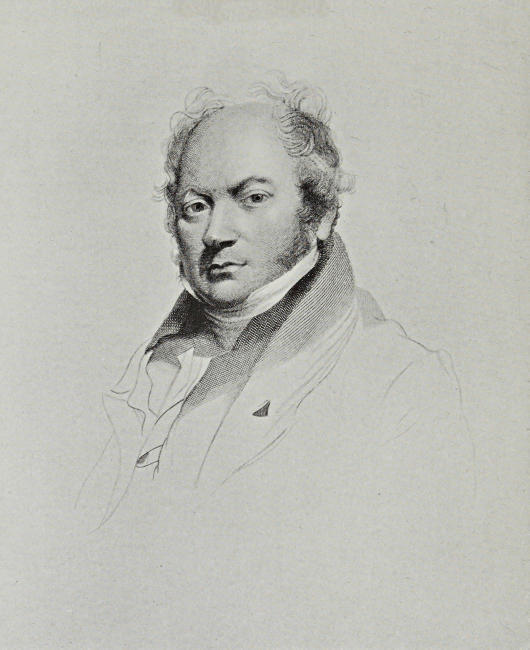
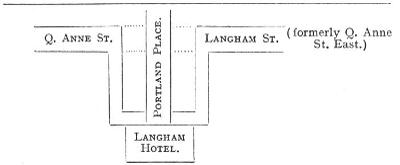
The Reader is requested to keep in mind that those
events which I relate of myself when “mewling
in my nurse’s arms,” and until my fourth year, were
communicated to me by my parents, and that my statements
from that period are mostly from my own
memory;—Miranda proved to Prospero that she recollected
an event in her fourth year.
My father informed me, that in the evening of the
23rd of June 1766, which must have been much about
the time when Marylebone Gardens echoed the melodious
notes of Tommy Lowe,[2] and whilst there was The Devil
to Pay at Richmond with Mr. and Mrs. Love,[3] my
mother, on returning from a visit to her brother, Mr.
Edward Tarr,[4] became so seriously indisposed, that she
most strenuously requested him to allow her to return
home in a hackney coach, whilst he went to Jermyn Street
for Dr. Hunter.[5] Upon that gentleman’s arrival at my
father’s door, No. 7, in Great Portland Street,[6] Marylebone,
he assisted the nurse in conveying my mother and myself
to her chamber. Although I dare not presume to suppose
that the vehicle in which I was born had been the equipage
of the great John Duke of Marlborough, or Sarah his
Duchess, at all events I probably may be correct in the
conjecture that the hack was in some degree similar to
those introduced by Kip, in his Plates for Strype’s edition
of Stowe.[7]
Hackney chairs were then so numerous, that their
stands extended round Covent Garden, and often down
the adjacent streets;[8] these vehicles frequently enabled
physicians to approach their patients in a warm state.
The forms of those to which I allude are also given in
Kip’s prints above mentioned; and who knows but that
they, in their turn, have conveyed Voltaire from the
theatre to his lodging in Maiden Lane?[9]
That sedans were of ancient use I make no doubt,
as I find one introduced in Sir George Staunton’s Embassy
to China.[10] Pliny has stated that his uncle was much
accustomed to be carried abroad in a chair.[11] My parents,
after a fireside debate, agreed that I should have two
Christian names: John, after my grandfather, a Shropshire
clothier, whose bust, modelled by my father, was one
of the first publicly exhibited by the Associated Artists
in 1763, before the establishment of the Royal Academy;[12]
and Thomas, to the honour of our family, in remembrance
of my great-uncle, Admiral Smith, better known under
the appellation of “Tom of Ten Thousand,”[13] of whom I
have a spirited half-length portrait, painted by the celebrated
Richard Wilson, the landscape painter, previous
to his visiting Rome, when he resided in the apartments
on the north side of Covent Garden, which had been
occupied first by Sir Peter Lely, and afterwards by Sir
Godfrey Kneller.[14] From this picture there is an excellent
engraving in mezzotinto, by Faber.
I have heard my mother relate, that when at Greenwich
this year for the benefit of her health, an aged pie and
cheesecake woman lived there, who was accompanied
through the town by a goose, who regularly stopped at
her customer’s door, and commenced a loud cackling;
but that whenever the words “Not to-day” were uttered,
off it waddled to the next house, and so on till the business
of the day was ended. My mother also remarked, that when
ladies walked out, they carried nosegays in their hands,
and wore three immense lace ruffle cuffs on each elbow.[15]
In the month of March, this year, died Mary Mogg,
at Oakingham, the woman who gave rise to Gay’s celebrated
ballad of “Molly Mogg.”[16]
In all ages there has been a fashion in amusements,
as well as in dress: grottoes, which were numerous round
London, appear by the advertisements to have been
places of great resort, but above all Finch’s, in St. George’s
Fields, was the favourite. The following is a copy of one
of the musical announcements:—
“6th of May, 1766.
“Mr. Houghton and Mr. Mitchell’s Night.
“At Finch’s Grotto Garden, This Day, will be performed
a Concert of Vocal and Instrumental Music.
Singing as usual.
“N.B. For that Night only, the Band will be enlarged.
Tickets to be had at the Bar of the Gardens. Admittance
One Shilling.”[17]
Being frequently thrown into my cradle by the servant,
as a cross little brat, the care of my tender mother induced
her to purchase one of Mr. Burchell’s anodyne necklaces,
so strongly recommended by two eminent physicians,
Dr. Tanner, the inventor, and Dr. Chamberlen, to whom
he had communicated the prescription; and it was agreed
by most of my mother’s gossiping friends, that the effluvia
arising from it when warm acted in so friendly a manner,
that my fevered gums were considerably relieved.[18]
Go-carts, the old appendages of our nurseries, continuing
in use, I was occasionally placed in one; and as
its advantages have been noticed in my work entitled
Nollekens and his Times, I shall now only refer the reader
for its form to Number 186 of “Rembrandt’s Etchings;”[19]
that being similar, as my father informed me, to those
used in London in my infantine days.[20]
The cradle having of late years been in a great degree
superseded by what is called a cot,[21] and its shape not
being remarkable, I shall for a moment beg leave to deal
in a foreign market, in order to gratify the indefatigable
organ of inquisitiveness of some of my readers, who may
wish to know in what sort of cradle Stratford’s sweet Willy
slumbered. Possibly it might in some respects have
accorded with the representation of one in a small plate
by Israel Von Meckenen,[22] and this conjecture is not improbable,
as that plate was engraved about the sixteenth
century; and it is well known that in most articles of
furniture, as well as dress, we had long borrowed from
our continental neighbours, whether good, bad, or indifferent.
It gives me great pleasure to observe that,
owing to the vast improvements made by our draughtsmen
for English upholsterers, in every article of domestic
decorative furniture, England has now little occasion to
borrow from other nations.
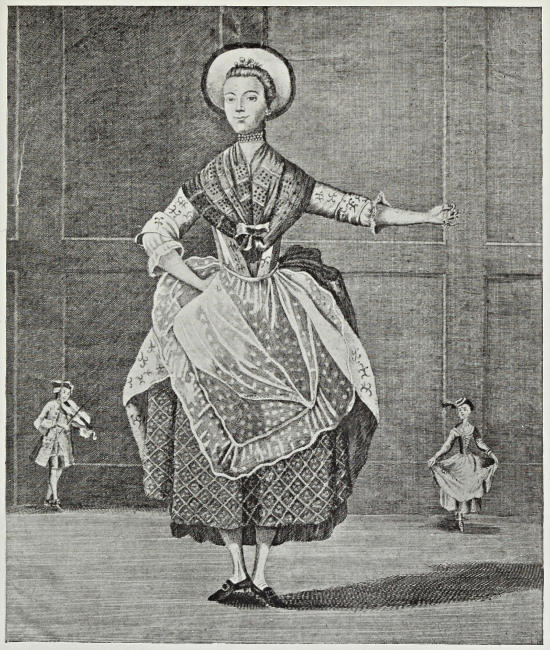
NANCY DAWSON
“See how she comes to give surprise
With joy and pleasure in her eyes.”
Old Song, “Nancy Dawson”
Nancy Dawson, the famous hornpipe dancer, died this
year, May 27th, at Hampstead; she was buried behind
the Foundling Hospital, in the ground belonging to St.
George the Martyr, where there is a tombstone to her
memory, simply stating, “Here lies Nancy Dawson.”
Every verse of a song in praise of her, declares the poet
to be dying for Nancy Dawson; and its tune, which many
of my readers must recollect, is, in my opinion, as lively as
that of “Sir Roger de Coverley.” I have been informed
that Nancy, when a girl, set up the skittles at a tavern
in High Street, Marylebone.[23] Sir William Musgrave, in
his Adversaria (No. 5719), in the British Museum, says
that “Nancy Dawson was the wife of a publican near
Kelso, on the borders of Scotland.”[24]
At the age when most children place things on their
heads and cry “Hot pies!” I displayed a black pudding
upon mine, which my mother, careful soul, had provided
for its protection in case I should fall. This is another
article mentioned in Nollekens and his Times; and having
there stated that Rubens, in a picture at Blenheim, had
painted one on the head of a son of his, walking with his
wife Elenor,[25] and as the mothers of future days may wish
to know its shape, I beg to inform them that there is an
engraving of it by MacArdell. But as the receipt for a
pet pudding would be of little use to the maker were one
ingredient omitted, it would be equally difficult to produce
a similar black pudding to mine, were I not to state that
it was made of a long narrow piece of black silk or satin,
padded with wadding, and then formed to the head according
to the taste of the parent, or similar to that of little
Rubens.[26]
In this year the Royal Academy was founded, consisting
of members who had agreed to withdraw themselves from
various clubs, not only in order to be more select as to
talent, but perfectly correct as to gentlemanly conduct.
It would have been a valuable acquisition to the History
of the Fine Arts in England, had Mr. Howard favoured us
with the Rise and Progress of the Royal Academy.[27]
Perhaps no one could have been more talked of than
Mr. Wilkes, particularly on May 10th, when a riot took
place on account of his imprisonment.[28] His popularity
was carried to so great an extent, that his friends in all
classes displayed some article on which his effigy was
portrayed, such as salad or punch bowls, ale or milk jugs,
plate, dishes, and even heads of canes. The squib engravings
of him, published from the commencement of his
notoriety to his silent state when Chamberlain of
London, would extend to several volumes. Hogarth’s
portrait of him, which by the collectors was considered
a caricature, my father recommended as the best
likeness.
The following memoranda respecting Henry Fuseli,
R.A., are extracted from the Mitchell Manuscripts in the
British Museum. The letter is from Mr. Murdock, of
Hampstead, to a friend at Berlin, dated Hampstead,
12th June 1764:—
“I like Fuseli very much; he comes out to see us at
times, and is just now gone from this with your letter to
A. Ramsay, and another from me. He is of himself disposed
to all possible economy; but to be decently lodged
and fed, in a decent family, cannot be for less than three
shillings a day, which he pays. He might, according to
Miller’s wish, live a little cheaper; but then he must have
been lodged in some garret, where nobody could have
found their way, and must have been thrown into ale-houses
and eating-houses, with company every way unsuitable,
or, indeed, insupportable to a stranger of any taste;
especially as the common people are of late brutalised.
“Some time hence, I hope, he may do something for
himself; his talent at grouping figures, and his faculty
of execution, being really surprising.”
In the same volume, in a letter dated Hampstead,
12th Jan. 1768, the same writer says to the same friend—
“Fuseli goes to Italy next spring, by the advice of
Reynolds (our Apelles), who has a high opinion of his
genius, and sees what is wanting to make him a first-rate.”[29]
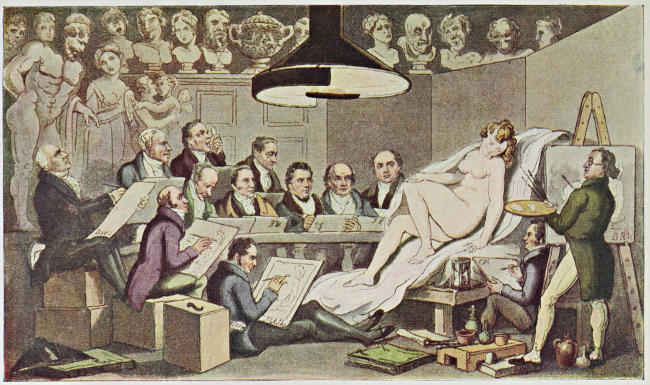
R.A.’S REFLECTING ON THE TRUE LINE OF BEAUTY AT THE LIFE ACADEMY, SOMERSET HOUSE.
In another, dated Hampstead, 13th December 1768:
“Fuseli is still here; but proposes to set out for Italy as
soon as his friends can secure to him fifty pounds yearly,
for a few years. Dr. Armstrong,[30] who admires his genius,
has taxed himself at ten pounds, and has taken us in for as
much more; and indeed it were shameful that such talents
should be sunk for want of a little pecuniary aid.”
The ladies this year wore half a flat hat as an eye-shade.
Lord North, in a letter addressed to Sir Eardley Wilmot
from Downing Street, bearing date this year, April 1st,
says—
“My friend Colonel Luttrell having informed me
that many persons depending upon the Court of Common
Pleas are freeholders of Middlesex, etc., not having the
honour of being acquainted with you himself, desires me
to apply to you for your interest with your friends in his
behalf. It is manifest how much it is for the honour of
Parliament, and the quiet of this country in future times,
that Mr. Wilkes should have an antagonist at the next
Brentford election; and that his antagonist should meet
with a respectable support. The state of the country
has been examined, and there is the greatest reason to
believe that the Colonel will have a very considerable
show of legal votes, nay, even a majority, if his friends
are not deterred from appearing at the poll. It is the
game of Mr. Wilkes and his friends to increase those alarms,
but they cannot frighten the candidate from his purpose;
and I am very confident that the voters will run no risk.
I hope, therefore, you will excuse this application. There
is nothing, I imagine, that every true friend of this country
must wish more than to see Mr. Wilkes disappointed in
his projects; and nothing, I am convinced, will defeat
them more effectually, than to fill up the vacant seat for
Middlesex, especially if it can be done for a fair majority
of legal votes.
“I am, Sir, with the greatest truth and respect, your
most faithful, humble servant,
“North.”
The Judge, in his answer, dated on the following day,
observed, “It would be highly improper for me to interfere
in any shape in that election.” (See the Wilmot
Letters, in the British Museum.)[31]
This year ladies continued to walk with fans in their
hands.
Most of the citizens who had saved money were very
fond of retiring to some country-house, at a short distance
from the Metropolis, and more particularly to Islington,
that being a selected and favourite spot. Charles
Bretherton, Jun., made an etching, from a drawing by
Mr. Bunbury,[32] of a Londoner, of the above description,
whose waistcoat-pockets were large enough to convey a
couple of fowls from a City feast home to his family. The
print is entitled, “The Delights of Islington,” and bears
the following inscription at the top:—
WHEREAS my new Pagoda has been clandestinely
carried off, and a new pair of Dolphins taken from the
top of the Gazebo, by some Bloodthirsty Villains; and
whereas a great deal timber has been cut down and
carried away from the Old Grove, that was planted last
Spring, and Pluto and Proserpine thrown into my Basin:
from henceforth, Steel Traps and spring guns will be
constantly set for the better extirpation of such a nest of
villains,
By me, Jeremiah Sago.
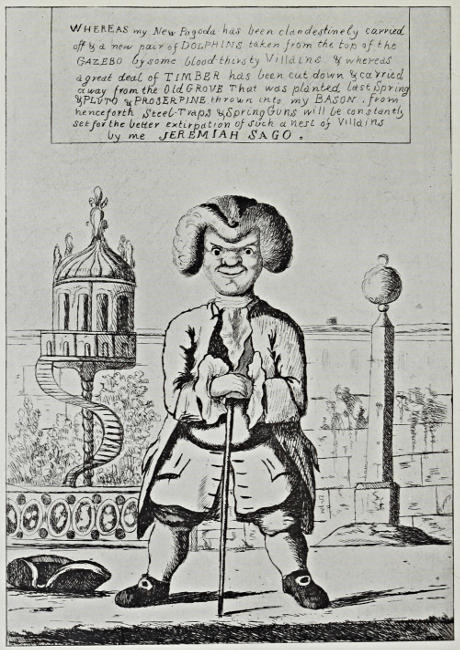
“THE DELIGHTS OF ISLINGTON”
On a garden notice-board, in another print, also
after Bunbury, published at the same time, is
inscribed,
THE NEW PARADISE.
No Gentlemen or Ladies to be admitted with nails in
their shoes.[33]
For the information of the collectors of Bunbury’s
prints, I beg to state that there is in Mrs. Banks’s collection
of visiting cards, etc., in the British Museum, a small etching
said to have been his very first attempt when at Westminster
School. It represents a fellow riding a hog,
brandishing a birch-broom by way of a baster, with another
at a short distance, hallooing.
As Mr. Walpole is silent as to Jonathan Richardson’s
place of interment, the biographical collector will find
the following inscription in the burial-ground behind the
Foundling Hospital, belonging to the parish of St. George
the Martyr:—
Elizabeth Richardson,
Died 24th Dec. 1767,
Aged 74 years.
Jonathan Richardson,
Died 10th June, 1771,
Aged 77; both of this parish.[34]
The gaiety during the merry month of May was to me
most delightful; my feet, though I knew nothing of the
positions, kept pace with those of the blooming milkmaids,
who danced round their garlands of massive plate, hired
from the silversmiths to the amount of several hundreds
of pounds, for the purpose of placing round an obelisk,
covered with silk fixed upon a chairman’s horse. The
most showy flowers of the season were arranged so as to
fill up the openings between the dishes, plates, butter-boats,
cream-jugs, and tankards. This obelisk was carried
by two chairmen in gold-laced hats, six or more handsome
milkmaids in pink and blue gowns, drawn through the
pocket-holes, for they had one on either side: yellow or
scarlet petticoats, neatly quilted, high-heeled shoes, mob-caps,
with lappets of lace resting on their shoulders;
nosegays in their bosoms, and flat Woffington hats, covered
with ribbons of every colour. But what crowned the
whole of the display was a magnificent silver tea-urn
which surmounted the obelisk, the stand of which was
profusely decorated with scarlet tulips. A smart, slender
fellow of a fiddler, commonly wearing a sky-blue coat,
with his hat profusely covered with ribbons, attended;
and the master of the group was accompanied by a constable,
to protect the plate from too close a pressure of the
crowd, when the maids danced before the doors of his
customers.[35]
One of the subjects selected by Mr. Jonathan Tyers,
for the artists who decorated the boxes for supper-parties
in Vauxhall Gardens,[36] was that of Milkmaids on May-day.
In that picture (which, with the rest painted by Hayman
and his pupils, has lately disappeared) the garland of
plate was carried by a man on his head; and the milkmaids,
who danced to the music of a wooden-legged fiddler,
were extremely elegant. They had ruffled cuffs, and their
gowns were not drawn through their pocket-holes as in
my time; their hats were flat, and not unlike that worn
by Peg Woffington, but bore a nearer shape to those now
in use by some of the fish-women at Billingsgate. In
Captain M. Laroon’s Cries of London, published by Tempest,
there is a female entitled “A Merry Milkmaid.”[37] She
is dancing with a small garland of plate upon her head;
and from her dress I conclude that the Captain either
made his drawing in the latter part of King William III.’s
reign, or at the commencement of that of Queen Anne.
My dear mother’s declining state of health urged my
father to consult Dr. Armstrong,[38] who recommended her
to rise early and take milk at the cowhouse. I was her
companion then; and I well remember that, after we
had passed Portland Chapel, there were fields all the way
on either side. The highway was irregular, with here
and there a bank of separation; and that when we had
crossed the New Road, there was a turnstile (called in an
early plan, which I have seen since, “The White House”),
at the entrance of a meadow leading to a little old public-house,
the sign of the “Queen’s Head and Artichoke”:
it was much weather-beaten, though perhaps once a
tolerably good portrait of Queen Elizabeth. The house
was reported to have been kept by one of Her Majesty’s
gardeners.[39]
A little beyond a nest of small houses contiguous, was
another turnstile opening also into fields, over which we
walked to the Jew’s Harp House, Tavern and Tea Gardens.[40]
It consisted of a large upper room, ascended by an outside
staircase, for the accommodation of the company on ball
nights; and in this room large parties dined. At the
south front of these premises was a large semicircular
enclosure with boxes for tea and ale drinkers, guarded by
deal-board soldiers between every box, painted in proper
colours. In the centre of this opening were tables and
seats placed for the smokers. On the eastern side of the
house there was a trapball-ground; the western side served
for a tennis-hall; there were also public and private
skittle-grounds. Behind this tavern were several small
tenements, with a pretty good portion of ground to each.
On the south of the tea-gardens a number of summer-houses
and gardens, fitted up in the truest Cockney taste;
for on many of these castellated edifices wooden cannons
were placed; and at the entrance of each domain, of
about the twentieth part of an acre, the old inscription
of “Steel-traps and spring-guns all over these
grounds,” with an “N.B. Dogs trespassing will be
shot.”
In these rural retreats the tenant was usually seen on
Sunday evening in a bright scarlet waistcoat, ruffled shirt,
and silver shoe-buckles, comfortably taking his tea with
his family, honouring a Seven-Dial friend with a nod on
his peregrination to the famed Wells of Kilburn. Willan’s
farm,[41] the extent of my mother’s walk, stood at about a
quarter of a mile south; and I remember that the room
in which she sat to take the milk was called “Queen
Elizabeth’s Kitchen,” and that there was some stained
glass in the windows.
On our return we crossed the New Road; and, after
passing the back of Marylebone Gardens,[42] entered London
immediately behind the elegant mansions on the north
side of Cavendish Square. This Square was enclosed by
a dwarf brick wall, surmounted by heavy wooden railing.
Harley Fields had for years been resorted to by thousands
of people, to hear the celebrated Mr. George Whitefield,
whose wish, like that of Wesley, when preaching on execution
days at Kennington Common, was to catch the ears
of the idlers. I should have noticed Kendall’s farm,[43]
which in 1746 belonged to a farmer of the name of Bilson,
a pretty large one, where I have seen eight or ten immense
hay-ricks all on a row; it stood on the site of the commencement
of the present Osnaburg Street, nearly opposite
the “Green Man,” originally called the “Farthing Pie
House.”[44]
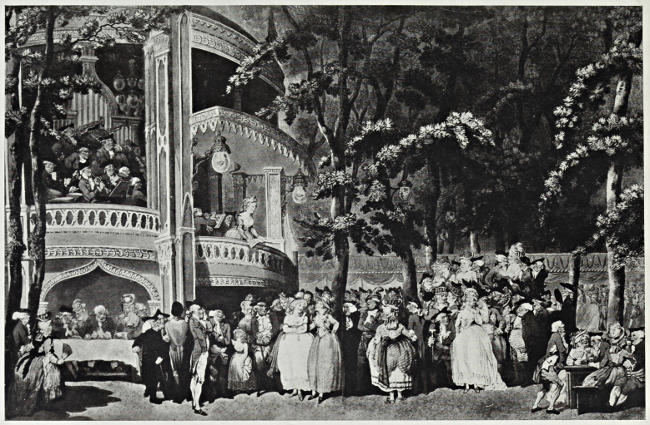
“SING TANTARARA—VAUXHALL! VAUXHALL!”
To the honour of our climate, which is often abused,
perhaps no country can produce instances of longevity
equal to those of England of this year, viz.:—at 100, 2;
101, 5; 102, 6; 103, 3; 105, 4; 106, 3; 107, 4; 108, 5;
109, 4; 110, 2; 111, 2; 112, 3; 114, 1; 118, 1;
125, Rice, a cooper in Southwark; 133, Mrs. Keithe, at
Newnham, in Gloucestershire; 138, the widow Chun,
at Ophurst, near Lichfield.[45]
The “Mother Red-cap,” at Kentish Town, was a
house of no small terror to travellers in former times.
This house was lately taken down, and another inn built
on its site; however, the old sign of “Mother Red-cap”
is preserved on the new building. It has been stated
that Mother Red-cap was the “Mother Damnable” of
Kentish Town in early days; and that it was at her house
the notorious “Moll Cut-purse,” the highway-woman of
the time of Oliver Cromwell, dismounted and frequently
lodged.[46]
As few persons possess so retentive a memory as myself,
I make no doubt that many will be pleased with my recollections
of the state of Tottenham Court Road at this
time. I shall commence at St. Giles’s churchyard, in
the northern wall of which there was a gateway of red
and brown brick. Over this gate, under its pediment,
was a carved composition of the Last Judgment, not
borrowed from Michael Angelo, but from the workings of
the brain of some ship-carver.[47] This was and is still admired
by the generality of ignorant observers, as much as Mr.
Charles Smith[48] the sculptor’s “Love among the Roses”
is by the well-informed; and, perhaps, a more correct
assertion was never made than that by the late worthy
Rev. James Bean,[49] when speaking of an itinerant musician,
“that bad music was as agreeable to a bad ear as that of
Corelli or Pergolesi was to persons who understood the
science.”
At this gate stood for many years an eccentric but
inoffensive old man called “Simon,” some account of
whom will be found in a future page. Nearly on the
site of the new gate, in which this basso relievo has been
most conspicuously placed, stood a very small old house
towards Denmark Street, tottering for several years
whenever a heavy carriage rolled through the street,
to the great terror of those who were at the time passing
by.
I must not forget to observe that I recollect the building
of most of the houses at the north end of New Compton
Street (Dean Street and Compton Street, Soho, were
named in compliment to Bishop Compton, Dean of St.
Paul’s, who held the living of St. Anne), and I also remember
a row of six small almshouses, surrounded by a dwarf
brick wall, standing in the middle of High Street.[50]
On the left-hand of High Street, passing on to Tottenham
Court Road, there were four handsomely finished brick
houses, with grotesque masks on the key-stones above
the first-floor windows, probably erected in the reign of
Queen Anne. These houses have lately been rebuilt
without the masks; fortunately my reader may be gratified
with a sight of such ornaments in Queen Square, Westminster.[51]
There is a set of engravings of masks, of a
small quarto size, considered as the designs of Michael
Angelo; and in the sale of Mr. Moser, the first keeper
of the Royal Academy, which took place at Hutchinson’s
in 1783, were several plaster casts, considered to be taken
from models by him. The next object of notoriety is a
large circular boundary stone, let into the pavement in
the middle of the highway, exactly where Oxford Street
and Tottenham Court Road meet in a right angle. When
the charity boys of St. Giles’s parish walk the boundaries,
those who have deserved flogging are whipped at this
stone, in order that, as they grow up, they may remember
the place, and be competent to give evidence should any
dispute arise with the adjoining parishes. Near this
stone stood St. Giles’s Pound.[52] Two old houses stood
near this spot on the eastern side of the street, where the
entrance gates of Meux’s brewery have been erected:
between the second-floor windows of one of them the
following inscription was cut in stone: “Opposite this
house stood St. Giles’s Pound.” This spot has been
rendered popular by a song, attributed to the pen of a
Mr. Thompson, an actor of the Drury Lane Company:
“On Newgate steps Jack Chance was found,
Bred up near St. Giles’s Pound.”
[53]
The ground behind the north-west end of Russell
Street was occupied by a farm occupied by two old maiden
sisters of the name of Capper. They wore riding-habits,
and men’s hats; one rode an old grey mare, and it was
her spiteful delight to ride with a large pair of shears
after boys who were flying their kites, purposely to cut
their strings; the other sister’s business was to seize the
clothes of the lads who trespassed on their premises to
bathe.[54]
From Capper’s farm were several straggling houses;
but the principal part of the ground to the “King’s Head,”
at the end of the road, was unbuilt upon. The “Old King’s
Head” forms a side object in Hogarth’s beautiful and
celebrated picture of the “March to Finchley,” which
may be seen with other fine specimens of art in the Foundling
Hospital, for the charitable donation of one shilling.
I shall now recommence on the left-hand side of the
road, noticing that on the front of the first house, No. 1,
in Oxford Street, near the second-floor windows, is the
following inscription cut in stone: Oxford Street, 1725.
In Aggas’s plan of London, engraved in the beginning
of the reign of Queen Elizabeth, the commencement of
this street is designated “The Waye to Uxbridge”;
farther on in the same plan the highway is called “Oxford
Road.” Hanway Street, better known by the vulgar
people under the name of Hanover Yard, was at this
time the resort of the highest fashion for mercery and
other articles of dress. The public-house, the sign of the
“Blue Posts,” at the corner of Hanway Street, in Tottenham
Court Road, was once kept by a man of the name of Sturges,
deep in the knowledge of chess, upon which game he published
a little work, as is acknowledged on his tombstone
in St. James’s burial-ground, Hampstead Road.[55] From
the “Blue Posts” the houses were irregularly built to a large
space called Gresse’s Gardens, thence to Windmill Street,
strongly recommended by physicians for the salubrity
of the air. The premises occupied by the French charity
children were held by the founders of the Middlesex Hospital,
which were established in 1755, where the patients
remained until the present building was erected in Charles
Street. Colvill Court, parallel with Windmill Street
northward, was built in 1766; and Goodge Street,[56] farther
on, was, I conjecture, erected much about the same time.
Mr. Whitefield’s chapel was built in 1754, upon the site
of an immense pond, called The Little Sea. This pond,
so called, is inserted in Pine and Tinney’s plan of London,
published in 1742, and also in the large one issued by the
same persons in 1746.[57] Beyond the chapel[58] the four
dwellings, then called “Paradise Row,” almost terminated
the houses on that side. A turnstile opened into Crab-tree
Fields.[59] They extended to the “Adam and Eve” public-house,
the original appearance of which Hogarth has also
introduced into his picture of the “March to Finchley.”
It was at this house that the famous pugilistic skill of
Broughton and Slack was publicly exhibited, upon an
uncovered stage, in a yard open to the North Road.[60]
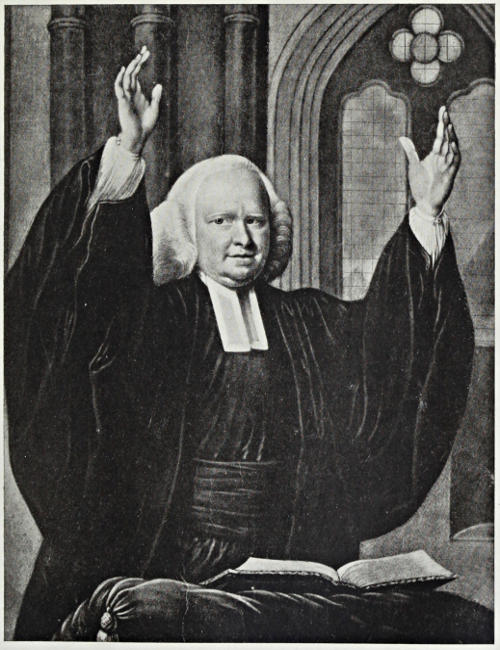
GEORGE WHITEFIELD
“Fain would I die preaching.”
The rare and beautiful etching of the before-mentioned
picture by Hogarth was the production of Luke Sullivan,[61]
a native of Ireland, but how he acquired his knowledge
of art I have not been able to learn; most probably he
was of Dame Nature’s school, where pupils can be taught
gratis the whole twenty-four hours of every day as long
as the world lasts. Sullivan’s talents were not confined
to the art of engraving; he was, in my humble opinion,
the most extraordinary of all miniature painters. I have
three or four of his productions, one of which was so particularly
fine, that I could almost say I have it on my retina
at this moment. It was the portrait of a most lovely
woman as to features, flesh, and blood. She was dressed
in a pale green silk gown, lapelled with straw-coloured
satin; and in order to keep up a sweetness of tone, the
artist had placed primroses in her stomacher; the sky
was of a warm green, which blended harmoniously with
the carnations of her complexion; her hair was jet, and
her necklace of pearls.
Lord Orford, whose early attachment to the sleepy-eyed
beauties of King Charles II.’s Court, and those with
the lascivious leer of that of Louis XIV., as may be inferred
by their numerous portraits in the cabinets at Strawberry
Hill, would no doubt have preferred his favourites, Cooper
and Petitot—names eternally, and many times unjustly,
extolled by the admirers of their works to the injury of
our artists, whose talents equal, if not surpass, those of
every country put together, in, I think I may say, every
branch of the fine arts. Upon this too general opinion
of the pre-eminence of Petitot, I have now and then
had a battle with Mr. Paul Fischer, the miniature
painter, who certainly has produced some most
highly finished and excellent likenesses of the Royal
Family and several persons of fashion, particularly
of King George IV. and Sir Wathen Waller,
Bart.[62]
Notwithstanding Tottenham Court Road was so infested
by the lowest order, who kept what they called a
Gooseberry Fair,[63] it was famous at certain times of the
year, particularly in summer, for its booths of regular
theatrical performers, who deserted the empty benches
of Drury Lane Theatre, under the mismanagement of Mr.
Fleetwood,[64] and condescended to admit the audience at
sixpence each. Mr. Yates, and several other eminent performers,
had their names painted on their booths.
The whole of the ground north from Capper’s farm,
at the back of the British Museum, so often mentioned
as being frequented by duellists, was in irregular patches,
many fields with turnstiles. The pipes of the New River
Company were propped up in several parts to the height
of six and eight feet, so that persons walked under them
to gather watercresses, which grew in great abundance
and perfection, or to visit the “Brothers’ Steps,” well
known to the Londoners. Of these steps there are many
traditionary stories; the one generally believed is, that
two brothers were in love with a lady, who would not
declare a preference for either, but coolly sat upon a bank
to witness the termination of a duel, which proved fatal
to both. The bank, it is said, on which she sat, and the
footmarks of the brothers when pacing the ground, never
produced grass again. The fact is that these steps were
so often trodden that it was impossible for the grass to
grow. I have frequently passed over them; they were
in a field on the site of Mr. Martin’s chapel, or very nearly
so, and not on the spot as communicated to Miss Porter,
who has written an entertaining novel on the subject.[65]
Aubrey, in his Miscellanies, states: “The last summer,
on the day of St. John Baptist (1694), I accidentally was
walking in the pasture behind Montague House; it was
twelve o’clock. I saw there about two or three and
twenty young women, most of them well habited, on
their knees very busie, as if they had been weeding. I
could not presently learn what the matter was; at last a
young man told me that they were looking for a coal
under the root of a plantain to put under their heads
that night, and they should dream who would be their
husbands. It was to be found that day and hour.”[66]
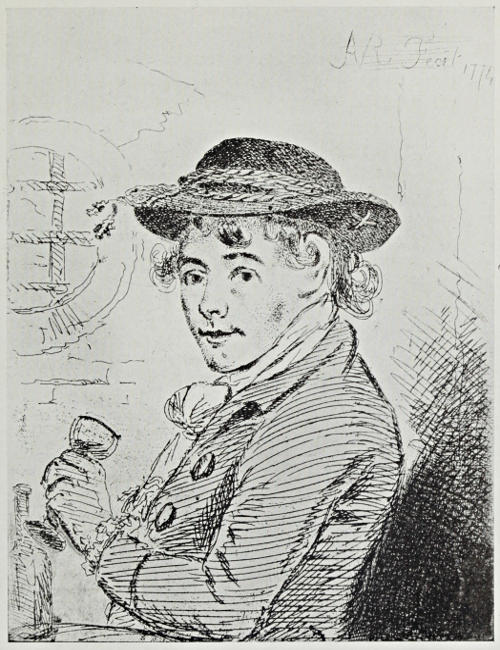
JOHN RANN
“Sixteen String Jack.”
I well remember when, in my eighth year, my father’s
playfellow, Mr. Joseph Nollekens, leading me by the hand
to the end of John Street, to see the notorious terror of
the king’s highways, John Rann, commonly called Sixteen-string
Jack, on his way to execution at Tyburn, for robbing
Dr. Bell, Chaplain to the Princess Amelia, in Gunnesbury
Lane. The Doctor died a Prebendary of Westminster.
It was pretty generally reported that the sixteen strings
worn by this freebooter at his knees were in allusion to
the number of times he had been acquitted. Fortunately
for the Boswell illustrators, there is an etched portrait
of him; for, be it known, thief as he was, he had the
honour of being recorded by Dr. Johnson.[67] Rann was
a smart fellow, a great favourite with a certain description
of ladies, and had been coachman to Lord Sandwich,
when his Lordship resided in the south-east corner-house
of Bedford Row. The malefactor’s coat was a bright
pea-green; he had an immense nosegay, which he had
received from the hand of one of the frail sisterhood,
whose practice it was in those days to present flowers to
their favourites from the steps of St. Sepulchre’s church,
as the last token of what they called their attachment
to the condemned,[68] whose worldly accounts were generally
brought to a close at Tyburn, in consequence of their
associating with abandoned characters. On our return
home, Mr. Nollekens, stooping close to my ear, assured
me that, had his father-in-law, Mr. Justice Welch, been
high constable, we could have walked all the way to Tyburn
by the side of the cart.[69]
At this time houses in High Street, Marylebone, particularly
on the western side, continued to be inhabited
by families who kept their coaches, and who considered
themselves as living in the country, and perhaps their
family affairs were as well known as they could have been
had they resided at Kilburn.[70] In Marylebone, great and
wealthy people of former days could hardly stir an inch
without being noticed; indeed, so lately as the year 1728,
the Daily Journal assured the public that “many persons
arrived in London from their country-houses in Marylebone”;
and the same publication, dated October 15th,
conveys the following intelligence:—
“The Right Hon. Sir Robert Walpole comes to town
this day from Chelsea.”
The following lines were inserted by the late Sir William
Musgrave, in his Adversaria (No. 5721):—
“Sir Robert Walpole in great haste
Cryed, ‘Where’s my fellow gone?’
It was answered by a man of taste,
‘Your fellow, Sir, there’s none.’”
One Sunday morning my mother allowed me, before
we entered the little church[71] in High Street, Marylebone,
to stand to see the young gentlemen of Mr. Fountayne’s
boarding-school cross the road, while the bell was chiming
for sacred duties. I remember well a summer’s sun shone
with full refulgence at the time, and my youthful eyes
were dazzled with the various colours of the dresses of
the youths, who walked two and two, some in pea-green,
others sky-blue, and several in the brightest scarlet;
many of them wore gold-laced hats, while the flowing
locks of others, at that time allowed to remain uncut at
schools, fell over their shoulders. To the best of my
recollection, the scholars amounted to about one hundred.
As the pleasurable and often idle scenes of my schoolboy
days are pictured upon my retina whenever Crouch End, or
the name of my venerable master, Norton,[72] are mentioned,
and as others may feel similar delight with respect to the
places at which they received their early education, I shall
endeavour to gratify a few of my readers by a description
of the house and playground of Mr. Fountayne’s academy.
For this purpose it may not be irrelevant to notice something
of the antiquity of that once splendid mansion, in which so
many persons have passed their early and innocent hours.
Topographers who mention Marylebone Park inform
us that foreign ambassadors were in the time of Queen
Elizabeth and James I. amused there by hunting, and
that the oldest parts of this school were the remains of
the palace in which they were entertained. The earliest
topographical representation which I am enabled to
instance, is a drawing made by Joslin, dated 1700, formerly
in the possession of his Grace the Duke of Buckingham,
of which I published an etching. It comprehends the
field-gate and palace, its surrounding walls and adjacent
buildings in Marylebone to the south-west, including a
large mansion, which in all probability had been Oxford
House, the grand receptacle of the Harleian Library.
Fortune, I am sorry to say, has not favoured me with
the power of continuing the declining history of the
palace to the period at which it became an academy,
nor can I discover the time in which Monsieur de la Place
first occupied it.[73] A daughter of De la Place married
the Rev. Mr. Fountayne,[74] whose name the school retained
until its final demolition in 1791, at which period I remember
seeing the large stone balls taken from the brick piers of
the gates.
Of this house, when a school, I recollect a miserably
executed plate by Roberts, probably for some magazine;
there is also a quarto plate displaying a knowledge in
perspective, engraved by G. T. Parkyns, from a drawing
by J. C. Barrow;[75] but the most interesting, and I must
consider the most correct, are four drawings made by
Michael Angelo Rooker,[76] formerly in my possession, but
now in the illustrated copy of Pennant’s London in the
British Museum.[77] These have enabled me to insert the
following description of a few parts of the mansion.
The first drawing is a view of the principal and original
front of the palace, or manor-house, with other buildings
open to the playground; it was immediately within the
wall on the east side of the road, then standing upon
the site of the present Devonshire Mews. This house
consisted of an immense body and two wings, a projecting
porch in the front, and an enormously deep dormer roof,
supported by numerous cantilevers, in the centre of which
there was, within a very bold pediment, a shield surmounted
by foliage with labels below it. The second drawing
exhibits the back, or garden front, which consisted of a
flat face with a bay window at each end, glazed in quarries;[78]
the wall of the back front terminated with five gables.
In the midst of some shrubs stands a tall, lusty gentleman
dressed in black, with a white Busby-wig and a three-cornered
hat, possibly intended for the figure of the Rev.
Mr. Fountayne, as he is directing the gardener to distribute
some plants. The third drawing, which is taken from
the hall, exhibits the grand staircase, the first flight of
which consisted of sixteen steps; the hand-rails were
supported with richly carved perforated foliage, from
its style, probably of the period of Inigo Jones. The
fourth drawing consists of the decorations of the staircase,
which was tessellated. This mansion was wholly of
brick, and surmounted by a large turret containing the
clock and bell. Mr. Fountayne was noticed by Handel
as well as Clarke, the celebrated Greek scholar.[79] These
gentlemen frequently indulged in musical parties, which
were attended by persons of rank and worth, as well as
fashion and folly.
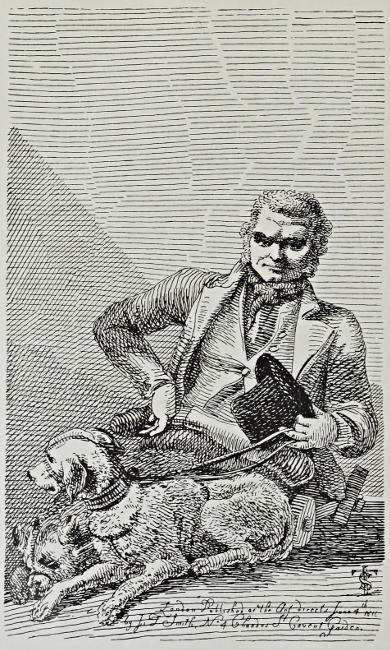
LONDON BEGGARS
ETCHED BY J. T. SMITH
John Mac Nally … “well known about Parliament Street, and the Surrey foot of
Westminster Bridge.”
Mrs. Fountayne was a vain, dashing woman, extremely
fond of appearing at Court, for which purpose, as was
generally known, she borrowed Lady Harrington’s jewels.[80]
Indeed, her passion for display was carried to such an extreme,
that she kept her carriage, and that without the knowledge
of her husband, by the following artful manœuvre.
As the scholars were mostly sons of persons of title and
large fortunes, she professed to have many favourites,
who had behaved so well that she was often tempted to
take them to the play, which so pleased the parents that
they liberally reimbursed her in the coach and theatrical
expenses, though she actually obtained orders upon
those occasions from her friend Mrs. Yates, by which
contrivance she was enabled to keep the vehicle in
which they were conveyed to the theatres; Mrs.
Yates,[81] however, was amply repaid for her orders by
the number of tickets which Mrs. Fountayne prevailed
on the parents of the scholars to take at her
benefits.[82]
Previous to a consultation of physicians respecting
the doubtful case of a young gentleman boarder, one of
Mr. Fountayne’s daughters overheard something like the
following dialogue by placing herself behind the window
hangings:—Doctor: “You look better.”—“Yes, sir; I
now eat suppers, and wear a double flannel jacket.” At
this time the lady behind the curtains tittered. “Hark!
what noise is that?” interrogated an old member of
Warwick Lane’s far-famed college.[83] “Oh,” said another
of the faculty, “it’s only the sneezing of a cat.” After
this, instead of saying a word about magnesia, Gaskin’s
powder, or oil of sweet almonds, they resumed their conversation
upon their indulgences, and finally ended with
some severe philippic upon Lord North’s administration.
This occupied a considerable portion of their time before
the house-apothecary (who had called them in) was
questioned as to what he had given the patient. His
draught being perfectly consistent with the college pharmacopœia,
they all agreed that he could not do better
than repeat it as often as he thought proper; and thus
the important consultation ended.
In the hall of this house was a parrot, so aged that
its few remaining feathers were for years confined to its
wrinkled skin by a flannel jacket, which in very cold
weather received an additional broadcloth covering of
the brightest scarlet, so that Poll, like the Lord Mayor,
had her scarlet days. Poll, who had been long accustomed
to hear her mistress’s general invitation to strangers who
called to inquire after the boarders, relieved her of that
ceremony by uttering, as soon as they entered, “Do
pray walk into the parlour and take a glass of wine!”
but this she finally did with so little discrimination, that
when a servant came with a letter or a card for her mistress,
or a fellow with a summons from the Court of Conscience,
he was greeted by the bird with equal liberality and politeness.
In this year the houses of the north end of Newman
Street commanded a view of the fields over hillocks of
ground now occupied by Norfolk Street,[84] and the north
and east outer sides of Middlesex Hospital garden-wall
were entirely exposed. From the east end of Union
Street, where Locatelli the sculptor subsequently had
his studio,[85] the ground was very deep; and much about
that spot, more to the east, stood a cottage with a garden
before it, with its front to the south. This was kept by
John Smith, one of Mr. Wilton the sculptor’s oldest
labourers; immediately behind this cottage was a rope-walk,
which extended north to a considerable distance
under the shade of two magnificent rows of elms. Here
I have often seen Richard Wilson the landscape painter
and Baretti walk.[86] At the right-hand side of this rope-walk
there was a pathway on a bank, commencing from
the site of the foundation of the present workhouse,
belonging to St. Paul’s, Covent Garden. This house
was then planned out, and finished in the ensuing year,
according to the date on its western front.
The bank extended northwards to the “Farthing
Pie House,” now the sign of the “Green Man,” and was
kept by a person of the name of Price, a famous player
on the salt-box.[87] Of this highly respectable publican
there is an excellent mezzotinto engraving by Jones,
after a picture by Lawranson. It commanded views of
the old “Queen’s Head and Artichoke,” the old “Jew’s-Harp
House,” and the distant hills of Highgate, Hampstead,
Primrose, and Harrow. I was then in my eighth
year, and frequently played at trap-ball between the
above-mentioned sombre elms.
The south and east ends of Queen Anne[88] and Marylebone
Streets were then unbuilt, and the space consisted
of fields to the west corner of Tottenham Court Road;
thence to the extreme of High Street, Marylebone Gardens,
Marylebone Bason, and another pond called Cockney-ladle.[89]
I recollect the building of the north side of Marylebone
Street, the whole of that portion of Portland Street north
of Portland Chapel, the site of Cockney-ladle, Duke Street,
Portland Place, and the greatest part of Harley Street,
Wimpole Street, and Portland Place, and Devonshire
Place when Marylebone Bason was the terror of many
a mother.[90] Of this Bason Chatelain executed a spirited
etching, of a quarto size, which is now considered by the
topographical collectors a great rarity. The carriage and
principal entrance to Marylebone Gardens was in High
Street; the back entrance was from the fields, beyond
which, north, was a narrow, winding passage, with garden-palings
on either side, leading into High Street. In this
passage were numerous openings into small gardens,
divided for the recreation of various cockney florists,
their wives, children, and Sunday smoking visitors. These
were called the “French Gardens,” in consequence of
having been cultivated by refugees who fled their country
after the Edict of Nantes.[91] I well remember my grandmother
taking me through this passage to Marylebone
Gardens, to see the fireworks, and thinking them prodigiously
grand. As the following notices of Marylebone
Gardens have given me no small pleasure in collecting,
and as they afford more information of that once fashionable
place of recreation than has hitherto been brought
together, or perhaps known to any other individual, I
without hesitation offer my gleanings[92] to the reader,
chronologically arranged, commencing with Pepys’s
visit in
1668.—“When we abroad to Marrowbone, and there
walked in the garden; the first time I ever was there,
and a pretty place it is.”[93]
1691.—Long’s bowling-green at the “Rose,” at Marylebone,
half a mile distant from London, is mentioned in
the London Gazette, January 11.[94]
1718.—“This is to give notice to all persons of quality,
ladies and gentlemen, that there having been illuminations
in Marybone bowling-greens on his Majesty’s birthday
every year since his happy accession to the throne; the
same is (for this time) put off till Monday next, and will
be performed, with a consort of musick, in the middle
green, by reason there is a Ball in the gardens at Kensington
with illuminations, and at Richmond also.” (See
the Daily Courant, Thursday, May 29.)
1738-9.—Mr. Gough enlarged the gardens, built an
orchestra, and issued silver tickets at 12s. for the season,
each ticket to admit two persons. From every one without
a ticket 6d. was demanded for the evening; but afterwards,
as the season advanced, the admission was 1s. for a
lady and gentleman. The gardens were open from six till ten.
1740.—An organ, built by Bridge, was added to the
band, admittance 6d. each; but afterwards, when the
new room was erected, the admission was increased to 1s.
1741. May 23.—A grand martial composition of music
was performed by Mr. Lampe, in honour of Admiral Vernon,
for taking Carthagena.
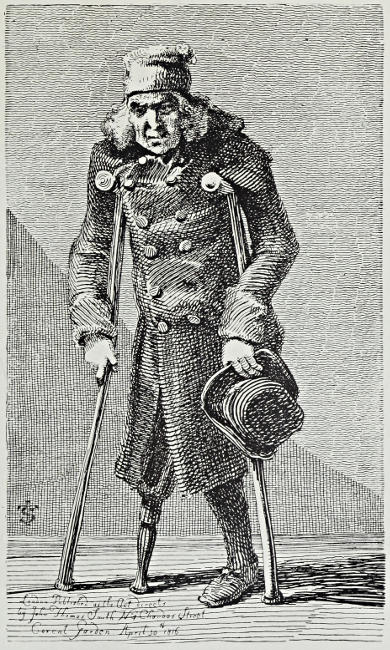
LONDON BEGGARS
ETCHED BY J. T. SMITH
“A silver haired man of the name of Lilly.”
1742.—The proprietor of the Mulberry Garden, Clerkenwell,
indulged in the following remarks upon five places
of similar amusement:—
“Ruckhoult has found one day and night’s alfresco
in the week to be inconvenient.[95]
“Ranelagh House, supported by a giant, whose legs
will scarcely support him.[96]
“Mary le Bon Gardens down on their marrow-bones.
“New Wells at low water.[97]
“At Cuper’s the fire almost out.”[98] (See the Daily
Post, July 28.)
1743.—The holders of Marybone Garden tickets let
them out at reduced prices for the evening. Ranelagh
tickets were also advertised to be had at Old Slaughter’s
Coffee-house at 1s. 3d. each, admitting two persons.
Vauxhall tickets were likewise to be had at the same
place at 1s. each, admitting two persons. (See the Daily
Advertiser for April 23.)
1744.—Miss Scott was a singer, Mr. Knerler played
the violin, and Mr. Ferrand an instrument called the
Pariton.[99]
1746.—Robberies were now so frequent and the thieves
so desperate, that the proprietor of the gardens was obliged
to have a guard of soldiers to protect the company to and
from London. The best plan of the gardens has been given
in Plate I. of Rocque’s Plan of London, published in 1746.
1747.—Miss Falkner, singer;[100] Henry Rose, first violin;
and Mr. Philpot, organist.—Admittance to the garden, 6d.;
to the concert, 2s.
1748.—Miss Falkner, singer. No persons to be admitted
to the balls unless in full dress.
1749.—It appears by the advertisements that dress-balls
and concerts were the only amusements of this year.
1750.—Miss Falkner, Mr. Lowe, and Master Phillips,
were the singers.
1751.—John Trusler was sole proprietor of the Gardens.[101]
Singers, Miss Falkner, Master Phillips, and Master Arne.
On the 30th of August there was a ball; and as the road
had been repaired, coaches drove up to the door—a ten-and-sixpenny
ticket admitted two persons. The doors
opened at nine o’clock.
1752.—Miss Falkner and Mr. Wilder singers.
1753.—The Public Advertiser of May 25, June 20,
September 10 and 24, states that the gardens were much
more extensive by taking in the bowling-green, and considerably
improved by several additional walks; that
lights had been erected in the coach-way from Oxford
Road, and also on the footpath from Cavendish Square
to the entrance to the gardens; and that the fireworks
were splendid beyond conception. A large sun was
exhibited at the top of a picture, a cascade, and shower
of fire, and grand air-balloons (perhaps these were the
first air-balloons in England) were also most magnificently
displayed; and likewise that red fire was introduced.
This is the earliest instance of Red fire I have been able
to meet with. Mrs. Chambers and Master Moore were
singers.
1756.—Two rooms were opened for dinner-parties.
Trusler, the proprietor of the gardens, was a cook.
1757.—Mr. Thomas Glanville, Mr. Kear, Mr. Reinhold,
and Mr. Champneys were singers.
1758.—The Gardens opened on May the 16th; the
singers were, Signora Saratina, Miss Glanvil, and Mr. Kear.
No persons were admitted to the ball-rooms without five-shilling
tickets, which admitted a gentleman and two
ladies; and only twenty-six tickets were delivered for
each night. Mr. Trusler’s son produced the first burletta
that was performed in the Gardens; it was entitled
“La Serva Padrona,” for which he only received the
profits of the printed books.[102]
1759.—The Gardens were opened for breakfasting;
and Miss Trusler made the cakes. Mr. Reinhold and
Mr. Gaudrey were the singers.
1760.—The Gardens, greatly improved, opened on
Monday, May 26th, with the usual musical entertainments.
The Gardens were opened also every Sunday evening
after five o’clock, where genteel company were admitted
to walk gratis, and were accommodated with coffee, tea,
cakes, etc.
The following announcement appears in the Daily
Advertiser of May 6th, this year:—
“Mr. Trusler’s daughter begs leave to inform the Nobility
and Gentry, that she intends to make Fruit-Tarts during
the fruit Season; and hopes to give equal satisfaction
as with the rich Cakes, and Almond Cheesecakes. The
Fruit will always be fresh gathered, having great quantities
in the Garden; and none but Loaf Sugar used, and the
finest Epping Butter. Tarts of a Twelvepenny size will
be made every day from One to Three o’clock; and those
who want them of larger sizes to fill a Dish, are desired
to speak for them, and send their dish or the size of it,
and the Cake shall be made to fit.
“The Almond Cheesecakes will be always hot at
one o’clock as usual; and the rich Seed and Plum-cakes
sent to any part of the town, at 2s. 6d. each. Coffee,
Tea, and Chocolate, at any time of the day; and fine
Epping Butter may also be had.”[103]
1761.—An excellent half-sheet engraving, after a
drawing made by J. Donowell, published this year, represents
Marybone Gardens, probably in their fullest splendour.
The centre of this view exhibits the longest walk,
with regular rows of young trees on either side, the stems
of which received the irons for the lamps at about the
height of seven feet from the ground. On either side
this walk were latticed alcoves: on the right hand of
the walk, according to this view, stood the bow-fronted
orchestra with balustrades, supported by columns. The
roof was extended considerably over the erection, to
keep the musicians and singers free from rain. On the
left hand of the walk was a room, possibly for balls and
suppers. The figures in this view are so well drawn and
characteristic of the time, that I am tempted to recommend
the particular attention of my reader to it.
The Gardens were opened gratis this year, and the
organ was played while the company took their tea.
1762.—The Gardens were in fine order this year, and
visited by the Cherokee Kings—admittance sixpence.[104]
Mr. Trusler took care to keep out improper company;
Miss Trusler continued to make the cakes.
1763.—The Gardens were taken by the famous Tommy
Lowe,[105] who engaged Mrs. Vincent, Mrs. Lampe, Jun.,
Miss Mays, Miss Hyat, Miss Catley, and Mr. Squibb, as
singers.
August 12th, Mr. Storace had a benefit;[106] the singers
were, Brother Lowe, Miss Catley, Miss Smit, and Miss
Plenius. Music. Mr. Samuel Arnold. A large room
was cleared in the great house for the brethren to
dress in.
Miss Catley’s night was on the 16th of August. Tickets
were sold at Miss Catley’s, facing the Gardens.[107]
1764.—The Gardens opened on the 9th May; singers,
Mr. Lowe, Mrs. Vincent, Mrs. Lampe, Jun., Miss Moyse,
Miss Hyat, and Mr. Squibb. Mr. Trusler left the
Gardens this year, and went to reside in Boyle Street,
where his daughter continued to make her cakes,
etc.
Mr. Lowe returned public thanks to the nobility and
gentry for patronising the Gardens.
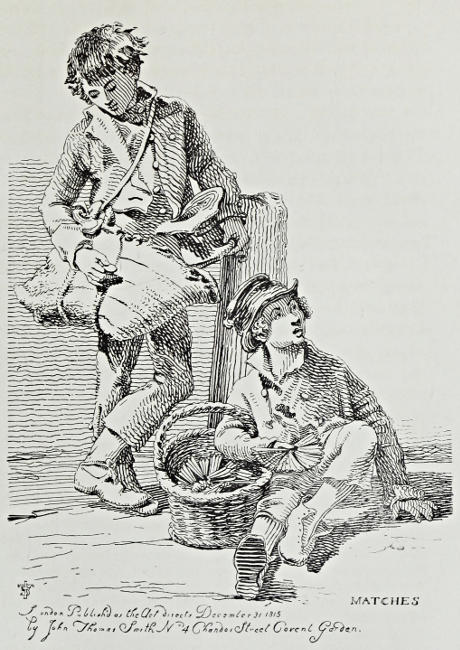
LONDON STREET MERCHANTS: MATCH BOYS
ETCHED BY J. T. SMITH
This year a stop was put to tea-drinking in the Gardens
on Sunday evenings.
Mr. Lowe offered a reward of ten guineas for the apprehension
of any highwayman found on the road to the
Gardens.[108]
1765.—This year, Mrs. Collett, Miss Davis, and Mrs.
Taylor were the singers.
1766.—£1, 11s. 6d. was the subscription for two persons
for the season. The doors opened on the 1st of May,
at six o’clock, and the Gardens closed on the 4th of October,
for the season. The principal singers were, Tommy Lowe,
Taylor, Raworth, Vincent, and Miss Davis. I have an
engraving of a Subscription Ticket, inscribed “No. 222,
Marybone, admit two, 1766.” As this ticket is adorned
by two palm-branches, surmounted with two French-horns,
and has also a music book, I conclude it must
have been used on a concert night. This year an exhibition
of bees took place in the Gardens, and the public
were again accommodated with tea at eightpence per
head.
1767.—Mrs. Gibbons was a singer there this
season.
1768.—Lowe gave up the Gardens, declaring his loss
in the concern to have been considerable.[109]
Mr. Phillips, a singer, in the announcement of his
benefit this season, states that tickets were to be had
at his house, the “Ring and Pearl,” St. Martin’s Court;
and also at Young Slaughter’s Coffee-house, in St. Martin’s
Lane. The following are the titles of a few of the Marybone
Garden songs of this year:—
- Young Colin.
- Dolly’s Petition.
- The Invitation.
- The Rose.
- The Moth.
- Polly.
- A Hunting Song.
- Jockey—a favourite Scotch song.
- Freedom is a real Treasure.
- Jenny charming, but a Woman.
- Oh, how vain is every Blessing.
- Damon and Phillis.
The composers of the above songs were Heron and
James Hook (father of Theodore Hook); the singers,
Reynoldson, Taylor, and Miss Froud. During the time
I was collecting the titles of these and other songs, I noticed
an immense number which were dedicated to Chloe. Of
this I took the titles of no fewer than thirty-five published
between the years 1724 and 1740. Why to Chloe? I
have no Stephen Weston now to apply to.[110] Dibdin tells
us, when praising the good ship Nancy, that Nancy
was his wife, and that being the fact, accounts for the
number of songs he has left us of his “Charming Nan.”[111]
[1769.—In this year, omitted by Smith, the Gardens
were taken over by Dr. Samuel Arnold, the musician.
The years 1769-73 were their best period.]
1770.—On June 18th, there was a concert of vocal
and instrumental music. First violin, and a concerto,
by Mr. Barthelemon; concerto organ, Mr. Hook. The
fireworks were under the direction of Signor Rossi. The
principal singers this season were, Mr. Reinhold, Mr.
Bannister,[112] Mrs. Thompson, Mrs. Barthelemon, and Master
Cheney. The music by Signor Pergolesi,[113] with alterations
and additional songs by Mr. Arnold. In July, an awning
was erected in the garden for the better accommodation
of the visitors; and books of the performance were sold
at the bar, price sixpence.
1771.—Mr. Bannister, Mrs. Thompson, Miss Catley,
and the highly respected Mrs. John Bannister (then Miss
Harper) were the singers of this year.
1772.—This season the singers were, Mr. Bannister,
Mr. Reinhold, Mrs. Calvert, Mrs. Forbes, Mrs. Cartwright,
and Mrs. Thompson. Music by Signor Giardani,[114] Mr.
Hook, and Mr. Arnold.
For the convenience of the visitors, coaches were
allowed to stand in the field before the back entrance.
Mr. Arnold was indicted at Bow Street for the fireworks.[115]
Torré, the fire-worker, divided the receipts at the door
with the proprietor.
1773.—Proposals were issued for a subscription evening
to be held every Thursday during the summer, for which
tickets were delivered to admit two persons. The Gardens
were opened for general admission three evenings in the
week only. On Thursday, May 27th, Acis and Galatea
was performed, in which Mr. Bannister, Mr. Reinhold,
Mr. Phillips, and Miss Wilde were singers. Signor Torré,
the fire-worker, was assisted by Monsieur Caillot of Ranelagh
Gardens.
On Friday, September 15th, Dr. Arne conducted his
celebrated catches and glees. On the 16th of September,
Mr. Clitherow was the fire-worker, for the benefit of the
waiters, who parted with their unsold tickets at the doors
of the Gardens for whatever they could get. Mr. Winston
was in possession of an impression of an admission ticket
for this season.
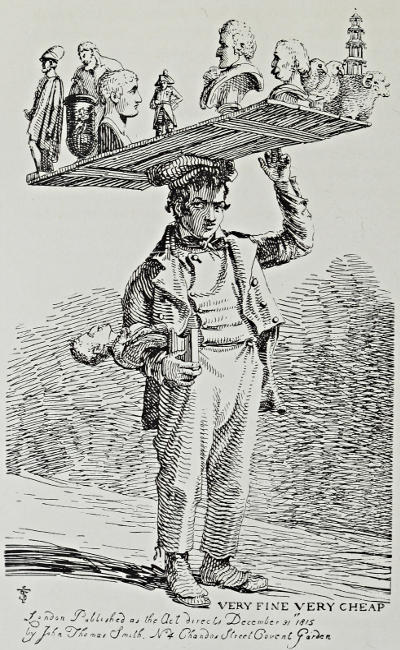
LONDON STREET MERCHANTS: IMAGES
ETCHED BY J. T. SMITH
1774.—The Gardens opened on May 20th. The
principal singers were, Mr. Dubellamy, Miss Wewitzer
(sister of the dramatic performer), and Miss Trelawny.
The Gardens were opened this year on Sunday evenings
for walking recreation, admittance sixpence. The receipts
of one evening were at the Town-gate £10, 7s. 6d., at the
Field-gate £11, 7s.[116] This year Signor Torré, one of the
fire-workers of the Gardens, had a benefit; the admission
was 3s. 6d.[117] Signor Caillot was then also a fire-worker in
the Gardens; and I find by two shop-bills, in Miss Banks’s
collection in the British Museum, that Benjamin Clitherow
and Samuel Clanfield had also been employed as fire-workers.
Doctor Kenrick delivered his lectures on Shakspeare in
these Gardens this year.[118]
1775.—After frequent inquiries, and a close examination
of the newspapers of this year, I could not find any
advertisement like those of preceding times with singing
and fireworks. The Gardens are thus mentioned during
the first part of the season, in the Morning Chronicle and
London Advertiser of Monday, May 29th:—
“AT MARYBONE GARDENS,
To-morrow, the 30th instant, will be presented
THE MODERN MAGIC LANTERN,
“In three Parts, being an attempt at a sketch of the
Times in a variety of Caricatures, accompanied with a
whimsical and satirical Dissertation on each Character.
By R. Baddeley, Comedian.[119]
“BILL OF FARE.
Exordium.
PART THE FIRST.
- A Sergeant at Law.
- Andrew Marvel, Lady Fribble.
- A bilking Courtesan.
- A Modern Widow.
- A Modern Patriot.
- A Duelling Apothecary, and
- A Foreign Quack.
PART THE SECOND.
- A Man of Consequence.
- A Hackney Parson.
- A Macaroni Parson.
- A Hair-dresser.
- A Robin Hood Orator.
- Lady Tit for Tat.
- An Italian Tooth-drawer
- High Life in St. Giles’s.
- A Jockey, and
- A Jew’s Catechism.
And Part the Third will consist of a short Magic Sketch
called
“Punch’s Election.
“Admittance 2s. 6d. each, Coffee or Tea included.
The doors to be opened at seven, and the Exordium to
be spoken at eight o’clock.
“Vivant Rex et Regina.”
At the foot of Mr. Baddeley’s subsequent bills the
Gardens are announced to be still open on a Sunday
evening for company to walk in. Some of the papers of
this year declare, under Mr. Baddeley’s advertisements,
that “no person going into the Gardens with subscription
tickets will be entitled to tea or coffee.”
The next advertisement was on Tuesday, June 20th.
“MARYBONE GARDENS.
This Evening will be delivered
A LECTURE ON MIMICRY,
BY GEORGE SAVILLE CARY.[120]
In which will be introduced
“A Dialogue between Small Cole and Fiddle-stick;
Billy Bustle, Jerry Dowlas, and Patent; with the characters
of Jerry Sneak in Richard the Third, Shylock in
Macbeth, Juno in her Cups, Momus in his Mugs, and the
Warwickshire Lads. To conclude with a dialogue between
Billy Buckram and Aristophanes, in which Nick Nightingal,
or the Whistler of the Woods, will make his appearance,
as he was lately shown at the Theatre Royal, in the character
of a Crow.
“Admittance 2s. 6d., coffee or tea included.
“The Lecture will be repeated To-morrow, Thursday,
and Saturday.”
“June 21st.
MARYBONE GARDENS.
This Evening will be delivered
A LECTURE ON MIMICRY,
by
GEORGE SAVILLE CARY.
“After a new Poetical Exordium, a variety of THEATRICAL
DELINEATIONS will be introduced.
“Mr. Fiddle-stick, Mr. Small Coal, Mrs. Artichoke,
Mrs. H—l—y; Bustle the Bookseller; Mr. Patent, Mr.
G——k; Jerry Sneak, Richard III., Mr. W——; another
Richard, Mr. S—th; Shylock, in Macbeth, M—n—.
“‘What, alas! shall Orpheus do?’ Sig. M—ll—o;
‘Juno in her Cups,’ Miss C—t—y; ‘The Early Horn,’
Mr. M. D—— B——y; ‘This is, Sir, a Jubilee,’ Mr. B—n—r;
‘Where, Which, and Wherefore,’ Sig. L—at—ni; ‘Within
my Breast,’ Mr. V.; ‘Sweet Willy O,’ Mrs. B—d—y;
‘The Mulberry Tree,’ M—k—r; ‘Ye Warwickshire Lads,’
Mr. V. and Mr. D.
Scene in Harlequin’s Invasion, Mr. D——d, Mr. P——ns,
and Mr. B—n—by.
Othello, Mr. B——y; Nurse, Mrs. P——t; Cymbeline,
Mr. H——st; Iachimo, Mr. P——r; Mr. Posthumous,
Mr. R——h; Pantomime, Mr. F——t and Mr. W——n.[121]
The Doors to be opened at Seven o’clock, and to begin
at Eight.
“Admittance 2s. 6d. each, coffee or tea included.
“The Lecture will be repeated to-morrow and Saturday
next.”
“June 23rd.
MARYBONE GARDENS.
“By Virtue of a Licence from the Board of Ordnance, a
MOST MAGNIFICENT FIREWORK
will be exhibited on Tuesday next at
MARYBONE GARDENS,
In honour of His Majesty’s Birthday.
“Further particulars will be advertised on Monday next.”
“Indeed, Sir!” is the general exclamation of a passenger
in a stage coach, whenever any one observes that
he had seen Garrick perform; at least, such an observation
has fallen from many of my fellow-travellers, when
I have asserted that I had had the pleasure of seeing
that great actor. On the 25th of November, 1775, my
father first took me to a play, and it was with one of Mr.
Garrick’s orders, when he performed in The Alchemist.[122]
1776.—Marylebone Gardens opened this year on the
11th of May, by authority. The “Forge of Vulcan” was
represented.[123] On the 16th of the same month the Fantoccini
was introduced; on June 3rd Breslaw exhibited
his sleight of hand, and also his company of singers, upon
which occasion handbills were publicly distributed. Admittance
2s.[124] On the 25th Mrs. Stuart had a ball, and
Signor Rebecca (well known for his productions at the
Pantheon) painted some of the transparencies.[125]
Subscription tickets to the Gardens were issued at
£1, 11s. 6d. to admit two persons every evening of performance.
The Gardens were opened on Sunday evenings,
with tea, coffee, and Ranelagh rolls. Caillot was the fire-worker
this season.
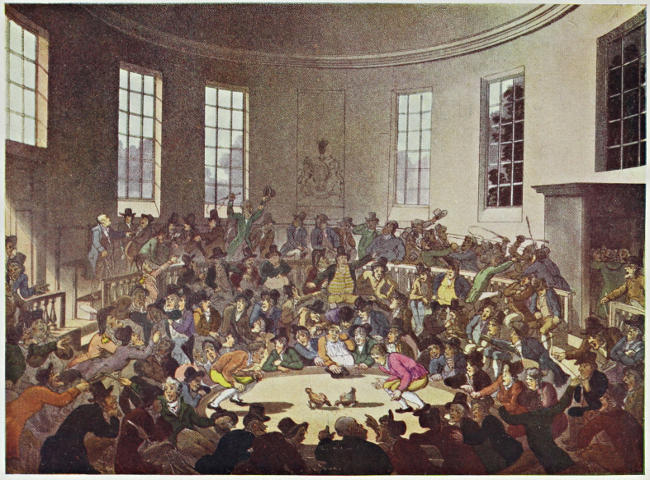
THE ROYAL COCKPIT, WESTMINSTER
This, as well as the preceding year, was particularly
famous for the breed of Canary birds, consisting of Junks,
Mealies, Turncrowns, and the Swallow-throats. They
were all “fine in feather and full in song,” and could
sing in the highest perfection many delightful strains,
such as the nightingale’s, titlark’s, and woodlark’s, by
candle-light as well as day. The breeders lived in Norwich,
Colchester, Ipswich, etc. The sellers in London
were principally publicans, and those most in vogue
kept the signs of the “Queen’s Arms,” Newgate Street;
the “Green Dragon,” Narrow Wall, Lambeth; the
“Crown and Horse-shoe,” Holborn; the “Wheatsheaf,”
Fleet Market; the “Marquis of Granby,” Fleet Market;
the “Old George,” Little Drury Lane; and the “Black
Swan,” Brown’s Lane, Spitalfields.[126]
It appears by the various advertisements from the
numerous owners of cockpits, that the cruel sport of
cock-fighting afforded high amusement this year to the
unfeeling part of London’s inhabitants. Of the number
of cockpits half a dozen will be quite enough to be recorded
on this page.
1. The “Royal Cockpit,” in the Birdcage Walk, St.
James’s Park. This Royal Cockpit afforded Hogarth characters
for one of his worst of subjects, though best of plates.
2. In Bainbridge Street, St. Giles’s.
3. Near Gray’s Inn Lane.
4. In Pickled-Egg Walk.
5. At the New Vauxhall Gardens, in St. George’s
in the East.
6. That at the “White Horse,” Old Gravel Lane, near
Hughes’s late riding-school, at the foot of Blackfriars
Bridge.[127]
Disputes having frequently occurred as to the characters
in which Garrick last appeared, by persons not
sufficiently in possession of documents at hand to enable
them to decide their controversies, I am induced to conclude
that such disputants will be pleased to see a statement
of the nights of his acting, the titles of the plays in which
he performed, and the names of the characters which
he represented, as well as those of the principal actresses
who performed with him during the last year of his appearance
on the stage. The original play-bills of the
time, collected by the late Dr. Burney, now in the British
Museum, have enabled me to give this information in
the following chronological order:—
Nights of
Acting. |
Title of Play. |
Names of Characters. |
| Jan. |
18. |
The Alchemist. |
Abel Drugger, Mr. Garrick. (Doll Common, by Mrs. Hopkins.) |
|
20. |
The Discovery |
Sir Anthony Branville. (Lady Flutter, by Mrs. Abington.) |
|
22. |
Ditto. |
Ditto. |
|
24. |
Ditto. |
Ditto. |
|
26. |
Ditto. |
Ditto. |
|
29. |
Ditto. |
Ditto. |
|
30. |
The Provoked Wife |
Sir John Brute. (Lady Brute, by Miss Younge.) |
|
31. |
Ditto. |
Ditto. |
| Feb. |
3. |
Zara |
Lusignan. (Zara, by Miss Younge.) |
|
5. |
The Provoked Wife |
Sir John Brute. (Lady Brute, by Miss Younge.) |
|
7. |
The Discovery |
Sir Anthony Branville. (Lady Flutter, by Mrs. Abington.) |
|
9. |
Every Man in his Humour. |
Kitely. (Mrs. Kitely, Mrs. Greville.) |
|
12. |
Much Ado about Nothing. |
Benedict. (Beatrice, by Mrs. Abington.) |
|
14. |
Rule a Wife and have a Wife. |
Leon. (Estifania, by Mrs. Abington.) |
| March |
6. |
Zara |
Lusignan. (Zara, by Miss Younge.) |
|
7. |
Zara |
Lusignan. (Zara, by Miss Younge.) |
| April |
11. |
The Alchemist. |
Abel Drugger. (Doll Common, by Mrs. Hopkins.) |
|
16. |
Much Ado about Nothing. |
Benedict. (Beatrice, by Mrs. Abington.) |
|
25. |
Every Man in his Humour. |
Kitely. (Mrs. Kitely, by Mrs. Greville.) |
|
27. |
Hamlet |
Hamlet. (Ophelia, by Mrs. Smith.) |
|
30. |
The Provoked Wife. |
Sir John Brute. (Lady Brute, Miss Younge.) |
| May |
2. |
Rule a Wife and have a Wife. |
Leon. (Estifania, Mrs. Abington) |
|
7. |
The Stratagem. |
Archer. (Mrs. Sullen, Mrs. Abington.) |
|
9. |
Much Ado about Nothing. |
Benedict. (Beatrice, by Mrs. Abington.) |
|
13. |
King Lear |
King Lear. (Cordelia, Miss Younge.) |
|
16. |
The Wonder |
Don Felix. (Violante, by Mrs. Yates.) |
|
21. |
King Lear |
King Lear. (Cordelia, by Miss Younge.) |
|
23. |
The Suspicious Husband. |
Ranger. (Mrs. Strickland, Mrs. Siddons; Clarinda, Mrs. Abington.) |
|
27. |
King Richard the Third. |
King Richard. (Lady Anne (first time), Mrs. Siddons.) |
|
30. |
Hamlet |
Hamlet. (Ophelia, by Mrs. Smith.) |
|
31. |
The Suspicious Husband. |
Ranger. (Mrs. Strickland, Mrs. Siddons; Clarinda, Mrs. Abington.) |
| June |
1. |
Ditto. |
Ditto. |
|
3. |
King Richard the Third. |
King Richard. (Lady Anne, by Mrs. Siddons.) |
|
5. |
King Richard the Third. |
King Richard. (Lady Anne, by Mrs. Siddons.) By command of their Majesties. |
|
8. |
King Lear |
King Lear. (Cordelia, Mrs. Younge.) |
|
10. |
The Wonder |
Don Felix. (Violante, by Mrs. Yates.)[128] |
Notwithstanding it has been said that Mr. Garrick
spoke slightingly of Mrs. Siddons’s talents, the above list
incontrovertibly proves that he considered her powers
sufficiently great to appear in principal characters with
him no fewer than six nights of the last nine in which he
performed.
I shall now subjoin a similar list of Mrs. Siddons’s
nights of performance at Drury Lane Theatre, during the
last year of Mr. Garrick’s acting.[129]
| Jan. |
13, 15, 17. |
Epicœne, or The Silent Woman (as a Collegiate Lady). |
| Feb. |
1, 2, 3. |
The Blackamoor Washed White. |
Between Feb. 15
and April 18
(22 nights). |
The Runaway (as Miss Morley). |
| May |
23. |
The Suspicious Husband (as Mrs. Strickland). |
|
24. |
The Runaway (as Miss Morley). |
|
27. |
King Richard the Third (as Lady Anne). |
|
31. |
The Suspicious Husband (as Mrs. Strickland). |
| June |
1. |
|
|
3. |
King Richard the Third (as Lady Anne). |
|
5. |
Ditto. Ditto. By command of their Majesties. |
Of six plays of which there were no bills in the Burney
collection, I was enabled to add instances of the performance
of Mrs. Siddons on those nights from a portion of that
truly rare and valuable library purchased by Government
of the late Dr. Burney’s son for the British Museum.
Ladies this year wore goloshes, four distinct falls of
lace from the hat to the shoulders, and rolled curls on
either side of the neck: they continued to carry fans.[130]
I remember well that in an autumn evening of this
year, during the time my father lived in Norton Street,[131]
going with him and his pupils on a sketching party to what
is now called Pancras Old Church; and that Whitefield’s
Chapel in Tottenham Court Road, Montague House,
Bedford House, and Baltimore House,[132] were then uninterruptedly
seen from the churchyard, which was at that
time so rural that it was only enclosed by a low and very
old hand-railing, in some parts entirely covered with docks
and nettles. I recollect also that the houses on the north
side of Ormond Street commanded views of Islington,
Highgate, and Hampstead, including in the middle distance
Copenhagen-house, Mother Red-cap’s, the Adam and
Eve, the Farthing Pie House, the Queen’s Head and Artichoke,
and the Jew’s Harp House.[133]
Early in this year Spiridione Roma,[134] who had cleaned
the pictures of the Judges then hanging in Guildhall,
published a prospectus for Bartolozzi’s print from the
portrait of Mary Queen of Scots in Drapers’ Hall, said
to have been painted by Zucchero.[135]
At this period I began to think there was something
in a prognostication announced to my dear mother by
an old star-gazer and tea-grouter,[136] that, through life, I
should be favoured by persons of high rank; for, in this
year, Charles Townley, Esq. (the collector of the valuable
marbles which now bear his name in the British Museum),
first noticed me when drawing in Mr. Nollekens’ studio,
and pouched me half a guinea to purchase paper and
chalk.[137] This kindness was followed up by Dr. Samuel
Johnson, who was then sitting for his bust. The Doctor,
after looking at my drawing, then at the bust I was copying,
put his hand heavily upon my head, pronouncing “Very
well, very well.” Here I frequently saw him, and recollect
his figure and dress with tolerable correctness. He was
tall, and must have been, when young, a powerful man:
he stooped, with his head inclined to the right shoulder:
heavy brows, sleepy eyes, nose very narrow between the
eye-brows, but broad at the bottom; lips enormously
thick; chin, wide and double. He wore a stock and
wristbands; his wig was what is called a “Busby,” but
often wanted powder. His hat, a three-cornered one;
coats, one a dark mulberry, the other brown, inclining to
the colour of Scotch snuff, large brass or gilt buttons;
black waistcoat and small-clothes—sometimes the latter
were corduroy; black stockings, large easy shoes, with
buckles; his gait was wide and awkwardly sprawling;
latterly he used a hooked walking-stick, in consequence of
his having saved the life of a young man as he was
crossing from Queenhithe to Bankside.
One of the Doctor’s sticks of this shape brought me
into a scrape. It was given to me by the late William
Tunnard, Esq., of Bankside;[138] he received it from his
friend Mr. Perkins;[139] it was one of many that the Doctor
kept at Thrale’s. This stick I promised to my worthy
and liberal friend the Rev. James Beresford, of Kibworth,
Market Harborough;[140] but, alas! when I went to “stick-corner”
somebody had walked it off. However, if this
page should meet the eye of its present possessor, I hope,
even should the “Bannister” I now rest upon be deemed
useless by Time’s sandy-glass, his conscience may order
the Johnsonian relic to be delivered to the above-named
gentleman, whose property I declare it unquestionably
to be. My present strong stick, named “Bannister,” was
given to me when afflicted with the gout, by a fellow-sufferer,
universally known under the friendly appellation
of “Honest Jack.”
I once saw him follow a sturdy thief, who had stolen
his handkerchief in Grosvenor Square, seize him by the
collar with both hands, and shake him violently, after which
he quickly let him loose; and then, with his open hand,
gave him so powerful a smack on the face, that sent him
off the pavement staggering.
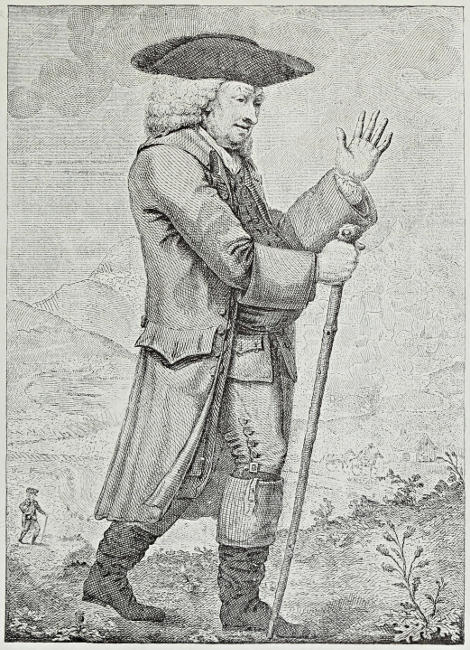
DR. SAMUEL JOHNSON
“Pockets which might have almost held the two volumes of his folio dictionary.”
Ladies appeared for the first time in riding-habits of
men’s cloth, only descending to the feet; they also walked
with whips like short canes, with a thong at the end. The
elderly ladies continued to wear goloshes. Fans were in
general use.
For the honour of female genius, be it here recorded,
that, in the Ladies’ Pocket-book, published this year, an
engraved group of nine whole-length female figures was
published, viz. Miss Carter, Mrs. Barbauld, Angelica
Kauffman, Mrs. Sheridan, Mrs. Lenox, Mrs. Montague,
Miss More, Mrs. Macaulay, and Mrs. Griffith, each lady
in the character of a Muse. Four Pocket-books appeared
this year, entitled Ladies’ Pocket-book, Ladies’ own Memorandum
Book, Ladies’ Annual Journal, and Ladies’ Complete
Pocket-book.[141]
On Monday, February 1st, Taylor, the facetious pupil
of Frank Hayman, and the old friend of Jonathan Tyers,
lifted Nollekens’ studio door-latch, put in his head, and
announced, “For the information of some of the sons of
Phidias, I beg to observe, that David Garrick is now on
his way to pay his respects to Poet’s Corner. I left him
just as he was quitting the boards of the Adelphi.”[142] I
am now employing the exact words he made use of, though
certainly the levity was misapplied on so solemn an
occasion.
I begged of my father, who then carved for Mr. Nollekens,
to allow me to go to Charing Cross to see the funeral pass,
which he did with some reluctance. I was there in a few
minutes, followed him to the Abbey, heard the service,
and saw him buried.[143]
Mr. Garrick died on the 20th of January, in the back
room of the first floor, in his house in the Adelphi. The
ceiling of the drawing-room was painted by Zucchi: the
subject, Venus attired by the Graces. The chimneypiece
in this room is said to have cost £800.[144]
On a night when Mr. Garrick was acting the part of
Lear, one of the soldiers who stood on the stage blubbered
like a child. Mr. Garrick, who was as fond of a compliment
as most men, when the play was over, sent for the man
to his room, and gave him half a crown. It was the
custom formerly for two soldiers to stand on the stage
during the time of performance, one at either end of the
proscenium.
This year the Grotto Garden, Rosamond Row, near
the London Spa, was kept by Jackson, a man famous for
grottoes and fireworks. He had made great additions
to it, viz. a new Mounted Fountain, etc. The admittance
was sixpence.[145]
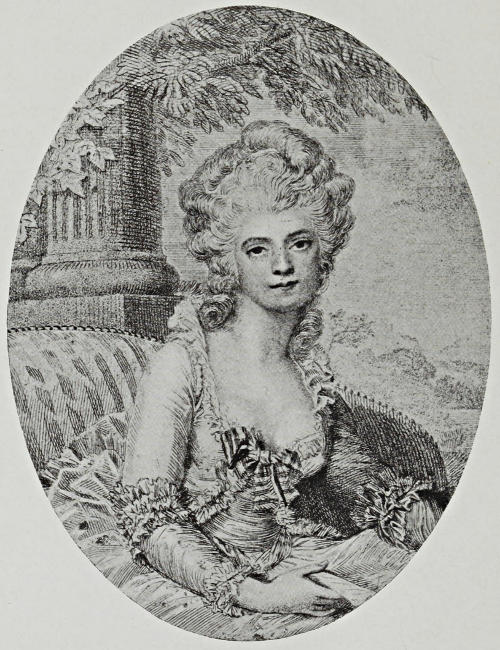
“PERDITA” ROBINSON
“She imprinted a kiss on my cheek, and said, ‘There, you little rogue.’”
J. T. Smith
Although I could model and carve a little, I longed
to be an engraver, and wished much to be placed under
Bartolozzi, who then lived in Bentinck Street, Berwick
Street.[146] My father took me to him, with a letter of introduction
from Mr. Wilton, the sculptor. Mr. Bartolozzi,
after looking at my imitations of several of Rembrandt
and Ostade’s etchings, declared that he should have been
glad some years previous to take such a youth, but that,
in consequence of ill-treatment from some of his pupils,
he had made up his mind to take no more. The Bishop
of Peterborough (Dr. Hinchliffe),[147] one of my father’s
patrons, then prevailed on Sherwin to let me in at half-price;
and under his roof I remained for nearly three
years. Here I saw all the beautiful women of the day;
and, being considered a lively lad, I was noticed by several
of them. Here I received a kiss from the beautiful Mrs.
Robinson.
This impression was made upon me nearly as I can
recollect in the following way:—It fell to my turn that
morning, as a pupil, to attend the visitors, and Mrs. Robinson
came into the room singing. She asked to see a drawing
which Mr. Sherwin had made of her, which he had placed
in an upper room. When I assured her that Mr. Sherwin
was not at home, “Do try to find the drawing of me, and
I will reward you, my little fellow,” said she. I, who had
seen Rosetta, in Love in a Village, the preceding evening,
hummed to myself, as I went upstairs, “With a kiss, a
kiss, and I’ll reward you with a kiss.”
I had no sooner entered the room with the drawing
in my hand, than she imprinted a kiss on my cheek, and
said, “There, you little rogue.” I remember that Mrs.
Darby, her mother, accompanied her, and had brought a
miniature, painted by Cosway, set in diamonds, presented
by a high personage, of whom Mrs. Robinson spoke with
the highest respect to the hour of her dissolution.[148] The
colour of her carriage was a light blue, and upon the centre
of each panel a basket of flowers was so artfully painted,
that as she drove along it was mistaken for a coronet.[149]
Early in the month of December, this year, Sherwin
painted, engraved, and published a glorious portrait of
Mrs. Siddons, in the character of the Grecian Daughter.
That lady sat in the front room of his house, St. James’s
Street. I obeyed Mr. Sherwin’s orders in raising and
lowering the centre window-curtains, the shutters of the
extreme ones being closed for the adjustment of that fine
light and shade upon her face which he has so beautifully
displayed in the print. This print, in consequence of a
purse having been presented to Mrs. Siddons by her
admirers in the profession of the Law, was dedicated to
“The Gentlemen of the Bar.”[150]
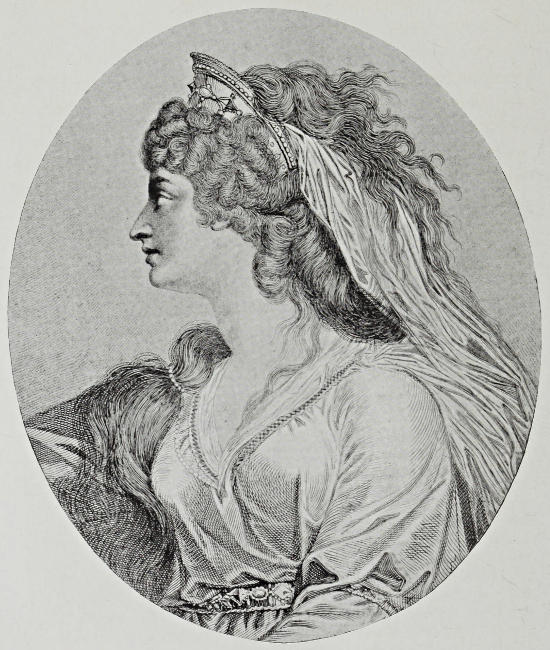
MRS. SIDDONS
“A glorious portrait.”
By the liberality of my amiable friend, William
Henderson, Esq.,[151] I am in possession of a cast taken
by Lochee, the modeller, from the face of this wonderful
actress, which I intend leaving to that invaluable
gallery of theatrical portraits, so extensively formed by
that favourite offspring of Nature, Charles Mathews,[152]
Esq., at Kentish Town; but should that collection ever
be dispersed, which I most heartily trust it never will
be, then I desire that it may go to the Green-room of
Drury Lane Theatre. To this bequest I subscribe my
name,
Witnesses to this my declaration,
- John Thomas Smith.
- John Bannister.
- — Harley.[153]
One of the numerous subjects which I drew this year
for Mr. Crowle,[154] was the old brick gateway entrance to
St. Giles’s churchyard, then standing opposite to Mr.
Remnent’s timber-yard, in which drawing I introduced
the figure of old Simon, a very remarkable beggar, who,
together with his dog, generally took their station against
one of the gate-piers. This man, who wore several hats,
at the same time suffered his beard to grow, which was
of a dirty yellow-white. Upon his fingers were numerous
brass rings. He had several waistcoats, and as many coats,
increasing in size, so that he was enabled by the extent of
the uppermost garment to cover the greater part of the
bundles, containing rags of various colours; and distinct
parcels with which he was girded about, consisting of
books, canisters containing bread, cheese, and other articles
of food; matches, a tinder-box, and meat for his dog;
cuttings of curious events from old newspapers; scraps
from Fox’s Book of Martyrs, and three or four dog’s-eared
and greasy thumbed numbers of the Gentleman’s Magazine.
From these and such like productions he gained a
great part of the information with which he sometimes
entertained those persons who stopped to look at
him.
When I knew him,—for he was one of my pensioners,—he
and his dog lodged under a staircase in an old shattered
building called “Rats’ Castle,” in Dyot Street, mentioned
in Nollekens and his Times as that artist’s rendezvous
to discover models for his Venuses. Dyot Street has
disappeared, and George Street is built on its site.[155] His
walks extended to the entrances only of the adjacent
streets, whither he either went to make a purchase at the
baker’s or the cook’s shops. Rowlandson drew and
etched him several times; in one instance Simon had a
female placed before him, which the artist called “Simon
and Iphigenia.” There is a large whole-length print of him,
published by John Seago, with the following inscription:—
Simon Edy, born at Woodford, near Thrapston, Northamptonshire,
in 1709: died May 18, 1783.[156]
Respecting his last dog, for he had possessed several,
which wicked boys had beguiled from him, or the skinners
of those animals had snatched up, the following anecdote
is interesting:—A Smithfield drover, whose dog’s left eye
had been much injured by a bullock, solicited Simon to take
him under his care till he got well. The mendicant cheerfully
consented, and forthwith, with a piece of string,
confined him to his arm; and when, by being more quiet,
he had regained his health sufficiently to resume his services
to his master, old Simon, with the most affectionate reluctance,
gave him up, and was obliged to content himself with
the pleasure of patting his sides on a market-day, when he
followed his master’s drove to the slaughter-house in Union
Street. These tender and stolen caresses from the hand
which had bathed his wound, Rover would regularly stop to
receive at St. Giles’s porch, and then hastily run to get up
with the bullocks. Poor Simon, after missing the dog as
well as his master for some weeks, was one morning most
agreeably surprised to see the faithful animal crouch
behind his feet, and with an uplifted and sorrowful eye,
for he had entirely lost the blemished one, implore his protection
by licking his beard, as a successor to his departed
and lamented keeper. Rover followed Simon, according
to Dr. Gardner’s idea, to “his last and best bedroom”;[157]
or, according to Funeral Weever,[158] his “bed of ease.”
Shortly before Simon’s death, I related to Mrs. Nollekens
several instances of Rover’s attachment. “I think, Sir,”
observed that lady, “you once told me that he had been a
shepherd’s dog from Harrow-on-the-Hill. I don’t like a
shepherd’s dog: it has no tail,[159] and its coat is as rough as the
bristles of a cocoanut. No, Sir, my little French dog is my
pet.” However, fortunately for poor Simon, the Hon. Daines
Barrington[160] was present when Dr. Johnson’s Pekuah[161]
made this silly remark, for he never after passed the kind-hearted
mendicant without giving him sixpence. There
was an elegy printed for poor Simon, with a woodcut
portrait of him.
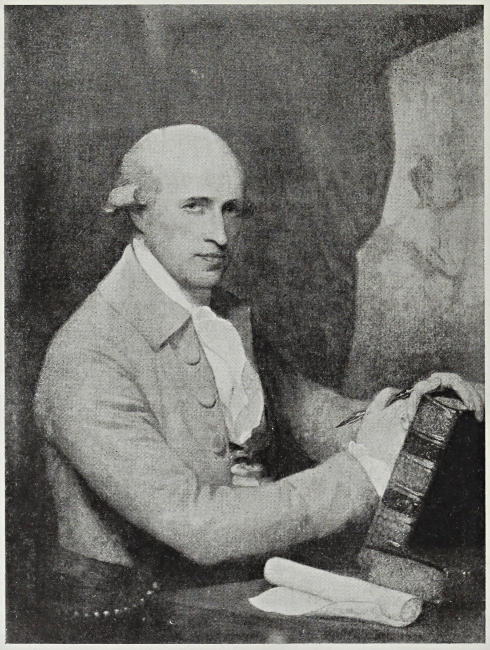
BENJAMIN WEST, P.R.A.
“Sir, I was once a Quaker, and have never left their principles.”
Ugly and deficient in sight and tail as Rover certainly
was, it is also as equally unquestionable that Simon never
had occasion to carry him to Fox Court, St. James’s Street,
for the recovery of his health, under the direction of Dr.
Norman,[162] the canine physician, so strenuously recommended
upon all occasions by George Keate, the poet,[163] and far-famed
connoisseur. No, poor Rover was kept in health
by being allowed to range the streets from six till nine,
the hours in which the nightly stealers of the canine race,
and the dexterous of all dentists, were on their way to
Austin’s, at Islington,[164] to dispose of their cruel depredations
upon many a true friend to the indigent blind, “to whom
the blackbird sings as sweetly as to the fairest lady in the
land.”
Mr. West, to whom I had sat for the head of St. John
in his picture of the Last Supper, for the altar of St. George’s
Chapel, Windsor,[165] frequently engaged me to bid for him at
auctions, an honour also occasionally conferred on me for
similar services by Sir Joshua Reynolds. It was during
one of these commissions in this year, that the late Richard
Wyatt, Esq., of Milton Place, Egham, Surrey, noticed me;
he was then starting as a collector of pictures, prints, and
drawings.[166] That gentleman kindly invited me to his house,
and not only introduced me to his amiable family, but to his
most intimate neighbours. He allowed me the use of a
horse, to enable me more readily to visit the beauties of
Windsor Park and Forest, the scenery of which so attracted
and delighted me, that during one month’s stay I made
nearly one hundred studies. The two Sandbys were
visitors to my patron; and to Thomas, then Deputy
Ranger of Windsor Great Park, a situation given to him
by his Royal Highness William, Duke of Cumberland
(Thomas Sandby had been engineer draughtsman to his
Royal Highness at the battle of Culloden), I am indebted
for my knowledge of lineal perspective. The Misses Wyatt
were delightful persons, and much noticed at the Egham
Balls, for one or two of which occasions I had the pleasure
of painting butterflies on a muslin dress, and also imitating
the “Sir Walter Raleigh,” the “Pride of Culloden,” and
other curious and rare carnations, on tiffany, for their
bouquets, which were then scented and much worn.
I was here introduced to Viscount Maynard, to whom
Mr. Wyatt had been guardian. His Lordship married
the celebrated Nancy Parsons,[167] and was a most spirited
draughtsman of a horse. Among other gentlemen, I
was also introduced to the late Sir Richard Colt Hoare,
Bart.,[168] and the late Rev. George Huddesford,[169] of Oxford,
Kett’s satirist, and the witty author of poems entitled
Salmagundi, dedicated to Mr. Wyatt. Several of these
I have often heard him most humorously sing, particularly
those of “the renowned History and rare
Achievements of John Wilkes.” The chorus ran
thus:—
“John Wilkes he was for Middlesex,
They chose him knight of the shire;
And he made a fool of Alderman Bull,
And call’d Parson Horne a liar.”
“The Barber’s Nuptials,” which may be seen in the Elegant
Extracts, and almost every other collection of fugitive
poetry, was also written by him.[170]
Mr. Huddesford had studied under Sir Joshua Reynolds,
and had copied many of the President’s pictures with
tolerable ability, with an intention of pursuing the arts,
but his master-talent was more conspicuously displayed
in compositions of fruit, in which his representations of ripe
and melting peaches, and the rich transparent grape, were
inimitable. The late Sir George Beaumont, Bart., with
whom Mr. Huddesford had been extremely intimate, was
in possession of a remarkably fine specimen by him, which
the worthy baronet frequently allowed to be copied.
Huddesford, after the death of Warton, chalked on the
walls of the College—
“The glorious sun of Trinity is set,
And nothing left but farthing-candle Kett.”
[171]
He published The Elements of General Knowledge, which were
called, at Oxford “The Elements of General Ignorance”;
and his last work, Emily, procured him the name of Emily
Kett. His supposed resemblance to a horse was the
occasion of much academical waggery:—his letter-box
was often filled with oats; and when he wished to have his
portrait taken, he was sent to the famous Stubbs,[172] the horse
painter, who, on receiving him, and expecting to hear
whether his commission was to be for a filly or a colt, was
much surprised to find Kett pompously announce that he
expected the likeness to be in full canonicals.
Samuel Woodforde (afterwards a Royal Academician)[173]
was employed by Mr. Wyatt, in consequence of an introduction
by Sir Richard Colt Hoare, Bart., to paint trees and landscapes
on the panels of his drawing-room, mostly from scenes
in Windsor Park and Forest. Mr. Wyatt was one of Opie’s
early friends. He painted for that gentleman several of
the Burrell and Hoare family; indeed, he was instrumental
in bringing that artist out of his humble and modest lodging
in Orange Court, Leicester Fields,[174] to his house in Queen
Street, next door to that for many years occupied by that
comic and most exemplary child of Nature, the late Miss
Pope,[175] whose inimitable acting as Miss Allscrip, in The
Heiress, not only delighted the public, but was
deservedly complimented by its author, General Burgoyne,
who at one time lived in Hertford Street, May
Fair, in the house that had been inhabited by Lord
Sandwich, and subsequently by R. B. Sheridan and Mr.
Dent.[176]
This year, Mr. Flaxman, who then lived in Wardour
Street, introduced me to one of his early patrons, the Rev.
Henry Mathew, of Percy Chapel, Charlotte Street, which
was built for him;[177] he was also afternoon preacher at
St. Martin’s-in-the-Fields. At that gentleman’s house, in
Rathbone Place, I became acquainted with Mrs. Mathew
and her son, the late John Hunter’s favourite pupil.
With that gentleman, in his youthful days, I had many an
innocent frolic. I was obliged to him in several instances,
and can safely say no one could excel him as an amiable
friend, a dutiful son, or excellent husband. At Mrs.
Mathew’s most agreeable conversaziones I first met the
late William Blake,[178] the artist, to whom she and Mr.
Flaxman had been truly kind. There I have often heard
him read and sing several of his poems. He was listened
to by the company with profound silence, and allowed
by most of the visitors to possess original and extraordinary
merit. A time will come when the numerous, though now
very rare, works of Blake (in consequence of his taking
very few impressions from the plates before they were
rubbed out to enable him to use them for other subjects)
will be sought after with the most intense avidity.[179] He
was considered by Stothard and Flaxman (and will be by
those of congenial minds, if we can reasonably expect such
again) with the highest admiration. These artists allowed
him their most unqualified praise, and were ever anxious
to recommend him and his productions to the patrons
of the Arts; but alas! they were not so sufficiently
appreciated as to enable Blake, as every one could wish,
to provide an independence for his surviving partner Kate,
who adored his memory. The late Sir Thomas Lawrence
has been heard to declare that England would be for ever
immortalized by the productions of Sir Joshua Reynolds,
Flaxman, and Stothard.
Mrs. Mathew was not only a great encourager of musical
composers, particularly the Italians, but truly kind to
young artists. She patronized Oram, Loutherbourg’s
assistant: he was the son of Old Oram, of the Board of
Works, an artist whose topographical pictures possess
considerable merit, and whose name is usually introduced
in picture catalogues under the appellation of “Old Oram.”[180]
Mr. Flaxman, in return for the favours he had received
from the Mathew family, decorated the back parlour of their
house, which was their library, with models (I think they
were in putty and sand) of figures in niches, in the Gothic
manner; and Oram painted the window in imitation of
stained glass; the bookcases, tables, and chairs were also
ornamented to accord with the appearance of those of
antiquity.
Rathbone Place, at this time, entirely consisted of
private houses, and its inhabitants were all of high respectability.
I have heard Mrs. Mathew say that the three rebel
lords, Lovat, Kilmarnock, and Balmerino, had at different
times resided in it; and that she had also been informed
that the floor of her parlours, which is now some steps
above the street, was even with the floor of the recess under
the front pediment of St. Paul’s Cathedral.
Many a summer’s evening, when I have been enjoying
Runnymede, and its far surrounding variegated meadows,
from the wooden seat of Cooper’s Hill (upon which were
engraven numerous initials of lovers, and the dates of their
eternal vows), little did I think that in my future days it would
be in my power to state that I had made drawings of most
of the parish churches as well as family mansions which
were then in view, for the topographical collections of the
Duke of Roxborough, Lord Leicester, the Hon. Horace
Walpole, Mr. Bull, Mr. Storer, Dr. Lort, Mr. Haughton
James, Mr. Crowle, and Sir James Winter Lake, Bart.[181]
Several of these, which have since been distributed, I now
and then meet with in the portfolios of more modern
illustrators, and they bring to my recollection some truly
pleasing periods. It was in the old house at Ankerwycke
that I was introduced by Lady Lake to Lady Shouldham.
It was at Old Windsor that I dined with Mrs. Vassal, and
at Staines Bridge with the beautiful Miss Towry, since Lady
Ellenborough. It was at Chertsey I was first introduced
to Mr. Douglas, Colonel St. Paul, and those truly kind-hearted
characters, Mr. Fox and Mrs. Chamberlain Clark.
At Staines I was benefited by the skill of Dr. Pope;—at
Harrow made known to Dr. Drury;—at Southgate to Alderman
Curtis;—at Trent Park to Mr. Wigston;—at Forty
Hill, Enfield, to the antiquary Gough;—at Bull’s Cross to
the facetious Captain Horsley, brother to the Bishop of
Rochester, and the Boddams;—at the “Firs,” Edmonton,
to my ever-to-be-revered friend the late Sir James Winter
Lake, Bart.;—at Weir Hall to the benevolent and highly
esteemed Mr. Robert Jones, Mr. Webster and his friendly
son;—at Bruce Castle to Mr. Townsend;—at Tottenham
to Mr. John Snell, and to Mr. Samuel Salt. This gentleman
informed me that he was one of the four who buried Sterne.[182]
Of the friendly inhabitants of these houses, and many others
to whom I had the pleasure of being known, within the
extensive view from Cooper’s Hill, very few are now
living.
During the Races on Runnymede, I have often seen
their late Majesties George the Third and Queen Charlotte
driving about in an open four-wheeled chaise, enjoying the
pleasures of the course on equal terms with the visitors.
I remember to have been spoken to three times by his
Majesty; once on a very foggy morning at a stile near
Clewer, when I stepped back to give a gentleman, who had
nearly approached it in the adjoining field, the preference
of coming over first; but upon his saying, “Come over,
come over,” I knew the voice to be the King’s, consequently
I took off my hat, and obeyed. His Majesty observed in
his quick manner, when getting over, “A thick fog, thick
fog.” Another time, when I was drawing an old oak in
Windsor Park, the King and Queen drove very near me in
their chaise, and one of his Majesty’s horses shied at my
paper; upon which the King called out to me, “Shut your
book, sir, shut your book!”
The last time I was noticed by the King, I must say his
Majesty appeared to be a little startled, as well he might.
It was under the following circumstances. Wishing to make
a drawing of one of the original stalls in St. George’s Chapel,
Windsor, before they were finally taken down, a shilling
prevailed upon one of the workmen to lock me in during
his dinner-hour. However, it so happened that his Majesty,
who frequently let himself into the Chapel at that time to
look at the progress of the works, did not perceive me, as
I stood in a corner, but on his return from the altar, he
asked, “Who are you, sir? Oh! you startled my horse
in the park the other day. What are you about?” I then
held up my drawing; and his Majesty, who must have
noticed my embarrassment, did me the honour to say,
“Very correct; I believe you are at Mr. Wyatt’s,—a very
good man;—I have a high regard for him and all his
family.”
During the time I was studying the scenery of Windsor
Park, Mr. Thomas Sandby, who was busily engaged in
placing the numerous stones to form the representation
of rocks and caverns at the head of the Virginia Water,
in Windsor Park, frequently dug for stones in Bagshot
Heath. Fortunately he discovered one of an immense
size, which he thought would afford him a massive breadth
in his composition, but it was so large he was under the
necessity of breaking it with gunpowder; however, fortune
favoured his design by blowing it into two nearly
equal parts, so that he was enabled to join them on their
destined spot to great advantage as to general effect.
This was Mr. Thomas Sandby’s second attempt at the
water-head;[183] he had in the first instance failed by using
only sand and clay, for which failure that worthy man
was not only nicknamed “Tommy Sandbank,” but
roughly scourged by the throng of Huddesford, who
composed a song upon the occasion, from which I have
selected the following verses:—
1.
When Tom was employ’d to construct the Pond Head,
As he ponder’d the task, to himself thus he said:
“Since a head I must make, what’s a head but a noddle?
So I think I had best take my own for a model.”
Derry down, etc.
2.
Then his work our projector began out of hand,
The outside he constructed with rubbish and sand;
But brains on this head had been quite thrown away,
Those he kept for himself, so he lined it with clay.
5.
But the water at length, to his utter dismay,
A bankruptcy made, and his head ran away;—
’Twas a thick head for certain; but, had it been thicker,
No head can endure that is always in liquor.
12.
Hence, by way of a Moral, the fallacy’s shown
Of the maxim that two heads are better than one;—
For none e’er was so scurvily dealt with before,
By the head that he made and the head that he wore.
Derry down, etc.
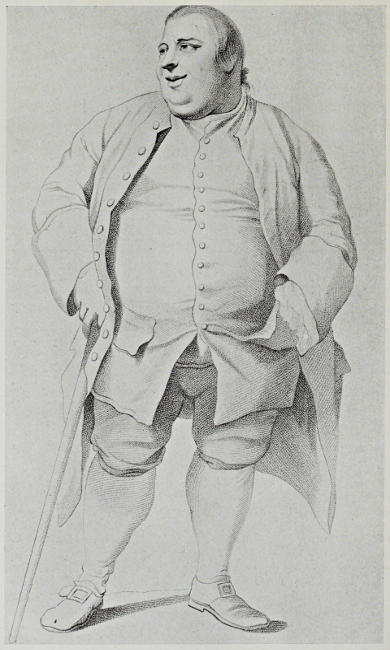
FRANCIS GROSE
“A chiel’s amang ye takin’ notes.”
For many years the back parlour of the “Feathers”[184]
public-house (a sign complimentary to its neighbour,
Frederick, Prince of Wales, who inhabited Leicester
House), which stood on the side of Leicester Fields, had
been frequented by artists, and several well-known
amateurs. Among the former were Stuart,[185] the Athenian
traveller; Scott,[186] the marine painter; old Oram, of the
Board of Works;[187] Luke Sullivan,[188] the miniature painter,
who engraved that inimitable print from Hogarth’s picture
of the “March to Finchley,” now in the Foundling Hospital;
Captain Grose,[189] the author of Antiquities of England,
History of Armour,[190] etc.; Mr. Hearne,[191] the elegant and
correct draughtsman of many of England’s Antiquities
(so beautifully engraved by his amiable friend Byrne),
Nathaniel Smith, my father, etc. The amateurs were
Henderson, the actor; Mr. Morris, a silversmith; Mr.
John Ireland, then a watchmaker in Maiden Lane, and
since editor of Boydell’s edition of Dr. Trusler’s work,
Hogarth Moralized; and Mr. Baker, of St. Paul’s Churchyard,
whose collection of Bartolozzi’s works was unequalled.[192]
When this house, the sign of the “Feathers,” was taken
down to make way for Dibdin’s Theatre, called the
“Sans Souci,” several of its frequenters adjourned to the
“Coach and Horses” public-house in Castle Street, Leicester
Fields; but in consequence of their not proving customers
sufficiently expensive for that establishment, the landlord
one evening venturing to light them out with a
farthing candle, they betook themselves to Gerard Street,
and thence to the “Blue Posts” in Dean Street, where
the club dwindled into two or three members, viz. Edridge,
the portrait draughtsman; Alexander, of the British
Museum; and Edmunds, the upholsterer, who had been
undertaker to the greater part of the club.[193]
Mr. Baker, the gentleman before mentioned, being
a single man, and sometimes keeping rather late hours,
was now and then accompanied by a friend half way
home, by way of a walk. It was on one of these nights,
that, just as he and I were approaching Temple Bar,
about one o’clock, a most unaccountable appearance
claimed our attention,—it was no less an object than
an elephant, whose keepers were coaxing it to pass through
the gateway. He had been accompanied by several
persons from the Tower Wharf with tall poles, but was
principally guided by two men with ropes, each walking
on either side of the street, to keep him as much as possible
in the middle on his way to the menagerie, Exeter
Change; to which destination, after passing St. Clement’s
Church, he steadily trudged on with strict obedience
to the commands of his keepers. I had the honour
afterwards of partaking of a pot of Barclay’s Entire with
this same elephant, which high mark of his condescension
was bestowed when I accompanied my friend the late
Sir James Winter Lake, Bart., to view the rare animals
in Exeter Change—that gentleman being assured by
the elephant’s keeper that if he would offer the beast a
shilling, he would see the noble animal nod his head and
drink a pot of porter. The elephant no sooner had taken
the shilling, which he did in the mildest manner from
the palm of Sir James’s hand, than he gave it to the keeper,
and eagerly watched his return with the beer. The
elephant then, after placing his proboscis to the top of
the tankard, drew up nearly the whole of the then good
beverage. The keeper observed, “You will hardly believe,
gentlemen, but the little he has left is quite warm;”
upon this we were tempted to taste it, and it really was
so. This animal was afterwards disposed of for the sum
of one thousand guineas.[194]
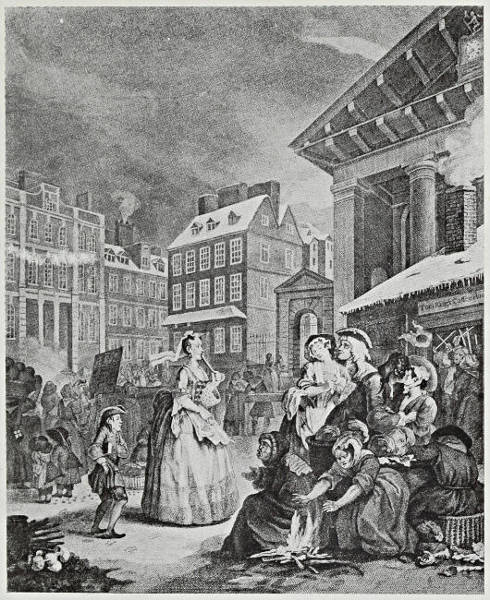
COVENT GARDEN THROUGH HOGARTH’S EYES
“The first square inhabited by the great.”
J. T. Smith
Possibly the present frequenters of print sales may
receive some little entertainment from a description of
a few of the most singular of those who constantly attended
the auctions during my boyish days. The elder
Langford, of Covent Garden, introduced by Foote as
Mr. Puff, in his farce of The Minor,[195] I well remember;
yet by reason of my being obliged to attend more regularly
the subsequent evening sales at Paterson’s and Hutchins’s—next-door-neighbour
auctioneers, on the north side
of King Street, Covent Garden,[196] I am better enabled
to speak to the peculiarities of their visitors than those
of Mr. Langford.
It was in 1783, during the sales of the extensive collection
of Mr. Moser, the first keeper of the Royal Academy,[197]
and Mr. Millan, bookseller at Charing Cross,[198] that I noticed
the following remarkable characters. I shall, however,
first endeavour to describe the person of Paterson, a man
much respected by all who really knew him; but perhaps
by none with more sincerity than Doctor Johnson, who
had honoured him by standing godfather to his son
Samuel, and whom he continued to notice as he grew
up with the most affectionate regard, as appears in the
letters which the doctor wrote in his favour to his friends
Sir Joshua Reynolds and Mr. Humphrey, printed by
Boswell.[199] Mr. Paterson was in height about five feet
eight inches, and stooped a little in the shoulders. When
I first knew him, he was a spare man, and wore a powdered
clubwig, similar to that worn by Tom Davies, the bookseller
and biographer of Garrick, of whom there is an
engraved portrait. Paterson was really a walking library,
and of manners precisely coinciding with the old school.
I remember that by a slight impediment in his speech,
he always pronounced the letter R as a V; for instance,
Dart’s History of Canterbevy, and a dromedary, he pronounced
a dwammedavy; notwithstanding this defect,
he publicly lectured on the beauties of Shakspeare.
Mr. Gough,[200] the Editor of Camden’s Britannia, was the
constant frequenter of his book-sales. This antiquary was
about the same height as the auctioneer, but in a wig very
different, as he wore, when I knew him, a short shining
curled one. His coat was of “formal cut,” but he had no
round belly; and his waistcoat and smallclothes were
from the same piece. He was mostly in boots, and carried
a swish-whip when he walked. His temper I know was not
good, and he seldom forgave those persons who dared to bid
stoutly against him for a lot at an auction: his eyes, which
were small and of the winky-pinky sort, fully announced
the fretful being. As for his judgment in works of art,
if he had any it availed him little, being as much satisfied
with the dry and monotonous manner of Old Basire,[201] as
our late President West was with the beautiful style of
Woollett and Hall.
Dr. Lort,[202] the constant correspondent of Old Cole,[203]
was a man of his own stamp, broad and bony, in height
nearly six feet, of manners equally morose, and in every
respect just as forbidding. His wig was a large Busby,
and usually of a brown appearance, for want of a dust of
powder. He was chaplain to the Duke of Devonshire;
and as he wore thick worsted stockings, and walked anyhow
through the mud, considered himself in no way obliged
to give the street-sweepers a farthing. He had some wit,
however, but it was often displayed in a cowardly manner,
being mostly directed towards his little opponent, Doctor
Gossett,[204] who was unfortunately much afflicted by deformity,
and of a temper easily roused by too frequent a
repetition of threepenny biddings at Paterson’s. Paterson
sold his books singly, and took threepence at a bidding.
Hutchins was about five feet nine inches, but in appearance
much shorter by reason of his corpulency. His high
forehead, when compared with a perpendicular, was at an
angle of forty-five. He was what Spurzheim would call a
simple honest man: his wife was of the same build, but most
powerfully possessed the organ of inquisitiveness, which
induced her to be a constant occupant of a pretty large and
easy chair, by the side of the fire in the auction-room, in
order that she might see how business was going on. Mr.
and Mrs. Hutchins appeared so affectionately mutual in
all their public conclusions, that Caleb Whitefoord, the
witty wine-merchant, one of the print-sale visitors, attempted
to flourish off the following observation as one
of his invention: “You see,” said he to Captain Baillie,
“Cocker is not always correct; one and one do not in this
instance make two.”[205]
Caleb Whitefoord[206] was what is usually called a slight-built
man, and much addicted when in conversation to
shrug up his shoulders. He had a thin face, with little eyes;
his deportment was gentlemanly, though perhaps sometimes
too high for his situation in life. His dress, upon which he
bestowed great attention, was in some instances singular,
particularly in his hat and wig, which were remarkable
as being solitary specimens of the Garrick School. He
considered himself a first-rate judge of pictures, always
preferring those by the old masters, but which he endeavoured
to improve by touching up; and when in this
conceited employment, I have frequently seen him fall back
in his chair, and turn his head from one shoulder to the
other, with as much admiration of what he had done, as
Hogarth’s sign-painter of the Barley-mow in his inimitable
print of Beer Street.
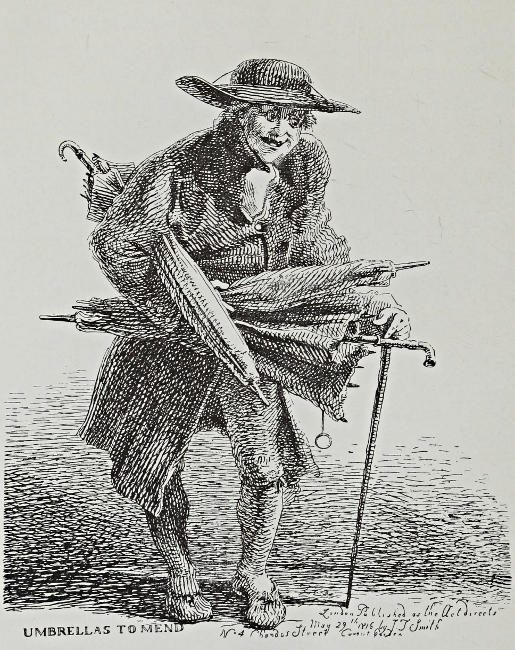
LONDON STREET MERCHANTS: UMBRELLAS TO MEND
ETCHED BY J. T. SMITH
Captain William Baillie[207] was also an amateur in art;
he suffered from an asthma, which often stood his friend
by allowing a lengthened fit of coughing to stop a sentence
whenever he found himself in want of words to complete
it. When not engaged in his duties as a commissioner of
the Stamp Office, he for years amused himself in what he
called etching; but in what Rembrandt, as well as every
true artist, would call scratching. He could not draw,
nor had he an eye for effect. To prove this assertion, I will
“end him at a blow,” by bringing to my informed reader’s
recollection the captain’s execrable plate, which he considered
to be an improvement upon Rembrandt’s “Three
Trees.” Mr. West classed him amongst the conceited men.—“Sir,”
said the venerable President, “when I requested
him to show me a fine impression of Rembrandt’s Hundred
Guilder print, he placed one of his own restored impressions
before me, with as much confidence as my little friend
Edwards[208] attempts to teach Perspective in the Royal
Academy.” Captain Baillie commonly wore a camlet
coat, and walked so slowly and with such measured steps,
that he appeared like a man heavily laden with jack-boots
and Munchausen spurs; and whenever he entered an
auction-room, he generally permitted his cough to announce
his arrival.
Mr. Baker,[209] an opulent dealer in lace, was nightly
to be found bidding for the choicest impressions, which
he seldom allowed any antagonist, however powerful,
to carry away. He was well-proportioned, and though
sometimes singular in his manner, and too negligent in his
dress, was a most honourable man.
Mr. Woodhouse, of Tokenhouse Yard, was also a bidder
for fine things; he did not possess so much of the milk of
human kindness as Mr. Baker; indeed, his manners were at
times a little repulsive, although he had been many years
principal cashier in Sir George Prescott’s banking-house.
He was an extensive collector of Cipriani’s drawings.[210]
Mr. Musgrave,[211] of Norfolk Street, frequently attended
auctions of prints, but particularly those of pictures; he
was an accomplished gentleman in his address, and most
feelingly benevolent in his actions. His figure was short,
his features pleasing, and he seldom went abroad without
a rose in his button-hole. When I state that no man could
have had fewer enemies, I think even the descendants of
“Vinegar Tom”[212] will never haunt my bedside.
There was another truly polite and kind-hearted
attendant at Hutchins’s sales, Mr. Pitt, of Westminster.
The manners of this gentleman were precise, and he wore
a large five-story white wig.
The next collector at this period was Mr. Wodhull,[213]
the translator of Euripides. He was very thin, with a long
nose and thick lips; of manners perfectly gentlemanly.
The great singularity of his appearance arose, perhaps, from
his closing his coat from the first button, immediately
under his chin, to the last, nearly extending to the bottom
of his deep-flap waistcoat-pockets. He seldom spoke, nor
would he exceed one sixpence beyond the sum which he
had put down in his catalogue, to give for the articles he
intended to bid for; and though he frequently went away
without purchasing a single lot, or even speaking to any
one during the whole evening, he always took off his hat,
and bowed low to the company before he left the auction-room.
Mr. Rawle, an accoutrement-maker, then living in
the Strand, was a visitor: he was the friend of Captain
Grose, and the executor of Thomas Worlidge,[214] the etcher.
In his early days he had collected many curious and
valuable articles. His cabinets contained numerous interesting
portraits in miniature of Elizabethan characters.
He was a professed Commonwealth man, and possessed
many of the Protector’s, or, according to some writers,
the usurper’s letters. He also prided himself upon having
the leathern doublet, sword, and hat in which Oliver
dissolved the Parliament, and showed a helmet that he
could incontrovertibly prove had belonged to him. He
likewise frequently expatiated for a considerable time
upon a magnificent wig, which he said had been worn
by that Merry Monarch, King Charles the Second.[215] This
singular character never would allow more than a halfpenny-worth
of vegetables to be put upon his table, though
they were ever so cheap; and when they were above
his price, he went without.[216]
Another singular character of the name of Beauvais,
who at one time had flourished at Tunbridge Wells as
a miniature-painter,[217] attended the evening auctions.
This man, who was short and rather lumpy in stature,
indeed nearly as wide as he was high, was a native of
France, and through sheer idleness became so filthily
dirty in his person and dress, that few of the company
would sit by him. Yet I have seen him in a black suit
with his sword and bag, in the evening of the day on
which he had been at Court, where for years he was a
constant attendant. This “Sack of Sand,” as Suett
the actor generally called him, sat at the lower end of
the table; and as he very seldom made purchases, few
persons ventured to converse with him. He frequently
much annoyed Hutchins by the loudest of all snoring;
and now and then Doctor Wolcot would ask him a question,
in order to indulge in a laugh at his mode of uttering an
answer, which Peter Pindar declared to be more like the
gobbling of a turkey-cock than anything human. He
lived in a two-pair-of-stairs back room in St. James’s
Market; and, after his death, Hutchins sold his furniture.
I recollect his spinet, music-stool, and a few dog’s-eared
sheets of lessons sold for three-and-sixpence.
Mr. Matthew Mitchell,[218] the banker, frequently joined
these parties, and seldom went away without a purchase
of prints under his arm. He was extremely well-proportioned,
and walked in what I have often heard the
ladies of the old school style a portly manner. He was
remarkable for a width of chin, which was full as large
as Titus Oates’s, and a set of large white teeth. His
features altogether, however, bespoke a good-natured
and liberal man. This gentleman was very kind to me
when I was a boy, and I never hear his name mentioned
but with unspeakable pleasure.
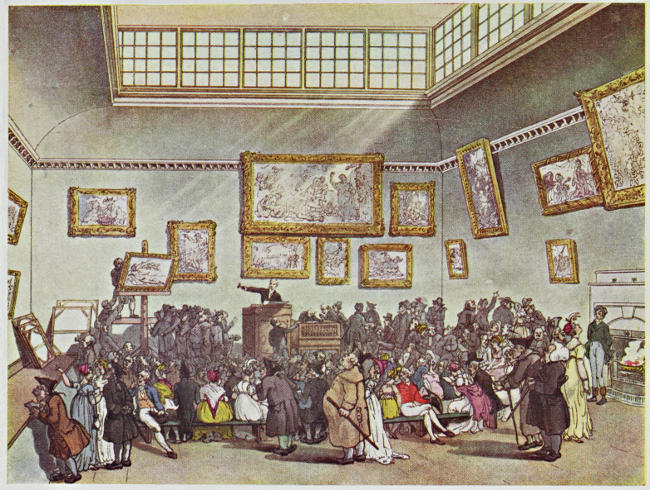
CHRISTIE’S AS “RAINY DAY” SMITH KNEW IT
Mr. Mitchell had a most serious antipathy to a kitten.
He could sit in a room without experiencing the least
emotion from a cat; but directly he perceived a kitten,
his flesh shook on his bones, like a snail in vinegar. I
once relieved him from one of these paroxysms, by taking
a kitten out of the room; on my return he thanked me,
and declared his feelings to be insupportable upon such
an occasion. Long subsequently I asked him whether
he could in any way account for this agitation. He said
he could not, adding that he experienced no such sensations
upon seeing a full-grown cat; but that a kitten,
after he had looked at it for a minute or two, in his imagination
grew to the size of an overpowering elephant.
At this period Hogarth’s prints were in such high
request, that whenever anything remarkable appeared,
it was stoutly contested: for Mr. Packer, of Combe’s
Brewhouse, was one of the most enterprising of the Hogarth
collectors. This gentleman, though his manners sometimes
appeared blunt, was highly respected by all who
really knew him: it was at this time he became my
friend.[219]
He was tall, of good proportion, and well-favoured.
He had his peculiarities in dress, particularly as to his
hat, which was an undoubted original. Mr. Packer’s
opponents in Hogarth prints were two persons, one of
the name of Vincent, a tall, half-starved-looking man,
who walked with a high gilt chased-headed cane (he had
been a chaser of milk-pots, watch-cases, and heads of
canes, and he always walked with this cane as a show-article),
and the other of the name of Powell, better known
under the appellation of “Old black wig.”
Henderson, the player,[220] who was also a collector of
Hogarth’s works, seldom made his appearance on these
boards—John Ireland being his deputy-manager.[221]
I must not omit to mention another singular but
most honourable character, of the name of Heywood,
nicknamed “Old Iron Wig.” His dress was precise,
and manner of walking rather stiff. He was an extensive
purchaser of every kind of article in art, particularly
Rowlandson’s drawings; for this purpose he employed
the merry and friendly Mr. Seguier,[222] the picture-dealer,
a schoolfellow of my father’s, to bid for him.
I shall now close this list by observing that my early
friend and fellow-pupil, Rowlandson, who has frequently
made drawings of Hutchins and his print-auctions, has
produced a most spirited etching, in which not only many
of the above-described characters are introduced, but
also most of the printsellers of the day. There is another,
though it must be owned very indifferent, plate, containing
what the publisher called “Portraits of Printsellers,”
from a monotonous drawing by the late Silvester Harding,
whose manner of delineation made persons appear to
be all of one family, particularly his sleepy-eyed and
gaudily-coloured drawings of ladies.
At this time my mimic powers induced Delpini the
clown,[223] who had often been amused with several of my
imitations of public characters, to mention me to Mr.
John Palmer,[224] who, after listening to my specimens, promised
me an engagement at the Royalty Theatre, which
was then erecting; but as that gentleman was too sanguine,
and failed in procuring a licence, I, as well as many other
strutting heroes, was disappointed.
After this my friends advised me to resume the arts;
and, with the usual confidence of an unskilful beginner,
I at once presumed to style myself “drawing-master.”
However, my slender abilities, or rather industry, were
noticed by my kind patrons, who soon recommended
me to pupils, and by that pursuit I was enabled, with
some increase of talent, to support myself for several
years. It is rather extraordinary that mimicry with
me was not confined to the voice, for I could in many
instances throw my features into a resemblance of the
person whose voice I imitated. Indeed, so ridiculous
were several of these gesticulations, that I remember
diverting one of my companions by endeavouring to
look like the various lion-headed knockers as we passed
through a long street. Skilful, however, as I was declared
to be in some of my attempts, I could not in any
way manage the dolphin knockers in Dean Street, Fetter
Lane. Their ancient and fish-like appearance was certainly
many fathoms beyond my depth; and as much
by reason of my being destitute of gills, and the nose of
that finny tribe, extending nearly in width to its tremendous
mouth, I was obliged to give up the attempt.
When first I saw these knockers, which were all of solid
brass, seventeen of the doors of the four-and-twenty houses
in Dean Street were adorned with them, and the good
housewives’ care was to keep them as bright as the chimney-sweeper’s
ladle on May-day. As my mind from my earliest
remembrance was of an inquisitive nature, my curiosity
urged me to learn why this street, above all others, was
thus adorned; and my inquiry was, as I then thought, at
once answered satisfactorily.
This ground and the houses upon it belong to the Fishmongers’
Company, was the answer returned by one of the
oldest inhabitants; and the heraldic reader will recollect
that the arms of that worshipful and ancient body are
dolphins. Not being satisfied with this assertion, however,
I went to Fishmongers’ Hall, and was there assured that
the Company never had any property in Dean Street,
Fetter Lane. On the 17th of May, 1829, I visited this
street in order to see how many of my brazen-faced acquaintances
exposed themselves, and I found that Dean Street
was nearly as deficient in its dolphin knockers as a churchyard
is of its earliest tombstones, for out of seventeen only
three remained.[225]
In the commencement of this year I took lodgings in
Gerrard Street, and acquiesced in the regulations of my
landlady; one of the principal of which was, that I never
was to expect to be let in after twelve o’clock, unless the
servant was apprised of my staying out later, and then she
was to be permitted to sit up for me. Being in my twenty-first
year, of a lively disposition, and moreover fond of
theatrical representations, I did not at all times “remember
twelve”; for although Mrs. Siddons sounded it so emphatically
upon my ear, I could never quit the theatre till half an
hour after. My finances at this period being sometimes
too slender to afford an additional lodging for the night,
and not often venturing to expose myself to insult, or the
artful and designing, by perambulating the city, unless
the moon invited me, I fortunately hit upon the following
expedient, which not only sheltered me from rain, but
afforded me a seat by the fireside. I either used to go to
the watch-house of St. Paul, Covent Garden, or that of St.
Anne, Soho; so, having made myself free of both by agreeing
with the watch-house keeper to stand the expense of two
pots of porter upon every nocturnal visit, I was enabled
to see what is called “life and human nature.”
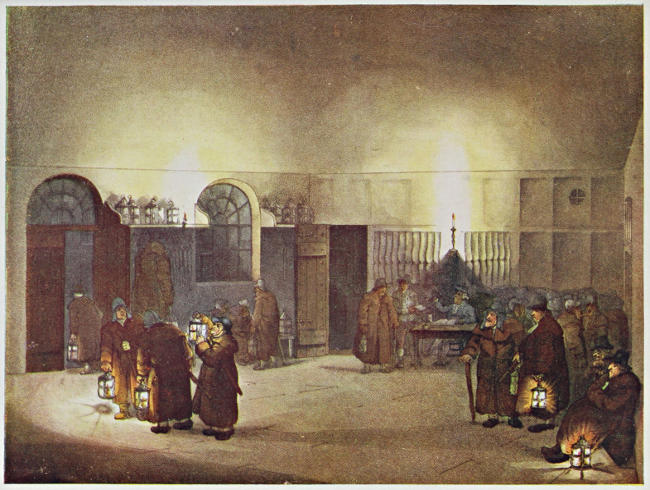
A LONDON WATCH HOUSE
One of the curious scenes witnessed upon a more recent
occasion afforded me no small amusement. Sir Harry
Dinsdale, usually called Dimsdale, a short, feeble little
man, was brought in to St. Anne’s watch-house, charged
by two colossal guardians of the night with conduct most
unruly. “What have you, Sir Harry, to say to all this?”
asked the Dogberry of St. Anne. The knight, who had
been roughly handled, commenced like a true orator, in a
low tone of voice, “May it please ye, my magistrate, I
am not drunk; it is languor. A parcel of the bloods of the
Garden have treated me cruelly, because I would not treat
them. This day, Sir, I was sent for by Mr. Sheridan to
make my speech upon the table at the Shakspeare Tavern,
in Common Garden; he wrote the speech for me, and always
gives me half a guinea, when he sends for me to the tavern.
You see I didn’t go in my Royal robes; I only put ’um on
when I stand to be member.” Constable—“Well, but Sir
Harry, why are you brought here?” One of the watchmen
then observed, “That though Sir Harry was but a
little shambling fellow, he was so upstroppolus and kicked
him about at such a rate, that it was as much as he and his
comrade could do to bring him along.” As there was no one
to support the charge, Sir Harry was advised to go home,
which, however, he swore he would not do at midnight
without an escort. “Do you know,” said he, “there’s a
parcel of raps now on the outside waiting for me.”
The constable of the night gave orders for him to be
protected to the public-house opposite the west end of St.
Giles’s Church, where he then lodged. Sir Harry hearing
a noise in the street, muttered, “I shall catch it; I know I
shall.” “See the conquering hero comes” (cries without).
“Ay, they always use that tune when I gain my election at
Garrett.”
Although many of my readers may recollect Sir Harry
Dinsdale, yet it may be well for the information of others
to state who and what he was. Before I commence his
history, however, I should observe that the death of Sir
Jeffery Dunstan, a dealer in old wigs, who had been for
many years returned member for Garrett, first gave popularity
to Harry Dinsdale, who, from the moment he stood
as candidate, received mock knighthood, and was ever after
known under the appellation of “Sir Harry.”[226] There
are several portraits of this singular little object, by some
called “Honeyjuice,” as well as of his more whimsical predecessor,
Sir Jeffery Dunstan, better known as “Old Wigs.”
Sir Harry exercised the itinerant trade of a muffinman
in the afternoon; he had a little bell, which he held to
his ear, smiling ironically at its tingling. His cry was
“Muffins! muffins! ladies come buy me! pretty, handsome,
blooming, smiling maids.” Flaxman the sculptor,
and Mrs. Mathew, of blue-stocking memory, equipped
him as a hardware man, and as such I made two etchings
of him.
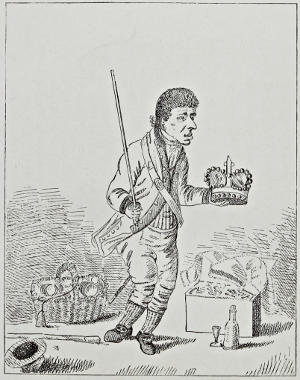
SIR HARRY DINSDALE
MAYOR OF GARRAT AND EMPEROR ANTI-NAPOLEON
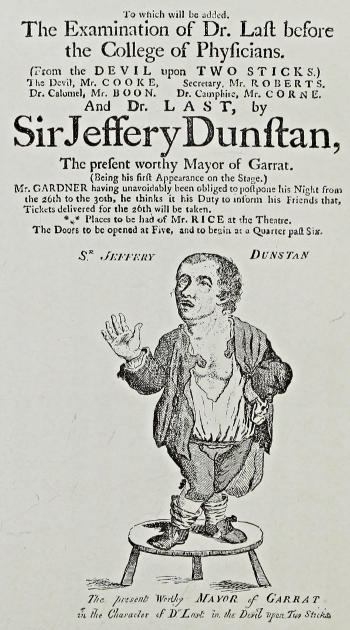
SIR JEFFERY DUNSTAN
“His first appearance on any stage.”
Many a time when I had no inclination to go to bed
at the dawn of day, I have looked down from my window
to see whether the author of the Sublime and Beautiful
had left his drawing-room, where I had seen that great
orator during many a night after he had left the House of
Commons, seated at a table covered with papers, attended
by an amanuensis who sat opposite to him.[227] Major Money,
who had nearly been lost at sea with his balloon, at that
time lodged in the same house. Of the Major’s perilous
situation at sea, the elder Reinagle made a spirited picture,
of which there is an engraving.[228]
In this year I had the honour for the first time of
exhibiting at the Royal Academy. My production was a
portrait of the venerable beech-tree which stood within
memory at a short distance from Sand-pit Gate, in Windsor
Forest, and which tree has been so admirably painted by
West. This picture, which measures five feet in height and
seven in length, was sold by auction at Mr. West’s house,
in May 23rd, 1829. My drawing, as well as many of my
studies made from that delightful display of forest scenery,
was highly finished in black chalk; it was purchased by
the late Earl of Warwick, who was not only an admirable
draughtsman himself, but kind to young artists. By that
nobleman I was introduced to the Hon. F. Charles Greville
[the Earl’s brother and a Vice-President of the Royal
Society], whose taste for the Fine Arts is too well known
to need any eulogium from me.[229] This gentleman gave
Cipriani above one hundred guineas for an elaborate
drawing of the famous Barberini vase, brought to England
by Sir William Hamilton.[230] Several learned writers have
given their conjectures as to the subject so beautifully
sculptured on this vase; but I understand that nothing
has been adduced as yet that sufficiently elucidates it.
This vase is deposited in the British Museum.
This grey and silver beech was the loftiest in the forest,
and particularly beautiful when the sun shone upon its
ancient limbs; his capacious and hollow trunk, with a small
additional hut, afforded accommodation for a woodman,
his wife, four children, a sow and a numerous litter of pigs.
This happy family retreat, which had frequently been
noticed by King George III., was at last unavoidably
obliged, from the symptoms it exhibited of falling, to
submit to the woodman’s axe—that woodman whose family
had weathered many a storm, and had been screened from
the scorching sunbeams under its majestic branches,
several of which, by reason of its “bald and high antiquity,”
had not issued foliage for many a summer. The King,
however, who never suffered the humblest of his subjects
whose industry he had noticed, to sigh under calamity,
ordered a snug, neat brick cottage to be built for the
honest occupant and his dependents, which was erected in
the same forest, and at as short a distance as possible from
the former residence.
One curious and interesting discovery resulted from
the demolition of this venerable tree. The woodman,
who had allowed the smoke from his peat-piled fire to
pass through one of the hollow limbs of the tree for several
years without sweeping it, had, by accumulated incrustations,
produced a mass of the finest brown colour, resembling
the present appearance of that used by Rembrandt,
so much coveted by the English artists. The
discovery was made by Mr. Paul Sandby, who was
fortunately passing at the time the timber was on the
ground, who immediately secured a tolerable quantity
to enable him to prove that the smoke from forest fuel,
united with the heated branch of a hollow and aged beech,
produced the finest bistre: his son, the present Mr. Sandby,
gave me a lump of it, which I presented to the late Sir
George Beaumont.[231] Having mentioned this bistre to
several Roman artists, they informed me that a strong
decoction of the sap of the ilex, or evergreen oak, produces
a colour nearly similar; and of this I have had
satisfactory proof. These, and suchlike bistres, would
be much safer for the artist to use than that called sepia,
which is made from the ink of the cuttle-fish, which,
being a marine production, ever retains its saline and
pernicious qualities, as may be seen in several of the
numerous drawings made by Guercino, where the colour
has left a blot, which has completely eaten through the
paper. However, after all the trials of our experimentalists
to match the present tint of Rembrandt’s drawings,
and however pleasingly ingenious their discoveries have
been, still I am inclined to believe that much, if not the
whole, of the effect of old drawings is owing to that produced
by time; and in this idea I am borne out by a
small drawing which the ever-to-be-revered Flaxman
made with a pen in common writing-ink: he drew it
when I was a lad, and it is now a deep rich brown. May
we not also fairly conclude, from the brown tint of most
of our old manuscripts, that time has thus operated upon
the ink? if so, the question is, what will the future colour
of that which we now use in imitation, consisting of many
ingredients, be, after fifty-five years, the elapsed time
since I received my drawing from the kind hand of Flaxman?
It is a curious fact, however, that the ink used
by the ancient Egyptians on nearly two hundred specimens
of the written inscriptions on papyrus collected by Mr.
Salt,[232] now in the British Museum, are as jet a black as
Cozens’s[233] blotting-ink, or Day and Martin’s far-famed
blacking.
Although not considered an Adonis by the ladies,
yet most of those to whom I had the pleasure to be known,
noticed me as a favourite, and by some my appearance
in company was cordially greeted. “Friend Thomas,”
asked one, “pray what play didst thou see last night?”
With this appellation I was frequently addressed, in
consequence of my mother having been a member of the
Society of Friends. “Love’s Labour Lost,” being my
answer to the pre-engaged fair one, uttered perhaps with
a smile, she was induced to rejoin, “If you had not hitherto
been so blind a son of Venus, you would not have lost
my smiles.” After this rebuke, my pursuit became
brisker, and I at last fixed my heart upon my first wife.[234]
Upon becoming a Benedict, I partly recovered the use of
my senses, gave up my clubs, dissolved many connections,
and in order to be faithful to my pledge, “to love and
to cherish,” I applied myself steadily to my etching-table,
and commenced a series of quarto plates, to illustrate
Mr. Pennant’s truly interesting account of our great
city (entitled Some Account of London), which I dedicated
to my patron, Sir James Winter Lake, Bart.
Sir James was a governor of the Hudson’s Bay Company,—a
situation, it is well known, he filled with credit
to himself as well as the satisfaction of every one connected
with that highly-respected body. Sir James most
kindly invited me to take a house near him at Edmonton,
where I had the honour, for the space of seven years,
of enjoying the steady friendship of himself and family.
Lady Lake, who then retained much of her youthful
beauty, by her elegance of language and extreme affability
charmed every one. To clever people of every description
she was kind, and benevolent to the poor.
The Lake family consisted of Sir James, his lady,
their sons, James, Willoughby, Atwill, and Andrew,—their
daughters, Mary, Charlotte, and Anne.[235] Their
residence, which had long been their family mansion,
was distant about a mile from the Angel Inn, and was
called “The Firs,” in consequence of the approach to
the house being planted on either side with double rows
of that tree.
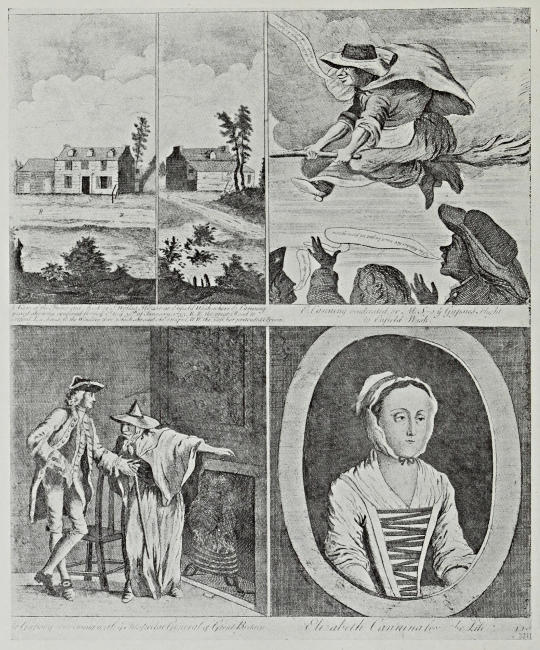
ELIZABETH CANNING
“For my own part, I am not at all brought to believe her story.”
Horace Walpole
This year proved more lucrative to me than any preceding,
for at this time I professed portrait painting both
in oils and crayons; but, alas! after using a profusion
of carmine, and placing many an eye straight that was
misdirected, before another season came, my exertions
were mildewed by a decline of orders, owing not only
to the salubrity of the air of Edmonton, but to the regularity
of those who had sat to me, for they would neither
die nor quit their mansions, but kept themselves snug
within their King-William iron gates and red-brick-crested
piers, so that there was no accommodation for
new-comers; nor would the red land-owners allow one
inch of ground to the Tooley Street Camomile Cottage
builders.[236] However, I experienced enough to convince
me that, had I diverged along the cross-roads towards the
Bald-faced Stag, the highway to the original Tulip-tree
at Waltham Abbey, or the green lanes to Hornsey Wood
House, I might have considerably increased my income;
but this would have been impossible without a conveyance.
Nevertheless, as it was, the reader will hardly believe
that my marches of fame were far more extensive than
those of Major Sturgeon;[237] his were confined to marches
and counter-marches, from Ealing to Acton, and from
Acton to Ealing, next-door neighbours: now, my doves
took a circuitous flight from Tottenham to “Kicking
Jenny” at Southgate; then to Enfield, ay, even to its
very Wash, rendered notorious by Mary Squires and Bet
Canning;[238] thence over Walton’s famed river Lea: thence
up to Chingford’s ivy-mantled tower; down again, crossing
the Lea with the lowing herd, to Tottenham High Cross,
finishing where they put up on the embattlements of the
once noble Castle of Bruce.
It was in the centre of the above vicinities, at “Edmonton
so gay,” the rendezvous of Shakspeare’s merry devil,[239]
that I profiled, three-quartered, full-faced, and buttoned
up the retired embroidered weavers, their crummy wives,
and tightly-laced daughters. Ay, those were the days!
my friends of the loom, as Tom King declared in the
prologue to Bon Ton, when Mother Fussock could ride
in a one-horse chaise, warm from Spitalfields, on a
Sunday![240]
Many a rural walk have I and my beloved enjoyed,
accompanied by our uninvited, playful, tailed butterfly-hunter,
through the lonely honeysuckled lanes to the
“Widow Colley’s,” whose nut-brown, mantling home-brewed
could have stood the test with that of Skelton’s
far-famed Elyn—the ale-wife of England, upon whose
October skill Henry VIII.’s Poet Laureate sang.[241] Sometimes
our strolls were extended to old Matthew Cook’s Ferry,
by the side of the Lea, so named after him, and well known
to many a Waltonian student. Matthew generally contrived
to keep sixteen cats, all of the finest breed, and, as cats go,
of the best of tempers, all of whom he had taught distinct
tricks; but it was his custom morning and evening to make
them regularly, one after the other, leap over his hands
joined as high as his arms could reach: and this attention
to his cats, which occupied nearly the whole of his time,
afforded him as much pleasure as Hartry, the cupper in
May’s Buildings,[242] and his assistant could receive in phlebotomizing,
in former days, above one hundred customers
on a Sunday morning, that being the only leisure time the
industrious mechanic could spare for the operation.
Melancholy as Cook’s Ferry is during the winter,
it is still more so in the time of an inundation, when it
is almost insupportable; and had not Matty enjoyed the
society of his cats, who certainly kept the house tolerably
free from rats and mice, at the accustomed time of a high
flood he must have been truly wretched. In this year,
during one of these visitations, in order to gratify my
indefatigable curiosity, I visited him over the meadows,
partly in a cart and partly in a boat, conducted by his
baker and Tom Fogin, his barber. We found him standing
in a washing-tub, dangling a bit of scrag of mutton before
the best fire existing circumstances could produce, in a
room on the ground floor, knee-deep in water, whilst he
ever and anon raised his voice to his cats in the room above,
where he had huddled them for safety.
The baker, after delivering his bread in at the window,
and I, after fastening our skiff to the shutter-hook, waited
the return of Fogin, who had launched himself into a tub
to shave Matthew, who had perched himself on the coroneted
top of a tall Queen Anne’s chair, and drawn his feet as much
under him as possible, and then, with the palms of his
hands flat upon his knees to keep the balance true, was
prepared to suck in Fogin’s tales in the tub during his
shave. Tom retailed all the scandal he had been able to
collect during the preceding week from the surrounding
villages; how Dolly alias Matthew Booth, a half-witted
fellow, was stoutly caned by old John Adams, the astronomical
schoolmaster, for calling him “a moon-hauler,”—how
Mr. Wigston trespassed on Miss Thoxley’s waste,—of
the sisters Tatham being called the “wax dolls” of
Edmonton, whose chemises Bet Nun had declared only
measured sixteen inches in diameter,—of old Fuller, the
banker, riding to Ponder’s End with a stone in his mouth
to keep it moist, in order to save the expense of drink,—upon
Farmer Bellows’s and old Le Grew’s psalm-singing,—of
Alderman Curtis and his Southgate grapery, and of his
neighbour, a divine gentlem—man, I had very nearly called
him, who had horsewhipped his wife.
I remember on a midsummer morn of this year making
one of a party of pleasure, consisting of the worthy baronet
Sir James Lake, the elder John Adams,[243] schoolmaster of
Edmonton, Samuel Ireland,[244] author of the Thames, Medway,
etc. We started from my cottage at Edmonton, and
took the road north. The first house we noticed was an
old brick mansion at the extreme end of the town, erected
at about the time of King Charles I., opposite butcher
Wright’s. This dilapidated fabric was let out in tenements,
and the happiest of its inmates was a gay old woman who
lived in one of its numerous attics. She gained her bread
by spinning, and as we ascended she was singing the old
song of “Little boy blue, come blow me your horn” to a
neighbour’s child, left to her care for the day. “Well,
Mary,” quoth the a-b-c-darian, “you are always gay;
what is your opinion of the lads and lasses of the present
time, compared with those of your youthful days?”
“I’ faith,” answered Mary, “they are pretty much the
same.” She was then considerably beyond her eightieth
year. We then proceeded to Ponder’s End, where I
conducted my fellow-travellers to a field on the left, behind
the Goat public-house, to see “King Ringle’s Well,” but
why so called even Mr. Gough has declared he was unable
to discover.[245]
The next place we visited consisted of extensive moated
premises, called “Durance,” on the right of the public
road. This house, as tradition reported, had been the
residence of Judge Jeffreys; and here it is said that he
exercised some severities upon the Protestants.[246]
We then returned through Green Street; and at a
cottage we discovered an Elizabethan door, profusely
studded with flat-headed nails. This piece of antiquity
Samuel Ireland stopped to make a drawing of, which
circumstance I beg the reader will keep in mind, as it will
be mentioned hereafter. We then, after descanting upon
the beauties of Waltham Cross, proposed to visit the
father of the Tulip-trees, an engraving of which appeared
in Farmer’s History of Waltham Abbey.[247] We looked in
vain for a portion of King Harold’s tomb. There were
remains of it in Strutt’s early days: he made a drawing of
them. Our next visit was to a small ancient elliptic
bridge in a field a little beyond the pin-manufactory; this
bridge has ever been held as a great curiosity, and one of
high antiquity. As we returned through Cheshunt, we
rummaged over a basket of old books placed at the door of
the barber’s shop, where Sir James Lake bought an excellent
copy of Brooke’s Camden’s Errors for sixpence, and also
an imperfect copy of Burton’s Anatomy of Melancholy,
for the sake of a remarkably fine impression of a portrait
of its author on the title-page. After dining at the Red
Lion, we visited another old moated mansion, the property
of Dr. Mayo, said to have been originally a house belonging
to Cardinal Wolsey, or in which he had at one time resided.[248]
After crossing a drawbridge, and passing through the iron
gates, the gardener ushered us into a spacious hall, and
showed us a curiously constructed chair, in which he said
the Cardinal’s porter usually sat. Of this singular chair
above mentioned I made a drawing, and had the honour
to furnish the late Marquis of Lansdowne with a copy,
to enable his Lordship to have a set made from it. In an
adjoining room was a bedstead and furniture, considered
to be that in which the Cardinal had slept; it was of a
drab-coloured cloth, profusely worked over with large
flowers in variously coloured silks. We were then conducted
to an immense room filled with old portraits. I
recollect noticing one in very excellent preservation of
Sir Hugh Myddelton, with an inscription on the background
totally differing from the one by Cornelius Janssen,
engraved by Vertue.[249] Thus ended this pleasant excursion.
That Vandyke did not possess that liberal patron in
King Charles I. which his biographers have hitherto
stated, is unquestionably a fact, which can be proved
by a long bill which I have lately seen (by the friendly
indulgence of Mr. Lemon[250] and his son), in the State Paper
Office, docketed by the King’s own hand. For instance,
the picture of his Majesty dressed for the chase (which
I conjecture to be the one engraved by Strange),[251] for
which Vandyke had charged £200, the King, after erasing
that sum, inserted £100; and down in proportion, nay,
in some instances they suffered a further reduction.
Of several of the works charged in the bill, which his
Majesty marked as intended presents to his friends, I
recollect one of two that were to be given to Lord Holland
was reduced to the sum of £60. Other pictures in the
bill the King marked with a cross, which is explained
at the back by Endymion Porter, that as those were to
be paid for by the Queen, the King had left them for her
Majesty to reduce at pleasure.
That a daughter of Vandyke was allowed a pension
for sums owing by King Charles I. to her father, is also
true, as there is a petition in consequence of its being
discontinued still preserved in the State Paper Office,
in which that lady declares herself to be plunged into
the greatest distress, adding that she had been cheated
by the purchaser of her late father’s estate, who never
paid for it.[252]
It would be the height of vanity in me to offer anything
beyond what the author of The Sublime and Beautiful
has said of Sir Joshua Reynolds, who died this year
at his house in Leicester Square.[253] As Mr. Burke’s character
of this most powerful of painters may not be in
the possession of all my readers, I shall here reprint it.[254]
“The illness of Sir Joshua Reynolds was long, but borne
with a mild and cheerful fortitude, without the least
mixture of anything irritable or querulous, agreeably to
the placid and even tenor of his whole life.
“He had, from the beginning of his malady, a distinct
view of his dissolution; and he contemplated it
with that entire composure which nothing but the innocence,
integrity, and usefulness of his life, and unaffected
submission to the will of Providence, could bestow. In
this situation he had every consolation from family tenderness,
which his own kindness to his family had indeed
well deserved.
“Sir Joshua Reynolds was, on very many accounts,
one of the most memorable men of his time. He was
the first Englishman who added the praise of the elegant
arts to the other glories of his country. In taste, in grace,
in facility, in happy invention, and in the richness and
harmony of colouring, he was equal to the great masters
of the renowned ages. In portrait he was beyond them;
for he communicated to that description of the art, in
which English artists are the most engaged, a variety,
a fancy, and a dignity derived from the higher branches,
which even those who professed them in a superior manner
did not always preserve, when they delineated individual
nature. His portraits remind the spectator of the invention
of history and the amenity of landscape. In
painting portraits, he appeared not to be raised upon
that platform, but to descend to it from a higher sphere.
His paintings illustrate his lessons; and his lessons seem
to be derived from his paintings. He possessed the
theory as perfectly as the practice of his art. To be
such a painter, he was a profound and penetrating
philosopher.
“In full happiness of foreign and domestic fame,
admired by the expert in art, and by the learned in
science, courted by the great, caressed by sovereign powers,
and celebrated by distinguished poets, his native humility,
modesty, and candour never forsook him, even on surprise
or provocation, nor was the least degree of arrogance
or assumption visible to the most scrutinising eye, in any
part of his conduct or discourse.
“His talents of every kind, powerful from nature,
and not meanly cultivated by letters—his social virtues
in all the relations and in all the habitudes of life—rendered
him the centre of a very great and unparalleled
variety of agreeable societies, which will be dissipated by
his death. He had too much merit not to excite some
jealousy, too much innocence to provoke any enmity. The
loss of no man of his time can be felt with more sincere,
general, and unmixed sorrow. ‘Hail! and farewell!’”
The following letter was addressed to me by my worthy
friend Colonel Phillips:[255]—
“Dear Sir,—If it was not for having you older than
your friends would wish you, I should be glad you had
been of the party, where I heard an argument between
Dr. Johnson and Sir Joshua Reynolds, on the wonderful
power of the human eye. Dr. Johnson made a quotation
which I do not remember. ‘Sir,’ said Sir Joshua, in
reply, ‘that divine effect is produced by the parts appertaining
to the eye, and not from its globe, as is generally
supposed; the skull must be justly proportioned.’
“Mrs. Cholmondeley.[256]—‘My dear Sir Joshua, was
there nothing in the magic of Garrick’s eye? its comicality.
The Duke of Richmond, the Duke of Dorset,
and young Sheridan[257] have superb eyes; but I don’t
know what effect they would have on the stage.’
“Sir Joshua.—‘Little or none, Madam; the great
beauty of the Duke of Richmond’s eye proceeded from
its fine and uncommon colour, dark blue, which would
be totally lost on the stage, the light being constantly
either too high or too low. Garrick’s eye, unaccompanied
by the action of his mouth, would not fascinate. When
you are near a person, a pretty woman for instance, and
have a good light, the contraction and expansion of the
pupilla, which bids defiance to our art, is delightful;
it is more perceptible in fine grey and light blue eyes,
than in any other colour. We, however, cannot deny
the majestic look of the Belvedere Apollo, though unassisted
by iris, pupil, eye-lashes, or colour.’
“Dr. Johnson.—‘Sir, a tiger’s eye, and, I am told,
a snake’s, will intimidate birds, so that they will drop
from trees for its prey, without using their wings.’
“After Dr. Johnson had quaffed about twenty-four
cups of tea, he gave a blow of considerable length from
his mouth, drew his breath, and said, ‘Sir, I believe you
are right, it is but rational to suppose so: I wish that
rogue Burke was here.’
“I am sorry, my dear Sir, that my memory is not
better, so as to give you verbatim what passed. I feel
like a person giving evidence in a court, trammelled by
the apprehension of saying too much, or, as a late friend
of mine said, ‘remembering a great many circumstances
that never happened;’ and I only write this to show
my readiness to comply with any request you could possibly
make of your obliged friend,
“M. Phillips.”
“If you ask how it comes, the faithful Bossy was
not present; Bossy was not always producible after
dinner.”
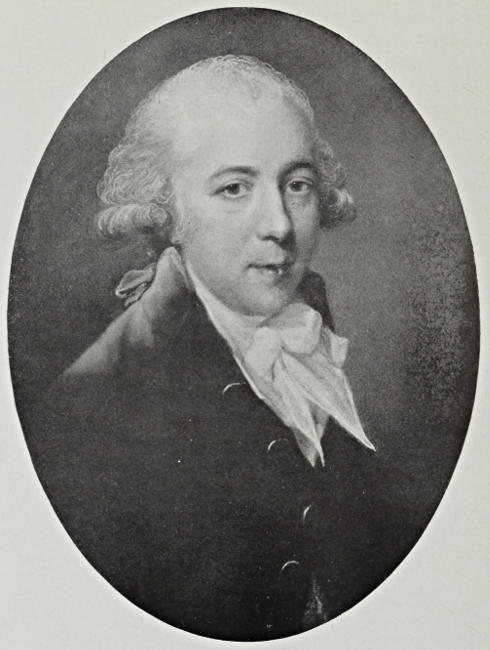
RICHARD BRINSLEY SHERIDAN
“Tell Lady Besborough that my eyes will look up to the coffin-lid as brightly as ever.”
“Wednesday, 27th March.
ROYAL BUN HOUSE, CHELSEA,
GOOD FRIDAY.
No Cross Buns.
“Mrs. Hand respectfully informs her friends, and
the public, that in consequence of the great concourse
of people which assembled before her house at a very
early hour, on the morning of Good Friday; by which
her neighbours (with whom she has always lived in friendship
and repute) have been much alarmed and annoyed;
it having also been intimated, that to encourage or
countenance a tumultuous assembly at this particular
period, might be attended with consequences more serious
than have hitherto been apprehended; desirous, therefore,
of testifying her regard and obedience to those laws
by which she is happily protected, she is determined,
though much to her loss, not to sell Cross Buns on that
day, to any person whatever;—but Chelsea Buns as
usual.
“Mrs. Hand would be wanting in gratitude to a generous
public, who, for more than fifty years past, have so warmly
patronised and encouraged her shop, to omit so favourable
an opportunity of offering her sincere acknowledgments
for their kind favours; at the same time, to assure them
she will, to the utmost of her power, endeavour to merit a
continuance of them.”[258]
The origin of wooden tessellated floors having been a
subject of much inquiry among many of my friends, I here
insert a copy of an advertisement introduced in a catalogue
of books, published 1676, under the licence of Roger
L’Estrange.[259]
“There is now in the press, and almost finished, that
excellent piece of architecture,[260] written by Andrea Palladio,
translated out of Italian, with an Appendix, touching
Doors and Windows, by Pierre le Muet, Architect to the
French King: translated out of French, by G. R.; also
Rules and Demonstrations, with several designs for the
framing any manner of Roofs, either above pitch, or under
pitch, whether square or bevel; never published before;
with designs of Floors of Variety of small pieces of Wood,
lately made in the Palace of the Queen-Mother, at Somerset
House—a curiosity never practised in England.
“The third Edition, corrected and enlarged, with the new
model of the Cathedral of St. Paul’s as it is now building.”
The floors of the oldest parts of the British Museum,[261]
retained specimens of this tessellated work, until they were
removed on the construction of the new building.
Having often heard my father expatiate upon the
extraordinary talents of Keyse,[262] the proprietor of Bermondsey
Spa, as a painter, I went one July evening to
Hungerford, and engaged “Copper Holmes”[263] to scull me
to “Pepper Alley Stairs”; from thence I proceeded to the
gardens. This I was the more anxious to accomplish, as
that once famed place of recreation was most rapidly on
the decline. I entered under a semicircular awning next
to the proprietor’s house, which I well remember was a
large wooden-fronted building, consisting of long square
divisions, in imitation of scantlings of stone. My surprise
was great, for no one appeared, but three idle waiters,
and they were clumped for the want of a call. The space
before the orchestra, which was about a quarter the size
of that of Vauxhall, was in the centre, totally destitute
of trees, the few that these gardens could then boast of
being those planted close to the fronts of the surrounding
boxes of accommodation, as a screen to prevent the
public from overlooking the gardens.
My attention was attracted by a board with a ruffled
hand, within a sky-blue painted sleeve, pointing to the
staircase which led “To the Gallery of Paintings.” In
this room I at first considered myself as the only spectator;
and as the evening sun shone brilliantly, the refraction of
the lights gave me a splendid and uninterrupted view
of the numerous pictures with which it was closely hung,
each of which had just claims to my attention, as I found
myself frequently walking backwards to enjoy their deceptive
effects. When I had gone round the gallery, which
by the bye was oblong, and in size similar to that of
the Academician, J. M. W. Turner, in Queen Anne Street,
I voluntarily recommenced my view, but, in stepping back
to study the picture of the Green-stall, “I ask your
pardon,” said I, for I had trodden upon some one’s toes;
“Sir, it is granted,” replied a little thick-set man, with a
round face, arch look, closely curled wig, surmounted by a
small three-cornered hat, put very knowingly on one side,
not unlike Hogarth’s head in his print of the Gates of
Calais. “You are an artist, I presume; I noticed you from
the end of the gallery when you first stepped back to look
at my best picture. I painted all the objects in this room
from nature and still life.” “Your Greengrocer’s Shop,”
said I, “is inimitable; the drops of water on that Savoy
appear as if they had just fallen from the element. Van
Huysum could not have pencilled them with greater
delicacy.” “What do you think,” said he, “of my
Butcher’s Shop?” “Your pluck is bleeding fresh, and
your sweetbread is in a clean plate.” “How do you like
my bull’s eye?” “Why it would be a most excellent one
for Adams or Dollond[264] to lecture upon. Your knuckle
of veal is the finest I ever saw.” “It’s young meat,”
replied he; “any one who is a judge of meat can tell that
from the blueness of its bone.” “What a beautiful white
you have used on the fat of that South Down leg! or is it
Bagshot?”[265]
“Yes,” said he, “my solitary visitor, it is Bagshot;
and as for my white, that is the best Nottingham, which
you or any artist can procure at Stone and Puncheon’s,
in Bishopsgate Street Within. Sir Joshua Reynolds,”
continued Mr. Keyse, “paid me two visits. On the second,
he asked me what white I had used; and when I told him,
he observed, ‘It is very extraordinary, Sir, how it keeps
so bright; I use the same.’ ‘Not at all, Sir,’ I rejoined:
‘the doors of this gallery are open day and night; and the
admission of fresh air, together with the great expansion
of light from the sashes above, will never suffer the white
to turn yellow. Have you not observed, Sir Joshua, how
white the posts and rails on the public roads are, though
they have not been repainted for years?—that arises from
constant air and bleaching.’
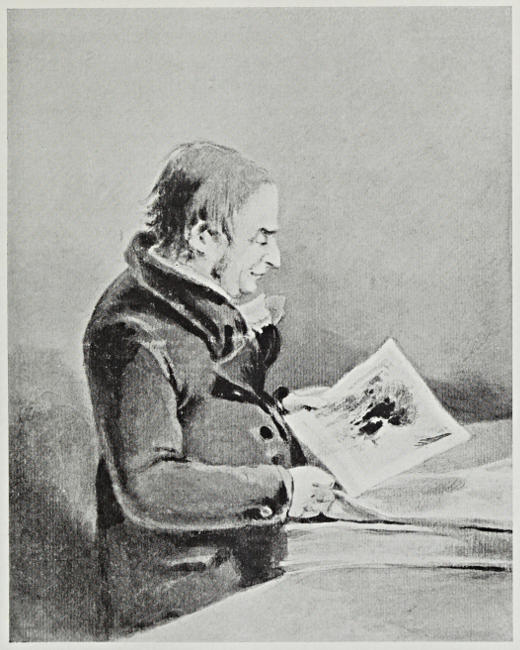
J. M. W. TURNER, R.A.
FROM A WATER-COLOUR SKETCH BY J. T. SMITH
“Come,” said Mr. Keyse, putting his hand upon my
shoulder, “the bell rings, not for prayers, nor for dinner,
but for the song.” As soon as we had reached the orchestra,
the singer curtsied to us, for we were the only persons in
the gardens. “This is sad work,” said he, “but the woman
must sing according to our contract.” I recollect that
the singer was handsome, most dashingly dressed, immensely
plumed, and villainously rouged; she smiled as she
sang, but it was not the bewitching smile of Mrs. Wrighten,[266]
then applauded by thousands at Vauxhall Gardens. As
soon as the Spa lady had ended her song, Keyse, after joining
me in applause, apologised for doing so, by observing that,
as he never suffered his servants to applaud, and as the
people in the road (whose ears were close to the cracks in
the paling to hear the song), would make a bad report if
they had not heard more than the clapping of one pair of
hands, he had in this instance expressed his reluctant
feelings.
As the lady retired from the front of the orchestra,
she, to keep herself in practice, curtsied to me with as much
respect as she would had Colonel Topham been the patron
of a gala night.[267] “This is too bad,” again observed Keyse;
“and I am sure you cannot expect fireworks!” However,
he politely asked me to partake of a bottle of Lisbon,
which upon my refusing, he pressed me to accept of a
catalogue of his pictures.
Blewitt[268] (who at that time lived in Bermondsey
Square), the scholar of Jonathan Battishill,[269] was the composer
for the Spa establishment. The following verse is the
first of his most admired composition,—“In lonely cot by
Humber’s side.”
My old and worthy friend Joseph Caulfield,[270] Blewitt’s
favourite pupil, of whom he learned thorough bass, related
to me the following anecdote of a musical composer, as
told him by his master:—“When I was going upstairs,”
said Blewitt, “to the attics, where one of my instructors
lived (for I had many), I hesitated on the second-floor
landing-place, upon hearing my master and his wife at high
words. ‘Get you gone!’ said the lofty paper-ruffled composer,
‘retire to your apartments!’ This command of
her lord she did not immediately obey; however, in a short
time after, I heard the clattering of plates against the wall,
and upon entering the room, I discovered that the lady
had retired, but not before she had covered the whitewashed
wall profusely with the unbroiled sprats.”
“I was at a musical party,” continued my friend
Joseph, “at Lord Sandwich’s,[271] in Hertford Street, Mayfair,
when, among other specimens of the best masters, I heard
Battishill’s beautiful composition of
“Amidst the myrtles as I walk,
Love and myself thus entered talk,
‘Tell me,’ said I, in deep distress,
‘Where I may find my Shepherdess.’”
[272]
Upon expressing my pleasure at hearing the above performed
in so superior a style, his Lordship told me he
had written a sequel, which he thus repeated:—
“Love said to me, ‘Thou faithful swain,
Thy search in myrtle groves is vain;
Examine well thy noblest part,
Thou’lt find her seated in thy heart.’”
It appears that in poetry, as well as in painting and
prints, and also in dwellings, decorations, and dress,
there has ever been a fashion for a time. Battishill was
the composer of that justly celebrated glee, commencing
with “Underneath this myrtle shade.” Myrtles, after
having had a great run, were succeeded by Cupid’s darts;
and that little rogue Love played old gooseberry with
the hearts of Chloes and Colins, Robins and Robinets;
then the ever-blooming lasses of Patterdale and Richmond
Hill attracted our giddy notice. These were succeeded
by “Bacchus in green ivy bound,” giving “Joy
and pleasure all around.” After that, moonlight meetings
were preferred, and “Buy a broom, ladies,” was continually
dinning our ears “through and through.”
In the summer of this year, the late John Wigston,
Esq., then of Millfield House, Edmonton, having repeatedly
expressed a wish to see the famous George Morland before
he commenced a collection of his pictures, I having been
known to that child of nature in my boyish days, offered
to introduce them to each other.[273] Morland then resided
in Charlotte Street, Fitzroy Square, in the house formerly
inhabited by Sir Thomas Apreece. He received us in
the drawing-room, which was filled with easels, canvases,
stretching-frames, gallipots of colour, and oil-stones;
a stool, chair, and a three-legged table were the only
articles of furniture of which this once splendid apartment
could then boast. Mr. Wigston, his generous-hearted
visitor, immediately bespoke a picture, for which
he gave him a draft for forty pounds, that sum being
exactly the money he then wanted; but this gentleman
had, like most of that artist’s employers, to ply him close
for his picture.
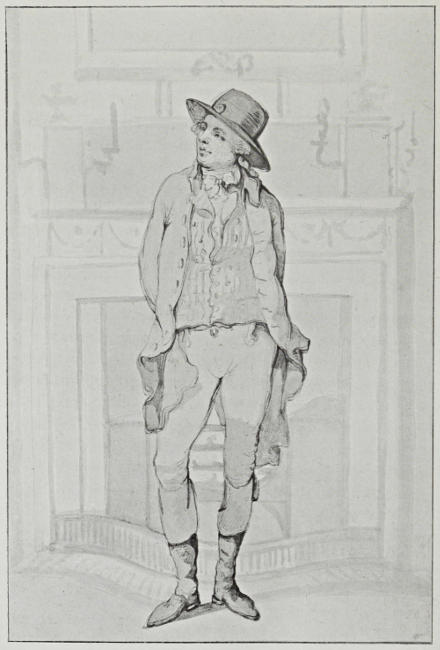
GEORGE MORLAND
“There! go back and tell the pawnbroker to advance me five guineas more upon it.”
As Mrs. Wigston had a great desire to see Morland,
he was invited to take a day’s sport with the hounds,
which the artist accepted, with a full assurance of punctuality.
However, as usual with that eccentric man, he
only arrived time enough for dinner, accompanied by
eight of those persons denominated his friends. Mrs.
Wigston, an elegant and most accomplished lady, was in
consequence deprived of a sight of this far-famed genius.
I was deputed by my honoured friend Mr. Wigston to
take Mrs. Wigston’s abdicated chair, and carved for this
pretty set, consisting of persons unaccustomed to sit
at such a table. Our worthy host soon discovered their
strong propensity for spirituous liquors, three of them
even during dinner, instead of taking wine, of which
there were many sorts on the table, calling for a glass of
brandy. After hearing several jokes and humorous songs
from some of the party, George Morland declared he
must go, having an engagement with Mrs. Laye, and
other friends, at “Otter’s Pool.”[274]
When Morland and his party entered the stable-yard,
the following altercation took place between Mr. Wigston
and his groom.
Mr. Wigston.—“Bring out these gentlemen’s horses.”
Groom.—“Horses, horses! they’ll find ’um at the
‘Two Jolly Brewers.’ Horses, indeed!”
Mr. Wigston.—“And why, Sir, were they sent there?”
Groom.—“Why, I would not suffer such cattle to
come near your stud; for I never saw such a set-out in
my life!”
The party accordingly betook themselves to the
“Brewers”; but upon our return to the honest though
rough diamond of a groom, he observed that it was past
two o’clock, and that the dog ought to have been let
loose two hours ago!
Although my mother continued till the time of her
death in the habit of the Society of Friends, and my father
followed most of the popular Methodists, I, from my
earliest days of reflection, gave a preference to the Established
Church of England. Notwithstanding this, my
inquisitiveness now and then induced me to hear celebrated
preachers of every sect. I remember one Sunday morning
in this year, after intending to enter some church on
my way to dine with my great-aunt on Camberwell Green,
my ears were most agreeably greeted with the swelling
pipes of the Surrey Chapel organ.[275] Why, thinks I to
myself, should not I hear Rowland Hill? Surely it
must be now full twenty years since I saw him in Moorfields,
at my last visit to the Tabernacle. In I accordingly
went; and though a smile with me was always
deemed highly indecorous during divine worship, yet
the truth must out; I could not help sometimes laughing—as
heartily, though not so loudly, I hope, as all of us
when led into the enjoyment of Momus’s strongest fits
by the inimitable Mathews.
No sooner was the sermon over and the blessing
bestowed, than Rowland electrified his hearers by vociferating,
“Door-keepers, shut the doors!” Slam went one
door; bounce went another; bang went a third; at last,
all being anxiously silent as the most importantly unexpected
scenes of Sir Walter Scott could make them, the
pastor, with a slow and dulcet emphasis, thus addressed
his congregation:—“My dearly beloved, I speak it to
my shame, that this sermon was to have been a charity
sermon, and if you will only look down into the green
pew at those—let me see—three and three are six, and
one makes seven, young men with red morocco prayer-books
in their hands, poor souls! they were backsliders,
for they went on the Serpentine River, and other far
distant waters, on a Sabbath; they were, however, as
you see, all saved from a watery grave. I need not tell
ye that my exertions were to have been for the benefit
of that benevolent institution the Humane Society.—What!
I see some of ye already up to be gone; fie! fie!
fie!—never heed your dinners; don’t be Calibans, nor
mind your pockets. I know that some of ye are now
attending to the devil’s whispers. I say, listen to me!
take my advice, give shillings instead of sixpences; and
those who intended to give shillings, display half-crowns,
in order not only to thwart the foul fiend’s mischievousness,
but to get your pastor out of this scrape; and if
you do, I trust Satan will never put his foot within this
circle again. Hark ye! I have hit upon it; ye shall
leave us directly. The Bank Directors, you must know,
have called in the dollars; now, if any of you happen
to be encumbered with a stale dollar or two, jingle the
Spanish in our dishes; we’ll take them, they’ll pass current
here. Stay, my friends, a moment more. I am to dine
with the Humane Society on Tuesday next, and it would
shock me beyond expression to see the strings of the
Surrey Chapel lay dangle down its sides like the tags
upon Lady Huntingdon’s servants’ shoulders. Now,
mind what I say, upon this occasion I wish for a bumper
as strenuously as Master Hugh Peters did, when he recommended
his congregation in Broadway Chapel to
take a second glass.” It is recorded that when he found
the sand of his hour-glass had descended, he turned it,
saying, “Come, I know you to be jolly dogs, we’ll take
t’other glass.”[276] I understand that Rowland Hill is
not made up of veneer, but of solid well-seasoned stuff,
with a heart of oak, and ever willing to exercise kindness
to his fellow-creatures, upon the system of my friend
Charles Lamb.[277]
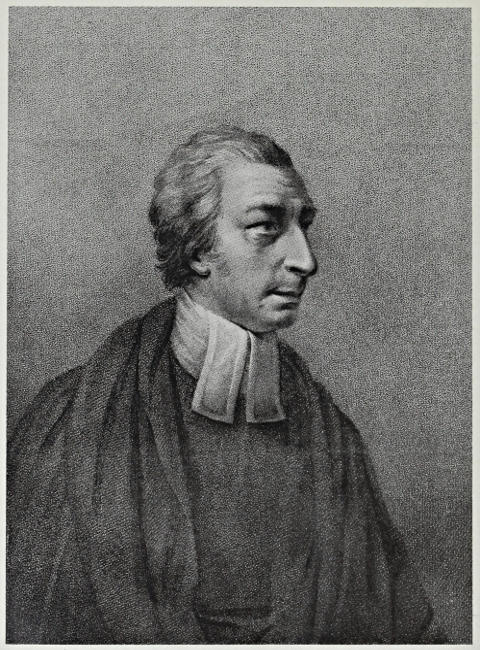
ROWLAND HILL
“His ideas come red hot from the heart.”
Sheridan
In May this year I applied to my worthy friend, Mr.
John Constable, now a Royal Academician, for any particulars
which he might be able to procure respecting
Gainsborough, he being also a Suffolk man; and I had the
pleasure of receiving the following letter:—
“East Bergholt, 7th May, 1797.
“Dear Friend Smith,—If you remember, in my
last I promised to write again soon, and tell you what
I could about Gainsborough. I hope you will not
think me negligent when I inform you that I have not
been able to learn anything of consequence respecting
him: I can assure you it is not for the want of asking
that I have not been successful, for indeed I have
talked with those who knew him. I believe in Ipswich
they did not know his value till they lost him. He belonged
to something of a musical club in that town, and painted
some of their portraits in a picture of a choir; it is said to
be very curious.
“I heard it was in Colchester; I shall endeavour to see
it before I come to town, which will be soon. He was
generally the butt of the company, and his wig was to them
a fund of amusement, as it was often snatched from his
head and thrown about the room, etc.; but enough of this.
I shall now give you a few lines verbatim, which my friend
Dr. Hamilton, of Ipswich, was so good as to send me;
though it amounts to nothing, I am obliged to him for taking
the commission.
“‘I have not been neglectful of the inquiries respecting
Gainsborough, but have learned nothing worth your notice.
There is no vale or grove distinguished by his name in this
neighbourhood. There is a place up the river-side where
he often sat to sketch, on account of the beauty of the
landscape, its extensiveness, and richness in variety, both
in the fore and back grounds. It comprehended Bramford
and other distant villages on one side; and on the other
side of the river extended towards Nacton, etc. Friston
alehouse must have been near, for it seems he has introduced
the Boot signpost in many of his best pictures.
Smart and Frost[278] (two drawing-masters in Ipswich) often
go there now to take views; whether they be inspired
from pressing the same sod with any of this great painter’s
genius, you are a better judge than I am. Farewell.’
“This, my dear friend, is the little all I have yet gained,
but though I have been unsuccessful, it does not follow
that I should relinquish my inquiries. If you want to
know the exact time of his birth, I will take a ride over to
Sudbury, and look into the register.[279] There is an exceeding
fine picture of his painting at Mr. Kilderby’s, in Ipswich.
“Since I last wrote to you I have made another attempt
at etching; have succeeded a little better, but yet fall very
short. I shall send you an impression soon.
“I doubt there is nothing in my last parcel of cottages
worth your notice; am obliged to you for the little sketch
after Hobbima. I understand the present exhibition is
a very good one; I understand Sir G. Beaumont excels.
My friend Gubbins informs me that you have finished Lady
Plomer’s Palace,[280] and that you have made a sketch from
the fire in the Minories; surely it must have put our
friend C——h to the rout.[281] Thine sincerely,
“John Constable.”
Mrs. Pope, the actress, died this year in Half Moon
Street, Piccadilly, and was buried in the cloisters of Westminster
Abbey.[282]
Being anxious to add something more to the memory of
this amiable character, I applied to her surviving husband;
when that gentleman very obligingly favoured me with
the following copy of a record, which he made soon after
her death:—
“The best of women and the best of wives drew her last
breath at half-past two o’clock on Wednesday morning,
the 15th of March, 1797.
“Her illness lasted about seven weeks; her complaint
palsy, beginning in her head, and depriving her of the use of
her left hand. Her death was an awful lesson; her loss
irreparable.”[283]
In the room with the bow-window on the first-floor
of the same house, Mr. Pope[284] produced some excellent
portraits in crayons, of persons of the first fashion, many
of them little inferior in every respect to those of the
celebrated Francis Cotes;[285] the inimitable whole-length
portrait of Grattan, of which there is an engraving, will
be a lasting and mutual record of the artist and patriot.
The following letter, given to me by my late worthy friend
Dr. Mathew, was written by Mrs. Pope, to her friend Mrs.
Mathew, of Rathbone Place:—
“Dublin, July 6th.
“I flatter myself that my ever loved and most highly
esteemed friends will be pleased to receive the assurance of
my health, and to know that I am in the possession of as
much comfort as my mind is capable to receive out of
England. Thank God, all things as yet go on well, and
the exertions of business do not seem to do that injury to
my health which I had great reason to fear. We have
acted six nights, Jane Shore first, a very great house, well
received, and Pope’s speech to Gloster twice repeated,
which I think proves in a great degree the loyalty of the
people.
“Gloster’s speech, thus:—
“‘What if some patriot for the public good
Should vary from your scheme,—new mould the State?
“‘Hastings.—Curse on the innovating hand that ’tempts it!
Remember him, the villain, righteous Heaven,
In thy great day of vengeance: blast the traitor
And his pernicious counsels; who for wealth,
For power, the pride of greatness, or revenge,
Would plunge his native land in civil wars.’
“It is impossible to describe the effect this speech
had on the audience. I think you would have been gratified
to have heard it; it is the first time a speech in a tragedy
was ever repeated. Perhaps it proves the loyalty of this
city. I hear there are sad doings in the country parts of
Ireland; I trust we shall meet with nothing of it: we stay
in Dublin all this month, then go to Cork. Our second
characters were Mr. and Mrs. Beverley, highly esteemed
and greatly spoken of; third, Belvidera and Jaffier—with
good success. Their last new play, How to grow Rich, twice;
and yesterday Elizabeth and Essex, which, by the way,
Pope acted well. Next week Columbus. I count the
nights, though now I trust I shall be able to go through
them all. So much for myself.
“And now, my friends, let me beg that you will favour
me with a little account of yourselves. I ardently wish
to hear that you are all well and happy, in the full possession
of that true felicity, which your goodness of heart
so justly merits. God bless you both! Mr. Pope unites
with me in respectful remembrance to the Baron, and
affectionate esteem to the whole family, particularly in
respect and affection to Mrs. and Miss Mathew. Adieu:
I don’t like to leave off, and yet I hardly think you can read
what I have already written.
“Ever your most affectionate
“E. Pope.”
This year, in consequence of the death of Mr. Green,[286]
who had been drawing-master to Christ’s Hospital, I stood
candidate for the situation; and, though I was unsuccessful,
my testimonials being so flattering, I cannot withstand
the temptation of printing them, whatever may be said by
my enemies, who may not be able to produce anything
half so honourable.
“May 10th, 1798.
“We whose names are subscribed, having seen specimens
of drawings by John Thomas Smith, are of opinion
that he is qualified for the office of drawing-master in
the school of Christ’s Hospital.
I not only think him qualified as an artist, but greatly to be
respected as a man.
- Benjamin West, Prest. R.A.
Being not personally acquainted with Mr. J. T. Smith, I have
examined his performances, and I think him well qualified for the
above office.
I have known him from a child, and think him an honest man
and well qualified for the office.
I have long been acquainted with Mr. J. T. Smith’s merits as
a good artist and a worthy man.
- John Flaxman, Jun., Sculptor, Associate R.A.;
R.A. of Florence and Carrara.
We subscribe to the above opinion.—
- W. Beechey, R.A. elect.
- W. Hamilton, R.A.
- Thomas Stothard, R.A.
- John Russell, R.A.
- J. Bacon, R.A.
- T. Banks, R.A.
- James Barry, R.A., Professor of Painting.
- John Opie, R.A.
- R. Cosway, R.A.
- James Northcote, R.A.
- Jos. Farington, R.A.
- Richard Westall, R.A.
- Henry Fuseli, R.A.
- H. Copley, R.A.
I have long known Mr. Smith as an artist and respectable man,
and believe him to be perfectly capable of filling the office he solicits
with honour.
We subscribe to the above opinion.
- Francis Bartolozzi, R.A.
- Richard Collins.
- Caleb Whitefoord.
We have known Mr. Smith for upwards of fourteen years, and
we have found him an able drawing-master to our daughter, whose
drawings he has never touched upon; a practice too often followed
by drawing-masters in general: and we believe him to be a truly
valuable member of society, as a husband, father, and good man.
- James Winter Lake.
- Jessy Lake.
We can never subscribe our names with greater satisfaction,
than in signifying the very high opinion we have of Mr. Smith,
both as to his talents and character.
I fully subscribe to the above opinion,
- Richard Wyatt, Milton Place.
I believe Mr. Smith to be a very deserving man, and well qualified
for the situation he is ambitious of obtaining.
Thomas Allen has a great respect for Mr. Smith, both as a
man and an artist.
- Joseph Williamson, A.M., Vicar of St. Dunstan in the West.
I am personally acquainted with Mr. J. T. Smith, and esteem
him one of the best of men.
I am happy to bear testimony to the character of Mr. Smith
as a man, and to find him so highly respected as an artist.
I have long known Mr. Smith to be an ingenious artist, an
able instructor, and a benevolent and honest man.
I have known Mr. Smith many years, and believe him very
capable of filling the office of drawing-master to Christ’s Hospital
with credit to himself and advantage to the charity.
- J. Swainson.
- T. Whittingham.
- J. Nixon, Basinghall Street.
- Henry Smith, Drapers’ Hall.
- Alex. Lean Smyth, the Hudson’s Bay Company.
- Arthur Ball, }
- John Broome, } Hudson’s Bay House
- George Whitehead, Cateaton Street.
Providence, which placed me next door to Mr. J. T. Smith for
several years, made me intimately acquainted with a faithful
husband, an affectionate father, and an honest man.
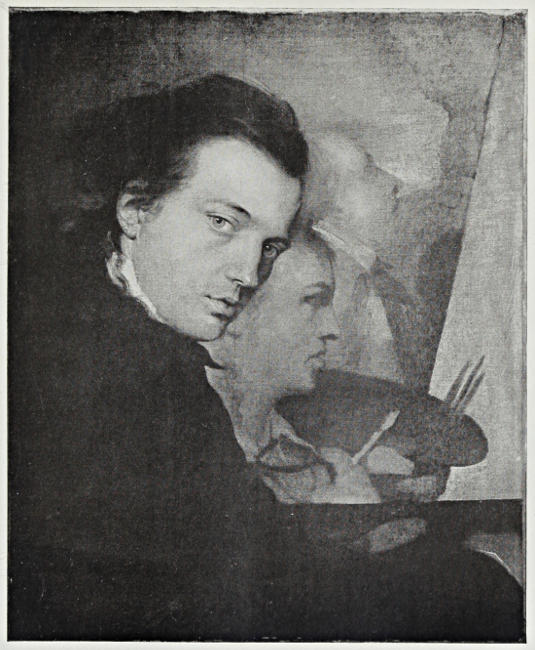
JAMES BARRY, R.A.
“I reflect with horror upon such a fellow as I am, and with such a kind of art, with house-rent to pay
and employers to look for.”
On the 4th of August this year, died at his mansion
in Rutland Square, Dublin, the Right Hon. James, Earl
of Charlemont,[287] who was born 18th of August, 1728.
This gentleman was truly a nobleman, for he was one of
the greatest patrons of the fine arts this country could
boast of. He was the great friend of Hogarth; bought
many of his pictures, particularly that most elegant
performance so justly celebrated under the title of “The
Lady’s Last Stake,” so admirably engraven by Mr.
Cheesman.[288] The following is a copy of an original letter
given to me by a late worthy friend; it is addressed to
the late Sir Lawrence Parsons, Bart.,[289] and written by
Lord Charlemont within eight months of his Lordship’s
death.
“Dublin, 12th Jan., 1799.
“My dear Sir Lawrence,—As nothing has ever
affected me with more painful astonishment than the
shameful apathy and consequent silence of the country
at the present desperate crisis of our fate as a nation,
so have I experienced few more real pleasures than in
having found, by the public papers, that a meeting
of your county, at least, has been called; a pleasure
which, though principally derived from my ardent
zeal for the public service, is still further increased
by my friendship for you, as I am too well acquainted
with your sentiments to doubt for a moment that such
call has been in the highest degree satisfactory and flattering
to your feelings. Neither can I entertain the slightest
apprehension that the result of any meeting of Irishmen
will be other than the firm and spirited condemnation
of a measure, replete with every disgrace and danger
in their country. Never, indeed, were my beloved
countrymen so forcibly called upon as at the present
emergency, maturely to form their opinions and to speak
aloud the dictates of their hearts. Their ancestors call
upon them from their graves to preserve those national
rights which they have transmitted to them. Their
children from their cradles, with mute but prevailing
eloquence, beseech them to protect and to defend their
birthrights; and, with a more awful voice, their country
calls upon them not by their silence to betray her dearest
interests, or by their supineness to leave her enslaved
whom they found free! Thus invoked, is it possible
that Irishmen should remain silent?
“But surely I need dwell no longer upon a subject
with which you are so much better acquainted; and,
indeed, the state of my health, and particularly of my
eyes, is such as to render it impossible for me to write
more.—I must therefore, however unwillingly, conclude
by assuring you that I am, and ever shall be, my dearest
Parsons, your most faithful and truly affectionate
“Charlemont.”
In this year, James Barry, the painter of those mighty
pictures on the walls of the great room of the Society
of Arts, received a severe blow by having his name erased
from those of the Royal Academicians by King George III.,
who believed what had been represented respecting the
Professor’s conduct in the Royal Academy.[290]
“Buckingham Street, Fitzroy Square.
“Dear Sir,—Permit me to thank you for the satisfaction
of having seen that curious monument of English antiquity,
St. Stephen’s Chapel, Westminster, when the ancient architecture
and painting were discovered by the removal
of the modern wainscot, which formed the interior of
the House of Commons.
“Notwithstanding this branch of antiquity has never
been my particular pursuit, I am highly gratified to see
such materials in the general history of art rescued from
oblivion by publication, for which, Sir, we are indebted
to your zeal and industry, as some of the interesting
pictures were effaced soon after their discovery, by ignorant
curiosity; in addition to the careless and ruinous manner
in which the discovery itself was made, of which circumstances
I complained to several persons on the spot,
particularly to the Rev. Mr. Brand,[291] Secretary to the
Antiquarian Society.
“As the best testimony I can give to the fidelity and
ability of your publication, give me leave to subscribe my
name for a copy of the work, and to offer such assistance
as I can give, in general observations on the arts of design,
when St. Stephen’s Chapel was in its splendour.
“I remain, dear Sir, with great regard, your much
obliged
“John Flaxman.”
The admission of one hundred additional members
into the House of Commons, arising from the union with
Ireland, obliged Mr. Wyatt to cut away the side-walls
of the room internally, in order to make recesses for two
extra benches.[292]
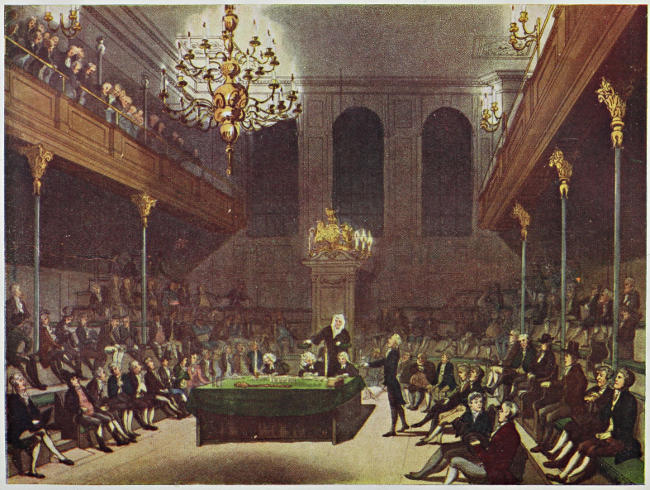
THE OLD HOUSE OF COMMONS
In the autumn of this year I passed a most agreeable
day with the Hon. Hussey Delaval,[293] at his house near
Parliament Stairs.[294] This learned and communicative
gentleman, among whose works that on Colours is generally
considered the most interesting, was as friendly to me,
as the jealousy of that well-known odd compound of
nature, my antagonist, John Carter,[295] who was of our
party, would allow; for with that artist’s opinions as to
Gothic architecture, Mr. Delaval so entirely coincided,
that he employed him to provide the ornamental decorations
of his house, which were mostly in putty mixed
with sand, and in some instances cast from the decorations
of several Gothic structures, particularly Westminster
Abbey. This house was originally fire-proof, the floors
being of stone or composition, and the window-sashes
of cast iron, but since the death of Mr. Delaval, wood
has been substituted for the sashes and other parts.
The apartments are ten in number, besides small
offices. The lower rooms consist of two halls: in the
north wall of the first are three pretty Gothic recesses
for seats, for servants or persons in waiting; the second
hall is filled with Gothic figures placed upon brackets
under canopies. The chimney-piece and other parts of
the dining-parlour looking over the Thames, are decorated
in a similar manner; the kitchen is on the same floor
towards the north. The staircase leading to the first-floor
is a truly tasteful little specimen, not equalled by
anything at Strawberry Hill, which, by reason of Mr.
Bentley’s[296] fancy mouldings interfering so often with
parts which are really chaste, must be considered a mule
building. The drawing-room and library also look over
the water. On the same floor are two bed-chambers
towards the west; above which are two attics, with a
door opening upon the embattled leads over the drawing-room.
Upon these leads we took our wine—attended
by female servants only, as Mr. Delaval never would
allow a man-servant to enter the house, but with messages—and
here enjoyed the glowing, Cuyp-like effect of the
sun upon west-country barges laden either with blocks
of stone or fresh-cut timber, objects ever picturesque
on the water. Mr. Delaval was so pleased with this
scenery, and the pencil of my friend G. Arnald, Associate
of the Royal Academy, that he bespoke two pictures
of him, Views up and down the River, the figures in which,
by the order of Mr. Delaval, were painted by his friend
G. F. Joseph, A.R.A. They were exhibited at Somerset
House.[297]
How often do we find peculiar attachments and propensities
in the minds of persons of reported good understanding.
Within my time, many men have indulged
most ridiculously in their eccentricities. I have known
one who had made a pretty large fortune in business, get
up at four o’clock in the morning and walk the streets to
pick up horseshoes which had been slipped in the course
of the night, with no other motive than to see how many
he could accumulate in a year. I also remember a rich
soap-boiler who never missed an opportunity of pocketing
nails, pieces of iron hoops, and bits of leather, in his daily
walks; and these he would spread upon a large walnut-tree
three-flapped dining-table, with a similar view to that of
the above-mentioned gentleman. This wealthy citizen
would often put on a red woollen cap, in shape like those
worn by slaughter-house men, and a waggoner’s frock,
in order to stoke his own furnace; after which, he would
dress, get into his coach, and, attended by tall servants
in bright blue liveries, drive to his villa, where his hungry
friends were waiting his arrival.
The allusion to these peculiarities, which certainly are
harmless, will serve by way of prelude to a more extraordinary
one. The late Duke of Roxburgh,[298] whose wonderful
library will ever be spoken of with the highest delight
by bibliomaniacs, had an attachment to the portraits of
malefactors as closely as Rowland Hill to his petted toad.
I made many drawings of such characters for his Grace
during their trials or confinement; that which I made this
year, was of Governor Wall, whose trial produced much
discussion.[299] Having been deprived of admission at the
Old Bailey on the day of his trial, I went to the Duke, and
he immediately wrote to a nobleman high in power, for an
order to admit me to see the unfortunate criminal in the
condemned cell, which application was firmly, and, in my
humble opinion, very properly, refused. I walked home,
where I found Isaac Solomon waiting to show me some
of his improved black-lead pencils. Isaac, upon hearing
me relate to my family the disappointment I had experienced,
assured me that he could procure me a sight of the
Governor, if I would only accompany him in the evening
to Hatton Garden, and smoke a pipe with Dr. Forde, the
Ordinary of Newgate,[300] with whom he said he was particularly
intimate. Away we trudged; and, upon entering
the club-room of a public-house, we found the said Doctor
most pompously seated in a superb masonic chair, under
a stately crimson canopy placed between the windows.
The room was clouded with smoke, whiffed to the ceiling,
which gave me a better idea of what I had heard of the
Black Hole of Calcutta than any place I had seen. There
were present at least a hundred associates of every denomination;
of this number, my Jew, being a favoured man,
was admitted to a whispering audience with the Doctor,
which soon produced my introduction to him.
“Man’s life is all a mist, and in the dark our fortunes
meet us.” Standing beneath a masonic lustre, the Doctor
immediately recognised me as a friend of John Ireland,
but more particularly of his older crony, Atkinson Bush;
he requested me to take a pipe, to me a most detestable
preliminary. He then whispered, “Meet me at the felon’s
door at the break of day.” There I punctually applied,
but, notwithstanding the order of the Doctor, I found it
absolutely necessary, to protect myself from an increasing
mob, to show the turnkey half-a-crown, who soon closed
his hand and let me in. I was then introduced to a most
diabolical-looking little wretch, denominated “the Yeoman
of the Halter,” Jack Ketch’s head man. The Doctor soon
arrived in his canonicals, and with his head as stiffly erect
as a sheriff’s coachman when he is going to Court, with an
enormous nosegay under his chin, gravely uttered, “Come
this way, Mr. Smith.”
As we crossed the Press-yard a cock crew; and the
solitary clanking of a restless chain was dreadfully horrible.
The prisoners had not risen. Upon our entering a stone-cold
room, a most sickly stench of green twigs, with which
an old round-shouldered, goggle-eyed man was endeavouring
to kindle a fire, annoyed me almost as much as the
canaster fumigation of the Doctor’s Hatton Garden
friends.
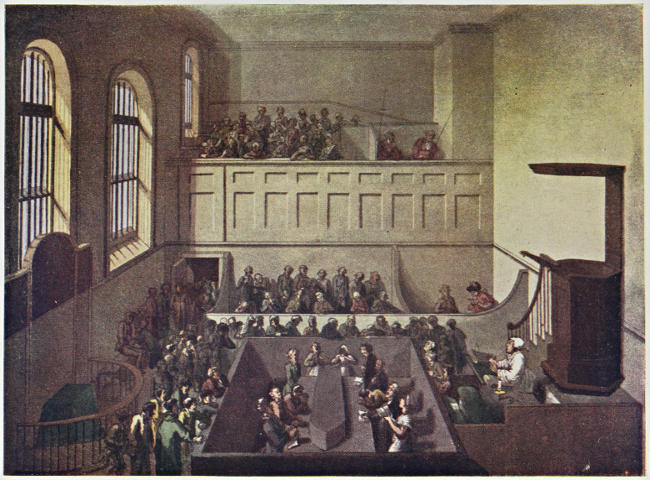
NEWGATE CHAPEL ON THE EVE OF SEVERAL EXECUTIONS
The prisoner entered. He was death’s counterfeit,
tall, shrivelled, and pale; and his soul shot so piercingly
through the port-holes of his head that the first glance of
him nearly petrified me. I said in my heart, putting my
pencil in my pocket, God forbid that I should disturb thy
last moments! His hands were clasped, and he was
truly penitent. After the Yeoman had requested him to
stand up, “he pinioned him,” as the Newgate phrase is,
and tied the cord with so little feeling, that the Governor,
who had not given the wretch the accustomed fee, observed,
“You have tied me very tight;” upon which Dr. Forde
ordered him to slacken the cord, which he did, but not
without muttering. “Thank you, Sir,” said the Governor
to the Doctor, “it is of little moment.” He then observed
to the attendant, who had brought in an immense iron
shovelful of coals to throw on the fire, “Ay, in one hour
that will be a blazing fire;” then, turning to the Doctor,
questioned him: “Do tell me, Sir: I am informed I shall
go down with great force; is it so?” After the construction
and action of the machine had been explained,
the Doctor questioned the Governor as to what kind of men
he had at Goree. “Sir,” he answered, “they sent me the
very riffraff.” The poor soul then joined the Doctor in
prayer; and never did I witness more contrition at any
condemned sermon than he then evinced.
The sheriff arrived, attended by his officers, to receive
the prisoner from the keeper. A new hat was then partly
flattened on his head; for, owing to its being too small in the
crown, it stood many inches too high behind. As we were
crossing the Press-yard, the dreadful execrations of some of
the felons so shook his frame, that he observed, “the clock
had struck;” and, quickening his pace, he soon arrived
at the room where the sheriff was to give a receipt for his
body, according to the usual custom. Owing, however, to
some informality in the wording of this receipt, he was not
brought out so soon as the multitude expected; and it was
this delay which occasioned a partial exultation from
those who betted as to a reprieve, and not from any pleasure
in seeing him executed. For the honour of England, I
may say we are not so revengeful as some of our Continental
neighbours have been; as Mrs. Cosway[301] assured me that
she was in the room with David, then esteemed the first
painter in Paris, at the time that he and Robespierre
were in power; and that when the Reporter, from the
guillotine, came in to announce eighty as the number of
persons executed that morning, David, in the greatest
possible rage, exclaimed, “No more!”
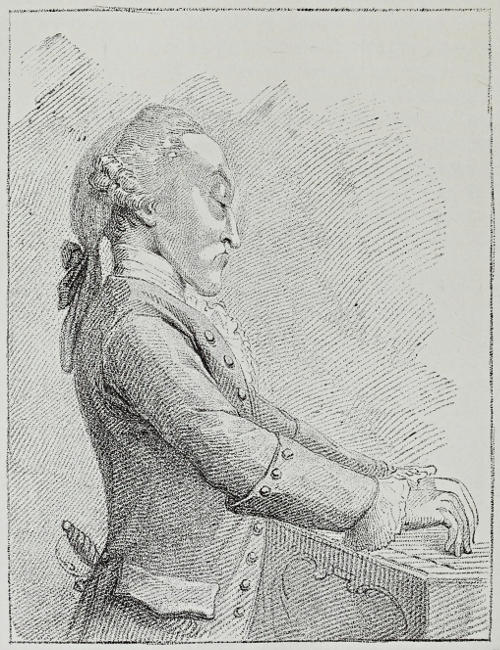
DR. ARNE
HE COMPOSED “RULE BRITANNIA”
After the execution, as soon as I was permitted to
leave the prison, I found the Yeoman selling the rope
with which the malefactor had been suspended, at a shilling
an inch; and no sooner had I entered Newgate Street,
than a lath of a fellow, past threescore years and ten,
who had just arrived from the purlieus of Black Boy
Alley,[302] woe-begone as Romeo’s apothecary, exclaimed,—“Here’s
the identical rope at sixpence an inch.” A
group of tatterdemalions soon collected round him, most
vehemently expressing their eagerness to possess bits of
the cord. It was pretty obvious, however, that the real
business of this agent was to induce the Epping butter-men
to squeeze in with their canvas bags, which contained
their morning receipts in Newgate market.[303] A
little further on, at the north-east corner of Warwick
Lane, stood “Rosy Emma,” exuberant in talk, and
hissing-hot from Pie Corner,[304] where she had taken her
morning dose of gin and bitters; and as she had not waited
to make her toilet, was consequently a lump of heat.
“Now, my readers, I have been told,
Love wounds by heat, and Death by cold;
Of size she would a barrow fill,
But more inclining to sit still.”
Possibly she might have been a descendant of Orator
Henley, and I make no doubt at one time passionately
admired by her Henry. I can safely declare, however,
that her cheeks were purple, her nose of poppy-red or
cochineal.
“The lady was pretty well in case,
But then she’d humour in her face;
Her skin was so bepimpled o’er,
There was not room for any more.”
Her eyes reminded me of Sheridan’s remark on those
of Dr. Arne, “Like two oysters on an oval plate of stewed
beet-root.”[305] I regretted most exceedingly, while she
was cutting her rope and twisting her mouth, that most
of her once-famed ivories had absconded; but it gave
me inexpressible delight to see that her lips were not at
all chapped. If Emma’s lips had been ever so deeply
cracked, she could not have benefited by my friend
“Social Day” Coxe’s[306] Conservatoria, as it was not then
sold.
Emma in her tender blossom, I understand, assisted
her mother in selling rice-milk and furmety to the early
frequenters of Honey Lane market; and in the days of
her full bloom, new-milk whey in White Conduit Fields,
and at the Elephant and Castle. She must have been,
as to her outward charms, during her highest flattery,
little inferior to the beautiful Emma Lyon;[307] but in her
last stage, perhaps not altogether unlike the heroine so
voluptuously portrayed by my late highly talented friend,
the Rev. George Huddesford, in his poem entitled “The
Barber’s Nuptials.”[308] Rosy Emma, for so she was still
called, was the reputed spouse of the Yeoman of the
Halter, and the cord she was selling as the identical noose
was for her own benefit. This was, according to the
delightful writer, Charles Lamb,
“For honest ends, a most dishonest seeming.”
[309]
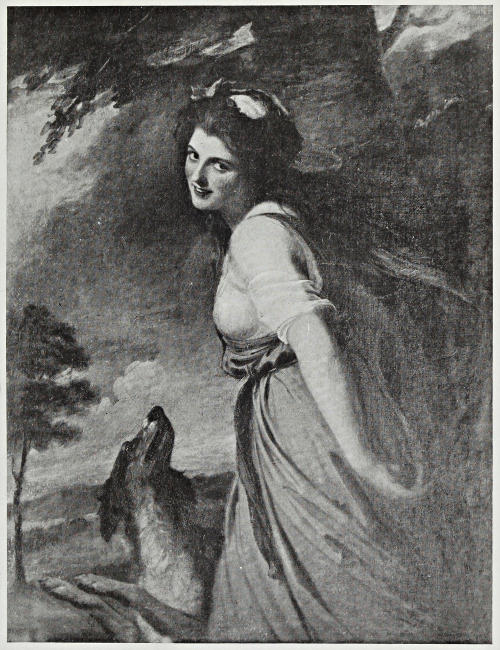
LADY HAMILTON AS A BACCHANTE
“Romney! expert infallibly to trace …
The mind’s impression too on every face.”
Cowper
Now, as fame and beauty ever carry influence, Emma’s
sale was rapid; had she been as lamentable as a Lincolnshire
goose after plucking-time, “Misery’s Darling,” or
like Alecto when at the entrance of Pandemonium, she
would have had a sorry sale.[310] This money-trapping
trick, steady John, the waiter at the Chapter Coffee-house,
assured me was invariably put in practice whenever
superior persons or notorious culprits had been executed.
Then to breakfast, but with little or no appetite; however,
after selecting one of Isaac Solomon’s H.B.’s, I
made a whole-length portrait of the late Governor by
recollection, which Dr. Buchan, the flying physician of
the “Chapter”[311] frequenters, and several of the Pater-Noster
vendors of his Domestic Medicine, considered a
likeness; at all events, it was admitted into the portfolio
of the Duke, with the following acknowledgment
written on the back: “Drawn by memory.”
About this time, in order to see human nature off
her guard, I agreed with a good-tempered friend of mine,
one of Richard Wilson’s scholars, to perambulate Bartholomew
Fair, which we did in the evening, after taking
pretty good care to leave our watches at home. Our
first visit was to a show of wild beasts, where, upon paying
an additional penny, we saw the menagerie-feeder place his
head within a lion’s mouth.
Our attention was then arrested by an immense baboon,
called General Jacko, who was distributing his signatures
as fast as he could dip his pen in the ink, to those who
enabled him to fill his enormous craw with plums, raisins,
and figs. The next object which attracted our notice
was a magnificent man, standing, as we were told, six
feet six inches and a half, independent of the heels of
his shoes. The gorgeous splendour of his Oriental dress
was rendered more conspicuous by an immense plume
of white feathers, which were like the noddings of an
undertaker’s horse, increased in their wavy and graceful
motion by the movements of the wearer’s head.
As this extraordinary man was to perform some
wonderful feats of strength, we joined the motley throng
of spectators at the charge of “only threepence each,”
that being vociferated by Flockton’s[312] successor as the
price of the evening admittance.
After he had gone through his various exhibitions
of holding great weights at arm’s-length, etc., the all-bespangled
master of the show stepped forward, and
stated to the audience that if any four or five of the present
company would give, by way of encouraging the “Young
Hercules,” alias the “Patagonian Samson,” sixpence
apiece, he would carry them all together round the booth,
in the form of a pyramid.
With this proposition my companion and myself
closed; and after two other persons had advanced, the
fine fellow threw off his velvet cap surmounted by its
princely crest, stripped himself of his other gewgaws,
and walked most majestically, in a flesh-coloured elastic
dress, to the centre of the amphitheatre, when four chairs
were placed round him, by which my friend and I ascended,
and, after throwing our legs across his lusty shoulders,
were further requested to embrace each other, which
we no sooner did, cheek-by-jowl, than a tall skeleton of
a man, instead of standing upon a small wooden ledge
fastened to Samson’s girdle, in an instant leaped on his
back, with the agility of a boy who pitches himself upon
a post too high to clear, and threw a leg over each of
our shoulders; as for the other chap (for we could
only muster four), the Patagonian took him up in
his arms. Then, after Mr. Merryman had removed
the chairs, as he had not his full complement, Samson
performed his task with an ease of step most stately,
without either the beat of a drum, or the waving of
a flag.
I have often thought that if George Cruikshank, or my
older friend Rowlandson, had been present at this scene
of a pyramid burlesqued, their playful pencils would have
been in running motion, and I should have been considerably
out-distanced had I then offered the following additional
description of our clustered appearance. Picture
to yourself, reader, two cheesemonger, ruddy-looking men,
like my friend and myself, as the sidesmen of Hercules,
and the tall, vegetable-eating scarecrow kind of fellow,
who made but one leap to grasp us like the bird-killing
spider, and then our fourth loving associate, the heavy
dumpling in front, whose chaps, I will answer for it, relished
many an inch thick steak from the once far-famed Honey
Lane market,[313] all supported with the greatest ease by this
envied and caressed Pride of the Fair, to whose powers
the frequenters of Sadler’s Wells also bore many a testimony.
In the year 1804, Antonio Benedictus Van Assen
engraved a whole-length portrait of this Patagonian
Samson, at the foot of which his name was thus announced,
“Giovanni Baptista Belzoni.” This animated production
was executed at the expense of the friendly Mr. James
Parry, the justly celebrated gem and seal engraver, of
Wells Street, Oxford Street.
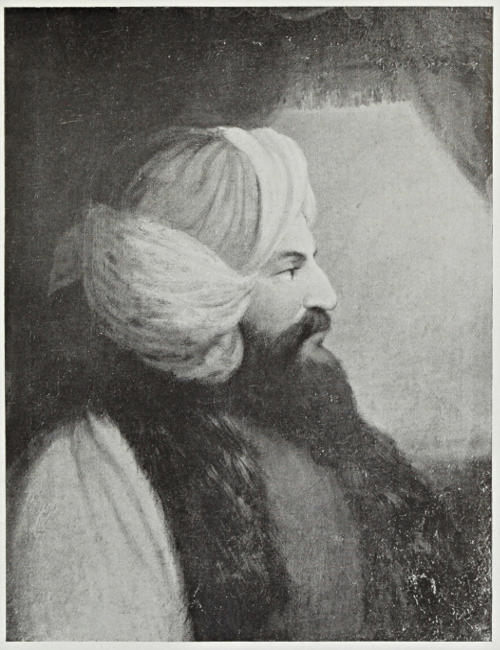
GIOVANNI BAPTISTA BELZONI
“Belzoni is a grand traveller, and his English is very prettily broken.”
Lord Byron
After the close of Bartholomew Fair, this Patagonian
was seen at that of Edmonton, exhibiting in a field behind
the Bell Inn, immortalised by Cowper in his “Johnny
Gilpin;” and I have been assured that, so late as 1810, at
Edinburgh, he was, during his exhibition in Valentine and
Orson, soundly hissed for not handling his friend the bear,
at the time of her death, in an affectionate manner. Several
years rolled on, and he was nearly forgotten in England,
until the year 1820, and then many people recognised in
the Egyptian traveller Belzoni the person who had figured
away at fairs, as I have stated. The following anecdotes,
in private circulation, of this extraordinary man may not
be considered wholly uninteresting.
He was a native of Padua, and educated in order to
become a profound monk; but, during the frenzy of war,
being noticed by the French army, in consequence of his
commanding figure, to be admirably well calculated for a
fugleman, prudently avoided seizure for so deadly a service,
by getting together what few things time would permit
him, and so left Rome. I should have stated to the reader
that, upon his arrival in London in the year 1803, he
walked into Smithfield during Bartholomew Fair time,
where he was seen by the master of a show, who, it is
said, thus questioned his Merry Andrew:—“Do you see
that tall-looking fellow in the midst of the crowd? he is
looking about him over the heads of the people as if he
walked upon stilts; go and see if he’s worth our money,
and ask him if he wants a job.” Away scrambled Mr.
Merryman down the monkey’s post, and, “as quick as
lightning,” conducted the stranger to his master, who, being
satisfied of his personal attractions, immediately engaged,
plumed, painted, and put him up.
The reader will readily conceive that a man like Belzoni,
seriously educated for the duties of the Church, and accustomed
to associate with people of good manners, could
with no little reluctance endure the vulgar society his
pecuniary circumstances alone compelled him to associate
with. However, after the expiration of nine years, in
the course of which time he had married and saved
money, he and his wife were enabled to visit Portugal,
Spain, and Malta, from which place they embarked for
Egypt. Fortunately for Belzoni, the wife he had chosen
more than equally shared his numerous dangers, by
spiritedly joining in all his enterprises, which some of
my readers will recollect are most delightfully described
by herself in what she styles “A Trifling Account,”
printed at the end of her husband’s Travels in Egypt,
Nubia, etc.[314]
As most of my readers have perused this work, I shall
only state that, shortly after the arrival of Belzoni and his
wife in England, my friend Dr. Richardson,[315] the traveller,
who had been kind to them in every possible way when in
Egypt, introduced me to them when they lodged in Downing
Street, Westminster. Here I not only had great pleasure
in seeing my steady supporter again, but enjoyed most
pleasantly the conversation I had with his enterprising
partner, whose sensible and intrepid cast of features well
accorded with her artless, unsophisticated, and interesting
“Trifling Account,” to which I have alluded.
In 1784, when Sir Ashton Lever petitioned the House
of Commons for a lottery for his museum, Mr. Thomas
Waring made the following declaration before the Committee
to whom the petition was referred:—“That he had been
manager of Sir Ashton’s collection ever since it had been
brought to London in the year 1775; that it had occupied
twelve years in forming; and that there were upwards
of twenty-six thousand articles. That the money received
for admission amounted, from February 1775 to February
1784, to about £13,000, out of which £660 had been paid
for house-rent and taxes.” Sir Ashton Lever proposed
that his whole museum should go together, and that there
should be 40,000 tickets at one guinea each.[316]
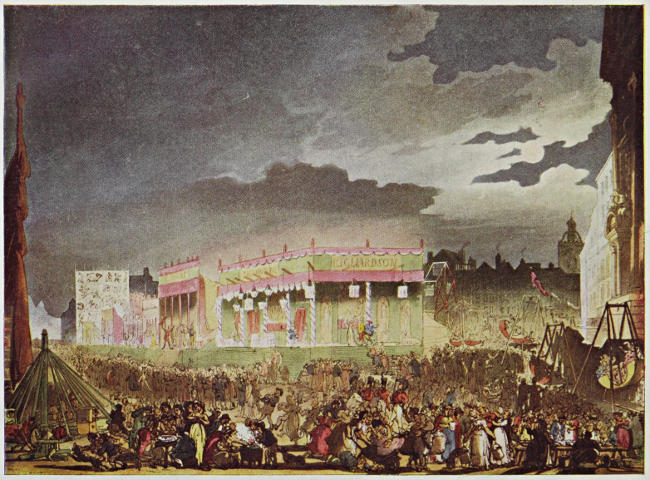
BARTHOLOMEW FAIR
Few people would believe that so lately as this year,
the Duke of Dorset, Lord Winchilsea, Lord Talbot, Colonel
Tarleton, Mr. Howe, Mr. Damer, Hon. Mr. Lennox, and the
Rev. Mr. Williams played at cricket in an open field
near White Conduit House.[317] Who could have conjectured
that Du Val’s Lane, branching from Holloway, within
memory so notoriously infested with highwaymen that
few people would venture to peep into it even in mid-day,
should, in 1831, be lighted with gas?[318]
In 1784, Nathaniel Hillier’s[319] collection of prints was
sold by Christie: they were well selected as to impression,
but much deteriorated in value by Mr. Hillier’s attachment
to strong coffee, with which he had stained them.
It has been acknowledged by one of the family that, what
with the expense of staining, mounting, and ruling, his
collection only brought them one-fifth of the cost of the
prints in the first instance.
Dr. Samuel Johnson also died this year [1784]; during
the time the surgeon was engaged in opening his body, Sir
John Hawkins, Knight, was in the adjoining room seeing
to the weighing of the Doctor’s tea-pot, in the presence
of a silversmith, whom Sir John, as an executor, had called
upon to purchase it.[320]
“Mr. Townley presents his compliments to Mr. West,
and requests that, when he sees Mr. Lock[321] at his house,
he will be so good as to deliver to him the packet sent
herewith, containing two prints from Homer’s head,—Mr.
T. not knowing where Mr. Lock lives in town. The
drawing representing the ‘Triumphs of Bacchus’ by
Rubens,[322] in the eighth night’s sale at Greenwood’s, differing
much from the bas-relief in the Borghese Villa, from
which Caracci is supposed to have composed his picture
of that subject in the Farnese Gallery,[323] Mr. T. has no
intention to bid for it.
“Park St., Westminster, 21st Feb. 1787.”
“My dear Sir,—I return you many thanks for your
kind information respecting the sale of the marbles at
the late Lord Mendip’s house at Twickenham.[324] Had I
been there and in spirits, the fine Oriental alabaster
vase would not have been sold so cheap, and would
probably have come to Park Street. I should also have
probably purchased the medallion of an elderly man
over a chimney-piece. I shall be glad to find out who
bought it, and at what price. I should also have liked
the ancient fountain. Pray, what was it sold for, and
who bought it?
“I mean to take a farewell look at the robaccia at
Wilton, to verify my former notes on that collection.
“I flatter myself that many bad symptoms of my
long disorder begin to abate, though it still, I feel, has
strong hold upon me. I shall remain here about a fortnight
longer, then return to Park Street.
“If you will give me the pleasure of a line from you,
you may direct to me, No. 36, Milsom Street, Bath. I am,
sir, ever most faithfully yours, etc.
“C. Townley.
“Bath, 36, Milsom Street, 11th June 1802.”
In the month of June this year, the late Atkinson
Bush,[325] then of Great Ormond Street, brought to my
house Mr. Parton, vestry-clerk of St. Giles’s-in-the-Fields,
with a view to obtain such particulars of that parish
as I was acquainted with, he being then busily engaged
in collecting materials for its history. In the course
of conversation, I was astonished to find that it was his
intention to have a plan of the parish engraved for his
work, purporting to have been taken between the years
twelve and thirteen hundred, a period more than two
centuries and a half earlier than Aggas’s plan of London,
and from which I could not help observing that in my
opinion he had most glaringly borrowed. When he
assured me he had not, my request was then to know
his authority for producing such a plan, but for that
question he was not provided with an answer, nor did
he appear to be willing to be probed by further interrogatories.
To my great astonishment, when Mr. Parton’s
book made its appearance, I not only found this plan
professing to be between the years twelve and thirteen
hundred so minutely made out, with every man’s possession
in the parish most distinctly attributed, but every
plot of garden so neatly delineated, with the greatest
variety of parterres, walks with cut borders, as if the
gardener of William III. or Queen Anne had then been
living. As Mr. Parton omitted to give any authority
for the introduction of so wonderfully early a piece of
ichnography, I applied to several leading men in the parish
of St. Giles, but could gain no intelligence whatever respecting
it: so much for this plan of St. Giles’s parish,
as produced by Mr. Parton.[326]
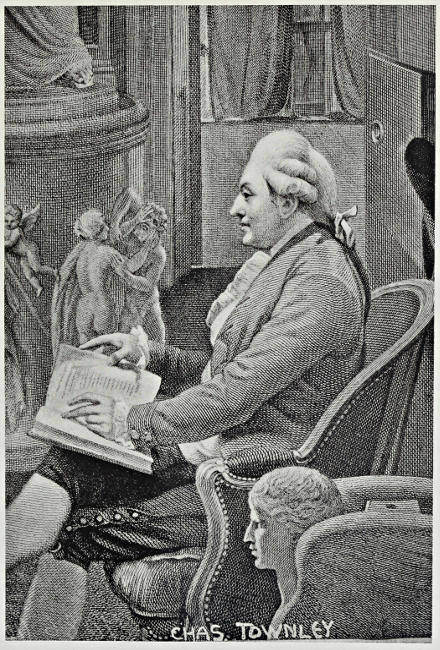
“The Townley Marbles.”
On the 7th of November of this year, aged 65, died
at Rome the celebrated Angelica Kauffmann, who was
appointed a member of the Royal Academy by King
George III. at its foundation.[327] That she was a great
favourite with the admirers of art may be inferred by
the numerous engravings from her productions by Bartolozzi
and the late William Wynn Ryland.[328] Her pictures
are always tasteful, and often well composed, clearly and
harmoniously coloured, and extremely finished with a
most delicate but spirited pencil. Indeed, her talents
were so approved by her brother Academicians, that
those gentlemen allotted her compartments of the ceiling
in their council-chamber at Somerset Place for decoration,
in which most honourable and pleasing task she so well
acquitted herself, that her performances are the admiration
of every visitor, but more particularly those who possess the
organ of colour. She etched numerous subjects; the best
impressions are those before the plates were aqua-tinted.
When I was a boy, my father frequently took me to
Golden Square to see her pictures, where she and her
father had for many years resided in the centre house on
the south side. There are several portraits of her, but
none so well-looking as that painted by Sir Joshua Reynolds,
of which there is an engraving by Bartolozzi.
Angelica Kauffmann was a great coquette, and pretended
to be in love with several gentlemen at the same
time.[329] Once she professed to be enamoured of Nathaniel
Dance;[330] to the next visitor she would divulge the great
secret that she was dying for Sir Joshua Reynolds. However,
she was at last rightly served for her duplicity by
marrying a very handsome fellow personating Count de
Horn. With this alliance she was so pleased, that she
made her happy conquest known to her Majesty Queen
Charlotte, who was much astonished that the Count should
have been so long in England without coming to Court.
However, the real Count’s arrival was some time afterwards
announced at Dover; and Angelica Kauffmann’s
husband turned out to be no other than his valet de chambre.
He was prevailed upon subsequently to accept a separate
maintenance.[331] After this man’s death she married Zucchi,
and settled in Rome. During her residence there, she
was solicited by the artists in general, but more particularly
by the English, to join them in an application to
this country for permission to bring their property to
England duty free; and as I possess the original letter
which that lady wrote to Lord Camelford[332] upon the
subject, I cannot refrain from inserting it.
“My Lord,—I do not know, if by having lived several
years in England, and having the honour to be a R.A., I
may be sufficiently entitled to join with the artists of Great
Britain in their request, or better to say, in returning thanks
to your Lordship for patronising them in a point so very
essential, which is to assist them in obtaining the free
importation of their own studies, models, or designs,
collected for their improvement during their own stay
abroad.
“The heavy duty set upon articles of that nature
causes that the artist, whose circumstances do not permit
him to pay perhaps a considerable sum, must either be
deprived of what he keeps most valuable, or buy his own
works at the public sale at the Custom House. This I
have myself experienced on my coming to England,—and
I mention it here, in consequence of the opinion of
some of my friends, who think that my assertion, added
to what other artists may have reported to that purpose,
may be of some use to obtain their object.
“I heard from Dr. Bates,[333] and Mr. Reveley,[334] the
architect, how very much your Lordship is inclined to
support the earnest supplication drawn up by some of
the artists, which proves your Lordship to be a protector
of the fine arts, and of those who profess them. Consequently
I have some reason to hope that I may not be
judged too impertinent for addressing these lines to you.
I have the honour to be, with the greatest respect, my
Lord, your Lordship’s most obliged humble servant,
“Angelica Kauffmann.
“Trinità de’ Monti, the 26th Dec. 1787.”
This year, my laborious work, entitled Antiquities of
Westminster, was delivered to its numerous and patient
subscribers.[335] The following congratulatory letter is one
of the many with which I have been honoured by its
extensive and steady friends:—
“Lichfield Cathedral Close, Thursday, 2nd July 1807.
“Mr. White[336] presents his best respects to Mr. Smith.
His precious little box, from some unaccountable delay
in Cambridge, did not arrive till yesterday evening, accompanied
by a letter, which receives this early acknowledgment.
Though Mr. White has not had leisure to inspect
critically the literary portion of Mr. Smith’s elegant and
splendid volume, yet his whole time since it came has
been occupied in studying and admiring its numerous,
accurate, and highly finished engravings, which alone
give it a superiority to any book of art’s illustration which
Mr. White can at present recollect. Mr. Smith’s offer of
a few loose prints is peculiarly kind and acceptable; and
Mr. White so far avails himself of it.
“Mr. White cannot refrain expressing his concern and
astonishment, that Mr. Smith should have experienced so
bitter a recession from friendly promises and assistance,
as Mr. H. obliged him to feel; at the same time, the candid
and unequivocal statement which Mr. Smith has made,
must exonerate him from the world’s reproof, and account
for the long protraction of the work. Mr. White cannot
but indulge the hope, that so noble an addition to our
architectural antiquities, so admirable an elucidation of
every precedent history of London, will most amply remunerate
the pocket, though no success can recompense
that anxiety of mind which Mr. Smith has undergone. The
beautiful Cathedral of Lichfield has been recently ornamented
with some very fine ancient painted windows,
from the dissolved convent near Lille. If Mr. Smith
would publish them in colours, Mr. White thinks that
the subscription would fill rapidly; and if Mr. Smith
would but come down and look at them, Mr. White
would be happy in extending every accommodation, and
rendering every assistance to him. When the windows
are known, the plan will be certainly adopted by other
artists of inferior competency.”
On the first of November this year, George Dance, the
Royal Academician, signed the dedication page of his first
volume of portraits of eminent men drawn in pencil, with
parts touched lightly with colour from life, and engraved
by William Daniell, A.R.A., now a Royal Academician (he
died 1837), consisting of thirty-six in number. The second
volume, which also contained thirty-six in number, was
published in 1814.[337]
Fuseli, when viewing several of these portraits, was
heard by one of Mr. Dance’s sitters to make the following
observations upon the likenesses. Of Benjamin West he
said, “His eye is like a vessel in the South Sea,—I can
just spy it through the telescope;” of that of Joseph
Wilton the sculptor, he observed, “How simple are the
thinking parts of this man’s head, and how sumptuous
the manducatory;” of that of James Barry he made
the following declaration, “This fellow looks like the door
of his own house;” of that of Northcote he exclaimed,
“By Cot, he is looking sharp for a rat;” and of that
of Sir William Chambers, he observed, drawling out his
words, “What a grate, heavy, humpty-dumpty, this leaden
fellow is.”[338]
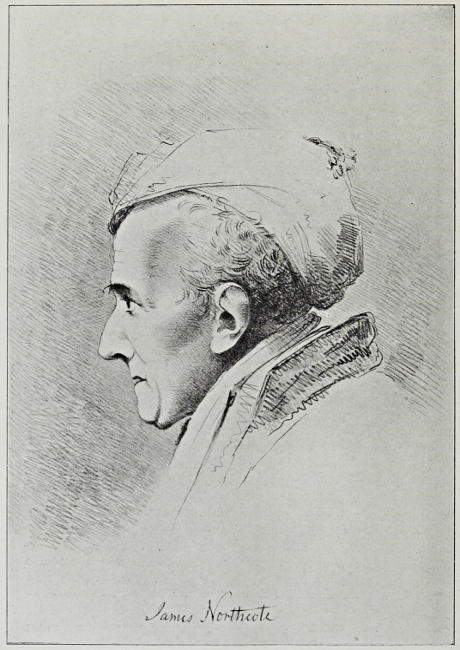
JAMES NORTHCOTE, R.A.
“By Cot, he is looking out sharp for a rat.”
Fuseli
In this sort of wit Fuseli had a formidable force of
gunnery, and his shot seldom missed its destination;
however, it cannot shatter the above work, as most of the
portraits are of worthies too well known even to need it
necessary to engrave their names under them.
The greater portion of these likenesses are highly
valuable to the illustrators of Boswell’s Life of Johnson,
and, indeed, most of the modern biographical publications.
I cannot more pleasantly close this year than by inserting
a copy of one of John Bannister’s bills for his Budget;[339]
and as the original is now an extreme rarity, I conclude
that some of those “gude folks” who witnessed the delightful
humour displayed by that gifted son of Thespis, may
possibly be better enabled to recollect how much they
giggled twenty-three years ago.
“Oh the days when I was young!”
The type of the long lines in the original bill, which is
of a small folio size, being too small to be read without
spectacles, I have necessarily, in some instances, been
obliged to increase the number of lines in the following
copy.
“THEATRE, IPSWICH.
POSITIVELY FOR ONE NIGHT ONLY.
Patronised by their Majesties,
Before whom Mr. Bannister had the honour of performing,
At the Queen’s House, Frogmore.
The Public are most respectfully informed,
On Wednesday, the 29th of November, 1809,
Will be presented,
A Miscellaneous Divertisement,
With considerable vocal and rhetorical variations, called
BANNISTER’S BUDGET;
Or, An Actor’s Ways and Means!
Consisting of
Recitations and Comic Songs;
Which will be sung and spoken by
Mr. Bannister, of the late Theatre Royal, Drury Lane.
“The above Divertisement is entirely new; the prose and
verse which compose it having been written expressly for the occasion
of Mr. Bannister’s Tour, by Messrs. Colman, Reynolds, Cherry,
T. Dibdin, C. Dibdin, Jun., and others.
The whole of the Entertainment has been arranged and revised
by Mr. Colman.
The songs (which Mr. Reeve, Jun., will accompany on the pianoforte,)
are principally composed by Mr. Reeve.
Prospectus of the Divertisement.
“Part I.—Exordium.—Mr. Bannister’s Interview with Garrick.—Garrick’s
Manner attempted by Mr. Bannister in a Shaving
Dialogue.—Mr. Doublelungs in the Clay-pit.—Macklin’s advice to
his Pupils.—The Ship’s Chaplain, and Jack Haulyard, the Boatswain;
or, Two Ways of Telling a Story.—Sam Stern.—The Melodramaniac,
or Value of Vocal Talent.—Mr. and Mrs. O’Blunder,
or, Irish Suicide!
“Part II.—Superannuated Sexton.—Original Anecdotes of a
late well-known eccentric Character.—Trial at the Old Bailey.—Cross-Examination.—Counsellor
Garble.—Barrister Snip-snap.—Serjeant
Splitbrain.—Address to the Jury.—Simon Soaker, and
Deputy Dragon.
“Part III.—Club of Queer Fellows!—President Hosier.—Speech
from the Chair.—Mr. Hesitate.—Mr. Sawney Mac Snip.—Musical
Poulterer.—Duet between a Game Cock and a Dorking
Hen.—Mr. Molasses.—Mr. Mimé.—Monotony exemplified.—Mr.
Kill-joy, the Whistling Orator.—Susan and Strephon.—Budget
closed.
Rotation of Comic Songs to be introduced on this particular occasion.
“IN PART I.
- Vocal Medley.
- Captain Wattle and Miss Roe (by particular desire).
- Tom Tuck’s Ghost.
- Song in Praise of Ugliness!
- The Debating Society.
“IN PART II.
- The Deserter; or, Death or Matrimony.
- Miss Wrinkle and Mr. Grizzle,
- and
- The Tortoiseshell Tom Cat.
“IN PART III.
- THE TRAGEDY OF OTHELLO; or, Fine Fleecy Hosiery.
- The Marrow-fat Family.
- Jollity Burlesqued, and
- Beggars and Ballad-singers.
The doors to be opened at six o’clock, and to begin precisely at seven.
Boxes, Upper Circle, 4s.; Lower Circle, 3s.; Pit, 2s.,
Gallery, 1s.
N.B. Care has been taken to have the Theatre well aired.”
My reader will find by the following copy of a paper
written by the Rev. Stephen Weston, B.D.,[340] and read at
the Society of Antiquaries’ meeting, 25th January 1810,
that the term Swan-hopping is to be considered a popular
error.
“It appears in the Swan-rolls, exhibited by the Right
Honourable Sir Joseph Banks, that the King’s were doubly
marked, and had what was called two nicks, or notches.
The term, in process of time, not being understood, a
double animal was invented, unknown to the Egyptians
and Greeks, with the name of the Swan with Two Necks.
But this is not the only ludicrous mistake that has arisen
out of the subject, since Swan-upping, or the taking up
of Swans, performed annually by the Swan companies,
with the Lord Mayor of London at their head, for the
purpose of marking them, has been changed by an unlucky
aspirate into Swan-hopping, which is not to the purpose,
and perfectly unintelligible.”[341]
In the summer of this year, the Earl of Pembroke
allowed me to copy a picture at Wilton, painted by the
celebrated architect, Inigo Jones. It is a view of Covent
Garden in its original state, when there was a tree in the
middle. The skill with which he has treated the effect
is admirable.
There is also, in that superb mansion, a companion
picture of Lincoln’s Inn Fields by the same artist.
The political career of John Horne Tooke, Esq., is well
known, and the fame of his celebrated work, entitled the
Diversions of Purley, will be spoken of as long as paper
lasts.
In the year 1811 a most flagrant depredation was
committed in his house at Wimbledon by a collector of
taxes, who daringly carried away a silver tea and sugar
caddy, the value of which amounted, in weight of silver,
to at least twenty times more than the sum demanded,
for a tax which Mr. Tooke declared he never would pay.
This gave rise to the following letter:—
“TO MESSRS. CROFT AND DILKE.
“Gentlemen,—I beg it as a favour of you, that you
will go in my name to Mr. Judkin, attorney, in Clifford’s
Inn, and desire him to go with you both to the Under
Sheriff’s Office, in New Inn, Wych Street.
“I have had a distress served upon me for taxes, at
Wimbledon, in the county of Surrey.
“By the recommendation of Mr. Stuart, of Putney,
I desire Mr. Judkin to act as my attorney in replevying
the goods; and I desire Mr. Croft and Mr. Dilke to sign
the security-bond for me that I will try the question.
“Pray show this memorandum to Mr. Judkin.
“John Horne Tooke.
“Wimbledon, May 17th, 1811.”
As Mr. Croft and Mr. Dilke were proceeding on the
Putney Road, they met the tax-collector with the tea-caddy
under his arm, on his way back with the greatest
possible haste to return it, with an apology to Mr. Tooke,—that
being the advice of a friend. The two gentlemen
returned with him, and witnessed Mr. Tooke’s kindness
when the man declared he had a large family.[342]
On the 18th of March this year (1812), Mr. Tooke died,
at his house at Wimbledon. He was put into a strong
elm shell. The coffin was made from the heart of a solid
oak, cut down for the purpose. It measured six feet
one inch in length; in breadth at the shoulders, two feet
two inches; the depth at the head, two feet six inches;
and the depth at the feet, two feet four inches. This
enormous depth of coffin was absolutely necessary, in
consequence of the contraction of his body. His remains
were conveyed in a hearse and six, to Ealing, in Middlesex,
attended by three mourning coaches with four horses to
each. It was Mr. Tooke’s wish to have been buried in
his own ground; but to this the executors very properly
made an objection.[343]
At the sale of the effects of the Rev. William Huntington
(vulgarly called the “Coal-heaver”), which commenced
on the 22nd of September, and continued for
three following days, at his late residence, Hermes Hill,
Pentonville, one of his steady followers purchased a barrel
of ale, which had been brewed for Christmas, because he
would have something to remember him by.[344]
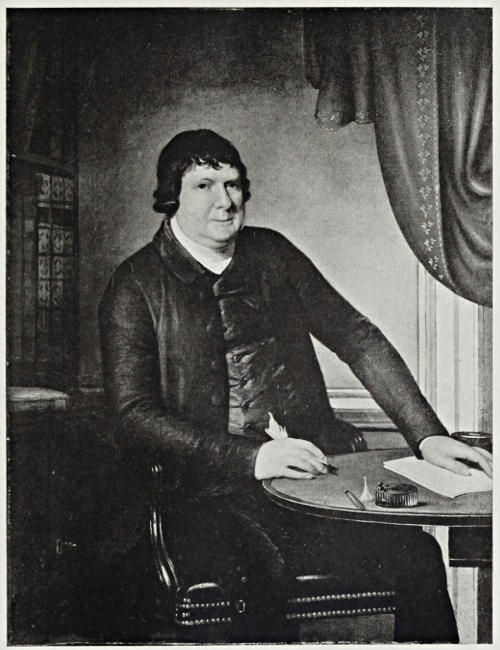
WILLIAM HUNTINGTON (S.S.)
“I cannot get D.D. for want of cash, therefore I am compelled to fly to S.S.,
by which I mean Sinner Saved.”
Mr. John Nixon, of Basinghall Street, gave me the
following information respecting the Beefsteak Club. Mr.
Nixon, as Secretary, had possession of the original book.
Lambert’s Club was first held in Covent Garden Theatre,
in the upper room, called the “Thunder and Lightning;”
then in one even with the two-shilling gallery; next in
an apartment even with the boxes; and afterwards in
a lower room, where they remained until the fire. After
that time, Mr. Harris insisted upon it, as the playhouse
was a new building, that the Club should not be held there.
They then went to the Bedford Coffee-house next door.
Upon the ceiling of the dining-room they placed Lambert’s
original gridiron, which had been saved from the fire. They
had a kitchen, a cook, and a wine-cellar, etc., entirely
independent of the Bedford Coffee-house. When the
Lyceum, in the Strand, was rebuilt, Mr. Arnold fitted up
a room for the Beefsteak Club, where it remained until the
late fire.
The society held at Robins’s room was called the “Ad
Libitum” Society, of which Mr. Nixon had the books;
but it was a totally different society, quite unconnected
with the Beefsteak Club.[345]
One of the biographers of Mrs. Abington, the first
actress who played the part of Lady Teazle in the School
for Scandal, and so justly celebrated in characters of ladies
in high life, states that she died on the 1st of March 1815,
in her 84th year. Another informs us that she died on
the 4th; but neither of the writers say where she died,
or where she was buried; on inquiry, I found that she
died at Pall Mall.[346] Of all the theatrical ungovernable
ladies under Mr. Garrick’s management, Mrs. Abington,
with her capriciousness, inconsistency, injustice, and unkindness,
perplexed him the most. She was not unlike
the miller’s mare, for ever looking for a white stone to shy
at. And though no one has charged her with malignant
mischief, she was never more delighted than when in a
state of hostility, often arising from most trivial circumstances,
discovered in mazes of her own ingenious construction.[347]
Mrs. Abington, in order to keep up her card-parties,
of which she was very fond, and which were attended by
many ladies of the highest rank, absented herself from
her abode to live incog. For this purpose she generally
took a small lodging in one of the passages leading from
Stafford Row, Pimlico,[348] where plants are so placed at the
windows as nearly to shut out the light, at all events,
to render the apartments impervious to the inquisitive
eye of such characters as Liston represented in Paul Pry.
Now and then she would take the small house at the end
of Mount Street, and there live with her servant in the
kitchen, till it was time to reappear; and then some of
her friends would compliment her on the effects of her
summer’s excursion.
“Adelphi, November 9.
“Mr. Garrick’s compliments to Mrs. Abington, and
has sent her on the other side a little alteration (if she
approves it, not else) of the epilogue, where there seems
to be a patch: it should, he believes, run thus:—
“Such a persecution!
’Tis the great blemish of the constitution!
No human laws should Nature’s rights abridge,
Freedom of speech, our dearest privilege;
Ours is the wiser sex, though deemed the weaker,
I’ll put the Question, if you’ll cheer me, Speaker.
“Suppose me now bewig’d, etc.
[349]
“Mrs. A. is at full liberty to adopt this alteration or
not. Had not our house overflowed last night in a quarter
of an hour, from the opening of Covent Garden had suffered
much. As it was, there was great room in the pit and
gallery at the end of the third act.
“Much joy I sincerely wish you at your success in
Lady Bab. May it continue till we both are tired, you
with playing the part, and I with seeing it.
“Mrs. Abington, 62, Pall Mall.”
TO RICHARD COSWAY, ESQ., R.A.
“I have found another letter, which you will see is
part of the history I took the liberty of troubling you
with. I cannot express how much I am obliged to you
for your goodness and friendly confidence in telling me
what you had heard of this trumpery matter, as it has
given me an opportunity of convincing you, in some little
degree, that my conduct stands in no need of protection,
nor can at any time subject me to fears from threatful
insinuations of necessitous adventurers. I am, Sir, your
very much obliged and humble servant,
“F. Abington.”
TO RICHARD COSWAY, ESQ., R.A.
“Mrs. Abington will feel herself most extremely
mortified indeed if she has not some hope given her that
Mr. and Mrs. Cosway will do her the very great honour
of coming to her benefit this evening.
“She has been able to secure a small balcony in the
very midst of persons of the first rank in this country,
which she set down in the name of Mrs. Cosway, till she
hears further; it holds two in front, and has three rows
holding two upon each, so that Mr. Cosway may accommodate
four other persons after being comfortably seated
with Mrs. Cosway.
“February 10th. Nine o’clock.”
“Adelphi, December 8th.
“Dear Madam,—I altered the beginning of your
epilogue, merely for your ease and credit. I leave it
wholly to your own feelings to decide what to speak or
what to reject. I find the epilogue is liked, and therefore
I would make it as tolerable as possible for you. I
assure you, upon my word, that if you please yourself,
you will please me. In my hurry I find, looking over
the lines this afternoon, that I have made a false chime.
I have made directed and corrected to chime, which will
not do: suppose them thus,
“Does not he know, poor soul, to be detected
Is what you hate, and more to be corrected.—
or thus:—
“Does not he know, in faults to be detected
Is what you hate, and more to be
corrected.
[350]
“I most sincerely wish you joy of your friend’s success.
The comedy will be in great vogue.
“I am, Madam, your very humble Servant,
“D. Garrick.”
Bad pen, and gouty fingers,
Poor Anacreon, thou growest old!
[351]
“Pall Mall, November 4th, 1794.
“Mrs. Abington begs leave to present her compliments
to Mr. Webster, and to assure him that she feels perfectly
ashamed of the trouble which she has repeatedly given
him, and is now about to give him; but, indeed, she has
so much dependence upon the goodness of his heart, as
well as of his understanding, that she flatters herself he
will forgive her committing herself to him, upon matters
which require more sense as well as more management
than falls to the share of the generality of her acquaintance.
The enclosed letter will explain to Mr. Webster the nature
of Mrs. Abington’s present difficulty, as he will see she is
in danger of losing the fine picture which has been for
near six years in the hands of Mr. Sherwin, for the purpose
of making a print from it. There is not one moment to
be lost, if Mr. Webster will have the goodness to undertake
the business; and she begs of him not to mention the
matter further.
“The picture is the property of Mrs. Abington, and
given by Sir Joshua Reynolds to Mr. Sherwin at his own
particular request, that Sir Joshua would favour him so
far as to let him have the preference of the many artists
who, at the time the picture was painted, applied for it to
engrave a plate from it.
“Mrs. Abington begs leave to present her kindest love
and regards to Mrs. Webster, and flatters herself that the
whole family are perfectly well.
“She has this moment heard that all the armaments
will now end in peace.
“To John Webster, Esq., Duke Street, Westminster.”
As Sherwin’s plate from this beautiful picture was
published by the late Mr. John Thane,[352] on February 1st,
1791, and as Mrs. Abington’s letter to Mr. Webster is
dated November 4th, 1794, it appears that the engraver
retained it nearly four years after the plate was finished;
so that, according to Mrs. Abington’s date, it must have
been upwards of two years in hand.
My old friend, Mr. Thomas Thane, son of the publisher,
who is now in possession of the plate, kindly gave me
impressions of it in three states. The first is a great
rarity: a proof before any letters, and the reduction of
the plate. The second is after the sides of the plate had
been reduced, with the names of the painter, engraver, and
publisher, perfectly engraved, and the name of Roxalana
slightly etched. The third and last state is, after the
etched name Roxalana has been taken out and engraved
higher in the plate, to make room for some lines of
poetry.
At page 70 of the Wilmot Letters in the British Museum
is the following letter, addressed by the Hon. Horace
Walpole to Mrs. Abington the actress:—
“Paris, September, 1771.
“If I had known, Madam, of your being at Paris, before
I heard it from Colonel Blaquière,[353] I should certainly have
prevented your flattering invitation, and have offered
you any services that could depend on my acquaintance
here. It is plain I am old, and live with very old folks.”[354]
Further on the same writer observes:—
“I have not that fault at least of a veteran, the thinking
nothing equalled to what they admired in their youth.
I do impartial justice to your merit, and fairly allow it not
only equal to that of any actress I have seen, but believe
the present age will not be in the wrong, if they hereafter
prefer it to those they may live to see. Your allowing
me to wait on you in London, Madam, will make me some
amends for the loss I have had here; and I shall take an
early opportunity of assuring you how much I am, Madam,
your most obliged humble servant,
“Horace Walpole.”
“Madam,—You may certainly always command me
and my house. My common custom is to give a ticket for
only four persons at a time; but it would be very insolent
in me, when all laws are set at nought, to pretend to prescribe
rules. At such times there is a shadow of authority
in setting the laws aside by the legislature itself; and
though I have no army to supply their place, I declare
Mrs. Abington may march through all my dominions at
the head of as large a troop as she pleases;—I do not say,
as she can muster and command, for then I am sure my
house would not hold them. The day, too, is at her own
choice; and the master is her very obedient humble
servant,
“Hor. Walpole.
“Strawberry Hill, June 11, 1780.”
Mrs. Abington to Mrs. Jordan.
“No. 19, Eton Street, Grosvenor Place,
“January 6th, 1807.
“I beg leave, dear Madam, to make my grateful
acknowledgments for the favour of your kind remembrance.
Your ticket with those of dear Miss Betsworth, and the
Miss Jordans, was sent to my present habitation on New
Year’s day.
“I have not slept in London since I came from the
Wealds of Kent, where I passed my summer upon a visit
to Sir Walter and Lady Jane James, and their lovely
family.[355] It is near a grand scene of Gothic magnificence,
called Bayham Abbey, a seat of Lord Camden’s, the
brother of Lady Jane. In their peaceful retreat and
accomplished society, I have very much recovered my
health and spirits, and hope to have the happiness of seeing
you soon, as I am now looking for something to inhabit
in London. In the meantime, if you, dear Madam, or
the Miss Jordans, will do me the honour of calling at my
present abode, which are two rooms, where I keep my clothes
and trumpery, I shall be much flattered; and beg you to
accept the compliments of the season, and a sincere wish
that you may see many, many returns, with every happiness
you are so well entitled to expect. Adieu, my dearest
Madam. Be pleased to make my compliments to the
ladies, and believe me your most obliged, etc.,
“F. Abington.”[356]
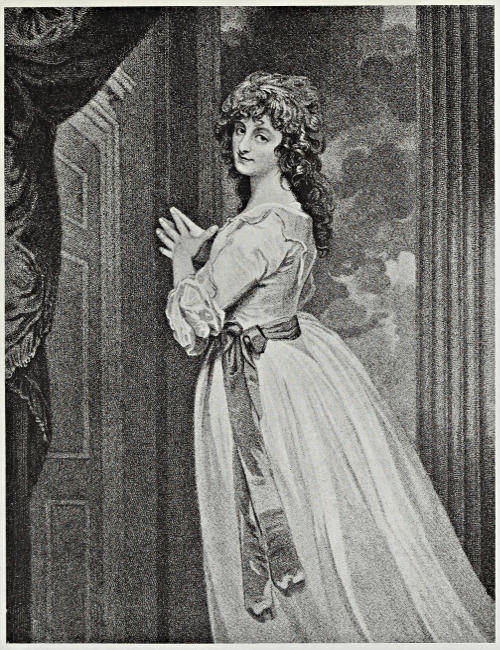
MRS. JORDAN
“The very sound of the little familiar word bud from her lips … was a whole concentrated world
of the power of loving.”—Leigh Hunt
As a playful relaxation from my former more serious
applications, I commenced my work of the most remarkable
London Beggars, with biographical sketches of each
character.[357] By this publication I gained more money
than by all my antiquarian labours united. Her late
Majesty, Queen Charlotte, and the Princess Elizabeth,
much encouraged their publicity; but I must acknowledge
that my greatest success was owing to the warm and
friendly exertions of the late Charles Cowper,[358] Esq., of
the Albany, a gentleman whose memory must be dear
to every one who had the pleasure of knowing him.
Much about this time, the Print Room of the British
Museum was closed, in consequence of the death of the
highly talented Mr. William Alexander, when several
friends exerted their interest to procure me the situation
of Keeper, an appointment which, I hope, I have held with
no small benefit to that National Institution, and with
credit to myself. The interest required to obtain this
appointment may be conceived, when the number of
candidates is considered. The following letter was written
by his Grace the late Archbishop of Canterbury to one
of his Grace’s relations:—
“Addington, Sept. 16th, 1816.
“My dear Madam,—With such interest as Mr.
J. T. Smith possesses, I am astonished he should think
it worth while to waste his strength in pursuit of such
a trifling office as that which is now vacant in the
Museum.
“It is impossible to resist the testimony which your
Ladyship, and many others, have borne to his merits
and qualifications. He certainly shall have my vote;
and I have reason to believe he will have the votes of the
other two principal Trustees, to whom the appointment
belongs.
“C. Cantuar.”[359]
Perhaps the only gala day now which gladdens the
heart of the loyal spectator, is the one afforded by Thomas
Doggett, comedian, on the 1st of August, to commemorate
the accession of the House of Brunswick. This scene is
sure to be picturesque and cheerful, should the glorious
sun, “that gems the sea, and every land that blooms,”
reflect the pendent streamers of its variegated show, in
the quivering eddies of Father Thames’s silver tide. At
what time Mr. Thomas Doggett was born, I am ignorant.
All I have been able to glean of him is, that Castle Street,
Dublin, has been stated as the place of his birth; and
that he had the honour of being the founder of our water
games. Colley Cibber, speaking of him, says, “As an actor
he was a great observer of Nature; and as a singer he
had no competitor.” He was the author of the Country
Wake, a comedy, and was a patentee of Drury Lane Theatre
until 1712; and my friend, Mr. Thomas Gilliland,[360] in
his work entitled The Dramatic Mirror, states his death
to have taken place on the 22nd of September 1721.
In 1715, the year after George I. came to the throne,
Doggett, to quicken the industry and raise a laudable
emulation in our young men of the Thames, whereby
they not only may acquire a knowledge of the river, but
a skill in managing the oar with dexterity, gave an orange-coloured
coat and silver badge, on which was sculptured
the Hanoverian Horse, to the successful candidate of six
young watermen just out of their apprenticeship, to be
rowed for on the 1st of August, when the current was
strongest against them, starting from the “Old Swan,”
London Bridge, to the “Swan” at Chelsea. On the 1st
of August 1722, the year after Doggett’s death, pursuant
to the tenor of his will, the prize was first rowed for, and
has been given annually ever since.[361]
“They gripe their oars; and every panting breast
Is raised by turns with hope, by turns with fear deprest.”
This gratifying sight I have often witnessed; and
the never-to-be-forgotten Charles Dibdin considered it so
pleasing a subject, that in 1774 he brought out at the
Haymarket Theatre a ballad opera, entitled The Waterman,
or the First of August. In this piece, Tom Tug, the hero,
is in love with a gardener’s daughter, before whom he
sings,
“And did you not hear of a jolly young waterman,
Who at Blackfriars’ Bridge used for to ply;
And he feathered his oars with such skill and dexterity,
Winning each heart, and delighting each eye,” etc.
Poor Tug, who considered himself slighted for another
lover, whom the girl of his heart appeared to prefer, after
declaring that he would go on board a man-of-war to cast
away his care, sings a song, of which the following is the
first verse:—
“Then farewell, my trim-built wherry,
Oars and coat and badge farewell!
Never more at Chelsea ferry
Shall your Thomas take a spell,” etc.
However, Tom rowed for Doggett’s Coat and Badge,
which he had an eye upon, in order to obtain the girl, if
possible, by his prowess. She was seated at the Swan,
and admired the successful candidate before she discovered
him to be her suitor Thomas, then
“Blushed an answer to his wooing tale.”
The part of Tom Tug was originally performed by
Charles Bannister, and esteemed so great a favourite, that
Mr. Garrick selected the entertainment of The Waterman,
to follow the comedy of The Wonder, on the evening of his
last performance on the stage.[362] Had the author of The
Waterman, when composing that little entertainment, suspected
that the Plague’s blood-red bills of
“Lord, have mercy upon us,”
had been fixed upon this house, the Swan, his Muse most
likely would have whispered, “You must not sadden
these scenes.” Pepys, in his Diary, made the following
entry:—
“April 9th, 1666.—Thinking to have been merry at
Chelsey, but being come almost to the house, by coach,
near the water-side, a house alone, I think the Swan, a
gentleman walking by called to us to tell us that the
house was shut up of the sickness.”
It is scarcely possible for any person, possessing the
smallest share of common observation, to pass through
ten streets in London, without noticing what is generally
denominated a character, either in dress, walk, pursuits,
or propensities. As even my enemies are willing to give
me credit for a most respectful attention to the ladies,
I hope they will not in this instance impeach my gallantry,
because I place the fair sex at the head of my table of
remarks, as to the eccentricity of some of their dresses.
Miss Banks,[363] the sister of Sir Joseph, was looked after
by the eye of astonishment wherever she went, and in
whatever situation she appeared. Her dress was that
of the Old School; her Barcelona quilted petticoat had
a hole on either side for the convenience of rummaging
two immense pockets, stuffed with books of all sizes.
This petticoat was covered with a deep stomachered
gown, sometimes drawn through the pocket-holes, similar
to those of many of the ladies of Bunbury’s time, which
he has introduced in his prints. In this dress I have
frequently seen her walk, followed by a six-foot servant
with a cane almost as tall as himself.
Miss Banks, for so that lady was called for many years,
was frequently heard to relate the following curious anecdote
of herself. After making repeated inquiries of the
wall-vendors of halfpenny ballads for a particular one
which she wanted, she was informed by the claret-faced
woman, who strung up her stock by Middlesex Hospital-gates,
that if she went to a printer in Long Lane, Smithfield,
probably he might supply her Ladyship with what
her Ladyship wanted. Away trudged Miss Banks through
Smithfield, “all on a market-day”; but before she entered
Mr. Thompson’s shop, she desired her man to wait for her
at the corner, by the plumb-pudding stall. “Yes, we
have it,” was the printer’s answer to the interrogative.
He then gave Miss Banks what is called a book, consisting
of many songs. Upon her expressing her surprise when
the man returned her eightpence from her shilling, and
the great quantity of songs he had given her, when she
only wanted one,—“What, then!” observed the man,
“are you not one of our chanters? I beg your pardon.”
It has been stated that this lady and Lady Banks,
out of compliment to Sir Joseph, who had been deeply
engaged in the production of wool, had their riding-habits
made of his produce, in which dresses those ladies at one
period upon all occasions appeared. Indeed, so delighted
was Miss Banks with this overall-covering, that she actually
gave the habit-maker orders for three at a time,—and they
were called Hightum, Tightum, and Scrub. The first was
her best, the second her second best, and the third her
every-day one.
I have been informed that once, when Miss Banks and
her sister-in-law visited a friend with whom they were to
stay several days, on the evening of their arrival they sat
down to dinner in their riding-habits. Their friend had
a large party after dinner to meet them, and they entered
the drawing-room in their riding-habits. On the following
morning they again appeared in their riding-habits; and
so on, to the astonishment of every one, till the conclusion
of their visit.
Being in possession of an immense number of tradesmen’s
tokens current at this time, I left them in Soho
Square, with a note begging Miss Banks’s acceptance of
any she might want. After a few hours, her footman’s
knock at my door announced the arrival of Miss Banks,
who entered the parlour holding up the front of her riding-habit
with both hands, the contents of which she delivered
upon the table, at the same time observing “that she
considered herself extremely obliged to me for my politeness,
but that, extraordinary as it might appear, out of
so many hundred there was not one that she wanted.”
Although Miss Banks displayed great attention to
many persons, there were others to whom she was wanting
in civility. I have heard that a great genius, who had
arrived a quarter of an hour before the time specified
upon the card for dinner, was shown into the drawing-room,
where Miss Banks was putting away what are
sometimes called rattle-traps.[364] When the visitor observed,
“It is a fine day, Ma’am,” she replied, “I know nothing
at all about it; you must speak to my brother upon that
subject when you are at dinner.” Notwithstanding the
very singular appearance of Miss Banks, she was in the
prime of life, a fashionable whip, and drove four-in-hand.
Mrs. Carter,[365] the translator of Epictetus, was also
singular in her dress. Her upper walking-garment, in
the latter part of her life, which was cut short, was more
like a bed-gown than anything else. The last time I met
this benevolent lady was in 1801, at Mrs. Dards’s exhibition,[366]
an immense collection of artificial flowers made
entirely by herself with fish-bones, the incessant labour
of many years. I remember, in the course of conversation,
Mrs. Dards observed, “No one can imagine the trouble I
had in collecting the bones for that bunch of lilies of the
valley; each cup consists of the bones which contain the
brains of the turbot; and from the difficulty of matching
the sizes, I never should have completed my task had it
not been for the kindness of the proprietors of the London,
Free-Masons’, and Crown and Anchor Taverns, who desired
their waiters to save all the fish-bones for me.”
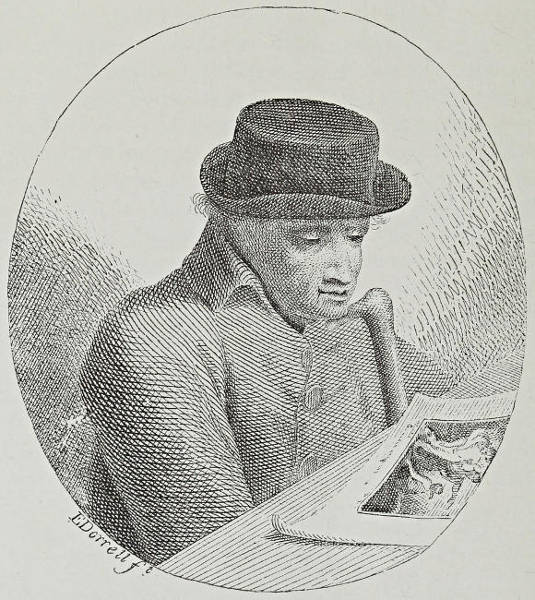
HENRY CONSTANTINE JENNINGS (OR NOEL)
“… barring his eccentricities.”
This ingenious person distributed a card embellished
with flowers and insects, upon which was engraven the
following advertisement:—
No. 1, Suffolk Street, Cockspur Street.
“Mrs. Dards begs leave to inform her friends in
particular, and the public in general, that after a labour
of thirty years, she has for their inspection and amusement
opened an exhibition of shell-work, consisting of a great
variety of beautiful objects equal to nature, which are
minutely described in the catalogue. Likewise is enabled
to gratify them
“With bones, scales, and eyes, from the prawn to the porpoise,
Fruit, flies, birds, and flowers, oh, strange metamorphose!”
“Open from ten to six in the summer,—from ten to
four in the winter.
“Admittance 1s. Catalogue 6d.”
Mr. Jennings,[367] latterly known as Constantine Noel,
barring his eccentricities, was an accomplished gentleman,
a traveller of infinite taste, and one of the most liberal
and entertaining companions imaginable. Mr. Noel’s
figure was short, thin, and much bent by age; and he
was very singular in his dress. The crown of his hat
fitted his head as close as a pitch-plaster; his coat was
short, of common cloth, and, like Mr. Wodhull’s, regularly
buttoned up from his waist to his chin. His stockings
were not striped blue and white, like those of Sir Thomas
Stepney,[368] but of pepper-and-salt mixture, and of worsted.
He stepped astride in consequence of the bowness of his
legs, and generally attracted notice by striking his walking-stick
hard on the stones with his right arm fully extended,
while his left hung swinging low before him. He wore
thick-sole shoes, with small buckles, and seldom showed
linen beyond the depths of his stock.
My father, who knew him well, used to relate the annexed
anecdote. Mr. Noel one day, when at the corner
of Rathbone Place, close to Wright’s, the intelligent grocer,
finding himself rather fatigued, called repeatedly to the
first coachman, who, after laughing at him for some time,
increased the insult by observing, “A coach, indeed! a
coach! who’s to pay for it?”
“You rascal,” exclaimed Mr. Noel, clenching his
stick in the position of chastisement, “why don’t you
come when I call, Sir; I’ll make an example of you, I
will.”
The coachman continued laughing, till a gentleman
accosted Mr. Jennings thus:—“My worthy friend, what
is all this about?”
The coachman was immediately curbed; and when
Mr. Noel’s friend had parted with him, by shaking his hand
in the coach, the coachman, touching the front of his
hat, wished to know of his honour “Where to?”
“I’ll give you a pretty dance,” replied Mr. Noel;
“drive me to h——, you rascal; to Whitechapel, and from
thence to Hyde Park Corner. I’ll take care it shall be
long enough before you get any dinner, you rascal, I will.”
Then, with a nod and a smile to the assembled crowd, he
declared, to their no small amusement, “I’ll punish him.”
Dr. Burges, of Mortimer Street, whose singular figure
has been etched by Gillray, under which he wrote, “From
Warwick Lane,” was one of the last men who wore a
cocked-hat and deep ruffles. What rendered his appearance
more remarkable, he walked on tiptoe.[369]
It was the regular custom of Mr. Alderman Boydell,
who was a very early riser, at five o’clock, to go immediately
to the pump in Ironmonger Lane. There, after placing
his wig upon the ball at the top of it, he used to sluice his
head with its water. This well-known and highly respected
character,[370] who has done more for the British artists than
all the print-publishers put together, was also one of the
last men who wore the three-cornered hat commonly
called “Egham, Staines, and Windsor.”
I recollect another character, a bricklayer, of the
name of Pride, of Vine Street, Piccadilly, who wore the
three-cornered hat commonly called “The Cumberland
Cock.”[371]
In October this year the venerable Mrs. Garrick departed
this life, when seated in her armchair in the front
drawing-room of her house in the Adelphi. She had
ordered her maid-servants to place two or three gowns
upon chairs, to determine in which she would appear at
Drury Lane Theatre that evening, it being a private view
of Mr. Elliston’s improvements for the season. Perhaps
no lady in public and private life held a more unexceptionable
character. She was visited by persons of the first
rank; even our late Queen Charlotte, who had honoured
her with a visit at Hampton, found her peeling onions for
pickling. The gracious Queen commanded a knife to be
brought, saying, “I will peel some onions too.” The
late King George IV. and King William IV., as well as
other branches of the Royal Family, frequently honoured
her with visits.
In the course of conversation with Mrs. Garrick (to
whom I had been introduced by the late Dr. Burney),
that lady expressed a wish to see the collection of Mr.
Garrick’s portraits, which the Doctor had most industriously
collected. After the honourable trustees had purchased
the Doctor’s library, which contained ten folio volumes
of theatrical portraits, I reminded Mrs. Garrick of her
wish, in consequence of which I received the following
letter:—
“Mr. Beltz[372] presents his compliments to Mr. Smith,
and is desired by his respected friend Mrs. Garrick to
acquaint him, in answer to the favour of his letter of the
12th inst., that she proposes (unless she should hear from Mr.
Smith that it will be inconvenient to him) to do herself the
pleasure of calling on him at the British Museum on Tuesday
next, between twelve and one, for the purpose of inspecting
the prints of Mr. Garrick, to which Mr. Smith refers.
“Heralds’ College, Aug. 18th, 1821.”
On the appointed morning Mrs. Garrick arrived, accompanied
by Mr. Beltz. She was delighted with the
portraits of Mr. Garrick, many of which were totally
unknown to her. Her observations on some of them were
extremely interesting, particularly that by Dance, as
Richard III.[373] Of that painter she stated, that Mr. Garrick,
who had been the artist’s best friend and benefactor,
behaved in the most dirty manner in return; for in the
course of his painting the picture Mr. Garrick had agreed
to give him two hundred guineas for it. One day at Mr.
Garrick’s dining-table, where Dance had always been a
welcome guest, he observed that Sir Watkin Williams
Wynn,[374] who had seen the picture, spontaneously offered
him three hundred guineas for it. “Did you tell him it
was for me?” questioned Mr. Garrick. “No, I did not.”
“Then you mean to let him have it?” Garrick rejoined.
“Yes, I believe I shall,” replied the painter. “However,”
observed Mrs. Garrick, “my husband was very good;
he bought me a most handsome looking-glass, which cost
him more than the agreed price of the picture; and that
was put up in the place where Dance’s picture was to have
hung.” Mrs. Garrick being about to quit her seat, said
she should be glad to see me at Hampton. “Madam,”
said I, “you are very good; but you would oblige me
exceedingly by honouring me with your signature on this
day.” “What do you ask me for? I have not taken a
pen in my hand for many months. Stay, let me compose
myself; don’t hurry me, and I will see what I can do.
Would you like it written with my spectacles on, or without?”
Preferring the latter, she wrote “E. M. Garrick,”
but not without some exertion.
“I suppose now, Sir, you wish to know my age. I
was born at Vienna, the 29th of February, 1724, though
my coachman insists upon it that I am above a hundred.
I was married at the parish of St. Giles at eight o’clock
in the morning, and immediately afterwards in the chapel
of the Portuguese Ambassador, in South Audley Street.”
A day or two after Mrs. Garrick’s death, I went to the
Adelphi, to know if a day had been fixed for the funeral.
“No,” replied George Harris, one of Mrs. Garrick’s confidential
servants; “but I will let you know when it is to
take place. Would you like to see her? she is in her
coffin.” “Yes, I should.” Upon entering the back room
on the first-floor, in which Mr. Garrick died, I found the
deceased’s two female servants standing by her remains.
I made a drawing of her, and intended to have etched it.
“Pray, do tell me,” looking at one of the maids, “why is the
coffin covered with sheets?” “They are their wedding
sheets, in which both Mr. and Mrs. Garrick wished to
have died.” I was informed that one of these attentive
women had incurred her mistress’s displeasure by kindly
pouring out a cup of tea, and handing it to her in her
chair. “Put it down, you hussey; do you think I cannot
help myself?” She took it herself, and a short time after
she had put it to her lips, died. This lady continued her
practice of swearing now and then, particularly when any
one attempted to impose upon her. A stonemason brought
in his bill with an overcharge of sixpence more than the
sum agreed upon; on which occasion he endeavoured to
appease her rage by thus addressing her:—“My dear
Madam, do consider”—“My dear Madam! What do
you mean, you d—— fellow? Get out of the house immediately.
My dear madam, indeed!!”
On the following day I received the promised letter,
by the post.
“Sir,—The funeral is fixed to leave the Adelphi Terrace
soon after ten o’clock to-morrow morning. Mrs. Garrick’s
carriage, the Dowager Lady Amherst’s, Dr. Maton’s, and
Mr. Carr’s[375] are the only carriages that will join the funeral.
Your obedient servant,
“George Harris,
“Servant to Mrs. Garrick.”
On the day of the funeral, Miss Macauley,[376] the authoress,
wishing to see this venerable lady interred, placed herself
under my protection; but when we arrived at the Abbey,
we were refused admittance by a person who observed,
“If it be your wish to see the waxwork, you must come
when the funeral’s over, and you will then be admitted
into Poets’ Corner, by a man who is stationed at the door
to receive your money.”
“Curse the waxwork!” said I; “this lady and I came
to see Mrs. Garrick’s remains placed in the grave.”—“Ah,
well, you can’t come in; the Dean won’t allow it.” As
soon as the ceremony was over, we were admitted for
sixpence at the Poets’ Corner, and there we saw the earth
that surrounded the grave, and no more, as we refused
to pay the demands of the showmen of the Abbey. Surely
this mode of admission to see the venerable structure, and
the monuments put up there at a most liberal expense
by the country, as memorials of departed worth, is an
abominable disgrace to the English Government.[377]
Being disappointed in a sight of the burial, I applied
to my friend, the Rev. Thomas Rackett, one of Mrs.
Garrick’s executors, for a list of those persons who attended
the funeral.
IN THE FIRST COACH.
Christopher Philip Garrick, and Nathan Egerton Garrick,
great-nephews of David Garrick; the Rev. Thomas Rackett,
and George Frederick Beltz, Esq., Lancaster Herald,
Executors of Mrs. Garrick’s will.
IN THE SECOND COACH.
Thomas Carr, Esq., Mrs. Garrick’s solicitor; and Mrs.
Carr.
IN THE THIRD COACH.
Mr. James Deane, Agent to Mr. Carr, frequently employed
by Mrs. Garrick; Mr. Freeman, of Spring Gardens,
Mrs. Garrick’s apothecary.
Thomas Rackett.[378]
December 4th, 1827.
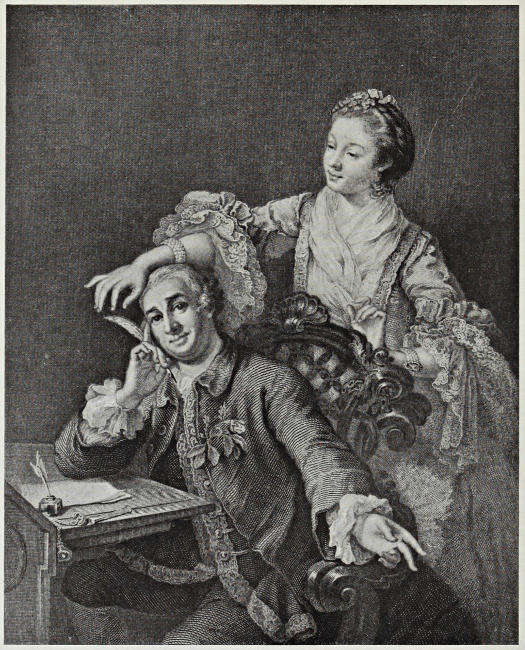
THE GARRICKS
“The fops that join to cry you down
Would give their ears to get her.”
Edward Moore on Garrick’s Marriage
As Mr. Garrick was married by his friend, the celebrated
Dr. Francklin,[379] who at that time had a chapel in
Great Queen Street, I was anxious to ascertain whether
the ceremony took place there or at the parish church.
I therefore applied to my friend, the Rev. Charles
M’Carthy, who favoured me with the following certificate:—
June 22, 1749. David Garrick, of St. Paul, Covent
Garden; and Eva Maria Violetti, of St. James’s, Westminster.
- T. Franklin.
- C. M’Carthy, Curate and Reg.[380]
In 1822, to the disgrace of the Antwerp picture collectors,
notwithstanding their professed zeal for the
protection of high works of art, they allowed the most
precious gem, their boasted corner-stone, to be carried
away from their city. However, to the great honour of
Mr. Smith, the picture-dealer, it was secured for England.
This corner-stone, which had been coveted by most of
the amateurs in the world, was no less a treasure than the
picture known under the appellation of the “Chapeau de
Paille,”[381] by Rubens, which had been in the Lunden’s, and
then the Steir’s family, from the time it was sold after
the painter’s death, to the 29th of July, 1822, the day on
which it was brought to auction for the benefit of the
last possessor’s family.
When the auctioneer ordered the doors of the case in
which it was kept to be thrown open, every person took
off his hat, and greeted the picture with loud and repeated
cheerings. After the company had, for some time, gratified
their eyes, the doors were locked and biddings commenced,
the company remaining uncovered till the bidders were
silent. It was then knocked down for the sum of thirty-two
thousand seven hundred florins, to a foreigner displaying
an orange ribbon, hired by the real purchaser,
Mr. Smith, who suspected that if an Englishman had
offered to bid, he would have brought down a direful
opposition. When it was discovered that it was to be
conveyed to England, the Antwerpers not only shed
tears, but followed it to Mr. Smith’s place of residence,
expressing the strongest desire to take their farewell look.
Mr. Smith, not willing to risk its safety, gave a seaman
five guineas to convey it on shipboard by night, and saw
it safely landed on British ground.
Upon its arrival in London, King George IV. commanded
a sight of it; and on the morning of Tuesday,
September 3rd, Mr. Smith had it conveyed from his house
in Marlborough Street, to Carlton Palace, where it was
placed in the King’s dressing-room, the King keeping
the key of the case, that only private friends might see
it. After the expiration of a fortnight, the picture was
returned; and in the month of March, 1823, it was publicly
exhibited at Stanley’s rooms. The Right Hon. Sir Robert
Peel became its liberal purchaser and protector. This
picture is painted on oak, and has been joined at the lower
part across the hands, and there is every reason for believing
that Rubens painted it in the frame, as the ground
was unpainted upon, within the width of the rabbit.
The popular report respecting this picture is, that it
was the portrait of Elizabeth Lunden, a young woman
to whom Rubens was particularly partial, who died of
the small-pox, to the great grief of the painter.
In this year I find the following letter in my album:—
“My dear Sir,—Your desire to know the place of my
nativity, the profession for which I was intended, my first
appearance on the stage, and in town. This both honours
and gratifies me, inasmuch as your request places my name
with men of genius and education, the persons of all others
I am most ambitious to be found with.
“The city of Bristol gave me birth, in 1778.[382] I was
brought up an artist, which profession I quitted for
studies more congenial to my feelings. Immortal Shakspeare
wrought the change, and his great contemporaries
added fuel to flame. Notwithstanding this mighty
stimulus, in the year 1798 I made my first attempt, in
the part of young Hob, in Hob in the Well,[383] in a town
in Radnorshire, the theatre a barn in the environs; the
receipts seven shillings; my share sevenpence. I removed
from this luxury to the Stafford Company, thence to the
York Theatre, where I succeeded my friend Mathews, and
in which situation I remained seven years.
“October 12th, 1809, I made my début in London,
in the Theatre Royal, Lyceum, with the Drury Lane Company.
The devouring element had destroyed that magnificent
pile Old Drury, which caused the professors to
employ that place of refuge. The pieces I selected for
the terrific ordeal, were The Soldier’s Daughter and Fortune’s
Frolic;[384] the characters, Timothy Quaint and Robin
Roughhead. The public were infinitely more kind than
my negative merits deserved; and with gratitude I acknowledge,
that up to the present period, their bounty
very far exceeds the humble ability of their devoted servant,
and your true friend,
“Edward Knight.[385]
“Theatre Royal, Drury Lane,
“Garden Cottage, Covent Garden, ground chambers,
“Nov. 15th, 1823.”
The following notice is written in my album this year,
by Major Cartwright:—
“John Cartwright, born at Marnham, near Tuxford,
in the county of Nottingham, on the 17th of September,
1740, old style, corresponding with the 28th, new style.
In the year 1758 he entered the naval service, under the
command of Lord Howe; was promoted to a lieutenancy
in September, 1762, and continued on active service until
the spring of 1771. Then retiring to recruit his health,
he remained at Marnham till invited by his old Commander-in-chief,
in the year 1775 or 1776; but not approving of
the war with America, he declined accepting the proffered
commission. About the same time he became Major of
the regiment of Nottinghamshire Militia, then for the first
time raised in that county, in which he served seventeen
years.
“When George III. arrived at the year of the Jubilee,
a naval promotion of twenty Lieutenants to the rank of
Commanders, and the name of J. C. standing the twentieth
on the list, he was commissioned as a Commander accordingly.
“In the year 1802 he published The Trident, a work in
quarto, having for its object to promote that elevation
of character which can alone preserve the vital spirit of
a navy, as well as to furnish an inexhaustible patronage
of the arts.
“John Cartwright, residing in Burton Crescent, 26th Jan., 1824.”
The Major died on the 23rd of September this year,
at his house in Burton Crescent, at the venerable age of
eighty-four.[386]
An author, in whose real character I was for many years
deceived, frequently importuned me to caricature literary
females. But this malicious advice, being repugnant to
my feelings, I never could listen to, nor is it my intention
even to make public a memory-sketch now in my possession
of the adviser, when he was stooping over and pretending
to kiss the putrid corpse of him a portion of whose vast
property he is in possession of, and, I was going to say,
happily enjoys.[387] Profoundly learned as the person above
alluded to considers himself to be, the reader will, after
perusing the following lines, written purposely for my
album, be convinced that jealousy towards the fair sex
must be that man’s master-passion.
IMPROMPTU LINES BY MISS BENGER, ON THE PAUCITY
OF INFORMATION RESPECTING THE LIFE AND
CHARACTER OF SHAKSPEARE.
Lives there, redeemed from dull oblivion’s waste,
One cherished line that Shakspeare’s hand has traced?
Vain search! though glory crowns the poet’s bust,
His story sleeps with his unconscious dust.
Born—wedded—buried! Such the common lot,
And such was his. What more? almost a blot!
Even on his laurelled head with doubt we gaze;
And fancy best his lineaments portrays.
Thus like an Indian deity enshrined,
In mystery is his image; whilst the mind
To us bequeathed, belongs to all mankind.
Yet here he lived; his manly high career
Of strange vicissitude, was measured here.
Not his the envied privilege to hail
The Eternal City! or in Tempe’s vale
Breathe inspiration with luxurious sighs,
And dream of Heaven beneath unclouded skies.
His sphere was bounded, and we almost trace
His daily haunts, where he was wont to chase
Unwelcome cares, or visions fair recall;
His breath still lingers on the cloistral wall,
With gloom congenial to his spirit fraught;
And thou, O Thames, his lonely sighs hast caught.
When one, the rhyming Charon of his day,
Who tugged the oar, yet conned a merry lay,
Full oft unconscious of the freight he bore,
Transferred the musing bard from shore to shore.
Too careless Taylor! hadst thou well divined
The marvellous man to thy frail skiff consigned,
Thou shouldst have craved one tributary line,
To blend his glorious destiny with thine!
Nor vain the prayer!—who generous homage pays
To genius, wins the second meed of praise.
[388]
The much-famed Cup, carved from Shakspeare’s
Mulberry-tree, lined with, and standing on a base of silver,
with a cover surmounted by a branch of mulberry leaves
and fruit, also of silver-gilt, which was presented to Mr.
Garrick on the occasion of the Jubilee at Stratford-upon-Avon,
was sold by Mr. Christie on May the 5th, 1825,[389]
who addressed the assembly nearly in the following words,
for the recollection of which I am obliged to the memory
of my worthy friend, Henry Smedley, Esq.:[390]—
“Though this is neither the age nor the country in
which relics are made the objects of devotion, yet that
which I am now to submit to you must recall to your
recollection the Stratford Jubilee, when the pilgrims to
the shrine of Avon were actuated by a zeal as fervent as
could have been exhibited either at Loretto or Compostella.
Let me then entreat a liberal bidding, when I invoke you
by the united names of Shakspeare and of Garrick. I
perceive that this little Cup is now submitted to eyes well
accustomed to appreciate the most exquisite treasures of
ancient arts; and that the rough and natural bark of the
mulberry-tree is regarded with as much veneration as the
choicest carving of Cellini or Fiamingo.”
After one hundred guineas had been bid, Mr. Christie
added, “I was wishing that I had some of Falstaff’s sack
here, with which I might fill the Cup, and pledge this company,
so as to invigorate their biddings; but I think I
may say now that at least there is no want of spirit among
them.”
The term busby, now sometimes used when a large
bushy wig is spoken of, most probably originated from
the wig denominated a buzz, frizzled and bushy. At all
events, we are not satisfied that the term busby could
have arisen, as many persons believe, from Dr. Busby,
Master of Westminster School, as all his portraits either
represent him with a close cap, or with a cap and hat.[391]
During a most minute investigation of a regular series
of English portraits, which I was led into by a friend, in
order, if possible, to clear up this point, I was induced to
look for the origin of wigs in England, and their various
sorts and successions, by commencing at the time of William
the Conqueror. In this search I was not able to find any
representation of wigs earlier than those worn by King
Charles II.[392] upon his Restoration, in proof of which I refer the
reader to Faithorne’s numerous portraits of that monarch,
and he will find that that sort of wig continued to be worn,
with very little deviation, by succeeding kings till George
II.’s time, with whom it ended. The Merry Monarch,
it has been stated, followed the fashion of wearing a wig
from Louis XIV.,[393] with whom that custom commenced
with the kings of France. The Duke of Burgundy wore
a wig.
King George III. commenced his reign with wearing his
own hair dressed and powdered in the style of Woollett’s
beautiful engraving of his Majesty,[394] after a picture painted
by Ramsey. King George III. wore a wig, in the latter
part of his reign, made from one of those worn by Mr.
Duvall, one of the masons of the Board of Works, with
which shape his Majesty was much pleased.
The line in Pope,
“Eternal buckle takes in Parian stone,”
alludes to the wig carved on the monument of Sir Cloudesley
Shovel in Westminster Abbey.[395]
This sort of wig, which received the appellation of
“A Brown George,” was also worn by several persons of
rank, particularly the late Earl of Cremorne.[396] Townsend,
a Bow-street officer, condescendingly noticed by the King,
thought proper to wear a wig of this kind, in which he
appeared at the morning service in Westminster Abbey.
It is worthy of observation, that in the reign of King
Charles II. the Lord Mayors of London followed his
Majesty’s example, by wearing wigs precisely of the same
make, and equal to those worn by the Royal Family, the
highest courtiers, and persons of the first eminence in
official capacities. Nay indeed, Sir Edmund Berry Godfrey,
a wood and coal-monger, wore wigs of this shape, perhaps
because he was a Justice of the Peace within the King’s
Court. The same kind of wig, equally deep, but with curls
rather looser and more tastefully flowing, was also worn
by the following high literary characters in the reigns of
Charles II., James II., William III., and Queen Anne:—Waller,
Dryden, Addison, Steele, Congreve, Vanbrugh,
Butler, Rowe, Prior, Wycherley, etc.[397] Of these, perhaps
the two last-mentioned were the most foppish in their
wigs, particularly Wycherley, from whom the sets of large
and beautifully engraven combs of the finest tortoise-shell
are named. With these combs (which were carried in
cases in their pockets) the wearers of wigs adjusted their
curls, ruffled and entangled by the wind. These combs
are held as curiosities by many of our old families. The
last I saw was in the possession of the friendly Dr. Meyrick,
author of The History of Armour. I have somewhere read
that Wycherley, who was esteemed one of the handsomest
men of his day, was frequently seen standing in the pit
of the theatre combing and adjusting the curls of his wig,
whilst in lolling conversation with the first ladies of fashion
in the boxes.[398] Most of Sir Godfrey Kneller’s portraits
were painted in this flowing wig, particularly that celebrated
series entitled Queen Anne’s Admirals.[399] These
pictures were lately moved by command of King George IV.
from Hampton Court Palace to the Nautical Gallery in
Greenwich Hospital, where they are placed to the highest
advantage among numerous other portraits of England’s
naval victors.
The actors at this time wore immense wigs, particularly
Bullock, Penkethman, etc.; Cibber’s was in moderation.
It must here be observed, that I now allude to their private
wigs; their state wigs were, as they are now, purposely
caricatured to please the galleries.[400] I believe that the first
wig worn by an English divine was that of John Wallis,[401]
engraved by Burghers, and published at Oxford in the
year 1699; it was profusely curled, but not so deep over
the shoulders as those of statesmen.
There were many singular, and, indeed, learned characters
whose wigs were peculiarly shaped, such, for instance,
as that of Bubb Doddington, Lord Chesterfield, and the
Duke of Newcastle. MacArdell’s print of Lord Anson,
after a picture by Sir Joshua Reynolds, was, I have every
reason to think, the first of the shape erroneously called
the Busby. This sort, Dr. Samuel Johnson, Armstrong,
Hunter, the Rev. George Whitfield, Lord Monboddo, etc.,
wore in their latter years.
DR. OLIVER GOLDSMITH
“The fellow took me for a tailor.”
The earliest engraved portraits of Dr. Johnson exhibit
a wig with five rows of curls, commonly called “a story
wig.”[402] Among the old dandies of this description of wig
we may class Mr. Saunders Welch, Mr. Nollekens’ father-in-law—he
had nine storeys. So was that worn by Mr.
Nathaniel Hillier,[403] an extensive print-collector, as is represented
in an engraved portrait of that gentleman. Dr.
Goldsmith’s wig was small and remarkably slovenly, as
may be seen by Bretherton’s etching. Sir Joshua’s portrait
of him is without a wig. Mr. Garrick’s wigs (I mean his
private ones) were three in number,—the first is engraved
by Wood, published in the year 1745; the second is by
Sherwin, engraved for Tom Davies; the last is from a
private plate by Mrs. Solly, after a drawing by Dance.
I will leave off here with the wig, and give a few instances
of the tails. These perhaps originated with the Chinese,
but the first specimen of a tail, which I have hitherto been
able to procure, to which a date can be given, is in Sherwin’s
print of Frederick, King of Prussia.[404]
The Londoners, but more particularly the inhabitants
of Westminster, who had been for years accustomed to
recreate within the chequered shade of Millbank’s willows,
have been by degrees deprived of that pleasure, as there
are now very few trees remaining, and those so scanty
of foliage, by being nearly stript of their bark, that the
public are no longer induced to tread their once sweetly
variegated banks.[405]
Here, on many a summer’s evening, Gainsborough,
accompanied by his friend Collins, amused himself by
sketching docks and nettles, which afforded the Wynants
and Cuyp-like effects to the foregrounds of his rich and
glowing landscapes. Collins resided in Tothill Fields,
and was the modeller of rustic subjects for tablets of
chimneypieces in vogue about seventy years back. Most
of them were taken from Æsop’s Fables, and are here
and there to be met with in houses that have been suffered
to remain in their original state. I recollect one, that
of the “Bear and Bee-hives,” in the back drawing-room
of the house formerly the mansion of the Duke of Ancaster
on the western side of Lincoln’s Inn Fields.[406]
Millbank, which originally extended with its pollarded
willows from Belgrave House[407] to the White Lead Mills
at the corner of the lane leading to “Jenny’s Whim,”
afforded similar subjects to those selected by four of the
old rural painters; for instance, the boat-builders’ sheds
on the bank, with their men at work on the shore, might
have been chosen by Everdingen;[408] the wooden steps
from the bank, the floating timber, and old men in their
boats, with the Vauxhall and Battersea windmills, by Van
Goyen;[409] the various colours of the tiles of the cart-sheds,
entwined by the autumnal tinged vines, backed with the
most prolific orchards, with the women gathering the garden
produce for the ensuing day’s market, would have pleased
Ruysdael;[410] and the basket-maker’s overhanging smoking
hut, with a woman in her white cap and sunburnt petticoat,
dipping her pail for water, might have been represented
by the pencil of Dekker.[411] It was within one of the Neat
House Gardens[412] near this bank that Garnerin’s kitten
descended from the balloon which ascended from Vauxhall
Gardens in the year 1802.[413] This descent is thus handed
down in a song attributed to George Colman the younger,
entitled
Puss in a Parachute.
Poor puss in a grand parachute
Was sent to sail down through the air,
Plump’d into a garden of fruit,
And played up old gooseberry there.
The gardener, transpiring with fear,
Stared just like a hundred stuck hogs;
And swore, though the sky was quite clear,
’Twas beginning to rain cats and dogs.
Mounseer, who don’t value his life,
In the Thames would have just dipped his vings,
If it vasn’t for vetting his vife,
For vimen are timbersome things:
So at Hampstead he landed her dry;
And after this dangerous sarvice,
He took a French leave of the sky,
And vent back to Vauxhall in a Jarvis.
Most willingly would I have resigned all the pleasures
I ever enjoyed, save that of my wedding-day, to have
joined the throng of enthusiastics in art, who assembled
at Nuremberg this year, to do homage to the memory of
that morning star in art, Albert Dürer. Of the many
descriptions of the proceedings upon that glorious occasion,
none gave me higher delight than that of Mr. L. Schutze,[414]
of Carlsruhe, an artist of very considerable abilities, who,
upon my requesting him to favour me with an account,
goodnaturedly complied with my wishes, but with all the
diffidence of one who had not long written in the English
language.
“At the festival which took place in Nuremberg,
1828, on the 6th and 7th of April, the month on which
Albert Dürer died three hundred years before, some pupils
of Cornelius in Munich, intended to paint some transparent
sceneries, the most interesting ones, taken from
his life, and to exhibit them at the Festival. For this
purpose they gave notice to the magistrates and to the
artists that they would arrive on the 28th of March. The
magistrates and artists were quite satisfied with this offer,
and resolved to welcome them some miles from Nuremberg.
Two gentlemen of consideration offered their
coaches, with four horses, and the most part of the artists
took post-coaches, all with four horses. One gentleman,
Mr. Campe,[415] a very clever man, and member of the Artists’
Society, who led the procession, which consisted of eight
coaches with about thirty artists, took a barrel with wine
in his coach, and also a very old and interesting pitcher,
which was presented to A. Dürer by one of his particular
friends. About eight miles from Nuremberg, in Reichersdorf,
we stopped at the inn, intending to wait for the
artists from Munich. Mr. Campe ordered a good breakfast,
and put up his barrel and golden pitcher. Scarcely
was all prepared, and the breakfast ready, when we saw
the artists arrive (we called them ‘Cornelians,’ after the
name of their master[416]), with a flag and green branches in
their caps, and merry singing. A loud vivat was the first
expression of welcome; they were quite astonished to find
there so great a company. We now invited them to come
in, and to take refreshments after their fatigues. The first
proceeding was now to fill the pitcher with wine, and to
drink their health. There were about thirty-six artists from
Munich. After having made some speeches, having taken
the breakfast, and emptied the barrel, we, all quite refreshed
and pleased, took place in our chair-waggons, into which we
invited also the Cornelians, and rode back to Nuremberg.
“At the old castle we all descended from our waggons,
and saw the old building, which is so very interesting in
the history of Germany. Then we went down to the
house of Albert Dürer, where all the strangers who arrived
entered their names in a book. Several gentlemen of
consideration had offered to give lodging to some of the
strange artists, which was accepted with great pleasure
by them. Many others of them had free lodging in the
inns. The magistrates paid all their necessaries during
their stay. Every day artists and strangers arrived,
and the house of Albert Dürer was the place of meeting.
The Cornelians began to paint their transparencies: they
had drawn the sketches for them already in Munich.
There were seven pictures; they represented, firstly,
Albert Dürer coming in receiving instructions from
Wohlgemuth; secondly, his marriage ceremony; thirdly,
the Banquet in Utrecht; fourthly, the Goddess of Art
crowns Albert Dürer and Raphael; fifthly, Dürer on
board ship; sixthly, the death of Dürer’s mother;
seventhly, Dürer’s death. We artists in Nuremberg
painted Dürer’s figure, and several allegories and writings,
about sixty feet high altogether, also transparencies, which
we intended to exhibit on the road, opposite his house.
“Cornelius and many of the first artists from Munich,
and from other parts of Germany, arrived, and Dürer’s
house was always crowded: certainly a very interesting
time to make acquaintance with artists from several parts
of the continent, and also to see again old friends. The
6th of April, in the morning at six o’clock, we went altogether
to the grave of Albert Dürer. It was very bad
weather, all the night, much snow was falling, and a very
disagreeable wind blew. When we arrived at the grave,
and the musicians, who were with us, began to play, and
we began to sing, the sun at once appeared and looked
friendly down upon us. We sang three songs with accompaniments
of instruments; and then a speech was made,
after which we went home. Scarcely were we arrived
there, when it again began to snow, and it was very disagreeable
all the day.
“After noon, at half past six o’clock, an Oratorium
composed by Schneider,[417] took place in the Town-house.
Mr. Schneider came himself from Dessau, two hundred
and fifty miles from Nuremberg, to direct it. In the
Town-house may still be seen a triumphal procession,
painted on the wall by Albert Dürer. On one side the
musicians were placed, and opposite to them the seven
transparencies were exhibited; they were beautifully
finished and pleased everybody.
“After the oratorium a splendid supper took place,
where all the artists took part, and also several gentlemen
of consideration. Mr. Campe distributed to those present
some printed poems and books, containing interesting
tales or descriptions of clever men, contemporaries of
Albert Dürer. Then there were music and dancing.
“On the 7th, at nine in the morning, there was a meeting
in the Town-house; all the artists were dressed in
black, and had flat hats and swords, except the strangers.
The magistrates distributed medals with Dürer’s portrait.
At half past eleven o’clock the procession began:—the
magistrates, the two burgomasters, the clergymen, many
officers, and all the artists, about three hundred persons
together. The military with music made a line in the
streets through which the procession passed. The King
was expected, but did not come. In the Milk-market
(now called Albert Dürer’s Place) the procession commenced;
some speeches were made, then the foundation-stone
of a monument to Albert Dürer was laid, and
trumpets and cymbals resounded. Then all was finished,
and all went home. At two o’clock a brilliant dinner took
place in the Court of Bavaria, accompanied by music;
and several poems and songs were distributed, and the
poor were not forgotten,—a rich collection being made
for them. In the theatre, the play called Albert Dürer
was performed; and then our great transparency was
illuminated, and on the house where Albert Dürer was
born, and likewise where he had lived during the latter
part of his life, several inscriptions were illuminated.
A procession with flambeaux and fireworks ended the
festival-day. Some of the richest inhabitants arranged
dinners and suppers, and other rejoicings, to honour the
artists. The magistrates ordered also a very brilliant
supper on the last evening, before the artists parted, and
bade them farewell.
“L. Schutze.”
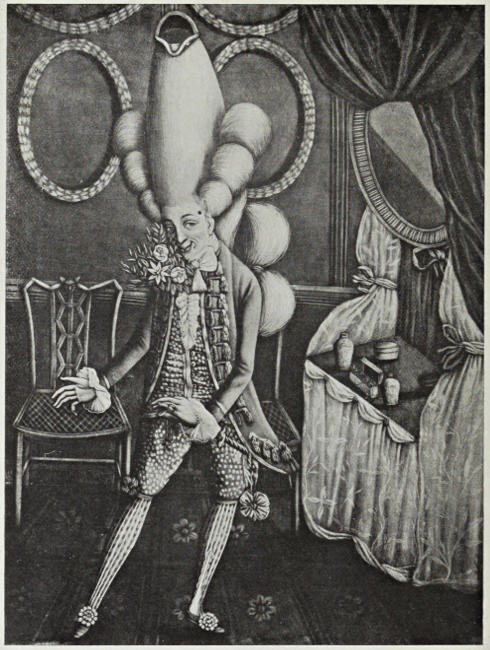
THE WIG IN ENGLAND
A MACARONI READY FOR THE PANTHEON
For the following dates I am indebted to Albert Dürer’s
Diary, contained in the Foreign Quarterly Review for
January 1833, a work replete with most interesting information.
Albert Dürer was born in 1471; his father
taught him the goldsmith’s craft. In 1486 he was bound
for three years to Michael Wohlgemuth, an engraver on
wood. He was married to Agnes, an un-lamb-like daughter
of Hans Frey. He died on the 6th of April, 1528, of a
decline. His wife, an avaricious shrew, “gnawed him to
his very heart,—he was dried up to a faggot.”[418] Little did
Albert Dürer think, particularly from the period of his
unhappy marriage to the hour of his dissolution, when
he was only fifty-seven years of age, that such honours
would be paid to his memory.
The following letter is perhaps worth insertion here:—
“Queen Street, Mayfair,
“Dec. 22, 1828.
“My dear Sir,—Shortly after my return from Rome,
in 1798, I espied a bust in Rosso Antico, lying under
a counter at a broker’s shop, in Great Portland Street.
I recognised its antiquity; it was a Faun, large as
life, in the best style of art. I bought it for the
trifling sum of £1. I had it in my study many months.
During this period, I often assisted Nollekens in the
architectural department of his monuments, receiving no
thanks; but an invitation one day, as we talked Italian
together. On accidentally mentioning my antique Faun,
he came to see it, and was so struck with its beauty, that
he would never rest till he got it out of my hands. He
succeeded, by offering me some models of his own, and
ten pounds. Wishing to oblige him, I let him have the
bust, and he sent me two miserable models not much higher
than my thumb, of a Bacchus and Ariadne, since broken
to pieces.
“This bust was in the collection at his sale, and it was
knocked down by Christie to the Duke of Newcastle for
a hundred and sixty pounds.
“With great respect, ever yours truly,
“Charles Heathcote Tatham.”[419]
The following letter is curious:—
“In the winter of 1815, making a tour of the Netherlands,
I was in Bruges when the well-known statue, or
rather group, of the ‘Virgin and Child,’ by Michael Angelo
Buonarotti, which had been carried from the church of
Notre Dame to Paris, was restored, in a packing-case,
to that church. On this occasion a procession of the
priests and officers of the church, and of some of the
municipal officers, took place; and a Mass was celebrated.
About a month afterwards, I was again in Bruges, and saw
this fine work of art replaced in its former situation, on the
altar of one of the small chapels. It is, indeed, a wonderful
work.
“I was about the same period in Antwerp, and was
present when the pictures which had been taken to Paris,
arrived in carriages, and were escorted into the city by an
English regiment, then in garrison there (either the 15th or
25th of infantry), preceded by the band of that regiment
playing ‘God save the King,’ and accompanied by the
members of the Academy of Antwerp, and the magistracy
of the city. I own I felt all the pride of an Englishman
at seeing these works of art, which British valour had
regained, thus restored to the places from whence they had
been pillaged.
“Stephen Porter.[420]
“Temple, Feb. 5, 1828.”
In July, I went to Hungerford Stairs to gain what
information I could respecting “Copper Holmes.” A
waterman, whose face declared he had seen a few liberal
days, accosted me with the usual question, “Oars, sculler?”
I shook my head; but, upon a nearer approach, asked him
the following question, “How long has Copper been dead?”
“There sits his widow at that window mending her stockings,”
said he; “we’ll go and put it to her.”
On approaching her the waterman said, “This gentleman
wants to know how long Copper has been dead?” “How
do you do?” said I, “your husband has often in my early
days rowed me to Pepper Alley.” “He died,” said the
woman (who retained enough in her care-worn features
to induce me to believe she had been pretty), sticking her
needle on her cap, “he died, poor fellow, on the 3rd of
October, 1821, and a better man never trod shoe-leather.
He was downright and honest, and what he said he would
do, he did. I had been his wife two-and-twenty years;
but he married me after he left the Ark. His first wife
lived in the Ark with her children.” “What vessel
had the Ark been?” “She had been a Westcountryman,
and it cost him altogether (with her fittings-up with sheets
of copper) one hundred and fifty pounds, and that gave
him the name of ‘Copper Holmes.’ His Christian name
was Thomas. Ay, Sir, his lawsuit with the City crippled
him:[421] but I will say this for him, his Majesty had not a
better subject than poor Copper.” While she uttered this
declaration, both her eyes, which were seriously directed
to her nose, were moistened with the tears of affectionate
memory, which induced me to turn to my new acquaintance
the waterman, and ask where he was buried? “In the
Waterman’s churchyard, Sir, under the pump-pavement on
the south side of St. Martin’s church.[422] Lord bless you!
don’t you know the Waterman’s burying-ground? I
could take you to the spot where fifty of us have been
buried.” “What was his age?” “Sixty-six when he
died.”
After parting with the widow, I requested the master
of the ceremonies to allow his man to ferry me over to the
King’s Head Stairs, Lambeth Marsh. “He shall,” said
Charles Price; “and I’ll go with you, too.” The waggish,
though youthful countenance of the lad employed to bring
in our boat, revived the pleasure Mathews had afforded
me in his description of Joe Hatch,[423] and induced me to
inquire after the waterman whose look, voice, and manner
he had borrowed for that inimitable representation.
“George Heath, you mean, Sir,” answered the boy; “Of
Strand Lane,” observed Price; “Heath is his real name.
Lord bless ye, he’s a good-hearted fellow! Why, I have
often known him put his hand in his pocket and relieve
a fellow-creature in distress.”
This mention of Hatch induced me to question Price
as to the Halfpenny Hatch,[424] where Astley had first rode,[425]
before he took the ground at the foot of Westminster
Bridge, on which the present Amphitheatre stands. Before
Price could answer, as we had made the shore, “You will
find the Halfpenny Hatch (for it still remains, though in
a very ramshackled state) at the back of St. John’s
Church, Waterloo Road, at the end of Neptune Place,”
I was told upon my landing by a little chubby, shining,
red-faced woman, in what was formerly called a
mob-cap. Thither I went, and to my great surprise
found the Halfpenny Hatch in a dell, by reason of the
earth being raised for the pavement of the adjacent
streets.[426] Field was the name of the person who occupied
the house; and, only a few years ago, money was
received for the accommodation of the public who chose
to go through the hatch. It was built subsequent to the
year 1771, by Curtis, the famous botanist,[427] whose name it
still retains; but the original Hatch-house, Mrs. Field informed
me, was still standing at the back of the present one.
The ground belonging to the Halfpenny Hatch was
freehold, of about seven acres, and sold by the Curtis
family to Messrs. Basing, Atkins, and Field, for the sum
of £3500. They disposed of it in about six months afterwards
to Mr. Roupell, the present owner, for the sum of
£8000.[428] Being determined to take a sketch of the remains
of this vine-mantled Halfpenny Hatch, I took water at
Strand Lane Stairs[429] on the following evening, where I
found George Heath busily engaged in his boat. Upon
seeing a poor chimney-sweeper who descended the steps
with me, he stood up and cried out, “I tell you what,
Sir Cloudesley Shovel, although you are a miller, depend
upon it, I’ll dust your jacket for the injury you have done
my vessel.” A ferryman observed, “His wife was gone to
take a walk up Highgate Hill.” “A strainer,” observed
George Heath. During the time occupied in sketching,
William Field, who lives in the Hatch, pointed out part
of the gate which had received a bullet, supposed to have
been aimed by some scoundrel at the elder Mr. Curtis,
who providentially escaped, though the ball, which came
from a considerable distance, passed only a few inches
above his head.
On the 25th of July, 1829, being on my way to the great
Sanctuary, my pleasure was inconceivable upon observing
that the intended repairs of Whitehall Chapel had commenced.
The scaffolding was erected before its street-front,
and the masons had begun their restorations at the
south corner, strictly according with the fast decaying
original.[430] “Well,” said I to my respected friend, Mr.
Henry Smedley, whose house I had entered just as the
chimes of the venerable Abbey and St. Margaret’s had
agreed to complete their quarters for nine, “I am delighted
to find that Inigo’s beautiful front of Whitehall is in so fair
a way of recovery.”[431]
Bonington’s drawings, held at a respectful distance
from the butter-dish, were the next topic of conversation.[432]
“I agree with you,” observed my friend, “they are invaluable;
even his slightest pencil-touches are treasures.
I have shown you the studies from the figures which surround
Lord Norris’s monument in the Abbey; have they
not all the spirit of Vandyke?[433] Ay, that drawing of the
old buildings seems to be your favourite; what a snug
effect, and how sweetly it is coloured!—there never was
a sale of modern art so well attended.”
After taking boat at the Horse Ferry for Vauxhall,—for
the reader must be informed that Mr. Smedley and myself
had an engagement to pass the day with Mr. William
Esdaile, on Clapham Common,[434]—I asked the waterman
some questions as to “Copper Holmes.” He could not
speak correctly as to the time of his death, but said that he
had been much reduced by the lawsuit he had with the
City about his barge. “Yes, that I know,” said I; “and
it certainly was a nuisance on the banks of the Thames,
and also an encroachment upon the City’s rights and
privileges.”
On arriving at Mr. Esdaile’s gate, Mr. Smedley remarked
that this was one of the few commons near London which
had not been enclosed.[435] The house had one of those plain
fronts which indicated little, but upon ascending the
steps I was struck with a similar sensation to those of the
previous season, when first I entered this hospitable mansion.
If I were to suffer myself to utter anything like an ungrateful
remark, it would be that the visitor, immediately he
enters the hall, is presented with too much at once, for
he knows not which to admire first, the choice display of
pictures which decorate the hall, or the equally artful and
delightful manner in which the park-like grounds so
luxuriantly burst upon his sight. Mr. Esdaile entered
the library during our admiration of its taste of design
and truly pleasing effect.
The walls are painted with a subdued red, a colour
considered by most artists best calculated to relieve pictures,
particularly those with broad gold frames. The first
picture which attracted our notice was the upper one of
two upon the easel nearest the window. The subject is a
Virgin and Child, attributed to Albert Dürer, though I must
own the style is so elegantly sweet, with so little of the
German manner, that I should have considered it the work
of a high Italian master. The upper one of the two
pictures on the correspondent easel near the bookcase,
is from the exquisite pencil of Adrian Ostade; it was
the property of Monsieur de Calonne,[436] at whose auction
Mr. Esdaile purchased it when he became a collector of
pictures.
It would be highly presumptuous in me to attempt to
describe the pictures from so cursory a view. Suffice it to
say, they are chiefly of the first class; and I cannot charge
the possessor with an indifferent specimen. Wilson and
Gainsborough were honoured with two of the best places
in this room, which commands a most beautiful view of
the grounds. In passing to the best staircase, our eyes
were attracted by the works of Rubens, Ruysdael, Salvator
Rosa, etc. I was highly gratified with the standing of the
colours of one of the rich landscapes from the easel of
my old and worthy friend, George Arnald, A.R.A. This
picture was originally purchased by my revered patron,
Richard Wyatt, of Milton Place, Egham, at whose sale Mr.
Esdaile bought it. Two sumptuously rich and large dishes
of Oriental china, with their stands, occupy the corners of the
staircase, which leads to several chambers; the walls of
the left-hand one of which are adorned with drawings,
framed and glazed, by Cipriani and Bartolozzi; but more
particularly with several architectural ruins by Clerisseau,
in his finest manner. On the north side of this room stands
a magnificent japan glazed case, which contains specimens
of the Raphael ware and Oriental porcelain, with two
richly adorned alcoves, with figures of Gibbon the historian,
and his niece, manufactured at Dresden.
In Mr. Esdaile’s bedroom are other specimens of curious
porcelain, of egg-shell plates, cups and covers of the dragon
with five claws, and two exquisite black and mother-o’-pearl
flower-pots, from the collection of the Duchess-Dowager
of Portland. On the top of a curiously wrought
cabinet, in the drawing-room below stairs, stand three dark
rich blue vases of Sèvres, and two vases of deep blue,
embossed with gold leaves, from the Chelsea manufactory.
These articles, with a curious figure of Harlequin set in
precious stones, the body of which is formed of an immense
pearl, were purchased by Mr. Esdaile at the sale of her late
gracious Majesty Queen Charlotte. The lower parts of the
japan case in the upper room are filled with drawings;
so are two other cases which stand on the western side of
the room, made purposely for their reception.
The first drawings of our repast this day (for it would
take twenty to see the whole) were those by the inimitable
hand of Rembrandt, many of which were remarkably
fine, one particularly so, of a man seated on a stile near
some trees, which appear to have been miserably affected
by a recent storm. This drawing is slight, and similar in
manner to the artist’s etching, called by some collectors
the “Mustard Print.” One of the drawings with landscapes
on both sides is remarkably curious, as they are drawn
with what is called “the Metallic Pen”; it is certainly
the first specimen of the kind I have seen. The Ostade
drawings were our next treat, two of which the artist
etched; one is the long print of a merry-making on the
outside of an alehouse, penned and washed; the other is
of the backgammon-players, completely finished in water-colours.
At this time the servant announced nooning;
after which Mr. Smedley requested to see Hogarth’s prints,
in order to report to Mr. Standly[437] the rarities in Mr.
Esdaile’s collection. In this, however, we were disappointed,
as it did not contain any which that gentleman did not
possess.
On our return to Mr. Esdaile’s room, we were indulged
with several of Hogarth’s drawings. A volume containing
numerous drawings by Wilson was then placed on the
table. “Bless me,” said I, “here is the portrait of my
great-uncle, Tom of Ten Thousand.”[438] This is the identical
drawing thus described by Edwards:—“It may, however,
be asserted, that he drew a head equal to any of the portrait-painters
of his time. A specimen of which may be seen
by a drawing, now in the possession of J. Richards, Esq.,
R.A.,[439] which is the portrait of Admiral Smith, and which
was drawn before Wilson went abroad. It is executed
in black and white chalk, as large as life, upon brown
French paper, and is treated in a bold, masterly manner;
but this is not a work which can authorise the critic to
consider him as superior to the other portrait-painters
of his day.”[440]
This drawing was made by Wilson, before he commenced
the picture which I am now in possession of,
so well engraved in mezzotinto by Faber. Of these
inestimable drawings, which are mostly in black chalk,
stumped, perhaps the most interesting are those for
Celadon and Amelia, and the Niobe. Valuable and truly
epic as these specimens certainly are, I must say, for
my own part, I should give the preference to the book
containing those by Gainsborough, of rustic scenery. I
had seen many of them before, in the possession of the
artist, Colonel Hamilton, Mr. Nassau, and Mr. Lambert.
Two that were possessed by the latter, are stamped with
Gainsborough’s initials in gold.
Dr. Richardson,[441] Mr. Esdaile’s son-in-law, having
arrived, and dinner being announced, we gave up these
fascinating sources of pleasure, for that which would
enable us to enjoy them another day.
The Doctor, with his accustomed elegance of manners,
delighted us during our repast with some most interesting
observations made during his travels; after which,
Flora invited us to the garden, where Mr. Esdaile had,
with his usual liberality, allowed her to display some
of her most rare as well as picturesque sweets. On our
return from the enchanting circuit of the grounds, our
general conversation was on the pleasures we had received;
and, indeed, so delighted were we with the entertainment
of the day, that we talked of little else till our
arrival at Westminster Bridge.
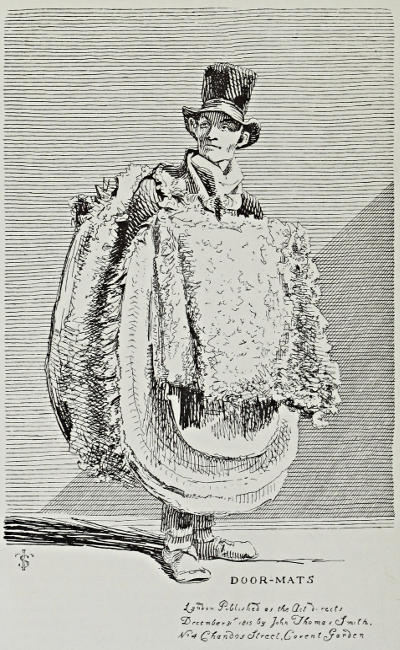
LONDON STREET MERCHANTS: DOOR-MATS
ETCHED BY J. T. SMITH
Beautiful and truly valuable as Mr. Esdaile’s drawings
unquestionably are, it would not only be considered
an impeachment upon my judgment, but a conviction
of the deepest injustice towards that wonderful collection
so classically formed by Sir Thomas Lawrence, were I
not unequivocally to state, that this latter is by far the
most choice, as well as extensive, of any I have yet seen
or heard of, and perhaps it may be stated with equal
truth, ever formed. What catalogue can boast so formidably
of Michael Angelo, Raphael, Claude, Rubens,
and Rembrandt?[442] Surely none; for I have seen those
of Sir Peter Lely, the Duke of Argyle, and Hudson,[443] at
the last of whose sales the immortal Sir Joshua employed
me as one of his bidders, his pupil Mr. Score[444] was another.
It would be assuming too much, to attempt a description
of the individual and high importance of the productions
of all the four above-mentioned masters, possessed by the
liberal President.
As prospective pleasures are seldom realised, a truth
many of my readers must acknowledge, and being determined
never to colour a picture at once, but to await
the natural course of events,[445] I on the 3rd of August
started with my wife for Hampton Court, not only to
see the present state of that palace, but to notice the
sort of porcelain remaining there, without fixing upon
any further plan for the completion of the day’s amusement.
King William III., who took every opportunity of
rendering these apartments as pleasing to him as those
he had left in the house in the Wood, introduced nothing
by way of porcelain, beyond that of delf, and on that
ware, in many instances, his Majesty had W. R., surmounted
by the crown of England, painted on the fronts.
Of the various specimens of this clumsy blue and white
delf, displayed in the numerous rooms of this once magnificent
palace, the pride of Wolsey and splendour of
Henry VIII., the eight large pots for the reception of
King William III.’s orange-trees, now standing in her
Majesty’s gallery, certainly have claims to future protection.
As for the old and ragged bed-furniture, it is
so disgraceful to a palace, that, antiquary as I in some
degree consider myself, I most heartily wish it in Petticoat
Lane. In passing through the rooms, I missed the fine
whole-length picture of Admiral Nottingham,[446] and also
the thirty-four portraits of the Admirals. The guide
informed me that they were presented by our present
King, William IV., to the Painted Hall at Greenwich.
“A noble gift,” said I, “but where can they put them
up?” In order to take some refreshment, we entered
the parlour of the “Canteen,” that being the sign of
the suttling-house of the Palace. During our stay,
Legat’s[447] fine engraving from Northcote’s forcibly effective
picture of the “Death of the Princes in the Tower,” which
honoured the room, caught the attention of one of two other
visitors to the Palace. “Bless me,” said he, “are those
brutes going to smother those sweet babes? Why, they
are as beautiful as the Lichfield children.”[448] The observation
was not made to me, and as the subject has been
too often mentioned, I shall forbear saying more about it.
As my wife and I were strolling on, in order to secure
places for our return to London in the evening, I ventured
to pull the bell at Garrick’s Villa, and asked for permission
to see the temple in which Roubiliac’s figure of
Shakspeare had originally been placed.[449] Mr. Carr, the
present proprietor of the estate, received us with the
greatest politeness. Upon expressing a hope that my
love for the fine arts would plead my apology for the
intrusion, he assured me it would afford him no small
pleasure to walk with us to the lawn. “Do sit down,
for a tremendous storm appears to be coming on; we
must wait a little.” His lady, of most elegant manners,
at this moment entered the room and cordially joined
in her husband’s wishes to gratify our curiosity, observing
that, if we pleased, she would show us the house. This
offer was made in so delightful a manner, that we were
truly sensible of the indulgence.
Upon returning to a small room which we had passed
through from the hall, “Ah! ah!” said I, “you are
curious in porcelain, I see,—the crackle. What fine
Dresden! I declare here is a figure of Kitty Clive, as
the Fine Lady in Lethe, from the Chelsea manufactory.”[450]
There is an engraving of this by Moseley, with the landscape
background etched by Gainsborough. This figure
of Mrs. Clive, which was something less than a foot in
height, was perfectly white, and one of a set of celebrated
characters, viz., John Wilkes; David Garrick, in Richard
the Third; Quin, in Falstaff; Woodward, in the Fine
Gentleman; the Duke of Cumberland, etc. Most of these
were characteristically coloured, and are now and then to
be met with.[451]
“How you enjoy these things!” observed Mrs. Carr.
“This is the drawing-room; the decorated paper is just
as it was in Mr. Garrick’s time; indeed, we have had
nothing altered in the house. I never enter this room
without regretting the enormous expense we were obliged
to incur, in taking down a great portion of the roof, owing
to a very great neglect in the repairs of the house during
Mrs. Garrick’s time. Fortunately it was discovered just as
we took possession of the premises, or the consequences
might have been fatal.” “Your grounds are beautiful,”
observed my wife. “Yes,” said Mrs. Carr, “and
several of the trees were planted by Mrs. Garrick; that
mulberry-tree was a sucker from Shakspeare’s tree at
Stratford; that tulip-tree was one of her planting, and
so was the cedar. Now you shall see our best bed-room.”
The end of this room which contains the bed is divided
from the larger portion by a curtain suspended across
the ceiling, which gives it the appearance of a distinct
drawing-room, for the comfort of a visitor, if indisposed.
“We will now go to Mr. and Mrs. Garrick’s bed-room.”
Notwithstanding the lowness of the ceiling, the room
still carries an air of great comfort. Here we were again
gratified with a display of some choice specimens of
Oriental porcelain.
We then descended to the dining-room, in which
were portraits of the Tracy family. On one side of the
chimneypiece hangs a half-length picture of Mrs. Garrick,
holding a mask in her right hand. This was painted
by Zoffany,[452] before her marriage, who was one of her
admirers; over the sideboard hangs a portrait of Tom
Davies, the author of the Life of Garrick, who had been
his steadfast friend.[453] We then returned to the bow-room,
in which we were first received; from thence we
entered the library, and were then shown Mr. Garrick’s
dressing-table. On our return to the bow-room, I asked
Mr. Carr in what part of the house Hogarth’s Election
pictures had hung. “In this,” said he; “one on either
side of the fireplace.”[454]
The rain still continuing, our amiable shelterers insisted
on our staying dinner, as it was impossible to see
the Temple in such a storm. We accepted this hospitable
invitation; and in the course of conversation Mrs. Carr
assured us that we were not only seated upon the sofa
frequently occupied by Dr. Johnson, but also the identical
cover. “Now, Mrs. Smith, I will show you my Garrick
jewels, which Mr. Carr, in consequence of a disappointment
I received, by their not being left to me by will,
according to Mrs. Garrick’s repeated promises, most
liberally purchased for me at the price fixed upon them
by Messrs. Rundell and Bridge; for I must inform you
that the intimacy of my family with Mrs. Garrick was
of thirty years’ standing, and that lady and I were inseparable.”
The first treasure produced was a miniature
of Mr. Garrick, set in brilliants; the second, a rich bracelet
of pearls, containing the hair of Mr. and Mrs. Garrick.
Mrs. Carr politely presented my wife and myself with
impressions of a profile of Mr. Garrick, contemplating
the features of Shakspeare.
After dinner was announced, and in the course of
taking our wine, I thanked our worthy hosts for their
hospitality. “This house,” said Mr. Carr, “was ever
famous for it. Dr. Johnson has frequently knocked up
Mr. and Mrs. Garrick at a very late hour, and would never
go to bed without a supper.”[455] I asked his opinion as
to the truth of the anecdote related by Lee Lewis concerning
Mrs. Garrick’s marriage. “There certainly is,”
he replied, “a mystery as to who her father was.” Mrs.
Carr observed that, after Mrs. Garrick had read Lewis’s
assertions, she, with her usual vivacity, exclaimed, “He
is a great liar; Lord Burlington was not my father, but
I am of noble birth.”
“Is it true,” I asked, “that Lord Burlington gave
Mr. Garrick £10,000 to marry her?”
“No, nor did Mrs. Garrick ever receive a sum of money
from Lord Burlington: she had only the interest of £6000,
and that she was paid by the late Duke of Devonshire.”[456]
The rain now subsided; and as we passed through
the passage cut under the road, Mrs. Carr stopped where
Mrs. Garrick had frequently stood, while she related
the following anecdote. ‘Capability Brown,’[457] was consulted
as to the communication of these grounds with
those by the water. Mr. Garrick had an idea of having
a bridge to pass over the road, similar to the one at Pain’s
Hill;[458] but this was objected to by Capability Brown,
who proposed to have a tunnel cut. Mr. Garrick at
first did not like that idea; but Dr. Johnson observed,
“David! David! what can’t be over-done may be under-done.”[459]
As we entered the Temple, instead of seeing a vacant
recess, we were agreeably surprised to find that the present
owner had occupied it by a cast of Roubiliac’s statue
of Shakspeare, most carefully taken by Mr. Garrard,[460]
similar to the one with which he furnished the late Mr.
Whitbread for the hall of Drury Lane Theatre. On our
return to the villa, we were shown a small statue of Mr.
Garrick, in the character of Roscius; but by whom it
was modelled I was not able to learn. The following
inscription was placed under the plinth:—“This figure
of Garrick was given to Mr. Garrard, A.R.A., by his widow,
and is now respectfully presented to Mrs. Carr, to be
placed in Garrick’s Villa, July 14, 1825.”
In the bow-room, in which we again were seated,
is a portrait of Mr. Hanbury Williams, and also two
drawings of Mr. and Mrs. Garrick, by Dance, of which
there are lithographic engravings by Mrs. Solly, the daughter
of the Rev. Mr. Racket, with impressions of which that
lady honoured me for my wife’s illustrated copy of the
Life of Dr. Johnson. Mrs. Solly also favoured me with
a sight of a pair of elegant garnet bracelets, which had
been left to her by Mrs. Garrick. The bell, Nollekens’s
old friend, announced the arrival of the stage, and we
took our departure.
On the following morning, taking advantage of the
Museum vacation allowed to officers of that establishment,
and feeling an inquisitive inclination to know in
what way the portraits of the admirals had been disposed
of in Greenwich Hospital, I went thither, where I found
a display of great taste in the distribution of the pictures
which adorn the Painted Hall of that national and glorious
institution. Many of my readers will recollect that in
second editions of works errors are usually corrected.
Such, I understand, has been the case in the hanging
of the pictures in this splendid gallery; for, in the first
instance, numerous small and also indifferent subjects
were hung at the top of the room, and the spectator was
told that this arrangement was merely to produce uniformity,
until a period arrived when larger and better
productions could occupy their places. The liberality
of King William IV., who gave no fewer than fifty-five
pictures, in addition to the very valuable presents made
by the Governors of the British Institution, enabled Mr.
Seguier, keeper of the royal collection, to display his best
taste in the re-arrangement.
All the small pictures have been taken away, and a
most judicious display of whole-length portraits, the size
of life, occupy their spaces. Modern artists must not only
be pleased with the truly liberal manner in which their
works are here exhibited, but will rejoice in having an
opportunity of retouching and improving their pictures,
from the manner in which the light falls upon them—an
advantage always embraced in large edifices by the old
masters, but perhaps more particularly by Rubens, who,
it is well known, worked upon his performances after they
had been elevated to their respective destinations. I must
own, without a wish to cast the least reflection upon the
works of other modern artists displayed in this gallery,
that the noble picture of the Battle of Trafalgar,
painted by Arnald, the Associate of the Royal Academy,
at the expense of the Governors of the British
Institution, at present arrests most powerfully the
attention.
As I was admiring the dignity of the Hampton Court
admirals, who never appeared to such advantage, a well-known
voice whispered over my shoulder, “You are not
aware, perhaps, that Vandevelde painted the sea-distances
in those pictures?” “No,” answered I; “that is a very
interesting fact;” adding that “I could not believe Kneller
to have been the painter of all the heads.” Mr. Seguier
rejoined, “Dahl, in my opinion, painted some of
them.”[461] In the course of conversation he gave me no
small pleasure by observing that he had read my work
of Nollekens and his Times.—“I can answer as to the
truth of nine-tenths of what you have asserted,” said he,
“having known the parties well.”
Upon leaving this interesting gallery, a pleasing thought
struck me, that if a volume of naval history, commencing
with the early ballads in the Pepysian Library, and ending
with the delightful compositions of Dibdin, were printed,
and given to every collier’s apprentice as a reward for
his good behaviour, it might create in him that spirit of
emulation which, when drafted from his vessel, would
induce him to defend the long-famed wooden walls of Old
England most undauntedly. Humble as the versification
of these our old ballads may justly be considered, yet I have
frequently seen the tear of gratitude follow the melody of
Incledon while singing the song of “Admiral Benbow.”[462]
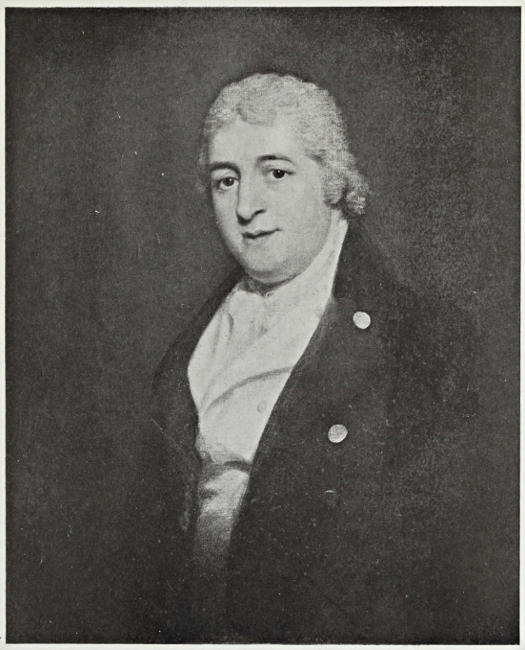
CHARLES DIBDIN
“He found a voice for the British sailor.”
Tom Taylor
“What, upon the old trot, Master?” observed a funny-mover,[463]
as I descended the rotten old stairs of Hungerford
Market. “Will you make one with us? I know you
don’t mind where you steer.” We had hardly made
Chelsea Reach, when one of our crew noticed a foundered
freshman, who had most ingeniously piloted himself into
a cluster of osiers, in order to adjust his cravat, as a lady in
our boat was to meet him that evening in Vauxhall Gardens.
Our steersman, who was fond of a bit of fun, thus assailed
him, “I say, Maty, why you’re water-logged there; you
put me in mind of the Methodist parson who ran adrift
last Saturday nearly in the same place: he made a pretty
good thing of it.” “Ay,” observed a dry old fresh-water
passenger in our boat, “I saw the fellow; and when the
Battersea gardeners[464] quizzed him, he attempted to stand
up like a poplar; but the wind operating upon his head,
it hung like a bulrush. However, when he was seated,
instead of advising them to make ready for simpling-time,
or bespattering them with low language, he exercised his
pulpit volubility in favour of vegetables, declaring that
for years he had lived upon them, and insisted that every
young person of every climate should eat nothing else,
strengthening this opinion with the following quotation
from Jeremy Taylor, who declared that ‘a dish of lettuce
and a clear fountain would cool all his heats.’ After this
he most strenuously advised them to ask more money for
their pecked fruit than they had been accustomed to
receive, observing, that they should keep Shakspeare’s
caution in mind, ‘Beware all fruit but what the birds have
pecked.’[465] At the close of his address, a descendant of old
Mother Bagley, called ‘The King of Spades,’ proposed
to his men not only to join him in all their coppers, but to
fresh-water the poor fellow’s boat, for which he thanked
them, and declared that he was almost ready to float in his
own perspiration; but that he, like Sterne’s[466] ‘Starling,’
could not get out. The Mortlake boys soon gave him
three cheers, and away he scuttled like an eel towards
Limehouse Hole, sticking as close to his boat as a toad to
the head of a carp.”
At this the lady simpered. “Bless your heart, fair
one,” observed the narrator, addressing the lady who was
destined for Vauxhall Gardens, “you never saw such a
skeleton as this vegetable-eater. As for his complexion,
it was for all the world like—what shall I say?”
“Perhaps a Queen Anne’s guinea,” observed our
waterman, “that they used to let into the bottom of
punch-ladles”—many of which were frequently to be seen
in the pawnbrokers’ windows in Wapping.
“As for his voice during his preaching,” rejoined our
entertaining companion, “no lamb’s could be more innocent.”
As we were tacking about, the wind standing fair to
drop the lady at Vauxhall-stairs, our old weathergage,
the waterman, who reminded me of Copper Holmes, thus
addressed a lopped Chelsea Pensioner:—“I say, old
Granby,[467] people say that he who loves fighting is much
more the sexton’s friend than his own.” “Ay, Master
Smelter,” answered the corporal, “we are all alive here,
and, like the Greenwich boys, willing to fight again; Old
England for ever!”
I then requested the waterman to put me on shore,
in order to visit Chelsea College, purposely to see what
had been done with my friend Ward’s allegorical picture
of the Triumph of the Duke of Wellington. The Right
Hon. Noblemen and Gentlemen, Governors of the British
Institution, wishing to perpetuate the memory of the noble
victory on the plains of Waterloo, they, with their accustomed
liberality to the fine arts, commissioned James Ward,
Esq., R.A., to paint an allegorical picture worthy a place
in the Hall of that glorious establishment, Chelsea Hospital.
Having heard that Mr. Ward’s picture had been hung up, I
went thither, but, to my utter astonishment, found it not
only suspended without a frame (just as a showman in a
fair would put out his large canvas to display “the true
and lively portraiture” of a giant, the Pig-faced Lady,
or the Fire-eater), but with its lower part projecting over a
gallery, just like the lid of a kitchen salt-box; so that the
upper and greater half, being on an inclined plane, had
copiously received the dust, and doubtless, if it be allowed
to accumulate, the Duke’s scarlet coat will undergo a brick-dust
change, and his cream-coloured horses become the
dirtiest of all the drabs.
If this picture be considered worth preserving, why
expose it so shamefully to injury by suffering it to hang as
it does? If, on the contrary, why not at once consign
it to the waters of oblivion, by casting it into Chelsea
Reach? Mr. Ward’s superior talents have been in
numerous instances acknowledged by some of the best
judges.
Descending Villiers Street on one of my peregrination
mornings, a tremendous storm obliged me to request
shelter of Mrs. Scott, the wife of the present keeper of York
Terrace, and successor of Hugh Hewson, a man who
declared himself to be the genuine character famed by
Dr. Smollett in The Adventures of Roderick Random,
under the appellation of Hugh Strap.[468] Here I met with
a young man whose father had attended Hewson’s funeral,
who informed me that Hugh had been frequently known
to amuse the ambulators of that walk by recapitulating
the enterprising events which had taken place during his
travels with the Doctor. Hugh, who had for years followed
the trade of a hairdresser, was buried in St. Martin’s-in-the-Fields,
and his funeral was attended by three
generations.
On my way towards Hungerford Stairs, my organ of
inquisitiveness was arrested by two carvings in stone, of a
wheatsheaf and sickles, let into either side of the north-end
houses in the alley leading to the “The Swan.” A
waterman informed me that the south portion of Hungerford
Market was originally allotted for the sale of corn, but I
have since learned that that device is the crest of the
Hungerford family. “Pray now,” said I to my oracle,
“do enumerate the signs of Swans remaining on the banks
of the Thames, between London and Battersea Bridges.”
“Why, let me see, Master, there’s the Old Swan at London
Bridge, that’s one;—there’s the Swan in Arundel Street,
two;—then ours here, three;—the Swan at Lambeth,
that’s down, though;—well then, the Old Swan at Chelsea,
but that has long been turned into a brewhouse, though
that was where our people rowed to formerly, as mentioned
in Doggett’s Will; now they row to the sign of the New
Swan beyond the Physic Garden; we’ll say that’s four;—then
there’s the two Swan signs at Battersea, six.”[469]
Next evening, away I trudged to take water with
George Heath (Mathews’s Joe Hatch) at Strand Lane.
“I find the Swan to be your usual sign up the river,”
said I.
“Why, yes,” replied George; “I don’t know what a coach,
or a waggon and horses, or the high-mettled racer have to
do with our river. Bells now, bells, we might have bells,
because the Thames is so famous for bells.” Bless me,
thought I, how delighted would my old friend Nollekens
have been, had he heard this remark!
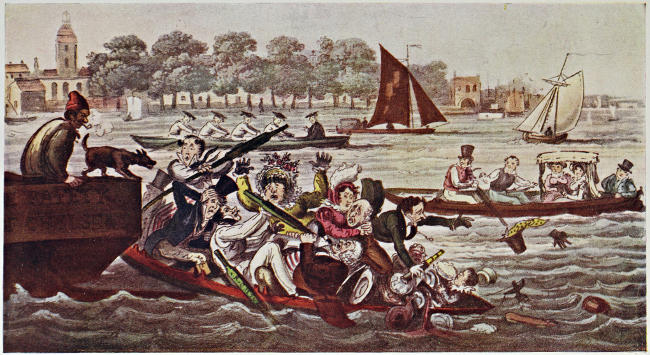
A PLEASURE PARTY ON THE THAMES
“You like bells, then, Master Heath?”
“Oh yes! I was a famous ringer in my youth, at
St. Mary Overies. They are beautiful bells; but of all
the bells give me Fulham; oh, they are so soft, so sweet![470]
St. Margaret’s are fine bells; so are St. Martin’s; but after
all, Fulham for my money, I say. I forget where you said
I was to take you to, Master?”
“Row me to Hungerford,” said I.
Here I alighted, and then went round to Wood’s coal-wharf,
at the foot of Northumberland Street,[471] where the
said Mr. Wood dwells in the very house in which Sir Edmund
Berry Godfrey resided, who was strangled in Somerset
House.[472] Sir Edmund Berry was a woodmonger, and became
the court justice. In this appointment he was so active,
that during the time of the Great Plague, 1665, which
continued to rage in 1666, upon the refusal of his men to
enter a pest-house, to bring out a culprit who had furnished
a thousand shops with at least a thousand winding-sheets
stolen from the dead, he ventured in alone, and brought the
wretch to justice. In Evelyn’s interesting work on medals,
the reader will find that four were struck, commemorative
of Sir Edmund Berry Godfrey’s death; and in addition to
the elaborately engraved portraits noticed by Granger,
he will also find an original picture of him in the waiting-room
adjoining the vestry of St. Martin’s-in-the-Fields,
where he was interred, and his funeral sermon preached
by Dr. Lloyd.[473]
In a little work published in 1658, entitled The Two
Grand Ingrossers of Coals, viz. the Woodmonger and the
Chandler,[474] the reader will find the subtle practices of the
coal-vendors shortly after that article was in pretty general
use.
It is curious to observe how fond Horace Walpole,
and indeed all his followers, have been of attributing the
earliest encouragement of the fine arts in England to King
Charles I. That is not the fact; nor is that Monarch
entitled, munificent as he was, to that degree of praise
which biographers have thought proper to attribute to
him as a liberal patron; and this I shall immediately prove.
King Henry VIII. was the first English Sovereign who
encouraged painting, in consequence of Erasmus introducing
Hans Holbein to Sir Thomas More, who showed
his Majesty specimens of that artist’s rare productions.
Upon this the king most liberally invited him to Whitehall,
where he gave him extensive employment, not only
in decorating the panels and walls of that palace with portraits
of the Tudors, as large as life, but with easel pictures
of the various branches of his family and courtiers, to be
placed over doors and other spaces of the state chambers.
Holbein may be recorded as the earliest painter of
portraits in miniature, which were mostly circular, and all
those which I have seen were relieved by blue backgrounds.
He was also the designer and draughtsman of numerous
subjects for the use of the court jewellers, as may be seen
in a most curious volume preserved in the print-room of
the British Museum, many of which are beautifully coloured.
Holbein must have been a most indefatigable artist, for he
was not only employed to paint that fine picture of King
Henry granting the charter to the Barber-Surgeons,[475]
now to be seen in Barbers’ Hall, Monkwell Street,[476] that
in Bridewell of King Edward VI. granting the charter to
the citizens of London,[477] but numerous portraits for the
Howards, and other noble families; indeed, the quantity
of engravings from the burin of Hollar and other artists,
from Holbein’s works, prove that painter to have been just
as extensively employed as Vandyke.
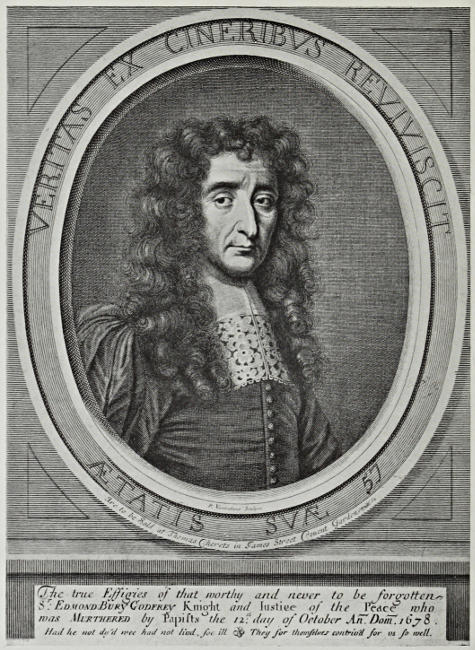
SIR EDMUND BERRY GODFREY
“He was esteemed the best Justice of Peace in England.”
Burnet
King Charles I., it is stated, became possessed of
numerous portraits drawn by Holbein, of several personages
of the crown and court of King Henry VIII., from
characters high in office, to Mother Jack,[478], considered to
have been the nickname of Mrs. Jackson, the nurse of
Prince Edward. These interesting drawings, it is said,
the King parted with for a picture; but how they again
became the property of the Crown, I am uninformed.
However, true it is that they were discovered in Kensington
Palace, and taken from their frames and bound in two
volumes. During Mr. Dalton’s[479] librarianship he etched
many of them in his coarse and hurried manner. Since
then Mr. Chamberlaine,[480] his successor, employed Mr. Metz[481]
to engrave one or two as specimens of an intended work,
but Mr. Bartolozzi’s manner being considered more likely
to sell, that artist was engaged to produce the present
plates, which certainly are far from being facsimiles of
Holbein’s drawings, which I have seen. Many of this
master’s invaluable pictures are engraved and published
in the work entitled Portraits of Illustrious Personages of
Great Britain; accompanied by the biographical lucubrations
of Edmund Lodge, Esq.[482]
The liberality of the brothers Paul and Thomas Sandby,
Royal Academicians, will be remembered by every person
who had the pleasure of being acquainted with them;
but more particularly by those who benefited by their
disinterested communications and cheering encouragement
in their art. For my own part, I shall ever consider
myself indebted to them for a knowledge of lineal perspective.
By their indefatigable industry, the architecture
of many of the ancient seats of our nobility and
gentry will be perpetuated; and I may say, but for the
very accurate and elaborate drawings taken by Paul
from Old Somerset House gardens, exhibiting views up
and down the river, much of the Thames scenery must
have been lost.[483] The view up the river exhibits the
landing-stairs of Cuper’s Gardens, and that part of the
old palace of Whitehall then inhabited by the Duchess
of Portland, upon the site of which the houses of that
patron of the arts, Lord Farnborough,[484] and other noblemen
and gentlemen, have recently been erected. The
one down the river displays an uninterrupted view of
the buildings on either side to London Bridge, upon which
the houses are seen, by reason of Blackfriars Bridge not
then being erected. These drawings are in water-colours,
and are preserved in the thirteenth volume of Pennant’s
interesting account of London, magnificently illustrated,
and bequeathed to the print-room of the British Museum
by the late John Charles Crowle, Esq.[485]
Should my reader’s boat ever stop at York Watergate,[486]
let me request him to look up at the three upper
balconied windows of that mass of building on the south-west
corner of Buckingham Street. Those, and the two
adjoining Westminster, give light to chambers occupied
by that truly epic historical painter, and most excellent
man, Etty, the Royal Academician, who has fitted up
the balconied room with engravings after pictures of the
three great masters, Raphael, Nicholas Poussin, and
Rubens.
The other two windows illumine his painting-room,
in which his mind and colours resplendently shine, even
in the face of one of the grandest scenes in Nature, our
river Thames and city edifices, with a most luxuriant
and extensive face of a distant country, the beauties of
which he most liberally delights in showing to his friends
from the leads of his apartments, which, in my opinion,
exhibit the finest point of view of all others for a panorama.
The rooms immediately below Mr. Etty’s[487] are
occupied by Mr. Lloyd, a gentleman whose general knowledge
in the graphic art, I and many more look up to
with the profoundest respect. The chambers beneath
Mr. Lloyd’s are inhabited by Mr. Stanfield,[488] the landscape-painter,
whose clear representations of Nature’s
tones have raised the scenic decorations of Drury Lane
Theatre to that pinnacle of excellence never until his
time attained, notwithstanding the productions of Lambert,
Richards, nay, even Loutherbourg. Mr. Stanfield’s easel
pictures adorn the cabinets of some of our first collectors,
and are, like those of Callcott, Constable, Turner, Collins,
and Arnald, much admired by the now numerous publishers
of little works, who unquestionably produce
specimens of the powers of England’s engravers, which
immeasurably out-distance the efforts of all other
countries.
However, although I am willing to pass the highest
encomiums on the landscape-engraver for his Liliputian
labours, I am much afraid, in the course of time, we shall
have productions smaller still; and that the diminutive
size of a watch-paper, measuring precisely in diameter
one inch, two-eighths, and one-sixteenth, will be the noblest
extent of their labours. To men of their talent (and
there are several among these pigmy burinists), I will
venture, now I am upon the silver streams of noble Father
Thames, to lead their attention to Woollett’s Fishery,
but more particularly to West’s La Hogue, and then
let them ask themselves this question: Would it not
redound more to our glory to be master of equal excellence
in the grand style in which those works are produced,
than to contribute too long to the illustrations of scrapbooks
only? Yes, gentlemen, I think you would say
so. Let me endeavour, then, to arrest your gravers from
this blinding of the public, by reducing your works to
so deplorable a nicety, that by-and-by you will find yourselves
totally blind. Why not, as talent is not wanting,
prove to the collectors that England has more Woolletts
than one? It is true there are several at present engaged
in engraving plates from the fine old pictures in the
National Gallery, who have my cordial good wishes for
their success; yet I trust that, after that task is at an
end, they will, with a considerable augmentation to their
numbers, pay a becoming respect so justly due to modern
painters of their own country, whose works in historical
subjects, as well as portraits and landscape, extinguish
unquestionably those of foreign powers; and I may say,
with equal truth, equal most of those of the old schools.
Such a publication, however successful their present one
may be, I can answer for it would be patronised by the
noblemen and gentlemen of England with redoubled
liberality, and in such tasks the engravers will have the
opportunity of producing finer things by the more powerful,
and indeed inestimable advantage of having their progressive
proofs touched upon by the painters themselves.
“Pull away, my hearty” (for I was again in a boat).—“To
Westminster, Master?”—“Ay, to Westminster.”
Being now in view of the extensive yards which for
ages have been occupied by stone and marble merchants,
“Ay,” said I, “if these wharfs could speak, they, no
doubt, like the Fly, would boast of their noble works.
Was it not from our blocks that Roubiliac carved his
figures of Newton, the pride of Cambridge, and that of
Eloquence, in Westminster Abbey; Bacon’s figure of
Mars, now in Lord Yarborough’s possession; Rossi’s
Celadon and Amelia, and Flaxman’s mighty figure of
Satan, in the Earl of Egremont’s gallery at Petworth;
as well as three-fourths of Nollekens’s numerous busts,
which, according to whisperings, have only been equalled
by Chantrey? And then, has not our Carrara been conveyed
to the studios of Westmacott and Baily?[489]”
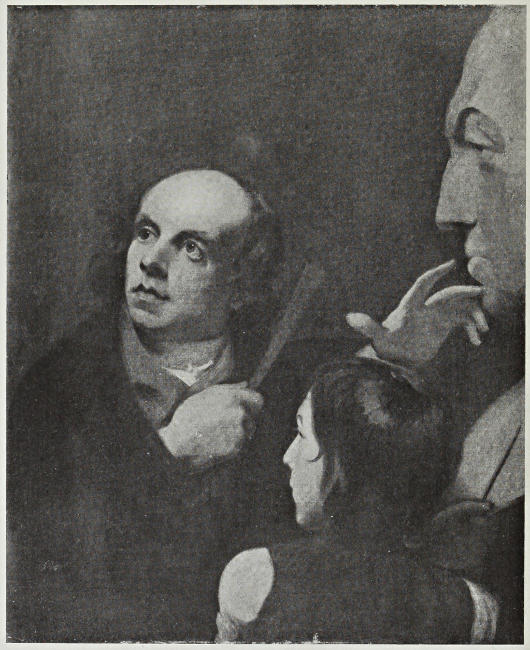
JOHN FLAXMAN R.A.
“This little man cuts us all out in sculpture.”
Bankes
After the truly interesting information the print-collectors
have received from the pen of Mr. Ottley,[490]
a gentleman better qualified than any I know to speak
on works of art, more particularly those of the ancient
schools of Italy, it would be the highest audacity in me
to offer my own observations, however conversant my
friends are pleased to consider me on those subjects.
All I shall therefore now add to Mr. Ottley’s valuable
stock of knowledge are the following circumstances,
which occurred respecting that beautiful impression in
sulphur, taken from a pax, engraved by Tomaso Finiguerra,
before the said impression was so liberally purchased
by the Duke of Buckingham, who has most cheerfully
afforded it an asylum at Stowe. It has been for
many years in the Print-Room of the British Museum.[491]
Mr. Stewart favoured me, at my earnest request, with
the following statement of the fortunate manner in which
he secured this unique and inestimable production as a
treasure for England.
“The sulphur cast, from the celebrated pax of ’Maso
Finiguerra, came into my hands in the following manner:—The
Cavalier Seratti, in whose valuable collection it
originally existed, was captured in going from Cagliari
to Leghorn, and carried to Tunis, where he resided, I
believe, for one or two years; but, dying in captivity,
the Dey of Tunis took possession of the whole of his property.
Such part of it as was not of any intrinsic value
was sold to a party of Jews, who brought it over to Malta
with a view of sending it to Great Britain for sale. This
took place about the commencement of 1804. The
property coming from Barbary was of course placed in
the lazaretto. While there the plague broke out in the
island, and it was a full year before the property was
liberated. The Jews by this time had become apprehensive,
owing to the numerous obstacles they had encountered
in the realisation of their projects; and my
friend the Abbate Bellanti, librarian to the Government
Library, with a view to retain the collection in his native
island, induced a Maltese merchant to make the Jews
such an offer for the whole of the Seratti collection as
they at last accepted. The merchant, however, retracted;
and the abbot, after having made himself responsible
for the bargain towards the Jews, found himself in an
unpleasant predicament. In this dilemma he applied
to me, and I readily engaged to fulfil the agreement which
the merchant had forfeited. The sulphur in question
formed the object of a separate bargain. I paid the
value of £15 for it. I was very unfortunate in the transmission
of my collection to England, two ships having
been cast away in the Channel in November, 1815, both
with a considerable portion of my property on board.
I was more successful with the third portion, which arrived
in 1816; in this was the sulphur cast. I never would
have parted with it but for the above accident, whereby
at that time I was much straitened in my circumstances.
“The sulphur I sold to Mr. Colnaghi for £150, which
I thought a low price at the time for such an interesting
and unique curiosity, indispensable for illustrating and
fixing the date of the invention of the art of engraving
(as it is now called). This sulphur, with the print preserved
at Paris, and the pax of Finiguerra himself, preserved
at Florence, together with the entry in the journal
of the Goldsmiths’ Company, also preserved at Florence,
showing the date of the completion of the pax to be 1452,
form altogether an irrefragable chain of proof which must
satisfy the most sceptical. By a memorandum in Seratti’s
own handwriting, which is amongst my papers (but having
been sent from Bombay to Liverpool, I have not yet
got), it appears that he purchased the sulphur from a
painter, who bought it with a heap of other trinkets at
the stall of a petty dealer in Florence: and on acquiring
it Seratti compared it with the pax itself, and ascertained
it to be the genuine work of Finiguerra.
“I may add a few observations of my own, not altogether
irrelevant to the subject.
“The silver vessel, or pax, generally enclosed some
relic, and was kissed by the congregation or other individuals
in token of devotion; and the Count Seratti
mentions that the one of which this sulphur is in part
a facsimile, is very much worn by this repeated act of
devoutness. The word pax appears to be a corruption
of pyxis, a box; and we have in Shakspeare a pyx of little
value. The engraving was usually filled up with a metallic
mixture of a dark composition, which, being fused by
the action of fire, became incorporated with the vessel
itself. This process was called Niello, or Anniello, Niellare,
or Anniellare; hence our anneal, the term probably
derived from nigellum, or perhaps even from Mêl, the
Indian term for black, and applied to indigo, by which
name that dye was originally known in Europe, and it
was probably used in the composition before alluded
to. The term anniello, and the purpose to which these
pyxes were applied, is further illustrative of a passage
in Shakspeare, which I believe has hitherto puzzled commentators.
It is this:—Hamlet accuses his uncle of
having dispatched his father ‘unhousel’d, unanointed,
unanneal’d;’ it alludes to the custom in Catholic countries
of offering relics preserved in their pyxes to be kissed
after extreme unction.
“I shall be happy to communicate any further particulars
respecting this interesting vestige of art which
may be required of me, in as far as I am able.
“J. Stewart.
“2nd May, 1829.”
The glowing evening of the 16th of July added lustre
to the enchanting grounds of William Atkinson, Esq.
of Grove End, Paddington;[492] and perhaps, if I were to
assert that few spots, if any, excel in the variety of its
tasteful walks and unexpected recesses, I should not
outstep the verge of truth.
The villa was designed by Mr. Atkinson, with his
usual attention to domestic comfort; the grounds were
peculiarly manured under his direction, and the rarest
trees and choicest plants he could procure from all the
known parts of the globe were planted by his own hand,
and that too in the course of the last twelve years. On
the knolls the antiquary will find sculpture from Carthage;
and in the silent trickling dells the mineralogist specimens
of the varieties of English stone, imbedded in the most
picturesque strata. The delightful surprise of the spectator
is beyond belief, particularly on turning back to view
his trodden path, when that sun which fired the mind
of Claude sparkles among the gently waving branches
from climes he may never visit. Upon my observing
to Mrs. Atkinson that in this meandering retreat my
mind would be instantly soothed, that lady then recalled
to my recollection Allan Ramsay’s Gentle Shepherd, by
repeating the following lines:
“How wholesome is’t to breathe the vernal air,
And all the sweets it bears, when void of care.”
[493]
Here the Waltonian, too, will find a seat, and view the
canal—
“Kissing with eddies soft the bordering grass.”
My thanks are here offered to my friend Mr. West,[494]
late of Drury Lane Theatre, now a professor of music,
for the kind loan of an imperfect copy (which he met with
at a stall) of a work of rarity, of which I have not been able
to hear of another copy. It is not mentioned by Watt,
and, what is more remarkable, the Rev. Hartwell Horne,[495]
of the British Museum, never heard of it. It is a small
quarto, bearing the following title:—
“THE
POST ANGEL,
OR,
UNIVERSAL ENTERTAINMENT.
“London: printed, and to be sold by A. Baldwin, near
the Oxford Arms, in Warwick Lane, 1702, where is to be
had the first and second volume, or any single month, from
January, 1701, to this time; price of each, one shilling.”[496]
Page 191 of the third volume affords the admirers of
wax effigies the following information:—
“TO THE EDITOR.
“Sir,—You having promised to give an account of the
curiosities of art, as well as the wonders of nature, I thought
it would oblige the public to acquaint you that the effigies
of his late Majesty, King William III., of glorious memory,
is curiously done to the life in wax, dressed in coronation
robe, with so majestic a mien that nothing seems wanting
but life and motion, as persons of great honour upon the
strictest view have with surprise declared. Likewise the
effigies of several persons of quality, with a fine banquet,
and other curiosities in every room, passing to and from
the King’s apartment, are all to be seen at Mrs. Goldsmith’s,
in Green Court, in the Old Jury, London.”
From the following flummery bespattered on this wax-worker
by the editor of the Post Angel, I may, with the
greatest probability, conclude that his substance was
just as vulnerable as that of many of the hirelings who
feed themselves by puffing what they denominate “the fine
arts,” and that he had no objection to a dozen of port,
had it been ever so crusted.
“The Observator” states that “the ingenuity of
man hath found out several ways to imitate Nature, and
represent natural bodies to the eye by sculpture, picture,
carving, waxwork, etc.; and though some of the ancients
were famed for this art, as Zeuxis and Apelles, yet our last
ages have outstripped them, and made considerable improvements,
as may be easily discernible to those who
are skilled in antiquities, and have observed the rude and
coarse pieces of the ancients. Those that question the
truth of this, need but step to that famous artist, Mrs.
Goldsmith, in the Old Jewry, whose workmanship is so
absolute (in the effigies which she has made of his late Majesty),
as it admits of no correction. She also made the late
Queen, the Duke of Gloucester, to the general satisfaction
of a great number of the nobility and gentry. I am not for
the Hungarian’s wooden coat of mail, the work of fifteen
years; nor Myrmeride’s coach with four horses, so little
that you might hide them under a fly’s wing: these are but
a laborious loss of time, an ingenious profusion of one of
the best talents we are entrusted with; but this effigy of his
late Majesty has taken up but a small part of Mrs. Goldsmith’s
time, and yet it is made with so much art, that
nothing seems wanting but life and motion. I own,”
continues this time-server, “’tis little wonder to see a
picture have motion; but Mrs. Goldsmith is such a person
(as all will own that see this effigy which she has made of
King William), that she has almost found the secret to
make even dead bodies alive.”
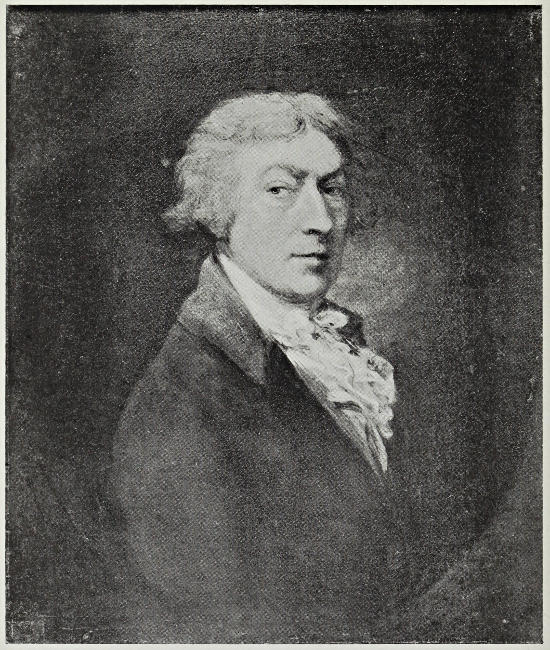
THOMAS GAINSBOROUGH, R.A.
“We are all going to heaven, and Van Dyck is of the company.”
His dying words
“You are never idle,” observed my old, OLD, very OLD
friend John Taylor,[497] as he entered my parlour on the 3rd
of November, in his ninety-third year: “bless me, how
like that is to your father! Well, Howard is a very clever
fellow! Pray now, do tell me, did your father know
Churchill? My friend Jonathan Tyers introduced me to
him in Vauxhall Gardens much about the time Hogarth
represented him as a bear with a pot of porter.[498] I think,
to the best of my recollection, the print was brought out
in 1763. Mr. Tyers asked Mr. Churchill what he thought
of it. ‘Oh!’ said he, ‘it is a silly thing, Sir. I should
have thought Hogarth had known better.’” I then
requested Mr. Taylor to describe Mr. Churchill’s dress for
Vauxhall Gardens. “Oh! not as a clergyman, not in
black, as he appeared in the pit of the theatre. Let me see:
his coat was blue, edged with a narrow gold lace; a buff
waistcoat; but I won’t be certain whether that was laced
or not—I rather think it was not. He had black silk
small-clothes, white silk stockings, small silver shoe-buckles,
and a gold-laced three-cornered hat.”
“Did you know Gainsborough, Sir?” “Oh! I remember
him; he was an odd man at times. I recollect
my master Hayman coming home after he had been to
an exhibition, and saying what an extraordinary picture
Gainsborough had painted of the Blue Boy; it is as fine
as Vandyke.”[499] “Who was the Blue Boy, Sir?” “Why,
he was an ironmonger, but why so called I don’t know.
He lived at the corner of Greek and King Streets, Soho;
an immensely rich man.” “Did you know Mrs. Abington?”
“Oh yes; she was a most delightful actress of women
of fashion, though she made herself very ridiculous by
attempting the part of Scrub.[500] Mr. Hoole, when he heard
she was to play the character that evening, sent for a chair
and went to see her; but he said it was so truly ridiculous,
that he was quite disgusted. Ay, I see you have got
Nollekens’s bust of Dr. Johnson. I made two drawings
of him when I was at Oxford: one was for Sir Robert
Chambers,[501] who married the pretty Miss Wilton, that went
to India; who had the other, I can’t immediately say. I
remember the Doctor asked me what countryman I was.—‘A
Londoner, Sir, a Londoner.’ ‘And where born?’
‘In the parish of Ethelburga, in Bishopsgate Within.’
It is a very small church; but my father and mother[502]
were buried there, though I suppose, by this time, there’s
nothing of them left. My friend Jonathan Tyers took
milk and water for upwards of twenty years at his meals,
though he very well knew what a good glass of wine was,
as well as any man in England. Ay, and a fine haunch
of venison, too. Many and many a time I have dined
with him in the gardens, when I was making the drawing
for Boydell, of Hayman’s picture of the Admirals. Mr.
Tyers gave very excellent dinners, I must say.”
The truly skilful manner in which Mr. John Seguier
has proceeded with the pictures painted by Rubens,
which adorn the ceiling of Whitehall Chapel, will, I hope,
prove a lasting record of his success in picture-cleaning.
When first I ascended the scaffold, my astonishment
was beyond conception at the enormous size of the objects.
The children are more than nine feet, and the full-grown
figures from twenty to twenty-five in height. The pictures
were in a most filthy and husky state. However,
it afforded me infinite delight to hear Mr. Seguier declare,
that he firmly believed he should be able to remove
Cipriani’s washy colouring completely; and that he expected
to find that of Rubens in its pristine state. Upon
my seeing these pictures on the floor, after they had been
cleaned,[503] I found his predictions verified, and can now,
by the judicious nourishment afforded to the canvas,
announce their effect to be truly glorious. Every precaution
has been taken, under the able direction of Sir
Benjamin Clarke Stevenson, to render the roof impervious
to the most inveterate weather, so that posterity, in all
probability, may long enjoy the beauties of these masterpieces
of art.
“Upper Gower Street, Bedford Square, 16th November 1832.
“My dear Sir,—As I am desirous to make your valuable
collection of letters from bygone professional characters complete,
gratify me by accepting the accompanying original
communication from Mrs. Abington to Mrs. Jordan.[504] It
will call to your remembrance the period when that skilful
and excellent man, John Bannister, delighted the town
by his performances; whose retirement from public life
in June, 1815 (after thirty-seven years of hard and honest
service), opened the doors of Old Drury to a young aspirant
for histrionic honours in the person of your humble
servant.
“I need not here enumerate all the advantages derived
from a constant association with such an artist
as John Bannister. An uninterrupted friendly intercourse
of many years manifested the sincerity in which
he penned the following note to me a short time after
my appearance at Drury Lane Theatre:—
“‘65 Gower Street, Dec. 30, 1815.
“‘My dear Sir,—I have been confined to my room more
than three weeks with the gout; but I am now recovering,
though slowly. Early next week, will you favour
me with a visit in Gower Street? It will please me
to give you all the information and gratification in my
power, and to converse with you personally about theatrical
matters.
“‘You are my successor, and I beg leave to say that
I do not know any person more calculated to tread in
my shoes. I sincerely hope you may never have occasion
for the gouty ones! I remain, my dear Sir, yours sincerely,
“‘John Bannister.’[505]
“‘To J. P. Harley, Esq., Theatre Royal, Drury Lane.’
“And now, my dear Sir, with every sincere hope
for your continued health and happiness, believe that
I am very truly yours,
“J. P. Harley.[506]
“To John Thomas Smith, British Museum.”
Mrs. Piozzi, in her anecdotes of Dr. Johnson, speaking
of Porridge Island, says it “is a mean street in London,
filled with cook-shops, for the convenience of the poorer
inhabitants; the real name of it I know not, but suspect
that it is generally known by to have been originally a
term of derision.”
Porridge Island consisted of a nest of old rat-deserted
houses, lately forming narrow alleys south of Chandos
Street, and east of St. Martin’s church, which were originally
occupied by numerous cooks for the accommodation
of the workmen engaged in erecting the said church.[507]