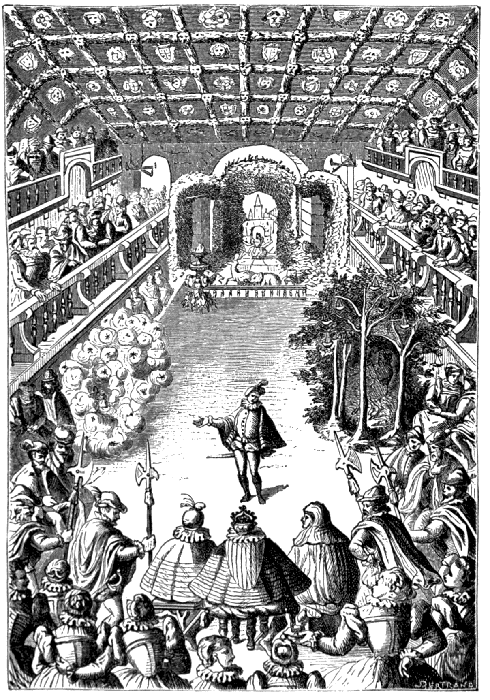
Le ballet de la reine Frontispiece
FACING PAGE
Upper half of Plate No. 1, the 'Miller and His Men' 40
A group of the principal characters from
Pollock's juvenile drama, the 'Miller and His Men' 42
Explosion of the mill. A back drop in the 'Miller and His Men' 46
Plate No. 7, the 'Miller and His Men' 48
Lower half of Plate No. 5, the 'Miller and His Men' 52
The Roman Theater at Orange 134
The multiple set of the French medieval stage 134
The set of the Italian comedy of masks 134
An outdoor entertainment in the gardens of
the Pitti Palace in Florence in the early sixteenth century 136
The set for the opera of 'Persée' (as
performed at the Opéra in Paris in the seventeenth century) 140
A prison (designed by Bibiena in Italy in the eighteenth century) 140
The screen scene of the 'School for Scandal'
at Drury Lane in 1778 144
A landscape set 146
A set for the opera of 'Robert le Diable' 146
The set of the last act of the 'Garden of Allah' 148
A set for 'Medea' 148
The set of 'Œdipe-Roi' (at the Théâtre Français) 150
The set of the 'Return of Peter Grimm' 150
Scenes from Punch and Judy 274
Scenes from Punch and Judy (continued) 276
Roman puppets. Greek and Roman puppets. Puppet of Java. 290
A Sicilian marionette show 292
A Belgian puppet. A Chinese puppet theater.
Puppet figure representing the younger Coquelin 294
Puppets in Burma 296
The puppet play of Master Peter (Italian) 296
A Neapolitan Punchinella 300
The broken bridge. Plan showing the construction of a
shadow-picture theater. A Hungarian dancer (a shadow picture) 308
Shadow Pictures. The return from the Bois de
Boulogne. The ballet. A regiment of French soldiers 310
Shadow Picture. The Sphinx I: Pharaoh passing in triumph 312
Shadow Picture. The Sphinx II: Moses leading his people out of Egypt 314
Shadow Picture. The Sphinx III: Roman warriors in Egypt 316
Shadow Picture. The Sphinx IV: The British troops to-day 318
I
THE SHOW BUSINESS
THE SHOW BUSINESS
I
At an interesting moment in Disraeli's picturesque
career in British politics he indulged in one of his strikingly
spectacular effects, in accord with his characteristic
method of boldly startling the somewhat sluggish
imagination of his insular countrymen; and in the next
week's issue of Punch there was a cartoon by Tenniel
reflecting the general opinion in regard to his theatrical
audacity. He was represented as Artemus Ward,
frankly confessing that "I have no principles; I'm in
the show business."
The cartoon was good-humored enough, as Punch's
cartoons usually are; but it was not exactly complimentary.
It was intended to voice the vague distrust
felt by the British people toward a leader who did not
scrupulously avoid every possible opportunity to be
dramatic. And yet every statesman who was himself
possessed of constructive imagination, and who was
therefore anxious to stir the imaginations of those he
was leading, has laid himself open to the same charge.
Burke, for one, was accused of being frankly theatrical;
and Napoleon, the child of that French Revolution
which Burke combated with undying vigor, never hesitated
to employ kindred devices. When Napoleon
took the Imperial Crown from the hands of the Pope
to place it on his own head, and when Burke cast the
daggers on the floor of the House of Commons, they
were both proving that they were in the show business.
So was Julius Cæsar when he thrice thrust aside
the kingly crown; and so was Frederick on more than
one occasion. Even Luther did not shrink from the
spectacular if that could serve his purpose, as when he
nailed his theses to the door of the church.
If the statesmen have now and again acted as tho
they were in the show business, we need not be surprised
to discover that the dramatists have done it
even more often, in accord with their more intimate
relation to the theater. No one would deny that
Sardou and Boucicault were showmen, with a perfect
mastery of every trick of the showman's trade. But
this is almost equally true of the supreme leaders
of dramatic art, Sophocles, Shakspere, and Molière.
The great Greek, the great Englishman, and the great
Frenchman, however much they might differ in their
aims and in their accomplishments, were alike in the
avidity with which they availed themselves of every
spectacular device possible to their respective theaters.
The opening passage of 'Œdipus the King,' when the
chorus appeals to the sovran to remove the curse that
hangs over the city, is as potent on the eye as on the
ear. The witches and the ghost in 'Macbeth,' the
single combats and the bloody battles that embellish
many of Shakspere's plays are utilizations of the spectacular
possibilities existing in that Elizabethan playhouse,
which has seemed to some historians of the
drama to be necessarily bare of all appeal to the senses.
And in his 'Amphitryon' Molière has a succession of
purely mechanical effects (a god riding upon an eagle,
for example, and descending from the sky) which are
anticipations of the more elaborate and complicated
transformation scenes of the 'Black Crook' and the
'White Fawn.'
At the end of the nineteenth century the two masters
of the stage were Ibsen and Wagner, and both of
them were in the show business—Wagner more openly
and more frequently than Ibsen. Yet the stern Scandinavian
did not disdain to employ an avalanche in
'When We Dead Awaken,' and to introduce a highly
pictorial shawl dance for the heroine of his 'Doll's
House.' As for Wagner, he was incessant in his search
for the spectacular, insisting that the music-drama
was the "art-work of the future," since the librettist-composer
could call to his aid all the other arts, and
could make these arts contribute to the total effect
of the opera. He conformed his practise to his principles,
and as a result there is scarcely any one of his
music-dramas which is not enriched by a most elaborate
scenic accompaniment. The forging of the sword, the
ride of the Valkyries, the swimming of the singing
Rhinemaidens, are only a few of the novel and startling
effects which he introduced into his operas; and
in his last work, 'Parsival,' the purely spectacular element
is at least as ample and as varied as any that
can be found in a Parisian fairy-play or in a London
Christmas pantomime. And what is the 'Blue Bird'
of M. Maeterlinck, the philosopher-poet, who is also
a playwright, but a fairy-play on the model of those
long popular in Paris, the 'Pied de Mouton,' and the
'Biche au Bois'? It has a meaning and a purpose
lacking in its emptier predecessors; but its method is
the same as that of the uninspired manufacturers of
these spectacular pieces.
II
It is not without significance that our newspapers,
which have a keen understanding of the public taste,
are in the habit of commenting upon entertainments
of the most diverse nature under the general heading
of "Amusements." It matters not whether this entertainment
is proffered by Barnum and Bailey, or by
Weber and Fields, by Sophocles or by Ibsen, by Shakspere
or by Molière, by Wagner or by Gilbert and Sullivan,
it is grouped with the rest of the amusements.
And this is not so illogical as it may seem, since the
primary purpose of all the arts is to entertain, even if
every art has also to achieve its own secondary aim.
Some of these entertainments make their appeal to
the intellect, some to the emotions, and some only to
the nerves, to our relish for sheer excitement and for
brute sensation; but each of them in its own way
seeks, first of all, to entertain. They are, every one
of them, to be included in the show business.
This is a point of view which is rarely taken by those
who are accustomed to consider the drama only in its
literary aspects, and who like to think of the dramatic
poet as a remote and secluded artist, scornful of all adventitious
assistance, seeking to express his own vision
of the universe, and intent chiefly, if not solely, on
portraying the human soul. And yet this point of
view needs to be taken by every one who wishes to
understand the drama as an art, for the drama is inextricably
bound up with the show business, and to
separate the two is simply impossible. The theater is
almost infinitely various, and the different kinds of
entertainment possible in it cannot be sharply distinguished,
since they shade into each other by almost
imperceptible gradations. Only now and again can we
seize a specimen that completely conforms to any one
of the several types into which we theoretically classify
the multiple manifestations of the drama.
Buffalo Bill's Wild West and Barnum and Bailey's
Greatest Show on Earth might seem, at first sight, to
stand absolutely outside the theater. But it is impossible
not to perceive the close kinship between the
program of the Barnum and Bailey show and the program
of the New York Hippodrome, since they have
the circus in common. At the Hippodrome, however,
we have at least a rudimentary play with actual dialog
and with abundant songs and dances executed by
a charging squadron of chorus-girls; and in this aspect
its spectacle is curiously similar to the nondescript
medley which is popularly designated as a "summer
song-show." Now, the summer song-show is first
cousin to the so-called American "comic opera"—so
different from the French opéra comique. Even if it has
now fallen upon evil days, this American comic opera
is a younger sister of the sparkling ballad-opera of Gilbert
and Sullivan, and of the exhilarating opéra bouffe
of Offenbach, with its libretto by Meilhac and Halévy.
We cannot fail to perceive that the librettos of Gilbert
and of Meilhac and Halévy are admirable in themselves,
that they would please even without the music
of Sullivan and Offenbach, and that they are truly
comedies of a kind. That is to say, the books of
'Patience' and 'Pinafore' do not differ widely in
method or in purpose from Gilbert's non-musical play
'Engaged'; and the books of the 'Vie Parisienne' and
the 'Diva' do not differ widely from Meilhac and
Halévy's non-musical play, 'Tricoche et Cacolet.'
'Engaged' and 'Tricoche et Cacolet' are farces or light
comedies, and we find that it is not easy to draw a
strict line of demarcation between light comedies of
this sort and comedies of a more elevated type. Gilbert
was also the author of 'Sweethearts,' and of
'Charity,' and Meilhac and Halévy were also the authors
of 'Froufrou.' Still more difficult would it be
to separate sharply plays like 'Charity' and 'Froufrou'
from the social dramas of Pinero and Ibsen, the
'Benefit of the Doubt,' for instance, and the 'Doll's
House.' Sometimes these social dramas stiffen into
actual tragedy, the 'Second Mrs. Tanqueray,' for example,
and 'Ghosts.' And more than one critic has
dwelt upon the structural likeness of the somber and
austere 'Ghosts' of Ibsen to the elevated and noble
'Œdipus the King' of Sophocles, even if the Greek
play is full of a serener poetry and charged with a
deeper message.
It is a far cry from Buffalo Bill's Wild West to the
'Œdipus' of Sophocles; but they are only opposite
ends of a long chain which binds together the heterogeneous
medley of so-called "amusements." In the
eyes of every observer with insight into actual conditions,
the show business bears an obvious resemblance
to the United States, in that it is a vast territory
divided into contiguous States, often difficult to bound
with precision; and, like the United States, the show
business is, in the words of Webster, "one and indivisible,
now and forever." There is indisputable profit
for every student of the art of the stage in a frank
recognition of the fact that dramatic literature is inextricably
associated with the show business, and the
wider and deeper his acquaintance with the ramifications
of the show business, the better fitted he is to
understand certain characteristics of the masterpieces
of dramatic literature. Any consideration of dramatic
literature, apart from the actual conditions of performance,
apart from the special theater for which
any given play was composed, and to the conditions
of which it had, perforce, to conform, is bound to be
one-sided, not to say sterile. The masterpieces of dramatic
literature were all of them written to be performed
by actors, in a theater, and before an audience.
And these masterpieces of dramatic literature which
we now analyze with reverence, were all of them immediately
successful when represented by the performers
for whom they were written, and in the playhouses
to the conditions of which they had been
adjusted.
It is painfully difficult for the purely literary critic
to recognize the inexorable fact that there are no truly
great plays which failed to please the contemporary
spectators for whose delight they were devised. Many
of the plays which win success from time to time,
indeed, most of them, achieve only a fleeting vogue;
they lack the element of permanence; they have only
theatrical effectiveness; and they are devoid of abiding
dramatic value. But the truly great dramas established
themselves first on the stage; and afterward
they also revealed the solid qualities which we demand
in the study. They withstood, first of all, the ordeal
by fire before the footlights of the theater, and they
were able thereafter also to resist the touchstone of
time in the library.
When an academic investigator into the arid annals
of dogmatic disquisition about the drama was rash
enough to assert that, "from the standpoint of the
history of culture, the theater is only one, and a very
insignificant one, of all the influences that have gone
to make up dramatic literature," Mr. William Archer
promptly pointed out that this was "just about as
reasonable as to declare that the sea is only one, and a
very insignificant one, among the influences that have
gone to the making of ships." It is true, Mr. Archer
admitted, that there are "model ships and ships built
for training purposes on dry land; but they all more
or less closely imitate sea-going vessels, and if they
did not, we should not call them ships at all.... The
ship-builder, in planning his craft, must know what
depths of water—be it river, lake, or ocean—she will
have to ply in, what conditions of wind and weather
she may reckon upon encountering, and what speed
will be demanded of her if she is to fulfil the purpose
for which she is destined.... The theater—the actual
building, with its dimensions, structure, and scenic appliances—is
the dramatist's sea. And the audience
provides the weather."
III
Since the drama is irrevocably related to the theater,
all the varied ramifications of the show business have
their interest and their significance for students of the
stage. It is not too much to say that there is no form
of entertainment, however humble and however remote
from literature, which may not supply a useful
hint or two, now and again, to the historian of the
drama. For example, few things would seem farther
apart than the lamentable tragedy of Punch and Judy
and the soul-stirring plays of the Athenian dramatic
poets; and yet there is more than one point of contact
between these two performances. An alert observer
of a Punch-and-Judy show in the streets of
London can get help from it for the elucidation of a
problem or two which may have puzzled him in his
effort to understand the peculiarities of Attic tragedy.
Mr. Punch's wooden head, for example, has the same
unchanging expression which characterized the towering
masks worn by the Athenian performers. In like
manner a nondescript hodgepodge of funny episodes,
interspersed with songs and dances, such as Weber
and Fields used to present in New York, may be utilized
to shed light on the lyrical-burlesques of Aristophanes
as these were performed in Athens more than two
thousand years ago.
Perhaps even a third instance of this possibility of
explaining the glorious past by the humble present
may not be out of place. A few years ago Edward
Harrigan put together a variety-show sketch, called
the 'Mulligan Guards,' and its success encouraged him
to develop it into a little comic drama called the
'Mulligan Guards' Picnic,' which was the earliest of
a succession of farcical studies of tenement-house life
in New York, culminating at last in a three-act comedy,
entitled 'Squatter Sovereignty.' In this series of
humorous pieces Harrigan set before us a wide variety
of types of character, Irishmen of all sorts, Germans
and Italians, negroes and Chinamen, as these are
commingled in the melting-pot of the cosmopolitan
metropolis. These humorous pieces were the result of
a spontaneous evolution, and their author was wholly
innocent of any acquaintance with the Latin drama.
And yet, as it happened, Harrigan was doing for the
tenement-house population of New York very much
what Plautus had done for the tenement-house population
of Rome. A familiarity with the plays of the Latin
playwright could not but increase our appreciation of
the amusing pieces of the Irish-American sketch-writer;
and a familiarity with the comic dramas of
Harrigan could not fail to be of immediate assistance
to us in our desire to understand the remote life which
Plautus was dealing with.
The plays of the Roman dramatist were deliberately
adapted from the Greek, and they therefore had an
avowedly literary source, whereas the immediate origin
of the plays performed in New York was only an unpretending
sketch for a variety-show; but both of
these groups had the same flavor of veracity in their
reproduction of the teeming life of the tenements.
Humble as is the beginning of the 'Mulligan Guard'
series, at least as humble is the beginning of the improvised
pieces of the Italians, the comedy of masks,
which Molière lifted into literature in his 'Etourdi,'
and in his 'Fourberies de Scapin.' In the hands of the
Italians the comedy of masks was absolutely unliterary,
since it was not even written, and its performers
were not only comedians, but acrobats also. And here
the drama is seen to be impinging on the special sphere
of the circus—just as it does again in the plays prepared
for the New York Hippodrome. It is more than probable
that this improvised comedy of the Italians is the
long development of a primitive semi-gymnastic, semi-dramatic
entertainment, given by a little group of
strollers, performing in the open market-place to please
the casual crowd that might collect.
Equally unpretending was the origin of the French
melodrama, which Victor Hugo lifted into literature
in his 'Hernani' and 'Ruy Blas.' It began in the
temporary theaters erected for a brief season in one or
the other of the fairs held annually in different parts of
Paris. The performances in these playhouses were almost
exactly equivalent to those in our variety-shows;
they were medleys of song and dance, of acrobatic
feats and of exhibitions of trained animals. As in
our own variety-shows, again, there were also little
plays performed from time to time, at first scarcely
more than a framework on which to hang songs and
dances, but at last taking on a solider substance, until
finally they stiffened themselves into pathetic pieces
in three or more acts, capable of providing pleasure
for a whole evening. The humor was direct, and the
characters were painted in the primary colors; the
passions were violent, and the plots were arbitrary;
but the playwrights had discovered how to hold the
interest of their simple-minded spectators, and how to
draw tears and laughter at will.
In fact, the more minutely the history of the stage
is studied, the more clearly do we perceive that the beginnings
of every form of the drama are strangely unpretentious,
and that literary merit is attained only in
the final stages of its development. Dramatic literature
is but the ultimate evolution of that which in the
beginning was only an insignificant and unimportant
experiment in the show business; and it must always
remain intimately related to the show business, even
when it climbs to the lonely peaks of the poetic drama.
Whatever its value, and however weighty its message,
it is still to be commented upon under the head of
"amusements," for if it does not succeed in amusing,
it ceases to exist except in the library, and even there
only for special students. It lives by its immediate
theatrical effectiveness alone, even if it can survive
solely by its literary quality.
IV
Those who are in the habit of gaging the drama by
this literary quality only are prone to deplore the bad
taste of the public which flocks to purely spectacular
pieces. But this again is no new thing, and it does not
disclose any decline in the ability to appreciate the
best. A century ago in London, when Sarah Siddons
and John Philip Kemble were in the full plenitude of
their powers, and when they were performing the noblest
plays of Shakspere, they were thrust aside for a season
or two while the theater was given up to empty melodramatic
spectacles like 'Castle Specter' and the 'Cataract
of the Ganges.' It was horrifying to the lovers
of the drama that these great actors in those great
plays should have to give way to the attraction exerted
on the public by a trained elephant, or by an imitation
waterfall; but it is equally horrifying to be informed
that the theater in London for which Shakspere wrote
his masterpieces, and in which he himself appeared as
an actor, was also used for fencing-matches, and for
bull-baitings and bear-baitings, and that the theater in
Athens for which Sophocles wrote his masterpieces,
and in which he may have appeared as an actor, was
also used for the annual cock-fight.
So strong is the popular appreciation of spectacle
that the drama, the true theater as distinguished from
the mere show business, has always to fight for its
right to exist, and to hold its place in competition with
less intellectual and more sensational entertainments.
The playhouses of any American city are likely to have
a lean week whenever the circus comes to town, and
perhaps the chief reason why the most of them now
close in summer is to be sought not so much in the
frequent hot spells, as in the irresistible attraction exerted
by the base-ball games. The drama in Spain,
which flourished superbly in the days of Lope de
Vega and Calderon, sank into a sad decline when it
had to compete with the fiercer delights of the bullfight;
and the drama in Rome was actually killed out
by the overpowering rivalry of the sports of the arena,
the combats of gladiators, and the matching of men
with wild beasts. What is known to the economists
as Gresham's Law, according to which an inferior currency
always tends to drive out a superior, seems to
have an analog in the show business.
(1912.)
II
THE LIMITATIONS OF THE STAGE
THE LIMITATIONS OF THE STAGE
I
Few competent critics would dispute the assertion
that the drama, if not actually the noblest of the arts,
is at all events the most comprehensive, since it can
invoke the aid of all the others without impairing its
own individuality or surrendering its right to be considered
the senior partner in any alliance it may make.
Poetry, oratory, and music, painting, sculpture, and
architecture, these the drama can take into its service,
with no danger to its own control. Yet even if the
drama may have the widest range of any of the arts,
none the less are its boundaries clearly defined. What
it can do, it does with a sharpness of effect and with
a cogency of appeal no other art can rival. But there
are many things it cannot do; and there are not a few
things that it can attempt only at its peril. Some of
these impossibilities and inexpediencies are psychologic
subtleties of character and of sentiment too delicate
and too minute for the magnifying lens of the theater
itself; and some of them are physical, too large in
themselves to be compressed into the rigid area of
the stage. In advance of actual experiment, it is not
always possible for even the most experienced of theatrical
experts to decide the question with certainty.
Moreover, there is always the audience to be reckoned
with, and even old stagers like Henry Irving and
Victorien Sardou cannot foresee the way in which the
many-headed monster will take what is set before it.
When Percy Fitzgerald and W. G. Wills were preparing
an adaptation of the 'Flying Dutchman' for Henry
Irving, the actor made a suggestion which the authors
immediately adopted. The romantic legend has for
its hero a sea-captain condemned to eternal life until
he can find a maiden willing to share his lot; and when
at last he meets the heroine she has another lover, who
is naturally jealous of the new aspirant to her hand.
The young rival challenges Vanderdecken to a duel,
and what Irving proposed was that the survivor of
the fight should agree to throw the body of his rival
into the sea, and that the waves should cast up the
condemned Vanderdecken on the shore, since the ill-fated
sailor could not avoid his doom by death at the
hand of man. This was an appropriate development
of the tale; it was really imaginative; and it would
have been strangely moving if it had introduced into it
a ballad on the old theme. But in a play performed
before us in a theater its effect was not altogether what
its proposer had hoped for, altho he presented it with
all his marvelous command of theatrical artifice.
The stage-setting Irving bestowed upon this episode
was perfectly in keeping with its tone. The spectators
saw the sandy beach of a little cove shut in by cliffs,
with the placid ocean bathed in the sunset glow. The
two men crossed swords on the strand; Vanderdecken
let himself be killed, and the victorious lover carried
his rival's body up the rocks and hurled it into the
ocean. Then he departed, and for a moment all was
silence. A shuddering sigh soon swept over the face
of the waters, and a ripple lapped the sand. Then a
little wave broke on the beach, and withdrew, rasping
over the stones. At last a huge roller crashed forward
and the sea gave up its dead. Vanderdecken lay high
and dry on the shore, and in a moment he staggered
to his feet, none the worse for his wounds. But unfortunately
the several devices for accomplishing this
result, admirable as they were, drew attention each
of them to itself. The audience could not help wondering
how the trick of the waves was being worked, and
when the Flying Dutchman was washed up by the
water, it was not the mighty deep rejecting Vanderdecken,
again cursed with life, that the spectators perceived,
but rather the dignified Henry Irving himself,
unworthily tumbled about on the dust of his own
stage. In the effort to make visible this imaginative
embellishment of the strange story, its magic potency
vanished. The poetry of the striking improvement
on the old tale had been betrayed by its translation
into the material realities of the theater, since the
concrete presentation necessarily contradicted the abstract
beauty of the idea.
Here we find ourselves face to face with one of the
most obvious limitations of the stage—that its power
of suggestion is often greater than its power of actual
presentation. There are many things, poetic and
imaginative, which the theater can accomplish, after
a fashion, but which it ventures upon only at imminent
peril of failure. Many things which are startlingly
effective in the telling are ineffective in the actual seeing.
The mere mechanism needed to represent them
will often be contradictory, and sometimes even destructive.
Perhaps it may be advisable to cite another
example, not quite so cogent as Irving's 'Vanderdecken,'
and yet carrying the same moral. This other example
will be found in a piece by Sardou, a man who knew
all the possibilities of the theater as intimately as
Irving himself, and who was wont to utilize them
with indefatigable skill. Indeed, so frequently did the
French playwright avail himself of stage devices, and
so often was he willing to rely upon them, that not a
few critics of our latter-day drama have been inclined
to dismiss him as merely a supremely adroit theatrical
trickster.
In his sincerest play, 'Patrie,' the piece which he
dedicated to Motley, and which he seems himself to
have been proudest of, Sardou invented a most picturesque
episode. The Spaniards are in possession of
Brussels; the citizens are ready to rise, and William
of Orange is coming to their assistance. The chiefs of
the revolt leave the city secretly and meet William at
night in the frozen moat of an outlying fort. A Spanish
patrol interrupts their consultation, and forces them
to conceal themselves. A little later a second patrol
is heard approaching, just when the return of the first
patrol is impending. For the moment it looks as tho
the patriots would be caught between the two Spanish
companies. But William of Orange rises to the occasion.
He calls on his "sea-wolves"; and when the
second patrol appears, marching in single file, there
suddenly spring out of the darkness upon every Spanish
soldier two fur-clad creatures, who throttle him,
bind him, and throw him into a hole in the ice of the
moat. Then they swiftly fill in this gaping cavity
with blocks of snow, and trample the path level above
it. And almost immediately after the sea-wolves have
done their deadly work and withdrawn again into
hiding, the first patrol returns, and passes all unsuspecting
over the bodies of their comrades—a very practical
example of dramatic irony.
As it happened, I had read 'Patrie' some years before
I had an opportunity to see it on the stage, and
this picturesque scene had lingered in my memory so
that in the theater I eagerly awaited its coming.
When it arrived at last I was sadly disappointed. The
sea-wolves belied their appetizing name; they irresistibly
suggested a group of trained acrobats, and I found
myself carelessly noting the artifices by the aid of which
the imitation snowballs were made to fill the trapdoor
of the stage which represented the yawning hole
in the ice of the frozen moat. The thing told was picturesque,
but the thing seen was curiously unmoving;
and I have noted without surprise that in the latest
revival of 'Patrie' the attempt to make this episode
effective was finally abandoned, the sea-wolves being
cut out of the play.
II
In 'Patrie' as in 'Vanderdecken' the real reason for
the failure of these mechanical devices is that the plays
were themselves on a superior level to those stage-tricks;
the themes were poetic, and any theatrical
effect which drew attention to itself interrupted the
current of emotional sympathy. It disclosed itself instantly
as incongruous, as out of keeping with the elevation
of the legend—in a word, as inartistic. A similar
effect, perhaps even more frankly mechanical,
would not be inartistic in a play of a lower type, and it
might possibly be helpful in a frankly spectacular
piece, even if this happened also to be poetic in intent.
In a fairy-play, a féerie, as the French term it, we expect
to behold all sorts of startling ingenuities of stage-mechanism,
whether the theme is delightfully imaginative,
as in Maeterlinck's beautiful 'Blue Bird,' or crassly
prosaic, as in the 'Black Crook' and the 'White Fawn.'
In picturesque melodrama also, in the dramatization
of 'Ben Hur,' for example, we should be disappointed
if we were bereft of the wreck of the Roman galley,
and if we were deprived of the chariot race. These
episodes can be presented in the theater only by the
aid of mechanisms far more elaborate than those needed
for the scenes in 'Vanderdecken' and 'Patrie'; but
in 'Ben Hur' these mechanisms are not incongruous
and distracting as were the simpler devices of 'Vanderdecken'
and 'Patrie,' because the dramatization of
the romanticist historical novel is less lofty in its ambition,
less imaginative, less ethereally poetic. In
'Vanderdecken' and in 'Patrie' the tricks seemed to
obtrude themselves, whereas in 'Ben Hur' they were
almost obligatory. In certain melodramas with more
modern stories—in the amusing piece called the
'Round Up,' for example—the scenery is the main attraction.
The scene-painter is the real star of the
show. And there is no difficulty in understanding the
wail of the performer of the principal part in a piece of
this sort, when he complained that he was engaged to
support forty tons of scenery. "It's only when the
stage-carpenters have to rest and get their breath that
I have a chance to come down to the footlights and
bark for a minute or two."
A moment's consideration shows that this plaintive
protest is unreasonable, however natural it may be.
In melodramas like the 'Round Up' and 'Ben Hur,' as
in fairy-plays like the 'Blue Bird,' the acting is properly
subordinated to the spectacular splendor of the whole
performance. When we enter a theater to behold a
play of either of these types, we expect the acting to
be adequate, no doubt, but we do not demand the
highest type of histrionic excellence. What we do anticipate,
however, is a spectacle pleasing to the eye
and stimulating to the nerves. In plays of these two
classes the appeal is sensuous rather than intellectual;
and it is only when the appeal of the play is to the
mind rather than to the senses that merely mechanical
effects are likely to be disconcerting.
Mr. William Archer has pointed out that Ibsen in
'Little Eyolf,' has for once failed to perceive the strict
limitation of the stage when he introduced a flagstaff,
with the flag at first at half-mast, and a little later run
up to the peak. Now, there are no natural breezes in
the theater to flutter the folds of the flag, and every
audience is aware of the fact. This, then, is the dilemma:
either the flag hangs limp and lifeless against
the pole, which is a flat spectacle, or else its folds are
made to flutter by some concealed pneumatic blast or
electric fan, which instantly arouses the inquiring curiosity
of the audience. Here we find added evidence in
support of Herbert Spencer's invaluable principle of
Economy of Attention, which he himself applied only to
rhetoric, but which is capable of extension to all the
other arts—and to no one of them more usefully than
to the drama. At any given moment a spectator in
the theater has only so much attention to bestow upon
the play being presented before his eyes, and if any
portion of his attention is unduly distracted by some
detail—like either the limpness or the fluttering of a
flag—then he has just so much less to give to the play
itself.
Very rarely, indeed, can we catch Ibsen at fault in a
technical detail of stage-management; he was extraordinarily
meticulous in his artful adjustment of the
action of his social dramas to the picture-frame stage
of our modern cosmopolitan theater. He was marvelously
skilful in endowing each of his acts with a
background harmonious for his characters; and nearly
always was he careful to refrain from the employment
of any scenic device which might attract attention to
itself. He eschewed altogether the more violent spectacular
effects, altho he did call upon the stage manager
to supply an avalanche in the final act of 'When
the Dead Awaken'; but even this bold convulsion of
nature was less incongruous than might be expected,
since it was not exhibited until the action of the play
itself was complete. In fact, the avalanche might be
described as only a pictorial epilog.
III
The principle of sternly economizing the attention
of the audience can be violated by distractions far less
extraneous and far less extravagant than avalanches.
When Marmontel's forgotten tragedy of 'Cleopatra'
was produced in the eighteenth century at the Théâtre
Français, the misguided poet prevailed upon Vaucanson
to make an artificial asp, which the Egyptian queen
coiled about her arm at the end of the play, thereby
releasing a spring, whereupon the beast raised its head
angrily and emitted a shrill hiss before sinking its fangs
into Cleopatra's flesh. At the first performance a
spectator, bored by the tediousness of the tragedy,
rose to his feet when he heard the hiss of the tiny serpent:
"I agree with the asp!" he cried, as he made
his way to the door.
But even if Vaucanson's skilful automaton had not
given occasion for this disastrous gibe, whatever attention
the audience might pay to the mechanical means
of Cleopatra's suicide was necessarily subtracted from
that available for the sad fate of Cleopatra herself.
If at that moment the spectators noted at all the hissing
snake, then they were not really in a fit mood to
feel the tragic death-struggle of "the serpent of old
Nile." A kindred blunder was manifest in a recent
sumptuously spectacular revival of 'Macbeth,' when
the three witches flew here and there thru the dim
twilight across the blasted heath, finally vanishing into
empty air. These mysterious flittings and disappearances
were achieved by attaching the performers of the
weird sisters to invisible wires, whereby they could be
swung aloft; the trick had been exploited earlier in
the so-called Flying Ballet, wherein it was a graceful
and amusing adjunct of the terpsichorean revels. But
in 'Macbeth' it emptied Shakspere's scene of its dramatic
significance, since the spectator waited for and
watched the startling flights of the witches, and admired
the dexterity with which their aerial voyages
were controlled; and as a result he failed to feel the
emotional importance of the interview between Macbeth
and the withered croons, whose untoward greetings
were to start the villain-hero on his downward
career of crime.
In this same revival of 'Macbeth' an equally misplaced
ingenuity was lavished on the apparition of
Banquo's ghost at the banquet. The gruesome specter
was made mysteriously visible thru the temporarily
transparent walls of the palace, until at last he emerged
to take his seat on Macbeth's chair. The effect was
excellent in itself, and the spectators followed all the
movements of the ghost with pleased attention, more
or less forgetting Macbeth, and failing to note the
maddening effect of the apparition upon the seared
countenance of the assassin-king. In this revival of
'Macbeth' no opportunity was neglected to adorn the
course of the play with every possible scenic and mechanic
accompaniment; and the total result of these
accumulated artificialities of presentation was to rob
one of Shakspere's most poetic tragedies of nearly all
its poetry, and to reduce this imaginative masterpiece
to the prosaic level of a spectacular melodrama.
Another of Shakspere's tragedies has become almost
impossible in our modern playhouses, because the
stage-manager does not dare to do without the spectacular
effects that the story seems to demand. Shakspere
composed 'King Lear' for the bare platform-stage
of the Globe Theater, devoid of all scenery, and supplied
with only the most primitive appliances for suggesting
rain and thunder; and he introduced three
successive storm scenes, each intenser in interest than
the one that went before, until the culmination comes
in perhaps the sublimest and most pitiful episode in
all tragedy, when the mad king and his follower, who
is pretending to be insane, and his faithful fool are
together out in the tempest. At the original production,
three centuries ago, the three storms may have
increased in violence as they followed one another;
but at best the fierceness of the contending elements
could then be only suggested, and the rain and the
thunder were not allowed to divert attention away
from the agonized plight of the mad monarch. But
to-day the three storm scenes are rolled into one, and
the stage-manager sets out to manufacture a realistic
tempest in rivalry with nature. The mimic artillery of
heaven and the simulated deluge from the skies which
the producer now provides may excite our artistic admiration
for his skill, but they distract our attention
from the coming together of the characters so strangely
met in the midst of the storm. The more realistically
the tempest is reproduced the worse it is for the tragedy
itself; and in most recent revivals the full effect of the
painful story has been smothered by the sound and
fury of the man-made storm.
The counterweighted wires which permit the figures
of the Flying Ballet to soar over the stage and to float
aloft in the air, disturb the current of our sympathy
when they are employed to lend lightness to intangible
creatures like the weird sisters of Shakspere's tragedy;
but they have been more artistically utilized in two of
Shakspere's comedies to suggest the ethereality of
Puck and of Ariel. The action of the 'Midsummer
Night's Dream' takes place in fairy-land, and that of
the 'Tempest' passes in an enchanted island, and even
if we wonder for a moment how the levitation of these
airy spirits is achieved, this temporary distraction of
our attention is negligible in playful comedies like these
with all their scenes laid in a land of make-believe.
And yet it may be doubted whether even the 'Midsummer
Night's Dream' and the 'Tempest,' fairy-plays
as they are, do not on the whole lose more than
they gain from elaborate scenic and mechanical adjuncts.
They are of poetry all compact, and the more
simply they are presented, the less obtrusive the scenery
and the less protruded the needful effects, the more
the effort of the producer is centered upon preserving
the ethereal atmosphere wherein the characters live,
move, and have their being, the more harmonious the
performance is with the pure fancy which inspired these
two delightful pieces, then the more truly successful
is the achievement of the stage-manager.
IV
On the other hand, of course, the scenic accompaniment
of a poetic play, whether tragic or romantic or
comic, must never be so scant or so barren as to disappoint
the spectators. The stage-accessories must
be adequate and yet subordinate; they ought to resemble
the clothes of a truly well-dressed woman, in
that they never call attention to themselves altho they
can withstand and even reward intimate inspection.
This delicate ideal of artistic stage-setting, esthetically
satisfying, and yet never flamboyant, was completely
attained in the production of 'Sister Beatrice,' at the
New Theater, due to the skill and taste of Mr. Hamilton
Bell. The several manifestations of the supernatural
might easily have been over-emphasized; but a fine
restraint resulted in a unity of tone and of atmosphere,
so subtly achieved that the average spectator carried
away the memory of more than one lovely picture without
having let his thoughts wander away to consider
by what means he had been made to feel the presence
of a miracle.
The special merit of this production of 'Sister Beatrice'
lay in the delicate art by which more was suggested
than could well be shown. In the theater, more
often than not, the half is greater than the whole, and
what is unseen is frequently more powerful than what
is made visible. In Mr. Belasco's 'Darling of the
Gods,' a singularly beautiful spectacle, touched at
times with a pathetic poetry, the defeated samurais
are at last reduced to commit hara-kiri. But we were
not made spectators of these several self-murders; we
were permitted to behold only the dim cane-brake into
which these brave men had withdrawn, and to overhear
each of them call out his farewell greetings to his
friends before he dealt himself the deadly thrust. If
we had been made witnesses of this accumulated self-slaughter
we might have been revolted by the brutality
of it. Transmitted to us out of a vague distance
by a few scattered cries, it moved us like the inevitable
close of a truly tragic tale.
In the 'Aiglon' of M. Rostand, Napoleon's feeble son
finds himself alone with an old soldier of his father's
on the battle-field of Wagram; and in the darkness of
the night, and in the turmoil of a wind-storm the hysteric
lad almost persuades himself that he is actually
present at the famous fight, that he can hear the
shrieks of the wounded, and the groans of the dying,
and that he can see the hands and arms of the dead
stretched up from the ground. This is all in the sickly
boy's fancy, of course, and yet in Paris the author
had voices heard, and caused hands and arms to be
extended upward from the edge of the back drop, thus
vulgarizing his own imaginative episode by the presentation
of a concrete reality. Not quite so inartistic as
this, and yet frankly freakish was the arrangement of
the closet scene between Hamlet and his mother, when
Sarah-Bernhardt made her misguided effort to impersonate
the Prince of Denmark. On the walls of the
room where Hamlet talks daggers to the queen there
were full-length, life-sized portraits of her two successive
husbands, and when Hamlet bids her look on
this picture, and on this, the portrait of Hamlet's
father became transparent, and in its frame the spectators
suddenly perceived the ghost. This is an admirable
example of misplaced cleverness, of the search
for novelty for its own sake, of the sacrifice of the
totality of impression to a mere trick.
'Hamlet' is the most poetic of plays, and the 'Aiglon'
does its best to be poetic, and therefore the less overt
spectacle there may be in the performance of these
dramas the easier it will be for the spectator to focus
his attention on the poetry itself. Even more pretentiously
poetic than the 'Aiglon' is 'Chantecler,' upon
which the ambitious author has also lavished a great
variety of stage-effects—as tho he were not quite willing
to rely for success upon his lyrical exuberance.
In M. Rostand's 'Aiglon' and 'Chantecler,' as in
Sarah-Bernhardt's 'Hamlet,' there was to be observed
a frequent confusion of the merely theatric with the
purely dramatic—a confusion to be found forty years
ago in Fechter's 'Hamlet.' That picturesque French
actor made over the English tragedy into a French
romantic melodrama; he kept the naked plot, and he
cut out all the poetry. He lowered Shakspere's play
to the level of the other melodramas in which he had
won success—for instance, 'No Thorofare,' due to the
collaboration of Dickens and Wilkie Collins, or the
earlier 'Fils de la Nuit,' acted in Paris long before
Fechter appeared on the English-speaking stage.
The 'Son of the Night' was a pirate bold, personated,
of course, by Fechter, and in one act his long, low,
rakish craft with its black flag flying, skimmed across
the stage, cutting the waves, and dropping anchor close
to the footlights. The surface of the sea was represented
by a huge cloth, and the incessant motion of
the waves was due to the concealed activities of a
dozen boys. The play had so long a run that the sea-cloth
was worn dangerously thin. At last at one performance,
a rent spread suddenly and disclosed a disgusted
boy, just as the pirate ship with the Son of the
Night on its deck was preparing to come about. Fechter
was equal to the emergency. "Man overboard!"
he cried, and, leaning over the bow of the boat, he
grabbed the boy by the collar and pulled him on deck.
Probably very few of the spectators noticed the mishap,
and if they had all observed it, what matter? A
laugh or two, more or less, during the performance of
a prosaic melodrama, is of little or no consequence. A
disconcerting accident like this in a play like the 'Son
of the Night' does not cut any vital current of sympathy,
for this is a quality to which the piece could
make no claim. But in a truly poetic play a mishap
of this sort would be a misfortune in that it might precipitate
the interest and interrupt the harmony of attention
demanded by the imaginative drama itself.
(1912.)
III
A MORAL FROM A TOY THEATER
A MORAL FROM A TOY THEATER
I
In 1881, when William Ernest Henley was hard put to
it to make a living, Sir Sidney Colvin kindly recommended
him for the editorship of the monthly Magazine
of Art. Among the contributors whom the new editor
called to his aid was Robert Louis Stevenson, and
among the contributions the latter made to the former's
magazine was the highly characteristic and self-revelatory
essay, entitled 'A Penny Plain and Two Pence
Colored,' now included in the volume called 'Memories
and Portraits.' In this playful paper Stevenson makes
one of his many returns to his boyhood, whose moods
he could always recapture at will with the assistance of
that imaginative memory which was one of his special
gifts, and he was able to replevin from the dim limbo
of things half forgotten his longing delight in the toy
theater, the scenes for which and the necessary properties
and the several characters themselves in their successive
dresses were to be procured printed on very thin
cardboard, so that the proud possessor might cut them
out at will. If the youthful capitalist had accumulated
twopence, he could acquire these treasures already
resplendent in their glowing hues; and yet
Stevenson held that the lad was happier who parted
with only a single penny, reserving the half of his fortune
for the purchase of the paints wherewith he might
himself vivify this scenery and these properties, and so
cause his characters to start to life, emblazoned in the
bold colors which please the puerile mind.
These sheets of thin cardboard, with thin little pamphlets
containing the text of the pieces to be performed
in the toy theater, were originally known as Skelt's
Juvenile Drama; and one Skelt seems to have been
its originator, probably in the early part of the nineteenth
century. Apparently he parted with his precious
stock in trade to one Park, who passed it on in due
season to one Webb, who transmitted it to one Redington,
until at last it descended to its present owner,
one B. Pollock, of 73 Hoxton Street, London, N.
Stevenson affected to think that Skelt's Juvenile
Drama had "become, for the most part, a memory";
yet it survives now in the second decade of the twentieth
century as Pollock's Juvenile Drama, and Mr.
Pollock proclaims that he has republished some score
plays, and that he keeps them always in print, plain
and colored. He offers, furthermore, to supply "Drop
Scenes, Top Drops, Orchestras, Foot and Water Pieces,
Single Portraits, Combats—Fours, Sixes, Twelves,
Sixteens—Fairies, Horse Soldiers, Clowns, Rifles, Animals,
Birds, Butterflies, Houses, Views, Ships, &c.,
plain and colored, 1/2d sheet plain, 1d sheet colored."
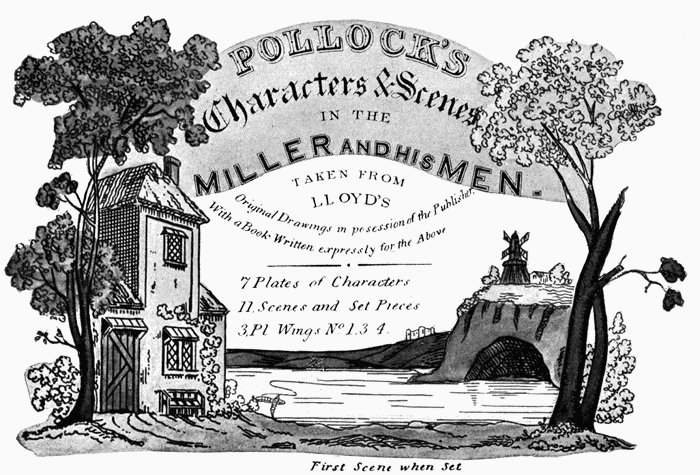 Taken from upper half of Plate No. 1, which is the title-page of the series, this section of which
is also a guide for the setting of the first scene in the 'Miller and His Men'
Taken from upper half of Plate No. 1, which is the title-page of the series, this section of which
is also a guide for the setting of the first scene in the 'Miller and His Men'
It is from the covers of "the book of the words" of
the 'Miller and His Men' that this enticing proclamation
is taken—the 'Miller and His Men,' "adapted only
for Pollock's characters and scenes," and accompanied
by "7 Plates characters, 11 Scenes, 3 Wings, Total 21
Plates." The persons of the drama and the scenes
wherein that drama is played out to its fiery end, are
all in the bolder manner of the Old Masters, who sought
the broadest effects, and who willingly neglected petty
details. How bold and how broad the manner and
the effects can best be judged by an honest transcription
from the final page of the book of words, wherein
the terse and tense dialog, single speech clashing with
single speech, is accompanied by stage directions for
the instruction of the Young Masters who are about
to produce the sublime spectacle:
Enter Grindorf left hand, plate 4.
Enter Karl and Friberg, swords drawn, plate 4, followed by
the Troops, right hand, plate 7.
Grindorf: Ha! ha! I have escaped you, have I?
Karl: But you are caught in your own trap.
Grindorf: Spiller!—Golotz! Golotz! I say!
Count: Villain! you cannot escape us now! Surrender, or
instantly meet thy fate!
Grindorf: Surrender! I have sworn never to descend from
this place alive!
Enter Lothair, as Spiller, 3rd dress, left hand, plate 7.
Grindorf: Spiller, let my bride appear.
Exit Lothair.
Enter Kehnar, right hand, plate 1.
Enter Ravina with torch, plate 7.
Ravina: Before it is too late, restore Claudine to her father's
arms!
Grindorf: Never!
Ravina: Then I know my course!
Enter Lothair with Claudine, left hand, plate 6.
Kehnar: My child! Ah, Grindorf, spare her!
Grindorf: Hear me, Count Friberg; if you do not withdraw
your followers, by my hand she dies!
Count: Never, till thou art yielded to justice!
Grindorf: No more—this to her heart!
Lothair: And this to thine!
Exit Lothair and Claudine, and Grindorf.
Re-enter Grindorf and Lothair fighting, plate 6, fight and exit.
Grindorf to be put on wounded, plate 7.
Re-enter Lothair with Claudine, plate 6.
Lothair: Ravina, fire the train!
Scene changes to explosion, Scene 11, No. 9.
The words are striking and the actions are startling,
and it is no wonder that plate 7 and scene 11, No. 9,
filled with joy the heart of Robert Louis Stevenson
when he was a perfervid Scot of fourteen. In his manly
maturity, when he had risen to an appreciation of portraits
by Raeburn, and when he had sat at the feet of
that inspired critic of painting, his cousin, R. A. M.
Stevenson, he admitted that he had no desire to insist
upon the art of Skelt's purveyors. "Those wonderful
characters that once so thrilled our soul with their bold
attitude, array of deadly engines and incomparable costume,
to-day look somewhat pallidly," he confessed
regretfully; "the extreme hard favor of the heroine
strikes me, I had almost said with pain; the villain's
scowl no longer thrills me like a trumpet; and the
scenes themselves, those once incomparable landscapes,
seem the efforts of a prentice hand. So much of fault
we can find; but, on the other side, the impartial critic
rejoices to remark the presence of a great unity of
gusto; of those direct claptrap appeals which a man
is dead and buriable when he fails to answer; of the
footlight glamor, the ready-made, barefaced, transpontine
picturesque, a thing not one with cold reality,
but how much dearer to the mind!"
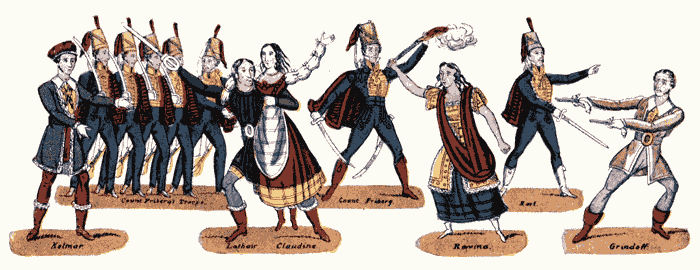 A group of the principal characters from Pollock's juvenile drama, the 'Miller and His Men,'
cut out and assembled as called for in Scene 10, a part of which is quoted in the text
A group of the principal characters from Pollock's juvenile drama, the 'Miller and His Men,'
cut out and assembled as called for in Scene 10, a part of which is quoted in the text
II
"Transpontine" is a Briticism for which the equivalent
Americanism is "Bowery." The plays which
Skelt vended for the enjoyment of romantic youth were
not of his own invention, nor were they the work of his
hirelings; they were artfully simplified condensations
of melodramas long popular in London at the theaters
on the Surrey side of the Thames, and in New York
at the Bowery. In French's Standard Drama, the
Acting Edition, to be obtained in yellow covers for
fifteen cents, one may find "the 'Miller and His Men,'
a Melo-Drama in Two Acts, by F. Pocock, Esq., author
of the 'Robber's Wife,' 'John of Paris,' 'Hit or Miss,'
'Magpie and the Maid,' etc., with original casts, scene
and property plots, costumes, and all the stage business."
And the list of properties required for the final scene
helps to elucidate what may have been cryptic in the
dialog quoted from the compacted adaptation of Skelt:
Scene 4:—Slow match laid from stage in C. to mill. Lighted torch
for Ravina. Red fire and explosion 3 E. L. H. Wood crash
3 E. L. H. Six stuffed figures of robbers behind mill, L. H.
Eight guns, swords, and belts for hussars. Disguise cloak for
Lothair. Fighting swords for Lothair and Wolf. [Wolf is
evidently another name for Grindorf.]
Thus we see that the pleasant country of the Skelts
stretched from the Surrey side of the Thames to the
Bowery bank of the Hudson, and that the Skeltic
temperament was purely melodramatic, its bass notes
being transposed to adjust it to the clear treble of
boyhood. It is greatly to be regretted that no inquiring
scholar has yet devoted himself to the task of tracing
the history of English melodrama, as Professor
Thorndike has traced the history of English tragedy.
Of course, there have always been melodramatic plays
ever since the drama began to assert itself as an independent
form of art. There is a melodramatic element
in the 'Medea' of Euripides, as there is in the
'Rodogune' of Corneille; and in the Elizabethan theater
the so-called tragedy of blood is nothing if not
melodramatic. Yet the special form of English melodrama
that flourished in the later years of the eighteenth
century and the earlier years of the nineteenth deserves
a more careful study than it has yet received. Apparently
it was due partly to a decadence of the native
type of drama represented by Lillo's 'George Barnwell,'
and partly to the stimulation received first from
the emotional pieces of the German Kotzebue, and
afterward from the picturesque pieces of the French
Pixérécourt. And not to be neglected is the influence
immediately exerted on the popular plays of the latter
part of the period by the romances of Scott and of
Cooper.
Altho these plays were devoid of literary merit, of
style, of veracity of character delineation, of sincerity
of motive, they were not without theatrical effectiveness—or
they could never have maintained themselves
in the theater. As Sir Arthur Pinero has seen
clearly, "a drama which was sufficiently popular to
be transferred to the toy theaters was almost certain
to have a sort of rude merit in its construction. The
characterization would be hopelessly conventional, the
dialog bald and despicable—but the situations would
be artfully arranged, the story told adroitly and with
spirit." In other words, the compounders of these
melodramas were fairly skilful in devising plots likely
to arouse and to sustain the interest of uncritical
audiences. Probably they were unfamiliar with Voltaire's
assertion that the success of a play depends
mainly upon the choice of its story; and it is unlikely
that they had any knowledge of Aristotle's declaration
that plot is primarily more important than character;
but they accomplished their humble task as well as if
they had been heartened by these authorities. These
ingenious and ingenuous pieces were none of them contributions
to English dramatic literature, and they are
not enshrined in its annals; but they were effective
stage-plays, nevertheless, and they had, therefore, an
essential quality lacking in the closet-dramas which
Shelley and Byron were composing in those same
years.
III
In the illuminating lecture on Stevenson as a writer
of plays delivered by Sir Arthur Pinero in 1903 before
the members of the Edinburgh Philosophical Institution,
the confessions contained in 'A Penny Plain and
Two Pence Colored' are skilfully employed to explain
Stevenson's flat failure as a playwright. Many of his
ardent admirers must have wondered why it was that
he adventured four times into dramatic authorship,
only to undergo a fourfold shipwreck. Yet Sir James
Barrie and Mr. John Galsworthy, essayists and novelists
at first, as Stevenson was, strayed successfully from
prose fiction into the acted drama. Was not Stevenson
as anxious for this theatrical triumph as any one
of these? Was he not as richly dowered with dramatic
power, as inventive, as responsive to opportunity, as
ready to master a new craft? Why, then, did he fail
where they have succeeded?
For these baffling questions Sir Arthur Pinero has
an acceptable answer. Stevenson was unable to establish
himself as a play-maker, first, because he did
not take the art of play-making seriously; he did not
put his full strength in it, mind and soul and body,
contenting himself when he was a man with playing
at play-making as he had played with his toy theater
when he was a boy. The second cause of his disappointment
as a dramatist was due to the abiding influence
of this toy theater, and to the fact that the
pieces he attempted were planned in rivalry with the
'Miller and His Men,' and therefore that they were
hopelessly out of date before they were conceived.
(There is a third reason, not mentioned by Sir Arthur,
and yet suggesting itself irresistibly to any one who
knew the editor of the Magazine of Art personally; all
four of Stevenson's attempts at play-writing were made
in collaboration with Henley, who was the least
equipped by temper and by temperament for the practise
of dramaturgy.)
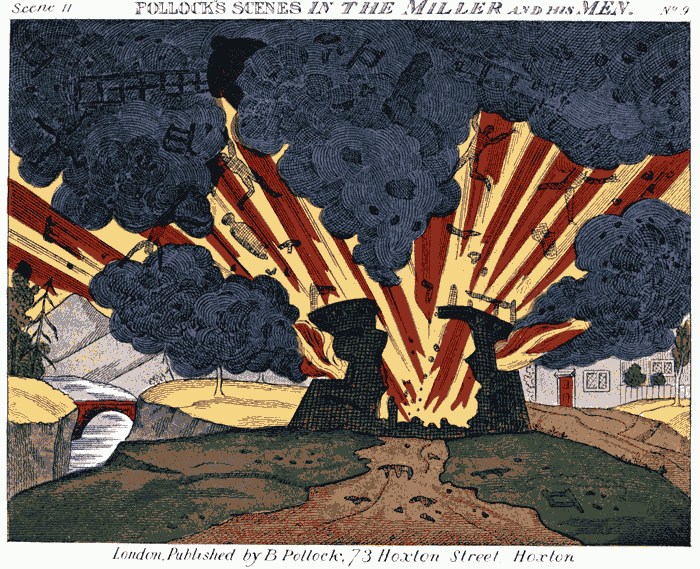 Explosion of the mill. A back drop in the 'Miller and His Men,' Scene II
Yet even if Stevenson had worked alone, and even
if he had taken the new art seriously, he could never
have won a place among the playwrights until he had
fought himself free from the sinuous coils of Skeltery.
In his youth he had saved his pence to purchase the
accessories of Skelt's Juvenile Drama with boyish delight
in the acquisition of things longed for to be possessed
at last. When he had purchased plate 7 and
scene 11, No. 9, he thought they were his possessions.
But, of a truth, he was their possession, even if he did
not know his slavery. As a man he was subdued to
what he had worked in as a boy; and when he wanted
to write plays of his own, he had no freedom to follow
the better models of his own day; he was a bondman
to Skelt, a thrall to Park, a minion to Webb, a chattel
to Redington and to Pollock. "What am I?" he asked
in his self-revelatory essay, humorously exaggerating,
no doubt, yet subconsciously stating the exact truth;
"What am I? What are life, art, letters, the world,
but what my Skelt has made them? He stamped
himself upon my immaturity." And the impression
was then so deep that it could not be effaced in maturity.
The boy in Stevenson survived, instead of dying when
the man was born.
The art of play-writing, like the art of story-telling,
and, indeed, like all the other arts, demands both a
native gift and an acquired craft. Its basic principles
are the same ever since the drama began; but its immediate
methods vary at different times and in different
countries. While every artist must say what it is
given him to say, he can say it acceptably only by acquiring
the method of speech employed by his immediate
predecessors. However original he may prove
himself at the end, in the beginning he can only imitate
the methods and borrow the processes and avail himself
of the practises which the elder craftsmen are employing
successfully at the moment when he sets himself
to learn their trade. He must—to use the apt term
of the engineers—he must keep himself abreast of
"state of the art." This is what the great dramatists
have ever done; Sophocles follows in the footsteps of
Æschylus, as Shakspere emulates Marlowe and Kyd,
and as Molière went to school to the adroit and acrobatic
Italian comedians. These great dramatists were
perfectly content to begin by taking over the patterns
devised by their immediate predecessors in play-making,
even if they were soon to enlarge these patterns
and so modify them to suit their even larger needs.
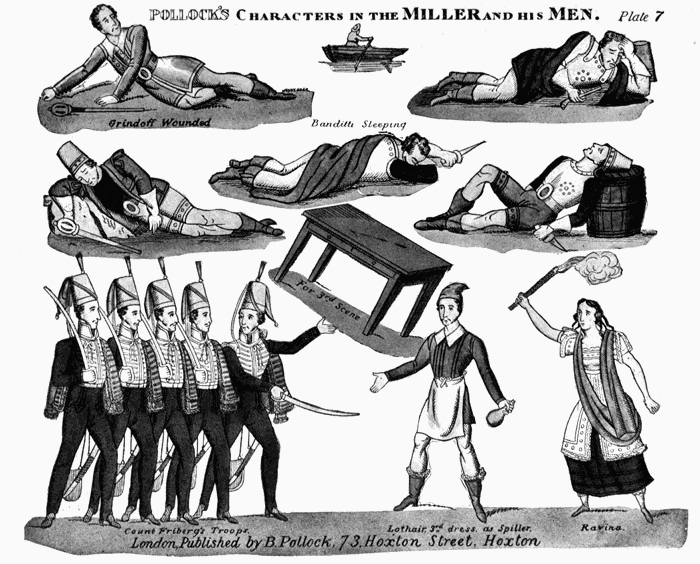 Plate No. 7, complete as published, ready to be cut out and put into use in the toy theater
Now, the state of the art when Stevenson turned to
the theater was in accord with the picture-frame stage
of to-day, with a single set to the act, and without the
soliloquies and the confidential asides to the audience
which may then have been proper enough on the apron-stage
of the eighteenth and early nineteenth centuries.
Even in the lower grade of playhouse, where rude and
crude melodramas were performed, the method and
the manner of the 'Miller and His Men' had long departed.
The pleasure that melodrama can give is
perennial; but its processes vary in accord with the
changing conditions of the theater. The door was
open for Stevenson to write melodrama, if he preferred
that species of play, and if he desired to varnish it
with literature as he was to varnish the police-novel
or mystery-story in the 'Wrecker.' But if he sought
to do this, he was bound to inform himself as to the
state of the art at the instant of composition. If he
shut his eyes to the changed conditions of the theater
since the 'Miller and His Men' had won a wide popularity
in the playhouse, then he made an unpardonable
blunder, for the battle was lost before he could deploy
his forces. He might have been forewarned by the
failure of Charles Lamb in a like attempt. When
Lamb's Elizabethan imitation 'John Woodvil' was rejected
for Drury Lane by John Philip Kemble as not
"consonant with the taste of the age"; its exasperated
author cried: "Hang on the age! I'll write for antiquity!"
But those who write for antiquity cannot
complain if they do not delight their contemporaries.
It is to his contemporaries, and not to antiquity or to
posterity, that every true dramatist has appealed.
IV
And as Stevenson might have taken warning from
the sad fate of Lamb, so he might have found his profit
in considering the happy fortune of Victor Hugo, who
also had a taste for melodrama. When the leader of
the French romanticists felt that it was incumbent
upon him to conquer the theater which the classicists
held as their last stronghold, he was swift to consider
the state of the art. He sought immediate success
upon the stage, and the most successful plays of that
period in France were the melodramas of Pixérécourt,
and of his followers, and therefore Hugo sat himself
down to spy out the secrets of their craft. He made
himself master of their methods, and he put together
the striking and startling plots of 'Hernani' and 'Ruy
Blas' in strict accord with their formulas, certain that
he could varnish with literature their melodramatic
actions. So glittering was his varnish, so brilliant was
his metrical rhetoric, so glowing were his golden verses,
that he blinded the spectators and kept the most of
them from peering beneath at his arbitrary and artificial
skeleton of supporting melodramatic structure.
To-day, after fourscore years, we can see just what it
is that Hugo did; and his plays, superb as they are in
their lyric adornment, stand revealed as frank melodramas,
lacking sincerity of motive and veracity of
character drawing. But when Hugo wrote them they
were in Kemble's phrase "consonant with the taste of
the age," and the best of them have not yet worn out
their welcome in the theater.
Stevenson did not heed the warning of Lamb, and
he did not profit by the example of Hugo. 'Deacon
Brodie' was born out of date; so was 'Admiral Guinea';
and all the varnish of literature which the two collaborators
applied externally and with loving solicitude
availed naught. It is due to his entanglement in the
strangling coils of Skeltery that Stevenson did not take
the drama seriously. He seemed to have looked at it
as something to be tossed off lightly to make money in
the interstices of honest work. In his stories, long and
short, he strove for effect, no doubt, but he was bent
also on achieving sincerity and veracity. In his plays
he made little effort for either sincerity or veracity, so
far at least as his plot was concerned; and he thought
he could lift these concoctions to the level of literature
by the polish of his dialog, and by qualities applied on
the outside instead of being developed from the inside.
He seems to have believed that in the drama, at least,
he could attain beauty by constructing his ornament
instead of by ornamenting his construction, ignoring or
ignorant of the fact that in the drama, the construction,
if only it be solid enough, and four square to all
the winds that blow, needs no ornament and is most
impressive in its stark simplicity.
In his boyhood Goethe had also played with a toy
theater, and it was a puppet-show piece which first
called his attention to the mighty theme of his supreme
poem; but the great German poet, captivated as he
may have been by his youthful experience, was able in
his manhood to free himself from its shackles. He
came in time to have a profound insight into the principles
of dramatic art, and of the dramaturgic craft.
In his old age he talked about the theater freely and
frequently to Eckermann; and there are few of his
utterances which do not furnish food for reflection.
Here is one of them:
Writing for the stage is something peculiar; and he who
does not understand it had better leave it alone. Every one
thinks that an interesting fact will appear interesting on the
boards—nothing of the kind! Things may be very pretty to
read, and very pretty to think about; but as soon as they are
put upon the stage the effect is quite different; and that which
has charmed us in the closet will probably fall flat on the boards....
Writing for the stage is a trade that one must understand,
and requires a talent that one must possess. Both are uncommon,
and where they are not combined, we have scarcely any
good result.
That Stevenson had the native gift of the dramatist
is undisputable, and Sir Arthur Pinero in his lecture
was able to make this clear. But "writing for the
stage is also a trade that one must acquire"; and when
Stevenson sought to acquire it he apprenticed himself
to Skelt not to Sardou, to Redington and Pollock, not
to Augier and Dumas.
(1914.)
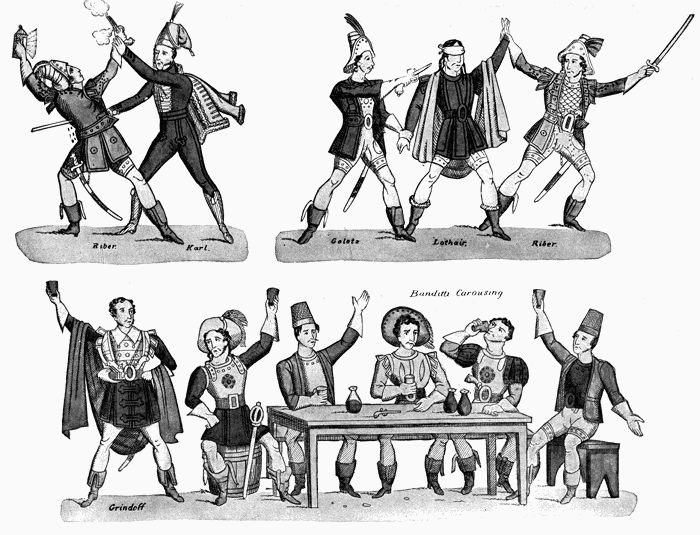 Grindoff and banditti carousing. Lower half of Plate No. 5, Pollock's characters in the
'Miller and His Men'
Grindoff and banditti carousing. Lower half of Plate No. 5, Pollock's characters in the
'Miller and His Men'
P.S.—After the publication of this paper in Scribner's
Magazine, a friendly reader in Great Britain was
kind enough to copy out for me this Skeltian lyric,
which appeared in the London Fun in 1868, and which
was probably rimed by Henry S. Leigh:
AN EARLY STAGE
Ah me! since first, long, long ago,
I learned to love the British stage,
It has—or I have—altered so,
It scarce receives my patronage!
Where are the villain's spangled tabs,
His cloak, his ringlets, and his belt?
Where are his scowls, his growls, his stabs,
As shown of old by Park and Skelt?
Once was I manager myself,
And played the 'Miller and his Men';
My company—ah, happy elf!
I had no trouble with them then—
They never sulked, forgot their lines,
Threw up their parts, or asked for "gelt"—
For as the reader p'r'aps divines—
I got them all of Park and Skelt.
I stuck them on, and cut them out,
I painted them with colors bright;
I scattered tinsel-specks about,
And made them things of beauty, quite—
Not joys forever—ne'ertheless,
They've vanished just as snowflakes melt.
None can restore the bliss, I guess,
I once derived from Park and Skelt.
How I revered the artist's skill
Who did my heroes represent—
With scowls the very soul to thrill—
With one leg straight and one leg bent!
I loved his ladies full of grace,
And on their beauties fondly dwelt:—
My first pictorial love could trace
Her pedigree to Park and Skelt.
Ah me! 'tis many a year since I
Those dear old plates—a penny plain
And two-pence colored—did espy;
I ne'er shall see their like again!
The world's with disappointment rife,
And I have far too often felt
That actors now are less like life
Than those I bought of Park and Skelt!
IV
WHY FIVE ACTS?
WHY FIVE ACTS?
I
In the eighteenth century, both in England and in
France, every stately and ponderous tragedy and every
self-respecting comedy obeyed the obligation imposed
by long tradition and duly stretched itself out to the
full measure of five acts, no more and no less. It felt
bound thus to distend itself, even tho its theme might
be far too frail for so huge a frame, and even tho the
unfortunate author often found himself at his wit's
end to piece out his play's end. Any one who has had
occasion to read widely in the works of the eighteenth
century playwrights cannot fail to feel abundant sympathy
for the harassed poet who plaintively called
on Parliament to pass a law abolishing fifth acts altogether.
This unduly distressed dramatist was an
Englishman; but about the same time a Frenchman,
weary of contemplating the frequent emptiness of the
contemporary tragic stage, sarcastically remarked that,
after all, it must be very easy not to write a tragedy
in five acts.
Yet if tragedy was to be written at all, it had to have
five acts, since a smaller number would not seem proportionate
to a truly tragic subject. But why five
acts? Why has five the number sacred to the tragic
muse? Why did even the comic muse demand it?
Why does George Meredith, discussing comedy, declare
that "five is dignity with a trailing robe; whereas
one, or two, or three acts would be short skirts, and
degrading." Why not three acts, or seven? Why was
it that any other number of acts was unthinkable—or
at least never thought of?
Questions like these seem to have floated before the
mind of the Abbé d'Aubignac, writing in the seventeenth
century, and he came very near putting to
himself the query which serves as a title for this chapter.
"Poets have generally agreed that all Drammas
regularly should have neither more nor less than Five
Acts; and the Proof of this is the general observation
of it; but for the Reason, I do not know whether there
be any founded in Nature. Rhetorick has this advantage
over Poetry in the Parts of Oration, that the
Exord, Narration, Confirmation and Peroration are
founded upon a way of discoursing natural to all Men....
But for the Five Acts of the Drammatick Poem,
they have not been framed upon any sound ground."
That the division of a drama into five parts was accepted
in every civilized country as the only possible
division, seems very strange indeed, when we consider
that there is really no artistic justification for it, nor
any logical necessity. Like every other work of art
a play ought to have a single subject, a clearly defined
topic; in other words, it ought to have Unity of Action.
There is no denying that some of the greatest artists
have, now and again, been tempted to deal with two
themes at the same time, combining these as best they
could in a single work at the risk of leaving us a little
in doubt as to their intention; but in the immense majority
of acknowledged masterpieces the interest is
carefully centered in a single object. In these masterpieces
the action is single and unswerving, sweeping
forward irresistibly to its inevitable end.
If, therefore, we accept the Unity of Action as a
general rule, binding upon all artists, we can hardly
deny that the most obviously natural arrangement
for the story is to set it forth in one act, without any
intermission or subdivision whatsoever—a single action
in a single act. Yet it is the play in three acts which
we are bound to recognize at once as possessing the
ideal form, since it enables the dramatist to set apart
the three divisions, which Aristotle declared to be essential
to a well-constructed tragedy—the beginning,
the middle, and the end—each presented in an act of
its own. To put a play into more than three acts is
possible only by halving one or another of these three
essential parts. In a four-act play, the beginning may
be split into two acts; and in a five-act play the middle
may also be subdivided.
The logic of the three-act form, and the convenience
of it also, are so obvious that ever since the tyranny
of the Procrustean framework in five acts was abolished
in the middle years of the nineteenth century, practical
playwrights of all countries have favored it more
and more. The young Dumas used it in his later plays,
and so did Ibsen, that consummate master of stagecraft,
emancipated from empty traditions, but profiting
shrewdly by every available device of his immediate
predecessors. If the four-act form is also popular
to-day, this seems to be because the modern dramatist,
intending a play in three acts, finds himself forced by
sheer press of matter, to subdivide one of the essential
members, as Sir Arthur Pinero had to do in the 'Second
Mrs. Tanqueray' and Mr. Henry Arthur Jones in the
'Liars.' Even the opera, which liked the larger framework
of five acts when Scribe was writing librettos for
Halévy and Meyerbeer, is now content with only three,
since Wagner revealed his skill as a librettist.
It is true that Freytag, in his sadly old-fashioned
treatise on 'Technic of the Drama,' accepted without
cavil the five-act form, and even attempted to justify
it by asserting that there are in fact five divisions of a
tragic action. He symbolized the arrangement of a
drama in a pyramidal structure, declaring that it
ascends from the Introduction to the Climax, and then
descends to the Catastrophe. Obviously these are
only different terms for the beginning, the middle, and
the end. But he vainly imagined two other members,
the Rise, which intervenes between the Introduction
and the Climax, and the Fall, which he inserted between
the Climax and the Catastrophe. Obviously,
again, this is an explanation after the event; and it
seems to have its origin solely in his acceptance of the
five-act form. And Freytag was forced to abandon his
own theory when he considered honestly certain of the
masterpieces of the modern drama. He admitted it
to be "impossible that the single acts should correspond
entirely to the five great divisions of the action." He
asserted that "in the Rising Action, the first stage was
usually in the first act, the last sometimes in the third;
of the Falling Action the beginning and the end were
sometimes taken in the third and fifth acts." Yet he
failed to see that if he made this admission, he cut the
ground from under his feet, and that there was no longer
any acceptable reason for his insistence upon the five-act
form.
Freytag had no doubt at all as to the necessity of
the division into five acts. He received it with blind
faith, as tho it had been prescribed by divine authority.
Yet if he had chosen to explore the early history of the
drama in his own tongue, he would have found Hans
Sachs sometimes extending his plays into six acts, and
even into seven. And if he had cared to consider the
drama of the Spaniards he would have seen that the
most of the plays of Calderon are in three acts—a division
which the great dramatic poet of Spain had taken
over, as he had taken over so much else, from his masterful
predecessor, Lope de Vega. In his interesting
and illuminating little treatise on the art of writing
plays, Lope de Vega gave the credit of establishing the
three-act form to Virues. Plays had previously been
written in four acts; as Lope puts it pleasantly: "The
drama had gone on all fours, like a child, and truly it
was then in its infancy."
Freytag ignored or was ignorant of Hans Sachs and
Calderon. His mind was fixed on Goethe and on
Schiller, altho his vision also included Shakspere, upon
whom the two German poets had more or less modeled
themselves. The tradition of the five-act form might
not obtain in the earliest German drama, as it did not
obtain in the Spanish; but it was firmly established in
the later German drama, in the English, and in the
French. It is easy to see that the later Germans derived
it from the French and the English; but where
did the French and the English get it? Where could
they get it? No such division existed in the medieval
drama, in the mysteries and in the miracle-plays, out
of which the drama of every modern language has been
developed. No such division existed in the Greek
drama, which has served as a standard and as a stimulus
to the drama of every modern literature. A Greek
tragedy was represented without any intermission in a
single, long unbroken act; and if a sequence of three
plays was sometimes performed, one after another, on
the same day, and dealing with successive periods of
the same story, this trilogy might suggest a division
into three parts. Nor is any hint of the duty of dividing
a tragedy into five parts to be discovered anywhere
in Aristotle.
II
And yet we must go back to the Greek theater if we
want to see why it is that the 'Femmes Savantes' of
Molière and the 'School for Scandal' of Sheridan are
each of them in five acts. But it is not from a Greek
that we get the law that this division was obligatory
on all self-respecting dramatists; it is from a Roman,
writing at a time when the drama of his own language
had been ousted from the stage by pantomimic spectacle
and by gladiatorial combat. It is Horace, who,
in his epistle on the art of poetry, declares the necessity
of five acts:
Ne brevior, neu sit quinto productior actu
Fabula quae posci vult et spectata reponi.
Sir Theodore Martin rendered this in an English
rimed couplet, which does not completely convey the
meaning of the two Latin lines, but which will serve to
show the rigidity of the rule laid down by the Roman
poet:
Five acts a play must have, nor more nor less,
To keep the stage and have a marked success.
But this still leaves us groping in the dark. Why
did Horace declare this law? What warrant had he?
What put the idea into his head? These are questions
answered by a French scholar, M. Weil; in one of his
ingenious and learned 'Études sur le Drame Antique,'
he explains that Horace derived much of his theory of
the poetic art from the Alexandrian critics, and more
particularly from the writings of a certain Neoptolemus
of Parium. Probably the Alexandrian authors
of tragedy had been led to adopt a division into five
acts by following the example of Euripides, whose practise
was not uniform, but who tended to reduce to
four the number of the lyric odes in his tragedies, thus
separating the purely dramatic passages into five parts.
In Athens the drama had been slowly evolved out
of the tragic songs; and in the surviving tragedies of
Æschylus, the earliest of the three great dramatic poets
of Greece, we discover that the choral odes are more
abundant than the dialog which carries on the plot.
In the extant plays of his mighty successor, Sophocles,
the drama is seen emerging triumphant, but the lyrical
passages are still frequent and important. In the later
pieces of Euripides, the third and most modern of the
Attic tragedians, we note that the drama has almost
wholly disengaged itself from the lyric out of which it
sprang. In Æschylus and in Sophocles the number of
choral odes and the number of episodes, of purely dramatic
passages in dialog, is never fixed, varying from
play to play as the plot might demand. But in Euripides
the choral odes are more detached from the drama;
beautiful in themselves, they seem to exist rather for
their own sake than in any integral relation to the play
itself. And apparently Euripides was far more interested
in his play, in his plot, and in his characters,
than in these extraneous lyric passages, so he reduced
them to the lowest possible number, generally to four,
serving, so to speak, as exquisite interact music, separating
the pathetic play into five episodes in dialog.
The Alexandrian tragedians came long after Euripides,
and to their sophisticated taste his pathetic and
emotional plays appealed far more than the austerer
and manlier masterpieces of his two great predecessors.
Apparently they accepted his form as final; they
may even have left out the choruses altogether; and
then their tragedies had five separate episodes—in
other words, five acts. It is these lost Alexandrian
tragedies, composed in the decadent days of the Greek
drama, which seem to have served as the model for
Seneca, the eloquent rhetorician—even tho he frequently
took over the theme and often more or less of
the structure of certain of the dramas of Euripides.
The tragedies of Seneca are to be considered rather
as dramatic poems than as poetic dramas, since they
were intended not really for performance by actors,
in a theater, before an audience, but for recitation by
a single elocutionist in a private house—much as a
professional reader of our own time might recite unaided
a more or less dramatic poem by Shelley or Byron
or Browning. Coming long after Horace, Seneca unhesitatingly
accepted all of the restrictions insisted
upon by the Latin lyrist—including the purely academic
limitation of the number of speakers taking part in any
dialog to three, a limitation absolutely absurd in a
poem not intended for actual acting and not forced to
conform to the accidental conditions of the Attic stage.
Obeying also the other rule which he found in Horace's
codification of the laws of dramatic poetry, the Hispano-Roman
rhetorician was careful always to cut up
his play into five parts. But he saw his profit in retaining
the chorus, since this could be made to serve
as the appropriate mouthpiece for the elaborate passages
of elocutionary splendor in which he delighted.
It is not to be wondered at that the Italian scholars
of the Renascence followed the precept of Horace and
the practise of Seneca. They were far more at home
in Latin than they were in Greek; and they could
hardly help reading into the literature of Athens what
they were already familiar with in the authors of
Rome. To them Seneca was as imposing as Sophocles,
and Horace was almost as weighty as Aristotle. So it
is that Scaliger and Minturno prescribe five acts, and
that Castelvetro (always more practical in his point
of view) points out that poets seem to have found the
five-act form most suitable. When an Italian scholar-poet
turned from criticism to creation, the tragedies he
conscientiously composed obeyed all the rules, and his
dramatic poems were as academic as those of Seneca,
in that they were intended not for production by professional
actors in a regular theater before spectators
who had paid their way in, but only for an occasional
performance by the author himself assisted by a few
of his friends before a little group of cultivated admirers
of antiquity, contemptuous of the real public. These
soulless dramatic poems, devised for declamation by
amateurs before a gathering of dilettants, are now
perceived to be merely literary curiosities, having little
connection with the real drama made for the regular
theater and its myriad-minded body of playgoers.
Just as the Italian dramatic poems were imitations
of Seneca, so the French dramatic poems, composed a
little later, were imitations of these Italians, and also
of Seneca, more or less indirectly. They were the imitations
of an imitation, aping the outward form of the
drama, but empty of all genuine dramatic spirit, artificial
in passion and high-flown in rhetoric. And there
are early English attempts at this same sort of academic
tragedy, more imitative still, since we can see in them
the commingled influence of the French and of the
Italians immediately, and also of the remoter Seneca,
whom they revered as the exemplar of true tragedy.
Such a play is 'Gorboduc,' belauded by the scholarly
Sidney—and even on one occasion acted, by main
strength. In all of these imitations, English and
French and Italian, we find the stately chorus abounding
in lofty rhetoric; and we find also, and always, the
division into five acts. But in the folk-theater, which
the scholar-poets scorned, and out of which the living
drama was to be developed, there is no trace of any
division into acts. In the mysteries and the miracle-plays,
and in the chronicle-plays which grew out of
them, there are numberless episodes, each complete
in itself, and never combined artificially into acts.
The composer of any one of these folk-dramas conceived
his story as a continuous narrative shown in
action; and he gave no thought to the number of
divisions, of episodes, of separate scenes, or of acts
that it might seem to have.
III
Tragedy has ever been held to be more elevated than
comedy and more worthy; and comedy has continually
accepted the conditions appropriate to tragedy. Since
the dignity of tragedy demanded a division into five
acts, comedy was also subjected to the same rule; and
this was done in spite of the fact that the plays of Plautus
and Terence (composed long before Horace codified
his advice to intending poets) were not divided
into acts, if we may judge by the earliest of the surviving
manuscripts. So it is that we find the scholarly
authors of the two earliest of English comedies, 'Ralph
Roister Doister' and 'Gammer Gurton's Needle,'
knowing what was expected of them, and giving the
five-act form to both of these amusing plays. But
these two comedies, almost contemporary as they are
with the academic and undramatic tragedy of 'Gorboduc,'
are far superior to it in adaptability for actual
performance. They are not intended only to be recited;
they can be acted easily and profitably. As
we analyze them we see that the structural complexity
may be derived from the comic dramas of Plautus and
Terence, but that the inner spirit is that of the English
folk-theater, of the robust medieval farce-writers,
of the unknown humorist who has left us the laughable
and veracious scene of Mak and the Shepherds.
Scholars as they were, the authors of these two comedies
did not scorn the primitive plays of the plain
people of their own time. They did not despise the
unpretending folk-drama which was then pleasing the
populace; in fact, they took stock of it, and found their
profit in so doing. They saw that to be raised up to
the level of literature it needed only to be chastened
and stiffened. They accepted the living tradition of
play-making as it came down to them, and in accord
with this tradition they wrought their humorous fantasies,
adding the higher polish and the more adroit
plot which they had learned to appreciate in the Latin
comic dramatists. They accepted the native play,
bare as it was, and they enriched it by bestowing on it
as much as it could carry of the finer art of the Romans.
Thus it is that the authors of 'Ralph Roister Doister'
and of 'Gammer Gurton's Needle' may have pointed
out the path of progress to the author of the 'Comedy
of Errors,' whereas the authors of 'Gorboduc,' contemptuously
rejecting the folk-theater of their own day, and
idly copying the classicist imitations of the Italians,
thereby relinquished whatever direct influence they
might have had upon the growth of tragedy in England.
Both 'Ralph Roister Doister' and 'Gammer Gurton's
Needle' were probably written for performance
by college boys, and they have not a little of the brisk
heartiness and of the broad horse-play to which we are
accustomed in the college pieces of to-day. It was for
performance at court that Lyly wrote the most of his
plays, which lack the vivacity and the liveliness distinguishing
the two college comic dramas, but which
yet reveal a far better understanding of the drama than
was possessed by the authors of 'Gorboduc.' Lyly
again is careful to divide his plays into five acts. But
his contemporaries Greene and Peele, writing solely
for the professional playhouses, were bound by none
of the rules which might be expected in college or at
court. Whatever their own scholarly equipment, when
they wrote for the professional players, they followed
unhesitatingly the traditions of the contemporary
theater. As playwrights they were the direct heirs of
the anonymous and ignorant devisers of the medieval
drama. They had a story to set on the stage; they
chose a succession of more or less effective episodes,
and they carelessly cast these into dialog, with little
thought of form or of construction. Never do their
plays contain matter enough for five full acts; and we
may be certain that no such framework was ever in
the mind of either of these dramatic poets. In the
original editions of their pieces we find no separation
into acts and scenes; and if this needless and misleading
subdivision is found in later editions it is the doing
of misguided editors.
In what is accepted as the earliest edition of Kyd's
'Spanish Tragedy,' the most widely popular of all the
pre-Shaksperian plays, the text is actually divided into
four acts. But this division is not structural; it is
almost accidental, as tho it was an afterthought, inserted
at the last moment into the copy intended for
the printer, and never in the mind of the playwright
himself when he was preparing the prompt-book for
the actors; and Shakspere, who followed Kyd in more
ways than one, apparently followed him in this also.
In the folio edition of his plays, published after his
death, a division into five acts has been made; but the
task has not been accomplished any too skilfully—for
example, the second act of 'King John' has but eighty
lines, and here the division is into four acts only. The
suggestion has been proffered that it was, perhaps, left
to the printers to do, the influence of Ben Jonson
having been powerful enough to establish the theory
that a self-respecting dramatist would never fail to
cast his tragedies in the five-act form. It is to be noted
also that no division into acts is to be found in the
quarto editions published in Shakspere's lifetime; and
this is very significant since these quartos seem to have
been piratical copies from shorthand notes taken surreptitiously
in the theater, thus recording the actual
conditions of performance.
It may be doubted whether Shakspere conceived his
plays in accordance with any such subdivisions.
Some of them, the 'Comedy of Errors' for one, which
can be acted in the space of an hour and a quarter,
are far too slight for so huge a framework. On the
other hand, the several appearances of Chorus punctuate
'Henry V' into five divisions, apparently an intentional
conformity to the Horatian rule. Of course,
there were generally several intermissions in the
Elizabethan performance of a play, altho the resulting
divisions were not necessarily five; and it is noteworthy
that Shakspere makes Jaques declare that man's life
had seven acts.
IV
The fact is that Shakspere was a professional playwright,
and that he had no merely academic theories.
In composing his plays he followed unhesitatingly the
principles that had guided his immediate predecessors.
He was seeking ever to give the playgoing public what
it had been accustomed to enjoy in the theater, better
in degree, no doubt, but the same in kind. Like these
predecessors, he kept to the traditions inherited from
the medieval mysteries; and he thought in terms, not
of acts and of scenes, as a modern playwright is forced
to do, but of a continuous narrative shown in action.
In doing so he resembles Herodotus, whose history has
also been cut up by later editors, dividing it into nine
books, altho, as Professor Bury has reminded us, "such
divisions had not yet come into fashion" in the historian's
own day. There is no reason to suppose that
Shakspere would have approved of the attempt of the
editors of the folio to subdivide his plays, each into
five acts. There is every reason to suppose that he
would have been greatly annoyed if he could have
foreseen the way in which later editors have chosen
further to chop up the acts into an infinity of scenes.
Nowadays, we have been so accustomed to read
Shakspere in one or another of the trim and tidy modern
editions, with a wanton division into acts and into
scenes, each of which indicates a change of place, and
each of which seems to suggest a change of scenery,
that it is only by a resolute effort of the will that we
are able to shake off the prepossessions derived from
this unfortunate and confusing presentation of his text.
Probably even to-day a majority of those who enjoy
reading Shakspere would be surprised to be told that
there is no warrant whatever for these alleged changes
of scene, and for these superabundant subdivisions of
his story. Many of these readers would be taken
aback by the unexpected discovery that all this cutting
up of Shakspere's text was the work of his commentators,
with Rowe at the head of the procession.
Some of these readers would feel as tho they were deprived
of a precious possession, if they had only an
edition in which all this useless machinery was swept
away.
And yet this is just the edition which is demanded
by the present state of Shaksperian scholarship, and
which is now made possible by our new understanding
of the Elizabethan theater, with its rude platform
thrust out into the yard, so different from our modern
theaters, in which the stage is withdrawn behind a
picture-frame. The Tudor platform-stage is wholly
unlike the picture-frame stage of to-day; but it is very
like the "pageant," or the scaffold on which the mysteries
and miracle-plays were presented. It was to the
simple conditions of his semi-medieval theater that
Shakspere adjusted himself, rude as those conditions
may now appear to us who are accustomed to the sumptuous
picturesqueness of our own luxuriant playhouses.
In accepting the theater as he found it, and in availing
himself of all its possibilities, such as they were,
Shakspere showed his usual common sense. Only by
striving to reconstruct for ourselves in our mind's eye,
as it were, the playhouse where he plied his trade and
earned his living, can we come to any adequate appreciation
of his art, of his craftsmanship as a playwright,
of his dramaturgic skill. And in any honest effort to
understand how his mighty dramas were originally
produced by himself and by his fellow actors in the
round O of the wooden Globe Theater, unroofed and
unlighted except by the dingy daylight of northern
Europe, we need always to keep fast in our mind the
fact that all preconceptions are false that may be derived
from our memory of latter-day performances in
theaters of a type which the Elizabethan dramatists
could not foresee, and of which the conditions are often
the exact opposite of those they accepted without hesitation.
That is to say, the most profitable way to reconstruct
mentally the Tudor playhouse is to banish
from our minds every impression made by our modern
theater, with its elaborate complexity, and to study
out for ourselves the simple circumstances of performance
in the Middle Ages. And as a first step toward
the proper standpoint, we must cast out our traditional
belief that Shakspere always accepted the classicist
formula of five acts, proclaimed by Horace, and
employed by Seneca. That he did use it in one or two
plays seems indisputable, and he may very well have
employed it in a few others, but there is no reason to
suppose that he would have submitted himself any more
willingly to the rule of five acts than he did to the rule
of the three unities.
It may be doubted also whether not a few dramatists,
writing later than Shakspere, would not have done well
to claim the liberty he and Lope de Vega chose to
exercise at will. Racine, for one, had sadly to stretch
his 'Athalie' to fill out the five-act framework which
he had blindly accepted, altho he had earlier limited
'Esther' to three acts. Schiller, for another, would
have gained a swifter compactness for his play if he
had left out the needless fifth act of his 'William Tell'
and rolled his fourth act into his third. Victor Hugo
had to manufacture a fourth act for his 'Ruy Blas,' so
slightly related to his main story that it was cut out
of the English adaptation acted by Fechter and Booth.
Ibsen, it may be added, composed his first tragedy,
'Catiline,' in three acts, altho it was in blank verse,
thus early revealing his characteristic independence
of tradition.
(1907.)
P. S.—Since this paper was written I have found two
opinions as to the number of acts a play ought to have
which were unknown to me when I undertook the discussion.
The first is in the 'Dasarupa,' the Hindu
treatise on the craft of play-making: "There are five
stages of the action which is set on foot by those that
strive after a result: Beginning, Effort, Prospect of
Success, Certainty of Success, Attainment of the Result."
The second is in the commentary made by Robert
Louis Stevenson during his methodical perusal of the
dramas of the elder Dumas. After reading 'Henri III
et sa Cour,' Stevenson declares that here in Dumas's
first piece "is the cloven foot; a fourth act that has
no part or lot in the play; a fourth act that is a mere
incubus and interruption—that takes the eye off the
action, and between two spirited and palpitating scenes
interjects a damned sermon on the history of France.
Poor Tribonian had a sore job to make up the fifty
books of the Pandects; what was that to the labor of
a dramatist bent on filling his five acts? I go as far
as this: the natural division of the normal play is
four: Act I, exposition; Act II, the problem produced;
Act III, the problem argued; Act IV, the way out of
it."
(1916.)
V
DRAMATIC COLLABORATION
DRAMATIC COLLABORATION
I
It is a significant fact that whenever and wherever the
drama has flourished most abundantly and most luxuriantly,
we are certain to find a tendency to collaboration,
to the partnership of two authors in the composition
of one play. In England in the spacious days
of good Queen Bess, there is not only the famous association
of Beaumont and Fletcher, but also a host of
other more or less temporary combinations, Fletcher
with Shakspere and Massinger, Dekker with Ben Jonson
and with Middleton. In Spain Lope de Vega
joined forces with Montalvan and with others. In
France in the seventeenth century Molière, once at
least called to his aid Corneille and Quinault; and in
France again in the nineteenth century we find Augier
working with Sandeau and with Foussier, Scribe working
with Legouvé, and with a score of others, while
Dumas the elder was encompassed by a cloud of collaborators,
and Dumas the younger was willing on
more than one occasion to join various writers in the
plays which he included in the separate volumes of his
works, called by him the 'Théâtre des Autres.' Then
also in France there was the long-continued alliance of
Meilhac and Halévy, to which we owe 'Froufrou' and
the 'Grand Duchess of Gérolstein'; and there was also
the almost equally interesting association of MM.
Caillavet and de Flers. Sardou had one ally in the
composition of 'Divorçons,' and another in the composition
of 'Madame Sans Gêne.' In Great Britain in
recent years we have seen Sir James Barrie and Sir
Arthur Pinero unite in writing a book for music; Mr.
Bennett and Mr. Knoblauch unite in writing 'Milestones';
Mr. Granville Barker and Mr. Laurence
Housman unite in writing 'Prunella.' And in the
United States there was a score of years ago the steady
collaboration of Mr. Belasco with the late H. C. De
Mille, to which we owe the 'Charity Ball' and the
'Wife'; and more recently Mr. Belasco also has collaborated
with Mr. John Luther Long in writing
'Madame Butterfly,' and the 'Darling of the Gods.'
Mr. Augustus Thomas was once the partner of Mr.
Clay Greene; Mr. Bronson Howard composed one of
his latest plays, 'Peter Stuyvesant, Governor of New
Amsterdam,' in association with another American
man of letters; and Mr. Booth Tarkington and Mr.
Harry Leon Wilson were the co-authors of the 'Man
from Home' and of half a dozen other pieces.
While this prevalence of the practise of collaboration
in periods of dramatic productivity is significant, it is
equally significant that there is no corresponding prevalence
of the practise of collaboration in novel-writing.
True it is that there are certain fairly well-known
partnerships in the history of prose fiction—that of
Erckmann-Chatrain, in French, for instance, and that
of Besant and Rice in English. True it is that Dickens
and Wilkie Collins were joint authors of 'No Thorofare,'
and that Mark Twain and Charles Dudley
Warner were joint authors of the 'Gilded Age.' True
it is also, that novels have been written not only by
two partners, but by what can fairly be described as a
syndicate of associated authors, the 'King's Men' by
four, 'Six of One and Half a Dozen of the Other' by
six, and the 'Whole Family' by twelve (including Mr.
Howells and Mr. Henry James, Mrs. Mary E. Wilkins
Freeman, and Doctor Henry van Dyke). These freakish
conglomerates are sporadic only; they seem to be
little better than literary "stunts"; and even the union
of two writers in the production of a single novel is
far less frequently to be observed than the union of
two writers in the production of a single play. The
former is unusual, whereas the latter seems to be so
common as to excite no comment.
Now, there must be a reason for this difference. If
the playwrights find it advantageous to double up,
and the novelists do not discover any profit in putting
on double harness, there ought to be some evident explanation.
When we consider more carefully the essentially
different conditions of the art of prose fiction
and the art of play-writing, it is not difficult to perceive
fairly obvious reasons for the varying procedure of the
practitioners of these rival arts, which may seem so
much alike, but which are really so very different in
their methods and in their possibilities.
The French critic Joubert once asserted that "to
make in advance an exact and detailed plan is to deprive
one's intellect of all the pleasures of novelty and
chance meeting during its execution; it is to make this
execution insipid, and in consequence impossible, in
works calling for enthusiasm and imagination." This
is an overstatement—but it is not a misstatement—of
a principle of composition which is fundamentally
sound in the writing of prose fiction, but which is
fundamentally unsound in the writing of plays. The
drama demands a well-built story, artfully put together,
while a novel need not have a coherent and compact
plot. Some great novels, Fielding's 'Tom Jones' for
one, and Turgenef's 'Smoke' for another, have each
of them a beautifully articulated structure, and so has
Mr. Howells's 'Rise of Silas Lapham,' to take a later
example. But other great novels are frankly more or
less haphazard in their movement, the 'Pickwick
Papers,' for instance, and 'Tartarin on the Alps,' and
'Huckleberry Finn.' And it is not too much to say
that only a very few novels attain to the severity of
structure, the regularity of action, the straightforward,
unswerving movement which we discover in the dramas
of a corresponding rank, and which can be achieved
only by making in advance the exact and detailed plan
that Joubert held to be fatal in works calling for enthusiasm
and imagination.
Of course, the drama can utilize enthusiasm and
imagination quite as often and quite as abundantly
as can prose fiction, but it must use these precious
gifts with a discretion which is not imposed upon its
rival. In a novel enthusiastic imagination may lure
the story-teller into a host of by-paths not foreseen by
him when he set out on his journey; and while he is
adventuring himself in these by-paths, he may chance
to encounter characters of a diverting or an appealing
personality, whom it may amuse him to delineate, and
whom the readers of his book will be glad to welcome.
But in a drama the story-teller is debarred from these
wanderings from the straight and narrow road, and he
must, perforce, control his enthusiastic imagination,
compelling it to do its work within the rigid limits of
the artfully devised framework of the plot.
In other words, character is all-important in prose
fiction, and the ultimate fame of the novelist depends
upon his power of endowing his creatures with life, and
upon his ability to let them obey the laws of their
being before our eyes. This must the playwright also
achieve; but he has the added duty of relating his
characters intimately to the main action of his drama.
Now, the novelist is under no obligation of this sort;
he appeals not to a crowd seated before a stage, but to
the solitary reader in the study; and experience shows
that solitary readers do not insist upon the solidity
of structure in a novel which the same individuals
desire and demand when they betake themselves to the
theater. The novel-reader may be satisfied by characters
who do not know their own minds, and who are
merely exhibited and put through their paces, without
having any vital relation to the story, even if there is
anything which can fairly be called a story—and in
some novels of high repute, in Sterne's 'Sentimental
Journey,' for example, and in Anatole France's 'Histoire
Contemporaine,' each of them extending over
several volumes, there is little or no story, no main
thread, no pretense of a plot.
II
Here, then, is the fatal difference between a novel
and a play; a novel may have a plot, but a plot is not
necessary, and it can get along with a minimum of
story; whereas a play must have a plot, skilfully articulated,
even if the skeleton is beautifully covered; it
must have a story peopled by persons knowing their
own minds, a story set in action by a dominating will,
which determines the successive episodes of the action.
As the making of a plot, as the putting together of
a supporting skeleton of action, calls for dexterity of
workmanship, for ingenuity of resource, for adroitness
of construction, for the most careful consideration
of the means whereby the end is to be obtained, two
heads are often better than one, because the partners
have to talk the thing out to its uttermost details before
they decide upon the straight line which is the
shortest distance between two points. The technic
of play-making is more exacting than the technic of
novel-writing, and it requires imperatively the exact
and detailed plan which Joubert held to be hampering
to enthusiasm and imagination. Scott, for example,
as he tells us himself, began more than one of his novels
not knowing what he was going to put into it, and not
knowing from day to day, as he was writing, what his
ultimate goal would be. But no playwright, however
happy-go-lucky in his tendencies, has ever dared to
begin a play before he knew with absolute certainty
how he intended to end it. In the drama we insist
upon a straightforward and unswerving action; the
end is implied in the beginning, and the beginning is
only what that end makes necessary.
As the technic of the drama is exacting, it needs to
be acquired by a period of apprenticeship; and here is
another of the indisputable advantages of collaboration.
The more inexperienced of the two collaborators
is taken into the studio, so to speak, of the more expert,
and he thereby learns the secrets of stage-craft in the
best possible way, by applying them under the direction,
or at the suggestion and by the advice, of an older
practitioner, to whom they have become so familiar
that they are a second nature, as it were.
Collaboration is the best conceivable school for young
playwrights. It is impossible to overestimate the influence
of Scribe's multiplied collaborations upon the
drama of France in the mid-years of the nineteenth
century; and almost as potent, because almost as wide-spread,
was the influence of the many collaborations
of the elder Dumas. Most of those who were the temporary
partners of Scribe and Dumas were subdued to
their more powerful associate, and contributed little
or nothing beyond their fundamental suggestions for
the several plays, and their incidental suggestions as
to details of the working-out. That is to say, most of
the plays signed by Scribe and Dumas in partnership
with others have a close similarity to the plays they
signed alone. But from this generalization we may
except 'Adrienne Lecouvreur' and 'Bataille de Dames,'
in which Scribe had Legouvé for a partner, and in which
we find a greater richness of character delineation than
in any of the pieces that Scribe composed alone, as we
find also a greater dexterity of construction than in
any of the pieces that Legouvé composed alone.
To the fact that 'Milestones' was written by Mr.
Arnold Bennett and Mr. Edward Knoblauch in conjunction,
and to the friendly discussion due to their
working together, we may credit the superior stage-effectiveness
of this play over the 'Kismet,' which Mr.
Knoblauch wrote alone, and over the 'Great Adventure,'
for which Mr. Bennett was solely responsible.
To the composition of 'Milestones' each of these two
authors, the American and the Englishman, brought
his special qualifications, each of them not only stimulating
but supplementing the other. So we find the
most famous French comedy of the nineteenth century,
the 'Gendre de M. Poirier,' a better piece of work,
more equably balanced than any play written alone by
either Augier or Sandeau.
It is scarcely necessary to say that there is little
profit in a partnership for play-making when both of
the associates are equally inexpert, or when they were
both possessed of wrong notions about the art of the
drama. In the former case we have the blind leading
the blind, and the most lamentable example of this is
the long forgotten 'Ah Sin,' which Bret Harte and
Mark Twain combined to compose that C. T. Parsloe
could impersonate the Heathen Chinee. In the
latter case we have not only the blind leading the
blind, but a perverseness in going the wrong way, intensified
by the complete sympathy between the two
associates; and the most lamentable example of this
is the 'Deacon Brodie' of Robert Louis Stevenson and
William Ernest Henley, who not only were ignorant of
the modern technic of the drama, but who ignored it
of set purpose, deliberately going up a blind alley despite
the plain sign that there was no thorofare.
III
Yet Stevenson, at least, perceived clearly enough
what ought to be the more evident advantages of collaboration,
that it focused "two minds together on the
stuff," thus producing "an extraordinarily greater richness
of purview, consideration, and invention." Collaboration
will probably always produce a greater
richness of invention, since each of the partners is
likely to stimulate the other, their two minds striking
sparks like flint and steel. But it can produce a greater
richness of consideration only when each is willing both
to yield and to oppose. Neither must yield too easily;
each of them must stand out for his own suggestions;
and each of them must insist on weighing and measuring
the suggestions of his ally. If they are too sympathetic,
if their two hearts beat as one, then the advantage
of their having two heads is diminished. If the
two partners always think alike, then there will be no
greater richness of purview.
When a play composed by two of his friends failed
to find the success on the stage which had been anticipated
for it, Mr. Augustus Thomas made the shrewd
remark that the two authors had probably been "too
polite to each other"—that is to say, that they had not
insisted upon criticising the successive suggestions
made by each in turn. On the other hand, the collaborators
must be broad-minded enough not to resent
this necessary criticism. Like any other partnership,
collaboration is a ticklish experiment, and it can be
profitable only when the two partners are willing to
give and take. They need more than usual self-control;
they must be able, each of them, to preserve his own
self-respect while full of regard for the self-respect of
the other. It is not surprising that the long collaborations
of Erckmann-Chatrain and of Meilhac and Halévy
finally came to a sudden end because of an abrupt
quarrel. That disagreement is likely to arise out of
the discussions inherent in any profitable literary partnership
is evidenced by a retort credited to the younger
Dumas, who was a rather authoritative partner, and
who did not always succeed in keeping on good terms
with those whose plays he had bettered. A friend once
suggested a theme for a play, and invited the collaboration
of Dumas. "But why should I wish to quarrel
with you?" was answer of the witty dramatist.
Perhaps the most remarkable instance of self-control
in all the long history of collaboration is that of Théodore
Barrière, the author of the once-famous play called
the 'Marble Heart,' one of the latest of whose pieces
(adapted by Augustin Daly as 'Alixe') was composed
in collaboration with his mother-in-law!
Sometimes the breach between the two partners is
postponed until after the play is completed and produced.
Charles Reade and Tom Taylor joined forces
in the composition of the long-popular comedy called
'Masks and Faces,' and after it had established itself
upon the stage, Charles Reade took its plot and its
characters and utilized them in his charming novel,
'Peg Woffington,' and as he had taken the liberty of
thus making a private profit out of the property of the
partnership, it is not to be wondered at that Tom Taylor
was distinctly displeased. But Charles Reade, altho
he collaborated with Tom Taylor, with Paul Merritt,
and with Dion Boucicault, was more or less deficient
in the courtesy and consideration that a man ought
to possess to fit him for partnership. When he allied
himself with Dion Boucicault in the writing of the
novel of 'Foul Play,' the collaborators quarreled so
violently that they felt themselves justified in preparing
rival dramatizations of the story they had written
in conjunction, so that London playgoers had the opportunity
of choosing between two different theatrical
adaptations of the same tale.
When the two partners are courteous to each other
but not too yielding, when they are sympathetic but
not too much alike in their characteristics and qualifications,
when each of them supplements the weaker
points of the other, then collaboration ought to result
in plays of more variety of invention, and of more ingenuity
of construction than is likely to be possessed
by the average play due to a single mind. This much
must be admitted; and it is the final justification for
collaboration. But altho these partnerships in play-making
spread abroad a knowledge of the principles
of the art, and altho they raise the probable value of
the average play, it must be admitted also, and with
equal frankness, that the possibilities of collaboration
are sharply limited.
No single one of the mightiest masterpieces of dramatic
literature, ancient and modern, is to be credited
to collaboration; and the only possible exception to
this sweeping statement would be urged by the critics
who hold that the 'Gendre de M. Poirier' of Augier
and Sandeau is the masterpiece of French comedy in
the nineteenth century. Those who have climbed to
the loftiest height of dramatic art have always done
so alone, sustained by enthusiasm and supported by
imagination. In spite of the greater "richness of
purview, consideration, and invention" that collaboration
undoubtedly bestows, the man of surpassing genius,
the great master of the drama, Sophocles or Shakspere
or Molière, works best alone. It is true that he may
now and again take to himself an ally, as Shakspere
condescended to the assistance of Fletcher in 'Henry
VIII,' and as Molière invoked the aid of Corneille in
'Psyché,' but it is true also that these plays, written
in collaboration by Shakspere and by Molière, are not
the plays which establish and confirm their fame.
Indeed, these plays are not even among the more important
pieces of Shakspere and Molière, and the reputation
of the authors would be no lower if these
plays had never come into existence.
It is by the comedies and tragedies which Shakspere
wrote alone that the Elizabethan stage is made glorious,
and not by the dramatic romances that go under
the joint names of Beaumont and Fletcher. It is by
the lyrical melodramas of which Victor Hugo was sole
author that we recall the Romanticist revolt in the
French theater in 1830, and immediately thereafter,
and not by the perfervidly passionate pieces that the
elder Dumas put together in partnership with a group
of now-forgotten auxiliaries. It is by the comedies
that Augier and the younger Dumas wrote, each of them
expressing himself in his own fashion, that the drama
of France is illumined a score or more years later, and
not by the comedies in the composition of which Scribe
had the aid of an army of allies.
In any period of abundant fertility we can observe
growing together at the same time from the soil, a
fairly large number of trees rising above the underbrush,
and we can also perceive here and there a tree
of conspicuous eminence towering above these clumps
of average height. In the luxuriant forest of the
drama many of the trees of average height may be
ticketed with two names, but the monarchs of the
wood, those whose tops lift themselves high above
their neighbors—these will be found to bear only single
signature.
(1914.)
VI
THE DRAMATIZATION OF NOVELS AND
THE NOVELIZATION OF PLAYS
THE DRAMATIZATION OF NOVELS
AND THE NOVELIZATION OF PLAYS
I
In Professor Bliss Perry's admirably suggestive 'Study
of Prose Fiction,' he devotes one chapter to a careful
consideration of the essential distinctions between
prose fiction and the drama, in which he makes it
plain that "the novel and the play are not merely two
different modes of communicating the same fact or
truth," because "the different modes of presentation
really result in the communication of a different fact."
Professor Perry declares that the field of the dramatist
is marked off from that of the novelist "by the nature
of the artistic medium which each man employs," and
he asserts that the choice of a medium for presenting
his story and projecting his characters "depends wholly
upon the personality and training of the artist and the
nature of the fact or truth that he wishes to convey to
the public". And he sums up by insisting that "a
novel is typically as far removed from a play as a bird
is from a fish, and that any attempt to transform one
into the other is apt to result in a sort of flying-fish, a
betwixt-and-between thing—capable, indeed, of both
swimming and flying, but good at neither." In other
words, a dramatized novel or a novelized play is an
attempt to breed an amphibious creature which, as the
Irishman once defined it, "can't live on the land, and
dies in the water."
The difference between the novel and the play is
due to the inexorable fact that one is intended to be
read alone in the study, and that the other is intended
to be seen on the stage by a crowd; it ought to be obvious
to all who care to consider the question, and yet
there are many who fail to grasp the distinction, deceived
by the illusive but superficial similarities between
the two forms, each of which contains a story
carried on by characters who take part in dialogs.
And as a result of this failure to apprehend the vital
differences between the two types of story-telling, the
narrative to be perused and the action to be witnessed,
our theaters have long been invaded by dramatized
novels, and our book-stores are now being besieged
by novelized plays. In many cases, if not in most of
them, the motive for the transformation is simply
commercial; and in view of the immediate gain to be
garnered, the artistic disadvantages of the procedure
are overlooked. If hundreds of thousands of readers
have found pleasure in following the footsteps of a
fascinating heroine thru the pages of a prose fiction, it
is possible always that hundreds of thousands of spectators
may be lured to behold her adventures when
they are set forth anew in a stage-play. And if a compelling
plot has drawn audiences night after night into
the theater, it is possible again that this plot may attract
book-buyers in equal numbers when it is retold
in a narrative for the benefit of those remote from the
playhouse, or reluctant to risk themselves within its
portals. Managers are ready to tempt the novelist
with the hope of a second crop of fame and fortune,
and publishers dangle the same golden bait before the
eyes of the dramatist.
Altho this effort to kill two birds with one stone is
more frequent of late than it used to be, it is not at all
new—indeed it existed before the rise of prose fiction.
The dramatic poets of Greece borrowed episodes from
the earliest epic poets. Centuries later Shakspere laid
violent hands on Italian tales and on English romances.
On the other hand, while it must be admitted that the
dramatizing of novels has been far more prevalent in
the past than the novelizing of plays, this latter practise,
suddenly popular in the twentieth century, was
not unknown in the centuries that preceded ours. For
example, Le Sage levied upon the Spanish playwrights
for many of the characters and the situations he needed,
for his rambling, picaresque novels, 'Gil Blas' and its
sister stories. Another illustration can be found in
England earlier than any in France; and before the
play of 'Pericles,' which Shakspere seems to have
edited and improved, was printed and perhaps even
before it was performed, it was novelized by an obscure
writer named Wilkins, who was very probably the author
of the original version of the straggling piece that
Shakspere revised. Thru the long years prose fiction
and the drama have struggled with each other for the
favor of the public, and each of them has always been
willing to borrow from its rival whenever it found
material fitted for its own special purpose.
II
But altho the dramatizing of novels was less uncommon
a century or two ago than the novelizing of plays,
neither was frequent and neither of them was in any
way prohibited by law. That is to say, the novel and
the play were held to be so different that the novelist
could not prevent the dramatist from borrowing his
stories, and the playwright could not forbid the writer
of prose fiction from taking over his plots. Even the
dramatizing of novels was so uncommon that the earlier
story-tellers were not moved to protest when they saw
their fictions employed by the playwrights; in fact,
they were often inclined to accept this as a compliment
to their original invention. Marmontel, for instance,
in the preface to a late edition of his 'Moral Tales,'
pointed with pride to the fact that one of these prose
narratives had been turned into a play, and suggested
complacently that there were other stories in his collection
worthy of the same fate. Tennyson borrowed
the story of his 'Dora' from Miss Mitford; and
Charles Reade had no scruple in making a play out
of Tennyson's poem. It must be admitted that Reade's
attitude was rather inconsistent, for he writhed in pain
when one of his own novels was cut into dialog and
put on the stage without his permission, and yet he
himself made plays out of novels by Anthony Trollope
and by Mrs. Frances Hodgson Burnett without asking
their leave, and without heed to their subsequent protests
against his high-handed proceeding. Apparently,
when he was the aggressor he thought that he was
doing a service to his victims.
When Reade was guilty of this offense against the
developing literary morals of the nineteenth century,
he was probably within his legal rights, since the British
law had not then advanced to the point of recognizing
the author's complete ownership of the fiction
he had created. This defect has been remedied at
last, and in the existing copyright and stage-right legislation
of Great Britain and the United States authors
are assumed to reserve to themselves every privilege
which they do not specifically deprive themselves of;
and they need no longer announce that they desire to
retain all rights for their own profit. Both in the British
code and in the American the novelist has now the sole
privilege of making a play out of his story, and the
dramatist has the sole privilege of making a novel out
of his play. Dramatization is a word of respectable
antiquity, and the corresponding word, novelization,
has now been legally recognized as a distinctive term.
The authors had felt a wrong when others could legally
make money out of a plot they had invented; and they
asserted a moral right to control their own works whatever
might be the form of presentation. The progress
of legal reform was slow, as it usually is, but it was also
certain. The moral right has now become a legal right
of which the original author may avail himself or not,
as he pleases. He may, if he chooses, dramatize his
own novel and novelize his own play; or, if he prefers,
he can sell the permission to rehandle his material to
a professional playwright or to a professional storyteller.
III
There is one peculiar distinction between the novel
and the play which Professor Bliss Perry did not emphasize.
A novel may please long, and please many
when it is only a study of character, like the 'Crime of
Sylvestre Bonnard' of M. Anatole France, or when it is
only the record of a series of adventures and misadventures
passing before the eyes of the chief personage,
like the 'Huckleberry Finn' of Mark Twain. A play,
on the other hand, is likely to fail to please audiences
in the theater unless it sets before the spectators a
clearly defined struggle, a conflict of desires, a stark
assertion of the human will. That is to say, the drama
must deal with a struggle, and the novel need not.
The drama must be dynamic and the novel may be
static—if these scientific terms may be employed without
pedantry. Therefore, while any play may be
novelized, with more or less chance of pleasing its new
public, if the task is skilfully accomplished, only those
novels can be successfully dramatized which happen
to present an essential struggle and to display the collision
of contending volitions. Any dramatization of
the 'Crime of Sylvestre Bonnard' or of 'Huckleberry
Finn,' of 'Gil Blas' or of the 'Pickwick Papers,' is foredoomed
to failure, for these prose fictions do not contain
the stuff out of which a vital play could be made.
But 'Jane Eyre,' for example, and the 'Tale of Two
Cities,' and 'Uncle Tom's Cabin' do possess this necessary
dramatic element, and they can be made into plays
with a prospect of pleasing audiences in the theater.
Even when the novel chances to have the essential
struggle which the drama demands, the task of adapting
it to the stage is not so easy as the non-expert supposes.
At first sight it may seem as if there ought to
be very little difficulty in turning a novel into a play.
There is a story ready-made, situations in abundance,
and characters endowed with the breath of life. Yet
as a matter of fact, it is harder to make a play out of
a novel than it is to write an original play. The
immediate danger before the theatrical adapter is that
he may be tempted to serve up the story merely as a
panorama of successive episodes instead of casting out
resolutely everything, however good in itself, which
does not bear directly upon the fundamental conflict.
This is one reason why the novelist had better leave
the work of dramatization to an experienced playwright,
who will ruthlessly omit many an episode that
the story-teller could not bring himself to discard. In
fact, it is hard even for the expert adapter to disentangle
the special situations of a novel which alone are
available in a play, and he is often tempted to retain
much that he had better leave out.
Perhaps it is not too daring a paradox to suggest
that a prose fiction is most likely to be made into a
good play when the playwright has not read the book
he is dramatizing, but has only been told the story, so
that he is free to handle the situations afresh in accord
with the conditions of dramatic art, and free to discard
the special developments chosen by the novelist in
accord with the very different conditions of narrative
art. The best version of Mrs. Henry Wood's 'East
Lynne' is the French play, 'Miss Multon,' by Adolphe
Belot and Eugène Nus; and neither of the French collaborators
knew any more about the English novel
than its bare story, which was told to one of them by a
French actress, who could read English. Now and
again a clever playwright, even when he has the disadvantage
of complete familiarity with the novel, can
break loose from it and yet preserve its full flavor; and
this is what Mr. George M. Cohan was able to do in
the play wherein he presented the leading characters
of Mr. George Randolph Chester's 'Get-Rich-Quick-Wallingford'
in a set of situations very different from
those in the original story.
Thus we see that only a few novels are really fit to
be dramatized, and that even these are often dramatized
ineffectively because the playwright has followed
the story-teller too closely instead of putting the plot
back into solution, so to speak, and letting it recrystallize
in dramatic form. The novelizer has a larger
liberty since every play contains a story and characters
capable of being transferred to prose fiction. But his
task has its equivalent danger, and the writer of the
narrative may be content merely to tread in the footsteps
of the dramatist, and to do no more than write
out more amply the dialog and the stage business,
instead of reconceiving the plot afresh to tell it more
in accord with the divergent principles of the art of
prose fiction. The limitations of time to "the two
hours' traffic of the stage" compel the dramatist to
extreme compression; his dialogs must be far compacter
and more pregnant than is becoming in the more
leisurely novel, where the author can take all the time
there is. Moreover, the playwright often does no
more than allude to episodes which it would profit the
novelist to present in detail to his readers; and the
adroit novelizer will be quick to seize upon hints of
this sort to amplify into chapters containing interesting
material for which the original play supplied only the
most summary suggestion.
IV
The novelizing of plays is frequent and profitable in
America in these early years of the twentieth century;
and it had been attempted infrequently even in the
seventeenth century. Yet only one of these novelized
plays has succeeded in winning an honorable place for
itself in prose fiction. This is the charming tale of
theatrical life in the eighteenth century, 'Peg Woffington,'
which Charles Reade made out of the comedy
of 'Masks and Faces,' written by him in collaboration
with Tom Taylor. Reade took the liberty of novelizing
this comedy without asking Taylor's permission,
and even without consulting his collaborator; and all
the comment that need be made is that the procedure
was truly characteristic of Reade's lordly attitude toward
others—an attitude taken by him on many other
occasions. But whatever injustice he did to his fellow
worker, he did none to the joint product of their invention;
he transmuted a play into a novel with due
appreciation of the demands of the other art, and he
produced a fascinating tale with a fascinating heroine,
which has been read by thousands who have had no
suspicion that Peg Woffington had originally figured in
a comedy.
Charles Reade was able to accomplish this feat because
he was more skilful as a novelist than as a dramatist,
altho he fancied himself rather as a maker of
plays than as a writer of stories. More than once did
he attempt to repeat this early success in winning two
prizes with the same horse. He took the 'Pauvres de
Paris' of Brisebarre and Nus—the same play which
Dion Boucicault had adapted as the 'Streets of New
York'—and made a version which he called 'Gold,'
under which name it had a few performances. He had
materially modified the French plot in his English play;
and he got still further away from Brisebarre and Nus,
when he novelized 'Gold,' and called it 'Hard Cash,'
a matter-of-fact romance. Later he dramatized this
novel of his, and the resulting play did not bear any
close resemblance to the 'Pauvres de Paris.'
Reade also collaborated a few years later with Henry
Pettitt in a piece called 'Singleheart and Doubleface,'
which he promptly proceeded to novelize—again
without consulting his partner. For this indelicacy,
swift vengeance followed, as the British novel, being
then unprotected by copyright in the United States,
was immediately dramatized by Messrs. George H.
Jessop and William Gill. It may be noted here casually
that another of Reade's romances, 'White Lies,' afterward
dramatized by him, had been originally novelized
from a French play called the 'Château de Grantier,'
written by Auguste Maquet (the ally of Dumas in the
'Three Guardsmen' and 'Monte Cristo'). It is not a
little surprising that a man like Reade, who prided
himself on his originality, and who even went so far
as to accuse George Eliot of stealing his thunder, should
have been willing to call so frequently on the aid of collaborators,
and to derive so much of his material from
foreign sources.
The only other author who has ventured to turn a
play into a novel, and then back into a play varying
widely from the original piece, is Sir James Barrie, and
what he did was not quite what Reade had done. Sir
James wrote a charming story, called the 'Little White
Bird,' and he found in his own prose fiction part of the
material out of which he was moved later to make a
charming play, called 'Peter Pan.' For reasons best
known to himself, but deplored by all who are interested
in the progress of the English drama, Sir James
Barrie has chosen to publish only a few of his comedies.
Yet he met the demands of a multitude of readers by
borrowing from his fantastic piece a part of the material
which he made into a delightful tale, called 'Peter Pan
in Kensington Gardens.' These successive rehandlings
of an idea, first in prose fiction, then in dramatic form,
and finally again in prose fiction, were possible only
to a novelist who was also a dramatist—to an author
who had mastered the secrets of two different methods
of story-telling, the method of the theater and the
method of the library.
V
The novelist-dramatist of this type is a comparatively
new figure in literature. Formerly there was a sharp
line of cleavage between the man who wrote novels and
the man who wrote plays, altho one or the other might
be lured on occasion into a sporadic raid into the territory
of the other. During three-quarters of the nineteenth
century prose fiction reigned supreme in every
modern literature except that of France, and the novelists
were rather inclined to look down on the playwrights,
and to dismiss the drama as an inferior form,
likely to be absolutely superseded by prose fiction.
But toward the end of the century there began to be
visible signs of an awakening interest in the drama, and
also of a slackening interest in prose fiction. The
novelists of the twentieth century, so far from holding
the drama to be an inferior form, are discovering that
it is at least a more difficult form, and therefore artistically
more attractive. As a result of this discovery not
a few novelists have turned playwrights, taking the
pains to learn the principles of the more dangerous
art of play-making. Sir James Barrie in England, M.
Paul Hervieu in France, Herr Sudermann in Germany,
and Signor d'Annunzio in Italy may not have abandoned
altogether the prose fiction in which they first
won fame, but at least they now devote the major part
of their energies to the drama. It may be recalled
that Clyde Fitch began his literary career as a writer
of short stories, and that Mr. Bernard Shaw originally
emerged to view as the author of a novel.
On the other hand, it must be noted as significant
that the playwrights are not tempted to turn novelists;
they seem to be satisfied with their own art as the more
exacting, and therefore the more interesting. M. Rostand
and M. Maeterlinck, Sir Arthur Pinero and Mr.
Henry Arthur Jones, Mr. William Gillette and Mr.
Augustus Thomas have not been lured from the drama
into prose fiction. The novel is a loose form which
makes only lax demands on its practitioners, and which
does not require an artist always to do his best. The
play has a severe technic, and it tolerates no carelessness
of construction. The more gifted a story-teller
may be, and the more artistic, the more probable it is
that in the immediate future he will seek to express
himself in the drama, even if he is also moved now and
again to return to the easier path of prose fiction.
And this raises another interesting point. Now that
the drama is rising again into rivalry with prose
fiction, is not the playwright who allows his piece to
be novelized a traitor to his cause? Is he not, in fact,
confessing that he esteems the play inferior to the
novel? Apparently this is the attitude taken by the
more prominent dramatists of the day; most of them
publish their plays to be read, and few of them allow
these plays to be novelized—altho they might find a
superior profit if they descended to this. It is an unfortunate
fact that the public which is eager to read
prose fiction is not so eager to read the drama. In the
dearth of dramatic literature in our language during
the nineteenth century, the public lost the habit of
reading plays, a habit possessed by the public of the
eighteenth century before the vogue of the novel had
been established in consequence of the overwhelming
popularity of Scott, followed speedily by that of
Dickens and Thackeray.
Yet there are signs that the general reader is slowly
recovering the ability to find pleasure in the perusal
of a play. The social dramas of Ibsen have, most of
them, been performed here and there in the theaters
of Great Britain and the United States; but they have
been read by thousands who have had no opportunity
to see them on the stage. So it is with the plays of
Mr. Bernard Shaw, most of which have also appeared
in our playhouses. So it is with the plays of M.
Maeterlinck, only a few of which have been produced in
the American theater. In time, it seems highly probable
that the reading public will extend as glad a welcome
to a play by Mr. Galsworthy or by Mr. Booth Tarkington
as to one of their novels. But this happy
state can be brought about only if the dramatists resolutely
refrain from novelizing their plays themselves,
and from authorizing novelization by others.
(1913.)
VII
WOMEN DRAMATISTS
WOMEN DRAMATISTS
I
To some of the more ardent advocates of the theory
that women are capable of rivaling men in every one
of the arts it is a little surprising, not to say disconcerting,
that there are so few female playwrights. The
drama is closely akin to the novel, since it is another
form of story-telling; and in the telling of stories women
have been abundantly productive from a time whereof
the memory of man runneth not to the contrary. And
as performers on the stage women have achieved indisputable
eminence; in fact, acting is probably the
earliest of the arts (as possibly it is still the only one)
in which women have won their way to the very front
rank; and in the nineteenth century there were two
tragic actresses, Mrs. Siddons and Rachel, certainly
not inferior in power and in elevation to the most distinguished
of tragic actors. Why is it, then, that
women story-tellers have not thrust themselves thru
the open stage door to become more effective competitors
of the men playwrights?
Before considering this question, it may be well to
record that women playwrights have appeared sporadically
both in French literature and in English. In
France Madeleine Béjart, whose sister Molière married,
was credited with the authorship of more than one
play; and in the last hundred years George Sand and
Mme. de Girardin brought out comedies and dramas,
several of which succeeded in establishing themselves
in the repertory of the Comédie-Française. In England
at one time or another plays of an immediate
popularity were produced by Mrs. Aphra Behn, Mrs.
Centlivre, and Mrs. Inchbald; and in America Mrs.
Bateman's 'Self,' and Mrs. Mowatt's 'Fashion' held
the stage for several seasons, while few of recent successes
in the New York theaters had a more delightful
freshness or a more alluring fantasy than Mrs. Gates's
'Poor Little Rich Girl,' and few of them have dealt
more boldly with a burning question than Miss Ford's
'Polygamy.' These examples of woman's competence
to compose plays with vitality enough to withstand the
ordeal by fire before the footlights are evidence that
if there exists any prejudice against the female dramatist
it can be overcome. They are evidence, also, that
women are not debarred from the competition; and
fairness requires the record here that, when Mr. Winthrop
Ames proffered a prize for an American play,
this was awarded to a woman.
But to grant equality of opportunity is not to confer
equality of ability, and when we call the roll of the
dramatists who have given luster to French literature
and to English, we discover that this list is not enriched
by the name of any woman. The fame of
George Sand is not derived from her contributions to
dramatic literature, and the contributions of Mrs.
Behn, Mrs. Centlivre, and Mrs. Inchbald, of Mrs.
Bateman and Mrs. Mowatt, entitle them to take rank
only among the minor playwrights of their own generations;
and to say this is to say that their plays are
now familiar only to devoted specialists in the annals
of the stage, and that the general reader could not give
the name of a single piece from the pen of any one of
these enterprising ladies. In other words, the female
playwrights are so few and so unimportant that a conscientious
historian of either French or English dramatic
literature might almost neglect them altogether
without seriously invalidating his survey. Perhaps the
only English titles that are more than mere items in
a barren catalog are Mrs. Centlivre's 'Wonder' and
Mrs. Cowley's 'Belle's Stratagem'; and the French
pieces of female authorship which might protest against
exclusion are almost as few—Mme. de Girardin's 'La
Joie fait Peur,' and George Sand's 'Marquis de Villemer'
and 'Mariage de Victorine.'
Indeed, the women playwrights of the past and of
the present might be two or three times more numerous
than they are, and two or three times more important
without even treading upon the heels of the male play-makers.
This is an incontrovertible fact; yet it is
equally indisputable that as performers in the theater
women are competitors whom men respect and with
whom they have to reckon, and that as story-tellers
women are as popular and as prolific as men. And here
we are brought back again to the question with which
this inquiry began: Why is it then that women have
not been as popular and as prolific in telling stories on
the stage? Why cannot they write a play as well as
they can act in it?
One answer to this question has been volunteered
by a woman who succeeded as an actress, and who did
not altogether fail as a dramatic poetess, altho she
came in later life to have little esteem for her earlier
attempts at play-writing. It is in her 'Records of a
Girlhood' that Fanny Kemble expressed the conviction
that it was absolutely impossible for a woman ever to
be a great dramatist, because "her physical organization"
was against it. "After all, it is great nonsense
saying that intellect is of no sex. The brain is, of
course, of the same sex as the rest of the creature;
beside the original female nature, the whole of our
training and education, our inevitable ignorance of
common life and general human nature, and the various
experiences of existence from which we are debarred
with the most sedulous care, is insuperably against it"—that
is, against the possibility of a really searching
tragedy, or of a really liberal comedy ever being composed
by a woman. To this rather sweeping denial of
the dramaturgic gift to women Fanny Kemble added
an apt suggestion, that "perhaps some of the manly,
wicked queens, Semiramis, Cleopatra, could have
written plays—but they lived their tragedies instead
of writing of them."
II
At first sight it may seem as if one of Fanny Kemble's
assertions—that no woman can be a dramatist because
of her inevitable ignorance of life and of the experiences
of existence from which she is debarred—is disproved
by the undeniable triumphs of women in acting,
and by the indisputable victories won by women in
the field of prose fiction, achieved in spite of these admitted
limitations. But on a more careful consideration
it will appear that as an actress woman is called
upon only to embody and to interpret characters conceived
by man with the aid of his wider and deeper
knowledge of life. And when we analyze the most
renowned of the novels by which women have attained
fame, we discover that the best of these deal exclusively
with the narrower regions of conduct, and with
the more restricted areas of life with which she is most
familiar as a woman, and that when she seeks to go
outside her incomplete experience of existence she soon
makes us aware of the gaps in her equipment.
One of the strongest stories ever written by a woman
is the 'Jane Eyre' of Charlotte Brontë; and the inexperience
of the forlorn and lonely spinster is almost
ludicrously made manifest in her portrayal of Rochester,
a superbly projected figure, not sustained by intimate
knowledge of the type to which he belongs.
Charlotte Brontë knew Jane Eyre inside and out; but
she did not know even the outside of Rochester. Because
women are debarred with the most sedulous care
from various experiences of existence they can never
know men as men can know women. This is the basis
for the shrewd remark that in dealing with affairs of
the heart men novelists rarely tell all they know,
whereas women novelists are often tempted to tell
more than they know. Even women like George Eliot
and George Sand, who have more or less broken out
of bounds, are still more or less confined to their individual
associations with the other sex; and they lack
the inexhaustible fund of information about life which
is the common property of men.
Women have most satisfactorily displayed their
special endowment for fiction not in what must be
called the dramatic novel, not in soul-searching studies
like the 'Scarlet Letter' and 'Anna Karénine,' but
rather in less solidly supported inquiries into the interrelation
of character and social convention, as in 'Pride
and Prejudice' and 'Castle Rackrent.' It would be
unfair to assert that Maria Edgeworth and Jane Austen
are superficial; yet it is not unfair to say that they do
not explore deeply, and that they do not deal with
what Stevenson called the great passionate crises of
existence, "when duty and inclination come nobly to
the grapple." This is the essential struggle of the
drama; and the authoress of 'Jane Eyre' sought to
present it boldly, even if she was handicapped by insufficient
information; and this essential struggle was
what Charlotte Brontë herself missed in Jane Austen:
"The passions are perfectly unknown to her; she rejects
even a speaking acquaintance with that stormy
sisterhood. What sees keenly, speaks aptly, moves
flexibly, it suits her to study; but what throbs fast
and full, tho hidden, what the blood rushes thru, what
is the unseen seat of life, and the sentient target of
death—this Miss Austen ignores."
Jane Austen spent her great gift on the carving of
cherry-stones, laboring with exquisite art to lift into
temporary importance the eternally unimportant; and
Charlotte Brontë, in her ampler endeavor, was ever
hampered by inadequacy of knowledge. George Eliot,
with wider opportunity than either of these predecessors,
profited by both of them and borrowed their
processes in turn; she was broader than they were, and
bolder in her attack on life; her effort is more strenuously
intellectual than theirs, and therefore a little
fatiguing, and this is perhaps why her vogue seems now
to be evaporating slowly. And when all is said, no
one of these clever story-tellers really attains to an
altitude of accomplishment where she can fairly be
considered as a competitor of the mighty masters of
prose fiction. No woman novelist is to be ranked
among the supreme leaders, worthy to stand by the
side of Cervantes and Fielding, Balzac and Tolstoi.
The merits of the women novelists are many and they
are beyond cavil; but no one of them has yet been
able to handle a large theme powerfully and to interpret
life with the unhasting and unresting strength
which is the distinguishing mark of the mightier masters
of fiction.
III
Furthermore, we find in the works of female storytellers
not only a lack of largeness in topic, but also a
lack of strictness in treatment. Their stories, even
when they charm us with apt portraiture and with
adroit situation, are likely to lack solidity of structure.
'Castle Rackrent,' an illuminating picture of human
nature in a special environment, is a straggling sequence
of episodes; 'Pride and Prejudice' is almost plotless,
when considered as a whole; and 'Romola' is ill-proportioned
and misshapen. No woman has ever
achieved the elaborate solidity of 'Tom Jones,' the
superb structure of the 'Scarlet Letter,' or the simple
unity of 'Smoke.' And here we come close to the most
obvious explanation of the dearth of female dramatists—in
the relative incapacity of women to build a plan,
to make a single whole compounded of many parts,
and yet dominated in every detail by but one purpose.
The drama demands a plot, with a beginning, a
middle, and an end, and with everything rigorously
excluded which does not lead from the beginning thru
the middle to the end. The novel refuses to submit
itself to any such requirement; it can make shift to
exist without an articulated skeleton. There is little
or no plot, there is only a casual succession of more or
less unrelated incidents in 'Gil Blas' and 'Tristram
Shandy,' in the 'Pickwick Papers,' and in Huckleberry
Finn.' The novel may be invertebrate and yet
survive, whereas the play without a backbone is dead—which
is biologic evidence that the drama is higher
in the scale of creation than prose fiction.
"The novel, as practised in English, is the perfect
paradise of the loose end," so Mr. Henry James once
pointed out, whereas "the play consents to the logic
of but one way, mathematically right, and with the
loose end as gross an impertinence on its surface and
as grave a dishonor as the dangle of a snippet of silk
or wool on the right side of a tapestry." The action
of a story may be what its writer pleases, and he can
reduce it to a minimum or embroider it at will with
airy arabesques of incessant digression; but the plot
of a play must be a straight line, the shortest distance
between two points, the point of departure and the
point of arrival. And it is because of this imperative
necessity for integrity of construction that the drama
is more difficult than prose fiction. Since a part of our
pleasure in any art is derived from our consciousness of
the obstacles to be overcome by the artist, and from
our recognition of the skill displayed by him in vanquishing
them, we have here added evidence in behalf
of the belief in the artistic superiority of the play over
the novel merely as a form of expression.
The drama may be likened to the sister art of architecture
in its insistent demand for plan and proportion.
A play is a poor thing, likely to expire of inanition,
unless its author is possessed of the ability to
build a plot which shall be strong and simple and clear,
and unless he has the faculty of enriching it with abundant
accessories in accord with a scheme thought out
in advance and adhered to from start to finish. With
this constructive skill women seem to be less liberally
endowed than men; at least, they have not yet revealed
themselves as architects, altho they have won
a warm welcome as decorators—a subordinate art for
which they are fitted by their superior delicacy and by
their keener interest in details. Much of the pervasive
charm of many of the cleverest novels of female authorship
lies in the persistent ingenuity with which the
lesser points of character, of conduct, and of manners
are presented. In Jane Austen, in Maria Edgeworth,
and often also in George Eliot, we are delighted by
little miracles of observation, and by little triumphs
in the microscopic analysis of subtle and unsuspected
motives. But in these very books, the story, however
felicitously decorated, is not sustained by a severe
architectural framework. And it is this firm certainty
of structure that the drama imperatively demands.
In other words, women seem to be less often dowered
than men with what Tyndall called "scientific imagination,"
with the ability to put together a whole in which
the several parts are never permitted to distend a
disproportionate space. This scientific imagination is
essential to the playwright; and the novelist is fortunate
if he also possesses it, altho it is not essential to him.
A novel may be only a straggling succession of episodes;
a play must have fundamental unity. A novelist may
fire with a shot-gun and bring down his bird on the
wing, whereas a playwright needs a rifle to arrest the
charging lion.
It is a significant fact that only once was George
Sand really triumphant as a dramatist, and that this
single success was won by the secret aid of the cleverest
of contemporary playwrights. She was passionately
devoted to the theater; she had many intimate friends
among the stage-folk; she delighted in private theatricals;
and she wrote a dozen or more plays, several of
them dramatized from her own stories. The sole play
which held its own on the stage in rivalry with the
best work of Augier and Dumas fils was the 'Marquis
de Villemer,' and it owed its more fortunate fate to
the gratuitous and unacknowledged collaboration of
Dumas fils.
For the author of the 'Mariage de Victorine,' the
author of the 'Dame aux Camélias' had a high esteem,
which he took occasion to express more than once in
his critical papers; and she regarded him with semi-maternal
affection, often inviting him to join the little
parties at Nohant. On one of his visits he heard her
say that she was intending to dramatize the 'Marquis
de Villemer,' but that she did not quite see her way
to compact its leisurely action in conformity with the
rigid restrictions of the stage. That evening he borrowed
a copy of the novel to take up to his own room;
and the next morning when he came down to the late
breakfast, he laid before her half a dozen sheets of
paper, whereon she found a complete scenario for her
guidance, an adroit division of her novel into acts and
scenes, needing only to be clothed with dialog. With
his intuitive understanding of the principles of play-making,
and with his masterly power of construction,
he had solved her problems for her and made it easy
for her to write the play.
Here is an unexampled kind of collaboration, since
the invention of the story, the creation of the characters,
the dialog to be spoken—these were all due to
George Sand alone; but the concentrating of the interest,
the heightening of the personages of the narrative
to adjust themselves to the perspective of the
theater, the serried and irresistible momentum of the
action—these were the contribution of Dumas, a freewill
offering to his old friend. The piece that she wrote
was hers and hers alone, and yet it had a dramatic
vitality lacking in all her other plays, because a man
had intervened at the right moment to provide the
architectural framework which the woman could not
have bestowed upon it, however felicitous she might
be in the decoration.
IV
Thus it is that we can supply two answers to the two
questions posed at the beginning of this inquiry: Why
is it that there are so few women playwrights? And
why is it that the infrequent plays produced by women
playwrights rarely attain high rank? The explanation
is to be found in two facts: first, the fact that women
are likely to have only a definitely limited knowledge
of life, and, second, the fact that they are likely also to
be more or less deficient in the faculty of construction.
The first of these disabilities may tend to disappear if
ever the feminist movement shall achieve its ultimate
victory; and the second may depart also whenever
women submit themselves to the severe discipline
which has compelled men to be more or less logical.
(1915.)
VIII
THE EVOLUTION OF SCENE-PAINTING
THE EVOLUTION OF SCENE-PAINTING
I
Only recently have students of the stage seized the
full significance of the fact that dramatic literature is
always conditioned by the circumstances of the special
theater for which it was designed. They are at last
beginning to perceive that they need to know how a
play was originally represented by actors before an
audience and in a theater to enable them to appreciate
adequately the technical skill of the playwright who
composed it. The dramatist is subdued to what he
works in; and he can accomplish only that which is
possible in the particular playhouse for which his
pieces were destined. For the immense open air auditorium
of ancient Athens, with its orchestra leveled
at the foot of the curving hillside whereon thousands
of spectators took their places, the dramatic poet had
to select a simple story and to build massively. For the
unadorned platform of the Tudor theater, with its
arras pendent from the gallery above the stage, and
with its restless groundlings standing in the yard,
the playwright was compelled to heap up swift episodes
violent with action. For the eighteenth-century playhouse,
with its apron projecting far beyond the line of
the curtain, the dramatist was tempted to revel in
ornate eloquence and in elaborate wit. And nowadays
the dramatic author utilizes skilfully all the manifold
resources of the twentieth-century picture-frame stage,
not only to give external reality to the several places
where his story is supposed to be laid, but also to lend
to these stage-sets the characteristic atmosphere demanded
by his theme.
Merely literary critics, secluded in their studies, intent
upon the poetry of a play and desirous of deducing
its philosophy, rarely seek to visualize a performance
on the stage, and they are, therefore, inclined to be
disdainful of the purely theatrical conditions to which
its author has had, perforce, to adjust his work. As
a result they sometimes misunderstand the dramatic
poet's endeavors, and they often misinterpret his intentions.
On the other hand, purely theatrical critics
may be inclined to pay too much attention to stage-arrangements,
stage-business, and stage-settings, and
even on occasion to disregard the dramatist's message
and his power of creating character to consider his technic
alone. And yet it can scarcely be denied that the
theatrical critics are nearer to the proper method of
approach than the literary critics who neglect the light
which a careful consideration of stage-conditions and
of stage-traditions may cast upon the masterpieces of
the drama.
Since all these masterpieces of the drama were devised
to be heard and to be seen rather than to be read,
the great dramatic poets have always been solicitous
about the visual appeal of their plays. They have ever
been anxious to garnish their pieces with the utmost
scenic embellishment and the utmost spectacular accompaniment
of the special kind that a play of that
particular type could profit by. In view of the importance
of this scenic embellishment and of its influence
upon the methods of the successive playwrights,
there is cause for wonder that we have no satisfactory
attempt to tell the history of the art of the scene-painter
as this has been developed thru the long ages.
The materials for this narrative are abundant, even if
they still lie in confusion. Certain parts of the field
have been surveyed here and there; but no substantial
treatise has yet been devoted to this alluring investigation.
The scholar who shall hereafter undertake
the task will need a double qualification; he must
master the annals of painting in Renascence Italy, and
later in France and in England, and he must familiarize
himself with the circumstances of the theater at the
several periods when the art of the scene-painter made
its successive steps in advance.
It is partly because we have no manual covering
the whole field that we find so many unwarranted assertions
in the studies of the scholars who confine their
criticism to a single period of the development of the
drama. Partly also is this due to the fact that we are
each of us so accustomed to the theaters of our own
century and of our own country that we find it difficult
not to assume similar conditions in the theaters
of other centuries and other countries. Thus the
Shaksperian commentators of the early eighteenth century
seem not to have doubted that the English playhouse
in the days of Elizabeth was not unlike the English
playhouse in the days of Anne; and as a result
they cut up the plays of Shakspere into acts and into
scenes, each supposed to take place in a different spot,
in accord with the eighteenth-century stage practise,
and absolutely without any justification from the
customs of the Tudor theater. This was the result
of looking back and of believing that the late sixteenth-century
stage must have resembled the early eighteenth-century
stage. We are now beginning to see
that, in any effort to recapture the methods of the
Elizabethan theater, we must first understand the
customs of the medieval stage, and then look forward
from that point. Of all places in the world the
playhouse is, perhaps, the most conservative, and the
most reluctant to relinquish anything which has proved
its utility in the past and which is accepted by the
public in the present; and many of the peculiarities
of the Tudor theater are survivals from the medieval
performances.
There are still to be found classical scholars who
accept the existence of a raised stage in the theater of
Dionysus at Athens, and even of painted scenery such
as we moderns know; and they find support in the assertion
of Aristotle that among the improvements due
to Sophocles was the introduction of "scenery." But
what did the Greek word in the text of Aristotle which
is rendered into English as "scenery" really mean?
At least, what did it connote to an Athenian? Something
very different, we may be sure, from what the
term "scenery" connotes to us. Certainly, the physical
conditions of the stageless Attic theater precluded
the possibilities of painted scenes such as we are now
familiar with. That there were no methods of representing
realistically, or even summarily, the locality
where the action is taking place is proved by the detailed
descriptions of these localities which the dramatic
poet was careful to put into the mouths of his characters
whenever he wished the audience to visualize the
appropriate background of the action. We may be
assured that the dramatists would never have wasted
time in describing what the spectators had before their
eyes. Ibsen and Rostand and d'Annunzio are poets,
each in his own fashion, but their plays are devoid of
all descriptions of the special locality where the action
passes—that task has been spared them by the labors
of the modern scene-painter working upon their specific
directions.
As there was no scenery in the Greek theater so
there was little or none in the Roman. M. Camille
Saint-Saëns once suggested that certain airy scaffoldings
in the Pompeian wall-paintings were perhaps derived
from scenic accessories. But this seems unlikely
enough; and the surviving Latin playhouses have a
wide and shallow stage closed in by a sumptuous architectural
background, suggesting the front of a palace
with three portals, often conveniently utilized as the
entrances to the separate dwellings of the several characters.
Again, we may infer the absence of scenery
from the elaboration with which Plautus, for one, localizes
the habitations of his leading characters. In
Rome, as in Athens, some kind of a summary indication
of locality, some easily understood symbol, may
have been employed; but of scene-painting, as we
moderns know the art, there is not a trace.
II
It is not until we come to the mysteries of the Middle
Ages that we find the beginnings of the modern art,
and even here it is only a most rudimentary attempt
that we can discover. The mystery probably developed
earliest in France, as it certainly flourished there most
abundantly; and the French represented the dramatized
Bible story on a long, shallow platform, at the
back of which they strung along a row of summary
indications of certain necessary places, beginning with
Heaven on the spectator's left, and ending with Hell
on his right, and including the Temple, the house of
the high priest and the palace of Herod. These necessary
places were called "mansions," and they served
to localize the action whenever this was deemed advisable,
the front of the platform remaining a neutral
ground which might be anywhere. But these mansions
do not prove the existence of scene-painters;
they were very slight erections, a canopy over an altar
serving to indicate the Temple, and a little portico
sufficing to represent a palace; and they were probably
built by house-carpenters and painted by housepainters,
just as any boat which might be called for
would be constructed by the shipwrights.
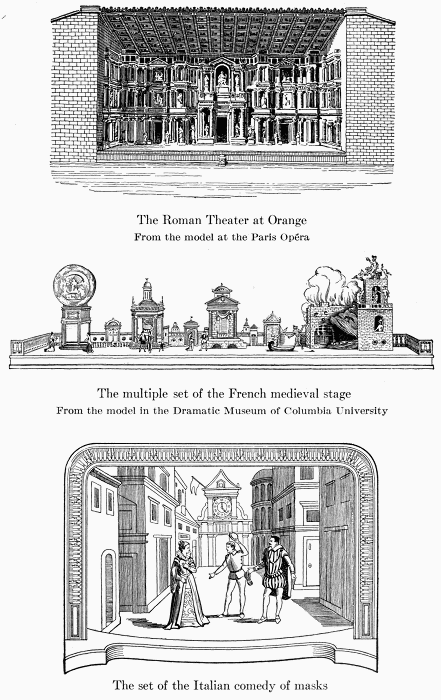
And as we need not assume the forming of a guild
of scene-painters because of these mansions which
performed some of the functions of our modern scenery,
so also we must not assume it because the medieval
artisans invented a variety of elaborate spectacular
devices, flying angels, for example, and roaring flames
from Hell-Mouth. Even in the stageless and sceneless
Attic theater, there had been many mechanical
effects of one kind or another, especially in the plays
of Euripides—the soaring dragon-chariot of Medea,
for instance, and the similar contrivance whereby a
god might descend from the skies. Mechanical tricks
even when they are most ingenious, do not imply the
aid of the scene-painter; and even to-day they are the
special task of the property-man, or of the master-mechanic,
altho the scene-painter's aid may be invoked
also to make them more effective. That there
were property-makers in the Middle Ages admits of
no doubt, and also highly skilled artificers delighting
in the daring ingenuity of their inventions. There were
abundant properties, it may be noted, on the Elizabethan
stage, well-heads, thrones, and arbors; and
Henslow's diary records payment for a variety of such
accessories. But there is not in that invaluable document
a single entry indicating any payment for anything
equivalent to the work of the scene-painter.
Adroit as were the French mechanics who prepared
the abundant spectacular effects of the medieval mysteries,
they were surpassed in skill by the Italian engineers
of the Renascence, who lent their aid to the
superb outdoor festivals wherein the expanding artistic
energy of the period was most magnificently displayed.
Leonardo da Vinci did not disdain to design
machines disclosing a surprising fertility of resource.
It was from those outdoor spectacles of the Italians
that the French court-ballets are directly descended,
and also the English masks, which demanded the collaboration
of Inigo Jones and Ben Jonson. But at
first the Italians got along without the aid of the yet
unborn scene-painter, and the inventions of the engineer
were carried out by the mechanic and the decorator.
Even as late as the seventeenth century a
magnificent spectacle presented in the garden of the
Pitti Palace in Florence relied mainly upon the ingenious
engineer and scarcely at all upon the scene-painter.
It seems probable that it is here in Italy in
the Renascence, and at first as an accompaniment of
the outdoor spectacle, or of its indoor rival, that the
art of the actual scene-painter had its birth. The engineers
required the aid of the artists—indeed, in those
days, when there was little specialization of function,
the engineers were almost always artists themselves,
capable of their own decoration.
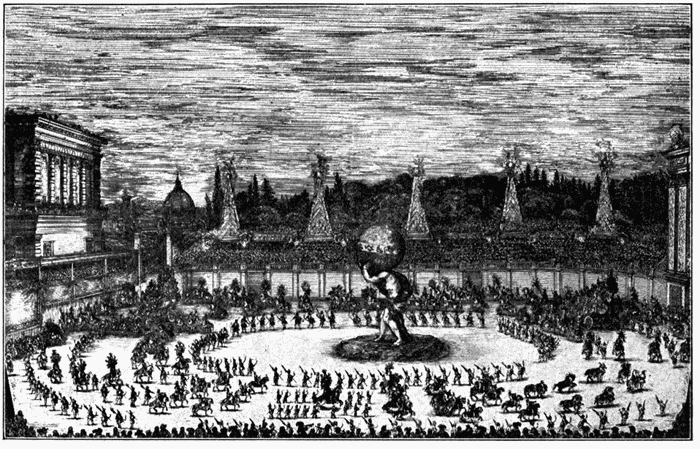 An outdoor entertainment in the gardens of the Pitti Palace in Florence in the early sixteenth century
From a contemporary print
In time there would be necessary specialization, and
after a while certain artists came to devote themselves
chiefly to scene-painting, finding their immediate opportunity
in the decoration of the operas, which then
began to multiply. The opera has always been aristocratic,
expensive, and spectacular, and it continued
the tradition of the highly decorated open-air festivals.
In fact, it improved upon this tradition, in so far as
that was possible, and it achieved a variety of mechanical
effects scarcely less complicated than those which
charm our eyes to-day in 'Rheingold' and 'Parsifal.'
Thirty years ago the late Charles Nuitter, the archivist
of the Paris Opéra and himself a librettist of wide experience,
drew my attention to Sabbatini's 'Practica di
fabricar scene e machini ne' teatri' (published in 1638),
and he assured me that the resources of the Opéra did
not go beyond those which were at the command of the
Italians three centuries earlier. "They could do then,"
he asserted, "almost everything that we can do now
here at the Opéra. For example, they could bring a
ship on the stage under full sail. We have only one
superiority over them: we have abundant light now,
we have electricity, and they were dependent on candles
and lamps."
Yet even in Italy in the Renascence the most popular
form of the drama, the improvised play which we
call the comedy-of-masks, was performed in a traditional
stage-setting representing an open square,
whereon only the back-cloth seems to have been the
work of the scene-painter, the sides of the stage being
occupied by four or more houses, two or three on each
side, often consisting of little more than a practicable
door with a practicable window over it, not made of
canvas, but constructed out of wood by the carpenter,
with the solidity demanded by the climbing feats of
the athletic comedians and by their acrobatic agility.
The traditional set of the comedy-of-masks conformed
to that recommended for the comic drama by Serlio,
in his treatise on architecture, published in 1545; but
it may be noted also that Serlio's suggested set for the
tragic drama was not dissimilar even if it were distinctly
more dignified.
III
The opera seems to have been the direct descendant
of the court-ballet, known in England as the mask,
as that in its turn was derived from the open-air spectacle
of the Italian Renascence, such as survived in
Florence in the seventeenth century. In the beginning
the court-ballets of France, like the masks of England,
were not given in a theater with a stage shut off
by a proscenium arch, but in the ball-room or banqueting-hall
of a palace. One end of this spacious
apartment, often but not always provided with a
raised platform, served as the stage whereon one or
more places, a mountain, for instance, and a grotto,
were represented, at first by the decorated machines of
the artistic engineers only, but afterward by the canvas
frames of scene-painters. The action of the court-ballets
or of the masks was not necessarily confined to
this stage, so to call it. The spectators were ranged
along the walls and under the galleries (if there were
any), leaving the main part of the hall bare; and the
performers descended frequently into this area, which
was kept free for them, and which was better fitted for
their dances and processions and other intricate evolutions
than the scant and cluttered stage.
A twentieth-century analog to this sixteenth-century
practise can be seen in the spectacle presented in our
modern three-ringed circuses—the 'Cleopatra,' for example,
which was the opening number on the Barnum
and Bailey program not long ago, where the Roman
troops and the Egyptian populace came down from the
stage and paraded around the arena. Bacon in his
essay on 'Masques,' used the word "scenery" as tho
he meant only decorated scaffolds, perhaps movable;
and his expression of desire for room "to be kept clear"
implies the use of the body of the hall for the maneuvers
of the performers. Ludovic Celler, in his study of
'Mise en scène au dix-septième siècle' in France, shows
that the action of the court-ballet was sometimes intermitted
that the spectators could join in the dancing,
as at an ordinary ball. In the earlier Italian open-air
festivals, and in the earlier French court-ballets there
was not even a proscenium sharply separating the
stage from the rest of the hall; but in England by the
time of Inigo Jones the advantage of a proscenium
had been discovered, and we have more than one of
the sketches which that skilful designer devised for
his masks. But even then this proscenium was not
permanent and architecturally conventionalized; it was
invented afresh for every successive entertainment,
and it was adorned with devices peculiar to that particular
mask. Inigo Jones had also advanced to the
use of actual scenery, that is to say, of canvas stretched
upon frames and then painted. Mr. Hamilton Bell
believes it possible that the invention of grooves to
sustain wings and flats may be ascribed to Inigo or to
his assistant and successor, Webb.
Even in the Italian opera, where all the scenery was
due to the brush of the scene-painter, there was for a
long while a formal and monotonous regularity.
Whether the set was an interior or an exterior, a public
place or a hall in a palace, the arrangement was rectangular,
with a drop at the back and a series of wings
on either side equidistant from one another. This stiff
representation of a locality is preserved for us nowadays
in the toy-theaters which we buy for our children,
altho it is now seen on the actual stage only in certain
acts of old-fashioned operas. It lingers also in the
variety-shows, where it is the proper setting for many
items of their miscellaneous programs.
Altho the Italians had discovered perspective early
in the Renascence they utilized it on the stage timidly
at first, bestowing this rectangular regularity upon all
their sets, both architectural interiors or exteriors and
rural scenes, in which rigid wood-wings receded, diminishing
in height to a landscape painted on the drop at
the back, thus leaving the whole stage free for the actors.
Not until the end of the seventeenth century did an
Italian scene-painter, Bibiena, venture to abandon the
balanced symmetry of the square set, and to slant his
perspective so as to present buildings at an acute angle,
thereby not only gaining a pleasing variety, but also
enlarging immensely the apparent spaciousness of the
scene, since he was able to carry the eyes of the spectator
into vague distances, and to suggest far more
than he was able to display. This advance was accompanied
by a more liberal use of stairways and platforms—"practicables"
as the stage-phrase is—that is to say,
built up by the carpenters so that the actors could go
from one level to another. Hitherto flights of steps
and balconies had been only painted, not being intended
for actual use by the performers.
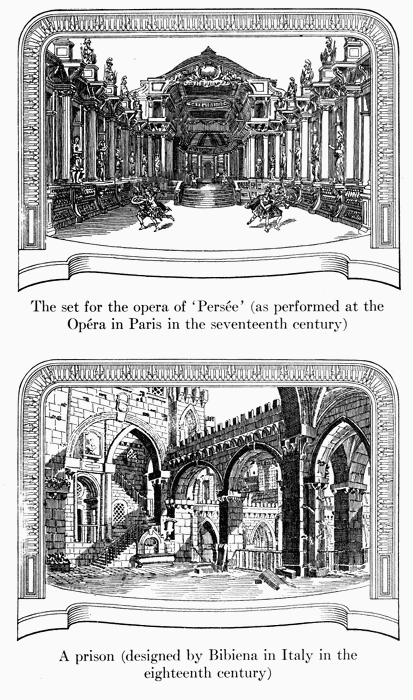
A similar development took place also in the landscape
scenes; the foreground was raised irregularly, so
that the persons of the play might climb up. Practicable
bridges were swung across torrents, and the
earlier formality of pastoral scenes began to disappear.
Apparently the scene-painters were influenced at this
time by the landscape-painters, more especially by
Poussin. The interrelation of painting and scene-painting,
each in turn affecting the other, is far closer
than most historians of art have perceived. It is not
unlikely, for example, that Gainsborough and Constable,
who were the fathers of the Barbizon men, had
been stimulated by the stage-pictures of De Lutherbourg.
David Garrick profited by the innovating art
of De Lutherbourg, a pupil of Vanloo, who came to
England in 1771. Apparently it was De Lutherbourg
who invented "raking-pieces"—as the scene-painters
term the low fragments of scenery which mask the inclines
of mounds. To him also is credited the first
use of transparent scenes to reproduce the effect of
moonlight upon water, and to suggest the flames of
volcanoes. Thus to him must be ascribed the beginnings
of that complicated realism by which our latter-day
scene-painters are enabled to create an appropriate
atmosphere for poetic episodes.
IV
The next step in advance, and one of the most important
in the slow development of the scene-painter's
art, took place in France early in the nineteenth century,
and simultaneous with the romanticist movement,
which modified the aims and ambitions of the
artists as much as it did those of the poets. The
severe stateliness of the stage-set which was adequate
for the classicist tragedies of Racine and Voltaire,
generally a vague interior of an indefinite palace, stiff
and empty, was hopelessly unsuitable for the fiery
dramas of Victor Hugo and the elder Dumas. An
even greater opportunity for spectacular regeneration
was afforded, in these same early decades of the nineteenth
century, by the bold and moving librettos which
Scribe constructed for Meyerbeer and Halévy at the
Opéra, and for Auber at the Opéra-Comique. The
exciting cause of the scenic complexities that we find
in Wagner's music-dramas can be discovered in these
librettos of Scribe's, from 'Robert the Devil' to the
'Africaine.' For one act of 'Robert the Devil,' that in
which the spectral nuns dance among the tombs under
the rays of the moon, Ciceri invented the most striking
and novel setting yet exhibited on any stage—a setting
not surpassed in poetic glamor by any since seen in the
theater, altho its eery beauty may have been rivaled by
one scene in the 'Source,' a ballet produced also at the
Opéra forty-five years ago—a moon-lit tarn in a forest-glade,
with half-seen sylphs floating lightly over its
silvered surface. This exquisitely poetic set was imported
from Paris to New York and inserted in the
brilliant spectacle of the 'White Fawn.'
The ample effect of these scenes was made possible
only by the immense improvement in the illumination
of the stage due to the introduction of gas. Up to the
first quarter of the nineteenth century the stage-decorator
had been dependent upon lamps—a few of
these arranged at the rim of the curving apron which
jutted out into the auditorium far beyond the proscenium,
and a few more hidden here and there in the
flies and wings. Early in the nineteenth century gas
supplanted oil; and a little later than the middle of the
century gas was powerfully supplemented by the calcium
light. Toward the end of the century gas in its
turn gave way to the far more useful electric light,
which could be directed anywhere in any quantity,
and which could be controlled and colored at will. It
was Henry Irving, more especially in his marvelous
mounting of a rather tawdry version of 'Faust,' who
revealed the delicate artistic possibilities of our modern
facilities for stage illumination.
In France the romanticist movement of Hugo was
swiftly succeeded by the realistic movement of Balzac,
who was the earliest novelist to relate the leading personages
of his studies from life to a characteristic
background and to bring out the intimate association
of persons and places. From prose fiction this evocation
of characteristic surroundings was taken over by
the drama; and a persistent effort was made to have
the successive sets of a play suggestive and significant
in themselves, and also representative of the main
theme of the piece. The actors were no longer dependent
upon the "float," as the footlights were called;
they did not need to advance out on the apron to let
the spectators follow the changing expression of their
faces, and in time the apron was cut back to the line
of the proscenium, and the curtain rose and fell in a
picture-frame which cut the actors off from their proximity
to the audience—a proximity forever tempting
the dramatic poet to the purely oratorical effects proper
enough on a platform.
When the modern play calls for an interior this interior
now takes on the semblance of an actual room.
Apparently the "box-set," as it is called, the closed-in
room with its walls and its ceiling, was first seen in
England in 1841, when 'London Assurance' was produced;
but very likely it had earlier made its appearance
in Paris at the Gymnase. To supply a room with
walls of a seeming solidity, with doors and with windows,
appears natural enough to us, but it was a startling
innovation fourscore years ago. When the 'School
for Scandal' had been originally produced at Drury
Lane in 1775, the library of Joseph Surface, where Lady
Teazle hides behind the screen, was represented by a
drop at the back, on which a window was painted, and
by wings set starkly parallel to this back-drop and
painted to represent columns. There were no doors;
and Joseph and Charles, Sir Peter and Lady Teazle,
walked on thru the openings between the wings, very
much as tho they were passing thru the non-existent
walls. To us, this would be shocking; but it was perfectly
acceptable to English playgoers then; and to
them it seemed natural, since they were familiar with
no other way of getting into a room on the stage.
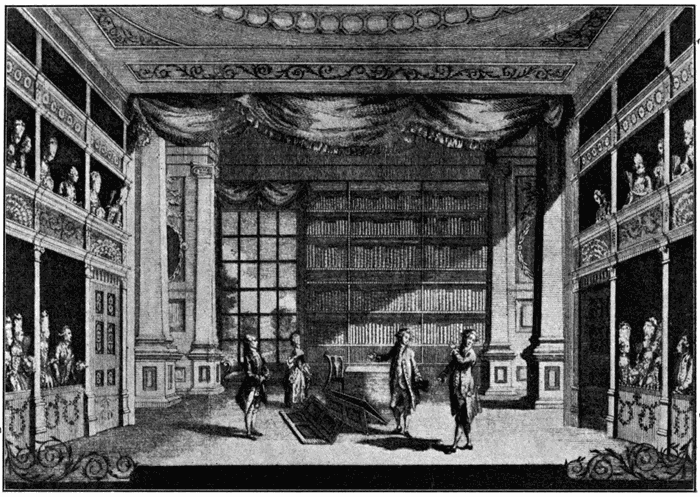 The screen scene of the 'School for Scandal' at Drury Lane in 1778
From a contemporary print
The invention of the box-set, of a room with walls
and ceilings, doors and windows, led inevitably to the
appropriate furnishing of this room with tangible tables
and chairs. Even in the eighteenth century the stage
had been very empty; it was adorned only with the
furniture actually demanded by the action of the drama;
and the rest of the furniture, bookcases and sideboards,
chairs and tables, was frankly painted on the wings
and on the back-drop by the side of the painted mantelpieces,
the painted windows, and the painted doors. In
the plays of the twentieth century characters sit down
and change from seat to seat; but in the plays produced
in England and in France before the first quarter
of the nineteenth century all the actors stood all the
time—or at least they were allowed to sit only under
the stress of dramatic necessity—as in the fourth act
of 'Tartuffe,' for instance. In all of Molière's comedies
there are scarcely half a dozen characters who have
occasion to sit down; and this sitting-down is limited
to three or four of his more than thirty pieces. Nowadays
every effort is made to capture the external
realities of life. Sardou was not more careful in composing
his stage-sittings in his fashion than was Ibsen
in prescribing the scenic environment that he needed.
The author's minute descriptions of the scenes where
the action of the 'Doll's House' and of 'Ghosts' passes
prove that Ibsen had visualized sharply the precise
interior which was, in his mind, the only possible home
for the creatures of his imagination. And Mr. Belasco
has recently bestowed upon the winning personality
of his 'Peter Grimm' the exact habitation to which
that appealing creature would return in his desire to
undo after death what in life he had rashly commanded.
V
While the scene-painter of our time is most often
called upon to realize the actual in an interior and to
delight us with a room the dominant quality of which
is that it looks as tho it was really lived in by the personages
we see moving around in it, he is not confined
to those domestic scenes. There are other plays than
the modern social dramas; and these other plays make
other demands upon the artist. On occasion he has
to supply a gorgeous scenic accompaniment for the
Roman and Egyptian episodes of 'Antony and Cleopatra,'
to suggest the blasted heath where Macbeth
may meet the weird sisters, and to call up before our
delighted eyes the placid charm of the Forest of Arden.
The awkward and inconsistent sky-borders, strips of
pendent canvas wholly unsatisfactory as substitutes
for the vast depths of the starry heavens, he is able
to dispense with by lowering a little the hangings at
the top edge of the picture-frame, and by thus limiting
the upward gaze of the spectators, so that he can
forgo the impossible attempt to imitate the changing
sky. He can achieve an effect of limitless space, as in
the last act of the 'Garden of Allah' (which brings before
us the endless vision of Sahara), by the use of a
cyclorama background, the drop being suspended from
a semicircular rod which runs around the top of the
stage, shutting in the view absolutely, and yet yielding
itself to a representation of sand and sky meeting afar
off on the faint horizon.
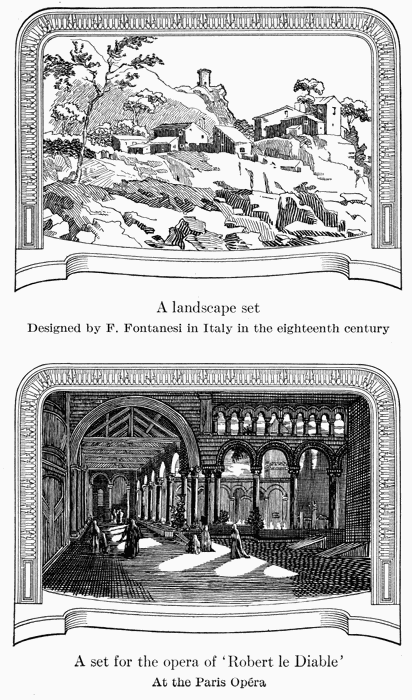
In the past half-century, and more especially since
the improvement of the electric light, scene-painting
has become very elaborate and very expensive. Instead
of being kept in its proper place as the decoration
of the drama, as a beautiful accessory of the action,
it has often been pushed to the front, so as to attract
attention to itself, and thereby to distract attention
from the play which it was supposed to illuminate.
Sometimes Shakspere has been smothered in scenery,
and sometimes the art of the actor has been subordinated
to the art of the scene-painter. Now, it must
be admitted that nothing is too good for the masterpieces
of the drama, and that Sophocles no less than
Shakspere ought to be presented to the public with all
the pomp that his lofty themes and his marvelous
workmanship may demand. But the plays of the
mighty dramatic poets ought not to be used merely as
pegs on which to hang gorgeous apparel. After all,
the play's the thing; and whenever the scene-painter
and his invading partner, the stage-manager, are
prompted to oust the drama from its pre-eminence, and
to substitute an exhibition of their accessory arts, the
result is a betrayal of the playwright.
A well-known British art critic once told me that
when the curtain rose at a certain London revival of
'Twelfth Night,' and disclosed Olivia's garden, he sat
entranced at the beauty of the spectacle before his
eyes, with its subtle harmonies of color, so entranced,
indeed, that he found himself distinctly annoyed when
the actors came on the stage and began to talk. For
the moment, at least, he wished them away, as disturbers
of his esthetic delight in the lovely picture on
which his eyes were feasting. But even a stage-setting
as captivating as this might very well be justified if
it had been employed to fill a gap in the action, and to
buttress up the interest of an episode where the dramatist
had allowed the appeal of his story to relax.
Perrin, the manager of the Comédie-Française thirty
years ago, declined to produce a French version of
'Othello' because he found a certain dramatic emptiness
in the scenes at Cyprus at the opening of the second
act, which he felt he would have to mask by the
beauty of spectacular decoration, too costly an expedient
in his opinion for the finances of the theater
just then.
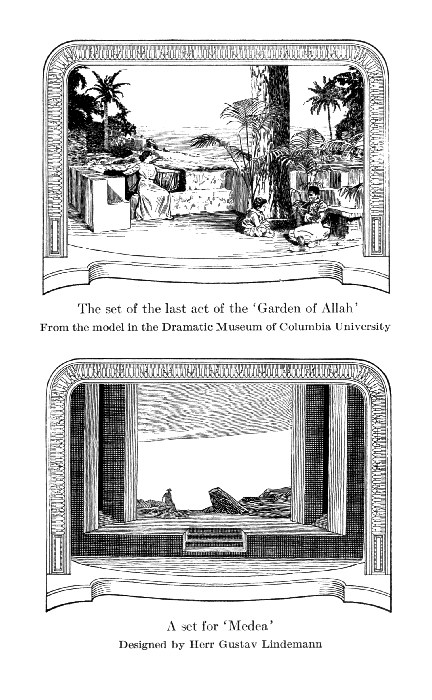
It was Perrin, however, who produced the French
version of the 'Œdipus the King' of Sophocles, and who
bestowed upon it a single set of wonderful charm and
power, at once dignified, appropriate, and beautiful
in itself. It represented an open space between a
temple and the palace of the ill-fated Œdipus, with an
altar in the center, and with the profile of another
temple projected against the distant sky and relieved
by the tall, thin outline of poplar-trees. The monotony
of this rectangular architectural construction
was avoided by placing all the buildings on a slant,
the whole elevation of the temple being visible on the
left of the spectators, whereas only a corner of the
colonnade of the palace on the right was displayed.
This set at the Théâtre-Français was the absolute antithesis
of the original scenic surroundings in the theater
of Dionysus more than two thousand years ago, when
the masterpiece of Sophocles had been performed in
the open-air orchestra, with only a hut of skins or a
temporary wooden building to serve as a background
for the bas-reliefs of the action.
So elaborate, complicated, and costly have stage-sets
become in the past half-century, that there are
already signs of the violent reaction that might be
expected. Mr. Gordon Craig, an artist of remarkable
individuality, has gone so far as to propose what is
almost an abolition of scene-painting. He seeks to
attain effects of massive simplicity by the use of unadorned
hangings and of undecorated screens, thus
substituting vast spaces for the realistic details of the
modern scene-painter. No doubt, there are a few
plays for which this method of mounting would be appropriate
enough—M. Maeterlinck's 'Intruder,' for one,
and his 'Sightless' for another, plays which are independent
of time and space, and in which the action
appears to pass in some undiscovered limbo. As yet
the advanced and iconoclastic theories of Mr. Craig
have made few adherents, the most notable being the
German, "Professor" Reinhardt, who lacks Mr.
Craig's fine feeling for form and color, and who is continually
tempted into rather ugly eccentricities of design,
being apparently moved by the desire to be different
from his predecessors rather than by the wish to
be superior to them.
VI
Interesting as are Mr. Craig's suggestions, and wellfounded
as may be his protest against the excessive
ornamentation to which we are too prone nowadays,
there is no reason to fear that his principles will prevail.
The art of the scene-painter is too welcome, it
is too plainly in accord with the predilections of the
twentieth century, for it to be annihilated by the fiat
of a daring and reckless innovator. It will be wise
if the producers should harken to Mr. Craig's warnings
and curb their tendency to needless extravagance;
but we may rest assured that a return to the bareness
of the Attic theater or of the English theater in the
time of the Tudors is frankly unthinkable now that the
art of scene-painting has been developed to its present
possibilities. In fact, the probability is rather that
the scene-painters will continue to enlarge the boundaries
of their territory and to discover new means and
new methods of delighting our eyes by their evocations
of interesting places.
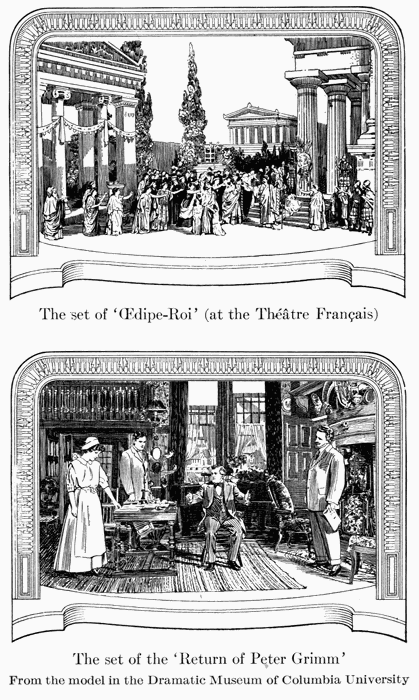
Perhaps they would be more encouraged to go on
and conquer new worlds if there was a wider recognition
of the artistic value of their work. Altho De
Lutherbourg and Clarkson Stanfield won honorable
positions in the history of painting by their easel-pictures,
the art of scene-painting does not hold the
place in the public esteem that many of its practitioners
deserve. Théophile Gautier, often negligible as a
critic of the acted drama, was always worth listening
to when he turned to pictorial art; and he was frequent
in praise of the scene-painters of his time and of scene-painting
itself as a craft of exceeding difficulty and of
inadequate appreciation. Probably one reason why
the scene-painter has not received his due meed of
praise is because his work is not preserved. It exists
only during the run of the play which it decorates.
When the piece disappears from the boards, the scenes
which adorned it vanish from sight. They linger only
in the memory of those who happened to see this one
play—and even then, in fact, only in the memory of
such spectators as have trained themselves to pay
attention to stage-pictures. For the scene-painter
there is no Luxembourg; still less is there any Louvre.
As Gautier sympathetically declared, "it is sad to think
that nothing survives of those masterpieces destined to
live a few evenings only, and disappearing from the
washed canvas to give place to other marvels, equally
fugitive. How much invention, talent, and genius may
be lost—and not always leaving even a name!"
It is pleasant to know that at the Opéra in Paris a
formal order of the government has for now a half-century
prescribed the preservation of the original
models—the little miniature sets which the scene-painter
submits for the approval of the manager and
the dramatist before he begins work upon the actual
scene. These models are always upon the same scale,
and in the gallery connected with the library of the
Opéra a dozen of these models are set up to be viewed
by visitors. Of course no tiny model, however cleverly
fashioned, can give the full effect of the scene which
has been conceived in terms of a huge stage; and yet
the miniature reproductions do not betray the scene-painter
as much as an engraving or a photograph often
betrays the painter. Whatever its limitations, and
they are obvious enough, the collection of models at
the Opéra is at least an attempt to retard the oblivion
that Théophile Gautier deplored, and to provide for
the scene-painter a substitute, however inadequate,
for the Louvre and the Luxembourg.
(1912.)
IX
THE BOOK OF THE OPERA
THE BOOK OF THE OPERA
I
A few years ago Punch had a satirical drawing representing
a British matron conveying a bevy of youthful
daughters to the French play in London. To a
friend who called her attention to the rather risky
atmosphere of the very Parisian comedy which they
were about to behold, the worthy mother promptly explained
that she was not bringing her daughters to see
the play itself; she was bringing them to see only the
acting. Probably a great many opera-goers would
make a similar explanation if they were asked whether
they were interested in the book of the opera or only
in the music. They would be likely to protest that
they cared little or nothing for the libretto, and that
they were attracted solely by the score. But, as a
matter of fact, the opera-goers who might make this
reply would be self-deceived. Whether they are aware
of it or not, they are unlikely to be attracted to any
opera unless it happens to have an interesting story,
built up into a coherent and captivating plot. When
the libretto is unintelligible or uninteresting, the most
delightful music fails to allure them into the opera-house.
This is one of the reasons why the 'Magic
Flute,' which contains much of Mozart's most beautiful
melodic invention, is so rarely heard in our opera-houses,
and why it is so sparsely attended when it is
presented. The libretto of the 'Magic Flute' is dull
and ineffective, and even Mozart's genius proved unable
to overcome this initial handicap.
The ordinary opera-goer is likely to treat the libretto
with calm contempt. He is prone to assert that nobody
cares about the words, and he does not reflect that behind
and beneath the words is the supporting structure
of the story. After all, an opera is a play, it is a music-drama,
and the plot is as important in a play the words
of which are to be sung as in a play the words of which
are to be spoken. True it is, of course, that in an
opera the words may not be heard distinctly, and perhaps
they need not be seized with certainty, since the
emotion they set forth is more amply conveyed by
the music. But the musician cannot express emotion
musically, unless there is emotion for him to express,
unless he has characters immeshed in a series of situations
which evoke vivid and contrasting sentiments
for him to translate into music. As the music-drama
is a drama, it must obey the laws of the drama; it
must represent a conflict of contending desires; it
must be carried on by characters firm of purpose and
resolute in achieving their several aims. These characters
must be sharply individualized and boldly contrasted;
and the story in which they take part must
be at once strong and simple, calling for no elaborate
explanation and moving forward steadily and irresistibly.
It must have a lyric aspect, lending itself naturally
to song; and it ought also to afford opportunity
for the spectacular effects appropriate to the large
stage of the opera-house.
So contemptuous of the libretto is the ordinary
opera-goer that he rarely inquires as to the name of
the author of the book, altho he is generally familiar
with the name of the composer of the score. He may
or he may not be aware that Wagner was his own
librettist, and quite possibly he supposes that it is the
ordinary custom of the composers to write the words
for their own music. He knows that 'Carmen' was
composed by Bizet, and that the 'Huguenots' was composed
by Meyerbeer; but he would be greatly puzzled
if he was asked to name the librettists of these two
operas, the adroit playwrights who devised the skeletons
of dramatic action which sustained the composers and
provided them with ample opportunities for the exercise
of their melodic gift. As a matter of fact, the book
of 'Carmen' was written in collaboration by two of the
most distinguished French dramatists of the nineteenth
century, Meilhac and Halévy, the authors of
'Froufrou' and of the librettos of Offenbach's 'Belle
Hélène,' 'Grand Duchess of Gérolstein,' and 'Périchole.'
And the book of the 'Huguenots' was the
work of the master stage-craftsman, Scribe, the author
of 'Adrienne Lecouvreur' and of the 'Ladies' Battle,'
and of countless other plays performed in every modern
language, and in all the countries of the world.
Bizet wrote other operas besides 'Carmen,' and if
these other operas have vanished from the stage, the
reason may be that the librettos to which they were
composed were not as ingenious and not as interesting
as the book of 'Carmen.' One of these forgotten operas
of Bizet's was a dramatization of the 'Fair Maid
of Perth,' and another was called the 'Pearl Fisher';
but neither of these books was devised by Meilhac and
Halévy. And Scribe was not only the librettist of the
'Huguenots' and of the 'Africaine' for Meyerbeer; he
also wrote the books of 'Fra Diavolo' and of 'Crown
Diamonds' for Auber, the book of the 'Dame Blanche'
for Boïeldieu, and the book of the 'Juive' for Halévy.
Indeed, it is evident that Wagner himself as a librettist
must be considered as a direct disciple of Scribe; certainly
his book of the 'Flying Dutchman' has its points
of resemblance with the books Scribe invented for
'Robert the Devil,' and for the 'Prophet.' Even the
libretto of Wagner's 'Master-Singers of Nuremberg,'
altho it is far richer in tone than any of Scribe's librettos
for Auber, is constructed in accord with principles already
applied by the French playwright. In fact, the
influence of Scribe is patent thruout the long history of
opera in the nineteenth century; he was not only the
most prolific of librettists himself, but the operatic
formula he devised was borrowed by the best of the
librettists who followed him. Scribe was not the writer
of the books of 'Faust,' or of 'Roméo et Juliet,' or of
'Aïda,' but all these librettos were carefully built in
accord with the principles that he had practised for
half a century.
II
Probably the average opera-goer is contemptuous of
the libretto, because he thinks it is an easy task to write
the mere words of an opera. To him, no doubt, the
opera lives by its music, and by its music alone. But
there is really no warrant for this uncomplimentary
attitude. An opera is a music-drama, and if it is to
achieve success, wide-spread and long-lasting, its drama
must be as effective as its music. Experience proves
that, so far from being as easy as it seems, the construction
of a satisfactory libretto is really a difficult feat,
to be achieved only by an expert in stage-craft. It is
no task to be confided to an amateur play-maker, to
a mere lyrist, ignorant of the art of the theater. First
of all, a satisfactory book must contain the skeleton of
a good play; and, second, this must be the special kind
of play which will not only inspire the musician, but
afford him a succession of special opportunities for the
exercise of his own art. The book of an opera must
be a good play; and more than once have we seen a
libretto deprived of its music and written out again
in prose for production in non-musical theaters.
'Carmen' is one example of this transformation. The
late Sir Henry Irving was so taken with Wagner's
'Flying Dutchman' that he had it made over into a
play for his own acting—'Vanderdecken.'
The book of an opera must be a good play, and therefore
not a few successful operas have been composed
on plots which had already won approval as plays on
the stage. Indeed, many modern composers are so
convinced of the necessity that librettos shall be attractive
in themselves that they are continually borrowing
popular plays to deck with melody. 'Salomé' and
'Pelléas et Mélisande,' 'Madam Butterfly' and 'Cavalleria
Rusticana,' the 'Bohème' and the 'Tosca'
were all successful without music before they were set
to music to win a second success. The book of Verdi's
'Rigoletto' is based on Victor Hugo's drama, 'Le Roi
s'Amuse'; and oddly enough it was the operatic libretto,
rather than the original poetic drama, which
suggested the English play on the same theme, Tom
Taylor's blank-verse drama, the 'Fool's Revenge.'
Another of Verdi's librettos was borrowed from Hugo's
'Hermani', while his 'Traviata,' as we all know, is
taken from the play of the younger Dumas, long popular
in America as 'Camille.' Two of Verdi's latest
operas had Shaksperian themes, 'Otello' and 'Falstaff.'
It is instructive to note, so an American musical
critic once asserted, that of all Gounod's dozen operas,
"the only two which have survived are the two which
are derived from Goethe's 'Faust' and from Shakspere's
'Romeo and Juliet'"; and he added a reminder
that in these operas the music owes its success "not
only to the aid derived from its associations with a
favorite play, but also in part to the fact that the
composer's creative imagination was fertilized by the
splendid opportunities for dramatic composition offered
by these plays. Gounod was moved by the joys
and woes of Margaret and of Juliet, and it is only under
the influence of deep feeling that such masterworks
can be created." When Gounod set to music a poetic
play by Goethe, and when Verdi set to music a group
of characters created by Shakspere, the composers
might well be inspired by the poets; and they were
thus aided to attain the utmost of which they are capable
as musicians.
But it may be doubted whether any musician could
find any really helpful inspiration in dramas of vulgar
violence, such as the 'Tosca' of Sardou, and the
'Salomé' of Oscar Wilde; and it is extremely improbable
that the operas composed to such unworthy themes
will be able to achieve any durable popularity. In
plots of so coarse a character there is neither beauty
nor poetry, and the vogue of music-dramas having
subjects so debased is likely to be fleeting. On the
other hand, there was both poetry and beauty in the
original plays of 'Madam Butterfly' and 'Cavalleria
Rusticana,' and we need not be surprised if the operas
composed on these themes prove to have a long life in
the musical theaters. We may even go further and
suggest that there was a haunting and ethereal grace
about Maeterlinck's 'Pelléas et Mélisande' which
seemed almost to demand translation into the sister
art of music.
The two most effective French comedies of the eighteenth
century, the 'Barber of Seville' and the 'Marriage
of Figaro,' supplied librettos, one for Rossini and
the other for Mozart. We may be sure that sooner
or later some other composer, Italian or American or
German, will be tempted to undertake an opera based
on Fulda's 'Two Sisters,' in which there could not help
being a very effective part for the prima donna. And
sooner or later again some musician with an appreciation
of humor and sentiment will be moved to take for
his libretto the comedy of 'Masks and Faces,' by Charles
Reade and Tom Taylor, generally known by the name
of its fascinating heroine, Peg Woffington. No doubt
there are not a few other modern plays in which composers
will discover musical possibilities.
III
The key to an understanding of the importance of
the libretto lies in the term Wagner used to describe
the art-work of the future; he called this a "music-drama."
The exclusive lover of music is tempted to
look down on opera because its music is contaminated
with drama; and for a similar reason, the exclusive
lover of the drama is not attracted to opera because
the drama is there more or less sacrificed to the music.
But there are many opera-goers who best relish music
and the drama when they are presented in conjunction.
In a music-drama of the highest type, in Wagner's
'Tannhaüser,' for example, the music and the drama
are Siamese twins; they were brought forth at a single
birth. Each helps the other, and neither calls upon
the other for any undue sacrifice. They can be enjoyed
together better than they can be enjoyed apart,
since each depends upon the other; and united they
stand or fall.
Mr. H. T. Finck was not overstating the case when
he insisted that the ideal opera is one in which the book
and the score are each of them of absorbing interest,
"and yet make a doubly deep impression when heard
together." The stories of 'Faust' and of 'Carmen' and
of 'Lohengrin' are delightful in themselves, merely
to read; and a musical expert can find pleasure in
playing the music from them on the piano. "Yet
how much more effective they are when we hear and
see music and play together on the stage." And then
the same writer goes on to point out that the best
"libretto is one which tells its story to the eye," as in
the case of 'Carmen,' for example. "No one with eyes
to see can fail, for instance, to follow the career of
'Carmen,' from her flirtation with the young officer
to the scene before the bullring where he stabs her."
It was an acute French dramatic critic who once
asserted that "the skeleton of every good play is a
pantomime," and the assertion is more emphatically
true when applied to the skeleton of a libretto. Indeed,
as the words are rarely heard distinctly, and as
they are often in a foreign language, there is double
need of a story so clear and so straightforward that it
can be caught by the eye alone from the actions and
gestures and facial expressions of the performers without
the aid of the actual words. But the inventing
and the constructing of a plot of this seemingly simple
effectiveness is a task of extraordinary difficulty—if
we may judge by the infrequency of its achievement.
And undoubtedly it is this difficulty which has led so
many musicians to compose their scores to books only
slightly altered from plays which had already an attested
popularity in the theater. By so doing it has
seemed to them that they were minimizing the risk of
finding their music handicapped by an ineffective story.
The danger in this case lies in the temptation to set
to music any play which may chance to be successful
without considering sufficiently whether it is really
worthy of the composer's labor.
There is another disadvantage also in this snatching at
successful plays to serve as opera-librettos. Most successful
plays nowadays deal with modern life, and they
may owe much of their success to the skill with which
the dramatist has been able to seize the external aspects
of reality. Now, it is an interesting question whether
a realistic piece of this sort can ever supply an entirely
satisfactory book for an opera, since music is emotional
and idealizing. To many persons the opera seems
singularly unreal, strangely remote from actual life.
Such persons are shocked that Tristan, for instance,
should sing for half an hour when he is dying from physical
weakness. Tolstoy sided with those who take this
attitude, and he had no difficulty in showing up the
absurd unreality of an operatic performance, if one
insists upon applying to it the standard of our ordinary
existence, since we do not burst into song ordinarily
to express our every-day desires. Of course, there
would be no great difficulty in showing up the absurd
unreality of every other art, if the same standard is
insisted upon. No art can justify itself for a moment
unless we are willing to admit the essential conventions
which alone permit it to exist.
Tolstoy might as well have pointed out that sculpture
is ridiculous, since no human being is ever all of
one color, body and clothes, as a statue must be,
whether it is made of marble or of bronze. He could
have declared that painting is equally untrue to the
mere facts of life, since it represents nature absolutely
without motion, as when it depicts a field of waving
corn which does not really wave but stands fixed forever.
If Tolstoy or any one else refuses to accept the
conventions of any art, there is no possible reply, except
to make it clear to him that he is thereby depriving
himself of the delight which that art can give.
A departure from the mere fact underlies every art;
and it is only because of that departure that the art
exists. By convention, that is to say, by tacit agreement
between the artist and the public, the artist is
allowed to deny certain of the facts of life in order to
provide the public with the specific pleasure which
only his art can afford.
In the Shaksperian drama the underlying convention
is that the persons of the play belong to a race
of people who always express themselves poetically in
English blank verse. In opera this necessary agreement
requires us to concede the existence of men and women
to whom song is the natural means of communicating
all their sentiments and all their thoughts. If we are
willing to accept this implied contract, then there is no
absurdity in Tristan's singing with his dying breath,
since he belongs to a race of creatures who have no
other method of speech. If we are unwilling to be
parties to this agreement, if we deny the existence of
any such creatures, then there is nothing for us to do
but to keep out of the opera-house. It was this convention
which Tolstoy rejected, and by this rejection
he refused the enjoyment which the opera can give to
those who are satisfied to accept its conditions.
IV
But there is no denying that the imperative operatic
convention requires us to admit a very violent departure
from the facts of life as we all know them. We
are now so accustomed to blank verse in Shakspere's
plays, tragic and comic, that we accept it almost
without noticing it. By long habit, we have come to
consider blank verse as "natural" in a poetic play,
especially when that play sets before us heroic figures
of the remote past. And here is the danger in the
operas which have been composed on books made out
of modern popular pieces, more or less realistic in their
atmosphere. The "naturalness" of the men and
women in these plays of to-day tends to draw attention
to the "unnaturalness" of their customary use of
song to express their emotions.
This danger Wagner skilfully avoided in his later
music-dramas derived from the Nibelungen myth.
He set before us shadowy creatures involved in strange
intrigues far back in the legendary past and wholly
devoid of any modern or realistic suggestion. As Tristan
and Siegfried and Brunhild are all idealized persons,
taking part in poetic fictions, we are willing enough
to accept their exclusive use of song; and we recognize
at once the artistic inconsistency of Tolstoy's protest.
To beings so remote from our daily life, from our ordinary
experience, the standard of fact cannot fairly
be applied. We acknowledge the full right of such
creatures to dwell eternally in the land of song alone.
But we are perhaps a little less willing to make this
acknowledgment when we find the composer asking
us to believe that men and women of our own time and
of our own country, the characters of the 'Girl of the
Golden West,' for example, or even some of those of
'Madam Butterfly,' should eschew the plain prose of
ordinary speech and insist on discussing their love-affairs
in the obviously "unnatural" medium of song.
That is to say, there is a striking incongruity between
musical expression and the realistic characters of most
modern plays. We enjoy the opera partly because it
is not "natural," not "real," in the ordinary meaning
of these words; and if the plot and the people are
aggressively modern and matter-of-fact, our attention
is necessarily called to the "unnaturalness" of their
incessant vocalization. A certain remoteness from real
life, even a certain vaporous intangibility as to time
and place, seem to be a helpful element in our enjoyment
of a music-drama.
Perhaps it is due to this remoteness, to this unreality,
that the opera-goer is willing enough to have a story
end unhappily, altho the playgoer is now likely to be
painfully affected by a tragic ending. Whatever the
reason, it is a fact that most of our popular plays end
merrily in a church, while most of our popular operas
end sadly in a churchyard. The calculation has been
made that out of twoscore operas sung in New York
at the two opera-houses a season or so ago, only half
a dozen ended happily; the large majority of them culminated
in the death of the hero or of the heroine or
of both together. Music is a sister of poetry, and we
need not wonder that the musicians are likely to prefer
the opera-book which has a tragic catastrophe.
(1910.)
X
THE POETRY OF THE DANCE
THE POETRY OF THE DANCE
I
The Greek of old was wise in his generation and poetic
as was his habit, when he imagined nine muses and
when he feigned that each of them was to watch over
a separate art, and to inspire those who might strive
to excel in this. It is true that nowadays we cannot
help feeling that the sister-muses of Tragedy and of
Comedy have been a little derelict to their duty, if
they are really responsible for all the plays of our time,
not a few of which seem to be sadly lacking in inspiration.
But of late another of the sacred nine appears
to have aroused herself out of her lethargy and to have
awakened to a fuller realization of her opportunity.
At least, there are many evidences now visible in the
United States that Terpsichore has been attending
strictly to business, and sending out travelers with
many diverse specimens of her wares. Indeed, there
has probably never been a time when so many different
varieties of the dance have been on exhibition before
the American people. It was once remarked by a
shrewd observer that there were only three kinds of
dancing, the graceful, the ungraceful, and the disgraceful.
And in the United States we have had presented
to us in the past few years specimens of all three
kinds.
In the middle of September, 1910, the Playground
Association of America held an outdoor session in
Van Cortlandt Park, in New York, and three hundred
persons, mostly children, took part in the exercises.
The most interesting feature of the program was a
series of national folk-dances executed by boys and
girls from the public schools. New York is the huge
melting-pot where all nationalities of Europe meet to
be fused into Americans; and these children were,
most of them, executing the dances of the countries
their parents had come from—dances for which they
had, therefore, a traditional and hereditary predilection.
German girls in the costumes of the Rhine, gave
a peasant dance to the simple tune of 'Ach, du lieber
Augustin'; and colored children, in perfect rhythm,
moved thru a reel to the music of the 'Suwanee River.'
The wild Hungarian czardas was carried off with a
splendid swing by men and women born on the banks
of the Danube; and an Irish quartet displayed their
agility and their precision of time-keeping in a four-handed
country-dance. And at the end, all the participants
in the several national dances took part in a
general harvest-dance. This was an effective spectacle,
possible only here in America, where representatives
of many peoples come to mingle, even tho each
of them retains a sentiment of loyalty to the old home
it has left forever.
Here in the open air, in a public park, at this meeting
of the Playground Association, there was this joyous
and wholesome revival of the folk-dances of a dozen
different races; and at the same time, in one or another
of half a score of the theaters of the great city, ill-trained
and half-clothed women were vainly capering
about the stage in doubtful efforts to suggest the Oriental
contortions of Salomé. These were, most of them,
consciously and deliberately inartistic, appealing directly
to the baser instincts and to the lower curiosities
of man. Nothing could have been in sharper contrast
with the folk-dances of the foreign-born children,
which were gay and healthy and spontaneous. The
exercises in the park were examples of the kind of
dancing which cannot help being graceful, while most
of the performances in the theaters were specimens of
the kind of dancing which can fairly be described as
ungraceful, even if they cannot all of them be dismissed
as disgraceful. While the folk-dances of the
children would fill the heart with a pure delight, the
sorry spectacle presented in some of the theaters was
not to be witnessed without a certain loss of self-respect;
it recalled the gross pantomimes of the later Roman
theater, righteously denounced by the Fathers of the
Church.
Yet it is only just to record that in other theaters
there were then other spectacles to make amends for
these sorry exhibitions. There were several interesting
attempts to recall the severe beauty of Greek dancing.
Lithe figures with free and floating draperies
sought to recapture the irreclaimable charm that lives
for us in the lovely Tanagra figurines, or that flits elusively
around the sides of Attic vases. Ambitious efforts
were made by one dancer and by another to translate
into step and posture and gesture the intangible
poetry of Shelley and the haunting music of Mendelssohn.
Unfortunately, the result was rarely commensurate
with the effort; and, in fact, a complete success
was not possible. The muse of dancing has no right
to endeavor to annex the territory of her sisters, who
are charged with the care of poetry and music. The
several arts are strongest when each remains strictly
within its own limitations. For example, program-music
is not yet assured of its welcome, and program-dancing
is far more difficult to follow with complete
comprehension.
And there was a further defect in these efforts to revive
the classic dances and to devise more modern
interpretations of poetry and music. Success, if possible
at all, would be possible only to a highly trained
performer, mistress of every device of the terpsichorean
art and elaborately schooled in pantomimic
expression. Now, it is not unfair to say that no one
of the performers of these so-called classic dances had
undergone this severe schooling. No one of them had
the lightness, the ease, the perfect mastery of method,
the floating grace of the true dancer, who has been
taught from childhood, until all the tricks of the craft
are second nature. Without this arduous training any
one who attempts an ambitious display can scarcely
fail to reveal instantly the lamentable fact that she is
not mistress of the technic of the art she has undertaken
to practise. She does not know how to get her effects;
she does not even know what effects are possible.
She is almost certain to appear amateurish, and she
is likely to seem awkward also, not to say ungainly.
As Pope put it tersely: "Those move easiest who have
learned to dance."
These well-meant attempts to link dancing with
poetry and music could be entirely satisfactory only
to those who have given little consideration to dancing
as an art, or who have small opportunity to see any
really beautiful dancing. There is no wonder that
any effort to spiritualize dancing, to give it a soul, to
elevate it to the lofty level of the lyric, should be welcomed
by those who have been disgusted by the ugly
and vulgar high-kicking of the so-called pony ballets.
The acrobatic contortions of these athletic performers
were wholly without charm, as unalluring as they were
violent. And equally unacceptable are the frequent
exhibitions of toe-dancing, sheer gymnastic feats, difficult,
indeed, but essentially uninteresting. Of a truth,
these pony ballets on the one hand, and these toe-dancers
on the other, are exponents of eccentricity.
What they accomplish lies outside the true art of dancing.
It is not inspired by Terpsichore, and the saddened
muse must veil her face when she is forced to
behold these crude exhibitions of misplaced energy.
II
The true art of dancing is entirely free from all apparent
effort. No matter how difficult may be the
feat that is accomplished, it must seem easy. Every
gesture must be expressive, every movement must be
beautiful, every step must have ease and lightness and
grace. Forty years ago and more, the 'Black Crook'
brought to America three or four dancers trained in the
best schools of Europe—Bonfanti and Betty Rigl,
Rita Sangalli and Morlacchi. One of this quartet,
Rita Sangalli, was afterward the chief dancer at the
Paris Opéra, where she was followed in time by Rosita
Mauri, a dancer who added beauty of face and of form
to a masterly accomplishment. They were all gifted
pantomimists; they had all of them the perfection of
technic; they were all of them capable of the most
varied difficulties of the art; and they all of them vanquished
these difficulties with unobtrusive ease. They
had attained to that perfection of art, when the art
itself is hidden, and when only the consummate result
is visible. Each of them had absolute certainty of
execution, and each of them could float across the
stage the embodiment of grace, exquisite in its ethereal
delicacy.
For those whose memories cannot recall the haunting
remembrance of the days that are gone there is abundant
compensation in the opportunity which has been
afforded of late to behold the dancing of Mlle. Genée
and of Mlle. Pavlova. They are, at least, the equal
of any of their predecessors, and it may be doubted
whether Taglioni or Fanny Elssler surpassed them in
mastery. They are the perfection of effortless ease;
altho they suggest only the lightness of the butterfly,
they have the steel strength of the gymnast. Behind
their marvelous and bewildering accomplishment there
is a native gift, rich and full; and there is also the
utmost rigor and perseverance in training. What they
are able to do with seeming spontaneity and with apparent
freedom is the result of indefatigable industry
and of merciless labor.
But tho this schooling sustains them, it is never
paraded—indeed, it is scarcely perceived. There is
not the faintest suggestion of hard work about their
performances; there is nothing that hints at effort;
their art is able to conceal itself absolutely, and to
delight us only with the perfect result of their long
apprenticeship. Capable of the most obstinate feats of
strength and of agility, Mlle. Genée and Mlle. Pavlova
never "show off"; they are never guilty of parading a
difficulty for its own sake, and their conquest of technical
obstacles serves only to support and intensify
the continuous suggestion of aerial elevation and of
ineffable lightness. It is to be noted, also, that as they
scorn the task of the mere gymnast, they do not wear
the scant costume of the acrobat; they are enveloped
in ample draperies, which fall into lines of beauty with
every movement.
Nothing more exquisite than their dancing has ever
been seen on the American stage. Theirs is the dancing
which is graceful—which, indeed, is grace itself.
Here is the art at its utmost possibility, purged of all
its dross. When they are floating effortless thru space
we cannot help recalling the possibly apocryphal anecdote
which records the visit of Emerson and Margaret
Fuller to the theater to see Fanny Elssler. They gazed
with increasing delight, until at last Margaret Fuller
could not contain her enthusiasm. She turned and
said: "Ralph, this is poetry!" To which the philosopher
is said to have responded: "Margaret, this is
religion!"
Perfection is always rare, and there is now only one
Mlle. Genée, and only one Mlle. Pavlova, as there was
only one Rosita Mauri a quarter of a century ago.
It is a pity that the Danish dancer has had to appear
here in an ordinary musical show and not in a framework
more worthy of her and of her art, and better
fitted to display it. She has revealed herself only in
two or three entrées de ballet, as the French term them—incidental
dances; and she has not yet been seen here
in a ballet d'action, a complete story told in pantomime.
It was the poet, François Coppée, who devised the plot
of the 'Korrigane' for Rosita Mauri; and he had had
Théophile Gautier as a predecessor in the preparation
of a ballet-libretto. All those who are interested in
every manifestation of the art of the drama, must find
pleasure in the ballet d'action, with its adroit commingling
of dance and pantomime; it gives a delight
possible to no other form of the drama; and at its
best it is more closely akin to pure poetry. Being her
own manager, Mlle. Pavlova has been seen in a series
of ballets more appropriate to her extraordinary gifts
than those in which Mlle. Genée has been permitted to
appear.
III
There was one scene of the 'Source,' a ballet popular
at the Opéra in Paris during the exhibition of 1867,
which must linger in the memory of all who had the
good fortune to behold it—a scene so beautiful that it
was borrowed for the 'White Fawn,' which was the
successor of the 'Black Crook' here in the United
States. It represented a silvery glade in the lone forest,
with a mysterious lake, on the surface of which
the spirits of the springtime came forth to disport
themselves. It was a vision of airy grace and of haunting
legend; and it is only one example of the poetic
possibilities of the contribution of dance and pantomime
in a coherent story. It may be well to recall
the fact that the plots of these ballets d'action are often
strong enough to enable them to serve as the basis of
a libretto for an opera. It was a ballet of Scribe's, for
example, which was taken for the book of the 'Somnambula';
and the book of the favorite opera 'Martha'
began its existence as a libretto for a ballet.
While the ballet d'action affords the fullest opportunity
for the perfect art of dancers like Rosita Mauri
and Adeline Genée and Anna Pavlova, there are other
forms not to be despised. Twenty-five years ago the
Italian Marenco brought out his stupendous 'Excelsior,'
which was taken from Italy to Paris, then to
New York, and finally to London. 'Excelsior' was an
allegorical ballet; it represented the conflict of light
and darkness, of progress and superstition, of invention
and reaction. It filled a whole evening with spectacle
and glitter and movement. It lacked the poetic simplicity
of the 'Source' and of the 'Korrigane'; but it
had other qualities of its own. What set it apart from
all the ballets that had gone before was the subordination
of the individual terpsichorean artist to the main
body. Marenco employed the best dancers to be found
in Italy, no doubt, but he did not rely on them so
much as on the intricate and ingenious handling of
the crowds of lesser dancers, by whom they were surrounded.
The novelty of 'Excelsior' and of the two or three
gigantic Italian spectacles which were patterned upon
it—'Messalina' and 'Sieba'—lay in the maneuvering
of the masses, in the extraordinary skill with which
squadrons of figures were made to charge across the
stage and combine and melt into one another most
unexpectedly and most delightfully. The whole stage
was a blaze of artfully contrasted colors, and it was
filled with a riot of motion and of glitter. And Marenco
made use of male dancers far more abundantly than
any of his predecessors, utilizing them to wear the
more somber colors, to suggest a sterner vigor, and to
emphasize a bolder contrast. He was responsible also
for another novelty, often employed by others since;
he increased the height of his swerving lines of dancers,
now and again, by mounting some of the figures on
stands, and by putting revolving globes and iridescent
banners into the hands of the men in the background.
It is the method of Marenco in 'Excelsior' which has
been followed in the often pleasing ballets of the Hippodrome
in New York. Really good soloists are now
very scarce, even in Milan and in Vienna, long the
nurseries of the ballet; and there seem to be none too
many even in Petrograd, which has preserved and improved
upon the traditions of Paris and Milan. And
in the absence of accomplished soloists, the deviser of
the ballets at the Hippodrome has been compelled to
get along without them as best he could. He has been
forced to rely on the maneuvering of masses of girls,
possessed of only a rudimentary instruction in the elements
of the terpsichorean art. In other words, he
has had to make up in quantity for the absence of
quality. But he has at his disposition an immense
stage, across which he could set his squadrons marching
and gliding and glittering. He could not count on
the skill of his principals who were not expert enough
to demand the attention of the spectators; but he
could seek striking effects of light and color in the costumes,
as he moved his masses to and fro and as he
swung them together. If only there had been a little
better training for the more prominent performers,
the 'Four Seasons' would have been a most artistic
entertainment, in spite of the absence of any single
dancer of real distinction.
IV
The dearth of remarkable dancers is due to the inexorable
fact that dancing is the most arduous of all
the arts; its technic is the most difficult to acquire.
Indeed, this technic can be acquired only in early youth,
when the muscles are flexible and when they can be
supplied at will. It is early in her teens that a dancer
must begin her training if she aspires to eminence in
the art. This training is very severe, and it must
never be relaxed. Rubinstein used to say that if he
omitted his practise for a single day he noticed it in
his playing; if he omitted it two days his enemies
found it out; and if he omitted it three days even his
friends discovered it. The apprentice dancer can never
omit a single day of hard and uninteresting toil. Incessant
application, during all the long years of youth,
is the price the ambitious beginner must pay for the
mastery of her art. She can have no vacations; she
can have few relaxations; she must keep herself constantly
in training; she must be prepared to surrender
many of the things which make life worth living.
And it is no wonder that so few have the courage to
persevere, and that there is only one Rosita Mauri,
only one Adeline Genée, and only one Anna Pavlova
in a quarter of a century. It is no wonder that the
inventor of terpsichorean spectacles nowadays finds
himself compelled to get along as best he can without
a satisfactory soloist and to rely rather on his handling
of a mass of inadequately trained dancers.
But even if the highly accomplished soloist, absolute
mistress of all the possibilities of the art, is very rare,
there are certain forms of dancing which do not demand
this ultimate skill and which call for little more
than grace and ease and charm, combined with a
knowledge of the simpler steps. For example, the
Spanish Carmencita, whose portraits by Mr. Sargent
and by Mr. Chase now hang in the Luxembourg in
Paris and in the Metropolitan Museum in New York—Carmencita
was not a skilful dancer; she had undergone
no inexorable schooling; she glided thru only a
few elementary movements. But she made no effort;
she did not pretend to what was not in her power;
she was simple and unaffected. Her charm was not
in her singing or in her dancing; it was in her personality,
in the alluring and exotic suggestion of her
individuality.
Nor could anybody venture to assert that Miss Kate
Vaughan and Miss Letty Lind were dancers in the
same class with Mauri, Genée, and Pavlova; but then
they did not pretend to be. They knew only a few
steps of obvious simplicity, and they displayed no unexpected
dexterity. But the skirt-dance as they performed
it was a memory of delight, with its grace and
its ease, with its perfect rhythm and with the swish of
its clinging draperies. It had a fascination of its own,
quite different from the fascination of the more poetic
and ethereal ballet-dancing of Rita Sangalli and Rosita
Mauri. It was not of the stage exactly, but almost of
the drawing-room. It gave the same pleasure which
we felt when we were privileged to behold a court
minuet led by the late Mrs. G. H. Gilbert, who had
been a dancer in the days of her youth. There is one
perfect beauty of the best ballet-dancing and there
are other beauties of different kinds in the skirt-dancing
of the two Englishwomen and in the languorous swaying
of the Spanish gipsy.
Beauty of yet another order there was in an exhibition
which was called a dance, perhaps because there
was no other word for it, but which demanded no skill
with the feet and which necessitated rather strength
in the arms. This was the luminous dance of Miss
Loie Fuller, when she swirled voluminous and prolonged
draperies in lights that came from above and
from below, and from both sides—lights that changed
by exquisite gradations from one tint to another, the
figure of the dancer spinning around, now slowly and
now swiftly, while her arms weaved fantastic circles
in the air, revealing unexpected combinations of color,
controlled by perfect taste. This may not have been
dancing, by any strict definition of the word, but it
was decorative, artistic, imaginative, and inexpressibly
beautiful. It supplied a glimpse of unsuspected delight;
and probably Terpsichore would not disdain to
claim it for her own, however vigorously she might repel
the suggestion that she had any responsibility for
the violence of the toe-dances, for the vulgarity of the
pony ballet, or for the ungainly caperings which pretend
to recapture the free movements of the Greeks.
(1910-1915)
XI
THE PRINCIPLES OF PANTOMIME
THE PRINCIPLES OF PANTOMIME
I
In his suggestive study of ancient and modern drama,
M. Émile Faguet dwells on the fact that the drama is
the only one of the arts which can employ to advantage
the aid of all the other arts. The muses of tragedy
and comedy can borrow narrative from the muse of
epic poetry and song from the muse of lyric poetry.
They can avail themselves of oratory, music, and
dancing. They can profit by the assistance of the
architect, the sculptor, and the painter. They can
draw on the co-operation of all the other arts without
ceasing to be themselves and without losing any of
their essential qualities. This was seen clearly by
Wagner, who insisted that his music-dramas were
really the art-work of the future, in that they were the
result of a combination of all the arts. Quite possibly
the Greeks had the same idea, since Athenian tragedy
has many points of similarity to Wagner's music-drama;
it had epic passages and a lyric chorus set to
music; it called for stately dancing against an architectural
background.
But altho the muses of the drama may invoke the
help of their seven sisters, they need not make this
appeal unless they choose. They can give their performances
on a bare platform, or in the open air, and
thus get along without painting and architecture.
They can disdain the support of song and dance and
music. They can concentrate all their effort upon
themselves and provide a play which is a play and
nothing else. And this is what Ibsen has done in his
somber social-dramas. 'Ghosts,' for example, is independent
of anything extraneous to the drama. It is
a play, only a play, and nothing more than a play.
Yet it is possible to reduce the drama to an even
barer state than we find in Ibsen's gloomy tragedy in
prose. Ibsen's characters speak; they reveal themselves
in speech; and it is by words that they carry
on the story. A story can be presented on the stage,
however, without the use of words, without the aid of
the human voice, by the employment of gesture only,
by pure pantomime. No doubt, the drama makes a
great sacrifice when it decides to do without that potent
instrument of emotional appeal, the human voice; and
yet it can find its profit, now and then, in this self-imposed
deprivation. Certain stories there are, not
many, and all of them necessarily simplified and made
very clear, which gain by being bereft of the spoken
word and by being presented only in the pantomime.
And these stories, simple as they must be, if they are
to be apprehended by sight alone without the aid of
sound, are, nevertheless, capable of supporting an
actual play with all the absolutely necessary elements
of a drama.
In his interesting and illuminating volume on the
'Theory of the Theater,' Mr. Clayton Hamilton has a
carefully considered definition of a play. He asserts
that "a play is a story devised to be presented by actors
on a stage before an audience." Perhaps it might
be possible to amend this by saying "in a theater,"
instead of "on a stage," since we are now pretty certain
that there was no stage in the Greek theater when
Sophocles was writing for it. But this is but a trifling
correction, and the definition as a whole is excellent.
It includes every possible kind of dramatic entertainment,
Greek tragedy and Roman comedy, medieval
farce and modern melodrama, the music-drama of
Wagner and the problem-play of Ibsen, the summer
song-show and the college boy's burlesque. Obviously
it includes the wordless play, the story devised to be
presented on a stage and before an audience by actors
who use gesture only and who do not speak.
In forgoing the aid of words the drama is only reducing
itself to its absolutely necessary elements—a
story, and a story which can be shown in action. It
is not quite true that the skeleton of a good play is
always a pantomime, since there are plays the plot
of which cannot be conveyed to the audience except
by actual speech. Yet some of the greatest plays have
plots so transparent that the story is clear, even if we
fail to hear what the actors are saying. It has been
asserted that if 'Hamlet,' for example, were to be performed
in a deaf-and-dumb asylum, the inmates would
be able to understand it and to enjoy it. They would
be deprived of the wonderful beauty of Shakspere's
verse, no doubt, and they would scarcely be able even
to guess at the deeper significance of the philosophy
which enriches the tragedy; but the story would unroll
itself clearly before their eyes so that they could
follow the succession of scenes with adequate understanding.
With his customary shrewdness and his usual gift
of piercing to the center of what he was engaged in
analyzing, Aristotle more than four thousand years
ago saw the necessity of a neatly articulated plot. "If
you string together a set of speeches," he said, "expressive
of character and well finished in point of diction
and thought, you will not produce the essential tragic
effect nearly so well as with a play, which, however
deficient in these respects, yet has a plot and artistically
constructed incidents." No broader statement
than this could be made as to the all-importance of the
story itself—and pantomime is a story and nothing
else, a story capable of being translated by the actions
of the performers, without the aid of speech. Nor
need we suppose that a play without words is necessarily
devoid of poetry. There may be poetry in the
"set of speeches expressive of character and well finished
in point of thought and diction"; but there may
be poetry also in the theme itself, in the actual story.
'Romeo and Juliet,' for example, is fundamentally
poetic in its theme, and it retains its poetic quality
even when it is made to serve as the libretto of an opera,
as it would also retain this if it should be stripped
bare to be presented in pantomime.
In a recent work on the 'Essentials of Poetry,' Professor
William A. Neilson has made this clear: "Many
a drama is a genuine poetic creation, altho it may be
simple to the point of baldness in diction and exhibit
the fundamental qualities of poetry only in the characterization
and in the significance, proportion, and
verisimilitude of the plot." That is to say, the drama
can use two kinds of poetry, that which is internal and
contained in the plot, and that which is external and
confined to the language. It can employ
jewels five-words long,
That on the stretched forefinger of all Time
Sparkle forever.
But it can also attain poetry without the use of
superb and sonorous phrases and solely by its choice
of theme. This is what the poets have often felt, and
as a result French lyrists, like Théophile Gautier and
François Coppée, have not disdained to compose librettos
for pantomimic ballets, 'Giselle' and the 'Korrigane.'
One of the most successful of the recent
Russian ballets was simply a representation of Gautier's
poetic fantasy, 'One of Cleopatra's Nights,'
II
Perhaps because the pantomime contains only the
essential element of the drama—action—it has always
been a popular form of play; and it appears very
early in the history of the theater. Indeed, it seems
to be the sole type of play achievable by primitive man—if
we may judge from observations made among
savages who are still in the earlier periods of social development.
Gesture precedes speech, and a pantomime
was possible even before a vocabulary was developed.
In the Aleutian Islands, for example, the
pantomime is the only form of play known. One of
the little plays of the islanders has been described.
It was acted by two performers only, one representing
a hunter, and the other a bird. The hunter hesitates
but finally kills the bird with an arrow; then he is
seized with regret that he has slain so noble a bird;
whereupon the bird revives and turns into a beautiful
woman who falls into the hunter's arms. This is the
simplest of stories, but it lends itself to effective acting;
it is capable of being interpreted adequately by
means of gesture alone; and it is just the kind of play
which would appeal to an Aleutian audience, being
wholly within their experience and their apprehension.
Pantomime flourished in Rome and in Constantinople
in the sorry years of the decline and fall of the
empire; and it was then low and lascivious. A great
part of the fierce hostility to the theater displayed by
the Fathers of the Christian Church was due to the
fact that the only drama of which they had any knowledge
was pantomime of a most objectionable character,
offensive in theme and even more offensive in presentation.
With the conversion of the empire to Christianity,
pantomimes of this type, appealing only to
lewd fellows of the baser sort, was very properly prohibited.
But pantomime of another type sprang up
in the Middle Ages in the Christian churches to exemplify
and to make visible to the ignorant congregations,
certain episodes of sacred history. In the Renascence
dumb-shows were represented before monarchs, at their
weddings and at their stately entrances into loyal
cities. And dumb-shows were often employed in the
Elizabethan stage, sometimes as prologs to the several
acts, as in 'Gorboduc,' for example, and sometimes
within the play itself, as in 'Hamlet.'
In the eighteenth century pantomime had a double
revival, in France and in England. In France, Noverre
elevated the ballet d'action, that is to say, the story
told in pantomime and adorned with dances. Sometimes
these ballets d'action were in several acts, relying
for interest on the simple yet ingenious plot, and only
decorated, so to speak, with occasional dances. From
Noverre and from France the tradition of the pantomime
with interludes of dancing, spread at first to
Italy and Austria, and later to Russia.
In England the development of pantomime was
upon different lines, due to the influence of the Italian
comedy-of-masks, with its unchanging figures of Pantaleone,
Columbina, and Arlecchino. These figures
were still further simplified; and to Pantaloon, Columbine,
and Harlequin there was added the characteristically
British figure of the Clown. The most famous
impersonator of the clown was Grimaldi, whose memoirs
were edited by Charles Dickens. The mantle
of Grimaldi fell upon an American, G. L. Fox, whose
greatest triumph, in the late sixties, was in a pantomime
called 'Humpty-Dumpty'—the riming prolog
of which was written by A. Oakey Hall (then Tweed's
mayor of New York). G. L. Fox and his brother, C.
K. Fox (who was the inventor of the comic scenes), had
been preceded in America by a family of French pantomimists
known as the Ravels; and they were followed
by the family known as the Hanlon-Lees, who had
originally been acrobats, and who appeared in a French
play, in which the other characters spoke while the
Hanlon-Lees expressed themselves only in gesture.
Here again Scribe had been before them, with his libretto
for the opera of 'Masaniello,' in which there is a
principal part for a pantomimic actress, Fenella. And
when the great French actor, Frédéric Lemaître, had
lost his voice by overstrain, Dennery wrote a play for
him, the 'Old Corporal,' in which he appeared as a
soldier of Napoleon's Old Guard, who had been stricken
dumb during the retreat from Russia.
This exploit of Frédéric Lemaître's is not as extraordinary
as it seems. A truly accomplished actor
ought to be able to forgo the aid of speech. Even in
our modern plays gesture is more significant than
speech. To place the finger on the lips is more effective
than to say "Hush!" The tendency of the modern
drama on our amply lighted picture-frame stage is
to subordinate the mere words to the expressive action.
In Mr. Gillette's 'Secret Service,' for example, the impression
is sometimes made rather by gesture than by
speech; and a large portion of the most effective scene,
that where the hero is wounded while he is sending a
telegraph message, is presented in pantomime with
little assistance from actual dialog. Similar effects
are to be found in many of Mr. Belasco's plays, especially
in the 'Darling of the Gods.' In all good acting
the gesture precedes the word; and often the gesture
makes the word itself unnecessary, because it has succeeded
in conveying the impression and in making
the full effect by itself, so that the spoken phrase lags
superfluous.
III
In France in the final decades of the nineteenth
century there was a wide-spread revival of interest in
pantomime, where the art had been dormant since the
days of Deburau. A society was formed for its encouragement,
and a host of little wordless plays was
the result. The most ambitious effort was the 'Enfant
Prodigue,' a genuine comedy in three acts, by M. Michel
Carré, with music by M. Alfred Wormser. This wordless
play on the perennially attractive theme of the
Prodigal Son proved to be the modern masterpiece of
pantomime. It was limpidly clear in its story; it was
ingeniously put together in its plot; it combined humor
and pathos; and it was devoid of the acrobatic features
and of the slap-stick fun which have generally been
considered the inevitable accessories of pantomime.
We had brought before us the dull and prim home life
of old Pierrot and of his wife, and we were made to
behold the impatience of young Pierrot with this prim
dullness. We saw the Prodigal rob his father and go
forth in search of pleasure. In the second act we were
witnesses of the sad results of the pleasure young
Pierrot had sought superabundantly, and we discovered
that he had spent his money and that he was
capable of descending to marked cards to win more
gold to satisfy the caprices of the woman who had
fascinated him. We saw his return with his ill-gotten
gains after his charmer had been tempted to go off with
a wealthier man. And in the third act we were taken
back to the home of his broken-hearted parents; and
we witnessed the Prodigal's return, poverty-stricken,
disenchanted, and reformed. His mother takes him
to her arms; but his father is obdurate. Then we
hear the fife and drum afar off, and young Pierrot, if
he has lived unworthily for himself, can at least die
worthily for his country. So the old father relents and
bestows his blessing on the erring son as the boy goes
forth to war.
The art of the 'Enfant Prodigue' was at once delicate
and firm; and its popularity was not confined to
France. Here was a true play, moving to tears as well
as to laughter, holding the interest by a human story
of universal appeal. It was taken across the Channel
from Paris to London, and from London it was taken
across the ocean to New York. Augustin Daly, always
on the alert for novelty, brought it out at his own
theater, first with his own company, and then a little
later with a French company. Excellent as was the
performance of the French company, two characters
were as well sustained by the American company.
Charles Leclercq appeared as old Pierrot, and he had
had in his youth experience in pantomime in England.
Mrs. G. H. Gilbert appeared as Mrs. Pierrot, and in
her youth she had been a ballet dancer, and had taken
part in pantomimes. To these two performers the
principles of the art of gesture were perfectly familiar;
and it was a constant delight to follow the dexterity
and the adequacy of their gestures. But Miss Rehan,
who appeared as the Prodigal Son, had had no pantomimic
experience, and she was not able to acquire the
art offhand. In dozens of dramas she had revealed
herself as an actress, not only of great personal charm,
but also of great histrionic skill. Merely as an actress
she was incomparably superior to the impersonator of
the Prodigal Son in the French company; but merely
as a pantomimist she was inferior. More than once
she appeared as if she wanted to speak, failing because
she was deprived of voice. Her gestures seemed like
afterthoughts; they lacked spontaneity and inevitability.
She suggested at moments that she was a poor
dumb boy gasping for words.
Now, the convention underlying pantomime is that
we are beholding a story carried on by a race of beings
whose natural method of communicating information
and ideas is gesture—just as the convention of opera
is that we are beholding a story carried on by a race
of beings whose natural method of communicating information
and ideas is song. No such races of beings
ever existed; but we must admit the existence of such
races as a condition precedent to our enjoyment of
pantomime and of opera. The spectators must accept
the art as it is, and the performers must refrain from
any suggestion that they would speak if they could.
This underlying convention was viciously violated in
"Professor" Reinhardt's overpraised 'Sumurun,' when
the Hunchback gives a shriek of horror as he sees the
woman he loves in the arms of another man. It is
viciously violated again in the same play when Sumurun
and two attendants are heard singing. If Sumurun
can sing, why can she not speak? If the Hunchback
can shriek and sob audibly, why is he ordinarily reduced
to mere gesture?
'Sumurun' was provided with a plot devised by
Herr Freksa, and with music composed by Herr Hollaender;
and it was produced by "Professor" Max
Reinhardt. The story was a little complicated, and
it lacked the transparent simplicity of the 'Enfant
Prodigue,' as it lacked also the broad humanity of the
French piece. Its chief claim to attention was that
it is an amusing spectacle, sensual as well as sensuous.
Its humor had a Teutonic heaviness in marked contrast
with the Gallic lightness of the 'Enfant Prodigue.'
"Professor" Reinhardt sought eccentricity rather than
originality, queerness rather than beauty. His effort
was directed to the achieving of something unexpected
and something different rather than to the attaining
of something good in itself, or of something poetic.
Esthetically, musically, dramatically the German pantomime
was pitiably inferior to the French; and yet so
potent and so permanent is the appeal of the wordless
play that 'Sumurun' pleased a host of younger playgoers,
not old enough to be able to recall the 'Enfant
Prodigue' or 'Humpty-Dumpty,' the Hanlon-Lees, or
the Ravels.
IV
'Sumurun,' like the 'Enfant Prodigue,' was supported
by its music, which sustained the gestures and
which sometimes suggested more than gesture alone
can do. In the 'Enfant Prodigue,' for example, one
of the most amusing scenes is that in which the elderly
rich man tenders his affections to the charmer who has
fascinated the Prodigal Son. She insists upon marriage.
It would be difficult to convey this idea in pure pantomime.
So she points to the fourth finger of the left
hand, and the orchestra plays the familiar Wedding
March, thus instantly conveying the idea. When she
goes off to get her bonnet, the elderly suitor repeats her
gesture, and the orchestra repeats the Wedding March,
whereupon he winks and shakes his head, giving us
clearly to understand that his intentions are strictly
dishonorable.
'Sumurun' is rather a spectacle than a play; and
therefore it makes comparatively little use of the conventionalized
gestures which may be described as the
accepted vocabulary of pantomime, and which have
been developed by the followers of Noverre in France
and in Italy. This vocabulary of gesture is only a
codification of the signs which we naturally make—shaking
the head for "no," nodding for "yes," and
laying a finger on the lips for "hush!" The basis of
any such vocabulary must be the series of gestures by
the aid of which man has always expressed his emotions.
This is why the traditional gestures of theatrical pantomime
do not, and indeed cannot, differ greatly from
any natural sign language. The universality of this
pantomimic vocabulary was curiously evidenced forty
years ago when Morlacchi, the Italian dancer, married
Texas Jack, the American scout. She had been trained
in pantomime at La Scala, in Milan, and he had acquired
the sign language of the Plains Indians. And
they found that they could hold converse with each
other in pantomime, she using the Italian-French gestures
and he employing the gestures of the redskins.
(1912.)
XII
THE IDEAL OF THE ACROBAT
THE IDEAL OF THE ACROBAT
I
When Huckleberry Finn went to the circus he sneaked
in under the tent when the watchman was absent.
He had money in his pocket, but he feared that he
might need this. "I ain't opposed to spending money
on circuses," he confessed, "when there ain't no other
way, but there ain't no use in wasting it on them."
In spite of the fact that he had not paid for his seat,
and that he was thereby released from the necessity
of getting his money's worth, he declared cheerfully
that "it was a real bully circus. It was the splendidest
sight that ever was, when they all come riding in, two
and two, a gentleman and a lady, side by side, the men
just in their drawers and undershirts, and no shoes
nor stirrups, and resting their hands on their thighs,
easy and comfortable ... and every lady with a
lovely complexion, and perfectly beautiful, and looking
like a gang of real sure-enough queens.... And
then, one by one, they got up and stood, and went
a-weaving around the ring so gentle and wavy and
graceful, the men looking ever so tall and airy and
straight, with their heads bobbing and skimming along,
away up there under the tent roof, and every lady's
rose-leaf dress flapping soft and silky around her hips,
and she looking like the most loveliest parasol."
However much Huck was impressed by the Grand
Entry, he seems to have been more pleased by the surprising
act, traditionally known as 'Pete Jenkins,' and
never better described than by Mark Twain's youthful
hero. "And by and by a drunk man tried to get
into the ring—said he wanted to ride; said he could
ride as well as anybody that ever was. They argued
and tried to keep him out, but he wouldn't listen, and
the whole show came to a standstill. Then the people
began to holler at him and make fun of him.... So
then the ring-master he made a little speech, and said
he hoped there wouldn't be no disturbance, and if the
man would promise he wouldn't make no more trouble,
he would let him ride, if he thought he could stay on
the horse.... The minute he was on the horse he
began to rip and tear and jump and cavort around ...
the drunk man hanging onto his neck, and his heels
flying in the air every jump.... But pretty soon he
struggled up astraddle and grabbed the bridle, a-reeling
this way and that; and the next minute he sprung up
and stood! and the horse a-going like a house afire, too.
He just stood there, a-sailing around as easy and as
comfortable as if he warn't ever drunk in his life—and
then he begun to pull off his clothes and sling them.
He shed them so thick they kind of clogged up the air,
and altogether he shed seventeen suits. And then, here
he was, slim and handsome, and dressed the grandiest
and prettiest you ever saw, and he lit into that horse and
made him hum—and finally skipped off and made his
bow and danced off to the dressing-room, and everybody
just a-howling with pleasure and astonishment.
Then the ring-master, he see how he had been fooled,
and he was the sickest ring-master you ever see, I
reckon. Why, it was one of his own men! He had
got up that joke all out of his own head, and never let
on to nobody!"
Yet in this enjoyment of a practical joke, dear to
every boy's heart, Huck did not fail to note that the
skilful rider who had pretended to be intoxicated,
stood up at last, "slim and handsome." Even Huck
Finn, neglected son of the town-drunkard, was quick
to respond to the appeal of the supple and well-proportioned
figure of the rider after the superimposed
clothing had been discarded, just as he had felt the
attraction of the varied colors and the graceful evolutions
of the Grand Entry. At bottom, it was the beauty
of the display that he appreciated most keenly. By the
side of this passage from Mark Twain's masterpiece
may be set a passage from Mr. Hamlin Garland's best
story, 'Rose of Dutcher's Coolly,' in which we find recorded
the impressions of a girl of about the same age,
the daughter of a hard-working Wisconsin farmer.
Rose had never seen a circus before, and even the
morning street parade fired her imagination.
"On they came, a band leading the way. Just behind,
with glitter of lance and shine of helmet, came a
dozen knights and fair ladies riding spirited chargers.
They all looked strange and haughty, and sneeringly
indifferent to the cheers of the people. The women
seemed small and firm and scornful, and the men rode
with lances uplifted, looking down at the crowd with
a haughty droop in their eyelids." Rose "did not
laugh at the clown jigging by in a pony-cart, for there
was a face between her and all that followed—the face
of a bare-armed knight, with brown hair and a curling
mustache, whose proud neck had a curve in it as he
bent his head to speak to his rearing horse.... His
face was fine, like pictures she had seen."
In the afternoon Rose attended the performance in
the tent and "sat in a dream of delight as the band
began to play.... Then the music struck into a
splendid gallop and out from the curtained mysteries
beyond, the knights and ladies darted, two by two,
in glory of crimson and gold, and green and silver. At
their head rode the man with the brown mustache."
A little later "six men dressed in tights of blue and
white and orange ran into the ring, and her hero led
them. He wore blue and silver, and on his breast was
a rosette. He looked a god to her. His naked limbs,
his proud neck, the lofty carriage of his head, made
her shiver with emotion. They all came to her, lit
by the white radiance; they were not naked, they were
beautiful.... They invested their nakedness with
something which exalted them. They became objects
of luminous beauty to her, tho she knew nothing of art.
To see him bow and kiss his fingers to the audience was
a revelation of manly grace and courtesy." When at
last the show was over and Rose went out into the
open air, "it seemed strange to see the same blue sky
arching the earth; things seemed exactly the same,
and yet Rose had grown older. She had developed
immeasurably in those few hours." As they looked
back at the tents, Rose knew that "something sweet
and splendid and mystical was passing out of her life
after a few hours' stay there. Her feeling of loss was
none the less real because it was indefinable to her."
She never saw this acrobat again, and after a little
while she knew that she did not want to see him. He
lingered in her memory, a vision from another world
than any she had ever dreamed—a world of heroic
romance and of lofty idealism. "She began to live
for him, her ideal. She set him on high as a being to
be worshiped, as a man fit to be her judge. In the
days and weeks which followed she asked herself:
'Would he like me to do this?' When the sunset was
very beautiful, she thought of him.... Vast ambitions
began in her.... She would do something great
for his sake.... In short, she consecrated herself to
him as to a king, and seized upon every chance to educate
herself to be worthy of him." And while her soul
was thus expanding under the influence of this poetic
idealization of a manly figure revealed to her only for
two or three hours, all unconsciously she patterned her
movements upon his. She walked with a free stride,
and her body came to have the easy carriage of the
athlete. Later, when Rose had matured into a beauty
of her own, she confessed to an elder woman this sentimental
awakening in her early girlhood; and it became
evident to her friend that "the beautiful poise of the
head, and supple swing of the girl's body was in part
due to the suggestion of the man's perfect grace."
II
To the realistic imagination of the boy, Huck, the
circus was a fleeting spectacle of beauty; and to the
romantic imagination of the girl, Rose, it lingered long
as a dream of poetry. Young Americans, both of them,
living in these modern days when the human form,
male and female, is decorously dissembled and disguised
by ugly and complicated garments, they had been allowed
by the exceptional freedom of the circus to recapture
something of the frank and innocent delight
of the Greeks in the beauty of the body, in its beauty
merely as a body, and not as the habitation of the mind
and the soul. Alert as the Greeks were to admire the
deeds of the mind—no race ever more so—they were
no less keen in their appreciation of the things of the
body. They were glad to crown the poet for his lyric
conquest, but they bestowed the laurel wreath also
on the athlete who had won to the front in the race.
The lofty nobility of their tragedy testifies to the
clarity of their intelligence; and the supreme power of
their sculpture is evidence of their loving study of the
human body, bearing itself in beauty, clad in few and
flowing garments which allowed the eye to follow the
free play of the muscles.
It is only in the circus or the gymnasium or the
swimming-pool that we moderns are permitted to behold
what was a daily spectacle to the Greeks; and it
is because the circus preserves for us this occasional
privilege that it deserves to survive. The jocularities
of the clowns, the intricate evolutions of the trained
animals, the golden glitter of the gorgeous cavalcades—all
these are but the casual accompaniments of the
essential privilege of the circus to present to us a succession
of men and women, with their bodies in perfect
condition, to exhibit to us that purely physical
beauty which we are ever in danger of overlooking
or even forgetting. These acrobats, slim and handsome,
as Huck Finn found them, in their "shirts and
drawers," may display their daring and their grace,
standing on a circling steed or swinging from a flying
trapeze, revolving on a horizontal bar or building
themselves up into human pyramids on the bark of the
arena; but, except for the sake of variety, the way in
which they may choose to exhibit their skill and to show
themselves is unimportant. What is important is that
we may have the shifting spectacle of the human body
in the highest condition of physical efficiency, delighting
our eyes by obedience to the everlasting laws of
beauty.
While the Greeks had far more opportunities than
are vouchsafed to us moderns to behold the human body
exhibiting its strength and its skill in graceful play,
we have the advantage that many of the most effective
exercises are latter-day inventions. It seems unlikely
that the Athenians and the Spartans, even tho they
were horsemen, had attained to the art of bareback
riding; they may have bestraddled a saddleless steed,
but they had not learned how to stand on his back,
and to turn somersets in time with the stride of the
horse. It is, of course, possible that they were familiar
with this, but no sculpture and no vase-painting, no
anecdote in the works of the prose-writers, and no line
of the lyrists survives to authorize us to believe it.
And it is fairly certain, also, that they lacked the horizontal
bar, which affords limitless possibilities to the
adventurous acrobat of our own times, both when it
is erected singly and when it is combined in sets of
three, either fixed in the arena or raised aloft in the air
to produce the appearance of a remoter ethereality.
The trapeze has a name of Greek origin, and it was
possibly known to the Greeks. But the Greeks did
not foresee the full possibilities of the trapeze, since its
most startling utilization, the feat known as the Flying
Trapeze, was invented by the French acrobat, Léotard,
only a little later than the middle of the nineteenth
century. The Flying Trapeze is the ultimate achievement
of acrobatic art, and it demands the utmost combination
of skilful strength and of easy grace. It was
a feat that the Greeks would have appreciated and enjoyed,
since it demanded and disclosed the perfection
of physical courage and of physical skill. Of late, the
Flying Trapeze has been complicated and doubled in
difficulty by the introduction of a second performer,
who at first makes the leap simultaneously with his
partner, and afterward separates from him and springs
thru the air to the trapeze which his associate has just
abandoned, the pair thus floating past each other in
mid-air. In this more elaborated form the task is more
perilous, no doubt, and far less easy of accomplishment;
but it cannot be achieved with quite the same graceful
mastery as when a single performer seems to glide
ethereally from bar to bar, as tho it was impossible for
him to fall or to fail to catch his almost invisible support.
This graceful mastery was the most marked
characteristic of Léotard, the original inventor of the
Flying Trapeze; and it may be doubted whether any
of those who have followed the path he traced thru
the air, and who have vanquished difficulties beyond
those which he conquered, have been able to outdo
him in the abiding essential of grace.
III
The overcoming of difficulty is one of the elements
of the pleasure which we take in any art, and part of
our enjoyment of a sonnet, for example, must be
ascribed to the apparent ease with which the poet is
able to express his thought, amply and completely,
within the rigid limitations of his fourteen lines, with
their prescribed arrangement of five or six rimes.
But our delight is diminished if we are made conscious
of the effort it has cost the artist to attain his aim.
Many a later performer on the Flying Trapeze let us
see that the feats he is attempting are so difficult that
they cannot be accomplished without obvious effort.
That is to say, we are made aware that the acrobat is
exhibiting a "stunt," and this is bad art. Difficulty
overcome is worth while only when it is overcome seemingly
without any strain, and when art is sufficient to
conceal itself. However difficult the artist's achievement
may be, its charm is doubled if he can make it
appear to be easy.
It happens that I am able to bring his personal testimony
to the fact that this was the principle which
always governed Léotard himself. When the French
gymnast paid his only visit to the United States, more
than forty years ago, he used to practise in a gymnasium
which I also frequented. He spoke no English, and I
had a little school-boy French, so that a certain intimacy
sprang up. One day Léotard asked me to
swing a trapeze for him, and he sprang off and caught
it with a single hand, and then as the second trapeze
returned he twisted and grasped the first trapeze again
with one hand. This evoked from me an immediate
exclamation of astonishment and admiration at the
startling conquest of difficulty, and it was followed by
the natural question why so extraordinary a feat had
never been exhibited in public. Léotard explained that
the leaps from trapeze to trapeze with the aid of one
hand only must be lopsided, since the body is inevitably
more or less twisted, and he added that as there was
an unavoidable and ungraceful wrenching of the person,
he had determined never to exhibit this feat in
public, difficult as it might be.
But altho Léotard was not willing to perform in
public with only one hand, it was a most invaluable exercise
in private. His ability to accomplish his leaps
thus handicapped gave him a redoubled confidence
when he was using both of his hands. That he was
right in resisting the temptation to startle the spectators
by a "stunt" of surprising difficulty is beyond
question. It could not be made to seem easy, and it
could not be accomplished with grace. Therefore it
was not fit for exhibition, even tho Léotard might feel
sure that he could do it without risk of failure. Here
the French acrobat revealed himself as bound by the
eternal principles which underlie all the arts, that of
the acrobat no less than those of the painter and the
poet. There is lack of art in the performances of many
acrobats of remarkable skill, who attempt feats which
they are not always certain of achieving. Indeed,
they are sometimes willing to profit by this very uncertainty.
They fail the first time of trying, and even
the second, and these failures serve the purpose of advertising
to the spectators the difficulty of the task
they have undertaken. Then the third time, or the
fourth, they succeed, whereupon they reap the unworthy
reward of applause from the unthinking.
The artist should never let us see his failures. If he
is not certain that he can perform what he promises,
then he had better refrain from the attempt. It was
in the same winter that Léotard was in New York, in
the late sixties of the nineteenth century, that the
Hanlon Brothers paid one of their welcome visits to
America. The Hanlons they were then, and they
were acrobats pure and simple, altho later, when they
called themselves the Hanlon-Lees, they had become
pantomimists. As acrobats they held fast to the same
principles which governed Léotard in his performances.
They insisted upon certainty of execution; they never
failed to perform the feat they set out to accomplish,
and to perform it successfully the first time they attempted
it. And no matter how difficult the feat
might be, or how novel or how effective, if they could
not attain absolute certainty of execution, they refrained
from setting it before the public. I was told
at the time that there were two or three surprising and
alluring exercises which the Hanlons had invented
themselves, which they practised laboriously and faithfully
all that winter, and which they wisely refrained
from ever putting on their program because they were
never able to assure themselves of a uniformly successful
result. They could do any one of these feats four
times out of five, but the fifth time there would be a
miscalculation of energy, and the attempt would have
to be repeated. And they were unwilling to let the
public witness any performance of theirs which was
not perfect in its execution.
IV
Here again the modern acrobat, who is guided by a
real feeling for his art, is in accord with the principles
which the Greeks obeyed. In Attic tragedy, for example,
there are no exhibitions of violence, no scuffles,
and no assassinations, and this is not so much because
the Greeks shrank from scenes of blood, as some critics
have vainly contended, but rather because the actors
in the Attic drama were raised on thick boots and were
topped by towering masks, which made it almost impossible
for them to take part in episodes of vigorous
action, in hand-to-hand struggles, in murders before
the eyes of the spectators, without danger of displacing
the mask, and thereby distracting the attention of the
audience from the immediate purpose of the dramatic
poet. What could not be done gracefully the Greeks
refrained from attempting. The exhibition of difficulty
for the sake of difficulty, still more the failure to
accomplish a "stunt" for the sake of calling attention
to its difficulty—these things the Greeks abhorred.
They would as surely have disapproved of the misguided
artifices of the acrobats who make a practise
of failing once or twice in order to multiply the immediate
effect of their ultimate success as they would reprove
the exhibition of a difficulty conquered for its
own sake. It is only in the best acrobatic performances
that we moderns are privileged to perceive what
was a constant delight to the Greeks—the beauty of the
human form, in its finest physical perfection, certain
of its strength and easy in its grace.
(1912.)
XIII
THE DECLINE AND FALL OF
NEGRO-MINSTRELSY
THE DECLINE AND FALL
OF NEGRO-MINSTRELSY
I
Of all the varied and manifold kinds of theatrical entertainment
negro-minstrelsy is the only one which
is absolutely native to these States, and the only one
which could not have come into existence anywhere
else in the civilized world. Here in America alone has
the transplanted African been brought into intimate
contact with the transplanted European. Other nations
may have disputed our claim to the invention of
the steamboat and the telegraph, but negro-minstrelsy
is as indisputably due to American inventiveness as the
telephone itself. Here in the United States it had its
humble beginnings; here it expanded and flourished
for many years; from here it was exported to Great
Britain, where it established itself for many seasons;
from here it has made sporadic excursions into France
and into Germany; and here at last it has fallen into
a decline and a degeneracy and a decay which seem
to doom it to a speedy extinction. Its life was little
longer than that vouchsafed to man, threescore years
and ten, for it was born in the fifth decade of the nineteenth
century, and in the second decade of the twentieth
it lingers superfluous on the stage, with none to
do it reverence.
Time was when the negro minstrels held possession
of three or four theaters in the single city of New York,
and when a dozen or more troops were traveling from
town to town; and now they have long ago surrendered
their last hall in the metropolis, and only a solitary
company winds its lonely way from theater to theater
thruout the United States. The few surviving practitioners
of the art are reduced to the presentation of
brief interludes in the all-devouring variety-shows, or
to the impersonation of sparse negro characters in
occasional comedies. The Skidmore Guards, who paraded
so gaily at Harrigan and Hart's, are disbanded
now these many years; Johnny Wild of joyous memory
is no more, and Sweatnam, bereft of his fellows in sable
drollery, is seen only in a chance comedy like 'Excuse
Me,' or the 'County Chairman.' George Christy and
Dan Emmett and Dan Bryant have gone and left only
fading memories of their breezy songs, their nimble
dances, and their flippant quips. Edwin Forrest and
Edwin Booth blacked up more than once, Joseph
Jefferson and Barney Williams besmeared themselves
with burnt cork on occasion; but it is not by these
darker episodes in their artistic careers that they are
now recalled, and the leading actors of to-day think
scorn of negro-minstrelsy—whenever they deign to
give it a thought. And yet it must be noted frankly
that when The Lambs wanted to raise money for their
new club-house, they did not disdain the art of the
negro minstrel, and more than twoscore of them went
forth to conquer, willingly disguised in the uniform
blackness assumed long ago by George Christy and
Dan Bryant.
It is to be hoped that some devoted historian will
come forward before it is too late and tell us the history
of this very special form of theatrical art, the only
one indigenous to our soil. Indeed, now that our
American universities are paying attention to the
drama, what more alluring theme for the dissertation
demanded of all candidates for the doctorate of philosophy
than an inquiry into the rise and fall of negro-minstrelsy?
In the late Laurence Hutton's conscientious
and entertaining volume on the 'Curiosities of the
American Stage,' there is a chapter in which the subject
is treated historically, altho the chronicler wasted
much of his precious space in considering the succession
of sable characters in the regular drama—Shakspere's
Othello, Southerne's Oroonoko, Bickerstaff's Mungo,
Boucicault's Pete (in the 'Octoroon'), Uncle Tom,
Topsy, Eliza, and their companions (in the undying
dramatization of Mrs. Stowe's story). These were all
parts in plays wherein white characters were prominent.
The first performer of a song-and-dance, that is of a
sketch in which the darky performer was sufficient
unto himself, and was deprived of any support from
persons of another complexion, seems to have been
"Jim Crow" Rice—the title of whose lively lyric survives
in the name bestowed upon the cars reserved for
colored folk on certain Southern railroads. Rice found
his pattern in an old negro who did a peculiar step after
he had sung to a tune of his own contriving:
Wheel about, turn about;
Do jus' so:
An' ebery time I turn about,
I jump Jim Crow.
Rice carried Jim Crow to England, and he made a
specialty of dandy darkies. But he was not the discoverer
of negro-minstrelsy, as we know it, altho he
blazed the trail for it. Indeed, it was quite probably
due to the influence of Rice and his darky dandies
that the negro minstrels confined their efforts to the
imitation of the town negro rather than of the plantation
negro, the field-hand of the Uncle Remus type.
Rice first impersonated Jim Crow in the late twenties,
and it was in the middle of the thirties that he went
to England. And it was in the early forties that Dan
Emmett, Frank Brower, Billy Whitlock, and Dick
Pelham happened to meet by accident in a New York
boarding-house, and amused themselves with songs
accompanied by the banjo, the tambourine, and the
bones. Pleased by the result of their exercises, they
appeared together at a benefit, and negro-minstrelsy
was born. At first there was no differentiation into
Interlocutors and End-men; they all took an equal
share in the more or less improvised dialog; they sang,
and they played, and they danced the 'Essence of
Old Virginny.'
Probably Emmett began early to provide new tunes
for them. He was the composer of 'Old Dan Tucker'
and the 'Boatman's Dance,' of 'Walk Along, John,'
and 'Early in the Morning,' and one walk-around
which he devised in the late fifties for Bryant's Minstrels,
'Dixie,' was introduced by Mrs. John Wood
into a burlesque, which she was playing in New Orleans,
just before the outbreak of the Civil War. The
sentiment and the tune took the fancy of the ardent
Louisianans, and they carried it with them into the
Confederate army, where it soon established itself as
the war-song of the South. And then when Richmond
had fallen at last, Lincoln ordered the bands of the
victorious army to play 'Dixie,' with the wise explanation
that as we had captured the Southern capital,
we had also captured the Southern song. And 'Dixie,'
which had begun life so humbly as a walk-around in
a minstrel-show in New York, bids fair to survive indefinitely
as the musical testimony to the fact that the
cruel war is over, and that these States are now one
nation.
II
It was only a year or two after the quartet of Emmett,
Brower, Whitlock, and Pelham had shown the
possibilities of the new form of amusement that troops
of negro minstrels began to supply an entire evening's
amusement. The regulation First Part was devised
with its curving row of vocalists, instrumentalists, and
comedians. The dignified Interlocutor took his place
in the middle of the semicircle, and uttered the time-honored
phrase: "Gentlemen, be seated. We will
commence with the overture." Bones captured the
chair at one end, and Tambo pre-empted that on the
other; and they began their wordy skirmish with the
Middleman, in which that pompous presiding officer
always got the worst of it. This device for immediate
and boisterous laughter, this putting down of the
Middleman by the End-man, the negro minstrels appear
to have borrowed from the circus, where the
clown is also permitted always to discomfit the stiff and
stately ring-master.
But altho the minstrels may have taken over this
effective trick from the circus, with which some of the
earlier performers had had intimate relations, the trick
itself is of remote antiquity. The side-splitting colloquy
of the End-man with the Middleman may be
exactly like the interchange of merry jests between the
clown and the ring-master, yet it is far older than the
modern circus. It existed in Paris, for example, in
the sixteenth century, when the quack doctor was accompanied
by his jack-pudding. Many of the dialogs
heard on the Pont-Neuf between Mondor and Tabarin
have been preserved, and the method is precisely that
of the dialogs between ring-master and clown, Interlocutor
and End-man, even to the persistent repetition
of the question which contains the catch. "Master,"
Tabarin would begin, "can you tell me which is the
more generous, a man or a woman?" And the quack
doctor would solemnly reply: "Ah, Tabarin, that is a
question which has been greatly debated by the philosophers
of antiquity, and they have been unable to
decide which is truly the more generous, a man or a
woman." Then Tabarin would briskly retort: "Never
mind the old philosophers. I can tell you." And with
great contempt the ponderous quack doctor would
return: "What, Tabarin, do you mean to say that you
can tell us which is the more generous, a man or a
woman." Tabarin promptly responded that he could.
"Then," asked Mondor, "pray do so. Which is the
more generous, a man or a woman?" And thereupon,
to the great disgust of Mondor, Tabarin would proffer
his ribald explanation. Unfortunately the explanation
he gave is frankly too ribald to be given here, for nowadays
we are more squeamish than the idlers who gathered
around the quack doctor's platform in Paris three
or four centuries ago. The dialogs of Mondor and
Tabarin were brief enough, but they often made up for
their brevity in their breadth.
This kind of catch-question was known in England,
under Elizabeth, as "selling a bargain," and it is not
infrequent in the plays of the time. It will be found
more than once in earlier plays of Shakspere; for example,
when his "clowns" (as the low-comedy characters
were then called) were allowed to run on at their
own sweet will. Not a little of the dialog of the two
Dromios is closely akin in its method to the interchange
of question and answer between the Interlocutor and
the End-man. We may be sure this method of evoking
laughter was employed also by the improvising
comedians of the Italian comedy-of-masks, with which
negro-minstrelsy has other points of resemblance. It
must have been popular with the wandering glee-men
of the rude Middle Ages; and now that negro-minstrelsy
is disappearing and now that our circuses have
burgeoned into three rings under a tent too vast for
any merely verbal repartees, it has not departed from
among us, since it still survives as the staple of the so-called
"sidewalk conversationalists" who swap personalities
in our superabundant variety-shows.
We do not know with historic certainty how soon
the First Part crystallized into the form which has long
been traditional—the opening overture, the catch-questioning
of End-man and Middleman, the comic
songs of Bones and Tambo in turn, the sentimental
ballads by the silver-throated vocalists, and the concluding
walk-around. The rest of the evening's entertainment
never took on any definite framework, altho
the final item on the program was likely to be a piece
of some length, often a burlesque of a serious drama
then popular, and this little play "enlisted the whole
strength of the company." Between the stately First
Part and the more pretentious terminating sketch, the
minstrels presented a variety of acts in which the several
members exhibited their specialities. A clog-dance
was always in order—altho the mechanical precision
of this form of saltatorial exercise was wholly foreign
to the characteristics of the actual negroes whom the
minstrels were supposed to be representing. A stump-speech
was certain of a warm reception—altho this
again departed from the true negro tradition, and, in
fact, often degenerated into frank burlesque, wholly
unrelated to the realities of life. Sketches, like those
which Rice had earlier composed for his own acting,
were likely to have a little closer relation to the genuine
darky.
Yet here again the negro minstrel was not avid of
overt originality. He was willing to find his profit in
the past and to translate into negro dialect any farce,
however ancient, which might contain comic situations
or humorous characters that could be twisted to suit
his immediate purpose. He seized upon the ingenious
plots of certain of the pantomimes brought to America
from France half a century ago by the Ravels. And
on occasion he went, unwittingly, still further afield
for his prey. There is in print, in a collection of so-called
Ethiopian drama, an amusing sketch, entitled
the 'Great Mutton Trial'; and the remote source of
this is to be sought in the oldest and best farce which
has survived in French literature. 'Maître Pierre
Pathelin' is now acted occasionally by the Comédie-Française
in Paris, in a version which preserves its
original flavor; but in the eighteenth century an adaptation,
made by Brueys and Palaprat, and called the
'Avocat Pathelin,' was popular. It was this later perversion
which served as the basis of an English farce,
entitled the 'Village Lawyer,' and the 'Great Mutton
Trial' is simply the 'Village Lawyer' transmogrified to
suit the bolder and more robust methods of the negro
minstrels.
III
And here we may discover the real reason why negro-minstrelsy
failed to establish itself. It neglected its
opportunity to devote itself primarily to its own peculiar
field—the humorous reproduction of the sayings
and doings of the colored man in the United States.
To represent the negro in his comic aspects and in his
sentimental moods was what the minstrels pretended
to do; but the pretense was often only a hollow mockery.
Even the musical instruments they affected, the
banjo and the bones, were not as characteristic of the
field-hand, or even of the town darky, as the violin.
Indeed, the bones cannot be considered as in any way
special to the negro; they were familiar to Shakspere's
Bottom, who declared: "I have a reasonable good ear
in music; let us have the tongs and the bones." And
the wise recorder of the words and deeds of Uncle
Remus asserted that he had never listened to the
staccato picking of a banjo in the negro-quarters of
any plantation.
"I have seen the negro at work," so Harris once
stated, "and I have seen him at play; I have attended
his corn-shuckings, his dances, and his frolics; I have
heard him give the wonderful melody of his songs to
the winds; I have heard him give barbaric airs to the
quills" (that is to say, to the Pan-pipes); "I have heard
him scrape jubilantly on the fiddle; I have seen him
blow wildly on the bugle, and beat enthusiastically on
the triangle; but I have never heard him play on the
banjo." Mr. George W. Cable thereupon came forward
with his evidence to the effect that, altho the
banjo was to be found occasionally on a plantation,
it was far less frequently seen than the violin. It will
be noted that Harris was speaking of the Georgian
negro, and that Mr. Cable was talking about the negro
in Louisiana; and perhaps the true habitat of the banjo
is to be found farther north and near to the border
States. At any rate, there is a footnote to one of
Thomas Jefferson's 'Notes on Virginia' (published in
1784), which informs us that the instrument proper to
the slaves of the Old Dominion is "the banjar, which
they brought hither from Africa, and which is the origin
of the guitar, its chords being precisely the four lower
chords of the guitar."
Now and again some one negro minstrel did make a
serious study of a negro type; such a performer was
J. W. McAndrews, the "Watermelon Man." But the
most of them were content to be comic without any
effort to catch the special comicality of the darky; and
sometimes they strayed so completely from the path
as to indulge in songs in an alleged Irish brogue or in
a dislocated German dialect. Now, nothing could
well be conceived more incongruously inartistic than
a white man blacked up into the semblance of a negro,
and then impertinently caroling an impudent Irish
lyric. Yet the general neglect of the opportunities
for a more accurate presentation of negro characteristics
is to be seen in the strange fact that the minstrels
failed to perceive the possible popularity of rag-time
tunes, and failed also to put the cake-walk on the
stage. Even at the height of its vogue in the mid years
of the nineteenth century, negro-minstrelsy did not
occupy its own field, and did not try to raise therein
the varied flowers of which they had the seed.
Instead of cultivating the tempting possibilities
which lay before them, and devoting themselves to a
loving delineation of the colored people who make up
a tenth of our population, they turned aside to devote
themselves to the spectacular elaboration of their original
entertainment. The clog-dances became most intricate
and more mechanical—and thereby still more
remote from the buck-and-wing dancing of the real
negro. The First Part was presented with accompaniments
of Oriental magnificence and of variegated
glitter. The chorus was enlarged; the musicians were
multiplied; the End-men operated in relays; and at
last the bass-drum which towered aloft over Haverly's
Mastodon Minstrels bore the boastful legend: "40.
Count Them. 40." And when the suspicious spectator
obeyed this command, he discovered to his surprise
that the vaunt was more than made good since
he had a full view of at least half a dozen performers
in addition to the promised twoscore.
At the apex of his inflated prosperity Haverly invaded
Germany with his mastodonic organization;
and one result of his visit was probably still further to
confuse the Teutonic misinformation about the American
type, which seems often to be a curious composite
photograph of the red men of Cooper, the black men
of Mrs. Stowe, and the white men of Mark Twain and
Bret Harte. And it was reported at the time that
another and more immediate result of this rash foray
beyond the boundaries of the English-speaking race
was that Haverly was, for a while, in danger of arrest
by the police for a fraudulent attempt to deceive the
German public, because he was pretending to present
a company of negro minstrels, whereas his performers
were actually white men!
It should be recorded that while the vogue lasted,
there did come into existence sundry troops of minstrels
whose members were all of them actually colored men,
altho they conformed to the convention set by those
whom they were imitating and conscientiously disguised
themselves with burnt cork, to achieve the sable
uniformity temporarily attained by the ordinary negro
minstrels. Perhaps the most obvious parallel of the
blacking up of veritable colored men to follow the
example of the white men who pretended to imitate
the negro is to be found in the original performance of
'As You Like It,' on the Elizabethan stage, when the
shaven boy-actor who impersonated Rosalind disguised
himself as a lad, and then had to pretend to
Orlando that he was a girl.
IV
For the decline and fall of negro-minstrelsy it is easy
to find more than one sufficient explanation. First of
all, it may have been due to its failure to devote itself
lovingly to the representation of the many peculiarities
of the negro himself. Second, it is possible that negro-minstrelsy
had an inherent and inevitable disqualification
for enduring popularity, in that it was exclusively
masculine and necessarily deprived of the potent attractiveness
exerted by the members of the more fascinating
sex. And in the third place, its program was
rather limited and monotonous, and therefore negro-minstrelsy
could not long withstand the competition of
the music-hall, of the variety-show, and of the comic
musical pieces, which satisfied more amply the exactly
similar taste of the public for broad fun commingled
with song and dance.
Whatever the precise cause may be, there is no denying
that negro-minstrelsy is on the verge of extinction,
however much we may bewail the fact. It failed to
accomplish its true purpose, and it is disappearing,
leaving behind it little that is worthy of preservation
except a few of its songs. This, at least, it has to its
credit—that it gave Stephen Collins Foster the chance
to produce his simple melodies. Perhaps we might
even venture to assert that the existence of negro-minstrelsy
is justified by a single one of these songs—by
'Old Folks at Home,' which has a wailing melancholy
and an unaffected pathos, lacking in the earlier
and more saccharine 'Home, Sweet Home,' which the
English composer, Bishop, based on an old Sicilian
tune. After Foster came Root and Work, and 'My
Old Kentucky Home' was succeeded by 'Tramp,
Tramp, Tramp, the Boys Are Marching,' and by
'Marching thru Georgia'—which last lyric now shares
its popularity only with 'Dixie' as a musical relic of
the Civil War.
It would be pleasant to know whether it was one of
Foster's songs, and which one it may have been that
once touched the tender heart of Thackeray. "I heard
a humorous balladist not long since," the novelist recorded,
"a minstrel with wool on his head, and an ultra
Ethiopian complexion, who performed a negro ballad
that I confess moistened these spectacles in a most
unexpected manner. They have gazed at dozens of
tragedy-queens dying on the stage and expiring in
appropriate blank verse, and I never wanted to wipe
them. They have looked up, with deep respect be it
said, at many scores of clergymen without being
dimmed, and behold! a vagabond with a corked face
and a banjo, sings a little song, strikes a wild note,
which sets the heart thrilling with happy pity."
(1912.)
XIV
THE UTILITY OF THE VARIETY-SHOW
THE UTILITY OF THE VARIETY-SHOW
I
In an advertisement issued by one of the huge department
stores of New York not long ago, the assertion
was made that the house had on sale "all the new
novelties." A purist in language might be moved to
protest that this proclamation was plainly tautological,
because it is the essential quality of every novelty to
be new. But even a purist in language, if he happens
also to be an honest observer of things as they are,
would be forced to admit that his supercilious cavil
had only a superficial justification, since, as a matter
of fact, there are many novelties which are not new,
and which, indeed, are venerably ancient. It was
Solomon, superabundantly married, and therefore in
an excellent position to acquire wisdom, who declared
that there is nothing new under the sun. Wireless
telegraphy is only a development of the signaling by
beacon-fires, which was practised by the Greeks and
which they employed to convey immediately to Greece
the glad tidings of the fall of Troy; and moving-pictures
are only an ingenious amplification of the zoëtrope of
our childhood.
The amusement-parks which sprang up all over the
United States in the early part of the twentieth century,
in imitation of those at Coney Island, bear an
undeniable resemblance to the Foire Saint Laurent
and to the other fairs of Paris in the sixteenth and
seventeenth centuries, and even the loud-voiced crier
who proclaims the merits of the several side-shows,
and who is now known as a "barker," bears a name
which is only a translation of that given to his forbears
two hundred years ago in France—aboyeur.
The so-called cabaret-shows, prevalent in the larger
cities of the United States in the winter of 1911-1912,
were hailed as the very latest form of amusement,
combining as they did the solid pleasures of the table
with the ethereal delights of song-and-dance; and yet
Froissart is a witness that something very like the
cabaret-show was known in the Middle Ages, and
Gibbon has recorded its existence nearly a thousand
years earlier, at the court of Theodoric. Indeed, the
Romans, and the Greeks before them, had employed
performers of one sort or another to relieve the monotony
of their banquets. Gaditanian dancers were
popular thruout the wide realm of Rome, almost two
thousand years before Carmencita came from Cadiz
to warble and caper at midnight in the studios of
American painters, just before and just after the guests
had enjoyed the refreshments provided by their artistic
hosts.
As the cabaret-show is only another form of the well-known
"vaudeville supper," it must be relegated to
the class of novelties which are not new. And vaudeville
itself is only the long familiar variety-show. It
may now be called by a new name, and many of those
who do not look behind a label may accept it as a new
thing; nevertheless it is very old, indeed. The name
"vaudeville" is an absurd misnomer, like so many
other terms due to our habit of careless borrowing from
other tongues. In French vaudeville originally designated
a kind of topical song, bristling with pointed
gibes at the follies of the moment; and then in time it
took on another meaning, when it was used to describe
a light and lively farce interspersed with occasional
lyrics set to old-fashioned tunes. It is impossible to
say just how and why this French word, which had
two distinct meanings in its own language, should have
been imported into English to characterize improperly
a form of amusement which we had long known by the
admirably exact name of variety-show. The French
themselves call their own type of variety-show, at
which refreshments are served, a café-concert. Their
nickname for it is a beuglant, a place where there is
"howling"—which seems to imply that they do not
expect too much melody from the singers, who appear
at these performances. In England an establishment
of this kind is called a music-hall; and it was more than
half a century ago that Planché described their blatant
lyrics set to brazen tunes as "most music-hall, most
melancholy."
Whatever its name may be in the different parts of
the world, the entertainment is much the same. The
most frequent item on the program is the comic song,
often accompanied by a rudimentary dance. Sometimes
it is in the martial staccato of Paulus's 'En revenant
de la révue' which boosted General Boulanger
into a furious but fleeting political popularity. Sometimes
it is the coonful melody of 'Under the Bamboo
Tree' or 'Dinah, the Moon am Shining.' Sometimes it
is an almost epileptic lyric, like 'Tarara-boom-de-ay.'
Sometimes a singer of a more delicate art, like Yvette
Guilbert, ventures upon songs of a more subtly sentimental
appeal. There may be a swift succession of
solos, male singers and female alternating, those of the
most fame appearing latest, as is the practise in the
first part of the Parisian open-air café-chantant, the
Alcazar or the Ambassadeurs. There may be duets
or trios or quartets, serious or comic, decorously unadorned
or diversified by dancing. There may be
songs to be interpreted by half a dozen performers,
accompanied by more or less dramatic action, like the
'Mulligan Guards,' which was the simple germ wherefrom
sprouted the long series of more and more elaborate
Harrigan and Hart plays, delineating with keen
insight and with sympathetic humor the manifold
aspects of tenement-house life in New York, and possessing
a rich flavor of fun curiously akin to that which
amuses us in the plays wherein Plautus had sketched
the tenement-house life in Rome two thousand years
ago.
While the song and the song-and-dance and the
song-and-parade may be the staple of the entertainment,
the variety-show justifies its name by the medley
of other exhibitions it presents. It delights in the
dance unaccompanied by the song; and in some of the
English music-halls, the Alhambra and the Empire in
London, the ballet is the foremost attraction, providing
an opportunity for the display of her dainty art to so
exquisite a dancer as Mlle. Genée. In New York it
is now a refuge for the waifs and strays of vanishing
negro-minstrelsy. It is ready to welcome the wandering
conjurer and the strolling juggler. It extends its
hospitality to the acrobat, single or in groups, throwing
flipflaps on the stage, flying thru the air on a trapeze
or diving into the water in a tank. It acts as host to
the trainer of performing animals, dogs and cats, seals
and elephants. It lends its stage to the puppet-show
performer, to the sidewalk conversationalist, and to
the ventriloquist, with his pair of stolid figures seemingly
seated uncomfortably on his knees and actually
supported by his hands, while his adroit fingers manipulate
their mechanical mouths.
Of late, the variety-show has accepted the aid of the
exhibitors of moving-pictures, just as the exhibitors
of moving-pictures have invoked the casual assistance
of song-and-dance teams and of other vaudeville performers
to relieve the strain on the eyes of their spectators.
And the introduction of the cinematograph,
or the bioscope, or whatever it may be called, is, perhaps,
the only real novelty in our latter-day variety-show.
All the other performers are presenting feats
of a kind known to our remote ancestors, even if these
feats are now more skilfully presented. Animals were
put thru their paces hundreds of years ago; and performing
dogs and educated bears figure frequently in
the illuminations which decorate many a medieval
manuscript. There were tight-rope dancers in Alexandria
and in Byzantium; there were contortionists in
Rome and in Greece, and the flexibility of these latter
is preserved for us in the vase-paintings which have
been replevined from the ashes of Pompeii and the
lava of Herculaneum. Quintillian tells us of the wonderful
feats of certain performers on the stage in his
day, "with balls, and of other jugglers whose dexterity
is such that one might suppose the things which they
throw from them to return of their own accord, and to
fly wheresoever they are commanded." The art of
modern magic has enlarged its boundaries by the aid
of the modern sciences of mechanics and physics, but
elementary sleights-of-hand were known to a remote
antiquity, and savages always had their medicine-men
and their marabouts, workers of primitive wonders to
strike awe into the souls of their unsophisticated beholders.
The variety-show may have the variety it
vaunts itself as possessing; but to novelty it can lay
little claim.
II
The constituent elements of the variety-show as we
know it to-day have existed since a time whereof the
memory of man runneth not to the contrary—to use
the old legal phrase. The appeal of almost every one
of these elements and of the variety-show as a whole
is ever to the eye and to the ear, to the senses rather
than to the emotions; and to the intellect it appeals
even more infrequently. Its primary purpose is to
afford a kaleidoscopic succession of contrasted amusements
for the benefit of those who are easily satisfied
by glitter of spectacle, by incessant movement, and by
violent music. It is the ideal entertainment for that
redoubtable entity, the Tired Business Man, who
checks his brains with his overcoat, and who resents
having to witness anything in the theater which might
make him think. Not only does the variety-show
flourish because it is exactly adjusted to the unintellectual
and purely sensational likings of the Tired Business
Man and to the similar tastes of his fit mate, who
is fatigued because her life is idle and empty, but for
his benefit also, and for hers the summer song-show
and the alleged "comic opera" and the misnamed
"review" have been called into existence. Indeed, it
is obvious enough that most of our summer song-shows
and many of our "comic operas" and "reviews" are,
in reality, only more or less disguised variety-shows.
With facts as they are, there is never any excuse for
quarreling. The Tired Business Man is a fact; and it
is only fair that what he demands shall be supplied by
caterers to the cravings of the populace. But even
tho his name is legion, the Tired Business Man is to
be accepted only with contemptuous toleration. He
is to be endured only so long as he does not insist on
imposing his likings upon others who have a more
delicate perception, and who are willing to bring their
brains with them when they take their places in the
theater. Even in the variety-show which seems often
to exist only for the pleasure of those who still linger
in what one of George Eliot's wise characters aptly
called "a puerile state of culture," nevertheless, we
can now and again discover signs of a longing for something
less void of purpose than mere spectacle. For
example, it was in a variety-show that Mr. Belasco's
finely imaginative dramatization of Mr. Long's 'Madame
Butterfly' was set before the American public
several years prior to its being adorned by the pathetic
music of Puccini for the benefit of opera-goers.
In fact, it is well to remember that the opéra comique
of the French had its humble origin in the theater of
the Parisian fairs, where also we can discover the rude
beginnings of that crude form of melodrama which
Victor Hugo lifted into literature in 'Hernani' and
'Ruy Bias,' casting the cloth-of-gold of his splendid
lyricism over the arbitrarily articulated skeleton of
his violent action. It was an old negro-minstrel act,
representing the rehearsal of an amateur band, that
the Hanlon-Lees borrowed to amplify into a rough-and-tumble
pantomime for performance in a variety-show
in Paris; and this knockabout sketch proved to
be the stepping-stone which enabled them soon to
achieve the fantastic eccentricity of their 'Voyage en
Suisse,' performed in real theaters, first in Paris and
then in New York, to the joy of all who could appreciate
the perfection of their art as pantomimists. And,
once again, it was in a variety-show of the lowest class
that Denman Thompson first appeared as 'Josh Whitcomb
Among the Female Bathers,' a vulgar episode
of indelicate humor, wherein, however, was contained
the germ of that perennially popular play, the 'Old
Homestead,' which gave a pure pleasure to countless
thousands of theater-goers, season after season, for at
least a quarter of a century.
When we look back over the long annals of the
variety-show we cannot escape the conclusion that
here is its real opportunity, its true function, and its
necessary justification. For the most part, it supplies
a purely sensational amusement for the unthinking;
and yet it is continually serving as a nursery for the
actual theater. It is thus seen to be a proving ground
for the seeds of widely different dramatic species—opéra
comique and melodrama in France, the ballet
d'action in England, the rural play in the United States.
It is not always conscious of its possibilities, nor does
it always improve them to best advantage. Normally
it provides an entertainment appealing mainly to the
senses, often empty, and often unsatisfying because of
its monotony. But on occasion it is capable of grasping
at higher things, and of encouraging artists who will
sooner or later outgrow its limitations and transfer
their activities to the theaters wherein audiences are
more eager for veracity of character portrayal.
III
On one side the variety-show intersects the ring of
the circus and the curving line of the First Part of
negro-minstrelsy, while on the other it impinges on the
sphere of the more literary drama. Its existence is
evidence that the show business is always the show
business, no matter how manifold and dissimilar its
manifestations may seem to be. The men and women
who have grown up in the regular theaters are a little
inclined to be scornfully jealous of the less highly
esteemed performers in the variety-show, even if they
themselves are occasionally tempted by the lure of
high pay for hard work to condescend to vaudeville
engagements. No doubt, the bill of fare set before us
more often than not in the variety-show justifies this
attitude on the part of the high priests of the more
legitimate drama; yet they ought to be broad-minded
enough to recognize merit wherever it may be found.
The late John Gilbert, best of Sir Peter Teazles, and
of Sir Anthony Absolutes, was not a little provoked
by the praise bestowed upon Harrigan and Hart and
their associates by Mr. Howells and by other critics
of the acted drama, who relished the peculiar flavor
of 'Squatter Sovereignty' and its companion plays.
Gilbert was puzzled to discover any reason why any
criticism whould be wasted on pieces which pretended
to be little more than variety-show sketches. But
Joseph Jefferson, a far more versatile comedian than
John Gilbert, was swift to discern merit, and he was
wholly free from toplofty condescension toward other
forms of the histrionic art than that in which he was
himself pre-eminent—perhaps, because in his youth
he had often appeared as a burlesque actor, an experience
which he gladly admitted to have been very valuable
to him. After Jefferson had gone to see one of
the nondescript pieces at Weber and Fields's music-hall,
joyous spectacles commingled of song and dance, of
eccentric character and of sheer fun, he was loud in
his praise of the histrionic art displayed here and there
in the course of the performance, declaring without
hesitation that one episode, in which the two managers
took part, was simply the finest piece of comic acting
he had seen that whole winter. Probably the ordinary
playgoers, who had flocked to be amused by this loose-jointed
piece, took a somewhat apologetic attitude
toward the pleasure they had received; and probably
they supposed that their pleasure at the entertainment
offered to them was due mainly to the pervading bustle
and dazzle of the kaleidoscopic show. But Jefferson
had a keener insight into the practise of the art
he adorned; and he recognized at once the sheer histrionic
skill which lent the illusion of life to the fantastic
impossibility of the humorous situation.
Jefferson, one may venture to assert, would not have
been surprised if he had learned that an American
university professor of dramatic literature, whenever
he came to discuss the lyrical-burlesques of Aristophanes,
was in the habit of sending his whole class to
Weber and Fields that his students might see for themselves
the nearest modern analog to the robust fantasies
of the great Greek humorist. Aristophanes was a
many-sided genius; as a lyric poet of ethereal elevation
he must be set by the side of Shelley; as a keen satirist
of contemporary fads and foibles he must be compared
with Rabelais; and as a fun-maker pure and simple,
as a comic playwright, willing and able to evoke unexpected
laughter by ludicrous antics, he reveals an
undeniable likeness to the adroit devisers of the hodgepodge
of humorous episodes represented with contagious
humor by Weber and Fields. And the heterogeneous
pieces which used to be produced by the two performers
who devote themselves to the dislocation of
the English language were outgrowths of the variety-show,
from which, indeed, the two performers themselves
were graduates.
It is this aspect of the variety-show, its supplying of
opportunities for artistic development to ambitious
performers, and its own spontaneous generation of dramatic
forms capable of being lifted into literature—it
is this aspect of the variety-show which would be
emphasized by any competent writer undertaking to
narrate its long and involved history. That no one
has yet written a history of the variety-show is as surprising
as that no one has yet written a history of
negro-minstrelsy. The materials for such a book are
accessible and abundant, since there are already richly
documented accounts of the fairs of Paris and of
London, in which the variety-show flourished centuries
ago. There are accounts of the English concert-halls
as they now exist and of the French café-concerts. The
historian will also be aided by the various treatises on
the ballet, and on the circus, and on the puppet-show,
with all of which forms of entertainment the variety-show
has always had intimate relations.
It may be that the future historian will be moved
to point out the superficial likeness between the variety-show
and the Sunday issues of certain American newspapers.
These Sunday newspapers are really magazines—that
is to say, they occupy a position midway
between journalism and literature, just as the variety-show
occupies a position midway between the circus
and the theater. The magazine pages of these Sunday
newspapers set before their readers a very variegated
bill of fare; they provide photographs of recent events—which
are the equivalent of the moving-pictures of
the variety-show; they contain short-stories—which
are, in narrative, what the brief plays of the variety-show
are in dialog and action; they abound in anecdotes
and in comic sayings—which are closely akin to
the utterances of the sidewalk conversationalists of the
variety-show. And the variety-show itself is like
journalism, in that it is a modern combination of elements
of the remotest antiquity, for altho the actual
newspaper is only two or three centuries old, there
were always channels by which news was conveyed to
the eager public. The men of Athens nearly two thousand
years ago were glad to hear and to tell some new
thing, and their wants were supplied, even if there was
in classical antiquity and in the Middle Ages no organization
faintly anticipating the marvelous machinery
for collecting and distributing information possessed
by the newspapers of the twentieth century.
(1912.)
XV
THE METHOD OF MODERN MAGIC
THE METHOD OF MODERN MAGIC
I
"Autobiography," said Longfellow—altho the remark
does not seem especially characteristic of this gentle
poet—"is what biography ought to be." And in the
long list of alluring autobiographies, from Cellini's and
Cibber's, from Franklin's and Goldoni's, there are few
more fascinating than the 'Confidences of a Prestidigitator'
of Robert-Houdin. A hostile critic of Robert-Houdin's
career has recorded the fact—if it is a fact—that
Robert-Houdin once confided to a fellow magician
that his autobiography had been written for him by a
clever Parisian journalist; and it must be admitted
that not a few amusing French autobiographies have
not been the children of their putative parents—for
instance, the memoirs of Vidocq, the detective. Yet
this is not as damaging an admission as it may seem
at first sight since the clever Parisian journalist may
have been little more than the amanuensis of the
prestidigitator, hired only to give literary form to the
actual recollections of his employer. Such a proceeding
would not deprive Robert-Houdin's autobiography
by its authenticity. It remains a classic, beloved by
all who joy in the delights of conjuring. Unfortunately
the hostile critic has gone further in his attack upon
Robert-Houdin's reputation, and he has succeeded in
showing that the renowned French conjurer claimed
as his own invention not a few illusions which had been
already exhibited by his predecessors in the art of deception.
Yet this unjustified boasting does not invalidate
Robert-Houdin's title to be considered the father of
modern magic. Even if he was treading in the path
of those who had gone before, he attained at last to a
consistent theory of the art, far in advance of that held
by earlier magicians. Many of his marvels, and perhaps
more than one of the most striking of them, may
have been but improvements upon effects originally
contrived by others; yet every succeeding generation
can rise only by standing upon the shoulders of the
generations that went before, and it is justified in availing
itself of all that these earlier generations may have
discovered and invented. Robert-Houdin tells us himself
that he was greatly indebted to the Comte de Grisy,
whose stage-name was Torrini. In fact, Robert-Houdin
might be called a pupil of Torrini, as Mr.
John S. Sargent is a pupil of Carolus Duran. It was
upon Torrini's dignified simplicity as a magician that
Robert-Houdin modelled his own unpretending presentation
of his feats of magic. Apparently it was a
famous conjurer named Frikell, who first discarded
the cumbersome and glittering array of apparatus
which used to be displayed on the stage to dazzle the
eyes of the spectators; but this discarding of obtrusive
paraphernalia was not deliberate, being due only
to the accidental destruction of Frikell's stage-furniture
by fire, whereby the performer was suddenly
forced to rely upon the less complicated experiments,
which could be exhibited without extraneous aid.
The abandoning of overt apparatus, which Frikell was
forced into by misfortune, Robert-Houdin adopted as
an abiding principle. He kept his stage as unencumbered
as possible, altho, of course, he brought forward
from time to time the special objects necessary for the
illusions he was about to exhibit.
Not only did he perform on a stage which was intended
to resemble a drawing-room, he also eschewed
any other costume than that appropriate to a drawing-room.
Earlier performers had not hesitated to deck
themselves in Oriental apparel or in the flowing garb
of a medieval magician. Robert-Houdin was always
modern and never medieval; and he adopted this
attitude deliberately. He was the first to formulate
the fundamental principle of the modern art of magic—that
a conjurer should be "an actor playing the part
of a magician." One of the foremost exponents of
modern magic, Mr. Maskelyne, notes that many conjurers
strive only to play the part of some other conjurer;
and it might be added that there are not a few
who fail entirely to see the necessity for playing a part
and who content themselves with a purposeless display
of their misplaced dexterity. But the masters
of the art are men like Robert Heller and Buatier da
Kolta, who were accomplished comedians, each in his
own fashion, and who presented a succession of little
plays—for a truly good experiment in magic is really
a diminutive drama.
It may be brief and simple—a play in one act; or
it may be prolonged and complicated—a play in three
or five acts. But like any other play it ought to possess
a central idea and to have a definite plot. It
should tend straight toward its single conclusion, which
must be the logical development of all that has gone
before; that is to say, it must possess what the critics
of the drama term Unity of Action. It should have a
beginning, a middle, and an end, in accord with Aristotle's
requirement for a tragedy. It must work up
to its culmination with a steadily increasing intensity
of interest. It must contain nothing not directly contributory
to the startling climax which is its surprising
and satisfying conclusion. It must not digress or dally
in by-paths, however entertaining these may be in
themselves, but push onward to its inevitable finish.
It is only by conceiving of every one of his successive
experiments as a play, complete in itself and governed
by the inexorable laws of the drama, that the magician
can rise to the summit of his art. He is a conjurer
and a comedian at the same time, making his dexterity
the servant of his drama, and never for a single moment
allowing this dexterity to force itself upon the attention
of the audience. Indeed, the one thing he ought
to conceal is his possession of any special gift in manipulation.
He should keep his audience ever guessing
as to the method of his apparent miracles.
II
It is because Robert-Houdin was seemingly the first
conjurer to adopt these principles as his irrefragable
code of procedure that he is to be accepted as the father
of modern magic. He never allowed himself to parade
his skill in manipulating coins and cards at the risk of
distracting the attention of the spectators from the
central and culminating effect around which he had
constructed his plot. No doubt, he possessed dexterity
in abundance, but it was subordinate to his
dramatic intent. No doubt, again, some of the devices
he used had sometimes been employed by a long
succession of his predecessors in conjuring. As a
matter of course he availed himself of all sorts of mere
tricks, of ingenious sleights, and of artful apparatus
that the conjurers who went before him had devised
for their own use long before he was born. An experiment
in magic—to use the term that Mr. Maskelyne
prefers, is not a mere trick—or at least it ought not to
be. It is not the exhibition of a device or of a sleight
or of an adroit mechanical apparatus. Rather is it
a coherent whole, direct in its development, no matter
how many subtleties of concealment and deception it
may employ in the course of its accomplishment.
Most amateurs in the art of magic, and also only
too many professional performers, place their reliance
mainly upon the trick itself—the deceptive manipulation
or the novel apparatus—and are satisfied to get
out of it what they can. They invent new methods of
changing a card or of making coins pass into a box,
overlooking the fact that these inventions are valueless
except as they may be utilized to facilitate the execution
of one of those larger feats which only are fairly
to be entitled experiments in magic, and which are
distinguished always by the direct simplicity and the
straightforward unity of their plots. In fact, an experiment
in magic must aim at that totality of effect,
that perfect subordination of the minor means to the
major end, which Poe insisted upon as the dominant
characteristic of the true short-story. And this totality
of effect can be achieved only by the rigorous exclusion
of everything which in any way contradicts
that central idea out of which the true short-story
must always be developed. Unity and totality, and a
rigorous obedience to what Herbert Spencer called the
Principle of Economy of Attention—these are the essential
elements in the presentation of a worthy experiment
in magic.
An intimate friend of the late Alexander Hermann,
the last of a long line of Hermanns who have been
eminent in the history of the art, has asserted that
Alexander Hermann was wont to insist that the conjurer
must possess three qualifications for the practise
of his profession. The first of these is dexterity; the
second is dexterity; and the third is also dexterity.
Now, there is a sense in which this assertion is true;
but it may be easily misapprehended. A conjurer
needs to be dexterous, altho more than one master of
modern magic, notably Robert Heller, has not been
pre-eminent in the possession of this qualification.
A moderate degree of dexterity is essential, and perhaps
more than a moderate degree; but dexterity is
not the prime requisite, which is rather the dramatic
instinct, or, perhaps, it had better be called the dramaturgic
imagination, that can hit on a new idea and
build it up into a plot, and thus devise an experiment
in magic completely satisfactory to the artistic sense.
What the master of the magic art never forgets is
that dexterity is not an end in itself; it is only one of
the means by the aid of which the marvel may be
wrought. There are, to-day, performers of a surpassing
skill in the manipulation of cards and coins, capable
of feats which would have been the despair of Robert-Houdin
and of Robert Heller; and some of them are
so enamored of their own dexterity that in their eagerness
for its exhibition they lose sight of unity and
totality. As a result of this lapse from the loftier
standards of their art they present a disconcerting
huddle of sleights of hand until the amazed spectators
lose all sense of progression, as these bewildering effects
tumble over one another without any attempt at
climax. Such a performance is an empty display of
difficulty conquered for its own sake; it is only a sequence
of "stunts"; it is mere vanity and vexation of
spirit. It is like the favorite Scotch dish, the haggis,
which is said to supply only "confused feeding."
It is always interesting to note how the principles of
the arts have a certain relation, and how we can
constantly discover parallels in two wholly different
fields. This abuse of dexterity in the art of modern
magic is closely akin to the abuse of toe-dancing in
the art of the ballet. As the conjurer ought to have
dexterity at his command to serve when it is needed,
so the accomplished ballet-dancer ought to be able to
walk on her toes, when this feat will fit into the scheme
of the special dance she has undertaken to perform.
But for a dancer to confine herself to the executing of
a series of difficult steps involving nothing more than
toe-dancing is to circumscribe the range of her art
and to accept as the end what ought to be only the
means. Here again, we have a frank substitution of a
single "stunt" for the larger liberty accorded by a
more intelligent understanding of the true principles
of the art. The excessive toe-work of the dancer, like
the excessive dexterity of the conjurer, is at bottom
only what boys call "showing off"; and in the long run
even boys tire of this. To descend to showing off is
equivalent to the blunder common in bad architecture,
when we cannot help seeing that the artist has gone
afield to construct his ornament, instead of concentrating
his effort on ornamenting his construction.
So far from permitting himself ever to show off, or
to invite attention to his own skill, the master of modern
magic is careful always to conceal as far as possible
the method by which he accomplishes his wonders.
He utilizes at will and in conjunction ingenious apparatus
and manual dexterity, without ever calling the
attention of the spectators to either. He refrains even
from turning up his sleeves or from passing for special
examination any of the objects he is employing, while
taking care to let it be seen accidentally that these objects
are really above suspicion. Like the playwright
constructing a play, the composer of an experiment in
magic must ever keep in mind his audience; and he
must strive always to foresee the exact impression he
is making upon the spectators. Like the playwright,
the modern magician must so build up each of his experiments
that it seizes the attention of the spectators
early, that it arouses their interest, that it holds this
interest unrelaxed to the end, and that at last it satisfies
while it surprises. This can be achieved only when
all the elements of the experiment, the idea itself, the
plot, the dexterous devices, and the ingenious apparatus
which may be necessary, are all so combined and controlled
and harmonized as to leave on the memory of
the audience a clear and consistent impression—indeed,
an impression so sharp that a majority of those who
witnessed the experiment could describe it the next
day.
It is the disadvantage of the empty display of dexterity
for its own sake that fails to leave this definite
deposit in the memory; and the spectators are quite
unable to recall the central effect. This is generally
because there was, in fact, no central effect for them to
seize, the performer having scattered his efforts, as tho
he were using a shot-gun instead of hitting the bull's-eye
with a single rifle-shot. The master of the art is
careful to economize the attention of his audience, to
focus it, so to speak, and to arrange his sequence of
effects so adroitly that, however multifarious and even
complicated may be the means whereby he is achieving
his object, the result is attained so directly and so
simply that it can be apprehended by the spectators
readily and instantly. The experiment has been exhibited
as tho it were the easiest thing in the world,
even if it is at the same time perceived to be the most
impossible to account for. To arrive at this result the
performer must preserve an absolute simplicity of
manner; he presents himself as a gentleman amusing
himself by amusing other gentlemen, who have come
together at his invitation to be amused.
III
A gentleman amusing other gentlemen—that should
be the ideal; and this ideal not only forbids any foolish
clowning and any trivial buffoonery on the part of the
performer, but it prohibits also any attempt on his
part to incite the gentlemen he is amusing to laugh at
any one of their own number who may have been kind
enough to lend a hat or a watch, or to come up on the
stage as a volunteer assistant by request. Nothing is
cheaper, and nothing is in worse taste, than for the
performer to make personal remarks about any member
of his audience or to hold any one of the spectators
up to ridicule. The conjurer is a comedian playing
the part of a modern magician, but he is not a low-comedian,
ready to get a laugh at any price and at
the cost of any one else. He may be as pleasant as
he can, and even as humorous, but he can preserve his
own self-respect only by having due regard to the self-respect
of all those who have gathered to enjoy his
performance. Readers of Robert-Houdin's memoirs
will remember how one of the old-school performers used
to advertise that he would Eat a Man Alive, and how
he sprinkled flour and pepper and salt all over the
hapless creature who volunteered to be devoured, and
then proceeded to bite the finger of the disgusted and
unfortunate victim. This is "most tolerable and not
to be endured."
If a demand were to be made for a list of the books
likely to be the most useful to those who desire to
master the principles of the art of modern magic, one
would have to begin by recommending the preliminary
perusal of the autobiography of Robert-Houdin, from
which a host of useful hints may be gleaned. The
Frenchman tells us, for instance, how he once showed
off before Torrini and exhibited his manipulative skill
over a pack of cards, making a needless display of
dexterity, designed to dazzle the eyes of the spectators;
and how Torrini pointed out the futility and the disadvantage
of this. Then it would be well to consult
the invaluable series of volumes on modern magic by
"Professor Hoffman" wherein the various tricks and
sleights and apparatus are described and illustrated.
These books contain what may be called the raw material
of the art, the processes which the magician can
employ at will in building up his larger experiments in
magic, each of which should be a complete play in itself.
Finally, when the student has found out how
tricks can be done, he would do well to turn his attention
to 'Our Magic,' by Mr. Maskelyne and his associate,
Mr. David Devant. And from this logical treatise
he can learn how experiments in magic ought to be
composed. It is from this admirable discussion of the
basic principles of modern magic that several of the
points made in this essay have been borrowed.
Mr. Devant calls attention to the fact that new
tricks are common, new manipulative devices, new examples
of dexterity, and new applications of science,
whereas new plots, new ideas for effective presentation,
are rare. He describes a series of experiments of his
own, some of which utilize again, but in a novel manner,
devices long familiar, while others are new both in
idea and in many of the subsidiary methods of execution.
One of the most hackneyed and yet one of the
most effective illusions in the repertory of the conjurer,
is that known as the Rising Cards. The performer
brings forward a pack of cards, several of which are
drawn by members of the audience and returned to the
pack, whereupon at the command of the magician they
rise out of the pack, one after the other, in the order in
which they were drawn. In the oldest form in which
this illusion is described in the books on the art of
magic, the pack is placed in a case supported by a rod
standing on a base; and the secret of the trick lies in
this rod and its base. The rod is really a hollow tube,
and the base is really an empty box. The tube is
filled with sand, on the top of which rests a leaden
weight, to which is attached a thread so arranged over
and under certain cards as to cause the chosen cards
to rise when it descends down the tube; and in putting
the cards into the case the conjurer releases a valve
at the bottom of the tube, so that the sand might
escape into the box, whereby the weight is lowered,
the thread then doing its allotted work, and the cards
ascending into view, no matter how far distant from
them the performer may be standing when he achieves
his miracle.
It seems likely that the invention of this primitive
apparatus may have been due to the fact that some
eighteenth-century conjurer happened to observe the
sand running out of an hour-glass, and set about to
find some means whereby this escape of sand could be
utilized in his art. The hollow rod, the escaping sand,
and the descending weight have long since been discarded;
but the illusion of the Rising Cards survives
and is now performed in an unending variety of ways.
The pack may be held in the hand of the performer,
without the use of any case; or it may be placed in a
glass goblet; or it may be tied together with a ribbon
and thus suspended from cords that swing to and
fro almost over the heads of the spectators, and however
they may be isolated, the chosen cards rise obediently
when they are bidden. The original effect subsists,
even tho the devices differ.
It was left for Mr. Devant to give a new twist to
this old illusion. For a full pack of playing-cards he
substituted ten cards two or three times larger than
playing-cards, and with the ten numerals printed or
painted in bold black. These pasteboards are given
for examination, and so is a case into which they fit.
After they have been duly inspected they are put into
the case which is hung from chains. A clean slate is
also shown, and wrapped up and given to a spectator
to hold. Then three members of the audience are invited
to write each a number composed of three figures,
and these three numbers are added by a fourth
spectator. The total is found to be written on the
slate; and then at the behest of the performer the
cards containing the figures of this total rise in proper
sequence out of the case. It may be noted that the
writing on the slate is also an old and well-worn device,
and so is the method of making sure that the
total of the three numbers written by different persons
shall agree with that already concealed on the slate.
Yet these three familiar effects are here united in a
refreshingly novel experiment in magic, being now
fitted into a new plot. The devices themselves are old
enough, but Mr. Devant is entitled to full credit for
the new combination.
IV
The fundamental principles which Robert-Houdin
accepted and which he seems to have taken over from
Torrini, Messrs. Maskelyne and Devant have elucidated
in their philosophic disquisition, and yet in one
particular their practise is not yet level with their
preaching. Before Robert-Houdin and Frikell, or at
least before Torrini, and even after these three artists
had set a better example, the majority of conjurers
filled the stage with gaudy apparatus and insisted on
its blazing with an unnecessary prodigality of lights.
One magician in the middle of the nineteenth century
came forward on a stage absolutely dark, and suddenly
fired a pistol, thereby lighting two hundred candles
arranged in pyramids behind him. Another hung his
stage with black velvet and adorned it with skulls.
Torrini and Robert-Houdin made an approach to the
unadorned simplicity of an actual drawing-room, altho
Robert-Houdin seems to have permitted himself a long
shelf at the back of his stage on which his various automatic
figures were assembled awaiting their summons
to take part in the program. Even Messrs. Maskelyne
and Devant are satisfied with a stage-setting which is
frankly only a stage-setting—as stagy, in fact, as the
ordinary scenery to be seen in a variety-show.
Now, it may be admitted that a nondescript set of
this sort, vaguely Oriental, with arches and curtains,
and somewhat suggestive of comic opera, may not be
inappropriate when any one of the bolder illusions is to
be presented—the Box Trick or the Aerial Suspension,
the Mystic Cabinet or the Talking Sphinx. Indeed,
a special set of scenery is often actually necessary for
the presentation of marvels depending mainly on optics
or mechanics. But for the first part of the program,
when the performer appears in ordinary evening-dress,
and when he is presenting himself as a gentleman
in a drawing-room, amusing other gentlemen, by means
of experiments in magic, every one of which may be
likened to a little play, why should not the stage-set
be that of a drawing-room, or of a bachelor's study, as
accurately reproduced as similar rooms are reproduced
in the modern comedies of Mr. Henry Arthur Jones
and Mr. Augustus Thomas? The set accepted by
Messrs. Maskelyne and Devant is devoid of the actuality
of a real room; it is fantastically stagy, and therefore
it lacks both veracity and dignity.
Sooner or later some modern magician, in advance
over his rivals, will take this final step, and the curtain
will rise on a stage with a box-set realistically reproducing
a handsome room, with all its decorations and hangings
and furniture in harmony, Jacobean in style, or
Chippendale, as the performer's preference may be.
There will be chairs and tables in their proper places;
there will be book-cases, and window-boxes of flowers;
and perhaps there will be a cellaret, where the performer
may procure any goblet or decanter he needs.
There will be a broad desk in the center, with its writing-pad
and its book-rack, and possibly its heap of magazines
and weekly papers. This set thus furnished will
look like a room that has really been lived in; it will
have a door in each of the side walls, and when the
curtain rises the stage will be empty. Then the doorbell
will ring, and the servant will enter at one door,
and, going across the stage to the other, he will admit
his master—the master at last of the truly modern art
of magic. The magician will give his hat and coat
to the servant, who will take them out, and who will
never appear on the stage again except in response to
the master's pressure on the electric button, ordinarily
used to summon a servant. And the magician will
present his succession of experiments in magic, utilizing
only the objects which he may borrow from the
spectators, or which would naturally be found in a
gentleman's room. The apparent absence of all apparatus,
the naturalness of the environment, the easy
simplicity and the convincing reality of the back-ground—all
these elements will coalesce to heighten
the effect of the marvels to be wrought by a comedian
playing the part of a magician.
(1912.)
XVI
THE LAMENTABLE TRAGEDY OF
PUNCH AND JUDY
THE LAMENTABLE TRAGEDY OF PUNCH AND
JUDY
I
When we consider how cosmopolitan is the population
of these United States, and how freely we have drawn
upon all the races of Europe, it is very curious that
the puppet-show does not flourish in our American
cities as it flourishes in many of the towns on the other
side of the Western Ocean. The shrill squeak of
Punch is not infrequent in the streets of London—altho
it may not now be heard as often as it was
a score of years ago. In Paris in the gardens of
the Tuileries and of the Luxembourg, and again in the
Champs-Elysées where the children congregate in the
afternoon, there are nearly half a dozen enclosures
roped off and provided with cane chairs so that spectators,
old and young, may be gladdened by the vision
of Polichinelle, and by the pranks of Guignol. Yet
even in Paris there are not now as many puppet-shows
as there were fifty years ago; and in Italy and in Germany
the traveler fails to find as frequent exhibitions
of this sort as he used to meet with in the years that
are gone. Apparently there is everywhere a waning
interest in the plays performed by the little troop of
personages animated by the thumb and fingers of the
invisible performer. And perhaps the declining vogue
of this diminutive drama in old Europe is one reason
why it has never achieved a wide popularity in young
America.
In France the puppet-show is stationary; it has its
fixed habitation and abode; and its lovers can easily
discover where to find it when they seek the specific
pleasure it alone can provide. In England the spectacle
of Punch and Judy is ambulatory; the bloodthirsty
hero and the bereaved heroine roam the streets
at large, and their arrival in any one avenue of traffic
can never be predicted with certainty. In the United
States poor Punch has never ventured to show his
face in the open street, seeking the suffrages of the
casual throng; he is not peripatetic but intermittent,
and he makes his appearances only in private houses,
and only when he is sent for specially to entertain the
children's party. Here in America Punch is still a
stranger to the broad public; he has an exotic flavor;
he suggests Dickens, somehow; and he must be wholly
unknown to countless thousands who would rejoice to
make his acquaintance and to laugh at his terrible
deeds.
His terrible deeds!—perhaps there is in these words
a possible explanation for the failure of Punch to win
favor among the descendants of the Puritans, who are
always inclined to apply severe moral standards of
conduct. Now, if we apply any moral standard at all
to the conduct of Mr. Punch, the result is simply appalling,
for the customary drama of which he is the sole
hero sets before us a story of triumphant villainy, adequately
to be compared only with the dastardly history
of Richard III in Shakspere's melodramatic tragedy.
Mr. Punch is an accessory before the fact in the death
of his infant child, and when his devoted wife very naturally
remonstrates with him, he turns upon her with
invective and violence—a violence which culminates
in assassination. Having once seen red and tasted
blood, he finds himself swiftly started upon a career
of crime. His total depravity tempts him to a startling
succession of hideous murders. He slays an inoffensive
negro, a harmless clown, and a worthy policeman.
Then he succeeds, by a simple trick, in hanging the
hangman himself. By his fatal assaults upon these
two officers of justice, the necessary policeman and the
useful hangman, Mr. Punch exhibits his contempt for
the majesty of the law. He stands forth, without a
shred of conscience, as a practical anarchist, rejecting
all authority. His hand is against every man and every
man's hand is against him. And having violated the
laws of this world, he finally discloses his callous contempt
for the punishment which ought to await him
in the next world; he has a hand-to-hand fight with the
devil himself—a deadly struggle from which he emerges
victorious. And this is the end, which crowns the
work.
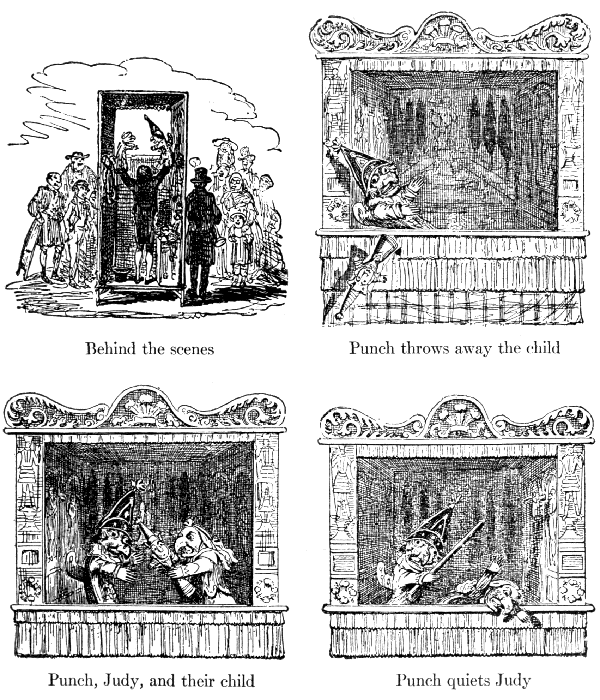
When we consider the several episodes of Mr. Punch's
abhorrent history, we are reluctantly forced to the conclusion
that his story is even less informed with morality
than that of Richard III. The crookbacked king
comes to a bad end at last; he meets with the just
retribution for his many misdeeds; and he falls before
the sword of Richmond. But Mr. Punch comes to a
good end, and so far as we may know, he lives happy
ever after, like the princes and princesses of the fairytales.
He may even marry again and have another
child, to be made away with in its turn. The more
we consider his misdeeds and his misadventures the
more shocking they are to our moral sense. Mr.
Punch appears as a monster of such hideous mien that
to be hated he needs but to be seen. This is how he
must appear to every one of us who applies a moral
standard to the drama, and who is willing to hold
every character in a play to a strict accountability for
his words and deeds. If we apply this moral standard
to the play of Punch and Judy, then that play must be
dismissed as profoundly and hopelessly immoral, carrying
ethical infection to all who are so unfortunate as
to be spectators at its performance. And more particularly,
it is an absolutely unfit piece for the young,
whose immature minds need to be guarded against
everything which might tend to confuse the delicate
distinctions between right and wrong.
But, of course, we do not apply a moral standard to
the sayings and doings of Mr. Punch, for the plain and
sufficient reason that he is not a human being. He is
not a man and a brother, upon whom we may be
tempted to pattern ourselves. He is but a six-inch
puppet, a thing of shreds and patches, a wooden-headed
doll, vitalized for a moment only by the hand
concealed inside his flimsy body with its flaunting
colors. He is too fantastic, too impossible, too unreal,
too unrelated to any possible world, for us to feel called
upon to frown upon his misdeeds or to take them seriously.
He is a joke, and we know that he is a joke,
and all the children know that he is only a joke. Even
the youngest child is never tempted to believe in his
existence and to be moved to follow his example or
to imitate his dark deeds. The proof of the pudding
is in the eating; and the proof of a play is in the effect
it produces upon the spectators. We may question
whether any one of the millions of performances of
the lamentable tragedy of Mr. Punch has suggested
to a single father the fatal neglect of his offspring or
to a single husband the possibility of wife-murder.
And we may doubt whether any child, after witnessing
Mr. Punch's murderous combats with the policeman
and the devil, has ever felt any lessening of his respect
for those two time-honored guardians of law and order.
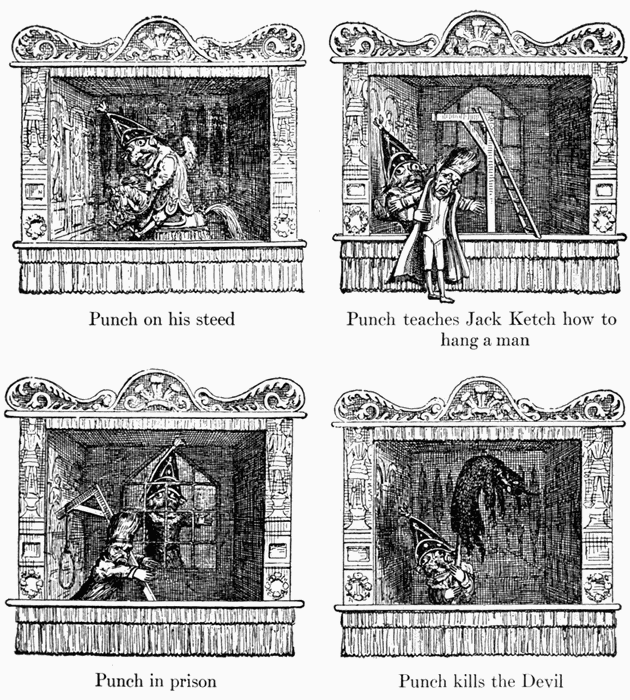
The plea of confession and avoidance which is here
set up for Punch and Judy is much the same as that
set up by Charles Lamb for the frolicsome Restoration
comedies. Lamb admitted that they were degradingly
immoral—if you took them seriously and
accepted them as pictures of life. But he insisted that
they were not really amenable to this moral standard,
since they were plainly impossible in any world known
to man. Macaulay had no difficulty in showing that
Lamb was judging others by his clever and sophisticated
self. To Lamb the creatures of Wycherley and
Congreve might reveal manners and customs which
removed them from the sphere of recognizable humanity;
but the majority of his fellow-spectators were not
so nimble-witted; they saw characters on the stage
personated by living performers, and they beheld these
characters shamelessly doing shameful things. Because
the persons in the play were represented by actual
human beings they seemed indisputably human; and
their deeds could not be considered as outside morality.
Yet the plea made by Lamb for the Restoration comedies
has a certain validity when it is put forward in
behalf of Mr. Punch. He is not personated by an
actual human being; and even the least sophisticated
of juvenile spectators does not accept him as a fellow-creature
strictly amenable to the human code.
II
Historians of the Greek drama have often commented
on the fact that the Athenian actors wore towering
masks, and that thereby they were deprived of all facial
expression. In our snug modern theaters, with their
well-lighted stages, we follow with our eyes the shifting
emotions as these chase each other across the faces
of the actors; and this is one of our keenest pleasures
in the playhouse. In the huge theater of Dionysius at
Athens, with its ten or twenty thousand spectators,
seated tier on tier, along the curving hillside of the
Acropolis, the actor was too far removed from most
of the playgoers for any play of feature to be visible;
and critics have commiserated the Attic dramatists
on their deprivation of this element of potent appeal.
Yet the question arises whether the Greek playwrights
were really the losers by this immobility of the actors'
faces; and we may be allowed to doubt that they were
when we recall the fact that the faces of Mr. Punch
and of Mrs. Judy, of the policeman and of the hangman,
are also fixed once for all. The expression that
Mr. Punch wears when he is fondling the baby is, perforce,
the same which illuminates his face when he is
engaged in joyful combat with the devil, a foeman
worthy of his stick. Here the imagination of the spectator
comes to the rescue. The wooden head of Mr.
Punch is unchanging, no doubt; but those who gaze
entranced upon his marvelous doings never miss the
play of feature which they would expect if they were
part of the audience in a playhouse for grown-ups.
Quite possibly the Athenian spectators did not mind
the immobility of the masks their actors wore; indeed,
that very immobility may have been an incentive to
their imaginations. When the Greeks went to their
open-air theater, as when we gather around the tent-like
theater of Mr. Punch, they knew in advance, as
we also know, that the faces of the performers would
be unchanging; therefore they did not expect any
variety of expression; and probably they got along as
well without it as we do at a puppet-show.
There is another likeness between Attic tragedy and
Punch and Judy; there is a limitation in the number
of characters we are allowed to see at the same time.
As the hidden performer who operates all the figures
has only two hands, he can bring before us at any one
moment only Mr. Punch and one other of the several
characters. The fingers of the right hand animate
Mr. Punch, and the fingers of the left hand animate
in turn Mrs. Judy and the negro and the clown. At
Athens (for reasons which need not here be discussed)
the dramatist had the use of only three actors, even
tho these might each of them "double" and appear
as two or more of the successive characters of the play.
So it was that there were never more than three persons
taking part in any given episode of an Attic tragedy
as there are never more than two persons taking
part in any given episode of Punch and Judy. In
the thumb-and-finger plays devised in Paris by M.
Lemercier de Neuville, he felt so severely the inconvenience
of his limitation to two characters that he
devised a kind of spiral-spring arrangement inside
the costumes of his little figures to hold up their
heads; and he prepared invisible supports jutting out
just below the flat ledge which forms the base of the
proscenium. Thus he was enabled to leave the figure
in sight, while he withdrew his hand to animate another
character. His Pupazzi, as he called them, were
clever caricatures of contemporary celebrities; and he
was ingenious enough sometimes to maneuver half a
dozen of them at once with his single pair of hands,
four adjusted into the projecting rests, and two on his
fingers.
In the sumptuous puppet-show in the gardens of the
Tuileries the same result is achieved by the employment
of two or three manipulators, so that four or
even six figures may appear at once. This has greatly
enlarged the scope of the performance; and the manager
of this theater has very ambitious aims. He likes
to rearrange for his juvenile audience the most appropriate
of the pieces which have won favor in the real
theaters, and to present these with all sorts of spectacular
adornments. He has even ventured to give
plays as elaborate as 'Around the World in Eighty
Days.' But it may be doubted whether this vaulting
ambition has not overleaped itself, and whether a
puppet-show does not gain rather than lose by restricting
its efforts within narrower limits. After all,
nothing so delights us at a puppet-show as the feats
which are most characteristic and least difficult of
accomplishment. We joy to behold one tiny figure
belaboring another with his solid club or to follow the
vicissitudes of a bout at single-stick, when both combatants
thwack lustily at each other's wooden heads.
III
Yet this mention of M. Lemercier de Neuville's
Pupazzi, with their varied repertory of Aristophanic
commentaries on current events, and this memory of
the spectacular efforts exhibited in the gardens of the
Tuileries, suggest a possible explanation for the fact
that Punch and Judy have failed to find wide-spread
favor here in America and that they seem to be losing
their pristine popularity in England. There is a pitiable
monotony of program in all English-speaking
puppet-shows. They confine their repertory to the
single play which sets forth the deeds and misdeeds of
Mr. Punch. Now, in the Continent of Europe there
is no such monotony. Not only in the gardens of the
Tuileries but in the Champs-Elysées a young spectator
can sit thru performance after performance without
fear of having to witness the same piece. Punch
appears in only one drama, whereas his French rival,
Guignol, in his time plays many parts, with a host of
other characters to be his associates, some in one
piece and some in another. And the several plays
are adorned with a variety of scenery. Of course, there
cannot be a very wide range of subject; and always is
the stick a prominent feature in the miniature drama.
There are a certain number of traditional Guignol
pieces, handed down from generation to generation.
Some of these have been printed for the use of devoted
students of the drama, and some are to be had in little
pamphlets for the benefit of the happy French children
who may have had a puppet theater with its dozen
or more figures presented to them as a New Year's
gift. There is in the Dramatic Museum of Columbia
University the manuscript of half a dozen of these little
plays, written out (in all the license of his own simplified
spelling) by the incomparable performer who was
in charge of the leading Guignol in the Champs-Elysées
in 1867.
It is rather curious that the English puppet-show
should have confined itself for now nearly a hundred
years to the unique Punch and Judy, when the puppet-shows
of other countries have a changing repertory.
It was a puppet performance of a German perversion
of Marlowe's 'Doctor Faustus' which first introduced
Goethe to the Faust legend. George Sand, unlike the
great German poet in most ways, was yet like him
in her delight in the puppet-show. In her country
place at Nohant, she had a tiny theater of her own
for which she dressed all the puppets, while her son
Maurice carved the heads, painted the scenery, devised
the plays, and improvised the dialog. Maurice Sand
it was, sometimes alone, but occasionally with the aid
of a friend, who manipulated the little figures and bestowed
upon them a momentary vitality. His mother
persuaded him to write out a dozen of the more successful
of his little plays for puppets and to publish
them; and this volume, the 'Théâtre des Marionnettes
à Nohant,' appeared in 1876. George Sand herself
wrote a delightful account of the humble beginnings
of this famous puppet-show, and described how there
came in time to be all sorts of ingenious improvements
for achieving spectacular effects.
She declared that the puppet-show is not what it
is vainly thought, because it demands an art of a
special kind, not only in the construction of the little
figures themselves, but more especially in the story
which these little figures are to interpret. She held
that the particular field of the puppet playwright-performer
was to be found in the dramatization of
protracted fantastic romances, abounding in comic
characters and in comic episodes and gratifying the
fundamental human liking for long-drawn tales of
adventure and for fantastic fairy-stories. She found
in her son's acted narratives a rest from reality, a release
from the oppression of every-day life, an excursion
into a realm of fancy and of legend—even if the
legend was itself a fanciful invention of the improvising
performer. And she declared that she liked the
puppet playhouse in her own home, because it was a
domestic and fireside pleasure, which could be enjoyed
without the exertion imposed by a visit to a real
theater. Obviously she found as much delight in
being a spectator—after having been a costumer—as
her son did in being the author and operator of the
spectacle.
IV
There is one note to be made upon George Sand's
account of the slow development of the puppet-show
at Nohant, beginning as early as 1847. If you will
look at any set of Punch and Judy figures hung up
to-day in the toy store to tempt the eye of Young
America, you will discover alongside Mr. Punch and
Mrs. Judy, Jack Ketch and the Devil, a strange green
figure with huge jaws and double rows of white teeth.
This verdant beast has a body like all other Punch and
Judy figures, a loose cloth funnel to slip over the sleeve
of the operator; but its head suggests the head of an
alligator, or of a crocodile, or of a dragon. Now, if
you will turn to the classic text of the English play of
Punch and Judy, edited with a learned introduction
and an abundance of scholarly annotation by John
Payne Collier—at least, so it is believed, altho the
rare little book is anonymous—you will find no mention
of any strange beast of this sort. Collier's text
of the play is adorned by two dozen illustrations,
etched by George Cruikshank, and in no one of these
plates will you discover any crocodile, or alligator, or
dragon. You will find Toby, the dog, who still survives
in most of the few shows to be seen to-day in
the streets of London; and you will find Hector, the
gallant steed that Mr. Punch mounts with difficulty—and
it is sad to have to record that Hector is no longer
in the service of Mr. Punch. In fact, one devoted admirer
of puppet-shows, whose memory goes back
nearly fifty years, is ready to declare that he has never
laid eyes on Hector—except in Cruikshank's illustrations.
But Mr. Punch, deprived of the privilege of
bestriding Hector, now enjoys the fiercer delight of
overcoming the green-eyed alligator.
Here we have a question of profound historic interest.
Whence came the strange beast with the wide
jaws? And here is where George Sand's pleasant paper
is a very present help in time of need. She tells us
that her son besought her to make a green monster
for one of the earliest pieces he devised for her puppet-figures.
She did as she was bid, and she sacrificed a
pair of blue velvet slippers to provide the marvelous
creature with his gently smiling jaws. She draws attention
to the fact that the slippers were blue, and to
the further fact that nevertheless the strange beast
was always called the Green Monster. And here may
be the explanation of the historic mystery. The fame
of the puppets of Nohant was borne abroad; they
were talked about all thru France; and they were
discussed again and again in the Parisian newspapers.
What more likely than that one of the professional
puppet players should have seen the infinite possibilities
of the Green Monster, and should have perceived
its novel fascination for children? Thereupon he
borrowed it for his own performances. Certainly it is
that the Green Monster is a character in at least one
of the manuscript plays preserved in the Dramatic
Museum of Columbia University, and written out
half a century ago. Probably the Green Monster
strayed from the puppet-show of the Champs-Elysées
sooner or later to one of the toy stores of Paris at the
request of some boy who desired it for his own. When
the Green Monster had elected domicile in the stores
of Paris, he was soon appropriated by the toy-makers
of Germany for export to Great Britain and the United
States.
(1912.)
XVII
THE PUPPET-PLAY, PAST AND PRESENT
THE PUPPET-PLAY, PAST AND PRESENT
I
In her charming and instructive account of the ingenious
puppet-shows with which her son Maurice used
to amuse himself and her guests at Nohant half a century
ago, George Sand records the fact that the erudite
scholar, Magnan, who wrote a learned history of the
puppet-show from the remotest antiquity, did not discriminate
sharply between the two entirely different
kinds of little figures, both of which are carelessly called
puppets in English, and marionettes in French. One
class comprises these empty and flexible figures which
are animated by the thumb and two fingers of the performer
who exhibits them by holding his hands above
his head, as in the 'Punch and Judy' show. The other
contains the larger dolls, suspended on wires (which
are supposed to be invisible) and manipulated by one
or more performers overhead, who give life to these
figures by jerking the various strings as the action of
the play may require. These last are the true marionettes;
and for the first we have, unfortunately, no distinctive
name. It is greatly to be regretted that the
two very different types of puppets are not set apart
from each other satisfactorily by the contributor of
the article on marionettes in the latest edition of the
'Encyclopedia Britannica.'
Each of these two sorts of puppets has an interest
of its own; and each of them has its special and peculiar
relation to the drama. Both of them have a long and
honorable history, and can be traced back in the scanty
records of a remote antiquity; altho it seems more
likely that the true marionette—the little figure moved
by wires from overhead—is the older of the two,
antedating by many centuries the Punch and Judy figure,
which owes its abrupt and awkward movements
to the human thumb and fingers. Both classes are
to be found to-day all over the world, not only in the
cities of civilization, but in unsuspected nooks and
corners on all the shores of all the seven seas. In
Turkey, for example, under the name of Karaguez,
there is a Punch and Judy of enormous popularity and
of doubtful decency, while in Siam there are marionettes
which perform religious plays of traditional appeal.
Apparently the puppet-show of one type or the
other satisfies in its fashion that dramatic instinct
which every people possesses in greater or less intensity.
Both kinds of puppet-show flourish in France, and
have there been lifted to a more elevated plane of art;
and both kinds retain their popularity in Italy, altho
in an humbler form. The French are inveterate artists;
and they are like the Greeks in desiring to do all
things decently and in order. The Italians have, perhaps,
a stronger native gift for the drama and they
are ready to enjoy a simpler and more primitive puppet-play.
It is from Italy that we who speak English
have derived our Punch and Judy. Mr. Punch is a
direct descendant of that favorite figure of robust
Neapolitan farce, Pulcinella; and so is the French Polichinelle.
And in Italy to-day the true marionettes
have an even broader popularity than the Punch and
Judy figures. The Italians who have lately flocked to
America in their thousands, until New York now contains
more of them than Venice, have imported in the
original package the legendary puppet-show setting
forth the romantic stories of the Middle Ages and of
the early Renascence. We look upon Mr. Punch as
comic; but the Italians take their pleasure seriously
and the marionettes in their puppet-shows to be seen
in New York are truly heroic, and not infrequently
highly tragic.
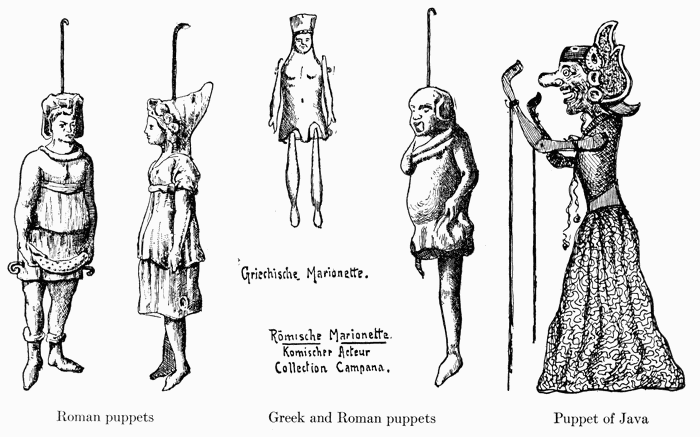
In the interesting discussion of 'Medieval Story,' in
which Professor W. W. Lawrence of Columbia University
has traced the influence of various ideals of the
Middle Ages upon our modern social organization, he
has a striking description of the marionette performances
which the exiles of Italy have brought with them
to America. "Any one who walks thru the Italian
quarter of New York City in the evening may notice
over a doorway an illuminated sign, 'Theater of Marionettes.'
If his curiosity tempts him inside, into the
low room crowded with enthusiastic spectators, he will
see, on a rude stage, a group of puppets almost as large
as life, representing knights and ladies, acting out a
little drama in response to the jerking of strings fastened
to their arms, and of iron rods firmly fixed in
their heads. The warriors are gorgeously attired in
shining armor and plumed helmets; and the ladies
have wonderful costumes of bright colors, with a great
deal of embroidery and decoration. An Italian in
shirt-sleeves in the wings at the side of the stage
speaks their lines for them, with all the elocutionary
flourishes which he can command. Fiercely immobile
as to expression, but most active as to arms and legs,
these manikins march about, soliloquize, make love,
and debate in council. But it is their battles which
arouse the greatest enthusiasm among the audience;
and, indeed, these are fought in a way that is a joy to
see. Then it is that heroic deeds are done—tin swords
resound upon tin armor, helmets are battered about
and knocked off, dust rises from the field, the valiant
dead fall in staring heaps. At such moments the spectators
can hardly restrain themselves from emotion,
yet the story is well known to them—perhaps some
one sitting near by will volunteer to explain it, asserting
that he has known it ever since he was a boy and
that he has read it all in a book which he has at home,
called 'Reali di Franci.' It is a version of the old tale
of Charlemagne and his knights, which, after traveling
far from its native home in France, was taken up by
the Italian people many centuries ago, and made so
much their own that few heroes have been closer to
their hearts than Roland, or as they call him, Orlando.
Even in their homes in the New World they still celebrate
him, so that the very newsboys in the streets of
modern America are keeping alive the heroic traditions
of the age of Charlemagne."
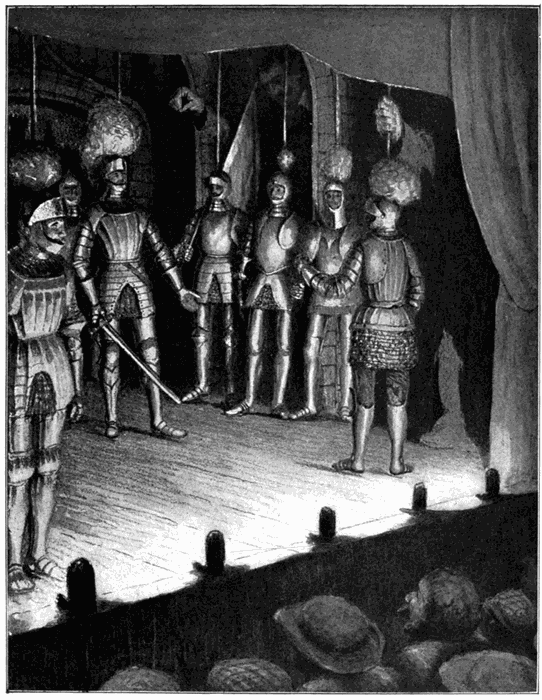 A Sicilian marionette show
From "By Italian Seas," by Ernest C. Peixotto
A Sicilian marionette show
From "By Italian Seas," by Ernest C. Peixotto
II
When we compare the account which Professor Lawrence
has here given of the Italian puppet-shows in
New York with the description of these same performances
in their native land half a century ago, which we
find in the 'Roba di Roma' of W. W. Story, the American
sculptor-poet, we perceive that there has been
little modification of method in the past threescore
years. Story studied all sides of the Roman populace,
and he maintained that nothing was more characteristically
Italian than the marionette theater. He tells
us that the love for the acting of burattini [or puppets]
is universal among the lower classes thruout Italy,
and in some cities, especially in Genoa, no pains are
spared "in their costume, construction, and movement
to render them lifelike. They are made of wood, generally
from two to three feet in height, with very large
heads, and supernatural glaring eyes that never wink,
and are clad in all the splendor of tinsel, velvet, and
steel. Their joints are so flexible that the least weight
or strain upon them effects a dislocation, and they are
moved by wires attached to their heads and extremities.
The largest are only about half the height of a
man, yet as the stage and all the appointments and
scenery are upon the same scale of proportion, the eye
is soon deceived, and accepts them as of life-size. But
if by accident a hand or arm of one of the wire-pullers
appears from behind the scenes or descends below the
hangings, it startles you by its portentous size; and
the audience in the stage-boxes instead of reducing
the burattini to Lilliputians by contrast, as they lean
forward, become themselves Brobdingnagians, with
elephantine hands and heads."
Story insisted that there is nothing ludicrous to an
Italian audience in the performances of these diminutive
men and women. On the contrary, nothing is more
serious both to the spectators and to the unforeseen
operators. In fact, he declared, no human being could
be so serious as these tiny performers. "Their countenances
are as solemn as death, and more unchanging
than the face of a clock. Their terrible gravity when,
with drooping heads and collapsed arms, they fix on
you their great goggle-eyes is at times ghastly. The
plays they perform are mostly heroic, romantic, and
historical. They stoop to nothing which is not startling
in incident, imposing in style, and grandiose in
movement. And the Italian audience listens with a
grave and profound interest, as tho the performers were
not mere puppets, but actually the heroes they are supposed
to be. The inflated and extravagant discourse
of the characters is accepted at its face value; to the
spectators it is grand and noble. And the foreign visitor
must control any desire he may feel to smile at the
extraordinary spectacle he is witnessing, and at the
marvelous rodomontade he is hearing. To laugh out
loud at one of these heroic puppet-plays would be as
indecorous as to indulge in laughter during a church
service."
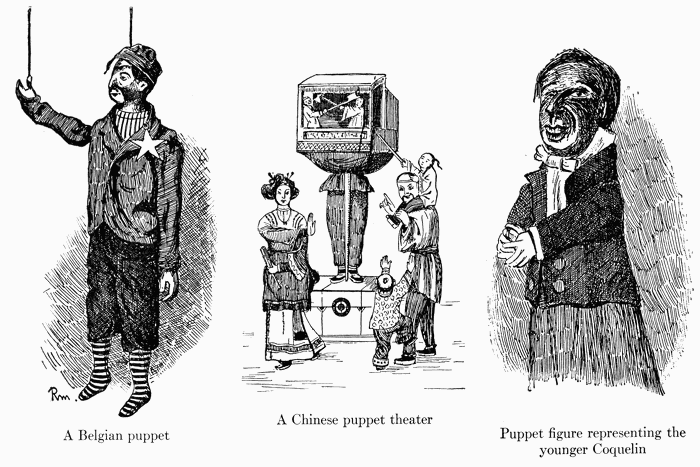
Incidental to the heroic dramas which the puppets
play are interludes of ballet-dancing like those which
are intercalated, more or less adroitly, into the grand
opera performed by full-grown men and women. The
Italians are born pantomimists, and they are accomplished
dancers. Therefore, there is no reason for surprise
that human pantomime and human dancing are
imitated in the marionette theaters. There is reason
for surprise, however, that Story did not perceive
clearly the advantages possessed by the dancing puppets
over the dancers of more solid flesh and blood.
He found something comic in the pantomime of the
puppets, "whose every motion is effected by wires, who
imitate the gestures of despair with hands that cannot
shut, and, with a wooden gravity of countenance,
throw their bodies into terrible contortions to make
up for the lack of expression in the face." In mere
pantomime it is probable that the puppets would labor
under a serious disability, for if a performer cannot use
his voice, he needs facial expression to assist the gestures
by which only can he then convey his meaning
to the other performers and to the spectators. Perhaps
it is not too much to assert that the puppet-show
is not the proper place for pantomime.
III
We need not wonder that Story admitted their dancing
to be superior to their pantomime. Yet he failed
to appreciate the true cause of this superiority, and he
was inclined to comment upon the dancing of the
burattini in a somewhat satiric fashion. He tells us
how the principal dancer suddenly appears, "knocks
her wooden knees together, and jerking her head
about, salutes the audience with a smile quite as
artificial as we could see in the best trained of her
fleshly rivals." But this artificial smile must have
been fixed and permanent on the features of this diminutive
dancer—or else the Roman-American essayist
merely imagined its presence. "Then, with a masterly
ease, after describing air-circles with her toes far higher
than her head and poising herself in impossible positions,
she bounds or rather flies forward with superhuman
lightness, performs feats of choreography to
awaken envy in Cerito and drive Elssler to despair,
and, poising on her pointed toe that disdains to touch
the floor, turns never-ending pirouettes on nothing at
all, till at last, throwing both her wooden hands forward,
she suddenly comes to a swift stop to receive
your applause."
This description is unsympathetic, and it induces
the surmise that the operator of the burattini at the
performance described was not a master of his art and
did not know how to profit by the possibilities of that
art. Yet one of Story's phrases serves to explain why
the suspended puppet is superbly qualified to excel in
ballet-dancing; that phrase is the one which credits
the dancing doll with "supernatural lightness." A
skilful operator of the wires which bestow life and
movement and grace, is able to imitate easily and exquisitely
the most difficult feats of the human dancer.
If he is sufficiently adroit he robs his suspended figure
of all awkwardness, and he dowers her with a floating
ethereality surpassing that attainable by any living
performer. Now, this floating ethereality is precisely
the quality which gives us most pleasure when we
are spectators at the performance of a really fine
ballet. It is the supreme art of the great dancer to
soar lightly aloft, seeming to spurn the stage and to
abide in the air. Only very rarely is this illusion possible
to the merely human dancer; and when achieved
it is but fleeting. Yet this illusion is absolutely within
the control of the manipulator of the puppet-dancers.
He can make them execute feats of levitation, achievable
only by the most marvelously gifted and by the
most arduously trained of human dancers.
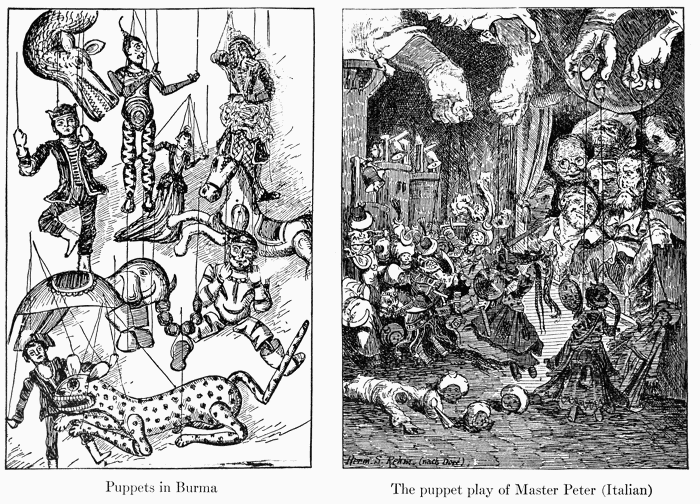
Of course, the skilful performer must carefully avoid
swinging his tiny figures aimlessly thru the air. He
must limit the feats that he permits them to accomplish
to those which can be actually accomplished by
human beings, altho he can do easily what the human
beings can achieve only with more or less obvious
effort, and he can impart a volatile elasticity a little
beyond the power of any human being however favored
by Terpsichore. When 'Salome' was, for a
season, the sensation of the hour, it was produced by
Holden's marionettes; and it afforded a delightful
spectacle long to be remembered by all who had the
felicity of beholding it. Whatever of vulgarity or of
grossness there might be in the play itself, or in the
Dance of the Seven Veils, was purged away by the single
fact that all the performers were puppets. So dexterous
was the manipulation of the unseen operator who
controlled the wires and strings which gave life to the
seductive Salome as she circled around the stage in
most bewitching fashion, and so precise and accurate
was the imitation of a human dancer, that the receptive
spectator could not but feel that here at last the
play of doubtful propriety had found its only fit
stage and its only proper performer. The memory of
that exhibition is a perennial pleasure to all who possess
it. A thing of beauty it was; and it abides in
remembrance as a joy forever. It revealed the art of
the puppet-show at its summit. And the art itself
was eternally justified by that one performance of the
highest technical skill and of the utmost delicacy of
taste.
If the most marvelous exploits of terpsichorean art,
almost inexecutable by the human toes and the human
legs of living dancers, are capable of reproduction by
puppets skilfully manipulated by the puller of the
wires and strings whereby the little figures are suspended,
so also are the dexterous feats of the juggler.
One of the specialties of the sole surviving puppet-show
of this sort in the Champs-Elysées is the performance
of a juggler who tosses aloft and catches in
turn a number of glittering balls. The delicate balancing
of the tight-rope walker, with her frequent
pirouettes on her toes, and with her surprising summersets,
is also one of the exhibitions in which the puppet
can defy the rivalry of any living executant, however
skilful in the art. At the circus we feel that the tightrope
dancer might fall, whereas at the puppet-show we
know with certainty that any fatal mishap is impossible.
In Holden's marionette program the miniature
mimicry of humanity was carried to the utmost edge
of the possible; and no item on his bill of fare was more
delectable than the series of scenes in which the traditional
Clown and Pantaloon played tricks on the
traditional Policeman, and in which they joined forces
in belaboring an inoffensive donkey. As the unfortunate
quadruped was also a puppet, there was no
painful strain on our sympathy.
IV
If a performance by puppets deprived 'Salome' of its
vulgar grossness by removing it outside the arena of
humanity, so to speak, and by relegating it to an unreal
world beyond the strict diocese of the conscience,
so a performance by puppets of a passion-play or of
any other drama in which the Deity has perforce to
appear as a character, is thereby relieved of any tincture
of irreverence. We no longer see a divine being
interpreted by a human being. We cannot help feeling
that all the persons in the play, whether they dwell
in heaven or on earth, are equally remote from our
common humanity. And therefore we need not be
surprised when we discover that the marionette has
long been allowed to appear in religious drama. Indeed,
it appears probable that the very name marionette
is directly derived from the name of the Virgin.
Very early in the history of the Christian Church
were the puppets permitted to perform passion-plays
and little dramas derived from the stories contained
both in the New and the Old Testaments. In England
under Elizabeth and James religious puppet-shows of
this kind went wandering about the kingdom, taking
into the smallest villages an entertainment which would
afford to the rural inhabitants the same kind of pleasant
instruction which the dwellers in the larger towns had
in the more elaborate and long-drawn mysteries performed
by the trade-guilds on the Corpus Christi day.
That masterly rogue Autolycus in the 'Winter's Tale'
tells us that in his time he had been on the road with
"a motion of the Prodigal Son"—and a motion was the
Elizabethan term for a marionette-exhibition. In like
manner one of the characters in Ben Jonson's 'Every
Man out of His Humor' speaks of "a new motion of
the city of Nineveh, with Jonas and the whale." Of
course, the puppet performers, like the grown-up actors,
did not long confine themselves to sacred themes; they
ventured also into contemporary history. A puppet
showman who appears in Ben Jonson's 'Bartholomew
Fair' tells us that a certain motion setting forth the
mysterious Gunpowder Plot, was "a get-penny."
Story described one puppet-play which he saw in a
little village on the main road from Rome to Naples,
and which had for its central figure Judas Iscariot.
But here again his attitude is unsympathetic, perhaps
because the performance was clumsy. "The kiss of
Judas, when, after sliding along the stage, he suddenly
turned with a sidelong jerk and rapped the other
wooden puppet's head with his own, as well as the subsequent
scene in which he goes out and hangs himself,
beggar description." Yet the expatriated American
spectator honestly recorded that the Italian spectators
"looked and listened with great gravity, seemed to be
highly edified, and certainly showed no signs of seeing
anything ludicrous in the performance." We may
venture the suggestion that even the sophisticated
sculptor-poet himself would have seen nothing ludicrous
in this performance if the operator of Judas had
been as skilful as the operator of Salome in Holden's
marionettes.
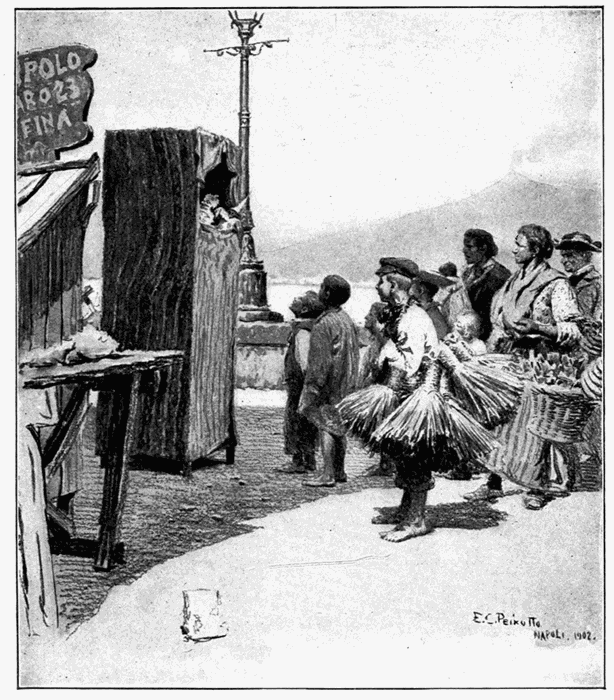 A Neapolitan Punchinella
From "By Italian Seas," by Ernest C. Peixotto
A few years ago in Paris one of the younger poets
wrote a passion-play which was performed during Lent
by a company of dolls, designed and dressed in fit and
appropriate costumes by an artist friend familiar with
the manners and customs of the Holy Land. While
the wires were managed by expert hands, the words of
the dialog were spoken by the poet himself, and by
two or three other poets who came to his aid. This
must have been a seemly spectacle, and it won careful
consideration from more than one of the most eminent
dramatic critics of France. Here we may find a useful
suggestion for those who wish to see certain plays
by modern dramatic poets, in which the Deity is a
necessary character—Rostand's 'Samaritaine,' for one,
and Hauptmann's 'Hannele,' for another. Many of
the devout have a natural repugnance to any performance
on the stage (with its materialistic environment
and its often sordid conditions) which calls for the
impersonation of a divine being by an actor of ordinary
flesh and blood. Yet if these same plays were reverently
performed by marionettes the aroma of irreverence
would be removed. It might even be possible to
reproduce in the puppet-show not a little of the solemn
religious effect which is felt by all visitors to the passion-play
at Oberammergau.
(1912.)
XVIII
SHADOW-PANTOMIME WITH ALL THE
MODERN IMPROVEMENTS
SHADOW-PANTOMIME WITH ALL THE MODERN
IMPROVEMENTS
I
An American; improving on a suggestion of a Frenchman,
has declared that "language was given to man to
conceal his thoughts—and to woman to express her
emotions." Unfortunately, language is so often inexact
that even when it is sufficient to express emotion,
it is not precise enough even to conceal thought.
Sometimes a term is wholly devoid of truth, as when
we call a certain solid a "lead-pencil," which contains
no lead, and when we label a certain liquid "soda-water,"
which contains no soda. Sometimes the term
is so vague that it may mean all things to all men.
Who, for example, would be bold enough to insist on
his own definition of "romanticism"? Sometimes
again the term covers two or three things which demand
a sharper differentiation. This is the case with
the compound word "shadow-pantomime." It is the
only name for three distinct things.
First, there is the representation by the dark profile
of the human hand upon a wall or a screen, of
human heads, and of animal figures, either by an adroit
arrangement of the fingers alone, or by the aid of adjusted
shapes of cardboard, so as to suggest a hat on
the head and a pipe in the mouth and other needed
accessories; this primitive entertainment is sometimes
styled "shadowgraphy."
Second, there is the full-sized silhouette of a human
figure, due to the shadow cast by the body standing
before a lamp, and magnified or diminished as it approaches
or recedes the spectators. This is the familiar
parlor amusement which Sir James Barrie cleverly
utilized with dramatic effect in the final act of his
'Professor's Love-Story,' when one of the characters,
standing outside a house, sees the black profiles of
other characters projected clearly on the drawn shade
of the window before which he is placed.
Then, thirdly, there is the true shadow-pantomime,
called by the French "Chinese shadows," ombres chinoises,
in which the tiny figures, made either of flat cardboard
or of metal, are exhibited behind a translucent
screen and before a strong light. This is by far the
most interesting and the most important of the three
widely different kinds of semi-dramatic entertainment,
often carelessly confounded together even in the special
treatises devoted to this humble art. In France these
Chinese shadows have been popular for more than
a hundred years, since it was in the eighteenth century
that the performer who took the name of Séraphin
established his little theater and won the favor of the
younger members of the royal family by his presentation
of the alluring spectacle, the rudimentary little
piece, still popular with children, and still known by
its original title, the 'Broken Bridge.'
It may not be fanciful to infer that the immediate
suggestion for this spectacle was derived from the
contemporary vogue of the silhouette itself, this portrait
in solid black taking its name from the Frenchman
who was minister of finance in 1759. At all events, it
was in 1770 that Séraphin began to amuse the children
of Paris; and it was more than a century thereafter
that M. Lemercier de Neuville elaborated his ingeniously
articulated Pupazzi noirs. It was a little later
still that Caran d'Ache delighted the more sophisticated
children of a larger growth, who were wont to assemble
at the Chat Noir, with the striking series of military
silhouettes resuscitating the mighty Napoleonic epic.
And it was at the Chat Noir again that Rivière revealed
the further possibilities latent in shadow-pantomime,
and to be developed by the aid of colored
backgrounds supplied by a magic lantern. Restricted
as the sphere of the shadow-pantomime necessarily
is, the native artistic impulse of the French has been
rarely better disclosed than by their surprising elaboration
of a form of amusement, seemingly fitted only to
charm the infant mind, into an entertainment satisfactory
to the richly developed esthetic sense of mature
Parisian playgoers. Just as the rustic revels of remote
villagers contained the germ out of which the Greeks
were able to develop their austere and elevating tragedy,
and just as the modern drama was evolved in the
course of centuries out of the medieval mysteries, one
source of which we may discover in the infant Christ
in the cradle still displayed at Christmastide in Christian
churches thruout the world, so the simple Chinese
shadows of Séraphin supplied the root on which Parisian
artists were able to graft their ingenious improvements.
The little spectacle proffered originally by Séraphin
was frankly infantile in its appeal, and the 'Broken
Bridge' is as plainly adjusted to the simple likings of
the child as is the lamentable tragedy of Punch and
Judy or the puppet-show in which Polichinelle exhibits
his hump and his terpsichorean agility. The two arms
of the broken bridge arch over a little stream but fail
to meet in the center. A flock of ducks crosses leisurely
from one bank to the other. A laborer appears on the
left-hand fragment of the bridge and begins to swing
his pick to loosen stones at the end, and these fragments
are then seen to fall into the water. The figure of the
workman is articulated, or at least one arm is on a
separate piece and moves on a pivot so that a hidden
string can raise the pick and let it fall. The laborer
sings at his work; and in France he indulges in the traditional
lyric about the Bridge of Avignon, where everybody
dances in a circle. Then a traveler appears on
the right-hand end of the bridge. He hails the laborer,
who is hard of hearing at first, but who finally asks
him what he wants. The traveler explains that he
wishes to cross and asks how he can do this. The
laborer keeps on picking away, and sings that "the
ducks and the geese they all swim over." The irritated
traveler then asks how far it is across, and the
laborer again sings, this time to the effect that "when
you're in the middle you're half-way over." Then
the traveler inquires how deep the stream may be,
and he gets the exasperating response in song, that
if he will only throw in a stone, he'll soon find the
bottom. This dialog bears an obvious resemblance
to that traditionally associated with the tune of the
'Arkansaw Traveler.'
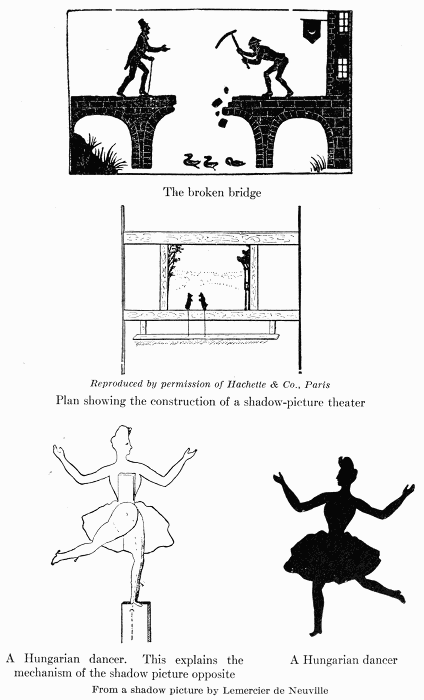
Then a boatman appears, rowing his little skiff, his
backbone pivoted so that his body can move to and
fro. The traveler makes a bargain with him and is
taken across, after many misadventures, one of them
with a crocodile, which opens its jaws and threatens to
engulf the boat—this amphibious beast having been
a recent addition to the original playlet, and probably
borrowed from the Green Monster not long ago added
to the group of Punch and Judy figures. And the exciting
conclusion of this entrancing spectacle displays
a most moral application of the principle of poetic
justice. The ill-natured laborer advances too far out
on his edge of the broken bridge, and detaches a large
fragment. As this tumbles into the water he loses
his footing and falls forward himself, only to be instantly
devoured by the crocodile, which disappears
with its unexpected prey, whereupon the placid ducks
and geese again swim over—and the curtain falls.
II
There are a score of other little plays like the 'Broken
Bridge,' adroitly adjusted to the caliber of the juvenile
mind. In a British collection may be found a piece
representing a succession of appalling episodes supposed
to take place in a 'Haunted House,' and in a French
manual for the use of youthful amateurs may be discovered
a rudimentary version of Molière's 'Imaginary
Invalid,' to be performed by silhouettes with articulated
limbs. Here again we perceive the inaccuracy of the
term "shadow-pantomime," since the most of the
figures are not articulated, and, being motionless, they
are deprived of the freedom of gesture which is the essential
element of true pantomime. Moreover, they
are all made to take part in various dialogs, and this
again is a negation of the fundamental principle of
pantomime, which ought to be wordless. Here the
French term "Chinese shadows" is more exact and
less limiting than the English "shadow-pantomime."
It is perhaps a pity that the old-fashioned term
"gallanty-show," has not won a wider acceptance in
English.
The little pieces due to Séraphin and his humble
followers in France and in England, devised to amuse
children only, were simple enough in plot, and yet they
were sufficient to suggest to admirers of this unpretending
form of theatrical art plays of a more imposing proportion.
M. Paul Eudel, the art critic, has published
an amply illustrated volume in which he collected
the fairy-pieces, and the more spectacular melodramas
composed by his grandfather in the first quarter of
the nineteenth century, in the dark days that preceded
Waterloo. And in the third quarter of the nineteenth
century, in the dark days that preceded Sedan, M.
Lemercier de Neuville, relinquishing for a while the
Punch and Judy puppets which he called Pupazzi, and
which he had exhibited in a succession of gentle caricatures
of Parisian personalities with a mildly Aristophanic
flavor of contemporary satire, turned to the
familiar Chinese shadows of his childhood and devised
what he called his Pupazzi noirs, animated shadows.
He also has issued a collection of these little pieces
with a full explanation of the method of performance
and with half a hundred illustrations, revealing all
the secrets of maneuvering the little figures. Indeed,
Lemercier de Neuville's manual is the most ample
which has yet appeared; and it is the most interesting
in that he was at once his own playwright, his own
designer of figures, and his own performer.
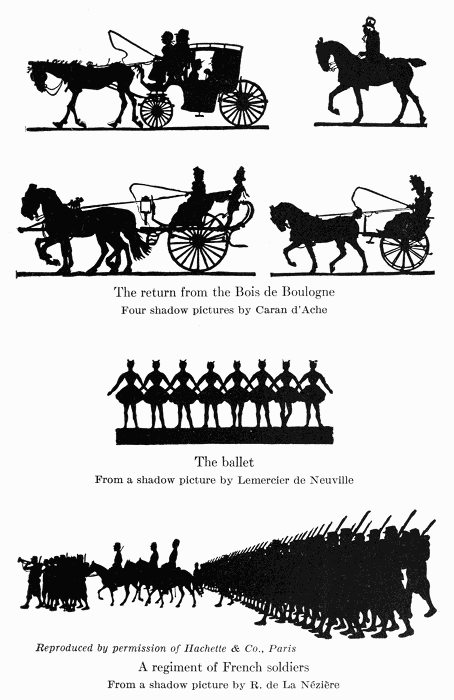
As the grandfather of M. Eudel had been more ambitious
than Séraphin, so Lemercier de Neuville was
more ambitious than the elder Eudel. And yet his
procedure was precisely that of his predecessors, and
he did not in any way modify the principles of the art.
All he did was to elaborate the performance by the use
of more scenery, of more spectacular effects, and of
more numerous characters. He introduced a company
of Spanish dancers, for example, and he did not hesitate
to throw on his screen the sable and serrated profile
of a long line of ballet dancers. He followed Eudel
in arranging a procession of animals, rivaling a circus
parade, many of them being articulated so that they
could make the appropriate movements of their jaws
and their paws. And he paid special attention to his
silhouette caricatures of contemporary celebrities, Zola
for one, and Sarah-Bernhardt for another.
Then the Franco-Russian draftsman, who called
himself Caran d'Ache, made a new departure and
started the art of the shadow-pantomime in a new
career. He called his figures "French shadows,"
ombres françaises, and he surrendered the privilege of
articulating his figures so that they could move. At
least, he refrained from this except on rare occasions,
preferring the effect of immobility and relying mainly
upon a new principle not before employed by any of
his predecessors. He made a specialty of long lines
and of large masses of troops, not all on the same plane,
but presented in perspective. He chose also to forgo
the aid of speech and his figures were silent, except
when some officer called out a word of command, or
when a company of Cossacks rode past singing one of
the wailing lyrics of the Caucasus as melancholy as the
steppes.
One of the most attractive items on his program was
a representation of the return of vehicles and equestrians
from the Bois de Boulogne in the afternoon.
Some of the figures were merely characteristic types
sharply seized and outlined with all the artist's masterly
draftsmanship, and some of them were well-known
personages easily recognizable by his Parisian spectators—Lesseps
on horseback, for example, and Rochefort
in an open cab. These successive figures were
simply pushed across the screen one after another,
each of them as motionless as a statue, the men fixed
in one attitude, and the legs of the horses retaining
always the same position. This absence of animal
movement was, of course, a violation from the facts
of life, like that which permits the painter to depict
a breaking wave or a sculptor to model a running boy
at a single moment of the movement. Yet this
artistic conversion was immediately acceptable since
the spectator received a simplified impression and his
attention was not distracted by the inevitable jerkiness
of the limbs of the men and the beasts.
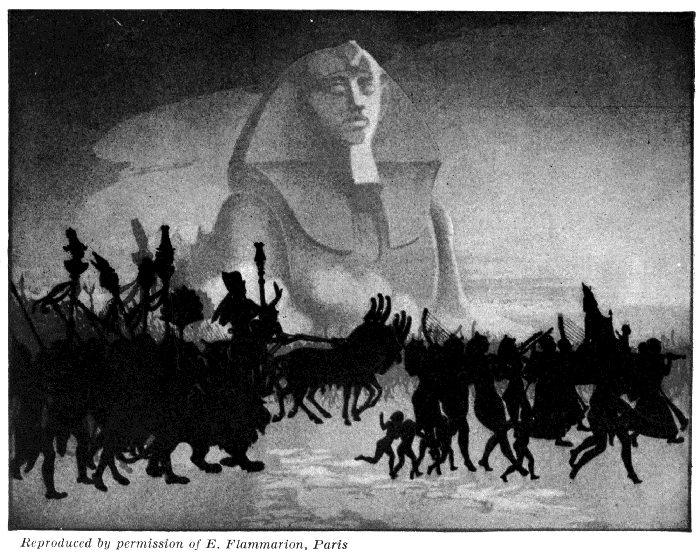 The Sphinx I: Pharaoh passing in triumph
From a shadow picture by Amédée Vignola
Caran d'Ache's masterpiece, however—and it may
honestly be styled a masterpiece—was not the 'Return
from the Bois de Boulogne' but his 'Epopée,' his epic
evocation of the grand army of Napoleon. Single figures
like the Little Corporal on horseback, and like
Murat and others of the Emperor's staff, he projected
with a fidelity and a veracity of accent worthy of
Détaille or even Meissonier. Yet fine as these single
figures might be, they were only what had been attempted
by earlier exponents of the art—even if they
were more impressive than had been achieved by any
one of his predecessors. These single figures were
necessarily presented all on the same plane, and the
startling and successful innovation of the Franco-Russian
draftsmanship was his skilful use of perspective,
a device which had not occurred to any of those
in whose footsteps he was following, even Lemercier
de Neuville having presented his ballet dancers in a
flat row. What Caran d'Ache did was to bring before
us company after company of the Old Guard, and troop
after troop of cuirassiers, their profiles diminishing in
height as the figures receded from the eye. He thus
attained to an effect of solidity and even of immensity,
far beyond anything ever before achieved by any earlier
exhibitor of shadows. He succeeded in suggesting
space, and of maneuvering before the astonished eyes
of the entranced spectators a vast mass of men under
arms, marching forward resolutely in serried ranks to
victory or to death.
The late Jules Lemaître, the most open-minded of
French dramatic critics, and the most hospitable in his
attitude toward the minor manifestations of theatric
art, has recorded that this Napoleonic epic of Caran
d'Ache communicated to him not only an emotion of
actual grandeur, but also the thrill of war itself. He
declared that "by the exactness of the perspective preserved
in his long files of soldiers, Caran d'Ache gives
us the illusion of number and of a number immense and
indefinite. And by the automatic movement which
sets all his troops in action at once, he gives us the
illusion of a single soul, of a communal thought animating
innumerable bodies—and thereby he evokes
in us the impression of measureless power.... His
silent poem, with its sliding profiles is, I think, the
only epic in all French literature." And those who are
familiar with the other French efforts to attain to lyric
largeness, and who have had also the unforgetable
felicity of beholding Caran d'Ache's marvelous projection
of the Napoleonic legend, will be prepared to
admit that Lemaître did not overstate the case.
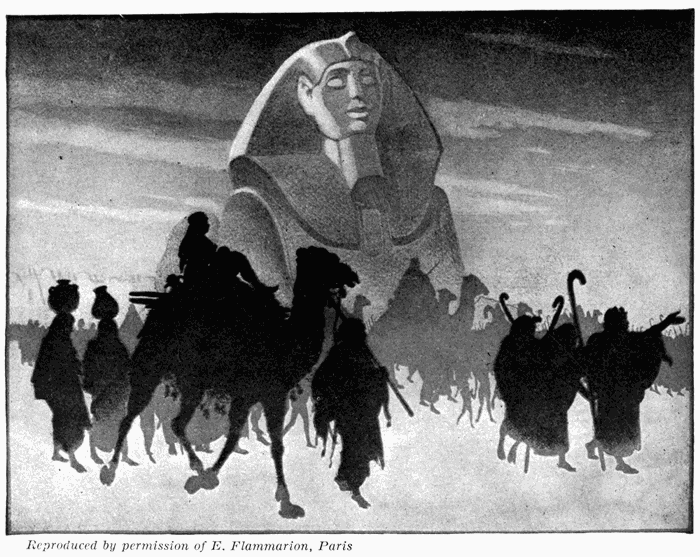 The Sphinx II: Moses leading his people out of Egypt
From a shadow picture by Amédée Vignola
III
What the Franco-Russian artist had done was to
reveal the alluring possibilities placed at the command
of the shadow-pantomimist by the ingenious employment
of perspective; and there remained only one
more step to be taken for the final development of the
art to its ultimate capacity. This was the addition of
color; and this step was taken by an associate of
Caran d'Ache in the exhibitions given at the Chat Noir—Henri
Rivière. Color could be added in two ways.
In the first place, the outlines of lanterns and of battle-flags
could be cut out, and slips of appropriately tinted
paper could be inserted in the openings so that the
light might shine thru. This relieved the monotony
of the uniformity of the sable figures, and added a note
of amusing gaiety. But this was an innovation of very
limited scope; and it could have been earlier utilized
in the flat figures of Lemercier de Neuville, for example,
if he had happened to think of it. Far wider in
its artistic possibilities was the second of Rivière's improvements.
For the ordinary lamp which cast a
steady glow on the white screen whereon the profile
figures appeared, he substituted a magic lantern, the
painted slides of which enabled him to supply an appropriately
colored background. Then he went further
and employed two magic lanterns, superimposed; and
these enabled him to get the effect of "dissolving
views" whereby he could vary his background at will.
The immediate result of this ingenious improvement
was that the artist could bestow upon his shadow-pantomime
not a little of the richness of color which
delights our eyes in the stained glass of medieval
cathedrals.
Rivière was not only an inventor, he was also an
artist, richly gifted with imagination; and his imagination
suggested to him at once the three or four themes
best fitted for treatment by his novel apparatus. One
of these was the 'Wandering Jew'; another was the
'Prodigal Son'; and a third was the 'Temptation of
Saint Anthony'—all legends of combined dramatic and
pictorial appeal. Yet the most effective of all the experiments
in this new form was due not to Rivière
himself but to the collaboration of two of his disciples,
M. Fragerolle and M. Vignola. This was the 'Sphinx,'
in which the artists most adroitly combined all the advantages
of the original flat profiles, and of the long
files of figures in perspective such as Caran d'Ache had
employed, with varied backgrounds due to the aid of
the magic lantern first utilized by Rivière. Of all
human monuments no one has had so marvelous a
series of spectacles pass before its sightless eyes as the
Sphinx, reclining impassive at the edge of the desert,
and at the foot of the pyramids. Race after race has
descended into the valley of the Nile, and lingered for a
little space, a few centuries more or less, and departed
at last. Conqueror after conqueror has come and gone
again; and the Sphinx has kept its inscrutable smile.
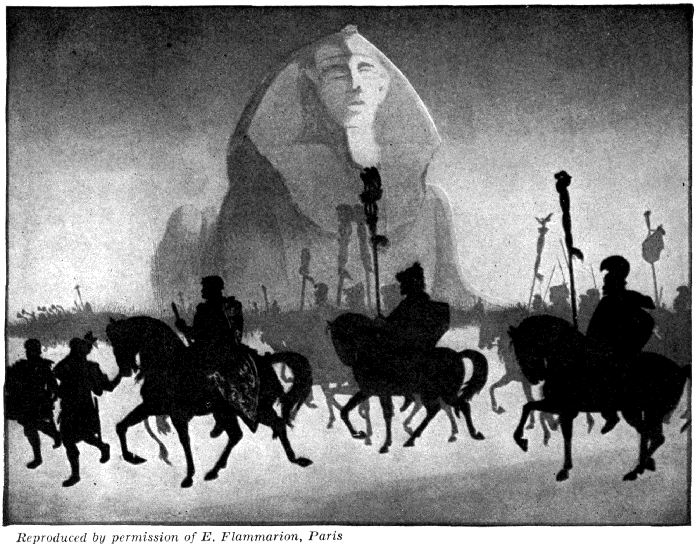 The Sphinx III: Roman warriors in Egypt
From a shadow picture by Amédée Vignola
M. Fragerolle composed the music and the words of
the stately chants which accompanied the exhibition
of the figures passing before the backgrounds, due to
the pencil and the palette of M. Vignola. By the aid
of the magic lantern the gigantic visage of the lion
with a woman's head towers aloft, permanent and immutable,
while the joyous procession of Egyptian
dancers and soldiers and priests celebrates the completion
of the statue itself. Then we are witnesses
of the fierce invasion of the Assyrians, with the charge
of their chariots and their horsemen; and we behold
the rout of the natives while their capital burns in the
distance. Next we gaze at the departure of the Jews,
led by Moses and laden with the spoils of the Egyptians.
After the Hebrews have gone, Sesostris appears,
to be greeted by a glad outpouring of the populace.
Yet soon the Persians descend on Egypt, with their
castellated elephants and their immense hordes of
fighting men. Still the Sphinx looks down, immovable
and implacable; and the Greeks in turn take the
valley of the Nile for their own. One of their daughters,
Cleopatra, floats past in her galley by night; and
in the morning she extends her hospitality to the
Roman, Cæsar or Antony. And while the Latins are
the rulers of the land of Egypt, the Virgin and her Son
with the patient ass that bears a precious burden,
skirt the sandy waste, and go on their way to the Holy
Land, leaving the Sphinx behind them as they journey
forward in the green moonlight. After long centuries
the Arabs break in with their brilliant bands of horsemen,
and a little later the Crusaders come to give them
battle. More long centuries elapse and suddenly
Napoleon emerges at the head of the troops of the
French Republic. Then we have the Egypt of to-day,
with the British soldiers parading before the feet of
the Sphinx; and finally the recumbent statue appears
to us once more and for the last time, when the light
of the sun is going out, and the world is emptied of its
population again, and the ice is settling down on the
Sphinx, alone amid freezing desolation. And this last
vision is projected by the magic lantern, without the
aid of any profile figures, since man has ceased to be.
Here we have a true epic poem, simple yet grandiose,
and possible only to the improved shadow-pantomime
of France at the end of the nineteenth century—even
if this art is only a logical evolution from the gallanty-show
of Séraphin. "This humble black profile," said
Jules Lemaître, "which had been thought fit at best
of a few comic effects to amuse little children only,
has been diversified and colored; it has been made
beautiful, serious, tragic; by the multiplication of the
devices it has been rendered capable of giving us a
powerful impression of collective life, and the artists
who have developed it have known how to make it
translate to our eyes the great spectacles of history
and the sweeping movement of multitudes."
(1912.)
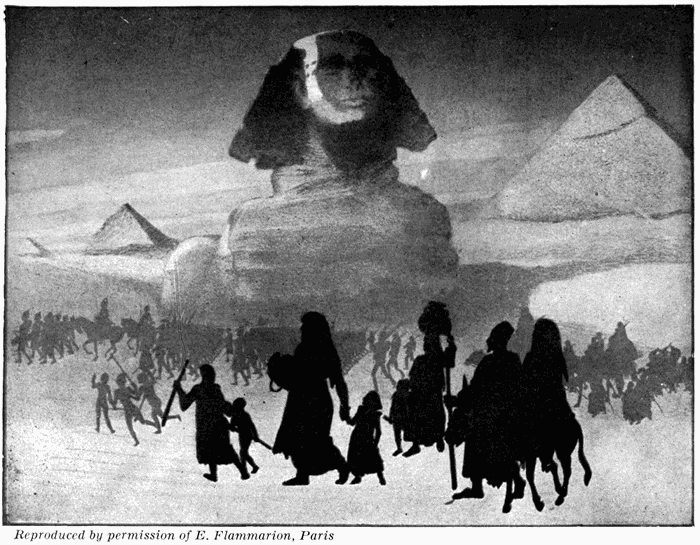 The Sphinx IV: The British troops to-day
From a shadow picture by Amédée Vignola
XIX
THE PROBLEM OF DRAMATIC CRITICISM
THE PROBLEM OF DRAMATIC CRITICISM
I
It is now no longer in dispute that there has been in
the past score or two of years a striking revival of the
drama in the English language, and that there are
to-day British and American playwrights who write
plays which are worth while—plays which are both
actable and readable—plays which often deserve and
which sometimes even demand serious critical consideration.
This revival has necessarily resulted in
calling attention to the present condition of dramatic
criticism in Great Britain and in the United States.
In a period of dramatic productivity, dramatic criticism
has an indisputable function and is charged with
an undeniable duty, both to the aspiring play-makers
and to the main body of the playgoing public. We
cannot help asking ourselves whether our dramatic
critics rightly apprehend their function and whether
they properly discharge their duty; and to these pressing
questions the most conflicting answers are returned.
Some there are who insist that it is hopeless to expect
the desired outflowering of dramatic literature in
our language to take place so long as our dramatic
criticism is as inadequate, as incompetent, and as unsatisfactory
as they declare it to be. Others there are
who take a more tolerant view, holding the public itself
to be at fault for the existing state of things, and who,
therefore, believe that we are now getting dramatic
criticism quite as good as we deserve. Few there are
who venture to deny that there is room for improvement—altho
no two of these agree in their suggestions
for bringing about a bettering of present conditions.
In the multitude of these counsellors there is darkness
and confusion.
Perhaps there is a dim possibility of dissipating a
little of this dark confusion by an analysis of the exact
content, which we discover in the term "dramatic criticism,"
and then by a further inquiry as to whether our
customary use of the term is not misleading. "Dramatic
criticism" to most of us connotes the newspaper
reviewing of the nightly spectacles in our theaters.
Plainly this was the meaning of the term in the mind
of Mr. Howells years ago, when he declared that "our
dramatic criticism is probably the most remarkable
apparatus of our civilization" and that it "surpasses
that of other countries as much as our fire-department.
A perfectly equipped engine stands in every newspaper
office, with the steam always up, which can be manned
in nine seconds and rushed to the first theater where
there is the slightest danger of drama within five minutes;
and the combined efforts of these tremendous
machines can pour a concentrated deluge of cold water
upon a play which will put out anything of the kind
at once."
There is no denying that this use of the term by Mr.
Howells is supported by custom. Yet it is distinctly
unfortunate, for if the newspaper comment upon the
novelties of the stage is to be accepted as "dramatic
criticism," then what term have we left to describe
the more piercing and the more comprehensive discussion
of the first principles of the art of play-making
which we find in Francisque Sarcey and in George
Henry Lewes, not to go back to Lessing and to Aristotle?
It is equally unfortunate that there is an equivalent
inaccuracy in bestowing the title of "literary criticism"
upon the newspaper comments upon the current
books, for if this journalistic summarizing is to be
accepted as "literary criticism," then what are we to
call the exquisite evaluation of favorite authors which
we find in Matthew Arnold and Sainte-Beuve?
Of course, it is always idle to protest against the
popular use or misuse of words and terms and phrases.
The people as a whole own the language, and have a
right to make it over and to modify the original meaning
of words. If popular usage chooses not to distinguish
between two very different things, and to call
both of them "dramatic criticism," there is no redress,
and yet it is impossible to discuss the problem of dramatic
criticism except by trying to separate the two
things thus confounded. Therefore, for the purpose
of this inquiry only, and without any hope of changing
the accepted usage, I make bold to suggest that "play-reviewing"
might be employed to describe the notices
written in the office of a newspaper, notices necessarily
prepared under pressure and under strict limitations
of time and space.
These newspaper notices are sometimes careless,
they are sometimes perfunctory, and they are sometimes
cruel; and occasionally they are careful, conscientious,
and clever, done with a dexterity worthy of high praise
when we consider all the conditions under which it is
displayed. But even at its best, play-reviewing cannot
attain to the level of true dramatic criticism, more
leisurely in its composition, larger in its scope, and more
discriminating in its choice of topic. The play-reviewing
of the daily journal is akin in aim to the book-reviewing,
which has for its purpose the swift consideration
of the volume in vogue at the moment. In our
morning and evening papers the book-reviewing and
the play-reviewing are both of them necessarily up-to-date,
in fact, up-to-the-last-minute. To be contemporaneous,
instantly and necessarily and inexorably,
is their special quality and their immediate purpose;
it is the reason for their existence and the excuse for
their being.
II
Here it may be well to cite again the oft-quoted confession
of the late Jules Lemaître, writer of volume after
volume in which he discussed the leading men of letters
of his own time and of his own country: "Criticism
of our contemporaries is not criticism—it is conversation."
Now, conversation may be a very good
thing; indeed, when it is as clear and as sparkling as
was Lemaître's, it is an excellent thing; yet he was
right in admitting that it is not criticism, since it could
not but lack the touchstone of time, the perspective of
distance, the assured application of the eternal standards.
And play-reviewing, like book-reviewing, cannot
be anything but conversation about our contemporaries.
It may descend to chaff-like chatter about
the writers of the hour and to empty gossip about
their sayings and doings; or it may have the sterner
merits of brilliant conversation at its best. But it is
not really criticism in the finer sense of the word; it
cannot be; and one may go further and say that it
ought not to be, since true criticism is more or less out
of place in a newspaper—because the direct object of
a newspaper is to present the news, with only the swiftest
of commentaries thereon.
The final distinction between literature and journalism
is to be sought in their diverging and irreconcilable
objects. The desire of the former is for permanence,
and the aim of the latter is the immediate impression.
When literature triumphs it is for all time—more or
less. When journalism most completely achieves its
purpose its success is temporary, to be retained only
by iteration and reiteration, since it has for its target
the events of the fleeting moment. If we admit this
distinction between journalism and literature, we have
no difficulty in discovering journalism in many places
other than the daily and weekly papers; very properly
it fills the most of the space in the monthly magazines,
and even in the quarterly reviews; and it abounds in
our book-stores, since only a small proportion of the
volumes which pour from the press every year possess
the combined substance and style, the solidity of matter
and the delightfulness of manner which lift mere
writing up to the loftier level of literature.
On the other hand, we may find literature of inexpugnable
quality, not only in the magazines, but also
now and again in the newspapers. Drake's 'American
Flag' and Kipling's 'Recessional' appeared in daily
journals, and so did the literary criticism of Sainte-Beuve
and the dramatic criticism of Lessing and of
Lemaître. But these were but happy accidents, and
the great newspaper editor has rarely striven to make
his journal a persistent vehicle for the publication of
literature. He feels that this is foreign to his main
purpose, and he is content when his editorial articles,
and his news stories are vigorous and picturesque—clean,
clear, and cogent in their English. He knows,
better than any one else, that it is not by its external
literary merits that newspaper-writing is to be judged.
What he wants above all else is the news, all the news,
and nothing but the news—accompanied, of course,
by the obligatory comment this news may deserve.
He needs editorial writers, reporters, and correspondents
who are newspaper men, and not men of letters,
except in so far as these men of letters may have accepted
the special conditions of newspaper work.
Now, criticism, whether literary or dramatic, is a
department of literature, dealing with the permanent,
and having little to do with the temporary. It demands
qualifications very rarely united—insight, equipment,
disinterestedness, and sympathy. So far from
being easy, criticism is quite as difficult as creation—more
difficult, indeed, if we may judge by its greater
rarity. In a superbly creative period there are sometimes
three or four distinguished poets, friendly rivals,
almost contemporaneous; and even at such a time
there is rarely more than one critic worthy to be companioned
with them. Æschylus and Sophocles and
Euripides followed one after the other; and in time the
sole Aristotle came forward as their critic. Corneille
and Molière and Racine labored side by side, and only
Boileau was competent to interpret and to encourage
them.
When it attains to the serene plane of Aristotle and
Boileau, of Lessing and Sainte-Beuve, criticism is
actually creation. "The critical faculty as applied to
the masterpieces of literature, and still more the critical
faculty as applied to the art of literature itself, is akin
to the creative faculty of the artist," so Professor Mackail
has told us. "It does not deal with letters as
something detached from life, but as the form or substance
in which life is intelligibly presented. Its interpretation
is also creation." But the criticism of
dramatic literature which is also creation, is possible
only when the critical faculty is applied to the masterpieces
of dramatic literature; and nobody knows
better than the play-reviewer that masterpieces of
dramatic literature do not present themselves frequently
and that they cannot be acclaimed as masterpieces
until they have stood the test of time. And this
is why a critic-creator would be a little out of place
on the staff of a newspaper, daily or weekly, whether
he was assigned to deal with the drama or with literature
at large.
III
The necessary task of the book-reviewer or of the
play-reviewer, is not criticism of the creative kind,
since for that he is always likely to lack material. His
task is humbler even if it is honorable; it is to report
upon the novelties of the day, and to inform the readers
of the newspaper as to the nature and the merits
of these novelties. His work is essentially reporting,
even if it is reporting of a special kind, calling for special
qualifications. The connection of the drama with the
show business is intimate, and it always has been. In
the long history of the theater there is no period without
its successful pieces, the appeal of which was mainly
sensuous—to the eye and to the ear, rather than to the
emotions and to the intellect. While the drama is an
art, and perhaps the loftiest of the arts, the show
business is a trade. This is no new thing—altho
ignorant idealists often declare it so to be, and altho
it may make itself a little more obvious at one time
than at another. What confronts us is the condition
of things as they are, not the theory of things as they
might be.
There would be occupation for a dramatic critic,
who was also a creator, only if our theaters were presenting
in rapid succession a sequence of masterpieces,
tragedies of austere power, comedies of searching satire,
social dramas of piercing suggestion. But this is not
the case now here in the United States in the twentieth
century; and it never has been the case anywhere or
anywhen, not even in Weimar when Goethe dominated
the ducal theater. In our playhouses we are proffered
our choice of Shakspere and Ibsen, Pinero and Hauptmann,
Henry Arthur Jones and Augustus Thomas,
Barrie and Gillette, Sardou and George M. Cohan; and
at the same time we are invited to choose between
'Trilby' and the 'Celebrated Case,' melodramas and
farces, summer song-shows and ultra-contemporary
reviews, alleged comic operas and terpsichorean spectacles.
Most of these latter exhibitions do not demand
or deserve criticism of any kind; but they need
to be reported upon like any other item in the news of
the day.
If this is the case, it might as well be recognized
frankly. There is always advantage in seeing things
as they are, in fronting the facts and in looking them
squarely in the face. Sooner or later some one of
those who are in charge of our metropolitan newspapers
will perceive the possibility of a change of method.
He will charge one of his staff with the supervision of
the theatrical news, the announcements of new plays,
and the personal gossip about the players; and he will
authorize this editor to send competent reporters to
all first performances, directed to report upon them as
they would report upon any other event of immediate
interest. He would warn these reporters that they
were strictly to consider themselves as reporters, and
that they were, therefore, to refrain from explicit
criticism. He would so select his men that a melodrama
should be dealt with by a reporter who liked a
good melodrama, and that a summer song-show should
be described by a reporter who could find pleasure in
inoffensive and amusing spectacle. If this policy
should be adopted, and announced clearly and emphatically,
probably most of the occasions for quarrel
between managers and editors would disappear; and
the immense majority of the readers of the daily paper
would be supplied with exactly the information they
would prefer.
Then, for the benefit of the smaller number who are
really interested in the drama as a serious art, the
editor-in-chief might avail himself of the fact that the
Sunday issue, while it is still a newspaper containing
the news of the preceding twenty-four hours, is also
a magazine, to be read in more leisurely fashion, and
therefore at liberty to treat timely topics with a larger
freedom. Here space could be found for genuine dramatic
criticism by the most competent expert available.
This dramatic critic should have nothing whatever to
do with the news of the theaters, or with the first-night
play-reviewing. He should not be tired and
bored by having to go to the theater half a dozen times
a week, and by being forced to analyze plays which do
not reward analysis. He would be expected to select
out of the current performances that one which promised
to be most worthy of careful consideration, and
he would feel himself free to discuss this at such length
as it might seem to him to deserve. To him also should
be intrusted the more significant of the new books
upon the history of the theater, and upon the art of
the drama. In the summer (and also whenever at
any other season there might be a dearth of inspiring
topics), this dramatic critic would not be expected to
contribute, since he should never be called upon to
make bricks without straw.
Even in New York this method is not as new as it
may seem, and more than one metropolitan daily has
approximated to it, altho no one of them has completely
detached the dramatic critic from the play-reviewer
and from the supervisor of theatrical gossip.
And it has long been adopted in certain of the Paris
newspapers. In the Temps, for example, when Sarcey
was its dramatic critic, there was a daily column of
theatrical announcements and of brief reports upon
first-night performances; and with this department of
the news of the theaters Sarcey had nothing to do,
and for it he had no responsibility. Then in the
ample space specially reserved for him in the issue of
every Sunday afternoon, he dealt with the dramatic
themes that seemed to him worth while. If a play
appeared to demand prolonged study, he might go to
see it two, or even three times, before he undertook to
formulate his opinion; and on occasion he would carry
over his detailed discussion of a very important drama
into the article of the following Sunday. On the other
hand, if no recent play seemed to him to deserve his
continued attention, he would devote himself to one
of the recent books about the theater or to a detailed
discussion of the proper interpretation of one of the
classics of the French drama kept constantly in the
repertory of the Comédie-Française.
IV
The adoption of this method would relieve the dramatic
critic from one of his existing disadvantages;
he would be released from criticising the pieces which
are beneath criticism. The literary critic, and even
the ordinary book-reviewer, never spends his time in
considering dime novels—whereas the dramatic critic
is now called upon to waste many evenings in beholding
a play which is only the theatrical equivalent of a dime
novel. The immediate result of this futile and fatiguing
expenditure of energy is likely to be discouraging
and even enervating. If the dramatic critic could be
totally relieved from all contact with the show business
when the show business has only a casual connection
with the drama, it would tend to keep him fit for his
essential task. Under the present conditions it is no
wonder that the theatrical reviewer wearies of his task
and loses the gusto and the zest without which all
work tends to degenerate into the perfunctory and the
mechanical.
We need not fear that the first-night reporting would
be ill done if competent reporters were instructed that
they were not to consider themselves as critics, and that
it was their sole duty to report, as they would report
anything else, conscientiously and accurately. The
difficulty would not be in finding reporters able to discharge
this duty, it would be in the discovery of dramatic
critics possessing the fourfold qualifications of
insight, equipment, disinterestedness, and sympathy,
which every critic must be endowed with whatever the
art he undertakes to analyze. And the difficulty would
be increased by the fact that the dramatic critic needs
an understanding of three different arts, the art of
acting, the art of literature, and the art of the drama—of
play-making as distinct from literature.
It would be idle to hope that even if this method
were adopted we should soon be able to develop in the
United States and in Great Britain a group of dramatic
critics of the capacity and the quality of Lessing
and Sarcey, of George Henry Lewes and William
Archer. Yet it is solely by the adoption of this method
that we can hope to provide the opportunity for the
appearance of the true dramatic critic, who can fit
himself for his finer work only by being set free from
the necessity of doing work quite unworthy of him,
altho necessary to the newspaper itself. And the development
of a group of dramatic critics of a higher
type than can be found to-day—except possibly in a
scant half-dozen dailies and weeklies and monthlies—is
a condition precedent to the development of our
drama. Of course, these dramatic critics, whatever
their endowment, could give little help directly to the
dramatic authors, since it is a mistake to suppose that
the critic is capable of counselling the author, or that
he is charged with any such duty. Where the critic
can help is by disseminating knowledge about the dramatic
art, and by raising the standard of appreciation
in the public at large—that public which even the
mightiest dramatist has to please or else to fail of his
purpose.
(1915.)
The illustrations have been moved so that they do not break up
paragraphs and so that they are next the text they illustrate. Thus the
page number of the illustration might not match the page number in the
List of Illustrations, and the order of illustrations may not be the
same in the List of Illustrations and in the book.
Errors in punctuations and inconsistent hyphenation were not corrected
unless otherwise noted below:
Throughout the book, "avalanch" was replaced with "avalanche".
On page 56, the single quotation mark was removed from the block-quoted paragraph.
On page 116, "denial of of" was replaced with "denial of".
On page 230, "Amercan" was replaced with "American".
On page 296, "air-cirlces" was replaced with "air-circles".