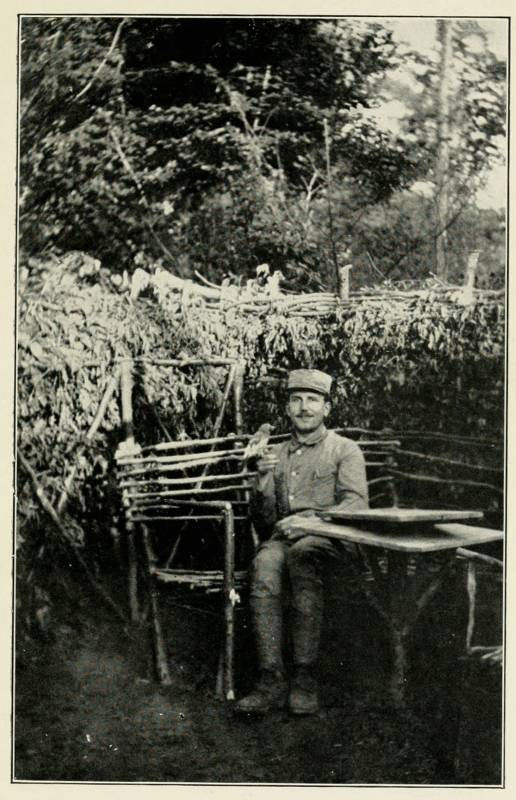
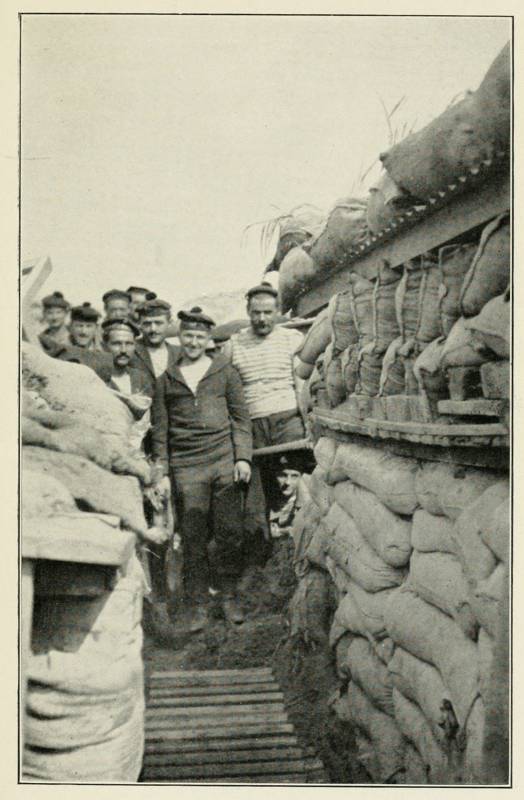
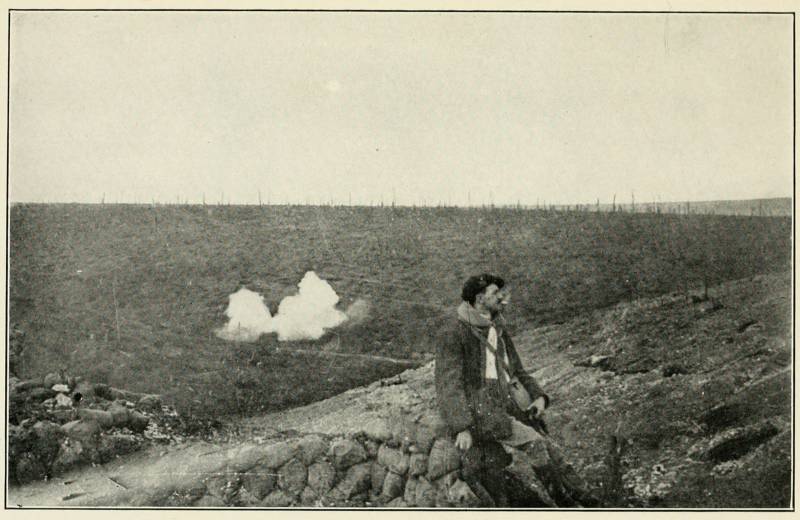
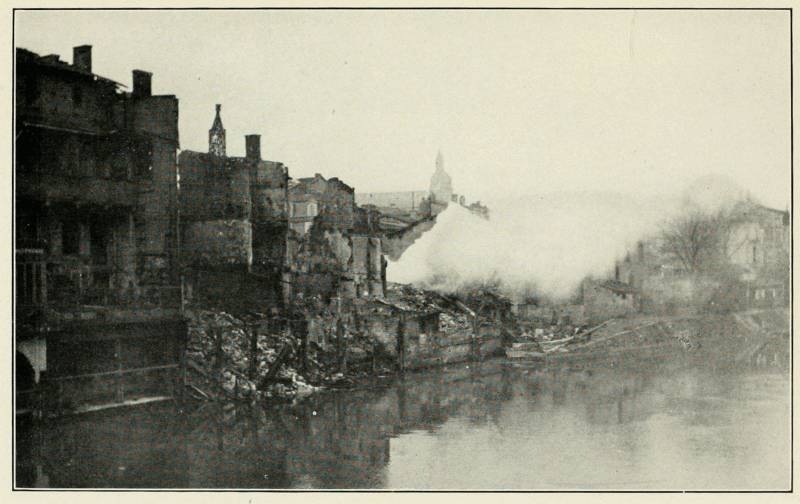
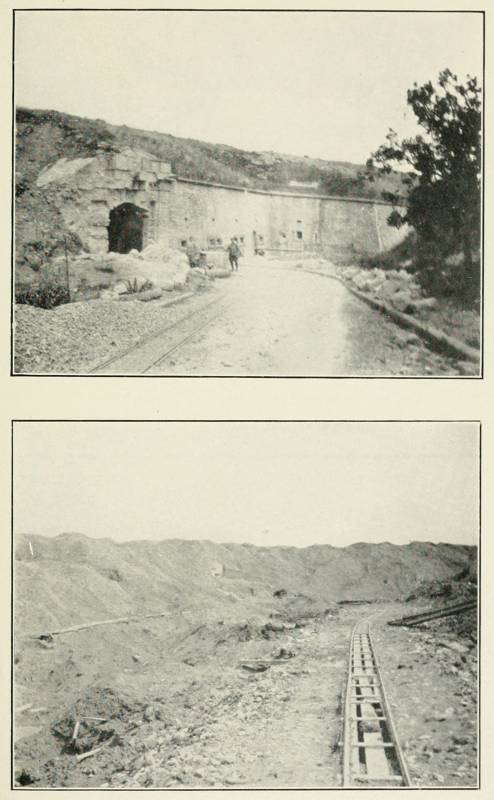
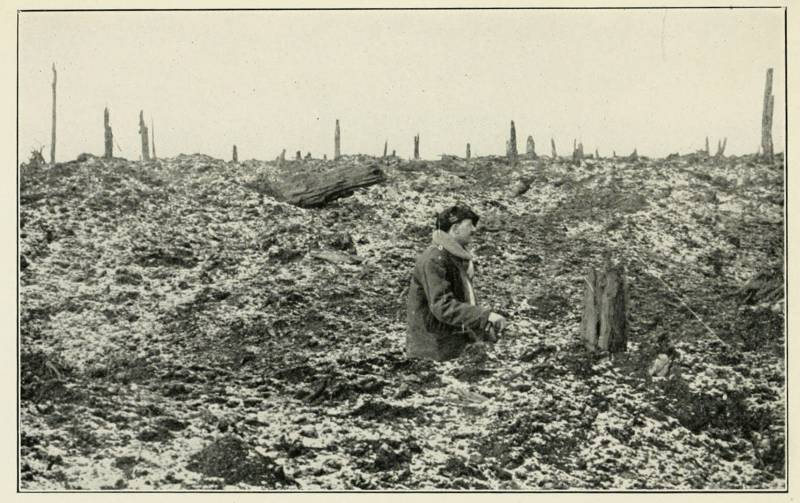
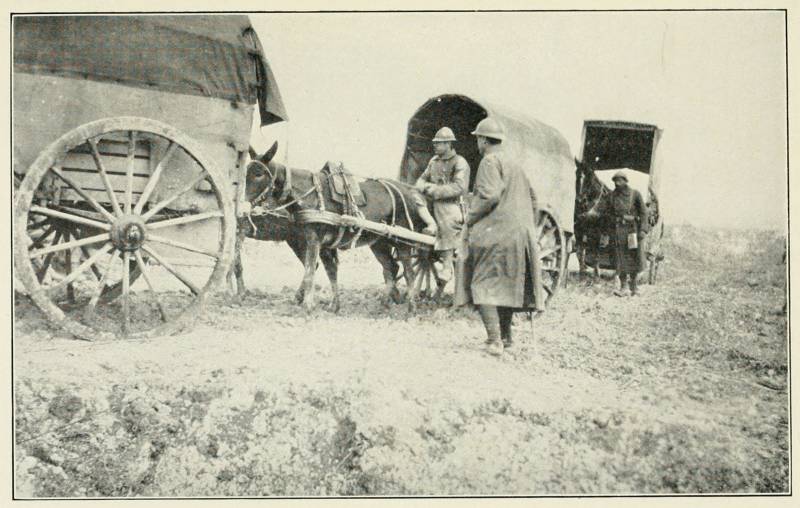
This period of the author's life begins during the
first days of October, 1915, and ends on the eve of the
battle of Verdun, February 20, 1916.
He directed certain works in the different sectors of
the Verdun front, at Eparges, at Calonne Trench, in
the Hauts-de-Meuse, at Chevaliers Wood, at Ornes, at
Forges and Béthincourt, at Corbeaux Wood, etc.
He remained a greater part of the time at Eparges,
which was then the bloodiest sector on the front. The
episodes in mining warfare left an impression of horror
with those who were lucky enough to survive.
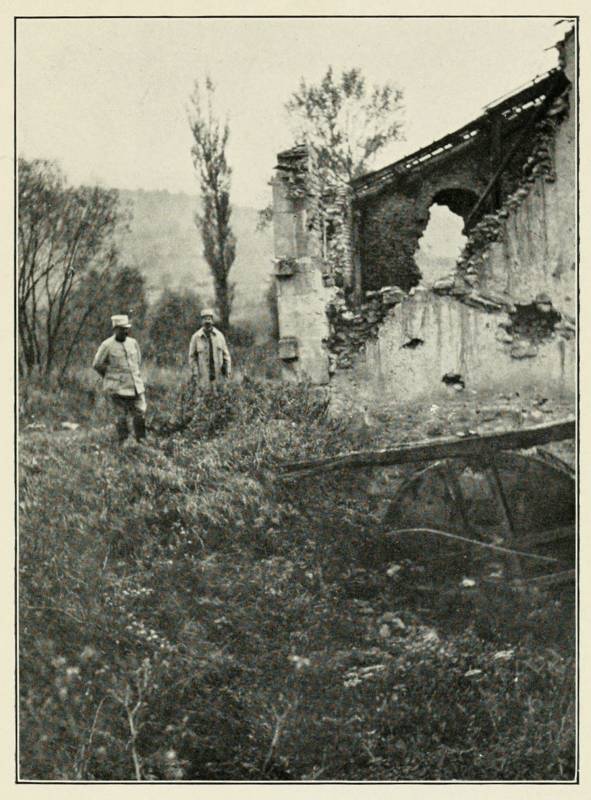
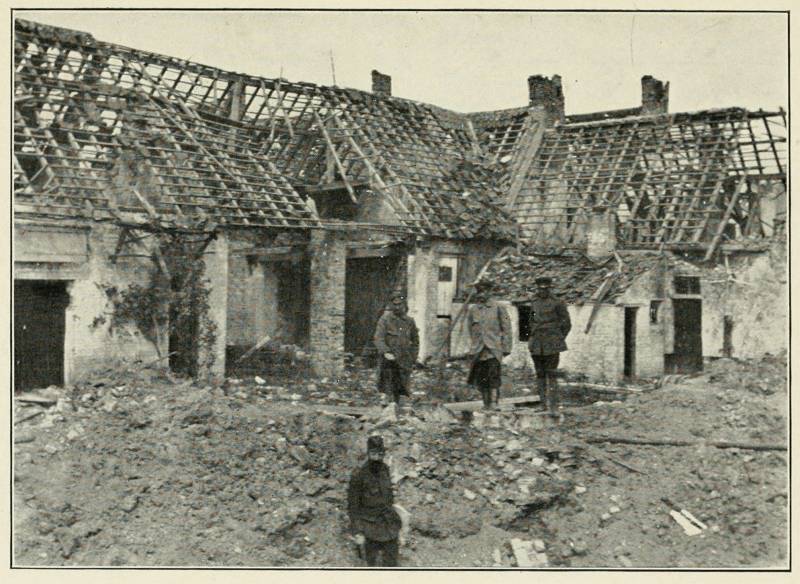
Eparges Mill recalls the ruins of some ancient Abbey.
CHAPTER FIVE
THE DAY OF MY ARRIVAL, EPARGES.
October 7, 1915.
When I come here for the first time I cannot
help but feel that I will pass the unhappiest
moments of my life——
Upon arriving at Calonne trench and descending
toward Mesnil-sur-les-Côtes, I perceive Eparges on the
right. With its mine craters, its smoke, this barren
hill, tinted red, appears like a kind of Stromboli——
The road all the way to Longeau is simply exquisite.
Eparges mill, demolished almost completely,
and overgrown with grass already recalls the ruins of
some ancient abbey.
I have traversed the length of the sector with a
friend—it is very active to-day. The boches, at break
of day, exploded four mines simultaneously. A section
of the trench is completely demolished and a hundred
men have been killed——
We are on the verge of contact with the enemy and
it is necessary to crouch over dead bodies and sandbags
to observe what is transpiring in front of us——
GUNTHER DUGOUT, THE CORRUGATED IRON, THE RATS,
THE MAP, THE LETTERS, EPARGES.
November, 1915.
At the beginning our shelter was nothing more or
less than a mole hole.
Little by little it is becoming habitable. The walls
have been boarded and the ceiling made of corrugated
iron.
A long, large, white table, with benches——. How
many of us will no longer sit there! Everyone found
in this little space is loved like a brother.
On the board wall which separates the room from
our sleeping quarters, which is arranged like a sleeping-car,
there is a map of Alsace-Lorraine. Gunther,
with his big fist, has traced an arrow in ink, which
points from Eparges to Strasbourg. He has written:
"The hearts and aspirations of the 14th Company
of the 15th Corps point this way!"
At night the rats, with an unseasonable boldness,
run up and down between the corrugated iron and the
roof. One doesn't know if they're playing or fighting.
These gallops on the metal awake us with a start.
A flash from my electric lamp and I discover an
immense rat tearing across the room with a telephone
message sent to me at the moment I retired.
Ménard and Foulu prepare the evening meal before
the arrival of the post-sergeant. The little fireplace
at the side blazes cheerfully and fills the dugout with
the pleasant odor of burning wood.
Happiness is his who can relax completely after a
rough day——
The post-sergeant arrives drenched, his package of
letters and newspapers carefully wrapped. He seems
ill at ease as if he finds himself in a palace.
"Ménard, give your friend a quart of pinard."
The paquet of letters for Captain Gunther is always
very large. Many of them commence like this:
"I thank you from the bottom of my heart for
having given us details of the death of our boy. We
are proud of him."
Then there are others cheerful enough, others very
sad.
I found a short while ago some of the last wild
flowers, while returning from the front line. I have
slipped them into my letters that are about to go.
Oh! you who will receive these flowers will never know
what one can suffer here!
THE FILTH, EPARGES.
November, 1915.
Deep in Eparges mud, sixty yards from the
enemy——
"Look here, my friend, you know very well it is
forbidden to wrap the legs in sandbags——"
"General, it's for the filth——"
"These sandbags cost the Government more than
ten sous a piece——"
"General, it's for the filth——"
"It is not permitted to waste material destined for
the trenches."
"General, it's for the filth——"
"For what?"
"The filth."
"The filth?"
"Ah! general, it is all that you see here: the mud,
the dirt, the bugs, with trampled boxes of singe and
sardines under foot. This damned soil, which—which
smells bad—general, all this is filth!"[17]
THE RETURN OF ST. ANDRÉ, EPARGES.
November, 1915.
"Good morning, St. André—that you? Come in,
mon petit, I'm glad to see you again."
"Yes, captain, here I am."
It is at Eparges, during the month of November,
1915. We are in Captain Gunther's dugout, who
commands the 14th Company, 15th Corps of Engineers.
The weather is horrible. Outside the rain falls incessantly.
The mud, the mud, the rotten, cursed mud is
everywhere.
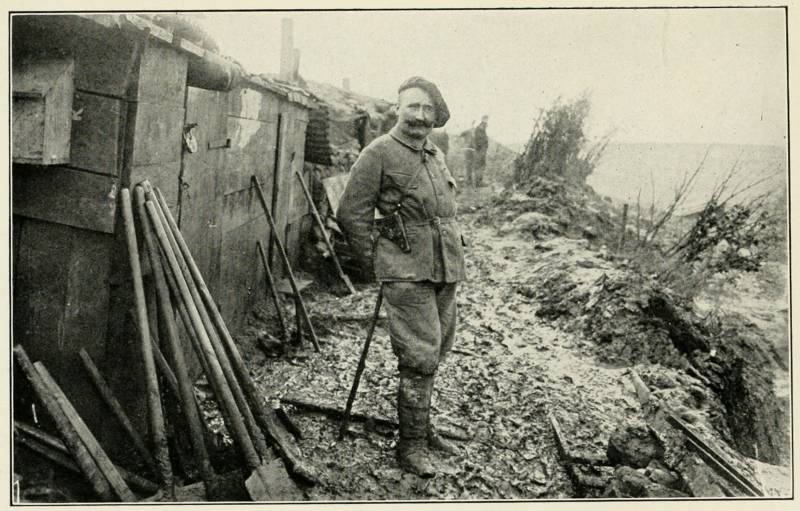
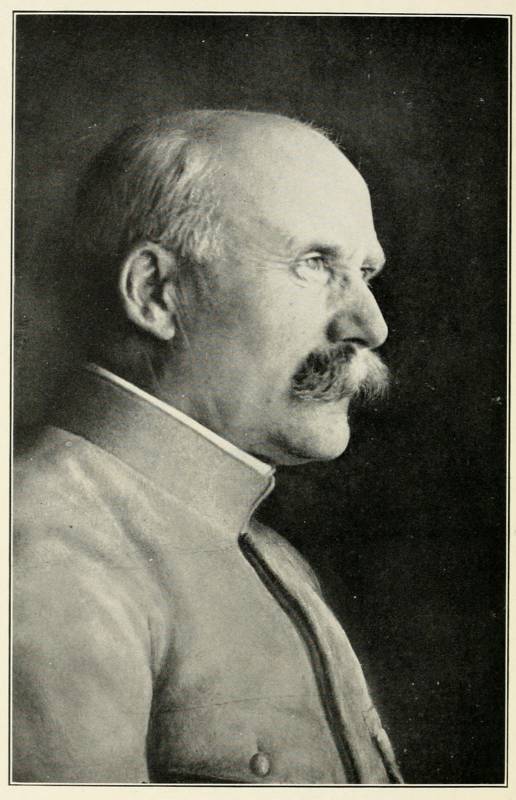
Captain Gunther, who commands the 14th Company, 15th Corps of Engineers.
Our shelter is damp. Water filters through the
board walls and falls in large drops. A dim candle
light. The sector is very quiet.
St. André stands in the threshold. He is covered
with mud from head to foot. What a trip it is to get
here! His stalwart face is dripping with rain; this
brave young lad of nineteen radiates health and good
nature.
"Did you spend a nice vacation?"
"Not very good, captain."
"Not very good? Where did you go?"
"To Rennes."
"Did they not welcome you as they should?"
"No, captain, they treated me like a slacker. They
said, 'What! not wounded or killed—you're not a real
poilu!'"
"But, mon petit, you should have said you came from
Eparges, the wickedest sector along the front."
"No chance to talk with those people. Our conversation
ended in blows."
"At least, you have done your bit for France by giving
her 'little St. André's,' poilus and sturdy like yourself?"
"Yes, captain, I'm not married—but I've got two
sons."
"You are not married? You are going to marry
her right away, my boy. You could easily have an
accident here, and you would not embarrass your little
friend——"
"That's true, captain——"
"I am going to give you two days' vacation so you
can marry her, but I will have to get the certificate
from the mayor."
"Captain—I want to tell you—I would rather marry
by proxy."
"By proxy! That's a strange idea—and why?"
"Because then it would only be good for the duration
of the war."
THE PASSWORD, DIEUE-SUR-MEUSE.
November, 1915.
It is night—I return in a covered automobile with
Colonel d'Auriac. At the road which crosses that to
St. Mihiel, a sentinel waves his lantern—the machine
stops.
"The password?"
"Marne!"
"That's not it!"
"What! That's not it? Call the head of the post,"
said the colonel nervously.
In a few moments that seemed long enough to us,
the poilu brought the head of the post, who dragged
his feet as if half asleep.
"The password?"
"Marne!"
"Pass!"
"Wait! How is this, sergeant, when I give the
word to the sentry, he does not let me pass through;
on the other hand when I give it to you, you permit
me to continue?"
"Well, you see, colonel, neither the sentry or myself
know the password!"
AT THE ANNIVERSARY OF AUSTERLITZ, EPARGES.
December 1, 1915.
It is the eve of Austerlitz. To-night and to-morrow
we are going to celebrate the memory of our forefathers,
the Emperor's Old Guard, who will shake in
their graves with joy.
It is snowing. The night is bright with moon. Rifle
shots resound loudly in the darkness. From time to
time, are exchanged by one and then the other, rounds
of machine-gun fire at fleeing shadows during the slow
descent of star-shell.
I arrive from Verdun and my automobile is filled
with everything I could hastily collect in the stores.
We have a basket of oysters, fine white bread and fresh
butter——
The florist in Verdun, a big fellow, always restless
and uneasy, who will foretell the worst misfortunes
until the end of his life, has given me an armful of
roses and mimosas, that will look pretty there.
There will be cigars for our friends and for our
poilus, and champagne, naturally——
We have been arranging for this little fête for a
long time; there will be quite a lot of us: thirteen or
fourteen infantrymen, sappers, artillerists, all old
habitués of the sector.
We are taking with us all those who have been sent
back for rest. When we pass Mont-sur-les-Côtes, the
sentinel stops and becomes pensive at seeing seven or
eight officers piled together in the little machine. It
is terribly crowded. What loud bursts of laughter!
How wonderful life is among young men of the same
age who have made the supreme sacrifice of their existence
and know the least of that fugitive joy that falls
to a soldier's lot.
Each one brings something to the dinner, some have
pâté de foie gras, others petits pois, and pastry.
How late it was when our automobile brought us
a half-mile from the first line—this is what caused a
reprimand from the "general staff" some days later!
The boches are very quiet: not a rifle shot, not a
cannon shot. The St. Remy searchlight which generally
plays on the Eparges road is out to-night.
We have climbed Eparges hill—we pass through the
ruins of the village and they are silhouetted like
Christmas eve decorations. The enemy is very near
to us and it is drôle to think we have scaled the height
to pass an evening, a real live pleasure party.
When we arrive finally at Captain Gunther's dugout,
there are cries of joy—. All his staff assist us with
the numerous packages. The brave Ménard, with his
commanding presence, his flowing mustache and kindly
eyes, spares no pains to see that we are settled.
Our dugout has become quite comfortable since the
installation of electric lights. Everything is perfect;
there is not a hitch.
It is so crowded, elbow to elbow, that we throw off
our tunics.
What a dinner! The oysters and champagne are
the best. Oyster forks in this region made us all
think—Ménard had a Prince Albert coat on over his
uniform. Where did he get it? Mystery!
There is singing, laughing. They become grave
when speaking of the comrades who are no more——
From time to time the ruffled form of one of our
poilus passes out the door. They know we have not
forgotten them. They carry a bottle, a pâté, or a
box of cigars—and so the fête extends even to the
advanced posts of the first line.
From the listening post to-morrow they will throw
oyster shells at German heads. What faces they will
make. Surely they will place them in their geological
museum at Berlin.
The flowers on the table, a fantasy of color, cause
some to weep with emotion. We have the most profound
respect for them: "How come you here in the
center of death and destruction—you come to us from
the warm, beautiful countryside——"
I glance at my friends, Berthet, Blanc, Grabinski,
the brave Grab, Flament, the doctor, and the staunch
face of my captain——
We speak of the great Emperor and compare our
army with his—How proud he would be of our poilus!
What would he have done if he had had airplanes?
The time for champagne has come; Gunther drinks
to all: the infantry, artillery, engineers, and the absent
comrades. His voice trembles with emotion—"High
Hearts! The road will be yet long. France has her
eyes on us! Our lives belong to her. We will be happy
to give them. If we are killed our children will be
proud of us!"
In my turn, I speak to them of the Eparges—At
this anniversary I feel the blood of my ancestors
tingling in my veins, because I am a great grandson of a
veteran of the First Empire.
I drink to Eparges, for each one of its letters is the
beginning of a word representing the military virtues
we must practice here:
Encouragement.
Perseverance.
Ardor.
Resolution.
Greatness.
Energy.
Sublimity.
Champagne and liquor have their effect—now the
music commences!
First the "Marseillaise" rings out. Could the boches
have heard us from the bottom of their pits they would
realize we were all ready to conquer or to die.
Then each one sings his little chanson—these pretty
French songs full of verve and spirit. How odd it is
to hear sung "The Marriage of Mademoiselle Fallières,"
here in this dugout, mute witness to so much drama——
The hour to separate has come. Each must take
up his duties, save those who return to the rear.
It is midnight—and it is clear and calm.
I leave with Captain Gunther to go into the first
line. It is well that our poilus see that we are at their
side—are they not our brothers? We wish as well to
know what the boches are doing!
We enter a mine gallery where the work goes on
actively. Our sappers are digging fast for the enemy
is working feverishly also. It is he who explodes it
first—as usual!
"They are ahead of us—they're digging their hole,"
said one of Grenet's men.
He spoke with calm and indifference.
On the menaced part of the front the number of
men has been lessened, save only in the little posts, where
they wait events stoically.
Coming outside, a poilu, with an undefinable accent,
says:
"Then they're going to spring it to-night?"
"Who told you that story?"
"Well, there's no need in hiding it—I'm not blind
and I know what it means to go back there—On a
night like this it wouldn't bother me a bit to be shot
like an arrow up to the stars!"
Our rounds are finished. We can go back to our
dugout and profit by the hours of quiet to get much
needed rest.
In going into Sap 13 again, I look up at the heavens.
My brain is so tired that I seem to see a cortège of
soldiers. Are they the Old Guard and our poilus, our
brave poilus? Yes, decidedly, the Old Guard is feasting
up there, the Old Guard of Austerlitz——
The earth, in this clear and luminous night, appears
in bold relief and one sees between the torn tree trunks,
arms reaching out of the ground, arms lifted to the
German heaven, and our own dead fallen on this cursed
soil of the Eparges—they seem to contemplate the
great fête up there——
It is the morrow.
What horrible weather! It is raining in torrents.
Everything is soaked. Again we shall have to flounder
about in mud up to the middle.
However, it is impossible to complain of your fix
when you have flowers in your dugout!
During the morning a heavy detonation shakes the
entire hill. It is these German pigs, decidedly, who
have exploded the first one. They choose their time
well.
Everyone dashes down to lend a hand to our comrades
who are on duty. We shall have to reëstablish
the trench and evacuate the wounded.
If you attempt to go fast you get nowhere. The
mud glues itself to your feet. The ground smells bad.
But it was not serious, only a warning, and soon I
am back in the dugout, dripping from the neck down.
It is the time to write.
I am alone with Cadet Flament, who, stripped of
his tunic and wearing his blue jersey, has rather the
air of a collegian. He is, however, a brave young fellow,
our little Flament——
"Say, Flament, you had better write a letter home.
It is three weeks now since you have given them any
news."
"You're right, lieutenant."
And little Flament began at once to write a long
letter to his mother. She must be proud of her son.
He is the only child. She lives at Château-Thierry.
But what uneasiness, knowing he is at Eparges——
After having written the first letter, Flament writes
the second. This one also is to a woman! The smile
on his lips when he writes leads me to believe that this
young rascal has a little friend or a fiancée——
I am certain of it when I see him place in a little
box an aluminum ring which he has made himself, and
some flowers from the Eparges, mingled with those we
had at our banquet last night——
"Lieutenant, when you go down to-night, it will be
very kind of you, if you will take these letters and this
little package——"
"Gladly, mon petit," and I placed in my pocket, the
letter for his mother, the one for the "other," and the
little box destined for her also.
Flament begins to put on his shoes which he has
vainly tried to dry out—. It will be necessary to keep
them in the stove for three days to obtain this result.
Without question he has written to the woman he
loves—he grumbles at the weather, the rain, at the
cursed mud, at the boches——
Ah! what wouldn't he give to pay those boches back
for having began this holocaust——
Suddenly an explosion, more violent than the one
before, shook us in our chairs.
It is they this time who have sprung the mine. There
will be many casualties!
We jumped up and left the dugout.
It was raining; but at the same moment the cannonade
raged. French and German shells tore through
the air with frightful screams, an acrid smoke hung
between Montgirmont and Eparges, machine-guns
kicked up a deafening tumult—you damned coffee-mills—va!
Flament preceded me—he walked with his head high.
How good-looking he is with his Tam O'Shanter
cocked over one ear in the midst of bursting projectiles,
face to the enemy——
A 77 hits him squarely, carrying away his thigh and
half of his face——
My sergeant and two of his sappers collect the
pieces. They carry this poor corpse, still heaving and
stained with mud, into our little wooden chapel a few
steps away——
An hour later, the flurry being over, I go again to
see him with LeBlond. I have taken the flowers of
the night before and placed them respectfully on his
breast——
Poor young chap! He is unrecognizable. Can this
be the happy little fellow of the night before?
On leaving the chapel, I notice that LeBlond is terribly
affected and I say nothing to him. We arrive
at the dugout where our brave captain, covered with
mud, sobs like a child for his lost friend——
Taking LeBlond by the arm, I say:
"Mon vieux, you are down-hearted—go with me
along the whole first line—we have our dead to avenge!
we must not weep for them——"
During the night LeBlond and I return to Verdun.
Before retiring I reach in my pockets to empty them.
Two letters and a little box rest in my fingers. I
think a long time of these souvenirs of death——
After hesitating some moments, I say to my friend:
"Decidedly, I will send them to-morrow. These poor
people will not learn too soon the unhappiness they
bring!"
THE PHILOSOPHICAL POILU, EPARGES.
December, 1915.
You will not believe me, but this morning at break
of day, we found ourselves in mud up to our middle!
In the trenches and in the boyaux,[18] it was always the
same thing—the sector was completely calm. Parbleu!
the others in front of us must suffer exactly the same
hardships.
I am numbed! For four days I have been struggling
in this damned mud.
Woevre plain is thick with mist this morning and
Champlon, seen from up there, resembles one of these
pasteboard villages over which a miscreant youngster
has poured water.
I sense a feeling of real joy, however, on seeing the
first glimmerings of day, because to-night we shall be
relieved——
I descend into "Precaution Trench," sweeping into
a river of mud, and find myself nose to nose, at the
crossing of Sap 8, with one of my poilus.
On seeing me he cannot refrain from laughing.
"What are you laughing at?"
"Lieutenant, what a sight you are! You've got mud
in your hair, and mud on your eyeglass—you ought
to look in a mirror!"
"Listen, mon petit, it is not necessary to speak of
it, because if one looks around himself here, he always
ends up by finding someone very unhappy——"
"Very true, lieutenant, because instead of being in
a lot of mud we could easily find ourselves up to our
necks in something a whole lot worse!"
That night I am in the home of M. and Mme. Louis
at Verdun.
The good woman has a great wood fire going—May
God bless her!
I am so numb with cold that I cannot undress—my
shirt is frozen to my back——
This good and sweet creature assists me and, hearing
my teeth chatter, weeps softly and murmurs:
"What would his poor mother say if she saw him
in this condition——"
THE RELIGIOUS POILU, EPARGES.
December, 1915.
Accompanied by one of my poilus, I ran across the
chaplain of the —— Regiment of Infantry, in front
of the P. C.[19] of the colonel.
We are both in a sorry plight.
The preceding days have been such an accumulation
of physical and moral misery, that I could not help
but say to the priest:
"Father, I feel death hovering around me—hear my
confession!"
"Confess you here? Do not think of it. You make
your own hell on earth in the Eparges. I will pray
for you. And you, poilu," he added, turning toward my
sapper, "to what religion do you belong?"
"I belong to that which looks God straight in the
eyes!"
THE MEN OF BRONZE, EPARGES.
December, 1915.
We have just put in some frightful days up there.
The mud, the horrible mud, is infinitely more terrible
than any enemy shells.
It is relief day!
What luck to end this nightmare. One is sad, however,
for the others who come to take your place.
The Eparges soil is red—our uniforms of horizon
blue, dirty and covered with this mud, appear tinted
with blood.
A sad array. We all have a dejected mien. Several
of us will not come back.
Four poilus are carrying one of our wounded. They
advance carefully. Night has fallen and the lingering
red shadows disappear from the heavens, one after the
other, darkening our march.
We meet General Renaux, commanding the Division,
who comes to inspect the sector.
Contemplating us dolefully, he said:
"My poor children, what a state you are in!"
"General," replied a poilu, straightening, "that is
nothing. It is we—the men of BRONZE!"
MAJOR HÉLY'S VISIT, EPARGES.
December, 1915.
It is reception day, to-day. Major Hély of the
General Staff, after having inspected the sector, will
dine with us.
And so, there are fresh flowers on the table—chicken
and champagne.
A ray of sun is equally in the party. What luck!
The boches are quiet.
It is the end of the dinner.
Ménard brings the jus, excellent coffee which he
pours in the cups. The only coffee spoon makes the
rounds of the table. Ménard also deposits a dusty
bottle which we all regard in silence but with respect.
Captain Gunther himself will pour the precious
liquor in the little glasses——
Major Hély sips this plum nectar like a connoisseur.
He sniffs the brandy and it causes him to smack his
lips——
"Ah! Gunther, where did you unearth this marvelous
stuff?"
"In a cellar of the village, under the corpse of an
old woman."
PRECAUTION TRENCH, EPARGES.
December, 1915.
Precaution Trench leaves a memory of horror with
all those who have frequented it—. There is such an
accumulation of German and French corpses; all huddled
together, that one feels a swelling of the heart if
one remains for any length of time in this charnel-house——
But we have to put the trench in condition. With
sweeps of the shovel human arms and legs are dismembered
so that free passage may not be blocked. Legs
and bodies are, above all, difficult to disentangle——
At night, when the earth breathes, our men faint
occasionally, and it is necessary to give them menthol-alcohol
on bits of sugar——
"Look, mon vieux, at that rotting breast——"
"It's possible a woman, dearly loved, has been tightly
pressed against that breast there!"
"This man has been reported missing—he still wears
his identification tag——"
"Perhaps they are waiting at home for him—they
are always hoping, without doubt——"
"Him? Ough! he's shot to hell—but—what about
her?"
YOU'RE A SLACKER! EPARGES.
December, 1915.
Do you believe all those who have survived this
horrible December winter, at Eparges, are martyrs?
Not at all. Listen to what I heard this morning.
Two sapper-miners were arguing and this is what
took place:
"You ought to be ashamed to be always in F gallery—it
won't be blown up by the enemy for two months.
It's always the same with you fellows who go in for
this kind of fighting——
"Désiré, you're nothing but a slacker!"
A WALK IN THE FOG, CALONNE TRENCH.
December, 1915.
There is a thick, heavy fog here this morning——
One can stand on the parapet, where, two hours
afterwards, he would be pierced like a sieve.
It gives one a very curious sensation to go several
steps in front of the trench, over the snow, to reconnoitre
the terrain ahead of us.
And it is quite different to inspect this sombre place
which we always see through a periscope, not knowing
what it really is.
Dead boughs and leaves crackle under our feet while
we move with care. There is a zig-zag path in the
wire entanglement right in front of us——
In a hollow in the terrain we discover a German
corpse, or more precisely, a skeleton dressed in an
infantryman's uniform, a rusty rifle at his side—that
is the thing in question.
The body must have been there a long time——
THE POILU BOULEVARDIER.
December, 1915.
Day has not yet come—the weather is misty, and
the rain has stopped. From time to time a rifle
shot——
They are working lively to set a wire entanglement
between the line of craters and a support trench. It
has got to be done fast because daybreak will soon
be here. The men sense the completion of the task,
and hurry to finish it. They joke and seem to forget
they are at a place the worst on the whole front.
The quiet astonishes them; neither of them find it
natural——
Suddenly a heavy explosion—a great trembling and
a large spout of earth rises in the air a hundred yards
from us——
"There it is—a boche camouflet!"[20]
At the same moment the well-known serenade—from
all sides comes a rain of projectiles: minnenwerfer,
shells and bullets. A man, wounded, cries like
an infant with its throat cut——
Expecting an attack, I shout to my poilus:
"Attention! keep your eyes open!"
Corporal Poulet replied with an inexplicable accent:
"That's all right; as long as your eyeglass is not
broken, everything will go well!"
A POILU WEEPS, CALONNE TRENCH.
December, 1915.
A beautiful day—but how cold it is!
From the German lines as well as our own, white
smoke curls up from wood fires.
The hour at which the sector becomes active has not
arrived, and I have plenty of time to make the rounds
of the first line to keep warm.
Poor little hill! It is barren!
It has been well named: "the lobster's claw." Certainly
it has the form and color. The trees are
cracked or shattered clear to the roots, because tons
of projectiles have fallen on it.
The view from this dominating position is really
exquisite!
In front of me are the heights of the Meuse, to the
left is Longeau valley, with the village of Eparges in
the bottom and the hills of Montgirmont, Eparges and
Hûres which rise on the other side.
The hills this morning assume the unforeseen aspect
of Mediterranean imagery, red and blue, a land of
silence, as if one would find Samos and Ephesus close
by.
I arrive at a machine-gunner's post—the man is
alone, his comrade must be only a few steps away
from him. He is crying!
He was seated on the ground, his chin in his knees.
Unshaven, unkempt, he had such a pitiable face that
I sat down at his side——
He was visibly embarrassed and annoyed at having
been taken by surprise with his eyes full of tears.
"Good morning, mon vieux!"
"Good morning, lieutenant——"
"How damned cold it is this morning."
"Oh! yes——"
"What's the matter? Is there anything wrong?"
"Nothing, I assure you——"
"You can talk to me like a brother." He did not
reply.
"I'm hungry! It won't bother you if I have something
to eat here—sardines, a box of singe and some
pinard—you'll have a portion?"
At the end of a few moments we were the best
friends in the world. I knew his name, where he was
from and what he had done in the campaign.
"Why were you crying a moment ago when I came
up on you? You are not a man to be afraid in the
Calonne Trench, because you are brave—I can read it
in your eyes——"
"I'm going to tell you. I went back for my first
vacation. I had not told my wife because I wanted to
surprise her and the youngster——
"When I arrived at home, that night, the miserable——"
"Stop, mon petit, I understand. What did you do?"
"I thought at first to kill both of them. But I
simply turned away from the door—and—I came back
to rejoin my comrades——"
THE THREE JURORS' CROSSROADS, CALONNE TRENCH.
January, 1916.
LeBlond is going to meet me to-night at the "Three
Jurors' Crossroads!"
Here there is an important storehouse belonging to
the Engineers, where materials are kept, destined to
supply the sector. There is, above all, a hut where I
go to seek shelter. Since morning an icy rain has been
falling and I'm glad to be able to find a dry spot.
I go into the meager room, feebly lighted by a smoking
lamp. What luck! The warmth is soothing and
I can dry myself——
On the table is a set of chessmen!
"Who plays chess here?"
"I do," replied the head of the dépôt, a young sub-lieutenant.
"A game?"
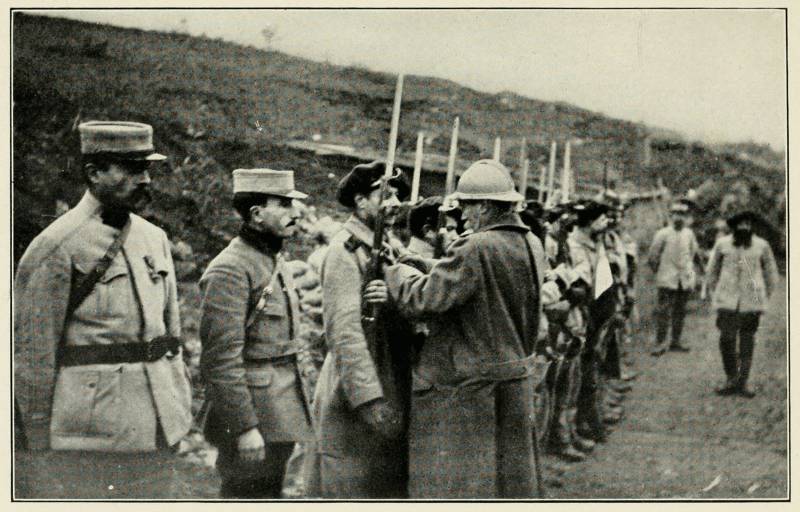
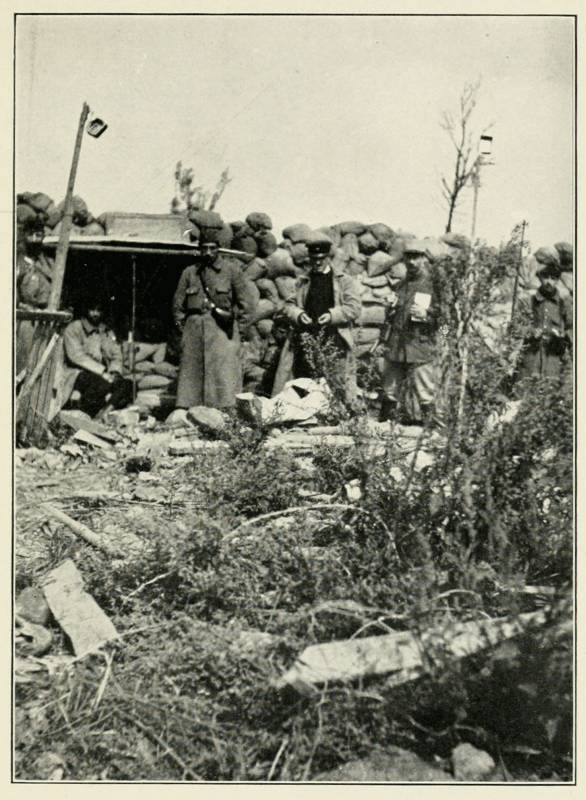
Colonel Geney awarding "Croix de guerre" to blue devils of Captain Gunther, on the battlefield.
"That's a go!"
We are absorbed in the game—and, with the log
fire to keep us warm, I forget everything: the war,
hardships, and at the same time, I must confess, all
that I love——
THE PRACTICAL POILU, EPARGES.
January, 1916.
This episode took place at l'Eperon-des-Mitrailleuses,
which is balder than the head of our friend
Mollinié. Tons of explosives in the last few months,
have been dropped on this little sector, and the pretty
wood which runs down each side of the hill has completely
disappeared. Underground, two long galleries
of about 125 yards each are being dug to intercept
the enemy. Again we find ourselves on ground where
mining warfare progresses. The length of these galleries
renders the work extremely difficult; the air
there is bad and at the end of the tunnel our sappers
can only work for a few hours.
The installation of electric lights and ventilators
betters, from day to day, living conditions which exist
in these villainous holes.
These latter also occasion a visit from the Colonel
of Engineers, who, on a certain night, comes to inspect
the improvements. He always has a kind word for
everyone.
Arriving at the end of the gallery, he questions the
brave poilu, who, in the presence of his colonel works
with an exaggerated rapidity.
"You ought to be very grateful to your lieutenant
who furnishes you with light and air."
"Yes, colonel, but I prefer pinard!"
THE LOGICAL POILU, CHEVALIERS WOOD.
January, 1916.
Chevaliers Wood appears to be at the extreme ends
of the earth, so much so that one feels far away from
everything down there. The cold is dry and piercing.
Pretty, white smoke rises from the shelters, in which
are burning bright log fires. The ground, on the
outside, is covered with snow.
I am going back to the trenches, having at my side
a little blue devil. The poilu is leading a mule, a nice,
gentle mule, carrying ammunition to a machine-gun
section.
We passed at the side of a 75 battery, so well
camouflée that we had not seen it. We are just even
with it when it begins to fire.
The mule makes a jump and I see the moment when
our little chasseur is going to be spilled on the ground.
He recovers his balance and, furious, plants himself
before the animal.
"Nom de Dieu, don't you know our 75's?"
TRAGIC COINCIDENCE, EPARGES.
January, 1916.
I have spent several days at Berne on vacation.
Some hours before my departure I went into a shop
to buy a cold luncheon to take on the train.
Near the shop-door two elderly women were talking
in a low voice. At the moment I went out, passing
close to them, I overheard the word "Eparges." I
stopped short.
"Pardon, madame, well have you said 'Eparges'—I
come from there and I return! In two days I shall
be there and it startled me to hear the name pronounced
so far from that spot that I will never forget
it!
"Perhaps you know someone there? Tell me, I
will go and see him for you——"
"My son, Charles, is at Eparges—his name is
Charles Dubois. He is in the 9th Engineers——"
"Under orders from Captain Grenet, my friend; he
is a sapper-miner——"
"Yes, Charles is a corporal in his company."
"Upon my arrival at Eparges, I promise you,
madame, that I will find your son. He will be very
happy when I tell him that I saw his mother at the
precise moment she was thinking of him——"
On the road, in the auto, which is taking me to
Mesnil-sur-les-Côtes, I think of Charles Dubois, whom
I shall easily find at the end of my journey.
I will not go to bed in the shelter, without having
seen him—God knows, however, what fatigue the last
step will bring——
Alone on foot, I will make the hard trip the length
of Longeau, a brook, which was torn up enough in 1914
and the beginning of 1915.
During supper tête à tête with Captain Gunther,
who welcomed me heartily on my return, I am haunted
by the memory of two old ladies——
"What happened in my absence?"
"Nothing in particular, except this morning. We
had five men buried by a camouflet—they began at
once to recover the bodies. All were killed——"
"I am going above to-night, with your permission——"
"You must go to bed—you look very tired!"
"I have promised a woman to see her son——"
"I will accompany you."
Some moments later, we began the trip, so laborious
at night, almost to the crest of Eparges.
At first the long path—what irony!—the length of
which was found the shelters of our sappers and from
which came at one time or another, sounds of voices.
Then we passed Sap 13, where was heard the purring
of the electric generator and the compressor.
Farther on is the first-aid station, where a moment
never goes by without finding wounded there——
Then it is the P. C. of the colonel, where there is
always a great bustle, and where one must say to the
poilu,
"Out of the way, mon petit, let me pass."
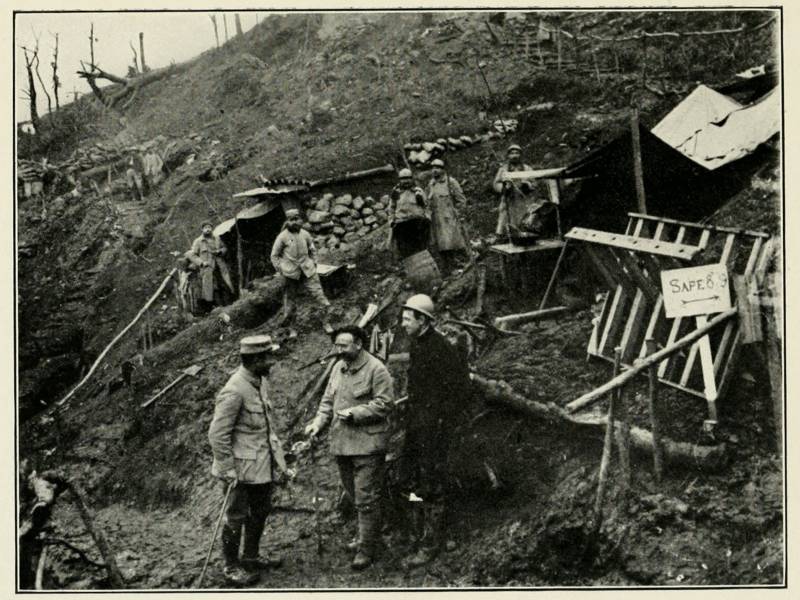
Eparges, The "Ravine of Death"
From left to right: Lieutenant Blanc, Captain Gunther, Sub-Lieutenant Capart.
Finally, the subterranean passage about sixty
feet in length, and we come out in a spot not so dark:
Woevre plain is down there. We turn to the right.
It is the "Ravine of Death," where trees mutilated by
projectiles are silhouetted against the night like a
band of witches.
One feels in this place a veritable impression of
horror——
In front, pointing into the starry heavens, the crest
of Eparges——
Laboriously we climb the hill, stopping from time
to time to get our breath. Only a few cannon and
machine guns trouble the calm of the night.
At last we arrive close to Grenet's shelter, where
several men formed a group along the embankment.
I called one of his sergeants whom I already knew.
"Do you know Charles Dubois?"
"Yes, lieutenant. You heard then that we recovered
his body?"
"He has been killed——?"
"This morning——"
"Where is he?"
The poilu turned—I saw a stretcher, a shapeless
mass covered with a blanket, two heavy shoes which
stuck out, shrouded with red soil——
It is night. I gently lift the blanket and scarcely
recognize the contour of his face——
I can hear the voice of an old woman, who says to
another:
"Charles is at Eparges; I am so uneasy."
THE COMMERCIAL BAR, EPARGES.
January, 1916.
Bombing duels all morning——
We have gone to pay a visit to Major X—— at
his fighting dugout; the major never worries about
anything——
"Ah! how good of you to come—let me offer you
a drink: some Turin, whisky and soda, Pernod, or
Cassis—which do you want? You will remain and have
lunch with me? I have a live lobster"—he brandished
that animal triumphantly—"and, with that, grilled
lamb chops, potatoes, pont-neuf."
Turning toward the telephone operator and without
waiting for our reply, he said:
"Waiter, set two covers more!"
FATE, EPARGES.
January, 1916.
"Mamma! your ears are tingling to-day——"
I left Colonel Moran's shelter and directed my steps
toward our own, following the board path. I walked
with difficulty because the terrain was bad. On my
right the mud was so deep that one could not step
out into it without sinking up to the hips!
The boches commenced to shell us with 150's. The
first shot fell between Montgirmont and Eparges, in
plain view, 75 to 125 yards from me. The second burst
125 yards to the left, back of our little board chapel,
raising a great fuss.
The third hit ten feet from me—whack! It did not
explode, but splattered me from head to foot—I
couldn't be picked up with pincers!
"Mamma! your ears are tingling to-day."
THE COLONEL WHO LOVES GOOD MUSIC, EPARGES.
January, 1916.
Bombardment all morning—the hill trembles——
I am lunching with Colonel X——, an immense Corsican,
who never knows what fear is——
The meal is, ma foi, very good and very lively. A
big boche torpedo burst not far away——
"Tell me of Verdi's music instead of this German
melody outside. I'm a lover of the arts!"
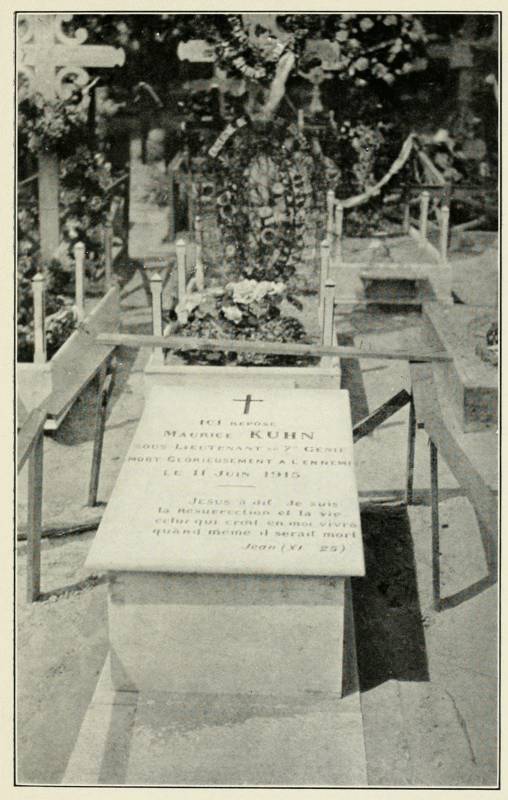
EPARGES CEMETERY.
January, 1916.
Eparges Cemetery with its symmetrically aligned
graves is touching. The Bavarians bombard it systematically,
their hearts set upon destroying it, and
the shells churn these sacred little plots from top to
bottom——
The poilus, on the board path, shake their heads and
say:
"There! again they're murdering our dead."
LOST IN THE DARK, CALONNE TRENCH.
January, 1916.
Night black—night without moon—rifle shots resound
like in a cave—we can't see more than a yard
in front of us. My friend and I must rejoin a squad
of poilus at work.
We have taken a short cut and stumble into shell-holes.
We bump into tree stumps—climb hills. Yes,
we are lost. We retrace our steps—tired and hungry.
We fall against something—it's a mound! I flash
my electric torch on it, masking the glare with the
flat of my hand. It's a grave! There is a small wooden
cross on which is written: "Here lies an unknown
soldier."
LeBlond and myself gave a sigh of relief:
"We are at the 'Grave of the Apple Trees,' which is
to the right in the direction of the cross; we are on
the proper path—Thanks, poor old chap——"
THE FIRST TRAIN, EPARGES.
January, 1916.
The narrow gauge track has been finished—the first
train is due to arrive to-night. Captain Gunther has
put Ménard's Prince Albert over his uniform, and,
with a little red flag, a horn and a lantern, has gone
to await the arrival of the convoy. One hour, two
hours pass!
The train did not come—it has been derailed near
Trésauvaux. We learned later that the track had been
torn up by shells.
"Ah! these Government railroads—they never run."
HERMAN AND HIS CANTEEN, EPARGES.
January, 1916.
For some months we have seen this corpse in front
of us—fifty yards away—In the rain, snow, cold, we
have noticed it change its position several times——
Herman, the "pretty German officer," was often the
subject of discussion: for he must have on him shiny
brass buttons to decorate our cigarette lighters
and our cartridge boxes—his boots could no longer be
any good, because around him there must have been
a nice bed of mushrooms!
A change in the line brought us close to Herman.
The first patrol which went out crouched over to
him——
Quickly one cut the buttons from his tunic——
"Wait," said one of the men, "he's still got his
canteen!"
A poilu easily detached it, then shook it close
to his ear—the canteen was yet half full!——
He unscrewed the cover—he sniffed it. It was
brandy!
In a low voice, he said to the others:
"Eh! les vieux, it's brandy!"
Tossing off a drink, he passed Herman's canteen to
his neighbor——
I DISCOVER A COUSIN, EPARGES.
January, 1916.
It is two o'clock in the morning—all the men have
retired. I have just returned from Calonne Trench
and am very tired on entering our shelter. A man—with
a sheepskin thrown over his uniform like a cape—is
waiting for me in the outer room. He is seated near
the smouldering fire. He rises quickly.
"Good morning, cousin——"
"What, you here!—Speak low because the others
sleep."
"Yes, I learned that you were at Eparges, and obtained
permission to come and see you before going into
the trenches."
"What are you doing?"
"Back of the lines I'm a color bearer, here, I am just
like the others. Very soon we are going to occupy the
craters."
"Keep your eyes open, mon petit, and don't forget
that in this damned sector you must have sang-froid
and presence of mind if you want to get out of it
alive. You must save from tears some pretty pair of
eyes—a handsome young man like yourself certainly
has a sweetheart!"
He blushed to the roots of his hair.
"I'm not ashamed of that. If I survive this only
the love of a woman can bring happiness hereafter."
He hastily drew a picture out of his wallet.
"Look, cousin, how beautiful she is—I adore her!"
Two hours later a bullet penetrated his thigh while
he was in 0 crater.
Now he is in a little white bed and in a few weeks
he will be able to see her again——
THE ONE WHO READS PLUTARCH.
January, 1916.
While looking over the first line of Calonne Trench,
I found a poilu, seated on the ground, reading.
"What is that you are reading?" I questioned.
"A translation of Plutarch."
"It's all right to read history, my friend, but you
are doing better—you are making greater history yourself—Read
on!"
MAJOR ANTHOINE'S CANDLE, MONT-SUR-LES-CÔTES.
February, 1916.
Ah! What a brave man this Major Anthoine—we
are to dine with him to-night.
When we arrived we found him bent over his map
as usual—magnifying glass in hand, he followed, hour
by hour, this war of mines, this underground struggle,
so bitter at Eparges. The dinner was more than perfect
as it always was.
As we were about to leave, he commenced to undress
and with a lighted candle in hand and half-clothed,
he conducts us to our machine.
The boches have seen the candle and without delay
a 77 comes whistling over loudly, bursting on an empty
house in the village. The major held up his candlestick
for them to see, then extinguished it, saying:
"Snuff it out!"
In reply the boches sent over, one after the other,
three 77's which did no more damage than the first.
"You see, it was hardly worth four to put that
damn' thing out!"
DISCOVERED, ORNES.
February, 1916.
To-night a patrol discovered a corpse between the
trenches. It was a very young boche soldier, almost
a child. They brought the body into our lines.
Upon searching him, they found some papers—I was
near the commander of Ornes, when an officer approached
with them.
In a leather case there was a letter written on very
plain paper.
"Can you read German, Capart?"
"Yes——"
"Read, then——"
Slowly I read a simple letter from a mother to her
child.
"Your young brother Louis is not discreet, so we
must tell him he cannot see you on your next vacation.
The work at Ruhr is very hard now and everyone complains.
We need many things badly, and, above all,
miss you—When is it all going to be over?"
"Stop!" said the major. "They brought on this
war. They suffer? So much the better!"
"It is up to us now to kill these wolves and their
young—and here's one. Get every one you can, men!
Let the she-wolves howl in anguish!"