The twofold character of Hawthorne's mind is
strongly manifested in the diverse nature of the interests
which occupied him in Europe, and the tone
with which he discussed them, alike in his journals, in
his letters, in "Our Old Home," and "The Marble
Faun." On the one side, we find the business-like
official, attending methodically to the duties of his
place, the careful father of a family looking out for
his personal interests and the material welfare of his
children in the future, the keen and cool-headed observer
who is determined to contemplate all the novelties
of strange scenes through no one's eyes but his
own. On the other side, he presents himself to us as
the man of reverie, whose observation of the actual
constantly stimulates and brings into play a faculty
that perceives more than the actual; the delicate artist,
whose sympathies are ready and true in the appreciation
of whatever is picturesque or suggestive, or
beautiful, whether in nature or in art.
Some of the letters which he wrote from Liverpool
to his classmate, Horatio Bridge, throw light upon his
own affairs and the deliberate way in which he considered
them. For instance, under date of March 30,
1854, he wrote:—
"I like my office well enough, but my official duties
and obligations are irksome to me beyond expression.
Nevertheless, the emoluments will be a sufficient
inducement to keep me here for four years, though
they are not a quarter part what people suppose them.
The value of the office varied between ten and fifteen
thousand dollars during my predecessor's term, and it
promises about the same now. Secretary Guthrie,
however, has just cut off a large slice, by a circular....
Ask —— to show you a letter of mine, which I
send by this steamer, for possible publication in the
newspapers. It contains a statement of my doings in
reference to the San Francisco [steamship] sufferers.
The "Portsmouth Journal," it appears, published an
attack on me, accusing me of refusing all assistance
until compelled to act by Mr. Buchanan's orders;
whereas I acted extra-officially on my own responsibility,
throughout the whole affair. Buchanan refused
to have anything to do with it. Alas! How we public
men are calumniated. But I trust there will be
no necessity for publishing my letter; for I desire
only to glide noiselessly through my present phase of
life.
"It sickens me to look back to America. I am sick
to death of the continual fuss and tumult, and excitement
and bad blood, which we keep up about political
topics. If it were not for my children, I should probably
never return, but, after quitting office, should
go to Italy, to live and die there. If you and Mrs.
Bridge would go, too, we might form a little colony
amongst ourselves, and see our children grow up together.
But it will never do to deprive them of their
native land, which, I hope, will be a more comfortable
and happy residence in their day than it has been in
ours. In my opinion we are the most miserable people
on earth." It appears, further, that the appointment
of a consul for Manchester was contemplated,
which, Hawthorne says, by withdrawing some of the
Liverpool perquisites, "would go far towards knocking
this consulate in the head."
On April 17th, hearing that a bill had been introduced
in Congress to put consuls upon salary, instead
of granting them fees, he wrote:—
"I trust to Heaven no change whatever will be made
in regard to the emoluments of the Liverpool consulate,
unless indeed a salary is to be given in addition
to the fees, in which case I should receive it very thankfully.
This, however, is not to be expected.... A
fixed salary (even if it should be larger than any salary
now paid by government, with the exception of the
President's own) will render the office not worth any
man's holding. It is impossible (especially for a man
with a family and keeping any kind of an establishment)
not to spend a vast deal of money here. The
office, unfortunately, is regarded as one of great dignity,
and puts the holder on a level with the highest
society, and compels him to associate on equal terms
with men who spend more than my whole income on
the mere entertainments and other trimmings and embroideries
of their lives. Then I am bound to exercise
some hospitality toward my own countrymen. I
keep out of society as much as I decently can, and
really practise as stern an economy as ever I did in
my life; but nevertheless I have spent many thousands
of dollars in the few months of my residence here,
and cannot reasonably hope to spend less than $6,000
per annum, even after the expense of setting up an establishment
is defrayed. All this is for the merely
indispensable part of my living; and unless I make a
hermit of myself and deprive my wife and children of
all the pleasures and advantages of an English residence,
I must inevitably exceed the sum named above....
It would be the easiest thing in the world for me
to run in debt, even taking my income at $15,000"
(out of which all the clerks and certain other
office expenses had to be paid), ... "the largest sum
that it ever reached in Crittenden's time. He had no
family but a wife, and lived constantly at a boarding-house,
and, nevertheless, went away (as he assured me)
with an aggregate of only $25,000 derived from his
savings.
"Now the American public can never be made to
understand such a statement as the above; and they
would grumble awfully if more than $6,000 per annum
were allowed for a consul's salary." But Hawthorne
concludes that it would not compensate him to retain
the place with a salary even of $10,000; and that if the
emoluments should be reduced from their then proportions,
"the incumbent must be compelled to turn his
official position to account by engaging in commerce—a
course which ought not to be permitted, and which
no Liverpool consul has ever adopted."
There are some references to President Pierce, in
the Bridge correspondence, which possess exceptional
interest; but I cite only one of them. The great honor
of the immense publicity into which Pierce had come
as the executive head of the nation, and the centre
upon which many conflicting movements and machinations
turned, created a danger of misunderstandings
with some of his early and intimate friends. In discussing
one such case Hawthorne writes (May 1, 1854),
with regard to maintaining a friendship for the President:—
"You will say that it is easy for me to feel thus
towards him, since he has done his very best on my
behalf; but the truth is (alas for poor human nature!)
I should probably have loved him better if I had never
received any favor at his hands. But all this will
come right again, after both he and I shall have returned
into private life. It is some satisfaction, at
any rate, that no one of his appointments was so favorably
criticized as my own; and he should have my
resignation by the very next mail, if it would really
do him any good."
Mr. Pike, who still held a post in the Salem Custom
House, had written to Hawthorne not long after his
arrival in England, inquiring about the prospect of obtaining
some employment in the consular service there;
and Hawthorne replied, in a manner that leaves no
doubt of his sagacity in perceiving the exact situation
of affairs, with its bearings for both Pike and himself,
nor of his determination neither to deceive himself
nor to give his friend any but the real reasons why he
discouraged the inquiry.
"Liverpool, September 15, 1853.
Dear Pike,—I have been intending to write to
you this some time, but wished to get some tolerably
clear idea of the state of things here before communicating
with you. I find that I have three persons
in my office: the head-clerk, or vice-consul, at £200,
the second clerk at £150, and the messenger, who does
some writing, at £80. They are all honest and capable
men, and do their duty to perfection. No American
would take either of these places for twice the sums
which they receive; and no American, without some
months' practice, would undertake the duty. Of the
two I would rather displace the vice-consul than the
second clerk, who does a great amount of labor, and
has a remarkable variety of talent,—whereas the old
gentleman, though perfect in his own track, is nothing
outside of it. I will not part with either of these men
unless compelled to do so; and I don't think Secretary
Marcy can compel me.
Now as to the Manchester branch, it brings me in
only about £200. There is a consular agent there,
all the business being transacted here in Liverpool.
The only reason for appointing an agent would be
that it might shut off all attempts to get a separate
consulate there. There is no danger, I presume, of
such an attempt for some time to come; for Pierce
made a direct promise that the place should be kept
open for my benefit. Nevertheless efforts will be made
to fill it, and very possibly representations may be
made from the business men of Manchester that there
is necessity for a consul there. In a pecuniary point
of view, it would make very little difference to me
whether the place were filled by an independent consul
or by a vice-consul of my own appointment, for the
latter would of course not be satisfied with less than
the whole £200. What I should like would be to
keep the place vacant and receive the proceeds as long
as possible, and at last, when I could do no better, to
give the office to you. No great generosity in that to
be sure. Thus I have put the matter fairly before
you. Do you tell me as frankly how your own affairs
stand, and whether you can live any longer in that
cursed old Custom House without hanging yourself.
Rather than that you should do so I would let you have
the place to-morrow, although it would pay you about
£100 less than your present office. I suppose as a
single man you might live within your income in Manchester;
but judging from my own experience as a
married man, it would be a very tight fit. With all
the economy I could use I have already got rid of $2,000
since landing in England. Hereafter I hope to spend
less and save more.
In point of emolument, my office will turn out about
what I expected. If I have ordinary luck I shall bag
from $5,000 to $7,000 clear per annum: but to effect
this I shall have to deny myself many things which I
would gladly have. Colonel Crittenden told me that
it cost him $4,000 to live with only his wife at a boarding-house,
including a journey to London now and
then. I am determined not to spend more than this,
keeping house with my wife and children. I have
hired a good house furnished at £160, on the other
side of the River Mersey, at Rock Park, where there
is good air and play-ground for the children; and I can
come over to the city by steamboat every morning. I
like the situation all the better because it will render
it impossible for me to go to parties, or to give parties
myself, and will keep me out of a good deal of nonsense.
Liverpool is the most detestable place as a residence
that ever my lot was cast in,—smoky, noisy, dirty,
pestilential; and the consulate is situated in the most
detestable part of the city. The streets swarm with
beggars by day and by night. You never saw the like;
and I pray that you may never see it in America. It
is worth while coming across the sea in order to feel
one's heart warm towards his own country; and I feel
it all the more because it is plain to be seen that a
great many of the Englishmen whom I meet here dislike
us, whatever they may pretend to the contrary.
My family and myself have suffered very much from
the elements; there has not been what we should call
a fair day since our arrival, nor a single day when a
fire would not be agreeable. I long for one of our
sunny days, and one of our good hearty rains. It always
threatens to rain, but seldom rains in good earnest.
It never does rain, and it never don't rain; but
you are pretty sure to get a sprinkling if you go out
without an umbrella. Except by the fireside, I have
not once been as warm as I should like to be: but the
Englishmen call it a sultry day whenever the thermometer
rises above 60°. There has not been heat
enough in England this season to ripen an apple.
My wife and children often talk of you. Even the
baby has not forgotten you. Write often, and say as
much as you can about yourself, and as little as you
please about A——, N——, and B——, and all the
rest of those wretches of whom my soul was weary to
death before I made my escape.
Your friend ever,
Nath. Hawthorne."
Writing to Bridge again, November 28, 1854, he
continues, with regard to his consular prospects, by a
comparison between the pay received by English consuls
and that allowed by the new bill to Americans.
Only $7,500 were to be paid the consul at Liverpool.
"Now I employ three clerks constantly," says Hawthorne
"and sometimes more. The bill provides that
these clerks should be Americans; and the whole sum
allowed would not do much more than pay competent
Americans, whose salaries must be much higher than
would content Englishmen of equal qualifications.
No consul can keep the office at this rate, without engaging
in business—which the bill forbids." He
adds that the notion that, by the proposed measure, a
fund would be gained from the larger consulates
towards paying the salaries of the smaller ones, was
mistaken, since "a large part of the income of this
consulate arises from business which might just as
well be transacted by a notary public as by a consul,
and which a consul is therefore not officially bound to
do. All such business as this the consul will cease to
transact, the moment the avails of it go into the public
treasury, instead of his own purse; and thus there
will be an immediate falling off of the office to a very
considerable extent."
Later on, he says: "I should really be ashamed
to tell you how much my income is taxed by the assistance
which I find it absolutely necessary to render
to American citizens, who come to me in difficulty or
distress. Every day there is some new claimant, for
whom the government makes no provision, and whom
the consul must assist, if at all, out of his own pocket.
It is impossible (or at any rate very disagreeable) to
leave a countryman to starve in the streets, or to hand
him over to the charities of an English work-house;
so I do my best for these poor devils. But I doubt
whether they will meet with quite so good treatment
after the passage of the consular bill. If the government
chooses to starve the consul, a good many will
starve with him."
The bill, nevertheless, was passed. Lieutenant
Bridge, who was then stationed at Washington, had
done all that he could to rouse an effectual opposition
to its enactment; and his friend wrote to him from
Liverpool (March 23, 1855) thus:—
"I thank you for your efforts against this bill; but
Providence is wiser than we are, and doubtless it will
all turn out for the best. All through my life, I have
had occasion to observe that what seemed to be misfortunes
have proved, in the end, to be the best things
that could possibly have happened to me; and so it
will be with this—even though the mode in which it
benefits me may never be made clear to my apprehension.
It would seem to be a desirable thing enough
that I should have had a sufficient income to live
comfortably upon for the rest of my life, without the
necessity of labor; but, on the other hand, I might
have sunk prematurely into intellectual sluggishness—which
now there will be no danger of my doing;
though with a house and land of my own, and a good
little sum at interest besides, I need not be under any
very great anxiety about the future. When I contrast
my present situation with what it was five years ago, I
see a vast deal to be thankful for; and I still hope to
thrive by my legitimate instrument—the pen. One
consideration which goes very far towards reconciling
me to quitting the office is my wife's health, with
which the climate of England does not agree.... In
short, we have wholly ceased to regret the action of
Congress (which, nevertheless, was most unjust and
absurd), and are looking at matters on the bright side.
However, I shall be glad to get what advantage I can
out of the office, and therefore I hope Pierce will give
me as long a line as his conscience will let him."
Believing that the office of consul with a salary reduced
to $7,500, which was only half the sum it had
previously yielded in good years, would not be worth
the sacrifice involved in giving himself up to its
duties, he purposed resigning within a few months,
taking a trip to Italy, and then going home. But, fortunately
for his pecuniary welfare, the act of Congress
had been so loosely framed (in harmony with the general
ignorance on which it was based), that it was left
to the President to reappoint old incumbents under
the new system or not, as he pleased. Pierce accordingly
let Hawthorne's commission run on without interruption,
and the consul stayed through the rest of
the administration's term.
While the matter was still in abeyance, however,
the suggestion came from Bridge that he allow himself
to be transferred to Lisbon as minister. The prospect
was, in one way, seductive. Hawthorne was growing
anxious about his wife's health, and felt that nothing
could be more delightful than to take her to a warmer
climate, which she needed, and thus avoid the temporary
separation which might have to be undergone if
he remained at Liverpool. The objections were, that
he had no acquaintance with diplomacy, did not know
Portuguese, and disliked forms and ceremonies. "You
will observe," he wrote, "that the higher rank and
position of a minister, as compared with a consul, have
no weight with me. This is not the kind of honor of
which I am ambitious." With a good deal of hesitation
he came to the belief that it would be wise for
him not to make the change. "But," he remarked, "it
was a most kind and generous thing on the part of the
President to entertain the idea." His friend, Mr. John
O'Sullivan, who had been the founder and editor of the
"Democratic Review," to which Hawthorne had contributed
copiously during his residence at the Manse,
was at this time accredited to the Court of Lisbon,
and would doubtless have been provided for in some
other way had Hawthorne been promoted to the place.
The latter decided to stay at Liverpool, but to send
Mrs. Hawthorne to Lisbon, where she would find not
only milder air, but also friends in the minister and
his wife. She sailed with her daughters in October,
1855, and returned in the following June.
Wearisome as the details of his office duty were to
him, Hawthorne gave them more than a perfunctory
attention. He became greatly aroused by the wrongs
and cruelties endured by sailors on the high seas, and
sent a long despatch on that subject to the Secretary
of State, suggesting action for their relief. He even
investigated such minutiæ as the candles used in the
British navy, and sent samples of them to Bridge,
thinking that it might be desirable to compare them
with those in use on American war-ships. Opportunities,
however, had occurred for several trips in various
directions, to Wales, Furness Abbey, and the
Lakes. London was visited just before Mrs. Hawthorne
sailed; and during her absence he again went to
the capital, and made a tour which included Glasgow,
Edinburgh, York, Newcastle, and Salisbury. A few
days before her expected return, he said in a letter to
Bridge that unless she should prove to be perfectly
free from the cough which had troubled her, "I shall
make arrangements to give up the consulate in the
latter part of autumn, and we will be off for Italy. I
wish I were a little richer; but when I compare my
situation with what it was before I wrote 'The Scarlet
Letter,' I have reason to be satisfied with my run
of luck. And, to say the truth, I had rather not be
too prosperous: it may be a superstition, but it seems
to me that the bitter is very apt to come with the
sweet, and bright sunshine casts a dark shadow; so I
content myself with a moderate portion of sugar, and
about as much sunshine as that of an English summer's
day. In this view of the matter, I am disposed
to thank God for the gloom and chill of my early
life, in the hope that my share of adversity came then,
when I bore it alone; and that therefore it need not
come now, when the cloud would involve those whom
I love.
"I make my plans to return to America in about
two years from this time. For my own part, I should
be willing to stay abroad much longer, and perhaps
even to settle in Italy; but the children must not be
kept away so long as to lose their American characteristics;
otherwise they will be exiles and outcasts
through life."
The presidential convention of the democratic party
was held early in the summer of 1856, and Buchanan,
then minister at the Court of St. James, became the
candidate. Pierce had also been in the field, but was
defeated, and concerning this circumstance Hawthorne
wrote, characteristically: "I am sorry Frank has not
the nomination, if he wished it. Otherwise, I am glad
he is out of the scrape."
During the earlier part of his consulship, Hawthorne
leased a pleasant dwelling at Rock Ferry, on
the opposite side of the Mersey from Liverpool, where
he was able to live without going much into society;
and while Mrs. Hawthorne was in Portugal, he occupied
simple quarters at a boarding-house. Afterwards
he settled at Southport for a number of months, in a
furnished house. He formed but one intimate friendship,
that which attached him to Mr. Henry Bright, a
gentleman engaged in business, but gifted with a quick
and sympathetic mind and a taste for literature. In
London his chief friend was Mr. Francis Bennoch,
also a merchant, who consorted much with people of
creative genius, and delighted to gather them at his
table, where they were entertained with a cordial and
charming hospitality. Mr. Bright and Mr. Bennoch
have each published a book since then; but although
Hawthorne met many persons eminent in literature,
and enjoyed meeting them, it was not with any of their
number that he formed the closest ties.
With relief he heard in April, 1857, that his resignation
had been accepted. "Dear Bridge," he wrote,
"I have received your letter, and the not unwelcome
intelligence that there is another Liverpool consul now
in existence.... I am going to Paris in a day or two,
with my wife and children, and shall leave them there
while I return here to await my successor." He then
thanked Bridge for a newspaper paragraph which the
latter had caused to be printed, explaining Hawthorne's
position in resigning. "I was somewhat apprehensive
that my resignation would have been misunderstood,"
he proceeded, "in consequence of a letter of General
Cass to Lord Napier, in which he intimated that any
consul found delinquent in certain matters should be
compelled to retire.... But for your paragraph, I
should have thought it necessary to enlighten the public
on the true state of the case as regards the treatment
of seamen on our merchant vessels, and I do not
know but I may do it yet; in which case I shall prove
that General Cass made a most deplorable mistake in
the above-mentioned letter to Lord Napier. I shall
send the despatch to Ticknor, at any rate, for publication
if necessary. I expect great pleasure during my
stay on the Continent, and shall come home at last
somewhat reluctantly. Your pledge on my behalf of
a book shall be honored in good time, if God pleases."
The intention of taking his family at once to Paris
was given up, and instead Hawthorne went with them
to Manchester, the Lakes, and Scotland, and made a
pilgrimage to Warwick and Coventry, besides visiting
many other places. The new consul, however, postponed
his coming until near the end of 1857. Not
before January, 1858, did Hawthorne break away from
the fascinations of England and cross to the Continent.
When, after spending more than a year and a half in
Italy, he again set foot in England, it was to establish
himself at Redcar, a sea-side town in Yorkshire, where
he finished "The Marble Faun" in October, 1859;
and thence he betook himself to Leamington, which
had greatly pleased him on a previous visit. Here his
old friend, Mr. Hillard, called upon him; and in an
article printed in the "Atlantic Monthly," in 1870, he
says: "The writer of this notice, who confesses to an
insatiable passion for the possession of books, and an
omnivorous appetite for their contents, was invited by
him into his study, the invitation being accompanied
with one of his peculiar and indescribable smiles, in
which there lurked a consciousness of his (the writer's)
weakness. The study was a small square room, with a
table and chair, but absolutely not a single book. He
liked writing better than reading." Mr. Hillard's
implication, however, is a misleading one. "Hawthorne,"
says Mr. Fields, "was a hearty devourer of
books, and in certain moods of mind it made very little
difference what the volume before him happened to
be.... He once told me that he found such delight
in old advertisements in the newspaper files at the
Boston Athenæum, that he had passed delicious hours
among them. At other times he was very fastidious,
and threw aside book after book, until he found the
right one. De Quincey was a favorite with him, and
the sermons of Laurence Sterne he once commended
to me as the best sermons ever written." His correspondence
was not "literary," to be sure; but in his
letters to Mr. Fields, who had to do so especially with
books, occasional references to literature escape him,
which did not ordinarily find their way into his letters
to other people. From England, in 1854, he wrote to
that gentleman: "I thank you for the books you sent
me, and more especially for Mrs. Mowatt's 'Autobiography,'
which seems to me an admirable book. Of
all things I delight in autobiographies; and I hardly
ever read one that interested me so much." He did
not read for erudition or for criticism, but he certainly
read much, and books were companions to him. I
have seen several catalogues of libraries which Hawthorne
had marked carefully, proving that, although
he made no annotations, he had studied the titles with
a natural reader's loving fondness. His stay at Leamington
was but a brief one, and for that reason he
may well have been without books in his study at the
moment; he never crowded them about himself, in the
rooms where he worked, but his tower-study at The
Wayside always contained a few volumes, and a few
small pictures and ornaments—enough to relieve his
eye or suggest a refreshment to his mind, without distracting
him from composition or weakening the absorbed
intensity of his thought.
The only approach to literary exertion made at Liverpool
seems to have been the revision of the "Mosses
from an Old Manse," for a reissue at the hands of
Ticknor & Fields; employment which led to some reflections
upon his own earlier works.
"I am very glad that the 'Mosses' have come into
the hands of our firm; and I return the copy sent me,
after a careful revision. When I wrote those dreamy
sketches, I little thought I should ever preface an
edition for the press amid the bustling life of a Liverpool
consulate. Upon my honor, I am not quite sure
that I entirely comprehend my own meaning, in some
of those blasted allegories; but I remember that I always
had a meaning, or at least thought I had. I am
a good deal changed since those times; and, to tell
you the truth, my past self is not very much to my
taste, as I see myself in this book. Yet certainly there
is more in it than the public generally gave me credit
for at the time it was written.
"But I don't think myself worthy of very much
more credit than I got. It has been a very disagreeable
task to read the book."
He was inveigled, however, into giving encouragement
to that unfortunate woman, Miss Delia Bacon,
who was engaged in the task of proving that Lord
Bacon wrote Shakespeare's plays. He corresponded
with her on the subject, and finally agreed, although
not assenting to her theory, to write a preface for her
book, which he did. She was dissatisfied because he
did not accept her views entirely, grew very angry, and
even broke off all relations with him, notwithstanding
that he had paid the expenses of publication for her.
Arriving at Rome in February, 1858, Hawthorne
lingered there until late in May, when he retired to
Florence, and hired there the Villa Montauto, in the
suburb of Bellosguardo. October found him again
in Rome, where he spent the winter; leaving the
Continent, finally, in June, 1859, for England and
Redcar.
"I am afraid I have stayed away too long," he
wrote from Bellosguardo, to Mr. Fields, in September,
1858, "and am forgotten by everybody. You have
piled up the dusty remnants of my editions, I suppose,
in that chamber over the shop, where you once
took me to smoke a cigar, and have crossed my name
out of your list of authors, without so much as asking
whether I am dead or alive. But I like it well enough,
nevertheless. It is pleasant to feel that at last I am
away from America,—a satisfaction that I never enjoyed
as long as I stayed in Liverpool, where it seemed
to me that the quintessence of nasal and hand-shaking
Yankeedom was continually filtered and sublimated
through my consulate, on the way outward and homeward.
I first got acquainted with my own countrymen
there. At Rome, too, it was not much better.
But here in Florence, and in the summer-time, and in
this secluded villa, I have escaped from all my old
tracks and am really remote.
"I like my present residence immensely. The
house stands on a hill, overlooking Florence, and is
big enough to quarter a regiment; insomuch that
each member of the family, including servants, has a
separate suite of apartments, and there are vast wildernesses
of upper rooms, into which we have never
yet sent exploring expeditions.
"At one end of the house there is a moss-grown
tower haunted by the ghost of a monk, who was confined
there in the thirteenth century, previous to being
burned at the stake in the principal square of Florence.
I hire this villa, tower and all, at twenty-eight dollars
a month; but I mean to take it away bodily and clap
it into a romance which I have in my head ready to be
written out." Turning to the topic of home, he went
on: "After so long an absence (more than five years
already, which will be six before you see me at the
Old Corner), it is not altogether delightful to think of
returning. Everybody will be changed, and I, myself,
no doubt, as much as anybody.... It won't do. I
shall be forced to come back again and take refuge in
a London lodging. London is like the grave in one
respect,—any man can make himself at home there;
and whenever a man finds himself homeless elsewhere,
he had better either die or go to London.
"Speaking of the grave reminds me of old age and
other disagreeable matters, and I would remark that
one grows old in Italy twice or three times as fast as
in other countries. I have three gray hairs now for
one that I brought from England, and I shall look
venerable indeed by the time I return next summer."
The "French and Italian Note-Books" are more
prolific in literary hints than the English. At Rome
and Florence the practical self, which was necessarily
brought forward in the daily round at the consulate and
left its impress on the letters to Lieutenant Bridge, retired
into the background under the influence of scenes
more purely picturesque and poetic than those of England;
and the idealizing, imaginative faculty of Hawthorne,
being freed from the restraint which had so
long cramped it, gained in elasticity from day to day.
Four years of confinement to business, broken only at
intervals by short episodes of travel, had done no more
than impede the current of fancy; had not dried it,
nor choked the source. Mr. Fields assures us that,
in England, Hawthorne told him he had no less than
five romances in his mind, so well planned that he
could write any one of them at short notice. But it is
significant that, however favorable Italy might be for
drawing out and giving free course to this current, he
could do little there in the way of embodying his conceptions.
He wrote out an extensive first draft of
"The Marble Faun" while moving from place to place
on the actual ground where the story is laid; but the
work itself was written at Redcar, and in the communication
last quoted from he had said: "I find this
Italian atmosphere not favorable to the close toil of
composition, although it is a very good air to dream
in. I must breathe the fogs of old England, or the
east-winds of Massachusetts, in order to put me into
working-trim." Conditions other than physical were
most probably responsible, in part, for this state of
things. Strong as Hawthorne's nature was on the
side of the real, the ideal force within him was so much
more puissant, that when circumstances were all propitious—as
they were in Italy—it obtained too commanding
a sway over him. His dreams, in such case,
would be apt to overcome him, to exist simply for their
own sake instead of being subordinated to his will;
and, in fine, to expend their witchery upon the air, instead
of being imprisoned in the enduring form of a
book. Being compounded in such singular wise of opposing
qualities: the customary, prudential, common
sensible ones, and the wise and visionary ones—the
outward reticence, and (if we may say so) the inward
eloquence—of which we now have a clearer view;
being so compounded, he positively needed something
stern and adverse in his surroundings, it should seem,
both as a satisfaction to the sturdier part of him, and
as a healthful check which, by exciting reaction, would
stimulate his imaginative mood. He must have precisely
the right proportion between these counter influences,
or else creation could not proceed. In the
Salem Custom House and at the Liverpool consulate
there had been too much of the hard commonplace:
instead of serving as a convenient foil to the more expansive
and lightsome tendencies of his genius, it had
weighed them down. But in Italy there was too much
freedom, not enough framework of the severe, the
roughly real and unpicturesque. Hawthorne's intellectual
and poetic nature presents a spectacle somewhat
like that of a granite rock upon which delicate
vines flourish at their best; but he was himself both
rock and vine. The delicate, aspiring tendrils and
the rich leafage of the plant, however, required a particular
combination of soil and climate, in order to
grow well. When he was not hemmed in by the round
of official details, England afforded him that combination
in bounteous measure.
On the publication of "The Marble Faun," the
author's friend, John Lothrop Motley, with whom he
had talked, of the contemplated romance, in Rome,
wrote to him from Walton-on-Thames (March 29,
1860):—
"Everything that you have ever written, I believe,
I have read many times, and I am particularly vain
of having admired 'Sights from a Steeple,' when I
first read it in the Boston 'Token,' several hundred
years ago, when we were both younger than we are
now; of having detected and cherished, at a later day,
an old Apple-Dealer, whom I believe you have unhandsomely
thrust out of your presence now that you
are grown so great. But the 'Romance of Monte
Beni' has the additional charm for me, that it is the
first book of yours that I have read since I had the
privilege of making your personal acquaintance. My
memory goes back at once to those walks (alas, not
too frequent) we used to take along the Tiber, or in
the Campagna ... and it is delightful to get hold of
the book now, and know that it is impossible for you
any longer, after waving your wand as you occasionally
did then, indicating where the treasure was hidden,
to sink it again beyond plummet's sound.
"I admire the book exceedingly.... It is one
which, for the first reading at least, I didn't like to
hear aloud.... If I were composing an article for a
review, of course I should feel obliged to show cause
for my admiration; but I am only obeying an impulse.
Permit me to say, however, that your style seems, if
possible, more perfect than ever.... Believe me, I
don't say to you half what I say behind your back;
and I have said a dozen times that nobody can write
English but you. With regard to the story, which
has been somewhat criticized, I can only say that to
me it is quite satisfactory. I like those shadowy, weird,
fantastic, Hawthornesque shapes flitting through the
golden gloom, which is the atmosphere of the book.
I like the misty way in which the story is indicated
rather than revealed; the outlines are quite definite
enough from the beginning to the end, to those who
have imagination enough to follow you in your airy
flights.... The way in which the two victims dance
through the Carnival on the last day is very striking.
It is like a Greek tragedy in its effect, without being
in the least Greek."
In this last sentence Mr. Motley struck out an apt
distinction; for it is perhaps the foremost characteristic
of Hawthorne as a writer that his fictions possessed
a plastic repose, a perfection of form, which
made them akin to classic models, at the same time
that the spirit was throughout eminently that belonging
to the mystic, capricious, irregular fantasy of the
North.
Hawthorne thus made answer from Bath (April 1,
1860):—
My dear Motley,—You are certainly that Gentle
Reader for whom all my books were exclusively
written. Nobody else (my wife excepted, who speaks
so near me that I cannot tell her voice from my own)
has ever said exactly what I love to hear. It is most
satisfactory to be hit upon the raw, to be shot straight
through the heart. It is not the quantity of your
praise that I care so much about (though I gather it
all up carefully, lavish as you are of it), but the
kind, for you take the book precisely as I meant it;
and if your note had come a few days sooner, I believe
I would have printed it in a postscript which I have
added to the second edition, because it explains better
than I found possible to do the way in which my romance
ought to be taken.... Now don't suppose
that I fancy the book to be a tenth part as good as
you say it is. You work out my imperfect efforts, and
half make the book with your warm imagination, and
see what I myself saw but could only hint at. Well,
the romance is a success, even if it never finds another
reader.
We spent the winter in Leamington, whither we
had come from the sea-coast in October. I am sorry
to say that it was another winter of sorrow and anxiety....
I have engaged our passages for June 16th....
Mrs. Hawthorne and the children will probably
remain in Bath till the eve of our departure; but I
intend to pay one more visit of a week or two to London,
and shall certainly come and see you. I wonder
at your lack of recognition of my social propensities.
I take so much delight in my friends, that a little intercourse
goes a great way, and illuminates my life before
and after....
Your friend,
Nathaniel Hawthorne.
One may well linger here, for an instant, over the
calm, confident, but deeply vibrating happiness from
which those words sprang, concerning his wife, "who
speaks so near me that I cannot tell her voice from my
own;" and one may profitably lay away, for instruction,
the closing lines,—"I take so much delight in
my friends, that a little intercourse goes a great way."
The allusion to "another winter of sorrow and anxiety"
carries us back to the previous winter, passed
in Rome, during which Hawthorne's elder daughter
underwent a prolonged attack of Roman fever. Illness
again developed itself in his family while they
were staying at Leamington.
In February of 1860 he wrote to Mr. Fields, who
was then in Italy:—
"I thank you most heartily for your kind wishes in
favor of the forthcoming work ['The Marble Faun'],
and sincerely join my own prayers to yours in its behalf,
without much confidence of a good result. My
own opinion is, that I am not really a popular writer,
and that what popularity I have gained is chiefly accidental,
and owing to other causes than my own kind
or degree of merit. Possibly I may (or may not) deserve
something better than popularity; but looking
at all my productions, and especially this latter one,
with a cold or critical eye, I can see that they do not
make their appeal to the popular mind. It is odd
enough, moreover, that my own individual taste is for
quite another class of works than those which I myself
am able to write. If I were to meet with such
books as mine by another writer, I don't believe I
should be able to get through them." At another
time he had written of Anthony Trollope's novels:
"They precisely suit my taste; solid and substantial,
written on the strength of beef and through the inspiration
of ale, and just as real as if some giant had
hewn a great lump out of the earth and put it under
a glass case, with all its inhabitants going about their
daily business and not suspecting that they were made
a show of."
Before leaving England for the last time, Hawthorne
went up alone to London, and spent a week or two
among his friends there, staying with Motley, and
meeting Lord Dufferin, the Honorable Mrs. Norton,
Leigh Hunt, Barry Cornwall, and many other agreeable
and noted persons. "You would be stricken
dumb," he wrote to his wife, who remained at Bath,
"to see how quietly I accept a whole string of invitations,
and, what is more, perform my engagements
without a murmur.... The stir of this London life,
somehow or other, has done me a wonderful deal of
good, and I feel better than for months past. This is
strange, for if I had my choice, I should leave undone
almost all the things I do." In the midst of these
social occupations he gave sittings to a young German-American
sculptor named Kuntze, who modelled a profile
portrait of him in bas-relief. A farewell dinner
was given him at Barry Cornwall's; and in June,
1860, he sailed for America, from which he had been
absent seven years.
There was not yet any serious sign of a failure in
his health; but the illness in his family, lasting
through two winters, had worn severely upon him; his
spirits had begun to droop. "I would gladly journalize
some of my proceedings, and describe things and
people; but I find the same coldness and stiffness in
my pen as always since our return to England:" thus
he had written in his Note-Book, while making that
final London visit. In Italy, however, he had already
shown symptoms of fatigue, saying to Mr. Fields:
"I have had so many interruptions from things to see
and things to suffer, that the story ['The Marble
Faun'] has developed itself in a very imperfect way....
I could finish it in the time that I am to remain
here, but my brain is tired of it just now." The voyage
put fresh vigor into him, apparently. Mrs. Harriet
Beecher Stowe and Professor Stowe were on board,
with their daughters, and Mr. Fields, who was also a
passenger, has said: "Hawthorne's love for the sea
amounted to a passionate worship, and while I (the
worst sailor probably on this planet) was longing,
spite of the good company on board, to reach land as
soon as possible, Hawthorne was constantly saying in
his quiet, earnest way, 'I should like to sail on and
on forever, and never touch the shore again.'" His
inherited susceptibility to the fascination of the sea
no doubt intensified his enjoyment, and he is reported
to have talked in a strain of delightful humor while on
shipboard.
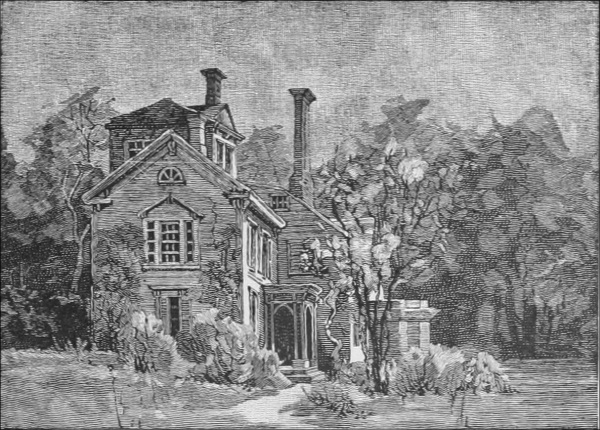
For nearly a year after his return to The Wayside,
there is an uneventful gap in his history, concerning
which we have very few details. He set about improving
his house, and added to it a wing at the back,
which, having three stories, rose above the rest of the
building, and thus supplied him with a study in the
top room, which had the effect of a tower. Meanwhile
the political quarrel between the North and the South
was rapidly culminating; in a few months the Slave
States began their secession, and the Civil War broke
out. This affected Hawthorne so deeply that for some
time he was unable to engage in imaginative work, and
he now relinquished the custom he had maintained for
so many years, of keeping a journal. But there are
letters which define his state of mind, which make his
position clear with regard to the question of the
Union, and show the change in his feeling brought on
by the course of events.
Several years before, while he was still consul, he
thus confided to Bridge (January 9, 1857) his general
opinion respecting the crisis which even then impended:—
"I regret that you think so doubtfully of the prospects
of the Union; for I should like well enough to
hold on to the old thing. And yet I must confess
that I sympathize to a large extent with the Northern
feeling, and think it is about time for us to make a
stand. If compelled to choose, I go for the North.
At present, we have no country—at least, none in the
sense in which an Englishman has a country. I never
conceived, in reality, what a true and warm love of
country is, till I witnessed it in the breasts of Englishmen.
The States are too various and too extended to
form really one country. New England is quite as
large a lump of earth as my heart can really take in....
However, I have no kindred with nor leaning toward
the Abolitionists."
When hostilities had begun, he wrote to the same
friend, May 26, 1861:—
"The war, strange to say, has had a beneficial effect
upon my spirits, which were flagging woefully before
it broke out. But it was delightful to share in
the heroic sentiment of the time, and to feel that I
had a country, a consciousness which seemed to make
me young again. One thing as regards this matter I
regret, and one thing I am glad of. The regrettable
thing is that I am too old to shoulder a musket myself,
and the joyful thing is that Julian is too young.
He drills constantly with a company of lads, and
means to enlist as soon as he reaches the minimum
age. But I trust we shall either be victorious or vanquished
by that time. Meantime, though I approve
the war as much as any man, I don't quite see what
we are fighting for or what definite result can be expected.
If we pommel the South ever so hard, they
will love us none the better for it; and even if we
subjugate them, our next step should be to cut them
adrift, if we are fighting for the annihilation of slavery.
To be sure, it may be a wise object, and offers
a tangible result and the only one which is consistent
with a future union between North and South. A
continuance of the war would soon make this plain
to us, and we should see the expediency of preparing
our black brethren for future citizenship, by allowing
them to fight for their own liberties and educating
them through heroic influences. Whatever happens
next, I must say that I rejoice that the old Union is
smashed. We never were one people, and never really
had a country since the Constitution was formed."
Thus, then, Hawthorne, who had been brought up
politically within the democratic party and thrice
held office under its régime, had reached the conclusion,
four years in advance of the event, that it was
time for the North to "make a stand"; and now,
while muskets rattled their grim prelude to a long
and deadly conflict, he planted himself firmly on the
side of the government—was among the first, moreover,
to resolve upon that policy of arming the negroes,
which was so bitterly opposed and so slow of
adoption among even progressive reformers at the
North. In his solitude, out of the current of affairs,
trying to pursue his own peaceful, artistic calling, and
little used to making utterances on public questions,
it was not incumbent upon him nor proper to his
character to blazon his beliefs where every one could
see them. But, these private expressions being unknown,
his silence was construed against him. One
more reference to the war, occurring in a letter of
October 12, 1861, to Lieutenant Bridge, should be recorded
in this place:—
"I am glad you take such a hopeful view of our
national prospects, so far as regards the war....
For my part, I don't hope (nor indeed wish) to see
the Union restored as it was; amputation seems to
me much the better plan, and all we ought to fight for
is the liberty of selecting the point where our diseased
members shall be lopped off. I would fight to the
death for the Northern Slave-States, and let the rest
go.... I have not found it possible to occupy my
mind with its usual trash and nonsense during these
anxious times; but as the autumn advances, I find
myself sitting down to my desk and blotting successive
sheets of paper, as of yore. Very likely I may
have something ready for the public long before the
public is ready to receive it."
It will be seen that he was not hopeful as to the
restoration of the entire Union, adhered to his first
view indeed, that the scission of a part would be preferable.
In declining a cordial invitation from Bridge
to come to Washington, in February, 1862, he gave
renewed emphasis to this opinion. "I am not very
well," he said, "being mentally and physically languid;
but I suppose there is an even chance that the
trip and change of scene might supply the energy
which I lack." He announced that he had begun a
new romance, and then turning to the questions of the
day, remarked that he "should not much regret an
ultimate separation," and that soon; adding that if a
strong Union sentiment should not set in at the South,
we ought to resolve ourselves into two nations at once.
He was evidently growing despondent; a fact which
may have been due in part to the physical and mental
languor of which he told his friend. Misfortune had
once more entered his household; for one of his children
was suffering from a peculiarly distressing malady,
which imposed a heavy strain upon his nerves
and troubled his heart. More than this, he mourned
over the multitude of private griefs which he saw or
apprehended on every side—griefs resulting from the
slaughter that was going on at the seat of war—as
acutely as if they had been his own losses. He could
not shut out, by any wall of patriotic fire, the terrible
shapes of fierce passion and the pathetic apparitions
of those whose lives had been blasted by the
tragedies of the field. His health, we have already
noticed, had begun to falter while he was still abroad.
Neither was he free from pecuniary anxieties. He
had laid up a modest accumulation from his earnings
in the consulate; but the additions to his house, unambitious
though they were, had cost a sum which
was large in proportion to his resources; the expense
of living was increased by the war, and his pen was
for the time being not productive. His income from
his books was always scanty. He was too scrupulous
to be willing to draw upon the principal which had
been invested for the future support of his family;
and there were times when he was harassed by the
need of money. All these causes conspired to reduce
his strength; but the omnipresent misery of the war,
and the destruction of the Union, which he believed to
be inevitable, were perhaps the chief adverse factors
in the case. "Hawthorne's life," Mr. Lowell has said
to me, "was shortened by the war."
The romance mentioned as having been begun during
this winter of 1861-62, was probably "Dr. Grimshawe's
Secret," the first scheme of which appears as
"The Ancestral Footstep;" and it was afterwards
merged in "Septimius Felton." Hawthorne, however,
did not make satisfactory progress with this work;
and throughout the summer of 1862 he seems to have
given such energies as he could command to the preparation
of the chapters of travel subsequently collected
under the title, "Our Old Home." The latter
volume appeared at a time of fervid, nay, violent public
excitement, caused by the critical state of military
matters, the unpopularity of the draft, the increasing
boldness of the democratic party at the North in opposing
the war and demanding its cessation. To Hawthorne
it appeared no more than just that he should
dedicate his book to the friend whose public act, in
sending him abroad in the government service, had
made it possible for him to gather the materials he had
embodied in these reminiscences. But his publisher,
Mr. Fields, knowing that ex-President Pierce was very
generally held to be culpable for his deference towards
Southern leaders who had done much to bring on the
war, and that he was ranked among the men who were
ready to vote against continuing the attempt to conquer
the Confederacy, foresaw the clamor which would be
raised against Hawthorne if, at such a moment, he
linked his name publicly with that of Pierce. He remonstrated
upon the proposed dedication. But Hawthorne
was not to be turned aside from his purpose by
any dread of an outcry which he considered unjust.
"I find," he replied, "that it would be a piece of poltroonery
in me to withdraw either the dedication or
the dedicatory letter, ... and if he [Pierce] is so
exceedingly unpopular that his name is enough to sink
the volume, there is so much the more need that an
old friend should stand by him. I cannot, merely on
account of pecuniary profit or literary reputation, go
back from what I have deliberately felt and thought
it right to do; and if I were to tear out the dedication,
I should never look at the volume again without remorse
and shame.... If the public of the North
see fit to ostracize me for this, I can only say that I
would gladly sacrifice a thousand or two of dollars
rather than retain the good-will of such a herd of
dolts and mean-spirited scoundrels." The language
did not lack vigor and warmth; but Dr. Loring has
stated that he spoke of the matter to the same effect,
"not in the heat of passion, but with a calm and generous
courage." The dedicatory letter was printed,
of course, and drew down upon Hawthorne abundant
condemnation; but he had maintained his integrity.
The shock of such an accident was by no means the
right sort of tonic for a man of Hawthorne's sensitive
disposition when he was already feeble and almost ill.
In April, 1862, he had been to Washington, and the
things that impressed him there were noted down in an
"Atlantic Monthly" paper, entitled "Chiefly About
War Matters." At Washington, also, Leutze painted
a portrait of him for General Pierce. In July, he took
a brief trip with his son to the Maine coast, and began
a new journal. There were no other changes of scene
for him; the monotony of his life at The Wayside was
seldom broken. That this period was for him one of
unmitigated gloom cannot truthfully be predicated; he
enjoyed his home, he had the society of his wife and
children; he had many small and quiet pleasures. But
there was likewise much to make him sorrowful, and
the tide of vitality was steadily ebbing away. In May,
1863, James Russell Lowell invited him to Elmwood,
and Hawthorne agreed to go, but he was finally prevented
from doing so by a troublesome cold. The
slow and mysterious disease, which was to prove fatal
within a year, continued to make inroads upon his constitution.
After the publication of "Our Old Home,"
in the autumn of 1863, there is no certain record of
his condition or his proceedings, beyond this, that he
went on declining, and that—having abandoned the
two preceding phases of his new fiction—he attempted
to write the resultant form of it, which was to
have been brought out as "The Dolliver Romance."
Although the title had not yet been determined
upon, he consented to begin a serial publication of the
work in the "Atlantic Monthly" for January, 1864.
But he wrote to Mr. Fields: "I don't see much probability
of my having the first chapter of the Romance
ready so soon as you want it. There are two or three
chapters ready to be written, but I am not yet robust
enough to begin, and I feel as if I should never carry
it through.... I can think of no title for the unborn
Romance. Always heretofore I have waited till it was
quite complete, before attempting to name it, and I
fear I shall have to do so now." On the 1st of December,
he dispatched the manuscript of the first
chapter, with the title of the whole. But he could not
follow it up with more, and wrote, about the middle of
January, 1864: "I am not quite up to writing yet,
but shall make an effort as soon as I see any hope of
success." At the end of February: "I hardly know
what to say to the public about this abortive Romance,
though I know pretty well what the case will be. I
shall never finish it..., I cannot finish it unless a
great change comes over me; and if I make too great
an effort to do so, it will be my death." From this
time on he accomplished no work which he was willing
to send to the press, although he had among his papers
the two fragmentary scenes from "The Dolliver Romance"
that were posthumously printed.
The wife of ex-President Pierce died in December,
1863, and Hawthorne went to New Hampshire to
attend the funeral. When he passed through Boston,
on his return, he appeared to Mr. Fields ill and
more nervous than usual. Dreary events seemed to
thicken around his path. In the last days of March,
1864, Mr. Fields saw him again; and by this time his
appearance had greatly changed. "The light in his eye
was as beautiful as ever, but his limbs were shrunken,
and his usual stalwart vigor [was] utterly gone." A
photograph taken not long before that date represents
him with cheeks somewhat emaciated, and a worn,
strangely anxious, half-appealing expression, which,
while singularly delicate and noble, is extremely sad.
Soon after this, in March, he set out for Washington
with Mr. William Ticknor, Mr. Fields's senior partner
in the publishing firm of Ticknor & Fields. The
travelling companions spent two or three days in
New York, and had got as far as Philadelphia, when
Mr. Ticknor was taken suddenly ill, at the Continental
Hotel, and died the next day. Stunned, wellnigh
shattered by this sinister event, Hawthorne was almost
incapacitated for action of any sort; but there
were kind and ready friends in Philadelphia who came
to his aid, and relieved him from the melancholy duty
which he would else have had to meet. He returned
to Concord, in what forlorn state an extract from a
letter of Mrs. Hawthorne's may best convey: "He
came back unlooked for, that day; and when I heard
a step on the piazza, I was lying on a couch and feeling
quite indisposed. But as soon as I saw him I
was frightened out of all knowledge of myself,—so
haggard, so white, so deeply scored with pain and fatigue
was the face, so much more ill than ever I saw
him before." Mrs. Hawthorne still hoped for some
favorable turn, if he could but obtain a complete
change of scene and escape from the austere New
England spring, into some warmer climate. "He has
not smiled since he came home till to-day," she wrote,
"when I made him laugh, with Thackeray's humor,
in reading to him." She was constant in her care;
she would scarcely let him go up and down stairs
alone. But not the most tender solicitude, nor any
encouragement of unquenchable hope, could now avail
to help him.
The only stratagem that could be devised to win
back health and strength was the plan proposed by
General Pierce, to take Hawthorne with him on an
easy journey by carriage into New Hampshire. They
started in May,—the two old college-mates; the ex-President
so lately widowed and still in the shadow
of his own bereavement, with the famous romancer
so mournfully broken, who was never more to be seen
in life by those to whom he was dearest. From the
Pemigewasset House at Plymouth, New Hampshire,
where they had stopped for the night, General Pierce
sent the news on May 19, that Hawthorne was dead.
"He retired last night," wrote the General, "soon
after nine o'clock, and soon fell into a quiet slumber....
At two o'clock I went to H——'s bedside; he
was apparently in a sound sleep; and I did not place
my hand upon him. At four o'clock I went into his
room again, and, as his position was unchanged, I
placed my hand upon him and found that life was
extinct.... He must have passed from natural slumber
to that from which there is no waking, without the
slightest movement."
Hawthorne was buried in Sleepy Hollow Cemetery
at Concord, on the 24th of May, 1864. The grave was
made beneath the shadowing pines of a hill near one
of the borders of the beautiful, wooded burial-ground,
whence there is a peaceful view over the valley of the
Concord River. It was close to the slope where Thoreau
now lies, and not far away is the grassy resting-place
of Emerson. The spot was one for which Hawthorne
had cherished an especial fondness. Emerson,
that day, stood beside the grave, and with him Longfellow
and Lowell were present; Agassiz, Holmes,
James Freeman Clarke, Edwin Whipple, Pierce, and
Hillard, had all assembled to pay their last reverence.
A great multitude of people attended the funeral service
at the old Unitarian First Church in the village,
and Mr. Clarke, who had performed the marriage ceremony
for Hawthorne, conducted the rites above him
dead. It was a perfect day of spring; the roadside
banks were blue with violets, the orchards were in
bloom; and lilies of the valley, which were Hawthorne's
favorites among flowers, had blossomed early as if for
him, and were gathered in masses about him. Like a
requiem chant, the clear strains that Longfellow wrote
in memory of that hour still echo for us its tender solemnity:—
"How beautiful it was, that one bright day
In the long week of rain!
Though all its splendor could not chase away
The omnipresent pain.
"The lovely town was white with apple-blooms,
And the great elms o'erhead
Dark shadows wove on their aerial looms,
Shot through with golden thread.
"Across the meadows, by the gray old manse,
The historic river flowed;
I was as one who wanders in a trance,
Unconscious of his road.
"The faces of familiar friends seemed strange;
Their voices I could hear,
And yet the words they uttered seemed to change
Their meaning to the ear.
"For the one face I looked for was not there,
The one low voice was mute;
Only an unseen presence filled the air,
And baffled my pursuit.
"Now I look back, and meadow, manse, and stream
Dimly my thought defines;
I only see—a dream within a dream—
The hill-top hearsed with pines.
"I only hear above his place of rest
Their tender undertone,
The infinite longings of a troubled breast,
The voice so like his own.
"There in seclusion and remote from men
The wizard hand lies cold,
Which at its topmost speed let fall the pen,
And left the tale half told.
"Ah, who shall lift that wand of magic power,
And the lost clue regain?
The unfinished window in Aladdin's tower
Unfinished must remain!"