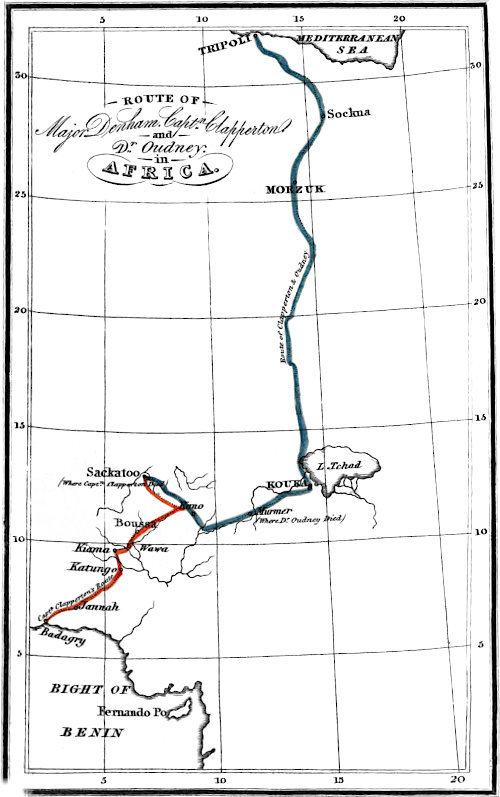
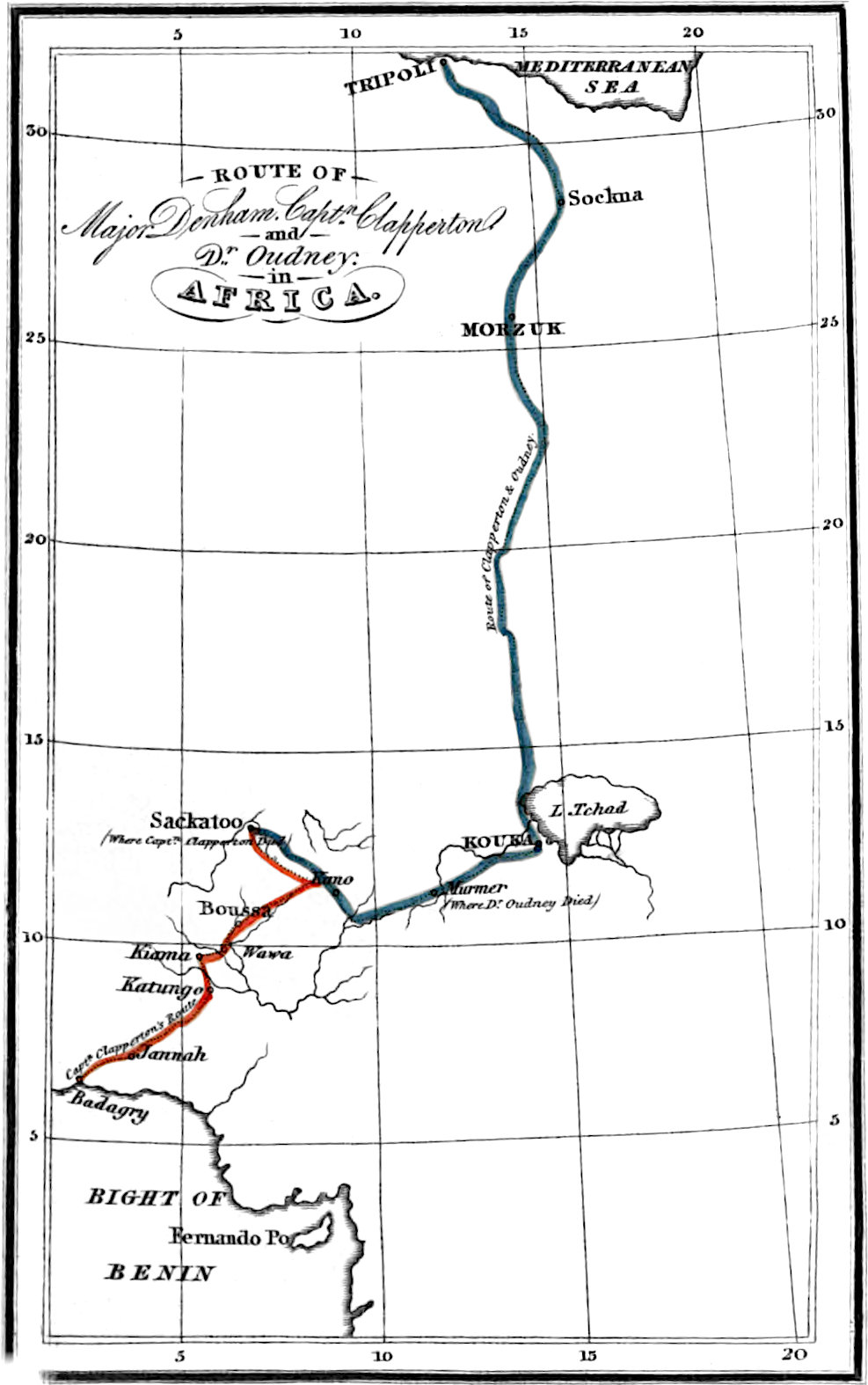
The life of Captain Hugh
Clapperton, who died in his second attempt to explore the interior
of Africa, was short, but very eventful. Not only did he possess a
frame and constitution, both of body and mind, well fitted for a
career of active exertion and romantic enterprise; but from the day
of his birth to that of his death, it was his lot to endure, with
almost no interruption, a painful succession of hardships and
privations, or to be engaged in scenes and pursuits of a nature so
perilous as to put existence itself in constant and imminent
jeopardy. And had any record of these things been kept, either by
himself or by any one else, who might chance to know even a tithe
of the manifold dangers to which he was exposed, and the bold, and
sometimes rash enterprises in which he was engaged, a narrative
might thence have been composed, all true to the letter, and yet as full of
wonderful and diversified incident, as well as of fearless and
daring action, as ever flowed from the pen of the most creative
genius in fictitious history—all modified by the child-like
simplicity and generous nobleness of heart, combined with unbending
integrity, unshrinking courage, and indomitable fortitude, in the
character of him, whose fortunes in life they formed, and whose
achievements in the discharge of duty they exhibited. But no such
record was kept, except, while he lived, in our hero’s own
retentive memory; and therefore, now that he is dead, some of the
most marvellous passages of his life must remain in the deep
oblivion in which they have been buried. We are assured by the
friends with whom he lived in the closest intimacy, that when, like
Othello, he was questioned respecting the story of his life from
year to year; the battles, sieges, fortunes, that he had past; he
would, with a fine flow of good humour, and an interesting detail
of particulars, run it through even from his boyish days, down to
the time when he was desired to tell it; and then, like the
enamoured Moor, it was his hint to speak of most disastrous
chances,
Of moving accidents by flood or
field;
Of hair-breadth ’scapes in the imminent
deadly breach;
Of being taken by the insolent foe,
And sold to slavery; of his redemption
thence,
With all his travel’s history.
But these
narratives of his adventures were given by Clapperton for the sole
end of entertaining his friends when they met for the mere purpose
of social intercourse and convivial enjoyment; and, therefore,
those friends can now give but a very indistinct account of what
“by parcels they had something heard,” without any intention of
detailing it again, unless in the same way and for the same purpose
it had been told to themselves. Hence the early and professional
life of our traveller can never be well known, except that part of
it which he has embodied in the published journals of his
expeditions to Africa. And not only are the incidents of his life
during the time he was a sailor imperfectly known, but even of
those parts of it respecting which we have obtained some vague
information, we have different versions of the same story
considerably at variance with one another; so that, amid their
discrepancy, it is difficult to select the facts and circumstances
relative to the life of our hero which are genuine and free from
defect on the one side, and exaggeration on the other. No memoir of
his life has yet appeared at all worthy of him. We have seen in one
periodical an atrocious libel upon his memory, the emanation
evidently of a mean and malignant spirit. Any newspaper notices of
him which have been printed are meagre in the extreme; and the
“Short Sketch” which is prefixed to the “Journal of his Second
Expedition,” and purporting to be the work of his uncle, a colonel of marines,
although the best account of him which has yet appeared, contains
exceedingly little that is really interesting. Such being the lack
of materials, we regret much that we shall not be able to produce a
“Memoir” adequate to the subject; but we can assure our readers
that we have used all diligence to obtain the most accurate and
ample information which can now be had, and shall therefore proceed
to submit it to their candid consideration.
In one of the short notices which have been published of the
traveller’s life, it is stated that the “family of Clapperton is
ancient, and not without celebrity in the north of Scotland. The
name,” it is added, “has been distinguished both in the church and
in the field; and in proof of this we are told that a Bishop
Clapperton is buried in the island called Inchcolm, in the Firth of
Forth; while another individual of the same name is mentioned in
the history of Sweden as having been a field-marshall in the army
of that country. We cannot tell whether the prelate or the soldier
is to be regarded as belonging to the family whence the African
traveller was descended; but it unquestionably was highly
respectable, both in point of antiquity and of its station
in society. His
grandfather, Robert Clapperton, was a doctor of medicine, whose
professional studies were pursued by him first at the University of
Edinburgh, and afterwards among the hospitals in Paris. On his
return to his own country he married Miss Elizabeth Campbell, a
near relation of Campbell of Glenlyon, and settled at the town of
Lochmaben, in Dumfries-shire, as a medical practitioner. He is said
to have been a good classical scholar, and much attached to the
study of antiquity; and while he excelled in the tracing of
genealogies, in the collecting of coins and songs, with the view of
illustrating border history, he was highly esteemed as a skilful
physician. He had two sons, the younger of whom chose the army as
his profession, and is now a lieutenant-colonel of marines; but
George, the elder of the two, adopted that of his father; and
having previously obtained an adequate professional education, he
settled as a surgeon in the town of Annan, Dumfries-shire. He was
long the only medical practitioner of repute in that place; and the
numerous operations and cures which he performed proved the means
both of increasing his practice and extending his fame. While still
young, he married a daughter of Johnstone of Thornythwaite, by whom
he had fourteen children, Hugh, who afterwards became the African
traveller, being the tenth. The mother of this numerous family, who
is described as beautiful, amiable and accomplished, died in the thirty-ninth year of
her age, leaving behind her seven sons and a daughter, Hugh being
the youngest of these surviving sons, and consequently a mere
infant. And to enhance the greatness of the bereavement which he
had sustained in the loss of his mother, his father speedily
afterwards married a second wife, whom his friends regarded as a
woman of inferior station to that which he and his family occupied.
At the time when this second marriage took place, most of the sons
had left their father’s house, to engage elsewhere in the active
pursuits of life, and the girl had been taken away by her mother’s
relations; but the subject of this memoir and some of his younger
brothers, were left at home to encounter the stern control of a
stepmother—a species of government at best far from being
desirable, but in the case of the young Clappertons, rendered
peculiarly arbitrary and despotic, from the concurrence of a
variety of incidental circumstances. In the first place, their
stepmother, conscious that she was deemed by the friends of the
family an unsuitable match for their father, must have been haunted
incessantly by a feeling, not at all likely to soothe and sweeten
her temper, or fitted to dispose her to regard the children of the
former marriage with any considerable degree of complacency; by a
feeling not likely to lead her to watch over such of them as were
subject to her management with any very vigilant
attention, to make
her extremely solicitous about their comfort or improvement, or to
visit them with a treatment any way marked by kind and tender
affection. In the second place, she soon had children of her own,
and these, by degrees, increased, till they amounted to the number
of seven; and it will readily be allowed, that her own offspring
were naturally fitted more strongly to engage her affections and to
engross her solicitude, than those children with whom she had only
an adventitious relationship. And in the third place, it would
appear that Dr. Clapperton himself, the father of the African
traveller, was not by any means so attentive to the interests of
his immense family as he ought to have been; for his brother, the
colonel, says of him, “He might have made a fortune, but
unfortunately he was, like his father, careless of money;” and we
believe the fact cannot be denied; nor, moreover, can it be
disguised that the condition into which he fell in his latter days
was owing, partly at least, to a culpable neglect of his
professional duties.[3] When, therefore, it is considered that as
his father advanced in years, his circumstances in life so much
declined, as at last to reduce him into a state of abject
indigence,—while at the same time his family was constantly
increasing in number, and that it was the melancholy lot of our traveller to lose
his mother in his infancy, and so scarcely ever to have had the
happiness to experience the soothing and heart-impressive influence
of maternal tenderness and maternal care, but, on the contrary, to
be placed at that tender age under the care and control of a
stepmother,—it will be abundantly obvious that his life commenced
under the most unpropitious auspices that can well be imagined.
He was born in the year 1788, and was, as we have seen, soon
after placed under the charge of a stepmother, by whom it is said
he was not only neglected, but treated with harshness and cruelty;
and hence throughout his life stepmothers were regarded by him with
a feeling of unconquerable horror.[4] The accounts which he
occasionally gave his companions of the sufferings of his youth,
arising from the causes which have been specified, were appalling.
In reference to them, an enemy, who, however, seems to have been in possession of
accurate information on the subject, says, that while a schoolboy,
“the climate of Lapland and that of Timbuctoo alternated several
times in the course of a day—a species of seasoning, or rather
case-hardening, that must go far to render him
invulnerable on the sultry banks of the Joliba.” And one of the
most intimate of his friends thus speaks of them in a letter now
before us: “How can the hardships and privations of his early life
be touched upon without hurting the feelings of relatives? These
had much better be buried in oblivion, although they tended to form
the man hardy and self-denying.” When he was a boy, he was nearly
drowned in the Annan; and on that occasion he used to say, that he
felt as if a calm and pleasing sleep was stealing over his senses,
and thought that gay and beautifully painted streamers were
attached to his legs and arms, and that thereby he was buoyed out
into the sea; but he always declared that he experienced no pain
until efforts were making to restore him to a state of animation.
At this time he was an expert swimmer, having been previously
taught that useful art by his brothers; but he had exhausted his
strength by continuing too long in the water. When the alarm of his
danger was given by some one to his father, he hastened to the
spot, plunged in, and found his son in a sitting posture in very
deep water.
Among the injuries of his early life, that of a neglected education was none
of the least. He was taught the ordinary acquirements of reading,
writing, and arithmetic, which are generally imparted to the lowest
classes of the Scottish youth; but he was never initiated into a
knowledge of the classic authors of Greece and Rome. Under Mr.
Bryce Downie, however, a celebrated teacher of geometry in the town
of Annan, he acquired a practical knowledge of mathematics,
including navigation and trigonometry, and afterwards, by means of
his own application, he acquired many other branches of useful and
ornamental knowledge, and excelled especially in drawing.[5]
He very early discovered a strong propensity for this latter
accomplishment, so that, with the aid of a few instructions from
his father, who excelled in the knowledge of geography, he could
sketch a map of Europe, while still a child in frocks, with chalk on
the floor. His love of foreign travel and romantic adventure, were
likewise very soon manifested in the delight which he took in
listening to his father, while he pointed out the likely situation
of the “North West passage” to him and his brothers on the globe;
in the enthusiasm which he displayed, when told by his father that
he might be the destined discoverer of that long sought for route
from Europe to Eastern Asia; and also in the avidity with which he
devoured books of voyages and travels of all descriptions whenever
they fell in his way.
The circumstance of his entering upon a seafaring life is
variously reported. By one account we are assured that his
situation at home being so unpleasant, he became so thoroughly
disgusted with his father’s house, that he left it clandestinely,
and went on board the first vessel in the harbour of Annan that was
willing to receive him. By his anonymous and unfriendly biographer,
it is said that he was promoted to the rank of an apprentice to a
coasting sloop of Maryport, commanded by Captain John Smith, and
that soon afterwards he was again promoted to the rank of cook’s
mate on board his majesty’s tender in the harbour of Liverpool. His
uncle’s account, in the sketch of his life prefixed to the Journal
of his Second African Expedition, is, that on leaving Mr. Downie,
at the age of thirteen, he was, by his own desire, bound
an apprentice to the
owner of a vessel of considerable burden trading between Liverpool
and North America: that after making several voyages in that
vessel, he either left her or was impressed into his Majesty’s
service, and put on board the tender lying at Liverpool. It is
clear, from all these accounts, that Captain Clapperton commenced
his naval career as a common sailor boy—a situation which implies
hard duty and rough usage; yet, as is testified by the following
well authenticated anecdote, this, with all he had previously
endured, was unable to break his spirit, or to subdue the dignified
feelings of a noble nature. As soon as he had joined the trading
vessel in which he first sailed, he was told that one piece of duty
which he had to perform on board was to brush his captain’s boots
and shoes. This he positively refused to do, adding, that he was
most willing to take his full share of the hardest work which
belonged to the loading, the unloading, or the working of the ship;
but to the menial drudgery of cleaning boots and shoes he certainly
would not submit. After he had for a short time served on board
several trading vessels, he was impressed into his Majesty’s
service at Liverpool; and in 1806 he was sent to Gibraltar in a
navy transport.[6] The idea, however, of having been placed on board a man-of-war
by force, and retained there as a prisoner, was so galling to his
nature—to a spirit panting and struggling to be free—that he formed
the resolution (one most difficult to be put in practice) of
deserting whenever the opportunity of doing so should occur: and
such was the reckless daring of his disposition, that, watching the
time when he was least observed by his messmates before the mast,
he actually threw himself headlong overboard, and swam towards a
Gibraltar privateer—a vessel of that class which, during the late
war, were usually called rock scorpions by our sailors. He
was taken on board the privateer, and so for a short time he was
the associate of an abandoned and a lawless set of robbers. But he
was soon disgusted with their regardless, savage and brutal manners, and so embraced
the first opportunity of leaving them, and of going again into the
merchant service. While, however, he was on board the Rock
Scorpion, she had sustained an engagement, in which our hero was
severely wounded by a grape-shot—an accident by which his body was
seamed and scarred in a frightful manner, and which, had it
happened to his face or his limbs, must have rendered him deformed
or lame for life.
After he had left the privateer he was soon discovered, and
brought back to the Renommée frigate as a deserter. It is mentioned
in the “Sketch,” which says nothing of the rock scorpion adventure,
that when Clapperton first joined the Renommée frigate, which was
commanded by Sir Thomas Livingstone, having heard that his uncle, a
captain of marines on board his Majesty’s ship Saturn, which had
arrived at Gibraltar for the purpose of watering and refitting, he
sent him a letter describing his situation on board the Renommée;
that his uncle having previously been a messmate of her captain,
Sir Thomas Livingstone, interfered with him in behalf
of his nephew, and
through his interest got him promoted to the rank of a
midshipman.[7] All we can say to this statement is, that
Clapperton himself, whose heart was most grateful, never spoke of a
letter he had written to his uncle, nor that he was in any way
indebted to that gentleman for his promotion in the navy. He seems
never to have seen his uncle till he met him in London after he had
engaged to go with Dr. Oudney to Africa. In a letter to a friend,
dated London, 1st September 1821, he says, “my uncle has been to
see me several times, and was truly kind. He is a perfect
gentleman, without any nonsense.” Now, the correspondent to whom he
thus writes, declares
that Clapperton never mentioned to him that he had ever written to
his uncle, soliciting his interest in his favour, or that he was in
any respect indebted to him, in the first instance, for his
promotion in the navy. But while he said nothing to his friend of
his uncle in connexion with this matter, he frequently gave him a
most circumstantial and graphic description of the manner in which
this promotion took place. And as it is in keeping with the rest of
the romantic and eventful life of our hero, and, above all, as it
is his own account, we hasten to lay it before our readers.
When he was apprehended as a deserter, and brought back to his
old birth on board the Renommée, his captain, Sir Thomas
Livingstone, having previously observed that he possessed a
strength of body, a robustness of constitution, and a fearless
daringness of spirit, which might be turned to good account in the
naval service, which, at that time required to be sustained and
strengthened by attaching to it men of such mental and bodily
qualities as these, asked the deserter, if he should pardon his
delinquency, and raise him to the rank of a midshipman, would he
give him his solemn pledge, that he would no more desert, but do
his duty faithfully? Clapperton, with the bold and dauntless air
and bearing of the captive British prince, who “had been the
admiration, the terror of the Romans,” when led in triumph through
the streets of the mighty capital, still “walked the warrior, majestic in his
chains,” replied that he was not yet prepared to give a final and
decisive answer to such a question, and therefore asked time to
consider on what he should determine. “Are you not aware, Sir,”
rejoined the captain, “that I can order you to be flogged as a
deserter?” “That I know you can do, and I expect no less,” was our
hero’s reply, “but still I am unprepared at present to decide on
your proposal.” The result, however, of this extraordinary
conversation was, that the captain ordered him into solitary
confinement, with an admonition to lose no time in coming to a
speedy determination as to the course which he should adopt. In
this situation his reflections took a wise and a prudent turn, and
led him quickly to resolve to give his generous captain the
assurance of fidelity which he required of him; and, on doing so,
he was promoted to the rank of a midshipman on board the Renommée
frigate, where he had first served as an impressed sailor boy, and
on the deck of which he had stood in the capacity of an apprehended
deserter. Afterwards, on his own request, he was allowed to go on
shore during a specified period of time, on his parole of
honour. It is very true the account of his promotion through his
uncle’s interference in his behalf accords better with the ordinary
course of things in such proceedings than that stated above. But we
think, that if Clapperton had been aware that he was indebted to his uncle on this
occasion he would not have concealed the fact from his friends; and
likewise we think, that the disparity of his condition as a common
sailor, and that of his uncle as a captain of marines, would have
been sufficient to deter him from making himself known to his
uncle, or asking any thing from him. For though his feelings of
honour sometimes rested on mistaken principles, they were always
very sensitive; and so we are decidedly of opinion, that in the
circumstances of this case he would have felt equally unwilling to
expose his own servile condition to his uncle, and to compromise
his uncle’s dignity by making the captain of marines appear the
near kinsman of the common sailor. We happen to know a case in
point which illustrates this view of the matter. During the late
war, one of the sons of a gentleman in Argyleshire, absconded from
his father’s house, and for a while it was unknown where he had
gone, till he was discovered by one of his brothers, a captain in
the army, as a common sailor on board a man-of-war. The captain
instigated by fraternal affection, was anxious to procure an
interview with his brother, and so sent him a note, informing him
where he was, and expressing his earnest desire that he would
endeavour to meet him on shore. The answer to this kind and
brotherly invitation was an expression of wounded pride. “If,” said
the sailor, “Captain M. has any business to transact with Donald M.
let him come on board
H. M. S——— and transact it there.” And we think Clapperton would
have been apt to feel and act nearly in the same manner in the
circumstances in which he and his uncle were relatively situated on
board the Renommée frigate, and the ship Saturn; though at the same
time, it is not unlikely that Sir Thomas Livingstone having
discovered his deserter’s connexion with his old messmate, was
disposed not only to remit his punishment, but likewise to give him
the chance of retrieving his honour and of benefiting his country.
Neither do we think it is the least unlikely that Sir Thomas and
Captain Clapperton may have had mutual communications respecting
our hero, but we can see no reason for believing that he was in any
way made privy to them, but many to make us believe the contrary.
Now raised to the rank of a midshipman, he performed some hard
service on the coast of Spain, in which he was wounded on the
head—a wound which, though it seemed apparently slight, afterwards
gave him much annoyance. He remained on board the Renommée, and
under the command of Sir Thomas Livingstone, to whom he was so
deeply indebted, till the year 1808, when the frigate was brought
to England and paid off.[8]
When Clapperton left the Renommée frigate, and his generous
captain, Sir Thomas Livingstone, to whom he was indebted for his
first step of promotion in the Royal Navy, he is said to have
joined his Majesty’s ship Venerable, (or, as others say, the San
Domingo,) which then lay in the Downs under the command of Captain
King. But as this was a situation too monotonous and inactive for
his enterprising spirit, he volunteered to go with Captain Briggs,
to the East Indies, in the Clorinde frigate. Though, however, his
services were accepted, he could not obtain his discharge in time
to make his voyage to India in the Clorinde; and so he was deprived
of the pleasure of getting acquainted, in the course of it, with
those with whom he was ultimately to be associated as his messmates. But as
tranships and convoys were frequently sailing from England to the
east, he was ordered by the Admiral to have a passage on board one
of them, and to join Captain Briggs on his arrival in India.
In the course of this outward voyage, he was ordered, during the
raging of a tremendous storm, to go, in an open barge, to the
relief of a vessel in distress. The barge was accordingly manned,
but the mighty rolling of the billows chaffed and vexed with the
furious raging of the tempest, was such, that Clapperton and many
others on board the ship in which he sailed, were of opinion, that
it was next to impossible an open boat could live during the
blowing of so heavy a gale. In this emergency, Clapperton said,
that it was not for him to dispute the orders of his superior
officer, but that he was thoroughly convinced that in doing his
duty he must sacrifice his life. Then, in serious mood and
sailor-like fashion, he made his will, bequeathing any little
property he had among his messmates—his kit to one, his quadrant to
another, and his glass and watch to a third—adding, that in all
probability they should never meet again, and requesting them to
keep these articles, trifling as they were, in token of his
affection for them. Then he jumped into the barge, which, in spite
of all that the most skillful seamanship could accomplish, had
scarcely left the side of the ship, when she was upset,
and the greater part
of her crew engulfed in the awfully agitated waters. Clapperton,
however, and a few other individuals, still clung to the sides of
the floating wreck; and though their perilous situation was
distinctly seen from the ship, no assistance could be afforded to
them, so long as the tempest continued to rage with so much
violence. In the mean time, Clapperton, while he was careful to
preserve his own life, did his utmost, and more than perhaps any
other man would have ventured to do in like circumstances, to save
the lives of his companions in distress. As they, one by one, lost
their hold of the barge, and dropped off into the sea, he swam
after them, picked them up, and replaced them in their former
situation. He was especially anxious to save the life of a warrant
officer, the boatswain of the ship, we believe. This man he several
times rescued when he was on the point of sinking, and restored him
to the barge. By these efforts, Clapperton’s strength, great as it
was, soon became nearly exhausted, and while with difficulty he was
bringing the boatswain back to take a fresh hold of the boat, and
while at the same time he was crying, “Oh, what will become of my
wife and children,” Clapperton coolly observed, that he had better
pay some attention to his own safety at present, otherwise he must,
however reluctantly, leave him to his fate. This man was drowned,
as well as every one else who had left the ship in the barge,
except Clapperton and the bowman, whom our hero cheered by saying, “Thank
heaven neither you nor I is the Jonah,” intimating, by this marine
proverb, that it was not for the punishment of their bad conduct
that the tempest had been sent; and at the same time advised him to
bob, that is, to lay himself flat, when he saw a wave
approaching, so that he might not be washed off the barge.
Long prior to this signal occurrence, in which our hero showed
so much of the boldness of determined courage, united with the
gentle feelings of compassion, he had become a general favourite
both with the officers and men. His stately form, his noble
bearing, his kind, frank, and manly demeanour, had endeared him to
all on board the ship in which he served. But a man is often the
last to know the sentiments entertained of him by others to whom he
is known; and indeed, seldom knows them at all, unless when they
happen to be revealed to him by accidental circumstances. And
hence, as Clapperton was hoisted on board the ship, in an exhausted
state, after being rescued from the perilous situation in which he
had so long struggled for his life, he had his feelings strongly
excited, on hearing the wives of the Scottish soldiers on board
exclaiming, “Thank heaven, it is na our ain kintryman, the bonny
muckle midshipman that’s drownded after a’!”
It may reasonably be supposed, that the gallantry and humanity
which Clapperton had
so conspicuously displayed on this trying occasion, would tend to
deepen the esteem in which he was held by all on board, and
especially that it would be the means of securing for him the
admiration, the affection, and the friendship of many kindred
spirits connected with the navy—a service so long and so eminently
distinguished for firmness of purpose and nobleness of disposition.
Accordingly, when Clapperton arrived in India, and when his
gallantry was made known, he received the greatest attention from
Captain Briggs,[9] during the whole of the time he continued under
his command; and among other friendships which he formed with
officers of his own standing, was one of peculiar intimacy and
tenderness, with Mr. Mackenzie, the youngest son of the late Lord
Seaforth. It happened that this amiable and noble youth became, in
that distant region, the victim of a dangerous disease; and during
the whole of his illness, Clapperton, his newly acquired friend,
unless when the avocations of professional duty called him hence,
never left him; but continued to amuse and nurse him with the
affectionate assiduity of a loving brother, till he was so far
recovered as to be able to resume his public duty. After Mackenzie
was in some degree restored to health, he continued to be depressed in spirits, and
in that state became careless of his person and of every thing
else, thinking, like most hypochondriacs, that death was fast
approaching to deliver him from all his sufferings. When under the
influence of these feelings—afflicted indeed both in mind and
body—he was by no means a desirable companion, and in truth was
shunned by most of the young officers on board the Clorinde. But
Clapperton, whose benevolent heart would not permit him to witness
a fellow-creature, and still less a countryman and a friend an
object of unfeeling neglect, redoubled his attentions to the
forlorn youth. He read with him daily such books of instruction and
amusement as either of them had in their possession, or could
procure the perusal of from the other officers. He endeavoured to
inspire him with the sentiments befitting his rank as the lineal
descendant of a noble family, and with a sense of the duties
incumbent upon him as an officer of the British navy. He talked to
him of Scotland, and relations, and home. He entertained him with
amusing anecdotes, of which he possessed an inexhaustible fund, and
by relating to him the numerous vicissitudes and strange adventures
of his own early life. And such was the happy effect produced upon
the health and spirits of his young friend, that he was able to
resume his duty on board the Clorinde, and to enjoy and return the
cordial friendship
which he experienced from Clapperton.
Though we believe, that the officers of the British navy are,
perhaps, more distinguished for simplicity of feeling and openness
of heart, than the men belonging to any other profession
whatsoever; yet, it would appear, that some of the officers of the
Clorinde had given entertainment in their breasts to the green-eyed
monster, Envy. And hence, when they observed the close intimacy
which subsisted between Clapperton and Mackenzie, and the kind
attention which, during his illness, the latter experienced from
the former, they said among themselves, but loud enough to be heard
by Clapperton, “The canny Scotsman knows what he is about, by
attaching himself so closely to a sprig of nobility; he courts his
favour that he may use him as his instrument for obtaining
promotion.” The effect of these injurious whisperings upon the mind
of our hero was, in the first instance, to cause him to make a
great sacrifice of feeling to the injury both of himself and his
friend. He withdrew all attention from Mackenzie, and ceased, not
only to keep company with him, but even to speak to him when they
met. Mackenzie, in utter ignorance as to the cause of the change
which had so suddenly taken place in the conduct of Clapperton
towards him, after having puzzled and perplexed his mind in
conjecturing in what way he had given such deadly
offence to his
friend, as to make him behave in the manner he was doing, at last
mustered courage, fairly to ask him, why he had of late treated him
with so much coldness and distance? On this, Clapperton, with his
feelings strongly excited, stated to his friend what had been said
among their shipmates, of the interested motives which had been
attributed to him, as the cause of what they had represented as
pretended friendship on his part. “But,” he added, “my dear
Mackenzie, I have been wrong to punish both myself and you, in
listening to these most false and injurious speeches. And
henceforth let the best of them beware how they use them in future;
for the first man whom I detect doing so, must do it at the risk of
his life.” As this hint was pretty publicly intimated on the part
of Clapperton, his friendship for Mackenzie suffered no
interruption afterwards, so long as they served together in the
same ship. But the disease which he had caught returned upon him
again, and after causing him to linger for some time as an invalid,
he was sent to his friends, with little hope of his recovery; nor
indeed had he been long at home, till he died. While, however, he
lay upon his death-bed, he spoke with all the enthusiasm of sincere
and warm friendship, of the kind attentions he had received from
Clapperton when ill and far from home; and entreated his relations,
and especially his mother, to discharge the debt of gratitude which
he owed him, by
treating him as a son, in requital of his having, so long as he had
it in his power, treated him as his brother.
We have not been able to obtain any satisfactory information
respecting the nature of the naval service in which Clapperton was
employed in India, nor of the exploits of seamanship and prowess
which he performed while he was on that station, except in one
instance, which is well worthy of being recorded to his honour.
When we stormed Port Louis, in the Isle of France, he was the first
man who advanced into the breach; and it was he who pulled down the
colours of France, and planted those of Britain in their place. And
we know that his conduct was in all respects worthy of the rank
which he had obtained in a manner so unique, and such as entitled
him to expect his turn of promotion in due course. He continued in
India from the early part of 1810 till the latter end of 1813, when
he returned to England. He had not been long at home, when he was
draughted, along with a select number of midshipmen, for the
purpose of being sent to Portsmouth, to be instructed by Angelo,
the famous fencing-master, in the cutlass exercise, with the view
of introducing that mode of defence and attack into the navy. These
young men, when perfected in the art, were distributed through the
fleet, as teachers of the young officers and men. Clapperton, being
an apt pupil, soon excelled in this exercise, and when his
companions were distributed through the fleet as drill-masters, he was
sent to the Asia, the flag ship of Admiral Sir Alexander Cochrane,
then lying at Spithead.
While he taught Angelo’s sword-exercise on board the Asia, he
volunteered his services for the lakes of Canada, in the expedition
which was sent to that novel scene of naval enterprise towards the
beginning of the year 1814. In the voyage from England to
Bermuda[10] he continued to act as a drill-master on board the Asia;
and though, as yet, he had obtained no higher rank than that of
midshipman, such was the respect in which he was held, and the
deference paid to him, that in most respects he was treated as if
he had been a lieutenant. He was now a tall and handsome young man,
with great breadth of chest and expansion of shoulders, and
possessing withal a mild temper and the kindest dispositions. Along
with his other duties he drilled the young officers and men on
deck, whenever the weather permitted, and when amusement was the
order of the day, he was the life and soul of the crew; he was an
excellent table companion, he could tell humourous tales, and his
conversation was
extremely amusing; he painted scenes for the ship’s theatricals,
sketched views, drew caricatures, and so he was much beloved and
respected by all, to whose amusement he so largely contributed.
The following incident affords a striking proof of the almost
invincible hardiness of his constitution, for which he was indebted
partly to the bounty of nature, and partly to the privations and
habits of his early life. Having bidden adieu to the flag ship, on
which he had acted so conspicuous a part, and taken his passage to
Halifax, with the view of thence proceeding to the lakes, he was
sent along with others to perform some service on the horrid coast
of Labrador, and being there cast away while in a long boat, all
the individuals who were along with him at the time were so
severely frost bitten that some of them died, and the rest were
lame for life, while he escaped with only losing the power of the
first joint of his left hand thumb, which ever after continued
crooked, and on that account used to be called “Hooky,” both by
himself and his friends.
He was sent, along with a party of five hundred men, from
Halifax to join Sir James Yeo, who, at that time, had the command
upon the Lakes. As this journey was performed in winter, when the
river St. Lawrence is frozen over, and of course when the water
communication is suspended, it was both tedious and toilsome. The
men marched on foot, first to Quebec, and then to the lakes, while the
baggage was dragged after them in sleighs. Soon after his
arrival on the lakes, he and a small party of men were appointed to
defend a blockhouse on the coast of Lake Ontario; but he had not
been long in this situation when the blockhouse, which had only one
small gun for its defence, was attacked by a superior American
force, by which it was speedily demolished; and when Clapperton and
his men were left no other alternative but to become prisoners of
war, or to cross the ice to York, the capital of Upper Canada, a
distance of sixty or seventy miles. Frightful as the attempt was,
in their destitute and forlorn circumstances, the journey was
instantly resolved upon. But the party had not advanced more than
ten or twelve miles, when a boy, one of the number, lay down on the
ice unable to proceed farther, on account of the cold, and his
previous fatigue. The sailors declared, each in his turn, that they
were so benumbed with cold, and so exhausted by wading through the
newly fallen snow, that it was with difficulty they could support
themselves, and so could afford no assistance to the poor
unfortunate boy. On this trying occasion the strong benevolence of
Clapperton’s character was strikingly manifested. His nature was
too generous to suffer him for a moment to endure the idea of
leaving a fellow-creature inevitably to perish under such appalling
circumstances; for as it was snowing at the time, it was quite evident that the
boy would, if left, have been quickly overwhelmed by the drift.
Clapperton, therefore, took the boy upon his own back, and carried
him about eight or nine miles, when he found that he had relaxed
his hold, and on examining the cause, he was perceived to be in a
dying state, and very soon after expired. The party then proceeded
on their journey, and endured very great sufferings before they
could reach York. Their shoes and stockings were completely worn
off their feet; and the want of nourishment had dreadfully
emaciated their bodies, as they had no provisions during the
journey except a bag of meal. According to his uncle’s account, it
was, while he was making generous efforts to save the boy, who fell
a victim to the cold, that Clapperton lost the first joint of his
thumb. His uncle says, “he took the boy upon his back, holding him
with his left hand, and supported himself from slipping with a
staff in his right;” and adds, “that from the long inaction of his
left hand in carrying the boy upon his back, he lost, from the
effects of the cold, his thumb joint.”—This is certainly a very
probable account of the matter, and assigns a cause sufficiently
adequate for effecting a greater bodily injury than the loss of
part of a thumb. But, as we have great confidence in the
information which we have received on the subject, we are inclined
to adhere to the account which we have given above, namely,
that Clapperton lost
the joint of his thumb on the coast of Labrador, when his
companions in distress lost their limbs and their lives. It is
evident, moreover, that his uncle’s information on many points was
neither very extensive nor very accurate. A glaring instance of
inaccuracy is abundantly apparent in his account of this very
journey over the ice, from the demolished blockhouse to York, the
capital of Upper Canada. He asserts that this journey was performed
from the coast of Lake Huron, across Lake Michigan, to the town of
York—an exploit which any one, by slightly inspecting a map of
North America, will instantly see is impossible to be
accomplished.
After Sir Edward Owen was appointed to the command of the
British naval force upon the Canadian lakes, he gave Clapperton an
acting order as a lieutenant, and appointed him to the command of
the Confiance schooner. This was a situation, which, as it implied
more responsibility than any he had hitherto held, likewise allowed
him a greater degree of liberty than he could have enjoyed, had he
been assigned a birth on board of a vessel commanded by a superior
officer. When, therefore, he had the command of the Confiance, he
was in the habit of making excursions into the forests on the
coast, both of lake Huron and lake Erie, for the purpose of
shooting game. While engaged in these excursions, he cultivated an
acquaintance with
several of the Indian tribes. The romantic turn of his mind led him
not only to delight to associate with those aboriginal inhabitants
of America, but also to adopt their manners and customs, and even
to acquire their language. He became a great favourite among them;
for he sometimes treated them with feasts, and on these occasions
they used to fire a feu de joie in honour of him as their
benefactor. At one time, indeed, he entertained serious intentions
of uniting himself to the Indians, marrying a princess, and thereby
becoming a chief among them; and actually assumed the distinctive
badge of the Huron nation. This romantic and foolish design was,
however, soon relinquished; but the feasts which he had given to
the chiefs led to deficiency in his accounts to the victualling
department; and this deficiency was afterwards deducted from his
half pay, and was the means of involving him in pecuniary
difficulties, from which he was not altogether relieved till after
his return from his first expedition from Africa.
But notwithstanding this fact, he was a most active, diligent,
and efficient officer, while he served upon the lakes; so that it
was the wish of Sir Edward Owen that the acting order which he had
given him should be confirmed by the Board of Admiralty; and for
this end Clapperton sent it to his uncle in London; but as the
Board of Admiralty had just promoted a great number of naval
officers, they refused to confirm his commission at that time. It
was the feeling of disappointment arising from this refusal which
made him form the design of permanently connecting himself with the
Indians. When he went on shore to visit his friends among these
tribes, he did not always order a boat to be in attendance upon him
to bring him on board; but when he regarded it as time to return,
he used to plunge into the water with his clothes on, swim along
side of the schooner, and hail the people on board to take him up.
This rash mode of proceeding, however, nearly cost him his life;
for on one occasion he encountered a strong current which bore him
away from his own schooner, the Confiance; and it was with
difficulty he could make himself be heard, as in distress, and
unable to bear up against the stream, by the men on board the
schooner commanded by Lieutenant Adam Gordon, who sent a boat to
fetch him on board. This adventure put an end to the exploits of
swimming to and from the vessel, when he had occasion to be on
shore. While he served on the lakes, he was distinguished by
another singular practice. In the midst of winter he was in the
habit of causing the ice to be broken daily for the purpose of
making an opening in which he might bathe. He used to say, he felt
a shock when he first plunged into the cold water, but that this
was followed by a pleasant glow. The place which was broken in the
ice, for the indulgence of this luxury, was with great propriety
designated
“Clapperton’s bath,” as no one else chose to participate with him
in this species of pleasure. Yet amidst all these singularities he
never neglected his duty as an officer; he loved to keep the
sailors upon the alert; and when he rowed guard, he
delighted to surprise the sentinels.
Like most other Scotsmen, when at a distance from their native
land, he displayed a strong feeling of amor patriæ, and
was particularly attentive to any of his countrymen he happened to
meet with abroad, a fact which perhaps laid the foundation of his
attachment to Mackenzie. At any rate, when he was on the lakes,
there happened to be some species of merry-making among the
officers, when he met, for the first time, a gentleman from
Edinburgh, belonging to the medical department. As he had a very
youthful appearance, Clapperton supposed that he must be
inexperienced, and from a sincere desire to be serviceable to him,
he took him aside and advised him always to maintain his rights,
gave him some sage advice about his dress, and decorated his right
thigh with a brilliant, scarlet-coloured watch ribbon. This
gentleman took all in good part, assumed the aspect of the
greenhorn which Clapperton supposed him to be, and allowed him both
to direct and decorate him as he pleased. But when he understood
that he was of considerable standing in the service, he came to him
and apologized for his mistake—a thing which was of course
accepted, and the curious incident proved the
commencement of a
sincere and firm friendship on both sides.
When Sir Edward Owen returned to England towards the end of
1816, he got Clapperton’s commission confirmed. Previous to this he
had been examined as to his knowledge of naval tactics, and the
information which he had displayed both as a theoretical and
practical seaman was highly satisfactory to his examinators. The
manner especially in which he had kept his log-book, was the cause
of procuring for him the greatest encomiums. It is the practice of
the officers of his majesty’s ships to note down at noon, in their
log-books, what sails the ships to which they respectively belong,
then carry. And as Clapperton had a natural talent for drawing,
which he had cultivated with care, instead of doing this in the
ordinary way, he represented the state of his ship’s canvass, at
the hour required, by a spirited sketch. He likewise shewed, by the
ingenious efforts of his pencil, the different headlands and the
peculiar appearance of the coasts, together with their harbours,
noting at the same time their soundings, and the mode of
approaching them. This log-book was so highly approved by his
examinators, that they asked him to allow them to transmit it to the
Admiralty—a request which being readily granted, it was sent there,
where it still remains. As Great Britain was now at peace with the
whole world, Lieutenant Clapperton like many others was put on half
pay, and soon afterwards returned to Edinburgh in 1817.
He had not been long in Edinburgh after his return from the
Lakes, till he was surprised to hear himself inquired after by the
attendants of an elegant equipage, which had stopped at his
lodgings. This equipage proved to be that of Lady Seaforth, the
mother of his respected friend Mackenzie, whom he had met in India.
This lady, prompted by the feelings of gratitude with which she had
been inspired by the account which her beloved son had given her
with his dying breath, of the unremitting kindness and attention
which he had experienced from Clapperton during his illness in
India, had been very anxious to have a personal interview with him,
that she might have an opportunity of expressing to him the
obligations which his friendship for her son had laid upon her. For
this end she had made many inquiries respecting him even at the
Admiralty, and at length she discovered where he was to be found
through means of her relative, Lieutenant Proby, and had come to
call upon him. The name of Lady Seaforth speedily brought to his
recollection the imputation of the interested motives to which his
friendship for her son had been attributed, and at first he refused
to see her. He
however, at that time lived with a gentleman—the same he had been
so anxious should cut a respectable appearance among the officers
on the Lakes—who represented to him the ill breeding and absurdity
of refusing to see her ladyship, when she had done him the honour
of waiting upon him. He then went into her ladyship’s presence, who
being overpowered by her feelings, almost overwhelmed him with her
kindness. After the occurrence of this scene, Clapperton was
persuaded by the same gentleman, to accept of Lady Seaforth’s
invitations to visit her at her own house. And from that period,
during all the time he was in Edinburgh, he was a frequent guest
and inmate there, and was uniformly treated with the greatest
kindness, but he steadily and even resolutely refused to be in any
way indebted to her ladyship beyond the common forms of
hospitality. It was needless for the grateful lady to offer to
exert her influence in his behalf in reference to promotion in his
profession. Clapperton would not hear of such a thing. It was in
vain that both she and her daughters urged him to accept of a gold
watch, chain, and seals, to be worn by him as a token of the sense
they entertained of his kindness towards the son and the brother of
whom they had been bereaved. Our hero positively declined their
generous offer, declaring that he had already a most capital watch,
and had no occasion for another. Sometime afterwards her ladyship
sent him a large package of books, chiefly on religious subjects; these
likewise he was determined to return, till it was represented to
him that he must not only retain the books, but thank Lady Seaforth
for sending them, with a promise to peruse them diligently,
otherwise he would be regarded by her and her family as a downright
heathen. The only other thing which he would accept from Lady
Seaforth, was a lock of her son’s hair, which he received as a
token of affection, and ever after wore in a locket about his
person. He always declared that he had a sincere regard for Lady
Seaforth, and was very much affected with her kindness, but such
was the morbid sensitiveness of his nature on this point, cherished
by the rankling recollection of what his messmates had unjustly
said of him, that he was of opinion he could accept of nothing
either from herself, or procured through her interest, without
compromising his principles of honour and independence. How
different is all this from the common ways of the world!
During the greater part of the year 1818, and part of 1819,
Clapperton lived with an aunt in Lochmaben, Dumfries-shire. While
domesticated with his aunt, who was a sister of his mother’s, and
of whom, in his letters to his friends, he speaks with much
affection, he applied himself to the study of the French language;
his open and frank manners likewise procured him many friendships,
and many curious anecdotes are told of his sailor-like
conduct, in paying
little regard to the ordinary etiquette of social
intercourse. Like other sailors on shore, he seemed to be of
opinion that nothing should obstruct the gratification of his whims
and oddities. Hence he was sometimes disposed to pay unseasonable
visits to his friends, and not to be particularly ceremonious as to
the mode in which he entered the houses of those with whom he lived
in terms of intimacy; but he was much beloved while he resided in
Dumfries-shire, by all to whom he was known.
Clapperton, however, soon tired of the dullness of a country
life; and so returned to Edinburgh, and went to live with the
gentleman with whom he had resided when he was so much embarrassed
by the kindness of Lady Seaforth. Here, being an entirely idle man,
fond of adventures withal, and in a place where they might easily
be found, he soon had a hand in some curious scenes. Having little
idea of economy, and not being well acquainted with the value of
money, and indeed caring nothing for it whatever, provided he got
enough to serve his purposes at the time when it was wanted, the
quarterly items of his half pay did not last him long. Indeed, he
entertained some singular notions on the subject of borrowing
money, and when he had recourse to his friends for a supply, he
gave them to understand that he was doing them a favour by becoming
their debtor. As an instance of the careless way in which he parted
with his money when
in Edinburgh, we may mention the following incident. At this time a
young man, the son of a staunch anti-patronist, was figuring away
in this town as a popular preacher, in which capacity he became so
notorious, that week after week he was puffed in the newspapers,
and was attended by vast crowds on Sunday, when he held forth in a
well known chapel of ease. This person happened to meet Clapperton
one day just after he had drawn his quarter’s pay; and he
immediately laid a plan, and forthwith commenced the putting of it
in practice, for the purpose of getting possession of a
considerable share of it. He said to Clapperton that he had that
day met with a great disappointment, in not getting from his
friends a remittance of money which he had expected; that now he
would not get it before Monday; nor would he have cared for the
delay of a day or two, had he not promised to pay his tailor’s
account, and regretted exceedingly that he should not be able to do
it, as he was a lover of punctuality, and was anxious above every
thing to keep his word. At the end of this fair speech, Clapperton
asked his reverend friend how much money would serve his purpose,
and was told that ten pounds would do all he wanted, till he heard
from his friends on Monday. Clapperton, believing the man to be
honest, gave him the sum specified, when the reverend gentleman
asked him to go to Barclay’s hotel and he would treat him to his
dinner. Away they
went. An excellent dinner was set upon the table and discussed.
Madeira, champaign, and other expensive wines were called for, and
the two got cheerful, joyous, happy, glorious. At length the
swindler, as he proved to be, made some pretence for going out for
a little. He went, but never returned, and Clapperton, in addition
to the ten pounds which he had given him, never to see again, had a
bill of between two and three pounds more to pay before he could
leave the house.
Barclay’s was the place where Clapperton and his friends
generally met for enjeuement; and though, with the
exception of a single individual, none of them were addicted to
intemperance, sometimes very curious scenes occurred, of which a
specimen or two may serve both to amuse our readers and to develope
our hero’s character. He was told of a swaggering fellow, who
generally sat at the bar, and boasted of his extraordinary
strength, and his profound knowledge of the fancy science;
Clapperton walked up to him one night, and said in a loud
determined tone, “Sir, I am told you are a bully; I should like to
try a round or two with you.” The poor man was so much terrified
that he walked off, and never returned to the house again. One
night, as he was going home, with another of his friends, and the
individual, who was apt to take a cup too much, and whom, perhaps
from the circumstance that he was too frequently in a state of
imbecility, they were
accustomed, by the rule of contraries, to call Able; the difficulty
they found in keeping Able steady threw the other gentleman into a
fit of laughter which he could not restrain. Clapperton, thinking
it was cruel to laugh at poor Able’s infirmity, placed him against
the railing, in front of the College, and fairly knocked the
laugher down, and then apologized to him for what he had done. On
the same occasion, when he had Able in tow, the latter fell down on
the curb stone of the pavement, and Clapperton found that he could
not raise him up again, and so, though it was eleven o’clock at
night, he said, “My dear fellow, I cannot set you on your feet
again, but I shall do all that man can do, I shall sit down beside
you,” and so fairly sat down beside him till more assistance was
procured. But the most amusing of his frolics, of which we have
heard any account, was the method he took to get into his lodgings
one night when he happened to be rather late out. He had rung the
door bell several times without being answered; so he went and
brought a long heavy ladder, belonging to a house painter, and
reared it in front of the house in which he lodged. Then he mounted
it, opened the window of his own room, went in, and then hurled the
ladder down, the rubbing of which on the wall made a loud and
uncommon noise which disturbed the neighbourhood. This latter part
of our hero’s proceeding was observed by the watchman, who called
some of his companions, and came to reconnoitre. On seeing the ladder
lying on the pavement, they naturally imagined that it was the
instrument by which thieves had broken into some of the upper
flats. Immediately a tremendous ringing commenced at the door of
the house into which Clapperton a few minutes before had entered by
the window. The door was opened, and in came the policemen, who
insisted that they had seen some person enter the house through a
window, with the aid of a ladder, which was still lying below. By
this time Clapperton was in bed, and had found means to request the
people in the house not to betray him. But the policemen were not
to be satisfied with the assurance that there was no person in the
house but such as belonged to it. They searched every hole and
corner, and at length they found wet clothes; and as the night was
rainy, they naturally conjectured that they must belong to the man
who had come in by the window. On this Clapperton, laughing
heartily, raised himself up in his bed, and told the vigilant
policemen how the matter stood, and on giving them his name, and
his promise to pay any expenses which might be incurred by this
frolic, they departed. The ladder was carried to the police office,
and was with difficulty conveyed thither by three stout men. At the
police office, the whole was viewed as a piece of sailor-like
humour, and Clapperton got off on paying a trifling sum, and the
house painter was ordered to chain his ladder to his premises in
future.
By this time our hero had become acquainted with Dr. Oudney, at
whose house we have had the pleasure of occasionally meeting him;
and when the Doctor was appointed to his exploratory expedition to
Africa, he expressed, through the medium of the common friend of
both, and to whose information we have been much indebted in
drawing up our memoir of their lives, his desire to be attached to
the mission. Clapperton could not boast the possession of much
either of the literary or the scientific knowledge requisite to
constitute the intelligent traveller; but he was distinguished for
other qualities fitted to render him a valuable acquisition to any
mission similar to that to the accomplishment of which Dr. Oudney
had been appointed. The portrait prefixed to the “Journal of his
second Expedition,” shows that his figure was tall, strong, and
manly. He had a fine bust, and his whole frame combined length of
arm, great strength, weight, and agility—circumstances which the
portrait does not sufficiently represent, and is also deficient in
expressing his fine lion-like forehead and eye. We have seen that
he was endowed with a constitution of almost invincible strength, that he
possessed a most enterprising disposition of mind, great
conscientiousness in the discharge of duty, and a heart alive to
the kindly impressions of compassion, and capable of strong and
steady friendship. Such a travelling companion was likely to be a
treasure to a man like Dr. Oudney; and he had the pleasure to be
informed that his application to have Clapperton attached to the
mission was granted.
Accordingly, in the autumn of 1821, the travellers left Scotland
for London, with the view of then commencing their expedition to
the interior of Africa. In a letter to a friend dated London,
September 1, 1821, Clapperton says, he had been supplied with arms,
and had got instruments of his own choosing, and mentions the
sextant as the most complete he had ever seen; he states to his
friend that he had had several agreeable interviews with his uncle;
and adds, that he was just on the eve of setting off for Falmouth.
His next letter to the same gentleman was written at Mourzuk, May
20, 1822, in which he tells his friend that his health had
continued vigorous, although the heat was 106 degrees of
Fahrenheit, in the shade; and says, that Oudney was much admired by
the ladies for the blackness of his beard, and himself for the
strength of his mustachoes. Oudney in a postscript on the same
sheet, says, “Clapperton is just the old man. He is a strange-looking figure with his
long sandy coloured beard and mustachoes. You would smile were you
to see him smoking his pipe, and calling to his servant, Waddy
ama simpri, or fill my pipe.” In a subsequent letter from the
same place, to the same correspondent, Clapperton speaks in praise
of the Tuaricks, whom by this time, (Sept. 1822) he had visited. He
says they are a fine warlike race, who fear nothing but the devil
and his agents, that they offered to convey both him and Oudney to
Timbuctoo; and adds, “They wished me much to take a wife amongst
them, but I said she would have to go to Bournou and England with
me, which got me out of the scrape with a good grace, as their
women never leave their country, and those who marry them must stay
with them.” And the fact is that our hero very soon found himself
as much at home among the wild Tauricks, who traverse the sandy
deserts of Sahaara, as he had formerly done among the Indians who
dwell in the midst of the forests of Canada.
It would seem that Clapperton did not regard it as any part of
his duty to keep a separate journal while Oudney lived; nor was it
necessary, as they were generally together in all the excursions
which they made in Fezzan, and their joint observations were
combined by the Doctor into the same narrative, to which he put his
own name. But the case was greatly altered after the arrival of the
travellers in Bournou, where Oudney was seized with the illness which terminated in
death, upon the 12th of January, 1824. After this mournful event,
Clapperton, sick and sorrowful as he was, proceeded onward to Kano,
with the view of visiting Sackatoo, as was originally intended. He
reached this city, (as may be seen in his printed journal) upon the
16th of March, and had many interviews and long conversations with
the sultan, Bello. He remained at Sackatoo till the 4th of May,
when he began to retrace his steps,—again reached Kuka upon the 8th
of July, and arrived in London in the summer of 1825. Clapperton
and Denham came from Tripoli to Leghorn, sent the animals and
baggage home by sea, under the charge of Hillman, their only
surviving companion, while they themselves crossed the Alps, and on
the 1st of June, 1825, they reported their arrival in England to
Earl Bathurst, under whose auspices the mission had been sent to
Africa.
The result of the expedition was upon the whole favourable, and
afforded encouragement to make farther researches in the interior
of Africa; and especially a letter from Bello, the sultan of the
Fellatahs, addressed to our King, George IV. and brought to England
by Clapperton, was the occasion of his second
expedition. In that
letter Sultan Bello proposed “The establishment of a friendly
intercourse between the two nations, by means of a consul who was
to reside at the seaport of Raka;—the delivery of certain presents
described, at the port of Funda, (supposed to be somewhere near
Whidah);—and the prohibition of the exportation of slaves by any of
the Houssa merchants, to Atagher, Dahomy, or Ashantee.” These
proposals of the Fallatah sultan led to the resolution forthwith to
send out a second expedition to Africa, and our hero, now Captain
Clapperton, immediately volunteered his services on the occasion,
with whom were associated in the same hazardous enterprise, Captain
Pearce, Dr. Morrison, and Dr. Dickson, with their respective
attendants.
Soon after Clapperton’s return to London from his first
expedition to Africa, he wrote to the friend with whom he had lived
during his residence in Edinburgh, expressing the pleasure which he
felt in being again in Britain, and informing him, that since his
arrival in London, he had been so busily employed in making out
reports to government, that he had not a moment’s leisure to attend
either to pleasure or friendship. In a subsequent letter, he told
him, that along with his other duties and avocations, he had to
prepare his part of the “journal of the expedition,” that it might
be ready for publication before his departure on the second
mission. “I have got,” says he, “no sinecure in this new
appointment. I have
to see the whole of the presents sent off without any one to assist
me. My Journal will scarce be complete before I go, and the
necessary attendance at the public offices is truly harassing.” In
a letter of a later date, he says “You cannot have any idea of the
infinite trouble and anxiety I have had since I have been in
London. If I receive honour and praise, they are assuredly earned
with labour and pain. The whole of the arrangements for the new
mission have fallen upon me. To give you an outline of what I am to
do, or where I am to go, is at present impossible, but when I get
to sea I shall write to you more fully.” From Portsmouth, 27th
August, 1825, he tells the same correspondent, “We leave England
this morning; and as far as I am concerned, I have experienced
nothing but misery and trouble since my arrival, and look forward
to our voyage for peace and rest.” In this letter, he mentions that
Mr. Brown of the Linnæan Society had called one of the plants in
Dr. Oudney’s collection by the name of that lamented gentleman, and
after sending compliments and remembrances to several of his
intimate acquaintances, he bids an affecting, and, as it proved, a
final farewell to his “dear friend.”
On the 27th of August 1825, Captain Clapperton and his
associates of this second expedition, with their servants, embarked
in his Majesty’s ship Brazen, at Portsmouth, and arrived off Whidah on the 26th
of November thereafter. Here Dr. Dickson landed for the purpose of
proceeding into the interior, along with a Portuguese named De
Seusa. The design of their journey is not unfolded in any of the
journals which have been published by the travellers; but the
agreement between Dr. Dickson and Captain Clapperton was, that
after the former had traversed the kingdom of Dahomy and the
adjacent countries, he should rejoin his friend, the Captain, at
Jennah. Lander, in his recently published “Records of Captain
Clapperton,” says the parting between the friends was tender and
affecting, and seemed to intimate that they should meet again no
more. “Study the natives well,” said the Captain to the Doctor,
“respect their institutions, and be kind to them on all occasions;
for it is on paying proper respect to these rules, and these only,
that you must ground your hope of being successful in your progress
through the country; and the conduct of the people to you will be
guided by your behaviour towards them. Set a guard upon your
temper, my dear Dickson, and never, let it lead you into error.”
“We meet at Jennah, then,” said the Doctor, with an inquiring eye,
and anxious half doubting look. “We meet at Jennah,” answered
Captain Clapperton, solemnly. “Once more adieu, my dear Dickson,
and may God bless and protect you.” Lander adds, that it was
reported that Dr. Dickson was slain in a quarrel with
the natives, about
two days’ journey from Shar; and so was the first of the mission
who fell a victim to African research.
The Brazen proceeded with the other members of the mission to
the river Benin or Formosa; and on the advice of Mr. Houtson, an
English merchant whom they met there, they relinquished the plan of
ascending that river, and went into the interior from Badagry. They
could hear no tidings at Whidah either of Sultan Bello or of his
messengers, and as for Funda and Raka, such towns were wholly
unknown at that place.
Besides the gentlemen of the mission, whose names have been
already mentioned, there were in the capacity of servants,
Columbus, a West Indian mulatto, who had accompanied Major Denham
in the previous journey; Pasko, a black native of Houssa, who had
served on board an English man-of-war, and though a great
scoundrel, was useful as an interpreter; George Dawson, an English
sailor, engaged at Badagry, as servant to Dr. Morrison; and Richard
Lander, Captain Clapperton’s own confidential servant. This man had
been a wanderer from his youth. When only eleven years of age, he
accompanied a mercantile gentleman to the West Indies. He was
absent three years; and on his return went to France and other
places on the continent, as a gentleman’s servant, and continued
abroad in that capacity till his nineteenth year. On his return
home, he did not stay
long in his native country, but went to South Africa with Major
Colebrook, and traversed, along with that gentleman, the whole of
the Cape colony, from one extremity to the other. The reason why he
left Major Colebrook has not been made public, but, on his return
to England in 1824, he heard of Captain Clapperton’s second
expedition to the interior of Africa, and regarding the adventure
as something peculiarly suited to his roving disposition, he went
to the Captain and tendered his services, which were accepted. His
own account of the matter is as follows:—“The Captain listened to
me with attention, and after I had answered a few interrogations,
willingly engaged me to be his confidential servant. In this
interview the keen penetrating eye of the African traveller did not
escape my observation, and by its fire, energy, and quickness,
depicted, in my own opinion at least, the very soul of enterprise
and adventure.” This man continued faithful and attached to
Clapperton to the last; and to him we are indebted for the
preservation of his beloved master’s journal, from which, in
connexion with his own recently published “Records” of the
Expedition, we derive all that can now be known of the last stage
of Captain Clapperton’s short but eventful career.[11]
Clapperton and his associates commenced their journey from Badagry upon the 7th of
December 1825; and, regardless of what they could not but know
either from the information of others, or—as was the case with some
of them at least—from their own personal experience, that an
African climate was most unfriendly to European constitutions, they
were guilty of the great imprudence of sleeping the first night of
their journey upon the low and swampy banks of the river, or rather
creek, named Bawie, under the open canopy of heaven. Lander says
they had previously been drinking; and adds, that next morning they
found themselves wet to the skin with the heavy dew which had
fallen during the night. And, as he remarks, after the Quarterly
Review, “in all probability were thus sown the seeds of those
disorders which subsequently broke out with such fatal virulence,
and produced suffering, disease, and death to almost the whole of
the little party.” The second night after that was likewise spent
in the open air, and, in the morning, the clothes of the party were
saturated with dew. This exceedingly imprudent conduct was speedily
followed by its natural consequences. On the 10th Clapperton was
seized with ague, from which it would appear he never perfectly
recovered. Dr. Morrison and Captain Pearce soon after became very
unwell, and died before they had proceeded far on their journey.
About the same time one of the servants died, and Lander was so ill
that no hopes were entertained of his recovery. The loss of Captain Pearce
is thus bewailed by his friend and companion in danger, Captain
Clapperton: “The death of Captain Pearce has caused me much
concern; for, independently of his amiable qualities as a friend
and companion, he was eminently fitted, by his talents, his
perseverance, and his fortitude, to be of singular service to the
mission, and on these accounts I deplore his loss as the greatest I
could have sustained, both as regards my private feelings and the
public service.” One day about this time, when our traveller was
sick and sorrowful, as he reposed under the shade of trees which
skirted the way, unable to proceed, a native, on horseback, moved
by the kindness of a generous nature, quickly dismounted, and
offered the invalid the use of his horse—a proffer which was
gratefully accepted. Both Clapperton and Lander speak with rapture
respecting the beauty and fertility of the country through which
they passed, from the western coast to the City of Sackatoo, where
their journey and the life of the former were unhappily terminated.
The country is represented by them as extremely populous, and the
inhabitants, unless when selfish feelings intervened, as possessing
very kind, and even generous dispositions. Our traveller did all in
his power to recover the books, papers, and other property, which
might have been left by the unfortunate and lamented Mungo Park, as
well as to ascertain an accurate account of the manner of his
death, but with little success. The chiefs in the neighbourhood of
Boussa, where the event occurred, were anxious to avoid all
communication on the subject; and some of them were greatly
embarrassed when they were questioned respecting it. He received
the following account of the death of that unfortunate traveller
from an eye-witness:—“He said, that when the boat came down the
river, it happened unfortunately just at the time that the
Fellatahs first rose in arms, and were ravaging Goobur and Zamfra;
that the Sultan of Boussa, on hearing that the persons in the boat
were white men, and that the boat was different from any that had
ever been seen before, as she had a house at one end, called his
people together from the neighbouring towns, attacked and killed
them, not doubting that they were the advance guard of the Fellatah
army then ravaging Soudan, under the command of Malem Danfodio, the
father of the present Bello; that one of the white men was a tall
man, with long hair; that they fought for three days before they
were killed; that the people in the neighbourhood were very much
alarmed, and great numbers fled to Niffé and other countries,
thinking that the Fellatahs were certainly among them. The number
of persons in the boat was only four, two white men and two blacks;
that they found great treasure in the boat; but that the people had
all died who eat of the meat that was found in her.” “This account,”
Clapperton adds, “I believe to be the most correct of all that I
have yet got; and was told to me without my putting any questions,
or showing any eagerness for him to go on with his story.”
At Wawa, or according to Lander’s orthography of the town, Waw
Waw, Clapperton had a singular adventure with a rich widow of
Arabian extraction. This lady was between 30 and 40 years of age,
and being fairer than the natives of the city of her residence, was
anxious to be regarded as a white woman. She was the richest person
in Wawa, having the best house in town, and a thousand slaves; and
was withal a “perfect Turkish beauty—just like a walking
water-butt.” Her great riches, and her intriguing disposition, had
prompted her oftener than once to rise in rebellion against her
rightful sovereign, who always had the gallantry generously to
pardon her on her submission. Though it might have been supposed
that the age of the tender passions was over with the widow, yet
she fell violently in love with Lander, and tried all the female
arts and winning ways her ingenuity could suggest to induce him to
visit her at her own house, but without success. She, however,
visited him; and on these occasions Clapperton humoured the joke,
and fanned the love-sick widow’s flame by sounding the praises of
his servant. He sat with as much non challance as if
he had been at home
in a Scottish cottage, with his arms folded, rolling out great
volumes of smoke from his pipe, enjoying this singular scene of
African courtship, and saying at intervals, to induce the widow to
persevere in her suit, “See what beautiful eyes he has,—if you were
to search from Badagry to Wawa, and from Wawa to Badagry, you would
not find such eyes.” While all the time poor Lander was embarrassed
with the amorous attentions of the widow, and was afraid lest he
should be squeezed to death by the closeness of her tender
embraces. At length he mustered courage fairly to tell her that he
could not return her passion; and though she afterwards ceased to
persecute him farther, she was not, as many of her sex in similar
circumstances would have been, actuated by the least feeling of
revenge. On the contrary, she continued to regard him with kindness
to the last, but forthwith transferred her love to Clapperton.
To ingratiate herself with him, she sent him rich and abundant
store of provisions ready cooked, and endeavoured to gain his black
rascal of a servant, Pasko, to her interests, by bribing him with a
handsome female slave for a wife. She invited the captain to pay
her a visit, which he accepted, and has given us, in his journal,
the following graphic account of his entertainment:—
“Not being much afraid of myself, and wishing to see the
interior arrangement of her house, I went and visited her. I found
her house large, and full of male and female slaves; the males
lying about the outer huts, the females more in the interior. In
the centre of the huts was a square one of large dimensions,
surrounded by verandahs, with screens of matting all around, except
in one place, where there was hung a tanned bullock’s hide; to this
spot I was led up, and, on its being drawn to one side, I saw the
lady sitting cross-legged on a small Turkey carpet, like one of our
hearth-rugs, a large leather cushion under her left knee; her
goora-pot, which was a large old-fashioned pewter mug, by her side,
and a calebash of water to wash her mouth out, as she alternately
kept eating goora, and chewing tobacco snuff, the custom with all
ranks, male or female, who can procure them; on her right side lay
a whip. At a little distance, squatted on the ground, sat a
dwarfish hump-backed female slave, with a wide mouth, but good
eyes; she had on no clothing, if I except a profusion of strings of
beads and coral round her neck and waist. This personage served the
purposes of a bell in our country, and what, I suppose, would in
old times have been called a page. The lady herself was dressed in
a white clean muslin turban; her neck profusely decorated with
necklaces of coral and gold chains, amongst which was one of rubies
and gold beads; her eyebrows and eyelashes black, her hair dyed
with indigo, and her hands and feet with henna; around her body she had a fine
striped silk and cotton country cloth, which came as high as her
tremendous breasts, and reached as low as her ankles; in her right
hand she held a fan made of stained grass, of a square form. She
desired me to sit down on the carpet beside her, which I did, and
she began fanning me, and sent hump-back to bring out her finery
for me to look at; which consisted of four gold bracelets, two
large paper dressing-cases, with looking-glasses, and several
strings of coral, silver rings, and bracelets, with a number of
other trifling articles. After a number of compliments, and giving
me an account of all her wealth, I was led through one apartment
into another, cool, clean, and ornamented with pewter dishes and
bright brass pans. She now told me her husband had been dead these
ten years, that she had only one son and he was darker than
herself; that she loved white men, and would go to Boussa with me.
I thought this was carrying the joke a little too far, and began to
look very serious, on which she sent for the looking-glass, and
looking at herself, then offering it to me, said, to be sure she
was rather older than I was, but very little, and what of that?
This was too much, and I made my retreat as soon as I could,
determined never to come to such close quarters with her
again.”
A short time after this interview with the beautiful and amorous
widow Zuma, Clapperton went to Boussa, leaving Lander
and his baggage in
Wawa; and though the widow did not actually accompany him in his
journey thither, as she had intimated her intention of doing; yet
she followed very speedily after him. On this occasion, Lander
informs us, she was dressed in a mantle of scarlet silk and gold,
and loose trowsers of scarlet silk, with red morocco boots, and an
ample white turban on her head; she rode astride on a noble horse
decorated with brass plates and bells, with a profusion of charms
or amulets in green, red, and yellow leather. Her saddle-cloth was
of scarlet, and both widow and horse were singularly imposing. In
her train were many spearmen and bowmen on horseback, with a band
of musicians furnished with drums, fiddles, guitars, and
flutes.
The romantic intention of Zuma was to accompany Clapperton
wherever he went. The Sultan, however, was anxious, for the sake of
his revenue and the security of his throne, to counteract the
widow’s designs; and his first step for that end was to put an
embargo on Lander and Clapperton’s baggage, and his next was to
despatch a strong party in pursuit of the fugitive widow, with
strict injunctions to bring her back. This was accomplished, and,
on her submission, she was pardoned. The travellers saw the widow
no more, and the serious consequences by which this singular
adventure was likely to be followed, made them resolve to be more
cautious in future in giving encouragement to the
advances of the
African ladies. But Zuma was not the only belle of distinction who
wished to attach herself to Clapperton. He was, while at Wawa,
haunted even to annoyance by another lady of high rank. “I was
pestered,” he says, “for three or four days by the governor’s
daughter, who used to come several times in the day, painted and
bedizened in the highest style of Wawa fashion, but always half
tipsy; I could only get rid of her by telling her that I prayed and
looked at the stars all night, never drank any thing stronger than
roa in zafir, which they call my tea—literally hot water:
She always departed in a flood of tears.”
As Clapperton and Lander proceeded on their journey towards
Sackatoo, the latter was seized with dysentery, and while he
continued ill and weak, he experienced the kindness of his generous
master in a very marked manner. Though his own strength was fast
declining, Lander says of him, “whenever we came to a stream which
was too deep to ford, and unfurnished with a ferry-boat, being too
weak myself to swim, my generous master used to take me on his
shoulders, and often times at the imminent risk of his own life,
carry me in safety to the opposite bank.”
On their arrival at Kano, Lander was left in that town while
Clapperton proceeded to Sackatoo, the capital of Bello, Sultan of
the Felathas, on whose account chiefly this second mission had been
undertaken. Bello at this time happened to be at war, and with his
army encamped before Coonia, the capital of Goobur. Clapperton went
there to join him, was most kindly received by him, and had an
opportunity of witnessing the African mode of fighting in a furious
assault which was made upon the city of Coonia the day after his
arrival in the camp. Soon after this event he reached Soccatoo,
where for about six months he inhabited the same house which he had
occupied during his first visit to that city. The Sultan sent to
Kano and brought Lander and the baggage to his capital, and on
their arrival the baggage was seized, under pretence that
Clapperton was conveying guns and warlike stores to the Sheik of
Bornou, with whom Bello was then at war. He was next ordered to
deliver up Lord Bathurst’s letter to the Shiek, and indeed every
thing which was supposed to form a part of the intended present to
him was seized upon. Clapperton remonstrated against these
nefarious proceedings with the utmost earnestness, but without
effect. He was stript of every thing, and detained himself as a
prisoner. The effect of this treatment upon his spirits was so
great, that Lander declares he never saw him smile afterwards.
He was strongly impressed with the idea that the Arabs had
stirred up the Africans against him and his companions. By their
insinuations against them in the hearing of Bello, they succeeded
in undermining their reputation with that monarch. Clapperton had not been
perfectly well from the day of his arrival in Africa, and the
entire failure of his mission, and the ungenerous treatment he had
experienced at Soccatoo, were the means of bringing on his last
illness and hastening his death.
As long as he was able, while at Soccatoo, he was in the habit
of spending whole days in shooting, dressed in the costume of the
country; his beard was long and flowing, and he lived in a clay hut
like an enormous bee hive. At night he and Lander used frequently
to smoke cigars for an hour or two together; but in every other
respect they lived like the Africans. Sometimes they sung, and
Clapperton was delighted to listen while Lander sung, “My Native
Highland Home.”
Then gang wi’ me to Scotland, dear,
We ne’er again will roam,
And with thy smile sae bonny, cheer
My native Highland home.
For blithsome is the breath of day,
And sweet’s the bonny broom,
And pure the dimpling rills that
play
Around my Highland home.
Such, during several months, was their almost unvaried mode of
life. On the 12th of March 1826, Clapperton was seized with
dysentery; and the intense heat of the weather as well as the feverish state of the
patient rendered it necessary that he should be almost constantly
fanned; a female slave was employed to perform this office, but she
found it too irksome, and soon abandoned her post and ran away. He
grew daily worse, while Lander was oppressed with anxiety on
account of the calamities which had befallen him, and exhausted
with the exertion required in the performance of the various duties
which devolved upon him. As he had a great regard for his master,
we see no reason to doubt the accuracy of his account, that he was
unremitting in his attentions to him during his last illness, which
Clapperton himself attributed to the following instance of
imprudence. “Early in February,” said he one day to Lander, “after
walking a whole day exposed to the scorching rays of the sun, I was
fatigued, and lay down under the branch of a tree. The soil on that
occasion was soft and wet, and from that hour to the present I have
not been free from cold. This has brought on my present disorder,
from which I believe I shall never recover.” A couch was made for
him on the outside of his hut, and during the space of twenty days
he gradually declined, till at last all hope of recovery was
extinguished. In these dismal moments, says his faithful attendant,
he derived consolation and support from the exercises of religion.
Lander read the scriptures to him daily. No stranger visited him
during his illness, except an Arab of Fezzan, who intruded himself one
day into the hut, and wished to be allowed to read some of the
Mahometan prayers, but he was ordered to quit his presence. Pasko
who had left his service, and had married and settled in the city,
was taken back, and relieved Lander of a portion of his heavy
tasks. During his illness Clapperton talked much of his country and
his friends. By the advice of Maddie, a native of Bornou, he
swallowed a decoction of green bark from the butter tree, and
speedily afterwards became worse, so that he could get no repose.
On the next day he said to Lander, “I feel myself dying. Take care
of my journal and papers after my decease; and when you arrive in
London, go immediately to my agents and send for my uncle who will
accompany you to the colonial office, and see you deposit them with
the secretary. Borrow money, and go home by Fezzan in the train of
the Arab merchants. From Mourzuk send to Mr. Warrington, our consul
at Tripoli, for money, and wait till it comes. Do not lumber
yourself with my books. Leave also the barometer and every
cumbersome article. You may give them to Mallem Mudey. Remark what
towns and villages you pass through, and put on paper whatever
remarkable thing the chiefs of the different places may say to
you.”
On the 11th of April, he was shaved, and rallied a little, but
soon became worse, and died on the 13th. By order of Bello he
was buried in an
open place about five miles from the city of Soccatoo, and Lander
read over him the service of the church of England for the “burial
of the dead,” as Clapperton had himself formerly done for Dr.
Oudney and some other of his companions. Next day Lander returned
to the spot, and with the assistance of some of the natives a shed
was erected over the grave.
MEMOIR
OF
MAJOR ALEXANDER LAING,
THE
AFRICAN TRAVELLER.
MEMOIR OF MAJOR ALEX. GORDON LAING, THE AFRICAN TRAVELLER.
Major Alexander Gordon
Laing, another of those adventurous spirits who met with
their common fate, in the attempt to explore the interior of
Africa, was born at Edinburgh on the 27th December 1794, and was
the eldest son of Mr. William Laing, A.M., one of the most popular
classical teachers of his day. In his academy, in the New Town of
Edinburgh, young Laing received nearly the whole of his education,
at least all that was necessary to prepare him for the university.
Possessing a quick intuitive perception, and an ardent thirst for
classical knowledge, his progress was in proportion; and at the early age of
thirteen, he entered the university of Edinburgh. Here his
attainments became still more marked, and Professor Christison, who
then occupied the humanity chair, observing his literary taste,
used to point him out in the public class as worthy the imitation
of his fellow-students, though few might hope to surpass him.
When about fifteen, Laing went to Newcastle, where for six
months he filled the situation of assistant to Mr. Bruce, a teacher
in that city; he then returned to Edinburgh, and entered upon a
similar duty under his father, a situation for which he was
singularly qualified.
It appears strange that a young man, quietly, and, at the same
time, eagerly, pursuing the laborious profession of a schoolmaster,
should have afterwards adopted another line of life forming a
perfect contrast to that in which he had been previously employed.
The change of his tastes is wholly to be attributed to his
connexion with the volunteers. At a time when volunteering was very
general, Alexander Laing entered one of the corps then forming; and
in 1810 was made an ensign in the Prince of Wales’s Edinburgh
Volunteers, then being in his seventeenth year. Captivated with the
specimen he there had of a military life, he desired earnestly to
be a soldier. He could no longer submit to the restraints and
routine of school discipline; and at the end of the second year, he finally
gave up the now to him irksome duties of teaching, to the
disappointment of his parents and relatives, who were very desirous
that he should not change his profession. Being, however, bent upon
the military service, he, in the year 1811, went out to Barbadoes,
where his maternal uncle, Colonel, afterwards General Gabriel
Gordon, then was, with whom he remained a short time till he
obtained an ensigncy in the York Light Infantry, which regiment he
immediately joined at Antigua, and in two years thereafter he was
promoted to a lieutenancy in the same corps—a situation which he
held till the regiment was reduced, when he was then placed upon
half pay.
But anxious for occupation, he exchanged, as speedily as the
affair could be negotiated, into the second West India regiment,
which he joined at Jamaica. While there, he had to discharge the
duties of deputy quartermaster-general, the exertions of which
department brought on a liver complaint, for which his medical
advisers recommended a sea voyage. He accordingly sailed to
Honduras, by which his complaint was considerably relieved, and the
governor, Colonel Arthur, finding him an active, useful, and
intelligent officer, appointed him to the office of fort-major, and
would not suffer him to return to Jamaica, but had him attached to
another division of his regiment then in Honduras, where he
remained till a return of his complaint forced him to come home, his frame being so
much debilitated, that he was unable to walk, so that it became
necessary to carry him on shipboard.
His constitution was very seriously injured by this illness, and
in consequence he remained nearly eighteen months with his friends
in Scotland. During this time, however, that half of the second
West India regiment to which he was attached was reduced, and he
was again placed upon half-pay. In the autumn of 1819, he returned
to London, and having been sent for by the late Sir Henry Torrens,
then Colonel of his regiment, was familiarly complimented by him on
his former services, immediately appointed lieutenant and adjutant,
and proceeded to Sierra Leone.
Early in January 1822, Lieutenant Laing was sent by the late
governor, Sir Charles M‘Carthy, on an embassy to Kambia and the
Mandingo country, to ascertain the political state of those
districts, the disposition of the inhabitants to trade, and their
sentiments in regard to the abolition of the slave trade. Sir
Charles was perfectly satisfied with the manner in which his
instructions were executed, and with the information he received on
the different heads.
Having fulfilled the purposes of the mission at Kambia, he
crossed the river Scarcies, and proceeded on foot to Malacouri, a
strongly fortified Mandingo town, situated on the banks of the
river Malageea, about twenty miles N. by W. from Kambia, where he learned that
Amara had applied to the king of the Soolimas, who had sent a
numerous army to his assistance, by whose means he had taken
Malageea, the principal town belonging to Sannassee, and had made
that chief a prisoner. Here he was also informed, that Amara meant
to put Sannassee to death after the performance of several
ceremonies. The Soolima force was stated to exceed ten thousand in
number, and commanded by Yaradee, a brother of the king, who had
acquired some renown as a warrior. Of the Soolimas, little more
than the name was known at Sierra Leone: they were reported,
however, to be a very powerful nation, residing in the interior, at
a distance of three or four hundred miles to the eastward of Sierra
Leone.
Sannassee having always been upon the most friendly terms with
our government, and the unforgiving disposition of Amara being well
known, great alarm was excited for the unfortunate chieftain whom
he had in his power; Laing therefore, though suffering under a
severe attack of fever and ague, proceeded to the Soolima camp to
mediate between Amara and the captive Sannassee. His account of
this expedition is as follows:
“About two miles beyond the river Malageea, which I crossed near
its source, I fell in with an outlying picket of the Soolimas,
consisting of about fifty men, with sentries regularly posted, to
whom I was obliged to explain my purpose before the chief of the
guard would permit me to pass: another mile west brought me to a
stronger guard of about one hundred and fifty men; and a mile and
a-half farther to a large savannah or plain where the whole army
was encamped. It was now nearly nine o’clock, and being very faint
and feverish, I was glad to take refuge from the rays of the
morning sun, which, in this part of Africa is the most oppressive
time of the day, under a few bundles of dried grass thrown loosely
upon three sticks fixed apart in the ground at equal distances, the
tops being drawn together and fastened after the manner of military
triangles. These temporary dwellings, when well constructed, form
no bad imitation of, or substitute for, bell-tents, possessing this
advantage, that they can be erected with little trouble, and no
expense, in a short time, whenever an army takes up a position.
From this covering I had a view of the whole encampment, which
exhibited the appearance and bustle of a well attended fair, rather
than the regularity and discipline of military quarters. Tents
constructed as above described, were to be seen covering the
savannah as far as the trees, windings, and other obstacles, would
permit the eye to reach; and the distinguishing flags of the
various and numerous tribes were everywhere to be observed waving
over the habitations of their respective chiefs. Music, a horrid
din of a variety of barbarous instruments broke on the ear from every direction;
while parties of men, grotesquely habited in war dresses, were here
and there descried, brandishing their cutlasses, and capering with
the most extravagant gestures, to the time of the various sounds
produced. The novelty of the scene attracted my attention for a
while,—but fatigue, arising from the ague of the preceding night,
at length overcame my curiosity. About noon I was awoke by one of
my followers, who acquainted me that Amara was ready to hold a
palaver with me, and desired my immediate attendance. In my way to
his tent I visited Satin Lai, a designing Mandingo chief,
possessing much power; he had been mainly instrumental in putting
Amara on the throne, and was at this time the only staunch adherent
to the king, who, by following too implicitly his advice, had
lowered himself considerably in the opinion of his head men, who
form the principal strength of an African king. I found Satin Lai,
a good-looking man, apparently between sixty and seventy years of
age, about five feet ten inches in height, affable in his
deportment, with a mild and amiable countenance which is said to be
rather at variance with his actions. He was performing the office
of a commissary, surrounded by several hundred baskets of white
rice, which he was distributing to the different tribes in
quantities proportionate to their strength. In one corner of the
tent some of his slaves were employed in cooking, in another his horse
was feeding, encircled with Moorish trapping, spears, muskets, bows
and quivers. On appearing before the tent of Amara, I was directed
to seat myself under the shade of a large booth covered with
cocoa-nut branches and plantain leaves, capable of containing and
sheltering from the rays of the sun upwards of two thousand people;
here the king soon joined me, and the war drum being beat, the
booth was shortly filled with a motley assemblage of armed men.
Booths of corresponding size, erected at right angles, and parallel
to the one in which I sat, so as to form a large square, were also
soon crowded with hordes of Soolimas, Bennas, Tambaccas, and
Sangaras, in all, amounting to about ten thousand men, while the
inclosed space was free to such as were desirous of exhibiting in
feats of warlike exercises, in dancing, and in music. As the
exibitions on this occasion were of the same kind with those which
I afterwards saw in the Soolima country on similar occasions, and
which will be described hereafter, I shall merely observe that
Yaradee, the general of the Soolima army, was particularly
conspicuous in exhibiting on horseback the various evolutions of
African attack and defence. When their performances were concluded,
I had an interview with Yaradee, and obtaining from him an
assurance that Sannassee’s life should be preserved, I took my
leave, receiving many protestations of friendship. A subsequent conversation with
Amara, in which I explained his Excellency’s wishes, terminated my
visit to the camp, which I quitted at sunset, and proceeded direct
on my return to Sierra Leone, where I did not arrive till the sixth
day, having suffered much inconvenience on the journey, from the
effects of increasing illness.”
We have given this account entire, that the reader may
understand the kind of natives that he had to deal with in his
after intercourse with them. His interference seemed here to have
terminated happily for Sannassee, but he was scarcely recovered
from his illness, when it was reported that all his efforts had
been of no avail; and the governor, still anxious to save the life
of his ally, asked Laing again to undertake another embassy for the
same object; he complied, again visited the Soolima camp, where he
found that Amara had set Sannassee at liberty, after first burning
his town, and then plundering his property. Lieutenant Laing did
not waste time in a longer palaver than was just sufficient to mark
the displeasure of the governor regarding their conduct to
Sannassee. He was accompanied on this mission by Mr. Mackie,
assistant surgeon, who, together with Lieutenant Laing, were the
objects of undisguised astonishment to Yarradee, who scrutinized
every article of their dress with great minuteness; and on
observing Laing pull off his gloves, “he stared with surprise,
covered his widely
opened mouth with his hands, and at length he exclaimed, ‘Alla
ackbar,’ he has pulled the skin off his hands.” Lieutenant Laing
and Mr. Mackie reached Sierra Leone after an absence of six days
and a-half during the whole of which time they had not been under
shelter for a single hour. While upon this second mission he had
observed that many men who accompanied the Soolima army possessed
considerable quantities of gold, and having learned that ivory
abounded in Soolima, he suggested to the governor the advantage to
the colony of opening up an intercourse with these people.
The governor was pleased with the suggestion, and submitted it
without delay to a meeting of the council, when it was resolved,
that Lieutenant Laing should be permitted to penetrate to the
country of the Soolimas, choosing his own road, and the one by
which he could most easily communicate his discoveries. He was now
in the character of a volunteer traveller, a character which he
admirably supported.
This party consisted of Musah Kanta, a native of Foutah Jallon;
two soldiers of the second West India regiment, eleven carriers,
natives of the Jolof country, and a boy, Mahomed, a native of
Sego.
They quitted Sierra Leone in boats on the 16th of April, 1822,
and ascending the Rokelle, slept the first night at Mr. M‘Cormick’s
factory, who, from his name, seems to have been a countryman of our traveller’s. They
took the route through the Timannee country, calling upon the
various chieftains and governors who were in their way, from whom
they received passes, but often with difficulty, and only on the
payment of money, and the presentation of articles, sometimes of
considerable value.
While they were upon the point of leaving Rokon, which is in the
Timannee country, the king of the place made his appearance in a
violent rage, and the cause of his grievance, was a Jolofman, who
attended Lieutenant Laing, having had the audacity to dress himself
in a new red slop shirt, which the king considering a more splendid
habiliment than his own, insisted upon having; this the Jolof
obstinately refused; while the king declared it to be the law in
his country, (a law made by himself at the moment) “That any man
dressed better than himself, especially in red, should forfeit his
clothes.” Lieutenant Laing settled this difference by desiring the
Jolof to change his shirt, and giving the king a bar of tobacco and
a dram of rum. After leaving Rokon, the country for a short time
was beautiful and cultivated, and on reaching Nunkaba, they found
the female inhabitants busy with their cotton, preparing it for
spinning.
On their arrival at Toma, though only sixty miles from Sierra
Leone, Lieutenant Laing learned, to his surprise, that “no white
man had ever before been seen there.” He says, in his journal, “the first appearance of
surprise, that came under my observation was in a woman, who stood
fixed like a statue, gazing at the party as they entered the town,
and did not stir a muscle till the whole had passed, when she gave
a loud halloo of astonishment, and covered her mouth with both her
hands.”
This astonishment at their appearance, was sometimes productive
of annoyance during the progress of their journey. At Balanduco
they found the women busily employed in separating the juicy
saffron-coloured fruit from the palm nut; in squeezing it into
wooden mortars, and in beating it into one common mash, in order
that the oil might be extracted more easily and more commodiously
in boiling. Lieutenant Laing estimated that during the season of
the fruit, they manufactured, on an average, from thirty to forty
gallons a-day.
They now began to feel the fatigues of a long continued journey;
they reached Rokanka on the 25th of April, much fatigued, and
deprived of water, the inhabitants of the village either being
unable or unwilling to supply them with any; and being afraid to
enter the woods in search of it, from the whistle of the Purrah
being heard in the neighbourhood. The Purrah are a sort of “Robin
Hood gang,” who infest the woods, occasionally making an inroad
upon some peaceful village, which they invariably plunder; the
inhabitants keeping hidden, and never attempting any resistance.
They are tatooed in
a manner peculiar to themselves, and have gradations of rank in
their community. At stated times they hold assemblies, on which
occasions, the country is in the greatest alarm, for notices are
dispersed abroad concerning them, and the people are obliged to
attend; they settle all differences, and inflict capital
punishments, according to their pleasure, so that in fact, they are
the governors of the country, and Lieutenant Laing says, “that from
the nature of their power, and the purposes to which it is applied,
they will probably be found a most serious obstacle to its
civilization.”
On leaving Rokanka the next day, they came in sight of a stream,
after walking about an hour and a quarter, and having suffered so
much from thirst, for thirty hours preceding, they were so eager to
enjoy it, and indulged so freely in it, that on reaching a town
four miles farther, the whole party were attacked with the most
violent spasms, Lieutenant Laing suffering particularly, it being
six days before he was at all restored to his usual health.
He found some difficulty in procuring permission to depart from
Ma-Bung, which was the name of his present residence, being obliged
to hold a palaver, as they termed it, with the head men of the
place; and it was only after a very long palaver with his
interpreter and them, that he was suffered to depart, upon making
presents of tobacco, powder, white baft, and rum.
This custom of
presenting gifts at every place, was a serious evil, but it was one
without which it was impossible to proceed, and occasionally, his
attendants and the inhabitants engaged in a scuffle, sometimes
difficult to suppress. It is unnecessary to follow his motions
minutely; the reader may find them interestingly and particularly
recorded in his travels published in 1825, and edited by his friend
Captain Sabine.
It is sufficient to mention that on the 7th of May he reached
the last town of the Timmannee country; called Ma-Boom, part of
which was inhabited by Koorankos, in which part he took up his
residence, as through that country it was now his intention to
proceed.
He found very great difficulty in getting away from Ma-Boom,
owing to the greediness and treachery of Smeilla, the head man of
the place, who laid a plan of assault and robbery upon him and his
party, but from which he was preserved by the sagacity of his
servant, Musah, and his own decision. With the other inhabitants of
Ma-Boom he seemed pleased, particularly the Mandingo families, and
the country around, he says, is thickly wooded, and abounds with
rich pasturages, well stocked with cattle, sheep, and goats.
The next station was Kooloofa, where they received a kind but
noisy welcome, being prevented from sleeping during the night by
barbarous music in honour of their visit. “They, one and all,” says
Lieutenant Laing, “thanked God for my appearance among them: they said
they could not live without trade, and on that account, if for no
other, they were glad to see a white man come into the country to
open a good road.” He easily received permission to depart from
Kooloofa, and left it with the best wishes of a numerous crowd,
assembled to witness his departure. After passing through several
places, they reached Seemera, where he was as kindly received as at
Kooloofa, the king “thanking God that he had seen a white man, and
would do any thing to help him, as he was sure he could have no
other object in coming to this country than to do good.” While
there the place was visited by a tremendous tornado. The house
where Laing slept being badly thatched, the lightning kept it in
almost perpetual illumination, and, as he himself expresses it, the
holes in the roof gave him the full benefit of a shower bath. He
was detained here a short time, partly by the rain, during which
time the king sent a company of dancers to dance before him for his
diversion. His route, after leaving Seemera, was difficult and
dangerous, he and his party having to endure several heavy
tornadoes, rough roads, and plots laid to rob him of his baggage.
His remarks upon what he observed during this journey must be
extremely interesting to a geologist, and, indeed, to any man of
science, for which, however, we again refer to his travels.
While at Worrowyah, he was entertained by some female singers, the tenor of whose
song, he said, did not please him. They sung “of the white man who
had come to their town; the houseful of money which he had; such
cloth, such beads, such fine things had never been seen in Kooranko
before; if their husbands were men, and wished to see their wives
well dressed, they ought to take some of the money from the white
man.” He was saved from the effects of this advice by one of his
suite called Tamba, who answered them by a counter song. He sung of
“Sierra Leone, of houses a mile in length filled with money; that
the white man who was here had nothing compared to those in Sierra
Leone; if, therefore, they wished to see some of the rich men from
that country come into Kooranko, they must not trouble this one;
whoever wanted to see a snake’s tail must not strike it on the
head.” This song was applauded, and Lieutenant Laing was allowed to
keep his money.
While at Kamato, which he reached on the 29th of May, Laing had
a severe attack of fever, which lasted for several days. As he was
recovering from the attack, a messenger arrived from the king of
the Soolimas, with a party, and two horses, to convey him to their
country, his majesty being very desirous to see him within his
territories. Laing was very glad to accept of the invitation, so on
the morning of the 5th of June, he mounted one of the horses, and
left the Kooranko
country for a time. It was not till the 11th that he reached the
royal city, having in his way thither received much kindness and
hospitality from the native head men of the villages through which
they passed; one head man, says our traveller, “took off his cap,
and lifting his aged eyes to heaven, fervently thanked his Creator
for having blessed him with the sight of a white man before he
died.”
When Lieutenant Laing reached Falaba, which was the residence of
the king of the Soolimas, he was saluted with a heavy and irregular
discharge of musketry, which he ordered to be returned with three
rounds from his party, and then alighting, shook hands with the
king, who presented him with two massive gold rings, and made him
sit down beside him. The king and the Lieutenant were scarcely
seated, when his old friend Yaradee, better dressed than when he
last met him, mounted on a fiery charger, crossed the parade at
full gallop, followed by about thirty warriors on horseback, and
two thousand on foot,—the equestrians returning and performing many
evolutions, to the amazement and admiration of the spectators.
After which many other spectacles were exhibited for the
diversion of his guest by the king of the Soolimas. Yaradee was
particularly kind to Lieutenant Laing, saying, “he was a proud man
that day, the first day in which a white man had ever been in the
Soolima country.”
The different chieftains paid homage to our traveller, when they saw how highly he
was thought of by their sovereign, and he was teazed with speeches
and remarks addressed to him by a crowd for the pleasure of hearing
him speak, and whenever he did so, they would shout, “He speaks,
the white man speaks.” He said these marks of attention would have
delighted him any other time, but his horse having fallen with him,
he had been precipitated into the water of a marsh he was crossing
at the time of the accident, which brought on an attack of fever,
from which, however, he recovered in about three days. Those who
wish to see an account of the fetes and the excursions, designed
principally in honour of Lieutenant Laing, must read his travels,
in which they will find an interesting account.
Feeling again the intimations of approaching illness, he
shortened his interviews, and came to the great business of the
mission, free intercourse and trade, and the desire of Sir Charles
M‘Carthy to cultivate a good understanding with them; and then
producing his presents, which were considerable, every thing was
adjusted in the most amicable manner: but he had scarcely returned
to his hut, when the fever was renewed with redoubled violence,
and, stretching himself on his mat, he resigned himself to the
disease which for nine or ten days prevented him from rising; three
days of which he was in a state of delirium. On his consciousness
returning he found he had been cupped by one of the country
doctors, which had
been of great service to him. During this illness his
meteorological observations ceased, and it was, as he expresses it,
“with a grief bordering on distraction that he thought upon his
chronometer, which, as nobody could wind up but himself, had
unavoidably gone down.”
It was on the 1st of July that he found himself able to write a
few lines to acquaint his friends at Sierra Leone with his arrival
at Falaba, and that he hoped soon to be able to go even farther
eastward; two natives of Soolima volunteering to be the bearers of
his despatches. On the 11th, he was so well as to mount on
horseback and take a survey of the adjacent country, but from the
delay occasioned by the unwillingness of the king to allow him to
depart, it was not till the 17th of September that he finally
quitted Falaba in order to return to Sierra Leone; having resided
in the Soolima country more than three months. He was on the 9th of
September gratified by the return of the messengers he had sent to
Sierra Leone; he received the packet they conveyed to him with
exquisite delight; but besides the kind letters of his friends,
they sent “tobacco, sugar, a little brandy, which soon disappeared
among the Soolimas, and, though last not least, two pairs of good
shoes, a luxury to which his feet had for some time been
unaccustomed. He was also furnished, through the kindness of Dr.
Barry, staff-surgeon at Sierra Leone, with a lancet and two glass plates of preserved
vaccine virus, with which, on the 13th, he was permitted to
inoculate a number of children, commencing with those of the king
himself,” who had so much confidence in him, that Laing says “he
believed he would have permitted him to have attempted the most
extravagant experiment upon any of his own family.” If he had
possessed sufficient virus, he continues, “I might have inoculated
all the children in Falaba: the yard was absolutely crowded with
old men and women, holding young children in their arms, and
forming a group worthy of the pencil of a West or a Rubens.” He
very naturally remarks upon it as an interesting fact, “that a
nation so far in the interior of Africa, should have so readily
submitted, at the instigation of a white man, who was almost a
stranger to them, to an operation against which so much prejudice
existed for so many years in the most enlightened and civilized
countries in Europe. When the general prevalence of superstitious
fear from greegrees and fetishes is duly considered, this fact
presents a strong proof of the confidence which the natives of
Western Africa repose in the measures of white people to benefit
them; and affords a no less strong presumption, that their other
superstitious notions might soon be found to give way, in like
manner, to the labours of the missionary: and their present
barbarous habits of obtaining slaves for trade by force of arms, to
the more rational proceeding of cultivating the soil for articles of
commercial exchange.”
The day that he quitted Falaba, which, as has been already
stated, was on the 17th of September, the natives in great numbers
accompanied him for a considerable distance, the females making
most extravagant demonstrations of grief; the king accompanied him
a little farther, when a parting took place, which we shall insert
in Captain Laing’s own words, (for while at Falaba, he had received
intelligence of his promotion to the rank of captain). “At length
the old man stopped and said, he was now to see me for the last
time. The tears were in his eyes, and the power of utterance seemed
to have forsaken him for a while. Holding my hand still fast, he
said ‘white man, think of Falaba, for Falaba will always think of
you: the men laughed when you came among us, the women and children
feared and hid themselves: they all sit now with their heads in
their hands, and with tears in their eyes because you leave us. I
shall remember all you have said to me; you have told me what is
good, and I know that it will make my country great; I shall make
no more slaves.’ Then squeezing me affectionately by the hand, and
turning away his head, he gently loosened his grasp, and saying,
‘Go, and return to see us,’ he covered his face with his hands. I
felt as if I had parted from a father. Such remembrances impress
themselves too deeply in the heart to be effaced by time or
distance, and establish a permanent interest in the welfare of a country, which
may have a material influence on the after life of the individual
who entertains them.”
The route of Captain Laing and his party back to Sierra Leone
was much the same with that which they had gone when they set out;
most of the head men expressing surprise at seeing him again, they
in general supposing that he had been killed in the interior, and
on the 28th of October, he had the pleasure of being welcomed by
his friends at Sierra Leone, “so many of whom, so much esteemed,
and so highly valued, are now, alas, no more!”
On Captain Laing’s arrival at Sierra Leone, he received an order
to join his regiment on the Gold Coast, without delay, in
consequence of the hostilities which had commenced between the
British government and the king of the Ashantees.
On his arrival on the Gold Coast, he was employed in the
organization and command of a very considerable native force,
designed to be auxiliary to a small British detachment, which was
then expected from England. During the greater part of the year
1823, this native force was stationed on the frontier of the Fantee
and Ashantee countries, and was frequently engaged, and always
successfully, with detachments of the Ashantee army.
On the fall of Sir Charles M‘Carthy, which took place early in
1824, Captain Sabine, who edits the Travels, and writes the preface
from which we quote, says, “that Lieutenant-Colonel Chisholm, on whom the command
of the Gold Coast devolved, deemed it expedient to send Captain
Laing to England, for the purpose of acquainting government, more
fully than could be done by despatch, with the existing
circumstances of the command. Soon after his arrival in England,
which took place in August, he obtained a short leave of absence to
visit Scotland for the recovery of his health, which had been
seriously affected by so many months of such constant and extreme
exposure in Africa, as it is probable few constitutions would have
supported.”
He returned to London in October of the same year, where an
opportunity now presented itself which he had long anxiously
desired, of proceeding under the auspices of government, on an
expedition to discover the course and termination of the Niger. He
was now promoted to the rank of major, and departed from London on
that enterprise early in February 1825, with the intention of
leaving Tripoli, for Timbuctoo, in the course of the summer of that
year. He touched at Malta on his way to Tripoli, where he was shown
every attention by the late Marquis of Hastings, at whose table he
repeatedly dined.
While at Tripoli, he became acquainted with the British Consul,
Mr. Warrington, his business with him producing an intimacy of the
closest nature, which was farther cemented by Major Laing’s
marrying his daughter, Emma Maria Warrington, an event which took
place on the 14th of July 1825. But he had no time to spend in
domestic life: two days after marriage he set out for those vallies
of death where every preceding traveller had found a grave.
It was on the 17th of July that Major Laing left Tripoli in
company of the Sheik Babani, a highly respectable man who had
resided in Timbuctoo twenty-two years, and whose wife and children
were there still. This Sheik engaged to conduct our traveller
thither in two months and a half; and there, or at his neighbouring
residence, to deliver him over to the great Marabout Mooktar, by
whose influence he would be able to proceed farther in any
direction that might be required, according to information received
as to the course of the river. This Babani is stated by the Consul
of Tripoli, to be “one of the finest fellows, with the best
tempered and most prepossessing countenance that he ever beheld;
Laing, in all his letters, speaks of him in the highest terms of
respect and approbation. As the Gharan mountains were rendered
impassable by the defection of a rebellious chief of the Bashaw,
who had taken possession of all the passes, the small koffila of
Babani took the route of Beneoleed. On the 21st of August they
reached Shaté, and, on the 13th of September, arrived safely at
Ghadamis, after a “tedious and circuitous journey of nearly a
thousand miles.” In the course of this journey, Laing reports the destruction
of all his instruments from the heat of the weather, and the
jolting of the camels; his barometers broken; his hygrometers
rendered useless from the evaporation of the ether; the tubes of
most of his thermometers snapt by the warping of the ivory; the
glass of the artificial horizon so dimmed by the friction of sand
which insinuated itself everywhere, as to render an observation
difficult and troublesome; his chronometer stopt, owing, he says,
to the extremes of heat and cold, but more probably to the jolting,
or the insinuation of sandy particles; and to wind up the catalogue
of his misfortunes, the stock of his rifle broken by the great
gouty foot of a camel treading upon it. The range of the
thermometer in the desert, was from 120° about the middle of the
day, to 75°-68°, and once or twice to 62° an hour or two before
sunrise, at which time was observable a great incrustation of nitre
on the ground, which is the common appearance on the surface of all
the known deserts of Africa, from Tripoli to the Cape of Good
Hope.
When Major Laing reached Ghadamis, he discovered that his
companion, the Sheik Babani, was governor of the town. He
considered him a person of sterling worth, with a quiet,
inoffensive, unobtrusive character, though at the same time not
deficient in decision, but never once suspected him to be a person
of so much importance and influence as he all at once discovered
him to be. The
Sheik immediately lodged him in one of his own houses, with a large
garden, and yard for his camels, which were fed at the expense of
the governor. Ghadamis is a place of considerable trade; all the
koffilas to and from Soudan passing through it. The citizens pay
tribute to the Tuaric who inhabit the great Sahara or desert on the
western side of Africa for permission to their koffilas to pass
without being subjected to plunder. The town contains six or seven
thousand inhabitants.
Major Laing left Ghadamis on the 27th of October, and arrived at
Ensala on the 3d of December. Ensala is the most eastern town in
the province of Tuat, and belongs to the Tuaric: it is considered
to be thirty-five days journey distant from Timbuctoo. As he
approached this city, some thousands of people, of all ages, came
out to meet this Christian traveller. Nothing could exceed the
kindness and hospitality with which they received him, and Major
Laing returned it, by patiently listening to their complaints, and
administering medicine to their diseases to the best of his
ability.
The koffila left Ensala on the 10th of January 1826, and on the
26th of the same month entered upon the desert of Tenezarof, about
twenty journies from Timbuctoo, a mere desert of sand, perfectly
flat, and quite destitute of all verdure. Major Laing, at this time
was still an enthusiast in his expedition, and, possessed of good
health and spirits,
experiencing everywhere, from every person, nothing but good will,
kindness, and hospitality. He particularly mentions the services of
Hatteta, the Tuaric who had accompanied him thither; he also speaks
of the sheik Babani, who, he says, continued “to watch over him
with the solicitude of a father.” Shortly after the arrival of a
letter with these accounts from Tenezarof, reports reached Tripoli,
that the koffila had been attacked by robbers; that the Major’s
servant, as well as some others, had been killed, and he himself
wounded; at the same time adding, that he had effected his escape
to the Marabout Mooktar, who usually resided at a spot only five
days journey distant from Timbuctoo. These reports, though they
created some uneasiness, were not believed, till a letter was
received at Tripoli by Mrs. Laing, indirectly tending to confirm
them. She received it on the 20th of September 1826: it was written
from the desert of Tenezarof. The following extract is what appears
to refer to the circumstances which raised the reports.
“I take the advantage of a Tuaric going to Tuat, to acquaint
you, that I am safe and in perfect health, and completely recovered
from the trifling indisposition which annoyed me on leaving that
place. If it pleases God I shall be in Timbuctoo in less than
twenty days, and in two months afterwards I hope to find my way to
some part of the coast. I have met with much annoyance from the
Tuaric; few, very few of whom are like Hatteta, and are not, as the
consul anticipated, our friends. You shall know all particulars
from me on my arrival at Timbuctoo, from whence I shall lose no
time in addressing you. I have stopped in the sun to write; pray
excuse it, for I am in great haste, and I write with only a thumb
and a finger, having a very severe cut on my fore finger.”
This cut probably refers to the wounds he had received, but
which he did not wish to mention in a more serious manner.
About the middle of October, new reports reached Tripoli, of
Major Laing’s safe residence with Mooktar, a short distance from
Timbuctoo, but adding, that a Jew servant, and a black servant, who
had accompanied him, had both been killed in an attack of the
Tuaric. The consul wished to believe these reports false, and
flattered himself that they were so, but, unfortunately, they were
too true. Major Laing’s Arab servant, Hamet, arrived at Tripoli,
bringing letters from his master with him, dated Azoad, the 1st and
10th of July, at which place he had been detained for some time
after his escape from the attack of the robbers, in consequence of
a dreadful fever there raging among the inhabitants. In his letter
of the 1st he thus mentions it.
“I was detained,” he says, “to afford assistance to the
sufferers with my medicines; nearly half the population have been swept
away by its ravages; and among others, Sidi Mooktar himself, the
marabout and sheik of the place; his loss I must regret, for he had
taken a considerable interest in my situation, and had promised to
conduct me to Nooshi; which, I regret to say, his son neither
possesses the disposition, nor the power to do. While attending
Sidi Mooktar, I was seized with the malady myself, and for nine
days, lay in a very helpless and dangerous state, without any
attendance, for poor Jack was taken ill at the same time, and the
surviving sailor never was of much service to himself nor to any
body else. My fever yielded at length to the effects of blistering
and calomel, but poor Jack’s proved fatal, and he breathed his last
on the 21st ult. On the 25th the sailor was taken ill, and died on
the 28th, so that I am now the only surviving member of the
mission.”
He mentions having received permission to proceed to Timbuctoo,
adding, but that “with Timbuctoo, my research must, for the
present, cease, as I have no camels to carry me farther.” No
mention, nor even allusion is made in this letter, concerning the
attack of the Tuaric, but in the one dated the 10th, he says, “I am
recovering rapidly, but am subject to dreadful pains in my head,
arising from the severity of my wounds;” and he speaks of his being
unable to write much “from the mangled state of his arms.” The
statement, however,
of the Arab servant, gave a clear account of all the circumstances,
and is as follows:—“That they left Tuat, and travelled about eight
hours (or thirty-six miles) each day, making forced marches when in
want of water; that on the 11th day, the koffila was joined by
twenty Tuaric mounted on maherries; that on the sixteenth day from
Tuat, at a place called Wady Ahennet, the Tuaric, armed with guns,
spears, swords, and pistols, fell at once on the rest of the
koffila, consisting of forty-five persons; that they surrounded
Laing’s tent, cutting the canvass cords, fired at him while in bed,
and that before he could arm himself, he was cut down by a wound in
the thigh; that himself (the Arab) received a sabre wound, which
brought him to the ground; that Babani and his people rendered no
assistance, nor were they attacked by the robbers, but he
remonstrated with them, and fetched a marabout in the
neighbourhood, who abused the Tuaric for their conduct, and made
them swear not to molest the koffila farther.”
Laing seems to have thought Babani acted oddly on this occasion,
though he says little on the subject; the Arab saying, “that Babani
one day before the attack, took the belts and gunpowder from me,
and the other black man, and gave them to the Tuaric, but Laing did
not tell me to mention that part, but he objected at the time to
Babani’s giving powder and the belts to the Tuaric.”
The letters
already mentioned, of the 1st and 10th, as having been received
from Major Laing, were the last that were so, and of course, the
Arab’s narrative becomes more important and interesting. He states,
“that Major Laing’s wounds were so severe, as to prevent him
keeping up with the koffila of Babani for some days; and that he
(the Arab) the Major’s servant, Jack, a black boy to whom Laing had
given freedom, and one of Babani’s men, attended him, following
slowly behind; that they all re-assembled, however, at a
watering-place, where they remained two days.” He then mentions
their travelling for nineteen days over a desert; their arrival at
Mooktar, where they were kindly treated, and of the recovery of
Major Laing of his wounds, but his being seized by the fever
already alluded to in his own letters, with the accounts of the
deaths occasioned by it, of Mooktar, the boy Jack, and Harry the
sailor; and that “young Mooktar had promised to take Laing to
Timbuctoo, and bring him back safely to Tuat for one thousand
dollars, which was agreed to, Major Laing saying that he had no
money, but would pay him in other things which he still had. He was
to set off in sixteen days when I left him.”
The Arab had received such a fright, first from the attack of
the robbers, and then from the death of his fellow-servants, that
he determined to leave his master, and return to Tripoli by the
first koffila. “On the very day it left (says Major Laing) when I was in a
very weak state, having barely succeeded in overcoming the severe
fever by which I had been assailed, while as yet the corpses of my
poor Jack, and the sailor were hardly cold, the bearer (of his
letter), unmindful of all laws of humanity, came to me, and said he
wished to go to Tuat along with the koffila; I told him he might
go; I blame no man for taking care of his carcass, so, in God’s
name, let him go. I have given him a maherrie, provisions, so that
he departs like a Sultan.”
This Arab likewise brought a letter from Mooktar to the Bashaw
of Tripoli, mentioning all the occurrences which have been already
detailed, viz. the attack of the robbers, in which Laing’s Jew
servant, and a black man were killed, and the Major himself very
severely wounded; so this affair is placed beyond a doubt, by which
Laing was deprived of almost all his property.
Major Laing promised to write from Timbuctoo, but no letters
having reached Tripoli, the consul became alarmed, and urged the
Bashaw of Tripoli to send out couriers in all directions, to cause
inquiries to be made concerning him. On the 20th of February 1827,
the courier returned from Ghadamis bringing letters for the Bashaw
and the consul, stating that a Tuaric had seen one of Mooktar’s
sons at Tuat, who told him that Major Laing was in Timbuctoo in
good health and spirits; stating however that inquiries were
carefully going on
fully to ascertain the truth of it. On the 31st of March the consul
was made acquainted with the answers to these inquiries concerning
his son-in-law: “they stated that the Christian who arrived at
Timbuctoo with Mooktar’s son had been murdered; that the Fellatas
took Timbuctoo and demanded that the Christian should be sent away,
or they would plunder the town; that the people of Timbuctoo
assisted him to escape, and gave him a man to conduct him to
Bambarra; that the Fellata, apprised of this, followed him on the
road, overtook him, and put him to death.” Reports of a
contradictory nature, however, reached the consul, mentioning that
though the Fellatas had entered Timbuctoo, that Laing had escaped
unhurt, and that it was understood he had arrived at Sansanding, on
the banks of the Niger. The same story being repeated by one
Abdullah Benhahi, who, in August 1827, had been in Timbuctoo three
months before, and who saw Laing in that place.
But since that time, however, the reports of his death have been
confirmed in a manner that leaves no doubt in the minds of his
relatives of the melancholy fact, and these authenticated accounts
record, that he fell by the hands of the barbarians, under the fiat
of the king of the Foulahs, long the inveterate enemies of the
Soolimas, by whom, the reader will recollect, Major Laing was so
kindly received, and with whose king he contracted so
interesting an
acquaintance, or rather friendship, residing, it will be
remembered, for three months in their capital of Falaba. The
accounts of his death state, that it took place soon after the 21st
of September 1826. We shall conclude this slight sketch of Major
Laing, by extracting some remarks from an able article in the
Quarterly Review, to which we have been indebted for some of our
information regarding his last journey.
“We trust, (says the Reviewer) that there will be an end to the
sacrifice of valuable lives, in prosecuting discoveries on this
wretched continent, of which we know enough to be satisfied that it
contains little at all worthy of being known; a continent that has
been the grave of Europeans, the seat of slavery, and the theatre
of such crimes and miseries as human nature shudders to think of;
where eternal war rages among the numberless petty chiefs for no
other motive than to seize the innocent families of the original
natives, and sell them into perpetual slavery. The products for
commercial purposes are few, and mostly confined to the sea-coasts;
two-thirds of the interior being a naked and unhospitable desert,
over which are scattered bands of ruthless robbers.”
FINIS.