Celebrated Trials, / and / Remarkable Cases / of / Criminal
Jurisprudence, / from / The Earliest Records / to / The Year
1825. / [Thirteen-line quotation from Burke] / In Six
Volumes. / Vol. I. [Vol. II, &c.] /
London: / Printed for Knight and Lacey, / Paternoster-Row. /
1825. / Price £3. 12s. in Boards.
Collation:—Demy octavo.
Vol. I. Pp. xiii + v + 550, with nine engraved
Plates.
Vol. II. „ vi + 574, with seven engraved Plates.
[P. 574 is misnumbered 140.]
Vol. III. „ vi + 572, with three engraved Plates.
Vol. IV. „ vi + 600, with five engraved Plates.
Vol. V. „ vi + 684, with five engraved Plates.
Vol. VI. „ viii + 576 + an Index of 8 pages,
together with six engraved Plates.
Issued in drab paper boards, with white paper
back-labels. The leaves measure 8⅝ × 5
inches.
It is evident that no fewer than five different printing
houses were employed simultaneously in the production of this
work.
The preliminary matter of all six volumes was printed
together, and the reverse of each title-page carries at foot the
following imprint: “London: / Shackell and
Arrowsmith, Johnson’s-Court,
Fleet-Street.”
The same firm also worked the whole of the Second Volume, and
their imprint is repeated at the foot of p. 574 [misnumbered
140].
Vol. I bears, at the foot of p. 550, the following imprint:
“Printed by W. Lewis, 21, Finch-Lane,
Cornhill.”
Vol. III bears, at the foot of p. 572, the following imprint:
“J. and C. Adlard, Printers, / Bartholomew
Close.”
Vols. IV and VI bear, at the foot of pages 600 and 576
respectively, the following imprint: “D. Sidney &
Co., Printers / Northumberland-street,
Strand.”
Vol. V bears, at the foot of p. 684, the following imprint:
“Whiting and Branston, / Beaufort House,
Strand.”
Both Dr. Knapp and Mr. Clement Shorter have recorded full
particulars of the genesis of the Celebrated Trials.
Mr. Shorter devotes a considerable portion of Chapter xi of
George Borrow and his Circle to the subject, and furnishes
an analysis of the contents of each of the six volumes.
Celebrated Trials is, of course, the Newgate Lives and
Trials of Lavengro, in which book Borrow contrived to
make a considerable amount of entertaining narrative out of his
early struggles and failures.
There is a Copy of the First Edition of Celebrated
Trials in the Library of the British Museum. The
Press-mark is 518.g.6.
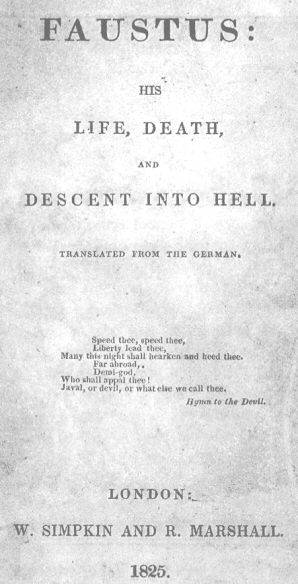
Faustus: / His / Life, Death, / and / Descent into Hell. /
Translated from the German. / Speed thee, speed
thee, / Liberty lead thee, / Many this night shall
harken and heed thee. / Far abroad, / Demi-god,
/ Who shall appal thee! / Javal, or devil,
or what else we call thee. / Hymn to the Devil. / London:
/ W. Simpkin and R. Marshall. / 1825.
Collation:—Foolscap octavo, pp. xii + 251; consisting
of: Half-title (with imprint “Printed by / J. and
C. Adlard, Bartholomew Close” at the foot of the
reverse) pp. i–ii; Title-page, as above (with blank
reverse) pp. iii–iv; Preface (headed The Translator to
the Public) pp. v–viii; Table of Contents pp.
ix–xii; and Text pp. 1–251. The reverse of p.
251 is occupied by Advertisements of Horace Welby’s
Signs before Death, and John Timbs’s Picturesque
Promenade round Dorking. The headline is Faustus
throughout, upon both sides of the page. At the foot of the
reverse of p. 251 the imprint is repeated thus, “J. and
C. Adlard, Bartholomew Close.” The
signatures are A (6 leaves), B to Q (15 sheets, each 8 leaves),
plus R (6 leaves).
Issued (in April, 1825) in bright claret-coloured linen
boards, with white paper back-label. The leaves measure
6¾ × 4¼ inches. The published price was
7s. 6d.
The volume has as Frontispiece a coloured plate,
engraved upon copper, representing the supper of the sheep-headed
Magistrates, described on pp. 64–66. The incident
selected for illustration is the moment when the wine
‘issued in blue flames from the flasks,’ and
‘the whole assembly sat like so many ridiculous characters
in a mad masquerade.’ This illustration was not new
to Borrow’s book. It had appeared both in the German
original, and in the French translation of
1798. In the original work the persons so bitterly
satirized were the individuals composing the Corporation of
Frankfort.
In 1840 ‘remainder’ copies of the First Edition of
Faustus were issued with a new title-page, pasted upon a
stub, carrying at foot the following publishers’ imprint,
“London: / Simpkin, Marshall & Co.
/ 1840.” They were made up in bright claret-coloured
linen boards, uniform with the original issue, with a white paper
back-label. The published price was again 7s.
6d.
Faustus was translated by Borrow from the German of
Friedrich Maximilian von Klinger. Mr. Shorter suggests,
with much reason, that Borrow did not make his translation from
the original German edition of 1791, but from a French
translation published in Amsterdam in 1798.
The reception accorded to Faustus was the reverse of
favourable. The Literary Gazette said (July
16th, 1825):—
“This is another work to which no
respectable publisher ought to have allowed his name to be
put. The political allusion and metaphysics, which may have
made it popular among a low class in Germany, do not sufficiently
season its lewd scenes and coarse descriptions for British
palates. We have occasionally publications for the
fireside,—these are only fit for the fire.”
Borrow’s translation of Klinger’s novel was
reprinted in 1864, without any acknowledgment of the name of the
translator. Only a few stray words in the text were
altered. But five passages were deleted from the Preface,
which, not being otherwise modified or supplemented,
gave—as was no doubt the intention of the
publishers—the work the appearance of a new translation
specially prepared. This unhallowed edition bears the
following title-page:
Faustus: / His / Life, Death,
and Doom. / A Romance in Prose. / Translated
from the German. / [Quotation as in the original edition,
followed by a Printer’s ornament.] / London: / W.
Kent and Co., Paternoster Row. / 1864.—Crown
8vo, pp. viii + 302.
“There is no reason to suppose,” remarks Mr.
Shorter (George Borrow and his Circle, p. 104) “that
the individual, whoever he may have been, who prepared the 1864
edition of Faustus for the Press, had ever seen either the
German original or the French translation of Klinger’s
book.”
There is a copy of the First Edition of Faustus in the
Library of the British Museum. The Press-mark is N.351.
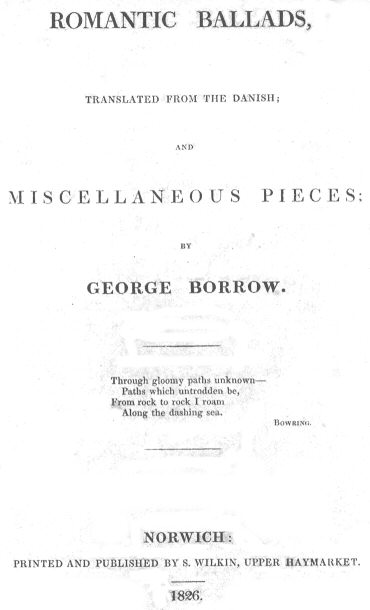
Romantic Ballads, / Translated from the Danish; / and /
Miscellaneous Pieces; / By / George Borrow. / Through gloomy
paths unknown— / Paths which untrodden be, /
From rock to rock I roam / Along the dashing sea. /
Bowring. / Norwich: / Printed and Published by S. Wilkin, Upper
Haymarket. / 1826.
Collation:—Demy octavo, pp. xii + 187; consisting of:
Half-title (with imprint “Norwich: / Printed by
S. Wilkin, Upper Haymarket” upon the centre of
the reverse) pp. i–ii; Title-page, as above (with blank
reverse) pp. iii–iv; Table of Contents (with blank
reverse) pp. v–vi; Preface pp. vii–viii;
Prefatory Poem From Allan Cunningham to George Borrow pp.
ix–xi, p. xii is blank; Text of the Ballads pp.
1–184; and List of Subscribers pp. 185–187. The
reverse of p. 187 is blank. There are head-lines
throughout, each page being headed with the title of the Ballad
occupying it. The imprint is repeated at the foot
of p. 184. The signatures are a (a half-sheet of 4 leaves),
b (a quarter-sheet of 2 leaves), B to M (eleven sheets, each 8
leaves), and N (a half-sheet of 4 leaves), followed by an
unsigned quarter-sheet of 2 leaves carrying the List of
Subscribers. [12] Sigs. G 5 and H 2 (pp.
89–90 and 99–100) are cancel-leaves, mounted on
stubs, in every copy I have met with.
Issued (in May 1826) in dark greenish-grey paper
boards, with white paper back-label, lettered
“Romantic / Ballads / From the /
Danish By / G. Borrow / Price 10/6
net.” The leaves measure 9 × 5½
inches.
The volume of Romantic Ballads was printed at Norwich
during the early months of 1826. The edition consisted of
Five Hundred Copies, but only Two Hundred of these were furnished
with the Title-page transcribed above. These were duly
distributed to the subscribers. The remaining Three Hundred
copies were forwarded to London, where they were supplied with
the two successive title-pages described below, and published in
the ordinary manner.
“I had an idea that, provided I
could persuade any spirited publisher to give these translations
to the world, I should acquire both considerable fame and
profit; not perhaps a world-embracing fame such as
Byron’s, but a fame not to be sneered at,
which would last me a considerable time, and would keep
my heart from breaking;—profit, not equal to
that which Scott had made by his wondrous novels, but
which would prevent me from starving, and enable me to
achieve some other literary enterprise. I read and
re-read my ballads, and the more I read them the more I
was convinced that the public, in the event of their being
published, would freely purchase, and hail them
with merited applause”—[“George Borrow and
his Circle,” 1913, p. 102.]
Allan Cunningham’s appreciation of the manner in which
Borrow had succeeded in his effort to introduce the
Danish Ballads to English readers is well expressed in the
following letter:
27, Lower Belgrave
Place,
London.
16th May, 1826.
My dear Sir,
I like your Danish Ballads much, and though
Oehlenslæger seems a capital poet, I love the old
rhymes best. There is more truth and simplicity in
them; and certainly we have nothing in our language to
compare with them. . . . ‘Sir John’ is
a capital fellow, and reminds one of Burns’
‘Findlay.’ ‘Sir
Middel’ is very natural and affecting, and
exceedingly well rendered,—so is ‘The
Spectre of Hydebee.’ In this you have kept up
the true tone of the Northern Ballad. ‘Svend
Vonved’ is wild and poetical, and it is my
favourite. You must not think me insensible to the
merits of the incomparable
‘Skimming.’ I think I hear his
neigh, and see him crush the ribs of the Jute.
Get out of bed, therefore, George Borrow,
and be sick or sleepy no longer. A fellow who can
give us such exquisite Danish Ballads has no right to repose.
. . .
I remain,
Your very faithful friend,
Allan Cunningham.
Contents.
|
Page.
|
Introductory Verses. By Allan Cunningham.
[Sing, sing, my friend; breathe life
again]
|
ix
|
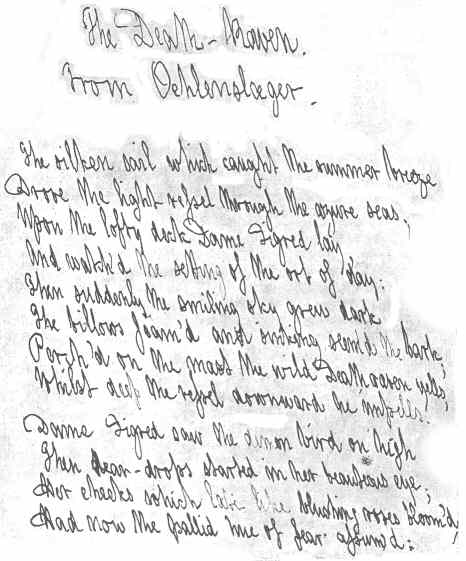
The Death-Raven. [The silken sail, which
caught the summer breeze]
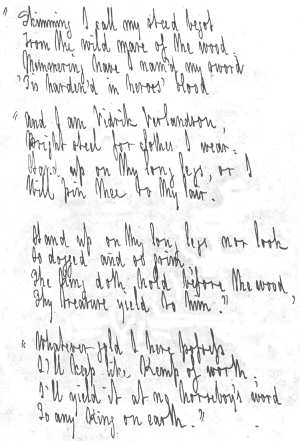
I give herewith a reduced facsimile of the first page of the
original Manuscript of this Ballad. No other MS. of it is
known to be extant.
|
1
|
Fridleif and Helga. [The woods were in leaf,
and they cast a sweet shade]
|
21
|
Sir Middel. [So tightly was Swanelil lacing her
vest]
Previously printed (under the title Skion Middel,
the first line reading, “The maiden was lacing so
tightly her vest,”) in The Monthly Magazine,
November 1823, p. 308. Apart from the opening line,
the text of the two versions (with the exception of a few
trifling verbal changes) is identical.
Another, but widely different, version of this Ballad is
printed in Child Maidelvold and Other Ballads, 1913, pp.
5–10. In this latter version the name of the heroine
is Sidselil in place of Swanelil, and that of the hero is Child
Maidelvold in place of Sir Middel.
|
28
|
Elvir-Shades. [A sultry eve pursu’d a
sultry day]
Considerable differences are to be observed between the text
of the Manuscript of Elvir-Shades and that of the printed
version. For example, as printed the second stanza
reads:
I spurr’d my courser, and more
swiftly rode,
In moody silence, through the forests
green,
Where doves and linnets had their lone abode.
In the Manuscript it reads:
Immers’d in pleasing pensiveness I
rode
Down vistas dim, and glades of forest
green,
Where doves and nightingales had their abode.
|
32
|
The Heddybee-Spectre. [I clomb in haste my
dappled steed]
In 1829 Borrow discarded his original (1826) version of The
Heddybee-Spectre, and made an entirely new translation.
This was written in couplets, with a refrain repeated after
each. In 1854 the latter version was revised, and
represents the final text. It commences thus:
At evening fall I chanced to ride,
My courser to a tree I tied.
So wide thereof the story goes.
Against a stump my head I laid,
And then to slumber I essay’d
So wide thereof the story goes.
From the Manuscript of 1854 the ballad was printed (under the
amended title The Heddeby Spectre) in Signelil,
A Tale from the Cornish, and Other Ballads, 1913,
pp. 22–24. Borrow afterwards described the present
early version as ‘a paraphrase.’
|
37
|
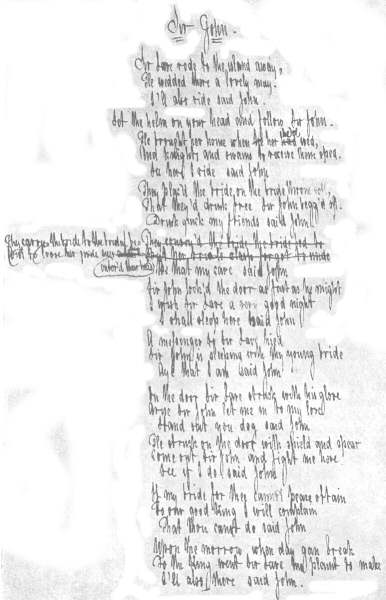
Sir John. [Sir Lavé
to the island stray’d]
There is extant a Manuscript of Sir John which
apparently belongs to an earlier date than 1826. The text
differs considerably from that of the Romantic
Ballads. I give a few stanzas of each.
1826.
The servants led her then to bed,
But could not loose her girdle red!
“I can, perhaps,” said John.
He shut the door with all his might;
He lock’d it fast, and quench’d the
light:
“I shall sleep here,” said John.
A servant to Sir Lavé hied:—
“Sir John is sleeping with the bride:”
“Aye, that I am,” said John.
Sir Lavé to the chamber flew:
“Arise, and straight the door undo!”
“A likely thing!” said John.
He struck with shield, he struck with
spear—
“Come out, thou Dog, and fight me
here!”
“Another time,” said John.
Early MS.
They carried the bride to the bridal
bed,
But to loose her girdle ne’er entered their
head—
“Be that my care,” said
John.
Sir John locked the door as fast as he might:
“I wish Sir Lavé a very good night,
I shall sleep here,” said
John.
A messenger to Sir Lavé hied:
“Sir John is sleeping with thy young
bride!”
“Aye, that I am!” said
John.
On the door Sir Lavé struck with his glove:
“Arise, Sir John, let me in to my
love!”
“Stand out, you dog!”
said John.
He struck on the door with shield and spear:
“Come out, Sir John, and fight me
here!”
“See if I do!” said
John.
|
40
|
May Asda. [May Asda is gone
to the merry green wood]
|
44
|
Aager and Eliza. [Have ye heard of bold Sir
Aager]
|
47
|
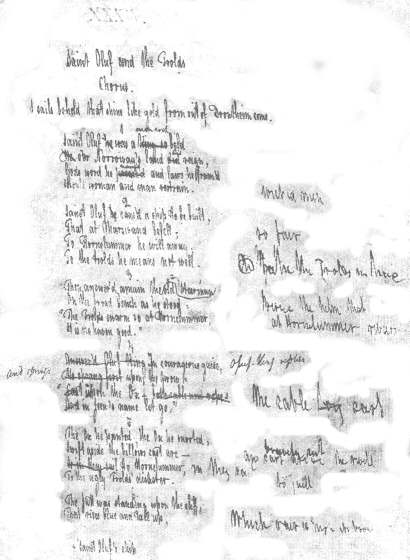
Saint Oluf. [St. Oluf was a mighty king]
Of Saint Oluf there are three MSS. extant, the first
written in 1826, the second in 1829, and the third in 1854.
In the two later MSS. the title given to the Ballad is Saint
Oluf and the Trolds. As the latest MS. affords the
final text of the Poem, I give a few of the variants between it
and the printed version of 1826
1826.
St. Oluf built a lofty ship,
With sails of silk so fair;
“To Hornelummer I must go,
And see what’s passing there.”
“O do not go,” the seamen said,
“To yonder fatal ground,
Where savage Jutts, and wicked elves,
And demon sprites, abound.”
St. Oluf climb’d the vessel’s side;
His courage nought could tame!
“Heave up, heave up the anchor straight;
Let’s go in Jesu’s name.
“The cross shall be my faulchion now—
The book of God my shield;
And, arm’d with them, I hope and
trust
To make the demons yield!”
And swift, as eagle cleaves the sky,
The gallant vessel flew,
Direct for Hornelummer’s rock,
Through ocean’s wavy blue.
’Twas early in the morning tide
When she cast anchor there;
And, lo! the Jutt stood on the cliff,
To breathe the morning air:
His eyes were like the burning beal—
His mouth was all awry;
The truth I tell, and say he stood
Full twenty cubits high.
* * * * *
“Be still, be still, thou noisy
guest—
Be still for evermore;
Become a rock and beetle there,
Above the billows hoar.”
Up started then, from out the hill,
The demon’s hoary wife;
She curs’d the king a thousand times,
And brandish’d high her knife.
Sore wonder’d then the little elves,
Who sat within the hill,
To see their mother, all at once,
Stand likewise stiff and still.
1854.
Saint Oluf caused a ship be built,
At Marsirand so fair;
To Hornelummer he’ll away,
And see what’s passing there.
Then answer made the steersman old,
Beside the helm who stood:
“At Hornelummer swarm the Trolas,
It is no haven good.”
The king replied in gallant guise,
And sprang upon the prow:
“Upon the Ox [23] the cable
cast,
In Jesu’s name let go!”
The Ox he pants, the Ox he snorts,
And bravely cuts the swell—
To Hornelummer in they sail
The ugly Trolds to quell.
The Jutt was standing on the cliff,
Which raises high its brow;
And thence he saw Saint Oluf, and
The Ox beneath him go.
His eyes were like a burning beal,
His mouth was all awry,
The nails which feve’d his fingers’ ends
Stuck out so wondrously.
“Now hold thy peace, thou foulest
fiend,
And changed be to stone;
Do thou stand there ’till day of doom,
And injury do to none.”
Then out came running from the hill
The carline old and grey;
She cursed the King a thousand times,
And bade him sail away.
Then wondered much the little Trolds,
Who sat within the hill,
To see their mother all at once
Stand likewise stiff and still.
The entire ballad should be compared with King Oluf the
Saint, printed in Queen Berngerd, The Bard and the
Dreams, and Other Ballads, 1913, pp 23–29.
|
53
|
The Heroes of Dovrefeld. [On Dovrefeld, in
Norway]
Another version of The Heroes of Dovrefeld, written in
1854, is extant in manuscript. Unlike that of 1826, which
was in four line stanzas, this later version is arranged in
couplets, with a refrain repeated after each. It commences
as follows:
On Dovrefeld in Norroway
Free from care the warriors lay.
Who knows like us to rhyme and rune?
Twelve bold warriors there were seen,
Brothers of Ingeborg the Queen.
Who knows like us to rhyme and rune?
The first the rushing storm could turn,
The second could still the running burn.
Who knows like us to rhyme and rune?
|
58
|
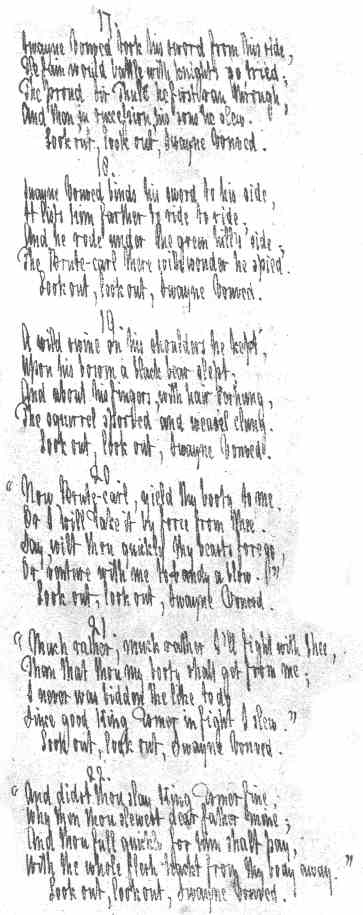
Svend Vonved. [Svend Vonved sits in his lonely
bower]
In a Manuscript of 1830 the name employed is Swayne
Vonved. There is no 1854 Manuscript of this Ballad.
|
61
|
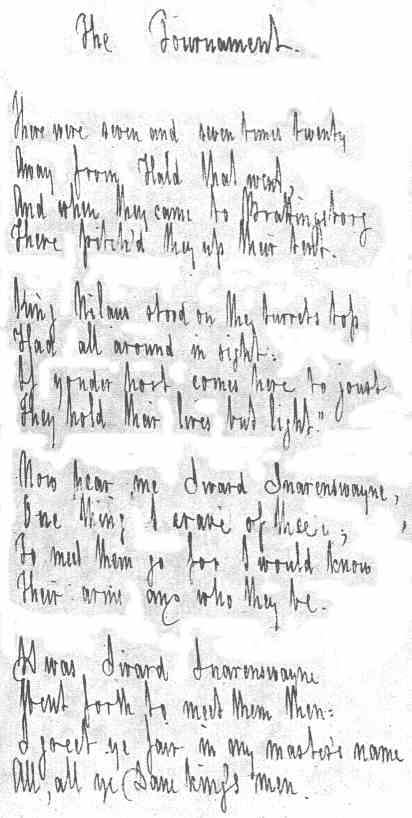
The Tournament. [Six score there were, six
score and ten]
The Tournament was one of the Ballads entirely
rewritten by Borrow in 1854 for inclusion in the then projected
Kœmpe Viser. The text of the later version
differed greatly from that of 1826, as the following extracts
will show:
1826.
Six score there were, six score and ten,
From Hald that rode that day;
And when they came to Brattingsborg
They pitch’d their pavilion gay.
King Nilaus stood on the turrets top,
Had all around in sight:
“Why hold those heroes their lives so cheap,
That it lists them here to fight?
“Now, hear me, Sivard
Snaresvend;
Far hast thou rov’d, and
wide,
Those warriors’ weapons thou shalt prove,
To their tent thou must straightway
ride.”
* * * * *
There shine upon the eighteenth shield
A man, and a fierce wild boar,
Are borne by the Count of Lidebierg;
His blows fall heavy and sore.
There shines upon the twentieth shield,
Among branches, a rose, so
gay;
Wherever Sir Nordman comes in war,
He bears bright honour away.
There shines on the one-and-twentieth shield
A vase, and of copper ’tis
made;
That’s borne by Mogan Sir Olgerson:
He wins broad lands with his blade.
And now comes forth the next good shield,
With a sun dispelling the mirk;
And that by Asbiorn Mildé is borne;
He sets the knights’ backs at work.
Now comes the four-and-twentieth shield,
And a bright sword there you see;
And that by Humble Sir Jerfing is borne;
Full worthy of that is he.
* * * * *
Sir Humble struck his hand on the board;
No longer he lists to play:
I tell you, forsooth, that the rosy hue
From his cheek fast faded away.
“Now, hear me, Vidrik
Verlandson;
Thou art so free a man;
Do lend me Skimming, thy horse, this day;
I’ll pledge for him what I
can.”
* * * * *
In came Humble, with boot and spur,
He cast on the table his sword:
“Sivard stands in the green wood bound,
He speaks not a single word.
“O, I have been to the wild forest,
And have seiz’d the warrior stark;
Sivard there was taken by me,
And tied to the oak’s rough
bark.”
* * * * *
The queen she sat in the high, high loft,
And thence look’d far and wide:
“O there comes Sward Snaresvend,
With a stately oak at his side.”
Then loud laugh’d fair Queen Gloriant,
As she looked on Sivard full:
“Thou wert, no doubt, in great,
great need,
When thou such flowers didst pull.”
1854.
There were seven and seven times twenty
Away from Hald that went;
And when they came to Brattingsborg
There pitch’d they up their tent.
King Nilaus stood on the turret’s top,
Had all around in sight:
“If yonder host comes here to joust
They hold their lives but light.
“Now, hear me, Sivard
Snarenswayne,
One thing I crave of thee;
To meet them go, for I would know
Their arms, and who they
be.”
* * * * *
There shine upon the eighteenth shield
A Giant and a Sow;
Who deals worse blows amidst his foes,
Count Lideberg, than thou?
Wherever Sir Nordman comes in war
He winneth fame in field;
Yon blooming rose and verdant boughs
Adorn the twentieth shield.
A copper kettle, fairly wrought,
Upon the next you see;
’Tis borne by one who realms has won,
Sir Mogan good, by thee!
Forth comes the two-and-twentieth shield,
A sun mid mist and smoke;
Of wrestler line full many a spine
Has Asborn Milday broke.
A glittering faulchion shines upon
The four-and-twentieth shield;
And that doth bear Sir Jerfing’s heir,
He’s worthy it to wield.
* * * * *
Young Humble struck his hand on the board,
No longer he lists to play;
I tell to you that the rosy hue
From his cheek fast fled away.
“Now hear me, Vidrik Verlandson,
Thou art a man so free;
Lend me thy horse to ride this course,
Grey Skimming lend to me.”
* * * * *
In came Humble, with boot and spur,
On the table cast his sword:
“’Neath the green-wood bough stands Sivard
now,
He speaketh not a word.
“O, I have been to the forest wild,
And have seiz’d the warrior good:
These hands did chain the Snarenswayne
To the oak’s bark in the
wood.”
* * * * *
The Queen she sat in the chamber high,
And thence look’d far and wide:
“Across the plain comes the Snarenswayne,
With an oak-tree at his side.”
Then loud laughed fair Queen Ellinore,
As she looked on Sivard full:
“Thou wast, I guess, in sore
distress
When thou such flowers didst pull!”
A reduced facsimile of the first page of the Manuscript of the
1854 version of The Tournament will be found herewith,
facing page 28.
|
82
|
Vidrik Verlandson. [King Diderik sits in the
halls of Bern]
Vidrik Verlandson was another of the Ballads entirely
re-written by Borrow in 1854 for the proposed Kœmpe
Viser. The text of the later version differed extremely
from that of 1826, as the following examples will shew:
1826.
“A handsome smith my father was,
And Verland hight was he:
Bodild they call’d my mother fair;
Queen over countries three:
“Skimming I call my noble steed,
Begot from the wild sea-mare:
Blank do I call my haughty helm,
Because it glitters so fair:
“Skrepping I call my good thick shield;
Steel shafts have furrow’d it
o’er:
Mimmering have I nam’d my sword;
’Tis hardened in heroes’
gore:
“And I am Vidrik Verlandson:
For clothes bright iron I wear:
Stand’st thou not up on thy long, long
legs,
I’ll pin thee down to thy lair:
“Do thou stand up on thy long, long
legs,
Nor look so dogged and grim;
The King holds out before the wood;
Thou shall yield thy treasure to
him.”
“All, all the gold that I possess,
I will keep with great renown;
I’ll yield it at no little horse-boy’s
word,
To the best king wearing a crown.”
“So young and little as here I seem,
Thou shalt find me prompt in a fray;
I’ll hew the head from thy shoulders off,
And thy much gold bear away.”
* * * * *
It was Langben the lofty Jutt,
He wav’d his steel mace round;
He sent a blow after Vidrik;
But the mace struck deep in the ground.
It was Langben the lofty Jutt,
Who had thought his foeman to slay,
But the blow fell short of Vidrik;
For the good horse bore him away.
It was Langben the lofty Jutt,
That shouted in wild despair:
“Now lies my mace in the hillock fast,
As though ’twere hammered in
there!”
* * * * *
“Accursed be thou, young Vidrik!
And accursed thy piercing steel!
Thou hast given me, see, a wound in my
breast,
Whence rise the pains I feel.”
* * * * *
“Now hear, now hear, thou warrior
youth,
Thou canst wheel thy courser about;
But in every feat of manly strength
I could beat thee out and out.”
1854.
“My father was a smith by trade,
And Verland Smith he hight;
Bodild they call’d my mother dear,
A monarch’s daughter bright.
“Blank do I call my helm, thereon
Full many a sword has snapped;
Skrepping I call my shield, thereon
Full many a shaft has rapped.
“Skimming I call my steed, begot
From the wild mare of the wood;
Mimmering have I named my sword,
’Tis hardened in heroes’
blood.
“And I am Viderik Verlandson,
Bright steel for clothes I wear;
Stand up on thy long legs, or I
Will pin thee to thy lair!
“Stand up on thy long legs, nor look
So dogged and so grim;
The King doth hold before the wood,
Thy treasure yield to him!”
“Whatever gold I here possess
I’ll keep, like a Kemp of
worth;
I’ll yield it at no horseboy’s word
To any King on earth!”
“So young and little as I seem
I’m active in a fray;
I’ll hew thy head, thou lubbard,
off,
And bear thy gold away!”
* * * * *
It was Langben the Giant waved
His steely mace around;
He sent a blow at Vidrik, but
The mace struck deep in the ground.
It was Langben, the lofty Jutt,
Had thought his foe to slay;
But the blow fell short, for the speedy horse
His master bore away.
It was Langben, the lofty Jutt,
He bellow’d to the heaven:
“My mace is tight within the height,
As though by a hammer driven!”
* * * * *
Accurs’d be thou, young Vidrik!
Accursed be thy steel!
Thou’st given me a mighty wound,
And mighty pain I feel.
* * * * *
“Now hear, now hear, thou warrior
youth,
Thou well canst wheel thy steed;
But I could beat thee out and out
In every manly deed.”
In Romantic Ballads, and also in the Manuscript
of 1854, this Ballad is entitled Vidrik Verlandson.
In the Manuscript of 1829 it is entitled Vidrik
Verlandson’s Conflict with the Giant Langben. The
text of this Manuscript is intermediate between that of the other
two versions.
A reduced facsimile of the first page of the Manuscript of the
1854 version of Vidrik Verlandson is given herewith,
facing p. 35.
|
98
|
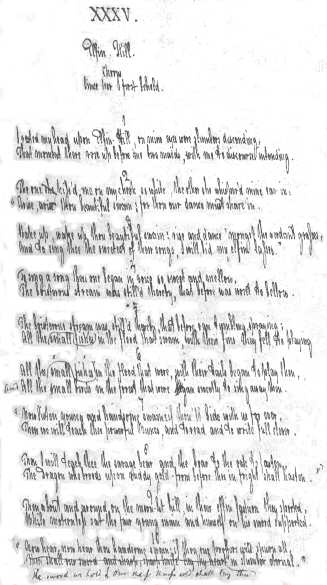
Elvir Hill. [I rested my head upon Elvir
Hill’s side, and my eyes were beginning to
slumber]
In the Manuscript of 1829 this Ballad is entitled Elfin
Hill, and the text differs considerably from that printed in
1826. I give the opening stanzas of each version.
1826.
I rested my head upon Elvir Hill’s
side, and my eyes were beginning to slumber;
That moment there rose up before me two maids, whose
charms would take ages to number.
One patted my face, and the other
exclaim’d, while loading my cheek with her
kisses,
“Rise, rise, for to dance with you here we
have sped from the undermost caves and abysses.
“Rise, fair-haired swain, and refuse
not to dance; and I and my sister will sing thee
The loveliest ditties that ever were heard, and the
prettiest presents will bring thee.”
Then both of them sang so delightful a song, that
the boisterous river before us
Stood suddenly quiet and placid, as though
’twere afraid to disturb the sweet chorus.
1829.
I rested my head upon Elfin Hill, on
mine eyes was slumber descending;
That moment there rose up before me two maids, with me
to discourse intending.
The one kissed me on my cheek so white, the other
she whispered mine ear in:
“Arise, arise, thou beautiful swain!
for thou our dance must share in.
“Wake up, wake up, thou beautiful
swain! rise and dance ’mongst the verdant
grasses;
And to sing thee the sweetest of their songs I’ll bid my
elfin lasses.”
To sing a song then one began, in voice so sweet and
mellow,
The boisterous stream was still’d thereby, that
before was wont to bellow.
|
111
|
Waldemar’s Chase. [Late at eve they were
toiling on Harribee bank]
Previously printed in The Monthly Magazine,
August 1824, p. 21.
|
115
|
The Merman. [Do thou, dear mother,
contrive amain]
A later, and greatly improved, version of this Ballad was
included, under the title The Treacherous Merman, in
The Serpent Knight and Other Ballads, 1913, pp.
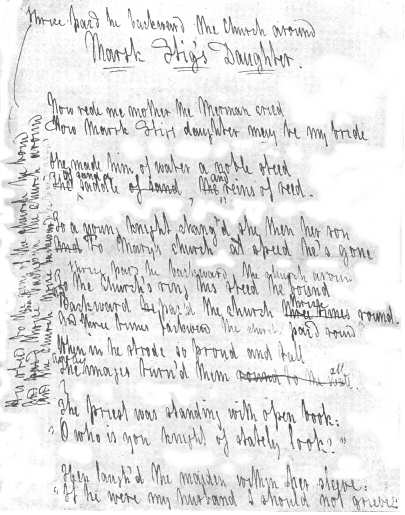
15–17. An early draft of this later version bears the
title Marsk Stig’s Daughter.
|
117
|
The Deceived Merman. [Fair Agnes alone on the
sea-shore stood]
Previously printed in The Monthly Magazine,
March 1825, pp. 143–144.
|
120
|
Cantata. [This is Denmark’s
holyday]
|
127
|
The Hail-Storm. [When from our ships we
bounded]
The Hail Storm was reprinted in Targum, 1835,
pp. 42–43, and again in Young Swaigder or The Force of
Runes and Other Ballads, 1913, pp. 14–15. In each
instance very considerable variations were introduced into the
text.
|
136
|
The Elder-Witch. [Though tall the oak, and
firm its stem]
|
139
|
Ode. From the Gælic. [Oh
restless, to night, are my slumbers]
|
142
|
Bear Song. [The squirrel that’s
sporting]
Previously printed, with some trifling differences in the
text, in The Monthly Magazine, December, 1824, p.
432.
|
144
|
National Song. [King Christian stood beside the
mast]
Previously printed (under the title “Sea Song;
from the Danish of Evald”) in The Monthly
Magazine, December, 1823, p. 437.
|
146
|
The Old Oak. [Here have I stood, the pride
of the park]
|
149
|
Lines to Six-Foot Three. [A
lad, who twenty tongues can talk]
|
151
|
Nature’s Temperaments:
|
|
1. Sadness. [Lo, a pallid fleecy
vapour]
|
155
|
2. Glee. [Roseate colours on heaven’s
high arch]
|
156
|
3. Madness. [What darkens, what
darkens?—’tis heaven’s high
roof]
In a revised Manuscript of uncertain date, but c
1860–70, this poem is entitled Hecla and Etna, the
first line reading:
“What darkens? It is the
wide arch of the sky.”
|
158
|
The Violet-Gatherer. [Pale the moon her light was
shedding]
|
159
|
Ode to a Mountain-Torrent. [How lovely art thou
in thy tresses of foam]
Previously printed in The Monthly Magazine,
October, 1823, p. 244.
In The Monthly Magazine the eighth stanza reads:
O pause for a time,—for a short
moment stay;
Still art thou streaming,—my words
are in vain;
Oft-changing winds, with tyrannical sway,
Lord there below on the time-serving
main!
In Romantic Ballads it reads:
Abandon, abandon, thy headlong
career—
But downward thou rushest—my words
are in vain,
Bethink thee that oft-changing winds domineer
On the billowy breast of the time-serving
main.
|
164
|
Runic Verses. [O the force of Runic
verses]
|
167
|
Thoughts on Death. [Perhaps ’tis
folly, but still I feel]
Previously printed (under the tentative title Death,
and with some small textual variations) in The Monthly
Magazine, October, 1823, p. 245.
|
169
|
Birds of Passage. [So hot shines the sun upon
Nile’s yellow stream]
|
171
|
The Broken Harp. [O thou, who,
’mid the forest trees]
|
173
|
Scenes. [Observe ye not yon high cliff’s
brow]
|
175
|
The Suicide’s Grave.
[The evening shadows fall upon the grave]
|
182
|
Note.—Each poem to which no
reference is attached, appeared for the first time in this
volume.
There is at present no copy of the First Issue of the First
Edition of Romantic Ballads, with the original Title-page,
in the Library of the British Museum.
Romantic Ballads, / Translated from the Danish; / and /
Miscellaneous Pieces; / By / George Borrow. / Through gloomy
paths unknown—/ Paths which untrodden be, /
From rock to rock I roam / Along the dashing sea. /
Bowring. / London: / John Taylor, Waterloo Place, Pall Mall, /
1826.
Collation:—Demy octavo, pp. xii + 187. The details
of the collation follow those of the First Issue described above
in every particular, save that, naturally, the volume lacks the
two concluding leaves carrying the List of Subscribers.
Issued in drab paper boards, with white paper
back-label. The published price was Seven Shillings.
“Taylor will undertake to publish the
remaining copies. His advice is to make the price
seven shillings, and to print a new title-page, and
then he will be able to sell some for you I advise the
same,” etc.—[Allan Cunningham to George
Borrow.]
There is a copy of the Second Issue of the First Edition of
Romantic Ballads in the Library of the British
Museum. The Press-mark is 11565. cc. 8.
Romantic Ballads, / Translated from the Danish; / and /
Miscellaneous Pieces; / By / George Borrow. / Through gloomy
paths unknown—/ Paths which untrodden be, /
From rock to rock I roam / Along the dashing sea. /
Bowring. / London: / Published by Wightman and Cramp, / 24
Paternoster Row. / 1826.
Collation:—Demy octavo, pp. xii + 187. The details
of the collation follow those of the Second Issue described above
in every particular.
Issued in drab paper boards, with white paper
back-label. The price was again Seven Shillings.
In 1913 a type-facsimile reprint of the Original Edition of
Romantic Ballads was published by Messrs. Jarrold and Sons
of Norwich. Three hundred Copies were printed.
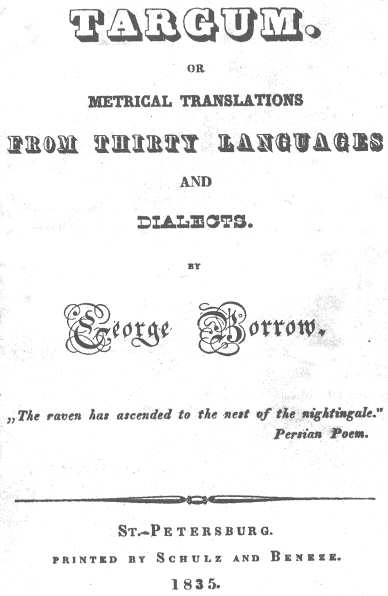
Targum. / Or / Metrical Translations / From Thirty Languages /
and / Dialects. / By / George Borrow. / “The raven has
ascended to the nest of the nightingale.” / Persian
Poem. / St. Petersburg. / Printed by Schulz and Beneze. /
1835.
Collation:—Demy octavo, printed in half-sheets, pp. viii
+ 106; consisting of: Title-page, as above (with a
Russian quotation upon the centre of the reverse) pp. i–ii;
Preface pp. iii–v; Table of Contents pp.
vi–viii, with a single Erratum at the foot of p.
viii; and Text of the Translations pp. 1–106.
There are no head-lines, the pages being numbered centrally in
Arabic numerals. Beyond that upon the foot of the
title-page, there is no imprint. The signatures are given
in large Arabic numerals, each pair of half-sheets dividing one
number between them; thus the first half-sheet is signed 1, the
second 1*, the third 2, the fourth 2*, &c. The Register
is therefore 1 to 7 (thirteen half-sheets, each 4 leaves),
followed by a single unsigned leaf (pp. 105–106), the whole
preceded by an unsigned half-sheet carrying the Title-page,
Preface, and Table of Contents. The book was issued without
any half-title.
Issued in plain paper wrappers of a bright green colour, lined
with white, and without either lettering or label. The
leaves measure 8 11/16 × 5½ inches.
Borrow was happy in the title he selected for his book.
Targum, as Mr. Gosse has pointed out, is a Chaldee word
meaning an interpretation. The word is said to be the root
of ‘dragoman.’
Targum was written by Borrow during his two
years’ residence at St. Petersburg (August, 1833, to
August, 1835), and was published in June of the latter
year. One hundred copies only were printed. As might
naturally be expected the book has now become of very
considerable rarity, but a small proportion of the original
hundred copies being traceable to-day.
A reduced facsimile of the Title-page is given herewith.
“Just before completing this great work, the
Manchu New Testament, Mr. Borrow published a small volume
in the English language, entitled Targum,
or Metrical Translations from Thirty Languages and
Dialects. The exquisite delicacy with which he has
caught and rendered the beauties of his well-chosen originals, is
a proof of his learning and genius. The work is a pearl in
literature, and, like pearls, it derives value from its scarcity,
for the whole edition was limited to about a hundred
copies.”—[John P. Hasfeld, in The
Athenæum, March 5th, 1836.]
“Some days ago I was at Kirtof’s bookshop on the
Gaternaya Ulitza. I wanted to buy a Bible in Spain
to send to Simbirsk (on the Volga), where they torment me for it
every post-day. The stock was all sold out in a few days
after its arrival last autumn. The bookseller asked me if I
knew a book by Borrow called Targum, which was understood
to have been written by him and printed at St. Petersburg, but he
had never been able to light upon it; and the surprising thing
was that the trade abroad and even in England did him the honour
to order it. I consoled him by saying that he could hardly
hope to see a copy in his shop or to get a peep at it.
‘I have a copy,’ continued I, ‘but if you will
offer me a thousand roubles for the bare reading of it I cannot
do you the favour.’ The man opened his eyes in
astonishment. ‘It must be a wonderful book,’
said he. ‘Yes, in that you are right, my good
friend,’ I replied.”—[John P.
Hasfeld.]
“After he became famous the Russian Government was
desirous of procuring a copy of this rare book, Targum,
for the Imperial Library, and sent an Envoy to England for the
purpose. But the Envoy was refused what he sought, and told
that as the book was not worth notice when the author’s
name was obscure and they had the opportunity of obtaining it
themselves, they should not have it now.”—[A.
Egmont Hake, in The Athenæum, August
13th, 1881.]
Contents.
|
page
|
Ode to God. [Reign’d the Universe’s
Master ere were earthly things begun]
Borrow reprinted this Ode in The Bible in Spain,
1843, Vol. iii, p. 333.
|
1
|
Prayer. [O Thou who dost
know what the heart fain would hide]
|
2
|
Death. [Grim Death in his shroud swatheth mortals
each hour]
|
3
|
Stanzas. On a Fountain. [In the fount fell
my tears, like rain]
|
4
|
Stanzas. The Pursued. [How wretched roams
the weary wight]
|
4
|
Odes. From the Persian:
|
|
1. [Boy, hand my friends the cup,
’tis time of roses now]
|
5
|
2. [If shedding lovers’ blood thou
deem’st a matter slight]
|
5
|
3. [O thou, whose equal mind knows no
vexation]
|
6
|
Stanzas. From the Turkish of Fezouli. [O
Fezouli, the hour is near]
|
7
|
Description of Paradise. [Eight Gennets there
be, as some relate]
|
8
|
O Lord! I nothing crave but Thee. [O
Thou, from whom all love doth flow]
|
11
|
Mystical Poem. Relating to the worship of the Great
Foutsa or Buddh. [Should I Foutsa’s force and
glory]
|
13
|
Moral Metaphors:
|
|
1. [From out the South the genial breezes
sigh]
|
19
|
2. [Survey, survey Gi Shoi’s
murmuring flood!]
|
20
|
The Mountain-Chase. [Autumn has fled and winter
left our bounds]
|
21
|
The Glory of the Cossacks. [Quiet Don!]
|
24
|
The Black Shawl. [On the shawl, the black
shawl with distraction I gaze]
|
27
|
Song. From the Russian of Pushkin. [Hoary
man, hateful man!]
|
29
|
The Cossack. An ancient Ballad. [O’er
the field the snow is flying]
|
30
|
The Three Sons of Budrys. [With his three mighty
sons, tall as Ledwin’s were once]
|
32
|
The Banning of the Pest.
[Hie away, thou horrid monster!]
|
35
|
Woinomoinen. [Then the ancient
Woinomoinen]
|
37
|
The Words of Beowulf, Son of Egtheof. [Every one
beneath the heaven]
|
39
|
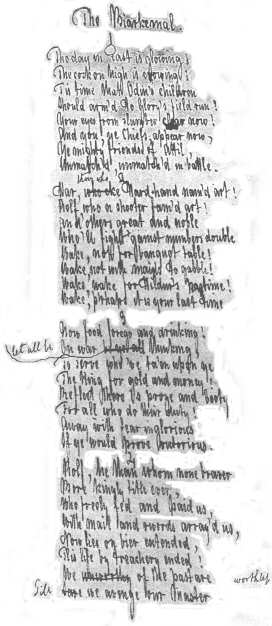
The Lay of Biarke. [The day in East is
glowing]
The title of this Ballad as it appears in the original MS. is
The Biarkemal.
|
40
|
The Hail-storm. [For victory as we
bounded]
Previously printed (but with very considerable variations in
the text, the first line reading “When from our ships we
bounded”) in Romantic Ballads, 1826, pp.
136–138. A final version of the Ballad, written about
1854, was printed in Young Swaigder or The Force of Runes and
Other Ballads, 1913, pp. 14–15.
|
42
|
The King and Crown. [The King who well
crown’d does govern the land]
|
44
|
Ode To a Mountain Torrent. [O stripling immortal
thou forth dost career]
Previously printed (but with an entirely different text, the
first line reading “How lovely art thou in thy tresses
of foam”) in The Monthly Magazine, Vol. lvi.,
1823, p. 244.
Also printed in Romantic Ballads, 1826, pp.
164–166.
The first stanza of the Ode as printed in Targum
does not figure in the version given in Romantic Ballads,
whilst the third stanza of the Romantic Ballads version is
not to be found in Targum.
|
45
|
Chloe. [O we have a sister on earthly
dominions!]
Previously printed in The Monthly Magazine, Vol. lvi,
1823, p. 437.
|
47
|
National Song. From the Danish of Evald.
[King Christian stood beside the mast]
Previously printed (under the title Sea Song; from
the Danish of Evald) in The Monthly Magazine,
December, 1823, p. 437.
Also printed in Romantic Ballads, 1826, pp.
146–148; and again in The Foreign Quarterly Review,
Vol. vi, June, 1830, p. 70.
The four versions of this Song, as printed in
The Monthly Magazine, in Romantic Ballads, in
The Foreign Quarterly Review, and in Targum, are
utterly different, the opening line being the only one which has
approximately the same reading in all.
|
49
|
Sir Sinclair. [Sir Sinclair sail’d from the
Scottish ground]
Previously printed in The Foreign Quarterly Review,
Vol. vi, June, 1830, p. 73.
|
51
|
Hvidfeld. [Our native land has ever
teem’d]
|
56
|
Birting. A Fragment. [It was late at
evening tide]
This “Fragment” consists of fifteen stanzas from
the Ballad The Giant of Berne and Orm Ungerswayne, which
was printed complete, for Private Circulation, in 1913.
[See post, No. 40.]
|
59
|
Ingeborg’s Lamentation. [Autumn winds
howl]
|
62
|
The Delights of Finn Mac Coul. [Finn Mac Coul
’mongst his joys did number]
|
65
|
Carolan’s Lament. [The arts of Greece,
Rome and of Eirin’s fair earth]
|
67
|
To Icolmcill. [On Icolmcill may blessings
pour]
|
68
|
The Dying Bard. [O for to hear the hunter’s
tread]
In the original Manuscript of this Poem the title reads The
Wish of the Bard; the text also differs considerably from
that which appears in Targum.
|
70
|
The Prophecy of Taliesin. [Within my mind]
|
73
|
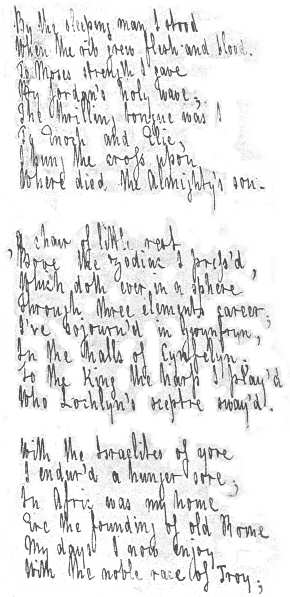
The History of Taliesin. [The head Bard’s
place I hold]
The original Manuscript of The History of Taliesin
possesses many points of interest. In the first place, in
addition to sundry variations of text, it enables us to fill up
the words in the last line of stanza 3, and the fourth line of
stanza 7, which in the pages of Targum are replaced by
asterisks. The full lines read:
Where died the Almighty’s Son,
and
In the second place the Manuscript contains a stanza,
following upon the first, which does not occur in the printed
text. This stanza reads as follows:
I with my Lord and God
On the highest places trod,
When Lucifer down fell
With his army into hell.
I know each little star
Which twinkles near and far;
And I know the Milky Way
Where I tarried many a day.
A reduced facsimile of the third page of this Manuscript will
be found herewith, facing page 54.
|
74
|
Epigram. On a Miser who had built a Stately
Mansion. [Of every pleasure is thy mansion void]
|
77
|
The Invitation. [Parry, of all my friends
the best]
|
78
|
The Rising of Achilles. [Straightway Achilles
arose, the belov’d of Jove, round his
shoulders]
|
82
|
The Meeting of Odysses and Achilles.
[Tow’rds me came the Shade of Peleidean
Achilles]
|
85
|
Hymn To Thetis and Neoptolemus. [Of Thetis I sing
with her locks of gold-shine]
|
90
|
The Grave of Demos. [Thus old Demos spoke,
as sinking sought the sun the western wave]
|
91
|
The Sorceries of Canidia. [Father of Gods,
who rul’st the sky]
|
92
|
The French Cavalier. [The French cavalier shall
have my praise]
|
97
|
Address To Sleep. [Sweet death of sense,
oblivion of ill]
|
98
|
The Moormen’s March From Granada.
[Reduan, I but lately heard]
|
101
|
The Forsaken. [Up I rose, O mother,
early]
|
103
|
Stanzas. From the Portuguese. [A fool is he
who in the lap]
|
104
|
My Eighteenth Year. [Where is my eighteenth
year? far back]
|
105
|
Song. From the Rommany. [The strength of
the ox]
Another version of this Song, bearing the title
“Our Heart is heavy, Brother,” is
printed in Marsk Stig’s Daughters and other Songs and
Ballads, 1913, pp. 17–18.
|
106
|
Note.—Each poem to which no
reference is attached, appeared for the first time in this
volume.
In 1892 Targum was reprinted, together with The
Talisman, by Messrs. Jarrold & Sons, of Norwich, in an
edition of 250 copies.
There is a copy of the First Edition of Targum in the
Library of the British Museum. The Press-mark is
C.57.i.6.
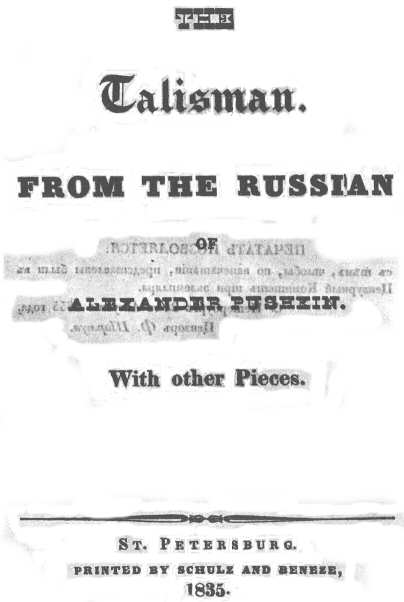
The / Talisman. / From the Russian / of / Alexander Pushkin. /
With other Pieces. / St. Petersburg. / Printed by Schulz and
Beneze, / 1835.
Collation:—Royal octavo, pp. 14; consisting of:
Title-page, as above (with a Russian quotation upon the centre of
the reverse) pp. 1–2; and Text of The Talisman and
other Poems pp. 3–14. There are no head-lines, the
pages being numbered centrally in Arabic numerals. Beyond
that upon the title-page there is no imprint. There are
also no signatures, the pamphlet being composed of a single
sheet, folded to form sixteen pages. The last leaf is a
blank. The book was issued without any half-title.
Issued stitched, and without wrappers. The leaves
measure 9¾ × 6¼ inches.
One Hundred Copies only were printed.
A reduced facsimile of the Title-page of The
Talisman is given herewith. It will be observed that
the heavy letterpress upon the reverse of the title shows through
the paper, and is reproduced in the photograph.
Contents.
|
page
|
The Talisman. [Where fierce the surge with awful
bellow]
|
3
|
The Mermaid. [Close by a lake, begirt with
forest]
|
5
|
Ancient Russian Songs:
|
|
1. [The windel-straw nor grass so shook and
trembled]
|
8
|
2. [O rustle not, ye verdant oaken
branches!]
|
9
|
3. [O thou field of my delight so fair and
verdant!]
|
9
|
Ancient Ballad. [From the wood a sound is
gliding]
|
11
|
The Renegade. [Now pay ye the heed that is
fitting]
|
13
|
Note.—The whole of the poems
printed in The Talisman appeared there for the first
time.
In 1892 Messrs. Jarrold & Sons published page for page
reprints of Targum and The Talisman. They
were issued together in one volume, bound in light drab-coloured
paper boards, with white paper back-label, and were accompanied
by the following collective title-page:
Targum: / or, / Metrical Translations from
Thirty Languages / and Dialects. / And / The
Talisman, / from the Russian of Alexander Pushkin. /
With Other Pieces. / By / George Borrow. /
Author of “The Bible in Spain”
&c. / London: / Jarrold & Sons, 3,
Paternoster Buildings.
In 1912 a small ‘remainder’ of The Talisman
came to light. The ‘find’ consisted of about
Five Copies, which were sold in the first instance for an equal
number of Pence. The buyer appears to have resold them at
progressive prices, commencing at Four Pounds and concluding at
Ten Guineas.
There is a copy of the First Edition of The Talisman in
the Library of the British Museum. The Press-mark is
C.57.e.33.
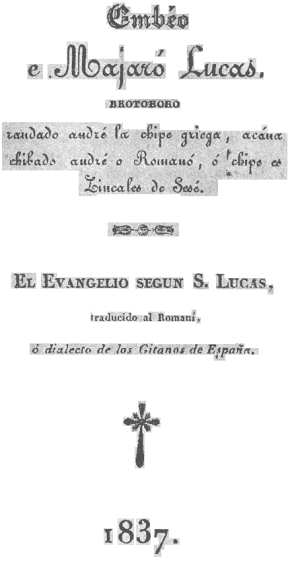
Embéo / e Majaró Lucas. / Brotoboro / randado
andré la chipe griega, acána / chibado andré
o Romanó, ó chipe es / Zincales de Sesé. /
El Evangelio segun S. Lucas, / traducido al Romaní, /
ó dialecto de los Gitanos de España. / 1837.
Collation:—Foolscap octavo, pp. 177, consisting of:
Title-page, as above (with Borrow’s Colophon upon the
reverse, followed by a quotation from the Epistle to the
Romans, Chap. XV. v. XXIV.) pp. 1–2; and Text of the
Gospel pp. 3–177. The reverse of p. 177 is
blank. There are no head-lines, the pages being numbered
centrally in Arabic numerals. There is no printer’s
imprint. The signatures are A to L (11 sheets, each 8
leaves), plus L repeated (two leaves, the second a blank).
The book was issued without any half-title.
I have never seen a copy of the First Edition of
Borrow’s translation into the dialect of the Spanish
Gypsies of the Gospel of St. Luke in the original binding.
No doubt the book (which was printed in Madrid) was put up in
paper wrappers, with untrimmed edges, in accordance with the
usual Continental custom.
Most of the copies now extant are either in a modern binding,
or in contemporary brown calf, with marbled edges and
endpapers. The latter are doubtless the copies sent home by
Borrow, and bound in leather for that purpose. The leaves
of these measure 6 × 4 inches.
As will be seen from the following extracts, it is
probable that the First Edition consisted of 250 copies, and that
50 of these were forwarded to London:
“In response to Borrow’s letter of
February 27th, the Committee resolved ‘to authorise Mr.
Borrow to print 250 copies of the Gospel of St. Luke, without the
Vocabulary, in the Rummanee dialect, and to engage the services
of a competent person to translate the Gospel of St. Luke by way
of trial in the dialect of the Spanish
Basque.’”—[Letters of George Borrow to the
British and Foreign Bible Society, 1911, pp.
205–206.]
“A small impression of the Gospel of St. Luke, in the
Rommany, or Gitano, or Gipsy language, has been printed at
Madrid, under the superintendence of this same gentleman, who
himself made the translation for the benefit of the interesting,
singular, degraded race of people whose name it bears, and who
are very numerous in some parts of Spain. He has likewise
taken charge of the printing of the Gospel of St. Luke, in the
Cantabrian, or Spanish Basque language, a translation of which
had fallen into his hands.”—[Thirty-Fourth Annual
Report of the British and Foreign Bible Society, 1838, p.
xliii.]
“All the Testaments were stopped at the custom house,
they were contained in two large chests. . . . The chests,
therefore, with the hundred Gospels in Gitano and Basque
[probably 50 copies of each] for the Library of the Bible Society
are at present at San Lucar in the custom house, from which I
expect to receive to-morrow the receipt which the authorities
here demand.”—[Borrow’s letter to the Rev.
A. Brandram, Seville, May 2nd,
1839.]
A Second Edition of the Gospel was printed in London in
1871. The collation is Duodecimo, pp. 117. This was
followed by a Third Edition, London, 1872, the collation of which
is also Duodecimo, pp. 117. Both bear the same imprint:
“London: / Printed by William Clowes and
Sons, Stamford Street, / and Charing
Cross.”
For these London Editions the text was considerably
revised.
The Gospel of St. Luke in the Basque dialect, referred to in
the above paragraphs, is a small octavo volume bearing the
following title-page:
Evangelioa / San Lucasen Guissan / El
Evangelio segun S. Lucas. / Traducido al vascuence. /
Madrid: / Imprenta de la Campañia
Tipografica / 1838.
The translation was the work of a Basque physician named
Oteiza, and Borrow did little more than see it through the
press. The book has, therefore, no claim to rank as a
Borrow princeps.
The measure of success which attended his efforts to reproduce
the Gospel of St. Luke in these two dialects is best told in
Borrow’s own words:
“I subsequently published the Gospel of St.
Luke in the Rommany and Biscayan languages. With respect to
the first, I beg leave to observe that no work printed in Spain
ever caused so great and so general a sensation, not so much
amongst the Gypsies, for whom it was intended, as amongst the
Spaniards themselves, who, though they look upon the Roma with
some degree of contempt, nevertheless take a strange interest in
all that concerns them. . . . Respecting the Gospel in
Basque I have less to say. It was originally translated
into the dialect of Guipuscoa by Dr. Oteiza, and subsequently
received corrections and alterations from myself. It can
scarcely be said to have been published, it having been
prohibited and copies of it seized on the second day of its
appearance. But it is in my power to state that it is
anxiously expected in the Basque provinces, where books in the
aboriginal tongue are both scarce and
dear.”—[Borrow’s Survey of his last two
years in Spain, printed in his Letters to the Bible
Society, 1911, pp. 360–361.]
There is a copy of the First Edition of The Gospel of St.
Luke in the dialect of the Spanish Gypsies in the Library of
the British Museum. The Press-mark is C.51.aa.12. The
Museum also possesses a copy of the Gospel in the Basque dialect;
the Pressmark is C.51.aa.13.
The Zincali; / Or, / An Account / of the / Gypsies of Spain. /
With / An Original Collection of their / Songs and
Poetry, / and / A Copious Dictionary of their Language. / By /
George Borrow, / Late Agent of the British and Foreign Bible
Society / in Spain. / “For that, which is unclean
by nature, thou canst entertain no hope: no /
washing will turn the Gypsy white.”—Ferdousi.
/ In Two Volumes. / Vol. I. [Vol. II] / London: /
John Murray, Albemarle Street. / 1841.
Vol. I.
Collation:—Large duodecimo, pp. xvi + 362; consisting
of: Half-title (with imprint “G. Woodfall and Son,
Angel Court, Skinner Street, London”
upon the centre of the reverse) pp. i–ii; Title-page, as
above (with blank reverse) pp. iii–iv; Dedication To the
Right Honourable the Earl of Clarendon, G.C.B. (with
blank reverse) pp. v–vi; Preface pp. vii–xii;
Table of Contents pp. xiii–xvi; and Text pp.
1–362, including a separate Fly-title (with blank reverse)
to The Zincali, Part II. There are headlines
throughout, each verso being headed The Zincali, whilst
each recto carries at its head a note of the particular subject
occupying it. The imprint is repeated at the foot of p.
362. The signatures are a (six leaves), b (two leaves), B
to Q (15 sheets, each 12 leaves), plus R (two leaves). Sig.
R 2 is a blank.
Vol. II.
Collation:—Large duodecimo, pp. vi + 156 + vi + *135;
consisting of: Half-title (with imprint “G. Woodfall and
Son, Angel Court, Skinner Street,
London” upon the centre of
the reverse) pp. i–ii; Title-page, as above (with blank
reverse) pp. iii–iv; Table of Contents pp.
v–vi; Fly-title to The Zincali, Part III
(with blank reverse) pp. 1–2; Text of Part III
(including separate Fly-titles, each with blank reverse, to
The Praise of Buddh, On the Language of the
Gitanos, and Robber Language) pp. 3–156;
Fly-title (with blank reverse) to The Zincali.
Vocabulary of their Language pp. i–ii;
Advertisement to the Vocabulary pp. iii–v; p. vi is
blank; Text of the Vocabulary pp. *1–*113; p. *114
is blank; Fly-title (with blank reverse) to Miscellanies in
the Gitano Language pp. *115–*116; Advertisement
to the Miscellanies p. *117; and Text of the
Miscellanies pp. *118–*135. The reverse of p.
*135 is blank. There are head-lines throughout, each verso
being headed The Zincali, whilst each recto carries at its
head a note of the particular subject occupying it. The
imprint is repeated at the foot of p. *135. The signatures
are a (2 leaves), b (one leaf), B to G (6 sheets, each 12
leaves), H (6 leaves), a (3 leaves),
b to e (4
sheets, each 12 leaves), f (9 leaves),
and g (12 leaves). b 6, b 8, and
b 12 are cancel-leaves. The last
leaf of Sig. g is occupied by a series
of Advertisements of Works just Published by John
Murray.
Issued (in April, 1841) in dark blue cloth boards, with
white paper back-label, lettered “Borrow’s /
Gypsies / of / Spain. / Two Volumes.
/ Vol. I. [Vol. II.].” The leaves measure
7⅞ × 4¾ inches. The published price was
18s.
Of the First Edition of The Zincali Seven Hundred and
Fifty Copies only were printed. A Second Edition, to which
a new Preface was added, was published in
March, 1843, and a Third in September, 1843, each
of which was restricted to the same number of copies. The
Fourth Edition appeared in 1846, the Fifth in 1870, the Sixth in
1882, the Seventh in 1888, and the Eighth in 1893. The book
has since been included in various popular editions, and
translated into several foreign languages.
Examples of The Zincali may sometimes be met with
bearing dates other than those noted above. These are
merely copies of the editions specified, furnished with new
title-pages.
Included in the second volume of The Zincali is a
considerable amount of verse, as follows:
|
page
|
Rhymes of the Gitanos.
[Unto a refuge me they led]
|
13
|
The Deluge. Part I. [I with fear and terror
quake]
|
65
|
The Deluge. Part II. [When I last did
bid farewell]
|
75
|
The Pestilence.
[I’m resolved now to tell]
The whole of the above pieces are accompanied on the opposite
pages by the original texts from which Borrow translated
them.
|
85
|
Poem, Relating to the Worship of the great Foutsa or
Buddh. [Should I Foutsa’s force and
glory]
Previously printed in Targum, 1835, p. 13.
|
94
|
There is a copy of the First Edition of The Zincali in
the Library of the British Museum. The Press-mark is
1429.g.14.
The / Bible in Spain; / Or, the / Journeys, Adventures, and
Imprisonments / Of an Englishman, / in / An Attempt to Circulate
the Scriptures / in / The Peninsula. / By George Borrow, / Author
of “The Gypsies of Spain.” / In three volumes. / Vol. I. [Vol. II, etc.] / London: / John Murray,
Albemarle Street. / 1843.
Vol. I.
Collation:—Large duodecimo pp. xxiv + 370; consisting
of: Half-title (with imprint “G. Woodfall and Son,
Angel Court, Skinner Street, London”
upon the centre of the reverse) pp. i–ii; Title-page, as
above (with blank reverse) pp. iii–iv; Contents of Vol.
i pp. v–viii; Preface pp. ix–xxiv; and
Text pp. 1–370. There are head-lines throughout, each
verso being headed The Bible in Spain together with the
number of the Chapter, whilst each recto carries at its head a
note of the particular subject occupying it, with the Chapter
number repeated. The imprint is repeated at the foot of p.
370. The signatures are A to Q (sixteen sheets, each 12
leaves), plus R (a half-sheet of 6 leaves). The last leaf
of sig. R carries a series of Advertisements of books published
by John Murray.
Vol. II.
Collation:—Large duodecimo, pp. viii + 398; consisting
of Half-title (with imprint “G. Woodfall and Son,
Angel Court, Skinner Street, London”
upon the centre of the reverse) pp. i–ii; Title-page, as
above (with blank reverse) pp. iii–iv; Contents of Vol.
ii. pp. v–viii; and Text pp. 1–398.
There are headlines throughout, as in the first volume. The
imprint is repeated at the foot of p. 398. The signatures
are A (four leaves), B to R (sixteen sheets, each 12 leaves),
plus S (8 leaves). The last leaf of Sig. R carries a series
of Advertisements of books published by John Murray.
Vol.
III.
Collation:—Large duodecimo, pp. viii + 391; consisting
of: Half-title (with imprint “G. Woodfall and Son,
Angel Court, Skinner Street, London”
upon the centre of the reverse) pp. i–ii; Title-page, as
above (with blank reverse) pp. iii–iv; Contents of Vol
iii pp. v–viii; and Text pp. 1–391. There
are headlines throughout, as in the two preceding volumes.
The reverse of p. 391 is occupied by Advertisements of
Romantic Ballads, Targum, and The
Zincali. The imprint is repeated at the foot of p.
391. The signatures are a (2 leaves), b (2 leaves), B to R
(sixteen sheets, each 12 leaves), plus S (4 leaves).
Issued (in December, 1842) in deep claret-coloured
cloth boards, with white paper back-label, lettered
“The | Bible | in | Spain |
Vol. I. [Vol. II, &c.].” The
leaves measure 7¾ × 4¾ inches. The
published price was 27s.
Although the title page of the First Edition of The Bible
in Spain is dated 1843, there can be no doubt that the book
was ready early in the preceding December. I have in my own
library a copy, still in the original cloth boards, with the
following inscription in Borrow’s handwriting upon the
flyleaf:
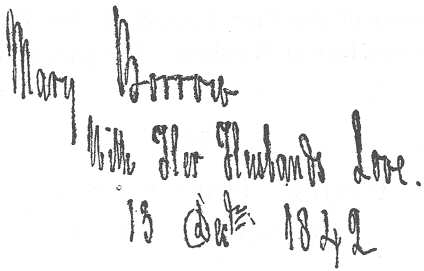
Autographed presentation copies of Borrow’s books are
remarkably few in number, I only know of four, in addition to the
above. One of these is preserved in the Borrow Museum, at
Norwich.
Of the First Edition of The Bible in Spain One
Thousand Copies were printed. The Second, Third, Fourth,
Fifth, and Sixth Editions were all published in 1843. By
1896 eighteen authorised editions had made their
appearance. Since that date the book has been re-issued in
numberless popular editions, and has been translated into various
foreign languages.
The following verses made their first appearance in The
Bible in Spain:
|
vol.
i., page
|
Fragment of a Spanish
Hymn. [Once of old upon a mountain,
shepherds overcome with sleep]
|
67
|
Lines from an Eastern
Poet. [I’ll weary myself each night and
each day]
|
149
|
A Gachapla. [I stole a
plump and bonny fowl]
|
175
|
|
vol.
ii., page
|
Fragment of a Patriotic
Song. [Don Carlos is a hoary churl]
|
141
|
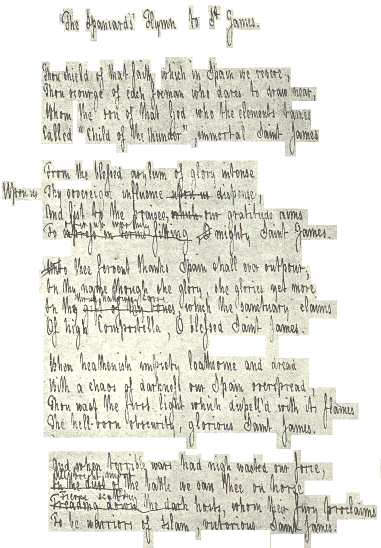
Saint James. [Thou
shield of that faith which in Spain we revere]
A reduced facsimile of the first page of the Manuscript of
Saint James will be found facing the present page.
|
176
|
Lines. [May the Lord
God preserve us from evil birds three]
|
310
|
Lines. [A handless man
a letter did write]
|
312
|
There is a copy of the First Edition of The Bible in
Spain in the Library of the British Museum. The
press-mark is 1369.f 23.
Art.—Hand-book for Travellers in Spain. London: 2
Vols. / post 8vo. 1845.
Collation:—Folio, pp. 12. There is no
Title-page proper, the title, as above, being imposed upon the
upper portion of the first page, after the manner of a
‘dropped head.’ The head-line is Spanish
Hand-book throughout, upon both sides of the page.
There is no printer’s imprint. There are also no
signatures; but the pamphlet is composed of three sheets, each
two leaves, making twelve pages in all.
Issued stitched, and without wrappers. The leaves
measure 13½ × 8½ inches. The pamphlet
is undated. It was printed in 1845.
This Review is unquestionably the rarest of the First
Editions of Borrow’s Works. No more than two copies
would appear to have been struck off, and both are fortunately
extant to-day. One of these was formerly in the possession
of Dr. William I. Knapp, and is now the property of the Hispanic
Society, of New York. The second example is in my own
library. This was Borrow’s own copy, and is freely
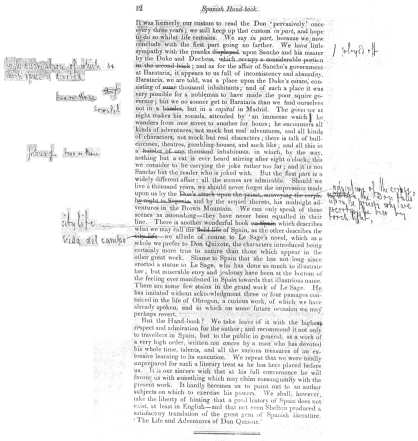
corrected in his characteristic handwriting. A greatly
reduced facsimile of the last page of the pamphlet is given
herewith.
In 1845 Richard Ford published his Hand-Book for Travellers
in Spain and Readers at Home [2 Vols. 8vo.], a work, the
compilation of which is said to have occupied its author for more
than sixteen years. In conformity with the wish of Ford
(who had himself favourably reviewed The Bible in Spain)
Borrow undertook to produce a study of the Hand-Book for
The Quarterly Review. The above Essay was the
result.
But the Essay, brilliant though it is, was not a
‘Review.’ Not until page 6 is the
Hand-Book even mentioned, and but little concerning it
appears thereafter. Lockhart, then editing the
Quarterly, proposed to render it more suitable for the
purpose for which it had been intended by himself interpolating a
series of extracts from Ford’s
volumes. But Borrow would tolerate no interference with his
work, and promptly withdrew the Essay, which had meanwhile been
set up in type. The following letter, addressed by Lockhart
to Ford, sufficiently explains the position:
London,
June 13th, 1845.
Dear Ford,
‘El Gitano’ sent me a paper on the
“Hand-Book” which I read with
delight. It seemed just another capital chapter of
his “Bible in Spain” and I thought,
as there was hardly a word of ‘review,’
and no extract giving the least notion of the peculiar merits
and style of the “Hand-Book,” that I
could easily (as is my constant custom) supply the
humbler part myself, and so present at once a fair review
of the work, and a lively specimen of our friend’s
vein of eloquence in exordio.
But, behold! he will not allow any
tampering . . . . I now write to condole with
you; for I am very sensible, after all, that
you run a great risk in having your book committed to hands far
less competent for treating it or any other book of Spanish
interest than Borrow’s would have been . . . and I
consider that, after all, in the case of a new
author, it is the first duty of the
“Quarterly Review” to introduce that author
fully and fairly to the public.
Ever Yours Truly,
J. G. Lockhart.
“Our author pictures Gibraltar as a human entity thus
addressing Spain:
Accursed land! I hate thee, and far
from being a defence, will invariably prove a thorn in thy
side.
And so on through many sentences of excited rhetoric.
Borrow forgot while he wrote that he had a book to review—a
book, moreover, issued by the publishing house which issued the
periodical in which his review was to
appear.”—[George Borrow and his Circle, 1913,
p. 257].
In 1913 Borrow’s Review was reprinted in
the following Pamphlet:
A / Supplementary Chapter / to / The
Bible in Spain / Inspired by / Ford’s
“Handbook for Travellers in Spain.” /
By / George Borrow / London: / Printed
for Private Circulation / 1913.—Square demy 8vo, pp.
46. [See post, No. 10.]
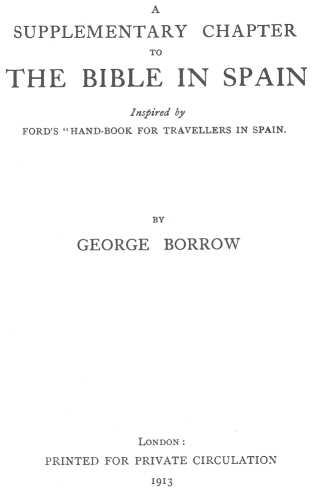
A / Supplementary Chapter / to / The Bible in Spain / Inspired
by / Ford’s “Handbook for Travellers in Spain.”
/ By / George Borrow / London: / Printed for Private Circulation
/ 1913.
Collation:—Square demy octavo, pp. 46; consisting of:
Half-title (with blank reverse) pp. 1–2; Frontispiece (with
blank recto) pp. 3–4; Title-page, as above (with blank
reverse) pp. 5–6; Prefatory Note (signed
‘T. J. W.’) pp. 7–10; and text of the
Chapter pp. 11–46. There are head-lines
throughout, each verso being headed A Supplementary
Chapter, and each recto To the Bible in Spain.
Following p. 46 is a leaf, with blank recto, and with the
following imprint upon the reverse, “London: /
Printed for Thomas J. Wise, Hampstead, N. W.
/ Edition limited to Thirty Copies.” The
signatures are A to C (3 sheets, each 8 leaves), inset within
each other.
Issued in bright green paper wrappers, with untrimmed edges, and with the title-page reproduced upon the
front. The leaves measure 8¾ × 6⅞
inches.
Thirty Copies only were printed.
The Frontispiece consists of a greatly reduced facsimile of
the last page, bearing Borrow’s corrections, of the
original edition of his Review of Ford’s
‘Hand-Book.’
This Supplementary Chapter to “The Bible in
Spain” is a reprint of the Review of Ford’s
Hand-book for Travellers in Spain written by Borrow in
1845 for insertion in The Quarterly Review, but withdrawn
by him in consequence of the proposal made by the Editor, John
Gibson Lockhart, that he should himself introduce into
Borrow’s Essay a series of extracts from the
Handbook. [See ante, No. 9.]
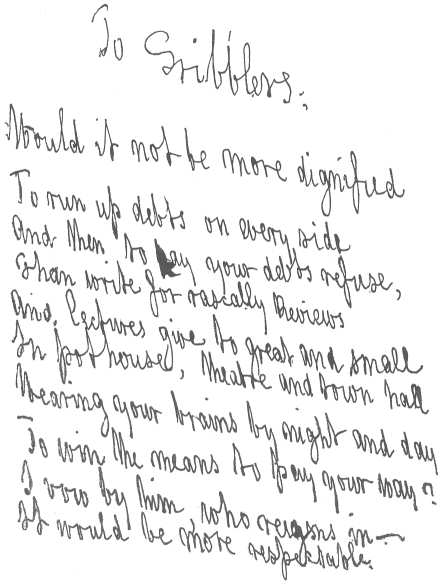
Included in the Prefatory Note is the following amusing
squib, written by Borrow in 1845, but never printed by him.
I chanced to light upon the Manuscript in a packet of his still
unpublished verse:
Would it not be more dignified
To run up debts on every side,
And then to pay your debts refuse,
Than write for rascally Reviews?
And lectures give to great and small,
In pot-house, theatre, and town-hall,
Wearing your brains by night and day
To win the means to pay your way?
I vow by him who reigns in [hell],
It would be more respectable!
There is a copy of A Supplementary Chapter to
“The Bible in Spain” in the Library of the
British Museum. The press-mark is C. 57. d. 19 (2).
Lavengro; / The Scholar—The Gypsy—The Priest. / By
George Borrow, / Author of “The Bible in Spain,” and
“The Gypsies of Spain” / In Three Volumes.—Vol.
I. [Vol. II., &c.] / London: / John
Murray, Albemarle Street. / 1851.
Vol. I.
Collation:—Large duodecimo, pp. xviii [85] + 360; consisting of: Half-title (with
imprint “London: / George Woodfall and Son, /
Angel Court, Skinner Street” upon the centre
of the reverse). Pp. i–ii; Title-page, as above (with
Advertisements of The Bible in Spain and The
Zincali upon the reverse) pp. iii–iv; Preface
pp. v–xii; and Text pp. 1–360. At the foot of
p. 360 the imprint is repeated thus, “G. Woodfall and
Son, Printers, Angel Court, Skinner
Street, London.” There are head-lines
throughout, each page being headed with the number of the
chapter, together with the title of the individual subject
occupying it. The signatures are A (nine leaves, a single
leaf being inserted between A 6 and A 7), and B to Q (fifteen
sheets, each 12 leaves).
A Portrait of Borrow, engraved by W. Holl from a
painting by H. W. Phillips, serves as Frontispiece.
Vol. II.
Collation:—Large duodecimo, pp. xii + 366; consisting
of: Half-title (with imprint “London: / George
Woodfall and Son, / Angel Court, Skinner
Street” upon the centre of the
reverse) pp. i–ii; Title-page, as above (with
Advertisements of The Bible in Spain and The
Zincali upon the reverse) pp. iii–iv; Contents
of Vol. II pp. v–xi; p. xii is blank; and Text pp.
1–366. At the foot of p. 366 the imprint is repeated
thus, “G. Woodfall and Son, Printers,
Angel Court, Skinner Street,
London.” There are head-lines throughout, as
in the first volume. The signatures are a (2
leaves), b (4 leaves), B to Q (fifteen sheets, each 12
leaves), plus R (3 leaves).
Vol. III.
Collation:—Large duodecimo, pp. xii + 426; consisting
of: Half-title (with imprint “London: / George
Woodfall and Son, / Angel Court, Skinner
Street” upon the centre of the reverse) pp. i–ii;
Title-page, as above (with Advertisements of The Bible in
Spain and The Zincali upon the reverse) pp.
iii–iv; Contents of Vol. III pp. v–xi; p. xii
is blank; and Text pp. 1–426. At the foot of p. 426
the imprint is repeated thus, “G. Woodfall and Son,
Printers, Angel Court, Skinner Street,
London.” There are head-lines throughout, as
in the first volume. The signatures are a (2
leaves), b (4 leaves), B to S (seventeen sheets, each 12
leaves), T (6 leaves), and U (3 leaves).
Issued in dark blue cloth boards, with white paper
back-labels, lettered “Lavengro; / the /
Scholar, / the Gypsy, / and / the
Priest. / By George Borrow / Vol. i. [Vol.
ii., &c.]” The leaves measure
7¾ × 4⅞ inches. The edition consisted of
3,000 Copies. The published price was 30s.
A Second Edition (miscalled Third Edition) was issued
in 1872; a Third (miscalled Fourth) in 1888; and a Fourth
(miscalled Fifth) in 1896. To the edition of 1872
was prefixed a new Preface, in which Borrow
replied to his critics in a somewhat angry and irritable
manner. Copies of the First Edition of Lavengro are
to be met with, the three volumes bound in one, in original
publishers’ cloth, bearing the name of the firm of Chapman
and Hall upon the back. These copies are
‘remainders.’ They were made up in 1870.
It is by no means unlikely that in 1872 some confusion prevailed
as to the nature of this subsidiary issue, and that it was
mistaken for a Second Edition of the book. If so the
incorrect numbering of the edition of that date, the actual
Second Edition, may be readily accounted for.
An important edition of Lavengro is:
Lavengro / By George Borrow / A New
Edition / Containing the unaltered Text of the Original
Issue; / some Suppressed Passages now printed for the
/ first time; MS. Variorum, Vocabulary and
Notes / By the Author of / The Life of George
Borrow / London / John Murray, Albemarle
Street / 1900.—Crown 8vo, pp. xxviii + 569.
The book was reprinted in 1911. The Editor was Dr.
William Knapp.
An edition of Lavengro, with a valuable Introduction by
Mr. Theodore Watts-Dunton, was published by Messrs. Ward, Lock
& Co., in 1893. The work is also included in
Everyman’s Library, and in other series of popular
reprints.
When put to press in February, 1849, the first volume of
Lavengro was set up with the title-page reading as
follows:—
Life, A Drama. / By / George
Borrow, Esq., / Author of “The Bible
in Spain,” etc. / In Three Volumes. /
Vol. i. / London: / John Murray,
Albemarle Street. / 1849.
Only two examples of the volume with this interesting early
title-page are known to have survived. One of these is now
in the possession of the Hispanic Society, of New York. The
other is the property of Mr. Otto Kyllmann.
Later in the same year Murray advertised the work under the
following title:—
Lavengro, An Autobiography. By
George Borrow, Esq., &c.
The same title was employed in the advertisements of 1850.
Mr. Clement Shorter possesses the original draft of the first
portion of Lavengro. In this draft the title-page
appears in its earliest form, and describes the book as Some
Account of the Life, Pursuits, and Adventures of a
Norfolk Man. A facsimile of this tentative title was
given by Mr. Shorter in George Borrow and his Circle,
1913, p. 280.
“Borrow took many years to write
Lavengro. ‘I am writing the work,’ he
told Dawson Turner, ‘in precisely the same manner as The
Bible in Spain, viz. on blank sheets of old account-books,
backs of letters,’ &c., and he recalls Mahomet writing
the Koran on mutton bones as an analogy to his own
‘slovenliness of manuscript.’ I have had plenty
of opportunity of testing this slovenliness in the collection of
manuscripts of portions of Lavengro that have come into my
possession. These are written upon pieces of paper of all
shapes and sizes, although at least a third of the book in
Borrow’s very neat handwriting is contained in a leather
notebook. The title-page demonstrates the earliest form of
Borrow’s conception. Not only did he then contemplate
an undisguised autobiography, but even described himself as
‘a Norfolk man.’ Before the book was finished,
however, he repudiated the autobiographical note, and we find him
fiercely denouncing his critics for coming to such a
conclusion. ‘The writer,’ he declares,
‘never said it was an autobiography; never authorised any
person to say it was one.’ Which was doubtless true,
in a measure.”—[George Borrow and his Circle,
1913, pp. 279–281].
There is a copy of the First Edition of Lavengro in the
Library of the British Museum. The Press-mark is 12622. f.
7.
The / Romany Rye; / A Sequel to “Lavengro.” / By
George Borrow, / Author of / “The Bible in Spain,” “The Gypsies of Spain,” etc. /
“Fear God, and take your own part.” /
In Two Volumes.—Vol. I. [Vol. II.] / London: John
Murray, Albemarle Street. / 1857. / [The Right of Translation is
reserved.]
Vol. I.
Collation:—Large duodecimo, pp. xii + 372; consisting
of: Half-title (with blank reverse) pp. i–ii; Title-page,
as above (with imprint “London: Woodfall and
Kinder, Printers, / Angel Court, Skinner
Street” at the foot of the reverse) pp. iii–iv;
Preface (styled Advertisement) pp. v–vi; Table of
Contents pp. vii–xi; Extract from Pleasantries of
the Cogia Nasr Eddin Efendi p. xii; and Text pp.
1–372. The head-line is The Romany Rye
throughout, upon both sides of the page; each page also bears at
its head the number of the particular Chapter occupying it.
At the foot of p. 372 the imprint is repeated thus,
“Woodfall and Kinder, Printers, Angel
Court, Skinner Street, London.” The
signatures are A (a half-sheet of 6 leaves), B to Q (15 sheets,
each 12 leaves), plus R (a half-sheet of 6 leaves).
Vol. II.
Collation:—Large duodecimo, pp. viii + 375 + ix;
consisting of: Half-title (with blank reverse) pp. i–ii;
Title-page, as above (with imprint “London:
Woodfall and Kinder, Printers, / Angel
Court, Skinner Street” at the foot of the
reverse) pp. iii–iv; Table of Contents pp.
v–vii; p. viii is blank; and Text pp.
1–375. The reverse of p. 375 is blank. The
volume is completed by eight unnumbered pages of Advertisements
of Works by the Author of “The Bible in
Spain” ready for the Press. There are
head-lines throughout; up to, and including, p. 244 the head-line
is The Romany Rye, together with the numbers of the
Chapters, pp. 245–375 are headed Appendix,
accompanied by the numbers of the Chapters. At the foot of
the last of the eight unnumbered pages carrying the
Advertisements (Sig. R 12 verso) the imprint is repeated thus,
“Woodfall and Kinder, Printers, Angel
Court, Skinner Street, London.” The
signatures are A (four leaves), plus B to R (16 sheets, each 12
leaves).
Issued (on April 30th, 1857) in dark blue cloth
boards, with white paper back-labels, lettered “The
/ Romany Rye. / By / George Borrow. /
Vol. I. [Vol. II.]” The leaves measure
7⅞ × 5 inches.
Of the First Edition of The Romany Rye One Thousand
Copies were printed. The published price was
21s. A Second Edition was published in 1858, a Third
in 1872, a Fourth in 1888, and a Fifth in 1896. The book is
included in Everyman’s Library, and in other series
of popular reprints.
The series of Advertisements of Works by Borrow,
announced as “Ready for the Press,” which occupy the
last eight pages of the second volume of The Romany Rye
are of especial interest. No less than twelve distinct
works are included in these advertisements. Of these twelve
The Bible in Spain was already in the hands of the public,
Wild Wales duly appeared in 1862, and The Sleeping
Bard in 1860. These three were all that Borrow lived to
see in print. Two others, The Turkish Jester and
The Death of Balder, were published
posthumously in 1884 and 1889 respectively; but the remaining
seven, Celtic Bards, Chiefs, and Kings,
Songs of Europe, Kœmpe Viser, Penquite and
Pentyre, Russian Popular Tales, Northern
Skalds, Kings, and Earls, and Bayr Jairgey
and Glion Doo: The Red Path and the Black Valley, were
never destined to see the light. However, practically the
whole of the verse prepared for them was included in the series
of Pamphlets which have been printed for private circulation
during the past twelve months.
As was the case with Lavengro, Borrow delayed the
completion of The Romany Rye to an extent that much
disconcerted his publisher, John Murray. The correspondence
which passed between author and publisher is given at some length
by Dr. Knapp, in whose pages the whole question is fully
discussed.
Mr. Shorter presents the matter clearly and fairly in the
paragraphs he devotes to the subject:
“The most distinctly English book—at
least in a certain absence of cosmopolitanism—that
Victorian literature produced was to a great extent written on
scraps of paper during a prolonged Continental tour which
included Constantinople and Budapest. In Lavengro we
have only half a book, the whole work, which included what came
to be published as The Romany Rye, having been intended to
appear in four volumes. The first volume was written in
1843, the second in 1845, and the third volume in the years
between 1845 and 1848. Then in 1852 Borrow wrote out an
advertisement of a fourth volume, which runs as follows:
Shortly will be published in one volume.
Price 10s. The Rommany Rye, Being
the fourth volume of Lavengro. By George Borrow,
author of The Bible in Spain.
But this volume did not make an appearance
‘shortly.’ Its author was far too much offended
with the critics, too disheartened it may be, to care to offer
himself again for their gibes. The years rolled on, and not
until 1857 did The Romany Rye appear. The book was
now in two volumes, and we see that the word Romany had
dropped an m. . . .
The incidents of Lavengro are supposed to have taken
place between the 24th of May
1825, and the 18th of July of that year. In The
Romany Rye the incidents apparently occur between the
19th of July and the 3rd of August
1825. In the opinion of Mr. John Sampson, the whole of the
episodes in the five volumes occurred in seventy-two
days.”—[George Borrow and his Circle, 1913,
pp. 341–343.]
A useful edition of The Romany Rye is:
The Romany Rye / A Sequel to
“Lavengro” / By George Borrow / A
New Edition / Containing the unaltered text of the
Original / Issue, with Notes, etc.,
by the Author of / “The Life of George
Borrow” / London / John Murray,
Albemarle Street / 1900.—Crown 8vo. pp. xvi +
403.
The book was edited by Dr. William Knapp.
There is a copy of the First Edition of The Romany Rye
in the Library of the British Museum. The Press-mark is
12622. f. 8.
The Sleeping Bard; / Or / Visions of the World, Death, and
Hell, / By / Elis Wyn. / Translated from the Cambrian British /
By / George Borrow, / Author of/ “The Bible in
Spain,” “The Gypsies of Spain,” etc. / London:
/ John Murray, Albemarle Street. / 1860.
Collation:—Crown octavo, pp. x + 128; consisting of:
Title-page, as above (with blank reverse) pp. i–ii;
Preface pp. iii–vii; p. viii is blank; Fly-title to
A Vision of the Course of the World (with blank reverse)
pp. ix-x; and Text of the three Visions pp. 1–128. There are head-lines throughout, each
double-page being headed with the title of the particular
Vision occupying it. A Vision of Hell is
preceded by a separate Fly-title (pp. 67–68) with blank
reverse. At the foot of p. 128 is the following imprint,
“James M. Denew, Printer, 72, Hall
Plain, Great Yarmouth.” The sheets carry
no register. The book was issued without any
Half-title. In some copies the Christian name of the
printer is misprinted Jamms.
Issued (in June, 1860) in magenta coloured cloth
boards, lettered in gold along the back, “The Sleeping
Bard,” and “London / John
Murray” across the foot. The published price was
5s.; 250 copies were printed. Murray’s
connection with the work was nominal. The book was actually
issued at Yarmouth by J. M. Denew, the printer by whom it was
produced. The cost was borne by the author himself, to whom
the majority of the copies were ultimately delivered.
Some few copies of The Sleeping Bard would appear to
have been put up in yellowish-brown plain paper wrappers, with
untrimmed edges. One such example is in the possession of
Mr. Paul Lemperley, of Cleveland, Ohio; a second is in the
library of Mr. Clement Shorter. The leaves of both these
copies measure 8¾ × 5¾ inches. The
leaves of ordinary copies in cloth measure 7½ ×
4¾ inches. The translation was made in 1830.
The text of The Sleeping Bard is divided into three
sections. Each of these sections closes with a poem of some
length, as follows:—
|
page
|
1. The Perishing World. [O man, upon
this building gaze]
|
38
|
2. Death the Great. [Leave land and house
we must some day]
In the printed text the seventh stanza of Death the
Great reads thus:
The song and dance afford, I
ween,
Relief from spleen, and sorrows grave;
How very strange there is no dance,
Nor tune of France, from Death can save!
About the year 1871 Borrow re-wrote this stanza, as
follows:
The song and dance can drive, they
say,
The spleen away, and humour’s grave;
Why hast thou not devised, O France!
Some tune and dance, from Death to save?
As was invariably the case with Borrow, his revision was a
vast improvement upon the original version.
|
63
|
3. The Heavy Heart. [Heavy’s the
heart with wandering below]
The Manuscript of The Sleeping Bard was formerly in the
possession of Dr. Knapp. It is now the property of the
Hispanic Society, of New York. It extends to 74 pages
4to.
|
124
|
There is a copy of the First Edition of The Sleeping
Bard in the Library of the British Museum. The
Press-mark is 12355. c. 17.
Wild Wales: / Its People, Language, and Scenery. / By George
Borrow, / Author of “The Bible in Spain,” etc. /
“Their Lord they shall praise, / Their language
they shall keep, / Their land they shall lose, /
Except Wild Wales.” / Taliesin: Destiny of the
Britons. / In Three Volumes.—Vol. I. [Vol. II,
&c.] / London: / John Murray, Albemarle Street. /
1862. / The right of Translation is reserved.
Vol. I.
Collation:—Large duodecimo, pp. xii + 410; consisting
of: Half-title (with advertisements of five of Borrow’s Works upon the reverse) pp.
i–ii; Title-page, as above (with imprint
“London: / Printed by Woodfall and Kinder, /
Angel Court, Skinner Street” upon the centre
of the reverse) pp. iii–iv; Notice regarding the previous
appearance of a portion of the work in The Quarterly
Review (with blank reverse) pp. v–vi; Contents of
Vol. I pp. vii–xi; p. xii is blank; and Text pp.
1–410. There are head-lines throughout, each verso
being headed Wild Wales, whilst each recto is headed with
the title of the particular subject occupying it. At the
foot of p. 410 the imprint is repeated thus: “Woodfall
and Kinder, Printers, Angel Court, Skinner
Street, London.” The signatures are A (a
half-sheet of 6 leaves), B to S (17 sheets, each 12 leaves), plus
T (2 leaves). The second leaf of Sig. T is a blank.
Vol. II.
Collation:—Large duodecimo, pp. viii + 413; consisting
of: Title-page, as above (with imprint “London: /
Printed by Woodfall and Kinder, / Angel Court,
Skinner Street” upon the centre of the reverse) pp.
i–ii; Contents of Vol. II pp. v–vii; p. viii
is blank; and Text pp. 1–413. The reverse of p. 413
is blank. There are head-lines throughout, as in the first
volume. At the foot of p. 413 the imprint is repeated thus,
“Woodfall and Kinder, Printers, Angel
Court, Skinner Street, London.” The
signatures are A (4 leaves), B to S (17 sheets, each 12 leaves),
plus T (4 leaves). The last leaf of Sig. T is a
blank. The volume was issued without any Half-title.
Vol. III.
Collation:—Large duodecimo, pp. viii + 474; consisting
of: Title-page, as above (with imprint “London: /
Printed by Woodfall and Kinder, / Angel Court,
Skinner Street” upon the centre of the reverse) pp.
i–ii; Contents of Vol. III pp. iii–viii; and
Text pp. 1–474. There are head-lines throughout, as
in the first volume. At the foot of p. 474 the imprint is
repeated thus, “Woodfall and Kinder,
Printers, Angel Court, Skinner Street,
London.” The signatures are A (8 leaves), B to
U (18 sheets, each 12 leaves), plus X (10 leaves). The last
leaf of Sig. H is a blank. The volume was issued without
any Half-title.
Issued (in December, 1862) in dark green cloth boards,
with white paper back-label, lettered “Wild Wales. /
By / George Borrow. / Vol. I [Vol. ii,
&c.].” The leaves measure 7⅝ ×
4⅞ inches. The published price was 30s.; 1,000
copies were printed.
A Second Edition of Wild Wales was issued in 1865, a
Third Edition in 1888, and a Fourth Edition in 1896. The
book has since been included in divers series of non-copyright
works.
The following Poems made their first appearance in the pages
of Wild Wales:
Vol.
I
|
|
|
page
|
Chester Ale. [Chester
ale, Chester ale! I could ne’er get it
down]
Another, widely different, version of these lines exist in
manuscript. It reads as follows:
On the Ale of Chester.
Of Chester the ale has but sorry renown,
’Tis made of
ground-ivy, of dust, and of bran;
’Tis as thick as a river belough a hugh town,
’Tis not lap for a
dog, far less drink for a man.
|
18
|
Saxons and Britons. [A
serpent which coils]
Previously printed in The Quarterly Review,
January 1861, p. 42.
|
48
|
Translation of a Welsh Englyn upon
Dinas Bran. [Gone, gone are thy gates,
Dinas Bran on the height!]
|
61
|
Lines Found on the tomb of
Madoc. [Here after sailing far I Madoc
lie]
|
105
|
The Lassies of County
Merion. [Full fair the gleisiad in the
flood]
This was one stanza only, the fifth, of the complete poem
The Cookoo’s Song in Merion, which Borrow translated
some years later, and which was first printed in Ermeline,
1913, pp. 21–23. The text of the two versions of this
stanza differ considerably.
|
153
|
Stanza on the stone of Jane
Williams. [Though thou art gone to dwelling
cold]
|
161
|
The Mist. [O ho!
thou villain mist, O ho!]
Although Borrow translated the whole poem, he omitted 24 lines
(the 14 opening and 10 closing lines) when printing it in Wild
Wales. Here are the missing lines, which I give from
the original Manuscript:
A tryste with Morfydd true I made,
’Twas not the first, in greenwood glade,
In hope to make her flee with me;
But useless all, as you will see.
I went betimes, lest she should grieve,
Then came a mist at close of eve;
Wide o’er the path by which I passed,
Its mantle dim and murk it cast.
That mist ascending met the sky,
Forcing the daylight from my eye.
I scarce had strayed a furlong’s space
When of all things I lost the trace.
Where was the grove and waving grain?
Where was the mountain hill and main?
* * * * *
Before me all affright and fear,
Above me darkness dense and drear,
My way at length I weary found,
Into a swaggy willow ground,
Where staring in each nook there stood
Of wry mouthed elves a wrathful brood.
Full oft I sank in that false soil,
My legs were lamed with length of toil.
However hard the case may be
No meetings more in mist for me.
Two of the above lines, somewhat differently worded, were
given in Wild Wales, Vol. i, p. 184.
|
173
|
Lines Descriptive of the Eagerness of
a Soul to reach Paradise. [Now to my rest I hurry
away]
|
251
|
Filicaia’s Sonnet on
Italy. [O Italy! on whom dark
Destiny]
|
290
|
Translation of an englyn foretelling
travelling by steam. [I got up in Mona, as
soon as ’twas light]
|
341
|
Translation of a Welsh stanza about
Snowdon. [Easy to say ‘Behold
Eryri’]
|
360
|
Stanzas On The Snow Of
Snowdon. [Cold is the snow on Snowdon’s
brow]
|
365
|
Vol.
II
|
|
Lines from Black Robin’s Ode in
praise of Anglesey. [Twelve sober men the muses
woo]
|
33
|
Lines on a Spring.
[The wild wine of Nature]
|
112
|
Things written in a
Garden. [In a garden the first of our race was
deceived]
|
158
|
El Punto de la Vana.
[Never trust the sample when you go your cloth to buy]
|
215
|
Llangollen’s Ale.
[Llangollen’s brown ale is with malt and hop
rife]
|
275
|
Poverty and Riches. An Interlude. [O Riches, thy
figure is charming and bright]
A reduced facsimile of the first page of the Manuscript of
this Interlude is given herewith, facing page 99.
|
328
|
An Ode to Sychark. By Iolo Goch. [Twice have I pledged
my word to thee]
|
392
|
Vol.
III
|
|
Translation of a Welsh englyn on the
Rhyadr. [Foaming and frothing from mountainous
height]
|
12
|
Ode to Owen
Glendower. [Here’s the life I’ve
sigh’d for long]
|
98
|
Ode to a Yew Tree.
[Thou noble tree; who shelt’rest kind]
|
203
|
Lines. [From high
Plynlimmon’s shaggy side]
|
219
|
Ode to a Yew Tree. [O
tree of yew, which here I spy]
This is another, and extended, version of the Ode
printed on p. 203 of Wild Wales. Yet another
version, differing from both, is printed in Alf the Freebooter
and Other Ballads, 1913, p. 27.
|
247
|
Lines from Ode to the
Ploughman, by Iolo Goch.
[The mighty Hu who lives for ever]
Previously printed, with some verbal differences, in The
Quarterly Review, January 1861, p. 40.
|
292
|
Lines on a Tomb-stone.
[Thou earth from earth reflect with anxious mind]
|
301
|
Ode to Griffith ap
Nicholas. [Griffith ap Nicholas, who like
thee]
The first six lines of this Ode had previously appeared in
The Quarterly Review, January 1861, p. 50.
|
327
|
God’s Better than
All. [God’s better than heaven or aught
therein]
A reduced facsimile of the first page of the Manuscript of
God’s Better than All will be found facing the
present page.
|
335
|
Ab Gwilym’s Ode to the Sun And
Glamorgan. [Each morn, benign of
countenance]
|
377
|
There is a copy of the First Edition of Wild Wales in
the Library of the British Museum. The Press-mark is 10369.
e. 12.
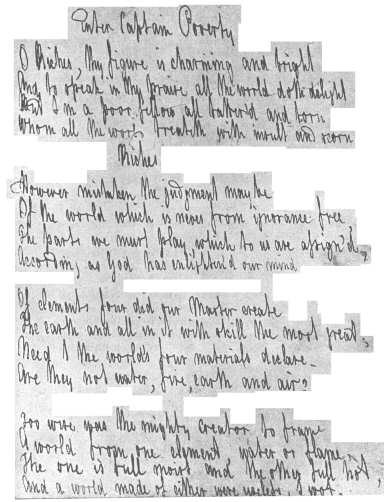
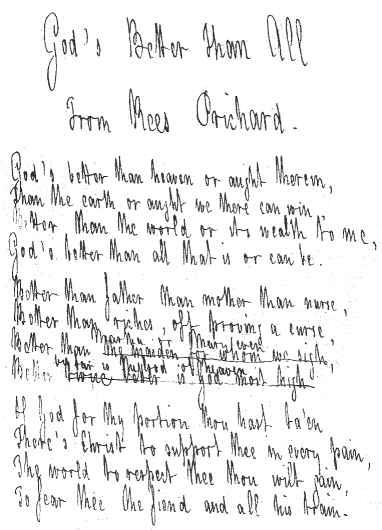
Romano Lavo-Lil: / Word-Book of the Romany; / or, / English
Gypsy Language. / With many pieces in Gypsy,
illustrative of the way of / Speaking and Thinking of the English
Gypsies; / with Specimens of their Poetry, and an account of
certain Gypsyries / or Places Inhabited by them, and of various
things / relating to Gypsy Life in England. / By George Borrow, /
Author of “Lavengro,” “The Romany Rye,”
“The Gypsies of Spain,” / “The Bible in
Spain,” etc. / “Can you rokra Romany? / Can
you play the bosh? / Can you jal adrey the staripen? /
Can you chin the cost?” / “Can you speak
the Roman tongue? / Can you play the fiddle? / Can
you eat the prison-loaf? / Can you cut and whittle? /
London: / John Murray, Albemarle Street. / 1874.
Collation:—Crown octavo, pp. viii + 331; consisting of:
Half-title (with blank reverse) pp. i–ii; Title-page, as
above (with imprint “London: / Printed by William
Clowes and Sons, / Stamford Street and Charing
Cross” upon the centre of the reverse) pp.
iii–iv; Prefatory Note regarding the Vocabulary p.
v; Advertisements of five Works of George Borrow p. vi;
Table of Contents pp. vii–viii; and Text pp.
1–331, including Fly-titles (each with blank reverse) to
each section of the book. The reverse of p. 331 is
blank. At the foot of p. 331 the imprint is repeated thus,
“London: Printed by Wm. Clowes and Sons,
Stamford Street / and Charing Cross.”
There are head-lines throughout, each page being headed with the
title of the particular subject occupying it. The
signatures, are A (a half-sheet of 4 leaves), B
to X (20 sheets, each 8 leaves), Y (a half-sheet of 4 leaves),
and Z (a quarter-sheet of 2 leaves).
Issued in dark blue cloth boards, with white paper back-label,
lettered “Romano Lavo-Lil; / Word-Book /
of / The Romany. / By / George
Borrow.” The leaves measure 7¾ ×
4⅞ inches. The published price was 10s.
6d.
One Thousand Copies were printed.
The book was set up in type towards the end of 1873, and
published early in 1874. Proof-sheets still exist bearing
the earlier date upon the title-page.
A considerable amount of Verse by Borrow made its first
appearance in the pages of Romano Lavo-Lil, as detailed in
the following list:
Contents
|
page
|
Little Sayings:
|
|
1. [ Whatever ignorance men may show]
|
109
|
2. [What must I do, mother, to make
you well?]
|
111
|
3. [I would rather hear him speak than hear Lally
sing]
|
115
|
English Gypsy Songs:
|
|
1. The Gypsy Meeting. [Who’s your
mother, who’s your father?]
|
175
|
2. Making a Fortune (1). [Come along,
my little gypsy girl]
|
177
|
3. Making a Fortune (2). [Come along,
my little gypsy girl]
|
179
|
The Two Gypsies. [Two
gypsy lads were transported]
|
181
|
My Roman Lass. [As I
to the town was going one day]
This is the first stanza only of The English
Gypsy. The complete Song will be found in Marsk
Stig’s Daughters and Other Songs
and Ballads, 1913, pp. 14–15. Here is the
concluding stanza, omitted in Romano Lavo-Lil:
As I to the town was going one day,
I met a young Roman upon the way.
Said he, “Young maid will you share my
lot?”
Said I, “Another wife you’ve
got.”
“No, no!” the handsome young Roman
cried,
“No wife have I in the world so wide;
And you my wedded wife shall be,
If you will share my lot with me.”
|
183
|
Yes, my
Girl. [If to me you prove untrue]
|
185
|
The Youthful Earl.
[Said the youthful earl to the Gypsy girl]
|
185
|
Love Song. [I’d
choose as pillows for my head]
|
187
|
Woe is Me. [I’m
sailing across the water]
|
189
|
The Squire and Lady.
[The squire he roams the good greenwood]
|
191
|
Gypsy Lullaby. [Sleep
thee, little tawny boy!]
|
193
|
Our Blessed Queen.
[Coaches fine in London]
|
195
|
Run for it. [Up,
up, brothers!]
This is the first stanza only of the Gypsy Song,
printed complete in Marsk Stig’s Daughters and other
Songs and Ballads, 1913, p. 16.
|
195
|
The Romany Songstress.
[Her temples they are aching]
|
199
|
The Friar. [A Friar
Was preaching once with zeal and with fire]
The Manuscript of these amusing verses, which were translated
by Borrow from the dialect of the Spanish Gypsies, affords some
curious variants from the published text. Here are the
lines as they stand in the MS.:
A Friar
Was preaching once with zeal and with fire;
And a butcher of the plain
Had lost a bonny swine;
And the friar did opine
That the Gypsies it had ta’en.
So, breaking off, he shouted,
“Gypsy ho!
Hie home, and from the pot
Take the butcher’s porker out,
The porker good and fat,
And in its place throw
A clout, a dingy clout
Of thy brat, of thy brat;
A clout, a dingy clout,
of thy brat.”
|
201
|
Malbrouk. From the Spanish Gypsy Version.
[Malbrouk is gone to the wars]
|
205
|
Sorrowful Years. [The
wit and the skill]
|
211
|
Fortune-Telling. [Late
rather one morning]
|
240
|
The Fortune-Teller’s
Song. [Britannia is my name]
|
243
|
Gypsy Stanza. [Can you
speak the Roman tongue?]
|
254
|
Charlotte Cooper. [Old
Charlotte I am called]
|
259
|
Epigram. [A beautiful
face and a black wicked mind]
|
262
|
Lines. [Mickie,
Huwie and Larry bold]
|
272
|
Lines. [What care
we, though we be so small?]
|
280
|
Ryley Bosvil. [The
Gorgios seek to hang me]
|
296
|
Ryley and the Gypsy.
[Methinks I see a brother]
|
298
|
To Yocky Shuri.
[Beneath the bright sun, there is none, there is
none]
|
301
|
Lines. [Roman lads
Before the door]
|
325
|
Upon page 122 of Romano Lavo-Lil, is printed a version
of The Lord’s Prayer cast into Romany by
Borrow. The original Manuscript of this translation has
survived, and its text presents some curious variations from the
published version. A reduced facsimile of this Manuscript
serves as Frontispiece to the present Bibliography.
Accompanying the Manuscript of The Lord’s Prayer
in Romany, is the Manuscript of a translation made by Borrow into
the dialect of the English Gypsies. This translation has
never, so far as I am aware, appeared in print. It is an
interesting document, and well worthy of preservation. A
reduced facsimile of it will be found facing the present
page.
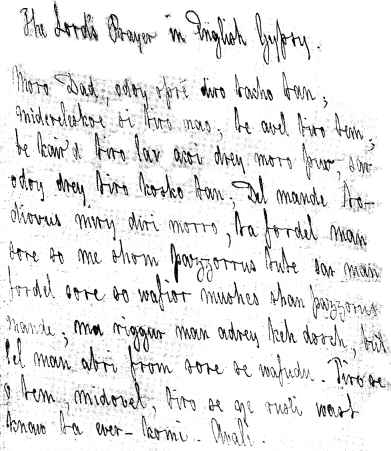
A Second Edition of Romano Lavo-Lil was issued
by the same publisher, John Murray, in 1888, and a Third in
1905.
There is a copy of the First Edition of Romano Lavo-Lil
in the Library of the British Museum. The Press-mark is
2278. c. 15.
The Turkish Jester; / Or, / The Pleasantries / of / Cogia Nasr
Eddin Effendi. / Translated from the Turkish / By / George
Borrow. / Ipswich: / W. Webber, Dial Lane. / 1884.
Collation:—Crown octavo, printed in half-sheets, pp. ii
+ 52; consisting of: Title-page, as above (with Certificate of
Issue upon the centre of the reverse) pp. i–ii; and Text
pp. 1–52. There are no head-lines, the pages being
numbered centrally. The book is made up in a somewhat
unusual manner, each half-sheet having a separately printed
quarter-sheet of two leaves imposed within it. The register
is therefore B to E (four sections, each 6 leaves), plus F (2
leaves), the whole preceded by two leaves, one of which is blank,
whilst the other carries the Title-page. There is no
printer’s imprint. The book was issued without any
Half-title. The title is enclosed within a single
rectangular ruled frame.
Issued in cream-coloured paper wrappers, with the title-page
reproduced upon the front, but reset in types of different
character, and without the ruled frame, and with the imprint
reading High Street in place of Dial Lane.
Inside the front cover the Certificate of Issue is
repeated. The leaves measure 7¾ × 5
inches. The edition consisted of One Hundred and Fifty
Copies. The published price was 7s. 6d.
The Manuscript of The Turkish Jester was formerly owned
by Dr. Knapp, and is now the property of the Hispanic Society, of
New York. It extends to 71 pages 4to. The translation
was probably made about 1854, at the time when Borrow was at work
upon his Songs of Europe. In 1857, the book was
included among the Advertisements appended to the second volume
of The Romany Rye.
There is a copy of the First Edition of The Turkish
Jester in the Library of the British Museum. The
Press-mark is 758. b. 16.
The / Death of Balder / From the Danish / of / Johannes Ewald
/ (1773) / Translated by / George Borrow / Author of “Bible
in Spain,” “Lavengro,” “Wild
Wales,” etc. / London / Jarrold & Sons, 3 Paternoster
Buildings, E.C. / 1889 / All Rights Reserved.
Collation:—Crown octavo, pp. viii + 77; consisting of:
Half-title (with Certificate of Issue upon the centre of the
reverse) pp. i–ii; Title-page, as above (with blank
reverse) pp. iii–iv; Preface and List of The
Persons (each with blank reverse) pp. v–viii; and Text
pp. 1–77. The reverse of p. 77 is blank. The
head-line is Death of Balder throughout, upon both sides
of the page. At the foot of p. 77 is the following imprint, “Printed by Ballantyne, Hanson
& Co. / London and Edinburgh.” The
signatures are A (4 leaves), and B to F (5 sheets, each 8
leaves). Sig. F 8 is a blank.
Issued in dark brown ‘diced’ cloth boards, with
white paper back-label. The leaves measure 7¾
× 5 inches. Two Hundred and Fifty Copies were
printed. The published price was 7s. 6d.
The Death of Balder was written in 1829, the year
during which Borrow produced so many of his ballad translations,
the year in which he made his fruitless effort to obtain
subscribers for his Songs of Scandinavia. On
December 6th of that year he wrote to Dr.
[afterwards Sir] John Bowring:
“I wish to shew you my translation of The
Death of Balder, Ewald’s most celebrated production,
which, if you approve of, you will perhaps render me some
assistance in bringing forth, for I don’t know many
publishers. I think this will be a proper time to introduce
it to the British public, as your account of Danish literature
will doubtless cause a sensation.”
Evidently no publisher was forthcoming, for the work remained
in manuscript until 1889, when, eight years after Borrow’s
death, Messrs. Jarrold & Sons gave it to the world. In
1857 Borrow included the Tragedy among the series of Works
advertised as “ready for the Press” at the end of the
second volume of The Romany Rye. It was there
described as “A Heroic Play.”
Although published only in 1889, The Death of Balder
was actually set up in type three years earlier. It had
been intended that the book should have been issued in London by
Messrs. Reeves & Turner, and proof-sheets exist carrying upon
the title-page the name of that firm as publishers, and bearing
the date 1886. It would appear that Mr. W. Webber, a
bookseller of Ipswich, who then owned the Manuscript, had at
first contemplated issuing the book through Messrs. Reeves &
Turner. But at this juncture he
entered into the employment of Messrs. Jarrold & Sons, and
consequently the books was finally brought out by that
firm. The types were not reset, but were kept standing
during the interval.
Another version of the song of The Three Valkyrier, which
appears in The Death of Balder, pp. 53–54, was
printed in Marsk Stig’s Daughters and Other Songs and
Ballads, 1913, pp. 19–20. The text of the two
versions differs entirely, in addition to which the 1913 version
forms one complete single song, whilst in that of 1889 the lines
are divided up between the several characters.
The Manuscript of The Death of Balder, referred to
above, passed into the hands of Dr. Knapp, and is now in the
possession of the Hispanic Society, of New York. It
consists of 97 pages 4to. A transcript in the handwriting
of Mrs. Borrow is also the property of the Society.
There is a copy of the First Edition of The Death of
Balder in the Library of the British Museum. The
Press-mark is 11755. f 9.
Letters of / George Borrow / To the British and Foreign /
Bible Society / Published by Direction of the Committee / Edited
by / T. H. Darlow / Hodder and Stoughton / London New York
Toronto / 1911.
Collation:—Octavo, pp. xviii + 471; consisting of:
Half-title (with blank reverse) pp. i–ii; Title-page, as
above (with blank reverse) pp. iii–iv; Dedication To
Williamson Lamplough (with blank reverse) pp. v–vi;
Preface vii–xi; Note regarding “the officials of the
Bible Society with whom Borrow came into close relationship” pp. xi–xii; List of
Borrow’s Letters, etc., printed in this
Volume pp. xiii–xvii; chronological Outline of
Borrow’s career p. xviii; and Text of the
Letters, &c., pp. 1–471. There are
head-lines throughout, each verso being headed George
Borrow’s Letters, and each recto To the Bible
Society. Upon the reverse of p. 471 is the following
imprint “Printed by T. and A. Constable, Printers
to His Majesty / at the Edinburgh University
Press.” The signatures are a (one sheet of
8 leaves), b (a quarter-sheet of 2 leaves), A to 2 F (29
sheets, each 8 leaves) plus 2 G (a half-sheet of 4 leaves).
Sig. a 1 is a blank. A facsimile of one of the
Letters included in the volume is inserted as Frontispiece.
Issued in dark crimson buckram, with paper sides, lettered in
gold across the back, “Letters of / George /
Borrow / To the / Bible Society / Edited
by / T. H. Darlow / Hodder & /
Stoughton.” The leaves measure 8⅜
× 5⅞ inches. The published price was 7s.
6d.
“When Borrow set about preparing The
Bible in Spain, he obtained from the Committee of the Bible
Society the loan of the letters which are here published, and
introduced considerable portions of them into that most
picturesque and popular of his works. Perhaps one-third of
the contents of the present volume was utilised in this way,
being more or less altered and edited by Borrow for the
purpose.”—[Preface, pp. ix-x].
The holographs of the complete series of Letters included in
this volume are preserved in the archives of the British and
Foreign Bible Society.
There is a copy of Letters of George Borrow to the British
and Foreign Bible Society in the Library of the British
Museum. The Press-mark is 010902.e.10.
Letters / To his Wife / Mary Borrow / By / George Borrow /
London: / Printed for Private Circulation / 1913.
Collation:—Crown octavo, pp. 38; consisting of:
Half-title (with blank reverse) pp. 1–2; Title-page, as
above (with blank reverse), pp. 3–4; and Text of the
Letters pp. 5–38. The head-line is Letters
to His Wife throughout, upon both sides of the page.
Following p. 38 is a leaf, with blank reverse, and with the
following imprint upon its recto, “London: /
Printed for Thomas J. Wise, Hampstead, N.W.
/ Edition limited to Thirty Copies.” The
signatures are A (a half sheet of 4 leaves), plus B and C (2
sheets, each 8 leaves), inset within each other.
Issued in bright green paper wrappers, with untrimmed edges,
and with the title-page reproduced upon the front. The
leaves measure 7½ × 5 inches.
Thirty Copies only were printed.
Holograph Letters by Borrow are extremely uncommon, the number
known to be extant being far less than one might have supposed
would be the case, considering the good age to which Borrow
attained. His correspondents were few, and, save to the
officials of the Bible Society, he was not a diligent
letter-writer. The holographs of this series of letters
addressed to his wife are in my own collection of Borroviana.
The majority of the letters included in this volume were
reprinted in George Borrow and his
Circle. By Clement King Shorter, 8vo, 1913.
There is a copy of Letters to his Wife, Mary
Borrow, in the Library of the British Museum. The
Press-mark is C. 44. d. 32.
Marsk Stig / A Ballad / By / George Borrow / London: / Printed
for Private Circulation / 1913.
Collation:—Crown octavo, pp. 40; consisting of:
Half-title (with blank reverse) pp. 1–2; Title-page, as
above (with blank reverse) pp. 3–4; and Text of the
Ballad pp. 5–40. The head-line is Marsk
Stig throughout, upon both sides of the page. At the
foot of p. 40 is the following imprint, “London: /
Printed for Thomas J. Wise, Hampstead, N.W.
/ Edition limited to Thirty Copies.” The
signatures are A (a half-sheet of 4 leaves), plus B and C (2
sheets, each 8 leaves), inset within each other.
Issued in bright green paper wrappers, with untrimmed edges,
and with the title-page reproduced upon the front. The
leaves measure 7½ × 5 inches.
Thirty Copies only were printed.
Marsk Stig consists of four separate Ballads, or
Songs as Borrow styled them, the whole forming one
complete and connected story. The plot is an old Danish
legend of the same character as the history of David and
Bathsheba, Marsk Stig himself being the counterpart of Uriah the
Hittite.
The four Songs commence as follows:—
|
page
|
1. Marsk Stig he out of the country rode
To win him fame with his good bright sword
|
5
|
2. Marsk Stig he woke at black midnight,
And loudly cried to his Lady dear
|
15
|
3. There’s many I ween in Denmark
green
Who all to be masters now desire
|
23
|
4. There were seven and seven times twenty
That met upon the verdant wold
|
34
|
Marsk Stig was one of the ballads prepared by Borrow
for The Songs of Scandinavia in 1829, and revised for the
Kœmpe Viser in 1854. Both Manuscripts are
extant, and I give reproductions of a page of each. It will
be observed that upon the margins of the earlier Manuscript
Borrow wrote his revisions, so that this Manuscript practically
carries in itself both versions of the ballad. The
Manuscript of 1829 is in the possession of Mr. J. H. Spoor, of
Chicago. The Manuscript of 1854 is in my own library.
As a specimen of Marsk Stig I quote the following
stanzas:
It was the young and bold Marsk Stig
Came riding into the Castle yard,
Abroad did stand the King of the land
So fair array’d in sable and mard.
“Now lend an ear, young Marshal Stig,
I have for thee a fair emprise,
Ride thou this year to the war and bear
My flag amongst my enemies.”
“And if I shall fare to the war this year,
And risk my life among thy foes,
Do thou take care of my Lady dear,
Of Ingeborg, that beauteous
rose.”
Then answer’d Erik, the youthful
King,
With a laugh in his sleeve thus answered
he:
“No more I swear has thy lady to fear
Than if my sister dear were she.”
It was then the bold Sir Marshal Stig,
From out of the country he did depart,
In her castle sate his lonely mate,
Fair Ingeborg, with grief at
heart.
“Now saddle my steed,” cried Eric the
King,
“Now saddle my steed,” King
Eric cried,
“To visit the Dame of beauteous fame
Your King will into the country
ride.”
* * * * *
“Now list, now list, Dame
Ingeborg,
Thou art, I swear, a beauteous
star,
Live thou with me in love and glee,
Whilst Marshal Stig is engag’d in
war.”
Then up and spake Dame Ingeborg,
For nought was she but a virtuous wife:
“Rather, I say, than Stig betray,
Sir King, I’d gladly lose my
life.”
“Give ear, thou proud Dame Ingeborg,
If thou my leman and love will be,
Each finger fair of thy hand shall bear
A ring of gold so red of blee.”
“Marsk Stig has given gold rings to me,
And pearls around my neck to string;
By the Saints above I never will prove
Untrue to the Marshal’s couch, Sir
King.”
* * * * *
It was Erik the Danish King,
A damnable deed the King he wrought;
He forc’d with might that Lady bright,
Whilst her good Lord his battles fought.
* * * * *
It was the young Sir Marshal Stig
Stepp’d proudly in at the lofty
door;
And bold knights then, and bold knight’s
men,
Stood up the Marshal Stig before.
So up to the King of the land he goes,
And straight to make his plaint began;
Then murmured loud the assembled crowd,
And clench’d his fist each honest
man.
“Ye good men hear a tale of fear,
A tale of horror, a tale of
hell—
&c., &c.
There is a copy of Marsk Stig A Ballad in the Library
of the British Museum. The Press-mark is C. 44. d. 38.
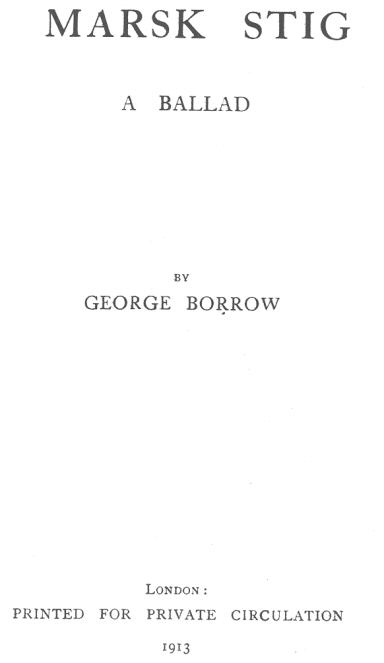
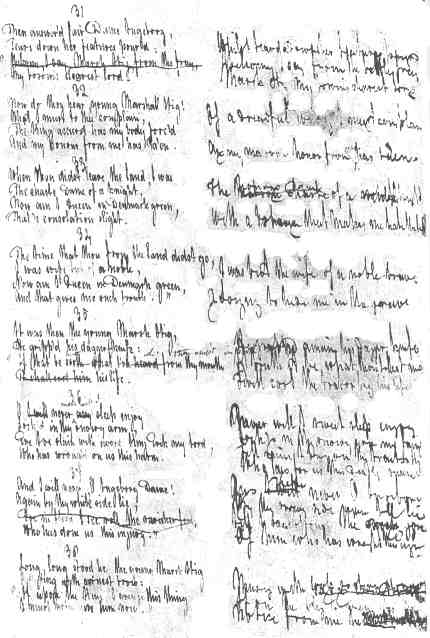
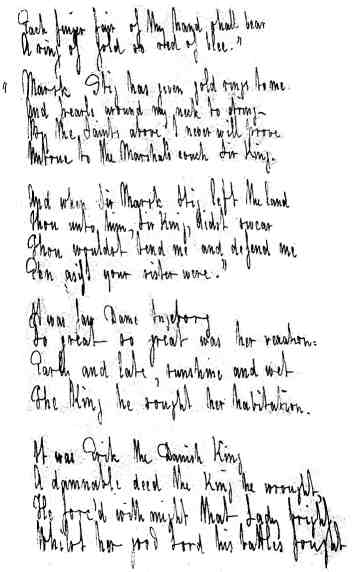
The Serpent Knight / and / Other Ballads / By / George Borrow
/ London: / Printed for Private Circulation / 1913.
Collation:—Square demy octavo, pp. 35; consisting of:
Half-title (with blank reverse) pp. 1–2; Title-page, as
above (with blank reverse) pp. 3–4; Table of
Contents (with blank reverse) pp. 5–6; and Text of
the Ballads pp. 7–35. There are head-lines
throughout, each page being headed with the title of the
particular Ballad occupying it. Upon the reverse of
p. 35 is the following imprint: “London: / Printed for Thomas J. Wise, Hampstead,
N.W. / Edition limited to thirty
copies.” The signatures are A (a quarter-sheet of
two leaves), plus B & C (two sheets, each eight leaves),
inset within each other.
Issued in bright green paper wrappers, with untrimmed edges,
and with the title-page reproduced upon the front. The
leaves measure 8½ × 6⅞ inches.
Thirty Copies only were printed.
Contents.
|
page
|
The Serpent Knight. [Signelil sits in her bower
alone]
The only extant MS. of this ballad originally bore the title
The Transformed Knight, but the word Transformed is
struck out and replaced by Serpent, in Borrow’s
handwriting.
|
7
|
Sir Olaf. [Sir Olaf rides on his courser
tall]
Sir Olaf is one of Borrow’s most successful
ballads. The only extant Manuscript is written upon paper
water-marked with the date 1845, and was prepared for the
projected Kœmpe Viser.
|
10
|
The Treacherous Merman. [“Now rede me
mother,” the merman cried]
This Ballad is a later, and greatly improved, version of one
which appeared under the title The Merman only, in the
Romantic Ballads of 1826. The introduction of the
incident of the changing by magic of the horse into a boat,
furnishes a reason for the catastrophe which was lacking in the
earlier version.
In its final shape The Treacherous Merman is another of
Borrow’s most successful ballads, and it is evident that he
bestowed upon it an infinite amount of care and labour. An
early draft of the final version [a reduced facsimile of its
first page will be found ante, facing p. 40] bears the
tentative title Marsk Stig’s Daughter. Besides
the two printed versions Borrow certainly composed a third, for a
fragment exists of a third MS., the text of which differs
considerably from that of both the others.
|
15
|
The Knight in the Deer’s Shape. [It was the
Knight Sir Peter]
Facing the present page is a reduced facsimile of the first
page of the Manuscript of The Knight in the Deer’s
Shape.
|
18
|
The Stalwart Monk. [Above
the wood a cloister towers]
The Stalwart Monk was composed by Borrow about the year
1860. Whether he had worked upon the ballad in earlier
years cannot be ascertained, as no other Manuscript besides that
from which it was printed in the present volume is known to
exist.
|
24
|
The Cruel Step-Dame. [My father up of the country
rode]
|
30
|
The Cuckoo. [Yonder the cuckoo flutters]
|
34
|
The complete Manuscript of The Serpent Knight and Other
Ballads is in my own collection of Borroviana.
There is a copy of The Serpent Knight and Other Ballads
in the Library of the British Museum. The Press-mark is C.
44. d. 38.
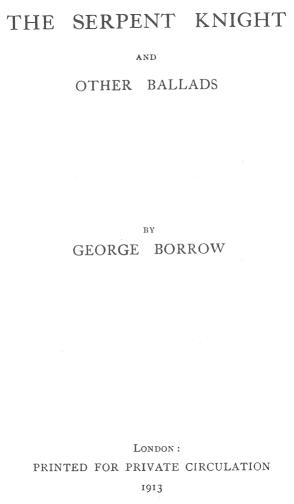
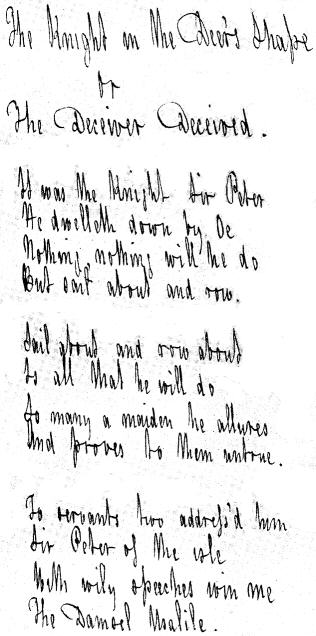
The King’s Wake / and Other Ballads / By / George Borrow
/ London: / Printed for Private Circulation / 1913.
Collation:—Square demy octavo, pp. 23; consisting of:
Half-title (with blank reverse) pp. 1–2; Title-page, as
above (with blank reverse) pp. 3–4; and Text of the
Ballads pp. 5–23. There are head-lines
throughout, each page being headed with the title of the
particular Ballad occupying it. Upon the reverse of
p. 23 is the following imprint: “London: /
Printed for Thomas J. Wise, Hampstead, N.W.
/ Edition limited to Thirty Copies.” The
signatures are A (a half-sheet of four leaves), with B (a full
sheet of eight leaves) inset within it.
Issued in bright green paper wrappers, with untrimmed
edges, and with the title-page reproduced upon the front.
The leaves measure 8½ × 6⅞ inches.
Thirty Copies only were printed.
Contents.
|
page
|
The King’s Wake. [To-night is the night
that the wake they hold]
An early draft of this ballad has the title The
Watchnight.
|
5
|
Swayne Felding. [Swayne Felding sits at
Helsingborg]
Of Swayne Felding two Manuscripts are extant.
One, originally destined for The Songs of Scandinavia, is
written upon white paper water-marked with the date 1828.
The other, written upon blue paper, was prepared for the
Kœmpe Viser of 1854. In the earlier MS. the
ballad bears the title Swayne Felding’s Combat with the
Giant; the later MS. is entitled Swayne Felding
only. The texts of the two MSS. differ widely.
|
10
|
Innocence Defamed. [Misfortune comes to every
door]
The heroic ballads included in these collections are all far
too long to admit of any one of them being given in full.
As an example of the shorter ballads I quote the title-poem of
the present pamphlet, The King’s Wake:
THE KING’S
WAKE [132]
To-night is the night that the wake they hold,
To the wake repair both young and old.
Proud Signelil she her mother address’d:
“May I go watch along with the rest?”
“O what at the wake wouldst do my dear?
Thou’st neither sister nor brother there.
“Nor brother-in-law to protect thy
youth,
To the wake thou must not go forsooth.
“There be the King and his warriors gay,
If me thou list thou at home wilt stay.”
“But the Queen will be there and her maiden
crew,
Pray let me go, mother, the dance to
view.”
So long, so long begged the maiden young,
That at length from her mother consent she wrung.
“Then go, my child, if thou needs must
go,
But thy mother ne’er went to the wake I
trow.”
Then through the thick forest the maiden went,
To reach the wake her mind was bent.
When o’er the green meadows she had won,
The Queen and her maidens to bed were gone.
And when she came to the castle gate
They were plying the dance at a furious rate.
There danced full many a mail-clad man,
And the youthful King he led the van.
He stretched forth his hand with an air so free:
“Wilt dance, thou pretty maid, with
me?”
“O, sir, I’ve come across the
wold
That I with the Queen discourse might hold.”
“Come dance,” said the King with a
courteous smile,
“The Queen will be here in a little
while.”
Then forward she stepped like a blushing rose,
She takes his hand and to dance she goes.
“Hear Signelil what I say to thee,
A ditty of love sing thou to me.”
“A ditty of love I will not, Sir King,
But as well as I can another I’ll sing.”
Proud Signil began, a ditty she sang,
To the ears of the Queen in her bed it rang.
Says the Queen in her chamber as she lay:
“O which of my maidens doth sing so gay?
“O which of my maidens doth sing so late,
To bed why followed they me not straight?”
Then answered the Queen the little foot page:
“’Tis none of thy maidens I’ll
engage.
“’Tis none I’ll engage of the maiden
band,
’Tis Signil proud from the islet’s
strand.”
“O bring my red mantle hither to me,
For I’ll go down this maid to see.”
And when they came down to the castle gate
The dance it moved at so brave a rate.
About and around they danced with glee,
There stood the Queen and the whole did see.
The Queen she felt so sore aggrieved
When the King with Signil she perceived.
Sophia the Queen to her maid did sign:
“Go fetch me hither a horn of wine.”
His hand the King stretched forth so free:
“Wilt thou Sophia my partner be?”
“O I’ll not dance with thee, I
vow,
Unless proud Signil pledge me now.”
The horn she raised to her lips, athirst,
The innocent heart in her bosom burst.
There stood King Valdemar pale as clay,
Stone dead at his feet the maiden lay.
“A fairer maid since I first drew breath
Ne’er came more guiltless to her death.”
For her wept woman and maid so sore,
To the Church her beauteous corse they bore.
But better with her it would have sped,
Had she but heard what her mother said.
|
20
|
There is a copy of The King’s Wake and Other
Ballads in the Library of the British Museum. The
Press-mark is C. 44. d. 38.
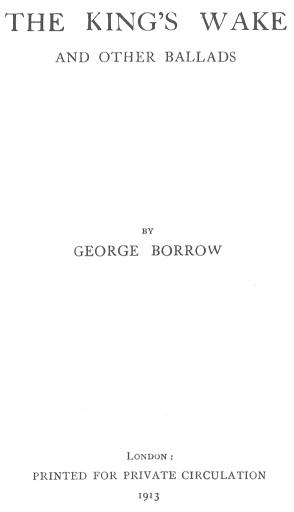
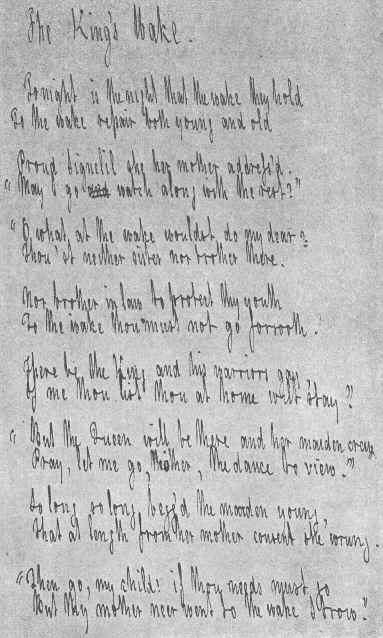
The Dalby Bear / and Other Ballads / By / George Borrow /
London: / Printed for Private Circulation / 1913.
Collation:—Square demy octavo, pp. 20; consisting of:
Half-title (with blank reverse) pp. 1–2; Title-page, as
above (with blank reverse) pp. 3–4; and Text of the
Ballads pp. 5–20. There are head-lines
throughout, each page being headed with the title of the particular Ballad occupying it. At the
foot of p. 20 is the following imprint: “London /
Printed for Thomas J. Wise, Hampstead, N.W.
/ Edition limited to Thirty Copies.” The
signatures are A (a quarter-sheet of two leaves), with B (a full
sheet of 8 leaves) inset within it.
Issued in bright green paper wrappers, with untrimmed edges,
and with the title-page reproduced upon the front. The
leaves measure 8½ × 6⅞ inches.
Thirty Copies only were printed.
Contents.
|
page
|
The Dalby Bear. [There goes a bear on Dalby
moors]
|
5
|
Tygge Hermandsen. [Down o’er the isle in
torrents fell]
The ballad was printed from a Manuscript written in
1854. I give a reduced facsimile of a page of an earlier
Manuscript written in 1830.
|
9
|
The Wicked Stepmother. [Sir Ove he has no
daughter but one]
This ballad should be read in conjunction with The Wicked
Stepmother, No. ii, printed in Young Swaigder or
The Force of Runes and Other Ballads, 1913, pp.
23–37.
|
14
|
The complete Manuscript of The Dalby Bear and Other
Ballads is in the library of Mr. Clement Shorter.
There is a copy of The Dalby Bear and Other Ballads in
the Library of the British Museum. The Press-mark is C. 44.
d. 38.
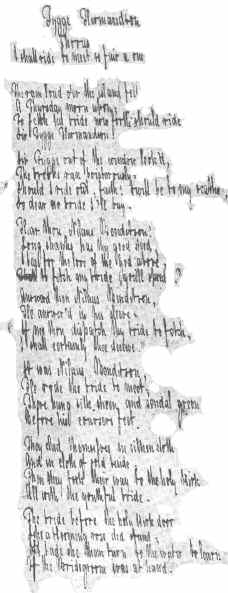
The / Mermaid’s Prophecy / and other / Songs relating to
Queen Dagmar / By / George Borrow / London: / Printed for Private
Circulation / 1913.
Collation:—Square demy octavo, pp. 30; consisting
of Half-title (with blank reverse) pp. 1–2; Title-page, as
above (with blank reverse) pp. 3–4; and Text of the
Songs pp. 5–30. There are head-lines
throughout, each page being headed with the title of the
particular Song occupying it. Following p. 30 is a
leaf, with a notice regarding the American copyright upon the
reverse, and with the following imprint upon its recto:
“London: / Printed for Thomas J. Wise,
Hampstead, N.W. / Edition limited to Thirty
Copies.” The signatures are A and B (two sheets,
each eight leaves), the one inset within the other.
Issued in bright green paper wrappers, with untrimmed edges,
and with the title-page reproduced upon the front. The
leaves measure 8¾ × 6⅞ inches.
Thirty Copies only were printed.
Contents.
|
page
|
Songs relating to Queen Dagmar:
|
|
I. King Valdemar’s Wooing. [Valdemar
King and Sir Strange bold]
|
5
|
II. Queen Dagmar’s Arrival in Denmark.
[It was Bohemia’s Queen began]
|
14
|
III. The Mermaid’s Prophecy. [The
King he has caught the fair mermaid, and deep]
|
19
|
Rosmer. [Buckshank bold and Elfinstone]
This ballad should be read in conjunction with Rosmer
Mereman, printed in Young Swaigder or The Force of Runes
and Other Ballads, 1913, pp. 16–22.
|
25
|
Of The Mermaid’s Prophecy there are two
Manuscripts extant. In the earlier of these, written in
1829, the Poem is entitled The Mermaid’s
Prophecy. In the later Manuscript, written apparently
about the year 1854, it is entitled The Mermaid
only. From this later Manuscript the Poem was printed in
the present volume.
Unlike the majority of Borrow’s Manuscripts, which
usually exhibit extreme differences of text when two holographs
exist of the same Poem, the texts of the two versions of The
Mermaid’s Prophecy are practically identical, the
opening stanza alone presenting any important variation.
Here are the two versions of this stanza:
1829
The Dane King had the Mermaiden caught by his swains,
The mermaid dances the floor upon—
And her in the tower had loaded with chains,
Because his will she had not done.
1854
The King he has caught the fair mermaid, and deep
(The mermaid dances the floor upon)
In the dungeon has placed her, to pine and to weep,
Because his will she had not done.
There is a copy of The Mermaid’s Prophecy and other
Songs relating to Queen Dagmar in the Library of the British
Museum. The Press mark is C. 44. d. 38.
Hafbur and Signe / A Ballad / By / George Borrow / London: /
Printed for Private Circulation / 1913.
Collation:—Square demy octavo, pp. 23; consisting of:
Half-title (with blank reverse) pp. 1–2; Title-page, as
above (with blank reverse) pp. 3–4; and Text of
the Ballad pp. 5–23. The head-line is
Hafbur and Signe throughout, upon both sides of the
page. Upon the reverse of p. 23 is the following imprint:
“London: / Printed for Thomas J. Wise,
Hampstead, N.W. / Edition limited to Thirty
Copies.” The signatures are A (a half-sheet of
four leaves), with B (a full sheet of eight leaves) inset within
it.
Issued in bright green paper wrappers, with untrimmed edges,
and with the title-page reproduced upon the front. The
leaves measure 8½ × 6⅞ inches.
Thirty Copies only were printed.
Contents.
|
page
|
Hafbur and Signe. [Young Hafbur King and Sivard
King They lived in bitter enmity]
|
5
|
Of Hafbur and Signe two Manuscripts are extant.
The first of these was doubtless written in the early summer of
1830, for on June 1st of that year Borrow wrote to
Dr. Bowring:
I send you “Hafbur and
Signe” to deposit in the Scandinavian Treasury
[i.e. among the Songs of Scandinavia].
The later Manuscript was written in or about the year
1854.
The earlier of these two Manuscripts is in the collection of
Mr. Herbert T. Butler. The later Manuscript is in my own
library.
As is usually the case when two Manuscripts of one of
Borrow’s ballads are available, the difference in poetical
value of the two versions of Hafbur and Signe is
considerably. Few examples could exhibit more distinctly
the advance made by Borrow in the art of poetical composition
during the interval. Here are some stanzas from the version
of 1854.
So late it was at nightly
tide,
Down fell the dew o’er hill and
mead;
Then lists it her proud Signild fair
With all the rest to bed to speed.
“O where shall I a bed procure?”
Said Hafbur then, the King’s good
son.
“O thou shalt rest in chamber best
With me the bolsters blue upon.”
Proud Signild foremost went, and stepped
The threshold of her chamber o’er;
With secret glee came Hafbur, he
Had never been so glad before.
Then lighted they the waxen lights,
So fairly twisted were the same.
Behind, behind, with ill at mind,
The wicked servant maiden came
The following are the parallel stanzas from the version of
1830
So late it was in the nightly tide,
Dew fell o’er hill and mead;
Then listed her proud Signild fair
With the rest to bed to speed.
“O where shall I a bed procure?”
Said Hafbour the King’s good son.
“In the chamber best with me thou shalt rest,
The bolsters blue upon.”
Proud Signild foremost went and stepp’d
The high chamber’s threshold
o’er,
Prince Hafbour came after with secret laughter,
He’d ne’er been delighted
more
Then lighted they the waxen lights,
Fair twisted were the same.
Behind, behind with ill in her mind
The wicked servant came.
I give herewith a reduced facsimile of the last page of each
Manuscript.
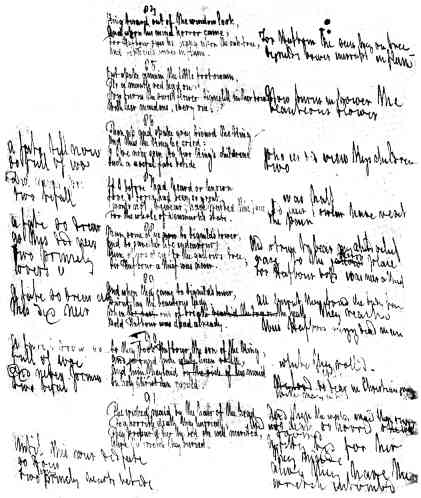
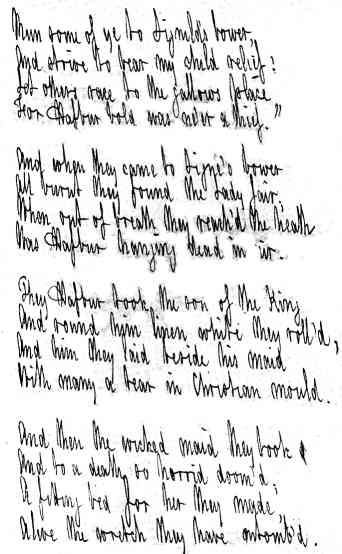
There is a copy of Hafbur and Signe A Ballad in the
Library of the British Museum. The Press-mark is C. 44. d.
38.
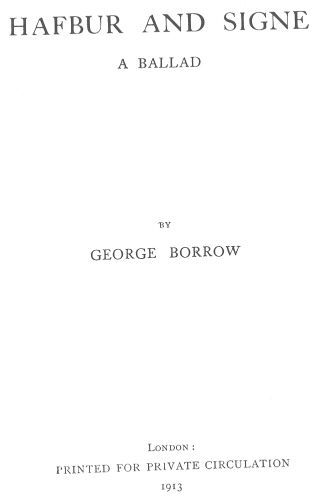
The Story / of / Yvashka with the Bear’s Ear /
Translated from the Russian / By / George Borrow / London: /
Printed for Private Circulation / 1913.
Collation:—Square demy octavo, pp. 23; consisting of:
Half title (with blank reverse) pp. 1–2; Frontispiece (with
blank recto) pp. 3–4; Title-page, as above (with blank
reverse) pp. 5–6; Introduction (by Borrow) pp.
7–10; and Text of the Story pp. 11–23.
The head-line is Yvashka with the Bears Ear throughout,
upon both sides of the page. Upon the reverse of p. 23 is
the following imprint: “London: / Printed for
Thomas J. Wise, Hampstead, N. W. / Edition
limited to Thirty Copies.” The signatures are A
(a half sheet of 4 leaves), and B (a full sheet of 8 leaves), the
one inset within the other. The
Frontispiece consists of a reduced facsimile of the first page of
the original Manuscript in Borrow’s handwriting.
Issued in bright green paper wrappers, with untrimmed edges,
and with the title-page reproduced upon the front. The
leaves measure 8½ × 6⅞ inches.
Thirty Copies only were printed.
The Story of Yvashka was the second of three Russian
Popular Tales, which were contributed by Borrow to the pages
of Once a Week during 1862. The Story of
Yvashka appeared in the number for May 17th,
1862, Vol. vi, pp. 572–574.
The Story was reprinted in The Sphere,
Feb. 1st, 1913, p. 136.
The Text of Yvashka as printed in Once a Week
differs appreciably from that printed in The Sphere, and
in the private pamphlet of 1913, both of which are
identical. The Manuscript from which the two latter
versions were taken was the original translation. The
version which appeared in Once a Week was printed from a
fresh Manuscript (which fills 11 quarto pages) prepared in
1862. A reduced facsimile of the first page of the earlier
Manuscript (which extends to 5⅛ quarto pages) will be found
reproduced upon the opposite page. In this Manuscript the
story is entitled The History of Jack with the Bear’s
Ear.
Judging from the appearance of this MS., both paper and
handwriting, together with that of fragments which remain of the
original MSS. of the other two published Tales, it seems
probable that the whole were produced by Borrow during his
residence in St. Petersburg. Should such surmise be
correct, the Tales are contemporary with
Targum.
The Once a Week version of The Story of Yvashka
was reprinted in The Avon Booklet, Vol. ii, 1904, pp.
199–210.
There is a copy of The Story of Yvashka in the Library
of the British Museum. The Press-mark is C. 44. d. 37.
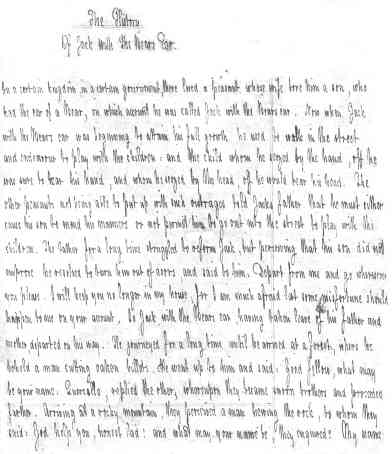
The Verner Raven / The Count of Vendel’s / Daughter /
and Other Ballads / By / George Borrow / London: / Printed for
Private Circulation / 1913.
Collation:—Square demy octavo, pp. 27; consisting of:
Half-title (with blank reverse) pp. 1–2; Title-page, as
above (with a note regarding the American copyright upon the
centre of the reverse) pp. 3–4, and Text of the
Ballads pp. 5–27. There are headlines
throughout, each page being headed with the title of the
particular Ballad occupying it. Upon the reverse of
p. 27 is the following imprint: “London / Printed
for Thomas J. Wise, Hampstead, N.W. /
Edition limited to Thirty Copies.” The
signatures are A (a quarter-sheet of 2 leaves), B (a half sheet
of 4 leaves), and C (a full sheet of 8 leaves), all inset within
each other.
Issued in bright green paper wrappers, with untrimmed edges,
and with the title-page reproduced upon the front. The
leaves measure 8½ × 6⅞ inches.
Thirty Copies only were printed.
Contents.
|
page
|
The Verner Raven. [The
Raven he flies in the evening tide]
|
5
|
The Count of Vendel’s
Daughter. [Within a bower the womb I
left]
Previously printed in Once a Week, Vol. viii,
January 3rd, 1863, pp. 35–36.
|
12
|
The Cruel
Mother-in-Law. [From his home and his country Sir
Volmor should fare]
|
18
|
The Faithful King of
Thule. [A King so true and steady]
|
25
|
The Fairies’ Song.
[Balmy the evening air]
|
27
|
Note.—Each poem to which no
reference is attached, appeared for the first time in this
volume.
The Manuscript of The Count of Vendel’s Daughter
is included in the extensive collection of Borroviana belonging
to Mr. F. J. Farrell, of Great Yarmouth.
There is a copy of The Verner Raven, The Count of
Vendel’s Daughter, and Other Ballads in the
Library of the British Museum. The Press-mark is C. 44. d.
38.
The / Return of the Dead / and Other Ballads / By / George
Borrow / London: / Printed for Private Circulation / 1913.
Collation:—Square demy octavo, pp. 22; consisting of:
Half-title (with blank reverse) pp. 1–2; Title-page, as
above (with blank reverse) pp. 3–4; and Text of the
Ballads pp. 5–22. There are head-lines
throughout, each page being headed with the title of the
particular Ballad occupying it. Following p. 22 is a
leaf, with blank reverse, and with the following imprint upon its
recto: “London: / Printed for Thomas J. Wise,
Hampstead, N.W. / Edition limited to Thirty
copies.” The signatures are A (a half-sheet of
four leaves), with B (a full sheet of eight leaves), inset within
it.
Issued in bright green paper wrappers, with untrimmed
edges, and with the title-page reproduced upon the front.
The leaves measure 8½ × 6⅞ inches.
Thirty Copies only were printed.
Contents.
|
page
|
The Return of the Dead. [Swayne Dyring o’er
to the island strayed]
|
5
|
The Transformed Damsel. [I take my axe upon my
back]
|
13
|
The Forced Consent. [Within her own fair
castelaye]
|
15
|
Ingeborg’s Disguise. [Such handsome court
clothes the proud Ingeborg buys]
|
19
|
Song. [I’ve pleasure not a little]
|
22
|
As a further example of Borrow’s shorter Ballads, I give
Ingeborg’s Disguise in full. The entire series
included in The Return of the Dead and Other Ballads ranks
among the most uniformly successful of Borrow’s
achievements in this particular branch of literature:—
INGEBORG’S
DISGUISE [161]
Such handsome court clothes the proud Ingeborg buys,
Says she, “I’ll myself as a courtier
disguise.”
Proud Ingeborg hastens her steed to bestride,
Says she, “I’ll away with the King to
reside.”
“Thou gallant young King to my speech lend an
ear,
Hast thou any need of my services here?”
“O yes, my sweet lad, of a horseboy
I’ve need,
If there were but stable room here for his steed.
“But thy steed in the stall with my own can be
tied,
And thou ’neath the linen shalt sleep by my
side.”
Three years in the palate good service she wrought
That she was a woman no one ever thought.
She filled for three years of a horse-boy the place,
And the steeds of the monarch she drove out to graze.
She led for three years the King’s steeds to the
brook,
For else than a youth no one Ingeborg took.
Proud Ingeborg knows how to make the dames gay,
She also can sing in such ravishing way.
The hair on her head is like yellow spun gold,
To her beauty the heart of the prince was not cold.
But at length up and down in the palace she strayed,
Her colour and hair began swiftly to fade.
What eye has seen ever so wondrous a case?
The boy his own spurs to his heel cannot brace.
The horse-boy is brought to so wondrous a plight,
To draw his own weapon he has not the might.
The son of the King to five damsels now sends,
And Ingeborg fair to their care he commends.
Proud Ingeborg took they and wrapped in their weed,
And to the stone chamber with her they proceed.
Upon the blue cushions they Ingeborg laid,
Where light of two beautiful sons she is made.
Then in came the prince, smiled the babies to
view:
“’Tis not every horse-boy can bear such a
two.”
He patted her soft on her cheek sleek and
fair:
“Forget my heart’s dearest all sorrow and
care.”
He placed the gold crown on her temples I ween:
“With me shalt thou live as my wife and my
Queen.”
The complete Manuscript of The Return of the Dead and Other
Ballads is in my own library.
There is a copy of The Return of the Dead and Other
Ballads in the Library of the British Museum. The
Press-mark is C.44.d.38.
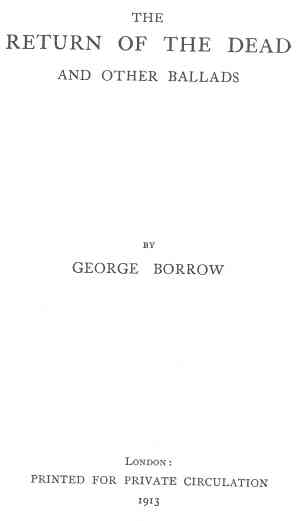
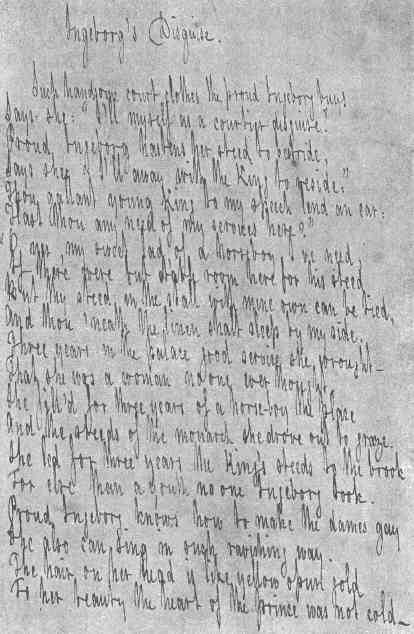
Axel Thordson / and Fair Valborg / A Ballad / By / George
Borrow / London: / Printed for Private Circulation / 1913.
Collation:—Square demy octavo, pp. 45; consisting of:
Half-title (with blank reverse) pp. 1–2; Title-page, as
above (with a notice regarding the American copyright upon the
reverse) pp. 3–4; and text of the Ballad pp.
5–45. The head-line is Axel Thordson and Fair
Valborg throughout, upon both sides of the page. Upon
the reverse of p. 45 is the following imprint:
“London: / Printed for Thomas J. Wise,
Hampstead, N.W. / Edition limited to Thirty
Copies.” The signatures are A to C (Three sheets,
each eight leaves) inset within each other. The last leaf
of Sig. C is a blank.
Issued in bright green paper wrappers, with untrimmed
edges, and with the title-page reproduced upon the front.
The leaves measure 8½ × 6⅞ inches.
Thirty Copies only were printed.
Contents.
|
page
|
Axel Thordson and Fair Valborg. [At the wide
board at tables play]
|
5
|
In some respects Axel Thordson and Fair Valborg is the
most ambitious of Borrow’s Ballads. It is
considerably the longest, unless we regard the four
“Songs” of which Marsk Stig is
comprised as forming one complete poem. But it is by no
means the most successful; indeed it is invariably in his shorter
Ballads that we find Borrow obtaining the happiest result.
Two Manuscripts of Axel Thordson and Fair Valborg are
available. The first was prepared in 1829 for the Songs
of Scandinavia. The second was revised in 1854 for the
Kœmpe Viser. This later Manuscript is in my
own possession. I give herewith a reduced facsimile of one
of its pages.
There is a copy of Axel Thordson and Fair Valborg in
the Library of the British Museum. The Press-mark is
C.44.d.38.
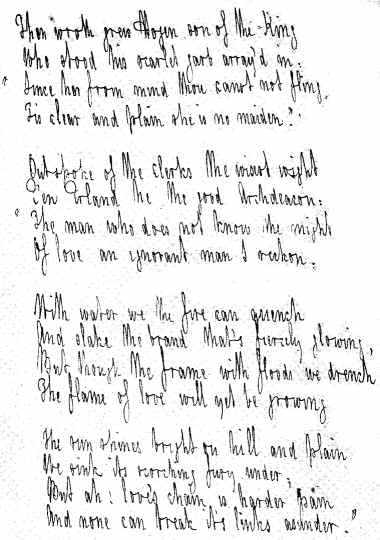
King Hacon’s Death / and / Bran and the Black Dog / Two
Ballads / By / George Borrow / London: / Printed for Private
Circulation / 1913.
Collation:—Crown octavo, pp. 14; consisting of:
Half-title (with blank reverse) pp. 1–2; Title-page, as
above (with blank reverse) pp. 3–4; and Text of
the Two Ballads pp. 5–14. There are head-lines
throughout, each page being headed with the title of the
particular Ballad occupying it. Following p. 14 is a
leaf, with blank reverse, and with the following imprint upon its
recto, “London: / Printed for Thomas J. Wise,
Hampstead, N.W. / Edition limited to Thirty
Copies.” There are no signatures, the pamphlet
being composed of a single sheet, folded to form sixteen
pages.
Issued in bright green paper wrappers, with untrimmed edges,
and with the title-page reproduced upon the front. The
leaves measure 7½ × 5 inches.
Thirty Copies only were printed.
Contents.
|
page
|
King Hacon’s Death. [“And now has
happened in our day”]
|
5
|
Bran and the Black Dog. [“The day we went
to the hills to chase”]
I venture to regard this ballad of the fight between Bran and
the Black Dog as one of Borrow’s happiest efforts.
Here are some of its vigorous stanzas:
The valiant Finn arose next day,
Just as the sun rose above the foam;
And he beheld up the Lairgo way,
A man clad in red with a black dog come.
He came up with a lofty gait,
Said not for shelter he sought our doors;
And wanted neither drink nor meat,
But would match his dog ’gainst the
best of ours.
* * * * *
“A strange fight this,” the great
Finn said,
As he turn’d his face towards his
clan;
Then his face with rage grew fiery red,
And he struck with his fist his good dog
Bran.
“Take off from his neck the collar of gold,
Not right for him now such a thing to
bear;
And a free good fight we shall behold
Betwixt my dog and his black
compeer.”
The dogs their noses together placed,
Then their blood was scatter’d on every
side;
Desperate the fight, and the fight did last
’Till the brave black dog in Bran’s
grip died.
* * * * *
We went to the dwelling of high Mac Cuol,
With the King to drink, and dice,
and throw;
The King was joyous, his hall was full,
Though empty and dark this night I trow.
|
11
|
There is a copy of King Hacon’s Death and Bran and
the Black Dog in the Library of the British Museum. The
Pressmark is C. 44. d. 38.
Marsk Stig’s / Daughters / and other / Songs and Ballads
/ By / George Borrow / London: / Printed for Private Circulation
/ 1913.
Collation:—Crown octavo, pp. 21; consisting of:
Half-title (with blank reverse), pp. 1–2; Title-page, as
above (with blank reverse), pp. 3–4; Table of
Contents, pp. 5–6; and Text of the Songs and
Ballads, pp. 7–21. The reverse of p. 21 is
blank. The head-line is Songs and Ballads
throughout, upon both sides of the page. The pamphlet
concludes with a leaf, with blank reverse, and with the following
imprint upon its recto: “London: / Printed for
Thomas J. Wise, Hampstead, N.W. / Edition
limited to Thirty Copies.” There are no
signatures, but the pamphlet consists of a half-sheet (of four
leaves), with a full sheet (of eight leaves) inset within it.
Issued in bright green paper wrappers, with untrimmed edges,
and with the title-page reproduced upon the front. The
leaves measure 7½ × 5 inches.
Thirty Copies only were printed.
Contents.
|
page
|
Marsk Stig’s Daughters. [Two daughters fair
the Marshal had]
|
7
|
The Three Expectants. [There are three for my
death that now pine]
|
11
|
Translation. [One summer morn, as I was
seeking]
|
13
|
The English Gipsy:
|
|
He. [As I to the town was going one day
My Roman lass I met by the way]
|
14
|
She. [As I to the town was going one day
I met a young Roman upon the way]
The first of these two stanzas had been printed previously in
Romano Lavo-Lil, 1874, p. 183.
|
14
|
Gipsy Song. [Up,
up, brothers]
The first stanza of this Song was printed previously
(under the title Run for it!) in Romano Lavo-Lil,
1874, p. 195.
|
16
|
Our Heart is Heavy, Brother. [The strength of the
ox]
Another version of this poem was printed previously (under the
title Sorrowful Tears, and with an entirely different
text) in Romano Lavo-Lil, 1874, p. 211.
In order to give some clear idea of the difference between the
two versions, I quote the opening stanza of each:
1874.
The wit and the skill
Of the Father of ill,
Who’s clever indeed,
If they would hope
With their foes to cope
The Romany need.
1913.
The strength of the ox,
The wit of the fox,
And the leveret’s speed;
All, all to oppose
Their numerous foes
The Romany need.
|
17
|
Song. [Nastrond’s blazes]
Another version of this Song was printed previously
(divided up, and with many textual variations) in The Death of
Balder, 1899, pp. 53–54.
|
19
|
Lines. [To read the great mysterious
Past]
As a specimen of Borrow’s lighter lyrical verse, as
distinguished from his Ballads, I give the text of the
Translation noted above, accompanied by a facsimile of the
first page of the MS.:
TRANSLATION.
One summer morn, as I was seeking
My ponies in their green retreat,
I heard a lady sing a ditty
To me which sounded strangely sweet:
I am the ladye, I am the ladye,
I am the ladye loving the knight;
I in the green wood, ’neath the green
branches,
In the night season sleep with the
knight.
Since yonder summer morn of beauty
I’ve seen full many a gloomy year;
But in my mind still lives the ditty
That in the green wood met my ear:
I am the ladye, I am the ladye,
I am the ladye loving the knight;
I in the green wood, ’neath the green
branches,
In the night season sleep with the
knight.
A second Manuscript of this Translation has the
‘ditty’ arranged in eight lines, instead of in
four. In this MS. the word ladye is spelled in the
conventional manner:
I am the lady,
I am the lady,
I am the lady
Loving the knight;
I in the greenwood,
’Neath the green branches,
Through the night season
Sleep with the knight.
|
21
|
Note.—Each poem to which no reference is attached
appeared for the first time in this volume.
There is a copy of Marsk Stig’s Daughters and other
Songs and Ballads in the Library of the British Museum.
The Press-mark is C. 44. d. 38.
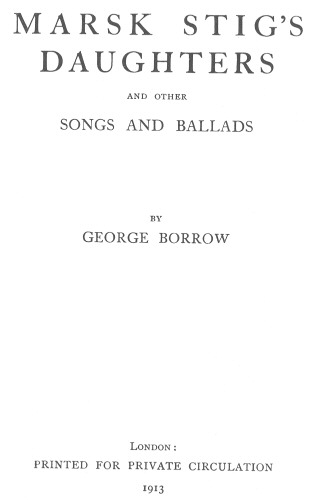
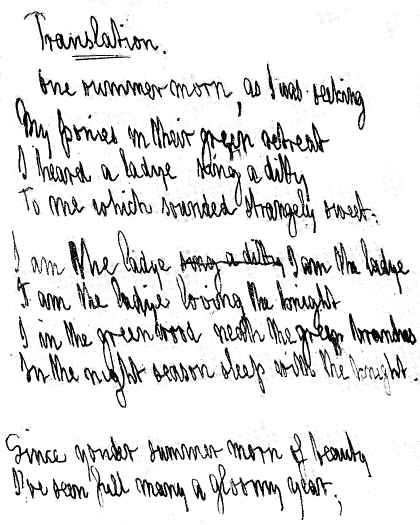
The Tale of Brynild / and / King Valdemar and his Sister / Two
Ballads / By / George Borrow / London: Printed for Private
Circulation / 1913.
Collation:—Square demy octavo, pp. 35; consisting
of: Half-title (with blank reverse) pp. 1–2; Title-page as
above (with a notice regarding the American copyright upon the
reverse) pp. 3–4; and Text of the Ballads pp.
5–35. There are head-lines throughout, each page
being headed with the title of the particular Ballad
occupying it. Upon the reverse of p. 35 is the following
imprint: “London: / Printed for Thomas J.
Wise, Hampstead, N.W. / Edition limited to
Thirty Copies.” The signatures are A (a
quarter-sheet of two leaves), and B and C (two sheets, each eight
leaves), each inset within the other.
Issued in bright green paper wrappers, with untrimmed edges,
and with the title-page reproduced upon the front. The
leaves measure 8½ × 6⅞ inches.
Thirty Copies only were printed.
Contents.
|
page
|
The Tale of Brynild. [Sivard he a colt has
got]
Of The Tale of Brynild, two manuscripts are extant,
written in 1829 and 1854 respectively. The text of the
latter, from which the ballad was printed in the present
pamphlet, is immeasurably the superior.
|
5
|
King Valdemar and his sister. [See,
see, with Queen Sophy sits Valdemar bold]
|
13
|
Mirror of Cintra. [Tiny fields in charming
order]
|
34
|
The Harp. [The harp to everyone is dear]
|
35
|
There can be little doubt that the series of poems included in
this volume present Borrow at his best as a writer of
Ballads.
There is a copy of The Tale of Brynild and King Valdemar
and his Sister in the Library of the British Museum.
The Pressmark is C. 44. d. 38.
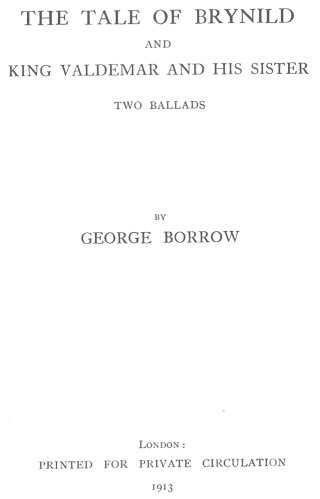
Proud Signild / and / Other Ballads / By / George Borrow /
London: / Printed for Private Circulation / 1913.
Collation: Square demy octavo, pp. 28; consisting of:
Half-title (with blank reverse) pp. 1–2; Title-page, as
above (with a notice regarding the American copyright upon the
reverse) pp. 3–4; and Text of the Ballads pp.
5–28. There are head-lines throughout, each page
being headed with the title of the particular Ballad
occupying it. At the foot of p. 28 is the following
imprint: “London: Printed for Thomas J. Wise,
Hampstead, N.W. Edition limited to Thirty
Copies.” The signatures are A (six leaves), and B
(a full sheet of eight leaves), the one inset within the
other.
Issued in bright green paper wrappers, with the title-page
reproduced upon the front. The leaves measure 8½
× 6⅞ inches.
Thirty Copies only were printed.
Contents.
|
page
|
Proud Signild. [Proud Signild’s bold
brothers have taken her hand]
|
5
|
The Damsel of the Wood. [The Knight takes
hawk, and the man takes hound]
|
16
|
Damsel Mettie. [Knights Peter and Olaf they sat
o’er the board]
As is the case with quite a number of Borrow’s
ballads, two Manuscripts of Damsel Mettie have been
preserved. The earlier, composed not later than 1829, is
written upon paper water marked with the date 1828; the later is
written upon paper water-marked 1843. The earlier version
has a refrain, “’Neath the linden tree watches the
lord of my heart,” which is wanting in the later.
Otherwise the text of both MSS. is identical, the differences to
be observed between them being merely verbal. For example,
the seventh couplet in the earlier reads:
I’ll gage my war courser, the
steady and tried,
That thou canst not obtain the fair Mettie, my
bride.
In the later MS. this couplet reads:
I’ll gage my war courser, the
steady and tried,
Thou never canst lure the fair Mettie, my
bride.
|
22
|
There is a copy of Proud Signild and Other Ballads in
the Library of the British Museum. The Press-mark is C. 44.
d. 38.
Ulf Van Yern / and / Other Ballads / By / George Borrow /
London: / Printed for Private Circulation / 1913.
Collation:—Square demy octavo, pp. 27; consisting of:
Half-title (with blank reverse) pp. 1–2; Title-page (with
notice regarding the American copyright upon the reverse) pp.
3–4; and Text of the Ballads pp. 5–27.
There are head-lines throughout, each page being headed with the
title of the particular Ballad occupying it. Upon
the reverse of p. 27 is the following imprint:
“London: / Printed for Thomas J.
Wise, Hampstead, N.W. / Edition limited to
Thirty Copies.” The signatures are A (a
quarter-sheet of two leaves), B (a half-sheet of four leaves),
and C (a full sheet of eight leaves), all inset within each
other.
Issued in bright green paper wrappers, with untrimmed edges,
and with the title-page reproduced upon the front. The
leaves measure 8½ × 6⅞ inches.
Thirty Copies only were printed.
Contents.
|
page
|
Ulf Van Yern. [It was youthful Ulf Van
Yern]
This ballad was here printed from the Manuscript prepared for
the projected Kœmpe Viser of 1854. In the MS
of 1829 the ballad is entitled Ulf Van Yern and Vidrik
Verlandson. The texts of the two versions differ widely
in almost every stanza.
|
5
|
The Chosen Knight. [Sir Oluf rode forth over hill
and lea]
|
16
|
Sir Swerkel. [There’s a dance in the hall
of Sir Swerkel the Childe]
|
19
|
Finn and the Damsel, or The Trial of Wits.
[“What’s rifer than leaves?” Finn
cried]
|
23
|
Epigrams by Carolan:
|
|
1. On Friars. [Would’st thou on good
terms with friars live]
|
26
|
2. On a surly Butler, who had refused him admission
to the cellar. [O Dermod Flynn it grieveth me]
|
26
|
Lines. [How deadly the blow I received]
The last four lines of this Poem had already served (but with
a widely different text) as the last four lines of the Ode
from the Gaelic, printed in Romantic Ballads, 1826, pp
142–143.
|
27
|
There is a copy of Ulf Van Yern and Other Ballads in
the Library of the British Museum. The Press-mark is C. 44.
d. 38.
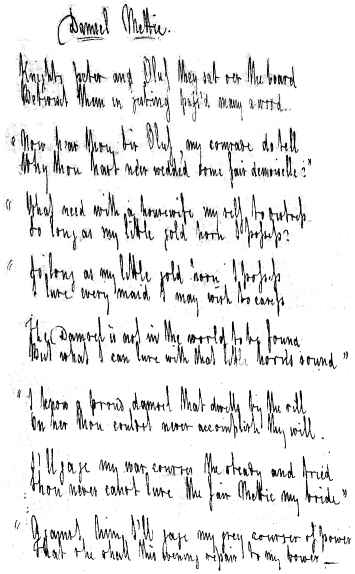
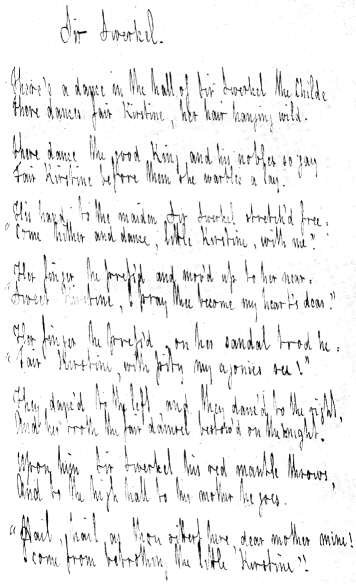
Ellen of Villenskov / and Other Ballads / By / George Borrow /
London: / Printed for Private Circulation / 1913.
Collation:—Square demy octavo, pp. 22; consisting of:
Half-title (with blank reverse) pp. 1–2; Title-page, as
above (with blank reverse) pp. 3–4; and Text of the
Ballads pp. 5–22. There are head-lines
throughout, each page being headed with the title of the
particular Ballad occupying it. Following p. 22 is a
leaf, with blank reverse, and with the following imprint upon its
recto: “London: / Printed for Thomas J. Wise,
Hampstead, N.W. / Edition limited to Thirty
Copies.” The signatures are A (a half-sheet of
four leaves), with B (a full sheet of eight leaves) inset within
it.
Issued in bright green paper wrappers, with untrimmed edges,
and with the title-page reproduced upon the front. The
leaves measure 8½ × 6⅞ inches.
Thirty Copies only were printed.
Contents.
|
page
|
Ellen of Villenskov. [There lies a wold in Vester
Haf]
|
5
|
Uranienborg. [Thou who the strand dost
wander]
Previously printed, with an earlier and far inferior text,
under the title The Ruins of Uranienborg, in The
Foreign Quarterly Review. June, 1830, pp.
85–86.
|
13
|
The Ready Answer. [The
brother to his dear sister spake]
|
19
|
Epigrams:
|
|
1. There’s no living, my boy,
without plenty of gold
|
22
|
2. O think not you’ll change what on high
is designed
|
22
|
3. Load not thyself with gold, O mortal
man, for know
|
22
|
Note.—Each poem to which no
reference is attached, appeared for the first time in this
volume.
The Manuscripts of the poems included in Ellen of
Villenskov and Other Ballads are in the Library of Mr.
Clement K. Shorter.
There is a copy of Ellen of Villenskov and Other
Ballads in the Library of the British Museum. The
Press-mark is C. 44. d. 38.
The Songs of Ranild / By / George Borrow / London: / Printed
for Private Circulation / 1913.
Collation:—Square demy octavo, pp. 26; consisting of:
Half-title (with blank reverse) pp. 1–2; Title-page, as
above (with blank reverse) pp. 3–4; and Text of the Poems
pp. 5–26. There are head-lines throughout, each page
being headed with the title of the particular poem occupying
it. Following p. 26 is a leaf, with a notice regarding the
American copyright upon the reverse, and with the following
imprint upon its recto: “London: / Printed for
Thomas J. Wise, Hampstead, N.W. / Edition
limited to Thirty Copies.” The signatures are A
(six leaves), and B (a full sheet of eight leaves), the one inset
within the other.
Issued in bright green paper wrappers, with untrimmed
edges, and with the title-page reproduced upon the front.
The leaves measure 8½ × 6⅞ inches.
Thirty Copies only were printed.
Contents.
|
page
|
The Songs of Ranild:
|
|
Song the First. [Up Riber’s street the
dance they ply]
|
5
|
Song the Second. [To saddle his courser Ranild
cried]
|
10
|
Song the Third. [So wide around the tidings
bound]
|
13
|
Child Stig and Child Findal. [Child Stig and
Child Findal two brothers were they]
The Songs of Ranild were first written in 1826, and
were finally prepared for press in 1854. I give herewith,
facing p. 191, a facsimile, the exact size of the original, of
the first page of the first draft of Song the Third.
The complete MS. from which these four Ballads were printed is
in the Library of Mr. J. A. Spoor, of Chicago.
|
17
|
There is a copy of The Songs of Ranild in the Library
of the British Museum. The Press-mark is C. 44. d. 38.
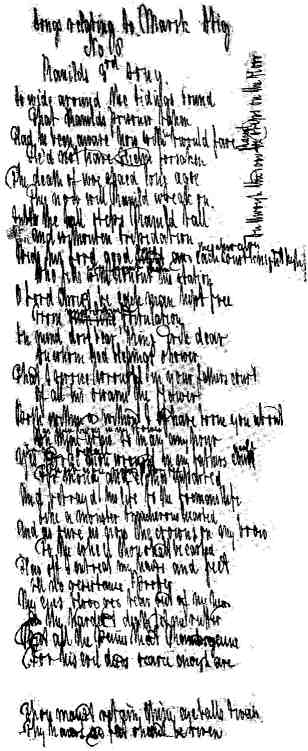
Niels Ebbesen / and / Germand Gladenswayne / Two Ballads / By
/ George Borrow / London: / Printed for Private Circulation /
1913.
Collation:—Square demy octavo, pp. 32; consisting of:
Half-title (with blank reverse) pp. 1–2; Title-page as
above (with notice regarding the American copyright upon the
reverse) pp. 3–4; and Text of the Ballads pp.
5–32. There are head-lines throughout, each page
being headed with the title of the particular Ballad
occupying it. At the foot of p. 32 is the
following imprint: “London: / Printed for Thomas
J. Wise, Hampstead, N.W. / Edition limited
to Thirty Copies.” The signatures are A and B
(two sheets, each eight leaves), the one inset within the
other.
Issued in bright green paper wrappers, with untrimmed edges,
and with the title-page reproduced upon the front. The
leaves measure 8½ × 6⅞ inches.
Thirty Copies only were printed.
Contents.
|
page
|
Niels Ebbesen. [All his men the Count
collects]
|
5
|
Germand Gladenswayne. [Our King and Queen sat
o’er the board]
|
22
|
There is a copy of Niels Ebbesen and Germand
Gladenswayne in the Library of the British Museum. The
Press-mark is C. 44. d. 38.
Child Maidelvold / and Other Ballads / By / George Borrow /
London: / Printed for Private Circulation / 1913.
Collation:—Square demy octavo, pp. 27; consisting of:
Half-title (with blank reverse) pp. 1–2; Title-page, as
above (with a notice regarding the American copyright upon the
reverse) pp. 3–4; and Text of the
Ballads pp. 5–27. There are head-lines
throughout, each page being headed with the title of the
particular Ballad occupying it. Upon the reverse of
p. 27 is the following imprint: “London: /
Printed for Thomas J. Wise, Hampstead, N.W.
/ Edition limited to Thirty Copies.” The
signatures are A (a quarter-sheet of two leaves), B (a half-sheet
of four leaves), and C (a full sheet of eight leaves), each inset
within the other.
Issued in bright green paper wrappers, with untrimmed edges,
and with the title-page reproduced upon the front. The
leaves measure 8½ × 6⅞ inches.
Thirty Copies only were printed.
Contents.
|
page
|
Child Maidelvold. [The fair Sidselil, of
all maidens the flower]
Another, but widely different and altogether inferior, version
of this beautiful and pathetic ballad—one of Borrow’s
best—was printed (under the title Skion Middel) in
The Monthly Magazine, November, 1823, p. 308; and
again (under the amended title Sir Middel, and with a
slightly revised text) in Romantic Ballads, 1826, pp.
28–31. In these earlier versions the name of the
heroine is Swanelil in place of Sidselil, and that of the hero is
Sir Middel in place of Child Maidelvold.
|
5
|
Sir Peter. [Sir Peter and Kirstin they sat by the
board]
|
11
|
Ingefred and Gudrune. [Ingefred and Gudrune they
sate in their bower]
|
15
|
Sir Ribolt. [Ribolt the son of a Count was
he]
|
20
|
As a further example of these Ballads I give Ingefred and
Gudrune in full.
INGEFRED
AND GUDRUNE [199]
Ingefred and Gudrune they sate in their bower,
Each bloomed a beauteous fragrant flower—
So sweet it is in summer tide!
A working the gold fair Ingefred kept,
Still sate Gudrune, and bitterly wept.
“Dear sister Gudrune so fain I’d know
Why down thy cheek the salt tears flow?”
“Cause enough have I to be thus forlorn,
With a load of sorrow my heart is worn.
“Hear, Ingefred, hear what I say to
thee,
Wilt thou to-night stand bride for me?
“If bride for me thou wilt stand to-night,
I’ll give thee my bridal clothes thee to
requite.
“And more, much more to thee I’ll
give,
All my bride jewels thou shalt receive.”
“O, I will not stand for bride in thy
room,
Save I also obtain thy merry bridegroom.”
“Betide me whatever the Lord ordain,
From me my bridegroom thou never shalt gain.”
In silks so costly the bride they arrayed,
And unto the kirk the bride they conveyed.
In golden cloth weed the holy priest stands,
He joins of Gudrune and Samsing the hands.
O’er the downs and green grass meadows they
sped,
Where the herdsman watched his herd as it fed.
“Of thy beauteous self, dear
Damsel, take heed,
Ne’er enter the house of Sir Samsing, I
rede.
“Sir Samsing possesses two nightingales
Who tell of the Ladies such wondrous tales.
“With their voices of harmony they can declare
Whether maiden or none has fallen to his share.”
The chariot they stopped in the green wood shade,
An exchange ’twixt them of their clothes they
made.
They change of their dress whatever they please,
Their faces they cannot exchange with ease.
To Sir Samsung’s house the bride they
conveyed,
Of the ruddy gold no spare was made.
On the bridal throne the bride they plac’d,
They skinked the mead for the bride to taste.
Then said from his place the court buffoon:
“Methinks thou art Ingefred, not
Gudrune.”
From off her hand a gold ring she took,
Which she gave the buffoon with entreating look.
Said he: “I’m an oaf, and have
drunk too hard,
To words of mine pay no regard.”
’Twas deep at night, and down fell the
mist,
To her bed the young bride they assist.
Sir Samsing spoke to his nightingales twain:
“Before my young bride sing now a strain.
“A song now sing which shall avouch
Whether I’ve a maiden or none in my
couch.”
“A maid’s in the bed, that’s
certain and sure,
Gudrune is standing yet on the floor.”
“Proud Ingefred, straight from my couch
retire!
Gudrune come hither, or dread my ire!
“Now tell me, Gudrune, with open
heart,
What made thee from thy bed depart?”
“My father, alas! dwelt near the
strand,
When war and bloodshed filled the land.
“Full eight there were broke into my bower,
One only ravished my virgin flower.”
Upon her fair cheek he gave a kiss:
“My dearest, my dearest, all sorrow
dismiss;
“My swains they were that broke into thy
bower,
’Twas I that gathered thy virgin flower.”
Fair Ingefred gained, because bride she had
been,
One of the King’s knights of handsome mien.
There is a copy of Child Maidelvold and Other Ballads
in the Library of the British Museum. The Press-mark is C.
44. d. 38.
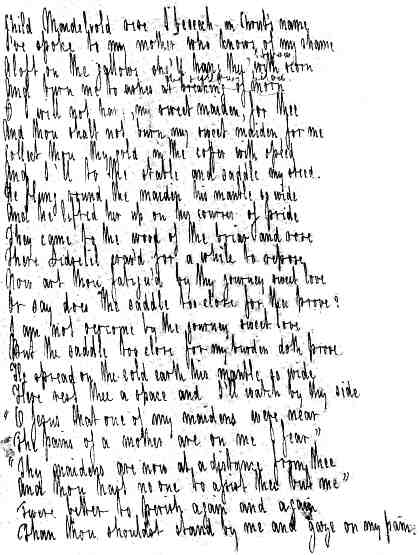
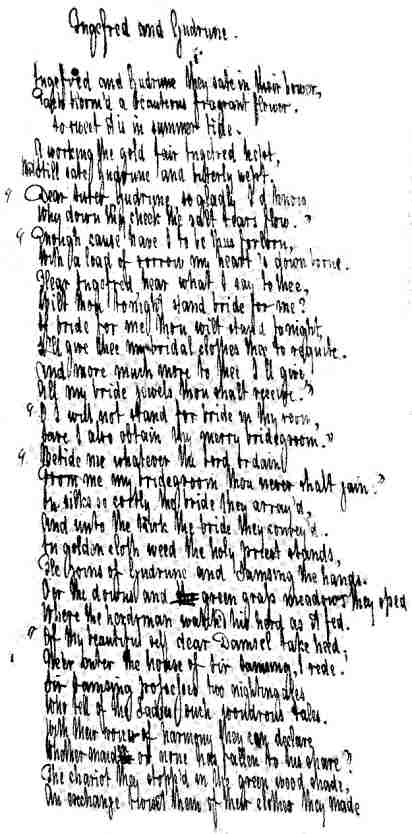
Ermeline / A Ballad / By / George Borrow / London: / Printed
for Private Circulation / 1913.
Collation:—Square demy octavo, pp. 23; consisting of:
Half-title (with blank reverse) pp. 1–2; Title-page, as
above (with blank reverse) pp. 3–4; and Text of the Poems
pp. 5–23. There are head-lines throughout, each page
being headed with the title of the particular poem occupying
it. Upon the reverse of p. 23 is
the following imprint: “London / Printed for
Thomas J. Wise, Hampstead, N.W. / Edition
limited to Thirty Copies.” The signatures are A
(a half-sheet of four leaves), and B (a full sheet of eight
leaves), the one inset within the other.
Issued in bright green paper wrappers, with untrimmed edges,
and with the title-page reproduced upon the front. The
leaves measure 8½ × 6⅞ inches.
Thirty Copies only were printed.
Contents.
|
page
|
Ermeline. [With lance upraised so
haughtily]
The paper upon which the Manuscript of Ermeline is
written is water-marked with the date 1843. No other MS. is
forthcoming.
|
5
|
The Cuckoo’s Song in Merion. [Though it has
been my fate to see]
The fifth stanza of this Song was printed by Borrow in
Wild Wales, 1862, vol. i, p. 153. The two versions
of this stanza offer some interesting variations of text; I give
them both:
1862
Full fair the gleisiad in the flood,
Which sparkles ’neath the
summer’s sun,
And fair the thrush in green abode
Spreading his wings in sportive fun,
But fairer look if truth be spoke,
The maids of County Merion.
1913
O fair the salmon in the flood,
That over golden sands doth run;
And fair the thrush in his abode,
That spreads his wings in gladsome fun;
More beauteous look, if truth be spoke,
The maids of county Merion.
|
21
|
There is a copy of Ermeline A Ballad in the Library of
the British Museum. The Press-mark is C. 44. d. 38.
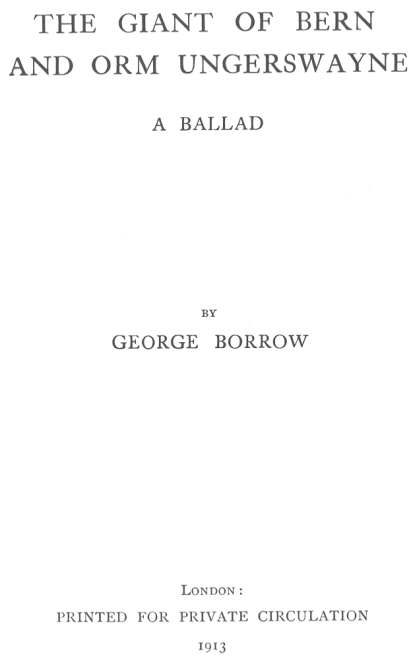
The Giant of Bern / and Orm Ungerswayne / A Ballad / By /
George Borrow / London: / Printed for Private Circulation /
1913.
Collation:—Crown octavo, pp. 15; consisting of
Half-title (with blank reverse) pp. 1–2; Title-page, as
above (with blank reverse) pp. 3–4; and Text of the
Ballad pp. 5–15. The head-line is The Giant
of Bern throughout, upon both sides of the page. Upon
the reverse of p. 15 is the following imprint:
“London: / Printed for Thomas J. Wise,
Hampstead, N.W. / Edition limited to Thirty
Copies.” There are no signatures, the pamphlet
being composed of a single sheet, folded to form sixteen
pages.
Issued in bright green paper wrappers, with untrimmed edges,
and with the title-page reproduced upon the front. The
leaves measure 7½ × 5 inches.
Thirty Copies only were printed.
Contents.
|
page
|
The Giant of Bern and Orme Ungerswayne. [It was
the lofty jutt of Bern, O’er all the walls he
grew]
Fifteen stanzas, descriptive of the incident of Orm’s
obtaining his father’s sword from the dead man’s
grave, were printed in Targum, 1835, pp. 59–61,
under the title Birting. A Fragment.
The text differs greatly in the two versions, that of the later
(which, though not printed until 1913, was
written about 1854) is much the superior. As an example I
give the first two stanzas of each version:
1835
It was late at evening tide,
Sinks the day-star in the wave,
When alone Orm Ungarswayne
Rode to seek his father’s grave.
Late it was at evening hour,
When the steeds to streams are led;
Let me now, said Orm the young,
Wake my father from the dead.
1913
It was so late at evening tide,
The sun had reached the wave,
When Orm the youthful swain set out
To seek his father’s grave.
It was the hour when grooms do ride
The coursers to the rill,
That Orm set out resolved to wake
The dead man in the hill.
|
5
|
There is a copy of The Giant of Bern and Orm
Ungerswayne in the Library of the British Museum. The
Press-mark is C. 44. d. 38.
Little Engel / A Ballad / With a Series of / Epigrams from the
Persian / By / George Borrow / London: / Printed for Private
Circulation / 1913.
Collation:—Square demy octavo, pp. 27; consisting of:
Half-title (with blank reverse) pp. 1–2; Title-page, as above (with blank reverse) pp. 3–4; and Text
of the Ballad and Epigrams pp. 5–27.
There are head-lines throughout, each page being headed with the
title of the particular Poem occupying it—save for pp.
23–27, which are headed Epigrams. Upon the
reverse of p. 27 is the following imprint: “London:
/ Printed for Thomas J. Wise, Hampstead,
N.W. / Edition limited to Thirty
Copies.” The signatures are A (six leaves), and B
(a full sheet of eight leaves), the one inset within the
other.
Issued in bright green paper wrappers, with untrimmed edges,
and with the title-page reproduced upon the front. The
leaves measure 8½ × 6⅞ inches.
Thirty Copies only were printed.
Contents.
|
page
|
Little Engel. [It was the little Engel,
he]
|
5
|
An Elegy. [Where shall I rest my hapless
head]
|
21
|
Epigrams. From the Persian:
|
|
1. [Hear what once the pigmy clever]
|
23
|
2. [The man who of his words is sparing]
|
23
|
3. [If thou would’st ruin
’scape, and blackest woe]
|
24
|
4. [Sit down with your friends in delightful
repose]
|
24
|
5. [The hungry hound upon the bone will
pounce]
|
24
|
6. [Great Aaroun is dead, and is
nothing, the man]
|
25
|
7. [Though God provides our daily bread]
|
25
|
8. The King and his Followers. [If in the
boor’s garden the King eats a pear]
|
25
|
9. The Devout Man and the Tyrant. [If the
half of a loaf the devout man receives]
|
26
|
10. The Cat and the Beggar. [If a cat could
the power of flying enjoy]
|
26
|
11. The King and Taylor.
[The taylor who travels in far foreign lands]
|
26
|
12. Gold Coin and Stamped Leather. [Of the
children of wisdom how like is the face]
|
27
|
13. [So much like a friend with your foe ever
deal]
The Manuscript of these Epigrams bears instructive
evidence of the immense amount of care and labour expended by
Borrow upon his metrical compositions. Reduced facsimiles
of two of the pages of this Manuscript are given herewith.
It will be observed that a full page and a half are occupied by
the thirteenth Epigram, at which Borrow made no fewer than
seven attempts before he succeeded in producing a version which
satisfied him. The completed Epigram is as
follows:—
So much like a friend with your foe ever
deal,
That you never need dread the least scratch from his
steel;
But ne’er with your friend deal so much like a
foe,
That you ever must dread from his faulchion a blow.
|
27
|
The original Manuscript of Little Engel, written in
1829, is in the library of Mr. Edmund Gosse. The Manuscript
of 1854, from which the ballad was printed, is in my own
library.
There is a copy of Little Engel, A Ballad,
&c., in the Library of the British Museum. The
Press-mark is C. 44. d. 38.
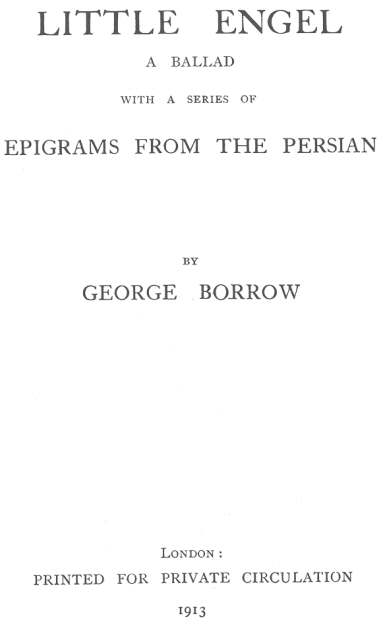
Alf the Freebooter / Little Danneved and / Swayne Trost / and
Other Ballads / By / George Borrow / London: / Printed for
Private Circulation / 1913.
Collation:—Square demy octavo, pp. 27; consisting of:
Half-title (with blank reverse) pp. 1–2; Title-page, as
above (with a note regarding the American copyright upon the
centre of the reverse) pp. 3–4; and Text of the
Ballads pp. 5–27. There are headlines
throughout, each page being headed with the title of
the particular Ballad occupying it. Upon the reverse
of p. 27 is the following imprint, “London: /
Printed for Thomas J. Wise, Hampstead, N.W.
/ Edition limited to Thirty Copies.” The
signatures are A (a quarter-sheet of 2 leaves), B (a half-sheet
of 4 leaves), and C (a full sheet of 8 leaves), all inset
within each other.
Issued in bright green paper wrappers, with untrimmed edges,
and with the title-page reproduced upon the front. The
leaves measure 8½ × 6⅞ inches.
Thirty Copies only were printed.
Contents.
|
page
|
Sir Alf the Freebooter.
[Sir Alf he is an Atheling.]
|
5
|
Little Danneved and Swayne
Trost. [“O what shall I in Denmark
do?”]
|
14
|
Sir Pall, Sir Bear, And Sir
Liden. [Liden he rode to the Ting, and
shewed]
|
20
|
Belardo’s Wedding.
[From the banks, in mornings beam]
|
23
|
The Yew Tree. [O tree
of yew, which here I spy]
Two earlier versions of this Ode were printed by Borrow in
Wild Wales, vol. iii, pp. 203 and 247. The texts of
all three versions differ very considerably.
|
27
|
There is a copy of Alf the Freebooter and Other Ballads
in the Library of the British Museum. The Press-mark is C.
44. d. 38.
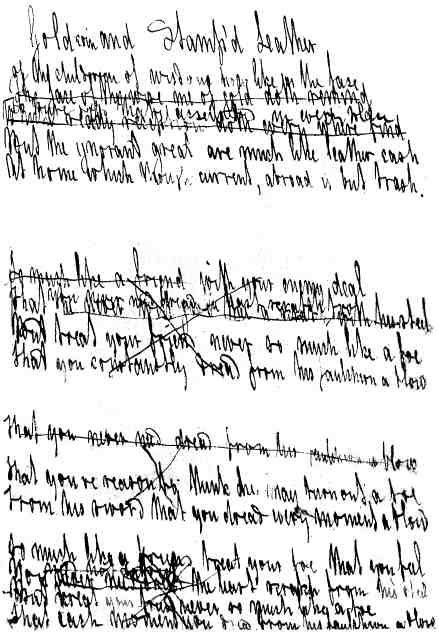
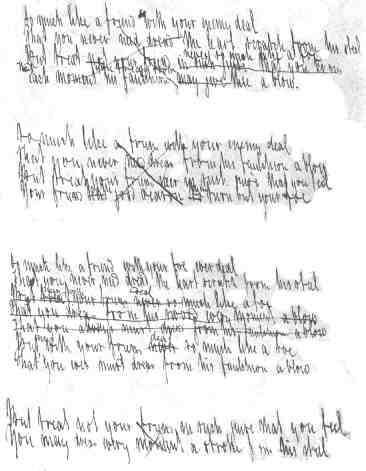
King Diderik / and the Fight between the / Lion and Dragon /
and Other Ballads / By / George Borrow / London: / Printed for
Private Circulation / 1913.
Collation:—Square demy octavo, pp. 27; consisting
of: Half-title (with blank reverse) pp. 1–2; Title-page, as
above (with a note regarding the American copyright upon the
centre of the reverse) pp. 3–4; and Text of the
Ballads pp. 5–27. There are head-lines
throughout, each page being headed with the title of the
particular Ballad occupying it. Upon the reverse of
p. 27 is the following imprint, “London: /
Printed for Thomas J. Wise, Hampstead, N.W.
/ Edition limited to Thirty Copies.” The
signatures are A (a quarter-sheet of 2 leaves), B (a half-sheet
of 4 leaves), and C (a full sheet of 8 leaves), all inset within
each other.
Issued in bright green paper wrappers, with untrimmed edges,
and with the title-page reproduced upon the front. The
leaves measure 8½ × 6⅞ inches.
Thirty Copies only were printed.
Contents.
|
page
|
King Diderik and the Lion’s
Fight with the Dragon.
[From Bern rode forth King Diderik]
There exists a single leaf of an early draft of another,
entirely different, version of this ballad. Upon the
opposite page is a facsimile, the exact size of the original, of
this fragment.
|
5
|
Diderik and Olger the
Dane. [With his eighteen brothers Diderik
stark]
|
14
|
Olger the Dane and
Burman. [Burman in the mountain holds]
|
21
|
The complete Manuscript of King Diderik,
&c., and Other Ballads, as prepared for the
Songs of Scandinavia of 1829, is preserved in the British
Museum.
There is a copy of King Diderik and the Fight
between the Lion and Dragon, &c. in the Library of
the British Museum. The Press-mark is C. 44. d. 38.
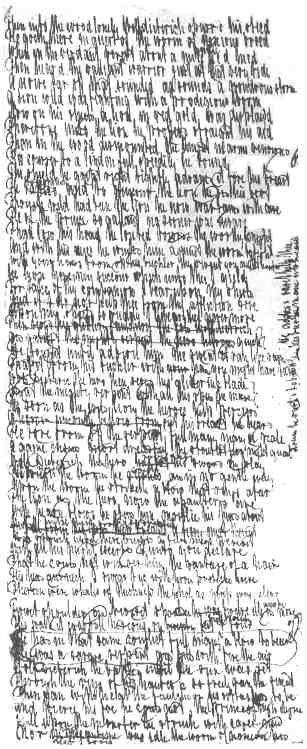
The Nightingale / The Valkyrie and Raven / and Other Ballads /
By / George Borrow / London: / Printed for Private Circulation /
1913.
Collation:—Square demy octavo, pp. 27; consisting of:
Half-title (with blank reverse) pp. 1–2; Title-page, as
above (with a note regarding the American copyright upon the
centre of the reverse) pp. 3–4; and Text of the
Ballads pp. 5–27. There are head-lines
throughout, each page being headed with the title of the
particular Ballad occupying it. Upon the reverse of
p. 27 is the following imprint: “London: /
Printed for Thomas J. Wise, Hampstead, N. W.
/ Edition limited to Thirty Copies.” The
signatures are A (a quarter-sheet of 2 leaves), B (a half-sheet
of 4 leaves), and C (a full sheet of 8 leaves), all inset within
each other.
Issued in bright green paper wrappers, with untrimmed edges,
and with the title-page reproduced upon the front. The
leaves measure 8½ × 6⅞ inches.
Thirty Copies only were printed.
Contents.
|
page
|
The Nightingale, or The Transformed Damsel. [I know
where stands a Castellaye]
|
5
|
The Valkyrie and
Raven. [Ye men wearing bracelets]
Previously printed in Once a Week, August
2nd, 1862, pp. 152–156, where the Ballad was
accompanied by a full-page Illustration engraved upon wood.
[See post, pp. 302–305.]
|
11
|
Erik Emun and Sir Plog.
[Early at morn the lark sang gay]
|
21
|
The Elves. [Take
heed, good people, of yourselves]
There are two Manuscripts of The Elves available.
So far as the body of the poem is concerned the texts of these
are identical, the fifth line alone differing materially in
each. This line, as printed, reads:
The lass he woo’ d, her promise
won.
In the earlier of the two MSS. it reads:
Inflamed with passion her he
woo’d.
A cancelled reading of the same MS. runs:
Whom when he saw the peasant
woo’d.
But the Ballad is furnished with a repeated refrain.
This refrain in the printed version reads:
Take heed, good people, of
yourselves;
And oh! beware ye of the elves.
In the earlier MS. the refrain employed is:
’Tis wonderful the Lord can brook
The insolence of the fairy folk!
A reduced facsimile of the first page of the later MS. will be
found facing the present page.
The entire poem should be compared with The Elf Bride,
printed in The Brother Avenged and Other Ballads, 1913,
pp. 21–22.
|
25
|
Feridun. [No face of
an Angel could Feridun claim]
|
26
|
Epigrams:
|
|
1. [A worthless thing is song, I
trow]
|
27
|
2. [Though pedants have essayed to
hammer]
|
27
|
3. [When of yourself you have cause to
speak]
|
27
|
Note.—Each poem to which no reference is
attached, appeared for the first time in this volume.
There is a copy of The Nightingale, The
Valkyrie and Raven, and Other Ballads in the Library
of the British Museum. The Press-mark is C. 44. d. 38.
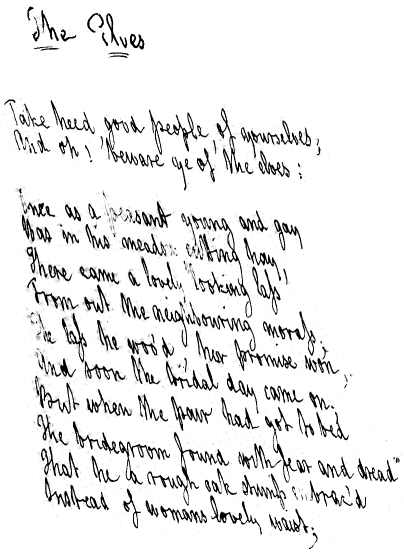
Grimmer and Kamper / The End of Sivard Snarenswayne / and
Other Ballads / By / George Borrow / London: / Printed for
Private Circulation / 1913.
Collation:—Square demy octavo, pp. 28; consisting of:
Half-title (with blank reverse) pp. 1–2; Title-page, as
above (with a note regarding the American copyright upon the
centre of the reverse) pp. 3–4; and Text of the
Ballads pp. 5–28. There are headlines
throughout, each page being headed with the title of the
particular Ballad occupying it. At the foot of p. 28
is the following imprint: “London: / Printed for
Thomas J. Wise, Hampstead, N. W. / Edition
limited to Thirty Copies.” The signatures are A
(a quarter-sheet of 2 leaves), B (a half-sheet of 4 leaves), and
C (a full-sheet of 8 leaves), all inset within each other.
Issued in bright green paper wrappers, with untrimmed edges,
and with the title-page reproduced upon the front. The
leaves measure 8½ × 6⅞ inches.
Thirty Copies only were printed.
Contents.
|
page
|
Grimmer and Kamper.
[Grimmer walks upon the floor]
|
5
|
Mimmering Tan. [The
smallest man was Mimmering]
|
11
|
The End of Sivard
Snarenswayne. [Young Sivard he his step-sire
slew]
The two Manuscripts, belonging to the years 1829 and 1854
respectively, of this ballad exhibit very numerous differences of
text. As a brief, but sufficient, example I give the second
stanza as it occurs in each:
1829
It was Sivard Snareswayne [sic]
To his mother’s presence hied:
“Say, shall I go from thee on foot,
Or, tell me, shall I
ride?”
1854
It was Sivard Snarenswayne
To his mother’s presence strode:
“Say, shall I ride from hence?” he
cried,
“Or wend on foot my road?”
|
14
|
Sir Guncelin’s
Wedding. [It was the Count Sir Guncelin]
|
19
|
Epigrams:
|
|
Honesty. [No wonder
honesty’s a lasting article]
|
27
|
A Politician. [He
served his God in such a fashion]
|
27
|
The Candle. [For
foolish pastimes oft, full oft, they thee
ignite]
|
27
|
Epigram on Himself. By Wessel [He ate, and drank,
and slip-shod went]
|
28
|
There is a copy of Grimmer and Kamper, The End of
Sivard Snarenswayne, and Other Ballads in the Library
of the British Museum. The Press-mark is C. 44. d. 38.
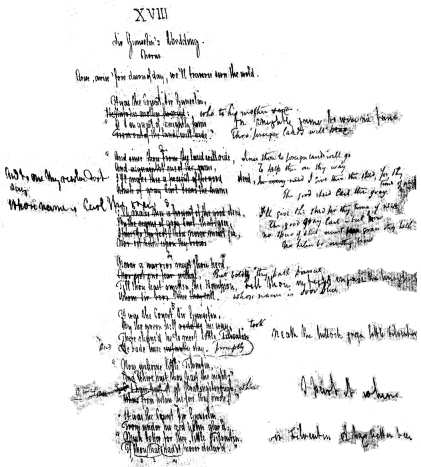
The / Fountain of Maribo / and Other Ballads / By / George
Borrow / London: / Printed for Private Circulation / 1913.
Collation:—Square demy octavo, pp. 27; consisting of:
Half-title (with blank reverse) pp. 1–2; Frontispiece (with
blank recto) pp. 3–4; Title-page (with notice regarding the
American copyright upon the centre of the reverse) pp. 5–6;
and Text of the Ballads pp. 7–27. There are
head-lines throughout, each page being headed with the title of
the particular Ballad occupying it. Upon the reverse
of p. 27 is the following imprint: “London: /
Printed for Thomas J. Wise, Hampstead, N.W.
/ Edition limited to Thirty Copies.” The
signatures are A (a quarter-sheet of two leaves), B (a half-sheet
of four leaves), and C (a full sheet of eight leaves), each inset
within the other.
Issued in bright green paper wrappers, with untrimmed edges,
and with the title-page reproduced upon the front. The
leaves measure 8½ × 6⅞ inches.
Thirty Copies only were printed.
The Frontispiece is a reduced facsimile of the first page of
the original Manuscript of Ramund.
Contents.
|
page
|
The Fountain of Maribo, Or The Queen and the Algreve. [The
Algreve he his bugle wound]
Of The Fountain of Maribo there are two Manuscripts
available, one written in 1829 and the other in 1854. The
text of these differs appreciably, that of the second being as
usual the superior. Here are some stanzas from each
version:
1829
The Algreve he his bugle wound,
The longest night.
The Queen in her bower heard the sound
Love me doth thrall.
The Queen her little foot boy address’d:
The longest night.
“Go, come to me hither the Algreve request.”
Love me doth thrall.
In came the Algrave, ’fore the board stood he:
“What wilt thou my Queen that thou’st sent for
me?”
“If I survive when my lord is dead,
Thou shall rule o’er my gold so red.”
1854
The Algreve he his bugle wound
The long night all—
The Queen in bower heard the sound,
I’m passion’s thrall.
The Queen her little page address’d,
The long night all—
“To come to me the Greve request,”
I’m passion’s thrall.
He came, before the board stood he,
The long night all—
“Wherefore, O Queen, hast sent for me?”
I’m passion’s thrall,
“As soon as e’er my lord is dead,
The long night all—
Thou shall rule o’er my gold so red,”
I’m passion’s thrall.
|
7
|
Ramund. [Ramund
thought he should a better man be]
A reduced facsimile of the first page of the manuscript of
Ramund faces the present page.
|
13
|
Alf of Odderskier.
[Alf he dwells at Odderskier]
|
22
|
There is a copy of The Fountain of Maribo and Other
Ballads in the Library of the British Museum. The
Press-mark is C. 44. d. 38.
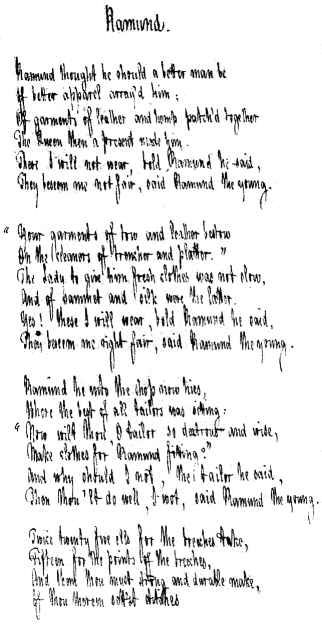
Queen Berngerd / The Bard and the Dreams / and / Other Ballads
/ By / George Borrow / London: / Printed for Private Circulation
/ 1913.
Collation:—Square demy octavo, pp. 31; consisting of:
Half-title (with blank reverse) pp. 1–2; Frontispiece (with
blank recto) pp. 3–4; Title-page, as above (with a note
regarding the American copyright upon the centre of the reverse)
pp. 5–6; and Text of the Ballads pp.
7–31. There are headlines throughout, each page being
headed with the title of the particular Ballad occupying
it. Upon the reverse of p. 31 is the following imprint:
“London: / Printed for Thomas J. Wise,
Hampstead, N.W. / Edition limited to Thirty
Copies.” The signatures are A and B (two sheets
each eight leaves), the one inset within the other.
Issued in bright green paper wrappers, with untrimmed
edges, and with the title-page reproduced upon the front.
The leaves measure 8½ x6¾ inches.
Thirty Copies only were printed.
The Frontispiece consists of a reduced facsimile of the
original Manuscript, in Borrow’s handwriting, of The
Bard and the Dreams.
Contents.
|
page
|
Queen Berngerd. [Long
ere the Sun the heaven arrayed]
|
7
|
Dame Martha’s
Fountain. [Dame Martha dwelt at
Karisegaard]
Previously printed (with some small differences of text) in
The Foreign Quarterly Review, June 1830, p. 83.
|
13
|
The Bard and the Dreams.
[O’er the sweet smelling meads with his lyre in his
hand]
|
16
|
King Oluf the Saint.
[King Oluf and his brother bold]
Previously printed (with some slight differences of text) in
The Foreign Quarterly Review, June 1830, pp.
59–61.
|
23
|
To Scribblers. [Would
it not be more dignified]
This delightful Squib, here first printed, was written by
Borrow upon the refusal by Lockhart to insert in The Quarterly
Review Borrow’s Essay suggested by Ford’s
Handbook for Travellers in Spain, 1845, in the unmutilated
and unamended form in which the author had written it.—[See
ante, No. 10.]
|
30
|
To a Conceited Woman.
[Be still, be still, and speak not back
again]
|
31
|
Note.—Each poem, to which no reference is
attached, appeared for the first time in this volume.
There is a copy of Queen Berngerd, The Bard and the
Dreams, and Other Ballads in the Library of the
British Museum. The Press-mark is C. 44. d. 38.
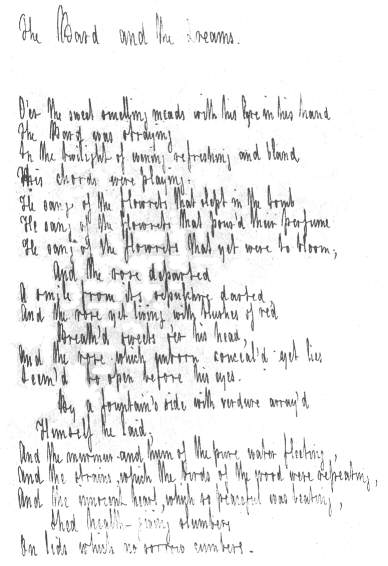
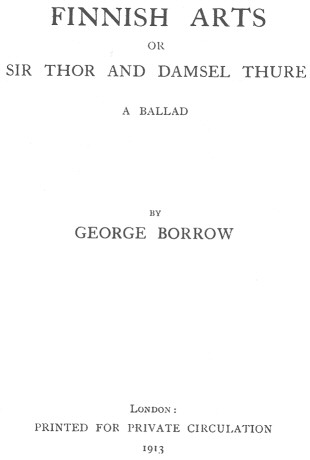
Finnish Arts / Or / Sir Thor and Damsel Thure / A Ballad / By
/ George Borrow / London: / Printed for Private Circulation /
1913.
Collation:—Square demy octavo, pp. 27; consisting of:
Half-title (with blank reverse) pp. 1–2; Frontispiece (with
blank recto), pp. 3–4; Title-page, as above (with notice
regarding the American copyright upon the centre of the reverse)
pp. 5–6; and Text of the Ballads pp.
7–27. There are head-lines throughout, each page
being headed with the title of the particular Ballad
occupying it. Upon the reverse of p. 27 is the following
imprint: “London: / Printed for Thomas J.
Wise, Hampstead, N.W. / Edition limited to
Thirty Copies.” The signatures are A (a
quarter-sheet of two leaves), B (a half-sheet of four leaves),
and C (a full sheet of eight leaves), each inset within the
other.
Issued in bright green paper wrappers, with untrimmed edges,
and with the title-page reproduced upon the front. The
leaves measure 8½ × 6⅞ inches.
Thirty Copies only were printed.
The Frontispiece is a reduced facsimile of the first page of
the original Manuscript of Finnish Arts, or Sir Thor
and Damsel Thure.
Contents.
|
page
|
Finnish Arts, Or, Sir Thor and Damsel
Thure. [Sir Thor was a knight of prowess
tried]
A reduced facsimile of the first page of the Manuscript of
Finnish Arts will be found facing the present page.
|
7
|
A New Song to an Old
Tune. [Who starves his wife]
|
22
|
Ode from Anacreon.
[The earth to drink does not disdain]
|
24
|
Lines from the Italian.
[“Repent, O repent!” said a Friar
one day]
|
25
|
A Drinking Song. [O
how my breast is glowing]
|
26
|
There is a copy of Finnish Arts, Or Sir Thor and
Damsel Thure in the Library of the British Museum. The
Pressmark is C. 44. d. 38.
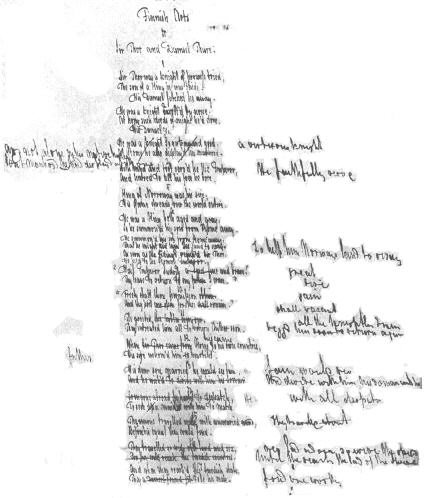
Brown William / The Power of the Harp / and / Other Ballads /
By / George Borrow / London: / Printed for Private Circulation /
1913.
Collation:—Square demy octavo, pp. 31; consisting of:
Half-title (with blank reverse) pp. 1–2; Title-page, as
above (with notice regarding the American copyright upon the
centre of the reverse) pp. 3–4; and Text of the
Ballads pp. 5–31. There are head-lines
throughout, each page being headed with the title of the
particular Ballad occupying it. Upon the reverse of
p. 31 is the following imprint: “London / Printed for Thomas J.
Wise, Hampstead, N.W. / Edition limited to
Thirty Copies.” The signatures are A and B (two
sheets, each eight leaves), the one inset within the other.
Issued in bright green paper wrappers, with untrimmed edges,
and with the title-page reproduced upon the front. The
leaves measure 8½ × 6⅞ inches.
Thirty Copies only were printed.
Contents.
|
page
|
Brown William. [Let no
one in greatness too confident be]
Previously printed in Once a Week, January
4th, 1862, pp. 37–38.
|
5
|
The Power of the Harp.
[Sir Peter would forth from the castle ride]
A reduced facsimile of one of the pages of the Manuscript of
The Power of The Harp will be found facing herewith.
|
12
|
The Unfortunate Marriage.
[Hildebrand gave his sister away]
|
18
|
The Wrestling-Match.
[As one day I wandered lonely, in extreme distress of
mind]
|
25
|
The Warrior. From the Arabic. [Thou lov’st
to look on myrtles green]
|
31
|
Note.—Each poem to which no reference is
attached, appeared for the first time in this volume.
There is a copy of Brown William, The Power of the
Harp, and Other Ballads in the Library of the British
Museum. The Press-mark is C. 44. d. 38.
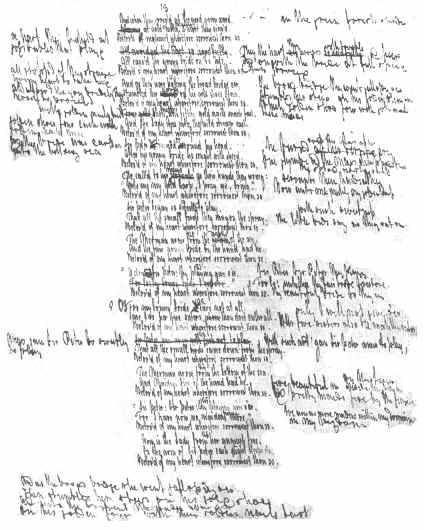
The Song of Deirdra / King Byrge and his Brothers / and /
Other Ballads / By / George Borrow / London: / Printed for
Private Circulation / 1913.
Collation:—Square demy octavo, pp. 28; consisting of:
Half-title (with blank reverse) pp. 1–2; Title-page, as
above (with a note regarding the American copyright upon the
centre of the reverse) pp. 3–4; and Text of the
Ballads pp. 5–28. There are head-lines
throughout, each page being headed with the title of the
particular Ballad occupying it. At the foot of p. 28 is the
following imprint: “London: / Printed for Thomas
J. Wise, Hampstead, N.W. / Edition limited
to Thirty Copies.” The signatures are A (a
quarter-sheet of two leaves), B (a half-sheet of four leaves),
and C (a full sheet of eight leaves), all inset within each
other.
Issued in bright green paper wrappers, with untrimmed edges,
and with the title-page reproduced upon the front. The
leaves measure 8½ × 6¾ inches.
Thirty Copies only were printed.
Contents.
|
page
|
The Song of Deirdra.
[Farewell, grey Albyn, much loved land]
|
5
|
The Diver. [Where is
the man who will dive for his king]
Previously printed in The New Monthly Magazine, vol.
vii., 1823, pp. 540–542.
|
8
|
King Byrge and
his Brothers. [Dame Ingeborg three brave brothers
could boast]
|
18
|
Turkish Hymn to Mahomet.
[O Envoy of Allah, to thee be salaam]
|
26
|
Note.—Each poem to which no reference is attached
appeared for the first time in this volume.
There is a copy of The Song of Deirdra, King Byrge
and his Brothers, and Other Ballads in the Library of
the British Museum. The Press-mark is C. 44. d. 38.
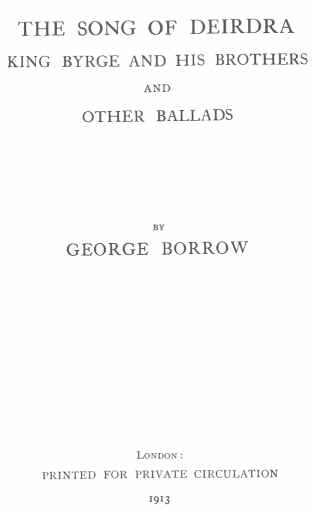
Signelil / A Tale from the Cornish / and Other Ballads / By /
George Borrow / London: / Printed for Private Circulation /
1913.
Collation:—Square demy octavo, pp. 28; consisting of:
Half-title (with blank reverse) pp. 1–2; Title-page (with
notice regarding the American copyright upon the centre of the
reverse) pp. 3–4; and Text of the Ballads pp.
5–28. There are head-lines throughout, each page
being headed with the title of the particular Ballad
occupying it. At the foot of p. 28 is the following
imprint: “London: / Printed for Thomas J.
Wise, Hampstead, N.W. / Edition limited to
Thirty Copies.” The signatures are A (a
quarter-sheet of two leaves), B (a half-sheet of four leaves),
and C (a full sheet of eight leaves), all inset within each
other.
Issued in bright green paper wrappers, with untrimmed
edges, and with the title-page reproduced upon the front.
The leaves measure 8½ × 6⅞ inches.
Thirty Copies only were printed.
Contents.
|
page
|
Signelil. [The Lady
her handmaid to questioning took]
|
5
|
A Tale from the Cornish.
[In Lavan’s parish once of yore]
Previously printed, with some trifling inaccuracies, in
Knapp’s Life, Writings, and Correspondence
of George Borrow, 1899, vol. ii, pp. 91–95.
|
8
|
Sir Verner And Dame
Ingeborg. [In Linholm’s house
The swains they were drinking and making carouse]
|
19
|
The Heddeby Spectre.
[At evening fall I chanced to ride]
An earlier, and utterly different, version of this ballad was
printed (under the tentative title The Heddybee-Spectre)
in Romantic Ballads, 1826, pp. 37–39. Borrow
afterwards described this earlier version as “a
paraphrase.”
|
22
|
From Goudeli.
[Yestere’en when the bat, and the owl, and
his mate]
|
25
|
Peasant Songs of Spain:
|
|
1. [ When Jesu our Redeemer]
|
27
|
2. [There stands a stone, a rounded
stone]
|
28
|
Note.—Each poem to which no reference is attached
appeared for the first time in this volume.
There is a copy of Signelil, a Tale from the
Cornish, and Other Ballads in the Library of the
British Museum. The Press-mark is C. 44. d. 38.
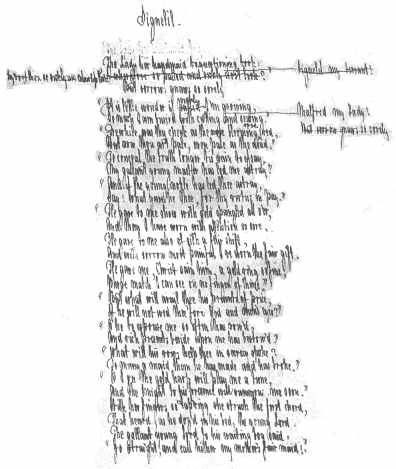
Young Swaigder / or / The Force of Runes / and Other Ballads /
By / George Borrow / London: / Printed for Private Circulation /
1913.
Collation:—Square demy octavo, pp. 27; consisting of:
Half-title (with blank reverse) pp. 1–2; Title-page, as
above (with a notice regarding the American copyright upon the
reverse) pp. 3–4; and Text of the Ballads pp.
5–27. There are head-lines throughout, each page
being headed with the title of the particular Ballad
occupying it. Upon the reverse of p. 27 is the following
imprint: “London: / Printed for Thomas J.
Wise, Hampstead, N.W. / Edition limited to
Thirty Copies.” The signatures are A (a
quarter-sheet of two leaves), B (a half-sheet of four leaves),
and C (a full sheet of eight leaves), each inset within the
other.
Issued in bright green paper wrappers, with untrimmed edges,
and with the title-page reproduced upon the front. The
leaves measure 8½ × 6⅞ inches.
Thirty Copies only were printed.
Contents.
|
page
|
Young Swaigder, Or The Force of Runes. [It was the
young Swaigder]
|
5
|
The Hail Storm. [As in
Horunga Haven]
Previously printed in Romantic Ballads, 1826, pp.
136–138. Again printed in Targum, 1835, pp.
42–43.
In each instance the text varied very
considerably. The present version was written about 1854,
and represents the text as Borrow finally left it. I quote
the first stanza of each version. It will be seen that the
revision was progressive.
1826
When from our ships we bounded,
I heard, with fear astounded,
The storm of Thorgerd’s waking;
With flinty masses blended,
Gigantic hail descended,
And thick and fiercely rattled
Against us there embattled.
1835
For victory as we bounded,
I heard, with fear astounded,
The storm, of Thorgerd’s waking,
From Northern vapours breaking.
Sent by the fiend in anger,
With din and stunning clangour,
To crush our might intended,
Gigantic hail descended.
1854
As in Horunga haven
We fed the crow and raven,
I heard the tempest breaking,
Of demon Thorgerd’s waking;
Sent by the fiend in anger,
With din and stunning clangor,
To crush our might intended,
Gigantic hail descended.
Another translation of the same Ballad, extending to 84 lines,
was printed in Once a Week, 1863, vol. viii, p. 686, under
the title The Hail-Storm; Or, The Death of
Bui.
|
14
|
Rosmer Mereman. [In
Denmark once a lady dwelt]
This ballad should be read in conjunction with Rosmer,
printed in The Mermaid’s Prophecy, and other
Songs relating to Queen Dagmar, 1913, pp. 25–30.
|
16
|
The Wicked
Stepmother. No. II.
[Sir Peter o’er to the island strayed—]
This ballad should be compared with The Wicked
Stepmother, printed in The Dalby Bear and Other
Ballads, 1913, pp. 14–20.
|
23
|
Note.—Each poem to which no reference is
attached, appeared for the first time in this volume.
There is a copy of Young Swaigder or The Force of Runes and
Other Ballads in the Library of the British Museum The
Press-mark is C. 44. d. 38.
Emelian the Fool / A Tale / Translated from the Russian / By /
George Borrow / London: / Printed for Private Circulation /
1913.
Collation:—Crown octavo, pp. 37; consisting of:
Half-title (with blank reverse) pp. 1–2; Title-page, as
above (with blank reverse) pp. 3–4; Introduction pp.
5–7; and Text of the Tale pp. 8–37. The
reverse of p. 37 is blank. The head-line is Emelian the
Fool throughout, upon both sides of the page. The
pamphlet is concluded by a leaf, with blank reverse, carrying the
following imprint upon its recto: “London: /
Printed for Thomas J. Wise, Hampstead, N.W.
/ Edition limited to Thirty Copies.” The
signatures are A (a half-sheet of 4 leaves), plus B and C (2
sheets, each 8 leaves), inset within each other.
Issued in bright green paper wrappers, with untrimmed edges, and with the title-page reproduced upon the
front. The leaves measure 7½ × 5 inches.
Thirty Copies only were printed.
Emelian the Fool first appeared in Once a Week,
vol. vi, March 8th, 1862, pp. 289–294, where
it formed the first of a series of three Russian Popular
Tales, in Prose, translated by George Borrow.
The Tale was also included in The Avon Booklet,
vol. ii, 1904, pp. 175–197.
There is a copy of Emelian the Fool in the Library of
the British Museum. The Press-mark is C. 57. e. 45 (1).
The Story of Tim / Translated from the Russian / By / George
Borrow / London: / Printed for Private Circulation / 1913.
Collation:—Crown octavo, pp. 31; consisting of:
Half-title (with blank reverse) pp. 1–2; Title-page as
above (with blank reverse) pp. 3–4; Introduction p.
5; and Text of the Story pp. 6–31. The
head-line is The Story of Tim throughout, upon both sides
of the page. Upon the reverse of p. 31 is the following
imprint: “London: / Printed for Thomas J.
Wise, Hampstead, N.W. / Edition limited to
Thirty Copies.” The signatures are A and B (two
sheets, each eight leaves), the one inset within the other.
Issued in bright green paper wrappers, with untrimmed edges, and with the title-page reproduced upon the
front. The leaves measure 7½ × 5 inches.
Thirty Copies only were printed.
The Story of Tim first appeared in Once a Week,
vol. vii, October 4th, 1862, pp. 403–406,
where it formed the third of a series of Russian Popular
Tales, in Prose, translated by George Borrow.
The Story was also included in The Avon Booklet,
vol. ii, 1904, pp. 211–229.
There is a copy of The Story of Tim in the Library of
the British Museum. The Press-mark is C. 57. e. 45 (2).
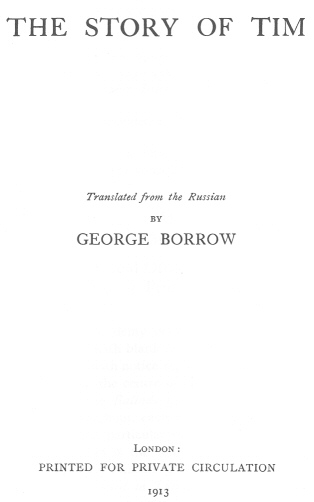
Mollie Charane / and Other Ballads / By / George Borrow /
London: / Printed for Private Circulation / 1913.
Collation:—Square demy octavo, pp. 28; consisting of:
Half-title (with blank reverse) pp. 1–2; Title-page, as
above (with notice regarding the American copyright upon the
centre of the reverse) pp. 3–4; and Text of the
Ballads pp. 5–28. There are headlines
throughout, each page being headed with the title of the
particular Ballad occupying it. At the foot of p. 28
is the following imprint: “London: / Printed for
Thomas J. Wise, Hampstead, N.W. / Edition
limited to Thirty Copies.” The signatures are A
(a quarter-sheet of two leaves), B (a half-sheet of four leaves),
and C (a full sheet of eight leaves), each inset within the
other.
Issued in bright green paper wrappers, with untrimmed
edges, and with the title-page reproduced upon the front.
The leaves measure 8½ × 6⅞ inches.
Thirty Copies only were printed.
Contents.
|
page
|
Mollie Charane.
[O, Mollie Charane, where got you your
gold?]
Previously printed in Once a Week, vol. vi, 1862, pp.
38–39.
|
5
|
The Danes of Yore.
[Well we know from saga]
|
8
|
A Survey of Death. [My
blood is freezing, my senses reel]
Another version of this poem was printed in The Monthly
Magazine, vol. lvi, 1823, p. 245; and reprinted (with some
small textual variations) in Romantic Ballads, 1826, pp.
169–170. As the poem is a short one, and as the two
versions afford a happy example of the drastic changes Borrow
introduced into his text when revising his Ballads, I give them
both in full:
1823
Perhaps ’tis folly, but still I
feel
My heart-strings quiver, my senses reel,
Thinking how like a fast stream we range,
Nearer and nearer to life’s dread change,
When soul and spirit filter away,
And leave nothing better than senseless clay.
Yield, beauty, yield, for the grave
does gape,
And, horribly alter’d, reflects thy
shape;
For, oh! think not those childish charms
Will rest unrifled in his cold arms;
And think not there, that the rose of love
Will bloom on thy features as here above.
Let him who roams at Vanity Fair
In robes that rival the tulip’s glare,
Think on the chaplet of leaves which round
His fading forehead will soon be bound,
And on each dirge the priests will say
When his cold corse is borne away,
Let him who seeketh for wealth,
uncheck’d
By fear of labour, let him reflect
That yonder gold will brightly shine
When he has perish’d, with all his line;
Tho’ man may rave, and vainly boast,
We are but ashes when at the most.
1913
My blood is freezing, my senses reel,
So horror stricken at heart I feel;
Thinking how like a fast stream we range
Nearer and nearer to that dread change,
When the body becomes so stark and cold,
And man doth crumble away to mould.
Boast not, proud maid, for the grave doth
gape,
And strangely altered reflects thy shape;
No dainty charms it doth disclose,
Death will ravish thy beauty’s rose;
And all the rest will leave to thee
When dug thy chilly grave shall be.
O, ye who are tripping the floor so light,
In delicate robes as the lily white,
Think of the fading funeral wreath,
The dying struggle, the sweat of death—
Think on the dismal death array,
When the pallid corse is consigned to clay!
O, ye who in quest of riches roam,
Reflect that ashes ye must become;
And the wealth ye win will brightly shine
When burried are ye and all your line;
For your many chests of much loved gold
You’ll nothing obtain but a little mould.
|
11
|
Desiderabilia Vitæ.
[Give me the haunch of a buck to eat]
Previously printed, with a slightly different text, and
arranged in six lines instead of in three four-line stanzas, in
Lavengro, 1851, vol. i, p. 306.
|
13
|
Saint Jacob. [Saint
Jacob he takes our blest Lord by the hand]
|
14
|
The
Renegade. [Now pay ye the heed that is
fitting]
Previously printed, with some small differences of text, in
The Talisman, 1835, pp. 13–14.
|
19
|
An Impromptu. [And
darest thou thyself compare]
|
21
|
A Hymn. [O Jesus,
Thou Fountain of solace and gladness]
|
23
|
The Transformed Damsel.
[My father up of the country rode]
This Ballad should be compared with The Cruel
Step-dame, printed in The Serpent Knight and Other
Ballade, 1913, pp. 30–33. Also with The
Transformed Damsel, printed in The Return of the Dead and
Other Ballads, 1913, pp. 13–14. The actions
described in the earlier stanzas follow closely those of the
opening stanzas of The Cruel Step-dame; whilst the
incident of the lover cutting a piece of flesh from his own
breast to serve as bait to attract his mistress, who, in the form
of a bird, is perched upon a branch of the tree above him, is
common to both the Transformed Damsel ballads.
|
25
|
Note.—Each poem to which no reference is attached
appeared for the first time in this volume.
There is a copy of Mollie Charane and Other Ballads in
the Library of the British Museum. The Press-mark is C. 44.
d. 38.
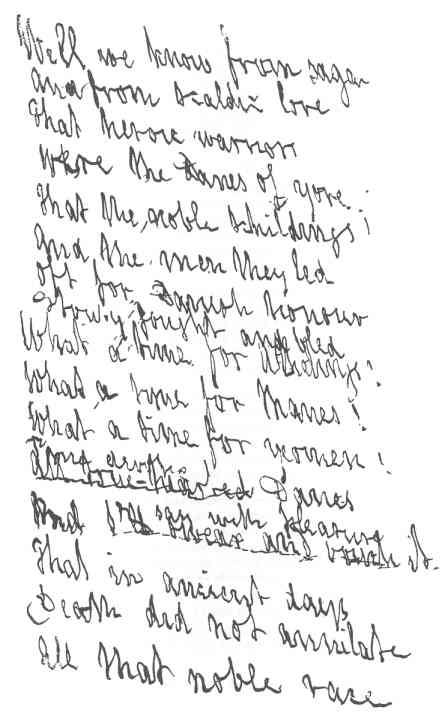
Grimhild’s Vengeance / Three Ballads / By / George
Borrow / Edited / With an Introduction / By / Edmund Gosse, C. B.
/ London: / Printed for Private Circulation / 1913.
Collation:—Square demy octavo, pp. 40; consisting of:
Half-title (with blank reverse) pp. 1–2; Title-page, as
above (with a note regarding the American copyright
upon the centre of the reverse) pp. 3–4;
Introduction pp. 5–14; and text of the three
Ballads pp. 15–40. The head-line is
Grimhild’s Vengeance throughout, upon both sides of
the page. At the foot of p. 40 is the following imprint:
“London: / Printed for Thomas J. Wise,
Hampstead, N.W. / Edition limited to Thirty
Copies.” The signatures are A (a half-sheet of
four leaves), and B and C (two sheets, each eight leaves), each
inset within the other.
Issued in bright green paper wrappers, with untrimmed edges,
and with the title-page reproduced upon the front. The
leaves measure 8½ × 6⅞ inches.
Thirty Copies only were printed.
Contents.
|
page
|
Grimhild’s
Vengeance. Song the
First. [It was the proud Dame Grimhild Prepares
the mead and beer]
A reduced facsimile of page 2 of the 1854 Manuscript of this
Song faces the present page.
|
15
|
Grimhild’s
Vengeance. Song the
Second. [It was the proud Dame Grimhild The wine
with spices blends]
|
24
|
Grimhild’s
Vengeance. Song the
Third. [O, where will ye find kempions So
bold and strong of hand]
|
32
|
The Introduction furnished by Mr. Edmund Gosse to
Grimhild’s Vengeance is undoubtedly by far the most
illuminating and important contribution yet made to the critical
study of Borrow’s Ballads, a study which has hitherto been
both meagre and inadequate. Not only does Mr. Gosse handle
the three Songs particularly before him, and make clear
the relationship they bear to each other, but he deals with the
whole subject of the origin of Borrow’s
Scandinavian Ballads, and traces fully and precisely the
immediate source from which their author derived them. One
of Borrow’s most vivid records Mr. Gosse calls into
question, and proves indisputably that it must henceforth be
regarded, if not as a fiction, at least as one more result of
Borrow’s inveterate habit of “drawing the long
bow,”—to wit the passages in Lavengro wherein
Borrow recounts his acquisition of the “strange and
uncouth-looking volume” at the price of a kiss from the
yeoman’s wife, and the purpose which that volume served
him.
Of the first and second of the three Ballads included in
Grimhild’s Vengeance two Manuscripts are
available. The first of these was written in 1829, and was
intended to find a place in the Songs of Scandinavia
advertised at the close of that year. The second Manuscript
was written in 1854, and was prepared for the projected volumes
of Kœmpe Viser of that date. Of the third
Ballad there exists only a single Manuscript, namely that
produced in 1829. Apparently in 1854 Borrow had
relinquished all hope of publishing the Kœmpe Viser
before he had commenced work upon the third Ballad. In the
present volume the first two Songs were printed from the
Manuscripts of 1854; the third Song from the Manuscript of
1829.
There is a copy of Grimhild’s Vengeance in the
Library of the British Museum. The Press-mark is C. 44. d.
38.
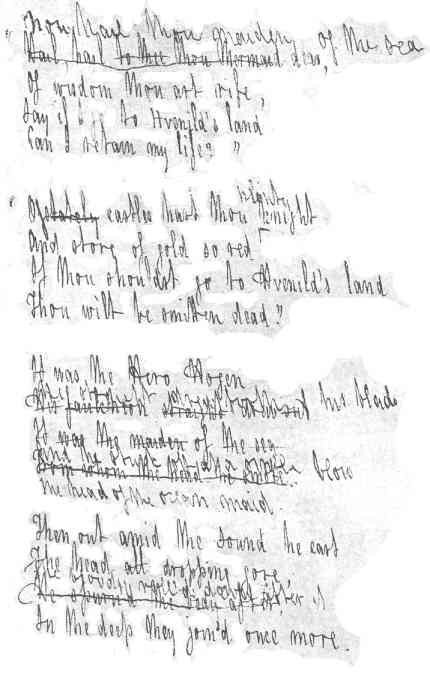
Letters / To his Mother / Ann Borrow / and Other
Correspondents / By / George Borrow / London: / Printed for
Private Circulation / 1913.
Collation:—Crown octavo, pp. 38; consisting of
Half-title (with blank reverse) pp. 1–2; Title-page, as
above (with a notice regarding the American copyright upon the
centre of the reverse) pp. 3–4; and Text of the
Letters pp. 5–38. The head-line is Letters
to his Mother throughout, upon both sides of the page.
Following p. 38 is a leaf, with blank recto, and with the
following imprint upon the reverse: “London: /
Printed for Thomas J. Wise, Hampstead, N.W.
/ Edition limited to Thirty Copies.” The
signatures are A (a half-sheet of four leaves), plus B and C (two
sheets, each eight leaves), each inset within the other.
Issued in bright green paper wrappers, with untrimmed edges,
and with the title-page reproduced upon the front. The
leaves measure 7½ × 5 inches.
Thirty Copies only were printed.
The series of letters contained in this volume were reprinted
in George Borrow and his Circle. By Clement King
Shorter, 8vo, 1913. The whole of the holographs are in
Mr. Shorter’s possession.
There is a copy of Letters to his Mother, Ann
Borrow, in the Library of the British Museum. The
Press-mark is C. 57. e. 46.
The Brother Avenged / and / Other Ballads / By / George Borrow
/ London: / Printed for Private Circulation / 1913.
Collation:—Square demy octavo, pp. 32; consisting
of Half-title (with blank reverse) pp. 1–2; Title-page, as
above (with a note regarding the American copyright upon the
centre of the reverse) pp 3–4; and Text of the
Ballads pp. 5–32. There are head-lines
throughout, each page being headed with the title of the
particular Ballad occupying it. At the foot of p. 32 is the
following imprint: “London: / Printed for Thomas
J. Wise, Hampstead, N.W. / Edition limited
to Thirty Copies.” The signatures are A and B
(two sheets, each eight leaves), the one inset within the
other.
Issued in bright green paper wrappers, with untrimmed edges,
and with the title-page reproduced upon the front. The
leaves measure 8½ × 6⅞ inches.
Thirty Copies only were printed
Contents.
|
page
|
The Brother Avenged.
[I stood before my master’s board]
Previously printed (with some textual variations) in The
Foreign Quarterly Review, vol. vi, June 1830, pp
61–62.
|
5
|
The Eyes. [268] [To kiss a pair of red lips
small]
|
9
|
Harmodius and
Aristogiton. [With the leaves of the myrtle
I’ll cover my brand]
|
12
|
My Dainty Dame. [My
dainty Dame, my heart’s delight]
|
14
|
Grasach Abo or The Cause of
Grace. [O, Baillie Na Cortie! thy
turrets are tall]
|
16
|
Dagmar. [Sick in Ribe
Dagmar’s lying]
|
19
|
The Elf
Bride. [There was a youthful swain one
day]
These stanzas should be compared with The Elves,
printed in The Nightingale, The Valkyrie and Raven,
and Other Ballads, 1913, pp. 25–26.
|
21
|
The Treasure Digger.
[O, would that with last and shoe I had
stay’d]
|
23
|
The Fisher. [The
fisherman saddleth his good winged horse]
|
25
|
The Cuckoo. [Abiding
an appointment made]
|
29
|
Note.—Each poem to which no reference is
attached, appeared for the first time in this volume.
There is a copy of The Brother Avenged and Other
Ballads in the Library of the British Museum. The
Press-mark is C. 44. d. 38.
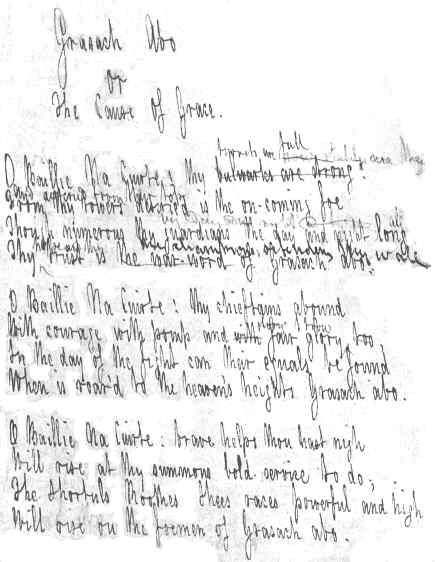
The Gold Horns / Translated by / George Borrow / from the
Danish of / Adam Gottlob Oehlenschläger / Edited / with an
Introduction by / Edmund Gosse, C.B. / London: / Printed for
Private Circulation / 1913.
Collation:—Square demy octavo, pp. 25; consisting of:
Half-title (with blank reverse) pp. 1–2; Title-page, as
above (with a note regarding the American copyright upon the
centre of the reverse) pp. 3–4; Introduction pp.
5–9; and Text of The Gold Horns, the Danish and
English texts facing each other upon opposite pages, pp.
10–25. The reverse of p. 25 is blank. There are
head-lines throughout, each recto
being headed The Gold Horns, and each verso
Guldhornene. The book is completed by a leaf, with
blank reverse, and with the following imprint upon its recto:
“London: / Printed for Thomas J. Wise,
Hampstead, N.W. / Edition limited to Thirty
Copies.” The signatures are A (a half-sheet of
four leaves), B (a quarter-sheet of two leaves), and C (a full
sheet of eight leaves), each inset within the other.
Issued in bright green paper wrappers, with untrimmed edges,
and with the title-page reproduced upon the front. The
leaves measure 8½ × 6⅞ inches.
Thirty Copies only were printed.
Although the poem was not printed until 1913, it is quite
evident that the translation was made by Borrow in or about the
year 1826. The paper upon which the Manuscript is written
is watermarked with the date 1824, whilst the handwriting
coincides with that of several of the pieces included in the
Romantic Ballads of 1826. “There can be little
doubt,” writes Mr. Gosse, “that Borrow intended
The Gold Horns for that volume, and rejected it at
last. He was conscious, perhaps, that his hand had lacked
the skill needful to reproduce a lyric the melody of which would
have taxed the powers of Coleridge or of Shelley.”
“The Gold Horns marks one of the most
important stages in the history of Scandinavian literature.
It is the earliest, and the freshest, specimen of the Romantic
Revival in its definite form. In this way, it takes in
Danish poetry a place analogous to that taken by The Ancient
Mariner in English poetry. . . .
“Oehlenschläger has explained what it was that
suggested to him the leading idea of his poem. Two antique
horns of gold, discovered some time before in the bogs of
Slesvig, had been recently stolen from the national collection at
Rosenberg, and the thieves had melted down the
inestimable treasures. Oehlenschläger treats these
horns as the reward for genuine antiquarian enthusiasm, shown in
a sincere and tender passion for the ancient relics of
Scandinavian history. From a generation unworthy to
appreciate them, the Horns had been withdrawn, to be
mysteriously restored at the due romantic
hour.”—[From the Introduction by Edmund
Gosse.]
There is a copy of The Gold Horns in the Library of the
British Museum. The Press-mark is C. 57. d. 19.
Tord of Hafsborough / and Other Ballads / By / George Borrow /
London: / Printed for Private Circulation / 1914.
Collation:—Square demy octavo, pp. 32; consisting of:
Half-title (with blank reverse) pp. 1–2; Title-page, as
above (with a note regarding the American copyright upon the
centre of the reverse) pp. 3–4; and Text of the
Ballads pp. 5–32. There are head-lines
throughout, each page being headed with the title of the
particular Ballad occupying it. At the foot of p. 32
is the following imprint: “London: / Printed for
Thomas J. Wise, Hampstead, N.W. / Edition
limited to Thirty Copies.” The signatures are A
and B (two sheets, each eight leaves), the one inset within the
other.
Issued in bright green paper wrappers, with untrimmed edges,
and with the title-page reproduced upon the front. The
leaves measure 8½ × 6⅞ inches.
Thirty Copies only were printed.
Contents.
|
page
|
Tord of Hafsborough.
[It was Tord of Hafsborough]
|
5
|
From the Arabic. [O
thou who fain would’st wisdom gain]
|
10
|
Thorvald. [Swayne
Tveskieg did a man possess]
Previously printed in The Foreign Quarterly Review,
vol. vi, 1830, p. 74.
|
11
|
Peter Colbiornsen.
[’Fore Fredereksteen King Carl he lay]
Previously printed in The Foreign Quarterly Review,
vol. vi, 1830, pp. 84–85.
|
16
|
Kragelill.
[’Twas noised about, ’twas noised
about]
|
21
|
Allegast. [The Count
such a store of gold had got]
|
25
|
Epigrams:
|
|
1. [Assume a friend’s face when a foeman
you spy]
|
30
|
2. [The lion in woods finds prey of noble
kind]
|
30
|
3. [Though God provides our daily bread]
|
30
|
4. [To trust a man I never feel inclined]
|
31
|
5. [A hunter who was always seeking game]
|
31
|
6. [The plans of men of shrewdest wit]
|
31
|
7. [Well was it said, long years
ago]
|
31
|
8. [Who roams the world by many wants
beset]
|
32
|
It is probable that the whole of these eight
Epigrams were derived by Borrow from Persian sources.
|
|
On a Young Man with Red
Hair. [He is a lad of sober mind]
|
32
|
Note.—Each poem to which no reference is
attached, appeared for the first time in this volume.
There is a copy of Tord of Hafsborough and Other
Ballads in the Library of the British Museum. The
Press-mark is C. 44. d. 38.
The Expedition to / Birting’s Land / and Other Ballads /
By / George Borrow / London: / Printed for Private Circulation /
1914.
Collation:—Square demy octavo, pp. 27; consisting of:
Half-title (with blank reverse) pp. 1–2; Title-page, as
above (with a note regarding the American copyright upon the
centre of the reverse) pp. 3–4; and Text of the
Ballads pp. 5–27. There are head-lines
throughout, each page being headed with the title of the
particular Ballad occupying it. Upon the reverse of
p. 27 is the following imprint: “London: /
Printed for Thomas J. Wise, Hampstead, N.W.
/ Edition limited to Thirty Copies.” The
signatures are A (a half-sheet of four leaves), B (a
quarter-sheet of two leaves), and C (a full sheet of eight
leaves), inset within each other.
Issued in bright green paper wrappers, with untrimmed edges,
and with the title-page reproduced upon the front. The
leaves measure 8½ × 6⅞ inches.
Thirty Copies only were printed.
Contents.
|
page
|
The Expedition to Birting’s
Land. [The King he o’er the castle
rules]
Of The Expedition to Birting’s Land no less than
three Manuscripts are extant. The first was composed in
1826, and was originally destined for inclusion in the
Romantic Ballads of that date. It is numbered to come between The Tournament and
Vidrik Verlandson. The second was written in 1829,
and was intended to find a place in The Songs of
Scandinavia. The third was prepared in 1854, with a
view to its appearance in the Kœmpe Viser. In
the two earlier versions the Ballad bears the tentative title
The Expedition of King Diderik’s Warriors to
Birting’s Land. The texts of all three differ
very considerably, the final version being that from which the
Ballad was here printed.
|
5
|
The Singing Mariner.
[Who will ever have again]
Previously printed in The Monthly Magazine, Vol. lvi,
1823, p. 335.
There exists an early Manuscript of this charming lyric,
differing entirely from the text as printed. This early
version is written in couplets, instead of in four-line
stanzas. Here is the first stanza, followed by the
equivalent couplet from the MS.:
Printed text.
Who will ever have again,
On the land or on the main,
Such a chance as happen’d to
Count Arnaldos long ago.
MS.
Who had e’er such an adventure the ocean’s
waves upon,
As had the Count Arnaldos the morning of St. John.
Upon the opposite page I give a facsimile of this early
Manuscript, the exact size of the original. The tiny waif
affords a delightful specimen of Borrow’s extremely
beautiful and graceful minute handwriting, of which one or two
other examples exist. The paper upon which the lines are
written is evidently a leaf torn from a small note-book.
|
16
|
Youth’s Song in
Spring. [O, scarcely is Spring a time of
pure bliss]
|
18
|
The Nightingale. [In
midnight’s calm hour the Nightingale sings]
Previously printed in The Monthly Magazine, vol. lvi,
1823, p. 526.
|
19
|
Lines. [Say from what
mine took Love the yellow gold]
|
20
|
Morning Song. [From
Eastern quarters now]
Previously printed in The Foreign Quarterly Review,
vol. vi, 1830, p. 65.
|
21
|
From the French. [This
world by fools is occupied]
|
22
|
The Morning Walk. [To
the beech grove with so sweet an air]
Previously printed in The Foreign Quarterly Review,
vol. vi, 1830, pp. 80–81.
|
23
|
Note.—Each poem to which no reference is
attached, appeared for the first time in this volume.
There is a copy of The Expedition to Birting’s Land
and Other Ballads in the Library of the British Museum.
The Press-mark is C. 44. d. 38.